Click here for the new Anchor Rising & Ocean State Current page

Adults Failed the NECAP...What Does It Mean?, by Patrick Laverty
Education
12:43 PM, 03/20/13
Students Get at least 4 cracks at Passing the NECAP Requirement, by Marc Comtois
Education
7:00 PM, 03/19/13
RI #1 In Teacher Absenteeism, by Marc Comtois
Education
9:30 AM, 02/17/13
Ed Commissioner: Let's Put the Children First, by Monique Chartier
Education
8:25 PM, 02/ 2/13
Things We Read Today (39), Thursday, by Justin Katz
Education
5:38 PM, 12/ 6/12
Things We Read Today (36), Wednesday, by Justin Katz
Under the Government's Wing
5:42 PM, 11/28/12
Good Intentions Gone Wrong , by Marc Comtois
Education
9:00 AM, 11/28/12
Things We Read Today (35), Tuesday, by Justin Katz
Healthcare
5:37 PM, 11/27/12
Things We Read Today (33), Friday, by Justin Katz
Education
4:47 PM, 11/23/12
College Loans and Defaults, by Patrick Laverty
Education
10:50 AM, 10/ 7/12
March 20, 2013

Adults Failed the NECAP...What Does It Mean?
According to Kim Kalunian's story on 630WPRO.com, 30 out of 50 of the adult test takers received a score that wouldn't allow them to graduate from high school. At least on the first try.
However, what does that tell us? Does the correlation say that these people who scored poorly will not be a success in life? Well, I guess that depends on your definition of success. One might question whether being elected to the General Assembly is a "success."
But one of the troubling parts is when State Representatives like Larry Valencia and Teresa Tanzi come out with quotes that can be construed by the high school students to mean that the test should not be important. Valencia was quoted:
"I was good at math. I took trig, statistics, pre-calculus. I have a degree in chemistry. I think the test is very unfair. It doesn’t represent what the average high school student should know."Ok, so Rep. Valencia thinks the questions are irrelevant. Has he gone around to ask high school math teachers what they think of the questions on the test? How about the committee that creates the questions? Or are his statements a little less-informed?
Also, Representative Teresa Tanzi said:
“As one of the many capable and relatively accomplished participants who scored ‘substantially below proficient’ on this exercise, I do believe this points to a problem with our state’s new diploma system.”Problem with the diploma system? Any rational person can construe those remarks to mean that she doesn't think the test should be a requirement for graduation. At least, that is one of the points that the Providence students were trying to make with this event.
The question that I have here is whether people think there should be a minimum set of requirements in mathematics and reading comprehension in order to earn a high school diploma.
And don't forget about this little fact:
In 2010, over 60% of recent high school graduates enrolled at CCRI must be placed in remedial courses; most of these students will not earn a degree.Our students are failing the NECAP and CCRI is telling us that our high school graduates need remedial work to even take a normal college workload. Yet, we have students and state legislators downplaying the importance of the NECAP. It would seem that the NECAP is at least a minimal indicator of student readiness for college-level work.
Yes, something is broken in Rhode Island's education system, but I really don't think the problem is with the NECAP requirement to graduate. Maybe the problem is with the teaching and/or learning.
In yesterday's GoLocalProv, there was an article about a student who didn't pass the math portion of the test on her first try. She felt she wasn't prepared by her school in Coventry for the questions on the test:
"We had a math packet in the summertime to go over and it wasn’t counted as a test or a quiz, it was an optional thing that you had to do,” she said. “I did it but on that little packet, I didn’t understand any of it. There was nothing about Algebra on the packet, there was only stuff about Geometry and there wasn’t anything you had to solve, it was all multiple choice questions.”If all of that is true, that's a failure of the curriculum at the school. If the state's board of education and other leaders feel the questions on the test are relevant for students to know at the time of the test, then the school should adequately prepare the students for the test.Gobin says her school went over the packet on the second day of class and then shifted its focus to Algebra II exclusively. When she took the test, she said, it included trigonometry and other subjects that her class is just getting to now, five months after the NECAPs were administered.
As many have now said, the best thing to come of all this is that people are aware of it and talking about it. There should be no quick and easy answers. We've known for some time that education in Rhode Island was falling behind and needed to be fixed. Maybe now with this new spotlight, we can find the true causes and get to work on fixing them.
March 19, 2013

Students Get at least 4 cracks at Passing the NECAP Requirement
In light of the recent outcry over the NECAP graduation requirements, here are the actual requirements as published on the RI Dep't of Ed. website:
First Chance: Score 2 on first attempt (2 out of 4, 2 is partial proficiency) in 11th grade.
If they fail the first try, the student and his parents are then given a school-developed progress plan to follow and students are told exactly what score they must get in subsequent tests to show adequate progress (i.e. they don't actually have to even get a "2").
Second Chance: Re-take test in Fall of 12th grade. Score 2 OR SHOW PROGRESS TOWARDS PROFICIENCY (which means most students who scored a "1" on first try need to answer an additional 5-8 questions correctly).
Third Chance: Re-take a shortened test in Spring of 12th grade. Same requirements as 2nd chance (score a 2 or show progress).
Fourth Chance: After the second failure (ie; between the 2nd and 3rd re-takes), students can substitute scores from an approved list of tests (such as AT tests, AP tests, Accuplacer test, and others).
All of this occurs over a year following the first failure. I'm sure school departments will have remediation classes and other programs in place to help students satisfy the requirement. And parents could even take matters in their own hands and get their kid some extra help like a tutor or (for free) something like Khan Academy.
February 17, 2013
RI #1 In Teacher Absenteeism
Earlier this week, USA Today highlighted that Rhode Island was the state with the most teacher absenteeism in the country (GoLocalProv picked it up today), according to a study by the U.S. Department of Education's Office for Civil Rights.
The national average is about 33% ("1 in 3"), but in RI it's 50%. Great. Look, I'm as tired as anyone of highlighting yet another negative "high" ranking, but when national publications highlight the results of Federal Government studies, we can't ignore them. The rest of the nation won't. So, yet again, we're the "hey, at least we don't live there" state.
New research suggests that teacher absenteeism is becoming problematic in U.S. public schools, as about one in three teachers miss more than 10 days of school each year. The nation's improving economic picture may also worsen absenteeism as teachers' fears ease that they'll lose their job over taking too many sick days, researchers say.First-ever figures from the U.S. Department of Education's Office for Civil Rights, compiled in 2012, also show that in a few states, nearly half of teachers miss more than 10 days in a typical 180-day school year.
Among them:
Rhode Island: 50.2%
Hawaii: 49.6%
Arkansas: 48.5%
New Mexico: 47.5%
Michigan: 45.6%Schools serving larger proportions of African-American and Latino students are "disproportionately exposed to teacher absence," notes researcher Raegen Miller, who studied the federal survey data for the Washington-based Center for American Progress, progressive think tank.
February 2, 2013

Ed Commissioner: Let's Put the Children First
On January 22, by a vote of two to two with four others abstaining (that's right, four abstentions due to possible conflicts of interest), the Chariho School Committee failed to implement a policy of non-seniority based layoffs for the Chariho school system.
Late yesterday afternoon, possibly in response to this uncourageous vote by the Chariho School Committee or perhaps to the looming March 1 deadline for districts to send teacher layoff notices, RI Education Commissioner Deborah Gist released a letter in which she
threatens to impose sanctions “up to and including loss of certification,” taking districts to court, or withholding state education aid unless they comply with her interpretation of a key education regulation called the Basic Education Program. These sanctions go beyond Gist’s previous statements about teacher assignments , when she said seniority cannot be the “sole” factor in assigning teachers but she did not say directly that job fairs and bumping are, in effect, illegal and punishable.
Teacher unions immediately squawked. Not sure why; this is all supposed to be for the chiii-hhhhhhiiiiillllllll-dren. (Thanks to Phil Hirons for supplying the correct contextual pronunciation of the word.) Anyway, that's what we are told at contract negotiation time when raises are on the line. Ah, but now it appears that a different priority has emerged.
The Rhode Island Federation of Teachers promptly lashed back, saying Gist is bullying school committees and administrators and attempting to gut collective-bargaining rights. RIFT President Frank Flynn said that contrary to Gist’s statements, education policy does not trump state labor law. ...Flynn said the union is “considering its options” in response to the letter, which he called “outrageous” in both tone and content.
So it is "outrageous" to place educating children ahead of seniority (not qualification) based hiring and labor-friendly laws? Huh. I'm not sure how many people would agree with that. In any case, at least we are quite clear now that this is not all about the children.
[Monique is Deputy Editor of the RISC-Y Business Newsletter.]
December 6, 2012

Things We Read Today (39), Thursday
Critical thinking sexism in Providence schools; a masculine career in disability; indoctrination; gambling on the law; an earnest pun.
November 28, 2012
Things We Read Today (36), Wednesday
Threats to the economy (cliffs and debts); RI lagging again (yawn); dependors and dependees; Social Security a problem; and a civil right to the war zone frat party.
Good Intentions Gone Wrong
Michael Barone writes:
In "Mismatch," law professor Richard Sander and journalist Stuart Taylor...[tell] a story of good intentions gone terribly awry. Sander and Taylor document beyond disagreement how university admissions offices' racial quotas and preferences systematically put black and Hispanic students in schools where they are far less well-prepared than others.As a result, they tend to get low grades, withdraw from science and math courses and drop out without graduating. The effect is particularly notable in law schools, where large numbers of blacks and Hispanics either drop out or fail to pass the bar exam.
This happens, Sander and Taylor argue, not because these students lack ability but because they've been thrown in with students of exceptional ability -- the mismatch of the authors' title. At schools where everyone has similar levels of test scores and preparation, these students do much better. And they don't suffer the heartache of failure.
That was shown when California's state universities temporarily obeyed a 1996 referendum banning racial quotas and preferences. UCLA Law School had fewer black students but just as many black graduates. The university system as a whole produced more black and Hispanic graduates.
Similarly, black students interested in math and science tend to get degrees in those subjects in historically black colleges, while those in schools with a mismatch switch to easier majors because math instruction is pitched to classmates with better preparation.
University admissions officers nevertheless maintain what Taylor in the preface calls an "enormous, pervasive and carefully concealed system of racial preferences," even while claiming they aren't actually doing so. The willingness to systematically lie seems to be a requirement for such jobs.
November 27, 2012
Things We Read Today (35), Tuesday
Healthcare and what you get for free; making a living trying to fix the dying (state); the dictator prescription; and unhealthily sexist (female) teachers.
November 23, 2012
Things We Read Today (33), Friday
What's up with the Providence charter push; why RI schools lack warmth; how pervasive is progressive destruction; and how an island is like policy knowledge.
October 7, 2012
College Loans and Defaults
I had a discussion recently with GoLocalProv.com writer Dan McGowan after his article on college loan debt and we got onto the topic of whether that debt might ever be dischargeable through bankruptcy.
I do think we'll see a time when bankruptcy clears out loan debt and if Obama returns to the White House, he could be the one to do it. But it'd be wrong.
With everything else in bankruptcy there is something tangible to repossess when the payments stop, whether it is a house or a car. One obvious exception is credit card debt. That's the risk that those banks take and they hedge that risk with the ridiculous interest rates on slow payers. That covers the defaults and write-offs from people using plastic.
If someone gets an education and can walk away from the debt through bankruptcy, why would anyone pay for college? You have the diploma, you have the education, you have the knowledge, what can they take away from you? They can't make you "unlearn" those things. Sure, they can deny you ever attended, but a smart employer doesn't care about diplomas. All they should care about is "can you do the job?"
The problem and the fix is on both sides. Students and families need to do a better job thinking about what they're doing and finding the right value. I don't just walk into the Ferrari dealer and sign the note and take the car. I actually think about whether I can
afford the payments on the Ferrari, or do I actually need to get a Chevy? Too many people go for the Ferrari cost of education when all they can afford is the Chevy. At the same time, I want schools and banks to make the student sign something showing what the repayment will be, even from day one.
For example, let's say for fall of freshman year, I need to borrow $10,000. That's pretty small to pay back, maybe $60 a month. No big deal. But what if I need to borrow that for the next seven semesters, or maybe a little more to cover the increased cost that the
school is charging. Maybe when I graduate, my real monthly cost will be $500 or $600 a month. Students need to know that going in. I should probably even know that before I matriculate. If I know what my need is to attend each college and I can calculate what the final monthly payment will be, will I be able to afford that? Can I get a job in the field that will pay me that?
Do I really want to get a bachelor's degree in Medieval Studies and have a $700 a month college loan bill, along with rent, car loan, insurance and some of the other things like an iPhone and the ability to go out on a Friday night? What do those jobs pay? Are there any jobs? That all should be taken into account, but rarely is. When I took out my college loans, I had no idea what my final monthly debt would be.
Lastly, I also see an attitude in some of these articles about the hardship that these college graduates and other former attendees. Some have an attitude that they'll "never" be able to pay back the entire loan. I've even read this kind of attitude from people who owe $20,000 or less. Seriously? That's a car loan. A car loan is normally paid back in five or six years. College loans give at least ten and have a lower interest rate. Anyone with the attitude that it's impossible to pay back a $20,000 college loan really never should have gone in the first place and likely never had any intention to pay it back.
Now that I and most of my friends are in our forties, many of us are finally getting out from under our college loans. Yeah, it's taken about twenty years for some. That's how long it can take. That's the deal we agreed to. It might not look like you're making progress by sending that $500 a month out and the balance seems to never drop, but it does. (Just wait until you get a mortgage if you want that kind of depressing monthly update!)
Presumably, you went to college to get an education that you'll use to make money for forty years or more. To use ten to twenty years to pay for it sounds like a pretty good tradeoff. Things don't just happen overnight.
September 26, 2012
Things We Read Today (19), Tuesday
Believing the political worst of priests; spinning bad SAT results; the skill of being trainable; the strange market valuation in Unionland.
September 24, 2012
Things We Read Today (18), Monday
Many faces of big government: standardized tests; interest group buy-offs; government as marketing practice; and the United States of Panem.
September 20, 2012
Providence Public/Charter School Idea Requires More from Everyone
Last week I called it "refreshing" when the news came out that Providence was looking to convert 9 public schools to public/charter hybrids. Some were understandably skeptical, but, as I responded, I was encouraged because the idea "indicates a change in mindset, even if a little bit, from the same ol'/same ol'."
Education maven Julia Steiny attended a meeting regarding the proposal--a "meet and greet" for the staffs of the 9 schools--and had her own observations, reminding us that "the whole point of the charter-school movement from its inception in the early 1990s [was] to encourage experiments and innovations that could spread back to the regular district schools. But the way history played out, charters and district schools felt pitted against one another, bitterly competing for resources, students and praise." She also described Providence School Superintendent Susan Lusi's three goals, chief among them being that "charters are characterized as being cohesive communities of parents, students and staff."
As Steiny concurs, noting that "since charter schools live or die on their ability to attract and keep students and families, they’re famous for being warm, welcoming places that parents prefer to the often-hidebound, district schools." So, to be successful, the people in public school buildings will have to embrace that sort of change. Steiny offers this anecdote:
So consider this little clash of cultures. Many of the Providence district attendees expressed a strong desire to improve their relationship with parents. One charter director conceded that involving urban parents is a super-tough job. So his teachers all visit their students’ homes before school opens in the fall, to meet or re-connect with the family and talk about their mutual expectations for the year.It's about more than just changing the model, it's about changing the attitudes of everyone. More will be asked of everyone. Is everyone willing to step up to the plate? We'll see.A Providence teacher asked, “Who does these visits?” The Director enthused, “The classroom teachers. And giving the parents a business card, saying call me any time; this is my cell phone number, that creates a relationship that’s crazy powerful.”
“The teachers give out their cell phone numbers?” asked one. “Yeah,” said the Director. And there was an uncomfortable pause.
September 17, 2012
Things We Read Today (12), Monday
Chafee shows his bond cards, Chicago exposes a metric discord, Rhode Island misses the skills-gap/business-cost lesson, QE3 misses the inflation nebula, and college majors miss the mark.
September 13, 2012
Providence Schools/Teachers: When all else fails....Charter
Refreshing (via ProJo):
Providence schools superintendent...Susan Lusi, together with Providence Teachers Union President Steve Smith and School Board President Keith Oliveira, are promoting the idea of district-operated charters, which would give principals greater say over what happens in the classroom without sacrificing union protection for teachers....Trying something new is a start.Given the us-versus-them attitude toward charter schools, Lusi was pleasantly surprised when nine Providence schools said they were willing to pursue charter school status....With so many schools under the gun to improve student achievement, Lusi knew she had to do something to shake up a system that has remained largely unchanged, despite wave after wave of reform.
“People don’t think they have permission to think outside the box,” Lusi said Tuesday. “Symbolically, this is a signal to think outside the box.”
Providence and many other districts, she says, have been trapped by the notion that school has to look the same in every building: 50-minute periods, a 6.5-hour day, 26 students per class. It doesn’t, Lusi says. There is no research that says that the old agrarian model of learning works. In fact, there is a growing body of research that says schools should fine-tune their instruction to meet the diverse ways students learn.
Providence has already begun to tinker with tradition. This year, most of the city’s high schools have a longer day. They have also adopted a class schedule with longer blocks of time. Some schools are toying with the idea of offering a Saturday academy or afterschool enrichment programs.
Lusi says charter schools do three important things that the district needs: create a school culture that is warm and welcoming, bring in partners with innovative ways of looking at teaching and learning, and attract additional resources. About $5 million in federal money is available for new charters.
September 10, 2012
Teacher Walkouts in Chicago, Conspicuous Details
The Chicago Tribune is reporting that 25,000 public-school teachers are picketing, rather than teaching, today. The details are a bit distant from Rhode Island for a finely tuned analysis, but it's fair to say that the union is not fighting a political class on the verge of right-to-work legislation. A significant political emphasis on "labor peace" can just mean that the goalposts move.
In this case, Chicago school district administrators are saying that they offered 16% raises over four years. The union is complaining about health benefits, teacher evaluations, and job security.
Taking a long-term view, though, the key sentence in the entire story, by reporters Noreen Ahmed-Ullah, Joel Hood, and Kristen Mack, may very well prove to be the one that I've emphasized in the following paragraph:
September 8, 2012
Abolition by Merger of the Board of Governors for Higher Education: Explain Again Why We're Doing This?
At the last minute and with zero public notice or input (this session, anyway), the General Assembly in June rushed through a merger of the state's Board of Regents for Elementary and Secondary Education and the Board of Governors for Higher Education into an 11-member Board of Education.
After days of questioning by the Providence Journal (great follow-up, guys) as to why this was done, G.A. leadership finally responded by citing their frustration at
the failure of the state’s schools to adequately prepare students for college
which they believe can be fixed in part by forcing
K-12 and higher education to work more closely together.
But setting aside the larger matter that perhaps the problem of inadequately prepared Rhode Island college freshmen cannot be traced to a lack of cooperation between the K-12 and higher ed systems, where is the explanation as to exactly how the de factor elimination of the Board of Governors for Higher Education would improve the state's K-12 academic achievement?
Yesterday's GoLocalProv article reporting that the
Merger of Education Boards May be Placed on Hold
is an excellent opportunity to revisit this ill-advised legislation.
Believe me, that I find myself in agreement with the NEARI
While the pressure to postpone the merger is believed to be coming from higher education side, National Education Association government relations director Patrick Crowley said his organization believes the legislation should be re-examined.
on a point of education policy has given me pause. And, of course, following upon their maneuver last September to extend in-state college tuition to illegal aliens, which was completely unacceptable in principle, budgetarily and quite likely legally, I have quite a dim opinion of the current Board of Governors for Higher Education.
Despite these reservations, I find myself far from satisfied with the proffered explanations for the merger of the two boards and quite concerned about its likely fall-out. The consensus seems to be that most of the attention and efforts of the newly created board will go to the K-12 side of their purview. But this would de-emphasize higher ed. Is that wise when one of the weaknesses hampering economic prosperity in the state is a lack of workers with post-secondary skills in certain areas?
Is it possible that the real reason for the abrupt passage of this legislation goes back to that decision last year by the B.G.H.E. to give in-state tuition to illegal aliens? If so, lots of people are certainly with you on that point. However, wouldn't abolishing the B.G.H.E. just end up punishing innocent bystanders - i.e., RI colleges and, ultimately, college students - rather than the responsible party? Not to mention failing to redress the wrong itself ...
September 6, 2012
Slow Adjustment to the Teacher Union Machine Continues in Chariho
This video by Evan Coyne Maloney succinctly presents a critical part of the small-government, free-market perspective on one of Rhode Island's most intractable difficulties:
The machine by which teachers' unions turn public dollars into union-organization profits and political patronage is clear and unambiguous. One could argue that the process is for the better, for one reason or another, but Coyne Maloney accurately follows the money.
August 28, 2012
"Education Support Professionals" Block School Opening In North Kingstown
In June, the North Kingstown School Committee voted to privatize the union jobs of 26 custodians. Twenty of the twenty-six were re-hired by the private company--GCA--that was brought in to take over.
The committee voted to award a bid to GCA to privatize the district’s custodial department and will plan to award the contract at its meeting Tuesday night. Though the staff got the axe, GCA has made a verbal agreement to hire all of North Kingstown’s current custodians as long as they pass a BCI check. The custodians will be rehired at the company’s “enhanced wage.”NK School Committe Chair Kimberly Page explained it wasn't an easy decision to privatize. Now, via Bob Plain, we learn that the NK School Committee is--according to the NK school unions--engaging in "economic violence" (gotta love the hyperbole), which is why the NK school unions united in solidarity to close the schools for the sake of, er, 6 jobs. Or maybe there's more to it than that.The committee also moved to reject the ESP (Education Support Professionals) contract and made substantial changes to its support staffing. Though the committee agreed 4-2 (Benson and Dick Welch opposing) to grant the paraprofessionals a one-percent pay increase (up from the superintendent’s recommendation to freeze salaries), it also eliminated life insurance for ESP, cut three sick days and one personal day and established new buyback rates for employees who opted out of health care. (Those new rates are now $2,500 for family and $1,200 for individuals.)
Employees who work fewer than 30 hours per work will no longer be eligible to receive health care through the school department. (Formerly, the cutoff was 20 hours.) The committee also authorized the hiring of 12 part-time employees to replace six full-time positions – a move that will save the district approximately $198,000.
Education special interest groups, such as the teachers unions, are experiencing a decline in membership. As Stephen Sawchuck reports in Education Week, “by the end of its 2013–14 budget, NEA [the National Education Association] expects it will have lost 308,000 members and experienced a decline in revenue projected at some $65 million in all since 2010. (The figures are expressed in full-time equivalents, which means that the actual number of people affected is probably higher.)”Look, it's pretty simple. This is only a little about jobs and mostly about power for unions. They certainly didn't shut down school for "the children." Or is shutting down a school district what we're call "education support" now? (Wait, don't answer that!).
For those who think handing these support services over to contractors will result in diminished quality, well, guess what? If the people of North Kingstown aren't happy with the janitorial services, they can go to School Committee meetings and complain. That's one benefit of hiring a private company to do these services: if NK taxpayers demand better results and they don't happen, they can fire GCS and find someone new. I know, it's amazing but true. It happens all the time in the private sector. Really.
August 27, 2012
Dept. of Education Commends Privilege
Defending the No Child Left Behind Act, on the Hoover Institution's online Uncommon Knowledge show with Peter Robinson, President George W. Bush argued that parents need to be able to see measurements of their school districts' achievements in order to hold them accountable. The point is well taken, but there are reasons conservatives at the time were suspicious of the enthusiastic support of the late "liberal lion," Senator Ted Kennedy (D, MA).
Even apart from the urge to teach to the test, measurements run the risk of being obscured in order to argue for increased funding. If a school does poorly, administrators and union organizers blame the lack of resources (and the local population); if a school does well, the same people declare success and argue for rewards.
The latter was recently the case in Tiverton (where, full disclosure, I'm running for school committee). Justifying a three-year contract extension that included various forms of raises, despite the uncertain economy and annual budget fights, Superintendent William Rearick picked from among the RI Department of Education's (RIDE's) school report card results for evidence that the town's schools are "top performers."
Of particular note is the ranking of one elementary school, Fort Barton, at the very crest of RIDE's list, among the 17 "commended" elementary schools. Tiverton has two other schools for children of the same age group, one of which, Pocasset, landed at the next level, "leading," and the other of which, Walter Ranger, was graded "typical." Familiarity with some of the demographic differences across this economically diverse town led me to wonder how the scores are calculated.
August 2, 2012
Technology and Education Then and Now
The family and I recently spent a long weekend in Washington, D.C. and we visited the Smithsonian Museum of American History. The "America on the Move" exhibition included a 1939 Dodge school bus from Martinsburg, Indiana, which served as a platform for explaining how technology (the bus) affected education.
In rural areas, the introduction of school buses changed the character of the communities they served and the lives of the children who rode to school. Students who had once walked to a local, often one-room, schoolhouse now rode a bus to a larger consolidated school where they were taught in separate grades. Progressive educators viewed buses as a step toward modernizing rural education....[and] favored larger schools, arguing they would provide students a better, more standardized education. Some rural citizens feared consolidation would bring higher taxes and a loss of involvement in their children’s education. One midwestern farmer said his local school was “the center—educational, social, dramatic, political, and religious—of a pioneer community.” But declining rural populations and better roads spelled the end of one-room schools. In 1920 Indiana had 4,500 one-teacher schools; in 1945, just 616.I'd say that everyone was right, to a point. At the time, most rural students did benefit from the standardized education (much as did their more urban peers) they attained via a more efficient school consolidation model and better trained, more professional teachers.
Rural folks were correct in that taxes probably did go up to meet the increasing costs of professionalized (and eventually unionized) education. I also don't think that--while the school does still serve as a neighborhood center of sorts (at least in a populous 'burb like Warwick)--many would argue that parental involvement in school has declined precipitously since then.
Fast forward to today and the problems and debates we have with education have less to do with the implementation of a standardized education model than with the very nature of the standards themselves. Indeed, technology continues to play a key role in this contemporary push/pull as, for example, it is the internet upon which ideas such as distance learning and "flipping the classroom" are built and which could lead to, ironically, a less centralized, more student-centered, personalized--versus standardized--education.
July 30, 2012
What Is Math For? Well, What Is Public Education For?
For a quick diversion from the immediately relevant tasks of quantifying legislator votes and charting the ebbs and flows of Rhode Island civilization, I can't resist commenting on Andrew Hacker's New York Times question, "Is Algebra Necessary?":
My question extends beyond algebra and applies more broadly to the usual mathematics sequence, from geometry through calculus. State regents and legislators — and much of the public — take it as self-evident that every young person should be made to master polynomial functions and parametric equations.There are many defenses of algebra and the virtue of learning it. Most of them sound reasonable on first hearing; many of them I once accepted. But the more I examine them, the clearer it seems that they are largely or wholly wrong — unsupported by research or evidence, or based on wishful logic. (I’m not talking about quantitative skills, critical for informed citizenship and personal finance, but a very different ballgame.)
My experience was somewhat like that of Glenn Reynolds: I was good at math but didn't become a fan until I began putting it into practice. That practice rolled out in many different phases: Music, for one, is built on mathematical concepts; analyzing public policy as a hobby in my mid-20s lent a new relevance to calculations and proofs; but the visceral love of math only came when all of my preferred career paths came to a dead end of unemployment.
July 17, 2012
A Decade of Moving Next Door
I've been following taxpayer migration data for years, but in a haphazard way. A new study that I've coauthored for the RI Center for Freedom & Prosperity finally gave me the opportunity to review all fifteen years of available data from the IRS.
The picture — from the 2003 beginning of what can only be described as an exodus — is frightening. After accounting for the tens of thousands of Rhode Islanders who moved to other states and other taxpayers who moved in the opposite direction, Rhode Island lost 24,455 households, with $1.2 billion of annual income (not inflation adjusted). More conspicuously, a net 3,406 taxpayers moved right across the border, to abutting counties in Massachusetts and Connecticut, taking with them $254.5 million in annual adjusted gross income (AGI).
July 2, 2012
Changing Utilization of Local School Districts in RI Cities and Towns
In 18 of 32 combined Rhode Island school districts, enrollment has been falling as a percentage of the population under eighteen. That means families are choosing non-district charter schools, private schools, or home schooling.
As the following chart shows, Cranston and Woonsocket are the only urban districts not losing community buy-in. Among the schools in the urban circle of Providence, a substantial portion of the decrease may have to do with the proliferation of charter schools and other non-district public schools in the area over the last decade. For the 2010-2011 school year, such schools claimed 4,636 students.
The percentages derive from enrollment figures available through the RI Dept. of Education and 2000 and 2010 U.S. Census data for population under 18. The possibility therefore exists that some of the difference may also be explained by an increase of children under 5 (kindergarten) or 18 and above, but still in high school. (Consistent data at the city/town level does not allow for more targeted analysis.)
The effects of these methodological shortcomings, however, are tempered by trends within the state. The population under 5 years old fell in Rhode Island, from 63,896 (6.1% of total population) in 2000 to approximately 56,856 (5.4% of total population). At the state level, therefore, the percentage of children under 18 who are also under 5 notched down from 25.8% to 25.4%.
June 20, 2012
Gist Recommendation to Close Charter School is a Positive for School Reform
Education Commisioner Deborah Gist is recommending that the state's first charter school be closed.
Gist is recommending that the Board of Regents for Elementary and Secondary Education not renew the charter for the Academy for Career Exploration, formerly Textron/Chamber of Commerce, when its five- year charter expires next year....Gist criticize[d] the school’s performance while noting that its reading scores are higher than the average in Providence, the district where the school is located.As I recall, when it was still Textron Academy, the former head of the school, Rick Landau, left because of frustration with the school's teachers union, who insisted on maintaining the practice of "bumping," which meant that teachers versed in the pedagogy of Textron could be removed by teachers with more seniority and without relevant training. I'm not sure if this practice continued, but it's clear the school has not lived up to it's part of the bargain.While 80 percent of ACE’s juniors scored proficient in reading, none were proficient in math on the 2011 New England Common Assessment. Ten percent were proficient in math in 2010; 2 percent in 2009.
“ACE has consistently failed to educate its students in math,” Gist wrote in a four-page memo to the Regents, who will likely vote on the matter later this summer. “Overall, the school’s administrative and board leadership has not provided oversight for student learning.”
Those dancing on the grave of the Academy for Career Exploration because they think it proves charter schools are universally bad are missing the point. For instance, while RIFuture's Bob Plain pithily commented, "So much for the private sector being able to do it better…", it's hardly the case that the failure of one charter means all charters are bad (but that's not to say they're a panacea, either).
Charters--even unionized ones--are generally more flexible than public schools when it comes to reforming and applying new teaching methods and, yes, even when it comes to shutting them down. So the real takeaway from this story is that, because it was a private endeavor, the commissioner is able to close it down because it didn't perform and she can do it much more quickly than if it was a public school (Central Falls, anyone?).
That Gist can recommend closing--and presumably actually close--a charter because it's not performing is a mark in favor of the charter school model. Shutting down a bad performer is exactly the sort of immediate accountability (relatively speaking) that school reformers are looking for. If this flexibility existed in our public school system, then maybe there wouldn't be a need for charter schools at all.
May 31, 2012
Providence Failing in ESL
In an article posted yesterday by Linda Borg in the Providence Journal, the Providence school system is failing those students who are learning English as a second language. For the time being, let's put aside the "they shouldn't be here in the first place!" comments, as that's a separate issue.
The article talks about a study commissioned by former Providence Superintendent Tom Brady (is there anything Tom Brady can't do?) and it found many deficiencies in Providence's ESL curriculum.
These students do not have access to rigorous math and English courses that could boost their academic achievement, he said. Instead, they are often offered a “watered down” curriculum that does not help them catch up with their English-speaking peers.
...the district does not have high expectations for its English-language learners nor does it hold staff members accountable for their academic progress.I go back to the same questions I've always had. Why do we separate students by age instead of ability? If we have a seventeen year old that doesn't understand English, why are they in math and science and social studies classes with other seventeen year olds that do understand the language? That is just setting those kids up to fail, get frustrated and quit completely.
Staff said they didn’t see themselves as responsible for improving this population’s performance and said they didn’t know who was responsible for students’ progress. Moreover, educators said they didn’t know how many schools were failing to make adequate yearly progress because of their English-language learners.
If a school system has students who don't understand the language, why not use language immersion? Why bother even trying to teach them math, science and social studies until they do understand English? Put them in ESL classes until they do understand it, even if that is the full six hours a day. Have them learn basic English and English in context of what they'll be doing in the other subjects. When they are then ready, let them move on, but keep checking back on them and their progress. Anything else just seems like a waste of everyone's time.
May 24, 2012
East Greenwich Looks to Stay on Top
Yes, East Greenwich has economic advantages that Central Falls doesn't have. It also has parents, teachers and a community that is involved in the school. These are all reasons for why East Greenwich High School has been ranked as the best high school in the state and one of the top schools in the nation. But, over and above all that, it is a willingness to continue to push boundaries and have a dialogue about re-shaping what it means to have an education.
During the second “Excellence in Education” forum held on Monday, School Superintendent Dr. Victor Mercurio told a group of about 25 residents that the state’s minimum requirements for a 180-day school year and 330 minutes of instruction per school day may inhibit student performance and teaching efficiency.The idea of "flipping the classroom" (mentioned here before) was also discussed:Mercurio said the School Department is exploring several alternative plans for creating a year-round academic schedule including the use of a four-day school week.
According to Mercurio, other school districts that have shortened their school weeks in an effort to reduce spending witnessed beneficial results relating to student achievement....In addition to a year-round schedule, Mercurio said the department is also examining the use of longer school days and alternative methods of instruction, such as digital devices and social media.
“The bricks and mortar part of school is no longer the essential piece of the relationship between a teacher and a student,” he said.
...[Assistant School Superintendent Paula] Dillon said other districts have found success by “flipping the classroom,” which essentially means that students use digital devices to experience the lecturing part of their coursework while at home. They then go to school to work hands-on with teachers for problem solving and review work. The educational model is the opposite of how most districts operate with teachers lecturing during the school day, and students working on the subject matter at home, she said.The overall goal is to make actual instructional hours more efficient and effective. It sounds like it was an interesting and worthwhile dialogue, but it's really just shooting the breeze until it is actually put into effect.
May 16, 2012
Spending More Money Gets Us Better Education, Right?
On Monday, GoLocalProv.com released their annual high school rankings for Rhode Island. 51 public high schools ranked on a variety of factors. I was speaking with a friend of mine from Cumberland and we were lamenting our home town's disappointing ranking at 34th. "That's what you get when you have the lowest per-pupil spending" he mentioned. Which then got us thinking. Is that true? Does Cumberland rank 34th because it has the lowest per-pupil spending rate at $11,090? So we decided to take a look and test correlation.
The correlation we tested was per-pupil spending against the GoLocalProv rankings. Argue against how they ranked them all you want, but they are what they are. The Barrington and EG schools are at the top and the Providence schools are near the bottom of the rankings, as we often see.
If you want to brush up on correlation, here's the Wikipedia page.
What we found when we did the correlation was a -0.14 relationship. Very, very weak. If you want to conclude anything, spending more money does not get you a higher ranking on the GLP charts. If anything, in a very, very weak way, more money gets you a lower ranking. But just for the sake of the argument, let's call it no correlation at all.
We hear of people in education telling us that if we just spend more on education, we'll get better results. Even though, we are one of the top spenders in the country for education and we have some of the worst results in the country for that money.
Also, when schools are in trouble, like in Central Falls and some in Providence, we're told that the problem is more with the student's home life and with the parents. When the Central Falls teachers were all laid off, we were told they were just scapegoats for inattentive parents or parents who didn't value education. The teachers are scapegoats for lazy kids according to others.
If that's the case, the problem is with bad parents, then how will throwing more money at the problem solve it? The teachers have told us that the problem isn't with them, the problem is with the parents. The solution is that we should spend more on the schools? The top ranked school in the state spends less per pupil than the last ranked school. The school paying the most is ranked 21st. Similar examples are seen throughout the chart. I know there are other factors that go into good schools, but this doesn't point to "more money" being the solution.
May 4, 2012
The Media On Student Loans
We have a debate going on in Congress about raising the rate on student loans from the current 3.4% to the old interest rate of 6.8%. There is very little coincidence that the Democrat-controlled Congress who passed this change set the expiration date for an election year. Either continue with the Democrat chosen rate or deal with the consequences in November.
However, my issue here is with the media. I've read so many sources about this situation and many of the writers aren't telling the full story. I don't want to pick on the Warwick Beacon because I've seen the same sort of thing in many different news sources, but this is just the one that I'm using for illustration.
For some Americans, increasing an interest rate by 3.4 percent may not be a cause for alarm. For Cranston native Andrew Iasimone, however, who has incurred $32,000 in student loans in his freshman year at Roger Williams University, this could be a big problem. Iasimone still has five years to go in his pursuit of a double major in political science and psychology with a concentration in forensic science.Paying back his loans may become even more difficult this summer should Congress increase the interest rates for the Stafford Student Loan from 3.4 to 6.8 percent. If that is the case, students like Iasimone may be looking to pay an additional $4,000 to $5,000 more in interest costs, according to Charles Kelley, executive director of the Rhode Island Student Loan Authority.
Later in the article, Mr. Kelley states:
An increase in the interest rate would affect 36,000 Rhode Islanders with Stafford loans amounting to a total of $150 million, said Kelley.To me, that's either simply untrue or really misleading. Let me ask you this, based on what you read there, if you had a pile of student loan debt and Congress changes the interest rate to 6.8%, would you think your payments are going to go up? Of course you would! Not so fast.
The increase would only affect interest rates for subsidized Stafford loans for undergrad students issued after July 1, 2012. Interest rates for existing loans won't change.Any Stafford loans originated before July 1 of this year, will keep the old interest rate. So your pile of debt is unaffected by this change. If Congress raises the rate to 6.8%, then don't use the Stafford program, go to a bank and get a lower rate.
Additionally, the Beacon article mentioned this one student's $32,000 in loans for his first year, however this rate change will only directly affect federal Stafford loans and not all of that $32,000 is Stafford. We know this because again from the USA Today article:
That estimate is based on a borrower with $23,000 in subsidized Stafford loans, the maximum allowed for undergraduate dependent students.That's one of my big frustrations with the media today. You try to be informed and you read the news but often they struggle to get the whole story out.
April 5, 2012

Governor Chafee Questions Higher Education Costs
The Projo's Gina Macris reports today that Governor Lincoln Chafee is not happy with the management of public education finance in Rhode Island...
The Board of Governors for Higher Education should have known better than to negotiate 3 percent compounded raises at the public colleges for the next three years, when other state employees, taxpayers, and families of college students are so challenged, Governor Chafee said Thursday.Operating costs for "Public Higher Education" plus the "Rhode Island Higher Education Assistance Authority", consolidated into one item in this year's budget, grow in the Governor's budget by 2.8% over the amount spent last year (which involved a $9 million+ overrun of the originally budgeted amount), for a total of 10.8% growth over the past two years...
| FY 2013 Request | $983,006,187 |
| FY 2012 Revised | $956,245,535 |
| FY 2011 Audited | $887,212,753 |
To his credit, Governor Chafee seems to realize that this kind budget growth cannot continue indefinitely, even if a nearly 11% increase in operating costs implemented over two years might be the kind of spending that some Rhode Island progressives refer to as "austerity".
March 13, 2012
Teacher Absenteeism Means Academic Inconsistency
While looking at Civil Rights data for my previous post, I noticed that they included a category labeled "% FTE of Teachers Absent > 10 days of the School Year". I then started looking at some of the numbers. To ensure that I was seeing what I thought I was seeing, I went to their data definition sheet (located at the bottom of the data sheet for Woonsocket, for example) to verify what a couple key terms meant:
* FTE (Full-time equivalent) – a measure of staffing that factors in the proportion of time a staff person serves (at the particular location). A staff person who is at a location for the entire day is 1 FTE at that location; a staff person who is at a location for a half day is 0.5 FTE at that location.
* Absent (for teachers) - A teacher is absent if he or she is not in attendance on a day in the regular school year when the teacher would otherwise be expected to be teaching students in an assigned class. This includes both days taken for sick leave and days taken for personal leave. Personal leave includes voluntary absences for reasons other than sick leave. Do not include administratively approved leave for professional development, field trips or other off-campus activities with students.
I then compiled the available data into the below chart (data isn't available for all of the school districts in Rhode Island. If your school isn't listed, there was no data).
| District | % FTE of Teachers Absent > 10 days of the School Year |
|---|---|
| Bristol/Warren | 77.9% |
| Woonsocket | 72.2% |
| Cranston | 71.2% |
| Barrington | 67.5% |
| Middletown | 65.7% |
| Central Falls | 64.9% |
| West Warwick | 57.8% |
| Providence | 56.9% |
| South Kingstown | 56.4% |
| Pawtucket | 50.7% |
| Westerly | 50.0% |
| East Providence | 49.0% |
| Johnston | 43.1% |
| North Providence | 41.5% |
| Chariho | 37.0% |
| Warwick | 36.8% |
| North Smithfield | 31.2% |
| Lincoln | 26.2% |
| Cumberland | 24.0% |
| Narragansett | 22.0% |
| North Kingstown | 19.3% |
| Coventry | 5.0% |
| Tiverton | 3.9% |
Again, because these numbers are so high, I thought that perhaps I missed something. My first thought was that they may have included maternity leave in the absentee rate. I'm still not sure about that. Another thought I had is that they simply pooled all possible FTE days and divided by all of the days absent, which would allow a few people taking many sick days to affect the entire pool. I think this may account for a portion of the high numbers. I don't believe RI teachers pay into Rhode Island's TDI system, so they pool their sick days so that members with prolonged illnesses can take time off without missing pay. (If there is any other factor I'm missing, feel free to correct me, please).
Nonetheless, taking the above into account and given the definitions listed, it appears as if we have a problem with teacher absenteeism in the majority of Rhode Island school districts. Even if the "it's a problem" line is (albeit) arbitrarily set at 10%--and 10% is still pretty generous, particularly when most people in the private sector don't get more than 5 sick days a year, much less summers and school vacations--there are at least twenty-one school districts in Rhode Island that have teacher absentee rates of around 20% or more. That isn't good.
Regardless, even if I think its one of those root cause problems that has led to places like, say, Woonsocket, ending up in their current dire straits, the apparent lack of professionalism isn't even my primary concern. Instead, I'm more concerned with how such inconsistency in the classroom affects students. We are told that, whether or not it's the ideal, school is the one place where kids can go for structure and consistency. Instead, too many Rhode Island students are faced with a revolving door of substitute teachers who have little or no stake in their educational growth. So much for consistency.
Race Stats on School Suspensions: Be Careful Jumping to Conclusions
RI NPR Education blogger Elisabeth Harrison reports on newly released data (collected for 2009) from the federal Office of Civil Rights showing that, when it comes to school discipline, "African-American students are more likely to face harsh discipline than their peers." Harrison reports that for Rhode Island, it "depends on the school district."
Plenty of statistics appear to support this assertion and Harrison provided some examples supporting these findings (and I paraphrase/quote her report here)*:
* Cranston - African-Americans comprised 4% of the student population but accounted for 50% of all expulsions.
* Pawtucket - Hispanic students made up 66% of all in-school suspensions but represented 25% of the district’s student population. African-Americans accounted for 33% of in-school suspensions and 29% of the student body. White students were the single largest group & had no in-school suspensions.
* Woonsocket - "African-American and Hispanic students were both slightly over-represented in the in-school suspension category."
Harrison's other finding: that these same minority groups are under-represented in advanced courses as well as gifted and talented programs. Again, results vary by community and Harrison cited a couple examples (again, this is a paraphrase/quote of Harrison):
* Woonsocket - There were no non-white students in Woonsocket’s gifted programs and no Hispanic students taking calculus even though Hispanics represent roughly 25% of Woonsocket’s enrolled school population.
* Providence - Hispanic students were under-represented in the district’s gifted programs and calculus classes, and Hispanic students were less likely to take the SAT or the ACT than their peers in other racial and ethnic groups.
This prompted RI Future's Bob Plain to observe that "the easiest way to avoid discipline at local high schools is to be white." However, while Plain didn't specifically address the achievement gap (instead focusing on the "disciplinary gap"), I think the statistics regarding the achievement disparities confirm what most educators and eduwonks have noted over the years: these poor participation rates in academically advanced programs can be best correlated to socio-economic factors rather than race.
I also think the same could be said about the disciplinary statistics. Unfortunately, there is no clear breakdown in the data that takes these factors into account. Nor does demography account for other factors. Without that information, and by using statistics in the same way, we could just as look across the data and easily conclude that being a male puts you behind the 8-ball in nearly every aspect of education. Therefore, I hereby proclaim that the easiest way to avoid discipline at school is to be a girl.
* I'd stress that while Harrison made it clear that Rhode Island showed mixed results, she primarily focused on examples that seem to support the idea that minorities are disciplined more than whites. As a counter, a quick look at the same data for such diverse communities as Warwick and Central Falls--Warwick is predominantly white and Central Falls is predominantly Hispanic--show pretty consistent numbers across the board.
ADDENDUM: Commenter "Dan" points out something I was wondering about. The relative consistency in the data for such seemingly disparate communities as Warwick and Central Falls supports the idea that economic disparity within a school system could be a bigger driver of disparate disciplinary rates than race or class itself, per se.
March 6, 2012
Star Kids for the Children Left Behind
From a new interview/profile on the Ocean State Current; for the complete article visit the page:
Rhode Island is "leaving behind a remarkably high proportion of the population," Beacon Hill Institute Senior Economist Jonathan Haughton told the audience at a February 28 conference hosted by the RI Public Expenditures Council. "But those who make it through high school get on to college and do rather nicely."
Over the past decade, addressing the problems of the American education system has become the subject of national political debates and high-profile documentaries. During that same period, the Star Kids Program, based in Middletown, RI, has quietly gone about building a 100% graduation rate for the disadvantaged children of parents dealing with drug addiction and incarceration.
Star Kids works with private schools, charitable organizations, and individual sponsors to offer students guaranteed financial and community support from the time they enroll through their college application process. “We’ll never displace any child,” says Executive Director Kathleen Burke. The result has been that not a single one of the 148 students who have begun with the program and stayed within its geographical area has dropped out. That includes 12 who have graduated, all going on college (one trade school), with the most prestigious being Notre Dame and Georgetown.
The program began in 2000, when Dr. Timothy Flanigan --- head of the Department of Infectious Diseases at Miriam Hospital, Rhode Island Hospital, and Brown University --- applied his experience cofounding Providence’s Rhode Islanders Sponsoring Education (RISE) program to the East Bay, from Newport to New Bedford. Often at the suggestion of social workers, families approach Star Kids, and the organization assists them through the process of choosing and applying to private, mostly religious schools.
In the plainest terms, what Star Kids offers to parents and other legal guardians is a choice of schools and a way out of a detrimental environment. In that regard, it can be seen as part of a larger trend, a movement, in education. According to Stephen Nardelli, Executive Director of the Rhode Island League of Charter Schools, the latest round of lotteries for the state’s 15 public charter schools, held last week, sifted through 6,521 applications to fill 697 openings. “It’s clear that there is a demand for public school choice,” he says.
“The real root is one child,” says Burke. “If you can make one child’s life better, if you can break into one generation of a family that’s been ’round and ’round with issues, then that’s going to help the educational system as a whole.”
February 25, 2012
“It’s an abuse of power”
“It’s an abuse of power,” said Frank Flynn, President of the RI Federation of Teachers (RIFT?).
He's referring to a situation in Woonsocket where the school committee gave notice to all school department employees that they could be laid off this year, similar to what Providence did last year.
Now, I agree that it is silly to do this to 100% of your workforce. We all know that Woonsocket will have schools next year and they will need teachers, so why all of them? There is a minimum they will need, so why not only notify the remainder?
That being said, I find the Flynn's comment pretty funny. Why is it that when the unions exercise their rights to the full extent of the law, they're just "playing by the rules" but when the school committee does the same, "it's an abuse of power"?
What makes this even more egregious is Flynn and others, like Deborah Gist don't like the March 1 deadline for these notices. They complain about how it hurts the morale of the teachers and causes so much stress right in the middle of the school year. However, it was the teachers' unions who requested this date so the affected teachers could have plenty of time to figure out how to go forward and start looking for a new job.
And, it could have been prevented.
Projo writer Jennifer Jordan also explains:
Last year, teachers’ unions lobbied for the General Assembly to pass binding arbitration for teachers, saying if they gained that power, the notification deadline could be moved back. The Senate passed the measure, but it failed in the House and the deadline remained March 1
The part that gets me is "could be moved back". What? Does the General Assembly need the unions' approval to pass a law? Jordan implies that this stress that the Woonsocket teachers are now feeling could have been resolved, but their own union heads prevented that from happening? Teachers, were you aware of this? Are the teachers' union lobbyists always working for the best interests of their members at the State House? In this instance, it sounds like that answer is "no".
February 17, 2012
Teacher Evaluation: If not Value-added, then what?
While Education reformer Rick Hess thinks "would-be reformers [are] getting waaaay ahead of themselves" when it comes to implementing "primitive systems to measure everything they can, or to validate everything else (observations, student feedback, etc.)" under the mantle of value-added analysis, he also doesn't dismiss it out of hand as a way to evaluate teachers. Why? Because he doesn't see any alternative evaluation tool being offered that is appreciably better. Assuming that we all think teachers--like other employees--should be evaluated, he offers five alternatives:
February 7, 2012
New Education Funding Formula Contributes to Increases in State Aid
Dan McGowan at GoLocalProv has a story on how Governor Chafee's budget sends more money to the cities and towns.
A GoLocalProv review of the Governor’s budget plan shows Barrington, East Greenwich, Lincoln, Cranston, Scituate and North Providence will all receive at least 16 percent bumps in aid, with Barrington and East Greenwich – two of the wealthiest communities in the state – getting 38.2 percent and 36 percent increases, respectively.As Dan notes, the increase is "mostly in education aid". That is because the state passed a new funding formula bill (PDF) last year and, based on the calculations, communities such as Barrington and East Greenwich are seeing an increase because they had been getting less money on a per pupil basis than other cities under the old, hodge-podge,/who-you-know-in-the-legislature system. The percentage increase looks big for the "rich" towns like Barrington and East Greenwich, but they are less in real dollars when compared to the nearly 19% increase for Cranston, for instance.In total, 15 communities will receive at least ten percent increases and Providence, which receives by far the most state aid of any city or town, will get a 9.5 percent increase in aid.
Additionally, GoLocal didn't include school aid for a couple cases where communities share a school district--Exeter/West Greenwich and Bristol/Warren. With the exception of Portsmouth, these four communities are the only ones experiencing an overall decrease in aid. Based on the new funding formula, these towns will be receiving less education aid, which makes their reduction in state aid even more than that indicated by GoLocalProv.
In years past, the perception in the Legislature (and, probably, in the general population) has been that Barrington and EG didn't "need" more aid. Conversely, the old system failed to account for population and demographic changes that have occurred in some communities--Bristol and Warren, for example--by continuing to send the same or a little more money every year while, for instance in the case of Bristol/Warren, the student population continues to go down. Well, a comprehensive funding formula takes out such "gut feel" factors. We'll see how this plays out: To some, the new funding formula may not be "fair", but it is equitable.
February 2, 2012
Providence Mayoral Academy Gets First Approval From Board of Regents
According to Blackstone Valley Prep's Twitter feed, the State's Board of Regents has given preliminary approval to an Achievement First operated mayoral academy to be sited in Providence -- with Board of Regents chairman George Caruolo casting the 5th and deciding vote in favor.
Achievement First, Paying Twice?
The application by Achievement First to open a new charter school (a Mayoral Academy) in Providence is up for approval before the Board of Regents today. In an effort to promote this application, RI-CAN has been rolling out "7 Facts in 7 Days" on their website. Whether you approve, oppose--or are pre-disposed to either--one fact (already touched on by Andrew) contained some additional information that was news to me.
FACT #5: Under Rhode Island’s new fair funding formula, money follows the child, so the Achievement First Mayoral Academy would not be taking money away from its host districts. --- Because of Rhode Island’s new school funding formula, each of the four communities that the Achievement First Mayoral Academy would serve are set to receive additional resources from the state in the coming years. Instead of a lump sum, districts will receive funding based on enrollment and student need, so that every child will get their fair share of state dollars, whether they go to a public charter school such as Achievement First Mayoral Academy or a traditional public school. To allow districts to adjust to the new funding formula and changes in enrollment pattern, districts will even get funding through the 2017-18 school year for the students who are no longer enrolled in their schools. {Emphasis mine}.So for 4 or 5 years, districts sending kids to the Providence Mayoral Academy will still receive compensation for students they won't be directly educating. What is the more likely scenario come the end of the 2017/18 school year: 1) The districts will have planned accordingly and their budgets will anticipate the oncoming "shortfall" such that they will be able to absorb budget cuts or 2) The districts will factor in the windfall and expect it to be part of the new funding baseline regardless of the "deadline"?
January 30, 2012
The Most Disingenuous Argument Against Mayoral Academies
Suppose you have two schools. Both are funded with public money. Each is run by a principal, with both principals reporting to a superintendent, who reports to a school committee. (This is a small-scale model of what opponents of structural education reform, in Rhode Island and elsewhere, believe is the primary way -- if not the only way -- that public education should be delivered).
Now consider a different system. There are still two schools, again both funded with public money. In this system, one school is run by principal who reports to a superintendent, while the other is run by principal who reports to a Board of Directors headed by a Mayor.
In both systems, the same amount of money is spent per-pupil in each school.
Opponents of structural education reform will argue that the second school in the second system has taken money away the first school, even when the same amount of public money is spent in both systems to educate the same number of students. It makes no sense, unless complaints of charter schools and mayoral academies taking money away are understood to mean that money is being taken away from the control of a school committee, which has nothing to do with either the educational function or the public status of the schools being considered.
Scale the numbers of schools, students, and personnel to a more realistic level, and the argument is equally as nonsensical. Suppose there are 20 schools in a system. Each school has a principal, who reports to a superintendent, who reports to a school committee. Next postulate a system with 18 schools, each with a principal, who reports to the superintendent, who reports to a school committee -- plus 2 more schools, each with a principal, who reports to a Board of Directors headed by the Mayor. Again, opponents of structural education reform will (seriously) argue that, in the second case, the 2-school subsystem has taken money away from the other 18 schools, even 1) if the total amount spent across the 20 schools in both systems is the same and 2) the same amount per-student is spent in each of the district schools in both systems.
Those advancing a rationale that money that is part of a system that they don’t control automatically must be money that has been taken away from them cannot be counted on to get anything correct about the rational management of public finance, or of public education.
January 17, 2012
Trapping the Motivated in Failing Schools
This thinking, expressed by "Cranston parent," "graduate of the Pawtucket public schools," and "professor of law at New England Law - Boston" Monica Teixeira de Sousa in an op-ed, yesterday, is telling of a certain mentality:
We know that parental involvement in a child's education is one of the most powerful predictors of educational success. It is clear that a lottery system admissions process results in enrolling those students who have parents or guardians who are willing and able to take the affirmative step of placing their child's name on the list.This seemingly small act is no small feat for many families who may be experiencing crippling problems such as illness, domestic violence, poverty and homelessness, among others. The children being raised in such circumstances and whose parents for whatever reason may not enter them into the lottery are denied any educational choice.
Underlying this sentiment is a broadly held and deeply flawed worldview that our circumstances can make us something less than human. Illness, violence, poverty, and homelessness can so rob us of our individual agency that we lack the capacity to choose even to try to overcome by the minor act of placing a name on a list. And that, naturally, is why we need leftists and education bureaucrats to tell parents where they must send their children to school and what models to use for the design of their services.
More acutely disturbing is the insistence that parents who are truly motivated to find opportunities for their children should be denied those opportunities because other parents may not seek them. It reminds me of the video making the rounds of former British Prime Minister Margaret Thatcher explaining that progressives would rather that the poor live in worse conditions so long as the wealthy lived in worse conditions, as well. I wonder whether Teixeira de Sousa has considered that the presence of a choice might inspire some parents to realize that they should be involved and considering their options.
Be that as it may, I'm inclined to take her argument and run with it. Fine, let's amplify educational choices by developing a voucher system allowing parents to send their children wherever they like.
Reform Is Good for Education
The Rhode Island Center for Freedom & Prosperity has just released a study showing that education reforms involving "accountability, transparency, and parental choice" can catch minority and disadvantaged groups up to the average, while increasing the average overall. Most striking, in my view, is the comparison between a state that really wants to reform and one that wants to make make it look like it's reforming:
Florida grades all district and charter schools based on overall academic performance and student learning gains. Schools earn letter grades of A, B, C, D, or F, which parents can easily interpret.
The full study (PDF) provides more detail:
Florida determines schools' grades in equal measure between overall scores [on a standardized test] and gains over time. In addition, the state divides the “gain” portion of the formula equally between the gains for all students and the gains for the 25 percent of students with the lowest overall scores. Figure 14 below illustrates how the state determines these grades (50 percent on overall scores, 25 percent based on the gains of all students, and 25 percent based upon the gains of the lowest performing students).
In Rhode Island, as I've pointed out before, the performance of our schools is, first, masked by significant changes in testing mid-decade that boosted the impression of progress and, second, inflated by the fact that schools with too few children in a particular category automatically get credit for adequate progress in that category. Andrew put it well a few years ago, when he said that "the final classifications have more to do with some obscure bureaucratic criteria than with how well students are learning."
Much of the Center's study, which was initially developed by Bill Felkner for the Ocean State Policy Research Institute, compiles charts to illustrate that, yes indeed, Florida's students have advanced considerably, to the point of surpassing Rhode Island. The key takeaway, though, ought to be the description of the state's reforms:
• Public-school choice. Students in low-performing public schools may transfer to a higher-performing public school of their parents’ choice.
• Private-school choice. Families with special-needs children have access to the McKay Scholarship Program, which provides vouchers to attend a private school of choice. Corporations in Florida can also receive a dollar-for-dollar tax credit for contributions to organizations that fund private scholarships for low-income students.
• Charter schools. Charter schools offer families another choice. During the 2008/2009 school year, more than 100,000 Florida students attended charter schools and more than 50 new charter schools began operation.
• Virtual education. Florida is a leader in online learning. More than 80,000 students in the state take courses online.
• Performance pay. Florida’s performance pay system rewards teachers who achieve student gains, not necessarily those who have the longest tenure. It also provides bonuses for teachers who increase the number of students who pass Advanced Placement (AP) courses. Since beginning performance rewards for AP completion, Florida has considerably increased the number of all students who take and pass AP exams.
• Alternative teacher certification. Non-traditional routes to teacher certification, such as permitting school districts to offer teacher certification programs, reciprocity with other state teaching certificates, and honoring certification offered through alternative teacher certification programs such as the American Board for Certification of Teacher Excellence (“ABCTE”), play an important role in bringing qualified teachers into the classroom.
• A+ Accountability Plan. In 1999, Florida required that students be tested annually. While Florida has graded the performance of its public schools since 1995, the Sunshine State moved to a more straightforward grading system in 1999.7 The new grading system, coupled with the introduction of the annual Florida Comprehensive Assessment Test (FCAT), means that students and schools are held accountable for academic outcomes.
• Social Promotion Ban. Florida has also curtailed the “social promotion” of students. This reform plan requires students to pass the third-grade reading (Florida Common Assessment Test) FCAT before progressing to fourth grade
Once such reforms are implemented (and I don't encourage any breath holding on that count, in Rhode Island), the next step would be to expand them such that they apply not only to minorities and the disadvantaged. There's plenty of room for average and above average students to be assisted to real, world-class excellence.
January 12, 2012
Connections: Cranston Prayer Banner->Teacher Pay->Failing Catholic Schools
Back when TLC actually put on programs that reflected their actual name (The Learning Channel) instead of just reality crap, there once was a show called Connections, hosted by a balding English dude with glasses named James Burke. I loved that show. In it, Burke would link seemingly unrelated items through history. (Like getting from sugar to atomic weapons). This morning, I felt like I went down a similar path as the Cranston school prayer banner led me to Rhode Island's attempts to equalize teacher pay in the late 1960's and how that ultimate failure played a part in the decline of Catholic schools in the state. Interested? Read on.
It started when I read the judge's decision on the Cranston school prayer banner. In it, he bases much of his reasoning for removing the banner on the Supreme Court's ruling in Lemon vs. Kurtzman, which established a three part test for determining the establishment of religion. From Judge Lageux's finding (p.28):
According to the Lemon v. Kurtzman analysis, a governmental practice, or legislative act, must satisfy three tests in order to survive an Establishment Clause challenge. It must: “(1) reflect a clearly secular purpose; (2) have a primary effect that neither advances nor inhibits religion; and (3) it must avoid excessive government entanglement with religion.”While Judge Legeux provides other "tests", he relies greatly on Lemon (and, interestingly, puts great weight on the Cranston public's reaction--from fellow students, to School Committee Members, to Mayor Fung--to Ahlquist's request to remove the banner. In essence, her instigation resulted in a reaction that, according to the judge, confirmed her fears. But I digress).
What I then discovered is that Lemon actually dealt with a Rhode Island statute--originally challenged under DiCenso vs. Robinson--as well as the Pennsylvania Lemon vs. Kurtzman. Both had to do with sending public funds to private schools. In the case of Rhode Island (from the Supreme Court ruling, emphasis mine):
The Rhode Island Salary Supplement Act was enacted in 1969. It rests on the legislative finding that the quality of education available in nonpublic elementary schools has been jeopardized by the rapidly rising salaries needed to attract competent and dedicated teachers. The Act authorizes state officials to supplement the salaries of teachers of secular subjects in nonpublic elementary schools by paying directly to a teacher an amount not in excess of 15% of his current annual salary. As supplemented, however, a nonpublic school teacher's salary cannot exceed the maximum paid to teachers in the State's public schools, and the recipient must be certified by the state board of education in substantially the same manner as public school teachers.The "appellees" (ie; plaintiffs) were Rhode Island taxpayers who "brought this suit to have the Rhode Island Salary Supplement Act declared unconstitutional and its operation enjoined on the ground that it violates the Establishment and Free Exercise Clauses of the First Amendment." In this case, the Rhode Island taxpayers won as the court ruled that such public/religions "entanglements" were unconstitutional. (The court also didn't like the idea that the necessary government auditing required in the statute relied upon the State examining the books of many a private, parochial school or church).In order to be eligible for the Rhode Island salary supplement, the recipient must teach in a nonpublic school at which the average per-pupil expenditure on secular education is less than the average in the State's public schools during a specified period....The Act also requires that teachers eligible for salary supplements must teach only those subjects that are offered in the State's public schools. They must use "only teaching materials which are used in the public schools." Finally, any teacher applying for a salary supplement must first agree in writing "not to teach a course in religion for so long as or during such time as he or she receives any salary supplements" under the Act.
So what have we got? In the late '60s, public school teachers were having success in collectively bargaining higher salaries and private (ie; Catholic) schools in Rhode Island were experiencing a lay teacher shortage. As summarized by the appellate court that dealt with the DiCenso case:
The Salary Supplement Act [includes] specific legislative findings: that non-public elementary schools enroll 45,000 students, or 25 per cent of Rhode Island's elementary school children; that because of the numbers enrolled, these schools are vital to Rhode Island's educational effort; and that the rising cost of teachers' salaries makes it increasingly difficult for these schools to maintain their traditional quality....The financial crisis in these schools stems from the rapidly changing composition of their faculties. As recently as ten years ago, the Archdiocese of Providence relied almost exclusively on nuns to staff its school system. Lay teachers filled only 4 or 5 per cent of the system's 1200 teaching positions. By 1969, lay teachers constituted one third of the teaching force....Each shift from a teaching sister to a lay teacher represents a threefold increase in salary expense (i. e., a shift from approximately $1800 to $5500 at present levels). Moreover, the increasing salary levels in public schools make the task of recruiting lay teachers annually more expensive.Ultimately, because of its unconstitutionality, this attempted remedy failed and many Catholic schools--School Choice 1.0, if you will--were impacted and, ultimately, closed....A comparison of past and predicted salary levels [shows]...[i]n 1968-1969, a starting lay salary in the parochial schools was $5000 a year. In 1969-1970 the diocesan school system offered $6000, hoping that 15 per cent of this amount, or $900, would be paid by the state under the Supplement Act. In the meantime, however, the standard beginning salary for public elementary school teachers in Providence and elsewhere has increased from $6000 to $7000.
ADDENDUM: There is a case study written by Patrick Conley and Fernando Cunha that is out there, but I couldn't get my hands on it (for free--I'm not payin' for it!).
* NOTE: To be sure, there still remain parochial schools in Rhode Island, but they no longer educate the 25% of Rhode Island students they once did. Affordability isn't the only reason for the decline in number; the fading importance of religion in our culture is also a factor. Incidentally, my kids go to public schools.
January 7, 2012
Effective Use of Experienced Teachers' Time
Today's Providence Journal had an interesting story about Lillian Turnipseed, a Providence teacher coach. She is a teacher with 38 years of classroom experience, so it would be natural to believe that she would be a great candidate to tutor new teachers.
She is one of Rhode Island’s 17 “induction coaches” responsible for helping the state’s 270 new teachers improve during their critical first year.I've had discussions with others who believe that this is a very good an efficient use of older and experienced staff. I agree that it seems to be a smart use of these valuable employees. Rather than having a teacher burned out after 35 years in a classroom or a 50 year old fireman carrying people out of buildings or a 55 year old police officer chasing down criminals on foot, use their wealth of knowledge to the benefit of the group.
With a teacher, my thought is you will have one of three situations. Either the teacher will be like Mrs. Turnipseed and be a great fit for tutoring the new and upcoming teachers or still be willing to be in the classroom and be effectively teaching into their 60s or they'll be a burned out and ineffective teacher who should be allowed to leave or retire when they want. However, I don't see it as a valid excuse to start collecting a pension after 20 or 25 years in the classroom because we simply have "burned out teachers." Change it up and find new and exciting challenges for them. If they don't want to do either one, that's ok, no one is going to force them to stay, but that's no reason to start the pension payments either.
With police and fire, a similar experience could be had. I agree with those who ask if I want a 50 year old firefighter trying to carry me out of a burning building and down a ladder after the job had taken its toll on their body for 25 or more years. No, I don't want that. But at the same time, I see no reason for that firefighter to retire yet. Why can't that person do a part of the job that doesn't require carrying one out of burning buildings, like conducting fire alarm inspections? Traveling to schools and offering fire safety tips to children? Training the younger firefighters entering the job. Even cleaning and maintaining the equipment. Again, no one is going to force these people to stay on the job, but if they do want to keep collecting a paycheck, find tasks they are capable of doing that help efficiency and can properly use their years of expertise and knowledge.
Mrs. Turnipseed is an excellent example for all, as she could have retired many years ago, but still wants to help others and has found a way to use her strengths and experience to benefit Providence.
December 24, 2011
Schools from Bailout to Bankruptcy?
An article in today's Providence Journal describes a familiar aspect of a town's movement toward receivership that might point to a common contributing factor:
A national investment ratings agency, Fitch Ratings, on Thursday downgraded the outlook for Woonsocket. In its report the agency said the city of almost 42,000 people faced a School Department deficit of about $2.6 million in this current budget and that it views "the potential implementation of state oversight positively." ...The city narrowly averted not meeting its $1.7-million school payroll next week, the re- port says, until the state altered its payment schedule for education aid and gave the city its $4.5-million share early.
As we've been discussing a school department deficit is at the center of East Providence's problems, too. It would take some research to confirm, but I'm beginning to suspect that President Obama's stimulus gifts to public schools might be a proximate cause of the bankruptcy.
I know that the Obama windfall to Tiverton averted the difficult decisions that the local taxpayers had managed to force through budget maneuvers and, indeed, led to additional spending. The following year, the school department successfully manipulated the budget system in its own direction (with threats of school closings and more) in order to build the federal handout into the regular budget. Indeed, it was clear from the first mention of the magic Obama money that the plan was to do exactly that.
In towns that hadn't just slowed the growth of their school budgets (which the public-sector folks love to refer to as "a cut"), the stimulus funds wouldn't have been used to replace lost funds, but to add new services. When the funds went away, the result would be a massive deficit. So, I wonder: how much of these budget-and-democracy-destroying deficits are attributable to the federal government's gifts (borrowed from future taxpayers)?
To the extent that such is the case, the obvious and fair remedy is to stop the unfunded services, raises, and whatever else the federal money covered.
December 20, 2011
Government Edges into Preschool... Expensively
Over on the blog for the RI Center for Freedom & Prosperity, I've highlighted the high cost of letting government edge its way into the preschool business.
December 16, 2011
Closing the Achievement Gap, One Way or Another
The big education news this morning is that Rhode Island has won another Race to the Top grant, this time for early childhood education. Details will come later in the day, but it is another step in closing the so-called achievement gap between poor, disadvantaged students and those who, I suppose, are considered advantaged (middle-income, stable families, etc.). It's, obviously, a desirable goal, but there are, as always, unintended consequences. For while our attempts to close the gap appear to be working--disadvantaged students are getting better--I've mentioned before that our normal or higher achieving students are getting worse in the process. In a piece in today's Washington Post, Michael J. Petrilli and and Frederick M. Hess summarize the problem:
In 1996, Rand Corp. scholars determined that low-achieving pupils benefit when placed in mixed-ability classrooms, faring about five percentage points better than those placed in lower-track classes, but that high-achievers score six percentage points worse in such general classes.Good-faith efforts to help disadvantaged kids are not intended to hurt average or high-achieving students, but such leveling is an all-too common, unintended result of such good intentions. We may not be leaving as many children behind, but we're also slowing many of them down in the Race to the Top. If it's a tie, everybody wins....right?In 2008, six years after No Child Left Behind became law, a survey of teachers found 60 percent saying that struggling students were a “top priority” at their schools, while just 23 percent said the same of “academically advanced” students. Eighty percent said that struggling students were most likely to get one-on-one attention from teachers; only 5 percent said the same of advanced students.
The Thomas B. Fordham Institute and the Northwest Evaluation Association released a study in September that tracked more than 100,000 high-achieving pupils over time and found that more than one-third lost steam as they progressed through school. The Brookings Institution’s Tom Loveless has reported that, while the nation’s lowest-achieving students made significant gains in reading and math between 2000 and 2007, top students’ gains were “anemic.”
December 13, 2011
NEA as Reformer?
The national NEA's Commission on Effective Teachers and Teaching published a report, "Transforming Teaching: Connecting Professional Responsibility with Student Learning," (PDF) that lays out their vision for modernizing and reforming the teaching profession.
The Commission laid out three guiding principles upon which the teaching profession should be based: Student learning is at the center of everything a teacher does; Teachers take primary responsibility for student learning; Effective teachers share in the responsibility for teacher selection, evaluation, and dismissal. It recommends a better system of teacher development (including reforming teacher certification programs), the creation of National Teaching Standards, peer-review based teacher evaluations, and they even recommend an end to the traditional step-contract. As Rick Hess (a member of the advisory committee, incidentally) says, these ideas and proposals are all well and good, but:
And what will the NEA actually do with its big report? Will the locals and state affiliates that drive the NEA take the effort seriously, or will it gather cyber-dust on the cyber-shelf? Is the national NEA serious about any of this, or is just an effort to deflect criticism and slow down the push for policies designed to reshape teacher evaluation or pay? How many teachers does it expect to actually be moved out of the profession under peer review? How seriously should we take its talk about removing licensure barriers or closing down lousy teacher prep programs?We'll see.
December 7, 2011
Mayoral Control Not a Panacea
One of the most attractive aspects of imposing Mayoral control--vice school board oversight--via Mayoral Academies or the like is that it is a vehicle by which a school can start fresh by cutting through the red tape and other problems currently hamstringing innovation in our schools. Further, it puts one person--and a visible one at that--"in charge" and accountable. But it's not a panacea and some of the very criticisms currently levied against politicized school boards could eventually be applied to mayoral-controlled schools .
For his part, eduwonk Fred Hess thinks mayoral control can be effective in urban districts, but also warns that it's a model that doesn't address the root problem of school district composition and the delivery of services. He and Olivia Meeks advocate for "organiz[ing] schooling around function rather than geography" in an interesting paper that delves more deeply into the issue. Have a read.
November 3, 2011
Board of Regents Approves a New Teacher Evaluation System for RI
The Associated Press is reporting that the state Board of Regents has approved a new evaluation system for RI public elementary and secondary school teachers...
Rhode Island teachers who receive poor evaluations for five consecutive years will lose their certification under new rules adopted by state education officials.Teachers will receive 1 of 4 ratings during annual evaluations: highly effective, effective, developing or ineffective. Any teacher deemed "ineffective" for five years in a row will automatically lose their certification.
November 2, 2011
Questions for 21st Century Teacher Union Members and Their Leaders
Celine Coggins, founder and CEO of Teach Plus, has some questions for 21st Century teacher union leaders. Please read carefully before assuming the worst (regardless of which "side" you are on the issue).
What would it mean to put an emphasis on the New Majority? After almost a half-century of baby-boomers as the dominant demographic in the teaching force, we've reached a tipping point whereby those with fewer than ten years classroom experience are now the majority in teaching. These are the teachers who are the future of the profession. These are the teachers who will determine whether the union will remain a force. Yet, they are wildly underrepresented in holding union offices and participating in union activities. Successfully getting newer teachers involved in the union would almost certainly lead to challenging debates within union halls. Union leaders must judge for themselves whether they are up for that challenge and what the future might hold if they are not.What would it mean to put an emphasis on high-performers? To start, this bias would lead to a serious, quantified look at the proportion of time the union as an organization spends on (A) grievances and the due process rights of those with questionable records relative to (B) cultivating leadership and growth opportunities for others in the teaching force. That would open up a conversation about whether the organization could put more time and effort into those in category B. Quite possibly, the answer would be no. There may be no room to shift focus to better address the interests of high-performers. All of the other things the union does may be too important. In that case, though, the natural next question would be: how might the union benefit from an outside partner like Teach Plus to address an unmet need among an important subset of teachers?
What would it mean to put an emphasis on solutions-oriented teachers? At Teach Plus, we often hear from young teachers that they see their union as--to borrow a phrase that doesn't fit exactly--the party of "no." They see a need for reform but don't identify their union as taking a leadership role in reform. In many cases, this reputation is undeserved. In every city where Teach Plus has had a role in helping young teachers get involved in policy decisions, it has been with the collaboration of the union. Yet, this impression is pervasive. How do we get to a place where the accomplishments of the AFT Innovation Fund and the NEA's efforts to close the achievement gap are more visible than the negative stereotype of the ever-complaining teacher down the hall who is very active in the union? I don't know; but I know Teach Plus has been able to build that type of community on a small scale.
November 1, 2011
In-State Tuition Raises Larger Question About Social "Investment"
In a Providence Journal op-ed (which now apparently inevitably means "not online"), Sandy Riojas and Daniel Harrop argue in favor of in-state tuition for illegal immigrants. The first part of their argument is that President Ronald Reagan would have supported their side of the debate.
As admirable and iconic as Reagan may have been, a former president's view of a current state policy question is effectively irrelevant. And besides, it's not as if illegal immigration and in-state tuition are recent developments, so one might well reply: Forget "would have"; the applicable question is, "did he?" I've not seen the evidence.
More interesting, however, is the view of government and higher education that Riojas and Harrop promulgate:
There are Rhode Island Republicans who believe the state wastes its investment when it educates undocumented students through high school and then forces them to pay hiogher prices to attend a public college. Is high school graduation the milestone when these students are penalized for unknowingly entering the country illegally?... [Subsidizing in-state tuition, the] state ultimately loses nothing, while gaining a greater proportion of the population that is college-educated and can participate in improving the future of Rhode Island.
Is high school really so worthless that a graduate cannot "participate in improving" the state? I'd argue that such an attitude, with the concomitant increase in the subsidization that the government provides for higher education, is what's driven the unsustainable inflation of tuition across the board. A high school diploma is, or ought to be, valuable in its own right, and any reasonable assessment of the actual skills needed in the workforce will likely conclude that it is sufficient for a great many jobs. So, yes, a high school diploma may, indeed, be the line after which the local society should consider legal residency status.
A precondition to both the development of the economy and the improvement of the state and nation as civic units is that the rules apply. Individuals and private organizations can bend them, but the state — with its ability to apply force and confiscate property — cannot. Putting aside the fact that subsidizing in-state tuition does, undeniably, cost the state something, the greater cost may lie in the lesson that doing so for illegal immigrants teaches about the validity of the rule of law.
October 27, 2011
Later Retirement Doesn't Harm School Districts' Payroll Costs
The notion that forcing teachers to work an additional five years before retirement will cost districts money came up during my appearance on the Dan Yorke Show, last week, and it apparently has some currency in the General Assembly. Obviously, though, a replacement hired on a five-year delay will cost less than one hired earlier until he or she hits step ten, so to see how the balance works out, I've taken a look at the numbers.
The upshot is that, in the long run, the later retirement saves the district money in salary — which doesn't factor in the post-employment benefits, like healthcare, that it would have to pay for five additional years of retirement under the current system. (In some districts, a later retirement date would eliminate their post-employment healthcare costs entirely.)
October 26, 2011
Being Forgiven
It seems lately one of the topics for discussion is that of the heavy burden from college loans. Some are calling for the loans to be completely forgiven. That means the debt is eliminated.
The money was borrowed from a lending institution, where that might be a private bank or the US government, papers were signed agreeing to pay it back, the student received the education, and now they don't want to pay it back. It's too much money. The banks knew they were lending these people more than they could afford to pay back. "Predatory lending."
Interestingly, an NYU professor is actually advocating for students en masse to simply stop paying their college loans
New York University professor Andrew Ross led a discussion about the burden of student loan debt — now estimated to be between $550 billion and $829 billion — and proposed a radical solution: “A Pledge of Refusal.” The idea is that protesters would sign a pledge to stop making payments on their student loans as soon as 1 million had joined in making the pledge.The article goes on to ask about the professor biting the hand that feeds him.
Ross acknowledged the irony of protesting against one of the main sources of his salary but added, “I feel very bad that my salary has actually been financed (by these debts). … To me it is just heartbreaking to see my students carry so much debt. It’s just immoral.”However, the repayment of the loans isn't a source of his salary. He already has his money. He won't be out anything and neither would NYU. It is the banks and the US government who would be out their investment.
Also, the money that is repaid by graduates for their loans goes directly back to current students to pay their college costs. So if Professor Ross is successful, what will happen is the low-income students today won't be able to go to college because the money won't be available. Is that what they want to be responsible for? Some hard-working, low-income student not being able to go to college?
Where is the personal responsibility in this? Where was the plan here? Where was the forethought in signing for five- or six-figure loans for an education that may not have jobs available to pay the bill?
Some people today believe that higher education is a basic human right. I would disagree. People have a right to an education through high school and then the rest becomes a privilege. Especially when today, a college education is not a requirement to get a good paying job in many fields. Yes, there are fields where a college or graduate education is required, but for many other fields, it is not. I would love to have a 6,000 square foot house on a cliff overlooking the ocean with a garage full of fast cars. I can't afford that. College is no different. People need to learn to live within their means. If that means going to CCRI for a couple years to get the general education requirements in first and then transferring to get the bachelor's degree to save money, then that's what they should do. If it means getting a low-level job at a company and using a tuition reimbursement benefit to get a degree, then do that. If it means working your way up in your chosen field and getting experience instead of the education, then do that.
The bottom line for these people is they took on the debt, there's no way to give anything back like you can when your house or car is foreclosed on, so the debt has to be collected on. That's why it is guaranteed. This is explained to people when they sign the note and agree to put themselves in debt. Forgiveness? No. Please pay what you owe so the next person in line can make their decision about whether they want to borrow the money to go to college too.
October 24, 2011
Education Idea: Flipping
I found this interesting:
Students watch short online videos of lessons at home and do homework in class with their teacher's help....The videos are mostly created by the district and led by the best teacher on a topic. And when kids do homework, they're getting help from their teacher, rather than parents at home....Teachers say the method frees up time to make sure students understand.The initial returns are good, but it's a small sample and there are hazards (as always). Regardless, it shows how technology allows us to break old models and try new ones that may work better in today's day and age."It's made my job a lot easier," said Chris Carpenter, a social studies teacher. "I do like this model, because what we've done for the last 10 years just wasn't working anymore."
...flipping allows the school to put the best expert in front of students at all times. The best teacher on a topic makes the online videos, so one teacher can reach hundreds of students.
And when kids do homework in class, they're getting help from their teacher rather than parents who might struggle with the material. Teachers say flipping at times quadruples the amount of time they spend working directly with students -- ensuring students have a firm grasp of the lesson.
October 6, 2011
No Cell Phones In Schools
Well, it's about time. In today's Valley Breeze, Marcia Green tells about a new policy at Cumberland High and Middle schools that ban any use of handheld devices. The policy is based on one that was previously instituted in Warwick schools. The Cumberland schools used the first two weeks of the year to inform and remind both students and parents of the new policy. CHS Principal Dorothy Gould explains the policy succinctly, "If we see it or hear it, we're going to ask for it." The penalty is to lose the device for five days.
My first thought on the punishment was that it sounds a bit harsh. Five days? Why not give it back at the end of the day? But on second thought, there isn't much "risk" in the "risk vs. reward" equation. If the risk is to lose the device for five days, including nights, that might make someone think twice about bringing it into the school or at least into sight of a teacher.
Of course, the policy isn't without its opponents either.
Gould said five families have "raised a big, big stink by arguing, fallaciously, we can't keep them overnight. Or they say, 'My kid is a good kid so you should do something differently for my kid.'"Two of the cases are even arguing this to the superintendent, who completely supports the policy.
Some parents try to argue that they need to keep in touch with their children during the school day. I don't quite understand that one. They're at school, they're learning, if something comes up that you need to know about, the school will call.
Then there was also a woman who posted in a Facebook group about her son having a health "emergency" at the school. He was vomiting. She said the school tried to get in touch with her by phone, but her employer doesn't allow her to receive phone calls. Being aware of this, the son texted his mother to let her know what was going on. The son lost his cell phone as well and the mother isn't happy. Does this situation smell fishy to anyone else? How does her employer prevent her from taking calls during the day, even in an "emergency", but she can accept text messages? I just don't get some parents.
So I would like to take this time to congratulate the Cumberland Superintendent Phil Thornton and the school principals on adopting this policy. School time is learning time and the other eighteen hours of the day can be used for cell phone time.
September 27, 2011
In-State Tuition for Illegals, Whether You Want to Pay for It or Not
Last night, with the approval of RI's chief executive, Lincoln Chafee, the Board of Governors of Higher Education decided to act in lieu of the General Assembly and implement a policy of offering illegal immigrants in-state tuition rates for the state's public universities. That makes Rhode Island just the fourteenth state to be so generous, and the first to make the decision without involving the people's elected legislators.
The big lie of issue, which Ted Nesi describes here is that there is no cost to this decision — perhaps even an increase in revenue. I spent some time looking at the numbers, last night, and although I don't have time, this morning, to make my findings presentable for this post, I just don't see how that could possibly be so.
I'll show my work (as the math teachers say) in a future post, but in a nutshell, dividing the total operating costs of the University of Rhode Island by the number of full-time equivalent students suggests that the university has to make $20,615 per student. Clearly, total tuition and fees of $11,366 for in-state matriculating undergrads won't cut it. If, as advocates claim, in-state tuition were sufficient to educate a student, then the University ought to be investigated for price-gouging out-of state students, who pay $27,454.
September 21, 2011
Closing the Achievment Gap the Wrong Way
Today, the notion of "closing achievement gaps" has become synonymous with education reform. The Education Trust, perhaps the nation's most influential K-12 advocacy group, explains: "Our goal is to close the gaps in opportunity and achievement."...Such sentiments are admirable, and helping the lowest-achieving students do better is of course a worthy and important aim. But the effort to close gaps has hardly been an unmitigated blessing. In their glib self-confidence, the champions of that effort have refused to confront its costs and unintended consequences, and have been far too quick to silence skeptics by branding them blind defenders of the status quo (if not calling them outright racists).For example:The truth is that achievement-gap mania has led to education policy that has shortchanged many children. It has narrowed the scope of schooling. It has hollowed out public support for school reform. It has stifled educational innovation. It has distorted the way we approach educational choice, accountability, and reform.
Of particular concern is the way "achievement-gap mania" has forced educators to quietly but systematically shortchange some students in the rush to serve others. Pollsters Farkas and Duffett, for instance, have reported that struggling students possess an unrivaled claim on teachers' attention. In 2008, the team found that 60% of teachers surveyed said that struggling students were a "top priority" at their schools while just 23% said the same of "academically advanced" students — even on a question to which teachers could provide multiple answers. When asked which students were most likely to get one-on-one attention from teachers, 80% of the survey participants said academically struggling students, while just 5% said academically advanced students.The results have been troubling:
And children who are ready for new intellectual challenges pay a price when they sit in classrooms focused on their less proficient peers. In 2008, Brookings Institution scholar Tom Loveless reported that, while the nation's lowest-achieving students made significant gains in fourth-grade reading and math scores from 2000 to 2007, top students made anemic gains. Loveless found that students who comprised the bottom 10% of achievers saw visible progress in fourth-grade reading and math and eighth-grade math after 2000, but that the performance of students in the top decile barely moved. He concluded, "It would be a mistake to allow the narrowing of test score gaps, although an important accomplishment, to overshadow the languid performance trends of high-achieving students . . . .Gaps are narrowing because the gains of low-achieving students are outstripping those of high achievers by a factor of two or three to one."Defining success downward isn't the way to close the achievement gap. It has also resulted in an loss of "buy-in" from parents.
Gap-closing strategies can be downright unhelpful or counterproductive when it comes to serving most students and families, and so can turn them off to education reform altogether. Longer school years and longer school days can be terrific for disadvantaged students or low achievers, but may be a recipe for backlash if imposed on families who already offer their kids many summer opportunities and extracurricular activities. Policies that seek to shift the "best" teachers to schools and classrooms serving low-achieving children represent a frontal assault on middle-class and affluent families. And responding to such concerns by belittling them is a sure-fire strategy for ensuring that school reform never amounts to more than a self-righteous crusade at odds with the interests of most middle-class families.So they take their kids and put them in another, alternative system. Like private/parochial schools. In short, a laser-like focus on closing the achievement gap in math and reading has left much by the wayside.
Do As I Say, Not As I Do
The North Providence school system is getting national notice for letting cameras into their schools to help film the documentary "Bullying: Words Can Kill". This is a problem that is finally getting some notice around the country, as it has gone on for decades.
We have seen multiple examples of suicide among school children (like this, this and this) because of bullying and the newer version, cyberbullying. The previous kind of bullying is what probably all of us saw growing up on the playgrounds. The biggest and seemingly toughest kid in school would get what he wanted by either verbally or physically intimidating other students. Now, the cyberbullying has extended itself to the internet where rumors and stories can reach dozens or hundreds of classmates in seconds through email, texting, Facebook or Twitter.
It's great for the kids themselves to learn what are the results of this bullying, and what it does to others. Take the example of one eighth grader
“I never hurt anyone,” Berdecia says. “I called them names, spread rumors and said stuff.”This student was invited to join the school's anti-bullying campaign and he eventually came to see the light.
"I thought, ‘No one should be treated like that."
So why is it that an eighth grader can figure out that "no one should be treated like that" but adults still haven't? Even professional, educated adults working in professional fields? Or worse, why is it that others in the field of education work so hard to eliminate this behavior among the students of their schools, yet implicitly condone this behavior among adults and peers?
This week, the Deputy Executive Director of the National Education Association of Rhode Island was convicted of cyber-stalking. The NEARI is one of the two organizations in RI that represent school teachers. Another NEARI officer, Secretary Louis Rainone has been involved in a number of altercations as well, including comments to the East Greenwich School Committee "All of you who voted for this will burn in hell." Then at a State House demonstration where someone was videotaping the proceedings and after Rainone attempted to prevent the filming and was informed of the cameraman's First Amendment rights to film, he replied "My First Amendment is that I’m gonna take you outside and stick this [camera] up your ass." Most recently WPRO's Bob Plain recorded an encounter with State Rep. Jon Brien when Rainone offered to step inside the elevator and "show you how charming I can be".
Is this all behavior that the teachers condone? Implicitly, they do. They pay these people to represent them. While North Providence is represented by the American Federation of Teachers (AFT) not NEARI, other schools in the state have their own anti-bullying efforts. Some of those schools are represented by NEARI and are represented by Leidecker and Rainone. Here is a list of cities and schools who are represented by NEARI*:
- Barrington
- Bristol/Warren
- Burrillville
- Chariho
- Cumberland
- Davies
- East Greenwich
- East Providence
- Exeter/West Greenwich
- Foster
- Glocester
- Jamestown
- Little Compton
- Middletown
- Narragansett
- Newport
- New Shoreham
- North Kingstown
- North Smithfield
- Ponaganset
- Portsmouth
- RI School for the Deaf
- Scituate
- Smithfield
- South Kingstown
- Tiverton
- Westerly
Until the teachers at those schools step up and tell their NEA that this behavior is intolerable both in the schools, around town and on the internet,
they are implicitly condoning this behavior and are involved in hypocrisy between their leadership and the lessons they're teaching at school.
* - information gathered from http://www.neari.org/
September 18, 2011
Teachers Bucking Their Union
Out in Chicago, Democrat Mayor and former White House Chief of Staff Rahm Emanuel campaigned on a promise of longer school days. Now that he's actually following through with this, the teacher's union is balking. But the part of this that is most surprising is the teachers are knowingly and voluntarily contradicting their own union.
Last month, the union rejected the district’s offer to give elementary school teachers a 2 percent raise in exchange for adding 90-minutes to the school day.Maybe not so surprisingly, the union is accusing the school district of bribery and coercion to get the extra school time in place. I think the part I don't understand is why is it now bribery to pay teachers more money for extra work, but when the union wants to discuss that kind of setup, it's called "compensation". If the union's not involved or opposed, it's "bribery". Just making sure I have all the facts straight. And as to that whole coercion part
STEM principal Maria McManus said her staff had been discussing a longer day since August 1, when staff received their schedules. “The teachers asked for it,” she said.
So then we can wonder how the union is taking this with regard to its members. I'm sure the union understands that it actually works for the teachers and not the other way around right? Because if the teachers want to do something in the name of improving education, who is the union to stand in their way?
A STEM staff member who participated in Friday’s meeting said a CTU representative came to the school to speak to the staff about the waiver vote. The staff member said the representative seemed to be using “scare tactics”, at one point telling teachers he would put on his “mean hat.”So I guess the teachers being educated professionals in the field know less about what would be good for the students than the unions?“He made it seem like it was more about the rights and compensation and less about the importance of the extra time,” she said. “He didn’t really hear our voice.”
So how much extra time are we talking about here? In RI, the minimum requirement is 5.5 hours of instruction time and 180 days. That math says we must have 59,400 minutes or 990 hours in a school year. In Chicago, the current requirement is 52,360 minutes a year or 873 hours. That works out to about 4.85 hours of instruction a day in Chicago. They're looking to add an extra 1.5 hours a day. That is quite the investment for teachers and what they're being offered in return is a 2% raise.
So let this serve as a blog post where teachers are congratulated for doing what is right, doing what is best for education and the students they serve, even if they are directly contradicting the wishes of their own union.
September 15, 2011
A Focus on Spreading Largess
Meanwhile, in education, Commissioner Deborah Gist is trying to change the way in which Rhode Island schools handle's a teacher's career trajectory so that performance coincides with raises and advancement. (Readers from the private sector may recognize this strange concept as "the way things work.") One of the means by which the commissioner would achieve this shift is through the certification process:
For the first time, certification would be tied to a teacher's effectiveness in the classroom, based on the new evaluation system rolling out this fall.Also, certification would be tiered, with new teachers receiving a three-year "initial" certificate, and advancing to a five-year "professional certificate" if their evaluations are satisfactory. To distinguish the top level, teachers who are "highly effective" would be eligible for a seven-year "advanced" certificate.
Moreover, teachers wouldn't necessarily reap rewards for putting in their time in a college classroom, gaining credits. Instead, working with their principals — and with reference to their evaluations — they would pursue continuing education that applies to their own skill sets and situations. That could still mean college courses, but it could also mean workshops or other less formal (potentially less costly) activities.
Not surprisingly, some members of the Rhode Island Certification Policy Advisory Board, "which includes teachers union officials, the heads of schools of education at the state colleges, and representatives of teachers, principals and superintendents," aren't fond of the idea. Rhode Island College Dean of the School of Education Alexander Sidorkin, for example, thinks it's important for teachers to continue purchasing his organization's offered courses. To reach the "advanced certificate," he'd like to require teachers to have purchased their full Master's worth of 30 credits.
Any teacher who goes through RIC would thereby ensure that Sidorkin's department would bring in something north of $11,400 per teacher. It doesn't take but a bit of back-of-the-envelope calculation to observe that the market in question amounts to tens of millions of dollars.
Nonetheless, a professional analyst of such things, Arthur McKee, doesn't think this money transfer (ultimately from the taxpayer to institutions of higher education) is necessarily worth the investment:
"By and large, getting a master's degree in education does not increase effectiveness in the classroom, whatsoever," he said.
But it does increase the revenue of organizations with representatives in notable positions in state government.
September 7, 2011
Who Pays for Past Mistakes
Generational warfare: It's bound to happen here in Rhode Island with the pension crisis. It's also happening nationally on the budget deficit debate with the new Super Congressional panel set to convene. Education Policy wonk Rick Hess offers his perspective:
You're either with the kids or with those rushing to the ramparts to defend retiree entitlements. So, which is it?Past or future? Which will it be? He provides an important breakdown of we pay for current Medicare spending:Consider the President's vague calls last week to spend billions more on school construction and preserving school staffing levels (which would've been more compelling if he had offered any inkling as to how we might pay for it). Obama finds himself unable to do more than offer marginal, dead-on-arrival programs because the feds have spent more than half the budget just mailing checks to retirees, covering health care bills, and paying interest on the accumulated debt. Everything else—schools, financial aid, the FBI, defense, transportation, the environment, NASA, foreign aid, you name it—has to make do with what's left.
As Julia Isaacs at the Brookings Institution has pointed out, the federal government now spends about $7 on seniors for every $1 it spends on children....Do we really think it's a good idea to spend half of all non-interest spending on making retirement ever more comfy?
[T]oday's retirees have contributed taxes that amount to less than half their Medicare outlays. Today's Medicare payroll tax doesn't fund Medicare--it funds only Part A (hospital expenses). Premiums cover just 25 percent of Part B (doctor treatments and visits). And premiums for Bush's Medicare drug program (Part D) cover just 10 percent of the cost. The rest of the hundreds of billions in outlays for these programs is vacuumed out of general revenue. (See here for a good breakdown on Medicare funding.)And Social Security:
Social Security has the government reflexively spending hundreds of billions to mail out monthly checks to the wealthiest segment of the population, without an ounce of thought as to whether that's the best use of borrowed funds (the famed Social Security "trust fund" being, you know, nonexistent). The Social Security Administration reports that more than 20 percent of those 65+ have incomes over $65,000 a year. In a nation where median household income is in the $40,000s, is it really radical to rethink how much we mail to these households every month?As for taxes:
Toss in all of the tax deductions that President Obama called for eliminating this summer, including the corporate jet deal, and you address another $400 billion over 10 years, or less than 2 percent of the shortfall. So, just keeping the deficit from exploding will involve all those taxes and trillions more in cuts. Those demanding substantial new spending then need to raise hundreds of billions beyond that, through additional cuts or tax increases....Even with hefty tax increases, protecting existing entitlements ensures that we won't have much available for schools, colleges, or anything else.He urges education advocates to step up to the plate and take on the AARP and similar groups so that more money can go towards kids and education.
In short, it's possible to get our house in order, free up dollars for schooling, and shift dollars towards youth. But doing so requires facing down the massive, intimidating seniors' lobby.Hess' bailiwick is education and his goal is to increase funding for it. Regardless of whether you agree or disagree with Hess' priorities, his argument helps to lay out the choice that needs to be made: should the people who benefited or made the mistakes in the past be held most accountable for those mistakes? Or should their kids and grandkids?Shared sacrifice involves asking Baby Boomers and retirees to step up and, you know, sacrifice. It doesn't mean holding harmless the generations who voted themselves free stuff through the good times and doesn't rely almost entirely on raising taxes and curtailing benefits for the under-40 set.
August 31, 2011
Speaking of Corruption and Inefficiency in Public Schools
Ed Achorn's latest column, in support of mayoral academies, gives a bit of the flavor of the sorts of people whom Governor Chafee has granted authority to judge and shape Rhode Island's education system:
Soon after taking office, Mr. Chafee purged the Regents of reform advocates, and installed people who seem much more inclined to defend the status quo, including Chairman George Caruolo, a casino lobbyist and former state representative. Some believe that the governor made the appointments specifically to kill off mayoral academies, for the very reason that they are so promising, and might prod traditional public schools to change in ways that would shift the focus from rewarding special interests to serving students.Another Chafee appointment was Carolina Bernal, of the union-backed Rhode Island Institute for Labor Studies. Ms. Bernal’s boss, Executive Director Robert Delaney, is married to Colleen Callahan, the "director of professional issues" for the Rhode Island Federation of Teachers and Health Professionals. She is herself a member of the Board of Regents.
Governor Bought-and-Paid-For has only made explicit that which has been dragging Rhode Island and its education system down for a long, long time. Too many people are empowered to feather the beds of interests that have absolutely nothing to do with how well educated our children become.
Vouchers for Private School Are Only Fair (and a Smart Way to Save Money)
There is absolutely nothing wrong with this:
Weeks after Indiana began the nation's broadest school voucher program, thousands of students have transferred from public to private schools, causing a spike in enrollment at some Catholic institutions that were only recently on the brink of closing for lack of pupils.It's a scenario public school advocates have long feared: Students fleeing local districts in large numbers, taking with them vital tax dollars that often end up at parochial schools. Opponents say the practice violates the separation of church and state.
As a society we've determined that public money should be set aside to ensure a minimally educated population. In a voucher system, the parents receive some of that money and determine where to direct it. "Separation of church and state" should apply such that schools that are accredited for that objective should not be penalized just because they also provide religious instruction.
In a recent conversation with a woman who's renting a property on which I've been working, she mentioned that she'd transferred her children from a Catholic school to the public schools in her town for various reasons. We're not talking one of the elite private schools, by any means, but still, her son's commentary on fourth grade in the public school was that it was like going back to kindergarten. I've had similar experiences with my own children and have heard other parents express agreement.
Yet, the teachers at this particular school make less than half of what public school teachers make — with the comparison becoming even more imbalanced if we factor in benefits. That fact should shame public school teachers and spark a revolution at the voting booth.
Even if parents could receive back the portion of their own taxes that goes to educating their children, the education system couldn't help but become more efficient and achieve better results as a whole.
August 10, 2011
Rising College Costs due to Administrative Bloat
From Investors Business Daily:
An IBD analysis of data from the National Center for Education Statistics shows that from 1989-2009 the number of administrative personnel at four- and two-year institutions grew 84%, from about 543,000 to over 1 million.Nifty graph here! More:By contrast, the number of faculty increased 75%, from 824,000 to 1.4 million, while student enrollment grew 51%, from 13.5 million to 20.4 million.
The disparity was worse at public universities and colleges, where personnel in administration rose 71%, faculty 58% and student enrollment 40%. Private schools also saw administration and faculty growing faster than student enrollment, although faculties slightly outpaced administration increases.
Administrative personnel are employees who are not engaged in instruction and research. The jobs range from university president and provost to accountants, social workers, computer analysts and music directors.The Cranky Professor adds his first-hand two cents:One reason administration at public institutions has grown faster may be that bureaucracies tend to expand their staff and programs over time, regardless of need.
"The increase has a lot to do with all the money these institutions pull in from third parties, like state funds and student financial aid," said Daniel Bennett, a research fellow at the conservative Center for College Affordability & Productivity. "They're using it to grow their staff rather than on students."
What's gone up is staff....And by "staff" I don't mean "departmental secretaries."...What we mean are student services. And the people who defend this growth, almost all of whom are self-interested members of the student services staff, explain that we HAVE to grow here because students now expect these services.I suppose they're right. Advertise a full service nanny-system and you will get parents and students interested in a 4 to 6 year extension of the nursery.
Perhaps it is the only way to run a college nowadays. I am skeptical. I'm not skeptical about the quality of our support staff - I'm sure they're as excellent and hard-working as the faculty and secretarial staff. But the trend lines are undeniable -- that's where the growth in full-time, benefit eligible appointments is. Faculty have grown too, but as we know from all too many articles, that growth is not in the tenurable category.
July 30, 2011
Government's Version of Accountability
So, U.S. Education Secretary Arne Duncan is threatening to stop enforcing regulations if Congress doesn't modify them to account for the failure of those regulated to comply:
Frustrated by what he called a "slow-motion train wreck" for U.S. schools, Education Secretary Arne Duncan said he will give schools relief from federal mandates under the No Child Left Behind law if Congress drags its feet on the law's long-awaited overhaul and reauthorization. ...Duncan has warned that 82 percent of U.S. schools could be labeled failures next year if No Child Left Behind isn't changed. Education experts have questioned that estimate.
Still, no one thinks states will meet the law's goal of having 100 percent of students proficient in math and English by 2014. A school that fails to meet targets for several consecutive years faces sanctions that can include firing teachers or closing the school entirely.
Therein lies the problem with repairing government ineptitude with greater and more-centralized government authority: Nobody actually believes government will use the stick against itself or its favored constituencies when the carrots stop working. Government self-regulation is a perpetual bluff.
ADDENDUM:
For those who might be tempted to make the distracting claim that I can't believe what I write because the legislation in question passed during the Bush Administration, I should note that I thought, said, and wrote much the same back when the law was still in the works.
July 29, 2011
Feedback and the Public Sector Exemption
A recurring theme arose when the Providence School Board voted to eliminate administrator unionization:
[Stephen Kane, executive secretary of the Association of Providence Public School and Staff Administrators] now worries that the fate of each administrator will be left to "the whim of the School Board. Of course, it's going to get personal. It's going to get political."
You can call it "whim" or "judgment," but granting responsibility throughout any organizational hierarchy is the most effective way to ensure efficiency and productivity. Whether the goal is corporate profit or public education, whether consumers react to policies through purchase decisions or taxpayers through votes, administrators must be accountable to policy makers, and policy makers must be accountable to stakeholders.
Unions certainly change the calculation a bit for their members, but not unlike resistors in an electrical circuit, they inherently distort the feedback loop by distributing some of that responsibility onto labor processes. That can have its benefits, but over the long term, it hinders the organization's ability to adjust to the interests of those it ostensibly serves.
And when the organization is a government entity, it can survive by fiat as problems fester.
July 27, 2011
On School Budget Confusion and Arbitrary Authority
Trying to follow public policy debates — particularly those having to do with the transfer of government money — is like trying to make sense of an incoherent dream. Whenever you hear or read that there is "confusion" or "ambiguity" related to a particular law, it's a reasonable assumption that one or more parties are doggedly asserting false conclusions based on irrelevant information. Such appears to be the case with a recent disagreement between the Warwick School Committee and City Council concerning legislation that allowed towns to reduce their contributions to their schools during the recession.
Normally, towns must follow "maintenance of effort" provisions in the law that require at least the same amount of local money to be appropriated for the schools each year, with some allowance for reduction based on shrinking enrollment. In 2009, the legislature added the following language to the relevant statute:
Provided, that for the fiscal years 2010 and 2011 each community shall contribute to its school committee in an amount not less than ninety-five percent (95.0%) of its local contribution for schools for the fiscal year 2009.
The clear and plain reading of that language would allow a town to hold the schools to 95% of their 2009 local contribution for 2010 and 2011 without regard to the rest of the statute. The fiscal 2012 requirement brings back the requirement to contribute at least as much as "the previous fiscal year." Careful reading of the article (which is confusing, and which, for some reason, doesn't cite the relevant law) suggests that Warwick allocated $123.9 million in local funds for schools in FY10 but took the legislature up on its offer to reduce that amount in FY11, to $117.7 million.
The Warwick School Committee is asserting a legal right to at least the FY10 amount for its FY12 budget. Since the law makes no mention of reverting back to 100% of older budgets, however, it is clear that "the previous fiscal year" (FY11) would be the new baseline. That is, the Warwick City Council is entirely within the law to hold to the $117.7 million, and the leaders of both chambers of the General Assembly have chimed in to confirm as much.
School Committee Chairwoman Bethany Furtado cites a letter from Commissioner of Education Deborah Gist justifying the schools' position and, no doubt, in true Rhode Island fashion has some behind-the-scenes assurances from the Department of Education. Although I can't find the text online, having read a few such "rulings," I'd expect it to be the legal equivalent of mumbling in one's hand before asserting an arbitrary decision. Unfortunately, these things aren't decided by the clarity of the law, but by the willingness of the parties to keep rolling the dice at each successive stage of legal review, up through the Department of Education and then the judiciary.
That's all pretty standard, though. The disturbing aspect is what tends to get lost in these narrow debates and, through accumulation, in civic discourse more generally:
"She is the commissioner of education and she's our boss," Furtado said. "I honestly don't know where we're going to find the money; we're already down to the bone."
Deborah Gist is not the boss of the Warwick School Committee; the people of Warwick are. Too often, elected officials join with the education bureaucracy to conspire against their communities' taxpayers. Rather than muddying the legal waters with strained analysis, Furtado and her committee ought to set about finding a way to live within the restraints that they have insisted must be imposed. Many of the people of Warwick are surely "down to the bone," as well, and very few of them have $150 million annual budgets to comb for savings.
July 19, 2011
Training for Jobs That Don't Exist
Under normal circumstances, this program might be an unalloyed positive, and I do believe that every student should have some familiarity with construction and trades:
On Olmsted Way, a short street across from the Wanskuck Mill on Charles Street, 10 graduates of the YouthBuild Providence program are at work this summer, renovating 24 apartments in two buildings at the Olmsted Gardens affordable-housing complex. ...In the YouthBuild Providence program, www.youthbuildprov.org, part of the national YouthBuild network, low-income youths ages 16 to 24 work to earn their GEDs or high school diplomas while also learning job skills by building affordable housing. Marques said the 10-month educational program includes alternating weeks of classroom work and on-the-job training.
The money for the program appears to come, ultimately, through the federal government, in part (one infers) by paying for the projects, which thereby operate with the inexpensive labor. But are public dollars spent on training for a flailing industry really a good idea?
The organization's Web site calls construction "a booming industry in our state that is poised for substantial growth." Another article in Sunday's Providence Journal, however, describes the industry's employment position as follows:
In building construction, slight job gains in commercial and industrial construction are being swamped by losses in residential, where foreclosures, tight credit and depressed prices have taken a toll. In June, residential and commercial building companies employed 1.2 million workers, down 15,900, or 1.3% from a year earlier, according to the Labor Department.
Back in October, Rhode Island led the nation in its percentage of construction jobs lost, and I haven't seen any evidence that much has changed. That means that job training programs focusing on building are adding low-end labor to an industry that already has a great deal of downward pressure on employment and salaries. And a 10-month program does so relatively quickly.
That sounds like a blueprint for stagnation for older workers and disappointment for new entrants to the trade. Were it a (gasp) for-profit program — with enrollees paying for their training — it would have to adjust to economic trends. With government funding, the folks making the financial decisions aren't those who stand to gain or lose by graduates' success or failure, and the bureaucracy in place to funnel the funds generates its own motivation.
July 12, 2011
Pensions Are an Example, Not the Whole Problem
I'm skeptical that anything substantial will come of the current push for pension reform among elected officials, but even if some positive change results, I'm concerned that elected officials and the public alike will wipe their hands together with a collective "problem solved." This article explaining that growing pension costs promise to eat up whole increases in school budgets for the next fiscal year, for example, doesn't offer any hint that labor costs have been doing just that for years, decades.
But let's start with the faulty attitude under which the public sector has become corrupted:
"In some regards the state Retirement Board made its adjustments in a void without thinking about the wealth of the communities in the state or conflicts with the tax levy cap," Peder A. Schaefer, assistant director of the [Rhode Island League of Cities and Towns], said.
The only consideration that the Retirement Board ought to make when setting payment requirements is what reasonable predictions should be applied. The fact that the promises of elected officials will be difficult to requite does not lead to the conclusion that the state ought to pretend otherwise, which is what Schaefer is ultimately suggesting.
The executive director of the Rhode Island Association of School Committees, Tim Duffy, gets a little closer to my main subject, though:
"Hopefully the pension review commission will address this major problem," Duffy, from the school committee association, said. "Otherwise we have a situation that doesn't even allow for critical decision-making by school committees. "They won't even have the ability to weigh what [programs] are most important to student learning because basically they'll have budgets that are just funding a retirement system."
This dynamic is nothing new. Schools have been ending programs (like music) and forcing parents to pay separately for sports precisely because school budgets, which almost never actually decrease, whatever enrollment may do, are basically just funding the salaries and benefits of the adults employed within them. Pensions are unique because they were future payments that administrators didn't have to slip into the system on an regular basis, as they have had to do with salaries and more immediate benefits, like healthcare.
Even with those, though, the game is stacked in the unions' favor, with steps, longevity, and the arsenal of budgetary tricks that make voters believe that they have no choice but to pay up. We don't need structural changes just for pensions. We need them for our entire school system.
July 8, 2011
NEA Convention Wrap-ups
I touched on some of the goings on at the NEA convention earlier in the week. Stephen Sawchuk of Education Week and Patrick Riccards at Eduflack have summaries up about the now-wrapped NEA convention and what came out of it. Some points from Sawchuk:
* [T]he NEA removed the sentence from its resolution on compensation that prohibits performance-based pay or merit pay. Make sure to read this important update, which potentially gives the union more flexibility in how it handles compensation changes.And from Riccards:* On the Common Core State Standards Initiative, NEA President Dennis Van Roekel told me that the union is fully supportive of the effort and hopeful that the new generation of tests will be much more sophisticated. He said he has, however, gotten some queries about teachers uncertain of what to do because they are now expected to teach to the new standards, while their students are being assessed on the former ones....At the same time, Van Roekel acknowledged that stopping annual testing until the new assessments are in place could jeopardize students who have gotten more attention under the NCLB-required disaggregation of data.
* [T]he chair of NEA's Commission on Effective Teachers and Teaching, Maddie Fennel, made a short presentation to delegates....Fennel said the best and most successful teachers should work with the toughest students, just as the best doctors see patients with the most challenging symptoms. Will the NEA as a whole go along with that idea? Stay tuned.
* The union is now pushing for regulatory relief from elements of the No Child Left Behind law (like the 2014 deadline, the sanctions cascade, and the "highly qualified teacher" designation), but without the strings that the Obama administration plans to attach.
* NEA moved to condemn, but not call for the ouster of, U.S. Education Secretary Arne Duncan (most notably for his support of teacher firings in Rhode Island and presumably for his defense of the tying student performance data to teachers in Los Angeles), yet then turned around and endorsed President Barack Obama for 2012. If there was ever a cabinet secretary in tune with his president, it is Duncan. So are we truly upset with Duncan or truly content with Obama's leadership? And if it is the latter, are we endorsing his work in issues like the economy and healthcare, and setting aside concerns with his Administration's education policies? And was endorsing Obama in 2011 an apology for waiting so long to endorse him in 2008?* NEA officially placed Teach for America on its public enemies list. For years, union leaders have tried to discount the role that TFA does or should play in public education. In recent years, union cities like Boston have complained about TFA teachers taking away previously union jobs. So now the NEA has a policy stance that matches its rhetoric regarding the TFA movement. But what about those TFA teachers who are members of their local unions? How do they show up at the next union ice cream social?
* NEA approved the use of test scores to evaluate teachers, with one important caveat. Yes, the NEA said, student test scores should be one of the elements used to determine the effectiveness of a teacher. The catch? NEA says that there are no current student tests that meet the standard for the tests allowed under the new NEA policy. Essentially, we will gladly be measured by student test scores assuming the test meets our criteria. But since no current tests do (and we assume the new ones being developed through RttT Assessment grants won't either), I guess you just can't use test scores to evaluate teachers.
June 29, 2011
Binding Arbitration Bill Made Public
The arbitration bill has been made public (PDF) along with a press release explaining the rationale. A "Last Best Offer - Final Package" model has been added:
The legislation changes the arbitration process to one in which the complete “Last Best Offer” from both teachers’ unions and management is considered in its entirety, as opposed to the current approach in which various elements of proposals are considered individually. It extends matters eligible for arbitration to wages, and changes the manner in which arbitrators are selected. Under the current system, one arbitrator is chosen by each side in negotiations, and the third arbitrator is selected from the American Arbitration Association. The new legislation proposes that the third arbitrator would be selected instead by the Presiding Justice of the Superior Court from a list of retired judges and justices.The legislation also outlines what the arbitration panel is supposed to consider before making a decision:
28-9.3-9.2.1 Factors to be considered by the arbitration board. – The arbitrators shall conduct the hearing and render their decision upon the basis of a prompt, peaceful and just settlement of wage or hour disputes or working conditions and terms and conditions of professional employment between the teachers and the school committee by which they are employed. The factors to be considered by the arbitration board shall include, but are not limited to, the following:According to various reports, mayors, the Rhode Island Association of School Committees, Education Commissioner Deborah Gist, the Rhode Island League of Cities and Towns, RISC, the Moderate Party, the RI Tea Party and others are against the legislation. For example:
(1) The interest and welfare of the students, teachers, and taxpayers;
(2) The city or town’s ability to pay;
(3) Comparison of compensation, benefits and conditions of employment of the school
district in question with compensation, benefits and conditions of employment maintained for other Rhode Island public school teachers;
(4) Comparison of compensation, benefits and conditions of employment of the school
district in question with compensation, benefits and conditions of employment maintained for the same or similar skills under the same or similar working conditions in the local operating area involved; and
(5) Comparison of education qualification and professional development requirements in regard to other professions.
The bill’s opponents say they are concerned that the expansion of binding arbitration would instead place job protections for teachers ahead of sound educational policy.The only apparent supporters of this legislation are teacher unions. Why?“The temptation for an arbitrator to look at financial issues — to the detriment of the contract overall — is overwhelming,” said Tim Duffy, executive director of the Rhode Island Association of School Committees.
“If the union says they are willing to freeze pay and give an additional 5 percent to health care, but insist on no changes to existing language that protects, for example, 30 paid days of teacher sick leave each year, will an arbitrator say, ‘Well it’s a good financial deal?’ ” Duffy said.
“Our concern is, the unions understand the difficult environment for wages right now, so what they will use binding arbitration for is to dig in on the contract language they want to protect....We know teacher unions are worried about teacher seniority and teacher evaluations,” Duffy said. “Binding arbitration is a way of handcuffing the entire education-reform movement.”
Are pensioned and retired judges the best people to assess whether the contract proposals offered by municipalities are a result of fiscal reality? Will communities be more generous than otherwise in hopes of possibly "winning" the "last best offer" showdown? What will inevitably happen is that both union and community proposals will mean more dollars for the unions. Like I said before: binding arbitration = tax hike.
Finally, the whole concept of binding arbitration provides an "out" for our elected officials, making it easier for them to avoid really negotiating when that is a major part of the job that we elect them to do. "It wasn't us, the arbitrator made the decision."
June 28, 2011
An A Priori Ruling from RIDE
Every year, for the past several, Tiverton's Financial Town Meeting has made a distinction between the amount that it was appropriating from "local funds" and the amount that it expected from state and federal aid. For fiscal year 2010, the state aid came in $367,165 less than predicted, and the school department took the money out of the town's general fund, anyway, even though it had a surplus that year.
The town treasurer at the time, Philip DiMattia, returned the money to the town, and the school committee sued. Not surprisingly, given that this is Rhode Island, the first step in such litigation is with the state Department of Education, and even less surprisingly, RIDE ruled in favor of the government body more directly under its control:
In her summary, [Education] Commissioner [Deborah] Gist stated that "[w]hen state aid does not materialize in the sum expected, a city or town must still fully fund the appropriation it has made."In other words, she said, the Town of Tiverton is required to hold the school committee harmless for the total appropriation if the anticipated state aid does not materialize. The law requires a single sum ("an amount") to be appropriated, she ruled.
In a broad context, the ruling illustrates a huge problem with our modern bureaucratic system of government. The elected legislature passes laws, and the elected governor appoints bureaucrats to implement those laws, but often those bureaucrats make significant changes to those laws while acting as all three branches of government in one unelected body: legislature (by creating specific "regulations"), executive (by implementing the laws), and judiciaries (by, as in this case, ruling on disputes related to its execution of the regulations).
There are two relevant statutes containing the reference to "an amount." 16-7-23 doesn't refer to "appropriations," but to "provision":
The school committee's budget provisions of each community for current expenditures in each budget year shall provide for an amount from all sources sufficient to support the basic program and all other approved programs shared by the state.
The law goes on to say that the "community shall contribute local funds to its school committee in an amount not less than its local contribution for schools in the previous fiscal year," with certain exceptions, and to say that additional state funds cannot displace local funds already appropriated. The simple reading of this statute is that the town's appropriation of its own money must take into account revenue from other sources and then provide enough funding to meet the state's basic education plan (BEP). That this is the appropriate reading is solidified when "an amount" appears again in 6-7-24:
Each community shall appropriate or otherwise make available to the school committee for approved school expenditures during each school year, to be expended under the direction and supervision of the school committee of that community, an amount, which, together with state education aid and federal aid: (1) shall be not less than the costs of the basic program during the reference year, (2) plus the costs in the reference year of all optional programs shared by the state; provided, however, that the state funds provided in accordance with § 16-5-31 shall not be used to supplant local funds.
There's no way around the fact that the law draws a distinction between what a town appropriates and what it receives in state and federal aid. It cannot do otherwise, because a town cannot appropriate money from other, higher government entities. In the case at hand, the schools did not prove that they need that $367k to meet the BEP; it was, after all, a surplus.
So now, to force the law to be applied accurately, the town would have to appeal the commissioner's ruling to the Board of Regents, which is just as likely to be in schools' camp, and then to the state judiciary, all while paying the lawyers on both sides of the aisle. Little wonder citizens become apathetic; the law, as Tiverton's school and municipal government entities have proven repeated over recent years, is whatever you can get away with.
June 27, 2011
Teacher Union Logic... Maybe It's Me
There are a number of weird statements in this article about the Providence Teacher Union's attempts to protect seniority-based hiring. First is this statement, which I'm not sure is entirely meant to say what it does but indicates a mentality that surely exists in the public school system:
The new BEP is designed to ensure that the most effective teachers are placed in classrooms of students who have the most need.
If the "most effective" teachers are serving the children "most in need," what about the other students? Somehow our system seems to favor hard cases, which is fine, to an extent, but it doesn't seem like the best strategy for building a globe-leading advanced nation.
Then there's the peculiar union worldview:
[Union lawyer Marc] Gursky says it makes no sense to talk about seniority before the state has rolled out a new system for teacher evaluations, which will begin to take place statewide this fall."To say that seniority can't be a factor before you have an evaluation in place is like putting the cart before the horse," he said.
Evaluations and minimizing seniority-based decisions would seem to go hand in hand. Indeed, one way to find a merit-based system that works is to let administrators begin experimenting.
But the weirdest statement may be this one, in reporter Linda Borg's paraphrase:
The PTU argument is similar to one made by the Portsmouth School Committee two weeks ago. In a lawsuit filed against the Portsmouth Teachers Union, the School Committee claims that it has final say over how teachers are assigned. The committee, in April, approved a new hiring process that diminishes the role of seniority in staffing decisions.
The Providence Teacher's Union is arguing that the state can't insist on an end to seniority, and the Portsmouth School Committee is arguing that it has a right to end seniority in contravention of contractual habits. How are those the same?
June 21, 2011
Yes, Let's Address the Problem
I have to express agreement with this comment that Project Future 2000 and Beyond founder Osiris Harrell made during discussion of the proposed Cranston mayoral academy:
"Public schools can be fixed if you people focused on what's wrong with the public schools, instead of spending all this time in trying to reinvent the wheel," Harrell said.
The difference is that many of us believe that the underlying problem with public education is the unioniized, bureaucratic morass into which it's been dragged, and by layering in some degree of competition, to highlight the problems of the public school system by contrast, charter schools can at least begin to change the discussion from the well worn rhetoric of unions and other entrenched players.
June 20, 2011
Not So Much a "Skills Gap" as a Motivation Gap
Count this on the list of problems that will likely never be solved unless we change our approach to solving them:
On Monday morning, about 70 people — educators, government bureaucrats, elected officials and business representatives — gathered at the Community College of Rhode Island to discuss a problem that is only expected to worsen unless deep changes are made to the national system of education.In the keynote speech at the Rhode Island Pathways to Prosperity Summit, Assistant Secretary of the U.S. Department of Education Brenda Dann-Messier said that the technological revolution over the last generation has transformed the employment environment.
"Gone are the days of the well-paying job requiring low levels of education," she said.
Although the article doesn't go into too much detail on the matter, one can infer the general character of the solutions that such a gathering would pursue. They'll seek to pour additional money into secondary and post secondary education, taking money out of the economy in order to make it as easy as possible for young adults to stumble into the jobs that they want to fill. But the underlying problem is much deeper, as one can begin to see in this quotation:
State leaders have long known of a skills gap in Rhode Island and have been working to find solutions, said Ray Di Pasquale, CCRI president and state commissioner of higher education. But, he acknowledged, the state needs to do more to cater to student needs to keep them in school.
Why should we devote resources begging people to act in their own self interest? They ought to want to pursue a path that leads them to high-paying jobs. If the route to a comfortable life is to stay in school, all that ought to be needed is for young Americans to be made to understand that — and to understand that hard work, dedication, and sacrifice on their own part is going to be required.
If we're getting a contrary message from younger generations, then clearly, we're allowing them to develop a faulty sense of life. Perhaps it's the emphasis on self esteem. Perhaps it's the rhetoric of entitlement that characterizes our public discourse. Or perhaps the eagerness of adults to make kids' path to adulthood seem easy conveys the impression that the world owes them something.
Whatever the case, what's needed are clear, direct incentives tied sharply to candidates' successes. The difficulty may prove to be that only adults will respond to such stimuli. The solution, that is, may be to let kids taste adult life and figure out that they're actually going to have to earn their employment.
June 17, 2011
The Long Reach of Educational Inadquacy
Here's a little nugget of insight that deserves broader comment. Apparently, Rhode Island is having a difficult time filling the open position of Director of Health:
In a phone interview, [former director David] Gifford said that a number of prospective applicants had contacted him with questions. The salary, he said, is an issue, but not the top one.Instead, doctors considering moving their families from out of state were concerned about the quality of public education in Rhode Island, which some found to be below par, he said.
No doubt, progressives will be chime in to declare this as evidence that people don't migrate on the basis of taxation, but that would be a distraction. The point that must be understood is that progressive policies — educationally and as a matter of civic structure — have brought us to this point. On the educational side, the emphasis of public schools has shifted toward catering to disadvantaged and challenged students to the detriment of the broader mission, and curricula have been politicized both in the content and in the amount of time that schools spend concentrating on what might be termed institutional parenting (the focus being on imparting self esteem and teaching behavior).
More significantly (and harming Rhode Island disproportionately to its competition) is the structure of the system. Centralization toward an educational bureaucracy has left municipalities less able to address the communities that they actually serve, and the unionized workforce, with the advantages that it has secured through hardball negotiations and state-government advocacy, has driven up the cost of public education to the degree that programs must be cut and schools operated inefficiently.
The pervasiveness of that problem can be observed by expanding the above quotation by another paragraph:
Additionally, continual funding cutbacks will make it hard for any director to take on new initiatives.
As a small-government type, I don't take it to be inherently a bad thing for government departments to be constrained in that way. The point is worth making, though, that limits in what they can do and the ways in which they can experiment to become more effective and efficient are sure to be imposed when an ever-growing portion of their budgets must go to labor — both current and retired.
June 15, 2011
The Diane Ravitch/Deborah Gist Meeting, and What it Tells Us About the Failure of Progressive Education Reform
In mid-May, education reformer Diane Ravitch visited Rhode Island to speak with Governor Lincoln Chafee. We do not know precisely what she wanted to tell him, but we do know that she does not feel that she was afforded the opportunity to fully express herself. After her meeting with the Governor, Dr. Ravitch posted an item to her Education Week blog saying that an unexpected invitee to the meeting, Rhode Island Education Commissioner Deborah Gist, had "dominated the conversation, interrupted me whenever I spoke, and filibustered to use up the limited time". Dr. Ravitch went as far as to demand an apology from Commissioner Gist, though she later retracted the demand. (Governor Chafee told a Providence Journal reporter in regards to the meeting that "Commissioner Gist comported herself in an appropriate and respectful way at all times during this discussion").
Meeting protocol aside, the incident invites speculation about what it was that Dr. Ravitch felt the governor needed to hear that he hasn't already heard and isn't likely to hear from anyone else. A broad outline of themes that Dr. Ravitch could have been expected to talk about can be found in a March 2010 Wall Street Journal op-ed where she explained her widely noted change-of-mind regarding educational philosophy. The op-ed concluded with Dr. Ravitch offering definite positions on several big-picture areas of education-reform: that "the current emphasis on accountability has created a punitive atmosphere in the schools" and that students need a "coherent curriculum" instead of a "marketplace". But why a "coherent curriculum" should be posited as the alternative to a "marketplace" is not obvious, and the juxtaposition is worth pondering -- especially when combined with the idea of reduced accountability.
* * *
Leftist phobias aside, the features that define a marketplace are that, within its structure, transactions only occur when they are individually agreed upon by all parties involved, and outside parties do not get to veto transactions they are not involved in. Obviously, Dr. Ravitch doesn't want curricular choices to be determined by the market; she wants the choice of curriculum to be set outside of the market, and not allow other curriculums to be offered by others who might try to create one. She is not alone in this belief, and this idea not inherently unreasonable. Not everything is best delivered by pure market mechanisms.However, simultaneously rejecting markets and accountability is problematic. When someone, or some small group, is given strong powers to limit what others may choose, mechanisms must to be put into place to make sure that the choices provided are good ones. Something must be done to guarantee that people impacted by restrictions on their choices still get access to optimal-quality choices, especially if the option-setters can compel the selection of inferior options, even when better options might be possible. You could say that the answer to this problem is to create a system of accountability for those setting the options, but that answer is nearly tautological -- which is what makes the idea of reducing accountability seem to be such an odd focus for an education reformer.
One possibility is that Dr. Ravitch is using the term "accountability" in some way peculiar to the education reform community. It is possible, for example, that the accountability she objects to in her WSJ op-ed is the specific regime imposed over the past decade by the Federal No-Child Left behind Act, but the record indicates that this is not the case. In a Policy Review article written in 2002 on testing and accountability, Dr. Ravitch described a "professional education paradigm" that included the idea that professional educators should be "insulated from public pressure" and was "suspicious of the intervention of policymakers". After her change of mind, in a December of 2010 entry on her Education Week blog, Dr. Ravitch relayed a story of being told that there is "no word in the Finnish language for 'accountability'", while praising the education system of Finland. And in the more comprehensive exposition of her current thoughts on accountability contained in her recent book, The Death and Life of the Great American School System: How Testing and Choice Are Undermining Education, despite expressing support for the validity of testing, Dr. Ravitch criticizes an over-emphasis on accountability in education systems, on the grounds that education measures tied to consequences will always be gamed, no matter how accurate tests and evaluations might have a potential to be. Consistently throughout her career, Dr. Ravitch has treated the idea of accountability in its broadest possible sense, and not used the term as a shorthand for testing or a particular program like NCLB.
Alas, in opposing accountability at such a high conceptual level, Diane Ravitch -- and her union allies -- have proposed answers to old and familiar problems that are based on ideas that repeatedly have been shown to be unworkable…
* * *
If both markets and accountability are to be rejected, then how can parents and students gain access to an improved education, when evidence appears that the education system is not working for them or the people around them? For those who oppose accountability and market mechanisms in education, this question is without meaning. Progressives say there are no visible, definitively meaningful signs that can tell a parent if an education system is working or not. No system of student or teacher evaluation can provide a picture accurate and reliable enough to be useful, because observing authentic educational progress and aligning progress with potential are processes too "complex" for anyone uninitiated into the education profession to command, and even if an effective accountability system could theoretically exist, there is still nothing can be done with many students to improve their educational performance, because socio-economic status is unalterable destiny. There is simply no information adequate to the task of helping a parent or student determine on their own if they need to move to a new system, or make a major change in their existing system, that can lead to better outcomes than simple deference to the professionals in the education field.If changes to the education system do need to be made, it is members of the education profession who will identify the key problems (using their methods that can't be wholly explained to those outside of the profession -- after all, if they could be explained, they could be built into a system of accountability) and who will make the necessary changes, because that's what professionals are supposed to do, and professionals must always be trusted to do what they are supposed to do. This, in turn, defines a proper role for those outside of the education system. Theirs is not to try to hold those responsible for education "accountable", or to ask for some freedom to make their own choices; the role of non-professionals is to assume that the people on the inside of the education profession are delivering the best education possible (at least within existing resource constraints), and therefore to give the people on the inside whatever they say they need.
Degeneralize this non-market, non-accountable system from the specifics of education field -- while holding on to the idea that the education of children is a critical task in society -- and you are left with a small, mostly self-identified, group of people assuming the right to take a critical role in bringing society forward in a way that they themselves decide, regardless of what the broader population thinks should be done. As a guiding principle for social and government organization, this may sound familiar to you...
* * *
Another education reformer, E.D. Hirsch, has noted the strong impact that "romantic" ideas, rebranded in contemporary dialogue on intellectual history as "progressive" ideas, have had on the American education system. Hirsch's primary interest in romanticism is on how its ideal of doing things in a "natural" way has appeared at various times and places in progressive education reform movements; one of his interesting observations is that justifying something as being "natural" takes on a role today that a justification of pleasing the divine once took in earlier ages.But the rejection of a broad based notion of accountability makes obvious that educational progressives have absorbed romantic ideology not only in defining their goals, but also into their organizational ideas for achieving them. Romantically-influenced ideologies, from Jean-Jacques Rousseau's original writings, through the tragically influential Marxist variations and into modern progressivism, have stressed that average citizens are impeded from achieving their full "natural" or "human" happiness by societies that have been fragmented by competing, selfish interests, and that the only way to bring the great mass of citizens out of their confusion is to cede sweeping powers to a chosen group who has gained a true understanding of the natural order of the universe, so that they may structure a society that presents people with the proper, though limited, set of choices for fulfilling their potentials.
Of course, in none of its historical forms has romanticism/Marxism/progressivism solved the problem of actually identifying the group of people who can wield this considerable power over others. Romantics of various stripes have tried historically to fill this gap with a secular mysticism, assuming a "first legislator" (Rousseau's concept) or a "dictatorship of the proletariat" (the Marxist concept) possessing superhuman judgment and uncorrupted motives will appear when needed. This has been a key place where romantic ideas have met the less-romantic human reality, history having shown that giving one group of people unaccountable power over another never results in a system that works in the best interests of everyone. Still, the lessons of history have not dissuaded progressive education advocates from holding tight to the core romantic social and political concepts; i.e. a public trapped by a false consciousness and likely to be deceived by false choices, needing to be saved by an elite that possesses an unrivaled and authentic understanding of the natural, perhaps even divine, truths about the best ordering of society; in order to dismiss the significance of "accountability".
Take the false consciousness to be the idea that our schools could be doing better at their existing resource levels; take the false choices to be options for charter schools or cross-district choice, and take the divine truth that only the initiated can see about the natural order of society to be that top-down bureaucracies is the only viable way for organizing a school system, and you have a pretty accurate description of the position of contemporary progressive education reformers who reject both markets and accountability.
* * *
Understanding what possibilities remain, after progressive education reformers have taken both markets and accountability off the table, helps make sense of Diane Ravitch's out-of-proportion reaction to Deborah Gist's participation in the meeting with Governor Lincoln Chafee. Dr. Ravitch was eager to take an opportunity to pass along truths that she has spent a lifetime understanding, to an earthly authority that could reinforce their application on a broad scale. But the presence during her meeting of someone from outside of the educational elect introduced confusion into the communication stream. Dr. Ravtich felt her opportunity to share secrets with a high political authority was being compromised by pedestrian ideas that she and her elite had divined were distractions from the deepest truths of education like markets and accountability, and she worried that the Governor was losing his opportunity to hear an unfragmented message about the one true and natural way he should proceed reform for the good of all in the realm of education reform. Dr. Ravtich thus grew frustrated, and wrote her blog post lashing out at Commissioner Gist.But in the end, markets and accountability cannot be simultaneously dismissed, to be replaced by monopoly leadership who claim they just understand more than the common people ever can. And the more that romantically-inspired education reform proponents claim that the results observable by the general public shouldn't matter, and that stagnation or decline in observable measures of educational achievement must simply be accepted, the more the result is a movement that marginalizes itself.
June 10, 2011
Seniority Means Efficiency in Whistleblowing?
Can't say I buy the rationale that Eloise Wyatt offers for preserving seniority policies among public school teachers:
By eliminating seniority you get rid of the protection that lets teachers speak, up and stand up when an administration is hurting children. In my time as a special-education teacher in Providence, it was common for administration to save money to shortchange or totally deny students the services they were required to have by law.Only when students had teachers protected by seniority was there someone to advocate for those students. It is not only special-needs students who can get ground up in by administration. Often students need an advocate. Sadly, any teacher who speaks out now might find themselves without jobs.
That might be an argument for tenure (although one must then wonder why every employee of every conceivable business doesn't need such protections), but seniority? What if it's a young teacher who sees the need to advocate for students? Indeed, it seems far more likely that fresh eyes in an educational system are more apt to spot the inappropriate activities that have worked themselves into the school's culture.
Of course, even by considering the topic to this extent, I'm allowing for the sake of discussion the assertion that teachers are more likely than administrators to be students' advocates. It seems to me that, in a properly run school, the principals, superintendent, school committee, and other non-teaching personnel would have at least as much motivation to ensure that students are well served and their parents satisfied with the job that the schools are doing.
June 8, 2011
Increase Professorial Efficiency and Tuition Costs Will Go Down
Richard Vedder, an economics at Ohio University, explains that one way to cut college tuition costs would be to ask professors to, you know, teach more.
In a study for the Center for College Affordability and Productivity, Christopher Matgouranis, Jonathan Robe and I concluded that tuition fees at the flagship campus of the University of Texas could be cut by as much as half simply by asking the 80% of faculty with the lowest teaching loads to teach about half as much as the 20% of faculty with the highest loads. The top 20% currently handle 57% of all teaching.Efficiency and higher education? Wonder if it would work...Such a move would require the bulk of the faculty to teach, on average, about 150-160 students a year. For example, a professor might teach one undergraduate survey class for 100 students, two classes for advanced undergraduate students or beginning graduate students with 20-25 students, and an advanced graduate seminar for 10. That would require the professor to be in the classroom for fewer than 200 hours a year—hardly an arduous requirement.
Faculty will likely argue that this would imperil the university's research mission. Nonsense. First of all, at UT Austin, a mere 20% of the faculty garner 99.8% of the external research funding. Second, faculty who follow the work habits of other professional workers—go to work from 9 a.m. to 5 p.m. and work five days a week for 48 or 49 weeks a year—can handle teaching 200 hours a year while publishing considerable amounts of research. I have done just this for decades as a professor.
June 2, 2011
Accountability in Politics and Education
The conversation was of the likely accountability that RI politicians will face for a vote on raising sales taxes and on perspectives on accountability in education during Andrew's call in to Matt Allen Show, last night. Stream by clicking here, or download it.
June 1, 2011
The Diane Ravitch/Deborah Gist Meeting, and What it Tells Us About the Failure of Progressive Education Reform, Part 1
In mid-May, education reformer Diane Ravitch visited Rhode Island to speak with Governor Lincoln Chafee. We do not know precisely what she wanted to tell him, but we do know that she does not feel that she was afforded the opportunity to fully express herself. After her meeting with the Governor, Dr. Ravitch posted an item to her Education Week blog saying that an unexpected invitee to the meeting, Rhode Island Education Commissioner Deborah Gist, had "dominated the conversation, interrupted me whenever I spoke, and filibustered to use up the limited time". Dr. Ravitch went as far as to demand an apology from Commissioner Gist, though she later retracted the demand. (Governor Chafee told a Providence Journal reporter in regards to the meeting that "Commissioner Gist comported herself in an appropriate and respectful way at all times during this discussion").
Meeting protocol aside, the incident invites speculation about what it was that Dr. Ravitch felt the governor needed to hear that he hasn't already heard and isn't likely to hear from anyone else. A broad outline of themes that Dr. Ravitch could have been expected to talk about can be found in a March 2010 Wall Street Journal op-ed where she explained her widely noted change-of-mind regarding educational philosophy. The op-ed concluded with Dr. Ravitch offering definite positions on several big-picture areas of education-reform: that "the current emphasis on accountability has created a punitive atmosphere in the schools" and that students need a "coherent curriculum" instead of a "marketplace". But why a "coherent curriculum" should be posited as the alternative to a "marketplace" is not obvious, and the juxtaposition is worth pondering -- especially when combined with the idea of reduced accountability.
* * *
Leftist phobias aside, the features that define a marketplace are that, within its structure, transactions only occur when they are individually agreed upon by all parties involved, and outside parties do not get to veto transactions they are not involved in. Obviously, Dr. Ravitch doesn't want curricular choices to be determined by the market; she wants the choice of curriculum to be set outside of the market, and not allow other curriculums to be offered by others who might try to create one. She is not alone in this belief, and this idea not inherently unreasonable. Not everything is best delivered by pure market mechanisms.
However, simultaneously rejecting markets and accountability is problematic. When someone, or some small group, is given strong powers to limit what others may choose, mechanisms must to be put into place to make sure that the choices provided are good ones. Something must be done to guarantee that people impacted by restrictions on their choices still get access to optimal-quality choices, especially if the option-setters can compel the selection of inferior options, even when better options might be possible. You could say that the answer to this problem is to create a system of accountability for those setting the options, but that answer is nearly tautological -- which is what makes the idea of reducing accountability seem to be such an odd focus for an education reformer.
One possibility is that Dr. Ravitch is using the term "accountability" in some way peculiar to the education reform community. It is possible, for example, that the accountability she objects to in her WSJ op-ed is the specific regime imposed over the past decade by the Federal No-Child Left behind Act, but the record indicates that this is not the case. In a Policy Review article written in 2002 on testing and accountability, Dr. Ravitch described a "professional education paradigm" that included the idea that professional educators should be "insulated from public pressure" and was "suspicious of the intervention of policymakers". After her change of mind, in a December of 2010 entry on her Education Week blog, Dr. Ravitch relayed a story of being told that there is "no word in the Finnish language for 'accountability'", while praising the education system of Finland. And in the more comprehensive exposition of her current thoughts on accountability contained in her recent book, The Death and Life of the Great American School System: How Testing and Choice Are Undermining Education, despite expressing support for the validity of testing, Dr. Ravitch criticizes an over-emphasis on accountability in education systems, on the grounds that education measures tied to consequences will always be gamed, no matter how accurate tests and evaluations might have a potential to be. Consistently throughout her career, Dr. Ravitch has treated the idea of accountability in its broadest possible sense, and not used the term as a shorthand for testing or a particular program like NCLB.
Alas, in opposing accountability at such a high conceptual level, Diane Ravitch -- and her union allies -- have proposed answers to old and familiar problems that are based on ideas that repeatedly have been shown to be unworkable…
May 25, 2011
Ravitch Takes a Breath & Apologizes to Gist
The ProJo reports that that reformed education reformer Dianne Ravitch had apologized to RI Ed. Commish Deborah Gist for her actions following their recent meeting (which included a demand that Gist apologize to her). Ravitch issued the mea culpa on her blog after a visit to the Franciscan-founded Sienna College over the weekend. Apparently, the sense of community and the belief that we should treat others fairly impressed itself upon Ravitch.
I was indeed moved by my exposure to Siena. And when I came home, I reflected on a blog I wrote recently about my visit to Rhode Island. In that blog, I wrote harsh words about state Commissioner Deborah Gist. On reflection, I concluded that I had written in anger and that I was unkind. For that, I am deeply sorry.Credit goes to Ravitch for the re-set. My major criticism of her has been her stridency and her apparent unwillingness to believe in the sincerity of those with whom she disagrees. It's a trap that many of us fall into from time to time. Some of us live there. But being nice doesn't mean being any less passionate. It's important to realize that this came about because Ravitch had the opportunity to immerse herself in a community such as Sienna (or, say, a few days at a Portsmouth Institute event) that gave her time to reflect upon your outlook. It's a lesson to us all to take a breath every once in a while.Like every other human being, I have my frailties; I am far from perfect. I despair of the spirit of meanness that now permeates so much of our public discourse. One sees it on television, hears it on radio talk shows, reads it in comments on blogs, where some attack in personal terms using the cover of anonymity or even their own name, taking some sort of perverse pleasure in maligning or ridiculing others.
I don't want to be part of that spirit. Those of us who truly care about children and the future of our society should find ways to share our ideas, to discuss our differences amicably, and to model the behavior that we want the young to emulate. I want to advance the ideals and values that are so central to the Siena community: compassion, responsibility, integrity, empathy, and standing up against injustice. When Father Mullen presented me with my degree, he said that I am "now and forevermore a daughter of Siena." Although I am Jewish, not Catholic, I will strive to live up to that charge.
May 24, 2011
Tight School Budgets Don't Excuse Excuse-making
National education reformer Rick Hess recently spoke to a group of RI superintendents and school district business officers about how NOT to respond to shrinking budgets. He outlined four common mistakes:"excuse-mongering"; "imagining that progress only comes with new dollars"; "thinking that any budget cut will be debilitating"; and "countenancing rather than condemning unacceptable employee responses." For each excuse, he offers real quotes from principals/superintendents and then explains their flaw. For instance, regarding budget cuts:
Quote: "It is impossible to make cuts in a district and not have it impact teachers and students. We cut a secretary and many tasks are now falling to teachers. This takes up their precious time to prepare for students. We cut a technology integration person, and now teachers are having to spend more time researching web sites and online projects. We cut a mail delivery person, and now secretaries and paras are having to do curbside pickup and drop-off of mail so the mail can travel on buses." The underlying message is lunacy. By the speaker's logic, no organization--not the U.S. military, not the postal service, not General Motors--can ever make cuts or trim personnel without compromising quality. Well, the reality is that a slew of organizations have made cuts that seemed painful but that ultimately seemed to boost productivity, strengthen the culture, and left them more effective. Obviously, cutting in dumb ways (like by zeroing out music, art, or sports to save negligible dollar amounts) has an adverse impact. But the challenge for leaders is to prune in smart ways, to use rough periods as a chance to cut back so that their organizations will emerge leaner and healthier. To deny that one can do that is to abdicate one's responsibility.As I said, he offered similar thoughts and commentary on the other common mistakes. So now we know he told this to Rhode Island educators. I wonder if they listened.
May 23, 2011
Grading by Ideology
An interesting tidbit from over the weekend is that college professors appear to grade differently based on political affiliation:
We study grading outcomes associated with professors in an elite university in the United States who were identified -- using voter registration records from the county where the university is located -- as either Republicans or Democrats. The evidence suggests that student grades are linked to the political orientation of professors: relative to their Democratic colleagues, Republican professors are associated with a less egalitarian distribution of grades and with lower grades awarded to Black students relative to Whites.
As you can see by the included chart, Republican-given grades track more closely with what one might expect: lower grades correlating with lower SAT scores and higher with higher. And I'd certainly be willing to believe that Democrats (presumed, in the study, to be liberal) are more apt to boost underachievers and resent overachievers, whom they attempt to humble.
Still, one major consideration that does not appear to have been taken into account (at least as apparent in a quick scan of the research document) is the type of courses involved. Humanities departments, to my experience, have a deeply entrenched and rigid screening process that surely keeps Republicans and (especially) conservatives out, so those Republicans whom one can find on faculty lists are likely to be teaching less mushy, more objective subjects .
Another explanation, apart from the urge to redistribute, could involve Republicans' status as a small minority. Whatever is cause and whatever is effect, professors who feel as if they exist behind enemy lines, as it were, might have a different outlook on testing and grading, making them more likely, I'd wager, to prioritize proven achievement in a competitive atmosphere.
May 18, 2011
Reform for the Difficult, Too
Much has been made of the peculiar meeting of flip-flopped-to-union-friendly education writer Dianne Ravitch and RI Commissioner of Education Deborah Gist, but Ed Fitzpatrick highlighted something from Ravitch's latest book that points to a more substantive debate:
In her book, Ravitch raises valid concerns, saying, "The question for the future is whether the continued growth of charter schools in urban districts will leave regular public schools with the most difficult students to educate, thus creating a two-tier system of widening inequality."
I'm not saying it's not, but I wonder what makes Fitzpatrick so sure that concern is valid. My brief experience teaching in a Fall River Catholic school included seeing the school accept children who were struggling in the public school system because it was part of the religious mission to help those in need. Similarly, consider the following, from an article in the Sakonnet Times about former Board of Regents member Angus Davis, who was a key figure in the hiring of Gist:
... he said, the current public schools system is not designed to allow underprivileged, impoverished students to prosper, which Mr. Davis sees at nothing less than a civil rights issue. "Fundamentally, it's so unfair," he said. "Today, low-income children of color have a huge disadvantage in their public school achievement compared to their wealthier peers. If we could close that achievement gap it would be an incredible lift for our nation."
The point is that, given a less rigid system for funding and executing education, there are people who would be driven to help the "difficult students" on moral and charitable grounds. And let's not forget that difficult children can be more profitable, because they're more costly to educate.
It seems to me that Ravitch's complaint might born of fear that only children with the least motivated parents will remain in public schools if better choices become available, which (if accurate) suggests that she should devote more effort to changing the status quo than fighting educational choice. Moreover, others who share her particular concern should reassess a dynamic by which public schools running low on funds tend to attack the extracurriculars and electives that the least difficult students and their families most desire. Perhaps those funds should not be siphoned off for unjustifiable longevity-based pay and benefits.
May 16, 2011
The Labor Model Must Change with the Education Model
Both sides in the debate over educational reform at Hope High School in Providence have made reasonable points. Those associated with the school note improved scores and a vitalized environment when reforms were under way. Those associated with the district cite the need to educate all of Providence's students and a need for consistency across the city. One suspects, though, that the final sticking point was money:
... Supt. Tom Brady persuaded the state Department of Education that the Hope academic model was too costly to maintain. While acknowledging that the school had made dramatic gains, he said that the reforms called for an additional 20 to 30 teachers at a cost of approximately $2.5 million annually — an expense he said the district could no longer afford.
Although governing bodies in Rhode Island have long behaved as if it were not true, the tax base is simply not a bottomless well. Even if a particular reform can be proven to improve results dramatically, the cost is not a negligible factor.
And that, to me, illustrates an underlying problem in the way we handle the education system. Insiders like to pretend otherwise, but there's no point of separation between the education model and the labor model, and the latter allows very little room for maneuvering. Even if the employees of Hope decided that the better work environment and the chance to be part of something revolutionary justified financial sacrifice, they could not have offered it, because labor contracts are district-wide documents negotiated through a statewide union that has its eye on trends and power all the way up to the national level.
If the faculty and staff who so believed in the steps that Hope had been taking had offered to meet former Supt. Brady halfway on the increased total cost, perhaps he'd have gone for it. Those employees would have certainly been doubly invested in making the changes pay off
May 10, 2011
Open Thread #3: In the Matter of Ravitch v. Gist
Education reformer Diane Ravitch (mentioned in recent Anchor Rising posts here, here, and here) is publicly asking for an apology from Rhode Island Education Commissioner Deborah Gist (h/t Jennifer Jordan)...
Last week, I went to Providence, R.I., to give a lecture. Before my arrival, I was invited by Gov. Lincoln Chafee to meet privately with him. Thirty minutes before my hour with Gov. Chafee, I learned that state Commissioner of Elementary and Secondary Education Deborah Gist would join our meeting. As it turned out, I had 10 minutes of private time with the governor, then 50 minutes with Gist and leaders of the Rhode Island Federation of Teachers.The article mentions that a request for comment from Governor Chafee -- presumably on whether he would characterize Commissioner Gist's behavior as uncivil -- had not been returned at the time it was posted.I mention all this because of what happened during the 50 minutes. Gist is clearly a very smart, articulate woman. But she dominated the conversation, interrupted me whenever I spoke, and filibustered to use up the limited time. Whenever I raised an issue, she would interrupt to say, "That isn't happening here." She came to talk, not to listen. It became so difficult for me to complete a sentence that at one point, I said, "Hey, guys, you live here all the time, I'm only here for a few hours. Please let me speak." But Gist continued to cut me off. In many years of meeting with public officials, I have never encountered such rudeness and incivility. I am waiting for an apology.
Ranking Schools: A Matter of Data Shaping
GoLocalProv released their 2nd annual school ranking list and, setting aside the specific rankings, the fact that fairly well-off suburban communities rated at the top of the list and urban schools at the bottom is really no surprise. However, the way that GoLocal formulated their rankings by weighting expenditure/pupil and teacher/student ratio more (15% each) as compared to academic scores (10% each) is a debatable approach.
Spending more money (#1 East Greenwich, despite the stereotype, is #33 on the expenditure list) and having more teachers per student (Classical, at #10, has a second-to-worst "high" ratio of 15:1) isn't necessarily representative of kids getting a good education. (For more on this, see this by Fred Hess). Perhaps the "inputs" of expenditure/pupil and teacher/student ratio are more important in determining school quality than the test result/graduation rate "outputs." (To say nothing of that other immeasurable, parental involvement). But I don't think they are 50% more important as they were weighted by GoLocal.
May 7, 2011
Contrasting Education Reformers
Education reformer Dianne Ravitch was in town the other day. Ravitch, a reformed school reformer, claims that the reform ideas she once espoused don't work and, as a result, has risen like the phoenix and hailed by groups in favor of maintaining the status quo.
Expanding charter schools isn’t the answer, she says.While she raises several valid concerns, she is no stranger to hyperbole (which, ironically, is what made so many of her current allies inimical to her back in the day). She's flipped sides, but making the same "mistakes" as before. As Rick Hess once explained:Nor is paying bonuses to the best teachers, or tying standardized test scores to teacher evaluations and certification.
In fact, she thinks American students are tested too often.
And the real problem plaguing schools is not bad teachers, she says, but the insidious impact of poverty.
In short, Ravitch soundly rejects Rhode Island’s education-improvement plan, which is supported by a $75-million Race to the Top federal grant.
The policies embraced by U.S. Education Secretary Arne Duncan and by his ally state Education Commissioner Deborah A. Gist have demoralized teachers, says Ravitch, herself a former assistant secretary of education under President George H.W. Bush. Ravitch once shared their zeal for teacher accountability and market-driven incentives such as merit pay, she says, before she witnessed their damaging effects.
Now is the time to question their logic, she said, and to investigate more closely their ties to philanthropic arms of wealthy corporations that have their own agendas, in particular the Broad, Gates and Walton Family foundations that Ravitch refers to as “the billionaire boys club.”
Diane Ravitch charges that accountability and school choice have been ineffective, destructive distractions from real school improvement...she is now making the same fundamental mistake, in reverse, that she made previously. Ravitch’s stance reflects the misguided premise that chartering and accountability are best seen as ways to improve instruction — like a new curriculum or reading program — rather than ways to create the conditions under which sustained improvement is possible....Ravitch is disappointed because she thought accountability and charter schooling were supposed to make schools better, and now sees that they don’t....[she's] missing the central point: These structural reforms are means, not ends. Choice and accountability can only make it easier to create schools and systems characterized by focus and coherence, where robust curricula, powerful pedagogy, and rich learning thrive.However, perhaps realizing this critique, she has taken to criticizing those who would seek to work outside the system. She particularly has an ax to grind against the role that private foundations--"the billionaire boys club"--are having in education reform. For instance, she writes, how can we trust these free marketers? "This is what I don't understand. The free market nearly collapsed our economy in September 2008". I don't think Ravitch is a socialist, she just saw an opening to score a rhetorical point. That's nothing new. Her hyperbolic style is in contrast to reformers, like Hess, who take a more nuanced approach.
For example, while Ravitch has railed against teacher evaluation systems, Hess explains that the current paradigm--so called value-added--contains concepts that are important when evaluating teachers but he fears that reformers are placing too many eggs in the value-added teacher evaluation approach, explaining:
Today's value-added metrics may be, as I wrote, "at best, a pale measure of teacher quality," but they tell us something. Structured observation tells us something. Peer feedback tells us something, as does blinded, forced-rank evaluations by peers. Principal judgment, especially in a world of increasing accountability and transparency, tells us something. Well-run firms and nonprofits use these kinds of tools, in various ways, depending on their culture and workforce.While Hess recognizes that there are multiple aspects to evaluating teachers other than test scores, he believes in their utility as a component of the whole (and hopes they don't become the end-all, be-all). Ravitch would throw any type of evaluation out the window. She offers few, if any, new ideas other than blaming the "free market" (which is like red meat for her fans) and throwing more money at the broken system. Who's the real reformer?This is why I believe value-added metrics should be one useful component, but that "I worry when it becomes the foundation upon which everything else is constructed." My quarrel is not with value-added, but with the assumption that we can and should gauge the validity and utility of all other measures against today's math and ELA value-added results.
May 6, 2011
If Supermarkets were like Schools
Imagine there was a Shaw's 1 mile away from you but that you preferred to shop at Dave's, which was 3 miles away. Now imagine the government had put a system in place that basically forced you to shop at Shaw's simply because it was geographically closer to you. What a ridiculous system:
Residents of each county would pay taxes on their properties. Nearly half of those tax revenues would then be spent by government officials to build and operate supermarkets. Each family would be assigned to a particular supermarket according to its home address. And each family would get its weekly allotment of groceries—"for free"—from its neighborhood public supermarket.And so on. Asinine, isn't it?No family would be permitted to get groceries from a public supermarket outside of its district. Fortunately, though, thanks to a Supreme Court decision, families would be free to shop at private supermarkets that charge directly for the groceries they offer. Private-supermarket families, however, would receive no reductions in their property taxes.
Of course, the quality of public supermarkets would play a major role in families' choices about where to live. Real-estate agents and chambers of commerce in prosperous neighborhoods would brag about the high quality of public supermarkets to which families in their cities and towns are assigned.
Being largely protected from consumer choice, almost all public supermarkets would be worse than private ones. In poor counties the quality of public supermarkets would be downright abysmal. Poor people—entitled in principle to excellent supermarkets—would in fact suffer unusually poor supermarket quality.
May 2, 2011
The Message of Union Defense
A whopping 300 union teachers and organizers showed up for a weekend event at URI's Ryan Center to back the opinion stated, as follows, by National Education Association Rhode Island President Larry Purtill:
In Rhode Island, he said, many teachers distrust state Education Commissioner Deborah A. Gist and her aggressive approach to changes that echoes the priorities of U.S. Education Secretary Arne Duncan.These include rigorous teacher evaluations, removing ineffective teachers, overhauling the nation's worst-performing schools and expanding public charter schools.
Message: We don't want change! Especially if it means evaluations and targeting those union members who are most vulnerable... because incompetent.
There is, however, one theme that's worth teasing out of the bunch, because it relates to a frequently made point:
Paul Taillefer, president-elect of the Canadian Teachers Federation, noted several key differences between the two countries, including Canada's more robust teacher selection, preparation and mentoring programs, the high regard society has for teachers and a stronger social safety net for students."We have medical and food programs that extend beyond the school walls that help students and level the playing field," he said. ...
"Her favorite refrain is, 'We can’t make any excuses,'" [North Kingstown High School history teacher Jay] Walsh said. "Well, we aren't making any excuses. When we ask these questions, we are trying to acknowledge that what we do in the classroom is connected to many other things outside of the classroom."
I don't support pursuing a government as broad as Canada's, but if the problem hindering our students' success lies outside of the education system, then we need to change the way we allocate resources to address that. If teachers aren't the key, then we should decrease our spending on them and target factors that really would help us, as a society, achieve our objectives.
April 29, 2011
Providence School Closings: Consequence of Decisions Past
The Providence School Board elected to close 5 schools last night. Parents were angry. Kids were used as props. I've seen it before. Similar circumstances occurred in Warwick a couple years ago, where a total of 4 schools were closed in two years (and everyone survived, believe it or not). My thoughts from 2009 are just as applicable to Providence now as it was to Warwick back then.
The entire problem was forged in a crucible of [Providence]'s own creation. The consequences of apathy often hit when the iron is hot, indeed.To that I'd only add a couple additional observations. First, that, while this phenomena is not particular to Rhode Island, it seems that the geographic insularity characteristic of this state and its residents make the thought of closing a "neighborhood school" all the more intense and explosive. Second, I wonder how much easier such change would be if the students leaving the old school were going to an honest-to-goodness new school. As in, newly constructed, updated, latest bells-and-whistles. But that doesn't happen around here, either. Where the heck would we get the money, right?Too many people simply don't pay attention unless they believe they will be directly affected. So the parents who are upset now need to recognize that they need to be involved in their children's education--whether in the PTO, School Committee meetings or other programs--all of the time. There's a chance that the budget shortfall could have been reduced, mitigated or avoided if more parents had attended School Committee meetings and advocated for their kids and schools by pointing out that every dollar spent on personnel costs...was one less dollar available for students. Perhaps that would have given the district more time to study and prepare for the inevitable downsizing without the added pressure they were under during this process.
So now we have kids who are going to have to adjust to new schools. I understand the anger and anguish felt by students and their parents. Perhaps there was more justification for closing other schools, but, as hard as it is to do, it's time to move on. Change happens whether we like it or not, whether we deserve it or not, whether it's right or wrong. Time for the grown-ups to remember that the kids are watching us. Instead of framing it as a loss, try to turn it into a new adventure. It's a life lesson, after all. Show them that it's OK to roll with the changes and hopefully they'll discover that change makes us stronger and, just maybe, even a little better.
April 20, 2011
Study: In Testing Era, Curriculum's Aren't Narrowing
There are (legitimate) concerns that student testing requirements will result in a "narrowing" of school curriculum. All math and ELA (and now a Science) and not much room for the humanities or arts. As Mark Schneider explains, the National Center for Education Statistics has released their High School Transcript Study and found that isn't happening. As Schneider summarizes:
The transcript study shows a long-term trend in which high school students are taking more courses and more academic ones than ever before—a trend that shows no sign of abating. In short, the high school curriculum, far from narrowing, is getting deeper and broader.I'm not sure if it's a good thing that fewer students are taking vocational courses, given their practical, "real job" focus (and the growing belief that we're sending too many kids to college to effectively pay tuition, party and figure out that what they really want to do is work with their hands after all). But, be that as it may:For example, the number of high school credits graduates took has increased by 15 percent since 1990 (up from 23.6 in 1990 to 27.2 in 2009). This increase was driven by an emphasis on academics. Between 1990 and 2009, high school graduates increased their enrollment in “core academic” courses (English, math, science, and social studies) by 17 percent and in “other academic” courses (fine arts, foreign languages, and computer-related studies) by almost 50 percent. In contrast, students took fewer “other” courses (such as vocational education and personal hygiene)....Since 2000, students took one additional credit in “core academic” courses, an additional 0.5 credits in “other academic” courses, and continued to take fewer “other” courses.
A second important finding in the study is that a more rigorous curriculum pays off with higher NAEP science and math scores. Students who took a rigorous curricula outscored students who took a below-standard curriculum by more than 40 scale points in math and science. Clearly, this is correlational and not causal. The study shows that the relationship between curriculum and performance has persistent race and ethnicity patterns. At any level of curriculum, black and Hispanic students lag, often considerably, behind whites and Asian/Pacific Islanders (chart, page 42).The last is obviously a cause of concern (though I suspect the problems are less race-based and more economic, as usually seems to be the case). Despite the positive findings, Schneider points to areas of improvement.
While there has been progress in getting more students to take a more rigorous course of study, far too few students are taking the most rigorous curriculum. Only about 13 percent of students take the “rigorous” curriculum, up from 10 percent in 2000 and 5 percent in 1990, but still a low number. More encouraging: 46 percent take the midlevel curriculum and the percentage of students with that curriculum continues to expand.The problem is that these two opportunities are utilized for remediation more than for adding value to education. Using on-line resources to supplement existing course work is a hot topic in education reform circles (just Google "personlized" or "digital" learning and have at it).But perhaps most disturbing is that high schools are failing to exploit emerging opportunities for students to increase their course-taking. Many critics argue that our school year and school day are too short—and clearly the evidence from the transcript study shows that exposure to more courses is associated with higher NAEP scores. The transcript study explores two ways in which students could take more courses: summer school and online education. In both cases, our high schools are dropping the ball.
April 18, 2011
Re: Local Governments Founded in Deception
Rhode Island Association of School Committees Executive Director Tim Duffy commented as follows to the post in which I suggested that pension problems are a self-inflicted wound among governments, especially local governments:
The wound is not a locally self-inflicted one. School committees are not responsible for pension debt. We do not negotiate these benefits with unions. The rates we pay are determined actuarially and that is driven by factors set in state law. How long it takes an employee to become vested, when they can retire, when they can begin to draw down a pension, what % of pay the pension is set at, how much their pension increases annually, COLAs, are all embedded in state statute. During the 1990's recession the state changed the employer contribution ratio, from 60% state – 40% local to 40% state – 60% local. So when the retirement board changes the actuarial assumption, as they should, and it results in an increased unfunded liability, locals get to bill the pay.A lot of communities are doing less with more, but our hands are tied by collective bargaining statutes that create an unleveled playing field in favor of the unions. Teacher unions can employ work to rule as a protest against management and hurt students in the process. Illegal teacher strikes, while infrequent, don't result in any financial penalty for teachers. Binding arbitration awards for police and fire have largely ignored a community’s ability to pay and in many instances have set conditions for retirement, selected costlier health care providers, and set manning and staffing levels.
When the legislature passed 3050 lowering the property tax cap, a bill we supported, it also required the state to fund mandates passed by the General Assembly or initiated by regulations of a state agency. The FY 2012 budget, like budgets before it, does not appropriate money for mandate reimbursement. In many instances local government is failing, but not necessarily due to any fault of locally elected officials. Rather much of the failure can be laid at the feet of state leaders who have passed the accountability buck down to the locals while denying them the authority to act in the interests of their citizens, taxpayers and students.
That's a reasonable response, but it requires a certain amount of acceptance of Rhode Island's paradigm for governance. Having watched school committees play at bringing negotiations to a close while continuing to promise that any raises would be retroactive, no matter how many times the union scuttled an agreement, I'm not willing to buy into the game.
More importantly, local government has played its role in the system of unions dominating the Statehouse and the Town Hall, as well, cycling taxpayer dollars into public-sector coffers.
As the elected officials closest to the voters, school committees (and town councils) should have pushed back harder. So, "self-inflicted" may be too strong, but only if one excludes passivity.
As the General Assembly has changed the pension system detrimentally to municipalities, those local governments should have taken steps to decline participation in the system altogether. If that didn't prove feasible, they should have insisted that new costs be worked into existing personnel costs, pushing salaries and other benefits down, as well. Let the unions decide whether they'd rather take their winnings in cash, benefits, or retirements.
There are surely dozens of actions, practical and political, that school committees could have taken to fight back. To my experience, they've been content to play along, complaining about labor and the legislature, to be sure, but also observably happy to have places to which to pass blame.
And if the system had pushed back more, then at the very least, those with an investment in the pension system wouldn't have been so complacent about its being sacrosanct.
April 7, 2011
Educational Choice
There is a white paper at AEI arguing that the it's time for a paradigm shift. Instead of school choice--which accepts the current whole school, institution (or "bricks and mortar") -based educational structure--reformers should look to educational choice as the true next-generation model:
By supporting reforms to increase choice only among schools, choice advocates are appealing only to a minority of parents who want to relocate their child to another institution and are thus missing the opportunity to boost choice among nearly all parents who would want some educational choice....Outlets like Khan Academy or concepts like "flip-thinking" (where students watch lectures at home on the computer but attend class sessions to do the "homework") are interesting ideas that are utilizing today's technology for new approaches to education. The educational choice is nested in the homes of the students and their parents instead of the "school system" while at the same time the "school system" still provides structure and guidance and can also facilitate some of the alternative options.In an era when technology and cultural norms have made radical customization the rule in everything from cell phones to retirement plans to web browsers, it is notable that the vast majority of school reforms are "systemwide" measures that do little to bend schools into a shape more suitable for serving students with diverse needs. Indeed, most talk of accountability, merit pay, and school choice has emphasized "whole school" assumptions that simply take traditional schools and classrooms as givens. Such a mindset is ultimately crippling because the twenty-first-century schoolhouse is less likely to be the product of some big-brained reformer devising the one best model than the accretion of advances relating to diagnosing needs, researching interventions, employing online instruction, and permitting greater individuation....
The one-size-fits-all school system has passed its expiration date. There is nothing innately wrong with the "one best system" or the conventional schoolhouse. Indeed, they represented the best practices of an earlier, more bureaucratic era. Today, however, heightened aspirations, the press of student needs, and the opportunities presented by new tools and technologies mean that old arrangements are no longer a good fit. Likewise, school-choice advocates have missed an opportunity to appeal to the vast majority of parents who are not willing to relocate schools, but would be interested in greater choice among tutors, lesson plans, or instructional approaches. In these categories, the charge is for schooling to make the same shift from the centralized, industrial model to the more nimble, customized model seen recently in so many other areas of life--and to do so by leveraging greater educational, not school, choice.
April 4, 2011
Whose Voice Are We Hearing?
Another interesting aspect of the article on Education Commissioner Deborah Gist's new regulations that Marc mentioned yesterday is the way in which one of the objections is answered in a separate article on the same page:
"If they gut collective bargaining, they are heading down a road to destroy public education," said Larry Purtill, executive director of the National Education Association of Rhode Island."Because in negotiating, you get the voice of the teacher who is in the classroom every day," he said. "And that's an important process. Without it, you take that voice away."
The other article is about negotiating difficulties between Central Falls Superintendent Frances Gallo and the union with which she negotiates. Gallo wishes to modify negotiations so that they follow a "streamlined compact," which would involve teachers, administrators, parents, and even students and vary from school to school:
"I think unions are an important check against the capricious actions of a supervisor," Gallo said. "But I also think unions come out more powerful [in a compact] because all 330 [teacher] voices are heard, not just the voice of the union leadership.... Dissent should be heard."
We could even bring in Julia Steiny, whose column on the facing page suggests that a rigid pension system that discourages changes in career path serve neither teachers nor students well:
When I write or speak about making pensions more portable and flexible, some teachers respond with effusive agreement. They say that they've had a great 12, 15, 20 years, but that now they're done. They want to do something else. But they can't afford to give up their investment in the teacher-retirement system, with its very attractive promises. They panic about becoming like the bitter burnout down the hall.
In general, I suspect most teachers would find much to like about life outside of the union pen, especially the best teachers.
April 3, 2011
Reshaping Education via the BEP
As reported by the ProJo this morning, the new Dep't of Education Basic Education Program attempts to implement a new way of doing business. It strengthens management rights, implements evaluations, defines a "code of responsibility" and removes seniority as the primary qualifier for job retention. All done to, as Commisioner Deborah Gist explains, to make the system "child-centered." To help explain these changes, Gist has written several advisories, including one on seniority.
Gist has sought to clarify the ramifications of these new rules by sending out “guidance memos” to districts. No longer will seniority –– the long-held practice of seasoned teachers being allowed to “bump” newer colleagues out of their jobs –– be the sole factor in determining teacher assignments, Gist says.Obviously, teacher unions aren't happy and they're girding up for a fight. Yet, it's not just the teacher unions that are taking issue with Gist and her interpretation of the new BEP and Rhode Island law as it pertains to education. In Warwick, for example, Mayor Scott Avedisian is taking issue with school funding requirements that seek to reset the baseline back to 2009 dollars and not the prior baseline (2010/11) that had been legislatively reduced.The new BEP aims to ensure “that highly effective educators work with classrooms of students who have significant achievement gaps,” Gist wrote in an October 2009 memo. “In my view, no system that bases teacher assignment solely on seniority can comply with this regulation.”
Gist’s memo is an answer to the hypothetical question if a community reduced its contribution for fiscal years 2010 and 2011 “is the maintenance of effort reference year FY2009 for purposes of calculating a community’s maintenance of effort obligation for FY 2012?”I guess time will tell if this will fly.In response, she says for 2010 and 2011, a 95 percent of the 2009 maintenance of effort is allowable but that for 2012 it reverts to the 2009 level. Further, she writes, if a community contributed more to schools than the 2009 amount that higher amount becomes the threshold.
April 1, 2011
Using Transparency to Know What Administrators Should Be Investigating
My Patch column, this week, notes that school administrators in Tiverton appear to analyze differences between their approach and that of one of the most successful districts in Rhode Island (neighboring town, Portsmouth) only to the degree that they can formulate excuses why their own students and community in general are to blame for the disparity in results:
It's typical, among public officials, to focus on others' mystery resources and sunnier demographics and to insist on the impossibility of comparison and accountability. The fact remains, though, that Tiverton pays $1,290 more per pupil. Yes, Portsmouth's budget is 33% bigger, but its student body is 46% bigger. And even if it were accurate to suggest that Portsmouth has expenses that it doesn't report to the Department of Education, its unlisted expenses would have to amount to $3.6 million, not $300,000-400,000, for the per pupil spending to match Tiverton's.Moreover, the UCOA shows that one needn't imagine phantom revenue, because the lines in the budget show that the "philosophical shift" is reflected in how the district spends the money that it does declare. The two districts spend about the same percentages of their budgets on regular education (73% Tiverton; 72% Portsmouth) and special education (both 24%), and Tiverton throws another 1% in for vocational and technical education. The strategies for allocating those budgets makes all the difference.
A lower median income surely has some effect on educational outcomes and the strategy used for achieving them, but it doesn't explain why Tiverton appears to focus on higher-cost employees and, say, health education over math education.
March 30, 2011
How the Game Is Stacked for the Teachers' Unions
Predictably, teacher-legislator James Sheehan (D., North Kingstown) is vocally opposed to Providence Schools' attempt to save the necessary money while causing the least amount of harm to students. At bottom, Providence's approach is an attempt to keep the teachers who offer the most value per dollar, which will also allow it to keep more teachers, because the highest-paid and most-senior teachers are not necessarily immune. Sheehan thinks that the law requires Providence to raise taxes and cut services so that it can keep its most expensive teachers whether or not they're the most effective:
In the Richard Phelan v. Burrillville School Committee decision, on Aug. 26, 1991, the commissioner of education held that: In conducting our inquiry as to whether a bona fide financial exigency exists in a particular case, we will consider such factors as the money-saving measures other than tenured-teacher dismissals implemented by the school committee, and the proportion that the amount saved as a result of the school committee's money-saving measures, including the amount saved from the dismissal of tenured teachers, bears to the budgetary shortfall. In short, a school board/committee may only fire as many teachers as is necessary to cover the budgetary shortfall.Firing all Providence teachers does not meet the latter standard of proportionality, especially when one considers that the dismissal of some hundreds of teachers, as opposed to all 1,926 teachers, would likely have been sufficient to cover the expected school-budget shortfall. Moreover, even these dismissals do not take into account the savings generated from the proposed school closings as well as other cost saving measures.
If financial exigency does not permit the mass terminations of all Providence teachers, as it appears, then Providence teachers must be dismissed according to the contract, namely on a seniority basis.
I'd argue that the district really does have to fire all teachers so that it can rehire the faculty that it requires to meet its budgetary and educational requirements. That there is likely to be substantial overlap of the new faculty with the terminated one is merely a testament to the value of district-specific experience.
Of course, the longer-term necessity is for school committees to stop agreeing to contracts that attempt to lock them into stultifying personnel practices. Unfortunately, Rhode Island's so-called leaders seem not to recognize pitfalls until they hurtle off of them. Or perhaps too many of them, like Sheehan, have a financial interest in maintaining the practices that are pushing the state to its doom.
March 29, 2011
Breaking the Mold
Just to make you think (h/t):
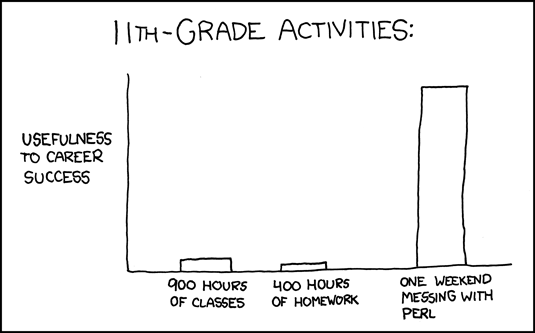
Now, it's a gross simplification, to be sure. I'd add a column labeled "Reading", for instance, and how much of the "classes" and "homework" laid the groundwork necessary for "perl". But the point being made is this: the basics of education are necessary, but it is often what kids do on their own time, outside of school, that helps determine their future career path. So when do we allow them to start charting their own (guided or mentored) course instead of having them wasting their time by keeping them locked into the current, rigid k-12 system? I'm a great works/western civ. kinda guy, but not everyone is. Up to a point, all students should be educated with the basics, but by...say...the 11th grade, maybe its time to break the old mold and let the kids have more flexibility and choice in their education and their future.
March 25, 2011
Gist, Education Consultants & Skeptical Radio Anchors
This morning, I listened as the new WPRO Morning News team of Tara Granahan and Andrew Gobeil went after Education Commissioner Deborah Gist for her proposal to hire up to 50 retired educators (teachers, principals, etc.) as 90 day consultants to help implement the programs funded via Race to the Top. Earlier, Granahan and Gobeil--apparently taking their cue from a ProJo story--interviewed Warwick Rep. Joe McNamara, who sponsored the legislation. I missed that part of the interview, but apparently McNamara basically explained that it was Commissioner Gist's idea. It was apparent that Gobeil and Granahan were particularly bothered by the fact that the bill would allow retired educators to make up to $500/day while still collecting a pension.
Commissioner Gist then called in to try to clear things up, but Granahan and Gobeil took a hard line on paying retired, pension collecting educators $500 a day to consult. The commissioner explained that, basically, $60-70/hr is the going rate for the expertise offered by "master educators" and that she wanted to be able to hire Rhode Island educators and this legislation enabled that. Gobeil and Granahan weren't buying it and pounded away on how $500/day seemed like an awful lot in these tough times. Further, Granahan asked Gist if the consulting fees would be subject to Governor Chafee's new 6% tax (like other consulting fees), to which Gist basically replied, "Of course."
Nowhere was the distinction made (though I think Gist may have assumed this was known) that the money to pay for these consultants was part of the Race to the Top funds. In essence, the bill was a mechanism to allow the Department of Education to hire Rhode Island based educators to perform the consulting. As Gist said, with or without the bill, she will hire the consultants--from another state if necessary--and the going rate is $500/day. I don't think she changed the minds of Gobeil and Granahan, but I'm not sure if they really "got" that the money was earmarked for that specific purpose.
I know $500/day seems like a lot, but professional consultants in all sorts of industries make that and more. I don't doubt that Gist is correct and that's the going rate (at the least!). And while Republicans like Joe Trillo oppose the measure, I think that its more of a knee-jerk reaction than anything else. One other thing: the teachers' unions apparently oppose the legislation:
Several union leaders voiced concerns again Wednesday, saying it was bad fiscal policy to have retirees drawing down the pension fund while working.But Gist isn't looking for regular educators, she's looking for experienced and special ones. Not just the most senior ones left on the laid off list or new hires with lower pay (as Trillo suggested). She needs top-of-the-line folks to implement RTtT (like it or not). As reported by the Brown Daily Herald:“This is bad for the pension system … and it’s bad employment practice when hundreds of teachers are out of work,” said Maureen Martin, political director for the Rhode Island Federation of Teachers. “We want them to use local teachers already in the school system.”
Gist encouraged available teachers to apply for the positions, but emphasized that the plan "can't be a program for jobs."But back to the interview itself. On the surface, it seemed like Gobeil and Granahan (in particular) were aggressive and skeptical of the Ed. Commissioner's motives because they were trying to safeguard taxpayer money. That may have been the case and, while there are important, technical reasons why their apparent watchdoggedness, in my opinion, was misplaced (the money is earmarked for a particular purpose, etc.), I won't fault them for that. (Plus, to the benefit of WPRO, they successfully turned it into a "newsmakers" moment and have been covering it in the news breaks all morning)."This is not going to resolve employment," she said. "We have to make the decisions that are best for our students."
Yet, then I remembered their interview last week with new Warwick School Committee member Gene Nadeau. Nadeau had gotten some publicity for his statement that state education dollars were going disproportionally to Providence, Central Falls and other urban core cities and he was ostensibly on the show to talk about that, which he did. Then Granahan went off-topic and asked Nadeau, to paraphrase, "Is it true that they are going to close a high school in Warwick?" Nadeau was obviously surprised by the question and explained he hasn't heard any discussion of that during his time on the School Committee. Granahan wouldn't let him off that easy and re-phrased the question a couple times. It was clear to me that Granahan, who grew up and has family in Warwick, was skeptical of Nadeau and didn't believe him.
Taken together, the Nadeau and Gist interviews have left me with the impression that Granahan in particular is, at the least, skeptical of local and statewide education administrators. Yes, "twice is a coincidence" and all that. But that's two times in two weeks I've heard an education administrator interviewed and given a tough time by Granahan. That's not a bad thing, but it's interesting to see the perspectives and biases of supposedly "straight news" personalities slowly revealed.
March 24, 2011
Hess: One Size Doesn't Fit All with Teacher Evaluations
Rick Hess offers some thoughts on teacher evaluations and the polarization that occurs whenever the topic is discussed:
[O]ur teacher evaluation and pay debates are fought between two bizarre poles. One camp insists that teachers, for some reason that escapes me, can't possibly be evaluated fairly. Any tough-minded effort to gauge teacher performance or reward more productive or talented teachers is seen as an attack that must be ferociously contested. And those who see the value of paying good employees more than bad ones aren't content with creating systems that will push schools and districts to figure out how to do this; far too many want to settle for enacting prescriptive policies that gauge teacher performance in terms of reading and math value-added and then adjust pay accordingly.In other words, this is a false choice. Teachers aren't some unique class of worker that either simply can't be evaluated or can all be evaluated the same way. Different methods at different levels in different districts or even the same district can be found (say, whole-school a la Deming in Cranston while Bristol does value-added) The point is that there is no one, single solution, but that doesn't mean there is absolutely no evaluation solution!
To most folks in health care, high tech, sales, advocacy, or just about any other field you can name, both positions are inane. To them, the complexities of evaluating personnel and crafting sensible pay systems are pretty obvious. That's why they've been tinkering with different ways to gauge and reward employees for more than half a century. Most people recognize that a boss's judgment is inevitably subjective, but also believe that it has real value--and that a boss who's responsible for their team will take care to weigh the range of relevant factors. Bottom line: most sectors don't turn discussions of employee evaluation and pay into moral crusades, they simply tinker with what might make sense. The biggest problem in education is that our current arrangements force us to approach these questions as "policy" questions, with the presumption that a state or district will set rules that apply to every teacher in every school in that geography. In that fashion, by enforcing uniformity, we stifle opportunities for variability or creative problem-solving, and accentuate the temptations to adrenalize these debates.While many want to make Rhode Island one district--and that is an attractive thought from an administrative cost-savings standpoint--there are also potential benefits to our current "tiny kingdom" setup whereby different methods of evaluation could be tried. That will require some cooperation, though. We're not there yet.
This has real consequences. As I've noted before, clumsily-designed value-added measures risk "stifling the kind of smart use of personnel that reformers are trying to encourage." But I guess it's easier, and maybe more fun, to rant against step-and-lane pay and promote grand solutions--or to "defend the profession" against the crazy idea that some people are better at their jobs than others, that we can distinguish among them, and that we should take this into account when setting pay.It ain't rocket science.
March 17, 2011
Patrick Kennedy: Brain Man of Brown
(H/T Ian D.) Well, it is something he knows about....
Former Congressman Patrick Kennedy has a new title- visiting fellow at Brown University's Institute for Brain Science. He'll be spending his time advocating for advancements in the field of traumatic brain injury....Kennedy will deliver two lectures on the Brown campus during each year of his [two year] fellowship. He says the details of his day to day work are still being defined.Bwahhahaha! "day to day work"? Right. Looks like Kennedy will be paid a nice little stipend for two 10 minute, stream-of-consciousness rambles. Regardless, it was nice of them to tell him he was a lecturer and not an exhibit.
March 16, 2011
A Lesson for the Town's Educators (and Parents)
Not surprisingly, a majority of Little Compton parents would prefer to keep the town's students flowing through one of the state's best high schools, in Portsmouth, rather than move them over to Tiverton's facility right next door. I've explained why I would feel the same, were I among them, but the number of reasons that the parents gave makes for a stunning rebuke to Tiverton and its leadership:
Some factors favoring Portsmouth are its 13 Advanced Placement classes. Middletown has 11 and Tiverton has nine, respectively. Portsmouth also offers 74 extracurricular activities and sports. Middletown offers 28 and Tiverton offers 22, respectively.Portsmouth scored 70 percent proficient on their New England Common Assessments Program tests. Middletown scored 69 percent proficient and Tiverton score 63 percent proficient, respectively.
For the 2012-13 tuition, Portsmouth offered Little Compton $9,000, while Middletown offered $9,602. Crowley said Tiverton could not provide a cost, but instead, a range of $14,187 to $15,954. For the 115 slated pupils to attend high school during that first year, with tuition at a 3 percent annual increase, Portsmouth was the lowest. Middletown's would have increased approximately $69,000 and Tiverton’s approximately $596,000. ...
Another parent said one can’t ignore Tiverton High School's 827 suspensions, while Middletown has 252 and Portsmouth has 85.
Perhaps most stinging is the impression of one Little Compton School Committee member that Tiverton High School, alone among the three, lacks a "sense of community."
Joining the most limited offerings with the highest price (by far) is not a winning combination. One wonders why Tiverton tolerates that which Little Compton looks likely to decline to accept. Yet, scarcely a word can be heard or read from Tiverton parents demanding better results from the town's public schools.
The Prayer and the Regent
My patch column, this week, joins two topics related to education in Rhode Island:
The connection is indirect, to be sure, but the controversy over an old prayer banner in Cranston High School West brings to mind the Chafee administration - and not (only) because Rhode Island's new governor has me so worried that I think a school-system-wide prayer initiative might be beneficial.Rather, what connects the items, in my mind, is an aspect of newly confirmed Board of Regents Chairman George Caruolo's not-so-surprising hesitance to embrace the reforms that Commissioner of Education Deborah Gist has been pursuing with such zest.
March 15, 2011
The Providence Substitute Situation and Demanding Negotiations to Correct a Mistake
Justin's post from yesterday mentioned that Providence Mayor Angel Tavares' decision to send dismissal notices to all current Providence teachers relates directly to the cost of substitutes. According to data available from the Rhode Island Department of Education website, Mayor Tavares has picked a reasonable area for reform, as the per-pupil costs of substitute teachers in Providence have for the past decade been significantly above the state average…
| Year | Prov. Per-Pupil Substitute Teacher Costs | Rest-of-RI Per-Pupil Substitute Teacher Costs |
| 2003-2004 | $356 | $119 |
| 2004-2005 | $431 | $124 |
| 2005-2006 | $366 | $128 |
| 2006-2007 | $436 | $132 |
| 2007-2008 | $503 | $140 |
| 2008-2009 | $416 | $137 |
In terms of total dollars, this amounts to between about $6 million and $9 million more being spent by Providence per-year than would be, if substitute costs were at state average…
| Year | Prov/RI Difference in Substitute Teacher Costs | Number of Providence Students | Annual Prov. Cost Above State Average |
| 2003-2004 | $237 | 26,690 | $6,338,404 |
| 2004-2005 | $307 | 25,497 | $7,816,854 |
| 2005-2006 | $238 | 26,716 | $6,362,091 |
| 2006-2007 | $304 | 26,531 | $8,057,344 |
| 2007-2008 | $363 | 25,986 | $9,420,456 |
| 2008-2009 | $279 | 24,664 | $6,870,397 |
Putting things into a budgetary perspective, if Providence's substitute costs had been reformed in the first year of the Cicilline administration (humor me here) and brought into line with the state average, and all other school costs were held equal, the Providence education budget could have been expanded from its FY2003 level to its FY2009 level (the last year for which data is available) with less-than-1% annual increases.
This problem is more than just fiscal. Paying two to three times the state average for substitute teachers is not an "inefficiency"; it is a mistake. It makes public services more costly without doing anything to improve their quality. A school administration shouldn't have to "give something back" in order to correct an outright error that provides no value and only costs to the public.
There can be little doubt that the repeated drawing of lines in the sand by union leaders, behind which everything about a job intransigently is placed -- including practices that in no way serve the public interest -- has contributed greatly to Mayor Tavares' decision to send dismissal notices to the entire Providence faculty. His drastic, across-the-board action is no less likely to bring about change than would an effort to get union cooperation on an isolated issue, where a union is inclined to protect its economic benefits, despite no one else benefitting in any way from the current situation.
In theory, it doesn’t have to be this way. Public-sector unions could realize that their special position within government monopoly systems for delivering public services entails some responsibility for considering the public interest when determining acceptable "negotiating" goals, and that certain options that lack discernable public value need to be closed off. But I don't know that this theory will ever match up to reality.
Stephen Beale has more information on substitute teaching policies in Providence, at GoLocalProv.
Funding Formula: Dollars per Student
New Warwick School Committee member Eugene Nadeau has been quoted in the ProJo and stated this morning on the WPRO Morning News that he is against the new School Funding formula:
Eugene Nadeau, a member of the Warwick School Committee, said the formula is a “sweetheart deal” for Providence, which he said will receive five times as much aid as his school district.Based on the latest information I could gather from various sources, here is the per pupil state subsidy for Rhode Island public school students using the new formula:“We have to subsidize the Pawtuckets and the Providences,” he told about 30 colleagues from around the state. “We’re being short-changed. It’s an abomination.”
| District | Total Students | FY 2012 Funding | Per Student |
|---|---|---|---|
| Central Falls | 2848 | $41,811,218 | $14,680.91 |
| Providence | 23573 | $182,710,182 | $7,750.82 |
| Woonsocket | 6110 | $44,999,994 | $7,364.97 |
| Pawtucket | 8886 | $63,214,367 | $7,113.93 |
| West Warwick | 3520 | $19,047,703 | $5,411.28 |
| Bristol Warren | 3474 | $18,410,883 | $5,299.62 |
| Burrillville | 2460 | $12,590,521 | $5,118.10 |
| Newport | 2037 | $10,231,545 | $5,022.85 |
| Glocester | 584 | $2,874,344 | $4,921.82 |
| Foster | 274 | $1,236,720 | $4,513.58 |
| East Providence | 5638 | $24,725,686 | $4,385.54 |
| Foster-Glocester | 1296 | $5,374,297 | $4,146.83 |
| Chariho | 3528 | $13,705,701 | $3,884.84 |
| North Providence | 3278 | $12,163,986 | $3,710.79 |
| Middletown | 2407 | $8,867,743 | $3,684.15 |
| Exeter-West Greenwich | 1805 | $6,599,824 | $3,656.41 |
| Coventry | 5311 | $18,623,507 | $3,506.59 |
| Warwick | 10261 | $33,718,511 | $3,286.08 |
| Johnston | 3083 | $10,033,085 | $3,254.33 |
| Cranston | 10738 | $33,589,074 | $3,128.06 |
| Tiverton | 1906 | $5,201,024 | $2,728.76 |
| Cumberland | 4846 | $12,654,496 | $2,611.33 |
| North Smithfield | 1764 | $4,551,639 | $2,580.29 |
| South Kingstown | 3527 | $8,579,666 | $2,432.57 |
| North Kingstown | 4409 | $10,710,031 | $2,429.13 |
| Lincoln | 3301 | $6,795,044 | $2,058.48 |
| Smithfield | 2467 | $4,812,133 | $1,950.60 |
| Westerly | 3098 | $5,975,377 | $1,928.79 |
| Scituate | 1628 | $3,081,712 | $1,892.94 |
| Portsmouth | 2796 | $5,132,335 | $1,835.60 |
| Narragansett | 1479 | $1,457,333 | $985.35 |
| Little Compton | 309 | $275,529 | $891.68 |
| Jamestown | 492 | $382,657 | $777.76 |
| Barrington | 3498 | $2,467,090 | $705.29 |
| East Greenwich | 2398 | $1,436,872 | $599.20 |
| New Shoreham | 128 | $65,960 | $515.31 |
Here is the per student subsidy for Charter schools:
| District | Total Students | FY 2012 Funding | Per Student |
|---|---|---|---|
| Trinity | 34 | $708,398 | $20,835.24 |
| Met School | 650 | $12,027,542 | $18,503.91 |
| Davies C&T | 816 | $13,960,522 | $17,108.48 |
| Blackstone Valley | 256 | $3,849,492 | $15,037.08 |
| Segue Institute | 140 | $1,746,233 | $12,473.09 |
| Times 2 Academy | 650 | $6,981,187 | $10,740.29 |
| Learning Community | 471 | $5,054,820 | $10,732.10 |
| Textron | 213 | $2,271,088 | $10,662.38 |
| Paul Cuffee | 559 | $5,904,155 | $10,561.99 |
| Blackstone | 164 | $1,589,968 | $9,694.93 |
| Highlander | 282 | $2,682,140 | $9,511.13 |
| International | 312 | $2,934,630 | $9,405.87 |
| Beacon | 224 | $1,880,544 | $8,395.29 |
| Greene School | 81 | $654,585 | $8,081.30 |
| NE Laborers | 218 | $1,728,789 | $7,930.22 |
| Kingston Hill | 179 | $727,305 | $4,063.16 |
| Compass | 153 | $616,322 | $4,028.25 |
The state has different obligations (ie; basically foots the entire bill) for some charter schools and, for instance, Central Falls, largely because the formula takes into account a variety of factors related to the economic makeup of the district/student population (PowerPoint).
SOURCES: Providence Journal Funding Formula Chart, RIDE Statistics, Schoolfinder at Education.com (Textron and Times 2 student population), Schooldigger.com (NE Laborers Academy student population).
Like a Profession, or Something
The specifics could be adjusted elsewhere, but the general attitude that Julia Steiny describes at Blackstone Valley Preparatory Charter School, although there's no revolutionary "paradigm change," as the education academics like to contrive, seems like a profound shift. Note, especially, the handling of the teaching professionals:
... at Blackstone Valley the two-teacher classroom [with more students] is the beginning of a leadership-development continuum designed to grow each teacher's responsibility, autonomy, compensation and personal goals. New or "fellow" teachers plan and teach, but also learn alongside an experienced "lead" teacher. As lead teachers become even more practiced, they might become grade leaders for common planning time, or run professional development, or research a new technique and teach it to the others. Eventually, master teachers could become a Head of School. ...So everyone in the organization has goals. Chiappetta says, "Some of our people want to be lifelong classroom teachers, so we'll support them becoming master teachers. Others say, 'I want to go to med school in a few years and be a pediatrician, with teaching experience under my belt.' Right now, three teachers leave early to take classes for their graduate degrees, and make up the time on Saturdays. We want to help you invest in yourself and move forward."
Gone is the rigid put-in-your-time factory model of public schools in general. At least by the impression that Steiny gives, the school hires the best candidate for each position, and being human beings, they're each potentially approaching the job from different backgrounds and with different plans. The administrators keep the project on track and are accountable for their results, because if their faculty doesn't succeed, students won't sign up.
March 14, 2011
What Elected Officials Have Negotiated For
Anchor Rising readers are already familiar with the explanation of the problem basic problem with public-sector unions in a democracy that Andrew Klavan offers in the following video, but it's worth a watch nonetheless:
This article describing why Providence Mayor Angel Tavares had to give teachers termination notices, rather than layoff notices, provides excellent evidence of the results of the tilted system:
If they are laid off, teachers are placed on a recall list. Those teachers who do not wind up with full-time jobs by the beginning of the school year are placed in the group of "regulars in pool." By agreement with the union, these substitute teachers have to be called in to fill temporary vacancies before any other category of teachers. ,,,"Regulars in pool" are the most-expensive substitutes because they are paid at their full step. In addition, regulars in pool can also receive family health-care coverage, a longevity bonus and an advanced-degree bonus, depending on how many days they work. ...
But here's the real reason why regulars in pool are more expensive than the other substitute teachers, according to Clarkin:
"The district calls in the most expensive [subs] because they have to pay them anyway," Clarkin said. "If you need a sub, they get brought in first."
So teachers who are laid off tend to stick around in the system at full pay even if they don't work. Typically, not enough teachers would be laid off to fill up the substitute list, but with school closings, that outcome is likely next year.
Any one of high salary, lavish benefits, or job security would be tolerable if school committees had negotiated with one of the others as a priority. But the push back against unions is occurring because they've managed to transform negotiations into a process of moderating the rate at which they get all three.
March 7, 2011
A Fantasy Compromise
Earlier, I mentioned Julia Steiny's contribution to the belated march of red flags throughout the Providence Journal. Steiny's piece is interesting because she attempts to draw a line through the ranks of teachers:
... in the shrill, righteous rhetoric, sometimes screamed by both the left and the right, teachers are lumped together as if they are a homogenous group, with the same interests. Good teachers deserve far better. Academically, they're the best allies of the kids. Fiscally, they're our best buy.
Steiny elides the fact that the teachers have effectively assented to this treatment by, first, joining together into a collective and, second, failing to exhibit deep differences of opinion among themselves. It isn't really fair to fault the "righteous rhetoric" when educators present a unified face.
To be sure, Steiny notes that in "pay-to-play states, teachers can refuse to join" unions, but "payback for bucking the union can be ferocious." How much more ferocious things must be in states, like Rhode Island, in which union membership is compulsory. Indeed, I wonder whether it's possible to go from there to a "right to work" scenario in which teachers have a right to form unions but also a right not to participate in them, as Steiny suggests. In Rhode Island, the unions are already formed, which means that teachers would have to break away one by one. That sounds like a recipe for a divided workforce devoting far too much behind-the-scenes energy to the labor battle.
It's actually surprising that Steiny doesn't agree, given other observations in her article:
Unions are private-sector businesses with leaders that make fat six-figure salaries. If they do not give their teachers good customer service, state laws should not keep them in business. A pot of compulsory dues allows unions to ignore dissenting rank and file and use the money to, for example, fight much-needed reforms to professionalize hiring, or to weed out bad teachers, or to extend the school day (which every charter school has already done). Unions cling to hiring by seniority with a death grip, even though it is clearly detrimental to education.
Surely, Steiny has had some taste of the tactics that such vested interests will use against those who speak against them. Is that a battle that we want to impose on our best educators?
For their part, they've arguably already proven their disinclination for the fight by failing to speak out already.
March 4, 2011
The Union Rhetoric and Financial Reality
You know, this sort of talk can only expand the sense of unreality between unions and the general public:
"Something is insane in Providence," [American Federation of Teachers President Randi] Weingarten said, standing on the steps of City Hall. "On a week where teachers and students were taking a well-deserved break, a secret plan was being hatched in Providence. They thought no one would be there to hear it. Fire everyone — that was their plan."
Maybe it's because my family hasn't been able to afford to go anywhere during vacations since my honeymoon a dozen years ago, but it strikes me as peculiar to assume that February vacation finds full regiments of teachers flying off to vacation spots around the globe. It seems, rather, that a better time to slip secret plans through would be just before they leave or just after they return.
Moreover, Weingarten manages to remind the general public that the protesting horde just wrapped up another full week off — a winter break, not to be confused with the Christmas break or the soon to arrive spring break. Let the kids decompress, by all means, but are Rhode Island's schools running so smoothly that there's no need to fill time out of the classroom with strategy sessions, evaluation of successes and failures, and professional development — all within scope of the enviable employment packages that teachers already receive?
In similar regard, this statement from a parent at the rally emphasizes the point:
"Mr. Mayor," said Maria Almestica, "we don't want 35 kids in a classroom. This is not OK. Our children should be learning, not worrying. You're messing with their futures."
The children shouldn't have to worry that the city in which they live will not remain financially solvent, and they shouldn't have to worry that their state cannot produce adequate employment to allow them to remain within its borders when they enter the workforce. The status quo of the Rhode Island public sector is not sustainable, and at bottom, that is what's messing with students' futures.
March 3, 2011
ProJo Eds Get it Right: "Reject Caruolo"
From the Providence Journal Editors:
If George Caruolo’s blatant conflict of interest as a $5,000-a-month lobbyist for a gambling palace does not disqualify him from becoming chairman of the state board overseeing K-12 public education, his dismissal of the need for serious education reform surely should....Mr. Caruolo’s view is that all [of Education Commissioner Deborah Gist's reform measures are] too much, too fast. “It’s not as important to get all this work done in the next 15 minutes as it is to get it done correctly,” he said.As the editors explain, now is not the time for "thoughtful pauses."In truth, no one has tried to reform schools in 15 minutes and get it wrong. Indeed, this has been an agonizing process, taking years of thought and effort — often in the face of gale-force opposition from economic interests that oppose upsetting the status quo.
But exactly how long should poor and minority students trapped in Rhode Island’s badly underperforming urban schools have to wait? How long should Rhode Island parents and taxpayers put up with some of America’s highest per-pupil costs and teacher compensation, when student performance is generally mediocre, even adjusted for demographics? How many years should Rhode Islanders be happy that their students trail those of other New England states by most achievement measures? How long should the state’s economic competitiveness be damaged by graduating large numbers of students who lack the skills employers require?I completely agree.
A Regent for One Reason
Marc's already posted on the topic, and I'm admittedly playing catch-up in my daily reading routine, but having read George Caruolo's declaration of the not-badness of Rhode Island schools (and the consequent no-rushism of the probable chairman of the state Board of Regents), I have to offer additional comment. What's striking, given the prominence of the position for which he's been nominated and the time that has elapsed since he first agreed to take the position, is that he does not, apparently, feel the need to substantiate his controversial opinion:
George Caruolo, a savvy former politician who has been appointed by Governor Chafee to lead the state's top education board, has his own take on the State of Rhode Island's $2-billion-a-year public school system.It's not that bad, he says. ...
Caruolo, the father of four children, all of whom have attended East Providence's schools, is also not convinced that the demands of a high-tech, 21st-century economy require that students be educated to higher levels than ever before. ...
Caruolo doesn't believe that the state's public schools are in crisis, despite the fact they continue to trail other New England states by most achievement measures. And, while Rhode Island claims among the highest per-pupil costs and teacher salaries, the state lands in the middle of the pack nationally.
The notion of a crisis hasn't been a quick and unsubstantiated whim of public temper. As I've put it previously, Rhode Island joins an average median income with high (budget-busting) public school teacher pay, high private school attendance, low public school SAT scores, and high private school SAT scores. Education researchers regularly give the state poor grades for a variety of reasons, and our comparison with other states on standardized tests is not commensurate with our investment, especially considering that we share many of the regional qualities of the neighboring state, Massachusetts, that regularly tops all of the rankings in which we lag.
Caruolo's one purpose, as a Regent, (and Chafee's main purpose as governor) appears to be to gum up the process of reform so that teachers' unions can find ways to lock in more advantages for themselves and turn back the clock on progress.
March 2, 2011
When the the Rules Don't Work to the Teachers' Union Advantage, Obviously the Rules Must Immediately Be Changed
In yesterday's Projo, Linda Borg reported that Providence Teachers Union President Steve Smith wants Mayor Angel Tavares to reconsider his decision to formally dismiss all of the teachers in the Providence School System...
The Providence Teachers Union president offered the School Board another option Monday night: send out letters that include the possibility of layoffs and terminations....However, as noted later in the story, the conventional reading of Rhode Island law says that it's too late to initiate a change...Smith, who met with Taveras on Sunday, said the mayor offered to recall approximately 1,400 teachers, but Smith proposed another solution: including the option of layoffs in a new letter.
After the public comments, School Board President Kathleen Crain stressed that that board’s hands were tied by a state law that says teachers must be notified of their employment status by March 1.Hold on though -- a group of Democrats at the State House have suddenly decided that March 1 is obviously too early a date for making decisions for the next school year, and have already proposed changing the notification date for layoffs and dismissals (House Bill 5540)...
This act would extend the notification date for the dismissal, suspension or lay-off of teachers from March 1 to May 15.So as long as Rhode Island legislators have had the epiphany that the March 1 date isn't sacred and can be changed, shouldn't we also be considering moving the notification date past the end of the school year, and at least pretend that this change is not being proposed solely for the of benefit particular union in a particular situation?
Changing the law to create a personnel process less disruptive to education process is deserving of discussion. Changing the law to benefit a single organization in its particular maneuvers is not.
ADDENDUMS:
Last month, a bill was introduced to the RI House that would move the notification date to June 1 (H5297). It was scheduled for a hearing that was postponed at the sponsor's request (J. Russell Jackson of Newport). Does this mean that today's bill indicative of some kind of negotiation going on in the legislature about a new date, or is this a routine case of multiple bills being submitted to the RI legislature on the same subject with rank-and-file legislators letting leadership decide which one, if any, will get a vote?
Also last month, Julia Steiny discussed the early notification date and its ramifications in her Projo column, available here (h/t Marc).
March 1, 2011
Unions: Cause or Coincidence?
Thomas Russell of Barrington pushes a logical error frequently confused for an argument:
I am (unfortunately) old enough to remember the state of education before the birth of teachers unions. Teaching positions were treated as patronage jobs, and salaries were so low that many graduates only turned to teaching after they failed to find work doing something else.It is ironic that so many people seem to want to return teachers to that status even as they proclaim themselves to be champions of education improvement.
Education has so dramatically changed in ways entirely apart from the employment arrangements of teachers that it's nearly got to be a deliberate avoidance to voice Russell's point. Most profoundly, the importance of education is much more frequently proclaimed, and for a broader cross-section of Americans than it was in those pre-union days. That is, society has come to value education (at least in the abstract) so hugely that the value of those who provide it is unlikely to decrease just because they don't periodically go on strike, work to rule, or otherwise bully school committees into signing unaffordable contracts.
Personally, I hope and expect education employment reforms to elevate teachers' status, because they will no longer be associated with such unseemly union behaviors... not to mention union characters who need not be named, here.
Of course, this accepts Russell's statement of history for the sake of argument. I, myself, am too young to remember those olden days, but the statements of respect for teachers that one frequently hears from folks who were their students suggest that his assertion is, at best, exaggerated.
Carruolo II: Pensive Philosophy or Excuse Making?
To follow up on last night's post, the full ProJo story provides more insight into the "What, me worry?" philosophy of George Carruolo. For instance:
For his part, Caruolo emphasizes cooperation among all groups — teachers, parents, students and the community — as the critical ingredient for school improvement.Carruolo is correct: for a variety of reasons (often related to the effects of government social policy), families are different than they were 20 years ago. Single-parent families or two working parents are far more prevalent and parental involvement in schools has declined. This affects all the kids in a classroom as teachers have to spend more time catching up. However, I don't know of any education reformer who discounts the role that poverty and family play in education. For example, as Commissioner Gist has traveled the state, she's explained the components that comprise the new school funding formula:“Everyone will have to make compromises on everything but this: having a system we are all proud of, and a system that works for children,” he said.
“I’ve never seen a turnaround in anything with an alienated work force,” Caruolo said. “And from my viewpoint, I don’t see a lot of talk about poverty and homelessness and family disruptions in the education dialogue, right now.”
Ms. Gist said that [the new funding formula has a] built in...“core instructional amount,” which creates a per-pupil spending base of $8,333. Another 40 percent ($3,333) is funded for each student receiving free or reduced lunch, an indication of additional funding needs since it costs more to teach a student living in poverty.Sure sounds like someone who recognizes that poverty affects education, doesn't it?
As for the alienated workforce? Reform skeptics are very good at pointing at all of these outside reasons--excuses--for why reform can't work or is just too hard, too unrealistic, to implement. Yet, instead of looking at new ways to deal with these changing external dynamics, they double-down on the same, old industrial model of schooling. Why? Because even if it has proven inadequate to the task of educating today's kids--especially the poor and disadvantaged--the old system has turned out pretty beneficial for the adults who operate in it. The "alienation" they feel--stoked by hyperbole spouting union leaders--stems directly from the fact that they view reform as an "attack" on themselves and, too often, their own bottom line.
February 28, 2011
Carruolo: Hey, Why Hurry Reform?
Bah. Who needs a sense of urgency:
George Caruolo, the savvy former politician Governor Chafee has appointed to lead the state's top education board, says Rhode Island's $2-billion-a-year public school system is not that bad.Yeah. That sounds good in a platitudinous sorta way, except recent progress has been made due to a sense of urgency. Pragmatism--in our classrooms, in our administration buildings, at bargaining table--is what got RI at this point to begin with. So, yeah, I feel a sense of urgency. And so do the thousands of RI parents with kids in our public school system.What is needed to improve the state's 300-odd public schools, he says, may not be an ambitious agenda of change but a dose of old-fashioned pragmatism -- or, as he puts it, "a realistic assessment of what's necessary to elevate results."
"It's not as important to get all of this work done in the next 15 minutes," Caruolo said in an interview last week, "as it is to get it done correctly."
Mayor Taveras on the Notices of Potential Dismissal
Providence's Mayor Angel Taveras "blasted" the following last night to his e-list. [Note to NBC Nightly News correspondent Kevin Tibbles: painful as it may be to admit, Mayor Taveras is a (D), not an (R).]
Mayor Taveras' affirmation of a fiduciary responsibility to taxpayers as well as his reminder of our collective "moral responsibility" to our children are refreshing and remarkable, especially in light of the notable silence of his predecessor on both of those subjects.
Dear Friends,Continue reading "Mayor Taveras on the Notices of Potential Dismissal "We made a difficult decision this past week to issue notices of dismissal to all of the City’s teachers, effective at the end of the 2010-11 school year. I want to share with you my thoughts on the issue, the process, and where we go from here.
The financial crisis facing the people of Providence is staggering. For too long, politicians have avoided making the tough decisions. When I took the oath of office on January 3, I made a commitment to be honest with you about the problems we face. I also promised that I would not shy away from making tough decisions to put our City back on firm financial footing. Our actions this week reflect this commitment.
Issuing notices of dismissals to all teachers was a decision of last resort. My administration has a fiduciary responsibility to the taxpayers of Providence to address the fiscal crisis we face AND a moral responsibility to our children to make sure we manage cuts to school funding in a way that best serves our students and the community.
State law requires that teachers must be notified by March 1 about any potential changes to their status. Given the March 1 notice requirement mandated by law and where we are in the budgeting process, issuing dismissal notices to all teachers was the most prudent and fiscally responsible decision. Here’s why: We needed to retain the maximum flexibility we could to manage significant cuts to the school budget. We simply cannot have a situation next year where we have more teachers on the payroll than we can afford to pay or have expenses that exceed our resources.
This is also why we issued dismissal notices instead of layoff notices. As has been the case in the past, layoffs often come with many provisions, legally and procedurally, that could impact our ability to control costs to the degree we need to. A dismissal is different in that it enables the district to end its financial obligation to an individual completely.
February 26, 2011
Education Roundup
A bevy of education-related stories today. The repercussions following the Providence teacher "firings" continue, with Mayor Tavares getting attention from the New York Times. The ProJo reported that teachers fear it's the end for seniority-based retention, which is kind of a strange way to put it because, as the story also explains, that end was already foreshadowed by Education Commissioner Deborah Gist last year.
In Warwick, a review panel has recommended more transparency on the part of the School Administration, citing communication breakdowns between the City-side and School-side. According to one commission member, there was also "an air of mystery around school finances" that needed to be made more understandable. They also various scenarios for reconfiguring the make-up of the school committee. The report should be available at warwick.org some time soon. Meanwhile, the Warwick School Department unveiled an new electronic records program that will make student data available to all "stakeholders" (including parents!). Warwick also issued the contract-maximum 40 teacher layoff notices (but can only actually fire 20).
In Cranston, the School Committee is asking for $3.5 million in concessions from school unions and asked the City for more money. However, Mayor Alan Fung has already indicated he plans on level-funding the schools this year.
February 24, 2011
Providence Pink Slips II
The ProJo has more on the Providence School district sending pink slips to all teachers. Basically, it was Mayor Angel Taveras' call based on economic reality and trying to have as much flexibility as possible.
The mayor said the unprecedented move was necessary because of the depth of the financial crisis facing the city and the schools....[Providence School Superintendent Tom Brady] said the mayor alerted him about the impending crisis about two weeks ago. As Taveras became more alarmed, he asked Brady to come up with a solution that would give the city and the district “maximum flexibility” to respond to the city’s financial deficit, expected to top $57 million.I also forgot that Providence Schools currently don't follow the traditional seniority hiring practices.
The district now fills openings based on an interview process that requires teachers to submit a model lesson and a writing sample.Part of what spurred this is a loss of $14 million in stimulus money, which was used primarily to pay teachers. Additionally, the ProJo reports that an additional $11.5 million is needed to cover increases in health insurance and other benefits. It is also pointed out that Providence teachers pay 15% of their health insurance and will receive no pay raise this year. Unfortunately, they're learning what the private sector has already learned: making sacrifices for one year doesn't make you immune from making more sacrifices in subsequent years. I wish it were not true, but it's reality.It remains unclear how seniority will be used when teachers are rehired under the dismissal system, however....Supt. Tom Brady said it was too soon to say whether seniority would be eliminated in its entirety. The district is still embroiled in a lawsuit filed by the Providence Teachers Union that seeks to restore seniority, although both sides are reportedly close to an agreement.
February 23, 2011
Pink Slips in Providence
Julia Steiny reminded us that it was the time of year when pink slips would rain down. Boy, did they ever in Providence where every teacher is slated to be "laid off". Well, not really--not all of the teachers will be fired. It's just a way for the Providence school district to enable the greatest amount of flexibility when it comes to budget time, as Providence School Superintendent Tom Brady explained:
We are forced to take this precautionary action by the March 1 deadline given the dire budget outline for the 2011-2012 school year in which we are projecting a near $40 million deficit for the district....Since the full extent of the potential cuts to the school budget have yet to be determined, issuing a dismissal letter to all teachers was necessary to give the mayor, the School Board and the district maximum flexibility to consider every cost savings option, including reductions in staff....To be clear about what this means...this action gives the School Board the right to dismiss teachers as necessary, but not all teachers will actually be dismissed at the end of the school year.Providence Teachers Union President Steve Smith doesn't like it:
This is beyond insane....Let’s create the most chaos and the highest level of anxiety in a district where teachers are already under unbelievable stress. Now I know how the United States State Department felt on Dec. 7 , 1941.Nice hyperbolic analogy, there. Further, if we're to grant you that line of thinking, it would be more correct to say it's as if the "State Department" (the Providence Teachers Union) called the "air strike" (pink slips) down on themselves. After all, the union collectively bargained the March 1 deadline because it benefited them and it's a bit disingenuous to cry foul when the option is exercised. My guess is that if there were more management rights (ie; hiring/firing flexibility) within the contract, this could have been avoided.
What Hope for Education?
My Patch column, this week, questions whether there's much room for optimism about educational success in Rhode Island public schools over the next couple of years:
... the 2010 [NECAP] test was to be the first on which graduation actually would depend. It was do or die for students to achieve at least "partially proficient," and 38% did not. All stops should have been pulled; the urgency among educators should have been near frantic...an extra-effort, contracts-out-the-window kind of frantic. Yet, I can't think of a single concerted example of such dedication amidst the past few years of budget battles, contract negotiations, and work-to-rule actions.And the result? A mere six percent proficiency gain. It's as if the education establishment knew that the requirements would never hold. ...
When the tests actually count again, the state will have been guided for two years by a union-friendly governor and his hand-picked education bureaucracy. More importantly, educators have now tested the resolve of the state to allow real consequences for systematic failure, and the state proved there to be none. Gist blinked, and at this time, reforms appear to have lost political teeth, rather than gaining them.
February 21, 2011
In E.P., New "Bosses" Start Cuttin'
East Providence, you were warned. Kinda. Faced with a $6.1 million school budget deficit, the new, labor-supported East Providence school committee took action by axing School Department Chief Operating Officer Lonnie Barham and his $109,000 salary. So, they're down to $6 million! According to the new School Committee Chair Charles Tsonos:
We have more school administrators than the City of Cranston and yet we have half the students...Our point is that we need to do everything we can to watch our costs and still provide the best education possible and allocate our resources to the classroom.But they can't just focusing on cutting the administrative costs, which comprise 2% of the $75 million school budget (according to former SC Chair Anthony Carcieri). So, at some point, other personnel are going to have to take a hit. On another front, despite the aforementioned warnings by former EP Mayor Joseph Larisa, current Superintendant Mario Cirillo has gotten the (dreaded?) "vote of confidence."
Getting to Graduation
In addition to everything else on the educational plate, Rhode Island needs to increase its graduation rate, even as it requires a diploma actually to mean something:
Statewide, 76 percent of the Class of 2010 graduated within four years, up a percentage point from the previous year.More than 2,900 of their classmates didn't receive a diploma last year, although a small number of these students stayed for a fifth year in hopes of graduating.
If these fifth-year students graduate in June, they will be counted in the state's five-year graduation rate next year.
The 2010 five-year graduation rate, which uses a formula to include both the Class of 2010 and students from the Class of 2009 who needed an extra year to graduate, was 79 percent.
The article notes some helpful activities at Davies Career and Technical High School in Lincoln, but it comes back to the same ol' problem:
The program added 90-minutes to the school day and cost about $90,000 extra for teaching and transportation. But, the director said, the investment paid off.
Everything costs extra money, and it's money that administrators and school committees have already spent on lucrative contract deals. Rhode Island has to change its paradigm to an assertion that school employees are paid to accomplish an objective, and they'd better do so within the resources already allocated.
February 20, 2011
Rhode Island NECAP Trends
Previously, I focused on tracking the NECAP results of one cohort of kids as the moved through the Warwick School system (to 11th grade). What I found was that reading and writing continued to improve, while math went in the opposite direction. I took this--cautiously--as good news as does Julia Steiny, with the usual caveats:
C’mon, it’s a big deal that Rhode Island’s high-schoolers pulled ahead of our two sister states in the New England Common Assessment Program (NECAP). In reading, R.I. juniors kicked butt, scoring 76 percent proficient, besting Vermont’s 72 and New Hampshire’s 74 percent. In writing, our teens were 51 percent proficient, edging out Vermont’s 50 and New Hampshire’s 45....please, I know tests are not the be-all, end-all. But doing well is promising. I think of watching test scores as comparable to watching one’s weight. The number says nothing about the quality of life, talent, or character, but it’s a major indicator of overall health.Steiny also mentioned the charts that show cohort trends for all Rhode Island students that the ProJo printed in concert with Jennifer Jordan's February 10 story on the NECAP results. These charts weren't in the online edition--at least not that I could find--but (again, as Steiny points out) they are available at the RI Dept of Ed. website in it's Fall 2010 NECAP Report (PDF). It's worth taking a look at them given my belief that there is just as much--if not more--value in tracking cohorts as there is in comparing them year-to-year.So for example, the last reports by the National Assessment of Educational Progress (NAEP) showed that all three of the NECAP states’ fourth and eighth graders made significant progress. Only one other state and Washington, D.C., also did so. So working toward success on the NECAPs helps kids learn and perform no matter what the test. That’s huge.
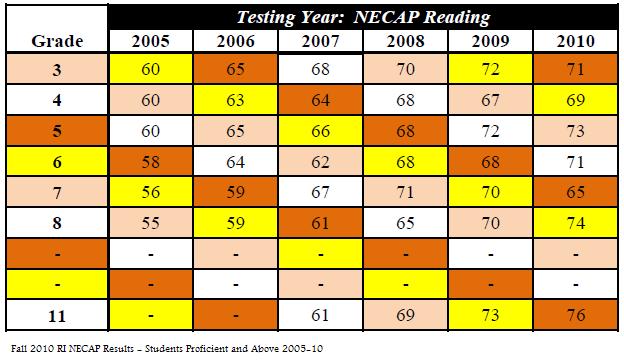
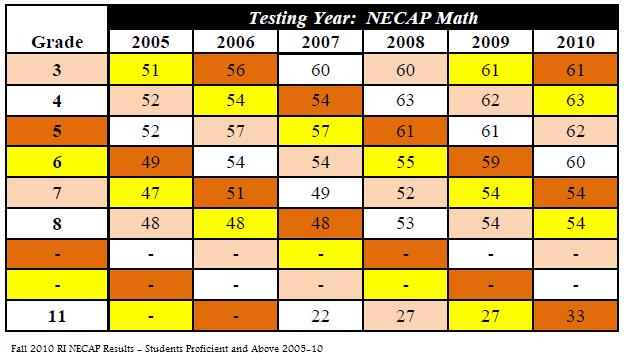
There were no writing results because it's a newer test, but comparing the previous data from Warwick to statewide cohort tracking reveals (unsurprisingly) the same sort of trend. Basically, each cohort is improving in Reading from year-to-year and getting worse in math (remember--this is according to the NECAP test standards for each grade level). It also looks like the test scores for each grade--as one cohort replaces another at a particular grade level--have continually improved. Though it does look like Math scores seem to have plateaued, particularly at the younger levels. This comparison could be more indicative of pedagogy and show that schools may need to freshen up their approach to math so they can get over the hump.
February 18, 2011
NECAP: Following a Cohort
Most of the analysis of NECAP scores seems to focus on the year to year improvement of results at a given grade level. For instance, we'll read something like "the percentage of students at School X who are proficient and above in Math is 55% this year, which is 5 points higher than last year." Well, that's comparing two different groups of kids. What if we look at the same cohort through the years, instead?
For the first time, this last round of NECAP scores allows us to look at results for one particular cohort--the 11th graders--from the time they were first tested in 6th grade (in the Fall of 2005) until this past fall. Obviously, you can't control for the changing makeup of the cohort as kids come and go, but these changes get smoothed out over time (with the possible exception of the private school flight that occurs between Jr. High and High school).
I took a look at my hometown, Warwick, and came up with the below. I used overall numbers because, while analysis could be broken down by student race, family income, etc., I wanted to focus on the "big picture." Numbers are percent of students proficient and above for the given subject.
First, here are the overall numbers for Warwick as a whole:
Warwick Schools - 2010 Gr.11 Cohort % Proficient & AboveI then broke it down by the three sub-districts (ie; High Schools and their feeder schools). I compiled the raw numbers for the feeder elementary schools (including those closed since 2006).
2005 Gr.6 2006 Gr.7 2007 Gr.8 2010 Gr.11 Read 72% 67% 65% 83% Math 60% 54% 47% 31% Write * * 37% 54%
Aldrich Jr. High/Pilgrim High
2005 Gr.6 2006 Gr.7 2007 Gr.8 2010 Gr.11 Read 75% 69% 60% 76% Math 61% 51% 44% 31% Write 30% 53% Gorton Jr. High/Warwick Vets High
2005 Gr.6 2006 Gr.7 2007 Gr.8 2010 Gr.11 Read 64% 58% 56% 73% Math 54% 48% 45% 25% Write 33% 39% Winman Jr. High/Toll Gate High
2005 Gr.6 2006 Gr.7 2007 Gr.8 2010 Gr.11 Read 86% 76% 78% 90% Math 65% 64% 52% 38% Write 50% 68%
Analysis: Writing proficiency certainly increased from 8th grade to 11th. Without exception, reading scores for this cohort were better in 11th grade than they were in 6th, though there were some ups and downs along the way. That's the positive. The negative are the math scores, which consistently trended down. Difficulty of the subject is one reason--math just gets harder as you progress.
Overall, it's a mixed bag. Warwick has a handle on reading and it looks like writing is coming along--more kids are getting better at both as they progress through Warwick schools. But math is a big problem as kids are getting less proficient as the difficulty increases. While that may seem to make intuitive sense, it's not a good result. We need to prepare our kids to compete in the global marketplace against kids who don't have such mathematical shortcomings. I know that Warwick recognizes the problem and is trying to take steps to address it. Only time will tell.
Source: NECAP Reporting
“As much as we went up, we'll go down”
Justin believes that Education Commissioner Gist's decision to delay implementation of tougher graduation requirements until 2014 is the day the reform died. I may not be quite as pessimistic, but I can understand his reasoning. One thing for sure is that, as reported in the Warwick Beacon, Warwick High School principals expect the improvements they saw this year go down next year. Toll Gate High's Principal Stephen Chrabaszcz:
As much as we went up, we'll go down...Please stop thinking that young people don’t know what’s going on....If we have a dramatic fall [in scores] next year I don’t want people to say, ‘What happened?’Pilgrim High School Principal Dennis Mullen:
Students did take it seriously this year because it was tied to graduation....Scores [of the current sophomore class] could tank.Gotta have a hammer.
The Day the Reform Ended
February third might be considered the day education reform ceased in Rhode Island:
Education Commissioner Deborah A. Gist wants to push back the deadline for more rigorous high school graduation requirements, and is backing off her proposal that Rhode Island establish a three-tier diploma system.Gist now says the date on the requirements to get a high school diploma should be pushed back two years, to 2014, to give schools and students more time to prepare. The tougher standards require students to be at least "partially proficient" on state math and English tests or retake the tests and show improvement, among other requirements.
A headline the day after the above suggested continued tough talk, with "Gist says R.I. schools can't postpone improvements," but with the current governor, Board of Regents, and General Assembly, Commissioner Gist is likely to lose teeth, not gain them. The fact is that statewide math scores have only gone up 6% in the past two years, to 28% even "partially proficient," and science scores nudged 3%, to 20%. If improvement continues at that rate, 2014 will still see large numbers of students unable to graduate.
RI Association of School Committees Executive Director Tim Duffy's commentary in the article found at the second link inadvertently illustrates the point:
"We need to put districts on notice that this is the last time the can gets kicked down the road," Duffy said, "because we can't afford to do that to our public school students."
Yeah, right. From participation in local governance and reading of events across the state, I can't say I've observed anything that might be considered a sense of urgency about students "unable to perform simple math problems that most people can figure out in their heads," as the article paraphrases Gist. Why would taking the pressure off them for another two years (with the union's governor in office) change that attitude?
But because so many districts have been lagging in making these changes, it is only fair to give everyone more time to adjust, Duffy said.
Fair to whom? Certainly not to children who are being given diplomas without learning critical material, and certainly not to other students whose diplomas are devalued by broad knowledge that public education in Rhode Island is "lagging."
All that's happened is that complacent administrators, unions, and school committees have bought, with their votes and political contributions, another two years to wait for a miracle change quite apart from anything they're actually doing — much in keeping with the state's budgeting strategy.
February 17, 2011
RIDE Infoworks Site Unveiled
The Rhode Island Department of Education's new Infoworks site has been unveiled and looks like it may be a valuable tool for wonks everywhere. Yes, there is student achievement data like NECAP and NAEP scores, but also some new info, like AP exam results. For instance, here are the Top 10 High Schools ranked by % of students who scored at College level mastery:
Additionally, there is also some basic teacher data that can be culled and studied. For instance, wondering which schools have 10% or more of its teachers considered NOT Highly qualified?
District School Number of Exams Taken # Scored at College-Level Mastery % Scored at College-Level Mastery South Kingstown South Kingstown High School 83 72 87% Barrington Barrington High School 422 363 86% Exeter-West Greenwich Exeter-West Greenwich Regional High School 68 57 84% Lincoln Lincoln Senior High School 229 179 78% Cranston Cranston High School West 77 59 77% Providence Classical High School 315 236 75% Warwick Toll Gate High School 77 57 74% Westerly Westerly High School 64 47 73% Burrillville Burrillville High School 91 66 73% North Kingstown North Kingstown Senior High School 234 169 72%
There is a lot more, like finding out graduation rates or the degree of stability in a school (how many transient students) or school funding information (various property tax comparisons). It looks like a helpful tool.
District School This School (2009-10) Chariho RYSE (Clinical Day and Alternative Learning) 27% Independent Charter School Democracy Prep Blackstone Valley Academy 25% North Kingstown Davisville Middle School 23% North Kingstown North Kingstown Senior High School 20% Little Compton Wilbur & McMahon Schools 16% Providence Nathan Bishop Middle School 15% Central Falls Central Falls High School 15% Westerly Bradford School 14% Woonsocket Fifth Avenue School 13% Independent Charter School Compass Charter School 13% Cumberland North Cumberland Middle School 13% Central Falls Veterans Memorial Elementary School 13% Central Falls Capt. G. Harold Hunt School 13% Burrillville Steere Farm Elementary School 13% Cumberland Joseph McCourt Middle School 12% Barrington Barrington Middle School 12% Westerly Dunn's Corners School 11% Independent Charter School Paul Cuffee Charter School 11% East Providence Emma G. Whiteknact School 11% Cumberland Garvin Memorial School 11% Burrillville Burrillville Middle School 11% Barrington Sowams Elementary School 10%
Ending the Caruolo Act
This being Rhode Island, one expects it to be a long shot, but it's worth noting that Patricia Morgan (R, Coventry, Warwick, West Warwick) has filed legislation to repeal the Caruolo Act:
The Caruolo Act allows school committees to file suit against their taxpayers when they overspend their budgets. Rep. Morgan’s legislation would eliminate this costly and lengthy method of resolving funding disputes."Quite simply, the Caruolo Act has been a costly and detrimental policy," said Representative Morgan. "What this law has done is increase the cities' and towns' costs of education, reduce their councils' ability to control spending, and drive up property taxes. It has done nothing to promote accountability for the efficient and effective education of our children. I believe that continuing this failed policy is foolish and the time has come to repeal it."
Her preemptive reply to those who might criticize her lack of alternative is that school committees should learn to live within their budgets. I'm not sure that goes far enough. As former Majority Leader George Caruolo has argued that the law that his displaced put judicial authority on these matters in the hands of the Department of Education, which is likely where school districts would argue it should return upon repeal of Caruolo.
The current and perennial makeup of the General Assembly (not to mention the governor) likely puts Caruolo beyond reach, but raising the subject of its repeal is a start to a start of some fiscal sanity for municipalities. Another route, or perhaps a next step, would be to put the taxing and spending authority in the same hands — whether with school committees or town councils — thus allowing more direct control by local taxpayers of school budgets.
February 16, 2011
Fordham Institute Reports on the State of U.S. History Standards (Except Rhode Island)
The Thomas B. Fordham Institute has studied various State-level U.S. History Standards and come up with a report (PDF). For the most part, they didn't like what they found with a "majority of states’ standards are mediocre-to-awful." And, surprise, of all the states, Rhode Island was the only state to receive an N/A (Incomplete). Why?
As of 2010, Rhode Island has chosen not to implement statewide social studies standards....Rhode Island expressly declares its GSEs [Grade Span Expectations...for Civics & Government and Historical Perspectives/Rhode Island History] not to be general social studies or history standards, it would be inappropriate to review them as such.Perhaps once Rhode Island implements the Common Core standard we'll have an analysis-worthy standard in place (though I think the initial emphasis is on Math and ELA). Until then, it looks like RI shares the same core problem with History standards with most of the rest of the states across the country. According to Fordham, this is the "submersion of history in the vacuous, synthetic, and anti-historical 'field' of social studies." They quote Dianne Ravitch.
What is social studies? Or, what are social studies? Is it history with attention to current events? Is it a merger of history, geography, civics, economics, sociology, and all other social sciences? … When social studies was first introduced in the early years of the 20th century, history was recognized as the central study of social studies. By the 1930s, it was considered primus inter pares, the first among equals. In the latter decades of the 20th century, many social studies professionals disparaged history with open disdain, suggesting that the study of the past was a useless exercise in obsolescence that attracted antiquarians and hopeless conservatives. (In the late 1980s, a president of the National Council for the Social Studies referred derisively to history as “pastology.”)They also criticize "overly broad content outlines" ("isolated fragments of decontextualized history") and the practice of chopping up historical periods across grade levels, which leads to different levels of historical inquiry based on grade level. They also find that there is too much ideological pollution finding its way into History curricula. Continue reading "Fordham Institute Reports on the State of U.S. History Standards (Except Rhode Island)"
February 15, 2011
Removing the Anxiety of School Layoffs
By way of applying emphasis to Marc's post about Julia Steiny's Sunday column concerning the March 1 deadline for teacher layoffs, I'd renew a suggestion that I've made before related to this paragraph from the latter link:
But in practice, it means that school communities suffer almost four full months of stress over who does and does not have a job. They live with four months of teachers feeling unappreciated, and four months of resentment against administrators who made the layoff decisions.
School districts should just make it practice that everybody gets a layoff notice. Doing so would preserve their flexibility, and in its sheer universality, the move would lessen the degree to which teachers feel targeted. That is, it would leave only the anxiety that most people who are employees bear regarding their jobs.
While I'm revisiting the column, I'd like to highlight a paragraph that captures the Rhode Island approach to public schools very well:
... that means that the staff members are the constant, and the kids' needs must adjust to them. Job security trumps the quality of the students' education, the demands of school reform, and any brave efforts to try a new strategy.
February 13, 2011
Steiny: March 1 Teacher Layoff Notices are No Help
Julia Steiny points to an annual March right--the sending out of layoff notices to teachers who might get the ax--as a flawed practice on many levels.
In theory, the law is supposed to give teachers time to look for a new job.Yes, obviously. As Steiny explains, the law is "rock solid" and attempts to change the date have failed time and again even though it seems self-evident that the agida it causes isn't constructive. So why doesn't it change? Oh, it has its purposes:But in practice, it means that school communities suffer almost four full months of stress over who does and does not have a job. They live with four months of teachers feeling unappreciated, and four months of resentment against administrators who made the layoff decisions.
Anxious teachers make for unhappy school climates, which impede student learning. Obviously.
But the March 1 law is also clever. Machiavellian. The misery that layoffs cause provides a powerful incentive not to freak the staff out, and to leave the status quo peacefully in place. Cowardly school committees and administrators hope to heaven that a few retirements will give them the flexibility to accommodate changes in programming or enrollment.The March 1 date also clashes with a key time on the school planning calendar:
March is right about when schools are starting to hone their school-improvement strategies for the following year. Most schools are under tremendous pressure to improve their test scores and graduation rates. But only with personnel flexibility can they shore up their math program by hiring coaches, or give struggling readers a double period of English Language Arts. To get that flexibility for September, they must lay off all kinds of people in March to cover their bases, until administrators know exactly what teachers and skills they need.As Steiny suggests, let's have them flow in June instead.So seas of pink slips must flow.
February 11, 2011
Warwick NECAP Scores Up: Amazing What a Little Incentive Can Do
Warwick schools were pretty happy with the latest NECAP results, which showed improvement nearly across the board. From the Beacon
As for the improvements at the high school level where students were told for a first time that they would need to be proficient to graduate, [Warwick School Board Chair Bethany] Furtado concludes, “Students are taking it seriously. Kids need to know that that’s [school] their job. They need to do well in school.”Real consequences tied to failure helped get positive results. Imagine that. They also embraced the teacher development required to get results.Principals at all three high schools agreed with Furtado, saying the fact that students took the test seriously because it counted toward their graduation eligibility was one of the major factors for improved scores.
“There was more motivation for the students to do well this time around because they understood that the scores would have an impact on graduation,” said Vets Principal Gerry Habershaw.
Habershaw said it wasn’t only the students that approached the test with a more serious attitude.
“After the teachers saw what happened in Central Falls, they took the NECAP preparation more seriously,” Habershaw said. “I also rearranged the way we did advisory periods because it had become a joke. So every Thursday, during advisory, teachers would submit a NECAP practice test so the students could get used to it.”
...“I’m very, very pleased with those results,” said Pilgrim Principal Dennis Mullen. “This was the first year that students were held accountable and they knew that it really mattered, but from a school and teacher perspective, we did a great deal of professional development.” {emphasis added}
Mullen said writing was emphasized throughout the curriculum at Pilgrim by having each department create writing prompts for the students to perform constructed responses, which was an area the school had fallen down on in the past. He said each department chose a different prompt, such as persuasive writing, reflective writing, or responding to information from a text, in order to ensure that students were exposed to all prompts before taking the test.Good job and good attitude. Keep it up....Mullen said one of the programs to improve math scores has already been implemented in all three high schools, which allows eighth grade students who are entering ninth grade that scored below proficient in math on the NECAP test to ramp up their math skills before taking Algebra 1, which will be implemented at all levels in ninth grade.
“We’ve aligned our curriculum to state standards and our expectations remain high,” Mullen said. “I’m very pleased with where we are, but I’m never satisfied.”
February 10, 2011
NECAP: Achievement Gaps Exist, but Middle Class RI Kids On Par or Better than ME, NH, VT Peers
Progress. That's what the latest NECAP results show, though Education Commissioner Gist still correctly points out there is work to be done, particularly in closing the "achievement gaps". What are these gaps? As 7to7 reported:
Achievement gaps among minority and low-income students and students with learning disabilities and students with limited English proficiency persist. The gaps are as large as 30 to 40 percentage points when compared to white students, students who do not receive free or reduced lunch, students who do not receive special education services and students who speak English.Commissioner Gist:
“Today’s news is not all good,” Gist said. “In terms of statewide progress, we don’t see the gains we’d like to see …. And we are very, very concerned about achievement gaps.”That is all true and there is clearly work to be done, but we always seem to focus on the "overall" scores or the scores of disadvantaged groups. I wondered how RI students who have no "disadvantages" are performing as compared to those in other states. Looking at the various data--and there's a lot of it from 4 states--I finally resolved that using data for 5th graders (who also took the NECAP Writing test in addition to Reading and Math) would provide a good snapshot of the multi-state results.She reiterated her belief that Rhode Islanders need to ramp up their expectations for students and let go of familiar arguments about why some students don’t succeed.
“We are confident and feel very strongly that students across this state, whatever their neighborhood, whatever their school, whatever their family background, can achieve at high levels,” she said. “… At the end of the day, we will not accept excuses for our children not achieving because we know that they can. Teacher effectiveness is hugely important. If students have a highly effective teacher three years in a row, we can essentially close the achievement gap.”
Now, the data is inconsistent in that, unfortunately, Vermont doesn't break out their scores by grade in the aggregate data. However, I included their grades 3-8 data (hence the * in the tables below) because it's close--and I provided all of RI's data for comparision, which was 3-8 and grade 11.
First, here is the percentage of students Proficient and Above who were not considered economically disadvantaged.
| Grade 5 - Not Economically Disadvantaged | |||
|---|---|---|---|
| Reading | Math | Writing | |
| NH | 83 | 78 | - |
| ME | 79 | 73 | 52 |
| RI | 84 | 76 | 70 |
| VT* | 81 | 75 | 61 |
| RI-All | 83 | 68 | - |
It's clear that RI 5th graders--who could be considered your average, suburban, middle-class kids--are very competitive (and better in 2 out of 3 categories; 2nd to NH in Math) with their northern New England peers. That is good news, isn't it?!
So, what about the 5th graders who are economically disadvantaged?
| Grade 5 - Economically Disadvantaged | |||
|---|---|---|---|
| Reading | Math | Writing | |
| NH | 65 | 57 | - |
| ME | 59 | 47 | 31 |
| RI | 60 | 46 | 46 |
| VT* | 36 | 46 | 36 |
| RI-All | 56 | 39 | - |
The 20-25 point drop (the "gap") from not-economically disadvantaged and those who are defined as such is pretty consistent across the states no matter the tested subject. This difference based on economic prosperity isn't a surprise and, to my mind, when comparing the results across these 4 states, it is a more accurate comparison than using race, for instance. To begin with, there just aren't that many minorities in the northern New England states, but also, while the poor in Rhode Island are often urban minorities, that is not the case in northern New England. To show what I mean, here are the overall NECAP results for Whites (regardless of economic standing):
| Grade 5 - Whites | |||
|---|---|---|---|
| Reading | Math | Writing | |
| NH | 80 | 75 | - |
| ME | 62 | 62 | 44 |
| RI | 81 | 72 | 65 |
| VT* | 51 | 62 | 51 |
| RI-All | 79 | 64 | - |
Rhode Island white students track pretty close to non-economically disadvantaged students. Contrast that with Maine, for instance, where there is a 17 point achievement gap between all whites and non-economically disadvantaged ones in Reading. In fact, in Reading the 62% proficient or above score for all whites is barely above the 59% for economically disadvantaged Maine students. Vermont shows similar data characteristics Maine while New Hampshire is actually much more like Rhode Island.
What does it all mean? To be sure, as Commissioner Gist stressed, there is much work to be done where achievement gaps exist and I'm not trying to shove those students to the side. But positive news is positive news, folks. So, based on this limited survey (only so much time, folks!) I don't think it's being a Pollyanna to take these results as evidence that middle-class and above Rhode Island students are competitive with--or doing better than--their northern New England neighbors. Obviously, there is room for improvement and we should and will continue to push for 90% and better proficiency and above. Right now, it looks like we're headed in the right direction. Faster, please (to coin a phrase).
Sources: Maine Grade 5 2010-11 NECAP results, State of NH NECAP Grade Comparison, NECAP Fall 2010 Vermont Results, Vermont NECAP Fall 2010 Grades 3-8 disagregated data, State of RI NECAP Reports, Rhode Island’s NECAP Math, Reading, and Writing Results for Grades 3-8 and 11.
February 9, 2011
Short: 2010 NECAP Results
FYI, the 2010 NECAP Results will be up shortly. They may also show up here, but right now the 2010 results listed are from May of last year, not October.
UPDATE: Here's the overall report (PDF).
February 8, 2011
The Gamblin' Regent
The news is that Twin River is lobbying to be a full-fledged casino again (which really just means making the virtual table games real). But what caught my attention is who is helping to lead the charge: George Caruolo, Governor Chafee's nominee to be the Chair of the Board of Regents for Elementary and Secondary Education.
Caruolo, a one-time advisor to the Mashantucket Pequots, registered to lobby for the holding corporation that owns Twin River on Jan. 26. A week later, he surfaced as Governor Chafee’s choice to chair the Board of Regents for Elementary and Secondary Education.Well, I see a problem. Are we so jaded, so anything-goes as long as its "legal" that we can't see the problem with the guy in charge of educating our kids also actively lobbying for a gambling operation? This is what happens when our political leaders keep going into the same shallow pool of insider "talent" whenever a leadership position comes up (see Hunsinger, Christine). Yeah, no cronyism here.After his lobbyist filing came to light on Monday, Chafee spokesman Michael Trainor said Caruolo, a former adviser to the tribe that owns Foxwoods casino in Connecticut, disclosed his relationship with the owners of the Lincoln slot parlor “when the governor first approached him” about chairing the board that sets education policy for the state.
“The governor sees no problem with George taking on lobbying assignments,” including this one, said Trainor...
February 4, 2011
Harvard Study: 4 Year Colleges Aren't for Everyone
This really isn't a surprise, is it?
The U.S. is focusing too much attention on helping students pursue four-year college degrees, when two-year and occupational programs may better prepare them for the job market, a Harvard University report said.This is an area of education reform that should get more attention. The report can be found HERE (PDF).The “college for all” movement has produced only incremental gains as other nations leapfrog the United States, and the country is failing to prepare millions of young people to become employable adults....Most of the 47 million jobs to be created by 2018 will require some postsecondary education, the report said. Educators should offer young people two-year degrees and apprenticeships to achieve career success, and do more to ensure that students who begin such programs complete them, said Robert Schwartz, academic dean at Harvard’s education school, who heads the Pathways project.
“For an awful lot of bored, disengaged kids who are on the fence about completing high school, they need to see a pathway that leads them to a career that is not going to require them to sit in classrooms for the next several years,” Schwartz said yesterday in a telephone interview.
February 2, 2011
Watching the Intellectual Weight
Juslia Steiny deployed an interesting simile, a couple of columns ago, that serves the opposite point than that which she makes:
However, standardized-test scores in isolation, alongside no other measures, are a hurtful, immoral misuse of good information. Parents value many features of a school as much, if not more than, achievement. Along with their academic prowess, private schools always tout their strengths in building strong characters, developing citizenship or attending to the whole child. When it comes to evaluating schools, the public-education industry tends to turn a deaf ear to these values.Our current use of tests is like judging my health by my weight, while ignoring my bone density, cholesterol and whether or not I'm depressed.
Certainly, test scores are not sufficient for total judgment, particularly when it comes to schools and programs that promise more than a baseline education. Nonetheless, following Steiny's analogy, one can see school as an intellectual health program, and standardized test scores (including NECAP minimums for graduation) are like bare minimum requirements that even overweight, depressed participants should achieve if the program is to be said to have any value.
Sure, fat camp might be fun and reward campers with many friends, but if it consistently fails to reduce children's weight by measurable amounts, then it really isn't what it bills itself to be. Parents and those who subsidize it should assess expenditures accordingly.
Brief Reactions to Chafee Board of Regents Nominees
I covered initial reactions to Governor Chafee's new Board of Regents appointments yesterday, so I won't repeat myself. The ProJo has more info and reaction, including the info that Central Falls School Board of Trustees Chair Anna Cano-Morales, lawyer Amy Beretta and school reform advocate Angus Davis were the Regents NOT re-appointed by Chafee. The Phoenix's David Scharfenburg has also been looking for reaction:
I've spoken with some in the education reform crowd - all strong supporters of Education Commissioner Deborah Gist - about Chafee's picks for the Board of Regents. Their official posture is wait-and-see. And there is even a glimmer of hope that Caruolo, a supporter of charter schools in the past, will give the reform push a fair shake. But the primary feeling, it seems, is one of deep concern - that Chafee is moving to check the reform movement.Also, as if we hadn't detected the pattern already, it looks like the Governor continues to tap entrenched Rhode Island insiders when it comes to his political appointments. It's almost like he still thinks it's the 1990's.
UPDATE: Ian Donnis checked out Facebook and found Anna Cano-Morales' reaction:
Departing Regent Anna Cano Morales fumes via Facebook: “What is stunning is that I learned about [not being reappointed] by reading the paper. No call, no letter, not even a simple email. There is alot of work to do folks and because children don’t vote, don’t pay dues and don’t have access to power, I will continue to fight for THEM.”
UPDATE II: It's also important to see what these moves look like from the perspective of national education reformers, such as Tom Vander Ark (emphasis added):
Grant makers don’t like to take money back, but Rhode Island may become the first state that owes the feds a refund for [unfulfilled] Race to the Top plans.While I get the frustration with Governor Carcieri not filling the slots, the reality is that any of his nominees would have had to pass through the Legislature and there was no guarantee that a lame-duck Republican's nominees would have been approved by a Democrat legislature in an election year. Vander Ark thinks that the Legislature and various mayors are still on board for reform and national groups are supporting Gist.Recently elected Rhode Island Gov. Lincoln Chafee canned state board member and reform warrior Angus Davis. Three other reform mined Regents are also leaving. Gov. Carcieri failed to make key reappointments before leaving office and, as a result, left the new governor the ability to appoint 8 new Regents (a big loose end that should have been tied up in support of RttT plans)....for kids in Rhode Island this really sucks. This is more bad news for Commissioner Gist, one of the Chiefs for Change. The new board will have a stronger labor voice, will support the governor’s ‘pause’ to reexamine charters, and could jeopardize execution of the state’s very specific RttT plans.
It’s still not clear how this will all sort out, but if they roll back the RttT plans, they should give the money back.
In May, Rhode Island Mayor Academy will advance to the Regents a 5 campus proposal in partnership with Achievement First. That will be a pretty clear indication of whether the state is moving forward or rolling back reforms.Reform groups like DFER [Democrats for Education Reform] are encouraging the governor to support one of the best chiefs in the country and a very good reform plan.
Eroding reform agendas will be a spring test for the Obama administration. We’ll see what team Duncan does when a state does not deliver (too bad they paid out all the money). As Whitney Tilson said this morning, “Here’s hoping they take a hard line!”
February 1, 2011
Breaking: Architect of "Caruolo Act" to Chair Board of Regents
Governor Chafee has in recent days asked former House Majority Leader George Caruolo to chair the state Board of Regents for Elementary and Secondary Education....a knowledgable source has confirmed that the governor asked Democrat Caruolo, 58, of East Providence, to come out of political retirement to chair the board, subject to confirmation by the Senate.Caruolo was the architect of the so-called "Caruolo Act," which annually gets called into play/threatened as RI School Committees struggle with their Town or City Councils over education dollars. Caruolo explained the eponymous act in 2009.
Prior to passage of the so-called Caruolo Act, all funding disputes between school committees and city and town councils went to the Rhode Island Department of Education. The process called for an appeal of the funding level to be heard by an “independent hearing officer” employed by the department. After both sides made their presentations, a finding was rendered by the officer and the final decision was made by the commissioner of education. Almost invariably, the schools received the additional funds they sought. As the late TV educator Mr. Rogers would ask, “Can you say stacked deck?”We'll see if Caruolo is willing to support reform.The Caruolo law was conceived and passed to give cities and towns a fair shake when these disputes arose, while at the same time it sought to protect the legitimate educational needs of the students. These questions were referred to the court system to give an impartial hearing to serious public policy disputes....When the law passed, it was greeted with enthusiasm by local mayors and managers. That was not the case in all quarters, however. The teachers didn’t like it. The teachers unions didn’t like it and the commissioner of education really didn’t like it. A small indication of that were the efforts that went into branding the law the “Caruolo Act,” which I can assure you is quite unusual.
...I was never a favorite of the unions when I was in the State House. There were times I supported union positions and times I didn’t. They weren’t happy with me or my colleagues when we raised their pension contributions or expanded charter schools, and maybe they didn’t like it when we mandated annual publishing of school results, but we did what we did in the best interest of the people of this state whether students, teachers or retirees.
UPDATE: Bill Rappleye tweets: "Gist here at Chafee's regents news conference!"
MORE RappTweets: "Chafee says will keep working with Gist." --- Now that sounds kind of obtuse. Keep working with her for how long?
UPDATE II: Your new Board of Regents (via ProJo 7to7):
Robert L. Carothers, former president of the University of Rhode Island.Carothers is a known quantity, but not sure where he stands on reform. Bernal may be a parent---and I know nothing about her--but she works for the Institute for Labor Studies and Research, which is housed in the same building as NEARI and is essentially the research arm of the labor movement. In addition to his current work, Santos was in the DiPrete administration (this was an interesting read). As for those kept on by Chafee, we have: one teacher, a teacher union director, a parent and a school board member.Carolina B. Bernal, an East Providence parent who works at the Institute for Labor Studies and Research in Warwick.
And Mathies J. Santos, an outreach associate for Rhode Island at the Boston Veteran Affairs Research Institute.
The following members will remain on the board:
Colleen Callahan, director of professional development for the Rhode Island Federation of Teachers, a Regent since 2003.
Patrick Guida, a lawyer and vice-president Barrington School Committee; Regent since 2001.
Betsy Shimberg, an East Greenwich parent; term expires Jan. 31, 2012.
Karin L. Forbes, a retired math teacher who has served on the Regents since 2004.
The new chairperson of the Board of Governors for Higher Education also serves on Board of Regents. Chafee said he will appoint that board later this winter.
Chafee Decision on Gist Coming Soon?
NBC 10's Bill Rappleye tweets:"Chafee names 5 new education regents today. Gist cancels presentation to Senate. 2+2 ?" We know that the former head of the Board of Regents, Robert Flanders, is out and moving over to the position of Central Falls receiver. Governor Chafee has 8 slots to fill and the ProJo identifies former URI President Robert Carothers and "school consultant" Andrew Moffit (husband of General Treasurer Gina Raimondo) as two candidates (Moffit was originally nominated by former Gov. Carcieri). Flanders thinks it would be a mistake to let Gist go as does ProJo education columnist Julia Steiny, who notes Gist's successes but also points to why she has ticked off the usual suspects:
Perhaps Gist’s most abrasive characteristic is that she dares to be specific. She and her team devised an enormous plan of action, with a dizzying array of detailed steps, changes, and initiatives. So everyone, including me, disagrees with the plan on one specific or other. Specifics inevitably step on someone’s toes.Like Steiny, there are some policy proposals I'm not crazy about and Race to the Top isn't a perfect vehicle for reform by any means. Yet, a perusal of Gist's Facebook page shows that she is willing to engage anyone--teachers, parents--in a dialogue. That openness and genuine interest is refreshing and encouraging and in direct contrast with what we've seen from Governor Chafee so far.We can either improve school quality or we can avoid stepping on toes, but we can’t do both. She gets work done. I like that about her. She can seem tin-eared at times, but she works hard at listening and making herself accessible. We’ve seen her change her mind and adjust her course, so she’s not ignoring the dissenting views. Most wonderfully, she’s made very clear that kids and achievement are her priorities. Adults need to come second. And after a certain amount of deliberation, hurt toes must heal on their own.
Like it or not, Gist has gotten the conversation moving in this state. There has been genuine debate with some long-called for reform ideas actually getting a look. It hasn't been--and won't be--perfect. But it's a heckuva lot better than where we were. Do we really want to start over, again?
ADDENDUM: In the comments, Ken Block calls attention to a petition at RI-CAN asking Governor Chafee to stay the course on the current education reform path. Here is the link.
January 31, 2011
If We Take RTTT Funds But Don't Implement RTTT Mandates, Isn't that a Little Shady (or Worse)?
WPRO's Dan Yorke said it outright last week. An article on WPRI's website today references it a little more obliquely.
The rumor is that Governor Chafee wishes to accept Race to the Top funding for the state without implementing all of the conditions that accompany it. More specifically, it's purported that he'd like to duck out of the charter school component. (I wonder why?) The governor's averseness to charter schools became clear in the past couple of days when he invited to the state an outspoken opponent of them.
Race to the Top money is not a no-strings-attached gift. The federal government is sending us this money to accomplish certain things. Prudence dictates that we obtain answers to some rather obvious questions before going down this (rumored) road.
1.) What are the consequences of taking federal money without implementing the attendant requirements?
2.) Doesn't deliberately taking targeted funds with no intention of implementing the program border on something close to fraud?
3.) Even if such an action is not fraud, wouldn't the federal government find out and simply debit that amount from future monies headed to the state, putting us back at square one revenue-wise? Or, framing the question positively, under what scenario do we get away with doing this?
A Paradigm Without Structure
Both the content and delivery of this illustrated lecture are excellent:
I share Professor Ken Robinson's skepticism about a supposed ADHD epidemic, but when he goes on to describe studies that a shift in an education paradigm should address, the academic conclusions begin to look a bit too free-wheeling. He describes a study in which children are measured by the number of uses they can think of for a particular object, say, a paperclip. 98% of kindergarten children, apparently, score at the level designated as "genius," and the percentage decreases as they progress through school. The implication, obviously, is that school suppresses the true genius that lies natively in all children.
From the lecture, though, it appears that "genius" is essentially a measure of one's ability to come up with random connections, which seems to me to miss the point of education. It brings to mind a model for artificial intelligence that attempts to simulate creativity through randomness on a computer, matching flagging matched concepts when there are a certain number of coherent connections. The other part of actual genius, though, is the ability to reconnect those random associations into something relevant... something useful... something funny.
The Einstein, in other words, isn't the kindergartener who can see beyond the paperclip in his or her hand and assign to it all kinds of other uses were it otherwise than what it is. The Einstein can recognize that it, rather than something else, would be useful for some particular purpose.
I'm responding to a very short summary, of course, but I'd think the better test would not be to hand a kid a paperclip and ask, "What could you do with this?" The better test would ask, "How could this be used for X."
One gets the sense that academic theorists have this excited feeling that they're on the brink of discovering the key to a new paradigm for education, if only they can think beyond the boundaries of an inherited pedagogy. If only they can, in a sense, teach the kids to apply their free-range creativity to solve particular problems. I suspect that won't prove possible, because in order to solve problems, one must recognize and categorize — and thereby characterize for the purpose of modification. These are restraints.
Such is the model of creative evolution. Classical music, for one, pushed boundaries, but from within. Composers discerned the theories that their predecessors had employed (sometimes unawares) and modified them, broadened them, created new challenges for themselves from within them. At some point, though, those boundaries became so abstract that they broke free from aesthetics, which is a immobile attribute of humankind compared with theory. Once that happened, the theory was into the stratosphere of incoherence.
And so to standardized testing. It should be possible for an educated society to recognize some plain basics without which all of the free association in the world will be so much gibberish. Such are the bases of standardized scores: Basic math. Basic literacy. Basic logic.
January 28, 2011
"Surplus" Just Means They Haven't Spent It, Yet
Gary Trott tries to apply too much common sense to public-sector budgeting:
What should a Rhode Island city or town do if it suddenly finds itself with a surplus of unspent funds amounting to nearly $6 million? You'd think that it would do the responsible thing and not spend those funds in order to ease up a little bit on the taxpayer.Well, that's not what the School Committee in Warwick did during the final days of December when it voted unanimously to take the $6 million surplus from the previous year and spend it by giving raises to teachers and also by cutting the 20 percent contribution that the teachers were to pay toward their health care benefits (ProJo 7 to 7 News Blog, Dec. 29).
The problem is that this isn't just spending for spending's sake, as Trott takes it. Rather, all of the incentives push government bodies in the direction of spending everything and, in particular, spending as much as possible on raises and benefits for employees.
Obviously, the electoral threat implicit in public-sector unionization is one incentive. So is the likelihood that unspent dollars won't just be considered a windfall to be kept, but will be targeted (rightly, in my view) both for a direct return to taxpayers and for a reduction in subsequent years' budgets. When the money isn't given freely as an economic exchange, but is taken under threat of law as taxation, the emphasis shifts from claiming as much money as a consumer can be convinced that the service is worth to providing cover for the claim that so much, and more, is needed, or even required by law. The process becomes one of budget tricks.
In Tiverton, for example, the school department claims that the town is required to make up for any difference in the amount of state aid that is estimated at the financial town meeting. (Naturally, extra aid is never reduced from the local appropriation.) So, say the local appropriation is $20 million and the FTM estimates that the schools will get $5 million in state/fed aid. If the aid comes in at $4 million, then the schools take another $1 million from the town's property tax pool.
Here's the best part: for the purposes of calculating the state-imposed cap on how much additional money it can request, the school department considers the $21 million to be part of its new baseline. It then begins the performance of declarations about what it will have to cut, close, and eliminate if the town doesn't bust the cap.
The process doesn't begin, in short, with the question of what the payer will bear, but with what the payee can take. The only way to change the incentives and the outcome would be to organize enough voters to place better candidates on the boards, councils, and committees and counterbalance the corrupt symbiosis between elected officials and labor.
There's That No-Can-Do Attitude, Again
My reaction to this sort of thing can't be uncommon:
Under proposed changes to the 2008 high school regulations, high schools would be required to offer support to struggling 11th graders this spring, and possibly this summer, to help them advance in math and reading, Gist said.However, at a public meeting last week, several high school principals said they are worried they will be unable to offer adequate assistance given the short timeline and budget constraints.
Stay late. Work more. Convince the entire faculty and staff that it's necessary to take a 1% pay cut in order to hire a specialist or two. Get results, because otherwise you could be out of a job...
... oh wait. This is the public sector we're talking about.
January 27, 2011
Give Them Time... and Money
Although writing from Michigan, Kyle Olson has it right when it comes to his perspective on education happenings in Central Falls:
Central Falls students deserve a high-quality education. But instead, families are told to be patient as administrators and the teachers union hold meetings and create 45-page reform plans. And now the federal government gives the district a big check, which simply buys the defenders of the status quo more time.
At the School Committee meeting in Tiverton, this Tuesday, the committee and administrators turned part of their budget discussion into a plea that they lack the resources for early interventions that might improve results, particularly standardized test results, for students down the line. They talked about revenue sources that Portsmouth has that Tiverton doesn't; they speculated as to why Portsmouth's per-student cost might be lower, including the possibility that the town has fewer special education students. (Some quick research that I did online while they talked showed that a good portion of the difference is specifically in instruction, meaning the cost of teachers.)
As far as I'm concerned, that's all beside the point. Each town and city has the tax base that it has and the student population that it has. The principle studiously ignored during such discussions is that organizations must be built to do the work that must be done with the resources that they actually have. If that means that a particular district must pay teachers significantly less in order to hire math coaches or whatever else might be needed, then so be it.
The approach to labor and salary that has become part of public school culture begins with the premise that teachers should make roughly the same wherever they work, and the unions manipulate politics and local budget processes in order to prevent any real systemic balance of price, resources, and value. Pouring more money — whether local, state, or federal — into the equation causes the price of educators to go up and when the flow of revenue ebbs, programs and services go on the chopping block so that salaries never have to adjust downward.
The Science of Test Scores
Marc reviewed some of his findings with respect to the NAEP science scores on last night's Matt Allen Show. Stream by clicking here, or download it.
Once again, I didn't go into the sales pitch, but please email or call (401-835-7156) me to pledge financial support — as subscriptions, donations, or advertising — for 2011 to help us create a full-time job within Anchor Rising.
January 26, 2011
2009 RI NAEP Science Data: Part 2 - 4th Grade Teachers
In an earlier post I looked at Rhode Island's 4th grade student demographic data for the 2009 NAEP Science assessment and how it compared to national results. Now let's take a look at how the average 4th Grade scores compare based on various teacher qualification factors.
First up are results based on whether kids are being educated by teachers who are specialists in science instruction. The results are what you'd expect--science-only teachers get better results.
Continue reading "2009 RI NAEP Science Data: Part 2 - 4th Grade Teachers"
2009 RI NAEP Science Data: Part 1 - 4th Grade Students
The ProJo reported on the results of the lates NAEP Science (for 2009) results for RI and it wasn't pretty. I went over to the NAEP website and dug deeper into the data. What follows are some of the things I found related to the 4th grade results (all I've got time for, I hope to get to the 8th grade later on). So.....CHARTS!
I used the average scores as the main data point for comparison. First, here are the overall average scores for Rhode Island (ranked 26th), the nation and includes a breakout of public/private differences. Also indicated are the national scores for Catholic schools, which, this being Rhode Island, I thought worthwhile to include (again, the average is national, not just for RI). Finally, there were 47 "units" measured, which were 46 states and Dep't of Defense schools.
Continue reading "2009 RI NAEP Science Data: Part 1 - 4th Grade Students"January 25, 2011
Failure With or Without Tiers
The idea of a tiered diploma system is causing much teeth-gnashing in Tiverton and elsewhere. My Patch column, this week, explains the effect of the proposal and points out that a related topic really ought to be the controversy to which every School Committee meeting is dedicated:
In light of that change, a cynic (or, the cynic would say, a clear-eyed observer of Rhode Island politics) might suggest that the "certificates" are being introduced to ensure that non-proficient students receive something for their efforts, with the new diploma tiers layered in to disguise the fact that Rhode Island's public educational system has failed to live up to its own standards. Those resisting both the tiers and the certificates are (by this interpretation) effectively playing chicken with the Board of Regents, holding them to their prior, more-dramatic regulations in order to force the Department of Education either to be lax in judging exceptions to NECAP proficiency or to postpone or scrap the current reforms altogether.Rhode Island voters and parents should look beyond the blurry bureaucratic dances and focus on the truth behind all of the rhetorical agreements and semantic disagreements. When it comes to high scores on standardized math tests, Rhode Island trails the nation of Turkey.
January 24, 2011
Chafee and Charters: Thoughtful Pauses or Choir Preaching?
As Ed Fitzpatrick wrote about last week, Governor Chafee is taking a "thoughtful pause" on considering whether or not Rhode Island should allow more charter schools to open up. According to Chafee spokesman Mike Trainor, the Governor
...strongly believes Rhode Island needs a deep and healthy debate on the issue of charter schools because it represents to him a significant determinant in the future of our public school system....To help spur that healthy debate and discussion, he is going to bring Diane Ravitch to Rhode Island between now and the beginning of spring.As Fitzpatrick explains--after noting the overwhelming support that teachers' unions had for the Governor--Ravitch was for charter schools before she was against them and has been vociferous in both roles. He quotes Arthur E. Levine, "former president of Teachers College (where Ravitch received her doctorate)"
She has done more than any one I can think of in America to drive home the message of accountability and charters and testing. Now for her to suddenly conclude that she’s been all wrong is extraordinary — and not very helpful.Fitzpatrick, whose own children attend charter schools, believes:
It would be helpful if Chafee resisted the temptation to view charter schools from either of the polar-opposite perspectives that Ravitch has held in her career. Charter schools are not going to solve all that ails public education, but they’re also not an enemy that is going to ruin it.That's not an opinion held by Ravitch 2.0. One solution to offer an opposing and articulate (and fair) counterpoint would be to invite Frederick Hess. Hess maintains a blog and, while attending an education conference in Boston, had guest bloggers fill in--and they didn't all agree with him. In other words, Hess is willing to look at the ideas of others. Here he is in his return post:
As you've doubtless noted, all three of our guest bloggers are as likely to disagree with me as to reflect my own views. I hope that didn't unduly confound anyone. For what it's worth, I care infinitely more about whether someone is thoughtful and interesting than whether they agree with me.From what I've read and heard of Dianne Ravitch 2.0, such willingness to engage in good faith seems to be absent.This is because--and I trust this has become obvious to veteran RHSU readers--I believe it's entirely possible for someone to be smart, informed, and concerned, and to still disagree with me on questions big and small. (I know such a stance can approach heresy, in education and elsewhere, nowadays, but there you go.)
And about that conference Hess attended....it was in Boston (TeachPlus) and Hess found some interesting (and heartening) things.
The sixty-odd teachers in attendance were bracingly open to questioning conventional verities governing teacher evaluation, job descriptions, and pay. Whereas those of us frustrated with current practice sometimes imply that most classroom teachers are set on holding fast to today's routines, that clearly wasn't the case with this crew.Governor, invite Hess.Teach Plus used instant polling technology to anonymously gauge attitudes as we went along, and I found the results cheerfully suggestive that a huge swath of today's early career teachers are ready to rethink the shape of the profession. Nearly three-quarters of the attendees had taught three to ten years, and most of the rest were in their first two years. About a third, I think, were in charter schools--but a clear majority were in the Boston Public Schools.
Asked whether they'd be "willing to be held more accountable for student outcomes in exchange for access to differentiated roles and additional pay," 63% of this group said yes and just 11% said no. Asked how they'd prefer to be evaluated, to my surprise, the room as a whole preferred evaluation based on "measures of student learning growth" as opposed to measures based on peer observation or participation in school-wide improvement. Indeed, when asked how useful their most recent evaluation was in improving their teaching, there was no defensiveness and no apologies. Forty-four percent said "not at all useful" and just 18% said "very useful." Mostly, it was refreshing to see teachers comfortable sharing views that don't comply with the stereotypical expectation.
These teachers and I talked about specialization, rethinking the teaching job, getting smart about using technology, reassessing the assumption that all teachers need to be full-timers, and the rest. I don't expect anyone to just swallow my heterodox take on these questions, and these teachers sure didn't. But most seemed eager to consider alternative arrangements, think them through, and share their own spirited and savvy insights.
January 22, 2011
Somebody Check the Temperature in Hades: Fox Approves of Gist
Exclusively in today's GoLocalProv:
... The future of Education Commissioner Deborah Gist remains unclear under Governor Lincoln Chafee, given their very public differences over such issues as charter schools. Fox readily admits that Gist is a controversial figure—which is just what he says Rhode Island needs.“I think she’s tackling some sensitive issues, but I think somebody needs to address sensitive issues,” Fox said. “I respected her coming in because sometimes in a small state, especially like Rhode Island where everyone knows one another, you don’t really shake the tree. Probably you should shake the tree because we know each other so well we don’t want to make it personal. That freed her up to come in and some would say that was a bad thing but I feel it was a pretty good thing that she came in, decided we would start looking into some areas.”
He said her work as commissioner has all been done with an eye toward the best performance of students. “Ultimately shouldn’t that be what education is all about?” Fox said. “I’m a big believer that public education is a great creative opportunity for people and it’s a great equalizer and so we need it. And so for that reason, plus many more, I’m a big supporter of hers.”
An Odd Reason to Give a Diploma
Marc's post about "teaching to the test" reminds me of a peculiar line of reasoning that emerged when the Board of Regents heard from Rhode Islanders regarding a proposed tiered diploma system:
Ken Fish, who worked at the state Department of Education and helped to develop the 2003 regulations, lashed out at the plan to weigh test scores more heavily.The original vision for improving high schools rejected high-stakes testing. Instead, schools had to prove they had made a series of required changes by 2012, such as ensuring that all students has access to high-level classes and effective teachers.
But as of 2011, many school systems are lagging in making these changes. And thousands of students remain unable to reach proficiency.
"Why are we willing to hold students responsible for an education they have not received?" Fish asked the regents.
If the students haven't received the education that they should have, on what grounds do we give them diplomas? Perhaps that sounds cruel, but it's a reasonable question and should point blame where it belongs. After all, the more productive question, in my view, is why we aren't willing to hold educators and administrators responsible for failing to provide the education that Rhode Island has promised to its students.
January 21, 2011
Teaching to the Test: It just might Work
The idea of "teaching to the test" is something that is viewed undesirable by just about everyone. But a new study shows that there may be something to it.
The research, published online Thursday in the journal Science, found that students who read a passage, then took a test asking them to recall what they had read, retained about 50 percent more of the information a week later than students who used two other methods.Read the whole thing for more particulars, but the test-review-test method "beat" the official concept mapping method. They are still not sure why:One of those methods — repeatedly studying the material — is familiar to legions of students who cram before exams. The other — having students draw detailed diagrams documenting what they are learning — is prized by many teachers because it forces students to make connections among facts.
These other methods not only are popular, the researchers reported; they also seem to give students the illusion that they know material better than they do.
In the experiments, the students were asked to predict how much they would remember a week after using one of the methods to learn the material. Those who took the test after reading the passage predicted they would remember less than the other students predicted — but the results were just the opposite.
Why retrieval testing helps is still unknown. Perhaps it is because by remembering information we are organizing it and creating cues and connections that our brains later recognize.Interesting stuff.“When you’re retrieving something out of a computer’s memory, you don’t change anything — it’s simple playback,” said Robert Bjork, a psychologist at the University of California, Los Angeles, who was not involved with the study.
But “when we use our memories by retrieving things, we change our access” to that information, Dr. Bjork said. “What we recall becomes more recallable in the future. In a sense you are practicing what you are going to need to do later.”
It may also be that the struggle involved in recalling something helps reinforce it in our brains.
Maybe that is also why students who took retrieval practice tests were less confident about how they would perform a week later.
“The struggle helps you learn, but it makes you feel like you’re not learning,” said Nate Kornell, a psychologist at Williams College. “You feel like: ‘I don’t know it that well. This is hard and I’m having trouble coming up with this information.’ ”
By contrast, he said, when rereading texts and possibly even drawing diagrams, “you say: ‘Oh, this is easier. I read this already.’ ”
January 10, 2011
What School Choice Is Already Telling Us
For several generations, Little Compton, RI, has been practicing a community school choice by sending its teenagers elsewhere for high school. The obvious choice should be Tiverton, just over an indistinguishable border, but at least since the '70s, the kids of LC have been traveling to Aquidneck Island. My Patch column, this week, looks at the probable reason and suggests that the implied changes would benefit local kids, too:
In his presentation to the Little Compton School Committee, available on his district's Web page, Tiverton Superintendent William Rearick made the case that Tiverton has the excess capacity to accommodate its neighbors. He noted that the high school is in compliance with state requirements. And he pointed out that Tiverton's students outperform the state average on all four of the New England Common Assessments Program (NECAP) tests - albeit, just barely in math and science.Tiverton's advanced placement course and SAT data, Rearick presented without comparison, leaving no context by which to understand whether the results are admirable or unimpressive. The absence of competitive spirit only highlights the presentation's avoidance of the choice that Little Compton actually faces.
A Certified Experiment
Responding to last-week's post about his press release critical of Education Commissioner Deborah Gist for not cracking down on the Democracy Prep charter school in Cumberland on the matter of uncertified teachers, state senator James Sheehan (D, Narragansett, North Kingstown) writes:
Please allow me to explain why certification matters. First, the notion that the problem with education/low test scores is poorly performing teachers is blatantly false. The greatest factor in a child's education is not a motivated or competent teacher (although they should be), it is motivated and involved PARENTS. This is a fact that Commissioner Gist and I disagree. Surely, folks of a politically conservative mindset should understand this point.Democracy Prep hired uncertified teachers in violation of the law. The end does not justify the means if it requires breaking the law. Public charters may operate more freely of unions, but still must adhere to the law and regulations of the Department of Education. If there are aspiring teachers at Democracy Prep, they have to show that they meet some standards that the Department of Education (Commissioner Gist involved?) sets, not the standards that Democracy Prep imagines for itself. If these uncertified teachers are as good as they say they, surely they would have no problem acquiring certification, especially if it is as easy many say it is!
More importantly, there needs to be SOME standards. Take lawyers and doctors, they need to be Board certified. Are there some bad lawyers and docs out there, sure. Is the solution to eliminate Board certification altogether? Further, even the Commissioner agrees with me on this one as she has sought to STRENGTHEN, not eliminate, teacher certification standards.
I continue to be intrigued by teachers' protestation that they are not the "greatest factor" in education. If they truly believe that, then there should be no contest when budget battles come down to their raises versus tax increases. As income and property taxes grow, parents must either find additional income or trim their expenses, neither of which is conducive to involvement with their children's education.
Rhode Island already has a high proportion of private school students (which I learned when looking into SAT scores), and private-school teachers aren't legally required to be certified. One could argue, therefore, that involved parents are motivated to seek schools that don't necessarily boast certified teachers. Leaving them more money, after taxes, would surely do more to improve education results in Rhode Island than, say, binding arbitration for public-school teachers.
On the point about the law, well, Mr. Sheehan is a legislator, and inasmuch as Rhode Island ethical standards don't prevent him from introducing legislation that will affect him directly as a union-member and teacher, he could change the requirement for certification in charter schools. The law, in other words, is a subsequent consideration to my point, which was that charter schools are generally presented as laboratories in which to test approaches to education, and if they are able to attract students and educate them better and/or more inexpensively than public schools in general without necessarily hiring certified teachers, then that's surely an experiment worth conducting.
In the meantime, considering that teachers like Mr. Sheehan like to compare themselves with doctors and lawyers, it arguably makes sense to strengthen the requirements for them to acquire those lucrative positions in public schools. If, however, highly motivated parents would still rather place their children in the classrooms of teachers who have not run that gauntlet, then it would be clear that our assumptions must be off.
ADDENDUM:
It begins to drift from the limited topic under consideration, but the notion of needing highly motivated parents has interesting repercussions for other education debates. If parental motivation is so critical, then sizable portions of public-school budgets ought to be devoted to involving them... perhaps by funding their children's sports programs and promoting such extracurricular activities as are often first on the chopping block when work-to-ruling teachers push for greater raises and preservation of unsustainable benefits.
January 6, 2011
Happy New Year, Commissioner
We may look back at the fifth day of January as the first instance of Education Commissioner Deborah Gist's changed work environment, thanks to a press release by Sen. James Sheehan (D, Narragansett, North Kingstown):
"If good teachers are the most important element to education, the Department of Education shouldn't allow uncertified individuals to teach at Democracy Prep school in Cumberland, says Sen. James C. Sheehan."It's a contradiction to say that qualified teachers are critical to each child's education, but then allow exceptions at one school. The students at Democracy Prep are just as deserving of certified teachers as other students around the state. To allow a group of uncertified teachers to teach at that school is to put the education of the students there at risk," said Senator Sheehan, a Democrat who represents District 36 in North Kingstown and Narragansett.
"If we truly believe qualified teachers are important, the state is putting the students at Democracy Prep at an educational disadvantage by allowing them to be taught by uncertified teachers," he said, "and the Education Commissioner's actions are a contradiction of her own terms and stated educational goals."
Anybody who wonders why an elected official from Narragansett/North Kingstown would be especially concerned about a charter school in Cumberland needs only to check the Senator's bio page, which notes his occupation as a teacher in Warwick (specifically, high school history), which makes him a dues-paying member of the Warwick Teachers Union, a Rhode Island Federation of Teachers affiliate.
As we hear so frequently, the objective of charter schools is to act as "laboratories of excellence" (or any such catch phrase), operating under loosened rules compared with the public school system generally. Of course, that notion has been under constant assault, with labor restraints still existing, most of the time, and repeated questioning of whether offering the same education at a lower cost counts as a successful experiment. It would certainly be against Sheehan's professional and, presumably, union-mindset interests for an experiment of hiring teachers without regard to official certification to succeed. Rather, for it to succeed without permitting the obfuscations that typically meet such success among private schools.
Unfortunately for Gist, it appears unlikely that she'll have the same strong backing that she enjoyed from Governor Carcieri... and just wait until Governor Chafee turns his attention to the Board of Regents.
January 3, 2011
Hess: An Important Voice on Education Reform
I've mentioned The American Enterprise Institute's Rick Hess before and how he has a lot of interesting and, to my mind, good things to say about education reform. In short, if you want to stay up on the current EdReform movement, Hess is a good resource. For instance, he has recently explained how school reformers have been led to "oversell ideas as miracle cures" in the face of critiques from those such as Dianne Ravitch, how "for schools, one size does not fit all" in modern (some would say post-industrial) America and how it's time to re-think teacher pay.
Regarding this last, he makes several crucial points and distinctions.
Do you think that employees who are good at their work ought to be rewarded, recognized, and have the chance to step up into new opportunities and responsibilities? I do. If you're with me on this, you embrace the principle of merit pay—whether you know it or not....First, endorsing this principle doesn't mean signing on to the raft of slack-jawed merit-pay proposals that would-be reformers have championed in recent years. Merit pay is only useful if it's done smart, which entails using it to help attract, retain, and make full use of talented educators.To be sure, Hess thinks there is value in using student test scores for evaluating teachers, but it shouldn't be a component comprising over 50% of the total "score." He elaborates further:Second, understand that there's no proof that rewarding talented, hardworking folks "works." You can comb through decades of economics journals and issues of the Harvard Business Review without finding any proof that paying and promoting good employees yields good results. The premise just seems like a reasonable assumption; you either buy it, or you don't.
Merit pay should reward performance, value, and productivity. We can measure these in many ways—by scarcity of individuals in the labor market, annual evaluation by peers, professional observations, supervisor judgment, and so forth. The contemporary obsession with student test scores as the only metric of interest has been an unfortunate distraction.Continue reading "Hess: An Important Voice on Education Reform"Student achievement must be an important factor, but we should employ it deliberately, with an eye to a teacher's actual instructional duties and responsibilities. Too often, we rely on test scores simply because we don't have anything else. That's not a problem specific to merit pay; that's our peculiar failure to import widely employed practices and tools from other professions.
January 1, 2011
Baron re Chafee and Gist
Yesterday, Jim Hummel, filling in for WPRO's Dan Yorke, played excerpts from his interview, to be released in Tuesday's Hummel Report, with Governor-Elect Chafee. In it, the gov-elect confirms that he remains steadfastly non-committal about the continued tenure of Ed Commissioner, Deborah Gist.
In his "Politics As Usual" column a couple of days earlier, the Pawtucket Times' Jim Baron, one of Rhode Island's gem reporters but by no means right leaning or pro management, had an interesting suggestion for the gov-elect.
Governor-elect Lincoln Chafee could kill a lot of birds with one stone if, sometime before he officially takes office, he threw his arm around Deborah Gist and said, “she’s my commissioner!”One, he would be making a positive step toward retaining the services of someone who – by almost everybody’s reckoning – is a terrific commissioner: bright, energetic, full of ideas and absolutely unafraid to charge ahead with any plan she thinks is in the best interest of school kids.
Two, it would shut up all those people who insist that Chafee is hopelessly in the pockets of the teachers unions. O.K., it wouldn’t shut them up, nothing probably will. But it would make it harder for them to make their case to anyone except each other.
Three, once Gist and the unions get a few more confrontations under their belts, they will probably come to understand one another and be able to work with one another. I have see this in many cases of what seemed to be intractable disputes between labor and management, eventually, the two sides learn to live with each other, even if they never become bosom buddies. Gist staying doesn’t mean the unions are going to lose every battle, they will win their share, they’ll just have to fight a bit more vigorously on some.
Four, even if the unions, don’t like the move, they will have four years to get over it.
December 28, 2010
Let Imbalances Correct Themselves
One hears in this op-ed by David Mabe the thinking behind centralization's inevitable failure over time:
Even in these times of high unemployment, forecasts of labor shortages are becoming more prevalent. New England has long boasted a highly educated population relative to other parts of the country, but the retirement of Baby Boomers and net loss from population migration suggest that the demand for skilled workers will increasingly outpace the supply. These and other looming demographic shifts threaten to hamper regional recovery efforts. ...Universities, and especially community colleges, according to Modestino, should focus on degree-completion initiatives, increased financial assistance for students, and greater opportunity for career training and professional collaboration to fill looming workforce gaps; such areas of focus would produce a "win-win-win" for employers, for the regional economy, and for the students themselves.
Where the "win-win-win" inevitably falls apart is a mismatch of incentives. When the mandate comes from the government to "do something," taxpayers end up funding the sorts of education that young students prefer (light and easy to pass) and the courses that educators, on the whole, prefer to offer (subjective and difficult to quantify). The result is another cost layered into the economy with inadequate translation into economically productive jobs.
Let private industry work independently with educational institutions to finance the aid and courses that they specifically need, then let students choose those subsidized paths... or not. "Degree-completion initiatives" will move students toward that piece of paper, but not necessarily toward the skills that they actually need.
December 27, 2010
More than You Ever Wanted to Know About the Cranston City Council Leadership Dispute (But Also How It Might Tie Into the Big Picture of RI Education Reform)
I sat down last night to write a brief post explaining how the politics of the Cranston City Council is tied to the politics of education reform in RI, discovering in the process that it could not be done briefly.
Here's what should be (and will be) the last paragraph, explaining why readers beyond Cranston may have a stake in this subject...
Expanding the education reforms that have begun to be implemented in Northern Rhode Island via the Mayoral Academies to the West Bay now depends, at least in part, on the politics of the Cranston City Council (and of Cranston in general). But how committed to educational reform can the Democrats in power at the state level be, if they see Anthony Lupino as an ally? Is there a plan to continue advancing the reform measures that have started, in spite of some unexpected political quirks that may be arising, or are statehouse Dems not as concerned about policy outcomes, as much as they are about doling out the rewards and punishments that may be meaningful within the inner circles of political power, but that are not so productive for the surrounding society?If you have further interest in the subject (for instance, on who Anthony Lupino is) read on...
Background of the leadership dispute mentioned in the title: The current Cranston City Council President, Councilman John Lanni, could not seek reelection this year because of term limits, meaning the Council must choose a new President for its term beginning in 2011. Initial reports that came from the post-election Democratic caucus indicated that Democratic Councilors were going to unite behind Ward 2 Democratic Councilman and current Finance Committee Chairman Emilio Navarro. However, it was reported a week ago that city-wide Democratic Councilman Anthony Lupino had actively obtained the votes to become the new Council President, supported by a combination of Democrats and the three new Republicans elected to the City Council this past November (James Donahue and Leslie Ann Luciano, elected city-wide, and Michael Favicchio elected from Ward 6).
To understand the implications of this unexpected leadership kerfuffle, it helps to know a few details about recent Council history...
- After Republican Allan Fung was elected Mayor of Cranston in 2008, Councilman Navarro spearheaded an effort to replicate the RI Statehouse governance model in the Cranston City Council chambers, i.e. the City Council Democratic leadership, backed by the numbers needed to pass or kill any measure on a straight party vote, would be the ones who "really" ran the city. The immediate test was a police union contract negotiated by Mayor Fung. Navarro led opposition to the contract, demanding that the Mayor get additional concessions from the police that would provide better "structural reform" for the city's finances -- despite the Council having approved previous contracts without anything resembling "structural" changes under the administration of the previous Democratic Mayor.
- The initial police contract was rejected by the council 6-3, with Councilman Lupino voting in the majority against the contract along with Councilman Navarro. One of the 3 votes in favor of the contract was Ward 4 Councilman Robert Pelletier -- who, according to MSM reports, is the key Democratic Councilman now supporting Councilman Lupino's leadership bid. (Eventually, a revised version of the police contract was passed 9-0, the political side of the equation being the City Council coming to realize they were going to get the lion's share of the blame for the consequences of not passing one.)
- Over the course of 2009-2010, the City Council considered two resolutions that put members on record on important statewide issues. In 2009, Mayor Fung sponsored a resolution opposing state-mandated binding arbitration for resolving teacher contract negotiations. The City Council voted 7-2 in favor of the resolution, with Councilmen Navarro and Lupino as the only two votes against. In 2010, the Council voted on another resolution, also supported by the Mayor, asking the RI legislature to repeal the "Caruolo Act", the section of Rhode Island law that allows RI school committees to sue their municipalities for more money in the courts. This resolution failed by a vote of 5-4. Once again, Councilmen Navarro and Lupino were united on the same side, voting against asking the legislature to repeal Caruolo, while Councilman Pelletier voted in favor.
- Combining the results of the 3 votes above (police contract take-1, Caruolo and binding arbitration) shows Councilmen Navarro and Lupino voting together on three issues of significance and Councilman Pelletier voting in opposition to them in each case.
- The odd-couple leadership alliance between Councilmen Lupino and Pelletier seems to be related to the rift in the Cranston Democratic Party involving State Representative and Majority Leader Nicholas Mattiello, City Chairman Michael Sepe and State Representative Charlene Lima. This is the rift that made the news several weeks ago, when it reportedly led to a House leadership decision, where Mattiello presumably had some say, to fire Chairman Sepe's son and Ward 5 Councilman Richard Santamaria from full-time legislative staff positions. In accounts of Cranston politics, Councilman Pelletier is mentioned as an ally of Rep. Mattiello; for example, the story linked to earlier in this paragraph says that Rep. Mattiello was unhappy with Chairman Sepe for not supporting Councilman Pelletier for Council President.
- Stepping away from the backroom politics and towards the stuff that happens in public view, Rep. Mattiello has been a part of House Speaker Gordon Fox's group of Democrats that have advanced a set of meaningful education reform measures in recent legislative sessions, including the lifting of the charter school cap and establishing Mayoral Academies.
- And Mayor Fung is part of a group of RI education reformers who would like to bring a Mayoral Academy to the West Bay.
Who then becomes the potential fifth vote on the Cranston City Council for innovative education reform measures, like creating a West Bay Mayoral Academy?
- The fifth vote for ed reform is not going to come from citywide Councilman Anthony Lupino. Whoever his other political allies are, Councilman Lupino isn't going to vote for anything that teachers' unions oppose -- Lupino, for example, was the only vote against a resolution asking the Cranston School Committee to negotiate a freeze in step increases in their next contract -- and in Rhode Island, things that teachers' unions oppose usually include any changes to geographic-monopoly district management of public education.
- I will believe that Ward 2 Councilman Emilio Navarro's decision-making involves some consideration beyond take-down-the-Republican-Mayor, when some evidence of a different motivation shows itself in the public record, e.g. voting for "structural reforms" like repeal of the Caruolo Act or opposing binding arbitration even when Mayor Fung supports these positions too.
- How about Ward 5 Councilman Richard Santamaria? He made the party-discipline "it's Dem-Councilors, and not the Mayor, who run this city" vote against the initial police contract, but also voted against binding arbitration and in favor of repealing Caruolo -- but that was when he was connected more tightly than he is now to the statehouse leadership. How he votes now that the party has changed its position on him is a bit of a question mark.
- Newly-elected Ward 1 Councilman Steven Stycos earned a reputation for giving the issues serious study and a fair hearing while serving as the School Committeeman from Ward 1, but he has already expressed skepticism about supporting a Mayoral Academy, suggesting that, at least initially, he is being guided by the "progressive" policy biases which tend to marginalize any structure for public education other than direct operation of schools by traditional district-level bureaucracies.
- Finally, there is Ward 3 Councilman Paul Archetto. He voted yes on the police contract, yes on opposing binding arbitration, but no on repealing Caruolo. He certainly doesn't seem to be playing the same political game that the other Democrats are playing (for instance, he has proposed himself as a leadership alternative to either Navarro or Lupino), and could be convinced to support ed reform policies on their merits.
A Due Respect for Political Patronage Job Holders
Looking out the window prior to work, today, brings to mind this article about truants that I've been meaning to note for a few weeks, now:
For years, magistrates for Rhode Island Family Court's truancy program have imprisoned students who misbehave during hearings on their attendance, despite a state law created to keep the government from locking up juveniles for noncriminal offenses.The magistrates, who run the weekly truancy court in classrooms, cafeterias and school offices around the state, have declared youths as young as 12 in criminal contempt of court for not answering their questions, swearing, slamming a door on their way out of the room or otherwise showing "total disregard for authority," according to court documents and interviews.
Once inside the state's juvenile correctional system, the youths are forced to undergo strip searches, urine and blood tests. They wear prison uniforms and, for a night or two, mix with teenagers accused of drug dealing, robbery, weapons possession, assault and other violent crimes.
All of this without legal representation. Moreover, as we note from time to time (here and here, for two), magistrates are tainted by the fact that they are not appointed by the same process as judges, but by the Chief Justice of the RI Supreme Court and by other magistrates.
Imprisoning kids for disrespect is certainly the sort of thing that the holder of a political patronage job would talk him or her self into believing to be in the best interest of all involved. Perhaps people acting as judges who aren't judges at all, but mere politically connected lawyers, come to believe that they're above the law. Or perhaps they feel like they've got something to prove.
December 23, 2010
The NEA's Penchant for Bad Analogy
Another RI Blogger has caught an interesting bit of the education debate:
Ok, I can understand why the assistant executive director of the teachers’ union would be upset, for one [Teaching for America teachers] are not dues-paying NEA members. If additional teachers are needed, of course he will want more full time, dues-paying teachers employed. Second, many of the numbers and results that these TFA teachers are showing are making his members look bad. TFA injects energy into the schoools that even they admit isn’t sustainable by the same people long term. Yet we keep the teachers in the classrooms for 20 years or more.One other aside that is wrong with Crowley's analogy is teaching is an art and being a surgeon is a science. Do we require painters to get an education so they can be professional painters? Do we require singers and other musicians? No. Those are arts that you either can do or can't do. Either you can teach, or you can't. An education can get you better at it, but skills in the arts is something that you have.
He's reviewing an article about the innovative teacher-recruitment organization by David Scharfenberg in the Providence Phoenix, and the comment is from National Education Association Rhode Island Assistant Executive Director Patrick Crowley, who predictably is sour on the notion of expediting the teacher-certification of college graduates from other fields:
To contend that a college graduate with no formal training is qualified to teach, he suggests, is to contend that teaching is something less than a profession; a task worthy of amateurs. It is an attitude, he says, that would seem absurd in other fields."I know how to use a knife and I went to college," he says. "That doesn’t mean I can be a surgeon."
I'd suggest that Crowley's analogy is actually flawed in a way that doesn't require any such distinctions between art and science. Indeed, the art-science duality is an overstated factor in general, since most professions contain elements of both. Even a painter does well to understand the science of art — the theory and history behind the craft. The art of a profession comes in finding a way that one's own proclivities can be leveraged for maximum benefit of the end goal — whether that is creating compelling canvases or conveying intellectual concepts to children.
To return to the surgeon-teacher comparison, one could argue that teacher education programs are akin to curricula that give would-be surgeons in-depth review of the use of scalpels and patient-relations as their main focus, while a hypothetical Surgeons For America takes biology majors and allows them expedited lessons in the practice of working with an actual human body. Put differently, the question is whether it's better for a surgeon to know how to manipulate the organs or to know what the organs actually do and where they actually are.
Both routes will work, but in certain subjects, at least, it's not unreasonable to expect a content expert to be able to master the practice of teaching more effectively than an education-theory expert could master the content. After all, even those educated in the science of teaching have to learn the practice over time.
December 22, 2010
Call in the Gov
This'll be a useful test case for Governor-elect Chafee:
On the snowy steps of the high school, Frank Flynn, president of the Rhode Island Federation of Teachers, said he had called Chafee Tuesday morning and asked him to convene a group of teachers, school and district administrators, union leaders and state education officials to "move this school forward, because the students of Central Falls deserve nothing less."The governor-elect indicated he would help, Flynn said, although no details have been settled yet.
The image comes to mind of Chafee in a vintage campy Batman costume running to a special phone in his office. It will be interesting to see how quickly the new governor implements the union-friendly changes that we're all expecting.
Step one, most likely, will be for him to step forward and bring everybody "to the table" in a one-sided equivalence that turns the notion of transforming Rhode Island's school system right around. The question is how quickly those intransigent bureaucrats and administrators who insist that reform must mean reform will be pushed out of their seats.
December 21, 2010
Setting Up the Failure
Although the majority of the teachers probably just wanted to keep their jobs, observers with a cynical (I would say "realistic") opinion of labor unions likely foresaw the Central Falls teacher absences issue back when Superintendent Fran Gallo unfired the high school faculty back in May. There is no way union organizers want the transformation model of reforming the school (or any model, really) to work, particularly as it's been initiated from the education commissioner down, and I'd suggest that the employee attendance record at the school proves that enough teachers are willing to pull the union rope to cause problems:
The high rate of teacher absenteeism has sparked a new wave of outrage and fed the ongoing debate about how to improve the nation’s worst-performing schools.Bitterness remains over the mass firing of all the school’s teachers in February, jobs that were eventually won back through a compromise agreement in May. In exchange for their jobs, the teachers agreed to a list of changes administrators said were necessary to turn around the school, which has among the lowest test scores and graduation rates in the state.
Some teachers resent the new requirements, which include tutoring and eating lunch with students each week, attending after-school training sessions and being observed by third-party evaluators. In all, about 15 teachers resigned between June and November; two others retired. One position remains unfilled, according to school officials.
As you may recall, the other alternative was the "turnaround model," by which the entire teaching staff would have been fired, and no more than 50% could have been rehired. One suspects substantial overlap among three groups:
- The retirements and absentees
- Teachers who look to the union playbook for ensuring the failure of reform
- Central Falls High employees who would not have been rehired under the turnaround model
The lesson for Rhode Island administrators and commissioners is clear: Making those who oppose reform integral to it is not likely part of a formula for success.
ADDENDUM:
And let's not allow the issue to slip into the background without marveling at this deal:
According to the contract, teachers receive 15 sick days a year at full pay and are allowed to accumulate up to 185 sick days — which takes slightly more than 12 years of service to accrue. They also receive two personal days each year.Veteran teachers with at least six years of service are also entitled to 40 days of extended sick leave at full pay; teachers with 15 or more years are entitled to 50 days, also at full pay.
If I'm reading that right, in a (give or take) 180-day school year, a Central Falls teacher can theoretically have 237 available paid days off. Presumably, there are procedures in place to review extended sick leave, but by the numbers, a teacher could work just six weeks a year for two years.
December 20, 2010
Two Senators and a Rep (with Correction)
Last Tuesday, when I summarized some points that two state senators and a representative made to the Tiverton School Committee, I misstated something that Democrat Rep. Jay Edwards said, and he corrected me in the comments to the post. At the meeting, Edwards mentioned meetings with the House speaker (Gordon Fox) and the Democrat majority leader (Nicholas Mattiello), saying that the latter is relatively conservative on matters of teachers' unions and education. Because Edwards referred to them only as "speaker" and "leader," I mistakenly conflated the two and said that he'd characterized the speaker as conservative.
For those interested in the content of the delegation's visit, here's the video:
December 14, 2010
New England Patriots: School Reform Model
Wanna turn a school around? Frederick Hess points out that quick fixes won't work in and of themselves:
When we talk about SIG turnarounds, the four models include things like replacing half the staff, handing control to a charter operator, or "transforming" the school by replacing the principal and embracing instructional reform. All of these have promising elements, but all are likely to disappoint absent a more relentless, ruthless, deep-rooted willingness to create self-sustaining cultures of excellence where mediocrity once ruled.Hess looks to the NFL--and our very own New England Patriots--as a model:
In the NFL, unlike Major League Baseball, teams are limited in how much they can pay their players. So owner Robert Kraft and Coach Bill Belichick couldn't simply outbid other teams in building their 11-2 team. Instead of chasing players who are stars elsewhere and hoping their skills translate, Belichick has specialized in finding overlooked players who can excel in a particular role. Rather than high draft choices or big-dollar free agents, he has built team after team with cast-offs and low draft picks, and by taking full advantage of the skills that his players have. Thus, the Patriots have won three Super Bowls with a quarterback who was chosen 199th in the NFL draft and lineups studded with players who had been cast aside by other teams, frequently because they were deemed too small or too slow.How does this translate?
It's not about replacing half the staff with teachers with high value-added scores. That may be a useful jump-start, but nothing more. Sustained success requires building schools that constantly seek and sift talent, bending routines and teaching assignments to fit the strengths of school faculty and the needs of the kids, and transforming culture so that it changes the attitudes of new staff and students before they can change it. Today, I fear that most transformation efforts feel short on all these counts.Some of the ideas are good, but only as part of a holistic approach. Yes, implementation often relies on dramatically ripping barriers down, but that isn't enough. Real school reform is a long term project that requires constant attention. There is no panacea.
The Teaching Professionals at Central Falls
The ProJo editors got it right in their criticism of the 15% absentee rate of Central Falls High School teachers so far this year, which led to over half of the students receiving at least one "No Grade" on their report cards. Why?
Administrators said they could not grade those students for the first quarter because they did not receive two months of solid teaching.Most of the students (around 400) affected by this teacher absenteeism were enrolled in Spanish or English as a Second Language class, English classes and a reading intervention class. Something seems wrong with that department--according to the ProJo story, four teachers were "absent for a significant portion of the term from Sept. 1 to Nov. 8. Two other teachers also went out on long-term leave..." Weird how it centered around that particular department, but maybe it really is just a strange confluence of coincidental illnesses centered in one department. It's probably happened before.The problem arose after several teachers took indefinite leaves of absence and administrators were unable to fill all of the positions with highly qualified replacements.
As a result, multiple classrooms were placed in the hands of day-to-day substitute teachers, long-term substitutes or colleagues who tried to cover some classes.
The teacher absences got the attention of Commissioner Gist and a meeting was held yesterday. Union president Jane Sessums seemed positive after the meeting, though she did say, "Some teachers at the high school have had concerns for some time, but were fearful of expressing them because they are afraid of retaliation.” Or they just didn't show up to work.
The problem with the supposed benefit of union solidarity is that the good workers end up carrying the water for the bad. Worse yet, it's the bad who become the face of the group. It's not just unions, either. Sports teams, businesses and even volunteer organizations (like youth sports leagues) become defined by the bad actors, not the good.
Pressure plays a big part of this. Too often it seems that union leadership is quick to apply pressure to support those who don't really deserve it, which ends up hurting the reputation of the good teachers who do their job or go above and beyond. But the good teachers could change this all if they really wanted to: it is their union. They could apply a little peer pressure to get the bad actors in line for the sake of the whole. Remind them that professionals don't act this way and that their bad actions are tarnishing the profession. For you see, if the public doesn't see some sort of change for the positive it will be left to conclude that this is really the way teachers want it. That they prioritize the benefits they receive for being professionals over the actual work that defines their profession: teaching the kids.
ADDENDUM: A new report (h/t) from the Thomas B. Fordham Institute:
This study from the Thomas B. Fordham Institute finds that low-performing public schools—both charter and traditional district schools—are stubbornly resistant to significant change. After identifying more than 2,000 low-performing charter and district schools across ten states, analyst David Stuit tracked them from 2003-04 through 2008-09 to determine how many were turned around, shut down, or remained low-performing. Results were generally dismal. Seventy-two percent of the original low-performing charters remained in operation—and remained low-performing—five years later. So did 80 percent of district schools.Commenting on the report, Tom Vander Ark explains:
The most important aspect of the political consensus around NCLB was the good school promise, a basic framework for school accountability that was supposed to address chronic failure in a progressively more aggressive fashion until the school is better or closed. It is obviously politically difficult, and sometimes logistically difficult, to close bad schools, but it is very disappointing that state and district leaders continue to allow chronic failure.Maybe Commissioner Gist should have kept Central Falls closed after all. There's something to be said for a fresh start, no?This report underscores the difficult trifecta of 2000-2010 edreform, 1) fixing struggling schools is hard, 2) we know how to open good schools, and 3) we should close bad schools and open good schools. The example of trading bad seats for good seats may be Joel Klein’s most important legacy.
December 13, 2010
Where Higher Ed Money Comes from and Goes
It's been a recurring theme, in the news, that Rhode Island's public institutions of higher learning need more money, and those interested in that outcome pick careful examples. Certainly, we all want to invest in thriving campuses, but too few of us wonder where the money goes. Consider:
After two years in collective bargaining negotiations, the University of Rhode Island's part time faculty staff have unionized and created a tentative contract that is set to be officially ratified next week. ...The new contracts will institute a gradual pay increase based on a system of three levels that increase by approximately $100 per level, capping at $3,861. This pay increase is also set to be retroactive as of this past July, meaning that part-time faculty members, will be able to receive salary increases of $350 for each course they are teaching this fall. In a letter to its members the PTFU says this salary reimbursement will bring Kingston part-time faculty members on par with wages offered at the Providence campus.
The sources for the article are as yet unable to offer a total cost of the contract; it appears that most of the affected employees teach one course per semester or so. Still, in a time of tight budgets and struggling taxpayers, on what grounds does the university offer raises? I'm sure the great majority of recipients are deserving, but the reality is that they've been willing to take the work at their prior pay, and nothing has changed in the equation that has left excess funds in the budget.
This letter by student Joseph Higgins raises similar questions from a very different angle:
Putting the school's money into building a new building for the GLBT members doesn't seem like the right choice when there are so many other things that should be built instead of this building. It's nothing against GLBT students or their lifestyle; it's just that they already have the Rainbow Diversity House on Fraternity Circle and Adams Hall's first floor south wing for the GLBT center. Yes, this campus has a Women's Center, a Multi-Cultural Center and, most recently, the Hillel Building for the Jewish faith, but to spend money on a completely new building just isn't where our school's money should be going. Tuition rates could be raised even higher than they already are with the new Pharmacy Building in the works, a new Chemistry Building being planned, another dorm building replacing the demolished Terrance Apartments, landscaping being done in-between Ranger Hall and Green Hall and a new fitness center that will take the spot of the Roger Williams Center.
Frankly, it ought to be hard for Rhode Islanders to believe tales of financial stress when we hear such testimony. In what other world than the public sector are folks talking about substantial raises and new buildings for narrow special-interest groups?
December 6, 2010
America, the Below Average
Amanda Ripley considers the results when one compares high-end test scores in math:
We've known for some time how this story ends nationwide: only 6 percent of U.S. students perform at the advanced-proficiency level in math, a share that lags behind kids in some 30 other countries, from the United Kingdom to Taiwan. But what happens when we break down the results? Do any individual U.S. states wind up near the top?Incredibly, no. Even if we treat each state as its own country, not a single one makes it into the top dozen contenders on the list. The best performer is Massachusetts, ringing in at No. 17. Minnesota also makes it into the upper-middle tier, followed by Vermont, New Jersey, and Washington. And down it goes from there, all the way to Mississippi, whose students—by this measure at least—might as well be attending school in Thailand or Serbia.
One intention of researcher Eric Hanushek was to determine the validity of the diversity excuse: whether America's diversity explains its poor results, on average, because our best and brightest have a much broader spectrum holding down comparisons with other nations. Sadly, even our most privileged students don't do very well. I'd argue, as the article mentions, that American education is far too mired in a "no child left behind" mentality that places the focus on bringing up the bottom, with no provision for the brightest students to reach their own potential. (Did somebody say, "school choice"?)
Even so, Massachusetts proves that, while Americans can't hope to match Singapore, Japan and Chinese Taipei are at least within reach:
Is it because Massachusetts is so white? Or so immigrant-free? Or so rich? Not quite. Massachusetts is indeed slightly whiter and slightly better-off than the U.S. average. But in the late 1990s, it nonetheless lagged behind similar states—such as Connecticut and Maine—in nationwide tests of fourth- and eighth-graders. It was only after a decade of educational reforms that Massachusetts began to rank first in the nation.What did Massachusetts do? Well, nothing that many countries (and industries) didn't do a long time ago. For example, Massachusetts made it harder to become a teacher, requiring newcomers to pass a basic literacy test before entering the classroom. (In the first year, more than a third of the new teachers failed the test.) The state also required students to pass a test before graduating from high school—a notion so heretical that it led to protests in which students burned state superintendent David Driscoll in effigy. To help tutor the kids who failed, the state moved money around to the places where it was needed most. "We had a system of standards and held people to it—adults and students," Driscoll says.
Rhode Island parents with children in the public school system should come down like a ton of bricks on Governor-elect Lincoln Chafee if he attempts to roll back Education Commissioner Deborah Gist's efforts in that direction. Just go ahead use an interactive tool that accompanies the article to compare Rhode Island and Massachusetts. Pick RI first and then be prepared to gasp upon bringing up the results for MA.
When it comes to math, our little state is in the league of Alabama and, internationally, Turkey. Only an electorate dominated by the constituencies to blame for those results would be content to let them continue for a single additional year.
December 2, 2010
Twice-Paid Sports and Free Tax Collectors
Yes, of course there's a big difference between taxation and fundraising, but this quotation, from an article about Rhode Island residents' having to raise money to keep public school sports going illustrates where poor management and skewed priorities are leading school districts:
All the fundraising can be exhausting. "It's like a second job for everyone that's involved," said [President Paul] Shatraw of the Northmen Athletic Club, a conglomerate of the individual booster clubs in North Smithfield.In the opinion of Joanne Forti, a Northmen mother of triplets who helped organize the golf ball drop and the repacking of all those golf balls into egg cartons in numerical order, "It's very hard raising this much money."
We're not talking a few hundred dollars per team for new uniforms. The North Smithfield group is looking for $110,000 to keep the program going, and it's not as if the district has cut its budget to shift more of the burden to voluntary activities. Like school systems across Rhode Island and the United States, it's just promised away so much additional money to adult employees year after year and allowed such a rigid, unionized culture to seep into the profession that services that once were considered part of the educational and community-building mission of public schools no longer fit in the budget.
Once again, important things that make people willing to pay their taxes are front and center among cuts, because those who plan budgets expect that they'll be paid for somehow.
November 29, 2010
Deciding What School Is For
Debates concerning what to do about the deterioration of public education appear to be honing the matter down to an essential question: What is elementary and secondary education for?
Retired founding editor of Education Week Ron Wolk appears to take what might be seen as the establishment side of that question:
Is a rigorous high-stakes standardized test appropriate to assess all children? How does treating all students alike accommodate the enormous diversity of students in their interests, their socio-economic background, their cultural differences and their learning styles?
The answer to Wolk's first inquiry, I'd suggest, might best be phrased as a return question: "Assess all children" on what? Standardized tests may not "accommodate" the diversity of qualities and interests, but that doesn't justify changing the practical import of a diploma, which does and should have a specific meaning. Graduation from high school is an academic achievement, not a statement that the system was able to find some redeeming quality in the student.
In keeping with the creeping mentality of secular statism, we seem to be elevating school to status of comprehensive development. Writes Wolk:
Yet we treat young people as if the only thing we need to know about them (or care about) is whether they meet rigorous standards in math and English. We seem to care very little about their character, their habits of mind and behavior, how hard they work, what social skills they have, and what they aspire to be.
That may or may not be true, but it's wholly appropriate for those who interact with children in an academic setting to address them mainly in terms of academics. Teachers, administrators, counselors, and coaches should never lose sight of the fact that students are human beings, and therefore more than the sum of their classroom and athletic achievements, but their total development as human beings is not, should not be, and cannot be the responsibility of a universal education system.
This conceptual error may be at the heart of more problems than just our waning academic prowess as a nation.
November 27, 2010
Laid Low by Higher Education
This is becoming a growing wave of like opinion:
"We have too many college seats," [former Keene State College instructor Craig] Brandon, a Surry resident, says in an interview. "We don't need that many college graduates. The reality is that we overeducate people, which would be OK if it were free, but it's not free." Parents lose years of careful savings. Students go into debt. Opportunity costs are immeasurable.The alleged wage premium -- the extra lifetime money college graduates make compared to those who stop at high school -- is both exaggerated and shrinking. One student graduates high school and goes straight into the work force. Another starts college, but drops out after a few semesters. A third takes the actual average of five years to get a four-year degree and graduates with the average $25,000 student loan debt. Even if the college grad has a better-paying job -- an outcome not at all guaranteed -- years of tuition, living expenses, deferred income and now student loan payments put her in a deep hole. Five or even 20 years after leaving high school, which classmate is furthest ahead?
Brandon describes the vast majority of colleges as "subprime," which he defines as any school that has lowered its standards to the point at which almost anyone can pass. There's a college for every student at any price point, regardless of ability or career goals. At subprime schools, Brandon estimates, only 10 percent of students are really interested in academics. The rest are there for mostly social purposes.
I've been thinking that the push for college has become like a much broader, and more legitimate, version of little league parents' dreams of scholarships and professional sports careers for their children or the obsession that one can observe during the audition episodes of American Idol. What's lost in the cultural messaging is that it is college, of itself, is a guarantor of nothing except, as Fergus Cullen puts it in the quotation above, lost savings, debt, and opportunity costs.
Of course, students can extract an excellent education even from "subprime" schools. As the quality of the institution declines, the self-direction required from the student increases. After all, a truly motivated young adult could learn a degree's worth of knowledge simply with four years off and a library card. And if degrees are designed to be acquired, rather than earned, then they don't really tell potential employers whether its holder took the downhill or uphill route.
November 26, 2010
The Careful Language of the Union's Governor
Ted Nesi is a bit too credulous about statements from Governor-elect Lincoln Chafee's spokesman, Mike Trainor:
... Chafee spokesman Mike Trainor told me in a phone interview a few minutes ago. "I just spoke to the governor-elect about this, and with all due respect, you may be jumping to conclusions that are not necessarily accurate," he said. (Who, me?)"Gov.-elect Chafee does not have any plans for a wholesale replacement of the Board of Regents," Trainor explained. "He's going to look at each of the members in light of their experience and their relationship to his education philosophy. But it would be wrong to speculate that the entire board is going to be replaced."
So, Chafee doesn't have plans to replace every voice of education reform in Rhode Island government, but he has yet to determine who will be willing to conform with "his education philosophy." I'd say it's fair to expect to see either capitulation by the appointed office holders or a conflict after which we'll hear from Trainor that some board member or commissioner was entirely out of sync with the governor's expectations for education in Rhode Island... yadda yadda.
Nesi also points to some profiles of Diane Ravitch, who apparently has contributed much to Chafee's "education philosophy." Ravitch's may be a familiar name as somebody who has switched from the choice-and-accountability movement to... well, to whatever the opposing side is. I've addressed her conversion here and here.
November 18, 2010
Even in Reforms, Central Planning Rears Its Head
Maybe I'm getting crotchety in my middle age, but this sort of intrabureaucracy debate strikes me as precisely the species of meaningless and unnecessary noise that obfuscates public discourse while raising doubts about public management of anything:
What is the point of a charter school — to be a laboratory for educational innovation and provide families with school choice, or to be the best school in its community?This question takes on urgency as Rhode Island prepares to double the number of these alternative public schools, buoyed by millions in federal funds and a commitment by Education Commissioner Deborah A. Gist to expand charter schools "with a proven track record of success." ...
In the meantime, the state's education leaders can't seem to agree on the purpose of charters.
Are they meant to take risks, try novel approaches and create strong communities? Or must they be "centers of excellence" that outperform traditional public schools even as they serve low-income, at-risk students?
The first problem with the faux debate is that it glosses entirely over the concept that a charter school that achieves the same result at a lower cost is an unmitigated benefit in the short term (by saving money) as well as in the long term (by freeing up resources for other purposes, as effective strategies permeate public education). A second problem is that it ignores the central point of school-choice, which is to put pressure on schools system wide by making it possible for parents to redirect resources away from those that they find undesirable.
A third problem is that it gives unelected state bureaucrats the authority to determine what communities must value. Education Commissioner Deborah Gist argues that, "If their performance isn't where it should be, it's an indication that the model they are using didn't work." With multiple criteria of what constitutes "performance," the proof that a school's model hasn't worked should be that it's unable to attract students.
And a final problem is that charters are being worked into the corner by establishment organizations like labor unions set up reforms to fail:
Nora also said that holding charters to a higher standard falsely "assumes we have complete autonomy."Apart from Democracy Prep Blackstone Valley, a mayoral academy charter school that is not required to pay its teachers the prevailing wage, offer tenure or pay into the state retirement system, the state's 14 other charter schools all must adhere to those requirements.
We can only expect so much out of "experiments" that can't adjust some of the larger costs and restraints that hinder the system.
November 15, 2010
Opportunity... to Succeed or to Fail
Conservatives should rightly be skeptical about national education initiatives like Obama's Race to the Top. Short of violent coups, government would never expand — and totalitarians would never take power — if their promises weren't attractive. And we shouldn't forget that those who would collect power to themselves must do so within the social context that they find. If there's a popular movement toward school choice, for example, the government will find it more beneficial in the long run to co-opt and steer that movement, rather than striving to squash it.
That said, moments of adjustment offer real opportunities to turn the wheel in directions that the central planners hadn't intended. Such is the case with Providence public schools, where administration and union officials — duly acknowledging the pressure from U.S. Education Secretary Arne Duncan and Rhode Island Education Commissioner Deborah Gist — are actually working together, leading to such phrases in news reports as this (emphasis added):
No longer will the teachers’ contract stand in the way of school reform. If a school decides to adopt a longer school day or a Saturday academy, that overrides the collective bargaining agreement. ...[Providence Teachers Union President Steve] Smith and [Superintendent Tom] Brady are working closely with the ABC School District near Los Angeles because that school system has figured out a way to work collaboratively with the union, and to invest principals and their staff with a lot of authority. In fact, Brady and Smith, accompanied by a small number of teachers and principals from the four schools, spent several days meeting with members of the ABC district during a recent trip to California.
If these changes result in the sort of reforms that we've been encouraging on Anchor Rising — giving administration real authority to pursue and responsibility for results in their schools — perhaps the public school culture will change in a positive direction. Time will tell, however, just how big an "if" that is. The chain of accountability is not clear. If administrators have authority but inadequate repercussions, the concerns of employees could be further cemented above the outcomes for students.
Without a school choice component — empowering parents to judge their children's schools, with the money allocated for those children in the balance — the hopeful reforms that we observe could turn out to be little more than delay tactics until the public eye looks elsewhere or, worse, a means of rerouting momentum toward further entrenchment of the approach that has so dramatically failed in Rhode Island and across the country.
October 21, 2010
Misperception of Need or That Old Budget Game?
So Education Commissioner Deborah Gist is placing the protection of the funding formula above all else in education, and I can't help but wonder why she believes it to be so critical. I suppose it's a compounding component of the state's budget for education, and allowing it to come up shy at the beginning bodes ill for its chances of persisting to fruition. Still, there's either a complete lack of insight to what works or hackneyed budget bullying techniques on display in this:
Other savings would be achieved through shifting some department positions to federal funds, eliminating non-public school textbook aid by $240,000, and $250,000 from the Physics First Program and $98,000 for science kits.
Eliminating textbook aid to private schools would be little more than an additional tax on parents, many of whom are struggling to pay a tuition on top of that which they already pay through property and other taxes because they are not satisfied with the school system under Gist's charge. Potential also exists for such a move to backfire, to the extent that increases in private school tuition could drive up the number of students in public school, straining budgets.
The subsequent part of the above block quote is the more astonishing. Physics First has been credited with bringing the Portsmouth school district to the top of the list when it comes to science proficiency on the state NECAP tests. (Albeit with the barely tolerable proficiency rate of 52%.) Would the education commissioner really be looking at scaling back a rare program that appears actually to be working in order to maintain the purity of an unproven method of shuffling money around?
I suspect this is just more of the typical government routine of threatening absurd cuts in order to preserve funding for programs that voters might not support financially in isolation. Politics as usual with our children, once again.
October 20, 2010
Warwick School Committee Chair Calls for End of School Committee
Testifying before the Warwick Charter Review Commission, current Warwick School Committee Chairman Christopher Friel has come to the conclusion that the Warwick School Committee has outlived its usefulness and should be integrated into city government.
Traditionally, school committees were responsible for establishing curriculum and adopting educational standards and policies within their respective communities. The school committee’s traditional roles have all but been eviscerated by both the federal and state government who have, through federal legislation such as No Child Left Behind and through the implementation of various state mandates, assumed the responsibilities once under the control of local education bodies. The local school committees have largely been relinquished to handling fiscal as well as personnel matters....Friel believes that integrating the management of the schools under the Mayor and moving its budget under the direct oversight of the City Council would streamline operations and remove a lot of the bickering and finger pointing that goes on between the Committee, Council and Mayor.Having served upon the Warwick School Committee for the past six years, I do possess a unique insight into the operations of local government, and more particularly, those of the school department. While I respect the roles that school committees have played in this country for over 200 years, the continuing centralization of education at the state level has, to a large degree, rendered them irrelevant, and has simply resulted in duplication of functions at the local level. Therefore, if the Charter Review Commission for Schools is to make a recommendation to the City Council to change the role and authority of the Warwick School Committee, I would respectfully suggest that anything short of this proposal would simply be shifting, not solving, any problems.
Retiring School Committee member Lucille Mota-Costa disagrees with the idea and believes the current bad economic times could be clouding long-term judgment:
I believe our school age children and their families need direct representation to keep the issues clear for them (good or bad) as well as all taxpayers of Warwick.Mota-Costa further would accept the idea of the School Committee sending residents a separate school tax bill, but a major change in the Warwick charter would have to be made:The present system affords them that distinction. The students in our city number 10,505 [and] their direct voice is limited to 5 publicly elected officials (nine would make more sense). These officials are also directly responsible to the parents/grandparents/aunts/uncles and general supporters of education which total number could easily represent 40,000 of the 52,000 (Beacon 2006) active registered voters/taxpayers in the city of Warwick, an obvious majority. And also given that the school department expenses represent 58 percent of our total municipal budget, the present system makes good sense to me.
Warwick and North Providence are the only two remaining districts with legislative charters in the state of Rhode Island. All the rest have home rule, which affords the local resident the opportunity to approve or disapprove annual municipal budgets. Therefore I have deep concerns about a charter commission that wants a school committee to respond to gaining taxing authority that neglects to discuss the primary issue first, which is home rule and greater voter representation during the budget process.Personally, I can't imagine not having a School Committee and think its very important that voters elect people who will be advocates for the education of city's children--even expanding the committee as Mota-Costa suggests. But I'm also intrigued by the idea of consolidating collective bargaining and budgeting under one entity, if for nothing else than that it helps to clarify which entity would be responsible for property tax increases!
October 13, 2010
When Advocates Evaluate Evaluation
News that Rhode Island Commissioner of Education Deborah Gist is working alongside the Rhode Island Federation of Teachers (aptly, RIFT) sets off my scam alarm, and it's not just the fact that the smarmy Senator Sheldon Whitehouse (D, Ocean Drive) is at the front of the line heralding a "firm belief" in "true reform." Mostly, I'm suspicious that massive federal and foundation grants are going to the union to develop and evaluate the system:
Buoying the effort, the RIFT has received multiple grants — including a $5-million federal innovation grant shared with the New York State teachers union — to help create the evaluation system, money that will be used to hire testing experts and consultants who have created high-quality evaluations in other states.About $700,000 will go to the American Institutes of Research, which will conduct a four-year study of the evaluation system, determining whether it improves teacher effectiveness and student achievement, said Colleen Callahan, director of professional issues for RIFT. ...
... the Rhode Island Foundation announced it, too, would give a $200,000 grant, the only time in the last 20 years the foundation has given to a teachers union.
Initially, the system will become operational in seven districts, and it sounds as if its backers are planning a four-year evaluation. Moreover, the use of standardized test scores is still a matter of contention. There's plenty of time and wiggle room, in short, to make sure that the system isn't so rigorous that it raises the ire of union members. There's also money to "train" everybody on the system, and no doubt compliance will turn out to require more state and municipal money once federal dollars dry up.
October 12, 2010
The College Money Game
Look, higher education is important to the state of Rhode Island, and it would be even more so if the state were institutionally capable of creating an environment that created jobs that would attract our highly educated temporary visitors to stay in the state. But colleges and universities should start considering how their mixed message comes across to the folks struggling to make ends meet. Consider:
There are 2,400 Rhode Islanders who planned on attending the Community College of Rhode Island this fall but never enrolled because they couldn’t come up with the tuition.The University of Rhode Island may also be in danger of becoming too expensive for out-of-state students when they compare its cost with similar institutions elsewhere, according to Ray M. DiPasquale, the state commissioner of higher education.
And more:
For the cost of two or three visits a year to Dunkin’ Donuts, about $9 for every Rhode Island taxpayer, the University of Rhode Island could build a critically needed chemistry building, President David M. Dooley said Monday.And for another $2.52 a year, Rhode Island College could have a new arts facility to replace a 52-year-old building that has outlived its usefulness and has several fire code violations.
The leaders of post-secondary education in the state want our money-strapped government to up its contribution to their cause and are asking taxpayers to take out loans on their behalf on top of it. Yet, there's apparently money to add and accelerate new staffing positions for the cause of diversity.
This is the same game that governments play when they ensure that slush funds and wasteful programs persist while roads crumble. Expecting those expenditures that are clearly worthwhile investments to stand on their own, the people controlling the check book spend the funds already invested in them on items for which few taxpayers would agree to pay were they given the option. (To that, we could add the deal that university and college faculty and staff get.)
Sorry, but Rhode Island needs to allocate every penny possible to reducing taxes, eliminating mandates, and slashing regulations. If the spokespeople for the college crowd want a greater portion of the pie — and state-to-state comparisons suggest that they have a strong case — then they should add their voices to those calling for reform of our corrupt and wasteful system.
October 11, 2010
Teacher Salaries Around the Country
I recently found a Web site of teacher salaries by state, alongside other statistics. The Web site provides charts comparing teacher salaries to such things as median house price, median household income, and cents of benefit per dollar of salary, but expanding the data set a bit to include a representative standardized test result led to the following intriguing result:
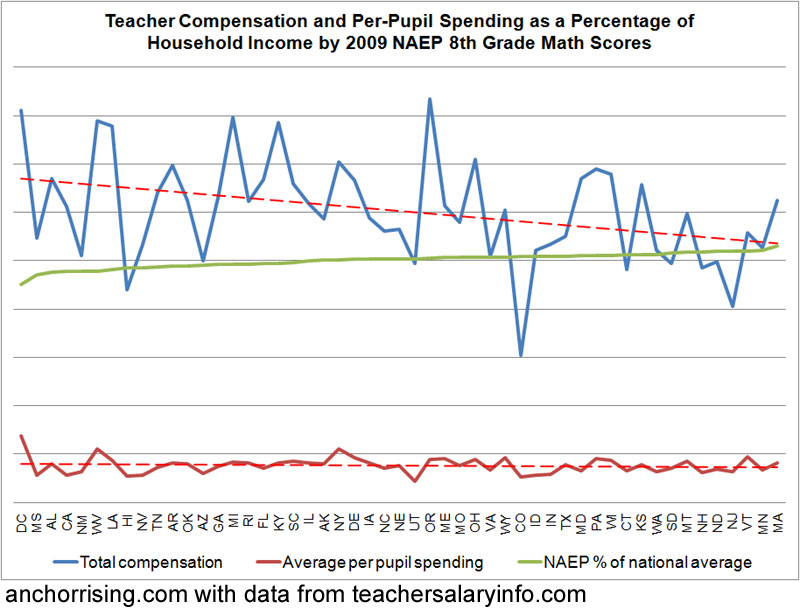
The figure is sorted by math results, from lowest to highest, and the dotted red lines are trendlines for the respective measures. Notice that there appears to be a negative correlation between teachers' total compensation (as a percentage of median household income) and math scores.
All sorts of considerations arise. There is a positive correlation between a state's median household income and its students success on the math tests, and a (less significant) correlation between results and per-pupil spending. The obvious rebuttal to my chart, therefore, would be that as household income goes up (along with test scores), teachers earn less as a percentage thereof, thus creating that negative correlation. However, further examination shows that teacher compensation and NAEP math scores both go up with median household income, while the teacher compensation in absolute terms has almost no effect on test scores.
Put differently, wealthier populations see better results on the tests and pay their teachers better, but paying teachers more does not remedy demographic disadvantages. Not surprisingly, given all of this, Rhode Island is tenth highest in total teacher compensation and ninth highest in per-pupil spending, but thirty-sixth in NAEP math scores.
For your reference, each state's data is available via these links: teacher salaries Alabama | teacher salaries Alaska | teacher salaries Arizona | teacher salaries Arkansas | teacher salaries California | teacher salaries Colorado | teacher salaries Connecticut | teacher salaries Delaware | teacher salaries District of Columbia | teacher salaries Florida | teacher salaries Georgia | teacher salaries Hawaii | teacher salaries Idaho | teacher salaries Illinois | teacher salaries Indiana | teacher salaries Iowa | teacher salaries Kansas | teacher salaries Kentucky | teacher salaries Louisiana | teacher salaries Maine | teacher salaries Maryland | teacher salaries Massachusetts | teacher salaries Michigan | teacher salaries Minnesota | teacher salaries Mississippi | teacher salaries Missouri | teacher salaries Montana | teacher salaries Nebraska | teacher salaries Nevada | teacher salaries New Hampshire | teacher salaries New Jersey | teacher salaries New Mexico | teacher salaries New York | teacher salaries North Carolina | teacher salaries North Dakota | teacher salaries Ohio | teacher salaries Oklahoma | teacher salaries Oregon | teacher salaries Pennsylvania | teacher salaries Rhode Island | teacher salaries South Carolina | teacher salaries South Dakota | teacher salaries Tennessee | teacher salaries Texas | teacher salaries Utah | teacher salaries Vermont | teacher salaries Virginia | teacher salaries Washington | teacher salaries West Virginia | teacher salaries Wisconsin | teacher salaries Wyoming
October 6, 2010
Rhode Island Still Knee Caps Its Students
So, test scores for the science NECAPs are out, and the main topics of conversation have been:
- That Portsmouth leads the pack, with 51.7% proficiency in grade 11, after having rearranged its science curriculum dramatically.
- That demographic gaps in scores have increased.
- That scores overall have nudged up.
Of course, by nudging, I mean about 4%. And if we look specifically at the critical test — that of 11th grade children approaching graduation — the increase is all of 1.1%. It's interesting to note something for which I've got no explanation: Reviewing the charts that compare the three states that issue the NECAPs (Rhode Island, New Hampshire, and Vermont), it seems that up and down trends repeat across state borders. That fact raises questions about whether increased resources for public education will repair the underlying problem. I certainly don't think funding is the issue in Rhode Island, and we trail the pack, of course.
Of particular interest to me, naturally, is the fact that Tiverton's 11th graders have lost ground by 4.4%. That's after a drop of 4.7% from 2008 to 2009. In the first year of science NECAPs, Tiverton students were 30.5% proficient; now, they're 21.4% proficient. These results obtained despite the fact that the number of students taking the test in Tiverton, a stand-in for enrollment, decreased by nearly one-fifth. One would think that a significantly smaller class would receive more individual attention and therefore achieve higher scores. Given the fact that, from 2008 to 2009, the number of students actually increased by one, yet the scores dropped by about the same amount, the proper conclusion appears to be that the Tiverton school district is just incapable of teaching science to the students that it is tasked to educate.
Oddly, this isn't a topic of conversation around town, that I've heard. It certainly wasn't audible beneath the din of the school committee and administration threatening to close elementary schools at the FTM in May.
October 5, 2010
Merit Has to Be Intrinsic
One begins to feel that those testing merit pay for teachers are deliberately missing the point — at least by the time their findings filter down through the mainstream media. Here's the latest:
Offering big bonuses to teachers failed to raise students' test scores in a three-year study released Sept. 21 that calls into question the Obama administration's push for merit pay to improve education.The study, conducted in the metropolitan Nashville school system by Vanderbilt University's National Center on Performance Incentives, was described by the researchers as the nation’s first scientifically rigorous look at the effects of merit pay for teachers.
It found that students whose teachers were offered bonuses of up to $15,000 a year for improved test scores registered the same gains on standardized exams as those whose teachers were given no such incentives.
In absorbing the implications of these results, we must first absorb the relevance of this factor, offered at the end of the article (and not printed at all in the Providence Journal reprint, by the way):
Only about half of the 300 teachers originally in the Nashville study were left at the end of the three years because some retired, moved to other schools, or stopped teaching math. About 40 teachers got bonuses each year. Overall, the researchers said, test scores rose modestly for both groups of students during the three-year study, suggesting that the financial incentives made no difference.
Now, let's ignore the possibility that the results of a study that loses half of its participants is of questionable validity. And let's put aside practical questions that arise from that datum, such as:
- Did teachers from both groups exit the study at equal rate?
- If not, could the possibility of receiving a bonus have helped to retain teachers, or the probability of not earning a bonus have inspired exit?
Let's also take off the table the possibility that teachers in the control group, in keeping with their unions' strong and frequently stated distrust of merit-pay systems, tried especially hard so as to disprove the thesis that they'd try harder if it meant a bonus (thereby effectively confirming the thesis in an unmeasurable way).
At least some of us who support them see merit pay as the palpable incentive at the end of an entire reworking of the system to increase accountability up the education and administration chain and as a long-term process of changing the way in which teachers think about their jobs.
October 1, 2010
Missed Economic Cues in Teaching
Two articles in last Sunday's Providence Journal — here and here — describe circumstances with which my family is very familiar. With the exception of math and science, teaching jobs are difficult to come by in Rhode Island, yet institutions of higher education continue to churn out graduates.
The initial problem, in my estimation, is that an artificially inflated standard of compensation makes teaching an extremely attractive option even for those without a particular vocation. Jointly with that, tight union control of the system prevents the job market from adjusting appropriately to market realities. That inflated pay remains no matter the number of candidates and no matter the success of the workforce. Consider how painfully slow is movement toward education reforms despite the fact that employers in education really ought to have massive leverage in an environment that finds credentialed teachers working as substitutes sometimes for a decade, and that without promise of a full-time job. Current teachers ought to feel under tremendous pressure to perform and to put in extra effort to prove that they're better than job seekers who'd jump through hoops to finally land a stable, full-time position doing what they initially set out to do.
Compounding the issue is that the high cost of each teacher — uniform regardless of the position held — translates directly into fewer jobs:
This has been a particularly bleak year for teacher hiring. Across the state, districts are cutting back — eliminating foreign language instruction, music and gifted programs while increasing class size.
So, not only does the employment dynamic create a glut of candidate, but it restricts the number of slots that they can fill. Under such circumstances, it is inevitable that teacher jobs become prone to patronage (as people looking for positions for years on end can testify), and those already ensconced who might otherwise be unable to compete have even greater incentive to push for increased strength of the unions that protect their mediocrity.
We end up, therefore, with an expensive, failing education system that leaves many teachers not even teaching, but bartending and working menial jobs while on the imbalanced roller coaster of multiple towns' sub lists, even as they strive to build lives and to pay off college debt.
September 23, 2010
Re: Chafee Just Doesn't Understand....Race to the Top
The bottom line of Race To The Top, as was No Child Left Behind ('fess up, leftie friends who oppose NCLB, that program name is you and you'd have supported NCLB if it hadn't been proposed by a Republican president) is an effort to increase academic achievement in this state. Whether, as Marc wonders, the former senator is "wary" of RTTT on its merits or to score targeted political points, does he have an alternative proposal to boost academic achievement in Rhode Island's public schools?
One hint: adding ever more money to our education budgets - more specifically, to contracts - won't get the job done. Rhode Island has decisively demonstrated this, with teacher pay in the top 20% nationally [page 37 of this PDF], student achievement in the bottom 20% and the lowest (51st) ratio of students enrolled to teacher [page 35 of this PDF].
September 22, 2010
Chafee Just Doesn't Understand....Race to the Top
"I'm wary of Race to the Top." So says Lincoln Chafee, as he vaguely expresses concern over the long term state and municipal obligations that he implies could be generated by federal Race to the Top money. Except there really aren't any because the goal of Race to the Top is to accelerate current (ie; already underway) education reform by helping pay for studies, computer systems, etc. that will help with such things as new teacher evaluation programs and the like. These reforms are intended to replace, not add onto, existing programs.
Chafee is simply playing a political game here. His spokesman, Mike Trainor, was on with WPRO's Dan Yorke trying to spin this as Chafee expressing merely "cautionary" concerns, not criticism of RTTT. As Yorke explained, though, such expressions of "caution" are meant to be taken as criticism. Yorke calling it a "trial balloon" is spot on. The target? Most likely those within the education establishment with concerns about RTTT. Especially given that Chafee also lumped RTTT with No Child Left Behind, a favorite talking point of anti-RTTT folks.
September 19, 2010
Okay, It's Beyond Me: Should the Curriculum of Any Public School Include a Class about "Enduring Beliefs in the World Today" - a.k.a., Religion - that Includes Field Trips to Religious Services?
... though in the case of the Wellesley Middle School, the field trip in question inexplicably included student observation (which turned into something more for some of the boy students; thus, generating keen attention from outside of the school district to this field trip and an apology [PDF] from the superintendent) of the service of only one religion. I have e-mailed the teacher to ask why this was and whether the program would be modified to include observation of the services of the other religions studied in the course.
But for the sake of this discussion, let's stipulate a hypothetical course that includes observation of the service of all religions studied. Should such a course even be taught at a public (k-12) school?
My initial reaction was "no", in part, because it strikes me that religion is the primary purview of the parent and mainly because of what happened on this field trip: participation was invited and supervising teachers were too lax or too misguidedly polite to intercede. But is this hindsight casting an unwarranted negative pall on an otherwise good course idea?
September 15, 2010
Back to Issues: Education
While we all follow the horse races of election season, it's worth turning our eyes now and then to the issues that our elected representatives will decide. Toward that end, consider Bill Costello's argument against the government monopoly of education:
The current public education system is not preparing Americans to succeed in the increasingly competitive global economy. In the U.S., this will lead to growing unemployment rates, a decline in Gross Domestic Product, unsustainable levels of national debt, and reduced military capability. ...Those who argue that the solution is more money for public schools have had three decades to test their theory. Increased spending has not led to improvement. American test scores have remained flat since the early 1970s even though per-pupil spending, adjusted for inflation, went from $4,489 in 1970-1971 to $10,041 in 2006-2007 -- an increase of 124 percent.
No public motivation could outstrip parental incentive to ensure better lives for one's own children. In other words, individual parents are better positioned and more motivated to choose particular schools and ensure that they provide desirable, beneficial educations. At the very least, parents who choose private schools should receive refunds of that portion of their tax money that goes to public education, with that loss coming directly from the public schools that would otherwise educate those children.
I'll return to my local example: During this year's budget battle in Tiverton, the School Committee strove to frighten parents into voting for a massive tax increase by threatening to close one of our brand new elementary schools. The insider rumor mill worked over time choosing the school that was in the target hairs for maximum political effect, transforming a general statement that closing a school "might be an option" to a public sense that it would be unavoidable that a particular school would become an empty building if the district's budget request failed. Parents began to turn their eyes to private school, and some broke away from the public system even though the schools ultimately got the money they demanded.
The point is that the threat of parents to withdraw their children from public schools is not a threat at all. Until it reaches the point of giving budget hawks political ammunition, if anything, fewer children helps a public school district's bottom line. They profit by losing customers.
Worse still, under such circumstances, it is sure to be the most motivated parents, who put the most emphasis on and are willing to get most involved with their children's education, who leave first. That is not a model for success.
September 8, 2010
More Education Money Is Not the Answer
According to Providence Business News's Alyssa Foley, Rhode Island is precisely the middle of the country when it comes to student performance, and its reform efforts don't encourage those who grade such things:
Rhode Island came in at No. 25 in student performance in a ranking of all 50 states and the District of Columbia. Meanwhile, the Ocean State's education reform policies earned a "D" grade on the A to F grading scale, according to ALEC's Report Card on American Education: K-12 State Performance, Progress, and Reform.
It's interesting to place the results in the light of this interactive map of per-pupil spending by state, presented online by the National Science Foundation. At $13,453, Rhode Island has the sixth highest spending in the nation. By contrast, ALEC's number 2–ranked state, Massachusetts, spends $12,857, while the number 3 Florida spends $8,567, and the number 4 New Hampshire spends $11,037. Vermont, however, does outspend Rhode Island, with $13,629, and ranked number 1 in performance.
Turning to ALEC's own interactive map of student performance, there does not appear to be much (if any) correlation between per-pupil spending and performance ranking. I should also note that the cost data does not include "school construction and other capital outlays, debt service," or (it appears) teacher retirement costs. It would be interesting to see what effect inclusion of those factors would have on state rankings. I suspect it wouldn't help Rhode Island.
September 7, 2010
Cutting to an Engorged Bone
The headline is "Districts Cutting to the Bone," but the interesting item comes at the end:
Like many districts, West Warwick has been bringing back students with special needs who previously were sent to private schools in an effort to both save money and better serve students."We've brought back about 90 kids in the past two years," he said. "But when you don't have an assistant special education director, even though you have 900 children in the district with special needs, and you don't have an assistant superintendent or a curriculum coordinator or any assistant principals at the elementary schools ..... The point is, we are beyond the point where you look at the budget and are cutting. We can't even cut the crayons any more. There are no more crayons."
Nine hundred special needs students? In 2009, the district had 3,657 students total. That means exactly 25% of all students are "special needs." I'd suggest that either the town of West Warwick would do better to spend its money on investigating environmental toxins or special education has become an inflated measure.
Our state pays nation-leading money for its education system, and it's only ever gone up, across time. Maybe the bone to which we've supposedly just cut is just cartilage. Or maybe it's a tumor.
August 30, 2010
The Mystery of Good Teaching
Monique has already mentioned the headline revelation of an article reporting statements of the states' two teacher union heads before the Rhode Island Public Expenditure Council (that they've recognized the advantage of regionalization to them), but I'd like to highlight an unrelated statement from Rhode Island Federation of Teachers President Marcia Reback:
"[Education] Commissioner [Deborah] Gist said it earlier," Reback said. "You know good teaching when you see it. You can't test it."
The only way such a statement can be otherwise than total bunk is if we restrict the meaning of "test" to a written document that seeks to quantify without the need for human judgment. Even then, I'd dispute the conclusion, but at least it would be a real matter of debate. Many grades throughout my schooling were based on "tests" that involved a panel reviewing, for example, my piano playing. Many steps and sidelines in my adult employment have been related to managers' judgment of my work. One can test teachers by the success of their students and their contribution to schools, generally.
Of course, such a test has too many variables for some distant test author to incorporate. It is not, however, beyond the capacity of parents and principals, which is why public education is suffering for lack of two qualities:
- Parents' ability to easily move their children from one school to another, with an actual consequence to the losing school when the move is made.
- Principals' ability to manage their teachers as employees rapidly and easily enough to correct problems before they become institutionalized, which also has the effect of reducing the degree to which we can hold those principals accountable for institutional failure.
August 28, 2010
Some Sacrifice
Sometimes people have to say what they have to say, I suppose, but this comment out of Cumberland really points to the different world in which some Rhode Islanders live:
School Supt. Donna A. Morelle stated that the committee and the administration "are greatly appreciative of the sacrifice made by the teachers."
So what "sacrifice" are the teachers making? Giving up a vacation week or two? Higher health insurance payments? More realistic retirement expectations? Not quite (emphasis added):
Teachers this year will defer half of a 2.5-percent salary increase, half of an increase that comes with a new salary step and half of the payment teachers with credits or degrees beyond a bachelor’s degree receive, according to Roderick McGarry, president of the Cumberland Teachers Association. ...Also in the agreement, announced Monday after the Cumberland Teachers Association and School Committee approved it Wednesday, is waiving a 2.5-percent salary raise in the academic year that begins September 2011.
The new accord adds another year to the contract, which the union president stated would give teachers additional security through the 2012-2013. Teachers will get a 1-percent salary increase in the first half of that year and an additional 1.5-percent salary increase in the second half, McGarry said.
So payments expected during the coming school year will be deferred until the future (when, the school committee inexplicably assumes, finances will have improved), raises next year will be eliminated (although the teachers will presumably see an actual increase because the deferral will end), and their guaranteed raise in the subsequent year will be less than expected. In effect, the contract uses accounting gimmicks to downplay the fact that union members will be receiving 1.25% raises (on top of step increases and other remunerative opportunities) during an era of crippling government deficits, high unemployment, and general economic malaise.
That, in the public sector, is called "sacrifice."
August 26, 2010
Regionalization? You May Want to Consider Who is Standing With You
As Andrew highlighted in his signature coverage of the Rhode Island Republican Assembly Endorsement Convention, the campaign platform of Republican gubernatorial candidate Victor Moffitt includes regionalization.
Audience Question: Unions and union contracts are out of control. What can we do to give more autonomy to the communities?Answer: "I'm actually going to say that I think the problem is the opposite of that. As most of you know, I've been talking about regionalization and consolidation services since 1998....How good would Rhode Island be if we could replace 36 teacher contracts with 4? If we could replace 80 fire contracts with 5? Do you think that would be a little improvement for the state of Rhode Island?"
But OSPRI outlines the pitfalls; inter alia,
When comparing fully regionalized districts to similar size town districts we find that regionalized districts have the highest per pupil costs. One example is the Chariho Regional School District which was put together from three towns to make a school district whose student body is the same size as neighboring Westerly. But, the supposed economies of scale are nowhere on display in Chariho where administration costs per pupil are $825, forty percent more than the $589 spent in Westerly. Indeed, when it comes to administration costs, the supposed venue for obvious savings, they are well above the median in ALL the regionalized districts.
More alarming (... or not, depending upon your perspective), in yesterday's Providence Journal, Linda Borg reports on two other individuals who support regionalization.
The leaders of the state’s two teachers’ unions said that they would not be opposed to consolidating Rhode Island’s 36 school districts into one big district.Although they cautioned that they were speaking as private citizens, Marcia Reback, president of the Rhode Island Federation of Teachers, and Robert A. Walsh Jr., executive director of the National Education Association, Rhode Island, offered the most radical suggestions about how to fix public education. The two made their remarks at a morning-long forum in Smithfield sponsored by the Rhode Island Public Expenditure Council.
Non-special interest supporters of regionalization like Mr. Moffitt (not to pick on him; he is not the only person to propose regionalization as a way to control costs but is one of the higher profile people to do so recently) presume that the hands into which thirty six contracts would be consolidated will act/negotiate/execute in the fiscal best interest of the taxpayer. Clearly, special interest advocates have determined that, on the contrary, it is they who would benefit from such an arrangement. Especially as it is the paid professionals representing that special interest who have reached this conclusion, I'm inclined to defer to their judgement
August 25, 2010
Sometimes "Investment" Is Just an Expense
In a recent article, John Kostrzewa describes a study (partially funded by RI's Poverty Institute) by Jeffrey Thompson, Assistant Research Professor at the Political Economy Research Institute at the University of Massachusetts-Amherst. As it happens, circumstances lately have put me in a position to agree with some of the professor's conclusions, particularly those decrying one-company-narrow special deals described as "economic development." But this part is some of the same-old-same-old:
On education, Thompson argues that investing in education attracts business, raises gross state product, increases employment in metropolitan areas and raises personal income. He claims that every million dollars spent by Rhode Islanders on education creates between 26 and 33 jobs for teachers, aids, custodians, nurses, professors, bus drivers and others.I agree that education is a key to developing the talent, skills and entrepreneurs on which to build a knowledge-based economy and fill the needs of traditional companies. But I shudder at the idea of simply spending more money without controlling or targeting where it's going, and measuring improvement.
The first point to make is that monetary investment isn't proving to be the shortcoming in Rhode Island education and will not translate into any benefits beyond the direct funding of school-related jobs. As Kostrzewa writes:
Already, Rhode Island ranks among the top 10 states nationwide for per capita spending on primary and secondary education. Yet national test scores show Rhode Island stuck in the middle of the pack, and lagging behind its neighboring states in New England. Also, Rhode Island’s dropout rate of about 30 percent is one of the highest in the country.
And all of that money has to come from somewhere, ultimately from consumer spending that creates jobs indirectly and direct business activity, which creates jobs almost by definition. That brings us back to the point that I always make in this context: Even if we succeed in educating the fabled Workforce of the Future, unless we have jobs into which that workforce can move — because education doesn't necessarily mean entrepreneurialism — that workforce will move to another state that does, taking our investment in academics with it.
I'd argue that the key reforms — basically, increasing accountability, refocusing education on students and their parents, and tying revenue to success, rather than government whim — would cost less and improve outcomes. In other words, we could leave money in the economy for investment in job creation and simultaneously improve our children's marketability as employees.
"Rhode Island is a winner!"
That's the subject line of an email from Rhode Island Education Commissioner Deborah Gist announcing that Rhode Island came in fifth in the U.S. Dept. of Education's Race to the Top competition. Frankly, I find the presentation of the entire give-away creepy.
If we begin with the belief that public education is a states' rights matter, what we have here is an unelected federal bureaucrat using billions of our own money to elicit eager willingness of unelected state bureaucrats to give his office authority to judge and shape the education ultimately provided, and largely funded, at the municipal level. As I've opined before, the particulars may sound good, now, but they will dilute and expand until it's just a matter of assumption that the local men and women whom we elect to school committees just have to do whatever the executive branch of the federal government says. And as I've also noted before, quoting Education Policy Director for the American Enterprise Institute Frederick Hess, the selling points of the "reform" are not as prominent in reality as they are in the headlines:
A few of the 19 priorities rewarded states for moving on measures such as charter schooling and merit pay, with states earning 40 points (out of a maximum total of 500) for supporting high-performing charters and 58 points for using student-achievement results to improve teacher and principal effectiveness. But the vast majority of the points are awarded for compliance with often woolly federal criteria: 65 points for articulating an agenda and securing local buy-in, 10 points for prioritizing education funding, 20 points for providing effective support to educators, and so on. If you're not entirely sure what these categories entail, welcome to the club; they reward states for procuring signatures of union support, for spending more on schools, and for adopting impressive-sounding professional schemes.
And again, this is all being done with billions of dollars from an entity that's trillions of dollars into deficit and will either have to pull the financial rug out from under its promises or increase our taxes heavily for us to maintain the privilege of doing what it says.
August 24, 2010
If Teachers Are Professionals, Their Performance Should Be Measurable
Veronique de Rugy points to an L.A. Times article analyzing students' test scores — against their own prior achievements — to determine the educational value added (or not) by third- through fifth-grade teachers. Here are two findings that give a pretty good flavor (which, overall, Anchor Rising readers will find unsurprising):
* Although many parents fixate on picking the right school for their child, it matters far more which teacher the child gets. Teachers had three times as much influence on students' academic development as the school they attend. Yet parents have no access to objective information about individual instructors, and they often have little say in which teacher their child gets.* Many of the factors commonly assumed to be important to teachers' effectiveness were not. Although teachers are paid more for experience, education and training, none of this had much bearing on whether they improved their students' performance.
Where the school matters, I'd suggest, is in its ability — and structural motivation — to ensure that teachers succeed in their mission. That means a stronger hand in dealing with employees, on the one side, and a direct and rapid relationship between the school's success and its revenue.
Consider charter schools: Those representatives of the public school establishment who support charters will agree that one of their benefits is as "laboratories for best practices," as the jargon goes, but they clearly aren't controlled experiments. That is, the school doesn't have to explain what practice it intends to test, with the state requiring it to keep all other practices (such as union contracts) intact, and with a plan to transmit successful strategies to the broader education system. Rather, the "laboratories" are meant to sink or swim and, if they swim, to increase the pressure on unions and administrators to reform.
It's a fool's project and a delay, as indicated by the fact that nobody should be surprised that some L.A. teachers are better than others and that the quality of the teacher affects the advancement of the student. That such experiments are a delay to necessary reform is evident, first, in the fact that parents flock to these more-accountable schools when given the opportunity and, second, in the fact, noted by de Rugy, that California teacher union thugs are boycotting the L.A. Times.
August 19, 2010
Integral Government Strings
Upon reading of the $9.4 million or so in federal money coming to Rhode Island for the purpose of expanding charter schools, I couldn't help but wonder about the strings that must be attached even to such a piddling sum, by current government standards.
Reviewing the U.S. Dept. of Education's onlne materials related to the program, I couldn't find any explicit strings, though. That leaves a cynic like me with general complaints about big government. Charter schools are popular among Americans, and by offering even a little bit of money toward their growth, the feds begin to insinuate themselves into their operation. (Specific office holders may also be interested in purchasing some cover for the billions of dollars that they've been devoting to preventing local school districts' having to reform in ways, during this recession, that might affect unionized labor.)
It's probable that many people involved in such initiatives, right up to Secretary of Education Arne Duncan and the president himself, honestly wish to improve public education and see charter schools as a mechanism for that purpose. Politicians and bureaucrats are no doubt sincere in their good intentions for a great number of big government programs. What they have to learn, though, is that good intentions are only as valuable as the individuals who hold them, and centralizing American life will ultimately give power to people more intent on exploitation.
August 17, 2010
Let Them Play
So now it's recess. Well, as a former high-energy boy, I'm not sure what I'd done if I had been forced to while away all the hours of the school day in a structured environment. Back in my day, we had a morning and afternoon recess (plus a lunch break!). The promise of those pending breaks are what got me through the hours spent in class. I knew that after math, I'd be back playing kickball or whatever else. And yeah, I'd have to go back into class, but the physical energy spent somehow helped to focus my young mind on the task at hand. Funny how that works.
But now we're told there just isn't enough time in the day to meet all of the requirements demanded by government and, implicitly, parents. So traditional recess of the free-form variety is being done away in favor of a more structured version. Just what our kids need: more structure in their already too-structured play time.
My wife, a member of our school's PTO who is at the school most days, has told me how she watches the kids at recess and that they have no clue how to play by themselves. For instance, soccer games quickly devolve into anything goes free-for-alls where the ball is usually carried (more like rugby). That's why there are programs in some schools that are actually teaching kids how to play. How sad. But at least these programs are aimed at giving the tools and ability to play on their own. A shorter, more structured "recess" will do just the opposite.
The problem is that we've raised--and continue to raise--a generation that thinks it needs adult supervision to play a game. Self-organizing doesn't happen. Kids are over-scheduled in their free time, whether it be dance or sports or karate or whatever. Too often, instead of fostering an interest, these organized forms of recreation end up being the only kind that kids get. Recess is one of the last places where they can just do what kids are supposed to do: play.
A Bubble in the Making
The talk has been growing — especially around the blogosphere — that higher education is the next major bubble. With access to loans and all sorts of civic and cultural incentives to attend college, the actual value of a degree is inflating. Of course, education is different from housing; as far as I know, no derivatives market has grown up around the asset of knowledge (as interesting a proposition as that might be for smart individuals).
On the other hand, education affects the job market, which is what made the topic of boosting college graduation rates sound like a matter of civic urgency — as opposed, say, to industry insiders' strategizing to expand their market — among attendees of a State Higher Education Executive Officers conference last week in Providence:
Without improvements in secondary and post-secondary education, only 21 out of every 100 Rhode Island teenagers about to enter the ninth grade will graduate from a two-year or four-year college in the next 10 years.But research indicates that about 62 percent of entry-level positions will require at least a bachelor's degree by the end of the decade.
What percentage of those entry-level positions actually "require" a degree because of the skills involved, rather than as a method of easy candidate screening, I won't hazard to guess. Based on personal experience, though, I'd say it's quite substantial. As more young adults enter the job market with degrees, more employers will require them, without reference to the ostensible value of the knowledge that they've gained.
Note, especially the four bulleted suggestions in the article linked above:
- Reorganizing class schedules into blocks of time that allow students to plan jobs and family responsibilities.
- Individualizing remedial work and including it in courses for credit, while limiting separate catch-up classes to the summer before the freshman year.
- Establishing uniform academic requirements from one school to another, so students may more easily build on one- and two-year programs to transfer to four-year institutions.
- Making sure that up-and-coming high school students graduate with college-ready skills.
The emphases here are twofold: getting students to where they are supposed to be at the end of high school, and making it easier for them to fit higher education into their lives. Conspicuously absent is emphasis on the regimen for ensuring that students learn something useful and relevant to their future careers, including strategies for helping them to discern what those careers should be.
Honestly, I think that might be a bit much to expect of college, because it's a bit much to expect people straddling age twenty to figure out the next sixty years of their lives. In other words, if secondary schools can do a better job of getting students where they need to be upon high school graduation, then there is no great need for them to attend college unless (1) they can afford it, (2) their interests are broad and intellectual, and/or (3) they are driven strongly toward a particular, identifiable career. Beginning with that perspective, colleges and universities would be better able to hone their offerings.
I'd suggest that educational and economic benefits would accrue to a system that in some way expanded high school on a case-by-case basis to the duration necessary to adequately educate each individual student. When college degrees become too scarce and the differences between job candidates with and without them become too minute, employers will adjust their expectations.
August 16, 2010
No Dilemma. An Accurate Accounting.
It looks like the effort has begun, in earnest, to invalidate pending graduation requirements, rather than acknowledge that Rhode Island's current way of doing elementary and secondary education isn't working:
Thousands of incoming high school juniors may be unable to graduate in June 2012 because of tougher graduation requirements, and state education officials are beginning to grapple with the consequences of their new high standards.Starting with the Class of 2012, high school seniors must have scored at least "partially-proficient" on the state tests in English and math in order to graduate. The tests are administered during their junior year.
If the new diploma system had been in full effect the last two years, nearly half of the state's juniors would have been at risk of not graduating because of poor performance on the math portion of the state tests. Forty-five percent of juniors scored in the lowest possible category, "substantially below proficient."
Let's be clear: These aren't "the consequences of new high standards"; they're the consequences of a failure to meet any standards at all. If the great majority of students were just barely missing adequate performance, then the aggressiveness of the standards might merit some adjustment. That's not the case. Half of Rhode Island's juniors aren't even close. And this explanation only brushes the underlying issue:
State education officials acknowledge that making these changes has been daunting, given the nature of the work and the scarcity of resources.
Scarcity of resources? Rhode Island devotes top-quintile amounts of money to education. The only reason resources for reform can possibly be said to be scarce is that they are locked up in personnel costs for a workforce that is unable or unwilling to perform to expectations. Our entire education structure is built in such a way as to put the compensation and employment satisfaction of adults first on its list of priorities.
As long as Rhode Island tiptoes around the union issue — with all of the legal binds for which unions and other insiders have labored over the decades — our students will continue to suffer. Making it easier for them to graduate will only paper over the problem, exacerbating the harm done to the young adults of Rhode Island.
August 5, 2010
The Kids'll Respond to Good Points and Respect
One wonders how the side of the culture war that proclaims itself "pro-science" will adjust its thinking in response to this finding (emphasis added):
The participants' mean age was 12.2 years; 53.5% were girls; and 84.4% were still enrolled at 24 months. Abstinence-only intervention reduced sexual initiation (risk ratio [RR], 0.67; 95% confidence interval [CI], 0.48-0.96). The model-estimated probability of ever having sexual intercourse by the 24-month follow-up was 33.5% in the abstinence-only intervention and 48.5% in the control group. Fewer abstinence-only intervention participants (20.6%) than control participants (29.0%) reported having coitus in the previous 3 months during the follow-up period (RR, 0.94; 95% CI, 0.90-0.99). Abstinence-only intervention did not affect condom use. The 8-hour (RR, 0.96; 95% CI, 0.92-1.00) and 12-hour comprehensive (RR, 0.95; 95% CI, 0.91-0.99) interventions reduced reports of having multiple partners compared with the control group. No other differences between interventions and controls were significant.
Having followed this sort of research over the past decade, I'll confirm that this result really isn't surprising. Only a smokescreen of spin and obfuscation makes it seem so. Abstinence-only education teaches children to think of sex in terms that should lead them to have less of it. "Comprehensive" sex education teaches them how to have sex. Moreover, it has nowhere been the case that abstinence represents the sum total of the lessons that children receive.
As Joseph Bottum puts it:
While the study emphasized that the abstinence-only classes "would not be moralistic," there was an underlying assumption in those classes that the children themselves were moral beings—a striking difference between the abstinence-only and safe sex–only interventions. In the abstinence-only program, it was emphasized that "abstinence can foster attainment of future goals." In contrast, the safe sex–only intervention concentrated on education about sexually transmitted diseases and condom use—that is, it focused on the present only. The first program assumed that children look forward, anticipate, and hope. The second assumed that, like the lowest animals, they are aware only of the here and now.
Conservatives — especially religious conservatives — tend to believe that treating children as moral beings who can rise above their lusts is a worthwhile practice, even if it has no measurable effect on their present behavior. That the other side is loath to acknowledge that it does have a measurable effect suggests that they, for some reason, prefer that children learn to indulge their basest instincts, perhaps because it makes them riper for dependency.
Topics Local and International
Last night Monique and Tony Cornetta talked, on the Matt Allen Show, about Iran, teachers' unions, and partisan ethics. Stream by clicking here, or download it.
August 4, 2010
Warwick School Committee Chooses the Tough Path
Faced with an insurmountable $13 million cut in state and local funding, the Warwick School Committee voted to freeze pay and impose a 20% health care co-pay for all of its employees last night.
Before the vote, School Committee Chairman Chris Friel stressed that these are not actions the district wants to take but it has no choice faced with insufficient funding for its budget of about $161 million for the current fiscal year, which began July 1.Unions are not happy.He said the district did not want to cut programs that directly affect students, such as sports, gifted classes, mentoring and all extracurricular activities.
The action is in apparent violation of the School Department's contract with its roughly 1,000 teachers represented by the Warwick Teachers Union, with teachers slated to lose a 2.75 percent raise this year....The leaders of the two unions that represent almost all school employees - the teachers union and the Warwick Independent School Employees union - vowed that they will respond with swift court action.The union has been playing the "we'd get back to you" game or the "we're willing to listen" game for some time now. The School Committee is obligated to have its budget finalized shortly after the City Council approves the school budget and was already late in doing so. They couldn't wait any longer. The situation called for urgency and the unions seemed to be content with playing the same collective bargaining games that worked in the past (see the "Addendum" in the extended post for a timeline). That isn't working any more. It's apparent that the Warwick School Committee felt like there wasn't much expeditious movement occurring on the other side of the table and felt like the only path left open--a tough one--was to unilaterally make these cuts and changes. That's something that the Warwick City Council backed away from. Whether the solution is viable depends on the next stop in the process: the courthouse. Continue reading "Warwick School Committee Chooses the Tough Path""I feel stabbed in the back," teachers union president James Ginolfi said, noting that the first he and other union executives heard of the School Committee's plan was less than an hour before it took action in executive session.
"We listened to what they had to say and said we'd get back to you," Ginolfi said, adding that the school board is sending a public message that it has no regard for a legal agreement. "I am shocked," he said.
August 2, 2010
The Tone of the Ad
To be honest, I don't follow help wanted ads for teaching positions closely enough to know whether this is really unique, but something about the wording of this one, printed in last Sunday's Providence Journal, caught my eye:
RI Certified Teachers, to Substitute per diem for growing K-9 public charter school.
The idea of advertising the growth prospects of the school strikes me as somehow refreshing. It gives the sense that something is being built — that effort and perseverance can improve everybody's lot. Of course, it's probable that any school seeking highly educated people for drudgery like substitute teaching would want to convey a probability of advancement. Still, I think public education in general would inspire more confidence among those who fund it were that attitude brought to bear in a systematic way.
July 29, 2010
Re: Federal Money, Federal Guidelines; and Local Control?
It may be that I'm just more cynical than Marc, but with respect to Race to the Top, I can't help but muse that government reforms always sound good — otherwise, politicians wouldn't try to sell them. Suppose that the goal of education policy, at the national level, is to increase the federal government's role in that critical area of social development, while offering short-term political advantage to those who implement it.
The trick on the latter count would be to persuade those who want substantive reform that the new policy is not just talk — therefore, support for charters and standards for presumed accountability of educators — while comforting those invested in the broken system that they won't be harmed — therefore, the requirement that states' Race to the Top applications garner teacher union support. The trick on the former count would be to build the program in a way that allows the tendencies of growing government to finish the job quietly — as if natural and inevitable. Two points that Marc makes bring that trick into focus:
If something fails, stop doing it. If it looks promising but may need some modifications, tweak it.
The problem is that government (especially large, centralized government) is less inclined toward such modifications than the average group or individual. Somebody with political power is already invested in the something that is failing, and with the long process of accountability in a national bureaucracy, it takes quite a bit for general dissatisfaction with government services to overcome such investments and stop the failure.
However, a Common Core is just that--a "core" of educational standards, not the end-all, be-all. It is the baseline standard that should be met. It's not the ceiling, it's the floor. ...Federal help only undermines local control if reformers view federal standards as the ultimate goal and not the jumping off point.
In a gradual federal takeover of education, the floor is enough (and too much), to start. It will henceforth be available to the political process to layer in all those "critical" baselines that statists and social engineers find much more interesting than basic math and English. First science enters the field — not just the basic facts of what we know about the interaction of particles and waves and such, but bleeding into the inevitable metaphysical questions. No doubt health and all of the behavioral implications thereof — sexual, dietary, and so on — will come up for application to the core. Perhaps civics and history will be next, with even more opportunity for government spin.
Every government program proposed will have attractive points, because human beings do have the capacity to work together intelligently toward common goals. Individual incentive for corruption is the limiting factor, though, and eroding the government structure that seeks to empower society to work cohesively while protecting it from invidious encroachment by those with tax and police authority will never end where our hopes declare that it might.
Borders, National and Educational
Marc and Matt discussed (independently) immigration and education on last night's Matt Allen Show. Stream by clicking here, or download it.
July 28, 2010
Federal Money, Federal Guidelines; and Local Control?
So, in the Race to the Top sweepstakes (Round 2), Rhode Island has made the final 19, which is sorta like making the NHL or NBA playoffs where about half of the "regular season" competitors qualify. Some of the key components included in RI's application include recent reforms like the passage of a school funding formula, the raising of the charter school cap, an increase in the teacher exam "cut" score, and the integration of Teach for America teachers into RI schools. Prospective reforms include the development of a new teacher evaluation system and formally adopting the Common Core national standards (Rhode Island has already signed off on the concept). The recent actions taken in Central Falls and Providence (and perhaps East Providence) probably also help make the case that the state is ready to tackle reform head on.
If Rhode Island should "win" the $75 million up for grabs, that money will go towards implementing some reforms and helping the educational infrastructure in the state. In other words, it'll help pay for the development of a teacher evaluation system and a new bunch of state standards based on the national Common Core standards being formulated.
Concerns and debate about the Common Core are bubbling up. As Frederick Hess writes:
Fordham Institute honchos Checker Finn and Mike Petrilli argued last week in a thoughtful National Review Online column that the Bush administration's No Child Left Behind Act (NCLB) fueled an explosion of mediocre state standards, undermining accountability and reform. They see the Common Core as a remedy. University of Arkansas professor Jay Greene responded that there's good reason to believe that the Common Core won't deliver on its promises and that it will impose real costs.That's where it gets tricky, of course. A pile of money that can be used on potential good stuff is different than a pile of money spent on programs that missed the mark or didn't get properly implemented, ie; No Child Left Behind. Hess thinks the points are all valid.
The Common Core standards are superior to those in place in most states, and transparency and market efficiency can benefit dramatically from a clear, rigorous national standard. Uniform standards and performance measures can help us test new educational techniques on a level playing field, so that we can deliver useful tools and techniques to more schools and students. These are all things that conservatives can embrace....But this "state-led" effort has been aggressively driven by the Obama administration, there's a huge chance that it will dramatically boost federal control of K-12 schooling, that teachers' unions and other status quo interests will make their influence felt, and that state and local control will be undermined.However, a Common Core is just that--a "core" of educational standards, not the end-all, be-all. It is the baseline standard that should be met. It's not the ceiling, it's the floor. Unfortunately, getting people to shoot higher than above the minimum--whether their education bureaucrats or students--is always a challenge. And as Hess explains, while the big picture stuff is easy, it's the all-important small stuff that gets short shrift because, well, it can be boring.
Past experience teaches that the odds aren't great that states, funders, vendors, and the feds will maintain their stride when it comes to making the tedious, small-bore, and potentially costly--but critical--revisions to assessments, accountability, curricula, professional development, teacher education, and instructional materials....the aftermath [of No Child Left Behind] reminded us that grand political projects (conservative or liberal) tend to look best in the early days.Follow-through and keeping the feedback loop flowing are critical towards implementing reform and maintaining reforms. Nothing is static; things change. If something fails, stop doing it. If it looks promising but may need some modifications, tweak it. If it works, do it more often and in more places. Easy to say, harder to do in today's arthritic and stratified 20th century industrial age education system. But that's the point of reform: to change what we've got into something better.
I have reservations about allowing the Federal government's foot, ankle and possibly knee into the local education door. But I'm hopeful that Race to the Top will be an effective means to implement much needed reform (we can agree reform is "much needed", right?). As Education Secretary Arne Duncan pointed out, just competing for the money has resulted in many states implementing reforms to be more competitive. That's certainly been the case in Rhode Island.
Yet, simply winning the RTTT isn't victory and piecemeal implementation won't work. It will only be a success if the RTTT funds are used wisely in the implementation of systemic changes tailored to Rhode Island's education system. It is possible to use federal money and abide by federal standards while also maintaining local control and setting our own educational priorities. Federal help only undermines local control if reformers view federal standards as the ultimate goal and not the jumping off point. Let's hope Rhode Island's education policy makers keep that in mind. Like I said, I'm hopeful (which is different than optimistic).
July 19, 2010
Some States Help Residents to Achieve Potential; Some Do Not
Each year, Newsweek publishes a list of "America's Best High Schools." Their criterion is rather limited, having to do with the number of students at public schools who take Advanced Placement, International Baccalaureate, or Cambridge (AICE) tests, but it is a reasonable snapshot of the emphasis that a school places on excelling. The baseline for making the list at all was one test (taken by a junior or senior) per graduate, which includes about 6% of high schools.
I probably shouldn't have been surprised, but was, that Rhode Island can't boast a single school on the list of 1,735 across the United States. In that dubious distinction, we're joined only by Hawaii, North Dakota, and Wyoming. The success of each state (plus the District of Columbia) is represented in the following graph; the greener the state, the more "Best High Schools" a state has per 1,000 of school-age population, the redder, the fewer. (Bright green signifies 0.1 schools per 1,000 students, and bright red signifies 0.)
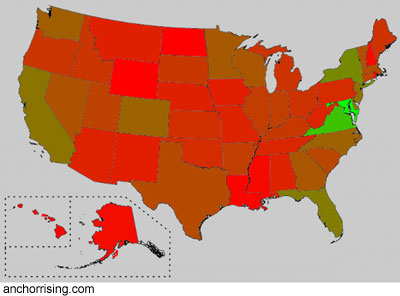
The top ten states by this measure were:
- District of Columbia, 0.105
- Maryland, 0.101
- Virginia, 0.076
- New York, 0.054
- Florida, 0.049
- Delaware, 0.048
- California, 0.045
- New Jersey, 0.044
- Colorado, 0.039
- North Carolina, 0.038
The top ten states by actual number of high schools were:
- California, 302
- New York, 172
- Florida, 139
- Texas, 136
- Virginia, 99
- Maryland, 98
- New Jersey, 66
- North Carolina, 61
- Georgia, 61
- Illinois, 55
The top ten states by the number of schools in the top quartile of list — the best of the best — per 1,000 of the school-age population were:
- District of Columbia, 0.053
- Virginia, 0.028
- Maryland, 0.023
- Florida, 0.022
- New York, 0.019
- North Carolina, 0.014
- Colorado, 0.013
- Texas, 0.009
- California, 0.009
- Georgia, 0.009
One can infer that states that make this final list, but not the first, have pockets of excellence. One can also infer — and Rhode Islanders can testify — that states that don't make the full list at all are not oriented toward helping people, especially students, to achieve their potential.
It digs a little more deeply than I'm inclined, just now, to tie the bright greenness of the Washington, D.C., area to recent talk about a "ruling class."
ADDENDUM:
On the "ruling class" question, Anchor Rising contributor Marc Comtois followed up with a post noting that the D.C. area is a "boom town" in the midst of recession.
July 7, 2010
Can Schools Replace Teenagers' Jobs?
Her column is cast in terms of preventing summer "learning loss" among students, but Julia Steiny's subject is really the degree to which schools have conflated "schooling" and "learning" — making children with an aversion to the former avoid activities that are explicitly the latter, whether during the summer or school-year off hours.
... institutions have an evil tendency to become more important than their missions and their clients. Health-care systems can compromise health. Schools can become antithetical to learning.[Ivan] Illich says, "The pupil is 'schooled' to confuse teaching with learning, grade advancement with education, a diploma with competence. ..." This is sad, but too often true. He further notes that schools "discourage both the motivation and the financing for large-scale planning for nonschooled learning."
It's peculiar, therefore, that she would head in this direction:
Why don't schools teach kids about themselves and their immediate environments? What could be more interesting? Harness kids' narcissism by helping them figure out where and who they are, investigate what their community wants, audit the school's energy use, promote recycling, learn to do minor repairs. These skills need academic support, and kids could use them tomorrow at home. Treat the immediate world as a learning lab, so kids get a big hit of the pleasure of mastery.
At the very least, leveraging schools as the hub connecting children to the world around them risks tainting an even broader swath of activities with the "schooling" feel of imposed work. Indeed, we're back to Robert Whitcomb's suggestion, which I mentioned the other day, that imposed community service in high school might sour students on voluntary service once they claim the freedom of college.
In general, I agree with Steiny that schools could do much to make learning more fun, but part of the reason that young adults are disengaging from civic activity is that, as a society, we allow school to be their one responsibility. "Investigating what their community wants" and pursuing practical skills sounds an awful lot like the role of a summer job. To increase that activity, we'll have to focus on factors that sap the marketplace of such gigs (a slow, business-unfriendly economy) and that direct them away from young adults when available (labor laws and illegal immigration).
July 6, 2010
Kansas Tries Grouping Kids by Ability, not Age
Seems like an idea worth trying:
Instead of simply moving kids from one grade to the next as they get older, schools are grouping students by ability. Once they master a subject, they move up a level. This practice has been around for decades, but was generally used on a smaller scale, in individual grades, subjects or schools.I don't think it will take time to explain...more like time to accept ("we fear change"--especially in our education system). But this method seems to work:Now, in the latest effort to transform the bedraggled Kansas City, Mo. schools, the district is about to become what reform experts say is the largest one to try the approach. Starting this fall officials will begin switching 17,000 students to the new system to turnaround trailing schools and increase abysmal tests scores.
"The current system of public education in this country is not working" said Superintendent John Covington. "It's an outdated, industrial, agrarian kind of model that lends itself to still allowing students to progress through school based on the amount of time they sit in a chair rather than whether or not they have truly mastered the competencies and skills."
Here's how the reform works:
Students — often of varying ages — work at their own pace, meeting with teachers to decide what part of the curriculum to tackle. Teachers still instruct students as a group if it's needed, but often students are working individually or in small groups on projects that are tailored to their skill level.
For instance, in a classroom learning about currency, one group could draw pictures of pennies and nickels. A student who has mastered that skill might use pretend money to practice making change.
Students who progress quickly can finish high school material early and move forward with college coursework. Alternatively, in some districts, high-schoolers who need extra time can stick around for another year.
Advocates say the approach cuts down on discipline problems because advanced students aren't bored and struggling students aren't frustrated.
But backers acknowledge implementation is tricky, and the change is so drastic it can take time to explain to parents, teachers and students.
Education officials in Kansas City, Maine and elsewhere said part of the allure is the success other districts have after making the switch.Like I said, seems like it's worth a shot.Marzano Research Laboratory, an educational research and professional development firm, evaluated 2009 state test data for over 3,500 students from 15 school districts in Alaska, Colorado, and Florida. Researchers found that students who learned through the different approach were 2.5 times more likely to score at a level that shows they have a good grasp of the material on exams for reading, writing, and mathematics.
Greg Johnson, director of curriculum and instruction for the Bering Strait School District in Alaska, recalled that before the switch there were students who had been on honor roll throughout high school then failed a test the state requires for graduation.
Now, he said if students are on pace to pass a class like Algebra I, the likelihood of them passing the state exam covering that material is more than 90 percent. He's proud of that accomplishment and said teachers love it.
"The most die-hard advocates for our system are our teachers because, especially the ones who were back with us before the change, they saw where things were then," he said. "They see where things are now and they don't want to go back."
July 5, 2010
Cutting the Cultural Meat Out of American Education
I wonder how Providence Journal columnist Julia Steiny would feel about the observation that she's moving ever closer to an Anchor Rising point of view. In her column, last week, she drew from her summer reading list to suggest that political correctness is gutting the aspects of American education that made for good, devoted citizens:
[E.D. Hirsch Jr.] observes that in the 1980s, people began to draw away from our commonality and into constituencies — gender, race, religious and national origins. While culturally important, Hirsch calls the era of ROOTS the "neo-tribalism," that eventually grew into the shrill partisanship now dominating modern public discourse. Cynicism grew like mold around the pie-in-the-sky ideal of the common good. ...By scrubbing the curriculum of anything that does not meet political correctness, we fail to teach our children about the democratic faith. And by doing so, we invite them to take our freedom and heritage for granted. American children need to understand that cultivating the common good allows each of us to thrive as a unique, even eccentric individual.
Using Thanksgiving lessons as an example, Steiny describes how it ceased to be acceptable to certain factions for schools to teach a sunny version of the story of the pilgrims and native Americans to young children and add in the darker side later. Meanwhile, parents didn't want their holidays ruined by "an Indian-oppression story." Given the insinuation of this dynamic across the curriculum, public schools have just become employment-training facilities.
Perhaps after another year of columns, Steiny will move toward agreement with many of us on the right that she's currently providing the sunny version of the politicization of our schools. It's not that political ideals have been scrubbed from public education, but that the ones being taught are often antithetical to the founding principles and culture of the United States.
July 1, 2010
Warwick Teachers Union Balks at Talks
The Warwick Teachers Union (WTU) leadership continues to look for and (surprise) find reasons to not meet with the Warwick School Committee to help resolve the district's $8.9 million budget deficit. As reported by Russel Moore in the Warwick Beacon, the School Administration had proposed to consolidate and eliminate some department head positions in the City's schools (estimated savings of $300,000), which "infuriated union members." Enter WTU President James Ginolfi:
"We were more than willing to sit down and talk until they took that unilateral action. It's like they want to talk right after they violate our contract," said Ginolfi....[U]nion members...wanted to address the budget deficit through negotiations. Ginolfi said it would be illegal to eliminate the department heads without the union's consent because the positions are contractually protected. The union has since filed a grievance....Meanwhile, the school committee had scheduled a meeting with the union's executive board last Tuesday. The purpose of the meeting was quite open-ended, Ginolfi said.Apparently, the WTU leadership isn't able to multi-task. Ahh, that's not really true. It's all about perception and rights and contracts, you see. Gotta save face, show power, get your agida up over being "insulted" or slighted. Ginolfi was also upset that the Administration had publicly stated that all school employees should have a 20% health care co-pay before coming to the WTU. It's not exactly a newsflash that co-pays are on the horizon, whether you've been officially informed or not. Grow up and get in the room and talk. Sheesh."[School Committee Chairman Christopher Friel] said that we were going to talk about everything. What does that mean? I wanted to set some parameters before we met," said Ginolfi.
Ginolfi then notified the school committee that unless they rescinded their plans to eliminate department heads — there would be no meeting, at least so far as the union was concerned. No progress was made and neither side would budge. The school department wouldn't rescind the notices and the union didn't show up. Tuesday came and went without a meeting.
Meanwhile, there still doesn't seem to be any negotiation movement between the School Deparment and the Warwick Independent School Employees Union (WISE), whose members have been working under the old contract for 4 years, which means no raises but also no health care co-payments. Makes me wonder if the East Greenwich model is being looked at for implementation in Warwick.
June 30, 2010
Again: Change the Focus to Students and Parents
A subscription is required, but Reihan Salam's recent article in National Review on education is worth a read:
Earlier this year, the University of Arkansas Department of Education Reform published a study assessing Milwaukee's School Choice Demonstration Project. For many voucher enthusiasts, the results were sobering. Students enrolled in choice schools performed no better on reading and math tests than students attending conventional public schools. Critics such as Kevin Carey, a leading center-left education reformer, suggested that the Milwaukee experiment is therefore a failure.Yet as Frederick Hess of the American Enterprise Institute (AEI) noted, students enrolled in the choice program are educated more cheaply than district-school students. As of the 2008–09 school year, the maximum amount Milwaukee's choice schools received per student was $6,607. In contrast, the Milwaukee public schools spent approximately $14,520 per pupil. While these numbers aren't directly comparable, it certainly seems that the district schools are considerably more expensive than the voucher program. Moreover, parents were more satisfied with the quality of education at choice schools, which suggests that some of the schools' positive aspects were not captured in reading and math scores.
In 2006–07, we spent $562 billion on K–12 public education, or 3.9 percent of GDP. Let's be generous to the education industry and assume that we could trim its costs by only one-fifth. This would save taxpayers over $100 billion.
Salam goes on to suggest retaining that money in education in order to fund:
- Targeted summer programs, because part of the problem that economically and socially disadvantaged students face is that their families habits don't help them maintain their gained knowledge throughout the summer, as wealthier families' habits do.
- Add separate instruction for children who represent discipline problems, to allow teachers to focus on students who are eager to learn.
- Student-centric technology that allows, for example, online courses on and off of school grounds.
The overall theme is one on which I've been focusing increasingly: Public schools' priorities must be adjusted to shift the focus to students and their parents — ensuring that they accomplish what society needs them to accomplish, but putting feedback from them (such as their actual desire to attend a particular school) ahead of the bureaucratic feedback in the form of expenditures of tax dollars and union feedback in the form of labor unrest.
June 29, 2010
Ever More Money Still Leaving Students Unprepared
A recent article on Rhode Island education and the high-tech sector ends with this discouraging testimony:
Prof. Edward Bozzi, coordinator for the biotechnology manufacturing program at the University of Rhode Island, said high school students need to learn physics, chemistry and biology, in that order.He also said high-tech business is increasingly international, and that foreign language skills are important.
"I've talked to people who have taken foreign languages in high school here, and they can't speak a sentence," he said.
One notable differentiator between private and public schools in Rhode Island, that I've noticed, is that the former often begin teaching languages in the very earliest classes. Another is that grades are more reliably tied to performance; when children's report cards are exactly the same every quarter, parents should be suspicious that the method of tracking their abilities isn't functioning properly.
So, I'll admit that Education Commissioner Deborah Gist's talk of teaching methods leaves me unconvinced that she's correctly identifying the problem:
"Classrooms with rows of desks, and the teacher says turn to page 138, do the odd-numbered problems, and don't make any noise — that doesn't work anymore," she said. "Kids are living in an interactive world."
Sure, the odd numbered problems ought to be homework, leaving plenty of time for interactivity — which we used to call, simply, "teaching." Schools shouldn't have much trouble identifying teachers who think class time should be used for tasks better suited to the dining room table and encouraging those teachers to rethink their methods. But we've been hearing about the changing educational needs of America's children for decades, and still results do not manifest.
Blanket statements about what does and doesn't work should raise red flags. Rows of desks and rote work are entirely appropriate for some subjects, at some grades, with certain students, and particular teachers. It speaks no disrespect to suggest that Ms. Gist's Providence office is not the most appropriate perch from which to discern when that is and is not the case.
The fundamental problems with Rhode Island education are twofold: First, regulatory and financial incentives from the federal and state governments take the focus off students' individual potential and place them on improvements among below-average students. (It simply isn't possible for large government bureaucracies to address student performance on an individual basis.) Second, labor practices shape decisions to an unhealthy degree.
Basically, if we are to improve our schools, school systems must behave as if satisfying involved parents is the key to success. As it is, curricula are shaped to attract money (or, perhaps more accurately, to avoid loss of money on which districts are already reliant), and policies center on minimizing union unrest. Schools require the leeway to decline money that comes with tripping strings, to increase programs as student need dictates, and to modify employees' practices with sufficient rapidity to address the actual student bodies that arrive at their steps each year.
June 26, 2010
Portsmouth Institute Conference on Newman: Patrick Reilly
According to its Web site, the Cardinal Newman Society works to "renew and strengthen Catholic identity in Catholic higher education." To that end, the organization's president spoke on "Newman and the Renewal of Catholic Identity in Higher Education" at the Portsmouth Institute's 2010 conference, here introduced by Portsmouth Abbey Headmaster James DeVecchi:
(The remainder of Mr. Reilly's speech is available in the extended entry of this post.)
Reilly began with some statistics from a recent survey showing that students at Catholic universities still tend to drift toward the views of the secular political left on social issues (most prominently abortion and same-sex marriage), although as I recall, religious schools do mitigate the effect somewhat and also preserve the connection to the Church (among its adherents), presumably easing a future return to Catholic ethics. Still, Reilly's argument is sound that Catholic institutions of higher learning have some readjustment to do when it comes to the balance between their religious mission and their educational mission.
Notably, following on Newman's view of the university, Reilly emphasizes the environment. In Newman's conception, the experience of college life was as important as the subject matter, and Reilly points out that many Catholic colleges put aside the Catholicism of faculty and staff in order to improve standing and educational product. As I said, there is an appropriate balance to be struck, but if professors and other institutional leaders are to be advisers and role models, it's hardly reasonable to expect those who do not believe in the Church's teachings to model them.
Reilly suggests that the control of campus life has been reduced to an administrative function that separates the intellectual and moral formation of students from their college experience. In other words, he believes that Newman's view of such institutions as an opportunity for holistic life training has fallen out of fashion. I think he's incorrect, here. The actuality — and the actual complaint that those who share our worldview should make — is that the training has become adverse to Catholic principles, in favor of those of the secular left. There is no void; the gap has just been left to non-Catholic — even anti-Catholic — forces with an interest in college-age adults to fill.
On the matter of education, Reilly argues in line with Newman that universities cannot remove the existence of God from other topics and still present it as something possible. If believers' concept of God is true, then every intellectual pursuit is ultimately a subset of knowledge of the divine. Religion, in other words, cannot be made a secondary elective to fill out students' schedules in a subordinate way to "important" topics like science, math, and art, because the foundations of those subjects necessarily rest in existential questions, and they all continually run into ethical choices that they cannot answer by their own discipline.
This isn't to say that every professor should be required to incorporate religion into the teaching of their courses. Rather, the claim is that a university cannot present its offering as comprehensive education if it dismisses a central topic of existence as unworthy of required research and debate.
An interesting moment came when Professor Paul Griffiths, who remained throughout the conference after his own lecture, ran into some disagreement with Reilly over the degree of concern that active Catholics should have regarding the Catholicity of Catholic schools. The Duke professor suggested, by way of argument, that the Catholic segments of non-Catholic schools are often stronger and more faithful to the Church's teaching.
It's an exchange worth considering in greater detail, but my initial thought was that parents and students should have the option between public and Catholic institutions, but insofar as they desire a Catholic one, it should be fully as advertised. Reilly's premise, it seems to me, points in the direction of emphasizing Catholicity as a differentiation of Catholic universities rather than something to be de-emphasized.
In any case, it mightn't be a bad idea for the Cardinal Newman Society, or some other organization, to rate all Catholic programs in all colleges and universities with respect to their fidelity to Church teaching and the opportunities that they offer for participation in a Catholic campus culture.
Continue reading "Portsmouth Institute Conference on Newman: Patrick Reilly"June 25, 2010
Knowing the World
In a brief review of Alasdair MacIntyre's God, Philosophy, Universities: A Selective History of the Catholic Philosophical Tradition (try here without a subscription), Ryan Anderson makes a point that echoes in a Portsmouth Institute speech by Patrick Reilly that I'll be posting tomorrow:
Scholars once sought unified knowledge of all being, in pursuit of which philosophy and theology played central roles, tying together findings from the various disciplines. But the modern university has largely eliminated theology, relegated philosophy to one technical discipline among many, and abandoned the quest for integrated wisdom about the cosmos.
I look back on my academic days bemused that I was both agnostic on matters of religion and impressed by the way underlying concepts seemed to stretch across all subjects that I studied, from physics, to music, to literature, to sociology, and so on. Students can't possibly form a comprehensive understanding of reality — and the major questions that they must answer for themselves — without studying and understanding the thought about God and philosophy that has drawn Western Civilization toward its current position.
To be sure, one can learn all sorts of useful facts and processes simply studying discrete subjects without delving into the meaning of any of them, but then, college is merely a training facility, and frankly, it leaves most students only generally prepared for the work that they'll be doing. If we've decided that young adults oughtn't enter the workforce, into career-type gigs, until they're in their mid-twenties, we'd do better, I think, to graduate them with a stronger concept of the world in which they'll be acting.
Of course, that brings us back to the question of whether college is really necessary or helpful to all of those who incur debt to attend, and from a broad view of reality, I believe that it is not.
June 24, 2010
What Kind of Choice and Accountability?
Mary McConnell starts off a recent book review with an excellent anecdote. (If you don't subscribe to First Things, try here.)
"Catholic schools reap one benefit from poverty," the high-school principal hiring me commented ruefully (I'd just glimpsed my pay package). "By the time we've scrounged up money for the latest educational innovation, everybody else has figured out it doesn't work."
Only systems in which money is ultimately no object (indeed, in which failure often leads to more money) could tolerate public education's oddly combined tendency to leap on fads and to reform slowly. The factor that makes sense of the paradox is a desire for more public dollars and for less accountability. A new method of teaching math, for example, requires money for training and materials, while also creating the perennial excuse of adjusting to a new system.
This observation is in keeping with the subject of McConnell's review, The Death and Life of the Great American School System, by Diane Ravitch. The title of the review is "Apostasy Sells," because Ravitch is a former advocate of "school choice" and "accountability" who has changed her mind.
Unfortunately, as even occasional followers of the choice and accountability debates should have observed, those who oppose such reforms tend to attack the principle on the basis of a particular policy's results. Consider:
Enter choice. Ravitch contends that voucher programs and public charter schools have failed to demonstrate measurable educational gains. Putting aside the surprising reemergence of test scores as the preferred standard of performance, I wondered what she would say about Catholic schools. The data on charter-school performance is perhaps mixed, but a half century of research proves, as Ravitch acknowledges, that "minority children in Catholic schools are more likely to take advanced courses than their peers in public schools, more likely to go to college, and more likely to continue on to graduate school."Claiming that she initially supported vouchers to "help Catholic schools," Ravitch now contends that charter schools are forcing Catholic schools to close. A strange complaint. Eight hundred of the 1700 poor children who receive District of Columbia vouchers attend Catholic schools. If, now that Congress has killed the program, their parents flee to charter schools, "choice" will not be the culprit.
The allusion to "the surprising reemergence of test scores" refers to McConnell's prior explanation that "accountability" has become synonymous with "standardized testing," which (whatever its merits), Ravitch finds herself using again and again as necessary evidence for her other arguments.
Those of us who support reforms in the mold of "choice and accountability" can only continue restating that we're not talking about "charters and tests." We're talking about a systematic rethinking wherein families can use at least some portion of the tax money allocated to the education of their children in order to help send them to any school that they would pick were money not an issue (although they'd remain responsible for whatever cost exceeded the program, of course).
Then, school districts need to be reworked to ensure that public schools can hold their own in the ensuing competition, which requires teacher pay and promotion based on individual merit, not seniority, and administrators' reclamation of the authority to make significant decisions and responsibility to accept the consequences when results are negative. You know, sort of like the working world that most of us in the private sector encounter.
June 22, 2010
Highlander School Gets 3 Year Extension
The public outcry over the fate of popular Highlander Charter School registered with state education officials, who Tuesday reversed an earlier recommendation to close the school next year unless it showed dramatic improvement and instead granted the school a three-year extension.The arguments made by the school's supporters swayed the Board of Regents and Education Commissioner Deborah Gist.Highlander supporters said after the meeting that they were relieved the original recommendation was abandoned, but were disappointed the K-8 school was not granted the customary five-year extension permitted under state law.
"We really listened to the feedback that we got, not only from the families but from the leadership of the school and from each of you," Gist said. "I met with the League of Charter Schools and ... with Rose Mary and her board chair and through all of those conversations, really got a better understanding of some of the things people had concerns about in the original recommendations."I'm glad they extended. Based on Andrew's analysis, it seems like Highlander is getting some things right and deserves more time.
June 19, 2010
Breaking the Cycle of Expensive Education and Poor Economic Development
The news hook was local, so I posted it over on the Tiverton Citizens for change Web site, but the topic applies to the whole state, so here's the upshot:
... if our investment in education — and let's put aside Rhode Island's and Tiverton's questionable results — leads to policies that drive up the cost of living in the state and the difficulty of doing business, here, it can only be self-defeating. In the first stages of pulling Rhode Island out of the dry well into which it's fallen, our attitude about businesses' importing workers has to be, "so what," followed by, "let's do better from here forward. An active economy will provide the revenue to invest in education without making a disincentive of our town and state cost structures. Moreover, an influx of success-oriented (non-public-sector) residents, many of whom will bring families with them, can only improve voter input to better shape our school system.
Claiming that our inflated costs for education — secondary and above — is a matter of economic development is a union-approved cop-out, and it will remain so until Rhode Island has excess jobs looking for workers... or at least until it's clear that business want to set up shop here but note the lack of skilled employees to be a lone hindrance.
June 11, 2010
A Formula, but It's Just Numbers
It looks like the General Assembly actually did get around to passing a state aid formula for Rhode Island's schools. As we've been pointing out all along, folks at the local level have seemed to assume that a "fair funding formula" would be one that gives them, specifically, more money, and this legislation does acknowledge some districts as "over funded," therefore reducing their aid.
From a taxpayer perspective, though, this is a critical component:
Besides correcting inequities in state aid distribution, the legislation would help local communities by providing predictability for school district and local budget planners. Without a predictable formula, school districts and municipalities have been forced to guess at the amount they will receive when they are preparing their budgets each spring. Their budgets must be created in time for the start of the fiscal year on July 1, but the amount of state aid they can expect to receive is in flux until the General Assembly passes the state budget, which usually happens in late June.
In Tiverton, for example, the School Committee predicted a low aid number and frightened parents into believing that schools were going to be closed and every program cut. As it turns out, our 8% tax increase could have been almost to the state cap of 4.5% without a change in the practical outcome. Now, ostensibly, school districts will have to find other ways of creating doomsday scenarios to shake down property owners for money to keep up with the promises of inadvisable contracts. In particular, it will be more difficult for districts to compensate for losses in "restricted" — about which they tend to be less vocal — without acknowledging that they are doing so.
There is a reason for concern, though. The current system hasn't been unpredictable because the General Assembly has heard pleas from individual districts and shifted money around on a whim. It's been unpredictable because the state is in perpetual deficit and long-term economic decline, leaving the state government ever in need of places to cut. Although the existence of a big scary formula might make legislators a little more timid about reducing aid to cities and towns, it will hardly prevent them from doing so, whether on a permanent or this-year-only basis.
June 9, 2010
Socializing the Missing Link
Maybe it's just my sense of the underlying humor of humanity, but I had to chuckle when reading a recent article about an RI Kids Count event. The piece starts out with RI Federation of Teachers and Allied Health Professionals head Marcia Reback advocating for a massive wave of unionized public-sector early-childhood workers. Then it moves through Ed. Commissioner Deborah Gist and others talking about the need for "serious money" devoted to younger children... because (I guess) the serious money that we're allocating for children over five years old hasn't been able to produce the desired results. With all of the pining for taxpayer dollars, the last paragraph seems to come from out of nowhere:
Everyone agreed that parents are the missing link in early childhood education. Community groups need to do a better job of explaining the importance of getting their children to school no matter how nasty the weather. Educators also need to offer literacy-rich summer programs so children do not lose ground between June and September.
Actually, it seems as if everyone agreed that the missing link is more money and more union jobs. The rejoinder, of course, would be that uninvolved parents come first and the need for public resources is a response to that, but the nuance leads in a different direction than the assessment.
That is to say that draining money from the private sector to filter through the government in order to purchase union-inflated child care will weigh down the economy and make it even more difficult for parents to afford time with their children (much less to foster one-income households). Moreover, removing the burden of child care from parents will lower the pay rate that they require before both working makes financial sense, thus expanding the workforce, suppressing wages, and adding yet more difficulty for those who'd like to be more involved with their children.
Of course, the alternative path requires more work to be done, culturally — encouraging marriage and the self-sacrifice of gadgets and modern life's trappings as part of parenthood. Even those who oppose further government intervention in citizens' lives bristle when a conservative, like me, so much as suggests considering whether the Freedom of Perpetual Adolescence oughtn't be reevaluated and adjusted in the social sphere.
Warwick Tea Party Budget Analysis
At the Warwick School Committee meeting last night--in a virtual repeat of Monday night's City Council meeting--residents and students voiced their dismay over the idea of cutting school activities, including sports, to make up looming budget deficits. Perhaps the most insightful, eloquent and forceful defense of sports was given by former Pilgrim standout and Syracuse University football player Emerson Kilgore, who is now an assistant Principle in Providence. All will get another opportunity to let all of the entities hear it at 6 PM on Thursday night, when the City Council, Mayor and School Committee will meet over the school budget.
In anticipation of the meeting, the Warwick Tea Party has provided their analysis of the 2011 Warwick City Budget (Download file). According to their research, since 2004 Warwick taxes have continued to increase with the majority (57%) of the increase going towards city-side (municipal, fire, police, etc.) spending, not schools. In 2011, 91% of Mayor Avedisian's proposed cuts are from the school-side of the budget. Overall, if memory serves, schools account for approximately 63% of the city budget.
That being said, the WTP's analysis also confirms what we all know: most of the area ripe for cutting is in employee salaries and benefits in ALL departments, by far the largest line-item in ANY budget--private or public sector. That doesn't necessarily mean firing anyone, just pay freezes, step freezes and implementing fiscally responsible health care and pension plans NOW, not in 2012.
Is the Highlander School Doing Well Enough to Have its Charter Renewed?
According to Jennifer D. Jordan of the Projo, the Highlander school, a K-8 charter school located in Providence, is in danger of having its charter not renewed by the state's Board of Regents for education...
[State Education Commissioner Deborah Gist] said she is concerned by a weak curriculum and uneven test scores that continue to trail state averages.However, according to the most recent New England Common Assessment Program (NECAP) data available, Highlander appears to have been on a definitively positive track for a while now. At the most basic level, NECAP results show that over the past two years, more Highlander' 8th-grade students have scored proficient-or-better in both reading and mathematics than did Highlander 5th-grade students from tests taken three years earlier."I don't have confidence they are on the right track because their performance declined last year," Gist said in an interview.
| Highlander | Reading | Math |
| # of 5rd-Graders, Prof or Better 2005 & 2006 NECAP | 18 | 14 |
| # of 8th-Graders, Prof or Better 2008 &2009 NECAP | 34 | 20 |
| Change in # Students Prof or Better | +16 | +6 |
An improvement in the number of students proficient has also occurred in the last two classes of Highlander 7th graders, as compared to 4th-grade results from three years prior; and in the last two classes of Highlander 6th graders, as compared to 3rd grade results from three-years prior.
| Highlander | Reading | Math |
| # of 4th-Graders, Prof or Better 2005 & 2006 NECAP | 22 | 16 |
| # of 7th-Graders, Prof or Better 2008 &2009 NECAP | 48 | 23 |
| Change in # Students Prof or Better | +26 | +7 |
| Highlander | Reading | Math |
| # of 3rd-Graders, Prof or Better 2005 & 2006 NECAP | 18 | 13 |
| # of 6th-Graders, Prof or Better 2008 &2009 NECAP | 24 | 14 |
| Change in # Students Prof or Better | +6 | +1 |
But how does the degree of improvement compare to what is happening elsewhere in Rhode Island?
To begin to answer this question, we can employ a method outlined a few months ago here at Anchor Rising, based on expressing changes in numbers of students in a district who demonstrate proficiency in a subject in terms of...
- The percentage of students who began as less-than-proficient, in cases where the number of students proficient-or-better increases, or
- The percentage of students who began as proficient-or-better, in cases where the number of students proficient-or-better decreases.
Making the usual disclaimer that comparing NECAP results from different years is only an approximation to results describing a true cohort of students, because the publicly distributed NECAP data doesn't contain the information needed to adjust for student mobility in and out of a districts over a multi-year score-comparison period, the change in Highlander's proficiency percentages, as compared to other Rhode Island school districts over the same three-year period, shows that the percentages of students at Highlander who moved to proficiency relative to the number of students who began the three-year stretch as less-than-proficient 1) are significantly higher than the district-average changes in most RI urban communities and 2) are often comparable to results in suburban districts.
The details are displayed in the tables below. 6th, 7th, and 8th grade reading and math results from the NECAP summed over the last two years and compared to results from three-years earlier are included for Highlander, 4 urban districts (Providence, Pawtucket, Central Falls, and Woonsocket), and the two districts which would rank immediately above and immediately below Highlander, according to the metric described above, if Highlander were a district unto itself.
| Rank | Community | # of '08/'09 8th-Graders, PoB at Reading | # of '05/'06 5th-Graders, PoB at Reading | Change in # PoB at Reading, between 5th and 8th Grades | # of '05/'06 5th-Graders, LtP at Reading | Change in # PoB at Reading, as % of '05/'06 5th-Graders LtP(+) or PoB(-)
| 7 | Narragansett | 216 | 195 | 21 | 57 | 36.8%
| - | Highlander | 34 | 18 | 16 | 48 | 33.3%
| 8 | Bristol-Warren | 399 | 351 | 48 | 149 | 32.2%
| 23 | Pawtucket | 718 | 689 | 29 | 730 | 4.0%
| 25 | Providence | 1368 | 1338 | 30 | 2240 | 1.3%
| 32 | Central Falls | 192 | 208 | -16 | 315 | -7.7%
| 33 | Woonsocket | 390 | 433 | -43 | 517 | -9.9%
| |
| Rank | Community | # of '08/'09 8th-Graders, PoB at Math | # of '05/'06 5th-Graders, PoB at Math | Change in # PoB at Math, between 5th and 8th Grades | # of '05/'06 5th-Graders, LtP at Math | Change in # PoB at Math, as % of '05/'06 5th-Graders LtP(+) or PoB(-)
| 10 | Smithfield | 307 | 291 | 16 | 121 | 13.2%
| - | Highlander | 20 | 14 | 6 | 52 | 11.5%
| 11 | Jamestown | 76 | 72 | 4 | 35 | 11.4%
| 29 | Pawtucket | 519 | 619 | -100 | 820 | -16.2%
| 31 | Central Falls | 139 | 184 | -45 | 355 | -24.5%
| 32 | Providence | 922 | 1236 | -314 | 2412 | -25.4%
| 33 | Woonsocket | 244 | 372 | -128 | 587 | -34.4%
| |
| Rank | Community | # of '08/'09 7th-Graders, PoB at Reading | # of '05/'06 4th-Graders, PoB at Reading | Change in # PoB at Reading, between 4th and 7th Grades | # of '05/'06 4th-Graders, LtP at Reading | Change in # PoB at Reading, as % of '05/'06 4th-Graders LtP(+) or PoB(-)
| 5 | Lincoln | 478 | 399 | 79 | 139 | 56.8%
| - | Highlander | 48 | 22 | 26 | 46 | 56.5%
| 6 | Johnston | 407 | 317 | 90 | 189 | 47.6%
| 24 | Woonsocket | 534 | 480 | 54 | 513 | 10.5%
| 26 | Pawtucket | 732 | 662 | 70 | 719 | 9.7%
| 28 | Providence | 1431 | 1278 | 153 | 2409 | 6.4%
| 30 | Central Falls | 231 | 223 | 8 | 295 | 2.7%
| |
| Rank | Community | # of '08/'09 7th-Graders, PoB at Math | # of '05/'06 4th-Graders, PoB at Math | Change in # PoB at Math, between 4th and 7th Grades | # of '05/'06 4th-Graders, LtP at Math | Change in # PoB at Math, as % of '05/'06 4th-Graders LtP(+) or PoB(-)
| 6 | Exeter-West Greenwich | 216 | 201 | 15 | 108 | 13.9%
| - | Highlander | 23 | 16 | 7 | 52 | 13.5%
| 7 | Little Compton | 53 | 51 | 2 | 24 | 8.3%
| 21 | Central Falls | 147 | 161 | -14 | 385 | -8.7%
| 24 | Pawtucket | 509 | 566 | -57 | 833 | -10.1%
| 27 | Providence | 933 | 1073 | -140 | 2690 | -13.0%
| 31 | Woonsocket | 329 | 397 | -68 | 603 | -17.1%
| |
| Rank | Community | # of '08/'09 6th-Graders, PoB at Reading | # of '05/'06 3rd-Graders, PoB at Reading | Change in # PoB at Reading, between 3rd and 6th Grades | # of '05/'06 3rd-Graders, LtP at Reading | Change in # PoB at Reading, as % of '05/'06 3rd-Graders LtP |
| 8 | Chariho | 411 | 386 | 25 | 136 | 18.4% |
| - | Highlander | 24 | 18 | 6 | 33 | 18.2% |
| 9 | Narragansett | 173 | 166 | 7 | 39 | 17.9% |
| 14 | Pawtucket | 705 | 669 | 36 | 709 | 5.1% |
| 15 | Providence | 1465 | 1367 | 98 | 2408 | 4.1% |
| 16 | Central Falls | 231 | 220 | 11 | 310 | 3.5% |
| 18 | Woonsocket | 501 | 497 | 4 | 546 | 0.7% |
| Rank | Community | # of '08/'09 6th-Graders, PoB at Math | # of '05/'06 3rd-Graders, PoB at Math | Change in # PoB at Math, between 3rd and 6th Grades | # of '05/'06 3rd-Graders, LtP at Math | Change in # PoB at Math, as % of '05/'06 3rd-Graders LtP(+) or PoB(-) |
| 15 | Pawtucket | 614 | 551 | 63 | 847 | 7.4% |
| - | Highlander | 14 | 13 | 1 | 37 | 2.7% |
| 16 | Johnston | 269 | 271 | -2 | 230 | -0.7% |
| 24 | Central Falls | 154 | 162 | -8 | 386 | -4.9% |
| 31 | Providence | 967 | 1088 | -121 | 2742 | -11.1% |
| 32 | Woonsocket | 365 | 413 | -48 | 635 | -11.6% |
The initial conclusion is that, over the most recent three-year stretch, Highlander and Highlander students seem to have shown an improvement in both reading and math that is comparable to districts not usually considered to be in crisis, at least within the intra-Rhode Island world of education policy (with the results from 3rd-to-6th grade math being on the bubble). But as always, when giant charts of numbers are presented at Anchor Rising, the floor is open for commenters to offer their own analysis and suggestions for refinement...
June 8, 2010

"The fight is about who is going to run public education"
The fight is about who is going to run public education in New Jersey. The parents and the people they elect or the mindless, faceless union leaders who decide that they're going to be the ones who run it because they have the money and the authority to bully around school boards and local councils. So, listen, I know I don't make myself the most popular guy in the world by having this fight, but [if] we don't win this fight, there's no other fights left. This is the fight we have to fight, this is the fight we have to win for the kids.
Watch the video.
ADDENDUM
Remember 2007 in East Greenwich, RI? Anchor Rising was the first to break the news about a teachers' strike in East Greenwich, beating both the newspapers and TV stations. The NEA was arguing that the teachers were being asked to take a pay cut, using that as a public relations hammer to mislead and manipulate town voters in order to maintain their extreme contract terms. So, I sat down with the school administration's Finance Director to get actual and publicly available information as well as reviewed the contracts, did the analysis, showed the NEA claim was a lie, and visibly posted it all on AR. And then dared the NEA to quit whining about pay cuts and actually prove their claim. Which, of course, they could not do and never did.
Here is a sampling of blog posts from that time -
Excuse me, but this is NOT how to win friends & influence people in East Greenwich
There are more earlier blog post links at the bottom of that post.
Several subsequent ones -
June 2, 2010
When Management Acknowledges Its Own Cards
Two factors are obvious in making Rhode Island school committees behave as if authority over the jobs is ultimately a weak card in negotiations: Some members see giving as much money as possible to teachers as one of their rightful objectives (whether they're teachers, themselves, or have some other reason for alliance), and other members are people who see their positions as a matter of community service, and they entered them not expecting to have to stand against organized, bare-knuckle negotiators.
Of course, Rhode Island has also set up a series of implied rules and what one might call "legal insinuations" that have led motivated school committee members to hesitate. That's why it took East Providence's challenging those insinuations — and winning — before its school committee could arrive at this point:
While it seems one-sided, the pact secures teachers' salaries and benefits. The School Committee imposed its 2009 salary and benefit cuts after the previous contact expired.
Read the article for the details, but the point that I wish to highlight, here, is that running the school system is not exactly a powerless position, when it comes to negotiations. It's well past time for Rhode Islanders in positions of authority to stop shirking their responsibility to think and act independently of the deadly, draining illusion drawn for the benefit of the state's public sector unions.
May 26, 2010
A Freeze Would Preserve Everything
Well, it's certainly not rocket science, but it's nice to know that New Jersey's Governor Chris Christie and I have come to the same conclusion when it comes to schools' supposed funding problems (subscription required):
In the last three years, state and local government-employee compensation grew 9.8 percent, compared with 6.9 percent in the private sector. That’s $1.43 in compensation growth for public employees for every $1.00 in compensation growth for private employees.Those raises cost money, at a time when state tax revenues have taken a hit because of falling incomes and less consumption. For a time, states were able to close much of the gap with stimulus dollars. In New Jersey, now that the stimulus is running out, teachers' unions are urging the extension of a "temporary" tax increase inflicted last year upon residents making over $150,000 annually, and the elimination of the school-funding cut.
As Christie noted, this tax increase (as well as teacher layoffs and cuts to spending on classroom supplies) can be avoided by means of enacting a pay freeze. An April Rasmussen poll found 65 percent of New Jersey voters support a teacher-pay freeze. But while a handful of local unions agreed to accept one, the vast majority balked at the governor's demand. In return, Christie urged voters to reject proposed school budgets in elections on April 20. (In New Jersey, school budgets must be approved by voters annually.)
It has amazed me that school committees across Rhode Island have been talking school closures and the elimination of extracurricular activities. Requiring public-sector staff to experience even just a small amount of the economic pain makes all the problems go away. Of course, that's assuming that there really are problems. A frequent complaint about school departments is that their budgets are entirely their own concoction, and it's clear whose side school committees and administrations are on, for the most part, when it comes down to it.
The Subtle Tactics of the NEA
In an article about securing union approval of Rhode Island's application for federal Race to the Top education funds:
[NEARI President Larry] Purtill also said he is carefully monitoring the acrimonious situation in East Providence, where the School Committee last year unilaterally cut teachers' wages, forced teachers to pay more of their health insurance costs and recently threatened to cut wages again. East Providence is a NEARI local.
The Rhode Island Federation of Teachers and Health Professionals had their Central Falls problem resolved, and the NEA wants its sweetener, too. Race to the Top is looking more and more like a poison pill.
May 24, 2010
When the Focus Is on Results, One Way or Another
The title of Julia Steiny's Sunday column, "Test results don't accurately write a school's story," doesn't really reflect the theme of the essay. Sure, she does say that the efforts that Beacon Charter School put forward to improve its reading and writing scores on the New England Common Assessment Program (NECAP) would have been well worthwhile and successful even if the students had not performed as well as they actually did. But what Steiny's really talking about is summed up here:
So the story of Beacon's reading triumph is twofold. On the one hand, it's about how the staff treats the kids generally, as illustrated by the TLC they doled out on the test days. Lots of schools resent the statewide testing program and communicate that resentment to the kids. Beacon nurtures its kids.Secondly, the triumph reflects what a whole-school collaboration can accomplish in a year when every adult is on task.
The kids were given incentives and perks of the sort that a coach might give a successful athletic team — tools for relaxation, the necessary equipment, candy. And the teachers worked together, often outside of their areas of focus, to come up with a school-wide strategy to attack the target (namely, reading and writing scores). In other words, it was what one might expect in an environment in which the success of the students actually and truly comes first and negotiations and work rules for adults is subsidiary.
That's really the question that our society has to answers: At bottom, are schools meant to educate students or to employ teachers?
May 23, 2010
A Familiar Drum
I'm keeping up the posting over on the Tiverton Citizens for Change Web site, including the observation that the drum that the Tiverton School Committee beat prior to our financial town meeting are now being played in West Warwick:
Sports programs and part-time employees join the list of recommended cuts school officials hope will compensate for a $1.2-million hole in the School Department’s proposed $47.8-million budget. …Topping the list of cuts is the closing of the Maisie E. Quinn Elementary School, a move that will save the district $750,000. …
The School Committee is still discussing this budget, Chairwoman Lindagay Palazzo said Thursday. The committee will review the proposal at the June 8 public meeting, and likely will vote to have a budget ready for the Financial Town Meeting, now scheduled for June 22.
How long, do you suppose, until parents and taxpayers learn that there's a template in play, here.
May 21, 2010
Race to the Cash Crop
I'm not sure one has to be a conspiracy theorist to think that government policies have become little more than a series of scams perpetrated on the American people. Take Secretary of Education Arne Duncan's Race to the Top concoction. Sure, there's some favorable nods in the direction of reform and school choice, but those nods may be easily dispersed when eyes turn away. And even up front, as Frederick Hess points out, they aren't really the meat in the stew:
A few of the 19 priorities rewarded states for moving on measures such as charter schooling and merit pay, with states earning 40 points (out of a maximum total of 500) for supporting high-performing charters and 58 points for using student-achievement results to improve teacher and principal effectiveness. But the vast majority of the points are awarded for compliance with often woolly federal criteria: 65 points for articulating an agenda and securing local buy-in, 10 points for prioritizing education funding, 20 points for providing effective support to educators, and so on. If you're not entirely sure what these categories entail, welcome to the club; they reward states for procuring signatures of union support, for spending more on schools, and for adopting impressive-sounding professional schemes.Andy Smarick, a Bush Education Department veteran who has painstakingly reported on RTTT, recently observed, "All this talk about revolutionary state change has really been overstated." While RTTT enthusiasts talk of states' lifting caps on charter schooling or removing "firewalls" that prevent student-achievement data from being linked to teachers, he noted that "the full story of states' legislative changes is more complex and less exhilarating." No state that previously prohibited charter schooling has enacted a new charter law to attract RTTT funds, and while Wisconsin technically relaxed its data firewall, it still prohibits student achievement from being used in teacher evaluations. Smarick explained this resistance to major changes as a consequence of union influence: "The problem is how much states had to give up to get that union support and buy-in."
Take away the catchy buzz words meant to disarm natural opponents of schemes implemented by and for big, centralized government and what you've got is a huge bundle of money being used to persuade state and local officials and bureaucrats to seek special-interest buy-in.
May 20, 2010
Teachers Skeptical Over Race to the Top
As we've learned, the state American Federation of Teachers (AFT) union has decided to support Race to the Top (RTTT). It isn't too much of a leap to see the link between the recent Central Falls agreement and the AFT sign on, but there also can be little doubt that rank-and-file teachers remain skeptical about RTTT, particularly the teacher evaluation component. Education Commissioner Deborah Gist was in Warwick last week to speak about RTTT and it was clear that the prospects of a new evaluation system seems to be causing the most heartburn in the teacher ranks.
What teachers wanted to know Thursday evening was how they would be evaluated and whether such measures would be fair.Netcoh's concerns are valid, which is why any student performance component of a teacher evaluation system has to account for the "raw material" the teacher is starting with. In other words, each student will have a baseline performance score (or something like that), which will be used for comparison at the end of the year to determine progress.Toll Gate English teacher Darlene Netcoh asked if she would be held accountable for the performance of teachers who shaped students since they entered the system in kindergarten?
"What are these hardworking teachers not doing," queried Toll Gate history teacher Kate Rauch.
Teachers and union leaders have also complained that there haven't been enough details given out regarding a new teacher evaluation system. As Gist explained, it hasn't been developed because RIDE wants to include teachers in the development process. As she said, if she had developed an evaluation system without teacher input, she would be accused of forcing a system on them. More fundamental is that the reason she hasn't started that process is because she hopes to use RTTT funds to develop that system. However, as she has said, whether or not RI gets RTTT funds, a new statewide teacher evaluation standard will be developed by 2011.
May 18, 2010
Gist on Central Falls and the Importance of Evaluations
Rick Hess at EdWeek interviewed RI Ed. Commissioner Deborah Gist in light of the recent agreement between Central Falls teachers and Superintendent Frances Gallo. Hess' focus was on the importance of a good evaluation system for making reform work.
Rick Hess: The deal turns critically on the teacher evaluation component that'll be introduced next year (with unsatisfactory teachers targeted for termination). How will we know whether the evaluation is sufficiently tough, or whether it becomes a fig leaf for backing away from more painful measures?As research conducted by The New Teacher Project (TNTP) has shown (outlined in their report, "The Widget Effect" -- PDF and website), the teacher evaluation process is woefully inept nationwide. The TNTP's "Widget Effect" is largely a by-product of the industrial era/collective-bargaining system whereby school districts and unions have come to view and treat teachers as identical widgets in the educational machinery. The operating assumption is that the vast majority of teachers are all equally effective. In the districts that TNTP studied:Deborah Gist: There are a couple of ways that we'll know. One is that the administration has the complete authority to put the evaluation into place. The agreement says the evaluation will be put into place solely by the management. And the Board of Regents passed regulations that define what the evaluations have to look like in this state. The guidelines are good and strong, and everything that we're doing is based on those.
RH: Okay, but suppose that, at this time next year, we see that just five or six of the school's 93 teachers are removed. Would observers be right to be skeptical that the process was toothless?
DG: It's not about removing any particular percentage of teachers. It's hard to know what the proper percentage would look like. But I strongly encourage people to be skeptical. We should be skeptical. I want people to take a hard look at us, and I'm going to do the same with the district and with my staff. But it's not about the percentage of teachers we remove. It's about the quality of the evaluation and about performance. I expect there will be turnover, but how much there is remains to be seen....
RH: What do you say to critics who might ask how you can leave the faculty intact for another year at a school that you've identified as profoundly low-performing?
DG: We don't take this decision lightly. We take it very seriously. But there are some great teachers at the high school and, because teacher evaluation is so poor around the country and in the state, we don't have good evidence as to who should stay and who should not. This deal gives us the opportunity to make those decisions in a more informed way and gives folks the opportunity to be a part of the reform movement. There are examples of groups of teachers coming together to turn their schools around in various communities, and there's no reason to assume it can't happen here. We're going to give teachers that chance. Our expectations are high. We'll be watching carefully. If they're not ready to deliver results, we'll act upon that rapidly.
All teachers are rated good or great - In districts that use binary evaluation ratings (generally "satisfactory" or "unsatisfactory"), more than 99 percent of teachers receive the satisfactory rating. Districts that use a broader range of rating options do little better; in these districts, 94 percent of teachers receive one of the top two ratings and less than 1 percent are rated unsatisfactory.That's simply impossible and unrealistic. While such a flawed system clearly overstates the effectiveness of the average teacher (and being a teacher of "average" effectiveness isn't a net negative, by the way), worse is that they diminish the real effectiveness of those who truly are superior educators. Further, these evaluation systems are not fair to new teachers and teachers who are average or good but still have areas that need improvement.
73 percent of teachers surveyed said their most recent evaluation did not identify any development areas, and only 45 percent of teachers who did have development areas identified said they received useful support to improve....Though it is widely recognized that teachers are least effective in their beginning years, 66 percent of novice teachers received a rating greater than "satisfactory" on their most recent performance evaluation....Despite uniformly positive evaluation ratings, teachers and administrators both recognize ineffective teaching in their schools. In fact, 81 percent of administrators and 58 percent of teachers say there is a tenured teacher in their school who is performing poorly, and 43 percent of teachers say there is a tenured teacher who should be dismissed for poor performance.But instituting an evaluation system won't be easy thanks to the culture that has developed in which, teachers--even novice teachers--expect to be given the highest rating. And why not? They've never been evaluated any differently (everybody wins)!
Our research reflects that there is a strong and logical expectation among teachers that they will receive outstanding performance ratings. While the vast majority of teachers receive the highest rating, those teachers who do not receive it tend to believe that the higher rating was warranted....Even teachers who are just beginning their careers believe they deserve the highest performance ratings and are dissatisfied if they are rated good, not great. This inflated sense of performance is evident in the self-assessment ratings of novice teachers. In a subset of districts where teachers were asked to assess their own instructional performance on a scale of 1 to 10, 69 percent of novice teachers rated their instructional performance an 8 or higher.That's why teacher "buy-in" is so important to effect change. Of course, that doesn't mean that change requires that the current teachers buy in, just that you find teachers who will.In a system where negative or even less than perfect performance ratings are given only rarely, teachers naturally develop an expectation that they will be among the large majority considered top performers. In this context, teachers perceive low or negative ratings not in terms of what they communicate about performance but as a personally-directed insult or attack. The response is understandable in the context of the current system, where so few teachers get critical feedback of any kind. When their evaluation does include criticism, they feel as though they have been singled out while other examples of poor performance go unaddressed.
This creates a culture in which teachers are strongly resistant to receiving an evaluation rating that suggests their practice needs improvement. Schools then find themselves in a vicious cycle; administrators generally do not accurately evaluate poor performance, leading to an expectation of high performance ratings, which, in turn, cause administrators to face stiff cultural resistance when they do issue even marginally negative evaluations. The result is a dysfunctional school community in which performance problems cannot be openly identified or addressed.
There's much more good stuff in "The Widget Effect" report, but the bottom line is that implementing a robust and fair evaluation system is extremely important for moving forward with school reform.
ADDENDUM: Writing elsewhere, Hess is supportive of the Central Falls deal, noting:
The Rhode Island story is a truly encouraging development....this story shows how leaders with backbone can eventually force union leadership to accept a new reality. Yes, Gallo walked back the bold action that won her many education reformers' approval, but good management is about discipline, not bloodlust. The point of school turnarounds is not to count scalps, but to win necessary changes, force out lousy teachers, and reset the board.
May 16, 2010
Central Falls: Tomorrow's News Today
The press releases are coming out concerning an administration-union deal in Central Falls. First in the emailbox was the union's take:
The Central Falls Teachers Union and the Central Falls School District reached a tentative agreement Saturday to implement a transformation plan for Central Falls High School for the 2010-11 school year in a way that involves all stakeholders—administrators, teachers, students and parents—to create a pathway toward excellence for everyone at the school.Both the school district and the union agree that while this has been a difficult process for everyone involved, the negotiations resulted in a newfound appreciation for shared responsibility, and a solid commitment to bring lasting solutions that will improve teaching and learning at Central Falls High School.
As part of that agreement, which is pending ratification, the current staff will return to the school without having to reapply for their jobs. Teachers will need to recommit to their jobs and interview with the new principal. The agreed upon plan would also incorporate important changes designed to increase student achievement. These include a longer school day, more after-school tutoring, a new evaluation system designed to inform teaching and learning, and targeted and embedded professional development, among other changes. Details of the agreement will be released following a ratification vote by Central Falls teachers at a meeting Monday. A press conference is scheduled at the high school at 3:30 p.m.
Followed, just now, by two cents from Education Commissioner Deborah Gist:
I am really pleased that the Central Falls School Department, under Dr. Frances Gallo’s leadership, and the Central Falls Teachers Union have come to a tentative agreement about a plan to transform Central Falls High School, and that they will do that work together. The ideal situation is when we can do this important work collaboratively, and that's why this agreement is so promising. ...From the outset, I have said that my one commitment is to ensure that we provide the best possible education for the students of Central Falls High School. The tentative agreement reached today is evidence that all parties can put aside their differences and work in the best interest of our students. Now it's time to move forward and work together to make Central Falls High School one of the best schools in Rhode Island.
We'll see who got what, but I have to think that the teachers have become increasingly nervous as the applicant pool to replace them has approached the 1,000 mark.
May 11, 2010
Best Rhode Island Public High Schools
New (Citadel?) media site GoLocalProv has compiled a ranking of the Rhode Island Public High Schools. The top 10 comprise some of the usual suspects and some that may surprise:
1) East Greenwich
2) Block Island
3) Narragansett
4) Barrington
5) South Kingstown
6) Classical
7) Exeter-West Greenwich
8) Lincoln
9) Middletown
10) Mt. Hope
Their methodology:
HOW WE DETERMINED VALUE: Our rankings were computed by a statistical method created at Babson College and utilized by Boston Magazine in its annual rankings of schools. We gathered data on area schools by consulting school officials and Web sites, as well as the Rhode Island Department of Elementary and Secondary Education. With this information, we calculated mean scores for each data category and then ranked schools based on their distance from the averages.For schools that did not provide figures, the average was used as a placeholder when computing the rankings.
Public Schools Category Weight Breakdown
* Student/Teacher Ratio 15%
* Per Pupil Spending 15%
* NECAP-English 10%
* NECAP-Math 10%
* NECAP-Science 10%
* SAT-Verbal 10%
* SAT-Math 10%
* SAT-Writing 10%
* Graduation Rate 10%
One quibble I have is with their weighting of Per Pupil Spending at 15%: at some point going too far above the state average isn't necessarily a good thing, is it? That could also apply--if less so--to the student/teacher ratio. For example, Narragansett came in third overall, but with the exception of Reading SAT (5th), it is no better than 9th in the other academic categories. But it is fifth in per pupil spending ($17,587) and second in student/teacher ratio (7.5/1), which, thanks to the positive weighting that fewer students, more teachers and more cost GoLocalProv has assigned, put it in the top 3. Is that cost effective or an adequate return on investment?
On the other hand, East Greenwich was middle-of-the-pack in both the student/teacher ratio (a little better than average) and per pupil spending (a little below average) categories, but in the top three in each of the academic categories. Finally, Coventry was the average RI High School--average scores, average student/teacher ratio--though they spend a couple grand less/student than average, which could be viewed as getting more than you paid for, I suppose.
Everything's Negotiable in the Race to the Top
I'm not a fan of saying, "How high?," when the federal government says, "jump," and waves around a bunch of money. It's also detrimental to begin seeing federal dollars as some sort of cost-free windfall.
That said, the Race to the Top matter has brought forward the true face of labor unions and highlighted their strategies and motivation:
Recently, union officials have told Gist they want her to intervene in union-management strife in Central Falls and East Providence. While those two disputes continue, they said, they can't support the aggressive reforms Gist says are needed to fix failing schools. Gist and other state officials have said repeatedly that they cannot intervene. In Central Falls, the union local is fighting plans by Supt. Frances Gallo to terminate the entire teaching staff of the low-performing high school and hire back only 50 percent. In East Providence, the union is outraged the local school committee unilaterally cut teacher salaries and forced teachers to pay more into their health insurance. Both cases are currently in the state's courts.
"You want that $75 million? Well, make these two little problems go away. Make it clear who runs the show around here." (Not an actual quotation, by the way.)
Rhode Island's educational system is failing children and costing residents far too much — to the point that, in combination with other factors, it's strangling the state's economy. The law will decide what local remedies are allowed. To unions, though, that's not good enough. Any chance to extort for the result they want is legitimate, in their eyes.
And that, in case you needed further example, is why it's so dangerous to look toward consolidation and the movement of governing authority to higher tiers of government.
May 10, 2010
Ed. Commissioner Gist Speaks Directly to Educators
In a video posted today (at the previously-unknown-to-me RIDETV website), RI Education Commissioner Deborah Gist speaks directly to educators regarding Race to the Top (RTTT) and how, regardless of whether or not RI wins this round of RTTT, there will be a new teacher evaluation system implemented.
The system will be used to evaluate all educators--teachers, superintendents, etc. She also explained that specific details were unknown because the current plan is to design the evaluation system with educators from across the spectrum. The state model would be the standard, but other, local districts could exceed that minimum.
As per the Board of regents, the evaluations will be weighted 51% towards student performance and commissioner Gist stressed that there would be multiple aspects that will go into measuring that 51% (in other words, not just NECAP results, for instance). She did say that the 4 ratings would be "highly effective", "effective", "minimally effective" and "ineffective", but expected that "very few" would receive the "ineffective" designation. (I'm sure it's not an accident that three out of the four ratings include the positive connotation of "effective"). The reason that RTTT is important, says Gist, is because that money ($75 million) would be put to good use in developing and implementing the evaluation system (including training of evaluators).
Gist stressed that it was important for districts, school committees and teacher unions to sign onto the RTTT Memorandums of Understanding (MoU). She explained that if they didn't, and RI's bid for RTTT funds was successful, then the non-MoU filers wouldn't be eligible for the funds. Further, regardless of whether or not RTTT funds are awarded, those districts who sit out will not be invited to the table when it comes to developing the evaluation system. Finally, she explained that all of the RTTT initiatives have to be collectively bargained as per RI State Law and the MoU's.
Video embedded after the jump.
Continue reading "Ed. Commissioner Gist Speaks Directly to Educators"May 4, 2010
A Framework for School Work
Julia Steiny describes the sort of data that school teachers can use to improve instruction:
Per the data-collection protocol, [Lonsdale Elementary School Principal Jeannine] Magliocco asks the kids at one table what they are learning today. As two girls speak over one another, we learn that this is a math class. They explain that while they need to be correct about the science they're using to determine the space for each habitat, the lesson for right now, they emphasize, is about finding and plotting area and perimeter.Magliocco scans her check list, finds "learning objectives are evident to the students," and checks "evident." The girls dive back into their work. I mention that the kids seem remarkably on task. Magliocco confirms that their teacher, Mike Maloof, is one of her most skilled.
The data collection process, though, doesn't attempt to create a rigid, objective lever for evaluation. It does what must be done in an organic profession like education (perhaps any profession, ultimately) and creates a framework for subjective analysis of performance. People with knowledge of student-specific factors have to figure out where shortcomings exist and whether they represent failures, given the context in which they appear. (A classroom with significant extra-curricular problems might be doing very well even though another class performing at the same level would be doing poorly. Likewise a teacher with inadequate resources.)
In a final analysis, success will require a level of administrative authority and employee accountability that collective action and longevity — the claim that all measures must be objective and mechanically operable — just do not allow.
May 3, 2010
Incentive to Unload the Kids
Any strategy that increases the opportunities for families to choose the schools in which their children will be educated is worth a look, and Governor Carcieri's proposal to do so by increasing private donations for scholarships appears to be a good one. The dark lining, though, is that it only emphasizes the perverse incentives that public schools have:
With public schools facing a budget crisis of epic proportions, Governor Carcieri on Wednesday called for the General Assembly to double the state tax credit for businesses that donate scholarship money to private and parochial schools.Carcieri wants to raise the total amount that businesses can donate from $1 million to $2 million at a time when the state faces a projected $220-million deficit this year and a potential deficit of almost twice that much in the coming fiscal year.
"I'm a huge believer that the ladder up is education," Carcieri told about 200 independent school students, teachers and principals who rallied at the State House on Wednesday. "It's clear to me that the need is enormous."
With Tiverton's financial town meeting scheduled for this coming Saturday and the School Committee's projected budget currently about $1.5 million or more over what the town can legally provide it, without seeking a special waiver to increase taxes into the double digits, the district has been promoting the notion that it will have to close a grade school and eliminate just about everything outside of the regular classroom in order to make ends meet. I know of at least one family that took the threat of their children's school closing as the final warning to shift to private school next year.
One might think that school officials would be discouraged at such news, but it doesn't take much reflection to realize that the incentive is actually for districts to shed students. That alone ought to convince us all that the system is well beyond broken.
ADDENDUM:
With family members having just returned home from out and about, make that at least two families that have interpreted the school district's signals as reasons to flee.
April 26, 2010
Making Committees Choose Between Funds and Friends
Chris Powell notes a strategy worth considering:
Nominations for Connecticut's mayor of the year should include Wallingford's William W. Dickinson Jr. for proposing, in the town budget he recently submitted to the Town Council, to reduce the school board's budget by exactly the amount the board planned to pay raises to teachers. The mayor thus clarified that school budgets aren't being cut but rather that school systems are being cannibalized by their employees.
The statement could be even more effective in towns that are between contracts — such as Tiverton. Especially in the case of financial town meetings, taxpayers could send a clear message that they've got a preference for certain line items in the district's budget.
When school committees are unwilling to force concessions beyond the point at which their budgets grow 6% (and are failing to achieve even those) during an historic recession and 2% inflation, it seems to me that some undeniable lessons from the people paying the bills are in order.
Labor Peace, Town or State
Julia Steiny makes a reasonable point about the ability of the General Assembly — with limits and mandates for local teacher contracts — to ensure "peace at the local level," but her assessment doesn't go quite far enough:
And this is the point: labor peace must be bought. And nothing is excluded from negotiations. Everything is subject to bargaining rights.To prevail in negotiation, weak-kneed management has often won what it wanted, extra minutes of instruction or commitments to professional development, by giving away expensive perks such as more generous sick leave. To hide or delay paying for the give-away, perks were often additions to retirement benefits.
The operative clause is that "labor peace must be bought"; if it isn't bought at the local level, it will be bought at the state level. As we've recently seen, AFL-CIO honcho George Nee sneezes, and Providence quakes. If reformers somehow manage to push contractual limits through the General Assembly, it will only happen on the terms of National Education Association Rhode Island Executive Director Bob Walsh. And we can be sure that those aren't terms that we should prefer to what we can secure with labor decisions close at hand in our own communities.
Look. The basic calculation is as follows: If the people of Rhode Island don't care enough to counterbalance the unions when it comes to electing school committee members, and if there aren't three to five residents willing to stand against union aggression as elected officials in each municipality, then the even larger court of the state government is not a place that we want the ball in play.
April 24, 2010
A Little Consideration During Budget Season
You'll want to keep this in mind as your town wades through budget season:
The current budget dedicates $37 million in these stabilization funds this year, leaving a balance of $32 million to be used next year — the final year of the stimulus package from the American Reinvestment and Recovery Act. ...School districts are going to have a hard enough time absorbing the 3.8-percent cut proposed for the 2010-2011 school year, she said.
I've emailed Commissioner Gist's office for clarification about the amount of stimulus Tiverton, specifically, should expect and the title under which the ARRA money will be distributed. Our district, for example, received three separate categories of ARRA funds, and it has left all three as zero for the purposes of next year's budget. And somehow they're coming up with a 6% increase of local contributions.
April 22, 2010
Blog Interview on the Radio
The topic of my call in to the Matt Allen Show, last night, was my interview with Education Commissioner Gist. Stream by clicking here, or download it.
April 21, 2010
Money Isn't the Problem
Among the encouraging opinions that Education Commissioner Deborah Gist gave during our discussion was that she thinks Rhode Islanders already contribute enough money to their education system to have all of the programs that those of us over thirty enjoyed in public school — sports, gifted/talented, music programs, math clubs, and so on — and to meet baseline education requirements. A just-released study from the Rhode Island Public Expenditure Council supports that conclusion, as far as the dollar amounts go:
Nationally, Rhode Island ranks fifth highest in per-pupil costs, spending $13,453 per student in 2006-2007, significantly above the national average of $9,703.
As for whether Rhode Island can bring its students up to acceptable levels, well, the report suggests that there's still much work to do:
Yet national test scores such as the National Assessment of Educational Progress and the SAT show Rhode Island stuck in the middle of the pack, and lagging behind its higher-achieving neighboring states in New England.
As I've pointed out, before, Rhode Island's private school students do well on the SATs, but the gap down to the scores of public school students is among the highest in the country, which is one of the factors behind my conclusion that public schools should seek to attract high-performing students back into the fold.
I'm afraid, though, that we're going to be too busy fighing budget battles over the next decade to really start down that road. Consider:
The report estimates that even taking into account a declining student population over the next five years, the state's per-pupil costs will continue to rise and could exceed $20,000 a year by 2015, based on an analysis of the increase of education costs over the past decade.
Interview with RI's Education Commissioner
Rhode Island Commissioner of Elementary and Secondary Education Deborah Gist has reworked her office space. The unguided visitor would surely pass her desk by, thinking it that of a secretary — although a secretary to whom it would not be clear, because she has knocked down the wall to the large corner office and transformed it into an inviting conference area. That was the room to which she led me for our interview, yesterday afternoon.
Our conversation touched on obvious topics such as union participation in the Race to the Top application, regionalization, and vouchers, but I also asked about her office's appropriate involvement in communities and the relevance of school department-taxpayer relationships to the state.
I'll have further commentary as my schedule loosens, but here is the unedited video. (Click "continue reading" for segments one and two.)
Continue reading "Interview with RI's Education Commissioner"
April 17, 2010
Union Comfort Would Be Evidence of Danger
My main argument against looking toward centralized levers — whether in Providence or Washington — to reform education has essentially been that national teachers' unions are better situated to manipulate higher tiers of government than are concerned residents acting through democratic processes. Within the scope of town politics, an active group can have some hope of countering union propaganda, legal, and bullying tactics — not the least by changing the composition of elected bodies. At the state level, the excess funding that the union system creates for activist administration and lobbying will be of greater value.
That's not to deny that voters and a handful of forward-looking government officials could throw an important curve into the game, before the unions adjust their focus to those officials' offices. That possibility is perhaps what evoked union concern about RI Education Commissioner Deborah Gist's application for federal Race to the Top funding, and its absence is what ought to concern voters about the shift in tone for the second round of competition for those dollars. It's now clear that union support was critical for the causes of the two states that won initial funding, and that support will require that unions have an advantage in the centralization process:
During frank discussions, several speakers said fear and a sense of alienation kept most of the state's teachers union locals from supporting the first application. Of particular concern was a pledge to make student test scores and other evidence of student growth count for more than half of a teacher's evaluation. But the application was vague about exactly what factors would be used to assess a teacher's performance."There was a tremendous sense of fear," said Mike Crowley, president of the Rhode Island School Committees Association. "There was fear not knowing what this evaluation will look like. I think [teachers] want to come to the table, and we, as school committees and superintendents, also need to understand it, since we will be expected to carry it out."
The only way toward substantial reform is from the bottom up. Town residents must insist on evaluations that take student achievement into consideration, implemented by accountable administrators with the authority to make substantive changes. State and federal strategies that have any hope of winning union support will only tie the hands of local school administrations.
A Dangerous Fine Line in Blending Public/Private Education
There are two factors — arguably in opposing ideological directions — in which this news should raise concerns:
A plan to create what could be the first U.S. public charter schools run by a Roman Catholic archdiocese is meeting resistance from those who worry about whether religious messages and icons will really stay out of the classrooms and hallways.Mayor Greg Ballard says the plan is an innovative way to keep schools open so they can fill the needs of families in the struggling areas surrounding the schools. Archdiocese officials saw an opportunity to keep the schools open despite a growing budget deficit.
Predictably, the national movement to cut churches out of the public square has pounced on the transformation of the schools, asserting doubts that the wicked religious folks will follow through on their vows to end religious classes and remove religious symbols and literature from the premises. With regard to their activism, I can only opine that such measures should not be a national issue, but a state-by-state issue.
But with regard to their preferred policy, I find myself in general agreement. What's the point of non-Catholic Catholic schools? The Church should be extremely wary of dabbling in waters in which secular tides prove again and again to suffocate the missions of organizations. Religious organizations should be resisting the trend to make them subcontractors to the Great Benevolent Charity and Bureaucracy that the government is becoming.
In the case of schools, they should be advocating for school choice and vouchers that allow students to use money allocated for their educations toward their preferred institutions — regardless of private, public, and religious status. That's how "separation of church and state" ought to function: with the separation being the individual citizen who operates in both spheres.
Undoubtedly She Speaks Geomet and That's What Matters
Over at Rescuing Providence, as is his wont, EMT blogger Michael Morse reports on an interesting rescue call.
Called to the local high school for a female having difficulty breathing. Arrive on scene to find the female lying in the nurses office, on the couch hyperventilating. I learned that she is a Geometry teacher who had an argument then suffered an anxiety attack. Apparently, the principal and the teacher were discussing a language problem. The kids an this district are a mix of Black, Hispanic and white. Some of the kids couldn’t understand what the teacher was trying to teach.“Well then,” I said under my breath, “How are we supposed to teach kids who can’t speak English?”
We put the teacher on the stretcher and wheeled her to the rescue. She had calmed down by this time but had difficulty answering simple questions.
Overdose? Stroke? Change of Mental Status?
0-3. She didn’t speak English. The Geometry didn’t speak English. THE GEOMETRY TEACHER DIDN’T SPEAK ENGLISH!
I think the world has gone mad.
No, not the world, The United States of America has gone mad.
I think I’m having an anxiety attack. Somebody better call 911.
April 8, 2010
Gist's State of (RI) Education
Rhode Island Education Commissioner Deborah Gist has released the text of her State of Education speech (PDF)to the RI General Assembly. In it, she charts a course for improving RI's education system via a holistic approach. She also explains where RI needs to improve in its next Race-to-the-top bid:
...we lost points because we don’t have a data system that supports instruction – yet – though we are in the process of building what will be one of the best in the country.We also lost points because of two serious weaknesses: our policies on public charter schools and on education funding. Because you lifted the cap on public charter schools, we will gain points in the next round of funding. We will gain even more points if we succeed in adopting a predictable and equitable funding formula for aid to education.
We could also gain as much as 15 points once we secure statements of support from all districts and unions. That will surely help us in our race to the top!
Between now and June 1st, we are going to work to improve the quality of our application. I will engage superintendents, school committees, and teachers’ unions to ask for their involvement and support. But everyone has to realize one thing: Delaware and Tennessee won because they had bold reform policies (just as we did) and widespread support. Though I am always open to ideas that can improve our application, we cannot and will not backtrack on our reform policies – or we will be out of the running. We now need the entire state to get behind these reforms!
The Union Does School Administration
It was hard not to give some credit to the union-run New England Laborers/Cranston Public Schools Construction Career Academy when it gave some of its money back to the town to maintain sports programs. Of course, one wondered why it would have extra money — charter schools aren't fully private schools — but the sentiment wasn't without its noble tinge. Well, Cranston School Committee member Stephen Stycos says there's more to the story, and as usual, it begins with an apparent conflict of interest:
I questioned the change and argued that if the Laborers charter school had $193,840 for the union, it should also give $193,840 to the Cranston public schools. [Michael] Traficante, who chairs the charter-school board of directors and the Cranston School Committee, and is an employee of the Laborers union, countered that the former superintendent promised the union would only have to pay for the "construction craft laborers instructors" for the school's first five years.
And here are some of the results:
Mr. Traficante, however, said the Laborers charter school wanted to help with Cranston's financial woes and came forward with a transfer of $187,218. In response to questioning from several School Committee members, we discovered that this "gift" was the state's reimbursement for special-education services already paid by the Cranston public schools. Had the charter school kept the money, it would have been paid twice for the same special-education services — once by its partner, the Cranston Public Schools, and once by the State of Rhode Island. Since Cranston pays for the special-education services, Cranston should automatically receive the money. ...(The construction craft laborers instructors, however, who are hired by the union, receive a school-year wage and benefit package equal to $97,751, while a comparable technical assistant at Cranston's vocational school earns $45,870 in wages and benefits.)
April 6, 2010
The Sort of Wildflower That Children Are
I'm a believer in the importance of creativity and honing one's natural talents, seeing it as a critical part of becoming effective at and finding fulfillment in whatever one does. That creativity can be underdeveloped during education, however, does not mean that it's appropriate to make it the sole pillar of a schooling strategy, which is what Julia Steiny implies amidst metaphors of flowers and nature:
What with the glories of spring's awakening the daffodils and scilla, and the stark winter forest suddenly gone, all fuzzy with life quickening on the branches, education had begun to seem a little lifeless. So I indulged myself in a marathon of YouTube lectures on creativity by Sir Ken Robinson. The Queen of England knighted the man for his warrior-like battles against forces that kill imagination, intuition and our innate appetite for solving puzzles. ...... As humans, "we exploited the earth for certain resources and put the whole operation at risk. Now we're taking bits of children, educating them, but never finding out what they want to be because no one was looking for it." ...
All children will learn when teachers and the public look at them with the same grateful joy we feel when we see new green sprouting out of the winter landscape. Kids are organic. They will bloom and flourish and even ace the silly tests if only we develop nurturing conditions for them.
As a perpetual reminder about priorities in education, this sort of thinking is healthy, but it's easy to take it too far. The thing about creativity is that it's kind of shapeless. Just as trees and bushes need pruning and vines do best with lattice and such, children need a framework within which to allow their creativity to flourish. I couldn't help but think of Steiny as I turned the pages of my Sunday paper and came across this:
A 13-year-old hangs himself in a Johnson County, Texas, barn. An 8-year-old jumps out of a two-story school building in Houston. Nine Massachusetts teenagers face jail time after allegedly harassing a girl so mercilessly that she killed herself. These incidents, all of which took place in one week, reframe the age-old phenomenon of the schoolyard bully.Students are turning to suicide, experts say, as an escape from taunts that now continue beyond the school day through cyberspace. Such drastic responses, they say, reveal how an action once considered a rite of passage has turned into a public health issue.
I'm not saying that a creative curriculum negates the ability to control bullies, or that all children will be monsters if allowed to grow wild. But every garden has weeds, and even desirable plants can strangle each other if not properly situated and grown.
Metaphors and creativity only take us so far. And at the end of the day, the world doesn't need three million pop stars, and it can't function with only two carpenters. Creativity isn't all, and the right balance is necessary in order to avoid untold misery.
April 5, 2010
Redirecting Education Reform Toward the Same-Old
Readers know that I'm extremely skeptical — that is, even more skeptical than usual — about efforts to force education reform from the federal government down. Especially with the Obama administration behind the wheel. An article that's been sitting in my queue all week gives some indication that it's not an irrational fear:
The only two states that won in the first round [of Race to the Top], Delaware and Tennessee, both worked with their teacher unions early in the application process. In Delaware, 100 percent of teacher union locals signed off on that state's application; 93 percent of the locals did so in Tennessee. This support, Education Secretary Arne Duncan said during a phone interview with reporters, gave him confidence that the reforms would "reach into every corner" of those states.Rhode Island, in contrast, gained the endorsement of only two of the state’s 40 or so teacher union locals, Providence and Foster.
Clearly, the administration wants unions to ensure that their authority isn't substantially threatened by reforms, which means (for those of us who see reform mainly as a route toward undoing the damage that teacher unions have done) that the objective is really to co-opt the popular markers of right-leaning reform. When it comes to education, choice has got to mean choice, and accountability has got to mean accountability. Otherwise, new strategies will be set up to fail — and perhaps with the intention of failing.
The Religion of Rhode Island's Public University
Last year, Notre Dame University was the center of national attention, because it had asked abortion-supporting President Obama to give the commencement address and was planning to give him an honorary degree. The problem was, of course, that Notre Dame is explicitly a Catholic organization, and while nobody objected to pro-choice speakers, in general, many thought the honor implicitly being granted to Obama inappropriate.
Approached from the perspective of that debate, controversy over a speaker at the University of Rhode Island really is remarkable:
University of Rhode Island President David M. Dooley's selection of a Christian minister to speak at his inauguration ceremony has triggered a campus-wide discussion about the separation of church and state, tolerance and free speech — precisely the principles Dooley says he hopes will define the URI community.But not everyone at the state university is comfortable with his decision.
Dooley invited Greg Boyd, a well-known minister from Minnesota, to deliver the keynote address at the April 8 inauguration, a choice that has sparked all sorts of discussions — online, informally and in campus meetings. Some students and faculty say they are concerned that Boyd's views on issues such as same sex-marriage and abortion — he opposes both — and his position as a religious leader make him an inappropriate representative at such a significant public university event.
Let's highlight, first, that this is not a commencement address, but an inauguration ceremony for the new university president and that, according to a profile published yesterday, the event is entirely funded with private money. Apart from such particulars, it can hardly be said that Boyd is a right-wing religious extremist:
Boyd said he no longer describes himself as an evangelical as the word "has gotten so wrapped up with so much that I'm against. Jesus does not want to enforce his morality on others. That's why he attracted prostitutes and tax collectors. Jesus has this encompassing embrace. His love for people outruns his desire to control them."
Inasmuch as President Obama, himself, has stated his opposition to same-sex marriage, and that the speech has no relevance to abortion, it's reasonable to infer that Boyd's being a public Christian was the factor that brought the red flags. And those flags leave a dark mark on the reputation of the university, as far as this alumnus can see.
There doesn't seem to have been any question, among the faculty, about whether it's appropriate of the institution to take the money of Christians, pro-lifers, or marital traditionalists, whether as taxpayers or students. Yet, any potential student with such affiliations who hears of the controversy will surely question whether he or she can expect acceptance.
It's one thing for Communication Studies and Women's Studies Professor Lynne Derbyshire to raise "concerns" about URI's even hinting that Boyd's views might be acceptable. One expects doctrinaire leftism from such quarters. But even Fisheries and Aquaculture Professor Michael Rice thought it fine to express his reservations about the Christian speaker in the Providence Journal. What field of study could the pro-life, pro-marriage, Christian student pursue at the state's largest public university without fearing the barely contained revulsion of his or her professors?
Note that reporter Jennifer Jordan was apparently unable to find a professor whose opinion comes closer to support of Boyd than Resource Economics Professor Stephen Swallow's statement that it's healthy for the university community to "have some speakers who make us uncomfortable" as an exercise in being "tolerant about other points of view." I knew Professor Swallow as an intern in his department, and he personally gave me some nudges and breaks that sent me in beneficial directions that I might not have otherwise pursued, and I know what he's saying, here. But what he can't help but make clear, as well, is that the state's research institution of higher learning has a particular point of view and that anybody who differs will make the faculty uncomfortable.
Once again, we learn that "open-mindedness" is really just another term for a particular ideology with its own restrictions on acceptable beliefs.
March 29, 2010
RI Misses out on Race to the Top
I jumped the gun a bit last Friday. Now I'm not: RI didn't win in Round 1 of the Race to the Top sweepstakes (and a tweet by EdComm Gist confirms) UPDATE: RI finished 8th:
Delaware and Tennessee won bragging rights Monday as the nation's top education innovators, besting the District and 13 other finalists to claim a share of the $4 billion in President Obama's unprecedented school reform fund.On to round two.Education Secretary Arne Duncan picked the winners after a team of judges in the Race to the Top competition unexpectedly gave tiny Delaware the highest ranking, with Tennessee close behind. Delaware won as much as $107 million and Tennessee could be awarded $502 million.
Leaders in both states pledged to establish national models for data-driven reform, tying teacher evaluation to student performance in an all-out effort to close achievement gaps.
Georgia, ranked third in the contest, and Florida, considered a favorite to win, fell just short of a threshold for awards that Duncan set himself. More than $3 billion remains in the fund, and they could win some in a future round.
UPDATE: EdWeek's Rick Hess doesn't like it:
Looking at Delaware and Tennessee leaves me thinking that all the talk about bold reform was window dressing. The states that explicitly set out to blow past conventions, and devil take the hindmost, fell by the wayside. Florida and Louisiana's bold, action-backed plans--which reflected a belief that they could push forward if they did so only with the eager and willing--lost out to states that obtained laughable levels of buy-in from school districts, school boards, and local teachers' unions.Tennessee boasted that it had obtained signatures of participation from 100% of Local Education Agency (LEA) superintendents, 100% from the presidents of local school boards, and 93% from the local teachers' union leaders. Delaware bragged that it obtained 100% of the signatures in each category. Is this really a good thing? When Louisiana faced board pushback because of the boldness of its proposals, and when Florida endured an FEA boycott over its own proposed measures, the decision to go with Delaware and Tennessee looks like the triumph of process over substance. If anyone believes that Delaware can get 100%--or even 60%--of districts or union leaders to sign on to efforts to dramatically retool K-12 schooling, I've got a couple of handsome monuments in downtown D.C. I'd like to sell them.
Placing this much weight on 'stakeholder support' is going to feed cynicism about the sincerity of Duncan's calls for bold, transformative change. Hard to square this very conventional emphasis on consensus with all his tough talk.
UPDATE II: Rhode Island finished 8th of 15 finalists. Apparently, Ed Sec Arne Duncan has said that there will be 10-15 Race to the Top winners in Round 2. Here are the Final rankings, by points scored in the evaluation (via Politics K-12 twitter):
DE - 454
TN - 444.2
GA - 433.6
FL - 431.4
IL - 423.8
SC - 423.2
PA - 420
RI - 419
KY - 418.8
OH - 418.6
LA - 418.2
NC - 414
MA - 411.4
CO - 409.6
NY - 408.6
DC - 402.4
March 28, 2010
Commissioner Gist's Non–Rhode Island Perspective
Whatever one thinks of her style and policies — which don't uniformly fold comfortably into any faction of Rhode Island politics — the outside perspective that Education Commissioner Deborah Gist is bringing to the discussion is refreshing. Take this, from a Newport Daily News article on Friday, discussing the effects of the proposed funding formula and regionalization on Aquidneck Island:
Gist explained that, if enacted as proposed, the formula would eliminate the regionalization bonus the state currently offers. Regionalization is supposed to save money, Gist said, so why should the state pay districts extra money when they are reducing their costs?
One thinks of claims that the Portsmouth wind turbine turns a profit, although if state incentive subsidies are removed, the surplus goes away. That local officials around the state appear to believe that the state should reward them for making smart decisions (if you believe that regionalization is smart) illustrates an unhealthy lack of authoritative independence. It's also an indication of how policies become implemented out of taxpayer/voter reach.
Of course, I also find it humorous that everybody thought a "fair funding formula" would benefit their communities. In the fantasy land of Rhode Island lingo, "fair" means everybody gets more.
March 27, 2010
Transferring Public Responsibility to Public Charity
This is a positive development, for the short-term, but it should be considered a short-term fix before turning around, rather than a short-term transition toward something new in the future:
An $88,241 donation from the New England Laborers'/Cranston Public Schools Construction Career Academy, a public charter school, "will just about restore every program except freshman baseball, basketball and football," said Schools Supt. Peter L. Nero, repeating what has become a familiar theme: to balance its budget, the district was forced to cut the same programs it had vigorously defended in court as part of an unsuccessful lawsuit seeking additional funding from the city.The donation, which the charter school's board of directors is expected to approve at its next meeting, would come from the school's roughly $372,000 surplus, said School Committee Chairman Michael A.Traficante, who is also chairman of the charter school's board of directors and works for the New England Laborers' union as director of governmental affairs.
"We are buying some time for these nonprofit groups to start raising money," Traficante said.
Generally, I'm for increasing the role of charity and private donations, but if this change in funding for Cranston public school sports becomes a trend, it will simply represent a transfer of the "extras" that once were considered intrinsic parts of public education to voluntary support while the unions' cash cow maintains its mandatory tax-based flow of revenue. It would be different if residents could choose to give cash for sports, books, programs, and so on, while declining to donate to higher remuneration for the adults who staff the facilities. However, the route for achieving that balance will still be the circuitous one of elections and contract negotiations over years.
Moreover, the parents and students who utilize the sports services will continue to receive a relatively good deal in the cost of their activities. They'll therefore be less inclined to join reformers who wish to change the political regime in order to redirect public funds away from lavish remuneration for adults.
Public education in Rhode Island is beginning to look like a bait-and-switch. Over some decades, we've been sold on funding public schools through tax dollars because they build community, ensure well-rounded young citizens, keep kids occupied and off the streets, and so on. Now that the bill has become outrageous, the activities that do those things and offer substantial opportunities to those who cannot afford private school will be foisted back onto communities to fund via other means.
March 26, 2010
Hey, Don't Worry About Federal Ed. Money
Even if Rhode Island doesn't win federal largess for its education improvement plan, as Marc is suggesting we will not, we still have every reason that we've always had to hold our heads high, such as this one that Julia Steiny mentioned last Sunday:
After the 1960s, many states went back to their labor laws to limit, assertively, the scope of bargaining. Apparently, Rhode Island now has the broadest labor laws in the country. Virtually nothing is off the negotiating table.
Oh, wait...
RI Waits for Doesn't Win Race to the Top decision and doesn't receive School Improvement Grant
The Department of Education has announced* the winners of the first round of Race to the Top School Improvement Grants (SIG) and the Rhode Island didn't make the cut. Indiana, Maryland, New Jersey, Ohio and Washington were the winners. For those who tied the Central Falls firings to RI getting the SIGs, I guess the move hasn't paid off yet. As for the Race to the Top grants, David Scharfenberg at N4N reported earlier that RI Ed. Commish Deborah Gist wasn't optimistic:
Education Commissioner Deborah Gist told a group of civic leaders yesterday at a meeting attended by N4N that it is "highly unlikely" that Rhode Island will win a multi-million dollar infusion from the federal government in the first round of President Obama's Race to the Top grant-making.The Department of Education will anounce Race to the Top winners on Monday, March 29th.The comments, made before community leadership development organization Leadership Rhode Island, marks a significant shift in tone for Gist, who has been relentlessly optimistic about the state's application for more than $100 million in federal aid to push through sweeping reform.
*CORRECTED version-thanks commenters- Nothing like multi-tracked grant programs and gov't bureaucracy to confuse the layperson! But most of the blame goes to yours truly for jumpin' the gun.
March 25, 2010
RI Reading Scores Improve
Now for some good news: according to the National Assessment of Educational Progress, or NAEP test results, RI Reading scores are up, overall. Unfortunately, the way the ProJo reports it is confusing:
In Grade 4, 36 percent of Rhode Island students were reading at grade level, a five-point increase from the previous rate and five points above the national average. In eighth grade, 28 percent scored at grade level, up from 27 percent the previous period, two points below the national average.A cynic (er...average Rhode Islander) would naturally look at this and think that means that 64% of RI 4th graders and 72% of RI 8th graders are reading below grade level! But that's not the case. The ProJo only gives the "at grade level" number, not those reading above grade level. Oy.
To keep it short and sweet: 69% of 4th graders and 72% of 8th graders are reading at or above grade level.
For her part, Education Commissioner Deborah Gist appears to have the right perspective:
“These improving scores [in Rhode Island] show that we are on the right track, with our emphasis on literacy in all courses and our support for students … who need extra help in reading,” said state education Commissioner Deborah A. Gist. “Despite these improvements, I am very concerned about low achievement rates for some student groups.”What she's concerned about are the results for low-income students, English-language learners and students with disabilities.
I've done a more complete summary of the RI stats in the extended entry. From it, we can basically conclude (or confirm what we suspected) that, on average--and to take extreme examples:
1) The best 4th grade readers are middle- or upper- class, English speaking white females without disabilities. The best 8th grade readers are middle- or upper- class, English speaking Asian/Pacific Islander females without disabilities.
2) The worst 4th grade readers are poor, non-English speaking Hispanic males with disabilities. The worst 8th grade readers are poor, non-English speaking Black or Hispanic males with disabilities.
My guess is that Title I and school district reading and literacy programs have done much to help increase these scores. Hopefully, we can build on that success and, where feasible, apply that pedagogy to Math and Writing (and eventually, other subject areas).
Continue reading "RI Reading Scores Improve"March 24, 2010
Reducing Education to a Benefits System
Native Cranstonite and former Major Leaguer Mike Stenhouse hit his recent op-ed out of the park:
The proposed elimination of varsity athletics programs in the Cranston school district is a direct result of what is wrong with the political system in our entire state. Namely, that state law and city contracts routinely give priority to the special interests, squeezing out taxes and programs from everyone else.For me, participation in varsity athletics at Cranston East in the mid-'70s was a critical factor in my overall growth as a person. It is an outrage to know that similar opportunities for students are now being stolen from them because of misguided laws and misprioritized budget planning. High-school athletics uniquely develop leadership skills and character in our students beyond that of any other school activity or curriculum item. Athletics are not an expendable frill and are far more worthy of our tax dollars than most other spending. ...
It is unconscionable that we continue to guarantee exorbitant benefits for specially protected groups while sacrificing investment in our students.
It seems as if the first things schools cut are programs that actually open the door for students to excel on their own initiative. Perhaps they do so because it's an easier sell; if it's a choice between programs, the emotional reaction is to protect students who need the most help against those for whom the opportunities are to reach a higher level. Unfortunately, programs that open doors, rather than attempt to carry students through them, are much less expensive, so more must be eliminated to achieve the same budgetary savings.
Where the resources exist for those students to acquire the opportunities on their own, they'll do so. That's why Rhode Island has a high rate of private school attendance.
The reality is, however, that reaching the choice between programs requires making another choice first: between students and employees. That's the point at which voters must begin applying pressure. Any school committee member, district administrator, or state bureaucrat who cuts into these programs is not only backward-looking but also deserving of replacement.
March 23, 2010
There Are Big Ideas, and There Are Small Implementations
Diane Ravitch offers a wonderful example of a particular strategy for rebuffing education reforms:
As an education historian, I have often warned against the seductive lure of grand ideas to reform education. Our national infatuation with education fads and reforms distracts us from the steady work that must be done.Our era is no different. We now face a wave of education reforms based on the belief that school choice, test-driven accountability and the resulting competition will dramatically improve student achievement.
Ravitch claims to have been a supporter of choice and accountability for some years, having now adjusted her view based on "empirical evidence." But even as one espousing the concepts, she must not have had a very thorough vision for them.
I make that assertion because her empirical evidence against the broad concept of "choice" is the aggregate performance of charter schools across the countries. As has been readily apparent, in Rhode Island, even just establishing such schools can be an arduous process, and the union hounds are ever at the door. A more fair assessment of school choice would have to include private schools, as well. Indeed, implemented as many of us on the right would like, choice would encompass every accredited school to which parents might want access, including different public schools, because the idea isn't just to give students a way out, but also to give schools a way to compete.
As for Ravitch's argument against test-driven accountability treats the proposition as all or nothing. As I've said before, professional accountability in a field like teaching cannot be handled as if by formujla — assessing the number and quantity of something produced. Rather, educational results must be measured as improvements against difficulties, and for that, subjective measures are required. Standardized tests are a critical component of that process, but accountability must flow up the chain, with administrators examining scores in the context of other circumstances, observations, and institutional objectives and accountable to the people above them for their results. Of course, unions dislike such structures, claiming it lacks protection, while the opposition sees talent and performance as all the protection that professionals ought to require.
The impression that one gets from essays like Ravitch's is that the intention isn't so much to examine an experiment and explain lessons learned as to dismiss ideas that haven't really be tried so that the principles on which they're founded can never be proven successful.
March 20, 2010
The Dangling President
Let's order things clearly: It was objectionable for a Central Falls high school teacher to dangle an Obama doll upside down with a sign saying "Fire CF Teachers," because it involved the students in a union dispute. Talk of its being a hate crime is utterly outlandish:
To Clifford Montiero, president of the Providence branch of the NAACP, the effigy represents a lynching of a black man, and brings back painful memories of decades of injustices."In my mind, this is a hate crime, and the teacher should be charged," Montiero said. "This teacher feels he can demean the president of the United States, an African-American who has overcome all this hatred. It is wrong. And when you take a nonviolent environment like a classroom, and introduce violence and hatred into it, you have crossed the line."
Even calling the thing an "effigy," as the Providence Journal does, goes a bit far. I look at the picture and I think Laugh In, not Mississippi Burning, with the President popping out to offer a one liner.
Responsibility Allocated Across the Education Chain
As I've articulated in the past, education systems ought to have a structure of responsibility — and accountability — that begins in the classroom with comprehensive teacher evaluations performed by administrators with responsibility for broader performance measures answering to the superintendent, who must answer for the performance of the entire district. In a recent letter to the editor Tom Maguire, of North Kingstown, gives an example of the sort of thing I'm talking about:
The late John Hayes, a principal for many years in Johnston and Cranston, was the only administrator to get it right.Seldom could he be found in his office, because his love for teaching and his awareness of his teachers' daily challenges led him back to the classroom. He saw his role as a resource for teachers. Further, as I learned from him in my first year, to properly assess a teacher's work, the evaluator must assume responsibility for correcting and improving any shortcomings. Surely, this is far more daunting than calling attention to chalkboard displays, teacher attire or room temperature.
My understanding is that, for such behavior to become an expected norm, intrinsic to the profession, forces higher up the chain of command have to relinquish control and school committees have to reassert management rights in union contracts. Administrators would also need tools to correct and reward those below them. Unfortunately, the concept seems anathema to public education that individual effort and achievement should be an enumerated component of the professionals' jobs.
March 18, 2010
Are We Entering the Re-education Zone?
Perhaps it's too easy to be the naysayer in a place like Rhode Island, but something about this good news:
Legislation approved by the General Assembly on Tuesday and signed by Gov. Donald L. Carcieri later in the day raised the limit on charter schools in Rhode Island from 20 to 35, a key part of the state’s $126.6 million Race to the Top application.
Combined with this show of enthusiasm:
Governor Carcieri, Education Commissioner Deborah A. Gist and Providence Supt. Tom Brady are leading a five-member team that will present the state's Race to the Top application to a panel of judges at 1:30 p.m. Wednesday. ...Joining the team are a dozen supporters, ranging from mayors to teacher union representatives to Senate President M. Teresa Paiva Weed and House Speaker Gordon D. Fox.
A spirit of cooperation and goodwill between the Democratic-controlled House and Senate and the Republican governor dominated a rally at the State House Tuesday afternoon to see the group off. Just an hour later, lawmakers passed a bill to expand the cap on charter schools from 20 to 35, a boon to the state's application.
Makes me think of this:
Yesterday, I warned of the dangers of federalized standards and textbooks. We also shouldn't let this tidbit escape our notice:
"We're going to have to push for change to S3050 [the state's tax cap legislation]," Gist told hard deadlines, acknowledging that some communities, like Portsmouth, were at cap, had aggressively managed per-pupil costs, and would not be able to sustain the proposed cuts. "It's not just 3050," she said, adding that changes would be needed to the whole funding system. To hear the Commissioner say that RIDE would line up behind changing the tax cap — with the BEP as leverage — was probably the best news that has come out of the last few days of school funding drama.
Many of us have been relieved to see somebody standing up to the teachers' unions, but the fact is that our fundamental problem has been that we're less powerful than they are. With our elected representatives lining up, to a person, to claim federal largess, increasing the number of charter schools, the amount of federal money, and the stringency of standards in key subjects could come at a higher cost than we know.
March 17, 2010
RI Interscholastic League Denies Cranston Sport Consolidation
Those who read my previous post regarding Cranston's attempt to help relieve their budgetary woes by combining various school sports programs from their two high schools via a waiver application to the Rhode Island Interscholastic League won't be surprised to read that I think the RI Interscholastic League got it right:
The Rhode Island Interscholastic League Principals Committee on Athletics has denied the Cranston School Department's request for an eligibility waiver that would have allowed the consolidation of teams at the city's two high schools.Mezzanotte's reasoning is completely correct and Cranston shouldn't have been--and wasn't able--to use the RIIL as an escape hatch for that city's budgetary problems. I expect that some parents and students will step up to try to save their teams. Whether they raise money on their own or take it to the school committee or city council is up to them.The committee voted 10-0 Wednesday to deny the request to allowed the city to field co-operative teams in 16 sports. There was one abstention.
As a result, plans to eliminate freshman football, basketball and baseball; girls and boys indoor track and tennis and co-ed golf at Cranston High School East and Cranston High School West will proceed. The School Committee has already voted to eliminate those sports for the 2010-2011 academic year.
Tom Mezzanotte, executive director of the Interscholastic League, said the co-op rule is intended to increase opportunities to participate. In Cranston's case it would limit opportunities, he said.
The committee does not want students "to bear the burden of financial problems" in the community, he added.
How Centralized Education Could Turn Ugly
Right now, public education is such an expensive catastrophe that top-down imposition of standards and reasonable organizational principles is an attractive option. But there's a very dark side to the impulse, hints of which can be found here:
Governors and education leaders on Wednesday proposed sweeping new school standards that could lead to students across the country using the same math and English textbooks and taking the same tests, replacing a patchwork of state and local systems in an attempt to raise student achievement nationwide. ...The stakes could be high. President Barack Obama told the nation's governors last month that he wants to make money from Title I - the federal government's biggest school aid program - contingent on adoption of college- and career-ready reading and math standards.
We tend to think of textbooks and standards as sort of pure and objective vessels for knowledge, but they do a lot of cultural work. Perhaps you recall the overt political correctness of word problems in math. In English, the studied texts inherently use the tools of language to construct arguments and convey sensibilities. Controlling textbooks, in other words, brings with it an opportunity to define common understanding, to associate political ideology with "clear thinking," or at least "good writing."
And students of history will surely see the probability that standards will not long be left with the single mandate of educating Americans. A review of the book The Science on Women and Science — which is a collection of essays on the application of Title IX equity rules to scientific education — brings home the point. Title IX has wreaked havoc in athletics and transferred to classroom curricula, the movement could leverage standards in pursuit of equal representation, in a field, as opposed to academic excellence.
As with all consolidations of power, the justifications have their appeal, and the people acquiesce with the understanding that there's consensus about the proper focus and scope of that power's usage. Once it's pooled, though, power attracts a different sort of animal (or allows those present to shed their disguises).
March 15, 2010
More Re: Committee Wins
Here's the decision from Superior Court Justice Silverstein: PDF.
About halfway through the document, it appears that Silverstein would draw his lines very tightly around his ruling in favor of the school committee:
Under the language of § 16-2-9 a school committee must bargain in good faith with certified public school teachers in accordance with Title 28 and honor current collective bargaining agreements. However, under a narrow set of circumstances, when such collective bargaining negotiations have reached an impasse and there is no longer a valid collective bargaining agreement, a school committee must comply with the mandate in subsection (d) and avoid maintaining a school budget that results in debt.
However, in most of the substantive ways in which Anchor Rising readers might want a little bit of breadth to the ruling, they won't be disappointed. For one, the judge determined that a never-ending contract is not implied by existing laws (citations deleted):
Although the Union contends that the Committee was under a statutory duty to continue to adhere to the terms and conditions of the expired CBA until a successor agreement was realized, the Court disagrees. Title 28 does not contain such a mandate pertaining to school teachers' labor contracts, and in fact under § 28-9.3-4, "no contract shall exceed the term of three (3) years." Further, when previously discussing the effect of an expired contract this Court found it to be no longer valid and cited to Providence Teachers Union v. Providence School Bd., City of Cranston v. Teamsters Local 251, In Providence Teachers, when discussing the effect of a general arbitration clause in an expired contract, the Court stated that "[a]n expired contract has by its own terms released all its parties from their respective contractual obligations, except obligations already fixed under the contract but as yet unsatisfied." Here, the CBA by its terms expired prior to the implementation of the disputed salary and benefits changes. Therefore, the Court finds that the CBA was no longer binding and the Committee did not "abrogate any agreement reached by collective bargaining."
And when a school committee finds itself facing a budgetary shortfall (determined as a measure of its best knowledge on the date that it takes action), and when the contract has expired, employees don't have an overriding claim to district money beyond other line items under the committee's control (citations deleted):
The Union has continually argued that there were other avenues that the Committee could have taken to reduce the FY 09 deficit. However, this Court remains mindful that under § 16-2-9 the Committee is vested with the entire care, control, and management of the interests of the East Providence public schools. Further, under the same provision the Committee has both the power and the duty to adopt a school budget. Accordingly, this Court will not discuss whether the changes to the teachers' salary and benefits were the only or even the best possible way to comply with the balanced budget mandate of § 16-2-9(d). However, this Court does note that the parties stipulated that the teachers' salaries and benefits consumed 63% of the Committee's total revenue from all sources for FY 09. Therefore, given the mandate in § 16-2-9(d) that a school committee "shall be responsible for maintaining a school budget which does not result in a debt" and the evidence before this Court that the Committee was, in fact, facing a debt for FY 09, this Court declares that the Committee acted lawfully under Title 16 by implementing the teachers' salary and benefit changes.
Lastly, Siverstein found that the State Labor Relations Board cannot, in effect, make law to suit its rulings (citations deleted):
The Court is mindful that when deciding such questions, the SLRB is empowered under § 28-7-22 to issue orders and award the relief it deems to be appropriate. However, our Supreme Court has cautioned that "[n]o state official by administrative action can affect the substantive rights of parties as they have been set forth by an affirmative act of the general assembly." Further, as indicated supra, administrative agencies are bound by statutory schemes and a decision or award is invalid if the decision or award contravenes a statutory scheme.
RE: Breaking - Committee Wins
A Superior Court judge ruled today that the East Providence School Committee "acted lawfully" when it unilaterally cut teachers' salaries and forced a 20 percent contribution to their health insurance costs last year.While this may be a particular circumstance, it could mean a fundamental shift in negotiating tactics going forward. Until now, it was to the unions advantage to delay and stall for a better deal (for instance, waiting for the economy to turn around) while operating under the old contract. This could change that as unions may fear that a School Committee could actually take the opportunity of an impasse to exercise their management rights and make unilateral cuts and adjustments.The board's lawyers also argued that the committee was able to make the changes without the consent of the local teacher union because there wasn't a contract in effect for the almost 500 teachers. The last agreement expired on Oct. 31, 2008.
"... When the parties have reached an impasse in negotiations and their actions are not governed by a binding collective bargaining agreement, a committee can make unilateral changes when faced with an actual deficit," Judge Michael A. Silverstein said in his written decision.
School Choice Is the Lasting Solution Only with Local Control
I'm glad to see I'm not the only person with concerns about top-down education reform in Rhode Island. Here's Bill Felkner, executive director of the Ocean State Policy Research Institute:
[Education Commissioner Deborah] Gist is wresting power from the unions and implementing reforms through the state Department of Education, such as the no-bumping rule. In Cumberland, meanwhile, [Mayor Dan] McKee is taking power away from the school committee and enhancing the role of the mayor.In both instances, the intent is laudable, but what happens if an anti-reform mayor is elected in Cumberland, or a new commissioner takes office at the state level, one less inclined to do battle with the unions?
Either way, control is just being shifted from one governmental entity to another — from the school committees to the mayor, or from public teacher unions to the education commissioner and the superintendents.
The danger is a bit more acute than that. In both cases, power is moving farther from accountability. In the case of a mayor, accountability is still local, but education becomes muddled in with every other issue the town faces. With the mayor running the show, voters no longer have an elected position that's directly and solely responsible for education. That could dilute the opportunities for grassroots action while increasing the opportunity for special interests to stitch together coalitions.
In the case of the commissioner, power has moved not only away from local hands, but also to the hands of an unelected bureaucrat. Should Commissioner Gist be replaced with somebody interested in serving an entirely different constituency (if you know what I mean), voters' recourse is through the governor's office, where education becomes even more diluted as an issue for the grassroots and special interests have the full state tableau of special interests in which to make alliances that are unhealthy for the state. In other words, it's what we have now, but with unions' focus honed in on the more powerful, more centralized focus of power.
This consideration becomes even more significant when one takes into account that Bill's (correct) solution, more broadly, is the parental control inherent in school choice. The power of such freedom diminishes as the controlling authority, for schools, spreads out to a broader array of the choices that parents have. The unions might not mind the idea that parents can send their children anywhere when all of the significant decisions related to taxation and school management are controllable at the state level.
March 14, 2010
A Baker Qualified to Sew
Add this to the strange insights into the way things work that explain more than the immediate context to which they apply:
While state officials have described problems in the qualifications of teachers at the Rhode Island School for the Deaf, the Web site of the state Department of Education lists most of them as "highly qualified" in accordance with federal law.State Education Commissioner Deborah A. Gist said the teachers are highly qualified, just not necessarily in their current assignments.
Bet you haven't known, in the past, that when somebody in government told you that some employee or other was "highly qualified" the statement did not inherently include an implied "for the job that she's doing."
March 13, 2010
La Cosa AFTstra
Columnist Mark Patinkin has been focusing on the teacher dispute in Central Falls for weeks, now, but an essay on teachers who (quietly) disagree with the union's activities brings to the fore a central reason that many of us have a constitutional aversion to unions:
"As a C.F. High School teacher I agree with you," the e-mail said. "The Union blew it. The only mistake you made was writing that we voted it down. This is untrue because we were never given the chance to vote. The Union leadership made the decision for us and many of us are not happy."Why not express that unhappiness?
"Many fear Union retribution," the letter said. ...
"You have to understand," one wrote, "not only would I be going up against my own teacher's union, I would leave myself open to abuse from every teacher's union in the country and perhaps beyond."
No doubt, some union organizer or other has pointed to Patinkin's column, and will point to this very post, as evidence that breaking ranks and speaking out will only open the union to political attack. One can hardly dispute that "solidarity" is part of what empowers unions to accomplish what they do. That doesn't, of course, mean that members or society at large should want them to accomplish those ends. Indeed, the insidious problem of silence is that it allows union reps to pick their own objectives and limit all internal objections to a controlled, intimidating environment.
March 12, 2010
Performance-based learning? That makes too much sense...
In a column devoted to a preemptive strike against the guidelines being floated by the impending Common Core State Standard Initiative, Cato's Andrew Coulson points in a different direction.
The whole idea of imposing a single set of age-based standards on all students rests on a false premise: that children are identical widgets capable of being dragged along an instructional conveyor belt at the same pace, benefiting equally from the experience.This is easily achievable in high school and even in junior high. I'd venture to say it was basically the form that I followed during my years growing up in the 1970's and 80's. My early school years in Massachusetts were spent in a 5 classes/grade system, divided up based on some measure of ability. Upon moving to Maine, to a much smaller town, the classes were smaller, but by Jr. High, a similar model was followed for 6th-8th grade (though only two divisions/class).But kids are different — not only from one another, but when it comes to their own varying facility across subjects as well. Any single set of age-based standards, no matter how thoughtfully conceived, will necessarily be too slow or too fast for most children....
[Instead], group students based on their level of mastery in each subject, instead of strictly by age, so that each can progress as fast as he or she is able. By doing so, all children are taught the things they are ready to learn at any given time. No one need be bored into a stupor nor left hopelessly behind.
Not only is this approach feasible in theory, it is already in widespread use with millions of students worldwide, in the for-profit tutoring sector. When a child comes to a Sylvan Learning or Kumon center facing difficulty with trigonometry, he is not taught basic arithmetic or advanced calculus. He is taught the specific material in which his deficit lies. He moves on to more advanced material as soon as he has mastered the prerequisite skills, and not before.
But somewhere along the way, we took the noble goal of trying to give all kids the same academic opportunities by not pigeonholing them from an early age and twisted it into a system where "equal" often means equally inadequate (at least in the elementary schools). By putting kids of varying academic proficiency in the same classroom, we've made fast learners bored and slow learners frustrated. And we've made the job of teachers exponentially more difficult as they have to teach at different levels--from highly proficient to multiple individual learning plans--all within the same class room.
The model of yesteryear that I grew up in may not have been perfect, but it seems, looking back, to have been better than what we have now.
March 11, 2010
Early Education on Education
On last night's Matt Allen Show, Andrew described his series of recent posts tracing standardized test scores across Rhode Island. Stream by clicking here, or download it.
March 10, 2010
The State of Education in Rhode Island, Part 5
The same method that was applied to the changes between 8th an 11th grade NECAP results, to try to get a measure of the performance of Rhode Island's high-school systems taking into account the initial proficiency-level of the students, can also be applied to changes occurring between other grades.
The chart below is a 2D-index based on how well districts did in improving NECAP scores between the 5th and the 8th-grades...
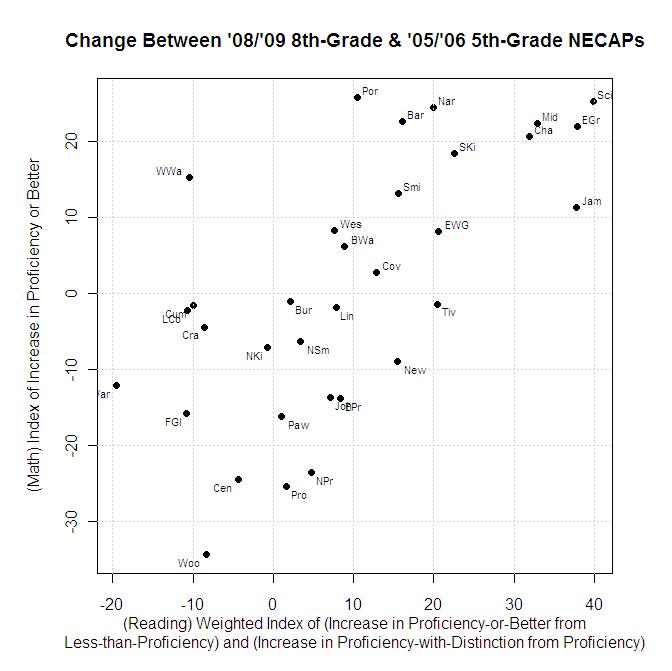
Schools nearer the upper right-hand corner did well in both reading and math. Schools nearer the lower left-hand corner have showed declines in both areas. The charts below the fold present the underlying information on...
- Improvements in students Proficient at Reading.
- Improvements in students Proficient with Distinction at Reading.
- Improvements in students Proficient at Mathematics.
Two differences from the 8th-grade to 11th-grade results are immediately worth noting...
- Between the 5th and 8th-grades, some districts did succeed in improving their number of students proficient in mathematics, unlike between the 8th and 11th-grades, where every district showed a decline. (For this reason, change in students proficient or better, rather than partially proficient or better, is used as the mathematics index.)
- Reiterating once again that the results here are far from dispositive, it should be noted that there is a much stronger correlation here than at the high school level, between districts starting from low proficiency rates and the largest declines in proficiency. This suggests that students in Rhode Island's underperforming districts may be falling furthest behind somewhere before high school begins. Exploring this result further will require matching test results to the movement of students in and out of a district, between the starting and ending years of a measured test period.
Continue reading "The State of Education in Rhode Island, Part 5"
March 8, 2010
Funding Formula on Final Approach
Coming out of last Thursday's State Board of Regents for Education meeting at the West Warwick High School Auditorium, if I had to place a bet, I would have to put my money down in favor of a "funding formula" for distributing state education aid being passed this session, probably a plan that is very close if not identical to the plan that has been put forth by Rhode Island the Department of Elementary and Secondary Education and officially endorsed by the Regents.
Momentum for passing a "funding formula" is coming from three main sources…
- Valid or not, Rhode Island's governing class cannot resist the argument of "49 other states do this, so we have to do it too". (We'll find out exactly what the number-of-state threshold is for this rationale when a few more states eliminate straight-party voting, but I digress)
- Eligibility for future Federal education aid will likely be conditioned on having some kind of "funding formula" in place, and
- Perhaps most importantly, the Department of Education has come up with a plan that is more politically viable than the "Ajello" plan (named for its primary sponsor, Providence State Representative Edith Ajello) that has dominated "funding formula" discussions for the past several years; according to the Department of Education's presentation, under their “funding formula” proposal, schools serving 71% of the students in Rhode Island can receive "more resources" (that's education official-speak for "more moolah"), without any new revenue having to be raised.
If one thing is most likely to stop a "funding formula" from being implemented in the very near future, it would be representatives from the traditional big-aid recipients getting greedy and trying to re-jigger the numbers to get more for themselves (already, at Thursday's meeting, a number of public comments boiled down to "this is a good start, but urban districts need more more more"). There is also the little matter of slipping a 15% cut in aid to Newport past Senate President Teresa Paiva-Weed (D - Jamestown/Newport) that cannot be entirely overlooked. However, politics being what it is, if the new “funding formula” holds together around its current form as it passes through the legislative sausage factory, there will be a large legislative majority able to vote in favor of more money for their constituents, by voting in favor of the new formula.
In the pre-Deborah Gist era of Rhode Island education policy, the impact of the new formula on charter school funding would be of definite concern -- specifically, are the cuts to charter schools intended as a backdoor way to kill charters altogether? Given her record so far, I believe that the Commissioner has earned the benefit of the doubt here and that due-diligence has probably been done to make sure the cuts won't be fatal (plus, could Federal replacement money for charters be a future possibility, if everything breaks correctly?). From a more affirmative perspective, a reasonable trade-off appears to be involved: for the cost of an upfront hit to their current aid, charters become fully integrated into a follow-the-student system for distributing state money, where increased funding is virtually automatic to charters able to attract larger numbers of students.
A few other items worth noting…
- The new formula eliminates the "regionalization bonuses" that were given to districts that chose to regionalize in the 1990s (according to Commissioner Gist’s remarks on Thursday, the bonuses were supposed to be phased out anyway but never were, when state aid amounts got frozen in the 1990s).
- In terms of quantifying student need, the formula uses only a single weighting-factor, the number of students receiving free or reduced priced lunch.
- The loss in aid to Central Falls (about $11 million) won't occur as quickly as losses in other districts (on a percentage basis), as the transition will be eased along with money from a separate "state stabilization fund".
- Commissioner Gist mentioned that the "Gallo" approach (named for Hanna the State Senator, not Frances the Superintendent), i.e. changing funding amounts only after state revenues increase, had been considered but rejected as unrealistic.
Which is not to say that the details of this plan can be forgotten about as we move towards other kinds of reforms. For one thing, Rhode Island's education reformers need to make sure some kind of anti-charter poison-pill isn’t inserted into Rhode Island law, in the middle of the night, on the last day of a legislative session, in the next few years. For another, the Department of Education and Board of Regents have to rigorously and seriously follow through with the spirit of their own recommendations (see page 12) for monitoring and updating funding policy results on a regular basis. In that vein, I would like to offer a suggestion for fiscal oversight that is important to the rectitude of any statewide "funding formula", but has been largely missing from the debate that has brought us to where we are…
March 5, 2010
A Friday Night Pedagogical Thought
Reviewing The Marketplace of Ideas by Louis Menand (subscription required), James Piereson raises a number of interesting concepts related to higher education, but this is perhaps the most fundamental:
The liberal arts at their best, he says, disseminate "knowledge that exposes the contingency of present arrangements," a surprising formulation coming from an author who takes the organization of the academy so thoroughly for granted. It is also revealing of a pedagogical outlook now pervasive in the academy: that students can learn how to think before learning anything important to think about.
At least to my experience, most of the examples used, in college lessons, are of the sort in which the answer is already presumed to be known by the professor. Race is the most common, with gender and sexuality in the mix, as well. The focus is the evil of oppression, not the borderlines of issues at which big ideas actually clash, as between civil liberties and civic structure. Slavery was and is an unmitigated evil, but concern about states' rights is not merely a sly way to support evil.
Indeed, an extremely interesting course could be built around the unintended side effects of measures taken to remedy the sins of the past. The Fourteenth Amendment comes to mind. Unfortunately, the largely progressive faculty who populate liberal arts departments don't seem inclined to offer their students a path to considering whether the easiest route to "progress" might not be the best.
Which ties into the above block quote in that grappling with actual Important Ideas, rather than trying to follow the illusory path of logic flowing from the first principle that no ideas are objectively important, might persuade developing generations that there are concepts worthy of real battle — and worthy compromise.
March 4, 2010
Privileges on Demand
Yeah, yeah, I know it sounds all right-wing conservative to say, but it's difficult not to fear for the future of our country with this sort of thing in the news:
Students and activists have staged demonstrations in recent months at public colleges across California to protest deep budget cuts that have led to steep tuition hikes, enrollment cuts, faculty furloughs and reduced course offerings.In Berkeley, about 50 people broke through a fence surrounding Durant Hall, which is closed for renovation, and about 20 entered and occupied the building, said Cpt. Margo Bennett of the UC Police Department.
The group smashed windows, sprayed graffiti, damaged construction equipment, knocked over portable toilets and hung up a banner promoting the March 4 rally, UC officials said. Others blocked police from entering the building.
So they're protesting budget-driven cuts by causing damage that the strained budget will have to cover. Worse, they're protesting something that until very recently was considered a huge privilege.
I can't help but wonder if part of the problem is that grown-up manipulators didn't fully understand the effects on subsequent generations of all of their "rights" talk, with regard to privileges, over the past few decades.
Confusion over Gallo Accepting Union Offer
It seems there is some confusion over the latest page in the Central Falls High School story. The ProJo headline reads, "School chief, teachers agree to resume talks." There is mention of both "sides" returning to "the table," which is some of the common parlance used when it comes to contract negotiations. In the ProJo story, Gallo is quoted as saying:
“My heart skipped a beat,” Gallo said after reading Sessums’ proposal. “I thought, ‘They are basically saying they want what we want for the first time, with the kind of assurances I need.’ … This brings the union back with us, in the conversation about meaningful reform. It’s where they should be."Further, as Supt. Gallo made clear this morning on WPRO's John DePetro Show (podcast), she's not talking about contract negotiations. The “table” the teachers are being invited back to is not a negotiating table but the one at which the reforms needed at the school will be discussed.
Additionally, it appears Supt. Gallo is not going to rescind her “fire” order until she’s sure the teachers are all in when it comes to reforming the school. She made clear in a radio interview this morning that she is holding out from rescinding her “fire” order until after the teachers take part in the planning process necessary to chart the path for fixing the school. She hopes to have that done in early May. After that, according to Gallo, then it will be up to the Board of Trustees of Central Falls to decide if they want to rescind the “fire” order.
Cumberland Approves Early Retirement Plan for Teachers
Cumberland has approved a plan designed to entice top step teachers into retirement for the purpose of saving cash.
If [20] teachers at the 10th salary step took retirement, it would save nearly $500,000, according to the board's estimate....The idea is for teachers at the first salary step to take the place of those at 10th salary step who choose retirement. Among several retirements incentives is paying 10 percent of the 2009-2010 school year's base salary on Aug. 15 or providing three years of healthcare coverage under the school district's plans. The retiree's copay would be at the same rates as those paid by people who remain employed by the school district.This is something other school districts have done in the past, too. Heck, private industry has offered these sorts of deals for years, though not as much as they used to, so there is certainly a precedent to this sort of thing: offer the expensive middle-management types a deal to get leaner and, if need be, hire cheaper replacements.
Of course, the difference in the private sector was that, in addition to the short term savings from replacing older employees with younger, long-term savings were realized by offering those younger employees less generous benefits packages. Not so sure if that's going to happen here. And I'm not sure if making it attractive for some of your most experienced--and one would think at least a few of the best--teachers to leave is the best thing for education.
March 3, 2010
Colleges Are Liberal Havens, Even When They're Catholic
It's interesting to see the political shifts of Catholic college students assessed on a scale of agreement with Catholic doctrine:
On pro-life issues, the results indicated a "mixed pattern," it said. A majority of Catholic students leave college disagreeing that abortion should be legal but they number fewer than those who entered with that opinion, it said. Overall 56 percent said they disagreed "strongly" or "somewhat" that "abortion should be legal." ...Like Catholic students at most public colleges, they moved toward agreeing with the church's position on the need to reduce the number of large and small weapons and its view that federal military spending should not be increased.
On the death penalty, 49 percent of Catholic students on Catholic campuses agreed "strongly" or "somewhat" with the church's opposition to the death penalty and were more likely than Catholic students at public colleges to agree with the church's social justice teaching on the need to reduce suffering in the world and "improve the human condition."
In brief, college moves kids to the left. Since the Church crosses the center line of Western politics, the students move toward the Church in some instances and away from it in others.
Management-Union Friendship and Money Seeking
Linda Borg's Sunday Projo article, "In Providence, more collaboration than conflict," weaves a tale of cooperation between the the city's schools superintendent and its teachers' union leadership:
Call it a tale of two cities.While the superintendent and union president have been going at it in Central Falls, Brady and Smith have worked together on a plan to radically reshape five of the state's lowest-performing schools.
Her Saturday article, "Providence teachers face job uncertainty," gives some indication as to why. First of all, Providence has already effectively experienced the "turnaround model" that has Central Falls roiling:
Teachers, however, had to reapply for their jobs, and only 50 percent of the existing staff chose to do so. What made Hope High School successful was that, in the end, the teachers who stayed were committed to making radical changes, from moving to longer class periods to spending more time planning instruction.
Union President Steve Smith credits "the faculty" with initiating that idea, but whatever behind-the-scenes maneuvering there may have been, it was ultimately a difference in the union's behavior, not the district's plan. Further along in the same article, we find a clue that might explain the two sides' inclination to cooperate (emphasis added):
But for teachers to embrace dramatic change, they want the district — and the state — to give them the resources they need to get the job done, Smith said. He is bringing those concerns to School Supt. Tom Brady so that the School Department can push for federal monies to pay for additional support, whether it's creating alternative classrooms for disruptive students or remedial classes for students who are performing below grade level.
Let's take as given that the cooperation in Providence is desirable, whatever its motivation. We still should consider such evidence as the newly proposed funding formula. Providence has been underfunded, and no doubt stands to drink deeply from any pool of Race to the Top federal money that comes to the state. The Department of Education has determined that Central Falls, by contrast, is already receiving much more state money than is "fair."
In summary, the Providence union has already acquiesced to the sorts of changes that the Central Falls union is fighting, and education leaders on both sides of the negotiating table in Providence have reason to expect their good behavior to be rewarded mightily.
March 2, 2010
Avoid Long Term Ramifications: RIIL Should Deny Cranston Team Consolidation
Cranston's recent proposal to merge school sports is currently being weighed by the Rhode Island Interscholastic League. John Gilooly explains why allowing such a merger would set a bad precedent:
The problem I see is that as an association of individual high schools, if the Principals Committee allows two high schools from the same city to combine teams as a cost-saving measure, it would be hard pressed in the future to prohibit schools from two different local governments to combine some teams to save money.Trying to make the best of a bad situation by allowing team consolidation for the purpose of giving more kids the opportunity to play--while noble sounding--is a flawed, short-term fix. For while this something-is-better-than-nothing solution would save a few sports in one community, the long-term ramifications would be detrimental to student athletes in Rhode Island. As Gilooly explains, this seemingly pragmatic approach, if authorized by the RIIL, could be used by communities across the state to justify cutting and combining sports, which would mean fewer spots for student athletes.Hopefully, the people in Scituate and Smithfield or Middletown and Newport never think this way, but if the precedent is set, how could the Interscholastic League not allow neighboring small communities, as well as other large cities, to save money in hard financial times by combining teams?
The result would be fewer opportunities for state’s high school students to reap the whole spectrum of benefits that come from playing for a high school varsity athletic team.
That goes against the 78-year mission of the R.I. Interscholastic League.
Such unintended consequences stemming from a purported fix in school athletics isn't unprecedented: the Education policy known as Title IX--which seeks to equal the playing field for female and male participation in school sports--is often used by schools to justify cutting boys sports to help maintain that equity. It's easier to cut men's baseball at Providence College, for instance, than to add and fund a new sport for women athletes, you see. The goal may be admirable, but there's no guarantee that the means to achieving will be quite what we'd hoped.
Finally, when viewed from a political angle, the RIIL shouldn't bail out Cranston for its self-made budgetary and fiscal problems. It's up to Cranston parents and voters to exercise their power and remind the politicians of what the priorities should be, one way or another.
The State of Education in Rhode Island, Part 4 (Or "Yes, this Series Does Have an End")
So how is the high-school in your community doing in general? To help you find the answer that question, I have created an index in the form of yet another two-dimensional plot. The x-axis represents information about improvements in reading proficiency, the y-axis information about declines in mathematics proficiency. The closer a district is to the upper right hand corner, the better it did in terms of changes in scores (at least relatively speaking, as at some point it would be nice to see positive numbers on the y-axis, so some cases of "who has improved the most in mathematics" would be represented, instead of them all being "who has declined the least") while the closer a district is to the lower left, the worse it did in terms of changes in scores.
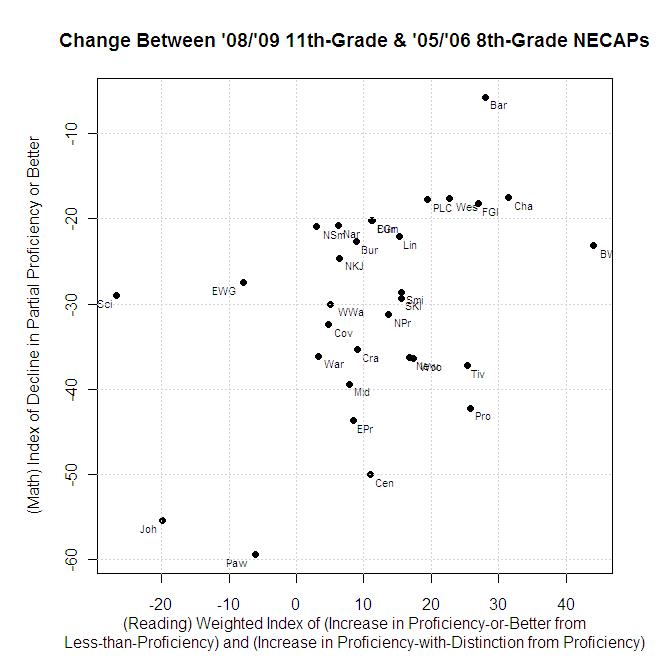
In fully technical terms, the x-axis is a weighted average, determined by…
- Multiplying each district's metric representing the increase (or decrease) in students proficient-or-better at reading calculated in Part 2 by its number of 8th-grade students who were less-than-proficient, then
- Multiplying the metric representing the increase (or decrease) in number of students proficient-with-distinction in reading calculated in part 3 by its number of 8th-grade students proficient or better, and
- Adding the products together and dividing by the total number of students in 8th-grade.
The y-axis, in all cases, in the decline in number of students partially-proficient in mathematics or better.
This plot is intended as a true index, in the sense that the numbers don't mean as much as does the information they can lead you to that explains their creation…
…if you are so interested.March 1, 2010
Everybody Needs a Dad
In a recent column, Julia Steiny ran through various ways in which fathers are, in general, distinguishable from mothers. Here's a sample:
... dads bring other huge contributions. For one thing, they play. That fatherly roughhousing that most kids love actually aids brain development. Play has been proven to enhance learning, and dads usually play with their kids more than moms. This play "promotes confidence in motor skills, courage, risk-taking and autonomy. It puts the kid on the path of healthy development and gives the child strong self-esteem," Glantz said. Even as they're wrestling with one another, the child can feel the love. And, "Dad's love is valuable like nothing else."
What all of the differences come down to, it seems to me, is that a father has unconditional love, like a mother, but without the sense of unity. As Steiny quotes from researcher Tonya Glantz:
"... think of how dads talk. It feels like: 'You are here with me' as opposed to 'You are a part of me.'"
That somewhat different relationship is not only something learned by the experience of being an actual parent, but also something that has been woven into our personalities and culture, in conformance with out biological natures. Whether you want to believe it's purely evolutionary or admit a Maker, fatherhood is expansive in the subtlety of its inherent effects on our society. (Which, of course, ties into the theological discussions that we've had around here, from time to time.)
What I've written above will have broad currency, in our culture, when the topic is education, parental responsibility, social work, and so on. However, much as fatherhood is broader than, say, an economic relationship, the concept of fatherhood and its importance ought to have implications for how we conceive of such things as marriage.
The State of Education in Rhode Island, Part 3
An examination of the NECAP reading proficiency results presented in Part 2 reveals that only 2 of 12 Rhode Island school districts that began with 70% or more of their students proficient or better in the 8th grade according to the 2005/2006 NECAPs exhibited an increase in their total numbers of students proficient by the 11th-grade. (The two districts were Portsmouth-Little Compton and Smithfield).
This raises at least two questions almost immediately. First, once a district reaches 70% proficiency, is improving the performance of the 30% who remain below the proficiency line (while not losing any of 70% above the line) a more difficult and perhaps qualitatively different problem than educating the "first" 70%? Note, for example, the contrast with districts that began in the range of 50% to 60% proficient in 8th-grade; 10 out of the 13 of these districts were able to increase their total number of student proficient. Answering this question accurately will ultimately involve either a few more years of Rhode Island data, or data from other parts of the country.
There is a second question, however, that we can go after right away: is talking about "proficient or better" where a discussion about educational achievement should end? One criticism of No Child Left Behind Act and the testing regime it has engendered is that too much emphasis is placed on making students average, perhaps at the expense on helping students excel, i.e. if schools are being held accountable for their number of students who are proficient or better, how much effort will they expend on helping the students already proficient improve from there?
The structure of NECAP provides a way to look into this question. Instead of looking for proficiency-or-better, we can look at the number of students who scored "proficient with distinction" -- the highest score attainable on the NECAP. And, at least at a first glance, the PwD results in reading provide are some of the most encouraging for education in Rhode Island so far, where between the 8th and 11th-grade NECAPs, almost every district in Rhode Island saw an increase in the number of students who scored "proficient with distinction".
Proficient-with-distinction absolute numbers can be turned this into a percentage in the same way as the proficient-or-better numbers were, with the appropriate choice of denominator. One such choice is to use the number of students who were "proficient" in the 8th grade in each district, in cases where districts increased their number of PwD students. One way to interpret this result is as a measure of how well school districts are doing with the group of students that have shown a a level of commitment to academics.
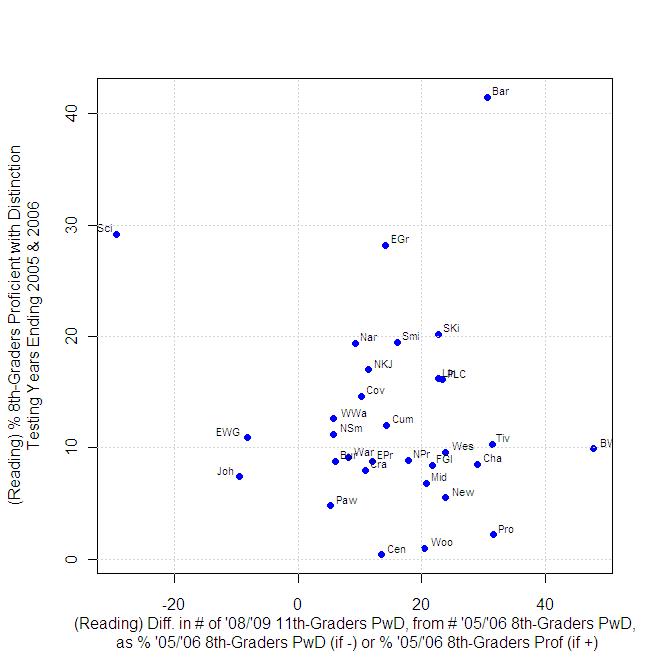
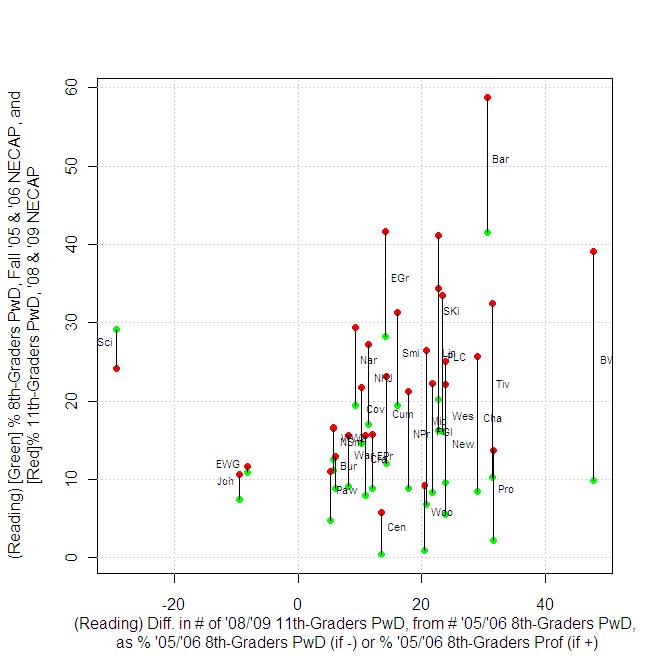
In mathematics, the basic problem is the opposite from the one of reading; given that every RI district underwent a loss of proficient-or-better students between 8th and 11th-grade results, maybe if the numbers of partially-proficient of better students are analyzed, we will be able to observe a stoppage of the bleeding.
Alas, the result is not any more heartening than the proficient or better is Rhode Island. Every district in Rhode Island saw a decline in the number of students who were partially proficient or better, and there is no avoiding the fact that mathematics education everywhere in Rhode Island is in a state of complete collapse.
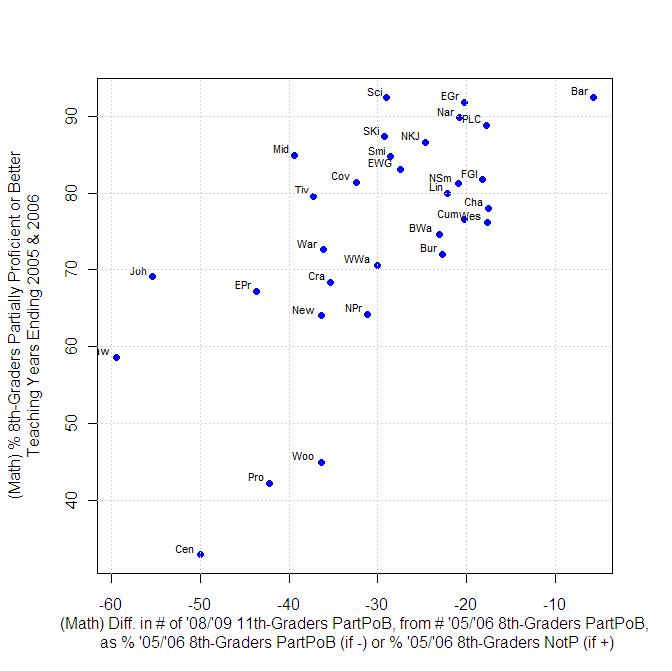
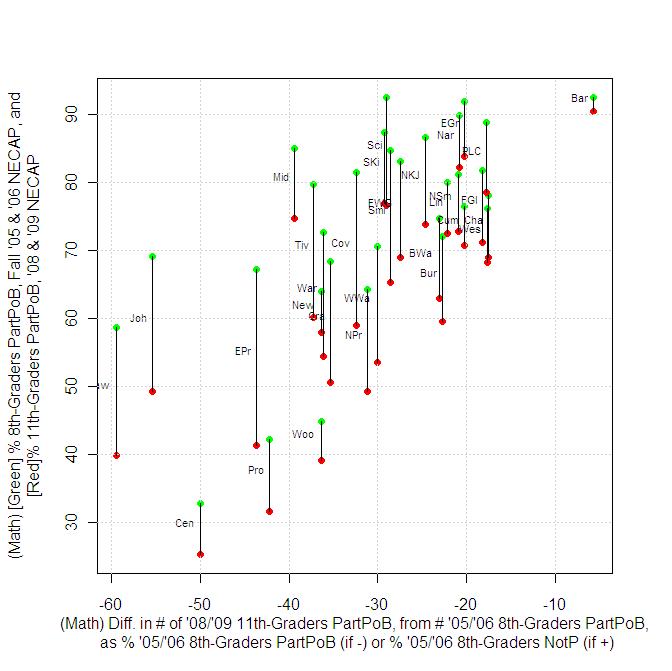
President Obama Uses Rhode Island Education Reform Examples
In a speech to Americas Promise Alliance to tout a $900 million school turnaround program, President Obama turned to Rhode Island for both positive and negative examples (h/t ProJo):
We'll not only challenge states to identify high schools with graduation rates below 60 percent, we're going to invest another $900 million in strategies to get those graduation rates up. Strategies like transforming schools from top to bottom by bringing in a new principal, and training teachers to use more effective techniques in the classroom. Strategies like closing a school for a time and reopening it under new management, or even shutting it down entirely and sending its students to a better school.Whether it passes or fails, it sure looks like Rhode Island is going to be on the forefront of education reform.And strategies like replacing a school's principal and at least half of its staff. Now, replacing school staff should only be done as a last resort. The public servants who work in America's schools -- whether they're principals or teachers, or counselors or coaches -- work long and hard on behalf of our children and they deserve our gratitude. Keep in mind I've got a sister who's a teacher, my mother spent time teaching -- one of the most important jobs that we have in this country. We've got an obligation as a country to give them the support they need -- because when principals and teachers succeed, then our children succeed.
So if a school is struggling, we have to work with the principal and the teachers to find a solution. We've got to give them a chance to make meaningful improvements. But if a school continues to fail its students year after year after year, if it doesn't show signs of improvement, then there's got to be a sense of accountability.
And that's what happened in Rhode Island last week at a chronically troubled school, when just 7 percent of 11th graders passed state math tests -- 7 percent. When a school board wasn't able to deliver change by other means, they voted to lay off the faculty and the staff. As my Education Secretary, Arne Duncan, says, our kids get only one chance at an education, and we need to get it right.
Of course, getting it right requires more than just transforming our lowest performing schools. It requires giving students who are behind in school a chance to catch up and a path to a diploma. It requires focusing on students, from middle school through high school, who face factors at home, in the neighborhood, or in school that put them at risk of dropping out. And it requires replicating innovative ideas that make class feel engaging and relevant -- because most high school dropouts in a recent study said the reason they dropped out was that they weren't interested in class and they weren't motivated to do their work.
So that's why we'll build on the efforts of places like Communities in Schools that make sure kids who are at risk of dropping out have one-on-one support. That's why we'll follow the example of places like the Met Center in Rhode Island that give students that individual attention, while also preparing them through real-world, hands-on training the possibility of succeeding in a career.
February 28, 2010
The State of Education in Rhode Island, Part 2 Take 2
Oftentimes, information communicated in terms of underlying counts gives people a sense of what is reasonable and what is possible that can be lost when results are presented solely in terms of percentages. So before moving on to the part 3 post in the State of Education in RI series, I am going to post in a tabular form the numbers that the part 2 graphs were based on.
In the tables below, the second column shows the change (by district) in total number of students proficient or better, as measured by the 8th then 11th grades NECAPs. The absolute numbers of students used to calculate these differences were presented in Part 1. In all cases, this column provides the numerator of the percentage shown in column five.
The third column is the number of students who were proficient or better on the 8th-grade NECAPs. In cases where the total number of students who were proficient or better decreased between 8th and 11th grade results, column three is used as the denominator of the percentage in column five, defining column five as the change in the number of less than proficient students in a district, between grades 8 and 11, as a percentage of the number of students who were proficient or better in grade 8.
The fourth column is the number of students who were less than proficient, i.e. who scored "partially proficient" or "not proficient", on the 8th-grade NECAPs. In cases where the total number of students who were proficient or better increased between 8th and 11th grade results, column four is used as the denominator of the percentage in column five, defining column five as the change between grades 8 and 11 in the number of proficient or better students in a district, as a percentage of the number of students who were less-than-proficient in grade 8.
In other words, if the number of students who were proficient in a district went up between 8th and 11th grades, column five is the percentage of less-than-proficient students as measured in the 8th grade who advanced. If the number of students who were at least proficient went down, column five is the percentage of proficient-or-better students as measured in the 8th grade who declined. As stated in Part 1 of Part 2, this split metric isn't ideal. In the case of districts that experienced declines in number of students proficient, no distinction is made between those who advanced a large number (or large percentage) of already proficient students, versus those who advanced smaller totals. This is why it is useful to plot results described here in conjunction with the starting percentage of students proficient or better from each district, to provide a look at the changes over time than can occur in districts that start from similar levels (when you look at a horizontal slice of the 2D-plot) or from different levels (when you look at the entire plot) of academic achievement.
Results in this post are sorted from highest percentage to the lowest. Part 3 in the series to appear on Monday.
| Community | Change in # of Students PoB at Reading, between 8th and 11th Grades | # of 8th-Graders Proficient or Better at Reading, '05 & '06 NECAP | # of 8th-Graders Less-than-Proficient at Reading, '05 & '06 NECAP | Change in # PoB at Reading, between 8th and 11th Grades, as % of '05/'06 8th-Graders LtP |
| Bristol-Warren | 71 | 344 | 191 | 37.2% |
| Foster-Glocester | 54 | 285 | 146 | 37.0% |
| Chariho | 82 | 379 | 233 | 35.2% |
| Providence | 634 | 1115 | 2704 | 23.4% |
| Westerly | 38 | 358 | 185 | 20.5% |
| Woonsocket | 112 | 293 | 697 | 16.1% |
| Tiverton | 19 | 228 | 130 | 14.6% |
| Smithfield | 13 | 332 | 93 | 14.0% |
| Burillville | 23 | 287 | 166 | 13.9% |
| Newport | 20 | 184 | 198 | 10.1% |
| Central Falls | 40 | 150 | 403 | 9.9% |
| Cranston | 42 | 1090 | 703 | 6.0% |
| North Providence | 11 | 390 | 194 | 5.7% |
| West Warwick | 11 | 339 | 255 | 4.3% |
| Cumberland | 11 | 568 | 264 | 4.2% |
| East Providence | 17 | 532 | 438 | 3.9% |
| Portsmouth-Little Compton | 3 | 412 | 98 | 3.1% |
| Community | Change in # of Students PoB at Reading, between 8th and 11th Grades | # of 8th-Graders Proficient or Better at Reading, '05 & '06 NECAP | # of 8th-Graders Less-than-Proficient at Reading, '05 & '06 NECAP | Change in # PoB at Reading, between 8th and 11th Grades, as % of '05/'06 8th-Graders PoB |
| Barrington | -2 | 526 | 47 | -0.4% |
| North Smithfield | -9 | 224 | 89 | -4.0% |
| Warwick | -50 | 1119 | 711 | -4.5% |
| Lincoln | -25 | 400 | 138 | -6.3% |
| East Greenwich | -25 | 357 | 58 | -7.0% |
| Exeter-West Greenwich | -17 | 241 | 97 | -7.1% |
| Coventry | -55 | 641 | 258 | -8.6% |
| South Kingstown | -52 | 518 | 144 | -10.0% |
| Narragansett | -22 | 210 | 38 | -10.5% |
| North Kingstown-Jamestown | -82 | 697 | 190 | -11.8% |
| Scituate | -34 | 262 | 53 | -13.0% |
| Middletown | -34 | 242 | 142 | -14.0% |
| Pawtucket | -94 | 655 | 900 | -14.4% |
| Johnston | -121 | 341 | 228 | -35.5% |
| Community | Change in # PoB at Mathematics, between 8th and 11th Grades | # of 8th-Graders Proficient or Better at Math, '05 & '06 NECAP | # of 8th-Graders Less-than-Proficient at Math, '05 & '06 NECAP | Change in # PoB at Math, between 8th and 11th Grades, as % of '05/'06 8th-Graders PoB |
| Barrington | -105 | 485 | 88 | -21.6% |
| East Greenwich | -95 | 341 | 74 | -27.9% |
| Lincoln | -129 | 344 | 192 | -37.5% |
| Narragansett | -67 | 176 | 70 | -38.1% |
| Portsmouth-Little Compton | -148 | 381 | 129 | -38.8% |
| Westerly | -121 | 296 | 247 | -40.9% |
| Bristol-Warren | -120 | 293 | 242 | -41.0% |
| Chariho | -145 | 347 | 268 | -41.8% |
| Cumberland | -186 | 433 | 401 | -43.0% |
| North Kingstown-Jamestown | -265 | 602 | 285 | -44.0% |
| South Kingstown | -211 | 476 | 188 | -44.3% |
| Burillville | -98 | 213 | 240 | -46.0% |
| North Smithfield | -96 | 198 | 115 | -48.5% |
| Foster-Glocester | -131 | 270 | 161 | -48.5% |
| Smithfield | -124 | 255 | 170 | -48.6% |
| Scituate | -121 | 240 | 74 | -50.4% |
| North Providence | -127 | 237 | 352 | -53.6% |
| Cranston | -418 | 779 | 1019 | -53.7% |
| Middletown | -142 | 264 | 121 | -53.8% |
| Exeter-West Greenwich | -120 | 219 | 118 | -54.8% |
| Providence | -488 | 873 | 3008 | -55.9% |
| Newport | -98 | 174 | 209 | -56.3% |
| Coventry | -326 | 569 | 329 | -57.3% |
| Woonsocket | -139 | 241 | 761 | -57.7% |
| West Warwick | -178 | 300 | 291 | -59.3% |
| Tiverton | -134 | 215 | 143 | -62.3% |
| Warwick | -593 | 923 | 901 | -64.2% |
| East Providence | -297 | 437 | 533 | -68.0% |
| Johnston | -157 | 226 | 346 | -69.5% |
| Central Falls | -64 | 85 | 492 | -75.3% |
| Pawtucket | -429 | 552 | 1025 | -77.7% |
A Regionalization Correction
I've made one set of corrections to the education statistics presented at the beginning of last week (Part 1 here, Part 2 here), specifically to the results for North Kingstown and Portsmouth. As the result of agreements between towns, North Kingstown High is the public high school attended by students from Jamestown and Portsmouth High is the public high school attended by students from Little Compton. Therefore, to properly establish the starting point for an approximate cohort of North Kingstown 11th-graders, 8th-grade totals from North Kingstown plus Jamestown should be used. Likewise, the starting point for Portsmouth's 11th-grade results is the 8th grade totals from Portsmouth plus Little Compton.
And with that, we can resume our tour through the education outcomes in Rhode Island's cities and towns…
Rhode Island Statewide Coalition Winter Meeting Table of Contents
Anchor Rising's complete coverage of the Rhode Island Statewide Coalition's winter meeting:
- My on-the-scene liveblog
- Video: RISC Chairman Harry Staley's opening remarks
- Video: 630AM/99.7FM Host John DePetro
- Video: Central Falls Superintendent Frances Gallo
- Video: RISC President James Beale and Business Network Organizer Jeff Deckman
- Video: Rhode Island Governor Don Carcieri
- Video: Board of Regents Member Angus Davis
February 27, 2010
Board of Regents Member Angus Davis at RISC's Winter Meeting
NOTE: Any members of the media who couldn't make it to the meeting and rely on this video for future reports are encouraged to do so, but a brief note of the video's source would be appreciated.
Rhode Island Board of Regents member Angus Davis came out with guns blazing in a surprise speech at the Winter meeting of the Rhode Island Statewide Coalition, as described in my liveblog of the event. (More video in the extended entry.)
Davis was especially animated when discussing an email from gubernatorial candidate Linc Chafee at the beginning of this clip.
Yesterday, I received an email from Senator Chafee. In this email, Senator Chafee asked for clarification on whether or not teachers had really been offered 100% job security, describing it as, quote, the basic question that must be settled, unquote. He said he does not want to, quote, inherit the labor mess, unquote, as he works to build a more prosperous Rhode Island as governor.Continue reading "Board of Regents Member Angus Davis at RISC's Winter Meeting"What kind of leadership thinks the basic question about a school in which only half of children graduate and 90% can't do basic math — what kind of leadership thinks that the basic question involves job security for its adults rather than the educational outcomes for its children?
Central Falls Superintendent Frances Gallo at RISC's Winter Meeting
NOTE: Any members of the media who couldn't make it to the meeting and rely on this video for future reports are encouraged to do so, but a brief note of the video's source would be appreciated.
Herewith, the video of the speech given by Central Falls Superintendent Frances Gallo at the Winter meeting of the Rhode Island Statewide Coalition, as described in my liveblog of the event. (More video in the extended entry.)
Although the entire speech is notable as the most comprehensive statement of Supt. Gallo's position that I've seen (and I don't claim to have searched high and low), the beginning of this segment may be a new news item:
I'll answer now, although I was never asked by anyone: No. We can't mediate now. I'll say it clearly, and I mean no offense to anyone, but those ads continue. What kind of an effort at true desire for change when you keep those ads.Continue reading "Central Falls Superintendent Frances Gallo at RISC's Winter Meeting"
Funding Formulas
A new funding formula for schools--to be phased in over a few years--is being floated.
The Barrington School District would see a boost of $3.8 million, or nearly 190 percent, over the next five years. Other winners include Providence (up $28.7 million, or more than 15 percent), Cranston (up $9.6 million, or almost 29 percent) and Pawtucket (up $6.9 million, or nearly 11 percent).This should be interesting.State Department of Education officials worked with Brown University to craft the plan and quietly shared drafts of the plan in recent weeks with some school districts, interest groups and legislative leaders, but planned a formal release at next Thursday's meeting of the Board of Regents for Elementary and Secondary Education.
State lawmakers have for years considered formula proposals, but this represents the Department of Education's first formal proposal. Members of the House and Senate are expected to be briefed next week on the complicated formula that is sure to ignite a political firestorm.
Communities that lose funding would have as many as 10 years to absorb the cuts.
Central Falls heads the list of losers, down $11.6 million, or almost 26 percent. Others include the Bristol-Warren school district (down $9.1 million, almost 47 percent), the Metropolitan Regional Career and Technical Center, in Providence, (down $8.2 million, or 64 percent) and the Chariho School District (down $6.6 million, or nearly 47 percent). Aquidneck Island communities would be particularly hard hit as well; its three communities would lose a combined $7.4 million, or almost 29 percent.
February 26, 2010
Yeah, We Have No Idea
Here's another instance of the disconnect of the labor unions:
"We think it’s an outrage," Jane Sessums, president of the Central Falls Teachers Union, said, as hundreds of union supporters from across the state began flowing into Jenks Park. "Our members are feeling awful, devastated. How would you feel, being terminated?"
One gets the impression that, on some level, they don't believe that anybody ever gets laid off anywhere. Some construction companies in the Newport area have laid off almost as many employees as work in Central Falls. The worst part is that the teachers could have avoided the whole thing if the unions weren't so intent on standing their ground in hopes of averting a statewide conflagration of concessions and reform.
Yorke Airs Both Sides of Central Falls Debate
Dan Yorke spoke with both Central Falls Superintendent Francis Gallo (podcast link) and Central Falls High School Guidance Counselor George McLaughlin (podcast link) on his show yesterday. Supt. Gallo explained that she was stymied by the union in trying to work out a solution based on the "transformation model." But first she wanted assurances on as first step on transformation model:
1) increase length of school day by around 20 minutes
2) formalize committment by teachers to tutor 1 hr a week to ascertain its impact / effectiveness
3) have lunch with students once a week as an informal way to get-to-know each other, not as a lunch duty
4) two weeks of curriculum work in the summer at $30/hr
5) 90 minutes a week for teacher team meetings (common planning) @ $30/hr
6) 3rd party evaluation that could lead to teacher firings as necessary
As Yorke later elaborated, the only difference between these assurances and the "turnaround model" is that #6 is a termination of all teachers and a maximum re-hiring of 50% of the current teaching staff. Related to the evaluation/firings (#6), Gallo explained that she had started discussions thinking that 80% of the teachers would be retained but eventually told the union that she would not fire any teachers if they would go along with the rest of her plan. According to Gallo, the union leadership was unresponsive. (And she took the extra step of detailing this final proposal in a letter to CF Teacher union leadership).
During his time, McLaughlin explained that all he wanted was for the parties to go to the table and work something out. He gave his perspective as someone in the school and reiterated that the problem wasn't about money but about job security. When Yorke explained that Gallo had taken teacher firings off the table (as just described) and had a letter to prove it, McLaughlin said it was incumbent upon Gallo to show the letter. To this, Yorke made the counter-point that McLaughlin could just as easily go to Gallo (or union leadership) and check it himself.
McLaughlin also tried to score debate points by saying Gallo was inconsistent regarding the lunch period (item #3) because she had removed the teachers from lunch duty in the first place. (Here, it's worth contrasting this with what Gallo said: it seems she was addressing this potential contention by emphasizing that the new lunch hour request was explicitly to spend time with kids, not as a "duty"--I wonder if she's heard this "talking point" before?). But, as Yorke pointed out, the only reason she had removed the teachers from lunch duty was because the union wanted a time concession somewhere to make up for previous requests (from prior years) that Gallo had made concerning common planning time and the like. In short, McLaughlin accused Gallo of telling only half the story....while only telling half the story. (McLaughlin is obviously a guy who genuinely cares for his school, the kids and his colleagues...he's just got a lot of years in the education industrial cocoon, which informs his perspective).
UPDATE: Today, Yorke has posted the letter from Gallo to the union. The key excerpt:
I need to re-emphasize that the Transformation Model is the only model in which it is possible for the majority of teachers and administrators at the school to retain their jobs.As Gallo stated, though the letter doesn't explicitly state that there will be no job loss, point #6 mentions an evaluation process and does not mention any teacher firings, such as an 80/20 (retention/let go) formula. The clear implication is that the transformational model, which Gallo was trying to get the teachers to go with, was the best chance for the most teachers to have security in the future.Unfortunately, to date we have been unable to reach agreement with you regarding the implementation of key elements of the Transformation Model, specifically including the following:
1. Increase the length of the high school day so that the student day is 8AM – 3 PM
2. Formalize the high school teacher commitment of weekly tutoring for one hour outside of school time
3. Each teacher will partake of a communal lunch with students one day each week
4. Agree to continue paid professional development for two weeks outside of the typical school calendar
5. Agree to meet for 90 minutes each week in order to look at student work, assess data, plan units of study and seek continuous improvement in professional practice
6. Acknowledge that third party evaluators will begin evaluation of all high school teachers on March 1, 2010.Please note that these six elements listed above are what I view as the core elements of my being able to inform the Commissioner that Transformation is a viable option for our high school. For your convenience, I have attached (Attachment 1) all elements of both the Transformation and Turnaround models directly from the Protocol.
With your agreement to move forward, I will notify the Commissioner that Central Falls has selected the Transformation School Reform Model. Without your agreement, since the Closure and Restart models are not viable options at this time, it will be incumbent upon me to either choose the Turnaround School Reform Model for Central Falls or inform Commissioner Gist that we have collectively failed to select an intervention model for the high school and cannot begin planning for implementation. Pursuant to the Protocol, that latter option “shall be cause to trigger the reconstitution authorities granted” to the Board of Regents to Reconstitute Central Falls High School. In the case of either Turnaround or Reconstitution, I cannot provide any assurances to any faculty member or administrator at the high school that they will remain employed at the start of the next school year.
It is my sincere desire that we find a way to work together to implement Transformation, which I firmly believe is in the best interests of the students of the high school, as well as the members of the Central Falls Teachers Union.
Not Much of an Education Story
We're in sad circumstances when this hardly seems like much of a story at all:
The [Cranston] School Committee Tuesday approved a nearly $123.6-million budget that eliminates high school teams, the enrichment program [aka, honors programs], the elementary school strings, band and choral program, and lays off about 16 employees.The teams cut are: freshman baseball, basketball and football; girls junior varsity field hockey; golf (coed); tennis (boys and girls); and indoor track (boys and girls).
Rhode Island students are being palpably harmed because adults lack the imagination and political will to beat back other adults' greed. Which brings us to Pat Crowley testifying before the RI House Finance Committee:
The education cuts would apply immediate pressure on municipalities to raise property taxes, cut staff or reduce student programs, according to Patrick Crowley, assistant executive director for the National Education Association of Rhode Island.
What's missing from Crowley's list is something that officials fear to make a public point about: reductions in remuneration. The reason is that it's the obvious necessity. They behave as if negotiations and concessions are some mysterious bending of reality that happens when officials and union leaders get together for verbal fencing behind closed doors. They're wrong, and they should fear (as I do) that continuing failure to step forward into the light and declare the game over will result in voters' demanding a Central Falls in every town.
February 25, 2010
Re: Times of Drasticness
By way of follow up, I asked Director of Administration and Finance Doug Fiore a couple of questions after tonight's school committee meeting, here are various interesting data points derived from our conversation:
- Approximately $130,000 of the $450,000 increase in health insurance costs would have been erased from the next budget if the union hadn't blocked the intended coshare increase from 12% to 18%. I assume (but did not clarify) that $260,000 would have been saved if that percentage had been applied to this year and next.
- The layoffs and reassignments that the district is leaving open as possible by sending out notices to teachers would, in total, save $1.3 million.
- That same amount could be saved by reducing combined salaries and benefits across the board by approximately 8%.
- That means that the current shortfall of $750,000 could be covered with an across-the-board reduction of about 4-5%.
I want to stress that these are ballpark figures provided while wrapping up a meeting, so they shouldn't be taken as working numbers. I'm merely trying to illustrate comparative options for covering the budget shortfall that, for some reason, aren't aired publicly.
Times of Drasticness Begin
I was a few minutes late to tonight's Tiverton School Committee meeting, and it was already underway. The high school library is pretty well filled, which means probably about 30-40 people, an apparent mix of students, teachers, and residents. The topic: closing the high school. Of course, when the union is looking for a juicy raise, the teachers pack the gymnasium, which means three digits rather than two.
Frankly, I can't help but recall the first school committee meeting after the financial town meeting at which the electorate restrained the school district's budget by $627,000 or so. At that time, the message coming from people associated with the district was that the committee had to do something drastic to drive parents to the financial town meeting and vote for lots of money.
Now Superintendent Bill Rearick said, just now: "Folks in our community need to decide what they want." He says they should go to town meetings, including the financial town meeting. This is just a dance to drive a few hundred more people to the FTM to raise taxes by double digits for everybody else.
7:25 p.m.
Rearick argued that adjustments to labor would only solve this year's problem, not the systemic problems that are yielding such high deficits, ignoring:
- That one of our problems is that raises are compounding.
- That the committee spent hundreds of thousands of dollars in "stimulus funds."
- That he really shouldn't leave such things as pensions out of the labor costs.
We're something like $750,000 short for next year. Had the committee frozen compensation rather than giving out retroactive raises, it would now be only about $150,000 short, and the federal stimulus money was much beyond that.
7:36 p.m.
Deborah Pallasch just read a letter on behalf of the Democratic Town Committee urging rapid resolution of negotiations with the union. No doubt some of the Democrats are urging the union to secure the maximum as they can right now, because they see that things are only going to deteriorate.
7:39 p.m.
A resident whom I don't know just said that the retirement communities that moved to town in recent decades are "cancers on our community." He must be among the faction calling for unity and cooperation in town.
7:41 p.m.
If he's talking about Tiverton Citizens for Change, I can testify that a majority of the core members are not gated community types.
Jan Bergandy took the opportunity to say that people have to turn out for the FTM
Dave Nelson is now addressing the committee. As he's began speaking, he turned periodically to face the audience. Unbelievably, Deborah Pallasch shouted from the audience: "You need to address the committee, not the audience." Who does she think she is?
7:49 p.m.
Here's an interesting angle: A resident just asked whether there's been any communication about bringing Little Compton students into our system. I know they used to do that, and I'm not sure what happened. But it does raise the interesting point that the district has an opportunity if it concentrates on making its programs attractive.
That means getting more for its money.
The next speaker talked about hiring maintenance staff who keep the property up, rather than merely cleaning it. Again: The upshot is that the district now allocates its money poorly. It needs to shift some of its per-pupil expenditures toward new programs, some to maintenance, some to technology, and so on. That will mean holding existing labor flat or somewhat decreased to make the school more attractive — especially with the possibility of increased student choice in the near future.
7:58 p.m.
School Committee Chairman Jan Bergandy just pointed out that the argument that some have made that losing the high school would make property values plummet has the problem that Little Compton's property values are much higher even though the town has no high school. It's not really a valid comparison, because the two towns are very different, but it's interesting that he argued that way.
Deb Pallasch just suggested that the committee "do whatever it can do" to drive people to the FTM.
8:12 p.m.
They've moved on to talking about possible health insurance switches. The upshot is that it would take a lot of money and research even just to find out whether switching would make economic sense.
8:17 p.m.
Health insurance increases account for $450,000 of the current shortfall. Not sure what percentage of that is due to the union's argument that it didn't have to negotiate a new contract this year and would not accept the budgeted increase of health insurance coshare from 12% to 18%.
Now they're discussing the 31 pink slips and 15 displacement letters that the district will send out to meet the legislative deadline of March 1 for such notices.
How absurd is it that the district must simply pick the junior employees for all layoffs. Are there no older teachers whose absence would save more money and whose absence would minimally affect the students (or perhaps not at all)? Moreover, I just don't understand how the union can make all of the arguments for class size, solidarity, and basically its entire argument for existing if it would rather cut young teachers loose rather than give concessions.
A young librarian is making an extended argument for what her department accomplishes. Good for her. None of these programs should be cut.
8:35 p.m.
Just an observation: Supt. Bill Rearick is offering a conciliatory lay-off-related speech, encouraging more participation in the leadership process, but his tone of voice is confrontational. His tone isn't always so, which makes me wonder who, in his mind, he's confronting.
8:41 p.m.
A recent graduate of the high school just argued on behalf of the library staff, and she closed by expressing the opinion that "a more critical eye" should be applied to the layoff process. Perhaps it's an introduction to the effect that the union system can have on a professional workforce. It's plainly wrong and strategically ludicrous.
8:47 p.m.
Bergandy mentioned that there's been no movement with NEA negotations, except the scheduling of a March 4 mediation.
8:49 p.m.
I'm increasingly persuaded that union-friendly legislators set the deadline for layoffs so early precisely for the angst and disruption it causes among teachers and the community, even though budgeting can't possibly be complete by this point. The law should change, and teachers should be leading the charge.
Politics & Pupils
Monique and Matt talked Central Falls and Chafee on last night's Matt Allen Show. Stream by clicking here, or download it.
February 24, 2010
Parents Can Only Teach What They Know
The raging blame debate, when it comes to public-school students' performance, made an appearance in RI Education Commissioner Deborah Gist's online chat for the Providence Journal:
Parent: As a parent of 2 children, I know how crucial parent involvement is. Has anyone looked at educating the parents of the kids of these failing schools? You can replace the teachers....and you can give new teachers incentives to change things around. But this is a band aid. Teachers are blamed for too many problems. They can't be expected to solve the problems of society. Teachers have many many challenges these days- more so than 25 years ago. Kids and parents need to take responsibility for on education. Just look at math grades around the state. Kids don't know how to deal with fractions because they don't know how to tell time on an analgoue clock. But the teachers are blamed. Let's take a look at the real problems. Educate the kids - the parents- look around the country at other programs. Please don't make this mistake.Deborah Gist: Parent involvement is important, and supportive, engaged parents are important partners in a child's education. Fortunately, we know that great teaching can overcome those instances when children have parents who are unable to provide that level of support. I don't blame teachers, but I do hold them accountable for results. I also hold myself and everyone on my team accountable.
I wonder if this mightn't be an area in which productive cooperation is actually possible. With math in particular, many students aren't being taught in a manner with which their parents are familiar. Indeed, from time to time one reads or hears about parents' being explicitly instructed not to teach their children the "old" (tried and true) methods of mathematics while helping them with their homework. In a society in which parents are already too disengaged, increasing the likelihood that they'll appear ignorant in front of their children isn't going to help.
Something similar surely comes into play with the fading of literary classics from the curriculum and the reworking of history books to reflect the radical tinge of the academy. A "back to basics" campaign in which the commissioner encourages a resurgence of more-traditional curricula would be an excellent complement to her reforms related to the structure of the public education system.
A Day in the Life of RI Education
A look at the papers today gives quite a little snapshot of the sorry state of education in Rhode Island. Central Falls is firing it's high school teachers as a way to deal with a chronically under-performing school (with the blessing of the State Education Commissioner Gist and U.S. Secretary of Education, Arne Duncan) because the teachers union didn't want to put in a couple more hours a week at $30/hr; Cranston is cutting school sports and other activities instead of cutting where it would hurt adults; the budget crunch is prompting West Warwick and Cumberland to look at school consolidation--something worth studying on its own, not as part of crisis management; Providence held a meeting about their troubled schools and all of 30 or so people came; nor did anyone show at a funding formula hearing at the State House; finally, apparently Pawtucket has been spending about $10 million a year over budget on their schools. Union games, knee-jerk solutions, playing on the emotions of parents, parental apathy and budget mismanagement. All predictable and preventable if only more stakeholders (which is pretty much every RI taxpayer!) had the will to make the necessary changes.
Thankfully, we seem to have an education Commissioner who is willing to follow up her rhetoric with actions and lead us forward with new ideas and a fresh attitude. It's up to us to support her (as some are) by backing her proposals and demanding accountability and change in council and committee meetings. The alternative is more of the same stories, day after day.
February 23, 2010
Steps Don't Just Go UP
Reading a couple different articles (and the comments) prompted me to go looking for the Rhode Island statute that required teacher steps. Here it is (16-7-29):
§ 16-7-29 Minimum salary schedule established by community. – (a) Every community shall establish and put into full effect by appropriate action of its school committee a salary schedule recognizing years of service, experience, and training for all certified personnel regularly employed in the public schools and having no more than twelve (12) annual steps. The term "school year" as applied to the salary schedule means the ten (10) calendar months beginning in September and ending the following June.Part (b) is pretty interesting, no? So, while steps are indeed required, they can be "level funded" or reduced. All the law really asks is that a predictable schedule be in place. Seems like school committees could take a variety of innovative approaches to redesigning the schedules such that cost savings could be built into the schedule.(b) Nothing in this section shall prohibit a freeze or reduction of the monetary value of the steps in the salary schedule through the collective bargaining process. (emphasis mine)
The State of Education in Rhode Island, Part 2
The district-by-district count data, presented in yesterday's post, on changes between the 8th and 11th grades in the numbers of students proficient in reading and math needs to be compared to a measure of opportunities for change, in order to be useful for purposes of analysis and accountability. Depending on whether a change in number of students proficient was positive or negative, two possible measures of opportunities are...
- The number of students who started out as less-than-proficient, when the number of students who are proficient or better in a subject increases (net opportunities taken), or
- The number of students who started out as proficient or better, when the number of students who are proficient in a subject declines (net opportunities lost).
Since it is unlikely that all of the different possible effects balance one another out, instead of presenting results in a 1D table, the results will be presented in 2 dimensions so that -- in the spirit of a value-added analysis -- changes in groups of students who began from roughly the same place can be compared.
The y-axis of the plot below shows the percentage of students who scored proficient or better on the 8th-grade NECAPs in 2005 and 2006, i.e. the “starting point” for each district. The meaning of the x-axis changes, depending on whether the value is positive or negative…
- For positive values, the x-axis represents the change between the 8th and 11th grades in number of students who scored proficient or better in reading, expressed as the percentage of students who were less-than-proficient in that district in the 8th grade.
- For negative values, the x-axis represents the change between the 8th and 11th grades in number of students who scored proficient or better in reading, expressed as the percentage of students who were proficient or better in that district in the 8th grade.
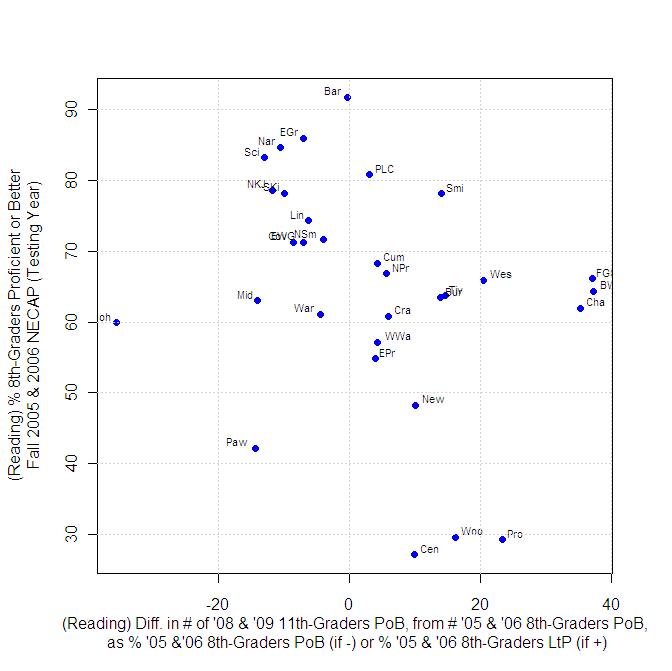
Where a district sits along the x-axis is an attempt to measure how well it did or didn’t do in the time-interval considered, with a reduced dependence on starting point. Certainly, the rankings according to the x-axis are different from the usual rankings of Rhode Island school districts. Between the 8th and 11th grades, Central Falls, Woonsocket and Providence saw the number of students who were proficient in reading increase by 10% to 23% of the percentage of students who were less-than-proficient in 8th grade. Districts that showed improvements according to this metric, within these bounds include Burrillville, Tiverton, Westerly, Smithfield and North Kingstown.
The graph above can also be read in terms of horizontal bands. The most "diverse" horizontal band lies between 8th-grade proficiency starting-points of 60% and 70%. Some districts (Bristol-Warren, Foster-Glocester, Chariho) increased their numbers of students proficient in reading by nearly 40% of their less-than proficient 8th-grade total while other districts, like Middletown, Warwick and Johnston experienced declines in the number of students proficient or better in reading -- in the case of Johnston, a very substantial decline. (And no, this is not in and of itself an argument for regionalization.)
Finally (for reading), instead of plotting the y-axis in terms of the starting point 8th-grade proficiency, results could also be plotted in terms of the final 11th-grade percentage of students proficient. Even better, both starting and ending proficiency percentages can be shown on the same plot…
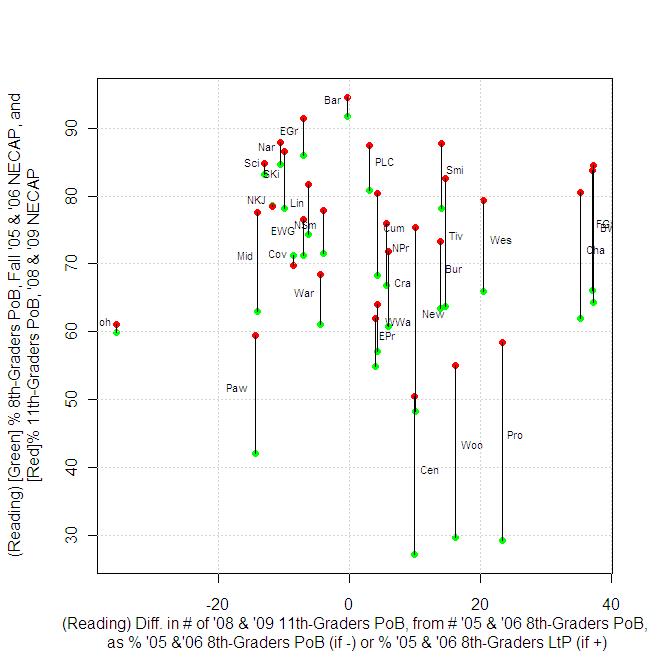
The results here are a bit counter-intuitive, as districts like Pawtucket and Middletown can experience a drop in the number of students proficient in reading while their proficiency percentages increase, because large numbers of less-than-proficient students have left the system. I would suspect much of this type of result is the result of dropout rates.
In math, because every district experienced a decline in the number of students who were proficient, in every case, we are measuring the loss from the number of 8th graders who started out proficient, and essentially looking for who declined the most or the least. The results here appear to much more directly correlate to starting proficiency than do the reading results.
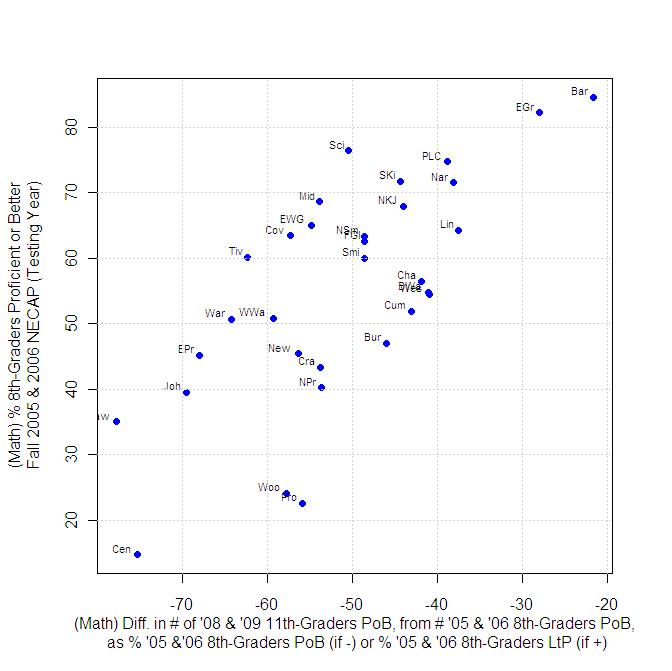
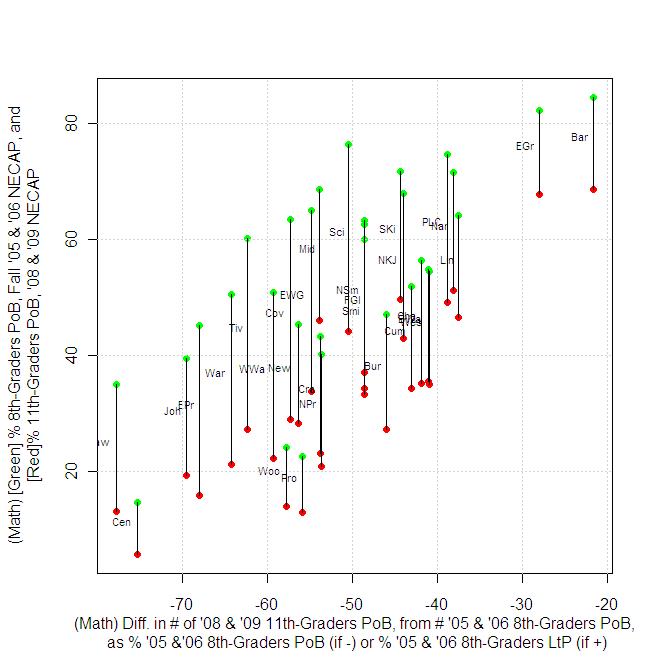
(N.B.: Results for North Kingstown and Portsmouth have been corrected from the original version of this post, to correctly account for the fact that high-schools in these districts serve students from Jamestown and Little Compton, respectively.)
In Part 3, we’ll take on some refinements of data presented above, to answer 1) if we can do anything to further analyze districts that are starting from high numbers of students already proficient 2) the same question, but for districts starting from very low numbers of math students already proficient, and 3) how can we move beyond asking if a basic level of proficiency is the only thing we should be looking at?
The Cause of the Firings
Every working Rhode Islander, and all of those looking for work, can see the disconnection of Central Falls union rhetoric:
"We still hold that this termination of the entire faculty is a violation of the contract and contrary to state law and federal law as well," [teachers union President Jane] Sessums said. "This is a termination of the entire faculty without cause, we believe."
You want cause?
- Only 4% of students proficient in math in 2008-2009, up from 3% the year before, with 75% "substantially below proficient."
- Only 45% proficient in reading.
- Only 29% proficient in writing.
- Only 17% proficient in science.
- A 48% graduation rate.
- A 50% failure rate for the current school year.
As a body — and it is the teachers' decision to be handled as a collective union — the teachers are failing. Every year, every day, students are deprived of a successful educational experience. That must change, and since the union's been blocking the avenue for change that doesn't entail a mass firing, a drastic step must be taken.
The Same Old Local Political Roundabout
As circumstances deteriorate, it's instructive to observe the varying reactions and strategies for handling them. In Tiverton, the established order, so to speak, has redoubled its efforts to keep the negative focus on Tiverton Citizens for Change in the hopes that people won't notice that the plans for improvement bear a striking resemblance to the plans that got the town into its current mess. I've got a letter pointing out the 'round-and-'round nature of the debate:
On January 27, 2009, the school committee approved a largely retroactive contract for teachers that ate up about $300,000 of that year’s budget, added approximately $150,000 to the current year’s, and is contributing more than that to the $600,000-plus increase in salaries and benefits budgeted for the next fiscal year. At a November 2008 meeting, Ms. Pallasch argued for approval, saying, “Let's start working on the new one, and give ourselves a little bit of room to refocus on the classroom and away from the adults.” The argument was that we should resolve the running dispute while there was still time to negotiate the subsequent contract amicably.At the time, I spoke up to predict that the union would not negotiate. Rather, it would wait out the recession based on the obvious reasoning that it could avoid concessions during hard economic times and — as we’ve taught its members to expect — receive retroactive raises when times improved. I also handed out a chart showing that there had been no abatement of the increases in teacher salaries and benefits in the past decade. Indeed, the per-pupil dollar amount had gone up more (54%) than the same number for the state as a whole (40%). Over the same period, the chart showed that most other expenditures had hardly moved.
Well, negotiations did not resume with an amicable tone. Indeed, in August, the union pointed out a clause in the contract extending it for another year. The school committee had somehow missed the trick that it was supposed to notify the union of its intention to negotiate the next contract a full month before the previous one was actually approved. Changes in healthcare copayments for which the committee had budgeted went out the window. So did negotiations.
And the usual suspects are back, making all of the union's arguments for it in advance of the debate. Wealthy people wanting to increase taxes rather than stand firm with the organized labor behemoth that has soaked up a growing portion of our educational and municipal funds.
The system is broken. Revving it up for another season is not the solution.
February 22, 2010
re: The State of Education - Aye, the Co-hort 'tis the thing
Andrew has inspired me to hop on his coattails concerning the way we look at NECAPs (so read his post first). Basically, I've been putting off posting how we can look at the same NECAP data in two ways. As Andrew explains, the "value-added" method would be to follow the cohorts (ie; the same group of kids from year to year). Andrews task of digging deeper into how we can tease out data comparing 8th grade and 11th grade scores for essentially the same group of kids is more difficult than what I am going to look at: comparing cohorts from year-to-year in elementary schools.
Here is a made-up example of how we're usually asked to "read" the NECAP scores. (Let's assume these are writing scores for "Quahog Elementary School"). Generally, we are given data that is "shaped" so that we look at the change from year to year for each grade like this:
| GRADE | 2005 | 2006 | GROWTH | 2007 | GROWTH | 2008 | GROWTH | 2009 | GROWTH |
| 3 | 63% | 76% | 13% | 76% | 0% | 76% | 0% | 78% | 2% |
| 4 | 73% | 65% | 8% | 77% | 12% | 75% | 2% | 73% | 2% |
| 5 | 63% | 89% | 22% | 75% | 14% | 78% | 3% | 85% | 10% |
| 6 | 72% | 68% | 4% | 78% | 10% | 75% | 3% | 85% | 10% |
| AVERAGE | 69% | 75% | 6% | 77% | 2% | 76% | 1% | 80% | 4% |
This is the snapshot approach and it's flaw is that it compares one cohort of kids to its predecessor. Guess what? Cohorts are comprised of different mixes of kids--economic, family structure, academic expectations, etc. There is such a thing as a wicked smart class! So, instead, why not also track the grade-to-grade progress being made by the same set of kids (the same cohort)? To that end--to try to actually get some real value--we have to look diagonally at the above table. By doing so, we see something like this:
| Year in Grade 3 | 2005 | 2006 | GROWTH | 2007 | GROWTH | 2008 | GROWTH | 2009 | GROWTH |
| 2005 | 63% | 65% | 2% | 75% | 10% | 75% | 0% | - | - |
| 2006 | - | 76% | - | 77% | 1% | 78% | 1% | 85% | 6% |
| 2007 | - | - | - | 76% | - | 76% | 0% | 85% | 10% |
From "shaping the data" this way, we see that the 2005 and 2007 third graders both saw a 10% increase in proficiency between their 4th and 5th grade years. The 2006 third graders saw only a 1% increase between 4th and 5th grade, but a 6% increase between their 5th and 6th grade years. The NECAP is given in October, so the tests given in 5th grade are supposed to be on what they learned in 4th grade. As such, this data seems to indicate that the 4th grade teachers are pretty good at improving the proficiency rates of the students they've been given. Meanwhile, the 5th grade teachers are batting around .500 (from the data I've re-shaped) in improving vs. maintaining the status quo.
I believe that looking at the data by comparing different cohorts at the same grade level provides some value in assessing progress, however, I believe that a better method--one that is probably more fair to teachers and the students within a given cohort-- is the alternative method outlined above.
The State of Education in Rhode Island, Part 1
The graph at the bottom of this post, compiled from the two most recent years of New England Common Assessment Program (NECAP) proficiency scores, contains the information you are probably used to seeing for describing the state of education in the cities and towns of Rhode Island. And if you are familiar with the data displayed there, then you are probably also familiar with the oft-expressed objection to its use for school-system accountability purposes, that the graph is mostly an illustration of the social-economic status of the various communities represented, more than of how well a school-system is doing or not doing with the students it has.
However, if instead of confining the analysis of test results to scores taken from one point in time, consideration is given to changes in scores in a group of students across time, then it becomes possible to begin to isolate the factors that impact test scores which are directly related to the school-system, for example, through an examination of the evolution of performance of similar student cohorts who start from comparable achievement levels. This idea is the basis of what is called the "value-added" method of analysis of education. Since much of the focus has been on high schools lately, let's see what can be done with Rhode Island's basic 11th-grade NECAP results, to take a step in this direction.
Rhode Island 11th-graders have been tested in the subjects of reading and math with the NECAP for the past two years. 3 years prior to those tests, many of those same 11th-graders took the NECAP as 8th-graders, and changes in performance at the school and district level, between grades 8 and 11, involving many of the same students, can be evaluated.
But exactly what changes should be measured? NECAP results characterize student achievement in terms of four categories, the numbers of students "proficient with distinction", "proficient", "partially proficient", and "not proficient". The summary that is most frequently reported to the public is the percentage of students in a district (or school) who are proficient or better. However, a comparison of proficiency percentages from year to year may not fully capture what is going on inside of a school. Between 8th and 11th grade, almost every district loses students. In some districts, according to the NECAP totals, that figure can be as high as 30% and the reasons for enrollment drops (e.g. dropouts, students leaving for private schools or charters, etc.) will skew percentage measures in ways that don't necessarily reflect the quality of schooling.
So instead of going directly to results expressed as percentages, we will begin by taking a step back and looking at how the number of students proficient or better in 11th grade in each district changed from the number of students who were proficient in 8th grade in that same district. We can combine the two approximate cohorts of students for which 11th grade test data is available, and calculate the how the number of 11th grade students who scored proficient or better on the 2008 and 2009 NECAPs in each district changed from the number of 8th grade students who scored proficient or better on the 2005 and 2006 NECAPs
Several results become immediately obvious:
- Even in many of the districts thought of as poorly performing, the number of students proficient or better in reading improved between the 8th and the 11th grade testing (even when total enrollments dropped).
- In every school district in Rhode Island -- including the ones thought of as well-performing -- the number of students who are proficient or better at mathematics in the 11th grade is less than the number of students who were proficient or better in the 8th grade.
| District | # of 8th-Graders Proficient or Better at Reading, '05 & '06 NECAP | # of 11th-Graders Proficient or Better at Reading, '08 & '09 NECAP | Change in # PoB at Reading, between 8th and 11th Grades | # of 8th-Graders Proficient or Better at Mathematics, '05 & '06 NECAP | # of 11th-Graders Proficient or Better at Mathematics, '08 & '09 NECAP | Change in # PoB at Mathematics, between 8th and 11th Grades |
| Barrington | 526 | 524 | -2 | 485 | 380 | -105 |
| Bristol-Warren | 344 | 415 | 71 | 293 | 173 | -120 |
| Burrillville | 287 | 310 | 23 | 213 | 115 | -98 |
| Central Falls | 150 | 190 | 40 | 85 | 21 | -64 |
| Chariho | 379 | 461 | 82 | 347 | 202 | -145 |
| Coventry | 641 | 586 | -55 | 569 | 243 | -326 |
| Cranston | 1090 | 1132 | 42 | 779 | 361 | -418 |
| Cumberland | 568 | 579 | 11 | 433 | 247 | -186 |
| East Greenwich | 357 | 332 | -25 | 341 | 246 | -95 |
| East Providence | 532 | 549 | 17 | 437 | 140 | -297 |
| Exeter-West Greenwich | 241 | 224 | -17 | 219 | 99 | -120 |
| Foster-Glocester | 285 | 339 | 54 | 270 | 139 | -131 |
| Johnston | 341 | 220 | -121 | 226 | 69 | -157 |
| Lincoln | 400 | 375 | -25 | 344 | 215 | -129 |
| Middletown | 242 | 208 | -34 | 264 | 122 | -142 |
| Narragansett | 210 | 188 | -22 | 176 | 109 | -67 |
| Newport | 184 | 204 | 20 | 174 | 76 | -98 |
| North Kingstown -Jamestown | 697 | 615 | -82 | 602 | 337 | -265 |
| North Providence | 390 | 401 | 11 | 237 | 110 | -127 |
| North Smithfield | 224 | 215 | -9 | 198 | 102 | -96 |
| Pawtucket | 655 | 561 | -94 | 552 | 123 | -429 |
| Portsmouth-Little Compton | 412 | 415 | 3 | 381 | 233 | -238 |
| Providence | 1115 | 1749 | 634 | 873 | 385 | -488 |
| Scituate | 262 | 228 | -34 | 240 | 119 | -121 |
| Smithfield | 332 | 345 | 13 | 255 | 131 | -124 |
| South Kingstown | 518 | 466 | -52 | 476 | 265 | -211 |
| Tiverton | 228 | 247 | 19 | 215 | 81 | -134 |
| Warwick | 1119 | 1069 | -50 | 923 | 330 | -593 |
| Westerly | 358 | 396 | 38 | 296 | 175 | -121 |
| West Warwick | 339 | 350 | 11 | 300 | 122 | -178 |
| Woonsocket | 293 | 405 | 112 | 241 | 102 | -139 |
(N.B.: Results for North Kingstown and Portsmouth have been corrected from the original version of this post, to properly account for the fact that high-schools in these districts serve students from Jamestown and Little Compton, respectively.)
Next, we need to find an appropriate context with which to evaluate the absolute count data. That will be the subject of tomorrow's post on the subject…
Continue reading "The State of Education in Rhode Island, Part 1"
February 19, 2010
Learning to Hear the Union
Mike at Assigned Reading is dead on that the Newsmakers head-to-head between Central Falls union representative Jim Parisi and Superintendent Frances Gallo is very revealing about the two sides' priorities. Perhaps the most crystallized example of unions' determination to spin rather than inform — because everything's "negotiable" — comes at approximately 9: in the video:
Asked about the extra tasks that the administration is requesting from teachers, Parisi says:
What people aren't informed of is that Central Falls teachers already have more common planning time and professional time than any other public school district in the state, because we were a willing partner to make that happen. How come the union and its teachers don't get the credit for something like that?
Sounds like a reasonable statement, no? The teachers are already working hard, compromising, so that they can accomplish as much as possible for their students. Well, the spin unravels when Gallo explains:
That time is taken out of the school day — out of the instructional school day. We're trying to add the time to the after school time so that the instructional day remains such. We actually have an instructional day of just over four hours.
In other words, that state-leading planning and sit-down time was negotiated as time away from the most difficult part of the job: interacting with the students. A union will brag about helping its clients to lower their blood pressure — leaving out, of course, that it does so with a knife.
February 18, 2010
Schools and Dollar Signs
Last night, Marc discussed schools with guest host Tony Cornetta on the Matt Allen Show. Stream by clicking here, or download it.
February 17, 2010
Some Fundamental Fixes Need to be Done in Warwick
Yesterday, a report in the Warwick Beacon compared the Cranston and Warwick school systems (the teachers for both districts are represented by AFT). By the numbers:
Warwick Budget: $164.6 million
Cranston Budget: $121.4 million.
Warwick Students: 10,507
Cranston Students: 10,774
Warwick cost/pupil: $15,666
Cranston cost/pupil: $11,272
Warwick # Schools: 24 (3 high schools)
Cranston # Schools: 23 (2 high schools)
Warwick Full-time teacher positions: 1,038
Cransont Full-time teacher positions: 944
Warwick salaries/benefits: $144 million
Cranston salaries/benefits: $105.3 million
A review of the most recently available Warwick School budget (via the Transparency Train) reveals that the amount spent on direct payment to personnel has decreased around .5% since 2008 (during that time 4 schools were closed--basically, to piggyback on Justin's point, Warwick already traded schools--as well as teachers and administrators jobs--to keep raises in place). Meanwhile, costs in benefits has increased 10%, which can't be dealt with unless the contract is reopened for negotiation.
Warwick School Committee Member Paul Cannistra said yesterday there needs to be a better balance of student needs against financial realities.That's the key: a percentage co-pay, not a flat amount. (Incidentally, Mayor Avedisian made the same mistake on the municipal side last year).Cannistra, who voted against the teachers’ contract in 2008, arguing it would cost too much money for taxpayers, said that the district needed stricter health insurance co-share premium payments from its employees. Warwick teachers pay $11 per week for both individual and family plans.
Teachers in Cranston pay a 15 percent co-share of the premiums for health care. The Cranston School Department’s bus drivers pay health insurance co-share payments of 10 percent.
According to Warwick School Business Affairs Director Len Flood, the Warwick School District receives about $600,000 from its teachers due to the $11 per week co-share payment. A 10 percent co-share payment would mean the district would receive $2 million. With a 20-percent co-pay, the district would save $4 million.
Further, as the Beacon reports, another primary cause for the difference is the practice of weighting students with IEPs (Individual Education Programs), whereby a student with an IEP is counted as 1.5 or 2 students for the purpose of determining class size limits (this is something unique to Warwick's teacher contract). According to Rosemary Healey, the school department’s director of compliance, the practice of weighting is also a magnet:
According to Healey, that might explain why despite having a smaller total student population, Warwick has 460 more students on IEP’s than Cranston. Cranston has 1,700 students on IEP’s whereas Warwick has 2,160.The Beacon calculates that if no weighting was done, Warwick schools could save about $11 million per year. While he agrees that weighting helps students, Warwick School Committee Chair Chris Friel thinks it may be too costly:“I think we provide quality education here. I think our special education program is second to none. I think the affirmation of that is that people want to move here for it,” said Healey.
“Is it very expensive? Yes. Is it necessary? Yes. I think we owe it to our students.”
“The question becomes, can the Warwick School District afford to continue the weighting procedures as currently enacted,” said Friel.Whether or not to maintain, discontinue or scale back the practice of weighting is a cost/benefit exercise worth going through.“I think that it is becoming cost prohibitive when you take into account the financial situation we currently find ourselves in.”
The bottom line is that there are some fundamental items in contracts and benefits that need to be completely revised, not just patched for now. And while the schools need to do the majority of the work, municipal contracts need to be re-opened (besides the limited, short-term give backs just negotiated) to make co-pays a percentage of costs, not a flat rate. (If I was a dreamer, I'd include revamping the contract step scheme....)
Trading Schools for Raises
The Newport Daily News isn't very friendly about putting information online, so I don't have a link to the story, but I read this weekend that the Tiverton School Committee is floating the idea of closing the town's high school. In hopes of saving $450,000, as I recall, the town would either send its students elsewhere or bring in a charter school company to run things.
Meanwhile, in West Warwick, closure of an elementary school is expected to save $750,000, with the students dispersed to other schools and fifth graders heading to middle school. A reader emails:
So you are looking at placing 10 and 11 yr olds with potentially 15 y/o kids in the middle school. It gets even worse, its one thing to save the $750,000 but to then budget $900,000 in Teacher Step raises is mind boggling. Closing a school to fund Teacher raises, West Warwick is currently in the top 5 in salaries, with the top step at approx. 79,000 and health care contributions this year at 10% and next yr at 15%.
Here in Tiverton, the proposed increase in salaries, for next year, is $535,954. In other words, multiple Rhode Island communities are toying with the idea disrupting the lives of the students for whom they have responsibility in order to fund pay increases for well-remunerated public-sector workers in the middle of a painful recession and the economic collapse of the state. As if to add insult to injury, evidence of the quality of education in the state continues to be negative, such as this from the Providence Business News:
According to the College Board, 1,766 students in Rhode Island's class of 2009, or 17.3 percent of the class, took at least one A.P. exam during high school, compared with 26.5 percent nationwide. That was up from the 1,555 students in the class of 2008 who took an A.P. test and 1,112 in the class of 2004. ...The organization said 10.7 percent of last year's class — or 62 percent of A.P. test-takers — earned a passing score of 3, 4 or 5. That was up from the 9.5 percent who passed at least one the prior year, but lower than the 15.9 percent of students who did so nationwide.
If we're to resist the urge to let emotion run away with us, we must admit the probability that some of the school closure talk is little more than a ploy to rile the public to accept tax increases and shame the teachers' unions into accepting concessions. Even so, the current dynamic is unacceptable: that the anxieties of residents are being manipulated in an attempt to achieve the obvious and reasonable step of holding salaries flat, or even trimming them a little, for professionals who, as a group, are failing their students.
February 13, 2010
The Union Chooses Firings
Anybody who's surprised that the teachers' union in Central Falls has chosen to stare down mass firings and do battle rather than submit to some eminently reasonable additional responsibilities should think through the future scenarios of the game.
With administrators now standing firm on key planks that were previously popular political catch phrases, the unions are going to challenge authority way up to the top — to Education Commissioner Deborah Gist and beyond. Their secondary strategy will be to delay significant changes until they have an opportunity to change the players. They've lost no ground in the General Assembly, either in recent elections or in the selection of the new speaker of the house, and they've an opportunity to affect the governor's office, this year, which means access to the Board of Regents, from which the commissioner ultimately derives her authority.
If the unions can delay the mass firings, through friendly labor review authorities and the courts, for even just one year, they'll have time to re-rig the game entirely in their favor. If they lose on questions of authority, they'll use their political clout to turn the top-down model to their favor. In other words, when voters, school committees, and district administrators seek localized, bottom-up reforms, the newly enhanced authority of the state and the education commissioner will be used to squelch the movements before they can begin.
Consider the thoughts of the only Central Falls teacher whom I've seen offer public comment outside of the union channel:
Sheila Lawless-Burke, an English-as-a-Second Language teacher, said teachers are not opposed to working harder — or longer; they simply want the opportunity to negotiate the details of their contract, not have it imposed from above."It's all about the politics," she said, "about making Fran Gallo look good. The issue is having the right to negotiate. Once we allow the superintendent to get her foot in the door, where will it stop?"
Even under circumstances of dire failure, the unionists want to assert their rights to drive up costs and usurp management authority. What Lawless-Burke ignores is that politics is the game of figuring out "where it will stop" when differences of opinion negate a hard rule. It will stop when the public decides that the superintendent has exceeded her mandate. That's how politics work.
It's also the reason that local administrations and the state education bureaucracy should devote some of their attention to fostering community-level involvement of additional players. I mean not only extending some budgetary authority for the schools to town councils and mayors, but also opening channels of communication and cooperation from taxpayer groups and the like.
The top-down reforms, in other words, require a complementary bottom-up foundation, not only to solidify local support from the folks who ultimately pay the bills, but also to rope in stakeholders who will cry out when the unions attempt to manipulate the game at the top. The unions may succeed in reversing Commissioner Gist's reform efforts such that the options offered to failing districts all entail additional benefits for union members, but they'll find it much more difficult to silence constituencies who've been allowed into the decision-making process.
February 12, 2010
Academic Gatekeepers and the Pursuit of a "Life of the Mind"
In the Chronicle of Higher Education, Thomas Benton explains why middle-class students should not be seduced by a "life of the mind" in academia; unless they know what they're getting into. Namely, post-graduate degrees and the academic life are set up in such a way that only the socially and financially privileged can really take advantage of them.
Some people have mistaken my position that graduate school in the humanities is fine for the rich and connected for the view that that's how it should be, as if I am some kind of smug elitist. It often happens that readers—looking only at an excerpt from a column—mistake practical advice about coping with a harsh reality for an affirmation of that reality, instead of a criticism of it.But it's a more frustrating path than most are prepared for:One reason that graduate school is for the already privileged is that it is structurally dependent on people who are neither privileged nor connected. Wealthy students are not trapped by the system; they can take what they want from it, not feel pressured, and walk away at any point with minimal consequences. They do not have to obsess about whether some professor really likes them. If they are determined to become academics, they can select universities on the basis of reputation rather than money. They can focus on research rather than scrambling for time-consuming teaching and research assistantships to help pay the bills. And, when they go on the market, they can hold out for the perfect position rather than accepting whatever is available.
But the system over which the privileged preside does not ultimately depend on them for the daily functioning of higher education (which is now, as we all know, drifting toward a part-time, no-benefit business). The ranks of new Ph.D.'s and adjuncts these days are mainly composed of people from below the upper-middle class: people who believe from infancy that more education equals more opportunity. They see the professions as a path to security and status.
The myth of the academic meritocracy powerfully affects students from families that believe in education, that may or may not have attained a few undergraduate degrees, but do not have a lot of experience with how access to the professions is controlled. Their daughter goes to graduate school, earns a doctorate in comparative literature from an Ivy League university, everyone is proud of her, and then they are shocked when she struggles for years to earn more than the minimum wage. (Meanwhile, her brother—who was never very good at school—makes a decent living fixing HVAC systems with a six-month certificate from a for-profit school near the Interstate.)Benton's goal isn't to dissuade people from following their chosen career paths, but to make them aware that it isn't going to be easy and that the risk/reward ratio may not be what they think.
Good for Students Versus Good for the Public Education Industry
Tom Ward writes on the success of Democracy Prep Blackstone Valley charter school in Cumberland, noting:
"My concern, as the [Lincoln] superintendent (Georgia Fortunato), is that if they move into Fairlawn, Democracy Prep, people are going to think they are part of the Lincoln School Department and I think we are going to lose a lot more children," said Fortunato. "It could be very devastating for the school district."Devastating - as in "We lose $8,000 per child" - for the school district. And perhaps the best single thing that will ever happen to the children. How did we get to this place, where what's best for the school district and what's best for the child are two very different things?
Mike, at Assigned Reading, follows up:
Fortunato's complaint that Democracy Prep hurts Lincoln's bottom line will fall on deaf ears; parents won't consider the financial impact when they decide who can provide the best education for their children. It also doesn't help that, last week, Fortunato was arguing for $31,000 in next year's budget to paint and recarpet the administration building. Considering there are no children in this building, is this the best way to spend education funds in these tough economic times? Really.
For those of us with young children, the Rhode Island Way of doing public education is a matter of urgency. That's part of the reason that I found Dan Yorke's interview with Education Commissioner Deborah Gist, focusing on Central Falls, so encouraging. I did, however, have to remind myself that, even if Gist is so successful as to justify many times her salary, the forces that have brought Rhode Island to its current low will not go away. And as quickly as she may advance the state's education system, relatively small changes in the political winds could turn around the turnaround using the interventionist precedents that she's setting.
A Clash of Realities in Central Falls
You'd think some higher-up planner in the teachers' union would begin advising members that it's time to back off for a while for the purpose of public-impression rehabilitation. Apart from the wholly inappropriate imagery of using a candle-light vigil for a union action, the particulars of the circumstances in Central Falls are absolutely certain to elicit a response of "are you kidding me" from any Rhode Islander not in the thrall (or payroll) of the union.
First there's the performance of the high school (news report and Dept. of Ed. PDF):
- Only 4% of students proficient in math in 2008-2009, up from 3% the year before, with 75% "substantially below proficient."
- Only 45% proficient in reading.
- Only 29% proficient in writing.
- Only 17% proficient in science.
- A 48% graduation rate.
- A 50% failure rate for the current school year.
Then there are the salaries:
The average teacher's salary at the high school ranges between $72,000 and $78,000 a year, because most are at the district's top step, Gallo said.
That's without incorporating benefits and all of the other perks of being a public school teacher. Then there are the demands for doing what any professional should be expected to do when collectively performing so abysmally:
Gallo said she offered to pay teachers $30 an hour for two additional weeks of training in the summer. Gallo also said she would try to find grant money to pay teachers for 90 minutes a week of after-school planning time, also at $30 an hour.But she says she has no extra money to pay for other changes she is pushing for, including lengthening the instructional day by 25 minutes, so teachers work 8 a.m. to 3 p.m. instead of 7:50 a.m. to 2:25 p.m. She wants teachers to formalize a rotating tutoring schedule, so a teacher is available to help students for an hour before or after school, and she wants teachers to have lunch with students one day a week.
"Right now, they have no duties," Gallo said. "But I don't want them to see lunch as a duty. I want them to establish true relationships with not a few students, but all students." ...
Union officials have been pushing for $90 per hour and want the district to pay for more of the additional responsibilities.
Then there is the transparent mealy-mouthedness from the union, with this on the one hand:
James Parisi, a field representative of the Rhode Island Federation of Teachers and Allied Health Professionals, said that Gallo had asked teachers to work a longer school day, attend after-school training and set aside two weeks in the summer for professional development. Parisi said the union balked because the district wasn't willing to pay teachers enough for the additional time and work.
And this on the other:
"We've been supportive of the transformational model, we think it's the right path," [Central Falls Teachers' Union President Jane] Sessums said. "But we need more details. We've never been opposed to the additional time that is needed. Our concern is that we really get an opportunity to understand what is necessary."
It's time for those teachers who've retained a modicum of professional integrity to step forward and tell the union to back off. They've a responsibility to improve the school in which they work without proclaiming that poor performance should justify even more reward.
February 9, 2010
Reminder: Teacher Pink-Slips Don't Actually Mean Layoffs
Pink slips are flying at teachers in Woonsocket, East Providence and Lincoln and probably soon in your town, too. Two points:
1) State law dictates that all layoff notices be sent by March 1st. Why then and not later, say mid-May? Could it be that it is more politically beneficial for some to have teachers and parents upset at layoffs during the budget-making season of late winter/early spring rather than later.
2) Aside from the fact that laying off anywhere from 1/3 to 2/3s of all of the teachers in a district is frankly impractical (if not impossible), most teacher contracts cap the number of layoffs allowed each year. For instance, in Warwick (p.48 of document), only 40 layoff notices can be sent and only 20 teachers can actually let go in any given year.
Now, this isn't to say that laying off teachers is the way to go by any means. But so long as the teacher union leaders refuse to renegotiate their contracts, this is one of the only ways left to school committees and administrators to cut costs. (Often due to their own shortsightedness!).
Anti-Abstinence Crusaders See What They Want to See
On the day that the news section of the Providence Journal acknowledged that abstinence-only sex-ed programs could potentially be successful, the editors of the Lifebeat section thought it necessary to rush to the defense of their modern kulturkampf with the headline, "Program blamed for rise in teen pregnancy" on the section's front page. Of course, the immediate question is who is doing the blaming:
The national teen pregnancy rate is on the rise again after 15 years of decline, and the group providing the data lays the blame squarely on the Bush administration’s stepped-up funding for abstinence-only education programs.The Guttmacher Institute, a nonprofit that’s aligned with Planned Parenthood but nevertheless is respected for its data on reproductive issues, reported last week that the U.S. teen pregnancy rate had risen by 3 percent from 2005 to 2006, the latest year for which figures are available.
What makes the citation especially troublesome is that the article specifically notes the research of John Santelli. Back when one of his studies was fresh, something in the reported data bothered me, so I actually purchased a copy of the study in order to review the methodology. What I discovered was that Santelli's basic math simply didn't show what he claimed it to show. In a nutshell, his equations credited contraception not only with its own success rate, but also with the success of increasing abstinence. My communications with Dr. Santelli became snippier, on his end, in proportion to the specificity of my explanations.
The basic pattern of distorted findings being spun to even greater distortions in the press is very familiar. Indeed, back in 2004, the New York Times heralded a study disclaiming the effectiveness of an abstinence pledge. When I looked into the numbers, I noticed not only that abstinence had, in fact, increased, but also that many of the respondents who had not "lived up to their vows" to remain abstinent had actually broken that vow after making another: they got married.
Thus, we end up with a bifurcated society, in which readers of the Projo's Lifebeat section heed the research wing of Planned Parenthood, while others share Robert Rector's understanding of the situation:
No one knowledgeable about abstinence education, however, would find this startling. In fact, eleven previous sound studies showed strong positive effects from abstinence programs. The mainstream media simply ignored them.
Human nature will always tend toward a (generally productive) battle between groups preferring different conclusions. But when that battle is amped up on the steroids of massive amounts of federal funding and even more substantial potential for the regulation of people's lives, objectivity — not to mention common sense — becomes more difficult to maintain. (See also, climate change.)
Focusing on That Which One Can Influence
Julia Steiny presents some thoughts on how to hire great teachers, and this point caught my eye:
[Delia Stafford, CEO of the Haberman Educational Foundation] adds that an interviewee might answer a question with: "'What do they expect of me? The parents don't show up and the kids don't bring homework.' If they tell us that kids are at risk because so many parents are not doing their jobs and the students aren't interested, they aren't going to work out. Some list everything outside of the classroom: 'The curriculum doesn't fit; we test them too much.' On the other hand, another person might say, 'I would never punish kids because their parents didn't show up.' These are basic, core beliefs."
Of course, such an attitude during a job interview shows extremely poor judgment, in the first place, not the least because it assumes shared group-think with the interviewers. Putting that aside, though, the lesson is certainly not exclusive to teachers: We can only change that which we have the power to control.
A person hired to do a job should see obstacles as problems to be addressed, not preemptive excuses. Homework, for example, has a purpose. If it isn't getting done, then that purpose isn't being achieved. A teacher must either figure out a way to motivate a particular student to do the homework or find some alternative method that achieves the underlying goal of the homework.
The strategies could be very broad, such as changes to school policies and culture, but they're likely to be very specific to the student and the situation. As Stafford suggests, the important things are the core beliefs — the basic understanding of role and approaches to problem solving.
February 8, 2010
A Curriculum Change with Merit
You may have read that North Smithfield students have been making significant gains:
In a single year, the school's test scores jumped more than 20 percentage points in reading — the largest improvement in the state — and more than 9 percentage points in math.Only Barrington, East Greenwich and Jamestown — the state's highest-performing and wealthiest districts — can boast higher proficiency rates in reading than North Smithfield's 88 percent.
And the school's improved math proficiency — 69 percent — places it in the top quarter of Rhode Island's 57 middle schools, according to the most recent round of state test scores that were released on Wednesday.
Note especially this:
"We saw that writing was our weakest area, so we decided to concentrate on that," Arnold said. "We also felt that writing is global — it's required in every subject now. Math, science, social studies. So we felt like it could make the most difference."
That's precisely the sort of strategy that I suggested could be tied to some sort of merit pay system, when the topic came up in Tiverton:
Sure, some component would have to be related to students' actual performance. But other components could be tied to district targets. For example, one argument that I hear all the time is that parents simply aren't sufficiently involved, so perhaps some component of the evaluation and merit increase could kick in for teachers who do something to bridge that divide. A perfect example: retired music teacher (and TCC member) Anne Parker spoke of her experience doing extra work with a parent/student choir. Or, if a target area is math, a shop teacher could prove merit by integrating lessons with the students' math classes, thus improving immediate understanding while illustrating the practical utility of an abstract subject.
February 2, 2010
Abstinence as Good Decision
Having challenged the premises (and the math) of naysayers of abstinence-only education, I don't find these results surprising:
Billed as the first rigorous research to show long-term success with an abstinence-only approach, the study differed from traditional programs that have lost federal and state support in recent years. The classes didn't preach saving sex until marriage or disparage condom use.Instead, it involved assignments to help sixth- and seventh graders see the drawbacks to sexual activity at their age, including having them list the pros and cons themselves. Their cons far outnumbered the pros. ...
Two years later, about one-third of abstinence-only students said they'd had sex since the classes ended, versus nearly half — about 49 percent — of the control group. Sexual activity rates in the other two groups didn't differ from the control group.
The bottom line is this: Safe-sex education gives children knowledge about how to do something — and tells them that it's "safe." Effective abstinence-only curricula help them to understand why they shouldn't act on that knowledge.
Such programs should involve lessons in self esteem, in decision-making, in life decisions, in cultural expectations, and so on. What our society must learn, above all, is that sex is not the be-all-end-all of human existence, and that at a young life can be much better spent than dealing with the obstacles, discomforts, and obsessions that typically follow sexual activity outside of monogamous adult relationships.
February 1, 2010
Formulas, Formulas....funding, weighing and otherwise
I was surprised to learn that Warwick is alone in "weighing" its students based on whether or not they have an IEP (Individual Education Plan). It goes like this: kid with normal educational needs = 1; kid with IEP = 1.5 (and sometimes 2). So, as the Warwick Beacon reported last week, "there are 10,482 students enrolled in Warwick schools. Or are there 11,582 students?" Obviously, with a cap on class size of 28, this can affect how many teachers can be hired. To use an extreme example, If there are 28 IEPs, that really means there are 56 kids, and thus two teachers are required.
[T]he school administration is looking at all ways it can save. Increasing class sizes by eliminating weighting isn’t likely to occur until after the teacher contract expires in August of 2012, if then. Nonetheless, the weighting system that is unique to Warwick is being considered. It’s not the first time.How expensive is it?For as long as school human recourses and counsel Rosemary Healey can remember, elimination of weighing has been on the list of School Committee demands at the opening of contract negotiations. That demand has always been dropped for some other concession.
She said the weighing system was introduced in the 1980s and has been a part of the teachers contract ever since.
No one has figured out the precise cost of weighting students, but it is estimated to have resulted in the hiring of an additional 110 teachers. Each teacher is estimated to cost the department $100,000 based on salary and benefits. That’s an annual cost of $11 million.According to Richard D’Agostino of the Warwick School Department, 20% of Warwick students have IEPs. And that's down a few percentage points since Warwick instituted a more comprehensive screening process! I don't doubt that there are legitimate benefits to IEPs for those who truly need them, but I don't like the way this emotionally-loaded "bargaining chip" is being played.
Teachers Union President Jim Ginolfi likewise acknowledges the prevision may be unique to Warwick, but also in part credits it for making the system outstanding.Ginolfi's "options" are calculated to be unappealing to parents of kids with IEP's, who (understandably) won't be happy about what sounds like "warehousing." But that will all have to wait, because the real unionist solution boils down to: "Sorry, can't help ya...let's wait for contract negotiations or a funding formula."“I think Warwick is in the forefront. Warwick has always been in the forefront with special education students”, he said. Elimination of weighting would not correlate into a reduction of costs since the district would still be obligated to meet the requirements of those students with an IEP, says Ginolfi.
“They’re going to need more time to devote to those students”, he reasons....Ginolfi argues that there is flexibility with weighing.
He observes the district has options. It can put all special education students in a single class; it can move IEP students into resource classrooms for special instruction, and it can introduce special education teachers into classrooms where there is a mix of IEP and regular students.
Until they enter negotiations Ginolfi can’t say whether weighing is one of those issues the union would hold out for. As for trimming costs, Ginolfi offered no suggestions.
“Education is expensive”, he said, “and that is why we need a (funding) formula at the state level.”
January 31, 2010
More Refreshers: RI Academic Achievement, Teacher Salary Ranking, Student to Teacher Ratio
Further to Justin's post, national ranking of the Rhode Island public school system in certain areas of interest.
Academic Achievement: 40th[Source: ALEC Report Card on American Education, 15th Edition]National Ranking of Rhode Island Teacher Salary: 9th highest
[Source: NEA, middle column, Page 37, of this PDF]
Ratio of Students Enrolled per Teacher: 51st (lowest ratio in the country)[Source: NEA, Page 35 of this PDF]
School Committees and parents around the state may wish to keep these rankings in mind as contract renegotiation nears.
Fresh Data Alert: the NEA report, "Rankings & Estimates", linked above twice, was issued just last month.
A Refresher on Teacher Salaries
Pat Crowley's in the comment section slinging mud at my numbers. For consistency's sake, here's the relevant chart for the state as a whole:
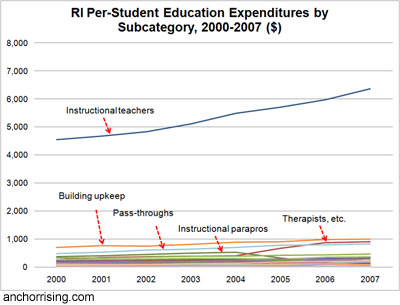
Crowley's claim is that the increases in teachers' salaries are not keeping up with inflation. One could argue the relevance of that fact on the grounds that everything else must therefore really not be keeping up with inflation. One could argue the relevance of that fact, I should say, if it were a fact. There are two ways in which Crowley likes to make the inflation claim deceptively. The first, less applicable here, is to look at the category of "instruction" and draw his inflation numbers from that.
When he tried this trick back in 2007, I explained that, while the "instruction expenditures" category increased 19.8% from 2000 to 2006, in comparison with 19.9% inflation, teasing out teacher pay showed their salaries increasing 28.1%. Last year, I put the point in graphical form:

Another method that Crowley employs, that is probably more relevant in the current context, is to lump all teachers together to hide the continual increases in all of their salaries. I've looked at this, too, and the trick is that Rhode Island has been on a teacher-hiring spree:
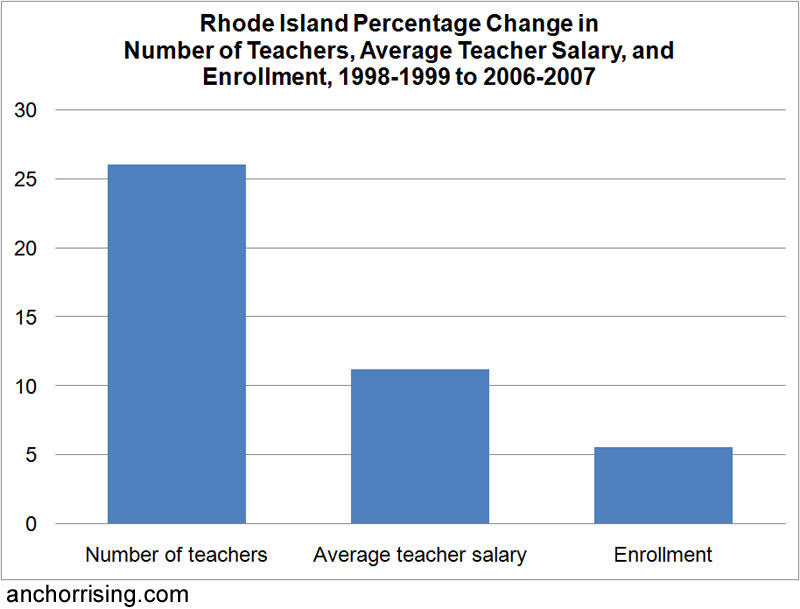
Obviously, hiring young teachers will bring down the average salary. Indeed, the more teachers we hire, the more it appears that their pay isn't going up:
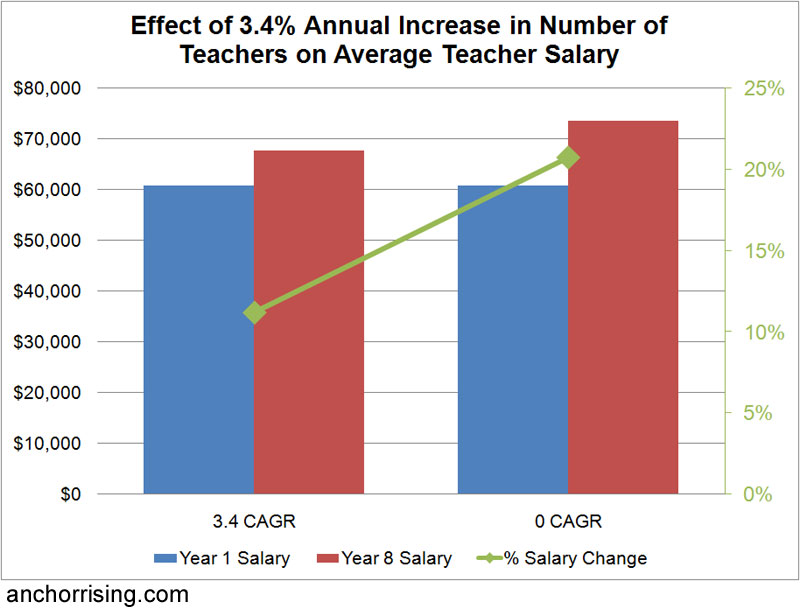
Of course, the system must then deal with this mass of teachers as they progress through their sometimes double-digit salary increases, what with cost-of-living adjustments and steps combined. Brace yourselves, Rhode Island; salaries and benefits are going to be absorbing much more of the budgets for your students' schools, and the odds that the very same teachers will be able to turn around their abysmal results with even fewer resources are slim to none.
January 30, 2010
The Usual Ommission from School Budget Fights
Anchor Rising readers shouldn't have any trouble guessing (let alone discerning) what's missing from this report out of Cranston:
Wednesday night, on what was the first chance for the public to speak on the proposed budget, students, coaches and parents flocked to Cranston West's auditorium, where the School Committee budget hearing was moved to accommodate the expected crowd.Many donned team jerseys (revealing a clear home-team advantage) and defended the value of sports and the added push that rivalry brings.
"Don't expect us to give up without fighting for what we have worked so hard to build up," Deanna Archetto, a senior who swims for Cranston West, told the School Committee.
"There have to be other options that don't involve chopping from the bottom," she said.
The $1.1-million in proposed cuts — which include the elementary school enrichment program along with strings, band and chorus, following the recommendations of a court-ordered performance audit — follow the state Supreme Court ruling last month that found the district ignored the financial reality, continued to overspend its budget and then sued the city for additional money.
For readers who may be new to the site, I offer this clue:
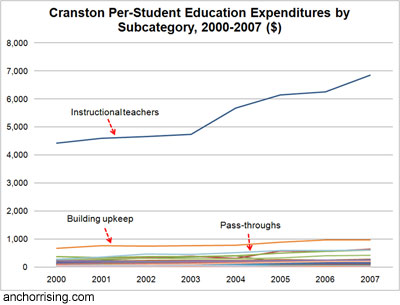
At a time when the executive director of the National Education Association of Rhode Island is playing games with an application for nine-figures of federal assistance so as to keep his union's members above accountability,* residents who wish to protest cuts to sports and other services should target their ire where it belongs.
* Which is not to say that I support the continued federal takeover of our educational system. I'm merely pointing to the clear priorities of the teachers' union.
January 25, 2010
Educational Formulating
As the only state without a funding formula, there is certainly something to be said for putting something in place so that cities and towns can have some ability to forecast what they're going to have for education spending. That being said, I'm sure I'm not alone in having mixed feelings when I hear such things as this:
Education Commissioner Deborah A. Gist...points out that the current distribution is unfair, insofar as it gives some school districts too much, and other districts too little...“What I want to see is a system that in every respect, whether it’s finance policy or curriculum or professional development, is built around what students need and not what adults need or are used to having,” said Gist, who became commissioner last summer.First part is good, second part makes me wary. Adding to my wariness is the involvement of Brown University--"Kenneth Wong, a Brown education professor, and two of his graduate students"--in the formulating (yes, I'll admit this is probably biased on my part, but there you go--so convince me).“This is going to require that some people step up and have the political courage to say to their communities, ‘We will have to make some changes … and let’s look at why that is the case.’ ”
Unlike previous approaches that added more money on top of what districts were already spending, the new proposal starts from scratch.Sounds sorta redistributive, doesn't it? Under this formula, I'm guessing most of us will, and should, take an even keener interest in the urban schools. Looks like more of our money will be heading there.Using a “market-basket approach,” the Brown team members added what they considered the most important elements for a quality education: the salaries of key personnel such as teachers, teacher assistants, guidance counselors, nurses, librarians, principals and assistant principals; books and other instructional materials; training for teachers; and a portion of teacher-pension costs.
Those elements form the basis of what the team calls a “foundation” formula, resulting in a cost of $8,200 per student per year. That figure could change if elements are added or subtracted.
The state average per-pupil cost in 2009 was $7,246, but that figure does not include $78 million the state contributes to teacher pensions, a cost included in the $8,200 figure.
Districts with large numbers of poor children would receive more money to address their higher levels of need. Education officials say the poverty level is also a measure for other student needs, such as special education and English classes for non-native speakers.
January 20, 2010
Choice Is the Best Accountability
In Julia Steiny's second article about the Laborers Construction Career Academy charter school in Cranston, she focuses on the difficulty of measuring such schools according to standardized criteria:
But the work that [Executive Director Paul] Silvia and his team do is not captured by data in the state's accountability system. EQ [i.e., emotional adjustment], to use Silvia's term, can make or break a kid and his academic career. Currently, accountability systems take no notice of which schools actually support their kids and their parents. They should. The state could develop and publish indicators on par with the almighty test scores to hold schools accountable for supporting the kids' social and emotional success. If it did, communities would have far fewer unsuccessful kids, fewer dropouts, fewer lost 20-year-olds.
I'm not sure it's possible to measure such intangibles in a standardized way without the potential for fudging that winds up capturing nothing and protecting incompetence. The fact that subjective criteria are important can only adequately be answered through a system of choice. Parents will know whether their children are doing better in a particular school than they would elsewhere, even if scores don't compete well on statewide standards.
To quote a song, those who strive for a government hand in all judgments and decisions are trying to catch the wind, and in the meantime, generations are failing to acquire necessary knowledge and academic habits.
January 19, 2010
What Consolidators Are Missing
I suppose this Projo editorial opposing the newly legislated board for statewide health insurance benefits for teachers is better late than never, but the editors continue to keep two and two from being joined:
Obviously, Rhode Island can do much better than rushing through a new system whereby a panel of special interests reward themselves at the taxpayers' expense. The approach adopted is, in essence, a new and costly mandate on local communities, with less, rather than more, local input into spending decisions that affect the bottom line.
That will always be the case, once the messy reality of human self-interest is introduced to the shiny machinations of planners. Better policies on a case-by-case basis may delay the deterioration as power and money are consolidated, but they will never prevent it.
More importantly, though, we all should have learned by now that there are other aspects of Rhode Island's government that must be fixed prior to consolidation. Handing a mandate to consolidate to the ruling class that has brought Rhode Island to its knees is like buying a home-owner's insurance policy from the thief who just broke in and stole all of your belongings.
Blame and Motivation in Education
Friday night's Violent Roundtable on the Matt Allen Show featured Rhode Island House Minority Leader Bob Watson and legal analyst Lou Pulner, and I was surprised to find Pulner nearly standing alone when the conversation turned toward the teachers unions' blocking the state's federal Race to the Top application (on which the RI Federation of Teachers and Health Professionals has just changed its position):
Matt Allen: The teacher unions in Rhode Island are stuck, because they do not want teacher evaluation to be dependent upon student performance. I guess Deborah Gist's proposal is 51% of teacher performance and evaluation will be based on student performance and standardized tests.Lou Pulner: Gee, what a bummer that would be, huh? Think about it --- that we're actually going to rate our teachers based upon how they're students are doing in class and on exams.
Bob Watson: And you know what's always interesting is you wonder if you inventory the rank and file, how many of them are in agreement with the positions that the teachers union's take.
LP: I'll bet you 80%. They don't want to lose their job because they're doing a poor job.
BW: On certain core issues, I think you're right. But then there are other areas, I think that there are certain areas where some of the better teachers --- and I happen to have a brother that's a teacher and a sister that recently retired, my mother's a teacher, having retired, so I've got some bias, I suppose.
MA: My soon-to-be wife is also a public school teacher.
LP: But she's not political, you told me.
MA: She's not political.
BW: And when I knocked on doors in East Greenwich and campaigned for office, I found one of the predominant ...
LP: Where is your brother a teacher?
BW: In Cranston.
LP: OK. Good schools. East Greenwich, good schools. But if your brother were a teacher in Central Falls or Pawtucket, maybe you wouldn't be taking this position.
BW: As I said, one of the predominant second incomes in East Greenwich is a teacher's salary, and I've often found myself talking to a teacher from all sorts of parts of the state. They live in East Greenwich; they may teach in Central Falls. They have the same interests in having quality teachers in the schools, because when the good teachers are in a classroom next to a teacher that's slacking off and just not carrying their weight, trust me, all morale is reduced.
LP: But what happens, then, Bob? Then they bump in to a Classical High School because they have seniority.
BW: When it comes to certain issues relative to compensation, they share common ground, but I also think that, were it put out to a vote --- maybe it would have to be a secret vote, not one of those hold a paper card up in a room full of peers --- but if it were to come to a vote, I think more teachers than not would support this.
LP: But we're talking about a hundred million dollars that could come to the state of Rhode Island for educational purposes.
MA: Here's the thing, and I gotta tell you my soon-to-be bride's job has affected my opinion on this, because I get to see the inside, and let me just tell you this. Let me offer you up a piece of information. I know --- this is not from her, but from other situations that she's told me about --- where you have classrooms that might as well be hospital wards, because they are required by law to teach all sorts of kids and in all sorts of situations and all sorts of backgrounds and everything else.
LP: But special-ed can be backed out.
MA: Let me tell you something: Special ed is not backed out. Special ed, at least where she teaches, is in the classroom, with everybody else, and so you have these kids in this room, and they all have to pass the same standards that everybody else does, and then you gotta... you know... what kid didn't take a shower this morning, what kid didn't get breakfast this morning, what kid had to deal with a mother's boyfriend that night, what kid had to deal with this and the other thing, and one kid's got restive leg syndrome, so he can go and do jumping jacks in the back of the classroom whenever he wants to do it.
LP: Matty, I love you, but pillow talk aside between you and your betrothed is the fact that we need $100 million to enhance our education here in the state of Rhode Island, and the fact is that teachers ought to step up, and maybe they ought to work a little bit harder to make sure the students in their class are achieving.
BW: You know, Lou... show me a bad student, and I bet there's a bad parent at home waiting for that kid.
LP: Every time? Not every time.
BW: More times than not, Lou, and let's face it: We have too many people having children, and they don't keep the responsibility of raising those children properly.
LP: That's the babies are having babies argument. You're getting violent, Bob; you're getting violent right now. [Laughter.] This is VRT at its best.
BW: I can't use words on the radio, but I want to make my point: blame the parents; don't blame the teachers. A lot of good teachers try to do what they can, and Matt just explained just a typical day in a classroom.
LP: Bob, you don't think there are teachers in there who have the same curriculum and the same syllibus for forty freakin' years, and they're going through the motions.
BW: Because certain things don't change. Math doesn't change. Reading, writing, arithmatic shouldn't change.
MA: Let me just say this: I think that there's a happy medium. I think that student performance should be a factor. I just don't know how much of a factor it should be.
LP: For $100 million, I say raise it up a notch.
MA: I think we do need to go through and separate the wheat from the chaff, though, in the teachers' ranks, because some people I hear about need to go.
Coming from the legislative leader of the opposition party in Rhode Island, Watson's position is just not acceptable. Indeed, if it's an indication of the alternative that voters have in November, parents needn't wait until then to determine that they have to move or find a way to pay for private school. Watson's commentary is so knee jerk as to be dumb and so biased as to be offensive.
According to the latest Infoworks! document (PDF) from the state Department of Education, fewer than one-fifth of Rhode Island high school students are proficient in science, and just about one-quarter of them are proficient in math. Are 75-80% of Rhode Island's public school students living with bad parents? Or is Mr. Watson a bit too sanguine about 40-year-old lesson plans? (I use that reference emblematically, not literally.)
Matt's introduction of the conditions in some classrooms only highlights the critical factor. Note that he had to become intimate with a teacher before hearing about the challenges that education policies can present for them. As somebody who pays attention to local news, he's surely been very well aware of proposed salary cuts and healthcare copay increases, but when was the last time teachers worked to rule because their working conditions made it impossible for them to perform?
Perhaps if teachers' pay were strongly tied to the performance of their students, they'd be taking the lead in education reform, rather than standing in its way as a unionized matter of course. That probability brings us to the bigger problem of our blameless system. Let's quote Watson again:
Blame the parents; don't blame the teachers.
In the archetypal example of the Rhode Island Way, Watson here attacks the one group in the educational chain that is not on a government payroll. The General Assembly blames the towns, because after all, they have direct control over contracts and policies. The school committees and administrations blame the General Assembly for mandates and insufficient funding and the unions for contractual demands that drain control and resources. The teachers blame all of the above as well as the parents.
Well, if the folks on government payrolls have no power to improve the quality of education in the state, then those payrolls ought to be decimated. They're a waste of money. Redirect the resources to "good parents," so they can select an appropriate private school, and to social workers, so they can assist the "bad parents."
But I don't believe that the blame lies solely with the group whose main interest in the education system is through the well-being of their children. If we step back from the finger pointing and look at the situation as adults seeking to develop a functional educational machine, it is clear that mechanisms for incentives and accountability must be introduced. Evaluate teachers almost entirely on their performance, with formulas that adjust to the actual students — their challenges and their prior performance — and give the ultimate say to administrators, who are in a position to know all of the less-tangible considerations. On the other end, keep the General Assembly and federal government out of the equation.
In that way, the communities that are most affected on a personal level will have the ability to trace and change problems from the school committee dais down to the classroom in a chain accountability rather than evaded responsibility.
January 18, 2010
Not So Much of a Head Start
Here's some news you're not likely to hear trumpeted throughout the media or proclaimed in town and state meetings of education officials:
After some prodding, yesterday the Obama administration released the long-overdue first grade evaluation of the federal Head Start program. As expected, the results show that the $7 billion per year program provides little benefit to children — and great expense to taxpayers.The evaluation, which was mandated by Congress during the 1998 reauthorization of the program, found little impact on student well-being. After collecting data on more than 5,000 three and four-year-old children randomly assigned to either a Head Start or a non Head Start control group, the Department of Health and Human Services found "few sustained benefits".
You'll want to store this information somewhere in the mind. An ear to the tracks of education policy in the state reveals that expanding public education to younger ages is a favored idea among administrators, teachers, and unionists. At the education policy event that I attended in Warren, recently, the need for pre-K education was certainly mentioned multiple times.
This federal report suggests that a simple principle still applies: Early education definitely starts a child on a potentially more erudite path, but it isn't a remedy for inadequate instruction each and every year. The burden should be on the public education system to become more effective at its current task before its role expands.
(One wonders how conscious big-government types are of the dynamic that finds them with more power and influence the less competent they prove themselves to be.)
January 17, 2010
How Many Years Behind Are Our Students?
Mick Schulz has been considering the American condition, with respect to education, as a story in the Texas v. California saga, and he posts a reader anecdote that ought to make every Rhode Island parent uncomfortable:
A new neighbor (former migrant worker from northern California who opened a family business, and had to move to Houston for a young daughter's cancer treatments) reports to me that when she enrolled her 10 year old in the neighborhood elementary school, they determined that the child was at least a year behind. This is a school with an English-as-a-second-language program, and despite normal demographics which would put it in the bottom rung of schools, won an exemplary rating from the state.
I think the writer meant to suggest that the California school that the student had previously attended had been the "exemplary" one. Which makes me wonder: How far behind are the students of Rhode Island's "high performing" schools? I've long had the impression that these measurements of performance are artificially inflated and, frankly, don't trust them to provide any useful information for judging our system as a state.
January 15, 2010
Stratifying the Student Body
A supporter of school choice must accept that schools will experiment with, and families will opt for, educational strategies that he or she doesn't like. I've never been a fan of Fame-style schools specializing in music, for example, and for the same reasons, I've reservations about Laborers school in Cranston, which Julia Steiny described in her Sunday column:
At Laborers, Cranston academic teachers and instructors who are journeyman laborers themselves jointly craft an academic program geared to the construction trade. For example, math involves everything from learning financial literacy to calculating the volume of concrete needed for a job. The skills are the same as those taught in traditional schools, but applied to the world of construction. ...Shortly after the school opened, it was clear that some of the students were more interested in finding an alternative school than they were in construction work. So the school developed a second strand of learning, called The World of Work (WOW), which [cofounder Armand] Sabitoni considers consistent with the union’s mission.
Having had my own feet in several dramatically different social pools, so to speak, as an artist-type, an academic-type, a white-collar cubicle dweller, and now a carpenter, I'm uncomfortable with the social implications of stratification at such an early age. Surely, for example, all children would benefit from practical lessons in math — both for current learning and for a minimum of familiarity when one day they encounter tasks outside of their professions. Before I began in construction, about five years ago, I was utterly clueless when it came to repairs around the house, let alone do-it-yourself modifications.
Extracting the labor segment of the student body will decrease the incentive for general-ed schools to cover material relevant to them. From another perspective, while practical lessons might help a particular student pick up academic concepts, the career from which those lessons are drawn isn't necessarily a fit for him or her.
More significantly, though, there's a benefit to having all social types and career tracks interacting within a generation through high school. This is true, first, because cultural coherence and social empathy are a prerequisite to a healthy democracy. A second consideration is that very young students shouldn't find themselves on fated tracks. A creative, dynamic society increases the likelihood that its members will come to fresh conclusions, combining previously disconnected ideas for new purposes, and cradle-to-grave career tracks do the opposite.
January 13, 2010
Guard the Local Control in Education Reform
I notice that Mike, of Assigned Reading, is cynical about the ratcheting up of consequences for failing schools that Andrew mentioned yesterday. Here's Mike:
This is why education bureaucrats drive me crazy. Today Commissioner Deborah Gist announced that five schools in Providence have been performing so poorly for so long that the Department of Education is stepping in. Radical change is being mandated that could result in the closing of these schools. And how does Superintendent Tom Brady respond? ... My best translation: We have utterly failed, but offer no apology, and are pleased that someone else will now be making the decisions.
Mike goes on to wonder why, if there's such enthusiasm among education leaders who face the new reforms, the schools have been allowed to deteriorate so drastically. Andrew emphasizes an arguably contrary perspective:
Significantly, unlike the usual RI options, these new options involve making changes directly at the individual school level. The message is that schools, as a fundamental unit of education, matter.
One could cast the statements to which Mike objects as precisely what one would expect from bureaucrats; they can't exactly proclaim the untranslated message. Still the subtext of the interactions — the projected submissiveness of highly paid professionals with substantial responsibility — is important. That's why I find this news vaguely disconcerting:
PAWTUCKET — The quest for a new school superintendent is getting more attention than usual.The search committee that convenes Tuesday will include the usual School Committee representatives as members, but also Mayor James E. Doyle and Deborah A. Gist, the state commissioner of education.
It may be that I'm making too much of it, but it seems to me that the inclusion of Commissioner Gist on such a committee is a signal of obsequiousness. Perhaps she'll favor a district whose leadership she helped select, but it would be in the nature of a powerful person to expect the controlling influence to continue beyond the date of hire.
Is anybody in Rhode Island educational sufficiently motivated and confident to enunciate an understanding of the real problems of the system and declare an intention to address them without the intervention of a state-level appointed official? Commissioner Gist may do wonderful things for education in Rhode Island, but (one) she won't hold the seat forever, and (two) when it becomes clear that policy decisions rest not with local elected officials accountable to the people of the municipality, but to an unelected director, the strategies of the people behind the current mess will change, with the prize being more-direct and less-correctable control.
January 12, 2010
Budget Season Begins
Tonight's the first meeting at which the Tiverton School Committee will address next year's budget. The upshot is that Superintendent Bill Rearick is offering, as an initial budget, an increase at the state cap (4.5%). Of course, he included in last year's budget "surprise" federal "stimulus" cash, so this budget is actually 7.13% above the allocated amount at last year's FTM.
ADDENDUM (from home):
My coverage of tonight's meeting wasn't exactly comprehensive, because I was following the conversation with especial intentness and offering comments from time to time. A few points:
- I was incorrect about the reason, but correct about the result, when it comes to budget discrepancies. The "stimulus" money wasn't included in the number for last year's budget, but it shows up as a deficit in the coming budget, meaning that current projected spending exceeds the amount laid out in the budget by $892,268.
- Superintendent Rearick mentioned several times that the taxpayers' attempted level funding (thwarted by the federal gift) was to blame for the large shortfall, but it fell to me to point out that the district could have planned for that when it discovered itself flush with revenue.
- Owing to pension changes, the district currently has something like $235,000 lying around, but since midyear cuts in aide from the state are on the table, the committee and administration are inclined to leave that completely out of the picture, for now.
- The teachers' union, which is currently without a negotiated contract, is concentrating on "ground rules" and such rather than taking up actual dollar amounts and negotiations.
- The currently proposed budget assumes no changes to healthcare-copays and zeroes out salary increases, excepting steps and an AFSCME raise scheduled at 2%.
- There does not appear to be much support from the folks on the state (metaphorically speaking) to impose labor policies unilaterally.
- Rearick was not shy about speaking the phrase "program cuts."
- I estimated that a 3.5-4% across-the-board cut in combined salaries and benefits would entirely erase the deficit, and nobody contradicted my math.
- Tiverton Citizens for Change President Dave Nelson was not happy.
So basically, we're looking at a district administration that's pushing for the maximum tax increase that it can secure, a school committee that isn't ready to commit to anything, a union that wants to delay, delay, and delay until the economy improves, as I predicted they would do back when the school committee made the ill-advised give-away that the last contract represented, and the TCC is not going to simply watch this budget float away.
A Real Reform Menu for Education?
Traditionally, Rhode Islanders have been offered a choice of two options for improving their troubled educational system…
- Spend more money on district-level bureaucracies, with minimal change to existing school practices.
- Spend more money on non-educational social service programs.
Significantly, unlike the usual RI options, these new options involve making changes directly at the individual school level. The message is that schools, as a fundamental unit of education, matter. Expect wailing and gnashing of teeth to commence soon.
- “School closure and sending students to other schools“.
- “A turnaround model which replaces the principal and retains 50 percent or fewer of existing teachers and staff.”
- “A restart model which invites in a regional collaborative or a charter management organization to take over the school”
- “A transformation model which replaces the principal, evaluates all teachers, revamps classes and offers ‘expanded learning time’ including longer school days or weekend classes.”
January 7, 2010
Rule by Funding and Memoranda
I'm one of two people in the audience of an "emergency" Tiverton School Committee meeting, which was called in order to approve a memorandum of understanding from the Rhode Island Department of Education for the state's Race to the Top application, and the sense that I'm getting from the discussion is not encouraging.
Here's the upshot: School committees are under a lot of pressure to sign the MOU so that the state can prove "political will" to implement the program to the federal government. The problem is that the document that the local officials are being asked to sign is apparently not wholly inclusive of the information on which they believe they're voting. Some supposed facts are in a repeatedly changed FAQ document. Others were conveyed during in-person meetings. Some of it is in documents from the federal government. And the really-honestly-truly final document won't be released until Monday.
So, in the name of chasing after taxpayer money, the people whom taxpayers have elected to guide their local investment in childhood education are being asked to sign on to mandates and requirements from state and national officials without, as far as I can understand, even receiving assurances that the higher tiers of government will provide more money than they're requiring districts to spend.
ADDENDUM:
Here's an interesting point from School Committee Member Leonard Wright, who seems extremely suspicious of this whole thing: There is language in the memorandum that the district agrees to comply with the terms of the federal grant and a "RIDE subgrant" that apparently has not yet been produced.
ADDENDUM II:
And isn't this FAQ point interesting:
Are there "supplement, not supplant" requirements for Race to the Top?Race to the Top contains no "supplement, not supplant" requirements.
Furthermore, the language that Mr. Wright cited about a state "subgrant" suggests to me that the state could take advantage of the lack of "supplement, not supplant" language while still imposing that very rule on individual districts.
Another point that's coming up is that the town is probably going to be subject to increasing regulations and mandates whether it signs on for Race to the Top or not. It's the old "nothing to lose" lure. But imagine this outcome: The collapsing state causes a political surge for reform, among which is the elimination of state-driven mandates... except, of course, where those mandates are part of contractually agreed grant programs.
ADDENDUM III:
The school committee has added, as a condition of its agreement, stipulations that all program requirements will be fully funded and that the funding from Race to the Top would supplement, not supplant, allocated state and federal aid to the town.
December 30, 2009
When a Bureaucratic System Can't Sustain Successful Reform, Shouldn't We Change the Bureaucracy Rather Than End the Reform?
The transition of Hope High School in Providence back to city control, reported on most recently by Linda Borg in today's Projo, illustrates the premises that animate both charter school and site-based management school reform movements.
Rhode Island's State Commissioner of Education took a direct role in operating Hope High in 2005; after educational results showed some improvement, Hope was returned to full city control this past February. However, the school administration in Providence has announced its intention to undo some of the changes that have helped Hope improve…
Beginning in September, Hope will move to a six-period day like all of the other high schools in the city. The high school currently has a so-called “block” schedule composed of four 90-minute periods a day, a schedule that teachers say allows them enough time to delve more deeply into subjects.The reasons cited for the changes are increased costs associated with the differently structured school-day…The new schedule will also reduce or eliminate Hope’s various common planning periods that teachers say are vital to revamping the school’s academics, creating individual learning plans and developing student advisories.
According to [Providence Superintendent Tom Brady], this model requires 20 to 30 additional teachers at a cost of roughly $2.5 million a year....as well as a desire by Providence's school administrators to make Hope's school day uniform with the rest of the district.
But suppose there was an organization, either an outside school operator or a homegrown group of teachers and administrators, that said it believed it could find a way to make the new schedule work within a more standard budget, if various regulations and mandates were relaxed. Would trying to figure out how to make a program like that work be worth trying? Or should the highest goal of an educational bureaucracy be to impose a uniform structure on everyone's school-day, and on other aspects of school management, whether that uniform structure provides the best education or not?
Pawtucket and East Providence Have a New Rep. With Old Ideas
The last paragraph of Alisha A. Pina's story in today's Projo on Democrat Mary Messier's victory in Tuesday's District 62 special election (former Rep. Elizabeth Dennigan's old seat, mostly Pawtucket with a little bit of East Providence) provides a perfect example of how the state Democratic Party's intellectual bankruptcy on fiscal issues continues to propel Rhode Island towards the more conventional form of fiscal bankruptcy…
During her campaign, [Ms. Messier] said the “need to control taxes” is a top priority and also supported the development of a new school district financing formula that would be fair to all cities and towns.Alas, as has occurred all too-often in Rhode Island, we have a brand-new Democratic representative who believes that a "funding formula" can do the impossible: bring more money to her community, without requiring substantially higher new taxes to raise that money -- unless 1) soon-to-be Rep. Messier meant during the campaign that Pawtucket, already one of the largest recipients of state aid, should receive less money from the state, when she discussed making things "fair to all cities and towns" or 2) "controlling taxes" has become a new Democratic codephrase for "raising statewide taxes", i.e. "we controlled them by not raising them as high a we could have!"
Rhode Island won't be able to pull out of its fiscal and economic crisis if it keeps electing representatives who expect that state's problems to be solved by revenue-shifting programs funded by magic money that will fall from the sky.
December 21, 2009
Merit Pay on the Radio
WRNI's Elisabeth Harrison includes Tiverton in her radio review of the notion of merit pay. A national expert suggests that longevity and such are not effective, but that the formula for a mert-based system hasn't been perfected, yet. I'm encouraged, though, to hear that Education Commissioner Deborah Gist is on the page that I consider to be the correct one:
We have a system that is investing in our educators in ways that doesn't show that it's directly going to get us the results that we want. So, what I'm interested in doing is having systems in our state where teachers move up in a salary scale based on their performance.
December 9, 2009
Merit Is a Principle, Not a Program
At last night's Tiverton School Committee meeting, a member of the town's hard left (a state social worker who, as I understand, was instrumental in banning the Easter Bunny when he was on the school committee), acting in his capacity as Voice of the Community, cited Providence Journal columnist Julia Steiny as some sort of authority on merit pay. What I continue to find striking, in this whole debate, is the thralldom to buzz words.
When I've thought of "merit pay," it has essentially had the meaning "pay related to merit." People who don't like the idea of evaluations with teeth prefer to make everybody believe that those two words indicate a specific program that (fait accompli) has already been shown not to work somewhere. I'm surprised to find Steiny among those people.
She begins thus:
No evidence anywhere shows that merit-pay systems, aimed at individual teachers, improve education. Incentives to groups of teachers are effective, but not individuals.
From there she lists four "boondoggles" following from the assertion that "the moment you've drafted a complicated set of rules governing eligibility for individual 'merit' pay, you're instantly mired."
Boondoggle #1: Merit pay is money on top of the regular salary schedule and annual raises. Very expensive.Teachers unions aren’t about to let anyone mess with their negotiated salary schedule.
This is defeatism from the outset. Here's how the stage is set: A growing contingent of aggravated voters is beginning to take the reins from elected officials and "public servants" who've allowed the state's and the nation's education systems to be dragged into a pit of incompetence and greed, and one critical component of that action will be dislodging the rigid pay schedules that indicate nothing but seat-warming. Steiny's response? It won't work because it won't work.
There's no reason that merit can't be inserted into salary schedules rather than layered as a too rigid merit system over a too rigid longevity system.
Boondoggle #2: Define "meritorious," or even "good."Texas spent $300 million, over three years, to give excellent teachers bonuses of between $3,000 to $10,000. But without an iron-clad definition of "good," clay-footed principals generally gave all teachers about $2,000, spreading the money evenly, broadly, politely. Student achievement didn't budge.
That's why the political will of residents that would have to be roused even to implement changes to the system must be maintained to ensure that administrators aren't permitted to sail through with failing schools. Give principals and superintendents the actual authority that will make them responsible for success and then can them if the difficulties of restrictive contractual systems turn out to have been little more than cover for their own inability. Give them incentive, that is, to resist the restrictions. From a self-interested point of view, having a school committee give up management rights is to the benefit of administrators; we have to put their feet to the fire.
Boondoggle #3: If your definition of "merit" mainly involves test scores, the performance of the "bad" kids will get worse.
Part of giving administrators authority is requiring them to determine what examples of merit will improve the school's performance. Those who design the system shouldn't attempt to define every contingency in order to leave administrators no work but to insert a bunch of numbers into an "objective" formula. That's no less inappropriate than declaring that teachers can't possibly be evaluated and so must be paid according to longevity.
Boondoggle #4: Merit pay encourages all manner of gaming the system.
You could take the "pay" right out of that sentence. Any form of incentive that might actually prove desirable will motivate those who are better at politics than at their profession to attempt to game the system. Consequently, we get squishy leaders suggesting awards and smiley-face stickers. Parking spaces. Lunches with the boss. Anything that's kinda-sorta nice, but not so attractive as to actually drive behavior or increase the quality of the candidate pool.
This attitude can't stand. The system has to change. It has to change now. And the biggest obstacle to that change is the broad swath of people who've got one thing or another that they wish to preserve in the top-down control of the education system.
December 8, 2009
If It Weren't for Your Kids...
One expects for this sort of thing to slip out in the heat of argument — in person or in comment sections — but it's a splash of cold water to see retired social studies teacher Robert Salerno offer it as op-ed material:
I submit that they might learn that the problems of public education do not lie with the teachers but with the students themselves. Although many youngsters try to be good students, there are far too many who do not.These boys and girls should be called "attendees," ones who go to school but give little or no effort. Their numbers are larger than ever and I will leave it to our educational leaders to find out why this is happening in many areas of our state. These unmotivated students hurt their parents, classmates, school and society. According to the research, this begins to appear in middle school and becomes worse as these "attendees" move to the high school. This phenomena is not the fault of the classroom teacher.
Two thoughts: First, if the problem is the broader society (and I'm certainly not one to argue that the culture doesn't need an overhaul), then our massive outlay for education, and especially staff and faculty costs, would seem to be misdirected. We shouldn't be spending billions of dollars to pay people to do a job that can't be done.
Second, since substandard student performance reflects poorly on teachers, one would think that their unions would be striving to implement methods of identifying such students in order to (1) help them and (2) decrease the extent to which they hinder the high performance and shining image of educators.
December 3, 2009
The State Follows Tiverton on Evaluations
Well, the title of this post is a bit of an overstatement (downright presumptuous, actually), but I just received the following press release from the Rhode Island Department of Education:
All Rhode Island teachers will be evaluated at least once a year, following the historic vote tonight by the Board of Regents for Elementary and Secondary Education.At its meeting tonight (December 3rd, 2009) at Lincoln Senior High School, the Board approved the first-ever standards for evaluation systems for teachers and other educators. From now on, all evaluation systems will provide feedback on performance, create incentives for highly effective educators, and improve the performance of or remove ineffective educators.
Under the new Rhode Island Educator Evaluation System Standards, "an educator’s overall effectiveness is to be determined by evidence of impact on student growth and academic achievement." The evaluations must include observations of practice, and evaluators should seek feedback from supervisors, colleagues, students, and families.
The Regents also approved the first Educator Code of Professional Responsibility, which will "guide professional conduct" of educators in "all situations with professional and ethical implications." The code "embraces the fundamental belief that the student is the foremost reason for the existence of the [teaching] profession." The code will "serve as a basis for decisions" regarding certification and employment.
"The new evaluation system will help Rhode Island to improve educator quality by attracting, mentoring, and retaining top teachers and education leaders," said Robert G. Flanders, Jr., Esq., Chairman of the Board of Regents. "The evaluation process will be fair to educators because it will be tied to existing standards and expectations and because it will be consistent across all districts. These votes will help to ensure that we have excellent educators in every school and classroom."
"By approving these new standards for evaluation systems and the Code of Professional Responsibility, the Regents have acted in the best interest of our students," said Deborah A. Gist, Commissioner of Elementary and Secondary Education. "I have said many times that the single most important factor in the education of our students is the effectiveness of their teachers. These new standards, which emphasize student achievement and professional growth for all educators, are a big step in our work to transform Rhode Island education."
The Department of Elementary and Secondary Education (RIDE) will develop evaluation-system templates, which districts may adopt or modify, subject to the Commissioner’s approval. RIDE will post the standards and the code on its Web site, www.ride.ri.gov.
As some of my Tiverton Citizens for Change colleagues will hasten to point out, this has more than a flavor of an unfunded mandate. Tiverton Schools' Superintendent Bill Rearick put the figure for an initial increase in evaluations at $250,000. Unless the state is going to send its own evaluators, a command for such a process from the top — from the state — becomes something for which towns must pay, which means something added to the bill to taxpayers.
Enacted at the town level, evaluations are a self-motivated mechanism for improving the district's educational product, which means towns will more readily rework their systems to make room for them.
December 2, 2009
Re: The Projo’s Unintentionally Informative Juxtaposition of the Day
Responding to a post from earlier this week, National Education Association Rhode Island Chapter Executive Director Robert Walsh comments that Jennifer D. Jordan's recent Projo story on charter schools, where it was reported in the voice of the omniscient journalistic narrator that the NEA "disagrees" that charters have certain benefits, failed to capture the full breadth of the position he had offered. Mr. Walsh's more complete position is that…
The problem with proposing additional funding for charter schools during the current budget crisis is that it further diverts those dollars from state aid to education and the approximately 150,000 students in traditional public schools, and the further diversion of these funds hurts the existing schools and directly impacts property taxes.Based on reaction that Mr. Walsh has engendered in the past, I am compelled to issue an early warning regarding comments in this thread. To start by accentuating the positive, an example of an acceptable comment would be pointing out that making a priority of whether the bureaucracy that manages a school is municipally-based or regionally-based does nothing to mitigate the main point of the original post, that the union is more focused on creating particular bureaucratic structures than on educating students. (And, by the way, isn't a charter school like the Blackstone Valley Democracy Prep, which accepts students from multiple towns an example of a regionalized school -- albeit one that's been regionalized from the ground-up, instead of the top-down?)Further funding for charters at this time also goes against two public policy imperatives. First, since charter schools are stand-alone entities, often with a higher percentage of costs allocated to administration, more charters mitigate against the policy interest of regionalization and consolidation of services. Second, despite an impetus towards performance measurements, the record of the existing charter schools is decidedly mixed. Perhaps existing charters that are not making the grade should be defunded and those resources should be allocated to new charters with a better chance of success. Another alternative is to follow the original idea behind charter schools - identify successful educational ideas and move those into the public schools so that all children can benefit from them. The idea that some children need additional time on task or more personal attention is not a new concept, and the funds should be made available to the traditional public schools so that all students can benefit from them.
Likewise, asking "fiscally conservative" readers if they are going to continue to believe that top-down regionalization is the panacea they've been told it is, when it is being offered as a reason why the state shouldn't more fully innovate in the delivery of public services, would also be an example of an acceptable comment. (And just so there's no confusion, these are comments that I actually am making).
Personal attacks, name-calling and other comments unrelated to the substance of what's being discussed are not acceptable, and will be quickly removed from this thread.
November 30, 2009
The Projo’s Unintentionally Informative Juxtaposition of the Day
The online headline of Linda Borg’s article in today's Projo announces one community’s goal for education…
In Central Falls, the goal is getting pupils to read better.…which, despite its seeming obviousness, is a bit different from the goal being emphasized by the National Education Association, according to a companion article written by Jennifer D. Jordan...
Charter schools are taxpayer-financed public schools that operate free of many of the restrictions of regular public schools. Charters often offer smaller class sizes, require students to wear uniforms, encourage parent involvement and provide a longer school day. State education officials say charters provide choice to low-income students, and can produce innovative approaches that school districts can replicate.Got that? According to the NEA, providing money to “taxpayer-financed public schools” is taking money away from the “public school system”. Not all students in public schools are entitled to public funding according to the union’s logic, because only students in schools managed by a particular form of bureaucracy should be entitled to public money. This rationale unequivocally elevates the imposition of a particular bureaucratic form on Rhode Island students above more fundamental educational goals of the kind mentioned in Linda Borg’s story, e.g. teaching students to read.But the National Education Association of Rhode Island disagrees, saying charter schools siphon away badly needed resources from the public school system.
Fortunately, in a ray of hope for Rhode Island, State Education Commissioner Deborah Gist offers a clear statement on the absurdity of an educational philosophy that emphasizes funding bureaucracies instead of funding public-school students…
“Ideally, as a state, we will be working to implement a funding formula, so that taxpayer investment in a child’s education is based on the student, whatever public school that child attends — regular or charter,” Gist said.One final note: Compared to prior Projo offerings on the same subject, Jennifer Jordan makes a little progress on properly explaining to the public the relationship between the “funding formula” and charter schools. Instead of the voice of the omniscient journalistic narrator telling us that Rhode Island’s lack of a “funding formula” implies that taxpayers are paying “extra” for public charter schools, as occurred this past June, today's article attributes this connection only to the “critics of charters”. And the “critics of charters", of course, continue to be as wrong on this issue as they always have been, because…
You can direct money just as easily -- maybe more easily -- to charter schools through use a "funding formula" than you can without one. Or you could decide not to fund charters, without implementing a "funding formula". Either way, the decision by a state to fund or not fund charter schools precedes the creation of a "funding formula"; the formula only implements a policy decision that's already been made.
What Might Merit Mean?
In a comment to my liveblog post, Thomas Schmeling asked me to "provide some information on the 'merit system' of compensation that [I] support." The short answer is that I don't have a tremendous amount of detail to put forward.
For one thing, I volunteered for the Tiverton School Committee Subcommittee on Evaluations in part to develop my understanding of the various considerations involved, and we have yet to meet. For another thing, a fair portion of he details should be left to administrators to hone according to the actual forces and dynamics in their own districts.
Basically, I just support the idea that compensation and professional advancement should be related to capability — not longevity. (Although one would expect longevity to result in escalating capability in most cases.) I don't think the one-time bonus structure is very effective, especially if the bonuses are small, and group bonuses probably wouldn't prove very effective unless the groups are very small. There should be an individually based spectrum, ranging from firing and probation to raises and promotion.
The "afterthought" of my earlier post included a sketch of factors that would be considered while adjusting pay, but the long and short of it is that everything should have an effect, from standardized scores to demonstrable extra work, to student and parent reviews, to peer reviews. By some process that suits the school and district, administrators would factor in these various considerations — a good amount of which could easily be incorporated via objective scales — and produce an annual raise and promotion result.
November 29, 2009
Tiverton School Committee Merit Pay Workshop Video, 6
Tiverton School Committee Merit Pay Workshop Video, 5
Tiverton School Committee Merit Pay Workshop Video, 4
Tiverton School Committee Merit Pay Workshop Video, 3
Tiverton School Committee Merit Pay Workshop Video, 2
Tiverton School Committee Merit Pay Workshop Video, 1
So when I arrived at last Tuesday's Tiverton School Committee workshop on merit pay for teachers, I set up such that I could capture the faces of speakers in the audience. But the committee out-thought me and positioned a microphone at the table typically set aside for the stenographer, and by the time I realized it, the more-appropriate side of the room was filled (and with my political opposition). Consequently, my video features mainly the backs of non-committee member participants. Consider it an effort to make the viewer feel as if he or she is actually there.
Each of these posts will include three videos, two in the extended entry.
Continue reading "Tiverton School Committee Merit Pay Workshop Video, 1"November 28, 2009
The Desire for Relief
A little bit of clarity about what charters and mayoral academies are all about could help our state in ways beyond education. This paragraph from an article about Cranston Mayor Allan Fung's interest in starting one of the latter puts it succinctly:
Like other charter schools, [Democracy Prep Blackstone Academy, in Cumberland] operates outside traditional rules and regulations, but it is free even from some rules that other charter schools must follow, such as those on prevailing wages.
State and federal mandates and oppressive union contracts are strangling our education system to line the pockets and stroke the vanity of adults. The very same factors are strangling our economy. Changing that reality could transform Rhode Island with astonishing speed.
November 27, 2009
The Focus of the Advocates
Julia Steiny's column last Sunday focused on declining numbers of students in Rhode Island, but the paragraphs on the cause stick in the mind:
Mather elaborates, "In general terms, people leave New England because of job growth elsewhere. Many young people go to New England for college, but when they're finished or ready to start a family, they go where there are more opportunities, more affordable housing, and a warmer climate."Well, but NCES shows that also-not-warm mountain states Idaho and Colorado both will enjoy double-digit growth, 26 and 19 percent respectively, between 2006 and 2018. Even Nebraska and Minnesota are growing.
So yes, says John Simmons of the Rhode Island Public Expenditure Council, the state's economy is the issue. He sighed as he rattled off a laundry list of badly needed changes to the state's tax structure, health-care system, pensions, and onerous regulatory burden. "If we don't begin to make changes today, by 2012, the problems become unsolvable. This has to be faced."
If it were actually true that, as outgoing National Education Association General Counsel Bob Chanin put it, "what unions do first and foremost is represent their members," it seems to me their focus would be wholly different. They wouldn't be funding left-wing Web sites and advocating for growth-killing progressivism.
Over at Assigned Reading, Mike, himself an RI teacher, reacted to a speech by American Federation of Teachers President Randi Weingarten thus:
Weingarten reveals through her speech what is an essential conflict: teachers unions only play for one team. Teachers unions have become arms of the Democratic party, activists for liberal causes and champions of politicians on the left. By aligning themselves with one side, they have effectively created enemies of the other. And they are major players in the blame game.
It isn't only the divisiveness and political activism, per se, to which union members ought to object, in this. They should find it unacceptable that the union organizations to which they pay so much in dues, and whose baggage they must carry, locally, are ideologically hindered from advocating for policies that would help membership in the long-term — policies that increase the wealth of taxpayers and expand the class of young clients.
November 24, 2009
A Merit-Based Meeting
Thankfully, the Tiverton School Committee's workshop on merit pay is much better attended than has been, well, any other meeting since the poorly considered passage of the retroactive teacher contract. Maybe 50 people.
School Committee Chairman Jan Bergandy mentioned some communications that he's received from teachers to the effect of: "How dare you let people discuss this."
Superintendent Bill Rearick just suggested that adding money to payroll may not be necessary, if the goal is to sort through teachers. He suggests stronger evaluations and the ability to dismiss bad teachers. I don't think anybody from Tiverton Citizens for Change would argue against that strategy.
7:27 p.m.
Some discussion has passed, but I was participating, so I couldn't be posting, as well. Former School Committee Vice Chairman Mike Burke is speaking against spending any further time discussing merit pay. He's clearly presenting his prepared remarks as a direct political response to some initial thoughts by Tiverton Citizens for Change. But that's what one is to expect from the people who've been running Rhode Island and its cities and towns: His position is that all change is blocked at contractual, legal, and budgetary considerations.
Tiverton Establishment: "No change. Keep funding a failing system. Let's do some research."
One interesting point that he's made is that the financing of the districts is too closely integrated for a district's merit pay system to work. I'd argue that a system that has relatively low pay for just showing up to work, but high pay for good teachers would tend — within the static system that Burke describes — to attract the better teachers within the state. Not surprisingly, he wants to wait for the state to act and force something from union-controlled top down.
8:24 p.m.
I haven't written much because the conversation has gone along pretty predictable lines, and there's been no deep investigation into specifics of a program. One notable thing is that merit pay does reshuffle the ideological deck, some. I know I've had behind the scenes arguments on my side, and it's clear that the other side is (or should be) having their own.
One lesson, perhaps, could be that merit pay isn't its own issue, apart from broader reforms, especially in Tiverton, which is currently working through the first stages of a strategic plan. I'll agree with some of the suggestions of folks with whom I generally disagree, that we don't want to derail other initiatives. So, perhaps merit should be built into the evaluation system currently in development. (I happen to be on the evaluation committee...)
Afterthought
Overall, the workshop had a productive, cordial tone, so one thing that stuck out felt inappropriate to explore — mostly because it could have devolved rapidly. Comments were made several times that, essentially, teachers aren't really motivated by money. Indeed, School Committee Vice Chairwoman Sally Black said that she found the idea insulting that teachers would work harder for money. A teacher in the audience said the same. School Committee Member Carol Herrmann suggested that perhaps "merit pay" could be refigured as a sort of merit acknowledgment, with no money necessary.
Having sat through school committees watching teachers visibly shaking with passion over raises that amounted to a few thousand dollars, I find tonight's assertions kinda hard to square with experience. Boiled down, they seem to be suggesting that it is insulting not to give them annual increases (on top of step raises) simply for being teachers, but that it is also insulting to promise them additional money for proving themselves to be good teachers.
I honestly believe that the teachers do hold these views sincerely and with honorable intentions, but it just goes to show how infantilizing union membership and propaganda can be.
The bottom line on merit pay, from my perspective, is that it shouldn't be just a bonus, but an entire system aligning compensation with performance. And it shouldn't be based solely on test scores, but on job performance as broadly written as is appropriate. Just like career advancement is in the private sector.
Sure, some component would have to be related to students' actual performance. But other components could be tied to district targets. For example, one argument that I hear all the time is that parents simply aren't sufficiently involved, so perhaps some component of the evaluation and merit increase could kick in for teachers who do something to bridge that divide. A perfect example: retired music teacher (and TCC member) Anne Parker spoke of her experience doing extra work with a parent/student choir. Or, if a target area is math, a shop teacher could prove merit by integrating lessons with the students' math classes, thus improving immediate understanding while illustrating the practical utility of an abstract subject.
When it comes right down to it, though, none of this is going to be free, and the real test of whether teachers are "motivated by money" is whether they think a system of objective, useful evaluations to be worth a few years of very minimal raises.
Losing Sleep Over and Paying Attention to Education
I've got a letter in the online version of the Sakonnet Times (prospectively in the print edition out tomorrow) that begins thus:
Residents who wish to understand the gradual deterioration of Rhode Island's public school system need only contrast school committee meetings addressing two issues: teacher contract negotiations and abysmal standardized testing results. The passion that sets the auditorium on fire when adults' high pay and lavish benefits are threatened with mild budgetary restraint is nowhere to be found when, say, only 25.8% of eleventh graders prove proficient in science (down from 30.5% the year before).
I go on to make some general suggestions regarding the necessary shifts in attitude and policy.
While I'm on the topic: The Tiverton School Committee's workshop on merit pay is tonight at 6:30, in the high school library.
November 12, 2009
Mayor McKee on an Educational Funding Policy
In this week's Valley Breeze, Cumberland Mayor Daniel McKee lays the groundwork for an educational "funding formula" proposal that looks to be substantially different from the other proposals that have been recently considered for Rhode Island. The key passage in the op-ed is this one…
Three attributes mark good governmental funding policy at any level: 1) the funding is equitable; 2) it's transparent; and 3) it rewards the right kinds of behavior. Our current state funding policies bear none of these hallmarks.Neither of the options currently before the state legislature, the so-called Ajello or Gallo bills, contain anything like this third provision; they are simple redistributive plans based on tax rates, property values and theoretical estimates of per-pupil costs that give no consideration to factors like spending efficiency or educational outcomes.
With regards to the first point, alas, the fact that the term "equitable" has lost all meaning in the context of the RI "funding formula" debate -- officials from communities already receiving big amounts of state aid use "equitable" to mean they should receive even more, while officials from communities receiving lesser amounts use it to mean that per-pupil funding should be more, well, equitable -- makes it difficult to determine exactly what is meant there. Mayor McKee does discuss the concept of funding students instead of school-systems, but at least in this op-ed, stops well short of endorsing a true money-follows-the-student funding program.
Stay tuned. As anyone who has followed the development of Mayoral Academies in Rhode Island knows, Mayor McKee has shown a preeminent ability for getting changes that he's set his sights on implemented at the State House…
A Mayoral Academy for the West Bay?
According to the Cranston Herald's Meg Fraser, Cranston Mayor Allan Fung is interested in bringing the "Mayoral Academy" model of education reform, currently being spearheaded by Cumberland Mayor Daniel McKee, to Cranston and, if we assume that it would follow the regional design used by Mayor McKee, to the entire West Bay…
“I definitely want to start a mayoral academy in Cranston,” [Mayor Fung] said….“With the mayoral academy you’re not going to have those handcuffs that are going to tie you down. You’re not bound by a lot of the contracts that you have with the traditional teachers contracts,” he said.
The school he would like to establish would use merit or outcome-based pay for teachers and, in line with the recent announcement by Commissioner of Education Deborah Gist, would not take seniority into consideration.
“With the charter schools, you just can’t take anyone. You’ve got to have someone who buys into the philosophy,” he said. “It’s not for every student and it’s not for every teacher.”
November 11, 2009
Talking About Merit Pay for Teachers
The footage from last night's discussion of merit pay by the Tiverton School Committee begins with Tiverton Citizens for Change President David Nelson and continues in the extended entry:
Continue reading "Talking About Merit Pay for Teachers"November 10, 2009
Merit in a Meeting
So I'm at the Tiverton School Committee meeting that begins the town's discussion on merit pay for teachers. Tiverton Citizens for Change President David Nelson proposed a workshop to discuss the topic, and even just the conversation sparked thereby illustrates the need for a more substantial forum to discuss strategy, funding, tie-ins with the state, and so on. The motion to set up a workshop passed unanimously.
An interesting note: the audience consists of five TCC members (me among them), the wife of one, and Newport Daily News reporter Marcia Pobzeznik. No union folks. No teachers. That's peculiar even when there's nothing at all on the agenda.
Well, hey, if they want us to control the field on this one, we're happy to oblige.
Some points that have already been raised for thought:
- In Denver, merit pay took years to consider and pass.
- The Chariho district in Rhode Island has a clause in the latest contract to implement merit pay, with $400,000 to be put toward the result.
Individual Assessment, Individual Allocation
'Round here, we tend to be skeptical of buzzwords, generally, and "fair funding formula" talk, specifically, but I like what Cumberland Mayor Dan McKee says here:
A strong education funding policy would be based on individual student need, establishing the base level of state support every student requires and providing additional support through an equitable and transparent formula for special needs that require costly additional services.This measurable amount of funding would follow a child to any Rhode Island public school parents choose. Only in this way can we get taxpayers' dollars where they were intended to go. Only in this way can we avoid the practically comic system under which we now live, where a district can continue to receive tens of millions of dollars for thousands of students who no longer attend its schools or, in many cases, even live in the district, while another district can face an influx of costly students and not receive one additional dime in state aid. Only in this way can the state stop providing fiscal incentives for bad results like high dropout rates.
Unless the money follows the student — wherever his or her parents wish to spend it — Rhode Islanders can't even trust the evaluations whereby students are determined to be "special needs," because the assessors have financial incentive to return a verdict of "yes." The only way forward is to increase parental freedom. And that doesn't mean "regionalization," so that the same core infrastructure can protect the object of its gluttony; it means "competition," so that districts begin to think of students and communities as the granters of revenue, not merely the raw materials that can be transformed into money by the machinery of politics and bureaucracy.
November 9, 2009
Talkin' Education Blues
If I were a legislator of the "there oughtta be a law" sort, I think I'd put forward a law dictating that public meetings seeking citizen participation can't start before 6:30 p.m.
I'm at the Education Commissioner's event in Warren (PDF), and in typical non-Rhode Islander fashion, I came to an intersection with no signs in the wilds of Warren and followed the path that all the cars were taking. That was the wrong way.
Not that I hurt the attendance, though, the place is pretty well packed. Commissioner Gist's staff sat me at a small-group discussion table consisting mainly (as far as I can tell) of teachers and school committee members.
6:58 p.m.
The small groups are now sharing their key points with the room. This is all well and good, and I suppose some ideas might come out of it, although I have a hard time believing that the folks at the Department of Education couldn't come up with most of this stuff on their own.
Functionally, what is the purpose of these things? Is it the business/organizer thing... essentially just to keep moving?
7:33 p.m.
Two thoughts:
1. Bristol/Warren people like the idea of regionalization. My response is: great, from district to district, but it should be bottom up, not top down.
2. These forums are, well, dangerous. Everybody's talking about what programs are needed — all day kindergarten, universal pre-K, programs to involve parents, technology — the "then what" is the issue. You can see how the people in this room tend to go out into the communities with the notion just to "get more resources." They're not really addressing the core problem, which is the continual bleeding of limited resources into one component of the school budget: teacher remuneration.
7:52 p.m.
Yay! My table finally brought up the contract requirements.
Of course, the event's just about over, so we're not going to get to move on to why regionalization etc. will hurt that cause.
After thought:
One point that came up among school committee members opposing charter schools was that the charters receive from the district the average student cost, but they don't have to take the children who typically cost the most. To throw some arbitrary numbers out as examples: If a town's average per-student cost is $15,000, it might be that a general ed student only costs $10,000, but a special ed student costs $20,000. If the first student goes to a charter school, he brings that extra $5,000 with him.
It seems to me that this is an argument for shifting school policies to attract the lower-cost students. As I tried to express at the table, there's an underlying demand, among parents, for alternatives to public schools. That's why private schools are so popular, in this state. (And why there's political will to force districts to provide busing and textbooks to students who attend them, which was another complaint of some school committee members at my table.)
Of course, getting administrators and school committee members to begin thinking in terms of the services that they provide as a means of attracting, essentially, customers is just another way of bringing them toward the proper perspective to begin attacking the fundamental problem: the labor unions that force districts into inappropriate models, undermine innovation, and manipulate the political system for reasons other than education.
November 5, 2009
Students Aren't Economic Gurus
As a follow-up to this morning's post on Rhode Island's need to get out of the way of its economy, Tabetha recently offered a comment in our discussion of the economy and higher education to which I'd like to return:
If RI wants to keep college grads, the number 1 need is pretty simple: have jobs in the most popular fields available. Without jobs in their field, recent grads have no reason to stay in RI. It would make most sense to analyze the most popular majors and then try to attract businesses that would hire graduates in those areas. RI has a high unemployment rate and I suspect that a dearth of employment opportunities in popular fields of study most affects the decision to leave town. After 4 years (or more) of study and the probable accumulation of student loans, I doubt many recent grads are going to be content to work the counter at the local Dunkin' Donuts.
This approach comes at the problem from the wrong perspective. Students choose their fields of study for a variety of reasons, ranging from personal desire to experience with adults' careers to advice and research about economic directions. Even to the extent that a college degree dictates a particular industry or type of business (which is less and less the case), the student's research and preferences are not the most reliable criteria on which to build an economy.
It's like giving the folks in entry-level positions a decisive say in the company's big-picture management. To the contrary, the people who have invested their years and their fortunes in a particular business are the ones best suited to say what it should do and where it should be located.
Again: Rhode Island's focus should be on getting out of the way of people who are willing to imagine and build the economy, not on allowing government functionaries to try their hand at economic prognostication or selecting an array of jobs that might dazzle young adults who know little about the way of the world or even what a career should look like.
November 3, 2009
Chariho Teachers Approve Contract: Stepping Away from Steps?
As the ProJo reports, the Chariho teachers have approved a new contract (PDF) that includes nearly the complete eradication of the traditional increases (go "here" to see what I mean by "traditional") in the hard-coded contract step increases. This is what the Chariho contract looks like:
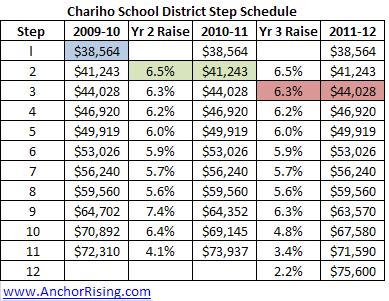
Usually, a step contract would have something like a 2.5% annual salary increase for each pay step. Not here. This time the teachers' union and district agreed on a step schedule that remained constant over three years for steps 1-8, decreased for steps 9 and 10, fluctuated for step 11 and (apparently) added a new step 12 in 2010-11.
As I've shown by including the "Yr X Raise" column, that doesn't mean that teachers aren't getting a raise every year, it just means the usual increase in pay that comes via a step increase isn't being further compounded by a raise on each step, too. As an example, I've highlighted (in blue/green/red) what the "real world" salary increases would be for a new teacher as they progress to 2011-12 under this contract. Being guaranteed over a 6% increase per year still ain't a bad deal.
Whether or not we agree with the amount of increases from step to step, it is significant that there is no raise being applied from year to year for each step. Whether or not this will inspire--or embolden--other districts to follow suit will be interesting to see.
October 30, 2009
The Time for Investment Has Passed; Now We Need to Produce
Can't Republicans at least agree that the last thing the state needs is more government "investment"?
Governor Carcieri Friday morning said Rhode Island must invest more in higher education and mentoring programs if it wants to encourage young, educated people to stay here for the long haul."As you invest in higher education, you make a statement to young people about what you value and what's important to the state," Carcieri told the crowd at the Knowledge Retention Symposium, a gathering at Brown University focused on preventing what's known as brain drain in the Ocean State.
Even within the brief article is evidence that the governor is misassessing the actual problem, with the following from Providence College President Rev. Brian J. Shanley:
"I hear this all the time and it drives me crazy. They come to Rhode Island to these great institutions and they fall in love with Providence and the state of Rhode Island, but they don't think this is a place they can stay. They think this is a launching pad to New York or Boston, or Chicago and Washington, and it's critical to the future of our state that our students, when they come here, think 'This is a place I can stay.' "
The students are already coming; the problem is that they leave, and to the extent that further government investments (read: taxes and bonds), regulations, and mandates continue to hinder the Rhode Island's private sector, the state will continue to circle the bowl and graduates will flee before they're sucked in.
October 28, 2009
The Audacity of the Union
If you've paid even moderate attention to union squabbles in this state, you've got to drop your jaw at some of the pro-binding arbitration ads that the National Education Association is putting out. Look at the clippings at the top of the picture highlighting all of the lawyers fees and other bad effects of recent negotiation disputes; all of them originate with the unions. They file the lawsuits. Their intransigence leads to work-to-rule.
I'm also reminded of a comment that local Tiverton unionist and guidance counselor Lynn Nicholas made when the union was pushing for retroactive pay, last year. The audio is available at the end of this post, but the relevant portion is as follows:
Has anybody... tried to figure in what it's going to cost for lawyers fees once we get back into arbitration? Have you begun to think about that?
Two observations: First, lawyers are still needed in arbitration and the steps leading up to it, and negotiations that ultimately land on an arbitrators desk for a binding decision will surely be hard-fought. Second, the cost of lawyers that the union intended to impose on school districts has been a repeated threat during negotiations; are we to believe that the unions are going to give up this weapon — indeed, promote its relinquishment as a salable benefit — for an arbitration regime that won't unduly benefit them?
Let the word go out: No legislator who votes for binding arbitration should be considered worthy of being reelected, no matter what else he or she might do while in office, because not only would that have been a vote to benefit the unions at the expense of the residents, but it would also affirm deceit as a central tool in Rhode Island's political system.
October 26, 2009
Preemptive Support for Evaluations
Is it too cynical to be suspicious of union enthusiasm to develop evaluation standards for teachers?
The Rhode Island Federation of Teachers and Health Professionals has received a $200,000 national grant to develop a much more demanding method of evaluating and mentoring new teachers. The union will work closely with four urban school districts: Providence, Pawtucket, Central Falls and Woonsocket."The union is tired of being portrayed as a protector of bad teachers," said union president Marcia Reback. "We have no interest in having incompetent teachers in our classrooms. We want to have good, rigorous, substantial evaluations."...
The peer-evaluation system would work as follows: a consulting teacher would observe, evaluate and mentor between 8 and 10 novice teachers over the course of a year. In the spring, the consulting teacher would recommend whether the new teacher should be awarded an additional contract. A board comprising administrators and union representatives would make its recommendation to the superintendent, who, in turn, would offer advice to the local school committee.
So a group of union reps and administrators (often previous members of the union) translate a union member's review of another union member to the superintendent, who brings it to the elected representatives on the school committee. Sounds like an attempt to derail evaluations that would involve more stakeholders, such as students, parents, and taxpayers, at a more fundamental level.
It always rankles, by the way, to hear union executives talk about "our classrooms." Perhaps public clarification of ownership is in order.
October 23, 2009
Gist: No More Seniority-Based Teacher Hiring
Rhode Island Education Commisioner Deborah Gist has quickly become a breath of fresh air, indeed (via 7to7):
Dropping a bombshell on Rhode Island's teacher unions, state Education Commissioner Deborah Gist announced Friday that districts must abolish seniority as a method of assigning teachers.I think Gist is willing to fight them on that. No more seniority, pushing for higher teacher standards, taking a hands-on approach....Gist has been impressive so far.Gist, in a letter to all superintendents Thursday, said the Board of Regents' new Basic Education Plan, which takes effect in July 2010, requires that highly effective educators work with students who have significant achievement gaps.
"In my view," she wrote in a press release, "no system that bases teacher assignments solely on seniority can comply with this new regulation."
The state has 12,000 public school teachers who are represented by one of two unions, the Rhode Island Federation of Teachers and Health Care Professionals or the National Education Association, Rhode Island.
The Rhode Island Federation of Teachers and Health Care Professionals has already promised to take Gist to court, claiming that she has exceeded her authority under state and federal law.
UPDATE: Gist talked to Dan Yorke and explained that this is not a "bomb" and she is doing nothing more than explaining an aspect of the Basic Education Plan that everyone should have realized. Further, she thought it unfortunate that union leaders were trying to use it as a wedge issue between herself and teachers. (Incidentally, lest we forget, Gist was a teacher of the year....).
October 18, 2009
Broke by Binding
I've got an op-ed in the upcoming Providence Business News addressing a topic that's on a great many Rhode Island minds: binding arbitration.
October 17, 2009
The Prick of Local Authority
What to make of the story of the teacher who accidentally stapled a student's head?
A Superior Court judge has upheld the firing of a Smithfield social studies teacher for stapling a student's scalp during a classroom stunt three years ago.Judge Daniel A. Procaccini ruled that the Smithfield School Committee, the state education commissioner and the state Board of Regents for Elementary and Secondary Education Appeals Committee showed "good and just cause" in finding that Bethany St. Pierre should be dismissed from her job as a Smithfield High School social studies teacher after injuring a student and then urging the class to cover it up.
The education commissioner's finding of facts, in February 2008, offers a good summary of the incident (PDF). As ever, multiple issues come into play. Should the teacher have been fired for the accident? Absolutely not; our attempts at an antiseptic society contribute (I believe) to a bevy of our current problems, including educational mediocrity. Should she have been fired for not taking appropriate steps that would have alerted other adults to the incident and suggesting that the students keep the incident in the classroom? Probably not, although her first reaction clearly should have been to send the student to the nurse, personally notify the principal, and send a note to the parents (or pick up the phone) to explain the incident. But was the school within its rights to fire her for a mere error of judgment? Yes.
Look, the courts should not be a mechanism for interested parties (such as unions or private associations, like church groups) to leverage higher tiers of government to micromanage the decisions of officials in lower tiers. Resolve the issue through the administrative and political processes available for that purpose. Relying on the judiciary merely lets everybody in power off the hook.
October 16, 2009
Work of the Hand Is Not Exclusive of the Mind
Marc's post on education and "dirty jobs" — the entire recent discussion about college and the necessity thereof — brings to mind this passage from Walter Rose's wonderful book The Village Carpenter, which reflects on Rose's family business as the era of the automobile and the machine came on strong:
These words are not to the old who, like myself, have passed the years of prime, but to the youth, whose years of promise lie before him. He seeks to acquire a personal knowledge of the craft, the ability to achieve as others have done and still do. Is he prepared to pay the price, in time and study of the principles of the craft, and the details of its execution? In my father's day seven years of apprenticeship was not thought too long to obtain this knowledge. When I was a youth the term had become reduced to four or five years. To-day there is a general disinclination for any apprenticeship at all, and a sad misconception as to the amount that has to be learned. But all the quickening processes of science have failed to train the human mind at a more rapid pace, and those who have studied woodcraft for half a century find themselves still learning and quite unable to pack all their knowledge into a nutshell for the convenience of a beginner. The training is not that of the university; it is, however, quite as exacting in its own way and so merits equal recognition and respect, and it is encouraging to note that this idea is slowly gaining ground.
Slowly,indeed. The Village Carpenter was originally published in 1937.
October 14, 2009
Private School Teams on Public Fields
I don't know if this will go anywhere, but the lawsuit by the ACLU against the Pawtucket Parks and Rec Department for supposedly giving parochial schools priority over public schools for athletic field use caught my attention. As summarized at 7to7:
The ACLU, in a news release Wednesday, alleged that parks and recreation gave the preferential treatment in issuing permits for athletic field use to parochial schools over public schools.I'm much more persuaded by the claim that the city has no objective standards for determining field use than by any supposed religious preferential treatment. (I suspect that any preference has more to do with who in the Pawtucket Parks and Rec may or may not be an alumnus of a particular school or not). Perhaps the most persuasive argument (PDF) is that these athletic fields were built and are maintained by public tax dollars, but the permitting has undeniably favored the athletic teams at St. Raphael's over the public schools.The suit has been filed on behalf of seven Pawtucket parents and their children and it asks for the court to declare unconstitutional "both the preferential treatment to religious schools and the city's lack of any objective standards" for issuing the permits for fields use.
As an example, the suit claims that O'Brien field has "been reserved exclusively" for Saint Raphael Academy after it was refurbished using tax dollars.
And junior high school teams at the city's public schools have been denied use of two other fields, which are used by athletic teams from Saint Raphael and/or Bishop Keough Regional High Schools, the suit alleges.
[F]or most of the period before and since the O’Brien Field has been refurbished through the use of public monies, Saint Raphael Academy has enjoyed the exclusive use of said field, particularly on week-day afternoons in the fall season, despite repeated requests by various public school officials for use of O’Brien Field for public school sponsored interscholastic sports, submitted to the City of Pawtucket’s Office of Parks and Recreation, by and through Defendant William D. Mulholland.This is part of a larger debate: to what degree should public dollars support private education? Many (all?) municipalities are required to bus students to private schools within their zone, for instance. If private school is a choice--often made out of necessity--should the public (ie; the taxpayer) be expected to subsidize any portion of that education? (Keeping in mind that parents who send their kids to private school subsidize public schools via their taxes)? Would this all go away if a voucher-type system was enacted?
October 13, 2009
The Science of Running Schools
The Tiverton School Committee meeting has gotten around to the abysmal NECAP science scores, which I described when they came out. Superintendent Bill Rearick has run through the process of evaluating the problem, yadda, yadda, yadda, yadda. It takes some years to turn things around. The East Bay Collaborative is attempting to come up with money to fund new "kits." The district is applying for grants.
News flash: There are kids graduating every year. There are students taking inadequate classes right now.
This is a bottom-line kind of thing for me. Screw contracts and hierarchies and standards and all the other grown-up junk. The district has resources allocated to it within which it must work. This is a basic function at which it is utterly failing. Expand the time that science teachers must work, if it's necessary. Fire anybody who isn't willing to put in the same degree of effort that any other professional who is utterly failing would have to put in.
Everything must stop until students are receiving the education that they deserve, and for which the town is already paying.
7:51 p.m.
Chatter. Starting the conversation with the statement, "this is obviously unacceptable," isn't sufficient. I don't want to hear what balls the district has started to roll. I want to hear what they're doing to roll them faster.
7:55 p.m.
Committee Member Danielle Coulter is trying to push the conversation toward what can be done immediately and what further effort can be pushed. You know, any private company, in any industry whatsoever, seeing a public release of this level of badness would be out in the public with a plan for repairs within a day. The tone of the administrators of Tiverton school district is what one unfortunately expects in the public sector. Essentially: "We're doing all of the steps that you're supposed to do. We need money. We're looking into tools."
These results (and not just science, either) should be keeping administrators across the state up at night.
7:59 p.m.
Supt. Rearick just said that there is no local money left to invest in this. Earlier in the evening, Director of Administration and Finance Doug Fiore proclaimed that the budget is balanced. I hate to contradict that, but there are clearly holes therein.
College Isn't Required to Earn a Good Living
Two stories in last week's ProJo have been jangling around in my head. Then Justin noted Deborah Gist's "anger" over kids not wanting to go to college and, correctly, pointed out that college ain't for everyone. I agree, especially when the value of a B.A. seems to be less and less while we pay more and more. The first story that caught my attention last week was that the RI Board of Governors for Higher Education raised tuition and fees by almost 10% at URI, RIC and CCRI, continuing a trend. Yet, Rhode Island isn't alone, it's a national problem. One cause of these increases is what's called the "cookie monster" effect, says Ronald Ehrenberg, who directs the Higher Education Research Institute at Cornell University.
Continue reading "College Isn't Required to Earn a Good Living"
Is the Gig Up for the RI Education Industry?
It's worth your time, if you haven't already read through the Sunday Providence Journal article about RI Education Commissioner Deborah Gist's elevation of the state's standardized test requirement for prospective education students to the highest in the country. The college and university estimates of how many students would miss the mark are head shakers, but of particular value is revelation of the gig, the game, the scam of educator education:
"Everybody understands what Commissioner Gist wants to do and I think her goals are laudable," [acting higher education commissioner Steven] Maurano said. "We absolutely want to work with her to do whatever we can to improve the quality of teachers in Rhode Island Schools. The concern that the institutions have is that if you raise the score for the Praxis I too high in one fell swoop, we will deny a significant number of students the opportunity to get into teacher prep programs."
Limiting the "opportunity" to enter into teaching programs is kind of the point, isn't it? It gets better:
Teacher training programs argue that there are several other safeguards before a student graduates, including requiring that students pass a series of exit exams in specific subjects toward the end of their program, called Praxis II, and perform student teaching for a semester.Rhode Island requires high cut scores for these exit exams and they are a better indicator of the kind of educator a new teacher will become, say Byrd and Eldridge.
Reporter Jennifer Jordan doesn't explore how the percentage of students who pass the exit exams correlates with the estimates of how many would fall short of higher entrance scores, but the underlying argument is telling. Those who run training programs want a low bar for the students rushing to give them money, but a high bar for achieving the goal that motivated the exchange. In typical Rhode Island fashion, the objective appears to be to introduce waste (of time, money, and human potential) for the benefit of those who live off of it.
The most suitable names for such behavior might make a good question in the vocabulary portion of the Pre-Professional Skills Test.
October 12, 2009
Don't Drop Out, but Stay for the Right Reasons
A "summit" addressing the high-school drop-out rate in Rhode Island has gotten some attention, as the topic certainly deserves. Talk about students' coming to see their teachers as the "enemy" rightly made the Providence Journal article and the WRNI audio report, but it may be that a statement of pro forma outrage from the education commissioner deserves more attention:
Deborah A. Gist, the state's new commissioner of elementary and secondary education, said Thursday she had a disturbing conversation with a group of teachers recently. They told her that many of their students aren't interested in attending college."That made me really angry," Gist said at a dropout-prevention summit. "Afterward, I asked nearly every student what they wanted to do after high school and every single child talked about going to college."
Apart from any occupational interest that she might have in encouraging high attendance rates, why should students' lack of attention to college make Ms. Gist "really angry"? Not every career path does, can, or should lead through an expensive few years of higher education, involving hours of effort and thousands of dollars for undesired lessons (whether fluff or culturally significant).
In fact, I'd hypothesize that decades of higher education's being presented as a must-take next step after high school has contributed to dropout rates. If college is a seamless continuation of secondary school, then achieving a diploma at the earlier stage is marginally more significant than not achieving one, and if a student isn't interested in the careers for which they expect college to prepare them, then they've no reason to be interested in an earlier curriculum intended to prepare them for college.
As a society, we have to make the pitch as to why high school graduation is important in its own right, and that will require a straightforward enunciation of the opportunities available thereafter — even if some students might find them adequate or even more attractive than continued time in plastic chairs with bolted-on desks.
October 8, 2009
Discussing the Undiscussable in Westerly
On the agenda at Wednesday night's meeting of the Westerly School Committee, in the words of Victoria Goff of the Westerly Sun, was "[finalizing] the termination of Schools Superintendent Steven Welford's two-month employment with the school district". Mr. Welford had begun a three-year contract as Westerly's superintendent of schools in July of this year.
Goff's article quoted the statement offered jointly by Welford and the Westerly School Committee that had announced the unexpected end of the new superintendent's term of employment...
On Friday evening, the school board and Welford issued a joint statement saying Welford's employment would end today because of a "differing philosophy about the operation and direction of the school district." Murano said he would offer no comments other than what is in the joint statement.A number of Westerly residents used the open comment period of Wednesday's meeting, attended by close to 100 people, to express their dissatisfaction with the vagueness of the official explanation.
- Westerly Resident Harry Staley was the first speaker on the topic: "I think it's fair to say that the only who people in this room tonight who understand Mr. Welford's reason or reasons for leaving are the members of the school committee….As a result, there has been a flood of rumors, that run the gamut from allegations of serious criminal acts, to petty personal disagreements between administrators including claims that serious financial problems exist…" At that point, School Committee Chairman James Murano asked Mr. Staley not to talk about the specifics of job performance.
After a brief discussion about what was appropriate to discuss and why, Mr. Staley continued: "Like the rest of us here who are gathered tonight, I have neither the power nor the authority to do anything else but register my concern…"
- Westerly Resident Mark Sullivan expressed similar concerns, concluding by saying that any new candidate for the position of superintendent "would have to be incredibly courageous or just flat-out nuts to subject themselves to the environment that [Westerly is] projecting to the community, the state and the region".
- Another Westerly resident asked if residents could expect sometime in the future to learn more details about Mr. Welford's termination.
- Finally, Westerly resident Christine Misto asked that if the termination had truly resulted from "philosophical differences about the direction of the district", could the school committee's philosophy be explained to the public. (Earlier speakers had offered a related point, asking why philosophical differences serious enough to warrant the dismissal of a superintendent were not apparent during the screening and hiring process.) Chairman Murano tried to answer the question about philosophy in general terms, saying that goals and objectives are included in the annual school budget, but following-through on his promise in Goff's article, he offered nothing specific with regards to Welford's situation.
September 27, 2009
Failing Our Students, Once Again
It is unequivocally unacceptable that a mere fifth of Rhode Island's high school students can achieve proficiency on the science version of the NECAP test. I'm especially incensed by the fact that Tiverton was one of only two districts in Rhode Island to lose ground at every grade level. Johnston was the other, and while Johnston's scores are worse, Tiverton's declined more severely (PDF).
The question that begs to be asked is whether the result is further evidence that the raises that the Tiverton school committee dished out in January were ill considered or it is an indication of union members' inability to maintain and improve the quality of their work while they're agitating for unaffordable increases in pay.
Turning back to the state level, Julia Steiny's got an interesting column today making the observation that the problem is much deeper than just an inability to lead students to grasp scientific concepts:
In the spring of 2008, Greg Shea, physics teacher at Mt. Hope High School, was proctoring the 11th-grade New England Common Assessment Program science test.As he wandered among the test-takers, he was blown away by the number of kids leaving the open-ended questions blank. They seemed buffaloed by having to explain their thinking in writing. His heart sank.
Sure enough, when the test results came in, an anemic 19 percent of the kids were "proficient." (State average: 17 percent.) Shea says, "The biggest driver of the science NECAP scores was the students' inability to respond to the extended-response questions. We dug into the issue by asking the kids what happened. They told us we hadn't given them enough opportunity to develop the [needed] skills."
Steiny presents the story as an ultimately hopeful illustration of what can happen when professional educators work together and try comprehensive approaches. In a darker frame of mind, one could point out that we aren't merely failing to provide students with a body of basic knowledge, which is bad enough, but are unleashing them into the world unable to learn, think, or express themselves in practical ways, which is nigh upon criminal and brings into doubt the very argument for funding public education at all.
September 22, 2009
Where Competition Ought to Happen
I hadn't intended to attend tonight's school committee meeting in Tiverton, but I saw on the agenda that they'd be discussing the item on the floor today: full-day kindergarten, rather than the current half day. Superintendent Bill Rearick put the additional cost at $223,953 per year, although he noted that, with next year's financial difficulty — by which he means the budget hole approaching $1 million resulting from a failure to hold over any of the magic Obama money — make it financially infeasible.
It's a shame. Rather than year after year paying more for the same or fewer services, the public schools should start to add services — to increase the value of the system to the town, rather than to the employees.
7:47 p.m.
It's the theme of tonight's meeting. Now they're talking about the district's inability to adequately monitor and coordinate curriculum development across all grades because they can't afford the extra hours for teachers. Committee Member Carol Herrmann presented the choice as between canceling classes or monitoring the classes we keep.
Superintendent Rearick put the price tag at about $100,000, saying, "We know how to build a Cadillac. We know what we need. We just can't afford it. We have a survivalist budget."
And yet the committee approved retroactive raises in the middle of an open-ended recession earlier in the year.
Performance Pay Doesn't Mean Cut-Throat Workplace
Dan Yorke has been talking about the East Providence school administration's push for a pay-for-performance system for teachers, and one teacher from the district called in from her house in Barrington to explain that that sort of pay schedule doesn't work in her profession. Teaching is cooperative, you see, meaning that unlike other professions (apparently) the teachers have to work together, and if some know that others make more, they'll refuse to help.
If that's the case, then the people with whom we currently entrust our children's educations must be replaced immediately, because they lack the requisite maturity.
Now, I know all other fields of work pale in comparison with the divine calling that is public-school teaching, but in every job that I've ever had, whether carpentry, editing, graphic design, office help, retail seafood, or even private-school grade school, differing pay has had absolutely no effect on employees' ability to work as a team. (Boy, wouldn't professional sports be in trouble!) For one thing, pay-for-performance is not zero sum; high-performing employees do not take their additional money away from those who perform less well.
Indeed, it behooves those who earn less to help those who earn more so the latter will provide them assistance in return — both as a matter of course and explicitly to aid in advancement. The carpenters on my jobsite are always quick to help each other, regardless of pay, and they are also quick to seek the input of those whom they know to have more experience and knowledge. Heck, the carpenters are quick to help the electricians and plumbers, who make more money than us even if they're terrible! As long as the structure is perceived as fair and is available to everybody, nobody has cause for grievance against their fellow workers.
If the current crop of teachers in East Providence can't even match the cooperation of lowly construction workers... like I said, they've gotta go.
A Different (and Less Effective) Way of Doing Business
I share Julia Steiny's aversion to teacher "bumping," of course, but her weekend column brings out the downright philosophical difference that exists in public education, as distinct from private-sector work:
A single regulation from the state, effective the moment each contract expires, would allow schools to get the best teachers they can, when vacancies occur.But that leaves the problem of displaced, or "excessed" teachers.
Cohen believes that "If teachers don't find a position after a year, they should be cut. Chicago and Austin have negotiated contracts that say that after a year, you're dismissed from the system."
Hmmm. That's a bit harsh. I might give them two or three years, so the time is limited, but enough to burnish their credentials or skills if need be. In the meantime, they could have a permanent substitute position at one school, two at the most, where they can be a member of a school community, instead of floating among schools where they can't integrate into a school culture, or be properly evaluated.
For folks who live their professional lives out from under the government wing, the entire discussion seems other worldly. A professional is hired to do a particular job, not to be a part of a system. It changes the relationship between employer and employee entirely. The public education system is having enough trouble teaching students what they need to know to be successful in life without undertaking the additional mission of coddling adults.
If teachers are "excessed," it means one of two things. Either the specific district of which they were a part had no opening for their talents, in which case, their experience should help them to find another job. (And shouldn't job placement be their union's role, not the the system's?) Or they weren't up to the task that they were hired to perform, in which case, both they and the students are best served by the application of maximum incentive to improve or to find a more suitable area of focus or even a more suitable career.
It is, of course, in any organization's interest to foster among its employees a sense of belonging, and that cannot be accomplished if it is unwilling to expend reasonable effort to find mutually beneficial positions for those who've already been hired. Such decisions can only be made on a case-by-case basis, and any systemic effort to influence the outcome beyond the motivation for success is counterproductive.
September 14, 2009
For the Benefit of the Sellers of Useless Knowledge
Actually, I'd argue that no knowledge is useless, although some is worse than useless. But Walt Gardner's observation (which does not raise uselessness, by the way) is right on the money:
THE NEWS that employment opportunities for college graduates have dramatically shrunk in today's recession comes as no surprise to anyone who has been following hiring trends. It merely confirms that the United States has been wildly oversold for far too long on the indispensability of a university degree as a haven against the dislocation caused by global competition.The hard reality is that the overwhelming number of new positions in the next decade will require short-term, on-the-job training — not lengthy tertiary education, according to the Bureau of Labor Statistics. The time frame is widely acknowledged to be between one week and three months, depending on the complexity of the tasks involved.
Higher education for all is the sort of unnecessary burden that folks who've never had to work (meaning actual work) like to impose. For a great many Americans, a standard four-year degree is a waste of time and a trap door into decades of debt.
Vlogging About Open Negotiations
My latest video blog is about open negotiations, drawing on material from Tiverton, but applicable elsewhere.
I'd be especially interested in feedback on this one, inasmuch as I tried some new tricks (in an effort to throw myself at the learning curve) and am still trying to get a sense of appropriate content for the medium. Let me know your thoughts on any aspect of video that might inspire comment. In advance, I'll say that this is probably about as long as my vlogs will ever be, and yes, next time, I'll take a few minutes to shave beforehand. (Hey, it was a busy weekend.)
September 12, 2009
Open Negotiations in Tiverton
Yes, this is a local instance, but I've no doubt whatsoever that similar opinions exist — and the same arguments would be made — in towns across Rhode Island, were school committees to begin considering a demand for open negotiations.
I've posted video of the discussion about the topic at the last school committee meeting in the extended entry.
Continue reading "Open Negotiations in Tiverton"September 10, 2009
Mixed Messages from School Districts, and Final Decisions from the Judiciary
Doesn't it seem that school districts somehow always just happen to find money? I mean, sometimes a car's brake lines just happen to go the day after it's been in the shop for a tuneup, but it's difficult to know what to make of the Woonsocket superintendent's claim that the district can now hire a few new teachers, as the state insists, without increasing the budget deficit:
Gerardi said those positions could be paid for with money that the district was receiving from the Northern Rhode Island Collaborative and by consolidating classes elsewhere in the system because of lower-than-expected enrollments that became apparent after the start of school.For two other positions — an administrator for part of the literacy program and a librarian at the high school — Gerardi said the district believes it can show that more qualified people already on staff will be capable of fulfilling the responsibilities of those positions.
So was that collaborative money just going to be used for red balloons? Were those "qualified people" just going to be employed blowing them up? One begins to sympathize (just a little) with unions' feeling that school committees and the administrations that they direct preserve plenty of fat in their budgets that they can trim when required.
That impression adds a little bite to Education Commissioner Deborah Gist's reference, in this context, to state law requiring "maintenance of effort." It would be disconcerting to think that Ms. Gist sees the maintenance of effort clause as license to force districts to adhere to her demands.
Meanwhile, in East Providence, the embattled school committee is seeking a 3.5% increase in the municipality's contribution to its funding, even as the state demands that the city revise its plan for balancing its budget. Look, I'm thrilled about the list of items slated for increases:
The proposal calls for a 210-percent increase, from $250,000 to $776,962, in what was allocated for textbooks and instructional supplies this year. It also has more money for building and classroom maintenance (from $289,500 to $820,500); technology (from $214,682 to $489,682); and athletics and extracurricular activities (from $46,453 to $146,453).
But not only are these things that Rhode Island's townspeople should be considered as already paying for, but it can't do otherwise than leave it to judges to decide between this spending and increases in adult compensation packages. Maybe they'll rule the right way, maybe they won't. But it's way too easy to envision their joining with Gist in affirming the principle that budgets may always be balanced with an increase in taxes.
September 8, 2009
President's Address to School Kids
As promised, the White House has released the prepared text of President Obama's speech to school children today. Here's the theme:
Now I’ve given a lot of speeches about education. And I’ve talked a lot about responsibility.More excerpts after the jump. Content wise, there are a few things here and there that I didn't like (a reference to AIDS--the President needs to remember his audience, here). All in all, it's OK, but it's way too long for kids. After five minutes, the tune-out factor will be setting in. "When's recess?"
I’ve talked about your teachers’ responsibility for inspiring you, and pushing you to learn.I’ve talked about your parents’ responsibility for making sure you stay on track, and get your homework done, and don’t spend every waking hour in front of the TV or with that Xbox.
I’ve talked a lot about your government’s responsibility for setting high standards, supporting teachers and principals, and turning around schools that aren’t working where students aren’t getting the opportunities they deserve.
But at the end of the day, we can have the most dedicated teachers, the most supportive parents, and the best schools in the world – and none of it will matter unless all of you fulfill your responsibilities. Unless you show up to those schools; pay attention to those teachers; listen to your parents, grandparents and other adults; and put in the hard work it takes to succeed.
And that’s what I want to focus on today: the responsibility each of you has for your education. I want to start with the responsibility you have to yourself.
Continue reading "President's Address to School Kids"
September 4, 2009
Re: Teacher-in-Chief
I touched on the growing controversy surrounding President Obama's address to school kids earlier in the week. As I said, I thought Obama's speech would be pretty harmless and I expect that the speech will be filled with the usual platitudes and educational cheerleading. That's fine and is the sort of feel-good thing we should expect the President to do. However, I did find the "lesson plan" released by the Administration to be a little weird. I think it was this memo, not the speech itself, that got people wound up and paranoid to the extent that some school districts across the country aren't going to air the speech in their schools.
Supporters of President Obama have pointed out that both Presidents Reagan and Bush, Sr. also addressed school children. And they were also criticized. For instance:
As Barack Obama prepares a nationwide broadcast to America's students next Tuesday, it has been revealed that Democrats complained in 1991 when then President George H. W. Bush broadcast a speech from a Northwest Washington junior high school.The difference, I'm pretty certain, is that neither Reagan nor Bush put out a comprehensive lesson plan, much less a poorly written one, beforehand in preparation for their speeches.In fact, the House Majority leader at the time, Dick Gephardt (D-Mo.), said "The Department of Education should not be producing paid political advertising for the president, it should be helping us to produce smarter students."
Such was reported by the Washington Post on October 3, 1991 (h/t KY3 Political Notebook via Chuck Todd)
The Obama Administration has fallen to blaming this misunderstanding on the "inartfully worded" memo and has changed at least one "suggestion" from, "Write letters to themselves about what they can do to help the president” to "Write letters to themselves about how they can achieve their short-term and long-term education goals.” That's a smart change and more indicative of what the President's address should aim to do a la Reagan and Bush. Inspire the students about education in general by encouraging them to think about themselves (that's what kids do best, anyway!). Shy away from anything that could be inferred as Presidential hagiography. President Obama is also going to release his speech ahead of time. Another wise move.
So, the lesson plan is one reason--and probably the biggest--why people got upset over this. Over-exposure is another. Since he took office, we have seen or heard the President speaking at us about nearly every aspect of our lives, from health care to the economic crisis to the baseball All-Star game. People who disagree with Obama's politics are just plain getting sick of the Obama Show. Yet, despite all of the media exposure, at least they could switch the channel or turn the page. But with this address to the schools, they see Obama circumventing their ability to control who or what has access to their children. I think they are over-reacting and that part of being a parent is discussing such things at the dinner table. Re-programming, if you will. Dan Riehl (h/t) thinks the backlash is symptomatic of a deeper conflict going on within the country:
That what once would have been a non-event is so incredibly controversial suggests to me that a great many Americans likely feel disconnected from the nation's political affairs right now, as well as extremely concerned about what the future's going to bring. The crisis Rahm [Emmanuel] suggested taking advantage of doesn't just cut one way, after all. And I doubt that any alienation, or all the concern came about from just 9 months of any one term.That is certainly part of it, but it has been a heckuva nine months. For myself, I agree with John Podhoretz:
If, in his speech, he tells kids to do their homework and listen to their teachers, he will be doing something good, especially for African-American kids, who are, all sources and studies report, desperately in need of hearing that performing well in school isn’t some kind of betrayal of their race.Basically, I think most kids are going to hear Charlie Brown's teacher. Mwa mwa. Mwa, mwa mwa mwa mwa. BUT, if some come away inspired to learn, all the better.If he does use the speech to do some politicking on his agenda, there’s going to be trouble in the schoolhouse. As the nation learned in June and July, it turns out there are few things more boring than listening to Barack Obama discuss health care; school-age children by the millions will be shifting in their seats, rolling their eyes, and beginning to think seditious thoughts if they are forced to sit through such a thing.
The Hard Work of Educating
The rhetoric about public-sector workers' doggedly, thanklessly doing the hard work that the community requires, recently promoted around here by Phil, comes to mind especially with the item that I've italicized in the following:
EAST PROVIDENCE — The city's teachers have voted to withdraw from volunteer activities in the district's schools.The roughly 500 educators won't help with afterschool activities except for those that are accompanied with paid stipends, nor will they chaperone dances, buy supplies for their classrooms or participate on committees for curriculum development, accreditation or school improvement.
This isn't just a temporary imposition affecting only the irreplaceable educational experiences of current students — which is egregious enough; it's acceptance of decay in the system itself. Teachers may see school committees come and go, they may see budgets swell and ebb, but in East Providence, they apparently don't consider themselves to be guardians of the city's education system. Of what value are they, then, beyond replaceable cogs in the public machine?
Perhaps it should be encouraging that Education Commissioner Deborah Gist included the East Providence teachers' actions among the issues of concern that she highlighted at yesterday's Board of Regents meeting, but a contrast of emphasis emerges. In the case of Woonsocket, she threatened the superintendent's certification over the hiring decisions of the school committee. If she believes, as she states, that educators should never "make decisions that directly impact students" (in a negative way, we can assume she means), then perhaps she should be looking into revoking their certification when they behave as if their jobs are more a matter of entitlement than calling.
September 3, 2009
E.P. Teachers Offer "Kid-Friendly" Boycott of After School Activities
The city's teachers have voted to withdraw from volunteer activities in the city's schools.Right.The roughly 500 educators won't help with afternoon activities except for those that are accompanied with paid stipends, nor will they chaperone dances, buy supplies for their classrooms or participate in committees for curriculum development, accreditation or school improvement.
The changes are effective immediately and will affect all of the city's 13 schools. School begins Sept. 9.
"We're continuing all our contractual obligations and beyond," said Valarie Lawson, the president of the local teachers union, East Providence Education Association. The union adopted the policy at a Monday membership meeting.
"This is not work to rule," said East Providence High School history teacher Greg Amore, a member of the committee that developed the teachers' plan.
When teacher unions vote to do only what is contractually necessary, it is considered "work to rule" in education circles.
The city's teachers, however, will continue to write letters of recommendation for students, meet and talk with parents and be involved with parent-teacher organizations. They will also continue to offer after-school help, coach sports teams, correct papers and plan lessons at home, and participate in all paid extracurricular activities.
Amore said this plan is "kid-friendly."
September 2, 2009
A Glimpse of Another System
This sort of turnaround would flourish in a system of educational choice and merit-driven, professional teaching careers:
After a $35-million renovation that left no surface untouched, Nathan Bishop is truly a Cinderella story. Closed nearly three years ago, the school today welc omes its first class of sixth-granders and a new cadre of teachers handpicked by Michael Lazzareschi, an award-winning former elementary school principal who is determined to dispel the myth that middle schools are the district’s weakest link.
Handpicked teachers? You mean they weren't selected for these plumb jobs based on proximity to retirement? Some would argue that this is more in line with the way "professionalism" ought to function in the public education system:
The Massachusetts Teachers' Association expressed concern that such a system [of rewarding teachers for student success in AP classes] threatens "collegiality" in the schools, since some teachers who make the effort are rewarded more than others who do not. (The MTA wants the local unions to snub grants that go directly to teachers in the form of increased compensation.)Union leaders in Dartmouth and Leicester rejected the grants that would let their schools participate, meaning only 12 systems will participate, though there is money for 14 this year.
Retired Teacher in Favor of Binding Arbitration. Surprised?
It's disappointing to see retired teacher and principal John Savage (R - East Providence) release an op-ed in favor of binding arbitration on House Minority Office letterhead. The piece (provided in full in the extended entry) amounts to union spin issued in the name of the Republican Party. The substantive core of Savage's argument is as follows:
There is a belief that arbitration decisions overwhelmingly favor teacher unions. Over a span of ten years, (long enough to give us a respectable sampling) 636 teacher contracts were negotiated in the Nutmeg State. Only seventy-five (12%) of these contracts (756 individual items) were submitted to arbitration. Scorecard of decisions rendered: School Boards-379/ Unions-377. Let us probe deeper! Health Insurance issues: School Boards-52%/ Unions 48%, Working Conditions: School Boards 53%/ Unions 47%, Salary issues: School Boards 42%/ Unions 58%.Well did those arbitrated salary decisions put the strain on municipal budgets? Maybe they did, but certainly not because of the arbitration. The arbitrated salary increases averaged 2.39% while the negotiated salary increases averaged 2.48%.
Savage offers zero, zilch, nada indication of his source or of the 10-year span that he's describing. He explains that binding arbitration became law in Connecticut in 1979, which ought to leave almost three decades of data. Why present numbers from only one third of those years? It's curious to note that, in this regard, the elected Republican representative's spin is more egregious than that of NEA Assistant Executive Director Pat Crowley, who at least divulged the years at which he was looking and used a span showing higher increases than Savage describes (my response here).
The lack of citation also makes it impossible to adjust for context. So School Boards won 52% of healthcare-related disputes, but that might mean they won the right to send out plan descriptions in digital form, instead of paper while the unions won the right to continue paying 4% coshares. Who knows?
One thing we can say is that, alone among the various categories that Savage lists, salary increases inherently compound. Health insurance and working conditions can change from year to year; salaries never, never go down in the world of public sector education.
If Savage is truly after a solution — for the benefit of Rhode Island's students — that will resolve contract disputes through "fair and evenhanded legislation," he could advocate for a ban on retroactivity. That would give the unions incentive to reach agreement, rather than to drag out "negotiations" for years on end to ensure that the cost of their labor never recedes.
The most fundamental problem with Savage's position is that he cuts out the consideration of most concern to those whom he ostensibly represents. That the arbitration produces slightly less remunerative results for unions tells us only that it kicks into gear where the terms of contracts are most hotly disputed. In other words, it's a safety switch that unions can hit when taxpayers manage to mount a truly substantive response to their steamroller.
Continue reading "Retired Teacher in Favor of Binding Arbitration. Surprised?"September 1, 2009
Teacher-in-Chief
Via Drudge, it seems President Obama is going to address all pre K to 6th grade students on September 8th. Hm. On the one hand, I'm guessing he'll speak a lot of platitudes about working hard, opportunity, reaching for the stars, etc. In and of itself, probably pretty harmless. But the concept of sending out a talking points sheet is a little weird. Here's one of the talking pre-speech discussion points:
Why is it important that we listen to the President and other elected officials, like the mayor, senators, members of congress, or the governor? Why is what they say important?I wonder if the difference between "listen" as in "do what they say" and "listen" as in "analyze what they say" will be discussed. I doubt it, especially since most kids don't have the critical thinking skills to figure out the difference. Instead, it will simply be an authority figure talking at them. Ahh, the irony that the "question authority" generation has gone here....
This address to our captive school children is all part of the kick-off for the new "Get Schooled: You Have the Right" campaign, which also an appearance by the President on a back-to-school special.
"Get Schooled"?
Really?
Bureaucrats trying to be too cool by half, if you ask me. And it seems to be an extrapolation of urbanity nationwide, where the cultural relevance of "getting schooled" may not be completely grasped in the hinterlands. Setting aside the poor grammar usage exhibited by naming an education initiative after a bit of slang, don't these guys know that once you co-opt slang you remove all of its inherent coolness immediately?
"Sports teach the same lessons to the superstar as the substitute."
ProJo high school sports reporter John Gillooly writes about pay-to-play and gives an example of a young girl who thought she'd give volleyball a try, but paying a sports participation fee was an issue:
She had heard that anyone who felt their family couldn’t afford the participation fee could go to the high school athletic director and make out a hardship waiver form. But that would be embarrassing for both her and her family.I would argue that being a substitute or an end-of-the-bencher can provide more valuable lessons than when your a superstar (or even just a solid varsity star). You learn about hard work, commitment and being on a team, even if personal glory doesn't redound upon you. That mindset, that sense of self-sacrifice, is one of many skills learned on the field or court that can easily be transferred into everyday life. As I've said, providing our students the opportunity to compete on teams--or play music, or act or paint--free of charge (so to speak) is an important component of a well rounded education. It shouldn't cost extra.The easier thing to do was just not play.
After all, it’s no big thing that she’s not playing. She’s not some superstar athlete. Her presence on the team wouldn’t be the deciding factor in a drive for a state championship. Other than a few of her friends, nobody will even notice she’s not playing.
So she became one of the Lost Children of Pay-to-Play.
I don’t know “her” name.
I wouldn’t recognize “her” if I saw her.
But after decades of chronicling the activities of high school student/athletes and talking to people in areas where pay-to-play has been a reality for a while, I know “she” and other teenagers like her exist at every high school that has pay-to-play sports.
They are the not the star athletes, not the ones whose names appear on the recruiting lists of college coaches. They are, however, teenagers for whom high school sports participation is important for a variety of reasons that don’t include All-State awards or college scholarship offers.
We have become a society that more and more measures its concept of success by an individual’s celebrity-rating, yet high school sports teach the same lessons to the superstar as the substitute.
There are lessons of commitment, teamwork and healthy lifestyles and they come at a time when young people are beginning to make their own decisions about their life’s direction.
The End of Cultural Literacy
The New York Times article doesn't claim a trend, instead following the efforts of a single teacher, Lorrie McNeill, with a class of gifted students, but one can be sure that the positive article in the publication formerly known as "the newspaper of record" will encourage more teachers to follow her lead. What McNeill has done is to jettison a classroom reading list, instead letting students choose their own books, with a gentle "prodding" to "a higher level."
The deceptive success of the program has been in increased interest in reading and achievement on a standardized test, but one could argue that the uptick highlights nothing so much as the low performance of students previously:
Of her 18 eighth graders, 15 exceeded requirements, scoring in the highest bracket. When the same students had been in her seventh-grade class, only 4 had reached that level. Of her 13 current seventh graders, 8 scored at the top.
If these are gifted students, they ought to be passing these tests handily; one shudders to think how lower-level students are doing. An education system that must dumb down assignments and ignore its mandate to develop a shared literacy in order to achieve positive results in mechanics is failing its students by any definition, and an attempt at finding social redemption strikes me as starry-eyed:
In the method familiar to generations of students, an entire class reads a novel — often a classic — together to draw out the themes and study literary craft. That tradition, proponents say, builds a shared literary culture among students, exposes all readers to works of quality and complexity and is the best way to prepare students for standardized tests.But fans of the reading workshop say that assigning books leaves many children bored or unable to understand the texts. Letting students choose their own books, they say, can help to build a lifelong love of reading. ...
... literacy specialists also say that instilling a habit is as important as creating a shared canon. "If what we're trying to get to is, everybody has read 'Ethan Frome' and Henry James and Shakespeare, then the challenge for the teacher is how do you make that stuff accessible and interesting enough that kids will stick with it," said Catherine E. Snow, a professor at the Harvard University Graduate School of Education. "But if the goal is, how do you make kids lifelong readers, then it seems to me that there's a lot to be said for the choice approach. As adults, as good readers, we don't all read the same thing, and we revel in our idiosyncrasies as adult readers, so kids should have some of the same freedom."
Will the fact that more students allow themselves to be motivated by choose-your-own-adventure reading assignments mean that they'll choose reading over other candidates for their attention in the future? I'm skeptical. As I argued recently regarding summer lists, books' unique attraction is their evocation of substance, profundity, and achievement. If gifted students already in eighth grade are still not past the point of picking books that are essentially cartoons in sentences, they've precious little time to reach the vista at which one sees the literary canon imparting meaning to life.
And that brings us back to the fact that they'll have little experience plumbing a common meaning conveyed in classics. Frankly, I can't help but think of a lecture from the '80s by former Soviet propagandist Yuri Bezmenov about Communists' strategy of subversion as warfare. Explaining the components of the first stage of subversion, demoralization, Bezmenov touches on education:
Distract them from learning something which is constructive, pragmatic, efficient. Instead of mathematics, physics, foreign languages, chemistry, teach them history of urban warfare, natural food, home economy, your sexuality — anything, as long as it takes you away.
Although Bezmenov doesn't mention it in his brief explanation, cultural literacy is a critical component to social cohesion and a national sense of purpose. Left to their own devices, young Americans will isolate themselves in limited communities of interest and ideology; many will simply remain functionally illiterate. In this context, it's significant to note that the "reading workshop" method appears — once again — to further the trend of locking boys out of educational "progress":
To Ms. McNeill's chagrin, several students, most of them boys, stubbornly refused to read more challenging fare. One afternoon this spring she pulled her stool next to Masai, an eighth grader who wore a sparkling stud in one ear, as he stared at a laptop screen on which he was supposed to be composing a book review. Beside him sat the second volume in the "Maximum Ride" series, which chronicles the adventures of genetically mutated children who are part human, part bird. He was struggling to find anything to write.
Foreign government agents may not be behind these social movements — indeed, Bezmenov likens subversion to the martial arts technique of helping your opponent to knock himself off balance — but a generation or two of dumb, demoralized men and slightly less dumb, self-esteem-inflated women all disconnected from each other and from the culture into which they were born will spell destruction as clearly as would a successful invasion.
The Price of Teacher Hiring Reform
The Providence Teacher's union isn't happy with new hiring rules put in affect this summer, according to this WRNI report from Elisabeth Harrison (h/t). The nut of it is, of course, the removal of seniority as the major factor in determining who gets hired. As Harrison reports:
An order from the State Department of Education...required district leaders to fill all vacancies in the district with the best person for the job instead of the most senior teacher as the teacher contract stipulates.Apparently, around 100 Providence district teachers have been replaced by out-of-district teachers thanks to the new criterion-based hiring policy. Using this process, the schools got 96% of their first choices (100% of first two) while teachers got 86% of theirs. Steve Smith of the Providence Teachers union found the Superintendent's office uncommunicative and compared them to the Politburo. Helpful. Smith wanted to give some weight to experience, but, as mandated by the State, Providence had to get away from that method. And by the way, the non-working Providence district teachers continue to receive full pay and benefits while they sit in the reserve pool. Providence Superintendent Tom Brady explained that, basically, such is the price of transition.
August 30, 2009
Still in the Vague Phase
We have to give the woman some time to build up momentum (or not), but per Julia Steiny's column today, Education Commissioner Deborah Gist is still in the phase of offering vague goals:
1. "Ensure educator excellence": Recruit, support and evaluate highly effective teachers and leaders.2. "Accelerate school performance": Engage broad community support, especially from parents, in promoting excellence and equity. Intervene assertively in persistently struggling schools.
3. "Establish internationally competitive standards and high-quality assessments": Rhode Island's ongoing efforts to anchor our standards in internationally-recognized best practice must remain a priority.
4. "Develop data systems that drive student performance": Upgrade our current systems and get more user-friendly data into the hands of all stakeholders.
5. "Develop finance systems that drive student performance": Establish fair and equitable funding, and become vigilant stewards of the taxpayers’ investment.
Steiny characterizes Gist as "a jolt of pure energy," which could mean that she intends to take the state's apathy by the throat. Of course, I've also seen such jolts emanating from "sales people" promoting direct marketing pyramid schemes. Some folks take their first rule as "you've got to be excited to get the mark excited," and I've always been wary of those who've tried to stir hot emotion rather than well-reasoned and optimistic determination. As for those who are genuine in their uncontainable energy for change, inasmuch as the world has its store of recalcitrance to storms of personality, they cannot always succeed, and their response to delay can be difficult to predict.
So, we're left waiting to see whether Ms. Gist wins quickly; buckles down for the grit of long-view transformation despite human lethargy; faces obstacles and determines the effort not worth the sacrifice of some other opportunity that has suddenly appeared; or some other possibility. In sum: There are encouraging sounds coming from the commissioner's office, but it's too early to tell whether it's just the burble of some inspirational movie playing in the background.
The Unions and Their Jobs
David makes a perspicacious comment to my post on the item in the teachers' contract that the school committee approved in January that effectively extended the contract for an additional year because the deadline for notification of intention to negotiate had already passed:
Actually, justin, you may be on to something. Union officials act as legal representatives for their membership and are charged with only that mission. The example that you wrote about- well that's all on the school committee for not knowing their own contract with the union. You insist on calling it a union contract when it is a contract between two parties. Both are held to its terms. Where you have something is in the reality that individual union members are often times members of the community where they work, and, are often times very interested and concerned about issues facing their community. In the case of teachers, police, firefighters, and social workers it is often the case that they are more concerned- because they have a closer view and knowledge of local issues and problems than say a Boston area worker who leaves their home in Tiverton at 6:30 in the morning and returns at 6:30 at night. Teachers often times know the community through the children better than anyone else. If you can convince those community members that their union representatives are the problem and change is needed in their own workplace than you will have a chance. Union members acting in the democratic framework of their union could help affect the changes you seek.
Realizing that it would be too much to hope that one party in these "fair-minded" negotiations would have clarified with the other that it was effectively approving the contract for an additional year, I do and did hold the school committee members responsible (and will, via future elections). Truth be told, I also allocate some blame to myself for having not been sufficiently familiar with previous contract language to have raised this question during public commentary. I suspect that might have been the one thing that could have scuttled what was clearly a fait accompli at the fateful January meeting.
With that clarification, I'd note that David is dead on to raise the importance of individual union members in changing the dynamic. Just as I'd be tempted to make it a civic requirement that every resident attend at least one school committee meeting during contract negotiation season, so as to observe, first hand, the undertone of violence that the union audience stirs up to waft onto the dais, I'd encourage teachers to spend some time pondering the structures and regimes of their non-educational organization.
As I've been given to understand, for example, a typical negotiation session involves the superintendent and couple of committee representatives at a table with two or three leaders of the local union, while a larger union negotiating committee waits in a nearby room, sometimes with a rep from the statewide organization manipulating the temper among them. (Pat Crowley, I understand, can be heard through the walls.) The small group will bring items back to the larger group and return with ostensible instructions, and ultimately the negotiating committee brings the result back to the entire membership for approval. Meanwhile, as we've seen in Tiverton, the union will go public with unverifiable claims and complaints that the entire school committee isn't available in the theatrically controlled space to negotiate the contract. (A con is much easier when there's no opportunity for head-clearing air.) Moreover, at no time is the administration or committee permitted to appeal directly to the professionals whose contracts they're negotiating.
While times were flush and the citizenry was inactive, this might have seemed like a fun pastime — and remunerative, too! Union members across the Rhode Island public sector should consider, however, the effect of shifting public opinion as taxpayer groups generate an institutional investment in continued awareness. That is to say that we aren't going away, and with the processes coming out, the folks who've ultimately suffered from the game are going to be less inclined to tolerate it.
Because the pendulum always swings too far, a clever gotcha in one year's contract could ensure that somebody with a set jaw and brow as furrowed as my own will end up at that negotiating table, demanding that public-access video cameras be set up to capture the edifying performance.
August 29, 2009
Conflict Is a Big Black Marker
Developments in Woonsocket are fascinating:
Education Commissioner Deborah A. Gist has warned School Committee members that they could be sued and Supt. Robert J. Gerardi could have his superintendent's certification questioned if the committee follows through on its threat to defy state rulings on hiring new staff for its literacy program. ...She warned the committee that willfully failing to comply with state and federal education laws could provide "good cause" to examine Gerardi's state certification as a superintendent. It could also leave the School Committee members personally liable under federal and state laws that require government officials to fairly discharge their duties and enforce the laws that apply to their positions.
School Committee Chairman Marc A. Dubois said the response to the committee's Wednesday night vote was not a surprise, but the tone was.
"I expected a reaction," he said, "but not as harsh or personal."
It would be easy to scoff that Dubois had a small-town understanding of the role and responsibility of municipal school committees and didn't comprehend the powers with which he was contending, and there may prove to be a certain amount of accuracy to that assessment if he is unwilling to face consequences of which is legal council should have been able to warn. More central, though, is his apparent expectation that the conflict would more immediately be addressed at a higher level of authority. If Commissioner Gist had moved the conflict up the chain in the form of an inquiry — perhaps to the judiciary — it would have entered the purview of somebody able to dictate a broader range of changes. Hearing Dubois's complaints, a judge might have gone so far as to prescribe a course of action for the school committee or the town council, thus absolving the locals of the blame.
But Gist chose to halt the process with a test of her own remedies' strength. Inasmuch as she lacks a police force, threats will have to be carried out from above, anyway, but her order for the town to address the issue will be first in line. In other words, before a judge decides whether the Woonsocket School Committee is correct in its claim that the members are merely choosing between conflicting laws and resolves the matter for them, he or she must consider the weight of the education commissioner's assessment that they are shirking their responsibility as government officials.
In essence, the question will be whether the committee's responsibility to taxpayers, and the authority deriving therefrom, or its obligation to enact state education policy is primary. Opinions about which outcome would be preferable likely break along the lines of reform strategies:
- If the commissioner's authority is such that she can manage municipal finances under threat of superintendent decertification and challenges to elected officials' execution of their legal duties, then we've got a system of de facto regionalization, with Gist as the statewide executive.
- If the commissioner is unable to assert her authority in this way, towns across the state will be more inclined to test their capacity for unilateral decisions, expanding the range of options open to local officials when setting policies for cities and towns.
Those who see locals as too weak and incompetent to stand against powerful interests (mainly the unions) should welcome the stronger hand of a state-level administrator. Those who see municipal offices as the most accountable to voters and available for change should prefer an education commissioner whose authority extends pretty much to the setting of guidelines and performance of assessment.
Personally, I'm of the latter mind. An authoritarian commissioner may, at first, mix forced property tax increases with new restrictions on union power, but the unions are massive organizations with endless resources, and after the initial round of hits, they'll direct those resources toward controlling the single seat in which the power of public education in Rhode Island will have been made to reside.
August 28, 2009
A Union Gotcha in the Contract
Given recent developments, I thought I'd review my notes and the audio from the Tiverton School Committee meeting at which the members approved a largely retroactive contract. Several townsfolk warned the committee that approving the contract in the current economy was reckless. I specifically suggested that, former Vice Chair Mike Burk's suggestion to "hold the line" with the subsequent contract notwithstanding, the union would have every incentive to avoid negotiations at this time. But four of the five committee members thought it would be the fair, community-minded thing to pass the contract (PDF) and move on to negotiations for the next one — which should cover the upcoming school year — in a spirit of collegiality.
Well, the union must have been snickering behind its hand, with Article 31 of the approved document (carried over from the previous contract) in mind:
The provisions of this Agreement shall be effective as of September 1, 2007 and will continue and remain in full force and effect until August 31, 2009. Said Agreement will automatically be renewed and will continue in full force and effect for additional periods of one (1) year unless either the School Committee or the Association gives written notice to the other not later than December 1 of the year prior to the aforesaid expiration date, or any anniversary thereof, of its desire to reopen the Agreement and to negotiate over the terms of a successor Agreement.
Never mind that the contract wasn't approved until after the deadline, the union is insisting that notice was not given, so the contract remains in force until next year. As the Newport Daily News reports, that serves to keep all salaries where they are — with step increases continuing, of course — and prevent the school committee from realizing the increase in healthcare contributions for which it had budgeted.
Even union-friendly committee member Sally Black was "surprised" by the move. Gotcha.
See, to the union, talk of community, fairness, openness, honesty, education, and the good of children is merely a pack of cards to play. It's all about the adults and their remuneration and their benefits and their occupational comfort and soaking taxpayers for the maximum amount possible. If I were a teacher, I'd be ashamed to be associated with such an organization. As a taxpayer, I've certainly got my eye out for school committee candidates who won't be so easily fooled.
As services for students begin evaporating and taxes go up, parents and their neighbors should be careful to allocate blame where it belongs: With the calculating, manipulative union that represents the single largest expenditure in either of the town's budgets.
August 26, 2009
Gist Reacts to RI SAT Scores
State Education Commissioner Deborah Gist is still in what may be termed a discovery phase of her new job — working her way through Rhode Island's abysmal statistics. To the extent that process is made public, she's already doing important work, and today, she's put our low SAT scores on the front page of the Providence Journal:
Gist said that she is also disappointed that the percentage of public school students taking the voluntary test is so low, at just 54 percent.(About 2,800 private and parochial school students also took the SAT, raising the statewide average by about 10 points per subject.)
Usually, test scores drop as the number of students taking the test increases. Rhode Island, Gist said, suffers from lackluster scores even with a frustratingly low number of students aspiring to take the test — a requirement for most colleges.
As we showed, here, last August, Rhode Island joins an average median income (by national standards) with high public school teacher pay, high private school attendance, low public school SAT scores, and high private school SAT scores. Every marker points to a systemic problem, originating with teachers unions. That's why I hope the following comment from Gist is more political flourish than indication of dogma on which she'll premise future actions:
"We need to make sure we are developing and supporting teachers," she said, "and we need to make sure we are moving out educators who are not serving students well, which I believe is a small percentage of teachers."
A "small percentage of teachers" have dragged Rhode Island's SAT scores to their current standing as the worst in New England? I don't think so.
August 25, 2009
A Quiet Rumble in the Tiverton School District
As I pulled up to the Tiverton High School at the usual time for a school committee meeting, I saw two of my Tiverton Citizens for Change co-conspirators leaving. The committee scheduled an executive session for 5:00 p.m. and had worked through all of tonight's interesting public discussions before 7:00. The key results, as conveyed to me in the parking lot:
- Chairman Jan Bergandy read a letter from local union President Amy Mullen that suggested that the union and school committee had agreed to accept the current contract as expiring next year (a brazen ploy that surfaced out of nowhere a few weeks ago). Mr. Bergandy declared Mullen's statement to be an outright lie, and the committee authorized its lawyer to take some sort of action.
- The committee agreed to issue a statement to the General Assembly opposing any sort of legislation calling for binding arbitration.
- The committee also put on the agenda for its next meeting discussion of conducting union negotiations openly and in public.
August 15, 2009
Objectivity Isn't Always the Best Approach
Like fairness, objectivity is a generally positive principle that needn't be — shouldn't be — the guiding principle in every circumstance. One circumstance in which a degree of subjectivity is appropriate, applied to a collection of objective criteria is the hiring of teachers, whatever their argument might currently be in Providence:
The union claims that Brady's hiring practice "eliminates in its entirety impartial and objective decision-making" because it requires the district to offer only an "adequate explanation" for teacher assignments.
So, as we've heard before, standardized testing is inappropriate because of all of the intangibles of teaching (i.e., it must be measured subjectively), and the hiring methodology of most of the rest of the economic world is inappropriate because it isn't sufficiently objective. Is Rhode Island done falling for this stuff, yet?
August 12, 2009
Many Employees Pay into Their Careers
There's already been much talk about the Providence Journal's front-page story about teachers' paying out of pocket for classroom supplies. It's a story we've heard and a discussion we've had before.
And it's not a tale unique to teachers. As a carpenter, I could rewrite this complaint in terms of my trade:
"When I walked into my classroom for the first time there was nothing in it besides the basic furniture, everything else had to be purchased by me," said Tessa Cooney, a newly hired teacher at Wakefield Hills Elementary School in West Warwick. "As a new teacher, I was unaware of how much money I needed to put into my own classroom. I never knew I would be purchasing books to stock a library in my room. It has been overwhelming and incredibly expensive."
It wouldn't be far off the mark to state that I averaged $10,000 of investments in tools and supplies for each of my first three years as a carpenter (on beginning pay of $12 per hour), and I continue to invest in tools, equipment, and disposable items like saw blades and health and safety gear for the reason that Central Falls teacher Pam Barnes expresses here:
"The school districts know we're going to go out and buy this stuff, because we can't get along without it," she said. "It's not that we're happy to do this, but we're resolved to do this, because it makes it easier for us to teach."
One could argue that paper, pencils, crayons, and the like are not comparable to my professional expenditures, but other costs of teaching are clearly parallel, such as classroom decorations, books, and other educational tools. In a perfect world of which I hear rumors, from time to time, contractors would keep their employees well appointed, stocked up with items that they might need on any given day, but until we've found that promised land, most of us will have to take ownership of our careers.
As for public school teachers, Marc probably puts his finger on the pulse of a growing majority of Rhode Islanders when he wonders why our nation-leading education expenditures don't provide supplies. As far as I'm concerned, that purchasing is already built into the teachers' salaries.
No Matter How You Slice It, RI a Leader in Education Compensation
With the stories about teacher's buying their own supplies and student athletes having to pay participation fees in North Smithfield, I wondered: Why? Recent Census Bureau data showed Rhode Island's cost per student was #8 overall in the U.S. Where is that money going? Well, as I discovered, 85% of that cost went to compensation (salaries and benefits) for adult employees in the school system (from bus drivers to teachers to superintendents).
The below chart shows the overall cost/student rankings (left-most column) and compares it to the data for the amount of compensation that went towards adults for each student (the center column). There wasn't much difference in the rankings, with Rhode Island comfortably in the top 10 measured each way.
But using real dollars doesn't take into account that costs are more expensive across the board here in the Northeast. As you can see, Northeastern states dominate the top 2 quintiles when real dollars are used as a measure. So I decided to try to account for the regional disparities and evaluate the rankings by using the percentage that employee compensation comprises of the overall cost/student rather than using dollar figures (the right-most column, below). The results show a wide variation as compared to just using raw dollar amounts.
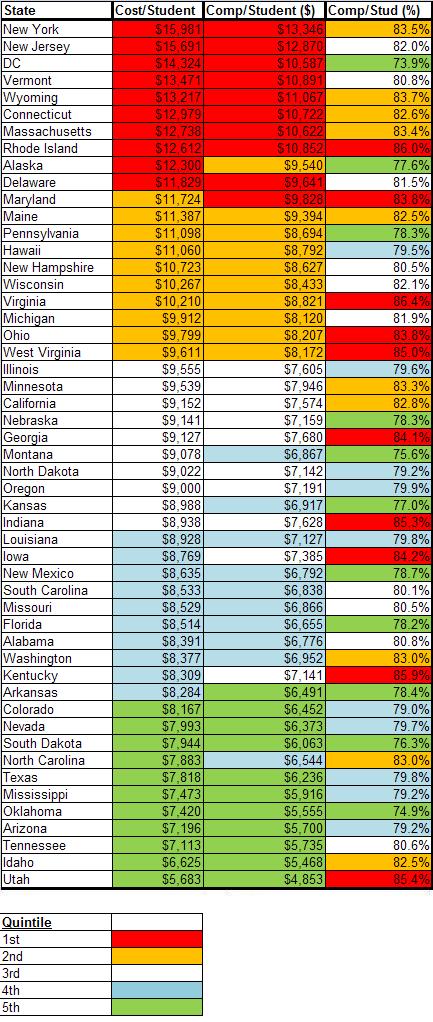
The total cost per student and compensation cost essentially line up. But the latter as a percentage of total cost (rather than as a dollar figure) reveals a more diverse result. To clarify, here is the same data resorted by % of cost that goes towards compensation.
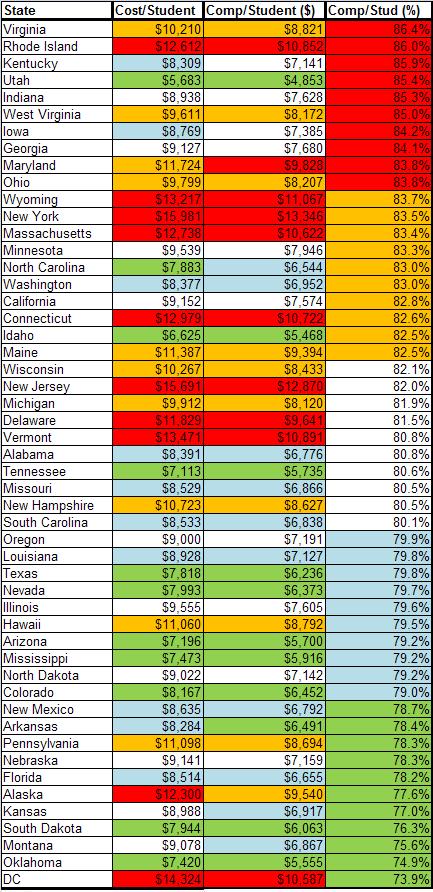
This confirms to me that using a percentage versus actual dollar figures is more illustrative when it comes to evaluating actual education costs. It shows that low-spending states like Utah or Kentucky put a high percentage of that money towards compensation for employees. (It's up to you if you think that is good or bad). On the flip side, Washington, D.C., which is a top overall spender nonetheless spends more non-compensation related money on their kids than anyone else. To lesser degree, the same could be said of Alaska. Then there are states like Oklahoma and South Dakota that don't spend a lot and don't spend as much on employee compensation.
Regardless, as you can see, only Rhode Island is in the top quintile (ie; most expensive) when measuring either real dollars or the percentage spent on compensation. So, no matter how you slice it, Rhode Island is a top spender when it comes to compensating our education industry workers.
Re: Rhode Island Board of Regents Approves Teacher Evaluation Plan
Whispers among administrative types are expressing skepticism about the regents' call for teacher evaluations (PDF). Perhaps, like Monique, the current system has beaten them down to the point of not believing such a thing to be possible, in Rhode Island, but they point to this paragraph as the potential trap door:
Establishing parameters for evaluation systems that are at the basis for the development, deployment, and advancement stage of the model begins with the development of standards for district‐based educator evaluation systems. This document presents a set of six draft standards that describe a high quality system. The draft standards identify expectations for all districts. RIDE will develop recommendations for how to support districts as they begin to implement these standards and processes that will lead to how local systems will be reviewed for compliance with the standards. It is important to remember that educator evaluation is only one element of an educator performance management system, but it represents a critical starting point.
The regents are telling districts to go out and negotiate these new standards with the unions and the state will figure out how to support them. It's a step in the right direction, certainly, but there's plenty of room for delays and game-playing.
August 11, 2009
The Continuting Folly of the Funding Formula
Talia Buford’s report in today’s Projo on the pay-to-play sports proposal in North Smithfield concludes with a quote from School Committee Chairman Robert Lafleur that helps illustrate how Rhode Island’s focus on a lack of a closed-form "funding formula" as the source of its educational troubles obfuscates more than it clarifies…
“We’re hoping the commissioner and the Department of Education will look at this as an attempt to deal with the economic conditions we’re all facing in Rhode Island as a result of the lack of a fair and equitable state-aid formula and lack of waivers from the Department of Education for the unfunded mandates that were imposed upon us by the General Assembly.”Now, according to a Patricia A. Russell story that appeared in the July 30 Valley Breeze, Mr. Lafleur is right to believe that a "funding formula" might benefit his community…
A state Board of Regents study last year found 19 districts would receive extra money [under one possible funding formula], while 17 would lose aid according to a calculation [Cumberland Mayor Daniel McKee] is suggesting is likely to be similar to the coalition's final recommendation. Winners tend to be communities that have been in McKee's so-called 30 percent club, those receiving 20 percent to 30 percent of the cost of education from the state while property taxpayers make up the remaining 70 percent or so.But wait a moment; we must also be mindful of Philip Marcelo’s Projo story from mid-July, about the aforementioned community of Woonsocket joining with several other communities, to possibly pursue a "fair funding formula" lawsuit in the courts…Cumberland picks up $4.5 million under one scenario, and Lincoln $4.5 million. North Smithfield gains $2 million while Woonsocket loses $2.2 million.
Providence, Pawtucket and Woonsocket are trying to rally support from other Rhode Island cities and towns and community groups for a lawsuit against the General Assembly for failing to enact a school funding formula....I don’t think I’m going too far out on a limb in assuming that Woonsocket officials aren’t going to court to get a formula which will cost them over $2 million.“Legislators know what the issue is, they just lack the political will to do it,” says Stephen M. Robinson, a Providence lawyer who has been retained by the school committees in Pawtucket and Woonsocket to work on a school formula lawsuit. “The only way to do it is if the court orders them to do it”....Robinson says that the communities are still trying to gather a broad coalition of communities and community groups for the suit, which may come as soon as September. “It is time to impress upon the Assembly how serious this is for us to have a fair and equitable formula,” said Providence City Council President Peter S. Mancini.
Surely, officials from both Woonsocket and North Smithfied sincerely believe that increases in aid to their communities are necessary components of a "fair funding formula" -- demonstrating, more than anything else, that the term "fair" as used by advocates often describes plans to take money from someone else and give it to them. But for citizens, voters and taxpayers, hearing that a politician supports a “funding formula” doesn’t reveal in any meaningful way what actual choices are under consideration, e.g. is priority being given to delivering even more to the communities that are already the big recipients of state education aid, or to equalizing the wide per-pupil disparities that currently exist? (There are plans currently before the Genenral Assembly for doing either). Will the plan be paid for with a statewide tax increase, with money taken from other state programs, or by taking existing money away from some communities and giving it to others? All of these options are possible, in the framework of a “funding formula”.
Ultimately, our state will be better off when the leaders of our communities spend less of their energies on trying to grab money from one another (and from the taxpayers), less of their time hiding behind process, and more of both working together to actually improve education.
Where's the Money for Sports and Supplies?
Kids paying for school sports. Teachers paying for their own supplies. The PTOs and PTAs being asked to do more and more every year. According to the Census Bureau (2007 data published in 2009), Rhode Island is 8th in the nation in per pupil spending at $12,612. Where does all of that money go?
Of the $12,612 Rhode Island spends for each student (on average), $10,852 (86%) goes to salaries ($7,642) and benefits ($3,210) for adults (teachers, administrators, bus drivers, etc.). Of the money that goes to the Census Bureau category of "Instruction", which I take to mean the actual teaching component of the education system, compensation accounts for $7,223 ($5,161 for salaries and $2,062 for benefits) of the $7,334 per student (98.5%). That leaves $111 for things like, well, school supplies and the like, I guess.
Rhode Island Board of Regents Approves Teacher Evaluation Plan
Is it too early to say: pinch me?
The Board of Regents for Elementary and Secondary Education approved a proposed set of standards that would, for the first time, require that all educators –– new and tenured teachers, principals, assistant principals and support staff –– be evaluated annually and that the evaluations meet a rigorous set of state standards.Currently, very few districts have substantive teacher evaluations and even fewer administer them routinely, said Education Commissioner Deborah A. Gist. The proposed standards would link how well students learn to a teacher’s evaluation. They would also be sophisticated enough to recognize and reward exemplary teachers, offer support to struggling teachers and establish guidelines for the removal of ineffective teacher.
"Would link how well students learn to a teacher’s evaluation"? Be still, my heart! A public hearing is anticipated though not yet scheduled for the fall.
In the meantime, one troubling matter has already surfaced.
All evaluations must collect data and feedback that will improve the teacher’s performance and will recognize the most exemplary teachers in the district — possibly even rewarding them for their effectiveness.
Reward of a monetary nature? So excellent teachers would make more than their current compensation level? Already, teacher pay in Rhode Island is in the top 20% nationally while student achievement is in the bottom 20%. And would it be crass to mention that many if not most Rhode Island communities are struggling mightily - to the point of implementing pay-to-play sports and putting forward ... er, "creative" ideas like eight unpaid work weeks per school year - to meet their current school payroll?
Sorry to be a potential skunk at the picnic. But baseline teacher pay around the state must be addressed if any reward for excellence under the Regents' plan is to take a monetary form.
August 9, 2009
Policy Baubles to Distract from the Pocket Picking
Tom Sgouros used his just-about-regular column in the reputedly right-wing Providence Journal, yesterday, to promote his new book. Obviously 800 words is insufficient to synopsize such a work and present much depth from the arguments that appear therein, but one thing Sgouros accomplishes is to convey his role in the left-wing–labor alliance in Rhode Island: He's the showman distracting the mark (i.e., the taxpayer) with baubles while accomplices slip as much out of the victim's pockets as possible.
It's long been clear that Tom's on a quest to find explanations other than the obvious for Rhode Island's sorry state, and he has solidified his results as follows:
So what's the problem? Well, labor certainly has allies in the state legislature, but it has lost almost all the high-profile battles it has undertaken over the past decade, from pension cuts to mayoral academies. Welfare benefits are stingy and hard to get here, just like in other states, and the rolls have declined dramatically over the past dozen years. Meanwhile, few municipalities are spending any more than the bare minimum necessary to meet legal requirements.
For context, here's his summary of the point of view that he's refuting:
Rhode Island is in a crisis. Hamstrung by a legislature in thrall to powerful unions and the lobbyists for social-service agencies, we have spent far beyond our means. Profligate spending by cities and towns is bankrupting local government, and threatens to take the state down, too. Meanwhile, to satisfy the unquenchable demand for government services and benefits, taxes are rising every year without end.
The game is easy to spot, for anybody who's paid attention. In the face of popular demand (mayoral academies) and utter necessity (pensions), the General Assembly and the unions have made the bare minimum of concessions in order to get by politically, while weighing them down with regulations and hedged bets so as to encourage their failure.. Welfare benefits are only "stingy" if one deliberately defines away most of the forms that it takes (typically refusing to include anything other than direct cash payments via a specific government program; search this site for "TANF"). And those "legal requirements" that municipalities are scrounging to pay aren't the result of some divine decree; they're the result (1) of imposed policy from the labor-friendly State House and (2) the contracts by which the towns have spent their residents' money.
Pay no attention to these impossibly complex disputes, says Mr. Sgouros. You can't possibly prove your position based on the available data. If that's not an exact quote from some of my own arguments with Tom, it's pretty close.
So, what Tom's calling "Ten Things You Don't Know About Rhode Island" is really a list of ten projects to occupy our ADD-besotted citizenry while maintaining the status quo for his friends and clients behind the scenes. Here, unravel this one:
Since the 1950s, we have built what amounts to an entire second state's worth of roads, bridges, schools and police stations. Yet the state's population is up only about 30 percent since that time.
One suspects that he's not proposing that we immediately break out the bulldozers, so the entire fleet of current public sector employees would be well into their Florida retirements before even the preliminary "studies" were completed. Here's a nice related project we can resolve in the meantime:
Almost all the police hired in the past decade have been in the low-crime parts of the state. Many communities with high crime rates have been forced to cut their police departments, while low-crime towns added jobs.
Clearly, this has nothing to do with organized labor in the state. And, by the way, I thought the towns weren't overspending?
Some of the items that Sgouros wiggles before our eyes fit precisely with the analysis of Rhode Island's problems that he explicitly rejects. Others are irresolvable without further entrenchment in the progressive policies that underlie his own analysis — which is to say that the "solutions" are incompatible with freedom.
Pace Sgouros, analysis of Rhode Island's problems is not so tricky a matter, and the solutions are easily defined, albeit difficult to implement: cut taxes (and spending), reform regulations and licensing, and ease mandates. Sgouros's contention that we've "tried" these measures "to little effect" is flat deception from an up-and-coming master of legerdemain.
August 8, 2009
Why We Won't Grow Up
I wasn't sure what to expect when I responded to Michael Morgenstern's offer to grant me access to a digital copy of his movie, Castle on High, which is currently part of the Rhode Island Film Festival, with a screening tomorrow at the Columbus Theater. It was definitely more engrossing than I'd expected.
The documentary follows the race for president of the student council at Brown University, with three candidates who couldn't have been better scripted were the film fiction:
- The overly involved and not immediately likable, umm, studious member of the council who looks the cliché of a villainous mastermind, but who is clearly the most qualified for the job.
- The languorous and ever-tardy council member about whose attractiveness his acquaintances gush.
- The Asian rocker dude who's never participated in student government and whose motivation for running is never explained to satisfactory degree.
Watching the film, the politically inclined over-thirty-something may still catch him or her self choosing a side according to adolescent criteria, rather than applying that elusive adult clarity and logic. The broader context of that tendency is the predictable impression that real campaigns and matriculated politics are not much different than those involving a campus governance body with no apparent authority. The random students whose extemporaneous commentary illustrates a profound superficiality, one suspects, are not that much worse informed than the grown-up electorate at large.
And that's where Castle on High is most revealing. Where are the teachers?, I wondered. Early on in the film, council members note that it seems all they do is debate parliamentary procedure; a faculty adviser could offer the perspective that mastering that aspect of governance is among the most important things they can derive from the experience. An experienced coach could have helped the, umm, studious young man to mold himself into a stronger candidate — a stronger person — with some obvious pointers (telling him, for example, how his repeated referral to the university president by her first name contributed to others' impression that he's pretentious*). Other instances that scream for instruction abound.
Independence is a critical lesson of college life, to be sure, but even as it brings back fond memories, watching the kids cavort to a children's song during a concert on the lawn jars against the knowledge that, during filming, others of their generation were participating in a military surge that would help to secure a nascent democracy in the desert of civilization's cradle. Not all young Americans need or should be soldiers, and there should be space for youthful indiscretion, but if we find the similarities between the practice democracy of a student council and the functional democracies that constitute Western civilization disconcertingly similar, perhaps the problem is that we're not teaching our children, or ourselves, that there's something greater toward which to aspire.
* I've been informed that calling President Simmons "Ruth" is a "Brown thing" that all students do, in which case it would have seemed odd for the candidate to differ — although his emphasis on personal conversations contributed to the impression. This was just an example, however, that I'd found particularly pointed, being uninitiated; the characterization of the student as "pretentious" isn't mine, but was voiced by several other students in the film, and professorial instruction could have been helpful. (I realize, of course, that snickers might be justified at the suggestion that Ivy League professors might have helped a student to avoid pretension.)
August 7, 2009
Challenges Must Be Issued in Woonsocket
Amidst all the talk about what can and might be cut in Woonsocket, this paragraph stands out:
The 40 no-pay days were intended to save about $5 million. Council President Leo T. Fontaine questioned why the committee considered that approach, saying it was a violation of federal labor law. Schools Supt. Robert J Gerardi Jr. said the plan was dead anyway, after an official notice from the Woonsocket Teachers Guild that it would not agree to it, leaving the committee trying to find other big-ticket items to eliminate.
Oh well. The union issued an "official notice"; gotta look in other places than the — by far — single greatest expense that the school district has in order to shave 10% of its budget. If that's the case, then elected officials in the town must, of course, take into account changes in the work environment in light of the cuts that have to be made.
For example, Superintendent Robert Gerardi suggested canceling all busing for all students except those classified as special education. Clearly, accommodations for parents would have to be made, to assist them in transporting their children. One helpful tweak might be to give them an extra two hours to get their kids to school in the morning, moving the lost hours to approximately twenty weekdays in the summer. On page 19, the teachers' contract (PDF via Transparency Train) states only that "the maximum hours of the school day and the number of school days shall coincide with the minimum established by the RI Board of Education."
Unless I've missed it, nowhere in the contract or in the law is a "school day" defined as occurring in tandem with a "calendar day." So, each school day would be scheduled to correspond with two calendar days, with an overnight recess. According to regulations (PDF), Commissioner Deborah Gist would have to sign off on any non-standard schedule, but she does have the authority to approve plans that maintain the number of classroom minutes over the course of the year.
I'm sure there are a number of similar... adjustments... allowable within the contract and the law that might persuade the union to be a little more altruistic. Call the strategy "employ to contract" or "employ to rule." A secondary benefit is that flooding the commissioner's and regents' offices with requests for waivers would shine a great bright spotlight on the degree to which the state is conspiring with unions to increase property taxes.
Moreover, it ought to go without saying that the school committee has an unequivocal mandate to change the terms of the contract that it offers the union next time around so as to reinstate all of the sports, extracurriculars, busing, and whatever else it shaves to meet its budget, in addition to a healthy cushion. That future contract ought to be compiled and published for the public's approval within a week. Six, ten, twenty million dollars would be easy to shake out of the deals that teachers currently get when their financial comfort is measured against the decimated education experience of young Rhode Islanders who can never have their childhoods repaired.
August 6, 2009
UPDATE: RIDE - Charging Fees for School Sports Not Allowed
Updating my post of a couple weeks ago (and confirming a comment by WJAR's Bill Rappleye at the time), the RI Department of Education has issued a statement that school districts can't charge fees for interscholastic sports (via ProJo 7to7):
School districts cannot, under current state law, charge fees for interscholastic sports, and if a district wants to, they'll have to get the General Assembly to change the law, the state Department of Education advised the Rhode Island Interscholastic League in a letter the league released Thursday.The letter, signed by Education Commissioner Deborah A. Gist, reiterated a position taken by the department for decades. It cited laws dating back to the 1800s that it said set a clear state policy of not allowing fees to be charged for school activities.
"These principles compel us to the conclusion that public education in Rhode Island in not a means-tested welfare program," the letter said.
Gist acknowledged the widespread financial distress that the state's municipalities find themselves in this year, but said the law and court cases on the matter were clear and left the department no other possible ruling.
The department has issued similar advisories over the past decade, she said, and none of them have been challenged by the courts or the legislature.
"The General Assembly has never acted to overturn this position," she wrote, and that has led the department to assume "that the assembly does not disagree with the interpretation we have given."
Gist said districts might have fund-raising alternatives. She pointed to legislation passed this session by the legislation that allows school districts to accept donations targeted for specific purposes set by the donor.
"Perhaps this funding mechanism could be employed to greater effect to secure additional support for school sports," she said.
ADDENDUM: North Smithfield is going to go ahead and charge sports participation fees anyway. Looks like this one is going to the courts.
August 5, 2009
Well, If RIFT's Onboard...
Did you know that the Rhode Island Federation of Teachers opposed proposals for binding arbitration? Neither did I. But hey, now that the union has dropped its opposition, we might as well move forward with the practice, right? That's the implication of Jennifer Jordan's online report:
A change of position by one of the state's teachers unions could pave the way for the state to adopt binding arbitration as a way to avoid teacher strikes, an approach used in Connecticut since 1979.
One must turn to the longer version that appears in the print edition, which is significantly harder to find online, to discover that there might be any downside to this attempt to "save communities from spending money on attorney fees while eliminating the threat of teacher strikes or work-to-rule situations," in Majority Leader Gordon Fox's words. But there it is, in paragraph 12 (of 23), appearing on page A6, after the NEARI's Bob Walsh has laid out the union position to Fox's second:
The Rhode Island Association of School Committees opposes binding arbitration, said executive director Tim Duffy.
Read down a bit farther, and you find that the Connecticut boards of education and finance, as well as municipal officials, all want binding arbitration to go away, or at least be reformulated, because it "costs communities tens of thousands of dollars." Moreover, according to Patrice McCarthy, deputy director and general counsel for the Connecticut Association of Boards of Education, it "impacts even those communities that never reach binding arbitration, because it forces communities to enter into agreements they don't want to, because they are so concerned about the cost."
If the concern is the damage done by strikes and work-to-rule, Massachusetts shows the way by treating such practices as the hostile and immoral acts that they are and fining the teachers. In Rhode Island, we get this curious bit of intelligence:
"We decided to shift our position because the House leadership asked us to give them a piece of legislation that would bring finality to the question of what happens when there is no contract in place," said Marcia Reback, RIFT executive director. "Given the question, the only mechanism that brings you finality is binding arbitration."
So Rhode Island's so-called representatives approached the union. A better characterization would probably be that the corruptocrats and unions are engaged in behind-the-scenes strategizing to lock in the unions' current deals and ensure that they can never go down. The winds of public opinion are shifting, and Fox & Co. up at the State House are desperate to sell out their constituents in order to protect their parasitic pals in the teachers' unions.
August 3, 2009
The Import of Civil Rights Talk in Education
After the RISC summer meeting, Ocean State Policy's Brian Bishop elaborated on his specific objection to the commentary of Education Commissioner Deborah Gist with respect to civil rights. The following is the relevant segment of her talk (stream, download, 42 sec):
In particular, our students whose families are poor, who are black, Latino, whose first language is a language other than English, who have special needs, those children in particular are not being served well, and in fact, we have some of the highest achievement gaps in the country. The gap between the students who are poor or children of color and the gap between our white students who are children of needs is so dramatic that they are among the highest in the country, and that is completely unacceptable. And it is a violation of the civil rights of those children. And in addition to that, it's not good for any of us.
Here's Brian's question (stream, download, 4 min, 31 sec, with response):
I certainly support, you'll forgive the pun, the gist of your remarks, but I did take exception to the characterization of Rhode Island as violating the rights of any of its citizens with regards to education. I mean, with modest exception, this is a white-bred audience, and I certainly appreciate that it's appropriate to challenge people here to embrace the larger social contract in the state, but I think that the specific characterization is of the sort that has Ms. Sotomayor on the ropes at this moment, over remarks of convenience that were intended, I think, not to speak to a legal specificity. So, I think that's a very unfair and unwise characterization of the current situation in education.
I took Gist's invocation of "civil rights" as essentially a broad moral mandate, and I think that's how she intended it. The context against which Brian meant to caution was the legal implications of that invocation, whereby, in his words, the courts end up "running the schools" as a remedy to invidious discrimination. It's definitely a reasonable point to make, and Ms. Gist's flat response of "I disagree" suggests that, like me, she didn't discern what Brian was saying.
In my view, the introduction of civil rights into the equation by the state education commissioner is a distraction. Our system is failing, and it's tautological that disadvantaged groups will feel the effects disproportionately, particularly as they require their schools more fundamentally. Minority groups, therefore, are an indicator of our deeper problems, and I'm not persuaded that the new commissioner appreciates what those are.
August 2, 2009
Juxtaposing Rhode Island’s Student Achievement to Teacher Compensation Rankings and a Plan to Make it Worse
Further to the dissatisfaction that Justin expressed yesterday with remarks made by Rhode Island's new Commissioner of Education Deborah Gist at the RISC Summer meeting ...
STUDENT ACHIEVEMENT – Brushing the bottom 20% nationally
ALEC 2008 Report on American Education [PDF]Ranks RI academic achievement at fortieth out of fifty first. Note that this is up one step from Rhode Island’s 2007 ALEC ranking [PDF] of forty first.US Chamber of Commerce "Leaders & Laggards" [PDF]
“Academic Achievement”. “Academic Achievement of Low-Income and Minority Students”. “Rigor of Standards”. “Postsecondary and Workforce Readiness”. In all of these categories, Rhode Island gets D's & F's.
TEACHER PAY – Brushing the top 20% nationally
The John Locke Foundation's “Annual Report on Teacher Pay” [PDF] compiles a state by state comparison of teacher salaries, adjusted for pension contribution, experience and cost of living. Rhode Island ranks 11th highest, though in that same report, the NEA pegs Rhode Island at 10th highest.In a related category, the US Census Bureau’s 2009 report on “Public Education Finances” [PDF] notes that Rhode Island has the seventh highest “Spending on Instruction”.
I highlight this significant gap not to pick on teachers but to pick on school committee members, city/town councilors and executives (mayors) who have, for the last ten-fifteen years, fallen for the trap of negotiating new contracts that build on teacher contract achievements around the state but not on the academic achievement of the students within their own municipality.
Enter now Bill S0569 [PDF], brought to our attention by commenter BobC, who referred to it as "Caruolo on Steroids". It would further dilute the responsibility of school committees to facilitate a good education by placing greater distance, if that’s even possible, between education dollars and students.
Some low points of the bill:
> It would prevent school committees from applying for waivers of regulations.
> It would mandate that any court order pertaining to programs and funding obtained from a lawsuit in Superior Court would be in effect for three years, not one.
> In the event of a dispute over the school budget, it would order the usurpation of certain of the powers and responsibilities of both the school committee and the city/town council by the installation of a special master who would conduct, at his or her leisure because no timeframe is specified, exhaustive and expensive fact-finding mostly of items well known by the committee and council. The expenses of said special master would be funded not from the school budget, but equally from the school and municipal budgets.
This blatantly ant-child, anti-education bill is presumably offered to counter some recent abolish-Caruolo rumblings. “Let’s compromise and let Caruolo stand as is.”
Any such “compromise” should be rejected out of hand. Yes, student achievement in Rhode Island has been slowly improving. Does anyone contend that it is a result of the Caruolo Act? In fact, not only must Caruolo in any form be rescinded, but in view of the progress rate of education achievement in Rhode Island, legislation needs to be passed mandating that municipalities begin tying compensation to student achievement.
The status quo of student achievement in the bottom twenty percent and compensation in the top twenty percent will only change when education dollars are expended with children rather than adults in mind.
July 29, 2009
Funding Formula Fallacies, or How Regressive is Rhode Island's Current Property Tax Structure?
Providence City Councilman Terrence Hassett, quoted in a Philip Marcelo Projo article from a week ago Sunday, explained the purpose of an education "funding formula" more directly than most…
“There is an ocean of money available for some communities that is not there for poorer urban communities,” says Providence City Councilman Terrence M. Hassett, a Smith Hill Democrat.In other words, there's money for the taking all over Rhode Island, and Councilman Hassett wants it for Providence!
Of course, it’s not just about Providence. The Projo’s almost-always excellent Julia Steiny, who alas has gone over to the darkside on the issue of the “funding formula”, was a little more precise this past Sunday, explaining its purpose as transferring money away from "property-rich" districts…
One big problem with [current funding formula proposals] is that they commit the state to pay 25 percent of every district’s funding, at a minimum. Whoa. This effectively means shifting money from the low-income districts, which get more state help, to the property-rich ones, that currently get as little as 3, 4, 6 percent from the state. This is certainly not in the spirit of equity for the low-income kids. So strip out this and any other provision blocking the way to an equitable target formula.However, for the great majority of Rhode Islanders, tax-payments don’t come out of property wealth; they come out of income, the more meaningful baseline for analyzing government taxation and expenditure policies.
For every Rhode Island school district of 20,000 residents or more, a 2007 estimate of community income is available from the United States Census Bureau's American Community Survey. The Rhode Island Department of Administration’s Municipal Affairs Office compiles data on residential tax-levies collected by each city and town in the state (presented in an earlier post here). Combining these sources, residential tax-levies as a percentage of community income for the year 2007 can be calculated, for RI school districts with 20,000 or more people…
| Municipality | Population (2007 ACS) | Per-Capita Income (2007 ACS) | Aggregate Income | Res. Tax Levy (2007 RI Muni Afrs) | Res. Levy As % of Income |
| Westerly | 23,033 | $31,968 | $736,318,944 | $49,194,534 | 6.7% |
| South Kingstown | 29,149 | $30,952 | $902,219,848 | $52,242,106 | 5.8% |
| Chariho (R) | 24,214 | $31,136 | $753,927,104 | $43,614,470 | 5.8% |
| Newport | 23,368 | $31,802 | $743,149,136 | $40,355,194 | 5.4% |
| Johnston | 28,786 | $27,557 | $793,255,802 | $41,208,491 | 5.2% |
| Cranston | 82,397 | $26,020 | $2,143,969,940 | $101,633,398 | 4.7% |
| North Kingstown | 28,030 | $38,059 | $1,066,793,770 | $50,529,940 | 4.7% |
| Coventry | 35,420 | $29,526 | $1,045,810,920 | $46,659,667 | 4.5% |
| Bristol/Warren (R) | 33,616 | $29,140 | $979,570,240 | $43,443,793 | 4.4% |
| Smithfield | 21,314 | $29,435 | $627,377,590 | $27,295,469 | 4.4% |
| West Warwick | 30,560 | $25,535 | $780,349,600 | $33,119,054 | 4.2% |
| Warwick | 84,975 | $30,163 | $2,563,100,925 | $105,379,974 | 4.1% |
| Cumberland | 35,238 | $30,150 | $1,062,425,700 | $40,650,687 | 3.8% |
| North Providence | 34,022 | $27,416 | $932,747,152 | $34,525,710 | 3.7% |
| Providence | 170,220 | $20,087 | $3,419,209,140 | $126,320,027 | 3.7% |
| East Providence | 47,168 | $26,295 | $1,240,282,560 | $44,567,063 | 3.6% |
| Lincoln | 22,377 | $33,527 | $750,233,679 | $26,341,821 | 3.5% |
| Pawtucket | 72,335 | $20,855 | $1,508,546,425 | $47,200,154 | 3.1% |
| Woonsocket | 45,009 | $20,397 | $918,048,573 | $23,083,073 | 2.5% |
The supposed "regressiveness" of the property tax doesn't appear in the community-level data. Rhode Island's lower-income communities, the communities that are taxed-to-the-max according to the conventional wisdom, actually pay some of the smallest percentages of income in residential property taxes. (And these figures don't include the separate fire-district levies that are present in some communities).
Woonsocket and Pawtucket, in particular, combine large per-pupil state education aid totals with small residential tax levies into the smallest amount of per-pupil spending in Rhode Island, suggesting that they have been using state education aid money not as a supplements to local revenue sources for building stronger education systems, but as replacements for local revenue. For example, if Woonsocket’s residential tax-levy per dollar of community income was at the level of Pawtucket's, i.e. second lowest on the list above, instead of the lowest, about $5.5 million additional dollars each year would be available to the Woonsocket school system.
Now, communities have every right to make decisions about the taxing and spending levels they would like to set. What they don’t have is a right to raise taxes on the rest of the state to pay for the choices they've made, when their fiscal policies hit a wall.
To truly make education work, Rhode Island needs a "funding formula" that guarantees that money intended for education actually goes to improving education and not to clutching and grabbing politicians who may be more interested in replacing revenue over improving the quality of services. Instead of shifting money between district-level bureaucracies, where it likely to vanish into Rhode Island's arcane budgeting processes, a “funding formula” should be based on the idea of money following the student to the school chosen by the student and his or her family, through open districting, charters, and/or vouchers, so there's a greater likelihood of it being applied towards its intended purpose of improving education.
And Rhode Island cannot afford – in a very literal sense -- to give its elected leaders any excuse through a "funding formula" to say: sorry, high-taxes are written into law whether the revenue is used to improve student performance or not, and there's nothing we can do about it.
Commenter "John" raises an important point regarding Rhode Island's tax classification system…
Urban communities have a significantly higher number of apartment developments (both rent subsidized and not) that are privately owned, yet classified and taxed as "commercial" property. The folks who live in these apartments are having their income counted in your analysis, but the levy on their "residence" isn't being counted.However, I will point out that Woonsocket's entire commercial/industrial levy for 2007 was $11,098,260; if apartments accounted for half of that levy in Woonsocket (about $5.5 million), and no part of the levies anywhere else, it would still only move Woonsocket up one spot on the list.The disproportionate amount of such residential high density living creates an appearance of low taxation where it may not truly exist.
Adding to the problem in doing such an analysis, the various special laws regarding classification may have the break for classification as residential or commercial at different points. Generally, state law forces classification of every building with six or more apartments as commercial property. In Woonsocket, that threshold is for ten units or more…
John raises a second important point…
Please let's continue the discussion.
July 25, 2009
Caruolo Law: Clarifying What it Does and Does Not
Rhode Island General Law Title 16, Chapter 16-2, Section 16-2-21.4
Does
> Permits school committees to sue their city/town for failing to fully fund their budget.
the school committee shall have the right to seek additional appropriations by bringing an action in the superior court
> Requires a financial and performance audit in the event the school committee brings a suit in Superior Court.
Upon the bringing of an action in the superior court by the school committee to increase appropriations, the chief executive officer of the municipality, or in the case of a regional school district the chief elected officials from each of the member municipalities, shall cause to have a financial and performance audit in compliance with the generally acceptable governmental auditing standards of the school department
Does Not
> Caruolo does not allow a school committee to sue their city/town for failing to fund an overspent budget. In fact, two other chapters of R.I. Law Title 16 specifically state that a school committee shall not overspend its budget.
16-2-9(25)(d) The school committee of each school district shall be responsible for maintaining a school budget which does not result in a debt.
16-9-1 ... provided, however, that school expenditures, encumbrances, and accruals shall not, in any fiscal year, exceed the total revenue appropriated for public schools in the town.
> Caruolo does not oblige a school committee bring a lawsuit.
the school committee shall have the right to seek additional appropriations by bringing an action in the superior court
So. How compliant is your school committee with the Caruolo law and the balance of Title 16? Are they compliant even as they file a lawsuit under Caruolo?
July 23, 2009
Cutting Sports Now, What's Next?
Faced with the cuts in sports funding, Woonsocket athletic director George Nasuti is taking a proactive approach in hopes of averting a similar situation that occurred nearly two decades ago when several sports programs were weakened and athletes fled to other schools. He called a meeting of athletes and parents:
"Either we work to fund this or we don't have it," [Nasuti] told the few hundred athletes, parents and coaches who gathered yesterday afternoon in the high school auditorium. "I want to move forward. I don't want to wait."That means coaches will work for free and parents and athletes will have to fund raise, volunteer at events and continue to lobby school officials and politicians.Everyone involved must be willing to roll up their sleeves and make some sacrifices, Nasuti told those in attendance.
"You have to step up and tell people why you need sports," he told the students, "and why you have a right to the same opportunities as students [in other communities].Sports and other activities like band or art are an important part of a well-rounded education and can help keep kids focused on their studies as time-management becomes crucial to success both on and off the field."I'm afraid about the future, but I'm excited about moving forward," said Nasuti, who was encouraged by yesterday's turnout and also hopes some local businesses might be willing to contribute financially.
Among the athletes who attended, junior Katie Bijesse stood up and described how being a member of Woonsocket's girls soccer team that won the Division IV state championship last fall motivated her to get her grades up. She expressed her concern that the absence of sports will result in a higher dropout rate at the school, along with an increase in drugs, violence and teen pregnancies.Studies show that teenage girls involved in athletics, for instance, are less likely to become pregnant than their peers while sports channel boys natural competitiveness and teach self-control."Katie's played soccer probably since she was 6 years old. Soccer's her entire life. … It's kept her on the straight and narrow," said Janice Bijesse, adding that she and her husband may consider having their daughter transfer to Mount St. Charles if Woonsocket no longer has a soccer program. "I work with DCYF and I see what can happen if kids don't have activities after school, so for a lot of reasons [sports are] so important. Absolutely."
I've been involved in non-school related youth sports for a few years and can attest to the hard work it takes to successfully run an all-volunteer league. I wish Woonsocket parents and athletes all the luck in the world. Their "team" approach seems more responsible than North Smithfield's "pay to play" scheme:
With what he described as a "heavy heart," Athletic Director Matthew Tek laid out for School Committee members on Tuesday Rhode Island's first comprehensive fee structure for school sports.Sports fees are nothing new in non-school sports. I'd imagine that, while painful, most parents will pay for their student-athletes to play. But what about the kids whose parents can't afford to "pay to play"? In non-school related leagues, such is the one in which I'm involved, scholarships or financial aid is made available to help out struggling families. I don't see such a provision in North Smithfield's new plan. That is too bad, because it is often participation in sports that keep poor or at risk kids in school. Hopefully some measures will be taken to help those kids out.Committee members in turn voted unanimously to move ahead with a "pay-to-play" system that will save a quarter of the Athletic Department's budget while restoring junior varsity and middle school sports if all pending issues are resolved.
Under the plan as proposed, students who play sports will pay:
* $175 for a spring season
* $175 for a fall season, except football
* $300 to participate in football
* $175 for a winter sports season, except hockey
* $375 to participate in hockey
There's a maximum of $600 for any family with students playing school sports. That cap would increase to $900 if students participated in either football or hockey.
The fees would be due after a North Smithfield student makes a school team, and would add up to about $60,000 or more, said Tek.
I wonder if fees for music or art will soon follow. Will the kids be required to buy their own paint or sheet music? And then what? Purchasing text books? As parents are asked to pay for more of the ancillaries of a supposedly free and public school system, how many kids will miss out because their parents can't afford it? Unless parents start to demand that politicians get smarter about managing the 80-90% (salaries, benefits) part of the budget that doesn't directly affect students--instead of cutting the 10% that does--they will continue to pay more to maintain the status quo, at best, in public education.
A Drastic Step in Detroit
And we're not talking about another auto bailout.
From today's Detroit News.
About 2,600 Detroit Public Schools teachers and staff will have to reapply for their jobs by Friday or face losing their positions under a massive shakeup that has union leaders crying foul.Forty-one schools will be "reconstituted" and all staff positions among them have been declared vacant, according to a human resources notice circulated at schools Tuesday.
Every teacher, counselor, aide, specialist and assistant at these schools must request an interview with their principals this week.
In view of the fact that spending per pupil in Detroit is in the 91st percentile but student performance is at the 3rd percentile, this would seem a logical if dramatic step, right? Not in everyone's eyes.
Detroit Federation of Teachers President Keith Johnson called the action by Emergency Financial Manager Robert Bobb a travesty and a violation of the union's contract with the district. He vowed to meet with legal counsel today to determine the best course of action."Blatant disregard for the terms of the collective bargaining agreement will not be tolerated," Johnson said. "As much as they talk about 'the emphasis is on students,' there is nothing about this that is in the best interest of students. It's going to be chaotic and have an adverse effect on students' instruction, plain and simple."
After all, there has been nothing better for students in Detroit and around the country than a district's adherence to a collective bargaining agreement.
July 22, 2009
The Travesty of the School System
The union's response to the Woonsocket school committee's approved cuts — which, as Monique suggests, it hopes the judiciary will obviate — was predictable and probably wouldn't have merited mention except for the closing words of Woonsocket Teachers Guild President Richard Dipardo:
"They've cut all sports but track, all extra-curricular activities," Dipardo said. "It's just survival."
Yeah. Survival for the kids, and the minor discomfort of a pay freeze for the grown-ups, some six dozen of whom (I'm told) are approaching retirement with free healthcare grandfathered from a 1994 contract change, and after several years of 7-10% raises.
And let's not leave retired Superintendent Maureen Macera out of the mix. Here's Valley Breeze publisher Tom Ward, writing in January 2008:
A few years ago, Macera was Woonsocket's assistant superintendent, earning on average $103,000 per year for her final three years of service in that post. Three years ago, she was promoted to superintendent. Upon her promotion, she called for the elimination of the assistant superintendent's post, asking the School Committee to fold those duties into her own and asking for a much larger compensation. The School Committee agreed, and in the past three years, Macera earned $152,900 in year 1, $162,900 in year 2, and now earns $172,900 this year.In Rhode Island, a pensioner like Macera, with more than 35 years service, receives 80 percent of their highest three years' pay. ...
Had Macera retired as assistant superintendent three years ago with a top three-year average pay of $103,000, she would have a pension of $82,400 per year.
Instead, she took the promotion and worked for a new three-year average wage of about $163,000. Her annual pension now? $130,320. For those of you without a nearby calculator, that's $2,506 per week. Oh yeah, she gets a 3 percent raise (about $75 per week) every year, too.
That deal puts Macera on the list of public employee retirees taking home six figures as a lifetime "thank you for service." A few months after Ward wrote the above, Macera retired, and the school committee hired Robert Gerardi at $150,000, with up to ten weeks of paid time off per year.
Reaching a state of mere survival, in this context, isn't typically a quirk of circumstances; it's the consequence of years of incompetence and greed. Vicious, drooling, self-fondling greed.
Turn your attention, if you can stand it, to an April 2008 article titled, "Woonsocket schools show surplus":
Macera and other urban educators are pinning their hopes to a proposed bill called the Fair Share Education Funding Formula, which Macera says would distribute state aid more equitably. The bill proposes redistributing state funds to towns and cities bases on the wealth of the community, student enrollment and the the number of special education students, English language learners and children from poor families. The bill is sponsored by Representatives Edith H. Ajello, D-Providence, and John A. Savage, R-East Providence, and Senators Rhoda E. Perry D-Providence, and Hanna M. Gallo, D-Cranston. "The formula has been used across the country. It does not increase funding but redistributes it based on these factors, making it fairer," Macera said.Under the new system, Woonsocket would stand to get an additional $13,164,914 to be phased in over three years. Pawtucket would receive an additional $10,772,350, Providence would receive $49,674,333 and Cranston would get $14,604,658.
The Woonsocket district is already spending half of that amount, in deficit, can there be any doubt that the extra would be filched, as well?
July 21, 2009
NEA-RI Future Illusions with Averages
Mr. Crowley has been on the attack, lately, so it's pleasant to see him turning toward attempts to actually make a case on behalf of those for whom he advocates. Yesterday, he presented some National Education Association numbers (I know, I know) thus:
This first chart shows that over the last decade, teachers [across the nation] have earned annual increases 2.85%. Sounds fairly modest, right? ...Now look at this [other] chart. It looks at teaching salaries over a 20 year period, from 1989 to 2009. If you look at the actually dollar amount, the range starts in 1989 at $29,564 and ends in 2009 at $53,910. But, when you look at the same time period and use constant dollars (that is, taking inflation into account), the dollar value in 2009 would be $204 less than what is was in 1989.
Crowley doesn't link to his source, but several previous iterations of the NEA report are available here, and the first thing to note is that the first chart isn't the data for "teachers," but for "instructional staff", which includes, as written in the 2007 report (PDF):
... classroom teachers, principals, supervisors, librarians, guidance and psychological personnel, and related instructional workers.
I point this out for clarity only, inasmuch as the annual increase is pretty much the same if limited to teachers. Both pretty much track with inflation.
It's the second paragraph of the quotation from Crowley that ought to be surprising to anybody who's followed the issue of teacher employment and contracts, because contracts typically increase the pay allocated for each salary step by inflation or better each year, plus teachers move up the steps as they go. It would therefore be astonishing to learn that they are barely keeping up with the consumer price index (CPI). The matter is more striking, today, as Crowley has focused in on Rhode Island:
... looking at the last ten years, Rhode Island teachers saw smaller salary increases than their peers around the country. As the chart shows, the national average gain for the last ten years was a 32.9% total increase in salary. For Rhode Island, the total increase in salary was 29%, placing us 33rd in the nation. ...How does this translate into constant dollars [adjusted for inflation]? Well, nationally, the decade from 1997 through 2008 saw teachers lose 0.6% in salary. Rhode Island teachers, in constant dollars realized a loss of 3.5%. That's going backwards.
If that just sounds wrong, well, it's because it is, and here's why:
One helpful byproduct of the union's salary step system is that the trends for individual teachers are reasonably predictable. Increasing the number of classroom teachers by 26% over eight years pulls the "average salary" downward, even though everybody involved is making more money. That's how Rhode Island managed to be number 9 in the nation in average teacher salary in both the 97/98 and 05/06 school years even though it was number 25 for its percentage change over that decade: Our number of teachers increased at twice the national rate, even though our enrollment increased at the national rate.
For illustration purposes, I put together the following chart. Because I had them handy, I began with the latest Woonsocket salary step amounts, guessed at the ratios at each step, and assumed 5% annual retirement and a 2.8% increase in steps each year; these assumptions result in comparable change numbers to those that the NEA reports. Lowering the retirement assumption would increase the effect (because a higher percentage of teachers would remain at step 10). The 2.8% increase in steps is probably low; picking two years for which data is available for all districts but Warwick, from 2004 to 2005, the overall average step in RI went up 3.3%. However, the goal was to model the NEA's results, and this puts the steps pretty much at inflation. For simplicity's sake, I disregarded other considerations like longevity, activity pay, and higher-degree adjustments.
With the very same step increases, if the state had only replaced retiring teachers, the increase in the "average salary" would have changed from 11.2% to 20.8%. If districts had hired even more teachers, the average salary would have increased less. In other words, this "average" has little relevance to the financial well-being of individual teachers, and it's bizarre to claim that they "realized a loss." The steps at least paced with inflation, and a teacher who hit step 10 in Year 8 would be receiving twice the pay she or he did in year 1.
And here's the kicker: None of this touches on benefits.
July 17, 2009
Could the Seeds of Educational Radicalism Spread?
Russell J. Moore of the Warwick Beacon notes that other Rhode Island communities will be closely watching Providence and Central Falls' "radical" experiments with hiring teachers on a basis other than seniority…
Should a school department hire teachers administrators believe would best educate students? Or should the teacher who has worked for the school department the longest get the job?That’s the question teachers, administrators and residents from Pawtucket to Westerly are debating since the Providence school district announced that six schools have begun a pilot program that will place merit above seniority with respect to hiring....
Earlier this year, then Department of Education Commissioner Peter McWalters ordered six schools in the Providence School Department to scrap the seniority requirement. Plagued with low test scores and overall student achievement, McWalters thought the seniority based hiring was a deterrent to student achievement. He also approved the practice for Central Falls....
“The commissioner does believe that teacher assignment should be based on teacher effectiveness and student need, but right now the two orders in place only affect Providence and Central Falls,” said Krieger.
Krieger didn’t leave out the possibility of the change spreading to other districts in the future.
July 16, 2009
Gutting the District in Woonsocket
For those who need a bright light in the lazy days of a tardy summer, here are the cuts approved by the Woonsocket School Committee last night (PDF, including other documentation):
- All sports except track & field: $155,903
- Athletic supplies: $12,750
- Athletic uniforms: $9,350
- Choral, class advisors 8 through 12, RI Honor Society, band, drama senior high publication, VICA: $49,461
- Saturday detention: $2,000
- 40 teacher furlough days: $6,084,033
- Total: $6,548,134
Pondering what students are going to do with no teachers for 40 of the school year's 180 days brings to light a general principle that seems to have been baked into the Rhode Island education paradigm: Everything must be cut, rather than reduced. Salaries never go down; staff are laid off. Extra activities are never included in teachers' already high salaries; they are eliminated. An across-the-board cut in the combined salaries/benefit total of about 13-14% for all teachers, staff, and administrators would eliminate the shortfall with no cuts to programs.
Sure, that's a bitter pill for employees to swallow, but it's hardly unique among workers in today's environment. It's also mitigated with some perspective about salary trends, especially (as ever) among teachers:
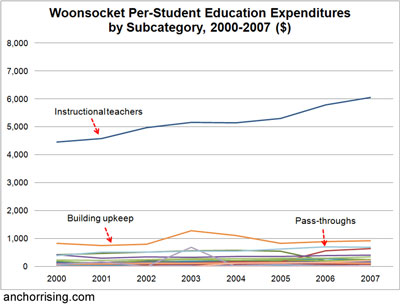
Over the three years of the most recent teachers' contract (PDF), the average pay scale step has increased 7.64%. In any given year, the average salary increase from one step to another is 6.5%. The result is that an actual teacher has seen nearly a 10% increase each year and a 21.5% increase in salary since the contract went into effect. (Higher education bonuses are not included.)
Of course, teachers at step 10 have had to make do with the 7.64% increase to their step and longevity (as well as whatever seniority-based perks are worked into the contract), but sometimes an organization has to do what it must do in order to maintain its purpose. And besides, those teachers hired before 1994 (about 70 of them, I'm told) have never paid a penny for their healthcare.
It remains a possibility — another principle baked into the public sector paradigm — that the objective, here, was to put forward cuts that the unions, government, and public wouldn't permit to happen rather than adjustments that might actually solve the problem. Eventually, everybody involved is going to have to cease petulant demands that money just be found... somewhere... and accept that the old way is not sustainable.
July 14, 2009
Giving Cards to the Other Side
The Tiverton School Committee is discussing whether to grant a leave of absence to an elementary school art teacher, and it's a strange circumstance. Apparently, the custom is to discuss such matters vaguely, so Superintendent Bill Rearick is offering details only inasmuch as is necessary to rebut reluctance from the school committee, but some details have come out:
- The teacher received a layoff notice, as required by law.
- She found another job.
- Additional funds enabled the district to cancel the layoff notice.
- The teacher is seeking a leave of absence so that she'll have until early next year to decide whether to stay at her new job or to return.
The downside, as I'm hearing it, is that the district can expect a larger pool of applicants — perhaps with an upward shift of quality — if the position is explicitly on the permanent track.
ADDENDUM:
Interestingly, union president Amy Mullen, who was granted a maternity leave of absence just before, responded to a question from committee member Danielle Coulter about the affect of the duration of the opening on the applicant pool by saying, "If I'm an art teacher looking for employment, I'll take whatever I can get in this economic environment." This statement of bald fact is interesting because I've been arguing that the school committee should keep precisely this in mind when handling negotiations with the union.
Also interesting was committee member Carol Herrmann's progression during the discussion. Known as one of the union-friendly members of the committee, Herrmann was clearly arguing in favor of granting the leave. What's peculiar is that she appeared to have thought through the arguments, beforehand, but she started from a stance nearing ambivalence. Like Rearick, she played her cards only as necessary, finally arguing that the district put the teacher in a "stressful position." I wonder how many folks in the private sector make the decision, every year, to simply turn down jobs that they've taken in expectation of a layoff that didn't materialize.
The leave of absence request failed, with Herrmann and Sally Black as the two votes to grant.
7:45 p.m.
There was no handout covering the budget discussion, and I've been typing, so I might have missed important details. It appears, however, that the district administrators (Supt. Rearick and Director of Administration and Finance Doug Fiore) intend to blow off the voters' requirement that the district stick to the dollar amount that was approved at the financial town meeting and treat that amount as creating a budget gap to be filled with stimulus money.
7:53 p.m.
Bill & Doug noted that, if the stimulus money isn't repeated next year, the district will be facing a $800,000 deficit — or $100,000+ more than the district is supposed to be trimming as a result of the FTM.
They're talking about closing a school. Oddly, nobody has suggested a few percent across-the-board cut in combined salaries and benefits; they go right for cutting positions, even though there is no contract yet for next year.
Why are they afraid to put forward such an obvious and reasonable solution?
8:05 p.m.
Again, I don't have the paperwork, but it sounds as if extracurricular activities and athletic programs are on Rearick's hit list. Can't help but wonder whether this is all part of the strategy to motivate parents to turn out at next year's FTM and vote for more money.
8:19 p.m.
Yup. Committee President Jan Bergandy just noted that the district "avoided a catastrophe" thanks to the stimulus money and suggested that the district "provide additional information for parents" as to the consequences of cuts.
8:25 p.m.
A high school nurse just received a reduction in hours.
From home:
Here's audio of NEA-Tiverton President and NEARI Treasurer Amy Mullen arguing — in response to a question from School Committee Member Danielle Coulter — that it's an employer's market when it comes to teachers: stream, download.
July 13, 2009
A Change That's Only Radical in Public Education
This almost sounds like the beginning of a professional work environment:
Under orders from the state education commissioner, the district this fall will begin filling vacancies in six schools based not on seniority, but on whether that teacher is a good match for the job — and the school."I've been a principal for 11 years," said Michael Lazzareschi, who heads the new Nathan Bishop Middle School, "and I've never had the ability to pick my own candidates. There's nothing more exciting than seeing the lines of teachers waiting to be interviewed."
Although the Providence Teachers Union is threatening to sue, claiming the state education commissioner doesn't have the authority to overrule a union contract, Schools Supt. Tom Brady says the rank-and-file have shown real enthusiasm for the new system.
"Five hundred and twenty four teachers applied for 75 positions," Brady said. "That far exceeded our expectations."
It's the wild, wild West in school administration:
To avoid any hint of favoritism, the School Department, working with the union, developed an interview process that relies on questions from a common bank of questions that use concrete teaching scenarios and short model lessons.The interview is designed to measure specific skills: Does the teacher know his subject? Can she demonstrate knowledge of recent research in his discipline? Is he able to demonstrate his knowledge within an actual model lesson?
The other important piece of the new hiring system is mutual consent. Teacher and principal must agree that the school is a good match. There will be no "on-the-spot" hiring.
The whole notion behind "criterion-based" hiring is that it empowers principals to put the right teacher in the right classroom. It also allows the superintendent to hold principals accountable for improving student achievement in their own buildings because they finally have the authority to hire their own staff.
Obviously, union functionaries aren't happy with the idea that elected representatives and the administrators whom they hire will actually be able to run their schools. What they mostly fear, I suspect, is that the public is no longer going to pretend the validity of union spin regarding the benefits of allowing schools to be run by organizations with political motivations and thuggish tactics. Daylight has cracked under the union rock; all that remains is to suggest that taxpayers — voters — take a look at what's been revealed.
July 9, 2009
Warwick Payrolls
Over the weekend I was at a neighborhood July 4th get-together. The group was a mixed one. If I had to guess, most were either a-political or run-of-the-mill Rhode Island Democrats. The topic turned to the recent closing of a local Warwick elementary school and how property taxes just got a big bump (believe me, they did). There was anger over the tax hikes and the school closure. One parent questioned why a school would close when money could have been saved elsewhere, mentioning the fact that the teachers make a lot of money and that you could find it all out at the "Ocean State Policy" website.
The parent then listed off some of the salaries of teachers from the local elementary school. There were a few surprised faces amongst those who heard the numbers, to which the parent then said, "Yeah, I know...I thought they made like $45-$50,000 or something, not that much!"
In an attempt to shed some more light on the situation, I decided to take a ride on the Transparency Train to analyze the actual school payroll numbers for Warwick. It's more time consuming but also more illustrative of the actual situation than the teacher contract.
I looked at the 2007-08 salaries of full-time teachers in a variety of categories. The below table, based on the 2007-2008 Payroll, summarizes my findings. It shows the number of teachers in each category, the total amount of money dedicated to their salaries and then average salary, average low and high salaries (the average high salary at the Jr. High and High School level reflects the pay received by department heads), and the average median salaries.

If you compare these numbers to the salary schedules in the teacher contract (page 109 in this PDF), you'll find that that, for the most part, the median Elementary and High School teacher salary in Warwick is the equivalent of a Step 10 (or more) with some longevity and probably some advanced education bonuses thrown in. Overall, elementary teacher salaries are the highest, followed by High School and then Junior High.
Given that most people think teachers make about as much as the average Rhode Islander, around $50,000 - $54,000 a year (in 2007), it's understandable their surprise when learning about these numbers. While it is true that new teachers enter the work force at the average income level, that doesn't last for long. It is apparent that the majority of teachers are compensated at a level at the top or above the traditionally negotiated step scheme. While the teacher salaries are arguably commensurate with other professionals of similar background and training, the benefits they earn--in addition to the shorter work-year--are something those in the private sector don't enjoy. In addition to their salaries, teachers also receive $10.5-$12,000 in pension contributions from the district in addition to $15,000 in medical/dental benefits.
But these numbers also help explain some other things, too. In general, teachers at the Junior High level are paid less than their Elementary or High School colleagues. This is unsurprising given the additional challenges faced when teaching this age group. In short, once they get they're time in, a lot of teachers go to Elementary or High School, where the kids are generally more receptive or, in the case of High School, you know what you're dealing with. In Jr. High, every day is a mystery with a cohort that is feeling their oats. Unfortunately, that they are so challenging is the very reason to keep the best, most experienced teachers at the Jr. High level. If only they had incentive.
It can also be inferred that, because Warwick has closed a few elementary schools in the past two years, the job openings are in the secondary education area (Jr. High and High School). This means that the elementary schools are "top heavy", with the result that the median income is higher at the elementary level. It would take some additional analysis of other school districts that haven't experienced so many school closings to determine if this is indeed a factor.
As I was looking at the teacher payroll, I thought a comparison with the payroll of the other big ticket items--Fire and Police--would help add some context. The data available was for 2008-09-- a year later than the teacher info I used-- so the data isn't contemporaneous. (The actual low, high and median salaries for each position are given, not an average as with most of the teacher data).
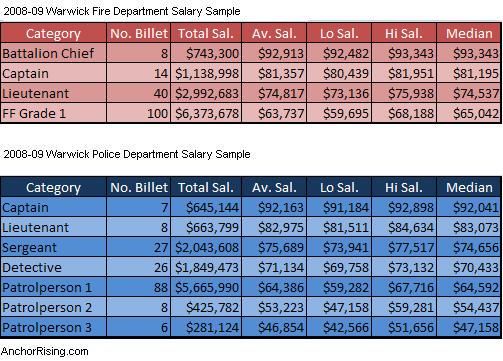
I don't have much analysis to offer for these last examples. They are what they are. Additionally, a quick survey of the municipal payroll reveals a lot of salaries that fall within the "average Rhode Islander" pay range or below, with a few high-salary, supervisor positions, as well. (For further comparison, this site purports to supply salaries for a range of private sector jobs in Warwick). I'll conclude with this: taxpayers should be aware of these numbers so that they can determine whether they think these are legitimate wages to pay for the jobs being done or not.
July 8, 2009
The Good and the Bad on Newsmakers
It shows how far behind I am on catching up that I've just managed to watch the episode of Newsmakers featuring OSPRI's Bill Felkner and Pat Crowley of the NEA, RIFuture, and various other special interest groups.
Bill did admirably, but the viewer can observe something that I've found to typical of such head-to-heads. Crowley got in all of his (no doubt) scripted talking points, from "astroturf" to "tax cuts for the rich," while Felkner tried to give examples and put particular facts up for discussion. It's difficult to understand why the three other participants in the discussion let Pat get through the whole spiel, but the following quotation illustrates the disinterest in clarity and extemporaneous discussion:
What's wrong with working people making a good salary and having a decent benefits package? I mean, that's really what this comes down to. Instead there's arguments from taxpayer groups and from the right saying that just because a working person makes a living wage that that's a bad thing. No. That's a good thing. It's the model that we need to actually need to encourage more in this state. And I think the fact that this is being positioned as working people versus taxpayers — I think that what that actually shows is that there's a political agenda in the state that actually is trying to disempower working people, not so that the wealth is spread throughout the state, but so that the wealth is concentrated in the hands of a very few. And I think what this last weekend [of union strikes during the mayoral conference in Providence] highlights is that working people in the state of Rhode Island — especially organized workers — are tired of being used as scapegoats for a political agenda.
The strategic objective: equate public-sector unionists with "working people." If the reality is that give-aways to organized labor are not sustainable and inevitably harm those who are most susceptible to harm — private-sector workers — do a quick hop-skip to distract from that fact through allusion to some vague "political agenda" pursued by rich masterminds. The distraction was certainly not hindered by host Tim White's reference to Bill as "from the conservative think tank Ocean State Policy Research Institute", while Pat was simply "from RIFuture.org and the NEA." (Earlier, White called RIFuture "left-leaning.")
Crowley effected this sort of maneuver throughout the show. To White's question about the economic damage should the NEA sue the state over pension reforms, Crowley couldn't even muster a "look, we appreciate that litigation puts an additional strain on taxpayers, but..." Instead, he walked away with this, correcting Tim on what his question should have been:
Well, think that the real question is why do the public sector workers and the teachers of Rhode Island have to keep on taking the hit? I mean, like I said, there was another reform in 2006. Prior to that there was a major reform in 1997. Prior to that, there was one in 1992. All of those reforms were taking benefits away. So the idea that all of these things are just heaped upon teachers and public sector workers simply isn't true. And every time there's a reform, there's a promise. "This is the last time guys" "Really, this is the last time." "No, this time's really it." So how many times do the public sector workers and the teachers of the state have to open up their pocketbook so that the state can balance the budget, especially when the state has year after year cut taxes for rich people. Cut taxes for corporations. The reason we're in a budget problem in this state isn't simply because we pay our teachers well; it's because, over the last decade, we've cut taxes, cut taxes, and cut taxes, and created this economic black hole for ourselves.
Thus does Crowley brush away decades of unbelievable hand-outs that have made public-sector workers, especially teachers, Rhode Island's elite class on the grounds that, every now and then, the gorging must be mildly restrained. Inasmuch as most viewers don't have the history Rhode Island's pension system at their fingertips, Pat's references might as well be plucked from a hat, but they do lend an air of legitimacy to his complaint. Describing the actual changes would likely expose his game. In 1992, the state introduced the requirement that pension recipients endure the long slog of 10 years of actual work for the state in order to be eligible; I didn't find any change in 1997, but in 1994, the General Assembly introduced a requirement of at least 20-hours-per-week of work. And in 2005, introduction of minimum ages (a ripe old 59) and other changes, as to cost of living adjustments (COLAs), were already known to be insufficient and only applied to those not already vested with 10 years of service.
As for the supposed promise of no further cuts, perhaps we're getting a whisper of behind-the-scenes talk, because such declarations are certainly not prominently made in the public. Whatever the case, it is irresponsible of legislators to make them.
And none of that touches upon the deeper debate about the effects of tax cuts on revenue. (Tax revenue from "the rich" has actually gone up, over the last decade, both in real terms and as a percentage of total taxes collected.)
Bill began to turn the tables at around minute 14:30, with his introduction of some of the structural strategies whereby left-wing groups shuffle money and redirect influence. He also made a strong point, against the combined efforts of Crowley and Ian Donnis to challenge the transparency of OSPRI on the grounds that it doesn't disclose small-dollar donors, responding that people give freely to such groups in a way that is not true of public-sector unions.
He could have further noted that the public has the same amount of information about, say, Ocean State Action as about OSPRI. That point was brought to the fore by the minor spat over what organizations are housed in NEA-RI's headquarters at 99 Bald Hill Rd. Crowley disputed that Marriage Equality RI is located there, although as of last August, the group's tax exemption was registered at that address. More significant is the reference to WorkingRI; although Bill may have misspoken about its relationship with the address, a little research shows how little difference it makes.
The group's Web site isn't very informative when it comes to its operations or management structure. (Its address is a P.O. box in Warwick.) But a 2008 Projo article about the links between labor organizations in RI names Frank Montanaro as the chairman of its board. Montanaro is also president of the RI AFL-CIO, as well as chairman of the Institute for Labor Studies & Research, which is indeed headquartered at 99 Bald Hill. NEA-RI President Lawrence Purtill is listed as the Institute's secretary treasurer, a post that NEA-RI Executive Director Bob Walsh fills (according to the Projo) for WorkingRI.
WorkingRI is a prominent player on RIFuture, by the way, and the AFL-CIO has a very large ad in the hardly-prominent position at the bottom of the blog.
Bill's point, in short, is irrefutable, which is why it's disappointing to watch an episode of Newsmakers hover in the zone of talking-point assertions. But ensuring such outcomes is, I suppose, part of Patrick Crowley's job — which may explain why his union pays him $5 per year for political activity, according to Felkner.
July 7, 2009
Toward What End They Rush
Ed Achorn takes the opportunity of the eternal contract bill — which he calls "remarkably reckless and profoundly anti-democratic piece of special-interest legislation" — to offer a helpful rule of thumb on the General Assembly's standard operating procedures:
This is an idea that, at the very least, merits serious discussion, rather than the rush treatment it got in the Senate. When something is whipped through the legislature at lightning speed, it is a good bet that it harms the public and serves special interests. When something is discussed to death, and still not passed, it is a good sign the special interests oppose it and the public supports it. To wit: The General Assembly has refused, yet again, to create fair elections in Rhode Island, as in most other states, by eliminating the corrupting master lever. In doing so, it cavalierly ignored the formal wishes of the state’s top election officials and the government of 23 Rhode Island communities. And Rhode Island has still not joined 48 of the 49 states that make indoor prostitution illegal. (In Nevada, prostitution is legal in some counties but strictly regulated.)
There is no remedy but to change the players, and the last election gave reason to fear that such an act may be practically impossible.
July 5, 2009
US Department of Ed Implements an Unexpectedly Instructive New Program
Admittedly, yes, he is in part motivated by a lust for federal gold. But this factor in no way abated the fury of certain former supporters of Mayor Thomas Menino (D!) when he announced last month a volte face support of charter schools as a means of achieving education reform in Boston.
The speech took aim at the lack of progress in dozens of low-performing, inner-city Boston public schools, many of which have not met adequate yearly progress for five years running."To get the results we seek -- at the speed we want -- we must make transformative changes that boost achievement for students, improve quality choices for parents, and increase opportunities for teachers," Mr. Menino said. "We need to empower our educators to quickly innovate and implement what works." With that, Mr. Menino abandoned nearly two decades of personal opposition to nonunion charter schools, which have been bitterly resisted by Massachusetts teachers unions and their political allies. "I believe that the increased flexibility that charters provide can . . . help us close the achievement gap," he declared.
All teachers and paras interviewed this week feel betrayed, given that his plan to forcibly charterize 51 schools indelibly labels those schools as failing and, further, shows no confidence in our schools' ability to improve. Many staff at the 51 targeted schools feel especially betrayed by the mayor, who has often touted their school in personal visits and public displays of support.
What triggered this hubbub in the Hub? Again from the Wall Street Journal.
Political pressure, most notably from the Obama administration, which has explicitly linked charter-school expansion with access to $5 billion in new education reform funding."States that don't have the stomach or the political will, they're going to lose out," Education Secretary Arne Duncan told the Associated Press recently. "That's $5 billion, b-i-l-l-i-o-n, up for grabs," moaned Mr. Menino in an interview with me. "I've gotta sit here sucking my thumb because I can't get reforms?"
... er, at the moment, yes, Your Honor. But thank woo for asking a good question.
On the one hand, it is tempting to question the wisdom of this $5 billion in new education spending. It is not clear why the federal government should pick up the slack left by too many school committees, which for decades have negotiated and executed contracts bereft of any mention of academic achievement. This approach has resulted in significantly increasing America's spending on public education with little corresponding trend in student achievement.
At the same time, this expenditure has thrown into sharp contrast two philosophies espoused by teachers' unions. How does one reconcile claims made on certain occasions that actions advocated are in the best interest of "the children" with the organization's zero tolerance for merit-based compensation? By very reasonably linking additional funding to student-centric education reform, the US Department of Education has inadvertantly provided an interesting glimpse to a usually distracted public into the motive of an organization which, it appears, is reluctant to permit its words to become policy. Such an insight will prove useful when voters weigh the propaganda and merits of candidates and budget referenda at polling time.
Thanks to commenter MikeinRI for pointing out {edit} a local development to Marc's post.
July 3, 2009
NEA Boos Obama's Ed. Secretary
Education Secretary Arne Duncan was in Los Angeles to speak to an NEA convention.
Teachers booed and hissed today as Education Secretary Arne Duncan urged the nation's largest teachers union to change its view of merit-based pay and incorporate student achievement into teacher evaluation and compensation.Ah, so professional. I've been to many engineering conventions where a speaker is booed and hissed for suggesting stricter accreditation standards or the like. NOT. Here's some of what Duncan said that them so upset. First, he addressed teacher accountability and assessment:
Our challenge is to make sure every child in America is learning from an effective teacher, no matter what it takes....So today, I ask you to join President Obama and me in a new commitment to results that recognizes and rewards success in the classroom and is rooted in our common obligation to children....I understand that tests are far from perfect and that it is unfair to reduce the complex, nuanced work of teaching to a simple multiple choice exam....Test scores alone should never drive evaluation, compensation or tenure decisions. That would never make sense. But to remove student achievement entirely from evaluation is illogical and indefensible.Then he addressed the way that bonuses are earned by teachers (advanced degree and longevity bonuses, for instance), which may not be the most effective at rewarding good teachers:
School systems pay teachers billions of dollars more each year for earning credentials that do very little to improve the quality of teaching....At the same time, many schools give nothing at all to the teachers who go the extra mile and make all the difference in students' lives. Excellence matters, and we should honor it -- fairly, transparently and on terms teachers can embrace.Duncan also explained why the model of public education is outdated and outmoded:
I believe that teacher unions are at a crossroads...These policies were created over the past century to protect the rights of teachers, but they have produced an industrial, factory model of education that treats all teachers like interchangeable widgets.No it's not. The NEA has proven time and again that they aren't going to go along willingly with this kind of "change". Unfortunately, Duncan's explanation about outmoded factory models will fall on the deaf ears of those who think that mid-20th century factory models are the ideal to which we should all strive, in perpetuity, regardless of their practicality in the modern age.When inflexible seniority and rigid tenure rules that we designed put adults ahead of children, then we are not only putting kids at risk, we're putting the entire education system at risk....We're inviting the attack of parents and the public, and that is not good for any of us.
Who Has More Control Over Centralized Government?
Quite revealing, the underlying premise of regular Providence Journal contributor Tom Sgouros's latest. He describes new education standards recently promulgated by the state Board of Regents that appear to give local school committees and districts more freedom in designing their curricula. What's the problem with that?
The upshot is that school districts will be freed from the fiscal shackles that bind them and can manage their programs to increase their productivity. Sounds good? Even better, how about we say they can empower high-quality local school leadership to manage a streamlined 21st Century cutting-edge high-quality education program. What this means, of course, is there will be nobody to insist that elementary music classes aren't just an hour of listening to the radio once a week with the regular teacher. If some school committee wants to call that a "high quality music program," then there's now officially no one to say otherwise.So wave a fond farewell to your school librarians, the music and art teachers, the drama teachers and all the extras that make kids want to go to school. After the June 4 meeting, they won't be required, so how long do you think your town will keep them?
What an astonishing view of government accountability! It would appear that an appointed (not elected) state board must be petitioned to change the rules because local school committees are all but unreachable... at least, Sgouros doesn't mention the possibility of petitioning local government representatives to maintain programs that are important to residents.
The reason for this view is indicated by the three paragraphs that Sgouros spends complaining about property tax caps. If a town is constrained (one would prefer them to be restrained) in the amount of money that it can demand from residents, and if those residents insist that important programs such as music and library remain, there's only one place to go, no? And applying pressure to the deals that unions have cajoled and bullied out of school districts is unthinkable to Sgouros's crowd.
That doesn't mean, of course, that Tom and some among his peers don't sincerely believe in the value of the programs that instruction costs are squeezing out. They know better than anybody that unions leverage state and national levels of power to implement ever-expanding contracts, so it makes sense, if they wish to protect programs, to install safeguards at that level. They've also learned that more powerful, higher, tiers of government may more easily be reached by powerful parties than by lowly taxpayers, whereas national lobbying influence and millions of dollars for expense on campaigns are not quite as indomitable in communities run by neighbors for neighbors.
I, too, believe that school children ought to have a wide range of opportunities for educational experience. Indeed, their loss is indicative of the American education establishment's race to the bottom — focusing its resources on those who are more difficult to educate and thereby lowering the environment to a utilitarian plane for all. If America is to remain competitive with nations of differing economic, cultural, and demographic character, creativity and a capacity for innovation will be critical.
I also believe, however, that mandating creativity from the top down not only is oxymoronic, but tends toward corruption. I'd therefore join Sgouros in encouraging Rhode Islanders to show that they "care what kinds of services are delivered by our towns." The most effective way of doing so is to approach that local committee whose members one sees walking their dogs and picking up prescriptions at the local drug store on a daily basis.
July 1, 2009
An Indication of the Perils of Consolidation
The General Assembly has created a "labor management board" that will come up with six or more healthcare plan options from which local districts may choose during contract negotiations with teachers. Here's how the board will be constructed:
The board that will be appointed to design and approve the benefit packages will consist of: two members named by the Rhode Island Association of School Committees; two members named by the Rhode Island School Superintendents' Association; two members named by the Rhode Island Association of School Business Managers; two individuals named by the Rhode Island Federation of Teachers and Health Professionals who may be active or retired teachers or officials from the union; two members named by the National Education Association who may be active or retired teachers or union officials; one member named by RI Council 94 of the American Federation of State, County and Municipal Employees, and one member named by the Laborers International Union of North America.
Of the twelve slots, six belong to unions. Two belong to an organization servicing elected school committees, two belong to an organization servicing the superintendents whom school committees appoint, and two belong to an organization servicing the business managers whom superintendents and school committees hire. Before suggesting an even split between labor and management, consider that ten of the twelve members will be representing parties who will receive the benefits that are being designed. And even then, the two other members are appointed by a group joined by a class whom voters elect; that's quite a degree of separation.
One would hope that school committees will still be able to negotiate copays, coshares, and all the rest, but I'll be surprised to see the board give them any options comparable to my high-cost, high-deductible, unsubsidized healthcare savings account deal.
June 29, 2009
Putting School District Mergers into Perspective
Gina Macris reports on a document by the Rhode Island Public Expenditure Council (RIPEC) exploring the financial possibilities of merging the three school districts on Aquidneck Island. Readers may have picked up on the fact that I'm a regionalization skeptic, and Macris's first paragraph points to the reason:
Declining enrollment and escalating costs mean that Aquidneck Island’s three school districts cannot afford to remain independent and maintain the same quality of education, according to a study by the Rhode Island Public Expenditure Council.Unless Newport, Middletown, and Portsmouth pool resources and services and consolidate spending to realize economies of scale, the RIPEC study concluded, the districts will become mired in deficit spending over the next several years while seeing the scope of their academic programs curtailed.
Education is only one area in which a sales and marketing campaign is coming together around the notion that regionalization of services is our only hope for financial solvency. Recent experience of local taxpayer groups' having an increasingly rapid and increasingly potent effect on municipal policies, while at the same time the General Assembly drags its feet and plays procedural games, ought at least to cast a shadow of doubt that consolidating control and (therefore) power is a sensible response to escalating local costs.
In some cases, such as utilities, having a larger contract to offer increases negotiating clout, but in others, such as labor, it narrows the field on which the clout of others (i.e., unions) must be expended. The NEA still receives the same dues, but it needs to influence fewer elected and appointed representatives. With its state and national structure in place, the union will realize efficiencies when it comes to selecting and promoting candidates when there are fewer campaigns to battle; in contrast, concerned residents will face a much more daunting task gaining recognition beyond their immediate communities.
When it comes to operations, yes, there would be fewer "top" jobs, but there would be more lower jobs, each with greater responsibility than before:
The most far-reaching model assumes one central school administration for all the schools on the island. It anticipates the closing of one high school and one middle school but doesn't designate which ones. Working with the lone superintendent would be two assistant superintendents and one director each for finance, facilities, student services, technology, athletics and academics.
Instead of three superintendents responsible for an average of $37 million and 2,585 students, you get one superintendent and two assistants responsible for $111 million and 7,755. Generally speaking, the savings would seem to be minimal. Of course, closing schools and having the capacity to shuffle around staff (perhaps achieving efficiencies when it comes to teachers who can float from school to school) create savings, but let's put the numbers into perspective:
RIPEC's 150-page analysis offers six options for the island's three districts, from maintaining the status quo to a complete merger. Although not recommending which option the districts should pursue, RIPEC found that making no change could lead to sizable financial problems, and merging services could result in estimated annual savings of $2.8 million to $12.3 million, depending on the degree of consolidation. The savings would begin to be realized in 2012.
Depending how fully the districts regionalize, the savings amount to 2.5% to 11%. Millions of dollars should never be pshawed, but these are hardly game-changing figures, and Rhode Islanders should have zero confidence that bureaucrats and union leaders won't keep the very same "capacity to pay" numbers in mind as they negotiate and shuffle money around.
In essence, my warning is that we shouldn't let a fancy new concept distract us from our experience of how Rhode Island actually operates, and the following figures give some representation of that experience. (For the first chart, I laid out the axes to illustrate percentage change, effectively taking the 26% difference between the minimum and maximum for expenditures and showing the same range for enrollment, which varied by about 12%.)
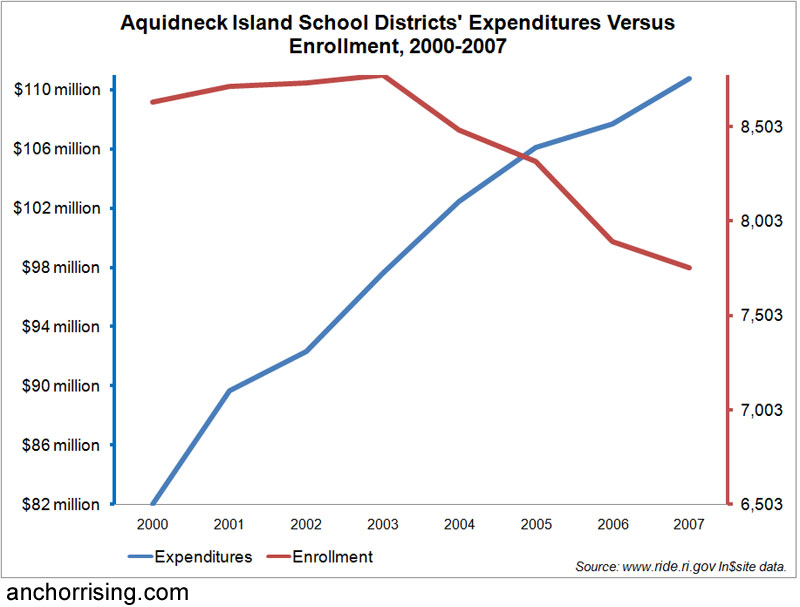
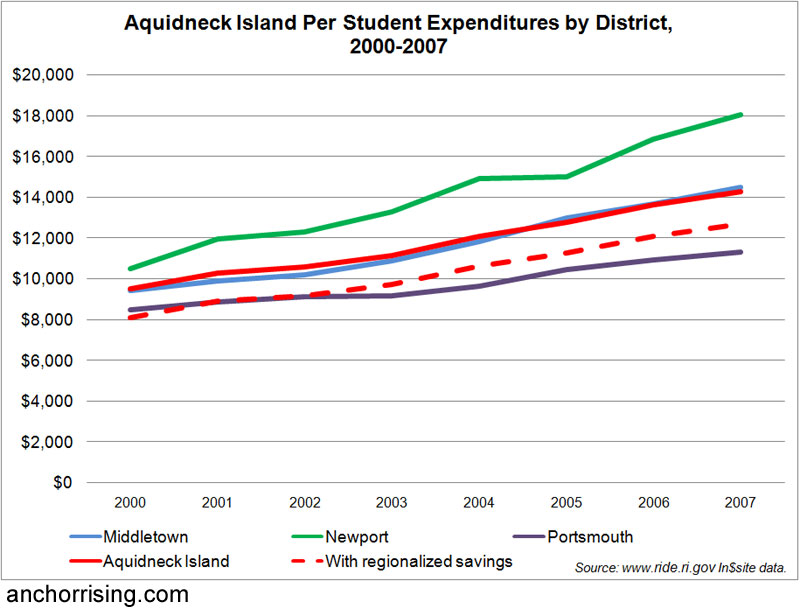
To my eye, combining these three school districts into one, of itself, would buy a few more years before expenditures are right back to their currently problematic mass, and I'm not persuaded that a new paradigm will have been instituted that would change the trajectory or the results.
Folks in business, government, media, and the general population seem to be convincing themselves that consolidation is the clear and obvious way forward. They are correct that some resistance is motivated by narrow parochial preferences, but it would be a risky error to suppose that there aren't better-informed reasons to object.
June 28, 2009
Private School as Money Saver
Think about this, from amidst the continuing saga of the West Warwick school budget:
After one resident learned that it costs about $15,000 to educate each child in West Warwick, she suggested that the town simply send its students to private Catholic schools. [Town Council Member Angelo] Padula quickly agreed, saying, "If we sent 200 children to a private school, Prout is $9,500. LaSalle is $9,800. We would save $6,000 per child."
For those who've learned under new math techniques (or do not have a calculator handy), $6,000 times 200 children is $1.2 million. As a bonus, with those millions of dollars in savings, Rhode Island private school students on average score 200 points higher on the SATs than their public-school peers.
(Yeah, I'm aware of the arguments about demographics. Just sayin'...)
June 23, 2009
A Press Release to Emulate
East Providence School Committee Chairman Anthony Carcieri has issued a press release on which other elected representatives throughout the state should take notes:
On being informed that NEA has voted "no confidence" in the East Providence School Committee, its Chair, Anthony Carcieri, said this."So what’s new? No union is going to give a big vote of confidence when they're told they have to contribute to their health insurance. It's unfortunate, but it's the way of the world. That all happened six months ago. We've moved past it. We're bringing technology to our students for the first time in the Fall. Our Vocational School is launching innovative new programs that will catapult our students forward. We're pushing forward a revolutionary initiative to raise the quality of special education in East Providence to World Class standards. These are just some of the things we’ve accomplished in the last six months, as we are bringing the school system back from the brink of bankruptcy.
What has NEA done in the last six months?
They put on red shirts and disrupt School Committee meetings. They say they want to bargain, but they never schedule a meeting. They try to stop innovation. They demand that we raise taxes and go deeper in debt.
The East Providence Schools will be a magnet for students from other communities within the next few years. We will be a magnet for creative energetic teachers who put kids first. We don't need teachers who want to spend their time parading around like the Red Army. We need teachers who will help us to prepare our kids to deal with an increasingly competitive world.
We're told that NEA has threatened to tell their members to leave our school system. Any teacher who doesn't want to be a part of what's going on here should do what NEA says. We're building to be the best. We're putting the students first. Any teacher who doesn't want to be a part of that should follow NEA's direction.
Remember, we pay our teachers better than 90% of the school teachers in America. The teachers' union just can’t get over the fact that we had to retrench a little bit in January so we could pay their salaries in June. This is the time to focus on delivering the best education for our students without breaking the backs of our taxpayers. It's time to get over it. We have a lot of work left to do to raise the performance of our schools. We have to do a better job for the kids. That's our focus, and it’s the focus of most of our teachers."
Obama Admin Tells RI: Charter Schools or Else
It should be no surprise that the Obama Adminstration, which is on the record as favoring Charter Schools and other education reform, would raise its eyebrows when a state cuts such funding. Education Secretary Arne Duncan has made it pretty clear that the President won't look favorably upon those who turn their backs on educational innovation:
Education Secretary Arne Duncan said in Washington on Monday that Rhode Island may be putting itself at “at a huge competitive disadvantage” for securing federal stimulus dollars.From a fiscal point of view, it seems like that $1.5 million would be money well spent.The General Assembly’s proposed 2010 budget eliminates $1.5 million that Governor Carcieri wanted to spend to open two new charters — a middle school in Central Falls and the state’s first “mayoral academy” in Cumberland.
“Places like Rhode Island that are thinking about underfunding charters are obviously going to put themselves at a huge competitive disadvantage going forward. So we don’t think that’s a smart thing for them to do and we’re going to make that very, very clear,” Duncan told an audience of more than 3,000 people when he was asked about Rhode Island during a question period at the National Charter Schools Conference.
“Where states are considering underfunding charters, as appears to be the case in Rhode Island, they’re placing themselves at a strategic disadvantage for Race to the Top money. They’re going to hurt their chances,” he added moments later, according to U.S. Education Department officials.
The Race to the Top fund is a $5-billion discretionary pot of cash within the White House’s economic stimulus package that Duncan will distribute later this year to a handful of states with a proven track record of innovation.I'm not sure if Rhode Island has a "proven track record of innovation", but killing any innovation certainly won't help! Where to get the money? How much additional savings could we get for moving the retirement age from 62 (or 55!) to, say, 65? It seems like a compassionate and forward-thinking way to go: postponing the payouts to adults for the sake of the children.For Rhode Island, that grant money — if secured — could come on top of more than $200 million that the federal government has already earmarked within the stimulus for education.
Rhode Island Board of Regents member Angus Davis, speaking on behalf of the state Education Department, said the secretary’s remarks should send a clear message to state lawmakers that they would be wise to restore the $1.5 million in new money for charters if they don’t want to jeopardize millions in additional funding.
“Secretary Duncan’s comments are entirely consistent with the comments he and the Obama administration have made about artificial limits about charter school limits,” Davis said.
June 18, 2009

Jim Quinlan: Another $25,000 Wasted by the Cranston School Department
According to a Projo article by Randy Edgar:
The [Cranston] School Department will pay outgoing Supt. M. Richard Scherza $25,000 this summer to work as a consultant and help with the transition to a new superintendent, according to an agreement signed last month.
Scherza will work on an as-needed basis during July and August, providing "technical assistance" and helping in areas such as community and government relations.
In a city whose school department is struggling, to say the least, to balance a budget filled with years of giveaways and mismanagement, it is curious that the School Committee would vote unanimously to continue to keep Mr. Scherza on board on an "as needed basis."
Budget session after budget session has been filled with program cuts and layoffs — directly affecting our children. EPIC, middle school sports, guidance vounselors, and teaching positions have all been on the table, yet the committee has found $25,000 to pay Mr. Scherza more than he was making while employed by the department.
If in-coming Superintendent Peter Nero was not qualified to sit in the big boy chair (after 3 years of working directly under Scherza), the committee should have not rushed to promote him in one week. If he is qualified, then the elected representatives should insist that he does the job.
I brought this concern to a School Committee member who told me that "because this was a personnel matter we could not discuss it." I would like to know since when an independent contractor is a personnel member of the School Department.
We deserve to know what Mr. Scherza's contract says and what his duties will be. I am not ready yet to deem this decision as corrupt, but it is certainly a poor business decision and another example of the School Committee's lack of leadership.
Jim Quinlan is the chairman of the Cranston GOP.
June 15, 2009
Physics First in Woonsocket, Portsmouth and Elsewhere
Since we devoted space last week to education problems in Woonsocket, I think it's only fair that we note the city's (and other city and town's) initial successes with a Rhode Island science education initiative that's been showing some promise. From Gina Macris, in today's Projo…
With the backing of the state, Woonsocket and five other high schools have moved physics class from its longtime status as a junior-year course to one offered to freshmen, a change they hoped would improve the teaching of all sciences and motivate students to pursue more advanced study. Biology and chemistry follow.And there are signs the effort is beginning to pay off.
In Portsmouth, for example, the demand for Advanced Placement science courses in physics, biology, chemistry and other offerings has nearly doubled since Physics First was introduced, from an enrollment of 41 students in the 2005-2006 school year to a total of 78 requests for next fall.
The idea of offering Physics First is gaining traction across the state as educators try to improve the dismal results of Rhode Island’s first-ever standardized science test. That test found that only 17 percent of the state’s high school juniors understood basic scientific concepts and skills.
June 14, 2009
Surreality in Johnston Contract
Rhode Island's circumstances won't change until enough voters see the scam in such news as this:
The agreement, ratified by the committee on Tuesday night, gives all teachers a 2-percent raise for the 2010-2011 school year, said the schools superintendent, Margaret A. Iacovelli.The most experienced teachers (at the 10th step) will receive a 1.75 percent raise during the upcoming 2009-2010 school year while teachers at all lower steps will see no increase in their wages.
There is simply no way it wouldn't be major news if the lower-step teachers forewent their step increases. In the previous contract (PDF via Transparency Train), step increases ranged from 5.24% to 8.38%, with an average of 6.81%. Only in Rhode Island labor lingo is a 5–8% increase in pay considered a flat-lined concession during hard economic times.
And only a citizenry fatally inured to having their elected representatives give away their tax dollars to organized labor would fail to laugh at this negotiating accomplishment:
Teachers' contributions to their health-care costs will increase by $114,000 in the second year of the contract and by $142,500 in the final year, she said. The teachers’ contributions to their health insurance will gradually increase from $780 per year now to $1,280 in the final year of the contract between the town and the Johnston Federation of Teachers.
So, in the third year of the contract, teachers will get raises (on top of step increases and other adjustments, such as higher-ed degree bonuses) ranging from $757.70 to $1,369.88, and their share of healthcare payments will increase by $500. For comparison with your own healthcare deal, their co-shares will be rising from $15 to $24.62 per week. That certainly doesn't break the 10%-of-premium milestone now — let alone two years from now.
This, Projo reporter Mark Reynolds tell us, is the result when a union "has come to recognize the severity of [a] town's finances." Judge from that what they've been doing to us during somewhat less lean years.
June 13, 2009
The Kids Get the Power Structure
Details are sparse in the Sakonnet Times account (which isn't online), but from what's presented, I'd suggest that the teacher-student power structure is out of whack in American education:
According to police, Wayne Collins... an industrial arts teacher at Tiverton Middle School, made a comment at around 9:18 a.m., on Friday, May 29, to a group of students, one of whom commented back, whereupon Mr. Collins alegedly got nose-to-nose with the student, who reached out or pushed Mr. Collins. Police say he then grabbed the boy's hand, locked it, and brought the boy to his knees.
According to Superintendent Bill Rearick, the teacher was "placed on 'paid administrative leave immediately on the accusation being made.'" How's that for giving students a trump card?
Obviously, we can't have adults manhandling students, but throughout our culture, the illusions on which adult authority are based are unraveling. This passage of Stephen King's It often comes to mind in these circumstances:
Through half-lidded, tear-blurred eyes, Eddie saw a big hand come down and grab Henry by the collar of his shirt and the strap of his biballs. The hand gave a yank and Henry was pulled off. He landed in the gravel and got up. Eddie rose mores slowly. He was trying to scramble to his feet, but his scrambler seemed temporarily broken. He gasped and spat chunks of bloody gravel out of his mouth.It was Mr. Gedreau, dressed in his long white apron, and he looked furious. There was no fear in his face, although Henry stood about three inches taller and probably outweighed him by fifty pounds. There was no fear in his face because he was the grownup and Henry was the kid. Except this time, Eddie thought, that might not mean anything. Mr. Gedreau didn't understand. He didn't understand that Henry was nuts.
"You get out of here," Mr. Gedreau said, advancing on Henry until he stood toe to toe with the hulking sullen-faced boy. "You get out and you don't want to come back, either. I don't hold with bullying. I don't hold with four against one. What would your mothers think?"
He swept the others with his hot, angry eyes. Moose and Victor dropped their gazes and examined their sneakers. Patrick only stared at and through Mr. Gedreau with that vacant gray-green look. Mr. Gedreau looked back at Henry and got just as far as "You get on your bikes and —" when Henry gave him a god hard push.
An expression of surprise that would have been comical in other circumstances spread across Mr. Gedreau's face as he flew backward, loose gravel spurting out from under his hels. He struck the steps leading up to the screen door and sat down hard.
"Why you—" he began.
Henry's shadow fell on him. "Get inside," he said.
"You—" Mr. Gedreau said, and this time he stopped on his own. Mr. Gedreau had finally seen it, Eddie realized— the light in Henry's eyes. He got up quickly, apron flapping. He went up the stairs as fast as he could, stumbling on the second one from the top and going briefly to one knee. He was up again at once, but that stumble, as brief as it had been, seemed to rob him of the rest of his grownup authority.
He spun around at the top and yelled: "I'm calling the cops!"
Very few children are the massive psychotic bullies of Stephen King's rendering, here, but as I've made my transition to the grownup side of the line in the years since I first read the above, I've noticed many signs that adult society has stumbled up the steps with sufficient frequency that more than just the bullies are noticing, and the response to the threat of involving civil authorities is more likely than not to be, "You go right ahead."
As King often captured masterfully, the world of children is often a chaotic place, prone to test authority, not adhere to it on a rational basis. Sometimes being pinned to the ground is a lesson not to force things even further next time around.
June 12, 2009
Pay Increases But No Pay Raises in Johnston
Has the Johnston teachers union sold its junior members out? A cursory reading of Mark Reynolds' 7-to-7 item in yesterday's Projo could lead one to believe that the union has secured raises for it's higher-paid members, but nothing for the lower tiers…
Teachers at the 10th step will receive a 1.75 percent raise during the upcoming 2009-2010 school year while teachers at all lower steps will see no increase in their wages.However, I think that it's more likely that the clause "teachers at all lower steps will see no increase in their wages" isn't quite accurate. The next sentence reveals that pay "raises" and pay "increases" are treated differently in the parlance being used, and that one can occur without the other…
The contract, which also covers the current school year, does not grant teachers any retroactive raise for 2008-2009, although teachers have received $452,000 in step increases, [Johnston School Superintendent Margaret Iacovelli] said.So if what will happen in 2009-2010 is similar to what happened in 2008-2009, Johnston teachers in the lower steps will receive pay "increases" via progression through the steps, but not pay "raises" related changes in the amounts associated with each step.
The question is, does the parsing of an explanation in this manner help or hinder the public's understanding of the issues involved?
June 10, 2009
The Funding Formula: Meanwhile, in Woonsocket...
In response to recent postings on the education "funding formula", commenter "John" offers this forthright reporting and analysis on the situation with regards to the City of Woonsocket…
The Woonsocket school representatives that testified in favor of a formula (a bad formula) today in the Senate Finance Committee hearing were ridiculed and insulted. The committee members were abusive simply because we have an ass for a mayor who likes to abuse people and falsely brag about not raising taxes when all she has accomplished is to create a classification system combined with homestead exemptions that artificially make it seem like we don't raise taxes. In fact, we now have among the lowest effective single family home (voters) tax rates (31st at last measure) in the state while chasing out business with the highest commercial rate in the state (Number 1). We have to fix that now. It won't be easy.Continue reading "The Funding Formula: Meanwhile, in Woonsocket..."The generic criticism of teacher unions makes people believe that we are all in the same boat. The Woonsocket school employees have already agreed to no pay increase for both next year and the year after and reduced their current year pay by 1%, deferred for five years. Can you name one other community in the state where that kind of agreement is in place, or might even be expected to occur? The teacher contract compensation package is in the bottom third in the state. Yet we are criticized by Senators and the blogs as being among the ineffective money grabbers.
Our elementary class sizes are at an average of 23.4 per classroom across the district and in schools with odd numbers, grades are combined into multigrade classes of 23 to 25 students; any others out there at that level across their whole district? Our inclusion classes average over 22 students with only one special ed teacher and a regular ed teacher with no assistants; we've cut them all except for IEP mandated TAs. Our high school class size is at 30 and next year several programs will be cut from the class offerings so as to force class size in most elective courses as close to 30 as possible to save money. Maybe that helps to explain some of our performance problems on the tests. Oh no, that's right, we just have lazy teachers, right?
We have among the lowest per pupil administrative costs in the state according to In$ite data. Since 2003 we have cut our school staffing by 133, from 910 to 777 while experiencing a 13% enrollment decrease (884 students); a fair response I think except that it has eliminated teacher assistants still enjoyed by the students in the burbs. Over the last seven years local funding for education has grown by 12.9% while state funding has grown by 12.7%. When we factor in the impact of level funding by the state in the last two years, the city contribution will have to increase to 28.2% for FY09 to cover the deficit with the average seven year average jumping to 41.2%.
The Woonsocket School Dept is (soon may be was) part of the GHGRI, a group health care self insurance company paying administrative rates at almost the same low rate as the state now pays. Soon they may move to RIMIC where the admin fee is $28/employee/month, same as the state.
I can go on and on, yet I know there will be those out there who will scoff at my comments and ridicule the folks here trying to get legislation passed that is fair to all. Ideas like "hold harmless" and "minimum funding" are offensive concepts if we are to try to provide for equitable support based on the student, wherever they are.
When our budget comes up for passage I will not agree to use a super majority to override the cap in order to provide the $5 million needed to balance the school budget (They are asking for $7 million, but I know it can finish out at $5 million if the GA passes real pension reform). We were promised a fair formula when S-3050 passed. Maybe when we get that promise kept, I'll see fit to agree to support an override of the cap for whatever amount we can demonstrate is needed by the school department.
But our state Senators mock us and treat us like second class citizens. What a great state we live in.
June 9, 2009
The Funding Formula: Considerations from Outside the Box
As the result of historical and civic inertia, the discussion over public education in Rhode Island often begins and ends with plans for shifting money between district-level bureaucracies, the assumption being that money can be sent across municipal borders, but students are inalterably trapped within them. But, especially in a state as densely populated as this one, there is no reason to limit the options in this way. And in some cases, allowing students to cross municipal borders might be the best way to help smooth out some of the inequalities in the Rhode Island public education system, helping some students to reach their full potential more effectively than a new "funding formula" ever will.
Here's a specific example. According to the statistics compiled by Information Works and provided to the public at Barrington's financial town meeting, in the 2006-2007 academic year, Providence’s Classical High School produced the second-highest number of Advanced Placement examinations scored at "college-level mastery" of any school in RI (Barrington was first, North Kingstown third). At the same time, the high schools in two of the towns bordering Providence, North Providence and Johnston, have poor track records for AP examinations, with just a single AP exam taken between the two systems. The demography of the urban ring does not explain this result. East Providence (29 AP exams passed at college level), Pawtucket (33 AP exams passed) and Central Falls (11 AP exams passed) all did better than the combined North Providence/Johnston total of one exam taken, and it is not reasonable to assume that there is no one with the ability or the desire to take AP classes living in North Providence or Johnston.
Now, if Rhode Island is moving towards a system where the state is going to be funding a greater share of public education, while some of the towns in the urban ring are unable for whatever reason to support advanced academic programs, then doesn't it make sense to open some of Providence’s programs -- especially given that Providence is a district funded largely by state revenue -- to students from other communities in the state?
For instance, wholly consistent with the spirit of the regionalization that everyone is talking about these days, how about regionalizing Classical and allowing students from North Providence and Johnston who meet the entrance requirements have access? Or, if there is a concern that this might significantly reduce the number of Providence students able to attend Classical, allowing Classical to expand and establish a "satellite" campus that allows students from educationally underserved communities to have access to an advanced academic program?
Or perhaps North Providence and Johnston and maybe a few other communities could band together, to form an advanced regional high school of their own -- but wait -- I think I just backed into a version of Cumberland Mayor Daniel McKee's "Mayoral Academy" proposal, except that Mayor McKee’s current proposal is focused on kindergarten through eighth grade, instead of high school.
OK, so maybe I didn’t back into this; maybe this is where I was headed all along, the essential point being that if Rhode Island allows one large community to have a special school -- a school that is an asset to its community and its state -- then why shouldn't Rhode Island allow other special schools to be formed, either building on what's here already, by using open districting to increase the reach of successful programs, or by trying new forms that cross town lines like the Mayoral Academies, and put the focus of education policy on good schools rather than on bureaucratic money shifting?
The Funding Formula, an Update from Inside the Box
I attended last night’s meeting at the Barrington town hall organized by state Representative Joy Hearn (D – Barrington/East Providence) on the status of the education "funding formula" deliberations in the Rhode Island legislature. Speakers on the panel included Tim Duffy of the RI Association of School Committees, Barrington School Committee members Buzz Guida and James Hasenfus, as well as Representatives Hearn and Jan Malik (D – Barrington/Warren).
The most important thing I learned at the meeting is that there are actually two separate "funding formula" bills currently before the Rhode Island General Assembly.
One of the bills (H5978), referred to as the "Ajello bill" after sponsor Edith Ajello (D - Providence), was the proposal discussed most frequently in the legislative session prior to this one. The Ajello bill would take the current total of money used for state education aid and rearrange its distribution-by-community over a three-year period. At the end of the third year, the final result would be to reduce state aid to 22 communities, completely zeroing out the aid to a number of them. Because of an increase in enrollment, Barrington would see a small $28,000 increase at the end of the phase-in. Providence, of course, would be the big winner, seeing an increase of about $50 million dollars. (Some of the specific numbers reported last year in conjunction with the Ajello plan are available here and here).
The other bill (S0921), referred to as the "Gallo bill" after sponsor Hanna Gallo (D - Cranston), differs from the Ajello bill, according to the panel, in three major ways...
- It involves a "hold-harmless" provision, so that no community will receive less than it receives now under the present system.
- Instead of being phased in over a fixed-window of time, new aid would be added to existing amounts only after state revenues begin to increase and funds become "available" (but what happens in the case where revenues go up a little bit, triggering the funding formula, while entitlements and pension costs also go up a lot, which is a distinct possibility in this state?), and
- There would be a minimum "floor" that every community would be entitled to receive, so that when the phase-in was completed, no community could receive less than 25% of the “foundation” amount deemed adequate for that community.
The dominant consensus of the officials on the panel seemed to be that...
- Nothing is going to get passed this year.
- The Ajello bill is too blatant a money grab by a few communities to get the support needed to pass (that's a paraphrase, though it was explicitly mentioned that the huge cut to Newport that the plan mandates will not be easy to get through the Senate while Teresa Paiva-Weed (D – Jamestown/Newport) is Senate President)
- But some form of the Gallo bill is very likely to be given serious consideration in the next 2 to 4 years.
The Barrington residents in attendance didn't seem thrilled with either the Ajello or the Gallo plans. Sensing this dissatisfaction via my keen bloggers instincts, when the official portion of the meeting had ended, I pitched to both a set of concerned (and energetic) Barrington citizens and to one of the officials on the panel the idea of using an open districting system, where students can cross town lines to attend a school and state aid follows the student, rather than a top-down funding formula, to allocate state funds. The answers from the pitchees I talked to were nearly identical -- an interesting idea in theory, but the Barrington school system doesn't have the excess capacity necessary to make it workable at this time.
But let's not give up just yet on considering how modifying the geographic-monopoly system could help improve public education in Rhode Island...
An Experiment to Watch
Supporters have presented charter schools as an educational laboratory, and here's a major test:
They are members of an eight-teacher dream team, lured to an innovative charter school that will open in Washington Heights in September with salaries that would make most teachers drop their chalk and swoon; $125,000 is nearly twice as much as the average New York City public school teacher earns, and about two and a half times as much as the national average for teacher salaries. They also will be eligible for bonuses, based on schoolwide performance, of up to $25,000 in the second year.The school, called the Equity Project, is premised on the theory that excellent teachers — and not revolutionary technology, talented principals or small class size — are the critical ingredient for success. Experts hope it could offer a window into some of the most pressing and elusive questions in education: Is a collection of superb teachers enough to make a great school? Are six-figure salaries the way to get them? And just what makes a teacher great?
With that sort of money on the table, some tweaks in the process whereby professionals in other fields can make the transition to teaching — providing the system with the lubricant of vouchers — could catapult our nation's education system to where it needs to be.
June 6, 2009
Making Reading Something Bigger
The burdens and freedoms of summer reading lists probably play a role in a common memory — trudging through Of Mice and Men in the car on trips while eagerly bringing Stephen King's The Stand poolside. (The specific books, of course, will differ.) If the limited goal for the summer is to encourage reading — simply reading — then popular, current books are an understandable concession even in lieu of the classics during the months of July and August.
I wonder if the dynamic is changing, though. Folks of my age just barely caught an overlap of Nintendo GameBoy and high school, and there is only so much Tetris a teenager can play — especially on a pixelated green screen. Kids today can bring with them elaborate, high-definition video game systems, DVD players, computers with high-speed Internet, and that technological step may have been a game changer around this strategy:
Teachers hope the new round of current and young adult titles — thrillers, fantasies, memoirs and even graphic novels — will prompt students to open a book rather than just watch TV, play Guitar Hero or hang out at the beach.
In the 1800s, a young Robert Schumann was a slacker rebel for skipping class to read novels. In my youth, such truancy would have been a sign of studiousness. For the youth of today, voluntary reading must be a peculiarity, and that could be the key to capturing their attention.
Maybe enjoyment isn't the aspect of reading that ought to be emphasized. Perhaps significance ought to be moved toward the spotlight — cultural significance, intellectual significance, historical significance. I recall several group conversations outside of movie theaters during which the participant who had actually read the book stood with a respected authority, and often persuaded his or her peers to take it up. The greater detail of the text — sometimes in the form of associated edification — was usually the basis of interest, but when the movie was of a classic, having experienced the book came with the aura of achievement.
Just so, one of the girls in the high school group with which I saw Silence of the Lambs in the theater shared some of what she'd learned from the book. Not long thereafter, I took it out from the library for the ride home from college in Pittsburgh. Of course, back then, contriving to avoid boredom during a ten-hour train ride required planning and compromise, but perhaps an inculcated sense that reading carries the reward of inherent self-improvement and connection with humanity can better combat the tug of battery-powered distractions.
Toward that purpose, such books as have maintained their cross-generational connection for decades and centuries would be an easier sell. They'd be a better sell, at any rate.
June 5, 2009
Charters as Examples in Multiple Ways
Readers' first reaction to this story may be "let my charters go":
Stymied by contractual rules that control the hiring and placement of teachers, three unionized charter schools are exploring whether to seek independence from the districts that govern them.Times2 Academy and the Textron Chamber of Commerce Academy, both in Providence, and the New England Laborers Academy/Cranston Public Schools Construction Career Academy have expressed frustration with collective-bargaining language that permits teachers with more seniority to displace — or "bump" — those with less.
After all, some of the justifying evidence is pretty egregious:
Several years ago, 25 of the 35 teachers at Times2 Academy received layoff notices, including the entire elementary school staff. That same year, one-third of the faculty members at Textron received pink slips. Bumping wreaks havoc with small, innovative schools that strive to create learning environments where teachers collaborate on instruction and faculty members get to know their students. ..."We are concerned about anything that would stifle innovation," Davis said. "At Times2, 72 percent of teachers received a pink slip this spring. When more than two-thirds of our teachers are being told, 'Take a hike,' that is massively disruptive. Times2 has the highest high school graduation rate in the state. We can't afford to put those students at risk."
With a little more consideration, however, one's inclination should be less to let the charters increase their independence (although that should happen, as well) than to address the problem for all schools. Status as a non-charter school does not make it any less disruptive to see large shifts in personnel.
Simply put, the one-two gut punch of bumping and seniority-based assignments and layoffs have no place in a profession like teaching, given the importance of talent — and specificity in talent — as well as consistency and community for the students. When a specific position is set to be eliminated, for whatever reason, that should be that. When faced with the necessity of broader layoffs, districts should be able to confer with principals and other school leaders to weigh the many class, program, school, and district–based factors that bear on each position.
The charters' charge of innovation most definitely highlights the problems in public education, but once identified, we should eliminate those problems for all schools.
Confused About the "Funding Formula"
Funding-formula advocate Jennifer D. Jordan reaches too far in this part of her description of Thursday's Board of Regents for Elementary and Secondary Education meeting, published in today's Projo…
Rhode Island is the only state that lacks a school financing formula, so taxpayers, in essence, pay extra money to support charters.The word "charters" refers to charter schools. But you can direct money just as easily -- maybe more easily -- to charter schools through use a "funding formula" than you can without one. Or you could decide not to fund charters, without implementing a "funding formula". Either way, the decision by a state to fund or not fund charter schools precedes the creation of a "funding formula"; the formula only implements a policy decision that's already been made.
The "funding formula" itself, no matter what it's supporters claim, is not a magical incantation that immediately solves any and all policy questions, it is just a way for the politicians to try to deflect responsibility for the decisions they make, e.g. whether to fund charters, whether to raise taxes in the suburbs to pay for schools in the cities, etc. (It might also be used to get some pols to support a program without realizing what it is that they are supporting, but that kind of thing could never happen in Rhode Island, right?)
Finally, Ms. Jordan's use of "extra" to describe the money used for students in public charter schools requires some scrutiny. Shouldn't all public school students be considered equally worthy of taxpayer support, no matter what kind of management structure is operating above them? Or does the state see its role in education as promoting particular forms of bureaucracy, rather than funding students?
Confused About the "Funding Formula"
Funding-formula advocate Jennifer D. Jordan reaches too far in this part of her description of Thursday's Board of Regents for Elementary and Secondary Education meeting, published in today's Projo…
Rhode Island is the only state that lacks a school financing formula, so taxpayers, in essence, pay extra money to support charters.The word "charters" refers to charter schools. But you can direct money just as easily -- maybe more easily -- to charter schools through use a "funding formula" than you can without one. Or you could decide not to fund charters, without implementing a "funding formula". Either way, the decision by a state to fund or not fund charter schools precedes the creation of a "funding formula"; the formula only implements a policy decision that's already been made.
The "funding formula" itself, no matter what it's supporters claim, is not a magical incantation that immediately solves any and all policy questions, it is just a way for the politicians to try to deflect responsibility for the decisions they make, e.g. whether to fund charters, whether to raise taxes in the suburbs to pay for schools in the cities, etc. (It might also be used to get some pols to support a program without realizing what it is that they are supporting, but that kind of thing could never happen in Rhode Island, right?)
Finally, Ms. Jordan's use of "extra" to describe the money used for students in public charter schools requires some scrutiny. Shouldn't all public school students be considered equally worthy of taxpayer support, no matter what kind of management structure is operating above them? Or does the state see its role in education as promoting particular forms of bureaucracy, rather than funding students?
June 1, 2009
The Gravity of Big Government in Education, for One
Despite agreement with the thrust of the initiative, this sort of thinking is proving insidiously detrimental to the health of the nation:
... the federal stimulus law gives Obama a powerful incentive to push the expansion of charter schools. The law set up a $5 billion fund to reward states and school districts that adopt innovations the administration supports. The fund is part of $100 billion for education over the next two years."We want to reward those states that are willing to lead the country where we need to go and are willing to push this reform agenda very, very hard," Duncan told the AP.
"There are a number of states that are leading this effort, and we want to invest a huge amount of money into them, a minimum of $100 million, probably north of that," he said.
"And the states that don't have the stomach or the political will, unfortunately, they're going to lose out," Duncan said.
Even though any given citizen will favor the results in one instance or another, we must cease encouraging the states to sell their sovereignty to a central government that knows best. Furthermore, it ought to transform warning bells to a cacophony that the federal government is making the purchase with money that it simply does not have and should neither take nor attempt to create.
May 29, 2009
The Differences in Barrington
So why did Barrington buck the school-budget-cutting trend? I'd say that there are three factors, the most important of which being the track record of the schools themselves.
As Andrew illustrated yesterday, Barrington's schools are arguably the best in Rhode Island. Of course, as even the union will argue when it suits its purposes, it's very difficult to tease those results apart from demographics, but one can make some interesting observations about spending. First of all, the district's per-student spending on teachers is relatively low; a spreadsheet that I've developed over time places the town as 23rd in the state for this measure. Indeed, Barrington's per student spending on just about everything is relatively low.
One other curiosity is the structure of the town's steps. For the 2007-2008 school year, the town was seventh from the top in pay for its highest step, but eight from the bottom in average step. Plotting all of the state's step structures on a line graph (covering the 2008-2009 school year) illustrates why:
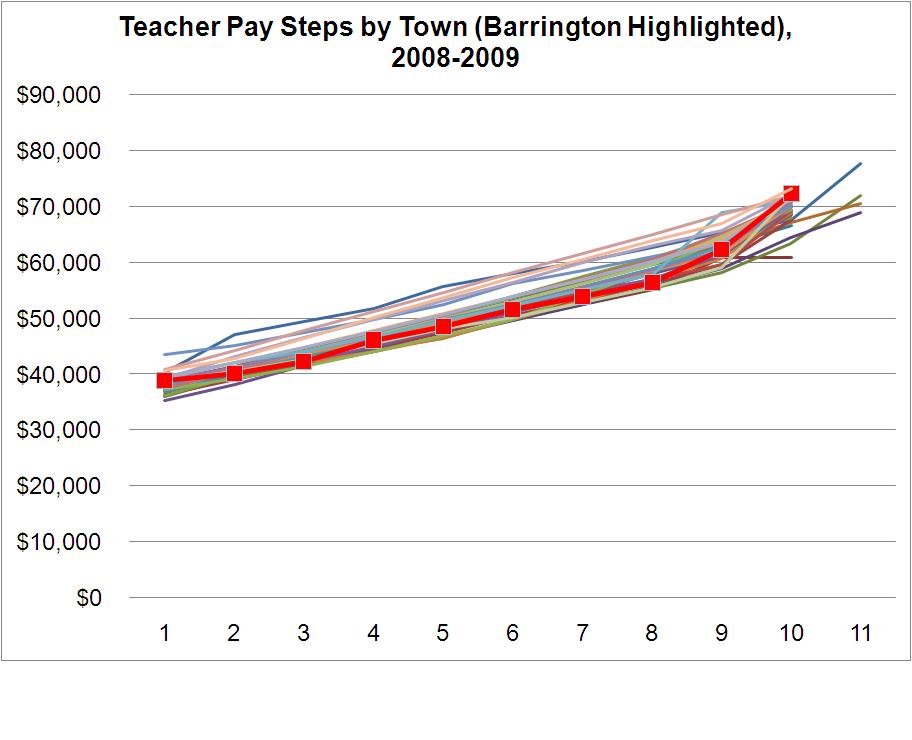
Barrington doesn't escape the middle and back of the pack, in teacher pay, until the upper steps. The town also has relatively high longevity and higher-degree bonuses. In other words, one could surmise that the Barrington school district strains within the very narrow limits of the union step structure to reward desired behavior. It ain't a merit system, but it has some related features.
The second factor that I would note as explanation for the results of Barrington's financial town meeting is probably less consequential, but related. It's a relatively wealthy suburb, especially compared with some of the more politically heated towns in the news lately.
The third factor — once again related and once again of less significance — is that the taxpayer group formation in Barrington is tied, in its inchoate form, to property revaluations, especially on higher-end homes. The currently active (as opposed to potential) constituency is not as broad as with, say, Tiverton Citizens for Change, which has resulted from a mix of working-class and fixed-income ire, general response to suspicious political games at last year's financial town meeting, and (yes) property-tax concerns.
It isn't my intention to offer opinion on the Barrington voters' action, the other night, or to suggest a direction in which the town should head. Among the things that I love about Rhode Island, however, and among the reasons I'm hesitant to jump on the regionalization bandwagon, is that one really can look around at each municipality as a self-contained segment of the statewide experiment.
School Department Positions in South Kingstown
In a South County Independent letter to the editor, town resident Edward Collins presents the kind of statistic that raises eyebrows with regards to arguments that escalating public education costs are somehow inevitable…
In 2001 there were 519 people working for the school system serving 4,400 students. Over the last 10 years we’ve served 900 fewer students yet there are currently 590 people employed in the system.71 seems like an awfully large number of new positions added, especially post-dot-com revenue boom.
Mr. Collins makes a private sector comparison to highlight the apparent inefficiency, but I think a more direct question is applicable to this situation: what is the South Kingston school system doing better now than it was doing in 2001, as the result of adding 71 new positions?
May 28, 2009
RI Educational Data, Courtesy of the Town of Barrington
Here is some of the information, provided to the public at last night's financial town meeting in Barrington, regarding various aspects of public education in Rhode Island cities and towns...
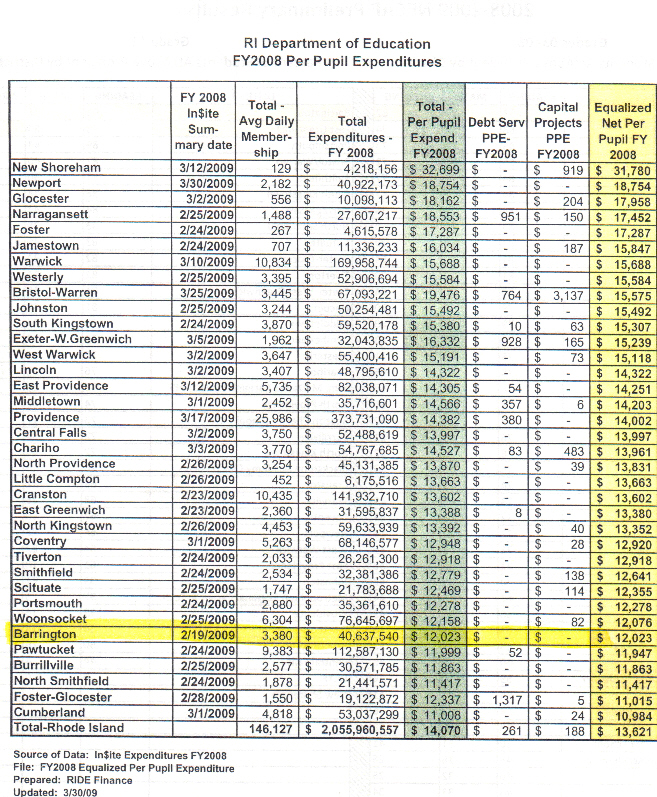
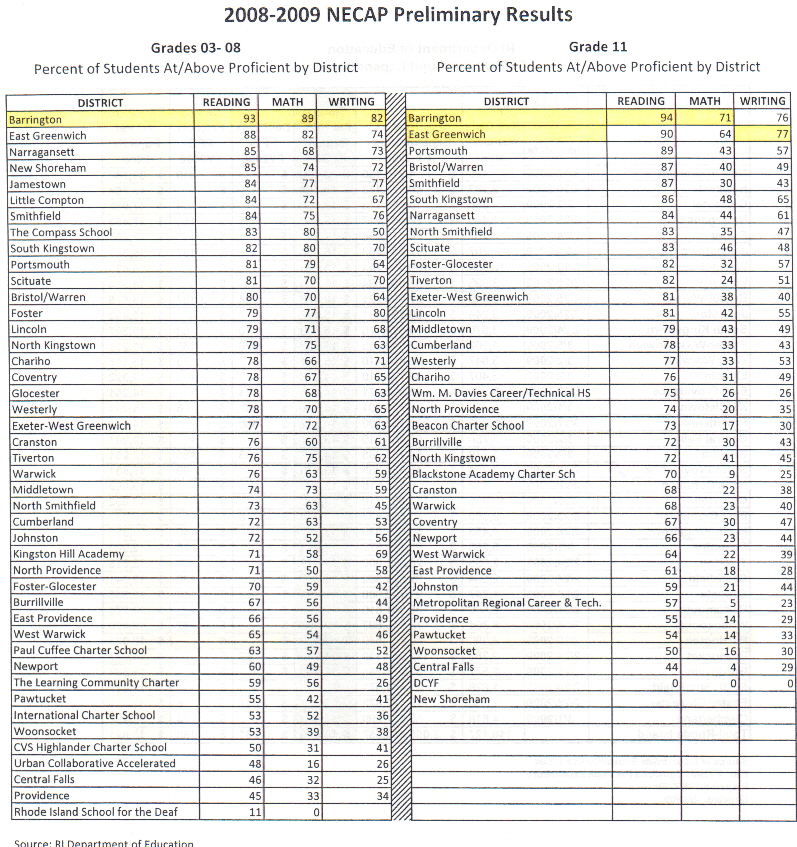
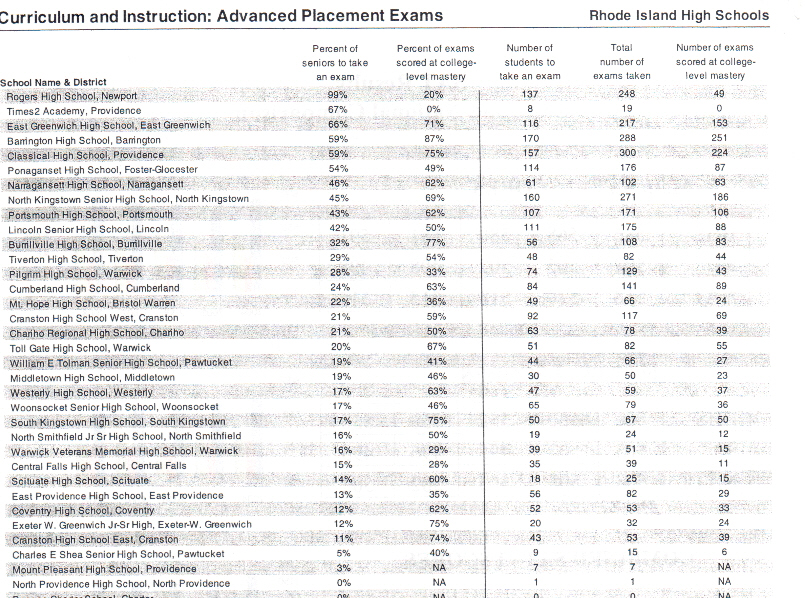
May 19, 2009
Sides of a School Funding Formula
I'm suspicious of Rhode Island notions of a school funding formula. Obviously, state aid has to be dispersed by some method, and a formula of sorts is intrinsic in that activity, but the emphases and consequences make a hang-up of the word "equitable."
For one thing, we in the suburbs have no reason to trust the administrators of Providence, over whom we have no direct democratic influence. Therefore, funneling a greater rate of taxpayer dollars into their accounts accomplishes, if anything, an easing of the pressure to spend wisely. Perhaps that's why some folks incline toward a greater state role in administering the education system, even though such consolidation ignores the fact that powerful special interests benefit by the consolidation of the pool in which they seek to dip their buckets.
For another thing, adjustments based on a community's "ability to pay" have a redistributive tint that is likely to exacerbate social bifurcation. If, for example, the state takes the wealth of Barrington as a reason to require that town to carry a greater percentage of its educational burden, while taking the lesser wealth of, say, Central Falls, as justification for the state's stepping in a bit more, local taxes will gradually diverge in such a way as to make a virtual gated community of the wealthier municipality.
Much more equitable, to my mind, would be a decision by the state how much it can and should spend per child and the allocation of that money to the school departments, no matter which communities they serve. (Even more equitable, I'd suggest, would be distribution of that money to the students for use wherever they wish to go, but we can only take one step at a time.)
Perhaps the solution takes the form that Julia Steiny described on Sunday. Essentially, the state would take over non-educational services that would benefit from economies of scale, such as food services and busing. (Considering their importance to the unions, I'd be wary of consolidating all healthcare contracts for the reason stated above.)
Whatever the case, reforms of Rhode Island's way of doing business will have to occur before anything resembling a reasonable strategy will be politically feasible.
May 14, 2009
A Problem of Remuneration Strategy in Education
We on the right understand, of course, the concept of paying a premium for quality executives and administrators, but there seems to be something of, well, an employer's vanity in paying our new, relatively young Education Commissioner Deborah Gist substantially more than her predecessor, who had logged nearly two decades in the position:
Rhode Island's new education commissioner Deborah Gist, and her bosses, the Board of Regents for Elementary and Secondary Education, have signed a three-year contract that takes effect nearly a month earlier than expected -- June 8 -- and will pay Gist about $20,000 more a year than departing Commissioner Peter McWalters now earns. ...McWalters, 62, will step down June 30 after 17½ years, making him one of the longest serving education commissioners in the country. This year, he earns about $152,000, plus $31,500 in retirement benefits because he does not participate in the state pension system, for total compensation of $183,500.
Gist's contract will run from June 8, 2009 through June 7, 2012. For the first year of the contract, she will earn $190,000 in base salary, plus $13,870 for retirement, or a total of $203,870, an amount that was approved by the state Department of Administration.
It's the new bonus, though, that is really suggestive that something is conceptually awry among those with control over pay and negotiations:
Gist's six-page contract adds a new perk: a possible performance bonus, although the amount or the goals Gist would have to reach to receive one have not been ironed out."The Regents agree to actively pursue legislative or other authority to establish a 'pay for performance' pool of funds to offer additional salary to the Commissioner conditioned upon the outcome of her annual performance reviews," states the contract.
The Regents felt it was only fair to include a performance bonus since the concept is being considered for teachers, say education officials.
A newbie being paid so much more than a seasoned veteran ought to be expected to impress as a matter of her baseline performance. The reason to incorporate a bonus is to hedge against disappointment.
May 13, 2009
Different Statements (and Threats) from the Unionist
As I noted during liveblogging last night, Tiverton Guidance Counselor Lynn Nicholas had the following to say at the school committee meeting in November, at which the committee voted to hold off on approving a retroactive teachers' contract until state numbers came in (stream, download):
Before I ask Doug a question, I just need to make it clear that, if the award is not agreed upon tonight, there will be a lot of harm done. Some of it will be financial; a lot of it will not be, and I'm not going to go into detail.
In reviewing the audio from her speech tonight (stream, download), I was planning to note how her perspective is quite different when taxpayers, not union teachers, are the ones removing money from the budget. But on the scene, I hadn't caught the implications of the sentences with which she closed her speech. Addressing the school committee (emphasis added):
You need to be serious about what you plan on cutting. I am the last person on this Earth that would want to hurt a child, but you need to make a statement. I don't know how you're going to do it. I don't know what you're going to do. But you need to make a statement to get people to the town meeting.
Keep in mind that this was before the conversation turned to ways to "get out the vote." That being the case, Ms. Nicholas would appear to be suggesting that the school committee make targeted cuts, risking harm to students, that would anger parents enough to get them to the next FTM. True to union form, the kids — whose well-being, the disclaimer goes, is a top priority for everybody — are to be leveraged as pawns to drive the parents toward actions beneficial to the union.
This coincides with a — for now — rumor that I'd heard today that a certain school committee member is planning to recommend cuts in programming intentionally in order to fire up parents. Me, I'd suggest that the school committee consider the possibility that such maneuvers could very well motivate parents to take quite different actions than the committee intends... especially now that a local organization exists to explain precisely where the district's money has been going.
May 12, 2009
A New Dawn for Tiverton Education... or Is It Dusk?
A larger-than-usual crowd is in t Tiverton High School library for the first school committee after the financial town meeting cut the district's budget by $627,247. A healthy TCC showing; the rest, I assume, are teachers and sympathizers.
School Committee Chairman: "Our only priority in dealing with this cut is to protect our students, and to make sure that our students are impacted as little as possible... everything else is secondary."
7:17 p.m.
They're going to speak vaguely for public consumption and reserve specific strategies for executive session because, as Bergandy put it: "We have to explore possible legal consequences."
Carroll Hermann started by thanking those who showed up at the FTM and voted against the cut. "With $600,000, everyone will get hurt. No one will walk away whole."
7:21 p.m.
Sally Black is taking a general tack, currently suggesting that, at a certain point, "tinkering" with the "delicate balance" has to stop.
She's emphasizing the "fair funding formula" from the state, pointing to a clause in proposed legislation reading "regardless of annual availability of state revenues."
Mild dig at Budget Committee members who didn't vote with the budget they proposed.
7:27 p.m.
Bergandy suggested that, when the state is done cutting, the shortfall may reach a million dollars.
TCC member Joe Souza is speaking, saying that the cut wasn't to "hurt the kids." Scoffs from the teachers in the room: "Yes it was."
7:29 p.m.
"We need to stand up in this town and make some noise... together." Too much in-fighting.
"It's not the Tiverton taxpayers against this school committee."
Guidance Counselor Lynn Nicholas — who is heavily involved in the union — thinks that lawsuits against the town "need seriously to be considered."
Now she wants to know what advocacy the school committee will pursue to get parents to the town meeting.
7:35 p.m.
One teacher wants to form an organization to battle TCC. My impression was that the union and the town Democrats were organized for such purposes.
How absurd that a small group fighting back can make these people feel that the process was somehow unfairly tilted.
7:37 p.m.
Bill Rearick just read the new charter amendment that prevents town funds from advocating for causes.
Sally Black described an undue concern about what it allowed her to do.
7:41 p.m.
A reader just emailed to remind me of Lynn Nicholas's comment during contract disputes: if the committee does not pass the contract, there will be "a lot of harm done — some financial, some not."
The audio is here. Full quote:
Before I ask Doug a question, I just need to make it clear that, if the award is not agreed upon tonight, there will be a lot of harm done. Some of it will be financial; a lot of it will not be, and I'm not going to go into detail.
When you make a statement like that when you're looking for money for yourself, you don't have a whole lot of credibility to villainize taxpayers as hurting children.
7:51 p.m.
And business moves on to sex offender notification and heating oil bids.
7:54 p.m.
At last night's town council, apparently at the beginning (why I missed it), Council Vice President Joanne Arruda made a point during the consent agenda segment of expressing opposition to a petition to end the Caruolo act and another to allow town councils power over teacher contracts.
7:58 p.m.
It just occurred to me that one of the speakers during the financial town meeting segment of this meeting pointed out that services to students have been declining for years. She was making the point that parents will leave town if the new cut exacerbates the problem; I'd note that TCC is less than a year old.
The NEA-RI has been around for quite a while, though...
8:02 p.m.
And out into the night...
May 1, 2009
Warwick Schools: City Council to the Rescue?
It was open-mic night at Gorton Jr. High in Warwick last night. The School Committee gave the public a chance to voice their opinion regarding the proposed closing of John Greene school. Several of the issues generated by a meeting earlier in the week were brought up last night. Of particular interest was the appearance of Warwick City Council Woman Helen Taylor, who stated she had gone through the School Department's proposed budget and, after 30 hours of study, had found approximately $3 million in savings. Addressing the crowd, she told them to "hang in there" and that the Council was working for them so that all of the schools could stay open. She also mentioned something about pending legislation in the General Assembly giving town and city councils oversight of school committees (I couldn't find any). Was this political grandstanding or is real action imminent? We shall see.
Regardless, the Warwick Beacon's recent editorial is spot on:
A RIPEC report from several years ago predicted 5 percent declines in student population for years into the future, which Warwick has experienced.Demographics and fiscal responsibility require a leaner and more efficient school department, even via this piecemeal approach. The major problem with putting together a comprehensive plan is the uncertainty surrounding the prospect of airport expansion, which will affect (probably close) one school. The feeling I get is that, once expansion is set, the school department will proceed with the inevitable city-wide redistricting.The student population decline requires fewer buildings be used to accomplish the department’s goal: educating students.
School districts have to use the resources they have to the best of their ability to educate students. With that in mind, School Committee member Paul Cannistra is right on target in saying that he’d much rather close a school building than eliminate educational programs. Why would the School Committee continue spending in excess of $800,000 in energy and maintenance costs per year to keep students in an underused building?
To say that no schools should close in light of declining enrollment is illogical. A school isn’t a building, but a group of students, educators and programs.
That being said, it would have been preferable for the school department to undergo a citywide redistricting. The process of pitting one community against another has been counterproductive at best and why it’s being done piecemeal is beyond understanding.
Where is the long-term plan?
This all points to the inter-related problems we have here in Rhode Island. This is linked to that, which is linked to another thing. And everyone is frozen until someone makes a decision somewhere else. Perhaps the best thing would be to just take the bold step of closing the one school--Wickes--that will probably be closed anyway and proceed with a city-wide restructuring. But it's apparently too late for that now.
April 30, 2009
Warwick School Closings
There will be two public comment sessions regarding the potential closing of an elementary school in Warwick: both will be at Gorton Jr. High and are tonight from 6 to 9 PM and tomorrow from 3-6 PM. I discussed the initial presentation of the consolidation advisory committee last week (and the Warwick Beacon had a good report, too). My major complaint was how the Administration seemed to be caught flat-footed by some rather obvious questions.
The three major bones of contention revolved around Title I funding, the cost of a roof and what sort of savings did the city realize from last year's school closings.
The School Committee submitted questions regarding these issues and others and the Administration responded (PDF).
There was some concern expressed that, because John Greene is a Title I school while the schools to which its students would go are not, overall funding could be negatively affected. I thought the explanation was satisfactory last week (it was explained there would be no practical affect), but many were unwilling to accept the "short answer." The administration appears to have answered the question as to funding satisfactorily. However, some Title I related issues may not be acceptable (for instance, the loss of access to pre-K schooling and other programs for Title-I kids and their families).
A major taxpayer concern was the apparent need to replace the roof of Warwick Neck school, which, with other costs factored in, made it appear as if closing Warwick Neck would save approximately one-half million dollars more than closing Greene. As I wrote last week, "while they did explain that John Greene's roof was the same age as Warwick Neck's, and had in fact been patched a few more times in recent years than Warwick Neck, they never provided a dollar figure for potential roof repairs to Greene." This is the explanation that should have been provided in the first place. The bottom line is that both roofs are of similar age and in similar shape. The cost to replace Warwick Neck's will be $471,650 and to replace John Greene's will be $405,888. Overall, it still appears as if closing Warwick Neck vice Greene will save $100,000 more (back of the envelope), but that's just in this one area.
Finally, perhaps the big question yet to be answered is what sort of savings did the city realize by closing two schools last year. Hopefully, that will be answered tonight.
New Charter Schools Coming?
There are currently 11 charter schools in RI and the cap is 20. Now that a four year moratorium has been lifted, there are technically 8 entities seeking permission to open "new" charter schools (the Paul Cuffee school wants to expand to 9th grade, which is defined as "new"). I say, let them all go for it (assuming they're qualified). Here are the candidates, according to the ProJo.
•Two proposals have already received “preliminary approval” from the Board of Regents for Elementary and Secondary Education: the Segue Institute, a middle school in Central Falls; and the Urban League Middle College in East Providence. Segue still hopes to open this fall but the Urban League is unlikely to be ready then.A little something for everyone. Importantly (maybe I buried my lede?) the ProJo reports the state wants to prioritize schools in urban/inner city neighborhoods. I agree inasmuch as those kids are the ones most in need of alternative opportunities. So let's hope that most of these prove viable and acceptable and that RI students will have more opportunity--more educational choice--in the near future.•The Paul Cuffee School in Providence hopes to receive $800,000 that would allow it to expand into ninth grade this fall. The K-8 school’s plan is to expand to a full high school.
•Two proposals — the Greene School, an environmental high school serving 210 students in Exeter and West Greenwich, and the Nathanael Greene/Potowomut Charter School in Warwick — have been “recommended” by the state Department of Education, but have not been granted preliminary approval.
•Three other groups have recently submitted proposals to the state Department of Education and public hearings were held earlier in April and are waiting for preliminary approval from the department. They are: a “mayoral academy” elementary school in Cumberland that would be run by Democracy Prep, a New York-based charter school operator; Enki Community School, a K-8 school serving 198 students, and Trinity Academy for the Performing Arts, a 7-12 performing arts school for 204 students, both in Providence.
April 27, 2009
School Committee Bill "May" Infringe on Spirit of Open Gov't
Warwick School Committee member Patrick Maloney has called attention to a proposed amendment to the "Open Meetings" law. According to House bill H5497 (sponsored by Representatives Hearn, Shallcross Smith, Marcello, Carnevale, and DaSilva):
Written public notice shall include, but need not be limited to, posting a copy of the notice at the principal office of the public body holding the meeting, or if no principal office exists, at the building in which the meeting is to be held, and in at least one other prominent place within the governmental unit, and electronic filing of the notice with the secretary of state pursuant to subsection (f); provided, that in the case of school committees the required public noticeMaloney writes, "In a time when we are looking for more transparency in Government, this bill calls for making School Committee meeting announcements in the newspaper optional. This is a step in the wrong direction." No doubt. The bill is being heard by the House Finance Committee's sub-committee on Education on Wednesday, April 29 at 2 PM in (Room 35) and by the House Judiciary Committee on Tuesday, April 28 (no time available) in Room 205.shallmay be published in a newspaper of general circulation in the school district under the committee's jurisdiction...
April 19, 2009
Choosing Politics over Children in Washington, D.C.
The decision by Education Secretary Arne Duncan to freeze the admission of students to Washington, D.C.'s voucher program is cause for concern, as editorialized last week by the Washington Post.
It's clear, though, from how the destruction of the program is being orchestrated, that issues such as parents' needs, student performance and program effectiveness don't matter next to the political demands of teachers' unions. Congressional Democrats who receive ample campaign contributions from the National Education Association and the American Federation of Teachers laid the trap with budget language that placed the program on the block. And now comes Mr. Duncan with the sword.This morning's ProJo contains an editorial by Anthony A. Williams, former Democrat mayor of the District of Columbia and Kevin P. Chavous, a former Democratic member of the D.C. Council and author of Serving Our Children: Charter Schools and the Reform of American Public Education and a distinguished fellow with the Center for Education Reform.
[A]s elected officials of the District in 2003 [we promoted] the D.C. Opportunity Scholarship Program. The program, which provides scholarships for low-income children to attend private schools, is part of the three-sector initiative that annually provides $50 million in federal funding to the District for education purposes. That money has been equally divided among D.C. public schools, D.C. public charter schools and the scholarship program.We know that unions don't like to give kids option. But it's worse when those with the ability to choose seek to remove that ability from others who are less fortunate:Preliminary data suggest that the program has been an overwhelming success. An Education Department study released this month shows that students in the program have higher overall math and reading scores than when they entered the program. The study also points to high satisfaction with their children’s schools among parents with children in the program. In short, those in this program have clearly benefited from being in a new school environment.
Despite these obvious signs of success, though, some in Congress want to end the program. Its funding is set to expire after the next school year ends, but some have even suggested curtailing it immediately so that these students can be placed in D.C. public schools as soon as possible. Already, no more students are being enrolled. These naysayers — many of whom are fellow Democrats — see vouchers as a tool to destroy the public-education system. Their rhetoric and ire are largely fueled by those special-interest groups that are more dedicated to the adults working in the education system than to making certain every child is properly educated. {Emphasis added}
That, after all, is what this program is about: giving poor families the choice that others, with higher salaries and more resources, take for granted. It's a choice President Obama made when he enrolled his two children in the elite Sidwell Friends School. It's a choice Mr. Duncan had when, after looking at the D.C. schools, he ended up buying a house in Arlington, where good schools are assumed. And it's a choice taken away this week from LaTasha Bennett, a single mother who had planned to start her daughter in the same private school that her son attends and where he is excelling. Her desperation is heartbreaking as she talks about her daughter not getting the same opportunities her son has and of the hardship of having to shuttle between two schools.
April 16, 2009
Charter Schools Part of Public Education Solution
Jay Greene writes about the unions declaring war on charter schools (h/t Assigned Reading), but in the midst of his piece is some interesting data. One of the big (usually union) arguments against charter school performance is that those who apply are highly-motivated, self-selected students (or parents) and that, of course, they perform better. Greene cites three studies that took on that oft-heard talking point head-on:
The highest quality studies have consistently shown that students learn more in charter schools. In New York City, Stanford economist Caroline Hoxby found that students accepted by lottery to charter schools were significantly outpacing the academic progress of their peers who lost the lottery and were forced to return to district schools.The last point is interesting and bolsters the argument that it is the flexibility available to charter schools that plays a big part in successful outcomes. But charter schools are only a limited solution. Where their real value lies is in what they teach us about teaching kids. As Kane says:
Florida State economist Tim Sass and colleagues found that middle-school students at charters in Florida and Chicago who continued into charter high schools were significantly more likely to graduate and go on to college than their peers who returned to district high schools because charter high schools were not available.The most telling study is by Harvard economist Tom Kane (PDF) about charter schools in Boston. It found that students accepted by lottery at independently operated charter schools significantly outperformed students who lost the lottery and returned to district schools. But students accepted by lottery at charters run by the school district with unionized teachers experienced no benefit. {Links added - ed.}
The fact that there are large differences in subsequent performance suggests that the charter schools were indeed having an impact. The next step is to identify what's working in charter schools that can be transferred back into the traditional public schools to improve student achievement.Exactly. It will take a flexible education system to do that successfully.
April 11, 2009
The End of Education in Providence
What kind of a school system would let this sort of thing happen? It's sure to be the end of quality public education as we know it (emphasis added):
Starting this fall, teacher vacancies in four Providence schools — Hope High School, Veazie Street Elementary School, Lauro Elementary School and Perry Middle School — will be filled based on whether the applicants have the skills needed to serve students in those particular schools. The principals of the district's two new schools — Nathan Bishop Middle School and the Providence Career and Technical Academy — will have the authority to hire their own teachers. The entire school district will move to this new plan at the beginning of the 2010-2011 school year.
For anybody who missed my sarcasm, I'll restate: What kind of school system would allow itself to decay so greatly that such a basic organizational practice seems like a radical innovation? Unbelievable.
April 9, 2009
An Explanation for the Union
The reaction of RI Federation of Teachers and Health Professionals lobbyist James Parisi to news that Governor Carcieri's 2010 budget includes a provision liberating charter schools from some personnel requirements suggests that the teachers' unions are frightened that charters might become even more successful:
"It's wrong, it's unfair, it's unconscionable, it's absolutely unnecessary and it wasn't the deal that was struck when the original charter law was put into place," James Parisi, a lobbyist for the Rhode Island Federation of Teachers and Health Professionals, told the House Finance Committee in a hearing Tuesday.
Who knew the schtick of lawyer Jackie Chiles from Seinfeld worked for lobbyists, as well?
A more interesting quotation from Mr. Parisi comes at the end of Cynthia Needham's article:
"What I don't understand," Parisi said, "is how the governor could propose expanding charter schools when the public school districts are hurting as much as they are hurting."
The puzzle's not difficult to solve. The governor recognizes the need to apply education money effectively, where it would do the most good. In the public schools, it would be soaked up by the teachers as a matter of course, without substantial connection to change or improvement. When an organization is fundamentally broken and displays little will to repair the core problem, society will find a way around it.
April 8, 2009
"Gambling" on Education
As reported in today's Providence Journal, thousands of Providence parents "gamble" on charter schools*:
That parents are looking for an alternative to traditional public schools is borne out by the numbers: this year, charter schools received 3,454 applicants for 559 openings. The Learning Community Charter School, in Central Falls, had 500 applications for 50 spaces while Highlander Academy, a Providence charter school, received 581 applications for 44 openings.Time after time, when given the opportunity, parents are willing to "gamble" on sending their kids to alternative schools, particularly in urban areas. They feel they are trapped in the public school system that under performs and don't have the financial ability to send their kids to private schools. So charter schools are their only other choice. Meanwhile, teacher union leaders protest the easing of current charter school laws as proposed by Governor Carcieri.
Removing those requirements, supporters including the governor say, would eliminate the red tape that can hamper classroom innovation. Such freedoms give charter schools greater control over budgets and personnel and allow them to attract and pay for top teaching talent.They offered similar objections to the proposed Mayoral Academies, for which the the ProJo recently professed editorial support.But teachers union representatives vehemently object, contending it amounts to an end run around collective bargaining units, giving management an excuse to pay lower wages and do away with seniority protections.
“It’s wrong, it’s unfair, it’s unconscionable, it’s absolutely unnecessary and it wasn’t the deal that was struck when the original charter law was put into place,” James Parisi, a lobbyist for the Rhode Island Federation of Teachers and Health Professionals, told the House Finance Committee in a hearing Tuesday.
The union chiefs have it backwards. Schools are not set up to assure teachers money and benefits. They are set up to serve the students. But, as Rhode Island’s longstanding financial commitment to public education should suggest, parents and the public will pay high taxes to compensate teachers handsomely if those teachers give it their all and are not afraid to be paid on the basis of how good they are.
March 24, 2009
Bumping in Education Is Obviously Wrong
Amanda Pereira, a sophomore at Classical High School, and her fellow students in Young Voices confirm that students also see what many of us believe to be obvious, that allowing teachers to be bumped from their jobs based on seniority alone is wrong:
[Bumping] has a terrible effect on students. In 2008, we conducted groundbreaking research on students' everyday experience in Providence schools. We surveyed more than 1,600 high-school students and conducted focus groups with more than 200. Many students talked in the focus groups about losing their best teachers to bumping. This comment is just one example: "I had this social-studies teacher who really cared. He was a great teacher and I could really relate to him. Then he got pushed out one day, and I got this teacher who just sat at her desk and didn't teach us anything."It's really hard to lose a great teacher, especially since there aren't a lot of teachers we can connect with. In our research, students said only 30 percent of their teachers motivate them.
Bumping is just an egregious example of the "union approach," which is clearly a detriment to our schools and a harm to our children.
March 23, 2009
Here's a Thought for Mr. Caruolo: Democratic Dispute Resolution
The infamous former RI House Majority Leader George Caruolo, who acquired that adjective when he put his name on a bill that permitted school departments to file suit against their towns for more money, argues that his solution is better than the one that it replaced. Rather than sending funding disputes to the courts, as is now done, the law sent them to Dept. of Ed. bureaucrats.
In making his case, though, Caruolo presents an illustration of the manner in which a skewed first principle prevents the appropriate resolution of issues:
What I don't see are any serious suggestions of where these disputes should be decided. Back to the commissioner or to a governor's panel and we will see the old games again. While a fiscally conservative Republican governor might make decisions that Mr. Jones can agree with, what happens when a pro-union free spender takes office? There is room for abuse when the power to decide these questions is concentrated in any interested bureaucracy.
If I might hazard a suggestion: How about we permit voters to decide such matters by placing the taxing and spending authority with the same body? Either give the towns final say over school department budgets or give the school departments the power to set their own tax rates. If the schools are detrimentally underfunded, the people can elect representatives to increase the flow of money; if the schools become tax sponges, then the people can boot the folks with the budgetary mops.
March 12, 2009
Mayoral Academies Going Forward
Amidst all of the bad news, there are some encouraging things happening in our state. As reported in the ProJo, Cumberland Mayor Dan McKee recently announced that he is going ahead with his Mayoral Academy.
McKee said if his proposal wins approval by the Rhode Island Department of Education and secures $700,000 in state financing, he wants to open an elementary school this September in his town’s Valley Falls section, in a former parochial school building.Several other mayor's were with McKee. For his part, Warwick's Mayor Scott Avedisian told the Warwick Beacon that he thinks a Mayoral Academy may be feasible in his city:The school would serve 80 kindergarten and first-grade students from Central Falls, Cumberland, Lincoln and Pawtucket. A middle school would open, starting with a sixth-grade class, in fall 2010. Eventually, the schools would cover K-12.
If there is a delay with state funding or approval, McKee said he plans for both schools to open in 2010. He hopes more regional mayoral academies will open, mixing urban and suburban students.
A 12-member board, a mix of mayors, community leaders and education figures chaired by McKee, would oversee the schools. But national charter school operators would run and staff the schools. Democracy Prep, which runs a middle school in Harlem, has already applied to the Department of Education to run the first mayoral academy.
In addition, McKee said his group has received financial support from nonprofit organizations and private donors to help pay start-up costs, including a $2-million commitment from the Raza Development Fund of Arizona to purchase a building.
Mayor Scott Avedisian said he supports a proposal to use the former Potowomut School for a Mayoral Academy at a press conference to announce the formation of the Rhode Island Mayoral Academies (RIMA) board yesterday.“As a mayor, I have a responsibility to ensure our children receive a quality education which will allow them to compete in the global marketplace,” Avedisian said in a press release. “Mayoral Academies represent our firm commitment to providing the best education possible for the students of our cities and towns.”
Mayoral Academies are a form of charter schools created last year. The brainchild of Cumberland Mayor Daniel McKee, the schools won legislative approval last year despite steep opposition from powerful teacher unions.
Yesterday Avedisian saluted McKee for his hard work and effort to make the schools a reality.
“We’ve talked about governance reforms for years and years and they’ve never gone anywhere. This is a real opportunity to see that governance reform takes place,” said Avedisian.
Avedisian talked about how Warwick spends 70 cents of every tax dollar on schools, which the City Council has no control over. A Mayoral Academy, he pointed out, would be controlled completely by the city side of government.
The teachers in the schools wouldn’t be subject to the same mandate as the regular public school system, and wouldn’t be teachers’ union members.
February 27, 2009
Administering Results for Negotiations
It would go too far to speculate that this sort of thing is widespread:
Statewide testing procedures were violated at Whiteknact Elementary School last October when at least 14 third graders were given extra time, the state Department of Education has concluded.And now school officials are looking into whether another violation occurred when the standardized tests for students in grades 3 through 5 were administered at Whiteknact. ...
Barbosa also said her daughter, also a Whiteknact student, told her that the person who administered the standardized tests in her classroom prompted the students with answers. Barbosa did not disclose what grade her daughter is in Tuesday night and she could not be reached Wednesday morning.
Students' success on these tests has a direct bearing on contract negotiations, and especially given other tactics of unionized workforces, it's reasonable to suggest that perhaps some third party should direct and supervise the test taking.
February 24, 2009
School Committee Night
When I walked in, the Tiverton School Committee was discussing the issuance of a few more layoff/non-renewal notices related to a possible move of the fifth grade (it sounded like) to the elementary schools. The move hasn't even been considered, but the notices have to meet a deadline.
7:14 p.m.
I may have noted this before, but the superintendent is expecting a 4% decrease in Blue Cross/Blue Shield costs. Nothing specific, yet, but an estimated savings (off next year's budget) of $100,000, based on higher premium payments than claims.
7:25 p.m.
Town Administrator Jim Goncalo and Town Council President Don Bollin are here to address the committee reporting on the town council's budget doings.
7:30 p.m.
Goncalo met with all unions except fire seeking concessions. "If we are unable to acheive concessions, we'll have to take more extreme measures."
Bollin is asking for concessions from the school committee (as it were), specifically for some return of money allocated for, but not spent on, pensions ($548,000 from pension payment reductions related to the governor's cutting of education aid).
7:33 p.m.
The committee is going to have substantive discussion in executive session. They're concluding that the governor's supplemental budget is a wash for the school district. Mr. Bollin argued that, by the way budgets flow, the change wouldn't be as "revenue neutral" as they assume.
7:36 p.m.
Thanks to the can-kicking General Assembly, everything's in limbo. Everybody's trying to work out budgets on hypotheticals. The example is stunning.
7:38 p.m.
Don Bollin reported that the town is hearing, as it tries to find potential cuts, questions (complaints) about whether the school department is doing anything at all to help with current budget problems, and the answer thus far has been "no."
7:42 p.m.
Let it be noted (although nobody of official capacity has done so) that the school committee would have certainly been able to assist the town with its budget shortfal — Bollin: "We've gotten to the point that we're actually not going to pave a road," for example — if it had not given hundreds of thousands of dollars away to the teachers, including in retroactive pay.
7:55 p.m.
On discussion of why the committee can't be detailed in its minutes, the schools' attorney discourages detail for reasons of practice and liability. The law requires only "the essence" of the meeting.
8:01 p.m.
The issue of the minutes came up because committee member Danielle Coulter thought some summary of the points and arguments of the committee and others regarding the recent contract debate should have been included, not just the vote tally. The attorney agrees that the law appears to require at least a bullet-point format of discussion.
8:06 p.m.
There's some extensive debate going on about the difficulty of providing summary minutes. As a guy who sits in the audience and summarizes key points (from my point of view, of course), I find the objections bemusing.
8:16 p.m.
TCC & budget committee member Rob Coulter is addressing the committee with a follow up on inappropriate actions on the school district's part in encouraging voters to approve the budget at last years financial town meeting.
8:19 p.m.
Oddly, the current school committee has not been updated on the exchanges between the superintendent and the Department of Education. After the initial request from the state for a statement, Supt. Rearick informed the committee, but he says that he was waiting for a response from RIDE before offering an update.
8:28 p.m.
As seems usually to be the case, substantive discussion about the law and the operation of the school district will be performed in executive session.
There was some unnecessary contention. Rob asked whether it's committee policy to adhere to a charter amendment (passed but not ratified by the state) prohibiting public funds for advocacy, and Sally Black said that Supt. Rearick had already confirmed that.
Rob made the obvious point that the committee hadn't made an official statement, and Carol Herrmann noted that the district's attorney had advised them not to do so prior to closed discussion.
My summary reads mildly, but the tone and expressions bespoke the underlying tensions of the town.
Science Education Breaks Through the Negotiation Firewall
It appears that the most recent of the their multiple weeks off during the school year mellowed Johnston science teachers with regard to the new program that had recently been announced as foiled:
During their winter break, local science teachers changed their minds and decided to participate in a project to improve science education across Rhode Island, a school official said yesterday morning.As of 10 a.m. yesterday, 14 science teachers and 9 special-education teachers had signed up for the program, gratifying the same officials who recently accused the teachers' union of trying to sabotage Johnston's leadership role in the statewide effort.
"I don't know what changed but I’m very pleased," Assistant Supt. Kathryn Crowley said. "I think they're going to benefit greatly from participating in this program. I thank them all."
Ms. Crowley should thank enraged Rhode Islanders, as well.
February 19, 2009
Another (Potentially) Huge Development
Here comes another historic, philosophical battle, this time in Providence:
Education Commissioner Peter McWalters has ordered the city schools to begin filling teacher vacancies based on qualifications rather than seniority, an order that could fly in the face of the teachers' contract.McWalters, in a no-nonsense letter yesterday to Supt. Tom Brady, said the district hasn't been moving fast enough to improve student achievement and that it was time to intervene in a much more aggressive fashion.
Dare we hope that we're seeing the beginning of a revolution of sanity? (And dare we hope that it'll arrive before we reach the utter bottom?)
February 18, 2009
West Warwick Teacher Layoffs
In the ProJo story about West Warwick handing out 188 layoff notices (wow!), there was this little nugget:
State law requires that teachers be notified by March 1 that they will no longer have jobs the following September, and many school districts routinely send out pink slips by the deadline while acknowledging that most, if not all, of them will not actually be exercised.Is it any wonder we find ourselves where we are now, with School Committees bargaining away management rights to the extent that they even gave up their ability to lay-off employees?But West Warwick has not sent out such notices in 17 years, and officials said that at least 30 of the 188 teachers targeted for the notices this year are likely to be let go.
A no-layoffs clause in the district’s contract with the West Warwick Teachers Alliance was modified last September to allow layoffs under circumstances that include “uncertainty or lack of funding in programs and /or positions that are totally supported by federal or state funds.” {Emphasis added}.
Save Our Schools (or SOS: The Name of the Game Should Be Take a Chance on School Choice)
If President Obama is going to foist a “Swedish model” for bank reform on the American public, he should also toss in some Swedish-style public education reform while he’s at it…
It may sound out of place in Sweden, that paragon of taxpayer-funded cradle-to-grave welfare. But a sweeping reform of the school system has survived the critics and 16 years later is spreading and attracting interest abroad....Since the change was introduced in 1992 by a center-right government that briefly replaced the long-governing Social Democrats, the numbers have shot up. In 1992, 1.7 percent of high schoolers and 1 percent of elementary schoolchildren were privately educated. Now the figures are 17 percent and 9 percent....Before the reform, most families depended on state-run schools following a uniform national curriculum. Now they can turn to the "friskolor," or "independent schools," which choose their own teaching methods and staff, and manage their own buildings.
They remain completely government-financed and are not allowed to charge tuition fees. The difference is that their government funding goes to private companies which then try to run the schools more cost-effectively and keep whatever taxpayer money they save.
February 16, 2009
“Can you imagine Socrates not answering Plato’s questions because it isn’t in the contract?”
So says Robert Flanders,chairman of the state Board of Regents for Elementary and Secondary Education. Prison guard (and union member) James Petrella essentially agrees:
James Petrella, a prison guard, has a few things in common with his son’s teachers.Ah yes, they have not formally"ordered" it so it's all just one big ko-ink-ee-dink.He is in a union, and he knows what it’s like to work without a contract because he did it once for six years.
But the 45-year-old correctional officer said local teachers are using schoolchildren, including his own, as tools in their battle to get a new labor contract....Petrella said he first realized work to rule was in play last fall when his son’s teachers stayed away from the Winsor Hill School open house for parents.
When his son’s report card arrived with all A’s and B’s, except in music for which he got the equivalent of a C, Petrella called the school to ask about the low mark. The teacher said his son had been disruptive in class, shouting out answers.
Petrella asked why someone hadn’t called to tell him about the problem as another teacher had done in the previous school year. He said the teacher said he was under no contractual obligation to phone a parent.
Petrella persisted, asking why the teacher didn’t at least write a comment on the child’s report card to explain the C. The teacher, he said, responded that the contract doesn’t require him to do that.
On another occasion, he said, his wife asked a different teacher for some homework exercises that would help her son address a slight slip in the boy’s math scores. He said the teacher advised his wife to go to a store in Cranston and pay for a tutorial system called “Up With Learning.”
Kathleen P. Kandzierski, president of the teachers’ union, an affiliate of the Rhode Island Federation of Teachers and Health Professionals, says the union has not ordered any work-to-rule or contract-compliance tactics.
David Anderson: Do the NECAP Test Results Mislead?
Secretary of Education Arne Duncan recently lamented, "I think we are lying to children and families when we tell children that they are meeting standards and, in fact, they are woefully unprepared to be successful in high school and have almost no chance of going to a good university and being successful." Do his remarks pertain to Rhode Island's 8th grade public school children? Is it the Rhode Island Department of Education (RIDE) that is misrepresenting their skills through their use of the New England Common Assessment Program (NECAP) tests?
Recently released public school achievement results from the NECAP test seem to confirm these worries. The proficiencies reported not only exaggerate the performance of Rhode Island students in mathematics and reading but also claim improving 8th grade reading scores when, in fact, they are declining. This seems inconsistent with the transparency that was promised.
Stakeholders, including Governor Carcieri, have been pushing Rhode Island educators to improve student performance. In response the NECAP 8th grade reading scores are giving them only the illusion of improvement. Illusion is a poor substitute for truth. These advocates of better education have been blindsided by RIDE and the NECAP testing regime.
To see the problem, please consider the 8th grade NECAP results in recent years. They are significantly inconsistent with those of the well-respected Nation's Report Card- also known as the National Assessment of Educational Progress (NAEP).
The NECAP measure of skills should roughly reflect that of the NAEP. It fails to do so in two regards:
Firstly, the NECAP exaggerates. It reports that roughly twice as many Rhode Island 8th grade children are proficient (at or above grade level) as are reported by the NAEP. We are told that last year 53% of Rhode Island pupils were proficient in math and reading when, in fact, the NAEP trend says it's only 26%.
Perhaps worse, and what is new to us, is the fact that NECAP reading proficiencies have been increasing over time while the NAEP shows declines. We call this the up-down problem.
You can see this in the graph, which shows the 8th grade reading proficiencies reported by the NECAP and those interpolated or reported for the NAEP. The vertical separation of the plots shows the exaggeration effect while the up-slope versus down-slope represents the up-down problem.
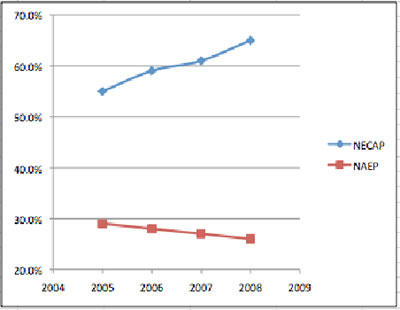
We also reviewed the performance of 8th grade pupils in the best school district, of Barrington, and in one of the worst districts, of Providence. Additionally, using a mapping technique we developed, we have estimated NAEP proficiencies for them.• By considering these cases parents and other stakeholders can get some sense of what's wrong with our public schools.
All must seem fine to Barrington 8th grade parents when the NECAP is claiming student proficiency percentages exceeding 90%. But not when they see our NAEP estimates showing one-third of their children below grade level.
Parents in Providence, while not pleased by the NECAP results showing only 28% of their 8th grade children proficient in both subjects, would be justifiably outraged if they knew that the more trustworthy NAEP estimates suggest that less than 10% are at or above grade level. If these numbers are correct, Providence schools are extremely dysfunctional.
How could these inconsistent results arise? It's fairly clear that the exaggeration problem is due to the policies of the NECAP authorities and, indirectly, of the participating states' departments of education.
As to the up-down problem of erroneously rising NECAP reading proficiencies, that uptrend could be due to a number of causes. Other states have seen officials gaming the tests to produce artificial gains- as happened in California some years ago. While we can't entirely rule out this possibility, we think the explanation lies more in the realm of good intentions gone awry.
Maybe the NECAP curriculum content is narrower than that of the NAEP and is thus more easily taught? It's like learning a booklet instead of a book. The one is mastered and the other not so well. Then scores go up for the one and down for the other.
But that is just a hypothesis. Further study of this is needed- probably by outside independent experts. Consideration should also be given to conducting the assessment function through an independent agency to remove concerns about conflicts of interest. That is the practice of Massachusetts's MCAS test.
Do the authorities of the Rhode Island Department of Education (RIDE) take these inconsistencies seriously?
As to the exaggeration problem, consider that at least one RIDE official apparently thinks that the NAEP standard is too high and should be lowered. She says, "NAEP 'proficient' is a very high aspirational standard."
It suggests that these officials would prefer to lower the NAEP standards rather than elevating those of the NECAP. Lowering expectations of students is no way to build tomorrow's work force. We should be maintaining or raising standards. Senator Kennedy has introduced legislation to encourage aligning state standards with the NAEP. Instead the gap between the NAEP and NECAP seems to be widening- at least with respect to 8th grade reading proficiencies.
When asked about the up-down problem a RIDE official said that the 8th grade reading test "has been administered ONLY ONCE" in recent years. But how could that be when the RIDE website reports 8th grade NECAP proficiencies for four consecutive years?
It seems that obfuscation is the primary response from RIDE officials while nary a word is said about studying these discrepancies.
We believe that when parents and other stakeholders have a more transparent picture of our public schools, then the needed political pressure can be developed to begin serious reforms. Our preliminary analysis of test results suggests that social promotion is a fundamental problem that exists in every public school in the state. But most interested parties don't yet see it that way- certainly not with the wool NECAP pulled over their eyes.
David V. Anderson, Ph.D., is CEO of Asora Education Enterprises, and his NAEP estimates were generated under a contract with the Ocean State Policy Research Institute.
Targeting Caruolo from All Angles
Back on the fourth, I mentioned Sen. Leonidas Raptakis's legislation to suspend the Caruolo Act, which empowers school districts to sue their towns for more money. Saturday's Providence Journal brought news that Governor Carcieri's got a plan of his own:
A proposal to suspend the law that empowers school districts to sue cities and towns for more money is one of the measures Governor Carcieri has proposed to help plug the state's multimillion-dollar budget gap. And, this week, it picked up the support of the presiding judge of Superior Court.A three-member panel should settle financial disputes between cities and school districts in tough budget years — not the courts, the governor said.
My initial reaction was to question why a small unelected panel ought to have that sort of sway, but I'm not sure reporter Katie Mulvaney's paraphrasing captures the plan, which she describes thus further down:
The governor's proposal would bar districts from suing cities or towns over budget issues in any fiscal year in which state aid has been cut. Instead, a town or school committee could petition the governor for relief.That concern would be heard by a three-member panel convened by the governor and consisting of the education commissioner, director of revenue and auditor general, or their designees. The panel would develop a "corrective action plan" within 60 days that could include the suspension of contracts, including collective-bargaining agreements.
The suggestion, in other words, is for a mechanism whereby state-level financial experts would help school districts reconcile state funding cuts with their budgets, perhaps restoring some money, but with the possibility of loosening logjams that school committees lack the power and/or political will to address (such as teachers' contracts). The governor's plan does not supplant Raptakis's legislation; if the state level-funds or increases assistance, the school committee could still turn its legal guns on the town.
The state most definitely requires practices and mechanisms that take responsibility for the effects that its policies have on municipalities, but it also should take its thumb off the scale balancing the interests of each town and city.
February 15, 2009
Savage on Education, the Romantic Versus the Paradigmatist
East Providence Representative John Savage (R-East Providence) describes a philosophy of public education that is fundamentally self-contradictory. On one hand, there was the system back in the day — which cultivated those Americans who reached for the moon, invented the computer-driven society, and built history's most dynamic economy:
WHEN I BEGAN teaching in the late '60s, we had pens, pencils, crayons and rulers to give to the children. The school would supply the paper for their assignments. Our textbooks would be reasonably current, and some might even be new. Maps and globes would be in our classrooms for referencing.Sitting at their desks would be some 30 to 35 sixth-grade students, three or four of whom spoke no English. I, unfortunately, spoke no Portuguese. I did take a six-week course to learn some basic phrases (now forgotten), but to communicate with these children was very difficult. There would also always be a student or two in the class who had a severe learning disability. Together in that classroom for six, seven or eight lessons a day, the 36 of us would all work very hard.
My salary was a modest one (all my friends who graduated with me from college were earning more, and they didn't even have to return to college for night courses). My benefits were good. At times I did consider changing careers, but I loved what I did so I stayed. I knew I would always be lower-middle-class, and that was okay.
On the other hand, there is the current system — in which specialized services for individual students, smaller class sizes, and an emphasis on "attracting and retaining talented, motivated, and highly skilled professionals" are crowding out other expenses. Savage suggests that it is "the educational process itself" that is "driving up the cost of education," but that skirts the value judgment between the before and the after. Would Savage characterize his early years in the field as an era of endemic failure? I suspect not. Somewhere, he leaves off the lessons of his technicolor past for the demands of a digital present.
I'd propose that the current system of generating and remunerating teachers is nowhere near adequate for ensuring talent, motivation, and skill. Indeed, unionization is crushing those spirits from the profession. Talent is hardly a consideration against seniority. A one-size-fits-all career path is clearly stultifying of motivation.
Savage ends with the despairing question of whether we can afford the "free public education [that] is necessary for the maintenance of a functioning democracy." In a full and honest review of his experience as a teacher, perhaps he'd be able to identify the assumptions that make the answer "no" and the opportunities that would make it "yes." Not a lot of folks in the business can resist the natural inclination to turn away from the conclusions toward which that project would lead.
February 11, 2009
East Providence's Half-Million Dollar Compromise
Gina Macris' story in today's Projo on a cost-saving early retirement plan for teachers in East Providence...
During the meeting, the committee approved the retirement of 15 veteran teachers who chose a midyear buyout, saving what school officials estimated will be nearly $1 million in salaries and benefits by the end of the fiscal year, Oct. 31.......doesn't get the details quite correct.With the retiring teachers’ last day expected on Friday, the School Department plans to replace them with retired teachers at substitute pay for the remainder of the school year. It expects to hire replacements in the fall at significantly less than the retiring teachers have been paid.
Actually, most of the teachers who are officially retiring have volunteered to stay on as long-term substitutes, but because of state law have to be away from their jobs for 30 days before they can be re-hired. In return for retiring mid-year, the retirees will be allowed to participate in the healthcare plan specified in the expired 2005-2008 contract.
Already-retired former teachers will be used to fill the 30 day gap.
East Providence expects to realize an immediate $400,000 to $500,000 savings with this plan. Add to this the fact that this proposal was brought to the school system by the union (although union President Valerie Lawson didn't seem too happy about the school committee accepting the offer), and it seems like we may have an honest-to-God compromise benefiting all sides on our hands here.
Click here for the audio of East Providence School Department Director of Human Resources Lonnie Barham's official description of the plan.
A Mandate for Change and a Change of Mandates?
There's a hearing at the State House today on an excellent bill (PDF) from newcomer Representative Roberto DaSilva (D, East Providence, Pawtucket):
(a) No educational mandate shall be enacted or promulgated after the effective date of this chapter, unless the body enacting or promulgating the same shall first, after public hearing, determine the cost of the proposed mandate to each of the school districts of the state. No rule, regulation or policy adopted by state departments, agencies or quasi-state departments or agencies which requires any new expenditure of money or increased expenditure of money by a city or town shall take effect unless full and adequate funding, as determined by public hearing, is included as a portion of the language of the mandate document.(b) The lack of full and adequate funding as a provision of an educational mandate shall be an absolute defense against any legal action filed by any party for the purpose of enforcing the provisions of the mandate.
February 10, 2009
Reducing the Schools
With other contributors covering the state of the state and the hoopla in East Providence, I'm at the Tiverton School Committee meeting, to which I arrived in the midst of Superintendent Bill Rearick's description of the various cuts to come for the next budget — you know, the one that increased by about $150,000 when the committee approved the latest teachers' contract.
7:15 p.m.
Personnel reductions to come:
- 0.5 middle school special ed
- One elementary special ed
- One speech pathologist
- One kindergarten teacher
- One grade one teacher
- Four grade seven teachers reduced by 20% each
- Three part-time elementary teacher assistants
- 6.5 elemntary special ed teacher assistants
As I understand, these are on top of some nine positions already slated for nixing.
7:22 p.m.
The committee just voted to approve the new proposed budget, with only Danielle Coulter opposed. Supt. Rearick reminded everybody that further cuts — that is, below a 2.7% spending increase year-over-year — are going to begin cutting into programs.
Of course, The teachers got their raise, including retroactive pay for more than a year of negotiations. That much is off the table...
7:27 p.m.
The committee is discussing the 24 tentative pink slips that the superintendent will give out in case they have to be let go. Most or all of these teachers won't lose their jobs, but Rearick made an interesting comment:
"Many of these are the best and brightest."
Presumably, he's referring to bumping and the discusson he said he had with the union leaders over whose jobs to threaten. Letting the good one's go; that's the way to succeed!
7:36 p.m.
Extended discussion of the appropriate detail to be included in meeting minutes. Danielle Coulter suggests that key points of discussion ought to be included. Carol Herrmann thinks that's the press's job. Rearick said the schools' lawyer suggested the short form.
7:41 p.m.
Looking at the new budget proposal, the breakdown of increases/decreases is noteworthy:
- Salaries: 0.54%
- Benefits: 2.18%
- Purchased services: 19.87%
- Supplies/materials: -5.12%
- Other costs: -3.15%
- Capital (operations): 1.19%
- Capital: 0%
Those salary and benefit numbers, by the way, take into account the 14 or so layoffs — and they're still increases.
7:47 p.m.
The committee is discussing the financial ramifications should the financial town meeting be moved to July. Financial Director Doug Fiore explained that any resolution to postpone the vote would require a component that ensures the continuation of cash flow until the budget is resolved.
Interesting.
7:58 p.m.
After the meeting Town Council Member Joanne Arruda approached me rather agitated that I'd suggested that town council meetings tend to start early, and she requested that I tell my "people" that my assertion was "not a good thing."
So, people, let it be noted — and I've appended a footnote to the relevant post — that my casual commentary did not accurately reflect the thorough devotion to punctuality of the Tiverton town council. I should have taken a moment to elaborate on my thought, rather than publish an inaccurate short-hand quip.
Not the Sideshow
This is being treated as a secondary matter, but in the long range it might be the more significant thread coming loose in East Providence:
The state Labor Relations Board has decided to hold a formal hearing on a complaint by the city teachers union that the School Committee violated Rhode Island labor law by insisting on public negotiations as a prior condition for collective bargaining.The charge was filed in early December by the East Providence Education Association. Yesterday, the board confirmed that it has issued its own complaint, which says that the school board's insistence on public talks resulted in "mere surface bargaining," a violation of the duty to bargain in good faith.
The board's complaint is not a finding but its own statement of the issue, which will go to a formal hearing Aug. 25.
I'm not sure where the distinction lies between the board's having an official "complaint" and having come to a "finding," but the idea that the only fair negotiations are those that happen outside of the view of the people who ultimately pay for the results is another bit of insanity to add to Rhode Island's madness. If this complaint is found to have merit, the lesson will be that "fairness" is a measurement of the unions' leverage, rather than a two-sided balance.
Semantic Games with Children
How much of life is phrasing? When it comes to the political battle with unions, the spats are like Abbot and Costello skits, which (for the young'ns) often hinged on a semantic misunderstanding. One must read to paragraph six to reach the punchline under the headline "Teachers deny killing science initiative" (emphasis added):
The union has never taken a formal position on the matter, according to the news release that Kandzierski sent out late yesterday afternoon."To blame this on the teachers is nothing more than a political cheap shot and a weak attempt to cover up their own inadequacies in communicating this program to teachers," she said in the statement.
Nobody had suggested that union members sat down and took a formal vote concerning whether science teachers ought to participate in an externally funded program to improve science proficiency in the town. But school officials did notify the relevant teachers and sent them requisite information. So, in effect, the union is pointing its finger at the individual teachers for declining to participate, and of course, the union would defend with its claws any attempt to impart consequences for that decision. (Not to mention "unofficial" suggestions that the union might have made.)
Whatever the case, the situation provides a clear example of the insidious effect that unions have on a professional environment, especially one involving the nexus of children's education and taxpayer funding.
February 9, 2009
A Cause of This Effect
Things don't look good in West Warwick:
There are no solutions to their immediate fiscal problem. In fact, their current deficit is projected to balloon into a $10-million deficit in the years ahead if nothing is done.So school officials have worked "seven days a week" to come up with a three-year plan that would gradually wipe out the growing deficit.
It requires a supplemental tax hike in the current year to raise an additional $2-million. In future years, a hodge-podge of reductions, from health-insurance savings to staff cuts and eliminating sports, would gradually wipe out the deficit. It would only work with substantial union givebacks, they say.
Conspicuously absent from the story is a recollection of the work-to-rule action back in late 2007. The school committee, if you'll recall, had followed the appropriate procedure to opt out of the last year of the contract, which would have left it up for negotiation after this school year. Witnessing the damage that the teachers were doing, however, the committee backed down and extended the contract through next year:
The next day [after the school committee's vote not to extend the contract], the union announced it would take a "work to contract" stance that discouraged teachers from performing any duties not explicitly required by the contract. Union members began sporting pins that proclaimed "We Keep Our Promises," and let their actions speak for themselves.As the school year got under way, the resignations rolled in, affecting classrooms at all grade levels. Field trips and teacher participation in the school-improvement and teacher-support teams halted districtwide. At the elementary level, there were no yearbook advisers, book fairs, learning walks or teacher involvement in fundraising. Teachers shunned a Saturday-school program. The National Junior Honor Society adviser at Deering Middle School resigned as well.
Advisers for the French, Italian and Spanish clubs at West Warwick High School resigned, as did the summer school director, Academic Decathlon adviser and the credit-retrieval program coordinator. The band and choral calendars were scant. Community members and school administrators stepped in to fill vacancies, chaperoning school dances and volunteering to lead summer school programs.
And now the union has the upper hand as the town struggles and tears itself apart trying to balance its budget. The well-paid grownups got theirs, and now the question is how much they'll deign to help the givers.
February 7, 2009
Teachers Aren't Embattled Saints
Two comments on Anchor Rising from apparent teachers within the past twelve hours raise some common points that are worth addressing. The first, appended to a September post by Monique, is a recitation of some typical union talking points — which, as I've been saying, are most directly targeted at the union members themselves, to keep them believing that they need a union and deserve ever more remuneration:
As usual, let's continue to demonize ALL teachers, belittle the work that they do, forget the professional degrees that they paid for and earned, and generally disrespect anyone who devotes their life to educating our children despite the lack of support from the public, government and so many parents. And EVERYONE should have health care benefits. Pushing to remove decent health care from the last few people still adequately covered will finally make it possible for the health care industry to drive in that final nail. Use your zealous energy to get something for everyone instead of blaming people who are trying to hang on to something you haven't got.
The comment opens with a display of the thin-skinned sense of victimization, whereby complaints about performance and union tactics are statements of disrespect for teachers qua teachers. They're all alone, these educators, with everyone — "the public, government and so many parents" — gunning for them and their meager, cobbled-together remuneration packages. Who's to protect them from a society that would manacle them to their desks and pay them in apples? Why, the union, of course — organizers who assure the members that, as much as they might find work-to-rule and strikes disagreeable, they are mild actions compared to what school committees would do to our harried professionals without collective strongarming, and as much as they might be embarrassed of and uncomfortable with the union performances at public meetings, well, that's just how these things are done.
Two considerations are offered to buttress this sense, the first being the dedication evidenced by the pursuit of professional degrees. Factoring in the broad range of careers that begin with bachelors and layer in masters over the years, it takes a bit of myopia to present education degrees as some sort of rigorous crucible. Would-be teachers are not sequestered in an isolated training camp in their preteen years and run through drills in preparation for their work. They borrow, work for, or receive money to invest in an education suitable to their professional choice and then study sufficiently to achieve degrees. That is increasingly the expected path for all young Americans, many of whom pursue continued education (whether matriculating or autodidactic) as a matter of intellectual curiosity disconnected from direct increases in remuneration that's worked into many teacher contracts.
The second consideration put forth is the notion that, in guarding their benefits, union members stand as a last bastion for the way in which employment packages ought to work. In striving against those benefits, taxpayers are bringing victory to those faceless corporations in the evil health care industry. Nevermind that the storyline is functional nonsense: Public-sector healthcare benefits are filtered through those very same corporations, none of which are apt to complain about the taxpayer-guaranteed revenue stream. Nevermind, as well, that the motivation for taxpayer opposition is not an idle jealousy, but an actual aversion to financing benefits better than their own as they struggle to move forward in life: Even if it were true that ending enviable benefits somehow served the ends of healthcare kingpins, their preservation is an unjust burden to place on suffering private-sector families.
Another commenter, this time to a recent post of mine, takes that extra logical step to conclude that perhaps there's a reason that teachers have it so good compared with their neighbors:
Wow ... its amazing that people aren't just lining up for teaching jobs ... you losers wouldn't last a week in a real classroom ...
I'd suggest that, to the extent that the assertion of an inadequate workforce is true, it has more to do with the steps, processes, and regulations built up as obstacles around the classroom than with the incompetence of the public at large. Myself, I lasted a year as a grade-school computer teacher and several months teaching seventh grade with less than a month of preparation. Done well, teaching isn't an easy job, and it comes with a fair bit of responsibility, but it ain't landing an airplane on the Hudson. One could just as accurately state that any given group "wouldn't last a week" as the lead carpenter on a construction crew, as legal council to a wrongly indicted citizen, or as the kitchen manager in a midrange restaurant.
We choose our professions based on our interests, our aptitudes, and the likely rewards. It doesn't belittle the profession of teaching to suggest that, while the calling is certainly high, it's hardly a qualification for sainthood of itself.
February 5, 2009
Different Paths to the Same Ratio
I'm not entirely sure why the notion of more state money must be tied with the development of a school funding formula in this state, but this paragraph caught my eye:
Currently, 60 percent of Rhode Island's school costs are paid for by local property taxes, compared to the national average of 43 percent. Some groups have advocated for a state-local share of 50-50, phased in over several years.
According to most notions of a funding formula that I've heard, some districts would see this ratio go up, while others would see it go down. Be that as it may, it seems to me that the easiest way to match the national education funding ratio would be to begin cutting local spending. A 28% reduction in property-tax-based education spending, and we're right in line with the national average with no state-level action necessary.
February 4, 2009
The Union Death Grip
What we're seeing across Rhode Island, from Tiverton to East Providence, to West Warwick, and now to Johnston is the essential nature of the teachers' unions:
Resistance from the teachers' union has forced the Johnston school system to abandon its leading role in a $12.5-million project to dramatically upgrade science and math education across Rhode Island, school officials said yesterday.The town's top educators withdrew from the effort after learning that the district's science teachers would not participate in the program, which Governor Carcieri last September heralded as essential for the development of a work force in an increasingly challenging global economy. ...
In Johnston, only 16 percent of its 11th-graders were proficient in science.
"We could have gotten things that we normally could not afford, especially in this economy that we're in," Schools Supt. Margaret Iacovelli said yesterday when asked about the district's withdrawal from the program. "I'm really disappointed."
School committees and superintendents have been unwilling, in the past, to tie the unions' hardball tactics to significant detriments to students, so year by year, they have incrementally introduced those detriments a little at a time. Now the money has run out, the minimally controversial excisions have all been made, and the unions' teeth are coming out.
ADDENDUM:
The governor has released the following statement:
The decision by the Johnston School Department to leave the five year science and mathematics pilot project to upgrade science and math education in the state was met by surprise and great disappointment by Governor Carcieri today."This was a tremendous opportunity for Johnston to forge a new path in math and science education in Rhode Island," said Governor Carcieri. "It represented a chance for the Johnston School District to use new tools and resources for their teachers and students to improve students' proficiency in the critical areas of science and math. This decision by the Johnston teacher's union to pull the plug on their own members is spiteful, and in the end only hurts the students."
The decision by Johnston School Department will not derail or delay the project. The Rhode Island Department of Education has already identified a list of schools to participate in year two of the five year pilot program and will choose to accelerate one of those schools to now participate in year one. RIDE is expected to make a decision within the next week.
"We have received overwhelming response from school districts eager to participate. However, it is disappointing that Johnston has stepped away from the project, and it is a shame that the students will be deprived of the chance to participate," concluded Carcieri.
The Story of Rhode Island Education in Two Rankings
Taking a soft tack in defining "fairness" when it comes to teacher compensation, Julia Steiny references a series of reports put out by Education Week:
The researchers averaged the earnings of all 16 occupations and used that number to draw a "parity line" across the center of the chart. Against that line they graphed each states' average teacher compensation — salary and benefits — to indicate, on an admittedly gross average, how well teachers were paid as compared with their private sector counterparts. ...Seven states pay above the parity line. Rhode Island is at the extreme end of the chart, paying 112 percent of parity, or 12 cents per dollar more than the private sector average.
So Rhode Island teachers are doing relatively well, while lots of private-sector people are losing their jobs, or having hours and benefits cut back. It's only natural that teachers would freak when their salaries and benefits are threatened. A loss of income, however minor or manageable, feels neither good nor fair.
But private sector people who have lost their jobs must now somehow get health care, since we are the only industrialized country that still ties health care to jobs. And they must also pay the taxes, quite high in Rhode Island, that maintain their luckier, unionized, protected brethren. This feels royally unfair. As such, the resentment growing in Rhode Island’s private sector is now mushrooming.
Unfortunately, the report does not say whether the parity line takes into account benefits and work schedules (hours in the workday, days in the workyear), although judging from the language (e.g., "pay-parity"), I suspect not. Whatever the case, the Rhode Island report (PDF) shows on page 11 that our state is #1 in the country for paying teachers above this definition of parity.
There's another component to the story, though. The previous page of the report informs the reader that Rhode Island ranks 47th in "efforts to improve teaching," which includes accountability for quality, incentives and allocation, and building and supporting capacity. In other words, Rhode Island already overpays teachers compared with the society in which they live (and the community that funds their compensation), but if we were to adjust for the quality demands that we place upon them they'd be off the chart.
Town Manager v. School Committee in West Warwick
Paul Mueller of WLNE-TV (ABC 6) is reporting that the West Warwick Town Council has voted to have the Town Manager "take over" reconciliation of the school committee's budget deficit...
ABC 6 Reporter Paul Mueller: A town council meeting, packed with hundreds of West Warwick residents and teachers, searching for answers to help fix their financial woes…However, the Projo's Lisa Vernon-Sparks writes in today's paper that the action by the West Warwick Town Council was something significantly less than a "takeover"…West Warwick Town Manager James Thomas: In my 25 years, I have never seen a school district so dysfunctional from the financial side.
PM: Town Manager James Thomas, moments after the West Warwick Town Council gives him the nod to take over the entire school district's finances and take the steps he deems as necessary – only if approved by the council. The reason, he says: school superintendent Kenneth Sheehan is breaking state law.
JT: After the financial town meeting, if your budget is out of balance, within 30 days, you have to submit a revised budget. He has not done that.
After protracted and sometimes heated debate, the Town Council last night rejected Town Manager James H. Thomas’ request that he be authorized to take full control of the School Department’s finances.An earlier item by Ms. Vernon-Sparks makes reference to Section 508 of the West Warwick Town Charter as the basis of the Town Manager's and/or Council's rationale for their action, whether that action is a "takeover", "discussions" or something in-between…Instead, the council — meeting before more than 300 residents in the West Warwick High School auditorium — passed a resolution encouraging him to pursue in-depth discussions with the school board and top administrators in an effort to produce meaningful budget savings.
The budget of the Town of West Warwick shall be balanced for each fiscal year so that total expenditures shall not be greater than total receipts. If any time during the fiscal year the town manager shall determine that actual revenue receipts will not equal the original estimates upon which the budget was based, the town manager, for purpose of maintaining a balanced budget, shall recommend to the town council such reductions or suspension in the appropriations for any or all departments, offices or other agencies of the town government as will, in the town manager's opinion, prevent the occurrence of a deficit. However, there shall be no reductions or appropriations for the town debt payments or the retirement fund or lease purchasing contractual obligations to balance the town budget. The town council shall by ordinance either approve the same in whole or part or make such other reductions or suspensions in total equal to that proposed by the town manager as will prevent the occurrence of a deficit.It does seem to be something of a stretch to allow a Town Manager to take over school committee labor negotiations, whatever the budgetary situation, based on an official listing of duties that stops at "shall recommend".
February 2, 2009
Patrick Laverty: Rewriting the Teachers' Contract
First, let me say, as a Cumberland resident and taxpayer, that I greatly respect teachers and the job that they do shaping the minds of our children. I like the profession; I do not hate teachers, nor do I have anything personally against them. This is not intended as an attack.
Having taken the time to review the entire current Cumberland teachers' contract, and understanding that it expires this coming August, I want to give my suggestions for changes and improvements to the existing contract to the Cumberland School Committee to bring to the negotiating table. What follows is an abridged version. The background and full version are available here.
- Make all negotiations public. The taxpayers are paying the bill, so let the taxpayers see the full negotiations. What's to hide?
- Eliminate salary, steps, and insurance from the contract. Let the teachers' union be their employer. Simply give the money to the union and let them decide on salaries, raises, and negotiate the insurance coverage. Treat the union like a subcontractor. If this is not possible for some reason in negotiations:
- Remove the specification of health and dental insurance providers from the contract. Remove the names "Blue Cross" and "Delta Dental" in case something better comes along.
- Increase the teachers' contributions to their health insurance from 11% to 25% to make it more in line with the private sector.
- Drastically reduce the amount given for health insurance buyouts. The health insurance buyout is currently approximately $5,000. Reduce that to $500.
- Eliminate double raises. Currently, teachers get a raise each year for moving up to the next step and because there is a raise for that new step from the previous year. The average raise in the present contract is 11.7%. Make that closer to the cost of living or inflation.
- Eliminate degrees for raises. Give merit-based raises.
- Monthly payroll, and no paychecks in the summer months. This may be just shaving a few bucks from the overall problem, but even a few dollars will buy a few new books.
- No pay for seminars. Teachers going to professional development seminars on their own time are given $30 for attending. Eliminate this.
- Change the next contract's expiration date. Change the expiration date to June 30 so there's no more last-minute, or even beyond that, negotiating and wondering if the schools will open with teachers.
- Eliminate allotted sick days. Let teachers take what they need. When you give people a number of days, they tend to use them. Professionals will simply take what they need.
- Don't allow substitute teachers to become full-time teachers in the same year. Substitutes are substitutes and full time is full time. Remove the clause whereby a substitute teacher can get retroactive pay for substituting for a certain number of days.
- Eliminate "preparation time." Lengthen the day by 45 minutes, to 7.5 hours, and have the teachers prep during that time.
- Shorten the length of the contract. No one knows the state of the economy in three years, so don't guarantee what you'll be able to pay in three years.
Patrick Laverty is Treasurer of the Cumberland Republican Town Committee
February 1, 2009
A Choice Consolidation
I'm not a fan of top-down consolidation — at least not in Rhode Island. It's not as if our system consists of a competent, efficient state-level government attempting to stay afloat on a roiling mass of expensive, unruly municipalities. The whole beast's cancerous throughout, and the more diseased flesh we graft onto the heart, the more risk we run of that fatal metastasis.
Thus, consolidating all healthcare benefits into a statewide contract, as in Julia Steiny's example last week, sounds like a wonderful idea, but it could prove akin to scheduling a root canal procedure to be performed while one's under anesthesia for brain surgery. With a psychotic doctor. Who isn't a dentist.
By the end of her column, though, Steiny is right on track:
The 36 school districts will consolidate when they have good reason to. When they want to. Allowing parents the right to shop and choose their child's school will give districts good reasons to deploy more resources in service of the kids and families, or go out of business. And choice-driven consolidations will occur in more useful, creative and less bloody ways than any mandate to join up ever would.
Magical consolidation schemes and funding formulas aren't going to resolve Rhode Island's problems until there's a mechanism in place for true accountability. Giving parents a choice with at least some not-insignificant portion of the tax dollars allocated for their children's education would act as a holistic medicine. For best, most rapid effect, it should include private schools, but such details needn't be resolved until the diagnosis has been agreed upon.
January 26, 2009
Comparative NECAPs
As you've probably heard, the results for the 2008 New England Common Assessment Program (NECAP) tests are available, and Rhode Island overall did see improvements. For purposes of comparison, I've averaged the proficiency scores for each of the three tests and ranked the schools:
| RI Grades 3-8 NECAP Score Ranking, 2008 | ||||
|---|---|---|---|---|
| Average Proficiency Score |
Increase from 2008 |
2008 Rank | 2007 Rank | |
| Barrington | 88 | 3 | 1 | 1 |
| East Greenwich | 81.33 | 6.67 | 2 | 6 |
| Jamestown | 79.33 | 11.33 | 3 | 12 |
| Foster | 78.67 | -0.67 | 4 | 2 |
| Smithfield | 78.33 | 4 | 5 | 7 |
| South Kingstown | 77.33 | -0.67 | 6 | 4 |
| New Shoreham | 77 | -2 | 7 | 3 |
| Narragansett | 75.33 | 7 | 8 | 11 |
| Portsmouth | 74.67 | 10 | 9 | 20 |
| Little Compton | 74.33 | -2 | 10 | 5 |
| Scituate | 73.67 | -0.33 | 11 | 8 |
| Lincoln | 72.67 | 7 | 12 | 18 |
| North Kingstown | 72.33 | 2 | 13 | 10 |
| Chariho | 71.67 | 4.33 | 14 | 14 |
| Bristol Warren | 71.33 | 3.67 | 15 | 13 |
| The Compass School | 71 | -2 | 16 | 9 |
| Westerly | 71 | 4 | 17 | 15 |
| Tiverton | 71 | 14 | 18 | 29 |
| Exeter-West Greenwich | 70.67 | 8.33 | 19 | 22 |
| Coventry | 70 | 3.67 | 20 | 16 |
| Glocester | 69.67 | 6.67 | 21 | 21 |
| Middletown | 68.67 | 2.33 | 22 | 17 |
| Kingston Hill | 66 | 0.67 | 23 | 19 |
| Warwick | 66 | 4.33 | 24 | 23 |
| Cranston | 65.67 | 5.67 | 25 | 24 |
| Cumberland | 62.67 | 4.33 | 26 | 27 |
| North Smithfield | 60.33 | 1.33 | 27 | 26 |
| Johnston | 60 | 3.33 | 28 | 30 |
| North Providence | 59.67 | 7 | 29 | 32 |
| Paul Cuffee Charter | 57.33 | 18.33 | 30 | 36 |
| Foster-Glocester | 57 | -3 | 31 | 25 |
| East Providence | 57 | 4 | 32 | 31 |
| Burrillville | 55.67 | -1.67 | 33 | 28 |
| West Warwick | 55 | 2.33 | 34 | 33 |
| Newport | 52.33 | 11 | 35 | 35 |
| The Learning Community Charter | 47 | 9.33 | 37 | 37 |
| International Charter | 47 | 11.67 | 36 | 39 |
| Pawtucket | 46 | 2 | 38 | 34 |
| Woonsocket | 43.33 | 6.33 | 39 | 38 |
| CVS Highlander Charter | 40.67 | 6 | 40 | 40 |
| Providence | 37.33 | 5.67 | 41 | 42 |
| Central Fals | 34.33 | 0.33 | 42 | 41 |
| Urban Collaborative | 30 | 8 | 43 | 44 |
| RI Grade 11 NECAP Score Ranking, 2008 | ||||
|---|---|---|---|---|
| Average Proficiency Score |
Increase from 2008 |
2008 Rank | 2007 Rank | |
| Barrington | 80.33 | 9.33 | 1 | 1 |
| East Greenwich | 77 | 7.33 | 2 | 2 |
| South Kingstown | 66.33 | 7.33 | 3 | 4 |
| Narragansett | 63 | 12.33 | 4 | 9 |
| Portsmouth | 63 | 4.67 | 5 | 5 |
| Lincoln | 59.33 | 6.33 | 6 | 8 |
| Scituate | 59 | 12.67 | 7 | 16 |
| Bristol Warren | 58.67 | 4.33 | 8 | 7 |
| Foster-Glocester | 57 | 14.33 | 9 | 19 |
| Middletown | 57 | 1.67 | 10 | 6 |
| North Smithfield | 55 | 7 | 11 | 14 |
| Westerly | 54.33 | 4 | 12 | 10 |
| Smithfield | 53.33 | 3.33 | 13 | 12 |
| Exeter-West Greenwich | 53 | 5 | 14 | 15 |
| North Kingstown | 52.67 | -8.33 | 15 | 3 |
| Tiverton | 52.33 | 2 | 16 | 11 |
| Chariho | 52 | 3 | 17 | 13 |
| Cumberland | 51.33 | 14.33 | 18 | 24 |
| Burrillville | 48.33 | 11 | 19 | 23 |
| Coventry | 48 | 5 | 20 | 18 |
| Newport | 44.33 | 5.33 | 21 | 22 |
| Warwick | 43.67 | 4.33 | 22 | 21 |
| North Providence | 43 | 0.33 | 23 | 20 |
| Cranston | 42.67 | 9 | 24 | 26 |
| Wm. Davies Jr. | 42.33 | 18.33 | 25 | 33 |
| West Warwick | 41.67 | 6 | 26 | 25 |
| Johnston | 41.33 | -3.33 | 27 | 17 |
| BEACON Charter | 40 | 6.33 | 28 | 27 |
| East Providence | 35.67 | 5 | 29 | 28 |
| Blackstone Academy | 34.67 | 8.33 | 30 | 32 |
| Pawtucket | 33.67 | 5 | 31 | 29 |
| Providence | 32.67 | 5.33 | 32 | 30 |
| Woonsocket | 32 | 4.67 | 33 | 31 |
| Metropolitan Regional | 28.33 | 7.67 | 34 | 34 |
| Central Falls | 25.67 | 7.33 | 35 | 35 |
January 19, 2009
What's Going Up in Education
As Marc and I have been illustrating, there are a number of ways to cut the data on education expenditures. That, indeed, is what makes it possible for unionists to declare this or that slice decisive, even if reality disagrees.
In the comments to Marc's post, for example, NEA Assistant Executive Director Pat Crowley seizes on Marc's observation that "the piece [of the education expenditure pie] that went to the teachers stayed relatively the same" from 2004 to 2007. In Crowley's estimation, that fact is proof that "collective bargaining costs are not what is driving the costs in education." Pat's really going for the bold, here, because "instructional teachers" spending is not the only subcategory directly dependent upon collective bargaining. He's also ignoring the fact that total education spending has gone up an average of 6% every year this decade (both per student and overall).
If the question is what subcategory of spending is driving up the cost of education in Rhode Island — or inversely, which subcategory has been soaking up our increasing investment therein — then the most direct insight will come from a graph depicting the per-student spending on each:
In the extended entry, I've provided similar graphs for various school districts that I found to be of interest for one reason or another. (I'd be happy to run more districts if readers have specific requests.) There are, of course, town-to-town variations that might be of interest to those familiar with the local particulars,* but the basic story is the same: Between roughly 2003 and 2005, funding switched from paraprofessionals (classroom aides and such) to therapists and other special- needs–related employees,** and funding for teachers has never ceased its climb. That, again, is excluding other subcategories that could justifiably be tacked on to the cost of teachers and — even more — teachers' unions.
* I find it interesting, for example, that Tiverton has seen such an unusual increase in pass-throughs, which include out-of-district services for special needs students as well as the limited resources redirected to private schools (such as some transportation costs and books). One reason could be that families that were priced out of better-performing districts like Portsmouth and Barrington opted for private school; another could be an increasing inclination to flee the public schools for any of the multiple private options available in the area. The protracted union "negotiations" can't have helped in that regard. It's also notable that Providence has such relatively low per-student spending on teachers. Whether that indicates a comparative lack of city funding or of state funding, I don't know.
** This shift from paraprofessionals to therapists probably explains why Crowley picked 2004 as the year for comparison with 2007: At the state level, 2004 marked the peak for paraprofessionals, which are counted in the "instruction" category that Crowley incorrectly uses as a stand-in for "teachers." His game is propaganda, not analysis.
Continue reading "What's Going Up in Education"
January 17, 2009
Looking Before We Leap
Unexplored concepts have been all the rage when it comes to Rhode Island's education system (and the money that supports it) of late. Consolidation! Funding formula! State-level contract! South Kingstown Superintendent Robert Hicks offers an important directive:
In the short term, we should subject any proposals to these questions: How do we know we'll get the results proposed? What are the obvious and not so obvious impacts? Is this the best we can do?In the longer term, we should expand the discussion of a school funding formula to include how spending is controlled. This would make it easier to move into a new system. For example, Vermont's funding plan has penalties for exceeding the state's average per-pupil expenditure, a version of baseball's luxury tax. This forces efficiency on districts in a way that encourages and rewards innovation, exactly what we need.
Consolidation may lose more than it gains. A funding formula could be disastrous if it includes too many exponents. Frankly, I distrust our state's leadership so thoroughly — on good evidence — that I believe they should prove themselves in some manner before we embark on any consolidating changes. (Actually, I think most of them should be switched out prior to structural changes, but we work within the parameters that we're given.) In the meantime, we ought to be pushing decisions closer to the citizenry that must suffer for them.
RI Education Expenditures: Digging a Little Deeper
Prompted by Justin's analysis, I decided to take a closer look and compare the 2004 (PDF) and 2007 (PDF) statewide education expenditures (per student). First, as Justin noted:
[T]he statewide per-student spending on "instructional teachers" (as opposed to the broader "instruction") actually rose $880, from $5,490 to $6,370, or 16%. Both the size of the expenditure and its increase are greater than any other item — or category — on the list of education expenditures.To better illustrate this, I teased the TEACHER category out of the INSTRUCTION altogether and included it as a separate item in the below illustration of the change in overall education spending (comparing 2004 to 2007).
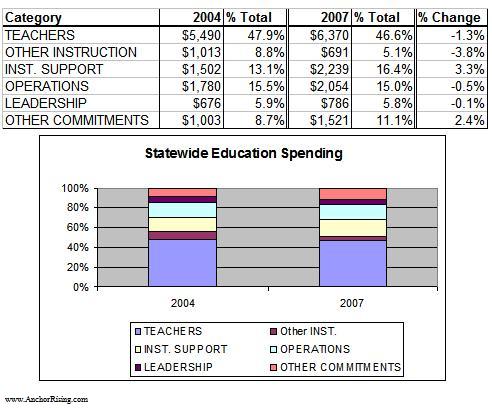
Remember, the overall per pupil expenditure rose from $11,465 to $13,660 during this time--the pie got bigger, but the piece that went to the teacher's stayed relatively the same. But some pieces did get bigger. In particular, the INSTRUCTIONAL SUPPORT and OTHER category. Here is an illustration of where the changes occurred.
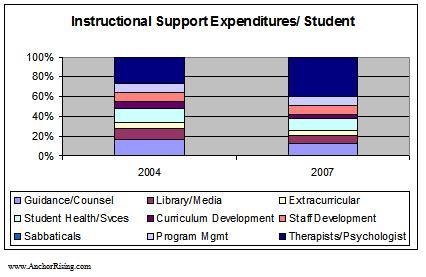
There was a "boom" in the "Therapists and Psychologists" category. Per pupil spending in 2004 was $403 (26.8% of the spending in the Inst. Support category). By 2007 it had jumped to $902 (40.3% of spending in the category). It's pure speculation, but the trend in this state to classify an increasing number of students as being "special needs" may be a causal factor. But like I said, that's speculation.
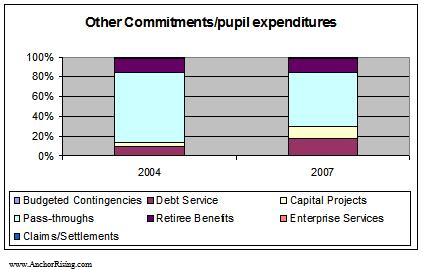
Here, there was an overall increase (as a percentage of total expenditures for the OTHER category) in both "Debt Service" and "Capital Projects." These categories are probably linked. Debt Service expenditures went from $98 per student to $270 while Capital Projects expenditures rose from $43 to $185. I'm guessing that these are basically infrastructure costs.
Yet, to put these numbers in perspective, remember that all spending increased around 20% in 3 years. And nearly 50% of all expenditures fall under one sub-category: teachers. It is understandable that teachers feel as if they are continually picked on when it comes time to cut costs. But the fact is the cost to employ is (usually) the largest line-item in any budget and, in the business world, one of the first places to go to cut costs. In the public sector, it has been the last. For too long, "cuts" have meant a reduction in the expected increase (cutting the COLA from 5% to 3%, for instance). Now, like it or not, real cuts are required. It's a paradigm shift that some simply aren't prepared for.
January 16, 2009
The Union Executive's Projection
This is classic Crowley:
Repeat the lie. Repeat the lie. Repeat the lie. No matter how wrong, no matter how damaging. Repeat the lie. This must be posted in the Projo editorial room somewhere:
Crowley's first step to this particular platform was finding a bit of data that looks, in the light of a flickering 20-watt bulb, as if it might support the contrarian notion that taxpayers are actually moving in to Rhode Island. He then ignored arguments that his finding was, at best, incomplete. And before you know it, he's accusing of outright lies those who dare to restate the common (and accurate) knowledge that taxpayers (and people, too) are leaving the state.
You've heard the old home remedy that faking a mental illness means you don't really have it? Well, Pat's version is to point the finger at his opposition to distract from his own offensives.
Just the other day, when asked what "the teachers" would say to a particular argument, I referred to a year-old letter from Mr. Crowley claiming that "the cost of teaching has risen slower than overall inflation." His conclusion was that "it isn't teachers and their exorbitant salaries driving the costs" of local education. I pointed out at the time that, when one teased out the component of "instructional expenditures" that actually goes to teachers, it increased well over inflation, and at the expense of such other items as technology and instructional materials. There's something perverse about leveraging the decline in spending on an item from which teachers' ever-growing remuneration has been draining funds to suggest that contracts haven't been shifting in their favor.
Well, here he goes again:
According to the Rhode Island Department of Education, we are spending less and less of our education budgets on teachers and instruction over the last several years. For example, in 2004, 56.7% of statewide spending on education went to classroom instruction. In 2007, that number fell to only 51.7% of statewide spending, a drop of 5%. ...What does that mean? Well, it means that spending on classroom teachers, their salaries and benefits, are not the things that are driving the cost of education. It also means that the items contained in collective bargaining are not the cost drivers. In fact, spending on teachers is not even keeping up with inflation. In 2004, total statewide spending on education was $1,795,090,933. By 2007, the number had risen 14% to $2,088,669,861. But instructional spending rose from $1,018,276,109 to $1,079,576,386, a rise of only 6%.
In actuality, from 2004 (PDF) to 2007 (PDF), the statewide per-student spending on "instructional teachers" (as opposed to the broader "instruction") actually rose $880, from $5,490 to $6,370, or 16%. Both the size of the expenditure and its increase are greater than any other item — or category — on the list of education expenditures.
So, as Crowley complains that spending on instruction hasn't risen in keeping with the rest of education spending, he ignores the fact that teachers claim an increasing percentage of that pie:
A broader investigation of expenditure data would make for a worthwhile discussion, if anybody wishes actually to engage in it.
January 15, 2009
Hummel and the Union Trio
Jim Hummel, filling in for Dan Yorke, has had three unionists on the program since 3:00, and as I've pulled up flooring and cleaned my jobsite, I've been itching to make three points:
1. Regarding the teachers'/union's behavior at the latest School Committee meeting, NEA lawyer John Liedecker pointed out that the police had said, on the radio, that at no point did the evening approach a riot. Is that the standard, now? Appropriate behavior on one side of the line and rioting on the other?
2. Local East Providence union President Valerie Lawson stated that all they want is for the School Committee to return to the negotiating table and try to get the two sides' numbers a little closer. As we've also experienced in Tiverton, this ignores the reality of what the School Committees have begun to do — namely, to tell the teachers exactly how much there is available and to move from there. In other words, there is no hidden pile of gold. Either the teachers are refusing to believe reality, or they are, in effect, demanding that the districts cut broad swaths of other spending, even though teacher pay and benefits have been draining other areas of expenditure for years.
3. I want to give a quick tip of the hat to the blogging revolution. The union trio had been claiming that the heckling was all about School Committee Chairman Anthony Carcieri's microphone misuse. When Jim Hummel played my clip of the teachers' shouting down taxpayer Tom Riley, Ms. Lawson could only stumble through a response until Mr. Liedecker jumped in and smoothly changed the subject.
Beware entrenched powers and special interests: Bloggers are out there!
The Locus of Disruption
Andrew's call in to the Matt Allen show, last night, turned into a longer form interview about the East Providence School Committee meeting. Stream by clicking here, or download it.
To the conversation about Anthony Carcieri's microphone volume (or lack thereof), I'd add my impression that Carcieri fully anticipated a disruptive atmosphere and was focused on moving through the agenda, without expectation that the audience would be following along — or would be able to do so, given audience noise. Consequently, he didn't bother much ensuring audibility beyond the dais.
That said, from my limited experience in Tiverton, the tone that the union set in East Providence was pretty standard for negotiation-season school committee meetings. The "can't hear you" heckles are a mainstay — anything to rattle the small-time public officials.
Indeed, if you listen to the second snip of audio from the meeting, somebody shouted that very phrase — amid a drown-out wave of boos — almost before Carcieri'd said a single word.
January 14, 2009
Union Life Cycle and Expectations
Jim Hummel made the point, while filling in for Dan Yorke today, that teacher union contracts are the product of years — decades — of cumulative negotiations. Compromise on X for reason A, one year, and expect to make it up a few years down the road. Consequently, a rollback (his point goes), as appears likely in East Providence, throws some sort of delicate balance off kilter for the teachers.
The problem with this approach is that unions have no employment life cycle. They latch on to the district and remain there, in theory, as long as the schools exist. An individual employee in the private sector will see his or her remuneration go up and down, shifting from this to that, generally increasing over a career (most significantly because of promotions, rather than raises), and then retire — probably having shifted companies in the interim. Eventually, the increased cost of that employee's equity with the company goes away.
The way the unions work their contract is to shoot for pay increases; if they can't get that, they go for benefit increases; if they can't get that, they go for perks; if they can't get that, they seek to shift work environment and employment terms. But unions don't retire, and they don't shift to another district to chase opportunity.
That is to say that the district never gets relief from those cumulative negotiations. As they mount, there's only so much that the town can pay for education, and there are only so many work and management rules that it can afford to compromise before the cost is seen in the quality of students' education. As they struggle to maintain the rule that teachers' employment packages never diminish, they begin to cut facilities and program spending.
Hummel also mentioned that every teacher whom he has asked about the union's behavior at the East Providence School Committee meeting last night has seen nothing wrong with it. I'd suggest that the reason for this egregious blind spot is that the union organization has invested many years of effort persuading teachers that "this is the way these things are done." They think that all negotiation proceedings occur this way and that, otherwise, "the school committee will walk all over us." (These aren't direct quotes from anybody in particular, by the way.)
I guess the long and short of it is that teachers ought to be professionals, and public sector professionals oughtn't be unionized.
Taking the Deliberative Out of Democracy
Let's recap the events that helped bring last night's East Providence school committee meeting to an abrupt end.
The third speaker of the public comment period was East Providence teacher Mary Texeria. As Justin alluded to in the previous post, Ms. Texeria made a tough but fair statement saying that she would be willing to accept a pay freeze for as long as five years, if the school committee would "admit" -- her word -- to all of the factors that have contributed to the East Providence budget crisis. The factors she mentioned were that "the school committee was never supported by the city council", "too many state mandates", "the collapse of our economy" and "mismanagement over a 10 year period". (Start at 0:49 here).
Then East Providence resident Tom Riley took his turn. He also discussed the salary situation, stating that he would prefer to see an across-the-board salary reduction that would preserve the existing number of teacher positions, rather than cuts that result in junior teachers being laid off. At that point, somebody from the union side demanded that Mr. Riley be prevented from commenting on this subject, despite the fact that Mr. Riley's comments were no more further afield from the subject of the meeting than Ms. Texeria's.
And the teachers clapped.
In response to a demand that a citizen be silenced, the teachers clapped, eventually loud enough to prevent Mr. Riley from being heard. (Interruption of Mr. Riley is constant, but start at about 1:50 here to hear the end).
East Providence teachers union President Valerie Lawson later went on WJAR-TV (NBC 10) with Dan Jaehnig to say that "we live in a democracy, everybody's entitled to free speech". Apparently to Ms. Lawson, a democracy is a place where only union members have the freedom to speak on issues in public forums. This kind of disdain for citizens, taxpayers and democracy is why many members of the general public have ultimately come to take a dim view of teacher unions.
We have to do better than this if we expect self-government to survive.
Not Here... Yet
Via Jay Nordlinger comes what we can only hope is not a vision of Rhode Island's future:
French teachers hurled shoes and other objects at police Monday to protest President Nicolas Sarkozy's high school reforms, prompting police to respond with tear gas.France's leading teachers' unions demonstrated in the western city of Saint-Lo at a cultural center before Sarkozy gave a New Year's address to education officials. Protesters and police exchanged blows, and one store window was smashed. No arrests or injuries were immediately reported.
Major unions refused to attend the president's speech because they oppose the government's education reforms.
Sarkozy's government wants to modernize the education system to make French students better prepared for the job market. But the government is also seeking to cut costs and bureaucracy across several sectors. The education reform includes changes to high school curricula but also job cuts among administrators and teachers' aides.
Where teachers behave thus, teenagers racking up hundred-million-dollars in riot damages cannot be far behind. Nordlinger opens up his Impromptus column (which is structured like a blog) with an appropriate musing:
It seems to me that the Left has won: utterly and decisively. What I mean is, the Saturday Night Live, Jon Stewart, Bill Maher mentality has prevailed. They decide what a person's image is, and those images stick. They are the ones who say that Cheney's a monster, W.'s stupid, and Palin's a bimbo. And the country, apparently, follows. ...What are the shaping institutions of American life? The news media. Entertainment television. The movies. Popular music. The schools, K through grad school. In whose hands are those institutions? In what areas do conservatives predominate? Country music, NASCAR, some churches? (Talk radio too, I suppose — no wonder so many on the left want to shut it down.)
As to Jay's question about areas in which conservatives "predominate," I'd offer the small — but important — addition of comprehending reality.
The Sound of the Beginning of the End
The following are some audio clips from the East Providence School Committee meeting. Keep in mind, while listening, that the sound isn't entirely representative. For one thing, I was sitting near the taxpayer group, so they might be overrepresented in the general sound level (although still greatly outnumbered).
- School Committee Chairman Anthony Carcieri makes his appearance to booing: stream, download
- The union sets the tone right from Mr. Carcieri's very first words (and, yes, that's me shouting "grow up" — keep in mind that I'd already been subjected to a half-hour of union slogan chanting and screams): stream, download
- The teachers cheer that some of them have actually done (gasp!) extracurricular work: stream, download
- The teachers cheer that they can blame poor performance on "facilities" (nevermind that keeping up with teacher contracts has been bleeding other segments of school budgets for years): stream, download
- A moment of heckling, including the call of "Scared?": stream, download
- Just a snippet of the tone that continued, with a gradual escalation, throughout the meeting: stream, download
- The teachers find the phrase "anti-bullying" humorous: stream, download
- The teachers find the quip "outdoor voice" humorous: stream, download
- Anthony Carcieri attempts to lay down the ground rules for public comment, and local union leader Valerie Lawson speechifies: stream, download
- East Providence teacher Mary Texeira offers a reasonable statement — although she probably goes off the union message a bit when she states that she wouldn't mind a five-year pay freeze if the school committee would lay out the reasons that it's necessary: stream, download
- Taxpayer Tom Riley takes the mike and faces down the hecklers — inspiring the single most silent moment of the night when he suggests that younger teachers will lose their jobs if the union doesn't let the district spread the costs across their pay packages — but the devolution of the meeting leads the school committee (almost inaudibly) to adjourn: stream, download
January 13, 2009
What We're Up Against
So parking has already spilled over to the supermarket parking lot across the street, and it was clear from conversation that the women standing at the crosswalk with me were teachers from another district. As we crossed, the policeman directing traffic told them to "be loud — my wife is a teacher." (There's a six-figure household.)
Barely had I sat down when the unionist who had complained to me in the men's room of driving down from Boston for a recent Tiverton School Committee meeting accosted me, suggesting that I "get a real job — you loser." I tried to be friendly, but he didn't seem interested. Subsequently, he walked around pointing me out to the other side.
Fun, fun.
ADDENDUM:
At least there are some good guys here, some wearing t-shirts that read: "Teachers and Union Reps BIG Difference."
ADDENDUM (7:36 p.m.):
The teachers are screaming like kids at a rock concert for the benefit of a television camera. This should be required viewing for all citizens of the state.
ADDENDUM 7:39 p.m.:
It's sort of that old comic book cliché of an unstoppable force meeting an immovable object, isn't it? There simply is no money, and yet, one out of six Rhode Islanders is being prodded by union organizations to get out and demonstrate against necessary adjustments.
Do they not understand what is happening, or do they not care? (Or does their union organization strive to keep them misinformed and maleable?)
ADDENDUM 7:44 p.m.:
I saw Pat Crowley strolling up the aisle along which I'm sitting, and I prepared myself to shake his hand, should we make eye contact. A friendly quip came to mind for the moment after skin contact: "See, reality didn't explode." Instead, he kept his shaking hand in his pocket and handed me a business card with the following quotation from a Boston Globe letter:
Why are we the pigs? The public employees I know are social workers who care for abused and neglected children. Or they work with mentally ill and mentally retarded adults and adolescents. They find homes for the homeless. They keep the roads repaired and clean. They open and close the bridges. They run the 911 emergency system. They teach our children. They keep the city and state hospital systems working. They run state prisons. Public employees are police officers and firefighters. Public employees help keep you healthy and safe.
But nobody disputes any of this. We who wish reform have a variety of roles that benefit society. Were I in a poetic mood, I'd list some of the more sympathetic among private sector jobs, but you can certainly come up with them yourself. Rhode Island simply cannot afford to keep leading with its heart, because those people who do all those wonderful things — along with coaxing the system to pad their wallets — are pulling the entire state into the quicksand.
ADDENDUM 7:56 p.m.:
True to the usual maturity of these audiences, the teachers booed as the school committee walked toward the stage — one of them a young lady who's probably a student.
ADDENDUM 8:02 p.m.:
Vicious "boos" as Anthony Carcieri walks in room. Unbelievable. And intended to intimidate.
ADDENDUM 8:05 p.m.:
Boos and heckling as soon as Committee Chairman Carcieri tried to speak. I cannot believe adults think it's appropriate to behave like this.
ADDENDUM 8:08 p.m.:
Even the Pledge of Allegiance became a bit of protest theater in their hands.
ADDENDUM 8:16p.m.:
Despite quips and harangues from the audience, the school committee is just moving forward with the agenda.
Pay attention, teachers: this is what courage looks like.
ADDENDUM 8:19p.m.:
As a few teachers continue to shout out, and the rejoinders from the crowd for them to "shut up" increase, I do wonder whether any of the teachers are embarassed that they are asked to join these mobs. Or did those teachers decline to come out tonight?
ADDENDUM 8:23p.m.:
Mr. Carcieri has skipped an item or two on the agenda, requiring others at the table to correct him. There have been a couple of snickers from the crowd, but one really must appreciate the anxiety that his position engenders, just now — even those who disagree, I would think.
ADDENDUM 8:31 p.m.:
During a review of a district-wide analysis, an administrator mentioned a couple of instances in which teachers are volunteering time and working after hours. The teachers cheered, as well they should.
They're also cheering as she describes that some deficiencies aren't the teachers, but the supplies and tools that the district provides. As I'll be pointing out in a graph in the near future, a significant reason for that development is that more and more of RI districts' money has been going to pay teachers' salaries and benefits.
ADDENDUM 8:36p.m.:
Some heckles to "speak up" and "use the microphone." A woman called out, "Scared?" If she were closer to me, I might have called out in return: "Wouldn't you be."
Perhaps the most astonishing thing, coming from teachers, is the utter lack of empathy that they exhibit. I imagine they do better with the students, but it's disconcerting to realize that they believe school committee members to be The Enemy, and therefore undeserving of some basic respect.
ADDENDUM 8:40 p.m.:
A mention of an anti-bullying program brought what I'd describe as cackles from the audience. It's like a movie set in Medieval times.
Now their screaming "out door voice." Really.
ADDENDUM 8:43 p.m.:
It's a good thing that we've gotten to the public comment section. I don't think the audience could stand to sit still much longer.
ADDENDUM 8:46 p.m.:
Local union head Valerie Lawson wants them to accept the arbitration. "Let the teachers get back to teaching the students."
You mean they're not?
ADDENDUM 8:49 p.m.:
Comments from the crowd around me suggest that the teachers intend to run the clock.
One just gave a reasonable speech and said that she "has no problem not getting a raise for the next five years" if the school would admit the problems.
The next speaker got up and introduced himself as a taxpayer. He was jeered.
ADDENDUM 8:53 p.m.:
The union is declaring "point of order" that the speaker is bringing up issues that aren't on the agenda. Heckle. Heckle. Jeer. Jeer.
But this isn't an agenda item. It's just a statement from an interested member of the public.
The school committee declared that the meeting is getting out of hand and called it a night.
ADDENDUM 8:58 p.m.:
Very loud boos as the school committee prepares to leave.
Any teachers who read this, I implore you: Take a moment to consider why it is reasonable for these town officials to be nervous. Think of the environment that you create at these meetings — not just this one, but every big and small town in the state. Is this who you want to be?
January 12, 2009
Behold the Fruits of "Academic Freedom"
Ever have an educator explain to you that it is important to hear all sides of an argument and to engage the opposition in dialogue? Well, for many humanities professors, that may be a lesson preached more than practiced:
Anyone who needed evidence that the culture wars are far from over could find it here at the annual gathering of the Modern Language Association last week. As the response to David Horowitz's appearance on an MLA panel showed all too plainly, the culture wars haven't ended; they've just reached an ugly stalemate. ...... In fact, Mr. Horowitz's appearance at the MLA meeting, he said, is the first time that he has defended his views in person before a scholarly group. ...
But members of the audience weren't having any of it. They wanted to challenge the panel about one thing: why Mr. Horowitz was there in the first place.
"Are you now proud that you are the only organization to invite Horowitz to speak?" an angry Barbara Foley of Rutgers University at Newark asked. "Did you do your homework" about Mr. Horowitz's blog, FrontPagemag.com? she continued, to audience applause. Grover Furr of Montclair State University and a self-described "victim" of Mr. Horowitz's book The Professors: The 101 Most Dangerous Academics in America, said he objected to Mr. Horowitz's being invited "not because of his views but because he is a liar." Another audience member complained that out of thousands of MLA members, the organization had picked "two FrontPage columnists" for the panel. ...
At one point, a member of the audience could be seen giving Mr. Horowitz the finger. Brian Kennelly of California Polytechnic State University at San Luis Obispo, who presided over the event, wrote on The Chronicle's Web site that he observed an audience member repeatedly mouthing an obscenity to Mr. Horowitz — behavior he called "troublesome" and "repugnant."
It's telling, and not very surprising, that a roomful of academics required the supervision of security guards. I wonder if they had their Tasers at the ready.
ADDENDUM:
It was Rhode Island's own Rocco DiPippo, by the way, who blew the whistle on Professor Furr. I suspect Grover would think twice before directing his spittle toward Rocco in person.
Thousands of Sharon Wests
Many Rhode Islanders surely share the sentiments that Sharon West expresses from East Providence:
Recently, a consultant hired by the committee reported that the average teacher makes $69,000 a year and receives benefits costing $26,000 annually.Yes, $95,000, and many make even more. The consultant stated that this amounts to an hourly wage of $93. Please bear in mind that currently the School Department is $4 million in the red and sinking deeper every day.
As average homeowners, as well as renters, struggle to pay utility bills, car payments, the mortgage or the rent, buy groceries and pay medical bills, these 180-day-a-year workers want still more. Teachers, look around! These folks are valiantly struggling day by day to provide basic necessities for their families.
We, the working stiffs who pay for everything, need some relief, not further plundering.
The question is whether there are enough of us to force change. Can we (or hard experience) shake enough of our neighbors out of their apathy to counterbalance the well entrenched interests that bind the state? Let's hope the isolated reform movements that have emerged (notably in the East Bay, for some reason) are the tip of the spear, not the rear guard of an exodus.
The Economic Principle of Self Interest
URI economics professor Len Lardaro had a very disappointing piece in the Providence Journal on Saturday, advising a tax increase in order — curiously enough — to benefit schools and universities. Professor Lardaro states that "investment-related activities... by their nature entail sacrifice" and suggests the following:
I propose raising the state's sales-tax rate to 8 percent from 7 percent, not broadening its coverage to services (to help contain regressivity), and earmarking all of the resulting tax proceeds to K-12 public education and public higher education. Should the legislature try to move any of the resulting revenues to the General Fund (the God of current consumption), I expect Governor Carcieri to veto this measure and take his case to the people.
We should certainly devote resources to "investment-related activities," but layering on funds for education could prove to benefit other states if Rhode Island doesn't make its first goal attraction of businesses. (That's for higher education; when it comes to elementary and secondary education, the bulk of any increased "investment" in schools would simply be absorbed by the unions.) We can spend our last nickel educating young adults, but if we have no jobs to offer them upon graduation, we'll be lucky to get a thank you card from wherever they move.
I'd also mark it as a question whether we'd actually see any long-term increase from a raised sales tax. Lardaro — like Governor Carcieri — should recall that cigarette taxes offered one of the few increases in tax collections, which "the state's chief revenue analyst Paul Dion attributes to a hike this past summer in neighboring Massachusetts." In other words, ratcheting up our overall sales tax could prove to be a boon for neighboring states.
That means that Lardaro's suggested benefit of "contain[ing] property taxes" could very well be fanciful. Even if it were not, though, his rat-a-tat-tat of qualifiers hardly instills confidence. Observe (emphasis added):
Such property-tax containment can also be expected to benefit small business. Caps on property-tax rate hikes can be enforced in this type of environment, and the state might also consider imposing limits on allowable growth rates for local pay packages.
Lardaro has the emphasis precisely backwards. The state ought to begin where he drifts off into a series of maybes: contrive benefits for small businesses, enforce property caps, and impose limits on public sector remuneration. Such measures will protect Lardaro's employer more surely than will the deceptive balm of tax increases.
ADDENDUM:
Professor Lardaro claims that it was a joke to get people angry enough to become involved.
January 7, 2009
Tasting the New Environment
I just heard on WPRO that the judge won't decide whether to stop the East Providence School Committee's unilateral employment change until the 23rd. It looks like union members will start to feel the pinch of not giving concessions.
That's a huge change for the better from an environment in which they expect to get back pay no matter how long they hold out.
A One-Way Street Across a Two-Way Border
I may be misunderstanding him, but it appears that Rhode Island elementary and secondary education commissioner Peter McWalters believes that Rhode Island should seek to attract illegal immigrants to our state in order to educate their children:
In Rhode Island, McWalters said, "We're not in agreement that these kids are worth it because we are torn between a culture that's says, 'We don't want you,' and one that wants them to come here. We have to decide that these kids are worth it and that it is necessary to pay the bill."
I don't know, commissioner; we've got an awful lot of bills to pay. We should educate children while they're here, but for a state in our condition to deliberately court an intractable problem would be the height of insanity. Just skim down the article a few paragraphs:
English language learners are not a monolithic group, however. Nearly two-thirds are second- or third-generation Americans, with at least one parent born in the United States.
People that ambivalent about joining the culture into which they've moved probably aren't the human resource investment that Rhode Island ought to be prioritizing.
Should the Goal of Education Policy Be Results, or Preserving a Particular Bureaucratic Form? How They React in Boston Will Let Us Know…
James Vaznis of the Boston Globe reports on research from our neighbor to the North (Massachusetts, that is, not Canada) regarding Charter schools…
Charter schools were created as part of the 1993 Education Reform Act, as a way to develop new teaching strategies that could eventually be transferred to public schools. The approximately 60 schools operate under looser state regulations than traditional schools, have mostly nonunion teachers, and are run by independent boards that report directly to the state. They have been particularly popular in urban school districts among parents and students frustrated with traditional schools.…versus "pilot" schools…
Boston created the pilot school concept a year later, with the idea of embracing the innovative teaching methods while avoiding some of the controversies. Unlike charters, the pilot schools are still run by the School Department, which means that the district still receives state funding for each student who attends them. Many school districts across the state have complained that charters drain much-needed resources from traditional schools because the state funding follows the students to the new school.The results are…The Boston's 18 pilot schools also have teachers' unions, although the provisions are scaled back to allow for experimentation with longer school days and other changes that unions have traditionally resisted.
The study, being released today at a Boston Foundation forum, examined state standardized test scores for students of similar backgrounds at the three kinds of schools over a four-year period. In the most stark example, charters - independent public schools dedicated to innovative teaching - excelled significantly in middle school math. However, pilots, which have similar goals but are run by the School Department, performed at slightly lower rates than traditional schools, according to the study....The entire Boston Foundation study is available online here.Charter students in middle and high schools showed consistent gains on the math and English exams. The results of pilot schools were less clear. Middle school pilots performed slightly below students in regular middle schools in math and about the same in English. High school pilot performance was a little better, but researchers still deemed those results ambiguous.
West Warwick Next in Line
The school committee in West Warwick appears mainly to be doing the bare minimum to support a Caruolo suit for more money from the town, but it may be headed down the road behind East Providence soon:
The performance audit, commissioned by the town as a part of the Caruolo lawsuit proceedings from the last fiscal year, found that most substantial savings — $14.67 million — in the School Department budget would require concessions from the teachers union or waivers from state and federal mandates."These are recommendations for the future and going forward," said consultant Salvatore Augeri. "They could cut some supplies for a couple thousand, but we're not talking millions right now."
But $3.5 million is what the School Department says it needs to finish the remainder of this budget year. Last month, the committee sent the town a letter requesting an additional $3.5 million in operating funds and school officials have authorized their lawyer to file a lawsuit seeking the additional money once all other avenues are exhausted.
Is "the future and going forward" anything like "infinity and beyond"? It seems to me that the school committee has to stop toying around. It isn't enough to publish a list possibilities like "eliminating 16 teachers by requiring the maximum number of students allowed in each class by contract, and cutting 23 other positions that are not required by the state." The committee ought to be bringing that to the teachers' union and explaining that it will happen in the absence of deep concessions.
January 6, 2009
Kids Should Take a Year On
After two drop-out years selling fish off a truck, I returned to college much more motivated, and with a better sense of what I wanted to accomplish there. So I was inclined to approve when I came across a news story with a lede explaining that "more educators are advocating a year off between high school and college to explore options and interests. Frankly, however, I think teenagers would be better served by a year exploring realities than participating in expensive programs such as this:
Longtime educator Karl Haigler, co-author of The Gap-Year Advantage, agrees. "We think that there should be more of a focus on success in college, not just on access to college," he says. That's partly what motivated Princeton University to become the first school to formalize a gap- or bridge-year program. It will be launched in the fall of 2009, starting with 20 students and growing to 100. Students will be invited to apply after they have been accepted to the school. The program will send students for a year of social service work in a foreign country. Students won't be charged tuition and will be eligible for financial aid.Formal gap-year programs typically cost between $10,000 to $20,000, including living expenses, says Ms. Bull. Students can often apply for financial aid through Free Application for Federal Student Aid (www.fafsa.ed.gov), or look for scholarships and individual study-abroad loans through specific programs. There are also community-based programs, like Americorps, where students receive room and board in exchange for service work and a small stipend.
That strikes me as one part "study abroad" and one part nonprofit labor scheme. What the modern youth needs more than vacations for the conscientious is a year on — a year of attempting to be self-supporting and truly independent from the watchful eyes of professional supervisors and sponsors.
December 24, 2008
Union Reverse Tautology and Arbetrayal
The rhetorical dance of the East Providence teachers' union is so flowing, it's easy to miss the essential argument:
"The School Committee's solution to their self-inflicted fiscal problem is to blame it on the teachers' contract and to shift the entire burden of paying off that deficit to the teachers," union representative Jeannette Woolley countered in her opening statements. She also said the district had opportunities to implement health-care cost sharing before with past contracts but the school board members at the time "dropped the ball."In addition, Woolley showed the teachers conceded scheduled raises three years ago when the district needed help, and the committee and school administration didn't raise the issue of health-care cost sharing then, either.
"So the bottom line from our perspective is that this school district is not in its current condition as a result of what the School Committee likes to term an overly rich contract," she said. "The facts suggest that the School Committee simply hasn't taken care of business over the years in this school district."
Got it? The School Committee didn't negotiate tighter contracts over the years, leading to the currently unaffordable one, so that contract can hardly be said to be "overly rich." The lessons for children are manifold: That overweight child could have forced himself away from the potato chips and the video game console at any time, so it can hardly be said that he ought to change his behavior now that he's obese!
The worst part is that the tie-breaking "neutral" arbitrator apparently bought the argument, at least sufficiently that his panel issued a decision that the school committee clearly can't accept — thus illustrating what a scam the arbitration process is in Rhode Island:
Mr. Ryan continues:"The Union urges that comparability (to other district contracts), not ability to pay, should be the panel's paramount consideration. The School Committee insists that it has no choice but to pay its FY08 debts and adhere to its budget for FY09. School department deficits are unlawful under R.I.G.L. §§ 16-2-9(d), (e), & (f); 16-2-21 (b) & (c); 16-2-21.4; 16-2-11 (c); and 16-2-1. These interlocking enactments prohibit school departments from incurring or maintaining a deficit or engaging in deficit spending." ...
Mr. Kinder commenting on his dissenting vote said: "The award is useless because the School Committee is prohibited by law from accepting it. The award is useless because the School Committee cannot meet the award's costs in the first year of its 3-year term, let alone in the second or third years. Those are facts. Those facts were placed before the panel. The panel's award ignores these facts and provides modest changes that, if adopted last year, might have served to avert this year's financial crisis. But, last year, when the Teachers' Union was asked to accept similar, modest changes in order to avert a $3.2 million deficit, the Union refused. In consequence, the School Department will end this year with a deficit of well over $8 million, if nothing is done."
Will's got the entire School Committee press release up on Ocean State Republican.
December 23, 2008
RE: Warwick Schools Cancellation
Following up, the ProJo has their report on the situation today:
School officials said that few members of the union that represents custodial, maintenance and secretarial employees — the Warwick Independent School Employees (WISE) –– responded to calls to come to work late Sunday afternoon even though union workers had showed up for snow duty on Friday and Saturday.The School Department and the WISE union have been stalemated over a contract for more than two years, but union leaders last night said that there was no concerted attempt to avoid working on Sunday.
Mayor Scott Avedisian, who was in contact with both sides yesterday morning, said he did not care which was in the wrong and that it is “absolutely unacceptable” that Warwick schools were not ready to open along with almost all other public school districts yesterday.
To prevent a repeat occurrence, Avedisian said that after talking to School Committee Chairman Christopher Friel in the morning, he issued an executive order forming a special committee to deal with efficient snow removal at the schools. He said that he and Friel agreed that if school employees are not available to clear the drives, parking lots and walkways, the city will do the work and bill the School Department.
A Resource with No In-State Outlet
As one who graduated from the University of Rhode Island almost — amazingly — a decade ago, I'm not surprised that the school is considered to be a good deal:
The cost of attending the University of Rhode Island is going up, but the editors at one financial magazine say it's still a bargain — and an investment that pays off in the long run.According to next month's issue of SmartMoney magazine, URI ranks 15th in a nationwide study of private and public colleges analyzing the connection between tuition costs and graduates' earning power. The magazine examined colleges based on "their ability to deliver the best return on investment," and URI ranked the highest institution in New England. Brown University was ranked 36th. ...
On average, graduates of Ivy League and liberal-arts institutions earned more than graduates of public institutions three years after graduation — $51,000 a year compared with $48,500, and the gap widens more after 15 years.
But when college costs are factored in, the "long-term payback" picture shifts, ranking Georgia Tech far above Dartmouth and Texas A&M above Swarthmore, for example.
The reality, in my opinion, is that a motivated student can derive an excellent education from any school, but doing so is better facilitated at higher-end institutions. For its part, URI provided strong and innovative — and improving — educational opportunities when I was there, and things seem to have continued on the upswing.
The travesty of the university is that the state fails to follow up on the boon by giving graduates a reason (or even the ability) to remain in the state and apply their skills and knowledge.
December 22, 2008
Of Two Minds on Abstinence
An interesting juxtaposition of "role-model" attitude appears in Bob Kerr's column from yesterday. On one hand:
The kid eagerly raised his hand at the back of the room at the Lincoln Middle School. He had the answer."A condom," he said.
Right he was. A condom is the safe way. Abstinence is probably not going to work for most people, Scott Mitchel told the class.
"You can make a choice," he said.
On the other:
He started, as he always does, with "HIV101." He talks of the virus attacking the immune system, of T-cells and how their numbers are a barometer of health or sickness. He points out there are four bodily fluids — blood, breast milk, semen and vaginal fluid — that can transmit the disease. Tears, saliva and sweat cannot. And taking the risk of injecting drugs with a needle is just too stupid to consider.
There are vast differences, of course, between sex and syringe-based drugs, but the difference in this HIV-positive speaker's attitude is striking. "Most people" (Kerr's paraphrase) can't be abstinent — and monogamy is apparently hardly worth mentioning — but injecting drugs — whether with shared or clean needles — is beyond stupid.
I'd suggest that the first step toward making abstinence a feasible for middle schoolers is for adults to tell them that it's something that they can conceivably accomplish.
Looking for Answers on Warwick Schools Cancellation
[BUMP]
UPDATE: Mayor Avedisian called Dan Yorke and unequivocally stated that there was a concerted effort on the part of the school maintenance union (WISE) to not come to work. The union president is claiming that 11 of the 15 people involved didn't get a phone call from the school administration. Avedisian stated that, phone call or not, WISE workers should have figured they'd be needed to work on Sunday to prep for school on Monday. He also resolved that if this occurs again, then the city will simply meet the need with city employees and back-bill the school department.
Dan mentioned that combining maintenance positions seems like a good idea and Mayor Avedisian agreed and said they'd been trying to negotiate that for some time. However, there has been resistance.
Avedisian also implied that perhaps the Superintendent and the Director of Buildings and Grounds needed to take action against the employees who didn't show.
A follow-up caller "with knowledge of the situation" (and was sympathetic to the WISE guys) essentially confirmed that the workers were making a statement.
==================
No one has a clear answer, but Warwick Mayor Scott Avedisian called John DePetro this morning and tried to explain why the Warwick Schools were closed today. Apparently, Superintendent of Schools Peter Horoschack called school department maintenance employees in on Sunday to clean up the school grounds (parking lots, sidewalks, etc.) but got little response.
In Warwick, the independent school employees union (WISE - Warwick Independent School Employees) has been operating without a contract for a couple years and Avedisian openly speculated that the ongoing work-to-rule mindset was to blame for the large number of no-shows. Additionally, Mayor Avedisian explained how many school events have been moved, canceled or manned by volunteers (I know, I've been one of them) because janitors wouldn't come in to open schools or clean up after the events.
As in other cities and towns, the city maintenance workers and the school maintenance workers are two different entities. Situations like this make a strong case for unifying the administration of all maintenance workers, be they city-side or school-side.
December 18, 2008
Wagner v. Taylor
Michael Barone of U.S News and World Report has an interesting capsule history of how labor/management relations through the 20th Century have brought the U.S. auto industry to where it is today…
Mickey Kaus, pretty much alone among the commentators I've been reading, indicts "Wagner Act unionism" for the decline and fall of the U.S. auto industry. The problem, he argues, is not just the high level of benefits that the United Auto Workers has secured for its members but the work rules—some 5,000 pages of them—it has imposed on the automakers. As Kaus points out, unionism as established by the Wagner Act is inherently adversarial. The union once certified as bargaining agent has a duty not only to negotiate wages and fringe benefits but also to negotiate work rules and to represent workers in constant disputes about work procedures.It is interesting to note that "Taylorism" was a part of the general trend occurring in the first half of the twentieth century, where the old classically liberal ideas were considered passé and the idea that the common folk needed strong management by an elite, in every area of their lives that mattered held a strong foothold.The plight of the Detroit Three auto companies raises the question of why people ever thought this was a good idea. The answer, I think, is that unionism was seen as the necessary antidote to Taylorism. That's not a familiar term today, but it was when the Wagner Act was passed in 1935. Frederick Winslow Taylor was a Philadelphia businessman who pioneered time and motion studies. As Robert Kanigal sets out in The One Best Way, his biography of Taylor, he believed that there was "one best way" to do every job. Industrial workers, he believed, should be required to do their job in this one best way, over and over again. He believed workers should be treated like dumb animals and should be allowed no initiative whatever, lest they perform with less than perfect efficiency.
We should be trying to move past Taylorist attitudes, the collateral damage they've caused in the past, and a possible revival of them in the near future, in as many places as possible.
Outsmarting the Taxpayers
I'm sure there are arguments that it's financially efficient. That it preserves human capital. That it's better than alternatives. But when all th talking is done, this is just outrageous:
They left the state college system in droves in recent months to avoid paying more for their health insurance or losing it entirely, and they left with thousands of dollars in retirement incentives and severance payments for things like unused sick time.But now, 44 retirees from Rhode Island College, the Community College of Rhode Island and the University of Rhode Island are back on the state payroll — in many cases, back in their old jobs as professors, administrators, school nurses, accountants and computer technicians while collecting state-subsidized pensions.
State law permits class instructors to remain on an explicitly limited basis, but the others are leveraging this bit of specious reasoning:
When asked, however, how that law justified the rehiring of top-level administrators, back-office financial staff and computer techs — including one CCRI retiree with a $44,412 state pension — spokesman Steven J. Maurano offered up a new and previously unheard of argument in the halls of state government, after consulting with Ron Cavallaro, general counsel to the Board of Governors for Higher Education.Maurano said Cavallaro believes the law limiting which retirees can be rehired — and how much they can earn without giving up their retirement benefits — applies only to those enrolled in the state retirement system, not the vast majority of newly retired state college and university faculty and administrators enrolled in the privately operated TIAA-CREF, to which the state contributes 9 percent of pay annually for each enrollee.
Under that reading, Maurano said, the administrators of the state college system can bring back whomever they want, for however long they want, at whatever level of pay they deem appropriate without any loss of retirement benefits.
Most Rhode Islanders, one shouldn't have to explain, don't ever get the option to retire with a large incentive check and in time to preserve unsustainable healthcare benefits on a public-sector-level pension and keep the very same job on a lighter basis to make up (or exceed) the difference in income. This asserted loophole should be closed immediately and all cases retroactively challenged in court.
At the very least, very tight time constraints ought to be placed on the retiree-temps so that the organizations for which they work can absorb as much institutional knowledge as possible. Then the public-sector kings should be let out to pasture so that Rhode Islanders suffering from the nation's worst unemployment rate (and without pensions) can claim any positions that absolutely must be filled.
December 17, 2008
Predirecting Anger
My response to Richard Joslin made it into this week's print edition of the Sakonnet Times (as did TCC President David Nelson's), and I'm sure it'll spark an angry response or two from unionists.
Who knows but that ringleader Crowley will pen a guest letter from across the state. Given the extent of his so-called research and other writings at RI Future, his day job apparently leaves him with copious amounts of time for extracurricular activities. That assumes, of course, that the teachers aren't paying his salary for his blogging.
Whether that's the case or not, I'd suggest that teachers are misdirecting their anger if I'm the recipient. I'm merely arguing in what I believe to be the best interests of my town and its students (agree or disagree). On the other hand, the central justification for teachers' union dues' going to the state NEA would seem to be for state-level advocacy and planning.
Tiverton teachers should take especial note of the latter, because for all of their "research" and statewide contacts, the union officials appear to have failed to foresee and/or advise members of the likelihood of a state budgetary collapse. Inasmuch as it contributed to the local's dogged pursuit of a better deal, that failure cost the union members thousands of dollars, with no end to the state's and town's fiscal crises in sight.
December 16, 2008
Obama's Education Secretary
Considering everything, Arne Duncan looks like a decent selection for Education Secretary. Dan Lips explains:
Mr. Duncan is known as one of a handful of innovative, reform-minded big city schools chiefs. How that will translate to the national level remains to be seen. Conservatives should be heartened that Mr. Duncan recognizes the need for local leadership and innovation. And that he supports amending federal policy to grant states greater flexibility and autonomy. Yet given his support for sharp federal spending increases, it is unclear how well the Secretary translates local lessons to the federal level.Encouraging.What is clear is that Mr. Duncan's past work has earned applause from school reformers. He supports charter schools, public school choice, and merit pay for teachers and school leaders. Duncan also supports holding schools accountable for results and maintaining transparency about school performance through public reporting.
December 15, 2008
Lot's of Money, No Research Beef
So, over about seven years, Robert Felner, a director of an independent center at the University of Rhode Island, was apparently able to siphon $1.7 million in funding away from its intended purpose:
Two months after a former administrator at the University of Rhode Island was indicted on 10 federal fraud charges, URI officials say they are putting in place measures designed to prevent future fraud. ...According to the federal indictment, Felner, 58, diverted $1.7 million from a respected education research center he had established at URI. The fraud began while Felner was at URI and continued after he became dean of education at the University of Louisville in 2003, federal authorities say. ...
URI officials say that Seitsinger, Laferriere and the center's other employees were kept in the dark about most of the center's finances. They had no idea that hundreds of thousands of dollars for work developing surveys for school districts in Atlanta, Buffalo and Santa Monica allegedly flowed into private bank accounts controlled by Felner and Schroeder, say URI officials.
URI VP of Administration Robert Weygand defends the dupes by characterizing Felner as a "cult-figure" with a "strong personality," but taxpayers and those who despise waste ought to wonder: How is it possible for so much money to disappear without producing discernible deliverables? To what degree does higher education research amount to a box of air?
In the coming audit, which ought to waft through every college and university in the nation, I'd advise those with the spectacles to begin with any group or center that has a name of similar construction to Felner's "National Center on Public Education and Social Policy." Why can't an Education Department just focus on teaching teachers?
December 9, 2008
Reply to Joslin
As East Bay scribe can attest who's spent a late-night hour or two trimming words and sentences from a letter to make it of acceptable length, the Sakonnet Times has a 500-word limit on missives. Yet, by the time Richard Joslin got around, last week, to challenging Tiverton Citizens for Change (TCC) to "prove they care about Tiverton's children," the paper could have printed both his introductory reminiscences of his own childhood and a letter that I'd written explaining why public officials should define "fairness" from a budgetary standpoint, not a union one. As it was, Mr. Joslin's diatribe rambled on for 908 words, and my letter disappeared into cyberspace.
In the light of Joslin's assault, a pillar of erroneous thought is starkly observable: Both he and young Caitlin Alexandra, whose letter appears just behind his, gauge concern for education in terms of teachers' remuneration. This despite the fact that a higher percentage of Tiverton's per-pupil costs already go to teachers than is true for the state overall. Indeed, Joslin positions "oust[ing] the teachers' union" as an unthinkable option following cuts to "programs in sports, advanced placement, language, music, art and more" that have already been made.
Personally, I happen to believe ousting the unions to be a prerequisite for improving both Rhode Island's educational system and its economic viability. Surely neither has sunny prospects as long as teachers absorb more and more of our education dollars, continuing to cost us programs that might keep RI parents from having to sacrifice for private school (which they do more frequently than parents of most other states). One mustn't forget, by the way, that the loss of programs will tend to mean the immolation of teachers whose jobs depend on them.
So, although I can speak only on my own behalf, I say, yes, let's "break the teachers' union" --- and use the savings to reinvigorate sports, advanced placement, language, and music programs (and more). Perhaps the crossing of that rubicon will give Ms. Alexandra cause to consider Tiverton a superior place to raise her "potential family" than some "small developing communit[y] in the south of Africa." Perhaps, too, the political loss will motivate Mr. Joslin to examine the roots of his hatred and anger and give him something for which to be truly thankful during this season next year.
ADDENDUM:
I see this letter made it onto the Sakonnet Times Web site, as did one by TCC President Dave Nelson. Now comes the interesting new game of waiting to see what gets into print.
December 7, 2008
Totally Separate Stories. Totally.
Here's a mild head-shaker of a story on page A12 of today's Providence Journal:
... when he retired in June at the age of 75, the [Rhode Island College] gave [former President John] Nazarian something back: a $205,008 severance check.The check included $67,890 for unused vacation time, $31,366 for unused sick time and $29,902 in deferred pay from the 1991 budget crisis that was belatedly paid to him based on the $189,625 a year he was making when he retired 17 years later.
It also included a $75,850 "retirement incentive."
While the University of Rhode Island offered its workers a $20,000 incentive to retire, RIC and the Community College of Rhode Island offered their employees 40 percent of their pay to leave before the end of June, a decision that provided tens of thousands of extra dollars to dozens of their highest paid professors and administrators. ...
Overall, 90 employees in the state college and university system received a total of $2.3 million in incentives, ranging from $13,870 to the $75,850 paid to Nazarian. The college and university employees were among 1,521 state workers who retired between May 1 and Sept. 30 as part of an effort to cut the state payroll.
All told, the state paid out $18.8 million to the retirees, including unused sick and vacation time and other payments. ...
Asked why URI bumped its retirement incentive from $7,000 to $20,000 last spring — and why RIC would offer a $75,850 retirement incentive to a 75-year-old — Steven Maurano, a spokesman for the state Office of Higher Education, said the decisions were made before the state slid into its current budget crisis.
And from the front page of the Local News section:
Bracing for deeper budget cuts, higher education officials are considering a range of cost-saving measures at the state's three public colleges — from eliminating dozens of small academic programs to consolidating some redundant programs to reducing the number of credits needed to earn a degree.They also warn that increases in tuition and fees for next year will probably double. Students at the University of Rhode Island, Rhode Island College and Community College of Rhode Island will most likely see increases of 20 percent to 25 percent, or even higher.
"We need to have an ongoing analysis of how we can reduce costs," said Jack Warner, the state's higher education commissioner.
See, the thing is, when those kids chose Rhode Island institutes of higher learning — often uprooting their lives to do so — their decisions were also made before the state slid into its current budget crisis. Former director of institutional research at RIC, Donna Konicki, says that she understands "why taxpayers might be upset with the amount of sick time we are allowed to accrue," bringing her total severance package to $88,223, but perhaps the students deserve an explanation, too, justifying the translation of retirement largesse into further education loan payments by the new indentured servant class.
ADDENDUM:
While on this topic, I've got to point out a great line from a related article addressing the sick-time payments more broadly:
The president of the largest state employees union, J. Michael Downey, said the payments for unused sick time are also one of the benefits given state employees to compensate them for getting paid less "historically" than their private-sector counterparts.
In this case, "historically" is meant to be understood as "at some point in history." Of course, there are plenty of examples in which RI unions exhibit a strange sense of fairness, including this argument:
Defenders of the payouts for unused sick time say the policy gives state workers — who are not covered by temporary disability insurance — an opportunity to "bank" blocks of time so they can be paid in full if they are out of work with illness for an extended period.
Hey, that's reasonable... as long as I someday am able to recoup a portion of the $707 dollars taken from my paycheck every year for a program that I may never use.
December 4, 2008
Individuals in a Package Deal
In the midst of a very edifying conversation in the comments section of my "Powers and Victims" post, Tiverton teacher Ed Davis offers the following significant perspective:
You're right, no one is forcing us to work here. Unfortunately, I saw this philosophy take hold in the school system my son attended. Many of the good young teachers, in the critical areas of math and science, left for better paying jobs. This is beginning to happen in Tiverton.
Doesn't that just highlight the spectacularly inappropriate setting that unions create within the public school system? In order to keep well qualified and fresh teachers covering central subjects, the school must hand out raises across the board. The cost of giving a young science whiz a 5% raise (beyond steps) can turn out to be hundreds of thousands of dollars.
That is plainly insane, and plainly indicative of the detriment that unions present to our children.
December 3, 2008
A Missing "U" Word
It's maximally conspicuous that Louis Gerstner omits a key detail while enumerating his recommendation for public school reform:
I recommend that President-elect Barack Obama convene a meeting of our nation's governors and seek agreement to the following:- Abolish all local school districts, save 70 (50 states; 20 largest cities). Some states may choose to leave some of the rest as community service organizations, but they would have no direct involvement in the critical task of establishing standards, selecting teachers, and developing curricula.
- Establish a set of national standards for a core curriculum. I would suggest we start with four subjects: reading, math, science and social studies.
- Establish a National Skills Day on which every third, sixth, ninth and 12th-grader would be tested against the national standards. Results would be published nationwide for every school in America.
- Establish national standards for teacher certification and require regular re-evaluations of teacher skills. Increase teacher compensation to permit the best teachers (as measured by advances in student learning) to earn well in excess of $100,000 per year, and allow school leaders to remove underperforming teachers.
- Extend the school day and the school year to effectively add 20 more days of schooling for all K-12 students.
Key components of this plan will prove flatly unworkable as long as unions sit at the head of the educational table. They'll certainly battle merit-based pay scales and hire-fire processes, and they'd rush to print up the bills for extended school years. They're also likely to push back against comparative standards. It's astonishing that Gerstner doesn't so much as whisper such a central name.
I submit that the paucity of progress over his decades-long quest for school reform has had less to do with the number of school districts than the special interest group that prevents children's betterment from standing as the unrivaled focus of the public education system. If one increases the size of the playground without removing the bully, he'll just bring along more of his friends.
December 2, 2008
Re: Tasked with Tiptoeing Around the Solution
Here is another set of recommendations made by the Governor's Urban Education Task Force that Justin discussed yesterday, as relayed by Linda Borg of the Projo...
The report recommends that urban elementary schools offer 20 minutes of daily phonics instruction, set aside time every day for children to read individually and in small groups, and test students frequently to catch those who are struggling. Schools should teach vocabulary early and often. And when a child falls behind, that student should be pulled out of class for additional small-group reading instruction.Take the phonics recommendation out of the mix for one second, which I understand can be somewhat controversial. Given what remains, what exactly is there that any good teacher from 50 years ago to now wouldn't immediately recognize as a sound and necessary educational practice?
Now include the phonics recommendation -- and ask what there is in the above recommendations that a good teacher from 30 years ago wouldn't immediately recognize as a good idea?
If the members of the task force feel that these kinds of recommendations are important to the reform of public education, the real question they need to be asking is why as a society did we ever stop doing the basic and obvious things that work when it comes to educating our children?
Re: Tasked with Tiptoeing Around the Solution
Here is another set of recommendations made by the Governor's Urban Education Task Force that Justin discussed yesterday, as relayed by Linda Borg of the Projo...
The report recommends that urban elementary schools offer 20 minutes of daily phonics instruction, set aside time every day for children to read individually and in small groups, and test students frequently to catch those who are struggling. Schools should teach vocabulary early and often. And when a child falls behind, that student should be pulled out of class for additional small-group reading instruction.Take the phonics recommendation out of the mix for one second, which I understand can be somewhat controversial. Given what remains, what exactly is there that any good teacher from 50 years ago to now wouldn't immediately recognize as a sound and necessary educational practice?
Now include the phonics recommendation -- and ask what there is in the above recommendations that a good teacher from 30 years ago wouldn't immediately recognize as a good idea?
If the members of the task force feel that these kinds of recommendations are important to the reform of public education, the real question they need to be asking is why as a society did we ever stop doing the basic and obvious things that work when it comes to educating our children?
December 1, 2008
Tasked with Tiptoeing Around the Solution
Yet another task force, this time addressing education in Rhode Island, has convened and tossed some suggestions out into the public breeze:
Expand the school day. Offer preschool to all students. Allow students to earn a high school diploma by taking night classes or enrolling online. ...The task force also recognized that the state, which faces a massive budget deficit and is tied with Michigan for the highest unemployment rate in the nation, can no longer afford to throw money at the problem of low-achieving urban schools.
"In these difficult economic times, we can't rely on the public sector to create the system we need," Simmons said in an interview last week. "The education system needs to be bailed out by both the public and the private sectors."
As a result, the group’s recommendations rely heavily on partnerships with higher education, the business community, nonprofit organizations and the faith-based community. ...
The task force doesn't put a price tag on an early-childhood program. It does say that pre-K should be offered in a variety of existing settings, including daycare, Head Start and public schools. The state Department of Education is already planning a pilot pre-K program.
With both the preschool and night school proposals, the panel is suggesting substantial expansion of the student base of urban schools, even as it acknowledges that changes must be accomplished within a static (or decreasing) education budget. Considering that the greatest cost per student is for instruction, what the panel's proposal requires either that teachers do more work for the same pay or that the workload is spread out in a teacher pool that, in aggregate, makes less money. Two steps would accomplish this goal, while increasing the efficiency and (I'd assert) the quality of the regular ol' public school system:
- Create a voucher system that enables more parents to send their children to the schools of their choice. Political realities would likely prevent such vouchers from covering the cost of even less-expensive private schools entirely, so this step would have the added benefit of drawing more money into the total for childhood education, as parents and charities react to the incentive to pay more out of pocket to fund private school tuition.
- Introduce into state law, in such a way as to supersede local contracts, increased discretion for school administrators when it comes to hiring and firing. As public schools lose some of their funding based on children withdrawn from their student bodies, and to compete with each other and private institutions, principals will need greater leeway to excise teachers who burden the system and bring in those with a promise for progress.
November 26, 2008
Not the Way to Arrive at a Salary
By far the most interesting audio from last night's Tiverton School Committee meeting, in my opinion, was Vice Chairwoman Sally Black's reasoning for voting to approve the teachers' contract (stream, download) because the thought processes are indicative of the flawed way in which Rhode Islanders have conducted their public business.
Mrs. Black cycled through a bit of education policy history to conclude that the state and federal governments have not followed through with promised funding for decades, even as they've demanded more and more from local schools. From her perspective, the school committee did the work that they were supposed to do, and moreover, she was very pleased with her children's experience in the school system and believes the teachers deserve as much compensation as the town can give them. Therefore, the contract is "fair and just" and ought to pass.
The problem with this approach is that it disconnects financial decisions from financial realities. We cannot come up with a notion of fairness and justice based on abstractions or on emotions and then make that the primary consideration. The primary consideration has to be the money that's actually coming in.
Especially from the perspective of elected representatives — unless they were elected of the unions, by the unions, and for the unions — the first question has to be what is good and what is sustainable for the town. Double-digit tax increases are not sustainable. The next question has to be what is good for the students, and as I've pointed out, based on Department of Education data, Tiverton already pays more per pupil for teachers than the state average, and its student-teacher ratio is only slightly lower than the state's overall. In other words, based on the money that the district actually has, it is already more generous to the teachers than the norm for Rhode Island, which is more generous than the norm for the nation.
Rhode Island has, for far too long, begun with the pay and benefits that "should be deserved" and only as an afterthought wondered where the money would come from and what the effects would be of taking it. Our teachers, specifically, are paid above the national average, even as our median household income is below the national average. We have to readjust, and we have to do so quickly.
ADDENDUM:
For interest and public record, here's the audio of Guidance Councilor Lynn Nicholas's threat of "harm": stream, download:
Before I ask Doug a question, I just need to make it clear that, if the award is not agreed upon tonight, there will be a lot of harm done. Some of it will be financial; a lot of it will not be, and I'm not going to go into detail.
November 25, 2008
Another Night at the High School
Well, here we are, at what's sure to be a tense school committee meeting — as the teachers demand their retroactive pay and a handful of us concerned citizens try to explain that it would be insane to dig our financial hole deeper, with the state facing such a daunting task.
You know it's got to be an event, because Mr. Crowley made the trip all the way from Lincoln. Luckily, a few AR readers made a point of introducing themselves to me before the meeting to lessen the minority feeling, and we've also got some moral support from the Portsmouth Concerned Citizens.
Which is not to say that there's anything resembling parity in numbers. But when a special interest is used to facing absolutely no opposition, perhaps a ragtag band of reformers can mount an adequate defense.
ADDENDUM 7:23 p.m.:
Interesting anecdote: During a start-of-meeting executive session, I left the auditorium to use the men's room, and as I stepped to the sink to wash my hands, a man came in complaining about the traffic from Boston: "But you get the call that you've got to come down; what are you going to do?"
I joked about the traffic, and he further stated, "I just hope they don't say anything bad about the teachers in front of me, because I just drove down from Boston and I'm not in the mood."
He appears to be intending to sit near the audience-use microphone.
Ah, union tactics.
ADDENDUM 7:27p.m.
While I look around the room during the wait, I'm reminded of the difficulty of this whole process. Here is a roomful of people most of whom are dedicated to educating children and only want a fair salary in keeping with what they were told to expect when they entered the field. And yet, their combined efforts, in town and across the state, are a significant part of the chain that's dragging us under.
Little wonder they've been able to do it, though: as contentious a man as I am, I very much dislike having to look at the faces around me and see opponents. The average citizen is certain to accede to their demands.
ADDENDUM 7:35 p.m.:
Committee Chairman Jan Bergandy just announced that the executive session was going to be longer than expected. Odd, if they're deciding how to vote, that they have public discussion at all.
ADDENDUM 8:04 p.m.:
Interesting note: they just voted to approve the minutes from the last meeting — usually an uninteresting formality — but it was actually necessary for one of the new members to amend the minutes to include comments from Tom Parker, whom you'll recall made a citizen's plea not to approve the NEA contract for financial reasons.
Wonder how that became omitted.
ADDENDUM 8:07 p.m.:
The feeling of reluctance, from those on the stage, to progress through to the meat of the agenda (contract negotiations) is palpable. Can't say I blame them. I'm stressed, and here I am hiding out of view.
ADDENDUM 8:13 p.m.
Interesting to watch Pat Crowley reading Anchor Rising real time:

ADDENDUM 8:18 p.m.:
Chairman Jan Bergandy is expressing grave doubts about the contract, given likely cuts from the state, so he's posing the question: What are the consequences of not approving the contract?
ADDENDUM 8:22 p.m.:
Predictably, new committeewoman Carol Herrman moved to pass the contract (Sally Black seconded): She argued that if the numbers don't work out... hey, we'll reopen the contracts. Of course, she didn't mention that the leverage would be completely different.
She also argued that all contracts should be reopened, but the teachers' is by far the biggest, and if the teachers take a hit down the road, there will be more leverage to renegotiate the others.
ADDENDUM 8:26 p.m.:
Of course, the teachers cheered loudly when Carol made her motion. Subsequently, new member Danielle Coulter spoke in favor of holding off on the contract until the state makes more information available.
In support of Mrs. Coulter a few of us in the audience applauded, and Chairman Bergandy chided us for being inconsiderate to the teachers' feelings.
Sorry. It clearly was not easy for Danielle to say what she did. She's going to get heat for it. And I for one am going to make sure that she's not sitting up there without support.
ADDENDUM 8:31 p.m.:
Vice chair Sally Black just made an impassioned speech that the state isn't living up to its end of the bargain, so she votes to pass the contract because it's "fair and just."
We can no longer operate that way. We have to start with the financial reality and negotiate from there. The money doesn't appear on the grounds of justice or fairness.
ADDENDUM 8:51 p.m.
Strangely, the teachers are arguing that the committee has long known that cuts were coming. Me, I'm inclined to agree — which has made it a dubious proposition to allow things to get to this point — but I don't see how that's an argument for irresponsible financing, now.
ADDENDUM 8:57 p.m.:
Despite a stated two to three minute time limit per person, one teacher has been going on for about ten minutes now saying that political changes in the past few weeks have accounted for the change in the committee's opinion.
I disagree to an extent, but beyond that: so what? That's how we decide how things should work in a democracy! Politics is what makes it in officials' interests to represent the interests of their constituencies.
ADDENDUM 9:14 p.m.:
Guidance Councillor and active unionist Lynn Nicholas just took the microphone to say that, if the committee does not pass the contract, there will be "a lot of harm done — some financial, some not," and she made a point of leaving it there, continuing with: "Have you even begun to think about the lawyer fees."
Yes, they're all about preserving the quality of our schools.
ADDENDUM 9:19 p.m.:
I'm surprised it took this long for a teacher to suggest that Obama might swoop in and save us all.
ADDENDUM 9:26 p.m.:
Mr. Bergandy is making the very good point that, if the committee approves this contract and large cuts do come, programs will be cut, which means that teachers will be laid off.
ADDENDUM 9:30 p.m.:
Now we're having classroom logic lessons from the teachers: "If you admit that this is a fair contract and then there are cuts and you decrease the contract, wouldn't that make it an unfair contract?"
This mindset is maddening.
ADDENDUM 9:32 p.m.:
Union President Amy Mullen just threatened that the deal on the table will not be available in the future.
ADDENDUM 9:35 p.m.:
The contract failed, and the teachers stormed out...
Except for one — an English teacher — who although clearly upset took a moment to introduce himself and give me hope that we can, through it all, resolve differences.
Thank you, sir, for that.
ADDENDUM 9:48 p.m.:
There's a feeling of afterward to the continuing meeting. The committee is deciding whether to hire a technology person. Carol Herrmann moved that they hold off on this contract; Danielle Coulter concurred.
The difference is that they're currently paying a per diem person to fill a necessary role.
ADDENDUM 9:58 p.m.:
The new technology guy was not hired, with discussion postponed until after the union issue is resolved.
ADDENDUM 10:04 p.m.:
A potentially telling statement: the committee is discussing the process of bidding for a new attorney, and Superintendent Rearick just recused himself on the grounds that he's been working with the current attorney for a very long time.
November 24, 2008
Open Letter Against Ratification
Dear Tiverton School Committee members:
It so happened that, the Friday before you'll decide whether to approve the arbitrated teacher contract, my boss called me on the construction site to tell me that, after I take my five paid days of annual vacation this week, he and I will have to sit down and agree to cut my salary. Having trimmed all indulgences from my family's budget, I'm already barely making enough to get by, but as you know, times are hard. Indeed, the governor has already warned you that the state will likely be cutting your budget, too.
I understand that everybody in Tiverton just wants to move beyond the current contract negotiations --- buy a respite and feel, for a short time, that we're all working together toward the same goals, maybe kick off the new school committee with a lowering of the tension that simmers with each meeting. But that feeling would be an illusion, and shorter-lived than you'd like to believe. Times are only going to get harder, and any compromises made now, when the contract is not yet signed, will be unreachable for modification when Tiverton joins other RI towns in considering asking its unions for contractual concessions.
Forgive the passive voice, but I was informed this week that I'm broadly disliked in certain circles in town, circles with which some of you run. That, I cannot help; I am who I am, and I believe what I believe. As our town's elected education representatives, however, you ought to be concerned about my belief that the teachers' negotiating tactics and their ever-increasing slice of the budgetary pie made it a matter of parental responsibility to pull my children from our public schools. My wife and I cannot afford private school, but our assessment is that we would be shirking our duties as parents not to sacrifice for it.
Our house --- the only home that our children can remember --- should not be among those sacrifices. But if the cost thereof should increase in keeping with recent yearly trends, its loss is a very real possibility, and we are most definitely not alone.
In these times, Tiverton teachers --- who are already well paid in comparison with the norms under which average Rhode Islanders live --- ought to be giving back, not demanding thousands of dollars in retroactive pay. If they receive raises, instead, the possibility of keeping tax increases within bounds will disappear, and I'd remind you that you do not represent them, but us.
At every meeting you are all presented the faces, the voices, and the requests of public school teachers. They may not demand so much attention, but my family has faces and voices, too. Ms. Black and Ms. Herrmann see those faces and (despite my admonishments) hear those voices every Sunday morning, and I hereby request that you represent us and refuse to write large checks to working-to-rule teachers during times of fiscal uncertainty. I request that you consider my children before you decide that teachers whom their tax-paying father does not trust with their education deserve to be rewarded even as every private-sector Tiverton worker suffers pay cuts, unemployment, or (if they're lucky) insecurity.
If you would hesitate before telling my children that they should live in their grandparents' basement so that union teachers can continue to earn well above the median household income for the state, do not ratify this contract. The stakes are that high.
With sincerity and hope,
Justin Katz
November 23, 2008
Clearly Not "For the Children"
Tiverton Citizens for Change is moving forward from its electoral successes:
The School Committee should reject a tentative two-year teachers' contract at its meeting Tuesday in light of possible unanticipated cuts in state aid to local schools during the current fiscal year, according to the anti-tax group Tiverton Citizens for Change.The committee and the union representing about 190 teachers were at an impasse for about 14 months before reaching a tentative settlement in nonbinding arbitration Nov. 5, a day after the general election, which turned out the longtime committee chairwoman and put two new members on the five-person panel. ...
In calling for the committee to oppose the pact, Tiverton Citizens for Change cited Governor Carcieri’s recent announcement of a projected deficit of $233.6 million in revenue before the end of the fiscal year. ...
"Some will suggest this additional funding request is for the children. It is not. It is for the teachers," said TCC president Dave Nelson in a statement.
Schools Supt. William F. Rearick has recommended passage of the agreement, which he estimated would give each teacher an annual net raise ranging from about $1,100 to $2,500.
I've suggested to the governor that he (or a representative) should attend Tuesday night's school committee meeting as a statement of, essentially, "This is the sort of thing I'm talking about." He won't likely be there, but I'd encourage anybody else with an interest in stopping Rhode Island's hole-digging to make an appearance.
November 14, 2008
A Little Perpective for the School Committee
So here's what's going on in other towns while the Tiverton teachers demand retroactive pay for time spent working to rule:
As state leaders wrestle with a second-straight year of mid-term budget cuts, mayors and managers across Rhode Island are looking at everything from later bill payment schedules to union concessions to offset expected losses in state aid.In Cumberland, Warwick, South Kingstown and other communities, major purchases are on hold, unfilled positions are staying vacant, and other options, including layoffs, are being considered given the likelihood of cuts this fiscal year.
Some local leaders think those moves won't be enough.
I'd suggest that the Tiverton school committee should get those union concessions while it's still called "negotiation" and the default is that the unionists don't have access to the money that's supposedly sitting around waiting to be claimed.
November 12, 2008
Either Way, the Children Suffer (but One Way Is the Way Out)
There's creeping desperation in West Warwick:
The Town Council and School Committee agreed to open the lines of communication as part of a settlement of the Caruolo lawsuit the schools filed against the town in April, which seeks a $1.1-million addition to its $49.4-million budget. ...... the first step, Thomas said, is addressing the schools budget. This year, the School Department is projecting a $4-million deficit. The projections increase in coming years until they reach $12 million in fiscal 2012.
School Committee member James A. Williamson said the schools may have to get creative with ways to save — or raise money. It may propose charging teachers a parking fee, increasing the distance students have to walk to school to cut down on busing, or cutting sports programs. If that doesn't work, Williamson said, he'll propose the schools refuse to comply with some state or federal mandates that don't directly affect student learning. "It sounds drastic, but if we're to a point where if all else fails, and if there's something we can do that won't have a tremendous impact on students, we have to consider trying it out," Williamson said. "It may be time to get bold, and try some things we've never tried before."
If the schools begin cutting programs or making children walk longer distances in the cold, it adversely affects the students. If the schools begin to squeeze the overly remunerated union teachers, it adversely affects the students by way of unconscionable labor actions such as work to rule. At least the latter might lead to changes that can actually salvage a decent education for future classes; the former merely accepts a few more inches into the quicksand.
The single greatest mandate that towns must begin to fight is unions' legalized monopoly of public education.
November 9, 2008
What Rhode Islanders Don't Seem to Get
East Providence School Committee member Anthony Carcieri makes an interesting observation to the Providence Journal:
Along with the skirmishes over ground rules, the negotiators also have disclosed their ultimate goal. The committee wants $3 million in annual concessions from the teachers, Carcieri says, adding that they aren't bluffing or backing down. "The NEA has experienced hard-ballers who go around from city and town stepping on the retired librarians and school moms who join the School Committee to help and have little experience with contract negotiations," Carcieri said. "They’re shaking down municipalities and taking them for more than they are worth."
The National Education Association Rhode Island representative for the town, Jeannette Woolley objects the accusation, but selects her words carefully to deny that the NEARI "dictate[s] the East Providence teachers' actions." That may or may not be true, but it wasn't what Carcieri was saying.
The problem is actually much bigger than unions' bringing in major leaguers to whack around townies: The unions devote massive resources to shaping state law in the their favor — from the fact of the union monopoly on public education to the possibility for school committees to sue their towns. Oh, the unionists will point to this or that agenda item that has yet to find its way into law as evidence that state legislators are not in their pockets, but the fact that they haven't gotten everything they wanted all at once is only mildly mitigatory.
Underlying the battle, of course, is the very thing that Rhode Islanders just don't seem to understand: The system is constructed such that our representatives have to stand for our interests only as the third or fourth consideration, and such that there's an elaborate set of policy and political mirrors at which to point to diffuse responsibility. The number one priority for us who see the funhouse for what it is must be to start breaking some glass.
November 8, 2008
Credit Where Credit's Not Due
Well this would clearly not be acceptable:
In the first year of the contract, retroactive to the last school year, [Tiverton] teachers with at least 10 years' experience would receive pay increases of 2.75 percent. The same group would get another 2.5 percent in the current year, but hikes in health insurance costs also would kick in.A teacher with at least 10 years experience, who made a base salary of $64,205 in the 2006-2007 school year, excluding stipends for advanced course work and degrees, would get a retroactive check of more than $1,700 for the last academic year.
In the current school year, that same teacher would receive another raise of about $1,650, before taxes, according to calculations made from the history of the salary scale.
It would be downright immoral to reward teachers for their year of "work to rule" — a year that saw a painful tax increase — by paying them extra for that time. For the town and state ever to make progress, the notion that public sector union employees will pay no price for dragging out negotiations has got to end.
October 31, 2008
Contract Games
Some last-minute pre-election teacher contract controversy has arisen for Tiverton voters' edification:
Superintendent William Rearick and School Committee Chairwoman Denise deMedeiros thought they were close to approving a contract for the teachers this week, saying this is the closest they have been in more than 16 months of negotiating, but teachers union President Amy Mullen said there is no deal because the terms of the agreement keep changing.Mullen said she thought they had a deal Oct. 15 when she met with Rearick and Fiore, but Rearick said the union's figures did not mesh with the amount of money that is available for the teachers and some tweaking was needed.
"We've gone backwards," Mullen said Wednesday. "We thought we had an agreement. We shook on it. I thought for sure they'd vote to approve it (Tuesday night at the School Committee meeting)."
Rearick gave the union a last best offer Wednesday morning after meeting with the School Committee.
"We're pretty far apart," Mullen said.
DeMedeiros was surprised to hear that Wednesday.
"We're very, very close in salary. We're almost right on," said deMedeiros, who hopes to avoid costly arbitration that is scheduled to begin again this Wednesday. "When we first filed for arbitration, we were miles apart. We are now extremely close. There is no need for any of this anymore. If they want to go to arbitration, that's fine, but I don't understand it."
So the union is blaming the school committee, and the school committee is blaming the union. That's all unremarkable, and since the taxpayers who'll be footing the bill don't have access to the terms of the negotiations, there's no way to tell who's closer to the truth.
The cast of candidates for school committee gives some reason to think it's the union that's playing games. Of the five committee members, three seats are up for grabs, and two incumbents are running. Three non-incumbents are in the race — two who would be more amenable to union demands and one who would be more inclined to hold the budgetary line, Danielle Coulter. In other words, the union has reason to believe that the next school committee will be more apt to vote in its favor.
Union President Amy Mullen is on the right track on one count, though:
"We have no confidence in his educational leadership of this system," Mullen said of [Superintendent Bill] Rearick. "He is dragging us down. He has no vision for this system. He's shown no leadership."
Watching from the outside, it has seemed that Rearick is more inclined to compromise with the union than the school committee is. If he wanted to show visionary leadership, he'd walk into negotiations, toss on the table a contract that the school committee has already approved, and tell the union that it's a take it or leave deal. (And, no, I didn't forget an "it" in that sentence.)
October 29, 2008
Re: Unionists Like the Shadows
Nine Rhode Island School Committee members from eight different communities have signed a letter supporting the East Providence school committee in its bid to make contract negotiations public…
School Committee members across Rhode Island support the East Providence School Committee and its commitment to holding contract negotiation meetings open to the public. Currently, public sector contracts are negotiated behind closed doors. The public is denied the right to know how their money is being spent until the deal is signed and it's too late to change it.Alisha A. Pina of the Projo has details on the specifics of the East Providence situation here.
The opponents of transparent negotiations claim that opening the process would stifle negotiations with 'onerous public input,' 'grandstanding' and 'political maneuvering'. However, Florida, Tennessee and Minnesota actually require open negotiations and they are all exhibiting positive results.
Hiding contract negotiations from public scrutiny is not required by law. Prior to each negotiation, the two parties establish ground rules. It is within these voluntary ground rules that the public loses their right to participate…The signed public school committee members below would like to request that open sessions be required for all public sector contract negotiations and express their support for the efforts taking place in East Providence. There are other committee members expressing support but did not respond in time to participate. Others wish to remain anonymous. The co-signers represent their own opinions and not that of the committees they serve. A copy of this release will be sent to the RI Board of Regents.
Douglas Roth, North Kingstown
David Coughlin, Pawtucket
Renee Cockerill, North Kingstown
Sandra Gabaree, Johnston
Mark Baker, Glocester
Jean Ann Guliano, East Greenwich
Paul Cannistra, Warwick
Joseph Quinn, Tiverton
Bill Felkner, Hopkinton/Chariho
Re: Unionists Like the Shadows
Nine Rhode Island School Committee members from eight different communities have signed a letter supporting the East Providence school committee in its bid to make contract negotiations public…
School Committee members across Rhode Island support the East Providence School Committee and its commitment to holding contract negotiation meetings open to the public. Currently, public sector contracts are negotiated behind closed doors. The public is denied the right to know how their money is being spent until the deal is signed and it's too late to change it.Alisha A. Pina of the Projo has details on the specifics of the East Providence situation here.
The opponents of transparent negotiations claim that opening the process would stifle negotiations with 'onerous public input,' 'grandstanding' and 'political maneuvering'. However, Florida, Tennessee and Minnesota actually require open negotiations and they are all exhibiting positive results.
Hiding contract negotiations from public scrutiny is not required by law. Prior to each negotiation, the two parties establish ground rules. It is within these voluntary ground rules that the public loses their right to participate…The signed public school committee members below would like to request that open sessions be required for all public sector contract negotiations and express their support for the efforts taking place in East Providence. There are other committee members expressing support but did not respond in time to participate. Others wish to remain anonymous. The co-signers represent their own opinions and not that of the committees they serve. A copy of this release will be sent to the RI Board of Regents.
Douglas Roth, North Kingstown
David Coughlin, Pawtucket
Renee Cockerill, North Kingstown
Sandra Gabaree, Johnston
Mark Baker, Glocester
Jean Ann Guliano, East Greenwich
Paul Cannistra, Warwick
Joseph Quinn, Tiverton
Bill Felkner, Hopkinton/Chariho
October 28, 2008
Unionists Like the Shadows
The shadow that unions cast over our education system never ceases to sting:
[East Providence's] current contract with its teachers expires on Friday, and talks are at a deadlock. The sides can't agree on ground rules and the sticking point is the School Committee's demand that the bargaining be done in public."The union representatives say open negotiations will cause 'grandstanding' and 'political maneuvering,'" City Councilman Robert Cusack said last week.
Well, yeah. That's the point. Open negotiations would enable the public to offset the grandstanding and political maneuvering at which the unions are so proficient. In other words, not only do the unions involve teachers in the bullying of local communities, but they put them in the position of preferring that the other side not be able to fight back — or even to know what's going on.
October 26, 2008
In a Word, Professionalism
Julia Steiny recently heard a speaker whose conclusions point to the same problem in education, but from a different aspect:
University of Chicago Prof. Charles Payne spoke recently on the subject of his book So Much Reform, So Little Change. ..."Because you have institutions in which the adults fail to cooperate. Grown-up people unable to work together bedevils the system from bottom to top."
Yes! Payne is so on to something.
He says, "All decisions are politicized. Failure is valorized. Sit in a teachers lounge and listen to them compete with one another about how much their kids are failing." When districts actually get good leadership, they chew him up, they buy her out. Payne cites Rudy Crew's excellent record in Miami and his ignominious departure as only the most recent example.
That's a proximate cause, but Steiny extrapolates the factor that creates the detrimental setting:
... the central relationship at the heart of public-school districts, big and small, is the structurally adversarial relationship between labor and management. Historically, labor-management stances often erupt into war-like conditions with strikes and the ugly work-to-the-rule labor actions hurtful to children. When school or district grown-ups battle among themselves about who's entitled to limited, tax-generated resources, students don't matter.
Unions create a power group whose interests are ultimately distinct from those of school children. They create an environment in which a teacher seeking to advance has incentive to invest in the union structure, rather than proving her or his own value in the objective of the school (i.e., education).
October 19, 2008
The State of the System
Just in case anybody missed this nugget from our state's leading education unionist:
Robert A. Walsh Jr., executive director of the National Education Association Rhode Island, said repealing the tax levy law would also alleviate the problem.Said Walsh, "We simply can't continue to produce a competitive public education system in our current state."
Put aside Walsh's dubious usage of the word "continue." "Repealing the tax levy law" is a one-step-removed synonym for "raise property taxes by more than 5% every year across the state." Those who believe that the unions will behave as a partner in education reform should be well aware that the core component of their solution is, yes, to make Rhode Island's tax burden even greater.
Furthermore, the only way in which Walsh's statement of possibility "in our current state" can be taken as true is if he excludes the possibility of real, substantial, change to the way in which education is administered and financed. One recent call for such change came from Bishop Hendricken High School Vice Principal John Jackson:
At first glance, it seemed like a feel-good story about a young girl from a war-torn country (Liberia) who was living a dream here in the United States. She was in a school (St. Raphael Academy) where she felt free to speak out, where teachers push students to do their best, and where she has aspirations of attending college. Her prior experience in the public schools of Providence was poor, to say the least — being teased and mocked, and even beaten up a few times.Wouldn't everyone who is concerned with every qualifying student being given an opportunity for a great education be inspired and energized by a tax-credit program that allows businesses to donate money to help in this cause?
Apparently not, because once again, along comes the union perspective, and again the focus is not on education, but on protecting their own, and funneling money into a failing public school system. That the education of this young girl has improved dramatically is inconsequential to some, evidently.
As paradoxical as it may sound to the blue-state mind, all viable solutions for repairing Rhode Island's ailing educational system require that the money going to the public schools be decreased, whether it goes instead to private educators or to private citizens to improve their lives and our economy (or some combination of the two).
October 18, 2008
Blocking Education Reform
Putting aside the pun in this post's title (on the grounds that I couldn't resist it), Moderate Party Chairman Ken Block's prescription for education reform in Rhode Island offers some worthy suggestions:
- Provide life skills courses to non-college-tracked children. ...
- Let uncertified professionals who are content experts teach in our schools. ...
- Ban the practice of “bumping” in our school systems. ...
- Convert day-care expenditures for low-income households into pre-school aid for these same households. ...
- Provide incentives to the best teachers to teach in the toughest schools.
- Apply lessons learned from our charter schools to our education system, and allow the development of more of these very successful schools, which are leading in education innovation.
- Evaluate all teachers and administrators annually and provide incentive pay for the top performers, while providing mentoring, training and a financial disincentive to the worst performers. ...
- Publish a model teacher’s contract created at the state level and make state aid to local school districts contingent on how closely the locally negotiated teacher’s contract adheres to the model’s guidelines. ...
The problem — perhaps resulting from the aspiration to appear "moderate" — is that Block strives to undermine the villain without naming it. In other words, he seeks to snatch some of the unions' most prized assets without open assertion that the unions are at the core of Rhode Island's educational (and financial) problems. Running forth with such a proposition is likely to have two results:
- It will detract from more explicit attempts to strike at the underlying issue, as unionists leverage Block's "moderation" to discredit and distract from stronger initiatives.
- It leaves open a familiar maneuver whereby the powerful players lasso and spin around attempts at unleashing reform, as they take the opportunity to expand their membership (with those "uncertified professionals" and converted day-care workers) and manipulate statewide model contracts and funding formulas to their own benefit, while allowing bans against bumping and institution of merit pay to slip from the agenda.
Ending the unions' monopoly on public education must be the first step of any plan to improve our schools, which is an end that a voucher system would achieve.
October 17, 2008
Funding Formula Follies in South County
Liz Abbott of the Westerly Sun has a summary of a local-forum debate between the three candidates for District 36 State Representative: incumbent Donna Walsh, Republican Dave Cote, and independent Matt McHugh. Here are their answers on the topic of education…
QUESTION: In these challenging economic times, should the Paiva-Weed Act, which was adopted to provide some relief to taxpayers from the cost of funding the schools, be amended to provide more school aid?But all a "funding formula" does is shift money from one community to another; it does not and can not by itself create revenue. For a "funding formula" to be part of a coherent policy proposal, an explanation of the source of the funds to be shifted must also be provided.COTE: Citing Rhode Island’s poor educational performance compared to Massachusetts, and the fact that Massachusetts has provided greater property tax relief than Rhode Island, Cote said, “Money does not make for better education.” If elected, he would work to “reorganize” public education by reshaping curriculum to include more math and science. He would also seek to eliminate “bumping’’ and other union-sanctioned practices that do not always benefit students.
MCHUGH: McHugh said he still endorses the idea behind the Paiva-Weed legislation, and it should be left alone for the time being. He would handle the need for more state aid by finding savings in the existing system, exploring ideas such as regionalization, and by calling for a moratorium on state educational mandates that cost local school districts a lot of money.
WALSH: She supports the idea of providing relief for taxpayers and would not seek to amend the Paiva-Weed legislation at this point in time. “I think it has merit,” she said. But the General Assembly needs to follow through on what it has already said it would do, namely, review the state educational mandates and keep working to find a new formula to fund public education.
I wonder if Representative Walsh is aware of how much money the most recent version of the "funding formula" would have shifted away from the four communities of District 36…
- State education aid to Chariho District (which includes Charlestown) would have been cut to $2 million, resulting in a loss to the school system of over $12 million.
- State education aid to New Shoreham (Block Island) would have been cut to $0, resulting in a loss to the school system of over $100,000.
- State education aid to South Kingstown would have been cut to $0, resulting in a loss to the school system of over $10 million.
- State education aid to Westerly would have been cut to $0, resulting in a loss to the school system of over $6 million.
Voters in District 36 -- and in every House and Senate District in Rhode Island -- need to ask any candidate attempting to sell a "funding formula" as the solution to the state's education problems about where they are expecting the money they'd like to see transferred between communities to come from.
Funding Formula Follies in South County
Liz Abbott of the Westerly Sun has a summary of a local-forum debate between the three candidates for District 36 State Representative: incumbent Donna Walsh, Republican Dave Cote, and independent Matt McHugh. Here are their answers on the topic of education…
QUESTION: In these challenging economic times, should the Paiva-Weed Act, which was adopted to provide some relief to taxpayers from the cost of funding the schools, be amended to provide more school aid?But all a "funding formula" does is shift money from one community to another; it does not and can not by itself create revenue. For a "funding formula" to be part of a coherent policy proposal, an explanation of the source of the funds to be shifted must also be provided.COTE: Citing Rhode Island’s poor educational performance compared to Massachusetts, and the fact that Massachusetts has provided greater property tax relief than Rhode Island, Cote said, “Money does not make for better education.” If elected, he would work to “reorganize” public education by reshaping curriculum to include more math and science. He would also seek to eliminate “bumping’’ and other union-sanctioned practices that do not always benefit students.
MCHUGH: McHugh said he still endorses the idea behind the Paiva-Weed legislation, and it should be left alone for the time being. He would handle the need for more state aid by finding savings in the existing system, exploring ideas such as regionalization, and by calling for a moratorium on state educational mandates that cost local school districts a lot of money.
WALSH: She supports the idea of providing relief for taxpayers and would not seek to amend the Paiva-Weed legislation at this point in time. “I think it has merit,” she said. But the General Assembly needs to follow through on what it has already said it would do, namely, review the state educational mandates and keep working to find a new formula to fund public education.
I wonder if Representative Walsh is aware of how much money the most recent version of the "funding formula" would have shifted away from the four communities of District 36…
- State education aid to Chariho District (which includes Charlestown) would have been cut to $2 million, resulting in a loss to the school system of over $12 million.
- State education aid to New Shoreham (Block Island) would have been cut to $0, resulting in a loss to the school system of over $100,000.
- State education aid to South Kingstown would have been cut to $0, resulting in a loss to the school system of over $10 million.
- State education aid to Westerly would have been cut to $0, resulting in a loss to the school system of over $6 million.
Voters in District 36 -- and in every House and Senate District in Rhode Island -- need to ask any candidate attempting to sell a "funding formula" as the solution to the state's education problems about where they are expecting the money they'd like to see transferred between communities to come from.
October 14, 2008
Education Success Is Possible, If Rhode Island Will Allow It
Two quick suggestions for anyone reading today's Jennifer D. Jordan's Projo article on Rhode Island's tax credit scholarship program…
Amelia Kah struggled through her freshman year of high school in the Providence school system. She was teased and mocked by classmates when she raised her hand in class, and was even beaten up a few times, she says….Her parents, Genesis and Zoe Kah, refugees from the civil war in Liberia, worried their daughter would not fulfill her potential. They began hunting around for other schools. But with seven children at home and limited finances, their options were limited.Suggestion #1: Read it in conjunction with this Wall Street Journal op-ed, also from today, on what's being done with charter schools in Los Angeles…Then friends told the Kahs about St. Raphael Academy, a Catholic high school in Pawtucket, and a new state scholarship program for low-income students that could help the family send Amelia there.
Last fall, Amelia was accepted to St. Raphael for her sophomore year, aided by the Rhode Island Scholarship Alliance, a tax-credit scholarship program supported by Governor Carcieri and passed by the General Assembly three years ago.
Amelia was one of 278 students last year to receive the tax-credit scholarships in the program’s first year. The average scholarship ranges between $3,000 and $5,000, and the scholarships are available to families who earn 250 percent or less of the federal poverty level, defined in 2007 as a yearly income of $51,625 or less for a family of four.
This month the Inner City Education Foundation (ICEF), a charter school network in Los Angeles, announced plans to expand the number of public charter schools in the city's South Central section, which includes some of the most crime-ridden neighborhoods in the country. Over the next four years, the number of ICEF charters will grow to 35 from 13. Eventually, the schools will enroll one in four students in the community, including more than half of the high school students....Suggestion #2: Ignore the utter inanity in the Projo article about the ability to effectively evaluate the tax-credit scholarship program somehow depending on the creation of a "funding formula".ICEF has been operating since 1994, and its flagship school has now graduated two classes, with 100% of the students accepted to college. By contrast, a state study released in July reported that one in three students in the L.A. public school system -- including 42% of black students -- quits before graduating, a number that has grown by 80% in the past five years.
October 6, 2008
David Anderson for State Representative: Concrete Priorities for Education Reform
David Anderson, candidate for State Representative in Rhode Island's 4th District (Providence), and opponent of House Majority Leader Gordon Fox, has presented some concrete ideas for reforming public education in the state of Rhode Island…
Given the large number of failing schools in Rhode Island I would not try to overhaul all of them at once. I would begin with the "basket cases" where less than 10% of the children are estimated to be at or above grade level as judged by the Nation's Report Card. In terms of the NECAP examinations this threshold would approximately be 20% proficient for the primary levels and 10% for high school. Such schools would be closed at the conclusion of the academic year. All staff would be discharged. Such schools would be reopened as charter schools operated by a professional education management organization (EMO). The EMO's fee would be performance based. The possible rehiring of former staff would be at the discretion of the new managers…Once all of the dysfunctional schools of the preceding category are under new management, I would raise the threshold for reform upward in phases until all schools with less than 50% of children at or above grade level had been converted to the charter
format…Current and past practices that have been used to deceive parents and other stakeholders would be replaced by ones that provide an honest accounting of public school performance. This means rescoring the NECAP examinations to provide proficiency estimates comparable to the Nation's Report Card. It also means withholding regular academic diplomas from all who have not achieved NECAP proficiency on the high school tests. Students not seeking a regular academic diploma would receive a certificate of completion that would show their respective proficiency levels in the subjects tested by the NECAP. In such a system diplomas would mean something.
September 29, 2008
Please Define "Predictable"
In "The Unspoken Roadblock", Justin points out that, while ignoring the six letter complication in our education system, among other education reform measures, RIPEC has called for the state to
implement a predictable formula for state financing of local schools
RIPEC is not the first to use this phrase. The question that pops into my head whenever I hear it is: What does "predictable" mean?
First, as to quantity. If education aid to cities and towns were cut by 20% (which is about right considering the state's finances) and the General Assembly said, okay, this is what we are committing to distribute every year going forward, that would be predictable, wouldn't it? There's always been a lurking suspicion, though, that some of the people who call for "predictable" funding don't just mean "reliable" but also "more" funding from the state.
If this is the case, we then have to ask, would additional funds be productive? Our school/student performance is in the bottom fifth nationally while teacher compensation is in the top fifth. Hasn't Rhode Island inadvertantly become the experiment that proves that lots of money does not improve an education system?
Additionally, quite an inequitable distribution ratio got established early on, a ratio that has never been revisited. Some cities and towns receive far more state funding than others and on a basis that does not appear altogether logical. Is fairness part of the definition of "predictable"? Will equitability be addressed as part of establishing a "predictable" funding formula?
The Unspoken Roadblock
Something still isn't making sense, for me, from a Friday article on RIPEC's study of RI education:
RIPEC has released a report entitled Education in Rhode Island 2008 that is chock-a-block with data, and it reinforces RIPEC's standing message that lagging student performance does not reflect the size of the investment.
And yet (emphasis added):
RIPEC has a three-part prescription for the problem: Reconcile the curriculum with exam goals and make sure the exams conform to national standards; ensure accountability by combing through the expenditures of local school districts in a search of efficiencies and enforcing sanctions for failing to meet expectations; and implement a predictable formula for state financing of local schools.
It's true that urban schools are a drag on Rhode Island's test results, so bringing them up would bring up the state, but it's not true that all of Rhode Island's other schools are performing adequately. At bottom there's a six letter (plural) problem that must be addressed in our education system, and RIPEC skirts it.
September 20, 2008
With Their Own Money, They Will Rob Them
None can doubt that this is part of the "value add" of the union structure, but it still strikes the ear as sinister:
The organization opposing efforts to eliminate the state's income tax has received two-thirds of its funding from large teachers unions based in Washington D.C.The Boston Herald reports in Wednesday's editions that The National Education Association and the American Federation of Teachers contributed a combined $1 million to the Coalition for Our Communities.
State finance records show that the group raised $1.5 million from unions and $100 from an individual donor.
How about that Orwellian name: The Coalition for Our Communities? Yeah, a coalition of unions to bleed our communities!
September 19, 2008
Residents Should Stop Paying That Much for This
In a town that has witnessed nearly a 12% increase in property taxes in the past year, this sort of thing should get the union-busting, pink-slip-preparing blood boiling:
[Johnston teachers] were a no-show on Monday at Winsor Hill School's open house, an event where they typically meet parents and fill them in on their instructional plans, officials said yesterday.
School Committees should begin taking these unconscionable actions as justification for rewriting contracts to fit budgets and handing them to union leaders with hand-written "take it or leave" notes attached. Believe you me that plenty a private-sector employee is aware of the number of job inquiries floating around the executive office. The arrogance of the unions' tactics when taxpayers are already being pinched and when Rhode Islanders increasingly feel lucky to be working at all is simply appalling.
September 7, 2008
Rhode Island's Poorly Performing Education System: Sorting out Who is Responsible
The Rhode Island chapter of the 2007 State Teacher Policy Yearbook, issued by the National Council on Teacher Quality, pinpoints one of the major culprits responsible for the unacceptable state of Rhode Island's education system: Rhode Island's state government. [In my view, the two other culprits are School Committees and City/Town Councils.] And with apologies to Speaker Murphy who frowns on finger pointing, inasmuch as the lion's share of power vests with the General Assembly given the peculiarities of the Rhode Island Constitution, the lion's share of the responsibility in this as in many other matters also rests with that body.
From the Yearbook introduction:
The State Teacher Policy Yearbook examines what is arguably the single most powerful authority over the teaching profession: state government. State authority over the profession—whether through regulation approved by state boards of education or professional standards boards or by laws passed by legislatures— is far reaching. These policies have an impact on who decides to enter teaching, who stays—and everything in between.The Yearbook provides an unprecedented analysis of the full range of each state's teacher policies, measured against a realistic blueprint for reform. It identifies six key areas in urgent need of policy attention, along with specific policy goals within these areas.
In the six key areas, Rhode Island government receives five "D's" and one "F". [Should any of these areas have been positively reformed since this evaluation was completed, I would be pleased to update this post.]
Failures/omissions in the following areas were particularly surprising because they strike me as very basic procedures:
- Page 19: Rhode Island does not require new secondary teachers to pass a subject matter test.- Page 47: Rhode Island fails to make "instructional effectiveness" and "evidence of student learning" principle factors in teacher evaluations.
- Page 55: Rhode Island has failed to establish a policy "regarding the frequency of teacher evaluations or the consequences of negative evaluations".
The second and third items above have been particularly damaging because they have enabled school committees to negotiate and then execute contracts that have contained raises (often double digit when steps increases are added in) without regard to student or teacher performance.
Thus did Rhode Island's education system reach the current unacceptable state of affairs. [Source: American Legislative Exchange Council]
- Pupil to Teacher ratio: First nationally- Funding: Thirteenth highest nationally
- Rank of Academic Achievement: Forty First nationally
Governor Carcieri has signaled early that cities and towns should not look for an increase in state aid from the next budget. While this decision was prompted by budget considerations, it is clear from our ALEC rankings that as we look to address the weaknesses of our educational system, simply infusing mo' money would not do the trick in any event and we must examine other factors. The thoughtful analysis of Rhode Island's chapter in the State Teacher Policy Yearbook points to the areas upon which we can begin to focus.
[Thanks to commenter George Elbow who reminded us that "it's for the children", so sent me looking for ways that we really could make it "for the children".]
September 2, 2008
I'm Not Comforted by This "Progress"
So the teachers head back to class today, in Tiverton, and although their contract is still under negotiation, there appears to be some movement. One of the reasons, however, is probably not a positive:
... both sides agreed to keep the details of negotiations private, in a departure from the practice of publicly airing differences on salaries and health insurance, the sticking points of the labor impasse.
So much for open government. Instead, they'll come up with some numbers and let the taxpayers know when it's a fait accompli. But that's not all:
Most recently, the union has told school officials it cannot meet until December — after the November election, which could affect the composition of the School Committee.
So the union has gone without a contract for a full year, with only an extension of the older contract in the previous year, bringing it up to this election, in which at least one very union-friendly resident is on the ballot. Now the union organization will try to elect negotiation opponents who are more amenable to their view and then "resolve" differences of opinion when it comes to the contract.
If only everybody could elect new bosses for negotiation purposes, too!
August 30, 2008
Accepting the Dare to Compare SATs Across States
So a number of folks opined that the list of SAT scores for all fifty states that I posted the other day is meaningless because the states vary with respect to participation rates (PDF). Many states' students don't even take the SATs unless they want to go to certain higher-end universities on the East Coast, so of course they'd be apt to score better. By contrast, some have hypothesized that states with high participation rates may be encouraging students who mightn't otherwise bother to take the test, which would seem likely to drag scores down.
Cross-referencing the participation rates with the states' average scores leaves little doubt about the former point; the highest-scoring states have only single-digit percentages of students actually taking the test. But what about the latter point? Does high participation correlate with lower scores? Well, not really (solid lines follow the left axis; dotted lines follow the right):
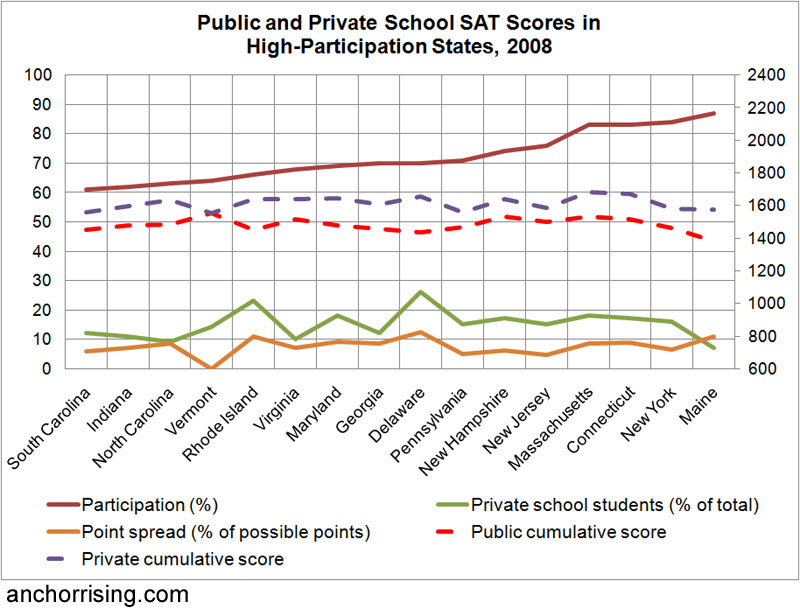
This chart includes the sixteen states in which more than 60% of graduating high school students take the SATs. Except for highlighting the fact that Rhode Island is on the wrong side of the chart to have such a low score, arranging the data this way doesn't appear to tell us much. Participation doesn't appear to correlate with SAT scores.
To see where Rhode Island stands by a different measure, I sorted the states by the point spread between public and private students, and beyond finding Rhode Island to be third worst, an interesting consequence of this arrangement emerges:
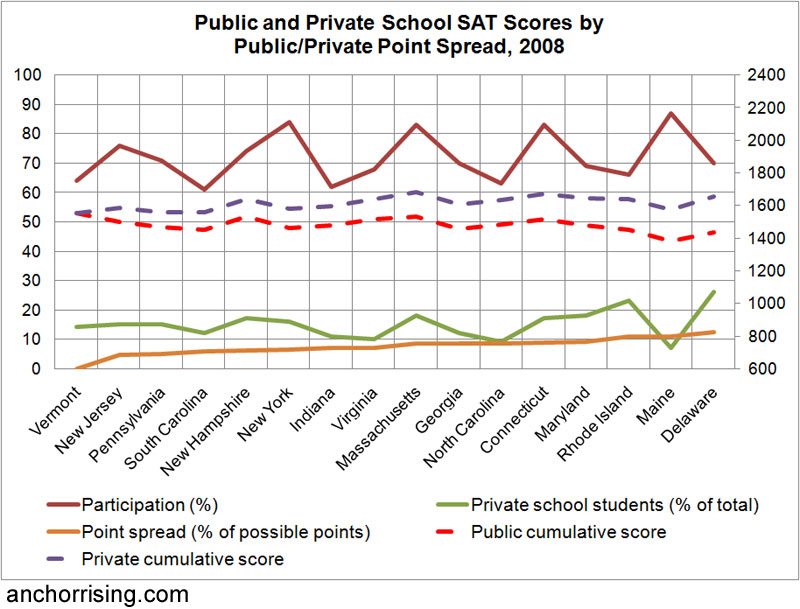
What's interesting is that, although the scores drift apart as we move to the right of the chart, public and private school grades fluctuate in similar ways. The implication is that something irrespective of the school is playing a role, and figuring it out might salvage some utility from this line of inquiry.
Continue reading "Accepting the Dare to Compare SATs Across States"August 29, 2008
Another List That We Trail
For the curious, I took a few obsessive-compulsive moments last night to compile the public school SAT data for all states. Rhode Island ranks 47th for every test except writing and 47th for total score. It's interesting to note that states' public school scores do not appear to correlate with private school scores, inasmuch as the public schools in the top 5 states tend to match or exceed their private peers.
Public School SAT Scores by State Ranking
| Reading | Math | Writing | Cumulative | |
| Iowa | 607 | 621 | 588 | 1816 |
| Minnesota | 599 | 610 | 579 | 1788 |
| South Dakota | 605 | 602 | 580 | 1787 |
| Illinois | 588 | 613 | 582 | 1783 |
| Wisconsin | 590 | 611 | 580 | 1781 |
| Missouri | 593 | 598 | 579 | 1770 |
| North Dakota | 592 | 607 | 566 | 1765 |
| Michigan | 579 | 602 | 570 | 1751 |
| Kansas | 582 | 593 | 566 | 1741 |
| Utah | 586 | 583 | 564 | 1733 |
| Nebraska | 577 | 583 | 563 | 1723 |
| Tennessee | 573 | 570 | 564 | 1707 |
| Oklahoma | 575 | 575 | 555 | 1705 |
| Arkansas | 575 | 570 | 559 | 1704 |
| Colorado | 566 | 577 | 555 | 1698 |
| Kentucky | 566 | 573 | 550 | 1689 |
| Louisiana | 568 | 567 | 553 | 1688 |
| Wyoming | 563 | 579 | 543 | 1685 |
| Mississippi | 569 | 550 | 559 | 1678 |
| Alabama | 562 | 558 | 551 | 1671 |
| Montana | 544 | 552 | 526 | 1622 |
| New Mexico | 545 | 536 | 524 | 1605 |
| Idaho | 539 | 541 | 515 | 1595 |
| Ohio | 529 | 543 | 514 | 1586 |
| Washington | 522 | 531 | 505 | 1558 |
| Vermont | 521 | 523 | 507 | 1551 |
| Oregon | 518 | 525 | 497 | 1540 |
| Alaska | 521 | 523 | 495 | 1539 |
| Massachusetts | 507 | 520 | 505 | 1532 |
| Arizona | 514 | 521 | 496 | 1531 |
| New Hampshire | 513 | 516 | 502 | 1531 |
| Connecticut | 503 | 507 | 506 | 1516 |
| Virginia | 508 | 510 | 496 | 1514 |
| West Virginia | 509 | 499 | 495 | 1503 |
| California | 494 | 513 | 493 | 1500 |
| New Jersey | 492 | 514 | 493 | 1499 |
| North Carolina | 492 | 511 | 478 | 1481 |
| Maryland | 490 | 498 | 490 | 1478 |
| Indiana | 492 | 505 | 477 | 1474 |
| Nevada | 495 | 504 | 474 | 1473 |
| Pennsylvania | 490 | 500 | 478 | 1468 |
| Florida | 492 | 495 | 475 | 1462 |
| New York | 484 | 503 | 475 | 1462 |
| Texas | 484 | 502 | 476 | 1462 |
| Georgia | 486 | 490 | 477 | 1453 |
| South Carolina | 484 | 496 | 471 | 1451 |
| Rhode Island | 483 | 487 | 479 | 1449 |
| Delaware | 482 | 483 | 471 | 1436 |
| Maine | 463 | 462 | 456 | 1381 |
| Hawaii | 456 | 473 | 441 | 1370 |
August 28, 2008
The Union's Value-Add
Congratulations to the National Education Association's Pat Crowley for managing to push his story about Governor Carcieri's Florida condos onto (astonishingly) the front page of the Providence Journal, which used it as a contextual gotcha against the backdrop of the union healthcare story. (Gee, I didn't realize that the governor is rich!)
Normally, I wouldn't have considered this feat worth mentioning, except for a "meanwhile" education story relegated to the Rhode Island section:
College-bound Rhode Island students performed about as well this year as last in the SAT, AP and PSAT tests, it was announced Tuesday by the College Board.Seniors scored 495 in critical reading on the SAT test, down 1 point from last year; 498 in mathematics, unchanged; and 493 in writing, up 1 point. About 66 percent of seniors took the exam. The scale for scoring ranges from 200 to 800.
Rhode Island students fell below the national average, which is 502 in critical reading, 515 in mathematics, and 494 in writing, the College Board said.
Rhode Island did not fare well when compared with nearby states. Figures from the Associated Press showed that Connecticut’s students scored an average of 507 in math, 506 in writing, and 503 in critical reading. Students in New Hampshire averaged 523 in math and 502 in critical reading. The score for writing was not available.
In Vermont, students scored 519 in critical reading, 523 in math and 507 in writing. The figures for Massachusetts were 525 in math, 514 in critical reading, and 513 in writing.
Scores for Rhode Island seniors who attend public schools were 483 in critical reading, unchanged from last year; 487 in mathematics, down 2 points; and 479 in writing, up 1 point. About 59 percent of the public school seniors in the state took the exam, the 13th-highest participation rate among the states. Figures for private schools were not available.
The College Board said that after two years of declining scores for public school students, the 2008 national scores — 497 in reading, 510 in mathematics, and 488 in writing — stood unchanged. Rhode Island scores, which declined only 1 point in the aggregate, have mirrored that national trend.
In summary, Rhode Island is below the national average in every subject, and our students are even further behind students in the two states by which we are surrounded. Plumbing the data for the public-school/overall distinction for our neighbors, the tale is even more bleak for RI families that can't secure freedom from RI's government/union schools:
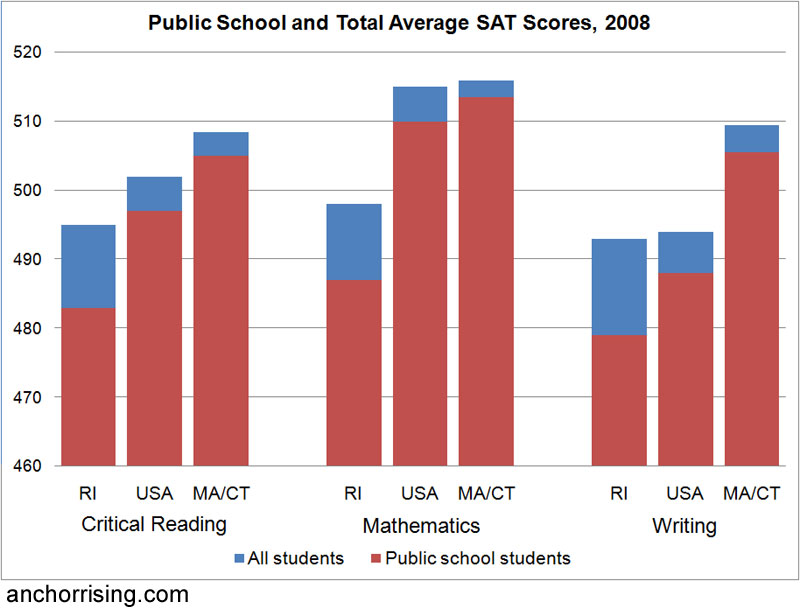
So, not only do Rhode Islanders in general perform more poorly on the SATs, but there's a much greater discrepancy between public and private school students, here. Yes, congratulations are certainly due to Patrick Crowley and the NEARI!
ADDENDUM:
I was actually holding off on a trail of analysis that I'd begun because there are more subtle points to be made, and I wanted pondering time, but since Brassband points out in the comments that the above chart shows public school and overall SAT scores (i.e., public school students are included in both), here's a chart comparing public with private schools:
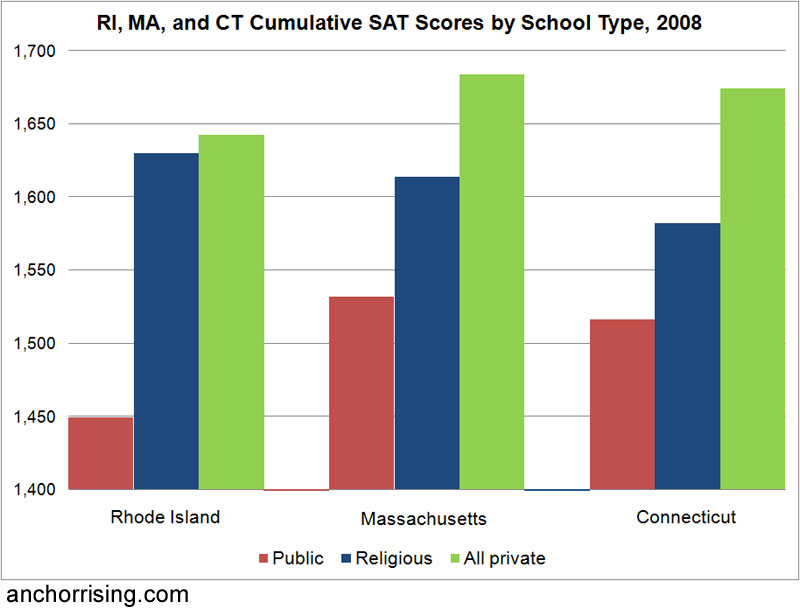
Apart from the fact that there are relatively few non-religious private schools in Rhode Island, one reason I held off — and the reason I break out religious schools separately even though they are also included in the "all private" column — is that they seem more likely to be a refuge for the average family fleeing the public school system. Note that RI religious schools do better than religious schools in either of the other states.
ADDENDUM II:
In the comments, Thomas Schmeling calls the two visuals above "gee whiz graphs" because I zoomed in on a score range. Frankly, that sort of point, when made in isolation, strikes me as rhetorical sleight of hand. Examining the axes to discern what's being shown is a critical step in reading any graph, but deciding whether it is deceptive requires consideration; it isn't a given. Schmeling illustrates the validity of my rejoinder by failing to make any argument about whether the tighter distinctions are merited, just implying that they are not.
So here's the second graph starting from zero:
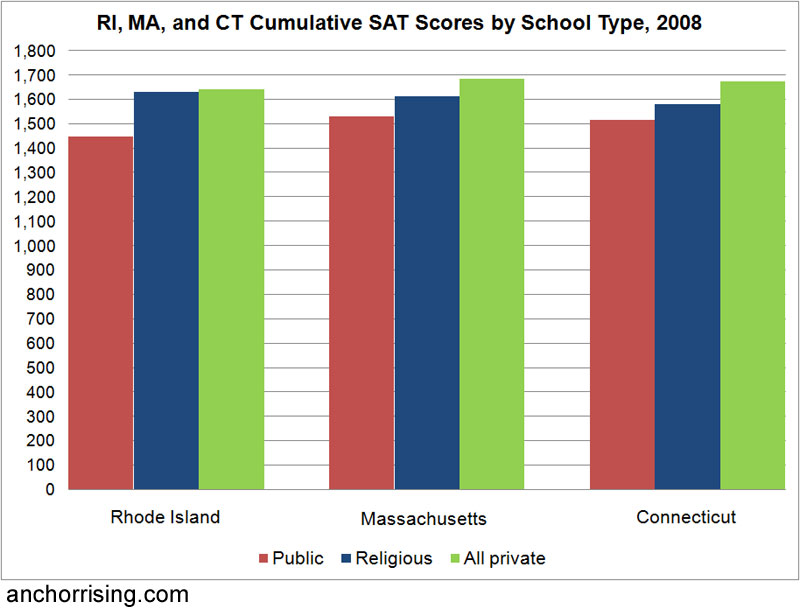
Except to the degree that it is more difficult to read accurately, that doesn't cool my response any, because (probably in common with most Anchor Rising readers) I learned from self-interested experience how to read and compare SAT scores. We all look to the labels, approximate a 200-point difference, and know that to be large (although those of us who took the two-subject version might have a skew). Indeed, Schmeling points out the percentage difference of the public and private categories, but the SATs aren't graded by percentage; they're graded by point, and comparisons of results in practical situations often come down to 50 points per test. People pay for test-specific training to achieve less advantage than that.
Schmeling's second point — that controlling for socioeconomic status makes the difference go away — is even more apt to elide the very point under discussion. Firstly, that private schools are able to educate students at a lower cost per student (and a much lower cost per teacher, to my experience) suggests to me that even an equivalent score brings into question the government/union model.
Secondly, consider the method of calculating "socioeconomic status" used in one study that Schmeling cites:
She determined students’ socioeconomic status (SES) by looking at six factors students were surveyed on in the NAEP assessment: eligibility for free or reduced lunch, eligibility for Title 1 funding, reading material in the student’s home, computer access at home, Internet access at home, and the extent to which a student’s studies are discussed at home.
Four of those six measures relate to parental motivation, not to household wealth. My family, for example, sacrifices hugely in order to claim items three, four, and five (and now to afford private school). And although I haven't seen any studies to this effect, it seems reasonable to me to suggest that the presence of such children has an effect on their peers' performance. If, as I implied above, motivated working- and middle-class families like mine are going that extra sacrificial mile to escape an unsatisfactory public school system, then those children who are left behind have fewer models for better academic behavior among their classmates.
Reaction to the Caruolo Dismissal in Cranston
Cranston Mayoral candidate Allan Fung has issued a statement on Judge Judith Savage's dismissal of the school committee's Caruolo Act lawsuit…
“Judge Judith Savage’s arguments for denying the School Committee’s request are quite alarming,” said Fung. “It shows that the School Department made no serious attempt to live within the money appropriated to it by the City. Even more disconcerting is that their current budget is based on a continuation of spending well beyond the amount allotted to the school system for the current fiscal year.”Jim Quinlan, Republican candidate for Cranston City Council city-wide, has also issued a reaction…While their bid to get additional money failed, as it did in 2004, the Schools were able to get approximately $4.1 million from Cranston’s Rainy Day Fund in the form of a loan. Judge Savage ruled that this loan has to be paid back. In addition to this reduction in the Rainy Day Fund, the School Committee will likely be forced to cut popular programs for students such as the program for gifted students (EPIC) and middle school sports, negatively impacting the quality of education for Cranston’s children. Fung pointed out that this is just another instance of a lack of leadership from our current elected officials.
“This is just another example of fiscal mismanagement by our elected officials that will leave Cranston residents holding the bag,” stated Fung. “The School Committee expects taxpayers to provide them with a blank check while they struggle in these difficult times to make ends meet. The School Committee and their administrators must be held accountable to spend taxpayer money wisely.”
In closing, Fung stressed that the School Administration must learn to run the school system more efficiently with the funds they are allocated by the Mayor and City Council. “While I’m a proponent of providing adequate funding to maintain our first rate school system, I will not do so until the School Administration can prove to me that they’re spending each dollar wisely,” said Fung. “The School Department was presented with a series of recommendations from a performance audit in 2004 that would have resulted in savings of approximately $12 million. Unfortunately school officials were unable or unwilling to implement many of these recommendations. As a result, we all lost. The taxpayers lost through a reduction in the Rainy Day Fund. The parents with children in the Cranston schools lost because of the likelihood that great school programs will be cut.”
No matter how the decision would have come down, it is a loss for the taxpayers of Cranston and is a clear demonstration of failed financial management by our elected leaders. Let us not forget that the City Council has already dipped into the City's Rainy Day Fund to loan the School Dept. $4.1 Million. This money will have to be paid back over time which will likely mean cuts in programs for the students.It is time for true accountability in our city departments including monthly operations reviews within each city department reported to the Council in order to be able to immediately react to any budgetary concerns.
Had the administration and City Council demanded accountability from the schools when they were first notified of the looming budget deficit the loss to the taxpayers could have been minimized. Had the current council not approved multiple unnecessary legal settlements over the past 18 months and an egregious firefighter's contract perhaps there would have been money in the initial budget to avoid level funding the schools.
Shame on the School Committee for their reckless spending and their blatant disregard for the process. However shame as well on the City Council for not standing up for the taxpayers of Cranston in the first place.
August 27, 2008
Judge Savage to the Cranston School Committee: The Caruolo Act Was Not Meant to Let You Ignore the Taxpayers and the Rest of Municipal Government
In her ruling dismissing the Cranston School Committee's Caruolo Act lawsuit, Rhode Island Superior Court Judge Judith Savage reminds the CSC that the Caruolo Act is not intended as an alternative appropriations mechanism for school committees who decide they don't want to bother with the due-diligence necessary to inform and persuade the public that increased spending is necessary…
For the reasons set forth in this Decision, this Court dismisses the Caruolo action filed by the Cranston School Committee and declines to order the City Council to appropriate additional monies of close to $4.5 million for fiscal year 2007-2008. The denial of this relief is required, as a matter of law, because the School Committee blatantly failed to comply with numerous statutory prerequisites to filing a Caruolo action. Notably, it failed to file a corrective action plan with the Mayor, City Council and Auditor General as soon as it recognized a potential or actual budget deficit, as required by law. Indeed, to date, it has never filed the statutorily required plan. This corrective action plan would have required the School Committee to address the deficit, to ensure that it spent only the minimum amounts necessary to comply with its legal obligations, under the watchful eye of the Auditor General.David Scharfenberg of the Projo has more details on the situation in Cranston here.In addition, it never amended its budget to conform to the City Council’s lowered appropriation to it as a result of the State’s decision to level fund state education aid to the City of Cranston for 2007-2008, it failed to sufficiently minimize its expenses thereafter, it did not timely petition the Commissioner of Education for waivers from state regulations, it failed to timely alert the Mayor and the City Council about its expected budget deficit and it failed to timely file this Caruolo action. Instead, the School Committee simply continued to spend money until it had grossly overspent its budget, in violation of Rhode Island law. In what appears to have been an effort to try to force an increase in its level of appropriations, the School Committee did not file this action – which is designed to secure emergency court-ordered appropriations that a school committee must prove are necessary for it to meet its remaining legal obligations in that fiscal year -- until the school year was almost over and its money had almost run out. The School Committee’s filing of this action in the latter half of May 2008 is by far the latest Caruolo action ever filed in the Rhode Island Superior Court. By the time it filed suit, it had to ask this Court to order the City Council to appropriate to it over $4.9 million to cure its budget deficit– by far the largest sum ever requested in a Caruolo action.
August 25, 2008
Democrat Mayor Corey Booker: "[We] have to admit as Democrats we have been wrong on education."
Mickey Kaus is at the Democratic convention and reports on the Ed Challenge for Change Meeting he attended.
I went to the Ed Challenge for Change event mainly to schmooze. I almost didn't stay for the panels, being in no mood for what I expected would, even among these reformers, be an hour of vague EdBlob talk about "change" and "accountability" and "resources" that would tactfully ignore the elephant in the room, namely the teachers' unions. I was so wrong. One panelist--I think it was Peter Groff, president of the Colorado State Senate, got the ball rolling by complaining that when the children's agenda meets the adult agenda, the "adult agenda wins too often." Then Cory Booker of Newark attacked teachers unions specifically--and there was applause. In a room of 500 people at the Democratic convention! "The politics are so vicious," Booker complained, remembering how he'd been told his political career would be over if he kept pushing school choice, how early on he'd gotten help from Republicans rather than from Democrats. The party would "have to admit as Democrats we have been wrong on education." Loud applause! Mayor Adrian Fenty of D.C. joined in, describing the AFT's attempt to block the proposed pathbreaking D.C. teacher contract. Booker denounced "insane work rules," and Groff talked about doing the bidding of "those folks who are giving money [for campaigns], and you know who I'm talking about." Yes, they did!RI Future is covering the Dem convention with an RI perspective. Kim Ahern attended a meeting for young Democrats that included Newark Mayor Corey Booker (mentioned by Kaus, above), but she doesn't mention whether or not he spoke about how he took on the teacher's unions. (Last year, Steve Malanga of City Journal did a bio piece on Booker, which included a description of his stance on education reform).As Jon Alter, moderating the next panel, noted, it was hard to imagine this event happening at the previous Democratic conventions. (If it had there would have been maybe 15 people in the room, not 500.) Alter called it a "landmark" future historians should note. Maybe he was right.
P.S.: My favorite moment didn't concern the unions. It came when NYC schools chief Joel Klein called for a single national testing standard. Groff, a crowd favorite, made the conventional local elected officials' objection that you need flexibiity, one size doesn't fit all, "what works" in County X might not work in County Y. And he was booed! Loudly. By Democratic education wonks. Wow. (The "one size" argument cropped up in the welfare reform debate too--and I assume it's just as bogus in the education debate. We're a national economy with cities that look more or less alike. What works in County X is almost certainly also going to work in County Y.)
P.P.S.: John Wilson, head of the NEA itself, was also there. Afterwards, he seemed a bit stunned. He argued pols should work with unions, in pursuit of a "shared vision," not bash them. But isn't this a power struggle where you have to bash the other side to get leverage, I asked. "Then you have losers," he answered.
Booker is blogging from the convention, too, and writes that he was inspired by the students at the event Ahern posted about, but he also described his excitement regarding the Education meeting that Kaus posted about.
Today I was proud to stand with the Mayors of Denver and DC and other city leaders as well as numerous other education leaders from around the country to hold a press conference and series of panels on education reform.While Booker supports Obama (who also agrees with Booker-at least broadly-on education reform), John McCain has also praised Booker for his education initiatives. I wonder if the RI Futurites are comfortable with Booker's stance against the teacher's unions? Or does such tension within the party not jibe with the type ofThere is this powerful convergence happening in America with unifying voices for change. Great groups like the New Schools Venture Fund, the Education Equality Project, Ed in 08, the Black Alliance For Educational Options, Democrats for Education Reform and others are coming together to proclaim that we must change the way we are approaching education in our country or we will continue to fall behind. Today we came together for The Ed Challenge for Change....Visit www.educationequalityproject.org for our statement of principles and to join with us in the most urgent movement in our country.
August 22, 2008
Foreclosures Versus Student Enrollment II
There is at least one glitch in the comprehensive municipality-by-municipality data that the Projo has been providing on foreclosures. According to a John Castellucci story that appeared in the April 15 Projo, there were 108 foreclosures in Pawtucket between January and mid-March of 2008 and 172 in all of 2007. That calls into question the completeness of the Projo's 2007 to 2008 Q1 comparison chart, where figures of only 5 foreclosures in Q1 of 2007 and 1 in Q1 2008 are quoted for Pawtucket.
I can't find any "official" data on the web for municipal level data for 2008, but there are a number of websites that give city-by-city listings of foreclosed properties for sale.
Yahoo has a real-estate site that lists foreclosed properties with the dates they were listed. Here's the number of foreclosure listings I retrieved last night…
| Central Falls | 14 | (June 10 – August 15) |
| Cranston | 142 | (June 10 – August 19) |
| Pawtucket | 99 | (June 10 – August 19) |
| Providence | 741 | (June 10 – August 21) |
Foreclosure.com breaks its listings into "foreclosure" and "pre-foreclosure" categories…
| Central Falls | Foreclosure: | 21 | Pre-foreclosure: | 4 |
| Cranston | Foreclosure: | 56 | Pre-foreclosure: | 64 |
| Pawtucket | Foreclosure: | 77 | Pre-foreclosure: | 5 |
| Providence | Foreclosure: | 407 | Pre-foreclosure: | 261 |
And the site that Ken suggested, RealtyTrac.com, divides its foreclosure listing into "Auction" and "Bank-Owned" categories; the bank owned includes listings originally from 2007. The totals in the two categories are…
| Central Falls | 30 |
| Cranston | 236 |
| Pawtucket | 181 |
| Providence | 1187 |
The numbers in these other estimates are consistent with the Castellucci story for Pawtucket and roughly consistent with the other Projo-reported estimates for Central Falls/Cranston/Providence.
So, if as Matt Jerzyk postulates, the drop in student enrollment is directly related to foreclosures, then...
- The drop in in Providence should be 25 to 50 times bigger than the drop in Central Falls…
- …but it's not. The decline in Central Falls was about 450 students, the decline in Providence, about 1,700 students, a factor of about 4.
- The drop in Cranston should be 5 to 10 times bigger than the drop in Central Falls…
- …but it's not. The drop in Central Falls is more than 5 times larger than the drop in Cranston.
Nix the Union
According to the Sakonnet Times, the Tiverton teachers' union is softening its demands in the face of fiscal reality. I note, also, that according to an RI Dept. of Elementary and Secondary Education table published in the Providence Journal, not a single Tiverton school had sufficient performance or progress to merit commendation after the last school year. (As of this writing, the relevant Web page for the Dept. of Education is not available.)
That educational failure couldn't have anything to do with the teachers' collectively working to rule, could it?
What a travesty. Fire them all, I say, and rehire any who are willing to work as professionals rather than as merit-averse unionists. In the meantime, give me at least some of my tax dollars back so I won't have to continue working myself into an early grave to afford private school.
August 21, 2008
Foreclosures Versus Student Enrollment
Matt Jerzyk of RI Future believes that declines in student population in Central Falls and Providence are due to foreclosures…
Speaking of questionable analysis, it is absolutely outrageous to me that anyone can get away with saying that significant drops in school enrollment in Central Falls and Providence are a result of the right-wing's anti-immigrant activism in Rhode Island.Ian Donnis of Not for Nothing thinks that the theory is plausible. I'm not sure about the causal chain in Providence, but it's hard to believe that foreclosures are having a big impact on student enrollment in Central Falls, unless you're willing to accuse the Projo of some really sloppy journalism.One word, people: FORECLOSURES.
In the August 16 Projo, Jennifer D. Jordan reported on the student enrollment decline…
In Central Falls, the state’s most heavily Hispanic school district, student enrollment numbers are down by more than 400….Currently, Central Falls enrollment stands at 3,050, down from its usual 3,500.And the number of foreclosures in the period leading up to the 2008-2009 school year? Well, the Projo gives us two figures for Central Falls to look at, compiled from data provided by Rhode Island Housing…
- Legally Noticed Foreclosure Initiations, Central Falls, April 2007-March 2008: 17
- Legally Noticed Foreclosures By Municipality, Central Falls, Q1 2008: 2
The foreclosure numbers for Providence are much higher, 609 in Q1 2008 alone, versus an enrollment drop of 1,700, but on the other hand, the community with the second largest reported number of foreclosures in Q1, Cranston with 155, has a student population that is holding steady, so there doesn't seem to be much correlation between rates of foreclosure and drops in student enrollment, unless you believe that the Projo is missing a big chunk of data, that foreclosures increased by about a factor of 10 in Central Falls after April '08, or that the average number of students living in a foreclosed home in Central Falls is somewhere in the vicinity of 20 or more.
August 19, 2008
Teach the Children
Obviously, the two articles aren't in direct opposition, and I'm not suggesting that one presents anything nearing an argument against the other, but the two felt related, so perhaps they're worth juxtaposing. First, AP education writer Nancy Zuckerbrod's memoirish piece comparing early childhood education in the England versus the United States:
The head teacher and I exchanged pleasantries, and then she laid it out. My daughter, who commonly invokes the Mandarin word for little brother and usually wins at the game hangman, has a significant "learning gap" when compared with her British peers — especially in literacy.Dumbstruck, I said nothing at first and then started to protest, suggesting there had been a terrible misunderstanding — maybe even a language barrier. OK, that one didn't make sense. I took a deep breath and then remembered all that I had heard about the differences between early education in the two countries.
Zuckerbrod points out some academic differences across children's progression through the school-age years, but somehow, Theodore Dalrymple's thoughts on Britains "bleak houses and low expectations" seem entirely as relevant:
Britain is the worst country in the Western world in which to be a child, according to a recent UNICEF report. Ordinarily, I would not set much store by such a report; but in this case, I think it must be right—not because I know so much about childhood in all the other 20 countries examined but because the childhood that many British parents give to their offspring is so awful that it is hard to conceive of worse, at least on a mass scale. The two poles of contemporary British child rearing are neglect and overindulgence.
Both pieces are worth reading in their entirety, and it's certainly worth considering the many ways in which a society can teach its children.
August 18, 2008
Circling the Wagons
No doubt it's healthy and productive for schools to seek to mimic those fading opportunities for group gatherings and discussion, but Julia Steiny's column on "circles" at the Paul Cuffee Charter School carries a hint of the "war on boys." This part is particularly creepy:
The power of circles to reintegrate wrongdoers back into the community depends on the individuals' desire to get along with one another and to belong in the community. Not all do. Some students can be a lot of work to integrate, if they haven't been well socialized at home or in their previous schools. Of these kids, Shaw says "We say we have to 'Paul-Cuffeeize them,' or teach them how to be part of a community."
We should be wary of creating social circles to govern the classroom. Even when the goal is a practical harmony, pushing individualists out and rewarding politics are a danger, as is the promulgation of an incomplete understanding of human interactions.
August 10, 2008
No Mystery to Contract Resolution
Ah, the magic of the Lincoln compromise:
Despite these tensions, Lincoln is an example of what a community can accomplish, even when money is scarce, says [Larry] Purtill, president of NEARI."What Lincoln shows is that both sides were willing, in a tough financial environment, to find a way to make sure that they reach an agreement so there is no work stoppage and programs continue and that teachers got what both sides thought was fair," Purtill said. "Districts have to get creative, because both sides are realizing there is just not a lot of movement to be had on the money."
If the article's representation is accurate, there's really no mystery to Lincoln's accomplishment. Everybody understood that funds were limited, and holding steadfast to unrealistic increases in remuneration would only have bled funds from other necessary areas of the district's budget, so negotiations centered around how best to shuffle around the dollars already allocated for the teachers. They dropped sabbaticals, picked up more healthcare costs, decreased healthcare "buybacks," and tinkered with work hours to comply with state law while not incurring large costs. In return, they get raises.
I'd love to indulge in equivalence, but somehow the "both sides" construction doesn't strike me as accurate when it comes to what Lincoln has done and what every other Rhode Island town must do.
July 31, 2008
What's It Mean to "Get" Math?
With my children not yet to the age at which I might have to consider battles with their teachers for their young mathematical souls, my opinion of the "new math" isn't sufficiently strong to inspire rants. Still, such statements as the following raise fundamental questions:
One problem, [Pat Cooney, math coordinator for six public schools in Ridgefield, CT,] says, is that parents remember math as offering only one way to solve a problem. "We're saying that there's more than one way," Cooney says. "The outcome will be the same, but how we get there will be different." Thus, when a parent is asked to multiply 88 by 5, we'll do it with pen and paper, multiplying 8 by 5 and carrying over the 4, etc. But a child today might reason that 5 is half of 10, and 88 times 10 is 880, so 88 times 5 is half of that, 440 -- poof, no pen, no paper."The traditional way is really a shortcut," Cooney says. "We want kids to be so confident with numbers that it becomes intuitive."
Or, the parent might understand that numbers can be broken into their components, with the functions performed on each and then added together at the end. In that case, they would break 88 into 80 and 8, multiply each by five — referencing a chart that they memorized decades ago and never forgot — and then add the results together: 400 plus 40 is 440. That's ultimately what the traditional method teaches. Poof. No pen, no paper, and yet a fundamental understanding of what each digit represents and its relationship to the others.
Although, as I said, I don't have thorough experience with it, the New Math appears to treat numbers as whole things that may be broken up and combined. The traditional approach is to treat numbers as representative symbols of multiple things that can join together or break apart. In the former case, everything is ultimately a fraction of a greater whole; in the latter, everything greater than one is a collection of independent items that have relationships. (Even fractions, in that view, are smaller individuals that make up the larger grouping, sort of like discussing atoms in molecules.)
Would it be too much to inject a quip about the fundamental difference between the liberal and the conservative mind, here?
July 10, 2008
Tangled Finances and the Ed. Partnership's Demise
It appears that the collapse of the Education Partnership may have more to it than a drying up of revenue:
The Education Partnership, an advocacy organization backed by local businesses, went into receivership last month, in part because several contracts to produce research and reports for municipalities and school districts fell through, said Shine. He was appointed permanent receiver by the court yesterday after serving as temporary receiver since June 18. At the hearing, Shine gave an update to the judge on what he has discovered about the organization's finances.Shine said that money from different sources — including federal grants earmarked for specific programs, grants from private sources and scholarship money — apparently was mingled with the Education Partnership's operational expenses. "There were no separate escrow accounts," Shine said.
The "mingled" finances may or may not have been the underlying sickness that led to the Partnership's demise, but it certainly would have been in the best interests of those counting on the group, especially scholarship recipients, had the money set aside for their benefit been, well, set aside. A failure to receive "contracts to produce research and reports for municipalities and school districts" shouldn't have affected dedicated revenue streams, although it would be interesting to know the story behind the loss of those contracts.
July 2, 2008
Rhode Island High School Capstone Projects Lauded
I missed this (and this) back in May (h/t Matt J.), but it's worth noting that RI's compulsory High School Capstone Projects are being eyeballed across the country, according to a ProJo report about a symposium convened to discuss RI's program.
Some states are considering the merits of adding such student exhibitions to their own graduation requirements, relying less on standardized tests that in some cases have done little to improve student performance or better prepare graduates for life after high school. In Massachusetts, for example, a study released last month found that thousands of high school graduates arrive at college unable to do the work required of them, despite having passed the state MCAS exam.How often do we here that!? To continue..... Continue reading "Rhode Island High School Capstone Projects Lauded"***
“I believe Rhode Island is the wave of the future,” said Ray Pechone, co-executive director of the School Redesign Network at Stanford University and former head of curriculum and teacher assessment for the Connecticut State Department of Education. “The state is really a pioneer.”
June 27, 2008
The Northern Rhode Island "Democrats For School Choice" Ride Again!
A year ago it was North Providence interim-Mayor John Sisto who was the honorary chair of the movement to allow relatives of Rhode Island pols to attend the public school of their choice, free of charge. This election cycle, according to a Gerry Goldstein report in this week's Valley Breeze, it looks like Smithfield Town Council President Stephen Archambault will be leading the charge…
With the campaign barely under way as both parties were readying to file their endorsed slates, the Republicans issued a press release Tuesday, June 24, saying that an investigation has revealed that "two nephews and one niece of Town Council President Archambault have been illicitly attending school in Smithfield for the last eight years"....My reaction to this news item is the same as my reaction to the original Sisto item: if Councilman Archambault thinks it's a good idea for the relatives of town councilmen to be able to choose the public schools their children attend, shouldn't they be in favor of extending that right to every family in Rhode Island? If school choice is good for the families of our pols, wouldn't it be good for the families of regular citizens too?Archambault said it has always been his understanding that while the students involved did indeed have partial residence in another town, they live the majority of their time in Smithfield.
He said he recalls that the children's mother, his sister, explained the situation to the School Department eight years ago and that any complications seemed to be resolved....
He confirmed that the School Department investigated after receiving an e-mail tip, and that the evidence gathered indicated a student or students "may not be living in Smithfield."
June 23, 2008
Education Partnership Ceases Operation
This will come as a surprise to those (non-insiders) who follow Rhode Island's public policy debates; from Jennifer D. Jordan of the Projo...
The Education Partnership, a nonprofit advocacy organization that produced reports and consulted with local school districts, has closed its doors and filed for receivership in Superior Court, unable to pay its bills....“The Board decided that it is necessary for the protection of the business and assets of the Corporation and for the protection of the Corporation’s creditors, that the Corporation seek from the Superior Court the appointment of a receiver … The Board has taken this action due to the overwhelming financial difficulties recently experienced by the Corporation which have made it impossible for the Corporation to continue to carry out its purpose,” the directors wrote.
June 18, 2008
House Debate on Article 38 (Education) Of the Budget
The House debated Article 38, Sub A of the Budget this evening. Below is my liveblog of the debate, for the record. (I see Matt covered it too, including a list of who voted how--wonder how he got the list so fast?).
June 17, 2008
Mayoral Academies Jump Another Hurdle
Cumberland Mayor Dan McKee's plan to start up a mayoral academy in Blackstone Valley received the endorsement of the House Finance Committee last week. After initial opposition, the Rhode Island League of Charter Schools has come on board, the ProJo reports. And support for the plan is growing amongst Democratic politicians:
“It’s time to think outside the box,” said House Majority Leader Gordon D. Fox through a spokesman. “As Franklin Roosevelt once said, ‘it is common sense to take a method and try it. If it fails, admit it frankly and try another. But above all, try something!’ I think it’s worth trying this mayoral academy....Based on their desire to recruit the best teachers, engage parents as partners and put student achievement first, I believe it is important to give them the opportunity to develop their plan for ultimate approval by the Board of Regents,” Fox said.Some of the progressive grassroots are arguing for the idea, including Progreso Latino chief executive officer Ramon Martinez, according to the ProJo. But not everyone is happy, especially the leaders of the teacher's unions.
Robert A. Walsh, executive director of the National Education Association Rhode Island, said he was “blindsided” by the proposal.Despite the rhetoric about how these schools could hurt the kids, the real issue for the union leaders is protecting the pay and benefits of their members. That's fine, that's what the leadership is paid to do. (As the ProJo story explains, Mayor McKee has called upon some education experts to help him with his plan. Besides, McKee's idea still has to pass muster with the Board of Regents). However, instead of this apparent knee-jerk opposition, perhaps the unions could join their traditional allies and try to be part of the process going forward. But to join the team, they would have to be willing to make some concessions, especially in the areas of hiring and firing flexibility (management rights) and pay. And if we allow history to be our guide, we know that the teacher unions have a hard time with compromise if it means "losing" anything.“We’re kind of in shock,” he said “This is one of those last-minute surprises that you dread in the [budget] process.” Since then, Walsh, a usually powerful voice on Smith Hill, says he’s been unable to get Fox to return his phone calls.
Walsh and the American Federation of Teachers and Health Professionals have blasted what they call McKee’s plan to “experiment with kids,” while “ignoring decades of progress in setting standards for public education,” and sacrificing vital teacher protections that could lead to lower-paying jobs with greater turnover.
“Mayor McKee seems to be motivated by a myth that there’s some magic way to do it better,” Walsh said, “… but a group of mayors that have no background in education,” being given “carte blanche” to build a school is not the answer, he said.
The bill goes to the House for debate tomorrow. Today there will be a rally in support of the measure at the State House.
June 13, 2008
Where Do They Go from Here?
Here's a question, which I present without insinuation in any direction: What can one glean from the fact that none of Tiverton High School's top 10 students are going to Ivy League colleges? Does it say something about the school system? About Ivy League schools? About the increasing difficulty of getting into top schools lately?
Here's a list of the higher-ed plans of the district's top 10, in order from top student down (taken from a Sakonnet Times article that is wisely not online):
- Chemical engineering at the University of Southern California
- Engineering at the University of Rhode Island
- Engineering at Northwestern University
- Engineering at Rensselaer Polytechnic Institute
- Biology at Providence College
- Graphic design and music at the University of Tampa
- Bilingual speech pathology at Bridgewater State College
- Engineering at the University of Rhode Island
- Occupational therapy at Ithaca College
- Nursing at Northeastern University
I'm not a fawner for the Ivies by a long shot; indeed, I'd be impressed to see a top 10 student taking time away from college to learn a bit about being an adult and working. Perhaps the top 10 caliber schools have shifted a bit in the fifteen years since I graduated high school, but is there any significance, here?
June 10, 2008
Driving Out the Desirables
Add this to the list of lists that place Rhode Island on the wrong side:
As of the most recent state report card issued by the National Association for Gifted Children, Rhode Island ranks at the bottom in nearly all categories, earning the state the dubious label of "most in need" with regard to critical indicators of quality gifted-education.
Failing to accommodate those with a higher capacity to learn is yet another way in which the socialist underpinnings of the state create the conditions for rot, with the expectation that talented, productive people will merely stay put while walls are built around them and their quality of life is threatened. Instead of egalitarianism, you get productive people fleeing the state and talented children departing the schools (which drags down scores and adversely affects the learning environment for all children).
Through personal channels, I recently heard the story of a Tiverton middle schooler who's pestering her parents to send her to private school because she's not being challenged. Children only have one opportunity to slide down the educational ramp that determines their momentum for much of their lives. After graduation, it's a much harder slog. In this, as in so many ways, Rhode Island fails its citizens.
June 9, 2008
Charter School Offers Freedom for Students and Teachers
The ProJo had an excellent piece over the weekend on the Learning Community charter school in Central Falls. It showed the sort of problems faced by today's educators in an urban community and also highlighted the sort of innovative thinking it takes to get results. And that's all that most parents want: results. If the current system were working, I suspect most of us would be satisfied with the current industrial education model. But it isn't working and throwing more money to fund the same broken system isn't the answer.
“I can tell you what the difference is between the Learning Community and regular public schools,” says Fran Gallo, superintendent of the Central Falls School Department, who sends administrators and teachers to visit the charter school. “They are child focused while the public system is adult focused. We are not doing our children justice with a system that does not promote who they are and address their needs. At the Learning Community, you see that fully in play every day. Children first. That’s the difference.”I don't think that the majority of public school teachers actually place themselves ahead of their students, but the system they are working in has evolved to effectively work that way.
That's why charter schools and other non-traditional methods of education (like mayoral academies) need to be expanded in the state. In the case of the Learning Community, it has been more successful--both educationally and fiscally--than nearby public schools:
The school’s budget — a mixture of federal, state, local funds and some private donations — is about $3.7 million a year. Its per-pupil cost is approximately $11,600. That’s far lower than in Providence ($15,000), Central Falls ($14,900) and Pawtucket ($12,800), all of which have more students with severe learning disabilities, who cost more to educate.Besides helping the individuals enrolled in those types of schools--and probably more importantly--these schools develop new and successful methods that can be evaluated to determine if they are transferable to our public school system. Yet, there are still those systemic barriers in our public school system that don't allow that sort of private-to-public feedback loop to function.The Learning Community outperformed those three districts on the latest round of state testing, with 59 percent proficient in reading and 54 percent in math.
But it doesn't have to be that way. In a related story, teachers at the Learning Community explain the difference:
Kate Smith came to the Learning Community two years ago, after having worked in traditional public schools in Newport and Washington, D.C.Smith isn't unique among teachers, whether they teach in private, public or charter schools. But she is allowed to implement innovation at the classroom level and can throw out a "plan" if it doesn't work. It is that sort of flexibility and "buy-in" that we need to encourage--and allow--in our public schools. But we need to be willing to make the fundamental change required to do so.A relatively new teacher, she says the Central Falls charter school immediately felt different to her.... “There’s a lot more freedom in terms of what you can teach, and you work with a lot of passionate educators,” Smith, 27, says. “It’s also a lot of work, but in a good way....I feel like every single teacher here works as hard as the next person.”
...Smith says the biggest difference she’s found at the charter school is how seriously teachers’ concerns are taken and how quickly the small school is able to respond.
“There is so much freedom in the curriculum,” she says. “When you walk into a regular public school, you are given the curriculum the school uses whether you like it or not. Here, we design our curriculum, taking into account the state standards.”
June 4, 2008
Graduation Rates even Worse: Time for Some Flexibility
The latest "Exhibit A" of the old maxim that there are "lies, damn lies and statistics" comes with news that RI is graduating even fewer seniors out of High School than we thought.
Rhode Island’s high school graduation rate is 19 percentage points lower than previously reported, and at 70.1 percent hovers just under the national average of 70.6 percent, according to a new, more accurate method of tracking students.If we didn't have enough reason before, maybe this latest can provide the last bit of impetus to take up Cumberland Mayor Daniel McKee's plan and open up those Mayoral Academies (PDF <--read it!)? The bill is in the House (PDF) and Gordon Fox approves, even though the entrenched education establishment in RI (including currently operating charter schools) are opposed to the idea. Who likes competition, right? It's simple, really: to date, the unions and administrators and school boards and politicians haven't seen fit to shake things up within the confines of the current system. Thus, because our education system has become ossified and inflexible, only innovation and something new will see us out of our current straits. If it's REALLY about the children, shouldn't we all be willing to try something new--something that has proven itself in other states--and work together to ensure success? To crib from somewhere....YES WE CAN!Under the old formula, the state Department of Education reported that slightly more than 89 percent of the Class of 2007 had graduated. But, under the new formula, the percentage plummeted.
The new figure means about 3,000 students who should have received diplomas last year dropped out over a four-year period.
State education officials say that the old method for calculating graduation rates counted students who took longer than four years to graduate, while the new method, which is endorsed by the U.S. Department of Education and the National Governors Association, does not, resulting in a 6 percentage point increase in the dropout rate.
In addition, many students who left school were previously recorded as “unknown” and were not counted as dropouts. The new system requires those students to be included in the dropout category.
June 3, 2008
Exhibit #473 for the Prosecution's Case That the NEA Has Less to Do with Education than Left-Wing Politics
Yes, that's an organization composed mainly of teachers offering up unimaginative slogans that promote left-wing clichés:

May 27, 2008
In the Fair Funding Formula, Some Communities Will Be Treated More Fairly Than Others
And the frontrunner for this year's Emperor's New Clothes Award for Stating the Obvious is Richmond Town Councilor Henry R. Oppenheimer, for his recent comments on the General Assembly's latest version of an educational "funding formula".
Andrew Martin of the Chariho Times reports on the effect the proposed "funding formula" would have on Chariho District…
The bill, S2650, also named the “Fair Share Education Funding Formula,” focuses on sending more money to the urban schools in the state. As a result, less funding would go toward the rural and suburban schools. Also, it would aggregate the three towns in the Chariho Regional School District – Charlestown, Richmond and Hopkinton – and the aid would be dispersed equally.Here is Councilman Oppenheimer's award-deserving response, where he rightly questions the General Assembly's comprehension of the concept of "fair"...Basically, the bill would eliminate the regional bonus for regional school districts. For Chariho, it would equate to a loss of $12 million. The district gets $14.8 million now, but under this bill, it would only receive $2 million. According to [Richmond Councilor Oppenheimer], there would be total loss in Washington County of $37 million.
"I guess [the bill] is fair in the eyes of the beholder, but in my eyes it wasn’t very fair," he said in reference to the bill’s title.Martin also reports that the Richmond and Hopkinton Town Councils are officially notifying their statehouse delegations that they want to be notified anytime an education "funding formula" bill is introduced in the legislature...“It says that it cannot be disputed that this new system would enhance fairness and equality. If I lived in Providence where [state aid] goes up, I might believe that. But not one Washington County town would get an increase,” Oppenheimer said.
The councilor then asked to have a strongly-worded letter written to the town’s legislators opposing the bill and any other legislation of its kind in the future. Also, Oppenheimer said he wants the town to be notified any time a bill like this goes before the General Assembly.Apparently, the town councils believe their state reps need assistance in determining if education bills submitted to the legislature are really in their communities' best interests. City and town councils in other Rhode Island communities would be wise to offer their legislators the same help too.Hopkinton council President Vincenzo Cordone asked to have a similar letter written at the Monday, May 19 town meeting.
May 25, 2008
Promises Bought and Futures Sold
Julia Steiny is must-reading today:
After collecting my thoughts and temper, I wrote back. It seemed to me that teaching a child to read was the principal mission of any school and was, therefore, funded. Rhode Island has one of the highest per-pupil expenditures in the nation. If not to teach reading, what is it going to the schools for? The Regents were only trying to get children actual help, instead of letting them be subjected to Jurassic practices like being put in the dumb-kids' reading group or passed on for the next teacher to deal with. That help seemed well funded already, at least to me. ...Too many people in Rhode Island are in the habit of thinking that the schools have the right to do whatever it is they're already doing, effective or not, and expect that anything better has to be paid for as an extra. When research and experience in other states identify an educational best practice — for example, tailoring strategies to each struggling reader — our state's taxpayers have to pay extra to implement it.
The problem is that reform-minded diktats from the state never touch on the core problem, which Steiny rightly identifies as unlimited collective bargaining rights, leading to such outcomes as this:
... the existing resources continue to shift away from kids to support benefits for adults. The Educational Intelligence Agency, a national watchdog, reports that Rhode Island's public school population has dropped 4.6 percent since 2000-'01, while compensation to teachers went up 37 percent. Nationally, the average state enrollment has increased 2.5 percent since 2000-'01 while compensation went up 24.5 percent.
Frankly, I have a negative emotional reaction to unfunded mandates: If the educational bureaucracy of the state — with which the unions have made it their business to exert influence — wishes to send down requirements, then it seems only fair that the money to support them oughtn't be derived from sources with which they are not connected (i.e., local and property taxes). But perhaps a case-by-case assessment is necessary. Really, how much funding is needed for the development of reading plans for individual students? That sounds like something that schools and teachers ought to do as a matter of course.
It may be that the very quality of unfunded mandates to which I have an adverse reaction speaks in their favor. They put pressure on an artificially constrained system, and the central and most costly constraint is the unionization of the teachers. In a system in which every new task or idea requires additional money, stuffing more of them into the bag will increase the awareness of those who ultimately have to carry it — taxpayers — and eventually enough of them will come to realize that our public servants have become our masters, foisting what ought to be their responsibilities onto our shoulders.
If we want to see this detrimental pressure removed from our educational system, we need take only one step: end the unionization of public school teachers. Taking that step, we could just watch how quickly the system would learn to right itself.
May 23, 2008
A Glimpse of the Problem's Roots
This factoid, coming out of the revolt in Tiverton, keeps ringing in my ears:
... Mr. Cotta and other officials said that legally the school budget cannot be cut below what it was for this year...
Is that true? If so, it's insane! Efficiencies, need, and priorities can't shift? I'll have to look into that one and add it to the top 10 list of Laws That Must Change in Rhode Island.
May 22, 2008
Diagnosing RI's Problem with the Third "R"
According to Jennifer D. Jordan of the Projo, a statewide mathematics "summit" held yesterday at Rhode Island College identified the following areas as contributing to the state's 22%-proficiency rate in high-school math achievement…
Seeing the "tracking" item on this list worries me. One well-known problem with standards established by remote bureaucracies -- in education and elsewhere -- is that, if not carefully thought-out, they can incentivize taking resources away from people and practices that are working best, i.e. already well-exceeding the standard. California's superintendent of public instruction explained this phenomenon to Time Magazine last year…
- Some classroom teachers lack deep content knowledge in math, which makes it impossible for them to help their students reach the higher standards.
- Many schools continue to “track” students, steering some students into easier math classes and away from higher-level algebra, geometry and calculus courses demanded by colleges and needed by today’s work force.
- Students are too dependent on calculators and lack the ability to perform high-level work on their own.
- Teachers are struggling to “differentiate instruction,” preventing them from adequately helping non-traditional learners, special-education students and others who find math challenging.
The do-or-die [adequate yearly progress] system creates perverse incentives. It rewards schools that focus on kids on the edge of achieving grade-level proficiency....There's no incentive for schools to do much of anything for the kids who are on grade level or above, which is one reason the law is unpopular in wealthier, high-achieving communities. And sadly, says [California Superintendent of Public Instruction Jack O'Connell], "NCLB provides no incentive to work on the kids far below the bar."Identifying tracking as a problem, in effect saying that it's OK to slow down the progress of more-proficient mathematics students, as long as a shift in emphasis helps speed up the progress of less-proficient ones, is a classic example of this.
May 12, 2008
Ending Bumping
Perhaps no practice is a better distillation of the blight that is teacher unionization than bumping. I'm with Julia Steiny in thinking that it ought to end, but the suggestions of the Business Education Partnership that she describes in her column, yesterday, are worth considering as half-way measures:
To professionalize education personnel practices, Blais and her colleagues put the focus squarely on evaluation. Rhode Island is one of only a handful of states that do not mandate that teachers be evaluated. In fact, most Rhode Island teachers are never evaluated in any meaningful or helpful way.Blais says the key to an effective and fair evaluation system is to use several different measures, instead of just one principal's say-so. Evaluations should include objective, quantifiable information, such as student achievement, as well as administrator and peer observations. The resulting evaluations should place teachers at one of four levels: master, pre-master, basic and below basic.
With these categories in hand, teachers would no longer be interchangeable. Any teacher with two consecutive below-basic evaluations could be let go. (At last!) No basic teacher could bump a master, no matter how long he or she has been in the system. Only master teachers should be peer evaluators.
It is an abomination that, in a profession that begs for inspiration, we permit no measure of quality.
May 3, 2008
Re: Re: Another Reason to Private School in Rhode Island
Actually, what struck me about Rhody's comment was how this early sentence betrays the ridiculousness of his point:
If any of us were sent back to work under a court order, our attitude might not be that great, either.
Most of us, I venture to suggest, cannot envision circumstances in which a court would have to order us back to work. We take jobs understanding the general structure of the career ladder and expecting that raises will be related to: 1) our performance, and 2) our employers' fortunes. The idea of banding with coworkers for a work stoppage with the intention of procuring even larger raises despite the employer's well-known financial hardships and a lack of notable improvement (to say the least) probably strikes the majority of us as a species of lunacy.
The same assessment of general experience applies to Monique's suggestion that elected officials ought to negotiate task-by-task responsibilities into contracts. Who among us has that degree of clarity when it comes to occupational delineation? Most of us do the jobs for which we were hired — broadly defined — undertaking all that is necessary.
If the job description is to educate children according to standards set by the community and the state, and the state and community define being educated as being able to produce a final project, then it is the job of the teachers to ensure that each student is able to clear the bar. Period. "You didn't negotiate for fifteen minutes of advice as I walked to the car" would be a profoundly selfish and unprofessional insistence, and there is little distance between that and acting as "an adult adviser."
Re: Another Reason to Private School in Rhode Island
Under Justin's post, commenter Rhody remarks:
The teachers are back to school (under a court order), they don't have a new contract, and still people are kicking them.If any of us were sent back to work under a court order, our attitude might not be that great, either. Remember, kids coming out of college who want to be teachers see this, and will be more inclined to find professions where they can make more money without being trashed on talk radio, letters to the editor, blogs, etc.
Back to work under a court order and without a contract may mean work-to-rule but it does not mean work for free. Further, even if they are working under the terms of the expired contract, presumed to be less advantageous than the one to be signed, as Rhode Island teachers, they are still the ninth highest paid in the country. [This is as of 2005. Links to newer comparisons are welcome.]
My criticism for the conditions in Tiverton and for the larger issue of the state of our education system is not directed at teachers but is reserved solely for elected officials at the local level. They have executed, with other people's money, contracts of increasing generosity that have no bearing on whether the education of students has been advantaged (it has not) or on whether the contracts are fiscally viable (they are not).
It is interesting, by the way, how much is missing from the specific terms of these contracts. If the elected officials who negotiate and approve the funding for teacher contracts had included these and other requirements in the prior contract, seniors in Tiverton and other work-to-rule districts would not be experiencing such problems.
Another Reason to Private School in Rhode Island
Here's another shining example of what public sector unions — specifically teachers' unions, specifically the NEA — have wrought:
The state Department of Education does not endorse the high school's plan for students to stand before their English classes to present their senior projects — a new graduation requirement here this year. ...Most of the problems Tiverton High faces with its graduation plan can be traced to a long-running labor dispute involving teachers, who have been working under court order since last September. ...
Until now, a high school teacher has volunteered as a senior project coordinator, recruiting outside mentors to help students delve into their special interests and organizing and training judges for the culminating presentations.
But with the contract dispute permeating labor-management relations since last September, teachers have not volunteered to do much beyond their required duties. ...
Nor do the prescribed duties include teachers fulfilling another new state requirement that all high school students have an adult adviser: someone who knows them well and can help them over the rough spots that often occur in adolescence.
The General Assembly should end public sector unionization — specifically teacher unionization.
April 30, 2008
Mitigating the College Oversell
Our society appears to be in the process of deciding that college oughtn't be a foregone conclusion for every young American. Indeed, Marty Nemko calls the Bachelor's degree "America's Most Overrated Product":
Even worse, most of those college dropouts leave the campus having learned little of value, and with a mountain of debt and devastated self-esteem from their unsuccessful struggles. Perhaps worst of all, even those who do manage to graduate too rarely end up in careers that require a college education. So it's not surprising that when you hop into a cab or walk into a restaurant, you're likely to meet workers who spent years and their family's life savings on college, only to end up with a job they could have done as a high-school dropout.Such students are not aberrations. Today, amazingly, a majority of the students whom colleges admit are grossly underprepared. Only 23 percent of the 1.3 million high-school graduates of 2007 who took the ACT examination were ready for college-level work in the core subjects of English, math, reading, and science.
Perhaps more surprising, even those high-school students who are fully qualified to attend college are increasingly unlikely to derive enough benefit to justify the often six-figure cost and four to six years (or more) it takes to graduate. Research suggests that more than 40 percent of freshmen at four-year institutions do not graduate in six years. Colleges trumpet the statistic that, over their lifetimes, college graduates earn more than nongraduates, but that's terribly misleading. You could lock the collegebound in a closet for four years, and they'd still go on to earn more than the pool of non-collegebound — they're brighter, more motivated, and have better family connections.
College can be a rewarding and edifying experience, if the student is determined to make it one. The average family should raise the question around the dinner table, however, with the understanding that the right answer can be "not necessary." If, after a few years of life in the workforce, the young adult concludes that higher education would represent time well spent, then by that very thought process, the conclusion is more apt to prove true.
April 28, 2008
Senator Barack Obama: Republicans Have Better Ideas on Education
From yesterday's Fox News Sunday...
Chris Wallace: Over the years, John McCain has broken with his party and risked his career on a number of issues, campaign finance, immigration reform, banning torture. As a president, can you name a hot button issue where you would be willing to cross (ph) Democratic party line and say you know what, Republicans have a better idea here.Senator Barack Obama: Well, I think there are a whole host of areas where Republicans in some cases may have a better idea.
CW: Such as.
BO: Well, on issues of regulation, I think that back in the ‘60s and ‘70s, a lot of the way we regulated industry was top down command and control. We’re going to tell businesses exactly how to do things...
And I think that the Republican party and people who thought about the margins (ph) came with the notion that you know what, if you simply set some guidelines, some rules and incentives for businesses, let them figure out how they’re going to for example reduce pollution. And a cap and trade system, for example, is a smarter way of doing it, controlling pollution, than dictating every single rule that a company has to abide by, which creates a lot of bureaucracy and red tape and oftentimes is less efficient.
I think that on issues of education, I have been very clear about the fact, and sometimes I have gotten in trouble with the teachers union on this, that we should be experimenting with charter schools. We should be experimenting with different ways of compensating teachers. That –
CW: You mean merit pay?
BO: Well, merit pay, the way it has been designed I think that is based on just single standardized I think is a big mistake, because the way we measure performance may be skewed by whether or not the kids are coming in the school already three years or four years behind.
But I think that having assessment tools and then saying, you know what, teachers who are on career paths to become better teachers, developing themselves professionally, that we should pay excellence more. I think that’s a good idea...
April 27, 2008
A Problem of Scope
John McDaid rightly tweaks me for my overly hasty reaction to Berkshire Advisors' audit of the Portsmouth school district. The report is thorough, thoughtful, and likely enlightening for employees of the district... within its scope.
In large part, my complaint still stands. Indeed, John begins a related post on his own blog thus:
There is nothing wrong with the Portsmouth schools that a few tweaks and more money can't fix. That was the message last night from the consulting firm Berkshire Advisors after their months-long performance audit of the school department.
Well, gee.
As helpful as the individual suggestions may be, a comparative analysis of Portsmouth versus Barrington, Smithfield, Tiverton, North Kingstown, East Greenwich, Middletown, South Kingstown, and Exeter-West Greenwich is inherently limited in scope. So, for instance, we do get the insight that the teachers' contracts require the district to spend too much of its purchased teacher-time on preparation and departmental administration, but this intriguing statement is left floating:
Many parents are concerned about the lack of opportunities for gifted and talented and high achieving children. In fact, in focus groups some parents reported moving their children who are gifted and talented to private schools while continuing to enroll their children with special needs in the Portsmouth schools.
I suspect that a survey of Portsmouth residents with children in private school would provide some very interesting feedback in this area. To what degree, for example, do Rhode Island schools lose their most promising students — whose participation teachers would most definitely value in "inclusion classrooms" — because parents perceive public schools to be mainly a drag on their opportunities?
How, for another example, does the school department's provision of "high quality education to Portsmouth students with limited resources" compare, not with some nearby districts, but with private schools within the town's own borders? How does the quality compare? How the resources?
Those who follow public happenings in Rhode Island may be inclined to see the report in quite another context: the tendency of officials and representatives to stop their inquiries just short of the line at which the tough questions and tougher decisions begin to come into view.
April 26, 2008
What a Crock
Pat Crowley's complaints about a letter that Governor Carcieri apparently sent to Bob Walsh, Crowley's NEA boss, are transparently two-faced in so many ways that I won't enumerate them. Simply put, the idea that Walsh would respond otherwise than with the mind-numbing reply that Crowley publishes is laughable. It is, let's just say, improbable that the scene in the office was of Walsh demanding that Crowley come to his office, closing the door behind him, and lecturing him about the messes that he gets the organization in. More likely, the message from above was more akin to: "You must be doing something right." The governor's office surely understood as much.
The tragedy of the matter is that opportunity exists for a more profitable discourse. For a taste of the light so thoroughly extinguished, consider a comment to Crowley's post by Mike in RI:
It's precisely posts like this Pat that should cause concern. Why the hostility? I care very much about what you have to say publicly because I do believe you represent teachers. As a teacher I watch carefully the public statements and behavior of anyone who speaks on the topic of education. You Pat seem more than eager to stir the controversial pot, and therefore you are sure to garner more attention from teachers. I haven't seen any letters-to-the-editor from Marcia Reback picking a fight with the governor publicly, calling his wife a racist, or sharing her opinions about the Catholic church. She hasn't picketed local businesses, or flipped off those with whom she disagrees. If she had I would be sharing my thoughts with her personally. As an RIFT member it is my dues that pay her salary. You are NEA Pat, so I am not afforded that opportunity.Feel free to review each and every one of my comments on this blog or any other. You will find that none of them were ever made during the time when school was in session. As a public employee, I feel it important to keep separate my opinions about politics and things not related to education out of respect for my students and parents. Therefore I will not use my name.
And just to clarify, are you suggesting that you wrote a letter to the ProJo with your Lincoln address and the editors changed it to Cranston? That seems odd.
Pat, you are passionate about your causes, and I have a great deal of respect for that. You must have been very good as a union organizer with the Teamsters. I mean that honestly. But teachers' unions are more professional in nature, and play a public role in communities across the state. We work with children and their families, and our approach must be very different from that of the Teamsters. I feel the political hostility you often exhibit publicly is a detriment to the cause of public education, which is my passion. Picking fights with the governor might make you feel good, but does little to help teachers and only angers more of the public that pays our salaries.
The only response to Mike came from RIFuturite Evan, dismissing him outright on the basis of past "conservative rants." The point is that, if Walsh had his own reservations about the hues with which Crowley paints his professional organization, he'd have at least mustered an empathetic response to what is clearly a sincere and thoughtful point on Mike's part.
And the reality is that, if Crowley weren't a high-ranker with the NEA, he'd be just another progressive crank, easily ignored and sparsely published. The damage that the educators' union is doing to education in Rhode Island is an affront to decency and an insult to intellectual endeavors.
April 25, 2008
Why Should a Study Focus on the Underlying Problem?
Here's the laugh line from Jill Rodrigues's Sakonnet Times story on the professional study that concluded — shockingly — that the Portsmouth school system needs more money:
Although much of that money is spent on salaries and benefits, the consultants did not weigh in on contract provisions and their impacts on the district.
Reading some of the details from Berkshire Advisors' report gives one the sense of a skewed mentality articulated: The school district needs to spend more on everything (except nurses), increasing programs for everybody from those with special needs to those with especially talents, but the money is just supposed to be found.
Frankly, the district would have made a modest advance in that regard by saving its consultation expenditures and asking any Rhode Island parent with some common sense what he or she believes the problem to be. More and more, the practical answer is: a lack of vouchers for private school.
April 23, 2008
More Funding Formula Numbers
Abby Fox of the East Greenwich Pendulum has some more data on what certain members of the legislature think of as a "fair" "funding formula"…
Even supposedly cold-hearted fiscal-conservatives are inclined to look at those numbers, scratch their heads, and wonder about the wisdom of cutting aid to Central Falls while increasing aid to Barrington? But that's the kind of bizarreness you end up with when you try to distribute resources via bureaucratic formula.
- East Greenwich’s state aid would be cut by the full amount -- $1,949,761 – to $0.
- Narragansett’s almost identical share, $1,897,159, would also drop to $0.
- Newport’s share would be cut by more than $11 million to $0.
- South Kingstown’s portion would be cut by more than $10 million to $0.
- Westerly’s would be cut by more than $6 million, to $0.
- Portsmouth’s aid would be cut by more than $6 million, to $0.
- Block Island’s aid would be cut by $106,345, to $0.
- Jamestown’s would drop by $531,908, to $0.
- Barrington…would actually see its state aid increase to $28,507, for a total amount of $2,628,033.
- Providence’s share…would soar under the proposed legislation, by nearly $50 million, leading to a total state aid of $243,784,089.
- Central Falls…would decrease by $2,553,047, for a total of $41,320,826.
On a broader level, it is disappointing that so many of our legislators see the role of government as fundamentally coercive, i.e. an engine for taking resources from one group of people, and give them to another that they like better, instead of cooperative effort to help people come together and solve problems.
April 21, 2008
This Year's Funding Formula Plan: Worse Than Ever
A Projo letter-to-the editor from West Greenwich resident Cynthia A. Walsh provides an excellent example of how education "funding formula" rhetoric has been used to confuse people about the true purpose of the proposal. Ms. Walsh celebrates the ideal of local control that is possible in smaller towns…
The only time we end up with serious problems is when the State of Rhode Island decides to tell us what we can and cannot do.…yet also advocates for a new "funding formula" for education in Rhode Island…For example, there is the 5 percent property-tax-increase cap, which handcuffs local officials and deprives local taxpayers of the right to decide how much of their money is spent and on what. This cap may be a necessary evil in the cities and the suburban ring, where government is big, anonymous and unresponsive to its citizens and where it is the perception that the only thing that drives said government is political power and personal corruption, but that is not how things work in rural Rhode Island [but] one of the many joys of living in a rural community is that if you have a problem, your local government is accessible and responsive.
I know [State Representative Nick Gorham] wants to help the communities he represents. If he could turn his attention to a new formula for public-school funding, that would help.The problem is, in the form it has been so far discussed, a new "funding formula" would move money away from many small towns in Rhode Island and to the control of the "big, anonymous and unresponsive" units of government that Ms. Walsh decries. The odds that Rhode Island's pols will implement a funding formula that would help W. Greenwich anytime soon are slight.
Earlier this month, South Kingstown's Superintendent of Schools presented the details of this years' version of the "funding formula" to the SK school committee. Sarah Traver of the Narragansett Times reports…
Superintendent Robert Hicks said he recently attended a panel discussion on school finance and the panel discussed a legislative proposal entitled S 2650. This legislature would implement a school finance formula that was developed by a consultant last year using only existing funds. “I think if this piece of legislation passes it will be a loss of $10 million for South Kingstown, $102 million loss to suburban communities all over (Rhode Island),” Hicks said....If the suburbs would be losing out, which communities would be benefiting most, you wonder? Tatiana Pina had a few specific community numbers in a recent Projo article on the Woonsocket schools…The specific legislation proposed would implement, over three years, the proposed formula utilizing only existing funds....Suburban communities are then faced with cutting their budgets or increasing property taxes. The total loss in state aid to the 22 communities in Rhode Island would be $102,857,727. An average increase in the school levy would be 16 percent reaching a high in Newport of 63 percent. The rate in South Kingstown would be 22 percent, the fifth highest in the state.
The [Fair Share Education Funding Formula bill] proposes redistributing state funds to towns and cities bases on the wealth of the community, student enrollment and the the number of special education students, English language learners and children from poor families. The bill is sponsored by Representatives Edith H. Ajello, D-Providence, and John A. Savage, R-East Providence, and Senators Rhoda E. Perry D-Providence, and Hanna M. Gallo, D-Cranston. “The formula has been used across the country. It does not increase funding but redistributes it based on these factors, making it fairer,” [Woonsocket Superintendent Maureen B. Macera] said.According to Portsmouth resident John McDaid of the Hard Deadlines blog, this year's funding formula proposal is so extreme, some communities could get zeroed out of state-aid entirely…Under the new system, Woonsocket would stand to get an additional $13,164,914 to be phased in over three years. Pawtucket would receive an additional $10,772,350, Providence would receive $49,674,333 and Cranston would get $14,604,658.
The committee also reviewed the numbers from the school funding formula proposed in general assembly bill H7957. Under this draconian legislation, Portsmouth would lose ALL school funding over the next three years. Yeah, you read that right. No state aid at all. Just for 2009, we would lose $1.5M, which exceeds the total allowable increase under the S3050 tax cap.This bill is not likely to pass (I suspect it will go the "held for further study" route in committee). But it is an illustration of the objective that many of your legislators have in mind when they think about a "funding formula", i.e. forcing 22 Rhode Island communities to raise their local taxes by $102.8 million dollars just to maintain their own local level of school spending, so that Providence can receive half that total in new state aid, and 16 other communities can divvy up the other half.Senate Majority Leader Teresa Paiva-Weed and our Senator Chuck Levesque have both spoken out against this bill, as has Rep. Amy Rice.
I wonder if Cynthia A. Walsh was aware of the details of this plan when she wrote that a new funding formula should be a top legislative priority?
Two final points:
- Earlier this year, I was curious as to why Providence Mayor David Cicilline didn't mention the funding formula in his state of the city address. Now, I suspect it's because he realized that no Rhode Island politician with gubernatorial aspirations could afford to be associated in any way with this stink-bomb of a plan.
- That this plan is even being considered shows why we need desperately in this state to change to a system where money follows the choices of parents and students through some sort of open districting plan and/or voucher plan, instead of being allocated in accordance with the preferences of clutching and grabbing state legislators. How long will it be before a set of communities with a majority-plus-one representatives in the legislature figure out that, under the current system, they can raid the communities with a majority-minus-one at will?
April 16, 2008
Teacher Buyout In Warwick?
Russell J. Moore of the Warwick Beacon reports that the American Federation of Teachers has a longer-then-usual-term proposal for addressing the school financing situation in Warwick…
The American Federation of Teachers (AFT) is asking the school department to seriously consider offering teachers a retirement incentive that they believe would save the department millions without compromising the quality of education.The plan, which has already been implemented in communities throughout the country, would pay teachers somewhere between $50,000 to $70,000 over a five-year period if they agreed to either retire or resign.
The move, argues Jule Gould, a National representative of the AFT, would save money by allowing the district to either hire new teachers at a step one pay scale—just over $30,000 per year—and replace step 10 teachers, who earn close to $70,000 per year. Or, he said, the district could opt to not replace the teachers at all.
The buyout plan would allow the district to reduce staff without violating their layoff clause, which only allows them to layoff 20 teachers per year.
The Warwick Teacher’s Union has ran ads in the Beacon in recent weeks, stating the union “has been exploring ways to save funds while keeping standards high for each and every Warwick student.”
While the ad isn’t specific as to what it is referring to, the AFT confirmed that a buyout plan, at this point, is all they have in mind.
April 14, 2008
The Right to Know What's Happenin' With Chariho
It looks like the attempt by the National Education Association to place restrictions on school committee members' communication with the public in the Chariho district has come to an end. NEA Assistant Executive Director Peter Gingras, who last year filed a Labor Relations Board complaint against the Chariho School Committee making the vague assertion that Committeeman William Felkner's publishing of the Chariho School Parents Forum blog constituted an attempt "to communicate directly with bargaining unit members represented by the union", has notified the LRB that he wishes to withdraw the complaint.
Over at CSPF, Committeeman Felkner has posted a letter written by Hopkinton resident Mary Botelle which eloquently describes the multiple flaws in the premise of the NEA complaint…
- Freedom of speech and assembly are guaranteed to all citizens. In this era, websites provide an electronic form of assembly and the written word replaces the spoken word. Therefore, Chariho School Parents' Forum, managed by William Felkner, provides parents and taxpayers with a method of making their concerns and opinions known…
- Section 16-2-9.1 of the General Laws entitled Code of Basic Management Principles and Ethical School Standards (copy enclosed) provides the standards to be followed by school committees.
It is to be noted that subsection (4) and (5) refer to communication with the public:
(4) Accept and encourage a variety of opinions from and communication with all parts of the community.
Therefore, it is clear that the committee should invite the community to participate so that decisions made will reflect the will of the community, and to provide information so that the community will be properly informed.(5) Make public relevant institutional information in order to promote communication and understanding between the school system and the community.
To its credit, the LRB never appeared to take the complaint very seriously. However the process dragged on, in part, because Chariho Superintendent Barry Ricci and the Chariho school board's lawyer seemed unable to summon any enthusiasm for defending the free speech and due process rights of school committee members, or for defending the right of the public to be given as much information as possible about school committee proceedings. The lesson here is to be wary of the nexus between government bureaucrats and labor unions; they sometimes act under the assumption that they can agree to bargain away the Constitutional rights of the general public. Expect this issue to pop-up in Rhode Island in various forms over the next few years.
April 12, 2008
After Further Thought
I've most likely been overstating the number of Tiverton teachers who stand to lose their jobs if the union remains implacable. Thirty-four notices of potential layoffs went out to meet a deadline; one position was eliminated in the school budget as passed; so I've been saying that intransigence might result in the actual layoffs of the other thirty-three.
The probability, however, is that the school committee sought to allow itself options should circumstances require positions to be eliminated. Their situation would have to be dire indeed for such a large portion of the workforce to be let go.
My point remains, though: union persistence will cost some members dearly, and a negotiating collective that is willing to push things that far would seek to soak up any new funds that become available.
Schools and Money
By way of a general observation, it occurred to me earlier this week that the extra opportunities and services for which so many Rhode Island parents pay the private school premium were offered as part of my New Jersey public school education back in the '80s. In terms of current, local events, I don't think it matters much whether the difference was one of location or of era. There's something structural here in Rhode Island and now in the late '00s that is depriving families of their educational due.
That's why I'm holding out hope that State Representative John Loughlin (R., Little Compton, Tiverton, Portsmouth) would make the right decisions as a legislator despite his letter in this week's Sakonnet Times:
But even as our teachers do their work extremely well, we are challenged as a town to meet the increasing costs of our educational system. Our school committee is working to remain within the state imposed cap on expenditures while struggling to implement a host of unfunded programs demanded by the General Assembly.Clearly, our state is not doing enough to fund education at the local level. We still have no state funding formula and last year additional funds proposed for local schools was removed by the General Assembly leadership.
Even in this difficult budget year, we could find more funding for our schools. For example, the General Assembly itself has 300 full-time employees and costs every resident of this state $31 dollars per person for a total of $31 million. Why does a part-time General Assembly need this extravagant budget? In part to pay for a self-serving television series on capitol TV which is off limits to opposing viewpoints, and to pay for a 2008 top-of-the-line SUV for House and Senate leadership. This is wrong and needs to stop. How can the House and Senate leadership impose spending caps for municipalities while at the same time expanding their staff and increasing their own budget? ...
These are just a few examples of wasteful spending at the state level that results in reduced funding for cities and towns.
It is time for the state to step up to the plate and fund education properly. We need to stop pitting teachers against parents and our school committees against the unions because in the end it is our children who suffer. I am committed to continuing my work in the House to make sure our state lives up to its financial responsibility and starts funding schools properly.
As a reasonably close citizen observer of teacher contract negotiations in Tiverton, I have little doubt that the bulk of additional funds provided by the state would have gone to placate the work-to-ruling union. Not to expanded extracurricular and elective opportunities. Not to music, not to gifted-talented. The union is fighting for blood from a stone; it is willing to see 33 a potentially significant number of its members lose their jobs so that the 54% who are at step 10 (as I recall) can receive significant raises during tight budgetary times. What chance, then, that they would share additional gravy?
Moreover, ending all of the state-level practices that Loughlin cites would be nowhere near sufficient to make up for the General Assembly's current (and growing) structural deficit, so its reclamation must benefit that effort first. Shuffling around our public dollars, or digging for more, is not the answer; changing the way we do things is.
April 10, 2008
Rhode Island's Failing Grade in Education Technology
Another day, another list, another low ranking for Rhode Island. From Education Week's "Technology Counts 2008" State Technology Report Card for Rhode Island…
| Access to technology | F |
| Use of technology | D+ |
| Capacity to use technology | D |
| Overall grade | D |
The breakdown of the grade of "F" in the "Access to technology" category is as follows…
| Access to Technology | Rhode Island | U.S. |
| % Students w/access to computers (4th grade) | 88% | 95% |
| % Students w/access to computers (8th grade) | 75% | 83% |
| # Students per instructional computer | 5.0 | 3.8 |
| # Students per high-speed Internet-connected computer | 4.6 | 3.7 |
With Rhode Island's spending on education consistently reported in the top 10 in the country, shouldn't we be doing better in a capital intensive area like the above?
April 4, 2008
Out of the Din
Throughout my adult years, I'd never so much as considered sending my children to private school (parochial or otherwise) until very recently. Even my particular tincture of religious faith leads me strongly to feel that spending one's formative years among a cross-section of the local society — an opportunity that my own experience led me to take as an apt description of the public school environment — is a valuable component of education. Yet, yesterday our attempts to move our children outside of Tiverton's school district met with success.
After receiving my wife's call, in the morning, the rest of the day brought a noticeable increase in my stress level, involving anxiety about the now-certain new monthly bill. But what is one to do? The headline at the top of this week's Sakonnet Times is "Teachers reject two-year offer":
Tiverton teachers Monday afternoon "clearly expressed disapproval" of a two-year contract proposal put forward by the School Committee Friday, March 14, according to Amy Mullen, the union's president and Pocasset School teacher.The school committee's contract offer was not proposed for ratification, and no vote was taken, said Ms. Mullen. Rather, it was discussed with "roughly 192 members present" at what union leadership characterized as an "emergency union meeting" at Green Valley Country Club in Portsmouth that began at 4 p.m. Monday and lasted nearly an hour and a half.
"The membership let us know it was not acceptable," Ms. Mullen said.
The complaint is that, when increasing healthcare costs are factored in, step 10 teachers will see minimal increases. Me, I can't keep my head from shaking: These teachers know the problems facing our state and our town. They know that money is extremely tight — so much so that their unreasonable demands will require the district to send out up to three dozen pink slips. Yet they persist.
And they persist in this (from an anonymous letter in the print edition's "Web Words" section):
Teachers, at this point why start anything to benefit the students. As parents of seniors, we know first hand you have disappointed the students all year. Some of the teachers were unprofessional, discussing the contract situation in the classroom, threatening to cancel events such as homecoming, dances and prom. You claim to be fulfilling your contract responsibilities, but as far as the students and parents are concerned, you failed! The seniors worked hard on their senior projects and, at this point, knowing they will not be graded by the teachers for their presentation portion of the project, their enthusiasm has diminished. This just adds to the list of disappointments such as mock trial, math team, class advisers, yearly art gallery shows, class trips, National Honor Society attendance, College Fair, limited letters of recommendation and limited after school help.Fortunately for the students, replacements were found and many of the above activities continued due to the principal and his office staff and concerned parents. Yet again you try to use the seniors as pawns! So you're not going to show up at graduation, who cares, it's too late. You lost the respect of most students and parents.
What responsible parent wouldn't reconsider the value of a public school education when faced with such an environment? I can't be alone in veritably itching for a concrete opportunity to fight for a school choice/voucher system.
March 30, 2008
Honesty in Education
We have to stop thinking of education in terms of time-delimited stages. In a world of advanced technology, specialization, and global competition, the old system of markers — with individuals tiered by the name of the highest degree achieved — is becoming both meaningless and expensive, as each degree level deflates and the education industry turns ever more to government to support some notion of a bare minimum of education.
That's the conclusion to which my thoughts wandered after reading the following disturbing paragraphs in Julia Steiny's column today:
So, should the state develop an honest test that many students fail, or should the test be so easy most kids pass it and get the diploma they need?Rhode Island is trying to solve this dilemma with a diploma system that uses what educators call "multiple measures," meaning the diploma requires three measurements of ability: Students must complete required course work, do a portfolio or senior project, and pass the tests.
You might have shared my initial reaction: Why can't we develop an honest test that many students pass? Put differently, why can't we develop a system that educates students?
Steiny goes on to describe her experience with some sample questions (released questions, 11th grade practice test, answers) and to write:
I could figure out some problems with sheer logic and time. But many were the stuff of my recurring nightmare about having to take a math test with symbols I don’t recognize, requiring functions and formulas I never learned.Go solve these problems yourself. You might start to think, as I did, that 22 percent was looking understandable, if not exactly good.
You also might wonder, as I did, whether every high school graduate really needs this sort of knowledge.
The second use of the word "need" stands out as critical, especially with reference to public education, because it would be difficult to justify such a huge chunk of government expenditures to give students something that they don't need. So, according to Steiny:
- Students need a piece of paper called a high school diploma,
- But they may not need a level of mathematical knowledge required, according to Steiny, by community colleges (tenth-grade proficiency).
The first point is true enough. In this day and age, one tends to look askance at anybody under the age of, say, fifty-five who admits to not having a diploma or GED. That particular degree tier is pretty much assumed for most employment opportunities. Given diplomas' near universal acquisition, though, employers looking for proof of an ability to learn and achieve academically began turning to associates and bachelor degrees, and those are rapidly moving toward commodification to the point at which Masters are already the minimum "stand out" degrees.
One already hears politicians' and activists' calls for universal access (read, "funding") to higher education, and it may only be a matter of time until we're debating whether college graduation tests should be so honest as to deny students the degrees that they, then, will need. Such a possibility points directly back to Steiny's second statement of need: a substantial portion of the information taught and tested on the way to a bachelor's degree is by no measure necessary in the sense of being professionally useful later in life. So, why should we allow that number of years of schooling to become obligatory?
As much of an advocate for mathematics as an important body of knowledge as I may be, and as generally applicable as practice solving problems surely is, I can't go as far as insisting that our high school students ought to be able to calculate the area of an arch formed by quartering a circle in a square and subtracting the triangle formed by the square's diagonal. Perhaps we would do well to admit that we're trying to make the high school diploma indicative of two things that don't actually have to be (and in reality are not always) joined:
- That the student possesses a minimum amount of useful knowledge.
- That the student is academically capable and ready to move on to higher tiers of learning.
The ad hoc, evolutionary solution has thus far been to pretend that 1 and 2 are equivalent and then to play catch-up as necessary when students go on to college or into a branch of the workforce with similar requirements. Indeed, among the tools used in the development of the NECAP test for math were textbooks designed to bring students up to speed in college. By this approach, students are always behind, and the trend can only be to extend basic education further into an individual's adult life. I remember one professor's finding it necessary to rework the syllabus of his 400-level literature course in order to allow time for lessons in basic argumentative writing. As that practice becomes increasingly common, 400-level lessons will, by necessity, be pushed into grad school.
And so, as I began by stating, it may be time to arrest the trend by admitting the truth: most people don't need but so much education. At the same time, the common experience of childhood schooling is invaluable, for the transmission of culture and for experiential cohesion. Rather than devaluing diplomas by instituting easy tests or "multiple measures" that give credit for effort in order to maintain the golden ring at the end of the process, students who cannot achieve proficiency could move forward in life with some sort of a Certificate of Completion. Or we could go the other way and hand out diplomas and Diplomas with Proficiency.
We've fallen into a presumption of high school as broadly college preparatory, and that's what's unnecessary. With the separation of "finishing high school" from "having a diploma," we could more openly admit the extent of information that young adults really ought to have. Employers would have a better sense of candidates' capabilities. And institutions of higher education, from community colleges to internationally renowned universities, could develop tracks for building on previous educational experience without its having the discouraging feel of backtracking.
March 28, 2008
Warwick School Closings
Originally, I had a longish, wonkish, link-heavy post detailing how Warwick got to the place where school closings were deemed necessary. I canned that once I read Warwick School Committee Chairman Christopher Friel's explanation. Basically, there's no doubt it was a difficult choice and that the time frame was compressed because of the budget crunch. But two facts remain: 1) Warwick school enrollment is declining and school closings were inevitable; 2) The City of Warwick and the School Committee made decisions that contributed to this fiscal crisis.
Enrollment has dropped from 12,206 in 2002 to 11,150 now and is projected to be 10,400 students by 2012. School closings were probably going to happen anyway, and Warwick has gone through this before. But it will always cause agida amongst those who are directly affected and this was exacerbated by the time constraints that the School Committee and other elected officials forced upon themselves. The entire problem was forged in a crucible of Warwick's own creation. The consequences of apathy often hit when the iron is hot, indeed.
Too many people simply don't pay attention unless they believe they will be directly affected. So the parents who are upset now need to recognize that they need to be involved in their children's education--whether in the PTO, School Committee meetings or other programs--all of the time. There's a chance that the budget shortfall could have been reduced, mitigated or avoided if more parents had attended School Committee meetings and advocated for their kids and schools by pointing out that every dollar spent on personnel costs (86% of the total Warwick Schools budget, according to a 2006 RIPEC report) was one less dollar available for students. Perhaps that would have given the district more time to study and prepare for the inevitable downsizing without the added pressure they were under during this process.
So now we have kids who are going to have to adjust to new schools. I understand the anger and anguish felt by students and their parents. Perhaps there was more justification for closing other schools, but, as hard as it is to do, it's time to move on. Change happens whether we like it or not, whether we deserve it or not, whether its right or wrong. Time for the grown-ups to remember that the kids are watching us. Instead of framing it as a loss, try to turn it into a new adventure. It's a life lesson, after all. Show them that its OK to roll with the changes and hopefully they'll discover that change makes us stronger and, just maybe, even a little better.
March 25, 2008
Choice of Toppings Only
Any additional educational freedom for Rhode Island's parents would be a good thing, but Julia Steiny's Sunday column on interdistrict school choice left me wondering about the mechanics of the thing:
Cross-district choice would allow the parents to decide which schools should be closed for lack of enrollment and interest, and which should thrive. Right now, because of Rhode Island's demographics, student enrollment is dropping, leaving most schools with room to take in students from other districts. The money would follow the student, meaning that the federal, state and local funds that pay for the student's education, the "per-pupil expenditure," would be paid directly to the school the child attends. ...Hopefully cross-district choice is an idea whose time has come for Rhode Island. Offering public school choice would focus attention on the kids and their education by shifting just a bit of power to the families and away from the district bureaucracies. It would motivate districts, at long last, to work together and to work smarter to provide attractive educational options for all families. As such, it would work well in the current situation of serious fiscal distress.
The Heritage Foundation credits public school choice with improvements among Massachusetts's students, but especially within the smaller field of Rhode Island, I wonder how the whole thing is supposed to work. A successful school district — Barrington, say — has extra room, so it accepts applicants from around the state, who bring with them the bulk of the money that would have gone to their home districts. Those districts panic and begin doing all those things that everybody knows ought to be done to improve our school systems in an effort to bring students back.
What if they don't do so — or don't do so quickly enough? Barrington can only take so many of the state's kids, and the bite mightn't be sharp enough to break entrenched interests and habits elsewhere. Perhaps Barrington would find a new school worth the investment, but that's an awful lot of capital to tie up in a building and infrastructure as a business venture servicing the citizens of other municipalities. If the General Assembly would take its thumb off of charter schools, then the town could charter some of those. Families' home districts could do the same, in order to offer choices that keep the money within their boundaries.
The unanswered question, though, is why local (or even state) governments are presumed to be the ideal managers of education. According to Heritage data, Rhode Island has the highest private school to public school enrollment ratio in New England, suggesting that leaders of the public system don't engender confidence in constituents:
| Rhode Island | 16.4% |
| Massachusetts | 14.3% |
| Vermont | 13.1% |
| Connecticut | 12.5% |
| New Hampshire | 11.9% |
| Maine | 9.2% |
In that sense, Rhode Islanders are already proven supporters of school choice — so much so that they're willing to reduce discretionary income and forsake other types of economic activity in order to procure it.
If we want real incentive toward improvement among our public school teachers and administrators, we should open up the choice campaign to private schools. Unless districts were to shape up immediately — and create or reinstate programs that parents want (such as gifted-talented) — they'd have to permanently retool their budgets to accommodate the 14.1% of all students for whose educations they are theoretically paid, but who don't actually use the services. That strikes me as the more moral approach, anyway.
ADDENDUM:
Note this interesting paragraph from Heritage's Massachusetts summary (linked above):
According to an analysis by the Beacon Hill Institute, the state's $1 billion infusion of funding for its public schools has not improved student test scores. State reforms such as raising teacher salaries and reducing class size have likewise failed to boost student achievement. The report recommended vouchers as a more effective investment of funds to improve academic performance.
In fact, the Beacon Hill report (PDF) goes farther than that:
... it turns out that the surge in test scores may have had little to do with the increases in state education spending that have been carried out in the name of Education Reform. Specifically:
• Spending more on instruction, whether by raising teachers' salaries or by hiring additional teachers, worsens school performance.
• Spending more on management (principals) improves the performance of those schools that have a history of doing well on standardized tests ("high-performing schools," in the language of this report). Spending more for any other purpose (raising teachers' salaries, spending more for non-instructional purposes, adding teachers in order to reduce class size) generally worsens the performance of those schools.
• Socioeconomic factors and prior performance on standardized tests, along with various "intangible" factors, are far more important than increased spending as determinants of performance.
March 17, 2008
Investing in an Export
Disappointingly, Julia Steiny's column yesterday takes a two-dimensional view of poverty programs:
... it's nothing short of glorious that Rhode Island has managed, over the course of three years and with a few strategic investments, to reduce the number of families in poverty by 6 percent. That's huge. Six percent of Rhode Island's population of 1 million is 60,000 low-income people doing better financially. For the first time in memory, the state is not the poorest state in New England, but only the second poorest, above Maine.We need to honor this achievement while we can, since it is gravely threatened by the state's budget crisis.
According to Kids Count, in 2004, fully 21 percent of the state lived at or below the poverty line. The federal government’s notoriously stingy threshold for poverty is $21,200 for a family of four. So more than a fifth of the state's kids were living with chronically anxious parents, in troubled, often violent neighborhoods, and driving their teachers nuts with their inability to focus on math facts, instead of problems at home. Reducing poverty doesn't remove these conditions, but greatly improves the chances they'll get better.
In 2005, Rhode Island's poverty rate dropped to 19 percent, and in 2006 to 15 percent.
What Steiny doesn't acknowledge (perhaps doesn't know) is that this "huge" achievement came at the effective cost of pulling thousands below the twice-poverty line and driving out the working and middle classes. She apparently has that peculiar blind spot that prevents one from seeing the effect on the payer of glorious welfare programs. Consider her apparent view that "one smart investment ripple[d] productively throughout the low-income community":
Initiated in 1998, Starting RIght recognized that welfare recipients could never make the transition to work without help with childcare. So the program offered full childcare subsidies to working parents at or below 100 percent of the poverty level. Parents making up to 225 percent of poverty paid a co-pay on a sliding scale.But there were very few childcare spots available. So the program offered incentives to more people, mostly women with children of their own, to open licensed childcare businesses, by offering RIte Care, the state-provided health care, to those who did not have health insurance. The program also paid close to market rates. Availability ceased to be a problem.
But notice that the childcare subsidy first circulated directly to a cottage industry within the low-income community itself. Starting RIght got more parents into the work force, and it generated jobs. Cash assistance (old-school welfare) dropped by a whopping 72 percent.
The "ripple" hasn't been one of salutary effects so much as an expansion of the paid benefits. As we've been pointing out around here for a number of years, while cash assistance payments are way down, the combined cost of these programs is up exponentially — and the trend is unsustainable. To Steiny, the daycare and healthcare subsidies may be a good investment, but it's one that fewer and fewer of her fellow Rhode Islanders are willing to pay, as evidenced by the fact that there are fewer and fewer Rhode Islanders to pay it.
With this additional dimension, the characterization of these expenditures as an investment requires clarification. Obviously, poor Rhode Islanders benefit financially (even if only in the immediate term) from handouts, and we can assume that, on average, their children benefit in more important ways from improved circumstances. But in the absense of a vibrant economy presenting local opportunities, our tax dollars will prove to have been an investment in another state's taxbase.
March 11, 2008
Still Going to School
A cost-benefit analysis of sorts has led me to give up on the Tiverton town council. I simply can't afford to devote that much time to such an unprofitable activity (especially if my taxes are going to continue to climb).
Still, the school committee remains sufficiently interesting and important that I'll continue to make the time for it. That despite the likelihood that my children won't long be in the public system. (Another matter that will require me to maximize the profitability of my hours.)
It'll wear you down, this local government participation. The latest cuts that Superintendent Bill Rearick has proposed include a hundred dollars for repair here and there, $2,500 each from a couple of testing accounts. And yet the teachers are working to rule.
Now Rearick is talking about the NECAP results and pointing out that Tiverton High School was #11 in the state overall. But 72% of the kids aren't proficient in math. "It's certainly not a cure-all, but money would help us — push our kids and get our teachers additional training." Now a teacher is explaining that the kids have no incentive to apply themselves to the test.
Rearick: "It's a new test that assumes that students have basic skills and tests them on higher level thinking."
A principal: "Not sure whether this is a valid test." Apparently, low-scoring kids said they had plenty of time for the test (because they hadn't been prepared for a signficant number of the questions anyway), while higher-scoring students felt that they didn't have enough time.
Stunningly, nobody in the auditorium seems to feel any sense of urgency to improve these math scores. Not a single specific request or declaration concerning steps to improve them was voiced. Some stuff is up to the state. Some stuff has to do with the test. Some stuff involves the alignment of the stars.
The superintendent and some committee members congratulated the staff and teachers for doing so comparatively well. What? Either the test is invalid or our children are being abysmally cheated when it comes to math.
Can I possibly be the only person in some way connected to the Tiverton school district who thinks this matter shouldn't be brushed off the table with just a few minutes of mitigation?
Hear, Hear, on Vouchers
Just wanted to highlight Max Fenig's comments on school vouchers:
After seeing the poor results for R.I.'s public schools as measured against proficiency standards, we all know what must be done: Double the money for public education and we may reach mediocrity! But one matter regarding education in this state is worthy of note.We have some of the best elementary and secondary schools in the country here in Rhode Island. These schools are our private and parochial schools. These are schools that students from across the country seek out to attend. These are schools where the administrators know they are in competition for these students and must meet the needs of their customer base — parents who want a quality education for their children. These are schools that have a faculty whose focus is on their students and not on a trade union.
It is unfortunate for those paying confiscatory property taxes that paying tuition to a private school is not often a possibility.
If the recent report card on our public schools does not cry out for school choice and vouchers to any school, public or private, then what will?
The Carpenter Defends Math Against the Insecurities of the Editor
It's disappointing even to have to argue against such arguments as the one put forward by Ron Wolk, a member of the governor's task force on urban education:
The main reasons students are not learning algebra and geometry is that they don't really want to. They think higher-order math is irrelevant to their real lives. They can't imagine that they will ever use algebra and geometry.And they are mostly right.
I am willing to bet that the majority of Rhode Islanders who graduated from high school have made little, if any, use of algebra or geometry. Most, like me, probably forgot most of what they "learned" before the ink was dry on their diplomas. I squeaked through algebra, plain and solid geometry, and trigonometry, but a year later I couldn't explain the difference between a cosine and a stop sign. And I can't think of an instance over the past half-century when I needed algebra or geometry. ...
I am not denigrating math. It is important in helping us cope with the demands of everyday life. It is also a powerful problem-solving tool that can help students learn to think logically and reason clearly. Fortunately, it’s not the only path to clear thinking. Students can also learn to think and solve problems by studying the humanities — literature, history, philosophy — and by engaging in analysis, discourse, and debate.
If one is fortunate enough to have made a career editing an education magazine, as Mr. Wolk was, then avoiding algebra and geometry may be a possibility. Personally, when the opportunities procured via my English degree proved inadequate to make a living, I switched to carpentry, and having a strong background in those very subjects has enabled me to leap up the career ladder. Knowing how to figure out the run of an 8-pitch roof over 14 inches of rise opened a more profitable door than all of my rhetorical skills have thus far managed.
Indeed, considering his inclusion of "analysis" on a list of alternatives to math, it's possible that he truly doesn't realize the value of the algebra that his teachers "force-fed" him. The algebraic approach of assigning abstract variables and assessing their relationship is critical to analysis. More explicitly, those without the baseline understanding of math enabled and reinforced via those plodding algebra exercises are more liable to be taken in by propagandists' inane "analysis".*
Frankly, I'm not persuaded that Mr. Wolk has constructed his argument from the numbers up, so to speak, beginning instead with the a priori mandate to oppose "'rigorous' standards for what every kid should know." My skepticism arises from my assessment that his conclusion doesn't follow from his argument:
If we want more young people to be proficient in math and science, then we need to find ways to awaken and nourish a passion for these subjects in elementary school so that they will want to study them in high school.
I agree that more must be done to give kids first-hand evidence of math's utility. Perhaps they could build bird houses with hip roofs. Maybe they could be shown how algebra can help them make arguments that help them advance some cause or other. Even if math isn't a particular student's strong suit, he or she will absorb its principles in a way for which there is not alternative.
The first step toward generating incentive for the development of such creative, cross-disciplinary solutions, however, would be for grown-ups to stop fighting that eighth-grade battle against difficult homework assignments.
* Get this: "20% of the people earn 69% of the taxable income" but "pay 75% of the income taxes," and that's supposed to be self-evidently unfair to the other 80%.
March 10, 2008
Extra Mile or the Minimum Distance?
I've had mixed feelings about the reliance on student portfolios for the awarding of high school diplomas. On the one hand, it does place an active, foreseeable academic achievement before all students. On the other, most of the work is done as regular coursework and set aside for the portfolio, which aggregates the work in a highly subjective presentation.
Reading yesterday's article on the first wave of students pursuing them, however, I think my impression was colored by my lack of understanding of just how inadequate some districts' policies and standards were. The central benefit of the portfolio system, it seems to me, is that it forces students and teachers to do things that they ought to have been doing all along:
The portfolio system is working more smoothly now, she says. Gardiner acknowledges adapting to the new requirements has meant a lot of extra work for teachers, but she likes how it has forced teachers to work together more closely.She also believes more students have access to high quality classes and academic standards.
"The positive end of this is more kids are getting exactly what they need," she said. "One of the main problems I've witnessed with my three kids is that it was kind of selective who got the right education and who didn't. There were some teachers you wouldn't put your kids in with because you knew they wouldn't get what they needed. This is forcing all of the teachers to provide the same things to all kids." ...
To judge the portfolios, Chariho requires every teacher — elementary, middle and high school — to serve on at least two portfolio-judging panels during second semester. To accommodate all 270 graduating seniors, the presentations are scheduled after school over several months.
The new diploma system, says Chariho principal Robert Mitchell, has required hundreds of hours of teacher training, technical assistance and planning. But he said the work has been worth it.
"Up until this graduating class, it was possible for a student to graduate without ever having effectively demonstrated a research paper or an essay or whether they could problem solve," he says. "We didn't have proof that every child could show competence in those areas. But now we will know on June 13, on graduation day, that the students who walk across the dais have demonstrated they can do the things we want them to do before they move on to college and good jobs." ...
For his senior project, Brad shadowed an information technology specialist at a local company. Similar to Coventry's capstone project, Brad had to participate in an internship, write a research paper, supply materials such as journal entries and evaluations, and give an oral and visual presentation.
He passed his project last month, and he says the experience helped him narrow his future career plans.
"Well, I found out I didn't want to do that with the rest of my life," he said.
My modest change of heart doesn't mean, of course, that I no longer believe standardized tests of minimum retained knowledge to be invaluable, as well.
March 8, 2008
A Test for the Education Establishment
Unsurprisingly, many invested in the current education system object to proposals to tie graduation to discrete, measurable testing requirements:
Dozens of speakers last night said they were worried about a provision that would make the English and math scores of statewide standardized tests students take at the start of 11th grade count toward one-third of their graduation requirements. The scores would also appear on students' official transcripts for colleges and employers to see. Currently the scores of the New England Common Assessment Program account for 10 percent of graduation requirements and do not appear on transcripts.The other two-thirds of students' graduation requirements would include completing 20 or more rigorous courses and passing "performance-based graduation requirements" such as portfolios or senior projects, which are required for this year’s graduating class.
No doubt, there are myriad professionals and parents who have good reason to be worried about the possibility that tests for which they are leaving children unprepared would actually, you know, matter. If that were the case, then they couldn't fudge their answers to the crisis, suggesting increases expenditures, begging for more time, noting isolated advances. They'd have to face thousands of children who have been cheated out of their educations and must carry that burden well into their adult lives.
Some educators questioned why state education officials seemed to be embracing "high-stakes testing," when the state has worked for the past several years to develop an entirely different method of preparing students for college and work.
The answer is that nobody trusts the current system's practitioners to get it right. "'Proficiency-based' projects" ought simply to be part of curricula, and giving "students multiple ways to show they have mastered skills and knowledge" sounds a bit too much like a loophole through which to adjust the test to match each student's natural talents, minimizing the amount of material that must actually be mastered. The matter of schooling is too important to allow years of tweaks yielding modest increases in the 1% of students who are "proficient with distinction" and 22% who are "proficient" in basic math by eleventh grade.
March 6, 2008
The NEA's non-serious proposal on the meaning of 'balance' in teachers' union contracts
The opinion page of the February 21, 2008 edition of the East Greenwich Pendulum carried a letter from the co-presidents of the East Greenwich Educational Association, the local branch of the NEA teachers' union, in which they wrote (not available on-line) the following under the heading of "Teachers union heads seeking 'balance' in contract"-
We, along with everyone else are very frustrated that a "contract" is the prominent education story in East Greenwich when there is so much excellent in our schools to be reporting on. Teachers contracts should be settled well before the first day of school.We all want East Greenwich schools to remain one of the best in the state. On these points, we think everyone can agree.
To that end, we are focusing on finding balanced terms for a settlement that is fiscally responsible for the town, yet not too far below the national cost of living adjustment or the RI state average for teachers. We need to look at the big picture down the road so we will be able to attract and keep highly qualified teachers in East Greenwich. This has become a problem in recent years.
New teachers look at and compare numerous contracts before accepting a position. The entry level step in EG is the 6th lowest in the state. Additionally, EG does not offer such things as social security, longevity, sick day buyback incentives as many other towns do, yet we currently contribute above the average healthcare cost shares found statewide for teachers. We are very mindful that the "structure of the contract" remain at least average in terms in terms of salary. We have put a well below average request on the table and tried to balance that with acceptable healthcare costs. There have not been any "high salary demands" at any time during this negotiation process, as we have been very cognizant of the budget issues all along. We would like to find a fair medium that won't completely erode the contract as a whole even more to ensure we can be competitive in the future.
Judi Cavanaugh/Donna Hayes
Co-Presidents, EGEA
Well, isn't that touching.
Today's Pendulum carried my editorial response:
I was delighted to read that EGEA Co-Presidents Cavanaugh and Hays are seeking "balance" in the teachers' union contract. They claim to seek a cost of living adjustment not too far below the national average. Great, we accept their offer! How kind of them to unilaterally give up the 8-12%/year salary increases embedded in contractually-defined increases for 9 of the 10 job steps - which EG residents have been generously funding every year throughout this entire decade, increases that are still incorporated in all current contract proposals by both the School Committee and the EGEA union.Now it does seem rather silly for the EGEA to describe the existing 5-10% healthcare co-pays as "acceptable" when the EG residents funding their healthcare are typically paying 20-30%. Surely somebody has advised the EGEA that knowing your audience is a good idea when trying to persuade taxpaying residents to accept contract terms which are not in their economic self-interest. And perhaps in their next letter the EGEA can also explain how EG town employees represented by the NEA can pay 20% co-pays but EG teachers represented by the NEA can't pay 20%? (Also note that their letter describes 5-10% co-pays as above the average for RI teachers; some "balance" across the state, no?)
As to their argument that EG has to pay at or above average teachers' salaries in RI to retain or attract the best teachers, take a step back and contemplate the absurdity of that argument: Suppose a teacher has the opportunity to teach in EG or Barrington, arguably the two nicest towns in RI. Is there really any rational person who thinks EG has to match salaries paid in places like Central Falls or Providence in order to keep teachers from leaving the EG teaching environment for those other communities? Please!
Then there is the broader issue of whether the EGEA's claim about EG paying below average for job step 1 is even true, a reasonable concern given the EGEA's history of spreading disinformation - such as last Fall's now-disproven "pay cuts for teachers" nonsense. Here is a reason to be skeptical: While I don't have recent RI data, third-party data from the 2003-2004 Rhode Island Association of School Committees' teacher data report showed East Greenwich salaries ranked as follows: The top job step 10 salary was the 7th highest out of 36 districts. The job step 5 salary for teachers was 9th highest out of 36 districts. So I find it hard to believe that EG teachers suddenly became poorly paid only several years later.
At a minimum, the EGEA is misleading EG residents when it talks only about job step 1 - who are then on a track likely to give them 8-12%/year salary increases for the next 9 years - as it knows that over 60% of all EG teachers are at job step 10 and only 1 of 231 teachers is currently at job step 1.
By the way, in the spirit of advancing the cause of "balance," did you know that the median total cash compensation for EG teachers this year is between $69,000-70,000? That means 50% of EG teachers earn at least $69,000/year. And the ones who earn less than the median are receiving 8-12%/year salary increases. While all of them currently pay only 5-10% healthcare co-pays.
By golly, the EGEA is right! We do need some "balance" in the teachers' union contract. Balance on key financial terms just like the rest of the taxpaying residents who fund the schools. It's all we ask. It’s all we have ever asked for.
Donald B. Hawthorne
Former EG School Committee member
Same old, same old. As a reminder, here are links to some of the key prior postings on this year's EG teachers' union contract silliness:
East Greenwich Pendulum Viewpoint: Clarifying the Teachers' Union Contract Debate With Facts
The NEA in East Greenwich: Reflections On The Week That Was
More on the Issues in the East Greenwich Teachers' Union Strike
East Greenwich Teachers' Union Contract Negotiations Update: School Committee Stays Focused on Priority #1, Educational Programs for Children
March 2, 2008
Kerr-azy Education Solutions
Last week's stunner was a feeling of agreement with Bob Kerr:
No summits, no rigorous testing of teachers, can restore what has been lost in too many schools — the basic respect for learning and for the place a teacher holds in making good things possible.Until we can reverse the damage done before some kids even show up for the first day of class, there is little chance that equal opportunity will be the rule in Rhode Island schools.
Of course, disagreement may arise over the symptoms of the "damage done" and would certainly arise over its causes. Some common ground exists:
... at the heart of it all, as always, is the man or woman who prepares a classroom in the morning to welcome students who carry a full load of electronic distractions and social problems through the door. ...Until we know what it's like to work in an environment where eager participation in class by a student can bring ridicule or worse — where text messaging claims more attention than the mathematical equations on the board — we will only look silly rushing to judgment.
But what to do about those insidious "social problems"? Experience reading Kerr should lead one to expect the usual: welfare programs, subsidized child and health care, affordable housing programs, laws against discrimination, and so on. In short, the parade of policies that have stood the poor in such good stead, the lessons of dependency, and the sense that things not given are not achievable.
If I may be overly simplistic, the guiding principle of this approach is that material circumstances create culture. Conflicting examples of cultures of varying health and wealth, however, suggest that it is not so. Rather, selective acculturation is the wellspring of opportunity. The hope of "yes you can" is incompatible with the pledge of "here you go." Better to project the message: "this you must."
The kids don't "stare and scribble and scratch and fail" because "their only real failing was being born into lousy circumstances." They've been born into circumstances of which most people throughout history would be envious (the classroom being a central emblem). They sabotage their opportunities because trying involves risk. They mock each other's academic success because if they bring each other down, they can continue to blame the system, the Man, the society for not handing over enough to ensure better circumstances.
And the worst part of the whole scenario is how long that attitude has existed — and been readily identifiable. We're into decades, now, and unless we adults find within ourselves the confidence to dictate terms of responsibility, we will continue to damn the kids to lives of staring and scribbling and scratching and failing.
February 28, 2008
What's 1% of 100?
I finally managed to take a look at the Providence Journal story about the abysmal math scores of Rhode Island's high-school students, and I have to say that I think Dan Yorke's show may be underrepresenting the problem.
The woman from the Department of Education whom he was in the process of interviewing when I left my job site asserted that the old way of teaching math (you know, memorizing and treating mathematics as essentially a system of facts, rather than impressions) worked for 25–30% of students. The average listener might have compared that percentage to Rhode Island high schoolers' current 22% proficiency rate, while her figure is probably more appropriately compared with the "proficient with distinction" category.
It's anecdotal, but I'd say that around 30% of my early-'90s high school class (around 45 students) could be counted on to achieve distinction on such tests, which in this case means a score of at least 554 of 580, or about 95%. According to the current data, 123 students in all of Rhode Island managed that feat. That's one percent.
February 27, 2008
RE: Cost of Government - Schools
To my recent post that featured a table of the Cost/Resident to foot the payroll for their local public schools, Thomas Schmeling commented:
It's probably also useful to recognize that some communities have higher proportions of children than others so that, even if two communities are spending the same amount per resident, they might be spending different amounts per student.I agree. So here are a couple more tables that help to illustrate that difference.
Continue reading "RE: Cost of Government - Schools"
Negotiating Child Abuse
So what are the odds of this becoming law?
Amending state law to clearly prohibit strikes is the task force's first recommendation. If Carcieri supports the plan as expected, he would have to ask lawmakers to submit the bill to the General Assembly for a vote.Officials at the state Department of Education researched tougher labor laws in Pennsylvania and New York when crafting the amendments, according to Deputy Education Commissioner David V. Abbott. One amendment would force teachers who strike to pay a penalty of two days' pay into a state school fund for every day on strike. When teachers strike now, they suffer no financial consequences.
The changes also would prohibit strikes and expand the definition to include "any strike or other concerted job action commonly referred to as 'work to rule' including, without limitation, any stoppage of work, slowdown or curtailment of one more customary teaching practices that are typically provided or performed by teachers in the absence of a strike." Superintendents and principals told the task force they consider "work-to-rule" actions more detrimental to students than strikes, as the action can drag on for years, as it did in Warwick. West Warwick, Tiverton and East Greenwich have also recently experienced periods of "work-to-rule," also called "contract compliance."
Teacher strikes and work-to-rule aren't "negotiation tactics"; they're extortionary child abuse. They take advantage of children's innocence and taxpayers' lack of choice concerning schooling.
Although he's obviously not banned or vocally denounced strikes and work-to-rule within his own organization, the NEA's Bob Walsh says (in the Projo's paraphrase) that he "prefers third-party binding arbitration." No doubt he does! Put the contracts in the hands of unelected bureaucrats, and everybody else can disclaim responsibility for the crushing increases in government spending.
Want an alternative to strikes and work-to-rule? How about teachers individually negotiate with their employers to reach agreements that reflect their actual value to the district, as well as the district's value to them?
February 26, 2008
Cost of Government - Schools
Working off of the data provided by the ProJo, I've come up with a few lists of what it costs per resident of every city and town in the state to pay the salaries (important: salary only, benefits not included) of each state and local government employee. To start, here is the data on Schools (statewide average and median are color-coded).
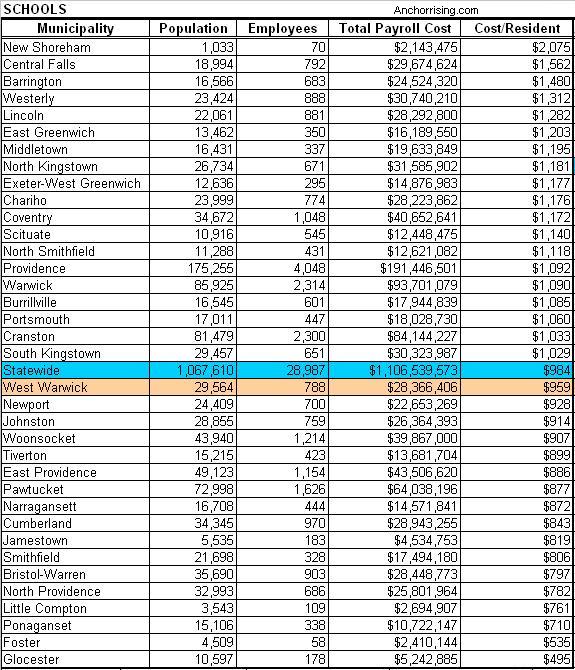
Mike Huckabee on School Vouchers
I was able to attend Governor Mike Huckabee's Rhode Island press event last evening, immediately preceding his rally in Warwick. During the press conference, Russell J. Moore of the Warwick Beacon broke a chain of horserace and identity politics questions being asked by other reporters to -- get this -- ask an actual question about policy, inquiring about Governor Huckabee's position on school vouchers…
Governor Mike Huckabee: I think [vouchers are] a state issue. And the only thing I believe is that the Federal government shouldn't tell a state whether they can or can't do. If a state believes vouchers will improve educational opportunities for it students, they should do it. So I'm for them, if that's what a state chooses to do. What I don't want is a Federal mandate telling a state it has to have them or that it can't have them, because that is not a function or role or right of the Federal government.
Anchor Rising (Er, perhaps shouting out a bit louder than is normally done at a formal press events. Retroactive apologies for being a surly New Englander): How about a judicial ban?
MH: Pardon me?
AR: What if a court says you can't have vouchers?
MH: It depends on why they said it. If it is because it creates a racial imbalance or some issue that goes to the heart of the constitutional question, then the courts would have to be followed. But I don't know about any case like that, I didn't confront that in Arkansas.
Now, at a mainstream press event, I don't expect a candidate to be in full wonk mode, but I found this answer to be unsatisfying. It is true that the United States Supreme Court ruled in 2002 in Zelman v. Simmons-Harris that there are no federal grounds for blocking voucher programs, even when vouchers are applied to religious schools, but there is still much that will be litigated with respect to vouchers. The year after Zelman, the State Supreme Court of Colorado struck down a voucher program that had been approved by the legislature on the grounds that it violated a state constitutional provision on local control. And, at the beginning of 2006, the State Supreme Court of Florida used even vaguer language to strike down an "opportunity scholarship" program, on the grounds that the state constitution requires that education be "uniform".
It may be legitimate to say that cases like the recent Florida and Colorado cases shouldn't involve the Federal government, but that's different from taking the position that there are no court issues involved. When the well-financed, well-organized opponents of vouchers take to the courts to block programs passed by state legislatures, would a President Mike Huckabee use the bully pulpit (and maybe support the writing of a Justice Department amicus brief or two) to support giving parents the maximum resources for finding the best education for their child, or will he be OK with an education policy that tells teachers and students that their job is to meet federal goals (Governor Huckabee is a proponent of No-Child-Left-Behind) while limiting them to a narrow range of means deemed allowable by judges in the name of "uniformity"?
Plus, there is still at least one remaining issue with vouchers at the Federal level, the so-called "Blaine amendments" written into the constitutions of 36 states that expressly ban the public financing of religious-based schools. New Hampshire's provision provides one of the most direct examples…
. . . no money raised by taxation shall ever be granted or applied for the use of the schools or institutions of any religious sect or denomination."(Incidentally, Rhode Island is one of the states that doesn't have a Blaine amendment, which would make implementing a voucher plan easier here than in other states.) Does Governor Huckabee believe that vouchers are a cut-and-dried federalism issue when their implementation is blocked by state constitutional provisions that mandate discrimination on the basis of religion?
Unfortunately, Governor Huckabee's squishy answer on the subject of vouchers reinforces the idea that if elected President, he is not someone who will be an innovative policy guy. Yes, I know he's in favor of a national sales tax, but say that his tax plan, which is a longshot at this moment in history whether it's a good idea or not, fails to win Congressional approval. What comes up next on President Huckabee's domestic agenda? De-centralizing things so that people have maximum freedom to use their tax dollars as they see fit, however they are collected? Or is he more of a Rockefeller Republican than his blue-state critics give him credit for, someone who is satisfied with saying, well, with a good guy like me in charge, we can make big bureaucratic government work! Mike Huckabee has to show a little more creativity on policy to convince conservatives that his positions don't tend towards the latter.
I hope that the Governor's supporters will take this as a constructive criticism, as Governor Huckabee could be a figure who could help unite the different wings of the Republican party -- if he is truly open to the full range of conservative ideas on domestic policy.
February 25, 2008
School Spending in Rhode Island
Jennifer Jordan has an article in today's Providence Journal's about a recently released RIPEC report, “How Rhode Island School Finances Compare”.
The ProJo headline, "R.I.’s Reliance on Local Taxes for Schools Deepens" and the subject of the first five paragraphs of the article, was actually only one of eight major findings of the report. This was immediately followed by a discussion of the state's lack of a "predictable school funding formula".
But Rhode Island, along with Pennsylvania, lacks a predictable school-financing formula. Lawmakers, educators and watch-dog groups including RIPEC have been working together to hammer out a formula they say would shift more of the burden of paying for schools to the state. [RIPEC Executive Director John] Simmons said the ad hoc group plans to submit legislation on a financing formula next month.
As has been noted recently, this too often seems to be code not only for moving the collection and expenditure of education revenue away from local control but also its increase. In view of Rhode Island's ranking nationwide as fourth highest taxed and the finding by the report that Rhode Island ranks ninth in per pupil spending, shouldn't the emphasis be on the stabilization of spending rather than the shifting around or even amplification of revenue?
One other item specific to the article. Jordan refers to the amount of state aid to education as $672,000,000. In fact, the State Budget FY2008 has the figure for Elementary and Secondary "Expenditures from General Revenues" at $909,429,659. I've e-mailed her requesting the source of her figure which may provide clarification.
The last third of the article discusses the other major findings of the report. Below are all eight, in order:
• Per pupil education expenditures across the country have increased at a significant rate
over the past ten years. The national average increase was 60.6 percent.
• In Rhode Island, per pupil expenditures have increased 56.3 percent since the 1996-97
school year, slightly outpacing the rate of increase in Connecticut (55.0 percent) and
lagging behind Massachusetts (79.6 percent).
• In 1997, Rhode Island ranked 7th highest for per pupil expenditures; in 2007 the State was
ranked 9th highest.
• While Rhode Island spends less than both Connecticut and Massachusetts on a per pupil
basis, the Ocean State significantly outspends its neighbors when education expenditures
as a percent of personal income are considered.
• On a per $1,000 of personal income basis Rhode Island has seen slower growth in
education expenditures than Massachusetts; however, the Ocean State has seen education
expenditures per $1,000 of personal income increase faster than both Connecticut and the
national average.
• Rhode Island ranked 16th highest in the country for current education expenditures per
$1,000 of personal income in 2006-07 and 18th highest in 1996-97. Connecticut and
Massachusetts also rose in the national rankings, from 31st to 30th highest, and 38th to 25th
highest, respectively.
• Rhode Island continues to depend more heavily on property taxes to finance education
than the rest of New England and the country. Over 60 percent of education revenues
came from local sources in 2007, an increase of 6.2 percent from 1997. Nationally, 43.5
percent of education revenues came from local sources in 2006-07.
UPDATE
Jennifer Jordan e-mailed the following response regarding the figure of $672,000,000 which she used in her article:
The figure I quoted was SCHOOL AID to cities and towns only, not other monies the districts might receive for education purposes.Thank you.
February 19, 2008
The Most Basic Requirements
In a letter to the editor of the Sakonnet Times (not online), Tiverton High School physics and chemistry teacher Richard Bernardo offers general encouragement to everybody involved in the contract disputes to "roll[] up [their] sleeves and [get] the job done." In light of news released since Mr. Bernardo penned his letter, this part sticks out:
The teachers are desperate; they are desperate because, in reality, they are in the fifth year of a three-year contract. Lying underneath the fact is the reality that they knew a long time ago that they had chosen a profession such that they would be underpaid and under-appreciated. However, the current development was not expected; this is their livelihood, their bread-and-butter, on the table; in spite of everything, they fear that they have failed at this most basic of life's requirements.
Having looked at the step levels of Tiverton teachers (which increases they've continued to receive, along with annual raises, except for this year... so far), I'd say Mr. Bernardo's being a bit melodramatic. Those teachers, however, who are affected by the news that I mentioned above, would be justified in feeling desperate:
Meanwhile on Tuesday, the School Committee agreed to send nonrenewal notices to 34 teachers for the next school year. State law requires teachers be notified before March 1 if there is a chance they might be laid off the following school year.The notices will go to 15 teachers at the middle school, 12 at the high school, and 7 at elementary schools, Fiore said.
Squirm as the union might, the money is simply not there, and the union method requires an all-or-nothing approach that is leaving 34 teachers with nothing (at least when it comes to a contract for next year). Making matters worse, Tiverton's teachers won't be alone in the East Bay answering education want ads.
I'm truly sorry to hear about lost jobs, not the least because, as a parent, I'd prefer for the services that the district offers to be increasing. That might save me the time (at least) of looking into private schools. But as long as teachers continue to tie their fortunes to an organization that handles them as factory workers and must justify its existence — with emphasis on those with longevity — solutions for accommodating everybody will be illusory.
February 15, 2008
Re: RI School Performance
My word won't be taken on this, but I would love to learn that impressions of Rhode Island's public education are unjustifiably poor. The ax that I grind is with the amount that we pay for the results that we get, and mathematics proficiency of 50% or less is simply not acceptable in a state that pours so much into its education system. But evidence of improvements would be wonderful.
That is why I'm disappointed that I have to play to type and point out problems with the sunny picture painted by the Learning First Alliance/Rhode Island (LFA/RI) report (PDF) that Marc mentioned yesterday.
Plainly put, all of the bullet points highlighting improvements in proficiency (on which all of the proffered assessments are based) are arguably invalid because of changes in the testing beginning in 2004. From page 2 of the report:
Over the past 10 years, in respect to changes in federal mandates, students in Rhode Island have participated annually in two different statewide assessments. The New Standards Reference Examination (NSRE) was administered yearly to students in grades 4, 8, and 10 during the 1998-2003 academic years. In 2004, the high school grade changed to grade 11. Eleventh graders continued to take the NSRE through spring 2007; the statewide assessment for elementary and middle school students, however, changed after the 2004. Beginning in fall 2006, the New England Common Assessment Program (NECAP) was administered to all students in grades 3-8. High school students will transition to NECAP in the fall of 2007.
In other words, that roughly ten point jump in the percentage of proficient high school students from 2003 to 2004 is likely attributable to the fact that the students took the test a year later. For the lower-aged students, changes in the test itself appear to account for the large improvements that same year.
These complications carry over into the measurement of Regents Commended Schools, because that jump could very well have given the impression of "exceptionally high" performance in 2004. They also carry into the No Child Left Behind data because those, too, are based on progress and targets. Note, for example, the high school chart on page 5: The number of schools in the "moderately or high performing" category jumped in 2004 and has been drifting down ever since.
The somewhat confusing NCLB measure of "targets" is made less reliable (at least as it's being used in the report) because the final results appear to be inflated. Consider this footnote from page 4 (emphasis added):
The accountability rating was based on the aggregation of 3 years of testing on the statewide assessment in grade 10. The school as a whole and students in each of the eight student groups must meet the targets for the school to make Adequate Yearly Progress as defined by the federal No Child Left Behind Act of 2001. Schools without sufficient numbers of students (e.g., at least 45 students over the 3 years) in any one category were credited with meeting that particular target.
The bottom line is that some progress appears to have been made over the past decade, but there have been sufficient changes that it isn't as easy to make a fair assessment as it could be. Making matters worse is that many of the folks on whom citizens might want to rely for sober analysis seem more interested in "focusing on the positive."
February 14, 2008
RI School Performance - Getting Past Simple Categories
Learning First Alliance/Rhode Island is out with a report (h/t) in which they try to explain that the simple categories used to describe the progress (or lack thereof) of our schools are insufficient to the task. They have a point. Earlier this month, when digging into the latest reports on our state high schools, I noticed that some schools dubbed with the "Insufficient Progress" tag were actually outperforming the majority of other RI schools and, conversely, that a few schools making "Adequate Yearly Progress" were well below the average.
While I tended to focus on the fact that tagging a school with AYP sometimes obscures just how below average the school is, the LFA/RI report looks at it from the other direction.
Each year Rhode Island schools are evaluated on student performance on the statewide assessments in English language arts/reading and mathematics. The percentage of students meeting or exceeding proficiency often times gets overlooked by school classifications. We want to focus on the rest of the story. This story includes the increase in student performance in English language arts and mathematics at all grade levels, the percentage of schools commended for their sustained improvement, and the misconception that schools labeled as making insufficient progress are not improving.It is worth remembering that AYP does denote, well, "Progress." But LFA/RI is going further by explaining that insufficient progress in a few categories is enough to doom the overall rating of the school. They provide several examples of how the general label obscures the overall progress being made. Their ultimate goal is to "start focusing on the positive." Their case is compelling and adds a different perspective to our overall evaluation of the degree and pace of Rhode Island's effort to better it's education system.
Finally, while LFA/RI condemns the overly-simplistic classification system set up by No Child Left Behind, they say very little about the fact that the implementation of NCLB--flawed though it is--has given us a system of accountability such that we can measure the improvements LFA/RI now laud.
ADDENDUM: Incidentally, I was trying to find some stuff at the RI Dep't of Ed. web site and apparently the domain name has expired. What's going on, a budget crunch or something?
UPDATE: Via commenter Bob W., RI Dept of Ed is here... http://www.ride.ri.gov/
I think I knew that, but I tried the Google route and then the ri.gov route and both showed it as www.ridoe.net.
February 13, 2008
Sharing the Pain in Tiverton
I don't support residency requirements for such public employees as teachers. It's nice to think that your children are being taught by your neighbors (as inaccurate as that characterization of fellow townspeople may be), but schools should find the best teachers they can, and teachers should be free to decide where to live.
That said, my disagreement with Tiverton School Committee member Leonard Wright about whether it's more fair to "set teachers back" based on benefits or to set taxpayers back based on taxes made me wonder how many of the town's teachers are in both groups. I offer these charts with no real conclusions attached; they're just interesting.
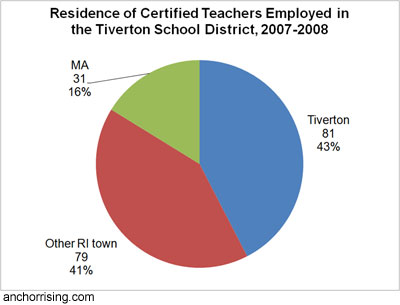
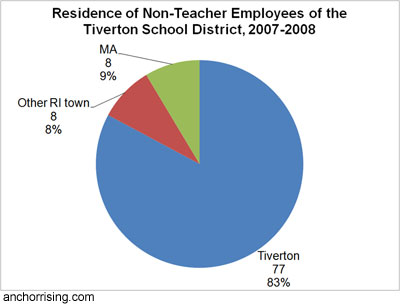
I'm curious what this data looks like for other towns. That information wouldn't happen to be centralized (or at least readily accessible) anywhere, would it?
February 1, 2008
Higher Ed Anathema
I'm sorry (dark times, and all), but I had to laugh. The student newspaper at URI, The Good 5¢ Cigar, has a story on decreasing state funding, and accompanying editorial contains this gem:
University President Robert L. Carothers said that the administration will have to do "some creative thinking." Has it really come down to this?
Creative thinking at a university? It is the end of the world.
Incidentally, although I haven't done the research, I suspect the claim that URI will be completely without state funds by 2024 is hyperbolic, related to this:
[Vice President for Administration Robert ]Weygand said state funding accounts for 26 percent of the university's revenue in the fiscal year 2008, while student tuition fees account for 62 percent of the university's revenue. The 2008 fiscal year began on July 1, 2007, and will end on June 30, 2008. ...In the late 1980s, Weygand said state funding was about even with revenue from tuition and fees. In 2008, however, he noted that tuition fees were about $100 million higher than state funding, which varied little since 1989 when compared with the tuition and fee spike.
I think what they're doing is taking this ratio and continuing the line out until state funding accounts for 0%, which is hardly a likely trend line. I'd be surprised if actual-dollar state funding hasn't increased in the last twenty years, just with spending, and therefore tuition and fees, increasing at a much greater rate.
January 16, 2008
Is an End to the Education Funding Formula Distraction Near?
Commenter "Mike" points out a Jennifer D. Jordan article in today's Projo that declares, if not dead, the idea of a statewide "funding formula" for education is now comatose…
An unlikely coalition attempting to develop a statewide school-financing formula has broken apart just as the state grapples with a $600-million budget gap over two years, leaving the future of the ambitious plan in jeopardy.I suspect the political-slash-fiscal reality that the proposed "funding formula" was going to require significant tax increases across the state while only benefiting a few communities finally sank into the minds of many of the politicians who would have to vote on it. "I'm voting to raise your taxes but give you nothing in return -- it's all going to the urban core because their problems matter and yours don't" is not exactly a winning formula in the suburban ring and the exurbs. And the politicians outside of the urban core probably didn't feel good about the positions they were hearing from urban reps like Edith Ajello…A hearing to discuss the formula was scheduled for 1 p.m. today at the State House. The House Finance Committee was to hear from a consultant hired last year to help lawmakers develop the formula.
Members of the Joint Committee to Establish a Permanent Education Foundation Aid Formula said they hoped the meeting would resurrect the discussion. But it is unclear if there is enough political support to approve the formula this year.
Last June, the joint committee, chaired by Rep. Edith H. Ajello, D-Providence, and Sen. Hanna M. Gallo, D-Cranston, ended the session without passing a formula.So if a formula were to be passed, without new money being allocated, what would happen? Would everything get pro-rated to the amount of revenue that actually exists, requiring cuts in aid to some communities, so others could get their formula mandated percentages?“I am hoping to push forward the concept of a formula even if there isn’t any money,” Ajello said in a recent interview.
Finally, the Projo article quotes Valerie Forti of the Education Partnership on alternative proposals…
“We didn’t want to give local districts more money without getting outcomes,” said Forti, whose group pulled out of the coalition last year. “The formula should require more from districts. It might require a certain kind of professional development for teachers, or give principals more control over teacher placement, or require a longer school day and year.”…to which I'll add one more: open districting, with money allocated to schools based on parents and students choosing to attend them. In a small, densely populated place like Rhode Island, a plan similar to the "San Francisco plan" described here could be very effective.
January 14, 2008
Differences of What's on the Table
Clarity on meaning is going to be absolutely crucial as competing visions are put forward to solve Rhode Island's ills, and one pair of concepts that may have confusing overlaps in education policy is "statewide funding formula" versus a "statewide teacher contract."
The former phrase, as came out in my discussion yesterday with Representative Joe Amaral (R, Tiverton/Portsmouth) refers to an equation whereby the state provides a predictable amount of money to districts based on set criteria. Such a formula could be devised fairly or unfairly, depending on how carefully the criteria are termed in order to benefit certain districts (such as Providence) according to a priori demands and on whether the formula makes unfunded mandates from the state less tenable.
The latter phrase appears to be the wishlist approach of officials in East Providence:
The school district has been running with a deficit for the last six years. The highest amount was over $2.7 million in 2004, but since then it has been reduced to as little as $1.3 million in 2006.It's back up again and school and city officials said this week that it will take multiple measures to rid the nearly $3.3-million deficit that will be a reality at the end of this fiscal year.
At a joint meeting Monday, the City Council and School Committee brainstormed a slew of cost-saving possibilities. They included reducing the state's 36 school districts to five regional operations; privatization of some schools; selling or leasing the school administration building on Burnside Avenue; and pushing the General Assembly for relief and a statewide teacher contract.
Whether the state steps in to unify the districts or "just" to negotiate teacher remuneration via a single contract from border to border, the result would likely be catastrophic. All that such centralization would accomplish would be pulling the tax-draining practices of the education establishment (including the unions) further away from the voters and probably adding a few more layers of obscurity on the question of who should be held accountable for excesses.
My own preference would be for the state to act as little more than an escrow holder paying out tax funds to parents' chosen schools. Until such a system becomes politically feasible, though, state disbursement of education funds ought to be as straightforward and evenly distributed as possible, with no demands that aren't inherently tied to funds.
January 10, 2008
Education Week Survey - RI Results
Dan Yorke reminded me about this story in today's ProJo:
Rhode Island has received mixed grades on the quality of its public education system, scoring poorly in two critical areas: student achievement and efforts to improve teacher quality, according to a national education magazine.Education Week has their report online and offers a few ways of looking at the data. (Including a way to make your own report). To compare the New England states, go here. Here is their specific report on Rhode Island (PDF). The ProJo article points out a couple other findings by EdWeek:Education Week’s “Quality Counts 2008” report card gave Rhode Island D’s in those categories. The state fared better in its academic standards and testing system, earning a B+; the overall chance for student success, B-; and the amount of money it spends on education, B. The state received a C- for its efforts to offer high-quality early-childhood education programs and prepare students for college and work.
Overall, Rhode Island averaged a C, matching the national average, but lagging the other five New England states.
•Rhode Island teachers are the highest paid in the nation when compared with other similar professions in the state. These include: accountants, architects, clergy, compliance officers, commuter programmers, counselors, editors and reporters, human-resources specialists, insurance underwriters, occupational and physical therapists, registered nurses and technical writers. Nationally, teachers earn just 88 cents on the dollar, when stacked against comparable professions. In Rhode Island, however, teachers earn about $1.12, or 12 cents more on the dollar than other comparable professions....[page 12 of the report - ed.]The problem with the overall grade (Rhode Island gets a "C") is that it's misleading. Look at the categories:•The report also found that Rhode Island ranks low — 44th — in the number of children whose parents are fluent English speakers, a potential risk for the future success of students whose parents do not speak English. [page 4 of the report - ed.]
•While the state ranked among the highest —7th — in its per-pupil expenditure (adjusted for regional cost differences), $10,581 a year per student, it scored at the bottom in school finance equity. Rhode Island ranked 42nd in its ability to bring all students to the same median level of what districts spend per pupil. [page 13 of the report - ed.]
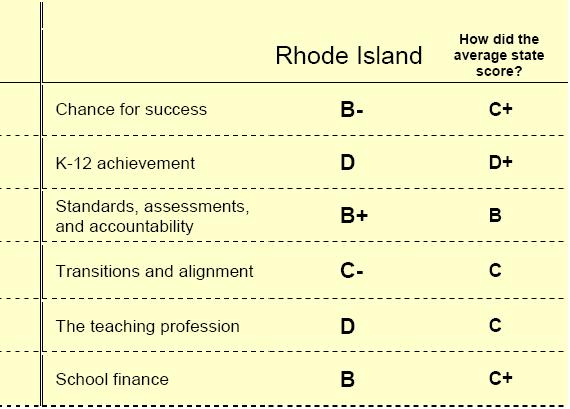
It looks like the infrastructure and money is there, but the results aren't. As Yorke said, "We've raised the bar but no one can reach it." The question we need answered is, "Why not?"
January 8, 2008
Financial Reality Hits
Tiverton Superintendent Bill Rearick just handed out a budget packet. Here's a key page:
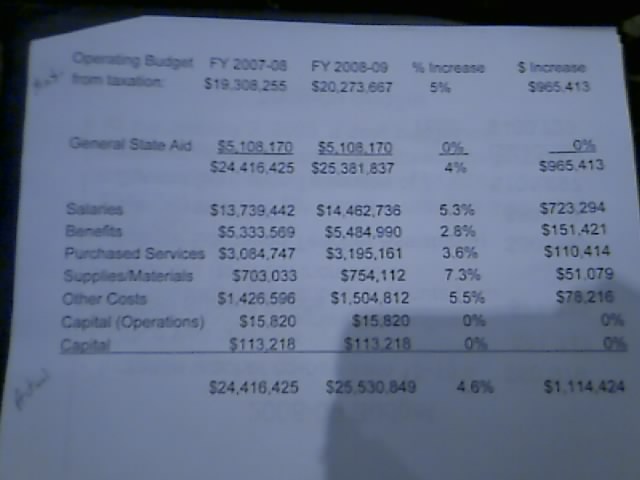
Obviously, the teachers' increase is TBA and estimated. (Amy Mullen got up and asked how they can be considered if there's no contract.) The bottom line is that, "as of January 8, 2008, the School Department is $149,011 over the spending cap," and the difference has to be found somewhere. Salaries are slated to increase (whether via steps and non-teacher contracts alone or including guestimated teacher rate increases, I don't know) $723,294. The excess over the cap is 20.6% of the salary increases. The entire excess could be wiped out by keeping the salary increase at 4.2%, rather than 5.3%.
Instead, people are going to lose their jobs and children are going to lose opportunities and services.
Making a Difference in Education
Thomas Schmeling passes on a bit of information of which we'd all do well to take note:
In December, I attended a meeting of the RI Board of Regents for Primary and Secondary Education. Parent/citizens were invited to comment on the question of how the teachers' contracts affect public education. It was not a large crowd and, given it was on a weekday at 3pm in Providence, almost everyone in the audience was from the city.Our group concentrated on criticizing the practice of "bumping", by which senior teachers get to push junior teachers out of jobs, regardless of qualification. (There was a post on this issue on this blog back in October). The Regents, and chair Judge Flanders in particular, seemed
genuinely interested in hearing our stories.At the end, noting the limited number of speakers, the Regents indicated that they would welcome further comment by email. I am passing this on to you because I know that some denizens of this blog have an interest in these issues.
The Regents seem to be taking this quite seriously. They are listening, and they are looking for practical ways to improve things. They have asked for comments about specific ways in which contracts affect public education. Stories about how the contract gets in the way of quality education would be welcome. (e.g. work-to-rule, teachers who refuse to meet with parents because of contract provisions, etc). So would stories about positive aspects of the contracts (e.g. how a contract protected a good teacher from unreasonable administrative retaliation). What is requested, and what is needed if actual changes are to happen, are specific examples tying provisions of the contracts to specific behaviors. Generalized polemics will probably turn out to be less than useful.
Send your comments to Regents' staff member Sharon Osborne at sharon.osborne@ride.ri.gov, they will be forwarded to the Regents.
January 4, 2008
Benefit/Cost Disconnect
Marc offered the substantive commentary yesterday, so all I've got in response to bad news about Rhode Island's high schools is a quip (emphasis added):
But proficiency rates among students statewide are stagnant. Despite an aggressive statewide high school reform effort, test scores of high school juniors have remained flat for the past several years, with about 53 percent scoring proficient or better on the English portion of the test and 43 percent scoring proficient or better in math.
And yet the teachers continue to demand annual raises, on top of annual step increases. Personally, I'd be embarrassed to demand more money if I couldn't show improvement. Before anybody doubles down on the good work of individual teachers, let me remind y'all that the teachers have chosen to negotiate as a group. So thus must their performance be judged.
January 3, 2008
RI High School Report Card: Sorting the results
The RI Department of Education released the latest RI High School proficiency ratings. Not good:
Only half of Rhode Island’s 58 public high schools are making enough progress in English and math, while the other half are failing to make adequate yearly progress — a slight dip from last year’s 54 percent.The ProJo story includes a table, sorted by town, that lists the current status of the state's high schools (a PDF is here). But that table doesn't really breakdown the data in a useful way. So I downloaded the info into a spreadsheet and played around with the sorting (here's the xls file--sort it however you want.) One option is to parse out the schools according to category: Caution, Insufficient Progress and Adequate Yearly Progress. But, if you focus too tightly on the Insufficient schools, you'll miss the fact that there are some schools making AYP that have scores below some others that have a Caution or Insufficient Progress rating. To make things more clear, I averaged the ELA and Math scores together and came up with this list:According to the results of tests given to 12,000 juniors last March, 40 percent of the state’s high schools are failing to educate all groups of students — including special education, low-income and minority students — to the state standard on English and math tests. Because these 23 schools have failed for multiple years, they are classified as making insufficient progress by the state Education Department.
Another 10 percent of high schools have failed to educate all groups of students to the state standard for one year, and therefore are placed on a watch list, including several rural and suburban high schools: Burrillville, Cumberland, Narragansett, Westerly and Chariho Regional.
The other 50 percent of Rhode Island’s high schools — 29 schools — made adequate yearly progress in the 2006-2007 school year.
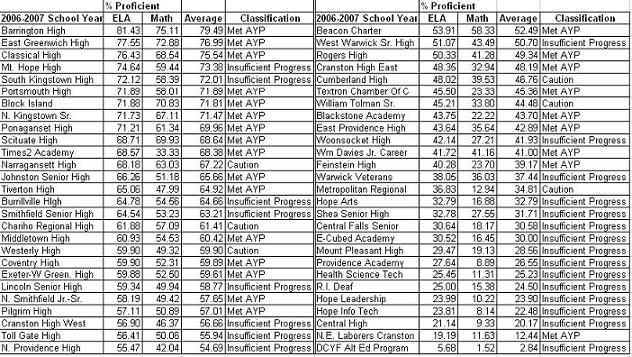
Obviously, there are some high performing schools that aren't progressing fast enough and others that we want to be sure don't slip back. But of more concern are those schools at the bottom.
December 27, 2007
A Local "No Child Gets Ahead"?
My first reaction is to applaud efforts to make high school graduation requirements more stringent, but something in the execution always seems to cloud the picture:
To ensure that a high school diploma in Rhode Island really means a student is prepared to graduate, education officials are developing tougher graduation requirements that would go into effect over the next few years.Instead of merely requiring that students pass 16 to 20 courses in key areas to complete high school, officials are recommending that students show they have mastered material and skills in three ways:
* Passing a minimum of 20 rigorous courses that align with grade-level expectations developed by the state Department of Education.
* Scoring proficient or better on statewide tests given junior year in English and math.
* Completing two out of the following three: a portfolio, senior project or end-of-course exams.
But doesn't appear certain to be a "pass all three" requirement:
Education officials are proposing that each of the three areas — courses, tests and project-based work — count toward one-third of a student's graduation requirements, although they have not worked out what score must be reached in each area. Students who fail to reach proficiency on standardized tests would be given another chance later in their junior year or at the beginning of senior year.
Admittedly, this is largely a gut response (to a program that is still inchoate), but I worry about the particular mix of cookie-cutter curricula and fudge-able measures, such as projects and portfolios. It seems likely to give blame for failures no desk on which squarely to land. The DOE says, "Hey, we developed standards." The schools say, "Hey, we can't accomplish things that are beyond our resources." And the teachers say, "Hey, we're trying to teach to a test, and that doesn't work for all students; look how well many of them did on their coursework, portfolios, and projects."
It gives everybody incentive to achieve good numbers, but no outside judge and no corresponding consequences for poor results. Projects can be little more than fluff if there's nobody who doesn't profit from the padding to offer assessment.
It also creates a spreading emphasis on the mediocre. The resources will flow to those who aren't hitting the metrics, to the detriment of those with greater potential. Note some of the specific suggestions and emphases from this article and from another:
- "More literary assistance" to children reading below grade level by ninth grade.
- Having "supports in place to help students who are struggling."
- Addressing "inadequate support for urban schools."
- Launching "a pilot early childhood program for low-income children."
I'm not saying that children who require additional help shouldn't receive it, but one never hears so much as lip-service to balancing dwindling funds for the benefit of less-needy students. Families with the resources will send their children to schools with more advanced opportunities (such as gifted and talented programs), and families with advanced children but fewer resources will find not only the opportunities dwindling, but also the interaction with academically comparable peers who happen to be of a higher socioeconomic status.
Readers are likely to recognize a recurring theme in the suggestion, but I'd suggest that two critical steps toward addressing the above concerns are (1) to bust the unions, and (2) to offer some sort of a voucher-like system. The first will make it more difficult for educators to manipulate numbers and apply pressure on requirements. The second will effectively create a group of external judges: the parents who are in a uniquely advantageous position to observe whether scores and grades are associated with a real benefit to their children.
December 21, 2007
A Substitute Career Path
Also in yesterday's Sakonnet Times is an article about the transitional pains at one of the Tiverton elementary schools that I mentioned last week. Principal Ed Fava ends the article on an interesting note, albeit by missing the more significant factor:
Mr. Fava has one more stress to add to his list this month: a shortage of substitutes."It's problem that is district wide," he said.
On Wednesday, Thursday and Friday of last week, Mr. Fava substituted for a first grade class and a fourth grade class. On Monday, Dec. 17, he substituted for a fourth grade class, while a resource teacher filled in to teach first grade.
"I just don't think we pay enough," he said. "That's why we can't attract them or hang onto them."
Substitute teachers in Tiverton make $72 a day and about 30 percent of that goes to taxes, he said.
"When you break it down, they're making a little over $7 an hour. You can make more than that working at McDonalds," he said.
It really isn't appropriate to compare substituting in public schools with working in a fast food joint. As with other apprentice-like, ground-floor positions in the public and private sectors, schools used to get away with the pitiful pay for substitutes because it was an early step on the path toward being a full-time teacher. I suspect that young would-be teachers are discovering, as my wife did, that the openings for teachers are, and will continue to be, increasingly rare, and increasingly political when available. Thank the teachers' unions, in part, for erasing merit comparisons from the profession, while also creating a very attractive slot in which even the mediocre have enhanced security compared with the private sector.
If young teachers can do little more than get in line for years on end, waiting for jobs that pay enough to attract the less passionate, that can be performed rather easily, if done poorly, and with dissipating risk of firing or layoff as time passes, then they'll conclude that either the region or the profession must be abandoned. Nobody's going to take fast-food–level pay (without benefits) for an indeterminate duration and little likelihood of advancing.
I'm not sure what the current rules are for non-teacher substitutes, but the lack of predictability and the early wake-up calls when a slot is open make it an unattractive means of earning extra money. For this group of potential subs, as with the hopeful young teachers, schools simply aren't going to be able to pay enough to overcome the barriers.
You want substitutes? Bust the union, reorder schools such that motivated and talented teachers can advance more quickly, and incorporate substitutes into the career path.
December 11, 2007
Facilities During Improvement
The school committee is looking for a temporary classroom because a school that's being phased out as new construction completes after this year is substandard. The idea is, as soon as possible, to spread the children out in (and out of) a building that is too small to accommodate them, for health and noise reasons.
Indeed, a grandfather of a student at the school got up and testified that his granddaughter is having to be tutored at home because she has a reaction to mold in the school. The teachers applauded his testimony.
Superintendent Rearick then explained that the school has been tested, and all of the relevant government organizations have looked at the building with no indication that there's a problem.
Now, I've no reason to disbelieve either party, and as a father, myself, I'm certainly concerned that children displaced as their school environments are massively improved will face harm during the transition.
But then one of the teachers who is always very vocal (apparently as a union member) stood up and expressed bewilderment that the district could come up with a few tens of thousands of dollars to pay for the portable classroom! That's simply unbelievable coming from a member of a group currently on work to rule seeking to squeeze every penny from the town.
December 8, 2007
Couldn't Have Put It Better, Myself
Our referral logs led me back to the following comment to a Kmareka post:
The fact of private schools is that parents can reign in or nullify the academic freedoms that make public and tenured institutions great opportunities to open young minds.
I couldn't have put it better, myself. Even the incorrect usage of "reign" (should have been "rein") is perfect. That is precisely why any Rhode Island parent with the resources should seriously consider private schools for his or her children.
Kids suffer from the mind-opening of tenured "professionals." (The NEA's Patrick Crowley has helpfully illustrated what children's minds are being opened to.) It's nearly disgusting, the presumption that random people with education degrees somehow have a fuller or more appropriate understanding of children's needs than the kids' own parents.
Would-be indoctrinators should stick to opening their own minds.
November 27, 2007
Leading Education News -- From Block Island
Gloria S. Redlich of the Block Island Times has her ear to the ground on a number of education trends that will be reaching all Rhode Island communities very soon.
1. Apparently, Rhode Island school committees are already hearing that flat funding of education aid, or perhaps even an aid cut, is being planned for next year…
Because the state is experiencing a $450 million shortfall, [Block Island School Committee member Sean McGarry] said, “They will be going to flat funding, which means we’ll get the same or less than last year.” In contract negotiations with teachers, the percentage of co-pay for health insurance will be a bargaining issue, with school committees determining which provider each district chooses.2. Unfortunately, Committeeman McGarry doesn't seem to understand the basics of education finance in Rhode Island. He thinks a "funding formula" is intended work to Block Island's benefit…
Pointing out that Rhode Island is one of only two states that do not have a funding formula to work from, McGarry said there is a proposal on the table to set a minimum for each district. With more tax money coming in from urban communities, where there is usually a larger industrial base than from rural areas, he thinks the proposal would benefit the island.If Rhode Island's education problems were really rooted in tax-generating urban districts being drained of their resources by surrounding smaller districts, then the solution would be to reduce redistribution between communities and let the urban districts keep more of their tax money. But that's not what's happening. What is happening is that residents of Rhode Island's less-urban districts (including Block Island) are already paying for a large chunk of urban district education expenses via statewide taxes in addition to paying their own expenses; meanwhile, the urban districts are demanding "more" from the surrounding communities and think that a "funding formula" is the best way to get it.
If there is a funding formula proposal that "would benefit the island", it is because Block Island already receives so little state aid (less than $1,000 per-pupil compared with the nearly $7,000 per-pupil paid to the big districts), formula advocates feel it is necessary to raise Block Island's aid share via a minimum aid provision, to mask an obvious example of how the state aid structure is of no benefit at all to many Rhode Island communities. Of course, if Block Island and the other RI communities who right now receive barely anything from the state get to hold on to some extra money in the interests of preventing the formula from appearing too lopsided, it will mean that the communities in the middle of the pack will end up paying for the entire increase in subsidies to the urban districts that the funding formula is designed to implement.
3. I'm not sure if this involves a misprint or something misheard, but this sentence from Ms. Redlich's story may contain a wealth of insight into the state's future plans…
In an attempt to consolidate services and reduce expenditures, the state is also looking to reduce the numbers of school districts from 36 to six, thus reducing the number of superintendents.Generally, when consolidation has been discussed in Rhode Island, the number of regional districts discussed has been five, one per county. Where the number six comes from, I am not sure.
And "reducing the number of superintendents" means that strong consolidation, i.e. full regionalization, rather than a plan that involves combining certain administrative services like purchasing, is under consideration. The main purpose of strong regionalization is to let politicians choose which tax bases outside of their constituencies they'd like to exploit, rather than to let parents choose schools which are best for their kids.
November 25, 2007
Re: Let's Make Everybody Special
Let us not forget that in this area can be found yet another dubious "Rhode Island, We're Number One!" rating.
From a February 8 Providence Journal article by Jennifer Jordan:
Rhode Island already claims the highest percentage of students in special education in the country – 21 percent compared with the national average, 13.7 percent
What is the drawback?
It costs far more to educate a special-education student in Rhode Island – $22,893 a year, compared with $9,269 for a regular-education student.
How have we achieved this distinction? A Jennifer Jordan article in the May 20 ProJo identifies over-diagnosis as a major factor. And the "target" is equally disturbing.
"Too Many Minorities in Special Ed"Seven school districts in Rhode Island are labeling too many students of color with learning disabilities they may not have and placing them into special education, a problem that has sparked a federally required review by the state Education Department.
In Central Falls, Hispanic students are almost 10 times more likely to be labeled “mentally retarded” than their non-Hispanic peers.
Black students in Providence are five times more likely to be classified as “emotionally disturbed” than other students.
Native American students in South Kingstown are 16 times more likely to be categorized as “learning disabled” or “other health impaired,” a category that includes attention-deficit hyperactivity disorder.
East Greenwich, Narragansett, Newport and Woonsocket were also cited for disproportionately identifying black, Hispanic or Asian students with learning disabilities, according to state education officials, who have been meeting with district leaders to find out why.
The State Director of Special Education, Kenneth Swanson acknowledges that
REFERRING TOO MANY students to special education in general is a statewide and national problem that needs to be addressed by an overhaul of the education system, Swanson said.Special education has become a fix-all, educators say. In some cases, students having trouble learning to read, students acting out, and students with speech issues are being shuttled into special education instead of getting academic or behavioral help.
On a side note, "overhaul" sounds like an overly-dramatic, not to mention unnecessarily expensive, response to this problem. Is this not a simple matter of tweaking (or enforcing) the guidelines for the diagnosis of students?
Returning to Justin's post, the question of the funding source of special education takes on an even greater importance if the state education system has identified (wrongly, it appears in many cases) a disproportionate number of students for these programs. But whatever size the special ed population in the state shakes out at, the idea of sliding part of that bill across the city line has no basis in logic, accountability or good governance.
November 24, 2007
Let's Make Everybody Special
I know it's de rigueur to advocate for those who require additional help in school in an effort to bring them as near to the average line as conceivably possible, but something just seems wrong (in certain lights, immoral) about opposing this change, as described in the Rhode Island Catholic, in a state with as bleak a future as ours:
Changing the way special education is funded and provided in non-public schools by eliminating the state regulations and exclusively following the federal regulations. These federal regulations require the LEA, local education agency or, more simply, school district, where the non-public school is located to provide special education funding and eliminate the current state standard under which the LEA where the child lives, if it is different, would also contribute services if there was an additional need. For example, a special needs child lives in Providence and attends a non-public school in Johnston, under the current regulations, if necessary, that child would receive special education funding or services from the non-public school, and the Providence and Johnston school districts. If the proposed changes are accepted by the board, the funding would only come from Johnston, and if there was additional need the school district where the child lives would not be required to contribute services. The school district where the child lives is exempt from providing services despite the fact that the child lives in Providence, his parents pay school taxes to Providence, and, as one Catholic school parent pointed out, the child could very well go on to live in Providence after graduation.
Firstly, if the argument for money from Providence is that the child's parents pay taxes in that city, then what's the argument for money from Johnston? Simply that the school is located there? It seems to me that one might just as well argue that Cranston ought to contribute because the private school's special education teacher pays taxes there, or Westerly ought to contribute because the child's grandmother lives there, and after all, he might opt to live closer to her after graduation.
Secondly, not to sound cruel in my naivété, but why ought special needs equate to special privileges? One parent's reasoning makes the current system sound fundamentally unjust:
Mary Lennon, whose daughter attends a Catholic school and receives special education services, addressed the board Wednesday night about the effect these proposals would have on her daughter. She called on the board to continue to make Catholic education a viable choice for parents of children with special needs. "Children with disabilities will face enough challenges in life. A well-planned Catholic education with the right supports in place will sustain them," she said.
As it happens, I'm currently looking into Catholic schools in part because the Tiverton school district doesn't offer any sort of gifted/talented program. Why should my children languish in a system that I don't believe to be sufficient for their needs — having heard from parents whose children went far astray because they weren't adequately challenged in it — even as my tax dollars finance attendance at my preferred school for children who clear Rhode Island's lowered special-needs bar? Why, for that matter, shouldn't Catholic education be "a viable choice" for all taxpaying citizens, no matter the advantages or disadvantages of their children?
I don't know the specific dollar breakdowns pertaining to special needs students in private school. I suspect the parents still pay some of the tuition, and I can sympathize with the argument (which I could imagine making, myself) that private schools might shy away from accepting such children unless they were able to make up some portion of the extra cost of educating them. It just seems wrong, though, for only the wealthy and the challenged to be able to escape undesirable — and decreasingly funded — schools.
November 19, 2007
The Real Purpose of the Funding Formula: Setting up the Excuse of "But What Can We Do?"
Both Jennifer D. Jordan's funding formula advocacy in the news pages of the Projo…
An audience of 500 educators, politicians, child advocates and business leaders met at the Rhode Island Convention Center yesterday to discuss one of the most pressing education issues facing the state — developing and enacting a fair school funding formula.…and Russell J Moore's more objective coverage in the Warwick Beacon…
While a school funding formula that’s fair and equitable to all communities is the big catch phrase in the current political environment, some looking for reform believe the state’s education problems run much deeper.…quote the same two Rhode Island Mayors, Providence's David Cicilline and Warwick's Scott Avedisian, who both favor the formula as the solution to Rhode Island's education problems…
"What we have in place right now is no formula,” said Providence Mayor David N. Cicilline. "It’s an unfair system. The status quo is not an option. We need to do something bold and different"…Why Mayor Cicilline favors a "funding formula" is obvious. He believes he has the political clout to have the formula rigged in his favor, guaranteeing that the statewide tax increases needed to implement it will be used to pay increased benefits to Providence."The financing governance is dysfunctional,” said Warwick Mayor Scott Avedesian. “We had a $600,000 deficit in the school budget this year, and they are estimating [an even larger] deficit for next year. So you can see the immediacy of the need for a formula.”
But given the existing structure of Rhode Island's education finances -- with close to $7,000 per pupil paid to Providence and Pawtucket and a few other "distressed" communities, while less than half that amount is paid to a majority of other communities in Rhode Island -- why anyone (like the Mayor of Warwick, for instance) not from one of the half-dozen or so mostly urban communities that receive large per-pupil subsidies supports the idea of a funding formula is less clear. There is simply no way that everyone can come out ahead in a system of centrally planned, bureaucratic money shifting. Either the new formula is going to increase the subsidies paid to Providence, Pawtucket, Woonsocket and a few other "distressed" communities, by increasing the education costs borne by most other Rhode Island cities and towns, who will have to continue to pay for their own school systems while absorbing the costs of the increased subsidy payments, or the formula will reduce total costs to the less "distressed" communities by cutting the already generous subsidies to the current big-beneficiaries.
So how has the idea of a "funding formula" managed to build any broad-based political support as the solution to Rhode Island's public education crisis at all?
The answer is that, for many of Rhode Island's political leaders, the funding formula is not about sensible finance. It is about an opportunity to defray responsibility. The purpose of the "funding formula" is not to make public education more affordable or more effective, it is to make education spending into an entitlement program, whether it is affordable or effective or not. With a "funding formula" in place, the pols won't ever have to entertain thoughts of using creative, modern ideas to allocate resources more effectively; when the time comes to vote on the tax hikes needed to pay for the subsidies, they will point to the funding formula provisions in the law and cry "But what can we do?" – "The law requires us to raise your taxes so we can send your money to other communities."
Sometimes, politics ends up aligning leaders together with other leaders, instead of in support of programs in the best interests of the people they represent.
The Warwick Beacon: Rhode Island Education Needs an Overhaul, Not a Shifting of Costs
Hurrah for the community newspaper!
Unlike the news department of the Projo, which uncritically builds into its coverage the assumption that a new "funding formula" can somehow magically solve Rhode Island's education problems, the editorial board of the Warwick Beacon takes a more questioning view…
Problems in Rhode Island’s educational system indicate the state doesn’t need to raise revenues to fund schools or shift the costs from one place to another; it needs to overhaul its educational system.Vouchers aren't the only possible reform that could be used to improve the allocation of resources and spur educational reform in Rhode Island. Other possibilities include cross-district choice, removing the state-created barriers to charter schools and tax-credits for school tuition.According to the Rhode Island Public Expenditure Council, the state spends the ninth highest amount of money on per pupil expenditures in the nation, while its students score well below the mean average on various standardized tests, such as the SAT.
So it appears the state’s education problems don’t stem from a lack of revenue, but from a system that is faulty at its core. After all, a company with a flawed business model wouldn’t succeed even if $1 trillion were invested in it. The same is true of a flawed school system.
To reform schools, the state should start by looking at teacher contracts, which lack incentives for effectiveness. Teachers are paid according to the same scale, regardless of performance....The same is true of the schools themselves.
But there is a solution to that problem.
Milton Friedman, who won the Nobel Prize in Economics in 1976, coined the idea of “school vouchers” in the 1950s. Friedman’s idea was to give parents a voucher, equal to the price of educating a student in a public school, and allow the parent to use it at the school of their choice.
The notion would result in schools being forced to compete with one another for students. The high performing schools would thrive, as more students would flock to them, while the poor performing schools would be forced to close, as students would avoid them.
The vouchers system is especially appealing to lower income parents. A parent of a student who normally wouldn’t be able to afford to send their child to a private school would be allowed to use the voucher.
Any of these programs would be superior to a centrally planned "funding formula" which, as it would be implemented in RI, would quickly become a program of raising taxes on communities with good school districts as a means of subsidizing underperforming municipal bureaucracies in other communities.
The Warwick Beacon: Rhode Island Education Needs an Overhaul, Not a Shifting of Costs
Hurrah for the community newspaper!
Unlike the news department of the Projo, which uncritically builds into its coverage the assumption that a new "funding formula" can somehow magically solve Rhode Island's education problems, the editorial board of the Warwick Beacon takes a more questioning view…
Problems in Rhode Island’s educational system indicate the state doesn’t need to raise revenues to fund schools or shift the costs from one place to another; it needs to overhaul its educational system.Vouchers aren't the only possible reform that could be used to improve the allocation of resources and spur educational reform in Rhode Island. Other possibilities include cross-district choice, removing the state-created barriers to charter schools and tax-credits for school tuition.According to the Rhode Island Public Expenditure Council, the state spends the ninth highest amount of money on per pupil expenditures in the nation, while its students score well below the mean average on various standardized tests, such as the SAT.
So it appears the state’s education problems don’t stem from a lack of revenue, but from a system that is faulty at its core. After all, a company with a flawed business model wouldn’t succeed even if $1 trillion were invested in it. The same is true of a flawed school system.
To reform schools, the state should start by looking at teacher contracts, which lack incentives for effectiveness. Teachers are paid according to the same scale, regardless of performance....The same is true of the schools themselves.
But there is a solution to that problem.
Milton Friedman, who won the Nobel Prize in Economics in 1976, coined the idea of “school vouchers” in the 1950s. Friedman’s idea was to give parents a voucher, equal to the price of educating a student in a public school, and allow the parent to use it at the school of their choice.
The notion would result in schools being forced to compete with one another for students. The high performing schools would thrive, as more students would flock to them, while the poor performing schools would be forced to close, as students would avoid them.
The vouchers system is especially appealing to lower income parents. A parent of a student who normally wouldn’t be able to afford to send their child to a private school would be allowed to use the voucher.
Any of these programs would be superior to a centrally planned "funding formula" which, as it would be implemented in RI, would quickly become a program of raising taxes on communities with good school districts as a means of subsidizing underperforming municipal bureaucracies in other communities.
November 17, 2007
Digging Out by Digging Down
The following aspect of the Rhode Island Department of Education's approach to dealing with dramatically tightening budgets is wrong-headed for two reasons:
The $1.16-billion budget proposal also doubles fees for teacher certifications and permits, from $100 for a five-year professional certification to $200, for example, in an effort to generate about $400,000 in revenue.
The anti-unionist's gut response might be gratification that the union teachers are being made to funnel a little of their spoil back into the state's coffers. The most significant effect of these fees, however, is to keep out new candidates, who (if market forces are ever allowed to work in Rhode Island's public sector) would drive down the cost of teachers, which would translate into less money needed by the state's education industry. The solution — which isn't exactly counterintuitive — to the department's budget woes is to make it easier for people to become teachers and for good teachers to thrive.
More generally, though, the powers that won't-be-for-long really must accept the notion that raising more revenue will not solve the problem. Until that frame of mind is broken, the money will just float around in its stagnant pool.
November 7, 2007
Utah Voucher Program Defeated
The Utah voucher plan that would have made a $500 to $3000 voucher available to every child in Utah, applicable to the school of their choice, was defeated in a voter referendum yesterday. The Salt Lake City Tribune has a nuts and bolts election report...
Voters decisively rejected the will of the Utah Legislature and governor Tuesday, defeating what would have been the nation's most comprehensive education voucher program in a referendum blowout....More than 60 percent of voters were rejecting vouchers, with about 95 percent of the precincts reporting, according to unofficial results. The referendum failed in every county, including the conservative bastion of Utah County.
November 1, 2007
Can We At Least Agree on Banning the Hyperbole?
Over on his blog, America's Report Card (named after a novel he published, not the scope of topics he addresses) Professor John McNally has put up a post claiming that PINHEADS (all caps in the original) have succeeded in getting When I Was a Loser, the now-controversial collection of essays he edited, banned from…well, he doesn't really say where it's been banned from.
When I Was a Loser has been removed from the Cumberland school-system curriculum. There's no doubt there. But does removal from the curriculum constitute banning in any meaningful sense of the word?
A couple of years ago, a local Michigan school board refused to allow the teaching of a Bible-based course that treated the Bible as a work of literature and history. Would it be fair to say that the Frankenmuth, MI School board voted to ban the Bible, or would that description confuse the issues more than clarifying them?
The claim that When I Was a Loser has been banned obviously depends on some form of fallacy, but you'll have to ask Justin to find out exactly which one is involved.
Justin provides the type of fallacy committed by Professor McNally. It is...
The fallacy of persuasive definition.
October 30, 2007
A Fallacy of Fallacies
Putting aside his petty complaints that Dan Yorke and Lori Drew interrupted him on the radio (but noting that I heard him interrupting Ms. Drew moments before chastising her for doing the same), this aspect of John McNally's thoughts on his appearance on Dan Yorke's show relates to a question that I've had since first coming across his blog last night:
When the d.j. Dan Yorke jumped in (Dan also interrupted me in the first part of the segment), he wanted to argue my point by comparing Will's essay to a security system in the school. What if, he supposes, she had complaints about security? Shouldn't she have the right, as a parent, even though she's not a security expert, to bring this to the attention of the school? My reply was that it was a logical fallacy to compare a security system to an essay that's part of a school's curriculum. He said, "It's not a logical fallacy," and I, making the mistake of thinking this was a debate, and interrupting him as both he and the mother had done to me, said, "It IS a logical fallacy." ...(Just because two issues share SOME things in common -- like schools and teachers -- doesn't make it a valid comparison. This is Freshman Comp 101, not rocket science, but if that makes me an academic jack-ass, so be it. I'd rather be the person who can distinguish those differences than the one who can't. And if my tone here is elitist, so f***ing what?) ...
So, yes, okay, I'll concede: Maybe I am a certain kind of academic jack-ass who thinks his s*** doesn't stink. Those who know me, of course, are howling right now, but pay no mind to them, because you know what, Dan Yorke? I'd much rather be me than you, a jack-ass d.j. who doesn't know what a logical fallacy is, and whose only come-back is yet another logical fallacy: the ad hominem attack.
Frankly, I'm not persuaded that Mr. McNally is entirely clear on what constitutes a logical fallacy, himself. Here, McNally flings the label upon hearing Yorke equate school security with a reading assignment, which would have been a fallacy of composition and division (some aspects of each thing are like, therefore, they are like in total and, therefore, in other particulars). But this is a strawman (fallacy). A comparison's being invalid doesn't make it logically fallacious. It falls to McNally, at this point, to explain why security and reading assignments are not comparable in the aspects that Yorke intended (in this case, the right, even obligation, of parents to speak up when they think the academic professionals to be in error).
Elsewhere, McNally replies thus to a commenter who questioned whether he would have a problem "if the school assigned Bill O'Reilly or some right-wing book to students to read":
YOUR ARGUMENT HERE IS A LOGICAL FALLACY...BUT I DON’T EXPECT YOU TO KNOW WHAT THAT MEANS. PEOPLE WHO USE LOGICAL FALLACIES RARELY KNOW WHAT THEY ARE.
In this instance, the rules of argumentative writing are a red herring (another fallacy), via which McNally attempts to divert attention from the questions. Those questions may be irrelevant, but that's an opinion requiring further debate; posing them doesn't represent a failure of logic.
As I suggested in the comments to my previous post, McNally is employing the technique of calling comparisons and analogies that he finds erroneous or inapplicable "logical fallacies" even though it's not the logic that is fallacious in those cases (which labeling is, itself, a fallacy of persuasive definition). He uses the phrase "logical fallacy" as an invisible wall to be thrown up around rhetorical opponents in order to invalidate their arguments on grounds that he presumes them not to understand.
The not-quite-unexpected irony of the post is that the centerpiece of his own argument is itself a logical fallacy:
My main complaint with this woman isn't that she doesn't want her daughter to read Will Clarke's essay, which she found offensive, but rather that she doesn't want the book in the school at all. In other words, she wants to dictate curriculum. So, you see, she's trying to dictate what OTHER KIDS in the class should be reading, not just what her daughter should be reading.
McNally presents a false dilemma: Either Drew must shut her yap, or she is attempting to "dictate curriculum" (sic). The alternative that this reasoning overlooks is that Drew is dictating nothing; indeed, she is inherently powerless to do so. (She hasn't even suggested, as far as I've seen, that she's considering legal action.) Rather, she's attempting to bring the matter into the open in the hopes that pressure will be brought to bear on those who do have the authority to raise the intellectual and moral level of the education offered in Cumberland's public schools.
Lessons Beyond Reading... and Administration
The truth — unfortunate or fortunate — is that I read much more explicit, more sexually descriptive texts for school work than Will Clarke's "How to Kill a Boy That No One Liked" (PDF sample courtesy of Dan Yorke), including, for example, books by Stephen King in which not a few young fellas likely knew the page numbers of the really juicy parts. There are two significant differences between that memory and the circumstances in which her daughter came to read Clarke's essay to which Lori Drew of Cumberland objects: I read such books for pick-your-own-book projects, so the onus for my choices ultimately rested with myself and my parents, and the readings were generally additional to the basic requirements. In the case of Ms. Drew's daughter, the text was specifically handed out, and it was meant to be compelling for unaccomplished and reluctant readers, presumably in place of the more appropriate materials that they would not read.
That last point is the worrying one, in the context (the subtext, one might say) of what the grownups are saying just below the surface. From the Projo story, here's Cumberland School Committee Chairman Frederic C. Crowley:
"It's no Catcher in the Rye, and there is language that is offensive in the essay, but no more than what kids are exposed to in music, video games, television shows and movies," he said. "I think it's a very appropriate decision. [Morelle] handled the issue immediately and she handled it correctly."
Here's John McNally, the editor of the book containing Clarke's story:
I'm not a scientist, so I don't tell scientists what to do. I'm not a physician, so I don't tell my doctor how he should treat me. But when it comes to "art," people who know nothing about it are quick to make uninformed judgments in the name of "protecting" their children from what ... the words on the page? The ideas connected to the words? The images the words may conjure in the reader's head?
And Here's Mr. Clarke himself:
Look lady, leave that poor teacher who assigned my story alone. And stop talking about sex with animals to every person with a microphone. You got your daughter out of the reading class and into a free office worker period where her mind won't be ruined by books. What else do you want?
Thus, with the ease of badminton quips, whacking a double-sized shuttlecock, the distant cultural missionaries, once invited in, proceed to force conscientious objectors out of their own classrooms. The point that Clarke studiously ignores is that Lori Drew does not want her daughter to miss out on her reading class, and it's a sneering vanity in the line of thought from the author through the school officials through the teacher herself that insists that the school establishment compromise the education of children whose parents have moral objections rather than conform the curriculum to basic minimum of standards of taste amenable to all, especially given the specific objective of a reading assignment. The children in Miss Drew's class are in need of additional help; the burden of adults' canned counterestablishmentarianism oughtn't be placed on their shoulders.
McNally recites the oft-employed reasoning that artists know art, and implies that those with less finely tuned aesthetic senses are foolish to fear words, images, or even ideas. Having strung words into a book or two, myself, I'll testify that it is a poor artist, indeed, who isn't fascinated — even awe-struck — by the power of that very triumvirate. (Come now, Mr. McNally, let's dispense with the faux innocence with respect to this poorly kept secret.) Moreover, in her attempt to push anything consisting of the English language past the eyes of her reluctant readers, those three aspects are certainly what attracted the teacher to Clarke in the first place.
There's a more direct, less abstract response to McNally, however: If the parents are out of their depth interpreting the texts in his book, how much more so will the children be? What message are they receiving from When I Was a Loser? One author defends Clarke by pointing out that his own essay in the book is far more explicit. The Providence Journal story describes another essay about a young woman who "rationalized her secret sexual promiscuity and her image as a good Christian girl."
In this light, Clarke's essay may be the more deleterious. Having read only what Dan Yorke has made available (because I lack the interest to purchase the book and the time to read it in the aisle of a book store or library), I cannot say without disclaimer, but the take-away appears to be that sex sells, even when it is hidden — the supposedly benign three letters of the word itself — in a student-politician's campaign poster. That may be true enough, but is that a lesson that must receive a school's imprimatur, within a behind-the-curve reading class? Such kids are facing high enough hurdles without the school's reinforcing and legitimizing the corruptive lessons of "music, video games, television shows and movies."
Authors write as they wish, and we ignore at our peril the reality that people sinking in mire must by necessity grab for redemptive vines covered in the same muck. The real illness on display, it seems to me, is in the fear of mere "connotations" that has kept School Superintendent Donna Morelle from responding more appropriately to the needs of an actual student, and her family, within her care:
"We're not banning books or anything like that," Morelle said. "There's a whole set of connotations about banning books. That's not a boundary that I'm ever willing to cross."
As if books are not removed from reading lists (or kept off them in the first place) for a range of reasons all requiring judgment of some fashion. Yeah, banning books is bad. Repressive. I've seen that movie, too. But sometimes grownups have to question their own moral absolutes for the sake of those under their power. And sometimes parents have better standing (let alone a right) to determine whether the grimy threads will reach their children as lifelines or as a net.
October 22, 2007
Education Innovation in Cumberland
Cumberland Mayor Daniel McKee is one of Rhode Island's most vocal advocates warning that shifting tax burdens from one community to another via a "funding formula" cannot produce true education reform and that more creative solutions are required.
At home, Mayor McKee looks to be helping practice what he preaches. From Sandy McGee of the Pawtucket Times…
Michael Magee, director of the Office of Children and Learning, presented an update on what he called his "second 100 days in office" to the Town Council at Wednesday night's meeting at Town Hall."I'm very pleased of what's going on in that office," said Cumberland Mayor Daniel McKee. "We're creating an environment that says education is important in our community. Education is the issue of our time."
Magee said the office's SAT preparation course, which partners Cumberland students with college graduate students from throughout the state, has proven successful.
"We've seen a 13 percent rise in SAT scores from students in the program," Magee said. "We anticipate a much higher rise in the percentage next year."
Magee also discussed the office's new Youth Commission, which will consist of 14 Cumberland High School students who will act as youth ambassadors to the mayor's office. The commission is scheduled to meet with the mayor in three weeks to discuss how Cumberland's youth are affected by town decisions.
Officials at the Office of Children and Learning are also planning a "green map" program, where Cumberland High School students will receive geographic information system (GIS) software to collect maps and land surveys throughout town. The program will offer a new option for high school students in need of community service hours, a requirement for graduation.
October 19, 2007
Providence Parents Versus Bumping
According to multiple sources, the number one concern expressed by Providence parents at Wedenesday night's East Side Public Education Coalition/Martin Luther King Parent-Teacher Organization open forum was a need to reform the "bumping" system that requires personnel decisions to be made on the basis of seniority.
From Linda Borg of the Projo...
The public’s frustration with the way that public school teachers are hired and fired was palpable last night, as parents demanded to know why highly qualified teachers are displaced based on seniority....From Thomas Schmeling of the East Side Public Education Coalition...Harlan Rich, one of the leaders of the East Side coalition, described the process as follows: every March, dozens of teachers receive pink slips warning them that they might lose their jobs in the event of a budget shortfall. During the summer, after the School Department determines its budget, teachers are rehired. When the schools are facing deep budget deficits, like they did this spring, bumping based on seniority creates a ripple effect that tears at the fabric of school communities, Rich said.
This summer, some schools lost a third of their staff because of bumping, and principals and teachers alike say that this process makes it difficult, if not impossible, to build on past successes when there is a constant reshuffling of faculty members.
“It’s clear that this is built into state law,” Rich said. “I want to know what the General Assembly is going to do about it.
The forum covered a number of topics, from funding to consolidation of school districts, to after-school programs, but things really heated up when the question of “bumping” of teachers was addressed. Each spring, large numbers of Providence teachers are laid off because the funds to pay their salaries are dependent on state budgets which are not approved until June. Priority is given to senior teachers. Newer teachers, often highly talented and successful, are displaced. The process appears to be very wasteful because, when funds are approved the majority teachers are hired back, but they often return only as long-term substitutes with uncertain futures, or as “permanent” teachers with the prospect of being bumped again next year. Some teachers are hired away by other districts before Providence has a chance to hire them back, and others give up. The story was told of an extremely talented high-school science teacher who was bumped twice, and eventually went elsewhere.And from Chaz Kelsh of the Brown Daily Herald...
Audience members became most incensed when speaking about the process of "bumping," when school districts fire more-junior teachers when the district budget has not been finalized. Some are later hired over the summer when funding officially becomes available. Schools are not allowed to rehire based on performance, participants at the meeting said, so younger but possibly more qualified teachers are let go if the budget decreases.The officials agreed that bumping is a problem at Rhode Island schools. "It has to stop," [City Councilman Cliff Wood] said. "It tears the culture of a school apart. The progress we've made will be over in a flash if we don't fix this problem."
But parents were skeptical that true change could be made.
"Why can't someone just stand up and say, 'I'm going to be the one to sponsor this?' " Kira Greene asked. Audience members responded with cheers and applause.
Providence Parents Versus Bumping
According to multiple sources, the number one concern expressed by Providence parents at Wedenesday night's East Side Public Education Coalition/Martin Luther King Parent-Teacher Organization open forum was a need to reform the "bumping" system that requires personnel decisions to be made on the basis of seniority.
From Linda Borg of the Projo...
The public’s frustration with the way that public school teachers are hired and fired was palpable last night, as parents demanded to know why highly qualified teachers are displaced based on seniority....From Thomas Schmeling of the East Side Public Education Coalition...Harlan Rich, one of the leaders of the East Side coalition, described the process as follows: every March, dozens of teachers receive pink slips warning them that they might lose their jobs in the event of a budget shortfall. During the summer, after the School Department determines its budget, teachers are rehired. When the schools are facing deep budget deficits, like they did this spring, bumping based on seniority creates a ripple effect that tears at the fabric of school communities, Rich said.
This summer, some schools lost a third of their staff because of bumping, and principals and teachers alike say that this process makes it difficult, if not impossible, to build on past successes when there is a constant reshuffling of faculty members.
“It’s clear that this is built into state law,” Rich said. “I want to know what the General Assembly is going to do about it.
The forum covered a number of topics, from funding to consolidation of school districts, to after-school programs, but things really heated up when the question of “bumping” of teachers was addressed. Each spring, large numbers of Providence teachers are laid off because the funds to pay their salaries are dependent on state budgets which are not approved until June. Priority is given to senior teachers. Newer teachers, often highly talented and successful, are displaced. The process appears to be very wasteful because, when funds are approved the majority teachers are hired back, but they often return only as long-term substitutes with uncertain futures, or as “permanent” teachers with the prospect of being bumped again next year. Some teachers are hired away by other districts before Providence has a chance to hire them back, and others give up. The story was told of an extremely talented high-school science teacher who was bumped twice, and eventually went elsewhere.And from Chaz Kelsh of the Brown Daily Herald...
Audience members became most incensed when speaking about the process of "bumping," when school districts fire more-junior teachers when the district budget has not been finalized. Some are later hired over the summer when funding officially becomes available. Schools are not allowed to rehire based on performance, participants at the meeting said, so younger but possibly more qualified teachers are let go if the budget decreases.The officials agreed that bumping is a problem at Rhode Island schools. "It has to stop," [City Councilman Cliff Wood] said. "It tears the culture of a school apart. The progress we've made will be over in a flash if we don't fix this problem."
But parents were skeptical that true change could be made.
"Why can't someone just stand up and say, 'I'm going to be the one to sponsor this?' " Kira Greene asked. Audience members responded with cheers and applause.
October 14, 2007
What's in a School?
It would seem that Kiersten Marek has misunderstood my impetus for considering private schools for my children. Citing a study by the Center on Education Policy that finds "no evidence that private schools actually increase student performance," she notes:
Over at Anchorrising.com, self-declared union-hater Justin Katz is wondering if he should send his children to private school. This study would suggest that perhaps he should save his paycheck for other things.
The post of mine to which she links describes the atrocious behavior of a group of unionists who are well compensated by any standards — even more so in relation to Rhode Island's behind-the-curve economics — and are tangibly harming the community of Tiverton and its children because they think the money-strapped town ought to fork over an even greater increase than is on the table as a matter of course. My confidence in that group of unionists is not, let us say, of the highest degree that they may unreservedly be trusted with those other areas of influence that are generally considered to accrue to men and women in the role of teacher. Any student, for instance, who had attended the last school committee meeting — or even who is sufficiently interested to follow the controversy in local papers — is at risk of learning a very detrimental lesson from them. I'm not at all persuaded, that is, that there aren't other benefits to the private-school environment.
To be honest, I'm not even persuaded that the argument of equivalence with respect to academic achievement is more than a numbers game. Studies achieve this end by controlling for such factors as parental income and involvement; in the succinct phrasing of Center on Education Policy President and CEO Jack Jennings, "private schools simply have higher percentages of students who would perform well in any environment based on their previous performance and background." But is it reasonable and fair to treat these factors as background noise when judging schools (especially from a parent's perspective)? Is that use of the word "simply" appropriate?
In some respects, I may be pulling the carrots out of the stew, here, but I can't help but recall in this context a study that the NEA's Bob Walsh cited in a comment to Tom Wigand's recent Anchor Rising post that found that the "very lowest- and very highest- achieving students fared somewhat worse on standardized tests in unionized schools." Being as objective as I'm able, the chances that my own children will be in the latter category are sufficiently good that it would be worth a modest investment to avoid such worsening, especially if the worst-case academic scenario is that the private school would do no worse than no better.
That sort of assessment from a personal perspective opens up another range of aptitude for discussion: I simply don't buy that children on the higher end of the "average" group don't benefit significantly from their placement among "higher percentages of students who would perform well in any environment." (One would expect all children to benefit from such company, of course, but with declining returns as one drifts down the scale of potential.) Controlling for self-selection, in other words, controls for a central benefit that private schools offer to the majority of their students.
I don't doubt that there are likely correlations between parents' inclination to be involved with their children's development, parents' wealth, and children's native intelligence (or raw potential). Such qualities would seem naturally to flow from certain biological advantages. Still, it strikes me as prima facie foolishness to discount peers and the school environment that they create — and that is created with them in mind. I'm about as egalitarian as they come with respect to each individual's inherent worth and am heartily skeptical about the ability of wealth, per se, to create happiness, but the sort of children — the sort of families — with whom one's progeny interact certainly has an effect on their development. Furthermore, it isn't classist to suggest that one's children are better off learning the habits of the group that is more likely to have children in private school.
As the product of public schools, myself, as a former dock worker, and as a carpenter, I do know the value of diversity in acquaintances. I also know that even the lives of the young encompass multiple environments. Within the school setting, I'd suggest that diversity's all well and good, but isn't necessarily desirable for its own sake. In a group that is homogeneous in some important respects — such as motivation and mutual respect — then it's good. If it comes with sheer difference, it has the potential to corrupt or even to reinforce bigotry.
The striking thing about the public school versus private school debate is the tacit premise that the tendency to become involved in a child's education — to be self-selecting — is a sort of demographic quality that people either do or don't possess. If the critical element of a private school education is that the children are there with a sense of purpose, that would seem to be a quality that the public education system ought to emulate. The most straightforward way to accomplish such a goal would be to facilitate parents' becoming interested and involved by allowing them maximum opportunity to choose the schools to which their tax dollars allow them to send their children.
I've drifted, though, from my intended point, which is that there is more to a school than curricula and academic opportunity. The attitudes creating the learning environment matter. The company that the children chance to keep matters.
Upon first reading a letter to the Providence Journal by Dean Fachon of East Greenwich, my reaction was that his school committee meeting experience sounded familiar:
At an East Greenwich School Committee meeting — attended by 200 or more people — fully 90 percent were teachers. The committee allowed 15 minutes at the start for public comment, and several people stood to speak on behalf of the teachers."They're only asking for an average increase, in keeping with the private sector." "Let's give the teachers what they want; they're marvelous people and do a terrific job for our kids." Comments like these were greeted with thunderous applause.
When a few brave townspeople stood up to express different opinions, the clapping was brief and sparse, and in one case there were nasty catcalls and hissing from the pro-teacher crowd. ...
One gentleman at the school-committee meeting was brave enough to suggest that it's difficult for one party (the school committee) to negotiate an equitable deal with another party (the union) when the other party holds all the cards. That brought forth the aforementioned catcalls, and no one came to this man’s defense. It sure looked like a stacked deck to me.
But the following Web Words letter from A Medeiros in the Sakonnet Times led me to consider the differences between my town and Fachon's:
I can't help but contrast how nasty and disrespectful the negotiations have become here in Tiverton to the on-going contract talks in Burrillville and East Greenwich. Negotiations there also involve union folks from up-state (including Mr. Crowley). But the actual representatives from the towns — the school committee, superintendent and teachers — continue to demonstrate professionalism and devotion to their students by not making the conflict personal or lashing out in the press. Perhaps our school committee and superintendent could learn something from these folks on how to act like professional adults when faced with difficult circumstances.
A. is clearly advocating on the teachers' behalf, and it's important to note that the Tiverton teachers are not blameless. The most visceral hostility that I've personally observed has come from them. Moreover, if I'm not mistaken, the East Greenwich teachers have not flipped the work-to-rule switch, as the Tiverton teachers have done.
On the the other hand, I haven't seen any opportunity for "public comment" in Tiverton. That mightn't be a school committee dodge, however; I'd be extremely surprised to learn that anywhere near 10% of the audience that attends its meetings are parents or members of the public. In a crowd that's 99.9% teachers and union members, a public comment item on the agenda would simply become an opportunity for them to attack the committee, an opportunity that they snatch for themselves already.
Two comparisons occurred to me after a tour of a private-school campus today. The first was that I've never seen nor heard of such a tour of a public school. The open houses that I've attended were more like "meet your teacher" events, nothing like the room-to-room stroll with the vice principal that I had this afternoon, giving plenty of time for questions to form and for the full breadth of the educational environment to seep in. Public schools have no reason to develop sales pitches — no reason to walk parents through the services that they offer.
The second thought was that a meeting of interested parties during any sort of employment dispute would be entirely different with a private school. The parents would probably match or exceed the teachers in attendance. More importantly, they'd have something to leverage: namely, their willingness to pay tuition. Can it be doubted that involvement would begin to expand were public-school parents given similar leverage? At the very least, I suspect that the teachers would not be so apt to disrespect the townspeople and the parents through their elected proxies were the funding not guaranteed.
The bottom line of my experience with public schooling is that I don't care who's to blame for acrimony. The more involved I become and the more I learn, the less enthusiastic I am about my children's sharing my public-school background. Even if a private school can promise nothing but some insulation from the looming collapse of Rhode Island's public sector, schools included, then it may very well be worth treating as one more of the many excessive burdens that a family must shoulder in order to live in this state.
October 10, 2007
East Greenwich Teachers' Union Contract Negotiations Update: School Committee Stays Focused on Priority #1, Educational Programs for Children
This official statement from the East Greenwich School Committee has been distributed to the media and updates us on the NEA teachers' union contract negotiations:
The School Committee and the East Greenwich Education Association met last evening for over 5 hours with the assistance of a state appointed mediator. Unfortunately, we were unable to settle our contract differences.The Committee is not able to grant teachers the salary increases they are demanding. Funding those increases would require even more layoffs and program cuts than are already anticipated. Multiple factors, including the recently enacted tax levy cap and double digit increases in pension cost, have contributed to a tight budget situation.
Indeed, we have asked the teachers to pay a slightly higher portion of their health insurance premiums to help defray the high cost of healthcare for the district. Our proposal would also provide every teacher a net increase in salary for each year over a three-year period. However, it will still necessitate teacher layoffs and program cuts in order to balance the budget.
We recognize that this is one of the most difficult financial periods ever faced by Rhode Island public school districts and communities. We will continue to ask the teachers for their understanding and to work with us and the East Greenwich community to deliver a quality education program for our children during this difficult financial environment.
More from the ProJo here.
Congratulations to the East Greenwich School Committee for focusing first on the educational programs which are so important to the town's children. Doing that in a fiscally responsible way that looks after the interests of the tax-paying residents they were also elected to serve is very much appreciated.
In spite of the NEA's rhetoric, the School Committee is also treating the teachers more than fairly. For example, if you look at Table II in the analysis linked in the Extended Entry below, you will also see how the School Committee's latest proposal offers $4,080-7,224 or 8.1-11.2% in annual salary increases to 9 of the 10 job steps in 2007-2008, before the offset from any higher health insurance co-payments. In fact, many of us think those salary increases are far too high. Step 10 teachers would receive a $1,675 or 2.4% increase, before any offset.
(Note: Some of us would be willing to offer a higher salary increase to Step 10 teachers but only on the condition that the 8-11% annual increases for Steps 1-9 are brought down substantially. That approach, which the NEA does not appear willing to endorse, would require an overhaul of the existing 10-step salary schedule.)
Separately, you may have noticed how Anchor Rising stopped the "pay cut" analysis hostage day count on September 30. There was no reason to continue. None of us expected a substantative response from the NEA and that 9-day series of posts was done for the express purpose of making that point publicly.
So we made our point, town residents now know the real story, and that is all that matters.
At some later time, I will pull together all the lessons learned from these developments into one summary post. It will remind everyone how many other NEA myths - besides the "pay cut" claim - were busted along the way.
See the Extended Entry below if you want to review the analysis showing how there were never any "pay cuts" for East Greenwich teachers in contract proposals from the School Committee.
Continue reading "East Greenwich Teachers' Union Contract Negotiations Update: School Committee Stays Focused on Priority #1, Educational Programs for Children"October 5, 2007
Thomas C. Wigand: "Teachers' Unions — It's Time for Expulsion"
A leading newspaper had this to say about Rhode Island: "In what can only be described as a phenomenal turnaround story, Rhode Island has gone from being an economic laggard to enjoying the most vibrant economy in the U.S.; its economic renaissance is often compared to that of Ireland, which is now called the 'Celtic Tiger.' How did Rhode Island accomplish this? First, by recognizing that public education is the linchpin of its economic competitiveness, and then committing to a public policy that its public education system would be worldclass, if not the world leader."
Of course this newspaper account is pure fiction — but it needn't be.
As we transition from manufacturing to a global knowledge economy, education is the crucial element. The better educated the workforce, the more skilled it is; the more skilled the workforce, the higher the standard of living. This dynamic bodes ill for Rhode Island. America's students fare poorly in international comparisons, and for Rhode Island the news is even worse. Recently, the U.S. Chamber of Commerce ranked the fifty states' educational systems, and Rhode Island ranked far below even the U.S. Average. (In some categories, we're the only state that got Fs!) If there were an education Olympics, Rhode Island's children could barely hobble into the stadium.
Our state therefore has both an economic challenge and a moral obligation to massively improve its schools; to do anything less sentences our children to a grossly diminished standard of living, which is unconscionable. Therefore, we must benchmark the highest performing countries and adopt a near-term goal of meeting, if not exceeding, their educational results. The task then becomes determining how to achieve that goal — both identifying actions required to get there and eliminating roadblocks standing in the way.
The single greatest roadblock to worldclass education is the teachers' unions. Union-imposed practices such as seniority, tenure, and uniform pay are inherently incompatible with achieving the highest possible performance. Whether in East Greenwich or Central Falls, no school can realize its full potential under such a regime. If we agree that the overarching goal must be to thrust Rhode Island's schools into worldclass territory, then the inescapable conclusion is that the teachers unions and their strikes, "work to rule," and grievances offer no redeeming qualities. In other words, at a time when we desperately need institutionalized excellence, teachers' unions institutionalize mediocrity.
Ultimately, educational achievement is driven by teachers' dedication and skill, and to have worldclass performance we must offer teachers the opportunity to receive commensurate compensation and working conditions. Great teachers don't need a union for this. Teacher compensation can be benchmarked to compare favorably with other professions, and enlightened management and progressive discipline can ensure fair, positive, and productive work environments.
Teachers unions offer a value proposition only to union officials and teachers at the mediocre-to-incompetent end of the education bell curve, where positions must be protected by contract. Presently, the selfish desires of these two special interest dominate Rhode Island's public education system; this must stop, and it can.
Conventional wisdom has it that the teachers' unions are so politically powerful that they are both invincible and perpetual. Not true. In 1966, the General Assembly, expressing a "public policy" interest in promoting collective bargaining, gave statutory permission for teachers to unionize. Those statutes can be repealed at any time. Poof! No more strikes, "work to rule," or protection of inadequate teachers!
The conventional wisdom also holds that teachers' unions have such power over the Democratic Party that they effectively control it. While in large part true, in Rhode Island, Democrat control actually presents an opportunity: The Democrats in the General Assembly could repeal the teacher union statutes without any concern over losing majority status. In other words, the Democrat General Assembly could harness its near absolute power as a force for good. What a concept!
Just as incorrigible students who impede the educational mission face expulsion, so too should it be with the teachers unions. Decades of experience have proven that the presence of teachers' unions is inherently detrimental to educational quality, so it's long past time for the teachers' unions to be expelled from our schools.
The "public policy" favoring teacher collective bargaining must be subordinated to a "public policy" dedicated to thrusting Rhode Island's public education system into worldclass status. The Democrat General Assembly has a moral obligation to expel the teachers unions — if not for the rest of us, then at least "for the children!"
October 4, 2007
Education in Context
Reading Thomas's comments to my "What Profiteth a Community" post, I thought, at first, that we'd solved one area of disagreement. Consider:
Isn't there a real chicken-and-egg problem here? Justin's right that, if we don't have decent jobs in RI, our well-educated children will flee for greener pastures. On the other hand, what potential employers want to start a business in a place where the available workforce is poorly educated? Will managers want to move to a state where the choices for their kids are poor public schools or expensive private ones? I think not. My view is that the solution to RI's economic problems requires addressing educational achievement.
And yet, he's stated previously that he doesn't see anything amiss if "our wealthier communities subsidize our less wealthy communities." It seems to me that, on the whole, managers and other employees of the sort who determine where to open businesses would be inclined to move to the suburbs, not the city. Therefore, redirecting money from the wealthier 'burbs to the poorer cities only exacerbates the problem of economic development in Rhode Island. If we're looking at incentives for entrepreneurial people to enter the state, it makes little sense to bleed the communities in which they are likely to live.
But if not for the dwindling wealthy, from where would the revenue come to answer Thomas's suggestion that, to improve education results, "we might have to spend some money"? He notes that adjustments for cost of living drop Rhode Island teachers' salaries from near the top in the nation to the bottom third (ignoring benefits), but the median private sector income in Rhode Island is below the national average. What's our national ranking on an adjusted basis?
If the education establishment has faith in its ability to improve, then it should tighten its own belt while it proves it. We simply can't afford to increase the gap — already exceeding the national average — between teachers' pay and citizens' pay. The absolute best that doing so can reasonably be expected to accomplish is to improve the quality of the graduates whom we export.
Thomas writes:
Mssrs, Carcieri and Fox's approach, as well as that of the late Mr. Crowley has been, "let's cut the budget and force the schools to be more efficient". That's a unrealistic plan, because there's no mechanism to make sure that the cuts happen where they should. My guess is that the kids will lose before anything else goes.
The reason the kids will lose is because they (and their parents) are trapped. That is why — even without exhaustive studies searching for regions to emulate — the development of a school choice program is strategically and morally attractive. The capability of withdrawing their children, and the related funds, from a particular school gives families leverage, relevance. From that angle, the following seems oddly contrived, with nearly deliberate disassociation from every other profession in the marketplace:
... what is the incentive for public school teachers to compete? My sense is that their rewards are not tied in any way to retaining students. Providence middle schools have a class size cap of 26. I don't know any teacher who would not be happier with 20 students. That's not laziness, either. You can be a more effective teacher with 20. 15 would be even better. Why would the teacher want more students? Competition increases performance only where there is an incentive to compete.
This is only coherent from within a system that treats teachers' jobs as inviolable. Were a poorly performing school with, say, 100 children and four teachers in third grade to lose just 10 of those students to better schools, the decreasing funds would pressure administrators to look toward firing a teacher and giving the remaining three 30 students each. In contrast, provided it has sufficient physical capacity, were the same school to gain 10 students, it might consider hiring a fifth teacher and dropping each class's size to 22.
Indeed, the perversion of systems of tangible and straightforward incentive is a distilled argument against attempting to manage, secure, and control a particular industry from without. At some level, the certified genius operating the switches has to treat people as static automatons that cannot but fail to behave like the actual people whom they represent, as when Thomas insists that comparisons of public and private schools should "control for self-selection and the educational attainment of parents who are able to afford the best private schools."
The latter factor could be the merely incidental correlation of previous education with financial resources, making the former factor — the self-selection — the decisive one. School choice makes it a simpler matter for all mothers and fathers to self-select as parents who care about their children's educations, and if the children are enabled to move toward the front of the statewide class, they will know that a lack of effort can send them right back from whence they'd escaped.
September 30, 2007
NEA "Pay Cut" Analysis Hostage Day Count: Day 9
Still nothing from the NEA so the "pay cut" analysis hostage day count continues. Day 9 is now history.
We eagerly await a response! The offer to post it here on Anchor Rising remains open.
Here is our blog post describing how there is NO "pay cut." It even includes spreadsheets with documentation of data sources and assumptions for public scrutiny!
Prove us wrong and we will admit to it. Or 'fess up that your claim about East Greenwich teachers taking a "pay cut" is false. It is crossroads time for the NEA.
Until we see a quantitative financial analysis response from the NEA, we will continue with daily blog posts noting that their "pay cut" analysis is being held hostage at NEARI against the wishes of East Greenwich taxpaying residents.
See more thoughts in the Extended Entry below.
Continue reading "NEA "Pay Cut" Analysis Hostage Day Count: Day 9"September 29, 2007
NEA "Pay Cut" Analysis Hostage Day Count: Day 8
Still nothing from the NEA so the "pay cut" analysis hostage day count continues. Day 8 is now history.
We eagerly await a response! The offer to post it here on Anchor Rising remains open.
Here is our blog post describing how there is NO "pay cut." It even includes spreadsheets with documentation of data sources and assumptions for public scrutiny!
Prove us wrong and we will admit to it. Or 'fess up that your claim about East Greenwich teachers taking a "pay cut" is false. It is crossroads time for the NEA.
Until we see a quantitative financial analysis response from the NEA, we will continue with daily blog posts noting that their "pay cut" analysis is being held hostage at NEARI against the wishes of East Greenwich taxpaying residents.
See more thoughts in the Extended Entry below.
Continue reading "NEA "Pay Cut" Analysis Hostage Day Count: Day 8"
Re: Information or Poor Bargaining Practice?
Westerly Sun reporter Chris Keegan has answered, via email, my question about the complaint that the NEA's Peter Gingras filed with the State Labor Relations Board against Bill Felkner. Apparently, Gringas specifically mentioned Felkner's blog during a phone conversation with Keegan.
In other words — although I don't know whether any penalties exist for doing so — Mr. Gringas appears to have filed an utterly frivolous complaint. If you can't force them out, I guess, shut them up. The problem is that such strategies don't work so well in the Internet Age.
September 28, 2007
NEA "Pay Cut" Analysis Hostage Day Count: Day 7
Still nothing from the NEA so the "pay cut" analysis hostage day count continues. Day 7 is now history.
We eagerly await a response! The offer to post it here on Anchor Rising remains open.
Here is our blog post describing how there is NO "pay cut." It even includes spreadsheets with documentation of data sources and assumptions for public scrutiny!
Prove us wrong and we will admit to it. Or 'fess up that your claim about East Greenwich teachers taking a "pay cut" is false. It is crossroads time for the NEA.
Until we see a quantitative financial analysis response from the NEA, we will continue with daily blog posts noting that their "pay cut" analysis is being held hostage at NEARI against the wishes of East Greenwich taxpaying residents.
Continue reading "NEA "Pay Cut" Analysis Hostage Day Count: Day 7"
The Hostage's Objection
In a letter to the Sakonnet Times, Class of '09 Tiverton High School student Lexy Halpen expresses her frustration with the ongoing contract negotiations of those responsible for her education:
... Not only is it ridiculous that the school committee won't fix this problem, but myself and my classmates are losing out on everything until they stop arguing. There won't be a homecoming dance, any proms for the juniors and seniors, no after school activities that aren't graded, nothing. ...The thing that bothers me the most is that they're canceling math team, National Honor Society, and mock trial in the new contracts. Once again, why should the students suffer by losing these things when they try hard enough to win them? Mock trial is my road to college. Without mock trial, I don't get any scholarships or accepted to colleges I need to go to. Without mock trial, I can kiss college goodbye...
This contract had better be fixed. This whole situation needs to be looked at from the students' point of view. Let us have a say. The least they could do is allow students in to represent themselves.
Perhaps I'm missing something, but inasmuch as none of the activities for which Ms. Halpen argues are explicitly included in the union's previous contract (PDF), it would seem more likely that the loss of her groups isn't part of the new contract (which, after all, hasn't been settled on, much less implemented, yet), but a casualty of the current work to rule strategy. In other words, she ought to direct her ire at the teachers and their "maneuverings", even those whom she believes are "trying their hardest to get [their activities] back":
As one move to put pressure on the school committee, the teachers last Thursday voted to begin what is called "contract compliance," which Patrick Crowley, assistant executive Director of NEA Rhode Island, said "means that teachers will only perform duties officially called for in the current union contract."Amy Mullen, president of Tiverton's union local and its lead negotiator said "contract compliance" as a practical matter meant that teachers would not be volunteering for activities.
For example, she said, guidance counselors will not be volunteering for the college fair in October. Teachers will not be volunteering for the school improvement meetings in the evenings, or paying for school supplies for students out of their own pockets, or volunteering for field trips (except for those already scheduled and paid for by students).
Mike Burk, co-chairman of the school committee said the "contract compliance" actions by students are beginning to hurt students, for instance he's hearing that seniors aren't getting college letters of recommendation written by teachers.
Mr. Burk said that not everything a teacher does as a professional can be written into the contract. The teachers counter by saying that if a time-consuming task isn't specifically written into the contract, and they aren't compensated for doing it, they should not be required to do it.
As "an active student at THS," Lexy is many times over being made a pawn by a unionized workforce that — despite allowing the percentage of students with math proficiency, as measured by state standardized tests, to drop 8.7% — "continue[s] with their demand for a salary increase of 3.75 percent in each of the next years." That's 25% more than the annual raises (compounded by step increases) in the previous contract.
I only caught the tail end of A Lively Experiment yesterday evening, but during a closing discussion on improving the state's circumstances NEARI's Bob Walsh asserted that organized labor unions "aren't going anywhere." Judging from the statewide test results, I'd say that much is obvious (albeit taken differently than intended). Be that as it may, it's unconscionable that teachers would seek to leverage students' anxieties that they won't be going anywhere unless the townspeople cough up the demanded ransom.
September 27, 2007
NEA "Pay Cut" Analysis Hostage Day Count: Day 6
Still nothing from the NEA so the "pay cut" analysis hostage day count continues. Day 6 is now history.
We eagerly await a response! The offer to post it here on Anchor Rising remains open.
Here is our blog post describing how there is NO "pay cut." It even includes spreadsheets with documentation of data sources and assumptions for public scrutiny!
Prove us wrong and we will admit to it. Or 'fess up that your claim about East Greenwich teachers taking a "pay cut" is false. It is crossroads time for the NEA.
Until we see a quantitative financial analysis response from the NEA, we will continue with daily blog posts noting that their "pay cut" analysis is being held hostage at NEARI against the wishes of East Greenwich taxpaying residents.
FURTHER CLARIFYING ISSUES IN THE "PAY CUT" DEBATE:
Ken offers some rathering "interesting" words in the Comments section, to which I offer this reply:
Ken conveniently ignores that it was the NEA who first turned this claim about "pay cuts" into a PUBLIC debate. They did it in the context of trying to influence public opinion during a labor contract negotiation.They made it public when some of their member teachers made and continue to make PUBLIC claims about "pay cuts" to East Greenwich residents via strike signs, comments to parents at open houses, letters to the editors, etc.
They started a PUBLIC debate but now that they have been called on it in an equally public way - and been asked to justify their public claim - they have gone into hiding. How convenient.
So perhaps Ken can explain why he is comfortable letting the NEA off the hook after THEY started the PUBLIC debate.
It is also a fantasy to claim that the same labor negotiation process which allowed them to make PUBLIC claims to town residents in the first place suddenly restricts them from responding publicly to justify their position. Perhaps Ken can justify why NEA members can still write letters to the editor as recently as last week reiterating their "pay cut" claim but he thinks labor negotiations restrict them from providing analytical proof to support the ongoing PUBLIC claim they continue to make right now in public forums like newspaper opinion pages or in quotes for interviews found in newspaper articles.
And isn't it interesting that some people are so eager to question the legitimacy of an activist concerned citizen digging into issues by researching and gathering together publicly-available information? Isn't that exactly what America is about? Isn't that what self-government is about?
I am further struck by how negative responses like Ken's love to use phrases like "made up figures" and "slanted facts." Instead he will only find satisfaction in words from politicians and government bureaucrats - as long as it is delivered on their letterheads!
But nobody, including Ken, can offer any specific fact-based comments which identify what exactly is made up or slanted in my analysis:
- Is it when I copied 10 historical salary numbers for 2006-07 from 1 salary table in the recently expired and publicly-available contract?
- Or copied 2 historical co-pay percentages for 2006-07 off that same contract?
- Or asked the School Department for publicly-available information on the actual 2006-07 and 2007-08 costs of family and single person health insurance premiums for teachers, a total of 4 additional historical numbers?
- Or used the School Department's assumed annual growth rate for health insurance premiums during the next two years, another 2 numbers?
- Or took the latest School Committee 3-year offer for salary step increases (3 numbers, 1 for each year) and co-pay percentages (3 more numbers, 1 for each year), as quoted previously in a public newspaper, and used them after confirming they were accurate?
Bluntly, those are the ONLY essential pieces of information needed to do the analysis and derive the NO "pay cuts" conclusion I did. 24 confirmable data points, 16 of which are documented historical data, all of which came from just 3 sources. It doesn't come any more easily verifiable than that! This is not rocket science.
In other words, some analyses are built on assumptions about assumptions and are, therefore, subject to analytical manipulation.
This analysis debunking the "pay cut" claim is most certainly not that kind of analysis. Which means that anybody could independently confirm every primary assumption used in my analysis. And the analysis could be done by any student who successfully passed Finance 101.
Instead, all the opposition can do is engage in name-calling.
And yes, Ken, I did make it through 5th grade! Even made it through Finance 101 at business school!
So we return to the issue at hand: The NEA has made and continues to make its "pay cut" claim central to its PUBLIC relations campaign in East Greenwich during the current contract negotiations time period. Their "pay cut" claim has been shown to be false here on Anchor Rising, using verifiable data from public sources - not just unverifiable words like the NEA prefers to use. Anchor Rising has invited the NEA to back up their public claim with facts, even to post it on this blog site. They refuse. Yet the NEA is known nationwide for its ability to play hardball politics well. So if the NEA really had the data which discredited an outspoken public critic, why would they hold back sharing it publicly? What could the NEA be afraid of? Could it be that maybe - just maybe - their "pay cut" claim is false and they know it?
The ball is in the NEA's court.
Or, to have a little fun with this from a musical perspective, the NEA is at a crossroads.
Re: Information or Poor Bargaining Practice?
Having investigated the laws cited in the complaint against Bill Felkner, I'm reasonably confident that I'm either missing something or somebody else is misstating something. In his Westerly Sun article (subscription required), Chris Keegan wrote the following (emphasis added):
In a letter to the Rhode Island State Labor Relations Board filed on Thursday, Peter Gingras accused Felkner of circumventing negotiations between the committee and NEA Chariho Educational Support Professionals — the union representing 166 support staffers employed by the tri-town school district. Gingras' two-page complaint centers on Felkner's public communications through his Internet blog — the Chariho School Parent’s Forum (cspf.wordpress.com) — and names the Chariho Regional School District as a party to the labor grievance.
However, the the textual explanation of the complaint doesn't refer to the blog:
On or about September 14, 2007, and on dates thereafter, an agent of the Chariho Regional School District has purposely attempted to communicate directly with bargaining unit members represented by the union.The purpose of these communications was to discourage union membership and is tantamount to a refusal to bargain with the certified representative of the union.
If the blog is the "communication," then it's a bit of a stretch to call it "direct." Indeed, the first two subsections of the unfair labor practices law cited by the complaint are plainly inapplicable to blogs, and the third — a legal catch-all — is still (again) a stretch:
(5) Encourage membership in any company union or discourage membership in any labor organization, by discrimination in regard to hire or tenure or in any term or condition of employment; provided that nothing in this chapter precludes an employer from making an agreement with a labor organization requiring membership in that labor organization as a condition of employment, if that labor organization is the representative of employees as provided in §§ 28-7-14 – 28-7-19.(6) Refuse to bargain collectively with the representatives of employees, subject to the provisions of §§ 28-7-14 – 28-7-19, except that the refusal to bargain collectively with any representative is not, unless a certification with respect to the representative is in effect under §§ 28-7-14 – 28-7-19, an unfair labor practice in any case where any other representative, other than a company union, has made a claim that it represents a majority of the employees in a conflicting bargaining unit. ...
(10) Do any acts, other than those already enumerated in this section, which interfere with, restrain or coerce employees in the exercise of the rights guaranteed by § 28-7-12.
The only way in which Felkner's blog violated 28-7-12 is if there was "coercion," and a quick perusal of the blog posts around the time of the complaint didn't reveal anything that could reasonably be interpreted thus. (Unless the behavior and demands of teachers' unions is so egregious that merely pointing them out could be seen as an effort to persuade upright teachers to cancel their membership.)
I've sent Keegan an email asking what led him to call the blog central to the complaint, but for the time being, I'm not sure there hasn't been a misunderstanding somewhere along the line.
ADDENDUM:
Mr. Keegan has confirmed that the reference to Felkner's blog came from Peter Gringas, during a telephone interview.
Leslie Carbone: Schools versus the NEA-borhood Bully
Leslie Carbone, an adjunct scholar at the Lexington Institute, writes these words in a ProJo editorial entitled Schools versus the NEA-borhood bully:
With the new school year under way, students, parents and teachers hoping for quality education face an ironic opponent: the National Education Association, America’s premier teachers union. When it comes to opposing common-sense education reforms, the 3.2 million-member NEA is the biggest, baddest bully in the playground. Sadly, students who want to learn and teachers who want to teach suffer most from the union’s misplaced policies and politics.When parents and kids shop together for school clothes, supplies and extra-curricular needs, they enjoy a bevy of choices in stores and manufacturers. That means that they can shop around for the right products at the best prices. Makers of shoddy goods and retailers with lousy service will be forced to improve or lose business to better product providers. That’s how competition keeps quality and prices in line with customers’ needs and expectations.
But kids who go off to school with good, inexpensive clothes and supplies may receive education that’s just the opposite — overpriced and underperforming. That’s because the National Education Association fights every effort to let that same accountability and competition improve the product its teachers work hard to provide — the education of public-school children.
The NEA’s politicized leadership is fond of claiming that its efforts are in the best interests of students, but this is far from the case. Nowhere is this more clear than in its relentless mission to sabotage the accountability for results in the No Child Left Behind Act. While many groups have advocated ways to improve or change the law, NEA leadership has systematically worked to torpedo its reliance on academic standards and testing. Instead it proposes a meaningless jumble of apples-to-oranges comparisons and “portfolio assessments” that would make it nearly impossible to evaluate the progress a school or its teachers are making in teaching our children.
The NEA’s leadership also stands in firm opposition to any plan to shift its teachers to performance-based pay determined by the achievement of their students. Blocking efforts to compensate good teachers more than bad ones, the union insists on determining pay raises strictly by seniority. It rejects paying teachers based on their area of expertise — thereby maintaining America’s shortage of good math and science teachers. And it stops retirees or others who want to contribute expertise from volunteering as teachers.
The NEA consistently opposes giving parents and students freedom of choice among public schools — so kids in districts with poorly performing schools can’t seek better education in nearby neighborhoods.
On the other hand, the union protects teachers who clearly threaten students’ best chances for a quality education. The tenure system makes it difficult to fire bad teachers; it can cost taxpayers nearly $200,000 to discharge a poorly performing educator.
The NEA shows no reservations about taking teachers’ union dues and spending them to spread a radical political agenda. Annual NEA dues can reach as high as $500. A little of it goes toward core union activities, like collective bargaining for contracts that keep members from having to attend after-school meetings or teach another’s class in an emergency. Some goes toward the hefty paychecks of NEA staffers, thousands of whom rake in six-figure annual salaries, far more than the teachers who pay them.
And a lot — as much as half by some estimates — goes toward politicking. The NEA doesn’t restrict itself to lobbying on issues that directly affect education, such as the No Child Left Behind Act. It doesn’t even restrict itself to weighing in on issues that indirectly affect education, such as tax reform, which it sees as a threat to its own cash flow. The union lobbies on a host of unrelated issues, such as statehood for the District of Columbia, even though many of its members don’t want it to.
Fortunately, teachers do have some recourse. In right-to-work states, they don’t have to pay union dues at all. And in others, while they can be required to pay dues for core union activities, they cannot be forced to pay for politicking, public relations, or other non-essential union activities.
The NEA has done a solid job of stacking the deck against students, parents, and teachers who want good schools. But that can change, if everyone interested in quality education stands up — and stops turning money over — to the NEAborhood bully.
Many of Carbone's points about the NEA are not news to Anchor Rising readers as they were discussed in an earlier post here.
Information or Poor Bargaining Practice?
The local affiliate of NEARI has filed a complaint against Chariho Regional School Committee member William Felkner with the state Labor Relations Board for "purposely attempted to communicate directly with bargaining unit members represented by the union” by posting information on a blog.
Mr. Felkner further describes the complaint:
NEA negotiator Pete Gingas filed a complaint with the Labor Relations Board last week. His claim is that I have “purposely attempted to communicate directly with” union members and that I am attempting to “discourage union membership” and these actions are “tantamount to a refusal to bargain with the certified representative of the union.”
So - information is antithetical to union membership?
William Felkner and NEARI Executive Director Robert Walsh will appear on tonight's Lively Experiment.
September 26, 2007
NEA "Pay Cut" Analysis Hostage Day Count: Day 5
Still nothing from the NEA so the "pay cut" analysis hostage day count continues. Day 5 is now history.
We eagerly await a response! The offer to post it here on Anchor Rising remains open.
Here is our analysis showing there is NO "pay cut." It even comes with spreadsheets and documented assumptions for public scrutiny!
Prove us wrong and we will admit to it. Or 'fess up that your claim about East Greenwich teachers taking a "pay cut" is false. It is put-up-or-shut-up time.
Until we see a quantitative financial analysis response from the NEA, we will continue with daily blog posts noting that their "pay cut" analysis is being held hostage at NEARI against the wishes of East Greenwich taxpaying residents.
September 25, 2007
NEA "Pay Cut" Analysis Hostage Day Count: Day 4
Still nothing from the NEA so the "pay cut" analysis hostage day count continues. Day 4 is now history.
We eagerly await a response! The offer to post it here on Anchor Rising remains open.
Prove us wrong and we will admit to it. Or 'fess up that your claim about East Greenwich teachers taking a "pay cut" is false. It is put-up-or-shut-up time.
Until we see a quantitative financial analysis response from the NEA, we will continue with daily blog posts noting that their "pay cut" analysis is being held hostage at NEARI against the wishes of East Greenwich taxpaying residents.
A Nutritionist in Every Classroom?
Last week, the Warwick School Department sent our kids home with an opt-out letter from the city-wide Body Mass Index (BMI) measurement of all students. Of course, the actual "opt-out" portion was only mentioned after a longer legitimization of why the program was being implemented (PDF). The letter included dire warnings of the spread of childhood obesity and was followed by an explanation of how our school department was helping to combat the epidemic by attempting to measure the BMI of all Warwick students. It all sounded good on the face of it.
My wife and I discussed the BMI measurement program. We recognized that there may be an overall benefit of having our healthy kids added to the statistical baseline for Rhode Island students. We even briefly played "what if" over whether or not our kids would "suffer" long-term emotional scarring when all of their friends got their BMI and they didn't (heh). In the end, we opted-out. But the BMI is just one component of the "Healthy Schools Initiative" that is being implemented in Warwick. Again, while it all sounds like a good idea, things are getting a little out of hand. Some kids have actually had their lunch boxes searched for contraband by the in-school Food Police.
[Eileen] Brown said...“The teachers sent home [another] letter saying that only healthy snacks would be permitted as of Sept. 17,” she said. “They’re taking what the child eats out of the parents’ hands.”Since when did we ask our teachers to be nutritionists? I've heard them say they do enough already (and they do). Why are we asking them to take time (and, implicitly, money) away from doing the core mission of our schools: EDUCATION.Eileen said she does her best to send her kids to school with healthy snacks and food that is good for them, but she said she has a problem when teachers start dictating what her children can and can’t eat.
“There’s a possibility of kids not being allowed to eat a snack if the teacher deems it unhealthy,” she said. “They’re dictating what the kids should eat, but that should be a parent’s decision.”
Eileen said she sent one of her daughters to school with a Quaker oatmeal fruit bar, but the girl was told it contained too much sugar and her teacher took it away from her.
Eileen said she looked up nutrition facts for the oatmeal bar and compared them to other fruit snacks, like an apple or grapes and found that the oatmeal bar has less sugar and is healthier than either the apple or grapes.
“Teaching healthy choices and teaching the food pyramid is a good idea, but I don’t agree with kids being told they can’t eat a snack,” she said.
Now, I understand that healthy eating habits may fall within some broad definition of education, but isn't it up to the parents to decide their child's nutritional needs? But, of course, the school system bureaucrats don't think that enough parents are up to the task of raising healthy kids on their own. They know best. Even better than your child's pediatrician, as a matter of fact.
The Wellness school paradigm is affecting other areas, too. The Sunday ProJo ran a NY Times piece about the "cupcake wars."
...cupcakes have also recently been marched to the front lines of the fat wars, banned from a growing number of classroom birthday parties because of their sugar, fat and “empty calories,” a poster food of the child obesity crisis. This was clear when children returned to school this month to a tightening of regulations, federal and state, on what can be served up between the bells.As the article implies, cupcakes and other no-no's are integral parts of more than just in-class birthday parties (which are really just snack-time with treats provided by the celebrant's Mom). What would a PTO bake sale be with out things that are, um, baked? The reality is that the PTO (or "A") holds many fund-raisers that have a "sugar component" to help generate revenue for everything from playground equipment to class trips. (Of course, they wouldn't have to do so much fund-raising if the school budget had a little more flexibility). Take away these fund-raising staples, and it gets harder to raise money. It's easier to sell cookies than candles, after all. Ever heard of a Veggie Sale (Carrot Cake and Banana Bread don't count, do they)?And it has led some to wonder whether emotional value, on occasion, might legitimately outweigh nutritional value.
...When included on lists of treats that parents are discouraged or forbidden to send to school — and when those policies are, say, put to a vote at the P.T.A. — “cupcakes are deal breakers,” Professor Nestle said. “It sounds like a joke, but it’s a very serious problem on a number of levels. You have to control it.”
Don't get me wrong, I'm not advocating for school improvements built on the tummies of our kids, but this all-encompassing program seems like another bureaucratic over-reach. Look, no one can argue against limiting the sugar and fat intake of our children, but an all-out ban leaves a sour taste in my mouth (couldn't resist). Besides, it could lead to an unanticipated kickback. (Imagine that, a government program that doesn't take unintended consequences into consideration).
Let's say the programs are effective and kids eat healthy for the 6-7 hours at school. What about the rest of the day? I'm sure that some kids and parents will alter their lifestyles and become healthier eaters, but I'll also bet that just as many--if not more--will just put-off the "junk food" gorging until after-school (never mind what can happen over the summer). Heck, some parents may even fall into the trap of thinking that, because little Johnny eats healthy all day at school, he can have chips and a soda because he ate healthy all day.
And this all doesn't even take into account the make-up of the average school lunch (PDF). I wonder who'll be inspecting them? Mmmm, Cheeseburgers, Pizza, Chicken Fingers (Deep Fried), BBQ Ribs, Hot Dogs, Tacos, etc. Oh, sure, there's some veggies, too. But who are we kidding? Are the lunch room monitors going to ensure that every kid eats his veggies? Doubt it.
I bet Mom can pack a lunch that is quite a bit healthier than that, which will contain food that she knows her kids will eat. If they don't, she'll find something that they will. And the school department won't even have to tell her to do it. That's the way it should be.
September 24, 2007
UPDATED: Excuse me, but this is NOT how to win friends & influence people in East Greenwich
Are East Greenwich teachers being asked to take "pay cuts" by the School Committee? The NEA says yes but cannot and will not prove it. What follows below is an analysis which shows the "pay cut" claim is a lie and that can only mean the NEA is intentionally misleading East Greenwich residents.
Background
In five previous and core blog posts, I have made my case about the various economic issues in the East Greenwich teachers' union contract negotiations - including debunking the NEA's quite public claim about "pay cuts" for teachers. You can find links to all five at the bottom of this post.
In aggregate, they represent a highly visible, public set of multiple analyses ready for anybody to critique. However, nobody at the NEA has offered any tangible criticisms of the analyses that withstand even just elementary scrutiny. The analyses were developed with publicly-available information provided to me by both school department and town officials. More on that below.
I have offered multiple times to post the NEA's own analysis on Anchor Rising and let town residents compare the two. Let the two analyses withstand simultaneous public scrutiny and may the most accurate and precise analysis carry the day! I have even said I will publicly apologize if my analysis is proven inaccurate or wrong. Nonetheless, the NEA refuses to engage in a rational public discussion and offer its analysis to prove its "pay cut" claim. What are they afraid of?
In the end, this comes down to economic tradeoffs. How do we live within the budgets of the working families and retirees of East Greenwich while offering a reasonable total compensation package to the town's teachers? The NEA's actions thus far have shown how it doesn't care about the family budgets of town residents and it is not interested in negotiating a reasonable package for teachers.
Salary Increases
So let's review some of the economics: For starters and to refresh your memory, look at this salary-only Excel spreadsheet for East Greenwich teachers with Masters (about 60% of the teachers in town). Perhaps the NEA can tell the residents of East Greenwich how one $1,675 salary increase for step 10 and other salary increases ranging between $4,080-7,224 for job steps 1-9 represent a "pay cut" for 2007-08. For the less analytically inclined, this analysis is actually far easier to grasp than a first glance might make you think:
- The far left columns present job steps 1-10 and their salaries from the last contract. No judgment required there, only enough skill to copy ten salary numbers off one of the exhibit pages to that old contract.
- Then the latest proposal by the East Greenwich School Committee included a 2.4% salary increase. So the 2007-08 numbers for job steps 1-10 are determined by the simple arithmetic of multiplying 2006-07 contractual numbers for each of the 10 steps by 1.024.
- Then recall that each job step 1-9 teacher moves 1 step higher in 2007-08, except for each job step 10 teacher who stays as a 10.
That's it! No judgment calls required anywhere. No higher mathematics necessary either. Just all basic and verifiable facts. And there simply is NO "pay cut" anywhere to be found.
Net Changes in Total Cash Compensation
This is a new section as of September 24. It presents a more complete financial model showing net changes in total cash compensation for teachers in all 10 job steps.
To be complete though requires going beyond just salary and that means the next question which must be asked is: What happens to net changes in total cash compensation for teachers when the School Committee's latest offer of 12%, 15% and 18% co-pays are introduced from 2007-08 through 2009-10, up from the current 5% (job steps 1-3) and 10% (job steps 4-10)? Still NO "pay cuts."
Here are the data which support that claim:
This updated section of the post contains a new and second Excel spreadsheet which presents projected changes in net cash compensation for all 10 job steps for teachers with Master's degrees based on the latest offer. Previously posted analyses on Anchor Rising showed only steps 5 and 10 as examples.
Not surprisingly, there are NO "pay cuts" anywhere to be found - even after deducting the incremental after-tax expense of a higher health insurance premium co-pay. (Bob Walsh of the NEA argued previously on Anchor Rising that there were "pay cuts" if the analysis was performed on the original School Committee offer. To address his concern, I ran the same analysis as here with those revised numbers and showed that his claim was false. It is documented in this earlier post.)
The bottom line is this: Even AFTER including the negative cash impact of higher co-pays as proposed by the School Committee beginning in 2007-08, Table VIII in the spreadsheet presents the net salary increases - in $ and % - as realized by teachers over the 3 years of a proposed contract, assuming the latest School Committee offer:
- Job step 1 with family health coverage: $3,395-3,755/year or 7.5-8.1%/year increases.
- Job step 1 with single health coverage: $3,823-4,065/year or 8.1-9.1%/year increases.
- Job step 2 with family health coverage: $3,506-3,824/year or 7.1-7.8%/year increases.
- Job step 2 with single health coverage: $3,934-4,134/year or 7.7-8.7%/year increases.
- Job step 3 with family health coverage: $3,580-3,885/year or 6.8-7.4%/year increases.
- Job step 3 with single health coverage: $4,008-4,195/year or 7.4-8.3%/year increases.
- Job step 4 with family health coverage: $3,659-3,952/year or 6.5-7.1%/year increases.
- Job step 4 with single health coverage: $4,088-4,262/year or 7.1-7.9%/year increases.
- Job step 5 with family health coverage: $3,939-4,190/year or 6.3-7.6%/year increases.
- Job step 5 with single health coverage: $4,203-4,340/year or 6.8-7.9%/year increases.
- Job step 6 with family health coverage: $4,003-5,465/year or 6.4-8.0%/year increases.
- Job step 6 with single health coverage: $4,267-5,775/year or 6.8-8.4%/year increases.
- Job step 7 with family health coverage: $4,341-6,750/year or 7.1-9.1%/year increases.
- Job step 7 with single health coverage: $4,491-7,060/year or 7.3-9.5%/year increases.
- Job step 8 with family health coverage: $954-6,682/year or 1.3-9.2%/year increases.
- Job step 8 with single health coverage: $1,264-6,947/year or 1.7-9.5%/year increases.
- Job step 9 with family health coverage: $954-6,998/year or 1.3-9.8%/year increases.
- Job step 9 with single health coverage: $1,264-7,148/year or 1.7-10.0%/year increases.
- Job step 10 with family health coverage: $954-1,449/year or 1.3-2.0%/year increases.
- Job step 10 with single health coverage: $1,264-1,599/year or 1.7-2.2%/year increases.
So take a deep breath after reviewing these numbers and ask yourself: How could the NEA tell the residents of East Greenwich that the School Committee is trying to force teachers to take "pay cuts?" It is a grossly dishonest claim and the NEA should be ashamed of themselves.
A few observations: There are some very hefty salary increases in those numbers. They help to clarify why some of us believe strongly that the School Committee should be making no offers with co-pay percentages below 20% in any of the three years. Even with that higher co-pay assumption, re-running the model shows there are simply NO "pay cuts." The magnitude of these salary increases also points out why there are some fundamental structural problems with the existing job step format on which salary schedules are based.
This second spreadsheet is an indepth analysis and will take careful reading. But, with some concentration, it is possible to follow the logic in it as I have tried to explicitly identify all major assumptions and data sources on a step-by-step basis. After which, I believe people can only conclude both that there are no "pay cuts" and that there are too many rich salary increases spread across these job steps.
(Thanks again to the East Greenwich School Department which provided me with publicly-available information upon my request.)
The NEA Engages in Personal Name-Calling Instead of an Open Public Debate Based on Facts
Meanwhile, nobody who says there are "pay cuts" is capable or willing to offer the residents of East Greenwich any analytical proof of such alleged cuts. They just declare it is so and, presumably, expect the residents of East Greenwich to click their heels and say "Of course, master, whatever you say." Sorry, NEA, but this is 2007 and you are insulting the intelligence and decency of town residents.
Into that milieu, the following exchange occurred between a teacher named Ann - whose husband she discloses later is an East Greenwich teacher - and me in the Comments section of this prior post. Note how throughout the exchange she simply refuses to be factual or respond to facts. This is my whole point - either the data support the "pay cut" claim or they do not. I have put forth an explicit analysis for public review while the NEA has not and continues to refuse to do so. What are they afraid of? Instead they resort to name-calling in an effort to make it personal instead of factual. And then, in a truly Orwelllian twist, they try to turn hard-hitting fact-based answers into illegitimate responses:
Ann:
Donald, Your figures are wrong, in fact they're off by hundreds of dollars. But, I am going to assume you were mistaken, not that you are a liar. I don't know where you got them or why you didn't confirm them. Wait, yes I do. You enjoy trashing teachers too much to care if you're accurate or not. An angry zealot with a little information and/or MISinformation is dangerous and sad. It only creates an avenue for these individuals to spew more venemous statements about your teachers. The teachers are not lying. They know how much they pay for insurance. If you confirmed your numbers you would see that it is indeed a paycut. Now, do teachers realize that times are tough? Of course they do, they're tax payers too. But you can't reach an agreement if one side only offers a paycut to some of its employees. Would you agree to that???? Teachers are very willing to get creative and structure a contract that's fair to everyone. But I'm sure you don't (or aren't willing) to believe that because you seem to be one dimensional on this issue. You're too busy name calling, making accusations, and going out of your way to villify teachers. They're actually very good people you know. They deserve better treatment than this (and I'm not referring to salary). Your remarks are rather typical of a junior high gossip fest. Step back and take a breath please. Maybe you'll gain some understanding of both sides of the issue if you do. In fact, usually people go out of their way to understand both sides of an issue so they don't appear to be ignorant.
Don:
My, oh my. I am afraid you are the one who comes across as the angry zealot here. The kindest thing that can be said about your invective is that its logic is specious and and its tone is demagogic.As a result, my blunt challenge to you is this: I put all of my analyses in full public view, even the supporting spreadsheets. I offer links to many 3rd-party documents to support other claims. Nobody to-date has offered any tangible proof that there are any errors in any of the work. (For goodness sake, nobody has even offered a tangible counter-proposal of any kind!) So demand that your NEA union reps do exactly the same as what I have done - Demand that they conduct a similar analysis, provide 3rd party sources to justify other claims they make, and then put it all out in full public view for the same level of scrutiny.
So far all they have done is what you have done: Whine endlessly in public about pay cuts and offer NO proof. That is demagoguery, plain and simple. Prove it or shut up!
Heck, I will even post their analysis on Anchor Rising if you send it to me.
I am not afraid of any such debate. But I think they are. And here is why:
Dare them to prove it to you because I predict that they can't prove it - without errors. Why? Because what you probably don't know is that when your union reps were challenged in the negotiations to show the School Committee members where there were pay cuts, I am told that the union reps admitted there were no pay cuts. Hmmm. Are you sure your NEA leaders are telling you the truth?
Think about that: The NEA union reps won't show any proof of pay cuts in public and they can't show any proof in private.
Unlike your reps, I have been tracking these issues since 2000 when I first joined the East Greenwich School Committee. In this most recent effort, I have taken data off salary schedules from legally executed contracts - and posted the schedules for public review. I have gotten official town and school summary budget information in FTM documents from the Town Manager's office - and posted the documents for public review. I talked directly to the Town Finance Director to confirm the contract terms mentioned for town employees covered by an NEA contract - and posted the information for public review. I met twice with the School District's Director of Administration to review current budget and historical school spending data for salaries, health benefits and pension costs - and posted the information for public review. All my statements about salaries, healthcare, and pensions come directly off documents generated by the school department in response to my requests for information that is available to concerned taxpayer citizens. Where it was necessary to conduct an analysis of raw data provided to me, I subsequently asked certain school officials to critique my work - before I posted it for public review on Anchor Rising. All of that makes for some junior high gossip fest! And, with all that information, go reread your specious claims that you don't know where I got the figures and I did not confirm them because I don't care if I am accurate or not. During 7 years of making public statements, nobody at the NEA has ever proven me wrong on any substantive analytics. Period.
And spare me the nonsense talk about "trashing" and "vilifying" teachers. I don't but you are too angry to notice. I do distinguish between teachers and the NEA. I readily - and happily - admit to trashing the NEA and their union hacks who brainlessly repeat the NEA's misleading and outright false claims. Good grief, the Soviet model is a proven failure; why is there any desire to replicate old-time Kremlin disinformation practices here at NEARI!?!
I conclude with a challenge to the teachers: Throw off the yoke of NEA servitude and declare yourselves true professionals. Decertify the NEA in East Greenwich and I bet all sorts of creative things could start to get done on both educational policies and compensation practices. Let's create an educational revolution that lets principals and teachers really run their schools like they know how to do. Let's find ways to reward great teachers without any upside caps on what they can earn financially or what they can do in their classrooms. Let's get rid of the weak teachers and bring in more strong ones. Let's figure out how to become a model school district for American education.
Ann:
My,oh my. More misinformation that you wish to hang your hat on. If you're not sitting in negotiations I wouldn't be so quick to comment on them, just as I won't. But I do pay a percentage of my insurance premium and I know that your numbers are incorrect. Unfortunately, you repeatedly take SOME information and spin it to your own personal satisfaction. You are now comparing the NEA to the Soviet Union? And calling teachers liars? Have you ever stopped to think that maybe you are the one being fed false information? I'm trying to maintain a positive attitude with all of this negativity surrounding the teaching profession. This kind of conversation makes that almost impossible and goes nowhere. Appreciation is shown in the form of a fair salary in other fields. Stock options, bonuses, etc. also come into play. Teachers are not part of that kind of a system, and don't expect to be. But we would like a fair and reasonable salary based on the average around our state-nothing more. The NEA happens to be the only group that supports this idea. Maybe if you came around and supported us we wouldn't need the NEA. Just a joke to lighten things up-don't worry. I won't hang my hat on that idea. It's hard to be happy and positive with this kind of negativity in the air so I'm done conversing for now. I'm off to my students and plan on having a wonderful day with them!
Don
Of course, the numbers are not going to tie to what is in Ann's paycheck - because she is still paying 5% or 10% co-pays from the last union contract and getting her 2006-07 salary.The false "pay cut" claim has nothing to do with what is in her current paycheck and it is a scary thought that anyone would think so.
It has everything to do with PROSPECTIVE & INCREMENTAL pay dynamics when two likely events occur:
- Base Salary Increase: A base salary increase in 2007-08 results from an increase to the 10 steps in the salary schedule, which I have assumed to be 2.4%. As shown in the spreadsheet in this post, that 2.4% translates into 8.1%-11.2% pay increases for job steps 1-9 - or $4,080-7,224 annual salary increases. It is a 2.4% or $1,675 annual salary increase for job step 10.
- After-Tax Cost of Higher Co-Pay: The salary increase is offset by the incremental after-tax cost of implementing a higher co-pay, which I have assumed to be 20%, which yields an estimated incremental after-tax cost in 2007-08 of $550-989 per teacher.
Neither of these two events has happened yet. Which means you have to do some analytics. And, I reiterate again: No matter how you slice the numbers, there is no "pay cut."
If some teachers are that unclear about how to measure the alleged "pay cut," then it is not at all surprising that they reach the wrong conclusion. The starting point for the teachers should be a straightforward one: Demand that the NEA prove quantitatively to them where there is a "pay cut" in the future. Make the NEA earn its dues money! Before offering baseless criticisms of other people's work, get your own house in order.
Which means, the rest of us are still waiting...
For someone on the NEA's side to put the same kind of tangible analytical information like I have put into the public domain for scrutiny by all.
Still waiting...
I will even post it on Anchor Rising, if you send it to me. Let's have a real and public debate.
Still waiting...
Until you do, whining loudly about unproven "pay cuts" only decreases your credibility by the day.
Show us...if you can...
Happy to debate substantive issues in a meaningful way...
Completely unwilling to listen to whining without any analytical backup...
Show us...
Oh, it's not done! Keep reading in the Extended Entry below.
Continue reading "UPDATED: Excuse me, but this is NOT how to win friends & influence people in East Greenwich"
NEA "Pay Cut" Analysis Hostage Day Count: Day 3
Still nothing from the NEA so the "pay cut" analysis hostage day count continues. Day 3 is now history.
We eagerly await a response! The offer to post it here on Anchor Rising remains open.
Prove us wrong and we will admit to it. Or 'fess up that your claim about East Greenwich teachers taking a "pay cut" is false. It is put-up-or-shut-up time.
Until we see a quantitative financial analysis response from the NEA, we will continue with daily blog posts noting that their "pay cut" analysis is being held hostage at NEARI against the wishes of East Greenwich taxpaying residents.
September 23, 2007
"Pay Cut" Analysis Hostage Day Count: Day 2
The NEA's very public claim that the East Greenwich School Committee's contract proposals would result in "pay cuts" for teachers has been discredited in this post and several earlier posts mentioned at the beginning of that referenced post.
Along the way, many commentators on this blog and I have all challenged the NEA to put up quantitative proof to their "pay cut" claim or shut up.
I have also offered to post their analysis on this blog site for public scrutiny - just like I have already offered my own analysis for similar public review.
This new post is written in response to commentator John, who wrote:
Now, back on planet earth, as we come to the end of another chapter of "RI public sector union negotiations -- better than the Sopranos", can we start the hostage count for how many days will go by before [Pat] Crowley [of the NEA] puts any comparative quantitative analysis up on this blog?
We eagerly await a response! Prove us wrong and we will admit to it. Or 'fess up that your claim is false.
Until we get a response from the NEA, we will continue with a daily update on the "pay cut" analysis hostage count.
September 20, 2007
East Greenwich Pendulum Viewpoint: Clarifying the Teachers' Union Contract Debate With Facts
Today's East Greenwich Pendulum town newspaper contains a Viewpoint editorial in which I wrote these words:
The NEA teachers’ union strike and their contract demands are not about doing right by our children or about education. They are about maximizing adult entitlements where the NEA is willing to use our children as pawns to get more money.And their claim about unacceptable working conditions does not stand up to scrutiny.
THE CONTEXT
From the outset, be clear about the context for this debate: It has nothing to do with a lack of desire to treat teachers well. Out of the 50 states, Rhode Island’s spending per pupil is the 9th highest and teachers’ salaries are the 8th highest - with East Greenwich paying above the RI average. We are generous and willingly so.
The resistance is to union contracts that continue an expensive entitlement ride which the state and individual communities can no longer afford. Union contracts directly impact over 80% of the school budget. In the last 10 years, the school budget has increased 87% while the town budget has increased 36%. That differential is why taxes have gone up relentlessly and a tax cap bill became state law.
The average East Greenwich teacher received nearly $62,000 in cash compensation last year. According to Claritas, the median income for East Greenwich residents is about $83,000, with 46% making less than $75,000. In other words, there is not that much difference between the cash compensation received by teachers and many taxpayers. Which makes the overriding question: Why should the teachers’ compensation package differ materially from those who pay for their compensation?
SALARY COMPENSATION ISSUES
School and teachers' union officials are all guilty of misleading the public about the real salary increases going to teachers under contracts around the state. Handing out 9-12%/year salary increases for 9 of the 10 job steps has been the practice in town going back to the 1990’s. We can't afford it anymore. The salary step schedule needs to be radically restructured in these negotiations.
The resistance is also to giving the same 9-12% annual salary increases to the worst teachers when we would gladly give high salary increases to the great teachers. But the NEA won't give principals the freedom to make such judgment calls.
There is an important nuance:
Roughly 60% of the East Greenwich teachers are at the top step 10 and their increases have been 3.25-3.8% over the last 3 years. As part of the step schedule restructuring, the top step needs to be adjusted so these teachers get an appropriate increase moving forward. But the pragmatic issue the NEA won't address is that future increases above 2% for these teachers – which many of us support – will require non-step 10 teachers to give up their 9-12%/year increases.
What part of 3-12%/year salary increases creates unacceptable working conditions? Or even an average of 3-4%, like the private sector?
LIES ABOUT PAY CUTS FOR TEACHERS
One of the most offensive statements by the NEA is that teachers would take a pay cut under the School Committee proposals. Simply and demonstrably false.
Example: Nearly 60% of teachers have a Master’s degree. I took the 2006-07 salary Master’s schedule from the last contract and increased each step by 2.4% to get a new 2007-08 salary schedule. Recall that each job step 1-9 teacher moves up 1 step each year while job step 10 teachers stay at 10. Job steps 1-9 would receive $4,080-7,224 (equal to 8.1%-11.2%) salary increases next year while job step 10 would receive a $1,675 or 2.4% salary increase.
The Excel spreadsheet documenting these pay increases is here. [NOTE: The Pendulum was not able to run this spreadsheet. Please take a look at it as it shreds the "pay cut" argument with verifiable numbers.]
Offsetting those pay increases is the after-tax incremental cost to teachers, under their Section 125 plan, for going to a 20% co-pay: $550/year for single coverage and $989/year for family coverage.
[Addendum, not in Pendulum editorial: Note in this additional spreadsheet how the annual after-tax cost to teachers of maintaining a 20% co-pay declines substantially in years 2 and 3 to incremental after-tax costs of $73-210/year. This is because the teachers would go from 5%/10% to 20% in year 1 and that change includes both the co-pay % increase and the annual increase in healthcare insurance premium costs. In the latter 2 years, the teachers only pay their pro-rata share of the annual cost increase of the premiums since they remain at a 20% co-pay in each subsequent year.]
Some pay cut. Remember this lie the next time the NEA says something publicly.
HEALTH INSURANCE CO-PAYMENTSTeachers at job steps 1-3 have only a 5% co-pay. Teachers at steps 4-10 only pay 10%.
The East Greenwich town employees under an NEA contract pay 20%. What should teachers be treated differently?
I don’t know a single person in the private sector who pays less than 20%.
How does a 20% co-pay create unacceptable working conditions?
HEALTH INSURANCE CASH BUYBACK
East Greenwich teachers receive a cash bonus of $5,000/year when they do not use the health insurance plan provided by the district. 68 of the 235 teachers in the district receive this additional cash payment. The $5,000 bonus is among the highest in the state.
East Greenwich town employees under an NEA contract receive only a $1,000 cash payment. Why should teachers be treated differently?
I don't know a single person in the private sector who receives any cash buyback payments.
How do changes to that payment level create unacceptable working conditions?
PENSIONS
We will save the pension debate for another day. Just know that pension costs in the school budget went up 11% in 2006-07 and are going up 12% in 2007-08. The fact that nearly every public sector pension plan is under-funded doesn't deter the unions from resisting further reforms.
THE CHALLENGE MOVING FORWARD
While lying to the public about pay cuts to teachers and accusing the School Committee of negotiating in bad faith, the teachers’ union relentlessly demands only status-quo contract terms: (i) health insurance co-payment percentages at or below the current 5-10%; (ii) no change in the $5,000/year cash bonus for not using the district’s insurance programs; (iii) 9-12%/year salary increases for job steps 1-9; and, (iv) at least 3%/year increases for job step 10.
These demands, as in past negotiations, have resulted in school spending – and taxes – rising faster than the increases in the incomes of the working families and retirees in town who pay for the teachers’ compensation out of their incomes. This longstanding practice reduces the standard of living of the residents. They cannot afford for the school department to continue these reckless spending habits from the past and the recent tax cap state legislation now requires these bad habits be ceased.
Bluntly, none of the School Committee’s contract proposals has been sufficient to stay under the 5.25% spending increase allowed under the tax cap.
Everyone needs to start over with new proposals and get real.
That said, the School Committee is faced with the following choice, just like every family who has to live within its means: Either teachers’ salary and benefit costs are going to be reined in or educational programs and teachers’ jobs will have to be cut.
The School Committee strongly prefers the former alternative, which will allow the district to maintain academic and extra-curricular programs as well as teachers’ jobs that make a difference to our children’s education. The union negotiating position advocates the latter position, which only serves to provide ever greater adult entitlements, even at the expense of what benefits our children and at the potential cost of their member’s individual jobs.
It is possible to support teachers but not support their union’s extortion-like demands. I hope you will speak up against union demands which reduce your standard of living while not helping our children.
Contract terms like the rest of us, the people who pay for their salaries and benefits. It is all we ask.
I just received this email from an East Greenwich resident:
The article will have perfect timing. The tax bills came out yesterday and I nearly choked--it was reality time. Last night I went to an Open House at one of the schools and a teacher said to the parents: "I know this is hard for you but a 20% decrease in pay for a step 1 teacher isn't fair." I couldn't believe it---I am so happy you did that article.
As I said, clarifying the teachers' union contract debate with FACTS.
ADDENDUM:
In response to questions from Thomas in the Comments section, here is some further information worthy of more visibility. The information is based on data provided directly to me by the East Greenwich School Department:
- The median 2007-2008 East Greenwich teacher total cash compensation is between $69,000-70,000, which is higher than the average total cash compensation of $61,748. (There are 23 teachers earning between $69,000-70,000 and I didn't try to figure out the precise answer.)
Here are some other data points for teacher total cash compensation for 2007-2008 -
- Over $80,000 - 6 teachers
- $75,000-80,000 - 20 teachers
- $70,000-74,999 - 73 teachers
- $65,000-69,999 - 34 teachers
So 133 of the 235 teachers in East Greenwich have a total cash compensation in excess of $65,000.
- The average total cash compensation for teachers of $61,748 includes base salary ($58,674) plus other cash ($3,074).
The "other" categories is primarily the cash bonus for not using the health insurance plan (29% of teachers get this bonus).
It also includes department chair, coaching, advising, etc. fees. More about this in the Addendum to this post.
- Of course, the median household income for East Greenwich residents ($82,629) is higher than the median individual East Greenwich teacher (call it $69,500). The Addendum to the earlier post highlighted immediately above also provides independent 3rd-party data on the incomes of East Greenwich residents, including this summary description:
- Median household annual income: $82,629, with 46% of the households earning less than $75,000.
- 77% of households have incomes below $150,000.
- 4% of household have incomes over $500,000.
- Average household income: $122,723.
Note that the $82,629 is East Greenwich HOUSEHOLD data for residents which includes all incomes earned in that house - and that will be more than 1 person in many cases. The $69,500 teacher salary is for the individual only and does not equal their median household income.
So you are not comparing apples-to-apples and the 32% differential between the two numbers that you raise is therefore irrelevant. I also discuss this point further in the same Addendum referenced above. Here is an excerpt, modified to reflect median income and not average income data:
...we also know that 29% (68 out of 231 FTE's) of teachers take the cash bonus for not using the district's health insurance plan so those teachers are clearly living in a household where another member works - and provides both a second income and health insurance. Furthermore, we know another 47% (110 out of 231 FTE's) of teachers utilize the family health insurance plan where it is safe to assume some are the sole breadwinners and others are not but still provide the health insurance for the family. Therefore, we can conclude that more than 29% and less than 76% of teachers in East Greenwich have working spouses/significant others where there are 2 incomes in the household.
If we were to assume another working adult in the family earned another $60,000/year for 29-76% of the teachers, then the median household income for East Greenwich teachers would range between $86,900-115,100/year.
If the other working adult in the family earned $90,000/year, then the median household income for East Greenwich teachers would range between $95,600-137,900/year.
Note that all four projected numbers for East Greenwich teacher median household incomes - $86,900, $95,600, $115,100, and $137,900 - are HIGHER than the median household income of East Greenwich residents.
Which means the economic lifestyles of East Greenwich teacher households are quite similar to (or even better than) the median of all East Greenwich households - my point all along. And, since East Greenwich is one of the wealthier communities in Rhode Island, that suggests that teacher households may be as well off or more well off than the median household in the state.
That is a rather startling conclusion, isn't it?
And that tells you what a good job the NEA has done in its public relations efforts.
Putting that conclusion aside, my reason for making the point in the first place was because the NEA persists in saying that there are: (i) loads of "rich people" in EG making over $500,000/year; (ii) these people aren't paying enough in taxes already; and, (iii) they need to be soaked for more taxes.
My response is straightforward: Their comments have been shown to be lies using third-party data in the earlier post.
And, even if they were true, so what? And why should it matter? RI already has the 7th highest taxes of the 50 states in the USA and we already pay our teachers the 8th highest out of the 50 states - and East Greenwich above the RI average. Is the NEA suggesting all East Greenwich residents are not taxed enough?
Besides, even suppose every East Greenwich teacher had NO working spouse and their income was equal to their household income: If we are going to get into the pay comparison you are seeking, then we have to introduce the number of work days/year - something that doesn't make your argument any stronger.
E.g., Teachers work roughly 180 days/year. People in the private sector work roughly 240 days/year (52 weeks minus two weeks for holidays and two weeks for vacation).
Suppose - quite incorrectly - that the median household salary for an East Greenwich teacher was only their income of $69,500/180 days = $386/day.
Median household salary in East Greenwich of $82,629/240 days = $344/day.
So even when making the utterly false assumption about household versus individual incomes, those day-pay numbers don't look favorable for teachers - and we have not touched the other relevant consideration: the relative differences in the length of the work days between the two.
Any way you slice the data, it is reasonable to conclude that East Greenwich teacher households are doing just fine in general and also when compared specifically to East Greenwich residents.
The NEA story line of "poor teachers" versus "rich East Greenwich residents" just does not hold water.
- You miss my point here: Taxes have been going up faster than the incomes of the residents of EG because of the terms of the NEA contract. That is an economically unsustainable proposition. The days of being able to afford that trend are gone.
- Yes, the school budget increased 87% over the last 10 years while the town budget only increased 36%. Don't have the data on how much of that 87% was driven by salary increases versus health insurance cost increases. But the health insurance cost data is unlikely to materially change the conclusion of this post because even today the insurance costs are still "just" 20% of the median teacher salary. The math won't make the point I think you are trying to make - it is the teachers' salaries which have been the primary driver in increased school budgets. I remember salaries alone going up about 7%/year during the years when I served on the School Committee.
That said, based on data recently provided to me by the East Greenwich school department, here is the total 2007-08 compensation cost paid by taxpayers to support the "average" East Greenwich teacher:
- Salary: $58,672
- Other cash: $3,074 (2006-07 data only available at this time of year)
- Health insurance, net of co-pay: $9,160
- Pension costs: $7,263
- Total compensation: $78,169
September 19, 2007
UPDATED: The Entitlement Mentality of Certain Union Teachers & Their Leaders
I got a phone call today which passed along the following story:
When the Judge recently heard the case involving the illegal East Greenwich teachers' union strike, a teacher went up to a parent at the courthouse and said "Thank you for your support."To which the parent replied: "I am supporting my child's education and I want you to get back to work."
And the teacher replied: "The town of East Greenwich has a lot of money. You have enough money to pay us more. You are hiding it all."
Aren't these union hacks brilliant?
Reminds me of the same entitlement nonsense talk said by the NEA back in 2005. Here is what NEA reps Roger Ferland and Jane Argenteri were quoted as saying about East Greenwich residents in a May 26, 2005 article entitled "Work-to-rule affecting EG school children" in the East Greenwich Pendulum newspaper (page 1, continuing onto page 6; hard-copy only available but referenced in this 2005 post):
- "The teachers had to do [contract compliance] to show parents how much extra teachers really do."
- "[Work-to-rule] simply means we won't do anything extra."
- [Tutoring (i.e., any form of academic assistance) before or after school] is not part of their job description."
- "Teachers have been doing more than what's required for no money in the past."
- "...a majority of East Greenwich residents can afford to hire tutors for their children but have been receiving these services free from public school teachers for years."
- "More than 50% of East Greenwich residents have a very high income, $500,000 or over."
- "In the private sector no one works overtime without getting paid. And if they're off the clock at 5 p.m., you can bet they're out the door at 5."
- "...contract compliance is not hurting the children. Not going on a field trip isn't hurting a child."
Separately, I am told that certain union negotiators believe that, should the 3050 tax cap be eliminated or neutered, they expect all the "extra" monies to flow directly into higher teachers' salaries and benefits - thereby ensuring taxes continue to go up faster than the increases in taxpayer incomes.
These people are smoking some serious mind-altering substances if they think that will ever happen. After all, the East Greenwich Town Council cut the school budget in each of the least two years - even before 3050 took effect.
Must be nice to live in the Entitlement Fantasy World.
Or, as Lawrence Reed of the Mackinac Center for Public Policy said in an October 2001 speech to the Economic Club of Detroit entitled Seven Principles of Sound Public Policy:
Economist Milton Friedman elaborated on this some time ago when he pointed out that there are only four ways to spend money. When you spend your own money on yourself, you make occasional mistakes, but they’re few and far between. The connection between the one who is earning the money, the one who is spending it and the one who is reaping the final benefit is pretty strong, direct and immediate.When you use your money to buy someone else a gift, you have some incentive to get your money’s worth, but you might not end up getting something the intended recipient really needs or values.
When you use somebody else’s money to buy something for yourself, such as lunch on an expense account, you have some incentive to get the right thing but little reason to economize.
Finally, when you spend other people’s money to buy something for someone else, the connection between the earner, the spender and the recipient is the most remote — and the potential for mischief and waste is the greatest. Think about it — somebody spending somebody else’s money on yet somebody else. That’s what government does all the time.
But this principle is not just a commentary about government. I recall a time, back in the 1990s, when the Mackinac Center took a close look at the Michigan Education Association’s self-serving statement that it would oppose any competitive contracting of any school support service (like busing, food or custodial) by any school district anytime, anywhere. We discovered that at the MEA’s own posh, sprawling East Lansing headquarters, the union did not have its own full-time, unionized workforce of janitors and food service workers. It was contracting out all of its cafeteria, custodial, security and mailing duties to private companies, and three out of four of them were nonunion!
So the MEA — the state’s largest union of cooks, janitors, bus drivers and teachers — was doing one thing with its own money and calling for something very different with regard to the public’s tax money. Nobody — repeat, nobody — spends someone else’s money as carefully as he spends his own.
A truly cavalier attitude by the unions about their right to tap the hard-earned pay of working families and retirees in Rhode Island. Enough to make you really upset, isn't it?
ADDENDUM, further updated on September 19:
I look forward to addressing some of the comments made below in a new blog post!
In the meantime, this post caused an East Greenwich school official to contact me and say that Jane Argenteri is making the same comment in this year's negotiations about all the $500,000+ incomes in East Greenwich. This class warfare talk does get a bit old, especially when it - again - has no basis in fact. Sigh.
I recently held a second meeting with Maryanne Crawford, the Director of Administration for the East Greenwich School District. During that meeting, I learned the following:
- The average base salary cash compensation for East Greenwich teachers in 2007-08 is $58,674.
- The average of all other cash compensation for teachers in 2006-07 was $3,074. Nearly all of this is the impact of the $5,000 cash bonus for not using the health insurance plan. Other sources of cash payments come from serving as: (i) an advisor; (ii) a coach; (iii) a curriculum leader; (iv) a department chair; (v) a committee member; and, (vi) summer work.
- Therefore, the average total cash compensation paid to East Greenwich teachers is approximately $62,000.
From an earlier post, we also know that 29% (68 out of 231) of teachers take the cash bonus for not using the district's health insurance plan so those teachers are clearly living in a household where another member works - and provides both a second income and health insurance. Furthermore, we know another 47% (110 out of 231) of teachers utilize the family health insurance plan where it is safe to assume some are the sole breadwinners and others are not but still provide the health insurance for the family. Therefore, we can conclude that more than 29% and less than 76% of teachers in East Greenwich have working spouses/significant others where there are 2 incomes in the household.
If we were to assume another working adult in the family earned another $60,000/year for 29-76% of the teachers, then the average household income for East Greenwich teachers would range between $77,000-106,000/year. If the other working adult in the family earned $90,000/year, then the average household income for East Greenwich teachers would range between $86,000-128,000/year.
According to the US census in 2000, the median household income in East Greenwich was $70,063 - as of 2000 but expressed in 1999 dollars.
In addition, I received some further information about the incomes of East Greenwich residents. A firm named Claritas, a company that tracks and projects demographic information. This person who contacted me works with them and contracted them to run projected 2006 data on the town.
The uploaded PDF report shows the following projections for the town of East Greenwich in 2006:
- Median household annual income: $82,629, with 46% of the households earning less than $75,000.
- 77% of households have incomes below $150,000.
- 4% of household have incomes over $500,000.
- Average household income: $122,723.
Besides it being clear - again - that Argenteri doesn't know what she is talking about, my simple takeway is this: 46% of East Greenwich households earn less than $75,000/year and the average household income is $122,723. Teachers in East Greenwich make an average of about $62,000/year and - since somewhere between 29-76% of them have second incomes in their household - could realize average household incomes between $77,000-128,000/year.
So why should the taxpayers - many of whom live the same economic lifestyle as the teachers - have to fund entitlements which are greater than what they receive in their own paychecks? Should these same taxpayers, who are already taxed more than 80% of America, be required to suffer a further reduction in their standard of living?
And, even if you are unsympathetic to the plight of East Greenwich residents, do not forget that the NEA will take the terms of an eventual East Greenwich settlement to other less well-off towns around the state and demand that they accept similar contractual obligations.
Remember: Anchor Rising broke the news first about the East Greenwich teachers' strike and remains THE place to go for information on the teachers' strike and contract issues in Rhode Island. See the Extended Entry for all relevant links.
Continue reading "UPDATED: The Entitlement Mentality of Certain Union Teachers & Their Leaders"September 17, 2007
A Structural Scapegoat
Julia Steiny's column yesterday on Rhode Island's poor treatment of its school principals is worth a read:
In Massachusetts, principals can hire new faculty and make many of their own decisions. The Massachusetts 1993 Education Reform Act shifted much authority to the principals, with the understanding that they would delegate and share that authority with their staff. The quality of that state’s public education is now considered the best in the nation; empowering their school leaders certainly helped get them there.In Rhode Island, the principal has the same mammoth responsibilities, but only nominal authority. Instead of allowing the principal and her staff to use their brains to solve problems, policymakers have prefabricated many school-level decisions and embedded them in labor/management contracts, state laws, Regents regulations and district policies. Principals don’t make decisions so much as interpret and implement the decisions made for them. The compliance-driven nature of their jobs crushes creative problem-solving.
Of course, school principals in all states, including Massachusetts, are overregulated to some degree. But Rhode Island principals are among the most heavily micromanaged, which is to say, they are asked to do their jobs with one hand tied behind their backs.
September 15, 2007
East Greenwich Teachers' Union Contract Negotiations Update
The East Greenwich School Committee met with the mediator and NEA union negotiators last night for over 7 hours. No progress occurred.
Here is the Word document-based press release they issued today.
This was the first time I have been disappointed in the public statements of the School Committee. If I was on the School Committee, here is what my press release would have said instead:
The School Committee and the teachers' union met with a mediator for over 7 hours last evening, September 14, 2007. No progress was made. In fact, the School Committee members sat for close to 3 hours waiting for a counter-proposal from the NEA. When the counter was finally received, there was essentially no change from their original proposal. Later in the session, the union negotiators refused to consider any cost-saving measures, such as a change in the healthcare provider.This behavior is the norm for NEA negotiators as they try to induce citizen committee members to negotiate against themselves - and then allege bad faith negotiating practices when they do not do so.
Therefore, the teachers' union continues to demand status-quo contract terms: (i) health insurance co-payment percentages at or below the current 5%/10% levels; (ii) no change in the $5,000/year cash bonus for not using the district's insurance programs; (iii) 9-12%/year salary increases for job steps 1-9; and, (iv) at least 3%/year increases for job step 10. Pension benefits would also remain unchanged.
These demands, as in past negotiations, have resulted in school spending - and therefore taxes - rising faster than the increases in the incomes of the working families and retirees who reside in East Greenwich and pay for the teachers' salaries and benefits out of their incomes. This longstanding practice reduces the standard of living of the residents. As such, they cannot afford for the school department to continue these reckless spending habits from the past and the recent state legislation now requires us to cease these bad habits.
The School Committee is faced with the following choice, just like every family who has to live within its means: Either teachers' salary and benefit costs are going to be reined in or educational programs and teachers' jobs will have to be cut. We cannot afford to continue the gravy train ride of past years.
The School Committee strongly prefers the former alternative, which will allow the district to maintain academic and extra-curricular educational programs and teachers' jobs that make a difference to our children's education. The union negotiating position advocates the latter position, which only serves to provide ever greater adult entitlements, even at the expense of what benefits our children and at the potential cost of their own member's individual jobs.
A statewide educational funding formula will likely not solve this impasse. The NEA appears to believe that any increased state funding will automatically flow directly to maintaining the unaffordable large salary increases and outrageous benefits that exist today. That simply cannot happen any more and this School Committee will not agree to such a course of action.
The mediator did not schedule our next meeting until October 9th. It is also our understanding that the state union representative is out of town until that time.
The School Committee has received many inquiries from parents about teachers initiating "work-to-rule" actions, specifically some teachers are refusing to write recommendations for seniors applying to college. It is our understanding that the teachers' union has not called "work-to-rule" action. We expect all teachers to perform their duties as they have done in a non work-to-rule environment. If we find that any rogue teachers are acting in ways which are harmful to our children, swift disciplinary action will be taken with those individual teachers. We encourage any parent of a student who is negatively impacted by work-to-rule type actions to immediately bring the issue to the attention of the school principal, the Superintendent or a School Committee member.
One of the key takeaways here: The NEA's negotiating position means that they are willing to throw some of their own members under the bus and let them lose their jobs before they will bend on modifying contractually-defined adult entitlements.
Told you we would learn a lot about the priorities and values of the various stakeholders as these negotiations unfold. Yes, indeed.
Remember: Anchor Rising is THE place to go for information on the teachers' strike and contract issues in Rhode Island. See the Extended Entry for all relevant links.
Continue reading "East Greenwich Teachers' Union Contract Negotiations Update"
The Teachers' Unions' Lack of Moral Character
In my most recent post, I wrote these words: "We will learn a lot in the coming weeks and months about the priorities and values of the various stakeholders, won't we?" Yes, indeed.
Reinforcing the point of that question, John McCain is quoted in an earlier post about war:
"Character," writes the younger [John] McCain, quoting the 19th century evangelist Dwight Moody, "is what you are in the dark," when nobody's looking and you silently make decisions about how you will act the next day.
The teachers' unions are conducting a war against our children, using them as pawns to blackmail School Committees and citizens into caving into their contractual demands for further adult entitlements. Their demands have nothing to do with education. The unions' actions are devoid of character and are morally offensive.
The actions by the West Warwick AFT union are the latest unprincipled actions and are described in this earlier post:
The School Committee has exercised its option to let its current teachers contract lapse after three years rather than four, a move that prompted the union to announce that its members would immediately start working to rule — doing only what is strictly required under the contract.The contract with the West Warwick Teachers Alliance [an AFT teachers' union group] that took effect last Sept. 1 was a four-year agreement — providing annual raises of 3.9 percent — but it includes the proviso that either party could choose, before Sept. 1 of this year, to eliminate the fourth year (ending in 2010) and instead negotiate a fresh agreement.
The School Committee voted unanimously on Tuesday of last week to take that option, Chairman Daniel T. Burns Jr. said.
Given the district’s fiscal straits — it entered the current fiscal year with a budget $1.7 million out of balance — it "would have been fiscally irresponsible to let it go to the fourth year," Burns said on Tuesday. "I can’t promise you a rose garden if all I’ve got is weeds."
Yesterday, Donald E. Vanasse, president of the 340-member teachers union, announced its new stance.
"The long and the short of it is that, over time, teachers will not be performing duties that are not part of the school day," said Vanasse. "The teachers will do what they’ve been contracted to do. They’ll do their jobs and do them well. But they’re not going to do the extras that aren’t required but that they always do anyway."...
In July, the school board reconciled its budget, slashing after-school programs and middle school athletics, and laying off a number of teacher assistants. It also proposed cutting transportation spending, reducing the number of substitute teachers and reducing its special-education tuition budget, with the hope that the state Department of Children, Youth and Families cuts down on the number of placements it sends the town...
The next fiscal year is expected to be even harder. The state-imposed cap on tax-levy increases will tighten, leaving the town with even less money to provide to the district.
With those kinds of cuts, Burns said, it would have been unjustifiable to keep the current teachers contract in force for the full four years. Now, he said, the district can assess its finances when the time comes to decide what it can reasonably offer the teachers.
Burns said he has no qualms about the board’s vote because it was an option available to both parties.
"I don’t know why they’re upset," Burns said. "Their side could have chosen to opt out if it wasn’t to their benefit."
For now, the union will wait to see if the board will rescind its vote — an action that would allow the dynamic to return to normal, Vanasse said.
"The union door remains open, but someone has to walk through that door," Vanasse said.
And from a second ProJo article:
..."The teachers that serve the West Warwick Public Schools felt that their trust has been broken and that their professionalism is not recognized," Donald E. Vanasse, president of the West Warwick Teachers Alliance, said in the letter to board Chairman Daniel T. Burns Jr. "Your committee’s recent actions have left all teachers feeling that they have been devalued in the eyes of their own employer."...A few days after the committee’s vote on the contract, the union announced its decision to work to rule. In his letter, Vanasse said: "It is unfortunate that these events have unfolded in this matter, but be assured that we, as an organization, will continue to value the process of good-faith negotiations.
"In that vein, we stand prepared to rebuild the relationship that previously existed between the West Warwick Teachers Alliance and the West Warwick School Committee once your body takes steps to reconcile the manner in which it has recently begun to conduct labor/management relations."
However, Burns said it is the union’s current posture that will make it difficult for the next contract negotiation session in a few years.
"The work-to-rule environment that the union leadership has instructed classroom teachers to practice is not sitting well with this School Committee," Burns said. "And it is the wrong move if the teachers are looking for a better contract in the future."
Schools Supt. Kenneth M. Sheehan said he’s baffled by the union’s actions. Sheehan, who once headed the teachers union in Seekonk, said he’s seen unions employ the "work to rule" strategy when teachers were working without a contract, but never when educators were in the midst of a "lucrative" agreement.
Some of the "unwritten rules" of the strategy, Sheehan said, include refusal to volunteer for nonpaid clubs or activities, participate in parent-teacher organization meetings, or sit on unpaid committees for the district. (The school open houses, which began in the district last week, are a part of the teachers contract, Sheehan said.) Those moves, he said, undoubtedly hurt the quality of education in town and, ultimately, shortchange students.
"I have difficulty in accepting [using] children or students as pawns when the fight is with the School Committee," Sheehan said. "It’s always a problem when you put kids in the middle."...
Think about this: Both sides had the contractual right to opt out of year 4, the school district is in deep financial trouble and had already cut programs, the school committee exercised its legal right to opt out, and the teachers' union went work-to-rule even as the remaining 3 years of the contract remain in force. And the union said that only outright capitulation by the school committee would undo the new dynamic, restore trust and show respect for teachers. And, of course, the children are the pawns who suffer along the way - because the union does not give a damn about them.
Forget the happy public relations talk. West Warwick is the latest real-world example which shows citizens what are the priorities and values of the teachers' unions.
And why do we let these unions retain monopoly control over our public education system?
Remember: Anchor Rising is THE place to go for information on the teachers' strike and contract issues in Rhode Island. See the Extended Entry for all relevant links.
Continue reading "The Teachers' Unions' Lack of Moral Character"September 13, 2007
The Two Alternatives Before Us: Educational Programs & Teacher Jobs OR Excessive Adult Entitlements
Valerie Forti, President of The Education Partnership, wrote these words yesterday in a ProJo editorial:
This year, the Rhode Island General Assembly sent a very clear message to school districts and to unions.In level-funding state education aid, after passing a Senate bill last year that checks property-tax increases, legislators sent the message that school committees and unions should not expect to get more money if they cannot appropriately account for what they are spending. The legislature is (finally) noticing that, under the current approach, simply sending more money to the districts increases salaries and benefits — but does not necessarily benefit the children in our public schools, particularly in our urban school districts.
...it is encouraging that some school committees are resisting union pressure to simply give more and more to teachers in salaries and benefits while programs that directly benefit students — sports, arts, etc. — are being under funded or cut out altogether.
In several recent contract negotiations, unfortunately, school committees agreed to a quid pro quo for unions' paying part of their health and dental benefits. In a number of new contracts, any savings were completely offset by a shorter school year, special stipends and increased "buy-backs"...Instead of helping students, the money continues to go for excessive adult entitlements.
...Students are suffering because of over-generous contract obligations. The legislature has begun to understand that fact — and this year, did not see fit to send more money to schools to simply increase salaries and benefits...
The Education Partnership honors good teachers. We want good teachers to have good salaries, health and dental care and a retirement benefit. But what our school committees are currently negotiating into teacher contracts in Rhode Island is not sustainable, and vastly outstrips the resources that we have for our children, and should be devoting to them.
When are we going to start to talk about real reform to help support our students? For almost a year, The Education Partnership worked closely with the legislature, the Rhode Island Department of Education, and various advocacy groups (including teachers unions!) to help increase public understanding of why Rhode Island needs a permanent school-funding formula, and to help design the formula. (Only one other state, Pennsylvania, does not have a permanent funding formula.)
At the end of the legislative session, though, after it became clear the formula was being distorted to support bloated and unrealistic spending, The Education Partnership felt compelled to withdraw its support for the formula that was ultimately proposed. Thankfully, the legislature refrained from passing a school-funding formula and it level-funded school districts, sending a clear message that it's time for a change.
This state needs to think about real financial reform and ways that truly bring resources into school districts for students. For starters, when are we going to work on changing the pension system for teachers (and all municipal and state employees)? We should not be distracted by talk about consolidating school systems and redesigning the funding formula — which could cost enormous political capital while doing little to help students directly.
Let's talk about a real reform agenda and pass legislation that redirects education spending more toward students.
Require that every school district (as well as municipal and state) employee who is more than three years away from retirement to be part of a defined-contribution plan — and take that issue off of the negotiation table...
Additionally, we need one statewide health-care plan for all school district employees — taking that issue off the local negotiation table. Let's end sick-day abuse that is costing taxpayers so much. The state law should set a cap of 10 sick days for all school-district employees (how about adding municipal and state workers?) with assignment beyond that to Temporary Disability Insurance (TDI). There should be no more insurance buy-backs of any kind. The state should mandate teacher and principal evaluations in every district, every year, to measure outcomes and bring accountability to our school systems.
...This year's decisions indicate that our legislators now understand something: Rhode Island does not have adequate public-education performance, and increases in funding have been going to excessive adult entitlements, rather than toward improving student achievement.
The citizens of Rhode Island need to work now to send a message to the unions and the legislature. We need a strong new pension-reform plan that seriously gets to the heart of the problem, a statewide health-care plan, no more insurance buy-backs, 10 sick days and TDI, and a research-based evaluation system in every district.
What we are doing is not working for our children and is not sustainable. Unfortunately for our students and the taxpayers of Rhode Island, that is eminently clear.
This ProJo editorial has more on health insurance issues.
Forti's recommendations highlight one of the under-addressed issues in teachers' union contract negotiations: One side of the table has 7 unpaid, part-time citizen volunteers and the other side of the table has professional teachers' union negotiators plus some teachers who are union representatives. And all it takes is for the union to find one weak district and then those contract terms are pushed as the norm for subsequent negotiations elsewhere in the state.
Having the state legislature pass bills which would take some of the issues off the table at the local level would begin to level the negotiating playing field - and benefit our childrens' education.
The power of the tax cap legislation is that it is forcing more and more economic terms of teachers' union contracts into the public eye. Once public, things will never be the same.
Or, to put it in more tangible terms for East Greenwich, based on information in this post:
- 68 out of 231 teachers received a $5,000/year cash bonus last year for not using the district's health insurancee program. A $340,000/year cost for this buyback program.
- 110 teachers had the family health insurance plan and 37 teachers had the single health insurance plan, at an estimated 2008-09 cost of $1,860,624.
As the School Committee negotiates a new contract with the NEA now, it knows the underlying issues which it will face after the contract is signed:
- The tax cap will limit the allowable increase in spending.
- If the new contract maintains the status quo and does not eliminate the cash bonus for the buyback program, then the budget will be $340,000 higher.
- If the new contract maintains the status quo of a 5%/10% co-pay mixture and does not yield at least a 20% co-pay, then the budget will be about $200,000 higher.
- If the new contract only tweaks the status quo, the tax cap will likely force school budget cuts next year. And the "price" for maintaining the current excessive adult entitlements will mean the School Committee has only two other alternatives: Cut educational programs or cut teachers - or both.
As Ms. Forti asks in her editorial, how do either of these two alternatives benefit our children's education?
Educational programs and jobs for teachers OR excessive adult entitlements. The power of the tax cap law is that it is finally forcing everyone to make conscious tradeoffs between these two alternatives so towns can live within the financial means of their taxpaying citizenry.
Which alternative will the School Committee choose? Which alternative will the NEA choose? Which alternative do individual teachers prefer and will they speak to the NEA about it? Which side of the debate will you personally choose to be on? And are you going to speak up about your opinion right now - when it matters?
We will learn a lot in the coming weeks and months about the priorities and values of the various stakeholders, won't we?
Remember: Anchor Rising is THE place to go for information on the teachers' strike and contract issues in Rhode Island. See the Extended Entry for all relevant links.
Continue reading "The Two Alternatives Before Us: Educational Programs & Teacher Jobs OR Excessive Adult Entitlements"September 12, 2007
The NEA in East Greenwich: Reflections On The Week That Was
Some reflections on the week that was, on what happened last week in East Greenwich and how it connects to broader issues across Rhode Island:
LESSON #1: THE NEA LIES REPEATEDLY
Just like they did in 2004-05, the NEA resorted to its typical Kremlin-esque disinformation campaign of lies and distortions to the working families and retirees of East Greenwich - including these false claims:
- Teachers would take pay cuts under any School Committee contract proposal. FALSE.
- After informing the School Department on August 29 of their intent to strike at the beginning of school in September if there was no contract, teachers were not told in advance that their paychecks for September classroom work - to be paid prospectively on August 31 - would be withheld. FALSE.
- Declining to pay teachers (prospectively for work not done) was a blatant act of coercion by the school leadership. FALSE.
- Teachers were not paid for summer work done prior to the start of school in September. FALSE.
- The School Committee forced the teachers not to report to work on September 4 because the Committee refused to bargain on September 3. FALSE.
- Teachers can strike or do work stoppages. FALSE.
- The School Committee has created an environment of intimidation and demoralization and failed to negotiate in good faith, including being unavailable to meet with the mediator until August. FALSE.
All of these NEA claims were debunked in Anchor Rising blog posts listed in the Extended Entry below. The bottom line: East Greenwich residents learned - again - how they cannot trust anything said by the NEA and its union hacks.
LESSON #2: THE TEACHERS' UNION CONTRACT MATTERS GREATLY BECAUSE ITS TERMS DOMINATE TOTAL SPENDING IN EAST GREENWICH
Michael Isaacs, President of the East Greenwich Town Council and someone I have known for upwards of 10 years, was kind enough to pass along some summary 2007-08 budget information and related web links:
- The town budget is $11,954,197.
- The school budget is $30,889,947. (A not-quite-the-final version of the budget can be found here.)
- Total debt service is $2,496,591, of which $1,049,503 is for the schools.
- The total budget is $45,340,735.
More information here.
In other words, the school operating budget is 72% of the total town and school operating budget. I have been told that expenses related to teachers' compensation are roughly 82% of the school budget.
Therefore, the teachers' union contract is critically important to overall spending and taxation in East Greenwich because it represents nearly 60% of total town and school operating spending.
LESSON #3: RHODE ISLAND RESIDENTS ARE ALREADY GENEROUS IN THEIR SUPPORT OF PUBLIC EDUCATION
A new study from the Rhode Island Public Expenditure Council (RIPEC), entitled How Rhode Island Schools Compare, notes:
- Spending per pupil of $11,089 in Rhode Island is the 9th highest among the 50 states and 122.9% of the national average.
- The average Rhode Island teacher salary of $54,730 is the 8th highest among the 50 states and 111.4% of the national average.
Given the performance of our public schools, it is easy to say that Rhode Island taxpayers are overpaying for under-performance.
LESSON #4: RHODE ISLAND RESIDENTS HAVE THE 7TH HIGHEST TAX BURDEN AMONG THE 50 STATES
But there is a price being paid for that generosity: Another report by the Rhode Island Public Expenditure Council documents how Rhode Island has the 7th highest tax burden among the 50 states, up from 14th highest in 1995.
It is this high and perpetually increasing tax burden which led to the passage in 2006 of Senate Bill 3050. The goal of the tax cap is to ensure taxes do not keep going up faster than the taxpaying public's incomes, thereby reducing their standard of living. The latter is what has been going on for years in Rhode Island and nobody in the NEA cares about all the working families and retirees in our towns who experience that decline. But residents in many towns are the (increasingly less silent) majority who are now saying enough already, we have been generous for years and willingly so - but we will not fund the gravy train ride any longer.
LESSON #5: IT IS TIME FOR A PARADIGM SHIFT IN OUR THINKING
We cannot afford the status quo in Rhode Island - financially or educationally. It is time for a paradigm shift.
Financially:
A crushing tax burden and the tax increase limits imposed by 3050 together create a new incentive for thinking outside the box, for a change in our approach to the financial structure of public-sector union contracts, including teachers' contracts.
Alternatively, the aggressive actions this Fall by the NEA confirm its goal is to blow up or neuter the tax cap so it can continue its relentless campaign for higher spending and taxes which enable further adult entitlements in its contracts.
History shows that public-sector players - like the NEA - always fight relentlessly to undermine spending limitations imposed by the will of the people. We are in a race against time to determine if we can develop a public consensus around a paradigm shift before the tax cap possibly gets watered down.
Along the way to developing such a consensus, be leery of fanciful talk that a new statewide education funding formula will somehow magically solve our problems. Here is why:
An earlier cited RIPEC report and this ProJo article note that:
Rhode Island, which has long depended heavily on local property taxes to pay for schools, has become even more reliant on those taxes over the past decade, and now ranks third highest in the country.Nationally, local property taxes covered 43.3 percent of school costs in 2006, compared with 60.2 percent in Rhode Island...This year, the council compared information from 1996 to 2006.
RIPEC's analysis found that a decade ago, Rhode Island ranked 14th highest in its dependence on local property taxes to finance schools. By last year, the state had jumped to third...
But then ask yourself: What caused this huge increase in local property taxes? It was the terms of the teachers' union contracts negotiated over the last decade in each town. In other words, there have been tangible and adverse financial consequences to giving out 8-12%/year increases to 9 of the 10 job steps as well as having almost zero health insurance premium co-payments, $5,000/year cash bonuses for not using the school insurance program, and outlandish pension benefits. 3050 is a direct response to the never-ending increases in local property taxes.
Unlike the local tax cap, a statewide funding formula - as discussed to-date - does nothing to change the incentives which have resulted in far-too-expensive public-sector contract terms over the last ten years. In fact, it would neuter the local community tax cap by shifting more education funding from those communities to the state level where there is no cap and where the public-sector unions' power is greater. Why is this in the best interests of the average taxpayer? How does this encourage economic growth in the state?
Besides, when Rhode island already spends the 9th most out of 50 states on education, there is not an overall educational funding problem. It could be said that we have an overspending problem. Why is it in the best interests of the local taxpayer to transfer more spending power to a state government which has no history of disciplined financial behaviors and where the taxpayer has less direct input and control over their spending and taxation practices?
Furthermore, there have been ongoing disagreements between the urban and surburban towns on how to structure a statewide funding formula. If there was a logical and affordable solution, it would have surfaced already. But it has not and Andrew explains why. With thanks to Andrew for a brainstorming session, here are some further thoughts: As a result, it could be argued that a single funding formula will be deemed acceptable to politicians and bureaucrats across the entire state only if all of them get more money. But there is no extra money to be had in this era of endless budget deficits. So that only leaves one option: New tax increases on an already overtaxed citizenry. Think of the storyline they will pitch to provide political cover: "It is for the children." Nope, it is just to provide more adult entitlements. Why is this in the best interests of the taxpayer? How does this encourage economic growth in the state?
In summary, taxpayers need to be vigilant to ensure that the purpose and power of the 3050 tax cap is not diluted by power plays from politicians, bureaucrats, and public-sector unions - all of which have no incentive to look after the personal interests of taxpayers.
Educationally:
The second area requiring a change in our thinking revolves around these four strategic questions about public education:
- Do we believe a quality education is the gateway to the American Dream for all children?
- Whom do we trust to make better educational decisions for children: their parents or the government?
- Within each neighborhood school, who is in the position to make the best decisions regarding individual students, individual teachers, and the curriculum: federal bureaucrats, state bureaucrats, unions or the school's principal and teachers?
- What incentives will ensure accountability to taxpayers and parents as well as reward behaviors which lead to improved educational performance outcomes?
Summary:
The overarching strategic question which should drive our thinking about the required paradigm shift is this:
- Can the failed status quo be made to work by minor adjustments at the margin OR will the delivery of affordable and high-quality performance only come from a completely different structural approach to union financial contracts and to how we deliver educational services?
Stay tuned for more thoughts in the coming days on how to shift the paradigm.
LESSON #6: GETTING UP TO SPEED ON THE BASIC ISSUES IN EAST GREENWICH
If you are new to these issues, I would strongly encourage you to read 3 important blog posts.
The first two define the issues in East Greenwich:
More on the Issues in the East Greenwich Teachers' Union Strike
Another Lie by the NEA: East Greenwich Teachers Would Take Pay Cuts Under School Committee Proposals
The final post highlights the political agenda and financial resources of the NEA itself:
Reflecting on Labor Unions on Labor Day
Remember: Anchor Rising is THE place to go for information on the teachers' strike and contract issues in Rhode Island. See the Extended Entry for all relevant links.
Continue reading "The NEA in East Greenwich: Reflections On The Week That Was"
Other Public Education News
Word is in that Franklin, MA settled its contract with a 33% health insurance premium co-payment. Plus step increases of 2%, 2.25%, and 2.5% over 3 years. Starting to make 20% look like a deal!
The ProJo weighs in on the teachers' strikes.
September 10, 2007
Hold on, hold on. Keep the money coming!
The following segment of Rhode Island Association of School Principals Executive Director John Golden's op-ed in yesterday's Providence Journal struck me as noteworthy — taken in context of his declaration that public education ought to be left to educators — and his appearance on Dan Yorke's show today deepened the concerns that the passage originally raised:
Rhode Island principals and teachers are engaged in a reform effort that is unprecedented in this state and — this is the impressive part — American school reform. In Rhode Island, there have been sweeping changes in how we approach student literacy, how we structure secondary schools, how we award diplomas, how we create school cultures that meet student needs, and how we intervene when students perform below standard. The impact of these changes can already be seen in our schools, but the full affect will not be felt for years.And there's the rub. For the reasons cited above, it appears that neither the General Assembly nor Governor Carcieri is willing to wait to see the current reform initiatives through to fruition. By flat-funding education for 2007-08, the legislature is in effect starving the reform effort and ensuring that the people needed to make change happen — literacy coaches, performance-based-graduation-requirements coordinators, and curriculum leaders — will be lost to tight budgets. For his part, the governor has alternated between celebrating the gains made and expressing frustration that the pace of change is not fast enough.
Of course, experts ought to be prominent in public decisions. The testimony of military leaders (for example) ought to carry substantial weight as Americans decide whether a particular war effort is worth continuing. Just so, education specialists certainly ought to be heeded when it comes to public decisions about our educational system. That necessity, however, only highlights the fact that the public ought to have the final call.
On Yorke's show, for example, Golden argued that schools in states that emphasize mandatory standardized testing may tend to lower standards in order to make it look as if more students are passing. But Rhode Island's supposed alternative is a more comprehensive evaluation system — involving such folks as "performance-based-graduation-requirements coordinators" — that allows for more subjective, student-specific criteria. Wouldn't that be susceptible to inflation, as well? I'd suggest that the public's intuition is correct in preferring standards with an external standard that they can understand and trust.
Similarly, Golden's plea for continued funding emphasizes the necessity of specialty teachers, but he doesn't appear able to show improvements commensurate with the larger workforce. What strikes me with this is that kids start fresh, so the fruits of new paradigms might reasonably be expected to be increasingly visible with each successive class. (Perhaps such efforts on the part of educators as entering children into regional and national competitions of one sort or another might make improvements more visible.) The reality is that Rhode Islanders are looking at a state with fleeing and faltering middle and upper classes. A plea for money must take into account money's scarcity.
And there — I'd suggest — is the rub. Mr. Golden, and those of his profession, ought to marry each public appeal for money with a public appeal to teachers and other educators to step back a bit and let the benefits of efforts of which they (at least) must be aware become more widely known. If the Goldens of the industry aren't able to show explicit and tangible advances, and if those implementing the reforms continue to behave as if they are mainly motivated to get as much as they possibly can each year — rather than placing their hopes increasingly in the future — why should the public trust that more time will bring more than a another request for more time and (of course) money?
September 7, 2007
Another Lie by the NEA: East Greenwich Teachers Would Take Pay Cuts Under School Committee Proposals
One of the other lies being spread by the NEA is that the proposals offered by the East Greenwich School Committee would result in pay cuts for teachers.
The NEA tried to pass off this lie as fact in 2004-05 and Anchor Rising showed it was a lie then.
And it is a lie in 2007, too.
An example of the propaganda being spread this year came earlier from Pam, a teacher in East Greenwich, who wrote these words in the Comments section of another Anchor Rising post:
Please ask the administrators to take the same pay cut I would take if my contribution to health care went up to 15-20% and my salary increased 1-2%.
In the early years of my career, I served as a Chief Financial Officer at several companies. Bear with me while we go granular in this post and do a CFO analysis to blow this latest lie out of the water.
As a citizen concerned about this NEA claim, the first step I took was to have a meeting with Maryanne Crawford, Director of Administration for the East Greenwich School Department. I met with her on September 6 for the purpose of getting empirical data so I could complete my own independent analysis. Therefore, please note that this analysis has not been prepared by the East Greenwich School Department.
After the meeting, I completed this Excel spreadsheet with 7 tables so my analysis would be completely transparent and subject to public scrutiny on this blog, unlike the NEA's claims. If you want to dive into this issue, I would encourage you to open the spreadsheet and read the rest of this post while referring to the tables in the spreadsheet.
Here we go:
TABLE I: MASTER'S DEGREE PROJECTED SALARY SCHEDULE (2006-07 THROUGH 2009-10)
Maryanne informed me that 156 of the 231 East Greenwich teachers employed last year held Master's degrees. I then chose to use that salary schedule because it represents the most likely pay scenario for teachers.
The first 2 columns present the actual 10 job step salaries for Master's degree teachers in 2006-07, based on the most recent signed contract.
According to the East Greenwich Pendulum issue on September 6, the School Committee's most recent offer was to increase salaries for every job step and education grade by 2.5% in 2007-08, 2% each in 2008-09 and 2009-10.
The balance of Table I then calculates the higher salaries for the 3 upcoming years based on those rates of increase.
TABLE II: MASTER'S DEGREE PROJECTED SALARY INCREASES (2007-08 THROUGH 2009-10)
For every job step below the top step 10, a teacher moves up each year to the next higher step. This is how teachers in job steps 1-9 realize 8-12%/year salary increases. I picked job step 5 as the example to review as it is the mid-point between step 1 and step 10 and would, therefore, have roughly the average increase among non-step 10 teachers.
Once at step 10, however, the salary increase each year equals just the rate of increase shown in Table I. Maryanne told me that just under 60% of last year's East Greenwich teachers were at step 10. Therefore, if anyone is going to suffer a "pay cut" in a new contract, it will be these teachers who receive the smallest annual increase in salaries (albeit after up to 9 years of receiving 8-12%/year increases).
Table II shows that:
- Step 5 teachers receive $4,372-4,525/year salary increases over the next three years
- Step 10 teachers receive $1,431-1,745/year salary increases over the next three years.
TABLE III: HEALTH INSURANCE PREMIUM PROJECTED COSTS
Table III notes that family coverage with Blue Cross Blue Shield - Healthmate is the most common form of health insurance utilized by East Greenwich teachers, with 110 FTE's out of 231 teachers using such coverage last school year.
Second highest is the single person coverage with Blue Cross Blue Shield - Healthmate, with 37 FTE's using such coverage last year.
All other school department health insurance options were only used by 16 additional FTE's as the remaining 68 FTE's did not use any form of the East Greenwich schools-based health insurance coverage and instead took a buyback cash bonus of $5,000 in 2006-07.
Therefore, Table III focuses on the family and single person health insurance premium costs for Healthmate over the next 3 years. Actual premium costs in 2007-08 for such family coverage costs the school department $13,618 and the actual single coverage costs them $5,229.
Premium costs are assumed to go up 10%/year in the two years following 2007-08. The East Greenwich School Department's policy is a self-insured, claims-based policy through the West Bay Collaborative.
TABLE IV: HEALTH INSURANCE CO-PAYMENT EXPENSES PROJECTED TO BE INCURRED BY TEACHERS
In 2006-07, teachers at job steps 1-4 paid a 5% co-pay while teachers at job steps 5-10 paid a 10% co-pay.
According to the East Greenwich Pendulum, the School Committee's most recent offer proposed increasing co-pays for all job steps to 12% in 2007-08, 15% in 2008-09, and 18% in 2009-10. Table IV assumes those percentages and computes what the teachers would pay in co-payments for the next three years:
- Family coverage annual co-pays would increase from last year's $655-1,311 to $1,634, $2,247, and $2,966.
- Single coverage annual co-pays would increase from last year's $260-519 to $627, $863, and $1,139.
TABLE V: NET INCREASES IN PRE-TAX HEALTH INSURANCE CO-PAYMENT EXPENSES PROJECTED TO BE INCURRED BY TEACHERS
Table V simply takes the data in Table IV and calculates the annual net increases in pre-tax co-pays made by the teachers.
- The single step 5 and step 10 teachers would pay $235-368/year in higher pre-tax health insurance premium co-payments.
- The married step 5 and step 10 teachers would pay $323-719/year in higher pre-tax health insurance premium co-payments.
The East Greenwich School Departments offers what is called a Section 125 plan where teachers can pay their health insurance premium co-payments in pre-tax dollars, thereby lowering their taxable income and subsequent taxes.
Using a 2006 Federal Tax Rate Schedule, married couples filing jointly pay 25% income taxes on every marginal dollar earned above $61,300. So I assumed 25% plus the Rhode Island income tax rate is about 25% of the Federal rate or about 6.25%. I rounded the two percentages to 30% and Table VI calculates the true, after-tax cost to teachers of the higher health insurance co-payments.
- The single step 5 and step 10 teachers would pay $165-257/year in higher after-tax health insurance premium co-payments.
- The married step 5 and step 10 teachers would pay $226-503/year in higher after-tax health insurance premium co-payments.
Bluntly, that is not asking very much and suggests the School Committee should be more aggressive in demanding higher co-pay percentages in its next offer.
TABLE VII: NET CHANGE IN CASH COMPENSATION PROJECTED TO BE REALIZED BY TEACHERS
Table VII gives us the "bottom line" and proves the NEA has lied once again when they claimed that the offer from the School Committee would result in the teachers taking pay cuts.
- The single step 5 teacher would realize annual net cash compensation increases of $4,207-4,332/year.
- The married step 5 teacher would realize annual net cash compensation increases of $3,943-4,243/year.
- The single step 10 teacher would realize annual net cash compensation increases of $1,266-1,487/year.
- The married step 10 teacher would realize annual net cash compensation increases of $956-1,518/year.
No negative numbers anywhere to be found.
[Later Note: Enjoy Bob Walsh's challenge of this conclusion in the Comments section - and my response debunking his claim. To provide the numbers in support of my conclusions, I have added an additional summary analysis of the net cash compensation numbers for the original School Committee offer - even adding the modified spreadsheets for public scrutiny. It can be found at the bottom of the Extended Entry section below.]
As an aside, the negotiating teams can debate whether step 10 teachers should get larger increases but my position - if I was on the team - would be that such changes are only possible if the hefty increases to steps 1-9 teachers are reduced to at least offset the additional step 10 salary increases.
CONCLUSION #1 ABOUT INTENT
Every East Greenwich teacher should bluntly ask their union leadership why the NEA is lying to them. And then every adult resident in town should ask the NEA the very same question.
The NEA likes to run around and accuse School Committees of negotiating in bad faith. But the NEA is the only party which has been shown - multiple times now - to lie to the taxpaying public and even its own members.
CONCLUSION #2 ABOUT ECONOMICS
It is not at all clear that the School Committee's latest proposal will allow its budget increases to remain under the tax cap restrictions. (That is a separate analysis for another day. Stay tuned.)
Whether all of us want to admit it, the gravy train ride is over. Welcome to the real world of constraints, like ordinary working families and retirees live with every year.
I believe the only really effective contract that both does right by deserving teachers and lives within the tax cap will require wholesale changes to the 10-step salary schedules. That kind of change won't happen quickly and it certainly won't happen with a mediator trying to split the status-quo baby. The latter is a process which ensures the unsustainable economics of past contracts is only tweaked when it needs a complete overhaul.
I am concerned that the School Committee, which has shown decidely more courage than the norm so far, is still not thinking sufficiently outside the box.
Nobody expects the NEA to think outside the box. After all, their agenda here is to blow up the tax cap so uncontrolled spending can continue.
I hope the School Committee appreciates how much support there is already for them taking a firm stand to find a new way. It is too bad that the negotiating party across the table is only capable of lying instead of being constructive problem solvers.
Remember: Anchor Rising is THE place to go for information on the teachers' strikes issues in Rhode Island. See the Extended Entry for all relevant links.
Continue reading "Another Lie by the NEA: East Greenwich Teachers Would Take Pay Cuts Under School Committee Proposals"September 6, 2007
News Flash: Judge Orders East Greenwich Teachers Back to Work on Friday, September 7
More details when we have them.
UPDATE
I just got off the phone with Superintendent Charlie Meyers who told me the Judge made these primary points at court this afternoon:
- There would be irreparable harm if the children were not back in school tomorrow.
- The School Department clearly demonstrated the point about irreparable harm in court today.
- The court order states that teachers in Rhode Island are prohibited from engaging in any work stoppage or strike.
I then talked to a School Committee member [Subsequent note: As a point of clarification, this member was not present at the courtroom.]. The member told me that the Judge also read off the names of the East Greenwich teachers who serve on the NEA negotiating team and, paraphrasing, said these words:
If you are not performing your jobs tomorrow in your schools, then you must report back to me here in this courtroom at 9 a.m. tomorrow.
It was the impression of this School Committee member that the Judge would have them arrested if they were not back in their classrooms.
East Greenwich NEA members are meeting tonight at 7 p.m. Not much for them to talk about now, is there?
A public relations disaster for the NEA.
And it is a disaster even before any East Greenwich students ask them why they went out on strike when the teachers already knew it was illegal for them to do so in Rhode Island.
Anchor Rising is THE place to go for information on the teachers' strikes issues in Rhode Island. See the Extended Entry for all relevant links.
Continue reading "News Flash: Judge Orders East Greenwich Teachers Back to Work on Friday, September 7"
The Continuing NEA Disinformation Campaign in East Greenwich: Lies, More Lies & Even Some Melodrama
The NEA disinformation campaign continues.
It is so patheticly transparent that it should be funny. But it is hard to laugh when they willingly and consciously exploit our children as pawns in their game of greed.
However, just like we saw during the collapse of the Iron Curtain, technology allows us to immediately skewer the outmoded NEA playbook and point out their lies and deceit.
The latest NEA-East Greenwich Letter contains lies, more lies and even some melodrama:
An Open Letter to East Greenwich Residents:East Greenwich Teachers returned to school on August 30, participating fully and enthusiastically in our jobs. On Friday, August 31, we were scheduled to receive a paycheck according to the town payroll schedule. We did not. Why? We don’t know. Our representatives were negotiating a contract as state law permits us to do. But apparently the school committee and school department who represent the Town of East Greenwich do not believe in the right to collective bargaining, as granted by state law. In a blatant act of coercion, the school department simply decided not to pay us. Citizens of East Greenwich, is this the way you want your elected officials to treat the educators who care for your children?
We were there when your children forgot their lunch money and we made sure they ate. We were there when your children didn’t have a ride home, and we made certain they were safe. We were there when your children called us at 10pm because they didn’t know where else to turn for help. We have been here from their first day jitters through their post graduate plans.
We have been and will continue to be there for your children. We believe you care. Please do not allow your school committee to dismantle and destroy one of the best things about this town. They have created an environment of intimidation and demoralization amongst the teachers that will not resolve itself for a very, very long time. Please consider what we have meant to your children. Please pick up the phone and demand that the school committee engage in good faith bargaining – regardless of what you believe the contract should read. Fair and reasonable people understand that contract negotiations in a civilized society cannot take place under coercion.
The teachers have been working extremely hard in an effort to achieve a fair settlement. A cut in pay to go back to work is not a fair settlement. The school committee forced the teachers to not report to work by refusing to bargain on Monday night. Those representing the school committee did not have the authority to reach agreement. They would not call other school committee members who were not present in order to gain that authorization.
It is the union’s wish to reach settlement as quickly as possible.
Thank you for supporting the quality education your children deserve.
You would think the Kremlin's former press office had taken over the communications function for the NEARI! With about as much success and professionalism.
The East Greenwich School Committee has issued a September 6 press release (Word document) response to the NEA letter:
The East Greenwich School Committee continues to be disappointed and frustrated that the East Greenwich teachers’ union has decided to continue their strike and refuse to return to school. We are proceeding with court action to force the teachers back to the classrooms based on our concern that our students are suffering irreparable harm due to their actions. It is our hope that the judge will agree with us and order the teachers back to work. The Committee will continue to pursue negotiations with the teacher’s union.The School Committee has been actively involved in the negotiation process since February, designating Superintendent, Charlie Meyers, as our representative with full authority to act on our behalf in order to reach an agreement at any point in the negotiation process. At every negotiation and mediation session, Superintendent Meyers has had full authority to reach an agreement on behalf of the School Committee.
While constantly involved and informed over the status of the negotiations, school committee members joined the mediation process, in person, to offer support to Superintendent Meyers in reaching an agreement. Unfortunately, we have offered multiple proposals that have consistently been rejected by the teachers’ union and they have not offered any substantial compromise in return.
The School Committee was notified by the teachers’ union on Wednesday, August 29th, that their members would strike if no agreement was reached. We asked, twice, for a clarification of this through the mediator. Our hope was that they would return to school, while continuing negotiations. The union officials confirmed, through the mediator, that they would strike without a contract. Since the teachers are paid two weeks in advance, it was determined that we could not pay people for not working. The scheduled pay period for the first two weeks of the new school year was scheduled for August 31st. We felt it was a prudent decision to withhold the advanced payment of wages until we knew for certain the teachers would be back to work. Teachers were paid for all summer work. Out of concern for their families, we notified the teachers’ union through the mediator on Wednesday, August 29, that we would be withholding paychecks because we could not pay anyone for not working.
The School Committee will continue to act in fairness and good faith with the teachers’ union and will endeavor to bring them back to the negotiating table. We will also continue to do what is in the best interests of our children and our community.
The NEA is on the wrong side of history and they tell lies.
Anchor Rising is THE place to go for information on the teachers' strikes issues in Rhode Island. See the Extended Entry for all relevant links.
Continue reading "The Continuing NEA Disinformation Campaign in East Greenwich: Lies, More Lies & Even Some Melodrama"
Mr. Subliminal Must Have Written the EG Teachers "Open Letter"
I know Dan Yorke has been giving this some play this afternoon, but I honestly thought the same thing when I stumbled across this "open letter" from East Greenwich Teachers to the public. Namely, it's not a good idea to imply that you--the teachers--are better at raising the kids than their parents. Especially this part in which I've provided--in honor of Kevin Nealon's Mr. Subliminal--an interpretation of what they're really saying:
We were there when your children forgot their lunch money {because you didn't care enough to double-check} and we made sure they ate {when you'd have let 'em starve}. We were there when your children didn't have a ride home {deadbeats}, and we made certain they were safe {lucky we didn't call DCYF}. We were there when your children called us at 10pm {where the hell were you?} because they didn't know where else to turn for help {because you are unsympathetic and uncaring parents}. We have been here from their first day jitters through their post-graduate plans {more than you, even}.
The Continuing Saga of the Funding Formula Distraction -- A Tale of Two Cities
I'm not sure if Jennifer D. Jordan is speaking for herself or indirectly quoting State Senate Majority Leader Teresa Paiva-Weed in the highlighted section of this excerpt from Wednesday's Projo…
A state law known as Senate Bill 3050 also went into effect this year; the law gradually lowers the cap on the amount cities and towns can raise through property taxes to finance municipal services and schools. The intent of the bill was to control escalating property taxes and force communities to analyze and rein in spending, not encourage teachers to strike, said state Senate Majority Leader, M. Teresa Paiva-Weed, a Newport Democrat who designed the bill.…but whoever is saying that a "funding formula" by itself can solve the problem of school financing is wrong. A funding formula can shift money from one place to another, but the problem of school financing can only be solved by raising taxes or reducing spending.But the property-tax cap was never intended to solve the problem of school financing — that must come from the development of a statewide school financing formula, which Paiva-Weed says she will push lawmakers to focus on this year,
This is most clearly illustrated with real numbers. A target proposed in a Rhode Island Public Expenditure Council study that Ms. Jordan reported on earlier this year is a good place to start…
The proposal would more evenly split the burden of paying for schools between the state and local communities, gradually requiring the state to cover 44 percent over a period of several years.Increasing the state's share of education aid from 38% to 44% would require increasing the total amount of state aid by about 16%. Now, let's compare what this could mean for two Rhode Island communities, the two largest municipalities in the state, Providence and Warwick. Different approaches are possible; here are two that demonstrate the range of possibilities....Last year, the state paid about 38 percent of school costs statewide — or $645 million. Another 10 percent came from $181 million in federal financing. Property tax revenue from cities and towns made up the rest — more than $1 billion, or 52 percent.
"The Providence Plan"
One approach to increasing the percentage of education funding provided by the state would be to increase the total amount of state aid while keeping the share received by each RI community the same. We'll call this “the Providence Plan” (the reason for this will be obvious by the end of the analysis). To hit the RIPEC target with the Providence Plan, every community would individually receive a 16% aid increase relative to their current baselines. Had that plan been implemented this year, Providence would have received an additional $31 million (16% of its $194 million in aid) while Warwick would have received an additional $6 million (16% of its $38 million). Both cities could then reduce their local tax-collections by their additional aid amounts, without reducing spending on education.
But would this mean true “tax relief” for both communities?
Increasing every district's state aid by 16% would require a total of about $110 million in new state-level revenues, generated mostly from income taxes, sales taxes and gambling. (The figure is $110 million because total aid to cities and towns was closer to $690 million than the $645 reported in Ms. Jordan's article. I suspect the difference comes from the fact that aid to the Central Falls district, run directly by the state, is treated separately in the budget from other districts).
For a first estimate, we will assume that each community contributes an amount to state revenues that is proportional to its population. Given the progressive nature of the income tax, this probably understates the contribution from the suburbs and the exurbs, but sales tax and gambling revenues help flatten things out. Based on population, Providence residents (16.4% of Rhode Island's population) would be expected to contribute about $18 million dollars to the state, while Warwick residents (8.1% of the population) would contribute about $9 million.
“Tax relief” is the difference between the reduction in local taxes made possible by new state aid and the new state-level taxes necessary to pay for that aid…
- Providence would get community tax-relief of $13 million, $31 million dollars in new state education aid minus $18 million dollars in new state taxes.
- Warwick would get property tax cuts summing to $6 million while paying out $9 million dollars in new state taxes -- for a community tax increase of $3 million.
Bottom line: Under the Providence plan, Warwick residents pay an aggregate tax-increase to help fund tax cuts for Providence.
“The Warwick Plan”
The “funding formula” could be approached in a different way. Instead of keeping the existing state-aid percentages fixed, each community could be given an aid increase that attempts to match their new contribution to state revenues. That would be the "fair and equitable" thing to do, would it not?
Again using a proportion-of-population approximation of the state tax distribution and a target of $110 million in new revenues, Providence would receive $18 million dollars in new state aid (16.4% of $110 million) while Warwick would receive an additional $9 million (8.1% of $110 million). Both communities could then reduce their property tax-burden by these amounts to break relatively even at the community level.
But will the politics of this plan fly? Under this plan, Providence's percentage of state aid drops from about 28% to 26.5%, while Warwick's increases from 5.5% to 7%. Will the urban communities still be interested in signing on to the funding formula as the answer to all of their problems, if it means that their total share of state aid will be reduced? Or will they only support a version specifically designed to increase the urban subsidies?
Senator Paiva-Weed has said that a new funding formula should focus on helping the second-tier and suburban communities, suggesting she supports something closer to the Warwick plan. I doubt that's what Mayor David Cicilline has in mind when he talks about new funding formula being needed to help Providence. The important point is that generic talk about a "funding formula" is currently being used to obscure honest and necessary debate about whether the legislature's priority is raising statewide taxes to fund increased urban subsidies, or if it is reducing the current imbalance that strongly favors urban districts.
East Greenwich School Committee: Press Release & General Update
A late Wednesday night press release (a Word document) from the East Greenwich School Committee:
The East Greenwich School Committee is disappointed and frustrated that the East Greenwich teachers’ union has decided to continue their strike and refuse to return to school.When the Committee asked the union to return to the classrooms while continuing to negotiate, they refused, leaving Superintendent Meyers no choice but to cancel school for yet another day. We are greatly concerned over the irreparable harm being done to our students and will seek relief from the court system to get the teachers back to school.
The Committee has continued to negotiate in good faith since February of this year. Our proposals have consistently been rejected by the teachers’ union and they have not offered any substantial compromise in return.
We have persisted in explaining to the union the very serious impact that the tax levy cap (SR 3050) without a viable funding formula will have on our budget over the next 6 years. We cannot act in a fiscally irresponsible manner nor will we run a deficit over the length of the contract. We had hoped that the teachers union would work with us and not against us under these circumstances.
The School Committee will continue to act in fairness and good faith with the teachers’ union and will endeavor to bring them back to the negotiating table. We will also continue to do what is in the best interests of our children and our community.
Related ProJo article here.
Events which occurred on Wednesday or are anticipated for Thursday include:
- The School Committee and NEA negotiating teams met in conference with a Judge on Wednesday. There was no formal action which came from that meeting.
- There is another meeting with the Judge on Thursday, at which time the School Committee will ask that the Judge issue an order requiring the teachers to return to the classrooms.
- The entire School Committee, the NEA negotiating team, Jane Argenteri from NEARI and the mediator met from 5 p.m. on Wednesday afternoon until about 12:15 a.m. Thursday. Larry Purtell (NEARI President) and Roger Ferland (former head of NEA in East Greenwich) were "around" and joined their NEA colleagues in breakout sessions. No progress was made.
- At the end of the meeting, the mediator said that there needed to be a cooling off period, they should all go think about the issues, and he did not want any further meetings before Friday, September 14.
Can you say....paradigm shift?? Stay tuned because it is time to think - and act - outside the conventional box.
Anchor Rising is the place to go for information on the teachers' strikes issues in Rhode Island. To get up to speed, here are the links - in chronological order - to other Anchor Rising posts about the East Greenwich teachers' strike and the NEA:
Saying "No" to Legalized Extortion
Education Partnership Reports: Learning a lot more about RI teachers' union contracts
Reflecting on Labor Unions on Labor Day
Update on the East Greenwich Teachers' Contract & Suggested Future Actions
Breaking News on Anchor Rising: East Greenwich Teachers to Strike on Tuesday
More on the Issues in the East Greenwich Teachers' Union Strike (This is a particularly important post on the substantive issues in dispute.)
The NEA's Latest Disinformation Campaign in East Greenwich
Sometimes What is Old is New: Misguided Incentives Drive Public Sector Taxation
Other relevant posts on Anchor Rising include:
Burrillville Teachers to Students: Let the Pawns Skip School
Crowley, You Charmer
Researching from Outside the Library
Children Are Their Life? No, Children Are Their Leverage.
Citizen Context for Negotiations
One Side of the Phone Conversation
My Favorite Samuel Gompers Quote
The Guidebook to Public-Abuse
Not Quite Breaking (Except of Taxpayers' Backs)
The Other Side of the Conversation in Tiverton
The Rhode Island Right's Bizarro Politics
A Case of Crossed Hands
Best We Can Do Is Get Involved Every Time
(The last two posts in this section address the important questions of (i) what RI law and court decisions say about teachers' strikes; and, (ii) the level funding of education and tax cap issues.)
Sometimes What is Old is New: Misguided Incentives Drive Public Sector Taxation
As we debate the teachers' strikes, some of the issues at stake took me back to my second post ever on Anchor Rising:
Talking about a pro-tax ballot initiative defeated in Oregon during 2002, a Wall Street Journal editorial stated:
When the budget issue is framed in terms of higher taxes, voters don't understand why government should be exempt from the same spending discipline the rest of us live by. "I am a normal person and when I don't have enough money I have to change my habits," 26-year-old Heather Bryan told the AP, explaining her vote against the measure. "Government should be the same way."
But it isn't and that begs the question of why?
Terry Moe offers this opinion of why government behavior is problematic (PDF):
Public agencies usually have no competition and are not threatened by the loss of business if their costs go up, while workers and unions know they are not putting their agencies or jobs at risk by pressuring for all they can get. Governmental decisions are not driven by efficiency concerns, as they are in the private sector, but by political considerations, and thus by [political] power.
In comparison, when faced with competition in the private sector, irresponsible management action eventually results in loss of market share, lower profits, and loss of jobs. In other words there are direct and dire consequences to bad behavior.
Or, as Wendell Cox wrote last year in a National Review Online article:
How different government is to the real world of the private sector. When [corporations get] into financial trouble, they cut costs and get concessions from their unions, while doing everything they [can] to maintain service levels. When government gets into trouble, it threatens deep service cuts, all too often cuts aimed at the programs that cause the greatest public consternation, in a calculated strategy to obtain the additional funding necessary to maintain the status quo.
The bottom line consequences for working families and retirees are clear: When taxes increase, your standard of living declines.
Practically speaking, the decline in your family's standard of living results in some combination of the three following outcomes: (i) you incur new debt; (ii) you use some of your savings; and/or (iii) you reduce your current spending for items such as food, clothes, heating oil, medical care, car repairs as well as savings for college and retirement. All three outcomes are direct and tangible costs incurred by every family - you have less of your hard-earned income to spend on your family's needs.
It is worth noting that politicians, bureaucrats, and public sector unions suffer no similar consequences when they act irresponsibly. This creates a curious lack of incentive for them to change their behavior.
It was what led Calvin Coolidge to say:
Nothing is easier than spending the public money. It does not appear to belong to anybody. The temptation is overwhelming to bestow it on somebody.
Or, as Lawrence Reed said in his October 2001 speech to the Economic Club of Detroit:
When you spend other people's money to buy something for someone else, the connection between the earner, the spender and the recipient is most remote - and the potential for mischief is the greatest.
The mischief is clear when you see powerful interest groups (including both corporations and unions) manipulate the system for their advantage, all to the detriment of individual families who lose more of their freedom through ever-increasing tax burdens.
So, what can we do about this problem? Any solution requires a vigilant citizenry that makes the mischief transparent to the voting public. And then it comes down to engaged citizens gathering enough political power to bring about change.
Do we have the courage to do so in Rhode Island?
September 5, 2007
A Case of Crossed Hands
Something about the following quotation — offered in "State blamed for teacher strikes — from Bob Walsh gives me the impression that there's a long-term plan behind the words:
"We predicted this would happen," said Robert A. Walsh Jr., executive director of the National Education Association of Rhode Island, which represents 28 teacher locals. "We believe this is bad government decision-making and we believe they have a responsibility to fix it. They are killing public education."
The context reporter Jennifer Jordan has given for the comment is "the decision by lawmakers in June to 'level fund' state education aid at last year's amounts and the impact of a new state law that limits how much municipalities can raise property taxes to pay for schools," and one can see why the top guy in the local teachers' union would want the responsible "they" to be the state government. For one thing, it would consolidate the contribution checks required to influence policies. Relatedly, and perhaps more importantly, it would pull the ultimate authority for schools one step further from citizens who share the interests of townsmen. And of course, the state has more places to hide its financial doings and more ways to disguise its fund-raising than do municipalities.
The article goes on to illustrate that it is a deeply embedded practice in Rhode Island to disperse responsibility to no group in particular:
The state law governing teacher contract negotiations does not give teachers the right to strike. In fact, teacher strikes have been ruled illegal by the state Supreme Court. But one or two teacher strikes a year are not uncommon, and usually end when a judge orders teachers back to the classroom while mediation or arbitration resumes.
Within Rhode Island's General Laws, the strongest language regarding teacher strikes is that "nothing contained in this chapter shall be construed to accord to certified public school teachers the right to strike." I've come across a few bills, especially from early this decade, attempting to strengthen this ambivalent negation, but none made it through to the statute. The rest of the relevant law (although I haven't been able to find it via casual research) comes from the judiciary. And we all can observe the process that the judges have devised: Teachers get to threaten strikes and to follow through; elected town officials get to complain and take legal action; and judges get a role in the administrative/executive function of negotiating contracts, often (as I understand) requiring that a mediator be employed to wrap the two sides together in legally binding terms.
At no point is there an official against whom the public can take direct action at the ballot box.
Subsequent comments from Senate Majority Leader Teresa Paiva-Weed, in Jordan's article, give somewhat more than the impression that another doozy of this sort of well-greased circular chute for blame is in the process of being constructed:
MEANWHILE, A STATE law known as Senate Bill 3050 also went into effect this year; the law gradually lowers the cap on the amount cities and towns can raise through property taxes to finance municipal services and schools. The intent of the bill was to control escalating property taxes and force communities to analyze and rein in spending, not encourage teachers to strike, said state Senate Majority Leader, M. Teresa Paiva-Weed, a Newport Democrat who designed the bill.But the property-tax cap was never intended to solve the problem of school financing — that must come from the development of a statewide school financing formula, which Paiva-Weed says she will push lawmakers to focus on this year.
"I think there needs to exist a willingness of our cities and towns to give up some of their control, and a willingness of the state to accept responsibility," she said. "It is my hope we can overcome the natural tendency cities and towns have to keep education local and we can work together to achieve savings."
There's something almost defensive in her feeling it necessary to explain that the property-tax cap wasn't intended to "encourage teachers to strike." The image of a raincoated Peter Falk comes to mind, protesting that he insinuated no such thing.
I may be a simple dabbler in literature, but see, I get nervous when people start talking about overcoming natural tendencies. Maybe I'm paranoid. My wife tells me that I think folks are always out to sell me things. Ah, well, she's probably right. But that's me, and it sure does sound like there's some sort of transaction being proposed here. Control for responsibility. Oh yeah, responsibility and money. Now why would anybody want to buy responsibility?
Savings through consolidation certainly do sound attractive. But one thing I keep coming back to: the town's money and the state's money both come from me, only I see the people who spend the town's money walking their dogs and standing in line at the bank.
The NEA's Latest Disinformation Campaign in East Greenwich
I wrote these words about the NEA's last disinformation campaign in East Greenwich back in 2004-2005:
Comments by National Education Association (NEA) teachers' union officials remind me of words spoken years ago by Soviet officials, whose views of the world were subsequently shown to have no connection to any form of reality.As the union cranks up its disinformation campaign to intimidate East Greenwich residents, let's contrast their Orwellian comments in recent newspaper articles with the facts.
To paraphrase Ronald Reagan's comment to Jimmy Carter in the 1980 Presidential debate, here they go again:
In information being handed out by teachers picketing the schools in East Greenwich, the NEA has made these claims about the negotiating process in East Greenwich:
- Teachers initiated negotiations in September 2006.
- Negotiating team met for over 30 hours during the school year between December 2006 and June 2007.
- Mediator requested and appointed in late June.
- School Committee unavailable for scheduled mediation until mid-August 2007.
- Teachers have met for over 100 hours of unproductive negotiations.
- The mediator was not available to meet until August.
- Several members of the teachers' negotiations team were unwilling to give up their summer vacation to meet in July while the entire School Committee was here ALL summer working on trying to get this resolved.
- We have had budget discussions since October 2006. The teachers have all had input: They put in their requests, the principals submit their requests, the superintendent drafts up his budget, the School Committee looks at it, and negotiations begin with the Town Council.
- School Committee members have spend countless hours at the State House and RIASC working on financing while NO teachers ever helped because they always assumed they would get what they want.
- School Committee members asked for help in front of the Town Council and only 1 teacher showed up. The Town Council has cut the school budget by $1 million in the last two years as part of its efforts to be fiscally prudent. There is a 5.25% tax cap and the Town Council is responsible for ensuring we pay all our employees - school, police, fire, public works, etc.
In other words, the NEA is handing out information which contains lies.
In addition, with the tax cap and massive state budget deficits, the NEA knows the state and towns cannot pay for their outrageous demands and yet they strike to break the cap and have the state spend more. This is confirmed when you read this morning's ProJo article with these words from NEARI's executive director Bob Walsh:
We predicted this would happen...We believe this is bad government decision-making and we believe they have a responsibility to fix it. They are killing public education.
So the NEA doesn't think you are paying enough taxes in Rhode Island! We are in the top 10 states out of 50 in overall taxes paid, in property taxes paid, in spending per pupil and in teacher compensation - and Walsh's only response is that all of Rhode Island needs to pay more taxes. Is this the best he can say?
If I was a State legislator, I would be insulted beyond words that Walsh stated that the legislative leaders were killing public education because they refused to raise government spending and taxes even higher - all while the State faces enormous structural budget deficits. Where does the NEA think this money comes from?
The legislators know that it comes from the budgets of working families and retirees in the state - and have said enough! The NEA's demands are nothing short of an attempt at legalized extortion and they are willing to use our children as their pawns.
But be clear, Walsh's comments are simply the latest example of the NEA's disinformation campaign: He is trying to change the focus to the tax cap and level funding of statewide education aid so there will be less attention paid to his union's demands for 9-12%/year salary increases, only 5-10% co-pays on health insurance, $5,000/year cash payments for not using the school's health insurance plan, and rich (unfunded) pensions - the costs of which all drive budget increases in excess of the salary increases received by the taxpaying public. While leaving little money for building maintenance, curriculum development, and school supplies.
Walsh is advocating a position which lowers the standard of living for all Rhode Island residents. Put another way, the NEA is willing to first punish our children with a strike so it can then punish all taxpayers with a reduction in their standard of living. I fail to see how this is a winning strategy!
Here, in a Word document, is the September 4 press release from the East Greenwich School Committee. It contains some important information about why historical contract terms are no longer economically viable.
To allow people to get up to speed, here are the links - in chronological order - to other Anchor Rising posts about the East Greenwich teachers' strike and the NEA:
Saying "No" to Legalized Extortion
Education Partnership Reports: Learning a lot more about RI teachers' union contracts
Reflecting on Labor Unions on Labor Day
Update on the East Greenwich Teachers' Contract & Suggested Future Actions
Breaking News on Anchor Rising: East Greenwich Teachers to Strike on Tuesday
More on the Issues in the East Greenwich Teachers' Union Strike (This is a particularly important post on the substantive issues in dispute.)
See the Extended Entry below for links to blog posts documenting the NEA's 2004-2005 disinformation campaign in East Greenwich.
It was fax machines in Poland back in the 1980's that helped the Solidarity labor union get the word out and build the momentum which eventually freed people from communism.
Today, it is blogs which are getting the word out and helping liberate people from the NEA's unfree world of monopolistic control, a world only made possible by their ability to coerce dues money from the wallets of hard-working teachers.
How ironic is it that labor unions were once leaders in the fight for freedom against communism but are now on the wrong side of history fighting against freedom for working families, retirees, and our children?
Continue reading "The NEA's Latest Disinformation Campaign in East Greenwich"September 4, 2007
More on the Issues in the East Greenwich Teachers' Union Strike
A lot of words are being said as the East Greenwich teachers go out on strike. Many of the public comments by union officials and some teachers have nothing to do with the facts.
These contract negotiations and strikes are not about doing right by our children or about education. They are about maximizing adult entitlements where the NEA is willing to use our children as pawns to get more money.
Along the way, they complain about unacceptable "working conditions." Let's spend some time on the facts underlying that claim.
SALARY COMPENSATION ISSUES
From the outset, be clear about the context for this part of the discussion: The debate has nothing to do with a lack of desire to treat teachers well. Out of the 50 states, Rhode Island is already in the top 10 in how much it spends per pupil and in teacher salaries. We are generous and willingly so, in spite of being in the bottom one-third among the 50 states for educational outcomes. The resistance is to continuing an expensive gravy train entitlement ride which the state and individual communities can no longer afford. The resistance is also to giving the same 9-12% annual salary increases to the worst teachers when we would gladly give high salary increases to the great teachers. But the NEA won't give school administrators the freedom to make those judgment calls.
Furthermore, school commmittees and teachers' union officials are all guilty of misleading the public about the real salary increases going to teachers under contracts around the state. I wrote about the hidden nature of these extreme salary increases in this 2004 ProJo editorial.
To further elaborate on this point and make it specific to East Greenwich, here is a 2004 analysis done when my term on the East Greenwich School Committee was ending. It is an Excel spreadsheet analysis based on data taken from union contracts over a 6-year period: 1998-99 to 2003-04 East Greenwich teacher salary data.
Here, again in an Excel spreadsheet, is an updated version of that salary increase data: 2003-4 to 2006-7 East Greenwich teacher salary data.
Handing out 9-12%/year salary increases for 9 of the 10 job steps is the norm. And we can't afford it anymore.
There are some nuances:
Roughly 60% of the East Greenwich teachers have now reached the top step 10 and that means their increases have been 3.25%, 3.6%, and 3.8% over the last 3 years. In other words, roughly what taxpayers working in the private sector have been receiving. But these teachers are unhappy about their recent "low" increases. After years of getting 9-12%/year increases, their expectations are skewed and out of line with the real world. But the pragmatic issue the NEA won't address is that if they want increases above 3.8% for step 10 teachers, then some other non-step 10 teachers are going to have to give up their 9-12%/year increases. And I repeat: Why should good and bad teachers get identical salary increases?
What part of 3.8-12%/year salary increases creates unacceptable working conditions?
On the John DePetro radio show this morning, one East Greenwich teacher called in to complain that there were 22 students in her class, 1 above the "approximately 21" contractual limit. What she didn't tell anyone is that her salary is increased pro-rata (22/21) based on that extra student. In other words, she is compensated under the contract for the difference. How many taxpayers working in the private sector get roughly 5% salary increases when their workload goes up 5%? [NOTE: Subsequent discussions have clarified that this extra pay is not the standard practice, although the idea had been thrown around recently.]
She also complained that recess had been "taken away" by the Superintendent. What she didn't disclose is that the Superintendent's original response to the State requirement of 20 extra instructional minutes was to extend their day by that 20 minutes. (9:10 a.m. is the start time at Meadowbrook; they are out around 3:10 p.m.) I understand that the high school did make some schedule changes. However, there was no apparent similar flexibility at this teacher's elementary school and that led to teachers there - and not just teachers' aides - having to spend recess time on the playground with students. So who is obstructing here?
HEALTH INSURANCE CO-PAYMENTS
There are 10 salary steps for East Greenwich teachers. Teachers at steps 1-4 only pay 5% co-pays. Teachers at steps 5-10 only pay 10%.
In my last company, the co-pays for employees were 25-35%. I don't know a single person in the private sector who pays less than 20%.
I am told the East Greenwich town employees under an NEA contract pay 20%. What should teachers be treated differently?
Why is it a matter of debate that a 20% co-pay creates unacceptable working conditions?
HEALTH INSURANCE CASH BUYBACK
East Greenwich teachers receive a cash payment of $5,000/year when they do not use the health insurance plan provided by the district. I am told that 68 of the 235 teachers in the district receive this additional cash payment. I am also told that the $5,000 payment is among the highest of any school district in the state.
Why do modest changes to that payment level create unacceptable working conditions?
Separately, I also understand the East Greenwich town employees under an NEA contract receive only a $1,000 cash payment. Why should teachers be treated differently?
I don't know a single person in the private sector who receives any cash buyback payments.
PENSIONS
We will save the pension debate for another day. Suffice it to say that Rhode Island public sector employees have some of the richest pension benefits of any state employees anywhere.
And private sector pension programs don't hold a candle to public sector programs in either dollar payouts or the age when such payouts can begin. The fact that nearly every public sector pension plan is underfunded doesn't seem to deter the unions from resisting reforms and demanding more.
WORK-TO-RULE
At some point, the strike will pass and teachers will return to the classroom. There is a good chance they will return to the classroom under work-to-rule conditions, where they only do the minimum legally required under the contract. In other words, they will continue to use our children as pawns while they demand retroactive pay and other financial benefits. They insist on being made whole financially but their actions do not allow our children's educational experiences to be made whole. Why do we tolerate them treating our children like that?
This is where contractual issues move from financial considerations to non-financial considerations. Here are excerpts of what a friend wrote me about work-to-rule:
The "rules and conditions" maintained in the contracts do not reflect the practices that have become expected of and provided by the school system. The unions always state that teachers typically work beyond the obligated work hours stipulated in the contract, including helping students after school, writing letters-of-recommendation for college apps, etc. Therefore, you would think these items and others should be written into the contracts. But, as much as unions like to point to these activities, they resist putting them into contracts because the more "best practices" or "past practices" are stipulated in the contract, the less leverage work-to-rule provides. This is why the unions are hesitant to write in either best practices or past practices - because the work-to-rule status quo allows them to extract more financial concessions. How is this good for the students?
The obviously fair thing for our children would be for all teacher practices not stipulated in the contract but which are, in fact, done must be continued because they represent past practices precedent under which school districts operated during prior contracts. But the union won't agree to that either.
So here we are, dealing with a union which doesn't negotiate in good faith, is all about adult entitlements, will use our children as pawns in the negotiations, funds its operations through coerced dues, and doesn't have the courage to allow its members to take a strike vote by secret ballot.
THE CHALLENGE MOVING FORWARD
The challenge for our society is to realize that many teachers not only don't want to be union hacks but they are classy professionals who want to be rewarded differentially for delivering excellence in the classroom.
But these teachers will never have the freedom to operate accordingly as long as we live in a world where unions have monopoly control over the public schools.
There is no way to tweak the status quo and improve public education as long as schools are controlled by unions whose mission is to maximize financial benefits to members, not produce excellence in education.
The more you learn about public education, the more compelling school choice becomes - for the great teachers and for all of our children. As Milton Friedman wrote:
...education...takes a system that should be bottoms-up and converts it into a system that is top-down. Education is a simple case. It isn't the public purpose to build brick schools and have students taught there. The public purpose is to provide education. Think of it this way: If you want to subsidize the production of a product, there are two ways you can do it. You can subsidize the producer or you can subsidize the consumer. In education, we subsidize the producer - the school. If you subsidize the student instead - the consumer - you will have competition. The student will choose the school he attends and that would force schools to improve and to meet the demands of their students.
Nothing will change until these great teachers and enough parents have the courage to say enough already and exert sufficient political pressure. It will be an uphill battle because we are not an organized big business like the NEA - which has monopoly control and over $295 million/year of cash from coerced dues money to buy political power through lobbying. But we all know history is full of examples where the rich and powerful fell - and fell hard. With all the failures of public schools and looming public sector financial implosions, the time is coming soon. The only question is how many children will be hurt along the way.
Only with such change will we then move toward a world of freedom where our children - especially the poor inner city kids - can break free from the enslavement of underperforming public school monopolies and get the education they so richly deserve.
For the good of our children, let's take up this fight and not give up until the battle is won!
Breaking News on Anchor Rising: East Greenwich Teachers to Strike on Tuesday
You heard it here first: East Greenwich teachers will strike on Tuesday morning.
More thoughts on their illegal strike here.
UPDATE: ARE THERE REALLY 8-12% ANNUAL SALARY INCREASES IN THESE CONTRACTS?
Regarding Bob's comment of "I am certain no one is asking for such high pay increases, as you propose...You might want to get accurate facts before claiming to know all..."
Bob is simply wrong. I sat on the East Greenwich School Committee from 2000-2002 and analyzed teacher salary schedules in contracts from the late 1990's through 2004. I subsequently looked at the salary schedule for the last 3 year contract.
The salary increases are indeed that high.
I wrote about the hidden nature of these extreme salary increases in this 2004 ProJo editorial.
To further prove the point, here is a portion of my actual 2004 analysis. As noted, it is an Excel spreadsheet analysis and this portion of it is based on data taken from union contracts over a 6-year period: 1998-2004 East Greenwich teacher salary data.
As WJF notes in the Comments section, the Education Partnership has analyzed all teachers' union contracts in RI in recent years, including looking at salary data. They discuss many aspects of the union contracts in their 3 reports which are linked to in this earlier post.
UPDATE #2: 2003-04 TO 2006-2007 SALARY INCREASE DATA SHOWS SAME HIGH ANNUAL INCREASES
In the Comments section, Ken and Bob asked to see the salary increase data for the last 3 years, 2003-04 to 2006-07.
Here, again in an Excel spreadsheet, is that data: 2003-2006 East Greenwich teacher salary data.
As predicted, salary increases of 9-12%/year for each of the last 3 years were realized by teachers in 8 of the 10 job steps.
Continue reading "Breaking News on Anchor Rising: East Greenwich Teachers to Strike on Tuesday"September 3, 2007
Update on the East Greenwich Teachers' Contract & Suggested Future Actions
Here is the latest on the East Greenwich School District teachers' contract status:
The NEA voted last Thursday to let their negotiating team call a strike.The current contract expired last Friday.
There was a special School Committee meeting last Saturday.
Tuesday is the first day of school.
Teachers are paid prospectively and, because of the strike vote on Thursday, were not paid last Friday for work that they may or may not choose to do in the first weeks of September.
In this time of no extra public monies, I hope the community is willing to support an aggressive stance by the School Committee toward the NEA's greedy demands. If the teachers actually strike on Tuesday, here is what I hope the School Committee will do:
Do NOT go to court to force them back.Let the current teachers stay at home and remain unpaid. (Since the teachers are legally required to teach 180 days in a school year, staying at home only postpones their work year but does not shorten it.)
Give these teachers an ultimatum: It is illegal in RI for teachers to strike so every teacher who doesn't voluntarily return to work by Friday morning of this week is terminated.
Post job openings on Friday for all teaching positions which are unfilled on that day. (Just think of all the teachers in RI who would love to teach in East Greenwich!)
Hire new teachers for all openings.
If faced with work-to-rule after the teachers return, immediately declare all retroactive pay is off the table forever under any new contract. Immediately apply the funds which would have been used for such pay to hiring tutors for the children so their educational experience is made whole in spite of the teachers' actions.
In the meantime, I hope the School Committee rallies support in the community by letting the community see the NEA union for what it is. The NEA is not about our children. The NEA is not about education. It is only about adult entitlements for union members, about outrageous contractual costs which can no longer be afforded.
There are no more tax monies available to pay for 8-12%/year salary increases, anything less than 25% healthcare co-payments, or more than $1,000 cash buyback payments for not using health insurance. The gravy train ride is over.
Can you imagine if each of the 7 School Committee members went to 10 home meetings over the next 3 weeks to explain School & Tax Economics 101 to town residents? That would be 70 meetings and, if 20 people could attend each meeting, the School Committee would have directly reached over 1,400 of the 13,000 people in town. Add in spouses of attendees who would likely hear about the meeting afterwards and then another 1-2 friends for each home meeting attendee and the School Committee would have reached about 50% of the town before the end of September.
The NEA and its members need to join the real world where taxpayers live every day. Salaries and benefits just like the rest of us, the working families and retirees who pay for their compensation. It is all we ask.
September 2, 2007
Education Partnership Reports: Learning a lot more about RI teachers' union contracts
A lot of fur is flying in the Comments sections of various posts on teachers' union contracts.
If you want to get some good information on such contracts in RI, your best bet is to go read the three annual reports by The Education Partnership:
Teacher Contracts: Restoring the Balance (Volume I, 2005)
Teacher Contracts: Restoring the Balance (Volume II, 2006)
Teacher Contracts: Restoring the Balance (Volume III, 2007)
Oh, you won't find it a surprise that the NEA whines about these reports. No doubt they will do it again. But just remember this: The terms of these union contracts have been the dirty little secret of government. Unions and their partners in government have thrived by being largely invisible to the working families and retirees whose hard-earned monies are taxed to pay for all of the outrageous public school teachers' salaries and benefits.
That invisibility is finally being destroyed now -- and the resulting transparency explains their vehement reactions.
The good news is that the new-found transparency will never go away.
FURTHER THOUGHTS ON UNIONS & BOTH ECONOMIC AND EDUCATIONAL FREEDOM:
In the Comments section, the NEA's Bob Walsh shares an 1893 Samuel Gompers speech which he suggests shows that labor unions have offered a consistent message over the years. It is worth reading for its historical value.
Here is what I wrote as a response to Bob in the Comments section:
It is now 114 years since that speech. A lot of societal dynamics have changed in major ways since then.Many of us agree that private sector labor unions contributed to the betterment of society back in those days.
However, in recent decades, labor unions have become just another big business whose self-interest is promoting the ongoing strength of the unions, not doing things like ensuring our children get the best possible education so they can compete successfully as adults in a global economy.
Furthermore, an important distinction has arisen with the growth of public sector unions.
The demands of private sector unions have always been subject over time to market forces, where economic competition moderates the demands of both unions and management.
However, the demands of public sector unions are not subject to any market forces but achieve their ends through political power which then is used to protect their monopoly operations, like public schools.
It is incredibly ironic that it is now the labor unions who spend lobbying monies like a Fortune 500 corporation - just so they can protect their powerful monopolies. Underperforming monopolies at that!
For those of us in this century, the dominant issue is a passionate belief in freedom. But, my-oh-my, how times have changed who truly supports freedom. And who believes in the Founding principle that Americans are capable of self-government.
For some of us, this belief in freedom and self-government leads us to support entrepreneurial capitalism - not big business or country-club Republicans - because entrepreneurial capitalism enables any hard-working American to start a new business and have a shot at living the American Dream. (Nearly 20 years in Silicon Valley gave me a chance to see it up close.)
This belief in freedom also leads us to support school choice because we believe every poor inner city child should have the same educational opportunity that some of us - who are more economically fortunate - can "buy" for our own children.
Isn't it ironic then that conservatives are the ones pushing economic freedom for the average American who, like each contributor to Anchor Rising, was born with no silver spoon or trust fund?
Isn't it ironic that conservatives are the ones pushing educational freedom for poor inner city children while the teachers' unions want to keep those same children enslaved in their underperforming public school monopolies?
Who then "stands for progress, for protection of the interests and rights of the masses" so no American is enslaved? Who then believes most fervently in freedom, self-government, and enabling every American to live the American Dream?
September 1, 2007
Saying "No" to Legalized Extortion
I endorse John's words in the Comments section of Justin's post entitled Children Are Their Life? No, Children Are Their Leverage.:
Maybe someday in RI a school committee will have the guts to fire striking teachers, replace them with new ones, and say to the union, "see you in court." I have no doubt where most parents' and other taxpayers' sympathies would lie.
And, as to the NEA's other favorite tactic of work-to-rule (doing only the absolute legal minimum specified in the contract) - combined with demanding retroactive pay increases - I wrote these words back in 2005 when those were the union actions during the East Greenwich negotiations:
The issues of retroactive pay and "work-to-rule" are at the heart of the dispute in the East Greenwich NEA teachers union contract dispute. The union expects salaries to be made whole via retroactive pay increases. But if the union believes they will get such pay, then they have no incentive to settle the contract for anything less than their one-sided outrageous demands. Yet, in the meantime, our children will not be made whole retroactively for all the times teachers have, due to "work-to-rule," refused to do the same things for our children that they did in past years. This is an inequitable situation that needs to be rectified.Therefore, I would like to propose a straightforward settlement offer to the East Greenwich NEA teachers' union contract dispute:
• Retroactive pay: Tell the union that retroactive pay is off the table now and forever. Actions have consequences and teachers should not be made whole if our children cannot be made whole. Take away any incentive for the union to continue its refusal to negotiate in good faith and make time their enemy, not ours.
• Taking care of our children: Take some or all of the funds originally set aside in the budget for retroactive pay and dedicate those funds to paying for outside help, including tutors, for our children. In other words, let's take control of the situation and make our children whole from this day forward...
Parents will support such aggressive actions because they are in the best interests of their children.
Taxpayers will support such aggressive actions because they protect the standard of living of working families and retirees in the community.
And while we are at it, Just Say No to (i) 9-12% annual salary increases; (ii) healthcare co-pays less than 25%; (iii) cash buybacks of any kind for not using health insurance plans; (iv) dollar caps or dollar offsets elsewhere in the contract to offset higher co-pays, etc.; and, (v) rich pension plans.
They need to start living like the rest of us, the people who pay their salaries and benefits. See more here, here, and here.
In other words, Just Say No to union actions which amount to nothing but a form of legalized extortion of hard-working Americans.
August 31, 2007
Re: Researching from Outside the Library
As a former member of the East Greenwich School Committee, I read Justin's post about Pat Crowley's comments on the Burrillville teachers' strike with a certain bemusement.
Justin touches on one of the really big issues about RI teachers' union contract negotiations: It is my experience that it was the teachers' union who demanded that the negotiations be conducted in private with no taxpayer visibility to their contract demands and the ongoing status of negotiations. All while many union members - teachers, primarily - whined publicly about how they were being treated unfairly.
Things will only change - and the Pat Crowley's of this world will only have credibility - when the contract demands are made public to the people who pay their salaries and benefits.
It is only with greater visibility that the hidden secrets of these union contracts will seep into the public's consciousness. For example, I was the person in Rhode Island who blew the extreme (9-12%/year) salary increases buried in contractual step increases into the public domain with this 2004 ProJo editorial.
While the particular issues will vary somewhat by district, here are excerpts from a 2005 post about the tactics used by the teachers' union to accomplish its contractual goals in the East Greenwich negotiations.
The formal labor dispute between the residents of East Greenwich and the NEA teachers' union is now over. However, the dispute showed the true colors of the union and many teachers. With the veneer stripped off, residents have learned many valuable lessons.First and foremost, we learned - by their practice of work-to-rule - the union and numerous teachers were willing to use our children as pawns in an attempt to avoid a health insurance co-payment. They even had the audacity to say publicly that work-to-rule was not hurting our children.
Second, the union demanded to be made whole financially via full retroactive pay for last year even though our children's educational experience could not be made whole - due to their work-to-rule actions.
Third, they confirmed how teachers-union contracts are the antithesis of good teaching practices when they stressed that work-to-rule was a contractual right - while at the same time protesting that they wanted us to treat them like professional workers. They stated publicly that before-school and after-school assistance was not part of their job description. They dared us to take them to court if we believed they were not working the legally proper hours.
Fourth, they insulted residents by claiming that a majority of us could afford to hire tutors for our children but have been receiving these services free from public school teachers for years. Teachers also claimed that they - not parents - were responsible for our town's favorable test scores.
Fifth, they showed how they live in a make-believe world when they said that no one in the private sector works overtime without getting paid and, if they're off the clock at 5 p.m., you can bet they're out the door at 5. They also claimed more than 50% of residents earn at least $500,000.
Sixth, we also learned they would make verifiably misleading comments to get what they want, including: (i) Taxes in East Greenwich aren't that high compared to other communities; (ii) Insurance co-payments would result in pay cuts to teachers; and, (iii) East Greenwich pays lower than other districts.
These are not honorable people. It is clear now that these union negotiations are nothing less than one big racket, rigged to yield financial gain to the union. They certainly are not for the benefit of our children or for excellence in education...
Unfortunately, work-to-rule and other management rights issues are specified in RI General Law, which means it is impossible to change these rules at the local level...
The 2005 post includes links to many other posts on those East Greenwich negotiations, RI public education and union issues, and broader public education issues. They can be found in the Extended Entry section below.
Continue reading "Re: Researching from Outside the Library"August 27, 2007
To Fix Education, Fix Families First
Julia Steiny wrote in the ProJo on Sunday:
Over the course of this summer, I studied a whole range of troubled kids. Instead of seeing them from the outside as the upsetting little pains-in-the-tush they are, I tried to get a glimpse of their lives. I met kids recovering from sexual abuse, neglect, violence, drug involvement, or their parents’ drug involvement. I talked to the community workers who deal with kids whose lives have been torn apart by a parent going to prison or because the state removed them from their families. Distressed kids sit in our own kids’ classrooms all over the state. We can’t just put them all out — or ignore them.Along this same vein is a book review by Bradford Wilcox in the August 27 issue of National Review. The book--The Natural Family: A Manifesto, by Allan C. Carlson and Paul T. Mero--contains some interesting theories and prescriptions.
...Focus instead on the family.
Because when we put these kids out of our communities into alternative schools and residential placements, we encourage the root problem to fester and get worse. Alternatives — shelters, group homes, the Training School — provide very expensive, rarified worlds that have nothing to do with a kid’s real life.
Yes, of course, psychiatric hospitals, foster care, and group homes will always be necessary. But we overuse them unconscionably. We have to stop waiting until kids are in a crisis.
Schools have plenty of problems of their own. But when it comes to troubled behavior, the solutions often lie in the homes. If we fix the family’s dysfunction, we fix the context that is producing a kid’s wiggy behavior. And if the family can’t be fixed — addiction is often the reason — terminate parental rights, and search among the child’s relatives for a healthier permanent family.
Only by helping the families can we stem the social chaos streaming through the schoolhouse doors.
And this compassion will be far cheaper than what we’re doing now.
Continue reading "To Fix Education, Fix Families First"
August 23, 2007
That Old-Time Education
Victor Davis Hanson takes a worthy (albeit brief) look at modern education and makes some suggestions:
We should first scrap the popular therapeutic curriculum that in the scarce hours of the school day crams in sermons on race, class, gender, drugs, sex, self-esteem, or environmentalism. These are well-intentioned efforts to make a kinder and gentler generation more sensitive to our nation’s supposed past and present sins. But they only squeeze out far more important subjects.The old approach to education saw things differently than we do. Education ("to lead out" or "to bring up") was not defined as being "sensitive" to, or "correct" on, particular issues. It was instead the rational ability to make sense of the chaotic present through the abstract wisdom of the past.
So literature, history, math and science gave students plenty of facts, theorems, people, and dates to draw on. Then training in logic, language, and philosophy provided the tools to use and express that accumulated wisdom. Teachers usually did not care where all that training led their students politically — only that their pupils’ ideas and views were supported with facts and argued rationally.
He also thinks that an Master's degree ought to count as qualification to teach, in order to fill classrooms with people with "real academic knowledge rather than prepped with theories about how to teach."
August 12, 2007
An Archival Tete-a-Tete
In the comments to the previous post, Tom W provides a link to his Narragansett Times debate with Bob Walsh, which is still available on RI Policy Analysis as a PDF.
The Problems Go 'Round and 'Round
Following up on my (probably poorly stated) previous post, a specific instance of the conversation's various subthreads is illustrative, beginning with the following, from Thomas:
The average teacher salary in RI for 04-05 was $53,473 (I know Frank will say it's higher, but I don't think he's given us figures and a source yet, so I'll stick with the RIPEC figure). That put us 8th in the nation, right after Mass.In order to reasonably compare states, you need to control for cost of living. ($50k goes a lot further in Kansas than in RI). Using the MERIC-COLI to do so, RI 's indexed teacher salary is $41,841, which puts us 34th in rank (national average is $43,647).
John says, "..., as a percentage of its average private-sector worker's salary, is the highest in the country, and has been since at least 1990."
Looking at Bureau of labor stats for 2005, John is correct. RI teacher salaries are 1.44 times the average private salary, which is higher than any other state. However, we have to ask whether this ratio is generated by very high teachers salaries, or something else.
The BLS average private industry salary for RI for 2005 was $37,067. That put is at 22 in rank. The national average was $37,374, so we were slightly below the average, but slightly above the median.
However, if you index this figure as well, RI's becomes $29,004, which puts RI private salaries at 47th in rank, and substantially below the average of $36,338. (The ratio of indexed teacher salaries to indexed private salaries remains 1.44)
So, here's another way of looking at the data John gives us: RI teachers make more, relative to private sector workers, than teachers in any other state. However, relative to cost of living, our teacher salaries are about at the national average. The primary reason for the high ratio is that, relative to cost of living, our private sector salaries are very, very low.
Tom W responded, in part:
The premise that we must factor in cost of living one the one hand is valid, but on the other is not. In the private sector few companies say "gee, just because you live in RI we're going to pay you more."
On which John expands, (again) in part:
Of course, some will immediately point out that this reflects our mix of businesses -- output per hour worked in retail and restaurants being lower than, say, biotech. But that only begs the question of what has caused RI's mix of industries to tilt toward low labor productivity operations. Which, of course, brings us back to our education system, and the quality of the work force it produces (as well as the extent to which our generous social programs are attracting an influx of low productivity workers, and our high taxes and poor schools are keeping high productivity industries from investing here). All food for thought.
I'd rework the workforce-supply side of John's reply — implying that inadequate schools produce a low-quality workforce, which, I gather, attracts low-paying employers — to suggest that, whatever the quality of their education, Rhode Island youths on their way to promising careers find it necessary to leave the state. Thus, not only do we attract that "influx of low productivity workers," we also keep only that segment of our native sons and daughters. As Tom W correctly noted, private businesses don't readjust salaries based on employee location; rather, they conclude that they can't afford to pay workers what they would require in Rhode Island and therefore locate elsewhere.
So one of the a priori positions that affects the debate over statistics is to what teachers' salaries ought to be compared in order to determine whether they are fair. After justifiably calling me on an aspersion against him in the comments to the previous post, Bob Walsh calls it "spin" to "compare average private sector wages in total to teacher wages." Given the degree to which these issues are all connected, however, it seems a perfectly legitimate comparison, especially if we're looking at it in a national context.
A few years ago, I posted a pie chart on Dust in the Light illustrating (with very rough data) that the average teacher could afford to pay one other family's housing costs (including mortgage) and still have the state's average post–tax and housing remainder. (And that didn't include benefits.) The national pie chart is substantially different.
Furthermore, with the need to "attract good people" leveraged so often to justify teachers' compensation packages, it's surely relevant that Rhode Islanders would hardly need more than the national average incentive to leave their below-average private sector for the education industry. That is especially true in a state in which all industries that are not tied to the location (e.g., because they offer services such as healthcare and retail) are fleeing. As I pointed out the following day those few years ago, almost all of Rhode Island's fastest-growing occupations are location-specific, and Elementary and Secondary Schools topped the list, exactly an area of the profession in which Mr. Walsh admits that supply exceeds demand.
What other than — or perhaps I should say "in addition to" — unions is keeping teachers' salaries moving in the opposite direction of that which market forces would suggest?
ADDENDUM:
Looking back at the sorts of posts that I was able to write in the mid '00s, I can't help but lament their falling away. The specific examples linked above helped to provide the impetus for me to join with Andrew and Marc and start Anchor Rising. For those wondering about my motivations, that is the sort of thing that I wanted, and continue to want, Anchor Rising to provide.
Nowadays, I frequently wonder whether the effort that I'm actually able to make is worthwhile. Would that I could quantify and analyze every problem that Rhode Island has, but those very problems require me to put aside the unpaid research for labor. This damned, damned state.
ADDENDUM II:
Somebody else's Google search reminded me of a post that I wrote about a year ago in response to a statement by Bob Walsh that "working on the issues related to poverty will help teachers help students," with reference to SAT scores. A chart that I put together back then seems relevant to the current discussion:
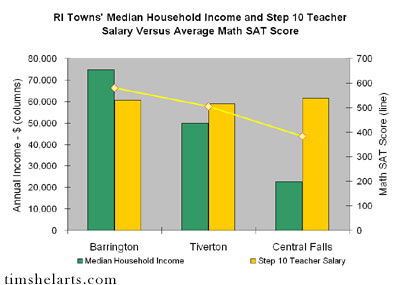
The key point is that, at least in these three towns, SAT scores correlate with average income, but not with the poverty rate (by which measure Barrington and Tiverton are nearly identical) and certainly not with teacher salary. As I said when I first published this chart, a town such as Central Falls (or Tiverton, for that matter) would be well advised to lower teachers' salaries and redirect the savings toward such improvements as will increase average household income — and with the emphasis not on welfare-style poverty programs, but on working/middle-class economic activity programs.
August 11, 2007
Toward Fruitful Conversation
I would never gainsay the importance of data and evidence to polemics, nor would I parade the pure primacy of reason, but I can't help but be amused at the failure of evidentiary debate to advance the discussion concerning Rhode Island's educational system.
As is so often the case, skepticism and credulity appear to find their impetus in tacit, nearly subconscious, understanding of the issues involved. Which is to say that there are deeper philosophical differences in play, and whether it is more effective and efficient to place them head to head or to fight the war through the proxy of agreeing upon a set of data is very much a debatable question.
August 9, 2007
What's Wrong with RI Education
For anybody who has not already done so, wading through the comment-section discussion appended to my recent post on teachers and education is well worthwhile. Having followed it in progress, myself, I've observed a point that apparently needs stressing before such conversations proceed: Unions are not the only problem that requires fixing in Rhode Island's public education system. Still, it draws too-bold lines of responsibility to state, as the NEA's Bob Walsh does in the comment thread, that unions "don't hire or fire/retire [their] members, just represent them between those two points in time."
Teaching is, by its nature, a rewarding career. Adding in the vacations, breaks, and holidays that it has traditionally promised as perks makes up for much of the difficulty of the work. While most of us will agree that, beyond these attractions, teaching ought to be a very well paid profession, through their undue political muscle as well as their organization of such invidious negotiation tactics as "work to rule," Rhode Island teachers' unions have brought the pay, benefits, and security of the job to such a disproportionate level (in relation to other careers) that corruptive consequences have been sure to arise in both the teacher-education industry as well as the hiring process.
At the other end of the teacher's career, it's somewhat disingenuous to claim that retirement ends her or his relationship with the union. Teachers never really retire from union representation. And between hire and retire, unions play a role in the problem that mikeinRI, a teacher himself, articulates:
Perhaps the biggest weakness in our schools... are the principals. Not because they don't try or are incapable, but because their hands are tied by contracts and administrators. We need to restore some power to the principals, to allow them to lead schools in a particular direction, to be advocates for reform, and to reward those teachers who are willing to move forward and work for reform. Those [who] don't want to, won't. But the consequences will be financial ones.
Enough is wrong with Rhode Island's public education system that we could spend endless hours arguing around each other about where best to focus reform efforts, but unless teachers' unions begin to rethink their role and their self-presentation, they will face a growing clamor for their cessation, punctuated every time any district's contract is up — even every time somebody's friend, family, or neighbor finds it necessary to leave the state and every time non-union workers find themselves sighing at their dim prospects for a true retirement at any age.
New Charter Middle School Planned for Central Falls
Is Rhode Island's statewide moratorium on charter schools, currently slated to end at the of the 2007-2008 school year, really going to be allowed to lapse? According to Rochelle Lefebvre of the Pawtucket Times, officials in Central Falls must believe so…
Students may be soon be able to enroll in [Central Falls’] first charter school that, if approved by the General Assembly, could open as soon as September 2008.Hopefully, Central Falls will be able to repeat the experience of Providence, where two of the top three middle schools (out of nine total) are charters.Angelo Garcia is the director of Channel One, the city's social service agency, and the Ralph J. Holden Community Center.
He said he has been in communication with the Rhode Island Department of Education recently about the proposed school....
The school, which would be called Segue, would offer seats for about 240 local middle-school-aged children. Charter school advocates suggest a new facility would take the burden off Calcutt Middle School, which now houses nearly 700 students.
On the other hand, I wonder what charter advocates will have to give up to get the legislature to cooperate with their plans? Watch out for the General Assembly demanding that charter-school employees surrender their right to a secret ballot when voting on union issues (a provision quietly slipped into some proposed charter legislation earlier this year) as the price for allowing new charters.
August 3, 2007
The Cost of a Job That Can't Be Done
It is certainly worth reminding ourselves that parents, as a group, bear some of the blame — most of it — for children doing poorly in school. But inasmuch as parents don't draw government salaries, receive paid days off, or claim retirement benefits for their efforts, the public rightly makes schools an area of particular concern.
The problem that teachers' advocates face in attempting to redirect attention toward parents is that two obvious questions emerge: If the job is undoable, why do we pay so much for it? And what can we do to maximize the benefit of the dollars that we spend? Not surprisingly, folks at Anchor Rising would tend to suggest that the best solution is to increase opportunities for teachers, students, and parents who desire success, and to increase consequences for those who do not. (Ah, there's the rub.)
A school choice program, combined with merit-based teacher compensation, would accomplish both.
July 11, 2007

Teaching American History and Government
I just returned from two weeks at Ashland University in Ohio where I taught two courses as part of an excellent program for teachers of American history and government. It is a program that serious teachers in Rhode Island ought to investigate: the Master of American History and Government (MAHG) degree program, a unique curriculum designed specifically for middle and high school teachers of history, civics and government.
The program was created to address the lack of proper history and civic education in our schools. The AU MAHG provides teachers with a deep and broad understanding of American history, government, and civics by focusing not on methodology or classroom management, but on the substance of the disciplines. The program is unique in that it stresses the use of original historical documents in the classroom.
The AU MAHG is tailor made for teachers. Courses consist of intensive week-long seminars offered only during the summer. This summer, a total of seventeen courses are being offered over five weeks.
The MAHG program has gained a national reputation. Last year, nearly 300 students from 50 states took courses in the program. Though most are teachers taking courses for professional development, more than 60 students from around the country, including Alaska and Hawaii, are currently enrolled in the degree program. The program provides a unique and convenient alternative for teachers across the nation seeking a master's degree.
This was my sixth year teaching in the program. I had the opportunity to teach one intensive week-long course on Sectionalism and the Coming of the Civil War and another on the Civil War and Reconstruction. The students were interested and motivated. It was a pleasure to teach such dedicated professionals.
I hope RI teachers will look in to this program. I hope to see some of you in Ashland Ohio next summer. If you are interested in the syllabi for all the courses offered this year, click "Summer 2007 Schedule" on the menu to the left on the MAHG site.
July 9, 2007
Mayors Take Matters In Their Own Hands
About a week ago, Dan Yorke interviewed Cumberland Mayor Dan McKee about the bottom-up education reform package he was shopping around. Since then, McKee has gained some support and he and Warwick Mayor Scott Avedisian were on yesterday's ABC 6's On The Record with Jim Hummel to talk about the plan.
McKee and Avedisian talked about how it's just getting harder for local municipalities to fund education. The cities and towns keep hearing from the various state-level entities that change is coming, but no change has come. They can't wait on the State anymore, nor can they necessarily trust it. For instance, Avedisian talked about the inventory tax phase out meant to help business. But part of the deal was that the state would help the cities and towns by alleviating some of the lost revenue. They stopped the payments three years in and haven't resumed them.
Simply put, the state promises and doesn't deliver. It's up to local communities.
Both agree that it is no use fighting over splitting a shrinking pot. Instead, fundamental change is needed while maintaining cost and improving student performance. Now, there is no choice but to confront the longstanding cost-related issues head-on and not personalize the issues.
A tall order.
Nonetheless, the mayors of Cranston--who could work on containing costs himself--and Johnston, Lincoln, No. Smithfield, Smithfield, Portsmouth, Tiverton and a few other towns are on board with McKee's path to change.
McKee explained that he sees no reason why they can't simply identify what's wrong and then proceed as if they were starting an education system from scratch. However, as Avedisian pointed out, when you try to start from scratch, you're fighting against a whole host of "rulers of little kingdoms." And when any talk of centralization is heard, there is also a knee-jerk reaction against anything that may cede local control.
Hummel mentioned that it isn't always about throwing more money at the problem. McKee said that this group doesn't think the answer is through raising taxes: cut costs and maintain or improve performance is the goal. Part of the problem is that they are losing upper tier taxpayers and gaining lower tier (non) taxpayers. The current system can't support those demographic changes.
The plan is to hire a non-partisan group that will produce a position paper in September and to follow that up with a report from another group that will lay out its recommendations in early 2008.
Some of the specific problems were also discussed. For instance, the school committee in Warwick counted on the State upping their education budget 3%, but Avedisian didn't. However, the school committed is essentially autonomous and don't have to listen to the city. Plus, there is no accountability to how the school committees spend the money from the state or from the city councils. That needs to change. School committees can't just put it towards operating cost. Mayors or councils need to be able to have a say in how the money is spent.
Avedisian also talked about the costs of providing busing for out-of-district students and the need to consolidate services.
McKee stressed that they aren't trying to reinvent the wheel. The past practice has been to move money around to help this or that community, but now, according to Avedisian, all of them are at a bad point. There hasn't been a stable funding formula for about a decade.
McKee said he was not looking to take away from in-need communities, but other cities and towns were getting fundamentally weaker because they are subsidizing the weaker communities.
Hummel asked about a statewide teacher contract: Avedisian stated that, while it was a good conversation starter re: centralization, it was never going to happen. McKee added that, given the current rules regarding bargaining, even if you were able to do it now, you'd end up mirroring the highest paying community, which, for example, would financially kill Cumberland right now.
Hummel asked about a county government system. Avedisian explained that the communities in Kent County have talked about it on multiple occasions for specific issues. They are, after all, similar communities, so one would think that it would be easy. It's not. Whenever they all get into a room, something goes wrong. One community always promises more, others have to follow, etc. There are some successes, though, as some of the communities have done bulk purchasing and saved money.
Hummel also pointed out that, while most of the plan dealt with education, there were other areas covered, too. For instance, he asked, does Rhode Island need 39 Police departments?
McKee said that, again, this is an area where you have to de-personalize the issue and not look at it like your taking someone's turf.
Ultimately, the goal is to have the research to back up some of the ideas--such as regionalization or state wide contracts--that have been floated for years. If they end up looking worse than the current method, so be it. But it's time to cast our eyes in another direction.
A few other points: Avedisian explained that the nature of the political offices involved--2 year mayors and 1 year state budgets--prompted no incentive to plan out beyond the short term.
To wrap up, McKee said that, by next year, he hoped that they were taking concrete action and weren't just standing there with another pile of studies.
June 21, 2007
Representative Steven Costantino: Chairman of the Bureaucracy-Is-Beautiful Caucus
Charles Bakst’s column in today’s Projo contains this item about House Finance Chairman Steven Costantino (D-Providence), generally considered to be the main architect of the House’s budget…
Interestingly, Carcieri hoped to spend $19 million more on school aid. But Costantino, looking for savings, wasn’t convinced such an outlay, spread over the various districts, would make much difference in quality.But wait a second. During the budget debate, House Minority Leader Robert Watson (R-East Greenwich/West Greenwich) proposed amending the education funding article to redirect a $6 million increase in spending on state-level education bureaucracy into aid for local districts. Rep. Costantino and the Democrats rejected the Wastson proposal (13 Democrats did join the 13 House Republicans in voting for the amendment; see pages 117-118 of the June 15 House Journal for the amendment and the roll call tally).
So in Rep. Costantino's mind, $19 million in local education spending -- the spending closest to the classroom -- is an unimportant luxury, but a $6 million increase for centralized, remote bureaucracy is an untouchable necessity. Could Steven Costantino's philosophy that bureaucracy-is-beautiful, shared by many Rhode Island legislators, be a part of the reason why we pay so much for so little in terms of education in RI?
June 18, 2007
This is Progressivism: When Government Makes Bad Decisions, Make Government More Powerful!
Matt Jerzyk of RI Future offers these long-term recommendations in response the Rhode Island House’s decision to REDUCE -- not level-fund -- statewide education aid…
- Consolidate and merge school districts to some smaller level (perhaps five districts).
- Eliminate the funding of schools by property taxes and fund them solely through the state.
Two immediate thoughts in response…
- These suggestions are a perfect example of how contemporary liberalism/progressivism views just about everything in terms of government not being powerful and centralized enough. Progressives accept this dogma so uncritically, even after local governments have been forced into a tough position by the bad decisions of a bigger and more remote branch government, the progressives still want to make the remote branch of government more powerful -- and make the local branches of government more remote!
- Specifically with regards to the second point, if we did end up funding schools 100% through the state, what arguments would there be against a full-on public choice program, where money is not allocated according to either a funding formula or legislative whims, but according to the choices that parents make about what schools they want to send their kids to?
San Francisco, population 750,000, runs a successful public school choice program. If Rhode Island was reorganzied into one or even five mega school districts, why couldn't we put something similar together for the population of about 1,000,000 here?
June 13, 2007
Providence Superintendent Evans' Plan
I'll readily admit that I don't know much about the state of Providence schools other than what I get from the news, but it seems that Providence Superintendent of Schools Donnie Evans has some good ideas.
Evans announced a series of new initiatives that address his strategic plan, Realizing the Dream, which calls for improving student achievement, creating safe, caring schools, improving public trust and making sure that school programs are cost-effective.Evans is concerned that his plans will be limited by the reduction in school funding included in the recent budget, however. And negotiations are ongoing over the Providence Teachers' contract. Perhaps some savings could be found there?The new programs include:
•Opening more alternative schools for students who aren’t making it in a traditional setting. This fall, the school department opened a small alternative high school for ninth-graders who were in danger of dropping out. Evans will now hire a consultant to develop a charter-school prototype, with the goal of opening at least one alternative school in September 2008.
“Unfortunately,” Evans said, “our dropout rate is 29 percent. In addition, too many students fail or find themselves suspended or expelled because our schools didn’t motivate them or otherwise meet their academic or social needs.”
•Adopting school uniforms in all elementary and middle schools. According to Evans, research shows that in schools where uniforms are required, behavior problems decline and students are more likely to identify with their school. Although not a mandate, Evans said he will strongly urge every principal to implement school uniforms.
•Creating a district call center to improve communication between parents and staff, including expanded translation services for families who don’t speak English as their first language.
•Introducing reading classes and adding 20 reading teachers at the middle school level. Five of the district’s seven middle schools are classified by the state as in need of improvement. In January, state education Commissioner Peter McWalters told Evans to come up with a plan for improving the district’s lowest-performing schools or face possible state intervention.
•Introducing a new math curriculum for struggling students in elementary and middle school, as well as offering a new algebra readiness program for eighth-graders in low-performing schools.
Evans also said that he was forming a couple of task forces to find out why special-education students and students with limited English proficiency continue to be the lowest achievers in the district. “I have enough experience,” Evans said, “to know that we can and must do much, much better.”
June 12, 2007
Worse than Flat Funding II: Mounting Evidence that Many Cities and Towns Are Facing an Unexpected Education Cut
A chart available on the Rhode Island Department of Education website gives a line-item breakdown of the state education aid allocated to each Rhode Island city and town. Here’s East Providence's allocation as an example…
| GENERAL AID | $21,572,539 |
| LITERACY SET-ASIDE | $541,397 |
| TECHNOLOGY | $135,129 |
| STUDENT EQUITY | $2,767,561 |
| PROFESSIONAL DEVELOPMENT | $231,685 |
| CHARTER SCHOOL INDIRECT AID | $3,251 |
| FULL DAY KINDERGARTEN | $63,000 |
| EARLY CHILDHOOD | $235,022 |
| LANGUAGE ASSISTANCE | $406,668 |
| TARGETED AID | $0 |
| VOCATIONAL EQUITY | $176,000 |
| GROUP HOME AID | $630,000 |
| TOTAL FY 2007 AID | $26,762,254 |
The FY2007 number from the RI DOE report that matches East Providence's FY2007 local aid amount in the legislature’s budget is not the “General Aid” figure from the list above, but the “Total FY2007 Aid” figure, which includes group home aid.
Every community that received group home aid in 2007 is having their state education aid reduced by exactly their FY07 group home allocation. So, unless all Rhode Island group homes are being shut down (or unless a separate appropriation exists elsewhere in the budget that provides for group-home-related education costs), the legislature’s budget contains true cuts in education funding that go deeper than just canceling the hoped-for increases.
A true cut explains how East Providence went from facing a $2.9 million deficit in the May 30 Projo to facing a $3.7 million deficit in today’s Projo, most of the difference being the $630,000 cut by the legislature from EP’s total education aid.
It looks as if the Mayor of Providence, whose budget has already been criticized for not funding “tens of millions” dollars worth of city-employee raises, must now find an additional $3.1 million dollars in lost state funding, just to reach flat-funding for his city employees in FY08.
Although the Warwick Beacon reported today that the Warwick school system is $1.1 million in the hole because city officials were counting on a 3% increase that will not be coming, the true deficit in Warwick is closer to $1.5 million, because of a $360,000 cut in Warwick's education aid from last year (again, unless group home funding is being compensated for in some as-of-yet undiscovered area of the budget).
And so on, and so on, and so on…
I know that Rhode Island law says that the state must reimburse cities and towns for their group home costs...
16-64-1.1(a)(3) -- Each city or town shall receive state education aid in an amount equal to the number of group home or other residential facility "beds" in that community multiplied by a per pupil rate, subject to appropriation, intended to reflect the average cost per pupil based on the blend of regular education and special education students in group homes as derived from figures supplied on June 30 of the reference year as defined in section 16-7-16(11).Is it possible, however, that the legislature has reduced the “general aid” to each city or town containing a group home, thus reducing total funding to those communities, without reducing the on-paper funding connected to the group homes?
June 11, 2007
Rep. Crowley Asks Some Good Questions
State Rep. Paul Crowley of Newport commends the special commission that has recommended a new school-funding formula, but has some questions:
Does it make sense to invest millions of additional dollars in a system that has remained structurally unchanged?Good questions, all.Do we need, and can we afford, more than 35 school districts to educate about 120,000 students?
Where will the new money come from, given the glum projections for growth in state revenue?
How can the formula be “predictable” when the greatest expense, teacher compensation, will continue to be made by local school-committee members who have shown little ability to control contract growth and expansion of benefits?
How much of the new money would simply be needed to fulfill existing contract/retirement commitments?
What would encourage the General Assembly to invest new dollars in education when every effort at reform has been a protracted battle with either the teachers unions, school committees or both?
To apply a new formula and hundreds of millions of new dollars to the existing system of public education is akin to continuing to drive a clunker before replacing the worn-out brakes. At first glance the clunker may look nicer, but would you really rely on it to meet your daily transportation needs?
June 10, 2007
Worse than Flat-Funding?
I'm not 100% sure what to make of this just yet, but according to the specific numbers in the House budget plan (H5300, Article 21, substitute A), many Rhode Island communities will get less education aid, in terms of absolute dollars, than they did last year. Here are exact numbers from the text of the bill…
| Community | Education Aid FY 2007 | Education Aid FY 2008 (prop.) | Change From 2007 to 2008 |
| Barrington | $2,599,526 | $2,599,526 | $0 |
| Bristol-Warren | $20,498,190 | $20,228,190 | -$270,000 |
| Burrillville | $13,779,743 | $13,539,743 | -$240,000 |
| Charlestown | $2,002,838 | $2,002,838 | $0 |
| Central Falls | $43,313,036 | $43,313,036 | $0 |
| Chariho | $398,334 | $398,334 | $0 |
| Coventry | $20,075,081 | $19,955,081 | -$120,000 |
| Cranston | $35,580,911 | $35,460,911 | -$120,000 |
| Cumberland | $13,257,009 | $13,257,009 | $0 |
| East Greenwich | $1,949,761 | $1,844,761 | -$105,000 |
| East Providence | $26,762,254 | $26,132,254 | -$630,000 |
| Exeter-West Greenwich | $7,661,019 | $7,256,019 | -$405,000 |
| Foster | $1,416,463 | $1,416,463 | $0 |
| Foster-Glocester | $5,729,861 | $5,729,861 | $0 |
| Glocester | $3,213,847 | $3,213,847 | $0 |
| Hopkinton | $6,241,352 | $6,241,352 | $0 |
| Jamestown | $531,908 | $531,908 | $0 |
| Johnston | $10,915,364 | $10,615,364 | -$300,000 |
| Lincoln | $7,403,268 | $7,283,268 | -$120,000 |
| Little Compton | $368,810 | $368,810 | $0 |
| Middletown | $10,497,116 | $10,077,116 | -$420,000 |
| Narragansett | $1,897,159 | $1,897,159 | $0 |
| Newport | $11,796,080 | $11,316,080 | -$480,000 |
| New Shoreham | $106,345 | $106,345 | $0 |
| North Kingstown | $11,986,005 | $11,986,005 | $0 |
| North Providence | $13,232,872 | $13,142,872 | -$90,000 |
| North Smithfield | $4,834,237 | $4,714,237 | -$120,000 |
| Pawtucket | $66,858,559 | $66,003,559 | -$855,000 |
| Portsmouth | $6,250,042 | $6,130,042 | -$120,000 |
| Providence | $193,974,756 | $190,824,756 | -$3,150,000 |
| Richmond | $6,188,615 | $6,188,615 | $0 |
| Scituate | $3,407,183 | $3,407,183 | $0 |
| Smithfield | $5,668,568 | $5,428,568 | -$240,000 |
| South Kingstown | $10,428,698 | $10,173,698 | -$255,000 |
| Tiverton | $5,932,058 | $5,932,058 | $0 |
| Warwick | $37,626,000 | $37,266,000 | -$360,000 |
| Westerly | $6,843,077 | $6,843,077 | $0 |
| West Warwick | $20,440,547 | $20,440,547 | $0 |
| Woonsocket | $47,616,613 | $47,016,613 | -$600,000 |
Anybody have any idea what’s happening here?
June 8, 2007
It's Official: City and Town School Departments Will Be Flat-Funded
From Andrea Panciera of the Projo's 7-to-7 newsblog...
The head of the House Finance Committee early this afternoon revealed some of the panel's proposals to deal with the state's budget crunch.Among them are...
"Level funding" the total amount of education aid to cities and towns, which means eliminating the 3 percent education-aid increase across the board that [Governor] Carcieri's budget had called for.
It's Official: City and Town School Departments Will Be Flat-Funded
From Andrea Panciera of the Projo's 7-to-7 newsblog...
The head of the House Finance Committee early this afternoon revealed some of the panel's proposals to deal with the state's budget crunch.Among them are...
"Level funding" the total amount of education aid to cities and towns, which means eliminating the 3 percent education-aid increase across the board that [Governor] Carcieri's budget had called for.
June 7, 2007
Teaching Our Children to Fear
I'm not just being a contrarian when I say that I have concerns about this legislation:
The Rhode Island Senate has approved legislation creating the “Lindsay Ann Burke Act,” an effort to protect those most vulnerable to dating violence by calling on schools to provide dating violence education for middle school and high school students.Named after a 23-year-old North Kingstown woman who was brutally murdered in fall, 2005, by her former boyfriend, the “Lindsay Ann Burke Act” will require every school district in Rhode Island to develop a model dating violence policy and a policy to address incidents of dating violence involving students. Each school district will also be expected to provide dating violence training to school staff who have significant contact with students, with such training to include basic principles of dating violence and warning signs of dating violence.
The bill also calls on each school district to incorporate dating violence education that is age-appropriate into the annual health curriculum for students in grades 7 to 12. That education, the bill says, should include defining dating violence, recognizing violence warning signs and characteristics of healthy relationships.
It's obvious that schools ought not tolerate date rape and ought to be vigilant that the potential for it is not developing among students. It's so obvious that, as a simple matter of government principle, I'm not sure that the general assembly has established a need for its involvement, much less the requirement that strapped school budgets make way for the development of policies and curricula. There isn't even any indication that the legislators have looked into the effectiveness of such programs.
As a more general social consideration, I wonder whether the extent to which we're teaching children to be suspicious of one another isn't unhealthy, in itself. I do think that schools should ensure that the kids who spend so much time within their walls understand that they are places of refuge, with resources available if they feel they've nowhere else to go in response to problems, but it seems to me that enumerating the possible villains will tend to decrease kids' capacity for trust and comfort with others. Must we turn every adolescent dating adventure into even more of a drama than it already is? Must we taint the childhoods of all because some of them may have bad — even dangerous — experiences and we just have a feeling that lesson plans might decrease the number of those incidents?
June 6, 2007
Is a School Secretary Administration or Instructional Support?
Chariho school board member (and Rhode Island College iconoclast) Bill Felkner has an interesting op-ed in today’s Projo expressing concern that some of the information being produced to meet No-Child-Left-Behind requirements isn’t reliable…
The Rhode Island Department of Education (RIDE) uses the Teacher Certification System to tabulate the types and numbers of employees at every Rhode Island public school. This information is sent to the National Center for Education Statistics (NCES), located within the U.S. Department of Education, and compiled for every public school in the country.School employees are divided into eight categories: teachers, instructional aides, coordinators, guidance counselors, library/media specialists and supports, district administrators and supports, school administrators and supports, and student support services and other supports.
Can you imagine how beneficial this information could be? You could compare your district with the best in the country, and set your goals accordingly. But in a recent school-board meeting I learned that this simple yet powerful comparison is impossible....For example, the NCES reports that the Chariho District has 74 guidance counselors but the administration contends that the number is only 10. But if you move the remaining 64 employees to the support category, the analysis is still useless because some schools include secretaries in their support category (which we categorize as administrators).The Chariho administration has investigated the Teacher Certification System and found social workers and psychologists listed as administrators, found single employees counted three times and even identified employees on the lists who had “retired, transferred or resigned.”
If we included the dead, I would think we were looking at the voter registration rolls.
On March 27, the Chariho School Board was presented with an e-mail from Edward Giroux, the director of the Office of Network and Information Systems at RIDE, that said, “It’s obvious that the information is incorrect.” According to Chariho Regional School District Superintendent Barry Ricci, RIDE has also said that it has “no faith that the reports for any of the districts are accurate.”
June 4, 2007
Detroit Says: Thank You Rhode Island, For Showing Us How to Run a Charter School
The title above is not snarky or ironic. At least as far away as Detroit, Rhode Island is famous for its charter schools, according to nationally syndicated columnist Neal Peirce…
In 1999, Doug Ross and his colleagues made an outrageous "90-90" promise. In 2007, they would graduate at least 90 percent of ninth-graders going through their brand new University Preparatory Academy, an inner-city charter school [in Detroit]. And 90 percent would go on to post-secondary education.Wouldn’t it be nice if Rhode Island’s legislature was interested in building on Rhode Island’s successes with innovative education programs too? Lifting the current moratorium on opening new charter schools would be a reasonable place to start.Next week, as the 128-student senior class marches in red and black robes across the stage of Detroit's Opera House, receiving their diplomas and calling out the name of their college or trade school, the promise will be fulfilled. The graduation rate is expected to be 95 percent; of those, the college enrollment rate will likely be 100 percent....
[Ross and University Academy Co-Founder William Beckham] were personally angered by the short shrift for kids being offered by Detroit's big factory-like, assembly-line schools — a mirror, they believed, of auto plants time-warped in Henry Ford-era production methods. Unable to manage quality on a student-by-student basis, overburdened by expensive central bureaucracy, the system, says Ross, inevitably turned out an "astounding number of lemons."
Surveying what did work for inner-city students, Ross and Beckham decided to emulate Rhode Island's now-famed MET schools, especially their focus on "one student at a time," individualized learning plans and internships with businesses or nonprofits — a way to build on each child's interests and give him or her exposure to the "real" world.
Continue reading "Detroit Says: Thank You Rhode Island, For Showing Us How to Run a Charter School"
June 1, 2007
Rhode Island Elementary and Middle School Test Results: Charter Middle Schools are Amongst Providence’s Best
According to the testing results provided by the Rhode Island Department of Education, two of Providence’s top three middle schools (out of nine total) are charter schools, the Times2 Academy, and the Paul Cuffee school. Times2 and Paul Cuffee both have over half of their students proficient in reading and over one-third proficient in math. Objectively, those don’t seem like great numbers, but only one other middle school in the city (Nathanael Greene, the only Providence middle school -- charters included -- to get to 50% proficiency in math) met both of these criteria. In fact, no Providence middle schools, other than the three listed above, reached either 40% proficiency in reading or 30% proficiency in math.
Whether it's more charters like Times2 and Paul Cuffee, or a public choice program that allows schools like Nathanael Greene to increase the number of students they reach (and makes other schools say we'd better start doing whatever they're doing), reforms rewarding schools that work are absolutely necessary to improving education in Rhode Island.
Rhode Island Elementary and Middle School Test Results: Charter Middle Schools are Amongst Providence’s Best
According to the testing results provided by the Rhode Island Department of Education, two of Providence’s top three middle schools (out of nine total) are charter schools, the Times2 Academy, and the Paul Cuffee school. Times2 and Paul Cuffee both have over half of their students proficient in reading and over one-third proficient in math. Objectively, those don’t seem like great numbers, but only one other middle school in the city (Nathanael Greene, the only Providence middle school -- charters included -- to get to 50% proficiency in math) met both of these criteria. In fact, no Providence middle schools, other than the three listed above, reached either 40% proficiency in reading or 30% proficiency in math.
Whether it's more charters like Times2 and Paul Cuffee, or a public choice program that allows schools like Nathanael Greene to increase the number of students they reach (and makes other schools say we'd better start doing whatever they're doing), reforms rewarding schools that work are absolutely necessary to improving education in Rhode Island.
May 31, 2007
Rhode Island Elementary and Middle School Test Results
State assessments of all Rhode Island public elementary and middle schools are available today from the Rhode Island Department of Education website. The final summary classifies each school as “high performing”, “moderately performing”, or as making “insufficient progress”, but the intermediate data presented suggests that the final classifications have more to do with some obscure bureaucratic criteria than with how well students are learning. For example, you can find schools rated as “high performing” even though less than half of their students are rated as proficient in math; some schools with less than one third of students proficient in math receive a rating of “moderately performing”
Last week’s Time Magazine article on the present and future of the No Child Left Behind Act helps explain some of the limitations of the testing system being used…
The do-or-die [adequate yearly progress] system creates perverse incentives. It rewards schools that focus on kids on the edge of achieving grade-level proficiency....There's no incentive for schools to do much of anything for the kids who are on grade level or above, which is one reason the law is unpopular in wealthier, high-achieving communities. And sadly, says [California Superintendent of Public Instruction Jack O'Connell], "NCLB provides no incentive to work on the kids far below the bar."However, the real question here is why anyone ever thought that a bureaucracy-centered reform was going to do anything but encourage mediocrity or worse. When the main criteria that bureaucrats will be judged by is a paper evaluation of the systems they administrate, those bureaucrats have a powerful incentive to define success down and set the most modest goals they can get away with, so they can meet this year's goals with minimum risk and leave room for improvement next year.
If you don’t think that these kinds of perverse bureaucratic incentives are a significant impediment to education reform, in Rhode Island and elsewhere, then explain how a school with 32% of its students proficient in writing and 47% proficient in math can be classified as “high performing”.
May 25, 2007
The Return of the Progressives Against Science Education
Actually, it’s doubtful that they ever left. Jim Baron of the Pawtucket Times notes that the members of the Campaign for Rhode Island’s Priorities, as they did last year, want to cut Governor Donald Carcieri’s science education initiatives out of the state budget in order to fund non-educational social service spending…
A coalition of social action groups, the Campaign for Rhode Island's Priorities, wants lawmakers to roll back a number of tax breaks for corporations and the wealthy, increase some other taxes and reduce or eliminate funding for charter school spending, science and technology education and information technology improvements. At the same time, it wants to see spending hiked for several human services programs and to preserve others now on the chopping block.Specifically, the CRIPs want to save $3,000,000 by “postponing” implementation of the Governor’s Inspiring Excellence in Science, Technology, Engineering, and Mathematics program. But because the CRIP package does not address the structural nature of Rhode Island’s shortfalls, adopting its philosophy would likely require a "postponement" of the program that never ends in order to balance future budgets.
Here’s the description of exactly what the CRIPs would like to eliminate, as described in the Governor's budget proposal…
To support more efficiencies and better training in the educational system, the Governor’s plan includes previously approved funding of $15.0 million for technology over five years which would focus on “Inspiring Excellence in Science, Technology, Engineering, and Mathematics (STEM)”. The Governor recommends funding for innovative technology to upgrade teacher training programs to better prepare teachers to inspire their students to excel in science, technology, engineering and mathematics. Projects that qualify may include, but are not limited to, the Rhode Island Department of Education’s Comprehensive Education Information System and its rollout to school districts as well as specific funding to support teacher professional development in the use of innovative technologies or techniques, including our state’s teacher preparation programs. The “SMART” Classrooms Program will significantly upgrade teacher preparation facilities at Rhode Island College and the University of Rhode Island by infusing technology into our teacher training programs, creating a Center for Excellence in Mathematics, Science and Technology Education, and upgrading mathematics and science classrooms and laboratories.According to their press release, CRIP membership includes the National Education Association of Rhode Island and the Rhode Island Federation of Teachers and Health Professionals, which would seem to put Rhode Island’s teachers unions on the side of science education cuts. Is it indeed the position of the unions that science education is the first area of the state budget where spending should be reduced in a time of fiscal crisis?
Finally, in the Pawtucket Times article, Ocean State Action director Karen Malcom calls the CRIP package “common sense”. Apparently, to Ms. Malcom, it is common sense that welfare spending takes priority over education. That explains why the members of CRIP are willing to increase taxes to spend on social services, but not to improve education.
May 18, 2007
Representative Jack Savage on Education Aid & Tax Increases
At last night's East Providence GOP event, I had the opportunity to talk with State Representative and House Finance Committee member Jack Savage (R-East Providence) and turn Anchor Rising’s attempt to read the tea leaves with regards to the state budget deficit into a few concrete questions…
Anchor Rising: Some recent comments made by public officials seem to indicate that eliminating the Governor’s proposed 3% increase in education aid is a part of the plan for closing the state budget deficit? Is that the legislature’s plan?
Representative Jack Savage: I would say that, although certainly we want to maintain strength and integrity of our social and educational programs, everything is on the table.
With education, it is very possible that it will be level funded at last year’s level. We may not have the funds to do the 3% increase, which would be approximately 20 million dollars. That’s certainly an area which we are looking at to further reduce our deficit.
AR: No one who’s follows Rhode Island politics believes that tax-increases are ever completely off of the table. Is there any talk at the state house about specific types of tax increases?
JS: I think that’s a general type of conversation. I really don’t think that’s going to happen. Everyone is well aware of the fact that we are already so highly taxed, in all areas.
There may be increases in fees and licensing, those types of increases, but I really don’t think, though I could be wrong, that there will be an increase in sales tax or income tax. At least I’m hoping not. I hope we can find other ways to close the gap.
May 16, 2007
Is the Time Right for Cross-District Choice?
RI Future contributor Te boldly comes out in favor of including cross-district choice in the discussion of how to improve primary and secondary education in Rhode Island…
Reforms like the cross-district choice plan former Providence School Board Member Julia Steiny proposed in a Projo article last week deserve a closer look. The plan would tie funds to students, not districts. Receiving schools would have to accept students so their student body approximated the state’s demographics. (Massachusetts and Vermont already have similar programs in place.)One possible model for a public choice plan is the system used by the San Francisco Unified School District since 2001. Lisa Snell described the program in a Reason Magazine article published last year…School choice may be no silver bullet, but hand-wringing about how it will destroy our public schools just isn’t productive. The demand is there: in Providence, the Paul Cuffee Charter School has a 9% acceptance rate — lower than most Ivy League universities. And with a citywide dropout rate above 30%, you don’t have to be a cynic to recognize the system is broken anyway.
Imagine a city with authentic public school choice -- a place where the location of your home doesn’t determine your child’s school. The first place that comes to mind probably is not San Francisco. But that city boasts one of the most robust school choice systems in the nation....Readers prone to experiencing a gag reflex whenever the word “choice” is mentioned in a sentence containing the word “school” should take note of two things…In San Francisco, [a] weighted student formula gives each school a foundation allocation that covers the cost of a principal’s salary and a clerk’s salary. The rest of each school’s budget is allocated on a per student basis. There is a base amount for the “average student,” with additional money assigned based on individual student characteristics: grade level, English language skills, socioeconomic status, and special education needs. These weights are assigned as a percentage of the base funding. For example, a kindergartner would receive funding 1.33 times the base allocation, while a low-income kindergartner would receive an additional 0.09 percent of the base allocation. In 2005–06 San Francisco’s base allocation was $2,561. Therefore, the kindergartner would be worth $3,406, and the low-income kindergartner would generate an additional $230 for his school....
San Francisco’s system produced significant academic success for the children in the district. Miraloma Elementary…has seen test scores for second-graders in English language improve from 10 percent proficient in 2003 to 47 percent proficient in 2005....Such gains have been made throughout the school district. Every grade level in San Francisco has seen increases in student achievement in math and language arts, and the district is scoring above state averages. (Fifty percent of San Francisco seventh-graders were proficient in language arts in 2005, compared to 37 percent proficiency statewide.) Even high schools, the most intractable of all schools, appear to be improving....
These gains have been made even as students who used to be excluded from standardized tests are increasingly being tested. In the last year of Superintendent Bill Rojas’ administration, 1998–99, only 77 percent of the district’s students in the tested grades were included, with kids who were deemed likely to bring scores down left out whenever possible. In 2003–04, 98 percent of students in the tested grades were included.
- San Francisco isn’t exactly known as a bastion of right wing, Milton Freidmanesque free-market philosophy, and
- Though I’m not endorsing public choice specifically for this reason, a couple of other communities that have implemented public choice programs have seen a growth in public school enrollment at the expense of private schools. From Ms. Snell's article…
In Seattle, the public school district has won back 8 percent of all students from the private schools since implementing the new system. In Edmonton, where it all began, the public schools are so popular that there are no private schools left. Three of the largest private schools voluntarily became public schools and joined the Edmonton district.
Re: Preliminary School-Financing Plan (or "The Coming Train Wreck")
I don’t see how the education funding report that Marc just noted fits with all that's come before into a sustainable plan for the future.
We know that officials from both urban and suburban communities seem to have convinced themselves that the purpose of new state education “funding formula” is to provide a bigger share of aid to their communities. They can’t all be right.
We also know that the state is in a $450 million dollar budget hole for next year. As a result, the legislature is apparently seriously considering flat-funding education aid. The deficit is structural, meaning it’s going to be there next year and the year after, unless there is a either a fundamental restructuring of programs to reduce costs, or a tax increase that will push Rhode Island towards becoming the most highly taxed state in the nation.
Lately, the legislature has been averse to tax-increases.
But according to Jennifer Jordan's Projo article, even though it can’t afford a simple 3% increase in education aid this year, the legislature is moving forward with a proposal that would increase the state's share of spending on education and maybe increase education spending overall.
It adds up to three obvious possibilities for the near future of Rhode Island…
- The legislature is now being pulled in so many contradictory directions, it’s going to get paralyzed and change nothing.
- There’s a honking-big tax increase being planned.
- One set of communities is going to grab a whole bunch of state aid away from another set of communities and hide it under layer upon layer of formulas and bureaucracy and tax-shifts, in the hope that the communities losing funding won’t notice until it is too late.
Preliminary School-Financing Plan
Here are the highlights of the preliminary Statewide School-Financing plan as proposed by a special advisory group:
[T]he 14-member group, which included state Commissioner of Education Peter McWalters, Timothy C. Duffy, president of the Rhode Island Association of School Committees, Marcia Reback, president of the Rhode Island Federation of Teachers, and Will Van Horne of the business-backed Education Partnership, made the following recommendations:There is also another panel that is looking into how to pay for all of this. However, apparently they've been waiting to get a better idea of what the formula would be and the costs associated before figuring out how to pay for it. That's when it gets interesting!•The financing formula should be “weighted” to allocate additional money for the neediest students. The cost of educating a special-education student, therefore, would be twice the base amount, or a figure close to $20,000 a year. The cost for low-income students would be 1.75 the base amount if they receive free lunch, or around $17,500, and 1.25, or $12,500, if they receive reduced lunch. The cost to educate students at career and technical schools would also be budgeted at 1.25 the foundation cost, and the cost to educate English-language learners would be 1.2 times the base amount.
“We don’t yet know exactly what the weights should be because those more sophisticated systems to determine weights don’t exist yet,” McWalters said. “But don’t abandon the idea of weights, because it is fundamental to the idea of fairness.”
•The formula should ensure a base amount per student to every district, regardless of how wealthy it is, and should not take away state money a district is currently receiving.
•The formula should be evaluated for periodic “mid-course corrections” and should be phased in over several years, as the state gradually takes over more education costs.
May 15, 2007
Should All Rhode Island School Departments Be Budgeting for a Zero State Aid Increase?
Woonsocket Mayor Susan Menard has submitted a city budget that assumes a slight decrease in state education aid compared to last year. From Kia Hall Hayes in Saturday’s Projo…
Mayor Susan D. Menard submitted a $115.7-million budget yesterday that calls for a 3.85-percent tax rate increase — only the third tax hike in the mayor’s 12-year administration.And Douglas Hadden of the Pawtucket Times reports that city officials in Pawtucket are also expecting the legislature to reduce and maybe eliminate the Governor’s proposed 3% increase in state education aid…“In my 12 years as mayor this is the most difficult one I have had to put together,” Menard said yesterday, citing a decrease in state aid and increases in fixed costs such as state pension contributions, health care and debt service….
Menard has budgeted for a $100,000 decrease in state aid for schools and level funding in general revenue sharing from the state.
“I can’t tell you how the General Assembly is going to balance the state’s mess,” Menard said.
With legislative leaders struggling to reduce a projected $360 million state budget deficit, the question increasingly seems to have become not whether something has to give, but what.If there was ever any doubt about how the legislature plans to modify the Governor’s budget, there isn’t anymore; the plan is to reduce spending on education to protect spending on social welfare programs and state government operations.How much of the city's projected boost in state aid could be threatened remains unclear, but a cut of some kind appears increasingly likely. "There's a good chance - I'm not saying it's definite - but there's a good chance that could happen," acknowledged City Clerk Richard Goldstein, who is the Doyle administration's lobbyist on Smith Hill.
Goldstein said he first heard such talk from Daniel Beardsley, executive director of the League of Cities and Towns, at a meeting a few weeks ago, and proceeded to relay the news to key city officials.
Beardsley's message about the local aid levels budgeted by the governor was that "it doesn't look like we're going to get it," Goldstein related. "I've also heard it up at the Statehouse, that we shouldn't plan on it, don't plan on it."
Is this the strategy the citizens of Rhode Island want to see implemented?
May 9, 2007
The State of “Direct Teacher Centered Instruction”
I was reading an article in the current issue of City Journal by Sol Stern about the state of Catholic Schools in general and of New York City’s Rice High School in particular when I came across these sentences that startled me a bit…
When I went unannounced into classrooms [at Rice High School], I encountered teachers standing at the front of the class and students working quietly at individual desks, aligned in straight rows. (This method of direct, teacher-centered instruction is, of course, anathema to progressive educators, but it surely works.)Any of the teachers, students, or parents in the audience have any idea what Stern is talking about, and/or any comments on the state of “direct, teacher-centered instruction” in the state of Rhode Island?
May 4, 2007
School Vouchers: An International Success Story
From The Economist:
Few ideas in education are more controversial than vouchers—letting parents choose to educate their children wherever they wish at the taxpayer's expense. First suggested by Milton Friedman, an economist, in 1955, the principle is compellingly simple. The state pays; parents choose; schools compete; standards rise; everybody gains.Simple, perhaps, but it has aroused predictable—and often fatal—opposition from the educational establishment. Letting parents choose where to educate their children is a silly idea; professionals know best. Co-operation, not competition, is the way to improve education for all. Vouchers would increase inequality because children who are hardest to teach would be left behind.
But these arguments are now succumbing to sheer weight of evidence. Voucher schemes are running in several different countries without ill-effects for social cohesion; those that use a lottery to hand out vouchers offer proof that recipients get a better education than those that do not.
...
Opponents still argue that those who exercise choice will be the most able and committed, and by clustering themselves together in better schools they will abandon the weak and voiceless to languish in rotten ones. Some cite the example of Chile, where a universal voucher scheme that allows schools to charge top-up fees seems to have improved the education of the best-off most.
The strongest evidence against this criticism comes from Sweden, where parents are freer than those in almost any other country to spend as they wish the money the government allocates to educating their children. Sweeping education reforms in 1992 not only relaxed enrolment rules in the state sector, allowing students to attend schools outside their own municipality, but also let them take their state funding to private schools, including religious ones and those operating for profit. The only real restrictions imposed on private schools were that they must run their admissions on a first-come-first-served basis and promise not to charge top-up fees (most American voucher schemes impose similar conditions).
The result has been burgeoning variety and a breakneck expansion of the private sector. At the time of the reforms only around 1% of Swedish students were educated privately; now 10% are, and growth in private schooling continues unabated.
...
More evidence that choice can raise standards for all comes from Caroline Hoxby, an economist at Harvard University, who has shown that when American public schools must compete for their students with schools that accept vouchers, their performance improves. Swedish researchers say the same. It seems that those who work in state schools are just like everybody else: they do better when confronted by a bit of competition.
May 1, 2007
Utah Voucher Plan on Hold
The Utah voucher plan for funding public education is being challenged under a provision of Utah law that permits the voters to repeal laws via referendum. From the Salt Lake City Tribune…
Lt. Gov. Gary Herbert on Monday declared a referendum petition drive to overturn Utah's school voucher law "sufficient," meaning the law is on hold until the public votes on a repeal.Herbert's office verified 124,218 valid signatures among more than 131,000 reportedly submitted to county clerks this month by Utahns for Public Schools, a group of voucher opponents made up mostly of parents, teachers and school administrators…
The petition drive shelves Utah's new Parent Choice in Education Act, which provides public tuition assistance to help parents transfer their children to private schools.
Gov. Jon Huntsman Jr. has suggested he'll put the referendum on the February 2008 Western States Presidential Primary ballot because that is the nearest funded election. It would cost $3.5 million to hold a statewide vote during a special June election or November's municipal general
election.Huntsman probably will announce the election date during a special legislative session he intends to call in mid-May, spokesman Mike Mower said. The session will enable legislators to amend state law, which currently allows referendum elections in only June or November.
April 30, 2007
The Funding Formula Distraction
Rhode Island's education aid “funding formula” debate is moving from the sublime to the ridiculous. Pat Crowley (an assistant executive director with the Rhode Island chapter of the National Education Association) has posted on his blog a link to a video clip of Senate Majority Leader Teresa Paiva-Weed discussing the purpose of redesigning the formula. The Senator says that the current formula needs to be rebalanced to better address the needs of “second-tier” urban and suburban communities…
The focus has been on the urbans. That’s not to say that the urbans don’t need to continue to be important, but the question is there was a lot of challenges from the communities, both in the second tier and the suburban communities, that we were relying on an antiquated formula and that different things had occurred in the various communities that weren’t being addressed by the funding formula.Meanwhile, former interim Central Falls school superintendent William R. Holland argued in yesterday’s Projo that Rhode Island's education funding priority should be more money for urban districts -- and he has a study paid for by the state legislature that Senator Paiva-Weed helps lead to back him up…
The recent Wood Associates Education Adequacy Report commissioned by the General Assembly calls for increased funding in urban districts, citing the high percentage of low-income families and the high cost and percentage of special-education and English-language learners in those districts.Providence Mayor David Cicilline expects a revised funding formula to bring more aid to Providence. Yet officials from urban ring cities and suburban towns from Cumberland to Scituate expect the revised formula to bring more aid to them.
They can’t all be right about what the effect of the new formula will be, because there is no way that a funding formula can by itself increase the percentage of aid to the smaller cities and towns at the same time it increases aid to the urban core. Isn't it about time for the General Assembly to tell the people of Rhode Island what the goal of the new formula really is and to stop pretending there's a something-for-nothing solution to Rhode Island's education problems?
The Funding Formula Distraction
Rhode Island's education aid “funding formula” debate is moving from the sublime to the ridiculous. Pat Crowley (an assistant executive director with the Rhode Island chapter of the National Education Association) has posted on his blog a link to a video clip of Senate Majority Leader Teresa Paiva-Weed discussing the purpose of redesigning the formula. The Senator says that the current formula needs to be rebalanced to better address the needs of “second-tier” urban and suburban communities…
The focus has been on the urbans. That’s not to say that the urbans don’t need to continue to be important, but the question is there was a lot of challenges from the communities, both in the second tier and the suburban communities, that we were relying on an antiquated formula and that different things had occurred in the various communities that weren’t being addressed by the funding formula.Meanwhile, former interim Central Falls school superintendent William R. Holland argued in yesterday’s Projo that Rhode Island's education funding priority should be more money for urban districts -- and he has a study paid for by the state legislature that Senator Paiva-Weed helps lead to back him up…
The recent Wood Associates Education Adequacy Report commissioned by the General Assembly calls for increased funding in urban districts, citing the high percentage of low-income families and the high cost and percentage of special-education and English-language learners in those districts.Providence Mayor David Cicilline expects a revised funding formula to bring more aid to Providence. Yet officials from urban ring cities and suburban towns from Cumberland to Scituate expect the revised formula to bring more aid to them.
They can’t all be right about what the effect of the new formula will be, because there is no way that a funding formula can by itself increase the percentage of aid to the smaller cities and towns at the same time it increases aid to the urban core. Isn't it about time for the General Assembly to tell the people of Rhode Island what the goal of the new formula really is and to stop pretending there's a something-for-nothing solution to Rhode Island's education problems?
April 25, 2007
Budget Crisis in East Providence
Add East Providence to the list of Rhode Island communities with structural finance problems leaving them no longer able to afford their existing school programs. From Alisha A. Pina in today’s Projo…
Three of six options proposed by [East Providence] Schools Supt. Jacqueline Forbes two weeks ago included consolidating Martin Middle and Riverside Middle school students into one building, yet none of the options would fully resolve the $2.9-million deficit she projects for the School Department at the end of the next fiscal year....The savings from the various options range from $26,500 to $948,000, not including the potential revenue from selling or leasing the various school buildings.
April 21, 2007
The RI Legislature Plans to Close the Deficit by Reducing Education Funding: Woonsocket Gets Whacked First
At Anchor Rising, our reading of the tea leaves has led us to forecast that the Rhode Island General Assembly is planning to reduce state aid to education as a means of closing the state budget deficit.
Confirmation that this is indeed the plan arrives today, courtesy of the Projo's Kia Hall Hayes…
Legislative leaders are freezing $236 million in school construction projects until they can rework how they are financed and approved.Are capital education outlays a budget area where there’s lots of fat to be cut? Well, a Census Bureau study released last year ranked the state of Rhode Island 51st in “direct expenditures by public school systems for construction of buildings and roads [and] purchases of equipment, land, and existing structures”. So the answer would seem to be “no”, yet the place where Rhode Island ranks 51st in a nation of 50 states is the place where the legislature thinks it would be most prudent to make cuts.The move is a surprise to the state Department of Education and some local senators and officials.
Woonsocket’s $80-million middle school project is the first to encounter resistance from Senate leaders, including Senate President Joseph A. Montalbano.
“To go through all these hoops and testify before the House and then to have a different set of rules and agenda laid at your feet ... at the very least it was surprising and at the very most it was shocking,” Woonsocket Schools Supt. Maureen B. Macera said earlier this week....
Citing a possible $150-million state deficit this year and an even larger projected deficit for next year, Senate Finance Committee Chairman Stephen D. Alves, D-West Warwick, said lawmakers are looking at “ways to reinvent government and the way we do business.”
“Everything is being held until we rectify and come to terms with how much money we’re looking at and what are the most vital projects. It is the Senate’s position that they are going to be put on hold,” Alves said in a phone interview.
Senator Montalbano, who represents Lincoln, North Providence and Pawtucket, said in a separate interview, “We need to look at each and every one of these projects before we rubber stamp them.”
On the House side, Paul W. Crowley, D-Newport, who serves on both the finance and education committees, called the moratorium “the prudent thing to do” during a time of increasingly tight budgets.
The Rhode Island General Assembly's governing philosophy of slashing already underfunded budget items so to preserve more lavishsly funded programs that aren’t producing the desired results goes a long way toward explaining why average Rhode Islanders receive so little in return for the high taxes they pay.
The article also suggests that more than technocratic budget politics may be in play here…
Angry Woonsocket lawmakers, officials and residents have questioned whether any ulterior motives are behind the resistance.“Why us, why now?” asked Woonsocket Mayor Susan D. Menard.
Menard confirmed this week that UBS Financial Services, where Alves is a financial adviser, had sought to manage Woonsocket’s $90-million pension fund in 2003. The city decided to go with Wilshire Associates, which some have suggested could be behind the middle school project’s recent problems.
“That’s a question only Senator Alves can answer,” Menard said.
Posed to Alves, he responded, “No.”
“If they’re trying to make it like I’m retaliating, people can think what they want to think,” he said, noting that Barrington’s $870,000 plan to refurbish the district’s tennis and basketball courts is also in jeopardy, along with another project involving building wind turbines at Portsmouth elementary and high schools.
Woonsocket isn’t being singled out; it’s happening everywhere, Alves said.
April 17, 2007
Rhode Island Education Commissioner In Search of the Best Education Practices of Saudi Arabia, Syria, and Sudan
Rhode Island Commissioner of Elementary and Secondary Education Peter McWalters is the keynote speaker at an international education conference being held in the United Arab Emirates this week…
The first-of-its-kind School Reform conference being organised by The College of Education at the United Arab Emirates University in cooperation with Hamdan Bin Rashid Al Maktoum Award for Distinguished Academic Performance was opened today (Tuesday, April 17, 2007) by H.H. Sheikh Nahayan Mabarak Al Nahayan, Minister of Higher Education and Scientific Research, and Chancellor of UAE University, at the Madinat Jumeirah in Dubai.According to the conference program, sessions that Commissioner McWalters will be able to attend include “Comprehensive Administrative School Reform in the Arab World” presented by a speaker from Saudi Arabia, a “Vision for Teachers Preparation and Qualification” presented by a speaker from Syria, and a session on the role of Special Education Programs in School Reform in the Sudan.The three-day conference, concluding on April 19, will host workshops and discussions featuring 50 case studies (25 in Arabic and 25 in English) of prominent international scholars and researchers in the field of school reform…
Some of the eminent speakers at the School Reform conference include Peter McWalters, Commissioner, Rhode Island Department of Education, USA; Kati Haycok, Director, Education Trust, State of California, USA; Professor Wayne Edwards from Massey University, New Zealand; Professor Dorothy Harnish from University of Georgia, USA; and Dr. Kristiina Erkkila, Director of Development for the City of Espoo, Finland.
If, however, the Commissioner believes Rhode Island has something to learn from educational programs sanctioned by Middle Eastern dictatorships, shouldn’t he also be willing to take at least a cursory look at the education reform experiences of some places closer to home, like Utah and San Francisco, that are trying different versions of de-centralized school reform?
April 16, 2007
Death Spiral in Portsmouth: Raising Taxes While Cutting Programs
Meaghan Wims of the Newport Daily News has the details of the Portsmouth’s school committee’s budget proposal for next year…
The School Department is proposing a $33.4 million budget for the 2008 fiscal year, which begins July 1. The tight spending plan represents a $1.3 million increase over current-year spending and falls within the state's 5.25 percent cap on tax-levy increases in fiscal 2008.Once again, we see a Rhode Island community planning to raise taxes and cut programs at the same time. And the problem is not that Portsmouth has a history of underfunding its school system. As Keith Kyle and Thomas Wigand of the Portsmouth Concerned Citizens organization have documented, Portsmouth increased its school budget by about 50% between 1997 and 2007. Yet despite a decade of increases, one budget proposal made last year by the Portsmouth school committee involved a 9.1% tax increase coupled with eliminating 12.5 teaching positions. Why the Portsmouth school department is consistently unable to afford its existing educational baseline is a question in need of an answer.To keep expenditures balanced, the school board voted this week to close Prudence Island School after this school year and to change Portsmouth Middle School to a grades 6-to-8 configuration, with fifth-graders being housed in the community's three elementary schools.
The school district also has cut a third-grade, a fifth-grade and a special education teacher, plus supplies, special education tuition and building maintenance costs.
To reiterate the often mischaracterized position of "fiscal conservatives", it’s not an inherently bad thing to raise taxes to pay for good schools. But constantly having to raise taxes and cut programs at the same time, repeatedly demanding that citizens pay more and more to receive less and less, is a sign of a structural problem within the education bureaucracy that is a bigger threat to the quality of education than is the total funding level. Perhaps Mr. Kyle and Mr. Wigand say it best…
The Portsmouth School Department appears to have a management problem, not a budget appropriation problem.
Death Spiral in Portsmouth: Raising Taxes While Cutting Programs
Meaghan Wims of the Newport Daily News has the details of the Portsmouth’s school committee’s budget proposal for next year…
The School Department is proposing a $33.4 million budget for the 2008 fiscal year, which begins July 1. The tight spending plan represents a $1.3 million increase over current-year spending and falls within the state's 5.25 percent cap on tax-levy increases in fiscal 2008.Once again, we see a Rhode Island community planning to raise taxes and cut programs at the same time. And the problem is not that Portsmouth has a history of underfunding its school system. As Keith Kyle and Thomas Wigand of the Portsmouth Concerned Citizens organization have documented, Portsmouth increased its school budget by about 50% between 1997 and 2007. Yet despite a decade of increases, one budget proposal made last year by the Portsmouth school committee involved a 9.1% tax increase coupled with eliminating 12.5 teaching positions. Why the Portsmouth school department is consistently unable to afford its existing educational baseline is a question in need of an answer.To keep expenditures balanced, the school board voted this week to close Prudence Island School after this school year and to change Portsmouth Middle School to a grades 6-to-8 configuration, with fifth-graders being housed in the community's three elementary schools.
The school district also has cut a third-grade, a fifth-grade and a special education teacher, plus supplies, special education tuition and building maintenance costs.
To reiterate the often mischaracterized position of "fiscal conservatives", it’s not an inherently bad thing to raise taxes to pay for good schools. But constantly having to raise taxes and cut programs at the same time, repeatedly demanding that citizens pay more and more to receive less and less, is a sign of a structural problem within the education bureaucracy that is a bigger threat to the quality of education than is the total funding level. Perhaps Mr. Kyle and Mr. Wigand say it best…
The Portsmouth School Department appears to have a management problem, not a budget appropriation problem.
April 13, 2007
Cranston: Higher Taxes for the Same Education System
Fellow Cranstonian Kiersten Marek of Kmareka offers some poignant commentary on Mayor Michael Napolitano’s proposal to raise taxes in Cranston by 5.25% while giving the school department a 0% increase…
This act has marked you, Mayor Napolitano. In my mind, it has marked you as someone who deliberately does unreasonable things in order to provoke a reaction. You can protest until the cows come home about how much you care about education, but it just doesn’t ring true when your budget does not allocate one single dollar in increases for the actual acts of educating children in our city. You have effectively alienated your core constituency.Ms. Marek helps identify the common ground shared by many liberal and conservative citizens -- we can agree that raising taxes while not improving essential services is a bad idea.
But of course, pols sometimes have interests that are different from the interests of citizens of any ideological stripe.
I have less faith than Ms. Marek does that the Mayor's budget proposal isn’t a cynical ploy to force the school committee to sue the city for more money, allowing the Mayor to disavow responsibility for any associated tax increase or other financial consequences. Beyond that, the only other thing I have to immediately add to Ms. Marek's prose is a bit of haiku…
The budget disgrace
of Mike Napolitano.
A case for recall.
ADDITIONAL INFORMATION:
Commenters “Perry Ellis” and “Oz” let us know that the Cranston City Charter does make all elected city officials subject to recall (section 2.08). The basic rules are…
- 20% of registered voters must sign a petition to force a recall election.
- Removing an official requires a 2/3 majority of votes cast in the recall election.
April 3, 2007
A Tax Shift is not a Tax Cut
Has Lawrence E. Purtill, president of the National Education Association’s Rhode Island chapter, figured out a magical way to increase government spending without increasing taxes? The text of his letter to the editor in Monday’s Projo certainly implies that he has...
If The Journal wants to take bold action [on improving educaton], it should join with us in changing Rhode Island’s formula for state aid to education in an effort to increase overall aid while lessening the burden on the local property taxpayer.But if the burden on taxpayers will be lessened, then where will the money for additional state aid be found? Mr. Purtill and his organization could, I suppose, be endorsing huge increases in business taxes to replace and supplement lower property taxes. Or Mr. Purtill could be using sloppy rhetoric, saying that he supports reducing the burden on property taxpayers, when he really means that he supports reducing the property tax burden on property taxpayers -- while jacking up their income tax burden to make up the difference!
By the middle of his letter, however, Mr. Purtill has found his inner fiscal conservative, and criticizes the recently approved Utah statewide voucher plan for increasing state spending on education…
In fact, if the Utah plan were implemented in Rhode Island, education costs would rise, not fall.So Mr. Purtill is opposed to increases in education spending that give more power to parents but favors higher spending that increase the monies going directly to bureaucracies. How do you read this and not conclude that maintaining strong bureaucratic control of education is a higher priority to Mr. Purtill than increasing resources to education? (It should also be noted here that a Utah-style voucher plan doesn’t necessarily increase education spending, but that a total aid increase was built into the Utah system as part of a political compromise to get it through the state legislature).
Finally, in maybe one hopeful section of his letter, Mr. Purtill says…
Rhode Island’s suburban and rural schools have performed and continue to perform as well as if not better than their peers throughout the Northeast and the country.Does this mean we can count on Mr. Purtill to oppose any strong regionalization scheme intended to take educational decision making away from communities that have demonstrated the ability to run good school systems and move an increased number of students into systems controlled by dysfunctional urban bureaucracies?
A Tax Shift is not a Tax Cut
Has Lawrence E. Purtill, president of the National Education Association’s Rhode Island chapter, figured out a magical way to increase government spending without increasing taxes? The text of his letter to the editor in Monday’s Projo certainly implies that he has...
If The Journal wants to take bold action [on improving educaton], it should join with us in changing Rhode Island’s formula for state aid to education in an effort to increase overall aid while lessening the burden on the local property taxpayer.But if the burden on taxpayers will be lessened, then where will the money for additional state aid be found? Mr. Purtill and his organization could, I suppose, be endorsing huge increases in business taxes to replace and supplement lower property taxes. Or Mr. Purtill could be using sloppy rhetoric, saying that he supports reducing the burden on property taxpayers, when he really means that he supports reducing the property tax burden on property taxpayers -- while jacking up their income tax burden to make up the difference!
By the middle of his letter, however, Mr. Purtill has found his inner fiscal conservative, and criticizes the recently approved Utah statewide voucher plan for increasing state spending on education…
In fact, if the Utah plan were implemented in Rhode Island, education costs would rise, not fall.So Mr. Purtill is opposed to increases in education spending that give more power to parents but favors higher spending that increase the monies going directly to bureaucracies. How do you read this and not conclude that maintaining strong bureaucratic control of education is a higher priority to Mr. Purtill than increasing resources to education? (It should also be noted here that a Utah-style voucher plan doesn’t necessarily increase education spending, but that a total aid increase was built into the Utah system as part of a political compromise to get it through the state legislature).
Finally, in maybe one hopeful section of his letter, Mr. Purtill says…
Rhode Island’s suburban and rural schools have performed and continue to perform as well as if not better than their peers throughout the Northeast and the country.Does this mean we can count on Mr. Purtill to oppose any strong regionalization scheme intended to take educational decision making away from communities that have demonstrated the ability to run good school systems and move an increased number of students into systems controlled by dysfunctional urban bureaucracies?
March 30, 2007
Re: Being Wary
Not being as well educated on matters of taxation and school financing as Andrew, what strikes me about proposals that include school busing is the way in which progressive strategies wind up harming those whom they are ostensibly (cynically?) promoted as helping.
In constructing a society — an environment — in which individuals, families, and communities are able to improve their standing, perhaps the most critical component is predictability. If a family works and saves in order to buy a house in a higher-quality school district, it must be certain that its children will benefit from those schools. Similarly, if a community raises funds and passes legislation to improve its schools, it must be certain that its children will benefit from those improvements. This consideration applies regardless of the particular benefit being sought, whether it is scholastic or of the sort that is sometimes left unsaid for the benefit of tender sensibilities.
People will not strive if, having striven, they might lose by lottery what they could win by lottery while doing nothing. Moreover, those in the supposedly privileged group will cease to participate in and finance a local system from which they can find themselves randomly excluded or, worse, targeted for exclusion. And one or the other of these possibilities must be the case; either the students to be displaced will be randomly selected, or they will be chosen, probably with heavy consideration given to their particular stereotypes in a "socioeconomic diversity" index. As the more privileged students move beyond the system's reach, the burden of the new scheme will fall, as such burdens seem often to do, on families that are just beginning to achieve momentum.
The tragedy is that society could achieve its professed goals more smoothly, more organically, and more stably (albeit, perhaps over a greater period of time) by removing barriers and disincentives to advancement, rather than institutionalizing obstacles and backslides. We could ask for no better ballast for social progress than human nature (and, despite attempts throughout history, we cannot deny it, anyway). But one gets the impression that the progressive mind sees people not as individuals capable of self-determination, but as slaves shackled to their circumstances. At the least, they must be concerned that people who credit themselves with the progress that they've made in life will be less inclined to accede to the schemers' plans.
March 28, 2007
Be Wary of the Regionalizers III
Over at RI Future, State Representative David Segal (D-Providence) endorses Stephen Alves-style school regionalization, which goes beyond consolidating administration, and could involve sending students from schools in currently high-performing districts to schools in lower performing ones…
Pick up a few more tens-of-millions by consolidating the schools, with the added benefit of increasing equity and socioeconomic diversity, and it’ll be a new day for Rhode Island — we’ll be showing surpluses, as far into the future as we can see.The view on regionalization described by Senator Alves and Representative Segal, as well as the general tenor of Rhode Island politics, should serve warning that some Rhode Island legislators are actively pursuing novel ways of allowing big cities to tap the property tax revenues from surrounding cities and towns, in this case by placing school funding for smaller communities under the control of urban-dominated regional authorities. Don’t say you haven’t been warned.
The problem with Representative Segal’s call for “equity” is that Rhode Island’s state education aid formula is highly inequitable in a way that already benefits the urban core. Providence, Pawtucket, Central Falls, and Woonsocket all get over $6,000 per-pupil in state aid. Many of the smaller cities receive aid in the range of $2,000 - $4,000 per student, while towns like Barrington and East Greenwich receive less than $1,000 per student. You do have to admire the chutzpah of a State Rep from Providence who claims that this system can be made more equitable by giving an even bigger proportion of money to Providence!
There are several ways that strong regionalization might be used to manipulate the distribution of school funding further in favor of the cities, all in the name of equity...
- A regional school authority could reduce funding to the non-urban schools under its jurisdiction and direct the money from the cuts to urban ones.
- A regional school authority could force tax increases on the non-urban communities under its jurisdiction and spend the bulk of the additional revenues on urban schools.
Actually, there is one other option…
- A regional school authority could also make provisions for students -- and money -- from failing urban schools to go to the better schools within its district, effectively defunding the failing schools.
But, ultimately, regionalization is not necessary for implementing a student-focused funding scheme, which can be better achieved through public choice and/or vouchers.
March 21, 2007
Oh, the Ingratitude, Latest Chapter
Did you know that Rhode Island spends more than twice as much per pupil on special education students than on non-special education students? From Jennifer Jordan in today’ Projo…
It costs about $22,893 a year to educate a special-education student in Rhode Island compared with $9,269 a year for a regular-education student.Yet despite the fact that Rhode Island taxpayers are being more than generous towards special education, advocates for special education choose the rhetoric of conflict and division to describe how they feel about the support provided by Rhode Island taxpayers and Rhode Island government…
“Unfortunately in my experience, especially for this population of kids and their families, they’ve had to fight for everything they get for those kids whether the [services] are mandated or not”, [said Dawn Wardyga, program director for Family Voices, a family information and health center affiliated with the Rhode Island Parent Information Center]. “So it’s hard to enter into this with an open mind that the system will truly do what’s best for these kids and their families.”The rhetoric of conflict is doubly worrisome coming from a leader of Family Voices, an organization’s whose “fight” last year included a decision to join the coalition supporting the elimination of Governor Carcieri’s science education initiatives from the state budget. Apparently, to Family Voices and the Rhode Island Parent Information Center, fighting for special education can mean fighting against non-special education.
It’s really Rhode Island’s non-special education students who have more reason than anyone to be skeptical that their state legislature and lobbying class are looking to do right by them.
March 20, 2007
Education Spending or Education Results
Over at RI Future, Matt Jerzyk equates improving education in Rhode Island to increasing the amount spent on education in Rhode Island…
In an article about how a Rhode Island tech company was just bought by Microsoft, it is asserted that we need greater school spending not tax cuts to grow and attract business. After all, the creative economy needs those who can, in fact, think...Actually, nothing in the Projo article cited by Mr. Jerzyk implies that greater school spending is the answer to improving Rhode Island’s poor educational performance. By now, only the economic determinists who dominate the contemporary progressive movement equate increased spending to education improvement, despite ample evidence that they shouldn’t.
You’re probably familiar with the statistics that show if all it took to produce education results was high levels of education spending, then Rhode Island would already be a top 10 state in education quality, but for the benefit of those who haven't reviewed the data in a while, let's go through it one more time. According to the American Legislative Exchange Council’s most recent survey of state education inputs and outputs (slow-opening PDF file), based on data from 2003-2004, Rhode Island ranks 35th in academic achievement. The next worst New England state is Maine at 18th. Is the problem lack of spending? Well, according to the ALEC report, Rhode Island was 9th in educational expenditures per-pupil, 9th in the average salary of instructional staff, and 9th in student/teacher ratio in the period studied. So if spending is the answer, why isn’t Rhode Island already 9th in educational achievement? What would infusing new money into the existing educational structure do that the old money hasn't?
Clearly, Rhode Island’s top-down educational bureaucracies don’t have a clue as how to spend education money in a way that produces a quality education.
But if Mr. Jerzyk and others of like mind really do believe total spending is the primary issue, they should be willing to consider a compromise. The state of Utah recently increased education spending by about $10 million dollars per year as part of their new statewide public voucher program. (AR on the subject here; Projo op-ed on the subject here). Would Rhode Island's progressives be willing to support implementation of a similar program here, if it would help them direct more money to education? Or do Progressives believe that maintaining strict bureaucratic control of public resources, rather than improving education results or even increasing education funding, should be the top priority of education policy?
Education Spending or Education Results
Over at RI Future, Matt Jerzyk equates improving education in Rhode Island to increasing the amount spent on education in Rhode Island…
In an article about how a Rhode Island tech company was just bought by Microsoft, it is asserted that we need greater school spending not tax cuts to grow and attract business. After all, the creative economy needs those who can, in fact, think...Actually, nothing in the Projo article cited by Mr. Jerzyk implies that greater school spending is the answer to improving Rhode Island’s poor educational performance. By now, only the economic determinists who dominate the contemporary progressive movement equate increased spending to education improvement, despite ample evidence that they shouldn’t.
You’re probably familiar with the statistics that show if all it took to produce education results was high levels of education spending, then Rhode Island would already be a top 10 state in education quality, but for the benefit of those who haven't reviewed the data in a while, let's go through it one more time. According to the American Legislative Exchange Council’s most recent survey of state education inputs and outputs (slow-opening PDF file), based on data from 2003-2004, Rhode Island ranks 35th in academic achievement. The next worst New England state is Maine at 18th. Is the problem lack of spending? Well, according to the ALEC report, Rhode Island was 9th in educational expenditures per-pupil, 9th in the average salary of instructional staff, and 9th in student/teacher ratio in the period studied. So if spending is the answer, why isn’t Rhode Island already 9th in educational achievement? What would infusing new money into the existing educational structure do that the old money hasn't?
Clearly, Rhode Island’s top-down educational bureaucracies don’t have a clue as how to spend education money in a way that produces a quality education.
But if Mr. Jerzyk and others of like mind really do believe total spending is the primary issue, they should be willing to consider a compromise. The state of Utah recently increased education spending by about $10 million dollars per year as part of their new statewide public voucher program. (AR on the subject here; Projo op-ed on the subject here). Would Rhode Island's progressives be willing to support implementation of a similar program here, if it would help them direct more money to education? Or do Progressives believe that maintaining strict bureaucratic control of public resources, rather than improving education results or even increasing education funding, should be the top priority of education policy?
March 10, 2007
Applying Laws of Gravity to Deep Space
In response to my post on RI's education problems, Klaus makes the following request and commentary:
... could you please explain to me again how eliminating the teachers' unions would improve education? I mean, I'm just a stupid socialist (according to a lot of commenters here), so could you big, bright conservatives please enlighten me?Because, if I understand Free Market Theory, if you drive down the wage paid, you drive down the number and quality of applicants.
And do not attempt an explanation unless you address that question. It is the very heart of the proposed solution.
On the one hand, eliminating the union eases the tax burden, which is a positive.
But if you end up with teachers who really aren't competent enough to do anything else, the end result is to cut our own throats by reducing the quality of teachers even more.
The simple answer to the opening question is that free market dynamics do not apply in situations that do not count as free markets. To take the point to an extreme, it would be ludicrous of a dictator to declare that he is raising the salaries of his staff (consisting of family and partners in crime) in order to attract the best candidates. The roles are filled at his pleasure. He does not compete with other employers. And his staff cannot negotiate under the presumption that they are free to leave. Moreover, to the degree that candidates compete for positions within the dictator's government, the competition is centrally over their ability to please the dictator, not to perform the functions of a particular job, and if they are able to do the former, they need not fear repercussions for failing at the latter.
In a heavily unionized system, in which it is difficult to dismiss low-quality teachers, or even to allow them to fall behind in pay scale, the free market relationship between salary and quality is nearly reversed. The more comfortable the job and the better the compensation, the less likely that teachers who are not particularly adept at their jobs and/or not particularly interested in teaching, of itself, will make way for better qualified and more passionate candidates. Indeed, the more attractive their seats, the more vehemently they will guard them.
One need only look at the pitiful pay of private schools to see that competent teachers are driven to their vocation for its own sake. Disproportionate compensation packages that are freed from market forces and that are studiously disconnected from proven ability are certain to draw those whose competency is mainly in manipulating the system.
March 9, 2007
A State of Child Abuse
Every time I come across such news as this, I wonder what it's going to take to get people incensed:
... a new report by the U.S. Chamber of Commerce, called “Leaders and Laggards,” analyz[es] the performance of all 50 states and the District of Columbia. The report found that four New England states — Massachusetts, New Hampshire, Vermont and Connecticut — rank among America’s top six in terms of their public schools. A fifth, Maine, fares very well, ranking 16th overall.The performance of only one New England state is dismal: Rhode Island, which ranks 16th from the bottom, despite consistently finishing near the top in taxpayer spending per student. ...
This report confirms what many others have found. It is the umpteenth warning that Rhode Island is failing its students and undermining its economic prospects. Teachers unions have their place, but clearly politicians have allowed the unions’ special interests to take precedence over the needs of students — with the results shown above. A radical change is necessary. Parents and taxpayers must demand it, and political leaders must come forward to lead it, putting students first.
I realize that a phalanx of special interest groups marches in the minds of state legislators, but I have to believe that Rhode Islanders, even public union Rhode Islanders, even (perhaps) legislators, have strong reactions to such results. There are just too many obstacles between those reactions and the political guillotine.
The first question to answer, especially among such citizens as make up Anchor Rising's audience, is: Why on Earth can't the Republican Party mount an opposition campaign despite the state's clear faults? Perhaps it would do well to stop pretending that it's a political party and approach the eternal campaign as if it were a political action group. Stop trying to play the game and begin promising to make heads roll.
March 8, 2007
Rhode Island's Universal Education Improvement Mantra: "More"
According to Philip Marcelo of the Projo, leaders from a number of Rhode Island's smaller cities and suburbs (Cumberland, Johnston, Lincoln, Cranston, Scituate, North Smithfield, Smithfield, and Portsmouth) have made some reasonable sounding proposals for relieving the pressure on local school budgets. Two of the proposals would have an immediate impact…
The coalition proposes exempting school buildings from the state’s stricter fire-code regulations and repealing state special education regulations that are more restrictive than federal guidelines.Another proposal is a structural government reform that could have a long-term effect in helping municipalities exercise fiscal restraint…“Reducing state mandates doesn’t cost anything. It can be done with the stroke of a pen and would help these communities greatly,” [Johnston Mayor Joseph Polisena] said. “Do we really need to have sprinklers in all our schools when most students are trained to go right out the door when a fire alarm goes off?”
[Cumberland Mayor Daniel McKee] said the coalition will advocate for changing the “school governance model.” One measure would require school districts to tell municipal administrators what the anticipated fiscal impact on a community would be to a proposed labor contract.But there’s one other proposal which, given the current fiscal and economic climate, is completely infeasible...That report, called a fiscal note, would be reviewed by a municipality’s chief financial officer prior to the contract’s finalization and would avert problems some communities face with soaring healthcare costs.
The coalition is also looking for a state aid formula that would give suburban and urban ring communities the same amounts of state aid they received last year and propose, over time, a gradual boost in the percentage of school department budgets the state covers.In other words, the small cities and the suburbs are adding their demand for “more" to the urban core's continuing demand for “more”. When everyone is demanding “more”, restructuring the funding formula provides no solution. Only a fundamental change in the way that government spends money will solve Rhode Island's education funding problem.“In 1992, when the state aid formula was changed, the logic of supporting urban districts made sense,” McKee said. “Today that is not the case, and we are quickly becoming communities in need.”
One other point worth noting: the fact that municipal leaders, who presumably have a contact or two inside the state house, believe that obtaining “the same amounts of state aid they received last year” is a priority, combined with the fact that House finance chairman Steven Costantino said earlier this year that compromises in the education arena might be necessary, strongly suggests to me that the legislature may be considering whacking state education aid as a means of balancing the budget.
March 6, 2007
Re: Warning to Dan Yorke
Maybe Sen. Alves is trying to save money and improve the average education that students receive by pushing wealthier children into private schools.
School quality is a critical factor that parents consider when purchasing homes, so those with the means are likely to have the same emphasis on choosing better schools if it turns out that the kids are going to have to travel, anyway. Thus, the wealthier town's schools will have more room for poorer kids, and the poorer town's schools will have fewer students among whom to divide its resources.
Hey, it's win-win... until those motivated parents realize that Rhode Island has merely offered them additional incentive to pack up and ship the family to a more sane state.
Warning to Dan Yorke: Be Wary of the Regionalizers
Dan Yorke of WPRO radio (630 AM) had Senate Finance Committee Chairman Stephen Alves (D-West Warwick) on his show yesterday to discuss the Rhode Island budget shortfall. As part of a long-term plan for bringing fiscal stability to the state, Senator Alves proposed regionalizing Rhode Island's school districts into 5 county-level school systems. Now, maybe I’m making too much of one example, but when the Senator mentioned that East Greenwich residents might have to get used to sending their kids to schools in West Warwick as part of his plan, I think he provided an unintended insight into what he believes the real benefits of regionalization to be.
Senator Alves' example, after all, seems to have things backwards. Someone thinking rationally about maximizing the state’s education resources should be developing ways to move students in the direction opposite of the Senator's suggestion, from the troubled school system, to the better one. But moving East Greenwich students to West Warwick does make sense if you assume that providing the best education possible to Kent County students is less of a priority than finding new sources of revenue (namely East Greenwich’s property tax money) that can be used by West Warwick, regardless of how wisely the money is spent. This, sadly, would be Rhode Island politics-as-usual, where budget debates have long focused on delivering new monies to municipal education and social welfare bureaucracies that have maxed out their existing revenue sources and are demanding "more". School regionalization will become an extension of the same old battle over a stagnant or shrinking pie, unless it can be carried out with some creativity.
So here’s some creativity. If statewide regionalization is to occur in Rhode Island, it should, at a minimum, be coupled with open choice within the public system, where parents can send their children to a public school they choose, and funding is allocated to a particular school based on the number of students that choose to go there. In other words, if Kent County gets regionalized, let parents, and not Stephen Alves, choose whether their children go to school in East Greenwich or West Warwick. And some real creative stuff, like vouchers, public scholarships and increased use of charters, should be considered too. This kind of open choice, more so than a regionalization plan, is the funding formula that will improve the quality of education in Rhode Island in a fiscally responsible manner.
February 23, 2007
School Choice: Today, Utah; Tomorrow, How About Providence?
The Sisto family school choice program reminds me of another news story that is not receiving the attention it should be getting. This fall, Utah will become the first state in the nation to implement a universal school-choice voucher plan. Here is a description of the program, from Dan Lips and Evan Feinberg of the Heritage Foundation…
The "Parent Choice in Education" Act will provide scholarships to assist families that choose to send their children to private schools. The scholarship amount varies between $500 and $3,000 depending on family income.Dave Talan proposed a plan similar to the Utah plan in his recent campaign for mayor of Providence. (Unlike Mr. Sisto, Mr. Talan thinks that school choice should be extended to everyone, not just his own family). Mr. Talan’s plan was a little more libertarian than the Utah plan, calling for a flat voucher amount, regardless of family income, and skipping the part where the public system keeps any aid associated with students who leave.All current public school students will be able to use a voucher to transfer to a private school. Among current private school students, only those who meet the income guidelines for the federal free and reduced school lunch program will be eligible to receive scholarships. Moving forward, all students entering kindergarten in 2007 and thereafter will be eligible to use scholarships to attend a school of choice. This means that by 2020 all children in the state will be eligible to participate.
In order to admit students participating in the voucher program, private schools must meet a number of guidelines. For example, they must administer a nationally norm-referenced test, report individual test results to parents, and report school-wide performance results to the state government. Further, participating private schools must disclose information relating to teachers' credentials and the school's accreditation status. Schools also must have an independent auditor assess relevant information about the school's budget and accounting procedures and include this information in the school's application to the state....
The program is structured to spare public schools a portion of the potential revenue losses that result from students transferring into private schools. When a student leaves a public school, the legislation requires the state to continue to supply that public school's district the portion of the per-pupil funding that is over and above the state-wide average voucher amount, and to continue doing so for a period of five years following the transfer or until the student was scheduled to graduate. Unfortunately, this will minimize the voucher program's competitive effect that might otherwise spur innovation in the public school system.
Suppose we merged some of the features from the Utah plan into the Talan plan. Is there any reason it couldn’t work here?
February 22, 2007
Democrats for School Choice…
…two of them, anyway. The two would be North Providence City Councilman (and Mayoral Candidate) John Sisto and North Providence School Committee Chairman Donald Cataldi. According to WLNE-TV (ABC 6) news reporter Jim Hummel, Councilman Sisto's grandson, who lives in Providence, has been attending school in North Providence. Hummel has a week's worth of video showing the Councilman picking up his grandson at his Providence home and driving him to a North Providence elementary school. (This being Rhode Island, Mr. Sisto uses a town-owned car to take of family business). Chairman Cataldi is quoted as saying he sees nothing wrong with the arrangement.
Although the reporting on the story is first rate, it does not belong under the WLNE's "You Paid for It" banner. Providence receives about $7,000 per-pupil in state-aid, funded through taxes on all Rhode Island residents while North Providence receives only around $4,000 per-pupil. Most of Rhode Island, therefore, is actually contributing less to a student who enrolls in North Providence instead of Providence. To really make the deal work for everyone (except the city of Providence's ineffective education bureaucracy) all RI needs to do is compensate North Providence taxpayers by transferring a portion of the state aid associated with Councilman Sisto's grandson from Providence to North Providence.
Councilman Sisto's explicit defense is that his grandson lives with him in North Providence, but his implict defense is more interesting and more compelling. Why should his grandson be forced to go to an inferior school, when a better alternative is easily available? The counter is that Sisto's grandson can’t attend school in North Providence because as a resident of Rhode Island, he is a serf, tied to the land that he tills for his lord… OK, maybe I went a bit over the edge there, but what exactly is the counter argument? Julia Steiny had an excellent column in the Projo from two Sundays ago noting how public schools seem more designed to instill compliance with authority than to provide an education. Isn't that also the message we're sending at the macro level, that it is more important for families to be compliant with geographic monopoly districting rules than it is to find the best education alternatives for their children?
Finally, if Councilman Sisto and Chairman Cataldi think it's a good idea for a city councilman's grandson to be able to choose the public school his child goes to, shouldn't they be in favor of extending that right to every family in Rhode Island? If school choice is good for the families of our pols, shouldn't it be good for the families of regular citizens too?
February 13, 2007
Unions Would Have Stopped September 11!?
Look, we all have bad days as bloggers. Some are worse than others. Matt Jerzyk of RI Future clearly steps over the line today…
Today at 500pm there will be a big union rally sponsored by Council 94 AFSCME at Central Falls High School to oppose the privatization of school bus drivers expected to take place at the 600pm school board meeting....I am starkly reminded of the privatized and low-wage airport screeners who allowed hijackers onto the planes with knives and box cutters that they used to stab airline attendants and seize the planes. Put simply, you get what you pay for.The last sentence of the post is perverse. Is Mr. Jerzyk seriously arguing that September 11 would not have happened, if only airport security had been conducted by the kind of people willing to strand elementary school children on freezing cold days as a bargaining tactic? Or, if not willing to admit that abandoning the children is a bargaining tactic, then by people that are just plain incompetent? Either way, where’s the (positive) correlation between the unionization of the Central Falls bus drivers and any sort of drive to do their jobs well? There are non-union people who take pride in their work too, you know.
Really, the problem is that because of short-sighted and self-interested leadership, you often don’t get what you pay for, once a union becomes involved.
If, on the other hand, we could get Al-Qaida to organize itself under union rules, that might be a step forward. “My CBA says I only kill Jews and Christians. Now you want me to kill Shi’ites too? Take it up with my union rep…”
February 11, 2007
On the Same Text-Book Page as the Projo
Just to offer a hear, hear to the Projo's editorial on education in RI:
These proposed reforms are all excellent ideas. He also announced that he, House Speaker William Murphy, Senate President Joseph Montalbano, and representatives of labor, business, local government and other interests will work together to formulate what he called “Rhode Island’s 21st Century Education Plan.”That’s a start and consensus is fine, but it’s a safe bet that endless talk will only produce a mush of reform, pretty much protecting the interests of those whose power created the status quo. What is truly needed is a vocal leader who will go over the heads of the special interests and fight doggedly for the interests of students.
Rhode Island needs to move aggressively toward practices that work well whenever they are tried: parental choice, competition between schools for students, rewards for the best teachers and accountability for the worst, contract language that allows administrators to manage and be held responsible for performance, and spending on benefits that is sustainable.
The longer we stumble down our current path, the more's the shame that we all bear, particularly those who benefit financially from Rhode Island's corruptocracy.
Watching the Senate: Charter Schools
It looks like the Senate is where momentum is building towards a decision on whether or not to allow more charter schools in the state. Right now, there are three bills on the table (that I've found, anyway). S 0238 was proposed by Senator Leo R. Blais (Deputy Senate Pro-Tempore) and simply seeks to revoke the current moratorium on the establishment of charter schools in the state by removing section (h) of the current law, which states:
Notwithstanding the provisions of this section, the Board of Regents shall not grant final approval for any new charter school to begin operations in the 2006-2007 or 2007-2008 school year.Then there is the more restrictive S 0239, proposed by Senators Issa, Cote, Doyle, and Badeau, which seeks to amend that portion of the law and make the following exception:
Notwithstanding the provisions of this section, the Board of Regents shall not grant final approval for any new charter school to begin operations in the 2006-2007 or 2007-2008 school year. except the board of regents may grant final approval for new charter schools to begin operations in the urban school districts of Providence, Woonsocket, Pawtucket and Central Falls in the 2008-2009 school year.Finally, there is the middle-ground proposal--S 0240--offered by Senators Doyle, Bates, Cote, Breene (Minority Whip), and Lenihan:
Notwithstanding the provisions of this section, the Board of Regents shall not grant final approval for any new charter school to begin operations in the 2006-2007 or 2007-2008 school year in school districts that enroll less than nine thousand (9,000) students. The board of regents may grant final approval for new charter schools to begin operations in school districts that enroll nine thousand (9,000) or more students.Senators Doyle and Cote signed-on to both of the latter two proposals. Senator Blais, who represents a more rural district (Coventry, Foster, Scituate)--which probably doesn't meet the population requirement laid out in S 0240--is clearly concerned that all of Rhode Island's students and parents get the same opportunity as those in the more urban and populated districts. As for S 0240, it is written so that it will encompass many of the suburban districts as well as the so-called "urban core." Note that all of these are Democratic sponsored bills. Hopefully, this is a signal that, finally, something will get done to allow more charter schools in the state.
Then there is the "however." S 0436, proposed by Senators Senators Connors (Deputy President Pro Tempore), Goodwin, and Maselli, seeks to amend the current Charter School Establishment law by adding:
A charter public school shall recognize an employee organization designated by the authorization cards of sixty percent (60%) of its employees in the appropriate bargaining unit as the exclusive representative of all the employees in such unit for the purpose of collective bargaining.Currently, there is no provision in the law that specifically spells out whether or not a Charter school can be unionized if collective bargaining is permissible. This would "rectify" that situation.
UPDATE: In the comments section, Andrew adds a very important point concerning the S 0436:
"S0436 is even worse than you suggest. The bit about 'designated by the authorization cards' is a big change in the law hidden in some bland language. The authorization card provision, a.k.a. 'card check', eliminates the requirement that a union be approved by a secret ballot, meaning that at every step in the organizing process, union organizers and (possible future union officials) have access to a list of who supports them and who doesn't. This puts employees in the position of having to weigh whether they think unionizing is a good idea against the knowledge that union leadership -- not exactly famous for their protection of the rights of the minority and their toleration of dissenting opinions -- may hold a grudge, if a union is eventually approved."
Let's just call S 0436 the "Charter School Unionization Act", then, shall we?
February 9, 2007
Watching the House: Statewide Teacher's Contract
The Governor mentioned it in his State of the State and Rep. Paul Crowley (D) seemed to support looking into it and now a group of GOP legislators have introduced a bill that calls for a statewide teacher's contract. H 5397 (sponsored by Representatives Loughlin, Gorham, Mumford, Moffitt, and Singleton) states:
(a) Effective July 1, 2008, there shall be a uniform statewide teacher contract for purposes of the employment of newly hired teachers in any public school within this state. Said contract shall be prepared by the board of regents of elementary and secondary education, who shall conduct hearings throughout the state on the form and content of such contract prior to issuing a final form of such contract. The provisions of this contract shall include, but not be limited to:There's more, but I didn't want too many eyes to gloss over!(i) The remuneration of such teacher for their professional services, including the rate of pay, the use, amount, and step, if any, used, as well as any incentives and/or other basis for merit-based pay;
(ii) A requirement that said teachers who elect to participate in the teacher's retirement shall participate in a defined distribution plan as set forth in section 16-16-44 and shall not participate in a defined benefit plan system as provided for in Chapter 36-10.(b) Effective on July 1, 2008, all teachers newly hired by a public school district or system shall be hired using the uniform statewide teacher contract established pursuant to the provisions of this section...
(c) No teacher employed by a school district prior to July 1, 2008 shall be subject to the uniform statewide teacher contract so long as that teacher remains continuously employed by the same school district...
(d) The uniform statewide teacher contract shall be distributed to the various hiring authorities among the school districts in the state and shall be used thereby. Provided, that the decision whether to hire or terminate any new teacher shall remain with the local school district, and the use of the uniform statewide teacher contract shall not render the teacher an employee of the state. Any teacher hired using said contract shall remain an employee of the hiring authority.
(e) Any school committee or regional school committee may, in its sole discretion, offer additional compensation or remuneration or other benefits in addition to what is provided for in the uniform statewide teacher contract, as an inducement to employment or continued employment of any certified teacher. Provided, such additional benefits, remuneration, or compensation shall not be subject to or a result of collective bargaining.
Once quick observation I had is about part (e). It gives communities the ability to pay more for teacher's if they so desire. In effect, this will open up a competitive market for teachers. On one hand, this seems to be a good thing insofar as it encourages competition for quality teachers, which, by extension, fosters the concept of merit pay. On the other hand, poorer communities will probably be unable to offer attractive incentives to lure teachers to their more challenging schools. Is suppose that the state could subsidize the teacher salaries of these poorer districts so that they could compete. Of course, then that could lead to salary escalation and the taxpayers would end up paying more. Maybe the free market wouldn't work? Not so fast.
I think the trick is to turn this around a bit and remember that the students are the ones who are supposed to be the consumers and thus the beneficiaries of an educational free market. Thus, teacher merit pay and bonuses is only a halfway measure. To be truly complete, a true educational free market would also give students freedom of opportunity via school choice and vouchers.
February 8, 2007
The Continuing Saga of the People Who Are Driving Our State into a Ditch Believing That They Are the Ones to Solve Additional Problems
Here's another one:
“The Rhode Island High School Dropout Prevention Act of 2007” (2007 - H5351) makes it the responsibility of the Rhode Island Department of Elementary and Secondary education to work in collaboration with local school districts and the Department of Higher Education to implement strategies to lower the state’s dropout rate.“Rhode Island has plenty of work to do to keep our kids in school,” said Representative McNamara [(D-Dist. 19, Warwick, Cranston)]. “This problem is not specific to Rhode Island, but the facts and figures on dropouts from our schools are not a proud moment in Rhode Island education. Even as we see an upswing in performance test scores around the state, we are still losing the battle with a lot of our children, who at too young an age are being allowed to walk away from an education that could make their lives so much better in the future.”
I'd suggest that, in a state in which even the brightest, most ambitious students are compelled to seek their opportunities across the border, the solution to this particular problem is more fundamental than tracking truants and formulating programs to push students to even higher levels of (what appears to be) useless education. Motivating the hard cases — and the not-so-hard cases — requires that they see examples of success throughout their everyday lives, and the common theme of that success must be personal initiative, not personal connections and collective advantage-taking.
The more targeted programs the establishment creates, the more money it will funnel into an inefficient, failing system at the expense of the dynamism that would better resolve our state's difficulties in the first place.
February 7, 2007
Full-Day Kindergarten Comes at a Price
While announcing legislation that would "require all public schools systems in the state to provide full-time kindergarten programs," Sen. Christopher B. Maselli of Johnston offers this bit of manipulative rhetoric:
“It’s incredible how quickly we, as a state, can commit to spend money on new motor vehicle offices and prisons, but we argue about the cost of providing the best educational programs for our youngest children,” said Senator Maselli. “We know that there are positive relationships between full-day kindergarten and later school performance. We know that expanded early learning programs helps with early identification of special needs or learning deficits, which can help children succeed and reduce long-term costs for special and remedial education. And yet the only thing we seem to care about is cost.”
The manipulation comes in the complete removal of any context. Among the RI districts that don't already offer full-day kindergarten, for example, is North Providence — a district with 3,533 students in the last year for which all relevant data is available, each of whom claimed $11,883 that school year (PDF). That's a total cost — to the people of North Providence, Rhode Island, and the United States — of $42 million. Every year. Is it really all that incredible that Rhode Islanders might evince some reluctance to push that number closer to the half-a-billion mark?
Moreover, consider that, as Maselli's own press release acknowledges, some districts offer full-day kindergarten, but with low participation. It may be the case that some place restrictions on enrollment, but it is certainly the case that different districts perceive different needs among their constituents and have different priorities for their resources. Under a mandatory order to provide full-day services, a school would have to pay a teacher whether one student shows up or 20 do. As the above-linked bar chart on school expenditures shows, $6,880 of the $11,883 per-pupil cost in North Providence goes to "instruction."
Why does the return on investment calculation have to be done in the statehouse? In a state facing systematic financial crises, one straightforward method of controlling costs is to allow local groups to decide that particular programs don't make sense for them.
Maselli may or may not be seeking to direct more of the funds over which he has partial control toward privileged parties, but the message that Rhode Islanders ought to send is the same either way: stop compounding the money that we are required to spend to advance the consolidation of power in your monolithic and special-interest-controlled government body.
January 6, 2007
RE: Scrap the Middle Schools?
A couple days ago I mentioned about how--and why--many urban school districts are doing away with middle schools and going to a K-8 model. Apparently, Providence is looking to head in the same direction, as indicated by Mayor Cicilline:
Addressing the challenges facing the Providence School District will not be easy, [Mayor Cicilline] said, and will require a commitment from the entire community on behalf of Providence’s youth...the City is about to embark on a plan to transform Providence schools into 21st-century learning environments, with recommendations imminent for a district-wide facilities plan that features K through 8th grade neighborhood schools and smaller, more personalized high schools.
January 3, 2007
Education Reform Suggestion: Scrap the Middle Schools?
In his innaugural address, Governor Carcieri vowed to reform our current education system. As Maggie Gallagher reports, maybe getting rid of "middle schools" entirely is one worthwhile goal.
According to the New York Post, almost 50 of the city's 220 middle schools have closed in the last two years, part of a plan to move back toward the old K-8 grammar school model. New York City is joining Baltimore, Cleveland, Cincinnati, Philadelphia and Pittsburgh, among other urban school districts.I know that Julia Steiny, for one, has written extensively on the perils that middle schools can pose to our pubescent progeny. I realize that the current infrastructure of our school districts probably wouldn't support such a change, but I wonder if educators in RI would concur with this, at least conceptually?Why did this take the "experts" so long? Many parents can tell you: If an otherwise decent school district has a problem school, it's going to be the junior high. And even high-functioning middle schools can be a problem for the students in them.
After a miserable two years in junior high school, for example, my niece entered high school in Oregon this fall. We all breathed a sigh of relief. A straight-A student, she was never in any academic trouble, but the social horrors of junior high school for this graceful, outgoing teen left us all stressed on her behalf. The level of peer-generated torture suddenly dropped considerably.
Apparently we are not the only ones. The most striking research result of our middle-school mania is that American early adolescents are unusually miserable, according to international survey data.
"Folks have been aware, in achievement terms, that what happens in the middle grades is disappointing," Douglas J. MacIver, a principal research scientist at Johns Hopkins University's Center for the Social Organization of Schools, told Education Week. "But I don't think they realized how stressed middle-school students are."
...This June, Pittsburgh closed seven middle schools and doubled the number of K-8 elementary schools. One advantage of the K-8 model is that it tends to spread the potentially problematic middle-graders around...Brent Johnson, a former principal in Pittsburgh, credits his school's performance...to the fact that he has between 100 and 500 fewer middle-graders to deal with than the average middle school. About half his sixth-, seventh- and eighth-graders have been in the school since kindergarten, making relationships with teachers, administrators, and their "buy-in" to the school culture more likely. The K-8 model tends to keep parents more attached and involved, too, another plus for the model, according to the Rand Corp. study.
Plus, when kids stay in grade school, they tend to stay "younger, longer," reports a Long Beach, Calif., principal, and that's been my experience, too. I didn't pick a Catholic grade school for my younger son because of the K-8 structure that most Catholic schools retain, but I immediately noticed the benefits. Same kids, same principal, same parents for eight years -- it does build community. And maybe it's a "kibbutz effect," but kids who have been in class together since kindergarten seem less eager to launch into the distracting peer torture of premature dating games.
"It turns out the onset of puberty is really a bad reason to try to move kids to another structure and to another school altogether," the Rand report's primary author, Jaana Juvonen, told Education Week.
Another bad idea from ed school hits the dust.
December 31, 2006
Working Toward Education Reform
It being the end of the year, the ProJo produced a piece detailing the public policy goals of various Ocean State political leaders. Among the topics was education reform:
Lawmakers dole out more than $699 million in school aid to their home cities and towns, but it has been years since the state had a fixed formula for determining who gets what.Looks like a lot of talk and no action in 2007. Meanwhile, Julia Steiny writes about a new report, "Tough Choices or Tough Times," put out by The New Commission on the Skills of the American Workforce. Steiny quotes specifically from the Executive Summary and also provides analysis regarding some of their proposals. The New Commission recommends more local control at the school level--though funding would still be dispersed, if more equitably, through the state. That would mean that teachers and parents would decide how money was spent and how to design the curriculum (so long as state and federal guidlines were followed). According to the report, however, the current system has inherent roadblocks that make any reform extremely difficult. That is why The New Commission is basically calling for a complete restructuring of our nation's education system. As Steiny concludes:Since school costs are a major component of local property taxes, House Majority Leader Gordon D. Fox said, there has to be a discussion of “what is adequate funding of education.”
Fueling the discussion will be a legislative study commission’s report on education financing, due March 1.
Fox expects it “will come with a high number of what you need per pupil to adequately educate a student,” and that will force discussion about a whole array of cost-saving issues “that people sort of whisper about, but really haven’t wrapped their arms around and tackled.” He cites as an example: how much can be saved by “regionalizing or centralizing” school purchasing.
“I don’t think you are going to see anything substantive coming this year based upon the timing of the report,” but “I think there is going to be enough information generated … where we will be remiss if we don’t begin those discussions.”
Does that mean the lawmakers are open to discussion about a single statewide teachers contact? “Absolutely.” A single health insurance contract? “Absolutely.” A further consolidation of school districts? “Absolutely,” Fox said.
Montalbano and Paiva Weed agreed it might be difficult to implement changes in the same year the report comes out, but they expect it to lead to action by 2008.
Asked about a statewide teacher contract, statewide health insurance contract for teachers and consolidation of school districts, they didn’t close the door, but Paiva Weed said, “Generally speaking, the executive branch has taken the lead on those issues.”
For his part, Carcieri also wants to continue to focus on education – but don’t expect him to head to lawmakers for much in that area. Instead, he plans to push officials at the Department of Education to implement more changes through their own rule-making procedures to – among other things – improve English skills, especially in the urban school districts.
He also envisions a closer link between the Providence, Pawtucket and Central Falls school districts. Last session, he proposed and lawmakers rejected, a combined district. This time, the governor says, he wants “some type of cooperation.”
“Let me put it that way,” Carcieri said, “because when you talk about consolidation everybody gets nervous. But clearly the state’s got the biggest stake in all of those systems.”
But when it comes to consolidation, Montalbano, whose district includes a slice of Pawtucket, said: “I don’t see that happening this year.” Those districts “have very difficult populations to begin with,” he said.
Opponents of site-based management and charter schools, which are self-managed, fret that autonomous school personnel might make a lot of horrible mistakes and crash the car. Too late. The car already crashed.In the end, the commission believes that applying a 19th century industrial mindset to the organization of schools in the 21st century is no longer tenable if the U.S. hopes to compete in the global marketplace. For Rhode Island, it's high time our Legislature come up with an equitable, student based funding structure. It's an attainable goal and will be the first step in much needed reform. It's also time for adults to put their egos aside and stop worrying about who controls what and how much and from where. The goal is to provide the best possible education system for our children. What adults "get" is secondary.But as the report says, “The problem is not with our educators. It is with the system in which they work.”
Bureaucracies are great at organizing food service, transportation and back office functions. But they are no good at caring for kids.
December 20, 2006
Education Reform Proposals from the "New Commission on the Skills of the American Workforce"
Time magazine’s cover story announcing the idiosyncratic choice of “You” as the 2006 Person of the Year is receiving the requisite amount of media and water cooler attention. However, the Time cover story on education reform from the previous week contains more ideas of substance likely to be remembered in the long run. In its reporting, Time summarized a number of recommendations put forth by a body called The New Commission on the Skills of the American Workforce. (I wonder what happened to the old commission?)
The first recommendation is quite radical…
The next two recommendations have been around for a while, but are only slowly being tried due to opposition from, well, let’s call them “entrenched interests” (in other words, it’s not just the unions blocking these measures; municipal bureaucracies don’t want any big changes either)…
- Most kids should finish high-school-level work by age 16 and be prepared to tackle college or trade-oriented higher education. The commission proposes that the states introduce State Board Examinations, more rigorous and more thorough than most of today's state tests. Once a child passes the state exam — at 16, 17 or whenever — they could move on to higher ed. This change, the commission estimates, would free up some $60 billion in schools funds to be invested more wisely.
After that, disappointingly, we hit the standard euphemism for raising taxes and/or cutting programs in communities with good school systems in order to further subsidize communities with failing school systems…
- To attract high-caliber people into the teaching profession, a new career ladder should be introduced that raises pay for new teachers and includes rising rungs of merit pay. The report proposes to pay for these changes by phasing out today's lavish teacher retirement packages and moving toward benefits that more closely match those in private industry.
- To introduce more competition, diversity and dynamism to the nation's schools, the commission proposes that schools be run by independent contractors — in some cases groups of teachers — who agree to meet requirements set and measured by the district or else lose the contract. Parents would choose the school their child attends.
And two more recommendations round out the set…
- To equalize resources between rich and poor communities, the report recommends that school districts be directly funded by the state, receiving funds according to the needs of their student populations rather than the property taxes of the local community.
With it's focus on actual education reform, the New Commission program is the diametric opposite of the plans put forth by organizations like the National Education Association of Rhode Island and the Rhode Island Federation of Teachers and Health Professionals who assert that in preparing the next generation for the future, the existing structure of public education needs little change and that education reform should be less of a priority than increasing spending on non-educational social services programs. With different factions beginning from such polar opposites, the question is how do we prevent education reform (if it hasn’t already) from following the path of energy policy reform – something oft-talked about where nothing serious is ever done?
- All states would make high-quality pre-kindergarten programs available to all.
- To enable workers of all ages to adapt to a rapidly evolving economy, the federal government would create tax-protected "personal competitiveness accounts" — "a G.I. Bill for our times," in the words of the report — that could be drawn upon for education and training at any point in life. At birth, the feds would deposit $500 per child into the account.
Finally, let me express one concern about the New Commission. This is how Time described its composition...
The commission of heavyweights included four former cabinet secretaries, the president of the American Manufacturers Association, the chancellor of the California State University system, executives from Viacom Inc. and Lucent Technologies, and other government and education leaders.Assuming that description is accurate, then the interests of teachers, business, and public bureaucracies all seem to have been well represented in the New Commission's work. But who was there to represent the interests of parents and students?
December 19, 2006
Autoesteemism in the Classroom
In a comment to my post on sex education, Rhody points to another of those differences of understanding between conservatives and liberals that seem nigh impossible to resolve:
I think the best way to discourage sex before marriage is building kids' self-esteem and letting them know they don't have to give it up to feel good about themselves. And the same lesson can be applied to gay teens, too.But "self-esteem" seems to be considered just as dirty a word in many conservative circles as "masturbation."
I'd say that "self-esteem" — that is, self-esteem trapped in quotation marks, as a buzzword — is rightly a dirty word among conservatives, because it indicates a mushy make-adults-feel-good dictum that the metaphorical fat kid in the class should never feel badly about himself. A more conservative approach toward a similar end would be for teachers, and other adults concerned about a particular student, to put forward the additional effort to help the child achieve such things as make him deserving of self-esteem. The difference is between banning competition so that nobody can lose and acknowledging that the possibility of loss is what gives value to success. Failure is never absolute, only context-specific, spurring the loser to find ways in which to succeed, perhaps by choosing other areas of competition.
But back to sex.
We're at an enigmatic time in cultural history, indeed, if the (I daresay) antiquated notion that young girls are consenting to sex in order, simply, to prove that they are desirable to males can coexist with a conviction that any sexual orientation is tangibly equivalent to any other (as for the purposes of defining marriage). If there is no substantive differentiation to be made between male-female sexual relationships and, say, male-male sexual relationships, then there is no justification for Rhody's sexist imagery when he muses that it might be better if "sexual excess went into towels instead of teenage girls." The construction exhibits an undeniably phallocentric understanding of who is ceding and who is claiming power.
It can no longer be taken for granted that girls, much less boys, believe that they are giving something up when they consent to premarital — even prematriculational — sex. The non-contingent "self-esteem" in the liberal arsenal does not apply, because liberals are defining sex as something natural and ordinary for both genders to pursue and perform, without requiring any substantial proof of worthiness on the part of potential partners (e.g., marital commitment).
For conservatives, in contrast, human worth is intrinsic, but self-esteem is contingent upon our assent to a higher behavioral norm than that expressed, for example, by the safe-sex-education assumption that abstinence is unrealistic. In religious terms, we are all of equal worth in the eyes of God, but the value that we perceive ourselves to have to Him is contingent upon our willingness to place our relationship with Him (especially through self-improvement) above our biological urges.
It isn't that children have something so valuable that we must puff up their self-esteem in order to enable them to hold on to it. Rather, by insisting that they not participate in the objectification inherent in teenage sexual desire, that they treat sex as something more than the mutual gratification of human objects, we teach them that they can achieve a state of being that justifies their holding themselves in high regard.
December 17, 2006
Abstinence (If) Only Education
As it happened, the Monday following a weekend during which my interest was piqued by a study making claims about, as the title states, "Explaining Recent Declines in Adolescent Pregnancy in the United States: The Contribution of Abstinence and Improved Contraceptive Use," Rhode Island Education Commissioner Peter McWalters announced that a particular abstinence-only curriculum had been approved for use in Rhode Island schools. That such a thing should be considered newsworthy illustrates how misleading it is to conduct effectiveness studies as if abstinence-only programs are broadly in effect. The Guttmacher Institute–affiliated authors of the "Recent Declines" study conclude:
Abstinence promotion is a worthwhile goal, particularly among younger teenagers; however, the scientific evidence shows that, in itself, it is insufficient to help adolescents prevent unintended pregnancies. The current emphasis of US domestic and global policies, which stress abstinence-only sex education to the exclusion of accurate information on contraception, is misguided. Similar approaches should not be adopted by other nations.
Given the paucity of broad and sustained abstinence programs, however, one might be justified in concluding that the obvious effectiveness of abstinence wholly accounts — without the benefit of any educational curricula at all — for the 6.4% decrease in teenage girls who'd recently had sex at the time of the Dept. of Health and Human Services' 2002 National Survey of Family Growth (PDF), as compared with the 1995 iteration (PDF), and the 9.5% decrease in teenage girls who'd ever had sex. In light of the overwhelmingly "safe-sex" approach of public school sex-ed programs and the sex-saturation of youth culture, it might be that abstinence's contribution is actually astounding, even were the study correct that, as the news hook alludes, "only 14 per cent of the drop [in teenage pregnancies] amongst 15- to 19-year-olds was linked to reduced sexual activity."
Of course, to evaluate the study's claims, one must understand what, precisely, is being said, and as a point of fact, it doesn't claim that "86 per cent of the decline in teenage pregnancy was due to improved use of contraception." Rather, the author-created "contraceptive risk index" (CRI) contributed 86% of the change in the author-created "pregnancy risk index" (PRI). The emphasis on the manufactured nature of these statistics is key, because closer inspection reveals that the authors aren't, in fact, measuring what they claim to be measuring.
In essence, the CRI reflects the effectiveness of sexually active teen girls' contraception; the PRI multiples that times the percentage of girls having sex. The 14% value is merely the effect of fewer girls' having sex on that last multiplication, which, as is proven when the findings lead to headlines claiming that "success of abstinence in cutting teen pregnancies is a 'myth,'" wildly distorts the reality. Interested readers can refer to the Addendum in the extended entry of this post for my mathematical proof, but the upshot is that the Guttmacher study fails to distill the effects of abstinence from the effects of contraception. In other words, the contraception side of the formula actually compounds improvements in contraception with improvements in abstinence.
More important is the pervasive mindset revealed in the fact that the authors don't approach saying "no" as if it were a form of birth control. The force behind opposition to abstinence-only programs, as habitually exhibited by the ACLU, for one, is a cultural movement that does not really believe that the safest, healthiest sex occurs within marriage; it believes that restricting sex to lifelong monogamous relationships is unrealistic and, therefore, that the act of setting such expectations is, itself, a central source of the harm that can come from sex. It believes that contraceptives and medicine will address diseases, with abortion culling any human lives with the audacity to mistake their creation as the actual purpose for sex. If the stigma attached to deviant and/or promiscuous sexual acts by us scolds can be stamped out, then humankind will be free to experience the sheer joys of our sexual essence.
Since this commentary is on the level of movements, it will not apply to any given individual, of course. Most of those who subscribe to the safe-sex, pro-abortion, anti-religion-in-the-public-square platform do so not out of intellectual conviction, but out of a vague dislike of authority, an affinity for sex, and a disinterest in complicated consideration of consequences more than one step removed from the policies that they end up espousing. For some portion, such as Steven Brown, executive director of the Rhode Island affiliate of the ACLU, when he argues that teaching "abstinence until marriage" can "marginalize" homosexual students, equivalence between homosexual and heterosexual sex allows elision of the connection between sex and procreation, a goal for which the movement has long been striving.
That goal, as the movement has progressed and adapted to a society that is increasingly uneasy with its destination, has found its fruition in the cause of same-sex marriage. If marriage can be defined without reference to procreation, it can become merely another context in which to have intimate relations, only with the variations and trappings of marriage, and as such, it will cease to be the safest, healthiest context for sex. (Perhaps this is an example of progressives' handling the present as if it ought to conform with a future that they envision.)
The dividing line across this broad, rambling series of topics is between those who believe that sex is a behavior and those who believe that it is an activity. For one side, the goal is teaching children how to be responsible sexual beings; for the other, it is teaching them how to have sex safely. Those of a conservative bent will spot instantly the operative phrase — the fatal flaw — of the latter: "teaching them how to have sex." But rather than recoil from such instruction, we ought to absorb the correctly assessed need to openly address the minefield that puberty requires the young to cross.
What proponents of safe-sex education fail to consider — perhaps deliberately — is that abstinence education does not so much entail the provision of information (it's pretty straightforward, really) as the expression of encouragement. It's ridiculous on its face to offer analysis of five-hour programs' effects on the long-term lives of children. Safe-sex education, on the other hand, provides information — to be learned — on how to do particular things. Thus, the short-term curriculum format is more likely to have measurable results with such an approach. Of course, one of those results seems likely to be an interest in the things that the children now know how to do. (I recall the sense of passing opportunities imparted by the unused condom handed to me in a high school classroom, branding its message on the leather of my wallet.)
Too often, in imparting such knowledge, decreases in sexual activity — versus decreases in STDs and pregnancies — are not treated as a continual goal. Rather, they are handled as temperance might be among alcoholics in a land with no non-alcoholic beverages but water — instructing the audience to fail well, rather than to recover. If abstinence were handled, intellectually, as a form of contraception, then there wouldn't appear to be this supposedly unrealistic all-or-nothing religious/moral statement of waiting until marriage.
The reason the unbelievable 14:86 ratio in the Guttmacher study caught my interest is that I firmly believe that safe-sex education encourages sex, and that it therefore carries an inherently greater risk of pregnancy, especially as comfort levels increase. In contrast, it seems to me that truly encouraging abstinence could make those who slip feel more pressure to do so safely. The objective, for those who would formulate an optimal policy for public education, should be frank discussion of the biology — and the options — surrounding sex, but consistently and persistently within a context encouraging abstinence.
Studies suggest the counterintuitive finding that even a single pledge of abstinence can have significant effects on teenagers' behavior. Imagine the results were adults to succeed in overcoming the failure of imagination and personal restraint that prevents them from offering children a mature and maturely sustained vision of their sexuality.
Continue reading "Abstinence (If) Only Education"December 4, 2006
RI Approves Abstinence Education
Heritage of Rhode Island has overcome intitial objections put forward by the RI Dep't of Education and has received approval to implement it's "Right Time, Right Place" abstinence education program in RI's schools. The key concession seems to be that the "only" of the heretofore proposed "Abstinence-only" program has been dropped.
“Heritage’s ‘Right-Time, Right-Place’ curriculum offers positive information that will empower our teens to take control of their lives,” [Lidia] Goodinson said at the event that Heritage sponsored to commemorate World AIDS Day yesterday.This study shows that abstinence education works, while this study disputes the effectiveness of abstinence only. (Again, note the difference). Given that Heritage's program is only part of a broader sex-ed program, protestations from the ACLU ring a little hollow:“This abstinence program can only help our present situation and help brighten our children’s futures,” she said.
Heritage says its program is intended to supplement, rather than supplant, current HIV/AIDS instruction in the public school system. Heritage instructors provide abstinence-only sex education only in the presence of regular classroom teachers responsible for teaching the broader curriculum required of local schools.
The group operates on an invitation-only basis, offering about 5 hours of instruction, down from the 6½ hours that the instruction lasted when the program was first introduced. {Unfortunately, the Journal's story, despite this clarification, referred to it as an "abstinence-only" program later in the piece.}
But the Heritage program still emphasizes marriage as the only safe setting for sex, and that tends to marginalize not only gay and lesbian students but also children being raised by gay and lesbian parents, Steven Brown, executive director of the Rhode Island affiliate of the American Civil Liberties Union, said.This seems like carping to me. The ACLU was initially concerned that this would be an abstinence only program, and now their moving the goalposts. Besides, it seems a bit ironic that the ACLU is arguing that Heritage's program discriminates against Gays and Lesbians because it emphasizes that marriage is the only safe setting for sex when the ACLU is also arguing that Gays and Lesbians should be allowed to marry. So where does their objection go if their latter goal is accomplished?The Heritage program also tends to understate the effectiveness of condoms as a form of contraception and means of protection against sexually transmitted diseases, Brown said.
For both reasons, Brown said, the ACLU is drafting a letter to McWalters expressing concern that the program has been approved.
Regardless, it seems like the program will go forward and all options will be put on the table for our kids. So, through compromise, RI students will have it reinforced that abstinence is the only method of pregnancy prevention that "works every time it's been tried."
Bob Walsh Needn’t Worry: Bloggers are Reading his Articles, Even When Projo Editors Can’t be Troubled To
I post to defend the honor of Rhode Island chapter of the National Education Association's Executive Director Robert Walsh. This is the headline of his op-ed that appeared in Sunday's Projo…
Robert A. Walsh Jr.: Straight-party option serves R.I.Yet beneath the headline, the op-ed makes no claim of the sort…
Second, [Edward Achorn] implied that public-employee unions encouraged people to vote a straight Democratic ticket. This, too, is inaccurate, as almost every Rhode Island union that represents public employees, including the National Education Association Rhode Island, supported candidates from both parties, and often took positions in non-partisan local races, which would not be included when voters "pulled the lever" for one party or another.The second excerpt almost certainly represents Mr. Walsh’s actual view, the discrepancy resulting from the journalistic practice of having someone different from an article's author write its headline.Therefore, encouraging straight-party ballot voting would have been counter-productive to the expressed views of these organizations.
However, it may be possible to blame Mr. Walsh just a wee bit for the fact that Projo staffers apparently assume that NEA officers will automatically be advocates for straight-ticket voting.
November 21, 2006
Re: Brown University
I found this line, from Ethan Wingfield, particularly interesting:
Brown is one of the most relaxed institutions there is. Students can drop out of a course on the last day of the semester and get the class erased from their records.
Perhaps the key would have been to pitch a grade-inflation angle to keeping the evangelical group on campus.
October 12, 2006
Theocrats, Moral Relativism & The Myth of Religious Tolerance, Part VI: The Alleged Theocracy Threat - Valid or a Tool to Limit the Public Debate?
The previous posting in this series ended with these words:
A discussion about the meaning of "reason" becomes important as reason offers a tool to enable a pluralistic society to have substantive discourse about what belongs in our public square.
A previous posting entitled Respectful Competition: A Basic Requirement for a Healthy Democracy clarified the meaning of a vibrant discourse in our society:
A healthy democracy does not require blurring political differences. But it must find a way to express those differences forcefully without anathematizing people who hold different views.
As a first step toward discussing the meaning and significance of reason, this posting asks whether the current propensity for some to use the theocracy label in our public debate amounts to anathematizing religious people in an attempt to stifle one side of the debate in our public square.
Jonah Goldberg made these comments this week in Liberal Paranoia:
...Ross Douthat surveys the scare literature demonizing "Christianists," "theocons" and "Christocrats" - people who were under the impression that they were actually law-abiding, tax-paying, patriotic American citizens who happen to subscribe to the Christian faith. Little did they know they're actually all about rounding up infidels and torching the Constitution...
Ross Douhat is the associate editor at the Atlantic Monthly and he has written a book review entitled Theocracy, Theocracy, Theocracy which includes these arguments:
This is a paranoid moment in American politics...Perhaps the strangest of these strange stories, though, is the notion that twenty-first-century America is slouching toward theocracy. This is an old paranoia...
To understand what, precisely, the anti-theocrats think has gone so wrong, it’s necessary to understand what they mean by the term theocracy. This is no easy task...the clout of institutional religion is at low ebb in American politics...
...as National Review’s Ramesh Ponnuru put it, in an essay written amid the "values voter" hysteria of 2004:
It may be instructive to think about the wish list of Christian-conservative organizations involved in politics...Nearly every one of these policies—and all of the most conservative ones—would merely turn the clock back to the late 1950s. That may be a very bad idea, but the America of the 1950s was not a theocracy....But if you’re committed to the notion that religious conservatives represent an existential threat to democratic government, you need a broader definition of theocracy to convey your sense of impending doom...
All you need are politicians who invoke religion and apply Christian principles to public policy.
If that’s all it takes to make a theocracy, then these writers are correct: Contemporary America is run by theocrats. Of course, by that measure, so was the America of every previous era. The United States has always been at once a secular republic and a religious nation, reflexively libertarian and fiercely pious, and this tension has been working itself out in our politics for more than two hundred years...But there’s no way to give an account of American history without grappling with this tension...
Yet this is a history that the anti-theocrats seem determined to reject...
...this strict-separationist interpretation of world history frees the anti-theocrats from the messy business of actually arguing with their opponents...
A Christian is...allowed to mix religion and politics in support of sweeping social reforms— but only if those reforms are safely identified with the political Left, and with the interests of the Democratic party...
Sometimes it’s argued that what sets the contemporary Christian Right apart from previous iterations of politically active religion isn't its Christianity per se but its unwillingness to couch argument in terms that nonbelievers can accept—to use "public reason," in the Rawlsian phrase, to make a political case that doesn’t rely on Bible-thumping. As a prudential matter, the case for public reason makes a great deal of sense. But one searches American history in vain—from abolitionist polemics down to Martin Luther King’s Scripture-saturated speeches—for any evidence of this supposedly ironclad rule being rigorously applied, or applied at all.
And besides, religious conservatives do, frequently and loudly, make arguments for their positions on non-theological grounds...
What all these observers point out, and what the anti-theocrats ignore, is that the religious polarization of American politics runs in both directions. The Republican party has become more religious because the Democrats became self-consciously secular...
So the rise of the Religious Right, and the growing "religion gap"...aren’t new things in American history but a reaction to a new thing: to an old political party newly dependent on a bloc of voters who reject the role that religion has traditionally played in American political life. The hysteria over theocracy, in turn, represents an attempt to rewrite the history of the United States to suit these voters' prejudices, by setting a year zero somewhere around 1970 and casting everything that’s happened since as a battle between progress and atavism, reason and fundamentalism, the Enlightenment and the medieval dark.
The tragedy is that so many religious people have gone along with this revisionism...
There is no single Christian politics, and no movement can claim to have arrived at the perfect marriage of religious faith and political action. Christianity is too otherworldly for that, and the world too fallen. But this doesn't free believers from the obligation to strive in political affairs, as they strive in all things, to do what God would have them do. And the moments when God’s will is inscrutable, or glimpsed only through a glass, darkly, are the moments when good-faith arguments between believers ought to bear the greatest fruit...
In today's America, these arguments are constantly taking place...But they are increasingly drowned out by cries of "theocracy, theocracy, theocracy" and by a zeal, among ostensibly religious intellectuals, to read their fellow believers out of public life and sell their birthright for the blessing of the New York Times.
More excerpts from the article are contained in the Extended Entry below.
In another posting, Rediscovering Civility and Purpose in America's Public Discourse, a quote from T.S. Eliot defines the connection to and importance of religion in our public discussions:
As political philosophy derives its sanctions from ethics, and ethics from the truth of religion, it is only by returning to the eternal source of truth that we can hope for any social organization which will not, to its ultimate destruction, ignore some essential aspect of reality. The term "democracy"...does not contain enough positive content to stand alone against the forces that you dislike - it can easily be transformed by them. If you will not have God, you will pay your respects to Hitler and Stalin.
Reason, therefore, offers us - as members of a pluralistic society - the opportunity to discuss the connections between political philosophy, ethics and religion as we seek to better understand our American and Western Civilization heritages and apply their teachings to our habits as citizens of this great country.
Earlier postings in this series can be found here:
Part I: The Difference Between Religious Freedom and Religious Tolerance
Part II: Are We Hostile Toward or Encouraging Religious Belief?
Part III: Consequences of Excluding Religion from the Public Square
Part IV: Moral Recovery via Rediscovering the Meaning of Words
Part V: Recovering the Meaning and Implications of Religious Freedom
September 19, 2006
School Choice: Making Progress in Rhode Island
In July, I pointed to a Morton Kondracke column that noted that those of diverse political persuasions may be forming a consensus on school reform. While I was away on vacation in August, I missed a report that suggests we are making such bipartisan-supported progress here in Rhode Island.
The Heritage Foundation has issued their "School Choice: 2006 Progress Report", which divulges:
Seven states—Arizona, Florida, Illinois, Iowa, Minnesota, Pennsylvania, and Rhode Island— have tax credits or deductions for education expenses, including private school tuition, or incentives for contributions to scholarship programs....Upon further digging, I discovered this press release from the Alliance For School Choice.In Rhode Island, lawmakers created a new $1 million corporate scholarship tax credit program to provide tuition scholarships to children from low-income families. To receive a scholarship, a student must be from a family with an income below 250 percent of the poverty line.
The Rhode Island Senate Saturday passed a corporate scholarship tax credit program that will allow hundreds of low-income families to expand their educational options and send their children to private or parochial schools. Rhode Island becomes the eighth state in the country to enact a targeted school choice program and the third state with a school choice victory this month.The targeting of low-income children is the proper focus and this is definitely progress....but I want more! More money, more tax credits--for both corporations and parents--and more school choice options for all students.“This program is the result of bipartisan statesmanship, putting kids' interests above politics. This has been a record-setting year for school choice, which is great news for children across the country,” declared Clint Bolick, president and general counsel of the Phoenix-based Alliance for School Choice, a national nonpartisan policy organization that supports expanded educational options for disadvantaged schoolchildren.
With a cap of $1 million, the state’s first private school choice program allows corporations to donate up to $100,000 per year to scholarship granting organizations. It passed an overwhelmingly Democrat House and Senate as part of Gov. Don Carcieri’s budget.
“The program makes sense. It saves money for the public schools and it gives poor kids a choice in education and allows them to afford non-public schools,” said Rev. Bernard A. Healey, government liaison for the Catholic Diocese of Providence.
Qualified families must have a household income of 250 percent of the poverty level. Each donating business will receive a 75 percent credit for a one-year commitment and a 90 percent credit for a two-year commitment
The Alliance commends Senate President Joe Montalbano, House Speaker Bill Murphy and Rev. Healey for their tremendous courage in supporting this much needed educational opportunity for Rhode Island's working families.
September 14, 2006
Theocrats, Moral Relativism & the Myth of Religious Tolerance, Part III: Consequences of Excluding Religion From the Public Square
Part I in this series discussed how there is an important distinction between "tolerance" and "freedom." Justin, in a subsequent email to me, described it this way:
Tolerance asserts authority; freedom implies autonomy, perhaps even precedence.
Part II in this series noted how both the role of religion in the public square of our society has been steadily marginalized and Americans largely do not know their history well enough to understand how much has changed just in our lifetime.
This Part III posting describes some of the consequences when religion is excluded from the public square in America.
Richard John Neuhaus wrote these words in 1984:
Politics and religion are different enterprises...But they are constantly coupling and getting quite mixed up with one another. There is nothing new about this. What is relatively new is the naked public square. The naked public square is the result of political doctrine and practice that would exclude religion and religiously grounded values from the conduct of public business...When religion in any traditional or recognizable form is excluded from the public square, it does not mean that the public square is in fact naked...
The truly naked public square is at best a transitional phenomenon. It is a vacuum begging to be filled. When the democratically affirmed institutions that generate and transmit values are excluded, the vacuum will be filled by the agent left in control of the public square, the state. In this manner, a perverse notion of the disestablishment of religion leads to the establishment of the state as church...
Our problems, then, stem in large part from the philosophical and legal effort to isolate and exclude the religious dimension of culture...only the state can..."lay claim to compulsive authority."...of all the institutions in societies, only religion can invoke against the state a transcendent authority and have its invocation seconded by "the people" to whom a democratic state is presumably accountable. For the state to be secured from such challenge, religion must be redefined as a private, emphatically not public, phenomenon. In addition, because truly value-less existence is impossible for persons or societies, the state must displace religion as the generator and bearer of values...
[T]he notion of the secular state can become the prelude to totalitarianism. That is, once religion is reduced to nothing more than privatized conscience, the public square has only two actors in it - the state and the individual. Religion as a mediating structure...is no longer available as a countervailing force to the ambitions of the state...
If law and polity are divorced from moral judgment...all things are permitted and...all things will be done...When in our public life no legal prohibition can be articulated with the force of transcendent authority, then there are no rules rooted in ultimacies that can protect the poor, the powerless and the marginal...
Politics is an inescapably moral enterprise. Those who participate in it are...moral actors. The word "moral" here...means only that the questions engaged [in politics] are questions that have to do with what is right or wrong, good or evil. Whatever moral dignity politics may possess depends upon its being a process of contention and compromise among moral actors, not simply a process of accomodation among individuals in pursuit of their interests. The conflict in American public life today, then, is not a conflict between morality and secularism. It is a conflict of moralities in which one moral system calls itself secular and insists that the other do likewise as the price of admission to the public arena. That insistence is in fact a demand that the other side capitulate...
Therein lies the great debate and the great struggle in America and throughout Western Civilization.
Do we believe in reason and the ability to distinguish between right and wrong?Do we believe in and teach the uniqueness of our Western Civilization tradition?
Has the relativism of multiculturalism dumbed it all down to where there are no standards of excellence and no truth discoverable by some combination of reason and faith?
Or, as William Voegli said:
Justice, rights, moral common sense - either these are things we can have intelligent conversations about or they aren't...
September 10, 2006
Theocrats, Moral Relativism & the Myth of Religious Tolerance, Part II: Are We Hostile Toward or Encouraging Religious Belief?
In a comment to the Part I posting, Joe Mahn writes:
...From my simple perspective and I think in the context of the actual events of the time religious freedom meant that no State in the Union under the Constitution could force, by law, any citizen to participate in, confess, or otherwise practice any particular State sanctioned or preferred religion. It would also forbid the creation of a State religion with attendant threats of incarceration or imposition of any punishment upon said citizens.The objective of these freedoms was to allow citizens to believe what they wanted with no interference from the State as well as guarantee that States not mandate one religion, or sect within a religion, over another.
From that point going forward governments across the land, from municipal to federal, acknowledged God, His laws, and many other events and rituals of the Christian faith with little or no dissent. That all changed in the late 1940's when the US Supreme Court violated the Constitution by interfering in the rights of the sovereign states and prohibiting the free exercise of religion.
It's been all downhill from there....
Let's give a specific example of how much things have changed in our understanding of the relationship between the State and religion over the last 50 years: Supreme Court Justice William O. Douglas was know as a very liberal justice of the court. Yet, in Zorach v. Clauson, a 1952 case, he wrote for the Court with these words:
New York City has a program which permits its public schools to release students during the school day so that they may leave the school buildings and school grounds and go to religious centers for religious instruction or devotional exercises. A student is released on written request of his parents. Those not released stay in the classrooms. The churches make weekly reports to the schools, sending a list of children who have been released from public school but who have not reported for religious instruction...It takes obtuse reasoning to inject any issue of the "free exercise" of religion into the present case. No one is forced to go to the religious classroom, and no religious exercise or instruction is brought to the classrooms of the public schools. A student need not take religious instruction. He is left to his own desires as to the manner or time of his religious devotions, if any...
Moreover...we do not see how New York by this type of "released time" program has made a law respecting an establishment of religion within the meaning of the First Amendment...
And so far as interference with the "free exercise" of religion and an "establishment" of religion are concerned, the separation must be complete and unequivocal. The First Amendment within the scope of its coverage permits no exception; the prohibition is absolute. The First Amendment, however, does not say that, in every and all respects there shall be a separation of Church and State. Rather, it studiously defines the manner, the specific ways, in which there shall be no concert or union or dependency one on the other. That is the common sense of the matter. Otherwise the state and religion would be aliens to each other -- hostile, suspicious, and even unfriendly. Churches could not be required to pay even property taxes. Municipalities would not be permitted to render police or fire protection to religious groups. Policemen who helped parishioners into their places of worship would violate the Constitution. Prayers in our legislative halls; the appeals to the Almighty in the messages of the Chief Executive; the proclamations making Thanksgiving Day a holiday; "so help me God" in our courtroom oaths -- these and all other references to the Almighty that run through our laws, our public rituals, our ceremonies would be flouting the First Amendment. A fastidious atheist or agnostic could even object to the supplication with which the Court opens each session: "God save the United States and this Honorable Court."
We would have to press the concept of separation of Church and State to these extremes to condemn the present law on constitutional grounds. The nullification of this law would have wide and profound effects. A Catholic student applies to his teacher for permission to leave the school during hours on a Holy Day of Obligation to attend a mass. A Jewish student asks his teacher for permission to be excused for Yom Kippur. A Protestant wants the afternoon off for a family baptismal ceremony. In each case, the teacher requires parental consent in writing. In each case, the teacher, in order to make sure the student is not a truant, goes further and requires a report from the priest, the rabbi, or the minister. The teacher, in other words, cooperates in a religious program to the extent of making it possible for her students to participate in it. Whether she does it occasionally for a few students, regularly for one, or pursuant to a systematized program designed to further the religious needs of all the students does not alter the character of the act.
We are a religious people whose institutions presuppose a Supreme Being. We guarantee the freedom to worship as one chooses. We make room for as wide a variety of beliefs and creeds as the spiritual needs of man deem necessary. We sponsor an attitude on the part of government that shows no partiality to any one group and that lets each flourish according to the zeal of its adherents and the appeal of its dogma. When the state encourages religious instruction or cooperates with religious authorities by adjusting the schedule of public events to sectarian needs, it follows the best of our traditions. For it then respects the religious nature of our people and accommodates the public service to their spiritual needs. To hold that it may not would be to find in the Constitution a requirement that the government show a callous indifference to religious groups. That would be preferring those who believe in no religion over those who do believe. Government may not finance religious groups nor undertake religious instruction nor blend secular and sectarian education nor use secular institutions to force one or some religion on any person. But we find no constitutional requirement which makes it necessary for government to be hostile to religion and to throw its weight against efforts to widen the effective scope of religious influence...
But we cannot expand it to cover the present released time program unless separation of Church and State means that public institutions can make no adjustments of their schedules to accommodate the religious needs of the people. We cannot read into the Bill of Rights such a philosophy of hostility to religion.
How things change. Today, we hear examples of how a Christian student club cannot even meet after school on school property - while a gay & lesbian student club can. The issue for many of us is not the latter club's ability to meet. Rather, it is the exclusion of the former club's ability to meet.
Unfortunately, in yet another tribute to our lack of knowledge of American history, enough time has passed with these current practices being the norm so that most American's think it was never otherwise.
September 9, 2006
Theocrats, Moral Relativism & the Myth of Religious Tolerance, Part I: The Difference Between Religious Freedom & Religious Tolerance
Do we believe in reason and the ability to distinguish between right and wrong? Do we believe in and teach the uniqueness of our Western Civilization tradition? Or, has the relativism of multiculturalism dumbed it all down to where there are no standards of excellence or truth discoverable by some combination of reason or faith?
In Having it Both Ways on "Values", William Voegli writes:
...The more practical problem with the fact-value distinction is that no one, including those who espouse it, actually believes it. No one is really "value-neutral" with respect to his own values, or regards them as values, arbitrary preferences that one just happens to be saddled with...The problem with relativism is its insistence that all moral impulses are created equal - that there are no reasons to choose the standards of the wise and good over those of the deranged and cruel. A world organized according to that principle would be anarchic, uninhabitable. As Leo Strauss wrote, the attempt to "regard nihilism as a minor inconvenience" is untenable.
The problem with relativists is that they always dismiss other people's beliefs, but spare their own moral preferences from their doctrine's scoffing...
Justice, rights, moral common sense - either these are things we can have intelligent discussions about or they aren't...
In The Myth of Relgious Tolerance, Thomas Williams writes:
The vehement, sometimes acrimonious debates that accompanied the drafting of the Vatican II declaration on religious freedom, Dignitatis Humanae, yielded an exceptionally precise and carefully worded document. Noteworthy in the 5,700-word declaration is the absence of even a single reference to religious "tolerance" or "toleration."Continue reading "Theocrats, Moral Relativism & the Myth of Religious Tolerance, Part I: The Difference Between Religious Freedom & Religious Tolerance"The choice of religious "freedom" or "liberty" as the proper category for discussion and the exclusion of "tolerance" flies in the face of the societal trend to deal with church-state issues in terms of religious tolerance...
Why Tolerance Isn't Enough
Religion is a good to be embraced and defended - not an evil to be put up with. No one speaks of tolerating chocolate pudding or a spring walk in the park. By speaking of religious "tolerance," we make religion an unfortunate fact to be borne - like noisy neighbors and crowded buses - not a blessing to be celebrated.
Our modern ideas of religious tolerance sprang from the European Enlightenment. A central tenet of this movement was the notion of progress, understood as the overcoming of the ignorance of superstition and religion to usher in the age of reason and science...
Since religion was the primary cause of conflict and war, the argument went, peace could only be achieved through a lessening of people's passion for religion and commitment to specific doctrines...
The language of tolerance was first proposed to describe the attitude that confessional states, such as Anglican England and Catholic France, should adopt toward Christians of other persuasions (though no mention was made of tolerance for non-Christian faiths). The assumption was that the state had recognized a certain confession as "true" and put up with other practices and beliefs as a concession to those in error. This led, however, to the employment of tolerance language toward religion. The philosophes would downplay or even ridicule religion in the firm belief that it would soon disappear altogether. Thus, separation of church and state becomes separation of public life and religious belief. Religion was excluded from public conversation and relegated strictly to the intimacy of home and chapel. Religious tolerance is a myth, but a myth imposed by an anti-religious intellectual elite.
September 6, 2006
Seeking a Paradigm Shift in Public Education
There has been a thoughtful exchange between Bobby Oliveira and me in the comments section of an earlier posting on the teachers' unions and their connection to the political process. The debate is worthy of further public vetting; that is the purpose of this posting. Therefore, after re-reading the initial posting, you can see the beginning of our exchange in the extended entry section below.
With that as background information, here are my latest comments:
Union Resistance to All Educational Innovation
You mention that you don’t care for the focus some Anchor Rising postings place on how unions are a primary problem in public education. But who blocks innovative idea like new charter schools, school choice for kids stuck in failed schools, merit pay proposals, and more discretionary operating control for principals? In fact, who blocks ANY reform that seeks to change the failed status quo? It is the teachers’ unions. And you cannot casually dismiss the school choice performance research data just because you don’t like what it says.
Pointing out their resistance to any and all meaningful changes does not equate to union-hating. We all understand they are acting in their rational self-interest. That said, our core argument is that there is no alignment between their self-interest and what is right for our children.
Bringing Transparency to Union Actions
Furthermore, the practices of public-sector unions should not be off limits for public debate – because what they do affects every child and every taxpayer. The unions certainly have no lack of willingness to be bullies in their contract demands. When was the last time any of us had 8-12% annual salary increases, identical salary increases to the best and worst teachers, little-to-no health insurance co-payments, rich retirement plans, and lifetime job security just for showing up and regardless of performance? When was the last time any of us had the right (let alone were willing) to punish children under work-to-rule just so co-payments can be kept low? Having union demands be made publicly transparent for really the first time now is a necessary first step toward eventual change.
Political Parties, Political Agendas & the Implications of Advocating a Paradigm Shift
More broadly speaking, we clearly understand the importance of and the connections between party, political power, and political agenda. (Personally, I have been a corporate executive for nearly 20 years and you don’t become a CEO without having both an appreciation for and the ability to work relationship and power issues.)
The approach you suggest works for many conventional issues – unless you are trying to change a fundamental paradigm. Changing a fundamental paradigm completely re-aligns the balance of power, often in ways that cannot be predicted in advance.
Think back to Winston Churchill when he was politically isolated in the 1930’s and talking about the looming Nazi threat. He was ridiculed and did not gain political power by forming conventional political coalitions. Rather, he gained power when the rest of his country awoke from its Neville Chamberlain-era slumber and realized Churchill had been prophetically raising the right issue for years.
The existing system of public education is an abject failure. It is expensive in how it blocks many children from getting a quality education which will be their gateway to the American Dream. It is expensive in the total dollars it spends every year. There is no way to tweak the status quo on the edges and save the system because the structural incentives of the status quo are fatally flawed.
The unions’ never-ending efforts to block any meaningful change that would benefit our children while demanding more and more money for themselves proves that they can never be part of any viable solution that does right by our children.
Therefore, many of us have the personal goal – as evident by the many Anchor Rising postings on the subject – to change the paradigm in public education: We advocate school choice where parents, instead of the government, control the educational funds associated with their children. If the latter is the goal, then the conventional view of political power - which you advocate - becomes less important. Rather, while being aware of existing sources of power, we focus instead on presenting ideas which seek to persuade enough people of why a paradigm shift is appropriate.
None of us is naive or idealistic enough to believe a change to the public education status quo will happen easily or naturally (or soon). There are too many entities with vested interests in protecting the status quo.
But, if we don’t deal with reality, eventually it will deal with us on its own terms. And that is why, at some point, the failed public education status quo will implode. It is only a question of when, how many kids will be hurt along the way, and how many taxpayer dollars will be wasted along the way.
And when it does implode, the ideas behind school choice as the viable alternative will have been public vetted by many people, including some of us here on Anchor Rising.
Finally, when the implosion happens, think about how the balance of political power will change: Conservatives and inner city poor people are among the primary advocates for school choice. Meanwhile, the Democratic Party is funded in no small way by the teachers’ unions while rich white Democrats, like many U.S. Senators, block school choice for poor inner city children of color while sending their own children to elite private schools.
Four strategic questions about public education remain on the table:
1. Do we believe a quality education is the gateway to the American Dream for all children?
2. Whom do we trust to make better educational decisions for children: their parents or the government?
3. Within each neighborhood school, who is in the position to make the best decisions regarding individual students, individual teachers, and the curriculum: federal bureaucrats, state bureaucrats, unions or the school's principal and teachers?
4. What incentives will ensure accountability to taxpayers and parents as well as reward behaviors which lead to improved educational performance outcomes?
More background information here.
I would like to thank Bobby for engaging in the debate. We both know it will continue!
Continue reading "Seeking a Paradigm Shift in Public Education"September 4, 2006

Extra, Extra: Teachers' Unions All About Adult Entitlements, Not Children
Do you remember how the teachers' unions whined when the latest Education Partnership report came out?
As they did with last year's report, union officials called the study "an attack on teacher unions" and "an attempt to gut collective bargaining in Rhode Island."Union officials also questioned why The Education Partnership did not include them while compiling the reports.
"If we did not have teacher contracts in place, both teachers and students would be significantly worse off in Rhode Island," said Robert A. Walsh Jr., executive director of the state chapter of the National Education Association. "We would not have the quality of teachers we have and things like class size, the structure of the school day and professional development would not be protected."
Putting more authority in the state or school administrators, Walsh said, would cause problems, not solve them. "There is no one-size-fits-all solution," Walsh said. "The issues facing Providence are different than those facing Westerly, and to say there is one answer is crazy."
If a statewide health plan cost a community more than the current plan, who would pay the difference? he asked. If principals chose their teachers, doesn't that open the door to favoritism? Job fairs and job placement based on seniority are more fair and objective than other methods, Walsh said.
And what were the major themes of that report that caused such a vociferous reaction?
"Unions have got to get back in balance so they aren't focused solely on membership and benefits, and instead are focusing on the kids," said Valerie Forti, executive director of The Education Partnership. "It's not like we have the answers to all these things, but we know what we have now is not working."Despite the fact that Rhode Island teachers are among the highest paid in the nation, student performance continues to lag, particularly in urban districts, which have high concentrations of low-income residents, recent immigrants and English language learners. Taxpayers and parents are fed up, and are asking where the money is going, Forti said.
"Rhode Island has shown it is willing to pay top dollar for our schools, because we know good education is expensive. We are not advocating to reduce teacher salaries or remove health care [benefits] and we understand teachers need retirement benefits," Forti said. "But it is not beneficial to bankrupt communities to provide excessive adult benefits."
In addition, the unions earlier resistance to pension reform is also well known, even though we have the 4th-least funded pension program among the 50 states.
So did you see this week's news that Teachers' endorsement list snubs House leaders?
The Rhode Island Federation of Teachers and Health Professionals has gone public with its first round of endorsements in General Assembly races. So have lots of groups.What's striking about the union's list: no one on or aligned with House Speaker William J. Murphy 's leadership team is on it.
Federation president Marcia Reback said the endorsements reflect votes on the so-called "pension reforms" of last year that raised the age and work requirements for unvested and newly hired state employees to qualify for a pension and this year's votes for a state budget that provides $1 million in tax credits for corporations that donate to private and parochial schools.
Democrats who sided with the teachers union by opposing both moves -- and by backing reduced pension contributions for affected employees -- got the endorsements which, over time, will come with campaign contributions and plugs for their candidacy in mailings to people who live in their districts, Reback said last week. The union has more than 12,000 active and retired members.
Conspicuously absent from the list: Murphy, D-West Warwick, and his top lieutenant, House Majority Leader Gordon D. Fox , D-Providence. Murphy's earlier challenger for the top House leadership post, Rep. John DeSimone , D-Providence, topped the list.
Why? "Because they don't have a good record," Reback said of Murphy and Fox, while DeSimone -- who, as a lawyer at one point represented the teachers in Providence -- has "a 100 percent" voting record on RIFT issues.
Said Murphy: "The leadership team was proud to make some very difficult decisions. Most workers in Rhode Island's private sector have seen their pension systems significantly revised over the past several years. In order to protect the integrity of the state's pension system, we felt that reforms were necessary."
Lo and behold, the Education Partnership was right: The union is acting petulantly because some of their unaffordable adult entitlements were reduced and a few kids in need will now be able to have some basic school choice via a corporate-sponsored scholarship.
The battle lines don't get any more clear than that!
This is a potentially profound development in Rhode Island. The traditional political monolith has shown its first sign of cracking.
Kudos to the Speaker and his team for doing the right thing. Kudos as well to Treasurer Tavares and Governor Carcieri for their leadership on the important pension reform issue.
Speaker Murphy and his team know the pension and healthcare benefit financial liabilities are only going to get more visible as new reporting requirements kick in at the state and local levels. The upcoming transparency is ensuring they begin to face the impending disaster because the reporting will only put more pressure on all politicians.
Speaker Murphy and his team are intelligent people and they are also acting in their own self-interest. They know that it is their voters - especially working people and retirees - who are going to be asked to pay for a large part of the unfunded liability, something they cannot afford. And, they know we cannot continue to over-pay for under-performance in our public schools - and now a small number of kids will benefit by being free of the failed status quo.
In the future, remember this day well: When the chips were down, the teachers' unions focused on their adult entitlements, not what was right for the working people and children of Rhode Island. But you aren't surprised, are you?
September 1, 2006
More Dysfunctional Behaviors by the East Greenwich School Committee: Why Citizens Don't Respect Politicians
The dysfunctional behavior of certain members of the East Greenwich School Committee continues. Some things never seem to change and this is getting old, very old. Our kids and town deserve better.
When I served on the School Committee, I butted heads more than a few times in public with then Town Council member and now School Committee Chair, Vince Bradley. I thought then and I think now that he loves the sport of being political too much - doing it whether it advances good policy considerations or not.
But Vince is predictable in his behavior and that means you can often work with him - as long as you understand he will gravitate constantly toward the contact sport aspect of politics.
So when the previous superintendent, Mike Jolin, tried a nasty substance-free political manuever against Vince several years ago, I thought Jolin's action was very unfair and spoke out publicly on Vince's behalf.
Recently, in late March, some of the ongoing unacceptable behaviors by the NEA and certain members of the School Committee were highlighted in Local Town Drama in East Greenwich.
Shortly thereafter, a posting about a broader subject, The Beginning of a Tax Revolt in East Greenwich: Senior Citizens Take the Lead, touched on my personal experience with the over-the-top behavior of Vice Chair Merrill Friedemann:
...Right before I left the meeting, I had the honor of joining a growing list of East Greenwich residents who have received a public tongue lashing from School Committee member Merrill Friedemann. All because she thought my earlier posting was too critical of her. Talk about thin-skinned! The real problem here is that she appears not to tolerate any advice or criticism - even when offered in a constructive manner from a one-time supporter.People see her behavior – storming out of meetings, telling people off - and realize that she has made herself the issue. Her behavior is having some adverse consequences: She is playing into the hands of the political opponents of reform-minded East Greenwich residents. (And I hope the rumor in town about her and Steve Gregson's possible effort on April 25 to toss out Vince Bradley as chairman of the School Committee turns out to be just that - a rumor. Proceeding down that path would reflect personal vendettas more than policy goals and only invite more unnecessary political turmoil. Plus Vince would then really clean their clocks, something he is more than capable of doing.)
Unfortunately, Ms. Friedemann seems to operate from the misguided notion that having lots of people upset with her is a sign of effectiveness. Such thinking means she is politically tone deaf as nothing could be further from the truth...
Well, it must be payback time.
And that means Vince now deserves a severe dose of the same criticism because the action he has put on the agenda for next Tuesday's School Committee meeting, as noted in No-confidence vote sought for Friedemann, is a completely unnecessary move. There are only 4 more School Committee meetings left before Vince leaves the Committee due to term limit restrictions and the reconstituted Committee elects new officers - including a Vice Chair - after the November elections. This ploy is nothing more than a last-minute vengeful move by someone trying to get his jollies.
It was appropriate to criticize Merrill and Steve for their public behavior and what ended up being a rumor-only plan to replace Vince as Chair. And now it is more than appropriate to criticize Vince for an actual action he has publicly announced will happen next week, using Paul Martin as his stooge.
Get a life, guys. This is yet another example of why citizens get disgusted with politicians. You are wasting time and energy fighting among yourselves instead of just staying focused on your job of doing right by our children.
This is ridiculously petty politics. Our fine town deserves better.
Milton Friedman on Education Issues
In the July 2006 edition of Hillsdale College's Imprimis, Larry Arnn interviews Nobel Laureate Milton Friedman on a number of topics. Here are his thoughts on education issues:
LARRY ARNN: ...Why do you think teachers unions oppose vouchers?MILTON FRIEDMAN: The president of the National Education Association was once asked when his union was going to do something about students. He replied that when the students became members of the union, the union would take care of them. And that was a correct answer. Why? His responsibility as president of the NEA was to serve the members of his union, not to serve public purposes. I give him credit: The trade union has been very effective in serving its members. However, in the process, they've destroyed American education. But you see, education isn't the union's function. It's our fault for allowing the union to pursue its agenda. Consider this fact: There are two areas in the United States that suffer from the same disease—education is one and health care is the other. They both suffer from the disease that takes a system that should be bottom-up and converts it into a system that is top-down. Education is a simple case. It isn't the public purpose to build brick schools and have students taught there. The public purpose is to provide education. Think of it this way: If you want to subsidize the production of a product, there are two ways you can do it. You can subsidize the producer or you can subsidize the consumer. In education, we subsidize the producer—the school. If you subsidize the student instead—the consumer—you will have competition. The student could choose the school he attends and that would force schools to improve and to meet the demands of their students.
LA: ...you have turned much of your attention to education, and to vouchers as a method of education reform. Why is that your focus?
MF: I don't see how we can maintain a decent society if we have a world split into haves and have-nots, with the haves subsidizing the have-nots. In our current educational system, close to 30 percent of the youngsters who start high school never finish. They are condemned to low-income jobs. They are condemned to a situation in which they are going to be at the bottom. That leads in turn to a divisive society; it leads to a stratified society rather than one of general cooperation and general understanding. The effective literacy rate in the United States today is almost surely less than it was 100 years ago. Before government had any involvement in education, the majority of youngsters were schooled, literate, and able to learn. It is a disgrace that in a country like the United States, 30 percent of youngsters never graduate from high school. And I haven't even mentioned those who drop out in elementary school. It's a disgrace that there are so many people who can't read and write. It's hard for me to see how we can continue to maintain a decent and free society if a large subsection of that society is condemned to poverty and to handouts.
LA: Do you think the voucher campaign is going well?
MF: No. I think it's going much too slowly. What success we have had is almost entirely in the area of income-limited vouchers. There are two kinds of vouchers: One is a charity voucher that is limited to people below a certain income level. The other is an education voucher, which, if you think of vouchers as a way of transforming the educational industry, is available to everybody. How can we make vouchers available to everybody? First, education ought to be a state and local matter, not a federal matter. The 1994 Contract with America called for the elimination of the Department of Education. Since then, the budget for the Department of Education has tripled. This trend must be reversed. Next, education ought to be a parental matter. The responsibility for educating children is with parents. But in order to make it a parental matter, we must have a situation in which parents are Free to Choose the schools their children attend. They aren't free to do that now. Today the schools pick the children. Children are assigned to schools by geography—by where they live. By contrast, I would argue that if the government is going to spend money on education, the money ought to travel with the children. The objective of such an expenditure ought to be educated children, not beautiful buildings. The way to accomplish this is to have a universal voucher. As I said in 1955, we should take the amount of money that we're now spending on education, divide it by the number of children, and give that amount of money to each parent. After all, that's what we're spending now, so we might as well let parents spend it in the form of vouchers...
August 30, 2006
A Neutral Education Investment Strategy (or something)
Within the past week, my wife had to drop my niece off at Tiverton High School (of which town both we and my brother-in-law are relatively new residents), and she returned with this commentary: "That school is a dump. I hope they improve it before our children have to go there."
It is with that recent context that I read National Education Association Executive Director Bob Walsh's simple and direct comment to one of Andrew's recent posts:
National average Math SAT: 518
Rhode Island average Math SAT: 494
Barrington average math SAT: 580
East Greenwich average math SAT: 575
...
Central Falls average math SAT: 383
Working on the issues related to poverty will help teachers help students. It is as simple as that. And yes, it costs money, and to the extent you wish schools to be a partner in addressing the impact of poverty on students, it will require more money for schools. If you care about kids, or the future of our country (hopefully both), you will agree.
At first look, even the most free-market anti-unionists among us would have to admit a complex argument — which is not to say that resolution of the complexity would be amicable to the NEA. (N.B. — If Bob, or anybody else, has better data for what follows, I welcome it.) Comparing SAT scores and median household income for selected towns might, indeed, lead one to agree with Mr. Walsh:
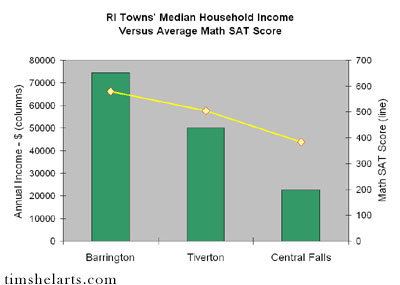
Assuming, then, that the matter is "as simple as that" — that household income correlates with SAT scores — the ensuing question must be, "Is the impact of income the same as the 'impact of poverty'?" Well, considering that Tiverton (PDF) and Barrington (PDF) have pretty much identical percentages of families living below the poverty level (2.9% and 3.0%, respectively), the answer appears to be "no." In other words, "working on the issues related to poverty" would have to actually imply an effort to make everybody equally wealthy.
However, wealth being relative (and the market tracking to its scale), even a simplistic understanding of economic reality ought to be sufficient background for one to conclude that such leveling is simply impossible, least of all when forced through government policy. To the extent that government can affect household income at the middle-class range and above, it is mainly through the fostering of a healthy business environment that encourages entrepreneurship and the importation of existing businesses (e.g., by means of reasonable taxes, respect for businesses' freedom and rights, and a light hand when it comes to employment regulations).
Whatever the strategy, of course, towns must work with finite resources. Subsidizing one area of the town's affairs requires a decrease elsewhere. Granting exemptions and aid to businesses requires that money be redirected from some other area of municiple investment. So, since we're dealing with Bob Walsh, the NEA, and SAT scores, let's throw a specific municiple invesment — that devoted to teachers' salaries — onto the same chart:
The first thing to note is that, if it's class strife that Walsh seeks to foment, honesty should compel him to admit that step-10 teachers — most of whom need only to have been teaching for just 10 years, as I understand — make more than Tiverton's median household income. With even a modest spousal contribution, their households would easily surpass Barrington's.
More importantly (and less contentiously), note that teacher salaries do not appear to correlate with either median income or SAT scores. In fact, the salaries vary only negligibly from town to town. While median income may in fact be a measure worth considering when devising strategies to raise SAT scores, teachers' salaries appear not to make a difference whatsoever. On the limited basis of these statistics, therefore, a town such as Central Falls (or Tiverton, for that matter) would be well advised to lower teachers' salaries and redirect the savings toward such improvements as will increase average household income — and with the emphasis not on welfare-style poverty programs, but on working/middle-class economic activity programs.
Not to be flippant, but the most effective way to ensure that "schools [are] a partner in addressing the impact of poverty on students" might just be to decrease the degree to which they — as costly departments of the public corporation — contribute to the circumstances that perpetuate poverty. That, if one were to ask my wife, might involve investments to make the facilities encouraging to students, comforting to parents, and inviting to potential residents.
Rhode Island's Poor Regional and National Performance in Education
Jennifer D. Jordan of the Projo reports on yet another study showing Rhode Island not doing so well, the College Board's yearly analysis of SAT Scores.
Here are the New England states ranked by math scores...
- Massachusetts 524
- New Hampshire 524
- Vermont 519
- National Average 518
- Connecticut 516
- Rhode Island 502
- Maine 501
- New Hampshire 520
- Massachusetts 513
- Vermont 513
- Connecticut 512
- National Average 503
- Maine 501
- Rhode Island 495
UPDATE:
I have to take a step back from using SAT scores as an indicator of Rhode Island's educational performance relative to the nation. Take a comparison of Rhode Island to Illinois as an example. At first, the Illinois numbers look fantastic (609 math, 591 reading). But then look at how many students took the test in each state: 8,130 in Rhode Island versus 12,694 in Illinois, even though Illinois has about 12 times the population of Rhode Island (Chicago by itself is almost 3 times as large as RI).
I suspect that the cause is that there are still regions of the country (like Illinois) where the American College Test (ACT) is more common than the SAT, and that in those regions the only students who take the SATs are those planning to attend some hi-falutin' Ivy League or west coast university, skewing the SAT median upward.
However, the regional comparison is still valid, as all 6 New England states have a high percentage of students taking SATs.
August 25, 2006
Bringing a New Strategic Focus to the Education Debate
Four recent postings by Justin and Andrew (here, here, here, and here) have brought us back to the important education policy debate.
Many reader comments on their postings have raised a number of issues related to education in Rhode Island and beyond, including: teacher salaries, automatic salary step increases, merit pay, accountability, union contract terms, pension retirement benefits, healthcare benefits, politician/bureaucrat/union behaviors, corruption, political power, union bashing, Governor Carcieri bashing, Mayor Laffey bashing, and the effect of poverty on educational outcomes.
Yet, however relevant some of these comments may be, they are reflective of the non-strategic nature of the current public debate on education. Dwelling on these largely granular or tactical issues alone has the unintended consequence of playing into the hands of those who defend the failed status quo. Alternatively, inspiring a passionate commitment to change across our society will only occur if certain core strategic questions finally become central to the public debate on education.
There are four such strategic questions:
1. Do we believe a quality education is the gateway to the American Dream for all children?2. Whom do we trust to make better educational decisions for children: their parents or the government?
3. Within each neighborhood school, who is in the position to make the best decisions regarding individual students, individual teachers, and the curriculum: federal bureaucrats, state bureaucrats, unions or the school's principal and teachers?
4. What incentives will ensure accountability to taxpayers and parents as well as reward behaviors which lead to improved educational performance outcomes?
Answers to these four strategic questions lead us to one overarching question:
Can the failed status quo be made to work by minor adjustments at the margin or will high-quality performance only come from a completely different structural approach to delivering educational services?
Let's work diligently to alter the education debate so it focuses on these core strategic issues. With the proper focus, we can unite rich and poor, liberals and conservatives, Democrats and Republicans as well as people of all colors in a common mission dedicated to finally making a quality education available to every child in America.
Bringing a New Strategic Focus to the Education Debate
Four recent postings by Justin and Andrew (here, here, here, and here) have brought us back to the important education policy debate.
Many reader comments on their postings have raised a number of issues related to education in Rhode Island and beyond, including: teacher salaries, automatic salary step increases, merit pay, accountability, union contract terms, pension retirement benefits, healthcare benefits, politician/bureaucrat/union behaviors, corruption, political power, union bashing, Governor Carcieri bashing, Mayor Laffey bashing, and the effect of poverty on educational outcomes.
Yet, however relevant some of these comments may be, they are reflective of the non-strategic nature of the current public debate on education. Dwelling on these largely granular or tactical issues alone has the unintended consequence of playing into the hands of those who defend the failed status quo. Alternatively, inspiring a passionate commitment to change across our society will only occur if certain core strategic questions finally become central to the public debate on education.
There are four such strategic questions:
1. Do we believe a quality education is the gateway to the American Dream for all children?2. Whom do we trust to make better educational decisions for children: their parents or the government?
3. Within each neighborhood school, who is in the position to make the best decisions regarding individual students, individual teachers, and the curriculum: federal bureaucrats, state bureaucrats, unions or the school's principal and teachers?
4. What incentives will ensure accountability to taxpayers and parents as well as reward behaviors which lead to improved educational performance outcomes?
Answers to these four strategic questions lead us to one overarching question:
Can the failed status quo be made to work by minor adjustments at the margin or will high-quality performance only come from a completely different structural approach to delivering educational services?
Let's work diligently to alter the education debate so it focuses on these core strategic issues. With the proper focus, we can unite rich and poor, liberals and conservatives, Democrats and Republicans as well as people of all colors in a common mission dedicated to finally making a quality education available to every child in America.
August 22, 2006
Re: Educational Assumptions
Interesting point, Andrew:
Starting Line eschews any serious discussion of education reforms -- like public school choice or charter schools -- that could be implemented in relatively short order in favor of advocating for large-scale social spending in non-educational areas, in a rejection of the idea that education reform should focus on education.
The trap in such arguments (theirs, not yours) is that downplaying the ability of education to improve children's lives lessens the justification for spending so much on teachers. The cold strategist in me can't help but wonder whether there's an opportunity to divide and conquer, here. (Of course, in discussion with the general public, one must first persuade that we can't just keep pouring money into both.)
August 21, 2006
Educational Assumptions
A major debate about education is underway in Rhode Island. The debate is bigger than just a debate about how to fix education; the debate is about the fundamental importance of education.
One side in this great debate (see Julia Steiny or Valerie Forti for examples) begins from the premise that the best way to help people achieve their potential is to provide them with an education. The other side considers this position to be too quaint for the modern world, believing that impersonal societal forces beyond the control of the individual will primarily determine what individuals can achieve. In this view, education is just a bit of window dressing that correlates accidentally to socio-economic status.
For those skeptical that this second view exists in such stark form, I refer you to Peniel Joseph's Washington Post review of Juan Williams' new book, Enough: The Phony Leaders, Dead-End Movements, and Culture of Failure That Are Undermining Black America -- and What We Can Do About It (h/t Power Line)...
Unlike The Covenant With Black America, a bestselling anthology with concrete proposals for community empowerment, Enough concludes with a flurry of righteous condescension, preaching that youngsters can best avoid poverty by finishing high school, getting a job and postponing marriage and child-bearing until at least 21.Dr. Joseph's belief that the relationship between education and achievement is overstated has been expressed locally by the Rhode Island union establishment in their education reform document, The Shape of the Starting Line. Starting Line eschews any serious discussion of education reforms -- like public school choice or charter schools -- that could be implemented in relatively short order in favor of advocating for large-scale social spending in non-educational areas, in a rejection of the idea that education reform should focus on education.
August 20, 2006
Everybody in a School Building Must Be Treated as a Child
In a comment to my previous post, Rhody writes:
... go to 401(k) first. Then we can sort out the seniority/merit issues.Who decides who gets the merit raises? The only way you can do this fairly is have teachers teach to a test - whoever has the highest number of students pass gets the biggest raise. Not sure that's the best thing for the kids, and the political can of worms you open...
Before all else, I'll speak from experience and suggest that the current step system hardly eliminates unfairness. At best, it merely consolidates it at the beginning of the teacher's career — when jobs are doled out in the manner of lifetime appointments. More importantly, though, when did it enter the unwritten laws of the land that teachers must be treated as if they are a bunch of vulnerable children?
The working world that most of us inhabit has few explicit and standardized tests to determine the raises of employees. Managers and administrators grant raises and promotions according to whatever formulas they believe will bring the best results to them in their own capacity. Sure, sometimes the criteria seem unfair (e.g., the ability to stroke the manager's ego and tattle on other employees), but overall, a system of hierarchical accountability strikes me as exponentially more fair than one in which a mediocre employee making minimal effort follows the same path as an exceptional employee making extra effort.
That last — the current state of affairs — is certainly not the best thing for the kids.
August 10, 2006
Long Gone the Schools of Lore
A comment from Norman to Andrew's "Cross-Examination" post in the Laffey/Chafee series caught my eye:
... we can't patch a quick fix on to our education problems. Chafee is right that we have to reinvest in the public schools that made America great. If we send money to private institutions we will further marginalize the poorest and most disadvantaged Americans. Steve Laffey should remember his roots and support the schools that got him out of the middle class and made him a millionaire.
The noteworthy aspect of such arguments is that they present education essentially as a two-dimensional issue: dimension one being public versus private, and (the more substantial) dimension two being money. Take a moment to actually imagine the differences between today's public schools and the "schools that got" Mayor Laffey out of the middle class — the schools "that made America great" — and it is simply impossible to take the class-warfare rhetoric and the appeals for money seriously.
I'd be surprised, for one thing, to learn that 20th century teachers received anywhere near the employment packages that modern teachers boast. I'm not surprised, however, that mainstream discussion of the "education problem" so studiously avoids mention of the feminization, sterilization, secularization, and deramification that our education system has undergone since America became great.
(N.B. — From my admittedly limited experience as a private-school teacher, I'd suggest that Norman layer some qualifications on his insistence that funding private schools doesn't benefit "the poorest and most disadvantaged Americans." At least at the Catholic grade school in which I taught, both disadvantaged and poor children were often placed in classrooms that had no room for them, but in which room was made for the reason that they had nowhere else to go. Perhaps more importantly, the school is clearly understood among locals as a means of escaping the stain and sting of poverty that the often-dangerous halls of the public schools perpetuate.)
July 24, 2006
Left/Right Consensus on Education Reform Emerging?
What do George Soros' and John Podesta's Center for American Progress, New York Gubernatorial candidate Eliot Spitzer, former Clinton Administration member Joel Klein, the U.S. Chamber of Commerce and the American Enterprise Institute all have in common? They all think that Teachers' Unions are a major impediment to school reform. Morton Kondracke explains:
The U.S. Chamber of Commerce has launched a project along with the conservative American Enterprise Institute, the liberal Center for American Progress and the moderate America's Promise that will start by publishing report cards on each state's progress on school reform. Following up its campaign against trial lawyers, the chamber is likely to target teachers unions that resist reform. The presence in the chamber coalition of the liberal CAP, headed by former President Bill Clinton's chief of staff, John Podesta, could clear the way for other Democrats to challenge the unions.At the same time, Podesta's CAP is urging correction of fiscal inequities between school systems to accompany higher national standards, which chamber officials say they would consider supporting as part of overall reform.
Separately, the conservative Thomas Fordham Institute has assembled all-star, cross-ideological backing for "weighted school funding," whereby federal, state and local school money would follow children into the classroom and be allocated more on the basis of socioeconomic need.
Besides the chamber and Fordham initiatives, I ran into compelling anecdotal evidence last week in Aspen, Colo., that American elites are fed up with the dismal status quo in education.
Continue reading "Left/Right Consensus on Education Reform Emerging?"
July 5, 2006
Framing the Education Debate
In case you missed it over the long weekend, Sunday's Projo had a very good column on school choice by Julia Steiny. Read Steiny's column together with the recent Pawtucket Times article by David Casey describing the education reform plan put forth by an alliance of Rhode Island labor groups (the full report is available on the website of the Rhode Island Federation of Teachers and Health Professionals) and you will have read the two positions that will likely frame the education debate in Rhode Island over the next several years.
The labor groups argue that, from a public policy standpoint, individuals have no meaningful ability to overcome the forces of economic determinism...
If we really want to improve our schools, the first step is to improve the lives of our poorest citizens, and offer their children the chance to have the literacy experiences that middle-class children take for granted....Ultimately, the position staked out in the labor report is that changes in the way that Rhode Island's public bureaucracies deliver an education are not worth considering, because individuals in any system cannot alter, in a significant way, their educational destiny as determined by their economic status. Therefore, education can only be improved by economically re-engineering society through increases in non-educational social-service spending and a higher minium wage and other such programs.If the state of Rhode Island really wants to find the will to improve the educational outcomes for poor children in Rhode island, the places to begin are in the places where we can alleviate some of the bad effects of poverty on children.
Julia Steiny argues the opposite -- that education should be the main priority of education reform. Instead of making it government policy to tell students that they are destined to fail, in any system, because of their economic status, Steiny believes in changing the system to give students from lower economic strata the same range of educational options (including the option to escape from a failing school district) usually available only to students from the middle class and above...
The time seems right for Rhode Island to try what's known as cross-district choice. Our school population grew through the late 1990s, but enrollment is now leveling off as the last surge of the baby-boom echo finishes high school. Throughout the state, many elementary and middle schools have excess capacity, which is to say more seats than they currently need. They could volunteer to accept students from their Rhode Island neighbors, creating a wealth of choices parents don't have now.Steiny uses Boston as an example of a school district that has improved the quality of education it provides by increasing the options available to all parents...
Boston has three different kinds of charter or charter-like schools. The city also has cross-district agreements with several neighboring school systems, allowing city kids to attend suburban schools. And within the district itself, Boston offers a growing menu of viable and ever-improving choices.Though rife with plenty of remaining challenges, many education-watchers consider Boston to be the best urban school system in the country.
July 3, 2006
Reflections on the Fourth of July
For all too many Americans, the Fourth of July is just another summer holiday, albeit one that usually features fireworks. Of course, most Americans dimly recollect that it was on this day sometime in the distant past that Americans declared their independence from Great Britain, but they seldom stop to reflect upon the true revolution that the Fourth of July signifies: the Declaration of Independence and the creation of a nation based on a universal idea.
The word "nation" comes from the Latin natio, a noun derived from a form of the verb meaning "to be born." It has traditionally meant a grouping based on such tangibles as race or blood. National movements since the nineteenth century have usually had as their goal the creation of a territorial state encompassing those possessing that common identity. It is this understanding of nationhood that Hitler reflected when he reputedly claimed that the United States was "not a nation (Volk), but a hodgepodge (mischung)." But it is the Declaration, not race and blood, that establishes American nationhood, constituting "the mystic chords of memory, stretching from every battle-field, and patriot grave, to every living heart and hearthstone, all over this broad land…"
As Abraham Lincoln remarked in 1859: "All honor to Jefferson—to the man who, in the concrete pressure of a struggle for national independence by a single people, had the coolness, forecast, and capacity to introduce into a merely revolutionary document, an abstract truth, applicable to all men and all times, and so embalm it there, that to-day, and in all coming days, it shall be a rebuke and a stumbling-block to the very harbingers of re-appearing tyranny and oppression."
In a speech delivered just after Independence Day 1858, Lincoln clarified the link between the Declaration and American nationhood. His argument is one we should ponder at a time when "multiculturalists" are advancing the view that the US is not a land of free individuals but instead a conglomeration of discrete racial and ethnic groups.
When we celebrate the Fourth of July, Lincoln told his listeners in Chicago, we celebrate the founders, "our fathers and grandfathers," those "iron men…But after we have done this we have not yet reached the whole. There is something else connected with it. We have besides these men—descended by blood from our ancestors—among us perhaps half our people who are not descendants at all of these men, they are men who have come from Europe—German, Irish, French and Scandinavian—…finding themselves our equals in all things. If they look back through this history to trace their connection with those days by blood, they find they have none, they cannot carry themselves back into that glorious epoch and make themselves feel they are part of us, but when they look through that old Declaration of Independence they find that those old men say that ’We hold these truths to be self-evident, that all men are created equal,’ and then they feel that the moral sentiment taught in that day evidences their relation to those men, that it is the father of all moral principle in them, and that they have a right to claim it as though they were blood of the blood, and flesh of the flesh of the men who wrote that Declaration, and so they are."
In Lincoln’s view, America is a nation by virtue of its commitment to the principle of equality, by which he meant simply the idea that no person has the right to rule over another without the latter’s consent. For Lincoln, what made the United States unique, and constituted the foundation of American nationhood, was the incorporation of this moral principle into the Union. This belief lay at the heart of his opposition to slavery, an affront to the very idea of republican government.
Of course, defenders of slavery such as South Carolina Senator John C. Calhoun, Georgia Senator Alexander Stephens, and Chief Justice Roger Taney and "don’t-care" politicians such as Illinois Senator Stephen Douglas disagreed. Taney and Douglas argued that Jefferson did not mean to include blacks when he wrote that all men are created equal. Calhoun and Stephens contended that he did mean to include them but that his view was false.
The irony is that while Lincoln’s view prevailed with the Union triumph in the Civil War and was subsequently incorporated in the Constitution via the 13th and 14th Amendments, it is the view of Taney et al that often predominates today. The rejection of Lincoln’s view of American nationhood is visible on both today’s political left and political right.
The main threat to American nationhood is multiculturalism, a notion that would appeal to Hitler: the discredited idea that race defines destiny, that blood determines who we are and what we can become. Multiculturalists reject the principles of the Declaration because they see them as, at best, "cultural imperialism" and at worst, racism.
To argue against multiculturalism is not to reject ethnic pride. I like to joke with my students that since my first name, "Mackubin," my paternal great grandmother's maiden name, is a sept of the Clan Buchanan, whenever I hear a bagpipe, the hair on the back of my neck bristles and I want to kill an Englishman. But then I realize that other of my forebears were English and Welsh, so I would have to kill myself.
In America, ethnicity is an indicator of whence we have come, not where we are going. It is precisely the rejection of ethnic politics and the embrace of politics based on individuality and equality that have created the conditions of civility and domestic tranquility upon which American strength and prosperity rest. The increasing hyphenation of America bodes ill for these conditions.
But multiculturalism couldn’t exist if even those Americans who praise the Declaration didn’t misunderstand its principles. How widely they are misunderstood is driven home by a three-year old piece in the Washington Post by David Broder entitled "A Living Text of Liberty". In his penultimate paragraph, Broder makes it crystal clear that he misses the point. "’We hold these truths to be self-evident: that all men are created equal; that they are endowed by their Creator with certain unalienable rights, that among these are life, liberty and the pursuit of happiness.’ Is our belief in equality truly self-evident? How does it jibe with the growing inequality of income and wealth and opportunity in this country? And is the pursuit of happiness, as now understood, wedded to the same sense of duty and responsibility that animated the men in Philadelphia?"
To answer Mr. Broder, the equality of which Jefferson speaks is that arising from the equal natural rights all men possess, antecedent to the creation of government, and the political right not to be ruled by another without the his consent. As Jefferson wrote to Roger C. Weightman on June 24, 1826, "all eyes are opened, or opening to the rights of man. The general spread of the light of science has already laid open to every view the palpable truth, that the mass of mankind has not been born, with saddles on their backs, nor a favored few booted and spurred, ready to ride them legitimately, by the grace of god. These are grounds of hope for others. For ourselves, let the annual return of this day forever refresh our recollections of these rights, and an undiminished devotion to them…"
As we celebrate the Fourth of July this week, we should reflect on the uniqueness of American nationhood arising from the Declaration of Independence. We have, of course, not always lived up to the "self-evident truths" articulated in this document, as the history of slavery attests. But these truths constitute what Lincoln called the "central idea" of the American Republic without which republican government will fail and the American nation will dissolve.
June 20, 2006
How the Legislature's Education-Aid Plan Will Affect Your City or Town
According to today's Projo, The Rhode Island House has approved a flat 4.8% increase in education aid for all Rhode Island cities and towns. Because Rhode Island distributes state education aid very unevenly, this plan gives generous increases to some communities while basically ignoring others.
For example, in 2006 Barrington received $727 per-student in state education aid. At the other end of the scale, the Providence school system received $6,632 per student. Applying these base figures to the legislature's flat funding formula, the Providence school system will get an an additional $318 per student next year, while the Barrington school system will receive only an additional $35 per student.
Here is the complete list of aid increases, based on the 4.8% figure and last year’s aid totals, as well as the amount of education aid communities gained or lost relative to Governor Carcieri's original budget proposal…
| Per-Pupil Increase in FY2007 Education Aid (Approved by House) | Total Increase in FY2007 Education Aid (Approved by House) | Change in FY2007 Education Aid (Relative to the Governor's Proposal) | |
| Central Falls | $531 | $1,983,387 | +$1,968,138 |
| Providence | $318 | $8,882,407 | +$4,991,967 |
| Pawtucket | $317 | $3,061,659 | +$1,971,915 |
| Woonsocket | $315 | $2,181,873 | +$1,700,547 |
| Bristol/Warren | $255 | $938,638 | +$469,450 |
| West Warwick | $244 | $935,998 | +$462,986 |
| Burrillville | $244 | $631,241 | +$241,179 |
| East Providence | $192 | $1,225,477 | +$471,546 |
| Newport | $191 | $540,157 | +$211,633 |
| Glocester | $186 | $147,166 | +$53,278 |
| Chariho | $176 | $679,136 | +$160,132 |
| Foster | $176 | $64,862 | +$37,645 |
| North Providence | $174 | $605,976 | +$138,848 |
| Middletown | $174 | $480,676 | +$70,989 |
| Exeter/WGreenwich | $157 | $346,906 | +$265,615 |
| Coventry | $157 | $919,263 | +$167,409 |
| Foster/Glocester | $155 | $262,378 | +$87,161 |
| Johnston | $152 | $499,858 | +$9,680 |
| Cranston | $145 | $1,629,295 | +$319,644 |
| Warwick | $144 | $1,722,942 | +$251,705 |
| Tiverton | $122 | $271,636 | +$34,507 |
| North Kingstown | $119 | $548,854 | -$25,329 |
| South Kingstown | $114 | $477,543 | -$90,167 |
| Cumberland | $114 | $607,430 | +$56,152 |
| North Smithfield | $110 | $221,575 | +$31,491 |
| Smithfield | $97 | $263,194 | -$55,602 |
| Portsmouth | $93 | $286,197 | -$326,063 |
| Lincoln | $93 | $339,105 | -$141,466 |
| Scituate | $86 | $156,019 | -$68,215 |
| Westerly | $84 | $313,353 | -$219,169 |
| Narragansett | $52 | $86,873 | -$195,126 |
| LittleCompton | $52 | $16,888 | -$28,161 |
| Jamestown | $45 | $24,357 | -$55,242 |
| East Greenwich | $36 | $89,282 | -$229,292 |
| Barrington | $35 | $119,036 | -$307,683 |
| New Shoreham | $32 | $4,870 | -$29,339 |
According to a Michael P. McKinney article also in today’s Projo, Barrington residents would like to know why the state government seems so hostile to assisting education in their town…
A dismayed Barrington Town Council approved a resolution last night expressing frustration with House lawmakers' "unprecedented last-minute" changes in school aid to more than a dozen communities and asking the legislature to provide those towns with an analysis that supported the decision to cut.The answer to Barrington’s question is that, somewhere along the line, the Rhode Island legislature adopted the philosophy that the major function of state government was to redistribute resources from smaller cities and towns to the urban core. The justification of why towns are less entitled to state support of their municipal institutions is unclear.Schools Supt. Ralph A. Malafronte said that in a dozen years as superintendent, he had never seen a House committee drop the aid below the governor's level.
Two last points. With so much money being distributed so inequitably through the state funding system, the fundamental question of the fairness of forcing people to contribute money to bureaucracies they have no control over cannot be reasonably ignored. Though all Rhode Island residents help pay 2/3 of the education costs in cities like Providence, Pawtucket, and Woonsocket, most of those Rhode Islanders have zero say, through a school committee or city council, in how those school systems are run. That’s taxation without representation. If education is to be funded on a statewide basis, students should be allowed access to any school in the state via a public school choice program.
Second, when you look over the numbers on how the capitol core gained education funding the expense of other Rhode Island communities, don't forget the recent vote on the no-bid casino deal. Maybe the members of the Providence and Pawtucket delegations who supported the no-bid deal did so because they figured that the extra revenue that would come from a competitive bidding process wasn't necessary for their communities -- they could just take what they want from Rhode Island’s smaller cities and towns instead!
June 6, 2006
Progressives Against Science Education
Rhode Island is ranked sixth amongst the six New England states in science education, and has not shown any improvement in the last five years. Here's the Projo's Jennifer D. Jordan on the subject...
Rhode Island's science scores have not improved in the past five years, even as lawmakers and educators begin to place more emphasis on this critical subject.Governor Donald Carcieri wants to address this problem head-on. He has proposed a number of initiatives aimed at improving science education in Rhode Island. They include establishing a statewide science curriculum, introducing innovative programs like Physics First and Project Inner Space, and providing more funding for the professional development of science teachers (list, from the RI 2007 Budget Executive Summary, page 38).The state continues to trail the five other New England states and is stuck in the middle of the pack nationally, according to the latest results of standardized science tests.
However, the Emergency Campaign for Rhode Island's Priorities, which claims the endorsement of the many of Rhode Island's powerful special interest groups, wants to eliminate the Governor's science education initiatives from the 2007 budget (h/t Kmareka).
ECRIP believes that that science education should be cut from the budget in order to pay for Rhode Island's already generous social service programs. Here's their list of science education initiatives they would like to see cut...
Postpone New Spending: "Inspiring Excellence in Technology, Engineering and Mathematics" teacher training program, Physics First, Project "Inner Space" and the hiring of new Science Project ManagerECRIP claims that eliminating science education from the budget would save Rhode Island $3,700,000, but tallying up the programs they've named appears to yield only about $2M in cuts. However, if ECRIP's numbers are off, I'm sure they will have no trouble finding more education funding to cut, as the priority of ECRIP seems to be cutting education to pay for welfare.
UPDATE:
I just noticed that ECRIP lists the "National Education Assoc., RI" as one of their "endorsers" on the memo that outlines the plan for eliminating funding for science education. Is the NEA really on board with this part of the proposal?
Continue reading "Progressives Against Science Education"May 19, 2006
New Education Partnership Report on Rhode Island Teachers' Union Contracts
The Education Partnership has announced the publication of its second report, Teacher Contracts: Restoring the Balance, Volume II.
The new report is described in a ProJo article entitled Report: Teachers' benefits 'excessive': Teacher contracts in Rhode Island focus too much on "excessive adult entitlements," such as lifetime health benefits, a business-backed education report states. Union officials call the study "an attack on teacher unions.":
Teacher union contracts are a major stumbling block to improving education in Rhode Island, according to a business-backed organization that is issuing a report today.The report...says teacher contracts in Rhode Island focus too much on "excessive adult entitlements" -- such as lifetime health benefits, extra pay for professional development and seniority rights -- and not enough on student learning.
The report urges political, education and community leaders to work together to change the laws that govern contract negotiations.
The report is the second in two years from The Education Partnership that criticizes teachers' unions. Last year's report recommended sweeping changes in the way teachers' contracts are negotiated, calling for such issues as salaries, benefits and evaluations to be decided at the state level, not by the local districts.
"Unions have got to get back in balance so they aren't focused solely on membership and benefits, and instead are focusing on the kids," said Valerie Forti, executive director of The Education Partnership. "It's not like we have the answers to all these things, but we know what we have now is not working."
Despite the fact that Rhode Island teachers are among the highest paid in the nation, student performance continues to lag, particularly in urban districts, which have high concentrations of low-income residents, recent immigrants and English language learners. Taxpayers and parents are fed up, and are asking where the money is going, Forti said.
"Rhode Island has shown it is willing to pay top dollar for our schools, because we know good education is expensive. We are not advocating to reduce teacher salaries or remove health care [benefits] and we understand teachers need retirement benefits," Forti said. "But it is not beneficial to bankrupt communities to provide excessive adult benefits."
The partnership also examined 13 teacher contracts and cited several examples they found egregious. The Providence teacher contract specifies the insurance provider and allows retirees and their spouses lifetime health insurance after age 65. Teachers in Bristol/Warren retiring with at least 10 years of service can get paid for unused sick time; the maximum allowed for a teacher with 35 years is about $30,000.
As is customary in Rhode Island, union officials are whining:
As they did with last year's report, union officials called the study "an attack on teacher unions" and "an attempt to gut collective bargaining in Rhode Island."Union officials also questioned why The Education Partnership did not include them while compiling the reports.
"If we did not have teacher contracts in place, both teachers and students would be significantly worse off in Rhode Island," said Robert A. Walsh Jr., executive director of the state chapter of the National Education Association. "We would not have the quality of teachers we have and things like class size, the structure of the school day and professional development would not be protected."
Putting more authority in the state or school administrators, Walsh said, would cause problems, not solve them. "There is no one-size-fits-all solution," Walsh said. "The issues facing Providence are different than those facing Westerly, and to say there is one answer is crazy."
If a statewide health plan cost a community more than the current plan, who would pay the difference? he asked. If principals chose their teachers, doesn't that open the door to favoritism? Job fairs and job placement based on seniority are more fair and objective than other methods, Walsh said.
Yes, paying the best and worst teachers the same salary based on comparable seniority provides a real incentive for great teachers to excel, doesn't it? Mr. Walsh's comments show such mastery of what works in the real world!
The article continues with comments from the state's leading educational bureaucrat:
Some educators credited The Education Partnership with highlighting many of the pertinent issues many groups are working on, but criticized some language in the report as anti-union. Instead, a statewide discussion needs to include all parties, they say."To pull this whole thing off, the conversation should not be about breaking unions but supporting that component of unionism that is where leadership wants to be accountable for results," said Peter McWalters, Rhode Island's education commissioner.
McWalters said he does not agree with everything in the report and believes that some problems can be worked out without changing state law. "But I do think the contracts are part of the problem," he said. "At the same time, if someone thinks the only difference in performance between Scituate and Providence is the teacher contracts, that's just not the case. It's more complicated than that."
Only a bureaucrat would propose a statewide conversation about issues like what East Greenwich is dealing with: (i) 9-12% annual salary increases; (ii) essentially no copayments on health insurance premiums; and, (iii) $5,000 annual cash buybacks for not using health insurance. The working families and retirees of Rhode Island don't need any more conversations because they know excessive adult entitlements when they see them!
The 58-page report makes several recommendations, including having school committee members take an oath to put student interests first and having committees insert language that would make teachers accountable, such as creating an evaluation system and merit-based pay.Other recommendations include making professional teacher development part of a longer, 190-day school year that would not require extra compensation and extending the teacher work day to eight hours...
Tim Duffy, executive director of the school committee association, says his organization would not oppose having school board members take an oath and learn more about contract negotiation. Duffy said his group already provides some training in collective bargaining.
But, he said, state law favors unions, and making progress would be difficult.
"Negotiating a contract with public employees is extremely difficult, because there is not a level playing field," Duffy said.
Duffy also agrees with the Partnership's recommendation that some items should not be part of the bargaining process. He thinks that issues such as health insurance, making teachers supervisors and curriculum should be decided by school committees.
"As a good practice, you should consult with teachers, but it should be purely the prerogative of the school committee to make these decisions," he said.
Can you imagine: Local communities actually having control and responsibility for their town's educational policies? Most citizens do not appreciate how union contracts provide almost no flexibility for the use of good judgment as school officials have only limited management rights under these contracts. It is not completely out of line to say that today's teachers' union contracts are structured as if we were living in the manufacturing era from nearly 100 years ago.
Some lawmakers say the tide is turning, and more taxpayers want changes to teacher contracts and the school system."Some of the things The Education Partnership is concerned about are currently being addressed in a more meaningful way than ever before," said state Rep. Paul W. Crowley, D-Newport...
"My opinion is, I've seen a change in the mood out here that's being driven by state's movement toward accountability and by dollars," Crowley said...
It is the beginning of a new day in Rhode Island. We have been overpaying for underperformance for too long. People across the state are fed up. And we are not going to take it anymore. We cannot afford to send our children out into a global economy without the tools to compete successfully.
The first report by the Education Partnership can be found here.
May 3, 2006
Softening the Takeover of Failing Schools
I don't have time to research the ins and outs of Rhode Island's laws dealing with the quality of public education, but it seems to me that the following addition to the section on "intervention and support for failing schools," introduced in the Senate (PDF) by Senators Ruggerio, Badeau, Ciccone, Lanzi, and Tassoni, would arguably forbid changes in an area that is especially likely to contribute to schools' problems:
Nothing in this section shall be construed to alter or otherwise affect the rights, remedies, and procedures afforded school or school district employees under federal, state or local laws (including applicable regulations or court orders) or under the terms of collective bargaining agreements, memoranda of understanding, or other agreements between such employees and their employers.
So if union contracts are strangling a school's budget and limiting the administration's ability to handle teachers in such a way as to ensure dedicated and effective performance, that reality must be off the table should the board of regents find it necessary to take the school over?
April 29, 2006
Another Example of How Educational Bureaucrats Will Avoid Accountability & Hurt Children
In the latest report (available for a fee) of dishonest manipulation of reporting performance results required under No Child Left Behind, we get this report:
When the Associated Press reported last week that nearly two million mostly minority children "aren't counted when it comes to meeting the law's requirement that schools track how students of different races perform on standardized tests," Education Secretary Margaret Spellings's response was something less than urgent concern."Is it too many? You bet," said Ms. Spellings. "Are there things we need to do to batten down the hatches, make sure those kids are part of the system? You bet." Other than that, Ms. Spelling didn't have much to say about states' rampant noncompliance with the 2002 No Child Left Behind Act...
...Ms. Spellings...tenure has been marked by lax enforcement of NCLB. Last month we reported that parents and children in failing schools nationwide aren't being notified of their school-choice transfer and tutoring options, even though notification is a requirement under NCLB. The news that Ms. Spellings is also letting states slide on even reporting the math and reading test scores of minorities is especially disturbing because accountability is the heart of the federal law.
NCLB makes allowances for schools that have racial groups too small to be statistically significant. But states have been abusing their freedom under the law to determine when a group is too small to count. And Washington is letting them get away with it. According to the AP, nearly two dozen states have successfully petitioned the Education Department "for exemptions to exclude larger numbers of students in racial categories." Today about one in 14 test scores overall go uncounted. Minorities, whose test scores on average lag those of white students, are seven times as likely to have their test results ignored. That's an odd way to enforce a law called No Child Left Behind.
"The point of these testing requirements is to put pressure on schools to close their achievement gaps by making those gaps more transparent," says Michael Petrilli, who follows federal education policy at the Thomas B. Fordham Institute. "If you're not going to enforce this, what are you going to enforce?"
Good question. We already know that schools would much rather report "average" scores, which let education bureaucrats hide the fact that large groups of mostly poor and minority students aren't learning...
School board associations, state boards of education, teachers unions and others have been demanding one type of exemption or another since the law was passed in 2002. Under Ms. Spellings's predecessor, Rod Paige, they were unable to make much progress. The current secretary, however, is herself a former associate executive director of the Texas Association of School Boards. We hope this history isn't the reason that the public education blob is having much more success in weakening NCLB now that Ms. Spellings is in charge.
NCLB's raison d'etre is to hold schools accountable for all of their students; otherwise, why not leave schools to be run by local officials, who pay most of the bills? In return for record amounts of new federal education spending, schools not only are required to test regularly, they are also required to disaggregate the data by race so that parents (and taxpayers) can see who's learning and who isn't.
That can't happen if Bush Administration officials won't enforce their own law...And it is hurting the system's most vulnerable children.
This kind of behavior is not surprising. It occurs because the government-mandated monopoly called public education means educational bureaucrats, politicians, and teachers' union pay no price for the failing status quo and, therefore, have no incentive to change their actions. It occurs because parents are not in charge of their childrens' education, as would occur under school choice. It also occurs because No Child Left Behind - however noble its stated overall goals - is a structurally flawed law.
All of society is appropriately outraged when children are physically abused. What I find appalling is that the very people who claim to care so much about children in other areas are stone-cold silent about the failings of our public schools. Talk about tolerating abuse.
April 28, 2006
Is This Rhode Island's Future? Educational Adequacy & Unsatiated Tax-Eaters
Andrew has written about state education aid to Rhode Island towns. He has also written how Mayor Cicilline of Providence thinks $188 million or $6,772/student is not enough state aid, aid largely paid for by the rest of us in the state to fund the ongoing non-performance of his city's schools.
The Mayor's brazen attitude is another example of how he is one major tax-eater. Why is he so certain he can get away with throwing a child-like tantrum and walking out of a meeting with the Governor - unless he was certain his demand for more state monies will be successful? Could it be he is counting on additional monies through a manipulation of the political system via the educational adequacy study being funded here in Rhode Island, as written about by Marc?
If you want to see where all of this could easily go in Rhode Island, consider this news story:
In Educating From the Bench: Judges order legislators to spend more on schools, and taxpayers see less in return, Jay Greene writes:
Spending on public schools nationwide has skyrocketed to $536 billion as of the 2004 school year, or more than $10,000 per pupil. That's more than double per pupil what we spent three decades ago, adjusted for inflation--and more than we currently spend on national defense ($494 billion as of 2005). But the argument behind lawsuits in 45 states is that we don't spend nearly enough on schools. Spending is so low, these litigants claim, that it is in violation of state constitutional provisions requiring an "adequate" education. And in almost half the states, the courts have agreed.Arkansas is one such state, and its "adequacy" problem neatly illustrates the way courts have driven spending up and evidence out...Like courts in other states, Arkansas's court ordered that outside consultants be hired to determine how much extra funding would be required for an adequate education.
A firm led by two education professors, Lawrence Picus and Allan Odden, was paid $350,000 to put a price tag on what would be considered adequate. In September 2003 Messrs. Picus and Odden completed their report, concluding that Arkansas needed to add $847.3 million to existing school budgets...bringing the total to $4 billion, or $9,000 per pupil...
...To determine adequate spending [Picus and Odden] rely on what they immodestly call the "evidence-based" approach. This involves selectively embracing educational practices that some research finds beneficial and costing those policies out. Their method does not address whether their favored reforms would really result in an adequate education or are in fact the most cost-effective...
But the most obvious sign the Picus and Odden report is not really evidence-based is its neglect of empirical examination of the overall relationship between school spending and student achievement. If spending more is the answer to inadequate education, it should be the case that schools that spend more per pupil, all else being equal, have higher student achievement.
As it turns out, they don't. The vast majority of social science studies find no relationship between spending and student achievement...the fact that per pupil spending has doubled over the past three decades while student achievement has remained stagnant ought to give us a clue that simply spending more won't fix schools. The shortcomings of schools are not generally attributable to the lack of resources, but to a lack of incentives to use resources effectively.
By declaring that spending had to increase, the court foreclosed consideration of this relevant evidence...If legislators did not increase spending by roughly what Messrs. Picus and Odden asserted, they would be held in violation of the court order.
Yet even this wasn't enough. After the total amount provided to Arkansas schools increased by 25% in one year, the legislature slowed the pace of spending. For the 2005 school year...the minimum amount that school districts would receive for operating expenses...was left unchanged at $5,400. The plaintiff attorneys argued before the state high court that spending had to at least match inflation.
The court agreed and ordered the governor to call the Legislature in special session to remedy the situation. Legislators met in early April and in less than a week increased spending again. They were so eager to placate the court that they gave schools more for the current school year, even though it could hardly do any good with only a month remaining. They also increased spending without knowing how the last round of additional money was being used or whether it had any effect. Messrs. Picus and Odden were retained for another $450,000 to provide this information, but their report is not expected until August...One legislative leader attempted to justify their haste by declaring, "Lack of information does not justify legislative procrastination." Doesn't it?...Unspent reserves as of October 2005 were $1.1 billion, more than 25% of the total budget. That is, schools can't even spend the additional money fast enough as the court orders more.
In Arkansas, as in too many other states, elected leaders have ceded control over the size of education budgets to unaccountable courts...As long as this continues, expect to spend more on education and see less in return.
Unsatiated tax-eaters, enabled by an engorged public sector which faces no constraints on its appetite for wasting your hard-earned monies. Will this be our future here in Rhode Island? What are you doing to change outcomes in your community?
April 22, 2006
Ruth Simmons Gets It Wrong
Earlier this week, Brown University President Ruth Simmons discussed education in a lecture before the Urban League of Rhode Island. Here is a part of her remarks, as reported by Tom Mooney in the Projo...
"How often do you talk to people who just can't bear the thought that their tax dollars are going to help children across town? It's appalling and we must call it what it is. The notion that we can request the resources in society for the privileged few and leave everybody else behind is a notion that must be called to account."President Simmons is far too quick to assume that sinister motives must lie behind a public unwillingness to send their money "across town". America's experience with public education over the past 40 years has made people, quite reasonably, wary of surrendering ever increasing amounts of money to the control of rigid, underperforming bureaucracies.
There are better ways to deliver education than through the current system dominated by local-government monopolies, but the alternatives are blocked by people who cannot bear the thought of trying them. How often do you talk to people who can't bear the thought that tax dollars will be spent in the form of vouchers? How about people who can't bear the thought that that parents, and not bureaucrats, will decide where to spend tax dollars through a public school choice program? And how often do you talk to people who can't bear the thought that tax dollars might help create a network of charter schools?
The answer to all of these questions, if you are talking to the school committees and interest groups that control public education, is quite often.
Don't confuse a lack of support for a rigid, government-knows-what's-best-for-you (when it clearly doesn't) system of education with a lack of support for public education in general. And before accusing people of being unwilling to pay for education, allow them a full range of funding options to choose from. That is, if you can bear the thought of it.
April 21, 2006
Becoming Americans
As an alumnus of one of The Claremont Colleges, it is with pride that I highlight the mission of the Claremont Institute:
The mission of the Claremont Institute is to restore the principles of the American Founding to their rightful, preeminent authority in our national life.The Claremont Institute finds the answers to America's problems in the principles on which our nation was founded. These principles are expressed most eloquently in the Declaration of Independence, which proclaims that "all men are created equal and are endowed by their Creator with certain inalienable rights...."
To recover the Founding principles in our political life means recovering a limited and accountable government that respects private property, promotes stable family life and maintains a strong defense...
The Claremont Institute believes that informed citizens can and will make the right choices for America's future...the Institute engages Americans in an informed discussion of the principles and policies necessary to rebuild our civic institutions...
America's Founders endowed our Republic with sound principles and a framework for governing that is unmatched in the history of mankind. The prosperity and freedom of America can only be made secure if they are guided by a return to these basic principles as our country enters the 21st Century.
Toward that end, the Institute is reprinting three classic essays by Claremont scholars on "Becoming Americans" as the nation debates immigration, American culture and principles, and the nature of citizenship. A version of the first essay - Educating Citizens - addresses multiculturalism and originally appeared in Moral Ideas for America, edited by Larry P. Arnn and Douglas A. Jeffrey and published in 1993. Here are some excerpts:
Democracy requires more of its citizens than any other form of government. It depends on the capacity of the citizens to govern themselves. But the habits and dispositions of self government are difficult to acquire and to sustain. They are rooted in moral and political principles in which each new generation must be educated. It is no accident that history provides so few examples of successful and enduring democracies. In the American democracy today, we have largely lost sight of those moral and political principles which provide the common ground of American political community and inform the civic character required of American citizens. There is widespread recognition of the necessity to restore that private morality which is the source of the public good and to strengthen the common bonds of civility among the diverse citizens of America. Educating citizens in the principles, rights, duties, and capacities of citizenship is the primary purpose of public education in America, and our institutions of higher learning play a critical part in making our public schools capable or incapable of fulfilling their purpose. That America is failing miserably in accomplishing this purpose is apparent to all who have eyes to see and ears to hear...Continue reading "Becoming Americans"...To the extent that a single cause may be identified as the primary source of our failure at the task of educating citizens, it can be summed up simply: bad ideas.
Education in America today, at every level, is dominated by doctrines that openly repudiate the principles on which America is founded; indeed, they deny the very capacity of men to distinguish freedom from tyranny, justice from injustice, right from wrong. These doctrines have wholly discredited the perspective of the democratic citizen: they have made self government itself unintelligible as a political phenomenon...The consequence has been a corruption of the political language through which the nation conducts its public deliberations, a citizenry increasingly confused or uncertain about the ground and substance of its rights and duties, and political and educational leaders capable for the most part only of deepening the crisis. These bad ideas are rooted in a profound assault upon human reason and human nature as grounds of human morality, an assault waged over the past two centuries culminating in explicit and assertive nihilism. The popular expressions of these ideas in our time take a wide variety of forms. But as they are professed and practiced in the world of American education today, they converge most faddishly under the banners of "Multiculturalism" and "Diversity."
The multicultural movement and the diversity movement are distinct political and intellectual movements which frequently overlap and reinforce one another. Their stronghold is in the academies of higher learning, whence they have sallied forth into practically every nook and cranny of American life...
The foremost idea of multiculturalism is the equal value of all cultures, or cultural relativism...
This is not just the view of zealots or extremists but of the mainstream, supposedly responsible public officials making policy at the highest levels...
This reigning dogma among professional educators who shape the curriculum of American public schools requires a non-chauvinistic, non-ethnocentric, balanced treatment of Hitler, Stalin, Mao, Pol Pot, and Jefferson or Lincoln. Moral relativism prohibits preferring freedom to despotism or believing that there can be a rational ground for preferring one over the other. With Lincolnian firmness, our civics instruction is dedicated to the proposition that "the concept of freedom can mean different things to different people in different circumstances."...
Inherent in the idea of cultural relativism is the idea that culture, race, or ancestry (feminist multiculturalists throw in gender) determines our ideas. Our minds, that is, are locked inside our skins, and the gulf between races or cultures is unbridgeable. There is no such thing as human reason capable of grasping any part of objective moral truth (which also doesn't exist) which is worthy of imparting to a student...Education itself is thus understood to be merely the imposition of one's own ethnically or culturally determined prejudices on others. The relation between teacher and student can be understood only in terms of power.
Multiculturalists loudly denounce the emphasis in American schools on American history and culture and western civilization. Everyone has read about this. Perpetuating the American heritage in American public schools falls under the heading of "Eurocentrism," one of the worst forms of cultural or ethnic chauvinism. It discriminates against other cultures by denying them an equal "voice" in the classroom or the textbooks. One might think that it would be a rational and non-controversial approach to teach American students about the American Declaration of Independence and the American Constitution. This is naive. And, again, it is not just the "fringe elements" who protest...American taxpayers are thus required to support the inculcation among American citizens of non-American cultural heritages however antipathetic these cultures may be to democracy or to American institutions...
Bilingualism springs from this fount of multiculturalism...In fact, the animating idea of the bilingual movement today is to preserve the sanctity of the students' "native" language and culture against the imperialistic efforts to force the "foreign" tongue of English upon them...
...The more ardent multiculturalists not only denounce the emphasis on Western civilization as bad but denounce Western civilization and its American variety as uniquely evil in themselves. The very ideas of "humanity" and "reason" are seen in this view as Eurocentric (and for the feminists, patriarchal) prejudices contrived to exploit "oppressed" cultures. This is the real driving force of the multicultural movement.
Multiculturalism has no patience for objective academic standards of excellence. These are merely other means by which the "dominant culture" oppresses "minority cultures." Therefore demonstrably objective tests are denounced as racist...
The multiculturalist replaces education with therapy, insisting that supporting the students' "self-esteem" is the governing object of education. Self-esteem is achieved by teaching the students of "oppressed cultures" to be proud of their particular race or ancestry. Some argue that this should be done by revealing the true greatness of these oppressed cultures which has been systematically repressed by a dominant white, male, European culture. But the more candid or incautious multiculturalists admit or even insist that the self worth of the oppressed must be cultivated by myths where facts will not do the trick...
...But truth must not get in the way of therapy...
The teachers who teach our public school children are graduates of American colleges where such doctrines of multiculturalism are rampant...
Social critic Rita Kramer recently spent a year visiting and studying representative schools of education across the country. Her conclusion: "At present, our teacher-training institutions, the schools, colleges, and departments of education on campuses across the country, are producing for the classrooms of America experts in methods of teaching with nothing to apply those methods to. Their technique is abundant, their knowledge practically nonexistent. A mastery of instructional strategies, an emphasis on educational psychology, a familiarity with pedagogical philosophies have gradually taken the place of a knowledge of history, literature, science, and mathematics."...What matters is not to teach any particular subject or skill, not to preserve past accomplishments or stimulate future achievements, but to give to all that stamp of approval that will make them 'feel good about themselves.' Self-esteem has replaced understanding as the goal of education."...
April 19, 2006
Mitt Romney on Reforming Education
In a Washington Times editorial, Massachusetts governor Mitt Romney writes about Reforming Education:
I was in high school when Sputnik happened. Russia's lead in space frightened us. It also woke us up...One could argue that there have been quite a few Sputniks lately, but that we haven't noticed... It's time we get moving, starting with education. First, close the Excellence Gap. American 15-year-olds rank 24th out of 29 OECD countries in math literacy and 19th in science. Fifteen years ago, the United States and Asia produced about the same number of Ph.D.'s in math and physical science: 4,700 a year. Today, we graduate 4,400; Asia graduates 24,900. Second, close the Achievement Gap. Failing urban schools are a dead end for too many minority children. This is the civil rights issue of our generation.
How to close the education gaps? The teacher's unions have their answers: simply spend more money and hire more teachers for smaller classroom size. But the data show that those are not the answers at all. Massachusetts tests our kids regularly; when studentproficiencyis matched with classroom size and per-pupil spending, there is absolutely no relationship...
We found our education prescription by interviewing parents, teachers and principals, studying actual data, mining lessons from successful districts and charter schools, and digesting the recommendations from commissions and experts. Here are some of the real answers:
1) Make teaching a true profession. The 19th-century industrial labor-union model doesn't make sense for educating children. Teachers aren't manufacturing widgets. Better teachers should have better pay, advancement opportunities and mentoring responsibilities. Better pay should also accompany the most challenging assignments -- needed specialties like math and science, advanced placement skills and extra effort.2) Let the leaders lead. Superintendents and principals must have authority to hire, deploy resources, assign mentors and training, and remove nonperformers. Seniority cannot trump the needs of our children.
3) Measure up. Over union objections, Massachusetts implemented standardized testing and a mandatory graduation exam. With measurement, we finally see our successes and failures and can take corrective action. Without measurement, we were blind.
4) Let freedom ring. When parents, teachers and kids are free to choose their school, everyone benefits. Charter schools free of union restraints and, yes, even home schools, teach lessons we can apply to improve standard public schools.
5) Pull in the parents. Teachers tell us that the best predictor of student success is parental involvement. For our lowest-performing schools, I've proposed mandatory parental preparation courses. Over two days, parents learn about America's education culture, homework, school discipline, available after-school programs, what TV is harmful or helpful and so on. And for parents who don't speak English, help them understand why their child's English immersion in school is a key to a bright future.
6) Raise the bar. Our kids need to be pushed harder. Less about self-esteem; more about learning. I have proposed advanced math and science schools for the very brightest (the one we have is a huge success, but we need more); advanced placement in every high school, more teachers with serious science and math credentials, and laptop computers for every middle- and high-school student. We've also added science as a graduation exam requirement, in addition to math and English.
These ideas should sound familiar -- they turn up in virtually every unbiased look at education. The opposition comes from some teachers unions. They fight better pay for better teachers, principal authority, testing and standards, school choice and English immersion. With their focus on themselves and their members, they have failed to see how we have failed our children. But that will change as testing produces data and data debunks the myth that more and more spending is the answer.
A continuing failure to close the excellence and achievement gaps would have catastrophic consequences, for individual human lives left short of their potential, and for our nation. Students around the world are racing ahead of ours. If we don't move, we'll become the France of the 21st century, starting as a superpower and exiting as something far less. Education must be one of our first priorities...
For more on the problems with public education today and how school choice is the solution, read The Moral Imperative for School Choice.
April 18, 2006
Rhode Island Statewide Education Aid, By Community, Per-Pupil
Providence Mayor David Cicilline says the only way to fix Providence's failing schools is for the rest of Rhode Island to give more money to the Providence school system. However, combining the Governor�s 2007 budget with the student population data from the Rhode Island Information Works website (results below) shows that Rhode Island is already very generous towards the state's capitol core. While accounting for only about 26% of RI students, Providence, Pawtucket, and Central Falls already receive about 44% of the total education aid given directly to cities and towns.
Since there is not much money in the form of state aid left to be taken from non-urban communities to fund urban school boards (some communities receive less than $1,000 per pupil compared to Providence's $6,772 per-pupil), Mayor Cicilline and "education adequacy" advocates are looking for new methods for raiding the non-urban tax base. Given the existing funding situation, "education adequacy" means using mostly statewide taxation to pay for urban core education while using a mixture of property taxes and state aid to pay for urban ring and suburban education. People in the urban areas will only be required to pay once -- for their school system, through statewide taxation. People not in urban areas will be required to pay twice -- for both their own community's schools and for urban schools.
| School District | State Aid | Students | Aid-per-Student |
| Central Falls | $41,335,813 | 3734 | $11,070 |
| Providence | $188,940,591 | 27900 | $6,772 |
| Pawtucket | $64,874,304 | 9654 | $6,720 |
| Woonsocket | $45,937,020 | 6928 | $6,631 |
| Bristol/Warren | $20,024,144 | 3688 | $5,430 |
| Burrillville | $13,540,919 | 2590 | $5,228 |
| WestWarwick | $19,972,977 | 3838 | $5,204 |
| East Providence | $26,284,707 | 6386 | $4,116 |
| Newport | $11,581,802 | 2826 | $4,098 |
| Glocester | $3,159,848 | 793 | $3,985 |
| Chariho | $14,667,680 | 3863 | $3,797 |
| North Providence | $13,091,637 | 3473 | $3,770 |
| Middletown | $10,423,773 | 2769 | $3,764 |
| Foster | $1,378,500 | 369 | $3,736 |
| Exeter/W Greenwich | $7,511,299 | 2204 | $3,408 |
| Coventry | $19,903,170 | 5862 | $3,395 |
| Foster/Glocester | $5,641,416 | 1693 | $3,332 |
| Johnston | $10,903,894 | 3285 | $3,319 |
| Cranston | $35,253,290 | 11222 | $3,141 |
| Warwick | $37,365,858 | 11993 | $3,116 |
| Tiverton | $5,896,220 | 2224 | $2,651 |
| North Kingstown | $12,008,646 | 4626 | $2,596 |
| South Kingstown | $10,516,526 | 4174 | $2,520 |
| Cumberland | $13,206,064 | 5349 | $2,469 |
| North Smithfield | $4,806,225 | 2006 | $2,396 |
| Portsmouth | $6,574,703 | 3066 | $2,144 |
| Smithfield | $5,802,003 | 2710 | $2,141 |
| Lincoln | $7,545,267 | 3649 | $2,068 |
| Scituate | $3,474,634 | 1817 | $1,912 |
| Westerly | $7,060,711 | 3710 | $1,903 |
| Narragansett | $2,091,859 | 1673 | $1,250 |
| Little Compton | $396,888 | 327 | $1,214 |
| Jamestown | $587,030 | 545 | $1,077 |
| New Shoreham | $135,660 | 151 | $898 |
| East Greenwich | $2,178,616 | 2466 | $883 |
| Barrington | $2,906,626 | 3434 | $846 |
April 14, 2006
The Urban and Political Arrogance of David Cicilline
Yesterday, Providence Mayor David Cicilline walked out of meeting with Rhode Island Governor Donald Carcieri on the subject of improving education in Rhode Island's urban core of Providence/Pawtucket/Central Falls. Both John Castellucci of the Providence Journal and Jim Baron of the Pawtucket Times have reports in their respective newspapers.
Governor Carcieri wanted to discuss increased cooperation between the school districts. This is from the Times article...
"There was never talk about an urban school district," Carcieri told reporters after the meeting. "What I wanted to do was get together with the mayors and see if this idea of more collaboration, finding ways of looking at what could be done between the three cities had any merit. I suggested that we look at it because of all the things you've heard me say in terms of curriculum alignment, in terms of transportation, they all have building issues, all of that.Mayor Cicilline walked out of the meeting because the only "reform" he is willing to consider is increased state funding for the Providence school system...
"My sense is that both Pawtucket and Central Falls are willing to look at it," the governor said. "Unfortunately, Mayor Cicilline wanted to talk about funding formulas and that's all he wanted to talk about. That's not what I was here trying to get at. That would all fall out of any discussion as you go forward."This is what Mayor Cicilline had to say...
Any "serious conversation" about public education, Cicilline asserted, should focus on Rhode Island's "over-reliance on the property tax" to pay for schools. "We still don't have a funding formula" to finance education costs in the state's 39 cities and towns.The state government already is and will continue to be very generous towards the City of Providence. According to the Governor's proposed 2007 budget (see page 456), Providence will receive about $3,900,000 more in state aid this year than it did last year. This is, by far, the largest increase in state education funding that any single community will receive. The only other communities budgeted for an increase of more than a million dollars are Warwick ($1,500,000 increase), Cranston ($1,300,000 increase) and Pawtucket ($1,100,000 increase)."Property taxes in every city and town are too high," Cicilline insisted, and in every budget the governor has proposed "he has shifted a greater percentage of the burden to the property tax.
But a disproportionate increase in aid-per-student is not enough for Mayor Cicilline. He wants either tax increases or service cuts in the rest of Rhode Island to pay for even more funding for Providence schools. This is hypocritical. The Mayor won't consider working with neighboring communities to improve education, either through the Governor's proposals, or through the Cranston school choice proposal, but expects people in all of Rhode Island's other communities to send additional money to the Providence school system.
Part of Mayor Cicilline's attitude comes from the urban arrogance that tends to infect city officials. They fall into the trap of believing that city problems are the only problems big enough to matter, that urban pols are the only ones sophisticated enough to deal with the problems big enough to matter, and that smaller cities and towns exist solely for the purpose of supporting big cities.
But there is also a political arrogance behind Mayor Cicilline's walkout. The Mayor feels comfortable snubbing the Governor because he must feel confident that Providence's education funding will be increased at the expense of the rest of the state via the "education adequacy" proposal currently being sought by the legislature. How much more of your community's tax revenue your legislator supports sending to the Providence school system is something you may want to inquire about before voting in the fall elections.
April 10, 2006
Education "Adequacy"
In Sunday's ProJo, education columnist Julia Steiny explained how Rhode Island has attempted to use a theory of "equity" education funding. In this model, money from higher income districts goes to the poorer districts in the hope that the academic levels of poor students would improve to that of the better-off kids in rich and middle-class districts. However, this hasn't seemed to work so a new theory--adequacy--is being studied.
Rhode Island, along with many other states is now commissioning an "adequacy study" [link to a word document] to get a handle on how much money it would take -- minimally -- to get most kids to proficiency. Rhode Island's proposal defines it as "the amount of per pupil funding necessary to support an effective and efficient educational system."Like Steiny--who wrote, "I confess the word 'adequacy' gives me the chills, because it does not sound like it includes music or art, nor any shred of creativity."--I'm a bit skeptical about what will be deemed "adequate," too. Nonetheless, the goals of the study are worthwhile:
State Rep. and adequacy-study committee co-chairwoman Edith Ajello says. . . says that the committee's charge is to identify the "lowest cost option" for educating each kid henceforth, without regard to how the money has been spent so far.But, Steiny points out some holes in their approach: Continue reading "Education "Adequacy""Commendably, they are studying how to exploit some obvious economies of scale of which this tiny state rarely avails itself, such as redesigning 36 different healthcare and transportation contracts and systems to be on a statewide basis. (Finally!)
April 4, 2006
US Census Bureau: Rhode Island 10th in Per-Pupil Spending
The Associated Press is reporting on the release of United States Census Bureau report detailing the amounts spent on elementary and secondary education in each state. Here's the AP summary of New England...
Vermont spent an average of $11,128 on each of its public school students, which is the fourth highest per pupil spending in the nation...Another number from the report that jumps out is that Rhode is 51st (dead last) in terms of "capital outlays" at $28,171,000. Here is the definition of a capital outlay...Vermont was not alone among its New England neighbors in having a high per-pupil spending level. Connecticut was fifth at $10,788; Massachusetts was sixth at $10,693, Rhode Island was 10th at $9,903, Maine was 11th at $9,534, and New Hampshire was 17th at $8,860, the Census Bureau said.
This category refers to the direct expenditure by public school systems for construction of buildings and roads; purchases of equipment, land, and existing structures; and for payments on capital leases. Amounts for additions, replacements, and major alterations to fixed works and structures are included. However, expenditure for maintenance and minor repairs to buildings and equipment is classified as current spending.For comparison, Delaware, also a small state, spent $158,252,000 on capital outlays.
March 29, 2006
Proposed Rhode Island Legislation on Education
In his March 29 posting, Tom Coyne writes:
There is clear and convincing evidence that Rhode Island taxpayers don’t get value for money when it comes to public education. There is no doubt that we spend more generously than most states. As a percentage of our per capita state income, Rhode Island’s per pupil spending is the second highest in the country. At 92%, the percentage of per pupil spending that goes to salaries and benefits in Rhode Island is the nation's highest. Our average teacher salary, as a percentage of its average private-sector worker's salary, is the highest in the country, and has been since at least 1990. And Rhode Island has the nation’s second highest number of teachers per student.But what do we get for our money? On the National Assessment of Educational Progress (the only test taken by students in all fifty states), our children perform poorly, even when scores are adjusted for differences in poverty levels between states. Whether they are black, white or Hispanic their scores trail far behind number one ranked Massachusetts. If we do not take dramatic steps to improve this situation, we are condemning our children to declining standards of living in the future.
The good news is that there are bills pending before the General Assembly that could significantly improve public education in Rhode Island. The bad news is that there are pending bills that could make things even worse. Let’s look at the good bills first.
The first step in improving public education is to spend taxpayer money more efficiently, to provide more funds for books, classroom materials, and performance bonuses for the best teachers. An important move in this direction is bipartisan legislation introduced by Reps. Malik and Singleton (H. 7730 and H. 7795) that would move school district employees into the state health insurance plan. Similarly, H. 6853A and S. 2531 (introduced by Rep. McNamara and Sen. Doyle) would allow for state-wide purchasing of non-health insurance items by school departments. Finally, H. 7841 and S. 2895 (Rep. Mumford and Sen. Bates) would put the Rhode Island Public Transit Authority in charge of all out-of-district school transportation. Since the potential cost savings increase geometrically with the size of the network being optimized, the benefits from this change should be substantial.
The second step in improving education is to more effectively spend the money produced by efficiency improvements. This is an important point to emphasize: improving public education in Rhode Island is not about spending more or less; it is about spending smarter.
A number of bills have been introduced that would help achieve this goal. H. 7385 (Story) and S. 2697 (Blais) adds science to the current math and English language arts statewide curriculum requirements. H. 6850 (Crowley) and S. 2196 (Gibbs) lifts the ban on charter schools. Yet to be introduced legislation by Reps. Almeida and Davey will propose a public school choice program. H. 7542 (Smith) establishes an alternative public school for the most disruptive students. A number of other bills would ban unfunded state mandates that impose additional costs on local communities. For example, H. 7570 (Ehrhardt) lets local school committees decide whether to use costly bus monitors. Perhaps most important, H. 7581 (Singleton) returns management rights to school committees and principals, including decisions over staffing and other issues. This implements the common sense idea that teachers unions should not be running our schools.
Unfortunately, other bills have been introduced that could make today’s bad public education situation even worse. Some would require the state to pay a larger share of the cost of educating students with disabilities. However, no bill has been introduced to implement the recommendations of the General Assembly’s own 2001 report ("Special Education in the Context of School Reform") which found that Rhode Island classifies too many children as "learning disabled." At 20.1%, we have a higher percentage of disabled students than any other state in the country – the national average is only 13.8%. Since it has been estimated that these students cost 1.9 times more than non-disabled students (in large part due to the higher union staffing requirements for teaching disabled students), only fear of the teachers unions explains the failure of the General Assembly to address this very expensive issue.
Other highly questionable bills include new unfunded state mandates to hire more speech pathologists (H. 7559, Smith), pay them $3,500 bonuses (H. 6830, San Bento), and give power over teacher certification to a union-controlled board (H. 7560, Smith). Another set of bills would give the teachers unions even more bargaining power. H. 7008 (Gemma) would require binding arbitration for both monetary and non-monetary issues if a teachers union and school committee could come to no agreement after a year of mediation. This might seem like a good idea, were it not for bills like H. 6732 (Moura) and S. 2633 (McCaffrey) which would limit an arbitrator’s power to rule against the union position, and H. 7602 (Lally) that would make it even harder for town councils to win so-called "Caruolo lawsuits" brought when school committees take towns (and, indirectly, taxpayers) to court demanding more funds. Finally, H. 7858 (Moura) would prevent changes to union contracts when the state intervenes at a failing school. This would make it much more difficult to improve performance at places like Hope High School.
Last, but certainly not least, a number of bills have been introduced that would mandate higher state aid to local education, and proposed different formulas to divide it. The most egregious of these is H. 7765 (Slater, Diaz, Williams, Almeida and Dennigan). It would add language to the Rhode Island Constitution to make it much easier to launch so-called "adequacy" lawsuits, which attempt to use the courts to force substantial increases in spending on urban schools without any improvement in the way the money is used– all paid for by higher taxes on the suburbs. Indeed, what is missing in this whole discussion is an honest picture of the real problem. Between 1996 and 2006, annual state General Revenue spending on social welfare programs increased by $553 million, from $681 million to $1.2 billion per year. With Rhode Island’s state income, sales, and excise taxes already among the highest in the country, this meant there was less money for state education aid to cities and towns. As a result, local property taxes had to increase by $579 million per year – more than $1,000 per year for every household in Rhode Island.
In sum, the General Assembly has an historic opportunity to pass legislation that would significantly improve public education in Rhode Island. Whether they will have the courage to do so over the objections of the teachers unions remains to be seen.
March 27, 2006
Urban Arrogance & Fixing Education
Last week, the Providence Journal, Pawtucket Times, Westerly Sun, and Newport Daily News (story links) all reported on a recent evaluation of the quality of education in Rhode Island conducted in the form of the New England Common Assessment Program. Jennifer D. Jordan of the Projo summarizes the results...
Statewide, about half of the 72,000 third-through eighth-grade students tested last fall were proficient in math and about 60 percent were proficient in reading. Fifth and eighth graders also took a writing test; 51 percent were proficient.The political direction where this is heading is foreshadowed in Douglas Hadden's Pawtucket Times story on reaction from Pawtucket...But in the urban districts -- Providence, Pawtucket, Central Falls and Woonsocket -- just 28 percent of students were proficient in math; 35 percent in reading; and 33 percent in writing.
Results from Cranston, East Providence, Johnston, Newport, North Providence, Warwick and West Warwick, so-called urban-ring communities, were far higher; 50 percent in math; 62 percent in reading; and 55 percent in writing.
And students in suburban and rural communities scored the highest rates: 65 percent in math; 72 percent in reading; and 61 percent in writing.
"I would bet the urban districts are performing quite a bit" below non-urban school systems. "That wouldn't come as a surprise really," said School Committee Chairman Alan Tenreiro, who teaches at Mount St. Charles Academy in Woonsocket. "Socio-economics is one of the biggest indicators, besides the educator in the classroom, for student achievement....Making education funding "adequate and equitable" is code for raising taxes and/or cutting services in non-urban communities so that their resources can be transferred to the failing urban school districts that already receive a disproportionate share of state aid. Mr. Tenreiro's remarks exhibit the distressing tendency of urban officials to demand that everyone give the cities what the cities want, based on the belief that urban problems are more important than everyone else's, and that smaller communities will always have enough for dealing with their piddling little small-town problems from whatever is leftover.Tenreiro state the urban core results showed the need for more state financial support.
"I think we have to look at the education funding formula and make one that's adequate and equitable for all students. I'm not saying money is the whole answer, but we do have to provide a lot of support services to kids that walk in the doorway."
Unfortunately, like government bureaus everywhere, urban school districts tend to lose their focus and view increasing their budgets as an end to itself. Before demanding that they be provided with even larger subsidies, urban school districts have a responsibility to show that they have meaningfully considered all available options for improving the quality of education available to their students -- even options that foster educational improvement without increasing the amount of money under traditional bureaucratic control -- including school choice, charter schools, and -- dare it be said -- voucher systems.
March 21, 2006
The Laffey School Choice Program is the School Funding Reform that Rhode Island Needs
In an op-ed published in Monday's Projo, Cranston Mayor Steve Laffey makes his case for using school choice to increase the educational opportunities available to Rhode Island students. Here is the Mayor's description of the first step, a voluntary pilot school choice program for Providence students...
This program will let students in Providence's failing schools enroll in better schools in Cranston or other neighboring communities that choose to participate. At the same time, Cranston (or other accepting districts) will be reimbursed by the failing school district. The program lets parents choose the school that best fits their children's needs and injects competition into the system, inducing failing schools to make real and tangible improvements.Providence Mayor David Cicilline has expressed a different view of how to best improve the education of Providence students. In his recent State of the City address, Mayor Cicilline expressed dissatisfaction with the growth-rate of state aid given to the city of Providence...
Republican policies at the Federal level have amounted to a political sleight-of-hand that has transformed politically expedient federal tax cut programs into destructive property tax increases in nearly every city and town in America.Note that Mayor Cicilline decries the "share" of aid given to Providence, not the absolute amount. State education aid to Providence has either gone up or stayed the same every year for at least the last four years. In 2006, Providence was budgeted to receive about $20,000,000 more than it did in 2002. All through that period, and continuing to the present, Providence has received a disproportionate of state aid on a per-student basis. According to the Rhode Island's fiscal year 2006 budget (see page 442 of the Program Supplement), Providence received about $185,000,000 in aid for about 28,000 students (about $6,600 per student), while Cranston received about $34,000,000 for a little over 11,000 students (about $3,000 per student). Despite this, Mayor Cicilline's position is that the Providence school system needs more.And at the state level the Governor offers the same approach. Every year -- a decreasing share of school funding from the state. Every year -- a little more weight the property tax payer must bear.
Getting more education resources to Providence students can only take a few forms. The first would be to have Providence provide more for Providence students...
- Raise property taxes in Providence.
If additional resources cannot come from Providence, then they have to be taken from somewhere else. That leads to two possibilities...
- Raise taxes in other Rhode Island communities to subsidize Providence schools.
- Cut services in other Rhode Island communities to subsidize Providence schools.
Now, there is now a third option on the table, the school choice option...
- Distribute existing resources directly to the schools that Providence parents and students have chosen as best meeting their needs.
March 14, 2006
A Public Education Merit Pay System That's Working
Two arguments made (in this forum and elsewhere) against implementing a merit pay system in public education are 1) objective evaluations of the jobs that teachers do are not possible and 2) teachers are motivated differently than are members of other professions, so merit pay would not improve the quality of education.
Brad Jupp, the sixth gentleman on the list of Edutopia magazine’s "Daring Dozen…Who are Reshaping the Future of Education" (h/t Kiersten Marek of Kmareka) casts serious doubt on the idea that these points should end the discussion of merit pay. Edutopia describes Mr. Jupp as a "Teacher Pay Trailblazer"…
When Brad Jupp became lead negotiator for the Denver Classroom Teachers Association in 1990, he recalls, the union and the Denver Public Schools were "highly committed adversaries." In 1994, as the two parties sparred over policy and pay, Jupp led a five-day teacher strike. The upshot was a paltry boost in pay raises from 1 percent to 1.2 percent, and a revolution in Jupp's vision of collective bargaining.Now, twelve years later, having fostered cooperation between the two former antagonists, Jupp has successfully spearheaded a groundbreaking reform of teacher pay. In 2004, union members ratified the Professional Compensation System for Teachers, the nation's most comprehensive overhaul of a system that has until now rewarded teachers equally whether they work hard or just show up. Last November, Denver voters sealed the deal by approving an annual $25 million property tax hike to fund the initiative…
Under the new system, also called ProComp, teachers will receive raises higher than their regular cost-of-living boosts for, among other things, exceeding expectations of student growth on the state test, meeting student-growth objectives set collaboratively by teachers and supervisors, and earning positive performance evaluations. The system provides additional bonuses to teachers working in hard-to-fill positions and hard-to-serve schools.
An article by Mr. Jupp in the Spring 2006 issue of the Hoover Institution journal Education Next describes the details of the ProComp plan…
Denver teachers hired before 2006 have a choice between the traditional salary schedule and this four-dimensional merit pay system. Teachers hired after January 1, 2006 will automatically enter the new system.Learning Gains
- Teachers who exceed expectations for student growth as measured by a statewide Colorado test will receive a sustainable 3% raise.
- All teachers will set two student growth objectives with the help of supervisors. Teachers who meet both objectives will receive a 1% raise; those who meet one objective will receive a 1% bonus.
- Teachers at schools identified as distinguished will receive a 2% bonus.
Evaluation
- Teachers found to be unsatisfactory will have their salary increase delayed for a minimum of one year.
- Probationary teachers will be evaluated every year in their first three years of service and will receive a 1% raise if they are judged to be satisfactory.
- Non-probationary teachers will be evaluated every three years and will receive a raise of 3% if they are deemed satisfactory.
Battle Pay
- Teachers working in assignments identified as hard-to-staff and in schools termed hard-to-serve will receive a 3% bonus.
Credentials
- Teachers with active licenses from the National Board for Professional Teaching Standards (MBPTS) will be awarded a salary increase of 9%.
- Teachers who complete one Professional Development Unit in their concentration will receive a 2% raise.
- Teachers who complete an advanced degree relevant to their assignment will receive a 9% raise.
Mr. Jupp also addresses the idea that teacher motivation makes associating pay with performance in the education profession infeasible...
In fact, Denver teachers have shown surprising open-mindedness about merit pay programs. The Denver Public Schools, with the collaboration of the teacher union, launched a Pay for Performance pilot program in 1999 and, when it ended in 2003, started a more comprehensive Professional Compensation System for Teachers (ProComp). Our independent researchers discovered a surprising amount of support for merit pay by teachers in both programs.Could the Denver system work here, or is there something substantially different between Colorado and Rhode Island?The hallmark of the Pay for Performance pilot was paying teachers $1,500 bonuses for meeting measurable objectives set collaboratively with their principals and based on the academic growth of the students they taught. When asked in the spring of 2003, just as the pilot program was ending, to rate whether setting measurable objectives for bonuses of up to $1,500 had an impact on “cooperation among teachers,” 53.2 percent of the participating teachers said the impact was positive; only 2 percent said the impact was negative.
March 5, 2006
Congressman John Conyers: Another Liberal Pursues School Choice For His Kids While Blocking Needy Children From Having The Same Opportunities
In an editorial entitled Choice for me, not for you, Michael Franc has yet another example of the hypocrisy of liberal Democrats regarding school choice:
The latest ethics flap in Washington exploded last week...It involves veteran Michigan Democrat and would-be chairman of the House Judiciary Committee, Rep. John Conyers. Two former staffers allege a pattern of corruption by Conyers, self-proclaimed "Dean of the Congressional Black Caucus," including forcing them to work on several state and local political campaigns while on his congressional payroll and allowing a senior staff counsel to conduct her private law practice out of his office.Also among the charges is that Conyers required his staff to care for his two young boys, including providing tutoring services to Conyers' elder son while he attended a posh private school in Bloomfield Hills. The school "Little John" Conyers attends is the Cranbrook School. According to its Web site, tuition at Cranbrook runs a cool $17,880 for grades 1-5, $19,280 for middle school, and $21,730 for high school. Parents who send their kids to board at Cranbrook must cough up more than $30,000.
Yet Conyers is a longstanding opponent of any form of school choice for low-income children. At a "Stand Up for Public Schools" rally a few years back, Conyers decried educational choice as a "scheme" which "will only harm our public schools" and pointed instead to the sort of "real" school reforms drawn from the educational unions' playbook – teacher training, reduced class size, and school construction. "It is vital," he said then, "for parents, educators, and community leaders to join together to strengthen Detroit’s public schools."
Unless, of course, you can afford to send your child to The Cranbrook School.
A lengthy review of school choice issues was recently posted here. Included in that posting is this Clint Bolick quote about Hillary Clinton's recent comments on school choice and the Clinton's years-ago school choice decision for the benefit of their daughter Chelsea:
We now have nearly two decades of experience with school choice. We do not see white supremacy schools. We do not see jihadist schools. We do not see religious strife or rioting in the streets. What we do see is children who never before have gotten a break learning in safe environments chosen by their parents. And we see the power to choose providing a catalyst for public schools to improve. School choice is the tide that lifts all boats.Never was there greater testimony to the importance of school choice than Mrs. Clinton herself. When the President and Mrs. Clinton moved into the White House, they were offered something that no other resident of the nation's capitol had: the choice of any public school for their daughter. They decided that sending their daughter to a defective school system was too great a sacrifice, and chose a private school instead. That led Wisconsin Rep. Polly Williams, the sponsor of Milwaukee's school choice program, to quip that "Bill and Hillary Clinton should not be the only people who live in public housing who get to send their kids to private schools."
I think school choice is the ultimate domestic policy issue and an aggressive pursuit of school choice policies will transform domestic political parties and domestic politics in this country. It is the one issue that can unite Democrats and Republicans, liberals and conservatives, blacks and whites, as well as the economically needy and well off - as I saw last night at a dinner party of people who themselves covered the entire political spectrum. Why? Because what happens to your child is the ultimate personal issue to a parent, an issue that stirs deep passion. This posting elaborates on that point:
...Education is inherently personal and inherently value laden. The key relationships in schools are those between individual teachers and individual students: If the teachers are not willingly committed and highly motivated, no centralized rule books or formulas are going to inspire peak performance…Moreover, schooling inescapably involves judgments about truth and virtue, about what kind of person a youngster should aspire to be. Americans inevitably disagree with each other about those judgments…Today's Americans have no more chance of reaching consensus on [these] questions than of agreeing on what church (if any) we should all attend; that is why we keep the state out of controlling churches, just as we keep it out of other value-forming institutions such as publishing and journalism. The more we entrust such decisions to centralized state agencies, the more conflicts we foment. Zero-sum "culture wars" for control of coercive state monopolies make enemies of people who could otherwise be friends...
These are the reasons why parents, not educational bureaucrats and unionist teachers, should be in control of their childrens' educational decisions. It is why that control should be empowered by educational vouchers or tax credits to give parents the necessary leverage to ensure their children receive a proper education.
Why will it transform domestic politics? In addition to stirring passion among parents, we have a visibly failing status quo in America and in Rhode Island.
Why will it transform domestic politics? It will because school choice simply will succeed if given a chance. The posting continues and explains why:
Rather than continuing to use centralized government decrees to turn mediocre institutions into excellent ones, as they have been trying but failing to do for decades, the state and federal governments should be empowering individual families to transfer to schools of their own choice.That strategy would bring three advantages that are absent from the command-and-control model embodied in NCLB. First, it would allow parents to rescue their children from dysfunctional schools immediately…Second, it would allow families to pick schools that are compatible with their own philosophical and religious beliefs instead of locking them into zero-sum conflicts to decide which groups win power to impose their beliefs on others. Third, it would unleash the dynamic force of competition. Real accountability to customers free to go elsewhere is qualitatively different from fake accountability to government agencies that can almost always be pressured into keeping the money flowing to schools that are manifestly failing.
The key locus for genuine reform is the states. Under the Constitution it is the states that have legal responsibility for education…The best contribution the national government can make is to get out of the way.
And I think Steve Laffey has found an issue that, if managed well, could get a non-RINO Republican elected to the United States Senate from Rhode Island.
March 2, 2006
The Moral Imperative for School Choice
The encouraging school choice proposal by Cranston Mayor Steve Laffey, discussed here, and the absurd response by Senator Chafee has led me to repost below an expanded version of a November 18, 2005 posting on the moral imperative for school choice.
Contrasting this week's posting with an earlier posting on this issue - also by Andrew and entitled Cranston's and Rhode Island's Need for a Sensible School Choice Program - shows how Mayor Laffey and other Cranston leaders have evolved their policy solution in recent months in response to a genuine problem. The comments section of that earlier posting is alive with a debate about two issues: Should children from Providence - where public schools are mediocre - have the right to attend better schools in Cranston and what effect does this have on education funding flows? These are two central questions underlying the school choice debate.
School choice is a moral imperative because the performance of our schools greatly influences whether (i) our children have a clean shot at living the American Dream; and, (ii) whether our country can maintain the strength of its economy via a well educated citizenry capable of competing successfully in an increasingly global economy.
To provide an indepth review of the school choice debate, this posting is divided into nine sections. Each section is identified below and you can proceed directly to it by clicking on the title of that individual section below:
I. The Unavoidable & Serious Performance Problems with Public Education
III. The Structural Problem with Public Education
IV. Myths Propagated by Defenders of the Status Quo
V. Defenders of the Status Quo: Bureaucrats, Politicians & Teachers' Unions
VI. The Magnitude of Teachers' Union Monies at Work to Maintain the Status Quo
VII. Irreversible Change has Begun
VIII. Elaborating on the Rationale for School Choice
IX. Why School Choice is a Moral Imperative
Continue reading "The Moral Imperative for School Choice"
The Moral Imperative for School Choice: The Complete Posting
The encouraging school choice proposal by Cranston Mayor Steve Laffey, discussed here, and the absurd response by Senator Chafee has led me to repost below an expanded version of a November 18, 2005 posting on the moral imperative for school choice.
Contrasting this week's posting with an earlier posting on this issue - also by Andrew and entitled Cranston’s and Rhode Island’s Need for a Sensible School Choice Program - shows how Mayor Laffey and other Cranston leaders have evolved their policy solution in recent months in response to a genuine problem. The comments section of that earlier posting is alive with a debate about two issues: Should children from Providence - where public schools are mediocre - have the right to attend better schools in Cranston and what effect does this have on education funding flows? These are two central questions underlying the school choice debate.
School choice is a moral imperative because the performance of our schools greatly influences whether (i) our children have a clean shot at living the American Dream; and, (ii) whether our country can maintain the strength of its economy via a well educated citizenry capable of competing successfully in an increasingly global economy.
To provide an indepth review of the school choice debate, this posting is divided into nine sections. Each section is identified below and you can proceed directly to it by clicking on the title of that individual section below:
I. The Unavoidable & Serious Performance Problems with Public Education
III. The Structural Problem with Public Education
IV. Myths Propagated by Defenders of the Status Quo
V. Defenders of the Status Quo: Bureaucrats, Politicians & Teachers' Unions
VI. The Magnitude of Teachers' Union Monies at Work to Maintain the Status Quo
VII. Irreversible Change has Begun
VIII. Elaborating on the Rationale for School Choice
IX. Why School Choice is a Moral Imperative
Continue reading "The Moral Imperative for School Choice: The Complete Posting"
No Educational Bureaucrat Left Behind
Like many Americans, I have previously waffled on whether the No Child Left Behind (NCLB) act was good policy. I was drawn to the idea of performance standards and the suggestion that there would eventually be zero tolerance for mediocrity. But I was put off by another attempt by Washington to manage education from afar as well as the idea that the federal government could excel at driving state and local educational practices even if they wanted to. The most common reaction from people I talked to was the equivalent of a blank stare. Few of us really knew what the bill said or how it might work or fail.
Into that void of public knowledge, Lawrence Uzzell offers an outstanding synopsis of NCLB in an article entitled No Bureaucrat Left Behind. Here are some excerpts:
In domestic policy, the No Child Left Behind (NCLB) education act is the Bush administration's top claim to visionary leadership…NCLB's success will depend on whether it is possible to produce excellent educational performance through centralization. Its advocates are in a self-contradictory position. They recognize that the educational policies of the last four decades—a period of almost uninterrupted centralization—have failed, but their remedy for that failure is yet more centralization. While invoking the principles of an "ownership society" on issues such as Social Security reform, they are pursuing almost the exact opposite model in schools. In a period of growing social mobility and individual autonomy, they are promoting a top-down, Great Society model of reform—transferring power from individual parents, teachers, and principals to distant bureaucracies such as state education agencies. Ironically, education is precisely that area of social policy that by its nature is least susceptible to centralization. Education is inherently personal and inherently value laden. The key relationships in schools are those between individual teachers and individual students: If the teachers are not willingly committed and highly motivated, no centralized rule books or formulas are going to inspire peak performance…Continue reading "No Educational Bureaucrat Left Behind"Moreover, schooling inescapably involves judgments about truth and virtue, about what kind of person a youngster should aspire to be. Americans inevitably disagree with each other about those judgments…Today's Americans have no more chance of reaching consensus on [these] questions than of agreeing on what church (if any) we should all attend; that is why we keep the state out of controlling churches, just as we keep it out of other value-forming institutions such as publishing and journalism. The more we entrust such decisions to centralized state agencies, the more conflicts we foment. Zero-sum "culture wars" for control of coercive state monopolies make enemies of people who could otherwise be friends.
NCLB does not explicitly call for national curricula. It mandates standards for testing, not for curricula, and leaves the content and design of the tests up to the states. But in the long run tests, at least to some degree, shape curricula. NCLB is already promoting centralization within each state; it could become a force for national centralization as well if future administrations exercise to its full potential their power to deny federal funding to states whose testing programs are deemed inadequate…
…NCLB virtually guarantees massive evasion of its own intent: It orders the state education agencies to do things that many of them don't want to do—such as instituting detailed, rigorous testing programs that enable the public to distinguish successful from unsuccessful schools—while giving those agencies broad discretion about just how to do those things. As the states devise various tactics for evading the letter and spirit of the law, Washington policymakers will be forced either to let them get away with those tactics or to keep amending NCLB's statutory text (already about 1,100 pages long) and associated regulations in order to keep up with ever more inventive evasions.
If policymakers choose the former course, NCLB might as well not exist; like other federal education programs, it will be just one more drain on taxpayers and provide subsidies to special interests, in this case to the testing companies. But if policymakers instead choose to amend the statute, they will end up making it steadily more prescriptive and top-heavy. Washington's education officials will more and more resemble Soviet central planners trying to improve economic performance by micromanaging decisions from Moscow. Unlike Soviet bureaucrats, however, the federal government lacks a captive labor force; the more centralized the system becomes, the more likely the educators with the greatest creativity and leadership will be to seek careers elsewhere rather than accept being pawns of the central government. As a strategy for promoting "excellence," centralization is inherently self-defeating.Thus NCLB is a reform strategy at war with itself: It can work on its own terms only if federal officials ride tight herd on their state counterparts, overriding them whenever they sacrifice reform to special-interest pressures. Its authors have already said that they will do no such thing, rightly invoking principles such as states' rights and the absence of a constitutional warrant for federal control of local schools. But if they were truly serious about those principles, they would never have enacted NCLB to begin with…
Thus NCLB may end up giving us the worst possible scenario: unconstitutional consolidation in Washington of power over the schools, with that power being used to promote mediocrity rather than excellence. It is too early to know which scenario will prevail, but it is already clear that state and local education officials are skillfully protecting their interests in ways that undermine the intent of NCLB. Especially telling has been their widespread dishonest reporting in at least four areas: graduation rates, school violence, qualified teachers, and proficiency tests…
The most important part of NCLB, its goal of 100 percent academic "proficiency" among America's schoolchildren by the year 2014, is also the easiest to manipulate. The statute does not even define the word "proficiency," though it appears hundreds of times. Under NCLB the states have manifold opportunities to "game the system."…Unfortunately, the first three years of NCLB have seen states using all of those tactics. As it becomes increasingly clear that the states can dumb down their standards without adverse consequences, there will likely be a "race to the bottom."
The incentives for evading the truth will grow as NCLB's annual targets get more ambitious…Moreover, the idea of an enlightened federal government forcing the states to do the right thing depends on the assumption that Washington is somehow immune to the interest-group pressures that warp decision making within the state education agencies. That assumption is utterly unrealistic…
State-level testing and accountability systems enacted before NCLB have tended over time, as Frederick Hess of the American Enterprise Institute puts it, to drift from "tough" to "soft." Standards are gradually relaxed as interest groups mobilize against them…
NCLB reflects an ideological strain that is novel for Republican presidents, utopianism. Like older forms of utopianism, the Bush administration emphasizes collective action rather than individual responsibility: NCLB implicitly treats students as passive commodities, mass-produced by state programs. It also treats parents as unable to select good schools…
Utopianism usually ends up transforming rhetoric more than reality…By 2014 NCLB will be seen to have failed, just as the other centralized education programs enacted since the 1960s have failed…Rather than continuing to use centralized government decrees to turn mediocre institutions into excellent ones, as they have been trying but failing to do for decades, the state and federal governments should be empowering individual families to transfer to schools of their own choice.
That strategy would bring three advantages that are absent from the command-and-control model embodied in NCLB. First, it would allow parents to rescue their children from dysfunctional schools immediately…Second, it would allow families to pick schools that are compatible with their own philosophical and religious beliefs instead of locking them into zero-sum conflicts to decide which groups win power to impose their beliefs on others. Third, it would unleash the dynamic force of competition. Real accountability to customers free to go elsewhere is qualitatively different from fake accountability to government agencies that can almost always be pressured into keeping the money flowing to schools that are manifestly failing.
The key locus for genuine reform is the states. Under the Constitution it is the states that have legal responsibility for education…The best contribution the national government can make is to get out of the way.
March 1, 2006
The Chafee Campaign on the Pilot Choice Program
The statement offered by the campaign of Senator Lincoln Chafee on Steve Laffey’s announcement of a proposed pilot school choice program between Cranston and Providence ignores most of the substance that was discussed by Mayor Laffey. If this is truly representative of the Senator’s view, then the Senator has a very narrow view of the objectives of the public education system…
At a press conference today, Mayor Laffey once again demonstrated a disregard for state statutes that clearly outline the proper procedure for dealing with non-resident students….Apparently, the Chafee campaign has no interest in the pilot choice program, nor in the fact that Providence schools are failing, both discussed extensively in Mayor Laffey’s press conference, but not mentioned in the Chafee campaign press release.
There is a set process in place to deal with the issues of disenrollment that the Mayor has chosen to ignore. Expedited hearings are available at the State Department of Education, which are routinely used by communities to remedy such matters. It is actually illegal for a school district to disenroll a student without first going through proper channels.
"This behavior is vintage Steve Laffey - shoot first, ask questions later," commented Chafee Campaign Manager Ian Lang. "There are appropriate procedures in place for dealing with these situations, but Mayor Laffey is either ignorant of them or simply doesn't care…
If this statement truly represents the Senator’s position on public education, Senator Chafee’s interest in public education apparently ends at making sure that proper procedures are being followed in making sure that students are attending schools in their home districts, even if that means forcing students to go to bad schools when alternatives are available.
Suspicions of an Ex Post Facto Gotcha
Fred's sarcasm in the comments to Andrew's foregoing post regarding my previous complaints that Mayor Laffey hadn't tied his arrest of Maria Hernandez to the issue of school choice doesn't really work based on Laffey's ex post facto announcement. Will's comments fair a little better, since his previous assertion was of an unseen plan on Laffey's part. But for all we know, it was discussion on this very blog that prompted Cranston's newly minted school choice policy. Probably not, but the timeline hardly invalidates my argument that Laffey had said absolutely nothing about the topic previously.
If this matter is unfolding according to some master plan, however, I have to say that I find the strategy to be unnecessarily manipulative. Pushing a family into the state spotlight with an arrest and promises of prosecution in order to embarrass foes and tentative allies alike with a gotcha probably isn't the most politic means of advancing conversation.
Of course, if there were a plan in operation, I'd have expected materials to have been prepared (e.g., on the Web site) for simultaneous release. I also wouldn't have expected this to be the case:
Laffey said he has not contacted Providence to brief them on his plan, or to work on the problems together.
February 28, 2006
Reasons for a Voluntary Pilot School Choice Program Between Cranston and Providence
During today's proposal of a voluntary pilot school choice program between Cranston and Providence, Cranston Mayor Steve Laffey described the necessity of the program in stark terms; "Cranston is a success; Providence is a failure".
To support this assertion, Mayor Laffey presented the following facts...
- In 2004, 38 of Providence’s 45 public schools were deemed “in need of improvement”, and 29 were deemed to have made “insufficient progress”. None of Cranston’s 25 public schools were similarly classified.
- Providence's performance is borderline disastrous despite the fact that Providence's per-pupil expenditures are among the state's highest. In 2005, per-pupil expenditures in Providence were $13,537, while per-pupil expenditures in Cranston were $11,546, almost $2,000 less.
- Differences in performance are not the result of demographics. Whether you consider African-American students, or Hispanic students, or economically disadvantaged students, or English language learners, Cranston students scored better than Providence students in math and English. Cranston’s African-American students scored better than Providence’s African-American students; Cranston’s economically disadvantaged students scored better than Providence economically disadvantaged students, etc. According to the statistics presented by Mayor Laffey, this is true at every level, elementary, middle, and high school.
Steve Laffey Wants a Voluntary Pilot School Choice Program for Rhode Island
At a press conference this afternoon, Cranston Mayor Steve Laffey, flanked by Cranston School Superintendent Richard Scherza, and State Representatives Joseph Almeida (D-Providence) and James Davey (R-Cranston) announced a plan to initiate a “Voluntary Pilot School Choice Program” that would allow Providence residents to legally attend Cranston schools. The criteria for the program are as follows…
- Children must come from failing districts in Providence.
- Accepting school districts can reject students due to a lack of capacity or prior disciplinary problems.
- Accepting school systems will be compensated in full and upfront for the cost of education in accordance with three cost categories: regular student, English as a second language, and special education.
- Accepting school districts will not be penalized under the No Child Left Behind Act for a reduction in scores for at least two years.
- The grace period would last up to March 10, 2006. Those who come forward won’t be criminally charged. They will be returned to the Providence school system, and Providence will be billed.
- High School seniors, whose parents come forward within the timeframe, can finish the year. Providence will be sent the bill for these students as well.
- All current criminal charges will be dropped.
- If parents don’t come forward by March 10th, they will face criminal charges for filing false documents and a civil action for restitution for the cost of education.
- If Providence refuses to pay, Cranston will introduce an amendment to the budget to increase Cranston school aid at the expense of Providence school aid.
Mayor Laffey's presentation is available here.
February 27, 2006
Robert Walsh Responds to Tom Coyne
Robert Walsh, executive director of the Rhode Island chapter of the National Education Association, has responed, point-by-point, to Tom Coyne's education proposals for Rhode Island. Mr. Coyne's proposals are in boldface. Mr. Walsh's responses are in italics.
1. Start by saving money through the use of a single state health insurance plan for teachers and putting RIPTA in charge of scheduling out of district transportation.
1) A single plan would likely average costs among districts versus saving significant funds, due the the use of a statewide rate versus community ratings. It's good to see Mr. Coyne's faith in the union members at RIPTA, however, perhaps letting the state fund the out of district transportation requirements would be best.
2. Use [funds saved from proposal 1] for (a) more in-class room materials; (b) merit pay for the best teachers; and (c) shoring up the teachers crumbling pension system.
a) We certainly need more class room materials b) merit pay reintroduces politics into the system and misunderstands how teachers are motivated and c) we have been advocating shoring up the pension system for years.
3. Institute a common state teachers contract with a longer school year and longer school day.
More time (which means more compensation) may be merited in some districts (or programs within districts), but not in others. If Mr. Coyne is unhappy with what teachers are doing, why does he want them to do it for a greater period of time?
4. Restore management rights to school principals so they can pursue innovations that are appropriate for the students they serve.
Management has lots of rights, but teachers are the ones pursuing innovations, principals (all of whom were teachers) should manage the process.
5. Reform our current system for classifying children as "learning disabled" as recommended in the late Rep. Paul Sherlock's report to the General Assembly.
Why is he picking on these students, and how will it improve outcomes? Which students does he believe are incorrectly identified?
6. Make it easier for experienced mid-career people to teach in areas where they are needed, like math and science.
Gutting the pension system and having lower pay than math and science professionals currently receive is a lousy start.
7. Lift the ban on charter schools.
How about taking the programs that work in charter schools and applying them to all public schools? How about funding charter schools without robbing local school districts of needed funds so taxpayers will support them as learning laboratories?
8. Strengthen Rhode Island's academic standards, and require that students demonstrate proficiency as a graduation requirement.
Good idea - fund the programs to back it up.
February 21, 2006
Tom Coyne's Very Specific Education Reform Proposals
In a Projo letter to the editor, Robert Walsh, executive director of the National Education Association in Rhode Island, criticized a Tom Coyne op-ed on education in Rhode Island for not offering solutions...
Tom Coyne ("Answer in Rhode Island is not more spending," Commentary, Feb. 12) made numerous assumptions about my views on education spending, entitlement programs, and taxation in Rhode Island, and then proceeded to argue against those assumptions. He offers many criticisms, and few solutions, to the challenges facing Rhode Island.At the RI Policy Analysis website, Coyne has responded with a specific set of proposals...
- Start by saving money through the use of a single state health insurance plan for teachers and putting RIPTA in charge of scheduling out of district transportation.
- Use these funds for (a) more in-class room materials; (b) merit pay for the best teachers; and (c) shoring up the teachers crumbling pension system.
- Institute a common state teachers contract with a longer school year and longer school day.
- Restore management rights to school principals so they can pursue innovations that are appropriate for the students they serve.
- Reform our current system for classifying children as "learning disabled" as recommended in the late Rep. Paul Sherlock’s report to the General Assembly.
- Make it easier for experienced mid-career people to teach in areas where they are needed, like math and science.
- Lift the ban on charter schools.
- Strengthen Rhode Island’s academic standards, and require that students demonstrate proficiency as a graduation requirement.
Gary S. Ezovski: Better schools -- Tie teacher pay to family income
Gary Ezovski, Chairman of the North Smithfield School Committee, offers these thoughts in a recent ProJo editorial:
I can comfortably say that I have yet to hear a suggestion that will solve the schools-budget challenge in our community or throughout the state...The business of education is nearly 80-percent labor. Payroll and benefits are where we need to make a difference. The real issue is that our cost of labor is among America's highest, and not one suggestion has been made to take that issue by the horns. We must take control of the single largest cost in education.
Let's do what the Education Partnership has talked about and change the balance away from union control to what serves the interests of students. Let's tackle three critical areas of salary and benefits on a statewide basis.
Most commonly, between 40 and 70 percent of teachers in each district are at their contract's top step. The total cost of salary for top-step teachers statewide may be our single largest payment in education. Beyond that, these salaries are the driver for all others in the system, since they are the metric to which the others move.
For anyone who has been involved in a Rhode Island teacher-contract negotiation, it is plain that the negotiations constantly surround how the negotiating district compares with all other districts in the state.
Why did Coventry set the top-step target for so many years? Whatever the reason, the paradigm must change. How do we do that? Waiting for 36 school districts to do it is not sensible.
Rhode Island has the ability to act as if it already were one school district. Legislative action is needed to limit top-step teacher compensation.
That can be done by connecting top-step pay with average Rhode Island family income and state aid to education. If a community's top-step teacher salary exceeds, say, 1.3 times the Rhode Island average family income of a baseline year, then the district's distribution of aid for education should be reduced by the same percentage of the excess.
At the same time, we must immediately freeze and ultimately set a timeline to eliminate lanes -- extra pay for teachers' levels of education -- and longevity payments as a means of hidden supplements.
Two other issues that are a constant source of challenge in contract negotiations for all municipal employees (teachers, fire, police, DPW, and city hall) are health care and sick time. Each of these must be streamlined to a single statewide program. We must stop purchasing health care as a result of what might be as many as 200 different collective-bargaining negotiations programs in our 39 cities and towns. Our small state can establish one program to establish fairness for employees and affordability for taxpayers.
The program established very recently for the Cranston Teamsters unit should be studied as a model to follow. Even the retirement provisions should be equalized. Should one community grant health care for life while another provides nothing? Wouldn't one statewide program streamline the local negotiations process and create cost-efficiency for all taxpayers? Should a community that displays self-control have to pay the bill for waste in those that spend gratuitously?
Sick time also requires a single solution to stop senseless disparity between groups within the same town and around the state. We need legislative action to create a sensible program for all municipal employees that allows no more than six to eight days per year, coupled with mandatory employee participation in temporary-disability insurance (TDI), plus an employer-provided long-term-disability insurance product.
Beyond creating uniformity, such a program could increase attendance, decrease use of substitutes (which will improve student achievement), and eliminate career-end golden parachutes, while also creating a respectable benefit for employees that includes reasonable short-term coverage and valuable disaster protection. Wouldn't that be better for employees and the taxpayers?
In short, I believe that we can create reasonable controls and guidelines for our 39 cities and towns and our 36 school districts without a statewide contract or a statewide school district. With good controls, we can keep government close to its people, prevent waste in gluttonous districts, and sustain the resources for redistribution of our current dollars to districts that can use them efficiently to improve student achievement.
If you have suggestions to fine-tune or expand on these ideas, please send them to me, at gezovski@lincolnenv.com, to your state senators and representatives, by logging on to www.rilin.state.ri.us, or to Governor Carcieri, at rigov@gov.state.ri.us.
A very thoughtful editorial, indeed. Let our elected officials hear from you.
For more information on public education issues here in Rhode Island, check out the various writings at the bottom of this posting.
Is it fair to freeze property taxes only for senior citizens?
One of the local East Greenwich newspapers published an article last week about a proposed property tax freeze for seniors. The other local paper carried the story here and the ProJo story is here.
The real story is that property taxes are too high in Rhode Island and nobody is talking about changing the underlying drivers which result in a tax burden that hurts all working families and retirees. With that in mind, here is a expanded version of an email I sent over the weekend to the East Greenwich Town Council:
I want to thank the East Greenwich Town Council for the fiscally prudent manner in which they have been managing the use of our hard-earned tax dollars.The purpose of this letter is to address the current proposal to assist our seniors via a property tax freeze.
Seniors are an integral part of our community in many ways, including a link to our heritage. None of us wants them to be forced out of their homes. I agree that rising property taxes, together with rising energy and medical expenses, can create a genuine financial burden.
I was disappointed that the news stories about such a freeze did not focus any of the angst on the underlying cause of property tax increases at rates greater than the income growth rates of our seniors: the expensive terms of our union contracts, especially the teachers' union contract which is such a large percentage of the total town budget.
If you stop and think about how this problem arose, things are out of whack. The NEA union put a stranglehold on our School Committee and, with work-to-rule, used our kids as pawns to extort outrageous contract terms: 9-13% annual salary increases for job steps 1-9, only 4-6% health insurance premium co-payments or $5,000 annual cash payments for not using the school's health insurance program, and rich pension benefits. Unfortunately, I don't recall seniors mobilizing over the terms of that contract when it could still be affected for the better. Instead, they now show up at Town Council meetings and ask for relief from something over which the Town Council has no direct control. Our seniors – and the entire community – passed up an opportunity to make a real difference earlier.
There will be a future opportunity for seniors and the Town Council to jointly exert pressure on the NEA when the next contract is up for negotiation and I hope they will do it. The need for tangible pressure is a genuine one and that is the point where all of us can exert real financial leverage.
As to the issue at hand, I am troubled by the idea of using age as the sole factor in determining eligibility for a tax freeze. A freeze would assist some seniors, like Frank Woods, who genuinely need the help. That said, here is what troubles me: There are some wealthy seniors who don't need the help. There are also some single moms who need the help but are disqualified based on their age. Furthermore, providing a tax freeze benefit to all seniors amounts to an incremental tax increase to all non seniors, including those single moms who can least afford it. Providing a wealthy senior with a tax break at the expense of a single mom seems unfair - and that would happen under a tax freeze for seniors only.
There would be another effect: A tax freeze benefit, awarded selectively, would begin to polarize our community into subgroups who then have an increased incentive to clamor for more government intervention and benefits. Why shouldn't all of the economically disadvantaged mobilize? Or childless couples and single adults who pay taxes to fund our schools while never having children to send through the public schools? Or families who pay similar taxes while also separately paying tuition for their children to attend parochial or other private schools? The last thing East Greenwich needs is to begin morphing into a bunch of special interest groups, with each trying to drink more water from the government trough - no matter how genuine some of their needs might be.
Another concern about a tax freeze - as with most government programs - is the inability to forecast accurately its future costs. There is an endless list of government programs which have exceeded their original cost estimates and few, if any, programs which came in under their initial estimates. For example, read about the cost of Coventry's tax freeze program, which have totaled nearly $5 million in the first five years - after costs were originally forecasted to be minimal. It would be irresponsible to burden future generations of East Greenwich taxpayers with such a unfunded liability.
A tax deferral is preferable to a tax freeze because the deferral eliminates a related, albeit unspoken and potentially insidious, side effect of a tax freeze: Under a tax freeze, current taxpayers pay higher taxes in what amounts to a wealth transfer from themselves to the heirs of our seniors. That wealth transfer is also unfair.
Here is one possible way to resolve this dilemma: The Town Council could offer a tax freeze to residents based on a means test. I personally think it is a massive invasion of people's privacy to show tax return data to any more government agencies. Plus it would require the Town Council to determine which level of income qualified for assistance, a non trivial decision certain to be fraught with politics and difficult to implement without knowing all the town residents' financial data. In addition, it would be an administrative burden for town staff. For all these reasons, I believe this approach just wouldn't work.
Another alternative is to set the allowable increase for the school budget at a level so that seniors (and all residents) do not see their standard of living decline due to taxes going up faster than their incomes. That would be a contentious approach although the resulting cuts in school programs would certainly bring community focus to the core problem: How our already high taxes are adversely affected by many teachers getting 9-13 percent annual salary increases, 4 percent health insurance premium co-payments or $5,000 annual cash payouts, plus retroactive pay for time when they consciously decided to stiff our kids – all while our seniors struggle to make ends meet and while leaving few funds for new and innovative academic programs that benefit our children. Perhaps leadership from the Town Council could convince the community to put enough pressure on the NEA and force a re-opening of contract negotiations.
These thoughts lead me back to a general conclusion that there is no easy way to do a tax freeze unless it is for everyone. And that leads us back to the financial terms of our major union contracts which drive our heavy tax burden.
This is a "teaching moment" for our town leaders. I would encourage the Town Council to educate residents on the financial impact of 4% versus 20% health insurance premium co-payments, $5,000 cash payouts, changing the health insurance carrier from Blue Cross Blue Shield to United, 3% versus 9-13% annual salary increases, retroactive pay, and pension payments. I would bet that analysis would show tax increases going from unacceptable to tolerable if public sector union employees lived just like the rest of us, the people who pay their salaries and benefits.
Many seniors in East Greenwich are facing a genuine financial crisis that could result in them having to sell their homes. This is unfortunate and unfair. But it is a tax burden that is also unkind to a 41-year-old single mom struggling to make ends meet or a 55-year-old man who just lost his job. And all of these unfortunate situations are, yet again, another price we pay for having the fourth-highest state/local tax burden (see Table 6 on page 13 of this Tax Foundation report) in the United States.
At some point, the citizens of Rhode Island are going to rebel against the purveyors of economic fiction who destroy the ability of many working families and retirees to live the American Dream. The only open question is how many lives will be wrecked financially before the public sector unions are blocked from causing further havoc.
February 15, 2006
Make Unofficial School Choice Into the Real Thing
I stand behind my original solution to the problem posed by Providence residents like Maria Hernandez who send their children to school in Cranston. Instead of focusing on action against Ms. Hernandez, Cranston Mayor Steve Laffey should take the battle directly to the real source of the problem -- the Providence school system. Mayor Laffey should find a case involving a Providence resident currently attending school in Cranston and send Providence a bill for $4,000 -- the approximate amount of state-aid per-student in Rhode Island -- to cover the partial cost of that student.
The deal will be that Cranston will keep the student if Providence is willing to spend its state education aid in Cranston to help a Providence resident. If Providence is unwilling to help its own in this way, then the student will be returned to the Providence school system; then let Providence make the argument that children should be forced to go to bad schools even when other options are available.
Yes, I know that $4,000 doesn't cover the full cost of educating a student in Cranston, so this ad-hoc arrangement may not be sustainable indefintiely into the future. To make sure that proper precedents are set, Cranston would announce that this is a one-year deal only unless Rhode Island lays the foundation for a statewide school choice program by the beginning of the next school year.
January 18, 2006
Spreading Falsehoods in our Children's Education about Martin Luther King, Jr. and the American Founding
Joseph Farah has written an editorial entitled I have a dream, too about how the life of a great American - Martin Luther King, Jr. - is being taught to our children:
I have a dream that America will return to its heritage of freedom.But before that dream is realized, we've got to stop miseducating kids at every turn. What do I mean? Take what your kids are learning today about Martin Luther King and the principles of American freedom.
They learn that "civil rights are the freedoms and rights that a person has as a member of a community, state or nation." That's what Scholastic magazine, distributed through schools all over the country, published six years ago. "In the U.S., these rights are guaranteed to all citizens by the Constitution and acts of Congress."
That is not true. Civil rights, America's founders taught us so well, are God-given, unalienable rights. They don't descend from government. They are not given out through acts of Congress. They cannot be invented by man. They are inherent, universal, permanent.
This is such a foundational point of understanding American civic life, history and government...This is deliberate brainwashing – an example of the dumbing-down process...What these institutions produce are not educated students so much as spare parts for a giant statist-corporate matrix called America.
As if to underline the point, the Scholastic article writer added: "Since the 1960s, many laws have been passed to guarantee civil rights to all Americans. But the struggle continues. Today, not only blacks, but many other groups – including women, Hispanics, Asian-Americans, people with disabilities, homosexuals, the homeless and other minorities – are waging civil-rights campaigns."
If Scholastic is correct about rights simply being extended by legislative decree, then rights can be taken away as easily as they are bestowed. Those are not rights, folks. Those are privileges.
Notice the subtle way the struggle by blacks is equated with agitation by "the homeless" and homosexuals. This is Marxist Indoctrination 101...now it is thoroughly permeating not just academia, but elementary schools and private educational companies that must sell their products to the government educational monopoly...
...Who cares what people think about rights? It doesn't matter. Once again, rights – true rights – descend from God and cannot be given to man by anyone else nor taken away.
We also learn from Scholastic materials that King got his ideas for peaceful resistance from two sources – Mahatma Gandhi and Henry David Thoreau...I don't deny that those folks were influences on King, but to ignore King's inspiration from the Bible is ludicrous...
Ah, but then, of course, you have the old sticky wicket of religion in the classroom. Better to simply ignore reality – the truth that Martin Luther King was a Christian minister. I have a feeling that not many kids in government school will hear this part of Martin Luther King's "I have a dream" speech:
I have a dream today. I have a dream that one day every valley shall be exalted, every hill and mountain shall be made low, the rough places will be made plain, and the crooked places will be made straight, and the glory of the Lord shall be revealed, and all flesh shall see it together.This is our hope. This is the faith with which I return to the South. With this faith we will be able to hew out of the mountain of despair a stone of hope. With this faith we will be able to transform the jangling discords of our nation into a beautiful symphony of brotherhood. With this faith we will be able to work together, to pray together, to struggle together, to go to jail together, to stand up for freedom together, knowing that we will be free one day.
This will be the day when all of God's children will be able to sing with a new meaning, 'My country, 'tis of thee, sweet land of liberty, of thee I sing. Land where my fathers died, land of the pilgrim's pride, from every mountainside, let freedom ring.'
And if America is to be a great nation this must become true. So let freedom ring from the prodigious hilltops of New Hampshire. Let freedom ring from the mighty mountains of New York. Let freedom ring from the heightening Alleghenies of Pennsylvania!
Let freedom ring from the snowcapped Rockies of Colorado!
Let freedom ring from the curvaceous peaks of California!
But not only that; let freedom ring from Stone Mountain of Georgia!
Let freedom ring from Lookout Mountain of Tennessee!
Let freedom ring from every hill and every molehill of Mississippi. From every mountainside, let freedom ring.
When we let freedom ring, when we let it ring from every village and every hamlet, from every state and every city, we will be able to speed up that day when all of God's children, black men and white men, Jews and Gentiles, Protestants and Catholics, will be able to join hands and sing in the words of the old Negro spiritual, "Free at last! free at last! Thank God Almighty, we are free at last!"
Freedom, freedom, freedom, freedom. That was the King message. Martin Luther King talked a lot more about freedom than he did rights. He was clear on where true freedom and rights came from. That distinction has been obliterated in today's teaching about him.
Why? Because freedom cannot be controlled by government. Government would prefer to define the limits of your freedom by arbitrarily creating new "rights" and disabusing us of the notion that rights are God's unalienable gifts to all humanity.
It is startling how misinformed Americans are about the principles underlying the American Founding. And we are raising children who either are ahistorical or know only politically correct falsehoods about America, a point argued by Yale's David Gelernter in We Are Paying Quite a Price for Our Historical Ignorance:
...Our schools teach history ideologically. They teach the message, not the truth...They are propaganda machines. Ignorance of history destroys our judgment...To forget your own history is (literally) to forget your identity. By teaching ideology instead of facts, our schools are erasing the nation's collective memory...
There is an ongoing culture war between Americans who are ashamed of this nation's history and those who acknowledge with sorrow its many sins and are fiercely proud of it anyway. Proud of the 17th century settlers who threw their entire lives overboard and set sail for religious freedom in their rickety little ships. Proud of the new nation that taught democracy to the world. Proud of its ferocious fight to free the slaves, save the Union and drag (lug, shove, sweat, bleed) America a few inches closer to its own sublime ideals. Proud of its victories in two world wars and the Cold War, proud of the fight it is waging this very day for freedom in Iraq and the whole Middle East.
If you are proud of this country and don't want its identity to vanish, you must teach U.S. history to your children. They won't learn it in school. This nation's memory will go blank unless you act.
In an effort to correct those falsehoods, three quotes below elaborate further on the American Founding.
Continue reading "Spreading Falsehoods in our Children's Education about Martin Luther King, Jr. and the American Founding"
Charter School Legislation Introduced to the Rhode Island House
Representative Paul Crowley (D-Newport) has introduced legislation lifting Rhode Island's moratorium on the establishment of new charter schools (House bill 6850). If the moratorium is not lifted, no new charter school can open in Rhode Island until the 2008-2009 school year.
January 3, 2006
What Do These Things Have to do with Education?
According to the Wall Street Journal:
If we told you that an organization gave away more than $65 million last year to Jesse Jackson's Rainbow PUSH Coalition, the Gay and Lesbian Alliance Against Defamation, Amnesty International, AIDS Walk Washington and dozens of other such advocacy groups, you'd probably assume we were describing a liberal philanthropy. In fact, those expenditures have all turned up on the financial disclosure report of the National Education Association, the country's largest teachers union.Indeed. Thankfully, the average union member can also find out where some of his hard earned dues money is being spent, too. So, if you're curious, go here and check it out.Under new federal rules pushed through by Secretary of Labor Elaine Chao, large unions must now disclose in much more detail how they spend members' dues money. Big Labor fought hard (if unsuccessfully) against the new accountability standards, and even a cursory glance at the NEA's recent filings--the first under the new rules--helps explain why. They expose the union as a honey pot for left-wing political causes that have nothing to do with teachers, much less students. . .
When George Soros does this sort of thing, at least he's spending his own money. The NEA is spending the mandatory dues paid by members who are told their money will be used to gain better wages, benefits and working conditions. According to the latest filing, member dues accounted for $295 million of the NEA's $341 million in total receipts last year. But the union spent $25 million of that on "political activities and lobbying" and another $65.5 million on "contributions, gifts and grants" that seemed designed to further those hyper-liberal political goals.
November 18, 2005
Empowering Our Children to Live the American Dream Demands School Choice
The comments section in Andrew's posting entitled Cranston’s and Rhode Island’s Need for a Sensible School Choice Program is alive with a debate about two issues: Should children from Providence - where public schools are mediocre - have the right to attend better schools in Cranston and what effect does this have on education funding flows.
Let me get at the underlying issue that makes it necessary to have this debate in the first place: Just like it was ill-conceived government actions that made health insurance belong to companies instead of individual citizens, the entire school choice and related money issues only are a problem because of further unproductive government actions.
Here are two previous postings related to this issue:
Parents or Government/Unions: Who Should Control Our Children's Educational Decisions?
Milton Friedman on School Choice
There is a lot at stake here for our country and for our children's ability to realize the American Dream. The problem is best stated in this excerpt from the 1983 study entitled "A Nation at Risk:"
For the first time in the history of our country, the educational skills of one generation will not surpass, will not equal, will not even approach, those of their parents.
Here is another quote from the report:
If an unfriendly foreign power had attempted to impose on America the mediocre educational performance that exists today, we might well have viewed it as an act of war. As it stands, we have allowed this to happen to ourselves.
That is a damning indictment of the status quo and those who support it.
Also in that second posting is this quote from Milton Friedman:
"A Nation at Risk" stimulated much soul-searching and a whole series of major attempts to reform the government educational system. These reforms, however extensive or bold, have, it is widely agreed, had negligible effect on the quality of the public school system. Though spending per pupil has more than doubled since 1970 after allowing for inflation, students continue to rank low in international comparisons; dropout rates are high; scores on SATs and the like have fallen and remain flat. Simple literacy, let alone functional literacy, in the United States is almost surely lower at the beginning of the 21st century than it was a century earlier. And all this is despite a major increase in real spending per student since "A Nation at Risk" was published.
And who do you think defends ever increasing spending with no connection to outcomes? The teachers' unions, who resist any and all reform including school choice. For an indictment of the teachers' unions and the status quo at a local, state and national level, I would refer you to the numerous postings at the bottom of this posting.
Public education in this country will only improve when we recognize that teacher's unions are a fundamental part of the problem with today's educational system.
School choice - where parents, not the government, control educational decisions for their children - is the only reform that has the potential to make American public education great again.
Cranston’s and Rhode Island’s Need for a Sensible School Choice Program
A Daniel Barbarisi article in yesterday’s Projo reported that Cranston has “expelled more than 100 students since September in a campaign to purge the system of illegally enrolled children from other communities”. The City of Cranston is taking the wrong approach. Instead of an enforcement campaign, Cranston should be celebrating its ability to provide a quality of education that residents of other Rhode Island cities and towns want. Cranston Mayor Steve Laffey, the Cranston City Council, and the Cranston School Committee should be using the fact that students from other cities and towns want to attend their schools as an opportunity to press for a more sensible and fair program of state education aid.
Instead of Cranston sending time and money on efforts to send students back to Providence and other communities, the state should be sending money to Cranston to help them educate students who have freely chosen to go there. Rhode Island should adopt a public school choice program like the one in neighboring Massachusetts: students are allowed to choose amongst the public school systems that opt-in to the program, and state aid follows the number of students who choose to attend a particular school.
According to the budget, about $650,000,000 of state money went to cities towns in the form of direct education aid (see page 442 of the program supplement to the state budget). There are about 160,000 students attending public schools in RI. Divide the first number by the second, and you come up with a figure of about $4,000 per student.
Which plan seems more fair: sending $400,000 to help 100 students stay in the school system of their choice, or forcing 100 students back to school systems they have chosen to leave?
November 13, 2005
Don't Ignore Grass-Roots Education Reform
An editorial in Saturday's Projo compared the poor performance of Rhode Island's public schools to the better performance of those in neighboring Massachusetts, then listed a number of reform proposals for closing the gap...
Impose high-stakes testing.This list of top-down bureaucratic reforms (some of which are necessary) ignores grass-roots strengths of the Massachusetts education system. 1) Massachusetts has school choice within the public system. Parents can send their child to public schools in the state that have opted-in to the choice program. 2) Massachusetts has a stronger network of charter schools than does Rhode Island. In large part, this is because the Massachusetts legislature has not shown the degree of hostility to charter schools that the Rhode Island legislature has.Create performance incentives for teachers, through pay -- rewarding those who do a great job, and especially those who take on the burden of teaching in urban schools.
Rigorously evaluate teachers annually, with real consequences for performance.
Reform the state's education schools so that they turn out better-educated teachers.
Pass laws protecting the rights of school administrators, so that they can be held accountable for school non-performance.
Spend money in ways that will directly help the students, rather than simply lining the pockets of politically powerful groups in the form of unusually generous benefits.
Practice citizen participation: Make it clear that voters next year will reject incumbent legislators who fail to support a strong public-education reform agenda.
Rhode Island needs to consider these kinds of grass-roots ideas as part of any education reform. Let parents send their children to the schools that work, instead of having government expend money and effort on schools that don't.
September 30, 2005
A Familiar Plot
Somehow this bit of biography of the man who recently performed a "75-minute one-act, written by Howard Zinn, [that] engaged the audience by shedding light on the theories of philosopher Karl Marx" at the University of Rhode Island is almost too predictable to notice:
Jones is a high school teacher in New York and is a member of the International Socialist Organization. By traveling around the country, he hopes to expose the man behind the ideas that sparked a revolution.
Wonder what he teaches.
September 8, 2005
How Thoroughly Typical
Andrew has just posted the results of the vote on the Cranston teachers' union contract. [Read the first comment to that posting for an interesting perspective from someone who attended the meeting.]
Steve Stycos, a School Committee member, was quoted in the referenced ProJo article as saying that board did not have sufficient information about the cost of the contract.
How thoroughly typical. And how absolutely improper.
A contract extension came up when I served on the East Greenwich School Committee. The union had voted to accept that contract extension before the School Committee had even discussed the contract terms for the first time. Former Superintendent Jolin had unilaterally gone out and struck the deal without a full Committee discussion in advance. Then, when we did meet to vote on it, the school administration provided zero information on the cost of the contract - and expected us to vote immediately to approve the contract.
And that is why I voted against the contract extension - which, it turns out, awarded 9-12% annual salary increases to 9 of the 10 job steps, required a zero co-payment on health insurance premiums, and provided a rich cash buyback (worth $6,800 last school year) for those employees who did not use health insurance.
We are overpaying for underperformance across all of Rhode Island. It is critical that these games involving spineless politicians and bureaucrats as well as far-too-powerful public sector unions stop for the good of all the working people and retirees whose hard-earned monies fund these extravagent actions.
No more rides on the gravy train.
Cranston Teachers’ contract passes, 5-1
Combining today’s Projo story with the current list of members of the Cranston school committee, the following vote on the city of Cranston’s teachers’ contract can be inferred…
Voting For: Deborah C. Greifer (Ward 2), Andrea Iannazzi (Ward 6), Anthony J. Lupino (Ward 4), M. Gordon Palumbo (Citywide), Michael A. Traficante (Ward 5)
Voting Against: Steven A. Stycos (Ward 1)
Not Present: Paul H. Archetto (Ward 3)
According to the Projo, the contract will require $1.8 million in budget cuts this year...
According to figures released last night, the contract this year will cost nearly $1.8 million more than is allotted in the budget, but board members said they will find a way to squeeze that figure from their $115-million budget and vowed they will not overspend.
September 6, 2005
Cranston Teacher's Contract to be Voted on Wednesday
The Cranston School committee will be holding a “special meeting” (that term is taken right from the heading of the public announcement) where the new teacher’s contract will be approved. Here is the heading from the agenda.
SPECIAL MEETING
CRANSTON SCHOOL COMMITTEE MEETING
WEDNESDAY, SEPTEMBER 7, 2005
WILLIAM A. BRIGGS BUILDING (REED CONFERENCE ROOM)
845 PARK AVENUE
EXECUTIVE SESSION: 6:30 P.M.
PUBLIC SESSION: IMMEDIATELY FOLLOWING EXECUTIVE SESSION
Here is the agenda item referring to the contract.
NO. 05-9-6 – RESOLVED, that the agreement between the Cranston School Committee and the Cranston Teachers’ Alliance, Local 1704, AFT, as recommended by the Superintendent, be approved.As best as I can tell, no copy of the text of the contract is electronically available at this time.
August 24, 2005
URI Course: Not As Advertised
Nathaniel Nelson is a conservative URI student who has quite a story to tell about a Political Philosophy course that was much different than what he thought it would be.
Although the course was described as “Political Philosophy: Plato to Machiavelli,” and was meant to cover 2,000 years of political philosophy, our syllabus only had three books. Each of the three books had to deal with Machiavelli. As someone who wished to learn about political philosophy, I felt extremely frustrated by the end of the course. Instead, everything relating to Machiavelli was redirected to Professor Vocino’s obsession with sex.Read the entire article to learn of the off-base and off-color nature of the class, taught by Michael Vocino, a tenured professor at URI who doesn't hold a PhD in the courses he teaches and whose research interest is "South Park." In addition, it would appear that nearly every course taught by Prof. Vocino, regardless of the course title, is comprised of endless banter regarding homosexuality. Nonetheless, it is NOT the sexual nature of the banter that is the issue, but the fact that Vocino is not teaching the course his students (or at least their parents!) expect him to be teaching. Prof. Vocino responded to the Frontpage article written by Nelson and David Horowitz in turn responded (their exchange is here). I encourage you to read Nelson's column and the exchange between Vocino and Horowitz. Remember, URI is our State University: we should expect the administration to hold the professors to a higher standard than this.
August 21, 2005
East Greenwich Contract Settlement: Reflecting on the Many Lessons Learned
The formal labor dispute between the residents of East Greenwich and the NEA teachers' union is now over. However, the dispute showed the true colors of the union and many teachers. With the veneer stripped off, residents have learned many valuable lessons.
First and foremost, we learned – by their practice of work-to-rule – the union and numerous teachers were willing to use our children as pawns in an attempt to avoid a health insurance co-payment. They even had the audacity to say publicly that work-to-rule was not hurting our children.
Second, the union demanded to be made whole financially via full retroactive pay for last year even though our children’s educational experience could not be made whole – due to their work-to-rule actions.
Third, they confirmed how teachers’ union contracts are the antithesis of good teaching practices when they stressed that work-to-rule was a contractual right – while at the same time protesting that they wanted us to treat them like professional workers. They stated publicly that before-school and after-school assistance was not part of their job description. They dared us to take them to court if we believed they were not working the legally proper hours.
Fourth, they insulted residents by claiming that a majority of us could afford to hire tutors for our children but have been receiving these services free from public school teachers for years. Teachers also claimed that they – not parents – were responsible for our town’s favorable test scores.
Fifth, they showed how they live in a make-believe world when they said that no one in the private sector works overtime without getting paid and, if they’re off the clock at 5 p.m., you can bet they’re out the door at 5. They also claimed more than 50% of residents earn at least $500,000.
Sixth, we also learned they would make verifiably misleading comments to get what they want, including: (i) Taxes in East Greenwich aren’t that high compared to other communities; (ii) Insurance co-payments would result in pay cuts to teachers; and, (iii) East Greenwich pays lower than other districts.
These are not honorable people. It is clear now that these union negotiations are nothing less than one big racket, rigged to yield financial gain to the union. They certainly are not for the benefit of our children or for excellence in education.
In this context, we owe a debt of gratitude to the School Committee for a job well done. They achieved some contract terms achieved by no other school district.
1. Health insurance co-payment: Job steps 4-10, which covers nearly all teachers, will pay 6% this year, 10% next year. Job steps 1-3 will pay 4% this year, 5% next year. Most importantly, unlike other recent contracts, this is the first one in the state with a double-digit co-pay that doesn’t have either a dollar cap or offsetting stipend that nullifies the meaning of the percentage.
2. Health insurance buyback: Previously a variable 50% of the total premium (which was estimated to be $7,300 this year) is now fixed at $5,000 for each of the next two years.
3. Retroactive pay for last year: 2.5%, instead of the 3.5% requested by the union. I still think any retroactive pay is reprehensible but welcome to union negotiations in this state.
4. Salary step increases: 3.6% this year, 3.8% next year. This will still yield 9-13% annual salary increases for job steps 1-9, an unfortunate and hidden practice buried in all contracts around the state.
5. No longevity bonuses.
6. No "lane increases" above the step increases for those with more than a bachelor’s degree.
7. No increases to "Appendix B" stipends - for activities such as coaching.
Unfortunately, work-to-rule and other management rights issues are specified in RI General Law, which means it is impossible to change these rules at the local level.
Thanks again to the School Committee. They delivered what is probably as good a deal as can be negotiated in a state where the balance of power is wired in the favor of unions, not educational excellence or fiscal responsibility.
Continue reading "East Greenwich Contract Settlement: Reflecting on the Many Lessons Learned"July 18, 2005
NEA in Damage Control Mode, Per Kaus
Thanks to Andrew for the heads-up about a posting in today's kausfiles:
Test Scores Improving, NEA In Full Damage-Control Mode! Want to know what to make of those recent encouraging NAEP test score results, which the Bush Administration promptly hailed as "proof that No Child Left Behind is working." As usual, Eduwonk is the place to start. ... Anti-NCLB groups (e.g. the National Education Association) argue that since the NCLB had only been in effect for a year prior to the test, it can't be credited with the results. But as Education Week noted:...many states had already begun making such changes and focusing intensely on improving reading and math instruction after the 1999 national assessment and prior to the federal law's implementation.There's a similar argument in the welfare debate: Why did all sorts of indicators (e.g., teen pregnancy, caseloads) start to improve in the years before the enactment of the 1996 federal reform? President Clinton attributed the results to state reform efforts that preceded the federal law. The case for a similar effect in education seems at least as strong, if not stronger. Weren't pre-NCLB state efforts to require more testing and accountability far more pervasive than pre-1996 state efforts to require more welfare recipients to work? ...
P.S.: The good news in education, of course, may in itself also be good news for welfare reform. One of the dreamier welfare reform theories, remember, was that kids whose parents worked (and who lived in neighborhoods in which more other kids' parents worked) would do better in school. Liberal writers have made big splashes by noting individual cases in which this dynamic did not seem to be at work, in part because welfare reform pushed poor single mothers to hold down jobs that took them away from their kids. All welfare reformers could say, in effect, was "Let's wait until we see how these big changes in neighborhoods play out across the whole population over many years." Well .... Certainly results like the NAEP's (which showed especially big gains for black 9-year-olds) make it harder to argue that the 1996 welfare law, by requiring mothers to take jobs and leave their kids, has had a negative overall effect on kids' school performance.
July 15, 2005
Two Local Examples Reinforce Why Today's Public Education System Will Never Achieve Excellence
The North East Independent and the East Greenwich Pendulum, our two local newspapers, carried two stories this week that reinforce, yet again, why public schools are structured in a way where neither teachers nor bureaucrats act in ways that lead to a level of excellence necessary to provide our children with a superb education and the ability as adults to compete successfully in a global economy:
The first had to do with the hiring of a high school chemistry teacher who twice - yes, twice - failed beginning chemistry courses. Here is an excerpt from the Independent:
The School Committee approved the appointment of a teacher Tuesday night that some board members fear may be unqualified.In a 4-3 vote the board appointed Lesley A. Fastovsky as chemistry teacher at the high school even though Fastovsky's transcripts from the University of Rhode Island show that she failed numerous chemistry courses as an undergraduate. The appointment is for one year only...
Committee member Sue Cienki, who carries an undergraduate degree in chemistry herself, said she is furious that a person who had so much trouble with chemistry will be responsible for teaching the subject to students in East Greenwich.
"I am absolutely infuriated by this," she said. "I have a little trouble in having someone who could not pass a general chemistry class teaching in our district."
Fastovsky's transcripts drew ire from a number of members on the board. As an undergraduate, she twice failed Chemistry 101, the general chemistry lecture offered by the university, in 1989 and 1990. In fact, Fastovsky did not even complete the course at the university, instead taking the class at the Community College of Rhode Island in 1992 and transferring the credits to URI.
Fastovsky once again had problems with the subject in 1993, failing Chemistry 112, the second level offered at URI. She would take the class again the next semester, passing with a D.
Committee member Merrill Friedemann, who joined with Cienki and committee member Steven Gregson in dissenting on the vote, said she could not believe what she saw in the transcripts. With the committee making a number of appointments for the upcoming school year, she said many of the applicants had graduated with honors, making this hiring strange.
"All of the other applicants [for other appointments] came very highly recommended," she said. "This one seemed like an anomaly."
Faculty and administration members came to the defense of Fastovsky, asking committee members to look at the classes she took as a graduate student and how she has improved over the years...
Peter McLaren, the science department chair for the district, said that emphasis should not be placed on early grades, admitting that he has an F on his transcript as well. He noted that Fastovsky is certified to teach chemistry, having taken more than 24 credits in the subject after achieving her bachelor's degree...
...Cienki was not swayed by these arguments. Looking at her transcripts, Cienki said Fastovsky may be qualified to teach other subjects, like geology, a subject in which she performed well in at URI, but maintains that she is not what the district should be striving for in its search for a chemistry teacher.
Despite Fastovsky's achievements in her master's work, Cienki said many of those subjects will not come up in a high school course.
"This woman couldn't get the basics, which is what she is responsible for teaching to the students," she said. "Now I want to sit in that class next year and see what she can get across."
The second was presented in a story carried by the Pendulum that showed, yet again, how the teachers' union contract allows manipulation of the system by teachers for their own benefits - regardless of whether that is best for our children:
...School Committee members Marilyn Freidemann and Sue Cienki were alarmed by the contractual policy which allows teachers on a leave of absence or sabbatical to bid on jobs opening up while they're on leave. "It was my understanding, that we granted teachers sabbatical with the expectation that they come back to their original position," said Freidemann.Freidemann and Cienki were concerned over Cole Middle School science teacher Andrew Longo's bid for East Greenwich High School biology teacher Tom Collin's old job for the 2006-2007 school year, which means hiring a teacher to fill that position for one year until Longo's leave of absence ends and he can take over. The head of the high school science department, Peter McLaren, recommended hiring Christopher Wren for a one-year biology position at the high school and Marcia Wicker for a 1.0 science position at Cole. This would allow Longo the high school biology position, starting August 30, 2006.
Freidemann and Cienki felt their hands were tied. "We're trapped," said Freidemann. "Supposedly, Christopher Wren is a wonderful candidate. Too bad we can only hire him for one year."...
The committee could not approve Wicker and Wren without approving Longo. "If these people are not approved, there will be a collapse in the science department," said McLaren...
According to McLaren, Longo, who is representing the East Greenwich school district at a widely recognized national science program, has gained "professional development, and a raised awareness of science, skills he can utilize in the classroom." But Freidemann wasn't having it. "It has nothing to do with what they're bringing back to a different classroom. After being given sabbatical, they should come back to teach the grades they were teaching."
Freidemann went on to condemn the purpose of asking for sabbatical. "Well, now we know why they want one. Clearly, it's just for their own professional development."
Longo, who was actually granted a two year leave of absence, has the right, according to union contract, to bid on any position while he's on leave because of his seniority. As Cienki and Freidemann browsed through the contract, Ross was quick to understand how it works. "The contract is more protective of his right to return [not his obligation to]. And, as it's constructed in protection of teachers' rights, it allows them the means to bid on any position while on leave." Freidemann agreed. "You're right. And we need to change it."
But there could be no changing of the contract that evening. So the heated discussion railed on...
Thanks for the School Committee members for speaking out and protesting this tolerance within the public school system for mediocrity and manipulation.
And that begs the ongoing question: Why does our society tolerate this ongoing and actively defended mediocrity by public school teachers and bureaucrats?
Continue reading "Two Local Examples Reinforce Why Today's Public Education System Will Never Achieve Excellence"July 14, 2005
"Shut Up & Teach"
Michelle Malkin has a wonderfully effective way of being quite direct. Consider this posting entitled Shut Up and Teach:
The National Education Association recently had its annual convention, where it called for President Bush to withdraw our troops from Iraq, vowed to defeat the Central American Free Trade Agreement, and resolved to educate about the need for debt cancellation in underdeveloped countries.And you wonder why Johnny can't read.
A left-wing political agenda that has nothing to do with educating our children well. That insists on no changes to their rich pension benefits while insisting there be no competitive alternatives for educating our children.
And to think we have given them the unilateral right to legally extort communities across America so we then have to overpay for their underperformance.
Wonderful, isn't it?
July 11, 2005
To Nurture Greater Ethical Awareness, Students Need Practice in Moral Discernment
In offering his comments on an article entitled The Corrosion of Ethics in Higher Education, Joseph Knippenberg of No Left Turns quotes one excerpt from the article:
We would argue that, like elementary schools, universities have an obligation to ethically nurture undergraduate and graduate students. Although the earliest years of life are most important for the formation of ethical habits, universities can influence ethics as well. Like the Greek polis, universities become ethical when they become communities of virtue that foster and demonstrate ethical excellence...
Knippenberg then offers his own commentary on the article:
The authors indeed identify some campus practices that may corrupt all members of the community, students, faculty, and staff alike. But there’s more to it than that...either to promote virtue or to avoid its corruption....Students come to us not quite fully formed, but nevertheless pretty far down the moral path they’re going to take...We can do our darndest to undermine the commitments and character our students bring to campus. Or we can strengthen them at the margins...
Let me state this...in both secular and religious ways. The secular way of putting is that, the authors to the contrary notwithstanding, philosophy is indeed necessary, not in order logically to derive moral principles, but rather to defend them against relativist and nihilist doubts. Aristotle himself works within a moral horizon, offering the most systematic possible account of gentlemanly virtue, but not deducing it from non-moral first principles. A latter-day Aristotelian can offer a defense of sound common sense against the inventions of theory.
From a religious point of view, the college and university experience can help students become more articulate and thoughtful defenders of their faith, open to the larger world, but not vulnerable and defenseless in the face of its challenges.
...the two things most needful for ethics in higher education are religion and philosophy, the one not mentioned in the column, the other more or less dismissed. Campus practices can indeed avoid undermining and reinforce the common decency a good number of our students bring with them, but our students do need practice in moral discernment, whether offered in explicitly religious terms or in the language of natural law...
July 8, 2005
Will We Measure Educational Performance by Inputs or Outputs?
The following comments were made in a Wall Street Journal editorial (available for a fee) entitled Jayhawk Judgment:
...[In Kansas] the state Supreme Court has commanded that the legislature must increase spending on the schools, as well as the taxes to pay for it, by precisely $853 million over the next two years.This week the legislature has been called into special session in Topeka by Democratic Governor Kathleen Sebelius (who also craves more spending) to comply with this court order. If the legislators do, they will essentially have handed the power of the purse and the power to tax over to six unelected and unaccountable judges.
Thankfully, some of the Republicans in the state legislature are not inclined to be bullied by the court. One of them is Senator Tim Huelskamp who describes the court decision as a "judicial shakedown of the citizens of Kansas for higher taxes." The court counters that it is simply enforcing a provision of the Kansas Constitution that requires that the state provide "suitable provisions" for financing the schools.
But just what is a "suitable" amount? Kansas already spends a shade under $10,000 per student in the public schools -- the most in the region and above the national average even though Kansas is a low cost-of-living state. Also ignored by the courts were the volumes of scientific evidence that the link between school spending and educational achievement is close to nonexistent. Perhaps one reason schools in Kansas aren't as good as they might be is that the state ranks 47 out of 50 in education money that actually finds its way inside the classroom.
We should add that several other states -- including Texas, New Jersey, Arkansas and New York -- are now operating under court orders for more financing. The travesty of all these court interventions is that they promulgate the fundamental logical fallacy that has long undermined the U.S. public education system: that we should measure performance by inputs, not outputs. Every other industry in America is obliged to cut costs and get more for less; in education, parents and kids keep getting less for more...
The Kansas media are describing the hullabaloo in Topeka this week as a state constitutional crisis. And they are right. The legislature is sworn to abide by the Kansas Constitution, but that doesn't mean abandoning its own powers of the purse to an unelected judiciary. This is a showdown between the branches of government, and the legislature has every right to protect its own constitutional prerogatives from judicial intrusion...
Adjusted for inflation, school spending per pupil has tripled over the last forty years and we have nothing to show for it. In the meantime, the performance of American public schools has continued to deterioriate to the point that we are putting the economic future of our country at risk.
And who is whining for more money while they continue to deliver lousy results? The public education bureaucrats and teachers' unions. Consider the facts:
- They spend billions of dollars of our hard earned monies each year across America and NEVER deliver.
- They resist setting performance metrics for educational outputs.
- They resist merit-based incentive pay for the best teachers.
- They insist on giving the same salaries and salary increases to the best and worst teachers, just for showing up.
- They make it nearly impossible to fire the lousy teachers.
- They insist that seniority, not merit, determine who gets which teaching jobs.
- They block or attack charter schools.
- They attack any attempts at educational choice, including for children stuck in our worst, inner-city public schools.
The list could go on and on. And you know what boggles the mind? We listen to these people and pay attention to their drivel!
There is only one viable solution: school choice which puts creates an education marketplace where parents can make the right decisions for their children so all children can have a fair shot at living the American Dream.
The public education bureaucracy and teachers' union will always continue to resist doing right by our children. The only way public education will ever get better is if we take away their ability to continue doing damage to our children's future. For the sake of our kids, we have no other choice.
We must begin to measure educational performance by outputs, not inputs.
Continue reading "Will We Measure Educational Performance by Inputs or Outputs?"
What's Wrong With This Picture: 800 Applicants for 14 Teaching Jobs & the NEA Says There is a Problem
The NEA teachers' union has been repeating the mantra all year that the lack of a contract in East Greenwich was somehow damaging the school system and that nobody would want to teach in our town.
The rest of us have said hogwash to their propaganda because we knew their comments were simply another pathetic attempt to mislead and manipulate public opinion.
Today, the empirical data is in and the NEA's argument has completely collapsed. Here's the story:
"We have more than 800 applicants for 14 teaching positions," School Committee member Steven W. Gregson said this week. "There is no lack of applicants."
East Greenwich is fortunate to have many professionally successful parents – who value education, speak English as a first language, and ensure their kids do their homework and come to school with food in their stomachs. We provide a better than average working environment and teachers around the state know it. It's another reason why we are fond of our wonderful town and people around the state recognize it is a quality place to live and work.
By the way, here is another foolish argument from the NEA: When informed about the high number of applicants, school leaders told me that the NEA's response was to say that many of the applicants weren't qualified. Now stop and think about that argument for a minute. These applicants are coming largely from other teaching jobs in Rhode Island, which means they are members of either the NEA or AFT teachers' union. In other words, that means the NEA is calling their own members unqualified. Oh that's a bright one, boys and girls.
In summary: First, the NEA knowingly misleads the residents of East Greenwich. Next, they insult the residents of East Greenwich. Then, they put out a report card flyer that backfires when residents jokingly call it juvenile - at best. And that doesn't even count the funniest part about the flyer: 2 of the 7 School Committee member phone numbers listed on the flyer were wrong. Now, they put forth bogus arguments that insult their own membership.
It's hard to legally extort a community when your actions are so consistently incompetent.
Continue reading "What's Wrong With This Picture: 800 Applicants for 14 Teaching Jobs & the NEA Says There is a Problem"July 4, 2005
Lack of Merit Pay Reduces the Quality of Teachers & Our Schools
An earlier posting asked Is Merit Pay a Crazy Idea?
An article in the Spring 2005 issue of the Manhattan Institute's City Journal entitled Cheating Great Teachers: It's past time for merit pay for Gotham's public school teachers tells quite a story - about determined educators and children as well as yet another example of counterproductive behavior by the teachers' union.
Here are excerpts from the article which discusses the specific developments in New York City:
Student test scores rose in New York City this year—and in some classrooms and schools, kids made truly significant gains. Consider Region Five, a poor district of eastern Brooklyn and Queens. As Julia Levy reported in the New York Sun, the district was an "educational wasteland for decades," with two-thirds of the schoolchildren failing at everything. But this year, the district’s elementary- and middle-school students pulled off testing gains of 17 percentage points in English and 10 percentage points in math, outpacing the city’s average gains in both areas. At P.S. and I.S. 41 in the district, 48 percent of fifth-graders met reading standards this year, up from 32 percent last year, while 37 percent of the seventh graders did okay or well this year, more than double last year’s figure.It’s no mystery why scores are going up: a gifted, determined manager who motivated teachers to succeed. The district’s leader, Kathleen Cashin, established clear expectations for principals and teachers, and pushed the schools in the district to meet them. P.S./I.S. 41 principal Myron Rock enthuses that his teachers worked evenings, Saturdays, and vacations to push students.
The teachers must be glowing with pride from the praise they’ve garnered. But they won’t see more money for their feat, unless every New York public school teacher also sees it. In mid-June, the United Federation of Teachers, led by Randi Weingarten, released its latest pay demands, and rewarding the best teachers is no part of them. Instead, the union wants a 19 percent pay hike for teachers across the board, raising top salaries to nearly $100,000 within three years...
But the UFT remains hostile to any merit pay for individual teachers. Striking a Marxoid note a little while back, Weingarten declared that merit-pay plans “pit teachers against each other instead of encouraging a collaborative school culture.” What Weingarten and the union do not see—as the rest of America fervently believes—is that competition is healthy...Until Weingarten budges, though, virtue will have to be its own reward for New York’s teachers.
Yet, even more interestingly, the article contains some information on a study which shows how the lack of merit pay in teachers' union contracts over the last 40 years has systematically reduced the overall quality of teachers across America:
...But without the introduction of merit-based pay, new money won’t do much to build upon this year’s rising scores, as a recent study, conducted by Harvard economics professor Caroline Hoxby and Andrew Leigh of the National Bureau of Economic Research, makes clear. The study examined worker aptitude (native smarts, basically) as it relates to worker pay. In most professions, the best workers usually receive the top pay—a situation that once held in teaching, before the unions arrived on the scene and began to mandate lockstep salaries. Hoxby and Leigh found that smart women (the study looked only at females), frustrated by the absence of reward for ability in the public schools, have looked elsewhere for more rewarding career paths, as you’d expect.Forty years ago, as unions were just gaining control in public schools, Hoxby and Leigh report, 16 percent of American female teachers were of low aptitude in relation to other college graduates (determined by mean SAT scores at their respective universities). By 2000, a full 36 percent of women teachers were of low aptitude. In 1963, 5 percent of women teachers came from the highest aptitude group; by 2000, that figure had plummeted to 1 percent. The primary reason for this startling decline in teacher quality, Hoxby and Leigh conclude, is the elimination of financial rewards for talent. Back in 1963, the smartest teachers earned more money than average teachers, while the lowest aptitude teachers earned less; by 2000, all teachers earned pretty much the same for the same level of experience, regardless of talent.
If New York wants to attract and keep the best teachers, then, the solution isn’t to increase teacher pay across the board. That might attract more people to teaching, but not necessarily smarter or harder-working people...
The more you know, the more clear it becomes that public education in America will NEVER improve in any material way as long as the teachers' unions control everything and dumb down the system.
Why do we tolerate this?
Continue reading "Lack of Merit Pay Reduces the Quality of Teachers & Our Schools"June 28, 2005
Reporting False Performance Data Under No Child Left Behind: Why Are We Surprised At Dishonest Behavior By The Educational Bureaucracy?
The New York Times published an editorial yesterday entitled False Data on Student Performance:
Americans often can't find reliable information about how the schools in their state compare with schools elsewhere. The No Child Left Behind Act ["NCLB"] was supposed to change that by requiring states to file clear and accurate statistical information with the Education Department. The news so far is less than encouraging. Many states have chosen to manipulate data to provide overly optimistic appraisals of their schools' performance.A distressing example emerged last week in a study of graduation rates by the Education Trust, a nonpartisan foundation in Washington. For the second year in a row, the Education Trust has found that many states are cooking the books on graduation rates - using unorthodox calculation methods or ignoring students who drop out. Some states submitted no graduation data at all...
The secretary of education, Margaret Spellings, says she is concerned about accuracy. But Congress itself needs to take up this issue and force the states to use accurate methods of calculation when it reauthorizes No Child Left Behind in 2007. Until changes are made at the federal level, student performance data in the United States won't be worth the paper it's printed on.
Several thoughts:
Corporations caught filing false information to the public get publicly attacked and sued? Where is the comparable outrage for this behavior which has a much broader societal impact as it is about how well we are educating our children?
Why does the NY Times think more federal involvement in state-level educational issues is going to change behaviors? The only logical extension of the NY Times' argument is to reach for total federal micro-management and control. But, the Soviet Union showed that model of government just plain doesn't work. Think further about the silliness of their argument: Within the state of Rhode Island alone, there are nearly 40 school districts, some with multiple high schools. As a further example, how is Congress going to ensure my town - with its roughly 150 graduating seniors every year - files proper data? And how will the Congress define and enforce penalities if my town were not to do it properly? Sheer folly.
No, the false performance data reporting occurs because there is a fundamental structural problem in public education. NCLB may highlight problems like this false reporting but it cannot fix the real problems because school bureaucracies and teachers' unions receive no tangible rewards from excellent performance and suffer no adverse consequences for non-performance.
The only thing that will change that dynamic in public education - which unfortunately hurts our vulnerable children the most - is the power of competition implemented via educational choice. This Milton Friedman posting explains both the structural problems of the public education monopoly and the power of education choice.
Continue reading "Reporting False Performance Data Under No Child Left Behind: Why Are We Surprised At Dishonest Behavior By The Educational Bureaucracy?"June 26, 2005
Is Merit Pay for Teachers a 'Crazy Idea'?
Stan Greer comments on the debate about merit pay for K-12 teachers:
...Needless to say, assessing the performance of [higher education] faculty members is not an exact science...Yet, somehow, universities make overall assessments and reward faculty accordingly, because the various players in higher education understand that the alternative of rewarding faculty solely on the basis of seniority and/or paper credentials is far worse.The fact that merit pay is already the norm in higher education is somehow overlooked in most media reports concerning current efforts to implement merit pay in K-12 education. How can it be that most private and public colleges and universities, bastions of socialist ideology that they are, are positively Randian in their compensation philosophy by comparison with public schools? The primary reason is the extensive monopoly power to speak for K-12 teachers wielded by union officials. Were it not for this factor, the practical difficulties of rewarding public school teachers according to their performance wouldn’t be greatly different from the routinely overcome difficulties of pay-for-performance in higher education.
Most university faculty are union-free...But K-12 teacher unions are both pervasive and radical. Under state policies that either explicitly authorize or tacitly sanction union monopolies, roughly two-thirds of K-12 public school teachers nationwide, including union members and nonmembers alike, are forced to accept an "exclusive" union agent as their sole spokesman in contract negotiations. Effectively, that means teacher union officials dictate what the compensation policy is.
And for decades, teacher union officials have manifested a marked hostility toward outstanding teachers. The example of world-famous math teacher Jaime Escalante, while especially outrageous, is instructive. According to Escalante (the subject of the 1988 Hollywood movie Stand and Deliver), who over the course of many years of hard work developed the most successful inner-city math program in America, teacher union officials chastised him for attracting "too many" students to his calculus classes. When Escalante finally resigned from the high school he and his students had made famous, local teacher union officials circulated a celebratory note that read: "We got him out!"
Delegates to the summer 2000 convention of the National Education Association (NEA), which now has 2.7 million members, made their union’s contempt for "uppity" teachers explicit policy. They declared their categorical opposition to "any . . . system of compensation based on an evaluation of an education employee’s performance." Up to now, the bosses of the NEA union and the likeminded men and women who run the 1.3 million-member American Federation of Teachers (AFT/AFL-CIO) have had their way when it comes to teacher compensation, with only a handful of exceptions.
But now change seems to be in the air. A number of elected officials are saying publicly that teachers should be rewarded when they do a superior job, just like university faculty. For example, GOP Govs. Arnold Schwarzenegger (Calif.) and Don Carcieri (R.I.) are advocating merit pay for teachers...
...to propose that teachers be rewarded based on merit, as Schwarzenegger did in his January 5 State of the State speech, is simply insane, according to teacher union officials.
"It’s a crazy idea," sneered San Diego Education Association union President Terry Pesta. "That’s la-la land," chortled United Teachers Los Angeles union President John Perez...
...Experience with merit pay in K-12 education and federal employment is extremely limited because union officials have opposed it tooth and nail, and worked to sabotage it when they couldn’t stop it flat out. But in the occasional cases where teacher union bosses have been unable to block or undermine merit pay, teachers appear to appreciate being treated as individuals...
..."Just rewarding people for having put in a lot of years, that’s one of the things the public gets upset about – and justly so," said high school English teacher Kris Sandy. It’s "perfectly reasonable" to tie raises to fulfilling performance goals, as long as teachers are given a clear presentation of what they need to do, Sandy continued. Former California public school teacher Arana Shapiro was more blunt in recently explaining to journal editor Naomi Riley why she switched to a private, nonunion school in New York City: "[I]n public schools there are teachers who have been there for ten years but haven’t changed one thing they’ve done . . . and they’re making a high amount of money. Yet teachers who have been there five years but are constantly improving on their practice are stuck" at a low pay level.
The real obstacle to the successful implementation of merit pay isn’t teachers or federal employees, it is the monopoly-bargaining system imposed on public education and federal employment by politicians acting at the behest of union officials. Discussions about teacher merit pay in California, Rhode Island, Minnesota and the 31 other states that have laws authorizing and promoting monopoly bargaining in public schools will be fruitless unless their basic labor-relations policies change. To have a chance of succeeding, merit-pay proposals must abolish monopoly bargaining or, at the very least, sharply restrict its scope...
For a perspective on how some Rhode Island teachers view merit pay as well as more on the dynamic that arises out of union monopolies, go here. With attitudes and restrictions on excellence like those described in that posting and the article featured above, is it now clear why we have a performance problem with public education in Rhode Island and across America?
Another part of the problem is here.
It is a structural problem with only one viable solution: The monopoly bargaining rights held by teachers' unions must go away. Our children deserve so much better and the unions stand between today's status quo of mediocrity and tomorrow's possible shot at a globally-competitive excellence.
Why do we tolerate what amounts to a form of child abuse?
Continue reading "Is Merit Pay for Teachers a 'Crazy Idea'?"
Issuing a Call for a Higher Quality Public Debate About Education
Robert Gordon, a former education policy advisor to John Kerry, has written a provocative article in The New Republic magazine about the Democratic Party's actions on educational matters.
Ed Achorn has recently commented on the article here, noting:
...Mr. Gordon contends that Democrats should stop letting Republicans eat their lunch on education. Democrats, given their traditional support of a vigorous government and their historic allegiance to the belief that America should be a country "where birth doesn't dictate destiny," should be strong advocates of education reform. They should be carrying the flag especially for minority children in poor school districts.Instead, Mr. Gordon notes, they too often march in lockstep with the teachers' unions, chanting their mantra of "money, money, money" while mounting "unprincipled attacks" against reform. Even if Democratic politicians (including Mr. Kerry) support reform in theory, Mr. Gordon observes, their principles "wither in the heat of Democratic politics."
As a result, Republicans have been leading the charge on education reform -- and voters are noticing...
There seems to be a lesson here for many Rhode Island Democrats, too, who may be turning off parents and taxpayers with their apparent lack of compassion for children in public schools, and their slavish devotion to the state's very powerful and often arrogant teachers' unions.
The state has among the nation's highest per-pupil costs, fueling skyrocketing property taxes -- and the absolute highest per-pupil costs devoted to teacher compensation -- but its students, on average, perform poorly on tests. Rhode Island's young are being poorly prepared to compete in a world where brainpower will be essential.
...Experience confirms what common sense would argue: Accountability, high standards and excellent teachers are the key. Mr. Gordon cites a study by the Education Trust that had found that "good teachers are the single most important factor in good schools -- affecting student achievement more than race, poverty, or parental education."
Unfortunately, teachers' unions have become an impediment to such achievement, because they fiercely defend a culture of mediocrity over merit. "Onerous hiring procedures discourage able candidates, while the lockstep pay scale rewards seniority and accumulated degrees, not success," Mr. Gordon writes. Tenure makes it almost impossible to fire bad teachers...
Mr. Gordon offers rational reforms for Democrats to embrace:
Change the pay system to stop rewarding mediocrity and start rewarding effort and merit. The "usual liberal solution -- across-the-board pay hikes -- perpetuates the maldistribution of good teachers and reinforces the irrelevance of achievement."Use bonuses to attract good teachers to poor schools.
Attract better people to the profession with promises of higher pay for better results.
Develop methods for evaluating teachers fairly, so that they are not punished arbitrarily or for political reasons -- then reward the best performers and weed out the worst. With peer and principals' involvement, teacher evaluations could be at least as fair as those "in other professions where performance pay is the norm."
Why should Democrats tackle this problem? Because their traditional values argue for helping children -- especially the poor -- get a better education, and have a fairer shot at the American dream...
Voters -- and one hears this constantly in Rhode Island, certainly -- are coming to the conclusion that throwing more money at the schools is useless if the money simply goes for lavish adult entitlements, mediocre performance and a tax-them-into-the-stone-age political machine.
To make changes, Democratic politicians will have to put the interests of children ahead of the demands of one of the most important and powerful elements of the Democrats' political base. "But there has to be a distinction between supporting the rights of unions and supporting their every demand," Mr. Gordon notes...
...If [progressives] give up on that philosophy to serve the greed of a powerful interest group, they will continue to lose their once-dominant edge as the party of education...
I would encourage you to read the entire Gordon article.
For further information on the magnitude of the performance problems in American education, go here.
Let's focus on the one thing that matters most: Providing a quality education to all children in America so each of them gets a fair shot at living the American Dream.
Continue reading "Issuing a Call for a Higher Quality Public Debate About Education"
The NEA-Rhode Island's Pathetic Attempts to Manipulate East Greenwich Residents
Sometimes there are simply not words in the English language which can communicate sufficient disdain.
Welcome to a posting which reviews various pathetic attempts by the NEA teachers' union to manipulate public opinion in East Greenwich. The NEA's false comments, stupid comments, and errors over the months would almost be humorous if their efforts weren't focused on trying to legally extort the taxpayers of East Greenwich while simultaneously hurting our children.
So what happened most recently? Well, the NEA sent out a glossy flyer to all town residents. Calling itself a 2004-2005 report card on the School Committee, it gave them all F's.
Two of the comments on the flyer said:
- Failing our children as the School Committee members fumbled their way through the school year.
- Failing homeowners as the School Committee dismantles a once proud school system - and starts your property values on a downward slide.
These words have the sophistication of a 2nd grader trying to mimic George Orwell. Just to point out the obvious:
- Who refused to provide academic assistance to our children? The teachers, not the School Committee. So who was failing our children?
- Who refused to even discuss a 6%-10% health insurance premium co-payment proposal? The NEA union representatives, not the School Committee who offered those terms. So who was looking after the interests of homeowners?
The so-called report card has stirred one of two reactions in town: Laughter at the juvenile nature of the mailing or outrage at the union's attempt to mislead and manipulate residents.
Nice try NEA, but your pathetic actions backfired on you - again.
Oh, I didn't tell you the funniest part about the mailer: One side has a list of all 7 School Committee members with phone numbers to call in an attempt to have residents put pressure on the members. Only one problem: 2 of the 7 phone numbers were wrong!
But their pathetic behavior is nothing new. Consider what they were saying in January:
Comments by National Education Association (NEA) teachers’ union officials remind me of words spoken years ago by Soviet officials, whose views of the world were subsequently shown to have no connection to any form of reality.As the union cranks up its disinformation campaign to intimidate East Greenwich residents, let’s contrast their Orwellian comments in recent newspaper articles with the facts:
Comment #1: The School Committee needs to get serious…Taxes in East Greenwich aren’t that high compared to other communities. FALSE...
Comment #2: The School Committee offer was completely unacceptable…It must make a financially reasonable offer. IT DID...
Comment #3: We do not deserve a pay cut in any fashion...Teachers would ultimately be getting the raw end of the deal. FALSE...
Comment #4: Teacher pay is lower than what other districts offer. FALSE...
Comment #5: The union takes exception to comments that teachers were hurting students by working under [minimal] contract compliance...TOO BAD THE TRUTH BOTHERS YOU...
Comment #6: Teachers are still accomplishing what is expected of them legally…If we are not working the hours that we are supposed to work, then they should take us to court...BAD NON-PROFESSIONAL ATTITUDE...
Comment #7: For the last twelve years there haven’t been any previous problems during negotiations...SORRY, THE PILLAGING GIG IS OVER
Comment #8: Upset that the School Committee publicly releases specific details of the negotiations instead of working with the union to finalize a deal...IT'S HARD TO LEGALLY EXTORT RESIDENTS IN FULL PUBLIC VIEW, ISN'T IT?
Welcome to the surreal world of the NEA, completely disconnected from the economic reality of working families and retirees of East Greenwich - who pay for the teachers' salaries and benefits out of their hard-earned monies.
More recently, the NEA officials made a series of over-the-top, delusional public comment blunders that had residents shaking their heads in bewilderment at the utter stupidity of the words:
1. "The teachers had to do [contract compliance] to show parents how much extra teachers really do." NONSENSICAL BLABBER.2. "[Work-to-rule] simply means we won't do anything extra." TELLINGLY TRUE.
3. [Tutoring (i.e., any form of academic assistance) before or after school] is not part of their job description." FALSE.
4. "Teachers have been doing more than what's required for no money in the past." FALSE.
5. "...a majority of East Greenwich residents can afford to hire tutors for their children but have been receiving these services free from public school teachers for years." FALSE.
6. "More than 50% of East Greenwich residents have a very high income, $500,000 or over." FALSE.
7. "In the private sector no one works overtime without getting paid. And if they're off the clock at 5 p.m., you can bet they're out the door at 5." FALSE.
8. "...contract compliance is not hurting the children. Not going on a field trip isn't hurting a child." FALSE.
It is hard to shake down a community after you insult residents so directly.
What is most pathetic is that the NEA did all of this to themselves.
Welcome to the world of the NEA-RI, where having any connection to a fact-based reality is not a requirement for employment. And they want to tell us how to run our schools! Scary thought, isn't it?
Continue reading "The NEA-Rhode Island's Pathetic Attempts to Manipulate East Greenwich Residents"
RI Educational Establishment: Your Days of No Vigorous Public Oversight & No Accountability Are Ending
Five years ago, fighting the Rhode Island educational establishment of bureaucrats and teachers' unions reminded me of Sisyphus, who mythology says was condemned to constantly pushing the rock up the hill - only to have it slide back down so he would have to repeat the senseless effort again and again.
But the winds of change are blowing...
For example, consider the union response to pension reform. After years of actively resisting any change, they weighed in last week with a late-to-the-game attempt to modify the pension reform train that had already left the station. It came across as an act of desperation.
Now there is another example of how the winds of change are blowing. A recent ProJo article carries an interesting message to the educational establishment in Rhode Island:
The powerful House Finance Committee stuck with Governor Carcieri's proposal to boost school financing by just 2.2 percent, allocating $666 million to education in next year's budget being hammered out in the General Assembly.For the second year in a row, it mirrored the governor's spending plan for schools. In previous years, the General Assembly has broken with the governor to give cities and towns more school aid than he sought.
"The message we are trying to send to school districts is no more business as usual," said Rep. Paul W. Crowley, D-Newport, who is deputy chairman of the finance committee.
Lawmakers have become frustrated, according to Crowley. They feel that the state's investment in schools has been so broad that lawmakers have been unable to see tangible results, Crowley says.
"There's a concern about where the money is going," he said. "Is it just going into health-care and retirement benefits for teachers, or is it going to services for students?"
Crowley says Rhode Island needs to negotiate a single state contract with teachers or set some standards for benefit packages.
"We aren't going to keep investing in a system we have no control over," he said.
This perspective angers school superintendents such as Catherine M. Ciarlo, who runs the Cranston school system and says she has been counting on additional state aid for next year...
The problem with public education in Rhode Island can be summarized easily: We over-pay for under-performance.
We spend roughly 25% more than the national average on a per-pupil basis. Depending on the survey, we have the 7th-to-9th highest highest paid teachers.
And what do we get for that investment: Based on various NAEP test results, RI schools rank between 34th-to-38th among the 50 states. And don't forget that the average student performance in the United States is average-to-below-average among students in the industrialized world.
How could this be? There are two major reasons: Outrageously generous financial terms and extraordinarily restrictive management rights terms in the teachers' union contracts.
With respect to financial terms: Handing out 8-14% annual salary increases to all but the top job step. Providing for little or no health insurance premium co-payment. Offering cash buybacks when health insurance is not used. Longevity bonuses. Rich pension benefits. And the list goes on.
With respect to management rights: The Education Partnership's report is an effective way to learn how the union contract decimates effective decision making in our schools.
There is indeed concern about where the education money is going. As Warwick and East Greenwich negotiations have shown, the unions are relentlessly pushing their non-stop attempts to legally extort the residents of each town with no focus on how their demands impact programs and resources that are needed by our children.
But, the word is out about the games played by the educational establishment at the expense of our children. There is no turning back. And, in time, the educational establishment will either change radically to become a high performance operation or become extinct.
This is a moral crusade. Access to a quality education is the great equalizer in enabling all children to have a fair shot at living the American Dream. We cannot and will not continue to deny the most needy of our children what is their birthright as citizens of this great land.
Continue reading "RI Educational Establishment: Your Days of No Vigorous Public Oversight & No Accountability Are Ending"
Rhode Island Politics & Taxation, Part XXI: Blocking More Charter Schools Means Hurting Our Children
The latest news on charter schools in Rhode Island is bad news for our children, especially those who need our help the most:
The House Finance Committee's decision to impose a two-year moratorium on new charter schools has derailed plans to open such a school in East Providence this fall.Dennis Langley, chief executive officer of the Urban League of Rhode Island, said his organization had planned to open a school with 140 students in grades 8 through 11, but the moratorium, approved Tuesday, has put plans on hold.
"We're very disappointed," he said yesterday. "When you see so many youngsters wanting a choice and wanting to reach the unreachable, it's very sad."
The Academy of Science, Art and Technology would place a heavy emphasis on math and science instruction and would enroll students from Providence and East Providence, Langley said. The school would eventually grow to 300 students in grades 8 through 12.
If the General Assembly concurs with the House Finance Committee, it appears that Rhode Island would be the only state in the country whose legislature has imposed a moratorium on charter schools, according to the Center for Education Reform, a national reform organization.
(The education bill goes to the full House on Monday.)...
Charter schools are public schools paid for with public money. They tend to be small, innovative schools that are free of the bureaucracy that controls traditional schools. Rhode Island has 11 charter schools, four of them in Providence.
Yesterday, charter school leaders in Providence speculated about the fate of a movement that they say offers parents and children a valuable alternative to the traditional system.
Richard Landau, the outgoing CEO of the Textron Chamber of Commerce Academy, said, "It's obvious that the battlelines have been drawn and that a tremendous number of people who are entrenched" are trying to stall the momentum of charter schools. Textron was the first charter school in Rhode Island.
"Education is a huge industry," Landau said. "It's their livelihood and these people are threatened by change. Well, we better wake up. While we're feeling comfortable, all of these other countries are licking their chops. They're going right by us."...
Thompson thinks that charter schools are encountering resistance partly because of their success.
"Charters are a force to be reckoned with," he said. "They are demonstrating that within their scope, kids can master skills that they haven't been able to do in schools that are large and overcrowded."...
The bill is here.
As one educational activist wrote me:
...I would love it if people would scream about this moratorium. The paper talked about thousands of dollars flowing out of the public schools, but charters ARE public schools and not one of them is low-performing. And I believe strongly in choice and with the unions having a stanglehold on schools, choice is one of the few ways to get some of these kids educated.
We should scream loudly. The resistance to educational reforms led by unions and the educational bureaucracy is hurting our children. That is indefensible and morally repugnant behavior.
Continue reading "Rhode Island Politics & Taxation, Part XXI: Blocking More Charter Schools Means Hurting Our Children"June 17, 2005
We Are Paying Quite a Price for Our Historical Ignorance
David Gelernter of Yale has written this editorial:
...Our schools teach history ideologically. They teach the message, not the truth...They are propaganda machines.Ignorance of history destroys our judgment. Consider Sen. Dick Durbin (D-Ill), who just compared the Guantanamo Bay detention center to Stalin's gulag and to the death camps of Hitler and Pol Pot - an astonishing, obscene piece of ignorance. Between 15 million and 30 million people died from 1918 through 1956 in the prisons and labor camps of the Soviet gulag. Historian Robert Conquest gives some facts. A prisoner at the Kholodnaya Gora prison had to stuff his ears with bread before sleeping on account of the shrieks of women being interrogated. At the Kolyma in Siberia, inmates labored through 12-hour days in cheap canvas shoes, on almost no food, in temperatures that could go to minus-58. At one camp, 1,300 of 3,000 inmates died in one year.
"Gulag" must not go the way of "Nazi" and become virtually meaningless...
...I have met college students who have never heard of Pol Pot and the Khmer Rouge - the genocidal monsters who treated Cambodia in the 1970s to a Marxist nightmare unequaled in its bestiality since World War II.
And I know college students who have heard of President Kennedy but not of anything he ever did except get assassinated. They have never heard JFK's inaugural promise: that America would "pay any price, bear any burden, meet any hardship, support any friend, oppose any foe to ensure the survival and the success of liberty." But President Bush remembers that speech, and it's lucky he does.
To forget your own history is (literally) to forget your identity. By teaching ideology instead of facts, our schools are erasing the nation's collective memory...
There is an ongoing culture war between Americans who are ashamed of this nation's history and those who acknowledge with sorrow its many sins and are fiercely proud of it anyway. Proud of the 17th century settlers who threw their entire lives overboard and set sail for religious freedom in their rickety little ships. Proud of the new nation that taught democracy to the world. Proud of its ferocious fight to free the slaves, save the Union and drag (lug, shove, sweat, bleed) America a few inches closer to its own sublime ideals. Proud of its victories in two world wars and the Cold War, proud of the fight it is waging this very day for freedom in Iraq and the whole Middle East.
If you are proud of this country and don't want its identity to vanish, you must teach U.S. history to your children. They won't learn it in school. This nation's memory will go blank unless you act.
With those insights in mind, it is astounding that a United States Senator would say what Senator Durbin has said.
Some reactions to Senator Durbin's comments are here and here. Plus these comments from the Chicago Tribune, in his own home state. Hugh Hewitt has more. Power Line also has more here and here. The latter references a Hugh Hewitt article which provides readers with exactly what Senator Durbin said. The editors at National Review add their comments.
Since Durbin's comments relate to the Amnesty International debacle, there are two related links here and here to postings on AI's actions.
Senator Durbin apologizes, well sort of. Here is actual transcript of what he said.
We Are Paying Quite a Price for Our Historical Ignorance
David Gelernter of Yale has written this editorial:
...Our schools teach history ideologically. They teach the message, not the truth...They are propaganda machines.Ignorance of history destroys our judgment. Consider Sen. Dick Durbin (D-Ill), who just compared the Guantanamo Bay detention center to Stalin's gulag and to the death camps of Hitler and Pol Pot — an astonishing, obscene piece of ignorance. Between 15 million and 30 million people died from 1918 through 1956 in the prisons and labor camps of the Soviet gulag. Historian Robert Conquest gives some facts. A prisoner at the Kholodnaya Gora prison had to stuff his ears with bread before sleeping on account of the shrieks of women being interrogated. At the Kolyma in Siberia, inmates labored through 12-hour days in cheap canvas shoes, on almost no food, in temperatures that could go to minus-58. At one camp, 1,300 of 3,000 inmates died in one year.
"Gulag" must not go the way of "Nazi" and become virtually meaningless...
...I have met college students who have never heard of Pol Pot and the Khmer Rouge — the genocidal monsters who treated Cambodia in the 1970s to a Marxist nightmare unequaled in its bestiality since World War II.
And I know college students who have heard of President Kennedy but not of anything he ever did except get assassinated. They have never heard JFK's inaugural promise: that America would "pay any price, bear any burden, meet any hardship, support any friend, oppose any foe to ensure the survival and the success of liberty." But President Bush remembers that speech, and it's lucky he does.
To forget your own history is (literally) to forget your identity. By teaching ideology instead of facts, our schools are erasing the nation's collective memory...
There is an ongoing culture war between Americans who are ashamed of this nation's history and those who acknowledge with sorrow its many sins and are fiercely proud of it anyway. Proud of the 17th century settlers who threw their entire lives overboard and set sail for religious freedom in their rickety little ships. Proud of the new nation that taught democracy to the world. Proud of its ferocious fight to free the slaves, save the Union and drag (lug, shove, sweat, bleed) America a few inches closer to its own sublime ideals. Proud of its victories in two world wars and the Cold War, proud of the fight it is waging this very day for freedom in Iraq and the whole Middle East.
If you are proud of this country and don't want its identity to vanish, you must teach U.S. history to your children. They won't learn it in school. This nation's memory will go blank unless you act.
With those insights in mind, it is astounding that a United States Senator would say what Senator Durbin has said.
Some reactions to Senator Durbin's comments are here and here. Plus these comments from the Chicago Tribune, in his own home state. Hugh Hewitt has more. Power Line also has more here and here. The latter references a Hugh Hewitt article which provides readers with exactly what Senator Durbin said. The editors at National Review add their comments.
Since Durbin's comments relate to the Amnesty International debacle, there are two related links here and here to postings on AI's actions.
Senator Durbin apologizes, well sort of. Here is actual transcript of what he said.
Warwick Teachers' Union Throws Public Tantrum
This latest response by the Warwick teachers' union reminded me of when our children were quite young and did what kids that age do when they don't get their way - throw a tantrum:
The Warwick Teachers Union, responding to what it called a School Committee "ultimatum" over the issue of retroactive pay, says it is prepared to abandon contract negotiations until after the next election, in November 2006.Mary M. Pendergast, the union president, made that statement during a May 18 meeting of principals in the talks, according to John F. Thompson, the School Committee chairman. Since then, two bargaining sessions were canceled and no more have been scheduled.
The teachers, whose last contract expired in August 2003, have demanded that any new agreement include retroactive pay raises for last year and for the year about to end.
"If we're not willing to give them what they want, they'll just wait until they get a School Committee that will," Thompson said yesterday. "[Pendergast] said that they've been through this before and they're willing to wait."...
Pendergast yesterday confirmed her remark at that meeting but said it was forced by Thompson's intransigence on retroactivity.
"To suggest that that's a plan of ours is ridiculous, totally ridiculous," Pendergast said. "If anyone is responsible, it's [Thompson]."
The School Department's latest contract offer, unveiled in March, includes a 3.5 percent pay increase for this year and in each of the next two years. It includes no money for raises retroactive to the 2003-2004 school year.
Now, though, school officials say their $142-million budget for the next fiscal year, which starts July 1, contains no money to pay teachers retroactive raises for the current fiscal year either.
"John Thompson gave us an ultimatum: we have to forget about retroactive pay or wait out a new School Committee," Pendergast said. "We are not going to back away from retroactive pay."
James Ginolfi, a union executive board member, hinted at a more hard-line position on June 1, when he recalled a past contract dispute during a union rally in front of the State House.
"In Warwick, we're going through a tough situation, but we have a strong union," Ginolfi said. "In the early nineties we had a similar situation in Warwick, and guess what: you'd think some of the people on the School Committee in Warwick would have learned a lesson because the Warwick Teachers Union is still there and they're long gone."...
Now, "They would be prepared to wait until someone came to office who was willing to give them what they wanted," Healy, the school board's lawyer, said yesterday.
School officials, however, hope an agreement can be reached sooner. The sides have been in arbitration for almost nine months, and the School Department is trying to arrange an intense nine straight days of meetings with the neutral arbitrator in August.
The arbitration proceeding, which the union has opposed, is nonbinding on monetary issues, which could end up in court...
Now you have another example of why I have labeled such union behavior toward taxpayers as a form of legalized extortion.
As I have written about the East Greenwich contract dispute, the teachers' union has NO incentive to be reasonable on contract terms if they expect to get retroactive pay - because receiving retroactive pay means they are made whole financially and therefore have no time pressure to reach an agreement.
Just to remind readers, this is the same teachers' union that recently proposed free lifetime family health insurance for all teachers.
These AFT union people are as delusional as the East Greenwich NEA union people. See You Have To Read This Posting To Believe It! The Delusional World of the NEA Teachers' Union for an example of equally odd behavior by the NEA in East Greenwich.
Continue reading "Warwick Teachers' Union Throws Public Tantrum"June 10, 2005
Middle School: The Education System's Black Hole
One offshoot of returning to school is that it has brought me into contact with several teachers from Rhode Island and Massachusetts. Nearly all of them agree that it is in middle school that a child's educational future, and by extension post-educational future, is largely determined. If parents and teachers don't reach them then, very few will change direction in high school. The ProJo's on the Woonsocket middle school, though it may be the most drastic example that can be offered, is nevertheless a depressing case in point. And remember: the problems detailed aren't just Woonsocket's problems, they're all of Rhode Island's. The school receives $12.4 million a year to operate, and a good portion of that comes from state tax dollars. Further, and this is just a guess on my part, if the average teachers' salary's are any indication--$64,700 for elementary teachers; $61,680 for middle-school teachers; and $63,240 secondary-school teachers--it would seem that the least experienced teachers are cutting their teeth in the middle schools and then moving on when they can. Again, I can't say that for sure, this is just based on a conclusion drawn from the aforementioned average salaries. [HINT: I'm looking for some input!] Julia Steiny concurs with this assessment, and offers her own solution.
Continue reading "Middle School: The Education System's Black Hole"June 9, 2005
Milton Friedman on School Choice
Milton Friedman has written a new editorial entitled "Free to Choose: After 50 years, education vouchers are beginning to catch on"
Little did I know when I published an article in 1955 on "The Role of Government in Education" that it would lead to my becoming an activist for a major reform in the organization of schooling...The original article was not a reaction to a perceived deficiency in schooling. The quality of schooling in the United States then was far better than it is now, and both my wife and I were satisfied with the public schools we had attended. My interest was in the philosophy of a free society. Education was the area that I happened to write on early. I then went on to consider other areas as well. The end result was "Capitalism and Freedom," published seven years later with the education article as one chapter.With respect to education, I pointed out that government was playing three major roles: (1) legislating compulsory schooling, (2) financing schooling, (3) administering schools. I concluded that there was some justification for compulsory schooling and the financing of schooling, but "the actual administration of educational institutions by the government, the 'nationalization,' as it were, of the bulk of the 'education industry' is much more difficult to justify on [free market] or, so far as I can see, on any other grounds." Yet finance and administration "could readily be separated. Governments could require a minimum of schooling financed by giving the parents vouchers redeemable for a given sum per child per year to be spent on purely educational services. . . . Denationalizing schooling," I went on, "would widen the range of choice available to parents. . . . If present public expenditure were made available to parents regardless of where they send their children, a wide variety of schools would spring up to meet the demand. . . . Here, as in other fields, competitive enterprise is likely to be far more efficient in meeting consumer demand than either nationalized enterprises or enterprises run to serve other purposes."...
What really led to increased interest in vouchers was the deterioration of schooling, dating in particular from 1965 when the National Education Association converted itself from a professional association to a trade union. Concern about the quality of education led to the establishment of the National Commission of Excellence in Education, whose final report, "A Nation at Risk," was published in 1983. It used the following quote from Paul Copperman to dramatize its own conclusion:
"Each generation of Americans has outstripped its parents in education, in literacy, and in economic attainment. For the first time in the history of our country, the educational skills of one generation will not surpass, will not equal, will not even approach, those of their parents.""A Nation at Risk" stimulated much soul-searching and a whole series of major attempts to reform the government educational system. These reforms, however extensive or bold, have, it is widely agreed, had negligible effect on the quality of the public school system. Though spending per pupil has more than doubled since 1970 after allowing for inflation, students continue to rank low in international comparisons; dropout rates are high; scores on SATs and the like have fallen and remain flat. Simple literacy, let alone functional literacy, in the United States is almost surely lower at the beginning of the 21st century than it was a century earlier. And all this is despite a major increase in real spending per student since "A Nation at Risk" was published.
One result has been experimentation with such alternatives as vouchers, tax credits, and charter schools. Government voucher programs are in effect in a few places (Wisconsin, Ohio, Florida, the District of Columbia); private voucher programs are widespread; tax credits for educational expenses have been adopted in at least three states and tax credit vouchers (tax credits for gifts to scholarship-granting organizations) in three states. In addition, a major legal obstacle to the adoption of vouchers was removed when the Supreme Court affirmed the legality of the Cleveland voucher in 2002. However, all of these programs are limited; taken together they cover only a small fraction of all children in the country.
Throughout this long period, we have been repeatedly frustrated by the gulf between the clear and present need, the burning desire of parents to have more control over the schooling of their children, on the one hand, and the adamant and effective opposition of trade union leaders and educational administrators to any change that would in any way reduce their control of the educational system...
...In each case [of voter initiatives on school choice], about six months before the election, the voucher opponents launched a well-financed and thoroughly unscrupulous campaign against the initiative. Television ads blared that vouchers would break the budget, whereas in fact they would reduce spending since the proposed voucher was to be only a fraction of what government was spending per student. Teachers were induced to send home with their students misleading propaganda against the initiative. Dirty tricks of every variety were financed from a very deep purse. The result was to convert the initial majority into a landslide defeat...Opposition like this explains why progress has been so slow in such a good cause.
The good news is that, despite these setbacks, public interest in and support for vouchers and tax credits continues to grow. Legislative proposals to channel government funds directly to students rather than to schools are under consideration in something like 20 states. Sooner or later there will be a breakthrough; we shall get a universal voucher plan in one or more states. When we do, a competitive private educational market serving parents who are free to choose the school they believe best for each child will demonstrate how it can revolutionize schooling.
Why all the attention to public education issues here in Rhode Island? Why all the attention to union contract negotiations? There is one simple reason and it was articulated above by Paul Copperman in 1983: "For the first time in the history of our country, the educational skills of one generation will not surpass, will not equal, will not even approach, those of their parents." That is a damning indictment of the status quo and those who support it.
Therefore, this debate is about ensuring all children have a fair shot at realizing the American Dream. They will only get that fair shot if we provide them with access to a quality education - where the definition of quality means they are able to compete successfully on a global basis.
The evidence is in and the status quo has failed our children with long-term adverse consequences for the competitive strength of our entire country. Serious change must occur beginning immediately. We have a moral obligation to engage in the battle for change; nothing less will suffice.
Continue reading "Milton Friedman on School Choice"
Are Teachers Fairly Compensated?
Tom Coyne of RI Policy Analysis offers this ProJo editorial on whether teachers are fairly compensated:
A growing number of Rhode Island communities are experiencing acrimonious contract negotiations with their teachers' unions. At the heart of these discussions lies the question of whether teachers are adequately compensated for their work and the results they produce. To answer it, we must examine the relative attractiveness of the three main parts of a teacher's compensation package: pay, health insurance, and pension benefits.Because teachers reach the top step of their pay scale relatively quickly, we obtained the average salary for experienced Rhode Island teachers from the state's Department of Labor and Training. For elementary teachers, it is $64,700; for middle-school teachers, $61,680; and for secondary-school teachers, $63,240.
To make these salaries comparable to those earned by other professionals, we must adjust for the fact that teachers' contracts are for roughly 187 days' work a year, versus about 250 days a year for people in the private sector. Dividing teachers' pay by the factor 187/250 yields figures that are effectively comparable to those in the private sector: $86,497 for an elementary-school teacher, $82,460 for a middle-school teacher, and $84,545 for a secondary-school teacher.
Teachers often say that their pay should be compared to that of private-sector jobs requiring a master's degree. According to the Labor and Training Department, these include the jobs of statisticians, $57,360; clinical, counseling, and school psychologists, $72,100; urban and regional planners, $65,400; social scientists, $58,000; substance-abuse and behavior-disorder counselors, $32,680; clergy, $64,360; librarians, $58,840; and audiologists, $54,660. And let's round out the list with some other professions: lawyers, $96,580; accountants and auditors, $56,700; and personal financial advisers, $63,660.
So far, an experienced teacher's pay doesn't look too bad. But this actually understates the deal they have.
Let's start with the cost of health insurance. According to the Kaiser Family Foundation, state- and local-government employees across the country pay an average of 25 percent of their employer's total cost for a family Preferred Provider Organization health-insurance plan. In Rhode Island, teachers' unions (and state employees) have strenuously resisted proposals that they pay 10 percent or less.
Now let's move on to pensions...
A private-sector worker pays 6.2 percent of annual income (up to $90,000) into Social Security, or, if self-employed, 12.4 percent. The maximum Social Security benefit is now $23,268 per year, and a private-sector worker is not eligible for it until age 65 1/2 (a limit that rises each year). In contrast, a teacher is eligible for 80 percent of final salary after 35 years of service -- at age 58, if he or she started teaching right out of college at age 23. Eighty percent of $64,700 is $51,760 a year in retirement income, or $28,492 more than a private-sector worker receives from Social Security.
Moreover, the teacher's income increases by 3 percent each year, regardless of the actual level of inflation.
Now let's look at what our private-sector worker would have to do to match this deal...
To match the retired teacher's income and health-insurance package, our private-sector retiree would have to have accumulated savings of $800,117 by age 58.
What does it take to do this?...
To achieve $800,117 by age 58, our private-sector worker would have to save $10,820 (in real inflation-adjusted dollars) per year. Note that this is unrealistically low, because the actual annual returns do not equal their long-term average. This volatility means that a higher level of saving is needed.
Finally, let's make the unrealistic but simplifying assumption that our private-sector worker earns $64,700 over this whole period. To match the retired teacher's deal, our private-sector worker would have to save 16.72 percent of each year's compensation.
But let's assume that his or her employer matches the worker's 401(k) contribution, so the required saving level would be only 8.36 percent of each year's pay. Added to the 6.2 percent paid to Social Security, this yields a total saving rate of at least 14.56 percent -- about 5 percent higher than the 9.5-percent rate paid by teachers.
In sum, when you consider pay, health insurance, and pension benefits, public-school teachers in Rhode Island have a very sweet deal compared with most private-sector taxpayers.
Here is an editorial response by Robert Walsh, Jr., Executive Director of the NEA in Rhode Island.
Here is a perspective from Thomas Wigand, a Rhode Island resident.
Here is Tom Coyne's response to Bob Walsh.
Here is Michael Mancuso's letter to the editor response to Bob Walsh.
June 8, 2005
More Background Information on the East Greenwich NEA Labor Dispute
For the purpose of historical completeness and to show you the uphill battle the new East Greenwich School Committee faced from the beginning last Fall when they took office, this November 2004 press release by the School Committee - which is not available on the web - is offered for the public record:
Date: November 19, 2004To: East Greenwich Residents
From: East Greenwich School Committee Members
Vince Bradley
Sue Cienki
William (Skip) Day
Merrill Friedemann
Steve Gregson, Vice Chairman & Acting Chairman
Al RossSubject: Unprincipled Actions by Defeated, Renegade School Committee Members & NEA Union
We are writing you in a state of shock to inform you of the appalling, unethical actions taken this week by certain renegade, outgoing members of the East Greenwich School Committee and the National Education Association (NEA) union representatives. They have compounded their misdeeds by subsequently issuing public statements which are blatant misrepresentations.
For the record and as elected officials acting on behalf of all residents, we feel compelled to publicize the facts:
We represent 6 of the 7 East Greenwich School Committee members. Three of us (Mr. Bradley, Mr. Gregson, Dr. Ross) have served since 2002 and three of us were elected to new terms on November 2 (Ms. Cienki, Mr. Day, Ms. Friedemann).Two former members of the School Committee (Sue Duff, Chuck Sauer) were defeated in the September 14 Republican primary election. One former member of the School Committee (Jayne Donegan) was defeated in the November 2 election.
Paul Martin was the only re-elected incumbent and his vote total on November 2 was the lowest of any newly elected Committee members.
The results of the November 2 election were certified by town officials on November 10. Ms. Friedemann took her oath of office on November 10. Ms. Cienki took her oath of office on November 15. Mr. Day will take his oath of office on November 22, upon completing his service on another Town committee.
Peter Clarkin, the East Greenwich Town Solicitor, is quoted in today’s Providence Journal as saying there is no problem with the 3 newly elected officials taking office any time after the certification as the Town Charter does not specify when their terms begin. He has verbally reaffirmed this opinion today to Mr. Gregson and Ms. Friedemann. Mr. Clarkin also told Mr. Gregson and Ms. Friedemann that he has reiterated the same opinion to Ms. Donegan today.
Ms. Cienki met with Mr. Martin and Ms. Donegan on November 13 at Main Street Coffee. During this meeting, Ms. Donegan informed Ms. Cienki that she attended her first union negotiating session immediately prior to the November 2 election. Ms. Donegan claimed she had not participated previously because she did not want the teachers to take it out on her children.
A union negotiating session was held at Town Hall on November 16 from 4 p.m. until 10 p.m. Attendees included:
East Greenwich School Committee members: Vince Bradley, Sue Cienki, Skip Day, Merrill Friedemann, and Steve Gregson.East Greenwich School District attorney: Richard Ackerman.
Mediator: Gerry Cobleigh.
School District official: Mary Ann Crawford.
Ms. Donegan showed up approximately one hour after the start of the November 16 session. During her time at the meeting, Ms. Donegan made the following comments:
In response to one of us saying it was important not to deceive the taxpayers by hiding back end cash givebacks in exchange for a health insurance co-payment, Ms. Donegan told other Committee members that they did not work for the taxpayers and to f*** the taxpayers. She also added that the Committee had no fiduciary responsibility to the town.When Ms. Cienki told Ms. Donegan about receiving a large number of calls each day from residents asking her to be fiscally responsible in the contract negotiations, Ms. Donegan told her to call them back and tell them to get a second mortgage/equity line of credit or they can sell their home and move the f*** out of town.
Ms. Donegan demanded that Mr. Gregson and Mr. Bradley vote in favor of her proposal being presented to the union. Mr. Gregson and Mr. Bradley both said no.
Ms. Donegan used further inappropriate language when she said she was going to inform the union that certain of us were not intent on putting together a reasonable offer. Our attorney, Mr. Ackerman, asked her not to say such a thing.
After making these inflammatory comments and receiving no support from any other Committee members, Ms.Donegan asked for the right to present her proposal to the union on her own. Mr. Ackerman further advised her not to do so.
Ms. Donegan then stormed out of the meeting announcing she was the smartest person in the room and the rest of us were a bunch of stupid, f****** Republicans.
During the November 16 meeting, Mr. Cobleigh discussed the three major issues of salary, health insurance co-payments and insurance buyback fees with the Committee and offered suggestions about what terms could lead to a settlement after the Committee rejected the latest union offer. A good portion of this conversation occurred after Ms. Donegan left and the Committee members outlined the terms of a counter-proposal to make to the union.
Still during the November 16 meeting, the mediator presented the Committee’s new proposal to the union representatives, Mr. Roger Ferland and Ms. Jane Argentieri, and the three of them discussed it for about 90 minutes. The union representatives then said they wanted to talk it over with their membership.
At the end of the meeting, the mediator told us that we had made more progress that day than had been made in the previous year.
Subsequently, two former members of the School Committee, Ms. Donegan and Mr. Sauer, chose to meet unilaterally this week with both union representatives, Mr. Ferland and Ms. Argentieri, and negotiated a separate "contract." We find this behavior to be deplorable and dishonorable.
It is important to note that all of them took this action without informing any of the six of us (including Mr. Gregson, who is currently Acting Chairman of the Committee) of either the existence of such a meeting or what terms were being proposed.It is also crucial to note that they conducted these discussions without the presence of either the School Committee lawyer or the mediator.
Ms. Donegan’s and Mr. Sauer’s decision to completely exclude the three of us who have been on the School Committee for 2 years – and who have participated in more negotiating sessions in the last year than she has – nullifies her claim in today’s Providence Journal that the rationale for this unilateral action was the need to avoid the steep learning curve of new Committee members.
Mr. Sauer and Ms. Donegan offered terms without knowing anything about what terms had been developed by the Committee on November 16 with the help of the mediator and presented to the union after Ms. Donegan stormed out of the meeting. The terms offered by Mr. Sauer and Ms. Donegan are unfavorable to the taxpayers when compared to the terms offered to the union on November 16.
These former members of the School Committee have currently scheduled a meeting for next Tuesday, November 23 at 9 a.m. during which time they plan to vote to accept the new "contract." We have been told they claim to have four votes, which can only mean former Committee members Ms. Duff, Mr. Sauer, Ms. Donegan, and current Committee member Mr. Martin are going to vote to approve this renegade "contract."
Given the opinion of the Town Solicitor, we are convinced this proposed meeting and vote have no legal standing.We are equally offended by the bad faith shown by the union negotiators to hold such a negotiating session with former members and without the presence of our counsel or the mediator, particularly when they knew what had happened on November 16. We are offended that they also chose an attempt to divide-and-conquer instead of dealing directly with us. We are further troubled by their threat, as quoted in today’s Providence Journal, to call a strike vote if we do not cave into approving this illicit "contract." We consider this yet another attempt to exploit our children instead of making a good faith effort to close a contract that meets the needs of all concerned parties.
The six of us stand united in our outrage at this reprehensible bad faith action by former members of the School Committee and the union representatives. We are issuing this statement to inform East Greenwich residents whom we were elected to serve.
We strongly encourage residents to contact their new Town Council members, former School Committee members (Ms. Donegan, Mr. Sauer, Ms. Duff), Mr. Martin, the union representatives, and the media in order to convey their revulsion at these rogue actions which violate mediation principles, good faith and common decency.
In the end, the Town Solicitor ruled that Mr. Sauer and Ms. Donegan were not officially members of the School Committee at the time they engaged in unauthorized discussions with the NEA. As a result, there was never a vote to approve the renegade so-called contract on November 23. But the NEA's decision to engage in improper discussions with the renegade members did contribute to a negative tone for subsequent negotiations with the new School Committee members.
Continue reading "More Background Information on the East Greenwich NEA Labor Dispute"June 3, 2005
"Bargaining Rights are Civil Rights"
I just received several telephone calls from some East Greenwich residents who were at one of the local schools, Hanaford Elementary School, today and saw that a number of teachers had placards on their cars that read:
"Bargaining Rights are Civil Rights"
Stop for a minute and ask yourself: What does that comment mean?
The placards make no sense because the teachers already have bargaining rights.The placards make no sense in the bigger picture either. Martin Luther King, Jr. led one of the great moral causes of our lifetime, fighting so blacks could be free from lynching, other forms of murder, cross burnings, and water hoses as well as have the ability to vote and use the same parts of restaurants, buses, and bathrooms as other Americans. In other words, King led the fight to ensure blacks were no longer denied the freedoms that all Americans were entitled to as citizens of this country. These placards are an insult to all those freedom fighters, some of whom lost their lives in that struggle for freedom.
So what is the point of these silly placards? I would suggest that what they are doing is protesting that there is resistance in the community to caving into their unions' demands. Resistance such as saying "no more" to a continuing zero co-payment on health insurance premiums. The placards are really just a sign of how frustrated the union and teachers are because they are not getting their way. Isn't that too bad.
Here is some additional perspective that shows how stupid the placards are:
The East Greenwich teachers are well paid among all teachers in the 36 school districts of Rhode Island, with the job step 10 salary being the 7th highest and job step 5 being the 9th highest. All in a state that already has the 7th highest paid teachers among the 50 states. Some civil rights problem!Furthermore, according to the Bureau of Labor Statistics, the average Rhode Island teacher's salary is 1.6 times higher than the average private sector employee's salary in Rhode Island - the highest multiple in all 50 states. Not bad for a 180-day work year, which no one in the private sector enjoys. Some civil rights problem!
The East Greenwich teachers - in 9 of the 10 job steps - have received 9-12% annual salary increases for each of the last 5 years, unlike the residents of East Greenwich who pay their salaries and benefits. Some civil rights problem!
The East Greenwich teachers have a zero co-payment on their health insurance premiums, unlike the residents of East Greenwich who pay their salaries and benefits. Some civil rights problem!
The East Greenwich teachers receive a $6,800 annual cash bonus when they don't use the health insurance policy of the school district, unlike the residents of East Greenwich who pay their salaries and benefits. Some civil rights problem!
All Rhode Island teachers can retire as early as age 50 and immediately begin receiving a lifetime pension equal to 60% of their final salary, unlike the residents of East Greenwich who pay their salaries and benefits. Some civil rights problem!
Who, if anyone, has a claim to experiencing a violation of their civil rights? It is, of course, the residents of East Greenwich. More specifically:
How about the civil rights of the nearly 13,000 residents of East Greenwich, a majority of whom want to be liberated from the grip of a teachers' union that believes it is their right to legally extort the residents' hard earned monies via outrageous financial terms of the next teachers' union contract? How about the civil rights of these residents who see their standard of living decrease every time the union contract terms make their taxes increase faster than their incomes?How about the civil rights of over 2,000 children in the East Greenwich school system who are suffering at the hands of these teachers due to ridiculous "work-to-rule" terms which only exist because of the horrific lack of management rights given to the school leadership, another legacy of teachers' union contracts?
There is one simple take-away message to those placard-waving teachers from all of the residents of East Greenwich: Take your silly, stupid placards home and join the real world where the rest of us live, the people who pay for your salaries and benefits. It is all we ask.
Continue reading ""Bargaining Rights are Civil Rights""June 1, 2005
So What Else is New? Teachers' Union Continues Non-Productive Behaviors in East Greenwich Labor Talks
A ProJo article updates everyone on the East Greenwich teachers' union talks:
...Negotiations began more than a year ago on a contract to replace the one that expired Aug. 31. A major point of contention appears to be the committee's demand that the teachers share in the cost of their health insurance.By all accounts, the last negotiating session -- which was held on Thursday evening and did not include a mediator -- went poorly.
According to School Committee member Steven Gregson, who heads the board's three-member bargaining team, the team walked out at about 9:30 p.m. -- the talks began at 6 -- after union negotiators spent an hour and a half in a separate room mulling the committee's latest proposal.
"It was obviously a situation where it appears the teachers were just trying to drag it out," Gregson said yesterday. He also said that the union on Thursday declined to arrange a date for negotiations to continue.
Leidecker, who was at Thursday's session, said the union team was "in the midst of fashioning a counter proposal" when the School Committee members left.
"You shouldn't be picking up and walking out," he said.
Leidecker said that it is up to Kogan to set a new date for negotiations to resume.
Meanwhile, the School Committee yesterday issued a statement criticizing NEARI represenative Jane Argentieri for telling a local newspaper that half of East Greenwich's residents have annual incomes of $500,000 or more.
"This is clearly wrong ... East Greenwich has a diverse population or, more appropriately, not everyone is rich," the committee said.
"The issue of any resident's income should not be determinative of or act as a guideline to a teacher's salary," it said.
Leidecker, who is filling in for Argentieri while she is away from the office, declined yesterday to comment on the School Committee's statement.
Once again, the East Greenwich School Committee is putting proposals on the table and the NEA teachers' union stalls. Think about it: The School Committee's negotiating proposals have been presented numerous times in the past to the NEA. The proposals have been aired publicly in the community. There are simply no surprises coming from the School Committee.
However, with all of that public information, what is clear yet again is that the NEA did not come to the session prepared to make a serious proposal to the Committee. Which means that they want the School Committee to negotiate against themselves. Nice try, but the East Greenwich School Committee called the NEA's bluff by leaving the session after waiting 90 minutes for the first semblance of a response. Good for them.
Now consider these facts and ask yourself if the union has any incentive to propose reasonable contract terms:
1. The second half of the roughly $6,800 annual cash payment for not using healthcare insurance will be paid on June 10. Such semi-annual payments will continue to be made in the total amount of 50% of the annual premium cost - which goes up each year - as long as there is no settled contract.2. The teachers have just finished a school year in which they paid a zero co-payment on their health insurance premium. They will continue to have a zero co-payment as long as there is no settled contract.
3. Teachers in job steps 1-9 each moved up a job step last Fall, receiving 7-9% salary increases. Teachers in job steps 1-9 next Fall will also move up a job step and receive additional 7-9% salary increases.
Therefore, it is reasonable to conclude that the union will sit back, continue to collect sweet salary and benefit offerings under the old contract while hoping they can generate enough pressure in town via "work-to-rule" to force the School Committee to cave into their further demands - which amount to nothing less than the legalized extortion of East Greenwich taxpayers. Awarding additional salary to them via retroactive pay increases would be icing on their cake.
It has become clear as well that these union negotiations are nothing less than one big racket, structurally set up to encourage financial gain by the unions and not for the benefit of our children or excellence in education. That is why it is so important for the School Committee to proactively change the balance of power in the contract negotiations, with actions such as those suggested here.
By the way, after what she said publicly about the residents of East Greenwich, you have to wonder if Jane Argentieri will ever be seen again in East Greenwich contract negotiation talks. It is hard to build the political momentum necessary to shake down a community when your negotiating representative publicly insults the residents.
A majority of residents in East Greenwich have figured out what the NEA is up to and have sent a very clear signal in response: The NEA shares none of the residents' commitment to our children and our town - so take a hike and play your destructive games somewhere else.
The residents of our town appreciate how the School Committee is standing firm for fiscally responsible outcomes and doing right by our children. They also appreciate how the Town Council is supporting the School Committee's efforts.
Continue reading "So What Else is New? Teachers' Union Continues Non-Productive Behaviors in East Greenwich Labor Talks"May 31, 2005
Debating Rhode Island Public Education Issues
Here are two provocative pieces on public education issues, including teachers' compensation and public school performance:
First, Tom Coyne of RI Policy Analysis on RI Teachers Unions.
Second, a multi-part debate in the Narragannsett Times between Robert Walsh, Executive Director of the NEA-RI, and Tom Wigand, an attorney.
Continue reading "Debating Rhode Island Public Education Issues"May 27, 2005
How Work-To-Rule Amplifies the Implied Bargaining Chips
To keep pounding the Education drum, a reader ("CL") commmented on one of my posts from November of last year on how East Greenwich students rallied at a school committee meeting to agitate for a contract and were cheered on by teachers and parents. Within the context of the piece, I mentioned the now-familiar "work-to-rule" problem, to which CL took exception:
Continue reading "How Work-To-Rule Amplifies the Implied Bargaining Chips"May 26, 2005
You Have To Read This Posting To Believe It! The Delusional World of the NEA Teachers' Union
Nothing is sweeter in a debate than when your opponent makes outlandish statements and hands you an overwhelming rhetorical victory.
This just happened in the East Greenwich teachers' union contract dispute when NEA union officials made public comments that showed how they live in a delusional world, completely disconnected from any form of reality.
Recent events began about one week ago when I wrote an email to town and school officials as well as to the media, raising concerns about how certain actions by teachers under "work-to-rule" or "contract compliance" working practices were adversely affecting our children. That email included a link to this posting, which highlighted the specific concerns.
There was an initial response to one of my challenges in a ProJo article that is referenced in this subsequent posting, where I also further clarified the questions that remain unanswered.
But nothing prepared me for an article this week in a local newspaper, The East Greenwich Pendulum. The article contained an interview with two union officials, Roger Ferland and Jane Argentieri, who provided specific comments on the issues raised in my initial posting noted above.
You simply have to read the article to believe it! For starters, though, first consider these eight quotes excerpted from the article:
1. "The teachers had to do [contract compliance] to show parents how much extra teachers really do."2. "[Work-to-rule] simply means we won't do anything extra."
3. [Tutoring (i.e., any form of academic assistance) before or after school] is not part of their job description."
4. "Teachers have been doing more than what's required for no money in the past."
5. "...a majority of East Greenwich residents can afford to hire tutors for their children but have been receiving these services free from public school teachers for years."
6. "More than 50% of East Greenwich residents have a very high income, $500,000 or over."
7. "In the private sector no one works overtime without getting paid. And if they're off the clock at 5 p.m., you can bet they're out the door at 5."
8. "...contract compliance is not hurting the children. Not going on a field trip isn't hurting a child."
Can you believe these comments? I am still shaking my head in amazement and I bet you are, too. But don't take my word alone for it; you can read the entire article here.
If you ever wanted to understand why American public education is failing with no prospects for a viable turnaround, consider how our educational system provides union leaders - with the mindset shown above and large amounts of money from coerced dues - the ability to essentially dictate financial and management rights terms to local communities all across the country. And consider how parents and communities have few-to-no options of exiting this government-induced monopoly system wallowing in mediocrity.
American public education will never regain competitive excellence on a global scale until we rid our system of this union mentality with its self-serving focus and active resistance to excellence, performance metrics, and competitive choice.
Sadly, this rhetorical victory - while important - brings no lasting satisfaction, at least for now. There is no gusto in this victory right now because the battle directly involves our children and the price the teachers are forcing them to pay in this contract dispute.
But, once again, the value of this interview is that it smoked out the true beliefs of the teachers' union and showed how little they know about the real world and how little they care about the well being of both our children and our town residents. May we never forget those lessons.
Union officials should be ashamed of themselves. East Greenwich residents should be furious.
I hope residents will rise up with a fierce response that tells off the NEA and demands compensation terms just like the rest of us, the working families and retirees of East Greenwich who pay their salaries and benefits.
Continue reading "You Have To Read This Posting To Believe It! The Delusional World of the NEA Teachers' Union"
Will The East Greenwich Teachers' Union Stop Their Attempts to Legally Extort Residents?
One of our local newspapers, The North East Independent, weighed in this week with these editorial comments on the East Greenwich teachers' union contract dispute:
East Greenwich teachers union officials apparently won't budge on a request for a tiered system for health care co-pays, reasoning that teachers on low steps will not be able to afford co-pays as easily as top-step teachers. We say that's bunk.The union has rejected an offer that included raises of 3.5, 3.6 and 3.7 percent and a sharing of the health care premiums of 6, 8 and 10 percent over the three years of the contract.
Asking a teacher - a first-step teacher with only a bachelor's degree in East Greenwich earns $32,137 - to pay between 6 and 10 percent of his or her co-pay over the next three years is far from unreasonable. Private sector employees who earn far less often pay a higher percentage of their health care costs - as much as 40 to 50 percent. It's time for educational professionals to ante up.
East Greenwich's principals, perhaps fed up with waiting for the teachers contract to which their raises and benefits are tied, agreed to terms the teachers themselves rejected...
Union officials countered by saying the principals make more money so they can afford to contribute to health insurance premium co-pays.
The union wants to link co-pays to a percentage of an employee's salary, but we all know that insurance rates are volatile and double-digit increases are not uncommon. That scenario is a losing proposition for the district...
We hope teachers realize that many in the state around them don't enjoy the same benefits they have for all of these years. The committee's offer is a fair one, and the teachers should follow the principals' example and accept the terms.
Couldn't have said it better myself.
If anything, that previous School Committee offer was too generous, as I have noted elsewhere. [Remember, for example, that 3.5-3.7% increases equate to 9-13% total annual salary increases for 9 of the 10 job steps]
But the offer was quite effective in one very important way: It smoked out the true intentions of the teachers' union and showed how greedy they are and how little they care about well being of our children and our town residents.
Let that be a lesson to all of us.
By the way, I have been told there are sixteen school districts in Rhode Island whose teachers' union contracts expire this summer (Bristol/Warren, Central Falls, Cranston, Foster, Glocester, Jamestown, Johnston, Lincoln, Middletown, Newport, North Providence, North Smithfield, Pawtucket, Scituate, Smithfield, Tiverton) or fall (East Providence). You can bet they are watching what is happening in East Greenwich (and Warwick). This fight with the NEA teachers' union in East Greenwich is a fight on behalf of people around the state. We have a moral obligation to lead firmly and strongly so we can make a meaningful difference here in Rhode Island.
Doing Right By Our Children in Public Education Requires Thinking Outside The Box
We live in a global economy. Our children are going to be competing with the best students not from Central Falls or even Barrington when they grow up. Rather, they will be competing with students from countries like China, Taiwan, Singapore, India, etc. Not to mention students from the best prep schools in America as well as Massachusetts towns such as Wellesley, certain Long Island communities, Palo Alto in California, and other truly superb public education schools across the country.
To be uncomfortably blunt, some East Greenwich residents spend too much time congratulating ourselves on how good our school system is. I said it publicly while serving on the East Greenwich School Committee and I will say it again now: Being the best school system in Rhode Island doesn't mean anything in a national and global context.
With the ability now to compare relative performance between school districts across the country on the new School Matters website, my comment is now an empirically valid one, not simply an opinion.
East Greenwich is a wonderful community full of many talented people. We have the people resources in our town to do unbelievable things in the future. Rather than polarizing and offending us, I would hope this empirical observation would make us even more willing to challenge the political mediocrity of the status quo. It also puts other battles into perspective. E.g., when we fight high taxes, it is a battle to keep successful people from leaving this state. It is also a battle to bring new, innovative businesses to this state with jobs and talented people. When we fight the power of the teachers' union, it is about fighting for the freedom to build a great school system free of a costly system that currently only rewards mediocrity. All of these efforts are about ensuring we have an economy and a school system that empowers our working residents and children to compete successfully on a global scale.
With that global competition in mind, this story about charter schools is an example of why I supported Sue Cienki and Merrill Friedemann so strongly in last year's East Greenwich School Committee elections. They are strong-minded, independent people who think outside the box and are not tied to the status quo like so many of the members of past School Committees. Kudos also to John McGurk on the EG Town Council for also supporting the exploration of similar ideas.
I haven't agreed with Sue and Merrill on everything since they were elected and I am sure we will tangle publicly when we disagree on issues in the future. That is perfectly all right in our democratic society. But, regardless of whether we see eye-to-eye on every issue, I have confidence that they are intelligent people who are genuinely committed to seeking the best answers, not just the politically advantageous answers. We need more public servants who are willing to test new ideas.
In the end, this charter school concept may not be practical. It may not be the right way to go for any number of reasons. I personally think charter schools still suffer from too much government regulation which makes them a half-baked attempt at true school choice and vulnerable to manipulation by the public education bureaucracy and teachers' unions.
But excellence never happens unless people are willing to think outside the box. And we all will be better off the more we challenge the status quo in our mediocre, monopolistic public education system.
Warwick School Budget Fight
The debate over the fiscal and philosophical aspects of education policy often intertwine, but the current goings-on in Warwick have much more to do with money than education philosophy. The Warwick School Committee and Mayor Scott Avedesian are on opposite sides with regards to the education portion of the FY 2006 Warwick City budget. In short, the School Committee wants more money than the Mayor says is available. In a sort of "stealthy strike", the school committee has raised the spectre of closing an elementary school to up the ante and get parents involved in the debate.
The School Committee told the City Council last night that it might have to shutter the Potowomut School, a threat that sent parents dashing to the microphone to defend the 76-year-old facility.So, apparently, the tactic worked and many parents attended the meeting to save their school. This would seem to have been a disengenuous and cynical ploy by the embattled school committee. It almost seems as if, feeling the heat of teacher contract negotiations, they want to transfer some of the load over to the city politicians. For his part, Avedesian has made a counter-proposal (pdf source1, pgs. 4-6) to the School Committee that includes outlining places to cut and other methods for them to obtain cost savings. Setting those micro-issues aside, it is worth noting a few of the important larger numbers in his budget regarding education.School board Chairman John F. Thompson, speaking at the council's first budget hearing, said the closing Potowomut would save $500,000 -- funds he called indispensable if the council approves Mayor Scott Avedisian's recommended spending plan for the year that begins July 1.
"It'll have a lot of negative impacts on education," Thompson said of the mayor's proposed budget. "Class sizes would increase dramatically; a school could be closed."
Avedisian has proposed giving the School Department $142 million, $7.3 million less than the school board requested. . .
Avedisian contended that the school board hatched the Potowomut closure plan to galvanize parents of the elementary school's 200 students. The issue came up at a School Committee meeting Tuesday night, but school officials never emphasized it in earlier budget presentations.
"I think it's ironic that 10 days ago it wasn't on the radar," Avedisian said. The only similar proposal school officials have recently discussed, he asserted, concerned closing the John Wickes Elementary School if T.F. Green Airport ever expanded.
The School Department, in public comments and letters, had beseeched parents to attend last night's hearing devoted to the education budget. And the proposal to close Potowomut filled the bleachers and balcony in the council chambers, with more than 100 people.
While the $142 million proposed by Avedesian is indeed "$7.3 million less than the school board requested" it is also approximately a 2.33% increase over last year (see pdf source1, pg. 12) and overall the schools will comprise 54.9% of the city budget (pg. 18 of same report). This is actually a decrease by percentage (down from 56.5% - pdf source2, pg. 17) of the share that education has in the overall budget, but is still an increase in funding. (Also, as an aside, last year 66% [pdf source2, pg. 12] of all city revenue was generated by property taxes while this year it will be 65.5% (pdf source1, pg. 13). As previously stated, Avedesian explained why he couldn't support the increase proposed by the school committee and suggested ways that they could cut their budget, but instead they took the fight to the city council.
Part of the problem is that the School Committee is putting estimated figures reflective of a 3.5% pay increase and retroactive pay and benefits for the teachers with whom the committee is engaged in a well-documented battle. Realizing this, many parents also turned their vitriol on the teachers.
The proposal to close Potowomut -- and likely disperse its students to the Cedar Hill and Harold J. Scott Elementary Schools -- also sparked criticism of the Warwick Teachers Union, which has been locked in a contract dispute with the school board for nearly two years.Well, that sounds nice, but that's $4.4 million that the Mayor says can't be found in the first place! In short, the entire teacher contract simply needs to be renegotiated so that more money goes to resources used by the students, not to the teachers. The 3.5% raises are frankly unnecessary when the job steps are taken into account, anyway. In fact, I would even be willing to propose a guaranteed COLA + 1% raise in exchange for getting rid of the hidden salary increases present in the step structure. However, to stay out of the weeds, the fundamental issue at the heart of this battle is that the school committee and the teacher's union need to hammer out a common-sense contract. Fighting over the city budget is a red herring.Several parents called for giving the teachers lower raises and requiring them to contribute to the cost of their health coverage. The $2 million in this year's budget earmarked for teacher raises, speakers said, should be spent on equipment and books instead, as should $2.4 million that the school board allocated for prospective raises in its budget request for next year.
"Teacher salaries are out of line. Something needs to be done," said Bruce Gempp, to sustained applause. "Buy some buses, buy some books."
One possibly beneficial outcome could be that the mayor becomes more involved in the negotiation process. As chief excecutive of the city, I would say that it definitely falls under his purview. At this point, two years and running, it is obvious that someone needs to take a leadership role and serve as a diplomat between the school committee and teacher's union. Who better than the mayor? Isn't this exactly the situation in which he can best serve the city and its future?
The Question Remains Open & Unanswered: Are We/They Doing Right By Our Children?
Last week, I emailed this posting to East Greenwich town and school officials, asking that they "ensure the referenced matters were properly investigated and publicly discussed."
East Greenwich School Superintendent Michael Jolin has responded to only one of the matters, making the following comments in this ProJo article:
While the town's teachers are "working to rule" because they lack a contract, some continue private tutoring, and that has drawn criticism from a former School Committee member.On Friday, Donald Hawthorne, a critic of the teachers' union, sent an e-mail to town and school officials and to the news media directing them to a Web blog he maintains.
On the site, Hawthorne said that "some teachers who refuse to tutor our children before or after school are currently charging money from parents to tutor children outside of school."
"[T]hey are getting paid extra money this year to do what has been a part of their regular job description in past years," he said.
School Committee member Marilyn Friedemann said she asked Supt. Michael W. Jolin to see whether such outside tutoring is a violation of state law.
State law says no public school teacher shall accept payment for tutoring directly from parents of a student under his or her instruction.
In an interview yesterday, Jolin said he interpreted the law to mean that teachers are not allowed to privately tutor students who are in the classes that they teach.
Jolin said that, while he has confirmed that there are teachers who tutor children privately, he has found "no evidence of teachers receiving pay for tutoring students who they are instructing during the regular school day."...
During my time on the School Committee, Superintendent Jolin was masterful at not quite answering questions asked of him and not providing appropriate analyses before major votes - like the previous teachers' union contract extension. This ProJo editorial shares some of my past experiences with and observations of his leadership. So, from a distance, I do not know whether his finding "no evidence" means anything.
More importantly, what I do know is that he neither answered the entire question I asked of town and school officials about tutoring nor did he address other inconsistent actions, highlighted in the same email, all of which have hurt our children.
Remember that no one is disputing that teachers, working under contract compliance, are not helping our children with academic matters in ways like they have done in past years. Nor is anyone disputing that teachers are getting the same salary and benefits that they received last year when they did help our children at that higher level. Also, no one is disputing that gifted children in grade 6 got their field trip but 6th grade children not in the gifted program were denied their annual field trip. They are not disputing that teachers went to a prom which was outside their working hours under contract compliance but they will not help our children with academic needs or field trips outside the same working hours.
So the open question about tutoring remains: Is there MORE paid tutoring going on right now in East Greenwich than in past years due to "work-to-rule?"
In other words, are we/they doing right by our children and, in aggregate, are teachers benefiting economically under contract compliance?
Frankly, investigating that point in greater detail now is a waste of time because, given past performance by the Superintendent, there would be reasons to doubt the reliability of any new information.
Yet an even larger question also remains unanswered and worthy of further public debate: Is it ethical and professional behavior for teachers to selectively work outside formal contract hours by attending a prom but not providing after school help or doing a field trip? By participating in one field trip but not another?
We know this larger question does not bother the teachers' union: Jane Argentieri, the executive director of the union's parent organization, the National Education Association Rhode Island, is quoted in the ProJo article as saying "Contract compliance merely means that they are doing everything required by the contract." To translate that into layman's language, she is saying "Who cares about doing right by the children as long as we get ours and abide by the legal letter of the agreement?" Her highly persuasive comment only reinforces the points about the one-sided imbalance in management rights found in teachers' union contracts - a point made quite clearly in the recent Education Partnership report.
But the larger question does bother the rest of us as parents and as members of the East Greenwich community. We must do right by our children and ensure they get all the help they need to be successful while at the same time ensuring that teachers do not receive any economic reward for problems they created in the first place due to "work-to-rule."
Therefore, what is not a waste of time is ensuring that there are no structural incentives in place that would encourage or reward unfair and undesired outcomes - regardless of whether the issue is formal tutoring, informal after school help, proms, or field trips. And that leads directly back to the question of retroactive pay for teachers, the key focus of both my previous posting and the email to town/school officials.
Retroactive pay is also one of the larger outstanding financial issues in the current contract dispute which I have publicly addressed here:
The issues of retroactive pay and "work-to-rule" are at the heart of the dispute in the East Greenwich NEA teachers union contract dispute. The union expects salaries to be made whole via retroactive pay increases. But if the union believes they will get such pay, then they have no incentive to settle the contract for anything less than their one-sided outrageous demands. Yet, in the meantime, our children will not be made whole retroactively for all the times teachers have, due to "work-to-rule," refused to do the same things for our children that they did in past years. This is an inequitable situation that needs to be rectified.Therefore, I would like to propose a straightforward settlement offer to the East Greenwich NEA teachers' union contract dispute:
• Retroactive pay: Tell the union that retroactive pay is off the table now and forever. Actions have consequences and teachers should not be made whole if our children cannot be made whole. Take away any incentive for the union to continue its refusal to negotiate in good faith and make time their enemy, not ours.
• Taking care of our children: Take some or all of the funds originally set aside in the budget for retroactive pay and dedicate those funds to paying for outside help, including tutors, for our children. In other words, let's take control of the situation and make our children whole from this day forward...
Let's focus on doing right by our children and giving them all the support they need.
May 24, 2005
"A Girl From The Projects" Gets an Opportunity to Live the American Dream
A previous posting reported the upcoming leadership change - and why - at the Textron Chamber of Commerce Academy, a charter school. Here is a related letter to the editor:
...Rick Landau has announced that he will step down as chief executive officer of Textron Chamber of Commerce Academy, in Providence. All because the teachers'-union leaders are furious at him for trying to protect the school's role as an engine of innovation...Textron, and other schools like it, work best for inner-city youth. They give students special attention. They raise test scores, and the confidence of students. These kids can then go out and get good jobs, because they had a caring teacher who told them that they could do whatever they wanted to do. My friend went to Textron, and now she works at a well-known law firm. She is a girl from the projects who benefited from these teachers.
So I agree that we should work, through changing the law or contract negotiations, to do away with "bumping" and let educational leaders give precedence to the best, most dedicated teachers.
The right recommendation, for sure.
What can inspire pride more than hearing that "a girl from the projects" now has an opportunity to live the American Dream?
Now contemplate how many children from the projects will not have a similar opportunity to live the American Dream - all because the teachers' union insists that teacher seniority is more important than teacher merit.
Doesn't that make you sad? Angry?
It is our moral duty as Americans to ensure every child has a similar opportunity to live the American Dream. To be successful, we must rid our society of the ills which stand in the way of fulfilling that obligation.
It is a duty we must never shirk.
May 20, 2005
These People Don't Live In The Real World
The Teacher of the Year for the Lucia Mar Unified School District cannot be named within the space of this story."It's everyone," said Branden Leach, president of the Lucia Mar Unified Teachers Association.
All 575 instructors in San Luis Obispo County's largest school district are winners, he said. "We all help children in our own special way."
...at tonight's school board meeting...Leach will read a statement explaining why the union has decided not to pick a single winner this year.
Leach said Monday that the council of teachers from every campus in the district was in the process of selecting a winner in January.
That coincided with Gov. Arnold Schwarzenegger's first pitch for merit pay for public-school teachers. His proposal has met with strong opposition...
"We decided that choosing one among us as the best is similar to merit pay," Leach said...
Schwarzenegger had proposed putting a measure on the November ballot to institute merit pay...it didn't qualify in time for a possible November election.
The measure could go before voters next year instead. Schwarzenegger's plan calls for the elimination of automatic pay increases, instead tying them to student achievement...
Jack O'Connell, the state's superintendent of public instruction and a former state senator from San Luis Obispo, called the governor's plan flawed.
"Gov. Schwarzenegger's proposal to impose merit pay would make the challenging profession of teaching less desirable at a time when we sorely need to recruit, develop and support excellent teachers," O'Connell said. "His approach would pit teacher against teacher when we know that collaboration is the key to improving student achievement."
These people simply don't live in the real world.
Or as James Taranto wrote in the WSJ's OpinionJournal.com:
We're not sure arguing that all teachers are equally bad is the best way to win public support.
May 19, 2005
Would You Hurt Our Children Just To Win Better Contract Terms?
If you ever wanted some clear examples of how far the NEA teachers' union (with at least the implicit support of their bureaucratic allies in public education) will go to win desired contract terms, read this posting and learn about three inexcusable actions in my home town of East Greenwich, Rhode Island.
Let's begin with some background information: To increase the pressure to settle the union contract on their terms, teachers in town - following the direction of their union - are doing what is called "work-to-rule" or contract compliance. What that means in practical terms is that they do the bare minimum to comply legally with terms of the old contract. The bottom line: While teachers are making the same salaries and benefits as last year, they are not doing the same work they did last year. And that hurts our children.
More specifically, "work-to-rule" has led to no before-school or after-school tutoring help for students and the elimination of extra-curricular activities like field trips.
Or so we all thought - at least until some reliable sources shared the following three stories with me:
First, some teachers showed up last Friday to enjoy the light-hearted social setting of the junior/senior prom. But, at the same time, teachers have refused to tutor students in need of academic help.
Second, some teachers who refuse to tutor our children before or after school are currently charging money from parents to tutor children outside of school - i.e., they are getting paid extra money this year to do what has been a part of their regular job description in past years. (Anyone want to bet whether they are reporting this income on their 1040?)
Third, teachers took grade 6 students in the CPT (gifted students) program on an overnight field trip to the Nature's Classroom in northwestern Connecticut but they refused to take other non-CPT grade 6 students on the annual day trip to Ellis Island and the Statute of Liberty. [See Addendum II below for further information.]
This is outrageous behavior.
But it doesn't stop there.
At the same time, the NEA teachers' union continues to demand that all teachers receive retroactive pay for the entire last school year. In other words, they want to be made whole financially - even while their actions make it impossible for our children to be made whole in their educational experience.
I sure hope the School Committee doesn't "go wobbly" and cave into the demand for retroactive pay. Such a development would endorse this unfair, discriminatory, and inexcusable treatment of our children.
I also hope the media will report on these stories to ensure East Greenwich school and town officials investigate them and provide residents with the public forum in which to express their outrage.
Would you hurt our children just to win better contract terms? Some people would. And that makes them neither friends nor people to be trusted.
ADDENDUM I:
Kim Petti, a Town Council member, responded with these words to an email containing a link to this posting:
I would like to demand Mr. Jolin and these teachers at the 6th grade and any other teachers who selectively shun their duties appear before the town council for an explanation to the tax payers of our town. Furthermore, the children that are hurt by one-sided contracts are the children that now pay taxes. I hope this legacy is not passed on to the next generation. It is our duty to stop our workers from telling the employer what they will do and when. Thank you.
Well said and thank you.
ADDENDUM II:
Sometimes even reliable sources are not entirely accurate. Here is an update on the CPT event from a parent whose child was involved:
...Nature's Classroom took place at Camp Fuller which is located in Wakefield, not the location in Connecticut. Students were bused to this facility on Monday morning May 8 and returned Friday afternoon May 13. In past years Linda Cram, the CPT teacher, spent the entire week (day and night) with the students serving as liaison for the program, and as a supervisor and chaperone for the East Greenwich students. Parent volunteers rotate shifts and provide additional supervision. At least two parents spend the night each night.During the initial planning stages earlier in the school year, Mrs. Cram made it clear that without a teacher contract she would be unable to spend the night with the children and would only be able to be present during her normal working hours as called for under the current contract situation. Without a representative from the District in attendance 24 hours a day, the children could not attend this program.
...As it got closer it became clear that [a contract settlement] would not happen. In the end the program was salvaged by administration. Charlie Meyers, the principal at Eldridge, and Joan Sousa, the principal at Hanaford, came to Nature's Classroom at the end of their day as administrators of their respective schools and took over responsibility for the over 30 students in the program. Mrs. Cram left at the end of each day as she would had she been teaching from her classroom at Hanaford.
Frankly I am unsure of the internal workings which transpired that allowed this to happen, but instead I can only sing the praises of Mr. Meyers and Mrs. Sousa who took on additional work and responsibility so that the program could go forward. They did double duty that week, away from their families, so that our children didn't suffer yet another lost opportunity...
Thank you for the clarification and kudos to Mrs. Sousa and Mr. Meyers for doing the right thing for our children.
Nothing of this new information changes the bottom line: The teachers are making the same salaries and benefits they did last year but they are not doing the same amount of work as last year. They are acting like hourly paid union laborers and not professionals - but they demand to be treated like professionals. They have to decide whether they are unionists or professionals.
Nothing drives this contradiction home more than hearing that the annual day trip to Ellis Island and the Statute of Liberty did not occur. Guess they could not fit it into their 6 hour work day.
ADDITIONAL INFORMATION:
In a nutshell, here is what I think the negotiating position of the East Greenwich School Committee should be on some of the key financial terms of the contract.
East Greenwich NEA teachers' union contract negotiations - go here, here, here, and here.
Other Rhode Island public education issues - go here, here, here, and here.
May 15, 2005
Where's the Moral Outrage? Part VI
This is another periodic posting about the intolerance of the secular left fundamentalists in academia, building on these previous postings here, here, here, here, and here.
David Limbaugh recently wrote an editorial entitled False Promises of Academic Freedom, which included these excerpts:
If you want to get a real glimpse of the thought-tyranny of the academic Left, you should look at the case of Scott McConnell, who was recently expelled from Le Moyne College in Syracuse, N.Y., because his personal beliefs didn't fit within the school's indoctrination grid.The Left, through an extraordinary process of self-deception, routinely congratulates itself for its enlightenment and open-mindedness, but the slightest scrutiny of its behavior in academia alone puts the lie to its claims…
McConnell was pursuing a masters in education at Le Moyne. He achieved a 3.78 grade-point average for the fall semester and an "excellent" evaluation for his outside classroom work at a Syracuse elementary school when he made the mistake of relying on the university's promise to honor students' academic liberty and due process…
Among McConnell's unforgivable sins were his audacious dissent from the university's dogma extolling multicultural education and his gross insubordination in asserting in a paper that "corporal punishment has a place in the classroom."
Notably, McConnell received an A- on his blasphemous paper from Prof. Mark J. Trabucco, who also wrote him a note saying his ideas were "interesting." But when Trabucco forwarded the paper to the department chair, Cathy Leogrande, McConnell got his academic head served to him on a platter…
Note that Leogrande did not list McConnell's academic performance as a reason for his dismissal, merely that his personal beliefs weren't in synch with the school's propaganda. Note also that Leogrande didn't give McConnell any opportunity to respond prior to kicking him out on his ear…
McConnell then wrote a letter to Dr. John Smarrelli Jr., academic vice president, informing him that he wished to appeal the decision to expel him…
Smarrelli, rather than responding directly to points McConnell raised in his letter, copped out, repeating that McConnell would not be permitted to appeal because he had only been "conditionally accepted."…
McConnell's mistake is that he dared challenge politically correct dogma concerning corporal punishment and multiculturalism. Here's hoping he prevails in his lawsuit, and, in the process, exposes Leftist academic tyranny, censorship and hypocrisy for what it is.
Now recall how much time the Left spends spinning its tale that it is the Right which is pushing theocracy on all of America - and have a good laugh at the bigotry and absurdity of that assertion!
May 14, 2005
More Thoughts on the NEA Contract Dispute in East Greenwich
The two local newspapers published last Thursday a new letter to the editor I wrote about the ongoing NEA teachers' union contract dispute in East Greenwich. The editorial begins:
The issues of retroactive pay and "work-to-rule" are at the heart of the dispute in the East Greenwich NEA teachers union contract dispute. The union expects salaries to be made whole via retroactive pay increases. But if the union believes they will get such pay, then they have no incentive to settle the contract for anything less than their one-sided outrageous demands. Yet, in the meantime, our children will not be made whole retroactively for all the times teachers have, due to "work-to-rule," refused to do the same things for our children that they did in past years. This is an inequitable situation that needs to be rectified.
The balance of the editorial offers my specific recommendations on how to settle certain key financial terms in any new contract - and it starts with eliminating retroactive pay and dedicating some or all of those funds to providing tutors and other help to our children.
The West Bay edition of the ProJo carried a shorter version of the same editorial, available here for a fee.
Also last week, the newspaper reported that the Town Council did cut the proposed 2005-2006 school budget by $800K - which has the effect of making it difficult for the School Committee to offer retroactive pay in any settlement. In addition, the School Committee has taken retroactive pay off the table, at least for now:
[School Committee member Steve Gregson] said the item has not been specifically discussed in talks, but, like Bradley, said the board, right now, is not willing to offer the pay because of the contract compliance situation. Gregson said the committee, in a unanimous executive-session vote, moved to take the retroactive pay off the table for now."The union has decided not to fill their complete obligation," he said. "We don't believe they deserve it."
All of these developments led Roger Ferland, the East Greenwich NEA representative, to do one of the few things he does well - whine:
Roger Ferland, president of the East Greenwich Education Association, said he was confused by the council's directive and said members should not meddle in the talks."It's unfortunate that the Town Council is trying to put their hands in this," he said. "I'm not sure why they did that. It's not going to help things. In fact, it's a good way to sabotage them."
Ferland said the members of the School Committee are elected to handle the talks and the council should respect that and let them do their jobs. He said he hoped that there might be some kind of change by the financial town meeting in June.
You can read more about the specifics of the East Greenwich dispute here, here, and here.
You can read more about the broader public education issues here in Rhode Island here, here, and here.
Why these issues matter so much is summarized in this posting about the horrible state of American public education.
May 12, 2005
Where is the Moral Outrage? Part V
This posting continues a periodic series of postings (here, here, here, here) about some of the strange behavior in the academic community.
Roger Kimball weighs in with an editorial entitled "Retaking the Universities: A battle plan." It is a lengthy piece, worthy of being read in full. Here are some choice excerpts:
...In my book "Tenured Radicals"--first published in 1990 and updated in 1998--I noted:Continue reading "Where is the Moral Outrage? Part V"With a few notable exceptions, our most prestigious liberal arts colleges and universities have installed the entire radical menu at the center of their humanities curriculum at both the undergraduate and the graduate levels. Every special interest--women's studies, black studies, gay studies, and the like --and every modish interpretative gambit--deconstruction, post-structuralism, new historicism, and other postmodernist varieties of what the literary critic Frederick Crews aptly dubbed "Left Eclecticism"--has found a welcome roost in the academy, while the traditional curriculum and modes of intellectual inquiry are excoriated as sexist, racist, or just plain reactionary."Tenured Radicals" is a frankly polemical book. In some ways, however, it underestimates if not the severity then at least the depth of the problem...
May 11, 2005
The NEA: There They Go, Again!
Peter Byrnes of the Liberty Files blogsite notes another clear example of the hypocrisy behind the NEA teachers' union political positions, this time on Social Security reform:
In any case, I heard on Bill Bennett's "Morning in America" today that the NEA has stepped outside education to oppose any privatization of the Social Security system. It would seem that the NEA has no dog in this fight. Not so.Here are the NEA positions on privatization, among other issues. Follow the links. It's all there. And here is an explanation of the inner workings of the NEA. Read the whole thing. It's easy to follow.
The NEA opposes privatization of accounts, but the funny thing is that they have members in various states who opt-out of social security to enjoy the benefits of private retirement accounts. So, on its face, the NEA wants to deny the rest of us the very same thing that its members are permitted. hypocritical enough to be sure, but the NEA is not just about politics. Like any liberal parochial organization, it is about itself to the exclusion of its members.
The President's plan will most likely involve mandatory participation in the social security system, which means that employers, not the state, will likely be participating in making a defined contribution to their employees' retirement. That means that where the teachers have opted out of Social Security, they are back in, and thus there is less salary from which the NEA can collect member dues. But more to the point, the NEA's ability to bargain for the defined benefit plans for teachers' retirements--a happy source of revenue--would be gone.
The NEA seems to get that. Check this from their site:
Mandatory coverage of public employees would increase the tax burden on public-sector employers. Ultimately, these increased tax obligations would lead to difficult choices, including reducing the number of new hires, limiting employee wage increases, reducing cost-of-living increases for retirees, and reducing other benefits such as health care.Ignoring the granny-scaring for a moment, the bottom line is that the NEA is concerned that there will be fewer members for them, or in any case, less salary for them to prey upon.
The NEA is in this because member benefits affect their bottom line. Whereas requiring teachers to be more knowledgeable than their students on the matters which they teach them was a problem for the NEA, so too will be reforming a retirement system which currently benefits them. But this union needs to be seen for what it is--an organization that exists for itself, not for the advancement of students, nor even for the future financial security of teachers.
There they go again, focusing once more on their own self-interest which has no connection to delivering excellence in education.
Oh, but it doesn't stop there.
Continue reading "The NEA: There They Go, Again!"May 3, 2005
Politically Incorrect News in Rhode Island
Professor Bainbridge has a posting about those pesky students at Roger Williams University here in Rhode Island who have done it again.
As Bainbridge writes, "What is it about becoming an academic administrator that causes one to lose not only one's sense of humor, but also the last shreds of one's common sense?"
May 2, 2005
Rhode Island Politics & Taxation, Part XVI
This posting continues a periodic series on Rhode Island politics and taxation, building on fifteen previous postings (I, II, III, IV, V, VI, VII, VIII, IX, X, XI, XII, XIII, XIV, XV).
It also builds on several previous postings on educational issues: There are well-known deep performance problems with public education in America. Yet, receiving a quality education can be the transforming event that allows many Americans to have a fair shot at living the American Dream. It is well know that the teachers' unions and the public education bureaucracy actively resist the very change necessary to improve public education. On a more granular level, postings IV and XIV above address contract negotiation issues in East Greenwich.
Tom Coyne of RI Policy Analysis has published a powerful editorial in today's Projo entitled "R. I. Schools: Big Bucks Have Not Brought Good Results", where he provides third-party data showing how residents overpay for underperformance by Rhode Island public schools. That begs a bigger question of what to do about this serious problem. Here are some of his observations:
Continue reading "Rhode Island Politics & Taxation, Part XVI"April 18, 2005
Parents or Government/Unions: Who Should Control Our Children's Educational Decisions?
What greater gift can we give our children than a fair shot at living the American Dream? The important contribution of a quality education to having that fair shot led me to write:
While hard work alone can make the difference, sometimes it is not enough to make the American Dream come alive for every American citizen. That leads to the final enabling component to the American Dream: access to a quality education. Such access is the great equalizer, ensuring that all Americans have a decent starting position as they enter adulthood.
But, in spite of well-documented performance problems in American public education, the educational establishment continues to actively resist change - even if that means blocking citizens from living the American Dream and putting our country at a long-term competitive disadvantage in a knowledge-based global economy.
In that context, the March 2005 edition of "The School Choice Advocate," published by the Militon and Rose D. Friedman Foundation, has a very relevant article. Not yet accessible on-line, here is an excerpt from an article entitled "Celebrating 50 Years" by Robert Enlow:
In 1955, Milton Friedman wrote an essay that articulated an old idea of liberty in a fresh and innovative way.Continue reading "Parents or Government/Unions: Who Should Control Our Children's Educational Decisions?"The idea went something like this. Elementary and secondary education in America is in serious trouble because government has combined the appropriate role of financing the general education of children with the inappropriate role of owning and operating schools. It would be much better and more equitable, he argued, if the government would "give each child, through his parents, a specified sum [voucher] to be used solely in paying for his general education...The result would be a sizable reduction in the direct activities of government, yet a great widening in the educational opportunities open to our children."
April 11, 2005
Low Teacher Salaries: Have Unions Made the Problem Worse?
The abysmal performance of America's public schools is a well-documented fact and has been discussed in a previous posting.
George Will has written last week on an idea about how to get more productive public schools:
Patrick Byrne, a 42-year-old bear of a man who bristles with ideas that have made him rich and restless, has an idea that can provide a new desktop computer for every student in America without costing taxpayers a new nickel. Or it could provide 300,000 new $40,000-a-year teachers without any increase in taxes. His idea -- call it the 65 Percent Solution -- is politically delicious because it unites parents, taxpayers and teachers while, he hopes, sowing dissension in the ranks of the teachers unions, which he considers the principal institutional impediment to improving primary and secondary education.The idea, which will face its first referendum in Arizona, is to require that 65 percent of every school district's education operational budget be spent on classroom instruction. On, that is, teachers and pupils, not bureaucracy.
Nationally, 61.5 percent of education operational budgets reach the classrooms. Why make a fuss about 3.5 percent? Because it amounts to $13 billion...
To see how much money would flow into your state's classrooms under Byrne's approach, go to FirstClassEducation.org.
The horrible performance of our public schools requires us to challenge the status quo within the overpaid and underperforming public education bureaucracy. Nonetheless, it is unclear how this proposal, while provocative, will change educational outcomes. It does not address the structural problems within public education that ensure there are no meaningful incentives for excellence.
However, on a tangentially-related topic, I found comments in the article by Chester Finn, Jr. offered an interesting perspective on teachers' salaries:
Much of the reallocated money under the 65 percent requirement would go for better pay for teachers, which is wiser than just adding more teachers. Chester Finn, senior fellow at the Hoover Institution, notes that, while the number of pupils grew 50 percent in the past half-century, the number of teachers grew almost 300 percent. That pleased dues-collecting teachers unions and tuition-charging education schools. But if the number of teachers had grown apace with enrollments, and school budgets had risen as they have, teachers' salaries today would average nearly $100,000 instead of less than half that.America, says Finn, has invested in more rather than better teachers -- at a time when career opportunities were expanding for the able women who once were the backbone of public education. The fact that teachers' salaries have just kept pace with inflation, in spite of enormous expansions of school budgets, explains why too often teachers are drawn "from the lower ranks of our lesser universities."
Yet another example of where the structural incentives of teachers unions are not aligned with excellence in education. Now, isn't that a surprise?
Selfish Focus of Teachers Unions: Everything But What Is Good For Our Kids
I received an email today from someone, who wrote:
...how shockingly demanding the unions are at this point. I feel like they are outting themselves as the unreasonably greedy private concerns that they are.
This posting is about yet another Rhode Island case study of unreasonable greed by public sector unions.
Continue reading "Selfish Focus of Teachers Unions: Everything But What Is Good For Our Kids"April 8, 2005
Laffey Hosts the East Greenwich School Committee
We at Anchor Rising have been posting about the education problems in Rhode Island since the site's inception. (Here is a comprehensive rundown of every post we've ever made.) One topic we continually revisit has been in the liberal bias in Higher Education (see Justin's recent post, for example). However, our primary focus continues to be the broad debate, which covers many issues, that can be generally classified as Teacher Unions vs. School Committees. (One of my personal goals is to supply a "voice of the parent.") To continue the coverage, below is a rough recap of the conversation this morning on the Steve Laffey Show on WPRO (AM 630) held with members of the East Greenwich School Committee (Sue Cienki, Marilyn J. Friedemann and Steve Gregson in studio while William Day called in briefly). Also see Don's related post below.
Continue reading "Laffey Hosts the East Greenwich School Committee"
Rhode Island Politics & Taxation, Part XIV
This posting continues a periodic series on Rhode Island politics and taxation, building on thirteen previous postings (I, II, III, IV, V, VI, VII, VIII, IX, X, XI, XII, XIII).
More specifically, this posting is about the teachers' union contract dispute in East Greenwich, a topic previously discussed in posting IV. That earlier posting documented a series of false statements propagated publicly in recent months by the National Education Association Rhode Island (NEARI). Their latest public statements, which this posting presents, continue that pattern of deceptive and misleading statements. I would encourage you to read this previous posting as it provides a context for understanding the latest news.
Continue reading "Rhode Island Politics & Taxation, Part XIV"April 2, 2005
Rhode Island's Elite, Redux
In the pre–Anchor Rising days of August 2004, I put together a few graphs to add to Marc Comtois's investigation into RI teacher salaries. The symbolically salient finding of one of my pie charts was that the average Rhode Island teacher could afford to pay another family's housing costs, including mortgage, and still have the average Rhode Island worker's remaining income after taxes and housing. Keep that in mind while reading a recent Providence Journal editorial:
Rhode Island devotes a greater share of its per-pupil expenditures to teacher compensation than do any of the 49 other states and the District of Columbia.That's right: Rhode Island ranks first -- or last, depending on one's point of view. The Ocean State apportioned 64.2 percent on teacher compensation, compared with New York's 64 percent, Maine's 60.4 percent, Utah's 59.5 percent, and Georgia's 59.4 percent. The average was about 55 percent.
Such an imbalance in teacher compensation might make sense if Rhode Island had all the money in the world, or if its public schools were among America's top-performing. But neither is true.
At some point, the balance of self-interest will shift. After all, the state can only afford to drive out so many young families before the lack of clients (e.g., students) and taxpayers begins to affect its elite classes. (And won't it be a gory mess when they begin to eat each other...)
March 18, 2005
Ripping Out a Handful of Furr
Rocco DiPippo has a piece on FrongPageMag investigating Montclair State University's Grover Furr — professor of (apparently) Leftism. From the extended version that Rocco has published on his blog:
... the reader might have concluded that Professor Furr, by spreading disinformation, pushing Marxism and communism on his students, and advocating for one of mankind's greatest mass murderers, behaves exactly as a professor of English literature and professional educator shouldn't. Unfortunately, I doubt that many of his colleagues would be so affected. During extensive research of Furr I found not one example of a university professor, teacher or administrator questioning his in-class behavior or his teaching methods.What I did find was quite the opposite--a network of high school and college teachers and administrators who actually support his methods, views and goals and recommend his web pages as both a teaching resource and as a guide in developing curricula--sad commentary on Humanities departments nationwide, which as you read this, sink deeper and deeper into a miasma of pseudo-intellectualism, fatuous scholarship and anti-Western Marxist propagandizing.
As Lane Core has noted (click "confer"), the network that Rocco has discovered is an achievement a half-century in the making.
March 17, 2005
Employing Young People as Fodder
The title of this post comes from Providence Journal writer Jennifer Levitz's paraphrase of a sentiment expressed by URI professor James Miller:
James A. Miller, a University of Rhode Island professor and a certified sex-education instructor, handed out data saying the state's teenage pregnancy rate is among the worst in the nation, 47th out of 50. He also tossed condoms and pennies on the table and asked legislators if they'd rather spend pennies to teach facts about sex or -- and then he started tossing dollar bills -- big bucks on teenage moms and welfare.He said the debate wasn't over sex, it was over ideology, and a cultural war that was employing young people as fodder.
The context of Miller's performance — which proves his point, albeit with the opposite implication from his intention — is the third annual introduction of a bill by Rep. Elizabeth Dennigan (D-East Prov.) that would broaden and centralize regulation of mandatory sex ed. for all Rhode Island public schools. Well, not only public schools. Although homeschooler outcry prompted Dennigan to promise an exempting amendment, the bill as currently worded would include them.
The reason the sex talk of homeschool families would be regulated is the same as the reason that a type of schools that Levitz's article does not mention — private schools, including those founded on religious principles — would probably be forced to adhere to state guidelines. The education section of Rhode Island General Laws is Title 16, with Chapter 19 thereof bearing the name "Compulsory Attendance." The following text is from Section 1 of that chapter:
Every person having under his or her control a child as described in this section shall cause the child to attend school as required by this section, and for every neglect of this duty the person having control of the child shall be fined not exceeding fifty dollars ($50.00) for each day or part of a day that the child fails to attend school, and if the total of these days is more than thirty (30) school days during any school year, then the person shall, upon conviction, be imprisoned not exceeding six (6) months or shall be fined not more than five hundred dollars ($500), or both; provided, that if the person so charged shall prove that the child has attended for the required period of time a private day school approved by the commissioner of elementary and secondary education pursuant to § 16-60-6(10), or a course of at-home instruction approved by the school committee of the town where the child resides, or that the physical or mental condition of the child was such as to render his or her attendance at school inexpedient or impracticable, or that the child was excluded from school by virtue of some general law or regulation, then attendance shall not be obligatory nor shall the penalty be incurred.
To translate the outside concern: parents who fail to send their children to an approved school — public, private, or home — for about a month could go to jail for six months and be fined $500. One specific requirement for a school's being certified to keep parents out of jail is to provide "instruction in health and physical education similar to that required in public schools." As far as I can tell, this requirement has heretofore been broad and localized. However, placed against its civic background, the problem with Dennigan's proposed language (PDF) ought to be obvious:
For purposes of this section, "health education" means education of students in grades kindergarten through twelve (12) regarding human development and sexuality, including education on family planning and sexually transmitted diseases, that: (a) is age-appropriate, medically accurate, culturally sensitive and respects community values; (b) does not teach or promote religion; (c) teaches that abstinence is the only sure way to avoid pregnancy or sexually transmitted diseases; (d) stresses the value of abstinence while not ignoring those young people who have had or are having sexual intercourse; (e) provides information about the health benefits and side effects of all contraceptives and barrier methods as a means to prevent pregnancy; (f) provides information about the health benefits and side effects of all contraceptive methods as a means to reduce the risk of contracting sexually transmitted diseases, including HIV/AIDS; (g) encourages family communication about sexuality between parent and child; (h) teaches young people the skills to make responsible decisions about sexuality, including how to avoid unwanted verbal, physical, and sexual advances and how not to make unwanted verbal, physical, and sexual advances; and (i) teaches young people how alcohol and drug use can effect responsible decision making.
Unless I'm misconstruing the text (or missing some exemption somewhere else in the law), included within the legal definition of "health education" for all schools, public and private, would be instruction on the benefits and drawbacks of "all contraceptives and barrier methods" for both pregnancy and AIDS... and one of the explained drawbacks cannot be harm to the child's eternal soul. Burning due to allergy, yes; burning due to condemnation, no.
As I've admitted, I could be missing something in my legal analysis. It's also possible that introduction of this bill will become a relatively benign annual tradition. But it's out there, and those who back it are persistent. Moreover, they believe, in Levitz's paraphrase of Rep. Dennigan, that it stands as a problem that teaching of moral issues "varies from district to district."
The precedent set by this law's serious proposal and its presumption of moral dictation will become ever more insidious, tangling our children in the escalating culture war (and further corrupting their innocence), as more and more questions of morality are answered as if they are Constitutional issues.
March 14, 2005
What Does "Social Justice" Mean?
An article in today's ProJo on Carol Bennett-Speight, Dean of Rhode Island College's (RIC's) School of Social Work since January, triggered some provocative thoughts.
First of all, Dean Bennett-Speight deserves kudos for her personal and professional successes, which are wonderful accomplishments:
Her parents, Holden and Dorothy Bennett, did not have the chance to go to college. But her father, who was only able to finish fourth grade, pushed his three girls to study hard. Bennett-Speight, who received her bachelor's degree from Penn State, was the first person in her immediate family to attend college."I remember him always saying 'I wish I had the opportunity to go to school,' and that always stuck with me," Bennett-Speight said. She went on to receive a master's degree from Rutgers University in New Jersey. She received a doctorate in social work from the University of Pennsylvania, where she worked for several years while maintaining a private practice. Before taking the job at RIC, Bennett-Speight was chairwoman of the social work department at Cabrini College, a Catholic college in Pennsylvania, and under her leadership, the program was accredited.
Yet all is not rosy at RIC. Ed Achorn of the ProJo has previously commented on the "chill wind of intolerance" at RIC. Anchor Rising has also noted the unfortunate academic harassment problems within the School of Social Work in a previous posting here. That is why I was so struck by these words in the newspaper article:
She and her classmates fought to change the name of their all-girls public high school from William Penn High School, named after the colonial governor who founded Pennsylvania, to Angela Davis High School, honoring the controversial civil rights activist. Despite organized protests in front of the Liberty Bell, the students lost their battle. But Bennett-Speight found her passion for fighting for "issues of social justice."
But Angela Davis is not just any "controversial civil rights activist." She had very close personal ties to the leaders of the Black Panther Party. Davis also has been an active member of the Communist Party, serving as the Vice Presidential candidate on the Communist Party presidential ticket in the 1980's.
More information on the Black Panther Party can be found here, including this excerpt:
The Party's ideals and activities were so radical, it was at one time assailed by FBI chief J. Edgar Hoover as "the greatest threat to the internal security of the United States."...It was named, originally, the Black Panther Party for Self Defense. The black panther was used as the symbol because it was a powerful image...The term "self defense" was employed to distinguish the Party's philosophy from the dominant nonviolent theme of the civil rights movement.
Here is how the Communist Party of the United States describes itself:
The Communist Party USA is an organization of revolutionaries working to bring about social change in a conscious, progressive direction...building a movement large enough and united enough to create revolutionary change and socialism in the future...We base ourselves on Marxism-Leninism, on the accumulated experience of our Party since our founding in 1919. Our view of the needs of our working class as a whole, and on our vision of Socialism USA is based on those experiences.
Now many of us did interesting things in our youth. For example, I thought (and still think) Nixon was a crook and listened to every day of the House and Senate hearings. As a 16-year-old, I walked the streets for McGovern in 1972, an action that I now cheerfully write off to the blissful ignorance of youth.
On a more serious level, my Presbyterian minister father stood in a pulpit in February 1964 - before even the Civil Rights Act of 1964 had become the law - and boldly told his parishioners that it was the duty of all Christians to support open, non-discriminatory housing. That courageous stand resulted in the departure of one-third of the church's members and numerous indignities to our family.
Yet all of these actions - even if they were minority opinions at the time - were still generally consistent with the core principles of the American Founding.
But the values of the Black Panther Party and the Communist Party have no such connection to the core principles of the American Founding as they have sought only to destroy America. I find it quite unsettling that an adult educator would - at this stage in her life - still refer to honoring an outspoken communist who has supported violence as a positive and defining event in her life. And that then leads naturally to a very interesting and broader question: What does "social justice" mean?
Michael Novak offers a compelling explanation worthy of sharing in detail:
The trouble with "social justice" begins with the very meaning of the term. [Nobel Laureate Friedrich] Hayek points out that whole books and treatises have been written about social justice without ever offering a definition of it...The vagueness seems indispensable. The minute one begins to define social justice, one runs into embarrassing intellectual difficulties. It becomes, most often, a term of art whose operational meaning is, "We need a law against that." In other words, it becomes an instrument of ideological intimidation, for the purpose of gaining the power of legal coercion.Hayek points out another defect of twentieth–century theories of social justice. Most authors assert that they use it to designate a virtue (a moral virtue, by their account). But most of the descriptions they attach to it appertain to impersonal states of affairs—"high unemployment" or "inequality of incomes" or "lack of a living wage" are cited as instances of "social injustice." Hayek goes to the heart of the matter: social justice is either a virtue or it is not. If it is, it can properly be ascribed only to the reflective and deliberate acts of individual persons. Most who use the term, however, ascribe it not to individuals but to social systems. They use "social justice" to denote a regulative principle of order; again, their focus is not virtue but power...
Curiously, however, the demand for the term "social justice" did not arise until modern times, in which more complex societies operate by impersonal rules applied with equal force to all under "the rule of law."
The birth of the concept of social justice coincided with two other shifts in human consciousness: the "death of God" and the rise of the ideal of the command economy. When God "died," people began to trust a conceit of reason and its inflated ambition to do what even God had not deigned to do: construct a just social order. The divinization of reason found its extension in the command economy; reason (that is, science) would command and humankind would collectively follow. The death of God, the rise of science, and the command economy yielded "scientific socialism." Where reason would rule, the intellectuals would rule. (Or so some thought. Actually, the lovers of power would rule.)
From this line of reasoning it follows that "social justice" would have its natural end in a command economy in which individuals are told what to do, so that it would always be possible to identify those in charge and to hold them responsible. This notion presupposes that people are guided by specific external directions rather than internalized, personal rules of just conduct. It further implies that no individual should be held responsible for his relative position. To assert that he is responsible would be "blaming the victim." It is the function of "social justice" to blame somebody else, to blame the system, to blame those who (mythically) "control" it. As Leszek Kolakowski wrote in his magisterial history of communism, the fundamental paradigm of Communist ideology is guaranteed to have wide appeal: you suffer; your suffering is caused by powerful others; these oppressors must be destroyed...
We are not wrong, Hayek concedes, in perceiving that the effects of the individual choices and open processes of a free society are not distributed according to a recognizable principle of justice. The meritorious are sometimes tragically unlucky; the evil prosper; good ideas don’t pan out, and sometimes those who backed them, however noble their vision, lose their shirts. But a system that values both trial–and–error and free choice is in no position to guarantee outcomes in advance. Furthermore, no one individual (and certainly no politburo or congressional committee or political party) can design rules that would treat each person according to his merit or even his need. No one has sufficient knowledge of all relevant personal details, and as Kant writes, no general rule has a grip fine enough to grasp them.
Hayek made a sharp distinction, however, between those failures of justice that involve breaking agreed–upon rules of fairness and those that consist in results that no one designed, foresaw, or commanded. The first sort of failure earned his severe moral condemnation. No one should break the rules; freedom imposes high moral responsibilities. The second, insofar as it springs from no willful or deliberate act, seemed to him not a moral matter but an inescapable feature of all societies and of nature itself. When labeling unfortunate results as "social injustices" leads to an attack upon the free society, with the aim of moving it toward a command society, Hayek strenuously opposes the term. The historical records of the command economies of Nazism and communism justify his revulsion at that way of thinking...
Careless thinkers forget that justice is by definition social. Such carelessness becomes positively destructive when the term "social" no longer describes the product of the virtuous actions of many individuals, but rather the utopian goal toward which all institutions and all individuals are "made in the utmost degree to converge" by coercion. In that case, the "social" in "social justice" refers to something that emerges not organically and spontaneously from the rule–abiding behavior of free individuals, but rather from an abstract ideal imposed from above...
Intolerance and intellectual harassment of dissenting viewpoints; use of methods of intimidation and coercion; eventually even justifying violence and the spectre of communism. No reasonable person would connect these actions with the virtue of justice. Yet these often are the implicit and/or explicit behaviors of many people pursuing "social justice."
There has to be a better way, a deeper and more proper way to think about social justice that is consistent with the great principles of the American Founding. Michael Novak goes on to develop such a definition of social justice:
Social justice rightly understood is a specific habit of justice that is "social" in two senses. First, the skills it requires are those of inspiring, working with, and organizing others to accomplish together a work of justice. These are the elementary skills of civil society, through which free citizens exercise self–government by doing for themselves (that is, without turning to government) what needs to be done. Citizens who take part commonly explain their efforts as attempts to "give back" for all that they have received from the free society, or to meet the obligations of free citizens to think and act for themselves. The fact that this activity is carried out with others is one reason for designating it as a specific type of justice; it requires a broader range of social skills than do acts of individual justice.The second characteristic of "social justice rightly understood" is that it aims at the good of the city, not at the good of one agent only. Citizens may band together, as in pioneer days, to put up a school or build a bridge. They may get together in the modern city to hold a bake sale for some charitable cause, to repair a playground, to clean up the environment, or for a million other purposes that their social imaginations might lead them to. Hence the second sense in which this habit of justice is "social": its object, as well as its form, primarily involves the good of others.
One happy characteristic of this definition of the virtue of social justice is that it is ideologically neutral. It is as open to people on the left as on the right or in the center. Its field of activity may be literary, scientific, religious, political, economic, cultural, athletic, and so on, across the whole spectrum of human social activities. The virtue of social justice allows for people of good will to reach different—even opposing—practical judgments about the material content of the common good (ends) and how to get there (means). Such differences are the stuff of politics.
We must rule out any use of "social justice" that does not attach to the habits (that is, virtues) of individuals. Social justice is a virtue, an attribute of individuals, or it is a fraud. And if Tocqueville is right that "the principle of association is the first law of democracy," then social justice is the first virtue of democracy, for it is the habit of putting the principle of association into daily practice. Neglect of it, Hayek wrote, has moral consequences:
It is one of the greatest weaknesses of our time that we lack the patience and faith to build up voluntary organizations for purposes which we value highly, and immediately ask the government to bring about by coercion (or with means raised by coercion) anything that appears as desirable to large numbers. Yet nothing can have a more deadening effect on real participation by the citizens than if government, instead of merely providing the essential framework of spontaneous growth, becomes monolithic and takes charge of the provision for all needs, which can be provided for only by the common effort of many.
The quality of the civic debate in America would be greatly improved if we paid more attention to the meaning and consequences of our words and actions. Hayek and Novak have offered us some profound insights. May their wisdom guide us as we seek to make the American Dream come true for all Americans.
ADDENDUM I:
Justin has an excellent posting about comments from a RIC School of Social Work student's letter to the ProJo. I am connecting it to this posting because it is important for people to realize that most proponents of "social justice" are left-wing zealots with a dangerous political agenda. But, after reading Novak's comments above, that should come as no surprise to any thoughtful lover of freedom.
The Deep Performance Problems With American Public Education
This posting continues a debate begun in two earlier postings here and here.
How bad is the public education performance problem in America? Consider this information from Robert J. Herbold of the President’s Council of Advisors on Science and Technology and formerly the Chief Operating Officer of Microsoft:
There are some very worrisome trends in the United States with respect to our global share of science, technology, engineering and mathematics expertise. Our share of this expertise is decreasing significantly, both at the bachelor’s and at the Ph.D. levels......among 24-year-olds in the year 2001 who had a B.S. or B.A. degree, only five percent in the U.S. were engineers, compared to 39 percent in China and 19 percent or more in South Korea, Taiwan and Japan. If you look at the actual number of engineers...China is producing three times more than the United States...
Another disturbing trend is in the numbers of individuals receiving a Ph.D. in physical science and engineering. In 1987, 4,700 U.S. citizens received these degrees, compared to 5,600 Asians. In 2001, the U.S. figure had dropped slightly to 4,400 and the number of Asians had risen to 24,900...
Why are these figures important? Traditionally, it has been our technical human talent that has driven our industrial success. Basic science, technology, engineering and mathematics knowledge is vitally important in the business world...physical science and engineering capabilities at the Ph.D. level typically drive the kind of highly prized innovations that lead to the emergence of new industries. With expertise in these fields declining in the U.S. while rising in other parts of the world, we risk seeing our industrial leadership weaken...
One of the main reasons why U.S. production of science and engineering talent in universities is low in comparison to other countries is that U.S. K-12 math and science skill levels are quite weak. Note the data from the National Assessment of Educational Progress (NAEP) from the year 2000...scores of U.S. students across the 4th, 8th, and 12th grade levels are abysmal. For example, in science, only two percent of our 12th graders are rated advanced and only sixteen percent are rated proficient...Thirty-four percent of our 12th graders are only partially proficient in science, and almost half are below partial proficiency...
...the results of the International Math and Science Study. It rates the U.S. versus other countries and provides the percentile our students achieved. For example, in mathematics, our 12th graders rated at the 10th percentile. In other words, 90 percent of the countries did better than the U.S., and only 10 percent performed worse. While we do well in grade 4, we do mediocre in grade 8 and very poorly in grade 12...
Weak K-12 results in the U.S. are not a new problem. Twenty years ago, a famous report entitled "A Nation at Risk" was published and highlighted similar findings. Recently, the Koret Task Force of the Hoover Institution at Stanford University considered the failure of that report to bring about reform. The following is a key paragraph from their report summary:
"A Nation at Risk" underestimated the resistance to change from the organized interest of the K-12 public education system, at the center of which were two big teachers unions as well as school administrators, colleges of education, state bureaucracies, school boards, and many others. These groups see any changes beyond the most marginal as threats to their own jealously guarded power.In light of this, we need the K-12 teaching community (the union leaders, the administrators and the teachers themselves) to take responsibility for the poor results they are achieving. We need them to get serious about accountability and teacher qualifications...We need them to implement the recommendation of the National Commission on Excellence, requiring three years of math and two years of science at the high school level. We need them to support new routes for teacher certification in order to increase the number of teachers qualified to teach math and science. We need them to ease their opposition to vouchers and charter schools, which will bring about the kind of competition that generates broad improvement. And we need them to stop promoting unprepared students to the next grade level.
Probably most important, the K-12 teaching community needs to implement good management practices, such as performance appraisal systems that identify superior teachers. It should then reward these top teachers with salary increases of 10 percent or more per year, leading to annual wages of over $100,000. Equally as important, it needs to isolate the bottom 5-7 percent of teachers, put them on probation, and – if no progress is made within a reasonable period – terminate them...
We need for the K-12 teaching community to take responsibility and implement these reforms in an urgent manner. If they do not, all of us in our individual communities need to hold that community to account. Failure to address our immense shortcomings in science and math education is unacceptable and will inevitably lead to the weakening of our nation.
A November 24, 2003 Wall Street Journal editorial entitled "Witness Protection for Teachers" (available here for a fee) shows how deep the problem is within American public education:
[New York City Councilwoman Eva] Moskowitz, a Democrat who heads the Council's education committee, recently held four days of hearings on the union rules and mandates that beleaguer New York's 1,200 schools and 1.1 million students. What she says she found is that "many of the rules are indefensible."...Union officials...launched a media campaign to intimidate Ms. Moskowitz into canceling her unprecedented hearings...Many [teachers and principals] were willing to criticize the contracts privately, but most requests to testify were met with, "I'm not that brave," "I might be blacklisted," "Are you kidding?" and the like...Keep in mind these are teachers, not members of the mob.
The unions have operated for decades without public scrutiny or accountability, which has enabled them to impose work rules that any average person would recognize as...well, insane...
But the rules that most damage learning are those that give primacy to seniority for teachers. Seniority-based transfers...result in the most inexperienced teachers serving the most challenging schools. A seniority-based, lock-step compensation structure bans merit pay for the large majority of teachers who meet or exceed performance expectations. So teachers with high-demand skills...are pushed into the private sector, where they can be paid what they're worth...
The City Council lacks the power to change union work rules, but never underestimate the uses of public embarrassment.
Or, consider these excerpts from a February 25, 2004 Wall Street Journal editorial entitled "Paige's Point" (also available here for a fee):
A fact of political life today is that if you favor meaningful educational reform, you can automatically count yourself a political enemy of two groups: the teachers' unions that prefer the status quo and too many politicians who depend on them for financial support...Teachers unions are among the most powerful lobbies in American public life. In political influence they rank alongside the Teamsters, the AARP and the NRA. And they use the exact same hardball tactics to try to get what they want, which in their case is to preserve their monopoly on public education.
The NEA has 2.7 million members from whom it collects hundreds of millions of dollars in involuntary dues and spends tens of millions on political activities, some 95% of which goes to Democrats. Its 1,800 designated political directors use an integrated command structure...to coordinate national, state and local activities for Democratic candidates...
It's easy to forget that all but 8% of education spending occurs at the state and local level, and that's where the teachers unions wield most of their power by pressuring legislatures, defeating state ballot initiatives, supporting campaigns and even getting their own members elected and appointed to education committees...
Back in Washington, NEA President Reg Weaver stands ready to describe any criticism of the union as an attack on public school teachers. "We are the teachers; there is no distinction"...the typical teacher, who earns a fraction of the $334,000 Mr. Weaver reportedly took home last year, may beg to differ...
"There are two big interesting education reform ideas in America today," says Chester Finn, a former Education Department official. "One involves standards and tests and accountability; the other involves competition and choice. The NEA is against both, and they will unflaggingly work to defeat both kinds of reform."
Terry Moe has written an extensive piece on how the teachers' unions operate:
Their influence takes two forms. First, they shape the schools from the bottom up, through collective bargaining activities that are so broad in scope that virtually every aspect of the schools is somehow affected. Second, they shape the schools from the top down, through political activities that give them unrivaled influence over the laws and regulations imposed on public education by government...teachers unions are...absolutely central to an understanding of America's public school. Despite their importance, the teachers unions have been poorly studied by education scholars...
A December 15, 2004 Wall Street Journal editorial entitled "America's C-" (available here for a fee) reinforces the mediocrity of America's public education system:
The report, conducted by the Organization for Economic Cooperation and Development, tested the math, science, problem-solving and reading skills of 15-year-olds in 41 countries. Only a generation ago, U.S. high school students ranked No. 1. Today, their performance has fallen below the OECD average - except in reading, where Americans manage to eke out an "average."...Less publicized has been why U.S. scores are so low. The OECD researchers identified several key characteristics that most successful school systems share - namely, decentralization, competition and flexibility...schools are given a large degree of autonomy over curriculum and budget decisions...teachers...have a large degree of autonomy and responsibility, which leads in turn to a high degree of professionalism. It is not simply a matter of renumeration. Teachers in Finland get paid relatively little, but...there is a strong professional ethos and teachers routinely exchange experience to improve their skills...With an ever-higher percentage of the work force expected to be employed in knowledge-based industries, school reform is a question of U.S. economic survival...
If we want to maintain our standard of living, we'd better change...
Can genuine reform be achieved? Consider the following success story in an article from The American Enterprise:
While New York City public schools face an epic shortage of good teachers, many private schools in the Big Apple have no trouble attracting candidates. The School of Columbia, for instance, received 1,700 applications for 39 teaching positions in its first year of operation...Unlike public schools, the School of Columbia does not offer tenure; there is no union; there is no guaranteed salary increase each year; how much teachers make depends on their performance, not their seniority; teachers are expected to come in early, stay late, and show up on weekends to do their job well; and there are no guaranteed breaks during the day.
Those do-what-it-takes-to-succeed expectations are standard in most of white-collar America today...
Offering merit pay means you also have to give teachers enough flexibility to distinguish themselves. The curriculum at Columbia includes a set of skills and "key facts" that students at each grade level must master, but teachers are allowed to use their own individual methods to get students to that point. If their method doesn't work, all the seniority in the world won't get them a promotion. And the fact that half the kids come from a depressed inner-city neighborhood is not accepted as an excuse for failure.
Teacher assessments are done every year or two. Every instructor must put together a portfolio demonstrating student progress, including test results, videos of students reading aloud, student performances, etc. A peer evaluation team sits in on several classes and submits recommendations. School administrators consider all this information and then make a final decision.
The world of public education could be so different - and better. We are paying a huge price for such mediocrity - by limiting people's access to the American Dream and by putting our nation's leadership position in the world at risk.
Why do we continue to tolerate such nonsense?
March 13, 2005
Freedom, Hard Work & Quality Education: Making The American Dream Possible For ALL Americans
My family had the privilege of visiting The Statute of Liberty in August 2004 on only the 23rd day after it had re-opened for the first time since September 11, 2001. It was there that we saw first-hand the poem penned by Emma Lazarus and etched on the pedestal of the statute, which includes these famous words:
Give me your tired, your poor, Your huddled masses yearning to breathe free, The wretched refuse of your teeming shore. Send these, the homeless, tempest-tost to me, I lift my lamp beside the golden door!
Immigrants came to America from places where their lives were defined forever for them before they were even born. Here is how some of them described the unique allure of America:
For them Europe meant poverty and persecution, and America meant democracy and opportunity. "Other lands," wrote the Polish emigré Henry Sienkiewicz, "grant only asylum; this land recognizes the immigrant as a son and grants him rights." When they were "sickened at last of poverty, bigotry and kings," wrote another immigrant, "there was always America!"
The land of freedom and opportunity, the land where immigrants were granted rights without any consideration of family history. That was the magnificent allure of America.
Many Americans have their own personal stories about how the American Dream became a reality for their families. There is nothing more American than having the opportunity to achieve more than your parents and then enabling your children to do even better than you.
What makes the Dream possible? At the core, it is the principle of liberty - the freedom not only to have lofty aspirations but to have the opportunity to achieve them. That unique level of freedom has its origins in our own Declaration of Independence, about which President Calvin Coolidge said:
In its main features the Declaration of Independence is a great spiritual document. It is a declaration not of material but of spiritual conceptions. Equality, liberty, popular sovereignity, the rights of man - these are not elements which we can see and touch. They are ideals. They have their source and their roots in religious convictions...Unless the faith of the American people in these religious convictions is to endure, the principles of our Declaration will perish...About the Declaration there is a finality that is exceedingly restful...If all men are created equal, that is final. If they are endowed with inalienable rights, that is final. If governments derive their just powers from the consent of the governed, that is final...If anyone wishes to deny their truth or their soundness, the only direction in which he can proceed historically is not forward, but backward toward the time when there was no equality, no rights of the individual, no rule of the people...
In all the essentials we have achieved an equality which was never possessed by any other people...The rights of the individual are held sacred and protected by constitutional guarantees, which even the government itself is bound not to violate.
It is truly unfortunate how so many of America's public leaders have forgotten the spiritual basis which empowers the freedom that is central to our lives. It is equally as unfortunate, as Andrew has written, that certain political activitists have forgotten the importance of freedom, democracy, and individual rights.
That freedom, however, only translates into realized opportunity through hard work, the second core principle that enables people to realize the American Dream.
While hard work alone can make the difference, sometimes it is not enough to make the American Dream come alive for every American citizen. That leads to the final enabling component to the American Dream: access to a quality education. Such access is the great equalizer, ensuring that all Americans have a decent starting position as they enter adulthood.
But there are problems with education in America, as I have written previously:
Education is the gateway to the American Dream for all citizens. Yet, we are failing to provide a quality gateway for our children. The performance of public education in America is absymal as we have one of the weakest performing educational systems in the industrial world. It is not for lack of spending money: We have tripled our per-pupil spending in real terms over the last 40 years...More money won't fix the structural problems...Only competition from true educational choice will solve the problems...
Nowhere is access to a quality public education more challenged than in Washington, D.C. and other disadvantaged inner city locations. That same posting continues:
I find it particularly ironic that certain liberal U.S. senators (who often have sent their own children to the most elite private schools) consistently do the bidding of the unions to block the inner city black children of Washington, D.C. - who are stuck in the worst public education system in our country - from receiving the educational vouchers which would give them educational freedom and a fair shot at living the American Dream. The unions and their cronies are willing to risk creating a permanent underclass so they can maintain their chokehold on public education in America. That is morally offensive.
It was, therefore, with great interest - thanks to a posting by KelliPundit - that I read a news report about black Americans, party politics, and the principles of freedom, opportunity, faith, and educational choice:
[Donna Brazile,] the Democrats' most-respected minority outreach tactician warned her party at the beginning of the 2004 election cycle not to "take African-American voters for granted." Polls showed an increase in younger black voters registering as independents, not as Democrats. Many were drawn to President Bush's campaign message of an "ownership society" and his faith-based initiatives to help the needy.Ken Mehlman, who managed Mr. Bush's re-election campaign and is now the Republican national chairman, is leading a stepped-up drive to reach out to black voters, often with the help of influential black religious leaders attracted by the GOP's emphasis on religious values usually missing in the Democrats' message.
Addressing the National Black Chamber of Commerce in Trenton, N.J., last month, Mr. Mehlman told several hundred business owners that "the party of Lincoln and Frederick Douglass is not complete without more African-American support and participation."
...Black voters remain the Democrats' most loyal voting bloc, but they find a number of Republican issues appealing, and Mr. Mehlman believes if the GOP reaches out to them with a menu of choices, it can win a much larger share of their votes.
Polls show 60 percent of African-Americans support school choice vouchers to get their kids out of failing public schools. Mr. Bush's emphasis on small-business ownership also resonates very strongly among upwardly mobile blacks, as does the chance to build a bigger retirement nest egg in Social Security personal investment accounts.
Mr. Mehlman's offensive has the potential to make significant inroads into the Democrats' once largely monolithic black vote, Miss Brazile says. "The GOP is preaching a new gospel to black voters yearning for answers" to age-old problems that still afflict their community. "Once they start listening to Republicans, some may even like what they hear."
That warning from one of the party's most respected political figures sent shock waves last week through the Democratic National Committee's high command, who know that if their party loses 15 percent or so of the black vote, it will be in the minority for years to come.
At a personal level, I care little about party politics. What excites me, though, is that there is increased competition in American politics to see who has the best ideas on how to make the American Dream come true for ALL Americans. Let the debate begin in earnest. Everyone will be better off as a result. What could be more American than that!
March 10, 2005
Teachers and Unionization IV
This is thinking-out-loud. Marc and Don have more detailed knowledge in this area, so they may poke this full of holes. But here is what I mean by a teaching guild instead of a teacher’s union…
Let’s be libertarians for a moment. Postulate a system where students are free to pick from any school they want within traveling distance. And let the funding for any school be tied to the number of students that choose to go there. BUT let’s take an additional step. Let’s give teachers maximum choice too. Here are a few simple rules to start with…
0. Collective bargaining determines minimum salaries based on service time.
1. Service time is time-in-the-guild, not time in any particular school system. If you move to Beetown after 5 years teaching in Aaytown, you still have 5 years service time (as long as both towns are covered by the same guild)
2. The minimum contract includes two teacher-option years. In other words, before a teacher begins the next-to-last or last year of a contract, he or she can walk away, no strings attached.
3. Any time another school in the guild offers a teacher a 5% salary increase, the teacher is free to break his or her current contract and leave for the new position.
There are advantages in both tails. Say principal Mortimer Skinflint says “I only offer minimum salary contracts for the minimum time allowed”. Well, if his school’s test scores are low, and student are not choosing his school, it is pretty clear that the administration needs to improve.
On the flip side, say principal George Washington XII wants to build up his school’s social studies program, and make it the premiere program in the state. There is now a natural mechanism for recruiting and retaining social studies teachers.
Might a system like this work out best for everyone involved?
March 8, 2005
Victor Davis Hanson on Today's America
The March 14, 2005 edition of the Weekly Standard includes an article entitled "The Sage of Fresno: Victor Davis Hanson, down on the farm."
Here is an excerpt:
Hanson places much of the blame for this decay on America's elites, who he says have fostered a cult of post-modernism, identity politics, and affirmative action - or, as he puts it, "diversity without standards." As a classicist, he sees this as nothing less than a renunciation of the intellectual tradition bequeathed by the Greeks."Multiculturism, in preference to a multiracial embrace of Western culture, has become what pulp was in the 1950's," he tells me..."Plato told us this was inevitable: The more you embrace a state-mandated egalitarianism for its own sake and radical democracy,...the more you will be driven to the common denominator of a therapeutic, happy-go-lucky culture, simple stories, low-brow entertainment, minimal expectations - rather than the hard work of using education to uplift the majority."
Teachers and Unionization III
Unions, by their very nature are easily affected by the virus of bureaucratic rule. Unions tend to be monosocial, to be combative, to be administrative, to be market-oriented. Taken together, these traits form a strong natural bent in established unions toward the ‘one-party’ system.
The thoughts of a turn-of-the century laissez-faire robber-baron capitalist, perhaps? Not quite. This is taken from an article written by Michael Harrington, an American socialist, quoting Gus Tyler, an American labor activist, about problems rooted in the monolithic nature of unions. From up-close and direct observation, Harrington is making the case that, even when they are created in pursuit of noble ideals, unions, like any one-party system, end up serving the short-term interests of the managing bureaucracy, rather than the long term needs of the majority.
In private companies, where there are only two parties involved (labor and management) there is less of a problem. If union members decide to make sacrifices in order to build the strength of a disciplined bureaucracy, that is their choice. The problem is that education is not a two-party problem. There are three parties involved: labor, management, and students. Labor has no right make the education of students a bargaining chip when the primary goal is increasing the power of union leadership.
Ultimately, both students and teachers would benefit if unions were replaced by something more akin to a guild...
March 3, 2005
Rhode Island Politics & Taxation, Part X
This posting continues a periodic series on Rhode Island politics and taxation, building on nine previous postings (I, II, III, IV, V, VI, VII, VIII, IX).
Rhode Island politics has a history of being secretive, keeping relevant information from the citizens who fund the government. That is beginning to change. Here is one story showing how:
Many thanks to Christine Mattos of East Greenwich for using the Rhode Island Access to Public Records Act to get actual East Greenwich, RI teachers' salary and healthcare benefits data. (I hear her request was met with some resistance initially.)
She has now posted the information on a website for all town residents to see. This is highly relevant because there is currently a contract dispute in East Greenwich.
Please note that, other than department chair stipends, this salary data does not include stipends received by the teachers for other activities such as coaching.
Even more interesting is the health insurance premium cost and other benefits data here and here. As you review this data, remember that the NEA thinks co-payments by the teachers are unacceptable - unless, possibly, the teachers are also awarded incremental cash compensation via some other new contract provision.
I am sure the NEA is thrilled. Nice work, Christine.
By the way, you can also find all the Cranston, RI city and school union contracts here. Congratulations to them for posting all these contracts.
The expired Warwick, RI teachers' union contract can be found here.
If your community in Rhode Island has posted either its school or town union contracts on their website, send me an email with the link and I will add it to this posting.
This is exactly what we need more of in Rhode Island - open access to factual data. Every town and school district in the state ought to put their public sector union contracts on the web. Let's really open up the debate!
ADDENDUM:
From the first comment attached to this posting, you’d think we had taken a time machine back to the 1930’s when unions had a legitimate role in the USA.
But we actually didn’t go back in time; we just live in Rhode Island where public sector politics and economics are often warped. I make that statement after serving on the East Greenwich School Committee for 2 years.
During that time, I saw us hand out 9-12% annual salary increases to 9 of the 10 job steps for the 5th consecutive year. I saw us hand out zero co-payments on health insurance premiums every year. I saw us hand out $6,800/year cash bonuses for anybody who didn’t use the health insurance offering. I saw us bear the financial burden – statewide – of what is likely the richest pension program in New England.
There was a price paid for these ridiculous terms. For example, I was one of only two Committee members to vote for a full-day, academic kindergarten program – against the recommendation of the then-superintendent – because she said we didn’t have any money left over to pay for it. We also have been under spending on facility maintenance because of insufficient budget monies.
Here is what those demands translated into at a total budget level: One year during my tenure on the Committee, the total school budget in East Greenwich increased by over 9% and 93% of the increase was due to salary and benefit costs. That is nothing less than outrageous.
It’s not like we have underpaid public school teachers – RI has the 7th highest paid teachers in the USA, according to union data. But nobody considers RI schools to be anything close to 7th best in the USA – they are typically ranked in the bottom one-third. We are overpaying for underperformance thanks to these public sector union demands. That is the economic bottom line.
The demands of the public sector unions also have nothing to do with protecting workers’ salaries and benefits. After all, this is the public sector where the lack of competitive alternatives means that the economic incentives are fundamentally flawed. No, the demands of these unions amount to nothing less than legalized extortion of working families and retirees. The latest union demands in East Greenwich prove my point yet again. The only way to stop this pillaging and bring about change is through visible, public pressure.
In the meantime, the working families and retirees whose tax dollars pay for these rich salary increases and benefits are seeing 2-4% annual salary increases, experiencing health insurance co-payments of 15-30%, and getting no cash bonuses for not using insurance. The outrageous demands of the unions are causing nothing less than a reduction in the standard of living of these working families and retirees. That is morally wrong and indefensible.
There is a broader impact at the state level, where these demands translate into the 5th highest tax burden in the USA. No business executive in their right mind would move a business to RI. Why? Because it is a high-tax state with lousy public schools. The contract demands of the public sector unions are a major reason why it is a high-tax state. The consistent resistance to any educational reforms by the public sector unions is a major reason why American public education is among the worst in the industrialized countries.
What’s changing in Rhode Island? The facts are getting out, just like this posting showed. The demands of the unions and the spineless responses of politicians and bureaucrats are now increasingly visible to RI taxpayers, who are disgusted by all of their behaviors. There is no turning back – people will continue to publicize these facts.
The unions, politicians and bureaucrats will continue to receive well-deserved heat until they wake up and realize that the only economically viable course is to accept salary increases, co-pays, and pension benefits just like the rest of us, the working families and retirees who pay their salaries. It is all we ask.
ADDENDUM II:
Disclosure on 3/9/05: I have never met Ms. Mattos. I called her for the first time in the last 24 hours after hearing from someone else about the questions she raised at this week's East Greenwich School Committee meeting.
One of the comments attached to this posting states:
Wow, Ms. Mattos seems to be very mean spirited. Imagine taking the time to list all those names and salaries. Why would anyone become a teacher in East Greenwich if they had to deal with folks like her?
The comment is over-the-top and unfair to Ms. Mattos. It is also unfair to the taxpayers of East Greenwich who deserve to know that their tax money is being spent appropriately and managed in a fiscally sound manner.
First, Ms. Mattos is correct that being a public official means that information about you is legally public information. It is no different than being an executive in a public corporation. Your information is transparent to the public you serve.
Second, the bigger issue is that the taxpayers of East Greenwich have been putting up with endless public misrepresentations by the NEA about teacher salary and benefits facts. The misrepresentations are documented here. Why isn't the author of the comment responding to these verifiable outrages? It is these actions which have initiated multiple efforts to make more factual information available to the residents.
Third, if anything can be called mean-spirited, it is having two School Committee members receiving personal threats:
The threats were made the way such threats usually are, in an anonymous and cowardly fashion. One was made in a post-midnight phone call in which the caller said the school committee member's children would be run over if contract talks dragged on much longer. The other threat was delivered in the form of a letter left on another school committee member's automobile, stating the contract needed to be settled "for security reasons."
Fourth, it has been an unfortunate practice of far too many East Greenwich school leaders to provide insufficient information to the town's residents. Certain past and current school leaders, like many public sector players, have:
Failed to disclose some or all of the relevant facts;Failed to answer questions completely or provided only partial answers to questions;
Violated basic governance rules and regulations; and,
Lied outright
to the very people they are supposed to serve.
Ms. Mattos - as well as the rest of us - would not be pursuing information in the way we are if the school leadership did right by the town's residents. This point is reinforced by reading what she herself wrote on her website.
Two local newspaper articles this week, one from the North East Independent and one from the East Greenwich Pendulum, drive this point home by showing how casual the public sector can be with taxpayer funds. As a corporate executive, I would be shredded by my Board of Directors if I presented such inaccurate and incomplete information to them. Ms. Mattos deserves our thanks for ensuring that the assumptions and logic in the school budget are properly vetted so citizens can be knowledgeable about and confident in the the budget. She also deserves credit for pointing out how the nature of public sector union contracts ensures very little money is left for things that directly impact our children. You can learn more about the specific questions she raised at the School Committee meeting by going here and here.
The problems with some of the East Greenwich school leadership could be due to incompetence, undisciplined thinking, lousy time management or a willful attempt to mislead. It doesn't matter which explanation is correct - the performance is simply unacceptable.
They are spending $28 million of our money. Why is it so hard for them to bring the same clarity and discipline to the school budget that each of us brings to our own family budget?
It all comes down to having the proper level of accountability to the working families and retirees whose hard-earned monies fund the school operations. Complete transparency is the best way to ensure such accountability.
On behalf of East Greenwich residents, I want to thank Ms. Mattos for investing her personal time to improve the accountability of our school leadership.
February 18, 2005
Teachers & Unionization II
Picking up on Andrew's theme, I thought it worthwhile to post a comment and response to an earlier post of mine from Jim, who took the opportunity to convey his perspective on the teacher/union topic:
it's awfully easy and simple to blame the unions, isn't it?I responded:why don't you put a little less effort in blaming unions for the shortfalls and start placing the blame where it belongs.
1) too little funding. Many teachers don't even have the supplies to do the job. "No Child Left Behind", while it has it's good points, particularly that it's beginning to give some accountability, isn't addressing this. Indeed, if a school is labelled as "poor performing", instead of revamping, funding and improving it, the act actually ENCOURAGES the pulling of the students on a quasi-voucher system and placing them in other schools. THAT, my friend is no solution. That's doubling up the problem.
2) too little parental participation, in fact, how about looking at the total apathy that parents (in general) have toward education. The prevalent attitude of parents is "teach my child!" without any thought to the fact that a child's first teacher and indeed, most important teacher is the parent.
3) poor administration on so many levels, from the federal all the way down to the schools. This is being worked on, but there is much room for improvement. Many times, the politics of the situation are outweighing the need for REAL improvement.The problems are complex. Unions are the least of the issues at hand.
I agree that the problems are complex. And it is easy to blame the unions for unrealistic expectations in their bargaining positions. Teachers are well-paid in this state, many parents and taxpayers feel its time that children's scholastic performance starts to reflect that.I'd point out that I try to be positive when I can and Jim, ironically, chose to respond to a post in which I had given credit to some teachers for bettering their school. While Jim is correct in pointing to a whole suite of issues that affect education, the fact of the matter is that--and though Jim may feel it is the least of the problems--readjusting the union's expectations is also the easiest to fix via citizen intervention. By maintaining school budgets at current funding levels, but spending less on teacher pay and benefits, it seems to follow that more money can go to other, perhaps even more innovative, educational programs. For instance, a parent outreach program with the goal of encouraging more parent participation, could be funded by money saved.As far as NCLB, and related to the above, I understand there are funding problems, but couldn't some of this be alleviated by less education money going to pay teacher's salaries and benefits? Additionally, it's my understanding that under at least some of the standards set forth by the state or federal government (though not necessarily NCLB) schools have a period of time to show improvement. For instance, my daughter's school has reached milestones that are required to have been reached in 2011. You imply that at the first sign of noncompliance, that's it. I don't believe that's the case. Nonetheless, if the children are helped by being pulled from a bad school, isn't that the goal? We can't forget that this is not about keeping the teacher's or school administration or the state comfortable, it's about providing kids with the best education possible.
Having attended PTO, Parent/Principal nights (work to rule is in effect in Warwick...) and School Committee meetings, I can attest that not enough parents take an active part in their children's education. However, looking back at my younger days, the same dynamic was true when I was a kid. I was lucky enough to have parents who were among that core group of parents who always seemed to have been involved. in school functions. However, how exactly can this acknowledged problem be addressed? How can parents be forced into participation? On this one, I'm not sure.
Poor administration is a problem and always has been. Such is the case when a bureaucracy is involved, be it local, state or federal. More layers = more problems. In an ideal world, states and localities would dictate the standards and have more immediate control over the course of the education of the kids in their communities. Unfortunately, in Rhode Island, it seems that the educational needs of the children has taken a back seat to other matters, be they political or financial. It's time that changed. If the example I pointed to at the Stony Brook school is any indication, it looks like we just may be turning the corner.
I understand that the problem goes beyond money. Educational priorities also need to be examined, as do some of the philosophies implemented in recent years. One example would be the idea of "mainstreaming," which sounds benevolent on the face of it, but in reality can detract from the learning environment of (at the risk of being un-PC) "regular" students. No doubt, not all mainstreamed students are distractions, but some are. The idea that slower students can benefit from being in the same class as quicker-learning students is probably true, but a reverse effect on the quicker kids is also possible, isn't it?
These are just some off-the-cuff ruminations intended to get a conversation started. It is easy to point out problems. At the very least, Jim has prompted me to wonder: what are some solutions?
February 17, 2005
Teachers & Unionization I
Full disclosure first. My father was a high school teacher, and a good one, so I’ve been exposed to this issue from multiple angles.
There is a fundamental problem with unionization of the teaching profession. The fundamental assumption behind unionization is that, in certain kinds of jobs, any individual employee can be easily replaced, meaning individual employees have no leverage in salary or work-condition negotiations. When employees can be easily replaced, unionization is appropriate.
But this is not true of the teaching profession. Teaching is a talent. If a hospital severs it relationship with a superior heart surgeon there is no guarantee that the surgeon that replaces him will be as good. A hospital administration must factor this into its dealings with the surgeon. In the same way, when a school district drops a superior English teacher, there is no guarantee that the replacement will be as good.
Unions are not designed to deal with talent. Valuing seniority over ability is way of saying individual ability is not important. Just like management of jobs that do not require talent, unions view their individual members as interchangeable parts. And after a while, when teachers and their unions treat themselves like interchangeable parts, so does the society around them.
So what is the answer?
You know that professional athletes in the major sports are unionized, correct? Well, they are not, in a strict sense, unions. Each individual athlete negotiates his own contract, within parameters negotiated by the “union”. Good teachers, students and communities would benefit if they represented themselves via a "guild" or "professional association" instead of a union…
February 16, 2005
AEI - Campus Bias Symposium
While we have focused on the case of Bill Felkner and Rhode Island College quite a bit, it is worth noting that the "phenomena" of campus bias is by no means restricted to our little corner of the nation. The American Enterprise Institute held a symposium on Monday (transcript can be found at AEI) on the topic. Stanley Kurtz at NRO received a report from a contact that provides a good summary of the views expressed by the panel. Most striking, however, was the stance taken by Roger Bowen of AAUP. According to Kurtz's contact, Bowen stated:
1. It is no surprise that most faculty in social sciences are liberals, since those fields traditionally have been about questioning identity, writing "progressive" history, and other causes.David French of FIRE took him on, but Bowen resorted to circular debate tactics and would admit to nothing.2. Among liberals, there is a tremendous range of opinion, and critics such as Klein are simplifying their ranks.
3. Outsiders haven't the "expertise" to police the faculty. Professors have undergone rigorous training that makes us trust their judgment more than that of journalists and the public.
4. Folks such as David Horowitz are mounting an intimidation campaign. (Bowen recalled his own experience having his class visited in the early 80s by rabble-rousers at Accuracy in Academia).
5. Conservatives prefer going into business, while liberals have a stronger social bent.
6. Most students come into college with too many conservative prejudices and they need to be shaken up.
7. He has never heard of a hiring committee that asked a candidate about political affiliation.
8. Finally, he said, "So the faculty is Democrat. So what?"
Incidentally, the AAUP has a different focus in the discussion of "Academic Freedom." Whereas students and those outside of academia define academic freedom as: 1) being able to hear and voice a diverse set of opinions within the context of a given course and 2) not hearing ideological based opinions on subjects outside of the subject matter of a course, the AAUP, in a recent meeting on academic freedom, appeared more concerned with other things.
. . . three issues of concern to faculty and others in the academic community. The policy statements address corporate funding of academic research, background investigations on faculty, and academic freedom and electronic communications. For a summary of these policies, read our press release.They also released a statement on the efforts by Students for Academic Freedom, comparing them to the John Birch society. While the rhetoric of this statement does indeed sound high-minded, one must remember that they disregard the very real power dynamic in the classroom.
The AAUP casts themselves as the less powerful in the academic/government relationship. They believe that the power of government, brought on by the 9/11 attacks and the Bush Administration, by intimidation and resource (both financial and documents) restriction, will stifle the willingness of academics to speak up and challenge the conventional wisdom. In this, they cast themselves as the weak half of a particular power dynamic.
In contrast, they are blind to a similar dynamic that occurs in the classroom. They fail to recognize, or outright ignore, that they hold the power over the students in the teacher/student dynamic. High-minded rhetoric about academic debate sounds good but it ignores the very real perspective of a student. Even if a student can challenge a professor in class without repercussions, it is naive to believe that a student will actually exercise such academic freedom. Rare is the student who will submit coursework arguing against the conventional scholarly wisdom on a hot-button issue, much less expecting that their work will get a fair reading. I don't mean to impugn those professors who both have their biases and are responsible scholars who can divorce themselves from those biases when grading a paper based on its intrinsic scholarly quality. However, to expect students to believe that a professor can do such a thing is unreasonable. In school, we are generally taught to give the "right" answer, after all. It is a big leap to give an "answer" that is not "right" and expect to get a good grade for it.
As such, academic discourse on controversial subjects, whether germane to a particular course or not, is stifled. The result is a flawed belief among faculty and students that the majority of people on campus share the same opinion on a set of issues: silence equals consent. While groups like FIRE and SFAF can help, in the end it will be up to individual students, like Bill Felkner, to challenge the system, grades be damned. In the secular universities of modern day America, academic martyrdom may prove to be the only way to effect change. How's that for post-modern irony?
ADDENDUM: Thomas Sowell has his own opinion on Academic Freedom withij the context of the Ward Churchill controversy:
However symptomatic Professor Churchill may be of what is wrong with academia today, his situation has nothing to do with academic freedom. His remarks that provoked so much controversy were not made in a classroom or even on campus.There are no real grounds for firing him under current rules and practices -- which tells you what is wrong with those rules and practices. Professor Churchill is protected by tenure rules that are a much bigger problem than this one man or this one episode. . .
Should a professor of accounting or chemistry be fired for using up class time to sound off about homelessness or the war in Iraq? Yes!
There is no high moral principle that prevents it. What prevents it are tenure rules that have saddled so many colleges with so many self-indulgent prima donnas who seem to think that they are philosopher kings, when in fact they are often grossly ignorant or misinformed outside the narrow confines of their particular specialty.
Over the years, the notion of academic freedom has expanded beyond autonomy within one's academic field to faculty governance of colleges and universities in general. Thus professors decide whether the institution's endowment can be invested in companies or countries that are out of favor among the anointed, or whether students will be allowed to join fraternities or the Reserve Officers Training Corps.
There is nothing in specialized academic expertise which makes professors' opinions on issues outside their specialty any better than anyone else's opinions. In no other institution -- religious or secular, military or civilian -- are people who make decisions that shape the institution unable to be fired when those decisions lead to bad results.
The combination of tenure and academic self-governance is unique -- and explains much of the atmosphere of self-indulgence and irresponsibility on campus, of which Professor Ward Churchill is just one extreme example. Re-thinking confused notions of "academic freedom" is far more important than firing Professor Churchill and thereby turning a jackass into a martyr.
February 14, 2005
An Example That Should Inspire
Julia Steiny provides an example of a school that has improved through the work of its teachers.
When the Rhode Island state authorities designated North Kingstown's Stony Lane Elementary only "moderately performing" last year, the school staff was miffed. Indeed, they were so not-okay with the label, brainstorming about how to ramp up their students' performance dominated their meetings with each other.Steiny also gave an example of how the turnaround occurred. The main vehicle was communication.This year, Stony Lane was designated high-performing, improving and a Regents Commended School. Whew! That was quick. But that's what a school can do if lots of different subsets of the school community are regularly talking over all the things, big and small, that might make a difference.
I recently crashed an ongoing meeting in which each grade level, except kindergarten, talked with the teachers working with the children at the grade level below about how to strengthen their program. First, the kindergarten teachers talked with the first-grade teachers, and after an hour they left and the second-grade teachers sat down with the first- grade teachers, and so on and on until the fifth grade had finished its say.It heartens me to see changes being implemented. What is worth remembering is that this process was prompted by a negative report by an oversight authority under the spectre of state and national standards, such as President Bush's No Child Left Behind Act. As the example of Stony Lane shows, criticism can motivate and inspire. So, though they may have griped about the evaluation process and its results, the teachersl put in a genuine effort to "prove them wrong." They succeeded and preserved their reputation while at the same time putting in place a process that benefitted the consumer of their product -- the children. All that parents ask is that their kids get the best education possible, no matter what inspires it or how it is effected. The teachers at Stony Lane are to be commended.I witnessed the changing of the guard when the first-grade teachers left and the third-grade teachers joined grade two. After a certain amount of shuffling and getting coffee, a very take-charge second-grade teacher named Brenda Glover said: "Okay, we're here to find out what you need from us." She paused a moment, then quickly amended: "And don't say math facts."
The third-grade teachers looked up, glanced at one another and said quite emphatically: "Math facts." Everyone in the group either groaned or laughed. But they went on to explore a variety of ways of practicing and re-enforcing the basics of arithmetic. Second-grade teacher Diane Henault mentioned that "Every week we're trying to get the families to work on math facts. And every single morning, right after announcements, we do 42 problems in three minutes. I'm trying to get the answers to be automatic. My question to you is: can I start letting some of them touch multiplication?"
Before that question could be answered, Rose Cameron, third-grade teacher, asked if the second-grade teachers mix together problems requiring both addition and subtraction? Well, it turns out that they don't, at least not very often. Cameron says, "I'd really appreciate it if you did mix more because I have a lot of children who don't even see the signs. They all need to go back and check to see what the problem is really asking of them. Even the really smart ones." The second-grade teachers look at one another, nod, shrug, murmur assent and make a quick note. They'll mix the functions more. Done deal. Crack closed.
These conversations across the grade-level seams went on all day, and in this way all sorts of small, but important alignments take place.
February 12, 2005
A Perfect World Without Merit
Joseph Buffardi, of Cranston, believes that introducing the concept of merit to teachers' career advancement is a utopian idea:
In a perfect world, one could make a case for instituting merit pay for teachers. But this is not a perfect world.As a public-school faculty member for over 30 years, I will grant that not all administrators are unscrupulous. However, give that kind of control and decision-making power to some administrators, and the door is open for favoritism, patronage, fraternization, discrimination, cronyism, political maneuvering, and manipulation by management -- causing on-the-job discord among teachers concerned with individual performance.
Buffardi glosses over two related considerations. The first is that public schools don't exist for the purpose of providing teachers with a harmonious workplace. We should all prefer teachers to be content with their lot, because professional satisfaction surely results in better teaching, but they aren't the first concern when it comes to education. The students are.
The second consideration is that the environment in which those students learn is ultimately the administrators' responsibility, and they are not unaccountable if their shenanigans affect the children's education. Perhaps some teachers are uncomfortable with such duties, but as a group, they have shown no fear of raising issues with the local community, and it is part of their job to make a case when they see things going awry.
Even if merit becomes a euphemism of favoritism, I'm not persuaded that rivalry, even a little bit of divisiveness, among teachers wouldn't ultimately benefit the students. The "healthy group dynamic" that Buffardi praises can manifest as mob groupthink. Moreover, his subsequent assertion that "it's no secret that an unscrupulous principal can hand-pick teachers and parents to form a rubber-stamp committee" casts doubt on the actual state of the "group dynamic."
Teachers wary of merit need insist only that such rewards be placed on top of reasonable union-negotiated raises. That Buffardi characterizes functional merit-based systems as the stuff of fantasy makes audible an interesting philosophical echo of the recent spelling bee fracas in Lincoln. There, administrators claimed to interpret "no child left behind" as synonymous with "no child gets ahead." Given that mentality in the public school system, opposition to merit pay sounds a bit like a "no teacher left behind" policy.
February 9, 2005
RIC v Felkner: A New Voice
We have written of the educational travesty being committed against Bill Felkner by the Rhode Island College School of Social Work before. Now, similarly outraged, Brian Bishop of The Foundation for Intellectual Diversity at Brown University has produced a well-reasoned explanation as to why so many of us find the actions of those who run RIC's School of Social Work intellectually wrongheaded and discriminatory.
The extent to which various paradigms of benefit provision lead toward independence is the fundamental measure of welfare's effectiveness, according to both social workers and "wascally Wepublicans." As would be expected, the greatest debate in substantive welfare reform is how to characterize the results of different approaches.Bishop explained Felkner's case and contrasted the attitude of the RIC SSW with the students at Brown University who "recognized what their faculty did not: that a refusal to permit certain ideas to be expressed based on presupposition about their merits is an embarrassment to the tradition of liberal education." While I'm heartened to see such "activism" by Brown's students, I'm not surprised that there seems to be little faculty support. (Though the fact that Bishop's foundation is at Brown is cause for hope). Nonetheless, Bishop properly asked the Rhode Island government to put the heat on the state funded schools to insist on academic diversity.In Rhode Island, such debate is expected to take place at the School of Social Work at Rhode Island College. But recent public scrutiny indicates that the school views itself as an advocate for a single outlook, rather than as an academic institution considering, with openness, the merits of diverse methods.
The School of Social Work -- joined at the hip to RIC's Poverty Institute -- operates on the premise that government benefits confer personal dignity, especially as opposed to dogged self-reliance or private charity.
The school's charter appears to suggest that it is a failing of the rest of society that folks lie in mean estate, and thus the responsibility of society to provide for them in a nonjudgmental way. It teaches that a panoply of benefits are virtual rights for potential recipients. If any of the assistance available under the ironic rubric of promoting family "independence" is not used, the program is condemned as inflexible.
Thus, the latest marching orders for School of Social Work students is to lobby, as part of a required course, for extending educational benefits to those on welfare beyond the first two years of eligibility. The reasoning behind extending benefits is that a new mother either has little choice about spending these early years with her child or might prefer to do so.
It is not the business of the state to tell private institutions what constitutes a proper academic environment, but these are state institutions. Thus, it is not only proper but paramount for the legislature to adopt a similar academic bill of rights for the state's university and its colleges, as these schools seem disinclined to confront their failings on their own.We shall see.
ADDENDUM: A "source" tells us that, thanks in large part to the efforts of Brian Bishop, RI State Senator Kevin Breene will be submitting a bill that will allow the RI Board of Governors for Higher Education to implement an Academic Bill of Rights. Presumably, this will be applicable to all of the schools under the purview of the board: URI, RIC, and CCRI. When the bill becomes available online, we will post it here.
February 6, 2005
Where is the Moral Outrage? Part IV
The problem of intellectual harassment in academia is so pervasive that, I am sorry to say, Where is the Moral Outrage? is now an ongoing series. This posting builds on previous postings here, here, and here.
Marc has highlighted several other recent examples of a Brown University professor and Ward Churchill at the University of Colorado.
In further commentary on Ward Churchill, Power Line highlights another example of the pathetic behavior within the academy. In that posting, they quote Michael Ledeen of the American Enterprises Institute:
First, "freedom of speech" on most major university campuses nowadays is a fraud. When America's greatest living historian of the antebellum south, Stephan Thernstrom [of Harvard], is prevented from teaching that course ["The Peopling of America"] because black students protest against a white man teaching it, you know that free speech is over. I work at a place staffed with people who should, by the quality of their work, be in major university chairs, but they are not because the universities do not want people with those ideas. So nobody should think that there's "freedom of speech" to defend.
Continuing on, they then expand on the Thernstrom situation:
In 1988 three students accused Professor Thernstrom of "racial insensitivity" in teaching his "Peopling of America" course as a result of his discussion of Jim Crow laws and his quotation from Southern plantation journals in a lecture. The response of the Harvard administration to the students' baseless charges against him left Professor Thernstrom profoundly unsatisfied:I felt like a rape victim, and yet the silence of the administration seemed to give the benefit of the doubt to the students who attacked me. Maybe I was naive, but I expected the university to come to my defense. I mean, that's what academic freedom is about, isn't it? Instead I was left out there by myself, guilty without being proven guilty. I could not even defend myself, because the charge of racism and racial insensitivity is ultimately unanswerable.Professor Thernstrom decided for the foreseeable future not to offer his "Peopling of America" course. "It just isn't worth it," he said. "Professors who teach race issues encounter such a culture of hostility, among some students, that some of these questions are simply not teachable any more, at least not in an honest, critical way."
The American academy should be ashamed of itself. This is behavior we would expect out of the former Soviet Union, not America.
February 4, 2005
WITMO (cont): Brown University President on Intellectual Diversity
Brown University President Ruth Simmons spoke about intellectual diversity on campus at her Spring Semester Opening Address on Wednesday.
After her speech. . .Simmons responded to students' questions on. . . the impact of faculty sharing political opinions in class. . .Simmons is to be applauded for making this effort. Initially, I believed she was being either naive or disengenuous when she stated, according to the report, that challenging a point of view is "the most important obligation of scholarship" and that it was up to the student to engage in debate. However, in answer to a question, she later acknowledged the "relationship of power. . . in the classroom" between professor and student and recommended that every professor should "ensure that every student feels empowered to enter into debate." This left me to conclude that she understands the problem.Simmons began by telling the audience that one of the questions she receives most frequently when visiting Brown alums and parents around the country is, "What is the University doing about the lack of diversity of opinion on campus?" She said that students on campus of all political stripes have told her of "a chilling effect caused by the dominance of certain voices on the spectrum of moral and political thought."
Such a chilling effect is detrimental to education and intellectual inquiry because "we are often creatures of habit when it comes to learning. . .Familiar and appetizing offerings can certainly be a pleasing dimension of learning, but too much repetition of what we desire to hear can become intellectually debilitating," she said. . .
Simmons posed several questions she said should be addressed. . . whether Brown is "suppressing expression, limiting debate (and) fostering hostility to particular ideas and different perspectives. . .Why do so many hold up Brown as an example of the way that universities today circumscribe free expression?"
Simmons said a reasoned challenge to a perspective is "the most important obligation of scholarship" and the duty to enter debates lies with students themselves.
"Unchallenged opinion is a dark place that must be exposed to light," she said.
. . . To that end, Simmons said she would ask faculty leaders to produce a report for the Community Council that will explore "the climate for open debate on the campus" and suggest any remedies for improving students' "perceived sense of freedom ... with regard to expression and debate."
In the question-and-answer session following the speech, Danny Doncan '05 asked Simmons about the impact of faculty sharing their opinions and political positions in classes.
Simmons said though freedom of expression must apply to all, including faculty, "there is a relationship of power that exists in the classroom." She said her advice to professors would be "to ensure that every student feels empowered to enter into debate."
"One thing that's very hard for us to do as faculty is really (to) withhold enthusiasm for a subject. ... I remember when I was first starting as a faculty member, I discovered that the more I talked in class, the less the students did."
. . . With regard to Simmons' announcement of the new lecture fund, Etan Green '08 told The Herald he thought it was significant that the three most visible speakers last semester were Howard Dean, Noam Chomsky and Jesse Jackson. Green wondered if the new fund would work.
"With the significant leftist leanings, will anyone take advantage of (the fund), and will anyone show up?" he said.
Apparently, so does the University of Colorado, which is taking steps to address the actions of Ward Churchill, "who likened World Trade Center victims to a notorious Nazi" and has lied about being an American Indian for the purpose of adding credibility to his radical teachings. The whole brouhaha started when Churchill was invited to speak at Hamilton College. (via Instapundit and The Belmont Club)
February 1, 2005
WITMO (cont)
A Letter to the Ed. in today's ProJo calls to mind another example of polemics over scholarship. William Beeman is a Professor of Anthropology and Theatre, Speech and Dance as well as the Director of Middle East Studies at Brown and a long time critic of President Bush's policies. He has been accused of having some questionable facts at hand in the past. He predicted abject failure in Afghanistan. In the aforementioned letter, Karl F. Stephens, M.D. wrote
As Iraq gets its first free elections, I hope that Brown University Professor William Beeman and his disciples will have a chance to read "Assignment Afghanistan," a report about post-liberation Afghanistan by Washington Post writer Pamela Constable, in the February Smithsonian magazine.I don't have the time to detail some of the "facts" and opinion proffered by Prof. Beeman, but suffice it to say that if his stance is the norm on the Brown faculty, perhaps another Ivy League school should join Columbia in investigating its Middle East Studies group.She gives a moving account of Afghanistan's first election, describing "farmers and herders who lived hard lives on meager land" having "an almost childish excitement, a look both nervous and dignified: a feeling of hope . . . gazing down on the [ballot] as if it were a precious flower."
And while a free and open society has attendant ills -- hey, we have corruption, crooks, and ethnic differences right here in River City, folks! -- the Afghanistan she describes is far different from the one predicted by Professor Beeman when he pontificated in the pages of The Journal and on the local airwaves at the time of its liberation.
One can easily forget that all the "War is not the answer" bumper stickers and posters first appeared when we entered Afghanistan -- well before Iraq.
Lincoln Spelling Bee is Back
To dot an "i" and cross a "t", the Lincol School System has reinstated the Spelling Bee that was once presumed to conflict with the No Child Left Behind Act.
School officials, who said last week Lincoln wouldn't participate in the state spelling bee this year, were eating their words yesterday.The things to take away: 1) The phone lines rang with protest so they reinstated 2) 3 of the 5 decision makers had retired. Any chance this was a parting shot against the NCLBA? Regardless, it's good that it's back.Lincoln's four elementary schools and its middle school will hold school spelling bees this week and next week, and the winners will face off in a district-wide bee Feb. 17, the School Department announced yesterday.
"It's something that a lot of people have an interest in doing, so we're going to do it," Schools Supt. John Tindall-Gibson said. . .
The decision against participating came after last year's spelling bee when school principals gathered for a "debriefing." They told Asst. Supt. Linda A. Newman they felt the spelling bee didn't foster children's self-esteem and conflicted with the goals of the Bush administration's No Child Left Behind education law because it didn't allow all students to succeed. However, even the School Committee chairman didn't know about the decision until newspapers and talk radio got wind of it last week.
Because three of the five principals who helped make last year's decision have since retired, Newman and Tindall-Gibson spoke last week of reconsidering participation for next year. . .
Although Lincoln's change of heart came just two days after the cancellation made the front page of the Providence Journal, the release said "thoughtful reconsideration" informed the reversal.
Thoughtful reconsideration, and a lot of input, it would seem. "Thank you for phone calls, in-person conversations, and e-mails regarding the district-wide spelling bee," the School Department's statement said. "We heard your concerns and respect your opinions."
January 31, 2005
RE:WITMO (Where is the Moral Outrage)
To continue in my role as a WITMO amplifier and hope provider, I would like to point to a new book by Larry Schweikart and Michael Patrick Allen, A Patriot's History of the United States : From Columbus's Great Discovery to the War on Terror. Schweikart was interviewed at FrontPage about the motivation for writing the book, which boiled down to Schweikart finding "a numbing similarity in all the U.S. history textbooks: they all seemed heavily tilted to the left." He sought out Allen and both agreed that a joint venture to set the record straight was worthwhile. They have hopes that the book will be able to capture some of the market, especially high school, homeschool and a few "conservative" higher education outlets. As for puncturing the "mainstream" academic market, the authors are
. . .less optimistic. The academy is unique in the social and economic culture of the United States, in that it is essentially immune from the market forces that discipline every other activity. I highly recommend a book by my fellow Ohioan, Richard Vedder, Going Broke By Degree, on this topic. But here’s what we have: the faculty (aided and abetted by leftist administrations) sets the intellectual agenda. Trustees cannot control them, parents cannot control them, and even the students---who are less willing to put up with left-wing demagougery---really can’t control them. In the first place, faculty have an iron grip on hiring. No conservative can even get close to a final three cut-down in a search. Mike and I are rare, rare exceptions, and there are a few. But you’ve seen the numbers. In most universities it’s 10:1 liberal to conservative.The examples of Bill Felkner and Schweikart and Allen give us hope, tempered by a realistic analysis of the overwhelming ideological hurdles in academia, that it is worth the attempt to equalize the ideological situation within the Ivory Tower. The question remains whether the old Tower can be refurbished or if it will have to be torn down and replaced.Worse, there is no competition, because the mind-set of those at the top convinces them that all of their competitors have the same views they do, so they steadily drift further left. . .
However, I can’t completely lose hope. In my lifetime, I’ve seen something occur that I would have thought impossible---the demise of the MainstreamMedia (MSM) and the rise of “alternative” or “conservative” voices with almost as much power and influence, including the Internet and sites such as Frontpagemagazine.com . Twenty-five years ago, who would have predicted that the “big three” would be in a news ratings free-fall, or that a radio host like Rush Limbaugh would have as much influence over a large part of the country as the New York Times? So given that it happened in the media, anything’s possible. But right now, I don’t see educational reform on the horizon. I hope I’m wrong.
Where is the Moral Outrage?...Again and Again
When I first wrote the "Where is the Moral Outrage?" posting, I did not plan for it to become a series. Soon, another posting followed. There is a growing counter-response, as Marc has noted (here, here, here).
Now we have our own Rhode Island story in today's ProJo.
Talking about the Rhode Island College School of Social Work (SSW), one quote in the editorial by Bill Felkner says it all:
As one faculty member put it, "The SSW is not committed to balanced presentations, nor should we be."
Don't you just love the sound of words dedicated to rigorous intellectual exploration and academic freedom?
The public side of this tale dates back to a ProJo story published last November 14.
If you want further background information, go to Bill's website. It is another sad and sorry tale about the state of the American academy.
ADDENDUM:
Bill has now had an article entitled "Indoctrinated into Inadequacy" published in FrontPage.com magazine. He writes about how the behaviors at the SSW limit academic freedom:
My taxpayer-funded school proclaims it only teaches from a liberal/progressive “perspective.”My taxpayer-funded school produces research to support this “perspective.”
My taxpayer-funded school demands political activism to advance this “perspective.”
Bill then describes how the system perpetuates itself:
The Rhode Island legislature – which is 85 percent Democrat in the House and 83 percent Democrat in the Senate – pass legislation that requires that administrative positions in the government’s welfare and social work departments be filled by SSW graduates - further perpetuating its leftwing “perspective.”...Once “social work” meant government workers at the welfare office. Today it encompasses private clinical therapists, government administrators, policy analysts/researchers, and lobbyists...
In every state, social workers are involved with health services, labor services, foster care and welfare services. They design, influence and implement policies in your state. We are even taught how to create policy simply with our actions. Social workers, sent with their marching orders from Rhode Island School of Social Work, carry a single and persistent theme – the prescribed “perspective” is the only solution, regardless of the issues...
Bill then connects these practices to an unsettling conclusion about how costly the loss of academic freedom is - both within the academy and within our society:
How does this loss of academic freedom affect not only me but also Rhode Island? Besides the loss of intellectual diversity that spawns creativity and empirical knowledge, it has a more tangible and costly influence to our economy and more importantly to the poor.One requirement of graduation is that we lobby the State House on social justice issues. I selected the Education and Training bill, because it is the core of welfare reform, a career interest of mine.
Welfare programs are “work-“ or “education-first,” further defined by “strict-“ or “lenient-requirements.” Rhode Island has a “lenient-education-first” model and the proposed legislation advocates more leniencies. At first glance, statistics provided by the school seemed convincing in supporting this approach. However when I read the entire study I found it inadequate.
The Rhode Island General Assembly receives testimony from the Department of Human Services (DHS) on the effectiveness of Rhode Island’s welfare program. This testimony is driven by research produced within the halls of Rhode Island College, the same research used to solicit support from students. But is it valid?...In layman’s terms - it’s survey material, not experimental data. So I looked for more.
The US Department of Education and US Department of Health and Human Services commissioned random assignment design studies for the explicit purpose of evaluating the impact of welfare programs. The Manpower Research Demonstration Corporation (MRDC) produced these reports.
Results show the model promoted (and imposed) by the Rhode Island School of Social Work is the least effective and most costly.
Virtually all variables studied (earning, poverty-reduction, job-security, self-sufficiency, effects to minorities, etc...) show “lenient-education-first” programs under-performed the other 3 models...
If random sampling studies are preferred - and are available - why doesn’t the school use them? Is this state school in pursuit of knowledge or a political agenda? The answer is obvious.
Correcting for ideological prejudice is relatively simple if the will is there. A simple comparison to other states can identify solutions that work. The US Census supplied demographic data used in a recently released Cato Institute report that ranked states on a variety of issues. With Rhode Island spending so much more proportionately on welfare compared to other states, it is both disconcerting and revealing to see rankings in the bottom 15-20 percent on most performance categories including ‘teen-pregnancy’ and ‘poverty-reduction.'
...The MRDC research makes very clear the comparative disadvantage of using Rhode Island’s education first program, “the (work-first) programs generally produced larger five-year gains in employment and earnings than did most of the (education-first) programs.” (Links for studies at www.collegebias.com)
With Rhode Island ranking 3rd in per-recipient spending, 6th in tax rates, 46th in business tax-climate, and among the lowest in welfare efficacy (36th poverty-rate - 49th caseload-reduction - 46th teen-pregnancy - 41st job-entry - 40th earnings-gain), wouldn’t all of Rhode Island’s citizens benefit from more effective programs? The poor become self-sufficient, funds become available for others, and taxpayers might even get a break.
Our policy class at the School of Social Work “teaches” that a comprehensive welfare state, one devoid of work-requirements, is the optimal form of government. Our professor flatly declared: "Students need to decide whether they agree with (my opinions) and whether they belong in social work."
As has been said elsewhere in past years, the last bastion of Marxist thought is the American university. Their ignorance would be laughable - except that these fools are indoctrinating many young minds with their Liberal Fundamentalism.
Thank goodness for the liberating presence of technology that allows alternative views to be expressed and heard in places like this blog site. There will be a public debate on these issues, regardless of whether certain people at the SSW want it or not. And the rest of us won't run from empirical data.
ADDENDUM II:
A letter to the editor in the February 8, 2005 ProJo responds to Bill Felkner's editorial in a curious way.
What the letter's author completely misses is that this debate has absolutely nothing to do with caring about/for the needy and working to help alleviate their needs. It has everything to do with the lack of intellectual honesty of certain so-called advocates who both willfully choose to ignore empirical data regarding what makes the most effective public policy and then punish those who don't hold firmly to an orthodoxy disconnected from reality. And these people proudly tout their ideologically-driven ignorance!
ADDENDUM III:
Brian Bishop has added his voice to this debate in an editorial published in the ProJo. Marc has covered it well in a separate posting, so this addendum is being added only for the purpose of completeness.
Justin has also offered up some additional thoughts.
ADDENDUM IV:
David French, President of Freedom for Individual Rights in Education, (FIRE) wrote a letter on January 28 to John Nazarian, the President of Rhode Island College. A powerful letter, it can be found about halfway down the first page on this website. FIRE's blog site can be found here.
Separately, I found one statement on the "Expectations of Students" for the Policy Class to be quite interesting:
Maintenance of complete confidentiality regarding issues that may be raised in class. Discussions that occur here stay here and are not meant to be conveyed into public spaces.
This has led Bill to respond:
If two of our assignments are to lobby for social justice issues, and building public support is part of those campaigns, how can we do that without discussing them in "public spaces"?
This "expectation" wouldn't then be a gag order for only politically incorrect opinions, would it? Nah, why would anyone think that?
ADDENDUM V:
John Nazarian, the President of Rhode Island College, responded on February 15 to the FIRE letter mentioned above. His letter can also be found about halfway down the first page on this website.
ADDENDUM VI:
There was a ProJo article about the new Dean of the RIC SSW. Some of her comments raised the issue of "social justice," which led to this separate posting of mine on the question of "What Does Social Justice Mean?"
ADDENDUM VII:
One of the RIC SSW students has published a letter to the editor in the ProJo.
Justin has done a great job of challenging the comments in this letter. Since the letter clearly sums up the radical world view of these left-wing zealots, I would encourage you to read Justin's excellent posting.
ADDENDUM VIII:
From the April 24 edition of Rhode Island Policy Analysis' On the Radar comes this news:
Finally, we can't talk about the sorry state of Rhode Island's social safety net without this Bill Felkner update. Bill is a mid-career masters student at the taxpayer financed Rhode Island College School of Social Work. Bill has greatly offended the liberal ideologues who run the school (along with the affliated Hypocrisy, oops, I mean Poverty Institute) by pointing out that the data used by the school to lobby the General Assembly is far from evenhanded. He has even, heaven forbid, pointed out that Rhode Island's dismal performance record in getting people off welfare suggests that we might want to change our approach to that used by better performing states. This questioning of ideolgical idols has led to Bill's tires being slashed, and repeated references to various committees in an attempt to get him tossed out of the SSW. The latest chapter in this sad saga involves a masters program requirement that a student serve an internship with a policy advocacy organization. Bill has obtained one in Governor Carcieri's office, to advocate for the Governor's welfar reform proposals. Sounds great, right? Not if you are the faculty at the (taxpayer financed) RIC SSW. They have pointed out to Bill that one of the requirements is that the internship be with organizations that advocated "progressive" change. Bill naively thought this meant changes that achieved progress, as in better results. The faculty explained that it meant policies that passed a liberal ideological litums test. The net result is that as of last week, Bill's faculty adviser at RIC SSW had yet to contact the Governor's Office to discuss Bill's proposed internship. Let's be clear: at a taxpayer financed institution, this is outrageous! If you think so too, why not call RIC President John Nazarian on (401) 456-8101, or email him at jnazarian@ric.edu.
January 28, 2005
RE: Lincoln's Nixing of the Spelling Bee
As Justin said, leave it to Rhode Island . . . An additional excerpt
The administrators agreed, Newman said, that a spelling bee doesn’t meet the criteria of all children reaching high standards -- because there can only be one winner, leaving all other students behind.What's next? If we take their logic to its, um, "logical" conclusion, the following will also have to end:"It’s about one kid winning, several making it to the top and leaving all others behind. That’s contrary to No Child Left Behind," Newman said.
A spelling bee, she continued, is about "some kids being winners, some kids being losers."
As a result, the spelling bee "sends a message that this isn’t an all-kids movement," Newman said.
Furthermore, professional organizations now frown on competition at the elementary school level and are urging participation in activities that avoid winners, Newman said. That’s why there are no sports teams at the elementary level, she said as an example.
The emphasis today, she said, is on building self-esteem in all students.
"You have to build positive self-esteem for all kids, so they believe they’re all winners," she said. "You want to build positive self-esteem so that all kids can get to where they want to go."
A spelling bee only benefits a few, not all, students, the elementary principals and Newman agreed, so it was canceled.
1) The most obvious is that there should be no more grading system. An "A" only benefits a few students, giving them an advantage in the competition for college slots. Besides, it hurts the self-esteem of those not receiving "A"s
2) No more school-related athletics. What would be the point. There can be no more State Champions as the other competitors would be "left behind" and, again, would have their self-esteem challenged.
3) No more lines, such as in the cafeteria or in fire drill musters. Being first in line would imply preferential treatment for the first student in line. The situation could damage the self esteem of those not in front of the line, particularly the last child in line. In effect, other than the first child, all others would be "behind."
4) All state and federal mandated testing should end as it is inevitable that some students/schools/districts will not perform as well as others and it could damage their respective self esteems. This is simply not fair. Er, wait a second.....
Could that be their point, after all?
Hmmmm. D'ya think they could be making some sort of political statement at the expense of the kids?
Naw......not in Rhode Island.
Easier to Slow the Front than Vivificate the Back
Leave it to Rhode Island school administrators to prove that our educational system is run by people for whom "no child left behind" translates into action as "no child gets ahead":
The Lincoln district has decided to eliminate this year's spelling bee -- a competition involving pupils in grades 4 through 8, with each school district winner advancing to the state competition and a chance to proceed to the national spelling bee in Washington, D.C. ...Assistant Superintendent of Schools Linda Newman said the decision to scuttle the event was reached shortly after the January 2004 bee in a unanimous decision by herself and the district's elementary school principals.
The administrators decided to eliminate the spelling bee, because they feel it runs afoul of the mandates of the federal No Child Left Behind Act. ...
The administrators agreed, Newman said, that a spelling bee doesn’t meet the criteria of all children reaching high standards -- because there can only be one winner, leaving all other students behind. ...
"There was no debate at all. It was one of the easiest decisions," the assistant superintendent said because "there was no question among the administrators" that a spelling bee was "contrary to the expectations" of No Child Left Behind.
Note, particularly, that this decision now closes the children's route to state and national competitions. That doing so was "one of the easiest decisions" indicates that perhaps the district ought to leave the superintendent and principals behind.
(via the Corner)
January 26, 2005
RE: Why Teachers' Unions (Not Teachers!) Are Bad For Education
Marc's posting highlights another outstanding piece by Terry Moe. I would encourage you to read both Marc's fine posting and the entire editorial by Moe, which you can access in Marc's posting.
As a former East Greenwich School Committee member, I would like to expand on several of Marc's points:
First, I agree that parents need to make their voices heard about educational issues in their town, including the impact of "work-to-rule" actions on their children. Marc is right that silence equals consent to the status quo - and the union will not stop pushing to maximize its self-interest during that silence. However, I would add this cautionary note. The most frequent comment I received from parents - by far - while serving on the committee was: "I agree with you, I want to openly support you but I am afraid to speak out because I do not want my children to suffer as a result." What a sad commentary on the politics of public education. The impact of this potential threat should not be underestimated and dictates that others of us who don't face the same threats must lead the change efforts.
Second, people should not underestimate the long-term impact on teachers from working in a union environment that blocks change, punishes excellence and protects mediocrity. Public school teachers desperately want to be considered "white collar professionals." Yet, many of them buy into a work environment that provides lifetime tenure, outrageously rich benefits and pensions, equal pay simultaneously to the best and worst teachers while resisting accountability and making the removal of bad teachers nearly impossible. In the end, public school teachers cannot have it both ways - they are either professionals or they are unionists. Right now, some of them hide happily behind the union label and that makes those teachers part of the problem.
Third, the public education bureaucracy is also a significant part of the problem because they have no incentive to challenge the mediocrity of the status quo. They should not be expected to support meaningful change since their economic (including healthcare and pension benefits) and professional self-interests are largely aligned with the unions. As a result, the bureaucracy can easily outlast parents who raise concerns, wearing them down until the parents simply give up and go away.
Fourth, a quick perusal of Linda Chavez' book entitled "Betrayal : How Union Bosses Shake Down Their Members and Corrupt American Politics" drives home the point that this is all about money and power politics. The lack of competition and proper incentives in the public sector creates a fundamental impediment to change, a point I have made in a previous posting.
Fifth, the power politics angle is only reinforced when you look at the balance of power in union contract negotiations. On one side of the table, you have a part-time volunteer school committee aided by an educational bureaucracy with the wrong incentives and who will be dealing with the union long after the committee members move onto other activities in their lives. On the other side of the table, you have the national teachers' unions with essentially unlimited money and political muscle. In Rhode Island, that structural problem is compounded by having nearly 40 tiny school districts individually going up against national unions. All the unions have to do is find a weak spot in one of the tiny districts and then they use that concession as a negotiating hammer with all the other districts.
There are all sorts of contract "tricks." Here is one of the more current ones: The union agrees to have teachers pay a percentage co-payment on health insurance premiums but... most deals have either dollar caps which make the percentage irrelevant or the teachers receive other new cash payments (for things like professional development) which just happen to offset the amount of the co-payment. And the unions and teachers really believe that they have made a concession in such a deal! The taxpayers - whose hard-earned monies fund these contracts - are often the last to know that a bait-and-switch was pulled on them.
Why are all of the above points important? Education is the gateway to the American Dream for all citizens. Yet, we are failing to provide a quality gateway for our children. The performance of public education in America is absymal as we have one of the weakest performing educational systems in the industrial world. It is not for lack of spending money: We have tripled our per-pupil spending in real terms over the last 40 years, a period of time which coincides directly with the growth in power of the teachers' unions. More money won't fix the structural problems highlighted above. Only competition from true educational choice will solve the problems.
As an aside, I find it particularly ironic that certain liberal U.S. senators (who often have sent their own children to the most elite private schools) consistently do the bidding of the unions to block the inner city black children of Washington, D.C. - who are stuck in the worst public education system in our country - from receiving the educational vouchers which would give them educational freedom and a fair shot at living the American Dream. The unions and their cronies are willing to risk creating a permanent underclass so they can maintain their chokehold on public education in America. That is morally offensive.
Competition from true educational choice is the only thing that can bust this underperforming and overcharging monopoly. With choice, comes accountability for performance results. I would gladly support merit pay and no cap on the maximum salaries for great teachers in exchange for having true educational choice and accountability, including the ability to fire poor teachers. That will never happen as long as we have a union-dominated public education system. Years of experience have led me to conclude there is no viable middle ground.
ADDENDUM:
Well, silliness from the opposition continues unabated, as shown in this ProJo letter to the editor. Part of the letter states:
Of course unions must take a hard line in order to secure certain rights for their members, but, as Ms. Ohanian says, "positing teachers' need for a living wage and adequate working conditions as proof of their disinterest in what's good for children is one more page in the corporate-politico agenda of deprofessionalizing teaching and gutting public education."Time and time again, we hear about how important it is to educate our children, yet any time a financial dispute arises, the teachers are the ones who bear the brunt of the public disdain...
For a contrasting viewpoint that is fact-based instead of opinion-based, see this earlier posting.
ADDENDUM II:
Sometimes, there are simply no words available to respond adequately to sheer, utter nonsense. Today's ProJo contains one such ridiculous letter to the editor. Here are two choice quotes:
Merit-pay plans are contentious and divisive. They rarely have objective criteria. Merit pay is nothing more than a means of cloaking management favoritism in meritocratic mumbo-jumbo. The results are that a healthy group dynamic is undermined, morale is lowered, and higher-level employees receive the bulk of the money available...Institute merit pay and those who compromise the integrity of their teaching to curry favor with administrators and parents will be rewarded. Taskmaster "unpopular teachers" who maintain the integrity of their classrooms (and whose students can demonstrate achieved goals of learning and attainment of critical skills) will be punished...
Those of us that live and work in the real world know that merit-pay plans work well because competitive pressures of the marketplace allow the natural alignment of good individual performance and good system-wide outcomes. By contrast and without realizing it, the author of the letter has just presented the core reason why the existing union-dominated government monopoly of public education is structurally incapable of working effectively and efficiently. Only true competition will get us the results our children deserve.
ADDENDUM III:
Justin has added some valuable, additional perspective on the letter referenced in Addendum II.
ADDENDUM IV:
To further clarify my final point in the original posting, I don't believe charter schools - as currently defined - can be the answer. Marc has already shown (here, here, here) how the teachers' unions and public education bureaucracy will play power politics and/or will selectively twist data to knock performance by today's charter schools. All in all, there are too many ways for them to manipulate the status quo, thereby ensuring the existence of an uneven playing field. Even though there may be well-performing individual charter schools, these postings and the Washington, D.C. experience reinforce how the educational establishment will make every effort to sabotage any broad-based implementation of a truly competitive alternative.
Therefore, for all the reasons noted above, charter schools today represent only incremental changes that leave the status quo in place and will not be able to deliver a broad-based, high-quality public education. We must seek more significant structural changes to the status quo. Our children, particularly the most disadvantaged, need and deserve nothing less.
ADDENDUM V:
Another nonsensical letter has now appeared in the ProJo. Here is the first sentence:
Only the naive can truly believe that merit pay will reward superior teachers and shun incompetent ones.
Sometimes foolish people make your case for you. It's almost enough to make you feel embarrassed for them.
Why Teacher's Unions (Not Teachers!) Are Bad for Education
Their behavior is driven by fundamental interests . . . jobs, working conditions, and the material well-being of teachers. When unions negotiate with school boards, these are the interests they pursue, not those of the children who are supposed to be getting educated. . .Yes, and so it goes in Rhode Island, too. I appreciate the wonderful job that teachers do and I don't begrudge them fair compensation. Yet, as Don has recently shown, Rhode Island teachers are well-compensated. They must remember that they are paid by the taxpayers and the taxpayers can't continue to give-give-give without seeing some results. In fairness, at least in my town, it looks like the teachers are doing a great job bringing the schools up to the standards outlined in No Child Left Behind. I hope all Rhode Island school districts follow suit.
When the teachers' unions want government to act, the reforms they demand are invariably in their own interests: more spending, higher salaries, smaller classes, more professional development, and so on. There is no evidence that any of these is an important determinant of student learning. What the unions want above all else, however, is to block reforms that seriously threaten their interests -- and these reforms, not coincidentally, are attempts to bring about fundamental changes in the system that would significantly improve student learning.
The unions are opposed to No Child Left Behind, for example, and indeed to all serious forms of school accountability, because they do not want teachers' jobs or pay to depend on their performance. They are opposed to school choice -- charter schools and vouchers -- because they don't want students or money to leave any of the schools where their members work. They are opposed to the systematic testing of veteran teachers for competence in their subjects, because they know that some portion would fail and lose their jobs. And so it goes. If the unions can't kill these threatening reforms outright, they work behind the scenes to make them as ineffective as possible -- resulting in accountability systems with no teeth, choice systems with little choice, and tests that anyone can pass.
I believe that the overwhelming majority of teachers and school committee members genuinely care about the welfare and best interests of students. However, as Moe points out, Teacher's Unions are advocates for the teachers interests, not for those of the students. The School Committee, while it does set standards and seeks to look out for the students education, is also occupied with budgetary constraints and must be cognizant of its responsibility to the taxpayers. Thus, there is one group that should have the interests of the students as their primary concern: Parents.
In the end, it is the parents who have to make their voices heard. It is parents who have to watch as their kids are used as pawns, such as when "non-union-mandated" work-to-rule "policies" are in effect and after-school programs and educational field trips are suspended pending resolution of contract disputes. It is the parents who are taxpayers and must let the school committee know when an idea is good or bad. Unfortunately, as in so many other political issues, there is a silent majority. In this case, it is the parents. They are to be reminded that, in the realm of politics, silence equates to consent.
January 24, 2005
Rhode Island Politics & Taxation, Part IV
This posting continues a periodic series on Rhode Island politics and taxation, building on three previous postings (I, II, III).
My town of East Greenwich has an increasingly ugly dispute between School Committee officials and teachers' union officials. The dispute has been highlighted in local newspaper articles (here, here, here, here, here).
Comments by National Education Association (NEA) teachers' union officials remind me of words spoken years ago by Soviet officials, whose views of the world were subsequently shown to have no connection to any form of reality.
As the union cranks up its disinformation campaign to intimidate East Greenwich residents, let's contrast their Orwellian comments in recent newspaper articles with the facts:
Comment #1: The School Committee needs to get serious. Taxes in East Greenwich aren't that high compared to other communities.
Data from the Tax Foundation notes Rhode Island has the 5th highest overall tax burden and the 4th highest property taxes. Minor town-to-town variations are irrelevant. As you read on, remember that the NEA doesn't think you are paying enough in taxes.
Comment #2: The School Committee offer was completely unacceptable. It must make a financially reasonable offer.
The offer included a 3.5% annual salary increase for each of the 10 job steps over 3 years.We frequently hear of 3-4% annual salary increases for teachers. But that is very misleading. That's because most school districts have 10 job steps, and teachers move up the ladder. Every continuing teacher, up to step 10, automatically moves up one step per year, yielding huge salary increases written into contracts and all but hidden from the public.
Based on 2003-2004 data, here is what the committee offer means: 97 teachers are in job steps 1-9 and each of them will get 9.5-12.5% annual salary increases. The remaining 132 job step 10 teachers will get 3.5% increases each year.
Does any rational person think that a salary increase as high as 12.5%/year is financially unreasonable to the person receiving the increase? Or that a minimum salary increase of 3.5%/year is financially unreasonable?
The offer also included a 10% co-payment on health insurance premiums, up from a zero co-payment. With healthcare insurance costing about $13,600/year, that equals a payment of roughly $1,360/year.
The average state employee across America pays about a 15% co-pay. It is much higher in the private sector. E.g., employees at my company pay 24% co-pay on health insurance and 30% co-pay on dental insurance. Meanwhile, the NEA-RI whines here about the prospect of paying 10% without a dollar cap or new, offsetting cash payments elsewhere in the contract.
If teachers don't use health insurance, they currently receive an uncapped annual payment equal to 50% of the annual premium cost or $6,800/year. 71 district employees received this amount, costing us nearly $500,000/year. I know of no corporation that does any sort of buyback cash payment like this.
The offer included capping the buyback at $4,500/year.
The offer also included no retroactive pay back to September. Note how the union has zero incentive to settle on reasonable terms as long as they get retroactive pay.
The offer doesn't even tackle other issues: East Greemwich is one of only fifteen districts in the state to offer tuition reimbursement and the only district to pay full reimbursement. Department chairs receive an extra $7,000/year while only teaching two periods. Extra stipends are paid for any additional work, such as coaching. Health insurance is fully paid for two years after retirement for people with at least twenty years of service.
Comment #3: We do not deserve a pay cut in any fashion...Teachers would ultimately be getting the raw end of the deal.
Here are two salary increase examples under the latest committee offer for teachers with bachelor degrees:Job step 5 beginning teacher: $43,389 in 2003-2004 to $57,490 in 2006-2007, a 32.5% total salary increase over 3 years for an annual increase of 9.8%/year. Job step 10 senior teacher: $60,663 in 2003-2004 to $67,258 in 2006-2007, a 10.9% total salary increase over 3 years for an annual increase of 3.5%/year. Even after paying about $1,360/year (in pre-tax dollars, no less) for a 10% co-payment on health insurance, that is some pay cut and some raw deal.
Nor should anyone forget that union surveys show Rhode Island teachers are already the 7th highest paid among the 50 states - and nobody ranks our statewide public school performance anywhere close to that high.
Comment #4: Teacher pay is lower than what other districts offer.
According to the Rhode Island Association of School Committees' teacher data report for 2003-2004, East Greenwich salaries rank as follows:The top job step 10 salary was the 7th highest out of 36 districts.
The job step 5 salary for beginning teachers was 9th highest out of 36 districts. East Greenwich is fortunate to have many professionally successful parents - who value education, speak English as a first language, and ensure their kids do their homework and come to school with food in their stomachs. We provide a better than average working environment and still pay above average salaries. Bluntly speaking, given our working environment, we should be able to attract good teachers while paying slightly below average salaries.
Comment #5: The union takes exception to comments that teachers were hurting students by working under [minimal] contract compliance, saying to keep students out of this.
Students at East Greenwich High School are now conducting peer tutoring because teachers are not making themselves available before and after school to help. Parent volunteers are needed as dance chaperones because teachers won't show up. The senior project has been cancelled. Some field trips have been cancelled. Parents are talking all over town about how the students are being hurt. To which, the union says:
Comment #6: Teachers are still accomplishing what is expected of them legally. If we are not working the hours that we are supposed to work, then they should take us to court.
Ah, the attitude of true, white-collar professionals.As committee member Gregson stated: "We're giving them all the money they got last year and we're giving them all the benefits that they got last year and they're going to make the kids suffer by refusing to do the same amount of work as last year.
The union insists pay increases be retroactive to last September so they can be made whole - but our children won't be made whole. That makes it hard to believe the union's statements about how they care deeply for our children.
Comment #7: For the last twelve years there haven't been any previous problems during negotiations.
After years of giving away 9-12% annual salary increases, zero co-pays, and 50% buybacks on health insurance, is it any wonder that there were no problems in the past? Outrageous union demands met up with spineless responses from politicians and bureaucrats - and the demands naturally won.
Comment #8: Upset that the School Committee publicly releases specific details of the negotiations instead of working with the union to finalize a deal.
The NEA wants to return to the gag order rules originally imposed by the union so they can conduct their legalized extortion act without public scrutiny.
Comment #9: Can we be a team? Can we start working together?
The school leadership has put a reasonable offer (for Rhode Island) on the table. These words are nothing but a demand for unilateral surrender.School Committee Chair Bradley has stated that the committee is only trying to make sure the NEA accepts terms - just like the rest of us - live with.
There are still many egregious terms and conditions in this latest contract proposal. It is outrageous to grant anyone 9-12% annual salary increases, have a co-payment less than 20%, and pay any form of insurance buyback.
Seeing how difficult it is to even get a simple 10% co-payment on health insurance confirms yet again how there are structural problems to public education that only true competitive choice can fix.
It also shows yet again how the demands of public sector unions impede excellence in our schools. Excessive contract demands translate into not only a growing tax burden for residents but also less money for academic programs and facility maintenance. Unions block merit pay for the best teachers while ensuring that the worst teachers get the same compensation as the best teachers. And we wonder why public education performance in America ranks so poorly among countries in the industrial world. It is appalling.
But you have to start somewhere. And that is why I am proud of our new committee's stance. I hope others will speak up in support of their efforts so we can begin to see the first signs of real change.
January 20, 2005
Politics of Charter Schools III
Yesterday, the general consensus was that charter schools have gotten a bad rap. Their opponents -- teachers' unions and school superintendents -- say that charters siphon money away from the public schools and that they lure the best students from the local districts.Perhaps if more public school teachers and administrators had worried about the kids they were teaching and less about their benefits and power, there wouldn't have been a challenge from charter schools in the first place. They are now reaping what they have sown.
But, according to charter league president Robert Pilkington, 59 percent of charter school students are minorities and more than half qualify for free or reduced-price lunch, which means they are poor. Moreover, 18 percent of these students are children with special needs. . .
What separates charter schools from their traditional peers is that they operate outside most of the bureaucracy that governs district schools. They are also characterized by having small classes, innovative thinking and greater parental involvement.
Ron Wolk, the founder of Education Week, says the public school system is so entrenched that it can't be fixed by tinkering around the edges. What the nation needs is a parallel school system that challenges the bureaucracy. Charter schools, he said, could be a big part of that solution.
Caveat: I recognize the fine work and effort of the majority of teachers. It is not their teaching ability nor their commitment I disagree with, it is their unwillingness to apply the open-mindedness taught in the classroom to themselves as they consider non-traditional, extra-public education methods.
January 18, 2005
Labels as a First Step Toward Finding Deeper Meaning
I received the December 2004 issue of The Proposition, a publication of the Claremont Institute. As a graduate of Harvey Mudd College, one of the Claremont Colleges, who also satisfied the requirements for a political science major at Claremont McKenna College, I found one of the quotes in the issue to be an interesting perspective on a world that simply adores putting labels on most everything:
The idea that government should be limited in its powers and that we should be a moral, self-governing people was commonsense wisdom for America's Founders, and it remains so for Americans who love freedom and constitutional government. The problem today is that many people simply don't understand these principles. From liberal intellectual elites, to most of the media, to those government "experts" who exert increasing control over our lives, the most influential people and institutions are trying to turn America into something other than the free country it has always been.In conservative politics these days there is much talk of "Neo-Conservatives" and "Paleo-Conservatives" and "Libertarians." Because of our 25 years of hard work...there is talk now of what it means to be a "Claremont Conservative." When asked what this means, we explain that a Claremont Conservative is someone who believes in the principles of the Declaration of Independence - that all men are created equal, and that government exists to defend our natural rights to life, liberty, and the pursuit of happiness. A Claremont Conservative agrees with Alexander Hamilton that citizens are capable of governing themselves through "reflection and choice," and that we do not need bureaucratic experts telling us how to raise our children or run our businesses. A Claremont Conservative thinks the opinions of American citizens are as important, if not more, than the opinions of bureaucrats.
You can see the various projects of the Claremont Institute at their website and discover several of my personal favorites: "A User's Guide to the Declaration of Independence" website, the "Rediscovering George Washington" website, and the "Vindicating the Founders" website.
America would benefit greatly if all citizens developed a deeper understanding of the principles on which the founding of our great nation was built. Happy reading!
ADDENDUM:
There is a wonderful posting at Power Line about the Claremont Institute and the Claremont Review of Books. I also heartily endorse Marc's comments about the latter publication; it is a must read for anyone serious about politics.
January 12, 2005
The Politics of Charter Schools: Addendum
RE: Where is the Moral Outrage
January 11, 2005
Campus Conservatism...Growing?
These are unexpected arguments to hear from conservatives, since they usually deny that disproportionate statistics can be taken as proof of discrimination. When it comes to employment discrimination or affirmative action, conservatives will blithely insist that the absence of minorities (in a work force or student body) simply means that there were too few "qualified applicants." And don't bother talking to them about a "glass ceiling" or "mommy track" that impedes women's careers. That's not discrimination, they say, it's "self-selection."In fact, according to Lubet, conservatives are engaging in a bit of self-selection of their own by not selecting a career in academia.
Conservatives abandon these arguments, however, when it comes to their own prospects in academe. Then the relative scarcity of Republican professors is widely asserted as proof of willful prejudice.
Perhaps fewer conservatives than liberals are willing to endure the many years of poverty-stricken graduate study necessary to qualify for a faculty position. Perhaps conservatives are smarter than liberals, and recognize that graduate school is a poor investment, given the scant job opportunities that await new Ph.D.s. Or perhaps studious conservatives are more attracted to the greater financial rewards of industry and commerce.I would say that he is correct, but would emphasize that, in his attempt to hoist conservatives on their own petards, he has managed to skewer the assumptions held by himself and his fellow liberals concerning affirmative action, hasn't he? However, be that as it may, it is this classically liberal elitist bit that both illustrates and confirms the attitudes of so many liberal academics:
It is completely reasonable for conservatives to flock to jobs that reward competition, aggression, self-interest and victory. So it should not be surprising that liberals gravitate to professions -- such as academics, journalism, social work and the arts -- that emphasize inquiry, objectivity and the free exchange of ideas. After all, teachers at all levels -- from nursery school to graduate school -- tend to be Democrats.So you see, conservatives simply don't care about anyone but themselves. It is too bad that those virtues that Lubet ascribes to liberals, "inquiry, objectivity and the free exchange of ideas," are too-often quashed, either aggressively or passively (or passive-aggressively?) within so many ivy-covered walls. To be fair, Lubet recognizes that the stifling of debate is not good for his profession, but to me he comes across as only luke-warm to the idea. It is also predictable how he attempts to assign a negative connotation to "competition" and "victory" by lumping them in with "aggression" and "self-interest," the latter two having lost any sense of the "positive" in today's English language.
Besides the more organized conservative movements, there are indications that change may be affected "from the bottom up." A new book, God on the Quad: How Religious Colleges and the Missionary Generation Are Changing America by Naomi Schaefer Riley (who was recently interviewed by National Review), surveys the state of conservatism, particularly of the religious sort, in our colleges. Riley cleverly tags the current batch of conservative college students with the label "Generation M" (M is for Missionary) and states that they
participate in the typical model of college behavior. They don't spend their college years experimenting with sex or drugs. They marry early and plan ahead for family life. They oppose sex outside of marriage, as well as homosexual relationships. Most dress modestly and don't drink, use drugs, or smoke. While they would disagree among themselves about what it means to be a religious person, they all assume that trying to live by a set of rules, generally laid down in scripture, is the prerequisite for a healthy, productive, and moral life.Riley focused on traditionally religious institutions, including many that have purposely set themselves up to be "conservative" academic institutions. While the graduates of these schools, at least as portrayed by Riley, appear to be proactive in wanting to take the conservative message to the "un-enlightened" (ie, that's their "mission") in the blue states, the same willingness to engage liberals can't be said for many of the academic bastions from which the "Gen-Mers" come.
For conservatives a more heartening picture is provided by a recent piece in City Journal by Brian C. Anderson. Surveying more "traditional" universities, Anderson details how a more secular conservatism is spreading, even into the halls of the Ivy League.
The number of College Republicans, for instance, has almost tripled, from 400 or so campus chapters six years ago, to 1,148 today, with 120,000-plus members (compared with the College Democrats’ 900 or so chapters and 100,000 members). And College Republicans are thriving even on elite campuses. “We’ve doubled in size over the last few years, to more than 400 students,” reports Evan Baehr, the square-jawed future pol heading the Princeton chapter. The number of College Republicans at Penn has also rocketed upward, says chapter president Stephanie Steward, from 25 or so members a couple of years ago to 700 members today. Same story at Harvard. These young Republican activists, trudging into battleground states this fall in get-out-the vote efforts, helped George W. Bush win.Anderson notes how today's college conservative is not much different from his liberal counterpart: both tend to like the same music, the same movies, and the same pop-culture. In short, politics is the only discernable difference, specifically, the War on Terror. Other dividing lines are affirmative action policy and "family values," with conservative students against abortion and for more women having kids within a traditional family: in short, the Ozzie and Harriet ideal. However, according to Anderson, most young conservatives agree wtih their liberal peers, rather than their ideological elders, that gay marriage is acceptable. (Perhaps when Generation M, at least the secular version, begins to marry, this attitude may change).
Students have become conservative for a variety of reasons. Some have reflexively come to reject the demonization of the Western Culture with which they identify and from which they sprang. Others reject the liberal ideology that has been proven wrong on communism and various other subjects, especially when said ideology is being "rammed down" their throats. Finally, some simply enjoy being a campus rebel. Thus, we are left with a bitter irony for liberals. The liberal professoriat of today's colleges, those who comprised the very 60's counter-culture that challenged and eventually took over the academy, is now itself being challenged by a conservative counter-culture. In essence, liberals have become "the man." How funny is that.
December 28, 2004
Where is the Moral Outrage...Again?
I previously posted a piece entitled Where is the Moral Outrage? which documented both the political harassment of American college students by left-wing professors and the hiring by Hamilton College of an instructor who was an unapologetic alumna of the Weather Underground terrorist group.
Yesterday's mail brought the January 2005 issue of Commentary magazine to my house and it included yet another example - this time at Duke University - of morally indefensible behavior by people who are so caught up in their left-wing politics and multiculturalism-centric relativism that they have lost touch with the guiding principles of our country and just don't get the concept of tolerance.
While the magazine article entitled "The Intifada Comes to Duke" is not yet available on the web, I would encourage you to read the Power Line posting I saw this morning on the issue.
After reading the Power Line posting, consider this excerpt from the article and reflect again on how extreme and intolerant the enemies of freedom have become:
...the close of the conference did not mark the end of Duke's experiment in "discussion and learning." To appreciate what happened next, it helps to know that...the university's two Jewish organizations...had opted from the beginning to refrain from criticizing the university...At the same time...they formulated a "Joint Israel Initiative." This was a resolution pledging that both they and the PSM [Palestinian Solidarity Movement] would conduct a civil dialogue, would together condemn the murder of innocent civilians, and would work toward a two-state solution to the Israeli-Palestinian conflict...But whatever hopes the Jewish campus organizations held out for a civil dialogue were rapidly dashed. Representatives of the PSM refused to sign the Joint Israeli Initiative, objecting in particular to its condemnation of violence...[then] Duke's Jewish organizations themselves - and Jews in general - became the object of furious attack.
Meanwhile, the article noted the response of the President of Duke:
"...the deepest principle involved [in hosting the conference] is not even the principle of free speech. It's the principle of education through dialogue."
The President subsequently went on to condemn the "virulence" of some of the PSM's critics.
Contrast this whole episode with the peaceful and democratic change that has been happening in the Ukraine. Or, the similar change in Poland roughly 20 years ago. Which pathway - PSM or Ukraine/Poland - represents the tradition we should be spending our time studying and encouraging as models for the future of the civilized world?
So, I ask the same question again: Where is the Moral Outrage? These people should be ashamed of themselves. We should be outraged at and appropriately intolerant of the lack of moral principles rearing its ugly head - yet again - in the politically correct American academy.
ADDENDUM:
The article is now available online.
ADDENDUM II:
Duke University and the article's authors have engaged in a subsequent exchange about the original article.
December 16, 2004
The Politics of Charter Schools II
Before reading the report, the most important factor to consider is the type of students that are served by the majority of charter schools.


*Significantly different from other public schools.
Source
According to the Executive Summary of the report
...when comparing the performance of charter and other public school students, it is important to compare students who share a common characteristic. For example, in mathematics, fourth-grade charter school students as a whole did not perform as well as their public school counterparts. However, the mathematics performance of White, Black, and Hispanic fourth-graders in charter schools was not measurably different from the performance of fourth-graders with similar racial/ethnic backgrounds in other public schools.Again, though, we must remember the tough academic and social background of those who comprise the student body of most charter schools. Given this, Deputy Education Secretary Eugene Hickok said, "If they're doing as well as regular students in regular schools, that's not a bad sign." However, Bella Rosenberg of the American Federation of Teachers believes that simply being close to equal is not good enough for charter schools.
In reading, there was no measurable difference in performance between charter school students in the fourth grade and their public school counterparts as a whole. This was true, even though, on average, charter schools have higher proportions of students from groups that typically perform lower on NAEP than other public schools have. In reading, as in mathematics, the performance of fourth-grade students with similar racial/ethnic backgrounds in charter schools and other public schools was not measurably different.
When considering these data, it should be noted that the charter school population is rapidly changing and growing. Future NAEP assessments may reveal different patterns of performance. Further, NAEP does not collect information about students’ prior educational experience, which contributes to present performance. Nonetheless, the data in this report do provide a snapshot of charter school students’ current performance.
"In the case of black and Hispanic youngsters, it means that they are doing as poorly in charter schools - the schools that were supposed to be their salvation - as they are in other schools," said Rosenberg...[according to Rosenberg], poor students do worse in charter schools than their peers in other public schools...[and] traditional school students score better than charter school students in reading - not only in math, as the study says - when special education children are excluded, since traditional schools have a higher percentage of children with special needs.However, there are other studies, such as the several done by Harvard University professor Caroline Hoxby, that support the claim that charter students are outperforming their public school peers. For instance, in her most recent study (PDF), released in September 2004, Hoxby sampled 99% of charter school students (most others, including the aforementioned NAEP only sample 3% of the students) and found that:
Compared to students in the nearest regular public school, charter students are 4 percent more likely to be proficient in reading and 2 percent more likely to be proficient in math, on their state's exams. Compared to students in the nearest regular public school with a similar racial composition, charter students are 5 percent more likely to be proficient in reading and 3 percent more likely to be proficient in math. As a rule, the charter schools' proficiency "advantage" is larger when the comparison school has a similar racial composition...In states where charter schools are well-established, charter school students' advantage in proficiency tends to be greater.[Note: In Hoxby's study, there weren't enough students, nor charter schools, in Rhode Island to factor into her final state-by-state findings, though she did incorporate them into her overall findings.]
Perhaps of equal interest would be a study comparing the performance of students in public schools before and after competition from a charter school entered the "market." I believe it highly likely that many public schools in such a situation saw increased student performance attributable to a twofold dynamic comprised of the removal of the more troubled students from the population into charter schools and a desire amongst public school teachers to show they are competent. Hence, competition between public schools and charter schools could foster the overall desired outcome: better students, regardless of where they learn.
This brings me to the troubles at Hope High School, at which "8 percent of 11th graders... met the state standards for mathematics this year and 79 percent failed to reach the language arts standard; the dropout rate has risen to 52 percent." Faced with these dismal performance numbers and a history of failure, a group of community leaders, from the Rhode Island Children's Crusade, Urban League of Rhode Island, Congdon Street Baptist Church, International Institute of Rhode Island and the Federal Hill House community center came forward to ask that the school be closed and replaced with another, or several other, schools. Mary Sylvia Harrison spoke on behalf of the Providence Educational Excellence Coalition (which includes many of the aforementioned organizations) at a public hearing convened by state education commissioner Peter McWalters, who is considering a State take-over of Hope High.
Speaking before McWalters, Harrison said, "We believe that the process has taken too long already, and that creating new schools from the ground up would be a more effective strategy." Others also spoke,
"We are not politicians," said Dennis DeJesus, director of the Federal Hill House. "We are not pro-union. We are not anti-union. We are one thing: We are pro-kids, and many times they are the ones that get lost in the shuffle there...I'd be cheating them if I didn't speak out and didn't say that it is time for a change at Hope...You are what your numbers are...If you look at their proficiency in math and literacy, the school has failed. I'm not pointing fingers at anyone. The system has failed."These leaders didn't just air complaints, they also presented a four point plan to McWalters. First, Hope should be closed and replaced with another school "in a framework that is consistent with high-performing schools." Second, Hope High students, parents and community members should be intimately involved in planning the new school, not just administrators and the teachers' union. Third, an outside consultant should be appointed to oversee the rebuilding process and to bring more parental involvement. Finally, while Hope finishes out its last year, student morale needs to be maintained to help reduce the amount of academic disillusion that can occur within the walls of a lame-duck institution. This last could be difficult given the revelation that the current pressure on the school is already having negative effects. This is exacerbated by the fact that some teachers don't seem to care. According to the above-linked story,
some teachers work heroically on a daily basis to make a difference in students' lives while others reveal in pejorative remarks that they do not care about their charges. . . a mechanism is needed to usher out teachers who are not up to the work that needs to be done.Unfortunately, with Rhode Island's system of virtual public school teacher tenure, the bad teachers will either never leave, or will be shuffled off to another system. And while McWalters favors his own innovative idea, it was proposed by a joint committee composed of school administrator's and teachers' union members. The proposal put forward some attractive ideas, such as turning Hope into a "cluster of small, independent schools" with more parental and community involvement. However, this may be a case of the teachers union fighting a rearguard action to maintain control of the process.
Melcris Francisco, a Hope junior, said it is difficult for students to be motivated to learn if teachers show they are not motivated to teach... she doesn't need a "teacher who sits there and gives out papers and that's it".... But Melcris also said her grasp of math has improved in the class of a good teacher -- one of several good teachers she has this year. She said it should be easy for good teachers to keep their jobs at Hope.
The plan, explored in three days of testimony last week, gives teachers the prerogative to opt out of Hope if they do not feel they can sign a statement of commitment to the extra effort associated with school reform. But it does not contain a mechanism to ensure that bad teachers leave Hope.Thus, insufficiently inspired teachers can choose to leave, but unispiring ones need not.
Is there another solution besides a reconfigured public school, as McWalters seems to favor? Of course, and while the community leaders of the PEEC didn't mention a charter school as a viable option, the students who currently attend Hope High fit the demographic of those whom charter schools most often attempt to help. Though different studies may paint different pictures of the relative success of charter schools, the fact remains that the students of Hope High have been let down by the public education system.
Granted, a new public school would not necessarily be more of the same, but it seems the community that is served by Hope would welcome a new direction. As such, a charter school is a legitimate option and shouldn't be summarily dismissed by the school district and McWalters. To be sure, the teachers, their union and assorted politicians would oppose the measure. Currently, such a school is not even an option because politicians refuse to accede to Governor Carcieri's wishes and remove the charter school cap in Rhode Island. While their political gamesmanship may extract concessions from the Governor (at taxpayer expense) and raise their stature in the eyes of a key constituency (teachers' unions), it will also delay, and perhaps limit, the educational options of those who most need them, the kids at Hope High.
December 15, 2004
Relevancy of the Humanities and Questions Unasked
Did Virgil give us a world that is fundamentally just or unjust, fundamentally good or evil?Notice how the students objected to the posing of the question, not it's content? They felt threatened by any contemporary topical discussion because experience had informed them that their grades could have been at stake. Rather than voice well-reasoned dissent with their instructor on the topic, and risk a poor grade, they chose silence. Not exactly an atmosphere in which open dialogue and intellectual diversity is flourishing, is it?
Getting the typical who-cares-the-guy-died-2,000-years- ago look, I said: "You think this doesn't matter? This is, after all, what the humanities are about. We're reading profound thoughts by a profound poet, and they help instruct us how best to live as humans in a human world. Being a human and thinking humanly and living in a world of contingencies is complex. And Virgil can help us think about what's going on now. Take Iraq, for example. How might we use Virgil's view of the world to comment on what's happening in Iraq? Who's Aeneas in Iraq? Is there a Juno? A Turnus? Where's piety? Who's in the right?"
I had finally pushed the right button to get a reaction, but not the right button to encourage discussion. The students objected en masse to the political nature of the question. So I gave a cursory sketch of two opposite ways one might relate the Aeneid to Iraq, and moved on.
After class, I asked one of the students for his read on what had happened. How could the response be so heated but the question left unengaged? He replied: "You know how it is. Students don't want to disagree with their professors. Most of the students around here are pretty conservative, but they get the strong sense that their professors are liberal. And on issues like these, they're afraid to disagree." They had made assumptions about how I would think and were reluctant to contradict me.
The Quiet Army: Parents at a School Committee Meeting
But [Committee Member John] Thompson, Superintendent Robert Shapiro and the department’s arbitrator, Rosemary Healey, believe teachers haven’t been told the full story. While the offer as of April 2003 was submitted in arbitration, they say it does not affect the offer made following the City Council approval of the budget in June. The council chopped $5.5 million from the school request, requiring the committee to eliminate a retroactive pay increase for the year teachers had worked under the terms of its former contract.According to the Beacon article, Healey stated that the April 2003 numbers were brought into the arbitration hearings "to bring context to where negotiations are now. She said it is the intention of the committee to honor all tentative agreements reached thus far with the union. The union has been working under the terms of its previous contract that expired in September 2003." (For updates on negotiations, at least from the School Committee's perspective, go here. I have yet to find any such site for the WTU). In short, there appears to be much confusion over exactly where the negotiations/arbitration stands. This has been exacerbated by the confidentiality imposed on the arbitration panel. It would seem that open hearings would alleviate much of the suspicion. Regardless of which side accuses which of stalling, an agreement must be reached soon.
Thompson made a distinction between arbitration and negotiations, saying the union at any point could return to negotiations and the committee’s last offer stands.
Committee Chairwoman Joyce Andrade said in the statement that the committee was “hoping to at least get the non-financial issues settled with arbitration hearings”... [and] said the June 2004 offer would remain on the table as long as the committee has the money to finance it. She fears if an agreement is delayed beyond this spring that the council could again cut the school budget request forcing the withdrawal of the proposal. She said that School Finance Office Robert Dooley was prepared to outline the committee’s June offer at the next arbitration session. That hearing has been set for Jan. 12.With this as context, and because I have never attended a meeting before, I figured it would be a good opportunity to begin doing so. I was treated to quite a show. (For a more "professional" account, go here). I arrived at Winman Jr. High School with teachers outside the doors chanting, holding signs and generally making a ruckus. The School Committee voted to go into closed session at 6:30 PM, meaning the open meeting wouldn't ocurr until around 8-8:30. Meanwhile, the teachers assembled and milled about. They wore stickers that said "No more excuses/real solutions" and there was even one person dressed to look like the Grim Reaper, and holding a scythe with the word "Negotiate" scrawled upon its face.
When the open session resumed, Committee Chairwoman Joyce Andrade was immediately heckled by a union member, who yelled such things as, "you don't know what you're doing, just admit it" and "get someone else to negotiate." (I believe the heckler was mentioned in the aforementioned "professional" account, but have no corroboration so I will not name the individual). The Pledge of Allegiance was then said and all was quiet until it was announced that Superintendent Robert Shapiro was given a new 2 year contract. As soon as the contract was approved by a voice vote of the committee, the teachers stood up en masse and proceeded to leave the auditorium. On their way out, they yelled comments, such as, "what about us," "we want one too," "quit lying to the public," "who got the high test scores, not you," (part of the agenda was to go over how Warwick schools are performing on state and national tests) and one aimed particularly at Andrade (by "the Heckler") to "get that smirk off your face!"
After the teachers left and things settled down, the rest of the meeting continued, including a review of Warwick Schools' test scores and performance ratings in which it seems good progress is being made. This was done in front of an audience of approximately 60 people, most of whom were in attendance to protest a new requirement that all students, including those carrying an "A" in a course throughout the school year, will be required to take final exams in all subjects. This is contrary to current policy and was to be implemented in the middle of the school year. (For more information regarding this topic, please see my post on this at my OSB site). After this discussion was concluded, the auditorium emptied to only a handful of individuals and remained so until the meeting was adjourned.
In general, I feel like I have a good idea of the nature of these meetings, even though this particular meeting had more drama than normal. However, while taking note of how the heat generated by one specific issue can bring such a large turnout to a school committee meeting, I was struck by one profound observation. In an auditorium that can hold 500 people, there were approximately 300 teachers, 10-15 administrators and support people, a few people making proposals to the school committee, and a few students and teachers concerned over an acute issue (mandatory testing). The rest of the crowd was composed of curious parents, which consisted of...Me. Thus, the title of my post reflects the new mantra used by the U.S. Army in its current recruiting campaign. I was indeed an Army of One. The next meeting is January 11. Would anyone care to join my army?
December 9, 2004
RE:Where is the Moral Outrage
I recently posted at the Ocean State Blogger about the efforts of David Horowitz (no stranger to Brown University) and Students for Academic Freedom to rectify the intellectual bias in our colleges and universities. John Fund of the Wall Street Journal has written on the topic recently, as has Law Professor Stephen Bainbridge and the Economist. These come after the release of a few scholarly studies on academic bias, especially a report by Daniel Klein and Charlotta Stern of the National Association of Scholars entitled "How Politically Diverse Are the Social Sciences and Humanities?: Survey Evidence from Six Fields" (PDF).
While many, such as Horowitz and SFAF, are pushing for an Academic Bill of Rights to impose on schools, Bainbridge finds this impractical. Instead of an overt bias against conservatives, Bainbridge sees the problem as that of the lack of a conservative networking apparatus within academia. In essence, because colleges and universities are dominated by a liberal "old boys network" that filters out conservatives, none of the decision makers within the liberal echo chamber of the academy actually know any conservatives. This is bolstered by the insightful, and to my mind essential, article that delves into the culture of liberal academia entitled "Liberal Groupthink is Anti-Intellectual," by Mark Bauerlein. (I have already posted some extensive commentary here, just scroll down a bit).
In addition to Horowitz, the Students for Academic Freedom and the work being done by the National Association of Scholars, there are other examples of people standing up against bias. For instance, students at Columbia have decided to fight against anti-Israeli polemics. Also, the new underground newspaper on Ivy League campuses are being published by conservatives, even at Brown. So in answer to Don's question, there is moral outrage, but it is only just beginning to get a toehold at the base of the Ivory Tower.
ADDENDUM: In my post above, I forgot to mention the website AcademicBias.com and their short film Brainwashing 101, which can be purchased on DVD or downloaded (or streamed) via the aforementioned website. I have not seen the movie yet, but have downloaded it and will do so when I get a chance and will get back with a review.
Where is the Moral Outrage?
I remember being in college – as a political science major – and having no idea about the political beliefs of my professors. But that is often not true today, a change for the worse that strikes at the very heart of the intellectual freedom we cherish as American citizens.
The magnitude of the problem is highlighted again in two adjoining stories in the December 3 edition of the Wall Street Journal.
The first story – an editorial – speaks to the ongoing problem of classroom politicization and intolerance in American colleges. Is raising this problem – again – just another rant by conservatives? If that is your reaction, then read the second story and ask yourself the question again. The decisions highlighted in the latter story are another example of the consequences of this intolerance and political correctness. And they deserve a response of nothing less than contempt and moral outrage.
In the first story, a new survey among 50 top American colleges commissioned by the American Council of Trustees and Alumni (ACTA) shows "A Chill in the Classroom."
The editorial notes:
Most troubling, however, were the responses to the survey item "On my campus, there are courses in which students feel they have to agree with the professor’s political or social views in order to get a good grade" – 29% agreed.ACTA’s president, Anne Neal, is alarmed. "One case of political intolerance is too many," she says. "But the fact that half the students are reporting [some] abuses is simply unacceptable. If these were reports of sexual harassment in the classroom, they would get people’s attention."
Some of the students’ survey comments include: (i) "My professor mocked conservatives constantly"; (ii) "Pro left-wing jokes abound"; (iii) "I feel intimidated"; and, (iv) "[teacher] actively silenced people who disagreed with her."
The editorial concludes:
…just as teachers’ freedom of speech must be protected, so must students’ freedom to learn, if it is threatened. After all, as ACTA’s Anne Neal points out, "The inability to benefit from a robust and free exchange of ideas – intellectual harassment if you will – goes to the very heart of the academic enterprise."
In the second story, entitled "Meet the Newest Member of the Faculty," Roger Kimball talks about how the Kirkland Project for the Study of Gender, Society, and Culture at Hamilton College has hired Susan Rosenberg as an "artist/activist-in-residence" to teach a seminar entitled "Resistance Memoirs: Writing, Identity and Change." The college’s administrators describe Ms. Rosenberg as "an award-winning writer, an activist and a teacher who offers a unique perspective as a writer." Sounds interesting, no?
But Ms. Rosenberg is not just any activist or writer. She is an alumna of the Weather Underground who was serving a sentence of 58 years in prison until President Clinton commuted her sentence to a large outcry in January 2001.
She was indicted as an accessory to a 1981 Brinks armored car holdup in which a Brinks guard and two police officers were murdered. She stayed on the run from the law until she was caught in 1984 with a cache of weapons, including 740 pounds of explosives.
Upon her 2001 release from prison, Kimball writes:
…she tentatively renounced individual violence. But nowhere in her evasive circumlocutions did she renounce collective violence, what she described in 1993 as "the necessity for armed self-defense" in the pursuit of "revolutionary anti-imperialistic resistance…[she] likes to call herself 'a former U.S. political prisoner.'"
While not everyone at Hamilton College is happy,
Steven Goldberg, a professor of art history, noted "there are nine children today who will never see their father…three women who are widowed,"
Kimball goes on to describe the double standard these days in academia:
Under fire, Hamilton administrators have wrapped themselves in the mantle of free speech…they stated, "the college does not normally put limits on which voices can be heard and which cannot."Well, that depends…when a Hamilton alumnus and official class representative sought to alert his classmates to the Rosenberg appointment, the college’s development office refused to send out a letter from him, as it normally would…Ah yes: Free speech for me, but not for thee.
To put it another way, do you believe Hamilton College would be touting its commitment to free speech or there would be a similar lack of public outrage if they had hired someone – equally evil – who had murdered three abortion doctors and continued to talk about the ongoing requirement for armed activity against those who practice abortion?
By the way, what grade do you think a student in her seminar will get if they write about George Washington and Thomas Jefferson when addressing the pursuit of "revolutionary anti-imperialistic resistance" against England in 1776?
So where is our moral outrage? Where are the citizens in academia and across America who will be vigilant defenders of academic freedom for all students, regardless of their political persuasion?
We had best remember the words of David Hume (as quoted by Mary Anastasia O'Grady in a December 3 editorial), who wrote:
It is seldom that liberty of any kind is lost all at once. Slavery has so frightful an aspect to men accustomed to freedom that it must steal in upon them by degrees and must disguise itself in a thousand shapes in order to be received.
December 8, 2004
Warwick School Board Election: A Litmus Test
Turnout was extremely low, (only 711 of an eligible 18,756 voters casted ballots) with Shahid receiving 278 votes, Mota-Costa receiving 165 votes and other candidates receiving 268 votes. The vote totals would seem to bode well for Shahid's chances in the final election to be held in January. In addition, the fact that Mota-Costa has already been rejected within the past month or so for the same position may prove a tough hurdle for her to overcome. Will voters who have already rejected her turnaround and vote for her?
I took note of the statements made by the candidates (as quoted after the results were learned), which I believe provided a clue as to their disposition and "management style."
"I feel relieved but not rested. I know there is a lot of work to be done," Shahid said last night. "I want to congratulate Ms. Mota-Costa ... and the other candidates for an honorable and well-fought race. I hope in January to convince the voters that I'm the best man for job."Notice the difference? Shahid is nothing but complimentary and thankful and realizes that he needs to do more work. Mota-Costa says she works hard, but puts the onus on the voters to turnout and vote for her "or else." Shahid realizes it is his responsibility to convince the voters, while Mota-Costa indicates that her credentials are self-evident and it is up to the voters to realize that she is right choice. In short, she sounds as if she feels entitled to the position. This makes Mota-Costa sound like a lecturing teacher and contributes to what I believe is her significant handicap going into the election: she is a teacher. A teacher on the school committee is like the fox watching the henhouse and I think that the average Warwick voter believes this. Mota-Costa will need the votes of teachers, and those sympathetic to them, to win. Shahid will need to make sure that more parents and taxpayers turn out for him. The raw numbers would seem to favor Shahid, but the motivation of the teachers union can never be underestimated.
"I think if the people in the city continue to support me they won't be sorry," she said last night. "I'm a hard-working woman."
However, Mota-Costa said that in January the voters must come out in greater numbers.
"They need to vote," she said, "otherwise live with whoever you end up with, live with the decisions other people make."
December 7, 2004
Re: The Politics of Charter Schools
Marc:
I published a ProJo editorial in March that noted the ludicrous comments last Spring about Governor Carcieri's then-proposed modest increase in charter school funding and insignificant reduction in general education funding.
What made the comments so ridiculous was the proposed small changes in funding for the upcoming year were completely dwarfed by the hefty spending increases of prior years. And what results do we have to show for all that spending?
Education is the gateway to the American Dream for all of our children. I continue to be astounded at how politicians, education bureaucrats, and the teachers' unions oppose every meaningful reform to the ongoing failings of public education. As you note so well, they would rather protect their own special interests than help disadvantaged children who most need the benefits resulting from some freedom of educational choice.
The Politics of Charter Schools
promises to do something about the way traditional public schools are financed. "Remember what he did last year," said Crowley, who also serves on the Board of Regents. "He started a range war in education. It's nice to say this about charters, but if it's not part of a comprehensive package on public school funding, it's not going anywhere."Crowley and the Governor have agreed on other education matters in the past, such as a common statewide curriculum, so I don't automatically assume that he opposes Charter schools or the Governor per se. Rather, it appears he simply wants to employ the Charter School cap issue as a weapon in this so-called "range war." He probably also doesn't like the fact that he and the legislature will soon be losing some of their existing educational oversight power. In fact, Crowley proposed in 2001 to increase the seats controlled by legislators on both the Board of Regents and the Board of Higher Education by increasing the number of appointments made by the House and Senate, though State Representatives or Senators would not fill those new seats. As such, it is evident that Crowley is a proponent of the legislature having a greater control of not just educational funding, but also how the money is spent. Crowley is also a member of the Board of Regents for Elementary and Secondary Education. With the passage of the Separation of Powers Ammendment, I believe that Crowley will no longer be able to serve in both the Legislature and on the Board of Regents. This probably doesn't sit well with him, either. In refering to a similar situation regarding the Board of Governors for Higher Education Crowley stated
"As we get into the separation-of-powers issue, we will lose our two seats on the board," Crowley said, referring to the slots held by a state senator and a state representative on the 15-member Board of Governors. "We've got to improve our oversight."Almost in answer, Jeffrey Selingo, political editor for the Chronicle of Higher Education, observed, "Lawmakers usually have short-term views and are more parochial, focusing on projects in their districts....They sometimes do what is politically expedient to get themselves reelected." That is exactly why so many Rhode Islanders supported Separation of Powers in the first place. It seems Rep. Crowley is more interested in the political advantage to be gained by opposing an idea proposed by the Governor than in broadening the access to a successful and innovative method of educating poor and at-risk children. Of course, the issue is more than a political bargaining chip, it is also based upon satisfying a key constituency: teachers and their union. In this, Crowley is not alone as the General Assembly has declared
"The Board of Regents shall not grant final approval for any new charter school to begin operations in the 2005-2006 school year."As usual, it is the children, especially those who start with the biggest disadvantages, who are being victimized by both an unnecessary political turf war and legislators who prioritize "special" interests over the best interests of the next generation.
November 23, 2004
No Child Left Behind - It's Working
More than half of Rhode Island's public schools have jumped into the high-performing category, and school leaders across the state say that's in no small part due to the strict goals set by the federal No Child Left Behind law -- and the sanctions schools face if they don't meet those goals.I previewed these results last week (my first scoop!). What can be taken from this is that challenging teachers and students to meet established and well-defined standards is effective in influencing outcome. Of course there will be complaints, but that is because all of us, to different degrees, resist change. It appears as if the changes endorsed and implemented as a result of the NCLB Act are making things better. Accountability is a good thing after all.
Among the schools, 166 are now classified as high fliers, up from 89 last year. Schools also showed marked improvement at the other end of the spectrum: 84 are ranked as in need of improvement, compared with 119 last year.
Perhaps we in Rhode Island can take this as an object lesson. We need to realize that our penchant for habitually voting for the same people to the same political offices only sends the message that we accept past transgressions: that everything is fine. No matter how loud we may howl when examples of patronage, payoffs or corruption slap us in the face, change will never occur unless we rid our government of those who enable and contribute to such an atmosphere. Joe E. Democrat, the guy you grew up with, may be a nice guy, but he is beholden to his party leaders and will always toe the line when told. On his own, he may not be a "problem," but as a part of the larger group, he contributes to the attitude of entitlement held by the ruling political class in the Ocean State. He may be a nice guy, but don't all enablers appear to "care"? At some point, personal relationships have to be separated from what is good for the state.
The biggest way to create political change is via the ballot box, something we conservatives and advocates for change failed (again) to accomplish a couple of weeks ago. (Though some believe signs of hopefulness are evident.) With the help of Governor Carcieri, Cranston Mayor Steve Laffey, and (dare I say) AnchorRising.com, the mantra of change will spread and take deeper roots. Maybe the example of the NCLB Act and the determination of teachers, students and parents to do better will spill over into other arenas. Right now, the biggest arena is the coliseum that is Rhode Island Politics. Some of us have entered to face the lions. Will we be mere martyrs or will we survive, led by some Spartacus-like figure (who won't get killed ;) to implement lasting change?
November 16, 2004
Report Card
Under the No Child Left Behind Act, all students must meet the achievement standards by 2014. The test results I have are only for 4th graders statewide and cover Math and English Language Arts (ELA). There is an established standard that all students are supposed to meet. The levels of achievement are measured against that standard for each student and then the percentage of students meeting that standard are calculated. In total, 89% achieved the overall standard for READING, 81% achieved the overall standard for WRITING, and 56% achieved the overall standard for MATH. (There are further gradations of achievement, and, again, if you're interested, go to my OSB site).
A closer look at the internals reveal specific problem areas. Obviously, progress needs to be made in Math, particularly in the areas of Problem Solving and Concepts. Overall, the ELA numbers are better, but it seems as if there is a deficiency in the area of Writing Conventions and Reading Analysis. The latter is not surprising, giving the suspicion we all have regarding the short attention spans of today's video-centric kids. The deficit in Writing Conventions is also not entirely surprising, as teaching and learning the mechanics of writing (remember diagramming sentences?) is generally not classified as "fun." Besides, I suspect that, as we are just coming off of a decade in which it was OK for 2+2 to = 5, strict adherence to punctuation and sentence structure have been subordinated to teaching a child how to better express their thoughts and feelings in writing. Content over structure, if you will. The recognition that writing conventions are important will hopefully remind that it's not just the content but also the structure of what was written that earns serious consideration of one's work. (This never changes, content is nothing in the world of scholarly publication if you can't get the format correct).
Overall, it seems as if progress is being made, and that the education establishment is taking this seriously. However, they can't do it alone and it is up to us as parents to make sure that our kids are putting the effort into their schoolwork and that we encourage them along the way. Remember, the responsibility for educating our children is not only held by our children's teachers. The lessons learned behind the school walls are forgotten unless they are reaffirmed at home. The teachers need our help, our encouragement and our support. It may sound hokey, but the school my kids attend have a little acronym that encapsulates what parents, teachers, kids, and the community need to do. They need to be a T.E.A.M. (Together Everyone Achieves More).
I have written in the past about my disagreement with teachers when it comes to contracts and such. I will continue to do so. However, I will give them all the support they need to educate my child to the best of their ability. We all need to be able to separate the political from the educational, at least on a personal basis. After all, it really is about the kids, not about the desire to extract every penny from the taxpayers and the reciprocal resentment derived from such demands.
November 12, 2004
Acclimating to RI's Education Dispute
Commenting to a post by Marc, Rich from East Greenwich offers several specific questions that he might ask if mediating teacher contract disputes there. Among the considerations that he proposes is a comparison of teachers compensation with the median for the town.
Although not addressing East Greenwich, Marc and I worked through some of these sorts of questions on our personal blogs (pre–Anchor Rising). The following figure, which tells nowhere near the whole story, provides a baseline beyond which the picture only gets worse:

November 11, 2004
Teacher Contracts
After 20 months of fruitless contract negotiations, the School Committee and the Warwick Teachers Union are about to put the dispute to arbitration hearings -- but now they can't even agree on when to meet to frame out a schedule for the proceedings.So begins the latest report on the latest chapter in the Warwick Teacher Contract dispute. (I've written more extensively about the Warwick teacher dispute here). The union clearly seems disinterested in engaging in talks and has continually thrown up excuse after excuse to delay the arbitration hearing.
The union has also filed a motion to have the arbitration proceedings cover only last year and this year. The School Committee wants to extend its scope forward a few years.The only reason I can think of is that the current situation is seen by the teachers as "better" than any new contract that could be negotiated. Right now, they have the best of both worlds: an old-style contract with no real health care co-pay and no obligation to help in after-school or extra-curricular activities. What is their incentive to change? More work for "less" pay and fewer benefits?
Committee Chairwoman Joyce L. Andrade called the union's request "absolutely ridiculous."
"Who the heck wants to go through this again next summer and start all over again? I don't know what they could possibly be thinking," Andrade said. "We need to get this contract settled long term. Why on earth they would want to put those type limitations on it is beyond me."
Meanwhile, the recent display in East Greenwich in which students marched to a School Committee meeting to express their displeasure over the current "Work-to-Rule" situation in the district strikes me as sending the wrong message.
They were met at the school by applauding teachers and parents. Many of the parents belong to the six local parent-teacher organizations that had organized the demonstration.Though ostensibly meant to be a "criticism" of both sides, WPRO's Dan Yorke pointed out that by going to a School meeting, the message sent clearly seems to put the onus on the board to resolve the situation moreso than on the teachers. And the fact that parents AND TEACHERS applauded the students certainly lends credence to his point. One idea expressed on his show, though unlikely to happen, would convey a true sense of "bipartisan" criticism on the part of the students. Why don't they next march on a Teachers Union meeting? Finally, Yorke had the head of the East Greenwich PTO call him in and she stated (and I'm paraphrasing) "All of us think that the Teachers should have to have a Health Insurance co-pay..." This, Yorke concluded, should have ended any argument that the parents and students had with the board. It is not the board that is categorically denying this provision, after all.
"We don't want to take sides on this issue, but we wanted to let the School Committee know that we are very concerned about the welfare of our kids," Lillian DePietro, president of the Hanaford School PTO, said after the meeting.
She said one of the main concerns is that, with teachers working to rule in the absence of a new agreement, students are missing out on many activities as well as the extra help they used to get before and after school.
Only a few of those in the crowd addressed the school board. Patty Streich, co-president of the PTG at East Greenwich High School, urged school officials and union leaders to continue to "work diligently" for a contract settlement.
"We ask both sides to remember what you represent," she said, citing examples of many of activities and services students have to do without as long as teachers are working to rule.
School Committee members did not respond directly to speakers' comments. But after the crowd left, the board distributed a statement prepared by their labor lawyer, Richard Ackerman.I find it hard to understand how the basic numbers concerning the health care premiums could be "taken out of context." It sounds to me like the union doesn't want to "negotiate in public" because they know they would probably lose that P.R. battle.
Reiterating points the board made in a statement issued earlier this month, Ackerman said that the School Department is facing tough financial times and that teachers have not agreed to pick up enough of the cost of their health insurance premiums.
So far, the union has only agreed to about a 2 percent contribution, the statement said, but the School Committee does not consider anything less than 10 percent "meaningful."
Roger Ferland, president of the teachers union -- The East Greenwich Education Association -- has said that many of the details being released by the school officials are being taken out of context but that the union does not want to get into a point-by-point rebuttal because it does not want to negotiate in public.

 About Community Crier