Click here for the new Anchor Rising & Ocean State Current page

By the Way (A Political Angle), by Justin Katz
Marriage & Family
7:51 PM, 09/29/06
The Judiciary Continues to Shine Its Murky Light on Marriage, by Justin Katz
Marriage & Family
7:32 PM, 09/29/06
Judge Darigan and the Station Fire Victim Impact Statements, by Carroll Andrew Morse
Rhode Island Culture
1:41 PM, 09/29/06
Meet Karen Salvatore, Candidate for State Representative, by Carroll Andrew Morse
Rhode Island Politics
8:08 AM, 09/29/06
No Vote on the Bolton Nomination Before the Election, by Carroll Andrew Morse
Foreign Affairs
6:27 PM, 09/28/06
The Station Plea and the Responsibility for the Foam that Shouldn't Have Been There, by Carroll Andrew Morse
Rhode Island Culture
8:49 AM, 09/28/06
Is Elizabeth Roberts Using Push-Polling?, by Carroll Andrew Morse
Rhode Island Politics
7:33 AM, 09/28/06
Using Voter Initiative for Eminent Domain Reform (but not in Rhode Island), by Carroll Andrew Morse
Rhode Island Politics
10:11 PM, 09/27/06
Equal Opportunity Offense, Selective Sensitivity, by Carroll Andrew Morse
Religion
8:44 AM, 09/27/06
Andrew Lyon for General Treasurer, Part 1: Rhode Island's Unfunded Pension Problem, by Carroll Andrew Morse
Rhode Island Politics
7:49 AM, 09/27/06
September 29, 2006

By the Way (A Political Angle)
I had been thinking about a Robert Whitcomb column earlier, and it could not have been more timely. Writes Whitcomb:
The terminology has been successful in cutting taxes for the wealthy and reducing programs that particularly assist the middle and lower classes. More generally, it makes Americans forget that the socio-economic walls are getting higher. Meanwhile, although traditional GOP views have included (to me admirably) balancing the budget, the budget deficits swell and areas of government grow like Topsy (in part, of course, because of 9/11), but the "conservative, small-government" Republicans don't seem particularly self-conscious about that. They can change the subject to, say, gay marriage.
However much the bulk of that paragraph might raise questions worthy of consideration, the closing sentence betrays a bias that undermines all the rest. The Republicans (much less conservatives) are not the ones pushing the subject of same-sex marriage into the light. Moreover, one cannot fault them for seeking to write something explicitly into law when judges seem inclined to leverage the lack of such explicitness in order to codify the opposite policy.
As for whether conservatives are "self-conscious" of the Republicans' abandonment our other priorities, I'd suggest that Mr. Whitcomb keep his eyes open during elections to come.
The Judiciary Continues to Shine Its Murky Light on Marriage
Rhode Island's marriage law is astonishingly specific when it comes to which relatives men may not marry:
Men forbidden to marry kindred. — No man shall marry his mother, grandmother, daughter, son's daughter, daughter's daughter, stepmother, grandfather's wife, son's wife, son's son's wife, daughter's son's wife, wife's mother, wife's grandmother, wife's daughter, wife's son's daughter, wife's daughter's daughter, sister, brother's daughter, sister's daughter, father's sister, or mother's sister.
Indeed, the legislature is so specific as to add an entirely separate section to spell out the same for women:
Women forbidden to marry kindred. — No woman shall marry her father, grandfather, son, son's son, daughter's son, stepfather, grandmother's husband, daughter's husband, son's daughter's husband, daughter's daughter's husband, husband's father, husband's grandfather, husband's son, husband's son's son, husband's daughter's son, brother, brother's son, sister's son, father's brother, or mother's brother.
And it added yet another section to affirm the status of marriages if somehow contracted in contravention of the law:
Incestuous marriages void. — If any man or woman intermarries within the degrees stated in 15-1-1 or 15-1-2, the marriage shall be null and void.
So why, given all of this specificity, would the Rhode Island legislatures of the past not have specified whether men could marry men and women women? Well, a person not set on bending culture and law to his or her social ideology might reasonably suggest that the legislatures of yore did not deem it necessary to legislate what they thought to be a clear and unambiguous definition.
Unfortunately, the Massachusetts Supreme Judicial Court is not, apparently, populated by reasonable people who are not set on bending culture and law to their social ideology. When determining whether a Massachusetts law that denies the granting of marriages to couples whose home states would forbid them, that court determined (PDF):
... that same-sex marriage is not prohibited in Rhode Island. No evidence was introduced before this Court of a constitutional amendment, statute, or controlling appellate decision from Rhode Island that explicitly deems void or otherwise expressly forbids same-sex marriage; and, after an exhaustive search, this Court has found no such prohibitory positive law.
The problem, it seems to me, is one that is sure to pop up whenever a court declares the English language to be void: we imaginative creatures can concoct all sorts of things that are not explicitly stated in amendment, statute, or appellate decision for the reason that nobody ever believed they had to be. It's possible that some obscure case would prove me wrong, but I don't see how the Massachusetts SJC could conclude otherwise than that Rhode Island does not prohibit men from marrying their fathers, grandfathers, sons, and so on. (Indeed, a very quick look at Massachusetts' laws reveals the same for that state.)
Of course, what I've found in discussions on this topic before is that those who disagree with me on principle, having leveraged the absence of specific language to get their way, will fall back on the vagaries of "understanding" in order to reapply historical standards and intentions to the newly created "marriages." In other words, once a court has asserted that the government has previously acted through inaction in such a way as to leave same-sex marriages possible, it then will turn around and interpret the statutes' failure to ban same-sex incestuous marriages as clearly an oversight that needn't be perpetuated in the law.
Why such a lackadaisical legislature would feel it necessary to write and enact equivalent statutes for each gender is a question beyond my ability to answer. Sadly, I fear that the Rhode Island judiciary, which will soon be poring over newly minted Massachusetts marriage licenses, will offer their rubber stamp without even asking the question.

Judge Darigan and the Station Fire Victim Impact Statements
I wasn't intending to post anything on the Station fire victims' impact statements, but I feel the continuing judicial over-reaching by Judge Francis Darigan that now extends to today's proceedings requires comment. According to the Projo's 7-to-7 blog, Judge Darigan has told the victims that they cannot use their impact statements to comment on the legal process that has brought them to this point...
Jay McLaughlin, related to Sandy and Michael Hoogasian, said he felt a sense of "pain caused by disrespect, apathy, betrayal, all of which have victimized us over and over again."Judge Darigan is out of line here. If he didn't want people to discuss the sentences in their statements, he shouldn't have decided on sentences before the statements were given. There are limits to how much reality judges can demand that people ignore.McLaughlin, who is married to Michael Hoogasian's sister Paula, then criticized the sentence and Judge Francis Darigan called a recess. Darigan has told fire victims family members and friends to restrict their comments to memories of their loved ones and the effect their death has had on them.
Darigan told the people in the courtroom that he understands their frustration, but that the hearing isn't an opportunity for a diatribe against the proceeding.
He later allowed McLaughlin to return and continue.Again, members of the audience applaued when McLaughlin finished. Darigan asked them to refrain.
In our system of government, judges are insulated from popular accountability. This is for a sound purpose, to give them the freedom they need to make decisions that are unpopular with the public but legally correct. But the protection of judges from popular passions was never intended to protect the type of action Judge Darigan took in accelerating the resolution of the Derderian brothers' case. The Judge was not making a decision that was legally necessary when he inserted himself directly into sentence negotiations and accepted a plea deal over the formal objection of the Attorney General.
This doesn't mean that Judge Darigan's decision was wrong, but it does make inappropriate his use of his judicial position to hide from and even stifle questions and criticism about his role in what happened. Had there been a trial, victims would have been allowed to comment in their impact statements on things said during the proceedings. Since Judge Darigan has gone far beyond adjudicating questions of law and made himself a substantive part of the resolution of this case, statements regarding his actions should be considered fair game.
If the final stage of a court proceeding isn't the appropriate forum for crime victims to discuss how the courts have failed or served them, then where is that place?
UPDATE:
Prior to formally announcing the sentence, Judge Darigan is outlining in detail how the Derderian plea deal came about; he certainly can't be accused of hiding from describing his role in the disposition of the case at this moment. Why this information couldn't have been made public at the same time that the plea deal was announced is unclear. People may have had more confidence in the system if it had been.
Meet Karen Salvatore, Candidate for State Representative
Karen Salvatore is running for State Representative in Rhode Island's 33rd district, which includes South Kingstown, Narragansett, and North Kingstown. This is Ms. Salvatore's second try at the seat. Two years ago, she lost to 17-year incumbent Donald Lally by just 156 votes. Her run for office is the natural continuation of her efforts to bring good ideas and good people to state government...
Ms. Salvatore is the founder of Food And Truth, a non-profit organization dedicated to inform, educate, motivate and organize people around food ingredient issues. She was the Executive Director for the John Hazen White Sr. Red Alert program which encouraged citizen awareness of issues and involvement in government. In 1990, Ms Salvatore founded DOT Watch, a citizen advisory group on transportation issues.Anchor Rising recently had the opportunity to interview Ms. Salvatore...
Anchor Rising: What's motivating your run for office?
Karen Salvatore: What's motivating me is good government. We need that. My opponent has been in the House of Representatives for seventeen years. I believe that our Founding Fathers created a system where we would leave the family farm or the family business for a few years, serve, and then go home. I think that's the way it should be. I don't think we should turn government into a career.
AR: Your opponent, Donald Lally, is the chair of the House Judiciary Committee and a vocal opponent of voter initiative. What are your thoughts on voter initiative?
KS: I am very much for voter initiative. I think people should have the right to put something on the ballot. 28 states have voter initiative. Our neighbors in Massachusetts have had it for many, many years, and they have lower taxes and better voter turnouts than we have. Many states that have voter initiative do have better voter turnout.
AR: I know you've run for office once before, but you've also been involved with government through DOT (Department of Transportation) Watch, correct?
KS: I founded DOT watch, a citizen advisory committee on transportation issues. We promoted mass-transit alternatives.
AR: Tell us about how DOT Watch was ahead of the curve on some of the state's major transportation issues.
KS: Seventeen years ago, when we started DOT watch, people were saying "fuggedaboutit" to the things we were promoting. For example, there was skepticism about water transport. Now we have a high-speed ferry on the bay. We were promoting train stations in Warwick and Wickford. People asked us if we were crazy. They claimed we didn't have the density for trains. Of course we have the density. Now, the Warwick and Wickford train stations will become a reality.
AR: What other issues are important to you?
KS: Our taxes our too high, we spend too much money. If you want to lower taxes, you have to stop spending. Our spending exceeds the cost-of-living increases. We have to stop that. I want to lower health and property insurance costs. I want to help increase the number and the quality of jobs in Rhode Island, by making the tax structure more attractive for families and business that want to come here. And, of course, education that is affordable and of good quality is a top concern of mine.
September 28, 2006
No Vote on the Bolton Nomination Before the Election
The Associated Press (via the Washington Post) is reporting that the nomination of John Bolton as United Nations Ambassador will not be sent to the Senate floor anytime soon...
John R. Bolton's quest for a longer lease on his temporary job as U.S. ambassador to the United Nations remained elusive Thursday as the Senate shied away from a vote to confirm him.The Senate could still vote to confirm Bolton, after its electoral recess, when it reconvenes in November. However, Bolton's best scenario for confirmation appears to be for Senator Chafee to be defeated in November's election while the Republicans remain control of the Senate, allowing a different Republican Senator to take a seat on the Foreign Relations Committee.Sen. Richard Lugar, chairman of the Foreign Relations Committee, said the Senate likely would recess later this week without voting on his nomination....
Lugar said that if one Democratic senator were to step forward and support Bolton, he might be able to set a committee vote before the recess. In the meantime, Lugar added, Sen. Lincoln Chafee, a Rhode Island Republican, is holding up the nomination with questions about the Bush administration's Middle East policy.
Specifically, Chafee wants the administration to restrain Israel from expanding settlements in Palestinian areas on the West Bank. Bolton, as U.S. ambassador, has taken a strong and visible role in across-the-board support for Israel.
The Station Plea and the Responsibility for the Foam that Shouldn't Have Been There
It appears that much the Derderian brothers legal defense in a Station Fire trial would have focused on who was most responsible for the presence of flammable sound-proof foam in the building. The defense, according to Mark Arsenault et. al. in Sunday's Projo, was going to argue that the Derderians believed they had installed fireproof foam, but had been defrauded by a foam company that sent a different product than was ordered and actively concealed that fact. Furthermore, according to the defense, the Derderians were never alerted to the problem despite multiple-fire inspections...
"We hung the foam in the nightclub but there are so many extenuating circumstances that we would have brought out," [Kathleen Hagerty] said. The [Derderian brothers], she said, had ordered "sound foam," which in any place of public assembly must be fire-retardant.We have no idea how strong that defense would have been. On the one hand, Attorney General Patrick Lynch hasn't indicted anyone from the foam company, indicating he doesn't believe that the case against them is strong. On the other hand, the lenient sentence accepted by Judge Darigan could be an indication that he believed that shifting the blame to the foam-company (or to Larocque) would have been effective."But instead of getting the sound foam they'd ordered," said Hagerty, "they got packing foam and were never told that they weren't getting the sound foam they had ordered."
Foam is sold with a material data warning safety sheet, Hagerty said, but that information was never given to the Derderians by the salesman from American Foam.
"And we would have presented testimony from employees of American Foam who would have told the jury that they were under orders from the owner not to supply that sheet unless the buyer specifically asked for it," Hagerty said. "But the manufacturer of the foam had sent a letter to the distributors encouraging them to give the safety sheet to the end-user."
Hagerty also said that the defense would have presented evidence that [West Warwick Fire Inspector Denis Larocque] had inspected The Station six times after the foam was installed but never cited the Derderians for having flammable foam in their club.
Whatever the answer, when there is such a discrepancy between the prosecution's and the defense's version of events, shouldn't the judge wait to see the case presented at trial before deciding on a sentence?
Is Elizabeth Roberts Using Push-Polling?
RI Law Journal has a firsthand report on what sounds like a push-poll commissioned by the Elizabeth Roberts campaign for Lieutenant Governor.
Jon Pincince (primary contributor to RILJ) told a pollster who had called him that he'd likely be voting for Robert Healey. Here's what happened next...
Then I was asked for whom I would vote if Healey were not running (to which I answered neither, for no particular reason), and I was then bombarded with negative statements about [Reginald Centracchio] and asked whether those statements would change my mind.Apparently Ms. Roberts campaign staff doesn't think that their candidate has any positive accomplishments or interesting ideas that will sway undecided voters. If her own campaign staff is unimpressed by her platform, then why should you be?
September 27, 2006
Using Voter Initiative for Eminent Domain Reform (but not in Rhode Island)
Opponents of voter initiative say it's a bad idea because it somehow gives undue influence to special interests. According to an article from Monday's USA Today, however, voters in eleven states have the opportunity to use voter initiative protect themselves from special interests that might use governmental processes to seize their homes...
Eleven states are giving voters their first chance this fall to override last year's Supreme Court ruling that allows local governments seeking more tax revenue to seize private property and give it to developers.The eminent domain initiatives provide support for the arguments that voter initiative proponents have been making...Thirty state legislatures have passed laws or constitutional amendments since June 2005 to negate or limit the ruling's effect in their states. Voting 5-4, the high court said the Constitution permits state and local governments to condemn a home through eminent domain powers so developers can build hotels, offices or retail centers on the site.
- Special interests often, if not always, have more influence on the legislature than they do on the electorate as a whole, and
- Voter initiative can be used to pass laws popular with and in the interest of the general public that cannot get through the legislature because of special interest influence or lack of legislative interest.
Equal Opportunity Offense, Selective Sensitivity
If you still need proof that the West is being frightened into applying inconsistent standards to free expression involving religion, depending upon what religion is involved, I don't think it can get any clearer than this report from Reuters...
Four cancelled performances of a Mozart opera have re-ignited an anxious and heated debate in Europe over free speech, self-censorship and Islam.Out of four severed heads -- three from living religons -- only one is singled out as an unacceptable display. Can there be a rational explanation, i.e. an explanation not based on power and fear, for this?By canning its production of "Idomeneo", fearful of security threats because of a scene that might offend Muslims, Berlin's Deutsche Oper provoked front-page headlines across the continent and found itself fending off charges of cowardice.
The controversy centred on a scene in which King Idomeneo is shown on stage with the severed heads of Buddha, Jesus, Mohammad and the sea god Poseidon.
Andrew Lyon for General Treasurer, Part 1: Rhode Island's Unfunded Pension Problem
Andrew Lyon is the Republican Candidate for the office of Rhode Island General Treasurer. Anchor Rising recently had the opportunity to interview Mr. Lyon and ask him about the duties of the office, his qualifications for the office, and his reasons for running...
Anchor Rising: I don't think that most people understand why it makes a difference who the Rhode Island General Treasurer is. Give us some idea about what the office of the General Treasurer does.
Andrew Lyon: There are a few different facets of the General Treasurer's office. One is overseeing and managing the state pension fund. People who work for the state, judges, police officers, firefighters, teachers, etc. all pay into the state pension fund. There are other departments that are important; there is an unclaimed property division, for personal property or monies without clear ownership. People can go onto the General Treasurer's website and find out if some of that property is theirs. There is a crime victims unit, which needs to be made more accessible. The state treasurer's office is responsible for the Rhode Island College-Bound Fund where people can put away money for their children's education. But the most important situation is the state pension fund.
If the state pension fund is underfunded, meaning that its liabilities exceed its assets, you have a problem. Unfunded liabilities are the total of the benefits owed to current retirees plus the benefits that will be owed to people who will be retiring soon, compared to the net asset value of the current portfolio. The treasurer has investement advsiors whom he picks to help him manage the assets, but the general treasurer has the final responsibility for overseeing them. The treasurer is integral to how the money is invested.
Right now, Rhode Island rates fourth worst in the country in its ratio of unfunded liabilities to value of current assets. Now, it's true that 65% to 70% of state pensions are underfunded. However, when RI is fourth worst, there is a looming problem that will become dire for state taxpayers unless something is done. The current General Treasurer, Mr. Tavares, has not kept good oversight over his investment advisors and not kept his eye on the ball over the past eight years. He has not adapted his asset allocation as markets have fluctuated.
This is something I brought up four years ago, when I ran against Mr. Tavares. I pointed out that while the market was going down, he did not change his asset allocation at all. His philosophy was why change in a down market; if the elevator is going down, why get off? I advocated a full audit and review of the investment activities and a change of asset allocation.
Ironically, after the election he did just that. He took my advice. Unfortunately for the taxpayers of Rhode Island, he took my advice too late.
If we wait too long, there will be only three ways of rectifying this problem. Here's one fix that won't ever happen; the Federal government won't come to bail out a state pension fund. What happened with Enron could easily happen with the RI state pension fund and the Federal Government didn't come to rescue Enron. Eventually, the only choices become cutting programs, raising taxes, or cutting benefits. Let's be realistic. The benefits aren't going to be cut. You could make people paying into the state pension fund pay in more of their paycheck. They won't be happy with that.
Here's a perfect example. In San Diego, city hall withheld a lot of information regarding their unfunded liabilities. Eventually, the city had to cut a lot of programs, regarding sanitation, education, etc. Those cuts are causing problems. This is what the state of Rhode Island could be looking at. To give you a raw number that shows you what a dangerous situation we are in, Rhode Island's unfunded liabilities consume 96% of our state budget.
Rhode Island should have made some changes ahead of time. We have one of the oldest workforces paying into a state pension fund. Our state and municipal workers are ranked second oldest amongst state pension participants. We have some of the oldest retirees receiving benefits. In the next few years, there may be more people receiving benefits than people paying in. This is the reason that President Bush is trying to change Social Security, because more people are retiring and fewer people are paying in. We've known about this problem for a long time, but we haven't done anything serious about it.
The General Treasurer is important because, if the office is mismanaged -- which it has been -- it affects the taxpayers. The treasurer affects our property taxes. He has a bearing on the bond rating for the state of Rhode Island. He affects the business climate in the state of Rhode Island. Businesses aren't going to come into the state when they see we are already fifth highest in taxes paid and then they see that the pension fund has not been run properly by the General Treasurer's office. They're going to say that it is too risky to come here. And all of this effects whether Rhode Island will be paying more or less in taxes in the very near future.
September 26, 2006
Casino Profits and Budget Shortfalls
Beyond the sloganeering, here is the budgetary aspect of the casino debate in a nutshell...
- Harrah's is going to take money away from Newport Grand and Lincoln Park. Even the study that casino supporters paid for says that.
- Because the state gets about 60% of gambling revenue from Lincoln in Newport, while it is projected to get about 25% from the proposed Harrah's deal, the state will lose money every time a gambler decides to spend his or her gambling money at Harrah's instead of at Newport or Lincoln. This could result in a net loss of revenue for the state.
- Legally mandated "slippage" payments, where the state must pay Newport and Lincoln after the construction of a new casino if certain revenue targets are not met, further increase the likelihood that a Harrah's casino will cost the state money.
- But, according to the terms of the deals currently being discussed, Harrah's and the Narragansett Tribe can still make huge profits, even as their business drives the state into budget shortfalls totalling hundreds of millions of dollars per-year.
- If the proposed casino creates big profits for Harrah's at the same time it creates a state budget shortfall, what will be the response of Narragansett Chief Sachem Matthew Thomas when it comes time for him to collect his share of the profits? Will the attitude be "a deal is a deal, I got mine, and a budget shortfall is your problem", or will some kind contingency plan where the Narragansetts (and Harrah's) defer their profits be considered?
- Can Rhode Island taxpayers afford to leave the details of a casino deal in the hands of a legislature that is probably too dumb and/or too corrupt to structure a deal that includes safeguards to prevent a private corporation from making a huge profit while it depletes the state budget? Do we perhaps need to replace some of the legislators who have already spurned the public interest by voting for a no-bid casino deal with legislators who will better protect the interests of Rhode Island taxpayers?
September 25, 2006
RIPEC's Casino Analysis
The Rhode Island Public Expenditures Council has released their analysis of the impact of a Harrah's casino in Rhode Island (pdf format). Here's the key result from their executive summary...
While the introduction of a Harrah?s Commercial Casino would increase overall gaming activity statewide by 27.0% by FY 2020, The State would experience a 17.3% decline ($1.1 billion) in net tax revenue.Bottom line of the RIPEC analysis: To compensate for the revenue that the state loses because of Harrah's, the constitutionally mandated "property tax relief" will have to be more-than-offset by either other tax increases or spending cuts, and there can be no net tax relief for Rhode Island without major spending cuts.
- If the casino were not built, gaming activity over the ten year period is estimated at $10.3 billion, and the State would collect $6.3 billion in taxes.
- If a casino is approved and operational by FY 2010, gaming activity over the ten year period would total $13.0 billion, but the State would collect $5.2 billion in net taxes.
RIPEC is not the final word on the matter, but they've laid out their argument in detail. If you don't like their conclusion, try to explain which of their assumptions are unreasonable.
John McCain (aka Lincoln Chafee's Most Important Senate Electoral Ally) Says Confirm Bolton Now
The Associated Press (via the Washington Post) is reporting that Senator John McCain is calling for swift confirmation of the nomination of John Bolton as United Nations ambassador. Senator Lincoln Chafee, whom Senator McCain plans to campaign for in Rhode Island on October 4, is the individual responsible for bottling up the Bolton nomination at the committee stage.
Is this a hopeful sign for the Bolton nomination, i.e. would Senator McCain risk embarrassment for all sides by making his statement without knowing if Senator Chafee has changed his mind on this issue? Or has Senator McCain underestimated Senator Chafee's penchant for sticking his thumb in the eyes of people who should be his strongest supporters?
Part of the motivation for McCain?s call for swift confirmation of Bolton is Venezuelan President Hugo Chavez?s crude attack on George W. Bush at the United Nations last week?
McCain, R-Ariz., joined lawmakers from both parties in condemning Hugo Chavez's speech last week at the United Nations in which the Venezuelan called President Bush "the devil."Here is the beginning of the Chavez speech which Senator McCain believes merits a tough response?"I would say that this is an argument to get John Bolton confirmed as our U.N. ambassador," McCain said on CBS' "Face the Nation." "He's smart, he's tough, he will respond to these guys. And he could talk back to these two-bit dictators who have the airfare to New York."
I think that the first people who should read this book are our brothers and sisters in the United States, because their threat is in their own house. The devil is right at home. The devil ? the devil, himself, is right in the house.The Chavez speech has an interesting parallel. During the confirmation hearing of Condoleezza Rice as Secretary of State, Senator Chafee asserted that criticism of President Chavez?s anti-democratic record was ?disrespectful? to the Venezuelan people. Here is what not-yet Secretary Rice had to say about the government of Venezuela and President Chavez in particular?And the devil came here yesterday.
(APPLAUSE)
Yesterday, the devil came here. Right here. Right here. And it smells of sulfur still today, this table that I am now standing in front of.
Yesterday, ladies and gentlemen, from this rostrum, the president of the United States, the gentleman to whom I refer as the devil, came here, talking as if he owned the world. Truly. As the owner of the world.
I think we could call a psychiatrist to analyze yesterday's statement made by the president of the United States. As the spokesman of imperialism, he came to share his nostrums, to try to preserve the current pattern of domination, exploitation and pillage of the peoples of the world.
An Alfred Hitchcock movie could use it as a scenario. I would even propose a title: "The Devil's Recipe."
RICE: Thank you, [Senator Martinez]. I think that we have to view, at this point, the Government of Venezuela as a negative force in the region, negative in terms of its effect on its neighbors, as you have outlined, and negative in embracing the only undemocratic government in the region?as I said, the only place there?s an empty chair in the OAS is for Cuba?negative in the sense of what he is doing inside of his own country to suppress opposition. And it?s a very, very serious matter. And the?we can, I think, work with others to expose that and to say to President Chavez that this kind of behavior is really not acceptable in this hemisphere that is trying to make its way toward a stable, democratic future.Here is what Senator Chafee had to say about Rice?s remarks?
CHAFEE: In particular, after having just come back from South American and meeting with President Chavez?here he has been?gone before his people?high, high turnout, just had a referendum. And, as one of the people from our embassy said, ??He cleaned their clocks and kicked their butts.?? And it seems to me to say derogatory things about him may be disrespectful to him, but also to the Venezuelan people. How do you react to that?Of course, the things that Ms. Rice said were a) true and b) rather mild ? she certainly didn?t call Chavez a ?two-bit dictator?, as Senator McCain did. I wonder if Senator Chafee now thinks that Senator McCain has been disrespectful to the Venezeulan people.
Anyway, the questions raised by all of this are...
1. Given that President Chavez?s remarks were much more ad-hominem and much harsher than anything said by Condoleezza Rice, will Senator Chafee apply the same standard to President Chavez?s remarks and denounce them as disrespectful to the American people?
2. Given the kind of discourse leaders like Hugo Chavez feel is appropriate for the UN, does Senator Chafee agree with Senator McCain that the U.S. needs the ?straight-talking? style of representation provided by an Ambassador like John Bolton, or does he disagree with Senator McCain and prefer that Bolton be replaced by a representative with a more apologetic, appeasing style?
Senator Jack Reed and Senate candidate Sheldon Whitehouse should also be asked question #2.
Name That World Leader: Special Media Paranoia Edition
Here are two quotes from recent media interviews. One was spoken by current Iranian President Mahmoud Ahmadinejad, the other by former U.S President Bill Clinton. See if you can guess which quote came from which leader.
Here's quote #1...
I always get these clever little political yields where they ask me one-sided questions....And it always comes from one source.And here's quote #2...
Are you asking the questions that are on your mind or questions that are given to you by others?Perhaps the sometimes inexplicable affinity between the American left and international totalitarianism comes from the conspiratorial worldview that both movements share.
Answers: The first quote is from an interview conducted with President Clinton by Chris Wallace on Fox News. The second quote is from an interview with President Ahmadinejad conducted by Anderson Cooper on CNN.
Carcieri/Fogarty Debate Schedule
According to Elizabeth Gudrais of the Projo, Rhode Island gubernatorial candidates Donald Carcieri and Charles Fogarty have agreed upon most of a schedule of four debates to be held in the month of October...
- Friday, October 6, 8-9 pm, WNAC-TV Channel 64
- Tuesday, October 10, 5-6 pm, WHJJ 920-AM (The Arlene Violet Show)
- Wednesday, October 18, 5-6 pm, WPRO 630-AM (The Dan Yorke Show)
- Date and time to be determined, WJAR-TV Channel 10
September 24, 2006

Democrats to Blacks: You Cannot Leave Our Plantation
During the Chafee-Laffey campaign, this blog site was highly critical of the heavy-handed tactics of the National Republican Senate Committee.
Now the Democratic Senatorial Campaign Committee deserves its own public spanking for their actions described in Democrats set to air ads in bid to derail Steele:
Maryland Lt. Gov. Michael S. Steele's assertive campaign for U.S. Senate since the Sept. 12 primary has prompted national Democrats to start running attack ads sooner than they had planned.The Democratic Senatorial Campaign Committee originally bought $1 million worth of TV time for the two weeks leading up to the Nov. 7 general election, then decided to start running ads Tuesday, according to the Steele campaign.
"This is a clear indication of the national Democratic Party bosses' scramble to maintain control over Maryland," said Michael Leavitt, campaign manager for Mr. Steele, a Republican...
Mr. Steele, the first black person elected to statewide office in Maryland, says the Democrats' strategy against him was revealed as early as last spring when an internal party memo was leaked to the press.
The memo called Mr. Steele, 47, a "unique threat" to black voters' loyalty to Democrats and advised Maryland Democrats to begin a "persuasion campaign ... as soon as possible to discredit Steele as a viable candidate for the community."
"Connecting Steele to national Republicans ... can turn Steele into a typical Republican in the eyes of voters, as opposed to an African American candidate," the memo stated.
Mr. Steele also points to the illegal theft of his credit report by a Democratic committee staffer a year ago, before he had declared his candidacy. The staffer pleaded guilty to a misdemeanor in federal court and was sentenced to community service.
"The fact that they had to steal it speaks to the fear that they have of my campaign," Mr. Steele said recently. "Quite frankly, the only way they think they can beat me is to, as they said in their own memo, denigrate and demonize me."...
The latest Steele TV ad, in which Mr. Steele warns voters that critics will go as far as accusing him of not liking puppies is intended to blunt the effect of such criticisms and images.
"Soon your TV will be jammed with negative ads from the Washington crowd -- grainy pictures and spooky music saying 'Steele hates puppies' and worse," Mr. Steele says in the ad. He then pauses and says playfully, "For the record, I love puppies."...
The Steele campaign has also criticized Mr. Cardin after a staffer was discovered Sept. 15 to have posted racist and anti-Semitic comments on an online blog. The unidentified staffer has since been fired.
Can't you just imagine a conversation like this among the Democratic senators in Washington:
"We cannot let a black Republican into the Senate. It could be the first step toward us losing our monopoly on the black vote in America. By the way, can we wrap this conversation up now? I have to go to the Senate floor and vote against the latest school choice bill for inner city children in Washington, D.C. and then attend a school function for my daughter at St. Albans."
Hypocrites.
Theocrats, Moral Relativism & the Myth of Religious Tolerance, Part IV: Moral Recovery via Rediscovering the Meaning of Words
The comments sections of
Part I: The Difference Between Religious Freedom and Religious Tolerance
Part II: Are We Hostile Toward or Encouraging Religious Belief?
Part III: Consequences of Excluding Religion from the Public Square
of this Theocrats, Moral Relativism & the Myth of Religious Tolerance series, plus Justin's Favoring the Non-Participatory posting, offer up many statements which present a largely incoherent vision for how our society will develop, share, and sustain a set of core values necessary for it to exist in a cohesive manner.
Distilled to their essence, the comments highlighted four major issues:
1. Do moral truths (discovered via either faith or reason) exist and belong in the public square - and how should they affect our public life?2. How do we define reason and religious freedom?
3. What does religious freedom - as defined in the 1st Amendment - mean and how has jurisprudence and societal practices changed our interpretation of religious freedom over the years?
4. What role and importance did the Founding Fathers assign to religion in our society and why?
This posting focuses on the first part of question #1 and subsequent postings in this series will address the remaining issues.
To provide a context before tackling question #1, here are some of the statements from the comments sections:
At no time do I want to interfere with your right or anyone else's right to practice [religion] as you choose...It is impossible for the state to speak on religion without giving the impression that one has been preferred. As you increase "liberty" for one, you decrease it for others. The Founders wanted balance for all...The Government does not have the right to allow one advocacy over another even if we can't figure out what the other is...We can never figure out what "all" advocacy is...Since the "all" universe cannot be determined, the only way to keep balance is the "no" universe...The Government cannot allow the advocacy of religion on public grounds because it limits the freedoms of others to express their religious views when they are not advocated. The non-advocated position has been de-established by the Government�How do you know with certainty that every religion has been asked to participate? You assume so because as a mainstream sect, you were. However, the guy who worships Kelly Clarkson as a demi-goddess was not...he was left out, his religion is valid, and therefore demeaned...Since everyone will not choose to participate...you cannot allow some belief system to obtain an advantage because they choose to participate. Therefore, no one gets to participate.
There are two striking features to these comments: First, they avoid any discussion of substantive issues such as freedom, justice, rights, and moral common sense. Instead, they devolve into ideas emphasizing how our government should restrict the freedom of citizens to express their beliefs in any public forum.
And when we equate the suggested religion of Kelly-Clarkson-as-a-demi-goddess with either the Jewish or Christian tradition, have not we just endorsed an unserious moral relativism which denies there are any moral truths discoverable by faith or reason? If there are no moral truths, have not then words like freedom and justice lost all meaning?
Reflections on Pope John Paul II's role in the demise of Communism - as highlighted in an article in the extended entry below - offers some guidance about where to begin:
Language, then, and the restoration of its relationship with reality were critical to the Communist collapse. This was no small feat since, for many in the West, words had lost their meaning. A recovery of meaning was essential before a real challenge could be presented...You cannot use "evil" as an adjective until you know it as a noun...the new struggle [today] is over the meaning of freedom...In Veritatis Splendor, the pope warned of "the risk of an alliance between democracy and ethical relativism, which would remove any sure moral reference point from political and social life, and on a deeper level make the acknowledgment of truth impossible." If truth is impossible, so are the "self-evident truths" upon which free government depends. Then, one can understand everything in terms of power and its manipulation...[John Paul II] raised the hope that moral recovery is possible by calling for it.
That loss of meaning means we - at least implicitly - deny the existence of moral truths and, by default, fail to address the societal consequences of the moral relativism now dominating the public square, as described by these words from Pope Benedict XVI:
No great, inspiring culture of the future can be built upon the moral principle of relativism. For at its bottom such a culture holds that nothing is better than anything else, and that all things are in themselves equally meaningless...The culture of relativism invites its own destruction...by its own internal incoherence...
Yet, acknowledging the existence of moral truths is part of both our American and Western Civilization heritages. As Lee Harris writes, our heritage is a rich one:
Christian Europe, after all, was a fusion of diverse elements: the Hebrew tradition, the experience of the early Christian community, the Roman genius for law, order, and hierarchy, the Germanic barbarians' love of freedom, among many others. In this cultural amalgam, Greek philosophy certain played a role. St. Clement argued that Greek philosophy had been given by God to mankind as a second source of truth, comparable to the Hebrew revelation. Benedict argues that the "inner rapprochement between Biblical faith and Greek philosophical inquiry was an event of decisive importance not only from the standpoint of the history of religions, but also from that of world history."
Our heritage not only acknowledges the existence of moral truths but argues that these truths can be discovered by either faith or reason - thereby confirming what has been true for centuries: This public conversation about the role of moral truths in the public square does not require everyone to hold identical religious beliefs. It does require us to be morally serious and to firmly place moral relativism in the dustbin of history.
Moral truths belong in the public square to avoid the societal consequences of moral relativism. Only with a belief in moral truths can words become meaningful again and enable us to begin a public conversation about principles such as freedom and - from there - to discuss proper ways to introduce their meaning back into the public square.
As a first step toward the recovery of meaning, let's next ask ourselves whether we truly understand the meaning of freedom - including religious freedom - and reason as we explore how best to live our American experiment in ordered liberty.
Robert Reilly wrote these words in Fearless: How John Paul II Changed the Political World:
John Paul II was a shaker of world events. He regraded the political landscape of the 20th century and was counted among the few who were responsible for the relatively peaceful demise of the Evil Empire...Language, then, and the restoration of its relationship with reality were critical to the Communist collapse. This was no small feat since, for many in the West, words had lost their meaning. A recovery of meaning was essential before a real challenge could be presented to the East. No single individual did more for this restoration than John Paul II, who insisted upon calling things by their proper names...You cannot use "evil" as an adjective until you know it as a noun...
Everyone now celebrates "our" victory over Communism, conveniently forgetting that the struggle was not only with Communism but within the West as to what Communism meant. The anti�anti-Communists in the West were frightened by the vocabulary of the pope and President Ronald Reagan for the Soviet Union because they feared it might lead to war, but also because the use of the word "evil" had implications for themselves with which they were extremely uncomfortable. As English writer Christopher Derrick once said, the only real Iron Curtain runs through the soul of each one of us. If we can know what evil is, how then does that apply to our own lives? Rather than answer that question, many preferred to attack the people using it and to explain the Cold War away as just another variation of power politics and realpolitik. Communism was simply a mask for traditional Russian imperial expansionism and could be dealt with similarly. Power dealing with power can reach an understanding.
So long as this view was regnant in the West, Communism was a form of absolutism fighting a form of relativism. As such, Communism had the clear advantage and gained it on the field with stunning geographic advances�in Central Asia, Africa, and Central America�and strategic advances in both conventional and non-conventional weaponry. So great was the progress of the Soviet Union in the 1970s that anyone looking at these factors alone would have expected it to win. Those expectations were defeated by a factor outside of these calculations...
Reagan was the first political leader to use the moral vocabulary of "evil" to describe the Soviet empire in the recent era. The reaction was hysterical. How reckless could Reagan be? Yet the president calmly responded that he wanted them, the Soviets, to know that he knew. This acknowledgment inspired great hope behind the Iron Curtain. Then, finally, the Soviets used the term themselves. Once the proper vocabulary was employed, it was over. Semantic unanimity brought the end not in the much-feared bang, but a whimper. Truth�the splendor of truth�turned out to be the most effective weapon in the Cold War. The bearer of that truth in it fullest splendor was John Paul II...
Radek Sikorski, the former deputy foreign minister of a free Poland, wrote in a tribute to John Paul II that, "Before people demand democracy and social rights, they have to gain faith in their own human dignity." That was the prerequisite for liberation: You must know you should be free before you can be free. This is what the pope restored to them. "Be not afraid" were his first words as pope. You need not be afraid because of the truth. Know that truth, and it will set you free.
One needs not only physical courage to be free but, above all, courage of the mind in identifying and speaking the truth. Living in the spirit of the truth is what banishes fear...It is difficult for people in the West to appreciate how galvanizing the Truth is when it is spoken publicly in a society oppressed by a lie�an institutionalized lie about man that is enforced by state power.
The pope�s "politics" were really quite simple, as they derived from his conviction that God is sovereign and man�s human dignity and rights are endowed by Him. Without God, they have no origin. He stressed the irreducible fact that the source of man�s dignity is in his Creator...
The political implications of this are clear: If you wish to save man, first restore God to His rightful place. Then, "If you want peace, remember man"�that is, man made in His image, blessed with reason and free will. Therefore, the political arrangement of man�s life should comport with his nature as a free and reasoning creature, ordered to a transcendent good...
Then what about the rest? What about John Paul II�s excoriating critique of the West after the Cold War, and the puzzlement with which it was greeted? Why did he interrupt our victory celebrations? Those who had reduced the pope�s role to the political results of his actions missed, perhaps deliberately, the transcendent moral standards that animated his actions. The same people who failed to grasp the true nature of the Cold War also failed to appreciate the pope�s critique of the West. Those who did not understand what was morally wrong with Communist ideology also do not understand what is wrong with us.
While the struggle within the West during the Cold War was over the meaning of Communism, the new struggle is over the meaning of freedom...In other words, it is not putting yourself into relationship with what is that frees you, but making up what you wish. This became the empty credo of modernity.
The same moral relativism that weakened the West during the Cold War remained after the war ended...The pope�s critique of Communism is important to understand because its principles apply to his critique of the West after the Cold War. It is, in fact, the same critique of modernity, albeit modernity in a different manifestation. Apparently, getting to make up reality for ourselves is not a harmless endeavor. In fact, John Paul II used the same terrible word to describe it: totalitarian.
In this case, however, the pope startlingly juxtaposed the words "totalitarian" and "democracy" and warned of "totalitarian democracy" as the new danger, even in America. A "totalitarian democracy" may seem a contradiction in terms. However, when its context in the "laws of nature and of nature's God" is removed, democracy loses its authority in higher law and becomes simply another vehicle for the expression of the primacy of the will. This is the basis of totalitarianism. What one wills, not what one reasons, is paramount. Force, not free will, is the means. Whether it is the force of the majority or of the minority matters not...
In his brilliant [Crisis Magazine] article, "Why the Pope Loves America" (February 1997), Dennis Teti pointed to the source of John Paul II�s affection for the United States in the natural law grounding of its founding documents. The pope consistently spoke of "the paramount value of the natural law." That love for America was clearly still intact when he addressed President Bush during a 2001 meeting:
Your nation�s founders...were guided by a profound sense of responsibility towards the common good to be pursued in respect for the God-given dignity and inalienable rights of all. America continues to measure herself by the nobility of her founding vision in building this society of liberty, equality, and justice under the law......In Veritatis Splendor, the pope warned of "the risk of an alliance between democracy and ethical relativism, which would remove any sure moral reference point from political and social life, and on a deeper level make the acknowledgment of truth impossible."
If truth is impossible, so are the "self-evident truths" upon which free government depends. Then, one can understand everything in terms of power and its manipulation. The concern is not simply with evil but with its institutionalization...
John Paul II continued to call things by their true names. As he had refused to comply with the old lie of slavery, he would not bend to the new lie of false freedom. He preserved the integrity of words because of his fidelity to the Word. People celebrate him because of the victory over Communism but not for the deeper reasons behind that victory, because they do not like being told that they are abusing their freedom. However, he raised the hope that moral recovery is possible by calling for it...
September 22, 2006
Re 2: Judge Decided on Station Fire Plea Deal
1. According to Roger Williams University Law Professor David Zlotnick, as reported by Kate Bramson on the Projo's 7-to-7 blog, a greater degree of secrecy is allowed in Rhode Island courts than is allowed in Federal courts...
A law professor at Roger Williams University says the controversy swirling around the Derderians' plea agreement highlights the downside of negotiating deals in secret....We appear to have yet another case of Rhode Island's weird civic culture concentrating power in the wrong places. The rules in Rhode Island seem to make judges into semi-prosecutors, who can help negotiate plea deals and make sentencing decisions before a complete case has been presented at trial.It can be an efficient way to bring cases to closure. But there�s a downside, and Rhode Island is witnessing that right now, Zlotnick said today.
"Now the danger is: People are saying, 'I didn't say that,' 'I didn't mean that'", he said.
"That's the downside of allowing an informal system with judge participation. The downside is that sometimes people disagree about what happened in chambers and there's no court reporter in chambers and we don't know what happened."That wouldn't have happened if this were a federal court case, Zlotnick said, because federal judges are not permitted to engage in plea-bargaining in closed chambers.
This is not an appropriate role for a judge. A judge is supposed to apply the law impartially before and during a trial phase, without taking a position on what punishment defendants "should" get for crimes that have been committed. Judges are only human; if they are allowed to directly participate in plea negotiations, it is unavoidable that they will become emotionally invested in seeing certain outcomes brought about. That may be a large part of what has happened here.
Rhode Island rules concerning judges and plea negotiations should be changed to more closely resemble the Federal rules in this area.
2. As Dave Kane has discussed (noted by Marc), the families and friends of the fire victims live with the Station tragedy every day, no matter what the legal process says or does. It's doubtful that the day or two of extra secrecy that Judge Francis Darigan wanted would have changed much. But deciding on a sentence for the Derderians, before the victims have had the chance to present their side, has reinforced a tragic sense of powerlessness and become a real source of further harm.
3. It is still unclear why Kathleen Hagerty, defense lawyer for Michael Derderian, is insisting that who offered the deal be publically acknowledged, to the point of making unusually detailed revelations about plea negotiations (the handwritten note, the phone message from Assistant AG William Ferland).
Given the circumstances, the Derderians got an outcome very favorable to them. Why does making public the way in which the deal came about matter to their lawyers?
Fogarty's Support from Opponents of Eminent Domain Reform Continues to be Strong
The Fogarty campaign's parade of support from opponents of eminent domain reform continues. Last month, Governor Tom Vilsack, who vetoed an Iowa legislature bill that placed some mild restrictions on giving property seized through eminent domain to private developers, came to Rhode Island to campaign for Lieutenant Governor Fogarty. Now, the top item on the Fogarty campaign website is a message of support from Governor Bill Richardson of New Mexico, who also vetoed eminent domain reform legislation earlier this year. Richardson also made a fundraising appearance for the Lieutenant Governor in May.
Given that Lieutenant Governor Fogarty seems determined to bring as many Governors who have vetoed an eminent domain reform bill to Rhode Island as he can, (note to the Fogarty campaign: Governor Janet Napolitano of Arizona may still be available for an appearance), and that his own record on eminent domain reform has been spotty at best, it is hard to believe that eminent domain reform will be a priority in a Fogarty administration.
Or perhaps Fogarty is a true believer in the approach to the problem favored by Governor Richardson -- form a commission rather than take action. This is from the Associated Press report of Richardson's veto...
[Governor Richardson] promised to create a task force to study the eminent domain issue and propose legislation "to appropriately protect private property from condemnation that is geared solely at private commercial development.One last question: If Lieutenant Governor Fogarty couldn't work with the legislature to get a simple eminent domain reform bill passed this year, how does he plan to get his term-limits proposal through the legislature?
Dueling Gubernatorial Anti-Corruption Platforms
On Wednesday, Governor Donald Carcieri unveiled a four point anti-corruption plan for Rhode Island. The Governor notes that “all four of these reforms can be enacted by the Ethics Commission, without the approval of the General Assembly”…
- Revise financial disclosure to require legislators to disclose specific sources of income; eliminating the loophole created for General Assembly in the financial disclosure law approved last session. For instance, lawyers, consultants and insurance brokers would be required to report their clients.
- Require legislators to disclose any interest or connection to programs and entities funded by the General Assembly.
- Revise Ethics Code definition of conflicts to address non-financial conflicts. Presently, “conflicts” are limited to ones involving “direct monetary” gain. This provision would broaden the scope of a conflict of interest to capture indirect benefits.
- Prohibit legislators from voting on any measure that affects a business or industry from which the legislator (or a member of his or her immediate family) derives more than minimal income.
- Term limits in the General Assembly (8 consecutive years).
- Disclosure of every meeting between a lobbyist and elected official: Rhode Islanders will have public access to see who lobbyists are meeting with, what bills they are lobbying for and to who’s campaigns they are contributing. All information will be kept together by the Secretary of State through an online form. Lobbyists will fill out the form on a weekly basis. It will include who the meeting was held with, what the meeting was regarding, and what type of contact was made.
- Stronger revolving door laws: Public officials will not be allowed to profit from any business or entity that they have regulated, funded or controlled for at least two years. General Officers and members of the General Assembly will not be able to become lobbyists for at least three years after they leave office.
- Increased financial disclosure: Public Officials will be required to disclosure of all sources and amounts of income as well as the value of all of assets.
Which plan do you prefer?
I’ll make two quick points here...
1. Lieutenant Governor Fogarty’s response to Governor Carcieri’s announcement of his program, at least as reported by Elizabeth Gudrais in the Projo, was classic Charles Fogarty: He didn’t say whether he favored or opposed any of the specific proposals, he just criticized the Governor for not offering a plan sooner.
2. I’m not opposed to term-limits in the abstract (if they’re good enough for the President and for state general officers, then they’re good enough for state legislators), but how exactly does Lieutenant Governor Fogarty plan to get them through the legislature?
Stenhouse’s Secretary of State Proposals
Sue Stenhouse, Republican candidate for Secretary of State, had an op-ed in Wednesday’s Projo where she discussed the importance of voter participation and outlined her camapign platform…
There are many reasons why people do not exercise their right to vote. As a candidate for Rhode Island secretary of state, I propose a plan to encourage stronger voter participation and involvement....Here is the concise summary of the five-point plan propsed by Ms. Stenhouse, as presented on her campaign website…As Rhode Islanders, we're known for having strong opinions and for sharing them. Some think that the future of Rhode Island lies in a few powerful hands; I believe that it belongs to every person who casts a vote on Election Day. Let's work together to make our election process more efficient and accessible, and increase voter participation throughout the state.
The 2010 Stenhouse Election Reform Plan proposes:
- VOTER CREDENTIAL CARDS: that the city of Warwick be a test pilot site for the use of voters’ credential cards. Currently, Warwick provides photo identification cards with barcodes for library patrons. Stenhouse is proposing that a similar card be issued to all qualified voters in Warwick to be used in the general election in 2010. Stenhouse would explore ways to expand upon voting standards mandated in the federal Help America Vote Act (HAVA) that have begun to be implemented in the Secretary of State’s Office. Legislation will be proposed in the 2007 General Assembly session establishing Warwick as a pilot site, and federal funds will be sought to pay for the equipment to be used.
- EXPANDED VOTING HOURS: that the City of Warwick also be a test pilot site to allow voters to cast their votes the Saturday and Monday prior to election Tuesday in November 2010 at designated polling places in the city. With the institution of voter swipe cards and expanded days to vote, Stenhouse believes voter turnout will increase by becoming more efficient and convenient.
- SECRETARY OF STATE REPRESENTATION ON THE BOARD OF ELECTIONS: that the Secretary of State or his/her designee serve on the Board of Elections as a non-voting member to foster better communication between the two entities responsible for overseeing elections in the state.
- JUNE PRIMARY DATE: to move Rhode Island’s primary date from the second week in September to the second week in June during a general election year. This change, which would require legislative action, would be instituted for the 2010 general election. Stenhouse believes that voters need more than 8 weeks following a primary to become a truly educated electorate to choose individuals to represent our state in the United State Senate for a six-year term and to lead our state as Governor for a four-year term.
- INCREASED PUBLIC MATCH DOLLARS: that candidates who then win the June primary and choose to participate in public financing and adhere to spending caps would receive 30 percent more in the public match than they would have received for the 8-week period from primary to general. Stenhouse believes that by increasing the match, more qualified candidates with limited means will come forward to run for public office. The proposed increase in the public match also would need legislative approval.
September 21, 2006
Re: Judge Decided on Station Fire Plea Deal
There are at least four problems with Judge Francis Darigan's statement regarding the Derderian pleas in the Station Fire case that Marc posted on earlier this afternoon.
Two problems appear in the first two paragraphs of the 7-to-7 report on Judge Darigan's statement...
Superior Court Associate Justice Francis J. Darigan said this afternoon that he decided to accept a plea in The Station nightclub fire case to spare victims' families and the state the trauma of criminal trials.1. The Judge says he "approved the terms of the deal". We know who was on one side of the deal -- the Derderian's lawyers. Who was on the other side? Was the judge negotiating independently, or did he take an intermediate offer being negotiated by the AG and decree it to be the final deal? There are problems in either scenario.Darigan also acknowledged that he approved the terms of the deal with club co-owners Michael and Jeffrey Derderian over the objection of the state Attorney General's Office.
2. The Judge says he decided to accept the plea "to spare victims' families and the state the trauma of criminal trials". But a judge's job is to apply the law impartially. It is a prosecutor's job is to decide which cases to bring maximum resources to and which cases to dispose of quickly. Why is the Judge usurping prosecutorial discretion here?
The third and fourth problems aren't legal issues, but concern what appears to be a disturbing display of judicial arrogance...
He also criticized the Attorney General's Office for what he called leaking news of the agreement to the press yesterday, calling it unethical....3. Courts have no business trying to hide their actions from the public, unless the rights of people not on trial may be infringed by revealing certain information in open court. So exactly on what basis is Judge Darigan asserting that there should be some sort secrecy regarding this plea deal?Darigan said he would like the media to focus less on the back-and-forth between the Attorney General's Office and the court and more on the merits of the plea agreement.
4. And what gives any judge the right to tell the media what they should and shouldn't be reporting on?

Judge Decided on Station Fire Plea Deal
Earlier, I asked "who made the decision?" to accept a plea deal in the Station Fire court case. We now have our answer:
Superior Court Associate Justice Francis J. Darigan said this afternoon that he decided to accept a plea in The Station nightclub fire case to spare victims' families and the state the trauma of criminal trials.This should put to rest the rumors that AG Lynch wanted the case to go away. Now the only question is: What was the motivation for someone in his office to leak this to the press? What purpose did it serve? Did they think that leaking it would help the AG get ahead of the story and enable him to put a positive spin on it while disavowing his acquiesence to any deal? If so, it backfired. Most of the armchair analysis I heard today was based on the assumption--supported by the Derdarians' lawyer--that the AGs office proffered the deal. By being the first out of the gate, the AG's office ended up giving the impression that they were engaging in damage control. That was a mistake. It has also somewhat diverted attention from the fact that the Derdarian's lawyer has a few questions to answer, though I suspect the questions are now being asked of her motivation for apparently lying about the source of the plea deal. Unless, of course, she didn't know the judge had made the decision and assumed that the deal was based on earlier discussions between the AGs office and herself. We'll have to wait to find out.Darigan also acknowledged that he approved the terms of the deal with club co-owners Michael and Jeffrey Derderian over the objection of the state Attorney General's Office.
The Derderian brothers each have agreed to plead no contest to 100 involuntary manslaughter charges, effectively ending the criminal prosecution against them. The charges represented the 100 who died in the Feb. 20, 2003, blaze, the worst in the state's history.
In exchange for their pleas, Darigan has agreed to a sentence of no jail time for Jeffrey Derderian and four years to serve in prison for Michael Derderian.
The news of the deal, which has not yet been accepted in court, came in a letter to victims' families released yesterday by Attorney General Patrick C. Lynch.
In a followup address to reporters this afternoon at the Kent County Courthouse, Darigan said a trial would "serve to further traumatize and victimize" not only the families of the victims but the entire state.
Darigan addressed the reporters for 25 minutes, reading from a letter he said he sent last night to families of the victims and also reading from a statement.
He also criticized the Attorney General's Office for what he called leaking news of the agreement to the press yesterday, calling it unethical.
In the letter Darigan sent to the victims’ families, he spoke about the sentences for the brothers.
“The difference in the sentences between the two defendants reflects their respective involvement with regard to the purchase and installation of the foam in question,” Darigan wrote. “It is my belief for the reasons stated above that the sentences I will impose are reasonably appropriate in light of all of the facts and circumstances as I understand them.”
The fire at the club started after the band Great White's pyrotechnics ignited foam used as soundproofing around the stage.
Darigan then read from a prepared statement, in which he criticized the way the plea agreement became public.
“The premature leak of the attorney general’s letter to the media by an anonymous source was unethical, reprehensible, devoid of any consideration for the victims of this tragedy and totally abrogated an agreement reached after weeks of discussion between the parties in this case,” he said. “This court sincerely regrets – beyond the court’s ability to articulate – the shock, anger, disbelief and sense of betrayal some of the families must feel because of the despicable action taken by the anonymous source within the Attorney General’s Office.”
Darigan said he would like the media to focus less on the back-and-forth between the Attorney General’s Office and the court and more on the merits of the plea agreement.
Lost in all of this is what I believe to be what most of the victims families feel about the judge "sparing them" a long trial. As Dave Kane, who lost a son in the fire said on the Dave Barber show this morning, he has to live with this ordeal every day, whether or not the trial is going on. As such, he isn't being spared anything.
Translating Ahmadinejad
Iranian President Mahmoud Ahmadinejad's address to the United Nations General Assembly was laced with what might be interpreted as standard progressive rhetoric. Here's an example...
All members of the United Nations are affected by both the bitter and the sweet events and developments in today's world. We can adopt firm and logical decisions, thereby improving the prospects of a better life for current and future generations.OK, I guess the reference to "Almighty God" means that Ahmadinejad's statement couldn't have come from American or European-style progressives. But references to God aren't the part of Ahmadinejad's remarks that people need to be concerned about. The quest for "good, virtue, perfection and beauty", the stuff that might resonate with the post-Christian West's "spiritual but not religious" crowd, should be of more concern.Together we can eradicate the roots of bitter maladies and afflictions and, instead, through the promotion of universal and lasting values, such as ethics, spirituality and justice, allow our nations to taste the sweetness of a better future.
Peoples, driven by their divine nature, intrinsically seek good, virtue, perfection, and beauty. Relying on our peoples, we can take giant steps towards reform and pave the road for human perfection.
Whether we like it or not, justice, peace and virtue will sooner or later prevail in the world, with the will of the almighty God. It is imperative and also desirable that we, too, contribute to the promotion of justice and virtue.
Contemporary Islamist thought is clear that earthly harmony and the universal acceptance of Islamic law are one and the same. Here is Sayyid Qutb, a main influence on modern radical Islamist thought, explaining the concept in Milestones, a tract widely read in the Islamic world today...
Indeed, the Shari'ah of God harmonizes the external behavior of man with his internal nature in an easy way. When a man makes peace with his own nature, peace and cooperation among individuals follow automatically, as they all live together under one system, which is a part of the general system of the universe.When Ahmadinejad talks about ending "oppression" in his address (which he does frequently), if he is true to radical Islamist beliefs, he is not talking about Western-style progressive programs for ending oppression, e.g universal health care or a living wage or giving Africa a veto on the Security Council. Radical Islamists believe that freedom from oppression can be achieved only by destroying every earthly system not based on Islamic law. Here's Qutb again...
Islam, which is a way of life, takes practical steps to organize a movement for freeing man. Other societies do not give it any opportunity to organize its followers according to its own method, and hence it is the duty of Islam to annihilate all such systems, as they are obstacles in the way of universal freedom. Only in this manner can the way of life be wholly dedicated to God, so that neither any human authority nor the question of servitude remains, as is the case in all other systems which are based on man's servitude to man....Jihaad in Islam is simply a name for striving to make this system of life dominant in the world.Ahmadinjead's speech is consistent with Qutb's philosophy. Nothing that he said gives any sign that he or his government believes that Islam and other religions can peacefully co-exist. Instead, he tells us that one single version of justice and virtue -- his version -- is coming, "whether we like it or not".
Station Fire Plea Deal: Who Made the Decision?
One of the very first blog posts I ever wrote was in reaction to the Station Night Club fire. Now the ProJo and other outlets are reporting that the Derderian's have agreed to a plea deal and that there will be no trial. The one big question is: Who offered the deal?
Attorney-General Patrick Lynch has sent a letter to the victims' families explaining that he disagrees with the plea deal:
Superior Court Associate Justice Francis J. Darigan Jr., has advised my office that, on September 29, 2006, he will allow Defendants Michael Derderian and Jeffrey Derderian to withdraw their ''not guilty" pleas and enter "nolo contendere" (meaning no contest) pleas to one hundred counts of involuntary manslaughter. The nolo contendere pleas are equivalent to admissions of guilt by Michael Derderian and Jeffrey Derderian. Judge Darigan is expected to sentence each Defendant for those crimes after hearing from the victims. Depending upon the number of victims who appear, sentencing may occur on that same date....The Derderian's attorney, Kathleen Hagerty, disputes the Attorney-General's explanation:....I want each of you to understand that as Attorney General, I have not agreed to this disposition, and I will continue to strongly voice my objection.
....Faced with evidence gathered by my office, in conjunction with the West Warwick Police, the Bureau of Alcohol, Tobacco, Firearms and Explosives, the Warwick Police, the Rhode Island State Fire Marshal and the Rhode Island State Police, and with the expected testimony of Daniel Biechele, both Michael Derderian and Jeffrey Derderian last week informed Judge Darigan that they were prepared to accept responsibility for their roles in the fire at The Station nightclub and change their not guilty pleas.
Despite their desire to admit to the charges against them, I was unwilling to recommend or agree to the sentences that I have been advised the Court will impose.
Subsequently, Judge Darigan decided that, in light of the Defendants' willingness to plead to one hundred counts of involuntary manslaughter, he would accept those pleas without the agreement of my office. Though it had been my desire to bring these cases to trial....the law shows the Court to accept a change of plea without the Attorney General's agreement.
Judge Darigan has stated that he has taken into consideration what he anticipates would be the untold emotional impact and pain that two trials, each of which could last upwards of four months, would inevitably cause...
I respectfully disagree with, and object to, the sentences that the Court intends to impose on Michael Derderian and Jeffrey Derderian. Most significantly, I strongly disagree with the Court's intention to sentence Jeffrey Derderian to less than jail.
Notwithstanding my objection to, the sentences that Judge Darigan intends to impose, there can be no dispute that the right to a trial that the United States Constitution affords is a right that belongs to the accused, not to the State. In other words, our system of justice does not allow the State to demand a trial; that right belongs exclusively to the criminal defendant.
Kathleen Hagerty, lawyer for the Derderians, disputes Lynch's claim and told NBC 10's Brian Crandall that "the attorney general made that offer to us on Aug. 10, and at the time, the Derderians rejected the deal" wanting to go to trial so that "everyone would know what happened, and that the truth about the fire would come out."And Judge Darigan has also issued a statement, according to the ProJo story:Hagerty continued saying that after talking to potential witnesses, it was just too painful and that the Derderians wanted to spare the witnesses, survivors and the families from reliving the horrors of that night. As a result, the Derderians went back and "Judge (Darigan) honored the attorney general's offer despite them trying to renege on it."
Darigan did not return a call seeking comment last night, but a courts spokesman released a statement. "There is a plan for the dignified release of information that is sensitive to the families of the victims of the tragic fire at The Station nightclub," spokesman Craig N. Berke said. "The premature release of information about this matter is unfortunate and will be answered." The statement said the court will have a further response around noon today.Before jumping to conclusions, we must wait to see the source of the plea deal: Judge Darigan or AG Lynch's office. But regardless of who offered the deal--and despite AG Lynch's promise that he will make legal materials (evidence) available to the public--the fact is that the lack of a trial will prevent the trial process from doing what it often does best, which is to inform the public. Now we can only hope that the local media will do the digging to fill in the gray areas. In particular, the public deserves to know the culpability of local and state government officials who didn't properly inspect or permit the Station Night club.
September 20, 2006
Robert Novak: Senate Republicans Still Hoping for Chafee’s Support on Bolton
Columnist Robert Novak (via The Conservative Voice) has an update on the status of John Bolton’s stalled nomination to the post of United Nations Ambassador. Apparently, Senate Republicans are still holding out hope that Senator Lincoln Chafee can be convinced to support the nomination, allowing it to move to the Senate floor…
Senate Republican Whip Mitch McConnell sat down Tuesday for a heart-to-heart talk with Chafee, pleading with him to permit Bolton's nomination to reach the Senate floor....Given Senator Chafee’s history on similar decisions, I think it is safe to assume that the non-divulged outcome was “I’ll think about it”.Chafee's avowed complaint, laid out in a letter to Secretary of State Condoleezza Rice, had nothing to do with Bolton's performance at the UN. Chafee complained that U.S. Middle East policy under Bush tilted too much toward Israel, and demanded an answer before he would discuss Bolton's nomination.
Although the Bush administration generally answers letters from Capitol Hill with glacial speed, Rice immediately responded to Chafee. The senator, however, was in no hurry to get back to Washington from Rhode Island after his renomination. Thus, McConnell waited a week before pressing Chafee Tuesday to support Bolton (as he did last year) or at least permit the nomination to go to the Senate floor. The outcome of the meeting was not divulged.
Novak also notes that Senator Charles Schumer of New York is now likely to support Bolton’s nomination…
AIPAC, the pro-Israel lobby, now backs Bolton, and the usually partisan Democrat Sen. Charles Schumer has indicated he will change his vote from last year and vote for cloture to end debate.It’s going to be hard for a candidate who moves to the left of Charles Schumer on foreign policy to maintain a “I am the true moderate” façade.
Because Senator Chafee’s objection is not based on professional competence, but on an ideological disagreement with Bush administration policy towards Israel, it is not clear what type of UN ambassador the Senator would accept should he cast his vote against Ambassador Bolton.
Patrick Kennedy Ducks Debates
All too unsurprisingly, Congressman Patrick Kennedy is looking to limit any serious discussion of the issues in his re-election campaign to the least-visible format possible -- a format arguably even less visible than blogs, if such a thing is possible! This is from a Jon Scott campaign press release...
Jonathan Scott, Republican challenger for the RI First District Congressional seat currently held by Patrick Kennedy, won his primary on September 12, 2006 and immediately called for a series of debates with the incumbent. That challenge was met today with an offer to appear on the cable access "Glen Medeiros Show", a show hosted by a close personal friend of the Congressman.Mr. Scott has this to say about the less-than-good-faith offer…Mr. Scott has turned down this offer, as he does not feel that it is the proper venue for such an important debate and further exemplifies Mr. Kennedy's history of rewarding his friends and ignoring those who do not afford him favorable treatment.
During the 2004 race, Mr. Kennedy agreed to do a pair of debates on the "Glen Medeiros Show" with then challenger, David Rogers. The host did not allow Mr. Rogers to voice his views without interruption in the first of the series and the challenger then chose not to appear on the second. In lieu of a fair debate, Medeiros placed an empty chair on the set and he and Kennedy, in bizarre fashion, would ask the empty chair to answer questions. Neither show demonstrated that the host wished to even appear neutral.
It is ridiculous to think that the Congressman can make the time to appear on a limited viewership cable access show, hosted by a personal friend, but he can't use that same time to tape a debate hosted by a neutral party from a network news service. I believe that we need a series of debates in a forum that allows the broadest audience possible to get a look at their candidates and our views on the issues.The Kennedy and Scott campaigns have agreed, so far, to a single debate, to be held on October 27, 2006, arranged by the League of Women Voters. However, the Kennedy camapaign has not indicated any intention to use the time allocated for the cable-access debates for any higher profile or more neutral events. Mr. Scott is disappointed by the decision of an elected representative to hide from public view…Glen Medeiros may as well be on Patrick's staff. The debates in '04 should have carried a paid for by friends of Patrick Kennedy line, or at least he should have had to report it as an in-kind donation
While I am happy that Mr. Kennedy has agreed to a debate in a suitable venue, I do not believe that October 27 gives voters the best opportunity to completely explore both candidacies. It's very late and close to Election Day. I hope to meet the Congressman in debate much sooner and with one of the network news services hosting. Giving the public more information can only be better for the political process.Clearly, Congressman Kennedy and his supporters have decided that the less people see of the Congressman, the better his chances of re-election are.
September 19, 2006
The Brown University September Poll is Out
The latest Brown University Poll of Rhode Island voters conducted by Darrell West and the Taubman Center for Public Policy has been released. Here are some results and some insta-analysis…
1. Probably the biggest surprise is the result on the casino amendment. At least according to Professor West, the Harrah’s/Narragansett Tribe strategy of saturation bombing via the airwaves is not working…
Question: Do you favor or oppose amending the state constitution to allow a gambling casino in West Warwick operated by Harrah’s in association with the Narragansett Indian Tribe?
- Favor 36%
- Oppose 55%
2. The numbers in the Governor’s race are starting to look like what people thought they would at this point…
- Donald Carcieri 50%
- Charles Fogarty 38%
I know there are people with experience looking at polling numbers who disagree with me on this, but I still say what’s happening in this race is that cranky Rhode Island independents who were willing to consider voting for Charles Fogarty are becoming increasingly turned off by his general claim that he is a reformer on one hand, while he refuses to take a stand on any of the specific problems facing the state on the other. Here’s a recent example of that behavior from Charles Bakst of the Projo…
Fogarty didn't rush to sign on when I suggested recently that lobbyists be banned from making political contributions. Carcieri liked the proposal -- as long as it includes labor lobbyists. (Fogarty is labor's favorite.)3. A second Republican now has the lead in a statewide race, Sue Stenhouse over Ralph Mollis for Secretary of State…
- Sue Stenhouse 35%
- Ralph Mollis 30%
- Reginald Centracchio 30%
- Elizabeth Roberts 34%
- Robert Healey 11%
4. Lincoln Chafee and Sheldon Whitehouse are neck-and-neck in the race for U.S. Senate…
- Lincoln Chafee 39%
- Sheldon Whitehouse 40%
5. Q: What do Rhode Island’s two political Patrick’s have in common? This wasn't a real poll question. However, the answer is...
A: Unlike Governor Carcieri or Senator Chafee, the job-approval ratings of Congressman Patrick Kennedy and Attorney General Patrick Lynch are significantly worse than their election poll numbers. Patrick Lynch leads 57%-24% over William Harsch, despite Lynch’s job-approval rating of only 51%. Patrick Kennedy leads Jon Scott 60%-25%, despite Kennedy’s dismal job approval rating of 43%. This means there are opportunities for the challengers to move up in these races, if they can get their messages out. (Also, do people belive that Patrick Kennedy is really as popular as James Langevin, who leads his opponent Rod Driver by a similar margin of 60%-19%?)
What the Heck...Even More Poll Numbers!
(Heads Up--or Nota Bene for the cultured sort--Andrew and I were obviously working the same story and posted them within 1 minute of each other. This proves we Anchor Rising Contributors don't collude!!!! I kept my post up because of the wonderfully witty and pithy observations....but I did truncate most of it to the "extended" section.)
As noted in the comments to my earlier "poll post" {and Andrew's new post--MAC} a new Brown poll (Darrell West) is out, with some encouraging numbers for both Governor Carcieri and Senator Chafee.
Governor
Carcieri (R) - 50%
Fogarty (D) - 38%
U.S. Senate
Whitehouse (D) - 40%
Chafee (R) - 39%
Undecided - 21 %
Note: The sample was 578 likely voters taken from September 16-18 (over the weekend) and has a margin of error of +/- 4%.
Editorial note: First, notice how this poll was taken (responsibly, imo) a few days after the contentious primary. Second, it's my strictly anecdotal understanding that polls that sample over the weekend favor Democrats. Third, there can be no doubt in which direction these two races are trending as the average voter starts paying attention: toward the incumbents.
Now, for some numbers regarding other races of import:
Lieutenant Governor
Roberts (D) - 34%
Centracchio (R) - 30%
Healey (CM) - 11%
Undecided - 25%
Attorney General
Lynch (D) - 57%
Harsch (R) - 24%
Secretary of State
Stenhouse (R) - 35%
Mollis (D) - 30%
Undecided - 35%
Treasurer
Caprio (D) - 43%
Lyon (R) - 18%
Undecided - 39%
Congress (RI-2)
Langevin (D) - 60%
Driver (I) - 21%
Undecided - 19%
Congress (RI-1)
Kennedy (D) - 60%
Scott (R) - 25%
Undecided - 15%
Casino Amendment
Oppose - 55%
Approve - 36
Undecided - 9%
Note: Of these, according to West, 66%:
...think there should be competitive bidding on the right to operate a gambling casino in West Warwick, while 27 percent do not.Hmmmm. Methinks Harrah's has just increased their advertising budget for the next few weeks.When asked their thoughts about this casino, 75 percent claim it would result in people betting money they can't afford to bet, 61 percent feel it would boost tourism in the state, 60 percent believe it would create more gambling addicts, 59 percent it would create meaningful jobs, 55 percent feel it would reduce revenues the state gets from gaming at Lincoln Park and Newport Grand, 47 percent think it would benefit the Rhode Island economy, 51 percent say it would increase crime rates, 42 percent think it would raise the level of organized crime activity in the state, 39 percent believe it would help reduce taxes, and 36 percent say it would harm the hotel and entertainment industry in Providence.
School Choice: Making Progress in Rhode Island
In July, I pointed to a Morton Kondracke column that noted that those of diverse political persuasions may be forming a consensus on school reform. While I was away on vacation in August, I missed a report that suggests we are making such bipartisan-supported progress here in Rhode Island.
The Heritage Foundation has issued their "School Choice: 2006 Progress Report", which divulges:
Seven states—Arizona, Florida, Illinois, Iowa, Minnesota, Pennsylvania, and Rhode Island— have tax credits or deductions for education expenses, including private school tuition, or incentives for contributions to scholarship programs....Upon further digging, I discovered this press release from the Alliance For School Choice.In Rhode Island, lawmakers created a new $1 million corporate scholarship tax credit program to provide tuition scholarships to children from low-income families. To receive a scholarship, a student must be from a family with an income below 250 percent of the poverty line.
The Rhode Island Senate Saturday passed a corporate scholarship tax credit program that will allow hundreds of low-income families to expand their educational options and send their children to private or parochial schools. Rhode Island becomes the eighth state in the country to enact a targeted school choice program and the third state with a school choice victory this month.The targeting of low-income children is the proper focus and this is definitely progress....but I want more! More money, more tax credits--for both corporations and parents--and more school choice options for all students.“This program is the result of bipartisan statesmanship, putting kids' interests above politics. This has been a record-setting year for school choice, which is great news for children across the country,” declared Clint Bolick, president and general counsel of the Phoenix-based Alliance for School Choice, a national nonpartisan policy organization that supports expanded educational options for disadvantaged schoolchildren.
With a cap of $1 million, the state’s first private school choice program allows corporations to donate up to $100,000 per year to scholarship granting organizations. It passed an overwhelmingly Democrat House and Senate as part of Gov. Don Carcieri’s budget.
“The program makes sense. It saves money for the public schools and it gives poor kids a choice in education and allows them to afford non-public schools,” said Rev. Bernard A. Healey, government liaison for the Catholic Diocese of Providence.
Qualified families must have a household income of 250 percent of the poverty level. Each donating business will receive a 75 percent credit for a one-year commitment and a 90 percent credit for a two-year commitment
The Alliance commends Senate President Joe Montalbano, House Speaker Bill Murphy and Rev. Healey for their tremendous courage in supporting this much needed educational opportunity for Rhode Island's working families.
What the Heck...Here's Some Poll Numbers
The ProJo has a story about the latest Rasmussen poll that offers a snapshot of where we stand in the races for Governor and U.S. Senate 7 weeks out from the General Election (actually 8 weeks, the poll was taken last week).
Governor
Carcieri (R) - 47%
Fogarty (D) - 45%
U.S. Senate
Whitehouse (D) - 51%
Chafee (R) - 43%
Note: The sample was 500 likely voters taken a day after the primaries and has a margin of error of +/- 4.5%.
Editorial note: How likely are "likely" voters to vote in an off-year election? With regards to the Senate race: how seriously to take numbers gathered a day after one of the most negative and contested primaries in recent memory?
September 18, 2006
What Was the Pope Trying to Say?
Although the furor over Pope Benedict's University of Regensburg lecture has centered on a perceived insult to the prophet Mohammed, I believe that the remarks were directed at a more recent figure, Sayyid Qutb, an Egyptian writer active in the Muslim Brotherhood in the mid-20th century whose writings are widely read in the Islamic world today. Qutb's works have been a major influence on the modern philosophy of Islamic radicalism, including that of Ayatollah Ruhollah Khomeini of Iran. After Qutb was executed by the Egyptian government in 1966, his brother fled to Saudi Arabia, where he became a teacher of Osama Bin Laden.
It is doubtful that it is mere coincidence that both Pope Benedict's supposedly provocative lecture and many of Sayyid Qutb's writings concern the split between faith and reason embodied in Western philosophy. According to Luke Loboda's invaluable essay on Qutb's work, Qutb believed that Christianity, under the influence of Greek philosophy and Roman tradition, had created a separation between faith and reason that was unnatural, unspiritual, and ungodly. In the Christianized West, maintaining social order became a purely rational process separated from religious faith. The separation left individuals in a state of disharmony with God's creation, forced to deny the truth that faith and reason were inextricably linked.
In Qutb's view, God had provided man with a system for uniting faith and reason in his day-to-day life -- the system of Islamic law. Reason was acceptable when used for interpreting or implementing Islamic law, but not useful for discovering truths outside of its structure. Social orders claiming a rational basis and without relation to Islamic law and were especially unacceptable; Qutb viewed them as restrictions on and distractions from the precise instructions provided by God on how to exist harmoniously within the universe.
At the end of his Regensburg lecture, I believe that the Pope offers an olive branch to those sympathetic to Qutb's idea that reason and faith cannot be healthily separated from one another. The Pope asserts directly that the West has gone too far in separating faith and reason...
In the Western world, it is widely held that only positivistic reason and the forms of philosophy based on it are universally valid. Yet the world's profoundly religious cultures see this exclusion of the divine from the universality of reason as an attack on their most profound convictions....The West has long been endangered by this aversion to the questions which underlie its rationality, and can only suffer great harm thereby. The courage to engage the whole breadth of reason, and not the denial of its grandeur -- this is the program with which a theology grounded in Biblical faith enters into the debates of our time.But then the Pope makes his challenge, taking the position that harmonizing faith and reason does not imply the subordination of reason...
"Not to act reasonably (with logos) is contrary to the nature of God", said Manuel II, according to his Christian understanding of God. It is to this great logos, to this breadth of reason, that we invite our partners in the dialogue of cultures. To rediscover it constantly is the great task of the university.In other words, since God's nature is ultimately loving and reasonable, achieving harmony with God's creation requires humans to be loving and reasonable. Doing unto others as you would have them do unto you is equally as or more important than following any particular system of rules.
Qutb and the modern Islamists under his influence reject this view. They believe relations between individuals should be regulated first through Islamic law. Then they go further. Qutb advocates the destruction of any worldly institutions not based on Islamic law because the very existence of non-Islamic institutions places barriers between men and God. This is the basis of the modern Islamist conception of jihad. Qutb advocates waging offensive wars to destroy non-Islamic institutions until nothing but a social order based on Islamic law remains on the Earth. Quoting directly from Qutb's Jihad in the Cause of God...
Islam is not a "defensive movement" in the narrow sense which today is technically called "defensive war". This narrow meaning is ascribed to it by those who are under the pressure of circumstances and are defeated by the wily attacks of the orientalists who distort the concept of Islamic Jihaad. It was a movement to wipe out tyranny and to introduce true freedom to mankind, using resources according to the human situation, and it had definite stages, for each of which it utilized new methods.Qutb's definition of jihad is the basis upon which Islamists rest their claim that their violent acts are consistent with the Koranic sura that "there is no compulsion in religion". Technically speaking, they do not seek to force anyone to convert to Islam. They seek "only" to obliterate completely all non-Islamic institutions everywhere, thus creating a world where it is easier for people to choose Islam on their own (because there is nothing else to choose).
In the end, Pope Benedict never argues that Islam is inherently flawed or that radical Islam is an inevitable and natural outgrowth of "authentic" Islam. The Pope argues that anyone -- be they Islamic, Christian, Jewish, Hindu or whatever -- who subordinates their reason to comply with a set of rules or the decree of an individual leader risks acting contrary to God's nature. No matter what the letter of the law says, human beings should strive to embody God's loving and reasonable spirit in every action that they take. Though radical Islamists -- the Muslims who get most of the press these days -- find this position unworthy of consideration, Pope Benedict is inviting moderate Muslims to a dialogue on this subject.

Interview: Secretary of State Candidate, Sue Stenhouse
Recently, Anchor Rising had the opportunity to ask Republican Secretary of State Candidate, Sue Stenhouse, about her run for statewide office.
AR: What do you believe is the most glaring problem currently within the Secretary of State's office?
SS: First and foremost, this Office has been lacking a dedicated leader for four years. Without a champion sponsoring initiatives and fighting for funding for technological improvements, this Office, outside of the mandates from HAVA, has not had the proper leadership to improve programs and accessibility of government information for our constituents.
Secondly, a good percentage of Rhode Islanders have only a vague idea of the myriad responsibilities of the Office of Secretary of State. This office should be reaching out more to citizens to educate them on the various duties of this office -- ensuring the integrity of the voting process; assuring that our government is open, accessible and truly serves its citizens; providing assistance to companies doing business in the Ocean State; and protecting
and sharing the historical documents that are such a vital part of our shared heritage.
By informing our citizens about the Office of Secretary of State, we can
energize them to become more involved in our government, our communities,
and our heritage and excite them to take a more active role in ensuring that
the three branches of government are operating as they should.
AR: Do you have any ideas/plans to clean up the voter list?
SS: Currently, in order for a Board of Canvassers to eliminate someone from the voter list, it has to receive three pieces of returned mail. I would advocate investing of funds into some type of computer program so that all records -- death certificates, marriage licenses and property transfers -- could be confidentially shared among and between municipalities and the State so that changes would immediately be "flagged" and voter lists could be immediately updated. I have also proposed a Voter Credential Card which is compatible with our current Central Voter Registration System which will ensure that the person voting is properly identified and their vote is noted in our statewide system so only one vote will be counted in our system.
AR: What differentiates you from your opponents? Why do you believe you are the best person for this role?
SS: As a Councilwoman in Warwick and in the Governor's Office of Community Relations, I have a record of substantial accomplishment in serving as a bridge between government and the people it's meant to serve. I have had to learn how to work across party lines to get concerns addressed and substantial pieces of legislation passed. I am willing to reach out to people of varying interests, backgrounds and experiences to achieve compromise on difficult issues.
Additionally, as a woman and a member of the state's minority party, I realize
firsthand how important -- and how difficult -- it is to get qualified, energetic people to run for office and/or to become involved in the electorate process -- as someone who has been deeply involved in her community, I have been able to engage people and make them realize how issues actually affect them.
I have a proven ability to LISTEN to people, get them engaged and thus make the SOS office the most effective, efficient and professional in the nation.
AR: Many have used the Secretary of State's office as a launch pad for higher office. Have you thought that far ahead?
SS: I never expected to run for elected office in the first place! My past six years on the Warwick City Council have been a very rewarding, educational and enlightening experience, and I feel that I have been able to help our citizens improve their personal situations and the community as a whole.
When I ran for City Council, I never envisioned it as the first rung on a political
ladder; it's only as I have grown as a public servant that I realized that
my experience, knowledge and enthusiasm could perhaps benefit all Rhode
Islanders, which is why I decided to run for Secretary of State.
Given the circumstances that have gotten me to this point, I have learned
never to say never to something, but right now my sole purpose is to be
elected Secretary of State, and do that job well and, hopefully, beyond my
own expectations. The ambitious initiatives I have proposed, especially in Election Reform (Voter Credential Cards, Expansion to Three Day Polling for Elections, Changing the primary date to June, etc.) will take me well into two terms to accomplish on a statewide level.
AR: What are your thoughts regarding publicly funded campaigns for lower offices? Example, $5,000 for endorsed/primary winners for City
Council/Town Committee races with the thinking being giving more people
more access to run for elected office.
SS: Although I am receiving matching funds for my campaign for Secretary of State, and believe that this program is vital to offer candidates of all financial means an opportunity to run for statewide office, I do not believe
that it is in the taxpayers' best interest to offer publicly funded campaigns for local offices. I know from my own experience on the Warwick City Council that if a candidate is willing to put in the time, effort and energy into his or her campaign, fundraising is not the obstacle that it is for candidates for statewide office. Campaigns at the local level are nowhere near as expensive, as they do not require electronic messaging to reach their electorate and are won on the one-on-one contact (walking), so I can't see asking taxpayers to subsidize those races.
September 17, 2006
Favoring the Non-Participatory
If one presses, as in the comments to a post by Don Hawthorne, it is possible to get a straightforward answer. Writes Bobby Oliveira of the Constitutional requirement that religion be banned from the public sphere:
Since everyone will not choose to participate, based on belief systems, you cannot allow some belief system to obtain an advantage because they choose to participate. Therefore, no one gets to participate.
The first thing to note, given timing, is that Bobby has provided a particularly apt bit of evidence for my suggestion in the previous post that liberal demands are increasingly exposing themselves as tyranny. Somehow, in the metamorphosis of the "living Constitution," the mandate for "free exercise of religion" and "freedom of speech" transforms into a requirement that nobody is free to express their religious beliefs in the hopes of affecting the public sphere. Call it "the tyranny of the non-participatory."
The second thing to note, related to the first, is the impossible mind bending that such post hoc legal reasoning as Bobby's requires of those who know better than the authors of the Constitution how to constitute a country. After all, isn't it possible that some groups benefit from universal non-participation of religion in the public debate? I'm thinking, for instance, of those whose religion, such as it is, nigh upon requires them to pollute public airwaves and the entire culture with pornography and graphic violence. For another instance, consider those who speak as if they've a positive right to federal funds for morally questionable research. Why is it appropriate to give them an advantage in the government sector?
The answer is that it is not. Thus rationalize those who would bind their inconveniently disagreeable, and incompatibly religious, fellow citizens.
Winning or Losing in Context
Long before September 11, even before the 2000 elections, it seemed to me that our culture, and therefore society and government, was moving toward the right. This is not to say that I expected, or desired, a loss of the broad principles of fairness, mutual respect, and mutual responsibility that drove the leftward lurch. However, liberal policy assumptions are increasingly exposed as fantasies, liberal prescriptions as poison, and liberal demands as tyranny.
These specifics aren't critical to my intentions with this post, but it might be helpful for me to offer some respective examples:
- An America that disarms itself through military erosion will not "lead by example" and thereby defuse the human tendency toward aggression.
- Throwing money at those in need will not boost them toward autonomy; rather, it will mire them in a pernicious dependency.
- Constricting our language and tipping scales on behalf of minority groups will not, despite the sheen provided by euphemism, lead to a utopian equality of outcomes and good will.
Again, we can (and do) debate these matters at length, but what I'm suggesting is that, from my perspective, the trend was toward Americans' learning from the excesses of the last century and reapplying discarded principles from our heritage (cleansed of the detritus, such as legitimized racism and institutional misogyny, that had lingered from less enlightened days). Indeed, I expected — and still expect — the next socio-cultural war to be between libertarians and social conservatives.
Both of those terms I treat broadly, the essential distinction between them being that libertarians (including "moderates" as a less intellectually rigorous subgroup) acknowledge liberal error when it comes to economics, national security, and a handful of other, mainly process-based, matters, but they do not believe, or will not believe, that a similar bill will come due from the liberal approach to social issues. They hope to correct matters of money and military, but they wish not to lose sexual license (which, by extension, requires that abortion remain an option and that marriage be defined essentially as a sexual coupling) and other forms of liberty that come more easily when unencumbered by traditional morality (such as the quest for immortality via embryonic stem cells and freedom from the decrepit, as with euthanasia).
Forgive my wide drift, here, but the point to which I've been heading is one inherently tied up with broad worldview, and it is this: The trends that were leading toward conservatism have not abated. Arguably, the Bush Administration delayed them. Arguably, September 11, with the intensity of focus that it created, distracted from them. Certainly, members of the GOP sought prematurely to capitalize on (and distort) them. But the trends remain; the bills are still coming due; and we should be careful not to mistake that which arguably delays and distracts — and to clutch it — as if it were that which we're increasingly finding ourselves to want.
George Will on Upholding the Idea of Liberty
George Will recently gave the keynote speech at the dinner for the 2006 Milton Friedman Prize for Advancing Liberty, which was given to former Estonian prime minister Mart Laar. A hard-copy version of the speech was published in the Summer 2006 edition of Cato's Letter; it is available online only via the Cato Institute's Audio Program. Here are some excerpts:
...in the words of M. Stanton Evans, a modern liberal is someone who doesn't care what you do as long as it's compulsory...O'Sullivan's Law -- named after John O'Sullivan, former editor of National Review -- which is that any institution that is not libertarian and classically liberal will, over time, become collectivist and statist, unless it is anchored in the kind of ideology that the Cato Institute vivifies in Washington.The backsliding that we are witnessing today on the part of the party we formerly associated with the defense of liberty is astonishing and disheartening...
What's wrong with this picture is that the liberal and conservative arguments have become radically blurred. Modern conservatism was defined in reaction against the New Deal and renewed in reaction against the Great Society. Conservatives spoke the language of Jefferson. They believed that limited government, government not in the grip of hubris and what Hayek called the fatal conceit of the ability to anticipate and control the future, governs best.
But by the year 2000, we had forgotten that argument. The two candidates that year agreed that the task of the next President would be to strengthen and expand the emblematic achievements of the New Deal, Social Security, Medicare. Something had gone radically wrong, and I think I know what it is.
We, as a country, are now in the grip of five kinds of politics that I want very briefly to discuss, if only to alarm you and depress you. I call them the politics of assuming a ladder, the politics of rent seeking, otherwise known as the war against Wal-Mart; the politics of learned dependency; the politics of speech rationing, and politics of orchid building. [NB: Will's thoughts on these five kinds of politics can be found in the Extended Entry below.]
Here is the good news, and it is profoundly good. First of all, as Mart Laar, our honoree tonight, can tell you, all of us in this room live in a world fundamentally unlike the world in which our parents lived. We live in a world where the American model is the only serious model for running a modern society. Fascism is gone. Communism is gone. Socialism is gone. Al-Qaeda has no rival model of modernity. Al-Qaeda is a howl of rage against modernity.
We had an uncommonly clear social experiment after the Second World War. We divided the city of Berlin, the country of Germany, the continent of Europe, indeed, the whole world, and had a test. On the one side, the collectivist model, a society run by command, by elites with a monopoly on information. On the other side, what deserves to be called the American model. It has the maximum dispersal of decisionmaking based on the maximum dispersal of information, with markets allocating wealth and opportunity. The results are in. They're decisive. We're here. They're gone. The Soviet Union tried to plant Marxism in Europe with bayonets for 70 years. Today there are more Marxists on the Harvard faculty than there are in Eastern Europe...
...Social learning is slow, but it does occur, and it is driven by institutions like Cato.
Furthermore, the American people remain astonishingly sound in their fundamental values. They are not egalitarians beyond their strong belief in equality of opportunity, not result...
Well, so far, so good. We have endured. And we have endured because institutions like Cato and people like Milton Friedman, astonishing force multipliers, take in the basic ideas of the American founding, the basic principles of limited government, and demonstrate their continuing relevance and applicability to the modern world...
The moral of the story is that liberty is an acquired taste. We have acquired it. We can lose it. But we won't lose it as long as we continue to honor people the way we are honoring one tonight and the way the Cato Institute honors our Founders by keeping their ideas vivid.
More on the American Founding here and here. Will's description of the five kinds of politics follows below.
FIVE KINDS OF POLITICS: #1 - POLITICS OF ASSUMING A LADDER
First, the politics of assuming a ladder. An old economics joke tells of an economist and a friend who are walking down a road and fall into a pit. The regular guy says, "We can't get out." And the economist replies, "Not to worry, we just assume a ladder." We have just had the last presidential election before the first of 77 million baby boomers begin to retire. They will put strains on a welfare state that, as currently configured, cannot endure. And so the entitlement advocates are assuming a ladder, assuming that something will happen to fix the problem.It is a tremendous problem that the country will not face. In 1940, there were 42 workers for every retiree. Today there are 3.1 workers for every retiree. There will be, in 2030, 2.1 workers for every retiree, assuming that we have 900,000 immigrants that year and very year into the future. This is why the politics of assuming a ladder of evasion and intellectual cowardice cannot go on...
FIVE KINDS OF POLITICS: #2 - THE POLITICS OF RENT-SEEKING
Funding the welfare state that Americans seem to want requires a dynamic economy. And rent seeking -- the bending of public power to confer an advantage on a private party -- inhibits the economy. We see the spirit of modern rent seeking in the jihad today against Wal-Mart. Wal-Mart is the most prodigious job-creator in world history. Wal-Mart has 1.3 million employees, more than the American military. Wal-Mart, when it enters a rural community, lowers the general price level 8 percent. Wal-Mart, according to a McKinsey & Company study, was responsible for one-quarter of the entire nation's productivity growth...But Wal-Mart makes life difficult for its vendors, who have to become more efficient. It makes life difficult for the traditional retailers down on Main Street. We could protect those Main Street retailers, just as we could have protected the American automobile industry from the best thing that ever happened to it and to American consumers: the Japanese automobile industry. We could have protected Delta and Northwest and American and United from JetBlue and Southwest. But we cannot do that sort of thing and have a dynamic economy, providing upward mobility for the American People and supporting the kind of government that, alas, a good many people want to have. We cannot have the politics of rent seeking and continue to be a prosperous and free country.
FIVE KINDS OF POLITICS: #3 - THE POLITICS OF LEARNED DEPENDENCY
Nor can we have the politics of learned dependency. Fewer and fewer people paying for a government that more and more people are getting things from. That is what economists call a situation of moral hazard, a situation in which the incentives are for perverse behavior. That is a situation in which there is no incentive for limited government.One percent of the income tax payers pay 35% of the income tax; the top 5 percent pay 55 percent; the bottom 50 percent of income earners in the country pay less than 4 percent of the income tax: 40 percent of the adult population in the country are not participating in the income tax at all. And still people make political careers and presidential campaigns based on the politics of envy, the idea that the rich are oppressing everyone else and not doing their fair share. Fortunately, the American people are not an envious people. We are an aspirational people...
FIVE KINDS OF POLITICS: #4 - THE POLITICS OF SPEECH RATIONING
There is no greater threat to liberty in this country than the fourth kind of politics, the politics of speech rationing. It is commonly called campaign finance reform, but it's nothing of the sort. It is simply the assertion of the government of a new, audacious right: the right to determine the timing, content, and amount of political advocacy about the government. It is the most astonishing slow-motion -- although it is gaining speed -- repeal of the First Amendment anyone could imagine...
FIVE KINDS OF POLITICS: #5 - THE POLITICS OF ORCHARD BUILDING
...Realism...brings me to the fifth kind of politics, what I call the politics of orchard building. In government, that means modesty in your expectations of what government can do. The law of unintended consequences dictates that the actual consequences of large government actions are apt to be larger than and contrary to the intended consequences.We see this today in Iraq. I'm not here to rehearse the arguments about how we got in and all the rest. I am fascinated, however, by the assumption we made that after the obviously easy part, which was decapitating the Hussein regime, the rest would be easy -- the assumption that liberty is easy.
It's an American idea, sweet tempered, kind, optimistic, generous, well-intentioned, utterly American and quite preposterous.
Tony Blair -- a good American -- gave a speech about values to a joint session of Congress three months after Baghdad fell. He said that our values are not Western values, they are values shared by ordinary people everywhere. False. The world is full of ordinary people who do not define freedom as we do, who do not value it as we do, who prefer piety, ethnic purity, religious solidarity, military glory, or the security of despotism. There are all kinds of competing values in the world, and liberty has to be fought for and argued for and defined. It is a learned and acquired taste. And the Cato Institute exists to help people learn it and help people to acquire that taste. But it is not easy...
The idea that Iraq was going to be easy fails to recognize the genius of the American founding, the durability of these ideas and why they've been advocated and protected by people like Milton Friedman. And when you hear the phrase "nation building" remember, it is as preposterous as the phrase "orchid building." Nations are not built from Tinker Toys and erector sets. They are complicated, organic growths, just as orchards are. And they are not built either.
September 15, 2006
Patrick Kennedy Won't Fight For You
Congressman Patrick Kennedy ends his first TV ad saying that he "will never stop fighting for you". But here are two areas where he has already stopped, or perhaps never started, fighting for his constituents. They are both related to votes taken just yesterday...
- Congressman Kennedy will not fight for America's border security. The Congressman voted against a House bill authorizing (but not funding) 700 miles of physical fencing on the U.S.-Mexico border. Border fencing is not controversial to reasonable people at this stage of the immigration debate. Earlier this year, Senators Jack Reed and Lincoln Chafee, Senators with very liberal positions on immigration reform, both voted in favor of funding 370 miles of triple-layered fencing between the U.S. and Mexico. The House overwhelmingly favored building a border fence, 283-138, with Congressman James Langevin, as well as Congressman Kennedy, in the minority who opposed the bill.
- Congressman Kennedy will not fight to make information on Congressional spending public. He prefers that Congress' spending pratices be kept shrouded in secrecy, away from the view of average citizens. The Congressman, along with a majority of his party, voted against a change in House rules that would require "earmarks" in appropriations legislation to include simple information like the identity of the Congressman that requested the earmark, the identity of the earmark recipient, and the amount of the earmark. Amazingly, just 1 of 29 Democrats on the House Appropriations Committee voted to make the earmark process transparent (though Republicans appropriators did only a little better, 12 of 35 voting in favor). When it came time to decide between making government open to public oversight, or protecting arcane privileges, Congressman Kennedy and his committee-mates chose to protect their privileges.
The earmark reform rules passed by a vote of 245-171. Congressman Langevin was one of just 45 Democrats who broke party ranks to vote in favor of earmark transparency.
Finally, there's an interesting sidebar regarding the earmark reform vote. In June, Congressman Jim Moran of Virginia publicly promised a group of his constituents that he would "earmark the sh**" out of bills if the Democrats regain control of Congress and he becomes chair of an appropriations subcommittee. Yet Congressman Moran voted against the simple disclosure rules -- rules that would help him take credit for the earmarks he so dearly craves. If Congressman Moran is so proud of the earmarked money that he spends, why doesn't he want it to become an easily-accessed part of the public record? Could it be because the earmarks he requests don't benefit as many of his constituents as he would have you believe?
Jon Scott's Open Letter to the Blogosphere
Jon Scott, Patrick Kennedy's Republican challenger in Rhode Island's first district, sent Anchor Rising "an open letter to the blogosphere" this morning, eloquently asking for your support...
Jon Scott: I have been following recent posts with great interest and, although I am not very knowledgeable about blogs, I know enough to understand that we need to be out here among you all in order to win in November. That desire to be part of the debate is what brings me out today.
I am fully aware that I am in an uphill battle. It is no great secret that my opponent is well funded and hails from a political machine so powerful that his uncle's picture sits below only a portrait of Jesus in a large number of New England living rooms. I know that I have chosen a fight many deem un-winnable, but I have always subscribed to the belief that goals easily achieved are not part of a journey worth taking. I am in this fight because I have chosen to be and because I want to be.
I appreciate what seems to be a common sentiment of support among the posting faithful and am honored that, at least here, my candidacy is recognized, because the worst thing that you can do to a politician is ignore him (as has been the case in much of the mainstream media). I am fully aware that the great Senate race of 2006 is the large planet around which all attention will orbit this season, but I expected that we would garner some notice. It has not happened as of yet.
First I need to assure you that there is a candidate with a populist small government message left on the RI scene. We all may not agree on everything all of the time, but the chances are great that our interests intersect in great percentages. We need to base our activity on common bonds not on single differences.
One statement that has stuck with me during my time in this race was made by Richard Engle, President of the National Federation of Republican Assemblies during their annual Board of Directors meeting here in RI this summer. "Liberals", he said, "are very good at perseverance. They stay together through their losses and stay focused. When conservatives taste defeat, quite often we give up. We take our ball and go home". I am worried that a bit of that attitude is gripping us here in the bluest of blue states. We can not afford fracture in our party. There are two few of us to populate one Republican Party, let alone multiples.
Like Mr. Katz, I must say that I have not been impressed with the level of support that our state gets from the Republican leadership. I was recently in DC to meet with my Field Rep from the NRCC. What I found out amazed me. We are such an afterthought that RI is simply tacked on to the Midwest rep's caseload. Not only do they believe that we can't take the Ocean State to red, they are under the impression that we can't even turn it purple. I am offended by that attitude and it needs to change.
I also want to speak to those who have deemed my candidacy a tilt at windmills: This race is winnable. It is imperative that we fire on all cylinders, though, and Patches must falter if we are ever to reach the Promised Land. We can only control one half of that equation, however. Much like a football team that needs to win but also needs someone else to lose in order to gain the final playoff berth, we must take care of what we can and let the fates affect the rest. We only fire on all cylinders when everyone is behind my candidacy 100%. I ask for that support.
We believe that Kennedy is weak on the issues. Further, we believe that everyone knows about his personal problems and we are not going to hammer him on that. We will, however, bring up all of the inconsistencies in his policies and illuminate his record while representing the people in DC - because that is the element that the public needs to be educated on. I look forward to the debates.
You may disagree, but I believe that the personal is not fair game. We will never go personal first. It is part of my moral code.
Finally, I want to tell you that we appreciate the support on primary day. We had the largest margin among the Republican statewide candidates and I am grateful to all who believed that I was the man with the better chance to unseat the incumbent. We were confident when we started our tour of the precincts and 12 hours and 12 polling places later we were still certain of our standing but had no idea that the margin would be what it was. I thank you all for getting behind me.
I will need the effort ten times again in order to get it done on November 7.
Do us a favor. Keep us informed. If you know of an event, let us in on it. If you know someone in the media, get them interested. At the very least, get five friends on board and then ask each of them to get five friends behind me, as well. If you've put a great deal of effort into Mayor Laffey's candidacy and find yourself without a campaign home, contact me. We'd welcome the help. We NEED the help.
I look forward to interacting with Anchor Rising a great deal during my campaign and to meeting many of you on the campaign trail.
Thanks and God Bless.
Jon Scott
September 14, 2006
Theocrats, Moral Relativism & the Myth of Religious Tolerance, Part III: Consequences of Excluding Religion From the Public Square
Part I in this series discussed how there is an important distinction between "tolerance" and "freedom." Justin, in a subsequent email to me, described it this way:
Tolerance asserts authority; freedom implies autonomy, perhaps even precedence.
Part II in this series noted how both the role of religion in the public square of our society has been steadily marginalized and Americans largely do not know their history well enough to understand how much has changed just in our lifetime.
This Part III posting describes some of the consequences when religion is excluded from the public square in America.
Richard John Neuhaus wrote these words in 1984:
Politics and religion are different enterprises...But they are constantly coupling and getting quite mixed up with one another. There is nothing new about this. What is relatively new is the naked public square. The naked public square is the result of political doctrine and practice that would exclude religion and religiously grounded values from the conduct of public business...When religion in any traditional or recognizable form is excluded from the public square, it does not mean that the public square is in fact naked...
The truly naked public square is at best a transitional phenomenon. It is a vacuum begging to be filled. When the democratically affirmed institutions that generate and transmit values are excluded, the vacuum will be filled by the agent left in control of the public square, the state. In this manner, a perverse notion of the disestablishment of religion leads to the establishment of the state as church...
Our problems, then, stem in large part from the philosophical and legal effort to isolate and exclude the religious dimension of culture...only the state can..."lay claim to compulsive authority."...of all the institutions in societies, only religion can invoke against the state a transcendent authority and have its invocation seconded by "the people" to whom a democratic state is presumably accountable. For the state to be secured from such challenge, religion must be redefined as a private, emphatically not public, phenomenon. In addition, because truly value-less existence is impossible for persons or societies, the state must displace religion as the generator and bearer of values...
[T]he notion of the secular state can become the prelude to totalitarianism. That is, once religion is reduced to nothing more than privatized conscience, the public square has only two actors in it - the state and the individual. Religion as a mediating structure...is no longer available as a countervailing force to the ambitions of the state...
If law and polity are divorced from moral judgment...all things are permitted and...all things will be done...When in our public life no legal prohibition can be articulated with the force of transcendent authority, then there are no rules rooted in ultimacies that can protect the poor, the powerless and the marginal...
Politics is an inescapably moral enterprise. Those who participate in it are...moral actors. The word "moral" here...means only that the questions engaged [in politics] are questions that have to do with what is right or wrong, good or evil. Whatever moral dignity politics may possess depends upon its being a process of contention and compromise among moral actors, not simply a process of accomodation among individuals in pursuit of their interests. The conflict in American public life today, then, is not a conflict between morality and secularism. It is a conflict of moralities in which one moral system calls itself secular and insists that the other do likewise as the price of admission to the public arena. That insistence is in fact a demand that the other side capitulate...
Therein lies the great debate and the great struggle in America and throughout Western Civilization.
Do we believe in reason and the ability to distinguish between right and wrong?Do we believe in and teach the uniqueness of our Western Civilization tradition?
Has the relativism of multiculturalism dumbed it all down to where there are no standards of excellence and no truth discoverable by some combination of reason and faith?
Or, as William Voegli said:
Justice, rights, moral common sense - either these are things we can have intelligent conversations about or they aren't...
Refocusing for November
As conservatives and Republicans continue the navel gazing (myself included) over the just-past Chafee/Laffey race, it's worth bringing up the substantial work that we still have to do in November. Though it's a little tough to prioritize amongst state, local and national elections and issues--the local and city council race for Ward 1 in Warwick may be more immediately important to someone than who the Secretary of State (or Senator from RI) is, for instance--I'm going to do it anyway.
1) Re-elect Governor Carcieri.
2) Vote down the casino amendment, ie; "NO ON 1"
3) Pick off at least one of the Lt. Governor, Sec. of State, Attorney General or State Treasure offices from the Democrats.
4) Convince people to vote Republican for State Legislature! The opportunities aren't really there for any substantial movement--much less gaining a majority--but even incremental gains are still....gains. Heck, just a legislatively effective minority would be a plus!
5) Tilt at the Kennedy windmill. It may be quixotic, but it sure is fun! I really don't mean to belittle Jon Scott's chances, but it's a tough row to hoe for anyone attempting to convince nursing home and union hall denizen's of voting against the red-headed step-child of "Camelot." Nonetheless, Scott deserves conservative support (even if he's not in my Congressional district).
That's my short-list. Five main priorities, in order. The first three are doable, the last two....a bit tougher. Got your own list? Hit the comments.
Senator Frist Expects the Bolton Nomination to Reach the Senate Floor. What Does He Know that We Don't?
Senate Majority Leader Bill Frist is using his political action committee website (VOLPAC) to organize grassroots support for confirming John Bolton as America's United Nations ambassador…
Nearly five years after 9/11, we are well into an epic, generational struggle. A struggle that pits freedom against tyranny ... hope against fear ... democracy against Islamic radicalism. The men and women of our Armed Forces are fighting with heroic resolve ... and they deserve to be supported in their mission by diplomats willing to call evil by its name, able to rally our friends and allies behind the global expansion of freedom and democracy, and unafraid to passionately pursue reform of our dysfunctional international institutions.Assuming that Bolton’s nomination gets through committee and that he has the support of all 55 Republicans in the full Senate, then at least 5 Democratic votes are needed to break a filibuster and allow Bolton an up-or-down vote.That's why we need John Bolton's leadership at the United Nations. Unfortunately, his recess appointment expires in January of 2007 ... so we must act now to confirm him permanently.
This month Senate Republicans will do everything they can to break Democrat obstruction and give John Bolton the fair up-or-down vote that he was denied last year. But we need your help to turn up the heat on the Democrats by flooding their offices with your calls in support of Ambassador Bolton and the President's agenda for reforming the waste and incompetence of the United Nations.
Senator Frist is asking people from states represented by Democratic Senators to call their Senators and urge that Bolton be confirmed. To assist in this effort, the VOLPAC site lists Washington office numbers for every Democratic Senator. The contact number for Senator Jack Reed is (202) 224-4642. If you have the opportunity to make a call to Senator Reed (UPDATE: although he has already declared he will vote against Bolton), be polite to the staffer you speak with and be concise in your expression of support.
The implication here is that Senator Frist expects the Ambassador Bolton's nomination to reach the Senate floor, even though it still has not passed the Senate Foreign Relations Committee. A committee vote scheduled for last week was postponed due to Senator Lincoln Chafee's unwillingness to support Bolton. Does Senator Frist have some inside info leading him to believe Bolton will get through committee, or is he just willing to risk the embarrassment of advocating for a nomination that could still be killed by a committee controlled by his own party?
September 13, 2006
Controlling the Tides
There have been times, over the past year, when I've felt compelled, in public and private intra–Anchor Rising discussions, to defend commenter Anthony. This is how he reciprocates:
If you can't vote for Chafee over Sheldon Whitehouse, you are not a Republican. You are not a conservative. You are just a disgruntled, pathetic sore loser.
Granted that, in his comment, Anthony is not addressing me directly, but a personal insult is no less personal for being broadly cast. What anybody who has read Anchor Rising for more than the past few weeks should know and keep in mind is that I am manifestly not a "Laffey guy," as some would have it now. Indeed, until very recently, I was pretty much intending to sitting out the primaries.
I long ago resolved never to vote for Linc Chafee, but my handling of his opponents remains an open question. Whatever votes I cast from here on out, while they may result in part from disgruntlement, will not be spurred by the sting of Laffey's loss.
The closing weeks and months of the primary emphasized for me two considerations:
- I am unimpressed with the national Republicans' leadership.
- I am beyond unimpressed with the Rhode Island GOP.
Chafee is central to perpetuating both of these factors. In the former case, his vacillation and liberal contrariness weaken the hands of those whose policies I would support, and it was on his behalf that the National Republican Senatorial Committee lay bare its ugly lust for power. In the latter case, he contributes credibility to an uncredible organization — emboldening those invested in the status quo of a me-too "alternative" party in the state.
With increasing obviousness over the past fifteen years, we have been heading into a critical time for national security. The decades to come will also be critical for the fiscal security of the United States and its citizens. And throughout it all, technology and the berserker gasps of moral relativism will make it crucial, during the next half-century, to reinforce the bulwark principles of our culture.
Although I had been drawn in to what may prove to have been a period of conservative fantasy that problems might actually be solved following the dreamlike false peace of the previous decade, the palliative of power among our leaders has begun to convince me that calamity is inevitable. Moreover, the longer we postpone the inevitable, the worse it may be. And whether the damage is maximal or not, a change in leadership will come.
Now that he's actually begun to put his face forward in the campaign, my opinion of Sheldon Whitehouse is that the Democrats could not have chosen a better incumbent to be overthrown down the road. (His last name isn't even Kennedy.) Even a coworker of mine who is a reflexive Democrat, from a demographic that has been ill served by its support for that party yet has hardly changed its voting habits, mocks Whitehouse's presentation in his commercials.
I'm open to arguments that I should only inflict one negative for Chafee on election day (i.e., the not vote) rather than two (the not vote plus the opponent vote). I'm increasingly persuaded, however, that there may be something of hope in the odor of stale baby powder and pressed silk against which I will have to hold my nose should I fill in the arrow for the trust-funded Democrat at the top of my ballot.
Washington Post: Go Negative To Win
Chris Cillizza of the Washington Post sums up Rhode Island’s Republican Primary as follows (h/t RI Future)…
[Winner] Republican Turnout Operation: Say what you will about President Bush's dismal approval ratings and the toxic national political environment for his party. But once again, Republicans showed they know how to turn out the voters they need to win elections. They made nearly 200,000 voter contacts in the final 11 days of the Rhode Island Senate campaign and the state was flooded with staff from around the country. For all the criticism -- much of it spot-on -- that the National Republican Senatorial Committee has received this cycle, the organization deserve major kudos for its work here. In addition to the ground game, the NRSC spent heavily on an ad campaign to bolster Chafee and weaken Laffey. It worked. Chafee's victory over the more conservative Laffey puts Republicans a much better position to hold this seat in November….[Loser] Positive Ads: Laffey's refusal to attack Chafee on television in the Rhode Island primary race played a major role in his loss. While Chafee's campaign bashed the Cranston Mayor on television, Laffey ran NOT ONE negative (or comparative) ad against the incumbent in the final two months of the campaign. Yes, we know that polling shows people don't like negative campaign commercials and that it breeds cynicism in the political process. It also happens to work. By not answering Chafee's hits with some of his own, Laffey left the impression in the minds of some voters that the allegations were true. It's Campaign 101; some things in politics just don't change.
Lessons Learned
I was tempted to frame this post around a list of the "lessons learned" from yesterday's primary elections, but the fact of the matter is, that in most cases, we didn't learn anything new: instead, we witnessed a thoroughly typical Rhode Island election.
Why do I say that? Show me an incumbent or longtime political insider who didn't win yesterday? Chafee? He had both the name and incumbency. Centracchio? He ran a fairly muted campaign, but name recognition gave him a landslide. Mollis? Political insider if ever there was one. Langevin? Incumbent with a tough fight, but the result was never really in doubt. And so it went.
I guess that perhaps I did learn one lesson: while not ideologically conservative, Rhode Islanders are functionally conservative. They go to the polls and reafirm their support for the Kennedy's and the Chafee's every 2, 4, 6 years. They like their patricians. Yes, there are those--many of whom I suspect are not native to the state--who, election after election, make up the 30-40% who quixotically attempt to change the status quo. Those numbers haven't changed in the decade plus that I've lived here, and it doesn't appear as if they will any time soon.
So what to do? Now is not the time to strategize about reforming the Rhode Island GOP. In this election cycle, that is not going to happen. Instead, conservatives and our fellow-traveller populist/reformers have to look to a few short term goals.
The primary goal is to ensure the reelection of Governor Carcieri. There is little doubt in my mind that he is the closest thing to the ideal conservative there is here in Rhode Island. I'd also say to vote for the GOP in the various state office races. The state GOP has already written off many legislative races, but there is still some cause for optimism in the race for Lt. Governor and perhaps even Secretary of State. At the very least, even winning one or two of these offices would be progress and serve as some sort of check on Democrat power--and business as usual--in state government.
The Congressional races offer little hope for coservatives. Our choices in District 1 are between newcomer Jon Scott (R) and Patrick Kennedy (D) and in District 2 between Jim Langevin (D) and Rod Driver (I). The results of these two races are entirely predictable, but quixotic or not, Scott should be supported. Pick your poison in District 2.
Now, what to do about the U.S. Senate race between Lincoln Chafee and Sheldon Whitehouse? First, I must compliment Mayor Laffey for his very conciliatory gesture of telling Senator Chafee that he would vote for him over Whitehouse in the general election. This is apparently in contrast to what the Chafee campaign had said they would do during the run-up to the election if the shoe had ended up on the other foot. (Who would have been unsenatorial, even petty, then?). Such grace will put Mayor Laffey in good stead when he runs for governor in four years (any doubts?). In the end, though he may have run as an outsider against both the national and state GOP, the bottom line is that in a race between a Republican and a Democrat, Mayor Laffey will stick with his party. Can the same be said about those who voted against Senator Chafee in this primary?
Justin has already indicated his dilemma and not a few Laffey supporters are now contemplating writing in "John Chafee." I don't have an answer for them. I can tell them that, for myself, sitting out an election or making a protest vote is not an option.
I'm as idealistic as the next conservative, but also recognize that there is a time for idealism and a time for pragmatism. For two years, I've attempted to rebut the pragmatic reasons for supporting Senator Chafee in the primary--he's more electable and he can vouchsafe a GOP controlled (and thus more conservative) U.S. Senate--by offering arguments rooted in conservative beliefs.
For me, the primary is the best time to argue over the ideas that should undergird a political party and in this primary I tried to convince Rhode Island Republicans the value of maintaining conservative ideals against practical politics. In the end, I was unsuccessful. It was a spirited debate, but ideas lost and pragmatism won. It's disappointing, but now pragmatism will simply have to be enough.
The Only Questions Now
Is it worth forcing change in the Republican Party at Rhode Island and national levels by voting for a Democrat whom I despise, or would it be enough simply not to vote (or to write in Ronald Reagan)?
And a related question: Is the "slightly better" leadership of the Republican Party only postponing, perhaps with a consequent exacerbation of, those calamities that we fear were the Democrats regain control? If Democrat leadership let through a relatively minor terrorist attack, for example, mightn't the national-security-based backlash at the polls give hawks a stronger hand to prevent such outcomes as a nuclear Iran?
How horrible that we find ourselves in the position of asking such questions.
September 12, 2006
Almost Final Primary Results
US Senate: (98% of precincts reporting)
| Lincoln Chafee | 33,886 | 54% |
| Steve Laffey | 29,363 | 46% |
US Congress, Dist. 1: (100% of precincts reporting)
| Jon Scott | 11,258 | 69% |
| Ed Leather | 5,060 | 31% |
US Congress, Dist 2: (100% of precincts reporting)
| James Langevin | 24,478 | 62% |
| Jennifer Lawless | 15,043 | 38% |
Lt. Gov (R): (98% of precincts reporting)
| Reginald Centracchio | 36,338 | 67% |
| Kerry King | 17,937 | 33% |
Lt. Gov (D): (98% of precincts reporting)
| Elizabeth Roberts | 57,115 | 82% |
| Spencer Dickinson | 12,280 | 18% |
Secretary of State: (98% of precincts reporting)
| Ralph Mollis | 38,786 | 53% |
| Guillame de Ramel | 34,922 | 47% |
Primary Results & Magic Numbers
Secretary of State: (98% of precincts reporting)
| Ralph Mollis | 38,731 | 52.7% |
| Guillame de Ramel | 34,785 | 47.3% |
To catch up, De Ramel needs to win…
- 80.4% of the remaining vote, if 80,000 people voted.
- 57.4% of the remaining vote, if 100,000 people voted.
- 54.2% of the remaining vote, if 120,000 people voted.
US Senate: (52% of precincts reporting)
| Lincoln Chafee | 23,403 | 56.1% |
| Steve Laffey | 18,293 | 43.9% |
To catch up, Laffey needs to win…
- More votes than are remaining, if 35,000 people voted.
- More votes than are remaining, if 45,000 people voted.
- 69.2% of the remaining vote, if 55,000 people voted.
Secretary of State: (72% of precincts reporting)
| Ralph Mollis | 25,796 | 51.1% |
| Guillame de Ramel | 24,637 | 48.9% |
To catch up, De Ramel needs to win…
- 52.0% of the remaining vote, if 80,000 people voted.
- 51.2% of the remaining vote, if 100,000 people voted.
- 50.8% of the remaining vote, if 120,000 people voted.
US Congress, Dist 2: (69% of precincts reporting)
| James Langevin | 17,295 | 61.7% |
| Jennifer Lawless | 10,725 | 38.3% |
To catch up, Lawless needs to win…
- 77.4% of the remaining vote, if 40,000 people voted.
- 64.9% of the remaining vote, if 50,000 people voted.
- 60.3% of the remaining vote, if 60,000 people voted.
At this point, Reginald Centracchio, Jon Scott, and Elizabeth Roberts all seem pretty safe, so I'll take them off the board. Here's the last post that had them all...
US Senate: (25% of precincts reporting)
| Lincoln Chafee | 12,045 | 53.9% |
| Steve Laffey | 10,292 | 46.1% |
To catch up, Laffey needs to win…
- 56.9% of the remaining vote, if 35,000 people voted.
- 53.9% of the remaining vote, if 45,000 people voted.
- 52.7% of the remaining vote, if 55,000 people voted.
Lt. Gov (R): (25% of precincts reporting)
| Reginald Centracchio | 12,165 | 63.9% |
| Kerry King | 6,873 | 36.1% |
To catch up, King needs to win…
- 74.1% of the remaining vote, if 30,000 people voted.
- 62.6% of the remaining vote, if 40,000 people voted.
- 58.5% of the remaining vote, if 50,000 people voted.
US Congress, Dist 1: (34% of precincts reporting)
| Jon Scott | 6,128 | 72.3% |
| Ed Leather | 2,349 | 27.7% |
To catch up, Leather needs to win…
- 79.0% of the remaining vote, if 15,000 people voted.
- 66.4% of the remaining vote, if 20,000 people voted.
- 61.4% of the remaining vote, if 25,000 people voted.
Secretary of State: (14% of precincts reporting)
| Ralph Mollis | 4,057 | 42.5% |
| Guillame de Ramel | 5,488 | 57.5% |
To catch up, Mollis needs to win…
- 51.0% of the remaining vote, if 80,000 people voted.
- 50.8% of the remaining vote, if 100,000 people voted.
- 50.6% of the remaining vote, if 120,000 people voted.
Lt. Gov (D): (14% of precincts reporting)
| Elizabeth Roberts | 7,592 | 81.9% |
| Spencer Dickinson | 1,677 | 18.1% |
To catch up, Dickinson needs to win…
- 54.2% of the remaining vote, if 80,000 people voted.
- 53.3% of the remaining vote, if 100,000 people voted.
- 52.7% of the remaining vote, if 120,000 people voted.
US Congress, Dist 2: (20% of precincts reporting)
| James Langevin | 3,410 | 55.5% |
| Jennifer Lawless | 2,737 | 44.5% |
To catch up, Lawless needs to win…
- 51.0% of the remaining vote, if 40,000 people voted.
- 50.8% of the remaining vote, if 50,000 people voted.
- 50.6% of the remaining vote, if 60,000 people voted.
Primary Day Open Thread
Election day. One-man (or woman) one-vote. The day when the voice of the lowliest blogger counts as much as the vote of the most powerful official.
Election day makes us all equal in another way. We all know that no one knows, better than anybody else, how the biggest news story of the day is going to turn out. In that spirit, we’re going with open source coverage (i.e. an open thread) of primary day itself; Anchor Rising readers are invited to use the comments section of this post to give their own real time thoughts and observations on today’s primary.
The comments are open now!
UPDATE:
The Projo’s 7-to-7 blog has made a few tea leaves available for reading. Cranston is low on disaffiliation forms, and turnout is high in Richmond.
UPDATE 2:
Dan Yorke is valiantly trying to explain to his callers that that you can’t vote in both the Democratic and Republican primaries, and that registered Democrats can’t vote in the Republican primary.
September 11, 2006
Primary Information Clearinghouse
I hope not to detract from the solemnity of this day so excellently captured in Don Roach’s posting immediately below -- as we bloggers say, “read the whole thing”.
However, I would like to make Anchor Rising readers aware that below Don’s post, we have posted several items that will be of interest to voters looking for information about the candidates in tomorrow’s primaries for First District Congressman and/or Mayor of Providence.
Today is my birthday
September 11th has always been a difficult day for me to ignore and for good reason prior to 2001. At 10:30 PM on this day in 1977, I came into the world. Twenty-four years later our country would face one of the most, if not the most, difficult days in her history. The morning of September 11, 2001 was incredibly special to me. I was recently married and had honeymooned in New York City only a month earlier. We had free passes to go atop the World Trade Center but opted to go see other sights. I can still recall sitting at our hotel window, the towers quite visible, laughing about the Towers' height and wondering if we could see Rhode Island from a point so high.
Little did I know, little did we all know, that the towers would come crashing down a short time later.
As it was, I was hopeful my work buddies would get me a cake for my birthday and that I would have the opportunity go bowling with other friends in the evening. How trivial were my thoughts that Tuesday morning?! When I arrived at work things were pretty ho-hum and then someone said a 'bomb' exploded in the World Trade Center. I thought, selfishly, "No, not on my birthday! Come on!" I, along with a dozen others, went to the tv where to our surprise - and it was only surprise then - we viewed a gaping hole in one of the World Trade Center towers. As our surprised turned to shock, we were unable to break away from the television screen. Again, reporters mentioned a bomb, fire, a small missile, and a host of other reasons why and how the burning orifice came to rest within one of the towers, but for most of my co-workers and perhaps the country we thought it was a 'freak accident."
And then the other plane hit. As much as I went through extreme pettiness after the first plane hit, the opposite was true of the second. In the interim between the Flight 11’s assault on the north tower and Flight 175’s upon the south tower, my coworkers went back to work and I was left alone at the tv completely stunned and worried that the north tower might collapse. I went through many calculations in my head and believed that whatever caused the hole in the north tower had done so at a perfect point for it to cause the tower to collapse. But, I couldn’t believe it would really happen…Rather, didn’t want to believe it. Then, seemingly out of no where, I saw the image of a plane ram into the south tower. "Oh my…God" was all I could produce. And then I couldn't stop saying it.
Oh my God.
Oh my God.
Tears and rage welled within me. This was no longer an accident but a planned coordinated attack upon me and my countrymen. I was angry and yet, felt utterly helpless. I rushed to get the others, and those who had previously gone back to their desks quickly scurried to the television greeted with two sizable holes burning within two of our nation's largest buildings. We looked at each other and couldn't find any words to say. We tried. I wanted to say something, do something, but I was frozen. What could I do or say? What could any of us?
The station replayed the second hit again and again and again. One would think it gratuitous if you didn't listen to the anchorman who was more stunned than we were. He could not believe what he was seeing and as America woke up that morning, so too did our consciousness of an enemy whom we had previously feared little. Now, we stand five years later, five years older, and the shock of that day has long since subsided.
However, my soul still tears up at the thought of those dying in those two buildings that morning. And I still burn with rage against those responsible - and I don't mean the government contrary to what Michael Moore would have us believe. Five years later and we're still rebuilding, still trying to sort everything out. I doubt any of us shall ever forget where we were that day, but I hope we never forget our freedom is worth fighting and dying for. One young rookie firefighter on 9/11 summed it up for me saying he could finally see himself fighting for his country and potentially killing an enemy. Before 9/11 he couldn’t. And on my birthday five years ago, I shared his sentiment.
We will never forget.
Ed Leather and Jon Scott on the Issues, Part 2
For those First District residents who haven’t made a decision on who to vote for in tomorrow’s Congressional primary, here’s a quick summary of eight of the ten questions asked to Republican candidates Jon Scott and Ed Leather (via WJAR-TV Channel 10) in a program called “Primary Candidates Speak Out" put together by the Rhode Island Broadcasters association. Both gentleman gave articulate and detailed answers to each question that was asked. If you have the time, the original video is worth watching…
What should the US do about illegal immigrants?
Jon Scott believes a compromise between the current House and Senate proposals is needed. He favors the Pence plan – a guest worker program, without amnesty and requiring illegal immigrants to leave the country before becomming guest workers.
Ed Leather says the “illegal alien” problem is a serious one. They cost a lot of money, $300 million-per-year just in RI alone. They bring medical problems like leprosy and tuberculosis. They are a security threat. Many are in our jails. They have broken our laws to get here. Leather opposes amnesty and believes in enforcing laws against employers. The likely result will be most illegal immigrants returning to their home countries. After this step, he would consider a guest worker program.
What should America’s strategy be in the Middle East?
Jon Scott: (Without prompting, Mr. Scott focuses his answer on Israel and Hezbollah). A peace where both sides claim victory is not peace at all. The UN was chartered to deal with situations like this, they need to step up and put together a multinational force that includes Muslim countries. And since Hezbollah has the stated goal of destroying Israel, the stated goal of this force must be protecting Israel from Hezbollah.
Ed Leather: (Without prompting, Mr. Leather focuses his answer on Iraq). As a former foreign service officer and diplomat, I know there is information that neither I nor the general public is privy to that is needed to make the best decision. With that caveat, I believe that Iraq must be stable before we leave there. Leaving Iraq unstable asks for more 9/11s.
What should be done about rising fuel prices in the short and long terms?
Jon Scott is not sure that there are really any short term fixes, but would consider a gas tax amnesty. In the long term, he believes that conservation should be an option but, ultimately, the problem will not be solved until regular people, people with no ties to the oil industry, go to Washington and work on finding alternative sources of energy.
In the short term, Ed Leather would eliminate gas and fuel taxes. In the long term, he believes in funding more research into clean energy. The US has a 400 year supply of coal available at home, so we should develop clean-coal technologies and increase our usage of coal.
What should be done about healthcare?
Jon Scott begins by noting that the problem is with health insurance, not healthcare. The first step is allowing people to purchase insurance across state-lines, so they can escape local mandates that unnecessarily drive up prices. Also, the government is wasting money by trying to make health information technology integration into a government-controlled project.
Ed Leather begins by saying that the US has the best healthcare in the world, with great training and tremendous professionals. The problem is deciding how much we are willing to spend to extend the system. Also, eliminating healthcare for illegal aliens would free up monies that could be used elsewhere.
ADDITIONAL INFORMATION:
The first four questions are available here.
Mr. Scott and Mr. Leather both talk issues on their campaign websites. Anchor Rising conducted interviews with both gentlemen earlier in the election season, which are available here and here. Both candidates have made it clear that they believe that America's goal with respect to terrorists should be defeating them, not learning to live with them.
Jon Scott and Ed Leather on the Issues, Part 1
For those First District residents who haven’t made a decision on who to vote for in tomorrow’s Congressional primary, here’s a quick summary of eight of the ten questions asked to Republican candidates Jon Scott and Ed Leather (via WJAR-TV Channel 10) in a program called “Primary Candidates Speak Out" put together by the Rhode Island Broadcasters' association. Both gentleman gave articulate and detailed answers to each question that was asked. If you have the time, the original video is worth watching…
Do you believe that tax cuts stimulate the economy?
Ed Leather believes that tax cuts can stimulate the economy, but would have to look at any tax cuts in terms of how they affect a balanced budget or reduce the national debt.
Jon Scott believes that tax cuts stimulate the economy by putting money back into people’s pockets that can be spent on their day-to-day needs. The best system is the system that allows the decision power of individual people to count first.
Do you believe same-sex marriage is a state or federal issue and what is your position on gay marriage?
Ed Leather begins by saying that gay marriage is a highly emotional issue. The Federal government shouldn’t force a state whose citizens oppose gay marriage to recognize it just because another state has recognized it. On a personal level, Leather thinks that marriage is sacred and should be left the way it has always been.
Jon Scott believes that gay marriage is a states’ rights issue. As a Constitutionalist, he is disappointed by the drive for a Constitutional amendment against gay marriage; social issues shouldn’t be injected into the constitution. The Federal government shouldn’t tell states, churches, justices-of-the-peace or anybody who they can or cannot marry.
Has No-Child-Left-Behind been successful in holding communities accountable for education? What changes need to be made to the program?
Ed Leather says that the program should be constantly evaluated. NCLB is basically a good program, but there is too much administration and too much red tape. Not enough money actually makes it to the classroom. The concept is sound, but the implementation needs some tweaking.
Jon Scott says that NCLB is a start. Education is a fundamentally a state issue, but if we’re going to have a law like NCLB, we need to fully fund it. The mandated testing needs to be standardized so we can better measure progress and provisions for testing learning-disabled kids need to be made.
Do you favor Federal susidies of embryonic stem cell research?
Ed Leather: Stem cells have potential to find cures for conditions like Alzheimer’s, spinal cord injuries, and diabetes. I favor federal funding for stem-cell research that follows the lead of the scientific community and has the appropriate oversight.
Jon Scott: Certainly I favor adult stem cell research. Adult stem cell have yielded actual treatments, while embryonic cells haven’t yet because of the rejection issue. Germ cell research is also very promising. We should continue to explore embryonic stem cells, but remember that we must focus on whatever is likely to be most successful.
ADDITIONAL INFORMATION:
Mr. Scott and Mr. Leather both talk issues on their campaign websites. Anchor Rising conducted interviews with both gentlemen earlier in the election season, which are available here and here. Both candidates have made it clear that they believe that America's goal with respect to terrorists should be defeating them, not learning to live with them.
Dan Harrop and Dave Talan and on Newsmakers, Part 2
For those Providence residents who haven't made a decision on who they will be voting for in tommorow's Maoyral primary, here's a quick summary of Part 2 of Dan Harrop's and Dave Talan's appearance on WPRI-TV Channel 12's Newmakers program from September 3. Both gentleman gave articulate and detailed answers to each question that was asked. If you have the time, the original video (segments 2 and 3) is worth watching...
Steve Aveson asks Dave Talan why Dan Harrop shouldn't be the Republican candidate for mayor of Providence?
Talan says he'd prefer to make the case for himself instead. He has 35 years as a neighborhood activist, has worked on crime watch, traffic and open space issues in Providence, is President of the Elmwood little league, was an assistant to a state representative, and served 12 years on Providence board of park commissioners. If he is elected Mayor, "there will be no learning curve".
Aveson notes that, despite his admirable record, Talan has not been elected in the past, then asks Harrop what he will do to get elected.
Harrop: Cicilline can lose this election, if people realize that another 4 years of Cicilline will mean more failing schools and higher taxes. Harrop cites his experience in on the workers compensation commission and in developing programs to keep drunk drivers of the roads through the DOT and says his background in education and administration has given him skills that the current mayor lacks. Harrop goes on to criticize Talan's voucher plan, saying $4,000 is too small an amount and private schools do not have excess capacity. "The voucher system is useless".
Talan rebuts that $4,000 is an actual figure for the cost of a parochial school elementary education. He worked with an administrator from Saint Pius and the finance chair of the Diocese of Providence to determine the number. Obviously $4,000 doesn't cover schools like LaSalle or Moses Brown, but it would make a difference in areas like the South Side. Since a public school education costs $12,600-per-pupil, the voucher plan will save $8,600 per student. Multiply by 10,000 students, and that's a huge savings.
Ian Donnis asks why there are so many city council races in Providence.
Harrop says Mayor Cicilline has encouraged primaries because he can't work with his own city council. He wants "rubber stamp surrogates" elected to the city council.
Aveson asks (skeptically) if a Republican could be expected to do a better job with a Democratic city council.
Harrop: Yes, I can collaborate and work with people.
Donnis asks Talan about the Democratic primaries.
Talan says he can't speak for Democrats, but can take credit for recruiting candidates for 23 different races on the Republican side. The competition will result in better government for the city of Providence.
ADDITIONAL INFORMATION:
Dave Talan and Dan Harrop on Newsmakers, Part 1
For those Providence residents who haven't made a decision on who they will be voting for in tommorow�s Maoyral primary, here's a quick summary of Part 1 of Dan Harrop's and Dave Talan's appearance on WPRI-TV Channel 12's Newmakers program from September 3. Both gentleman gave articulate and detailed answers to each question that was asked. If you have the time, the original video (segments 2 and 3) is worth watching...
Steve Aveson asks Dan Harrop what the biggest issues facing Providence are.
Harrop answers failing schools and higher taxes. Every middle school is failing, as are 10 of 25 elementary schools. There has been a 14% tax increase in 2 years, with another 11% planned for next year.
Aveson suggests that Providence Mayor David Cicilline would say that his removal of principals form middle schools shows that he is serious about education reform.
Harrop questions the value of removing principals after one year. Since Providence has an appointed school committee, the Mayor has ultimate responsibility for failing schools.
Aveson asks Dave Talan about his sense of the biggest problems facing Providence.
Talan says he agrees with Harrop; the biggest problems are education, taxes and spending. 8,000 of 36,000 Providence students have left the public school system. A $4000-per-year school voucher would allow another 10,000 the freedom to leave. A voucher system would reduce overcrowding, end "musical chairs forced busing", improve public education, restore neighborhood schools and save between 25-50 million dollars. Talan says he would also work at reducing spending, eliminating unfunded mandates and reforming the pension system.
Ian Donnis asks why Mayor Ciciline lacks a primary opponent, if he's done such a bad job.
Harrop says he's not sure about Democratic intra-party politics, but respected city council members like John Lombardi and Rita Williams are on record opposing the Mayor.
Donnis suggests that Cicilline would say he faces resistance because he is more forward thinking than his opponents.
Harrop: John Lombardi and Rita Willams have been excellent reps.
Donnis asks Talan why Cicilline has no primary opponent.
Talan answers that Cicilline he has two credible opponents on the Republican side. Talan adds that Cicilline is good on ethical issues, and the Providence has seen some economic growth because the businesses confident they don't need to pay bribes or make campaign contributions to operate in Providence.
Aveson: You're saying Cicilline is a good politican but a bad administrator?
Harrop replies that Cicilline has shown he can't collaborate with people. He walked out after just 5 minutes of a meeting with the Governor on education funding, which did not serve the interests of the people of Providence.
ADDITIONAL INFORMATION:
Interview: Dave Talan for Mayor of Providence
Anchor Rising had the opportunity to interview Dave Talan -- Republican candidate for mayor of Providence -- about his candidacy and his plans for improving the City of Providence. Mr. Talan's plan is based on the idea that the focus should be on cutting spending, rather than raising taxes�
Anchor Rising: How is your campaign going?
Dave Talan: I've always said that one of the signs of success in building the Republican party organization in Providence would be when we started having primaries. I just never dreamed the first one would be against myself!
Certainly education is the #1 issue. There are 36,000 students of school age, kindergarten through grade 12, in the city of Providence. 8,000, a staggering number, have already left the public school system to go to private or parochial schools. I believe that there are another 10,000 that would leave in an instant, if only they could afford the tuition.
The total cost to go to one of those schools is only about $4,000, with the parish or the diocese subsidizing the cost, whereas it costs $12,600 to educate every child who remains behind in the public school system. This is a real opportunity to save money for the city and to provide a better education for everybody.
My main issue is making available a $4,000-per-year school voucher for every child that wants to leave the public school system. I believe that, in the end, we'd have 18,000 students in the public school system and 18,000 in the parochial system, saving 25 million to 50 million dollars for the taxpayers, giving a better education to the students, and really benefiting the kids who stayed behind in the public school system. We'd reduce overcrowding. Since there really isn't enough space for all these kids right now, we end up with musical-chairs forced busing where kids from my neighborhood (Reservoir Triangle) can't go to the neighborhood school. They get bussed to Robert F. Kennedy in Elmhurst, while you've got kids from other neighborhoods being bused into my neighborhood. That's total insanity.
If my plan went into effect, we'd eliminate that. Every kid could go to the public school in their own neighborhood. We'd introduce competition, so the teacher's unions couldn't refuse to attend PTA meetings or have parent teacher conferences for not getting paid overtime. It would really improve things right there.
Right now, we are looking at having to spend a phenomenal amount of money to bring the public school buildings up to code. They're talking about $80 million or more. Under my plan, we could close some building that wouldn't be needed anymore and sell them for public housing or other businesses and help balance the city budget.
Other things I'd like to do beyond the voucher plan is eliminate the limit on the number of charter schools in the city of Providence. Right now, under law, you can only have four. We hit that limit many years ago. Now, they're actually starting charter schools in neighboring committees like Cranston or Pawtucket just to take in Providence students.
Actually, no new charters can be opened anywhere in the state, because the legislature put a freeze on them. We are the only state in the nation that has frozen charter schools. I want to lobby to put an end to that. If there were no artificial limits, we'd probably have about 24 charters in the City of Providence.
Charters run independently of the teachers' union. They are semi-autonomous, which means staff can't be bumped. Bumping is a major problem with the public schools in Providence. There's no continuity. Teachers keep getting bumped every year on the basis of seniority. Even prinicipals get bumped. We change principals and teachers in the middle of the school year....
AR: What do you think of the "Shape of the Starting Line" report, which says there's no hope for educating students who are poor, so there's no point in education reform?
DT: The reason the poor have no hope is because the teachers have destroyed the schools that the poor kids have to go to. Yet, you have poor kids whose parents find a way to send them to schools like like San Miguel or Community Prep, and these kids are thriving in those schools. There's no reason the public schools can't create an environment where poor kids could thrive. But until we have competition, it's not going to happen in this city.
I'd also like to make it easier for parents to volunteer. The teachers unions won't allow parents to volunteer and, in many cases, it's hard for parents to volunteer, when their kids are being bused across the city. Under my plan, the kids go to school in their own neighborhood, the parents can volunteer, and the teachers' unions would have to allow them to volunteer, whether they like it or not. And we should allow scientists and mathematicians, without some nonsense teaching certificate, into our education system; this is both one of Governor Carcieri's plans and one of my plans.
My plan is the only plan that any candidate for mayor is offering up to balance the city budget, not by raising taxes, but by spending less money, while still providing better services.
I've got a lot of other ideas on reducing spending in the city, adopitng a lot of Mayor Laffey's taxpayer relief act of 2006, eliminating all of the unfunded mandates, most of which do absolutely nothing, eliminating the prevailing wage law which forces the city to spend double what it should be spending on contracted services. It costs double what it should to construct a ballfield or a playground because of these rules. That really hurts poor people, because they're the ones who need new ballfields and playgrounds more than anybody else and they're getting screwed by being separated from their tax money and having to do without.
I do agree with Mayor Cicilline on refusing to take money from city workers or people who do business with the city. I think that's got a lot to do with all of the new condominiums and businesses and hotels being built in Providence. They wanted to come into Providence under the previous Mayor, but refused to pay bribes, kickbacks, or campaign contributions, which in Providence are all one and the same. Any honest mayor was going to bring these people in, and I give Mayor Cicilline credit for being honest. But it hasn't spread down to the city council level, where they take money from people who do business in their ward or who need zoning variances or licenses or building permits. We need an ethics law in Providence, and that's something I'm going to work on.
That, in a nutshell, is the Talan plan for making everything fine and dandy in the City of Providence.
Anchor Rising's interview with Mr. Talan's primary opponent, Dr. Dan Harrop can be found here.
9/11: Reflecting on the Strength of the Human Spirit
As I head off this morning to New York City for the day, it is hard not to reflect on what happened there five years ago today.
In I Just Called to Say I Love You: The sounds of 9/11, beyond the metallic roar, Peggy Noonan reflects on what we learned about the human spirit during that most difficult time:
...I think too about the sounds that came from within the buildings and within the planes--the phone calls and messages left on answering machines, all the last things said to whoever was home and picked up the phone. They awe me, those messages.Something terrible had happened. Life was reduced to its essentials. Time was short. People said what counted, what mattered. It has been noted that there is no record of anyone calling to say, "I never liked you," or, "You hurt my feelings." No one negotiated past grievances or said, "Vote for Smith." Amazingly --or not--there is no record of anyone damning the terrorists or saying "I hate them."
No one said anything unneeded, extraneous or small. Crisis is a great editor. When you read the transcripts that have been released over the years it's all so clear.
Flight 93 flight attendant Ceecee Lyles, 33 years old, in an answering-machine message to her husband: "Please tell my children that I love them very much. I'm sorry, baby. I wish I could see your face again."
Thirty-one-year-old Melissa Harrington, a California-based trade consultant at a meeting in the towers, called her father to say she loved him. Minutes later she left a message on the answering machine as her new husband slept in their San Francisco home. "Sean, it's me, she said. "I just wanted to let you know I love you."
Capt. Walter Hynes of the New York Fire Department's Ladder 13 dialed home that morning as his rig left the firehouse at 85th Street and Lexington Avenue. He was on his way downtown, he said in his message, and things were bad. "I don't know if we'll make it out. I want to tell you that I love you and I love the kids."
Firemen don't become firemen because they're pessimists. Imagine being a guy who feels in his gut he's going to his death, and he calls on the way to say goodbye and make things clear. His widow later told the Associated Press she'd played his message hundreds of times and made copies for their kids. "He was thinking about us in those final moments."
Elizabeth Rivas saw it that way too. When her husband left for the World Trade Center that morning, she went to a laundromat, where she heard the news. She couldn't reach him by cell and rushed home. He'd called at 9:02 and reached her daughter. The child reported, "He say, mommy, he say he love you no matter what happens, he loves you." He never called again. Mrs. Rivas later said, "He tried to call me. He called me."
There was the amazing acceptance. I spoke this week with a medical doctor who told me she'd seen many people die, and many "with grace and acceptance." The people on the planes didn't have time to accept, to reflect, to think through; and yet so many showed the kind of grace you see in a hospice.
Peter Hanson, a passenger on United Airlines Flight 175 called his father. "I think they intend to go to Chicago or someplace and fly into a building," he said. "Don't worry, Dad--if it happens, it will be very fast." On the same flight, Brian Sweeney called his wife, got the answering machine, and told her they'd been hijacked. "Hopefully I'll talk to you again, but if not, have a good life. I know I'll see you again some day."
There was Tom Burnett's famous call from United Flight 93. "We're all going to die, but three of us are going to do something," he told his wife, Deena. "I love you, honey."
These were people saying, essentially, In spite of my imminent death, my thoughts are on you, and on love. I asked a psychiatrist the other day for his thoughts, and he said the people on the planes and in the towers were "accepting the inevitable" and taking care of "unfinished business." "At death's door people pass on a responsibility--'Tell Billy I never stopped loving him and forgave him long ago.' 'Take care of Mom.' 'Pray for me, Father. Pray for me, I haven't been very good.' " They address what needs doing.
This reminded me of that moment when Todd Beamer of United 93 wound up praying on the phone with a woman he'd never met before, a Verizon Airfone supervisor named Lisa Jefferson. She said later that his tone was calm. It seemed as if they were "old friends," she later wrote. They said the Lord's Prayer together. Then he said "Let's roll."
This is what I get from the last messages. People are often stronger than they know, bigger, more gallant than they'd guess. And this: We're all lucky to be here today and able to say what deserves saying, and if you say it a lot, it won't make it common and so unheard, but known and absorbed.
I think the sound of the last messages, of what was said, will live as long in human history, and contain within it as much of human history, as any old metallic roar.
A beautiful testimony to the strength of the human spirit.
Our thoughts and prayers go out again to all of the families who lost loved ones on that horrible day. And our thanks go out to those many Americans who joined in numerous efforts to save lives and take care of the injured and grieving.
We salute all of you with pride, gratitude, and a commitment to never let your memory, bravery and acts of kindness be forgotten.
September 10, 2006
Theocrats, Moral Relativism & the Myth of Religious Tolerance, Part II: Are We Hostile Toward or Encouraging Religious Belief?
In a comment to the Part I posting, Joe Mahn writes:
...From my simple perspective and I think in the context of the actual events of the time religious freedom meant that no State in the Union under the Constitution could force, by law, any citizen to participate in, confess, or otherwise practice any particular State sanctioned or preferred religion. It would also forbid the creation of a State religion with attendant threats of incarceration or imposition of any punishment upon said citizens.The objective of these freedoms was to allow citizens to believe what they wanted with no interference from the State as well as guarantee that States not mandate one religion, or sect within a religion, over another.
From that point going forward governments across the land, from municipal to federal, acknowledged God, His laws, and many other events and rituals of the Christian faith with little or no dissent. That all changed in the late 1940's when the US Supreme Court violated the Constitution by interfering in the rights of the sovereign states and prohibiting the free exercise of religion.
It's been all downhill from there....
Let's give a specific example of how much things have changed in our understanding of the relationship between the State and religion over the last 50 years: Supreme Court Justice William O. Douglas was know as a very liberal justice of the court. Yet, in Zorach v. Clauson, a 1952 case, he wrote for the Court with these words:
New York City has a program which permits its public schools to release students during the school day so that they may leave the school buildings and school grounds and go to religious centers for religious instruction or devotional exercises. A student is released on written request of his parents. Those not released stay in the classrooms. The churches make weekly reports to the schools, sending a list of children who have been released from public school but who have not reported for religious instruction...It takes obtuse reasoning to inject any issue of the "free exercise" of religion into the present case. No one is forced to go to the religious classroom, and no religious exercise or instruction is brought to the classrooms of the public schools. A student need not take religious instruction. He is left to his own desires as to the manner or time of his religious devotions, if any...
Moreover...we do not see how New York by this type of "released time" program has made a law respecting an establishment of religion within the meaning of the First Amendment...
And so far as interference with the "free exercise" of religion and an "establishment" of religion are concerned, the separation must be complete and unequivocal. The First Amendment within the scope of its coverage permits no exception; the prohibition is absolute. The First Amendment, however, does not say that, in every and all respects there shall be a separation of Church and State. Rather, it studiously defines the manner, the specific ways, in which there shall be no concert or union or dependency one on the other. That is the common sense of the matter. Otherwise the state and religion would be aliens to each other -- hostile, suspicious, and even unfriendly. Churches could not be required to pay even property taxes. Municipalities would not be permitted to render police or fire protection to religious groups. Policemen who helped parishioners into their places of worship would violate the Constitution. Prayers in our legislative halls; the appeals to the Almighty in the messages of the Chief Executive; the proclamations making Thanksgiving Day a holiday; "so help me God" in our courtroom oaths -- these and all other references to the Almighty that run through our laws, our public rituals, our ceremonies would be flouting the First Amendment. A fastidious atheist or agnostic could even object to the supplication with which the Court opens each session: "God save the United States and this Honorable Court."
We would have to press the concept of separation of Church and State to these extremes to condemn the present law on constitutional grounds. The nullification of this law would have wide and profound effects. A Catholic student applies to his teacher for permission to leave the school during hours on a Holy Day of Obligation to attend a mass. A Jewish student asks his teacher for permission to be excused for Yom Kippur. A Protestant wants the afternoon off for a family baptismal ceremony. In each case, the teacher requires parental consent in writing. In each case, the teacher, in order to make sure the student is not a truant, goes further and requires a report from the priest, the rabbi, or the minister. The teacher, in other words, cooperates in a religious program to the extent of making it possible for her students to participate in it. Whether she does it occasionally for a few students, regularly for one, or pursuant to a systematized program designed to further the religious needs of all the students does not alter the character of the act.
We are a religious people whose institutions presuppose a Supreme Being. We guarantee the freedom to worship as one chooses. We make room for as wide a variety of beliefs and creeds as the spiritual needs of man deem necessary. We sponsor an attitude on the part of government that shows no partiality to any one group and that lets each flourish according to the zeal of its adherents and the appeal of its dogma. When the state encourages religious instruction or cooperates with religious authorities by adjusting the schedule of public events to sectarian needs, it follows the best of our traditions. For it then respects the religious nature of our people and accommodates the public service to their spiritual needs. To hold that it may not would be to find in the Constitution a requirement that the government show a callous indifference to religious groups. That would be preferring those who believe in no religion over those who do believe. Government may not finance religious groups nor undertake religious instruction nor blend secular and sectarian education nor use secular institutions to force one or some religion on any person. But we find no constitutional requirement which makes it necessary for government to be hostile to religion and to throw its weight against efforts to widen the effective scope of religious influence...
But we cannot expand it to cover the present released time program unless separation of Church and State means that public institutions can make no adjustments of their schedules to accommodate the religious needs of the people. We cannot read into the Bill of Rights such a philosophy of hostility to religion.
How things change. Today, we hear examples of how a Christian student club cannot even meet after school on school property - while a gay & lesbian student club can. The issue for many of us is not the latter club's ability to meet. Rather, it is the exclusion of the former club's ability to meet.
Unfortunately, in yet another tribute to our lack of knowledge of American history, enough time has passed with these current practices being the norm so that most American's think it was never otherwise.
September 9, 2006
A Data Point for Future Campaign Marketers
 The flier at left, which arrived at my house within the past week (fittingly, on garbage day), will stand as the final motivation for me to actually take the time to go out on primary day and actively vote against Linc Chafee.
No doubt exacerbated by current events and the specific fears that plague aware citizens of the day, I find this imagery both disturbing in its callousness and offensive in its aggression on a very basic level. Take a bow, National Republican Senatorial Committee; although I can't claim that you've driven me away from a vote for the candidate whom you favor, you've most certainly increased Mr. Laffey's votes by a count of at least one.
If it should happen that Mr. Laffey wins and you shift your focus toward his election, please learn from your mistakes and don't sway voters toward Sheldon Whitehouse.
Theocrats, Moral Relativism & the Myth of Religious Tolerance, Part I: The Difference Between Religious Freedom & Religious Tolerance
Do we believe in reason and the ability to distinguish between right and wrong? Do we believe in and teach the uniqueness of our Western Civilization tradition? Or, has the relativism of multiculturalism dumbed it all down to where there are no standards of excellence or truth discoverable by some combination of reason or faith?
In Having it Both Ways on "Values", William Voegli writes:
...The more practical problem with the fact-value distinction is that no one, including those who espouse it, actually believes it. No one is really "value-neutral" with respect to his own values, or regards them as values, arbitrary preferences that one just happens to be saddled with...The problem with relativism is its insistence that all moral impulses are created equal - that there are no reasons to choose the standards of the wise and good over those of the deranged and cruel. A world organized according to that principle would be anarchic, uninhabitable. As Leo Strauss wrote, the attempt to "regard nihilism as a minor inconvenience" is untenable.
The problem with relativists is that they always dismiss other people's beliefs, but spare their own moral preferences from their doctrine's scoffing...
Justice, rights, moral common sense - either these are things we can have intelligent discussions about or they aren't...
In The Myth of Relgious Tolerance, Thomas Williams writes:
The vehement, sometimes acrimonious debates that accompanied the drafting of the Vatican II declaration on religious freedom, Dignitatis Humanae, yielded an exceptionally precise and carefully worded document. Noteworthy in the 5,700-word declaration is the absence of even a single reference to religious "tolerance" or "toleration."The choice of religious "freedom" or "liberty" as the proper category for discussion and the exclusion of "tolerance" flies in the face of the societal trend to deal with church-state issues in terms of religious tolerance...
Why Tolerance Isn't Enough
Religion is a good to be embraced and defended - not an evil to be put up with. No one speaks of tolerating chocolate pudding or a spring walk in the park. By speaking of religious "tolerance," we make religion an unfortunate fact to be borne - like noisy neighbors and crowded buses - not a blessing to be celebrated.
Our modern ideas of religious tolerance sprang from the European Enlightenment. A central tenet of this movement was the notion of progress, understood as the overcoming of the ignorance of superstition and religion to usher in the age of reason and science...
Since religion was the primary cause of conflict and war, the argument went, peace could only be achieved through a lessening of people's passion for religion and commitment to specific doctrines...
The language of tolerance was first proposed to describe the attitude that confessional states, such as Anglican England and Catholic France, should adopt toward Christians of other persuasions (though no mention was made of tolerance for non-Christian faiths). The assumption was that the state had recognized a certain confession as "true" and put up with other practices and beliefs as a concession to those in error. This led, however, to the employment of tolerance language toward religion. The philosophes would downplay or even ridicule religion in the firm belief that it would soon disappear altogether. Thus, separation of church and state becomes separation of public life and religious belief. Religion was excluded from public conversation and relegated strictly to the intimacy of home and chapel. Religious tolerance is a myth, but a myth imposed by an anti-religious intellectual elite.
This "tolerant" mentality is especially problematic when applied in non-confessional countries -such as the United States - where an attitude of tolerance is not that of the state religion toward unsanctioned creeds, but of a non-confessional secular state toward religion itself...Dignitatis Humanae, on the contrary, taught that religion is a human good to be promoted, not an evil to be tolerated. While government should not presume to command religious acts, it should "take account of the religious life of the citizenry and show it favor." Religious practice forms part of the common good of society and should be encouraged rather than marginalized.
Tolerance Versus Toleration
Along with the conceptual error of tolerating the good of religion, the meaning of tolerance itself has evolved still further. The United Nations' Declaration of Principles on Tolerance states outright that tolerance is a virtue and defines it as "respect, acceptance and appreciation of the rich diversity of our world's cultures, our forms of expression and ways of being human."...
If tolerance is a virtue, it is a decidedly modern one. It appears in none of the classical treatments of the virtues: not in Plato, not in Seneca, not even in Aristotle's extensive list of the virtues of the good citizen in his Nichomachean Ethics. Indulgence of evil, in the absence of an overriding reason for doing so, has never been considered virtuous. Even today, indiscriminate tolerance would not be allowed...
The closer one examines tolerance and tries to apply it across the board, the more obvious it becomes that it's simply insufficient as a principle to govern society. Even if it were possible to achieve total tolerance, it would be exceedingly undesirable and counterproductive to do so. In his play Saint Joan, George Bernard Shaw wrote, "We may prate of toleration as we will; but society must always draw a line somewhere between allowable conduct and insanity or crime."
Moreover, as a virtue, tolerance seems to have distanced itself so far from its etymological roots as to have become another word altogether. Thus the virtue of "tolerance" no longer implies the act of "toleration," but rather a general attitude of permissiveness and openness to diversity. A tolerant person will not tolerate all things, but only those things considered tolerable by the reigning cultural milieu. Tolerance therefore now has two radically incompatible meanings that create space for serious misunderstandings and abuse.
Tolerance and intolerance have no objective referent, but rather can be applied arbitrarily. Thus the accusation of intolerance has become a weapon against those whose standards for tolerance differ from one's own, and our criteria for tolerance depend on our subjective convictions or prejudices...
The affair grows even muddier when the "acceptance of diversity," present in modern definitions of tolerance, is thrown into the mix. The UN Declaration of Principles on Tolerance incorporates a prior statement from the UN Declaration on Race and Racial Prejudice, which states: "All individuals and groups have the right to be different." Taken at face value, that is a ridiculous claim. Suicide bombing is "different," as are genocide and sadomasochism. To say that one person has a right to be bad, simply because another happens to be good, is the ludicrous logic of diversity entitlement.
The sloppiness of these definitions is unworthy of the lawyers who drafted them and cannot but lead to the suspicion that such ambiguity is intentional. This vagueness allows tolerance to be applied selectively - to race, sexual orientation, or religious conviction - while other areas - such as smoking, recycling, or animal experimentation - stand safely outside the purview of mandatory diversity...
In the end, the question for everyone necessarily becomes not, "Shall I be tolerant or intolerant?" but rather, "What shall I tolerate and what shall I not tolerate?"
Relativistic Underpinnings
Voltaire, Locke, Lessing, and other Enlightenment figures downplayed the importance of doctrinal belief in favor of morals. Unlike today, in 18th-century Europe a general agreement regarding fundamental moral principles could be counted on in contrast to the fierce debates surrounding doctrinal questions. In doing so, however, they couldn't avoid a creeping relativism and epistemological uncertainty regarding religious doctrine...
What Are We Tolerating?
Another argument against the language of tolerance is the widespread confusion regarding the proper object of tolerance. Nowadays, the different types of "tolerance" - for persons, ideas, and behavior - are generally lumped together, but they are hardly the same things.
Much as tolerance fails as a category for dealing with goods, which are embraced rather than tolerated, so too is tolerance an inappropriate category with regard to persons. From a Christian perspective, all persons deserve unconditional respect and love for the simple fact that they are persons. We may tolerate their irritating behavior - such as knuckle-cracking or gum-snapping - but it is insulting to suggest that we tolerate the persons themselves.
Nor are ideas the proper object of toleration. Ideas come in all shapes and sizes: true and false, ridiculous and compelling, brilliant and commonplace, diabolical and divine. Each is evaluated in relation to the truth and accepted or rejected accordingly. Those ideas that convince by the strength of their inner consistency are embraced; those found to be untenable are rejected.
If goods, persons, and ideas fail as the proper object of tolerance, the only possibility remaining is annoying human behavior or situations of evil...
Slouching Toward Indifference
Though tolerance doesn't necessarily entail indifference, modern formulations of tolerance as acceptance of diversity would seem to imply at least a placid resignation and sometimes even an enthusiastic celebration of religious diversity...
Voltaire took Thomas Aquinas to task for having dared to say that he wished all the world were Christian, accusing him of being intolerant. But for Aquinas, that was the same as saying he wished all men to be happy. Few would consider it intolerant to wish all people to be healthy or well-educated (though this implies "intolerance" toward ignorance and illness), and for Aquinas the Christian faith was a greater good than health and education...
The fact of a plurality of religions doesn't imply the ideology of religious pluralism...
Voltaire, building on Locke's arguments, arrived at relativism's logical end: indifference. Live and let live. Not only should we tolerate others' behavior and beliefs, it is wrong to try to change them. In this regard, St. Pius X wrote in his apostolic letter Notre Charge Apostolique: "Catholic doctrine teaches us that charity's first duty is not in the tolerance of erroneous opinions, sincere as they may be, nor in a theoretical or practical indifference toward the error or vice into which our brothers or sisters have fallen, but in zeal for their intellectual and moral improvement, no less than in zeal for their material well-being."
This zeal, however, must express itself in ways consonant with the dignity of persons. In his letter on the missions, Redemptoris Missio, John Paul II penned these memorable words: "On her part the Church addresses people with full respect for their freedom. Her mission does not restrict freedom but rather promotes it. The Church proposes; she imposes nothing. She respects individuals and cultures, and she honors the sanctuary of conscience"...
Dignitatis Humanae re-emphasizes perennial convictions of Christianity, including the obligation to seek the truth and to bear witness to the truth we have received. In doing so, however, it underscores the deep respect that must be borne in every instance for the dignity and freedom of the person. "Truth," we read, "is to be sought after in a manner proper to the dignity of the human person and his social nature. The inquiry is to be free, carried on with the aid of teaching or instruction, communication and dialogue, in the course of which men explain to one another the truth they have discovered, or think they have discovered, in order thus to assist one another in the quest for truth."
This respect for religious freedom stands head and shoulders above a supposed tolerance for religious belief - with the relativism, indifference, and subtle disdain for religion it so often comprises.
Additional thoughts on this subject can be found in George Weigel on Europe's Two Culture Wars: Is This the Future for America?.
...two interrelated culture wars that beset Western Europe today.The first of these wars...call[ed]..."Culture War A" - is a sharper form of the red state/blue state divide in America: a war between the post-modern forces of moral relativism and the defenders of traditional moral conviction. The second - "Culture War B" - is the struggle to define the nature of civil society, the meaning of tolerance and pluralism, and the limits of multiculturalism in an aging Europe whose below-replacement-level fertility rates have opened the door to rapidly growing and assertive Muslim populations.
The aggressors in Culture War A are radical secularists, motivated by what the legal scholar Joseph Weiler has dubbed "Christophobia." They aim to eliminate vestiges of Europe's Judeo-Christian culture from a post-Christian European Union by demanding same-sex marriage in the name of equality, by restricting free speech in the name of civility, and by abrogating core aspects of religious freedom in the name of tolerance. The aggressors in Culture War B are radical and jihadist Muslims who detest the West, who are determined to impose Islamic taboos on Western societies by violent protest and other forms of coercion if necessary, and who see such operations as the first stage toward the Islamification of Europe...
The question Europe must face, but which much of Europe seems reluctant to face, is whether the aggressors in Culture War A have not made it exceptionally difficult for the forces of true tolerance and authentic civil society to prevail in Culture War B...
Related postings include:
Rediscovering Civility and Purpose in America's Public Discourse
Happy Birthday, America!
Becoming Americans
Liberal Fundamentalism, Revisited
More on the Religion of Liberal Fundamentalism
The Naked Public Square Revisited, Part I
The Naked Public Square Revisited, Part II
The Naked Public Square Revisited, Part III
The Meaning of Tolerance
Respectful Competition: A Basic Requirement for a Healthy Democracy
What Does "Social Justice" Mean?
Coerced Charity vs. Voluntary Charity
Discussing Justice, Rights & Moral Common Sense
We Are Paying Quite a Price for Our Historical Ignorance
Rediscovering Proper Judicial Reasoning
Countering the Intolerance of Left-Wing Secular Fundamentalists
"It Is Liberalism That Is Now Bookless And Dying"
To Nurture Greater Ethical Awareness, Students Need Practice in Moral Discernment
Religious Without Being Morally Serious Vs. Morally Serious Without Being Religious
Spreading Falsehoods in our Children's Education about Martin Luther King, Jr. and the American Founding
John Paul II, Requiescat in pacem
For if there is only your truth and my truth and neither one of us recognizes a transcendent moral standard (call it "the truth") by which to settle our differences, then either you will impose your power on me or I will impose my power on you; Nietszche, great, mad prophet of the 20th century, got at least that right. Freedom uncoupled from truth, John Paul taught, leads to chaos and thence to new forms of tyranny. For, in the face of chaos (or fear), raw power will inexorably replace persuasion, compromise, and agreement as the coin of the political realm. The false humanism of freedom misconstrued as "I did it my way" inevitably leads to freedom's decay, and then to freedom's self-cannibalization. This was not the soured warning of an antimodern scold; this was the sage counsel of a man who had given his life to freedom's cause from 1939 on...Building the free society certainly involves getting the institutions right; beyond that, however, freedom's future depends on men and women of virtue, capable of knowing, and choosing, the genuinely good.
That is why John Paul relentlessly preached genuine tolerance: not the tolerance of indifference, as if differences over the good didn't matter, but the real tolerance of differences engaged, explored, and debated within the bond of a profound respect for the humanity of the other...
John Paul II was teaching a crucial lesson about the future of freedom: Universal empathy comes through, not around, particular convictions...
Pope Benedict XVI: Proposing Faith as an Antidote to Relativism
...Relativism means this: Power trumps.In today's liberal democracies, Ratzinger has observed, the move to atheism is not, as it was in the 19th century, a move toward the objective world of the scientific rationalist. That was the "modern" way, and it is now being rejected, in favor of a new "post-modern" way. The new way is not toward objectivity, but toward subjectivism; not toward truth as its criterion, but toward power. This, Ratzinger fears, is a move back toward the justification of murder in the name of "tolerance" and subjective choice.
Along with that move, he has observed (haven't we all?), comes a dictatorial impulse, to treat anyone who has a different view as "intolerant."
In other words, the new dictatorial impulse declares that the only view permissible among reasonable people is the view that all subjective choices are equally valid. It declares, further, that anyone who claims that there are objective truths and objective goods and evils is "intolerant." Such persons are to be expelled from the community, or at a minimum re-educated:
On the basis of relativism, however, no culture can long defend itself or justify its own values. If everything is relative, even tolerance is only a subjective choice, not an objective mandatory value. Ironically, though, what post-moderns call "tolerance" is actually radically intolerant of any view contrary to its own.
What Ratzinger defends is not dogmatism against relativism. What he defends is not absolutism against relativism. These are false alternatives:
The fact that we each see things differently does not imply that there is no truth. It implies, rather, that each of us may have a portion of the truth, and that in this or that matter some of us may hold more (or less) truth than others. Therefore, since each of us has only part of all the truth we seek, we must work hard together to discern in all things wherein lies the truth, and wherein the error.
Ratzinger wishes to defend the imperative of seeking the truth in all things, the imperative to follow the evidence. This imperative applies to daily life, to science, and to faith.
But the fact of human "relativity" - that is, the fact that we each see things differently, or that the life-voyage of each of us is unique and inimitable - should not be transformed into an absolute moral principle. The fact of relativity does not logically lead to the principle of moral relativism.
No great, inspiring culture of the future can be built upon the moral principle of relativism. For at its bottom such a culture holds that nothing is better than anything else, and that all things are in themselves equally meaningless.
The culture of relativism invites its own destruction, both by its own internal incoherence and by its defenselessness against cultures of faith.
For Cardinal Ratzinger, moreover, it is not reason that offers a foundation for faith, but the opposite. Historically, it is Jewish and Christian faith in an intelligent and benevolent Creator that gave birth in the West to trust in reason, humanism, science, and progress, and carried the West far beyond the fatalistic limits of ancient Greece and Rome.
To the meaninglessness of relativism, Ratzinger counter poses respect for the distinctive, incommensurable image of God in every single human being, from the most helpless to the seemingly most powerful, together with a sense of our solidarity with one another in the bosom of our Creator. This fundamental vision of the immortal value both of the individual person and the whole human community in solidarity has been the motor-power, the spiritual dynamic overdrive, of an increasingly global (catholic) civilization.
Follow Me: John Paul II Roused Us From a Lethargic Faith
A Poignant Reflection on John Paul II
Pope Benedict XVI: Good Friday Reflections & More
September 8, 2006
The enumeration in the blog post, of certain topics, shall not be construed to deny or disparage others maintained by the commenters.
Personally, I'd much rather read and participate in discussions having to do with the fundamentals of self government than spitball fights between supporters of various candidates. So herewith, the ninth and tenth amendments to the Constitution:
IX: The enumeration in the Constitution, of certain rights, shall not be construed to deny or disparage others retained by the people.X: The powers not delegated to the United States by the Constitution, nor prohibited by it to the States, are reserved to the States respectively, or to the people.
The conversation thus far grows out of Marc's post, "Recapping Chafee/Laffey 2006."
In the comments section, Tom W began the tangent with this:
How about "traditional Republican values" as expressed by the letter and spirit of the U.S. Constitution?It is not generally known - for the lefties running the schools have succeeded in re-writing history (the victor gets to write the history) - but FDR conducted a de facto coup against the U.S. Constitution, and thus against the United States. (While this may well strike you as hyperbole or the ranting of a “right wing nut” – read the history on this – and the text of the Constitution - then decide for yourself.)
After losing a couple of big cases declaring “New Deal” programs as unconstitutional (exceeding the federal branches authority under the Constitution), FDR attempted to expand the number of justices on the Supreme Court ("packing the Court") so that he could appoint a majority that would rule his way.
This attempt at packing was too much even for FDR’s own Democratic Party. But thus threatened, the Supreme Court reversed itself and began to accede to absurdly expansive readings of the (interstate) Commerce Clause – totally at variance with how the Constitution was interpreted in its first 150-ish years - effectively creating a loophole for FDR to impose the New Deal. Since then, the Tenth Amendment to the Constitution has been ignored (for most of the New Deal / Great Society would not pass Constitutional muster if the Tenth Amendment was enforced).
Funny, the First Amendment is deemed that it should be construed expansively – protecting pornography and such; and post-FDR the Commerce Clause (authorizing Congress to regulate “commerce between the states”) has been interpreted so expansively that Congress can enact myriad welfare programs under the guise of “regulating interstate commerce” … yet the Second Amendment enumerated right “to keep and bear arms” is interpreted very restrictively, and the Tenth Amendment reserving to the States all powers not specifically granted the federal government is ignored.
This is why the composition of the U.S. Supreme Court is so critical. The Constitution is essentially nothing more or less than a contract – one between the citizens and the federal government. Basic contract law is that a contract is to be construed to enforce the original intent of its makers – first by looking at the plain language on the “four corners” of the document itself, and if there is some ambiguity, then (as best as possible) gleaning the original intent of those who made it.
Thus we can have a Court that interprets the Constitution the way it is plainly written (or applying the spirit and intent of it by consulting the writings of the Founding Fathers that drafted it). Or we can have a “liberal” FDR Court that does not see it as the contract it is, but as a “living document” that means nothing but what they say it does at that moment, thus providing cover for imposing whatever liberal cause du jour is before it.
This is why having a Senate made up of true Republicans – those who will support judges who in turn will support the U.S. Constitution – is so critical and comports with “traditional Republican values.” Lincoln Chafee does not qualify as a “traditional Republican” in any sense of the phrase.
To which Bobby Oliveira replied:
Madison constructed the 9th Amendment purposely to captures Rights that may not make it into the "Bill of Rights". Therefore, the number one author of the document you so obviously misunderstand wanted it to be living and breathing.
Tom W:
"Living and breathing" is why they included an AMENDMENT process - think about it, if it was intended to be "living and breathing" based upon the then-current ideological composition of the Supreme Court, we'd effectively have founded a government of nine kings! The Founders knew better than to do that ...The philosophical basis of the Constitution is the EACH human being (not a "collective") has inalienable rights - and that the presumption is that any "right" is presumed to be held by that individual.
The Constitution ("contract" between the governed and its government) is that certain of those rights are delegated to the government in order to promote a civil society. Similar to the 10th Amendment in regard to States, all rights not specifically granted the federal government are reserved to each individual.
The 9th Amendment merely makes that concept clear, should there be any misunderstanding by "living document" proponents who believe (or want to believe) that rights are granted by the government to the people.
Bobby Oliveira:
Your analysis has one small problem: Madison disagrees with it. I suppose it's one thing if I disagree with you; however, it is quite another with the author disagrees with you.Nothing in the Federalist papers, or any other Madison writing , supports your positio. I'm not surprised. You gave up the genesis of your positions when you told us about FDR.
Tom:
Bobby, I hate to burst the bubble of your liberal religion with FACTS, but such is life here in the real world - try this for a quick little intro on Madison, the Bill of Rights, and the 9th:"It has been said that in the federal government they are unnecessary, because the powers are enumerated, and it follows that all that are not granted by the constitution are retained: that the constitution is a bill of powers, the great residuum being the rights of the people; and therefore a bill of rights cannot be so necessary as if the residuum was thrown into the hands of the government. I admit that these arguments are not entirely without foundation; but they are not conclusive to the extent which has been supposed. It is true the powers of the general government are circumscribed; they are directed to particular objects; but even if government keeps within those limits, it has certain discretionary powers with respect to the means, which may admit of abuse to a certain extent … It has been objected also against a bill of rights, that, by enumerating particular exceptions to the grant of power, it would disparage those rights which were not placed in that enumeration; and it might follow by implication, that those rights which were not singled out, were intended to be assigned into the hands of the General Government, and were consequently insecure. This is one of the most plausible arguments I have ever heard against the admission of a bill of rights into this system; but, I conceive, that it may be guarded against. I have attempted it, as gentlemen may see by turning to the last clause of the fourth resolution." James Madison Proposed Amendments to the Constitution, June 8, 1789
http://en.wikipedia.org/wiki/Ninth_Amendment_to_the_United_States_Constitution
And as for FDR packing the courts, try these for a quick intro:
http://en.wikipedia.org/wiki/Judiciary_Reorganization_Bill_of_1937
At this point, AuH2ORepublican joined in:
Bobby, you are dead wrong about the 9th Amendment. Madison did not write it to allow the Supreme Court to add "rights" to the Constitution, he wrote it so that the Bill of Rights were not interpreted following the hermeneutical maxim "expressio unius est exclusio alterius," which would have, for example, meant that since the 4th Amendment prohibits unreasonable searches of persons, houses, papers and effects but does not specifically mention offices or vehicles that it wouldn't apply to searches of offices or vehicles. Liberals and conservatives alike agree with this interpretation of the history of the 9th Amendment:The Sixth Circuit Court of Appeals stated as follows in Gibson v. Matthews, 926 F.2d 532, 537 (6th Cir. 1991):
"[T]he ninth amendment does not confer substantive rights in addition to those conferred by other portions of our governing law. The ninth amendment was added to the Bill of Rights to ensure that the maxim expressio unius est exclusio alterius would not be used at a later time to deny fundamental rights merely because they were not specifically enumerated in the Constitution."
The U.S. Supreme Court has explained as follows, in United Public Workers v. Mitchell (1947):
"If granted power is found, necessarily the objection of invasion of those rights, reserved by the Ninth and Tenth Amendments, must fail."
As Justice Douglas once put it, "The Ninth Amendment obviously does not create federally enforceable rights." See Doe v. Bolton (1973). And Justice Scalia expressed the same view, in Troxel v. Granville (2000):
"The Declaration of Independence...is not a legal prescription conferring powers upon the courts; and the Constitution’s refusal to 'deny or disparage' other rights is far removed from affirming any one of them, and even farther removed from authorizing judges to identify what they might be, and to enforce the judges’ list against laws duly enacted by the people."
Professor Laurence Tribe shares this view: "It is a common error, but an error nonetheless, to talk of 'ninth amendment rights.' The ninth amendment is not a source of rights as such; it is simply a rule about how to read the Constitution." See Laurence H. Tribe, American Constitutional Law 776 n. 14 (2nd ed. 1998).
This is similar to the view of Justice Goldberg (joined by Chief Justice Warren and Justice Brennan), in the case of Griswold v. Connecticut (1965), although Goldberg viewed the Ninth Amendment as relevant to the scope of Fourteenth Amendment rights:
"[T]he Framers did not intend that the first eight amendments be construed to exhaust the basic and fundamental rights.... I do not mean to imply that the .... Ninth Amendment constitutes an independent source of rights protected from infringement by either the States or the Federal Government....While the Ninth Amendment - and indeed the entire Bill of Rights - originally concerned restrictions upon federal power, the subsequently enacted Fourteenth Amendment prohibits the States as well from abridging fundamental personal liberties. And, the Ninth Amendment, in indicating that not all such liberties are specifically mentioned in the first eight amendments, is surely relevant in showing the existence of other fundamental personal rights, now protected from state, as well as federal, infringement."
http://en.wikipedia.org/wiki/Ninth_Amendment_to_the_United_States_Constitution
Bobby:
First and foremost, thank you for taking the time to do some research. I realy appreciate your effort.However, your comments do not address any of Madison's writings or speeches before the Congress. I can also quote just as many cases, or sections of opinions from the same cases, which would illustrate the opposite point.
Before I do that, I would like to know what the Blog thinks. Technically, this dicussion was never supposed to be about interpretations of the 9th Amendment, and thereby requires a small discussion of the role of the 10th, and I'd hate to move that far away from the original topic without some consensus or a blog moderator introducing the 9th/10th discussion as an entirely new topic.
I would argue at this point that the vaugeness of the 9th, and to some point the 2nd, somewhat makes my point. Therefore, if the moderators or the consumers of the Blog would like to see this progress, they should make it known.
Fellow bloggers and moderators, what say ye??
For my part, I'd say that it's pretty clear (based on experience), before his evidence is even offered, that Bobby has bought into one of those specious and contorted arguments of the kind that lead to the first amendment's being used as a lever to restrict religious speech in the public square. To wit: "We may not prohibit free exercise of religion, and we may not abridge the freedom of speech, so it must be Constitutionally required that we ban religious groups from speaking in schools!"
But I'm far from well versed in Constitutional law — much less the myriad debates that each article and amendment inspires — so I'm certainly open to the possibility that I'm just not seeing why the words quoted at the beginning of this post do not mean what they plainly appear to mean. I would note, though — as a point of civility — that Bobby rapidly transitioned from accusing his opposition of "obviously misunderstand[ing]" the Constitution to making the defensive claim that he could "quote just as many cases, or sections of opinions from the same cases," that argue against their position.
If we can all remain open to the possibility of our own error, and if we can focus on truth rather than victory, perhaps we may be able to dig down to the foundations of our disagreements.
Understanding Senator Chafee's Thinking on Foreign Policy, Israel, and John Bolton
After the first three Republican Senate debates, Senator Lincoln Chafee left voters with three seemingly incompatible views of foreign policy...
- A flirtation with pacifism ("A bad peace is better than a good war"),
- Support for isolationism ("Fear of foreign entanglements"), and
- Support for American hegemony ("A world where America is the strongest country in a peaceful world").
Start with the second statement above. Senator Chafee is not issuing the warning against entanglements as an endorsement of a minimalist foreign policy, in the way that the warning has historically been understood. In fact, over the course of the campaign, the Senator has made it clear that he favors of a great number of foreign entanglements.
Let's compare the entanglements that Senator Chafee favors to ones he opposes. We know that Senator Chafee opposed the War in Iraq; you can make a perfectly valid case that Iraq has proven that the US was not ready for an entanglement of that scale, so there is no problem with the Senator's position here.
But we also know that Senator Chafee had an initial instinctive ambivalence against action in Afghanistan. We know that the Senator was one of just three to oppose sanctions against Syria for its continuing support of terrorism, yet he wants America to invest itself in putting strong diplomatic pressure on Israel. You can't apply the kind of diplomatic pressure the Senator favors without being strongly entangled in the world. We know that Senator Chafee favors more negotiations with Syria and Iran, which can be fairly described as further entanglements. We know that the Senator was willing to tangle himself up with Hugo Chavez of Venezuela to take his low-cost oil. And it is hard to see how the US can play enough of role in reducing poverty in Mexico to impact illegal immigration into the United States, as the Senator has suggested, without a willingness to become entangled in that country's affairs.
An unfortunate pattern emerges. The Senator seems biased against "entanglements" when they support an ally facing an armed threat (Israel) or take the battle to an adversary (Syria, Afghanistan), while he embraces entanglements that are of the nature of "global social work" or quests for -- dare I use the word -- appeasement of adversaries.
With this narrow meaning of "entanglement" understood, the different ideas expressed by Senator Chafee do fit together into a coherent whole. Change the third principle expressed by the Senator to "America should be one of the two strongest countries in a peaceful world", and you have a pretty good description of the foreign policy of President Jimmy Carter, a policy that was built on the assumption that the existence of the United States somehow frightened leaders that might otherwise be reasonable into becoming hard-line expansionists. History quickly revealed this assumption to be wrong. The existence of the US was the check on Communist expansion, not the source of it. And the policies that flowed from the Carter administration -- heavy-pressure-on-allies/nothing-more-than-talk-with-adversaries to prove how "nice" we were -- did nothing to mellow the totalitarian drive for domination.
Now, the source of instability in the world is not a Communist bloc, but the dictatorships, oligarchies and terrorist networks that have been spawned in failed states and are controlled by leaders all-too-comfortable with the use of violence for expanding their political power. But the nature of dictatorship really hasn't changed in the last 25 years. Dictators today, just like the dictators of the past, are willing to use violence as an instrument of policy because of something intrinsic to themselves, not because of a reaction to the policies of the United States.
If the United States follows the path that Senator Chafee seems to be suggesting -- punishing allies and engaging in endless talk with adversaries while signaling that any action against adversaries is off-the-table, because it is too "entangling" -- the result will be an invitation to oligarchs and warlords to step-up their violent push against us. This is not an invitation that will promote peace, or even mere stability, for anyone.
September 7, 2006
Associated Press: Senator Chafee “Pulls the Plug” on John Bolton
The Associated Press is reporting that Senator Lincoln Chafee is the source of today’s postponement of a Senate Foreign Relations Committee vote to confirm John Bolton as America’s United Nations ambassador…
Sen. Lincoln Chafee has pulled the plug on a push by his fellow Republicans to confirm John Bolton as U.N. ambassador, saying he had more questions that needed to be answered…Senator Chafee is courting electoral disaster with this action."Sen. Chafee said he still had questions that were not answered," said the senator's spokesman, Stephen Hourahan.
Chafee was expected to send a letter to Secretary of State Condoleezza Rice later in the day outlining his questions about Bolton, Hourahan said.
Recapping Chafee/Laffey 2006
A long time ago (November of 2004, or so), we at Anchor Rising started talking about whether or not Senator Chafee would be facing any real opposition in 2006. Part of this was out of a desire to see another Republican who, as Justin Katz wrote, didn't hem and haw so much. I wanted someone who would be a little more, well, serious, and willing to take a principled, conservative stance — including supporting a President of his own party on key issues — every now and then. And we weren't just talking about his opposition to the Iraq War or tax policy. Even on secondary issues, he could be aggravating. Case in point: His very "democratic" opposition to the Electoral College, which I took him to task for, as did Justin. At the same time, I wondered if the RI GOP would become more effective, and Justin reported that change was indeed afoot with Steve Laffey as one of the agents.
Thus, lo' and behold, the waters began to roil, and the seas began to change (as metaphors begin to mix), and talk of real opponents for the good Senator began to percolate. Rep. James Langevin was an early favorite and was mentioned at National Review. This inspired Justin to wonder if it might be worth it to "clear the decks" by voting for anybody but Chafee (well, except Patrick K.). Of course, I had to add my 2 cents and discussed a variety of "what if?" scenarios centered around the speculation that Langevin would oppose Chafee. And then, in the back of the room, Mayor Laffey began raising his hand.
While the postulations about his potential primary opponents were coming to the fore, Senator Chafee opposed the Bush Administrations "Clear Skies" initiative (and offered his own), explained why tax increases lay at the heart of his Social Security reform measures, and also displayed his deliberative dutifulness by see-sawing around the first nomination of John Bolton as UN Ambassador (and he's doing it again) and standing up as the lone Republican to vote against Priscilla Owen to the Court of Appeals. All of this inspired Mac Owens to pen the Senator a letter.
Meanwhile, back here in Rhode Island, Mayor Laffey was hosting a radio show and talking to the likes of the East Greenwich School Committee about the nature of contract talks with teachers. He was also causing me some concern about his conservative credentials with his acceptance of the Mexican and Guatemalen Matricula Consular identification cards. Amidst all of this, a "Draft Laffey" movement erupted and elicited comment from national pundit Hugh Hewitt. I opined that I thought the movement had less to do with the viability of Laffey as a Senate candidate than with a general dislike for Chafee and also went on record as saying I distrusted the "cult of personality" that seemed to surround the Mayor.
Andrew Morse explained the unsuccessful efforts made by the RI GOP to convince Steve Laffey to run for a state-level office and not the U.S. Senate. Andrew also wondered "what strings [were] attached" (all for Chafee?) to an early $500,000 donation to the state GOP from the national party.
Don Hawthorne then offered his own "Reflections on Chafee, Laffey, Party Politics & the Future of Rhode Island," in which he dismissed Chafee ("What is the big deal if Senator Chafee loses in 2006?") and suggested that Mayor Laffey could put his talents to better use by running for a statewide office — like Treasurer — and thus help rebuild the Republican party in Rhode Island. But Mayor Laffey decided to run for the Senate anyway, and Senator Chafee said that he'd "take great satisfaction in ending" Mayor Laffey's political career. And the gloves were off!!!
With the Laffey/Chafee race off and running, I expressed a hope that the Laffey campaign could help lead to reform within the RI GOP. (Now I have a few doubts.) Don also weighed in and explained that, while most recognized that Senator Chafee was a lost cause to conservatives, Mayor Laffey's conservative bona fides needed a little vetting as his views on healthcare and energy demonstrated political opportunism over a principled, conservative vision.
Senator Chafee realized he couldn't appeal to the the GOP base in Rhode Island (yes, even in Rhode Island, it's conservative) and actively sought to woo Democrats (as "Independents") into the GOP primary, with the help of the National Republican Senatorial Committee. At this point, I tried to sum up where the Laffey/Chafee race stood. (And after re-reading that post, not much has changed in a year!) I also delved into the difference between ideological and political motivation in electoral politics.
In December, as the National Republican Senatorial Committee explained why non-Republicans were the key to electing Chafee, Mayor Laffey garnered the support of the Club for Growth. It was also revealed that Mayor Laffey had donated to Democrats in the past and that he had a penchant for pixelization. Justin was critical of the sophomoric mindset that resulted in Laffey's pixel problem and then felt it necessary to clarify to the "you're either with 'em or agin 'em" crowd that criticism of a candidate didn't equate to non-support. Additionally, Mayor Laffey clarified that, just like Senator Chafee, he was opposed to drilling in ANWR. Thus, they do, in fact, agree on something.
The new year brought a ratcheting up of Mayor Laffey's War on "Pork" and more deliberate deliberation from Senator Chafee, this time on the confirmation of now-Justice Alito. After everyone else had voted, he was the sole Republican to say "No"; Laffey said he would have said "Yes," and I discussed why this vote showed that Senator Chafee wasn't even a Moderate Republican and that I simply couldn't support him. Then National Review endorsed Laffey and the Chafee camp responded.
This spring brought polls (too many to link to!), anti-Laffey ads, anti-Chafee ads, and more tete-a-tete.
Senator Chafee was environmentally consistent in supporting the Cape Wind Project (as did Laffey — hey, that's two things they agree on). Chafee also voted against pork (yes, really) in the Senate and voted against allowing Hawaii to set up a racially based government. For his part, Mayor Laffey offered up his own school choice program and a tax plan. Both candidates also revealed their differences over their policies toward Israel and immigration reform.
In June, Justin braved the RI GOP convention and managed (barely) to stay awake as Senator Chafee was officially endorsed while Mayor Laffey stayed away. Andrew dissected the Laffey and Chafee approaches toward immigration (1, 2, 3). And Senator Chafee continued to pound on the central point of his entire Senate campaign: Laffey can't beat Whitehouse. This prompted me to ask if conservative and moderate Republicans (and independents) could unite after this tendentious GOP primary to keep Sheldon "Picnic" Whitehouse out of the Senate.
Later in the summer, a debate schedule was announced, and our own Aggregatin' Andrew produced recaps of 'em all.
Debate number 1 was held on the Arlene Violet Show, and Andrew summarized the opening statements and the candidate's views on illegal immigration, war and the Middle East, a cross-examination, taxes and spending, and a few other matters. Then Andrew followed up on the ProJo's post-debate follow-up and then followed up again.
Debate 2 was on the Dan Yorke Show (audio here: 1, 2, 3, 4), and Andrew posted on Politics and Punditry, the Ad-Wars (1 & 2), and Issues.
For Debate 3, which was sponsored by WPRI (debate transcript is here) and broadcast nationally on C-SPAN (debate video as well as candidate ads can be found here), Andrew offered an open forum as well as some summaries on the budget, immigration and foreign policy. I also offered my own post-debate thoughts.
Then a little dirty pool was played when some of Mayor Laffey's college writings mysteriously found their way into the lap of the ProJo, and Justin sought some clarification from the Mayor.
Finally, WJAR sponsored Debate 4 (Part 1, Part 2, and Bill Rappleye's Recap found here), and Andrew posted an open thread and summaries of the lightning round and the three panel portions of the debate (1, 2, 3).
Senator Chafee and the NRSC got into hot water over a pro-Chafee commercial that included imagery of Hispanic illegal (purportedly) immigrants that seemed to saddle them with being a threat to national security. The ad was pulled (eventually), after (as the ProJo noted) the ad had run its predetermined course.
With two weeks to go before the primary, Don concluded that neither Chafee nor Laffey had measured up to the "political greatness" test. On the other hand, Justin's early doubts about Mayor Laffey's demeanor seem to have been allayed by the Mayor's debate performances.
With a week to go, both Chafee and Laffey have received national exposure while negative ads are dominating the airwaves and polls give us no hint as to who will emerge victorious. For that, we'll have to wait 'til Tuesday.
Sheldon Whitehouse Changes his Mind on Iraq Deadline for Fear of Potential "Reporter Questions"
Apparently, Sheldon Whitehouse doesn't want to be bothered by the press questioning him too closely on such substantive issues as the War in Iraq. So much so, that he's decided to drop his call for a deadline to withdraw the troops "because a reporter would question him about it if such a date passed without a troop withdrawal." What?
To summarize the story in today's ProJo, Sheldon Whitehouse opposes the Iraq War and opposed "firm deadlines for troop withdrawal" last November but then changed his mind (when it looked like then-Dem primary opponent Matt Brown was gaining traction) and declared "that all the U.S. troops should withdraw by the end of this year" in the Spring of 2006. This put him on the radical left-wing side of the argument, setting him "apart from Chafee and the majority of Senate Democrats -- including [Senator Jack] Reed." In mid-June, Whitehouse said he would have supported Sen. John Kerry's proposal to withdraw troops from Iraq by mid-2007, but he still preferred the December 2006 deadline. He also said he would have supported Senator Reed's "nonbinding resolution" calling for a timetable to withdraw some troops by years end, though he preferred Kerry's (by then) defeated proposal. And now:
Whitehouse has since moved back toward the political center on the war issue, dropping his call for a specific deadline for pulling out the troops. In television and newspaper interviews over the last two weeks, Whitehouse has said military leaders should set the pace for a pullout, with "troop safety" as the key factor in their decision.That's a good reason to change your mind....so a reporter won't ask you about it. That's leadership.Whitehouse said in an interview last week that he held the same position before and after Brown's departure from the race: a call for a "rapid and responsible" withdrawal that would open the door to diplomatic solutions to the conflict.
It was "the march of time" that changed his December pullout deadline, according to Whitehouse. Whitehouse said he does not now seek a new, later deadline, because a reporter would question him about it if such a date passed without a troop withdrawal.
September 6, 2006
Seeking a Paradigm Shift in Public Education
There has been a thoughtful exchange between Bobby Oliveira and me in the comments section of an earlier posting on the teachers' unions and their connection to the political process. The debate is worthy of further public vetting; that is the purpose of this posting. Therefore, after re-reading the initial posting, you can see the beginning of our exchange in the extended entry section below.
With that as background information, here are my latest comments:
Union Resistance to All Educational Innovation
You mention that you don’t care for the focus some Anchor Rising postings place on how unions are a primary problem in public education. But who blocks innovative idea like new charter schools, school choice for kids stuck in failed schools, merit pay proposals, and more discretionary operating control for principals? In fact, who blocks ANY reform that seeks to change the failed status quo? It is the teachers’ unions. And you cannot casually dismiss the school choice performance research data just because you don’t like what it says.
Pointing out their resistance to any and all meaningful changes does not equate to union-hating. We all understand they are acting in their rational self-interest. That said, our core argument is that there is no alignment between their self-interest and what is right for our children.
Bringing Transparency to Union Actions
Furthermore, the practices of public-sector unions should not be off limits for public debate – because what they do affects every child and every taxpayer. The unions certainly have no lack of willingness to be bullies in their contract demands. When was the last time any of us had 8-12% annual salary increases, identical salary increases to the best and worst teachers, little-to-no health insurance co-payments, rich retirement plans, and lifetime job security just for showing up and regardless of performance? When was the last time any of us had the right (let alone were willing) to punish children under work-to-rule just so co-payments can be kept low? Having union demands be made publicly transparent for really the first time now is a necessary first step toward eventual change.
Political Parties, Political Agendas & the Implications of Advocating a Paradigm Shift
More broadly speaking, we clearly understand the importance of and the connections between party, political power, and political agenda. (Personally, I have been a corporate executive for nearly 20 years and you don’t become a CEO without having both an appreciation for and the ability to work relationship and power issues.)
The approach you suggest works for many conventional issues – unless you are trying to change a fundamental paradigm. Changing a fundamental paradigm completely re-aligns the balance of power, often in ways that cannot be predicted in advance.
Think back to Winston Churchill when he was politically isolated in the 1930’s and talking about the looming Nazi threat. He was ridiculed and did not gain political power by forming conventional political coalitions. Rather, he gained power when the rest of his country awoke from its Neville Chamberlain-era slumber and realized Churchill had been prophetically raising the right issue for years.
The existing system of public education is an abject failure. It is expensive in how it blocks many children from getting a quality education which will be their gateway to the American Dream. It is expensive in the total dollars it spends every year. There is no way to tweak the status quo on the edges and save the system because the structural incentives of the status quo are fatally flawed.
The unions’ never-ending efforts to block any meaningful change that would benefit our children while demanding more and more money for themselves proves that they can never be part of any viable solution that does right by our children.
Therefore, many of us have the personal goal – as evident by the many Anchor Rising postings on the subject – to change the paradigm in public education: We advocate school choice where parents, instead of the government, control the educational funds associated with their children. If the latter is the goal, then the conventional view of political power - which you advocate - becomes less important. Rather, while being aware of existing sources of power, we focus instead on presenting ideas which seek to persuade enough people of why a paradigm shift is appropriate.
None of us is naive or idealistic enough to believe a change to the public education status quo will happen easily or naturally (or soon). There are too many entities with vested interests in protecting the status quo.
But, if we don’t deal with reality, eventually it will deal with us on its own terms. And that is why, at some point, the failed public education status quo will implode. It is only a question of when, how many kids will be hurt along the way, and how many taxpayer dollars will be wasted along the way.
And when it does implode, the ideas behind school choice as the viable alternative will have been public vetted by many people, including some of us here on Anchor Rising.
Finally, when the implosion happens, think about how the balance of political power will change: Conservatives and inner city poor people are among the primary advocates for school choice. Meanwhile, the Democratic Party is funded in no small way by the teachers’ unions while rich white Democrats, like many U.S. Senators, block school choice for poor inner city children of color while sending their own children to elite private schools.
Four strategic questions about public education remain on the table:
1. Do we believe a quality education is the gateway to the American Dream for all children?
2. Whom do we trust to make better educational decisions for children: their parents or the government?
3. Within each neighborhood school, who is in the position to make the best decisions regarding individual students, individual teachers, and the curriculum: federal bureaucrats, state bureaucrats, unions or the school's principal and teachers?
4. What incentives will ensure accountability to taxpayers and parents as well as reward behaviors which lead to improved educational performance outcomes?
More background information here.
I would like to thank Bobby for engaging in the debate. We both know it will continue!
BOBBY'S INITIAL RESPONSE:
Dear Donald,
Holy Non-Sequitur Batman.
The teachers unions side with the dissidents because the dissidents, at the request of Harwood, are trying to mess with the budget process.
You in turn try to spin this into a "crack in the monolith." Wow, if you had candidates, that might have meant something.
Let me explain something about being in the majority:
Not everybody can be happy all the time. However, if the choice is between Honest Democrats, when it matters, and dishonest dissidents, who's only real plan is to stab Governor Carcieri in the back some day, we'll all be one big happy family again.
(Speaking of stabbing in the back, what's up with some GOP House candidates singing the Voter Initiative Song, like Maguire, while telling people privately "they're not really on the team"??)
One of the resons the teachers felt comfortable in taking this step was the lack of GOP candidates and competition. It's a message with no real impact. None of the people on the "no endorsement list" are really all that vulnerable. Then again, no Democrat, dissident or otherwise, is really vulnerable outside of a primary this year. Thanks Don, for promising some folks no opposition, and Pat, just for being you.
In a warped way, by being clueless regarding how to win elections, the GOP perserved the status quo. Only folks out of power would find this even interesting. (Planned Parenthood has stepped from the Senate Leadership on numerous occaisions and nobody ever says anything.)
Lastly, the union hating and demagougery on this isssue is proving once again that the RIGOP isn't ready for prime time. (Thanks again to Don Carcieri, unless Steve Laffey really is a miracle worker, it may not even exist soon.) Even President George W. Bush appeared with a union today.
Again, let me say it for the 111,178th time, instead of wasting time union hating, as Don Carcieri has taught you how to do, go find some candidates who can win races. Then perhaps you will get the opportunity to move ideas forward (I know some of you are true believers and really want to) instead playing the role of spectator to our little soap opera.
P.S. In case you're wondering, I find this particular step by the teachers dissapointing, but I understand.
MY INITIAL RESPONSE:
Bobby, my friend:
Several core elements of your argument don't hold up to even rudimentary scrutiny.
You write as if Anchor Rising is somehow affiliated with the RIGOP or GOP. Not even close. Those of us who blog here made a conscious decision a while back that we would make no formal affiliations with any political party, candidate or issue. We have been asked to do so - and said no every time.
That approach has given us the freedom to speak out in ways that others cannot or will not. I believe it is part of the reason why we are increasingly getting kudos from the political and policy worlds in RI for being a thoughtful blog that creates opportunities for dialogues.
(I did chuckle when you implied we were somehow tight with the GOP. Not when you write this and this.)
We are also not politicians. There is no posturing in what we write so we can use those words in a run for office at a later time.
We are conservatives and quite willingly accept that label, although you will find different flavors of conservatism among each of us and there are no speech constraints imposed on what any of us write.
It probably would also be fair to label us policy wonks (or, at least, aspiring wonks!). One of the implications of being policy-centric is that we really don't care who is on what side of which issue. We are interested in debating the merits and underlying assumptions of the policy under consideration. Since that happens so infrequently these days in the world of politics, it is an area where we try to make some small bit of difference.
I also reject your label of union-hating. We all understand they are acting in their rational self-interest. That said, my core argument is that there is no alignment between their self-interest and what is right for our children. If pointing that out makes me a union basher, then I willingly accept the label. But I also strenuously reject your suggestion that the practices of public-sector unions should be off limits for public debate. They certainly have no lack of willingness to be bullies in their contract demands and having their demands be made publicly transparent for really the first time now is a necessary first step toward eventual change.
The heart of the matter is that public education is a disaster and the unions’ never-ending efforts to block any meaningful change that would benefit our children while demanding more and more money for themselves proves that they will never be part of any viable solution that does right by our children. If we care about the quality of education received by our children, we have to tear down the existing system whose incentives (such as seniority over merit) ensure only ongoing failure.
I would suggest the public debate should be centered around these strategic issues, with these supporting materials.
BOBBY'S SECOND RESPONSE:
Dear Donald,
Let me approach a couple of things if I may:
1. You can't be an aspiring wonk and not understand the connection between party, or in this case faction, and agenda. In order to get what you want, you have to link your train to somebody. The captain of the debate team never wins in politics; the prom king almost always does.
2. There is a difference in what I see in Mike's post, which seems to articulate positions, and what I usually read about unions here. All practices are on the table by everybody. When every reform I read, the same problem with the fraudulent Education Partnership, starts and ends with a union, the message is clear.
3. I disagree that many of the things that are "blocked" would benefit children at all. Many of them are untried, bizarre merit systems, or proven not to work, vouchers.
The “Republican Main Street Partnership” Clinic on How to Make Yourself Irrelevant
Two clinics for the price of one!
This is how the Republican Main Street Partnership describes their mission on their website…
Addressing a broad spectrum of issues, the Partnership reaches out to disenfranchised Republicans-- people who are distressed by the stridency too-often associated with the Party, and to others attracted by a thoughtful, centrist approach to Republican politics. The Partnership demonstrates inclusion, respect, reason and compassion.Questions for the Partnership: If you are against stridency and in favor of a thoughtful approach to politics, then why have you put up an anonymous website attacking a candidate that you oppose but delivering no substantive message whatsoever? Aren’t anonymous negative attacks about as “strident” as you can get?
You’ve gone to the trouble of launching a Rhode Island-oriented website, so why not use it to promote the kinds of thoughtful debate you claim to support, instead of using it for insincere negative attacks? (I say “insincere” because you say the candidate you oppose is not really a conservative, but if that were true, you’d actually like him!) Do you really not believe in the positions you’ve taken, or do you just believe that voters are not smart enough to comprehend your brilliance?
Moderates are not going to be a force in the Republican party until the leadership of groups like the Republican Main Street Partnership overcomes the hypocrisy with which they approach politics.
Whois data on the “StopLaffeyNow” website…
Domain Name.......... stoplaffeynow.com
Creation Date........ 2005-12-07
Registration Date.... 2005-12-07
Expiry Date.......... 2006-12-07
Organisation Name.... Republican Main Street Patrnership
Organisation Address. 1350 I Street N.W. - Suite 560
Organisation Address.
Organisation Address. Washington
Organisation Address. 20005
Organisation Address. DC
Organisation Address. UNITED STATES
The “Republicans Who Care” Clinic on How to Make Yourself Irrelevant
Just in case you’ve haven’t had your fill of issueless negative ads, the Projo’s Katherine Gregg reports on organization called the “Republicans Who Care Individual Fund” who have gone on the air with an attack-ad against Steve Laffey...
A group supporting moderate Republicans has entered the U.S. Senate fray with a hard-knuckled ad alleging that GOP challenger Stephen P. Laffey's last two jobs as a stockbroker "ended in disgrace" and he was sued by one former employer "for stealing confidential documents that Laffey didn't return until a judge made him."According to the IRS, the Republicans Who Care Individual Fund was formerly known as the “Main Street Individual Fund”. Before it changed its name, Main Street's biggest donor was a gentleman named Dinakar Singh, a major Democratic party campaign contributor. Mr. Singh gave the Main Street Individual Fund $100,000 (in April ’04) in between giving $20,000 to the Democratic Senatorial Campaign Committee (February ’04) and giving $4,000 to Patrick Kennedy (June ’04).The ad was scheduled to begin airing late last night on Channel 6 (WLNE), at the behest of a group calling itself Republicans Who Care Individual Fund that is affiliated with the Republican Main Street Partnership.
In this election cycle, Mr. Singh has not contributed anything to Republicans Who Care. However, the organization did take $25,000 from a gentleman named Sidney Weinberg, a major contributor to the Teaching Hospital Education Political Action Committee (THEPAC). The name sounds non-partisan enough, but THEPAC gives most of its ample funds to Democrats, including Edward Kennedy ($1,000), Hillary Clinton ($5,000), Charles Rangel ($6,500) and, again, the Democratic Senatorial Campaign Committee ($30,000). Apparently the supporters of Senator Lincoln Chafee have advanced their strategy of trying to overwhelm Republican votes with Democratic votes to trying to overwhelm Republican voters with Democratic money too!
But the problem with organizations like Republicans Who Care (and the Republican Main Street Partnership) is more than just the money. It is that they are more comfortable taking Democratic money than they are talking substantively to Republican voters. Yet again, the so-called "moderate" wing of the party is demanding a right to be a force in the Republican party while refusing to tell the public what they stand for (and refusing to tell the Republican segment of the public how they are different from Democrats) in their highest-profile messaging. Republicans Who Care didn’t care enough to engage Rhode Island in the extended campaign involving the Senate’s most vulnerable Republican liberal, rejecting dialogue and compromise with their own party’s voters, preferring to use personal surprise attacks to try to silence those with whom they disagree.
If the Republican moderates don’t think they can win a legitimate battle of ideas in Rhode Island, then where exactly do they think they can win?
Bill Harsch Petitions for Sex Offender Notification Reform
Bill Harsch, Republican candidate Attorney General, has created an online petition asking that Rhode Island’s sex-offender registration laws be strengthened. The petition reads…
Dear Attorney General Lynch,Mr. Harsch signed the petition with this statement…I am writing to urge you to strengthen Rhode Island's Attorney General Community Notification Guidelines.
In a state forty miles by thirty, Rhode Islanders need to be aware of threats in their immediate neighborhoods, as well as from Woonsocket to Westerly.
As the law currently stands, a Level III sex offender can reside across the street from an elementary school, playground, or childcare center, and parents would only be notified of an approximate address. As a parent and concerned citizen, I am deeply troubled by this inexplicable loophole, and I support this petition in order to bring pressure upon policy-makers to fix it.
I urge you to reconsider your opposition to protecting Rhode Island's families and support Bill Harsch's plan for strengthening Rhode Island's Sex Offender Community Notification Guidelines.
I support this petition because we need to hold our elected officials accountable for the safety of Rhode Island families. I support this petition because Rhode Island is one of four states that do not list exact addresses of known sex offenders. I support this petition because it is time that we fix the loopholes in our laws that sacrifice the protection of Rhode Island families for the protection of convicted sex offenders. Mostly, I support this petition as a father and husband who believes Rhode Island deserves better.Further details on the changes that Mr. Harsch believes to be necessary are available at his campaign website.
September 5, 2006
"Tax Cuts for the Rich"
The Providence Phoenix's Ian Donnis doesn't quite call the Bush tax cuts "tax cuts for the rich", but comes awfully close...
[Steve Laffey] ultimately revealed his core conservatism when he lauded President George W. Bush’s $1.5 trillion in tax cuts, the vast majority of which have benefited the rich.In our society's current political debate, three separate items are thrown together when trying to determine who benefits from a tax cut…
- Who pays less after a tax cut and by how much?
- Do tax cuts stimulate economic growth?
- Who gets the benefits of tax-cut stimulated economic growth?
The non-partisan Factcheck.org website provides a chart compiled by the Tax Policy Center that evaluates the effect of the Bush 2001 and 2003 tax cuts for different income levels and family sizes (full table below the fold). The TPC data makes a pretty convincing case that the Bush tax cuts leave a meaningful chunk of change in both rich and middle class pockets. (The Laffey campaign frequently cites the TPC figure of $1,897 less in taxes for a family of four making $35,000 as evidence that Bush's tax cuts have provided meaningful middle-class relief.)
It is true that when evaluated in terms of percentage of income, the tax cut amounts are skewed towards the highest incomes. But evaluating a change to an already progressive system by looking purely at the percentages of incomes ipresents a picture that is incomplete. Here's a simple example of why. According to the IRS (using 2003 data available from the National Taxpayers Union), the top 50% of the taxpaying households in the US pay 95% of all income taxes collected. This means that any tax cut can be spun as providing little benefit to the bottom 50% of households in the US and be called a "tax cut for the rich". (To see an example of a group that employs this kind of propagandistic analysis, check out the Center for Budget and Policy Priorities evaluation of the President's health savings account plan).
The phenomenon scales progressively. Again, according to the IRS via the NTU, the top 1% of American households pay about 34% of all income tax and the average household in that top 1% pays more than 60 times the tax paid by an average household in the $25,000-$50,000 income range. That means to keep the system exactly as progressive as before, the $1,897 tax cut for the familiy of four making $35,000 would have to be matched by average tax cut of over $100,000 for a top 1% family of four. The top 1% starts at about $300,000 in income per year (according to the IRS) yet a household with $1,000,000 in income hasn't come close to getting a $100,000 tax cut (according to the TPC). The numbers cast serious doubt on the idea that the Bush tax cuts have made the system substantially less progressive.
So, we have tax cuts 1) that continue to exempt the bottom 50% of households from having to pay anything at all and 2) that leave an already progressive system about as progressive as it was before. I think this implies that the Bush tax cuts are "tax cuts for the rich" only if you define everyone with enough income to pay taxes as "the rich".
Here is the Tax Policy Center's analysis of the benefits 2001 and 2003 Buish tax cuts. Their title is "amounts by which federal income taxes would rise if cuts are repealed". The S column is for "single" people. M0 is "Married filing jointly" with 0 kids, M1 is "Married filing jointly" with 1 kid, etc...
| S | M0 | M1 | M2 | M3 | |
| $10,000 | $110 | $76 | $0 | $0 | $0 |
| $15,000 | $350 | $142 | $610 | $661 | $661 |
| $25,000 | $350 | $702 | $1,210 | $1,661 | $1,579 |
| $35,000 | $350 | $932 | $1,433 | $1,897 | $2,245 |
| $50,000 | $669 | $773 | $1,272 | $1,773 | $2,271 |
| $75,000 | $1,318 | $1,714 | $1,817 | $1,938 | $2,437 |
| $100,000 | $2,001 | $2,596 | $3,004 | $3,413 | $4,510 |
| $125,000 | $2,695 | $3,277 | $3,435 | $4,094 | $4,571 |
| $150,000 | $3,460 | $4,010 | $3,918 | $3,827 | $4,735 |
| $200,000 | $5,218 | $5,623 | $5,531 | $4,918 | $4,364 |
| $500,000 | $15,585 | $12,328 | $12,328 | $12,328 | $12,328 |
| $1,000,000 | $37,713 | $38,426 | $38,426 | $38,426 | $38,426 |
Fogarty leads Carcieri? What am I missing?
According to a post on ProJo's 7to7 blog, the Lt. Governor Charles "Mr. Insider" Fogarty is leading Governor Carcieri in a recent poll.
Lt. Gov. Charles J. Fogarty is leading Governor Carcieri in the battle for the state's top elected office, according to a poll released today by the independent pollster Rasmussen Reports.That means there are 13% undecided. Michael Barone has recently postulated that New England incumbents actually tend to get these voters in the end (contra the conventional wisdom). Be that as it may, why does Fogarty even have a lead? Are people really buying that Fogarty, an insider if ever there was one, will fight "corruption"? Or are there simply that many union-linked folks in this state who detest Carcieri? What if these numbers are merely reflective of the fact that Carcieri only started running political ads on TV this weekend?Forty-six percent of likely voters supported Fogarty, a Democrat, while 41 percent supported the Republican Carcieri, in the telephone survey of 500 likely voters conducted Aug. 23. The margin of error is 4.5 points.
Today's poll is the first to show the incumbent Carcieri behind. In a similar poll conducted last month, Fogarty and Carcieri were neck-in-neck, 42 percent to 43 percent respectively.
September 4, 2006

Extra, Extra: Teachers' Unions All About Adult Entitlements, Not Children
Do you remember how the teachers' unions whined when the latest Education Partnership report came out?
As they did with last year's report, union officials called the study "an attack on teacher unions" and "an attempt to gut collective bargaining in Rhode Island."Union officials also questioned why The Education Partnership did not include them while compiling the reports.
"If we did not have teacher contracts in place, both teachers and students would be significantly worse off in Rhode Island," said Robert A. Walsh Jr., executive director of the state chapter of the National Education Association. "We would not have the quality of teachers we have and things like class size, the structure of the school day and professional development would not be protected."
Putting more authority in the state or school administrators, Walsh said, would cause problems, not solve them. "There is no one-size-fits-all solution," Walsh said. "The issues facing Providence are different than those facing Westerly, and to say there is one answer is crazy."
If a statewide health plan cost a community more than the current plan, who would pay the difference? he asked. If principals chose their teachers, doesn't that open the door to favoritism? Job fairs and job placement based on seniority are more fair and objective than other methods, Walsh said.
And what were the major themes of that report that caused such a vociferous reaction?
"Unions have got to get back in balance so they aren't focused solely on membership and benefits, and instead are focusing on the kids," said Valerie Forti, executive director of The Education Partnership. "It's not like we have the answers to all these things, but we know what we have now is not working."Despite the fact that Rhode Island teachers are among the highest paid in the nation, student performance continues to lag, particularly in urban districts, which have high concentrations of low-income residents, recent immigrants and English language learners. Taxpayers and parents are fed up, and are asking where the money is going, Forti said.
"Rhode Island has shown it is willing to pay top dollar for our schools, because we know good education is expensive. We are not advocating to reduce teacher salaries or remove health care [benefits] and we understand teachers need retirement benefits," Forti said. "But it is not beneficial to bankrupt communities to provide excessive adult benefits."
In addition, the unions earlier resistance to pension reform is also well known, even though we have the 4th-least funded pension program among the 50 states.
So did you see this week's news that Teachers' endorsement list snubs House leaders?
The Rhode Island Federation of Teachers and Health Professionals has gone public with its first round of endorsements in General Assembly races. So have lots of groups.What's striking about the union's list: no one on or aligned with House Speaker William J. Murphy 's leadership team is on it.
Federation president Marcia Reback said the endorsements reflect votes on the so-called "pension reforms" of last year that raised the age and work requirements for unvested and newly hired state employees to qualify for a pension and this year's votes for a state budget that provides $1 million in tax credits for corporations that donate to private and parochial schools.
Democrats who sided with the teachers union by opposing both moves -- and by backing reduced pension contributions for affected employees -- got the endorsements which, over time, will come with campaign contributions and plugs for their candidacy in mailings to people who live in their districts, Reback said last week. The union has more than 12,000 active and retired members.
Conspicuously absent from the list: Murphy, D-West Warwick, and his top lieutenant, House Majority Leader Gordon D. Fox , D-Providence. Murphy's earlier challenger for the top House leadership post, Rep. John DeSimone , D-Providence, topped the list.
Why? "Because they don't have a good record," Reback said of Murphy and Fox, while DeSimone -- who, as a lawyer at one point represented the teachers in Providence -- has "a 100 percent" voting record on RIFT issues.
Said Murphy: "The leadership team was proud to make some very difficult decisions. Most workers in Rhode Island's private sector have seen their pension systems significantly revised over the past several years. In order to protect the integrity of the state's pension system, we felt that reforms were necessary."
Lo and behold, the Education Partnership was right: The union is acting petulantly because some of their unaffordable adult entitlements were reduced and a few kids in need will now be able to have some basic school choice via a corporate-sponsored scholarship.
The battle lines don't get any more clear than that!
This is a potentially profound development in Rhode Island. The traditional political monolith has shown its first sign of cracking.
Kudos to the Speaker and his team for doing the right thing. Kudos as well to Treasurer Tavares and Governor Carcieri for their leadership on the important pension reform issue.
Speaker Murphy and his team know the pension and healthcare benefit financial liabilities are only going to get more visible as new reporting requirements kick in at the state and local levels. The upcoming transparency is ensuring they begin to face the impending disaster because the reporting will only put more pressure on all politicians.
Speaker Murphy and his team are intelligent people and they are also acting in their own self-interest. They know that it is their voters - especially working people and retirees - who are going to be asked to pay for a large part of the unfunded liability, something they cannot afford. And, they know we cannot continue to over-pay for under-performance in our public schools - and now a small number of kids will benefit by being free of the failed status quo.
In the future, remember this day well: When the chips were down, the teachers' unions focused on their adult entitlements, not what was right for the working people and children of Rhode Island. But you aren't surprised, are you?
"Who You Gonna Call?" The Little Platoons
The convenient cliche propagated by many people is that those who truly care about the needy will be supportive of new or expanded government programs. Those who oppose this approach of throwing endlessly increasing sums of money at social programs are commonly labeled as heartless and lacking in compassion. That is not only a false label but it shows a lack of knowledge about American history as well as a lack of understanding about how the incentives created by many large government programs are fundamentally flawed.
There are two sets of answers to the challenge about how best to care for the less fortunate in our society. The first is the empirical data that shows many/most large social programs, like those generated by the Great Society, just don't work. The recent public debate about welfare reform, as it celebrated its 10-year anniversary, has driven this point home in spades. The second is to study our past and apply lessons from its successes to meeting social needs in today's world.
Let's review both answers, beginning with the second answer.
When we study the past, Alexis de Tocqueville's words in Democracy in America are a good place to start:
Americans of all ages, all stations of life, and all types of disposition are forever forming associations. There are not only commercial and industrial associations in which all take part, but others of a thousand different types - religious, moral, serious, futile, very general and very limited, immensely large and very minute. Americans combine to give fetes, found seminaries, build churches, distribute books, and send missionaries to antipodes. Hospitals, prisons, and schools take shape that way. Finally, if they want to proclaim a truth or propagate some feeling by the encouragement of a great example, they form an association. In every case, at the head of any new undertaking, where in France you would find the government or in England some territorial magnate, in the United States you are sure to find an association.
Or at least we used to think more that way...
In his November 2004 letter in Acton Notes, Rev. Robert Sirico contrasted the two alternative world views:
When people say "call the authorities," they generally mean governmental officials - usually, the police. It is just a colloquialism, but do we understand the implication? The suggestion is that government and its many agents trump all other authority in our lives - or, even, that they have supremacy in society. That is far from true.Day to day, public officials do not have the greatest impact on our lives. At home, parents set ground rules. In school, teachers raise expectations. At work, we may be managed by virtue of a labor contract. In our neighborhood, we agree to observe the rules of the housing covenant.
Our civic associations and choices of faith also imply the desire to conform behavior to the wishes of the group at large...
Robert Nisbet warned decades ago that as civil authority gains power, private and voluntary authority will be less influential in our lives. This process results in tension between citizens and the state, and we know who will win that struggle. We need intermediating institutions of authority to enforce order and give coherence to our disparate wishes.
The free society is not properly characterized as one of individuals. It is, instead, made up of free men and women who choose to involve themselves in a wide range of structures of influence. If we care about freedom, the government should be the authority of last resort...
Senator Santorum and British MP Iain Duncan Smith have outlined an alternative vision to the large government program approach in Let's Deploy the 'Little Platoons': A conservative vision of social justice:
For all the differences between the United States and Europe, we share a common challenge: how to improve the social well-being of our citizens without a massive growth in the size and intrusiveness of government. We're convinced that conservatism--properly understood--offers the surest road to social justice.In many conservative circles, "social justice" is synonymous with socialism or radical individualism. No wonder: For decades, the political left has used it as a Trojan horse for its big-state agenda. Yet the wreckage of their policies is obvious...
Conservatives on both sides of the Atlantic and beyond are charting a new vision of social justice. It recognizes that the problems caused or aggravated by the growth in government cannot be corrected by a crude reduction in its size. Policy must also deliberately foster the growth of what Edmund Burke called "the little platoons" of civil society: families, neighborhood associations, private enterprises, charities and churches. These are the real source of economic growth and social vitality.
The social justice agenda we endorse is grounded in social conservatism. That means helping the poor discover the dignity of work, rather than making them wards of the state. It means locking up violent criminals, but offering nonviolent offenders lots of help to become responsible citizens. It endorses a policy of "zero tolerance" toward drug use and sexual trafficking, yet insists that those struggling with all manner of addictions can start their lives afresh.
In America, this vision emerged a decade ago with bold conservative initiatives aimed at empowering individuals and grassroots groups helping the nation's neediest, such as the Community Renewal Act and other antipoverty initiatives. Today's CARE Act is part of the same tradition...
...These efforts seek to empower individuals and families, not bureaucracies, and unleash the creativity and generosity of neighbor helping neighbor...
Addressing these social problems that have worsened over many decades will take years. "The most important of all revolutions," Burke wrote, is "a revolution in sentiments, manners and moral opinions." Yet we believe that social-justice conservatism can produce societies that are more humane than anything liberalism could accomplish. As we build a conservative alternative--a vision informed both by idealism and realism--we have evidence, experience and common sense on our side.
Further thoughts on this subject can be found in What is Social Justice? and Rediscovering Civil Society, Part I: Mediating Structures and the Dilemmas of the Welfare State. In the first posting link, Michael Novak writes on why volunatry associations are so important:
We must rule out any use of "social justice" that does not attach to the habits (that is, virtues) of individuals. Social justice is a virtue, an attribute of individuals, or it is a fraud. And if Tocqueville is right that "the principle of association is the first law of democracy," then social justice is the first virtue of democracy, for it is the habit of putting the principle of association into daily practice. Neglect of it, Hayek wrote, has moral consequences:It is one of the greatest weaknesses of our time that we lack the patience and faith to build up voluntary organizations for purposes which we value highly, and immediately ask the government to bring about by coercion (or with means raised by coercion) anything that appears as desirable to large numbers. Yet nothing can have a more deadening effect on real participation by the citizens than if government, instead of merely providing the essential framework of spontaneous growth, becomes monolithic and takes charge of the provision for all needs, which can be provided for only by the common effort of many.
Returning to the first issue highlighted at the beginning of this posting, we must ask why the large government programs typically fail. It can be explained by comparing the differences between the incentives created by coerced charity versus voluntary charity:
Coerced "charity" via government taxation has several corrosive effects:First, it incentivizes citizens to relinquish all personal responsibility to care for or get involved in supporting the needy in their community. After all, "the government" is responsible for doing that.Second, it assumes that a distant bureaucrat can better judge how to structure the policy designed to meet the true needs of our neighbor whom he has never met. This is the knowledge/information problem raised over the years by both Hayek and Sowell.
Third, the problem in the second example also leads to higher economic costs due to more ineffective programs, continued propagation of such poor policies, and the ability for the programs to be affected by remote sources of power whose self-interest can often be anything but truly helping the needy neighbor.
Fourth, it also harms the recipient of the charity, because appreciation will soon be replaced with a feeling of entitlement.
On the other hand, voluntary charity draws people in through the formation of associations who are willingly bound by the same altruistic purpose. Such voluntary associations end up developing a refined sense of moral responsibility at the individual and group levels. And by teaching people to care and receive the joy and satisfaction that only comes from giving personally, people are touched in emotionally and spiritually powerful ways - and will be more likely to continue to reach out to others.
"Who You Gonna Call?" The Little Platoons
The convenient cliche propagated by many people is that those who truly care about the needy will be supportive of new or expanded government programs. Those who oppose this approach of throwing endlessly increasing sums of money at social programs are commonly labeled as heartless and lacking in compassion. That is not only a false label but it shows a lack of knowledge about American history as well as a lack of understanding about how the incentives created by many large government programs are fundamentally flawed.
There are two sets of answers to the challenge about how best to care for the less fortunate in our society. The first is the empirical data that shows many/most large social programs, like those generated by the Great Society, just don't work. The recent public debate about welfare reform, as it celebrated its 10-year anniversary, has driven this point home in spades. The second is to study our past and apply lessons from its successes to meeting social needs in today's world.
Let's review both answers, beginning with the second answer.
When we study the past, Alexis de Tocqueville's words in Democracy in America are a good place to start:
Americans of all ages, all stations of life, and all types of disposition are forever forming associations. There are not only commercial and industrial associations in which all take part, but others of a thousand different types - religious, moral, serious, futile, very general and very limited, immensely large and very minute. Americans combine to give fetes, found seminaries, build churches, distribute books, and send missionaries to antipodes. Hospitals, prisons, and schools take shape that way. Finally, if they want to proclaim a truth or propagate some feeling by the encouragement of a great example, they form an association. In every case, at the head of any new undertaking, where in France you would find the government or in England some territorial magnate, in the United States you are sure to find an association.
Or at least we used to think more that way...
In his November 2004 letter in Acton Notes, Rev. Robert Sirico contrasted the two alternative world views:
When people say "call the authorities," they generally mean governmental officials - usually, the police. It is just a colloquialism, but do we understand the implication? The suggestion is that government and its many agents trump all other authority in our lives - or, even, that they have supremacy in society. That is far from true.Day to day, public officials do not have the greatest impact on our lives. At home, parents set ground rules. In school, teachers raise expectations. At work, we may be managed by virtue of a labor contract. In our neighborhood, we agree to observe the rules of the housing covenant.
Our civic associations and choices of faith also imply the desire to conform behavior to the wishes of the group at large...
Robert Nisbet warned decades ago that as civil authority gains power, private and voluntary authority will be less influential in our lives. This process results in tension between citizens and the state, and we know who will win that struggle. We need intermediating institutions of authority to enforce order and give coherence to our disparate wishes.
The free society is not properly characterized as one of individuals. It is, instead, made up of free men and women who choose to involve themselves in a wide range of structures of influence. If we care about freedom, the government should be the authority of last resort...
Senator Santorum and British MP Iain Duncan Smith have outlined an alternative vision to the large government program approach in Let's Deploy the 'Little Platoons': A conservative vision of social justice:
For all the differences between the United States and Europe, we share a common challenge: how to improve the social well-being of our citizens without a massive growth in the size and intrusiveness of government. We're convinced that conservatism--properly understood--offers the surest road to social justice.In many conservative circles, "social justice" is synonymous with socialism or radical individualism. No wonder: For decades, the political left has used it as a Trojan horse for its big-state agenda. Yet the wreckage of their policies is obvious...
Conservatives on both sides of the Atlantic and beyond are charting a new vision of social justice. It recognizes that the problems caused or aggravated by the growth in government cannot be corrected by a crude reduction in its size. Policy must also deliberately foster the growth of what Edmund Burke called "the little platoons" of civil society: families, neighborhood associations, private enterprises, charities and churches. These are the real source of economic growth and social vitality.
The social justice agenda we endorse is grounded in social conservatism. That means helping the poor discover the dignity of work, rather than making them wards of the state. It means locking up violent criminals, but offering nonviolent offenders lots of help to become responsible citizens. It endorses a policy of "zero tolerance" toward drug use and sexual trafficking, yet insists that those struggling with all manner of addictions can start their lives afresh.
In America, this vision emerged a decade ago with bold conservative initiatives aimed at empowering individuals and grassroots groups helping the nation's neediest, such as the Community Renewal Act and other antipoverty initiatives. Today's CARE Act is part of the same tradition...
...These efforts seek to empower individuals and families, not bureaucracies, and unleash the creativity and generosity of neighbor helping neighbor...
Addressing these social problems that have worsened over many decades will take years. "The most important of all revolutions," Burke wrote, is "a revolution in sentiments, manners and moral opinions." Yet we believe that social-justice conservatism can produce societies that are more humane than anything liberalism could accomplish. As we build a conservative alternative--a vision informed both by idealism and realism--we have evidence, experience and common sense on our side.
Further thoughts on this subject can be found in What is Social Justice? and Rediscovering Civil Society, Part I: Mediating Structures and the Dilemmas of the Welfare State. In the first posting link, Michael Novak writes on why volunatry associations are so important:
We must rule out any use of "social justice" that does not attach to the habits (that is, virtues) of individuals. Social justice is a virtue, an attribute of individuals, or it is a fraud. And if Tocqueville is right that "the principle of association is the first law of democracy," then social justice is the first virtue of democracy, for it is the habit of putting the principle of association into daily practice. Neglect of it, Hayek wrote, has moral consequences:It is one of the greatest weaknesses of our time that we lack the patience and faith to build up voluntary organizations for purposes which we value highly, and immediately ask the government to bring about by coercion (or with means raised by coercion) anything that appears as desirable to large numbers. Yet nothing can have a more deadening effect on real participation by the citizens than if government, instead of merely providing the essential framework of spontaneous growth, becomes monolithic and takes charge of the provision for all needs, which can be provided for only by the common effort of many.
Returning to the first issue highlighted at the beginning of this posting, we must ask why the large government programs typically fail. It can be explained by comparing the differences between the incentives created by coerced charity versus voluntary charity:
Coerced "charity" via government taxation has several corrosive effects:First, it incentivizes citizens to relinquish all personal responsibility to care for or get involved in supporting the needy in their community. After all, "the government" is responsible for doing that.Second, it assumes that a distant bureaucrat can better judge how to structure the policy designed to meet the true needs of our neighbor whom he has never met. This is the knowledge/information problem raised over the years by both Hayek and Sowell.
Third, the problem in the second example also leads to higher economic costs due to more ineffective programs, continued propagation of such poor policies, and the ability for the programs to be affected by remote sources of power whose self-interest can often be anything but truly helping the needy neighbor.
Fourth, it also harms the recipient of the charity, because appreciation will soon be replaced with a feeling of entitlement.
On the other hand, voluntary charity draws people in through the formation of associations who are willingly bound by the same altruistic purpose. Such voluntary associations end up developing a refined sense of moral responsibility at the individual and group levels. And by teaching people to care and receive the joy and satisfaction that only comes from giving personally, people are touched in emotionally and spiritually powerful ways - and will be more likely to continue to reach out to others.
September 3, 2006
The Unspokens of Politics
Charles Bakst correctly identifies one of the reasons I've been feeling more favorably toward Steve Laffey of late:
... the more Chafee attacks him, the cooler and calmer Laffey tries to come across in debates and ads.
More significant, perhaps, has been the gradual emergence of the oh-so-sincere face of Sheldon Whitehouse into view. Culpability may be mere matters of degree regardless of what happens, but I'd hate to find myself directly contributing to Whitehouse's victory for the reason that I will be unable to bring myself to vote against him. Win or lose, a vote for the Republican will say as much as my single vote is able to say, and I simply will not vote for Chafee in the general election.
Whether a vote for Laffey will be part of a victory may, in small part, depend upon whether the mayor heeds — albeit, with a twist — Mr. Bakst's warning:
YOU HAVE to wonder where all the Chafee-Laffey back and forth in the primary will lead in the general election as the Republican survivor goes head to head with Democrat Sheldon Whitehouse.I had occasion last week to touch on this subject, at least as it might relate to women, with Washington-based pollster Anna Greenberg. She did an extensive survey of women's political attitudes here for the Women's Fund of Rhode Island. Greenberg, who also polls for Attorney General Patrick Lynch, found women are heavily into quality education, affordable health care, and secure retirement, issues that often have taken a back seat in the Chafee-Laffey primary to tirades against "special interests" and illegal immigration, debates over tax cuts, and squabbles about style.
Whoever wins the GOP race, Greenberg said, "there's going to be some real work for the Republican nominee to pivot back to a conversation that's more relevant to what sort-of-regular people care about, and I think that's going to be a real challenge."
I almost had to rub my eyes and reread the paragraph to believe that ostensibly informed people would see a need for pivoting in order to relate (on one hand) special interests, illegal immigration, and tax cuts to (on the other) education, healthcare, and retirement. I suppose that drawing the links for those who don't see them (or alternately, providing them with spectacles) is partly our job as writers, but suffice to say that I find it not comforting in the least that such as Baskt won't at least chip in toward the cause of honest comprehension... and that their audiences probably don't want them to.
September 2, 2006
Chafee & Laffey: Has Either Passed the Political Greatness Test?
I had a chance today to re-read the latest developments in the Chafee-Laffey race as highlighted in the recent Anchor Rising postings on the Senate race, including the numerous comments posted by many readers.
After that effort, my overall reaction is a simple one: I will be glad when this race is over because I have found it to be a largely uninspiring campaign by both candidates and by many of their supporters. You can throw Sheldon Whitehouse into that same brew, too.
These two postings from nearly a year ago in 2005 still summarize my general thoughts on the race:
Reflections on Chafee, Laffey, Party Politics & the Future of Rhode Island
Some will likely say that the two postings contain more overt criticisms of Mayor Laffey than of Senator Chafee. I think they do. To a large degree, that is a reflection of my disappointment in several of the Mayor's policy positions as well as some of my lingering concerns about whether he picked the right race to run in and whether he can keep his ego under control.
However, the relative balance of my comments is mostly a reflection of what I perceive to be a near-total lack of substance in Senator Chafee. That perception leads me to dismiss him as simply not a serious leader, with no further comments being warranted.
Overall, this third posting expresses some further thoughts on why I have found this whole campaign so unsatisfying:
Raising the Bar: Expecting Greatness From Our Political Leaders, which includes these words by Steven Hayward:
What is greatness, especially political greatness? In three thousand years we have not surpassed the understanding of Aristotle, who summed up political greatness as the ability to translate wisdom into action on behalf of the public good. To be able to do this, Aristotle argued, requires a combination of moral virtue, practical wisdom, and public-spiritedness...One must know not only what is good for oneself but also what is good for others. It is not enough merely to be wise or intelligent in the ordinary IQ-score sense; in fact, Aristotle goes to great lengths to show that practical wisdom "is at the opposite pole from intelligence." One must have moral virtue, judgment, and public spirit in a fine balance, and these traits must be equally matched to the particular circumstances of time and place...Greatness, especially political greatness, carries a whiff of political incorrectness...
In place of greatness, today we have mere celebrity, best exemplified by...People magazine...
Greatness is ultimately a question of character. Good character does not change with the times: it has eternal qualities. Aristotle connects the honor that accrues to the magnanimous person with the virtues of friendship. This suggests that it is always within our grasp to cultivate the virtue of greatness as individuals, even if circumstances - crises - do not call forth the need for political greatness on the highest level...
The tides of history and the scale of modern life have not made obsolete or incommensurate the kind of large-souled greatness we associate with Churchill or Lincoln or George Washington...yet the cases of Churchill and Reagan offer powerful refutation to the historicist premise that humans and human society are mostly corks bobbing on the waves of history...Why were Churchill and Reagan virtually alone among their contemporaries in their particular insights and resolves? The answer must be that they transcended their environments and transformed their circumstances as only great men can do, and thereby bent history to their will..
Can there be another Churchill, or another Reagan? The answer is plainly yes, though we must note that the greatness of statesmen is seldom recognized in their own time. Typically we only recognize greatness in hindsight...
Leo Strauss took the death of Churchill in 1965 as the occasion to remind his students that "we have no higher duty, and no more pressing duty, than to remind ourselves and our students, of political greatness, of human greatness, of the peaks of human excellence. For we are supposed to train ourselves and others in seeing things as they are, and this means above all in seeing their greatness and their misery, their excellence and their vileness, their nobility and their triumphs, and therefore never to mistake mediocrity, however brilliant, for true greatness."
Contemplating on the example of Churchill and his influence on Reagan gives us confidence that even though the mountaintops may be often shrouded in fog, we can still tell the difference between peaks and valleys.
ADDITIONAL THOUGHTS:
In response to Mr. Mahn's comment below: The validity or lack of validity of my thoughts in this posting will be unaffected by whether turnout is high or low in the September 12 primary.
Rather, let me now offer a more granular explanation of why I am so disappointed in how this Senate campaign has played out.
To paraphrase the late Richard Weaver, I believe ideas have consequences and that means my views on this race are influenced primarily by the major ideas expressed by each candidate. More specifically, I have looked to see which candidate has articulated policies most closely aligned with my personal preference for ideas of a conservative persuasion.
My issues with Chafee are:
I cannot respect a politician who vacillates and equivocates. His thoroughly bizarre vote in the 2004 Presidential election and delay in taking a position on Judge Alito until after the vote outcome was determined are two examples of such behavior.
I find the alliance between the NRSC and Chafee to be symptomatic of the problem with Washington politics today - retaining power is more important than standing for anything. It says something about Chafee that he is willing to take money and support from the very party he so often disses.
I also cannot respect a politician who says seriously dangerous things such as "a bad peace is better than a good war" when we are engaged in a prolonged war with Islamofascists committed to the destruction of our country and Western Civilization.
I also cannot support a politician whose policy preferences are so liberal.
I am particularly repulsed by Chafee's positioning of his PAYGO budget philosophy as fiscally responsible when it is nothing more than a back-door way to increase government spending and taxes. PAYGO willfully ignores 25 years of supply-side economic policy empirical data which have shown the policy problem in Washington is over-spending, not a lack of revenue. To say otherwise is intellectually dishonest. No less important, PAYGO's formula for ongoing tax increases will result in slower economic growth that reduces the opportunities for people to live the American Dream. That is unjust to our fellow citizens.
Additionally, Chafee's energy policy proposals are nothing short of unimaginative and completely avoid addressing how to reduce our dependence on foreign oil. He has rejected school choice when Laffey proposed it and Chafee's approach to the failing educational status quo is to throw more money at it without demanding any changes or accountability. His policy view on a recent drug reimportation bill shows no courage either.
It is for all of these reasons that I consider Chafee to be devoid of gravitas and therefore incapable of political greatness. By way of contrast, Chafee's father had gravitas and was someone you could respect even when disagreeing with some of his more liberal policy preferences. Bluntly speaking, I doubt Lincoln Chafee would be a viable Senate candidate if he was not living off the legacy of his father, John Chafee.
Alternatively, I have endorsed Laffey's challenges to the political status quo going as far back as December 2004. It was those challenges which made me consider him capable of political greatness, with the caveat about his ego expressed in this earlier posting.
My previous writings on Anchor Rising generally agree with a number of Laffey's policy positions on matters such as health savings accounts, school choice, pork/corporate welfare/government spending, taxation, and judicial nominees.
Here's the rub: The Laffey Plan consists of four major policy proposals and I have serious problems with two of them - energy independence and the cost of drugs.
His energy policy proposal is as shallow as Chafee's as it only proposes higher CAFE standards as well as tax credits for electrical hybrids and renewable power producers and consumers. The difference is that Chafee never suggested he was proposing a broader solution leading to energy independence.
Unfortunately, Laffey set higher voter expectations by saying he was touting a means to energy independence but then put forth a proposal devoid of courageous leadership because he dodged taking any stands on the tough and often unpopular policy questions that must be addressed for the United States to become energy independent. I held Laffey to the higher standard he encouraged and he failed to measure up on this important policy proposal.
More significantly, I found his policy preferences about the cost of drugs to be dangerously ill-informed and far more in agreement with Senator Kennedy's left-wing politics than with generally conservative beliefs based on free markets.
Laffey didn't just express platitudes about the high price of drugs like nearly every politician tends to do. Rather, among other things, he endorsed the dangerous idea of importing drugs from Canada - which is a back-door way the Left is using to socialize medicine in this country via de facto price controls. Government-driven price controls would destroy new drug innovation, just like it has in Europe. Plus, given that the Canadian market size is 5% of the United States market, importing from there is not a practical solution - which means anyone proposing the idea has to be ignorant or cynically pandering for votes.
Simultaneously, Laffey effectively lowered the quality of the public debate on healthcare by choosing to remain silent on several important and related issues: First, most people do not know that drugs are "only" 11% of total healthcare spending. If the concern is about increasing healthcare costs, why does the other 89% get no attention? Furthermore, while not perfectly separated, most people do not know that the 11% is comprised of 7% for branded drugs sold by traditional pharmaceutical companies and 4% for generic drugs sold by generic drug companies. Stripping out every last dollar of profit by traditional pharmaceutical companies would reduce healthcare costs by 1% - and ensure much higher costs in the future when there were no forthcoming new drugs. Second, while sometimes costly in their own right, drugs often have a positive cost impact by reducing overall healthcare system expenses. In other words, more drug use can eliminate costly surgeries or reduce hospital stays. Third, drugs can extend lives or improve the quality-of-life of the patient.
Comments in his policy proposal about direct-to-consumer advertising and me-too drugs also showed a thorough lack of understanding of the industry, too.
I have spent 23 years working in the healthcare industry; more on my thoughts about these drug industry issues can be found here.
I was alarmed that his healthcare policy proposal listed such information sources as Marcia Angell and Ralph Nader's Public Citizen. It is a matter of public record that Angell has endorsed a single-payer national health insurance system, like Canada, while working with fellow advocates like David Himmelstein (whom I met when I chaired a 1993 national conference and hosted a healthcare public policy panel with him and Stuart Butler from the Heritage Foundation).
You can read the drug industry's response to Angell's book here.
If Laffey is truly conservative, what is he doing endorsing policy ideas backed by overt advocates of socialized medicine? That goes beyond taking a populist stance. In addition to the philosophical issues here, there is also a practical implication to advocating this policy: Socialized medicine delivers lower quality healthcare to citizens.
I cannot reconcile the underlying philosophical incongruence between these various policy preferences without concluding that Laffey either is not truly conservative in his beliefs or he is playing dishonest/opportunistic political games. Neither is an attractive conclusion to reach.
I expected more from him than Chafee and I think Laffey missed an opportunity to show real leadership on some tough issues - leadership that could lead to political greatness over time. And that begs the question whether he wants to win more than he wants to show the gravitas necessary to lead an informed public debate.
I would encourage you to return to Hayward's words earlier in this posting about political greatness and ask yourself if the candidates have held themselves to a high enough standard of excellence. Have we held them to that high standard as well? Have our own comments to others fostered achieving that same standard of excellence, too?
The International & Domestic Impact of Reaganomics 25 Years Later
An August 12 Wall Street Journal editorial entitled Reaganomics at 25 (available for a fee) highlights the enduring positive international effect of President Reagan's supply-side economic policies:
Twenty-five years ago this weekend, Ronald Reagan signed the Economic Recovery Tax Act. The bill cut personal income tax rates by 25% across the board, indexed tax brackets for inflation and reduced the corporate income tax rate. The anniversary is worth commemorating as a seminal moment that continues to influence policy for the better in the U.S., and around the globe.The achievement of Reaganomics can only be fully understood by recalling the miserable state of affairs a quarter-century ago. Newsweek summarized the national mood when it wrote in 1981 that Reagan "inherits the most dangerous economic crisis since Franklin Roosevelt took office 48 years ago."
That was no exaggeration. The economy was enduring a cycle of rising inflation with growing levels of unemployment. Remember 20% mortgage interest rates? Terms like "stagflation" and "misery index" entered the popular vocabulary, and declinists of various kinds were in the saddle. The perception of American economic weakness encouraged the Soviet empire to ever bolder adventures...
The reigning Keynesian policy consensus had no answer for this predicament, and so a new group of economic ideas came to the fore. Actually, they were old, classical economic ideas that were rediscovered via the likes of Milton Friedman and the Chicago School, Arthur Laffer, Robert Mundell, and such policy activists in Washington as Norman Ture and Jack Kemp...
For every policy goal, you need a policy lever...Monetary restraint was needed to break inflation, while cuts in marginal tax rates would restore the incentives to save and invest. With Paul Volcker at the Federal Reserve and Reagan at the White House, those two levers became the essence of the "supply-side" policy mix.
The results have been better than even some of its supporters hoped. The Dow Jones Industrial Average first broke 1,000 in 1972, but a decade later it was barely above 800 -- one of the worst and most enduring bear markets in history. In the 25 years since Reaganomics, however, the Dow has climbed to about 11,000, accounting for an increase in national wealth on the order of $25 trillion...American living standards have risen steadily, and U.S. businesses have created entire industries that didn't exist a generation ago.
Obviously, the economic policy path from 1981 to the present day has not been a straight line. The biggest detour occurred from 1990 through 1994, when George H. W. Bush and Bill Clinton forgot the Gipper's lesson and raised marginal income-tax rates; they suffered for it in the elections of 1992 and 1994. The arrival of the Gingrich Republicans in Congress stopped this slow-motion repeal of Reaganomics, however, and even helped to extend it at the margin with a cut in the capital-gains tax rate to 20% in 1997.
Adherents of Rubinomics -- after Clinton Treasury Secretary Robert Rubin -- are still not converts, arguing that tax increases are virtuous if they reduce the deficit...But even the Rubinites haven't dared to repeal indexing for inflation (which pushed taxpayers via "bracket creep" into ever-higher tax rates), and even the most ardent liberals don't propose to return to the top pre-Reagan income tax rate of 70%. They also now understand that, at some point along the Laffer Curve, high rates begin to yield less tax revenue. The bipartisan consensus in favor of sound money has also held.
Thus today, the top marginal personal and corporate tax rates are 35%, compared with 70% and 48% in 1981. In the late 1970s the tax on dividends was 70% and the capital gains rate was 50%; now they're both 15%. These reductions have increased the rate of return on capital, and hence some $3 trillion more was invested by foreigners in the U.S. between 1981 and 2005 than was invested by Americans abroad. One result: 40 million new jobs, more than the rest of the industrialized world combined.
The rest of the world, meanwhile, has followed the Gipper down the tax-cut curve. Daniel Mitchell of the Heritage Foundation finds that the average personal income tax rate in the industrialized world is now 43%, versus 67% in 1980. The average top corporate tax rate has fallen to 29% from 48%. This decline in global tax rates has been the economic counterpart to the fall of the Berlin Wall. Most of Eastern Europe has adopted flat tax rates of 25% or lower, and the Russians now have a flat income tax of 13%. In Old Europe, Ireland's corporate and personal income tax rate cuts have helped generate the swiftest economic growth in the EU.
...In his 1989 farewell address, Reagan said that "People say that I was a great communicator. It would be more accurate to say that I communicated great ideas." He was right, and a remarkable global prosperity has followed in his wake. The challenge for current and future political leaders is not to forget it.
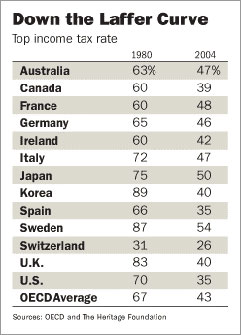
What about the enduring effect of these supply-side economic policies on domestic policies? That question is answered by Christopher DeMuth, President of the American Enterprise Institute, in Reaganomics: How’s It Going?: Two wins, a draw, and two losses (also available for a fee) published in the September 11 issue of National Review:
When Ronald Reagan came to Washington, he brought with him a conservative school of economics. This school emphasized, much more thoroughly and systematically than those associated with previous presidents of either party, the advantages of private markets, the disadvantages of government spending and regulation, and the role of private economic incentives in advancing or undermining government policies. As we pass the 25th anniversary of the August 1981 tax cuts, it is appropriate to assess Reagan’s economic record. My scorecard shows two wins, one draw, and two losses.
The first win was monetary policy. In the late 1970s, liberal economists such as James Tobin and Robert Solow argued that monetary policy should aim primarily to achieve low unemployment; this, they said, would inevitably generate some inflation, but we would have to live with it as the price of strong employment. Conservative economists like Milton Friedman and Allan Meltzer argued that monetary policy should aim for price stability; this, they said, would provide the framework for efficient investment and productivity growth, thereby raising employment.The Friedmanites won a brilliant victory. Since the inflation-breaking year of 1982, the Federal Reserve Board has pursued a consistent low-inflation policy, and inflation has averaged less than 2.6 percent — as compared with 7.6 percent for the decade before 1982. Over the same periods, unemployment fell from an average of 7 percent to less than 6 percent, and continues to fall. No one is arguing today that inflation is something we should tolerate in order to achieve low unemployment or other economic goals...
The second big win was regulatory and antitrust policy. Deregulation, like stable money, began as a staple of conservative economic thought, and was a tenet of Reaganism. Reagan’s first, flamboyant act as president was to abolish federal price controls on oil and gasoline — a step that the media and many Democrats said would lead to soaring prices but instead lowered them, exactly as Reagan had predicted. He also presided over the decontrol of natural-gas prices and the abolition of the Civil Aeronautics Board, signed legislation putting the Interstate Commerce Commission on track to extinction, and never missed an opportunity to highlight and ridicule the perverse effects of government rules. His policy toward environmental and safety regulation was to require that rules pass a cost-benefit test showing that their social value outweighed their economic price.
Both economic deregulation and economics-based reform of social regulation proved to be durable contributions...
As in the case of monetary policy, one is struck by the emergence of an intellectual consensus — beginning before the Reagan years and including both politicians and economists — around what had once been conservative positions...
Most impressive of all was the revolution in antitrust policy. In the early 1970s, University of Chicago economist Aaron Director and legal scholars Robert Bork and Richard Posner mounted a root-and-branch critique of then-prevailing antitrust doctrines that tightly restricted mergers, price competition, and product distribution. Antitrust, they said, should be guided by the criterion of consumer welfare, not that of balancing the interests of rival producers....With Reagan’s inauguration they became official policy at the Justice Department’s antitrust division and the Federal Trade Commission.
The economic benefits of antitrust reform have probably been as great as those of price stability: Much of the industrial restructuring of the past 20 years, and many of the pricing and product-distribution practices that have emerged in the new information economy, would have been illegal before the 1980s....But today’s arguments, grounded on all sides in considerations of market competition and consumer welfare, are worlds away from the pre-1980s mishmash of populism and armchair industrial planning.
Tax policy has absorbed more conservative political energy than any other economic issue in the past 25 years, but has produced only a draw with liberals. The achievements have been substantial. Reagan won steep reductions in marginal income-tax rates that proved durable through several subsequent tax revisions authored by both Democrats and Republicans. The reductions have affected not only the highest earners...but taxpayers across the income spectrum...The arguments of liberal critics that sharp tax reductions would generate a wave of price inflation proved unfounded and have disappeared from the policy debate. And Reagan, in league with Dan Rostenkowski and other House Democrats, forged the Tax Reform Act of 1986, which made the tax code simpler and more efficient by broadening the tax base in exchange for reduced rates and the elimination of loopholes.
But these gains have been offset by several adverse developments. Tax policy, in contrast to monetary, regulatory, and antitrust policy, has remained highly partisan. Successive rounds of legislation...have left the tax code with many anomalies that tend to entrench both sides and make reform more difficult. The introduction or expansion of tax deductions and credits for child care, education, retirement saving, and many other things, combined with the Clinton-era innovation of phasing out deductions and credits as income increases, has produced a pattern of effective marginal tax rates that economist Kevin Hassett has dubbed the "skyline tax."...Rates that rise and fall willy-nilly reflect nobody’s idea of tax equity or efficiency. They reflect, rather, the terms of ceasefire in the last several tax battles.
Another anomaly has arisen from the one thing conservatives and liberals have been able to agree on since Reagan: that it is desirable to exclude lower-income persons from the tax rolls altogether...The number of Americans who file a federal income-tax return but owe no tax has risen from about 19 percent when Ronald Reagan left office to about 32 percent today...The upshot is that a very large proportion of the adult American population...now provides zero direct support for the general operations of the federal government. This cannot be good for our political health, and has certainly complicated the task of tax reform. Every proposal that does not include a tax hike is immediately attacked as a giveaway to the rich. In one sense, the charge is accurate — because only the rich (very broadly defined) now pay any income taxes at all.
Now for the two losses. The first is spending restraint. In the 25 years since Ronald Reagan declared his intention to curb the growth of government, domestic spending has more than doubled in real terms. This growth has been especially pronounced during the years of unified Republican government since 2001...In power, Republicans have turned out to be just as profligate as Democrats. They have even cooked up a theory called "big-government conservatism" to justify themselves.
There is an unfortunate asymmetry between the conservative and liberal camps on the spending question. The liberals present a united front: Both their economists and their politicians tend to think that when money is taken out of the private economy and spent by the government, the result will be an improvement in social welfare. Conservative economists are highly dubious of that proposition — but they are now at odds with conservative politicians, who for the most part simply ignore them on spending issues.
The second loss has been voucherization and privatization. Even before the Reagan administration, conservatives were arguing that many public programs, such as schooling, Social Security, Medicare, and a long list of social-welfare services, would be much improved if the government relinquished its one-size-fits-all monopolies by providing vouchers for individuals to buy these services from private or government suppliers. The failure of these proposals is something of a puzzle...I believe there are three reasons they have failed to catch on.
First, the government programs in question have embedded within them a large number of hidden cross-subsidies, including many to the middle class. By far the largest subsidy in public education is to the teachers unions whose members constitute a near monopoly, a status that would be lost in a truly competitive school-choice program. And Democrats worry that making Social Security and Medicare highly progressive would erode political support for the programs among the middle class...
Second, many of the school-voucher programs that have been tried around the country provide only weak forms of choice; when parents move their children out of a school, the school suffers no financial loss and its average revenue per pupil may even rise. The result is to undermine school choice’s ability to affect public-school performance. When parents are able to deny resources to one school and give them to another, public schools will instantly begin to improve.
Third, many people are uneasy about applying the idea of personal choice to schooling, retirement policy, and welfare programs, which they regard as part of the essential fabric of government. Until the libertarian revolution arrives, conservatives should emphasize the social rather than the private advantages of vouchers — the tremendous improvements they would bring to school performance, pension programs, health care, and other services, as distinct from personal-choice benefits to individuals considered apart from the society they belong to...
DeMuth concludes with an opinion about the upcoming key battle in the future:
Standing at the intersection of our two greatest policy failures, spending control and voucherization, are the two mammoth health-care programs, Medicare and Medicaid, growing like Topsy. Health care is unique in featuring a sharp ideological divide between conservative economists and politicians on one hand and liberal economists and politicians on the other. Both breeds of conservative favor reforms to greatly reduce government regulation and financing of medical care, leaving the sector to be governed largely by competitive private markets with a social safety net. Liberal politicians and liberal economists who devote themselves to health-care policy for the most part favor outright socialism. Each camp fashions its every incremental proposal with a view toward its larger goal. Whether conservative economics is as successful in the next 25 years as it has been in the last 25 will depend largely on how this battle — so far unmediated by the emergence of any professional consensus — plays out.
You can read more about supply-side economics in these postings:
Guess What? Supply-Side Economic Policies Work...Again
Celebrating Reaganomics, 25 years later
Economics 101: Never Underestimate the Incentive Power of Marginal Tax Cuts
September 1, 2006
More Dysfunctional Behaviors by the East Greenwich School Committee: Why Citizens Don't Respect Politicians
The dysfunctional behavior of certain members of the East Greenwich School Committee continues. Some things never seem to change and this is getting old, very old. Our kids and town deserve better.
When I served on the School Committee, I butted heads more than a few times in public with then Town Council member and now School Committee Chair, Vince Bradley. I thought then and I think now that he loves the sport of being political too much - doing it whether it advances good policy considerations or not.
But Vince is predictable in his behavior and that means you can often work with him - as long as you understand he will gravitate constantly toward the contact sport aspect of politics.
So when the previous superintendent, Mike Jolin, tried a nasty substance-free political manuever against Vince several years ago, I thought Jolin's action was very unfair and spoke out publicly on Vince's behalf.
Recently, in late March, some of the ongoing unacceptable behaviors by the NEA and certain members of the School Committee were highlighted in Local Town Drama in East Greenwich.
Shortly thereafter, a posting about a broader subject, The Beginning of a Tax Revolt in East Greenwich: Senior Citizens Take the Lead, touched on my personal experience with the over-the-top behavior of Vice Chair Merrill Friedemann:
...Right before I left the meeting, I had the honor of joining a growing list of East Greenwich residents who have received a public tongue lashing from School Committee member Merrill Friedemann. All because she thought my earlier posting was too critical of her. Talk about thin-skinned! The real problem here is that she appears not to tolerate any advice or criticism - even when offered in a constructive manner from a one-time supporter.People see her behavior – storming out of meetings, telling people off - and realize that she has made herself the issue. Her behavior is having some adverse consequences: She is playing into the hands of the political opponents of reform-minded East Greenwich residents. (And I hope the rumor in town about her and Steve Gregson's possible effort on April 25 to toss out Vince Bradley as chairman of the School Committee turns out to be just that - a rumor. Proceeding down that path would reflect personal vendettas more than policy goals and only invite more unnecessary political turmoil. Plus Vince would then really clean their clocks, something he is more than capable of doing.)
Unfortunately, Ms. Friedemann seems to operate from the misguided notion that having lots of people upset with her is a sign of effectiveness. Such thinking means she is politically tone deaf as nothing could be further from the truth...
Well, it must be payback time.
And that means Vince now deserves a severe dose of the same criticism because the action he has put on the agenda for next Tuesday's School Committee meeting, as noted in No-confidence vote sought for Friedemann, is a completely unnecessary move. There are only 4 more School Committee meetings left before Vince leaves the Committee due to term limit restrictions and the reconstituted Committee elects new officers - including a Vice Chair - after the November elections. This ploy is nothing more than a last-minute vengeful move by someone trying to get his jollies.
It was appropriate to criticize Merrill and Steve for their public behavior and what ended up being a rumor-only plan to replace Vince as Chair. And now it is more than appropriate to criticize Vince for an actual action he has publicly announced will happen next week, using Paul Martin as his stooge.
Get a life, guys. This is yet another example of why citizens get disgusted with politicians. You are wasting time and energy fighting among yourselves instead of just staying focused on your job of doing right by our children.
This is ridiculously petty politics. Our fine town deserves better.
Milton Friedman on Education Issues
In the July 2006 edition of Hillsdale College's Imprimis, Larry Arnn interviews Nobel Laureate Milton Friedman on a number of topics. Here are his thoughts on education issues:
LARRY ARNN: ...Why do you think teachers unions oppose vouchers?MILTON FRIEDMAN: The president of the National Education Association was once asked when his union was going to do something about students. He replied that when the students became members of the union, the union would take care of them. And that was a correct answer. Why? His responsibility as president of the NEA was to serve the members of his union, not to serve public purposes. I give him credit: The trade union has been very effective in serving its members. However, in the process, they've destroyed American education. But you see, education isn't the union's function. It's our fault for allowing the union to pursue its agenda. Consider this fact: There are two areas in the United States that suffer from the same disease—education is one and health care is the other. They both suffer from the disease that takes a system that should be bottom-up and converts it into a system that is top-down. Education is a simple case. It isn't the public purpose to build brick schools and have students taught there. The public purpose is to provide education. Think of it this way: If you want to subsidize the production of a product, there are two ways you can do it. You can subsidize the producer or you can subsidize the consumer. In education, we subsidize the producer—the school. If you subsidize the student instead—the consumer—you will have competition. The student could choose the school he attends and that would force schools to improve and to meet the demands of their students.
LA: ...you have turned much of your attention to education, and to vouchers as a method of education reform. Why is that your focus?
MF: I don't see how we can maintain a decent society if we have a world split into haves and have-nots, with the haves subsidizing the have-nots. In our current educational system, close to 30 percent of the youngsters who start high school never finish. They are condemned to low-income jobs. They are condemned to a situation in which they are going to be at the bottom. That leads in turn to a divisive society; it leads to a stratified society rather than one of general cooperation and general understanding. The effective literacy rate in the United States today is almost surely less than it was 100 years ago. Before government had any involvement in education, the majority of youngsters were schooled, literate, and able to learn. It is a disgrace that in a country like the United States, 30 percent of youngsters never graduate from high school. And I haven't even mentioned those who drop out in elementary school. It's a disgrace that there are so many people who can't read and write. It's hard for me to see how we can continue to maintain a decent and free society if a large subsection of that society is condemned to poverty and to handouts.
LA: Do you think the voucher campaign is going well?
MF: No. I think it's going much too slowly. What success we have had is almost entirely in the area of income-limited vouchers. There are two kinds of vouchers: One is a charity voucher that is limited to people below a certain income level. The other is an education voucher, which, if you think of vouchers as a way of transforming the educational industry, is available to everybody. How can we make vouchers available to everybody? First, education ought to be a state and local matter, not a federal matter. The 1994 Contract with America called for the elimination of the Department of Education. Since then, the budget for the Department of Education has tripled. This trend must be reversed. Next, education ought to be a parental matter. The responsibility for educating children is with parents. But in order to make it a parental matter, we must have a situation in which parents are Free to Choose the schools their children attend. They aren't free to do that now. Today the schools pick the children. Children are assigned to schools by geography—by where they live. By contrast, I would argue that if the government is going to spend money on education, the money ought to travel with the children. The objective of such an expenditure ought to be educated children, not beautiful buildings. The way to accomplish this is to have a universal voucher. As I said in 1955, we should take the amount of money that we're now spending on education, divide it by the number of children, and give that amount of money to each parent. After all, that's what we're spending now, so we might as well let parents spend it in the form of vouchers...
Milton Friedman on Economic Issues
In the July 2006 issue of Hillsdale College's Imprimis, Larry Arnn interviews Nobel Laureate Milton Friedman on a number of topics. Here are his thoughts on economic issues:
LARRY ARNN: In Free to Choose, in the chapter on "The Tyranny of Controls," you argue that protectionism and government intervention in general breed conflict and that free markets breed cooperation. How do you reconcile this statement with the fact that we think of free markets as being competitive?MILTON FRIEDMAN: They are competitive, but they are competitive over a broad range. The question is, how do you make money in a free market? You only make money if you can provide someone with something he or she is willing to pay for. You can't make money any other way. Therefore, in order to make money, you have to promote cooperation. You have to do something that your customer wants you to do. You don't do it because he orders you to. You don't do it because he threatens to hit you over the head if you don't. You do it because you offer him a better deal than he can get anywhere else. Now that's promoting cooperation. But there are other people who are trying to sell to him, too. They're your competitors. So there is competition among sellers, but cooperation between sellers and buyers...
The final outcome in China will not be decided until there is a showdown between the political tyranny on the one hand and economic freedom on the other - they cannot coexist...
Almost every country in the Middle East that is rich in oil is a despotism.
LA: Why do you think that is so?
MF: One reason, and one reason only, the oil is owned by the governments in question. If that oil were privately owned and thus someone's private property, the political outcome would be freedom rather than tyranny. This is why I believe the first step following the 2003 invasion of Iraq should have been the privatization of the oil fields. If the government had given every individual over 21 years of age equal shares in a corporation that had the right and responsibility to make appropriate arrangements with foreign oil companies for the purpose of discovering and developing Iraq's oil reserves, the oil income would have flowed in the form of dividends to the people - the shareholders - rather than into government coffers. This would have provided an income to the whole people of Iraq and thereby prevented the current disputes over oil between the Sunnis, Shiites and Kurds, because oil income would have been distributed on an individual rather than a group basis.
LA: Many Middle Eastern societies have a kind of tribal or theocratic basis and long-held habits of despotic rule that make it difficult to establish a system of contract between strangers. Is it your view that the introduction of free markets in such places could overcome those obstacles?
MF: Eventually, yes. I think that nothing is so important for freedom as recognizing in the law each individual's natural right to property, and giving individuals a sense that they own something that they're responsible for, that they have control over, and that they can dispose of...
...Following the election of Ronald Reagan, there was an abrupt and immediate halt to this expansion of government. But even under Reagan, government spending as a percentage of national income didn't come down: It has held constant from that time to now. Although the early years of the current Bush presidency did see spending increases, national income has risen, too. We have achieved some success at our first task: stopping the growth of government. The second task is to shrink government spending and make government smaller. We haven't done that yet...I should also mention as a cautionary tale that, prior to Reagan, the number of pages in the Federal Register was on the rise, but Reagan succeeded in reducing this number substantially. However, once Reagan was out of office, the number of pages in the Register began to rise even more quickly. We have not really succeeded in that area.
...since Free to Choose was published [in 1981]...in general, there has been a complete change in public opinion. This change is probably due as much to the collapse of the Soviet Union as it is to what Friedrich Hayek or Milton Friedman or somebody else wrote. Socialism used to mean the ownership and operation of the means of production, but nobody gives it that meaning today. There is no country in the world attempting to be socialist in that sense except North Korea. And perhaps Russia is moving in that direction. Conversely, opinion has not shifted far enough in terms of the dangers of big government and the deleterious effects it can have, and that's where we're facing future problems...We must make clear that the only reason we have our freedom is because government is so inefficient. If the government were efficient in spending the approximately 40 percent of our income that it currently manages, we would enjoy less freedom than we do today...
LA: ...Like Lincoln, you argue that a house divided against itself cannot stand: America is going to be a government intervention country or it's going to be a free market country, but it cannot continue indefinitely as a mixture of both. Do you still believe that?
MF: Yes, I very much believe that, and I believe that we've been making some headway since Free to Choose appeared. However, even though it is real headway compared to what was happening before, we are mostly holding ground.
LA: What do you think are the major factors behind the economic growth we have experienced since the publication of Free to Choose?
MF: Economic growth since that time has been phenomenal, which has very little to do with most of what we've been talking about in terms of the conflict between government and private enterprise. It has much more to do with the technical problem of establishing sound monetary policy. The economic situation during the past 20 years has been unprecedented in the history of the world. You will find no other 20-year period in which prices have been as stable - relatively speaking - in which there has been as little variability in price levels, in which inflation has been so well-controlled, and in which output has gone up as regularly. You hear all this talk about economic difficulties, when the fact is we are at the absolute peak of prosperity in the history of the world. Never before have so many people had as much as they do today. I believe a large part of that is to be attributed to better monetary policy. The improved policy is a result of the acceptance of the view that inflation is a monetary phenomenon, not a real phenomenon. We have accepted the view that central banks are primarily responsible for maintaining stable prices and nothing else.
LA: Do you think the Great Depression was triggered by bad monetary policy at a crucial moment?
MF: Absolutely. Unfortunately, it is still the case that if you ask people what caused the Great Depression, nine out of ten will probably tell you it was a failure of business. But it's absolutely clear that the Depression was a failure of government and not a failure of business.
LA: You don't think the Smoot-Hawley tariff caused the Depression?MF: No. I think the Smoot-Hawley tariff was a bad law. I think it did harm. But the Smoot-Hawley tariff by itself would not have made one quarter of the labor force unemployed. However, reducing the quantity of money by one third did make a quarter of the labor force unemployed. When I graduated from undergraduate college in 1932, I was baffled by the fact that there were idle machines and idle men and you couldn't get them together. Those men wanted to cooperate; they wanted to work; they wanted to produce what they wore; and they wanted to produce the food they ate. Yet something had gone wrong: The government was mismanaging the money supply.
LA: Do you think our government has learned its lesson about how to manage the money supply?
MF: I think that the lesson has been learned, but I don't think it will last forever. Sooner or later, government will want to raise funds without imposing taxes. It will want to spend money it does not have...The temptation for government to lay its hands on that money is going to be very hard to resist...
LA: ...You describe a society in which people look after themselves because they know the most about themselves, and they will flourish if you let them. You, however, are a crusader for the rights of others. For example, you say in Free to Choose - and it's a very powerful statement - a tiny minority is what matters. So is it one of the weaknesses of the free market that it requires certain extremely talented and disinterested people who can defend it?
MF: No, that's not right. The self-interest of the kind of people you just described is promoting public policy. That's what they're interested in doing. For example, what was my self-interest in economics? My self-interest to begin with was to understand the real mystery and puzzle that was the Great Depression. My self-interest was to try to understand why that happened, and that's what I enjoyed doing, that was my self-interest. Out of that I grew to learn some things, to have some knowledge. Following that, my self-interest was to see that other people understood the same things and took appropriate action.
LA: Do you define self-interest as what the individual wants?
MF: Yes, self-interest is what the individual wants. Mother Teresa, to take one example, operated on a completely self-interested basis. Self-interest does not mean narrow self-interest. Self-interest does not mean monetary self-interest. Self-interest means pursuing those things that are valuable to you but which you can also persuade others to value. Such things very often go beyond immediate material interest.
LA: Does that mean self-interest is a synonym for self-sacrifice?
MF: If you want to see how pervasive this sort of self-interest is that I'm describing, look at the enormous amount of money contributed after Hurricane Katrina. That was a tremendous display of self-interest: The self-interest of people in that case was to help others. Self-interest, rightly understood, works for the benefit of society as a whole.
Milton Friedman on Economic Issues
In the July 2006 edition of Hillsdale College's Imprimis, Larry Arnn interviews Nobel Laureate Milton Friedman on a number of topics. Here are his thoughts on economic issues:
LARRY ARNN: In Free to Choose, in the chapter on "The Tyranny of Controls," you argue that protectionism and government intervention in general breed conflict and that free markets breed cooperation. How do you reconcile this statement with the fact that we think of free markets as being competitive?MILTON FRIEDMAN: They are competitive, but they are competitive over a broad range. The question is, how do you make money in a free market? You only make money if you can provide someone with something he or she is willing to pay for. You can't make money any other way. Therefore, in order to make money, you have to promote cooperation. You have to do something that your customer wants you to do. You don't do it because he orders you to. You don't do it because he threatens to hit you over the head if you don't. You do it because you offer him a better deal than he can get anywhere else. Now that's promoting cooperation. But there are other people who are trying to sell to him, too. They're your competitors. So there is competition among sellers, but cooperation between sellers and buyers...
The final outcome in China will not be decided until there is a showdown between the political tyranny on the one hand and economic freedom on the other—they cannot coexist...
Almost every country in the Middle East that is rich in oil is a despotism.
LA: Why do you think that is so?
MF: One reason, and one reason only—the oil is owned by the governments in question. If that oil were privately owned and thus someone's private property, the political outcome would be freedom rather than tyranny. This is why I believe the first step following the 2003 invasion of Iraq should have been the privatization of the oil fields. If the government had given every individual over 21 years of age equal shares in a corporation that had the right and responsibility to make appropriate arrangements with foreign oil companies for the purpose of discovering and developing Iraq's oil reserves, the oil income would have flowed in the form of dividends to the people—the shareholders—rather than into government coffers. This would have provided an income to the whole people of Iraq and thereby prevented the current disputes over oil between the Sunnis, Shiites and Kurds, because oil income would have been distributed on an individual rather than a group basis.
LA: Many Middle Eastern societies have a kind of tribal or theocratic basis and long-held habits of despotic rule that make it difficult to establish a system of contract between strangers. Is it your view that the introduction of free markets in such places could overcome those obstacles?
MF: Eventually, yes. I think that nothing is so important for freedom as recognizing in the law each individual's natural right to property, and giving individuals a sense that they own something that they're responsible for, that they have control over, and that they can dispose of...
...Following the election of Ronald Reagan, there was an abrupt and immediate halt to this expansion of government. But even under Reagan, government spending as a percentage of national income didn't come down: It has held constant from that time to now. Although the early years of the current Bush presidency did see spending increases, national income has risen, too. We have achieved some success at our first task: stopping the growth of government. The second task is to shrink government spending and make government smaller. We haven't done that yet...I should also mention as a cautionary tale that, prior to Reagan, the number of pages in the Federal Register was on the rise, but Reagan succeeded in reducing this number substantially. However, once Reagan was out of office, the number of pages in the Register began to rise even more quickly. We have not really succeeded in that area.
...since Free to Choose was published [in 1981]...in general, there has been a complete change in public opinion. This change is probably due as much to the collapse of the Soviet Union as it is to what Friedrich Hayek or Milton Friedman or somebody else wrote. Socialism used to mean the ownership and operation of the means of production, but nobody gives it that meaning today. There is no country in the world attempting to be socialist in that sense except North Korea. And perhaps Russia is moving in that direction. Conversely, opinion has not shifted far enough in terms of the dangers of big government and the deleterious effects it can have, and that's where we're facing future problems...We must make clear that the only reason we have our freedom is because government is so inefficient. If the government were efficient in spending the approximately 40 percent of our income that it currently manages, we would enjoy less freedom than we do today...
LA: ...Like Lincoln, you argue that a house divided against itself cannot stand: America is going to be a government intervention country or it's going to be a free market country, but it cannot continue indefinitely as a mixture of both. Do you still believe that?
MF: Yes, I very much believe that, and I believe that we've been making some headway since Free to Choose appeared. However, even though it is real headway compared to what was happening before, we are mostly holding ground.
LA: What do you think are the major factors behind the economic growth we have experienced since the publication of Free to Choose?
MF: Economic growth since that time has been phenomenal, which has very little to do with most of what we've been talking about in terms of the conflict between government and private enterprise. It has much more to do with the technical problem of establishing sound monetary policy. The economic situation during the past 20 years has been unprecedented in the history of the world. You will find no other 20-year period in which prices have been as stable—relatively speaking—in which there has been as little variability in price levels, in which inflation has been so well-controlled, and in which output has gone up as regularly. You hear all this talk about economic difficulties, when the fact is we are at the absolute peak of prosperity in the history of the world. Never before have so many people had as much as they do today. I believe a large part of that is to be attributed to better monetary policy. The improved policy is a result of the acceptance of the view that inflation is a monetary phenomenon, not a real phenomenon. We have accepted the view that central banks are primarily responsible for maintaining stable prices and nothing else.
LA: Do you think the Great Depression was triggered by bad monetary policy at a crucial moment?
MF: Absolutely. Unfortunately, it is still the case that if you ask people what caused the Great Depression, nine out of ten will probably tell you it was a failure of business. But it's absolutely clear that the Depression was a failure of government and not a failure of business.
LA: You don't think the Smoot-Hawley tariff caused the Depression?MF: No. I think the Smoot-Hawley tariff was a bad law. I think it did harm. But the Smoot-Hawley tariff by itself would not have made one quarter of the labor force unemployed. However, reducing the quantity of money by one third did make a quarter of the labor force unemployed. When I graduated from undergraduate college in 1932, I was baffled by the fact that there were idle machines and idle men and you couldn't get them together. Those men wanted to cooperate; they wanted to work; they wanted to produce what they wore; and they wanted to produce the food they ate. Yet something had gone wrong: The government was mismanaging the money supply.
LA: Do you think our government has learned its lesson about how to manage the money supply?
MF: I think that the lesson has been learned, but I don't think it will last forever. Sooner or later, government will want to raise funds without imposing taxes. It will want to spend money it does not have...The temptation for government to lay its hands on that money is going to be very hard to resist...
LA: ...You describe a society in which people look after themselves because they know the most about themselves, and they will flourish if you let them. You, however, are a crusader for the rights of others. For example, you say in Free to Choose—and it's a very powerful statement—a tiny minority is what matters. So is it one of the weaknesses of the free market that it requires certain extremely talented and disinterested people who can defend it?
MF: No, that's not right. The self-interest of the kind of people you just described is promoting public policy. That's what they're interested in doing. For example, what was my self-interest in economics? My self-interest to begin with was to understand the real mystery and puzzle that was the Great Depression. My self-interest was to try to understand why that happened, and that's what I enjoyed doing—that was my self-interest. Out of that I grew to learn some things—to have some knowledge. Following that, my self-interest was to see that other people understood the same things and took appropriate action.
LA: Do you define self-interest as what the individual wants?
MF: Yes, self-interest is what the individual wants. Mother Teresa, to take one example, operated on a completely self-interested basis. Self-interest does not mean narrow self-interest. Self-interest does not mean monetary self-interest. Self-interest means pursuing those things that are valuable to you but which you can also persuade others to value. Such things very often go beyond immediate material interest.
LA: Does that mean self-interest is a synonym for self-sacrifice?
MF: If you want to see how pervasive this sort of self-interest is that I'm describing, look at the enormous amount of money contributed after Hurricane Katrina. That was a tremendous display of self-interest: The self-interest of people in that case was to help others. Self-interest, rightly understood, works for the benefit of society as a whole.
Ideological Amplification
The New Republic's Open University is a new blog with the goal of providing a place for "the magazine's contributors and friends in the professoriate comment on current events, bring their expertise to bear on Topic A, and discuss the academic issues of the day." As one with a bit of "policy wonkishness", my interest was piqued and already rewarded by posts by Cass Sunstein and David Greenberg on the idea of "Ideological Amplification."
According to Sunstein:
A few years ago, I was involved in some studies that uncovered a funny fact: When Republican-appointed judges sit on three-judge panels with other Republican appointees, they show unusually conservative voting patterns. So too, Democratic-appointed judges on three-judge panels show especially liberal voting patterns when sitting with fellow Democratic appointees. In short, like-minded judges show a pattern if "ideological amplification."Greenberg points to a study by Valdis Krebs "on the polarized political reading habits of Americans." In short, according to Greenberg, Krebs used Amazon's "'Customers who bought this item also bought...' feature" and "found that people who read Ann Coulter weren't reading much of Michael Moore, and vice versa. The few books that found audiences of diverse ideological persuasions were those by straight news reporters like Stephen Kinzer, Tom Friedman, and Bob Woodward." (Krebs explanation and updated data can be found here). The obvious question is a familiar one: do we tend to reinforce our ideology by living in an "echo chamber" and, if so, is it a good idea to do so? My answer is "Yes" and "No."....It turns out that ideological amplification occurs in many domains. It helps to explain "political correctness" on college campuses--and within the Bush administration. In a recent study, we find that liberals in Colorado, after talking to one another, move significantly to the left on affirmative action, global warming, and civil unions for same-sex couples. On those same three issues, conservatives, after talking to each other, move significantly to the right.
It is intellectually necessary to venture outside of one's own ideological box to encounter--and confront--ideas that are different. Such intellectual curiosity can expose you to ideas that will change your mind about how you view issue "X", but that's not a bad thing. However, it is more likely that such intellectual adventuring can help to reinforce your ideological predispositions. Confronting the way that different ideologies approach issue "Y" forces you to reason beyond your gut instincts. You are forced to organize your thoughts and thus are better prepared to refute the arguments of your ideological opponents.
Some people are satisfied to trust their gut instincts because they are confident that they are right. Trusting your gut is both perfectly fine and a very American thing to do. However, for those of us interested in political ideas and rhetoric, it is necessary to be familiar with the ideas--and the tactical arguments used to espouse those ideas--that we seek to refute while battling in the arena of ideas. To paraphrase Sun-Tzu, "Know thine enemy."
And that brings me back to Open University. Most would agree that The New Republic is a liberal-to-moderate publication. Thus, with it's stated goal of serving as a go-between for academics and the public, it is in the best interest of conservatives to be in the vanguard of those who will be exposed to the ideas emanating from academia. In short, conservatives need to be on the front line of the informal peer review system that has emerged on-line.
Kerry King Keeps Naming Names
Republican Lieutenant Governor candidate Kerry King is suing at least four state lawmakers for improperly imposing a “corrupton tax” on the state of Rhode Island. Mr. King wants the money paid back to the state treasury. Steve Peoples of the Projo has the story…
On the campaign trail, Republican lieutenant governor candidate Kernan "Kerry" King likes to talk about the "tax of corruption."Neither the Projo story nor Mr. King’s campaign website at this time has any detail on what the precise legal theory of the suit is.Now, he's asking a Superior Court judge to force more than a dozen state lawmakers -- including Senate President Joseph A. Montalbano and House Majority Leader Gordon D. Fox -- to reimburse citizens for the "tax."
"The waste, influence peddling, self-interested deals and bribery that has infected the otherwise conscientious and honorable membership of the General Assembly robs the citizens of Rhode Island of their constitutional right to open and honest government and has created a de facto corruption tax for any individual or business wishing to reside or do business in Rhode Island," King writes in a lawsuit filed yesterday in Washington County Superior Court.
King is seeking unspecified damages (to be paid to the state's general treasury) for alleged misdeeds by a host of public officials. Aside from Montalbano and Fox, King names in his 24-page lawsuit Rep. Timothy A. Williamson, D-West Warwick, former state Sen. John Celona, and 10 elected officials he refers to only as "John and Jane Does."
UPDATE:
My bad. I should have known to check the ubiquitous Jim Baron of the Pawtucket Times when searching for additional detail…
King and attorney Joseph Diagle of the firm Gelfuso and Lachut, said the suit is being brought under R.I. General Law 9-1-2, which states in part: "Whenever any person shall suffer any injury to his or her person, reputation or estate by the commission of any crime or offense, he or she may recover his or her damages for the injury in a civil action against the offender and it shall note be any defense to such action that no criminal complaint for the crime or offense has been made"…
The suit says that by receiving payments in excess of $86,000 for the West Warwick legal work that was not reported on financial disclosure statements until he was asked about it by reporters, [Senate President Joseph Montalbano] "has deprived the citizens of Rhode Island of his honest services." It asks the court to "declare that Montalbano's unreported receipt of over $86,000 from the town of West Warwick "constitutes a criminal act or offense," thereby making Montalbano liable for double damages….
Because [State Representative Timothy Williamson's] law firm, Inman Tourgee & Williamson, has taken more than $600,000 since 2002 for services as solicitor, and Williamson, who represents West Warwick and Coventry, is the lead sponsor of the casino amendment, the suit claims, he too has deprived Rhode Islanders of his honest services. It wants the court to say that Williamson's receipt of his share of the $606,256 paid by West Warwick constitutes a criminal act.
In his allegation against [State Representative Gordon Fox], King points to a $10,000 fine assessed against Fox by the RI Ethics Commission for his role in negotiating a state contract for GTECH while the law firm he was then associated with did legal work for the company. The complaint makes reference to the casino amendment, but does not specify how it relates to wrongdoing by Fox.
Syrian Arms Smugglers Agree to Police Themselves
Dave Schenker reminds us that:
On August 15, Syrian president Bashar Assad gave a lengthy speech to the Syrian Journalists Association condemning the Bush administration, disparaging the United Nations, declaring support for Hezbollah and regional “resistance,” and calling for the removal of the democratically elected government of Lebanon. The address and subsequent interviews with Assad in the Arab press highlight the absence of any foundation for fruitful discussions with Damascus. Indeed, given the context and the content of Assad’s recent remarks, it would be difficult to interpret the Syrian position as anything less than a resounding rejection of dialogue with Washington.Assad also threatened any U.N. troops should their deployment conflict with the policies and sovereignty of Syria. Hence, U.N. Sec. General Kofi Annan went to Damascus to barter with Assad. Apparently, Annan's efforts have been a success.
U.N. Secretary-General Kofi Annan said Friday that Syria would step up border patrols and work with the Lebanese army to stop the flow of weapons to Hezbollah.Annan has achieved a diplomatic coup by bringing Syria on board. Who better to police illegal arms smugglong to Hezbollah than those who have been coordinating them for two decades?Syria will increase its own patrols along the Lebanon-Syria border, and establish joint patrols with the Lebanese army "when possible," Annan said after meeting with Syrian President Bashar Assad in Damascus.
Assad made no public comments after their meeting...[bu] Annan said Assad informed him that Syria would "take all necessary measures" to implement paragraph 15 of U.N. resolution 1701, which calls on countries to prevent the sale or supply of weapons to entities in Lebanon without the consent of the Lebanese government or U.N. peacekeepers.
Iran and Syria are still trying to smuggle arms to Hezbollah across the Syrian-Lebanese border, Miri Eisin, a spokeswoman for Israeli Prime Minister Ehud Olmert said yesterday. The weapons include Russian-made anti-tank missiles, Syrian and Iranian-made rockets and Iranian rocket-launchers, she said.Ahhh, twenty-first century diplomacy, you gotta love it!

 About Community Crier

 About Engaged Citizen