Click here for the new Anchor Rising & Ocean State Current page

The Differences in Barrington, by Justin Katz
Adventures in Town Government
12:40 PM, 05/29/09
The Barrington FTM, by Carroll Andrew Morse
Barrington
7:33 PM, 05/27/09
When the Majority Is Convenient, by Justin Katz
Barrington
12:27 PM, 04/27/09
May 29, 2009

The Differences in Barrington
So why did Barrington buck the school-budget-cutting trend? I'd say that there are three factors, the most important of which being the track record of the schools themselves.
As Andrew illustrated yesterday, Barrington's schools are arguably the best in Rhode Island. Of course, as even the union will argue when it suits its purposes, it's very difficult to tease those results apart from demographics, but one can make some interesting observations about spending. First of all, the district's per-student spending on teachers is relatively low; a spreadsheet that I've developed over time places the town as 23rd in the state for this measure. Indeed, Barrington's per student spending on just about everything is relatively low.
One other curiosity is the structure of the town's steps. For the 2007-2008 school year, the town was seventh from the top in pay for its highest step, but eight from the bottom in average step. Plotting all of the state's step structures on a line graph (covering the 2008-2009 school year) illustrates why:
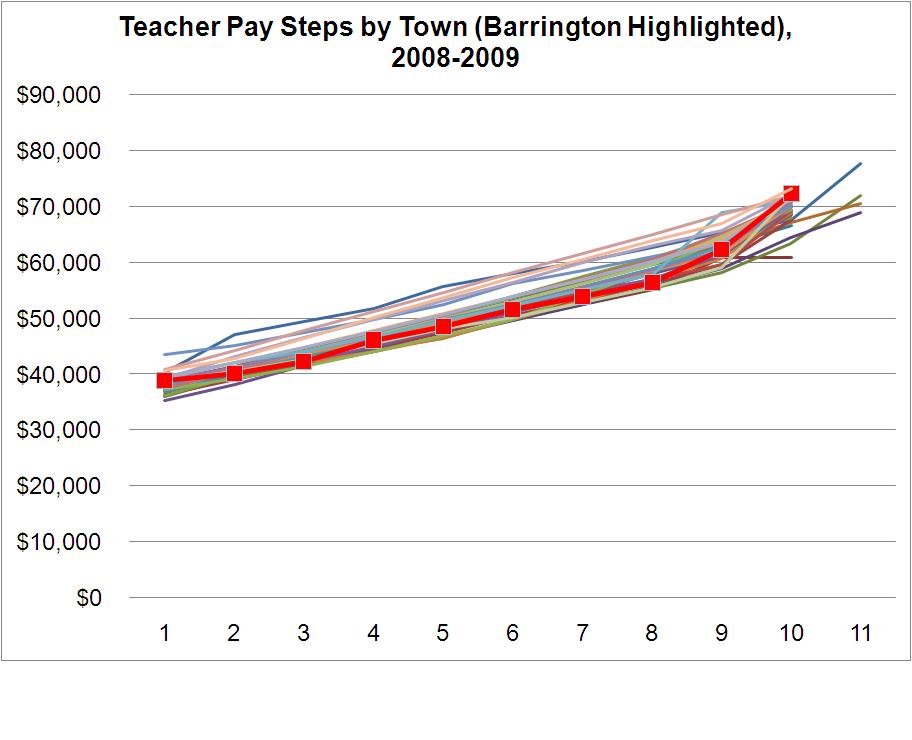
Barrington doesn't escape the middle and back of the pack, in teacher pay, until the upper steps. The town also has relatively high longevity and higher-degree bonuses. In other words, one could surmise that the Barrington school district strains within the very narrow limits of the union step structure to reward desired behavior. It ain't a merit system, but it has some related features.
The second factor that I would note as explanation for the results of Barrington's financial town meeting is probably less consequential, but related. It's a relatively wealthy suburb, especially compared with some of the more politically heated towns in the news lately.
The third factor — once again related and once again of less significance — is that the taxpayer group formation in Barrington is tied, in its inchoate form, to property revaluations, especially on higher-end homes. The currently active (as opposed to potential) constituency is not as broad as with, say, Tiverton Citizens for Change, which has resulted from a mix of working-class and fixed-income ire, general response to suspicious political games at last year's financial town meeting, and (yes) property-tax concerns.
It isn't my intention to offer opinion on the Barrington voters' action, the other night, or to suggest a direction in which the town should head. Among the things that I love about Rhode Island, however, and among the reasons I'm hesitant to jump on the regionalization bandwagon, is that one really can look around at each municipality as a self-contained segment of the statewide experiment.
May 27, 2009

The Barrington FTM
Bottom line: An approximately 850,000 dollar school budget increase, over what the appropriations committee recommended, passes by a vote of 569-323.
Good evening from the town of Barrington. Voting on several budget resolutions is about to begin...
Two non-controversial "housekeeping" items have so far passed.
300,000 from an unbuilt wind turbine was just moved to the general fund.
Next vote: 3 million to remediate and cap the town's landfills. Resident wants to know if it has to be done this year. Another resident: Is there a real economic benefit to doing this this year? TM believes delay would create financial hardship.
First voice vote tie occurs. Landfill money passes on a stand-up vote.
A million dollars for school roofs passes almost unanimously on a voice vote.
Another million for sidewalk repair passes easily on a voice vote.
Next item: "emergency notes to fund emergency appropriations". Resident wants to know what constitutes an emergency. TM says if we could predict emergencies, we wouldn't have them. Resident not amused by that answer. TM gives example of a sewer that exploded recently. Another official points out a formal procedure for declaring an emergency is contained in the resolution.
Resident proposes a 5 million dollar cap on the emergency note amount. Voice vote tie; amendment fails on a stand-up vote. Overall emergency note item passes on a voice vote.
Resident requests an explanation of the next item, tax-anticipation notes. Finance director explains they are used to cover gaps that occur because of the collection schedule. Also adds that they've never been used. Item passes on a voice vote.
Here comes the school budget. Appropriations Commitee is recommending a 2.21% increase, about 900,000 dollars. That's about half of what the school's management requested. Appropriations Committee hopes that the school system and the teachers union will be able to "renegotiate" a salary structure that will fit into the budget.
Residents now get to offer motions to change the bottom line.
First motion by resident: increase the budget by about 850,000, none of it to go to administrators. Praise for the Barrington schools from the resident and from a school committee member. Another resident objects, citing step increase + annual raises that exceed 5% or more.
Some detailed discussion about specific line items regarding supplies, aides and bus monitors.
Another resident is proud of the Barrington schools, but doesn't believe that the system is so fragile that it cannot survive one year of belt-tightening.
Senator David Bates says that the state is down 70 million for this year alone, based on the May revenue estimating conference. That could impact how much money is received from the state.
Resident asks for examples of belt-tightening that have already occurred. 4 positions were elimated last year.
Resident reads a letter from a retired school teacher, who thinks that the union should negotiate a freeze to get through this budget year, without the additional budget increase.
Resident discusses the macro global economic situation; with social security frozen and 401(k)s tanking, it's not fair to ask taxpayers to fund other people's pay increase.
Resident speaks in favor of increase -- Barrington should pay its teachers well enough so they can live in the town.
Another resident is embarrassed that teachers are paid as low as they are, from a societal standpoint. And is Barrington going to approve 1 million dollars for potholes, but not for the children?
Resident speaks who says he supports teachers, but is concerned that the compensation structure for teachers is top-heavy.
Resident (and state employee) cannot support a budget increase, when so much of the budget goes to salaries and benefits.
Resident argues that the budget needs to be increased, because the Paiva-Weed cap means that future year increases will depend on the baseline that is established this year.
Resident raises concern about pension spiking.
Resident thanks school committee for doing a thankless job under tough conditions.
Resident asks if money from the state or the feds is somehow found, after the budget is approved, will the tax-rate go down? The answer from the finance director is basically no.
Last speaker has spoken. It's time to vote; we're going right to a stand-up vote, counting person-by-person...
Motion passes 569-323. We move now to an additional increase motion, to restore the adminstrator salary increases.
School committee recommends against. Motion fails by voice vote.
April 27, 2009
When the Majority Is Convenient
Here in Tiverton, there's some growing grumbles about the latest property revaluation, which appears to have shifted the weight of the tax burden toward those with waterfront property. Our situation appears mild (so far) in comparison with Barrington's. Nonetheless, the phrase "class warfare" has been uttered, here and there, which is why a sentiment expressed by Barrington Town Council member Kate Weymouth raises a red flag:
"The majority of residents in this town are satisfied with their assessments and I am elected by the majority."
Not knowing Ms. Weymouth's history, I wouldn't apply this to her, but the thought occurs that public officials are keen to be the voice of the voiceless, when that suits their preferences, or the voice of the majority, when their inclinations are in sync.

 About Community Crier

 About Engaged Citizen