Click here for the new Anchor Rising & Ocean State Current page

Rhode Island's Unique Way Out of the Bottom Three, by Justin Katz
Rhode Island Economy
2:35 PM, 03/29/13
Playing With Numbers, by Patrick Laverty
Rhode Island Economy
12:02 AM, 03/23/13
The Mysteries of Employment Statistics, by Justin Katz
Rhode Island Economy
2:39 PM, 03/ 1/13
02/26/13 - A Conversation with Bruce Katz, by Justin Katz
Rhode Island Economy
12:24 PM, 02/26/13
Building It Doesn't Make Them Come, by Justin Katz
Rhode Island Economy
9:11 AM, 02/18/13
01/24/13 - Senate Improving Rhode Island's Business Climate Summit, by Justin Katz
Rhode Island Economy
11:06 PM, 01/24/13
December Employment: How to Feel About It...?, by Justin Katz
Rhode Island Economy
2:41 PM, 01/18/13
01/17/13 - RI House Economic Conference, by Justin Katz
Rhode Island Economy
12:55 PM, 01/17/13
Things We Read Today (45), Wednesday, by Justin Katz
Culture
9:16 PM, 01/ 2/13
Zero.Zero Sales Tax: Objections and Who's Objecting, by Justin Katz
Rhode Island Economy
9:36 AM, 12/28/12
March 29, 2013

Rhode Island's Unique Way Out of the Bottom Three
For many months, Rhode Island has been exchanging places with two other states for worst, second worst, and third worst official unemployment rate in the United States. February marked the milestone of Rhode Island's breaking free from the dance. The Ocean State's 9.4% unemployment rate tied with North Carolina for fifth worst, behind California, Nevada, and Mississippi (all 9.6%) and Illinois (9.5%).
But the numbers deserve a closer look.
March 23, 2013

Playing With Numbers
Baseball is a sport that is built on numbers. How many home runs a player has, how many strikeouts a pitcher has, his ERA or a hitter's batting average. Most fans understand these numbers, how to figure them out and generally what they mean. A hitter who gets a hit three times out of ten bats .300 (3/10).
Generally, the only way for a hitter to end up with a better batting average is to get more hits when he's up at bat. But what if there was another way. What if instead of having to get hits each time up, he could simply start subtracting some at bats. He decides to not count one at bat, and now he's batting .333 (3/9). What an improvement! He's a better hitter now!
Oh, that's not fair, you say? That's cheating? Ok, fine, let's go back to the 3 out of 10 thing. We're back to that .300. But now, when he goes to bat and doesn't get a hit, we just don't count those. He goes up to bat and makes an out for the next five times. Instead, we're going to just tell people that he held steady and is still batting .300. Isn't that great? In watching him, he sure hasn't looked very good, but the numbers show that he's still the same hitter. The numbers haven't gotten any worse, even though it sure feels like he's playing worse.
Does any of this seem to make any sense? If this is how baseball statistics worked, would the statistics really mean anything if we could play with the numbers this way? Of course not. Yet we still try to put some meaning on unemployment stats. Month after month, Rhode Island's unemployment numbers either hold steady or improve a little bit at a time, but it sure doesn't feel like it. It doesn't seem like there are more jobs available. But if you look just barely past the headlines, you start to see that there are fewer people even looking for jobs, fewer people on unemployment. They've either simply given up or they left the Rhode Island market and found a job elsewhere. Is that our economic strategy? Is that how we'll get the state out of last place in employment numbers? We'll just keep erasing our "outs" until eventually we're batting 1.000? At what point does this get turned around?
I guess in the meantime, our General Assembly can have twelve-hour debates on issues where everyone's mind is already made up and still not call a vote. We can submit bills on what should be the official mollusk of the state and play games with votes already cast and try some Jedi mind tricks in telling people that the vote that just happened didn't really happen. But maybe someday, we can reverse the trend and create an environment where all Rhode Islanders can find a job, instead of pushing them away to make our numbers look better. Batter up!
March 1, 2013
The Mysteries of Employment Statistics
According to a news release from the Rhode Island Department of Labor and Training (DLT), there are actually 800 fewer people employed in Rhode Island than previously thought. But that's a good thing... because even more people gave up looking for work than we thought. Recovery!
February 26, 2013
02/26/13 - A Conversation with Bruce Katz
Justin liveblogs from Brookings Institution VP Bruce Katz event with the RI Foundation.
February 18, 2013
Building It Doesn't Make Them Come
Bruce Landis had an article in the Sunday Providence Journal with the telling title, "Few, but enthusiastic, riders." The "few" are people actually taking advantage of the new length of commuter rail to Wickford. The train goes on from Providence to Boston.
Data from the Massachusetts Bay Transportation Authority show monthly rider- ship increasing from the time the station opened, April 23, 2012, to 6,000 that June. After that, the figures become uneven, plunging by a third from June to July and then shooting up, doubling from July to August. It isn’t clear why the figures were so irregular during the summer. The DOT said it couldn’t immediately explain them.After August, the data show ridership flattening out, with between 5,000 and 6,000 people riding per month.
This is despite "vigorous" promotion by the state and free-ticket deals. The accompanying table shows that "between 5,000 and 6,000" per month is actually a little generous. The reality is more like a steady decline since August.
January 24, 2013
01/24/13 - Senate Improving Rhode Island's Business Climate Summit
Justin liveblogs from the Senate's "Moving the Needle" Summit.
January 18, 2013
December Employment: How to Feel About It...?
Rhode Island's unemployment rate dropped to 10.2%, after spending a couple of months at 10.4%, but at the same time, the Ocean State remains one of only two states above 10%. Moreover, the other one, Nevada, has made up more than a 1-percentage-point gap to reach a tie for last place.
That said, the following chart shows that employment has certainly been on the upswing. (Although, to be honest, the sudden leap continues to look peculiar, given that it suggests the state's economy is in an historic boom, whatever people's impressions might be.)
January 17, 2013
01/17/13 - RI House Economic Conference
Justin writes live from a five-hour, four-panel economic conference put on by the RI House of Representatives.
January 2, 2013
Things We Read Today (45), Wednesday
Feeling hopeful, RI?; "top priority" is shown, not stated; RI gets fatherless children first; surviving sans regulation; surviving sans net income; and surviving sans a documented framework for working together.
December 28, 2012
Zero.Zero Sales Tax: Objections and Who's Objecting
As it happens, somebody forwarded to me the following Wall Street Journal political diary entry by Allysia Finley on the same day that the Providence Journal's Philip Marcello reported that the Republicans in the Rhode Island House are considering championing the RI Center for Freedom & Prosperity's proposal to eliminate the state's sales tax.
December 27, 2012
November Employment: Rhode Island's Peculiar Growth Abates
After two months of unexpectedly strong employment growth, Rhode Island's surge abated. Unemployment held at 10.4%, leaving the state at second worst in the nation, with Nevada rapidly making up the distance, and the number 3 California finally slipping below 10%.
According to survey data released by the U.S. Bureau of Labor Statistics, the pace at which increasing numbers of Rhode Islanders say that they are working fell to about a third of what it had been for September and October, to 1,501. Meanwhile the labor force increased by 1,411.
December 21, 2012
RI Only State Losing Population Two Years in a Row
Since the U.S. Census department released its latest state-by-state population estimates, it has been widely reported that Rhode Island was one of only two states to lose population from 2011 to 2012. The other was Vermont.
However, as with the RI Center for Freedom & Prosperity’s findings in September, looking more deeply reveals that the headlines actually understate Rhode Island’s poor position.
In total, Rhode Island lost 354 people, or 0.03% of the 1,050,646 estimated to have lived here in 2011. As bad as that is, it looks preferable to the 581 whom Vermont lost, which was 0.09% of that state’s population. Two considerations smudge that silver lining.
Rhode Island's Poor Entrepreneurial Performance
The word "entrepreneur" has been thrown around Rhode Island a lot in recent months and years. To most people, one suspects, concepts like economic development, entrepreneurialism, knowledge economy, twenty-first century workforce, and skills gap blur into a mosaic of sounds-good promises. The idea is that "they" (the folks in positions to modify public policy) are trying to do something, and this stuff has a feel of the future... whatever it might look like and however "they" might bring it about.
The first problem with chasing this star is that, largely thanks to "them," the fundamentals do not exist in Rhode Island for real economic growth to take hold. The rules that the state's various governments impose are stringent; they are constantly in indecisive flux; and as evidenced in the judges call for mediation of a statute, the folks who hold power are far too prepared to disregard the rules in the name of simply doing what they deem to be necessary or right.
The second, much more important, problem with the attitude described above is that economic growth is not something that "they" accomplish by sparking action by some class of people with ideas and insights beyond normal imagining. Economic growth is something that we accomplish — the Rhode Islanders who are already here, supporting their families and building their lives.
December 19, 2012
Town-by-Town Single-Family Home Sales, November
Single-family home sales in Rhode Island continued to edge toward equilibrium, in November, meaning that the number of sales increased at an accelerated rate, while the inventory of houses on the market continued to go down. The median sales price continued to go down, too, but its rate of decrease remained steady.
December 13, 2012

Forbes: RI = 49th "Best" State for Business
Dog bites man, I know, but national publications constantly touting how bad this state is does have an effect. That being said, if recent election results are any indication, Rhode Islanders--well, at least those who stick around--just don't really care.
Rhode Island ranks No. 49 this year, down one spot from 2011. Rhode Island has experienced the second worst net migration, after Michigan, over the past five years. Residents are leaving in search of jobs, as the recent unemployment rate of 10.4% is the second highest in the U.S. after Nevada.Hey, we have the Bay! And we're not the worst state in New England, that's Maine! Yay us.Another drawback is a lousy regulatory climate. “Rhode Island has one of the worst records on labor market freedom and health insurance regulations,” says William Ruger, who co-authored the Mercatus Center’s Freedom in the 50 States study, which we incorporated into our state ranking. Rhode Island had the fifth worst regulatory environment in the Mercatus study, which looks at labor regulations, health-insurance coverage mandates, occupational licensing, the tort system, right-to-work laws and more.
Rhode Island took a public beating this year when former Boston Red Sox pitching legend Curt Schilling laid off the 300 Rhode Island employees of his video game company, 38 Studios, and the company filed for bankruptcy. Rhode Island’s economic development agency provided Schilling’s company with a $75 million loan guarantee to entice 38 Studios to move to Rhode Island from Massachusetts two years earlier. The loan was made with the idea of Rhode Island reaping jobs and tax income from the move. The economic development agency sued Schilling and several of its former members last month, but it is not expected to recoup much of the loan.
December 4, 2012
Economic Freedom? Not in Rhode Island.
To kick off a two-year planning process, the RI Economic Development Corporation under Governor Lincoln Chafee is seeking a contractor to, among other things, "analyze existing business climate reviews from the past three years, such as the Tax Foundation's State Business Tax Climate Index, Beacon Hill Institute's State Competitiveness Rankings, and Forbes Best States for Business to determine the reasons for Rhode Island's performance in these studies."
Read a little more closely, and one gets the impression that the idea is to find factors that Rhode Island could leverage without making substantial changes to the tax and regulatory policy that restrict the ability of Rhode Islanders to make their own paths in the economy:
The State intends to grow its business environment in a way that maintains high standards for development that equitably serves all our residents, protects the environment and builds on our assets. This analysis will help the State determine which indicators to improve, emphasizing those that further our standards of equitable growth as well as nurture our business environment.
You'll recall that Rhode Island does best on the Beacon Hill index, which attempts to capture what some might call the "mushier" considerations.
Not so mushy is Rhode Island's performance on the 2012 iteration of the Fraser Institute's "Economic Freedom of North America" report.
November 28, 2012
Rhode Island's Government Payroll: Living Beyond Our Means
When a family comes to a decision about purchasing any product or service, it doesn't merely accept the seller's sense of what's reasonable. In addition to the market rate, consumers must take into account the quality of the thing they're buying as well as their own ability to afford it.
With deteriorating infrastructure, doubts about the quality of government services, and the high-profile specter of unfunded municipal and state retirement liabilities looming over the state during this current period of economic stagnation, the compensation of public-sector employees has become a subject of heated debate about fairness and affordability.
A study that I’ve just produced for the RI Center for Freedom & Prosperity shines a stark light on the comparison of the public sector in Rhode Island to the private sector that supports it financially. Using a refined methodology for collecting data, economists William Even, of Miami University, and David Macpherson, of Trinity University, find that state and local government employees here enjoy a 26.5% "premium" in total compensation over their private-sector neighbors — even after controlling for variables like education, experience, and broad job category. That compares with 18.8% for New England and 14.9% for the United States as a whole.
November 20, 2012
October Employment: Boomtime in Rhode Island?
Rhode Island's employment results, as reported by the U.S. Bureau of Labor Statistics (BLS), would surely surprise the tens of thousands of Rhode Islanders who are struggling to survive the state's continuing downturn: For the second month in a row, the Ocean State led the nation in employment growth. The state still has the second worst unemployment rate, and it is still the second farthest state from its pre-recession peak, but the gap — huge as it grew — is closing.
November 19, 2012
Inefficiency in Economic Development: Money Looking for Makers
Readers of Philip Marcelo's article, in today's Providence Journal, about restoration of the historic-structure tax credit program in Rhode Island should see some warning signs indicative of a broader flaw in government economic development:
... the national recession and a 2008 moratorium on the tax-credit program brought such projects to a near halt.Dozens stalled or never got off the ground, leaving around $150 million in credits –– which can be redeemed to offset business and personal income taxes — still pending final approval. ...
Millions of dollars more in credits also could become available, if developers do not meet a May 2013 deadline to show some progress on their projects. (A project must be fully completed and its expenses reviewed before state officials approve issuing credits.)
November 13, 2012
Town-by-Town Single-Family Home Sales, October
Election season and other contingencies led me to miss the single-family home sales data for September, but compared with August, Rhode Island's real estate market appeared to near or perhaps finally to reach the bottom in October. For the state as a whole, median sales prices were lower in the last 12 months than in the 12 months prior, but the number of sales continues to increase, and inventory is finally decreasing.
October 31, 2012
Things We Read Today (27), Wednesday
Campaign finance & incumbents; where the buck stops for the bad economy; Obama follows Chafee on a Commerce Czar; and the storm should be a warning.
October 23, 2012
Ballot Questions for the Voters
In what's beginning to feel like a Rhode Island tradition, seven ballot questions will be posed to voters on November 6 having to do with casinos and debt. Those with a personal financial or ideological stake are making their cases, but small-government, free-market ideals should lead voters to be wary of the pitches.
October 22, 2012
An Unexplected Surge in Employment
The national political scene saw quite a stir, the first week of October, when the Bureau of Labor Statistics (BLS) reported a huge jump in employment and corresponding drop in the unemployment rate. As I noted at the time, a large percentage of the increase was attributable to people who are involuntarily working part time, rather than full time.
More curious, though, is that August-to-September is not typically a time for large increases. The September-to-October month is the one that brings a boost in hiring. That fact is usually obscured by the seasonal adjustment by which the BLS smooths the month-to-month results in order to highlight actual trends, but the not-seasonally-adjusted chart at the above link tells the tale.
This factor appears to be in play in the state data, too, especially in Rhode Island. In nine of the last twelve years, employment has dropped in September, before seasonal adjustment. And September has never increased by the 5,229 people reported in this year's results.
October 18, 2012
Rhode Island Economy Booming! Or Not.
According to a press release from the RI Department of Labor and Training — the last to report this data before the election — Rhode Island's unemployment rate dropped to 10.5% in September, its lowest level since April 2009. The change was on the strength of the state's " largest monthly increase of employed RI residents since the Bureau of Labor Statistics implemented the current methodology in 1976."
Did it feel as if Rhode Island's economy took off at an historic rate, last month?
October 13, 2012
Government Debt and the Danger of Historical Growth
In today's Saturday column,Ted Nesi voices reasoning that is only possible in a society that's become hubristicly accustomed to economic growth as an inevitability:
If bond investors are offering Rhode Island the lowest interest rates in its history, shouldn't the state be borrowing more money right now? Gina Raimondo has hinted she’s thinking that way, and there are plenty of infrastructure projects that need to be done soon. Some people are opposed to any and all state borrowing, and that's fine – but if you're someone who acknowledges Rhode Island taxpayers will be borrowing money at some point over, say, the coming decade, shouldn't as much of it be borrowed as possible now, while interest rates are at historic lows and 10% of the state's workers are idle?
This is akin to the approach of a college student who lives beyond his means on credit, expecting the sort of paycheck that he's been told to expect ...
October 10, 2012
Town-by-Town Single-Family Home Sales, August
Checking in on single-family home sales across Rhode Island, as I did for July and 1Q12, reveals a mixed picture. Results for the state are mildly improving, but the "downward spiral index" worsened for 22 of the 38 listed cities and towns.
The downward spiral index is the sum of the three percentages given in Table 1. The idea is that an improving market will see an increase in sales, a decrease in inventory, and an increase in median sales price. If inventory is dropping, that indicates that houses are selling faster than new families can put them on the market, and if the median sales price is climbing, that suggests that the demand for homes in the area is increasing.
October 4, 2012
Things We Read Today (24), Thursday
West Warwick for all; the essence of education reform; declines in people births; declines in business births; the easy street to dependency.
October 2, 2012
Things We Read Today (22), Tuesday
Economic development options, from all-government to government-dominated; the heartless-to-caring axis in politics; Southern New Englanders' "independence"; solidarity between Romney and his garbage man; the media coup d'etat.
October 1, 2012
Study Provides Positive PR Opportunity for Providence
There's always bad news to talk about around here--fish in a barrel. So when good stuff comes down the pike, we've got to be able to take advantage of it. KPMG recently did an international survey and analysis (PDF) of business tax costs around the world. Part of the survey included a ranking of U.S. cities, and the good news is that Providence landed at 15th out of 73 surveyed cities (the top three were all in Louisiana, interestingly enough). According to the Providence Business News:
KPMG compiled the ranking using total tax index, a measure used to compare tax burden by comparing the total actual tax cost in U.S. dollars for each jurisdiction.While it's not surprising that Providence's labor costs are higher, it is certainly a positive that KPMG found that the city's comparative tax rates are lower than several other U.S. cities. KPMG also looked at specific business sectors and found Providence ranked 9th in the "digital sector" (though that may be questionable given that the grade was based on an analysis of two types of businesses, one of which was a video game production studio!). That ranking feeds into an already established campaign to tout Providence as a technology center.Providence had an overall total tax index of 85.8, with 100 being the baseline. Cities with lower scores had more favorable tax structures for businesses than cities with higher scores.
Boston ranked No. 35 on the comprehensive list of U.S. cities with a TTI score of 91.9.
Comparatively, Baton Rouge, La., which ranked first on the U.S. cities list, had a TTI of 66.5 and San Francisco, which ranked last, had a TTI of 106.6.
Overall, Providence posted a 25.1 percent corporate income tax rate, a 6.6 percent rate for “other corporate taxes,” a 20.8 percent rate for statutory labor costs and a 52.5 percent total effective tax rate.
Among the U.S. cities, Providence ranked ninth for corporate income tax rate, 13th for its other corporate taxes rate, 59th for its statutory labor costs and 15th for its total effective tax rate.
The only caveat is it is unclear to me (but I didn't sleep at a Holiday Inn last night) if the study adequately accounted for state level business costs. Regardless, this is a "usable study" for Providence. Yet, the methodology and caveats are less important than the bottom-line findings. The point to be made is that the city (and state) should take advantage of this report and promote Providence as a "TOP 15 Business Friendly City" and a "Top 10 Digital Innovation City" or something like that. Finally, we have a study that can be used for positive public relations. We need it and hopefully, someone will take advantage of it.
Why Government as Business Doesn't Work, at Least in Rhode Island
For comment on the Rhode Island Public Expenditures Council (RIPEC) report on the Economic Development Corp. (EDC) in his Sunday Providence Journal article, Paul Grimaldi turned to the Massachusetts affiliate of the free-market RI Center for Freedom & Prosperity, the Pioneer Institute. While the general sentiment that CEO Jim Stergios expressed is apropos, it is unfortunately not correct:
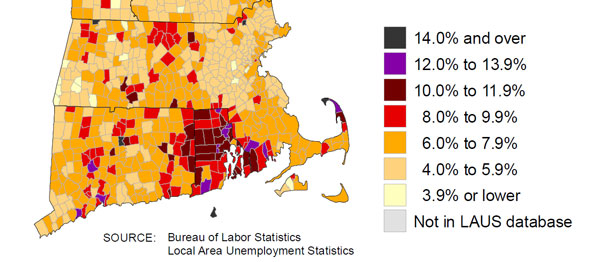
“While Rhode Island may consider Massachusetts is doing better,” Stergios said, “the fact of the matter is Massachusetts is Greater Boston and three Rhode Islands grafted onto it.“The high unemployment rates you see in those areas are similar to those in Rhode Island.”
New England is the only region of the nation for which the U.S. Bureau of Labor Statistics breaks unemployment down to the city/town level, allowing readers to see, by the following map, that Massachusetts is clearly not a bright spot surrounded by Rhode Islandish darkness:
September 30, 2012
Things We Read Today (21), Weekend
Bob Plain's petit four of class warfare; CA's bid for more pension fund dollars; a martial metaphor for regionalization; a downturn for the never-recovered; Coulter v. View mention of RI.
September 27, 2012
RIPEC's EDC Report Another Indication of the Question Not Asked
Yesterday, the Rhode Island Public Expenditure Council (RIPEC), a venerable Rhode Island policy "voice and catalyst" founded in 1932, released a report analyzing the structure of the state's quasi-public Economic Development Corporation (EDC) and suggesting a reorganization. Governor Lincoln Chafee requested the report in May, following the scandalous collapse of 38 Studios, which had been the major basket in which the EDC had placed $75 million in bond-sale eggs.
Fortunately, Chafee Spokeswoman Christine Hunsinger confirms, for the Ocean State Current, that the state did not pay for the report. That's fortunate because — despite its 62 pages of text and 73 pages of organizational charts, definitions, and other appendices — the document does little to justify any particular new economic development structure and nothing to answer the more fundamental questions about the state's worst-in-the-nation employment situation.
September 26, 2012
Things We Read Today (20), Wednesday
Mainly on media culpability and the economy: RIPEC's unquestioned report; skewed polls; the president's reportorial zombies; and the reluctance to invest in the economy.
September 21, 2012
August Employment Data for Rhode Island and the Nation
Once again, the headline is that Rhode Island's unemployment rate fell another tenth of a percent, to 10.7%. And at least it's true, this month, that employment went up instead of down. (The past few drops in the unemployment rate were a result of people giving up their job searches, so they weren't counted in the statistics.)
But people continued to leave the state's labor force, and the employment increase wasn't exactly dramatic, giving the impression that our decline hasn't turned around, but has edged toward stagnation.
September 9, 2012
Things We Read Today This Weekend, 6
First, scroll down and read Monique's postings on Rep. Spencer Dickinson. Then...
The topics of hope and hopelessness pervaded this weekend's readings, from absurd labor rules in schools, to the likely outcome of Make It Happen, to Spencer Dickinson's insider view, and then to Sandra Fluke.
September 7, 2012
Things We Read Today, 5: Make It Happen Edition
Having done little reading while participating in the RI Foundation's Make It Happen RI conference, I used my end-of-day column for reflection.
September 5, 2012
Introducing the Concept of Agenda
A good example of the questionable utility of political debates arose during the Congressional district 1 primary debate on WPRO, last night. Only the most plugged in voters will have any inkling of what statements are true and which are spun to falsehood — let alone the context in which the facts were playing.
Trying to square his calls for bipartisan cooperation with his attempts to make his race about a "radical Republican agenda," as moderator Bill Haberman put it, Congressman David Cicilline (D, RI) said:
The reality is that there are big differences between what the Republicans, led by the Tea Party, are trying to do to our country, and they have an agenda that is really reflected in the Paul Ryan budget passed in the House...
The political posturing is secondary to my purposes, here. Rather, what's interesting is the contrast with the Democrat-led Senate, which has not passed a budget since April 2009. Such a budget would certainly include items that partisans could criticize; it would probably include items with which Cicilline did in fact go on to tar Republicans.
September 4, 2012
Rhode Island at the DNC: Illustration of a Potential Future
In a Providence Journal Political Scene article about his speech to the Democrat National Convention, Rhode Island Governor Lincoln Chafee had this to say about his experience in office:
Now I’m in a governor’s chair, trying to get the economy going, and it’s not, click, turn a switch. This is hard work and it takes time ... and the policies that we inherited [make it harder].
One would think, from this statement, that Rhode Island's economy is edging its way back from the brink, but it is not — certainly not in terms of employment. A new study of the numbers from the RI Center for Freedom & Prosperity shows that, not only is Rhode Island second worst nationally in unemployment, and not only is it the second farthest from its prerecession peak employment, but it leads the country in continuing to lose employment.
September 2, 2012
Against Incentivizing Cooperative Strategic Workarounds with Comprehensive Market-Driven Measurables
At the risk of repeating myself, I have to opine that one of Rhode Island's core economic challenges is the frequency of sentences like this:
To position Rhode Island to compete successfully for jobs and investments, a new public/private economic-development partnership should be designed to implement an integrated economic-development strategy that focuses on business retention and expansion, cultivates new business startups, supports a culture of innovation and entrepreneurship, develops market-driven workforce solutions to help grow the middle class, creates a robust research capability to help make better investment and policy decisions, develops a comprehensive manufacturing strategy, aligns state capital programs with economic-development strategies, develops best-in-class business information and knowledge exchanges, provides the highest level of customer service, builds on its regional economic-development assets and actively manages Rhode Island’s image and reputation in the marketplace.
Admittedly, I've been known to write a Melvillian paragraph from time to time, but I always try (at least) to make my endless sentences go somewhere. At a minimum, there should be some humor in there, or a rest-stop of wordplay to persuade the reader that it's worthwhile traveling on — perhaps rereading with justified suspicion that something worth catching might have been missed. But that's 109 words, a full four inches of Saturday Providence Journal column space, of the sort of technocratic jargon that leaves working self-starters rightly convinced that the underlying message is: "You're not included."
(Yes, I measured.)
August 31, 2012
All of Us Are the Job Generators
Although with regret, I have to opine that former East Providence city councilman Robert Cusack misses the target in his op-ed, yesterday, suggesting a way for Rhode Island to rejuvenate its sputtering economy:
We need to identify a job generator, make the changes needed to attract those jobs and then promote Rhode Island to execute the strategy. Which job generator? The initiative that brought Fidelity to the state has worked. Financial services remains a good candidate. Now we hear of bio-science in a new “Knowledge District.” Other ideas have been put forward that capitalize on our strengths. Whichever one or two job generators we target, that decision for once should be data-driven and fully vetted, and not a hipshot. Our future as a state is at stake.
The frame of mind that presents a policy prescription of what "we" (ultimately having to mean the government) need to do is fundamentally built around a trap in logic. Government officials — elected, appointed, or bureaucratic — have no competence in predicting the future bends of the marketplace. Just as the stock market is ultimately a gamble, wagering the state's economic well-being on the probability that the companies that happen to be in Rhode Island will happen to compete well in an industry that happens to take off is a high-stakes bet at best.
August 22, 2012
UPDATE: QDC Balks at Potential Shipper Expanding to RI
UPDATE: The original report from NBC 10's Bill Rappleye--upon which this post was based--has been pulled from the turnto10.com website. I've received clarification on a number of issues I originally brought up related to this item.
Statement:Well, that explains things much better than the original story!Eimskip is welcome to bring any amount of cargo to the Port of Davisville, at any time, beginning today. No cargo vessel has ever been turned away from the Port here. We would welcome Eimskip as a customer, and have communicated that to them.
A separate matter is Eimskip’s proposal to be granted an exclusive, private lease to operate the proposed container terminal at the Port of Davisville. Their proposal included a 10-year agreement that could be ended at their option, at which point QDC would have to reimburse them for any and all improvements the company made to the Port. Further, the proposal envisioned the creation of 3 jobs (3.1 full time equivalents). This proposal was obviously unacceptable, and QDC rejected it on behalf of the taxpayers, and the other port customers.
Meanwhile, based on the recommendation of the Legislative Port Commission in February, QDC has published an RFP to seek the best possible proposal to operate the terminal at the Port of Davisville. Unlike the Eimskip proposal, the RFP calls for maintaining the Port of Davisville as a public port, open to all shipping customers under the operational control and direction of the QDC.
We remain in contact with Eimskip. Similar to every other port customer, they have told us that they will make a decision based on a number of business factors, including rates established by the QDC. These rates will be established once the RFP process is complete. As always, the Port of Davisville will be extremely competitive. Eimskip has informed us that they will make decision in the next several weeks.
Steven King, P.E. Managing Director, QDC
================================
NBC 10's Bill Rappleye reports:
Federal dollars have refurbished Pier No. 2 at Davisville and provided the state with a crane that can offload containers.Hm. I'd like to know a few more details about those "unfavorable terms to the taxpayers and other port consumers" before jumping to any conclusions. Is it just because Eimskip (Iceland's oldest & biggest shipping company, with service to Europe and North America, by the way) didn't want to use union longshoremen? Or was there more to it than that? It also seems strange that it appears as if the QDC strung Eimskip along for 8 months and then, suddenly, there is to be an RFP. Are there other companies involved here? A lot of questions. Meanwhile, many Port of Davisville residents are upset.Seafreeze, which is located next to Pier No. 2, exports frozen fish.
One of its customers, a shipping company from Iceland called Eimskip, wanted to bring some of its cargo to Davisville, and the Quonset Development Corporation wanted to get involved.
"As soon as we met with the QDC they invited Eimskip to use the pier and the crane," said Geir Monsen of Seafreeze.
Monsen said discussions with Eimskip went on for eight months and included a trip to Iceland.
But the QDC broke off the discussions in June and told Eimskip there would be a formal request for proposals, and that the operation would have to be staffed by union longshoremen.
"(The deal) would have granted the private company complete control over the proposed container terminal at the Port of Davisville at very unfavorable terms to the taxpayers and other port consumers," Steven King, QDC marketing director, said in a statement to NBC 10.
"Eimskip wrote letters to the QDC and how they were looking forward to cooperating all of the users of the port including car imports and potentially any other container users," Monsen said.Seafreeze, and a trucking company called Rhody which is also located in the Port of Davisville, said they would have invested millions and created 100 new jobs if Eimskip were to relocate to Rhode Island.
The companies have requested a meeting with Gov. Lincoln Chafee to try and sell him on the idea.
Monsen said Eimskip is also thinking of relocating to Portland, Maine and Norfolk, Va.
August 20, 2012
Single-Family Home Sales from Town to Town
I've been meaning to update the data that I collected for the first three months of 2012, based on single-family home sales data available through William Raveis Real Estate.
Upon re-reviewing the information, it seemed to me that the three-month window is sure to be erratic on a running basis. Simply as a matter of their size, a significant number of cities and towns in Rhode Island are apt to have fewer than 20 sales in a calendar quarter, so a good month (or significant sale) would throw things off considerably. Moving forward, therefore, I'll trace the rolling annual average.
The following table presents data for the twelve months ending with July 2012. The percent change columns are measured against the twelve months ending July 2011. The numbers in the pink-shaded cells are not favorable. Coming out of a recession and housing bust, a city or town should want sales to be increasing while inventory drops and median sales prices increase. That's an indication that people want to move into an area and property values are generally on the upswing.
As the table makes very clear, while no cities and towns are in the worst condition — fewer sales, higher inventory, and dropping prices — only four show full progress toward health: Barrington, Burrillville, Little Compton, and North Smithfield.
August 17, 2012
Other States Need Much More Misery Before RI Has Company
The unemployment rate for Rhode Island fell by one tenth of a percent to 10.8%, but total employment dropped by 80 people. That's not even a "mixed picture," though. The only reason the unemployment rate moved in a seemingly positive direction is that 471 more Rhode Islanders just gave up looking for work.
So if the unemployment rate is a positive sign, then the state's motto might as well be "We hope people leave faster than they lose their jobs."
About the best that can be said for the Ocean State is that every other state in the union lost more employment than it did, except Utah, which saw a slight gain. That context is illustrated very well in an update to my chart showing labor force (employed plus looking for work) and employment for Rhode Island, Massachusetts, and Connecticut as a percentage of each state's January 2007 labor force.
August 10, 2012
10 News Conference - Justin and RIFuture's Bob Plain
Jim Taricani invited me and RIFuture.org owner/editor Bob Plain to sit in for 10 News Conference, this morning. The topics leaned more toward politics than policy, but we bloggers did manage to pull the conversation toward political philosophy a bit. Specifically, we discussed economic development, the RI economy, the Congressional district 1 race, and the presidential race.
Watch video and continue reading on the Ocean State Current...
August 8, 2012
On State of the State: Getting RI Involved and on Track
On the latest State of the State with John Carlevale, I discussed Rhode Island's civic scene and how residents can begin to get involved and sort through the system along with Lisa Blais, of Ocean State Tea Party in Action, and Marina Peterson, of East Bay Patriots. Of particular note, related to my habitual role as contrarian, are the discussions of whether we should want elected officials to "work together" and the relative merits of offering comprehensive solutions versus simply increasing economic freedom.
7-26-2012 What's a Citizen to Do to Become Involved? from John Carlevale on Vimeo.
August 4, 2012
08/04/12 - RISC Summer Meeting
9:13 a.m.
I was running just a hair late, but the early risers at the Rhode Island Statewide Coalition (RISC) had already jumped right in with the program for its summer meeting.
Robert Flanders just finished speaking. Some notable comments were that he believes, essentially, that there is nowhere to go but up, although "we've got to break some eggs to make a better omelet."
He then introduced the concept of the RISC Foundation as a research institution. "The goal is literally to reinvent, restructure, and revitalize Rhode Island."
Now Gary Sasse is up.
9:18 a.m.
Sasse: RI's "greatest deficit" is consistent and competent leadership.
August 2, 2012
RI Job Count Adjusted Up; Rhode Islanders Not Necessarily the Beneficiaries
After months of hearing from various sources, notably URI economist Len Lardaro, that official jobs reports for Rhode Island were inaccurately gloomy, I was thrilled, yesterday, to see Governor Chafee authorize the state Department of Labor and Training (DLT) to release new estimates.
Basically, there is a substantial lag before the federal Bureau of Labor Statistics (BLS) publishes official, verified data on the number of jobs there are originating in Rhode Island. Between publications, the BLS releases monthly estimates based on its models and smaller surveys, which it adjusts as needed when more concrete data becomes available. Using a more accurate data set, the DLT says that the jobs picture improved to 464,700 jobs in March, compared with the "official" 457,700 jobs, both measured against the March 2011 number of 459,900.
The official number shows a decrease, while the revised number shows an increase. The following chart puts the two numbers into graphical context.

It's important to note that this is not the data used to calculate labor force, employment, and unemployment numbers for the state. The above data is employer-focused, based on tax filings and survey results from employers in Rhode Island with regard to the number of employees that they have. The unemployment rate and related data come from surveys of Rhode Islanders with regard to whether or not they are working.
According to that data, the number of employed people living in Rhode Island dropped from March 2011 to March 2012 by 5,258.
July 31, 2012
The Facts Don’t Lie on Taxpayer Migration
What makes politics and policy fun is that people of good will and honest intentions can disagree and strive to change each other’s mind. Starting from one’s essential worldview, myriad stages of decisions must be made without the possibility of complete information — that is, subjectively — so persuading and being persuaded are distinct possibilities.
We can agree, for example, that we have a moral duty to help those who suffer and struggle among us. Whether government power is the appropriate tool to answer that moral call is a matter on which good people can differ (let alone the wisdom of specific programs).
What makes politics and policy frustrating is that, whether from selfish interests or personal investment in flawed ideas, participants often try to distort data points as if they are another layer of subjectivity. If public discourse and representative democracy are to function, there must at some point be a backstop of shared acceptance of facts.
A fact that I raised in a paper written with J. Scott Moody for the RI Center for Freedom & Prosperity is that federal income-tax payers have been leaving Rhode Island consistently for a decade, taking with them the accumulated equivalent of more than $1 billion in annual resident income.
July 26, 2012
Talking Teen Unemployment and the Minimum Wage on the Dan Yorke Show
630AM/99.7FM WPRO has posted my appearance on the Dan Yorke show, Tuesday, in two segments. The first is the initial half hour introducing the research from the RI Center for Freedom & Prosperity and touching on some conclusions. For the second hour, Economic Development Corp. board member and VIBCO President Karl Wadensten joined us in the studio for a broader discussion.
July 20, 2012
Unemployment Down... and That's Not Good
From a Rhode Island Department of Labor and Training press release titled, "Unemployment Rate Drops to 10.9 Percent":
The RI Department of Labor and Training announced today that the state’s seasonally adjusted unemployment rate for June 2012 dropped to 10.9 percent, down one-tenth of a percentage point from the May 2012 rate. This represents the second consecutive monthly decrease in the unemployment rate and is the lowest RI rate since January 2012 (10.9%).
Things must be turning around, then... right? Not at all. A closer look at the month-to-month results, from the Bureau of Labor Statistics, shows 430 fewer Rhode Islanders were working in June. The only reason the unemployment rate fell was that 1,589 fewer Rhode Islanders are even bothering to look for work. (Technically, 1,159 people fewer people were "unemployed," but the 430 who lost their jobs either went straight to "not looking" or were matched one-for-one with previously unemployed who gave up.)
July 17, 2012
A Decade of Moving Next Door
I've been following taxpayer migration data for years, but in a haphazard way. A new study that I've coauthored for the RI Center for Freedom & Prosperity finally gave me the opportunity to review all fifteen years of available data from the IRS.
The picture — from the 2003 beginning of what can only be described as an exodus — is frightening. After accounting for the tens of thousands of Rhode Islanders who moved to other states and other taxpayers who moved in the opposite direction, Rhode Island lost 24,455 households, with $1.2 billion of annual income (not inflation adjusted). More conspicuously, a net 3,406 taxpayers moved right across the border, to abutting counties in Massachusetts and Connecticut, taking with them $254.5 million in annual adjusted gross income (AGI).
July 12, 2012
CNBC Rankings Shouldn't be Ignored
In light of the recent CNBC report that ranks Rhode Island last, #50, in the U.S. for being "business friendly", Bob Plain wrote this morning--under the heading of "Making Sense of the CNBC Report"--that we should "get ready for the conservative barrage that because Rhode Island ranked as the least business-friendly state we should adjust policy to appease the good editors at CNBC." Well, since I don't want Bob to be wrong (any more than usual ;), I'll confirm his prediction--and I'll start with something Bob wrote.
He continued his foray into "making sense of the CNBC report" by comparing CNBC's top two business friendly states (Texas and Utah) to the bottom two (Rhode Island and Hawaii) and asking, "Where would you rather move your business to?" And that was it. As if it is obvious that the bottom two are better places to live than the former. Well, that is pretty much a matter of taste, isn't it? But it's also beside the point.
The real question that should be posed isn't where Bob or I or just anyone would rather move to, it's where they or we would rather move a business to. Clearly, as the CNBC data shows--and they aren't exactly some little-known outlier here--Texas and Utah are two of the states whose economies and population have continued to grow throughout the decade, recession or not. Clearly, many people would rather move themselves and their businesses to these places instead of Hawaii (which is kind of a special case, isn't it?) or Rhode Island. To put it another way, people in every other state in the country can take solace in the fact that, "Hey, at least we're not Rhode Island."
Take a look at the main page of the story on CNBC's website where it lists the Top 5 and Bottom 5 plain as day. And we're sitting at the bottom for the second year in a row. Like it or not, these reports make national news and affect the perception of our state. Especially when it's a well-respected outlet like CNBC, which business leaders and decision-makers across the country rely upon for financial news and the like and whose findings will be propagated across the country (particularly in the business community and their local and national publications).
Maybe "denial" is a river in Rhode Island. We Rhode Islanders don't do ourselves any favors by continually sticking our collective heads in the sands of our beautiful beaches and believing that everyone else has it wrong when the evidence continually shows that Rhode Island is the one with a problem.
Any Rhode Islander who pooh-pooh's the CNBC story is displaying an all-too typical sort of myopic insularity endemic to the state. Newsflash, folks: Rhode Island doesn't have it all figured out while the rest of the country is crazy. But believing it, or at least telling ourselves we believe it, does serve to mitigate the need for the hard work it would take to actually change things. Including the perceptions of others.
Regardless, for those of us who really do want to change the national perception and, more importantly, the actual economic climate in the Ocean State, things like the CNBC rankings need to be taken seriously. So let's take a closer look at them:
50th in Infrastructure and Transportation - CNBC "measured the vitality of each state’s transportation system by the value of goods shipped by air, land and water. We looked at the availability of air travel in each state, and the quality of the roads." It would seem road quality killed us here.
49th in Business Friendliness - "Regulation and litigation are the bane of business. Sure, some of each is inevitable. But we graded the states on the perceived 'friendliness' of their legal and regulatory frameworks to business." No surprise.
49th in Economy - "We looked at basic indicators of economic health and growth." This is a case where our own personal, anecdotal experiences can confirm a study's findings. Right?
46th in Workforce - "We rated states based on the education level of their workforce, as well as the numbers of available workers. We also considered union membership. While organized labor contends that a union workforce is a quality workforce, that argument, more often than not, doesn’t resonate with business. We also looked at the relative success of each state’s worker training programs in placing their participants in jobs."
45th in Cost of Doing Business - "We looked at the tax burden, including individual income and property taxes, as well as business taxes, particularly as they apply to new investments. Utility costs can add up to a huge expense for business, and they vary widely by state. We also looked at the cost of wages, as well as rental costs for office and industrial space..."
44th in Cost of Living - "From housing to food and energy, wages go further when the cost of living is low."
37th in Technology and Innovation - "We evaluated the states on their support for innovation, the number of patents issued to their residents, and the deployment of broadband services. We also considered federal health and science research grants to the states."
23rd in Education - "Not only do companies want to draw from an educated pool of workers, they want to offer their employees a great place to raise a family. Higher education institutions offer companies a source to recruit new talent, as well as a partner in research and development. We looked at traditional measures of K-12 education including test scores, class size and spending. We also considered the number of higher education institutions in each state." Now we're getting to places where Rhode Island has some possible strengths to build on. My guess is that Rhode Island was boosted by high education spending per pupil and relatively lower student/teacher ratios. Another guess: they must have indexed number of higher ed institutions to population, giving RI a good mark. Test scores were most likely a drag.
23rd in Quality of Life - "The best places to do business are also the best places to live. We scored the states on several factors, including local attractions, the crime rate, health care, as well as air and water quality." A la Dan Yorke: Water. Here's where Bob Plain is shown to be partially correct. But whereas Bob seems to base the entirety of his analysis on quality of life (and living in East Greenwich cove certainly adds to one's good vibes!), CNBC only considers this as 1/10th of the overall picture.
10th - Access to Capital - "Companies go where the money is, and venture capital flows to some states more than others." While it's nice to be in the Top 10 for something, methinks that in the wake of 38 Studios we will see a lower number next year.
Instead of dealing with issues that would directly address some of the above concerns, we had a General Assembly that spent time maintaining the status quo, at best. Right now, the status quo is being the worst in the nation. Is that really where we want to be? Unfortunately, I think too many Rhode Islanders would respond, "Whatever."
Well, at least we've got the beaches and Downcity and Waterfire and Newport....
June 7, 2012
Who's Flying Now? (And Why?)
Ted Nesi posted an interesting graphic from the Tax Foundation that shows that:
Rhode Island posted the 18th-fastest growth in high-income taxpayers between 1999 and 2009.This prompted the NEA's Pat Crowley to chime in with a by-now familiar bit of rhetoric:While the total number of Rhode Island taxpayers grew by just 4% during that period, the number with adjusted gross incomes above $200,000 jumped 63%, for a net gain of 58.9% at the top end, the biggest in New England.
Vindication once again. The “flight of the earls” myth that was used as a justification to cut taxes on the elite in the middle part of the last decade is, once again, shown to be untrue.Well, as I responded, whether you believe in the "flight of the earls" theory or not (and setting aside that it's a bit of a strawman set up by Crowley anyway), the Tax Foundation chart and data doesn't really prove or disprove it at all because the data only compares the beginning and end of a time period in which RI cut the capital gains tax and enacted the flat tax (around 2006), which were aimed at keeping/attracting high earners. It’s just as possible that the "earls" were "flying" until the 2006 reforms and then we saw an influx. We’d have to see yearly data to more accurately determine causation/correlation. So let's do that.
First, even though what follows is a more robust way to look at the trend of higher income taxpayer migration, it is by no means comprehensive. It doesn't take inflation into account (though, as the Tax Foundation points out, their percentages are relative so that affect is mitigated in their analysis), which is why the relative increase in $200K wage-earning households when comparing 1999 to 2010 may be exaggerated. Additionally, the multitude of effects that the economic recession has had on wage-earners aren't adequately accounted for in this simplified manner.
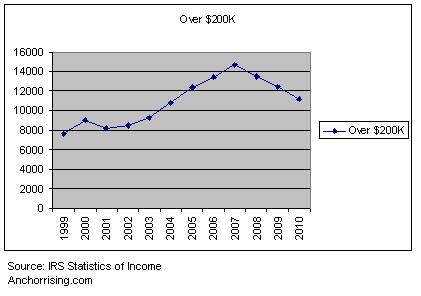
I turned to the IRS's Statistics on Income data from 1999-2010 and tallied up the number of + $200K taxpayers. (Yes, I thought I'd look at 2010, too).
Further, thanks to a timeline provided by Justin, we can compare the implementation of tax policies that were meant to impact high wage earners.
2002: capital gains tax phase-out passed to begin in 2007
2006: flat tax reduction begins
2007: capital gains tax phase-out begins with 2/3 reduction; then it's frozen
2010: capital gains tax increased to personal income level
2011: Flat tax rate reduction frozen
Keeping these dates in mind, let's look at the effects on + $200K wage-earning households. In 2000 there were 9,013 such taxpayers and this dropped to 8,259 in 2001, which, if memory serves, may have helped serve as an impetus for the tax policies that followed.
In 2002, when the capital gains tax phase-out was passed (to go into effect in 2007), the number of + $200K wage-earners went up to 8,500. From 2003 thru 2005, the numbers continued to increase, from 9,252 to 10,798 in 2004 to 12,376 in 2005. In 2006 the flat tax reduction begins and the climb continued to 13,387. In 2007, the capital gains tax phase-out begins with a 2/3 reduction of the previous level and the total + $200K wage-earning households climbed to 14,737. That year the General Assembly voted to freeze the capital gains tax (so the other 1/3 reduction did not occur) and the number dropped to 13,475 in 2008 and 12,416 in 2009. In 2009, the capital gains tax was set to be increased by matching it to personal income level in 2010. The number of households earning over $200K dropped to 11,117 in 2010. In 2011 the Flat tax rate reduction was frozen and we'll have to wait to see what happened.
When looking at the data for both "upper" middle-class and (I guess) "regular" middle-class, it looks like there is no relation between these tax policies and the number of wage earners.
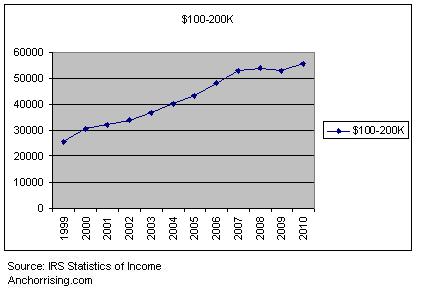
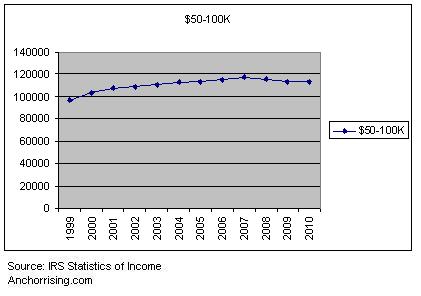
For myself, I've been more of a "flight of the squires" kind of guy than "flight of the earls", believing that it's the middle-class who is suffering--and fleeing Rhode Island--more than the wealthy. As the above charts show, maybe that's wrong.
What I think this does show, however, is that there is a link between capital gains and flat tax policies and the impact they have on the number of high wage earners. During the time that these taxes were reduced, the number of + $200K wage-earners increased. After these taxes were frozen or raised, the number of + $200K wage-earners decreased.
ADDENDUM: The freeze/increase occurred before the economic downturn of 2008/2009 and, it looks like, the "earls" were already fleeing. It also looks like a lot of the "earls" became, um, "counts"(?), as the number of upper middle class wage earners seems to to be continually increasing, perhaps because some earls stayed in RI but dropped an income category. Also, the upper middle class is also being continually refreshed by regular middle class wage-earners moving up. In other words, it's important to remember that these classifications don't necessarily cover the same households.
March 14, 2012
UPDATE II: Port Developments
Last month I expressed my approval of progress being made to further develop the port of Davisville and Quonset Point. However, I also explained my philosophical opposition to paying for port improvements, ie; dredging, via a bond instead of from the general revenue. However, I subsequently learned that I was mistaken when I thought the bond was being proposed outside of the 2012 budget. I explained my error in a follow-up post, but also noted that a bond is still a bond:
Whether a bond is passed as part of the budget, via a referendum or in a separate piece of legislation, my original contention remains: Though I understand the philosophy of spreading debt out over X number of years, I'm critical of the bond avenue because I believe that we are asked to fund too many bonds to pay for items that should be paid for via appropriation from the general revenue, not as loans with interest. If the dredging was funded through a regular appropriation, the $7.5 million worth of work would cost $7.5 million, not $9.1 million. I also understand that we can't appropriate everything on the bond wishlist using today's funds, but that's where setting priorities comes in.Last night, a comment from @Port_Davisville sought to clarify things further.
...this is not a general obligation bond, but a revenue bond which will be financed completely with payments from port users and QDC revenues. There will be no direct cost to the taxpayer.That is correct: the proposed bond is a revenue bond, which means the funds to pay for it will not come "from the taxpayers", as I had interpreted, but from the Quonset Development Corporation, Port of Davisville, etc. The language of the budget (Article 7 of this PDF) makes this perfectly clear:
The bonds or loan agreements issued pursuant to this article will not constitute the indebtedness of the State, and required payments will be derived from Corporation revenues. The Corporation has identified several sources of revenue to contribute to this debt service, including increasing the tariff on dockage from $3.00 to $6.00 per foot ($243,750 annually), increasing the tariff on wharfage from $3.00 to $6.00 per vehicle ($160,000 annually), and contributing $507,456 annually from operating funds. The authorization for this debt applies to bonds issued within one year of the passage of the resolution.So much for my prospective degree in financing! So, to sum it up, taxpayers aren't being asked to foot the bill. Instead, those that are set to benefit most directly from the improvements will be. I could quibble a bit (you knew this was coming, right?); what is a "tariff" but a tax and it looks like those are increasing. But, to be fair, I'm willing to bet that the tariff increases still aren't as high as they would be if Quonset/Davisville joined the Harbor Maintenance program--which is funded by a tax all its own (currently QP/Davisville is exempt--that's a competitive advantage)--to help pay for the dredging.
So, in the end. I learned a few things and my philosophical wariness was displayed and addressed. Consider me an unqualified supporter now.
March 5, 2012
Why RI Is Driving Out the Hushions
Jennifer Hushion submitted an op-ed to the Ocean State Current explaining why the City of Cranston and the state of Rhode Island are pushing her family toward the door:
The economic climate in Rhode Island — and specifically Cranston — is why we are considering leaving. It’s not that we are necessarily against higher taxes; we are against higher taxes when we receive so little in the way of services. Even more important to us than our current situation is the outlook for the future. Unfunded pension commitments and budget deficits are burying Cranston, and my family only sees the situation getting worse. ...I can understand why one might think that those who make over $250,000 are 'rich.' We have worked very hard and are grateful for what we have, but the math is undeniable. Spend 30% of taxable income on private education because of local schools’ inadequacy, pay another 10-15% in state property and income taxes, put another 15% away for a retirement that is slipping away, and being “rich” means driving an 11-year-old car and postponing badly needed household repairs.
February 22, 2012
UPDATED: Port Developments
Last week I commented on the good news "that there is movement in the Legislature--specifically a commission headed up by Jamestown Rep. Deborah Ruggiero--to develop Quonset/Davisville as a short sea shipping port."
To accomplish this, dredging of the harbor would be necessary. According to the story from the ProJo, "The commission recommended that the state issue $7.5 million in revenue bonds to pay for the dredging." In reaction to this, I wrote:
So...we're going to have to go the bond route. Of course, we don't have to go that way. There's a remarkable vehicle that could be used to fund the dredging that wouldn't require the state taxpayers taking on more long term debt: It's called the State Budget. Of course, that may require re-prioritizing expenditures and the like. I guess we can't have that.Rep. Ruggerio contacted me to clarify that the Governor's budget, specifically Article 7 (PDF), does indeed contain language regarding the bond and that she is submitting separate legislation only as a backup plan in case the article doesn't pass. So, contrary to what I wrote, the budget is the vehicle being used. Yet, regardless of the the method being used, the proposal is still to fund the work via a bond with the associated debt. Here is the pertinent section of Article 7:
Quonset Development Corporation Revenue BondsMy thanks to Rep. Ruggerio for clarifying the technical aspects, but I still remain critical of the method. In addition to the dredging, Article 7 contains $201 million in proposed bond referenda (including more Transportation bonds) and $278 million worth of "budgeted" debt authorizations (including the dredging).This article authorizes $7.5 million in debt for various capital projects including, but not limited to, harbor, pier, port, channel, dredging and other costs related to the Davisville Piers Improvements Project at the Quonset Business Park. Total debt service is not expected to exceed $911,200 annually and $9.1 million in the aggregate, based on an average interest rate of 4.0 percent and a 10-year maturity.
The bonds or loan agreements issued pursuant to this article will not constitute the indebtedness of the State, and required payments will be derived from Corporation revenues. The Corporation has identified several sources of revenue to contribute to this debt service, including increasing the tariff on dockage from $3.00 to $6.00 per foot ($243,750 annually), increasing the tariff on wharfage from $3.00 to $6.00 per vehicle ($160,000 annually), and contributing $507,456 annually from operating funds. The authorization for this debt applies to bonds issued within one year of the passage of the resolution.
Whether a bond is passed as part of the budget, via a referendum or in a separate piece of legislation, my original contention remains: Though I understand the philosophy of spreading debt out over X number of years, I'm critical of the bond avenue because I believe that we are asked to fund too many bonds to pay for items that should be paid for via appropriation from the general revenue, not as loans with interest. If the dredging was funded through a regular appropriation, the $7.5 million worth of work would cost $7.5 million, not $9.1 million. I also understand that we can't appropriate everything on the bond wishlist using today's funds, but that's where setting priorities comes in.
Setting aside my philosophical qualms, thanks again to Rep. Ruggerio for the clarification and, more importantly, for taking leadership on this item.
February 15, 2012
Port Developments
I think it's good news (and about freakin' time!) that there is movement in the Legislature--specifically a commission headed up by Jamestown Rep. Deborah Ruggiero--to develop Quonset/Davisville as a short sea shipping port. Imagine: taking advantage of our geography and greatest natural resource for possible economic gain! There are some hurdles ('allo Guvnah!)
The commission found that there was little statewide coordination of the maritime trade economy, and suggested that the governor appoint a port economic policy ombudsman to take on that role.There's also some dredging that would need to be done and, in an of-course-it's-Rhode-Island kinda way, it turns out the Harbor Maintenance Fund I mentioned last week can't be tapped to dredge the Davisville port:The ombudsman would chair a Rhode Island Port Marketing Collaborative, which would seek out business and development opportunities for the state’s ports.
A spokesman for Governor Chafee said the governor received the port commission’s report Tuesday afternoon and would not comment until after he had studied it.
The port commission urged the General Assembly and the state’s federal delegation in Congress to ask the U.S. Department of Transportation to designate Rhode Island ports as “destination ports” in the U.S. Department of Transportation’s Marine Highway System. That’s a federal program started in 2010, designed to move freight along the coastline and waterways, relieving highway congestion.
Ruggiero noted that New Bedford is already on the Marine Highway map, but Rhode Island’s ports are not. “New Bedford had an advocate, while the State of Rhode Island did not,” she said.
She said Rhode Island’s location should give it an advantage in short sea shipping.
The port commission also recommended that the state fund what Ruggiero called “maintenance dredging” at Davisville and in the shipping lane extending from Davis ville to Jamestown/Conanicut Island.So, a long-term competitive advantage, but a short-term bottleneck because of a tax exemption. Figures, right? So instead we're going to have to go the bond route. Of course, we don't have to go that way. There's a remarkable vehicle that could be used to fund the dredging that wouldn't require the state taxpayers taking on more long term debt: It's called the State Budget. Of course, that may require re-prioritizing expenditures and the like. I guess we can't have that.The commission recommended that the state issue $7.5 million in revenue bonds to pay for the dredging.
While federal funds could be used for the dredging, the port commission said that could mean a wait of between 5 and 10 years before funds could be appropriated.
What’s more, since Davisville hasn’t been dredged since the U.S. Navy did it in 1977, the port is exempt from a federal Harbor Maintenance Tax.
Davisville is the only commercial port on the East Coast without the tax, which gives it a commercial advantage that is important to its growing auto-import business.
February 9, 2012
Farmer Explains Why Tax Rates Matter
In the debate about higher tax rates for "the rich", Missouri farmer Blake Hurst thinks something is being overlooked.
It’s obvious that the Obama administration does not believe that tax rates on investment are a factor in investment decisions, or that marginal rates on real income affect how hard and how much people work....In all the arguments over incentives and tax fairness, there has been little mention of, well, cash. I’ve read long, learned dissertations on work effort, impassioned pleas for incentives to encourage a rekindling of animal spirits, and exotic calculus in service of whatever agenda an economist possessed before the study was undertaken. But cash is rarely mentioned.Without cash, there is no business expansion, which means no new jobs.As a small businessman, I can’t argue that I worked harder or longer the year after the Bush tax cuts were passed. I would imagine that my effort was pretty much the same as the year before. The same goes for my investment plan. I invest everything left after living expenses and taxes, no matter what the capital gains tax rate is. I have no plan to sell my farmland or my business. Like Warren Buffett, I’m not selling, so the tax rate on any expected gain doesn’t matter to me.
The only question that matters to the growth of my business is this: how much cash does the tax man leave me?
When we expanded our farm recently by purchasing a neighboring place, the lender required at least 35 per cent of the purchase price as a down payment. That would be cash. It mattered not the capital gains tax rate, the cost of capital, the expected return, or what Obama considers fair. Business is hard and cash is king.Yes, tax rates matter in Rhode Island as much as in Missouri, but vehicle, property, restaurant tax increases, etc. (& administrative "fees"!) negatively effect our cash in hand, too.My wife and I had built the cash reserves necessary to make that down payment on our new farm over a period of years–years, interestingly enough, when the government taxed business and investment income at rates far lower than those envisioned by the present administration. With higher tax rates, it would have taken me many years longer to build the capital necessary to expand my business....My family businesses don’t add much to the overall economic prosperity of our nation. They’re small, not terribly profitable, and are hardly giant engines for job creation or on the cutting edge of innovation. They do, however, employ nine family members throughout the year, with another dozen or so employees during the busy season. Without sensible tax rates on both labor and capital, we can’t build the equity we need to expand in good times and survive the bad times. That’s why tax rates matter.
February 7, 2012
New Education Funding Formula Contributes to Increases in State Aid
Dan McGowan at GoLocalProv has a story on how Governor Chafee's budget sends more money to the cities and towns.
A GoLocalProv review of the Governor’s budget plan shows Barrington, East Greenwich, Lincoln, Cranston, Scituate and North Providence will all receive at least 16 percent bumps in aid, with Barrington and East Greenwich – two of the wealthiest communities in the state – getting 38.2 percent and 36 percent increases, respectively.As Dan notes, the increase is "mostly in education aid". That is because the state passed a new funding formula bill (PDF) last year and, based on the calculations, communities such as Barrington and East Greenwich are seeing an increase because they had been getting less money on a per pupil basis than other cities under the old, hodge-podge,/who-you-know-in-the-legislature system. The percentage increase looks big for the "rich" towns like Barrington and East Greenwich, but they are less in real dollars when compared to the nearly 19% increase for Cranston, for instance.In total, 15 communities will receive at least ten percent increases and Providence, which receives by far the most state aid of any city or town, will get a 9.5 percent increase in aid.
Additionally, GoLocal didn't include school aid for a couple cases where communities share a school district--Exeter/West Greenwich and Bristol/Warren. With the exception of Portsmouth, these four communities are the only ones experiencing an overall decrease in aid. Based on the new funding formula, these towns will be receiving less education aid, which makes their reduction in state aid even more than that indicated by GoLocalProv.
In years past, the perception in the Legislature (and, probably, in the general population) has been that Barrington and EG didn't "need" more aid. Conversely, the old system failed to account for population and demographic changes that have occurred in some communities--Bristol and Warren, for example--by continuing to send the same or a little more money every year while, for instance in the case of Bristol/Warren, the student population continues to go down. Well, a comprehensive funding formula takes out such "gut feel" factors. We'll see how this plays out: To some, the new funding formula may not be "fair", but it is equitable.
January 21, 2012
There's the "Business Community" and There's the Business Community
In Rhode Island, class differentiation has a high degree of overlap with insiderdom — perhaps because people who aren't insiders don't see as much value in remaining, so they've filtered out. In that context, comments from one representative of the "business community," offered in an article about Governor Chafee's promise of "painful cuts" — are disconcerting:
"I think all of us in the business community expect some level of pain," said Colin Kane, a developer who is a principal of Peregrine Group LLC in East Providence. "I'm not going to call it pain. I'm going to call it commitment — and sacrifice — toward making the state fiscally responsible and functional."
Reporter Tom Mooney doesn't bother to point it out, but Kane is also Chafee's appointee to head up the commission overseeing the conversion of the land formerly covered by route 195 in Providence, so he's clearly in the upper tier of insiders. He goes on to say:
And, he said, "I do believe that the public is prepared and willing to make a reasonable sacrifice if indeed they do see a future of getting us below [an unemployment rate of] 10.8 percent.""I pay a lot now. I suspect I will pay a lot later," said Kane. "Let's face it. Last year in Providence our property taxes on commercial [property] went up 25 percent. So we’ve made the sacrifice... Does it cripple? Yes. But we're still alive."
Business survival may be adequate for people who are already financially set, who already have the added perks, locally, of power and influence. But maintaining the status quo is not going to turn things around. As another article on yesterday's front page points out, Rhode Island has continued to bleed jobs. The most optimistic thing that can be said is that job creation was just barely positive for 2011, after losses for almost the entire second half of the year.
It isn't enough for Rhode Island to temper its tax increases to keep people like Kane afloat. Any increases at all, at this point, will kill start ups and continue to discourage new businesses from migrating here, while persuading others to continue leaving. Every penny of Rhode Island's pain has to come through reductions in government spending, taxation, regulations, and mandates, because what's needed isn't a painful solution, but a liberating one — one in which the economy grows rapidly enough to overcome the truly horrid decisions of insiders past.
January 19, 2012
Sympathy for Zimbabwe
Tyler Dorden's point, with his post about trying to send money to his friend (actually named Time) in Zimbabwe is that the United States strangles business with meddling. In this case, he suggests, it does so by requiring Western Union to layer on burdensome precautions before allowing people to transfer money there.
I don't know the background of the policy well enough to say whether the imposition is worthwhile. Judging from the questions that Dorden reports Western Union having asked, it appears to be both an attempt to stifle Internet scams and a form of mini sanction against the nation's ruler, Robert Mugabe.
More compelling than that argument, though, is the description of Time's background. The proportion may be very imbalanced, but I couldn't help but think of Rhode Island when I read the following:
By the time he was 15-years old, Time could see the writing on the wall. Mugabe had all but destroyed the market and private property rights, and Time knew there would be absolutely no prospects for him in Zimbabwe.
How many people, especially young Rhode Islanders embarking on the working phase of their lives, have made the same decision about this state? I know I've heard the advice suggested frequently, in multiple contexts and with an air of plain common knowledge.
January 10, 2012
Trillo's Flawed Government Theory
I don't relish the observation, but it seems to me that Rep. Joe Trillo (R, Warwick) is displaying an unhealthy political philosophy in his quest for a Quonset casino:
"It would have to be bigger than Foxwoods, bigger than Mohegan Sun, otherwise it's not going to work," he said. "To just go with a regional casino, it won't be able to compete."Trillo also envisioned a scenario in which a single operator would buy and run the privately-owned Twin River and Newport Grand, and the new Quonset Point casino. Asked if he had been approached by anyone interested in making such a major investment while the Mohegan Sun struggles financially, Trillo said an emphatic no: "I have purposely stayed away from any casino operators."
It's well and good, if true, that Trillo is avoiding the corrupting influence of those whose money would be necessary to make his vision a reality, but of itself, a vision of such scope and specificity is not an appropriate basis for government action. It isn't the job of elected officials to decide what sort of business on what sort of scale for what sort of market their area ought to have and then go about developing it.
Government should stick to ensuring that the marketplace remains competitive, broadly, and that its policies are not hindering the people from pursuing activities that, within limited boundaries of order and cultural integrity, they believe will be profitable and beneficial.
January 3, 2012
Big Finance Likes Totalitarianism, but Democracy Requires Hard Lessons
I'll admit that I don't have much new to say about the continuing activities of the state-appointed budget commission now ruling East Providence:
The state-appointed budget commission overseeing the city's finances convened for the first time Wednesday, chose Michael O'Keefe, a former state budget director, as its president, and established its first priority: improving the city’s cash flow.
Essentially, that means debt; the city needs $10 million in tax anticipation notes, and the lowering of its rating to "junk" will make that "more difficult and expensive," as O'Keefe puts it. It all comes back to government debt and charming investors. We've discussed previously that the municipal takeovers are meant as "a statement to Wall Street," and the point merits continued emphasis. What Wall Street likes about state-imposed budget commissions is that they open the door to options that might benefit civic units as economic entities, but not necessarily as self-determinant civil societies. The state can take money from other parts of the state to hand to struggling cities and towns; it can impose taxes on local residents without fearing democratic reaction; it can change policies and, ultimately, contracts to address shortfalls.
At bottom, the problem is that the way in which the state determines a preferred mix of these solutions will depend on the influences on it. That means not only special interests, like organized labor, but also the general priorities of the class of people who occupy the state's bureaucracy and elected positions. The people who actually live in a city or town are not likely to rate very highly, and voters in other cities and towns are not likely to pay all that much attention.
I'd suggest that a healthier solution — in the long term, and with an eye toward effective democracy — would be to let a city or town run out of money. Let it reach the point at which it cannot provide services or pay employees. Or, alternately, that it must raise taxes and impose fees almost immediately. If we're to be a self-governing people, we have to experience, together, the consequences of incompetent leaders and bad decisions.
Of course, if people start learning such lessons on the small, local scale, they might begin applying them at the state and national levels. And we couldn't have that, now could we?
December 9, 2011
Killing the Weak as Recovery Strategy
Reading about Rhode Island's effort to return its unemployment fund to solvency in yesterday's Providence Journal, I got the impression of a system so counterproductive that only government officials could conceive of it (and getting worse):
The employers' payments are determined by the number of former workers qualifying for payments; those paying the highest taxes now will pay even more....
Employers will now be split into two categories and pay unemployment insurance taxes based on two taxable wage bases. Most employers will pay a tax calculated with a wage base of $19,600 — a 3-percent increase over last year's base of $19,000.
But those employers whose taxes are calculated at the 9.79-percent rate because they have the highest number receiving benefits will have a wage base of $21,1000. That's intended to offset the large drain these employers exert on the unemployment fund...
It's funny: When children are poor, we don't tax their parents more because their kids are a drain on the system, yet when the economy turns sour, we tax the hardest-hit businesses most. That'll teach them! No doubt, as they begin to recover to profitability, they'll be that much more reluctant to hire new employees.
And call me cynical, but splitting the "wage base" looks like an elaborate way to avoid having the high-end tax break the 10% barrier. Taken together, these two points illustrate well how the government in Rhode Island perceives businesses — not as partners, allies, or patrons, but as a "them" that has money to take.
October 31, 2011
Removing Pension Dollars from the RI Economy
Union reps and pension testifiers have been arguing that reducing pensions will harm the local economy. Using the RI Center for Freedom & Prosperity's pension database, though, I've looked at some relevant numbers, including the fact that the state sends $142 million in public pension payouts out of state.
October 12, 2011
Running the State as a Giant Corporation Is a Bad Idea
Part of what bothered me about Governor Chafee's "findings" in Pittsburgh was the broader economic strategy whereby the state government tries to run Rhode Island like a giant corporation — picking preferred industries, backing particular players (as if they are subsidiaries), and trying to shape available public resources (such as the I-195 land) toward a specific vision. That's the impression also given by a recent article in which Monster Mini Golf founder Christina Vitagliano complains about Rhode Island's handling of businesses:
... even a glowing skeleton doesn't make Monster Mini Golf a biotech company, and Vitagliano said her firm doesn't fit in with the state's plans to create a "knowledge district" of life science and high-tech companies."No one knows we're here," Vitagliano said. "I'm not a pharma company, I'm not a medical-device company, I'm not Curt Schilling. There has been zero help from anyone."
She said that's a stark contrast to her experience in Las Vegas. "When you walk into City Hall in Vegas, they welcome you with open arms. It's a very pro-business, proactive city."
Who in government would have gone in search of a black-lighted mini-golf company as an economic development project? Mr. and Mrs. Vitagliano had a unique vision, they chased it down, and it's been a success. That's real entrepreneurship, and government — with its vested interests, direct line to bar-raising regulation for big-rolling incumbent organizations, and access to NIMBY politicians and constituents, alike — is ill suited to encourage it.
The best strategy is simply to get government out of the way.
September 26, 2011
RI Needs a Strong Economy to Keep Bank of America
In his Sunday Providence Journal column (not online), John Kostrzewa worries that Rhode Island officials aren't doing enough to ensure that looming cuts in Bank of America's workforce don't come out of our local economy. He suggests that they're waiting for a more opportune time and insists that they can't afford to do so.
But the persuasion that he suggests is built upon a big threat:
... the state kept an average bank balance of more than $35 million at Bank of America during the fiscal year that ended June 30. Some federal receipts flow into a general fund account at the bank. And Bank of America is a senior bond underwriter for the state and assists in the marketing and sale of state bonds.All of that work doesn't have to go to Bank of America. It could go to other institutions that make commitments to add jobs.
Rhode Island may or may not have the financial leverage to bully the bank. Considering that BoA is looking to save $5 billion per year in personnel costs, the numbers in play may be out of Little Rhody's league, even with the combined threat of lost business and promise of the state's famous big-shot handouts.
Just under two years ago, the Bank of America branch on Main Rd. in Tiverton closed down. A manager, there, told me that the branch was profitable, but that the lack of small-business prospects in the town erased the justification for maintaining a presence here. Although the scale is much smaller, Tiverton's experience suggests a better way forward for Rhode Island.
My mind turns to a CNBC analysis from June of this year, in which Rhode Island managed to be dead last on a list of Top States for Business. In three of the ten subrankings — workforce, technology & innovation, and access to capital — the state stood right on that middle line of mediocrity. It did a little bit better in education and a little bit worse in quality of life. That's half of the rating's factors. With the other half, we're bottom ten material: cost of doing business, infrastructure & transportation, economy, business friendliness, and cost of living.
If Rhode Island wants to halt its slide into backwater and change its status as the Northeast's Mississippi, the government is going to have to focus on making the state a more attractive place to do business. Rather than one-time giveaways, the state has to lighten up on its taxes and regulations and improve its infrastructure — while decreasing the cost of living and doing business.
Evidence that Rhode Island is serious about turning itself around — and fast — would do more to persuade BoA CEO Brian Moynihan that it's worth staying here than would threatening letters from every single elected and appointed official from local water authority up to Speaker of the House. Unfortunately, our current governor and General Assembly, Providence's current mayor, and (all evidence indicates) the state's electorate, itself, lack the will to do what's necessary.
August 24, 2011
How a State Buries Itself with Wind and Overreaching Government
Rhode Island had to have a speculative wind project. The General Assembly and former Governor
Don Carcieri effectively castrated the regulatory body that oversees energy policy and forced through the Deepwater Wind agreement that will raise energy costs for all Rhode Islanders in order to guarantee the company profits. Of course, those who use more energy, such as substantial manufacturers (and employers) like Toray Plastics are affected more.
Not to worry, though. Taxpayers can be tapped, yet again, to subsidize green energy:
The Economic Development Corporation board on Monday unanimously approved giving Toray Plastics (America) Inc. $1 million in energy-assistance grants that will pay about half of the company's costs to install 1,650 solar panels at its Quonset Point facility.The investment of state and federal money is not expected to bring any additional jobs to Rhode Island, company President and CEO Richard R. Schloesser said before the meeting, adding that the solar project is "strictly for the environment — renewable energy."
That won't be all, though. You'll recall that, in its zeal to leap into the wind energy business, the government of Rhode Island explicitly called for energy distributor National Grid to ensure a profit for itself and for green-energy suppliers like Deepwater Wind by charging a premium "to all distribution customers through a uniform fully reconciling annual factor in distribution rates."
With Toray implementing a government-subsidized system to supply some of its own energy, it will be paying a smaller share of that "uniform fully reconciling annual factor," which means that everybody else will be paying more.
This is how a government can bury itself and the people it represents while attempting to react to the negative consequences of poorly considered policies, and Rhode Island's manner of governance is practically defined by this short-sighted dictate-and-dig methodology.
August 5, 2011
Come to Rhode Island... Just Not for Long
I hate to be so negative... I really do... but isn't it just too perfectly Rhode Island that the geniuses guiding the state would come up with this as an advertising slogan:
The judges like Team 5's idea about unpacking Rhode Island. But they choose another slogan and marketing plan for the winner: "Rhode Island: It's so small you can do it all.""Every school kid knows one thing about Rhode Island — it's small. So we asked, what's good about being small?" said winning team member Alec Beckett, a creative partner with NAIL Communications.
So small I can do it all? You mean, like in a long weekend? How much can there be to do in the state if I can do it all in a single vacation?
Maybe "Rhode Island: It's all within reach," or something. That way ads can refer to proximity without implying limits on activities. They can also play on the words to imply cost savings over trips to locations farther away.
July 27, 2011
Gimmicks Won't Spark Business Activity
The Economic Development Corp. is limited in the scope of the activities in which it can engage (and its board members are appointed by local politicians), but I didn't want to let this article slip through the cracks as I catch up with things because it so well illustrates the futility of usual practice in the face of Rhode Island's problems:
... Businesses are fighting over space in Massachusetts, prompting Babineau to tell those people to take a look at Providence."And they said, 'Really? We didn't know,' " Babineau said. "I said, 'That's our fault.' "
Board members kept returning to that idea. Daniel Sullivan Jr., president and CEO of Collette Vacations Inc., said the EDC and state must market and sell what Rhode Island offers. Referring to Babineau's encounter, he urged, "We've just got to get in front of them."
Somehow, I don't think businesses would be flocking to the worst-bar-none business environment in the United States but for the failure to market to them and hold conferences. At this point, the EDC's singular focus should be... let's say... educating Rhode Island's political class about the damage that it has done and continues to do to the state.
July 25, 2011
Letting the Spinners Get Away with Economic Baloney
It's getting kinda hard to take the spin that permeates economic reporting. Reporter Kate Bramson and her headline writer mainly adopt RI Department of Labor and Training Director Charles Fogerty's line that the statistics show "slow, steady progress." The headline and lede are, "Rhode Island unemployment dips slightly, to 10.8 percent, Still, 10.8% an improvement over numbers for December," and the story deepens with this:
Job growth in Rhode Island is one of the positive trends in the first half of the year. Although the number of jobs dropped from May to June by 1,500, Rhode Island had 4,200 more jobs in June than in December. That six-month growth is an increase of 0.9 percent -- which Fogarty said is "outpacing the nation."
A quick glance at the accompanying table, mostly taken from the U.S. Bureau of Labor Statistics' page for Rhode Island unemployment, shows that, while the number of unemployed Rhode Islanders dropped by 4,891, the number of people working also dropped, by 5,362. That is, the overall labor force shrank by 10,153 and hasn't been this small since September 2009.
As for the increase of "jobs based in Rhode Island" since December, a closer look at the month-to-month statistics (which are all that are easily found) suggests that the uptick is mainly in construction and accommodation and food services, which can be expected to increase in Rhode Island this time of year.
July 6, 2011
Rhode Island: The Business Underdog (of our own making)
Toray has been in Rhode Island for over twenty years. They are looking to expand. They also have a facility in Virginia. The Rhode Island facility is bigger, but the costs are higher. Virginia looks pretty good. #50 business friendly Rhode Island is now competing with #1 business friendly Virginia to woo a business it already has.
[Toray CEO Richard] Schloesser is looking to make his decision by the end of the year, said he’d prefer to expand here. But he’s concerned about the cost of doing business in Rhode Island. “It’s a very expensive state to do business in,” he said....One of Toray’s big concerns is energy. The company is the largest consumer of electricity in the state, and it went to court to appeal the power-purchase agreement between National Grid and Deepwater Wind, which plans to build wind farms in the waters off Rhode Island. Toray contended the agreement would drive the price of power too high.Because the overall business environment in this state stinks, the Economic Development Corporation is forced to try to make up for the shortcomings by offering one-time, sweetheart deals.In an interview last week, Schloesser said the court’s decision will have “some impact” on the company’s expansion plans.
On Friday, the Rhode Island Supreme Court upheld the power agreement, ruling against Toray and fellow plaintiff Polytop Corp. Schloesser could not be reached for comment Tuesday....[Earlier] Schloesser said he is worried about the long-term economic climate in the state. He said some of Chafee’s tax proposals, particularly a 1-percent tax on manufacturing equipment, could have been a deal-breaker for Toray. But that idea never made it through the General Assembly.
“We’d like to have the expansion here, but we have questions about what will happen to the state. Is this going to be a good place to do business in the next five years?”
[EDC Executive Director Keith] Stokes aid Toray might be able to qualify for tax credits under the state’s provisions for manufacturing research and development, and another for job creation. He said officials from the Quonset Development Corporation have also been involved in the discussions about land acquisition.It's no way to do business.“Companies are making their decisions based on costs,” Stokes said. “It’s not lifestyle. It’s not loyalty. It’s costs.”
Stokes said certain costs –– utilities, health care, land and taxes –– are higher in Rhode Island than in other states. What the EDC is trying to do for Toray, he said, is come up with a package to make Rhode Island cost-competitive....Stokes said that in a perfect economic world...[r]ather than a whole set of incentives and inducements, Rhode Island would be better served by a lower corporate-tax rate, a stable budget and a predictable business climate.
But, said Stokes, we’re not living in that perfect world. Stokes said that when it comes to economic development, keeping existing companies, particularly an expanding company, is even more important than luring new ones.
Stokes said the incentives under consideration for Toray are not “deals,” but ways of compensating for the higher fixed costs of doing business in Rhode Island.
June 30, 2011
Evolving Arbitration
Sam offers Fred $10, but Fred wants $30. To solve the problem, they call in their buddy, "The Arbitrator", who decides $20 is fair. Sam pays more, Fred gets more.
The next week, Fred asks Sam for $30 again, but Sam says he's only got $13 in his wallet. Fred says Sam is holding out. They go to The Arbitrator, who says Sam isn't holding out, but he should check back at the house and he could probably come up with more than $13. To be fair, The Arbitrator says Sam should give Fred $17.50.
The next week, in anticipation of the request, Sam offers Fred $10 and explains that's really all he can afford, assuming he gets paid next week. Fred still wants $30, but says he can live with with $20 so long as Sam kicks in an extra $.30 a week to help him buy a pack of gum. They turn to The Arbitrator, who thinks Fred is asking a bit much, given Sam's current financial situation, but in the spirit of cooperation agrees that Sam could handle $12.50 along with the $.30 per week.
Then, The Arbitrator says from now on, he'll take the last best offer from each of them and pick one.
Sam prepares for Fred's next request. Based on past precedent, the Arbitrator has never awarded exactly what either of them has proposed before, but "compromise" always results in Sam paying more than he offered. Sam assumes he'd better build a compromise-type number into his next offer so that it has a realistic chance of getting picked. As usual, Sam expects he'll have about $10 in his wallet when Fred comes calling, but he scrapes together a few more bucks--some from his kid's allowance--knowing that, based on past transactions, Fred will want more and will get more--he always has.
When the time comes, Sam offers Fred $15 and the $.25 gum subsidization and crosses his fingers. Fred asks for $20 along with $.30 per week for gum--the price has gone up. The Arbitrator looks at both offers. The price of gum has gone up and Sam and Fred are only $2 apart as far as the main nut. Besides, Winston, their friend from East Greenwich, has been loaning their other friend James $25 regularly since last year and Sam makes almost as much as Winston. And Sam has always managed to come up with more than his original offer.
The Arbitrator sides with Fred.
Sam moves out of state.
Fred walks up to Winston...
June 29, 2011
Last Again, Naturally
CNBC has ranked Rhode Island as the least business-friendly state in the country. #50. Dead last. I know the yabuts will be out, but--to coin a phrase--"perception is reality" and when a business channel reports that your state is the worst, well, what do you think the business people watching that channel are going to come away with? The rankings are here and were derived following this method:
This year’s categories and weightings, for a total of 2,500 points, are:Rhode Island's best rankings were in the middle of the pack in the categories "Quality of Life" and "Education" (24th), "Workforce" (26th) and "Technology and Innovation" (27th). Two of the four where we showed best were among the highest weighted categories, but that wasn't enough to make up for our abysmal showing in "Cost of Business" (46th), "Business Friendliness" (48th) and "Infrastructure & Transportation" (49th). Do you think giving control of prime real estate in Downtown Providence to an unelected-but-well-connected commission will help the negative perception any?* Cost of Doing Business (350 points)
* Workforce (350 points)
* Quality of Life (350 points)
* Infrastructure & Transportation (325 points)
* Economy (300 points)
* Education (225 points)
* Technology & Innovation (225 points)
* Business Friendliness (200 points)
* Access to Capital (100 points)
* Cost of Living (50 points)
June 17, 2011
The Long Reach of Educational Inadquacy
Here's a little nugget of insight that deserves broader comment. Apparently, Rhode Island is having a difficult time filling the open position of Director of Health:
In a phone interview, [former director David] Gifford said that a number of prospective applicants had contacted him with questions. The salary, he said, is an issue, but not the top one.Instead, doctors considering moving their families from out of state were concerned about the quality of public education in Rhode Island, which some found to be below par, he said.
No doubt, progressives will be chime in to declare this as evidence that people don't migrate on the basis of taxation, but that would be a distraction. The point that must be understood is that progressive policies — educationally and as a matter of civic structure — have brought us to this point. On the educational side, the emphasis of public schools has shifted toward catering to disadvantaged and challenged students to the detriment of the broader mission, and curricula have been politicized both in the content and in the amount of time that schools spend concentrating on what might be termed institutional parenting (the focus being on imparting self esteem and teaching behavior).
More significantly (and harming Rhode Island disproportionately to its competition) is the structure of the system. Centralization toward an educational bureaucracy has left municipalities less able to address the communities that they actually serve, and the unionized workforce, with the advantages that it has secured through hardball negotiations and state-government advocacy, has driven up the cost of public education to the degree that programs must be cut and schools operated inefficiently.
The pervasiveness of that problem can be observed by expanding the above quotation by another paragraph:
Additionally, continual funding cutbacks will make it hard for any director to take on new initiatives.
As a small-government type, I don't take it to be inherently a bad thing for government departments to be constrained in that way. The point is worth making, though, that limits in what they can do and the ways in which they can experiment to become more effective and efficient are sure to be imposed when an ever-growing portion of their budgets must go to labor — both current and retired.
June 13, 2011
Zero-based budgeting
Looking at RIPEC's state budget projections, Ted Nesi explains how a "budget on autopilot" is untenable no matter what the entity--towns, cities, states, the country. You can also read "autopilot" to mean "assumptions." Yet, the assumptions built into these budgets--3% raises, increase in program costs, etc.--aren't even enough to cover the rate of growth, which far outpace the ability to tax (or "generate revenue").
Nesi provides a nice pie chart showing that 52% of the growth in the budget since FY2002 is from social services and 17.7% of the growth comes from increasing personnel costs (while the growth in personnel costs--particularly in a good economy--are probably about what we'd expect to see, keep in mind that the state workforce has shrunk). Meanwhile, as we well know, aid to cities in towns--ie, money that towns send to cities, some of which filters back to them--has been reduced by nearly 3%, which isn't a lot in the big picture, but hurts each community acutely.
Given our current straits, perhaps it's time to implement zero-based budgeting instead of the current practice of "last year + (at least) 3%". Start fresh. Look at what we spend our tax dollars on and (re)prioritize: infrastructure, economic development, providing important services at reasonable cost, etc. Now, it takes a lot of work, so perhaps we could do a zero-based budget in the first year of each new governor term and then baseline from there. It's an interesting concept, but the chance of it getting implemented is, well, zero.
June 3, 2011
Now for some good news: TACO Expands
For good reason, it's easy to focus on the bad around here. But there are positive signs every now and then. As reported by WPRO, TACO, Inc. has gone ahead and broken ground on a new expansion: the "Innovation and Development Center". Obviously John Hazen White Jr., owner of TACO, is confident the budgeted costs won't increase from any tax law changes. The purpose of the expansion is important to note. Companies--manufacturers in particular--used to rely heavily on institutionalized training/apprenticeship programs.
For instance, my father was accepted to the General Electric Apprenticeship program back in the late '60s, where he learned how to do things the "G.E." way. To be sure, many companies have continued such programs, including TACO, but I think they were de-emphasized as more kids received college degrees or went to technical schools to learn skills. I wonder if the new expansion is a sign that TACO will re-emphasize getting prospective employees in-house quicker to learn the "TACO way."
June 1, 2011
Now It Costs More to Borrow
Whenever a rating agency lowers their estimate of the ability of a state to pay back its bonds, the interest rates the state pays go up. Moody's just lowered its rating for Rhode Island.
Moody's Investors Service has downgraded the outlook on Rhode Island bonds to negative from stable because of "the potential impact of rapidly escalating pension costs on the state's ability to increase its liquidity margins, diminish its reliance on one-time measures to balance its budget and reduce its debt burden."That means all those transportation bonds we Rhode Islanders love to pass (because, ya know, we gotta have roads!) will cost more over the long term. Smart states budget transportation, they don't bond it. For years, we've dealt with sacrifices to the quality of basic government services that most state taxpayers actually use--indeed, require--like roads, bridges, the DMV, etc. While other budget items have continued to increase, either with state or federal (it's magic!) dollars.Moody's added, "The state's pension costs are set to double in two years by an amount that roughly offsets its budget reserve account, raising the likelihood that it will continue to face significant budgetary pressures..."
For his part, Governor Chafee recognizes this and is trying to find ways to get off the transportation bond wagon. Unfortunately, his ideas revolve around paying tolls or mileage taxes. That's a non-starter, too. Just like his call to add more workers to the DMV. Maybe we should make Twin River a full-on casino and devote some of that revenue to transportation. Or we could just re-prioritize the state budget--baseline it--and go from there. Doubt that will happen.
May 27, 2011
Body of Proof That Tax Increases Aren't the Way to Go
Many Rhode Islanders aren't completely sold on the economic benefits of giving away tax credits to TV and movie productions, and some of those who are seem to think the benefit has more to do with notoriety. Still, it's reasonable to count this as high-profile evidence of the effect of attempting to solve the Rhode Island government's financial problems through revenue increases, rather than spending reductions:
ABC-TV has received approval for a $7-million tax credit for filming "Body of Proof" in Los Angeles, the director of the California Film Commission tells the Los Angeles Times. ..."They have indicated they are moving the show, and will start filming in Los Angeles in mid- to late July," Amy Lemisch, the film commission's director, told the Times in a story published Tuesday. ...
Network TV series like "Body of Proof" can qualify for California's film-tax program only if they are moving to California from another location, the Times said. The show also received tax credits in Rhode Island during its first season, but Governor Chafee's proposed budget — now under discussion in the General Assembly — calls for eliminating the credits.
Even a casual observer of the entertainment industry can assume advantages to setting up shop in California, beyond tax credits, and it's not improbable that the operation came to Rhode Island for a season to test the TV audience and then move to California as an "moving" operation, per the rules of CA's tax credit. Still, the possibility of finding its RI credits evaporating couldn't have done otherwise than eased the decision. More importantly, that it's such an obvious thing for observers to consider as a possible reason illustrates how obvious such factors are for decisions being made across the economy.
May 16, 2011
Cultural Economic Potpourri
OK, so I'm aggregating a bit, but just today we've had all sorts of cultural economic news. Providence is going to host a professional video game tournament in November (where was this when I scored so high on Donkey Kong on the Atari that the sprites started quivering!) that will bring in 16,000 spectators. (Advice: stock up on Mountain Dew and other snacks and sell them streetside for a quick buck~ahem, with all the proper licensing of course....).
Then we have the U.K. Telegraph calling Providence "New England's coolest city". This seems based largely on the prominence of RISD and it's alumni, especially for the foodee culture. I loved the observation that, "Like Rome, Providence congregates around seven hills." Never thought of that.
Finally, the news is that RI-filmed TV show "Body of Proof" has been renewed--but it won't be filmed in Rhode Island anymore. Phew. Call me a typical provincial Rhode Islander, but now I won't feel as obligated to watch it. Another hour freed up. (Well, more like 40 or so minutes, I DVR everything).
May 11, 2011
Economic Passivity in Rhode Island
At first, I was just bothered by the passivity evidenced in the first sentence of the following paragraph:
Because Rhode Island's economy is interconnected with the regional and national economies, the slowdown in the national economic recovery in the first quarter of 2011 affected Rhode Island, according to the [Bryant University-RIPEC] report. The U.S. Gross Domestic Product increased at an annualized rate of 1.8 percent in the first quarter, compared with 3.1 percent in the fourth quarter of 2010.
Why should it just be assumed that Rhode Island will follow the national trend?
But then, I reread the first paragraph of the article:
Rhode Island's economy expanded 1.9 percent in the first quarter of 2011, sustaining about the same rate as in the last two quarters of 2010, according to an economic index to be released Monday.
So, the national growth is actually down significantly from the last quarter of 2010, while Rhode Island's anemic growth is about the same as it was during the last quarter of 2010. Do we only follow the national economy when it's bad to do so? Or were we really expecting a huge non-national surge in our state that was dragged down?
Whatever the case, I still think we need to cut taxes, slash regulations, and eliminate mandates in order to set our state free of economic shackles — whether of our making or the nation's.
Left Holding the Bag
The ProJo headlines the $9.4 billion pension liability, but also mentions the $2.4 billion health care liability. That's $11.8 billion in money owed to state and municipal retirees (some of which is funded). They try to soften the blow explaining that an 80% funding level "is considered healthy" for pensions. So that makes it about a $7.5 billion pension obligation (if we include health care--assuming the 80% "rule" applies--the overall would be $9.4 billion). Yes, some pensions are partially funded, but it's still not good.
Most of Rhode Island’s pension plans fall short of the 80-percent funding level, a gap of more than $5.7 billion. Of the 155 plans, more than 100 are less than 80-percent funded.The only solution is massive reform to current pension plans. Some fundamentals seem like no-brainers: move up the retirement age; no more double-dipping; no more buying "good" years. Some will be tougher, like trying to move to a 401K system with current employees (the Laffey idea of cutting them a check and telling them to invest wisely!). This isn't about sticking it to government employees. You were made promises. They have been broken. Let's not forget who did this.The 37 plans run by municipalities are in the worst financial shape, with 32 of them not reaching the 80-percent level.
Historically, pension contributions to the locally run plans have often been shortchanged in favor of other municipal services –– such as education, public works and public safety –– when money is tight.
For all of these broken promises were made by politicians who continued and continue to be re-elected. 70 years of Democrats have done this to you, Rhode Island. That's the truth. Don't blame the odd Republican Governor or occasional Republican Mayor for this. It was the Democrats in the General Assembly, on the Town and City Councils, on the "non-partisan" school committees who made these broken promises. This is what letting yourself become beholden and brainwashed into thinking that one party--the party of the "little guy"--would look out for you.
You elected them because they promised you a "good deal". Now you and your kids and grand kids and Rhode Island taxpayers and their kids and grand kids are all left holding an empty bag full of broken promises. All because elected officials, almost all of them Democrats, told you what you wanted to hear and you believed them. It's worked out for them. How's it working out for you?
May 10, 2011
Still Underpreparing for Pensions
So, Rhode Island League of Cities and Towns Executive Director Dan Beardsley is warning of the large dollar amounts that state and local taxpayers are going to have to begin paying if the state Retirement Board approves actuarial recommendations:
The Retirement Board, which is chaired by General Treasurer Gina Raimondo, is set to vote Wednesday on whether to accept the new numbers — and the higher annual funding they will require. "My vote's going to be the toughest vote I've ever had to cast in my 20 years on the Retirement Board," Beardsley said.
You'll recall that the board recently voted (pretty much along a union/non-union line) to lower its predicted rate of return on pension investments from 8.25% to 7.5%. Personally, I'm with Konrad Steuli, of Sunderstown, in wondering if even that's appropriately realistic:
... while talented state General Treasurer Gina Raimondo deserves credit for lowering, for planning purposes, the assumed rate of return for pension fund investments from 8.25 percent to 7.5 percent (net of inflation), the latter is still a “junk bond” level of return, and maybe worse.In other words, we are still kicking the can down the street. Who gets that kind of a return for an appropriately safe investment loaded with the retirement expectations of Rhode Islanders?
As the Providence Journal reported even 7.5% is well above experienced returns, which were 2.47% for the past decade, 6.23% for the past 15 years, and 7.13% for the past twenty years. Surely, we are all hopeful that the American economy will recover and return us to the prosperity to which we've grown accustomed, but given the numbers, it would seem that we'd have to see that and more for our pension system even to come within range of plausibility.
May 9, 2011
No Business like Non-Profit Business
Over the weekend, the ProJo editorial board pointed to the apparent dichotomy of non-profit organizations enabling their directors and board members to profit with significant sums of money:
Recently, Blue Cross Blue Shield of Massachusetts parted ways with its chief executive, Cleve L. Killingsworth, but not before handing him an $11 million severance package. Bay Staters rightly howled; an investigation by Atty. Gen. Martha Coakley is now under way.Hopefully, the ProJo will turn their resources to looking at the same institutions in Rhode Island (instead of relying on Globe reporting) over and above a single story on the new head of BC/BS Rhode Island. That aside, they make a good point:Amid the uproar, however, another questionable practice came to light. Blue Cross and other nonprofit health-care insurers have been paying their board members — and well. Last year, annual payments ranged from around $20,000 to more than $80,000 per board member, according to The Boston Globe. They are, in effect, subsidized by taxpayers. In almost no other charity in the state are board members paid at all. In fact, the tradition is for members to contribute money of their own to the organizations they serve. Usually, it is regarded as an honor to “give back.” And, truth be told, members benefit financially, if more indirectly, from the personal ties they cultivate with fellow local movers and shakers on boards.
Whatever happened to just plain knowing better? Amid the search for personal status and enrichment, the purpose of nonprofit organizations seems increasingly lost. This is especially ominous in health care, where rising costs are a signature domestic crisis of our time. Yet nothing can change if attitudes do not change first. The sense of entitlement that has developed among some health-care insurers urgently needs reversing.The noblesse oblige they're pining for is missing in many more non-profit sectors than just health care. This is no surprise, though, as the term "non-profit" is more a tax classification than a philosophical one. As more people--especially politicians--realize this, there will be increasing support for asking them to "contribute more" (pay more taxes) to the communities who purportedly benefit from their presence.
ADDENDUM: Of course, we don't have to rely on just the ProJo. Last month, WPRI's Ted Nesi confirmed that the board of BCBSRI is not compensated.
May 6, 2011
CEOs Grade the States
Yeah, I know, who cares what a bunch of rich CEOs think. Anyway, fwiw (h/t Ted Nesi):
Business leaders graded the states on a variety of categories grouped under taxation and regulation, workforce quality and living environment. “Do not overtax business,” offered one CEO. “Make sure your tax scheme does not drive business to another state. Have a regulatory environment and regulators that encourage good business—not one that punishes businesses for minor infractions. Good employment laws help too. Let companies decide what benefits and terms will attract and keep the quality of employee they need. Rules that make it hard, if not impossible, to separate from a non-productive employee make companies fearful to hire or locate in a state.”OK, how'd we do? As Nesi points out, RI is close to middle-of-the-pack at #35 overall. But a closer look at the individual categories doesn't paint quite as bright a picture (in a "hey, at least we aren't the worst!" sorta way).Not surprisingly, states with punitive tax and regulatory regimes are punished with lower rankings, and this can offset even positive scores on quality of living environment. While state incentives are always welcome, what CEOs often seek are areas with consistent policies and regulations that allow them to plan, as well as intangible factors such as a state’s overall attitude toward business and the work ethic of its population.
First, here are the actual stats:
43rd - % GROWTH 2005-09
43rd - % 2005–2009 GROWTH IN TERMS OF NATIONAL AVERAGE
23rd - UNEMPLOYMENT RATE %NOV. 2010
23rd - COMPARISON WITH NATIONAL UNEMPLOYMENT RATE %
39th - DOMESTIC NET MIGRATION RATE PER 1,000 (2000-2006)
48th - DEBT PER RESIDENT $ ($8,716)
40th - STATE AND LOCAL GOVERNMENT EMPLOYEES PER 10,000 RESIDENTS (ranked lowest to highest - 510.84)
46th - STATE-LOCAL TAX BURDEN
45th - STATE-LOCAL TAX BURDEN COMPARED TO NATIONAL AVERAGE (9.8%)
Then are the ratings by CEOs (ie; their perception of RI):
47th - TAXATION AND REGULATION
41st - WORKFORCE QUALITY
41st - QUALITY OF LIVING
Basically, it looks like our unemployment rate and low gov't employee/10,000 residents got us "up" to #35, because every other statistic is pretty much what we expected it to be. Finally, here is how Rhode island and the rest of New England compare in the eyes of the CEO's (it's not good for RI):
TAXATION AND REGULATION
New Hampshire (6th)
Maine (38th)
Connecticut (42nd)
Vermont (43rd)
Massachusetts (46th)
Rhode Island (47th)
WORKFORCE QUALITY
New Hampshire (6th)
Connecticut (26th)
Massachusetts (27th)
Vermont (37th)
Maine (40th)
Rhode Island (41st)
QUALITY OF LIVING
New Hampshire (8th)
Vermont (29th)
Maine (34th)
Connecticut (36th)
Rhode Island (41st)
Massachusetts (43rd)
Yay, we beat someone! Regardless, the stats aren't important. It is the perception. We need to change that perception so corporate decision makers will change their minds. We can't just say it or believe it to make it so. We actually have to do something.
Sleepy Public Construction Methods
I've had occasion to drive through the construction site of the new Sakonnet River Bridge in Tiverton quite a bit, lately, and no matter how many times I see it, I never fail to be impressed with the structural inefficiency of the work habits. The other day, I saw three employees gabbing over two who were doing masonry work while two stood nearby to direct traffic in those infrequent instances when a construction vehicle had to cross the sparsely traveled back road and a police officer sat in his car. One wonders if that's where WPRI reporter Tim White's latest catch got the idea that it'd be just fine to sit in his car to eat, read, and sleep for three or more hours per day:
That dozing fellow is Department of Transportation engineering technician Kevin Coulombe, who is responsible for inspecting road and bridge materials. White notes that Coulombe oversaw the Barrington Bridge project "which was $11 Million over budget and took twice as long as expected."
According to Transparency Train, Coulombe's 2008 salary was $50,712, so clearly he's no Stephen Iannazzi. Perhaps if he actually works his full six hour day (or whatever it is) he can reach that high level of extreme competence.
But Who Dropped the Anchor?
RI General Treasurer Gina Raimondo uses an apt metaphor to describe the significance of the state's public pension problem:
"If you remember one thing from me this afternoon, remember this," Raimondo said, speaking bluntly: "fixing this state's pension system is not an issue, it is the issue. Our state retirement debt is an anchor holding our state back and preventing our growth into the future."
She goes a bit far, to my mind, in that state and municipal governments have sunk myriad anchors over the year — of taxation, regulation, mandates, and so on. Pensions are notable because they provide a stark dollar amount of looming debt. How much the state has lost in economic activity because its policies are constructed to pool power in the hands of a few narrow classes (mostly related to tax-revenue-related employment in one way or another) is not so easily calculable.
Perhaps out of political calculation or perhaps because she's not ready to begin discarding the worldview that her progressive supporters recognized in her, Raimondo leans quickly away from the larger problem underlying the state's pension difficulties:
She acknowledged the challenge is complex and emotional. "I am extremely sympathetic to our state employees and our teachers. They did everything they were told. They have paid into the system as they were told. They have worked hard faithfully every year. It's not their fault. And we should not blame employees. The fault is that the system was designed poorly. And if you're looking for a culprit, I believe that culprit is politics."For some 30 years, she said, elected officials extended benefits for retirees without putting enough money aside to pay for them.
Let's not soft-pedal this. Among the "everything they were told" was voting for particular candidates for political offices at both the state and municipal levels and engaging in such activities as strikes and work-to-rule in order to foster an environment favorable to their side of negotiations. (Indeed, the number of politicians who have been union members over those 30 years is probably too high to count.) With only so much they could give away to labor in the open, those friendly politicians gave away money that wouldn't come due for years to come.
The culprit may be politics, as Raimondo insists, but it has been a politics dominated by and consciously perpetuated by employees and their unions. The current crop of such politicians cannot ignore the pension problem much longer (despite the hypnotic cooing of union propagandists), and although it's possible that they'll change what needs to be changed without naming it, that outcome isn't very likely.
April 27, 2011
The Young and Unemployed
As the old song goes, the children are the future, and in discussing the effects of our graying workforce, John Kostrzewa worries about Rhode Island's:
Eleven percent of the 107,108 people ages 22 to 29 who lived in Rhode Island in 2008 moved out in 2009. That's 11,200 young people.The numbers are even scarier when you break out college educated Rhode Islanders.
One in five who were here in 2008 had left in 2009, largely because they couldn't find a job.
Kostrzewa's mainly addressing the effects of our long-running downturn, but since I arrived in the late '90s, it's been the common wisdom in Rhode Island that young adults had to leave to find opportunity. The Great Recession just exacerbated what was already a problem, and as factions fight over slices of the public pie and beneficiaries demand that the pie be expanded through taxation, necessary priorities come into stark relief.
After all, what's the point of Rhode Island's generous "investment" in education if the products of our efforts — highly educated young adults — simply leave? Increasing taxation and making it harder to do business in the state in order to prop up an inefficient educational system of questionable quality has the steps backwards. The state has to reorder its priorities, and the people who make public decisions (and those who pull their strings) are manifestly disinclined to do so.
Commenting to my morning post, yesterday, Dan offered a compelling simile:
Fixing Rhode Island's cyclic financial problems at this end-game point in time is like trying to remove a horned toad that has inflated itself in crack deep between two jagged desert rocks while it bites and hisses and squirts defensive blood at you out of its eyes. Any herpetologist knows that once it has retreated in there, it's too late and it's time to move on to another location. Lots of other states to choose from in the United States.
Or, as Mark Patinkin put it, while explaining that RI's elected leaders have to do what's necessary, even if it means the end of their political careers:
One can say many public employees — especially those doing risky jobs like cops and firemen — deserve such pensions. Even I think they do. But sadly, we are past the point of talking about "deserve." We're in the realm of "afford."
Pensions are only a heavily bleeding part of the wound. Rhode Island has to make subjective notions of fairness and desert secondary to functional possibility. Social services have to be curtailed; the education system has to stop being managed under the assumption that more money means better results; and regulatory manacles have to be removed from businesses, even if it means that the state no longer micromanages everybody's safety and, yes, even if it means that people get rich.
April 15, 2011
Local Governments Founded in Deception
One can't call the vote "party line" because Rhode Island's Pension Review Board is technically non-partisan, but as Marc observed on Wednesday, the vote to bring investment estimates closer to what the pension fund has actually been earning nearly fell along what might be called a "union picket line" vote. Basically, the question was about whether to give Rhode Islanders a better sense of just what their elected officials have promised, and that's not a reality that the unions want the public to face.
The perspective of one public figure who often falls on the other side from the unions is very interesting:
With school districts now facing a $55.5-million hike in pension costs in 2012-13, beyond the increases they were already expecting, Tim Duffy, executive director of the Rhode Island Association of School Committees, said: "I don't know how local government is going to continue to exist, given all the financial stresses."
If it's true that the pension promises of government amount to a self-inflicted and fatal wound, maybe local officials should lead the way in accepting reality, especially school committees. That's going to mean completely rethinking the way in which they structure compensation. Like countless private-sector organizations, families, and individuals, they're going to have to begin doing much more with much less. If that's an impossibility, as Duffy seems to imply, then local government is a failed experiment, anyway.
April 13, 2011
RE: Paying the Pension Piper - Board Approves ROI Assumption Reduction
Earlier today, the pension review board was presented with an actuarial study concerning the RI Pension system. After the presentation, the board voted 9-6 to reduce the assumed rate of return on pension investments from 8.25% to 7.5%, which was the figure recommended by the study. The ProJo has the roll call:
• General Treasurer Gina Raimondo, serves as chairwoman YESSorry union delegates, covering your eyes and ears isn't going to make the problem go away.• Richard A. Licht, state director of administration YES
• Thomas A. Mullaney, associate director of the state budget office, designated by the state budget officer YES
• Daniel L. Beardsley, president of the R.I. League of Cities and Towns YES
• Four public appointees -- two by the governor and two by the state treasurer, all subject to Senate approval (years in parentheses represent when terms expire)
Gary R. Alger (2011) YES
Frank R. Benell Jr. (2013) YES
M. Carl Heintzelman (2011) YES
Jean Rondeau (2012): YES
• Two active teacher representatives; Finelli serves as vice chairman
William B. Finelli YES
John P. Maguire NO
• Two active state employee representatives elected by working teachers union members
John J. Meehan NO
Linda C. Riendeau NO
• Louis M. Prata: active municipal employee representative elected by working union members NO
• Two retiree representatives elected by the plan retirees
Roger P. Boudreau NO
Michael R. Boyce: NO
Paying the Pension Piper
Consultant's hired by General Treasurer Gina Raimondo will present their findings to the state retirement board today (report here - PDF). Their findings are grim if unsurprising, as reported by the ProJo. There are some basic structural problems:
The state pension system is based on three basic sources of funding: employee contributions, employer contributions and the volatile stock market. Because the employee contributions have been locked in place at 8.75 percent of pay for state employees, and 9.5 percent for teachers since 1995, taxpayers have been required to pay more and more each year....Assuming 8.5% annual return: mistake. The result:The state adopted the 8.25-percent assumed rate of return on its investments in 1998, over the strenuous objections of then-Treasurer Nancy Mayer, who denounced the move as “amazingly irresponsible” in a volatile economy.
The actual market return averaged 2.47 percent over the 10 years that ended on June 30, 2010.
[T]he gap between promises made and money available to pay for them is at least $1.4 billion bigger than previously believed.Here are their recommendations (from the report):• The required taxpayer contribution toward state employee pensions would shoot from 26.55 percent of payroll to 36.34 percent which, in dollars, would mean the difference between $182.5 million, with no change in assumptions, and $246 million.
• State and local contributions to teacher pensions would increase, at the same time, from 26.21 percent of payroll ($282.8 million) to 35.25 percent ($375.3 million).
At those levels, the required taxpayer contributions would be more than $100 million higher, within a year, than the $358.7 million that Governor Chafee anticipated...
1. Decrease the price inflation assumption from 3.00% to 2.75% per year.Based on past results (which don't guarantee future returns!), even dropping to 7.5% seems too optimistic.
2. Decrease the assumed net real return on investments from 5.25% to 4.75% per year. Combined with #1 decreases the nominal assumed investment rate of return from 8.25% to 7.50%.
3. Based on #1, change the COLA assumption from 2.50% to 2.35% for Schedule B retirees.
4. Modify the service-related components of the salary increase rates for both state employees and teachers; also change the wage inflation assumption from 4.50% to 4.00%.
5. Decrease the payroll growth rate from 4.25% to 3.75% for both state employees and teachers.
6. Improve the mortality assumption for active, and retired members, including the addition of
an assumption for ongoing future improvements in life expectancy. Also improve the
mortality assumption for disabled retirees, and lower pre-retirement mortality.
7. Make slight changes to the rates of disability for active male state employees and all teachers.
8. Make no change to the retirement rates for state employees or teachers.
9. Make no change to the termination assumption for state employees. Slightly increase the termination rates for teachers.
10. No change to the percentage of members that are assumed to be married.
11. No change to the actuarial cost method or the method for calculating the actuarial value of assets.
12. No other changes are recommended for any of the other actuarial assumptions or any of the actuarial methods.
ADDENDUM: Ted Nesi has some thoughts from Governor Chafee on pensions.
April 11, 2011
Block Willing to Help
I heard a little bit of Ken Block this morning on the Helen Glover Show explaining how he was willing to help the state reduce the fraud, waste and abuse in its social services programs. For free. According to Ian Donnis, Governor Chafee is "receptive" to the offer.
Duh.
Tell me, how often does someone with a track record of finding savings offer to help for free? OK, OK. In all fairness, Block hasn't formally offered his services yet and will do so at a public hearing later this week.
The Top-Down Model of Economic Development
It's possible that all of the corporate executives on the Economic Development Corporation's board wouldn't dream of allowing their own companies' interests affect their prescriptions for the state's economy. It's even more possible that state government will treat the board's activities as a nice show to prove that everybody's really, really interested in turning Rhode Island around. Still, this makes me nervous:
EDC Executive Director Keith W. Stokes, who previously served on the board for 15 years, commended the board and gave Chafee credit for its new direction."This is unique," Stokes said. "This is the first time that the EDC will be driven by the board ... and that in itself is going to have an incredible value because these men and women — they're the eyes and ears of the business leadership."
Well, they're the eyes and ears of Collette Vacations Inc., Ximedica, CVS Caremark Corp., Betaspring, VIBCO, and Banneker Industries, anyway. Whether they'll recommend steps that would make it easier for start-ups or immigrating businesses to compete with their companies remains to be seen.
April 5, 2011
Finding a Way to Build the Tax Wall
Rhode Island's aristocracy chose to believe in their own power to impose taxes rather than the power of economic incentives, and some don't like the result:
State Rep. Raymond Gallison, D-Bristol, says local businesses are losing revenue that could help the state's financial situation, while the state itself has not generated any new revenue from the law, according to the Chafee administration.Large online retailers such as Amazon.com and Overstock.com cut ties with local companies and individuals immediately in response to the state law. In effect, the companies absolved themselves of the responsibility of collecting the Rhode Island sales tax, but they also denied local affiliated businesses vital revenue, he says.
Of course, the preferred solution is to turn to state government's big brother to help with the bullying:
Governor Chafee, state Senate President M. Teresa Paiva Weed and House Speaker Gordon D. Fox are urging the state's congressional delegation to pursue national legislation that would require online retailers and other remote sellers to collect state sales taxes.
You'd think they'd learn that increasing taxes is increasing taxes, and consumers and the economy ultimately pay the price. eTailers aren't forcing their sales upon Rhode Islanders, and there are reasons Rhode Islanders turn to them and are willing to delay their gratification to buy goods online.
Elected officials should devote their energy to helping brick-and-mortar companies counteract those reasons rather than seeking to build economic barriers in everybody's way.
Block Edges Toward the Border
It seems as if Rhode Island's current government is pushing Moderate Party founder and gubernatorial candidate Ken Block toward an extreme:
Every year at this time, my accountant looks me in the eye and says I'm nuts to own a business in Rhode Island. ...A 6 percent hit to my bottom line is more than enough to cause me to move my software business out of the state — as fast as humanly possible, taking more than $100,000 in state and local taxes with me when I move a few miles across the border.
I suspect that Mr. Block is far from alone, among those who've striven to improve Rhode Island's governance, in his growing sense of opposition's futility and willingness to turn from fight to flight. Certain groups may find that to be a positive development; most should not.
Still, one cannot touch on this topic without noting that, as Chafee was the far-left independent candidate, many voters treated Block as another choice on the center right. It's reasonable to suggest that, but for the 6.5% of the vote that Block drew to himself, Lincoln Chafee would not now be our governor. In that regard, Ken is fortunate that he has the resources to escape what he helped to bring about, should he so choose.
March 28, 2011
Lamenting Taxes While Endorsing Taxers
The Providence Journal editorial board is right, of course, to speak out against Governor Chafee's proposed expansion of sales taxes:
This is not a matter of greed; for many businesses, it is a question of survival. Small businesses are the job engines of any economy, and when they are wiped out, jobs disappear. Rhode Island's years of suffering one of America's worst unemployment rates should have taught that lesson. ...Taxing manufacturing machinery and equipment, which Mr. Chafee wants to do, seems especially shortsighted --- which is why 33 states, including Rhode Island, currently do not do it, Mr. Sasse notes. Encouraging productivity and innovation ultimately pays off in more jobs and higher tax revenues.
I convey the thought only half seriously, but I did wonder whether the Projo should make a habit of mentioning — disclosing, if you will — that its product will face a new tax, as well.
More broadly, the editorial is an excellent example of the paper's tendency to treat issues as if they can be constructed to generate the perfect political regime (from the writers' perspective). That is, the Providence Journal is an establishment entity, in Rhode Island, and its endorsements and policy advocacy have helped to bring Rhode Island to its current circumstances.
Hopefully those who are coming to see the folly of the Chafee Way will follow the logic back to other aspects of RI governance and politics that preceded his election.
March 25, 2011
If Not for the People, RI Would Have Fewer People
Perhaps it's a function of idealism, but the continual penchant for racism in our country wearies me. By racism, I mean the division of people into racial groups and inclination to treat them as separate communities:
Without the 39,835 additional residents who identified themselves as Hispanic, Rhode Island would have lost 35,587 people from 2000 to 2010. That would have joined the Ocean State with Michigan, the only state to lose population in the 2010 census. As it was, Rhode Island ranked 49th in population growth, gaining 4,248, or 0.4 percent. ...Hispanics officially became the majority population in Central Falls, while Providence grew closer to that status. If separated, Providence's Hispanic population of 67,835 alone would be the fifth-largest city in the state.
And so on. The thing is: they are not separated. The population did not decrease by 35,587. What is it we should determine to do differently based on this information? Should it become an outrage that Central Falls doesn't have a majority Hispanic government? Or, from the other side, should we treat "Hispanic" as a synonym for "immigrant" and panic at the loss of native-born Americans from our state?
The detriment arises from the mixture of these perspectives, such that assumptions are made about a group and then notions of how society should be arranged are imposed under those assumptions. The insinuation is that Hispanics have unique needs and points of view, and if those qualities aren't reflected in the political order, then some sort of under-representation must be to blame.
Personally, I find this bit of Census news to be more relevant, and definitely distressing:
In 2000, 247,822 children lived in Rhode Island, according to the Census Bureau. That was 23.6 percent of the state's population of 1,048,319.By 2010, the number of children had dropped 23,866 to 223,956, or 21.3 percent of the state's slightly larger population of 1,052,567.
Unless one wishes to suggest that we were in the midst of a baby boom in 2000, the decrease in children is an indication of a waning society. Of course, it isn't necessary to turn to demographic statistics to discern that about Rhode Island.
March 23, 2011
Thinning the Fuel Won't Create Efficiency
My Patch column, this week, defines the target population of Rhode Island's recent and proposed tax changes and offers a brief economics lesson to suggest that the apparent strategy is perhaps not the best:
The consequence, overall, is that Rhode Islanders who've invested in property have seen local taxes climb inexorably. Last year, the real cost of those investments increased courtesy of the income tax change. Meanwhile, the tax bite resulting from their efforts to improve their financial positions broadened, and now they'll be rewarded for modest spending habits with a new sales tax targeting essentials. The harm is exacerbated if they've had the audacity to reproduce, thus creating larger families requiring more of life's basics.In short, with Rhode Island's economic recovery barely detectable, and scarcely felt, the state is turning the screws on home-buying parents who are striving to build their futures. The tendency may satisfy special interests, by protecting government handouts and special deals, and it may comfort politicians, inasmuch as busy families are less able to be politically active, but it is economic suicide.
March 21, 2011
Watching the Wheels Go Fruitlessly Around
Is it me, or does neither Allan Tear's list of necessary attributes to grow RI's economy nor the differently emphasized suggestions of John Simmons leave much room for optimism? Here's Tear's list, with my brief thoughts:
- "Access to talent." It's long been known among RI's young that they must leave the state to find opportunity.
- "Quality and costs associated with public education." We were making some advances in this area, but our new governor was in some sense elected to end them, and he appears to be complying with that mandate.
- "Personal taxes." The last fiscal year ended with a bit of reshuffling that disguised the fact that Rhode Island's been backsliding on income tax reform for several years.
- "Effective government." No comment necessary.
- "Indirect costs, known as the 'hassle factor'." I'd characterize this as one of Rhode Island's specialities (in a bad way), particularly in the way the government spreads around bureaucracy so as create pools of political power.
Simmons is a bit more traditionalist in the list of things that RI does badly:
John Simmons, executive director of the Rhode Island Public Expenditure Council, rattled off Rhode Island's rankings: 44th by the Tax Foundation; 45th by the Small Business and Entrepreneurship Council; 49th by CNBC; 50th by Forbes, which another presenter said had moved the state up to 49th in its most recent ranking; and 39th by Chief Executive Magazine. The business-backed RIPEC monitors government spending.Those rankings take into account property taxes, unemployment taxes, a state’s regulatory environment, economic climate and transportation, Simmons said. However, Tear said the traditional barriers to doing business here --- energy and labor costs, site availability and permitting --- aren't barriers for the kinds of businesses he's helping grow.
Rhode Island's only hope for real recovery is for the economy to grow so healthily across the rest of the country that our little backwater can't do otherwise than follow it. Unfortunately (though predictably), national policies aren't conducive to healthy growth of anything but government, and (less predictably) international events are ensuring that there's very little margin for economic error.
March 17, 2011
The Governor's Faith That You Don't Matter
Here's an interesting tidbit from Ed Achorn:
I asked Governor Chafee last week whether he, or anyone in his administration, had done an analysis of the number of jobs that his tax hikes would cost the state, since many financially stressed Rhode Islanders would respond by traveling the short distance to neighboring states for goods and services.After three rounds of spin by Mr. Chafee and his aides, I finally got the governor's answer on the fourth try:
"No."
The loss of such private-sector jobs seem to be of little concern.
To take the charitable view, it might just be that Chafee and his administration lack the competence to ask and answer such difficult questions. It's much easier to simply calculate a tax as if it will have no effect on the behavior being taxed. One would think, though, that some effort might have been made to figure out what incentives would be created by the new taxes and what ripples would therefore be likely.
Be that as it may, government budgeting isn't ultimately a matter of predicting revenue and planning expenses on its basis. Rather, it's ultimately a matter of making the books appear balanced to conform with the law and adjusting later when financial reality gives the politicians excuses to act. In the case of the current governor, it seems likely that, when revenue doesn't increase as much as he expects and when his meager and vague cuts and efficiencies don't produce the predicted savings, he'll seek to increase taxation yet again. More of that shared sacrifice... meaning that taxpayers share the sacrifice among themselves to support government.
March 14, 2011
The Biggest Tax Increase... and on Whom?
Here's a point worth restating throughout the current session of the General Assembly (emphasis added):
By broadening the general sales tax and levying a new 1 percent tax, Chafee's budget would raise about $165 million in new tax revenue — even after taking into account the drop in the general sales tax rate. That would be one of the biggest tax increases in state history — if not the biggest, according to Gary S. Sasse, former state revenue director and now distinguished professor of public policy at Rhode Island College.
Whether Governor Chafee's manages to improve the state's ranking when it comes to taxation schemes, his solution to balancing the state's budget is to raise taxes on a population that's already heavily taxed. And it's not a neutral increase; there's a shift in burden involved. Consider (emphasis added):
Rep. Thomas Winfield, D-Smithfield, said that when he stopped for coffee at Fast Freddie's, in Greenville, a crowd of angry people objected to applying sales taxes to such a long list of items. When asked how he'd respond to the Fast Freddie's crowd, [Chafee Director of Administration Richard] Licht said that lowering the sales tax rate from 7 percent to 6 percent would save people money on big-ticket items, so they'd "pay a little more for their haircut but they'll save on their car."
Frankly, my family can no longer afford "big-ticket items." Chafee's revenue increase, in other words, leverages my basics to subsidize somebody else's luxuries. Would it be too cynical to discern the policy's hidden objective as making sure that Rhode Islanders have nowhere to hide from the taxman, even during times of economic hardship?
Yea or nay, the effect is once again that Rhode Island would turn the screw even more tightly on those who are struggling to get by and striving to advance.
March 10, 2011
Deficit Hawk... Not So Much
Sadly, whatever else they might say, people seem to believe Governor Lincoln Chafee's characterization of himself as a deficit hawk. Indeed, following a press briefing from State Budget Officer Thomas Mullaney, which Ian Donnis mentions here, Ted Nesi put up a post titled "Chafee's budget shrinks Carcieri's long-term deficits." And indeed, although Nesi's accompanying chart shows Chafee's deficits increasing over time, they appear to be about a quarter-billion dollars below what Carcieri predicted for the same years.
Of course, as Nesi writes:
... the easiest way to eliminate the deficit isn't through tinkering with revenue and expenditures — it's through healthy economic growth. A growing economy simultaneously boosts tax revenue as employment increases and profits rise while easing demand for social safety-net programs like jobless benefits.
In that context, it's worth noting that Governor Carcieri's last five-year forecast assumed "that recovery in the Rhode Island economy does not take hold until FY 2012, while Chafee's version assumes "that recovery in the Rhode Island economy started in FY 2011." Consequently, Chafee assumes revenue growth of 3.1%, while Carcieri's budget forecast put revenue growth at 2.1%.
So, some of Chafee's hawkishness is facilitated by a sunnier outlook. Carcieri predicted the income of Rhode Islanders to grow at a rate of 4.1% and employment at 2.3%, while Chafee expects 4.4% income and 2.5% employment growth.
Of course, Chafee isn't just sitting still and letting revenue increase because Rhode Islanders are making more money; he's raising taxes. If we compare the amount that Chafee is decreasing the "Carcieri deficits" with the amount that he's proposing to increase taxes over the same period, we get the following:
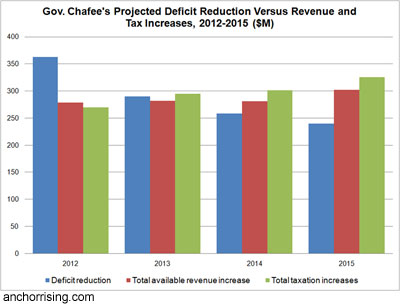
In the first year for which both forecasts offer data, 77% of Chafee's deficit reduction derives from new revenue, 74% from tax increases alone, 61% from a sales and use tax increase. By the end of the four year span, tax increases will represent 136% of the deficit reduction. In other words, our deficit hawk is finding taxpayer money to be such attractive prey that he's using it to grow expenditures, even as he allows deficits to grow year after year.
Indeed, over the latter four years of his forecast, Carcieri expected deficits to grow by 48%, while during the latter four hears of his own forecast, Chafee's deficit will grow by 227%. And that's assuming he gets all of the concessions that he's looking for from labor and the General Assembly and that his tax increases perform as well as expected. In summary, Chafee moved the economic recovery up a year and increased taxes, and still his deficits catch up to Carcieri's at a rate of approximately $40 million per year.
Naming the Broader Tax Base
Matt and I talked budget and a "broader tax base" for Governor Chafee's sales tax on Matt Allen Show, last night. Stream by clicking here, or download it.
March 7, 2011
The Line of Awareness Crossed Too Late?
If the Sunday Providence Journal is any measure, commentators as a class have moved toward greater concern about the effect of Rhode Island's stacked public-sector deck. From Froma Harrop to Julia Steiny to Mark Patinkin. Here's an interesting bit from Patinkin's offering, which imagines the Starship Enterprise reaction:
"But things seem more peaceful and stable than Planet Wisconsin, which I heard was in upheaval over budget issues.""Au contraire, Captain. The unfunded pension liability in Wisconsin is $252 million. Here in Planet Rhode Island, the state treasurer herself puts it at $5 billion or more. That's 'billion' with a 'B,' Captain." "Impossible, Spock."
The main difference is that peculiarities of Rhode Island politics filled all of the important policy-making seats in the government with people who have proven themselves inclined to ignore problems for as long as possible in order to maintain the status quo. We're already in worse condition than states that are taking steps to solve their budget problems, and we're digging in for a while longer.
March 3, 2011
The Shape of the Governor's Solutions
Governor Chafee isn't giving many clues as to the decisions that he's making as he builds his budget proposal, but some statements that he has been willing to make are telling with regard to his approach, to say the least:
Chafee did describe some specific priorities. He supports proposed federal legislation that would help the states to recoup taxes on sales over the Internet, he said.As he has since he was mayor of Warwick, Chafee called for the federal government to reimburse state and local jurisdictions for the cost of such mandatory programs as special education.
The governor acknowledged that he’s had "limited success" since the 1990s in seeking federal financing of the federally required school programs. But Chafee said he will keep asking for the money. "I'm going to be like a terrier with a bone," he said.
How apt the dog analogy is. Apart from begging for table scraps from the federal government, raising taxes is a bit like sneaking up and snatching sandwiches from unsuspecting children's hands, a maneuver that many a domestic canine has mastered.
I'd love to be proven wrong, but one suspects that there will be no difficult decisions made by this governor. He'll govern under the same principles of short-sighted budgeting, irresponsible spending, reliance on hand-outs, quick fixes, and illusions that have brought Rhode Island to its current state.
March 1, 2011
Rhode Island in Top 10 for Public/Private Pay Differential
From USA Today, which took a look at compensation (salary+benefits) differences between the private and public sector in each state (using U.S. Bureau of Economic Analysis numbers), Rhode Island is in the top ten for total compensation for public employees:
| Rank | State | Compensation | Difference |
|---|---|---|---|
| 1 | District of Columbia | $82,607 | $457 |
| 2 | Connecticut | $77,697 | $7,687 |
| 3 | New Jersey | $72,007 | $6,681 |
| 4 | California | $71,385 | $7,977 |
| 5 | New York | $71,282 | $1,699 |
| 6 | Rhode Island | $69,284 | $17,603 |
| 7 | Nevada | $68,785 | $17,815 |
| 8 | Maryland | $65,947 | $6,931 |
| 9 | Massachusetts | $62,562 | ($4,688) |
| 10 | Alaska | $60,882 | $2,764 |
Where RI really "shines" is the gap in the average compensation between public and private employees:
| Rank | State | Compensation | Difference |
|---|---|---|---|
| 1 | Nevada | $68,785 | $17,815 |
| 2 | Rhode Island | $69,284 | $17,603 |
| 3 | Hawaii | $59,595 | $12,243 |
| 4 | Florida | $58,749 | $9,099 |
| 5 | California | $71,385 | $7,977 |
| 6 | Connecticut | $77,697 | $7,687 |
| 7 | South Carolina | $52,591 | $7,590 |
| 8 | Montana | $47,596 | $7,396 |
| 9 | Maryland | $65,947 | $6,931 |
| 10 | New Jersey | $72,007 | $6,681 |
That's a pretty substantial gap and, it would seem, indicative of an imbalance, wouldn't you say?
ADDENDUM: For the heck of it, here's the New England breakdown:
| State | Compensation | Difference |
|---|---|---|
| Rhode Island | $69,284 | $17,603 |
| Connecticut | $77,697 | $7,687 |
| Maine | $49,850 | $4,912 |
| Vermont | $51,503 | $5,811 |
| New Hampshire | $52,181 | ($1,876) |
| Massachusetts | $62,562 | ($4,688) |
February 27, 2011
RISC Meeting Spawns a question: What's the Real State of RI Fisheries?
The Rhode Island Statewide Coalition held its annual meeting yesterday. As the ProJo reports, the focus was on the economy and included guest speakers Leonard Lardaro (URI Economics professor) and a former New Zealand parliament member Maurice McTigue.
McTigue...gave examples of how his country made major internal changes to turn the tide on years of debt....[He]...told the audience that one of the ways his country got out of debt was by using its natural resources. He said New Zealand used long-term contracts to get commercial enterprises such as lumber companies — whether locally or from abroad — to become invested in the country’s economy.Using natural resources and reforming education: sounds good to me. I write enough about education, though, and want to focus on the idea of using our natural resources.He also described how it tossed out old bureaucracy and completely overhauled its education system by having individual schools governed by boards of trustees consisting of people elected only by the parents of children who attend the schools.
The arrangement led to accountability and better education, he said.
McTigue said that after making difficult changes, his country went from decades of not having balanced budgets to years of posting surpluses.
“Most of us here have had to live with the exact same income we got four years ago,” he said. “If we can do it, why can’t the government?”
It should be obvious what the Ocean State's greatest natural resource is, right? The Bay. Water (or "Waaatterrrr" a la Patrick Kennedy). The shipping/port issue debate comes to mind immediately, but I want to go beneath those waves and focus on our fisheries. Basically, maximizing our fishing industry responsibly is something that needs to be studied. But I'm no expert at all and confess to being naive as far as the state of the fisheries.
In 2008, shore fisherman started expressing their worry that our striped bass population was in decline. Some thought this was the "canary in the coal mine", but the Atlantic States Marine Fisheries Commission maintained that all was well with stripers. Fishermen didn't agree with each other, either (though I'm pretty sure that's not surprising!). Shore fisherman continue to believe that stocks are declining, citing a scarcity of "schoolies". However, apparently teen stripers and some of the big boys are still plentiful. There are also concerns that commercial fishermen down the coast (Maryland, for example) are wreaking havoc on our stocks.
Now there are also concerns about the Southern New England lobster industry and plans are in the works to reduce the allowable catch by between 50-75%. That would be a death blow to many, many lobstermen, who point out that they are older and basically the fleet is going to "age out" eventually anyway, so drastic cuts aren't needed.. Apparently the drop in catchable lobsters is attributed to "warming water temperatures, shell disease and an increase in predators such as striped bass and dogfish." An increase in striped bass. See my confusion? One fishery is shrinking because of an increase in the population of another species that is also shrinking. Or is it?!
By the way, I never knew that squid fishing was the most valuable fishery around here. Calamari anyone?
February 19, 2011
When the Numbers No Longer Add Up
The timing of Wisconsin's contribution to the era of global protest coincides profoundly with a new report on pensions from the Rhode Island Senate:
The new report also factors in the cost of other post-employment benefits, which cities and towns, as well as the state, have only recently begun to show on their accounting statements. With those costs added to the pension costs, whether state-managed or locally managed, the annual payments needed to keep pace with current and future retirement benefits begins to eat up a significant portion of some local tax levies.
What sorts of numbers are we talking about?
While the unfunded liability for locally managed pension plans totals about $2 billion, the unfunded liability for other post-employment benefits totals another $2.4 billion, according to the report. This does not include the millions of dollars in retirement obligations that cities and towns share with the state for teacher pensions.
From the sampling of numbers reported in the Providence Journal, there appears to be significant variation from municipality to municipality, but the average city or town would have to devote about one-quarter of its annual budget to support employees who are no longer working. Pawtucket, Central Falls, and Johnston would need 59%, 57%, and 47%, respectively. And, again, that's excluding payments that the state subsidizes.
Keep in mind, too, that government continues to operate and to grow. This is an after-the-fact payment to those who've already retired.
The Wrong Starting Point for Economic Development
The advice is wise, I'd say, for states to focus on economic development activities that benefit a broad range of businesses, rather than one or two big catches, but the experts in the field begin from the wrong perspective:
Creating sustainable new jobs is complicated, and states will need help from the federal government, says Robert D. Atkinson, president of the Information Technology and Innovation Foundation in Washington, D.C., who in 1996 was the first head of what was then the Rhode Island Economic Policy Council."First, the idea that states can fight and win the competitiveness battle on their own is simply wrong," Atkinson says. "Unless Washington gets in the game, it will be very hard for states to grow their economies."
Indeed, the economy is so complicated that it is folly to place its operation in the hands of politicians and bureaucrats. The more responsibility and risk can be distributed to individuals whose livelihoods depend on their being able to work and expand, the better.
The false starting point is the notion that government operatives "create sustainable new jobs" at all. At best, they help or hinder private citizens in their efforts, and by meddling they are more likely to hinder them. The article centers around a solar panel plant that recently left Massachusetts for China, thus illustrating the point: extra incentives and breaks offered to Evergreen Solar had to be forcefully withdrawn from the economy, somewhere, and now, in effect, they're going to China. Moreover, the hip ambiance that's been painted on green technology surely jaded Massachusetts officials' judgment, with the end result that opportunities, considered as broadly as possible, were constrained.
In other words, the policies that drained money and effort for the benefit of a company playing in an industry that every state and nation is eying as the wave of the future should have been refocused to lighten the burdens of taxes, regulations, and mandates.
The closing moral of the linked article is that public negotiators should "write a good clawback," so that they can force companies to repay taxpayer contributions, should they depart, but that misses the larger lesson — namely, that policymakers should stop pretending to be economic masterminds.
February 18, 2011
Avedisian's Pension Plan and Continuing Problems
I noted that Warwick Mayor Avedisian was offering up a pragmatic, if typical, pension reform plan in that it dealt with reforms for future pensions. Avedisian took to the pages of the Providence Journal to explain his plan, but, as Ted Nesi notes, Avedisian tries to get away with shoving the past pension problems aside.
In the 1950s, 1960s, and for most of the 1970s, the City of Warwick did not properly fund its pension plans and make the necessary annual contributions needed to keep them solvent. Some years the city would make proper contributions and in others there would be no contribution beyond the actual benefits paid out. To be exact, if pension payments totaled $500,000, the city leaders funded that amount to pay pensions....in Warwick, the biggest unresolved issue are the[se] original police and fire pension plans. Today, they are funded at only 27 percent of what is needed. So, while people can suggest that the city has failed to do what is right, they instead should be asking the original creators of the pension systems why there was no leadership when the plans were created. Had even a small amount been contributed annually in those years, the unfunded liability today would be very small.Not so fast, says Nesi (check out his chart for reference):
The question, then, is what Warwick is going to do about the $200 million gap between its pre-1971 plan’s assets and liabilities. It’s plans like those which the Rhode Island League of Cities and Towns’ Dan Beardsley suggested to me the other day could be the source of litigation as cities unable to fund them move to take away benefits promised in the past....I suppose we could call up Raymond Stone or Horace Hobbs to ask why they failed to make pension contributions in the ’50s and ’60s. (Actually, we can’t; Hobbs died in 1999, Stone in 2004.) But that’s not going to yield a solution to Warwick’s $200 million pension gap.As I previously suggested, I don't expect cities to go to court over this, but maybe I'm wrong. One thing that will help is for the public to support pension reform by showing up to city and town council meetings when those items are on the table.Avedisian and his fellow mayors may have inherited this problem – but it’s still theirs now.
Pension Reform in Johnston
Out of necessity (ya think?) they're reforming pensions in Johnston. Stephen Beale reports on why:
One of the biggest problems is with disability pensions. Out of 71 retired firefighters, 34 of them are on a disability pension, earning two thirds of their salary tax free. During the tenure of former Fire Chief Victor Cipriano, 15 firefighters retired—and all 15 went out on disability pensions. Even Cipriano himself went out on a disability pension, earning more in retirement last year than he did while working.The fix:To put the numbers in perspective, just 8 percent of the firefighter pensions in New York City are disabilities. In Johnston, the disability rate is above 40 percent. “Those are unusual numbers,” Rodio said.
Rodio has estimated that 25 firefighter disability pensions are in violation of not one, but two state laws—one that says a retiree cannot earn more than he did while employed by a city or town and another that says those tax-free disability pensions needed to be approved by the state retirement board.
A police officer or firefighter who retires on a disability but gets another job will be considered partially disabled and can receive only half of their salary, rather than two thirds.The three doctor review panel has been mentioned around here before and basing pension on base salary seems like a common sense thing. As does recalculating disability pension if the pensioner gets another job. However, as usual, this is all "going forward." It's not really clear if existing pensions will be reviewed and modified. Finally, its worth noting that, according to Beale's story, the public came out to lend their support to the proposal while police and fire were silent.The ordinance also goes out of its way to define salary as base pay—excluding overtime pay, holiday pay, and other benefits from being used to calculate a disability pension.
In the future, a police officer or firefighter applies for a disability will have their case reviewed by three doctors—two of whom must confirm that the person is actually disabled. Once the disability pension is approved, a retiree has to undergo an annual physical and submit a sworn statement documenting how much they have earned for the year.
February 17, 2011
WRNI - Raimondo Says Pensions Can be Cut
State Treasurer Gina Raimondo says she doesn’t believe current pension recipients are legally shielded from possible cuts to their pensions. She outlined her view during a taping today of WRNI’s Political Roundtable, which airs tomorrow at 5:40/7:40 am. Scott MacKay asked Raimondo, as a lawyer and financial expert, whether pensioners currently receiving an annual pension of $80,000 or $90,000 have a property right to their pensions. “If push comes to shove, what happens?” MacKay continued. ”Do we go the United Airlines situation, where they take a haircut?” Here’s how Raimondo responded to the question of whether pension recipients have a property right: “I don’t believe so. That hasn’t been established in law, and I don’t believe they do.”This isn't (or shouldn't) be about "hating state workers" or whatever, it's about fiscal reality....Raimondo blames a piecemeal approach. “The reason we’re in this mess” she says, “is because every year we chink away at the problem — let’s tweak the COLA a little bit, let’s tweak this, let’s tweak that. We got to do the whole system. This is not about taking benefits away. This is about securing retirement security for everyone . . . . It is a fallacy to think that those benefits will be there if we don’t fix this system. And the system that we have today calls for a billion dollars to come out of the budget in about 10 years to pay these benefits. I cannot look in the eye of a state worker and promise that that will be there.”
February 15, 2011
Desires as Economic Development
Reacting to Governor Chafee's mention of it, Ed Fitzpatrick has read Richard Florida's book proclaiming the importance of tolerance to the economy and expresses, it seems to me, an appropriate skepticism regarding causation and correlation:
"My research finds a strong correlation between, on the one hand, places open to immigrants, artists, gays, bohemians and socioeconomic and racial integration, and on the other, places that experience high-quality economic growth," Florida wrote. "Such places gain an economic advantage in both harnessing the creative capabilities of a broader range of their own people and in capturing a disproportionate share of the flow."I believe it was Snooki who first said: Correlation is not causation. In other words, just because there is a "strong correlation" between tolerance and economic growth doesn't mean tolerance causes economic growth. Perhaps that is a point both Chafee and his critics gloss over.
As I suggested a few weeks ago, it seems to me that urban areas, especially with high concentrations of colleges, are likely to attract creative types regardless of an Nth degree of tolerance for them. Indeed, one might suppose that a region experiencing "high-quality economic growth" might generally attract people who are different from the native population.
In any event, even if "tolerance" deserves its place as one of three economic legs (talent and technology being Florida's other two), that doesn't mean that it is the one on which Rhode Island is deficient. Personally, I'd put aside the "three Ts" as an interesting post facto analysis with only indirect influence on Rhode Island's economic health and focus, instead, on the more specific metric of economic freedom as indicated by taxes, mandates, and regulations.
February 12, 2011
Local Food: Where's the Fish?
Rhode Island's "buy local" food movement has had some success:
The resurgence of farms and farmers' markets has brought local, fresh produce to thousands more Rhode Islanders in the past few years....“The miraculous comeback of Rhode Island farming,” said Division of Agriculture Director Ken Ayars, "is due in large part to efforts like the statewide Buy Local campaign, establishment of harvest cooperatives like Rhody Fresh milk, organic and good agricultural practices certification schemes and the annual Rhode Island Agriculture Day.”Now the Buy Local folks are eyeing Rhody seafood.
Noah Fulmer, director of Farm Fresh Rhode Island, an organization that runs eight farmers’ markets in the state, highlighted the need for more direct-marketing venues for seafood.It's economics:
“What’s missing at farmers’ markets,” Fulmer said, “is seafood from the Ocean State. People are asking ‘Where’s the finfish? Where can I get fresh seafood?’ We don’t have an answer for them right now. It’s an opportunity that’s waiting to be taken.”
Currently, most of the seafood landed in Rhode Island is sold to distribution companies who ship it around the world. Department of Health regulations make it difficult — and expensive — for fishermen to sell their catch directly to the public.
[E]stablished seafood companies caution that local marketing of Rhode Island seafood challenges the basic laws of economics. Export Rhode Island-caught seafood, they say, is more profitable than selling it locally.Hence, plenty of cheap talapia and not so much cod or haddock. Unless you want to pay for it. Nonetheless, plans are in the works.
Christopher Joy of SeaFreeze, a fishing and distribution company in North Kingstown, explained, “If it’s too expensive, it’s because others are willing to pay more for it.”
Similarly, Eric Reid of Deep Sea Fish, a Narragansett-based seafood distribution company, said it is more profitable to ship Rhode-Island-caught seafood out of state while bringing in cheap fish from abroad. Rhode Island customers, he said, prefer low prices. “Simply put,” he said, “it’s a math problem.”
In the coming months, fishermen and their allies may try to alter this equation by building demand for local seafood in Rhode Island. Locally landed fluke, sea bass, scup and stripers may soon be available at a farmers’ market near you.My eyes will be peeled!
Nesi: Washington Cuts Will Squeeze Rhode Island
WRNI's Ted Nesi explains how RI has become over-reliant on the Federal Government for budget dollars:
[T]he share of Rhode Island’s state budget paid for by the federal government has jumped from 28% to 37% since the recession began; over the same period, the share paid for by state tax revenue (the ol’ General Fund) fell from 49% to 37%.Follow the link to see Nesi's illustrative chart.Put another way, state funds are covering $2.94 billion of Rhode Island’s budget this year while federal funds are covering $2.90 billion. In a $7.9 billion budget, that’s basically a rounding error – Rhode Island is leaning heavily on Washington to balance its books.
February 9, 2011
Rudderless Rhode Island: National Perception is Reality
Steve Malanga at RealClearMarkets gives us the national perspective of what's going on in Rhode Island (h/t Jim Hackett via Facebook):
Tucked in between Massachusetts and Connecticut and overshadowed in Northeastern political discussions by states like New Jersey and New York, Rhode Island is barely noticed these days.Ouch. Then, the laundry list:Still, the Ocean State bears watching. Its fiscal problems are, relative to its size, among the worst in the country. And the reform agenda (if you can even call it that) of its new governor, Lincoln Chafee, elected with union support and with only a plurality of the vote, is among the tamest in the nation. In Rhode Island we may get to see how the union version of fixing a state's problems via tax increases and the barest of reforms of government spending and employee entitlements works.
Though smaller than its neighbors, Rhode Island very much bears the stamp of Northeastern politics and governing. It has the third highest level of public employee unionization in the country, 64 percent, behind New York and Connecticut. Its government is among the top 10 in the nation in per capita spending and in the tax burden it imposes on residents, plus the state has one of the least attractive business environments....Yay, us. Malanga also details the non-solutions being offered up by our Governor (and notes that Chafee only won with 36% of the vote). Just not good.Rhode Island's long-term obligations compare unfavorably with just about any other state, and that's saying a lot....
the Daily Beast recently ranked Rhode Island the state most likely to go bust...
Moody's...ranked Rhode Island among the most troubled states on a variety of metrics...
A recent audit revealed that Rhode Island's biggest city, Providence, has been spending more than it budgets throughout the recession and depleting its reserve funds in the process, to the point where the city is almost out of cash....
[A]nother city, Central Falls, is insolvent thanks to $32 million in promised post-retirement health-insurance costs for its employees plus $48 million in pension obligations that the city can't meet on its own....
The burden this spending places on the private sector is significant. Rhode Island is not a state where businesses are investing in the future. An analysis of private sector investment several years ago by the Rhode Island Public Expenditure Council found investment per employee was among the lowest of any state, 30 percent below the national average. And while the state ranks only 20th in average private sector wage per worker, it ranks 4th in public sector pay.
February 1, 2011
What Should Be and What Will
John Kostrzewa makes a number of excellent points in a recent column:
[Two economists'] forecast is important because there is an argument making the rounds in City Halls and at the State House that the recovery of the economy will eventually pull city and state finances back from the brink of disaster. The thinking is that an improving economy will bring in more tax collections to pay for the services and employee benefits that elected officials have approved over the last few decades.It's not going to happen.
The financial hole dug by city and state leaders is so deep and the improvement in the Rhode Island economy is so shallow that the crisis can’t be solved by waiting it out.
Rhode Island's economic difficulty has been building for decades, at least. Perhaps because world events and prosperity led voters to take their eyes off the budgetary ball, or perhaps because compounding policies finally reached the cliff, over the years since the turn of the millennium, the government excess has become impossible to ignore. Indeed, Rhode Island's annual deficit problem began in the midst of the housing bubble; its taxpayer flight began earlier; and there's no reason to believe that either trend will reverse just because the rest of the American economy brings a rising tide.
The other day, Ted Nesi noted that, at its current rate of job growth, Rhode Island won't return to its employment peak until the year 2045. As I've been warning, the recovery of employment and economic opportunity elsewhere could accelerate RI's relative deterioration.
Kostrzewa does make one point, though, about which I'm skeptical:
That makes 2011 the bellwether year when public officials, pushed by taxpayers, have to prioritize which services they want to provide and how to restructure government, whether through consolidation or regionalization, to pay for them.
The note in the margin of my newspaper reads: "Wanna bet?" Kostrzewa has described what has to happen, but nobody should expect that it will. We have the wrong government policies in place (taxes, mandates, regulations). For the most part, we have the wrong people in public office (the new governor worst among them). And increasingly, we have the wrong electorate (heavily constituted of people dependent on government, in one way or another, and insulated by government policies). What we're more likely to get are policies that, like last year's tax "reform," have the sound of positive change but do not resolve structural problems and potentially make them worse.
Yes, we all have to ring this bell as frequently and loudly as possible, but we should brace ourselves for even rougher roads ahead.
January 30, 2011
Two Post Facto Responses on Felner's Behalf
This episode of Newsmakers makes me wish I'd been there... or had had a means of communicating suggestions to Bill Felkner of the Ocean State Policy Research Institute:
Newsmakers 1/28: Stokes, Felkner, Sgouros: wpri.com
For one thing, in attempting to present the other side, Tom Sgouros (whom Tim White bills as a "progressive economist") holds on to the precise representations of the data as if holding on to the tail of a magic newt. Unfortunately, Sgouros, himself, is not precise:
What the IRS reports is how many people moved and what they earned in the places where they lived after they've moved.
Actually, the adjusted gross income data measures that money claimed on the tax returns of people filing outside of Rhode Island who, the previous year, had filed their federal returns from within Rhode Island (or vice versa for those who moved here). In other words, pretty much by definition, some of that income was earned in Rhode Island; for taxpayers who moved after the tax year for which they're filing (between New Year's day and tax day), all of the money claimed was earned in Rhode Island, or at least while Rhode Island residents.
Alone, that doesn't answer Sgouros's objection that migrants aren't necessarily taking their jobs with them. It does, however, emphasize the lack of parity between those coming to Rhode Island and those leaving. Put directly, it shouldn't be a comfort that people who want to make more money have to leave the state, even if they leave their lower-paying jobs behind.
Another point, which panelist Arline Violet considers to be a "fatal flaw" in OSPRI's report, derives from the Poverty Institute's response to it: namely, that, whatever the relative incomes, if those leaving are replaced by people arriving, then their property taxes are covered, because somebody buys their houses. But the fact is that, on a net basis, Rhode Island isn't importing taxpayers at the same rate as it's exporting them. More importantly for this discussion, though, is that property taxes aren't the only revenue that Rhode Island governments extract from Rhode Island residents.
According to the Rhode Island Public Expenditures Council, about 22% of tax revenues to state and local governments, in Rhode Island, come from individual income taxes. Moreover, if the question is the effect of shifting demographics, Violet and the Poverty Institute's point isn't a "fatal flaw," it's irrelevant. People who make more money pay more in income taxes; that they pay the same amount in property taxes (presumably) doesn't change that fact.
Indeed, if they make more money, one can assume that they're more likely to improve upon their properties or build new houses (increasing value and therefore taxes) and to spend more in discretionary income (increasing economic activity and sales taxes).
January 27, 2011
One Anecdote of Many
Sure, we hear counter-arguments all the time, around here, but Michael Miale of Johnston offers an evidential anecdote that certainly captures the impression of many:
[After listing close friends and family,] I then refined the list further into two categories: those who have left the state within the previous 12 months, which is 8, and those who are going to leave in the next 12 months, which is 3, totaling 11 family units leaving the state. That means 52 percent of my immediate family and close friends have left or are in the process of leaving the state of Rhode Island.Those numbers cannot be refuted by anyone. They tell me all I need to know about the state of the state of Rhode Island.
What would be fascinating, although likely impossible, would be a broad sampling of these and opposing anecdotes in order to discern characteristic commonalities and differences between the "yes-flight" and "no-flight" observations. I'm sure Anchor Rising readers have their own speculations.
January 21, 2011
Some Hot Air in the Green Economy
Speaking of the suspicious structure of the "new economy"... the economics of wind have come under some scrutiny, lately. Specifically, the project being questioned is Portsmouth's windmill:
Because the setup was considered net metering under state law, National Grid never negotiated a power purchase agreement with Portsmouth. An agreement would have been reviewed by the PUC, which could have rejected the selling price.Instead, state law required National Grid to buy the power at a prescribed rate that is higher than what the utility pays for power from other sources, such as natural gas-fired power plants.
Portsmouth sells its power to National Grid at the exact price the utility charges the town and other customers in the same rate class. It’s a retail rate, not a wholesale rate. The bundled price includes the actual cost of energy, along with other charges for distribution, transmission and transition. ...
That left the town a net income for the period of $257,075 — money it could use to pay its energy bills or any other line item in the municipal budget.
In other words, the state government forced the energy company to pay extra money for Portsmouth's wind energy, which it will pass on to other clients, thus shifting money from the private sector into the Portsmouth government's coffers. One suspects that much of the emphasis on "green technology" — especially that emphasis coming from the public sector — is built around similar schemes.
The Knowledge Economy Does Not Offset a Bad Economy
It seems as if, whenever I cite economic trends in Rhode Island, as I've been doing all this week, commenter Russ chimes in regarding studies of the "new economy" or "knowledge economy" by the Kauffman Foundation, as he did here:
According to the 2010 Kauffman State New Economy Index Rhode Island ranked 8th nationally in the "Migration of U.S. Knowledge Workers." RI ranks well in that category year after year, despite how much some here seem to wish it were not so.
First of all, importing "knowledge workers" is hardly a trump card if the overall migration trends are still outward (which they are) and the folks leaving still have higher incomes than the folks coming (which they do). Second of all, as I've pointed out before "knowledge economy," in this context is in some regards a stand-in for "taxpayer subsidized," with revenue coming from the government and tax-exempt organizations and going to government and tax-exempt organizations.
Look to the Kauffman study that Russ mentions (PDF. Rhode Island may rank well in "migration of U.S. knowledge workers," but it's #31 in "immigration of knowledge workers." It's 47 in "manufacturing value-added," 30 in "high-wage trade services," 48 in "export focus of manufacturing and services," 48 in "fastest-growing firms." We rank 16th overall.
That "fastest-growing firms" number is important. Rhode Island ranks 33rd in "industry investment in R&D," but it ranks 5th in "non-industry investment in R&D." That is, investment in Rhode Island means "federal, state, university, and nonprofit investments in R&D." We're not, in other words, living in a hub of economic activity in the "new economy;" we're a small state with data skewed by a military base, a bunch of colleges, and a burdensome government structure. Governments must draw the revenue that they invest from somewhere else (the private economy), and they spend it less efficiently.
Looking at overall "new economy" ranks, Rhode Island's 16th place is above the midpoint, to be sure, but Massachusetts is #1 and Connecticut is #5. In other words, Rhode Island represents a relatively dark spot in a nation-leading area, and we rank as highly as we do mainly on the strength of government taxing and spending. As the report states, "non-industry investment in R&D" represents only a third of "industry investment in R&D." The better strategy, therefore, would be to shift the local emphasis from an economy that takes money from some, under threat of imprisonment, to an economy in which people exchange dollars because they see opportunity in doing so.
January 20, 2011
Who's Leaving and What the Legislators Are Doing
Last night, on the Matt Allen Show, I mentioned my work on population trends and Andrew's work on legislation. Stream by clicking here, or download it.
Once again, I didn't go into the sales pitch, but please email or call (401-835-7156) me to pledge financial support — as subscriptions, donations, or advertising — for 2011 to help us create a full-time job within Anchor Rising.
So What's the Answer?
On Monday, I presented the growth trends among different income groups in Rhode Island. Tuesday, I dipped into the state income taxes that they've paid and the numbers of taxpayers leaving the state. And yesterday, I looked at the trends of each income group to get a sense of where the shifts are occurring.
So who is actually leaving the state?
I hastily wrapped up yesterday by noting that Census data shows there to have been an increase of 25,274 households claiming income of $100,000-$199,999. According to the IRS, 16,426 of them are directly attributable to an increase in joint tax returns. That leaves 8,848 households, which would equal 17,696, if they were all two-income households filing separately. (I'm not saying that they are, just illustrating the maximum of what I believe to be the trend.) As it happens, the increase in non-joint tax returns with $50,000-74,999 in income over the same period was 17,912; very close. It's interesting to note, as well, that the increase of joint returns among those making more than $75,000 could (as a hypothetical maximum) account for 72% of the losses in joint returns with income below that number.
The picture that begins to emerge is of older, more-established, working-to-middle-class households selling their homes at large enough profits to rocket them up the income scale for a year, with younger households — still single or still filing separate returns — partially filling the gap. Consider that the Census's American Community Survey shows 12,472 fewer Rhode Island households overall in 2008 than 2003, but the IRS shows an increase in tax returns of 12,646, with the growth entirely among categories over $75,000. Yet, IRS migration data that tracks actual taxpayers by their social security numbers shows large losses of taxable income as thousands of taxpayers move away each year, 17,221 of them from 2003 to 2008, bringing with them higher incomes, on average, than those who move in.
The increase in returns, that is, derives from people who were already here, and those leaving had greater wealth. Some of the former are likely to have been young adults graduating from high school and college, but living with their parents and (perhaps) not counting their income as part of the "household" total.
In the trend that I'm suggesting, many of those who've sold their houses have simply left rather than returning to their previous income brackets. Meanwhile, those who've arrived had to over-leverage debt to afford the houses in which they'd invested, leaving many of them underwater and foreclosing when the market took a dramatic downswing.
This narrative ties in very well with a study that the Ocean State Policy Research Institute is releasing today that looks at the data from a slightly different angle. OSPRI focused more on the policies and qualities of the states with which Rhode Island has exchanged residents. Not surprisingly, "people move to states where the weather is warmer, taxes are lower, union membership is lower, population density is lower, and the cost of housing is lower." Moreover, "the most significant driver of out-migration is the estate tax."
I've long argued that the people leaving the state are families in the beginning of their careers who need greater opportunities for advancement, families in the middles of their careers who have turned their attention to the need to advance more quickly as they head toward retirement, and retiring families who need to make their dollars go farther. Meanwhile, improvements in the tax climate for wealthier residents and those investing in the state helped Rhode Island to maintain and grow its base of wealthy individuals while making property a worthwhile investment for families able to handle some years of the opportunity cost that Rhode Island imposes on its working residents.
To some extent, the shift could be a healthy one, assuming that younger families (1) work more cheaply and (2) are willing to put more productivity into the economy in order to advance. However, Rhode Island can't continue to stifle them with mandates, regulations, and taxes, and the state government can't afford to continue losing taxable income based on migration patterns.
Unfortunately, the state has recently been moving in precisely the wrong direction, and Governor Lincoln Chafee and House Speaker Gordon Fox and Senate President Teresa Paiva-Weed's General Assembly promise to continue that error. Arguably, beginning to phase out the capital gains tax early in the decade greased the path for the housing bubble to be worse in Rhode Island than elsewhere by decreasing disincentive to sell and increasing incentive to buy. But the state killed that policy soon after the accelerating market began to come apart — slamming on the brakes when it really needed to ease toward a more reasonable speed. Eliminating taxes on property sales would certainly have helped in that regard.
Last year, the General Assembly killed the phasing-out high-income flat tax by effectively freezing it within a larger tax reform. Worse, by increasing the standard exemption at the expense of those who benefit from itemization (because they've bought property, had children, and invested in their careers and businesses), that tax reform shifted the burden precisely toward Rhode Islanders who are striving to build families and advance in their careers. In addition, as OSPRI's report explains, 2005 changes in federal law led Rhode Island to create an estate tax, and "only two other states have a more punitive" one.
So, older members of "the productive class," as I call upwardly mobile working and lower middle class families, may now be stuck in Rhode Island, unable to sell houses that they're counting on for nest eggs and facing a large tax penalty for selling them. However, the need to find a more hospitable environment in which to advance and retire has not changed, and they're staying put in the jobs they have, blocking the early-career advancement of younger residents. In addition, the policies by which Rhode Island stifles entrepreneurship and innovation are locking the economy in place — the mandates, regulations, and taxes, of which Governor Chafee's proposed sales tax increase (and other policies to expand its reach in one way or another) is a fine example, as is legislation to require registration and insurance among landscapers.
If my interpretation is correct, the data to be released in coming years will not be cause for optimism, to say the least.
Tomorrow, I'll address a study that some folks cite (notably Anchor Rising commenter Russ) as evidence that Rhode Island has a booming "knowledge economy" and show how, even in the positive light, it's possible to see how detrimental the state's governing mindset can be.
January 19, 2011
Up and Out, or Just Out?
Yesterday, I presented two facts:
- Every year, from 2003 to 2008, thousands of people who had filed tax returns from Rhode Island filed them from somewhere else. Subtracting those who moved in the opposite direction, during that five-year span, the state lost 17,221 taxpayers.
- Because those leaving have typically had higher average incomes, the state has lost hundreds of millions of dollars, on a net basis, in taxable incomes — $915,863,000 to be exact, from 2003 to 2008.
Nonetheless, on Monday, I showed that, for most of that time span, wealthier taxpayers increased at a healthy rate. So who is leaving the state? The following charts show trends by income bracket, using IRS and American Community Survey data.

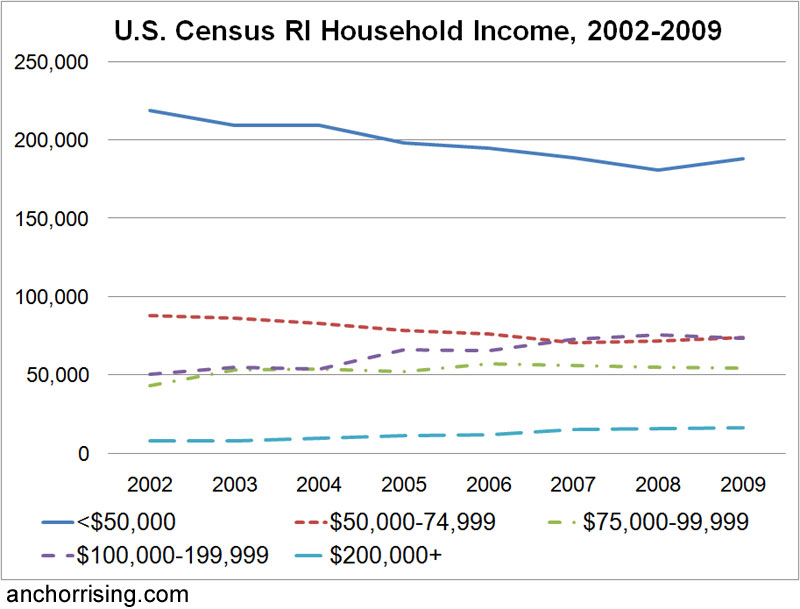
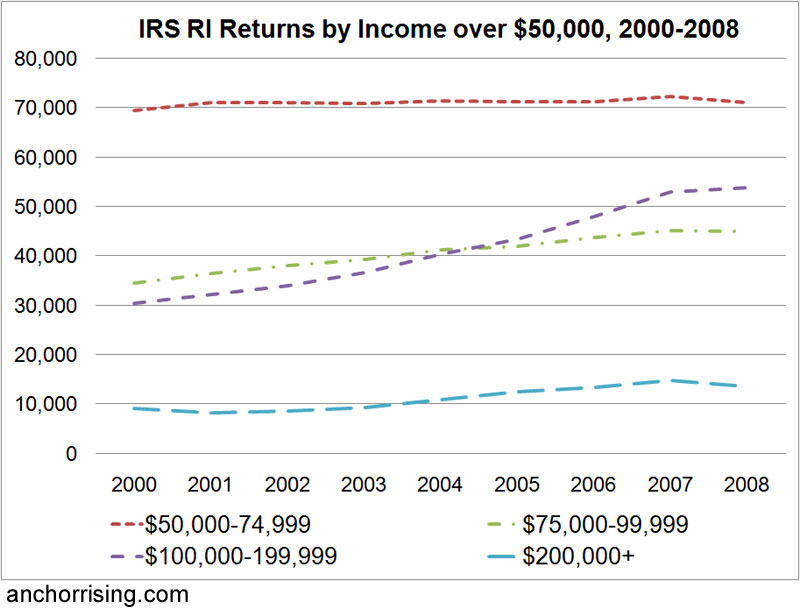

Sticking to the years for which I have data from both sources, the number of households earning below $50,000 decreased by 38,335 from 2002 to 2008, while the number of tax returns decreased by 19,353. For the range of $50,000-74,999, the corresponding numbers were 15,740 and 6. Noting that my migration data is shy a year, with 17,221 tax returns directly attributable to out migration from 2003 to 2008, it 's tempting to suggest a direct flow of this group out of the state.
However, those losses correspond with a 44,910 increase in households earning above $75,000, accounting for all but 9,165. For tax returns, the numbers are a 31,841 increase above $75,000, for an overall increase of 12,482. Considering that those leaving the state have had a higher income than those arriving, it can't be the case that Rhode Island is importing wealthier residents.
And anybody who's been living in Rhode Island will find a dramatic shift toward wealth to be a surprise. Indeed, Phoenix Marketing data of millionaire households shows the increase in millionaires to be relatively small. My suspicion is that, given the housing boom, the shift has more to do with the sale of houses — with people in the upper-working to lower-middle class range selling their homes, often leaving thereafter. The phasing out of the capital gains tax would have created incentive both to sell (because able to keep more of the profit) and to buy (because property in Rhode Island would be taxed at a lower rate, perhaps 0%, when sold).
Call it an "up and out" trend. Each year, until the end of the decade, the number of one-year-only "rich" people amounted to more than those who returned to prior income levels or left the state.
One puzzle in the numbers arises from the difference between Census household data and IRS return data. Why did the number of households between $50,000 and $74,999 (what I'm calling "lower middle class") decrease while the number of tax returns remained pretty much the same? One possibility is that people joined their incomes for the household results but filed separate returns. A look at just joint returns suggests that as a factor:
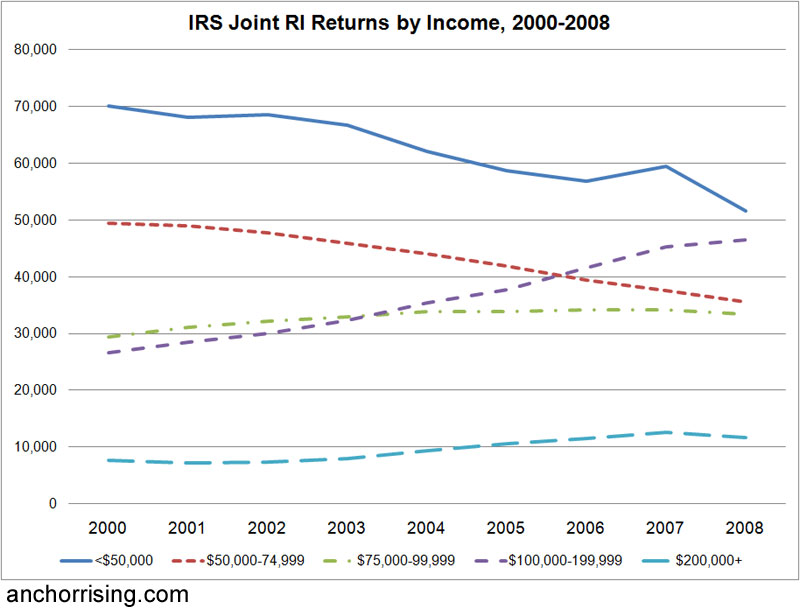
Turning to the Census data, households earning between $100,000 and $199,999, for example, increased by 25,274 (2002-2008), with 16,426 of those directly attributable to an increase in joint returns. That leaves 8,848 households, which would account for 17,696 tax returns if they all paired up.
Unfortunately, I've run out of time, this morning, so I'll have to draw the threads together later.
(The next post in this series is here.)
January 18, 2011
Giving Away the Store, or Maintaining a Base?
Yesterday, I showed that the number of high-income tax returns increased every year in Rhode Island from 2002 to 2007. In fact, the rate of growth among taxpayers in every income category above $50,000 was greater in Rhode Island than in its neighboring states through 2004, when things began to change.
During the decade, Governor Carcieri and the General Assembly enacted various tax reforms, agreeing to phase out the capital gains tax in 2002 and beginning a stepped reduction of an alternative flat tax in 2006. Of course, during this same period, especially the latter part of the decade, the state government faced massive budget deficits year after year and used one budget gimmick and one-time fix after another to muddle through.
The question arises, therefore, whether the tax reforms needlessly gave away money that the state could have used (although it never came close to equaling the deficits) or the tax reforms were a positive influence despite larger problems. I'm not sure that it's possible to collect enough data to declare the question answered, but today, I'll add some charts to the mix that I believe continue to point in the direction of my thesis: that tax policy helped Rhode Island to maintain and increase its base of wealth, which could have been a spark of capital for entrepreneurs and other producers, but heavy regulations, mandates, and taxes stifled growth and motivation among "the productive class," which therefore didn't act as kindling to get Rhode Island's economic fire going.
The following charts, drawn from this data, show the amount of state income taxes claimed on IRS tax returns for those filing in Rhode Island, Massachusetts, and Connecticut, respectively:
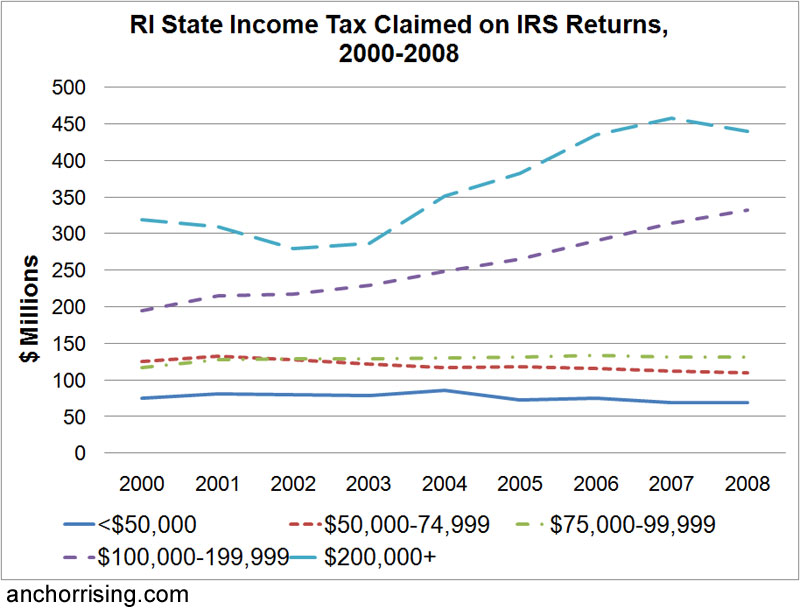
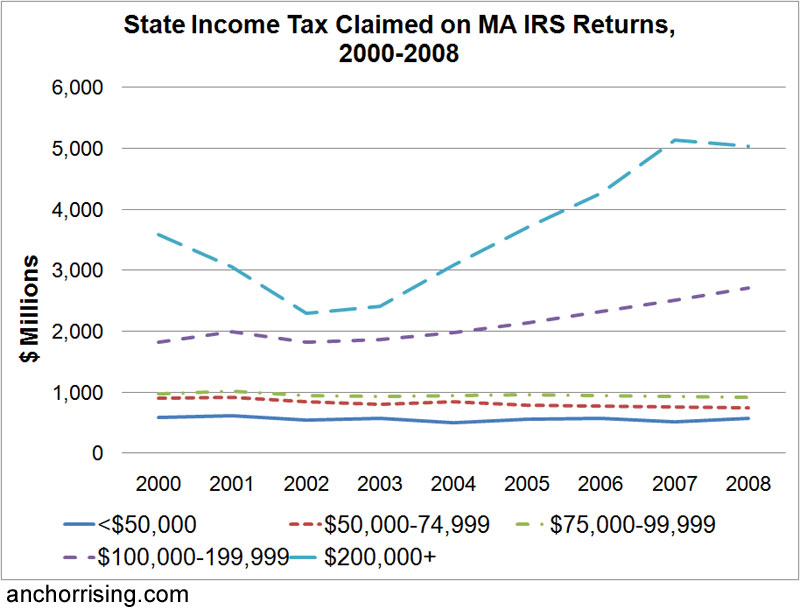
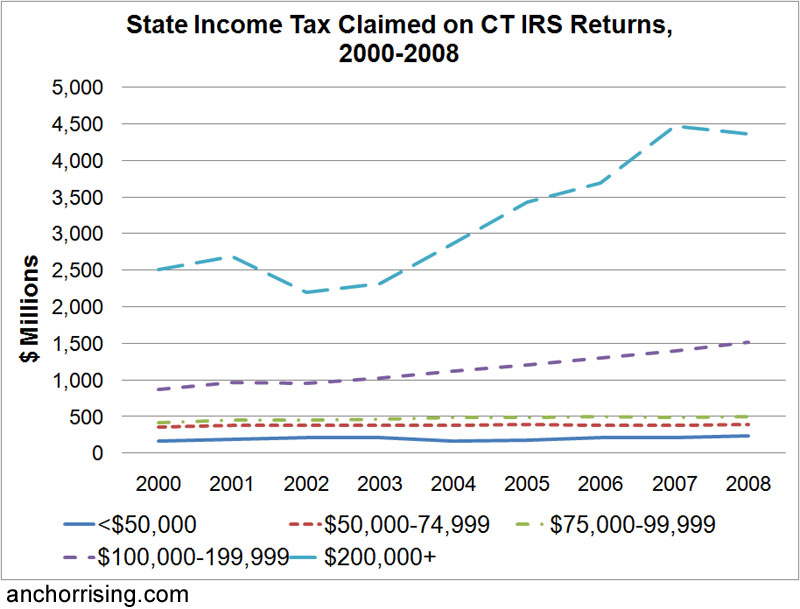
Once again, it appears that the dot-com bust that began the millenium did not affect Rhode Island as deeply as it did Massachusetts. From that footing, with the implementation of the capital gains tax phaseout and a reduction of the state's nation-leading top tax bracket on the horizon, Rhode Island led the three states in the rate at which it increased the revenue drawn from the upper brackets. The numbers throughout the decade are as follows:
| RI | MA | CT | |
|---|---|---|---|
| % increase in $100,000-200,000 taxpayers 2002-2004 | 19.2 | 10.4 | 12.2 |
| % increase in $200,000+ taxpayers 2002-2004 | 27.0 | 19.3 | 17.2 | % increase in $100,000-200,000 state taxes 2002-2004 | 14.0 | 9.1 | 17.9 |
| % increase in $200,000+ state taxes 2002-2004 | 26.0 | 34.5 | 30.9 |
| % increase in $100,000-200,000 taxpayers 2002-2007 | 56.4 | 43.2 | 43.0 |
| % increase in $200,000+ taxpayers 2002-2007 | 73.4 | 73.1 | 60.9 | % increase in $100,000-200,000 state taxes 2002-2007 | 44.1 | 38.2 | 47.0 |
| % increase in $200,000+ state taxes 2002-2007 | 64.2 | 124.4 | 104.0 |
| % increase in $100,000-200,000 taxpayers 2007-2008 | 1.5 | 2.9 | 2.0 |
| % increase in $200,000+ taxpayers 2007-2008 | -8.6 | -5.1 | -4.0 | % increase in $100,000-200,000 state taxes 2007-2008 | 5.8 | 8.0 | 8.6 |
| % increase in $200,000+ state taxes 2007-2008 | -4.0 | -2.1 | -2.4 |
During the early part of the decade, Rhode Island led in the rate of increase of wealthy taxpayers, although that healthy development for the state overall did reduce the rate of growth in revenue that the government drew from them. Tax policy, however, wasn't to blame for Rhode Island's slowed growth during the latter part of the decade. Something else was, and I'd argue that the improving attitude of the government toward taxation prevented Rhode Island from doing worse, comparatively... until that attitude started to change in a vocal way during and after the debate over the flat tax.
The IRS also provides taxpayer migration data, which compares the location from which every American files his or her return to his or her location the year before. The years shown for migration are those in which the returns were filed, which means that the taxpayer moved during or just after the tax year (which is what the years used thus far in these posts have referred to).
Not that it matters; Rhode Island's loss of taxpayers has been consistently between 2,000 and 4,500 for the entire decade:

The bars at the top of the chart show the migration of actual people, and the line at the bottom shows the net loss of taxable adjusted gross income. That is, from 2003 to 2008, after subtracting the incomes of people who came to Rhode Island, former Rhode Islanders took with them almost $1 billion in income. With the exception of the two years that the revenue loss moderated, the average adjusted gross income of those leaving was greater than those arriving:
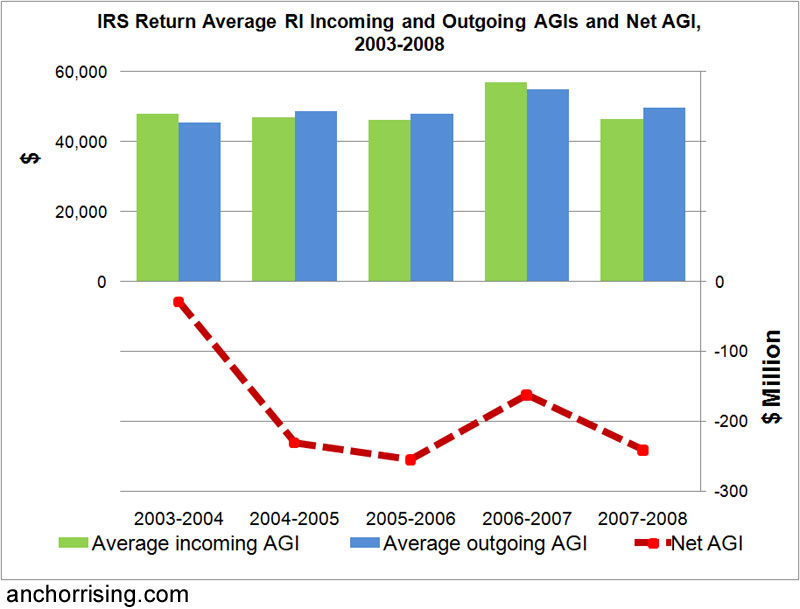
In the past, I've looked at the data of migration to counties abutting Rhode Island on the theory that such people aren't leaving the region but, rather, wanted to stay within work-and-play reach of Rhode Island:
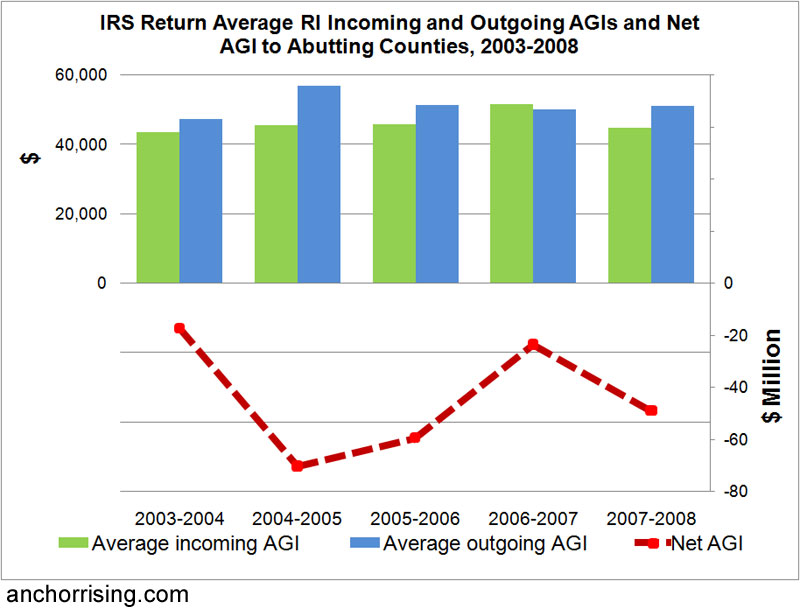
The image that emerges is a pull of wealth away from Rhode Island. The fact that the wealthy were increasing in number, within the state, suggests that they continued to find Rhode Island to offer a friendly environment. Some other income range must account for those thousands of lost taxpayers, and I'll take a closer look in that direction tomorrow.
(The next post in this series is here.)
January 17, 2011
Trends of the Decade
Three critical considerations tend to get lost in debates about population and the ways in which it flows and changes over time. The first is that large trends trump. A tax break isn't going to prevent a global economic hurricane from rearing its head in one state while devastating the next one over; there will surely be differences in how the states weather the storm, but the storm will appear in statistical results for both.
The second is the complexity of the numbers. As the income brackets shift within a state, the reasons for each individual change will span so many categories of information that a thorough picture becomes impossible to paint. Marriage rates, tax policy, welfare policy, different markets, employment, and on and on will affect the results. When multiple states are on the table, the number of policies and trends is that much greater. As far as I know, nobody has undertaken a study to break regional changes down to the percentage effect of every demographic shift, and even then assumptions would have to be made which individuals move to which categories.
The third factor that tends to get lost is that the effects of public policies don't just splash into the society on the day that they are signed into law. The debate leading up to passage of a law will affect people's behavior, as will the perceived likelihood that a particular policy will survive the political winds. Taxpayers (to limit the field) will respond to changes in the law, but they'll also respond to a general sense of a state's direction. Meanwhile, laws can either betoken additional reforms in the same direction, or they can make it to the governor's desk with the impression of having barely little chance of resisting repeal or efforts to undermine them.
In any event, what those with a specific interest in the health of a particular state must do is to assess the condition of the state and determine what effect policies have had, or will have, from the baseline of what would happen in their absence. If the widget industry is in decline, tax breaks for widget manufacturers will preserve their jobs to some extent, even if they cannot prevent the trendline from drifting down.
Such are the thoughts that came to mind upon viewing the following set of charts, which will probably take me multiple days to roll out, and which update previous posts here, here, and here.
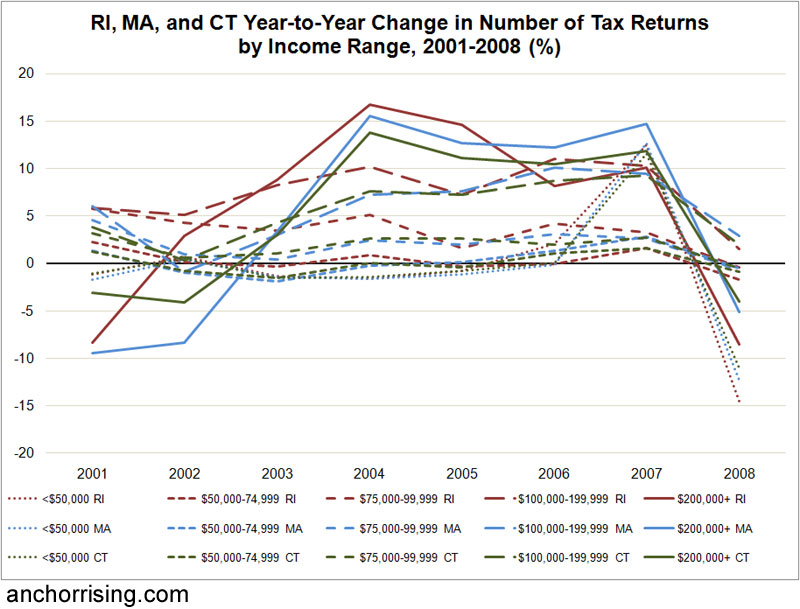
<$50,000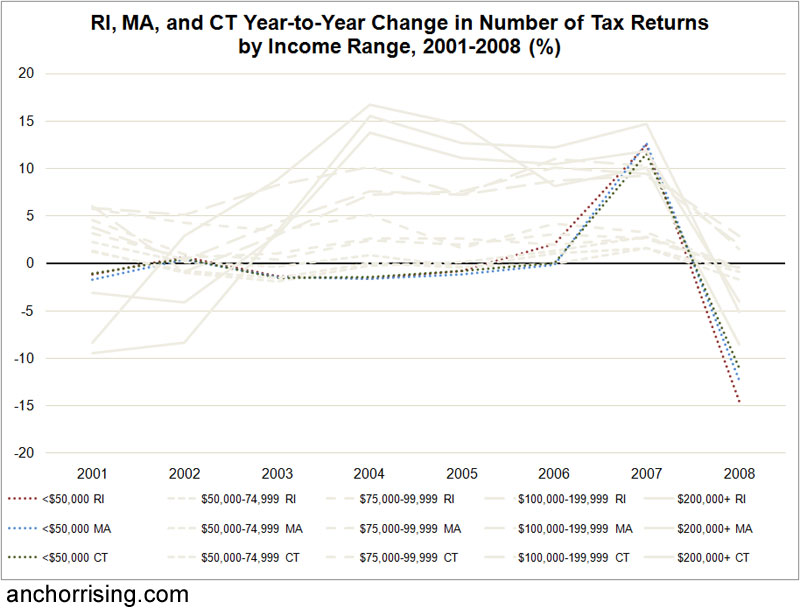 - $50,000-74,000
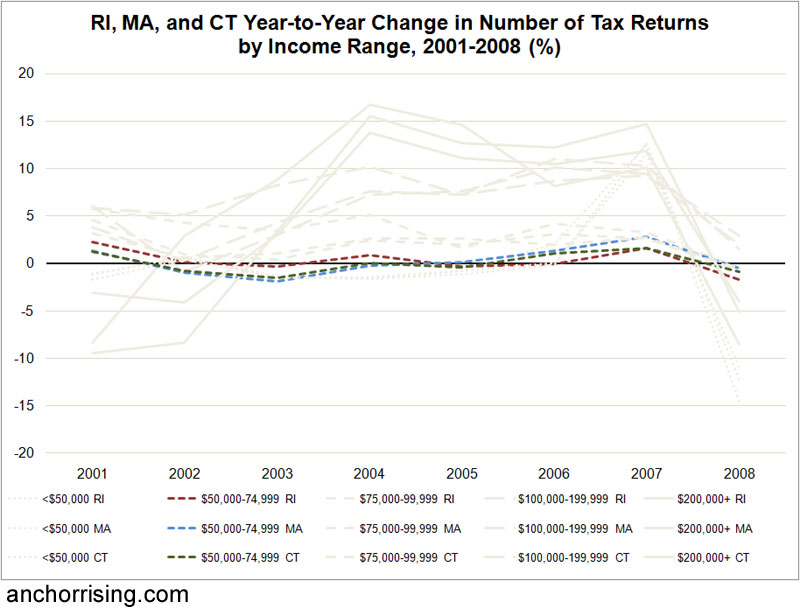 - $75,000-99,999
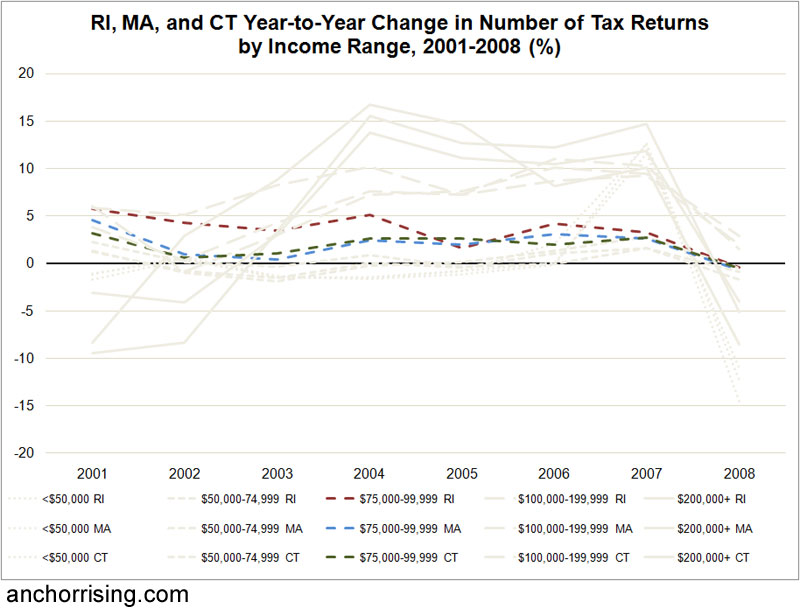 - $100,000-199,999
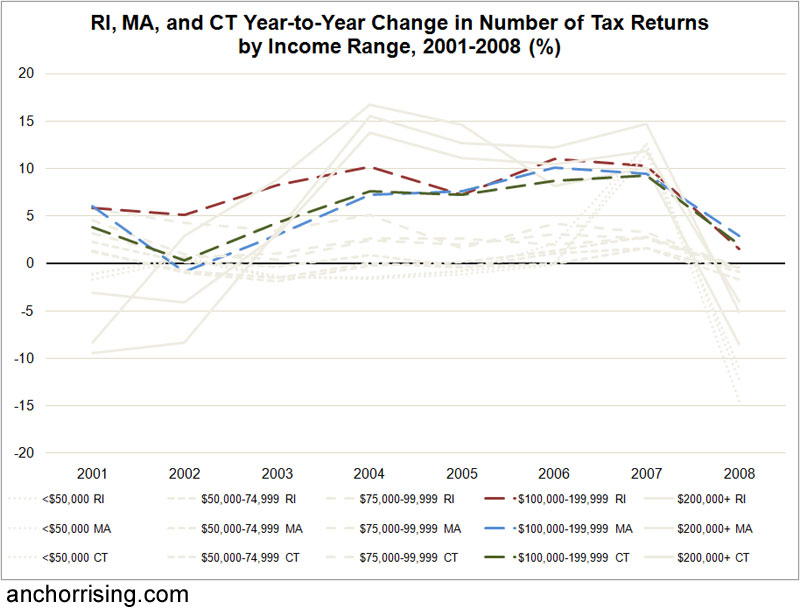 - $200,000+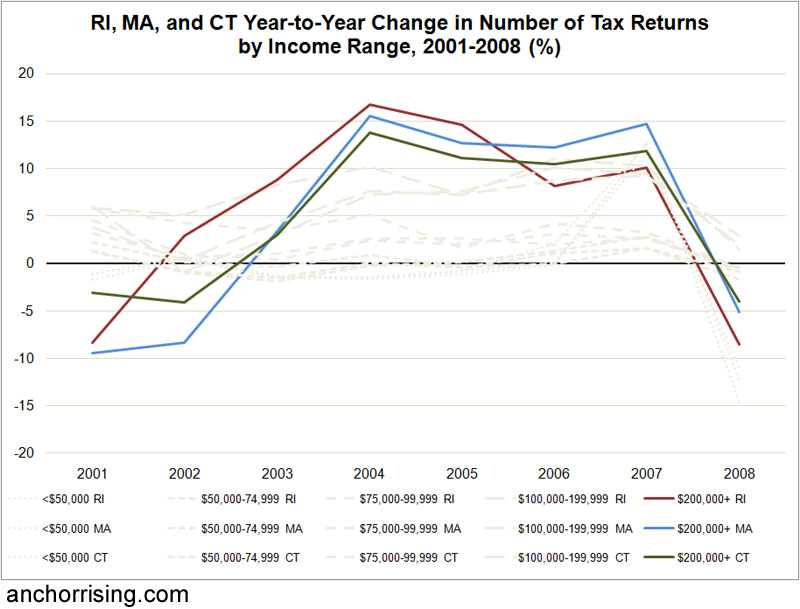
(Click and hold an tax bracket to highlight its corresponding lines.)
Each data point in this chart (based on this data) represents the percentage change in the number of IRS tax returns claiming an income range from the previous year. Thus, in 2004, the number of tax returns showing $200,000 or more in adjusted gross income increased by 16.7% from 2003; from 2004 to 2005, the change was 14.6% — still a large increase, but because the rate of change slowed, the graph shifts down. The red lines show tax returns filed from Rhode Island, blue from Massachusetts, and green from Connecticut. The smaller the dash marks of a line, the lower the income bracket.
Because the highest bracket is the most controversial, because it is most affected by Rhode Island's constantly churning tax policy of the last decade, and because it results in about 40% of all income taxes to the state, the solid lines are of greatest interest. And as is clear, all three states began the decade with losses of such taxpayers (likely because of both migration away from the region and a loss of wealth associated with the dot-com bust). In 2002, the year that Rhode Island began to phase its capital gains tax toward zero percent, we were the first of the three states to show an increase in wealthy households, and we led the three states until 2005.
At that point, our state was in the midst of a series of budget-deficit years to which our elected officials responded with one one-time fix after another. The General Assembly enacted the flat tax phase-out in 2006, but whereas the capital gains change promised to make investments made in and from Rhode Island more valuable (because less taxed) over time, the flat tax phased out gradually and required calculation against the benefits of itemizing and capital gains income. In 2006, the flat tax offered an 8% rate (as opposed to the regular 9.9%) and decreased 0.5% each year.
In any event, as the final years of the decade wore on and brought economic crisis, it became increasingly clear that lawmakers would backtrack on tax reform, and by 2008 Rhode Island led the region in loss of wealthy taxpayers. The capital gains tax phaseout disappeared in 2009, and the flat-tax alternative was frozen by the larger income tax overhaul last year.
An alternative narrative would be that Rhode Island recovered more quickly from the dot-com bust at the beginning of the decade because it had benefited less from the corresponding boom. Then, with so much waterfront property, the state experienced the ups and downs of the real estate bubble more profoundly than its neighboring states.
As this post began by noting, this type of data is subject to interpretation, and given data related to taxpayer migration as well as trends indicated by tax returns and Census data, I'd argue that my long-running explanation still stands: Favorable changes in income tax policy have helped Rhode Island to maintain and grow its base of wealthy residents. Unfortunately, though, heavy regulations, mandates, and taxes overall have not allowed the economy to capitalize on that available economic spark. The "productive class" — my term for the upwardly mobile upper-working to lower-middle class range — has not effectively acted as the kindling to turn that available money into economic growth.
Thus, Rhode Island has been more vulnerable to the mobility of the wealthiest Americans and has not fostered an environment of long-term advancement for the motivated workers and entrepreneurs who will willingly add hours of labor to the economy. Inasmuch as my own quest for upward mobility has not yet borne the fruit that would allow me to continue with this topic, today, I'll have to take up the specifics of taxpayer migration data tomorrow morning.
(The next post in this series is here.)
January 12, 2011
Rhode Island, by Example
Further to my point about a new political wave starting local, the landscape of Rhode Island politics stands as a stark example and testing ground:
... while the state has been trying to work through the desperate finances of its smallest city [Central Falls], it has also been working with three other economically distressed communities — North Providence, Pawtucket and Woonsocket.And there is growing concern that other communities, also trying to cope with cuts in state aid and rising costs for salaries, benefits and pensions, may also be on the brink of being unable to pay their bills.
The backroom operations and self-dealing maneuvers of public sector unions have created an unsustainable structure, not only in the direct taxpayer costs that they impose, but also in the degree to which they hinder the progress that Rhode Island has to make, as in our shoddy public education system. Worse, it is exceedingly unlikely that the new governor and the General Assembly are going to take the sort of actions that they would have to take to turn things around, following my mantra of mandates, regulations, and taxes. Even if a reform impulse were to strike the state's leaders, the establishment's hand is simply too strong not to turn reforms their way by legerdemain.
Policies must change at the town level, and new, less corruptible, leaders must be found and nurtured through the system.
January 11, 2011
Sadly, the Propagandist Can't Be Ignored
Look, Pat Crowley of the National Education Association Rhode Island is a paid union hack. One knows what his conclusions will be simply by looking at his job title. He allows no illusion that he will say anything other than what he thinks will benefit his employer, whether true or not. If read at all, his public writings should be studied as examples of propaganda.
Consider his latest missive, which (I suppose) the Providence Journal had no choice but to publish. Crowley attacks people whom he says are making a "Flight of the Earls" argument — that rich people are leaving Rhode Island — notably Ed Achorn and (although he can't bring himself to say so) me. The first disingenuous aspect of his argument is that the people to whom he points aren't actually saying what he suggests. Anybody who reads Anchor Rising knows that I've been referring to the "productive class" (upwardly mobile working and middle class families) as those leaving the state, and Ed Achorn has been making similar arguments, at least in the several years since I first posted my related research (see here, here, and here).
Unfortunately, respectable journalists continue to take Crowley as a serious participant in intellectual discussion, which leads them to some pretty egregious and misleading errors. WPRI blogger Ted Nesi, for example, writes in response to Crowley's op-ed:
Projo columnist Ed Achorn says wealthy Rhode Islanders are leaving the state in significant numbers because of high taxes. NEARI official and Rhode Island's Future contributor Pat Crowley says that's dead wrong.
Follow Nesi's link to what Achorn says, and one finds this:
The flight of the middle class is an ominous trend. It puts downward pressure on housing prices, eating away at a key source of most families' wealth. It drains our state of precious human capital, as educated people who could contribute greatly to charity, civic culture and the tax base head elsewhere for opportunity. It costs jobs, as businesses shut down or move.
Even in Crowley's fever swamp, the middle class isn't "the wealthy." Media professionals risk their credibility when they allow a union mouthpiece to summarize the arguments of his opposition.
But one needn't read Achorn's article to have reason to suspect that Crowley is up to tricks. For one thing, Census data showing total population at 10-year increments for the past half-century have only tangential relevance to the question of whether a particular demographic group is leaving the state. Decade-long windows also don't allow much opportunity to align trends with actual policies. Since the last time the Census came to town, for its year 2000 count, Rhode Island has enacted and done away with phase outs of capital gains taxes and an alternative flat tax. One must look at year-to-year data for such a purpose.
When Crowley does look at year-to-year data, he has no choice but to become anachronistic:
In 2005, there were 11,913 people with incomes over $200,000 a year. By 2008, the number climbed to 12,515. Taxpayers in the $100,000 to $200,000 range grew from 41,817 to 51,904 in the same period. This was the very same period of time The Journal was editorializing that these high-income taxpayers were fleeing the state, and calling for action to keep them here. Action was taken, and we are paying for it with budget deficits.
Actually, no. To the extent that people were arguing that "high-income taxpayers were fleeing the state," it was prior to these years. The capital gains tax phase out was enacted in 2002, and the alternative flat tax made it through the legislature in 2006. Rhode Island's annual budget deficits far precede "the very same period of time," and during the years 2002-2007, the amount of state income taxes that "the rich" have paid has increased in a steep upward slope.
In other words, the increase in wealthy taxpayers that Crowley cites corresponded with the very policies that were supposed to have that effect. Now, in response to the lies and political activity of Crowley's crowd, those policies have disappeared and, not-so-ironically, leftists and unionists are promoting the effects of the policies as evidence that they were not needed.
The sad thing is that Crowley's essay is clearly a political strategy. Later this week, the Ocean State Policy Research Institute will be briefing legislators on a report addressing taxpayer migration, going fully public with the report next week. In the meantime, on Monday, I'll be posting my updated research. As Nesi illustrates when he blatantly mischaracterize's Achorn's argument and places it in balanced opposition to Crowley's propaganda — as if the two sides should be considered equally credible — the tendency will be to see our statements in terms that Crowley has set.
Anybody observing with an unjaundiced eye can begin to see why Rhode Island is in its current predicament.
January 4, 2011
Letting the Scam's Legislative Architect Run the Budget
Here's a worrying tidbit about a frontrunner for the open House Finance Committee chairmanship in the General Assembly:
[Rep. Helio Melo (D, East Providence)] is the current deputy Finance Committee chairman, and House leaders signaled their confidence in him by letting him take the lead on last year's big end-of-session, income-tax overhaul.
I suppose that the experience ushering into law a reform that took Rhode Island's tax policy in the wrong direction while making it appear to do the opposite will be a valuable point of reference when making the state's budget appear to be balanced when there is no way it could be.
Starting Up to Capture Talent Flow
The fifth Dear Mr. Chafee column on Ted Nesi's blog, by technology consultant Allan Tear, sounds really good, but I don't know that it contributes all that much by way of concrete suggestions for Rhode Island's advancement:
Startups. A recent Kauffman Foundation study shows that firms less than five years old — startups — have generated nearly all of the net job growth in the U.S. over the past 25 years, while established firms averaged near-zero growth in aggregate. It matters less if the startups are what we think of as "old economy," "Main Street" or "innovation economy" businesses. What matters is that we start talking about new startups and entrepreneurship as the primary engine of job creation in Rhode Island. Remember: our economic stalwarts of today — Hasbro, APC, GTECH and FM Global — were all Rhode Island startups once.
It's long been a central plank of Anchor Rising's program for turning Rhode Island around that the state should make it easier for people to start new businesses, which means reducing taxes (especially on capital investments and income that some might consider "excess"), lightening regulations, and erasing mandates that favor established players. So, in that regard, any evidence that points in that direction is welcome. That said, there's something conspicuously semantic about the study that Tear cites:
The BDS series tracks the annual number of new businesses (startups and new locations) from 1977 to 2005, and defines startups as firms younger than one year old.The study reveals that, both on average and for all but seven years between 1977 and 2005, existing firms are net job destroyers, losing 1 million jobs net combined per year. By contrast, in their first year, new firms add an average of 3 million jobs.
Further, the study shows, job growth patterns at both startups and existing firms are pro-cyclical, although existing firms have much more cyclical variance. Most notably, during recessionary years, job creation at startups remains stable, while net job losses at existing firms are highly sensitive to the business cycle.
Basically, when companies are brand new, they hire. Then they reach stasis, begin to fail, or continue to grow, with the net effect being stasis, depending largely on how well the economy is doing in general. It probably oversimplifies matters, but one can easily imagine that, when times are good, capital investment exists to encourage employees to break off on their own, and when times are less good, more folks are forced (or willing) to jump ship and start new companies, accepting less money, thereby keeping the number of startup jobs stable.
Whatever the case, Rhode Island should definitely revamp its policies with an eye toward the perspective of job creators. Inasmuch as new businesses turn into established businesses, though, the state clearly cannot shift in such a way as to strangle them when they pass the one-year mark (or the five-year mark). In other words, Tear's dislike of clichés notwithstanding, the state just has to improve its businesses climate.
Back to Tear:
Talent Flow. As a state that feels like we've lost much in the past few decades, we are obsessed with holding onto what's left, and that is doubly true when it comes to conversations about our college graduates leaving, or Brain Drain. But the most vibrant economic hotspots have a flow of talent coming and going; learning, studying, starting companies, creating art, doing research, treating patients — and, yes, often moving on. This flow benefits us immensely as a state, bringing new ideas and global expertise, and imparting an affection for and connection with the Ocean State. When we shift from talking about Brain Drain to Talent Flow, we can begin to engage the energetic and smart folks that already flow through our state, get the most from our time with them, leverage them as Ocean State alumni if they move, and create new reasons for them to stay. The 21st century economic challenge is not to attract companies, but to attract talent.
This is well and good, as long as there isn't a net loss of talent, which is what I understand "brain drain" to mean. It's also crucial that Rhode Island keep in place the structure to retain the "new ideas and global expertise" that flowing talent can bring. That means attracting companies and making the state an attractive place in which to start them. In practice, companies are collections of people, so the line between "talent" and "companies" isn't all that stark. The distinction is that the latter include the institutional structure that captures the aggregate expertise of employees, consultants, and customers. In other words, the businesses are the "we" that benefit from transient populations.
We can bat around the specific terminology that we use to discuss Rhode Island's economic policy, and if one set of words makes hip people feel more comfortable embracing ideas that we right-leaning reformers have been shouting from the outskirts all along, then it's to the better. The danger is that the establishment forces that continue to clasp the state's legs are adept at twisting buzzwords — which tend, by their nature, to imply more than they explicitly state, thereby leaving much to subjective interpretation — in such a way as to further entrench themselves and hinder the rest of us. Consider the comments to Tear's essay...
January 1, 2011
We've Already Maxed Out the Beauty Quotient
Just about every workday, I drive by the Black Goose Café in Tiverton and think about how much I love their pumpkin chai, but with the beverage priced at $4.50 a pop, except in the most freewheeling moods, I pass right by. Oh, I continue to have a positive opinion of the business, based on this one drink, but that opinion does them little economic good when I determine that my money would be better spent on milk, shampoo, or gasoline.
Something similar is at play in another Dear Mr. Chafee post on Ted Nesi's blog, wirtten by RI Council for the Humanities Executive Director Mary-Kim Arnold:
Surprisingly, the most important factors to most residents were not economic. From city to city, the top three factors that people identified were:
- the availability of social offerings — places to meet, arts and cultural opportunities and the sense that people care about each other;
- a sense of openness — how welcoming the community is to different types of people, including families with young children, minorities, and talented college grads; and
- aesthetics — the physical beauty of the community, including parks and green spaces.
The study in review notes these as qualities that increase "emotional attachment," and Arnold's point is that, as governor, Chafee should "consider factors beyond the state's rankings and beyond the immediate economic data." It's a sentiment with which it's difficult to disagree; leaders should consider a broad range of factors, but the insinuation that social offerings, openness, and aesthetics should be the leading guides is disconnected from our particular time and place. (Put aside questions about the ability and prudence of government's involvement in them all.)
The Black Goose could make its cups more appealing; it could put out a big side reading, "Conservatives Welcome!"; but that won't overcome, for folks in my situation, a price tag equivalent to a meal. Just so, Rhode Island has already squandered the advantages that its residents' substantial emotional attachment provides. The premium is already too high. The great desire that Rhode Islanders have to remain in their state is what enables governance that is corrupt and overly generous to specific special interests..
In other words, just because, all things considered, love of a place will benefit its GDP does not mean that all things needn't be considered. At a certain point — which our state is already well past — emotional attachment just isn't enough, especially when a critical goal of policy has to be the attraction of new people and businesses that don't yet know how attached they could become.
December 28, 2010
Can Rhode Island Be the Exception to Foolish Consistency?
An interesting juxtaposition.
Reading around the Internet, yesterday, I came across Ed Morrissey's observation that all ten states that lost seats in the U.S. House of Representatives are majority Democrat states:
Michael Barone's analysis probably comes closest to the truth: low-tax states attract larger populations, while high-tax, high-regulatory states tend to lose people. That also works in the GOP's favor, and explains why it resulted in such a resounding win in these midterms.
Elsewhere, Dick Morris echoes the analysis:
High taxes kill states. There can be no better evidence than the 2010 Census. The states that lost House seats -- because they're shrinking, relative to the nation -- had taxes 27 percent higher than the ones that gained seats.Of the seven states that don't have a personal income tax, four (Texas, Florida, Nevada and Washington) account for eight of the 12 seats apportioned to the fastest-growing states.
New York and Ohio lost two more seats. Other losers -- down one each -- are Massachusetts, Missouri, Michigan, New Jersey, Pennsylvania, Illinois, Louisiana and Iowa. What do they all have in common? High taxes.
But then, when one turns to local analysis, the lede of a Scott MacKay commentary on WRNI reads as follows:
Rhode Island's business and political leaders constantly focus on the state's high taxes as a roadblock to economic development. WRNI political analyst Scott MacKay reminds us that our state has an even bigger barrier to creating good jobs.
The "bigger barrier," according to MacKay's assessment, is the inadequately educated workforce, which he blames not on "the teachers, the schools and the government," but on "the culture of a blue-collar state." Before taking up that analysis, let's acknowledge that the two explanations are not mutually exclusive. The same society that tunes its priorities on organized labor and welfare, and tolerates Rhode Island's brand of political corruption, might be predicted also to place relatively little priority on actual educational achievement. MacKay declares those priorities not to be a factor, but he offers no evidence or argument as substantiation.
Instead, he offers this as the relevant evidence that the problem isn't the people who run and teach Rhode Island, but the people who live here:
The blue-collar manufacturing jobs have left but the attitudes of that era live on among too many native Rhode Islanders. The percentage of native-born Rhode Island adults with at least a bachelor's degree is only 25 percent, while 50 percent of Rhode Island residents born in other states have at least a bachelor's. What this means is that transplants are moving here to take jobs Rhode Islanders are not qualified for.
Unfortunately, I have to repeat my lament that I wish I had the time to research the statistics, but it's at least plausible to suggest that MacKay's numbers, wherever he gets them, don't really have the meaning that he attributes to them. Even if Rhode Islanders set a higher priority on educating themselves, one might expect three-quarters of those raised here to wind up elsewhere — having pursued higher education out of state and looked for work elsewhere. The same is true in reverse: No doubt, a high percentage of "transplants" to Rhode Island arrived here via the state's colleges and universities and remained. And some of them (me included) took what work the state could provide, regardless of its relation to their degrees.
It won't surprise anybody that my suggestion is just about the opposite of MacKay's. I say blame "the teachers, the schools and the government." Force the first two to reform and the last to get out of the way so that both native Rhode Islanders and immigrants to the state can pursue excellence and create the jobs that will attract RI-born graduates back. The producers will strive to raise or bring the necessary workforce here for the same reason that we all tolerate the burdensome governance in the first place: Rhode Island is a desirable place to live.
Arguably, the initial effect will be a boom in salary levels, as employers compete for workers. A longer-term effect will be a greater emphasis in that ol' blue-collar culture on the education and training that will procure the higher pay. The first step in changing the color of the state's collar is to begin governing with an emphasis on personal responsibility, risk, and achievement, which points the finger at precisely the parties that MacKay wishes to exculpate.
December 20, 2010
Toward Fighting the Usual, Expected Interpretation
This is the sort of claim that begs for a well-researched response:
"The data ... clearly illustrates the need for more affordable homes in the Ocean State," said Nellie M. Gorbea, executive director of HousingWorks. "As lawmakers convene in January, it is imperative that they fund affordable-housing programs like the Neighborhood Opportunities Program ... to immediately address the large number of families on the verge of losing their apartments or houses because they can't afford the rent or mortgage."
The basis for the claim is a HousingWorks study of U.S. Census data finding that 41.7% of Rhode Islanders pay more than 30% of their incomes on "housing costs," which is the highest ratio in the region. Unfortunately, I spent most of my blogging time, the other day, discovering that the Census's new data acquisition tool would eat up most of my blogging time.
The first thing I wondered was whether property taxes are included in "housing costs." The second thing I wanted to research was the significance of average incomes on the calculation. I know from past research that Rhode Island's income level is relatively low, by New England standards.
Both of those considerations support the argument that the last thing Rhode Island should do is to increase government expenditures. Rather, we should lower taxes across the board and lighten mandates and regulations, thereby encouraging economic activity and higher average incomes.
Were Anchor Rising a full-time gig, we would collect the necessary data and post it in the form of a report, which we would promote around local media and bring before any relevant legislative committees — not out of protection of special interests, but out of pure interest in the subject matter and the health of the state.
December 17, 2010
Down Again
Earlier this week, URI economist Len Lardaro noted the reversal of his economic index's positive trends for Rhode Island:
A slump in October in two key indicators that make up an index that forecasts the Rhode Island economy may signal that the state could be in for a double-dip recession, according to Leonard Lardaro, the University of Rhode Island professor who compiles the Current Conditions Index.
Today, we learn that the professor's index isn't the only discouraging statistic:
After eight consecutive, incremental drops in Rhode Island's unemployment rate, the November rate increased slightly to 11.6 percent, indicating the state's economy is staggering to year's end. ...Unemployment rate: Up to 11.6 percent from 11.4 percent, the first increase from one month to the next since last December.
The silver lining is that the increase in the unemployment rate appears to have been attributable to the fact that 800 people reentered the job market. Of course, the problem, there, is that the number of employed Rhode Islanders remained the same, and the number of jobs based in Rhode Island decreased by 1,200.
Rhode Island is not at all well positioned to emerge from the Great Recession, and those leading the state are not well suited — intellectually or ideologically — to change our course.
December 16, 2010
Tabulating Rhode Island's FY2011 Federal Earmarks
For those interested, HERE is a working list of all of the earmarks contained in the lame duck FY2011 budget. I assume it will be continually updated as required (hence, the "working"). I've also broken out the RI earmarks from messr's Reed, Whitehouse, Langevin and Kennedy and you can download it HERE.
All told, according to the latest info, RI's Congressional delegation has requested $53,625,000, broken down as follows:
* Approximately $41.4 million tabbed for Department of Defense projects
* $2.65 million is tabbed for EPA--particularly wastewater improvement projects--and Parks Service projects
* $2.5 million for economic development projects (broadly defined) with money going to the John H. Chafee Center for International Business, Rhode Island School of Design and URI
* Approximately $7.12 million is going to various projects under the Dep't of Labor, HHS, & Education.
December 14, 2010
Whose Taxes Will Change How
This Neil Downing article points to an egregious error in the waning year of Governor Carcieri's time in office (emphasis added):
... the amount of Rhode Island income tax withheld from your pay will change because of massive changes to the state income tax law enacted in June. Employers will have to withhold more in tax for some workers, less in tax for others. ...... the new law lowers the top tax rate to 5.99 percent from 9.9 percent, increases the standard deduction amounts for most taxpayers and eliminates the option to itemize deductions.
As I've explained, before, the central act of the new law was to freeze the flat tax where it already was. Folks who pay attention only a little bit may be lured by the elimination of that 9.9% red mark, but those who take the time to understand the upshot (especially those affected by the change) should realize that what was actually eliminated was a pending decrease in their tax burden.
The second act of the law was to transfer wealth from folks who do those economically active things that create deductions — such as buying local property and spending money on careers and businesses. Downing reports that the changes in paycheck withholding will be "slight," but what's "slight" on an individual basis is massive in aggregate.
Downing also explains the coming increase in TDI taxes and federal withholding amounts. Layer in there the tax increase if U.S. House Democrats foil the tax-cut extensions. Our state and nation could wake up in January 2011 with one pounding hangover.
December 3, 2010
"Body of Proof" Flips Paiva-Weed on tax credits
The upcoming, filmed in Rhode Island, ABC show Body of Proof (starring Dana Delaney and Jeri Ryan) was feted at the State House today. Both Delaney and Ryan extolled the virtues of the Ocean State while executive producer Matt Gross explained that it was the tax credits that brought the production to Rhode Island:
"Having produced ten feature films and 200 hours of television all over the United States and out of the country, I can tell you this has been my best experience to date," said executive producer Matt Gross. "The state supports the needs of production like no other I have ever been to."According to the ProJo report, "The tax breaks cost the state nearly $10.1 million in fiscal year 2009, for example, according to the state Budget Office." Of course, that's "cost the state" insofar as you accept the faulty premise that the production would have come to RI without the tax incentive in the first place! In reality, the filming has generated both revenue and a convert:Gross credited the film and television production tax incentive -- which provides a 25 percent transferable credit for all related spending in Rhode Island -- with drawing the project to Rhode Island.
The production has generated more than $30 million of revenue in Rhode Island and has led to the creation of about 170 (temporary) full-time jobs, said State senate president Teresa Paiva Weed...."I was one of the skeptics when the film tax credits came out ... but have come ... to be a real believer because we now know that it works," said Paiva Weed. "A recent study showed that the film tax credit generates $8 for every $1 of investment from our state. And I don't think there's a better investment that also builds on our tourism industry."Hm. I guess the proof was in the "Body." (Sorry, couldn't resist). Too bad our political readers can't extrapolate from here and realize what would happen if you made broad-based, business friendly tax incentives instead of just ones that appeal to this or that niche.
Questions about the EDC's Loan to Trainor
I note a couple things from the ProJo story about Chafee spokesman Michael Trainor's defaulted loan from the RI EDC.
1) Trainor and his partners approached the RHODE ISLAND EDC for a loan for a business based in CONNECTICUT.
2) The business plan centered on the purchase of three companies in the south that would make hurricane shutters, which would be then distributed in the Northeast. Got that: manufacturing jobs in the south, sales jobs in the Northeast...out of Connecticut.
Then the company went bankrupt and Trainor and his partners still owe the EDC around $250k.
In the meantime, we heard Trainor, acting as Chafee's mouthpiece, being critical of the deal that the same EDC gave to Curt Shilling's 38 Studios. Hypocrisy? Not according to Trainor:
“The state handed him $75 million in loan guarantees without any personal obligation,” Trainor said. “I’ve had to place myself in bankruptcy.”That may be so, though the EDC seems to challenge Trainor on this a bit and doesn't seem to expect payback any time soon. That's a wait-and-see.
I know businesses fail, especially lately, and I'm certainly not criticizing entrepreneurship. Obviously, the scale of the Trainor and 38 Studios deals are much different (millions vs. thousands), but at least 38 Studios is actually coming to RHODE ISLAND and hiring RHODE ISLANDERS.
So, given some of the facts surrounding Trainor's company and the EDC loan, I've got some genuine questions. 1) How often do non-RI companies get RI EDC loans without showing they are going to employ--or even be based in--the state? (Was that indeed the case in this deal or were there promises of RI-based sales staff or the like?). 2) Is just being a Rhode Islander (who may know the right people) good enough to get a loan? Basically, I'm not sure we've really gotten the whole story of how the EDC operates.
When Marketing Isn't a High Priority
A familiar theme pops up all over the place, if you're looking for it. Consider the advice of consultants that the tourism division of the Economic Development Corporation (EDC) hired to help Rhode Island with its efforts in that area:
The consultants learned that 70 percent of the state's visitors come from just five states — Connecticut, Massachusetts, New Jersey, New York and Pennsylvania. However, of 1,100 people they surveyed, respondents were more likely to associate destination themes like "charming, quiet, peaceful, relaxing and friendly" with other states that compete for the same visitors.Rhode Island may be losing visitors to places like Vermont and Maine, the consultants said, because other states spend far more to promote their own tourist attractions than Rhode Island does.
With a tourism budget of $720,000 annually, Rhode Island spends less than 10 percent of what the average state spends promoting tourism, says Mark G. Brodeur, director of the state's tourism division. That average, he says, is $11 million.
I'm not convinced that public resources are best spent on marketing campaigns, and I'd point out that Rhode Island has only 17% of the population of the average state. The reality is, however, that even if we adjust the perspective to say that Rhode Island should be spending twice as much (rather than ten times as much) on tourism, the state already taxes its residents too vigorously. We cannot fund such things as tourism marketing, because we're spending too much money on other things — like labor costs, giveaways, and the support of public corruption.
As with the higher education crowd, it's all well and good for economic development advocates to ask for more money, but we really need them to be making the case that they deserve the money more than other recipients of public largess.
November 24, 2010
Golden Geese, Living and Dead
A quick Google search of his name suggests that he might, but I wonder how many people who agree with Shane Gaudet's view on taxing nonprofits would apply that argument to such things as corporate and income taxes for high-income Rhode Islanders:
The nine nonprofits listed in the story employ more than 20,000 people. Jobs are good, are they not? And consider the number of students who live in, or commute to, the city to attend the four private colleges, and what their presence means for business. Did the officials "factor" this in their study?If these colleges decided to pack up and move to another city (it can be done) where would that leave Providence? I think Rhode Island's capital would be more like Detroit than a flourishing city.
The Providence Journal titled Gaudet's letter, "Golden-goose squeeze." Well, a thriving state should have multiple such geese, and Rhode Island has been squeezing them all for far too long. Gaudet urges city officials to concentrate on "ways they can cut spending" (emphasis in original). Would that more voters shared his preference.
November 19, 2010
Another Phrase for "Taxpayer Subsidized"
This group of industries seems a bit too narrow to count as a "knowledge economy" or to stand as comprehensive representatives of the value of intellectual capital. Indeed, another quality that they share would be a much better descriptor:
The knowledge economy refers to the health-care, life-sciences, research and green-technology sectors and to the idea that work, jobs and wealth are created with innovative brain power.
Especially with healthcare and "green" technology, the application of knowledge isn't much more relevant than it is in just about any industry, but what all of these sectors have in common is that they're taxpayer subsidized. Note the examples:
In 2009, Lifespan Hospitals successfully sought $49.2 million in competitive grants from the National Institutes of Health, he said. Brown University pulled in $180 million in research grants for the 2009-2010 school year, a 37-percent increase over the previous year, Hatfield said. And the University of Rhode Island got $105 million in grants, 60 percent more than three years earlier ...
Grants, if not given directly by government departments, are typically provided by tax-exempt entities, and in the cited cases, they're going to tax exempt entities. The picture accompanying the story features Providence Mayor-elect Angel Tavares, General Treasurer-elect Gina Raimondo, and state Sen Joshua Miller (D, Cranston); one wonders whether and why they're supportive of a strategy of relying on organizations that don't pay taxes to grow the state's economy.
Fortuitously, Jim Hummel's latest report expands on the broadly recognized fact that almost 40% of Providence property is currently owned by tax-exempt groups by catching retail enterprises that serve the knowledge economy as selected partners failing to charge sales tax. The immediate controversy is that the stores (including a Starbucks) are supposed to tax non-students, but even were they complying with that rule, exempting sales taxes for certain private businesses can only harm others that seek to capitalize on "knowledge economy" participants like students.
November 17, 2010
What Chafee Means by "Harmful"
I've received reader email expressing cynicism at the Providence Journal PolitiFact's release, post-election, of its finding that Governor-elect Lincoln Chafee's statement was "barely true" that "experts say the property tax 'is the most harmful to economic growth and ... the sales tax is least harmful." Indeed, Eugene Emery's article notes:
[Tax Foundation economist Kail] Padgitt referred us to a study by the Paris-based Organisation for Economic Co-operation and Development, an international agency founded to help its 33 member countries find the best economic policies.The OECD's 2008 study of tax structures and economic growth says that when taxation is necessary, a stronger reliance on property taxes is the best method for encouraging an economy to grow, followed by consumption taxes, such as sales taxes. High corporate taxes, it concluded, were the worst when it came to increasing the gross domestic product (GDP).
The only rational conclusion to which one can come, on the question, is that it depends. Blanket statements of which tax is preferable are fatally flawed in that there are limitless number of ways in which a regional government can hinder or help its local economy, and the particular mix at any given time will have a huge effect on what tax increases are more or less damaging.
Inasmuch as Rhode Island's underlying problem is an inability to attract and retain economically productive people — to start and populate businesses — increasing property taxes should be a nonstarter. On the other hand, given the size of the state, with cross-border shopping opportunities mere minutes away for most residents (and the Internet readily accessible), increasing the sales tax will likely drive our consumer economy increasingly away. That's good for neither near-term economic growth nor the initiation or immigration of businesses to the state.
But it's nothing new to suggest that Rhode Island cannot afford to increase any taxes (or fees, for that matter). What's interesting about Chafee's statement is what I think underlies it. Local progressives, among whom Chafee clearly numbers, often declare that the property tax is "the most regressive." That's obviously questionable in comparison with a proposal to tax necessities that are currently exempt from taxation, under the law. But I'd wager that Chafee is extrapolating from that cliché that regressiveness in the tax structure is inherently harmful to the economy.
November 16, 2010
Balance Is Unexpected for a Reason
Much is being made of Rhode Island's unexpected budget balancing. Here's Kathryn Gregg in the Providence Journal:
After meeting on and off over several days, the top financial advisors to the House, the Senate and the governor, determined that revenues are running about $16.7 million ahead of expectations when the General Assembly signed off on this year's state budget last June which, when coupled with an end-of-year surplus from last year, gives the state some welcome elbow-room this year.
And Ted Nesi has more:
[House spokesman Larry] Berman credited the balancing act to higher tax revenue, lower spending, and a surplus left over at the end of last year. "It is also good sign that revenues are running slightly ahead of projections, showing that the economy is turning around slowly," he said.
Of course, the largest factor in this "good news" is the windfall of federal dollars that has helped our state government avoid the really tough decisions that it's going to have to make when that money dries up. (You know, that "stimulus" money that has arguably contributed to the continuing economic malaise.) Another factor has been the state's willingness to push expenses down to cities and towns without easing its requirements (via mandates and regulations) to spend money.
That said, this is a prime example of an issue that frustrates me with regard to my tight schedule. My gut's telling me that there must be more — perhaps having to do with tax code changes that effectively raised taxes on productive and economically active Rhode Islanders. An article that Projo reporter Neil Downing published today supports that conclusion:
For example, the total amount of personal income tax withheld — mainly from paychecks — increased by 7 percent for the first four months of the fiscal year, and by 9 percent in October alone, said state Tax Administrator David M. Sullivan. Those figures indicate that more people are working, he said. (The state's unemployment rate, while still high, has been gradually dropping in recent months.)But some other figures suggest economic softness in some spots.
For example, cumulative personal income-tax collections came to $322.6 million, up 4.8 percent compared with the same period a year ago. But that was largely on the strength of increases in the first three months of this fiscal year. In October, personal income-tax collections slipped 4.8 percent compared with the same month a year ago.
The parenthetical note about the slowly decreasing unemployment rate misses the point that fewer people are actually working. Folks are just giving up their job searches, driving down the rate of people who are trying to be employed, but aren't. The summer boost in income tax withholding could have indicated a real jump in summer tourism income, or something similar, but it also could have included a boost in withholding based on changes in tax credits and deductions that the General Assembly had recently passed.
News consumers are used to getting the tailored pronouncements of government officials, perhaps mixed by journalists (working with limited space) with a couple of broadly stated opinions from opposing factions. What we need is to see the numbers dollar-by-dollar and aligned with specific policies and decisions.
November 15, 2010
A Sign of Things to Come
Rhode Islanders should expect more of this:
It may be a sign of a bad economy, but some businesses are balking at a plan to charge fees for placing business logos on the blue highway signs at exits for food, gas and lodging. ...The $1,200 per-sign fee, which went into effect on Nov.4, applies to any business posting a logo on a highway sign; state transportation officials have since proposed a reduced rate of $300 a year per sign for the 72 businesses that already have permits to post their logos on the highway signs, according to Rocchio.
The businesses paid to install the signs, and now the Dept. of Transportation wants them to pay fees (1) just in case they are knocked down and (2) to hire enforcement bureaucrats to catch any such businesses that aren't complying with regulations having to do with handicap access and public availability of bathrooms and phones. In short, it's another way for the government of Rhode Island to squeeze benefits.
DOT Managing Engineer Robert Rocchio magnanimously points out that "no state or federal regulation requires" the signs to exist (in the Projo paraphrase), and the new fee matches that charged in Massachusetts. Rocchio misses the point: Each state must figure out its mixture of charges and benefits, and the relevant question at any given point is which direction it's heading. This is a new imposition on productive Rhode Islanders who need to lure every through-state driver they can to boost our local economy.
As I began by saying, we should expect more policies like this. Rhode Island's "leaders" have no new ideas, and Rhode Islanders keep electing them to office.
November 13, 2010
Mo' Money by Default
Marc's already splashed into the political hay of the issue, but we should take a moment to look more directly at the raises received by Rhode Island's top office holders:
The salaries go up only once every four years and when they do, they reflect the Consumer Price Index for the Northeast region for the previous four years.Translated: the annual salary paid the governor is going from $117,817 to $129,210 on Jan. 11 and for the attorney general, from $105,416 to $115,610.
At the same time, the salaries paid the lieutenant governor, treasurer and secretary of state are rising from $99,214 to $108,808 annually.
We could have the debate about whether the amounts are justified. In some cases — especially lieutenant governor, the answer is, "surely not." In other cases, such as governor, the amount is nowhere near what a comparable CEO could expect. That said, the numbers are more than enviable from the lowly position of many of us.
But the question of automatic increases is the rub. Such offices differ from the private sector in that the candidates for office run in an election; they don't, as in the private sector, negotiate with their employers-to-be. It's reasonable, therefore, for the government to have a standard, nearly apolitical, formula that keeps the compensation reasonable no matter who wins the office.
That said, it'd be a rare Rhode Islander who'd claim that the state's economy has improved by 9.67% over the past four years, and rarer still would be those stating that the government's ability to pay its officers more has increased. During times of recession, the General Assembly should pass statutes postponing all raises until Rhode Islanders have felt the return of economic health.
Of course, in our current circumstances, that might represent a permanent moratorium on raises.
November 12, 2010
A Voice on the Other Side of the Wall
Erstwhile commenter and Rhode Island escapee Dan has left the following comment:
Hello, everyone. This is my first time commenting since I moved out of Rhode Island, and it may be my last.Just stopping by to report that since I left the morally and economically bankrupt Democratic hellhole that was my home for 25 years, I have been far happier and more successful. I have a great new non-union job with a great boss, which for some odd reason doesn't pay me minimum wage with no benefits, defying all progressive logic. I feel like a great weight has been lifted, like I'm not being robbed and insulted everyday by those who run my government. It's an amazing and empowering feeling.
In my current state, taxes are low and are spent responsibly on public works that people actually enjoy like trees, benches, and working fountains. The people are friendlier down here. Unemployment is lower and unemployment benefits are lower. There is a pride in working and personal responsibility that I never felt before in RI.
It is a right to work state, so I don't hear much from teachers unions anymore. I'm sure I don't have to mention that we blow RI out of the water in quality of education, not a coincidence. Police are paid reasonable salaries and mostly just leave people alone. Firefighters are volunteer. Sales tax is a whopping 4%. Not much corruption, or they do a very good job hiding it.
I urge each and every one of you to leave the fool's errand that is RI as soon as you are able. Every day you stay in RI, you are voting with your actions for the Marxists and criminals who run the state, doing your part to ensure that status quo. If you haven't learned by this past election that nothing will ever change in RI, well, you won't ever learn, and you'll die unhappy fighting those same old windmills.
You have 49 other states from which to choose. RI is not the best of them. Move to NH, move to VA, anywhere, just move somewhere and stop bankrolling the legal mafias in the public unions, city councils, and state legislature. If you love your family, take them with you. Friends will follow, or you'll make new friends. Get out, and do it sooner rather than later. Don't be a martyr for liberty and sanity. Do yourself a favor.
It's difficult to argue with much of what Dan writes, but two points must be made. First of all, individual taxation is the lesser of two ways in which Rhode Islanders pay for the sorry state of their government. The larger component is opportunity costs; I find it jarring, for example, to place the list of things that I can do and have done next to my itinerary of daily activities setting up tools on a muddy jobsite in order to place cement-board siding on a house in the cold and damp. On the other hand, there are opportunities in what I've been doing, not only careerwise, but experiencewise. Being a carpenter has changed me in positive ways, over the past six years, and I would never have taken this path if others hadn't been blocked by circumstances. Moreover, if the larger cost is an opportunity cost, then succeeding is still possible, just more difficult.
The first point leads to the second: it is a presumption of Dan's that one must "die unhappy" if the state does not change. As with anything, considerations must be balanced. A better job and more reasonable civic culture is not everything; note how little attention the average person pays to the latter. In fact, I do not cede Dan's assertion that the state is impossible to change, and even if it proves true, in practice, there is value and great reward in making the effort... provided one can survive economically.
November 9, 2010
The Bankruptcy Option
Given the long political, economic, electoral, etc. track record of this state, many believe that the only solution to fixing Rhode Island lay in bankruptcy. Well, if that is indeed a solution, then this post by Richard Epstein is concisely informative on the topic. Epstein explains the how's and why's, but then concludes that bankruptcy probably isn't an option.
I don’t think that full-fledged bankruptcy is a realistic prospect as of now. I think that the much more sensible approach is to side-step the bankruptcy proceedings and find ways to attack the union pension obligations directly, given their enormous size. It is odd that these days the only sacred contracts are those which the state enters into with unions for the benefit of their members.Nonetheless, the courts would eventually get involved:
The key question is whether it will be possible to persuade the courts that these pension agreements were the result of political self-dealing, which means that they should be set aside unless it could be shown that the state received fair value for the services rendered when it made those deals. I think that case is bold but winnable, yet only when the situation becomes truly desperate. Funding that litigation will take some bankrolling, but the corporate-law analogies on self-dealing make it pretty clear that the state legislatures violated all their duties of loyalty to the public at large when they entered into deals from which union pension funds got all the upside and everyone else got the downside. Not nice. Undoing it is the work of the next generation.That all strikes me as speculative at best, at least in Rhode Island. It just isn't the way this state works.
November 1, 2010
The Broke Lender of Last Resort
Why isn't it sufficient for candidates for public office simply to say, "I'll get out of the way"? Take gubernatorial candidate Frank Caprio:
A centerpiece of his TV ad campaign for weeks, Caprio's plan relies heavily on $13.1 million in new federal dollars for loan guarantees, and "moving" the $50 million that remains in the $125-million loan-guarantee program that state lawmakers created earlier this year into a new Small Business Loan Fund.Standing in front of Moretti Salon on Atwood Avenue in Cranston, Democrat Caprio suggested a state-backed commitment of that size could be used to leverage $640 million in private loans to businesses that might not otherwise qualify, to "retain or create 14,800 jobs."
I'd trust private investors to sift through potential projects and judge the worthy more than I trust the government to do so. Investors have profit as their motive, so they look for long-term successes; politicians have talking points as their motive, so lending public money allows them to claim to have "created" jobs and, if the business fails, to offload the blame on its operators. In the case of loan guarantees, the government generally isn't even invested to the extent of putting up money that it might use for other purposes; the hit comes after the failure.
We certainly require new businesses to open their doors and begin hiring, but at this point, guaranteeing loans is just a sly way for the government to compensate for the unnecessary burdens and risks that it places on the economy through mandates, regulations, and taxes.
October 13, 2010
Lardaro on the Downswing
University of Rhode Island Economist Len Lardaro has to be the most mixed-message-sending economist in the state. He regularly appears in the local media declaring that his economic index shows Rhode Island in recovery (and has been doing so for months of the recession), yet here he comes with a doomsday warning for the next election:
On the labor-supply side, much of the current unemployment is long-term in nature, the result of jobless persons failing to possess the skills demanded by the employers who are attempting to increase employment. Economists refer to this as "structural unemployment." The result is skill shortages, even with so high a jobless rate.On the demand side, employers have continued to find ways of meeting current product demand with fewer hours worked by their labor force than they thought possible in the past. ...
The upcoming election is more important than is generally assumed for Rhode Island, because federal bailout money will no longer be available by this time next year. Fiscally, this will force us to go "cold turkey." The resulting jolt to a fragile upturn may well force our state into a double-dip recession. The citizens of this state need to be proactive, even though our elected officials seldom are.
Don't get me wrong: I agree with Lardaro's assessment and his hinted solutions, but he would help to prime the public for this sort of revelation if he regularly accompanied his index-related press releases with a big "but."
October 11, 2010
The Give Me Mine Vote
It's pretty clear, from a recent Brown University poll that about one-fifth of the electorate in Rhode Island are in the die-hard public sector camp:
On the other hand, a large percentage — 73.3 percent — opposed raising the state sales tax, while 18.9 percent supported the idea. And 74.7 percent opposed raising the state income tax, while 19.3 percent supported the idea.When asked about measures that would affect state employees, 46.6 percent supported unpaid furlough days, while 38.4 percent opposed the idea, and 57.9 percent supported a defined-contribution pension plan for new state employees, while 21.1 percent opposed the idea.
Basically, 20% of survey respondents want higher taxes to support the deals currently offered to public-sector employees. I can't say, of course, how much overlap there is between wanting to increase the sales tax and wanting to increase the income tax, but I'd wager that it's significant — constituting, overall, a statement of "whatever it takes." That's a significant portion — especially given its greater likelihood actually to vote and to become active before election day — but it's not overwhelming.
The route to countering that bloc will be to isolate their issues in the face of a single candidate — who, incidentally, has made it abundantly clear that he's their guy:
... during and after the Marriott Hotel lunch, [Lincoln] Chafee insisted that [Frank] Caprio’s $100 million in promised [pension] savings are illusory, because his plan "won't standup to legal scrutiny.""It's hard to believe that a court would agree that somebody that has been paying into a certain pension fund for 30 years, all of a sudden has a new pension plan. It's hard to believe a court, beyond the fairness issue, would say that is legal," Chafee said.
Determining, beforehand, that the union's ever-present threat of expensive litigation will prove indomitable is a classic ploy of union-bought candidates for office. It simply is not difficult to believe that an objective judge would allow the state to change the terms of an insupportable pension system, at least for investments not yet made. In other words, the fact that employees have been paying into a system does not mean that they have a legal right to see that system perpetuated. Some aren't yet vested, which means that they don't even have a claim to the fruits of their investments thus far, and others can be told that different rules will apply to payments made from this moment forward.
The more extreme measure — which may yet prove necessary — would be to transfer the vested payments into a defined-contribution plan that is financially comparable, but with better terms for the state. But I don't think any candidates have gone that far.
Incentive Not to Work
In contrast to the PolitiFact about which I complained, yesterday, this one by Eugene Emery was actually informative. The statement under scrutiny was from Republican candidate for governor John Robitaille, that "Rhode Island has a very generous unemployment compensation rate compared to most other states":
By the latest measurement, during the first quarter of 2010 Rhode Island ranked second in the nation. The state paid the typical recipient 47.8 percent of the average weekly wage of $816.71. (Hawaii topped the list, at 54.8 percent. Massachusetts, by that measure, was at 37.3 percent, ranking it 29th.)Put another way, the average hourly wage in Rhode Island during the first quarter of 2010 was $20.42. The average person receiving unemployment insurance got the equivalent of $9.76 per hour. The benefit could be as much as $13.76 an hour for an individual or $17.20 per hour for someone with five or more dependents.
Robitaille's contention is that unemployment benefits so high discourage people from going back to work once unemployed. I've actually run into that dynamic, with a new carpenter who spent most of the single day that he worked with my company telling another new guy how nice it was to be able to go fishing and such while receiving a government subsidy.
It's important to note that unemployment needn't exceed the pay rate that a potential worker could expect. It just needs to be more than he or she requires to live an acceptable lifestyle.
September 21, 2010
State Budgets, Easy to Grow....
Matthew Mitchell at George Mason University's Mercatus Center has done research showing that States will have to increase their 2009 budget cuts (average of 6.8%) to 12.3% and sustain that level of spending to pay off their debts. Rhode Island is one example he cites:
[T]he entire budget gap could have been eliminated had the state maintained 1987 inflation-adjusted per capita spending levels. Rhode Island's 2009 expenditures were $7.6 billion. If held to real 1987 per capita levels, however, the budget would have been less than half this amount: $3.3 billion. This would have been more than enough to close the state's $872 million gap. But as with other states, spending restraint needn't have begun in 1987 for the state to have avoided its budget gap. If held to real 1995 per capita spending levels, I estimate that the state would have spent $5.1 billion in 2009. Assuming revenue would have followed its same course, the difference is still enough to have avoided the state's entire gap.There are also some charts to help illustrate the point. It's basically a confirmation of data we've presented before. When times were good, government explodes, when bad, it shrinks just a little. The truth is that a regular COLA-like increase for government budgets should be MORE than enough to "provide the services that the public demands and expects." (To sorta paraphrase a mantra we regularly hear from the "more gov't" types).
September 11, 2010
Measuring the Economy by Taxation
Tax collections are up, in Rhode Island, and not a few people are happy to offer tentative suggestions that it's a positive sign for the local economy. I hope so. But still, I think it's tricky stuff to use this measurement. Consider two notes that Neil Downing offers on the data:
* The amount of state income tax withheld from workers' pay totaled about $145.5 million, up 9.1 percent from the same two-month period a year ago. In general, this suggests that more people are working, workers are earning more, or both, Dion said.Sales-and-use tax revenue rose 3.5 percent, to $152 million. The category includes revenue receipts at the Registry of Motor Vehicles, which increased 6.8 percent, to $14.8 million. Overall, "there seems to be some pickup in consumer spending," Dion said.
Comparing this year's report with last year's iteration, the difference in total tax collections is $36 million. One-third of that ($12.1 million) comes from the increase in withholdings. This year's rate is even higher than that in FY09 (or actual year 2008), when it was $139 million. (The report for the year before is not online.)
So is our job market now better than it was two years ago, when the unemployment rate was 8.1%? According to the Bureau of Labor Statistics, 505,495 Rhode Islanders were employed as of July 2010; the number in July 2009 was 501,957; in July 2008, it was 525,562. Why is an employed population that is 4% smaller withholding an amount of taxes that is 4.5% greater? If you want me to offer a comprehensive answer to that question, you'll have to finance Anchor Rising as my full-time job, but I'd be willing to speculate that it might have something to do with changes to tax laws that reduce itemized deductions and shift the tax burden around.
Another million dollars in increased "tax" collections derives from the Registry of Motor Vehicles. And again, the amount is well above the number two years ago. Is that a sign of new car purchases? Perhaps. Or maybe it's a sign of creeping fees.
Another $2.7 million in increased collections derives from Historic Structure Tax Credit Reimbursements that weren't given this year. $2.3 million comes from fewer refunds/adjustments this year. Business received $4.6 million less in refunds and adjustments..
About the only increase that doesn't have an immediately apparent dark lining is net sales and use taxation, which rose about $3.9 million. That's a 3% increase from the year before, although it's still $2.6 million less than the year before that.
If that's what we're looking toward for hope of a recovery, we must really be getting desperate. But the larger point is that taxation isn't a reliable advance-notice measure of economic improvement.
September 2, 2010
On the Hook, One Way or Another
Local journalist Ted Nesi has moved from the Providence Business News to WPRI.com and is maintaining a column there (although they're calling it a "blog"). One sample from a couple of weeks ago has been nagging at me:
The Daily Beast is out this week with one of its link-drawing listicles — "The Most Screwed States" — and guess who they say is the most screwed of all? You guessed it — good ol' Rhode Island. ...But those numbers are also very misleading — and more than a little bit alarmist.
Nesi's first step is to update the numbers cited in the article, which adjusts our debt-to-GDP ratio in a little bit healthier a direction. But his next point, which relates to Andrew's commentary about state bonds, seems like it must be ignoring something:
Rhode Island taxpayers are not on the hook for the state's entire $8.9 billion in debt. In fact, we're on the hook for less than half of it. The reason is because a big chunk of that borrowing is what's known as "conduit debt."Conduit debt is basically when the state goes out and borrows money on behalf of someone else — nonprofits like Brown University or Rhode Island Hospital, or individuals via state agencies like RISLA and Rhode Island Housing. Going through the state makes it easier and cheaper for those entities to borrow money.
Reading the article, one gets the impression that the state's involvement in conduit debt is less than superficial. If that were the case, however, then why would it be true that lenders make the borrowing process "easier and cheaper" when the state is involved? Nesi should be a little more careful with his language: The taxpayer is "on the hook" but is trusting the recipients of the borrowed money to pay it back — sort of like the federal government trusted mortgagees through Fannie Mae and Freddie Mac to pay for their houses.
Just as significant is the incentive system that conduit loans set up. Particularly when it comes to organizations — perhaps, although I lack the time to confirm, including the City of Central Falls — the state's interest in the health of its sub-borrowers could lead to special arrangements with tax dollars to enable them to pay back the debt before it officially defaults to the state.
In other words, conduit debt essentially makes the borrowers quasi state agencies paying the debt through their own revenue sources — no different than fees and other revenue that state departments take in — for the term of the loan. Perhaps they shouldn't be incorporated into lists tallying annual state debt payments, for example, but it surely shouldn't be written out of consideration.
And whatever the case, for all of the adjustments that Nesi makes, he still only manages to improve Rhode Island's debt problem from worst in the country to seventh or tenth worse (depending whether one looks at income or population). Not a comfort, especially considering that we tie with the collapsing state of California.
August 12, 2010
Putting Rhode Island in Deep Water
Well, the Rhode Island Public Utilities Commission (PUC) has reached the decision that the General Assembly and Governor Carcieri all but required it to make, signing off on the expensive contract for an offshore wind farm between Deepwater Wind and National Grid:
"It will be four cents a day more," Carcieri said. "Who wouldn't be willing to spend that to invest in our economy, keep our money here instead of sending it to Saudi Arabia [for oil] and start a major new industry?"
It may be only $15 dollars per year to whatever demographic Carcieri is describing, here, but it will be much more to companies and manufacturers that require large amounts of energy. Indeed, the best the PUC could say about official complaints from two Rhode Island companies, Toray Plastics and Polytop Corp., was that "at least they didn't threaten to leave." But they did note that the increased costs would make it more difficult for them to expand in the state. That statement raises another item in today's Providence Journal:
The United States is selling fewer products around the world and spending more on cheap imported goods, an imbalance that hurts the job market at home and means the economy is even weaker than previously thought.The trade deficit of nearly $50 billion for June is the biggest in almost two years, and economists fear that economic growth for the second quarter, which came in at a sluggish rate of 2.4 percent in early estimates, may turn out to be only half that.
"The problem is that to the extent we have a recovery in the United States, it is pulling in a lot of imported goods. That means it is not translating into production and jobs at home," said Nigel Gault, chief U.S. economist at IHS Global Insight.
Redirecting our energy dollars from the Middle East to the United States is certainly an important objective, but when the cost difference is so dramatic — with guaranteed increases year after year — it affects the activities of those who are required to pay the inflated rates. Government should not be as deeply involved in the economy as the Deepwater deal has exemplified, and I fear that Rhode Island is going to be on the bleeding edge when it comes to finding out why.
August 11, 2010
Set the Entire RI Economy Afloat
May I make a somewhat obvious point — coming from a conservative — about the recent conversation concerning tax-free boating in Rhode Island?
The tax policy has also helped the state rebuild the ranks of highly skilled boat workers, and has triggered the creation and expansion of boat yards, designers, builders and subcontractors — who specialize in such fields as electronics, sails and marine insurance, he said.The benefits are not solely Aquidneck Island's, either; owners fly in and out of T.F. Green Airport, rent cars, dine in restaurants and attend shows in the Providence area, he said.
According to Neil Downing's article, Rhode Island is forgoing about $8.4 million dollars, out of its $7 billion budget. Can you imagine what our economy would look like if the state and local governments would forgo more? A government should be a secondary consideration (if that), in society, not the primary determinant of its economy and life. By making itself more central, governments suffocate the very people they ostensibly seek to assist.
August 4, 2010
Warwick School Committee Chooses the Tough Path
Faced with an insurmountable $13 million cut in state and local funding, the Warwick School Committee voted to freeze pay and impose a 20% health care co-pay for all of its employees last night.
Before the vote, School Committee Chairman Chris Friel stressed that these are not actions the district wants to take but it has no choice faced with insufficient funding for its budget of about $161 million for the current fiscal year, which began July 1.Unions are not happy.He said the district did not want to cut programs that directly affect students, such as sports, gifted classes, mentoring and all extracurricular activities.
The action is in apparent violation of the School Department's contract with its roughly 1,000 teachers represented by the Warwick Teachers Union, with teachers slated to lose a 2.75 percent raise this year....The leaders of the two unions that represent almost all school employees - the teachers union and the Warwick Independent School Employees union - vowed that they will respond with swift court action.The union has been playing the "we'd get back to you" game or the "we're willing to listen" game for some time now. The School Committee is obligated to have its budget finalized shortly after the City Council approves the school budget and was already late in doing so. They couldn't wait any longer. The situation called for urgency and the unions seemed to be content with playing the same collective bargaining games that worked in the past (see the "Addendum" in the extended post for a timeline). That isn't working any more. It's apparent that the Warwick School Committee felt like there wasn't much expeditious movement occurring on the other side of the table and felt like the only path left open--a tough one--was to unilaterally make these cuts and changes. That's something that the Warwick City Council backed away from. Whether the solution is viable depends on the next stop in the process: the courthouse. Continue reading "Warwick School Committee Chooses the Tough Path""I feel stabbed in the back," teachers union president James Ginolfi said, noting that the first he and other union executives heard of the School Committee's plan was less than an hour before it took action in executive session.
"We listened to what they had to say and said we'd get back to you," Ginolfi said, adding that the school board is sending a public message that it has no regard for a legal agreement. "I am shocked," he said.
August 2, 2010
Put it all on 38?
States, including Rhode Island, are smart to market themselves and offer incentives to businesses. The deal with 38 Studios is coming in for praise and criticism, to be sure. Gamers have their opinions, with the optimism based on the all-star cast of gameworld creators--R.A. Salvatore, Todd McFarlane and Ken Rolston--while the pessimists basically think the game will be just one more World of Warcraft "me too" that is destined to fall by the wayside (though some think that an MMO of a different flavor--ie; not "fantasy"--is might work.
The business community is split, too, with skeptics pointing out that the funds would have been better used if spread out or at least not spent on one seemingly risky venture. Others make the point that the splash made by the deal has already caused increased business interest in RI and that there are protections to mitigate risk.
Part of the confusion probably lay in the nature of the business in question. I wonder if there would be as much reservation if this was a business that was selling or producing a tangible product? The truth is we just don't know what exactly to expect from a video game company. It's a relatively new industry and, let's face it, most of the business media and non-related business leaders around here just don't really know much about video games. So, until 38 Studios actually produces a product and the prospect of other video game companies coming to RI goes from potential to reality, we're not going to know if the deal pays off, either directly or indirectly. Until then, it's simply a gamble.
July 26, 2010
The Illusion of an Improving Tax Structure
A while back, I pointed out (see the addendum) that what looked, at first, to be an economic improvement — the increased percentage of wealthy people in Rhode Island — turned out to be evidence of the contrary. The percentage improved because the non-wealthy left the state in such great numbers while the decreasing flat tax and capital gains tax maintained our population at the high end.
It seems likely to me that such less-encouraging factors explain the tax-related findings of the Rhode Island Public Expenditures Council (PDF), which Marc mentioned here. From the Providence Journal summary:
From 1998 to 2008, individual income tax collections, as a share of personal income, declined by about 7 percent, sales tax collections increased by less than 1 percent, and property tax collections increased by almost 4 percent.Simmons says the increasing reliance on the property tax in recent years can be attributed, in part, to the state’s decision to cut state local aid for education during the economic recession.That forced communities to make up revenue losses through a combination of trimming expenses and raising the property tax — its only other major funding source besides state aid.
The silver lining is that Rhode Island's property tax grew at a slower rate than the national average of about 8 percent.
Because these calculations are made based on total income and population, in the state, and since our local economy has been struggling, while population has decreased, and since the General Assembly hasn't actually cut the tax, the sales tax revenue result is likely attributable to declining consumer confidence and increasing incentive to shop out of state, where sales tax is lower. On the income tax front, those who pay in the mid-range brackets have been leaving and out of work, while the tax on the upper range has been decreasing. That Rhode Island entered the recession ahead of the rest of the nation probably facilitated our "improvement" by this measure even more.
This puts a different light on the property tax question. Sure, the immediate cause was the cut in state aid, but the decrease in revenue from state-level taxes has surely been a prior cause (along with excessive spending and an unwillingness to cut state budgets to the necessary degree). That the growth in property taxes was slower than the national average need indicate only that Rhode Island was already closer to the threshold that residents could bear, and since the decrease in tax revenue for the state hasn't corresponded an increase, but rather followed from a decrease, in discretionary income for residents that threshold has, at best, remained stagnant.
July 17, 2010
Unemployment the Same; "Unemployment" Down
Here's an interesting observation. The Providence Journal's story about Rhode Island's decreasing unemployment rate may have been headlined "State's jobless rate declines to 12 percent," but the lead reads, "The figure is counteracted, however, by decline in size of labor force," and Andy Smith sets the tone of the article at the very beginning:
On the surface, there is good news in the state unemployment numbers released Friday. The Rhode Island jobless rate dropped to 12 percent in June, a decline from 12.3 percent in May, and the number of people classified as unemployed decreased by 1,900, falling to 69,300.
By contrast, the cycling news on WPRO — to which I'm able to listen at work, now that Buddy's show has moved to drive time — clearly presented the numbers as positive.
The upshot is that 800 government jobs (mostly for the Census) went away; 800 private sector jobs appeared (presumably with a significant percentage of temporary seasonal jobs); and 2,800 Rhode Islanders gave up their job searches and exited the calculation. Anybody who is tracking unemployment as a measure of actual economic health and resident well-being, in other words, should not be encouraged.
I will say this, though: It looks like my prediction of 15% unemployment was off the mark, but mostly because I didn't include the possibility of workers exiting the market.
July 9, 2010
Sailing in the Ocean State
Yes, we lost the bid to host the America's Cup, but there is still opportunity to grow our economy by focusing on sailing related business.
Warned ahead of time, the state administration immediately took a positive perspective, saying that Rhode Island is likely to host preliminary races that could become as big a benefit as the actual Cup defense....Keith Stokes, head of the state Economic Development Corporation and the leading state official on the issue, said the trials to select the Cup defender could involve several yachting syndicates.It would give Rhode Island time to re-build the sailing infrastructure required to host such events and, perhaps eventually have those facilities in place to make a strong bid to host a future America's Cup race. One thing we do have is a natural bay that is well-suited to sailing.Stokes said in an interview that the preliminary races in some ways offer a better opportunity than the final Cup challenge. Given the potential for multi-year events, “that provides a longer-term and stable economic opportunity.”
Long-time yachting expert Halsey Herreshoff, president of the America’s Cup Hall of Fame, said he sees another, long-term bright side to the situation: Newport is an excellent place to sail. Once current America’s Cup sailors find that out through sailing preliminary races here, he reasons, they’ll want to come back for future Cup competitions.Bidding for the next America's Cup race was a long-shot and, though certainly worth a try, was akin to the sort of one-time fixes we're apt to try for here in Rhode Island. Hopefully this will indeed be a blessing in disguise and we'll seize on the heightened awareness that the sailing industry could be a bigger boon to the Ocean State. Whoda thunk?
July 2, 2010
A Measure of Sustained Suckitude
We bat around the Lardaro Current Conditions Index from time to time, typically determining that it's not very useful, but it really does demand some .statement of context:
Rhode Island's recession is not over, but the end may be very close, according to the Current Conditions Index released Monday by University of Rhode Island Prof. Leonard Lardaro.The index reported a value of 50 in April, down from 58 in March.
As I understand it, Lardaro's index measures current results against the same month one year prior, with a score of 50 indicating no decline or improvement. In other words, even if the recession technically ends in that the economy isn't shrinking, that doesn't mean that times are improving.
I say that not to issue in dark clouds, but because I think the general public thinks, when they hear that "the recession has ended," that the economy is back to normal, and if 2009 is Rhode Island's new normal, we're in a great deal of trouble. People in power keep pushing for economy-boosting reforms until the Current Conditions Index starts hitting 100, to compensate for the months on end that Rhode Island spent scraping zero.
June 25, 2010
In Defense of Realistic Taxation
In defense of the Tea Party — in the broad movement sense — Fred Deusch of North Providence sums up the problematic thinking of those who advocate for progressive taxation:
Rhode Island has about 1 million people, but only 12,000 pay 41 percent of the state's taxes, according to Treasurer Frank Caprio. How much does Mr. Platt want from those 12,000? In a May 9 Commentary piece, Michael McMahon, former head of the Rhode Island Economic Development Corporation, wrote: "Montgomery County, Md., similar in size and population to Rhode Island, tried to balance its budget by increasing taxes on the top wage earners from 4.75 percent to 6.35 percent. This was supposed to generate $106 million of additional revenue. But many of the wealthy, who are very mobile, left town. Revenue actually fell by $257 million as the number of millionaire taxpayers declined from 7,989 to 5,529."When the wealthy leave for greener pastures, whether from Maryland or in Rhode Island, who does Mr. Platt think makes up the for the loss in tax revenues? Answer: We all do.
As I've pointed out multiple times, for much of the last decade, Rhode Island's tax policies — the flat tax and the capital gains tax — appeared to be maintaining our base of wealthy residents, while high property taxes (to fund unrealistic contracts for public-sector unions) and the general hostility of our political culture to economic growth continued to drive out the working-to-middle class folks who wish only to build on that base of wealth in order to improve their own circumstances.
Now, the capital gains tax is back with a vengeance, and the flat tax has been eliminated through a clever "overhaul" that appears to make the income tax more progressive, in its real effects, not less. And nothing has been done to improve the lot of those who've been fleeing all along. As Mr. Deusch suggests, we're all going to pay the consequences... all of us, that is, who stay.
June 22, 2010
Getting the Kids to Work
The Providence Journal's John Kostrzewa and the public officials on whom he reports miss some critical dynamics in their discussion of the problem of teen unemployment in Rhode Island:
More and more teenagers in Rhode Island can't find work because the recession has shrunk the number of job openings. The jobs that are available and that young people used to fill are being taken by seniors forced back into the labor market or out-of-work adults who can't find anything else.
Not to mention the factors of illegal immigrants and other unskilled labor attracted by our progressive welfare and tax policies. A more fundamental thought derives from this description of the problem:
When young people don't get jobs and are idle, they don't learn valuable behavioral traits and skills such as showing up on time, respect for supervisors, teamwork and the value of their labor.
Providence Mayor David Cicilline, Education Commissioner Deborah Gist, and others see the solution as more government programs, including education and training, but that's suspiciously helpful to bureaucrats and public-sector labor unions. The reality is that, as its policies across the board prove, Rhode Island is not designed for successful, upwardly mobile lives. Our state punishes success and rewards conformity and going along to get along. That dynamic leads to policies that restrict job growth and — in whom it attracts and what it encourages — floods out the opportunity to follow a clear course of opportunity from menial work to a successful career.
That's more of a cultural issue than an economic one, but if there's any hope to change it, it will come with the economic decision to encourage business activity — really encourage it, not by making forms easier to fill out, but my making business easier to conduct.
June 18, 2010
Where Rhode Islanders Are Going
Forbes has an interactive map where you can look at where the people are moving. I found it via Ryan Streeter's post concerning the difference in migration between California in Texas (Texas is gaining, Cali ain't). Consider Rhode Island more a Cali than a Tay-has. Here's Providence County, for instance:

Kent, Washington (er..."South") and Newport counties are also in the red, so to speak. Unsurprisingly, it looks like a lot of retiring Rhode Islanders are heading to Florida, Arizona and maybe SoCal. Another group, probably more based on economic reasons, is headed to Georgia--particularly Atlanta--and the Carolinas.
June 4, 2010
Cross Every Picket Line
Circumstances have made me slow to respond to this, and my position will hardly be a surprise, but I did want to express — ahem — solidarity with RIGOP Chairman Gio Cicione (as well as the RI Young Republicans) on the matter of crossing a union picket line to hold a Central Committee meeting at the Westin Providence hotel:
Explaining why the state Republican Party, along with the Rhode Island Young Republicans, decided to hold its State Central Committee meeting at the hotel, party chairman Giovanni Cicione said: "If Democrats continue to torture every local business with threats of strikes and boycotts, especially in the midst of this recession, Rhode Island will soon find itself with no employers left."I'll go further: All taxpayers should make a point of doing business with companies that are facing union strikes. Trying to hurt employers in the midst of this recession is among the most asinine strategies that Rhode Island's unionists have yet conceived.
A Revolutionary Tax Twitch
Here's a humorous note for perspective: That revolutionary tax "overhaul" that the folks in the General Assembly are trumpeting as such a big deal, but that still needs to be watered down to remain "revenue neutral"? It will move us past a whopping three states in business tax climate:
Rhode Island's tax climate for business would improve somewhat if the state adopted a tax-overhaul plan proposed by the General Assembly's Democratic leadership, the Tax Foundation said Wednesday.Rhode Island now ranks 44th of the 50 states, among the 10 worst nationwide, according to the Tax Foundation, a nonprofit group in Washington, D.C., that monitors government fiscal policy.
If the plan were implemented for this year, the group said, Rhode Island would rank 41st. "This indicates the plan would be a modest but positive change for the state's tax system," the group said in a report.
Look out Minnesota, Wisconsin, and Vermont! (PDF)
June 3, 2010
RI has 2 of 7 "Junkiest Cities"
Oy.Think Greece and Spain are drowning in debt? Look a little closer to home. Seven U.S. cities recently had their municipal bonds downgraded below investment grade. Their debt is now junk, considered more worthless than that of the so-called PIIGS.
"America's short-term budget crises, long-term growth perspectives and needs for austerity are similar [to Greece]," said Matt Fabian, managing director at Concord, Mass.-based consulting firm Municipal Market Advisors.
Last quarter, Moody's Investor Services declared the debt issued by Harrisburg, Penn., and Woonsocket, R.I., to be junk, or below-investment grade. Meanwhile, Fitch Ratings currently has four other cities in the basement -- Detroit and Pontiac, Mich.; Harvey, Ill.; and Littlefield, Texas -- while Standard and Poor's has one -- Central Falls, R.I.
These seven cities are struggling under the weight of the recession. Residents are unemployed, and without a job, they can't pay their property taxes, which are the foundation of local budgets. And cities' operating expenses continue to soar; pension and debt payments don't go away. And as their credit gets worse, the cost of borrowing for municipal projects -- such as sewer plants and roads -- just gets more expensive.
"The fiscal stress is severe in cities around the country, and it's likely to stick around for at least a couple of more years," said Chris Hoene, director of policy and research at the National League of Cities.2 of 7 from little Rhody? Ignomious distinction to say the least and reflective of deep cultural and political problems that we're all familiar with.
May 23, 2010
Rhode Island's Love of the Bottom
I'm not sure whether or not it's a healthy development that Providence Journal economy columnist John Kostrzewa has come to the despair-bearing conclusion that many of us in the back alleys of conservative RI commentary have harbored for many months, now:
Hope has all but evaporated for a V-shaped recovery in Rhode Island — one in which the state quickly gains back the jobs and economic strength it lost during the recession. ...Rhode Island has a noncompetitive tax structure, a lousy business climate and reputation, and an inability to solve state and local budget crises, leaving uncertainty for any taxpayer or business trying to plan a future here. Who would want to live or move into that environment?
During the long recession, a lot more could have been achieved if the state's leaders had kept their promise to rebuild the state's economy.
Because they didn't, Rhode Island is still stuck in the back of the pack.
Too many Rhode Islanders are invested in the status quo or duped by the arguments that what they love about the state is irrevocably tied to what's killing it or lulled by the preemptive assertions that we'll always be first in, last out of every economic decline for reasons outside of our control. The truth is that, in a state with a healthy political culture, every member of the General Assembly would be facing a tough fight to retain office, this November. The likelihood is that only a handful will change, and without significant effect.
The most sound advice, at this point, has to be to get out or hunker down. And if you choose the latter, for whatever reason, the best strategy for substantive change is to start local. It's not a thrilling call apt to rile up a revolution, but it's the only way forward.
May 17, 2010
Greece Is the Way
I'd been intending to highlight Ed Achorn's column from last week, anyway, but it's got special significance for me, after Saturday's vote in Tiverton:
See if any of this sounds familiar.In Greece, politicians have duped voters into believing that it is compassionate to run up massive debts, fund unsustainable social programs, punish the work ethic and job creation, and give away the store to public-employee unions (with higher wages, better benefits and earlier, more generous retirements than those available to most in the private sector). ...
Still, thanks to a sufficient number of voters who pay little in taxes, get handouts, and/or have friends or relatives in government to protect, its politicians have gotten away with this behavior for quite some time.
Ed's focus is on Rhode Island, as a state, but the same characteristic philosophy resides in the cities and towns, to varying degrees. Some of the people who voted for a 7.88% minimum tax increase, in Tiverton, were parents riled by the threats of the School Committee, but most were teachers themselves or the family and friends of union members. Fill in the remainder with residents who enjoy what they perceive as free services and others who just resent having people who've lived here for only a decade or two deign to offer suggestions.
It's difficult to see what could turn the ship around.
May 6, 2010
What Reamortization Means to a Future Business Owner
Andrew gave listeners to the Matt Allen Show a quick and easy way to conceptualize the effects of reamortizing the state's pension debt.. Stream by clicking here, or download it.
May 5, 2010
Rhode Island's Beef with Business
When the "public option" fell out of the healthcare debate, I made the point that the legislation was the public option. The rules and restrictions under which our healthcare system must operate and bureaucratic presumption of dictating rates and expenditures make it, de facto, a creature of government design. There's something similar hindering business operation in Rhode Island.
Michael Morse's Engaged Citizen post, the other day, gave the worthwhile testimony that initial paperwork and fees weren't excessively burdensome. Of course, that's from the point of view of a man with some savings who determined to open a full-time storefront business. The calculation changes for folks with more drive than resources who want to ease into a business as a part-time affair.
More importantly, Michael's argument, like a legislative package that the General Assembly unveiled yesterday to make "it easier to do business in Rhode Island," is largely beside the point. In the General Assembly's case, one could argue that it's a smokescreen.
Assuming all of its components make it through the legislative gauntlet, the package makes some common sense changes, such as combining required paperwork into an online form and allowing government agencies to operate together and simultaneously when handling incipient businesses. But mention of taxes is nowhere to be found, and easing of mandates and regulations is danced in a circle. Consider the provision dealing with "Fire Code reforms":
... this legislation provides that fire alarm, smoke detection and carbon monoxide plans would have to be approved or denied within 15 days, instead of the current 90 days. To ensure that the fire code is enforced consistently, all assistant and deputy fire marshals would be required to participate in standardized national training and certification as determined by the state fire marshal. Approval of plans and construction of some buildings could be expedited, with the approval of the State Fire Marshal, if prepared and supervised by a professional engineer or architect. All other inspections and approvals would be conducted within timeframes to be established by the State Fire Marshal, not to exceed 90 days.
The problem with fire code regulations is that they're too onerous. For a non-business example, Tiverton has spent millions of dollars on new school buildings because recent changes to the fire code made them unsuitable for their intended purposes. In both the private and public sectors, requirements for construction add thousands of dollars to any project. If anything, this legislation increases mandates by requiring towns to hire new staff to meet requirements and ensure that employees can attend all necessary training.
The only component of the legislative package that actually touches on changes to regulations and mandates — as opposed to applying them more rapidly — is that old do-nothing mechanism of a panel to make reports:
This legislation, sponsored by Sen. Walter S. Felag, Jr. (D-Dist. 10, Warren, Bristol, Tiverton) and Rep. Peter F. Martin (D-Dist. 75, Newport), establishes the Office of Regulatory Reform within the EDC, to review Rhode Island’s regulatory processes and permitting procedures for businesses in an effort to further improve them. Each municipality would be granted the authority to appoint a liaison responsible for coordinating with the Office of Regulatory Reform. The Office will publish an annual report on the regulatory processes of state and municipal agencies and permitting authorities for the purpose of: encouraging agencies to improve procedures and reduce paperwork burdens impacting small business; making recommendations for simplification of regulatory processes, and making proposals to any agency for consideration of amendment or repeal of existing rules or procedures which may be obsolete, harmful or burdensome. The Office of Regulatory Reform would have the authority to intervene in regulatory or permitting matters before state agencies and municipal boards, commissions, agencies and subdivisions for the purpose of assuring efficient and consistent implementation of rules and regulations in order to foster the creation and retention of jobs in Rhode Island.
The wording of the statute could make a big difference, but this new office seems only to add one more government official into the mix of manipulation and noise-making. The reaction of big government to complaints that it isn't responsive to a particular constituency is too often to create another bureaucratic entity in the name of the unheeded group. Legislators, themselves, are supposed to be the people's voice in government, and this package does nothing about representatives who continue to present legislation with a "there oughtta be a law" mentality and refuse to ease up on their own financial demands in order to lower taxes.
May 3, 2010
Changing the Rules for "The Next Big Thing"
Special deals. Special laws. Once the state starts taking this sort of step, we're well past the point of reasonable accommodation for an incipient industry:
State lawmakers are attempting to breathe new life into a stalled proposal for an eight-turbine wind farm in waters off Block Island through legislation that would allow the project to bypass a difficult regulatory hurdle.A bill filed late Wednesday would make it possible for developer Deepwater Wind and National Grid, the state's main electric utility, to enter into a power-purchase agreement without having to win approval from the state Public Utilities Commission. ...
Instead of the PUC, approval of a new contract for Deepwater would be in the hands of the appointed directors of four other state agencies: the Division of Public Utilities and Carriers, the Economic Development Corporation, the Office of Energy Resources and the Department of Administration. All four agencies would have to certify an agreement for it to go into effect, but they would each be given very narrow parameters for their review.
Deepwater and its government supporters didn't get the result they wanted through the normal path — permission to force energy consumers to pay three times the going rate of electricity for its product — so the latter are changing the regulatory path and putting blinders on the regulators. Whatever good intentions may lie behind such initiatives, this sort of special treatment should be a red flag for voters and legislators and is a bright beacon for corruption.
Amy Kempe, Carcieri's spokeswoman, said the introduction of the bill had no connection to the Cape Wind decision. Approval of the Massachusetts project, she said, only buttressed the belief held by Carcieri and House and Senate leaders in the promise of a national offshore wind industry."Yesterday's announcement shows that this is a viable industry," she said Thursday. "It is going to be moving forward."
It appears that Ms. Kempe misses the distinction between evidence that an industry is viable and evidence that it is politically popular. The former means that people are willing to allocate their own money for a good or service; the latter means that elected and bureaucratic officials are willing to allocate other people's money for it. The standards for success are clearly quite different.

Michael Morse: Doing Business in Rhode Island
Nobody said starting a business would be easy. I didn't expect it to be. Nobody told me I would get rich. I probably won't. A lot of folks said it would be impossible. Opening a business is not cheap. I needed every penny of equity from my home to make it happen. I've lived a simple life. I have no credit card debt. I drive a 1992 Toyota. My idea of an extravagant vacation is a weekend in New Hampshire. I've established good credit. I know how to work long hours with little sleep.
Along with my quest for independence comes a stubborn need to find things out for myself. An opportunity presented itself. I did some homework. I took an inventory of my current obligations. I ignored the incessant barrage of negativity that pervades the stream of consciousness of Rhode Island. I decided to act. My wife and I bought a tanning salon.
"Are you crazy?" was the reaction we encountered most. There are too many regulations! The economy is terrible! The government will tax you out of business!
Friends and family were amused by our latest idea. Though encouraging, I think some secretly hope we'll fail, if for no other reason than to prove to themselves that it can't be done, at least not in Rhode Island.
The closing was in late October. We incorporated in November. Filled out the state sales tax form, applied for a building permit and certificate of occupancy and went to work.
We planned on opening December 1st. We applied for a permit from the Department of Health. The Health Department paperwork took about a half hour to complete and cost two-hundred and thirty dollars. The people there were efficient and helpful. The only trouble we had was with our own unrealistic expectations. December 1st came and went, our place was a disaster. We worked through the holidays.
We finished construction of our store on January 12th. The people at Warwick City Hall helped us navigate the inspection process. In one day, the fire alarm, mechanical, plumbing, electrical and building inspections were done. We received the certificate of occupancy in the mail a week later. The entire process cost $50 and about three hours of our time. Somehow, the fact that we still needed a license to operate from the City of Warwick slipped our minds. We applied, and I had it the next day. We needed another license to do business on Sundays. A day later it hung on the wall of our new business, next to the Health Department license, the permit to make sales at retail and the CO.
We paid the State of Rhode Island a total of $740: $500 to incorporate, $230 for a license to operate from the department of health, and ten bucks for a permit to make retail sales. The City of Warwick got us for $150. This March we have to pay another $500 to the state to stay incorporated, the yearly fee of $230 to the Department of Health for our license, another $10 to keep our retail sales permit, about $1,000 to the City of Warwick for inventory taxes and the $100 for our sales licenses.
Insurance is costly, about $2,000 a year. Workers compensation another $400. I have to pay weekly payroll taxes of about $50.
Expensive, yes, but hardly onerous. Not quite the roadblock I had expected. It wasn't cheap or easy, but if it were, everybody would do it. The cost of doing business in Rhode Island is not a reason to not do business in Rhode Island. I needed to spend some money to make some money.
Now, I hope people come to my place and spend some of theirs!
April 8, 2010
The Mindboggling Contortions of Nanny Staters
Beyond her many ways of saying "raising taxes" without saying "raising taxes," note the convoluted language that this advocate of poverty uses to confuse voters (emphasis added):
Kate Brewster, executive director of the Poverty Institute in Providence, which analyzes tax and budget policies on behalf of low-income people, said, "State leaders need to take a balanced approach to solving our financial problems, which includes carefully reviewing our tax policies. We agree with RIPEC that the state should avoid a piecemeal approach to tax policy. However, there are several reasonable policies that could be enacted that would generate much-needed revenue in a fair and responsible manner, such as ending corporate giveaways, modernizing our sales tax and considering the hundreds of millions of dollars we forgo each year through tax expenditures."
Would any casual reader understand that not forgoing expenditures means raising taxes? Hopefully a reader who does will understand that, by Brewster's reasoning — which, to be fair, appears to have been the dominant perspective of those who determine Rhode Island's budgetary and spending policies — every dollar in the private economy is ultimately just tax revenue that the state chose not to collect and every decision not to collect it is an "expenditure."
Here's another interesting tidbit from the same article, by the way:
Taxes paid by businesses in tax year 2008 amounted to 5.7 percent of the state's gross state product for that year, compared with 4.2 percent for Massachusetts, 3.7 percent for Connecticut, and a national average of 4.9 percent. "We have a very heavy business-tax burden," Simmons said.
We must stop this now, or everybody who remains in the state of Rhode Island is going to suffer, the poor and working class most of all.
April 1, 2010
Will Disaster money become another "one-time fix"?
I've heard chatter about how, perversely, the flood disaster here in Rhode Island could turn out to be some sort of blessing. Why? Because the Federal Disaster Area tag brings with it Federal dollars that can be used to rebuild infrastructure damaged in the storm. And whereas Bastiat's parable of the Broken Window certainly applies to those businesses damaged by the flood (money they could have spent elsewhere is going towards just getting back to normal), does it apply to RI government?
On a macroeconomic scale, yes it does. Federal dollars are still our dollars, though filtered through Washington. That is money that could be spent elsewhere if there was no disaster. So, whether you agree or disagree with the other avenues of spending--ie; health care, military, etc.--disaster relief takes money away from other areas.
On the other hand, if we've already sent the moola to D.C., what the heck is wrong with getting it back because we need it, right? In fact, isn't disaster relief amongst one of the core functions of a government anyway? I would say yes and to heck with Bastiat.
But then there is this: RI government has done an awful job at one of its supposedly central functions of maintaining infrastructure. The budgetary crunch wasn't going to alleviate that any time soon and, at best, we would be subject to the same routine as past years such as voting on "transportation bonds" apart from the normal budget or cutting out school building improvements. But then we get the rains of March and the resulting disaster, which leads to the promise of a Federal bailout of a different sort.
My fear is that the General Assembly will manage to turn disaster aid--just like last year's stimulus money--into another short-term, one-time "fix" by moving money around and using federal dollars to replace state spending (like they did with education stimulus dollars) instead of as a supplement to it. So questionable programs favored by those in the General Assembly will be maintained and Federal dollars will be used to cover the basic areas that State government should be doing anyway. Another one time fix that will allow the GA to kick the can down the road again.
March 31, 2010
Stimulating Everybody in Rhode Island
Rep. Stephen Ucci (D., Cranston, Johnston) has proposed legislation with a targeted "stimulus" intention:
The bill (2010-H7905) would implement a three-year freeze on the sales tax of all building materials used in the construction of new or improvements to existing residential and commercial buildings."The retail sales tax incentive program would essentially amount to a seven-percent discount on raw materials used to construct or make improvements to any building, including wiring and plumbing supplies," said Representative Ucci.
In addition, Ucci's construction stimulus package would implement a three-year property tax moratorium on all new construction and improvements to existing buildings completed in 2011, 2012 and 2013.
I suppose, since it's my industry, I shouldn't be inclined to criticize the intention, and I suspect the legislation's chances of making it into law are just about nil. But I do wonder why the move should be so limited. If it would be a good thing, by decreasing sales tax and holding back property taxes, to stimulate the economy, why not stimulate it all around? Construction's an integral field for economic development, but it doesn't really open up new routes for economic growth.
Once the houses and office buildings are erected, people have to live and do productive things in them. That's what the state ultimately has to begin encouraging, rather than discouraging.
March 29, 2010
Special Interests Strike Again
This, reported in the weekend edition of the Newport Daily News, is very typical of the way Rhode Island does business:
The state has cited the company Newport’s water division hired to install new radio-read meters at all 14,500 water accounts in the city and in Middletown for not having master plumbers do the work.The notice of violation from the state’s Division of Workforce Regulation and Safety caught the city by surprise.
Julia A. Forgue, Newport’s director of utilities, said forcing the city to hire master plumbers to change the meters would increase the project’s cost by two to three times. The contractor is appealing the decision to the Department of Labor and Training.
Non-plumber city employees have been changing and maintaining meters for years. These little requirements, jacking up the cost of living and operating in Rhode Island for the benefit of politically connected interest groups (notably unions), are why I say that the state could rocket out of its perennial recession if only it would toss aside its unnecessary burdens. This case is even more egregious, because the change of meters isn't self-initiated:
The state's Public Utilities Commission asked Newport to convert all water meters to ones that can be read from the street with a radio device, to reduce long-term costs and to make meter reading more efficient. The city in July 2008 awarded a contract to Stiles Co. Inc. of Norwood, Mass., to provide the meters. Stiles hired Five Oaks Construction Co. of Groton, Mass., as the subcontractor to install the meters, and it began the work in December 2008. By the end of last month, Five Oaks had installed just over 5,550 meters.
So, an unelected state board is requiring the change, and the state government is requiring that it be excessively expensive. Little wonder Rhode Islanders feel powerless (and just leave when the state hits their thresholds for tolerance of reductions in their quality of life).
March 26, 2010
First to Unemployment
Rhode Island should not, under any circumstances, increasingly burden the state's employers with the costs of its unemployed, but clearly, something must be done to adjust for our long-term burden of unemployment. This conversation is therefore very necessary:
The state Department of Labor and Training on Wednesday proposed sweeping changes to Rhode Island’s unemployment-insurance system to try to restore the state's unemployment trust fund to solvency.The plan would gradually raise the state unemployment tax paid by more than 30,000 employers in Rhode Island and cap or reduce benefits that an unemployed worker could receive.
The mix of solutions is a matter for extended debate, but this suggestion makes absolutely no sense to me:
Benefit changes would apply only to people filing claims in the future, not to those currently collecting, officials stressed.
Frankly, I see no justification for that distinction, except (maybe) to keep the state from having to recalculate anybody's benefits. It's not as if the currently unemployed invested more into the system, and it's not as if those who are still working will have additional time to prepare for a change in unemployment benefits that they don't yet know that they'll require.
Under the same logic, one could argue that no businesses that are currently making payments for their unemployment insurance should see an increase in their rates.
March 25, 2010
What Profiteth a Non-Profit to Advocate Big Government?
I concur with Marc that seeking to compensate for horrendous government spending, taxing, and economic policies by squeezing money from non-profits would be shameful. We shouldn't let the news cycle revolve, however, without noting the significant overlap between the non-profit community and the segment of the population that advocates for the very policies that are sinking the state.
Every time somebody demands charitable assistance from the government, whether effected as a mandate or revenue, that person is demanding a shift in responsibility from private citizens to the government. Once the structures are in place, the government considers that it owns the cause. Heed well the parenthetical note from the article to which Marc links:
Aside from health facilities, Rhode Island law also grants tax-exempt status to churches, Little Leagues, public and private schools (Costantino noted that public schools and universities probably wouldn’t be affected by any proposal), and afterschool programs such as the YMCA.
First the government is a partner. Then it's competition. Then it gives itself unfair advantages. And ultimately, the same organization that extracts money by force of law for taxes is the same organization that grants college loans, manages the healthcare industry, maintains a criminal justice system, maintains a military, and determines how much help people deserve, what sorts of strings ought to be attached to that aid, and what social agenda ought to be furthered by the charitable process.
March 17, 2010
Promises Unkeepable
There it is on the front page:
The promises that Rhode Island and its cities and towns have made to their current and future retirees without putting money aside carry a dollar figure that is big enough to buy 345,588 Ford Mustang GTs, 47,000 houses priced at the state median or several hundred of the finest mansions along the state’s coast.Put another way, the state’s unfunded retirement obligations add up to about $9,400 per Rhode Island resident.
All told, those promises come with a price tag of $9.4 billion — a number revealed for the first time in a report to be released Wednesday by the Rhode Island Public Expenditure Council.
That bit of news dovetails perfectly with a recent op-ed that I'd intended to mention, today, by RI Senate candidate for district 35, Dawson Hodgson:
Hard-working and dedicated government employees deserve a compensation and retirement structure comparable to that of their fellow citizens. In some cases, such as police and firefighters who risk their safety to protect ours, they even deserve a little bit more. All they have now, however, is an illusion that has been sold to them by irresponsible politicians. A deal that can't be kept is no deal at all. We owe these employees and our taxpayers a contemporary and competitive benefit structure within the confines of what we can afford.
Among the problems that government faces is that, when it tries to commit future generations to make specific (and imbalanced) payments, those generations don't have much reason to feel as if they have ownership of the promises made. Another problem that Rhode Island has, especially, is that those younger folks can just leave, making the promises even harder to keep.
March 14, 2010
A Bit of Hot Air
This is the proposed subsidy that the General Assembly and Governor are foolishly forcing energy consumers to provide for wind power, unless the Public Utilities Commission objects:
Under the deal being reviewed, National Grid would pay 24.4 cents per kilowatt hour for power from the project starting in 2013. The price would increase by 3.5 percent a year. The utility currently pays 9.2 cents per kilowatt hour for power from natural gas-fired plants and the like.
We've essentially created a controlled market for wind energy that begins two-and-a-half times the going rate and increases about 15% per year regardless of market forces. During a massive recession, this is a wonderful example of the insanity that Rhode Island does so well.
"A lot of industries are looking to pull out of this region," Energy Management vice president Dennis Duffy said. "This is one new industry that is trying to get in."
Of course, Mr. Duffy doesn't speculate as to what other industries might try to get in the region with the same subsidized deal and guaranteed market. Rhode Islanders should remember Duffy's argument in a few years when there are even fewer jobs, fewer business, and a smaller taxbase and public infrastructure has switched from crumbling to dissipating for lack of resources.
March 11, 2010
"Sins of the Past" Contribute to Pension Woes
ProJo has the story:
Acting Auditor General Dennis E. Hoyle said...cities and towns need to look at their sometimes generous retirement plans, determine whether they are “sustainable or not” and make changes. He said cities and towns could improve the situation by making full contributions each year, raising employee contributions and transitioning out of defined-benefit plans to defined contribution or hybrid plans for new hires.As Dan Beardsley of the Rhode Island League of Cities and Towns said,“Without changes in the benefit structure, there’s not going to be that much of a dramatic savings” he told the commission.
...cities and towns are trying to deal with the “sins of the past” when it comes to promised retirement benefits, but he acknowledged it is a challenge. It would help, he said, if the state allowed defined contribution and hybrid plans for cities and towns that enroll employees in the state Municipal Employees Retirement System, because those would lower projected costs for new hires.Take Cranston, for example:
Hoyle cited the Cranston police and fire retirement system as an example of a plan that is in trouble. According to the report, the Cranston plan covers 70 active members and 426 retirees and has enough money to cover just 15 percent of its projected obligations. As a result, the annual required contribution needed to keep pace with projected costs is $20.1 million. By contrast, the annual required contribution for the state Municipal Employees Retirement System, which covers 14,667 active employees and retirees — more than 29 times as many people as the Cranston plan — is $33.5 million.We need statewide reform to help enable local reform. But it's up to citizens to ensure that their politicians don't continue to kick the can down the road or, worse, try to "solve" the problem through higher taxes. Reign it in.
March 9, 2010
Any Way to Tax the Productive
A letter by Middletown Republican Town Committee Chairman Antone Viveiros in the Newport Daily News directs attention to H7563, submitted by Rep. Amy Rice (D., Portsmouth). The legislation would add the following language to Rhode Island tax law:
Opting out of the domestic production deduction. — All corporations doing business in the State of Rhode Island shall add back into their taxable income any amount deducted under the federal "domestic production deduction" also known as section 199 of the federal Internal Revenue Code. State tax forms shall be changed if needed in order to comply with this statute.
For the likes of Rice, it appears, ideology trumps economic wisdom. Even were it a principled correction to remove national tax reductions from the Rhode Island calculation, sucking money out of the productive segment of the state is plain lunacy in the current economy and in our current condition of civic deterioration. As Viveiros asks in closing:
Is this the way to create jobs?
Why won't the General Assembly majority cut spending, as we have? Do they have to, to get reelected? I'll leave those answers to you.
March 6, 2010
Trying to Comprehend the Amazon Tax
Being as circumspect as I'm able, I can't see the Amazon tax as anything other than myopic protectionism on the part of RI policy makers. Basically, the law states that a company has "a physical presence" in the state if it has affiliate agreements with local businesses, requiring them to collect Rhode Island sales taxes:
[RI House Finance Committee Chairman and General Treasurer Candidate Steven] Costantino said he wants to keep the law in place as a matter of equity. "Rhode Island businesses who are on Main Street need a fair playing field," he said.Gary S. Sasse, director of the state Department of Revenue, put it this way: When buying a camera from a store in Rhode Island, a consumer must pay a sales tax. When buying online, a consumer may or may not pay sales tax.
"It's a violation of the basic concept of fairness in tax policy, to tax one seller and not the other," Sasse said. Repealing the Amazon law would be a mistake, he said.
The vision evident in that view is as narrow as a snake's scale. First of all, local businesses can compete on the lack of shipping costs and immediate gratification. Second of all, the Internet enables local businesses to create online stores and pursue customers worldwide. Large, national companies will have a huge advantage over small, Rhode Island companies once all states follow Rhode Island's lead.
The most mind-boggling thing is that consumers can still get the products without taxation, provided absolutely nobody locally benefits from the purchase. At the very least, one can say that Rhode Island is in no position, economically, to be in the vanguard of this government backlash against Internet retailers.
March 2, 2010
Once More, With Feeling: RI Government Must Shrink
John Kostrzewa notes what is likely just the baseline for actual results:
All of the recent turmoil is the result of Rhode Island's anemic economy and plans to close state budget deficits of $219 million for the year that ends June 30 and $427 million for the year that follows ..The report shows the state's budget deficits for the coming years that end June 30 are forecast to be $362.2 million in 2012, $416.2 million in 2013, $457.8 million in 2014 and $535.7 million in 2015.
If the state government doesn't take dramatic steps to rework its functioning, I suspect those numbers are going to look like wishful thinking. Kostrzewa insists that entitlements and social services spending have to be cut back, and he's right. He's also right that cities and towns have to "redirect some of the energy they are putting into whining about state aid cuts to restructuring their governments," and the state will have to lighten the burdens it places on municipalities and school districts.
The only difference I have with Kostrzewa comes with this:
The tools [that the state should supply the cities and towns] range from changes to municipal pensions and minimum manning provisions, to municipal health insurance cost sharing and a uniform public school employee health care benefits program. Other proposals include eliminating mandates for school bus monitors and the requirement that school nurses be certified teachers.
My view is that the state should eliminate mandates, not reverse their direction. In other words, the General Assembly should provide relief from itself, but not impose terms on contracts, even if any economically literate resident would prefer those terms. Let residents get involved and rebuild their local governments on their own impetus; otherwise, the focus of activism for special interest will just shift away from towns, and they'll place even more emphasis on dominating the State House, which will be more difficult to reach from the grass roots.
February 24, 2010
Some Different (Not Necessarily Good) Ideas
I don't know much about Coventry's Victor Moffitt, who has announced his intention to announce a run for governor as a Republican. Most of his reported ideas represent the sort of reform of which my opinion ranges from suspicious to hostile:
Rhode Island no longer has a surplus, but Moffitt in a brief interview said many of the themes of his campaign for governor will echo his 1998 campaign [for treasurer]. At that time, he proposed eliminating school spending from the local tax burden, establishing a statewide 7 percent flat income tax (which he says would bring in enough new revenue to establish a statewide school-funding financing plan) and breaking the state into four regional school districts. He also wanted to reduce the state sales tax to 6 percent.
Centralizing financial control of the schools: bad idea. Increasing taxes for most Rhode Islanders: worse idea. On the other hand, the article offers an intriguing glimpse of rhetoric from Moffitt's past:
In response to news that the state had logged a $132-million surplus in 1998, for example, he wrote: "A 'surplus' is created when taxpayers are overtaxed ... Every 1 percentage point of the Rhode Island sales tax represents about $70 million in state revenue. Therefore, we should reduce the sales tax to 6 percent ... to allow our Rhode Island retail businesses fair competition with our neighboring states."
His general perspective appears to be correct, if his solutions would ultimately exacerbate our problems. My mind, of course, went to the Tiverton school district, which had a quarter-million-dollar surplus this year yet continues to complain that taxpayers "cut" its budget by declining to increase it by an additional $627,000 (or so) in the last budget cycle.
February 22, 2010
What Does Lardaro's Index Mean?
It seems as if URI Economics Professor Len Lardaro is changing his explanation of his index in a subtle, but significant, way:
The Current Conditions Index fell to 33 in December, down from 50 in November and 42 in October. But Lardaro emphasized that the latest report was not uniformly negative. ...The Current Conditions Index uses a dozen national and local economic indicators to track the state’s economic performance. A reading of 0 would mean no indicators improved compared with a year earlier, while 100 would mean all 12 improved.
December was the eighth consecutive month that saw Lardaro's index top its year-earlier level, as four the 12 indicators showed month-over-month improvement, including manufacturing wages, the size of the labor force and new claims for unemployment benefits.
Every explanation that I've read up to now has stated that a score below 50 means contraction and a score over 50 means expansion. (I also thought the indexes compared each month to a year earlier, not the prior month.) Have we just been shrinking for so long that Lardaro has to delve deeper to find a positive message?
February 18, 2010
There's A Reason That "Hope" and an Anchor are on the Flag
Look, for obvious reasons, it's hard to be optimistic around here, but a couple stories should give us OCEAN staters a glimmer of "hope." First, Quonset Point is getting some stimulus dollars to upgrade infrastructure and, possibly, help build a new manufacturing facility:
The Quonset Development Corporation has been awarded $22.3 million in federal stimulus money to upgrade the infrastructure at Quonset Business Park and purchase a crane for Davisville Port with an eye toward creating a hub for wind turbine assembly.This in addition to the 400 new jobs being filled by Electric Boat. And then there is a possibility that the America's Cup could return to Narragansett Bay:Gov. Donald L. Carcieri said the money would give “a tremendous boost” to the state’s efforts to become a center for the renewable energy industry. QDC Managing Director Steven King said construction work may begin within six months....
The QDC says the upgrades will help offshore wind developer Deepwater Wind LLC open a planned wind turbine assembly plant at the park. However, the federal government has not yet said exactly which projects have been funded, King said....In its application, QDC said the money would create between 500 and 800 jobs. The bulk of those jobs would be at the Deepwater plant, with the agency anticipating the remainder coming from businesses that expand or move into the park as a result of the infrastructure improvements. The new crane and refurbished docks also could create jobs, QDC said.
The spectacle of America’s Cup yachts flying anew across Rhode Island Sound became more than a shot in the dark after software billionaire Larry Ellison — who apparently bought Astors’ Beechwood Mansion on Bellevue Avenue recently — won the 33rd America’s Cup challenge on Sunday in Valencia, Spain.Gee whiz, Whoda thunk that the Ocean State could look to it's eponymous resource for economic gain? For now, we can at least dream a little. (Cynics, the comment section is now open....)Ellison, whose BMW Oracle team seized the Cup for the Golden Gate Yacht Club, immediately cited San Diego, San Francisco, and Newport as possible venues for the next Cup challenge, expected to be held in 2013....
Larry Fisher, executive director of the Herreshoff Marine Museum and America’s Cup Hall of Fame, said, “Apart from the great tradition and spectacle that the race is, and all that leads up to it, it’s a great opportunity for economic development.”
Fisher cites two recent studies that determined the economic impact on the 2007 America’s Cup in Valencia to be “in the realm of 70,000 jobs created, and billions of dollars.” Fisher said, “The opportunity for this magnitude of jobs-creation and this kind of economic impact will not be ignored by any venue that wishes to host the next America’s Cup competition.”
February 16, 2010
The Not-Well New England State
Perhaps Rhode Island's problem is it's size. I mean, looking at the map that accompanies the results to Gallup's poll concerning Americans' well-being, one can hardly tell that we're in the "lower range" category. I mean, the bottom half of New England is "midrange," and Vermont, New Hampshire, and Maine made the "higher range" category so it looks like the region's doing pretty well. You can hardly see the little bile-colored spot amidst the region's green hue.
And yet, there we are, in company with the Deep South.
Gallup-Healthways Well-Being Index 2009 state-level data encompass more than 350,000 interviews conducted among national adults aged 18 older across all 50 states. Gallup and Healthways started tracking state-level well-being in 2008. The Well-Being Index score for the nation and for each state is an average of six sub-indexes, which individually examine life evaluation, emotional health, work environment, physical health, healthy behaviors, and access to basic necessities.
February 15, 2010
The Same Ol' Government-as-Solution Thinking
Got that sinking feeling that nobody's really interested in keeping the state afloat? The ideas floating from Rhode Island legislators have that distinctive feel of suggestions that sound good to constituents but that avoid addressing the real problems:
House Finance Chairman Steven M. Costantino, too, voiced his backing, saying that while the state would be liable for the so-called IRBA money, he believes the risk remains "very low," given what it could do to help limping businesses."They could come to the EDC, get a loan backing, and the bank will ease up on the borrowing because the state is taking the risk," Costantino said. "Now you have a company that can put on an addition and hire new employees." Fox said he also sees value in Governor Carcieri's proposal that would give employers a $2,000 tax credit for certain full-time workers hired between July 1, 2010, and Dec. 31, 2010. And he hinted at other potential proposals, including the possibility of state-issued bonds to finance a seed fund for new businesses.
Yes, you read that right. More government debt to finance start-ups.
RI's Rut Is Intellectual as Well as Economic
In a general sense, the front-page, top-of-the-fold story in the Sunday Providence Journal isn't really news at all. Rhode Island led the region in job losses, over the last decade, and its 3.85% drop compared with a national average of 2.2%. The message to readers: get used to the pain.
Of particular concern is that the economic brain trust of the state, mostly academic economists, are offering advice that is both too sweeping and too targeted. Bryant professor Raymond Fogarty laments that "we didn't put enough money into business development," but also (rightly) notes that our "regulatory system is out of control." As we're hearing in the vague proposals that legislators have been floating, money isn't going to come without more government strings. URI professor Edward Mazze asserts (correctly) that government doesn't create jobs, but goes on to say that government should pursue a particular type of economy — the much-cited "knowledge economy" — by (naturally) investing more money in Mazze's employer.
Then, there's this common argument:
[Economic Development Corp. Director Keith] Stokes said Rhode Islanders need to realize the state is part of a regional economy, and people can move seamlessly across state borders. That means Rhode Island's workforce training and tax structure need to be competitive with neighboring states. Unless the state has a trained workforce, Stokes said, even areas of relative success for Rhode Island in the past decade — life science, defense, finance — don't benefit the state as much as they could.
Education is a long-term matter. Even a complete turnaround, today, would take years to change the general workforce and years more to attract businesses to employ it. With teachers' unions that would rather risk their members' jobs and tie up districts in court than allow their members to agree to additional support for students, it will take years of draining battle just to begin to implement a turnaround. And then, if the state doesn't have jobs on offer, the newly competent young adults will simply cross those seamless borders.
In the short-term, who cares if Rhode Island runs that scenario in reverse — attracting well-educated employees from other states? Over time, they'll move here, invest in the state, and help (or force) its natives to figure out how to change things for the better.
As I've noted before, I don't have a fancy title, and I certainly don't receive my paycheck from the public sector, but the answer seems simple, to me: Cut taxes. Eliminate mandates. Erase regulations. No targeted sectors or industries. No additional strings. Just a major overhaul and a big sign at the border that reads, "Open for Business."
February 9, 2010
Reminder: Teacher Pink-Slips Don't Actually Mean Layoffs
Pink slips are flying at teachers in Woonsocket, East Providence and Lincoln and probably soon in your town, too. Two points:
1) State law dictates that all layoff notices be sent by March 1st. Why then and not later, say mid-May? Could it be that it is more politically beneficial for some to have teachers and parents upset at layoffs during the budget-making season of late winter/early spring rather than later.
2) Aside from the fact that laying off anywhere from 1/3 to 2/3s of all of the teachers in a district is frankly impractical (if not impossible), most teacher contracts cap the number of layoffs allowed each year. For instance, in Warwick (p.48 of document), only 40 layoff notices can be sent and only 20 teachers can actually let go in any given year.
Now, this isn't to say that laying off teachers is the way to go by any means. But so long as the teacher union leaders refuse to renegotiate their contracts, this is one of the only ways left to school committees and administrators to cut costs. (Often due to their own shortsightedness!).
February 3, 2010
A Phony Incentive for Hiring
Does anybody believe this will work?
The deal would give employers a $2,000 tax credit for each new full-time worker hired between July 1, 2010, and Dec. 31, 2011. The tax credit would apply for the year the hiring takes place. ...There are controls on the tax credit. The newly hired workers must have collected unemployment, received welfare benefits, or graduated from college in the previous 24 months.
The employee must work 30 hours a week or more and earn at least 250 percent of the state’s minimum wage. Doing the math, that’s about $18.50 an hour, or close to $40,000 a year for a 40-hour-a-week worker. He or she must also be granted access to group health-insurance benefits, if interested.
A small one-time tax credit in exchange for a median-cost permanent employee? About the only businesses that are apt to take advantage of the credit are those that already planned to hire, it seems to me. In other words, they'll hire when the numbers make sense, and the numbers are well beyond the reach of such a credit.
Companies aren't going to take on additional burdens or additional risks for $2,000. What they need is a reason to believe the state to be worthy of investment and the local economy to be primed for explosion. Under those circumstances, the extra two grand might spur them to get ahead of the hiring curve (although not likely). As it is, this is like offering a free after-dinner mint to get passengers to make dinner reservations on a sinking ship.
Start Installing Highway U-Turns, Now
My blogging time has been constricted, this week, for two reasons: First, I've been working on a piece of writing of the sort that dangles a thread of hope that someday I may actually be able to make a living stringing words together. Second, I've been rushing to get back some of the excess tax money that the various tiers of government have been taking from my family rather than allowing me to pay all of my bills — of which I now have a large unpaid stack, with the late-fees piling up each month.
A few years ago, I figured out the necessity of redefining what I'd considered to be a normal, modestly frugal lifestyle. Per cultural norms, the prior calculation had been based on desires and expectations, not on any mathematical equations involving reality (which may be the defining error of municipal, state, and federal government, these days.) So, for small example, my lunch boxes at the time typically held a yogurt for morning break, a large sandwich, some sort of snack desert, a bottle of iced tea or something similar, and a 20oz coffee. I figured three dollars or so per day was a small expense for the comfort.
Of course, three dollars per workday is around $750 per year, so my current lunchbox now contains an apple for break, a modest sandwich, and a 20oz coffee. The savings aren't huge, but they might pay a bill each month. Introduce this:
Governor Carcieri Tuesday proposed a toll on the new Sakonnet River Bridge just like the one on the Pell Bridge over Newport Harbor, $4 each way or 83 cents for Rhode Island residents with EZPass.
For those of you way on the other side of the bay, I'll explain that, for most of us, the Sakonnet River Bridge has more the aspect of a main road than a highway. My family, for one, crosses it an average of six times per weekday and four on the weekends. At the "local" rate, that would add up to almost $1,500 per year, easily three times my lunchbox savings.
This isn't a cry not to have my own mule gored; it's advice not to gore any such beasts. Usage fees are generally preferable to broad-based taxes, but from its current position, the last thing the state should be doing is adding to the cost of a productive life in Rhode Island. Moreover, those in the thrall of regionalization should think twice about policies that would have the cultural effect of drawing lines around our communities.
February 1, 2010
Too Big to Fail Towns?
Along with a table with the statewide results, Providence Business News has an article describing the results of "fiscal stress tests" that a state panel ran for cities and towns:
Pawtucket, North Providence, East Providence, Central Falls, Warwick and West Warwick are in the most serious trouble, the Municipal Fiscal Stress Task Force reported Friday after examining municipal reserves, property tax rates, pension liabilities and public employee health care benefits, among other factors. ...Task force members -- made up of financial experts, CPA and several municipal finance directors -- have asked that a permanent commission be formed to monitor local spending and develop recommendations.
Peder Schaefer, chief of the Department of Revenue's municipal finance division and a member of the task force, told reporters Thursday that the report would lead to legislation that would "beef up oversight by the state."
For instance, one bill that being worked on would require local school departments to file quarterly financial reports with the R.I. Department of Education, he said. Another would give municipal councils or chief executives the authority to approve school department spending plans, administration officials said.
I remain skeptical about the urge to consolidate and control from above. The state is hardly in a condition of fiscal health, and residents have more access to change their local government than they do their municipal leadership. Indeed, the policies of the state are a contributing factor to the difficulties of the towns. It would be a mistake to assume that the people leveraging this greater influence, at the state level, would be the same people who took the initiative to study the numbers in the first place.
I say this as an active taxpayer in the most fiscally stressed "rural" town, by far. Tiverton's Fiscal Stress Test score is in company with the state's "urban" communities and fares only slightly better than the "urban ring" municipalities about which the state is so concerned.
January 30, 2010
Asking the Most Indebted Entities to Lend
Does the capacity to have government do it — "it" being everything and anything — ever end? I ask in response to Brian Hull's musings on small-businesses' access to capital:
How do we solve the lending problem? One way to increase lending is for the state to do it directly. If banks are unwilling to lend, and lack of access to capital is stymieing growth in Rhode Island, then I would argue that it is contingent upon the government to assist. Rhode Island should establish a loan program targeted specifically for expanding access to capital for locally-owned and operated small businesses that wish to expand their business, but are unable to do so because of rigid lending practices.
[Note: I think he means "incumbent upon government."]
Realizing that the money would have to come from somewhere, Brian lists all of the possibilities but those from a conspicuous category:
There are a couple places to look, and each has benefits and challenges. The state could borrow the money from the federal government or from national lending institutions. The state could change its tax laws to generate more revenue in order to lend. The state could eliminate existing corporate subsidies that benefit large employers with no positive economic effect (the state should eliminate these anyway). The state could establish a state-run bank funded by the current deposits held by the state and its cities and towns (I’ll write more about the benefits of a state-run bank in another article).
Without even bothering to list the possibility that the funds to lend could be shifted from some other area of current spending, Brian suggests that the most deficit-ridden entity in the state of Rhode Island should put itself into further debt in order to lend. And one way it could do so entails asking to borrow from the most indebted entity in the world — the United States government!
As far as I can tell, the only advantage that a government entity has, in just about any capacity, is that it can take money by force. That shouldn't be the first principle of economic recovery — especially for a small state that is easily left.
January 26, 2010
That Anti-Republican Feeling
An interesting call to the Dan Yorke Show as I was nearing home on my commute. The caller started out complaining about the corrupt, one-party political system in Rhode Island and then suggested that he simply couldn't vote for Republicans because, while he's fiscally conservative, he's socially liberal. He included opposition to the welfare state in his fiscal conservatism (erroneously, in my opinion). So, when Dan asked about social issues, he came up with abortion and same-sex marriage.
Dan got the caller to agree that abortion is a national issue, not a state issue, and asked (paraphrasing), "You're not putting same-sex marriage above the economic collapse of the state, are you?"
At that point, the caller switched to, "Well, Republicans can't govern." He said they're typically a rubber stamp. Assuming we're able to tease out the Rhode Island context, the caller thereby illustrated two of the attitudes that have helped to doom this state.
The first is the need for saviors, whether in the form of a person or a party. Having such a small minority is not going to be conducive to expert performance from Republicans. They do what they can, no doubt, but sometimes the going along thing can seem like a fair trade for some small pittance of success. To turn things around, one must vote Republicans into office so that (1) what they do carries the minimal weight of, well, mattering, and (2) people who might be reluctant to spend valuable time on a futile effort will increasingly see public office as worthwhile.
The second attitude, under which the first arguably falls, has been bred by decades of manipulation in movies, art, education, media, magazines, and so on that voting Republican is just a bad thing to do. Special interests have gotten a lot of return on that particular investment. The impression of too many Rhode Islanders that good people have to vote for Democrats has certainly helped unions and the welfare industry, and we're seeing the consequences, nationally, when the Democrats cash that chip in.
"Social issues," in other words, can be cover for intellectual laziness and moral cowardice. It's nice and vague and allows the voter to give in to the fully flourished seed of propaganda... without having to hurt the brain trying to dig up a plausible reason.
Whatever Progressives Might Wish to Be True, Money Must Be Made in the State
Financial analyst Lou Mazzucchelli offers the sort of economic opinion piece that we should expect from professionals in the field:
Entrepreneurs build businesses where there is economic opportunity. A large pool of investment capital is one measure of that opportunity. A cursory comparison of Rhode Island and Massachusetts shows the pool of venture capital in Massachusetts is at least 882 times Rhode Island’s. With six times our population, Massachusetts has 142 times the available venture capital per person. Why are Rhode Islanders chagrined about new business creation here? It only makes sense for entrepreneurs to go fishing where there are fish.Measuring venture capital investment in Rhode Island and Massachusetts from all sources, not just in-state investment, we see the total amount invested in Massachusetts since 1995 was $45.5 billion across 5,773 investments, or about $7,000 per capita. Rhode Island attracted $687 million across 104 investments, or $654 per capita. Massachusetts saw 55 times the number of investments, and almost 11 times the investment per capita compared with our state.
Mazzucchelli speaks of "heavy assets" and "light assets," the former being structures and established communities and the latter being more mobile. Universities are the former; military installations are the latter. Unskilled workers are the former; highly skilled workers are the latter. What Rhode Island needs, in a nutshell, is to attract light assets and leverage them to build heavy assets.
One method of doing so would function through taxation. Eliminate and decrease taxes of concern to people who invest preexisting wealth as their source of income (the rich) and who are sufficiently successful in their careers to generate a lot of income (the productive). That means eliminating the estate tax and the corporate tax and decreasing income and sales taxes to the lowest rates in the region. Then, structure investment taxes in such a way as to encourage investments to be made within the state. That means reducing the capital gains tax and eliminating it entirely on long-term investments within the state of Rhode Island.
I'd expect any revenue loss to the state to be temporary, pending the take-off of our way-over-burdened economy. But in the meantime, the state's leaders simply have to admit reality. First, they should lower all social welfare expenditures below others in the region; give healthier states the opportunity to assist those for whom we lack resources. Second, resolve imbalances in goverment operations, such as the pension liability.
All it will take is a little intelligence and a lot of political will (which is why it probably won't happen, leading the state toward insolvency).
January 25, 2010
Mainstreet Loses an Anchor and the Council Looks to Tax
So, Bank of America is abandoning the Main Street location in North Tiverton that it has inhabited for decades (most of the time as Fleet bank). According to somebody in a position to know, the branch remains profitable, but corporate executives have analyzed the prospects of Tiverton, Rhode Island, and determined that there will be insufficient small business activity to justify a presence in the town. Municipal officials may dream of a down-town-style business district, but when one of the two institutions that would anchor the community with access to capital and money management expresses its skepticism by packing up and leaving, residents should stop daydreaming and look at what's happening in reality.
In reality, Town Solicitor Andy Teitz has put it on tonight's agenda (PDF) for the town council to discuss the state law that places a cap on the amount that towns and cities can increase their taxes. At issue is this statutory language:
Any levy pursuant to subsection (d) of this section in excess of the percentage increase specified in subsection (a) of this section shall be approved by the affirmative vote of at least four-fifths (4/5) of the full membership of the governing body of the city or town or in the case of a city or town having a financial town meeting, the majority of the electors present and voting at the town financial meeting shall also approve the excess levy.
What the solicitor is expected to argue is that the town should entirely disregard the word "also" and accept it as town policy that a simple majority of the electorate in attendance at the financial town meeting should be able to authorize an increase above the tax cap. A lawsuit is already in process, in the town, to test that reading of the law, so one avenue that the solicitor and certain town councilors may be interested in pursuing is to change the above language, through the General Assembly, to remove the "ambiguity" of the law to conform with their reading.
Residents should decline to join in the imaginative exercise of pretending there's any ambiguity at all beyond the grammatical error of using "or" rather than a semicolon in the statute. The town council ultimately approves the baseline budget that the residents consider at the town meeting, and elected officials should therefore have to submit themselves to accountability. Otherwise, voters should take it to be their duty to reconstruct the budget line-item by line-item, perhaps with constituencies developing complete and competing budgets.
Also at tonight's town council meeting, by the way, will be a vote on the "pay as you throw" policy by which the town is seeking to more than double the cost of trash pickup for residents. Not coincidentally, I'm sure, its plan to charge households for the garbage bags that they use will not figure into the tax cap. Put it all together, and over the course of a few Monday night hours in January, Tiverton's council of seven could lay the groundwork for a truly massive increase in taxes and fees in the midst of a deep economic recession in a town and state in long-term economic decline.
January 24, 2010
Putting Rhode Islanders in the Slow Lane
Sometimes, it's difficult to know what to say about an idea. Such is the case with the following example, in which Bridgewater State College Economics Department Chairwoman and Massachusetts Council on Economic Education President Margaret Brooks endeavors to illustrate how Rhode Island can "find new and creative ways to raise revenue that don't cause undue burden to businesses or homeowners":
... why not have a speed-pass system at the Department of Motor Vehicles that gives people the option of moving to a fast-track line by paying a $50 or $100 premium? Like the speed passes offered at amusement parks, this type of system would extract additional revenue from those who place the highest value on time, and who could most afford to pay. If we put our heads together, we can generate creative solutions such as these that will help us successfully navigate through the state’s economic crisis.
As if a trip to the DMV isn't demoralizing enough without having to watch rich people skip on through. You rearrange your workday to sit in a painful plastic chair for untold hours, and they swing by between tennis and spa.
Class envy aside, it is supremely discouraging to see an economics professor so enamored with gimmicks. Of all people, such academics should be able to identify the state's long-term problems and suggest corrections.
If anybody's interested, here's a solution that I just thought up: How about we cut taxes, eliminate mandates, and lighten regulations? It doesn't take a dozen words to describe my official title, but I think something like that just might work. Although, if we're going to "put our heads together" in the fashion advised by Ms. Brooks, my suggested gimmick would be to offer preassembled packages of documents that would assist productive Rhode Islanders in cutting ties with the state.
January 22, 2010
RIPEC's Analysis of Firefighter Pay/Contracts
My post concerning the Warwick Beacon's look into Warwick firefighter pay/contracts has generated some commentary regarding the RIPEC report (mentioned in Russell Moore's story) that found:
On average, [a RIPEC] report showed that Rhode Islanders spend about $6.24 on fire services for every $1,000 of personal income, or just under double the national average of $3.21 per $1,000 of income.Those who doubt these numbers seem to have these questions (cribbed directly from actual comments):
1) EMS services are included for Rhode Island but not the other states. By including EMS, you couldn't even compare Providence to Worcester- two very similar sized cities, but Worcester's EMS is provided by UMass Hospital, and Providence's by the Fire Department.
2) The cost represents the total cost of fire protection in RI, meaning sprinkler systems, alarms and other additions, not just the actual fire department budgets.
3) Belief that pension costs are included in the RI costs but not in those for other states.
All the RIPEC report says about it's methodology is:
Fire Protection comprises expenditures for the prevention, avoidance and suppression of fires and for the provision of ambulance, medical, rescue or auxiliary services when provided by fire protection agencies.To be clear, I'd like more particulars myself. RIPEC appears to have used data taken directly from U.S. Dept. of Commerce, Bureau of the Census, Government Finances, the Bureau of Economic Analysis (for personal income data) as well as their own calculations. Based on the Census Bureau's explanation of their methodology, the data is provided by the states. (Right now, I don't have the time to weave through the tables myself--and the links I provided are my best guess). All that being said, here are my thoughts on the 3 main contentions.
1) Whether cities and towns pay for EMS or not is not as relevant as some think. Having tax dollars pay for EMS is still a governmental (taxpayer/resident) choice. Just because some don't cover EMS via taxes doesn't mean it should be excluded from a comparison of tax dollars spent on fire/safety services. Those are real dollars no matter what column on the spreadsheet you want to put them in. Don't let the inconsistent accounting methodology obscure the fact that other cities and towns in other states appear able to provide EMS services through private companies or hospitals and not through taxpayer supported fire departments.
2) It is probably true, given the brief explanation by RIPEC, that they include expenditures for fire suppression (sprinkler systems, etc.) the state paid to have installed in government buildings (for instance). There can't really be any doubt that much of that expenditure is a direct result of government over-reaction to the Station Night Club fire. We all know that small businesses have screamed that they can't afford to pay for the new requirements. Unsurprisingly, local governments didn't because, well, they had the money, right? (Ours....)
3) There is no way of knowing whether pension costs were included or not without the raw data.
I'm sure this won't satisfy RIPEC's critics, though I wonder if they have similar reservations about the rest of RIPEC's analysis regarding other areas of government expenditures?
January 21, 2010
The Uneducable Must Be Replaced
With the legislature back in session, the press releases have resumed, and I'll tell ya: If all Rhode Islanders received them in their emailboxes and gave each a moment's thought, there might be more discouragement across the state. Those whom we elect don't seem to understand cause and effect and the 1,000-papercuts principle.
So, here we get Rep. Joanne Giannini (D, Providence) conspiring to ensure another incremental increase in the baseline cost of health insurance:
Legislation sponsored by Rep. Joanne M. Giannini would require health insurers to cover the cost of donor breast milk for infants who are severely allergic to formula and whose mothers are unable to produce milk."For women who, for whatever reason, are unable to lactate, formula is usually the solution. But for those whose babies are allergic to formula, donor breast milk is the only option, and although it is extraordinarily expensive, the child's life depends on it. That's exactly the type of extraordinary but critical health expenses that insurance should cover," said Representative Giannini (D-Dist. 7, Providence).
If the government is to the point of deciding every minute benefit that health insurance should offer, what need is there of a public option?
Then, we get Rep. Charlene Lima (D, Cranston) illustrating why Rhode Island's strategy of "targeted" tax cuts for businesses is an extremely diluted method, at best:
Representative Lima is calling for an immediate halt to the distribution of more [business] tax credits until the state has a system in place that complies with the requirements in the law that was passed allowing the tax credits. She is also calling for a temporary halt to film tax credits until it is proven that the state is getting enough value in return and making the tax credit dollars worthwhile to Rhode Island taxpayers. ...To that end, Representative Lima will be submitting legislation today requiring any business applying for tax credits to sign a waiver of confidentiality and an affidavit stating they will turn over all financial records needed by the state to verify the benefit to the State of Rhode Island. Under the bill, before any tax credit can be issued to a business, those requirements must be met.
Additionally, any business already receiving tax credits would also be required to sign and comply with the waiver and affidavit or pay the state an amount equal to the tax credit previously given. Because the law already requires verification, any business not willing to turn over requested documents immediately would be breaking the law and would have to forfeit and reimburse the state for any tax credits given. Representative Lima said she will be asking the Attorney General to investigate any company unwilling to comply with the verification requirement.
So, the General Assembly passed targeted tax credits to attract and support economic development in Rhode Island, and because the government is having difficulty compiling data related to its targets, Lima wishes to shut the incentive down and hereafter require all businesses that wish to be developed to open up their books to the ravenous state. The next step, one supposes, is to have public battles over every bonus that a business receiving tax credits hands out.
What business would want to bind itself to a state in which this crew of clowns might swoop in on any given year and demand either financial documents or the return of tax credits already given? The state should stop with the "targeted" and stop with the presumed right to be invasive and just loosen its grip on the economy. Say it with me: cut taxes, eliminate mandates, lighten regulations across the board.
January 15, 2010
How a Ruling Class Is Maintained
Ed Achorn makes a familiar observation when he writes:
Ocean State politicians have long supported a two-tiered society in which there is a privileged class of public employees — about one in six workers in Rhode Island two years ago, probably a higher percentage today — and an underprivileged class of private-sector drones.
We should remember, though, that the dynamic isn't entirely of two groups buying each other's support. It's more of an incestuous cabal. Look no farther than newly elected RI Representative Mary Duffy Messier (D, Pawtucket), who leaped directly onto our Legislative Stooge list:
But Messier was among the 47 House members who successfully voted to override Carcieri's veto [of the bill mandating teacher health insurance].[Rhode Island Association of School Committees Executive Director Tim] Duffy said his sister, who recently retired as a Cumberland school teacher with a $46,536 annual state pension, "has always been a strong union advocate."
Duffy Messier is 57. The average per capita personal income in Rhode Island is $37,523. Sometimes political victory is a matter of who has the time to make noise and join legislative bodies that pass harmful laws. And sometimes, I wonder whether we should stop complaining when public-sector workers who retire at a young age have their retirement largess sent to their new homes out of state.
January 14, 2010
Come to Rhode Island! (We'll Take Your Money.)
Even without taking up the debate about Rhode Island's flat tax, a press release announcing legislation to eliminate it, sponsored by Rep. Helio Melo (D, East Providence), illustrates why Rhode Island's economy will go nowhere until there's massive turnover in the state house:
"The flat-tax was championed as a way to attract employers to our state, but it's really more of a no-strings-attached gift to the fortunate few who just happen to be very well-off," said Representative Melo, a Democrat who represents District 64 in East Providence. "That's certainly not real tax relief to our citizens, the majority of whom are working people struggling to pay their bills. If one group gets a tax cut, that money has to be made up somewhere, and the result is that it's deepening our state's deficit and creating more of a burden for us all to pay. We all keep hearing that taxes will have to increase. Does that mean more taxes for the working-class people in my district while the high-income people get tax cuts? I don't think so."
If you were evaluating locations in which to invest your life to build a business, would you be comfortable choosing a state in which legislators believe that the rewards of your labor would be something that "just happened"?
If Mr. Melo wishes to help his working-class constituents, he should advocate for lightened tax burdens all around, compensating for potential losses of revenue by cutting government expenditures. Rhode Island's politicians would rather play ideological games than get results.
January 11, 2010
Sweeney's Plan to Perpetuate Government's Centrality
In a commentary piece in Providence Business News, Bryant Economics Professor William Sweeney insists that it's crucial that the Rhode Island government borrow a quarter-billion dollars for targeted investments in small businesses (there's that slippery "targeted" word again):
To recover from the Great Recession and to expand in the future, [the small-business] sector, while resilient, will require state help.My proposal for an economic-development plan is designed to place its greatest effort on encouraging local small businesses to expand here. But it should also attempt to lure fledgling, out-of-state companies to locate in Rhode Island. To be effective, such a dual-edged, aggressive, economic-renewal program is likely to cost at least $250 million, based on the number of potential beneficiaries. ...
Rhode Island can make an economic metamorphosis, if it puts together an aggressive economic-development program, one that would establish a strong connection with young, fledgling firms captained by entrepreneurs.
In addition, this plan must nurture old-line growth companies as well. These two economic driving forces are always searching for a lower-cost location in which to operate. Rhode Island can exploit this golden opportunity with generous tax breaks and financial assistance to small businesses that have plans to expand in the Ocean State. The net result should be an updraft in the creation of new jobs.
Must we continue banging our head against this wall? Like many others, Sweeney ignores the essential problem that Rhode Island faces (a practice that's beginning to look deliberate in certain instances). Our local aristocracy lacks the intelligence and objectivity to pick winners. Where they're not ideologically blinded, they're bound by personal loyalties and a cliquish mentality. We cannot, therefore, trust them to direct the state's economy with further money for ideas that they, personally, like and people with whom they, personally, can do business.
Furthermore, government-initiated investments will always bear the risk that politics will wash them aside, perhaps just when businesses most need them. All of the gimmicky solutions to the state's problems have the taint of the temporary, and our leadership has neither long-term vision or patience.
In short: slash taxes, erase mandates, and lighten regulations. Let the productive make the decisions with their own investments of time and money. Send the signal that Rhode Island is open for business, not for reciprocity. That is the only way forward, and the governing class must be almost completely overturned and the advisory class ignored en route.
January 8, 2010
A Mainstreet Scam
A commenter to yesterday's post on unemployment insurance appears to believe that I misunderstand the way the system works. He or she is wrong.
The point is that the system is not able to address times of economic hardship. Since the federal government won't allow the state to hold off repayment of the relevant loans when it meanders into a good economy at some undefinable point in the future, the missing resources can come from one of only three places: 1) cutting the benefits to the unemployed, 2) increasing the tax on businesses, or 3) looking elsewhere in state government for the money.
Something similar to number three is done as a matter of course across government. Consider the telephone tax/fee in Rhode Island:
The money raised by the phone surcharge is used to provide and upgrade Internet access at 460 public schools and libraries across the state, but revenues have dropped by 35 percent since 2004, forcing the state to contribute out of the general fund, said Carolyn Dias, chief of operations at the state Department of Education.
So here's a program in which a tax was sold to the people of Rhode Island as a relatively painless way to finance school technology (rather than using the money that we've already provided for such things by way of our regular taxes). The model turns out not to work, so the government takes the money from something else.
Of course the phone surcharge is in the news because Governor Carcieri has a plan to decrease it as a trade-off for creating a similar surcharge on cell phones:
The cell phone proposal would add a 16-cent monthly surcharge to all cellular phones (or numbers), while reducing the existing surcharge on landlines to 16 cents from 26 cents.With the number of cell phones rising and landline accounts dropping, the measure could boost revenues by $300,000 in the current budget year and $600,000 during fiscal 2011, according to the governor’s budget office.
Given the ubiquity of cell phones, one is tempted to argue that this is merely another broad-based tax disguised as a user fee, but it's actually worse than that. It's a tax on the productive and fruitful, benefiting those who are neither. The only people who would actually benefit by the shift toward cell phones are people who don't have them, probably the elderly, most prominently. Young families and businesses often have more than two. And:
... speakers from Verizon and T-Mobile opposed the new surcharge, saying Rhode Island already has among the highest cell-phone fees in the country.
The sentence before that, in the report, points toward another indication of the scam that is big government: "The state receives two federal dollars for every dollar it contributes to the program." In other words, the federal government uses taxpayer dollars to create incentive for states to take taxpayer dollars in order to fund some preferred program.
If a program is worth funding, officials should be honest and straightforward and pay for it from the general tax base. Carcieri should be ashamed to perpetuate this government card trick, which disproportionately harms the demographics that the state should favor... if it wants to survive.
January 7, 2010
How About the Philosophical Questions?
Part of our problem, in Rhode Island, is that our political class likes to treat each issue separately. It focuses on whether policy A is good or bad, but rarely considers whether funding A ought to have implications of the funding of B, C, and D. In other words, our elected officials don't like to answer large, self-definitional questions, which is to say that they aren't too keen on leading.
So, we get concerns about the solvency of our unemployment benefit system:
Even before the recession struck, Rhode Island employers had to pay a comparatively high tax to provide benefits to the unemployed.Now, with the state's 12.7-percent unemployment rate the second-highest in the nation (behind Michigan), and as thousands of out-of-work Rhode Islanders keep drawing benefits, the tax is higher — and could increase further.
The result could be a blow to businesses at a time when many are struggling just to survive, said state Rep. Steven M. Costantino, D-Providence, chairman of the House Finance Committee.
"There's a potential that business, under these very difficult times, will be incurring an additional tax," he said.
And we learn that (as usual) our public services are generous in this area:
Rhode Island's maximum weekly unemployment benefit is set each year at an amount that equals 60 percent or so of the statewide average wage.As the average statewide wage rises, so does the maximum amount of benefits.
This puts Rhode Island among the top states for benefits, according to a recent report prepared by the Department of Labor and Training for a state advisory board.
The first link describes various mechanisms that will force taxes on RI businesses up with continuing high unemployment, but nobody asks or offers opinion on whether the money necessary to assist down-on-their-luck Rhode Islanders who are generally productive should come from somewhere else. Government revenue is fungible, meaning that the unemployed and the businesses that would like to employ them are not the only sources of revenue. Maybe, just maybe, it's time for our state to begin considering whether civic survival might have to come at the expense of benefits to which certain of its residents have come to rely on a long-term basis.
Perhaps it's possible to defend, on moral grounds, the proposition that the government should not allow maintenance of the lifestyles of working and middle class unemployed to eat into the resources allocated for the less fortunate, and maybe it's defensible, on political grounds, to argue that the government should protect against erosion of what it provides as an employer. Unfortunately, the practical reality is that not everybody can (or wants to) work for the government, and those who wish to work and prosper are not going to assent to descent onto the welfare rolls. They're going to leave.
January 6, 2010
RE: Budget Misery - Moderate Solutions
Over at the FrumForum (a moderate Republican blog run by David Frum) Eli Lehrer explains:
Many of the biggest budget items for states—Medicaid, bond payments, pension obligations to retirees—are virtually impossible to reduce. Big , broad-based tax increases, although difficult to avoid under many states’ balanced budget laws, will simply discourage investment and growth. Without indulging into liberal (“tax the evil corporations”), moderate (“run government like a business”), and conservative (“cut taxes to increase revenue”/”privatize all education”) fantasies, states looking to balance their budgets aren’t totally out of luck.He offers six suggestions for balancing budgets, two of which address some familiar problems here in Rhode Island: pension reform and eliminating "special tax abatements and business 'relocation/retention' grants." As to the latter, Lehrer explains:
In efforts to attract new enterprises, revitalize decrepit areas, boost politically favored types of business, nearly all states run massive corporate welfare programs including “enterprise zones,” “TIF (tax increment financing) districts,” “job retention tax credits,” state “HUB (historically underutilized business) zones.” Although a few states simply give grants to private businesses, most of these programs involve issuing bonds, building infrastructure, or granting tax credits that benefit only a particular business or development. The practice produces headlines for politicians but largely serves to let political leaders decide on the location of development that would happen anyway. These business subsidies tend to feed on themselves: cities like Chicago and Syracuse, New York have made such widespread use of them that almost all new development requires some sort of tax abatement or other assistance since unabated tax rates are so high as a result. Although it appears almost certain to cause some short-term pain, many states would almost certainly increase revenue while cutting base tax rates if they simply quit the abatement drug cold turkey. Certain areas, many of them in need of help, probably would lose out. But, in the end, the free market would make better decisions about business locations than central government planners ever could.As we've argued before, the goal should be to make the state more business friendly in general by lowering taxes and regulatory barriers across the board. This can be accomplished by simplifying and streamlining, not creating a web of loopholes and "incentives" that result in one-off deals benefiting a particular business instead of all.
Budget Misery and the Government Payroll Economy
Rhode Island is not alone in facing budget deficits as many other states (if not most) are in the same predicament. As a recent study by the Cato Institute shows, a lot of the deficit problems stem from generous public employee compensation packages.
State and local governments face large budget deficits as revenues have stagnated and spending has remained at high levels. To reduce deficits, large savings can be found in the generous compensation packages of the nation’s 20 million state and local workers. In 2008, wages and benefits of $1.1 trillion accounted for half of total state and local government spending.Cato's charts speak for themselves.
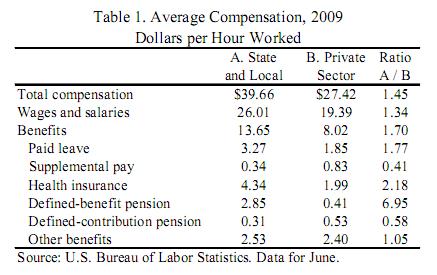
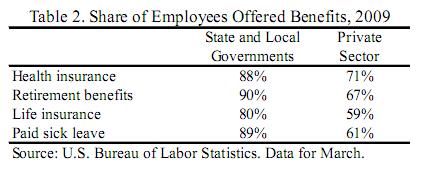
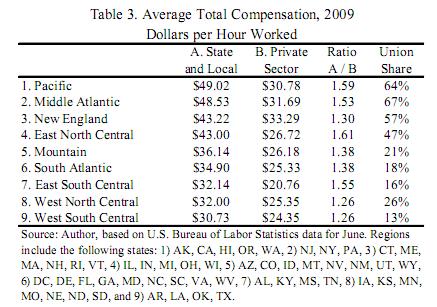

As John Carney and Kamelia Angelova (who produced the above chart) explain:
We've gone from providing jobs in profit-making private industry to providing jobs in profit-eating government work. Toward the end of 2007, the total number of government jobs exceeded the total number of goods producing jobs. Welcome to the government payroll economy.Yup.
January 4, 2010

Re: A New Year Begins...
Trying to effect change in Rhode Island at even the local level has been a monumental struggle with almost no success to show for it. Frankly, after years of trying, I have concluded it is not worth the effort.
I crossed the state border again this Fall, this time leaving Rhode Island permanently. I recommend it highly. It's relatively easy, too.
And it is liberating to rediscover that the need to fight the colossal failure that is Rhode Island is optional.
It appears that nothing will change until there is a total collapse. So let the rats go down with the Rhode Island ship. It's apparently the only possible way to get rid of them.
It's sad, isn't it? Because it did not (and does not) have to happen that way. Which is a common conclusion when looking retrospectively at crises.
Meanwhile, some (updated) previous reflections:
Meaningless talk and inaction in a crisis: Why Rhode Island's crisis will get worse before it gets better & what to do about it
Lessons for Rhode Island from Silicon Valley: An historical reflection on an actual innovation economy
Innovation and the entrepreneurial business culture revisited
December 30, 2009

Morfessis Withdraws as EDC Director
WPRO news (630AM) and Projo 7-to-7 are reporting that Ioanna Morfessis has withdrawn herself from the Directorship of the Rhode Island Economic Development Corporation, citing a family medical concern.
December 28, 2009
Economy for Better and Worse
My thesis is that economic predictions are currently being made after the method expressed by respondents to a recent Providence Business News survey:
A sense of nervousness can be gleaned from the results, but the respondents also maintained the optimism that came to the fore in the summer 2009 survey. Many in the business community say that hopefulness is a byproduct of the feeling that Rhode Island can’t go much lower.
Things will get better because they always do. Right? The economy can't go much lower because it never has. It would be historic. Catastrophic. Well, I'm not predicting the end of the world, but the simple reality is that no economic mechanism of which I'm aware automatically kicks into gear when hard times top the Great Depression. Until we're hunting rats in the streets of Providence for food, the reality is that Rhode Island can go much lower.
Of course, one non-automatic mechanism that would help the state can be discerned in the survey's results: The pain could become so acute, and so clearly attributable, that state and local leaders will make it easier to live and do business in the state, lowering the unnecessary costs and lightening the misguided burdens that the state imposes with taxes, mandates, and regulations. A resolution by those whom Hasbro and Lifespan Chairman Alfred Verrecchia called "the collective leadership," in his keynote speech before the Rhode Island Public Expenditure Council, to set Rhode Island's economy free through rapid deregulation and dramatically shrunken government could make our state a bright spot in a dark region of a fading country.
The problem — the central flaw in Verricchia's reasoning and in the reform-by-consolidation movement to which he's contributed — is that the leadership class is going to do no such thing. Self-insulation and death-grip protection of special interests — coupled with the utter lack of a political price for their calamitous failures thus far — are going to keep RI's aristocrats marching along the same path, and the mechanisms of consolidation — moving government farther from the individual taxpaying voter, fiddling with the tax code without reducing its all-around burden, and paying out large sums to unelected administrators at the top — are all contrary to the prior necessity to end Rhode-apathy and cultivate a new collective leadership group that can wrest control of the government from incumbent hands.
December 23, 2009
What the EDC Can't Do
Yesterday, shortly before the 5:00 hour, Dan Yorke referenced my post about the elimination of the Rhode Island Economic Development Corporation, suggesting (in a very friendly manner) that I've lost my mind. As readily as I'll admit to my own insanity, my point is worth defending.
The critical question is what, exactly, the EDC would have to do to be successful in its mission, and Dan suggested the example of coming up with a more economically productive tax code and putting the General Assembly on the spot to enact it. There are certainly a variety of other actions that the EDC can and will take, but this one stands as an excellent test case. Putting aside private organizations, such as think tanks, that undertake such missions of their own volition, from the government's perspective, it's a political task. It belongs under the auspices of elected officials, such that the governor (say) will propose and promote a change and the General Assembly will pass or obstruct it, allowing the voters to decide whom to support.
Adding a powerless quasi-governmental agency into the mix accomplishes nothing. The politicians — who actually have the power to enact new policies — can put their fingers to the wind, enact select provisions from the proposal, and then scapegoat the EDC if things don't work out, as would surely be the case once entrenched interests distort the original, coherent plan. An even worse outcome would be if the EDC somehow managed to collect the power to enact changes over the heads of elected officials, because special interests would then have an unelected target on which to focus for lobbying and manipulation.
Apart from the EDC, Dan mentioned ending welfare-state programs as a necessary component of reform, and while I agree with that suggestion, I'd emphasize the broader necessity of eliminating the mentality that we need to be taken care of. That sort of cultural shift must start with the voters and their representatives; there is no shortcut. Setting up the EDC as a potential savior organization is at best dilatory and at worst apt to exacerbate apathy and reinforce habits of dependency.
December 22, 2009
We Need Smaller, Smarter Government, Not More of the Departments We Prefer
Count me in agreement with Scott Moody, Fellow for Economic Policy at the Ocean State Policy Research Institute:
Where should the state government begin its spending cuts? One way to cut spending is to eliminate programs that have proven to be ineffectual. Consider the example of the Rhode Island Economic Development Corporation (EDC), whose primary goal is to create jobs. However, given that Rhode Island has the third-highest unemployment rate in the country, the efficiency of this program is highly suspect.Eliminating the EDC would save about $10 million per year. Some may consider that a paltry sum for such an effort. Yet, if that money was applied to reducing taxes, the state could nearly eliminate the alcoholic beverage tax ($11.5 million) or documentary and stock transfer taxes ($10.4 million), which are taxes on transfer documents such as mortgages, deeds and stocks. These small taxes are especially egregious because they act like bits of sand in the cogs of the economy.
Try to envisage what the EDC's presumptive big-salary director, Ioanna Morfessis, might target as evidence of success: While she'll certainly look into policies to support incremental, smaller-scale improvements among small and innovative businesses, the nature of her office and its powers suggests that she'll also look to make some splashes by luring a large company or two to the state.
If anything, Rhode Island should already have learned how flawed that approach can be. We don't need special deals to attract new special interests. We need changes in the core laws and policies affecting the state's economic environment overall, and for that, a public bureaucracy isn't necessary.
December 21, 2009
15 Ways to Leave Your Corruptor
Capers Jones makes 15 suggestions that are worth considering toward improving Rhode Island's economy, in yesterday's edition of the Statewide Coalition's daily RISC-y Business newsletter. Jones unequivocally places us in the conversation that we ought to be having across the state.
Of course, that doesn't mean that everybody has to agree on every item, and several of his points pick up the consolidation theme about which I'm supremely skeptical. Consider:
9. Consolidate our department of transportation with either Massachusetts or Connecticut. Our DOT is dysfunctional, expensive, and has little value.
Here's a question I'd offer as decisively opposed to such a plan: Of the players in the public-sector battle, who would be better able to work the levers of a big-dollar, multistate public agency — taxpayers/voters or unions? There's no contest at all. Unionized labor will have the motivation of billions of dollars funneled to a relatively small group, while taxpayers will only have the motivation of a small portion of their total taxes, now entirely pulled apart from the many other issues that motivate voters, because those differ from state to state.
Jones also suggests consolidating schools and reducing the number of towns, cutting the General Assembly to a grand total of fifteen legislators. In a state with our specific problems of voter apathy and strong, statewide special interests, it'd hardly be worth coming up with a point spread to wager on the outcome of that centralized battle for a handful of powerful positions.
December 18, 2009
Unemployment, Jobs, and Taxes
We'll have to await more-descriptive data, but the latest on unemployment in Rhode Island suggests that the state may have found the key to lowering its rate. Indeed, for November, unemployment fell 0.2%, to 12.7%, and 2,100 more Rhode Islanders are working. The available information isn't yet sufficiently granular to know how many of those newly employed folks are seasonal temps or part time or how many people gave up on job searches, last month.
Still, it may be that we've been too harsh on Senate Majority Leader Dan Connors and Senate President Theresa Paiva-Weed. Along with the above statistics, employers report having eliminated 1,300 jobs. Additionally:
... despite the improved unemployment figures locally, DLT said the average weekly claim load for unemployment insurance benefits climbed to 36,281 in November, a gain of 2,295 — or 6.7 percent — over October's average because of increased eligibility.
It appears, in other words, that the way to bring down the state's unemployment rate is to drive people out of the job market and out of the state more quickly than we lose jobs. Theoretically, if there were zero non-government jobs, we could still have a zero percent unemployment rate.
So let's have those tax increases for which legislators have been floating trial balloons. After all, we've got to fund those who've decided that they don't even care to look for work, and the more pesky unemployed ambitious people whom we can remove from our statistics, the better we'll feel.
December 17, 2009
And Then the Other Side
From AP writer Ray Henry's ">report, it looks like RI Senate Majority Leader Daniel Connors drew the short straw:
"I think we need to look at all of our taxes and determine, you know, those that could be changed to provide sufficient revenue for the state to provide its services," Connors said during a Statehouse interview.
You know, we'll just find a way to take "sufficient revenue" from the people of the state. That's all. Easy.
Of course, Senate President Teresa Paiva-Weed stands right with Connors and is apparently in need of a civics lesson from the people's perspective:
"Essentially, the proposal the governor is making is we're going to cut taxes with the left hand ..., income taxes, and we're going to increase property taxes," Paiva-Weed said.
Note that Paiva-Weed makes no distinction between the scope of her tier of government and more local tiers. The Democrats are trying to protect their public-sector union pals at the municipal level by shifting the narrative to insist that municipal leaders have no choice. They do, and so do their local constituencies.
December 15, 2009
Another Link on the Chain Binding Small Businesses in Rhode Island
The governor should veto this legislation:
Legislation approved by the General Assembly in the waning hours of a special session in October could transform the work force for large public projects in the state.The bill would limit the number of apprentices employed on certain building projects by requiring that a higher share of more experienced journeymen workers be hired.
My understanding, from when the General Assembly debated the issue, is that reporter Alex Kuffner's assessment of the scope of the legislation is far too limited. For instance, the language cites residential projects. The determining factor is whether the contractor participates in the state's apprenticeship program.
The bottom line is that this sort of regulation — which the state should be shedding, not installing — helps large, established companies keep their prices (and, therefore, the cost to businesses and residents of construction) up and safeguards the strangulating negotiated salaries of union workers. For all the talk about small businesses' being the "lifeblood" of the state's economy and the necessity of "targeted" tax breaks for small businesses, when it comes down to it, Rhode Island's aristocracy doesn't prioritize economic opportunity.
The governor should veto this legislation.
December 12, 2009

Can't See the Jobs for the Tree Stumps
Gerry Goldstein reports in Thursday's Valley Breeze that State Senator John Tassoni wants to kill the North Central State Airport.
But Tassoni, who represents some of Smithfield and North Smithfield, termed the airport "a thorn in Smithfield's side" that generates no revenue for the town, is an eyesore because of extensive tree cutting there, and disturbs some residents with flight activity between 3 and 5 a.m. "It looks like the Johnston landfill," said Tassoni. "If I had my druthers, close it down, sell it, and develop it." ..."You can't leave it like that. You're not going to attract good corporations the way it looks with all those tree stumps," he said.
Discussion about the future of the North Central State Airport was sparked by EDC's applause-worthy efforts to identify and catalogue "potential office and industrial sites" around Rhode Island.
[EDC Interim Executive Director of the EDC J. Michael] Saul said his agency is "very supportive" of North Central because it can help attract corporations to this part of the state, which he called a "sweet spot" for economic expansion and job creation. ...[The study] sees the Route 146 area as suitable for "manufacturing, selected warehousing, and small to medium offices, noting that "a large manufacturing facility with land is for sale (and) several parks are being developed."
Note that this is the EDC's list of potential manufacturing and business sites in Rhode Island, not the EDC's Sightseeing Guide to Scenic Rhode Island. Corporate types flying in and out of North Central will be focused not on tree stumps or irrelevancies along the flight path but on business prospects and the attendant details. (This translates into jobs and a larger tax base on both the state and local level.) For the sake of his constituents and the state as a whole, Senator Tassoni may wish to broaden his field of vision correspondingly.
December 9, 2009
Only High-Paid Executives Need Apply
We can all appreciate the benefits, from an administrative point of view, of bringing in strong-willed people to help shock some of the Rhode-apathy and corruption out of state government, but we're barely three months past this announcement:
Less than a day after a Supreme Court justice blocked the first of 12 proposed government shutdown days, the state has imposed a complete hiring freeze, with no exceptions made for even the most critical jobs.
So how can Governor Carcieri justify this, from the Providence Business News:
The R.I. Economic Development Corporation's board of directors voted unanimously Tuesday morning to appoint Ioanna T. Morfessis, a consultant from Phoenix with a Ph.D. in economic-development policy, as the agency’s next executive director. ...The board voted to give Morfessis a three-year contract that will pay her $250,000 a year plus benefits. The state also will cover her relocation costs and provide her with an automobile.
Morfessis' compensation would be more than double that of the EDC's last executive director, Saul Kaplan, who made just under $100,000 a year before he resigned in December 2008.
It's beginning to seem as if the only jobs in Rhode Island are for extremely high-paid government executives from out of state. Furthermore, as I suggested when Education Commissioner Deborah Gist was lured to the state with an outrageous compensation package, Rhode Island's executives appear to be suffering from a case of "employer's vanity" whereby the people who control hiring spend as much as they can as if salary and success are directly proportional.
To the contrary, we may be charging toward some unintended consequences: Strong-willed people — those with "big personalities," as Hasbro Chairman Alfred Verrecchia says of Morfessis — will often usurp what power they believe themselves to need to accomplish what they want to accomplish. With Rhode Island's leadership class demonstrably lacking in the spine and in the head, we may soon find ourselves being governed by an oligarchy of unelected directors. They will, no doubt, be competent and admirably focused, but not only must we remember that power corrupts, we shouldn't forget that our current stars will eventually hand all of the authority that they've grabbed over to somebody else.
December 4, 2009
Everybody's Got a Secret Plan
Last night, Matt and I mused on the unspoken and do-nothing plans of Rhode Island's leadership class when it comes to fixing the economy, Matt Allen Show. There's a related thread, here, to the conversation that Matt had been conducting during the previous hour, regarding Congressman Patrick Kennedy's support for micromanaging the credit card industry; Rhode Island is at the other end of the process whereby politicians seek to compile constituencies by promising to force other people to fund their lifestyles. By "the other end," I mean when the system begins to fall apart. Stream by clicking here, or download it.
December 3, 2009
Gordon Fox Has a Plan for Fixing Rhode Island's Economy…
…but he's not ready to tell us what it is yet, reports Ray Henry of the Associated Press…
[Gordon Fox], D-Providence, said he had proposals for reviving the economy but was not ready to discuss them.Rep. Fox, the current Democratic Majority Leader in the Rhode Island House of Representatives, is the frontrunner to replace current Speaker William Murphy, who has announced that he will not seek re-election for the 2011 legislative session."For me to sit here today and say we're going to do X, Y and Z, I think, is premature," said Fox, who is campaigning to succeed House Speaker William Murphy in early 2011. "I don't think it's fair to the members and it would be foolish of me to do that."
December 2, 2009
A Corporate Tax by Any Other Name
So, Governor Carcieri and his Director of the Department of Revenue, Gary Sasse, have switched from a "gross receipts tax," which would essentially be an expanded and hidden sales tax, to a "net receipts tax," which Providence Journal reporter Neil Downing describes as follows:
Under a net receipts tax, a corporation generally would pay tax on its revenue after claiming only a limited number of deductions (the number and nature of which have not been set). Thus, more of a business's income would be subject to Rhode Island tax. But a lower tax rate would apply, Sasse said. ...Sasse also said that any such plan would not harm the many small businesses that are organized as "pass-through" entities, such as limited liability companies and subchapter S corporations.
Sounds a bit like an expanded corporate income tax, no? Downing reports that the plan would be to "eliminat[e] at least one other tax, such as the state's corporate income tax, the sales tax or the personal income tax"; if it's not the first that goes, then Rhode Island would be killing its economy, not helping it. If it is the first that goes, it would essentially be a name change with the promise of future increases. Once the deductions are eliminated through the trick of changing what we call the tax, the General Assembly will find it a relatively simple matter to ratchet the rate up.
Suppose that the income tax is what's eliminated. Corporate entities will have an irresistible incentive to organize as pass-through entities, which will limit their ability to expand and ultimately undermine estimates of the revenue that the state receives from the "net receipts tax," because more income will flow to the untaxed channel. (Except for the restraint on expansion, that's not an unattractive outcome, but it will ensure the continuation of continual budgetary shortfalls.)
And if it's the sales tax, we're left with a gimmick that increases prices and shifts the tax burden to businesses from out-of-state consumers.
The faster Rhode Island's leaders come to the realization that there is no easy way out of this mess, the better off we'll all be. Taxes have to be cut, not reconfigured. Regulations have to be relaxed. And mandates have to be rescinded. Start selling that message now, because it's going to be a long, hard fight. Tossing out a new taxation buzz-phrase every few months merely delays decisiveness and confuses the public.
December 1, 2009
Too Much Fish Giving
Maybe it's my surfeit of familiarity with this sort of story, or maybe it's living through the worst recession of my lifetime, but this sort of comment, from a story about a woman protesting on behalf of the homeless by staying in a tent on the State House lawn, is increasingly jarring (emphasis added):
But housing advocates say the plan [to add beds to homeless shelters] doesn't go far enough. According to the Rhode Island Coalition for the Homeless, the state's shelters were beyond capacity in late October, while nearly 80 people slept outside. The homeless population will grow as the economy worsens, said coalition director Jim Ryczek, who has asked to meet with Governor Carcieri to discuss the issue.
Why isn't Mr. Ryczek advocating for an overhaul of economic policy — removing burdensome regulations and mandates, reworking tax policy to create pro-growth incentives, and so on? Clearly, the single most effective method of helping the homeless would be to increase the number of jobs available to them. Shouldn't that be the subject of advocates' conversations with political leaders?
November 23, 2009
An Oversold Index
Whatever its retrospective analytical utility, URI Economics Professor Len Lardaro's Current Conditions Index seems pretty useless as a gauge of future trends. The news reports that use it simply make no sense:
The Current Conditions Index dipped to 33 in September from 42 in August. ..."While Rhode Island will not emerge from its recession until the first quarter of next year, the foundations for an eventual upturn are beginning to fall into place," he said.
What foundations? Lardaro's optimism derives from the index's improvement from last year, when it was alternating between 8 and 0, but the current year figure is relative to that period, so our economy is still shrinking. If last year was terrible, we're now doing worse than terrible.
November 22, 2009
Rhode Island's Unemployment Picture: Ahead of Lowly Michigan in One Way but Behind in Another
The good news is that with the highest unemployment rate in the country, Michigan still beats out Number Three Rhode Island. The bad news is that they also beat us on a positive front.
Paragraph four of the possibly over-optimistic ProJo article that Justin highlighted has Rhode Island's status in this area.
And the state continues to bleed jobs, losing 1,100 more in October, a separate survey of employers shows
And ABC News notes the Michigan element that the Ocean State lacks.
It wasn't all bad news for state, however: Michigan was one of six states, according to the government, to see significant job gains between September and October. With 38,600 new jobs, Michigan came second only to Texas in payroll increases.
So while their overall unemployment rate is higher, Michigan gained new jobs while we lost.
It is to be hoped that current members of the General Assembly have the fortitude to undertake the structural changes that decades of preceding G.A.'s have cravenly dodged. In the absence of a reformation of the business and regulatory climate, Rhode Island will continue to lag behind other states with unenviable economies in certain indicator areas as evidenced by an ongoing shedding of businesses, jobs and (Ground Control to Major Tom) the corresponding tax revenue.
November 20, 2009
Unemployment Down, Lack of Jobs Up
One wonders whether the editorializing in this Projo report of unemployment numbers follows some sort of template, because it's otherwise difficult to understand:
For the first time in nearly three years, Rhode Island's unemployment rate dropped, to 12.9 percent in October, offering a faint but reassuring sign that the state's economy may be on the road to improvement.
But in paragraph four:
And the state continues to bleed jobs, losing 1,100 more in October, a separate survey of employers shows. The work force also contracted, a potential signal that some of the most discouraged workers may have given up looking for work entirely.
How can it possibly be "reassuring" that the unemployment rate slightly decreased because thousands of people gave up their employment searches? Theoretically, unemployment could approach zero as the population admits utter economic ruin.
November 18, 2009
Rhode Island Must Solve This Problem
Here's the Budget Office document showing the always-too-optimistic early revenue estimate for the state of Rhode Island: PDF. As you've likely read, the deficit is projected to be $219.8 million. It wouldn't be surprising to find that number come in hundreds of millions of dollars too low.
The reality is that Rhode Island has to cut a structural billion dollars out of its budget. Over the past few years, we've been chasing a sinking chest deeper under water.
Table 3, on the last page of the PDF, shows the decreases in revenue by source. Wading through the sloppiness of the table (mostly misplaced and missing minus signs and parentheses), the take-away is that raising taxes is not an option. Revenue is shrinking because people are doing less of the things that generate it. What's frightening is that Rhode Islanders don't seem interested in doing anything about it.
November 13, 2009
Re: What Sort of Hope Are We Talking About?
Believe it or not, I think that Justin was being too kind to Rhode Island's leadership class yesterday, when he said that…
Strictly speaking, it probably isn't accurate to say that the "housing crisis" caused the recession, in Rhode Island. Rather, the housing bubble disguised a weak economy that would otherwise have begun its dramatic slide several years earlier,...as two years ago, there were already numerous indicators showing Rhode Island to be an economic basket case…
…as URI Economics Professor Professor Leonard Lardaro just noted" URI Economics Professor Professor Leonard Lardaro just noted, while Rhode Island's economy has been contracting, the national gross domestic product has been growing by 4%.Rhode Island's problems weren't disguised, as much as they were ignored. Indeed, for the better part of decade at least, Rhode Island leaders have been responding to obvious signs of fiscal and economic peril by saying hey we're Rhode Island, we're destined by forces beyond any control to be a little slower, a little more expensive, a little more inefficient than other places.…as the National Governors' Association noted in June, Rhode Island was one of only three states that couldn't cover its beginning-of-the-year projected spending for fiscal year 2007 -- if Rhode Island's fiscal problems are rooted primarily in a national slowdown, then why are 47 other states able to stay within their projected budgets when Rhode Island can't?
…as the Rhode Island Public Expenditures Council noted in their analysis of Rhode Island's current operating budget, spending from general revenues in fiscal year 2008 increased by 5.7% over the previous year. How exactly is it reasonable to assume that it will take something as dramatic as a recession to prevent revenues from automatically "keeping pace"...with 5.7% expenditure growth?
Whether you want to call it the "What Can We Do?" attitude prevalent amongst RI public officials (Justin's description) or the "putrid Rhode Island gene" (WPRO host Matt Allen's description) or an endogenous attitude towards the surrounding world (URI Economics Professor Leonard Lardaro's description), it is these kinds of attitudes towards the possibility and the necessity of reform held by too-many Rhode Islanders in power, and not immutable iron laws of economics, that cement Rhode Island's position as first in and last out of economic problems.
November 12, 2009
What Sort of Hope Are We Talking About?
The person who emailed me Ted Nesi's Providence Business News article about the Pew research study that Andrew mentioned this morning began his email, "Hope you're well. Off..." At first glance, I misread that as, "Hope you're well off." That might be a fitting new motto for the state. (Is it too late to get it on the next ballot?)
Frankly, I'm not sure that even the folks sounding sirens about Rhode Island's economy and government deficits have the right mindset to address the problem. As Nesi quotes from the report:
"The country's smallest state has big problems," the report said. "It was one of the first states to fall into the recession because of the housing crisis, and it may be one of the last to emerge, hampered by high tax rates, persistent state budget deficits and a lack of high-tech jobs."
Strictly speaking, it probably isn't accurate to say that the "housing crisis" caused the recession, in Rhode Island. Rather, the housing bubble disguised a weak economy that would otherwise have begun its dramatic slide several years earlier.
The California of New England, but Not in a Good Way
Here is the Christian Science Monitor's bleak summary of the results of a rapidly-circulating Pew Center on the States report, which says that 9 other states are facing California-like fiscal disaster in the near term…
The “great recession” may be over, but its impact on state governments is still unfurling – and could threaten America’s fragile economic recovery…Rhode Island is one of the nine, achieving a score of 28 out of a possible 30 points for Californianess.The Pew Center on the States released a report concluding that nine states have joined California in a condition of “fiscal peril.” Their budget troubles could cause a round of job cuts and tax hikes in states from Florida to Illinois and Oregon.
A link to the entire report and report summary is available here.
November 11, 2009
"Why Do I Live Here?"
That's a question that Rhode Islanders must be asking themselves almost on a daily basis.
It's not just that the November Revenue Estimating Conference set the baseline for the current year's budget deficit at $200 million. It's not just that, but for one-time fixes, the state government would have run deficits for several years even before the recession. It's not just that, as recently as two weeks ago, the General Assembly continued to pass legislation restrictive of businesses and the economy. It's that legislators still get away with junk like this, from the first link above:
"It's extremely bleak," said House Finance Committee chairman Steven M. Costantino, considered the legislature's budget architect. "Let's hope at some point this stabilizes."
Hope? That's it? People are losing their jobs, their homes, their health insurance because of you, Representative Costantino. Because of the damage that you have done to this state — in part (but only in part) because of your utter incompetence. If your constituents in Providence had any civic awareness whatsoever, they'd give your seat to a dog from the local animal shelter before returning you to the State House.
"Let's hope this stabilizes." News flash: You're a representative — the chairman of the Finance Committee — and Rhode Island's government is the fundamental contributor to our problems. How about you set your sights on stabilizing it.
Was there no one whom Providence Journal reporter Steve Peoples could contact for the article to call Costantino on this?
November 10, 2009
Looking at a Big "L"
How fast can economists downshift expectations? Well, in just a few weeks, we've gone from this:
[Edinaldo Tebaldi, assistant professor of economics at Bryant University] and Edward Mazze, distinguished university professor of business administration at the University of Rhode Island, will give a somewhat gloomier forecast for the state at a conference next month in Boston organized by the New England Economic Partnership. They predict the jobless rate to rise to at least 13.5 percent and hover there next year. By 2011, it will fall, but only to around 12 percent, their preliminary calculations show.
To this:
The state will shed an estimated 9,000 more jobs in the coming year, and unemployment rates will keep creeping up, hitting a high of 14.1 percent in the second quarter of 2010. Housing prices, meanwhile, will struggle in the short term before beginning a slow climb, starting in 2011, a report from the New England Economic Partnership, a nonpartisan forecasting group, predicts.
Of course, by way of assessing credibility, here's what the same crack squad was saying a year ago:
The latest jobs report is grim even in light of the economic forecast released yesterday by the nonprofit New England Economic Partnership. The NEEP economists predicted that during the next two years, Rhode Island would lose nearly 15,000 more jobs and unemployment would hit 10 percent, probably by the end of next year.
Mazze says we're looking at a U-shaped recovery. Face reality, Rhode Island: Until you radically change the way this state operates (and who operates it), we're looking at an indefinite L.
November 5, 2009
Students Aren't Economic Gurus
As a follow-up to this morning's post on Rhode Island's need to get out of the way of its economy, Tabetha recently offered a comment in our discussion of the economy and higher education to which I'd like to return:
If RI wants to keep college grads, the number 1 need is pretty simple: have jobs in the most popular fields available. Without jobs in their field, recent grads have no reason to stay in RI. It would make most sense to analyze the most popular majors and then try to attract businesses that would hire graduates in those areas. RI has a high unemployment rate and I suspect that a dearth of employment opportunities in popular fields of study most affects the decision to leave town. After 4 years (or more) of study and the probable accumulation of student loans, I doubt many recent grads are going to be content to work the counter at the local Dunkin' Donuts.
This approach comes at the problem from the wrong perspective. Students choose their fields of study for a variety of reasons, ranging from personal desire to experience with adults' careers to advice and research about economic directions. Even to the extent that a college degree dictates a particular industry or type of business (which is less and less the case), the student's research and preferences are not the most reliable criteria on which to build an economy.
It's like giving the folks in entry-level positions a decisive say in the company's big-picture management. To the contrary, the people who have invested their years and their fortunes in a particular business are the ones best suited to say what it should do and where it should be located.
Again: Rhode Island's focus should be on getting out of the way of people who are willing to imagine and build the economy, not on allowing government functionaries to try their hand at economic prognostication or selecting an array of jobs that might dazzle young adults who know little about the way of the world or even what a career should look like.
Drowning in Desire for Other People's Money
The state of Rhode Island's revenue take is like a chest of treasure sinking to the bottom of the ocean, and some folks are intent on having us all chase it to the bottom:
"We've already been cutting, cutting, cutting," said one of the few people watching Wednesday's discussion, Russell Dannecker, fiscal policy analyst for the Poverty Institute at Rhode Island College. He cited a study by State Policy Reports that reports 29 states have proposed tax increases for the coming fiscal year.
Frankly, Rhode Island has to stop "cutting, cutting, cutting" around the edges and give some serious thought to wholesale excisions of programs. Information from the first link above illustrates why that is the necessary direction:
Among the highlights of Wednesday's presentation:
- Collections from the state's business-corporation tax plunged to $4.5 million from $14.8 million in the same period a year earlier, a $10.3-million drop.
- Sales-tax collections fell by $19.77 million, or 6.6 percent, to about $278.6 million.
- Net receipts from the personal-income tax (after refunds and other adjustments) fell by $14.3 million, or 4.5 percent, to $307.8 million.
The number 1 job of the state government must be to do whatever it can to help Rhode Islanders make money. The quick first step should be to cut taxes, and the larger step, still expedited, must be to slash regulations and mandates. We cannot afford to govern ourselves as we've been doing.
October 30, 2009
The Time for Investment Has Passed; Now We Need to Produce
Can't Republicans at least agree that the last thing the state needs is more government "investment"?
Governor Carcieri Friday morning said Rhode Island must invest more in higher education and mentoring programs if it wants to encourage young, educated people to stay here for the long haul."As you invest in higher education, you make a statement to young people about what you value and what's important to the state," Carcieri told the crowd at the Knowledge Retention Symposium, a gathering at Brown University focused on preventing what's known as brain drain in the Ocean State.
Even within the brief article is evidence that the governor is misassessing the actual problem, with the following from Providence College President Rev. Brian J. Shanley:
"I hear this all the time and it drives me crazy. They come to Rhode Island to these great institutions and they fall in love with Providence and the state of Rhode Island, but they don't think this is a place they can stay. They think this is a launching pad to New York or Boston, or Chicago and Washington, and it's critical to the future of our state that our students, when they come here, think 'This is a place I can stay.' "
The students are already coming; the problem is that they leave, and to the extent that further government investments (read: taxes and bonds), regulations, and mandates continue to hinder the Rhode Island's private sector, the state will continue to circle the bowl and graduates will flee before they're sucked in.
A Black Spot in the Northeast
Rhode Island's saving grace, on this sort of graphic showing state-by-state unemployment rates, is that the folks creating the images continue to use "higher than 10%" as the top category. So, a baker's dozen of other states have joined us in that group, but conspicuously, none of them are north of the Carolinas or east of Ohio. We're a little black dot in a sea of purples and maroons.
Imagine what would happen if we made a concerted effort to shed our business unfriendly image... instead of continuing to elect legislators who are apparently intent on pushing us in the other direction.
October 29, 2009
Don't Turn on Capitol TV
I made that mistake, and the House is debating H5582, which would mandate the number of apprentices who can be supervised by journeymen in trades. Majority Leader Gordon Fox just gave an impassioned speech about good workmanship, living wages, people of color, etc. In short, it's a lot of rhetoric by people who have no idea what they're talking about.
The simple economic fact is that the proposed ratios are ludicrous wastes of opportunity that will protect large, union contractors and prevent small entrepreneurs from advancing. Reviewing the legislation, it wouldn't be outlandish to suggest that special interests are attempting to adjust the market because Rhode Island's commercial market is drying up.
Every crew working on a residential job would require one journeyman or master for every apprentice.* You don't need to have experience with construction sites to understand that bricklaying is the sort of work that allows an experienced guy to supervise several workers of varying experience somewhere below the level of journeyman. (Often such workers have enough experience to become journeymen but fall short by some other criterion.)
Carpenters. Laborers. Painters. Glaziers. All would be one to one on residential projects, under this bill. That's crazy, and it is very suggestive of ulterior motives that there's no difference from trade to trade.
Rep. Trillo and my representative, Jay Edwards, who actually works in construction, are trying to explain how a jobsite works to the rest. Deaf ears, I'd say.
This is why the state is in its current condition and getting worse every time this legislative body meets.
* There's been some talk on the floor that the residential ratios only apply to projects with four or more units, but that appears to only apply to certain trades, including (for example) sheet metal and pipefitters, but none of those that I list above.
ADDENDUM:
Edwards made the point that it's difficult to get apprentices, anyway, hypothesizing the reason as a desire to go to college. Part of that desire, I'd propose as somebody who entered the trades after receiving a college degree and working in offices for a couple of years, results from the lack of clear and quick opportunity in trades.
A number of years ago, I explained how Rhode Island's approach to licensing results in fewer tradesmen than our neighboring states — specifically in terms of the hurdles one would have to clear upon identifying a particular trade as a market opportunity:
Starting everybody green, and assuming everybody passes the tests immediately, after 12 years, Rhode Island's system will have turned one master plumber into four masters and four journeymen, able to take eight apprentices. The Massachusetts system? Double in every category. Not only will twice the customers receive service, but twice the unemployed people can step onto the career path. Moreover, the gap ripples outward into the economy in innumerable forms — from the cost of home renovations to the rates of pay for less-skilled jobs.
If the trades were such that smart people could hop in, learn the profession at a self-direct pace, and quickly turn the job into a profitable career, more would make the attempt. With labor laws and union influence as they are, the choices are skewed. As a young adult graduating from high school, would you rather work full time in crawl spaces and bathrooms for five years while taking night courses in order to become a master plumber or party for four years and do enough classwork to get a degree that opens a door into an air conditioned office in which you'd begin learning an actual occupation only generally related to your education?
ADDENDUM II:
The legislation passed by a healthy but not overwhelming majority. The governor should veto this particular bill. The voters should upend the legislature.
October 27, 2009
The Method Is the Message, in RI Recovery
Reviewing a recent RIPEC study (PDF), Brian Hull pulls back from the most relevant question:
When we look at the 2007 Per Capita Personal Income for RI, MA and CT we find the following: Rhode Island is $39,829, far less than Massachusetts ($48,995) and Connecticut ($54,981). The per capita personal income of MA is a little more than 23% than that of RI. Likewise, the PCPI of CT is 38% more than RI. With these numbers, it's easy to see why general expenditures per $1,000 of PI is higher in RI than in MA and CT. There are fewer "$1,000s of personal income" here to support the government's expenditures.Does this make the expenditures more expensive, or even less necessary? No. It just means that, as a society, we earn less money than our neighbors to fund these services. All things being equal, if we raised the per capita personal income in the state, then the spending per $1,000 of personal income would decrease. We should aim for that!
An interesting tidbit of information that I learned from Tom Sgouros, in his book "Ten Things You Don't Know about Rhode Island," is that blue-collar, working-class jobs in the state pay much less than comparable jobs in MA and CT. This is in contrast to the relative equivalent salaries earned by professional, white-collar jobs (even though RI still earns a little less). And this helps explain why RI earns less, but that's a discussion for another day.
His heavy reliance on Tom Sgouros notwithstanding, Hull presumably does not buy into the idea that our problems require the reduction of spending through consolidation and the like. After all, consolidation, of itself, will not prime the job-creation machine, and it will not bring Rhode Island salaries up to the levels of our neighboring state. It is not, in other words, the reason that Rhode Island fares so much more poorly than the states by which we're engulfed. Since the problem is too few $1,000s — not who holds them — the answer cannot be that our tax structure doesn't take enough from the rich (which is nonsense, anyway).
If he asks the right questions, Hull may be dangerously close to agreement with we who believe that Rhode Island's government must get out of the way of its economy. Schemes that allow for continued regulations and mandates and wealth redistribution will fail. Have failed. We cannot mandate that people have more money. We have to allow them to make it.
October 26, 2009
What's Ailing RI?
John Kostrzewa's description of Hasbro Chairman Alfred Verrecchia's speech at the recent dinner hosted by the Rhode Island Public Expenditure Council brings to mind a few questions:
"Unless we change the way we do work we will not achieve long-term sustainable cost reduction nor will we eliminate the structural budget deficit and be able to provide a more competitive and stable tax environment," he said. "... We can't afford to have 39 fire, police and public works departments; we can't afford to have 36 school districts. We need to consolidate the backroom activity of government at both the state and municipal level."
Presumably, Rhode Island once had a stable economy and a sustainable public budget; did it have fewer towns and school districts, then? On the matter of structural budget deficits, does Verrecchia have evidence that consolidation would save towns — some of whose total budgets are only in the tens of millions — the hundreds of millions that the state's budget is perpetually lacking?
Lastly, would consolidation solve this problem, enunciated by Ed Mazze, or would solving this problem be more likely to end the structural deficit?
In Rhode Island, there is a high underemployment rate since virtually no jobs have been created since late 2007. Some of the underemployed remain in Rhode Island rather than look for jobs in other states because their spouses have good jobs and they want to focus on their children, the family or other personal matters. Presently, the average time it takes to find a job is longer than the time unemployment benefits are paid.
The whole consolidation thing seems faddish to me, and I don't see how it saves sufficient money or resolves Rhode Island's manifold problems.
October 20, 2009
The Slow, Painful Burn of a Dysfunctional Government
Yesterday, at lunch time, two younger carpenters were discussing the dirt-cheap real estate that's available and one opined that now might be the time to buy, with values expected to increase in the near future. I suggested that they be cautious about assuming proximate economic recovery in Rhode Island, as if a healthy economy is some sort of natural state of being. In fact, I argued that a national recovery will drive Rhode Island deeper. Consider John Kostrzewa's article in the Sunday Providence Journal focusing on one small business — long in local history — that has no option but to close its doors:
That's one of the tragedies of Rhode Island's recession, now in its third year.Small businesses are disappearing at an alarming rate.
That's important because of the clusters of jobs that are lost, and the income, sales, property and other taxes that will no longer be collected to pay for state and municipal services.
It's also important because when the national expansion starts, there will be fewer Rhode Island companies ready to fill orders or provide services. It will take time for new small companies to organize, get financing and open to do business. That means Rhode Island's recovery will be slower and shallower than in other states that compete for the same contracts.
I wouldn't even count the delay in new businesses as the biggest concern: Rather, the likelihood that the sorts of people who would start new businesses and make them successful, as employees, will see recovery elsewhere as an opportunity to leave. Even if they don't follow local news and politics as closely as we all do, they pick up the general reality that nobody in government (with the mild exception of the outgoing governor) is even making substantial noises about fixing what's wrong with the state that they ostensibly run.
And the opportunity to make even minor shows of comprehension and concern are so plentiful that the negligence can only be deliberate. Back to Kostrzewa and the lamp shop that can't:
"It's not a friendly state to get people to come to," [store owner Patricia Lena] said, "If anything, they leave."She mentioned the inhospitable business climate. She said the inventory tax on unsold lamps left on the shelves was costly. She said at one stage of the business she would have liked to hire more employees, so she didn't have to work seven days a week. But the taxes, specifically under the workers' compensation law, made the cost prohibitive.
The current General Assembly — whose members the last election gave no electoral reason to change — is more likely to increase the burden on such entrepreneurs with "living wage" legislation and the like than to respond to their plight. Brace yourselves, Rhode Islanders; we're chasing an ignorant fantasy to the bottom of the well.
October 16, 2009
The End Not in Sight
Maybe there's something about an article that begins by saying that the now-13% unemployment rate in Rhode Island "fulfill[s] experts' predictions that the state's job market will get worse before it gets any better" and then proceeds to quote experts who keep adjusting their predictions to chase the dark reality, with the latest being as follows:
[Edinaldo Tebaldi, assistant professor of economics at Bryant University] and Edward Mazze, distinguished university professor of business administration at the University of Rhode Island, will give a somewhat gloomier forecast for the state at a conference next month in Boston organized by the New England Economic Partnership. They predict the jobless rate to rise to at least 13.5 percent and hover there next year. By 2011, it will fall, but only to around 12 percent, their preliminary calculations show.
My unscientific gut assessment, based on general understanding of the problem and the signals of people who could fix it were they not simultaneously clueless and corrupt, remains that we're going to 14% indefinitely — although I'm tempted to put Rhode Island's new status quo at 15%. Take, for example, a companion article about a RIPEC event at which neither of Rhode Island's legislative leaders appeared willing to do more than offer empty phrases in the dialect of their audience. At least Governor Carcieri called for abolishing the corporate income tax, but that's only a start.
Take, also, the latest tidbit related to the foolish illusion of the stimulus program:
The federal government reports that at least 30,383 jobs have been created or saved across the United States as a direct result of federal contracts made possible by the stimulus package signed by President Obama in February.Rhode Island, however, received just 6 of those jobs, according to federal data reported this week on the Obama administration's stimulus Web site, recovery.gov.
The Ocean State ranked dead last, even behind Puerto Rico (126 jobs) and the District of Columbia (370 jobs), in the national rankings.
To the extent that the "stimulus" has "created or saved" jobs, they are temporary — based on the continued provision of taxpayer dollars. And I'd hypothesize that Rhode Island's poor showing is evidence of the fact that our system is so constrictive that there aren't jobs waiting to be created, merely lacking investment. Rather, Rhode Island doesn't even have the machinery for job creation.
Sure, the article goes on as follows:
The numbers do not include, however, the number of jobs saved or created by stimulus dollars funneled through the state, which the state's congressional delegation said would exceed $1.1 billion and produce at least 12,000 jobs through transportation projects, green energy initiatives and job training programs.Those figures -- which will likely show many more jobs created -- will be released Friday, according to the Carcieri administration.
But consider one component of that effort:
The state Office of Energy Resources, which has received tens of millions of dollars in federal stimulus funds in recent months for energy projects, announced Wednesday that it is finally distributing about $15 million, largely to help weatherize homes for low-income people.
Most of the money ($12.2 million) is going through local "community action agencies" as a sort of income redistribution to low-income households in the form of home improvements. In other words, it's being processed through Rhode Island's corrupt system in perfect harmony with the entrenched poverty industry and union constituencies that latch onto this state as a sixty-pound tumor. At the very minimum, one can infer that the effect of the money will be greatly diluted by the imbalanced pay that union workers will receive to do the public work.
This project from the energy office, although relatively small, is even more indicative of the deadly thinking in state government:
$250,000 to the state building commissioner to develop new building codes that would require more energy-efficient houses. The money may also be spent on training building officials and contractors.
Apparently, it is now "economic stimulus" to contrive ways to make it more expensive to build homes. That's not stimulus — it's asphyxiation. And it's the way Rhode Island operates and will continue to operate for the foreseeable future.
Maybe 15% isn't a high enough prediction.
October 11, 2009
The General Assembly's Persistent Free Pass
It's one of those things that, once you've noticed, it's difficult not to see everywhere: How in the world does the General Assembly always manage to step forward as the great authority and protector without shouldering any of the blame or responsibility? Consider:
"Any way you slice it, [next year's budget] is going to have to focus on how we get the cities and towns to get by on less, do some of the same cost-saving things we're doing with state employees and do some consolidations," Carcieri said.But several Finance Committee members said they want to see more of an effort from state agency directors to cut their budgets before the administration targets local communities.
Why isn't the governor making allies of the cities and towns by hammering again and again the need for the General Assembly to get off their backs with mandates and regulations? And why didn't reporter Cynthia Needham redirect along those lines when the Finance Committee members tightened the rhetorical screws on the relatively powerless administrators?
Whatever the case, municipal and school officials had best be doing some screw tightening of their own, because the state apparatus is intent on bringing them down with the ship.
October 1, 2009
Shouldn't Consolidation Savings Go to Cities and Towns?
Could be I'm missing something, but Rhode Island Senate Finance Committee Chairman Daniel DaPonte's proposed solution to the state government's money problems sounds like an answer to a different question:
Offering a hint of what might be to come in the legislative session that starts in January, DaPonte said lawmakers must seriously look at "municipal and school consolidation throughout the State of Rhode Island" as a long-range cost-cutting measure.Legislators and Governor Carcieri have in the past called for merging certain municipal and school services, but rarely in recent years has a lawmaker with such standing suggested consolidation of different districts.
"It's too early to talk about what any final recommendations look like. But I think it's very fair to say that the numbers are large enough and the concern is enough that there are very, very serious conversations taking place about this," DaPonte said.
He declined to discuss what other budget cuts may be in store if revenues continue to fall.
Consolidation is a good feint, because Rhode Islanders across the political spectrum have a vague feeling that it would be a good thing — "Yeah, yeah, consolidation would save money." — but the only way helps with state fiscal problems is if the General Assembly sucks up all the savings. In the case of school districts, that means less state money per student, probably with the claim that the state is giving more money to each larger district than it had to each smaller one. In the case of municipalities, it means less assistance offsetting property taxes and even less money to account for mandates.
And that assumes that consolidation saves significant money, which isn't at all proven, as far as I'm concerned. Towns could secure most of the savings through joint purchasing agreements and the like.
Only one thing can keep this state from a perpetual decline in the decades to come: economic activity. For that to be a real possibility — beyond reverberating ripples from national growth — the General Assembly is going to have to overhaul our tax system, erase the long list of mandates on towns, residents, and private businesses, and take a big red marker to the regulatory regime. Of course, that would require enduring the howls of special interests and undoing the pet bills for which legislators sold their souls.
September 26, 2009
This Extended Recession Brought to You By: The General Assembly and Friends
The Providence Business News points to a Forbes article that puts Rhode Island at the leading edge... of business unfriendliness. Yup, we rank number 50 on a list of the Best States for Business, with the following subranking:
- 2008 rank: 45
- Business costs: 40
- Labor: 35
- Regulatory environment: 50
- Economic climate: 48
- Growth prospects: 18
- Quality of life: 21
Providence Business News attributed the higher ranking in growth prospects to "projected growth in jobs, incomes and economic output, as well as its rate of net new businesses and venture capital investments." One should keep in mind, though, that when you're at the bottom, like Rhode Island, growth rates should be easy to come by. It would be useful to know, too, when the work for this list was performed; the change in our capital gains tax won't likely help when it comes to "venture capital investments."
September 24, 2009
A Rhode Island Business Tale
It doesn't appear to be online, but a story in the current Sakonnet Times tells the sad tale of entrepreneurialism in Rhode Island:
During their years spent trying to establish a beachhead in Tiverton's hospitality and business community, the couple hired architects, lawyers, and engineers, and jumped through permitting hurdles with the Coastal Resources Management Council, the Department of Environmental Management, the Department of Transportation, the local planning board, the zoning board of review, the town council, and the town zoning and building official. ..."There are several reasons [we're giving up], one of the main is best described as investor fatigue. Due to the extraordinary amount of time and expense required at the state and local levels, as well as expensive restrictive conditions put in place by town officials, the funding for the project has been pulled," said Mr. Rivera.
"Another consideration," he said, "is the condition of the local economy, local political makeup, and the larger economy as a whole. We have been advised this is not the right opportunity at the right tie in the right place."
Look, I don't know this project well enough to know whether it was a good plan for investors or a good deal for the town, but this is the image of Rhode Island and is, I'd suggest, the state's biggest problem — a self-inflicted, fatal wound for which the patient refuses to seek treatment. Indeed, killing the capital gains tax cut was like shoving dirt in the wound to stop the flow of blood.
ADDENDUM:
Rushing to get up this post during lunchtime, I forgot that I had no link to which readers could refer for specifics. To answer a question in the comments, the business was meant to be "a 15-room inn and spa on a three-quarter acre patch of waterfront property at the intersection of Nannaquaket and Main Roads in Tiverton."
September 17, 2009
A Burning Ring of Revenue Fire
One thing to remember: Every time you read about state tax revenue lagging expectations, the expectations have likely already been downgraded since the last time analysts were disappointed:
Two reports issued Tuesday afternoon by the state Revenue Analysis Office showed total state revenue in July and August was down 4.2 percent from the same two months last year, after adjusting for money collected in one year that is accounted for in the previous year.Besides trailing last year, the revenues for July and August also trailed what state budgeters projected would come in. The shortfall is $12.8 million or 3.3 percent.
I don't know if we can afford to wait until the next election to replace the legislators who've brought us to this impasse. Here's a fantastic, small-scale example of the incompetence at work:
The cigarette tax collection is trickier to figure out.The amount of money taken in during July and August is ahead of last year, $23.5 million compared with $20.5 million. But that is far less than what lawmakers budgeted: $26.3 million.
They looked for the increase because the state raised the cigarette tax by a dollar — to $3.46 a pack — in April, toward the end of the last budget year.
Simmons said that budget makers may have underestimated how much the tax hike would decrease consumption of cigarettes that are taxed in Rhode Island.
So, the legislators increased this tax 40% in the hopes of increasing revenue 28%, and thus far they've realized 15%. During the summer, when smoking tourists are trapped and aren't likely to waste their valuable vacation time searching for deals across the border (or quit altogether).
The governor's staff proposed this particular tax hike, and one hopes they're duly embarrassed. Ultimately, however, the budget was reconfigured in the General Assembly's name.
Whoever's to blame, anybody looking for an economic turnaround in Rhode Island shouldn't put their chips on the table until well after just about every other state in America has already been humming along for quite some time.
September 13, 2009
What Rhode Islanders Should Fear
Here's a Dilbert cartoon from July that certain segments of Rhode Island society should consider:

September 12, 2009
A State Unable to Save Itself
So the news is that Rhode Island ranks very low among the states for receipt of small-business, no interest loans through the federal America's Recovery Capital (ARC) program. Reading along, one can already hear the partisan and ideological attacks on the governor.
Well, those may be forthcoming, but the article lays the blame elsewhere:
The problem for Rhode Island businesses, [state director for Rhode Island Small Business Development Center at Johnson & Wales University John] Cronan says, is that they often aren't healthy enough to qualify for ARC loans. In addition to other requirements, the businesses must have been profitable for at the least one of the previous two years."We entered the recession much earlier than anybody else. Now, we have too many companies that are not bankable," Cronan said. "You still have to be a stable company to get a loan. The criteria being used is strict. The banks are making loans to stable companies, but we don't have enough stable companies."
In other words, the state has so burdened its businesses and burned out its economy that the federal government has little confidence that individual companies would be able to pay back a $35,000 loan. If the General Assembly would just get to work trimming the taxes, slashing the regulations, and eliminating the mandates that it imposes on the economy, this state would soar.
September 10, 2009
Location Should Help Rhode Island Economy
It doesn't take an expert to figure out that Rhode Island is in a great location and should benefit economically from it. The Providence Business News reports that a "relocation consultant" is readying a report that says that and more:
Location. Location. Location. That was the message delivered by a relocation expert to the R.I. Economic Policy Council this morning....[John] Rhodes [senior principal at the consulting firm of Moran, Stahl and Boyer] stayed away from making recommendations, but said the state must seize its considerable university base and entice graduates to stay in Rhode Island by providing internships, industry connections and a good quality of life. The state, he said, also needs to design a permitting process that allows businesses to set up shop quickly to take advantage of market conditions.Potential. Let's tap it.“When I bring clients to your state I want to see something developed,” Rhodes said. “I want to see land ready. I want to see a building.”
Corporations also want to see low taxes and a streamlined regulatory structure.
“This is where ‘needs improvement’ is on your report card,” Rhodes said.
The state has consistently ranked at or near the bottom in business friendly surveys, but Gov. Donald L. Carcieri told the council the state was holding the line on taxes when neighboring states were increasing them.
The governor also said he understood that the cost of electricity – three to four times here than in much of the South – was a barrier to bringing large companies and manufacturing jobs.
Still, Rhodes said that the GDP output from manufacturing remains strong around $4 billion annually despite the industry shedding about 20,000 jobs since 2001.
“The folks that are staying in the state today are very productive people and people that want to be here,” he said.
And while the state is constrained geographically by its position in the corner of the country, Rhodes said for a tiny state it provided an extensive transportation network, including a deepwater port, a rail link, a commuter rail station and an airport “people in New England brag about.”
September 5, 2009
Forget Wind and Green, This Is the Economic Gimmick for Rhode Island!
What Rhode Islander doesn't read this and think, "I want one"?
Ken Andrade's 1964 Amphicar 770 has a unique set of instructions pasted on the dashboard:"Warning — Before Boating:
1. Put bilge plug in.
2. Secure front luggage deck.
3. Use lower locks to seal doors."
The instructions serve as a reminder to properly seal the two-door convertible before driving it into the water for a spin.
Multiple states are striving to become the hotspot for the "green industry," but I've yet to hear of any competition to become the global hub of amphibious automobiles. And Rhode Island is perfectily situated, if you ask me. Think of the ease of hopping from Little Compton to Newport to Jamestown to Narragansett, or from Tiverton to Portsmouth to Bristol to Warwick. These towns all sound distant from each other, but in a road vehicle that could slide effortlessly into water, the state would be much more easily traversed.
And we'd save millions in bridge repair (which the state historically accomplishes, it seems, via full bridge replacement).
Going Right Where They Sent Us
So the national unemployment rate is 0.3% shy of 10%, and economists are debating when, not whether, it will achieve double-digits. In Rhode Island, which has been in double-digits for quite some time, already, the experts continue their reluctant predictive marches toward my initial gut estimate of 14-15%. And worst of all, usage of the term "jobless recovery," perhaps calling forth that terrifying creature, the W-shaped recovery, has moved from whisper to indoor-voice.
Oddly, for all the distinguishing between young workers and older workers, employed, unemployed, and not-looking, discouraged workers, few reports are differentiating between employers in an attempt to explain how the economy can grow without creating jobs. One wonders whether the reason has something to do with the subsequent conclusion, to which Larry Kudlow comes based on this picture:
The large companies are gradually recovering as a result of major cost-cutting, inventory reduction, and a lean-and-mean return to profitability and high productivity. So the payroll survey registered a 216,000 job loss, the smallest drop in over a year.However, the household survey, which picks up small, owner-operated, LLC/S-Corp-type businesses, registered a devastating 392,000 job loss, which follows losses of 155,000 and 374,000 in the prior two months. This is the source of the unemployment-rate jump, as 466,000 newly unemployed were scored in the report.
In a nutshell, this is without question now the Obama administration's recession:
Borrowing from Peter to redistribute to Paul is not fiscal stimulus. It's a fiscal depressant. Small businesses are having enough trouble getting their hands on credit. And now they can't find enough capital for new start-ups. The government prospers, but the small-business sector sinks.Then there are all the tax and regulatory threats related to health-care and energy reform. Until Mr. Obama retreats from his plan for a government takeover of the health-care sector, and a cap-and-trade program that will cripple the energy sector, the cost of hiring the new job will continue to rise.
The threat of higher payroll taxes and energy costs is more than enough to deter new hiring. Taxes on upper-end investors are going to rise, too, and there may be a health-care surtax on top of that. And don't forget that small businesses pay the top personal tax rate, which is going up. Oh, and how about the recent minimum-wage hike? Yet another business cost.
So while the government doles out money for transfer payments and one-time temporary tax credits, the ensuing increase in the private-sector tax-and-financing burden becomes a complete deterrent to new job creation, as well as capital formation.
Kudlow suggests that Obama and the Congressional Democrats could perhaps spur recovery simply by backing off their mad-dash for government power. Similarly, Rhode Island's General Assembly could hand their ostensible constituents hope of a quick turnaround if legislators would signal soon and decisively that the state has learned the error of its ways and intends to make itself the most business-and-taxpayer-friendly cut of land in the Northeast.
Neither of those conversions is very likely, of course, which means that our highest priority, as individuals, should be to find something buoyant to hold onto, and to grab it tightly.
September 2, 2009
A World of Labor's Own
The union organizations probably have to go through these motions, if only to perform a tribal dance proving their value to members, but I wonder whether such news doesn't serve to remind taxpayers why they're increasingly annoyed with the existence of an alternate employment reality in the public sector:
With the largest state employees union rejecting a state-offered compromise that would let workers recoup some — but not all — of the pay they stand to lose during a government shutdown, the two sides are headed to court Wednesday over the union's bid for a temporary restraining order to block Governor Carcieri's 12 shutdown days.
As is often the case with cartoons, I think Jim Bush captures a swelling mood with this one (reprinted with permission):
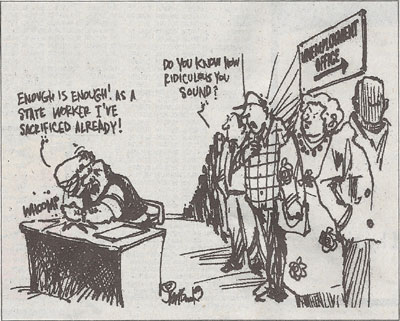
September 1, 2009
The Thing About Taxation
Oswald Krell is at it, again — proving, this time, that beating a strawman for long enough begins to resemble a pillow fight against one's self:
Low tax states are more violent, have higher rates of teen pregnancy, somewhat higher poverty rates, and lower median incomes.Do low taxes cause these problems? No. Correlation is not causation.
Rather, to me, what is emerging is the description of an attitude. Low-tax proponents favor "Stand on your own" rhetoric, which is really a coded term for letting the rich shirk their civic obligations. The result is that the bulk of the population is noticibly worse off in low-tax states: more violence, more teen pregnancy, more poverty, lower incomes.
Now, explain to me: why this is an attractive paradigm?
I repeat: The argument for taxes in Rhode Island isn't that low rates are the decisive factor in a given region's economy, and adding social data doesn't change the fact that people and businesses do take the cost of government into consideration.when they plot their financial lives. The question that Rhode Island's progressives are so studiously striving to ignore is that taxation must be judged based on a given state's circumstances, and Rhode Island is overburdened with them, as with other manifestations of big government like mandates and regulations. "We will let you operate your business as you see fit and to keep more of what you earn" need not be innuendo for gun violence and teen pregnancy.
Lower taxes and lightened regulations would encourage economic activity and improve the earning potential of all residents, which I'm reasonably certain would correlate positively with improved social markers in the state, as well. (Krell doesn't provide his sources, so I'll simply offer the hypothesis that Rhode Island fares poorly, by such measures, compared with similar states.)
That's a suggestion that RIFuture-owner Brian Hull should consider, as well:
The recession effect is having a profound impact on the state's economy, but the long-term financing of the state would be better served if the General Assembly would make the "tough choices" and restructure the tax code, shifting the burden away from the vast majority of Rhode Islanders who have seen their incomes shrink and are struggling to make ends meet.
For perspective, don't lose sight of the fact that, in the name of improving the economy, Hull wants both to raise taxes and to shift them toward a particular group. Apart from being manifestly unjust, such a strategy would be economically devastating. What, pray tell, would Hull like to change about this picture:
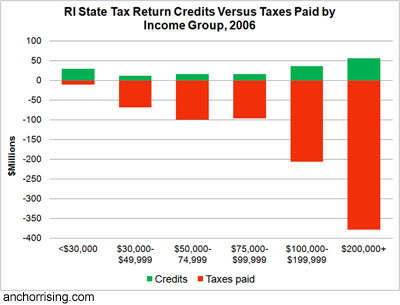
Me, I'd like to see less red across the board.
August 27, 2009
They Must Have Some Thoughts, Mustn't They?
From a Providence Journal editorial on the General Assembly's annual avoidance of structural change:
And this series of cuts may be minuscule compared with the ones Rhode Island may face soon. Ms. Mumford estimates that the state may confront a $1.2 billion deficit in the coming months, given overly optimistic forecasts of tax revenues in a bum economy. Former Cranston Mayor Stephen Laffey warned that "the deficit could be north of $800 million and is leading to insolvency." As painful as the state's 12-day shutdown will be, the savings from that measure — $17.3 million — pale in comparison with such eye-popping potential deficit numbers.And Rhode Island faces the question of what to do when the hundreds of millions of federal stimulus dollars that have been used to sustain government budgets run dry.
Do you suppose most legislators have some sort of a strategy list, such as:
- First, hope for things to work themselves out.
- If that doesn't work, trim some blatant fat.
- If that doesn't work, raise taxes.
- If that doesn't work, cut social services.
- And so on.
Or are most of them just winging it — trying not to think about the inevitable.?
August 17, 2009
He Could Be the Perfect Man for the Job
So, last week, Pat Crowley intimated that he may run for General Treasurer of Rhode Island. Those familiar with his body of, ahem, work will likely find it difficult to believe that the notion isn't a put-on at some level. Today, Crowley announced that RIFuture is something like the state's online hot potato:
RUTURE has been sold. After much consideration, and after receiving a substantial offer of purchase, I have decided to sell RIFUTURE. The sale creates an opportunity to pursue other state wide goals while still maintaining a voice in the progressive blogosphere. I will continue to be an active contributor to RIFUTURE, amongst other activities.
So, Patrick Crowley "small business owner" is no more, but based on his experience, I'm tempted to endorse his candidacy for the treasurer job. Who better to occupy that seat as Rhode Island plunges into the chilly waters toward which our gleeful leap off the economic cliff sent us rocketing?
August 11, 2009
The State's Spending Practices
Former state representative Carol Mumford deserves a hear, hear for her op-ed in yesterday's Providence Journal:
Those who believe that Rhode Island is a poor state would be surprised to know that during most of my 10 years in office, the state's revenue increased at the approximate rate of 3.5 percent a year. While our revenue increased at this modest but steady rate, our expenditures increased approximately 7 percent to 11 percent a year. That says it all, doesn't it? No matter what the income, those people or entities that live beyond their means find themselves in the situation Rhode Island faces today. ...On another note, those who believe our state population figures are static at about one million should look closely at the composition change. The Rhode Island Economic Development Corporation testified before House Finance that in the last decade those who are considered affluent in Massachusetts have doubled in number. The number of people who are considered affluent in Rhode Island has decreased by 50 percent. The affluent did not lose their assets; they fled. An examination of the latest "Kids Count" figures shows that the number of poor children in Rhode Island has mushroomed. The population numbers remain static, but many who used to pay the bills are elsewhere.
But how can that be? An opposition analyst assures us rich taxpayer interests have won battle after battle at the State House, and welfare benefits are difficult to procure.
August 3, 2009
Expanding Cargo Operations at Quonset
As I was commuting to work via Airport Road in Warwick the other day, the light turned red and a single UPS truck pulled out of the T.F. Greene Cargo terminal. This normal everyday occurrence got me wondering about how this was a really inefficient way to get cargo from airport to the highway. If cargo operations are to grow, then they need to have a more efficient method of getting the cargo to the major highways than through 5 or so sets of lights via Airport Road and Rt. 1 (Post Road) through Warwick. It looks like Kevin Dillon, head of RIAC, thinks Quonset may be the solution:
Dillon said the Quonset airport, as a result of more than $7 million in recently completed infrastructure improvements, including a new hangar, is a “real gem,” with the port, rail lines and enhanced Interstate 95 access part of or near the complex.Dillon also cited the voluntary curfew at Greene (midnight to 6 AM) as a restrictor on growth. Warwick's Mayor Avedisian responded:In addition to the Rhode Island National Guard facility, the Quonset airport is used for general aviation, with about 20,750 operations per year, including 5,800 by the military, according to the Federal Aviation Administration. Dillon noted that Quonset has “lots of room, so it lends itself to cargo growth.”
Cargo carriers in the past were concerned about limited highway access, but improvements to the Quonset access roads within the last 18 months should have satisfied those concerns, according to Dillon.
Most cargo in New England now goes through Logan International Airport in Boston and Bradley in Hartford, Conn. However, Dillon said, Logan is “constrained” by passenger flight needs, so there is opportunity for Green or Manchester “to step in and fill that void.”
Warwick Mayor Scott Avedisian said he was surprised to hear Dillon’s concerns about the curfew because the airport “violates it all the time.” Avedisian said the curfew has been in place more than 20 years, but “they don’t pay attention to it most of the time” and there are “many nights when they deviate from the curfew.” At the holiday season in December, Avedisian said, the curfew usually is lifted.That confusion aside, there is real economic potential here.Told of the plan to redirect cargo traffic to Quonset, Avedisian said it was news to him and that airport officials, including Dillon, have assured him that cargo service would not be moved from the Warwick airport. “This just leaves the city further confused about what [the airport’s] plans are,” he said.
“This represents a big opportunity, not only for the airport system, but for the entire state,” Dillon told Providence Business News. Cargo service “is a huge generator of employment.“Just think of all the processing that takes place [when cargo is delivered],” Dillon continued. “This is more than just parochialism. I believe there’s a lot of employment opportunities that can be generated” by increasing cargo flights to the state....“It stands to reason [that more jobs would be created if cargo activity were expanded]. Just think of the nature of cargo, the processing and the handling. It creates a number of jobs just in terms of the airline itself,” he said.
However, the larger picture, Dillon said, suggests that for manufacturing and commercial sectors to flourish, “you need good cargo processing.” He spoke of spinoff jobs that would be created in manufacturing, the commercial sector, trucking firms and at support facilities, such as the FedEx office in Warwick, if more cargo came into Rhode Island.
August 2, 2009
A Program to Help Unemployed Rhode Islanders
In yesterday's Providence Journal, Neil Downing reported on the thousands of Rhode Islanders who are running out of unemployment benefits, after being unemployed for up to 79 weeks, or about a year and a half:
In response, the state Department of Labor and Training, the agency which administers unemployment benefits, began mailing notices on Friday that offer people tips on where they can turn for help when their benefits run out, said agency director Sandra M. Powell.The initial mailing is going to about 3,200 people, including those who have already exhausted their benefits, and those who will run out of benefits soon. Hereafter, the agency plans to mail the notices to about 150 people a week. The notices provide information on how to obtain food stamps, government-sponsored health insurance and other assistance.
I propose that the DLT's packet ought also to include information assisting recipients in find work in other states and relocating. If Rhode Island hasn't managed to create a job for a particular person in eighteen months, the best advice that person can receive is to find a location with an economy that can provide work.
August 1, 2009
Pushing It as Only Rhode Island Can
The latest news on the business sales tax front — which isn't online, because Projo.com is still down — is that Liberty Elm diner has come up with the $5,000 needed to prevent closure, while the Carcieri administration will begin notifying local police about which businesses to keep closed sometime next week. As I suggested yesterday, discussion of this matter must begin with the acknowledgment that businesses collected the sales tax money and then, apparently, spent it. That said, this is more than a bit heavy-handed:
For the Liberty Elm, the reprieve will be short. The diner must pay another $5,000 by the end of August before the state will allow it to establish a monthly payment plan.
Granted that the state has a right to that money, but the impression begins to be of an extortionist with his thumb on a "client," especially in light of anecdotes such as the following email that I received this morning:
One of your points need a little clarification: "businesses find it necessary to help themselves to free loans from the state." Its worth pointing out that the state charges a hefty 18 percent interest rate and late fee on delinquent payments. Hardly giving them an advantage over other businesses that pay on time. In fact the debt that piles up on late payments is in many ways more holes in a leaky boat. I was in the same situation with my business in November. (You have to be paid in full by December for license renewal and again by July for your sales tax permit.) Business started to fall off. I went through my savings and then maxed out my credit cards to try and keep things going. I managed to come up with the tax money that was owed but was short on the interest and penalty. The business was employing people, making money, and I would have been able to have everything paid in about 3 months. The state refused a payment plan. I was looking at being unemployed, broke, and seeing a business that I gave 11 years to go away. I had to bring them to court and get a court order for a payment plan. Got that news 3 days before the deadline. So I one-hundred-percent agree with you that the state should make payment plans with these businesses. In an ideal world maybe even lower the interest rates.The way the system works now, a business that employs people, pays vendors, and does not leech off the welfare system could be closed for hitting a rough patch. But I can't complain; after all, the state pays all their bills exactly when they are due.
It certainly fits the image of this state to squeeze those who are trying to be productive while coddling those who demand handouts.
July 30, 2009
Nailing Off the Coffin but Quick
If the mob of seven wins its lawsuit, it's lights out for Rhode Island:
Rhode Island's public employee labor unions are mobilizing to file a class-action lawsuit against the state to block pension changes the legislature adopted in June to save taxpayers tens of millions of dollars.The executive committee of Council 94, American Federation of State, County & Municipal Employees, officially voted last week to file a lawsuit, according to President J. Michael Downey. And Council 94 has been joined by a coalition of other unions representing 26,000 public school teachers and state workers affected by new pension rules, which among other things, establish a minimum "target" retirement age of 62.
"All the public employees unions are in," said Marcia Reback, president of the Rhode Island Federation of Teachers & Health Professionals. "We had a meeting of all the lawyers who represent the public employees ... Now we're in the process of selecting our lead attorney."
The coalition of at least seven labor unions expects to file suit by "the early fall," according to National Education Association executive director Robert A. Walsh.
This against pension changes that didn't come close to sufficient in the first place. What's the state-level equivalent of canceling sports and not buying any supplies or textbooks? Whatever it is, the headline after a union victory should read, "Leave Now."
July 27, 2009
Just Another Dog-Bites-Rhode-Island's-Business-Climate Story
This sort of thing doesn't really qualify as news anymore, but Rhode Island ranks 48th on CNBC's list of "top states for business". Here's how the six New England states ranked…
8. MassachusettsMassachusetts' substantial gap over New Hampshire in the rankings seems to come mostly from two of the criteria used, "technology and innovation" and "access to capital".
21. New Hampshire
30. Vermont
35. Connecticut
40. Maine
48. Rhode Island
Rankings based on adding up a collection of indexes should always be taken with a grain of salt, at the very least. That said, Rhode Island's most surprising sub-ranking has to be its low "quality of life" score relative to the rest New England, especially given that quality of life is often touted as one of Rhode Island's strongest selling points...
1. New HampshireIs this yet another indicator of how our state's leaders have been squandering whatever advantages Rhode Island might have once had?
2. Vermont
2. Connecticut
6. Massachusetts
8. Maine
24. Rhode Island
July 17, 2009
The Unemployment Clock Clicks On
For some reason, it feels as if this new report has come early, but be that as it may, Rhode Island is now up to 12.4% unemployment. That's about an eighth of the workforce, and as Andrew pointed out, that doesn't include folks who are partially employed, which brings total under-employment to over one out of five Rhode Islanders.
Here's the part that I find especially disturbing:
The June jobs report was not without positive signs. The number of employed state residents rose by 1,400, the second monthly increase this year. That category did not grow in a single month in 2008.Many of the newly employed are probably working in other states. The total number of jobs in Rhode Island declined by 900 in June.
The work to be found, in other words, is being found elsewhere, and as I've been predicting, as the rest of the country recovers (especially the rest of New England), Rhode Island will watch its most motivated, productive citizens packing up and finding a better life elsewhere. I'm beginning to think that stabilization will ultimately come as a result of the workforce's shrinking to the size of the economy, not the other way around.
July 16, 2009
Ouch
From United Press International…
Add the number of part-time workers who would prefer full-time employment and those who have given up looking for work and the unemployment rate reaches 23.5 percent in Oregon, more than one in every five workers, The New York Times reported Wednesday.In Michigan and Rhode Island, the unemployment rate with the two extra groups added would reach 21.5 percent. In California, it would reach 20.3 percent.
In the comments section of the original New York Times article that reported the statistics, reporter David Leonhardt can't figure out why things should be so bad here…
South Carolina, likewise, is a manufacturing-heavy state....Rhode Island is more of a mystery. It has some manufacturing, but not a ton. It’s probably also been hit by the housing crash, since parts of the state are Boston exurbsBut there is an upside of their general lack of knowledge about our problems in Rhode Island -- at least our troubles are not being blamed on us being surly and neurotic!
Leonhardt also adds this interesting bit…
These broad unemployment rates have soared over the last two years. In California, the rate was under 10 percent two years ago. This spring, it was above 20 percent. You can say the same about Oregon. In South Carolina and Rhode Island, the rate was below 9 percent two years ago. Now it’s above 20 percent.
July 12, 2009
The Future That the Speaker Saw
Put aside that it was pure fundraising pabulum; it's a pity that Speaker of the House Nancy Pelosi probably doesn't know just how right she was:
"When I return to Washington, D.C.," Pelosi said, "I'll tell them that I've been to Rhode Island and I've seen the future."
What she was talking about hardly matters. It could have been a new ice-cream mixer at the Frosty Freeze. What she wasn't talking about was the thing that ought to keep somebody of her position awake at night: The effects of high taxes, over-regulation, one-party rule, labor union dominance, an overly "compassionate" and organized poverty industry, and insider politics on a polity.
Yes, Rhode Island's sclerotic economy, crumbling infrastructure, high unemployment, and prominence at the wrong end of every list may indeed be the ghost of America's future. If it is, Pelosi shouldn't "return to Washington, D.C., to tell them" (whoever "they" are). She should run to Washington to warn them.
The folks across the street from the last event of her long day of mooching would surely have been able to provide a concise message, if she'd deigned to acknowledge their presence:
Pelosi and company wrapped up their visit with an evening fundraiser at the Jamestown home of Princeton Review CEO Michael Perik and his wife, Elizabeth. For the first time all day, Pelosi and Kennedy received a less-than-enthusiastic welcome.Shouting "Vote them out" and carrying signs that said, "Welcome, Comrade Pelosi," more than 50 boisterous protestors jammed the sidewalk while sleek SUVs with tinted-windows arrived at the waterfront fundraiser, where some couples paid $30,400 to be in the "Speakers Cabinet."
Every conservative political stripe was represented, from the Rhode Island Tea Party, an anti-big government group, to Rhode Islanders Against Illegal Immigration. A few protesters, though, had it in for Kennedy.
"Patrick is incompetent," said Chris Kairnes, of North Kingstown, who was wielding an anti-Kennedy placard. "You can't perform your duties if you are highly medicated. He should be realistic and resign."
Ultimately, the crowd was disappointed. Pelosi and the local congressional delegation slipped into the party through a back entranceway. They never saw Rhode Island's version of the populist spirit.
July 9, 2009
Laffey Still Fighting
He doesn't say where he's been or what his intentions are, but Stephen Laffey is clearly still paying attention to Rhode Island and its problems:
... Laughing and joking last year, our leaders signed off on the 2008-09 "balanced" state budget. That "balanced" budget was really a $600 million deficit. It was fraud because they knew it then. And they know it now.With 11 months of data in for fiscal 2008-09, revenues are running more than $400 million behind the final revised $3.1 billion estimate for total general revenues. And the last few months are showing even more ominous trends. So an aggressive total revenue budget for fiscal 2009-10 would have been $2.7 billion. Instead, our leaders agreed to forecast $3.1 billion in revenue again, putting us all at least another $400 million in the hole. ...
One of the worst things about public fraud is that it's contagious. When Governor Carcieri raids the rainy day fund and gets away with it, what is to stop cities like Cranston and Warwick from doing the same thing? Nothing, since they did it, too — and got away with it.
Let's be frank. This fraudulent budget now puts Rhode Island on the road to collapse. Only, unlike California, whose comptroller has put out a loud warning, the Rhode Island populace will have to wait to be "surprised" when Rhode Island is about to miss payroll. The similarities between Rhode Island today and Cranston in 2002 before I became mayor are eerie. The lies were plentiful then and near bankruptcy ensued.
Perhaps Mr. Laffey still intends to join us for the sing-along:
Do you remember the day
They sold us down the river?
Neither do I
'Cause it's been happenin' so long
But here we all are
Long miles from where we started
So out with those words
They chained us for a song
July 1, 2009
Fish Ladders
Conservative. Conservation. Fish Ladders.
For years, a consortium of government agencies and advocacy groups has struggled for funding to knock down dams and build fish ladders to help restore local fish migrations. That work was jump-started on Tuesday when the federal government came forward with $3 million in stimulus money for six projects on the Ten Mile and Pawcatuck rivers.I understand the raised eyebrows some fiscal conservatives have. Is this really economic "stimulus"?When the work is done, fish will be able to migrate all the way up the Pawcatuck from Watch Hill, in Westerly, to Worden Pond, in South Kingstown.
In East Providence, the 30-year campaign by volunteers to lift spawning herring one bucket at a time over the Omega Dam may finally come to an end. A fish ladder will be built there and at two other locations upstream.
In all, the money will open up 13 miles of rivers and streams and 1,640 acres of spawning habitat, including Worden, the state’s largest freshwater pond.
These projects were chosen partly because they were "shovel ready," and far along in the permitting process. The National Oceanic and Atmospheric Administration points out that this project may create up to 18 jobs. Does that seem right? $3 million in federal stimulus dollars will create up to 18 jobs. That comes out to $166,667 for each temporary job they create. For just a moment, let's put the project aside. Is it really worth while to spend $3 million to create 18 temporary jobs? Will this project have an economic impact that will stimulate the economy and put more people to work long-term? It seems doubtful.Perhaps. But the economic benefits may be realized farther out. A similar project was undertaken in Maine and has helped to reestablish various stocks of fish, including important bait fish and game fish like salmon, stripers and sturgeon. More bait fish and more game fish helps both commercial and recreational fishing entities here in the Ocean State. That seems like an economic plus to me. Additionally, the dam removal in Maine inspired other economic improvements. For example:
Augusta's Capital Riverfront Improvement District (CRID) is using the removal of the Edwards Dam as the keystone of its efforts to revitalize Augusta's downtown core. The District's legislative purpose is to “protect the scenic character of the Kennebec River corridor while providing continued public access and an opportunity for community and economic development ..." With funding and leadership from the August CRID, the Kennebec River waterfront is being cleaned and beautified, underutilized buildings are being renovated and converted into housing and commercial space, and the Edwards Mill Park is now on its way to completion.Economic development isn't always a straight line: conservatives should know that the law of unintended consequences can be both positive as well as negative. And there are political advantages to be found by supporting sound conservation policies:
I have argued the merits of promoting conservation as a conservative cause, including the construction of "fish ladders." I cringe when I hear Eric Cantor and other GOP leaders railing against this and a handful of other conservation projects as "wasteful" government spending. Not only are the hook'n bullet crowd one of the largest voting constituencies in the hinterlands, they spend billions of dollars every year on hunting and fishing and helping to support local communities. This is a wise investment not only for the fish but for the voting and recreating public.Conservatives shouldn't let their legitimate criticisms of the social ideology we know as "environmentalism" cloud their thinking when considering conservation policies. The latter is entirely consistent with a conservative philosophy, after all.
June 30, 2009
The Sad Gavel Falls; Budget Now Law... with No Credibility for Future Gubernatorial Complaints
From the governor's office (full release in extended entry):
Governor Donald L. Carcieri today transmitted, with signature, the FY 2010 budget, citing he had no other choice with more than $200 million at stake.In a letter to Speaker William H, Murphy, Governor Donald L. Carcieri voiced his disappointment with the budget stating, "My signing this budget is not an endorsement of it in its entirety. I had intended to allow this budget to become law without my signature, however it was delivered to my office too late to do so. I am signing for this reason: over forty million dollars of state funding, plus hundreds of millions in Federal FMAP funds are at risk if the budget does not become law before July 1st."
"I had the option to veto this ill-conceived budget, however it was overwhelmingly approved by both the House and Senate. A veto would have required both chambers to return to override it before July 1st. It appeared highly unlikely that they would have returned, leaving us with no budget. As Governor, I was not willing to risk forfeiture of this money and the potential of creating an enormous additional burden for our taxpayers."
Governor Carcieri underscored the lack of long-term vision by the General Assembly in crafting the budget. "My original budget proposal, which I submitted in February, balanced our immediate needs, and most significantly presented a plan to address many of the ongoing budget problems that have plagued our state for decades. My goal has always been to build a positive future for Rhode Island. Unfortunately, the General Assembly chose a short-sighted scheme with narrow political goals that addresses some but defers more far-reaching, difficult choices for yet another year." ...
In conclusion, the Governor again reiterated his decision to sign the budget was based on the potential to lose hundreds of millions of dollars in savings if not signed by July 1, 2009. "As I have said, this budget is not good for Rhode Island in the long run, and my signature should not be seen as an approval of this budget. However, given the little time left before the start of fiscal year 2010, and because of the hundreds of millions of dollars at risk, I have reluctantly signed this budget into law."
So it was "highly unlikely" that both houses of the General Assembly would rush to override a veto? Is that judgment based solely on House Speaker Bill Murphy's European vacation, or are there other considerations that led the governor to demur from forcing the senators and representatives to show just how vehemently they wish to let the state stagger in the wrong direction?
Sorry, governor. You signed the beast's release papers; the blood of its victims will be on your hands as much as the legislature's.
Continue reading "The Sad Gavel Falls; Budget Now Law... with No Credibility for Future Gubernatorial Complaints"
Re: No Amazon Money for the Little Local Guy
In the previous post, Justin said that…
According to the Wall Street Journal, Amazon has around 2,000 affiliates in Rhode Island who pay an estimated $3 million in state income tax…Not anymore, according to Steve Peoples and Neil Downing of the Projo…
The Internet giant Amazon.com has severed formal ties with all Rhode Island businesses, a move intended to shield the online retailer from the General Assembly’s push to tax some online sales as soon as Wednesday.An Amazon spokeswoman declined to say how many businesses –– local book dealers and other retailers — will be affected, but she confirmed that notification letters were distributed to “many local associates” early Monday morning.
June 29, 2009
No Amazon Money for the Little Local Guy
Matt Allen has been talking about the Rhode Islander's grab for tax revenue from Amazon.com. Amazon's affiliate/associate program is essentially a referral service. Web sites link to items on Amazon, and if their readers/visitors buy the item, the referrer receives a percentage of the sale.
Some folks use the service as another source of advertising revenue. Some use it to avoid creating an online store for their own products. What states, like Rhode Island, have been trying to argue is that affiliate programs amount to a "physical presence" in the state, requiring online retailers to collect sales tax on all items sold into the state, whether or not there's an RI affiliate involved in the sale. The budget legislation accomplishes this end by changing the definition of "retailer" to include (PDF):
Every person making sales of tangible personal property through an independent contractor or other representative, if the retailer enters into an agreement with a resident of this state, under which the resident, for a commission or other consideration, directly or indirectly refers potential customers, whether by a link on an Internet website or otherwise, to the retailer, provided the cumulative gross receipts from sales by the retailer to customers in the state who are referred to the retailer by all residents with this type of an agreement with the retailer, is in excess of five thousand dollars ($5,000) during the preceding four (4) quarterly periods ending on the last day of March, June, September and December. Such retailer shall be presumed to be soliciting business through such independent contractor or other representative, which presumption may be rebutted by proof that the resident with whom the retailer has an agreement did not engage in any solicitation in the state on behalf of the retailer that would satisfy the nexus requirement of the United States Constitution during such four (4) quarterly periods.
According to the Wall Street Journal, Amazon has around 2,000 affiliates in Rhode Island who pay an estimated $3 million in state income tax. (The article doesn't relate that income directly to Amazon.) Say this for our state: Rhode Island is very innovative — cutting edge — when it comes to finding ways to harm residents who are trying to scrounge together a living.
June 27, 2009
Rhode Island, Always Striving to Make Life That Much More Difficult
So, with legislation to make energy more expensive for all Americans making its way through Congress, what can one say about this?
Governor Carcieri on Friday signed into law legislation that could pave the way for offshore wind farms in Rhode Island.The bill, passed by both chambers of the General Assembly earlier this month, allows electrical utility National Grid to enter into long-term contracts to purchase "green" energy. For Deepwater Wind, the company proposing more than 100 wind turbines off the Rhode Island coast, the law means having a guaranteed buyer for its energy, a crucial selling point to investors. The legislation will also benefit other clean-power proposals, including a plan to build a solar farm in Coventry.
The first thing on which to remark is Journal Staff Writer Alex Kuffner's peculiar choice of the word "allows" to characterize the bill's relevance to the energy company. Here's how the General Assembly press release about the legislation puts it (emphasis added):
The House and the Senate each took final votes today approving legislation sponsored by House Majority Leader Gordon D. Fox and Senate Corporations Committee Chairman Joshua Miller to require the state's largest electric utility to enter into long-term contracts to purchase power from renewable energy producers in Rhode Island.
Under the eye of the state Public Utilities Commission (PUC), National Grid (and any other energy distribution companies that may be lured into the Rhode Island market) will have to enter into contracts with "new," "green," "renewable," whatever energy producers with a duration of at least 10 years. Then, if we turn to the statutory language itself (PDF) we find explicitly what we all should expect implicitly:
The electric distribution company shall file tariffs with the commission fo commission review and approval that net the cost of payments made to projects under the long term contracts against the proceeds obtained from the sale of energy, capacity, RECs or other attributes. The difference shall be credited or charged to all distribution customers through a uniform fully reconciling annual factor in distribution rates, subject to review and approval of the commission. The reconciliation shall be designed so that customers are credited with any net savings resulting from the long-term contracts and the electric distribution company recovers all costs incurred under such contracts, as well as, recovery of the financial remuneration and incentives specified in section 39-26.1-4.
In short, National Grid must enter into decade-long contracts for the purchase of energy at prices consistent not with the energy market in general, but with "newly developed renewable energy resources," however much more it may cost than regular ol' energy resources. It then sells the energy at market rate and tacks the "newly developed" premium on the bills of customers across the board. Oh, and the law permits the company to add another 2.75% premium to the cost of the fancy new energy as "incentive."
Let's follow the money, shall we? You, energy consumer, will pay more for your usage so that the distributor can, without loss (indeed, with explicit profit), subsidize politically preferred energy sources in order to guarantee sales of an energy product whose risk investors are not otherwise willing to accept. Your money, in other words, is serving to secure investment earnings for others. Those investments, in turn, will flow to land owners, materials suppliers, and workforces. To some degree, the prices of all of those things will be inflated; to the extent that unions are involved, another layer of money-takers slips into the mix; and to the extent that materials, land-owners, and workers reside elsewhere, the money will flow out of the state.
To those parties, the law represents a net benefit, but that requires a net cost to a much larger field of people. That field of people is contained geographically within the borders of Rhode Island, because National Grid has no reason to spread the "renewable" deficit more broadly across its own operations. Moreover, the state is contained geographically within the borders of a nation with a government hell-bent on piling on its own premiums.
June 25, 2009
UPDATED: The Governor's Proper Stance
Governor Carcieri struck the right notes on budget deliberations in his op-ed yesterday:
THE STATE BUDGET plan for fiscal year 2010 passed by the House Finance Committee is not a plan to lift our state out of this economic malaise. It lacks a coherent policy and strategy to move our state forward.My budget, which I submitted back in February, proposed a clear strategy to move Rhode Island in the right direction and offered real solutions to pension reform, economic development, tax reform, education and municipal spending. ...
My budget proposal made new investments in education and economic development, and included significant tax reforms for individuals and businesses. These changes would send a loud and clear message that we are serious about growing jobs in our state, and that we are serious about improving our children's education. Our early- literacy programs and charter schools are having great success, especially in the urban districts, and we need to continue investing in them.
The House budget eviscerates these critical investments and sends a message that we don't care about jobs, economic development or our urban children.
For too long (probably), the governor allowed an aura of comity and cooperation to serve as cover for the General Assembly's mismanagement. The message from here on out has to be that Rhode Island's problems legislators' doing.
ADDENDUM 6:09 p.m.
George rightly snaps me out of the Rhode Island fog that had drifted over me somewhat with the rainy days: The governor could have been much more vociferous and prominent in declaring that there should be no changes to his budget. Every day in the news. Once a week outside the State House with a bullhorn.
June 24, 2009
Flat Tax Good, but Not Enough
As you may have heard, the gradually decreasing flat tax in Rhode Island has survived attempts to freeze or repeal it (so far). I'd note, though, an excellent point that Matt Allen made during the six o'clock hour: It's foolish to think that the flat tax decrease is sufficient. For two things: Rhode Island's tax advantage for capital gains is evaporating with this budget, and new savings for businesses have been left on the cutting room floor.
The tendency of disputants to break the big questions into their constituent parts goes a long way toward explaining the condition of our state. It's all patchwork policy, with no overarching principle. We trade this tax break for that union concession and that welfare adjustment, with the result being incoherence and inadequate counterbalance to the special interests that have infested the State House and town halls. Any potential reform candidates loitering about the edges of public consciousness should come up with a holistic plan and insist that it only works as an irreducible machine — as I've been suggesting that the governor do by disowning the budget if the General Assembly made any substantial changes.
We need responses to such statements as the following example, from Matt Jerzyk, of why I'm nostalgic for the previous iteration of RI Future:
What should be more important in a recession in Rhode Island? Just think about it.If you are recently unemployed in Rhode Island or facing tough times at work, can you afford a jump in your property tax bills?
Alternatively, would a Rhode Island millionaire even know if their accountant paid a little more on their tax returns.
Even a few hundred dollars of increase or decrease in a given tax bill is not what unemployed Rhode Islanders need. They need jobs. They need businesses that find their state to be an attractive place to open up shop and expand — without special deals or credits, merely because that's the way the state is structured. They need the sorts of people who have money to burn no matter the overall economy renovating homes, buying goods, dining out... being present and living their lives among us.
As for the millionaires and their accountants, the premise that we can slip tax increases by them is (I'll euphemize) poorly considered. Even so, an accountant will inform his clients if a move — often an on-paper affair, when it comes down to it — to Rhode Island would cost them thousands or millions over a certain period of time or from Rhode Island would save them the same.
A Simplistic Reaction to the Flat Tax Will Hurt the State and Cities and Towns
Everybody wants to nix the flat tax in Rhode Island:
The dispute has drawn the interest of a host of powerful players — labor unions, mayors, and a coalition of elected officials — who hope to repeal the high-profile tax break that benefits 2,267 Rhode Island taxpayers. Supporters want to funnel the savings to the cash-strapped cities and towns, which are slated to lose more than $55 million in state aid for the budget year that begins in seven days.
Municipalities think it's an easy way to get a few million more dollars. Union members think it's a way to ensure that the local and state governments that employ them will be able to make payroll. Elected officials think they'll pick up a good talking point about looking after the majority against the narrow interests of a wealthy minority. I'd suggest that all of these groups would do well to be wary of short-term thinking.
As I've followed long-term trends from both Census and IRS data, the conclusion has emerged that one area in which Rhode Island has seen positive developments is among wealthier residents. Indeed, the state income that taxpayers with incomes over $200,000 per year are claiming on their federal tax returns was up more than 50% from 2002 to 2006 — the period during which our state's tax reforms began to kick into effect. That is why Steve Peoples and Cynthia Needham's characterization is woefully incomplete:
The state will forgo an estimated $34.7 million in tax revenue next year because of the flat-tax option, according to an analysis by the State Budget Office.In tax year 2009, the rate is scheduled to drop from 7 to 6.5 percent. If frozen at the current rate, the state could recover $12.2 million in tax revenue for the coming fiscal year, according to the governor’s budget office.
One cannot calculate the "cost" of the flat tax by recalculating returns as if it did not exist, because some percentage of returns would not exist if it were not for the flat tax option. With residents with household incomes over $200,000 contributing about $400 million in income and alternative minimum taxes every year, we're talking a huge amount of money.
Unfortunately, the relevant data from the state ranges only from 2005 to 2007, and the presentation of resident and non-resident taxes is not uniform. Nonetheless, looking at the resident returns (which are parallel to federal data addressing Rhode Islanders), one can observe that, over that period, the total income and alternative minimum tax collected by the state was up more than $5.12 million from those earning over $200,000 and up a total of $40.33 million from those earning over $100,000. The actual number of state tax returns filed by those earning between $100,000 and $200,000 increased 20.8%, and those showing income over $200,000 increased 14.2%.
This is where advocates for repealing the flat tax will point out that, while actual taxes paid by the $100,000-199,999 group increased $13.5 million (5.5%) from 2006 to 2007, those earning over $200,000 — who benefit most from the flat tax option — contributed $37.4 million (8.6%) less. Given the close proximity of the dollar amounts, one might presume that the flat tax simply gave that money away (as Rep. Scott J. Guthrie, D-Coventry, would put it). That would be incorrect.
Of that year-to-year loss, the capital gains tax accounted for $30.1 million. In other words, non-capital gains income taxes among the wealthiest group decreased only $6.5 million (1.9%) in 2007 from 2006. More importantly, the average adjusted gross income per return fell 4.3%. (I'm not sure whether that includes capital gains.) Although there were more of them, the rich, that is, earned less money to tax.
All such aggregate analyses are tricky, of course, because so many factors and considerations come into play. Advocates making the journey from their municipalities to the State House to demand those dollars that the flat tax "gives away" should recall that these are residents. They are paying property taxes on homes and vehicles. They are paying fees for everything from dog registrations to construction permits. If they leave, they take not only the income tax dollars that the state may (or may not) filter down to the local level, but also all of the revenue that cities and towns currently procure directly. Moreover, they take the money that they pay to other residents as part of the private-sector economy.
For some general and rough perspective, consider this: The number of tax returns showing income over $200,000 increased 14% from 2005 to 2007. It will only have to decrease by about 7% for repeal of the flat tax to be a revenue wash for state income tax alone. If we broaden the group to those over $100,000, the increase from 2005 to 2007 was 19%, and only a 3% loss of the current number would cancel out the estimated tax revenue gain.
Rhode Island is already turning away from the path toward a vibrant economy in a vain attempt to ease short-term pain — which is to say that it is continuing on its path to collapse. Let's not expedite the process.
June 23, 2009
What Rhode Islanders Ought to Be Thinking About
It is, of course, a matter of concern — a travesty — that Rhode Island is tied for third worst among states when it comes to unemployment. The fact on which its residence should think hard, though, is Rhode Island's position relative to its fellow New England states:
| Rhode Island | 12.1 % |
| Maine | 8.3 % |
| Massachusetts | 8.2 % |
| Connecticut | 8.0% |
| Vermont | 7.3% |
| New Hampshire | 6.5 % |
| U.S.A. | 9.4% |
Not only is Rhode Island worst among its neighbors, but it stands a good distance on the other side of the national rate. New Hamshire's unemployment is almost half of ours, for crying out loud!
Unless he was taken out of context to libelous degree, URI Business Administration Professor Edward Mazze brushes away his credibility like dandruff when he states (in reporter Andy Smith's paraphrase) that "Rhode Island shouldn’t be worrying about competing with neighboring states" because in a global economy "our competition comes from place such as Alabama — or China." Our competition for what?
I get the impression that Mazze is referring to Rhode Island as a geographical location in which businesses reside. It's not (or not only); it's a political entity relying on taxpayers to subsist and utterly failing in the governance of its people. Those people — especially the most productive and motivated of them — will find it much more comfortable a prospect to relocate within the few hours' drive that New England spans than in Alabama, let alone China.
Forgive me for saying it again and again, but we have a serious problem. Those who are supposed to be guiding our state through these rough waters have shown themselves to be utterly incompetent. The less intelligent of them behave as if they have all of the authority of a college's student legislature, and the governing principle of the more intelligent of them is scamming for their own benefit.
June 22, 2009
Another Way to Add to RI's Unemployment Problem...
... would be for the House to join the Senate in passing legislation automatically adjusting the minimum wage every year. A bill proposed by Sen. Leonidas P. Raptakis (D- Coventry, East Greenwich, Warwick, West Warwick) slithered easily through the Senate in May. A similar bill (PDF in the House is currently being held for study.
As Employment Policies Institute Senior Economic Analysis Kristen Lopez Eastlick explains, the move would hurt low-wage earners:
Decades of economic research demonstrate that there is an increase in job losses following minimum-wage hikes, particularly among vulnerable groups such as minority teens and adults without a high-school diploma. Legislation that would make minimum-wage increases automatic merely shifts these negative effects from a once-in-a-while occurrence to an annual event.While a 25-cent increase may not seem like a lot, a business owner with 20 entry-level employees would have to absorb over $10,000 in new labor costs each year. Small businesses faced with decreasing demand would be forced to cut employee hours and eliminate some jobs entirely in order to stomach an automatic-wage hike that would take place regardless of the economic climate.
It would also hurt new-job creation by adding a cost structure for potential employers to consider before hiring new employees. Moreover businesses that don't already operate in Rhode Island would have to take the requirement under advisement, as well.
June 19, 2009
On Past Twelve
Admittedly, gut-based prognostications are easily dismissed — a bit like guesses of the number of jellybeans in a jar. In the case of unemployment trends, it's more akin to guessing the number of jellybeans that won't be in the jar tomorrow, and to be honest, I'm not sure so-called educated guesses are much more firmly based.
The news is that RI's unemployment rate has jumped a full percentage point, to 12.1%, which makes my standing ballpark of 14% more plausible, as the experts ratchet theirs up to 13%. Thanks to the General Assembly's predictable, but disheartening, failure to release a budget, as opposed to an instructional pamphlet on prayer-based juggling, I'm adjusting my prediction, as well. President Obama solidified Rhode Island's likelihood of 14%, I'd say, and the General Assembly has done the extra work, lately, to drive it over 15%.
The disclaimer is that we're in uncharted territory, here, and the unemployment number may not cease its rise for the foreseeable future. This is particularly concerning:
The national unemployment rate also rose, from 8.9 percent in April to 9.4 percent in May. Unemployment in Massachusetts grew slightly during the same period, from 8 percent in April to 8.2 percent in May.
Even putting the concrete effects of the state budget aside, its huge power to demoralize puts a new, brighter light on the single-digit unemployment rates of elsewhere for ambitious workers and employers.
June 18, 2009
And the Budget Discussion Begins
Monique and Matt had a somewhat extended discussion of the beginning of the budget debate on the Matt Allen Show, last night. Another year of the wrong focus in the General Assembly, enabled with one-time revenue. You can be sure that we'll have much more to say as the days and weeks pass. Stream by clicking here, or download it.
I figured it out!
The budget summary that Marc posted last night caught my eye:
Overall spending is up 12 percent from the $6.92-billion state budget approved by lawmakers for the current fiscal year. But the general revenue portion is down, roughly 10 percent, from the $3.28 billion originally approved for the current year.
I'm tempted to dwell on that slippery phrase "originally approved for the current year," pondering what the decrease (or increase) is for the new budget as compared to the supplemental-adjusted version for this year. Instead, I'll move on to superimpose this from the article on state revenue that I posted earlier:
Altogether, Rhode Island’s general revenues fell by $405 million, to $2.486 billion, for the 11 months through May 31, according to a report issued Monday by the state Department of Revenue. ...Paul L. Dion, chief of the state Office of Revenue Analysis, said that, for technical reasons, a revision will be made that will end up boosting total general revenues by about $50 million.
So the general revenue budget fell roughly 10% to $2.952 billion, but actual revenue over the past year has fallen 14% to $2.486 billion (or, with the $50 million adjustment, 12% to $2.536). So not only is the General Assembly doing nothing to stop state revenue from decreasing, but it isn't even keeping expenditures' pace with revenue as it's lost.
So maybe the strategy is really to drive us complainers out of the state. How blissful all will be then! Just spending each year's unpredicted windfall without the painful noise from taxpayers. On next year's agenda: A memories tax for anybody who's ever lived in Rhode Island (pension-bearing public-sector union members exempted, of course).
June 17, 2009
The Wrong Leaders Applying the Wrong Strategy at the Wrong Time
So, state government revenue has an even more giant hole than expected:
Altogether, Rhode Island’s general revenues fell by $405 million, to $2.486 billion, for the 11 months through May 31, according to a report issued Monday by the state Department of Revenue. ...Among the revenue report’s findings:
•The state's personal-income tax generated about $798.6 million, a decline of $157.1 million, or 16.4 percent.
•Collections from Rhode Island’s sales-and-use tax totaled $747.7 million, a drop of $27.9 million, or 3.6 percent.
•Transfers from lottery operations totaled $279.6 million, down $16.9 million, or 5.7 percent.
•Money collected through fees, fines, penalties and other "departmental receipts" totaled $233.6 million, a drop of $57.6 million, or 19.8 percent.
•The state's general business taxes generated $208.3 million, a decline of $26.4 million, or 11.2 percent.
"Overall, we’ll see that many of the programs the governor cut have been restored [in the General Assembly's budget]," [Finance Committee member Elizabeth] Dennigan [D-East Providence] said, specifically citing the state’s prescription drug program for the elderly known as RIPAE, funding for nursing homes, money for the developmentally disabled, dental coverage for low-income adults and children’s breakfast programs.Further, [Rep. Thomas] Slater [D., Providence] noted that plans cut 7,800 people — including 5,000 children — from the state's welfare rolls in two weeks have been delayed, although he couldn't say for how long.
And cities and towns, which depend on the state for more than $1 billion each year, may not lose as much state funding as they feared.
Several Finance Committee members said they expect to cut $55 million in general revenue sharing, as the governor had proposed, but no more.
How are legislators accomplishing this magic trick?
"Obviously, everything is still fluid," said Senate Finance Committee Chairman Daniel DaPonte. But "the gas tax has to be part of the equation." ...Lawmakers are expected to eliminate Rhode Island's preferential treatment of capital gains, according to another Finance Committee member, Elizabeth M. Dennigan, D-East Providence, referring to the break for taxpayers who profit from the sale of stocks, bonds and other such investments. ...
Governor Carcieri has consistently warned Democratic legislators against rolling back the tax breaks enacted in recent years. And despite massive budget deficits, he pushed for new tax cuts.
The Assembly appears to have ignored those arguments, according to fellow Finance Committee member Laurence W. Ehrhardt, R-North Kingstown; the state budget excludes the governor's proposal to eliminate Rhode Island's corporate income tax or raise the value of estates subject to Rhode Island's estate tax. ...
Meanwhile, Senate leaders have sketched the likely shape of a pension-cutting package aimed at shaving anywhere from $45 million to $60 million off the taxpayers' share of the annual cost for the retirement benefits given state employees and public school teachers.
Considering that the changes that ought to be made to pensions would save considerably more than that, one can reasonably say that the General Assembly is continuing its short-sighted strategy of relying on taxes (backwards-looking is more accurate). Once the budget is officially released and then passed, sit back and watch as revenue declines even further, when gas taxes that businesses pay are passed on to consumers, as consumers take the gas tax money from other expenditures, as both groups take their business across the borer, as capital investments in Rhode Island decrease, and as businesses continue to decline to settle here.
June 10, 2009
Trillo Talks
In the wake of business leaders explaining that they are "wary of heavily unionized states" like Rhode Island (like it or not, that's the perception, folks) and the new report from RIPEC explaining that State-level mandates are damaging to Rhode Island's cities and towns and economic development, Rep. Joe Trillo (R-Warwick) offers up his own 6-point plan:
To return to prosperity, some fundamental changes must be embraced and supported by taxpayers and politicians alike.First, to lower both municipal and state operating expenses, public-employee unions must be held at bay and their interests must be placed second to the greater interests of the state, its cities and towns and the taxpayers.
Second, there must be some regionalization of services, including but not limited to police, fire, schools and highway departments, while still preserving the individual identities of each of the cities and towns.
Third, Rhode Island, which is currently at a competitive disadvantage with our neighboring states, must make its tax burden the lowest in New England, so as to appeal to business and to foster job growth.
Fourth, Rhode Island is in the midst of a financial crisis, and it must begin to operate accordingly. It must function like a business that is in Chapter 11. The General Assembly has the power to provide mayors and city and town managers with the authority to cut costs and make fundamental changes to the labor laws that have favored the unions, but will they have the political courage to do so? Will their constituents demand nothing less?
Fifth, the powers of the many school committees must be reduced. They should not be allowed to negotiate with unions nor should they have the authority to approve school budgets, which in many cases can be up to 80 percent of a city or town budget. Instead, those powers should be vested with mayors, administrators or city and town councils.
Sixth, with all of the above in place, the Rhode Island Economic Development Corporation should focus its efforts on recruiting companies with well-paying jobs and marketing Rhode Island to them.
June 4, 2009
AR's Optimism That It Doesn't Have to Be This Way
Andrew presented the question, in studio with Matt Allen last night, about whether Rhode Islanders believe that their state must always be at the wrong end of every list (especially those that are economic in nature). Stream by clicking here, or download it.
June 3, 2009
Rhode Island is Among the Worst in a Bad Economy
Does the release of yet another set of statistics showing how badly Rhode Island is doing economically still count as news? The answer, unfortunately, is yes, as Rhode Island still manages to find its way to the bottom of the pack when states are ranked in terms of their economic performances, a measure which takes into account the nationwide slowdown.
Yesterday, the US Bureau of Economic Analysis released its initial state-by-state gross domestic product (GDP) figures for 2008. While growth across the country was slow, just 0.7% above the previous year, 37 states still managed to show positive economic growth of some kind. Rhode Island, however, was one of 12 states showing negative economic growth, with its gross state product of shrinking by 0.9%, the 5th worse change in state GDP in the nation.
The negative growth cannot be blamed on our location. Of the six New England states, Rhode Island ranked last in GDP change, with 4 of the states showing positive growth (Massachusetts leading the way, at 1.9%).
Consider the above data to be a Rorschach test about what you believe the source of Rhode Island's troubles to be. Do you look at the above figures and say, well when the nation is doing badly, it's inevitable that Rhode Island will be doing even worse, so there's nothing we can do (a symptom of what I believe University or Rhode Island Economics Professor Leondard Lardaro would call an endogenous view of Rhode Island's troubles) -- or do you look at the figures and think that they point to a need to fix something in Rhode Island that's broken?
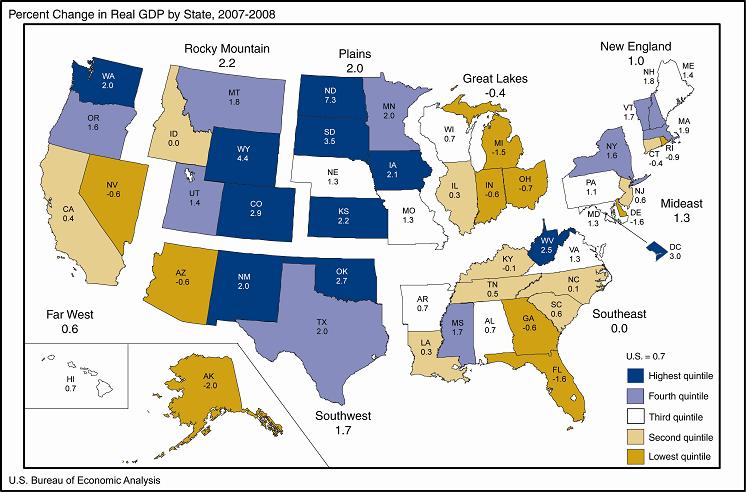
June 2, 2009
A Thirteen Member Scapegoat
Barring the inconceivable possibility that it will be empowered to change the policies that overburden the Rhode Island economy, the Economic Development Corporation will continue to function mainly as a scapegoat for the elected officials on whose conscience the state's condition ought to rest. If anything, Senate President Teresa Paiva Weed's legislation appears to go in the other direction:
... the bill did not follow the panel's advice to give the governor greater flexibility in appointing EDC board members.The review panel had said members should be "selected based upon their skills, their passion for economic development and their willingness and ability to help drive change, not because they represent a particular constituency, group or geographic area."
The legislation, however, retains a slot for a labor leader and a seat for a small-business owner. The legislation specifically says that "the membership of the board shall reflect the geographic diversity of the state," and it adds a requirement that one board member represent the state's higher-education institutions.
So, the group will be enlarged to thirteen members and designed to represent various points of view, rather than develop a point of view of its own to pursue. Moreover, not mentioned in the Providence Journal article is the fact that the legislation (PDF) also modifies the General Assembly's permanent joint committee on economic development in such a way as to reduce the minority party's representation by two seats and to give the committee new powers and explicit authority to oversee the EDC.
Considering that the EDC executive director would be made a member of the governor's cabinet, it's a little surprising that Governor Carcieri isn't expressing reservations — not the least that legislators are slipping into their habit of violating the intent of separation of powers.
May 30, 2009
Celebration of the Majority's Jeering
Fully expecting scurrilous attacks that deliberately miss my point, I was going to put this one aside, but it nagged at me at periods throughout the day, as I constructed a client's two-flight deck stairs, so here it is: Am I alone in finding there to be something discomfiting about the Providence Journal's making this a front page story?
Hundreds of Rhode Islanders turned out on street corners Friday in opposition to the anti-gay, anti-Jewish message of a tiny group of demonstrators from Kansas. ...Various counter-protesters chanted — "Go Home" or "Gay is the Way" — and for a short time the shouts unified in obscenities.
The Westboro Baptist Church crew is certainly deserving of jeers, but there's an aftertaste of mocking the infirm to this episode, and a belch of moral preening in making it the stuff of newspaper celebration. Is this really the sort of lesson that we want to teach our young? The Phelps family has absolutely no power but that of controversy; students and others amassing by the hundreds to oppose them is nothing if not safe (one could call it sport, even). And for their public display of the clear majority opinion in the state, they've been rewarded with just about the highest-profile reinforcement that Rhode Island has to offer.
Now, I am absolutely not saying that the counter-protesters should not have participated, and I'm not disagreeing with their general statement. What made me decide to post on this topic, however, was my total certainty that I'd have precisely the same reaction if the "tiny group of demonstrators" were of the left-wing-nut variety and the counter-protesting majority were right-leaning. Promoting such displays of force against minority viewpoints is a precarious principle, even when that minority contributes nothing to the public debate.
May 27, 2009
Airport Expansion Details
Paul Edward Parker's story in today's Projo on the Green Airport runaway expansion and the very good accompanying map mention only the expansion to the Southwest that will force a relocation of Main Avenue (Route 113) in Warwick. Only 11 homes will be required to move, but a number of others will be close to new runway lights and/or within a loud engine-noise area.
However, Dan Jaehnig's story from WJAR-TV (NBC 10), as well as the environmental impact statement available from the Projo website, mention a second phase of the expansion, where the section of Airport road that intersects with Post Road (near the old Ann & Hope, to give the location in the traditional Rhode Island way) will also be relocated, not as much as some of the other proposals had called for, but still forcing a number of businesses to move.
As best as I can tell from the Channel 10 story, Republican headquarters in Warwick will not get bulldozed as part of the current expansion plan. At least not in the construction-industry sense.
May 22, 2009
Can Anything Stop RI's Unemployment Rate Escalation?
This month's iteration of a grim series of headlines:
R.I. jobless rate: 11.1%
Unfortunately, the series finale doesn't appear to be likely any time soon:
A group of economists testifying at the State House in early May projected that Rhode Island's unemployment rate would peak at 12.3 percent in 2010. One of the economists was Andres Carbacho-Burgos, of Moody's Economy.com. In a phone interview Thursday, Carbacho-Burgos said Rhode Island's rate of job loss should begin to slow soon, and there might even be some slight job gains, perhaps 5,000 jobs, toward the end of next year. But real improvement probably won't take place until 2011, he said.
Yup, that says 2011, as in two more years of job declines. As in a forty-month run of losses.
Of course, the wrong moves in state and local government could exacerbate the problem. Yesterday's headline was that our rate of population loss has slowed, probably because Rhode Islanders are trapped and see no significant improvement of their odds elsewhere. Imagine the change in that dynamic when the state lags the national recovery, as is widely expected.
By contrast, if the General Assembly were to take some bold steps designed to attract businesses and give current managers, owners, and consumers confidence in the state's future, Rhode Island could actually lead the recovery. Part of the advantage of being so low is that it takes much less to advance.
May 20, 2009
The Rhode Island Economic Story
In the second paragraph of the following quotation we see why Rhode Island will find another bottom to hit as the rest of the country recovers economically (hopefully):
"With the exception of the tax proposals, I'm not sure what else has been put on the table," [Department of Administration Director Gary Sasse] said. "If you don’t change our economic climate, deficits are going to get worse, and you're not going to sustain the investment in services we're currently making ... I think if we make decisions now to position ourselves we could take a quantum step to improve our competitiveness.”But Sasse’s position was largely drowned out yesterday by a chorus of opposition, which included an economist from the Federal Reserve Bank of Boston.
The article doesn't explain the reason that a Boston bank VP was at the hearing, but it's mainly the chorus that's of interest — drowning out the soft-spoken voice attempting to explain that the various interest groups are going to lose the things that they're seeking to protect if we don't take action.
May 19, 2009
These Are Silver Linings?
According to Benjamin Gedan's story in today's Projo, the "Current Conditions Index" compiled by URI Economics Professor Leonard Lardaro, a combination of 12 different indicators that measure the strength of the Rhode Island Economy, reached a value of zero in March for only the fourth time in its history. The index is down from a value of 8 in February. Any value below 50 indicates an economy in recession. The Current Conditions Index hasn't been above 50 since July of 2007.
However, according to Professor Lardaro himself, the news might not be all bad; we might be about to start a recovery…
Twenty-one grueling months later, Lardaro said he is now expecting to see a “growth bounce.” The recovery, he said, although unlikely to be rapid, will be helped by the federal stimulus, which Governor Carcieri says has done little to spark economic activity in Rhode Island.However, the set of specific indicators that Gedan cites as possibly indicative that things may be ready to improve aren't really the most confidence inspiring…“We’re still in a very serious recession here,” Lardaro said. But, he added, “you’ve got to look at momentum.”
“We’ve taken such a beating, for such a long time, things are finally leveling out,” Lardaro said. “We’re not in a recovery. We’re starting a process of a recovery.”
Although 7 of the 12 indicators worsened compared with a year ago, the same number either improved or were stable compared with February. Loses in government jobs slowed; permits for new houses shot up with the annual rate rising to 518 from 297; and the labor force did not register a major decline, meaning that fewer unemployed residents are abandoning their job searches.So unemployment held steady, while the size of labor force stayed the same and losses in government jobs "slowed" -- suggesting that losses in private sector jobs didn't. If that's the peak of the good news, exactly how strong of a recovery are we expecting?The state’s jobless rate, although still devastatingly high, held steady at 10.5 percent in March, “a big moral victory,” Lardaro said.
How Economic Development Should Work
Brian Bishop takes up the appropriate call to government when it comes to economic development: just get out of the way.
The last thing we need is a government-run Chamber of Commerce, a retread bureaucracy of fortune tellers picking winning businesses or sectors that will be offered state loans and regulatory absolutions. Rather, we should attract new businesses and nourish existing businesses with the level playing field of a better business environment.You might think this is a time when we need an economic development agency more than ever. It’s not a military secret that Rhode Island is among the nation’s leaders in unemployment, a key indicator of a low-performing economy.
But it is also not a secret why. Corporate and personal income taxes are high, estate taxes are repulsive, energy costs are high, our education system produces a labor force with below-average skills, our legislature has empowered unions over management, our roads and bridges are in worse shape than other states’ at higher costs, our regulatory environment is stifling, and this all takes place in a good-ole-boy environment that breeds, at minimum, a perception of corruption.
In other words, our policies make us unattractive to business, and when you look at these problems you realize they are not to be addressed by the EDC. This systemic hostility to economic growth is brought about by the legislature and all the other departments of state government. These are the arenas where change must take place.
Of course, Jim Beale raises salient questions as we move toward implementation of necessary changes:
Does anyone believe that the Rhode Island General Assembly will enact the major structural reforms necessary to put this state on a new course — a path to prosperity for everyone instead of just their favored special interests: the public-employee unions, their relatives' state jobs, and the Poverty Institute constituency?Does anyone believe that absent such reforms — and therefore regime change in the General Assembly — that Rhode Island will not continue its decades-long economic decline?
May 18, 2009
Municipal Increases Are Mainly Pay and Benefits
This story on the likely decreases in state aid to municipalities appears to break apart two categories of spending that are very closely related (emphasis added):
Indeed, the numbers suggest that municipalities have largely avoided the budget cuts that swept across state government in recent years, according to a report to be released this week by the Rhode Island Public Expenditure Council.Since 2004, "the increase in local government expenditures has outpaced the growth in the state general fund budget, [the consumer price index], and personal income in almost every year," the report says. "The majority of this expenditure growth has been to support education spending, which accounts for the majority of local spending; however, spending on employee benefits is the second-fastest increasing component of municipal budgets."
In point of fact, most of the increase in education spending has gone toward employee pay and benefits. Treating education as its own all-inclusive category blurs the story. And that story relates to a point made later in the article:
The governor has introduced legislation to eliminate most of the mandates. But the Democrat-controlled Assembly has been reluctant to support the Republican governor's initiatives, most of which are opposed by organized labor.
Labor has the RI system structured so well in its favor, that there isn't much by way of reform that won't disrupt its schemes to some degree. Yet, they must be disrupted, and both union members and elected representatives must soften their opposition.
May 16, 2009
Middle Class Welfare
Sometimes one is reading a news story that follows the usual script — such as presenting the hardship that the governor proposes for pregnant women "who otherwise cannot afford health insurance," in reporter Steve Peoples' phrase — when an actual fact lands in the mush like a giant crystal:
Defending the proposal yesterday before a skeptical House Finance Committee, Florio told lawmakers that the pregnant women would have other options if cut. Specifically, she noted a Blue Cross & Blue Shield private plan available for $660 per month."That's an option?" a concerned committee chairman Steven M. Costantino asked in disbelief.
The current state program allows pregnant women between 250 and 350 percent of the federal poverty limit — between $36,425 to $50,995 for a family of two — to buy into the state's Medicaid system for around $300 per month. In turn, all pre-natal care and post-partum care is covered.
The state, however, is left to pick up the entire cost of each birth — approximately $8,400.
According to 2007 Census data, approximately 49% of Rhode Island families are eligible for this program. (I say approximately, because the Census includes the range 3.00-3.99 times poverty level, which I divided by two for my purposes.)
I'm certainly for encouraging the development of Rhode Island's families, but after reviewing the actual numbers for calculating eligibility, Costantino's incredulity over the ability of such families to afford $660 per month cannot be taken seriously. Here are the incomes at which households hit 3.5 times poverty:
- Two people: $50,995
- Three people: $64,085
- Four people: $77,175
- Five people: $90,265
- Six people: $103,355
- Seven or more people: $116,445
Would a little perspective among our legislators be too much to ask?
May 12, 2009
The Budget Hole Rhode Island's In
Sympathy is in order for the state's lawmakers, although not of the exculpatory kind. It must seem to them that, no matter what they do, the economic dirt keeps falling in on them in the economic hole that they've dug:
Rhode Island government's budget deficits have grown by $200 million over the last six months, a massive jump that exacerbates an already-staggering budget hole and intensifies pressure on the General Assembly to raise taxes or slash state spending across a host of popular programs.Elected officials have less than two months to close combined budget holes totaling roughly $661 million, according to projections finalized Monday by the state's top budget officials on the final day of the semiannual Revenue and Caseload Estimating Conference. The shortfall includes an unanticipated current-year gap of $70 million and a $590-million deficit for the fiscal year that begins July 1. ...
Next year's hole amounts to approximately 19 percent of Rhode Island's current state budget, excluding federal dollars.
If you add in what's become a typical mid-year deficit in the hundreds of millions, the shortfall for fiscal 2010 hovers near a billion dollars. Upwards of a fifth of the working budget is money we don't have. But hey, it's not as if nobody's seen this coming. In fact, in considering an interviewer's question about the impetus behind Anchor Rising's founding back in 2004, I recalled that our prognostications for the state made action a civic imperative.
The state is reaping what it's sown, and those who've liked the policies that got us here just fine have but one scapegoat before they must begin battling each other for the trickle of satiating largess for their unhealthy dependency:
"We are paying the price not only for national and international economic factors, but also for years of misguided decisions by our policymakers that have cut taxes for those who need cuts the least, while increasing the pressure on the rest of us," Peter Asen, spokesman for the labor-backed advocacy group Ocean State Action, said in a statement.
As satisfying as some may find the class warfare angle, the reality is that income tax revenue from "those who need cuts the least" has gone up dramatically, with $228 million more paid by those with incomes over $100,000 in 2006 than in 2002, with $156 million more coming from those with incomes over $200,000.
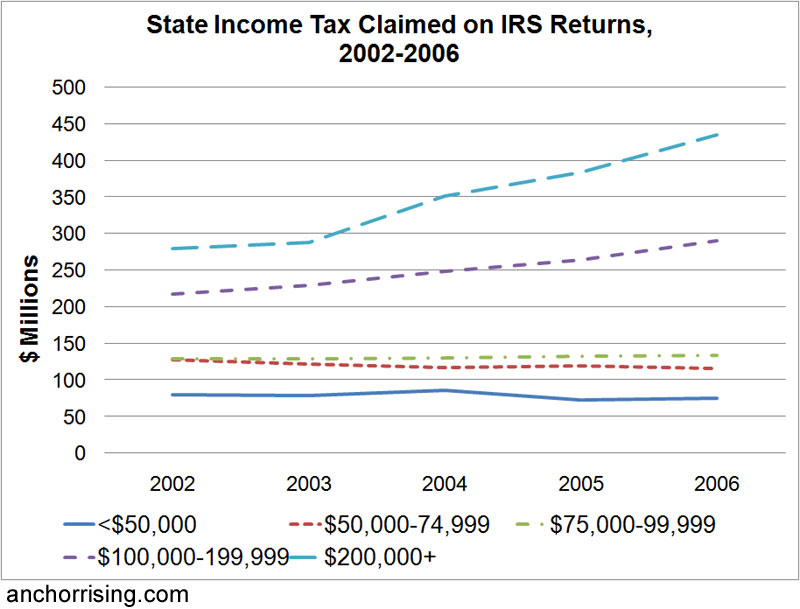
Rhode Island must push the likes of Ocean State Action aside and do what so clearly must be done.
Cut taxes. Trim mandates. Lighten regulations. And quick.
May 11, 2009
Myopia Versus the Long View in Rhode Island
Self-described newcomer to local politics, Brian Gough, has a letter on the Sakonnet Times Web site criticizing reformers' efforts. Individuals' understanding of the appropriate actions of elected representatives, particularly those in leadership roles, may vary, and differences of opinion aren't necessarily worth the expenditure of much heat. But Mr. Gough's snap assessment of the sides makes an egregious error:
The level of passion behind the actions taken at this meeting was apparent. I am a realist, and quickly did the math. I realize the impact of a small group's efforts to push their agenda is minimal in the short term but the impact on our long term financial viability is extreme. They are selling us out for a short-term reduction in our taxes, and willing to risk our long-term values (home value, bond viability, etc.) Based on this, I must question whether I am a short- or long-term resident of this town. The answer is easy, I am here for the long term, and based on this, I will focus my energy on what will help all of us for the long term.
Members of Tiverton Citizens for Change, as the most local representatives of our broader movement, take a very long view of the actions and the changes necessary to renew our town, our state, and our nation. Those who think we see each cut in terms of its immediate affect on our tax bills miss the point and are likely to stop following the thread before they've come to the real structural problems that we're trying to address.
May 5, 2009
Taxes and Incentives
Most Rhode Islanders are likely ambivalent about their state's status as background scenery for Hollywood movies. Yeah, it's neat to see familiar places on the big screen, as well as to spot famous people around town, but it remains a novelty, not a matter of economic import or civic identity. Still, this strikes me as a fitting allegory:
A year after lawmakers voted to cap the controversial movie and TV tax-credit program, Rhode Island Film & Television Office Director Steven Feinberg acknowledges it has been "a challenge" to continue to attract movies and other productions to the state.Forget the historic charm and seaside vistas: without the tax breaks, Rhode Island loses a little of its luster.
One suspects that a similar dynamic exists with that much lauded "quality of life" by which certain players attempt to distract from the fact that scenery is of mere mild comfort when one can't pay the bills.
May 3, 2009
The Flush Heard 'Round the World
As some of you have already noticed, The Economist is the latest broad-circulation publication to offer a summary of Rhode Island's economic woes. The attractiveness to writers is easy to see; a mere list of gloomy facts and figures can fill an entire article.
Today almost no homes, opulent or otherwise, are being built in Rhode Island. Only 16 permits for single-family dwellings were issued in February in the whole state. In March 633 homes were in foreclosure. The job front looks even worse. Last September Rhode Island had the highest unemployment rate in the country, exceeding even Michigan. In March the rate was the sixth-highest in the country, 10.5%, compared with 8.5% nationally.Almost every sector has been affected. Jobs are so scarce that 200 people turned up recently at a job fair hosted by Foxy Lady, a Providence strip club. But the current misery comes on top of long-term decline. The state's once thriving manufacturing industry has been fading for decades, with production slowing and working hours cut. Manufacturing lay-offs were persistent, even during good times; and good times have not been seen in the state for almost two years. Rhode Island entered the recession six months before the rest of the country.
And on and on. One can't help but think of state Rep. Elizabeth Dennigan's suggestion that Rhode Islanders have to stop complaining about the state's current circumstances (audio at the twelfth bullet point here). Too many who live in the state may choose to look away from the problems, but apparently, the rest of the world is keenly interested.
April 28, 2009
Operation Clean Government Panel Audio (Continued 3)
Picking up from the end of the previous string of audio, the following audio is as described on Anchor Rising's live blogging of Operation Clean Government's spring forum:
- WPRO's Dan Yorke asks how leaders can accomplish a major change in Rhode Island: stream, download (57sec)
- URI economics professor Leonard Lardaro suggests that we have to look toward the future in our decisions and that "everybody's indirect motto is 'everything's negotiable'": stream, download (1min 32sec)
- First audience question goes to the man who shouted out angrily at General Treasurer Frank Caprio, who predicts a Governor Caprio and winds up asking why Rhode Islanders vote so badly: stream, download (2min 38sec)
- Representative Elizabeth Dennigan (D., East Providence, Pawtucket) suggests that voters should "be discerning" and vote based on issues, not personality: stream, download (27sec)
- John Hazen White, Jr., President and CEO of Taco, Inc., expresses the opinion that people should vote for politicians who don't see it as a career: stream, download (19sec)
- Buddy from Johnston asks Dennigan to stop legislative grants ("rub and tug"), and she replies, "It's not an equitable system, and it's not dispersed equallly, so it shouldn't be dispersed at all": stream, download (1min 49sec)
- Caprio answers a call for a pitch from government to business by saying that the government should exist to serve businesses, period; "Over taxation; over regulation; every time a business deals with government, it's confrontational":stream, download (1min 29sec)
- An audience questioner asks, as a landlord, where tenants are going to come from, and she and Yorke have an interesting discussion on citizen activism: stream, download (5min 23sec)
- Another questioner decries government cronyism: stream, download (1min 57sec)
- Terry Gorman of Rhode Islanders for Immigration Law Enforcement asks why the state can't pass E-Verify: stream, download (1min 29sec)
- Dennigan is "glad to see that the Obama administration is working on a system that will secure our borders": stream, download (41sec)
- Caprio says, "Pass E-Verify; we're a country of laws; enforce the law": stream, download (13sec)
- Department of Administration director Gary Sasse notes that the state currently uses E-Verify and businesses should be able to, and Yorke notes the difference in citizen enthusiasm between illegal immigration (high) and government inefficiency (low): stream, download (2min 56sec)
- Caprio turns the question toward state aid and minimum manning mandates: stream, download (39sec)
- Harry Staley of Rhode Island Statewide Coalition takes the audience mic expresses the concern of suburbanites that regionalization and consolidation will only direct money to the maw of Providence, and Yorke suggests that RISC make this its issue: stream, download (2min 38sec)
- An audience questioner promotes ending the straight ticket ballot option, and Dennigan says she "strongly supports" it, as do others on the panel: stream, download (1min 13sec)
- An audience member offers her diagnosis of Rhode Island's problem: "Rhode Island is a victim of rape": stream, download (32sec)
- Another audience members says Rhode Islanders don't know what to believe and are too trusting of their leaders and asks how to develop a relationship with their representatives; Caprio: "Run against them or get in their face with a lot of people": stream, download (2min 29sec)
- Yorke talks about wrapping up: stream, download (24sec)
- An audience question about searching for a new Economic Development director; Sasse answers: stream, download (1min 17sec)
- Governor's wife Sue Carcieri mentions the problem of monopartisanism and raises voter ID: stream, download (1min 32sec)
- Caprio notes his ranking on Anchor Rising's top 10 right-of-center list for RI and, after some prompting from Yorke, declares definitively that he is not considering switching parties: stream, download (1min 17sec)
- A college student expresses fear about not finding a job in Rhode Island and asks whether the people leaving the state like him or are more established people packing up and going; general agreement of "both," including from Lardaro: stream, download (1min 16sec)
- Former OCG director Bruce Lang speaks of reducing the size of government, implementing term limits for legislators, and the power of public employee unions ("run the legislature"): stream, download (1min 20sec)
- Dennigan notes that 55% of the state budget is social services but refuses to answer whether unions and social service advocates should dominate government expenditures, instead giving an example of somebody who relies on social services: stream, download (1min 54sec)
- Yorke recalls the question about having state government "get out of a business" or two: stream, download (27sec)
- An audience member talks about cutting taxes and being more targeted in government solutions and citizen activism: stream, download (1min 23sec)
- Another audience member recaps and raises the straight ticket issue again: stream, download (51sec)
- Representative Rod Driver (D., Charlestown, Exeter, Richmond) decries prevailing wage requirements and other state mandates on cities and towns: stream, download (41sec)
- The panel members state that which they learned during the morning's event: stream, download (1min 32sec)
- Governor Don Carcieri offers a closing summation, saying that government is not the proper channel for charity and social justice: stream, download (6min 38sec)
- Yorke offers his own closing summation: stream, download (2min 42sec)
April 27, 2009
A Bleak Economy and a Lack of Solutions
Making a prediction that employment trends won't turn around in Rhode Island until the end of 2011 or 2012, John Kostrzewa included a couple of points in his column, yesterday, that merit further thought:
While [Northeastern University labor economist Paul] Harrington argued that Rhode Island's education system helped get the state in trouble, it can also be the path to recovery.That will require developing an educational system that prepares students for the workplace by teaching the skills needed to land a job. A skilled work force will attract employers, who are always looking for pools of qualified people to design and build their products or deliver their services.
The difficulty is that you can't keep workers without having jobs for them to fill. Especially with Kostrzewa and my shared expectation that Rhode Island will trail the country in recovery, the likelihood would seem to be that skilled workers will exit the state in search of jobs. If the state takes the attitude that it will build the workforce and jobs will come, it will likely find itself investing in education that ultimately benefits other states' economies, actually delaying our own.
This ties in with another point at which Kostrzewa and I diverge:
The real hard work is going to be focusing the state's leaders, their efforts and resources on figuring out the type of jobs that could come to Rhode Island and then crafting the courses and training sessions that match the workers with the jobs.It's a huge undertaking.
But it's an absolute must if Rhode Islanders are going to have a future that is better than their recent past.
Put flatly, I don't trust our state's leaders to find a future direction for Rhode Island's economy. If that were their competency, they'd be leaders of industry, not of a lagging political entity. They won't find the proper balance between citizen expectations, special interests, and economic health. Instead, they'll spin special interests' desires in such a way as to pervert citizen expectations with a false promise of an improved economy.
What we need — all we need — is for the state government to withdraw from the economy over which it presides. We need lower taxes, less regulation, fewer mandates, and a focus on improved infrastructure. Clean off the runway, and the businesses that are a good match for Rhode Island will land here — having done the homework that survival necessitates.
See, businesses need a rolling economy to survive. Politicians just need votes, and with our corrupted philosophy of government, votes are solidified in several instances when the population is uncomfortable, even panicked.
April 26, 2009
Operation Clean Government Panel Audio (Continued 2)
The following audio continues where the related post left off, in keeping with Anchor Rising's live blogging of Operation Clean Government's spring forum:
- WPRO's Dan Yorke asked where the side that's supposed to counterbalance special interests has been, to some confusion over whether he means elected representatives or voters, with short responses from General Treasurer Frank Caprio: stream, download (29sec)
- Representative Elizabeth Dennigan (D., East Providence, Pawtucket) says the public has to do its homework, seeming to imply that citizens ought to analyze portions of the budget; "help us out": stream, download (1min 7sec)
- Yorke specifies the question to ask why the General Assembly leadership isn't in the room; "Do you think they give a damn?"; audience, "No!": stream, download (57sec)
- Dennigan attempts to compliment her leadership, but slipped up to say, "I'll give them kudos for letting me be here"; 30 seconds of audience turbulence, including one shout of "there's the diagnosis"; Yorke pursued, and Dennigan responded awkwardly: stream, download (1min 29sec)
- Yorke questions whether anybody is in the room from labor, alludes to labor YouTube videos, compliments Bob Walsh, calls labor's point of view "legitimate," and lists the various issues that politicians must be able to address: stream, download (2min 49sec)
- Yorke prods Caprio on how he would battle the General Assembly and test labor if governor; when he said, "You dig in with the General Assembly," an irate audience member stood up and started shouting, "You're grandfathered in"; Caprio clarified that "you dig in against them": stream, download (3min 52sec)
- Having turned the question toward the "one thing" that a governor has to insist upon to turn the state around, Yorke points to Department of Administration head Gary Sasse begins on cutting taxes: stream, download (32sec)
- Prompted to provide her philosophy on taxation, Dennigan says, "No new taxes; why can't we decrease them?": stream, download (1min 1sec)
- URI economics professor Leonard Lardaro jumps in to say that "the people of this state have to demand results": stream, download (1min 35sec)
- Yorke asks what business(es) the state government ought to get out of: stream, download (2min 14sec)
- John Hazen White, Jr., President and CEO of Taco, Inc., replies "government"; Yorke asks if he's "advocating for chaos": stream, download (1min 2sec)
- Sasse cites pension reforms, management rights, and tenure reform as areas that need to be accomplished more efficiently; he enumerates that government should be in education, infrastructure, and "realistic safety nets"; "everything else is irrelevant"; "We haven't discussed what we can afford. That's why we've become an entitlement society, because we never assess what we can afford.": stream, download (5min 16sec)
- Dennigan responds that we need "pension reform" and begins to ramble: stream, download (1min 33sec)
- Sasse raises provinciality, which becomes a sort of take-away for the morning: stream, download (58sec)
- Caprio says that we don't need "government layers on top of government layers": stream, download (1min 17sec)
Operation Clean Government Panel Audio (Continued)
As some have already noted in Anchor Rising's play-by-play, some significant and interesting things were said at Operation Clean Government's spring forum. Last night, I posted audio of Governor Carcieri's unscheduled speech; thereafter, the panel took the stage:
- OCG President Arthur "Chuck" Barton introduces the panel, points out some significant people in the audience, and gives brief opening remarks: stream, download (2min, 9sec)
- WPRO talk show host Dan Yorke kicks off the discussion, asking the panelists to give their diagnosis of Rhode Island's illness: stream, download (3min, 53sec)
- Dan directs the question to RI General Treasurer Frank Caprio, who gives a solutioning speech (state must be "user friendly" to business), leading Dan to drive the conversation to the question: stream, download (4min, 10sec)
- John Hazen White, Jr., President & CEO of Taco, Inc., repeats the governor's take, "We are creating a much bigger tax burden; at the same time depleting the tax payers": stream, download (41sec)
- Unfortunately, an attempt to locate a beeping noise (which turned out not to be my equipment), rendered the short response of Director of Administration Gary Sasse, as well as the beginning of Rep. Dennigan's response, inaudible.
- Representative Elizabeth Dennigan (D., East Providence, Pawtucket) points the finger at efficiency and transparency, saying "I can tell you as a long-time member of the finance committee that we don't know how we are spending millions": stream, download (29sec)
- University of Rhode Island Economics Professor Leonard Lardaro blames an endemic approach of Rhode Islanders, specifically that "Too many people in this state have a very exogenous view of the world; things just happen; they don't really associate actions now with outcomes later": stream, download (2min 32sec)
- Yorke redirects the question redirects the question to define Rhode Islanders: stream, download (3min 20sec)
- Caprio mentioned the sacrifice of our parents and noted an inclination to help each other, to which Yorke responded that he's describing Americans: stream, download (2min 33sec)
- Hazen White lauds ingenuity, creativity, etc: stream, download (1min 31sec)
- Yorke specifies that he's looking more for the philosophical in order to resolve RI's status as "submerged": stream, download (50sec)
- Dennigan says that we should stop "complaining and encouraging our young students to leave and go somewhere else" and market the state: stream, download (1min 58sec)
- Yorke suggests that Rhode Islanders must and can be honest about themselves; "The doctor doesn't say, in his mind, you're dying of cancer, but you know what? You're a good egg.": stream, download (1min 34sec)
- Lardaro says that Rhode Islanders are "deeply caring" but are "consumption oriented" and are "way too trusting of our leaders"; "Tone always seems to supersede accuracy": stream, download (1min 33sec)
- Sasse expands that "what happened is we became an entitle-mentality state" based on political decisions, which fostered "an inferiority complex": stream, download (1min 42sec)
- Yorke asks Dennigan whether Rhode Islanders have courage; the crowd says, "no"; Dennigan points to the people in the room as an example of courage: stream, download (33sec)
- Yorke defines the question as having the grit to change our lifestyle, making it healthier; "Would Rhode Islanders rather die than do the things that the doctor has prescribed?"; audience member: "They don't believe it": stream, download (1min 9sec)
- Hazen White says there's "a tremendous lack of courage and maybe an uninformed path" and that he was "dumbfounded" that the Democrats expanded their power in the last election; and another thing, "we've got a union problem": stream, download (1min 56sec)
- To laughs from the crowd, Caprio shifts to call it "a special interest problem" in that there's no opposing force for the taxpayer against them: stream, download (1min 8sec)
April 25, 2009
Operation Clean Government Breakfast & Panel
Just checking in from Operation Clean Government's event at the Quonset Club. A little shy of 200 people are here, many of them familiar faces, but not all. My initial thought is that there are a number of people from different segments of local activism. Local Tiverton folks, RISC folks, politicians, activists, and so on. OCG seems to cut across the categories.
Hopefully I'll be more insightful after I've had some breakfast...
10:06 a.m.
The governor is giving a surprise speech, mainly focusing on pensions as the next stop. Some pictures thus far:
Governor Carcieri works his way into the room:

Carcieri at the podium:
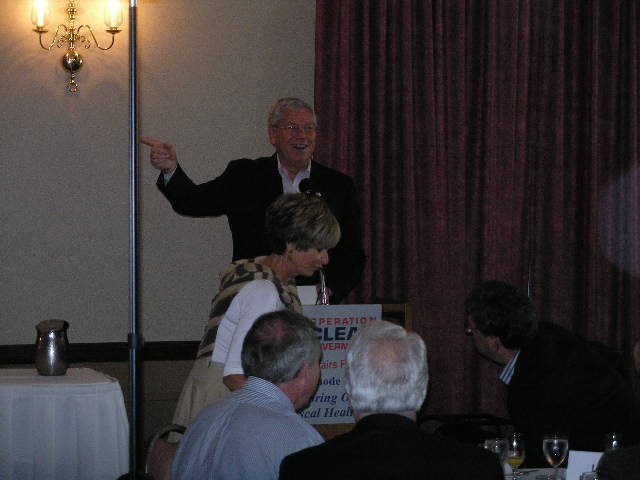
Dan Yorke arrives & Senator Leonidas Raptakis walks the room:
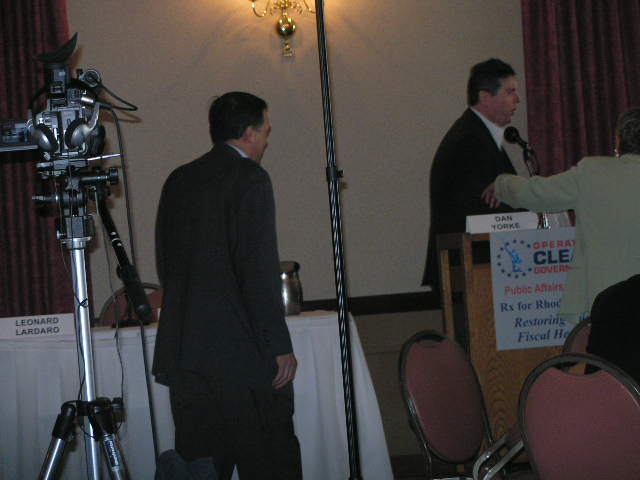
Treasurer Frank Caprio moves table to table:
Len Lardaro at the panelists' table:
Sen. Raptakis chats with somebody and RISC's Jim Beale chats with RIILE's Terry Gorman:
10:10 a.m.
Governor: "It's time to ratchet up the game to a higher level so that the people who are going to make the votes at the end of the day understand." Referenced OCG, RISC, the tea party.
10:13 a.m.
OCG's Chuck Barton is pointing out people of importance in the audience, legislators, RISC folks, some business people, former OCG leaders. Also Colleen Conley of tea party fame.
10:19 a.m.
Dan Yorke has taken the podium. "My goal is to see if anybody will say something new... not repeat the same old crap."
He also expressed hope that the presence of Jim Baron and Ed Fitzpatrick will ensure coverage beyond his radio show.
Ahem.
OCG's Chuck Barton opens the panel:
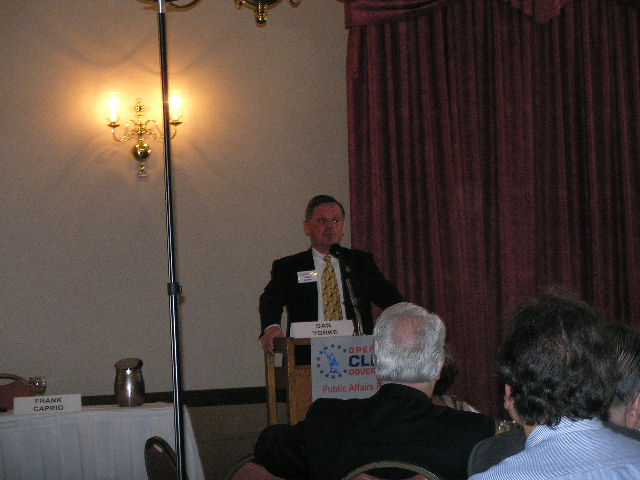
Dan Yorke takes the podium:
The panel assembled:
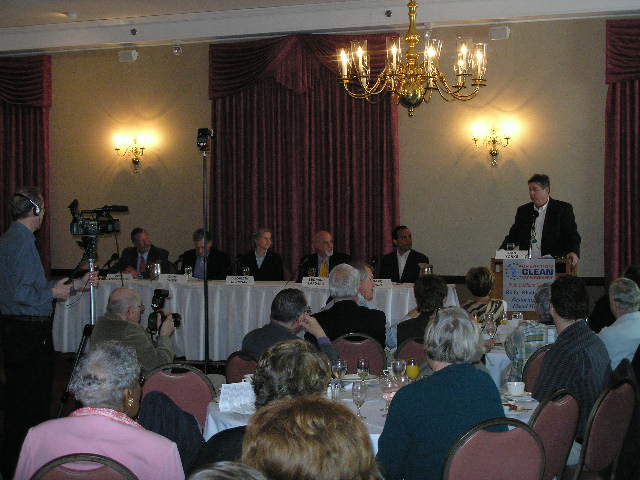
10:24 a.m.
Dan presents the question as providing a diagnosis. "Quickly, because if I go to the doc, I want to know if I'm going to live or die."
Treasurer Frank Caprio is trying to give a solution-type speech, and Dan keeps trying to drive him back to the question.
Dan "This is just a little group to practice on if you're going to run for governor."
"Everybody on this panel is a great citizen, but they've got to answer the question."
10:32 a.m.
John Hazen-White: Higher taxes, fewer payers.
Gary Sasse: Tax structure
Elizabeth Dennigan: Lack of efficiency and transparency.
Leonard Lardaro: Costs beyond taxes. "Do a dynamic or temporal analysis." Addressing the governor directly. "Can't afford to raise taxes."
10:33 a.m.
Yorke: "A lot of smart things are being said, but nobody's answered the question." In advertising, the message is the most important thing. "What is the product of Rhode Island; who are Rhode Islanders? You have to know the patient."
"Can we have a philosophical discussion among the audience and the panel about who we are? What is the Rhode Island disease."
10:36 a.m.
Caprio: "We're the product of families that sacrificed for us to get where we are today. Are people willing to have shared sacrifice to get our government in order?"
Yorke: "Are Rhode Islanders of a mindset to know what quality of life is and to make it a goal?"
Caprio: I think Rhode Islanders are different. [Catholic and other community-engrained religious groups.] "That's who we are."
10:40 a.m.
Hazen-White: "[RI] is a very unique place from the standpoint that it's so small." Tremendous opportunities; tremendous problems. Tremendous ingenuity; tremendous people. "Perhaps the greatest available workplace of any place I've ever been."
Huh? Based on what.
10:43 a.m.
Dennigan: "Something that really annoys me" is RI's talking about all the problems. "If we're always complaining and encouraging our young students to leave and go somewhere else... there's no state that doesn't have problems with ethics... [one film producer} said to me, 'I just love Rhode Island'" --- referring to the geographic diversity.
Gimme a break.
Dan: "Obviously, there are wonderful things about living in Rhode Island." His point is that people who live in Rhode Island can be honest about the problems in Rhode Island.
10:45 a.m.
"The doctor doesn't say, 'You've got cancer, but you know what: you're a good egg.'"
Lardaro: It's a consumption-oriented, immediate state that's too trusting in its leaders. "Tone always seems to overweigh accuracy."
Sasse: What happened? "We became an entitlement-oriented state."
Yorke: "Why?"
Sasse: "Those were political decisions." Unrest from the crowd. "People voted that way. People were not informed."
10:48 a.m.
Sasse: Rhode Islanders have an inferiority complex, founded in the principle that government owes you something.
Yorke to Dennigan: "Do we have courage amongst the people of Rhode Island."
Crowd: No!
Dennigan: Blah, blah, blah.
10:53 a.m.
Yorke listed a pretty rigorous health regime and asked if Rhode Islanders would rather die.
Crowd: "They don't believe they're going to die."
Hazen-White: "There is a tremendous lack of courage." "If you keep doing what you always did, you're going to keep getting what you always got." He was "dumbfounded" that Democrats increased their share of state government. Voters... it isn't their guy; it isn't their gal. And another thing: "We got a union problem."
Crowd: Cheers.
Hazen-White: "And damn it, unless and until that whole thing is dealt with --- doesn't mean it needs to be squashed."
Caprio: "We have a special interest problem." "It's like a football game... If the other team doesn't show up, the other team isn't going to go home; they're going to score touch downs."
Yorke: Where was the other side?
The audience seems to think that he means the working people of Rhode Island. Dan's rightly pointing to our elected representatives.
Dennigan: "We need more of the public doing their homework."
10:55 a.m.
Yorke's observing that none of the legislative leaders are in the room.
Yorke: "Do you think they give a damn?"
Crowd: No!
Dennigan: Thanked the leadership for letting her be here.
Crowd: What???? Shouts; anger.
Bad, bad answer.
10:57 a.m.
Breaking news: The legislative leaders advised Dennigan to participate in this event.
Yorke is mentioning that nobody from labor is in the room. ("Usually they hide with YouTube cameras.")
Yorke: Bob Walsh is the only one who will come to the fight with his legitimate point of view.
10:59 a.m.
Yorke: "The general assembly runs the show." "The sick people of RI have let the general assembly run wild." To Caprio: How are you going to change that.
Audience member: "You're grandfathered in."
Caprio: "You dig in against the General Assembly." Lay out a plan, and if they don't want to go there: "If after the first year, if the legislature doesn't want to solve the problem, it's up to the leaders to get people elected who will solve the problem." I [he] can pull those resources together.
11:03 a.m.
Yorke's trying to elicit the one thing that the governor needs to bring things into line.
Lardaro: "The people of this state have to demand results."
Yorke: "Do they know what result they want?"
11:07 a.m.
Yorke: "Is it possible that Rhode Islanders instinctively know that they don't want a nanny state?"
Audience member: Define that.
Yorke: "I have to define that?" ... We have to get out of a certain number of businesses in this state. Those who don't listen to his show don't seem to understand that he's talking about government actions --- whole categories of them. Poses the question to the panel, what businesses do we have to get out of?
Hazen-White: Government. [Too many people work for the government.]
Sasse: Need efficiency. Pension reforms. Management rights. Tenure. ("I have people working in my departments who really don't deserve tenure.") Three things government should do are education, infrastructure, and realistic safety nets to move unfortunately people up the ladder, with emphasis on realistic.
11:13 a.m.
Yorke has redirected to what we have to get out of.
Sasse: "They're tough choices." A checklist, such as state libraries. "We haven't discussed what we can afford. That's why we've become an entitlement society, because we never assess what we can afford."
11:16 a.m.
These pictures are a little out of order (I took them earlier), but I think they catch good moments.
Several times, the discussion dipped into a Yorke v. Caprio battle:
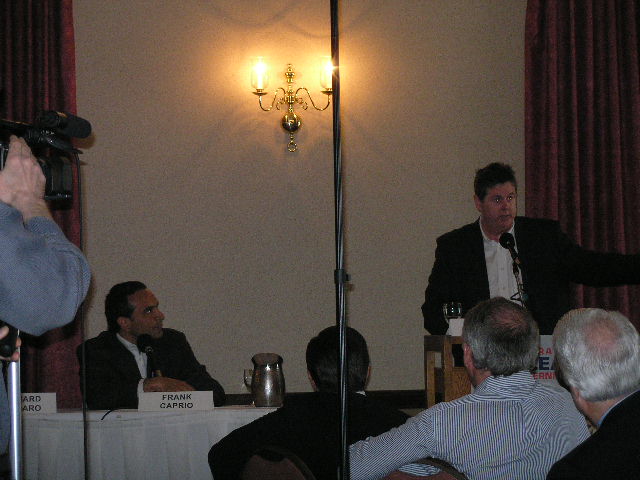
Several times throughout the event, depending upon what she'd just said, Rep. Dennigan looked as if she felt physically ill. Here she is after admitting that the legislative leaders had allowed her to participate. (Right click and choose "view image," or equivalent, for a larger image.)
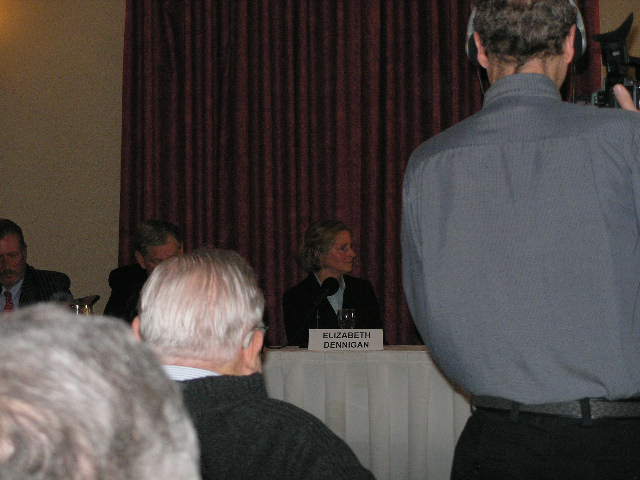
11:18 a.m.
Sasse: There are too many cities and towns.
Yorke: "Are you saying that we need to get out of the business of provinciality?"
Me, I disagree. I like the variety. Push more responsibilities to the towns. Reduce the repetition at the top.
11:20 a.m.
Q&A period. Many hands go up.
11:22 a.m.
The first questioner thinks Caprio is "grandfathered into being our next govenor." "Do the right thing." The question: Why don't Rhode Islanders vote for the right people? Yorke changed to, "What's the right kind of person to elect?"
Dennigan: Voters have to be discerning.
Hazen-White: "Being a public servant should not be a career."
Question 2: To Dennigan: "Why don't you stop the grants that are going out to everybody?" [Rub and tug.]
Dennigan: We need more information.
After prompting from Dan, Dennigan: It's not an equitable system, and it's not dispersed equitably, so it shouldn't be dispersed at all.
Question 3: One or two good reasons that companies should move to RI.
Caprio: "We're here to serve you, period." Shouldn't be overregulation, overtaxation, headaches. "Every time business deal with government, it's confrontational."
Question 4: As a landlord, I want to know where are the people who are going to come into Rhode Island to live. A lot of people can't afford to live here, and those who can are on system-supported incomes, and then the government regulates my property.
Dennigan: We need to keep the property taxes down, as a result of looking at our spending.
Questioner: I'm fed up with the little guy being tax.
Yorke: What are you going to do with your anger?
She goes to the statehouse. Has brought people together. Went to the tea party. "I don't want to run for office until it's cleaned up."
Dan brought it back to the "who we are." "You don't want to enter the lion's den until it's cleaned up for you." "We have mad-as-hell people" who won't put themselves on the line to fix problems. "We'll only put our toes in the water in our comfort zone to fix the system."
11:34 a.m.
Next questioner: Cut taxes. Diagnosis: for years, the people who run this state have been running the state as their own companies... friends, families, business associates, and so on.
Terry Gorman of RIILE: I have a solution for the whole thing. "Why can't the state of Rhode Island pass E-Verify?"
Dennigan: Kicked it back to the feds.
Caprio: "Pass e-Verify. We're a country of laws, and we should enforce the laws."
11:41 a.m.
RISC's Harry Staley: Regionalization will cause certain people to object to sending suburban money to Providence. He thinks that regionalization ought to be RISC's driving issue.
Another question for Dennigan; actually not a question, but a promotion of elimination of straight ticket.
Caprio answered: Eliminate the straight ticket.
Another question/statement answering the diagnosis question: "Rhode Island is a victim of rape?"
Next audience member: "We don't know what we believe in, and we don't know who to believe."
11:48 a.m.
Question: Should there be a search for a new economic development director, considering that previous versions haven't resulted in good people?
Susan Carcieri: "Because we are dominated by one party (without naming names), we have a serious problem." What does the panel think about voter ID?
Caprio: Referenced Anchor Rising's ranking of him on the top 10 conservative list.
Yorke: "You could save a lot of dough in a primary with Lynch if you hopped over to the other side."
Caprio: "That's not under consideration."
A college student asked if the people who are leaving RI are graduates looking for work or rich people. General answer: both. I'm not so sure. I think the people who are leaving, but whom we want to stay, are the "productive class" in between.
Bruce Lang: The unions and social services advocates run the legislature.
Dennigan: 55% of our budget is social services.
Her answer to whether these groups should control government was that they have a lot of influence. Dan pressed for a specific answer, and she replied by bringing it to specifics about reviewing cases on their individual bases. As I paraphrased her earlier: blah, blah, blah.
11:59 a.m.
Rod Driver: "I want to throw out a specific suggestion... We need to cut back the mandates," including prevailng."
Panelists on what they learned this morning:
Hazen-White: The level of frustration and the regionalization question.
Sasse: There's a need for change, but we don't have a game plan.
Dennigan: Learned about straight-ticket.
Lardaro: People are concerned by a wider range of things than I knew about. People are getting upset about things enough to do something.
Caprio: Don't give an inch; take the spirit of this room.
Governor Carcieri: "I'm going to become a radio talk show host." "We don't know what we want; we're really confused." Government is not the proper venue for charity and social justice.
April 23, 2009
A Typical RI Solution for "Solving" a Nursing "Shortage"
Our state is in dire financial trouble based on structural deficits, is on the wrong end of just about every state-by-state comparative list, and is losing its "productive class" by the thousands every year, but the matter of concern for a special legislative commission is, in the words of its Co-chairman Sen. James Doyle (D., Pawtucket):
Even if there are nurses without jobs now, the shortage of nurses, Doyle said, "is going to be a serious issue some day."
Some day. Okay. Let's take that as a plausible reason for at least strategizing methods of increasing the state's supply of nurses. What are some of the problems that must be addressed? Well, there's a reluctance to work more comfortable shifts and in more prestigious locations:
But many graduates want to work only the day shift in a hospital or don't want the less-prestigious nursing-home and home health-care jobs.
Meanwhile, employers are wary of investing in the training of young new hires:
In the hospitals where there are jobs, officials don't want to hire new graduates because they can be expensive to train and there is a fear that, once trained, they will leave to take another job, said commission Co-chair Lynne M. Dunphy, of the University of Rhode Island's College of Nursing.
Perhaps Ms. Dunphy's profession partially explains why the commission contrived such a peculiar means of addressing these specific problems:
A special legislative commission formally unveiled its proposal to give educators in the state's nursing schools an annual $3,500 tax credit, an attempt to keep them teaching so they can make a dent in what the panel said is a looming shortage of nurses in the state.
So, if there's a problem in the nursing profession life cycle, it has to do with matching candidates with difficult-to-fill positions; there's no indication that nursing schools are suffering a lack of students for whose educations they are unable to find teachers; and a legislative commission co-chaired by a nursing educator thinks shaving another "half-million dollars" out of the annual budget to benefit this extremely select class of citizens is the solution.
Yup. That's Rhode Island for ya.
April 22, 2009
Precursors of Unemployment
A forum entitled "A Budget that Reflects East Providence and Pawtucket's Priorities" and sponsored by
the Campaign for Rhode Island's Priorities, the Rhode Island Foster Parents Association, the Unitarian Universalist Legislative Ministry-RI, the Rhode Island Chapter of the National Organization for Women, the Service Employees International Union, and the RI Federation of Teachers and Health Professionals
will take place this Monday in East Providence. The flyer announcing the event asks
How will the [state] budget affect our schools, our health care, our elderly care, and higher education? Funding for essential programs and services has been drastically cut over the past several years, including cuts to nursing homes, child care, hospitals, Head Start, and even our schools. Costs for health care and higher education have been skyrocketing. Can the residents of East Providence and Pawtucket expect this to continue? Will our State Representatives and Senators advocate for the right tax and budget choices that will help strengthen the economy in Rhode Island?
Well, I couldn't agree more about the importance of the last item. But inasmuch as a prior sentence deplores the cuts to various services, it is difficult to believe that the forum will not come to the conclusion that the "right tax and budget choices" means, regretfully, raising taxes, with other considerations such as the impact on the economy of such a course of action a distant second.
The timing is propitious, therefore, of an analysis by Jim Lindgren at the Volokh Conspiracy about the correlation between states with high unemployment and the level of their unionization and income tax rates.
With sincere apologies to my union friends (but not my tax-raising aquaintances), here goes.
As the nation considers increasing marginal tax rates and facilitating greater union membership, I thought it might make sense to look at the states with the highest and lowest unemployment rates to see if there might be any relevant patterns. The six states with the highest unemployment rates are:12.6% Michigan12.1% Oregon
11.4% South Carolina11.2% California
10.8% North Carolina
10.5% Rhode Island
And the result?
Putting this together, 3 of the 6 states with the highest unemployment (California, Oregon, and Rhode Island) have both high marginal income tax rates and high union representation. Michigan has high unionization but moderate marginal income tax rates, and the Carolinas have high marginal income taxes, but low unionization rates.
April 21, 2009
Tea Parties and Public Choice Theory
Put your wonk hat on. Economists Brian Wesbury and Robert Stein write:
While the theory of public choice can be broadly applied, it is the ideas of "special interests" and "rational ignorance" that are useful in understanding last week's tea parties.It also explains why we Rhode Islanders seem so apathetic when it comes to giving Joey Downthestreet a little more cake. Not for nothin', but it ain't really a big deal. At least for a while. Oh, and incidentally:Here's an example of public choice at work. Let's say teachers could benefit by $2,000 each per year (in higher pay or benefits, smaller classes, etc.) from a piece of legislation currently under debate. But the cost per taxpayer averages just $15 per year.
The "special interests" (teachers and politicians) have substantial personal incentive to see that the bill is passed. Teachers, who benefit directly, will use time and money to lobby for the bill. And lawmakers will expect campaign contributions, votes or both, in exchange for their support.
But the taxpayer will remain "rationally ignorant" of the whole process. Why spend time even thinking about an issue when the cost is only $15 per year?
....This is why government will tend to grow in excess of what a true democracy really wants. At least, it will grow until those $15 hits accumulate to such a level that people have finally had enough, and in a seemingly spontaneous eruption, the average voter finds the energy to fight back.
Apparently, this is what happened last week.
Here is an interesting set of facts. If the government increased the top tax rate from the current rate of 35% to 100% (yes, that's right 100%), it would only collect an extra $400 billion this year. In other words, confiscating all the income that is currently taxed at 35% would not raise enough revenue to cover any of the annual deficits projected in the next 10 years. There is no way that tax hikes on the rich alone can pay for proposed spending in the current budget.
About the Economic Knowledge of the Public...
Michael Barone writes, "Many of the sneering comments about the participants in last week’s hundreds of tea parties across the nation were premised on the idea that these people didn’t know much about public policy." (Sounds familiar). However, as Barone mentions, a Pew Research poll conducted at the end of March (you can take the related quiz here) "finds the American public reasonably well-informed about a number of basic facts pertaining to the current economic situation." Further, a new Rasmussen poll shows that 52% of Americans are worried that the government is getting too involved in the economy. This tracks closely with the results of another Rasmussen poll showing that 51% of Americans viewed the Tea Party protests favorably. That puts this slight majority at odds with the "Political Class" polled by Rasmussen:
[J]ust 13% of the political elite offered even a somewhat favorable assessment while 81% said the opposite. Among the Political Class, not a single survey respondent said they had a Very Favorable opinion of the events while 60% shared a Very Unfavorable assessment.Then there's this:
Most Americans trust the judgment of the public more than political leaders, view the federal government as a special interest group and believe that big business and big government work together against the interests of investors and consumers. Only seven percent (7%) share the opposite view and can be considered part of the Political Class.So, according to these polls, the tea parties were supported and attended by a basically bi-partisan, well-informed and populist crowd. Yikes!On many issues, there is a bigger gap between the Political Class and Mainstream Americans than between Mainstream Republicans and Mainstream Democrats. That was true on the tea parties, but Mainstream Republicans do express a more positive view of the protests than Mainstream Democrats. Still, a majority (54%) of Mainstream Democrats had a favorable opinion of the tea parties.
April 20, 2009
Not So Steady
This interesting consideration was to be found after the page 7 continuation of a recent story on Rhode Island's steady unemployment figure:
No industries in Rhode Island reported job growth in March. And while the unemployment rate held steady, the state lost 1,900 jobs.That contradiction –– a stable unemployment level amid deep job losses –– could indicate a surge in the number of Rhode Island residents finding work outside the state. But it is more likely evidence of the growth in so-called discouraged workers –– unemployed people who have given up the search for jobs and are no longer counted in the jobless rate.
The number of discouraged workers equals 2.1 percent of the state’s labor force, up from 1.6 percent a year ago and the second highest in the country after Michigan, according to the Current Population Survey.
The state-to-state discouragement numbers weren't easily available, based on a quick search, but I wonder where Rhode Island's 12.6% overall unemployment rate puts us on a ranking.
Providence is the Hardest City For People to "Get By"
According to Forbes (h/t Buddy Cianci), the Providence metro area (Providence-Fall River-Warwick, R.I.-Mass., metro area) is the toughest for people to get by in.
There are few smiles among those who live in Providence, R.I., these days.First, it seems unfair to lump Providence (and Warwick) with the poor economic performing area of Massachusetts around Fall River and then basically lay all of the woe at the feet of Providence. Regardless, whether or not we agree with Forbes, the fact is that yet another national publication is proclaiming how bad it is to be in Rhode Island.In February, the metro area reported an 11.6% unemployment rate, one of the highest in the country. Construction--one of Providence's major industries--is down; traditional manufacturing has been struggling for years. Like many across the country, few are spending at retailers. And while the area's median income is $54,064--about $4,000 higher than the national average--its cost of living index is steep, 22 points above the national average of 100.
All this means it's hard to catch a break in Providence. {Emphasis added}
April 14, 2009
The Mathematics of Sinking
Struggling Rhode Islanders are certainly right to hope for signs of recovery, but URI Economic Professor Len Lardaro's take on the latest results of his Current Conditions Index for the state is counterintuitive at best:
... The index registered a value of 8 for February. ...The index measures the behavior of 12 economic indicators, with a value of 50 being neutral. Anything above 50 signifies expansion, while anything below that signifies contraction.
In January, the index registered a 17, but was largely driven by 2 of the 12 indicators — manufacturing wages increased and new claims for unemployment insurance were down slightly.
The February score returns the index to the level it saw for most of 2008, which Lardaro calls a positive sign.
"The process of recovery begins when we start to consistently match or exceed each prior month's economic performance," he said.
For months, we have been within spitting distance of maximum contraction, as measured by this method, and that indicates that we're matching or exceeding performance? The index measures each month against the same month in the previous year, so the missing information is whether February 2008 also saw a downturn. According to Lardaro's historical table, Rhode Island began contraction in August 2007, following a largely neutral 2006, so we're into compounding declines, at this point.
If 50 is neutral — that is, no growth or contraction — Mr. Lardaro must go outside of his index to suggest that we've hit bottom as long as we're below that middle line. In most folks' understanding of the image, the bottom doesn't have a downward slope.
April 3, 2009
Governor, Veto This Budget!
The best indication that Governor Carcieri's decision on whether to veto or sign the General Assembly's modified supplemental budget comes in today's Projo story on the Senate's vote yesterday:
"It was an issue that without making restorations in municipal aid, the House apparently was not going to be able to pass a budget," [Senate Finance Committee head Daniel] DaPonte said. "As you all know, a budget and many other bills are arts of compromise."
The governor should make the General Assembly — that is, the Democrats — affirm that they are the ones who lack the will to pass even a slightly less inadequate budget patch. Let them own it.
March 29, 2009
Gotta Take a Dollar to Give a Dollar
Tom Sgouros has penned another missive explaining why Rhode Island's fiscal conservatism has spelled its doom, and why more progressive spending and a bigger state government is the solution. I know. I know. Such are the indications that, though we all breathe the same air, we live in the different realities of our preconceptions.
One side's obvious conclusions are the other side's insidious illusions. My first reaction is to see in Tom's rhetoric and in his sources a deliberate deception founded in financial and ideological motivation. His sympathizers will see in my response a desperate attempt to spin away the incontrovertible at the behest of the puppet masters who control my financial well-being (and at whose suggestion I suffer through those staged photo shoots on construction sites).
I'll give Tom this: He bases his argument on a persuasive table, which Economy.com's Mark Zandi has gone so far as to present to Congress (PDF):
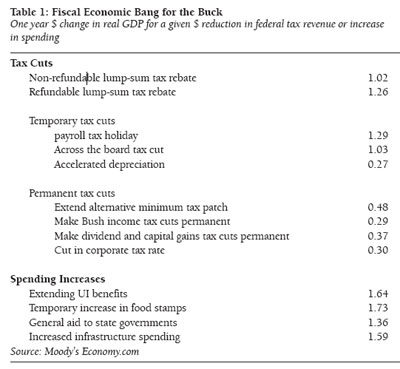
My understanding of this data — although specifics aren't easily available — is that it derives from a macroeconomic model into which Zandi plugged the various instances of government spending. If that's correct, then the exercise is fatally skewed based on the simple fact that the government must take a dollar in order to give a dollar.
Actually, the government must take more than a dollar in order to give a dollar. In 2004, for example, the Food Stamp Program spent about $0.20 for every dollar that it gave away (PDF). That's not the whole story, of course, because there were expenses associated with collecting, allocating, and processing the program's budget. According to Charity Navigator, 9 out of 10 charities spend no more than $0.54 per dollar given away on administrative costs, and 7 out of 10 spend no more than $0.33. For the sake of consideration, then, let's assume that it costs the federal government no more than another five cents per dollar handed out to get that money from the taxpayer to the Food Stamp Program, so the total cost per food stamp dollar would be $0.25.
That means that, for every food stamp dollar given, the government must take $1.25 out of the economy at some other point. According to Zandi, an across-the-board tax cut would add $1.03 to the next year's GDP, so it follows that taking a dollar costs $1.03. Based on an across-the-board increase in taxation, the cost of every food stamp dollar is therefore $1.29, making the actual amount that the whole process adds to the next year's GDP only $0.44. Inasmuch as it does not cost any money not to take a dollar from somebody, a broad tax cut would actually add $0.59 more to GDP than would the food stamp.
The intuitive sense, here, is that it doesn't make any difference, economically, whether I spend a cash dollar on groceries or a welfare recipient spends a food stamp dollar on the same items. If the government largess is extracted from everybody, then the working poor and middle class don't have those dollars to spend. In fact, it appears that funding food stamps by taking a dollar from a family that must therefore reduce its grocery bill in response winds up costing the GDP $0.43.
The appeal of Sgouros's argument comes in the fact that those who don't have to spend will tend to save; those who take in more than they could possibly spend will save even more. Indeed, looking at the numbers on the table, it's tempting to observe that a one-dollar increase in the corporate tax rate would appear to cost the GDP only $0.30, so reprocessing that dollar into food stamps would provide a net GDP gain of $1.43. That possibility is an illusion for two reasons. The first is that the $0.70 difference must come from some theoretical savings account (or untapped credit); thought through in reverse, the reason a dollar of corporate tax cuts only results in a GDP gain of $0.30 is that the rest goes somewhere unproductive. If that tax rate becomes confiscatory in order to alleviate the tax burden on the poor and middle class, corporations and the proverbial rich will not for long watch their reserves being depleted without reacting.
The second reason is that, when heavily taxing the rich, a marker of single dollars no longer applies. Wealthy entities (whether families or organizations) work in different amounts than do the the rest of us. It's true that a rich man may be less productive with a free dollar than would a poor man, but take from him ten million dollars, and he won't invest in a company, donate to charity, build a house, and so on, and those activities all filter down to folks who'll spend their money in the same fashion as welfare recipients, but without the government processing fee. If a few percent of the society is going to pay most of the cost of government, the taxation dollar amounts are exponential.
To be sure, Sgouros whistles an enticing tune when he writes:
People routinely misunderstand the important points of policy that stem from Keynes's findings. Government spending and progressive taxation aren't good things because they support government workers or "punish" rich people. They are good things because they are how a government can help the economy grow. (Up to a point, of course, a detail Keynes made clear.) Government workers with money to spend will spend it, and that drives the economy. Progressive taxation keeps more money in the hands of the poor and people in the middle, both of whom are more likely to spend their income than rich people are.
But he loses the thread of his earlier wisdom. Private-sector workers funded via mutual agreement will also spend their money, but they have more reason to earn it efficiently than public-sector workers funded via compulsory taxation. They also can't hide their wealth as thoroughly. Tom notes that a "dollar saved is not a dollar invested" and that "people have different preferences for how they hold their money," but he doesn't acknowledge that unionized government workers save their money in the form of perks, accumulating benefits, and defined-benefit pensions. There must be some form of savings — actual or theoretical against future taxation and revenue — in order for somebody in his '40s or '50s to retire for the rest of his life. A person who lives for thirty years on an annual pension of $35,000 had stored away over a million dollars in some nook of the system.
For its larger projects and continued growth, a society needs people with financial reserves, but those reserves have to be accessible for spending. A society also needs people motivated to create, and capable of creating, wealth, and those (as I've argued here, here, and here) are the families that Rhode Island has been chasing out. Sgouros and Co. can flash all the statistical pictures they want, but what Rhode Island must do is to maintain the number of wealthy taxpayers while relieving the burden of (and thereby attracting) the productive class.
Ultimately, that leaves only one broad category to which to turn to balance the state's budget: Those who represent a net cost to the government.
March 28, 2009
Filling Budget Holes by Digging Our Grave
The Democrats on the House Finance Committee should be remembered for their role in driving the state of Rhode Island farther into the ground. The Projo summary reads like a natural parody:
Gas tax:
Increase by 2 cents per gallon, to 33 centsCigarette tax:
Increase by $1, to $3.46 per packMunicipal aid:
Cut by $55 millionEducation aid:
Cut by $9.1 millionState employee pension plan:
Unchanged
Priceless.
Perhaps outshining the committee, though he's not on it, is House Majority Leader Gordon Fox, on the strength of this pathetic statement — which adjective I don't use lightly:
Asked if the midyear cut was fair, House Majority Leader Gordon D. Fox said, "Nothing in this situation is fair to anybody. But somehow we found ourselves here globally. So everything's unfair. I can't even use that term anymore. What's fair to anybody because the whole world is upside down?"
This is a man entrusted to make decisions for our state? In one paragraph, he brushes off economic factors and political problems unique to Rhode Island and makes a dim-witted case for arbitrary decision making. Granted, the question was silly, but the answer is that fairness must be judged from a broader perspective in times of crisis. What's fair is what gets the state out of its predicament, and raising taxes and fees while pushing the responsibility for deeper tax increases down to the municipalities (by not giving them statutory relief from mandates and requirements) will fail utterly at that mission.
As they flap about in their cluelessness, these committee members and like-mindless allies reveal quite clearly their intention to bumble from one year to the next, with the foresight of hamsters in plastic balls repeatedly bouncing off a sliding glass door. Committee Chairman Steven Costantino puts forward the inane assessment that "we're doing the same thing [as the governor], but we're doing it differently"; the governor should swear on the soul of Roger Williams that he will veto any attempts to squeeze yet another year of decision-free vapidity out of Rhode Island's ongoing calamity
March 25, 2009
Ultimately, a State Is Not a Business
Even though they occasionally express a worthy idea, articles such as this long Sunday front-pager convey the wrongheadedness that plagues this state:
Another of Carcieri's major, second-term priorities is building a "green" economy. The concept is sometimes vague, and like biotechnology, every state is chasing it. And yet, going green could be the key to rescuing Rhode Island's blue-collar laborers from the dying manufacturing industry.That can only happen, however, if Rhode Island focuses on its obvious advantages and develops training programs to prepare workers to build these industries. ...
Still, if it's not careful, Rhode Island can miss its window. Though there is a scarcity of wind power nationally, New Jersey and Delaware have dived into the mix and are poised to outpace Rhode Island if the Ocean State gets too distracted or settles for too slow a pace.
"You can't be good at everything," said Atkinson, the former economic-development head. "You've got to be somewhat specialized."
Put aside the union hand behind the "green" movement. States shouldn't operate as businesses when it comes to selecting industries and trying to compete with other states. We don't run on venture capital. We can't all declare bankruptcy, fold the state, and create an other one. We can't, in specific, invest in retraining people and recasting our regulations in order to attract a narrow industry only to find that another state beat us to the punch, or technology has obviated our intended product, or any of the various things that can change does change.
The article is about fostering, attracting, and keeping innovators, but the principle that is missing from the entire discussion is that innovators innovate. That's what they do. And we'll increase our likelihood of benefiting from their efforts if we eschew the advice of former Economic Development Corp. (and current think tanker) Robert Atkinson to specialize.
We need a generalized improvement of the methods by which innovators can work their magic.
March 22, 2009
RISC Winter Meeting: Treasurer Frank Caprio on Debt and Pensions
Third on the schedule at the Rhode Island Statewide Coalition's Winter Meeting was RI General Treasurer Frank Caprio (stream entire speech):
- RISC Chairman Harry Staley's introduction: stream, download
- Caprio's opening remarks (and shout-outs): stream, download
- Mock description of U.S. and RI governments as investment opportunities: stream, download
- Why are these entities able to find investors to cover debt? Private enterprise: stream, download
- Expressing intentions to "move things in the right direction (i.e., lowering taxes, increasing transparency, and furthering "strong financial management": stream, download
- Reviewing the pension system's history in RI — "Is there any mystery as to why we as taxpayers are slated to pay a billion dollars of taxpayer money into the pension system in just seven short years?": stream, download
- The solution — "being addressed right now by the state legislator": stream, download
- "The problem is that we have twenty years" to go" to fully fund pensions" while pursuing changes in health and logevity increases: stream, download
- Closing remarks, insisting that we not saddle future generations with our problems:: stream, download
March 17, 2009
An Incomplete Diagnosis of Rhode Island
Some diagnoses of Rhode Island are akin to a doctor explaining to a patient that his vital organs are being squeezed without noting that a cancerous tumor is doing the squeezing. Such is the case with Benjamin Gedan and Philip Marcelo's lengthy piece on the front cover of Sunday's Providence Journal:
Having based its economy on old factories and thousands of small, low-technology businesses, Rhode Island was blissfully undisturbed by the toppling of Web-based businesses from Silicon Valley to Route 128 in Massachusetts.But by failing to build and attract innovative, science and technology-driven companies, Rhode Island finds itself with little support in a blue collar recession that is battering the construction, manufacturing and hospitality industries.
Companies are fleeing:
Ravaged by the recession, more than one in 10 companies in Rhode Island closed or moved away last year.
Citizens have low disposable income:
Even before the recession, Rhode Islanders did not have much buying power. The 2007 average annual salary here was $39,827, below the national average ($44,355) and trailing Connecticut ($59,174), Massachusetts ($55,819) and New Hampshire ($44,308).
During the housing boom, folks might have lived here, but they worked elsewhere:
"There was the reputation that you could get more for your money in Rhode Island than anywhere else in New England," Paul Leys, president of the Rhode Island Association of Realtors, said.
Vulnerable groups, namely immigrants and the poor, are to be found in abundance:
But [subprime lending] really took off in the boom years, in part because mortgage brokers targeted Rhode Island's large immigrant population, including low-income residents with only a basic grasp of personal finance, according to Edward M. Mazze, dean of the College of Business Administration at the University of Rhode Island.
As the print edition (but not the online version) points out, our collegiate imports quickly become educated exports, and our public schools have a high rate of dropouts.
But it isn't sufficient to note these problems and attribute it to "a combination of bad luck and bad planning." There are specific causes:
- Taxes are too high and government too intrusive.
- Our policies attract immigrants and other low-end workers.
- Unions are driving up costs and strangling our public education system.
- Regulations and mandates make it too difficult to succeed.
- And so on.
Businesses, while they'll form if there's sufficient demand, see no reason to tough it out and regroup in the state when circumstances change. Graduates have no opportunity to stay. Workers have little opportunity to advance. And nobody in power is taking the drastic steps that really must be taken to turn things around.
March 15, 2009
A State of Unfreedom
I intend to spend a little more time perusing the report titled Freedom in the 50 States: An Index of Personal and Economic Freedom (PDF), put out by the George Mason University Mercatus Center, but Rhode Island's predictable rankings, among the 50 states, are notable without extensive commentary:
- Fiscal policy: 41
- Regulatory policy: 48
- Economic freedom: 42
- Personal freedom: 47
- Overall freedom: 48
Overall, only New Jersey and New York are less free than Rhode Island. And regarding overall freedom, it's not surprising that the scatter plot on page 21 shows a precipitous drop when the percentage of the vote going to the Democrat nominee for president (in 2004) exceeds 50%.
March 12, 2009
Taxes Affect Decision Making? Really?
We are constantly told by some advocates that there is no "proof" that higher corporate taxes have an impact on where a business chooses to set up shop. Right.
The tidy towns and mountain vistas of Switzerland are an unlikely setting for an oil boom.Actually, the parallels between the small country of Switzerland and little Rhody are intriguing. If only we could get our act together.Yet a wave of energy companies has in the last few months announced plans to move to Switzerland -- mainly for its appeal as a low-tax corporate domicile that looks relatively likely to stay out of reach of Barack Obama's tax-seeking administration.
Companies say Switzerland's attractiveness as a corporate location goes beyond tax to include easy and efficient transport, a high quality of life and well-trained staff.Yes, it is more than just an attractive tax structure that is required. One would think that efficient transportation and a solid infrastructure would be more easily achieved in a small state like ours. Switzerland has the Alps and, as Dan Yorke often says, a lot of what makes RI so attractive is "water." As for education, we have a lot of resources, but may be slipping. Basically, Rhode Island has a lot of untapped potential, but we all know that. It will remain untapped until and unless our political class gets their priorities in order. Or until Rhode Islanders finally hold them responsible. The track record isn't encouraging.
In the Dark Land, the Man with a Flashlight Is King
Or maybe he's an easy target.
Matt and I had a few laughs (of the "or we'd cry" variety on last night's Matt Allen show. Why doesn't anybody in power see what needs to be done, and what's the appropriate attitude to have in response? Stream by clicking here, or download it.
March 9, 2009
Taking Back Buy Backs
WPRI's Tim White has been looking into the practice of teacher healthcare buybacks in Rhode Island (with the television segment airing tonight at eleven):
After combing teacher contracts for all 36 school districts, Target 12 crunched the numbers. Here are some of the most generous buy-back offers we found.-Newport teachers can get up to a $5,800 check to opt-out of coverage.
-West Warwick teachers can get $5,500 per family plan.
-Smithfield teachers can get a $4,500 check every year.
There's a perverse sense to the typical argument on behalf of buybacks:
"I think providing a modest cash incentive is a reasonable opportunity and unions give to the employees by providing these waiver payments," said James Parisi of the Rhode Island Federation of Teachers.Parisi believes that buy-backs are a good deal for towns.
The perversity comes in when one considers that the reason "incentive" comes into play is that the public gives its employees benefits so far out of proportion from what's available elsewhere that they are unlikely to find incentive in the fact that a spouse's healthcare is better.
(A secondary argument is that households containing two members in the same public-sector workplace could cost the employer more by each taking the healthcare, but that possibility ought to be obviated out of hand in policy, if not in law.)
Joblessness Freefall
We'd be remiss if we let this little item from the Projo's 7 to 7 blog (printed in Sunday's Business section) slip by:
Rhode Island's increase in unemployment was the worst in the nation last year, the U.S. Bureau of Labor Statistics announced today.The jobless rate in Rhode Island rose last year by 2.6 percentage points, reaching 9.4 percent by the end of December. The closest competitors in the category were Florida (up 2.1 percentage points) and Nevada (up 2 percentage points).
The global recession has led to increases in unemployment across the country. But overall, the average increase in joblessness in the U.S. last year was 1.2 percentage points, less then half the spike in Rhode Island.
Although, Kevin Donovan from Foster suggests that the unemployment figures that we've all been seeing may represent a severe undercount:
I'm curious as to how this is measured. My assumption has been that it is based on unemployment-benefit claims. Given that the State of Rhode Island is between six and eight weeks behind in processing unemployment claims, it would stand to reason that our state's unemployment numbers are being underreported.
There were 57,800 job seekers in January, and the state's unemployment agency is strugging to keep up with the 25,000 calls it receives each week. I'm not sure how these numbers all fit together, but if our latest unemployment rate was 10.3% on paper, what do you suppose it is in actuality?
Pension Problem Based on More than Slight Undersight
The talking point of local unionists and ostriches is that our pension system is in trouble because a few years of low contributions in the '90s threw everything off, and all we have to do is to maintain funding for just a couple of decades, and the whole thing will work itself out right. That diagnosis is wrong, according to a panel convened by the General Assembly:
Even if the stock market rebounds next year, the cost to Rhode Island taxpayers of providing some of the most generous public employee pensions in the region will shoot from $370.9 million this year to a projected $836.3 million by the year 2017. ...... [Chief of Staff for the General Treasurer Mark] Dingley said the state is paying today for past mistakes, including decades of unfunded benefit increases, inaccurate actuarial assumptions, and earnings that have failed, over the last decade, to meet the 8.25 percent assumed rate of return on investments.
Despite union arguments to the contrary, he produced a letter from the actuaries that said the deferral of state contributions in the early 1990s has played a relatively small part. Had there been no deferral, it said, the state's required contribution this year would be 20.53 percent of payroll, instead of 21.13 percent.
Just another bomb waiting to go off in Rhode Island, with a fuse that nobody's willing to stamp out.
March 8, 2009
Robert Cushman: Unfunded Liabilities, Warwick’s “Subprime” Crisis
A few years ago, the dream of owning a home and planning for a comfortable retirement wasn’t just a promise--it was guaranteed. A growing economy was fueling a new "ownership society". We were told to invest, take a chance, buy a home, and don’t worry about the risk it will all work out.
What happened? Today the stock market is below 7,000 points, after experiencing a high in the 14,000 point range. Home foreclosures are at record levels, the value of our homes have dwindled, our 401Ks and other investments have suffered significant losses. The promises were false and the dreams have vanished, thanks in large part to the irresponsible action of the so-called "Masters of the Universe" on Wall Street. Our economy is in meltdown mode and taxpayers on the hook for trillions of dollars in losses. How could this happen? Where were the warnings?
During the years of irrational exuberance, a few individuals at the country's largest financial firms warned of the consequences of providing loans based on faulty consumer information. They raised the alarm that some of the mortgages being offered would be difficult for borrowers to repay and they called for responsible assessments of risk. But where were the government leaders to protect us--to watch our tax dollars, protect our future and our children’s future?
Subprime mortgages were fueled by mortgage brokers and bankers who were happy to keep writing mortgages as long as they were being bought up, chopped up and resold by Wall Street financial institutions in the form of mortgage backed securities. The risk of default was someone else’s problem.
Today you and I, the taxpayers of the United States, are sacrificing our hard-earned tax dollars to rectify these false assumptions. If Warwick's Mayor Avedisian assumptions regarding recent contract extensions with municipal employees prove to be false, will Warwick taxpayers be asked to make the same sacrifice?
With the city’s unfunded pension liability at $200 million before the market crash, why would city leaders promise to increase municipal employee pension benefits without demanding current actuarial reports to determine pension valuations based on market conditions? With the unprecedented crash in the financial markets, Warwick’s pensions have lost more then 30% of their value and the unfunded liability has grown substantially. But apparently believing that ignorance is bliss, the Avedisian administration is cheerfully using 2006 actuarial numbers to determine how much employees will pay for the increased pension benefits being granted in these future contracts. Just as subprime mortgage lenders used faulty information and unrealistic assumptions in granting reckless loans, the Avedisian administration is committing taxpayer dollars with no clue as to the real consequences of their action. If future pension shortfalls occur, municipal employees are indemnified from the risk and they will receive the enhanced benefits they have been promised by the Mayor. It will be Warwick taxpayers once again stuck with paying the bill for any future liability.
Shockingly, Mayor Avedisian also is taking $500,000 budgeted to city pensions to help balance this year’s operating budget based on the same antiquated information. Can we continue to underfund these future obligations? Are we being fair to future retirees, if we can’t afford to pay their promised benefits?
Although they have been labeled as savings by the administration to promote ratification of these contracts, the city is deferring almost $2 million more in employee holiday pay and uniform allowances. No matter how it is spun, a deferred expense without a plan to fund it, is nothing more then another unfunded liability.
The unfunded health care liability in Warwick is $365 million. These contract provisions promise employees a fixed rate healthcare co-pay of $14 per week for individuals and $28 per week for families. The city council chose to approve these fixed rates, guaranteeing that taxpayers will pay 100% of any increase in health care costs for the next three years, another unfunded liability that will draw more and more tax dollars away from other vital programs in the city.
Warwick’s unfunded pension and healthcare liabilities are approaching $650 million. That equates to about $7,500 in debt for every man, woman and child living in the city. The time will come when these liabilities will have to be paid.
Already we are seeing financial conditions in the city deteriorate, a dangerously low surplus, frozen bond money, school building in disrepair and crumbling infrastructure. Can we continue to ignore the risks associated with making more and more costly promises, creating more and more obligations, deferring more and more expenses and sinking deeper and deeper into debt? How much longer can taxpayers sustain new tax increases, cuts in city services, and deferred improvements to school buildings and city streets? What impact will these IOU’s have on our children’s future and the promises we have made them?
Like the subprime homeowner unable to afford their mortgage, will we soon be viewing a field of broken promises in Warwick and see the dreams for our children shattered and be left wondering, why anyone didn't warn us this was coming?
Robert Cushman is a former Warwick City Councilman and former Chairman of the Warwick School Committee.
March 3, 2009
Marching Toward the Bottom with 10.3% Unemployment
Anyone heard hints of budget and economic-policy progress in the General Assembly? I ask because Rhode Island's unemployment rate is now at 10.3%:
The unemployment rate in January spiked by nearly a full percentage point over the revised December figure of 9.4 percent. It has ballooned by four percentage points since January 2008. (Earlier, the state estimated a 10-percent unemployment rate for December based on a survey of businesses. That rate was recalculated through the annual review of payroll tax filings.)Nationally, unemployment increased to 7.6 percent from 7.2 percent in January. The national rate for February is due on Friday.
Cut taxes (and spending). Erase regulations. Build infrastructure. Standing around in State House back rooms like frozen deer just isn't sufficient.
March 2, 2009
Rhode Island Should Fear a National Recovery, and Get Moving
At least since October, I have been suggesting that Rhode Island's status as a business-unfriendly economic pit will make it more difficult for our economy to recover along with the nation's. Current policies have been driving out the "productive class" for years, and not only is this the critical demographic for economic recovery, but it consists of people who are able and willing (perhaps reluctantly) to move in search of opportunity. If Rhode Island lags the nation in supplying that opportunity, it will be attempting to gain its economic footing from the bottom of a landslide.
Benjamin Gedan's article on the front page of yesterday's Providence Journal provides the first hint that the mainstream of Rhode Island society is beginning to catch on:
... the bible-length list of boarded-up storefronts is arguably more alarming. Vanishing companies increase unemployment, reduce corporate spending that supports suppliers and vendors, and deprive government of desperately needed tax revenue in a state struggling to erase a $357-million budget deficit.Perhaps more worryingly, the exodus [of small businesses] jeopardizes the state's prospects for a quick recovery when economic activity elsewhere in the country finally picks up. Starting a new business requires financing, planning and building that delay job creation.
"The longer the recession lasts, the more businesses go under and the longer the recovery will take afterwards," Andres Carbacho-Burgos, an economist for Moody's Economy.com, said. "The recovery will be slower and more tentative."
In a static world, government leaders could approach that conclusion with tentative policies, but we live in a dynamic society. Consequently, one must adjust this factor...
Some economists, meanwhile, say there is reason to believe many businesses could be reborn as swiftly as they toppled."You're going to get new businesses forming," Robert Tannenwald, vice president at the Federal Reserve Bank of Boston, said in an interview. "Capital is a lot more mobile than it used to be. Entrepreneurship is at a much greater level than it was 20, 30 or 40 years ago."
... to account for human agency. Capital and markets will appear beyond our state borders before they are sighted within, and few entrepreneurs will care to wait for opportunity to break through the Bristol Wall.
What Rhode Island must do is move quickly to realign policies to make our state the first to see investment and the creation of new businesses. This means (as I've been repeating like a mantra), slashing government spending and taxes, combing (like lice) all excessive and annoying regulations and licensing out of state law, and redirecting all available funds to infrastructure.
Considering that the General Assembly seems mired in a delusional hope that residents will just forget that there's currently a supplemental budget sitting around awaiting approval, while the state spends more than a million dollars per day that it doesn't have, the possibility is slim that our legislators have the guts and brainpower to position Rhode Island to lead the nation out of recession, as we led it into recession. But the governor, the GOP, and all like-minded independents and moderates should take up the call now and declare it unwaveringly to ensure that the Democrats and progressives bear the consequences of their stupidity and cowardice.
March 1, 2009
Speaking Plainly from the Ivory Tower
William Jacobson is an interesting, surely rare, creature: A Rhode Islander and Cornell law professor, and apparently a conservative, unafraid to declare the obvious:
Union pensions for state employees are the single biggest problem, as a 2006 study showed. For decades, policies allowed state union employees to retire on full pensions with cost of living adjustments after 30 years regardless of age, based on a formula from the last three years of work. This system has saddled the state with ever-increasing payments with a shrinking work force paying into the system.By way of example, a unionized public employee who started working for the state out of college, say age 23, could retire at age 53 on a full pension for life, and could increase the amount of the pension by working overtime in the last three years. Other perks, such as getting retirement "credits" for taking classes, or buying credits, allowed employees to game the system. After "retirement" the state employee could simply get another job while collecting a state pension. It is likely that this person would spend almost as much of his or her life on a state pension as working for the state.
Such a system was great for the individual employee, and made state employment a coveted goal. Handing out state jobs was an important means of political patronage, mostly for the Democrats who control the state legislature. The system, however, was not sustainable. Attempts to change the system were opposed by the unions, which fought tooth-and-nail, with the overwhelmingly Democratic state legislature siding with the unions.
Is it union-bashing to point out that what is good for the unions may be destroying the state? Do the unions even know or care that they have created a house of cards which looks great to their members, but is on the verge of falling down? High taxes are a reflection, in part, of the need to fund these ever-increasing costs. This is an economic death-spiral which is picking up steam as it falls.
Another good one who got away — although I imagine Ithaca could make a man pine even for Rhode Island's proximity to centrism.
ADDENDUM:
The professor emailed to correct me: He maintains a residence in Rhode Island, so he hasn't truly gotten away.
February 22, 2009
Another RI Newcomer Speaks Truth to Insanity
Gary Smith, of Newport, has come to a conclusion that will be familiar to Anchor Rising readers:
So I asked myself: What is keeping companies away, especially those for whom shipping is not an issue? The answer is and has long been obvious — taxes. CEOs won't relocate to places where their high incomes get hit hard. Companies won't relocate to a state where corporate taxes exceed those of neighboring states. So it would appear that the recommendations of the governor's panel are right on target — and the key part of the panel's findings is that the changes, if enacted, will be revenue-neutral.It's time for our legislature to wake up and move forward expeditiously and get this state on the move again; it has much to offer. Maybe it takes an outsider to see it. With competitive taxes I think Rhode Island is an easy sell.
Welcome to the battle, Gary. I regret to inform you, however, that the project is much more daunting than you realize.
February 15, 2009
Welcome to the Era of Dependency
I have a question. Once the dust settles on the big grandchildren's money drop heading the states' way, how is our failed public finance system going to maintain all of this on top of the infrastructure and assets that it currently struggles to keep in one piece?
To Providence Mayor David N. Cicilline, new federal investment in his city means streetcars.Not the RIPTA buses with the fine wood trim that resemble trolleys. But real trolleys running on rails along city streets. He sees crater-pocked Bridgham Street in the city's Elmwood section and dozens of other neglected city streets and sidewalks finally repaved and refinished.
In Warwick, Mayor Scott Avedisian sees a new bridge over Mill Creek on Tidewater Drive, and maybe a boardwalk and a handicap-accessible pier at Gorton Pond, a freshwater pond that is a popular spot for bass fishermen and beachgoers.
In Pawtucket, Mayor James E. Doyle sees something that young city residents have been dreaming about for well over a decade: a skateboard park in the heart of the city, right across from McCoy Stadium, at Joseph Jenks Junior High School.
It's the dawn of a new era of big government, and big government spending. Millions of federal dollars are expected to come to Rhode Island as part of an economic stimulus plan.
The certainty of the windfall has inspired local cities and towns to dust off development plans, some long-held and many that may have just never had the money to begin with, in the hopes that maybe, finally, they’ll see the light of day.
Perhaps the most important whisper to heed comes from our Congressional delegation, which doesn't think the current borrow-and-spend plan is big enough. It's a sort of trap we're in:
- If the stimulus money doesn't boost the economy, the powers who be will insist that the windfall wasn't big enough, and nobody down the money-grubbing line will be inclined to disagree.
- If the stimulus money has a mild effect on the economy, the powers will say the same thing, and states will have all sort of new items and programs for which they have no real prospects of continued funding.
- And if by some miracle throwing borrowed money at the country really does revive the economy, it will be seen as having validated the principle, and the practice will be continued in good times and amplified even more in bad.
Some would argue that this monster will be something worse than ineffective.
Through it all, the spectacle of hearing officials of every layer of government, right down to small-town school committees, place their hopes and dreams in a federal check writer is evidence of that malignant addiction to receiving. Yes, it's the dawn of the Era of Dependency, and not a few paths that lead from here into the future begin the end of the United States of America.
February 12, 2009
No More Political Cover
This is an instructive episode:
A House vote to raise the state's cigarette tax by $1 a pack — to what would be the highest level in the nation — was aborted at the last minute yesterday after Republican Governor Carcieri yanked his support from his own tax-raising proposal.Carcieri's eleventh-hour move was announced by a visibly annoyed House Finance Committee Chairman Steven Costantino on the House floor, the unexpected development punctuated by this uncharacteristic utterance by House Speaker William J. Murphy: "Get it out of here!"
Earlier in the day, Murphy had said raising the cigarette tax "doesn't bother me" because people choose to smoke.
It appears that the General Assembly Democrats would very much like to raise taxes as a way out of their personal-special-interest-debt conundrum... but not without cover. I say that the governor should finally learn this lesson: Go for the conservative gold and declare that anything less is the full property of the legislature. Make them wear it. Make them fight for every ounce of political cover that he's willing to give as part of negotiations.
Meanwhile, remind them that the clock is ticking and that the bomb is on their desk.
February 11, 2009
Rhode Island Employment Trends
Inspired by the chart unveiled by the Governor during last night's State of the State speech, I went over to the RI Department of Labor and Training's website last night and downloaded employment figures from 1990 to 2008 (all that was available--I used the "not seasonally adjusted" figures). I was interested in looking at the employment trends of other sectors in addition to manufacturing. So here come the pretty charts! (For all of these, the job numbers are on the "Y" axis and represent thousands of jobs).
First, here is a chart of the overall jobs broken down by "Goods Producing" and "Service" sector jobs. I included the "Manufacturing" sub-category of "Goods Producing" to show how closely linked the trends are. You can see this even more with the second chart of just the "Goods Producing" sector. It's also quite obvious that, as we already know, Rhode Island's is a "Service" economy (just like the rest of the U.S.).
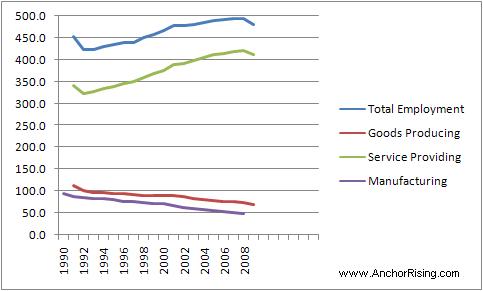
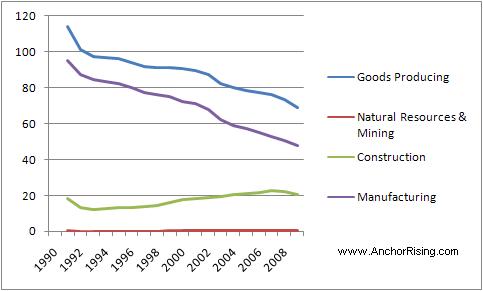
Next, let's take a closer look at the Service sector. Here's the big-picture snapshot.
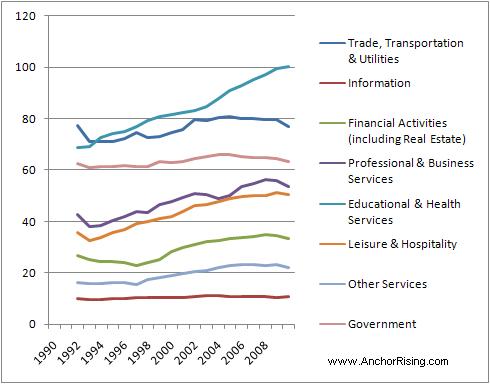
Here we see that the trend is generally upward. The "Information" sector is relatively flat, but the main driver, in terms of overall jobs and rate of growth, is the "Educational and Health Services" sector. The "Leisure and Hospitality" sector is also quite strong and, until recently, so were the "Financial" (driven by Real Estate, I expect) and "Business and Professional Services" categories.
Here is a closer look at the "Educational and Health Services" sector, which makes it obvious that Health Care is a major growth component of our economy.
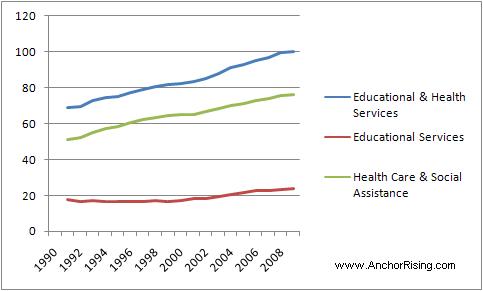
Government is included in the "Service" sector of the economy. The overall chart showed that, after an uptick in 1999, it has remained fairly consistent. However, a closer look supports the Governor's contention that while Federal and State government employment has been reduced, local government has grown.
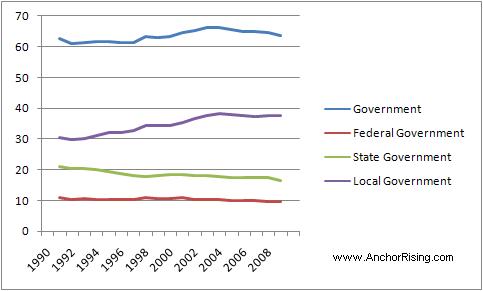
Finally, here is an indication of which component of local government has driven that growth (there was no separate data for educational and non-educational local government employment prior to 1993 and data for 1995 and 1996 was not provided).
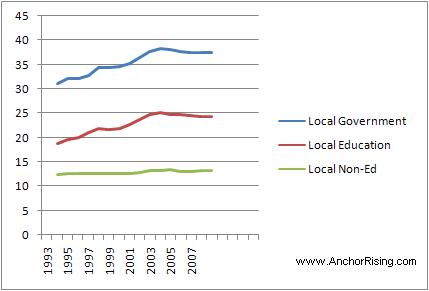
February 10, 2009
The Governor's Speech
The governor's office has sent along the text of his state of the state speech, and I've included it in the extended entry, below. They've also sent along his eye-opening chart from the speech:
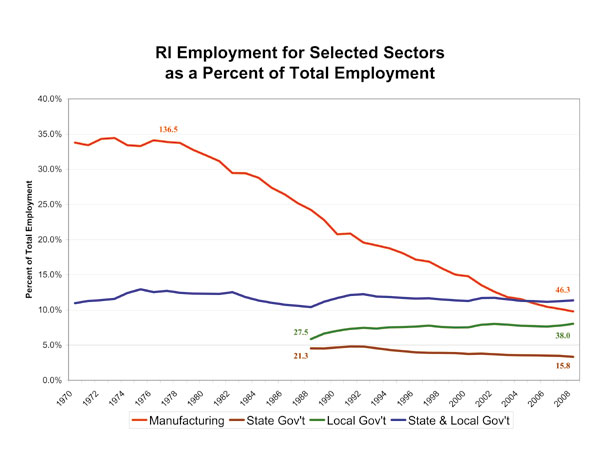
It would be interesting to see other industries and a total plotted, as well, but it certainly makes a statement as it stands.
Continue reading "The Governor's Speech"February 6, 2009
Let Them Take the Blame for the Bad
The misguided revenue boosters were the weak spot of the governor's supplemental budget. Of course, they'll probably be the one proposal that the General Assembly passes swiftly:
Smith Hill lawmakers are poised for a vote today on the revenue-raising pieces of Governor Carcieri's $357-million deficit-reduction plan — including a proposed $1 cigarette tax hike.But they are likely to do so without support from Carcieri's Republican allies in the House, who say they tried unsuccessfully to dissuade the governor from including the increases in his deficit-closing plan, and are now doubly unhappy that House Democrats are trying to move $23.8 million in tax and fee hikes along without any of accompanying budget cuts the governor proposed.
As I've said before, if the legislature makes more than just cursory changes, Governor Carcieri ought to loudly and frequently wash his hands of the budget, saying that it's not his doing.
February 2, 2009
Repair the System to Repair the Budget
It's curious — at a time when lefties and unions are more than happy to accept far reaching justifications for weaving their wish lists into an ostensible stimulus package at the federal level — to hear them arguing for a close delineation of "budget repair" in the state:
Union leaders are accusing the Carcieri administration of executing a targeted assault on labor unions and of trying to "destroy the labor movement in Rhode Island" by seeking to limit the scope of collective bargaining in this state.
Such fragile things are these unions, apparently, that the imposition of limits could be fatal to them. Of course, they're merely throwing any argument that they think might stick at the governor's proposal:
But union leaders say there's another key flaw in the proposed prohibition [against teacher strikes and work-to-rule]: It doesn't belong in the state budget-repair bill because it won't save local school districts any money, they say.
Sure it will: By removing a cudgel that the unions use to threaten, and to harm, the communities from which they wish to extract more money, the change would empower school committees to negotiate more responsible contract terms. RI unions have constructed a series of pretty little traps around all of their talking points to create the illusion that the only restrictions and cuts that are legally, morally, or safely feasible are those that they propose, but the icy sheen of recession reveals just how shallow their arguments really are.
Change Can't Be Done
On Friday evening, Portsmouth Fire Chief Jeff Lynch sent an email to a baker's dozen (or so) of state legislators explaining why not a single one of the governor's budgetary suggestions related to public-sector labor ought to be accepted. The entire letter is printed in the extended entry, below.
It would be folly to state that the chief doesn't make some worthwhile points, but no group whose cash flow is apt to be restricted as Rhode Island adjusts to financial reality will come unarmed with arguments. There's a reason they've collectively pushed our state to the precipice in the first place.
I won't attempt a point-by-point response to Lynch's statement, here, but a few of his comments related to benefits point to a skewed perspective that legislators ought to take into account as they gut the governor's supplemental budget and pass one of their own making:
I know, the rest of the world already co-pay some or all of their insurance. However, when I started I qualified for food stamps. We take the low pay because we have these benefits.
I can't speak to the wheres and whens of Chief Lynch's first days as a firefighter, but career paths that begin within 100% of the poverty line are not uncommon. Be that as it may, a look at Portsmouth's '07/'08 payroll (PDF, from The Money Trail) reveals that no full-time firefighters currently face that prospect. Their compensation packages (PDF, from The Transparency Train) emphasize the point. The town's budget for that year (PDF, from The Transparency Train) puts the healthcare costs for the department at $452,881. Lynch subsequently notes "a friend" in the defense-industry private sector who supposedly has a better deal, but individual acquaintances and long-ago pay complaints are hardly relevant to questions of parity.
Similarly with pensions:
It remains unclear whether the COLA proposed by the Governor applies to vested employees. Regardless, our contributions were based on actuarial studies that accounted for our present COLA's. Additionally, having to wait 5 years for a COLA will essentially put the average public servant at poverty level. Assuming the cost of living increases 3% per year, which is compounding, a person retiring form a job that pays $50,000 with a 50% pension will start with a $25,000 per year pension. After 5 years that pension will be worth less than $21,250 in today's dollars. This coupled with a healthcare co-payment of $3,800 makes the value of the pension worth around $17,450.
Put aside that public employees who retire after twenty years of service are not likely to begin their forty-year retirements without finding other jobs that put them not only above the poverty level, but well above the median household income for the state. Lynch's hypothetical simply doesn't apply to the men under his command.
According to their latest contract (PDF), a 1st class firefighter (who reaches retirement without becoming an officer) earns $47,587.10, and longevity is included in pension calculations, which brings the retirement-age average to $51,552.69. Retiring after 20 years, his pension payment would be $30,931.61, and after 27 years, it would be $38,148.99. With no cost-of-living adjustment, the retiree would face the undaunting necessity of saving or investing that annual cushion until actually reaching a suitable retirement age.
Again, we in the private sector are generally not in a position to snicker at that benefit. Still, the chief goes on:
Second to the love for the job, the reason we all take these jobs are for the benefits because they don't pay nearly as well as private sector jobs for the risks we take. We make a deal when we sign up and plan our lives in accordance with that deal. To change it, and change it this drastically, is unfair to say the least. I can tell you as much as I love my job, and as much as it is going to kill me to leave it, I have advised my son that he should seriously consider another career.
Strictly speaking, union employees remake their arrangement with every contract. If Mr. Lynch is referring to a more abstract "deal" of contract-by-contract increases and perpetual insulation from the economic realities that the rest of us face, then I'd ask why it is that he believes his reality ought to be more "fair" than his neighbors' — neighbors who have at an accelerating rate been advising their children not just to consider alternative careers, but to flee the state in which they've grown up altogether.
The bottom line is that nobody's deal will survive the collapse of the state, and that is exactly what the future holds if dramatic changes are not made to Rhode Island's method of operation.
Continue reading "Change Can't Be Done"January 31, 2009
A Faster Fall in Rhode Island
Slipping from 5.2% to 10%, Rhode Island led the nation in unemployment growth:
The rise in Rhode Island's unemployment rate led the nation last year, according to new data from the U.S. Department of Labor.Only North Carolina, where unemployment grew by 4 percentage points, and Nevada, where it increased by 3.9 percentage points, approached the 4.8 percentage-point spike in Rhode Island.
Rhode Island's year-end unemployment rate, 10 percent, was not the worst in the country; that was Michigan's ignominy.
But the Ocean State's economy is by far the most troubled in New England. Connecticut, where 7.1 percent of job seekers could not find jobs last month, has the region's second-highest jobless rate. It is followed by Maine (7 percent), Massachusetts (6.9 percent), Vermont (6.4 percent) and New Hampshire (4.6 percent).
It's past time we rewrite the owner's manual for our state. The governor's latest budget proposal took (ultimately modest) steps in the right direction, and it's been nearly unbearable to watch the General Assembly twiddle its thumbs with hearings, as if waiting for the windfall de l'année to tumble down from Mount Obama.
Citizens and officials alike must realize that the year will come when no surprise miracle money will be available, and the longer we wait to retool the state — to make it an economic leader in New England — the farther will be our fall.
January 28, 2009
Discouraging Behavior
This quotation from the Providence Journal's latest story on Gov. Carcieri's tax panel pretty well highlights the philosophical differences at play:
... under proposals involving the personal income tax, lower-income and many higher-income taxpayers would generally pay less, but middle-income taxpayers — and the state’s highest-income taxpayers — would generally pay more.This is partly because the proposals would eliminate most tax credits; end the favorable tax treatment of profit on the sale of stock and other such assets; and prohibit a taxpayer from deducting, for state tax purposes, such items as charitable contributions, mortgage interest and local property taxes.
So the disfavored demographic in this proposed tax rearrangement would be charitably inclined homeowners investing in the state. Somehow I have a difficult time believing that this particular panel is trying to edge the state even closer to socialism, but at some point effect must subsume intention.
January 27, 2009
Sittin' on the Port in the Bay
As regular readers know, I'm not a supporter of specifically targeted economic development. For one thing, I lack confidence in our leaders' ability to define such far-reaching strategic plans. Moreover, as we see with on the casino issue, if businesses think a particular government activity or change will be profitable, they'll lobby for it, making noise about its value. When the government opts to act independently of private-sector enthusiasm, it does so with ulterior motives, plodding ahead with something other than economic development as its core motivation.
That is the sense that I get about the Quonset port debate. In the years that I've watched it rage out of the corner of my eye, I don't believe I've ever heard from a major shipper, or some other likely client, that the port would be a boon for them, and now it appears that area is seeing other kinds of businesses move in:
On a tour of the park last week, Steven J. King, managing director of the Quonset Development Corporation, could point to only a handful of lots in the former Navy base that haven't been leased or slated for redevelopment. Only about 200 acres in the 3,160-acre Quonset Business Park are still available.Much of the development has taken place in the past several years. In 2003, there were 136 businesses in the park. Now, the site is home to 164 businesses that employ more than 8,800 people. The number of jobs has increased by a third over the past four years.
The positive to that expansion (which some may see as a negative) is that the government investment is minimal. Private funds (perhaps with some public assistance) goes toward the buildings, paving, and landscaping necessary, and that's that. By contrast:
... some legislators seem to believe those projects aren't enough and have started talking again about the container-port proposal that was championed by Lincoln C. Almond, Carcieri's predecessor in the governor's office. That plan would have required extensive dredging in Narragansett Bay and the filling of hundreds of acres there. Its price tag was estimated at $3 billion.
You can be assured that some powerful people are looking at that potential $3 billion expense as a payday, rather than an investment in longer-term revenue. Indeed, as far as I've read, there is no indication that the investment would be utilized. The Almond plan was a matter of debate before my time of local awareness, but there does not appear to be a corporate name behind the initiative, and the fact that some resource is "underutilized" does not mean that a specific improvement project is the answer.
January 26, 2009
Spot the Missing Factor
No doubt thinking of that right-wing conspiracy to fool Rhode Islanders into believing that our state is facing a dire economic situation requiring drastic change in policies, Russ Conway asks why nobody's talking about this (emphasis added):
While Massachusetts' share of the venture capital economy dwarfs that of other New England states, Rhode Island and New Hampshire managed to post significant gains in 2008. Rhode Island's venture capital funding grew by a factor of more than ten, from $4.2 million in 2007 to $51.8 million this past year, while New Hampshire investing grew to $158.8 million, an increase of 19.4 percent. Connecticut's VC investment fell precipitously, dropping 60.1 percent to $142.9 million. Vermont posted $14.7 million, a 33.7 percent drop; while Maine saw investing fall off by 74.1 percent, to $2 million.
In the comments, Bobby O suggests that it has something to do with our ties to the U.S. Navy, and I can't say but that the military plays the key role, here. What's interesting, though, is what's not mentioned in the discussion. Not once.
Here's a hint: It's something against which RI Futurites prefer to rail.
January 23, 2009
Grim Milestone, Not the Last
Rhode Island has now (already) hit double-digit unemployment, at 10%, trailing only Michigan, with 10.6%. At this rate, we'll be lucky not to peak at 15% or greater.
A Rut Is a Rut
Rhode Island Housing Executive Director Richard Godfrey provides the Business section headline — "Short supply of housing may help lift R.I. from crisis" — when he says:
"Most of the country is overbuilt," said Richard H. Godfrey, executive director of Rhode Island Housing. "Rhode Island is still underbuilt. We have a housing shortage." ...But that offers a ray of hope looking forward, he said. While parts of the country that overbuilt will have to clear excess inventory of housing before prices stabilize, the Ocean State won't have to, Godfrey said. "I think that Rhode Island will actually be better in the long run, and may come out of the real estate crisis sooner because housing is still in short supply here."
I'm not sure how (or whether) he reconciles that with a subsequent statement:
Following the 1989 slowdown, Rhode Island enacted planning and zoning regulations that made residential development harder, he said."It really put a lid on all new building," Godfrey said. "And we haven't kept up with the housing need. Unless we reverse that, we can never grow economically because there's no place for workers to live or for customers to live. So that is really Rhode Island’s long-term issue: How are we going to grow economically with all of the prohibitions and all the difficulties on building?"
Whether there's an over- or under-supply of housing, people can't buy real estate if they haven't any money because they haven't any jobs, but if there's an under-supply, they'll be even less able to afford it. The higher prices mean that Rhode Islanders require even more opportunity — more recovery, if you will — in order to get the real estate market back on track.
That our state is so unfriendly to business, and that we're likely to be last out of the recession, having been hit particularly hard, will more than overwhelm any advantage gained by not having an excess supply of housing. Folks who are starting from a post-recession place of lowered reserves would do better in a market with too much property on the market, because the prices are lower, and if anything, Rhode Island may have constructed a trap from which they cannot escape.
Of course, many will continue to escape to other states, locking our recession in for years to come.
January 22, 2009
Why Don't They See This?
In a press release announcing his nomination for Director of the Department of Administration, Governor Carcieri says of Gary Sasse that he has "more than 30 years of experience in crafting and analyzing sound fiscal policies and sustainability for government programs," but I'll risk exposing my ignorance to scratch my head at the proposal taking shape in Sasse's tax panel:
The changes, if adopted, would have far-reaching effects on thousands of taxpayers.Middle-income taxpayers would generally pay more, while lower-income taxpayers and some higher-income taxpayers would generally pay less. ...
Broadly speaking, people with $30,000 or less in AGI would wind up paying less in tax than they do under the current system.
People with between $30,000 and $110,000 in AGI would end up paying more.
Most people with AGI above $110,000 would end up paying less. But those with the very highest incomes, above $5 million each in AGI, would pay more.
That "middle-income taxpayer" group describes pretty precisely the range of households from which Rhode Island is losing population every year, and such folks are crucial to economic recovery and growth. The rich have money to invest, yes, but they're not the ones who'll put in 80-hour workweeks to keep industries developing. What Rhode Island needs is to match the investment-ready dollars with people who can use them — people in the middle-income group who need reassurance that their efforts will bring them closer to six-figure salaries.
That makes these suggestions downright pernicious:
... taxpayers would no longer be able to obtain a state tax benefit by making a separate list of their deductions, a process known as itemizing. ...Under the plan, favorable treatment would be eliminated and capital gains would be treated as ordinary income, the same as wages, for example.
As far as tax rate is concerned, the thousands of dollars that I've invested in tools each of the last four years are of little concern. In terms of both investments and income, the big-nose/big-toes tax regime draining the middle for the benefit of the edges would pound yet another nail in Rhode Island's chance for innovation and accelerated growth.
How is it that such apparently qualified panelists can miss this perspective?
January 21, 2009
Caprio on Port Development
During our discussion with General Treasurer Frank Caprio, I asked him for his perspective on port development in both Providence and Quonset. He responded (stream, download):
I think we need to focus on a cluster of industries, not get...not play the timing the market type of thing--if something's hot now let's push for it. We need a strategic plan as to how we're going to get there. We can't float from EDC Director to EDC Director....I think we have an opportunity, especially with the re-shaping of the financial world. I don't think it's going to be as in vogue to be in the 61st floor in some skyscraper in Boston. So maybe we can use those things to our advantage, but we need a tax structure in Rhode Island that puts us on the playing field.His line of thinking is in agreement with many others, including Ed Achorn:
[Governor Carcieri] has stubbornly opposed a containerized-cargo port at Quonset Point since he was first a candidate for the office, and his economic-development efforts have been, to put it kindly, ill-considered. While the state has shed thousands of real jobs, the governor has been wandering down pretty side paths with his Economic Development Corporation, exploring boutique ideas and tossing around such buzz phrases as “innovation factory” and “information economy” while ignoring the state’s greatest comparative advantage.Caprio also mentioned his philosophy--going back to his days in the Legislature--of reducing capital gains taxes in the Ocean State to be more competitive with Massachusetts. He also agreed with my suggestion that keeping up with Connecticut and Massachusetts was nice, but we should really strive to be MORE attractive to business than our neighbors.Granted, much of Rhode Island’s difficulties, which long predated the national recession, can be traced to its uncompetitive taxes, unfriendly business climate and generally mediocre public schools.
Sitting Down with the Treasurer
RI General Treasurer Frank Caprio invited Anchor Rising for a sit-down chat in his office last night, centering on pension issues, but touching on various other matters.
In general, I think the four of us in attendance were reasonably impressed with the treasurer's explanations for economic policies and his knowledge of political history in Rhode Island. In specific, some of the more detailed material is going to take time for us to digest prior to comment, but a few clips might be of interest to readers right off the digital recorder:
- On complete financial transparency in his office, to be unrolled in a few weeks: stream, download
- In opposition to the use of state-owned vehicles: stream, download
- I got a chuckle out of the notion of fear among those in his office promoted beyond the union's bounds to become (scary music) at-will employees: stream, download
- Caprio's got a merit-based promotion system in place with his workers' union, and he thinks the practice is transferrable across government: stream, download
- Apparently, Rhode Island "only" pays 7% of its revenue toward debt service. I wasn't wholly satisfied with the Caprio's description of the comparative appearance of that statistic against a typical business and wonder whether it's fair to compare the government to a mortgage-paying household: stream, download
- On the possibility of municipal bankruptcy (or entry into "a process"): stream, download
- On his pension-plan thinking. Apparently, much of the cost of switching to 401k would come from accounting rules, but with the possible loophole of diminishing, rather than "closing" the defined benefit program: stream, download
- The reason that Rhode Island actually ranks pretty well when it comes to retiree healthcare costs: stream, download
- On abortion and same-sex marriage, neither of which would be his center of focus for any campaigns or offices: stream, download
- Running for governor?: stream, download
- Wherein I continue to strive for an answer on the social issues: stream, download
- On eVerify and immigration: stream, download
- On branding the state otherwise than with corruption and mob films: stream, download
- With regard to a port project and other initiatives, the treasurer agrees with me that a broadly attractive economic environment (tax cuts included) ought to be the focus of policies: stream, download
- An interesting response to my question about his thoughts on Republicans running as Democrats ("Why not the reverse?") and a discussion of the RIGOP: stream, download
January 20, 2009
Local Governments Must Lead
With reference to his native Warwick, Bob Cushman makes a call applicable to all of Rhode Island's cities and towns in varying degrees:
Those who wail and gnash their teeth in response to the governor's proposals are more interested in playing the blame game than recognizing the reality of the situation and making the tough choices necessary to get our economy back on track. The change we need to protect the rights of taxpayers will not be easy. But it cannot even begin until our leaders recognize their complicity in this crisis and get serious about fixing things.The simple fact is that Warwick taxpayers cannot afford another year of tax increases in this economic environment. To do so may very well force people into the streets. Delinquent property tax collections are already increasing. Tax revenues are down everywhere because people don’t have the money to spend.
It will take political leaders with the courage to confront these challenges with honesty, diligence, and a sense of shared purpose. But the first step is to stop pointing the finger of blame elsewhere. You were elected to lead. So lead. Have the courage to adopt the position of creating a more efficient government by cutting spending and pledging "no new tax increases in 2009" so all Warwick citizens can survive this economic downturn and share in the wealth of the recovery when prosperity returns.
Anchor Rising readers have likely furrowed their brows at suggestions that the governor is merely shifting the tax burden toward property taxes — forcing local governments to raise them. A whole lot of people in this state don't want the notion that government spending can be cut to enter the public discourse. Yes, even at the town level.
January 19, 2009
Kinda, Maybe on Step 1
It's good to see that Governor Carcieri is standing by his budget, so far — although nothing's really happened to it, yet. I do wish he'd be a bit more forceful about this:
"I hope we don't need the stimulus money to plug the budget and if not, I'd like to see if there is some way — that is if our revenues don't fall off the table further — that we could use some of that money to actually phase in tax cuts," he said.Among the changes he'd like to see if Rhode Island can afford it: Reductions in the state's corporate and estate tax rates and in the sales tax rate, which he'd like to drop from the current 7 percent to 5 percent, without broadening the tax base to include services and goods such as haircuts, movies and auto repairs as lawmakers have suggested.
Such steps ought to be the centerpiece of an economic renewal package. If we don't start to grow, plugging budget gaps will be an biannual tradition for years to come in Rhode Island.
January 12, 2009
Oh, It Was a Joke
Len Lardaro was on Dan Yorke's show early this afternoon to talk about the op-ed that I mentioned this morning, and he declared that his suggestion of raising the state's sales tax to 8% was more or less a joke to get a rise out of people. Frankly, I don't know Professor Lardaro, but my BS detector was screaming.
Some listeners called in and informed Dan that Lardaro had also been on Buddy Cianci's show and hadn't said anything about a public put on.
The Economic Principle of Self Interest
URI economics professor Len Lardaro had a very disappointing piece in the Providence Journal on Saturday, advising a tax increase in order — curiously enough — to benefit schools and universities. Professor Lardaro states that "investment-related activities... by their nature entail sacrifice" and suggests the following:
I propose raising the state's sales-tax rate to 8 percent from 7 percent, not broadening its coverage to services (to help contain regressivity), and earmarking all of the resulting tax proceeds to K-12 public education and public higher education. Should the legislature try to move any of the resulting revenues to the General Fund (the God of current consumption), I expect Governor Carcieri to veto this measure and take his case to the people.
We should certainly devote resources to "investment-related activities," but layering on funds for education could prove to benefit other states if Rhode Island doesn't make its first goal attraction of businesses. (That's for higher education; when it comes to elementary and secondary education, the bulk of any increased "investment" in schools would simply be absorbed by the unions.) We can spend our last nickel educating young adults, but if we have no jobs to offer them upon graduation, we'll be lucky to get a thank you card from wherever they move.
I'd also mark it as a question whether we'd actually see any long-term increase from a raised sales tax. Lardaro — like Governor Carcieri — should recall that cigarette taxes offered one of the few increases in tax collections, which "the state's chief revenue analyst Paul Dion attributes to a hike this past summer in neighboring Massachusetts." In other words, ratcheting up our overall sales tax could prove to be a boon for neighboring states.
That means that Lardaro's suggested benefit of "contain[ing] property taxes" could very well be fanciful. Even if it were not, though, his rat-a-tat-tat of qualifiers hardly instills confidence. Observe (emphasis added):
Such property-tax containment can also be expected to benefit small business. Caps on property-tax rate hikes can be enforced in this type of environment, and the state might also consider imposing limits on allowable growth rates for local pay packages.
Lardaro has the emphasis precisely backwards. The state ought to begin where he drifts off into a series of maybes: contrive benefits for small businesses, enforce property caps, and impose limits on public sector remuneration. Such measures will protect Lardaro's employer more surely than will the deceptive balm of tax increases.
ADDENDUM:
Professor Lardaro claims that it was a joke to get people angry enough to become involved.
January 10, 2009
Always an Excuse for the Status Quo
A comment from the Poverty Institute's Linda Katz (no relation) in today's article about the sides "lining up" in the argument over the global Medicaid waiver expresses an increasingly common sentiment:
Rhode Island College's Poverty Institute policy director Linda Katz said it's a mistake to agree to a five-year spending cap without knowing what the state's needs could be."No one can see into the future," she said.
Katz suggested Rhode Island would not need such a drastic overhaul of its Medicaid program if Congress pumps an additional half a billion Medicaid dollars into the state, a possibility raised in a report issued this week by the Georgetown University Center for Children and Families and the Center on Budget and Public Priorities.
Just so: Nobody can see into the future. The rational lesson of that conclusion is to prepare for the worst. That, as our crumbling society evidences, is not a lesson that Rhode Island has proven willing to hear. Every year has been one more exercise in wishful thinking, waiting for miracle windfalls.
That must change now. The economic clock is ticking.
January 9, 2009
Still Against Targeted Economic Development
Here's a good illustration of why I oppose targeted economic development in lieu of a broad improvement of the general business environment in Rhode Island:
For years, the financial-services sector has been one of the few growing industries in the state's sputtering economy, generating consistent job growth and high wages. Employment in financial services has risen every year since 1996, up 31 percent in all. The average salary for the state's finance workers — including real estate agents, stockbrokers and analysts — is $67,349, almost 60 percent above the average income.But Rhode Island's housing meltdown and Wall Street's unraveling have not spared the pride and joy of this state's economy. Total jobs in financial services fell in 2007, and by last November, employment was down to 33,000, nearly 2,000 below the 2007 level.
If the financial sector had developed here of its own accord, that would be one thing, but this "pride and joy" has been specifically nurtured:
State officials rolled out corporate and personal tax breaks and other incentives to lure Fidelity, expand Bank of America’s footprint and keep local firms from skipping town. Those moves have paid off, with the sector producing $1.5 billion in wages.
Increased wages are wonderful, but nothing comes without cost. What might have happened had the same resources that went to a preferred industry been redirected more broadly, we can't say. This significant "nor" leads to an important possibility, however:
Nor are all financial-services companies suffering. Having largely avoided the subprime mortgage plague, the state's credit unions have not crumbled like some of their larger counterparts. Smaller lenders are not immune to rising delinquency rates, as out-of-work borrowers fail to repay their debts. But as of last September, full-time employment at Rhode Island credit unions had dropped less than 1 percent compared to a year ago.
Local credit unions are the sort of businesses that people open because they are driven to improve their financial situation, not because the government has provided narrow perks. (Although the industry that entrepreneurs enter is surely affected by such factors.) If the powers who be in Rhode Island were less tempted toward steering the state and more inclined to remove barriers that limit its motion all around, there would be more businesses founded on the individual interests and talents of Rhode Islanders, being run with do-or-die care, the lack of which led national and international financial firms down the path of poisoned profits.
January 7, 2009
Liveblog: Governor Carcieri's State of the Crisis Address
The comments section of this post is devoted to liveblogging the governor's speech presenting his "supplemental budget."
A lot could be riding on this speech. If the governor doesn't step up to the plate and show indomitable determination to resolve some long-standing problems — perpetuated by powerful interests — the state could be in for a long, cold spiral.
So, will the governor see his shadow tonight?
Some Things to Expect?
Through email channels, I've been alerted to some items from the governor's supplemental budget. I don't have time to ponder them extensively, just now, but here they are:
Article #7 suspends any General Revenue Sharing payments for the current fiscal year: loss of $55.1 million
#17 freezes the tax rate applied for the Public Service Corporation (Telephone) Tax to stop further losses in tax revenue which goes to cities and towns
#19 creates a statewide health insurance contract which municipalities may opt out of if they can prove they’re realizing more savings under their own plan
#20 expands joint purchasing opportunities to services
#21 establishes a panel to resolve school-municipal budget disputes in any year there is a reduction in general or education aid
#40 establishes last-best offer, total package arbitration as the impasse procedure to resolve contract disputes with police and firefighter unions
#41 establishes several commissions to study and report on municipal public safety and other consolidations/mergers by March 10, 2010
#42 expands the criteria that arbitration panels must consider in rendering their decision and allows for arbitration awards to be up to three (3) years in duration
#43 removes all issues related to manpower levels and deployment from police and firefighter collective bargaining
#44 mandates a 25% health insurance (including dental and vision care) co-payment for all municipal employees and school teachers
#45 makes major changes to the Municipal Employees Retirement System and also affects private, municipally-administered pension plans (e.g. 1% increase in employee contributions, 50% disability pensions, min. 30 years service or age 59, 25 years service for public safety pensions)
#46 reduces on-the-job injury pay to police and firefighters to 80% of pay rather than 100% of their pay
#47 prohibits municipal employees from being sued in their personal or individual capacity, limits joint and several liability and eliminates the award of pre-judgment interest by the courts
Night Is Still Night
Pat Crowley's been working diligently to prove that, when it comes to taxation in Rhode Island, night is day. Yesterday, he stated his starting point thus:
Maybe, just maybe, we are loosing population because we have a cash and carry tax structure that benefits the elite at the expense of the poor, not the other way around as Eddie wants us to believe.
That's kinda tough to square with the fact, gleaned from the RI House's Revenues Facts document (PDF), that the tax share of the lowest group (income under $30,000) decreased from 3.8% to 1.3% from tax year 2005 to tax year 2006, while the tax share of the highest group (income over $200,000) increased from 40.3% to 44.0% over the same period. Crowley notes part of the reason for the shift on the low end:
According to real numbers supplied by the State revenue department, the between 2005 and 2006, the latest number available, the only group to lose population was people earning less than $30,000 a year:
- Under 30k – (2356)
- 30k – 50k – 387
- 50k-75k – 157
- 75k-100k – 1700
- 100k – 200k – 4666
- 200k+ - 987
Of course, it's important to correct impressions by highlighting the fact that these numbers reflect state tax returns, not "population," so a decrease in the lowest group is just as apt to reflect a decrease in the number of households required to file returns as an increase in out-migration. That's especially true during a tax year that saw a 6,976 increase in the number of federal returns showing income under $50,000.
Crowley recently used this state return data to suggest that "before anyone goes crazy thinking our tax structure is what is driving folks out, based on the numbers, not just projections, folks, or at least tax payers, are moving in." IRS migration data, however, tracking taxpayers by Social Security Number, finds definitively a net 3,733 having left the state between filing their '05 to '06 taxes.
To play along, though, if we analyze RI tax returns as closely to adult people as possible (i.e., double-counting joint returns), we find the following:
- Under 30k – (4160)
- 30k – 50k – (1402)
- 50k-75k – (2313)
- 75k-100k – 2052
- 100k – 200k – 8502
- 200k+ - 1860
As I keep saying, the people who are actually leaving are from the upper-working to lower-middle classes. But let's stick with Crowley's collection of claims as he attempts to extrapolate a more specific lesson:
In 2006 there were 491,750 tax returns filed, an increase of 5,541 over the previous year. And even though our collective taxable income rose by $1,044,615,287, we collected $80,281,003 less in income taxes. More filers, more taxable income, less revenue? How is that possible? Well, maybe because of how we structured our taxes?
Neglecting to consider the decrease in low-end tax returns that he mentions elsewhere, Crowley proceeds to shuffle around some numbers that really don't address his own question: How is it possible to gain returns, showing an increase in taxable income, but still collect less in taxes? Well, the answer emerges if we observe that overall tax liability actually increased by $59,667,202. What accounts for the difference is tax credits, which benefited every income category, with increases across the board, growing from $23,255,997 to $163,204,202 from 2005 to 2006. (Albeit, the increases were less in the middle range of income groups.)
Now check this out:
One can say a lot of things about RI's tax structure. Probably not among them is the assertion that taxes are driving out people whose income group receives significantly more in tax credits than it pays pack to the state.
January 6, 2009
More RI Comings and Goings
Don Roach presents an interesting finding in response to Tom Sgouros's suggestion that "our population loss is as likely to be an affordable housing issue as it is anything else":
The New England Public Policy Center published a report in Jan 2007 noting the percentage of low income families spending more than 30 percent of their income on housing. It would seem the higher this number is the more expensive - relative to each state - it is to rent within that particular state.The numbers are intriguing and suggest the opposite of what Sgouros argues. There were 69 percent of low income RI renters spending at least 30 percent of their income on rent. That’s a very large number, however it’s smaller in comparison to the 74 percent by other New England states and 83 percent average nationwide. Thus, Sgouros inference falls flat against readily available data. There just is no correlation between affordable housing and falling population rates in Rhode Island.
Finding those numbers was a good thought, on Don's part, but I'm not sure that Sgouros is talking strictly about "low income families." Noting that families are a significant factor in our population loss, Sgouros finds:
I tried correlating the losses with other kinds of survey data about our towns, and wasted an afternoon testing variables like median incomes, per capita incomes, proportion of renters to owners and so on. The best correlation I found was with the ratio of average rents to income. The higher the average rent as a proportion of the average income, the more likely a district is to see enrollment losses. (You can find some of the statistical details and a pretty picture at whatcheer.net.) In other words, the more expensive the housing in a town, the more likely those schools are to have fewer kids today than in 2004. Our population loss is as likely to be an affordable housing issue as it is anything else.
A look at Sgouros's scatterplot shows not only that we're dealing with infinitesimal differences (with an enrollment change range of 0% to -0.2%), but also that the trend is basically a cluster of towns with pretty much the same rent versus median income ratio and urban areas with higher ones. The trendline is straight, as trendlines must be, but it doesn't reflect the plots well. Moreover, Don stands as evidence that people don't typically think of "affordable housing" as meaning middle class homes.
So let's turn, as I've been promising to do, to the U.S. Census data with which Sgouros begins. The first thing to note is that there's been a bit of a turnaround in the following chart from last year's iteration. Here are the latest poverty-ratio changes:
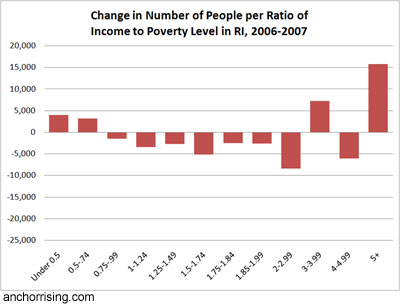
In the year-before period, Rhode Island lost many more high-income households than low-to-mid income households. Perhaps those tax cuts for the rich are working. However, over the long term, we're still losing households that earn more than two times the poverty level:
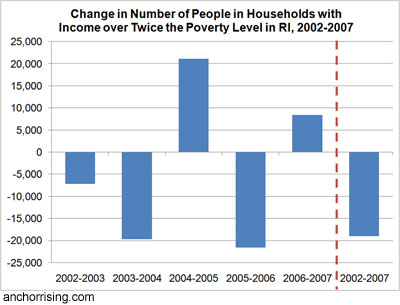
Basically, my assessment remains the same as after reviewing related IRS data (here and here), and moving on toward actual income data, the argument becomes stronger:
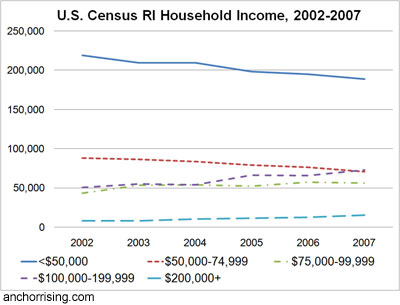
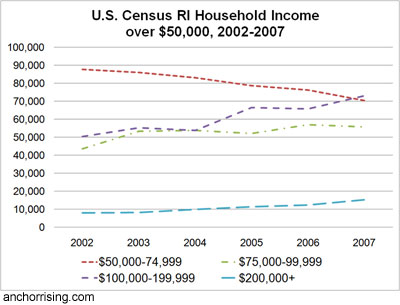
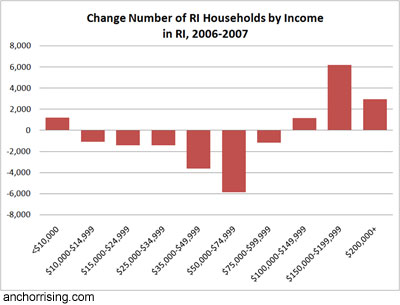
As I've been arguing for a while now, the people leaving aren't the rich and they aren't the poor; they're the families right in that meaty, motivated segment on the cusp of the middle class. Call it the productive class. These folks aren't likely to be looking for "affordable housing" — in the poverty industry parlance — but housing they can afford.
I'm not claiming that housing is not a factor in the RI exodus. Clearly, it's a large consideration when deciding whether to remain in an expensive region with little opportunity. But if it were the central issue — rather than, say, employment — then one would expect our emigrants to be moving nearby, so that they could still work here. According to IRS migration data, only 15% of the households that left Rhode Island during and after the 2006 tax year stayed within the range of abutting counties in Massachusetts and Connecticut. That being the case, if the problem were housing, not jobs, we'd have a lower unemployment rate, because businesses would have opportunities on offer, not filled.
"Affordable housing" programs may be desirable if Rhode Island ever gets its economy back on track, but until then, it would be at best a distraction and at worst a hindrance to the change that really has to be made: Rhode Island needs to become a place in which it is possible to succeed, which means lowering taxes, erasing regulations and other factors that hinder productivity and entrepreneurship, and devoting our limited public funds mainly to infrastructure.
January 5, 2009
Discouraging the Birth of Business Entities
While returning, this weekend, to the long-standing question of what sort of official entity Anchor Rising should become, I whittled down my understanding of the relevant tax law to what I believe to be its basic statement: Once one creates an entity, in Rhode Island, that entity is subject to fees and taxation.
An individual can procure from the IRS an Employer Identification Number (aka, a Taxpayer Identification Number) in order to act under an assumed name, and as long as his or her product is not taxable (as via sales taxes), the state need not be involved. Once, however, the business becomes an entity distinct from the individual — whether by joining multiple individuals in a partnership or through the creation of a corporation — various registration fees kick into play, as does the "minimum corporate tax."
The significance of the change is most conspicuous in the cases of pass-through business, such as limited liability companies and S-Corps. As a matter of general taxation, the profits of such businesses are claimed via the income tax filings of partners and owners, but in Rhode Island, they must first shave off the (currently) $500 minimum tax. In other words, even though the business entity itself has no actual income, it must pay $500.
This experience relates to a recent column by Steve Forbes:
... The U.S. has one of the highest profits levies in the developed world: 35% at the federal level, with another average of 5% from state and local taxes. Only Japan has worse. In contrast, Ireland's rate is a mere 12.5%. Imagine the howls from congressional Democrats if Barack Obama were to suggest enacting such a low corporate tax rate in the U.S.But the accompanying table tells an eye-opening tale: Ireland's corporate tax take as a portion of its economy is higher than that of the U.S. High rates breed pressure for ever more complicated exemptions and ever more ingenious ways to avoid Uncle Sam's tax bite. But an Irish-like rate leaves companies to focus brainpower on growing their businesses instead of on jousting with tax collectors. ...
Mark Steyn seconds Forbes's assessment of tax avoidance and adds the matter of beginning businesses at all:
To a certain type of simple-minded populist, the idea of soaking vast faceless corporations is appealing. But in the end a "corporation" cannot pay tax: The Globocorp corporate HQ looming in chrome and steel over the skyline does not have a pocket to dip into. Like all taxes, the actual cash has to be ponied up by flesh-and-blood human beings - the owners, workers and employees of the corporation. The growing gap between US corporate rates and other developed nations is a massive disincentivization for real human beings to start and grow a business here. And for those already here it encourages the kind of short-term thinking that leads to Bailoutistan and American sclerosis.
It's an easy sell, I guess, to tax a non-human business "entity," but it isn't really possible, because such entities don't exist outside of abstraction. A company is essentially a mechanism within which human beings act, and its construction will be managed to serve the interests of the flesh-and-blood people who use it.
If we at Anchor Rising were to behave rationally, as an Internet-based organization with no manufacturing operations, we'd incorporate elsewhere (for liability reasons) and become The Other Side of Hope in Rhode Island... in Nevada (or wherever). The entity doesn't really "do business" in Rhode Island. With our server in Texas and our incorporation in some other state, in no tangible sense would our advertisers and sponsors be engaging in transactions with a Rhode Island company, even though they'd be trying to reach a Rhode Island audience seeking information relevant to Rhode Island communities, written by Rhode Islanders.
By contrast, if Rhode Island's corporate tax structure didn't entail regular payments from organizations with no income, and if its regular rate were more competitive with those of other states, then rational organizations from other states would have incentive to be "from Rhode Island." Mainstreamers and progressives alike speak often of building up New Economy industries in this state, but they've shown little inclination to acknowledge the incentives to which such businesses — arguably characterized by their ability to locate anywhere — will respond.
January 4, 2009
A Quick Explanation for Pat
I haven't had a chance to work through my Sunday paper, yet, so I'll offer no comment on the bulk of that to which Pat is responding in this post, but he does construct a question in such a way as to merit correction. Arguing for increasing taxes and government-induced costs of doing business in Rhode Island, he writes:
Let me ask the business folks reading: is it a successful business model to lower your prices year after year even if your production costs rise each year? I mean, you want to run government like a business, right?
The flaws in these questions are multilayered, but the core error probably comes with Pat's failure to account for the fact that much of what Rhode Island "produces" — and therefore much of its expenses — is separate from the activities that bring in revenue. Businesses will not relocate to Rhode Island based on its social safety net, for example. As for items of direct utility to businesses and productive residents — such as transportation infrastructure — the insidious tendency of modern government is to treat them as additional to general expenses, with annual bonds and supplemental fees and taxes.
The next most significant error centers on the related implication that the government's "goods" are limited and distributed in a "one per customer" fashion. If the government is to be seen as a business, most of its products are actually services, and the incremental cost of accommodating an additional customer is minimal. Adding a few cars to a highway's burden doesn't affect the cost of maintenance tasks and barely affects the frequency, yet the increased revenue of several new residents working for a productive company is likely to be significant.
In this regard, the state-as-business is more like a movie theater. The costs associated with acquiring the films, maintaining the building, and offering concessions may be going up, but if the owner finds that fewer customers are taking in the flicks, and that those who do come buy less popcorn and soda, every year, increasing the price of tickets is not a very farsighted strategy. Rather, the owner should pare down expenses not related to revenue, streamline excessive costs (e.g., if there are more ticket-rippers than attendance justifies), and redirect resources toward changes that might attract more viewers — whether that means upgrading the seating or offering discounted Jujubes.
In reality, what government entities such as Rhode Island seem to tend toward is a shifting of their "business model" toward a focus on the expenses column as their core purpose. It becomes less their business, in other words, to foster a wealthy, secure, and productive society, and more their business to mandate charitable services for the unproductive and to protect and advance the wealth and security of public-sector employees. The state undertakes to increase "production costs" (to use Pat's phrase) as its raison d'etre.
December 27, 2008
Sticking Out Like a Sore Economy
Two sentences from Edward Mazze's commentary, yesterday, ought to be repeated daily for the benefit of every Rhode Islander until we force some real change in the right direction:
In New England, Connecticut reported unemployment at 6.6 percent, Maine 6.3 percent, Massachusetts 5.9 percent, New Hampshire 4.3 percent and Vermont 5.7 percent. ...There is little evidence the unemployment rate [in Rhode Island] will be below 8 percent until 2012 without changes in the way the state does business and deals with economic issues that work against job creation.
In short, we've got at least three more years of unemployment rates surpassing a line that no other New England state has even come close to crossing yet. Our state's "leaders" ought never be seen in public without reeds in constant self-mortifying motion lest citizens begin volunteering their grips for the cause.
And just in case anybody quasi-sentient remains who believes that the representatives of Rhode Island's coalition of public-dole special interests might have a point, the answer is not to increase the burden on private industry or to absorb a greater swath of the market and its services into the government.
December 24, 2008
The Comings and Goings
I've been meaning to update the Census component of my analysis of RI's taxpayer exodus (as I did with the related IRS data), but time has been too short.
In the meantime, mull over this conspicuous paragraph from a Providence Journal article on the Census data:
Census Bureau spokesman Robert Bernstein said that between July '07 and July '08, there was a natural increase of about 3,600 more births than deaths in Rhode Island, and a "net international migration gain" of 2,900 people who moved here from abroad. But those increases "weren't enough to offset a loss of 8,800 people who left Rhode Island for other states."
Increasing foreign immigrants. Population growth based on births. But Rhode Islanders leaving in such numbers as to swamp both. One needn't be a demographic specialist to make some inferences.
December 23, 2008
A Resource with No In-State Outlet
As one who graduated from the University of Rhode Island almost — amazingly — a decade ago, I'm not surprised that the school is considered to be a good deal:
The cost of attending the University of Rhode Island is going up, but the editors at one financial magazine say it's still a bargain — and an investment that pays off in the long run.According to next month's issue of SmartMoney magazine, URI ranks 15th in a nationwide study of private and public colleges analyzing the connection between tuition costs and graduates' earning power. The magazine examined colleges based on "their ability to deliver the best return on investment," and URI ranked the highest institution in New England. Brown University was ranked 36th. ...
On average, graduates of Ivy League and liberal-arts institutions earned more than graduates of public institutions three years after graduation — $51,000 a year compared with $48,500, and the gap widens more after 15 years.
But when college costs are factored in, the "long-term payback" picture shifts, ranking Georgia Tech far above Dartmouth and Texas A&M above Swarthmore, for example.
The reality, in my opinion, is that a motivated student can derive an excellent education from any school, but doing so is better facilitated at higher-end institutions. For its part, URI provided strong and innovative — and improving — educational opportunities when I was there, and things seem to have continued on the upswing.
The travesty of the university is that the state fails to follow up on the boon by giving graduates a reason (or even the ability) to remain in the state and apply their skills and knowledge.
December 22, 2008
Perception = Reality
Speaker Murphy expressed a desire for politicians, the press and the public to put a shiny, happy face on our troubled state. But that's hard to do when national news outlets like the Washington Post run stories that ask questions like, "So how did little, picturesque Rhode Island become one of the most economically depressed parts of the country?"
December 21, 2008
RI Economy: Solution is Obvious to (almost) All
John Kostrzewa writes:
The state’s economic development strategy needs short-term and long-term goals. It gets out of balance when too much energy goes into attracting out-of-state companies with tax breaks or taking care of the demands of the politically connected while deciding not to invest in developing companies that will create jobs in the future.This is nothing new. It's been said here, there and everywhere. The governor's small business plan is a start, but more needs to be done, across the board.The other lesson is that the key constituency is the small-business owner. There are 54,000 of them in Rhode Island, and by Carcieri’s own estimate, they employ 90 percent of the workers. Too often, they feel left out of the state’s plan and think the state, with its tax or regulatory policy, is only out to hurt, not help them.
Small-business owners have a clear list of priorities; they want a lower cost to do business; access to capital; a consistent, manageable system of rules and regulations and the ability to keep more of what they earn.
The other constituencies — the elected officials who seek special treatment and the big-company leaders who have the ear of the governor — will all fall into place if the first two lessons are learned.
December 20, 2008
Beware Tax Tinkering
Efforts to "update," or otherwise change, Rhode Island's taxation regime give the unmistakable impression of tinkering. That impression is solidified under one insidious phrase, which I've italicized in the following paragraph:
"It may be in the '10 [fiscal year budget], not in the supplemental," Carcieri said [of a plan to broaden the sales tax]. "I think we need to bring the nominal rate down. And I would be supportive of that. It's a matter of how you do it so it's revenue neutral."
That misguided phrase, reformers will note, is much less often applied in the form of expenditure neutral, when spending programs are broadened. Moreover, the reality is that there's no such thing as "neutrality" when it comes to adjusting tax code. Consider:
The tax-policy workgroup found the state could generate more than $200 million by taxing goods and services that are currently exempt. They include non-prescription drugs, car washes, spectator sports, theater, dry cleaning, business-support services and travel arrangements.The net impact of the sales tax expansion and rate reduction, according to the tax-policy workgroup, would be a $4.3-million increase in sales tax revenue for the state’s coffers. ...
Indeed, the tax policy workgroup determined that a sales-tax expansion could create a new burden for some taxpayers, but the vast majority of households would actually pay less sales tax over the course of the year because of the across-the-board reduction to 5 percent.
In other words, taxes would increase by $200 million, by these estimates, but decrease by $195.7 million. The question is who — excluded from "the vast majority of households" — would be contributing to that first number? If Greater Providence Chamber of Commerce President Laurie White intends to make the state "more tax competitive," even as total revenue remains statistically the same, for which taxpayers' inclusion are we competing, and to which are we going to hand the bill?
A look at the partial list of new sales/service taxes begins to create a picture. The various "repair" items are indicative of ownership. The self-improvement and leisure activities bespeak those who are progressing beyond subsistence and beginning to have financial room to focus on quality of life. And amazingly, such services as tax-return preparation, classified ads, and employment-agency fees will affect those seeking to generate economic activity (but without internal departments to handle such things). That is, precisely the critical group between the working and upper-middle classes that has been fleeing from the state for several years, now, will disproportionately bear the burden of this "neutrality."
One can expect many service providers to follow them across state lines.
December 18, 2008
Removing Unfunded Mandates
As John Howell reports in the Warwick Beacon, cities and towns are going to be clamoring for a reduction in unfunded mandates (ie; rules or laws imposed by the state on municipalities without the concomitant funds).
“There’s slim hope that the legislature would relieve schools of providing textbooks for non public schools or special education busing,” said Daniel Beardsley, president of the Rhode Island League of Cities and Towns. Textbooks, busing and much more are on the radar screen, although there was a reluctance on the part of most contracted for this story to disclose too much. Efforts appear to be directed at arriving at a consensus and drafting an agenda before going public....Ha. Yeah, "eliminating step increases for teachers", that'll happen! Regardless, I'm all for removing the various transportation requirements. Warwick Mayor Scott Avedesian also recommended removing the school bus monitor requirement. He also had a pretty convenient complaint (conspiracy alert!):Timothy Duffy, executive director of the Rhode Island Association of School Committees, said yesterday the group has forwarded a list of mandates that “hopefully” the governor will consider lifting as part of his supplemental budget. They include eliminating step increases for teachers; lifting the requirement that school nurses are also certified teachers and revising requirements that public schools provide out of district transportation for private and parochial schools. He noted that often private and parochial schools operate on different school calendars yet municipalities are required to provide busing at times when public schools are closed.
Mayor Scott Avedisian had a...suggestion: the requirement...for the city to conduct a full revaluation every nine years with a statistical revaluation in three year increments. When the revaluation requirement was enacted, the state underwrote the cost. That’s no longer the case and cities and towns are faced with the burden.In Warwick, the most recent revaluation was conducted at the peak of the housing market. So removing that revaluation requirement would probably keep current tax rates on individual properties the same, which is to say artificially high. In tight economic times, I'm guessing that would be fine with Avedesian who is already faced with decreasing revenues. But it would stink for Warwick property owners. I'm with Mayor Avedesian on this one, though:
The mayor also targeted the potential inconsistency between legislation that caps how much municipalities can increase the tax levy and the Caruolo Act that gives school committees the power to sue a municipality for additional funding.“If it goes to Caruolo we really need to change the law so a judge can’t do something that doesn’t fit within the cap,” he said.
December 17, 2008
Reduce Poverty by lower taxes, not more
It's not a stretch to say things are tough all over this year, worse than most. Yet, whether it's good times or bad, the one constant is that we will see news stories detailing the annual end-of-year (ie; right around Christmas) Poverty Institute study aimed at tugging at our wallets heartstrings. (They alternate the publication of their "Rhode Island Standard of Need" report and their "State of Working Rhode Island" report).
But I'm not going to take them to task for advocating for the poor, nor do I dispute their findings. I have little doubt that budget deficits will affect the programs for which they advocate. I certainly don't want to see hungry, homeless kids. No one does. But the problem is that they have sent the same message year after year: "Rhode Island(ers) are not doing enough." And people--average Rhode Island taxpayers--are less likely to be receptive to the guilt game when they are feeling the pain themselves. Maybe the impact of the PI's message would be greater in lean times if it wasn't broadcast so loudly in good times.
And maybe, instead of focusing on increasing Rhode Island's tax burden, they should turn their attention to shrinking other areas of government to make up for the shortfalls in the programs they prioritize. No one wants to "balance the budget on the backs of the poor," so why don't they spend more time advocating for cutting the extravagances in state and local government or consolidating services to free up more money for those in need?
That's a better solution than adding to Rhode Island's tax burden, particularly on businesses (say, by advocating for expanding sales tax to services). Taking money out of the pockets of job producers is one surefire way to reduce employment and add to the constituency for which the Poverty Institute advocates. And I'm sure they wouldn't want that.
Clear the Way (But Don't Build It) and They Will Come
It must be their training that leads business advocates and practitioners to declare that Rhode Island requires a targeted business plan.
A state is not a business; it's a location. Government leaders are not CEOs and corporate board members; they're politicians. We shouldn't rely upon them to innovate and develop visions for business in the state; that should be left to business people — with their own professional necks on the line — to do.
Why, then does Newport County Chamber of Commerce Executive Director Keith Stokes specify targeted tax changes and usage of an assumed federal stimulus windfall?
Of particular priority would be capital and infrastructure investments in designated industrial zone lands, enterprise zones, redevelopment districts and empowerment zones. ...The Rhode Island Five Year Comprehensive Economic Plan states "approximately 32,450 acres were zoned for industry. The inventory of industrial-zoned land showed that 11,116 acres were actually in industrial use, the remainder being vacant or in other uses." Unfortunately, many acres of industrially zoned land in Rhode Island lack the basic infrastructure required for immediate business investment, most notably a lack of approved permits, utilities, environmental remediation, and road improvements. Investing in improving and expanding our state's industrial zoned lands and existing industrial and corporate parks has been a state planning goal for many years, but consistently lacked adequate funding. Rhode Island already enjoys many important industrial and corporate parks that with additional capital and investment will further expand their jobs and tax revenue potential.
With the state crumbling around them, a few square miles of predeveloped industrial lands here and there will not persuade companies that Rhode Island has its act together. Indeed, depending how the development is done, the location and configuration could be all wrong for a specific company. We must invest in infrastructure, but we're far from the point at which the state as a whole is in sufficiently healthy shape to focus on specific limited-use areas, and our leaders have demonstrated much less than the required insight to discern what uses companies may find for our land.
Smaller Business Association of New England Chairman Grafton Willey puts similar constraints on his advice:
We should build on our strengths and support those industries that have a unique advantage in Rhode Island. They would include: marine trades — boat building, boat storage and repair, slip rentals, boat equipment manufacturers and repairs; hospitality industry; health care; higher education; innovation and research; knowledge-based economy; and niche manufacturing industries where R.I. has a competitive advantage.
In its current predicament, Rhode Island needs to support any industries, within the boundaries of morality and safety, whose leaders determine from their own perspective that the state has a competitive advantage for them. Even putting aside the question of competence, to the degree that Rhode Island develops its own competitive advantage, it opens itself up to the subjective expenditure of public money to the benefit of politically powerful politicians and other interests.
Once again, it's not as though we've money lying around without purpose because everything basic is already done. When energy and thought are expended on specific purposes despite general disarray, it's a fair indication that the powers who be are distracting themselves from the straightforward steps that must be taken before innovation can stay on the tracks.
December 16, 2008
Hurry Up to Unemployment
If, like me, your prospects of facing unemployment in the near future are all too real, this news is unsettling, no matter the assurances that the "move would have no impact on beneficiaries":
Rising unemployment in Rhode Island is draining the fund that the state maintains to pay unemployment benefits. ...Such a move would have no impact on beneficiaries; payments would continue without interruption and with no change in the way they are calculated, the officials stressed.
But a bailout, in the form of a loan from the federal government to the unemployment insurance trust fund, could trigger a hike in unemployment taxes for employers — on top of the one they already face next year.
Once again, one wonders from where officials think businesses get the extra money that they are taxed. Consider:
Rhode Island's unemployment insurance tax is paid entirely by about 32,000 employers. Because of a change in the tax formula posted last month, many employers will pay more into the fund next year.The amount of a worker's wages to which the unemployment tax applies will jump to $18,000 next year from $14,000 this year, up 28.6 percent. As a result, "The employer's cost is going to go up," said Patricia A. Thompson, former president of the Rhode Island Society of Certified Public Accountants.
On average, employers will wind up paying about $625 in tax per employee next year, an increase of about $139, Filippone said.
But exactly how much each employer will pay will depend on various factors, said Thompson, tax partner at Piccerelli Gilstein & Co. LLP, a CPA firm in Providence.
In general, the more layoffs an employer has had, the higher the tax rate — and the more tax the employer will have to pay.
A report issued in October by the nonprofit Tax Foundation said that Rhode Island, Massachusetts, Kentucky, Alaska and Michigan have the least favorable unemployment insurance taxes from an employer's standpoint — and Rhode Island ranks as the worst.
There's a reason some employers strive to inspire workers to quit, rather than lay them off. (Although it's still pretty petty and selfish to do so.) More importantly, even the most scrupulous boss will associate rising expenses with the cost of each employee. $139 isn't much, compared with workers' compensation, but in aggregate, it could mean the loss of a raise (or the reduction of a salary) if the boss thinks it prudent to find savings with a handful of employees.
It's also just one more nut tightening on employers in Rhode Island.
December 15, 2008
Where's the "So"?
No doubt, we're in for a string of news stories describing the essential work that this group or that group does with government dollars. Today's, dealing with the Office of the Public Defender, includes a statement that oughtn't be allowed to remain standing in any instance:
"I just don't see how we can cut budgets on that type of service," [District Court Chief Justice Albert] DeRobbio said. "They need representation and they need representation every step of the way." He plans to work with Hardiman to make changes to accommodate the office.
The I-don't-see-how approach to consideration of government funding is one contributor to our current problems. Every group and expenditure functions in a way that somebody considers to be critical. From here on out, advocates are going to have to begin offering arguments about what ought to be cut instead.
December 12, 2008
Stimulated in an Airless Room
In a way addressing the general economy, Governor Carcieri's stimulus plan will surely help small businesses to get started and, perhaps more directly, to keep going, and with the bulk of the effort occurring beyond the scope of the government:
Overall, the plan is intended to provide more than $200 million in new sources of capital for small businesses that are struggling amid a global economic downturn and rising unemployment."These are tough times," Carcieri told nearly 100 business and government leaders, and others, at a packed State House meeting room yesterday.
And small businesses — which represent 90 percent of all businesses in Rhode Island and employ 25 percent of the work force — are being squeezed, Carcieri said.
Together, the package's provisions will encourage banks, credit unions and other lenders to make more money available to small businesses, Hayward said. "It's critical that we keep our lenders in the game," he said.
However, looking at Rhode Island's situation in specific, I wonder about the efficacy of spurring businesses in a state that isn't attractive for their continued operations.
December 10, 2008
Hitting Snooze on the Economic Alarm Clock
Perhaps there is reason for hope if Bob Kerr and I are beginning to have similar reactions to policy proposals:
Desperate times call for desperate measures. As Rhode Island leaders look for ways to squeeze money from previously untapped sources, the possibilities for creative income growth seem darn near unlimited.Short of a tax on the air we breathe and the sidewalks we walk, almost anything could carry a price tag.
Let's call it the Rhode Island Pay Off Fiscal Folly program. Or RIPOFF. A bit of a stretch, but it works.
I note that Kerr neither defines the problems made up our drunk-like government structure nor offers suggestions to avoid the darkest of the days to come, and I'm sure he'd still balk at mine. Waking up to reality doesn't happen with the first alarm, though.
December 9, 2008
Conclusion First, Analysis Second
It appears that Kate Brewster is fully back from hiatus, offering the Rhode Island College Poverty Institute response to every new suggestion for changing the state's oppressive and ill-considered tax structure. Her conclusions all translate into the principle of "take more from them, and give it to my preferred group":
The Poverty Institute, a think tank at the Rhode Island College School of Social Work, last week called for the [death] tax to be preserved.Kate Brewster, executive director of institute, said in a statement that the tax "is the most fair tax that we have and must be preserved to maintain a balanced tax structure that requires those with the greatest ability to contribute their share towards public services and infrastructure."
A report issued last week by the Washington, D.C.-based liberal Citizens for Tax Justice, showed that comparatively few Rhode Islanders wind up paying the tax. The figures do not take into account those who escape the state's tax by using planning techniques or by moving to other states.
It's nice of Brewster to make it so nakedly clear that, in the progressive lexicon, "fairness" means little more than taking money from wealthy people — regardless of the event being taxed. Not so nice is the habitual refusal to consider how our government might be creating incentive for taxpayers to leave.
It's difficult to maintain civic optimism when the parasites of public funds offer reminders that they'll keep on sucking out that blood, even as the organism of state becomes anemic and dies.
December 8, 2008
A Bracing Dose of Reality
Proem: Al Lubrano, President of the RI Manufacturers Association, appeared on the Dan Yorke Show December 2 to share his thoughts on turning the Rhode Island economy around. Jeff Deckman e-mailed the following to Dan, reprinted here with Jeff's permission. M.C.
Dan:
You are dead on with your comments to Al about his seeing it as a collaboration and the unions seeing it as a competition.
I worked with Al when I was on the Economic Policy Council for a few years. He is a very sharp and hardworking guy but like the Governor, he doesn't get that he is in a street fight with an opponent who is after a different outcome.
Al wants a great place to raise a family and run a company and he cares about his fellow Rhode Islanders. As long as he has that, then he has a chance at being able to afford to live.
The unions want their power and their pensions and they see their fellow Rhode Islanders as people who are obligated to pay the bills. As long as they have that, they are protected from any fall out.
Al cares about the state because he is a good guy who is honorable. But unless he shows up with a baseball bat VERY early on in the conversation there will be NO cooperation or collaboration.
It amazes me how everyone wants to be nice and negotiate with union leaders. You have to be a moron to not know how these guys negotiate. I had a company that went union last year and their tactics would make your hair curl.
Besides, negotiating with [Secretary-Treasurer of the Rhode Island AFL-CIO George] Nee or the rest of them is like negotiating with Tony Soprano.
As long as you are giving him what he wants, he is at the table. The minute you aren't, he breaks out HIS baseball bat and takes what he wants because he already has the power.
You totally get it that one can only negotiate from a position of political power. Al may know business power but he doesn't understand anything about how political power thinks.
So I wish him well. But he better button his chin strap because he will be looking out the ear hole by the time they are done with him.
[Jeff Deckman is the founder of Capability Accelerators and served as the Executive Director of the Rhode Island Republican Party in 2005.]
The Voice of Continued Decline
True to form, the Poverty Institute's Kate Brewster notes that "two-thirds of the [state budget] gap is due to declining corporate, income- and sales-tax collections, as well as shrinking lottery revenues," but her proposed response is not to find ways to increase the economic activity that drives such revenue. Rather, she'd simply like to jack up the rates (or broaden the shadow, in the case of the sales tax)
One needn't dig too deeply around the foundations of her conclusions to begin to see the crack:
According to leading economists, it is better to raise taxes on high earners than to cut spending during economic downturns. The Center on Budget and Policy Priorities cites two well-respected economists — Nobel Prize winner Joseph Stiglitz, of Columbia University, and Peter Orzag, the recently announced director of the Office of Management and Budget — who during the last recession asserted that tax increases on high earners are less harmful than spending cuts. Raising taxes may result in money not saved, but cutting programs for low-income families will result in money not spent which has a more dramatic impact on the economy.
One would hope that economists making such general statements would append a long list of circumstances that must be present in order for their conclusions to obtain. If they did so, in this case, then Brewster's printer must have run out of paper before it got to the caveats.
In a system as oppressive as Rhode Island's, money not taxed is not merely "money saved." It's money spent more productively. It's money spent creating jobs, investing in education, and improving property.
Rhode Island must prepare itself for the reality that its policies for surviving as a state will tend to drive out one group or another. What the leadership must do — now that the voters have abrogated the responsibility to make the call — is to decide whether it wants to tell the needy to seek services elsewhere or to tell the productive that they'll have to turn their eyes to other states for opportunity. If the latter, the likes of Brewster best begin developing their excuses and spin for the continued shrinkage of state revenue.
Reshuffling the Tax Deck
Neil Downing explored the governor's taxation panel, and beyond my complaint that it strove to remain essentially revenue neutral (rather than decreasin taxes), if we strip away the specifics, none of the proposals are very attractive in their predicted effects:
- The first solution would transfer the income tax burden from the top and the bottom to the middle and increase tax revenue by less than a million dollars.
- The second solution would also transfer the income tax burden from the top and the bottom to the middle, but it would decrease tax revenue by $3.4 million.
- The third solution would decrease income tax across the board, but the sales tax rate would remain the same and apply to more goods and services, bringing in an extra $38 million in revenue.
The direction of the shift in income tax for the two solutions that are effectively revenue neutral suggests that the tax panel didn't look closely at the demographics concerning the sorts of people who have been leaving the state. Middle-income families — the key for productivity and growth — have been fleeing the state for years, so increasing their share of the burden would likely prove counterproductive.
Broadening the sales tax will also be counterproductive. More people will simply move their shopping over the state border, and the more aggressively the state cracks down on that, the more contentiousness will exist between citizens and their government, and the more likely they'll be to throw in the towel and move.
Bottom line: there is no way out of this mess that doesn't require huge cuts to government spending.
December 7, 2008
Totally Separate Stories. Totally.
Here's a mild head-shaker of a story on page A12 of today's Providence Journal:
... when he retired in June at the age of 75, the [Rhode Island College] gave [former President John] Nazarian something back: a $205,008 severance check.The check included $67,890 for unused vacation time, $31,366 for unused sick time and $29,902 in deferred pay from the 1991 budget crisis that was belatedly paid to him based on the $189,625 a year he was making when he retired 17 years later.
It also included a $75,850 "retirement incentive."
While the University of Rhode Island offered its workers a $20,000 incentive to retire, RIC and the Community College of Rhode Island offered their employees 40 percent of their pay to leave before the end of June, a decision that provided tens of thousands of extra dollars to dozens of their highest paid professors and administrators. ...
Overall, 90 employees in the state college and university system received a total of $2.3 million in incentives, ranging from $13,870 to the $75,850 paid to Nazarian. The college and university employees were among 1,521 state workers who retired between May 1 and Sept. 30 as part of an effort to cut the state payroll.
All told, the state paid out $18.8 million to the retirees, including unused sick and vacation time and other payments. ...
Asked why URI bumped its retirement incentive from $7,000 to $20,000 last spring — and why RIC would offer a $75,850 retirement incentive to a 75-year-old — Steven Maurano, a spokesman for the state Office of Higher Education, said the decisions were made before the state slid into its current budget crisis.
And from the front page of the Local News section:
Bracing for deeper budget cuts, higher education officials are considering a range of cost-saving measures at the state's three public colleges — from eliminating dozens of small academic programs to consolidating some redundant programs to reducing the number of credits needed to earn a degree.They also warn that increases in tuition and fees for next year will probably double. Students at the University of Rhode Island, Rhode Island College and Community College of Rhode Island will most likely see increases of 20 percent to 25 percent, or even higher.
"We need to have an ongoing analysis of how we can reduce costs," said Jack Warner, the state's higher education commissioner.
See, the thing is, when those kids chose Rhode Island institutes of higher learning — often uprooting their lives to do so — their decisions were also made before the state slid into its current budget crisis. Former director of institutional research at RIC, Donna Konicki, says that she understands "why taxpayers might be upset with the amount of sick time we are allowed to accrue," bringing her total severance package to $88,223, but perhaps the students deserve an explanation, too, justifying the translation of retirement largesse into further education loan payments by the new indentured servant class.
ADDENDUM:
While on this topic, I've got to point out a great line from a related article addressing the sick-time payments more broadly:
The president of the largest state employees union, J. Michael Downey, said the payments for unused sick time are also one of the benefits given state employees to compensate them for getting paid less "historically" than their private-sector counterparts.
In this case, "historically" is meant to be understood as "at some point in history." Of course, there are plenty of examples in which RI unions exhibit a strange sense of fairness, including this argument:
Defenders of the payouts for unused sick time say the policy gives state workers — who are not covered by temporary disability insurance — an opportunity to "bank" blocks of time so they can be paid in full if they are out of work with illness for an extended period.
Hey, that's reasonable... as long as I someday am able to recoup a portion of the $707 dollars taken from my paycheck every year for a program that I may never use.
December 6, 2008
An Example of the Necessary Pushback
Two principles necessary for Rhode Island to turn back from the brink (or, more accurately, to climb back onto it) have been coalescing in my commentary of late:
- The change must move from the municipalities, up, both in the ascension of a new ruling class and in the direction of reform.
- Policies can no longer be treated as irrevocable, allowing legislators and other state officers to skirt blame for the consequences of their decisions. In other words, there must be push-back and demands that the General Assembly et alia provide guidance as to how their demands ought to be balanced. That is: What do we erase, and whom do we tax in order to accomplish what you've dictated?
This development contains both of those elements, along with an acknowledgment that relief from union power is required:
Leaders from five municipalities met with Governor Carcieri’s policy director yesterday, saying they will back his efforts to bring state spending under control as long as he helps get them the tools to curtail spending in their own municipalities. ...Lombardi said North Providence would stand to lose $2 million in state aid if some of the cuts being talked about come to pass. He said he could close that gap by $750,000 if he were allowed to reduce the number of firefighters who would have to be assigned to a shift at any one time from 21 to 17, saving on overtime.
The North Providence contract with the firefighters calls for a minimum of 21 firefighters, but that contract expired in July and the town and union are on the verge of going to binding arbitration.
It's a problem that could be solved, he said, if the General Assembly enacted a law barring arbitrators, or those who negotiate contracts, from putting minimum manning levels into future contracts.
Polisena said he has already told Johnston's local senators and representatives that any reduction in state aid to the town this late into the fiscal year would hurt the taxpayers and would be unacceptable.
The loss of an estimated $2.1 million in revenue would be more palatable, he said, if cities and towns were given the authority to ignore some state-imposed mandates, and were freed from a provision in state law that prohibits them from earmarking less for education than the previous year.
"I asked our [school] superintendent to come up with a list of mandates that we could do without, without affecting education. Her list totaled $1.6 million," he said.
Individually and collectively, every town council and school committee in the state ought to be knocking on doors at the statehouse with documents describing everything — other than money — that they need from the state government.
December 5, 2008
Rhode Island to Hard-Working Taxpayers: You're Not Wanted
So I took a 14% reduction in my hourly pay rate this week. My other option was to quit and look for another job (without the benefit of a few months of unemployment insurance). Desperate times are here.
Meanwhile, the Sakonnet Times did run Richard Joslin's diatribe against the Tiverton taxpayers group with which I'm involved. The Providence Journal has also given Tom Sgouros's "Quit yer moanin'" rhetorical dreidle a bigger spin through the population, with Opinion Page Editor Bob Whitcomb offering Sgouros kudos for his "fact-filled and very thoughtful commentaries" (in general).
Then comes the broad list of possible new tax-the-people solutions for avoiding the necessity of paying for Rhode Island's transportation infrastructure out of the revenue pool that really ought to supply it. I'll tell you right now that just about any one of these options — except the higher gasoline tax, which won't affect me, except indirectly via higher costs passed on to customers — may be the final straw for my family.
It's possible they'll hit me with to-and-fro tolls just to get to work each day, and noises are that we're not talking the 35¢ that has been unchanged on New Jersey's Garden State Parkway for as long as I can remember. My wife could conceivably encounter four tolls, as she drops off the children at her mother's house three miles away and then heads to work in a part of Rhode Island more readily accessible via 195. Families in Portsmouth and Middletown could end up hitting six tolls on an evening trip to Providence. And then there are the other taxes and per-mile fees, no matter where one drives.
Of the half-dozen or so jobs that Monster.com emails to me each day that somewhat match my criteria (although rarely sufficiently), not a single one has been in Rhode Island for quite some time. And if I were to find another job in the state, chances are slim that I wouldn't have to deduct heavy transportation costs from my earnings. The question, therefore, is this: Do the state's leaders really intend to further weigh the "get out of here" side of the decision scale for the slice of the population that has been streaming out of the state in the thousands every year?
December 4, 2008
And the Redirection Effort Continues
Anthony poses a worthy question in the comments to my post on the RI House Finance Committee's grilling of state department heads:
This is surreal. For years, the General Assembly filled state agencies with a "Family and Friends" plan that rivaled AT&T, raked Carcieri over the coals for wanting to "cut too much" and overrode gubernatorial vetos to pass bloated budget.Now the same people are questioning spending of state agencies and trying to blame Carcieri?
Maybe it's too much to ask, but shouldn't somebody be pointing this out?
Oh, but the surreality gets worse, with today's continuing reportage:
State officials hope to pump tens of millions of dollars into Rhode Island's drowning economy in the coming months as part of a "mini stimulus package" that key lawmakers say would cost Ocean State taxpayers almost nothing.The plan, disclosed yesterday in what was likely to be the last special meeting of the House Finance Committee, pushes the Carcieri administration to enroll more than 10,000 new food-stamp recipients in the next year, expedite unemployment insurance claims, and rush millions of dollars to stalled infrastructure projects across the state. ...
The state stimulus package essentially urges the Carcieri administration to spend millions in federal dollars and already earmarked state funds as soon as possible. While some state departments struggle to limit discretionary spending, they also struggle to spend a pool of money that could help create thousands of jobs, improve bridges and roads, and boost tax revenue.
I caution readers that some of the quotations from legislators not reprinted here may induce nausea. A new question worth asking, however, is: How much of the "allocated" money is actually sitting in a bank account, somewhere, and how much is tied up with revenue that the state has not yet received as it spends $1 million per day that it does not have?
My favorite part is the note that the announcement came at what is "likely to be the last special meeting of the House Finance Committee." This has set-up written all over it. "Yeah, you guys have to do more. We'll be back next year."
December 2, 2008
Saving Rhode Island in a Few Simple (But Difficult) Steps
Hoping that repetition will get the message across, Ed Achorn tells Rhode Islanders that happy thoughts will not turn the beast around:
These pages have spelled out for years what must be done: Cut spending to what Rhode Island can afford. Make taxes competitive with (at least) those in neighboring states. Attack the public-employee-pension nightmare, and bring overall benefits for such employees back to earth.Reform business regulations, including the over-reaching fire code, to make Rhode Island welcoming to job creators. Cut costly mandates to cities and towns. Encourage the municipalities in the state to merge as many of their services as possible. The duplication and waste are terrible.
Obey the constitution by fully implementing separation of powers and get rid of the straight-ticket voting option, so that Rhode Island functions more like other, more progressive and civic-minded states. Focus more on serving students at public schools. Develop the ports. Put a greater percentage of public dollars into higher education and infrastructure repair.
If our leaders did all that, Rhode Island's terrific advantages would spring to the fore, and we would be poised to boom as never before when hard times ended, reaping tax revenues that would provide all the money we would need for superb government services, including compassionate aid to the needy. As a bonus, residents would be much happier and healthier.
The probability is, though, that we're in for another half-decade of pain, and that's assuming the next two years are bad enough to spur the voters to change their behavior.
December 1, 2008
What's Tom Talking About?
Once you get over the fact that they make a living doing for the left what we on the right must do as a hobby, a messaging guy like me really has to sympathize with the plight of those charged with maintaining the components of the status quo that have done so poorly for Rhode Island. How to present Rhode Island's predicament as such that it needs more poison? Well, here's one tack (emphasis in original):
The highest taxes? Please. New Hampshire is a tax haven, right? Some of it is, but if I were to move from my home here to a comparable house in Jaffrey, Keene, Peterborough, or any equally unfashionable town, my total taxes would increase even without a sales or income tax. Our state and local taxes are lower than the national average, according to the Tax Foundation rankings whose poor methodology actually exaggerates the impact of our income tax. (We rise to 10th in their rankings only when they add the taxes you and I pay to other states, I kid you not.) There are at least 27 other states with higher sales taxes for at least some of their counties than we have. We have high property taxes, yes, but can you fix that by level funding the cities and towns while piling on new mandates?
Because Tom Sgouros provides no sources for his New Hampshire assertions, I'll leave them alone, except to note the excess of wiggle room when comparing specific towns across state lines, as well as defining "comparable." The Tax Foundation argument, however, is worth a closer look.
The inclusion of out-of-state taxes isn't the only reason that "we rises to 10th" in the Tax Foundation rankings. Our relatively low average income is another. The Tax Foundation table shows that Rhode Island ranks 17th for absolute per capita taxes paid in state, but because we're #8 for taxes paid out of state, we come in at #12 overall.
We rise the extra two ranks when that dollar amount is expressed as a percentage of average household income. Granted, we're a small state, so a larger percentage of our population is likely to work and shop beyond our borders, but if one is looking at the state as a potential place of residence and business, taxes paid are taxes paid. Even this argument, however, allows too much, because the in-state-only ranking is a bit misleading, as is Sgouros's astonished declaration that our taxes are "lower than the national average"; that's the case only because the range of state taxes goes out more dramatically on the high end.
Changing measurements to deal with this imbalance, it proves true that Rhode Island's in-state tax burden is 21% higher than the national median. For perspective about why that matters, consider that Rhode Island's in-state taxes are farther above the median than the lowest-taxed state is below it. It's worth noting, too, that our progressive income tax would translate into a worse ranking as we succeed in attracting those coveted high-paying jobs.
Which brings us to the aspect of Sgouros's essay that really reads as spin:
This shortsighted perspective [of lowering taxes], and the determination to pursue it at all costs, has thoroughly ruined the service side of the equation, and given us the worst of both worlds: devastated services and higher state and local taxes. Bankrupting the state is not a route to prosperity.We are a relatively poor state and proportionately very urban. We may not ever be able to be a low-cost state, but that doesn't mean we can't compete, as DandyID shows. We have other high cards: a beautiful state, a hip capital city, a fabulous art scene and more. What we don't have is policy makers willing to play them.
One might understand Tom to be arguing that DandyID, which he briefly profiles, points the way to the services that Rhode Island provides. In the preceding text, however, he lists "affordable office space," which is an indication of broad vacancy, Geek Dinners, which are a private initiative, and RI Nexus, which is a corporate database maintained by a quasi public organization. That's hardly a collection of assets threatened by deep cuts to state government spending (with the possible exception of the office space, which will go up in price if the state gets out of the private sector's way). On the other hand, it may be telling that DandyID, despite its office in Pawtucket, is not registered as a corporation in Rhode Island and still has its Internet domain registered in Colorado.
Be that as it may, if Tom wants to include government services that will help make Providence even hipper and the state art scene even more fabulous, he ought to argue for redirecting the revenue from his union clients and social service allies. Otherwise, we citizens who pay so much in out-of-state taxes will continue to conclude that we might as well pay them all elsewhere.
November 27, 2008
Dictating Your Behavior: Specific and Target Action; Changing Theirs: We'll Get to That
Let's just say that Elizabeth Roberts's efforts to increase economic activity in Rhode Island aren't very inspiring, not the least because they begin on the wrong side of the equation:
WITH RHODE ISLAND'S economy in recession, joblessness approaching double digits and our small businesses bearing the brunt of the downturn, we all have a role to play in pulling our state out of its current economic decline.As we near the peak of the holiday shopping season, one immediate step we can all take is to make a conscious effort to support locally owned Rhode Island businesses.
As seems always to be the case, the burden falls to you, Average Rhode Islander, to change your behavior, probably to act in contradiction to your direct personal interests, and contribute more. Oh, she alludes to other areas in which change is needed:
It would be naive to think that Buy Local RI by itself can solve all the issues facing our small businesses. We know that some factors — like commodity prices and the stock market — that are beyond our control. As chairwoman of the Small Business Advocacy Council I pay close attention to the challenges facing Rhode Island's small businesses: taxes and fees, time-consuming and non-standardized regulatory requirements, the rising costs of health insurance and inadequate access to capital or to properly skilled workers.As Rhode Island's government prepares to address this year's supplemental budget and next year's projected deficit, we must make sure that the policies we craft with our state budget also begin to address these long-term challenges facing Rhode Island's small businesses — and I am committed to doing that.
As comforting as the thought of a committed Ms. Roberts may be, we all should wonder: Where's the call for immediate action at the statehouse to provide incentives to shoppers to buy locally? Where's the demand that the legislature cut sales taxes below those of our neighbors? Where's the call to shrink government so that taxpayers can retain more money to spread around?
The greatest long-term challenges facing Rhode Island are the collection of milquetoast and clueless politicians in line to lead us and the apparently broad belief that we can't do any better.
November 26, 2008
In a Drought, Open the Floodgates
For a moment, I thought I might have my first strong agreement with Anthony DiBella:
It's nice that EDC can spend some time attracting new or fashionable companies and industries, but it behooves our economic planners to be cognizant of our competencies and competitive advantages. Courting high-tech firms to come to Rhode Island may feel glamorous, but it makes little sense to compete for companies whose requirements are far better met elsewhere. Rhode Island has nothing comparable to an MIT or CalTech so competing for jobs in the computer industry (hardware or soft) is energy better spent elsewhere. ...
The approach is related to that which I decried this morning in school committees: beginning with what one wants to do, in the public sphere, and then trying to make reality conform with the desire. But then DiBella proceeds to slip into the same waters:
... Our jobs-growth strategy should be based on the premise that it's far easier to expand or grow an existing business than it is to import one.Of course that begs the question: does Rhode Island have any intrinsic advantages due to its size, location or history? If we consider domains in which Rhode Island has done well historically, that list would include defense, graphic and fine arts (including jewelry), marine trades, medical, textiles, and tourism. Economic planners and forecasters must consider the trajectory of societal trends and where they will intersect with our state’s relative advantages. As Joe Biden stated during his debate with Sarah Palin: "Past is prologue."
We spend too much time, in this state, imagining the economy that we'd like to have. That's a luxury for thriving regions that want to solidify their positions or change their directioins. In our predicament, we ought to be making the state universally attractive and then allowing private industry to decide what our natural advantages are, for them.
That doesn't mean that officials shouldn't do promotional tours, but it does mean that we're not in a position to target policies. As a state, we haven't proven effective enough to presume to do that.
November 25, 2008
The Sinking Ship
From the masked Flash movie director who brought you the pre-election history lesson comes: RItanic!
"Shop Here, Live Elsewhere"
Be sure to take in RI Treasurer Frank Caprio's infomercial-style ad proclaiming Rhode Island's lack of sales tax on clothes. As the Providence Journal reports, the above-linked Web site is part of a broader campaign (and I don't mean Caprio's 2010 bid for governor):
Through a billboard sign that went up yesterday morning on Route 95 south on the Massachusetts border, and a Web site — www.NoClothesTax.com — that went live yesterday, Caprio will try to get out-of-staters to consider shopping for clothing here. "We in Rhode Island need to brand our state — especially when it comes to the retail trade," Caprio said. "We're not seen as a tax haven for clothing or anything else."
So here's a question: If tax savings on clothing will attract regional shoppers to Rhode Island, why wouldn't a lower tax burden on everything else have a more profound impact? The state's message shouldn't be "shop for a limited category of retail goods in Rhode Island"; it should be "live, do business, and invest in Rhode Island."
RI's Painful Future
The really disheartening thing is that I don't believe our elected officials have the intellectual or ideological framework to get us out of this:
Rhode Island government is probably facing a deficit of $486 million for the fiscal year that begins next July 1. And the House fiscal office predicts that deficits will grow by roughly $80 million each year, to $770 million in 2012.
Slash taxes. Trim regulations and mandates. Rebuild infrastructure. Declare it; do it; and watch productivity return to Rhode Island.
November 22, 2008
Looking for the Bottom
So what level of unemployment do you think Rhode Island is really going to hit?
The latest jobs report is grim even in light of the economic forecast released yesterday by the nonprofit New England Economic Partnership. The NEEP economists predicted that during the next two years, Rhode Island would lose nearly 15,000 more jobs and unemployment would hit 10 percent, probably by the end of next year.But the pace of the decline is swifter than predicted. The October job losses already account for more than 70 percent of the 3,400 jobs that NEEP had forecast the state would lose during October, this month and next month.
Surely losing another 0.7% during several years of recession is optimistic. Actually, a different article in yesterday's paper puts the bottom at 10.3% within the next two years, which seems improbably low considering that last month saw a 0.5% decline. At that rate, we'll hit 10.3% in two months. But here's the depressing thing:
After Rhode Island, Maine could be next in line, with a projected peak unemployment rate of 8.7 percent.Connecticut and Massachusetts would land in the middle, with each at 8.3 percent. And New Hampshire could peak at 7.4 percent, with the lowest spike in unemployment in Vermont, at 6.9 percent.
That's right, the second worst predicted unemployment rate in New England is well below what Rhode Island is currently experiencing. The situation in the other four states will only get as bad as things were here six months ago, or so, back when we were all only beginning to worry.
And Rhode Islanders actually further entrenched the power of the folks who did this to our state. It's going to be a winter of cold, cold reality.
November 21, 2008
When Rep. Trillo Mentions Tax Hikes....
....look out.
Rep. Joseph A. Trillo, of Warwick...said he expects a battle over new taxes in the coming weeks and months.“The problem is, if we go down that road — and we may have to, hopefully we don’t — we face the possibility of more people who have to leave [Rhode Island],” he said. “We can put up tolls, but we can’t put up fences.”
Legislators Looking for Answers
Some Rhode Island legislators are looking into what businesses require to compete and be successful in the Ocean State:
Members of the House Finance Committee spent the morning visiting five prospering manufacturing companies around Rhode Island. Their mission: listen to company executives to find out what the legislature can do to promote job creation....Add in working to maximize the existing, natural advantages we have here--like, say, promoting maritime industries--and we'll be getting somewhere.The ideas that emerged were as diverse as the companies themselves: create a better incubator environment for new businesses; mandate more efficient permitting processes at the state and local levels; create partnerships between universities and local businesses to cultivate a better job pool; and finally, get out there and recruit companies to come to Rhode Island.
Robin Hood Government Isn't an Economic Stimulus
Bryant University Assistant Professor of Economics Edinaldo Tebaldi steps around an important consideration with the following:
During recessions, the government often acts as a "buffer" to help revive the economy, Tebaldi said, by increasing spending to generate jobs and boost economic activity. But state government is actually "doing the opposite" by cutting personnel and programs in order to close a budget deficit, he said."So rather than operating as a buffer to help the economy get out of the recession faster," Tebaldi said, "they're actually contributing to make the recession even more severe."
This may be true in situations in which the government has been tightly controlled and limited prior to the economic downturn or in which the private sector is, for some reason, not maximizing its opportunity potential. But Rhode Island has been operating under a de facto deficit for years, plugging the holes with one-time fixes, and its productive citizens have been fleeing for lack of opportunity.
Expanding government, at this time, by borrowing or increasing taxes would "buffer" the private sector right out of the state. Public sector employees, and those who rely on government for funding do not create wealth, private sector innovators and go-getters do. Rhode Island state government can only help its cause by encouraging people to move from the former group to the latter.
November 16, 2008
RI Employment Update
The Providence Journal Sunday jobs listing fits on a single side of a newsprint page — one-sixth of which is taken with an ad for Projo newspaper deliverers. (I circled that one.)
November 15, 2008
The Big Idea That Nobody's Having
Hey, Rhode Islanders: That deferred tax increase known as "transportation bonds" (and claiming all those wonderful federal tax dollars) to which you just assented? Not enough:
A special state panel yesterday discussed several ideas to raise money to fix the state's roads and bridges, from tolls on Route 95 and the Sakonnet River bridge to increases in the gas tax and higher traffic fines.But none of the suggestions would come close to raising the $300 million a year the state Department of Transportation says it needs to catch up from years of neglect.
On a separate front, Jerome F. Williams, the governor's director of administration, offered the administration's first plan for covering the budget deficit that threatens to force major cutbacks in bus service or even a shutdown of the Rhode Island Public Transit Authority. ...
During the first year, the plan would impose a new wholesale tax on fuel for motor vehicles, raising $43 million per year. It would also increase vehicle registration fees by $10 per year,raising $22.9 million, and increase the penalties for traffic violations by 20 percent, raising $1.8 million per year. The difference would come from smaller increases in other fees. ...
In later years, Williams would add toll boothson Route 95 near the Connecticut border , raising another $40 million.
While reading the article, I saw a brief glimmer of hope that officials at least had brought some of the correct answers into the conversation — even if only to dismiss them:
Williams' plan avoids a number of politically difficult possibilities which the panel has talked about ....
But then I read on:
... such as imposing tolls on the planned new Sakonnet River Bridge and on the Mt. Hope Bridge, and raising the state sales tax.
Yes, the fatal thinking continues, including such bad old habits as setting government goals to merely "try and get through this year" and promising that tax increases would only be "for a short period of time."
How about this: Given the central importance of infrastructure and public transportation and the utter economic insanity of increasing Rhode Island's taxes and fees, let's redirect funds that are currently allocated for purposes that may help a few but are proving to harm us all over the long run. (I refer, of course, to the state's welfare and union sieves.) Hey, we can even promise that the cuts will only be "for a short period of time" — namely, until the state can actually afford to pay for the programs and benefits.
November 14, 2008
A Little Perpective for the School Committee
So here's what's going on in other towns while the Tiverton teachers demand retroactive pay for time spent working to rule:
As state leaders wrestle with a second-straight year of mid-term budget cuts, mayors and managers across Rhode Island are looking at everything from later bill payment schedules to union concessions to offset expected losses in state aid.In Cumberland, Warwick, South Kingstown and other communities, major purchases are on hold, unfilled positions are staying vacant, and other options, including layoffs, are being considered given the likelihood of cuts this fiscal year.
Some local leaders think those moves won't be enough.
I'd suggest that the Tiverton school committee should get those union concessions while it's still called "negotiation" and the default is that the unionists don't have access to the money that's supposedly sitting around waiting to be claimed.
The Wrong Ideas
You've probably already read or heard about yesterday's Providence Journal article about the lack of a sense of urgency among Rhode Island's leaders, even as other states move quickly to stave off economic oblivion. Part of that leadership apathy probably derives from an unwillingness to do what has to be done; the powerful of state are fishing about for solutions that won't rewrite the insanity out of our policies.
Representative Thomas Slater, who sits on the House Finance Committee, is hoping for an Obama bailout, pointing to "independent state agencies such as the Rhode Island Public Transit Authority and the Rhode Island Airport Corporation," and whipping out the magic "consolidation" word. AFL-CIO Secretary-Treasurer George Nee "worries that lawmakers rushing back to a special session might feel compelled to do something "stupid," such as scrapping the state's "defined-benefit" pension plan for state workers in favor of a 401(k)-type plan." What he offers instead is, not surprisingly, a handful of items from the unionist wish list, with a nod to the progressives thrown in at the end:
Nee suggests that lawmakers instead take steps to create jobs: allow full-scale casino gambling; accelerate road and college construction projects for which there are approved, but unissued, bonds; create a "marine trade development authority" to "look not just at an expansion" of the port at Quonset point, but "at all of the possibilities."And, "revisit having a casino," he said yesterday. "Let's be real. Let's stop the pretense that we don't have one. Let's do it full scale ... and keep those people from Rhode Island from going [to] Connecticut." On the revenue and spending front, Nee said, Carcieri could make a serious dent by firing the 580-plus "contract employees" who have been hired to do the work of state employees across state government, while lawmakers could "suspend" a phased-in income tax cut for the state's wealthiest taxpayers. Of the promised tax cut, he said: "Everybody has to share in the pain."
Oh, Rhode Island has to create jobs, but Nee's attempt to corral them in an opportunistic direction would, at best, swirl the murky economic pool.
Even Republican Representative John Loughlin doesn't go the necessary distance. He speaks against tax increases, but what he offers as alternatives (in the article, at least) are some tweaks to higher education and the registry of motor vehicles.
Rhode Island has to ask itself why people are leaving and why businesses won't come here without specialized gifts from the government. The answer is obvious, as are the solutions: slash taxes, eliminate the bulk of regulations and other intrusions, and rebuild the state's infrastructure. After the last election, however, it's not unreasonable to be pessimistic about the willingness of Rhode Islanders to push for real change, but they're going to have to do face reality sooner or later.
November 12, 2008
The Mall Really May Be Sinking This Time
From the Associated Press via WTEN-TV (ABC 10) in Albany, NY…
General Growth Properties Inc. shares fell today after the nation's second-largest mall owner warned it faces solvency trouble.The Chicago-based real estate investment trust said it may be forced to file for bankruptcy if it can't refinance or extend nearly $1 billion in debt due next month.
The company's big-name holdings around the country include the Faneuil Hall Marketplace and Natick Collection in the Boston area. It also owns Providence Place in Rhode Island and other malls around New England.
November 11, 2008
Another Bum Who Should Have Been Thrown Out
House Finance Committee Chairman Steven Costantino tells Steve Peoples, essentially, "Hey, it ain't us":
"I'm not sure this is structural," Costantino said of the deficits. "It's the economy."
Well, yeah, the economy is partly to blame, but if Rhode Island's legislature uses that as their annual excuse not to make structural changes, a release of economic pressure in other states may cause the state to deflate. Working and middle class Rhode Islanders have already been fleeing for years; just wait until they've had a taste of recession and ours is among the last states handing out the recovery sorbet.
Once again: slash taxes, erase reams of licensing requirements and unnecessary regulations, invest in infrastructure (without borrowing), and give salable tax credits to charities for softening the blow to those whom the state can no longer afford to support.
November 10, 2008
Underestimating Underperformance
I'm sorry to say that my $150 million guess, back in the late spring, at the November Revenue Estimating Conference's projected budget shortfall was far short. From the governor's office:
Governor Donald L. Carcieri today issued the following statement regarding the Revenue Estimating Conference's revised projection of state revenues for the current fiscal year. State revenues will fail to meet the enacted revenue estimate of $3.347 billion with an estimated revenue shortfall of $233.6 million. This revenue shortfall is in addition to the $37.4 million deficit from fiscal year 2008, $10.0 million for the Station Nightclub settlement, $18.7 million for changes in federal reimbursements to DCYF, $36 million more in expected state costs as a result of the Caseload Estimating Conference, and $37 million in other projected spending. The estimated deficit for FY 2009 now totals approximately $372 million."We expected revenues to be down due to the current economic climate, but we did not anticipate the shortfall would be this great," Governor Carcieri said. "The gravity of the situation is going to require more dramatic steps. We have already made significant reductions in personnel costs and human service and social welfare programs, while attempting to minimize the impact on funding for cities and towns.
"Anticipating a drop in revenues, my staff has been meeting for the past several weeks to develop plans for closing the budget gap. Proposals are still being finalized, but the areas of focus include a reduction to local aid, state pensions, review of all state contracts and assets, program reductions, and a revision of revenue policies."
"Next week, I will look to meet with House and Senate leaders to review proposals and develop plans to address our current fiscal crisis. We simply cannot afford to wait to address our economic situation. Now is the time for everyone to work together, and may require the General Assembly to take immediate action.
"For too long, the State has promised more to its residents than the revenue system can provide. These structural deficiencies are only exacerbated by economic downturns, placing the State in its current position. While we must find a solution to the immediate situation, we must also look to make structural changes to how the state and local governments raise revenues and deliver public services."
"We were able to accomplish a lot last year, without raising broad-based taxes. If we are to successfully reposition Rhode Island's economy for the future, we will need to make difficult choices now. These difficult choices will include reexamining the breadth of government services provided. Working together with the General Assembly, and our cities and towns, we can come through this recession as a stronger and leaner government," concluded the Governor.
That's 11% of the total budget as a shortfall. Anybody want to stake out a number for the actual number come the spring? Is this the year that Rhode Island reaches a $1 billion deficit?
November 7, 2008
Enough Talk... Cut
Neil Downing notes that Rhode Island's tax revenues are down in every category. Ed Mazze offers the same-old same-old:
Mazze, who is distinguished professor of business at the University of Rhode Island, and former dean of URI's College of Business Administration, said that one thing is clear: Rhode Island's budget gap for the current fiscal year will grow, and could reach $300 million or more.So what does that mean? "Other than continuing to cut programs, which we will have to do, we're going to have to look at taxes," he said.
But before raising taxes, the state should take other steps to try to spur the economy, he said. These include quick-starting road construction and other projects for which funds were approved on Tuesday through bond referenda, he said.
The measures should also include cutting costs at the state and local levels, he said. Among the steps he'd like to see taken: consolidating local government, including school districts, to save money.
If these measures don’t work, he said, the state should consider raising taxes, but only until the economy rebounds. At that point, any tax increases should be scrapped, he said.
In the meantime, government leaders should put together projects "that we're ready to roll on" as soon as the economy recovers, "so that Rhode Island is not the last state out of the recession," he said.
If we raise taxes now, we will guarantee that Rhode Island is the very last state out of recession, because residents will have an excuse to flee for an early spring with the first hint of recovery elsewhere. Rhode Island needs to cut the government, get it out of the way, put the people and the businesses first.
Freeze all state-worker salaries and trim benefits. Plenty of Rhode Islanders need work if the unions can't take it.
Pull back on government hand-outs. To help those in need, give exchangeable tax credits to charities, whether secular or religious.
Go through Rhode Island law and pluck out all unnecessary licensing and business requirements. Tone down all necessary regulations to the bare minimum.
The answers aren't as complicated as the economic summit folks were trying to make them. They're only difficult for lack of courage and willingness to listen.
November 6, 2008
Governor Carcieri's Preview of the Coming Budget Battle
At an impromptu press conference following this morning's Economic Forum, Rhode Island Governor Donald Carcieri gave a strong hint as to where efforts to address the latest budget shortfall will focus.
This is part of the Governor's answer to a question on whether the state will be seriously looking at consolidating services between cities and towns in the coming year…
Ultimately we are squeezed, and we've made huge changes within the state. The state budget is three pieces. It's people and benefits including pensions. It's the social services. And the largest piece of the state's general revenue budget is aid that goes back to the cities and towns.We've been putting extraordinary pressure on the personnel side [of state government]. I just saw the stats, we're going to be down about 1,800 people in the last sixteen months. We'll be down to 12,800, plus-or-minus, FTE positions. That's the lowest in 20 years in the state. When I came in, I think it was 15,000. So we are shrinking the size of the state in terms of the workforce; you know all of the changes we negotiated in the terms of the contracts and the retiree healthcare.
What I'm saying is that we have really squeezed this hard. And you won't find any state anywhere in the country that has done more aggressively the personnel piece. We also made major reductions in the human service areas and we're in the midst of trying to finalize the global Medicaid waiver. We left the local aid in the last budget intact. In fact, they're going to get more money because out of the 24/3, some of that money goes back into the schools. So at the end of the day, the pressure from what the state is facing is going to go back to the cities and towns, and I'm not going to listen to them just say that they're going to raise property taxes. That's when you've got to look at the kinds of [regionalization] things you're talking about.
GEF: Governor Carcieri Concludes
I don’t want anyone to leave feeling this is the end of it.Our job is to grow the state and grow the jobs. My goal is to take your recommendations and attack the key themes, and make sure you understand what’s been done with them, and where we’re going with this.
GEF: Question 3, Obstacles to Getting Things Done
PROVIDENCE, RI --
- Some random, quasi-creative answers to the "obstacles" question...
Work to create stronger political will to get things done. The speaker cites the Airport expansion as an example.
Reduce bureaucracy. It takes hundreds of boxes of materials to apply for a new health center. Wind power is too bureaucratic.
- On the non-creative side, at least two groups have said "funding formula" and "school district consolidation" as important parts of the solution. If that's the most important thing that comes out of this session, then the state isn't headed for improvement any time soon. As always, saying "funding formula" tells the public nothing, unless you say how you're paying for it, or if you aren't paying for it and are just shifting money between the communities the state picks as winners and losers.
- Increasing borrowing has just been proposed as a solution to the obstacle of "not having enough money to do what we want to do". It might be because the final groups have had their thunder stolen by the previous groups, but the recommendations now are a little less original than the ones earlier in the session.
GEF: Questions for the Audience to Ponder
PROVIDENCE, RI -- Jill Schlesinger has just given the conference attendees 3 questions to work on in a breakout session…
- What can be done to stimulate the RI economy in the short term?
- What can be done to position the RI economy in the long term?
- What are the greatest obstacles to economic development in RI?
Oh wait, she just added “respectful”, so maybe the fit is not perfect, but if you want to take a shot at any one or all of the questions, leave your comments here, and I’ll let you know how they match with what the conference attendees come up with.
UPDATE:
The most creative suggestion so far from the short-term group…
Create a “2nd-tier” tax rate that is voluntary. In return for paying the higher rate, individuals would get a 2-for-1 deferred tax credits redeemable 10 years down the road. Make the credits tradable. Use the additional revenue to remove taxes on lower income wage earners.Any buyers?
Two other tax-related suggestions…
Make passive investment losses deductible against income.This is the most creative, so far, from the long term group...Create a small business loan fund through the EDC, making small operational loans, under a short form application model. It would be a “commercial paper” market for small business.
Use open space created from moving 195 to create new health care tech opportunities in Providence.Here's one that's creative in its expression, at least...
End the Soviet era permitting process.
GEF: Next Up, Paul Harrington of Northeastern University on Labor Force Economics
PROVIDENCE, RI -- Mr. Harrington is going category-by-category over employment stats. I came way with two main points from his review…
- Low skill, low education jobs have been hit hardest.
- Expect to see a replacement of “rule based jobs” with automation, as the economy improves.
Now, to the good stuff:
Labor supply is the basic limit on business growth. If a business needs an educated workforce to grow NOW, it’s going to move, if that workforce isn’t there. Businesses can't wait for the educational institutions to do something.
Some RI specific numbers: Labor supply will grow by less than 5% in RI in the near term (which is my code for “I missed what he said the exact time period was”). In the 35-54 age group, it will fall by about 12%.
Rhode Island needs a strategy to raise quantity and quality of labor supply simultaneously. The only way to do this is to improve the state’s level of educational attainment.
Professor Harrington offers some numbers about a particular kind of income inequality…
A HS dropout in 1979 could expect to earn about $1.3 million, especially if he “knew a guy” who could get him started in a career that could be learned on the job. By 2006, the expected amout was $985,000. “Inequality” between different educational levels has grown.
Mr. Harrington challenges Barack Obama’s means, if not his goals (he uses President-elect Obama's name specifically): You want to redistribute wealth? Give everybody a quality education. In 1979, you "could be a doofus and get away with it.” You can’t do that anymore.
GEF: Jim Eads of the Federation of Tax Administrators
PROVIDENCE, RI -- "Good tax policy usually translates into good economic development policy"...
Tax policy should be evaluated on its adequacy and a perception of fairness. He emphasizes it has to be perceived as fair. Hmm… Rationale: We have voluntary tax compliance in this country. If people don’t think it’s fair, they won’t send the money in.
At least one study has showed that personal income tax is a bigger impediment to growth than the corporate income tax.
Many studies have shown government-created economic incentives don’t correlate with business/economic growth. Whatever states believes this should go first in peeling back their incentives (Of course, certain players in RI might take this challenge more seriously than Mr. Eads realizes)...
This is interesting: Economic business incentive programs have been challenged in court in Ohio. The circuit court rejected the “incentive” on constitutional grounds, but SCOTUS overturned the case on procedural grounds. Still an open question?
He suggests that targeting productivity might be the most effective way to use incentives.
It is a mistake to set your tax plan, without setting your policy and economic goals first. It needs to be done the other way around.
On the general philosophy of implementing a targeted incentives program, Mr. Eads quotes Reagan: "trust but verify".
GEF: First Up: John Rhodes on Corporate Site Selection
PROVIDENCE, RI -- A view of the business cycle…
- Companies Start
- Companies Grow
- Companies Mature
- Companies either disappear or they figure out how to continue.
Operating costs are less of an issue for businesses early in the life cycle. Margins tend to be higher.
The Southeast has lost 100,000 manufacturing jobs since 2000. They’re offering free land to try to attract business, e.g. the textile plant nobody wants anymore. The SE is facing same problems we did decades ago, because they’re in the same point in the life-cycle that the NE was at in the past.
What to do: Create sites that are at a level of readiness to attract businesses, BUT the meaning of “readiness” changes, depending where you are in the life cycle.
You need places to catch the businesses that come out of business incubators, sites that are bigger than traditional incubators, but smaller than major production facilities. Call them mega-incubators. Let growing companies focus on building their business, and not on doing building management.
A state needs spaces that match the life cycles of its businesses. If a state provides those options, it can grow the companies that are here.
Strikes against Rhode Island…
- High taxes
- High energy costs
- High unionization
- Not strategically placed for U.S. Distribution.
MORE, Mr. Rhodes, specifically on unions:
“The unions best day could be in the future, if they help make their companies more productive, so they can pay you more”.
There are companies that fear unions. If labor can figure out a way not to be feared, things can improve for everyone.
If labor locks into one way of doing work, the company will get stuck at some phase in the life cycle and eventually “disappear”.
GEF: Intro
PROVIDENCE, RI -- Jill Schlesinger of Strategic Point Advisors gives a brief intro (quoting Carl Jung, I think)…
You meet your destiny on the road you take to avoid it ……then quoting Edward Demming...
It is not necessary to change. Survival is not mandatory.Donald Carcieri then points out, in his intro…
Survival may not be mandatory in the private sector, but it is in the public.MORE:
Governor Carcieri again…
This is a time for us to seize the opportunity to do some more dramatic things…ANDWithout growing jobs and growing incomes the pie is static and shrinking…
We have to make some huge investments in education and infrastructure. We can’t do that if the pie is not growing.
We need to bring our tax burden down, so we can be more competitive.AND FINALLY
We’ll come out of this downturn stronger, if we do the right things.
The Governor's Economic Forum
PROVIDENCE, RI -- Good morning folks. I will be blogging this morning, live from the site of the Governor's Economic Forum at the Rhode Island Convention Center. Proceedings are scheduled to officially begin @ 8:30 am.
As usual when I liveblog an event like this, I make no promises beyond doing the best job I can making it up as I go along...
November 4, 2008
Put the Credit Cards Away
Keep this in mind when you're in the voting booth, today, especially while considering bond issues:
As of June 30, Rhode Island had a net tax-supported debt of $1.7 billion, up 5.8 percent from a year ago.That means the debt for every man, woman and child in Rhode Island is $1,766. That far exceeds the median level in the United States of $889.
Also, Rhode Island's debt level equals 4.7 percent of personal income, compared with the U.S. median of 2.6 percent.
That gives Rhode Island a rank of ninth highest in the country in debt per capita and 13th highest in debt related to personal income.
We have to stop the bleeding.
October 29, 2008
An Incorrect Mitigation of RI's Gloom
This statement, from an article describing the abysmal state of RI's economy, is incorrect in a very important way:
Six months ago, those who gathered in the State House basement for the semiannual Revenue & Caseload Estimating Conference learned that Rhode Island was the only New England state "in recession," and just one of nine states nationally with that unwelcome distinction."You could say Rhode Island has sort of set the trend for the United States," said Andres Carbacho-Burgos, an economist with Moody's Economy.com and one of a handful of independent analysts who shared a dismal economic forecast with state budget officials yesterday. "Misery loves company. And Rhode Island has plenty of it."
No, you can't really say that Rhode Island has set a trend, because it is incorrect to see us generally as a leading edge. I've heard excuse-making murmurs that Rhode Island's size makes it quick to reveal changes, but there is absolutely no reason to believe that we'll precede the country in getting out of recession.
"We know that this goes far beyond housing. We're losing jobs in every category," said Gary Ciminero, executive director of the House Policy Office.The state earlier in the month learned it had edged out Michigan for the highest unemployment rate in the country, 8.8 percent, the highest in 16 years. The ranks of the jobless last month swelled to 50,200, the most on record, according to the state Department of Labor and Training.
Job losses affected most sectors: manufacturing (down 6.5 percent since last September), retail (down 3.7 percent), construction (down 3.3 percent), financial activities (down 4.1 percent), professional and business services (down 2.2 percent) and state government (down 7 percent).
Rhode Island is expected to continue to lose jobs through the end of 2010, according to the Moody's analysis.
If Rhode Island doesn't act quickly, we may actually see an acceleration of taxpayer and business flight when other states begin to recover. And if RI doesn't even follow the nation on an up-trend, we're in more trouble than most of us care to consider.
October 27, 2008
Closer to the Mark
David Anderson, who's running for the 4th representative district seat in the General Assembly is closer to the necessary strategy than Edward Mazze:
If elected I will sponsor or support legislation aimed at:Lowering taxes on businesses and individuals. The state must spend less to lower taxes. Let's cut unnecessary government activities while making essential government services more efficient. If we spend less, we'll tax less. That will attract and keep businesses here. That means more jobs for Rhode Island citizens. And it means higher wages.
Managing an optimum regulatory environment. Let's get smart about regulations. Let's educate ourselves about the best practices proven in other states and implement them here. Doing this will attract businesses to our state
Reducing the cost and expanding the availability of clean energy. Instead of paying foreigners for our energy why not pay Rhode Islanders for it? I applaud the state's recent decision to bring wind power to offshore areas in the ocean. When the need develops or when the current gas fired power station is decommissioned, I will work to bring clean, safe and cheap nuclear power to the state.
Encouraging the development of a fair and healthy labor market. When workers are unionized at a work site, instead of forcing them to join one union they should be allowed to join any legitimate union or guild to represent their professional interests. Kind of a "different strokes for different folks" approach. While sharing characteristics with right-to-work systems found in many western and southern states, it would remove the coercive powers currently held by unions and we think would foster more harmonious relationships with employers. Businesses would flock to our shores.
I'm not sure why it's so in vogue to list clean energy as a separate jobs item, these days, but it's not objectionable. I'd also suggest, with regard to the fourth point, that workers ought also to be allowed to represent their own interests without any group behind them.
October 26, 2008
Mazzey Fluff
Edward Mazze has a commentary piece in the Providence Journal business section today (that doesn't appear to be online) that completely reverses the order and emphasis of the steps that Rhode Island must take:
Here are 10 ideas for job creation our legislators should consider:
- Recruit Rhode Islanders, specifically business leaders, to serve as ambassadors in sharing with others in their industries the benefits of living and working in the state.
- Create programs to attract and keep young professionals in the state.
- Use trade and professional associations to attract businesses from neighboring states.
- Allocate more resources to attract foreign investment and to support existing businesses that want to sell their products and services abroad.
- Promote the transfer fo scientific and technological knowledge from colleges and universities to the private sector.
- Provide more competitive grants to entrepreneurs for research and developmnet activities that lead to the commercialization of business ideas.
- Utilize agriculture and natural resources, namely the ocean, for economic development.
- Develop a branding/marketing initiative to change the state's image as an unfriendly business state to a business-friendly state after removing some of the barriers to doing business.
- Get business retention and expansion activities done with little bureaucratic delay.
- Build a regional partnership to keep businesses in the New England states.
Perhaps I'm not alone in having the impression that most of these items — some benign, some potentially helpful, some harmful because they further entrench our government in our economy — are meant mainly for the purpose of seeming busy while waiting for good times to come around again. Government and business leaders can twiddle their thumbs with these initiatives and programs until some new boom arises and then claim partial credit. Well, that next boom may never make it to Rhode Island.
Take especial note of the third to last bullet, because it really tells the tale of Mazze's reversal of emphasis:
Develop a branding/marketing initiative to change the state's image as an unfriendly business state to a business-friendly state after removing some of the barriers to doing business.
Removing some of the barriers to doing business in Rhode Island is so far beyond everything else in importance that it amounts to mere fluff to list "ideas for job creation." If the legislature wants advice, I'll break down that single mandate into three components:
- Slash taxes.
- Erase pages of regulation and mandates.
- Ease up on registration and licensing requirements.
Do those three things, and everything on Mazze's list will actually be possible.
Add One More Name to the Invite List of that Forum, Gov
Jack Welch, former Chairman and CEO of General Electric was a guest this morning on ABC's This Week. He describes his company's first hand experience with Rhode Island's anti-business climate and how it is the "Don't" model for dealing with a financial crisis.
[Commenter Mike points us to this item.]
The New York Times this morning ran the greatest ad John McCain could ever have. It was the lead column on the right hand side. It talked about the crisis that is coming, the unemployment that is coming.But then it featured the State of Rhode Island. And it talked about Rhode Island, they had a two page article in the paper, of all places, the Times.
Rhode Island is the most highly taxed state in the nation. It talked about the fact that Rhode Island, 80% of RI's industries are small businesses employing less than twenty people.
RI has an enormous corporate tax rate of 9%. It has the hightest unemployment tax. Small business is being murdered [George Stephanopoulos begins to overspeak him] and big business like GE pulled out.
* * *
We pulled out of Rhode Island fifteen years ago because of the crazy tax burden there. And that is something you cannot do in these times.
Video of the segment "Welch: Light at End of Tunnel" available here. The New York Times article he references is here. This is the announcement of the November 6 Economic Forum called by Governor Carcieri.
October 24, 2008
A CEO for Rhode Island
Eleven "business and community leaders," and only one gives the right answer to the question of what 'can be done in the next 90 days to turn" RI's economy around. Here's Strategic Point Investment Advisors President and CEO David Brochu (emphasis added):
Governor Carcieri should announce the creation of a business advisory committee, made up of volunteers from the business community, to help new businesses form and enter the market. In addition, a new state office should be created to walk prospective businesses through the state's regulatory hurdles."We need to announce that Rhode Island is going to be the business incubator of the country," Brochu said.
In addition, Rhode Island should allow business owners to deduct passive losses, up to the amount of their investment, on their state tax returns. Brochu also called for an across-the-board tax cut of perhaps 10 percent until the unemployment rate falls to the national average, along with a 20 percent cut in state employment. In addition, he said, the state employees pension system should be terminated for people who are not already vested in it, with newer employees shifted to 401(k) plans. To pay for shortfalls in the state budget, including the underfunded pension system, the state should float a general obligation bond. "The bond issue will be greeted very well," he predicted. "The state will have cut its spending, get its pension system under control, and in two or three years, it's going to be in great shape."
Let's Learn the Lesson Now
So in the spring, the General Assembly and the governor passed a smoke-and-mirrors budget, and we're well on our way to the nine-digit midyear shortfall that was obvious from the moment the state's finances were declared "balanced." What's the next grand illusion? A third of a billion dollars in tax anticipation notes to kick the problem a few more months down the road:
Government leaders are turning to the citizens of Rhode Island to help avert a financial disaster, according to an unprecedented plan released last night that allows the state to borrow $350 million in the coming days by selling short-term bonds to residents, small businesses and financial institutions. ...The deal will operate largely like an eight-month certificate of deposit, or CD. For a minimum investment of $1,000, the state will offer an interest rate "in the 3 percent range" (the actual rate will be set by the market Monday).
The interest earned is tax free for Rhode Island and federal tax filers; the notes will be repaid June 30, 2009.
My fellow Rhode Islanders, a 3% (ish) return on an investment is not worth the protraction of the state's problems. The state government is desperate because the state government has been relying on miracles. We should give it instead a slap of reality.
October 22, 2008
Rhode Island: The Least Advisable Place to Go
If such a thing is possible, news that Rhode Island has — perhaps for the first time in history — the highest unemployment rate in the country is both stunning and unsurprising. With all of our assets and attractions our state's leaders can't even keep us ahead of a single other state, let alone in the middle of the pack:
Rhode Island has often recorded jobless levels near the top, but this marks the first time that it has ranked highest in the country since comparable data started being compiled 32 years ago, according to the U.S. Bureau of Labor Statistics. ...Rhode Island’s 8.8 percent unemployment rate is the highest in 16 years, and the ranks of the jobless last month swelled to 50,200, the most on record, according to state labor officials. ...
Federal labor officials reported the September unemployment rates for the other New England states as follows: Connecticut 6.1 percent; Maine 5.6 percent; Massachusetts 5.3 percent, Vermont 5.2 percent, New Hampshire 4.1 percent.
One of the state's top elected Democrats has rushed to make the predictable Democrat request of more help from government:
Rhode Island’s new ranking as the state with the highest unemployment rate yesterday prompted U.S. Rep. James R. Langevin to write to House Speaker Nancy Pelosi reiterating his strong support for a new economic stimulus measure to extend federal unemployment benefits and create jobs."Communities across the state are seeing a marked increase in families seeking help to keep their homes, pay their bills, and put food on the table," Langevin wrote. "This economic situation has taken a toll on our state's social service centers, food pantries and homeless shelters, and it is clear that the worst is yet to come."
What are we going to do, Jim, when the federal government can't come to our rescue anymore — just as the towns are finding that the state can't come to theirs? The letters Langevin ought to be writing are to the legislature's Democrat leaders, demanding that they push back against the unions, cut government assistance, and slash taxes to blowout rates — to get customers in the door, as it were.
Rhode Island has to set aside a decade during which it will behave as if it's interested in attracting commerce and encouraging entrepreneurship, rather than drawing people to rely on government.
October 20, 2008
A Question on Public Contracts
I understand that arbitration is a wildcard that Rhode Island officials might not wish to risk, but something about the latest deal — as with previous deals — worked out with public sector union leadership brings into relief the practices that have gotten our state into its current difficulties:
Council 94's new agreement — like the original proposal — would provide no pay increases in the first year, but include raises of 2.5 percent, 3 percent and 3 percent in the subsequent years.
We certainly shouldn't take the attitude that public employees should never get raises, but on what grounds does our floundering government promise to pay almost 9% more for its workforce in four years?
October 15, 2008
Explanations on the Other Side of the Coin
I caught a snippet of U.S. Senator Sheldon Whitehouse on WPRO this morning remarking on the great mystery of Rhode Island's horrible economy. Paraphrasing: "I don't think anybody knows why it's so bad. We should be in the middle of the pack."
Well, perhaps such outcomes are puzzling when the actual explanation is ruled out for ideological and political reasons. "Nobody knows the reason" sounds an awful lot like "we don't want to admit that we're responsible," whether the distinction is conscious or subconscious.
October 8, 2008
Lessons in the Muck
To the surprise of few readers, I'm sure, after just the first quarter, Rhode Island is now more than $50 million behind its budget. (I'll stick with my $150 million prediction for the mid-year review.) There is, however one interesting bit of information in the disheartening revenue picture (emphasis added):
The state derives its revenues from taxes and a myriad of other sources, including federal aid, licensing fees and departmental revenues which include the state Lottery. And some were up, including cigarette tax collections, which the state's chief revenue analyst Paul Dion attributes to a hike this past summer in neighboring Massachusetts, where the cigarette tax is now $2.51, compared with $2.46 in Rhode Island. Dion pegged the average price of a brand-name pack of cigarettes at $7.09 there, $6.10 here. He believes the disparity in tax rates, minimum markups and price accounts for the $1 million-over-estimate surge here. Alcohol taxes were also up.
Do you suppose cigarettes are the only product, good, or service to which this dynamic applies?
October 7, 2008
It's Your Duty to Pay More
In principle, the "buy local" attitude is wonderful, but would it have been too much for state Representative Richard Singleton (I, Cumberland) to spare a sentence or two urging his fellow legislators to take a look at any policies that encourage the "strange attitude" of shopping elsewhere?
Unlike the tired rhetoric we hear from some of our politicians, I would like to offer some practical advice to help Rhode Island businesses and citizens. It is quite simple — do your business in Rhode Island!If you own a business in our state, take a good look at who you are buying from. Is it necessary to buy a copy machine from a Massachusetts company or could you spend a little more time and find the same deal locally? What about cleaning supplies, accounting services, legal work, and advertising? Are you sure you can’t find good people or companies here to do the job? I know you can.
How 'bout the General Assembly take away the necessity to "spend a little more time" (and money) looking for comparable deals in Rhode Island?
October 4, 2008
Another Direction for Wealth Redistribution
This has to stick in the craw of anybody who's struggling to make monthly housing payments and considers continued employment to be a month-to-month thing (emphasis added):
Carcieri immediately put legislative leaders on notice of the likely need to borrow from the state-run disability-insurance fund earlier in the state's budget year than anyone could recall. In one such letter to Senate Minority Leader Dennis Algiere, the governor noted that he can only do so when: "All cash in the General Fund, including the payroll clearing account has been or is about to be, exhausted." ...Approximately 420,000 private-sector employees in Rhode Island, and some municipal employees, pay 1.3 percent of their gross wages — up to a maximum wage base of $54,400 — into the TDI trust fund.
When it comes to government-run insurance, everything is ultimately part of the general fund, and it's clear, when push comes to shove, where the government's priorities lie.
... the state is lurching from pay period to pay period in an atmosphere of increasing uncertainty about the state's ability to raise the revenue that the governor and legislative budget-writers anticipated when they cobbled together this year's budget.
It's time to cut expenditures and shrink the size of Rhode Island's government. Any other solution will only exacerbate the problem.
September 24, 2008
Extortion Is a Heavy Burden
Personally, I dislike government reliance on gambling for revenue, but this is emblematic of a mindset:
OUT OF EVERY DOLLAR lost at Twin River, the state gets approximately 61 cents. If expectations panned out, the state would get $254 million from Twin River this year. In June, the owners offered the state $500 million upfront if lawmakers would slice the rate by more than half. Legislative leaders refused.Holloway, of Moody's, said "the state has — and I think it is pretty well known — a pretty onerous tax rate, and this property has produced a far lower level of revenues and earnings than was anticipated at the time the project was started."
And now Standard & Poor's credit rating agency is forecasting bankruptcy of the gambling hall. Who could be surprised that losing 61% of every "sale" — before accounting for expenses — would leave a company vulnerable?
Confirming, once again, what we already know: Our state government is a destructive force.
September 18, 2008
Poverty Rate Versus Continuous Tax Burden
I've received several e-mails about possible distortions that can arise from plotting a true continuous variable (the relative poverty rate) versus an ordinal rank, and if it's possible to re-plot the data against the data used to create the ranks. Of concern is that ranks can have different meanings at different points on a scale; the difference between slots 1 and 2 might be much larger and much more significant, for instance, than the difference between slots 20 and 30.
Fortunately, with the data available on the Tax Foundation website, I can express the yearly tax-burden of Rhode Island residents using the same method applied to the poverty rate, in terms of a percentage of the national average. The correlation is as strong as in the continuous-versus-rank plot…
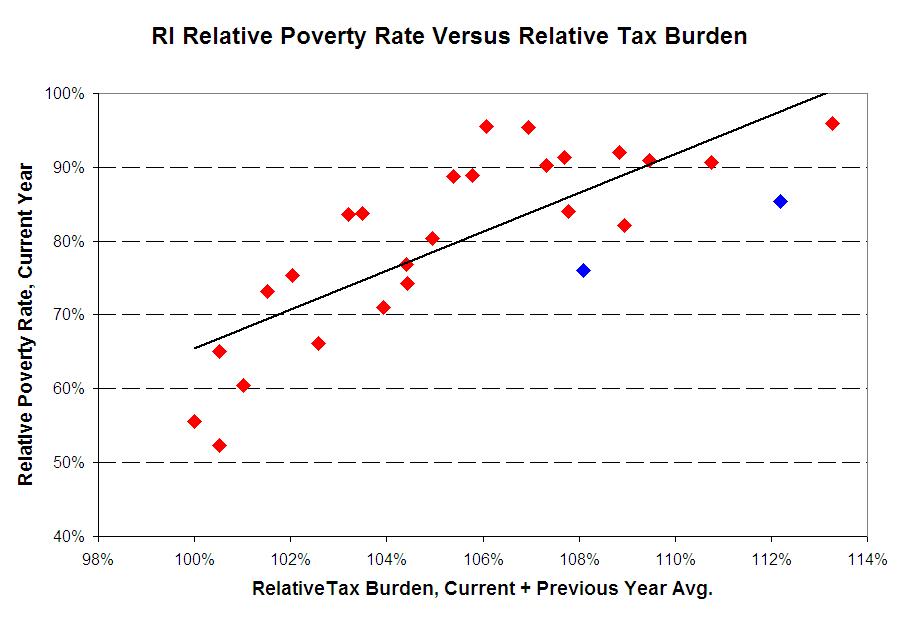
Continue reading "Poverty Rate Versus Continuous Tax Burden"
On the Road to Nowhere
The powers that be should pay some attention when Tom Sgouros and I agree on something:
Counting debt service paid from within the department's budget, we now pay almost $100 million every year in DOT interest payments. How does that make you feel about borrowing $40 million more next year? Do you think that's a sensible way to run the state? ...So how did we get to this pass? Simple: we allowed politicians to pretend they were managing our finances in a responsible fashion while they borrowed way past any reason to spend freely on expensive roads and bridges while pinching pennies on the public transit that could save us all money and time. I'm tired of these games, and intend to vote no on the transportation bond, this November. Please join me.
We differ, of course, on some particulars. It's difficult, for example, to lament spending "freely on expensive roads and bridges" when those roads and bridges give the physical impression of neglect. Similarly, Sgouros's angle is that Rhode Island borrows the money to procure federal funds, so as to keep the financial spicket open, whereas I'd point out that the state could accomplish that end without borrowing, the implication being that underlying reason transportation is put at the bottom of the list for financial allocations is because it's an easy sell for more money.
The state spends its money on other, less-fundamental things (such as employee benefits, various resident give-aways, and sops to those in power) and puts forward transportation bonds as a "good deal" because they bring federal dollars and devote money to infrastructure that all citizens know to be substandard. Sgouros would probably take umbrage at my use of the phrase "less-fundamental" when it comes to union contracts and the welfare state.
Be that as it may, the game should be up, and we should refuse all bonds, whether transportation or otherwise. If a project or investment is a good deal for the state, then the state ought to be treating it as part of its regular budget.
September 17, 2008
A Declining Poverty Rate Versus a Declining Tax Burden
With all indicators showing the Rhode Island economy tanking at the state level, as well as national and international-level factors like the banking crisis and energy prices squeezing Rhode Island families, it comes as something of a surprise to learn that the Federal Government says that the overall poverty situation in Rhode Island improved during the years 2006 and 2007.
According to the Annual Social and Economic Statistical Supplement put out by the U.S. Census Bureau and the Bureau of Labor Statistics, the poverty rate in Rhode Island in 2007 was 9.5%, its lowest absolute level since 1990. The figure of 9.5% was 76% of the national poverty rate, the lowest relative poverty rate seen in RI since 1994, and the period 2006-2007 was the first time that Rhode Island's relative poverty rate remained below 90% for two consecutive years since 1995-1996 -- probably not coincidentally, around the same time that RI's social services programs were redesigned in response to the Clinton administration's welfare reform initiative.
The new data lets us add two more points to the graph first presented by Anchor Rising last year of relative poverty rate versus Tax Foundation state tax-burden ranking. This graph also incorporates the changes that the Tax Foundation has made to its ranking methodology since last year (which seems to have reduced some of the year-to-year swings in the RI rankings). Here is the scatterplot of current year's relative poverty rate versus previous year's tax burden using the new numbers; the points in blue represent the two most recent years…
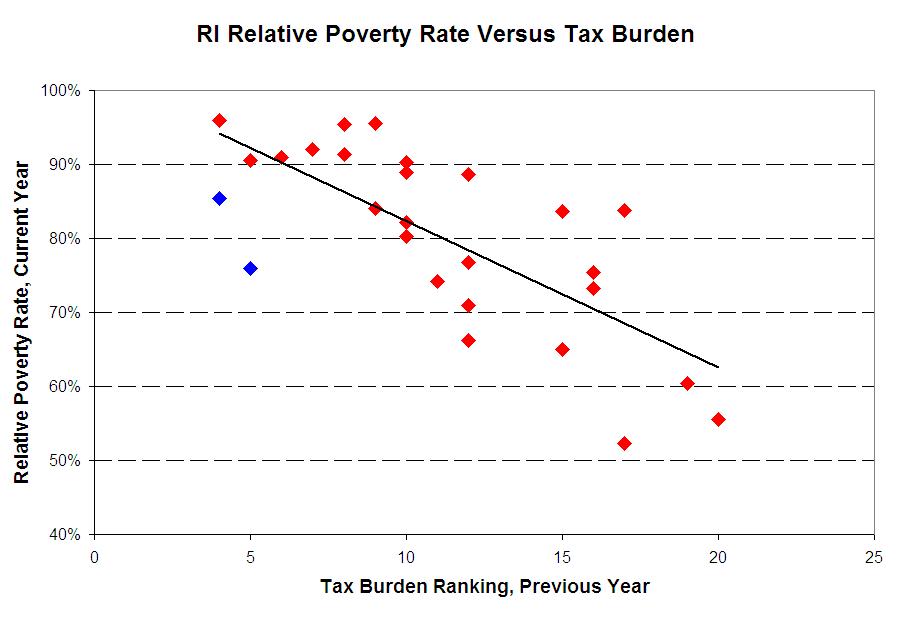
Fans of the Tax Foundation rankings may be interested to know that Rhode Island has fallen out of the top 5 in terms of the taxes paid by its residents. RI "dropped" to 9th place in 2007 and, according to the Tax Foundation's preliminary estimate, to 10th in 2008. It's too early to add a 2007 tax rank versus 2008 poverty rate point to the graph, as 2008 poverty data won't be released by the government until August 2009, but for a possible look ahead, the tax rank of current and previous years can be averaged together and compared to the current year's poverty rate -- for this data set at least, the averaging method produces a tighter fit to the data than by using the previous year's rank alone…
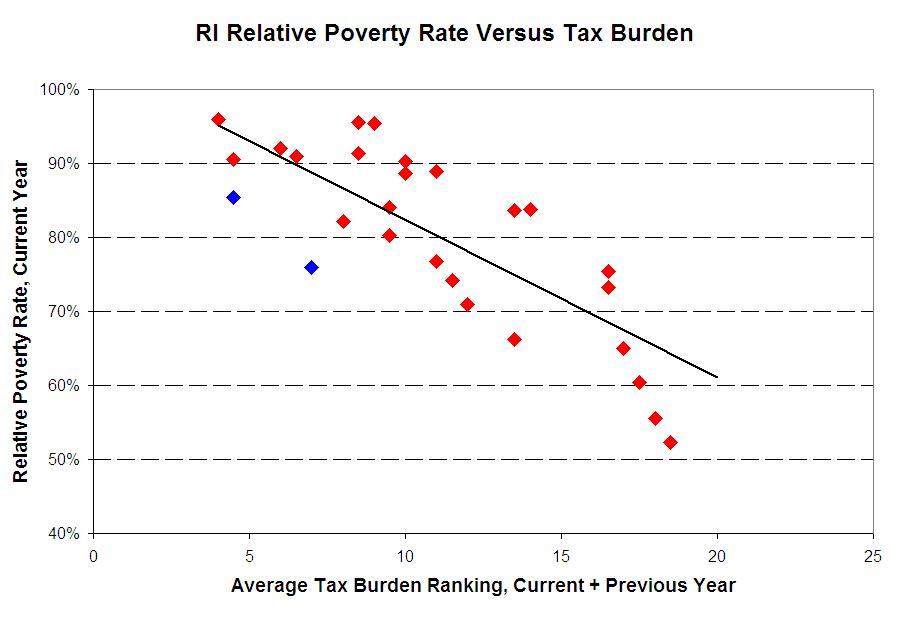
Obviously, there is more than one cause in play creating a result like this, but it is pretty clear from the most recent 25 years of Rhode Island history that creating of a high-tax state is not a great method for attacking the problem of poverty.
Continue reading "A Declining Poverty Rate Versus a Declining Tax Burden"
A Rich Lesson in Government Finances from Gregg
The article's a few days old, but one comment from writer Katherine Gregg yields too rich of a lesson for Governor Carcieri not to highlight:
How did we get to this point? Despite orders to cut spending, some state administrators simply couldn't bring themselves to do it. And state lawmakers seemed content to accept the Carcieri administration's promise of millions in unspecified cuts, rather than demand the kinds of emergency cutbacks in state-subsidized Medicaid programs, municipal aid, layoffs and government shutdown days that might have worked.
Yes, anybody who's followed the headlines for the past nine or so months can attest that every difficult decision made in the course of trimming our overgrown government brings indignation and media coverage painting the pruners as perpetrators, and here we are with a post facto instruction that such steps "might have worked." And no, going in the other direction — making the tough decisions in order to save the budget — probably won't produce post facto statements about doing what we had to do.
The lesson: hack away, because if one pays attention to the vested interests, the invested politicians, and the local media, becoming the fall guy for calamity is the likely result. The people of the state understand, though, and strong action will win them over.
September 9, 2008
Circling the Bowl
It may be that my estimate of the midyear budget review yielding a $150 million deficit was too optimistic. We're apparently starting with a baseline gap that's already one-fifth of that:
The state ended its last budget year awash in red ink, according to a newly-released Aug. 29 report by state Controller Marc A. Leonetti.Made public after The Journal made inquiries today, the report pegs the end-of-year deficit at $33.6 million. Of that amount, $8.2 million is attributed to lower-than-anticipated revenues. Most of the rest is attributed to over-budget spending.
Governor Carcieri's office overspent its own budget by $184,152; the Department of Human Services overspent its budget by a total of $46.2 million in state and federal funds. Of that, the state portion is $18.6 million.
If the governor's explanation of unachieved furlough days and a legislative decreases in its contingency fund hold water, I'd say it's time to stop playing footsie with legislators and unions alike. Sink or swim, he's going to end up taking the blame for the state's collapse; that's partly why the other side is so unyielding.
The executive must take whatever steps are necessary, and if the opposition squeals that they are too harsh, then the governor should point to the poor condition of the tools that he's been given.
Rhode Island's Lack of Business, As Usual
The Phoenix Business Journal, reporting on research done at the JPMorgan Chase Economic Outlook Center at Arizona State University, has Rhode Island holding down its familiar place on a pair of economic indicator lists.
Rhode Island leads the country in jobs lost for the year preceding July 2008…
Arizona ranked second to last for job growth, or more accurately job loss, in a tally of state activity from July 2007 to July 2008.…and Rhode Island's sales tax collections shrank more in 2007 than did any other state's…Arizona posted a 1.6 percent loss for the period, ahead of only Rhode Island with a 2.8 percent decline in jobs, according to the latest issue of the Western Blue Chip Economic Forecast. In all, 19 states posted job losses.
Wyoming came out on top with a 2.5 percent gain. Rounding out the top five were Texas, Louisiana, Colorado and South Dakota
Arizona ranked 14th among states for gains in sales tax collections last year with a 5.8 percent increase over 2006.The full job-growth report is available, behind a paid subscription wall, here.Idaho topped this list at 14.1 percent, while Rhode Island came in at No. 50 with a 3 percent contraction. The average gain was 3.9 percent, well below the 6.5 percent recorded in the previous year, according to the ranking published in the latest Western Blue Chip Economic Forecast based on U.S. Census Bureau data.
September 4, 2008
On Sticking to Business, Two: Anthony DiBella
Edward Mazze errs by inadvertently opening the door for the insidious consequence of socialist drift, Anthony DiBella takes his latest Business section "commentary" to the threshold of the socialist view of humanity. The humble Mr. DiBella volunteers for the task of bringing sun-shiny days to the lives of Rhode Islanders:
The governor's idea to assemble a tax policy group to find ways Rhode Island can be more competitive is an excellent one. Yet there is no guarantee that lowered taxes will lead to what should be our ultimate goal — greater happiness. If the governor is a true patriot encouraging the pursuit of happiness, then he should appoint a working group on how to make Rhode Islanders happier. I’d be happy to volunteer.
The proposal is especially telling if one has withstood the distracting history of the "gross national happiness, or GNH," and recalls DiBella's suggestion, a few paragraphs back, about what Rhode Islanders would do with tax dollars they were permitted to keep:
With regard to the impact of lowered taxes on J.Q. Publico, presumably that would give Rhode Islanders more money to spend on more important things, like lottery tickets and stuffies.
I don't know about my fellow face-stuffing gambling addicts, but I'd rather not invite Mr. DiBella to sort out my route to happiness. Somehow that particular pursuit seems more likely to feed his ego while depriving me of the opportunity for advancement and financial stability that I personally find to be the most fruitful field to sow for fulfillment.
On Sticking to Business, One: Edward Mazze
Sometimes the wisdom of allowing the Providence Journal Business section to indulge in "commentary" isn't at all apparent. Edward Mazze, for example, did just fine, yesterday, until he transitioned from business and economic statistics to education with the following paragraph:
Based on the number of elementary and secondary schools in a state with a little over 1 million population, Rhode Island should be well-positioned to prepare the worker of the future. Rhode Island currently has 304 public schools.
The "should be" isn't the case, however, as Mazze proceeds to illustrate, although his prescription misses the mark in its poor assessment of political realities in our state:
We need more accountability for dollars spent and on future investments. We are too small a state in population and geography to spend the amount of money for the management of education in over 30 school districts with numerous union contracts when a state our size should have no more than five school districts and a statewide union contract. The savings in dollars on administration and labor negotiations if placed back into the education of students should result in more progress in achieving targets.
Yes, you read that right: Mazze asserts that increased accountability can be achieved by pushing education even more into the General Assembly's purview. Where, in the legislative body that runs the state, does Mazze hear a strong opposing voice to unions? Where the inclination to spend and invest prudently? A statewide union contract would mean that the unions would no longer have to spread their resources out fighting small skirmishes around the state (small skirmishes for which groups such as Tiverton Citizens for Change can crop up when a lack of accountability appears as a line item on mortgage bills)?
A consolidated school system would fit in very nicely with Rhode Island's governmental practice of ensuring that no one group (much less individual) is every decisively accountable for failures of policy. Note Mazze's crucial "if":
The savings in dollars on administration and labor negotiations if placed back into the education of students should result in more progress in achieving targets.
Watchers of Rhode Island politics may suspect that "if" to be akin to the Black Spot in Treasure Island, although rather than being indicative of a pronouncement of guilt, it's a pronouncement of vulnerability. "Savings" from school consolidation would be quite an attractive supplement to the now-state-employed union members' contracts and a lucrative source of revenue for our spendthrift representatives.
Much as the Western Left has learned to use the language of diversity and compassion to promote its totalitarian policies, the Rhode Island corruptocrats are beginning to rehearse the language of business and economics. One needn't possess a degree in either to recognize that the actual benefits to the customer of consolidation are typically a secondary motive, at best. In a polity with such contempt for taxpayers, we would hardly register.
August 28, 2008
Don Roach: Waking Up to Bakst's Nightmare
In a recent column, M. Charles Bakst asks Rhode Islanders to "Wake up!" He opines:
Hello, Mr. Carcieri. Hello, Senate President Montalbano. Hello, House Speaker Murphy. Hello, rank-and-file lawmakers. Hello, prospective 2010 gubernatorial candidates Caprio, Chafee, Cicilline, Laffey, Lynch, RobertsCan’t someone come up with solutions and put them across?
Not that I disagree that our state is in disarray, but for his positive remarks Bakst focuses his attention on much of what has contributed to our state's downward spiral. For instance, he lauds Bishop Tobin for coming to the defense of low income, hard-working yet illegal immigrants, saying:
God bless Bishop Tobin and the other priests for speaking truth to power and denouncing the division, fear and disruption the raids have created. "As religious leaders concerned for our people, we would be negligent of our pastoral duties if we didn't speak out," they said.
Excuse me? Perhaps Bakst is unfamiliar with an economic theory that goes a little something like this: Businesses will pay the lowest wages that the marketplace will allow. Allow illegal immigrants to hold under-the-table jobs without recourse, and companies will pay them. This isn't good for the overall health of the economy and can barely be called "good" for those low-wage workers. Consequently, the government is trying to stop it and hopes to make a statement that illegal immigration is not going to be tolerated in our state. Does anyone want to argue that an illegal labor is good for the RI economy?
Bakst also praises judge Patricia Hurst for her criticism of the governor's (I told you Will) executive order, which would have increased the percentage government employees pay for their healthcare. At a time when local officials are asking us to pay higher property taxes and utility bills and not addressing the increasing cost of our grocery bills, I'd expect government workers also to feel a little bit of the pain that the average Rhode Islander is facing. I don't expect nor want a judge to lambaste the governor for making a no-nonsense decision that, while hurting many workers in the short run, is a longterm policy change that should have been made ages ago. In other words, RI can no longer afford to subsidize its employees' healthcare to such a degree.
In spirit, Bakst is right that Rhode Island needs to wake up, but as with many a teen victim in the Nightmare on Elm Street series, if you wake up to his world, you're really not awake to the realities facing the state. Instead, you're clinging to the hope that if you keep running down the same endless hallway, you'll somehow escape. Where I come from, that's called insanity, and it's exactly what our state does not need.
August 13, 2008
Latest Current Conditions Index for RI = 0
URI Economist Len Ladaro:
Rhode Island’s recession may be entering a troublesome third phase. For the first time ever, the CCI registered a value of 0. I prefer to think of this as a long-run equilibrium: at long last, we have gotten from Rhode Island’s economy precisely what we have always demanded from our state’s government: absolutely nothing! Fasten your seat belts, this is going to be a rough fall and winter.I also heard Prof. Ladaro this morning on WPRO with Jim Hummel (filling in for John DePetro). Ladaro made the point that there is still much to do on the part of the legislature to reduce spending and restructure government. To paraphrase, "they shouldn't be lauded for passing a balanced budget. That's what's expected."
August 12, 2008
Is Revenue Lost if it Can't be Gained in the First Place?
"PRE-Dendum": Be sure to read the comments for much clarification regarding how the credits are sold by the production companies, etc. Basically, the below analysis is flawed because I made some faulty assumptions and didn't completely understand the tax credit "market" in this case. (It's the same idea as the historical tax credits). What is clear is that the system of buying and selling tax credits is ripe for exploitation and many loopholes need to be closed. Perhaps the solution would be to lower the overall tax burden instead of coming up with "innovative" programs like this?
==================================
So let me get this straight: in order to attract movie studios to Rhode Island, the state offers tax credits. However, a cost benefit analysis done by the state's Department of Revenue indicates:
The state gets back 28 cents for every dollar it gives up to the production companies, according to a recently released state Department of Revenue analysis. That’s an investment return of negative 72 percent.Ouch. Not so good, right?
“The analysis proves that subsidies for motion picture production are a bad investment of state funds and suggests that the only movie credits that are meaningful are the ones rolling at the end of the film,” said Kate Brewster, executive director of the Poverty Institute at Rhode Island College. “In these extraordinary tough fiscal times, limited state resources should be invested in proven economic development strategies like work force training.”Hmmm. Wait a sec. Let's back up and hone in on the fundamental number:
...the state gets back 28 cents for every dollar it gives up to the production companies...Would those dollars that are "given up" also be dollars never gained if the production company hadn't set up shop in Rhode Island in the first place? Aren't there basically three possible scenarios, here?
Scenario 1 - "Dreamland":In other words, isn't the premise surrounding a loss of direct revenue completely flawed because it assumes the production companies would make movies here without a tax credit? How else to explain this sort of economic thought?
State of Rhode Island - Please make your movie in Rhode Island. We're a great place!
Production Company - OK!
Theoretical "Dreamland" Result - $1 million in the State's coffers!Scenario 2 - "Reality (w/out tax incentives)":
State of Rhode Island - Please make your movie in Rhode Island. We're a great place!
Production Company - OK, but what can you do for us?
State of Rhode Island - Um. Nothing.
Production Company - Forget it, we'll go somewhere else.
Real Result - $0 in the State's coffers.Scenario 3 - "Current Reality"
State of Rhode Island - Please make your movie in Rhode Island. We're a great place!
Production Company - OK, but what can you do for us?
State of Rhode Island - We have tax credits targeted for your industry, but act now before we hit the cap!
Current Result - $280,000 in the State's coffers (via direct taxes).
...limited state resources should be invested in proven economic development strategies like work force training...So what limited resources are being invested, exactly? How do you count a potential revenue source as an actual resource if the reason for said revenue being generated is never created in the first place? Put another way, does this mean we can theoretically tax a movie studio who doesn't set up shop in the state and put those proceeds towards "work force training"? Is this how it works....
Production Company: We'd like to make a movie in Rhode Island, do you offer tax incentives?
State: Nope.
Production Company: But we simply won't do business in Rhode Island if you don't offer any tax incentives. Other states do it.
State: Look, we can't. We used to, but under that old system we would have lost $.72 on every tax credit dollar.
Production Company: How's that work? If we don't come in, you get nothing at all.
State: No, you don't get it. We figure we'll make about $1 million off of you in direct tax revenue if you set up shop here without us offering a tax credit.
Production Company: No, YOU don't get it. Without incentive, we're not coming at all. Isn't $280,000 better than nothing?
State:Like we said, we used to do that, but then we'd be losing a potential $720,000 in resources. That's $720,000 that we could be investing in job training instead of you!
Production Company: Wha....?
State: (Pause) Tell you what, instead of making your movie here, just give us $1 million.
Production Company: Slaps head.
So, am I missing something? (Really, let me know). Anyway, there is one very important caveat:
The cost-benefit analysis focuses only on direct economic benefit to the state — namely increased tax receipts — while ignoring the indirect benefits and impact on the economies of cities and towns. The report is also based on general projections and doesn’t look at the details of the production costs of each project. (A separate “micro analysis” is expected later in the year.)
August 9, 2008
Matt Jerzyk on Patrick Conley and the Providence Port
Matt Jerzyk has an interesting post on Patrick Conley's attempt to develop (via rezoning) portions of Providence's working waterfront. Matt respond's to Conley's recent op-ed refuting those of the Journal Editors and Edward Achorn:
The future of the area has been under a cloud since Buddy Cianci's 1999 "Three Cities Plan" which prioritized mixed-use over industrial use. Due to a lack of clarity about future zoning, new water-dependent and industrial businesses have been reluctant to locate here. Despite this uncertainty, between 2004 and 2007 area businesses invested more than $30,000,000 in infrastructure improvements including pier upgrades and berth dredging....I don't know enough about the history of Providence City politics to speak about Cianci's plan or those of the current administration. What I do know is that Rhode Island has let too many of it's natural maritime advantages fall by the wayside.The new jobs that would come with Conley's luxury condo/hotel development would be low wage service jobs with little or no benefits. At the recent Charette, the city's own economic consultant found that the area could sustain at most 200 condo units, priced from $300,000 - $500,000 that would produce minimal jobs. But if the city were to maintain the existing industrial zoning and promote port expansion, the area could attract 300 - 400 new high-wage jobs. Providence needs more good paying, living wage, middle class jobs, not more condos with low-wage jobs.
Conley--who's also a historian--has a piece in today's ProJo in which gives an interesting account of some of the ships that once sailed or steamed around Narragansett Bay and how most have either been lost or moved elsewhere. (Including the former ferry Newport that now serves as a restaurant--Dimillo's--on the waterfront in downtown Portland, Maine. Good, if a little pricey, seafood by the way.)
What Conley wants is for RI to keep the USS Saratoga and a replica of the Sloop Providence in the Narragansett Bay for educational and, presumably, economic (tourism) reasons. As Conley says, "Clearly the Ocean State has squandered its maritime heritage." I agree with him.
But part of that heritage is also having an actual working waterfront where the maritime industry can thrive. Heritage is more than history or nostalgia, it's also carrying on the working traditions that have helped grow and sustain the state's economy throughout the years. The sea is Rhode Island's biggest natural resource. We should take advantage of it by developing and expanding ports (and the jobs they produce) in both Providence and Quonset. Zoning profitable maritime companies out of business is counterintuitive, counterproductive and unwise.
August 3, 2008
Who's Got Our Back with Taxes
An interesting response from rasputinkhlyst to my rejoinder to Crowley:
Folks in those states have higher wage and benefit base due to less attacks on workers from right wing nut jobs. Therefore their workers can afford to live there. Salaries for their state workers are higher and the benefits are better in these states. Having a livable wage means discretionary income and therefore the multiplier effect works for these state. RI with a very corporate mentality is a leader in the race to the bottom via Dumb Dumb Disaster Don and the GA enablers. These RI misfits keep thinking that RI is their personal candy store where only they deserve the sweetness. The outcome of this kind of simplistic thinking is obvious. RI was better off when workers were better off. It is a strong middle class that makes the economy work best. Less greed means more for all in the long run.
Most interesting about this is the revelation that the lefty perspective treats the public labor force as the basic determining factor of a state's health. That's a broad topic, though, branching from psychology to socialist theory, so I'll leave it to the reader to speculate.
For my purposes, it's enough to point out that, according to IRS data, Rhode Island relies more heavily on its middle class, and less on its wealthy citizens, than do Massachusetts and Connecticut:
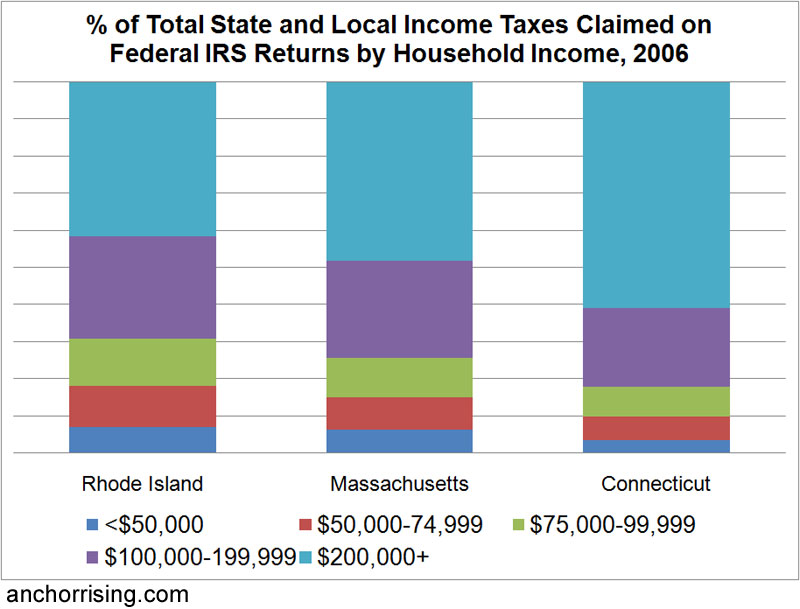
Now, progressives are free to decry this state of affairs in Rhode Island, but they can't have it both ways. They can't cite a healthy middle class as the reason that Massachusetts and Connecticut citizens paid more in income taxes per $1,000 of aggregate income even though both states have lower tax rates on "the rich" while lamenting that Rhode Island's middle class pays a larger percentage of the state's income tax revenue.
The plain summary is that Massachusetts and Connecticut both tax wealthier citizens less, yet wind up collecting a greater amount of the population's total income, largely from the upper brackets. What a mystery!
Lower Taxes and Higher per $1,000 Revenue... Go Figure
Although I'm loath to feed his attention addiction, via his recital of standard lefty rhetoric, Pat Crowley raises a point worth addressing:
... with the report basing its analysis on taxes as a percentage of personal income per $1000, it totally glosses over the point, which the quoted section above confirms, that our tax burden is regressive to the point of absurdity. See, by lumping in everyone, and then calculating the burden, the report assumes that we all pay the same rate on our taxes and that we all pay taxes on the same things. No, by relying more heavily on things like property tax, the distribution of the taxes is weighted more heavily on the bottom.
The report is from the RI Department of Revenue, and the following is that paragraph that he'd just cited:
Regarding state and local individual income tax burdens, Rhode Island ranked 24th nationally in FY 2006 with Rhode Islanders paying $26.10 per $1,000 of personal income. Both Connecticut and Massachusetts ranked higher than Rhode Island with each state ranking in the top 15 nationally in state and local individual income tax burden. For Connecticut, which ranked 11th nationally in FY 2006, taxpayers paid $33.42 per $1,000 of state personal income while for Massachusetts, which ranked 7th nationally, taxpayers paid $36.17 per $1,000 of state personal income.
It takes but a smidgen of intellectual curiosity to discern why Crowley's closer to an accurate statement when he complains of the report's "lumping in everyone, and then calculating the burden," and why the point for which that consideration argues is actually the opposite of what he intends. As Anchor Rising readers are aware, the progressives' argument is that the state has been giving away all of its revenue in the form of tax cuts for the rich, thus starving state labor and public services of funds. The bleedingly simple solution, of course, is to jack those taxes back up for the cruelly wealthy.
But here's the thing: With regard to income tax, Connecticut and Massachusetts may have collected more per $1,000 of their populations' aggregate income, but both states have lower taxes "on the rich." Any guesses as to how that apparent contradiction occurs, Mr. Crowley?
The answer, obviously, is that Massachusetts and Connecticut have greater percentages of their populations inhabiting higher tax brackets. In 2005 (the latest year for which I've gotten around to aggregating the relevant information for all three states), Rhode Island's average adjusted gross income was $50,790, compared with Massachusetts's $62,855 and Connecticut's $73,073. That year, 10.23% of Rhode Islanders' federal tax returns were on income greater than $100,000, while the percentages were 13.84% for Massachusetts and 15.54% for Connecticut.
The same considerations come into play with other forms of taxes — whereby our gauges might be deceptive. If Rhode Island were to cut its sales tax, for example, it might actually see its "sales tax burden" go up, yet the result would be more commerce, and more income, for Rhode Islanders.
August 2, 2008
A Talking Point in Need of Revision
Lefty Rhode Island wonk Tom Sgouros apparently hasn't had a chance to review the latest data available from the IRS, because he's still insisting — as if it's obvious — that recent upper-income tax cuts are the cause of our current financial woes:
Today, though, our fiscal crisis is the result of events very much under our control, the result of a tax cut overdose administered long before the economy tanked. The Governor and Assembly leaders knew this crisis was coming -- and have known for years -- because they caused it. The Assembly leadership is more responsible than the Governor for most of the tax cuts, but it's not as if he's objected to them.The union leadership is in a hard spot here. For years, they have played the inside game at the state house, cultivating and protecting personal relationships with Assembly leaders and members. But over the last many years, those relationships have won them very few victories. Last year they won a provision to make it harder for the Governor to privatize state services, but they've also lost big time in the pension "reform," the casino, health care options and more. Given the circumstances of 1991, it's easy to see why a compromise happened. Given the circumstances of today, it is going to be hard for union leaders to explain to their members why they should compromise with this Governor. This year, we're in year three of a five-year cut to the taxes of the wealthiest individuals in our state. Are they telling their members to take less pay in order to preserve those tax cuts?
To the contrary, as I pointed out last week, state taxes paid by those in the upper brackets are up dramatically from the time before the tax cuts were passed:
While preparing to cite that data again, I noticed an error in the following from my prior post, but it's one that actually enhances the point:
In summary, from tax year 2005 to tax year 2006, Rhode Island imported 6,976 "households" with income under $50,000, lost 32 with $50,000-74,999, and gained 1,757 with $75,000-99,999, 4,794 with $100,000-199,999, and 1,011 with $200,000+. Among those totals are 24,817 returns filed with the federal government from new hometowns outside of Rhode Island. It could be that the increase in the upper bounds came from middle-classers who'd sold their houses and moved out of state, but the fact that the average income of incomers was higher suggests that something different occurred.
The error is in my assessment that the state-level IRS data allocates returns according to their residences during the tax-year in question, when actually they are sorted by the address that the taxpayer lists on the form when paying his or her taxes the following year. What confused me was that the IRS migration data — which literally tracks individual taxpayers by their Social Security numbers — showed a net loss of taxpayers from tax year 2005 to tax year 2006 of 3,733. If emigrants aren't included in the above chart, how does one account for the fact that Rhode Islanders filed 14,506 more tax returns in 2006?
After some time away from the computer, it occurred to me that the 2006 tax year — filed in 2007 — brought a substantial giveaway from the federal government to taxpayers with children. No doubt, many residents whose income negates the need to file tax returns annually did so for the purpose of claiming that prize. That would explain why the amount of state taxes claimed on federal returns of lower-income filers flat-lined even as the number of such returns jumped up. It's also in keeping with the turnabout by which those moving to Rhode Island had a higher average income than those leaving.
If we may presume that those in the "the rich" brackets file income tax returns as a matter of course every year, then increases of them in 2006 would have to indicate advancement of households from the lower brackets or immigration from other regions. Since the numbers of taxpayers in lower categories also increased or stayed pretty stable it seems likely that some significant number of them left (to account for the net loss of taxpayers). To get to the point: the number of high-income taxpayers increased even more than the charts indicate on their face.
To decry the revenue "lost" to the tax cuts, I believe that Sgouros takes the taxes received and recalculates it as if the rate had been higher. Clearly, when migration is a factor, it is inappropriate to assume that the increasing numbers — and the increasing revenue — that we've been seeing would have materialized if Rhode Island's tax structure had been more punitive.
August 1, 2008
Quantifying the Benefits of Business Tax Breaks
We're about to find out if business tax breaks deliver on the promises:
The state each year doles out tens of millions of dollars in tax breaks to businesses to encourage them to expand and create jobs.Simply put, this is smart business.Who receives the breaks? How much do they receive? And do the businesses follow through when it comes to promised job creation and economic development?
Taxpayers will soon get to see for themselves.
Legislation approved by the General Assembly and signed into law by Governor Carcieri last month will, for the first time, require businesses to fess up — publicly.
***
The information will be posted on the state Division of Taxation’s Web site, and incorporated into the state’s annual budget-making process, said Gary S. Sasse, director of the state Department of Revenue.
State officials will use the information to determine, for example, how many jobs — if any — each such business created in connection with the incentive.
Thus, taxpayers will get to see, by name, which businesses receive which incentives, how much they receive, and the degree to which each business has met its goal for job retention and job creation and economic development, Sasse said.
July 27, 2008
Checking in on Jobs
Just wanted to note my observation that the Providence Journal Sunday help-wanted section is now up to two-and-a-half pages. Gone are the days when the job seeker would be dizzy after scanning column upon column of inapplicable jobs.
July 25, 2008
Telling Returns
Based on data that I posted back in February, I hypothesized in April that various financial and demographic trends in Rhode Island suggested that working and middle class families were selling their homes and leaving the state. Although the more demographically focused Census data won't be updated for another month, the IRS has moved its research forward a year with some interesting results that bear directly on public policy. The good news, according to IRS taxpayer migration data, is that Rhode Island only lost $162 million in adjusted gross income after tax year 2006:
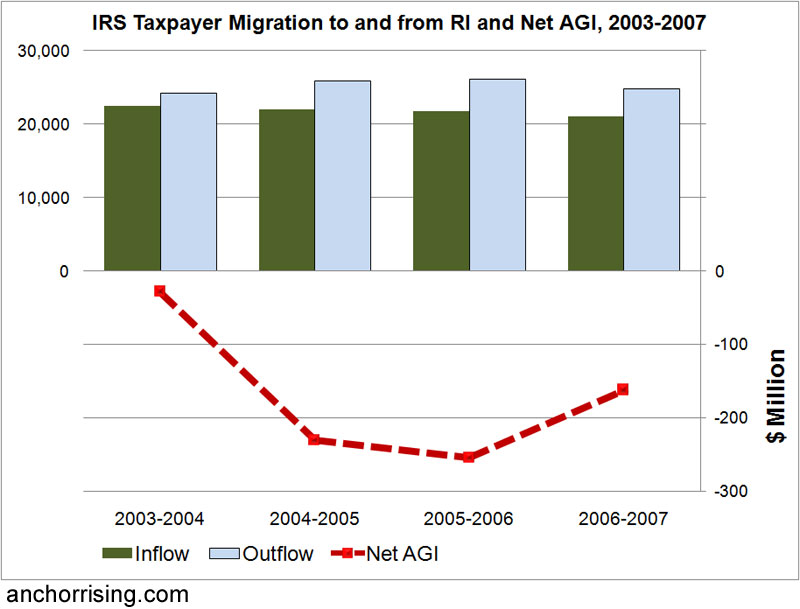
Of course, the net loss of taxpayers (counted per their tax returns) was still in the thousands, at 3,733. Within those numbers is a net loss of 561 taxpayers to counties in Massachusetts and Connecticut that abut Rhode Island, taking with them an aggregate $23.6 million in AGI. As I've pointed out before, such folks have switched government regimes while remaining near to friends, family, and work, which smells of taxpayer flight. That, however, is where something interesting emerges. Note that the lost AGI was significantly less on tax returns filed in 2007 than in 2006 and that the average income of immigrants to the state was slightly higher than that of emigrants for the first time in the range under inspection:
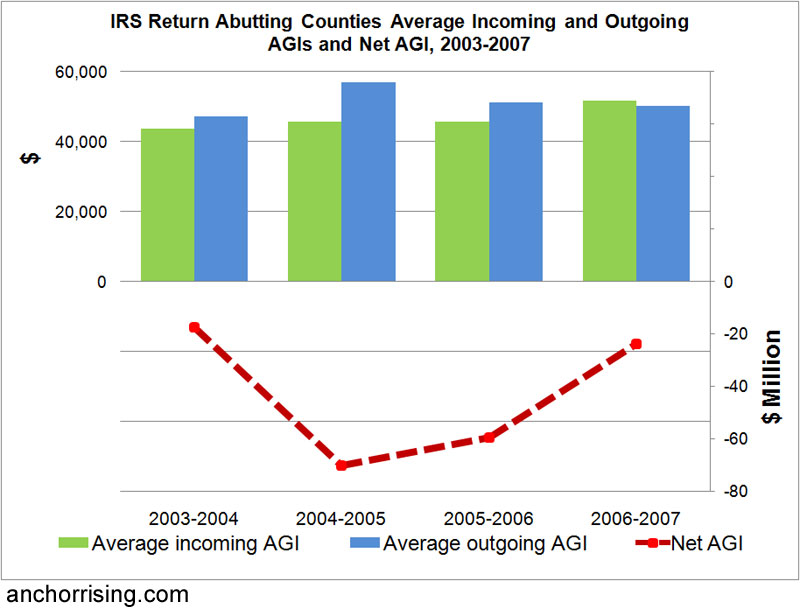
The same was true of immigrants and emigrants overall (to and from anywhere), who had average AGIs of $56,940 and $54,907, respectively, compared with $46,168 and $48,075 during the prior period. This result obtained despite the fact that the number of tax returns with income under $50,000 increased for the first time in years:
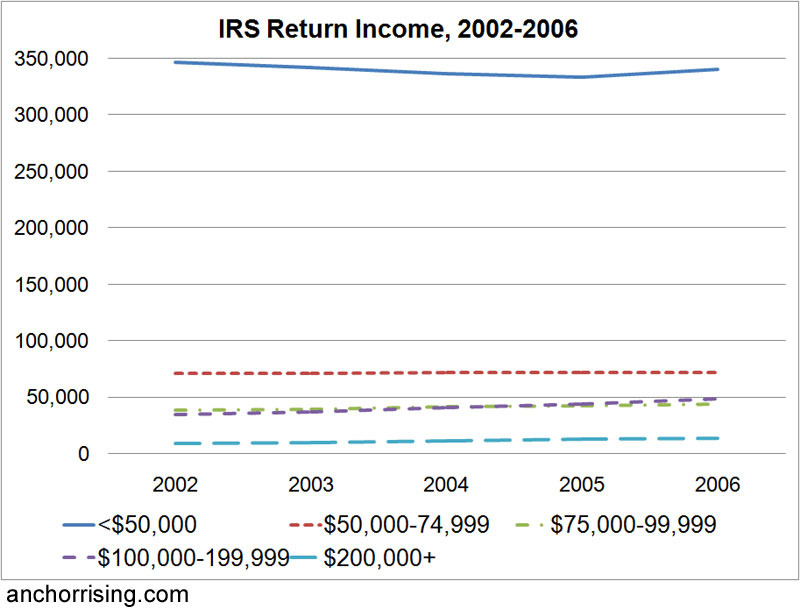
The reason comes into view if we zoom in on the over-$50,000 range:
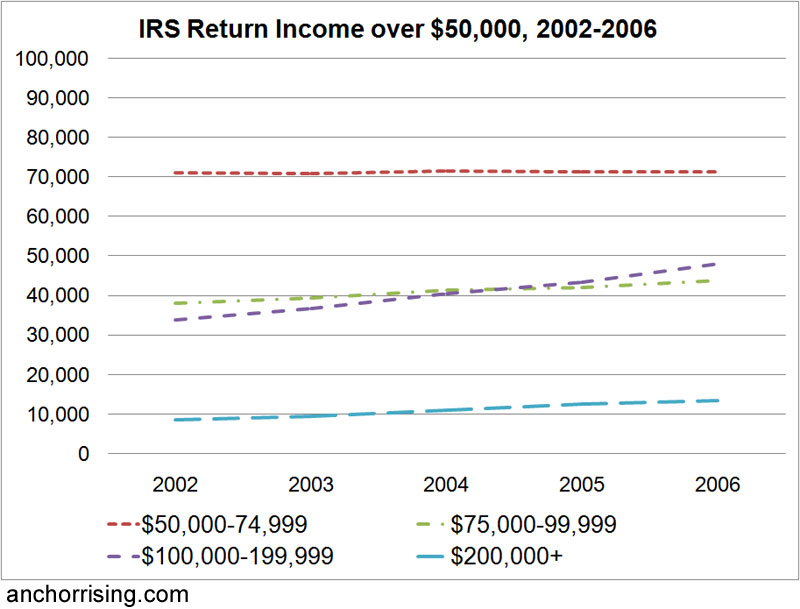
In summary, from tax year 2005 to tax year 2006, Rhode Island imported 6,976 "households" with income under $50,000, lost 32 with $50,000-74,999, and gained 1,757 with $75,000-99,999, 4,794 with $100,000-199,999, and 1,011 with $200,000+. Among those totals are 24,817 returns filed with the federal government from new hometowns outside of Rhode Island. It could be that the increase in the upper bounds came from middle-classers who'd sold their houses and moved out of state, but the fact that the average income of incomers was higher suggests that something different occurred.
One might surmise, that is, that those "tax cuts for the rich" that URI professor Donald Tufts recently decried in the business section of the Providence Journal are doing precisely what they were meant to do: draw families with disposable income to the state (and keep them from leaving). And lest those of opposing ideology whip out numbers making the cost appear too high for the benefit, herewith the state taxes claimed on the tax returns:
Despite decreasing taxes at the higher end, the total taxes paid are higher, and at least some of the effect is attributable to increased numbers of taxpayers. The only complaint that lefties can possibly have with such trends is that our increasingly progressive tax structure isn't moving quickly enough.
Although making the disclaimer that this data obviously lags the current date, I'd suggest that the next steps for Rhode Island are to:
- Expand the strategy that appears to have worked with upper income households to target those in the middle income ranges.
- Make spending money in Rhode Island — as commerce and business — sufficiently attractive that the benefit from the latent financial resource of our growing wealthy class is maximized.
July 19, 2008
Which Way to Economic Health?
Perhaps some wishful thinking is involved, but it has seemed as if the various help wanted sections have seen a slight up-tick in ads. Could be seasonal; could be my imagination. At any rate, viewed from a different direction, the economic news continues to be discouraging:
Rhode Island's recession continues to deepen, as payrolls shrink and the ranks of residents unable to find work grows.The state unemployment rate last month climbed to 7.5 percent, two percentage points above the national average, and payroll jobs fell for the sixth straight month, according to a report to be released today by the state Department of Labor and Training.
So far this year, Rhode Island has shed 8,600 payroll jobs and the ranks of unemployed residents have swelled to 42,600 — the largest in 15 years, the state reported.
Yet, just over the border, in Massachusetts, payroll jobs last month rose by 2,800 following a 1,900-job gain in May, according to a report yesterday by Massachusetts' Office of Labor and Workforce Development.
July 16, 2008
Next Stop: the '70s
The depressing thing is that the "bright spot" of this finding is that Professor Lardaro's index doesn't go back far enough to have captured pre-Reagan economic periods:
Economically speaking, Rhode Island is in the midst of the "worst year" in a quarter century, according to a local index released today.After a brief uptick in April, the Current Conditions Index in May plunged back to its lowest value in the index's 25-year history.
Eleven out of 12 indicators deteriorated, as the unemployment rate spiked to 7.2 percent and consumers hit by rising food and fuel prices cut back on spending, causing retail sales to plunge, according to the index's manager, University of Rhode Island professor of economics, Leonard Lardaro.
Perhaps more depressing is that some of us believe Rhode Island could quickly rise at least to a sea-level float if it were to discard some of its all-too-familiar baggage.
July 15, 2008
An Opportunity for Empathy
There's a lesson in empathy available in this:
And several thousand other state workers are caught in the middle of a war between leaders of the largest employees union, Council 94, American Federation of State, County and Municipal Employees that has put that union's executive director — and lead negotiator — Dennis Grilli on the defensive about his own raise and the $10,044 "waiver payment" he got for taking his wife's state-provided health insurance, instead of a union package.Stunned that after 30 years in the union trenches he has become one of the targets of the angry debate, Grilli this week said he would give up the 3 percent raise awarded him by his union's leadership board last spring that boosted his salary to $102,900 a year.
A five digit windfall for not taking a benefit. So whose turn is it to make the argument that employees who save their employers money by not taking benefits ought to reap some of the rewards?
Perhaps one can hope that reality is beginning to sink in, for Rhode Island's public-sector unions. The days of squandering the state's economic health may by necessity (and by necessity only) be coming to an end. It's interesting to note, by the by, that one apparent hold-out is an affiliate under Bob Walsh's shadow.
July 11, 2008
Rhode Island 48th Most Attractive State to Business (Again)
CNBC rated the business climate of the 50 states. Well, at least we didn't get worse....
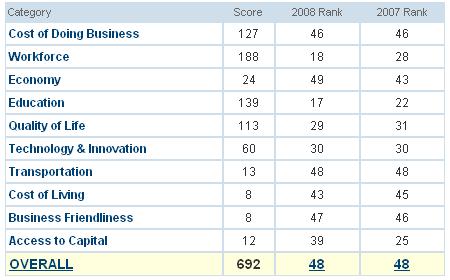
Interestingly, while RI was pretty static in most categories, there were gains in Workforce and Education (almost into the upper 1/3 in each). Here is CNBC's description of each category, respectively:
Many states point with great pride to the quality and availability of their workers, as well as government-sponsored programs to train them. We rated states based on the education level of their workforce, as well as the numbers of available workers. We also considered union membership. While organized labor contends that a union workforce is a quality workforce, that argument, more often than not, doesn’t resonate with business. We also looked at the relative success of each state’s worker training programs in placing their participants in jobs....It appears as if the aforementioned gains were offset in the overall rankings by a big dive in the ranking of Access to Capital, which CNBC explainsEducation and business go hand in hand. Not only do companies want to draw from an educated pool of workers, they want to offer their employees a great place to raise a family. Higher education institutions offer companies a source to recruit new talent, as well as a partner in research and development. We looked at traditional measures of K-12 education including test scores, class size and spending. We also considered the number of higher education institutions in each state.
Companies go where the money is, and venture capital—an increasingly important source of funding—flows to some states more than others.Plus we're still way at the bottom in most other categories. So it would appear that the business climate in this state is so poor that even our relatively attractive workforce can't lure businesses to open up shop. Instead, they stay away. And that young and educated workforce? They leave.
July 7, 2008
Now That's an Entitlementality
In the midst of a story about Rhode Island government's hard financial times, one finds the following nugget:
... local officials say they need more.They want state legislators to change the pension rules for municipal employees, requiring them to work longer before they can retire.
They are also pushing for the repeal of a state law that allows third-party arbitrators to impose sometimes costly police and fire contracts on municipalities after union talks break down.
Those proposals face opposition from the state's powerful labor lobby.
Tony Capezza, Rhode Island state director of the International Brotherhood of Police Officers, said the binding arbitration law is only fair, since police officers and firefighters do not have the right to strike.
"If you don't have binding arbitration, you would have to have the right to strike," he said. "Lincoln freed the slaves years ago."
Yeah. Working at will an environment in which employers have the final say in running their organizations and employees with jobs critical to public safety can't put those jobs on hold, en masse, as a negotiating tactic is just like being owned as chattel.
July 4, 2008
Myths and Conclusions
Without gainsaying my own potential culpability, I have to admit that a recent business-section column by URI business administration professor Edward Mazze left me confused. He asserts five myths of varying persuasiveness, but his explanations don't consistently jibe.
He and I agree on the first myth, which he states as follows:
First, without financial incentives or tax subsidies companies will not relocate to Rhode Island or stay in the state.
Rhode Island's ostensible leaders spend too much time trying to be micromanagers of the state's economic success, and Mazze is precisely correct in his explanation:
Taxes and incentives are important if they fit into a plan that targets specific geographic areas, population groups and industries for economic growth. ... We need to move from Rhode Island being the “let’s make a deal” state to the right climate for business to succeed state.
His second "myth," however, he treats as ambiguously mythical:
Second, we need to have infrastructure for economic development.
He argues that, in reality, "the infrastructure develops as a result of economic progress," but then he concludes that Rhode Island should "rethink our priorities and make sure that infrastructure investments receive top priority from the governor and legislature." It seems to me that, rather than attempting to adhere to a rigid structure of supposed myths, Mazze would have done better to argue for economic holism. In this case, infrastructure and progress represent a self-reinforcing cycle, whereby each makes more of the other possible.
In the case of his third "myth," Mazze slips such a large consideration bearing on unionization under the table that he comes close to contradicting himself:
Third, the unions make it impossible to do business in Rhode Island.
He argues that "unions are the greatest supporter of economic development since it leads to jobs," but in failing to emphasize the qualifier that unions support jobs for union members, he misses the underlying relevance of the burden of "legislation [that] is often introduced that adds new rules, regulations and fees for businesses": those rules, regulations, and fees build protective walls around the state's powerholders, including established unions. Mazze doesn't even draw the obvious connection of unionization with a necessity that he rightly declares:
The state needs to make tough decisions regarding the consolidation of services and departments and restructuring education, police, fire and other services on a county basis.
What do public education, police, fire, and other services all have in common in Rhode Island?
With myth number 4, we're back to agreement:
Fourth, projects that create large numbers of jobs such as the expansion of the airport, the location of a port and the building of a resort casino are not the types of jobs Rhode Islanders need.
I differ with respect to the advisability of Rhode Island's getting into the casino business, but the broader point that our leaders' (again, micromanaging) tendency to seek just the right economic development ultimately hinders progress. Young workers need education as well as the financial stability provided by working parents. If a carpenter cannot find work in Rhode Island, he can't lift his children toward more lucrative careers; if families cannot find regular ol' work in this state, they'll bring their children elsewhere. If adults cannot make their livings with less glamorous occupations, leaving sufficient time for independent pursuits, they cannot develop new skills (e.g., by attending night school).
Myth #5 is another with a point well taken, but perhaps without the mandate that it be cast in terms of popular error:
Fifth, economic development is a government responsibility.
I'd posit that economic development is a government responsibility, but it is one answered by getting out of the way. If it is not a government responsibility, then one cannot blame the government for its insidious and disruptive meddling. Our "leaders" responsibility requires them to cease behaving as if they've the wisdom and experience to guide our economy toward the sort of businesses that they'd prefer.
July 1, 2008
It's Time to Hold the Line, Down the Line
As some of Justin's "adventures in town government" have revealed, the town of Tiverton has decided they simply "have to" break the 5% cap on annual property-tax increases because they can't cut anything. They are not alone, according to Susan Baird at the Providence Business News:
Nine cities and towns so far have requested permission for property-tax increases exceeding this year’s state cap of 5.0 percent, according to data released today by Gary S. Sasse, director of the new R.I. Department of Revenue. But 28 are seeking tax increases “at or below” this year’s statutory cap of 5.0 percent, he said.PBN also has this handy chart:***
The largest planned increases were in rural West Greenwich (14.05 percent), North Smithfield (13.19 percent), Foster (12.48 percent) and Tiverton (12.20 percent). Also seeking tax-levy increases that would exceed the state cap were Glocester (8.59 percent), Exeter (8.33 percent), Richmond (8.06 percent), Bristol (5.40 percent) and Westerly (5.15 percent).
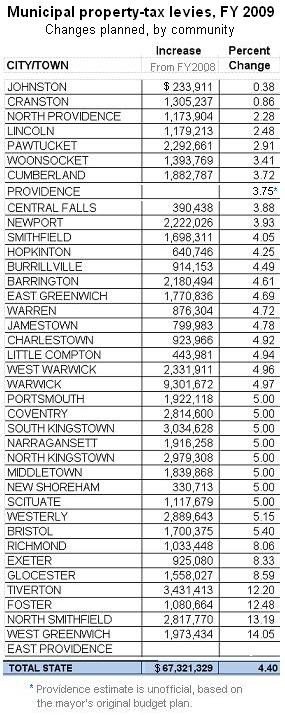
In addition to the 9 towns who "went over," there are 8 more who went right to the 5% cap and 11 more who upped their rates at least 4%. So that's 28 towns jacking up rates over 4%, which I suppose we we could consider to be (a bit generously) the cost-of-living increase. To try to be optimistic, I figured that more towns would spend to the 5% cap. Regardless, I'm sure the towns are feeling the pinch this year. And so are the taxpayers, yet again.
To be fair, some of the cuts made by the General Assembly are being manifested at the city and town level, so property tax increases aren't a surprise. That doesn't mean that local governments can't spend more wisely and make cuts in city "services." If taxpayers are upset by these increases, then it's up to them to send the right message to local town and city politicians at the ballot box in November. If they don't, they can expect more of the same. And they'll only have themselves to blame.
ADDENDUM: Good points made by "John" and "Tom W" in the comments. Basically, as John noticed, some of the communities that didn't go to the 5% cap are also those who are labeled as "distressed" and receive lots of state aid. And he asks the question, "Should they be commended or is the state giving extra where it isn't really needed?:
Tom explained how "state aid to education" is a vehicle of redistribution from rural and suburban communities to the "urban core."
The suburban people pay income taxes (while many if not most urban dwellers do not), and those taxes go into the general fund. From there the "education aid" money is disproportionately directed toward the urban systems.So those in the suburbs are then hit with disproportionate property taxes to make up the difference. In effect, they're paying for two school systems at once - their local one through property taxes, and urban ones through their "progressive" income taxes.
June 28, 2008
It Doesn't Have to Be This Way
Continuing grim news about the relative position of Rhode Island's economy:
Rhode Island last month posted the second-highest unemployment rate in the country, after Michigan, according to a report out today by the U.S. Bureau of Labor Statistics.Rhode Island's unemployment rate last month was 7.2 percent; Michigan's rate was 8.5 percent.
Rhode Island’s unemployment rate in May was at its highest since January 1994.
The New England unemployment rate rose 0.6 percentage point over the month to 5.1 percent, its highest rate since March 2004.
With Rhode Island and Michigan leading the recessionary pack, it's tough to blame free market policies or Republicans. Unfortunately, it appears that too many people 'round here are invested (financially or ideologically) in our wrongheaded system for our leaders to do more than try to weather the storm, probably for several years to come.
June 24, 2008
Educating the Workers
Interweaving Rhode Island's institutions of higher education with the business community is certainly a wise intention, although I think John Kostrzewa oversells the centrality of such a move to a recovery of the state's economy:
Sue Lehrman, founding dean of the Providence College School of Business, has been in Rhode Island for less than six months. But already, she understands the mismatch that has stalled the state's economy.Employers complain that they can't find the skilled workers they need to expand, and college graduates can't find work.
As a result, the state's development — especially of knowledge-based companies in the new technologies and life sciences, which pay big salaries — stumbles along while the old economy continues to shrink.
The job losses are piling up. Last week, the state reported 11,300 jobs have disappeared in the last year and the unemployment rate spiked to 7.2 percent, the highest since 1994. More than 41,000 residents are out of work and looking for jobs they can't find.
For one thing, Lehrman's suggestion (as Kostrzewa describes it) doesn't include any new mechanisms for getting current workers back to the classroom. More significantly, I'd suggest that Rhode Island's economy is just so out of whack that focusing on such a narrow lane can be a distraction. Better aerodynamics on a car that doesn't run don't do anybody much good.
If the academic cohort wishes to move Rhode Island forward, nothing would be more helpful than helping students to understand what's wrong with the way the state does business. Perhaps a required course on economics and the dangers of corruption?
June 22, 2008
Oh, How the Numbers Will Shrink
Maybe we should start a betting pool for the dollar amount of November's supplemental-budget shortfall. I've got a fiver on $364 million — a number plucked in the rough-ballpark fashion of The Price Is Right.
Already, though, I can hear the voices (even of those who generally agree with me): "Whoa! Isn't that a bit high?" Yeah, perhaps, but consider how easily $30 million disappears (emphases added):
The agreement came to light, amid dissension within the union ranks, on the day after the Democrat-controlled General Assembly approved a new state budget that relies heavily on Republican Governor Carcieri's pledge to cut personnel expenses over the next year by a mostly unspecified $90 million. ...But Carcieri issued a statement that said, in part: "I'm very pleased to announce that we have reached a tentative agreement with union leadership on new contracts for almost all state employee unions."
"While it won't achieve the full $60 million in savings we had hoped for, this tentative deal includes some unprecedented reforms for Rhode Island taxpayers," he said. Asked to elaborate on the potential savings and "reforms," Neal said: "We are not providing any more comment on this issue today."
Consider, also, the commentary of the fox on the henhouse's new security detail, with regard to the much ballyhooed "weakening" of the anti-privatization travesty that leapt into budget document late at night last year:
The Assembly yesterday voted to weaken the law, reflecting a compromise worked out between labor leaders and the governor's office as part of broader negotiations to cut personnel costs in the coming budget year.AFL-CIO secretary-treasurer George Nee, who helped craft the new bill (which was released publicly for the first time yesterday), said that it represents a concession from organized labor but that the revised privatization law "is still one of the strongest in the country."
"It lowers the barrier, but we still believe it's a difficult barrier," Nee said.
Just a look at the Providence Journal's pie chart of the amounts that "balanced" the budget deficit suggests that the size of the smoke cloud (amplified by mirrors) is of a nine-digit girth. $37 million in new revenues? I'll double down my fiver that revenue decreases, or at least comes in below pre-"new revenues" estimates.
June 20, 2008
Innovation and the entrepreneurial business culture revisited
A recent post, Lessons for Rhode Island from Silicon Valley: An historical reflection on an actual innovation economy, discussed what made Silicon Valley's entrepreneurial culture so unique and what some of its economic growth policy lessons are for Rhode Island.
In the latest edition of The Weekly Standard, Thomas Hazlett has written about the book, Overcoming Barriers to Entrepreneurship in the United States, in a review entitled Mastering the Game: The business of America is small business - and entrepreneurship.
Hazlett has these words to say about the entrepreneurial culture of Silicon Valley:
...The entrepreneurs who stir the pot in brash and productive new ways are a mysterious force, difficult to chart with PowerPoint bullets. There is no doubt that innovation and risk-taking--the contributions of these master chefs of the economic stew--drive progress. But they are elusive, and will not hold still for measurements.This sleek, nifty volume of essays seeks to pursue the beast--and if not to capture it, then, at least, to triangulate its position. Edited by labor economist Diana Furchtgott-Roth, it teaches us why venture capitalists cluster in places like Silicon Valley...
...the book is, caveat emptor, not a cheerleading manual: Neither Henry Ford nor Sam Walton nor Bill Gates is mentioned. The authors are social scientists at prominent institutions who probe substrata economic formations looking for clues as to what factors drive the self-employed to leave their wage jobs behind, and how public policies impact this migration.
For instance, the chapter on Silicon Valley's venture capital hub offers a fascinating window into the sociology of entrepreneurial nurturing. Venture capital investments in Silicon Valley appear to be made differently than elsewhere: They come earlier to start-ups, and lavish more capital on firms. Either due to this, or the other way around, start-ups there outperform those elsewhere, on average.
Why is this? The answer seems to lie in the commercial culture. Unlike investment bankers doling out high-risk, early-money investments on the East Coast, Northern California financial sources are run by technical experts possessing business experience--entrepreneurs funding entrepreneurs. These capitalists operate like bankers, but they know more. Which may account for the more frequent huge payoffs in Silicon Valley and a higher wipeout rate. No irony here: Risk is hardwired into the entrepreneurial economy, and ugly failures are inputs into spectacular successes.
Economist Junfu Zhang, the author of the VC chapter, concludes that the mission launched by many local or state governments--to replicate the Silicon Valley experience--is a fool's errand. The social networks that form are key; capital chases smart people connected to other smart people. Wealth is created when those dollars and networks combust. The best strategy is to eliminate the underbrush of tax and regulatory disincentives that inhibit productive economic activity generally. Or somewhat more ambitiously, create a Stanford University and let the graduate students figure out the rest.
After 17 years in Silicon Valley, I have worked as an interim executive in numerous cities east of the Mississippi River over the last decade. One of the most striking observations from these experiences is how many people tried to replicate Silicon Valley without understanding or paying attention to any of the fundamentals which made the Valley successful. The social network out West (or in the Cambridge/Boston area) did not spring up overnight and the operating companies and the services infrastructure which support them are now firmly rooted in an entrepreneurial culture where explicit and tacit knowledge flows freely.
On a broader policy level, Hazlett writes:
...In the essay on tax policy, written by Donald Bruce and Tami Gurley-Calvez, an interesting body of research is presented. It shows that the vast majority of business owners in the United States pay taxes as individuals, not corporations. This means that rate increases for high-income taxpayers reduce pay-offs for the start-up entrepreneur. And tax hikes on capital reduce the pool of risky funds that these new ventures seek to tap.Soaking the rich sinks this ship. Entrepreneurship is all about creating new wealth while tax redistribution is premised on the assumption that resources are static and the collateral damage from tax hikes is no more than the cost of ear plugs to block out the whining at the country club...
Therefore, given the tax filing nature of small businesses and entrepreneurs described above, the Left's negative description of the recent reduction in RI income tax rates for higher earning individuals as only tax cuts for the wealthy and their desire to roll back the reductions has a clear economic impact: Restoring higher taxes is likely to take away cash flow from many of the very small businesses which could otherwise invest the higher profits in expanding their operations and providing more jobs.
Rhode Island's economic engine will only begin to heal itself when the lessons articulated above and in the earlier post are heeded.
June 19, 2008
Budget Moves On
The RI Senate has passed the budget 36 to 2. Again, "the plan softens the blows to some programs hit hard under the governor's original budget proposal." How's that?
The Providence Journal report on last night's House offered this noteworthy commentary:
Indeed, lawmakers couldn't recall another budget vote that passed without a single "No" vote. The enormity of the challenge brought political alliances together like never before, according to Costantino."We are in very difficult times. We walk outside this building, we feel it, we see it, we touch it, we experience it," he said. "With this budget we have demonstrated the resolve to tackle the issues of these tough times."
One thing that statement ignores is the fact that there is distinct disagreement, across ideologies, about how one weathers "tough times," and the utter lack of contention in these votes implies a false victory for those who've been pounding the rightward, taxpayer-based solution to our fiscal crisis.
June 17, 2008
Children First
One hates to see children harmed, but we must face the consequences of our policies:
Among the 2,800 already removed from RIte Care, just under half are illegal immigrants. But the other half have the right to be here. And all of them are children.Some, in fact, are very sick children. Neighborhood Health Plan of Rhode Island, the HMO that cares for about 60 percent of RIte Care enrollees, including 50,000 children, has tallied the number of its patients who were affected by the RIte Care change. Among those dropped from RIte Care are 54 children with asthma, 50 with attention deficit disorder and eight with diabetes. One is in the midst of treatment for bone cancer and has already lost a leg. One needs a ventilator to breathe and is currently living at the state-run Tavares Center. Several have cerebral palsy, Down syndrome, depression or sickle cell anemia.
The plain reality, however, is that Rhode Island's current tax-and-spend regime is not sustainable. Many more people — and probably these very children — will be hurt in the long run if changes are not made. Perhaps spending cuts should be made more deeply elsewhere, and those who support various public-sector benefits and such line items as legislative grants can't hide behind a broad firewall of "necessary spending" to let sick children be the face of our government's excessive habits.
There are various points to be made about the article, but for now, suffice it to say that, under the current circumstances, this isn't exactly discouraging news:
Susanne Campbell, administrative director of the St. Joseph Center for Health and Human Services, said that her clinic, in Providence, recently received requests to send medical records to other states, suggesting that immigrants are leaving for Massachusetts and elsewhere.
June 14, 2008
Letting the Unions Win the Lottery
I have to admit that NEA head Bob Walsh's proposal to give the public sector pension system "equity" from the state lottery instead of this year's cash contribution confused me. Most prominently, I don't see how a government that habitually spends hundreds of millions of dollars over its revenue can be presumed to need a one-year fix, even if the economy were to right itself within the three to four years that Walsh predicts. Second most prominently, Bob doesn't explain why the pensioners would want an asset yielding cash returns this year at a fraction of the cash that they were expecting.
Anchor Rising readers have the advantage that one of Walsh's numbers should look familiar: The 8.25% that he puts forward as his "conservative expected return" is precisely the figure that inspired so much discussion 'round here. The key to his whole scheme, in other words, is to determine the percentage of the lottery that would be given to the pension system in lieu of this year's $243 million payment by calculating backwards from the "expected" return that the pension system requires in order to be solvent.
If the state were to put $243 million into the account, that money would have to generate a $20 million return (in a slow economy) for the pension scheme to work, so Walsh is requesting $20 million from next year's lottery revenue and calling that 8.25% of the pensions "equity." One could pick just about any number, suggesting, for example, that the projected $365 million in total lottery revenue really represents only a 3% of a total value (we're assuming) of $12 billion, making the pension's $243 million just 2% equity, with a projected return of $4 million, instead of $20 million.
But we could run this formula all evening. The salient question is, accepting Walsh's proposal, what happens next year. The state could resume cash payments, or it could give the pension system another chunk of lottery equity. Me, I'd wager that Walsh would, at that time, recalculate the value of the lottery such that his union members still receive their 8.25% return (plus, of course, the percentage already covered by this year's revenue). The one certainty is that the revenue coming into the state would diminish each year this method is used.
Another certainty is that those who control the pension system would be able to divest themselves of this lottery equity, should things turn around such that other investments would yield better returns. Again, I'd wager that the unions would turn to the state to buy back the equity at more than its value.
It's a clever ploy, buried beneath the confusion of Walsh's "sound financial principles," and treating it all as if it were found money. The money is not "hidden" in the system, though. It's our money, and it's under the control of our representatives, both of which make it as a shiny thing to Walsh's searching eye.
June 12, 2008
A Public Turnaround in RI
This week on our Wednesday stint on the Matt Allen Show, Don summarized his latest post addressing a turnaround in the Rhode Island economy, streamable by clicking here (or download).
June 11, 2008
Lessons for Rhode Island from Silicon Valley: An historical reflection on an actual innovation economy
With the economic crisis in Rhode Island, there is much talk (e.g., my recent post and Ian Donnis) about what it will take to generate real change and economic growth in the state.
Leonard Lardaro, professor of economics at URI, offers his thoughts in a ProJo editorial Only RI Cure: Cut spending and taxes, where he writes:
...There is a great deal of angst about our state’s economy by both citizens and lawmakers. In a recent exchange, a member of the legislature’s Joint Committee on Economic Development took the head of the Economic Development Corporation (EDC), Saul Kaplan, to task for his alleged contribution to our state’s current economic dilemma. According to a May 2 story on the exchange (“EDC is grilled on bad R.I. economy”), EDC was: “chastised . . . for allowing the state to slip into . . . the Northeast’s only recession.” Wow! I never imagined Mr. Kaplan was powerful enough to single-handedly draw us over the edge into recession!Pardon my sarcasm, but I remain stunned by what this quote reveals: how grossly out of touch with economic reality some of our state’s legislators are. What a vivid illustration of the paropic (parochial and myopic) mindset held by so many of our state’s leaders!...what was sorely missing from this exchange is cause and effect.
To understand the state’s problems, it is necessary to go back to the end of 1987, when Rhode Island first became a post-manufacturing economy. The rules of the economic game today are very different from those in the “good old days” of manufacturing. Because job loss today often entails the permanent elimination of jobs, job creation has become job initiation, not job resumption (factories rehiring after usually temporary layoffs). And since the initiation of new jobs is more risky and costlier than job resumption, production and employment costs are more critical to the success of states in creating jobs.
Taken by itself, this presents one glaring problem for Rhode Island in the post-manufacturing era: Our tax and cost structure (which includes fees, regulations and potential problems with the skills of our labor force) is nowhere near as competitive as it must be for us to be successful in this post-manufacturing environment...
But, getting back to the exchange with the EDC, given Rhode Island’s current non-competitive tax and cost structure, what “cards” does EDC have to play in attempting to expand businesses and employment here?...
This brings me to the second problem for Rhode Island: What is our state’s dominant niche? Recently, we decided to move toward biotechnology, pharmaceuticals, life sciences and oceanography. Is our tax and cost structure consistent with success in this niche? I doubt it. How far will our existing economic climate be able to carry us? Will we be able to generate the levels of employment, income and tax revenue that will allow us to attain our desired economic goals?
It is on this count that the glaring deficiency of our non-competitive tax and cost structure exacts its toll. All too often, EDC is forced to make deals with individual companies or industries to generate these types of economic gains. How large have these gains been? Generally, not large enough, as employment here has continued to fall since January of 2007.
In terms of fairness, these deals add insult to injury for existing firms here, which wonder why they can’t receive better treatment all the time. Efforts to expand existing businesses and to get new firms to locate here absent specific incentives have not been sufficient for us to be as successful as we should have been in this post-manufacturing era...
Because the legislative and executive branches, along with the EDC, have jointly failed to produce a competitive tax and cost structure, economic growth here has suffered...
The deficits we now face are largely self-imposed, resulting from unsustainable spending practices over the last 20 years, the failure of our paropic leaders to redefine our state in terms of a niche with a compatible tax and cost structure until very recently, and a separation of economic leadership that, as the exchange between the EDC and legislature shows, is all too often "us" versus "you."
Deficits are not pleasant, especially when largely self-imposed. But they will serve our state’s long-term interest by forcing the type of fiscal discipline that has been so sorely lacking, and, hopefully, an end to factionalized economic policymaking.
Tax and spending policies by RI government do matter in a big way and fixing those problems in the short-term is an essential part of an overall solution. But unwinding the taxation and spending disincentives in RI only opens the door to a positive future. There are more changes which have to happen as part of a total solution.
One way to look to the future is to learn lessons from the past. And no place has been an economic growth engine like the innovation economy of Silicon Valley over the decades, a place I lived and worked in for 17 years.
What were the critical success factors which powered entrepreneurial innovation there? It is a conversation I have been having with friends and colleagues for years. And in the last few weeks, I went back to venture capital, investment banking and university technology licensing friends from Silicon Valley to continue the conversation.
Here is what we pulled together as some of the critical success factors:
- Stanford Engineering School Dean Fred Terman: Terman hired faculty with industrial experience and encouraged academic/ industry relationships. This dated as far back as the 1930's so there was a cultural legacy of interactions between the two communities. More on Terman here and here.
- Stanford University Office of Technology Licensing: With its outstanding engineering/science/medicine programs, Stanford was both a center of technology development and had more liberal technology licensing practices which encouraged commercialization of innovation. The university also allowed faculty to spend time doing outside work. This provided a pipeline for new technologies which, over time, was supplemented by technology within companies.
- Management Development: Businesses can't grow without a pool of talented and trained management. The early growth at both Hewlett Packard and Fairchild/Intel, including both their legacies of excellent management practices and at least HP's original practice of regularly spinning off new divisions, provided a number of decades of management training and development. Their efforts, like Genentech later in the life sciences area, provided much of the original management team infrastructure as newer ventures were launched.
- California's Entrepreneurial Culture & Services Infrastructure: While the nice weather didn't hurt either, California's historical culture was inherently entrepreneurial and, over the decades, an entrepreneurial culture took root and led to an ongoing practice of starting new companies and providing infrastructure services to those companies.
- Capital Gains Tax Rate Reduction Powers Early Stage Financings: The capital gains tax cut in 1978 really launched the growth in the venture capital world and provided the financial capital infrastructure to fuel early growth.
- Local Investment Banks Provide Later Stage Capital: Local investment banks, such as Hambrecht & Quist, Robertson Stephens, and Montgomery Securities, themselves entrepreneurial organizations, were formed to provide later stage capital. In addition, led by Frank Quattrone, some leading New York City-based investment banks set up operations in Silicon Valley, creating an even more competitive environment for later stage capital.
Here are some comments from my friends:
- You're spot on with the influence of Fred Terman. His should be a household name for all the contributions he made and culture tone he established. I think he's the real hero of the story and more should be written about him.
- By way of contrast, it's noteworthy that RTP in NC has been promoting itself as a tech center since the 1950's, only gained traction from the 1980's on, and built itself primarily through the Chamber of Commerce route of attracting large multi-national companies, with start-ups being an after-thought until they started to evolve and grabbed some of the spotlight.
- At a time when universities are paranoid about blurring the distinction between academia and industry it's instructive to recall that the Varian brothers's company made and shipped Klystron tubes from a Stanford lab during WWII, and that technology transported back and forth between Stanford labs and HP in the early days. We should collectively learn that current conflict-of-interest phobias preclude arrangements such as these, which ultimately were of tremendous benefit to both the local and national economy.
- Current practice of most tech transfer offices impedes entrepreneurism, and the most productive approach is found in those offices that minimize these barriers. For those who think there's some abdication of the public trust in this view, I query why it is better from a public policy perspective for [a big pharma company] to profit from a new drug than a local start-up, so long as the drug comes into public use...and I would postulate that the amount of financial return that Stanford would have obtained from the most perfectly optimized licenses from all that early technology traipsing out to HP is dwarfed by the magnanimous giving of the Hewlett and Packard families--giving born out of the goodwill generated by Stanford being helpful to them in their early days.
- The Stanford Licensing Office was formalized in 1970, and Niels Reimers ran it with an approach different from any other university licensing office. Rather than staffing it with JDs, PhDs and/or bureaucrats who focused on filing patents, Niels focused on marketing, and filing patents only when a licensee was identified (see article). Most importantly, Niels made his priorities clear: our job was to ensure Stanford technology was efficiently put into public use and benefit; that the best technology transfer is the graduating student; that our job was to create opportunities for research staff and students; that exclusive licenses were not only acceptable but desirable to provide companies incentive to commercialize; and that--whenever possible with the above, we should try to obtain a financial return to Stanford (as opposed to many offices, where they act to maximize every dollar they can up-front, which is to their long-term detriment). Niels kept a long-term view on creating opportunities, with faith that our activities in promoting industry - university connections was justification in itself, and that the financial returns would take care of themselves. As the office grew, Niels maintained an entrepreneurial and marketing-oriented approach. Every licensing person had a high level of freedom to negotiate a license, with review only at the end of the process (we knew what terms were important to safeguard, and were given freedom to negotiate other--mostly financial--terms to the best of our judgment). This enabled us to work expeditiously. It also kept us focused on industry, with a respect for their needs. Stanford's overall attitude enabled researchers to devote time to outside activities and consulting--as you point out. Although the amount of time for outside consulting was the same as other institutions (such as UC), the key difference was that Stanford encouraged researchers to interact with industry. At many institutions, the culture has in the past been (and often still is!) adversarial to this. Seems like every researcher I knew at Stanford kept a business plan in the top left drawer of their desk--they'd pull it out after every meeting and would ask if I knew any VCs...The cultural issue is huge, and has been tough for other institutions to duplicate. The strongest lever for change is the Faculty Club Effect, where researchers sit at lunch and stare enviously at the guy who just made $10 million from selling his company, and gripe to themselves that they're at least as smart as him...Every institution seeking to replicate Stanford's culture has to have at least one success story, place that guy in the Faculty Club, AND change top administration's attitude so they're more enlightened (and not sending out the conflict of interest police to find alleged corruption underneath every desk).
- ...the risk taking/supportive culture [was] a shocker coming here from the East Coast. There were all sorts of services - VC, banking, legal, real estate, equipment leasing, etc. that would believe and take chances on these companies and enable them to take risk. If they succeeded, they would be celebrated. If they failed - most importantly - that was not viewed as a disgrace but instead a learning experience that made them more valuable to the next venture. A few more modern day success stories that sprang from Stanford - SUN, Silicon Graphics, MIPS (of which the current Stanford President was a founder), Cisco, Yahoo, and Google all started as projects within Stanford.
There are some clear lessons for Rhode Island in this review:
- Consistent, long-term incentives drive lasting economic behaviors: People and institutions respond rationally to explicit and implicit economic incentives. Consistent, long-term incentives matter the most and drive structural changes in behaviors. Offering taxation incentives and then taking them away, as has been proposed recently during the budget crisis by some on the Left, sends a clear signal to the marketplace that RI is not serious about creating the necessary long-term incentives which will lead to favorable investment decisions in RI.
- Competitive alternatives exist and will be favored until RI's taxation and regulatory policies are competitive: The greater Boston/Cambridge area, with the influences of many existing companies, MIT, Harvard, Massachusetts General Hospital, etc., is a place where experienced management and services infrastructures already exist without the uncompetitive taxation burden and budget problems of RI. One-off solutions like selling portions of the Lottery do not solve the fundamental competitive disadvantage problem and are, therefore, not viable solutions which will make RI a place to favor for new business development, especially given the nearby alternatives.
- No economic czars are needed: If broad economic incentives are consistent, favorable and there for the long-term, individuals and organizations will have all of the proper incentives to act rationally and bring business into the state. There is no need for an economic czar or targeted tax incentives here. As the Frenchman Bastiat wrote in the 1800's: Paris gets fed...without any central planning and it occurs because knowledge is shared and the right incentives exist for people to act, people who don't even know each other. A future post will explore further how the role of knowledge, tacit and otherwise, drives economic decision-making and why centralized economic planning will always fail.
- Quality of state services and public education matter: A crumbling infrastructure and lousy public schools create a disincentive for people to bring their families into RI. Why pay higher taxes for worse services? Why pick mediocre RI public schools when MA schools just across the border offer a better education to kids?
- A sense of urgency is critically important: One of the central lessons from Silicon Valley is that its economic growth engine did not come about overnight. Building the management development engine and the services infrastructure took time. Yet there is no sense of urgency among state leaders in RI to either grasp the lessons from Silicon Valley or implement policies which create the required consistent, long-term incentives that will lead to such infrastructure solutions.
We will see the budget proposals shortly from state officials. Will they show any real leadership and offer serious proposals for change? Will they change the long-term economic incentives which will contribute to economic growth? Or will they dither and make it even more likely that the only solution for RI will be to let it blow up and then pick up the pieces? Bluntly, there is little reason to be optimistic. I hope I am wrong.
June 2, 2008
Lack of Freedom a Threat to Health
Periodically, somebody on the Left will throw in some anti-corporate rhetoric and sneer about the "free market." Mark Patinkin's column on the state's difficulty attracting doctors provides yet another example illustrating that one can hardly point to our problems in condemnation of economic freedom:
I began by asking where he’d rank us nationally in fees paid for medical procedures."In many if not most areas," he said, "it's 49th or 50th in the country."
The reasons are complicated, he said — one factor being restrictive laws.
What kind of laws?
He mentioned several typical procedures for which Medicare will pay a doctor around $300, almost below cost, he said. In some states, top doctors can charge an extra few hundred for patients happy to pay for their expertise. Here, as in Massachusetts, the law forbids that.
"In other businesses," he said, "when you get seniority and experience, you raise your prices. I make the exact same fees as the doctor fresh out of residency. The only way I make more money than that doctor is by seeing more patients. I'm not allowed to charge more for procedures."
Here's a stunning bottom line for doctors:
He gave the real example of a 30-something cancer doctor who recently finished his training. His offer in Rhode Island was $125,000 with three weeks vacation and being on call every third night — being available for patient calls or going to the hospital. On the West Coast, The Doctor said, this same candidate was offered $250,000, eight weeks vacation and "call" every 10th night.
Rhode Island's much touted (but selectively described) "quality of life" is surely threatened if our battle against the free market drives away high-end professionals.
June 1, 2008
A Few Sunday Quick Hits
A handful of items that are blogworthy, but not extensive, have been building up on my desk, so herewith, some quick hit thoughts:
- An objection was made, last week, to my mention of the exceedingly sparse Projo Jobs section that it was a holiday weekend and thus hardly representative. Well today's Jobs section may (or may not) have a greater number of smaller ads than larger ones, but it's still pitifully small. I repeat: cut taxes... now... drastically.
- Somebody in a position to hear things has told me to keep my eye on Tiverton-related news in the next few days because something affecting me, as a resident, is soon to be announced. The comment was so vague that I'm not even sure whether it was a warning or a promise. My blind guess (in keeping with a surmise already expressed) is that the school committee is going to file a Caruolo Act lawsuit to recoup the $100,000 that constituted its share of the so-called "compromise" budget.
- The bad news: Rhode Island is one of only 11 states currently in economic recession, and the only one in New England, and (according to a Lynn Arditi article from Friday that I can't find online) will likely stay there "through the third-quarter of next year" — that's fall 2009 (at least).
- As more of a reminder than anything: we're winning the war against terrorism.
May 27, 2008
Skipping Past the "Helicopter in Every Garage" Phase
Jay Fitzgerald of the Boston Herald reports on a long-shot but interesting economic development project for Rhode Island…
Woburn’s Terrafugia Inc. hopes its futuristic car-plane business takes off in Massachusetts.The name of Terrafugia's intended first car-plane is the "Transition". According to Terrafugia's FAQ, car-plane means exactly what it sounds like, i.e. something that might exist in a Sean Connery era James Bond movie…The maker of the hybrid car-plane contraption - which theoretically will both drive on roads and soar through the sky - plans to meet with officials from Gov. Deval Patrick’s Massachusetts Office of Business Development next month to try to work out an economic-incentives package to keep the company in the state.
But Massachusetts may face stiff competition in its attempt to retain Terrafugia’s future production operations.
A number of states - eager to attract a cutting-edge manufacturer requiring potentially hundreds of highly skilled assembly and mechanical workers - are actively wooing the young aviation company, founded by an MIT grad and his colleagues."I’d rather stay right here in Massachusetts," said Carl Dietrich, co-founder and chief executive of Terrafugia, which hopes to start production of its two-seat car-planes sometime in 2009.
But "economics are economics," said Dietrich, who adds he’s listening closely to economic-incentives pitches being made by such states as Rhode Island and Maine.The two states, both long known for their boat-making sectors, see aviation as a logical way to attract and keep highly trained mechanics jobs, he said.
Q: Will the Transition fit in my garage?OK, well, maybe it's not exactly like a James Bond car-plane…A: The Transition was designed to fit into a standard household garage. At 6.75 ft (2.1 m) high, 6.5 ft (2.0 m) wide, and 18.75’ (5.7 m) long, the Transition will fit anywhere that you could park a larger SUV such as a Cadillac Escalade or Lincoln Navigator, and will fit inside a 7’ garage and a standard parking space.
Q: How fast will the Transition drive on the ground?
A: The Transition will be fully highway capable and able to easily reach the speed limit. A 100hp engine in a vehicle as light as the Transition will provide ample power on the ground.
Q: How fast will the Transition fly?
A: At 75% power, the anticipated cruising speed of the Transition is 100 kts (115 mph, 185 km/hr).
Q: Can I take off from the highway?I'm curious; does the possibility of luring this company to Rhode Island make any of the if- it's-not-being-taxed-right-now-then-it-needs-to-be crowd mellow their position on whether Rhode Island should help balance the state budget by ending its sales-tax exemption on aircraft?A: No. In addition to power lines, billboards, overpasses, and other obstructions that make this idea unsafe, the Transition will have to be parked with the engine off in order to deploy the wings and engage the propeller. It is also illegal in most states (emergency landings excluded).
May 26, 2008
Palatable Decline
It's a small thing, to be sure, but a comment that Ian Donnis made to his own recent post on economic development in Rhode Island points to an increasingly sore spot:
... hopefully the effort to promote "green jobs," which I've written about previously in the Phoenix, will also yield dividends.
It is not my intention to single out Ian — who is among the more reasonable of his ideological species — but here's a radical thought: How about we just try to create jobs, in general? Isn't the horrible state of our state such that we'd be well advised to avoid burdening its economic health with adjectives?
With the fad of "green jobs," echoed in Ian's reference to the Greenhouse Compact from the '80s, it seems that those on the left are less concerned with job creation than making the ideological most of an opportunity to promise any economic development at all — in this case, to leverage the thirst for work in order to promote the Kool Aid of environmentalism. The reason, it seems clear to me, even if it isn't of conscious origin for Leftists, is that they are opposed to taking those steps that would promote a generally business-friendly environment, so they cast their hopes on "inventing" or (more often) "reinventing" the market to suit their preferences.
They do not want to tell the unionists that the state can no longer afford to pay more for their work than it's worth, in market terms, neither do they wish to admit to civic dependents that, well, sorry, but the state of Rhode Island really isn't in the best position to sustain them, just now. So, to make the necessary investments — and allow the necessary reality of "high-paying jobs" — palatable, they insert that immunizing adjective: "green." They allow themselves to believe that, with just the right mix of incentives, a government-driven industry will materialize that provides high-paying union jobs, while filling the government's coffers with redistributable revenue, all with the ecological boon of saving Mother Nature from the ravages of mankind's selfishness.
I hate to go all capitalist populist on y'all, but it seems to me that anybody who's currently struggling to stay working in a state and at a time of shrinking employment probably doesn't care much for any green but the hue of cash. High paying, low paying, most of them probably agree with me that the time to embark upon "a strategic repositioning of the local economy," in Ian's words, is when things are going well. Not when people are watching as the local economy drains their lives of everything that they've worked so hard to build.
May 25, 2008
A Dark Cloud on a Sunny Day
So didja see the Providence Journal jobs section, today? Perhaps it might be more accurate to say, "the near-lack of a jobs section."
I have two words for the state of Rhode Island: cut taxes... now... drastically. (Well, hey, if the Projo can double the size of its job section by plugging in two full-page ads for employment advertising, then I can inflate my advice by a couple of words.)
May 15, 2008
Anchor on the Air
As those who listened already know, Don switched with Andrew for this Wednesday's segment on the Matt Allen show. His commentary related to his post on Rhode Island's failure to address its current crisis can be streamed by clicking here (or download).
Next Wednesday at 6:50 p.m., Andrew will have his moment in the spotlight.
What, Me Worry?
Anybody who doesn't see what the big deal is when Don laments our state's lack of a sense of urgency need only read through yesterday's business pages. The values of assets are plummeting:
The median price of a multifamily house in Rhode Island during the first quarter declined about 39 percent, to $161,000, compared with $263,000 a year earlier. More than half the 261 multifamily houses sold during the quarter were bank-owned foreclosure sales, according to the Rhode Island Association of Realtors.
Condos aren't moving:
Sales of condominiums during the first quarter plunged 37 percent, as more units sat on the market unable to find buyers, according to data from the Rhode Island Association of Realtors. Only 244 condos sold during January, February and March, down from 390 during the same period a year ago, the data show.At that pace, it would take 22 months — nearly two years — to sell all the 1,772 condos on the market during the first quarter of this year, according to an analysis of data from the statewide Multiple Listing Service.
"Holy smokes!" exclaimed Suzanne E. Mulvee, a senior real-estate economist in Boston with Property & Portfolio Research, upon hearing about Rhode Island’s condo inventory. "That sales volume is absolutely falling off the cliff."
And URI economist Leonard Lardaro is trying to shout us awake:
In a statement with the [Current Conditions Index], Lardaro said, "Anyone who denies that Rhode Island is in a recession is clearly delusional. More importantly, based on our state's 2008 economic performance, we have entered a second and deeper recession phase, where prior economic activity levels will continue to become ever-more unattainable. Having to eliminate large [state] budget deficits amid all this weakness will prove to be far more difficult than almost anyone here has imagined."
Folks, we're heading into a helluva time that some of us won't be able to make it through as Rhode Islanders. Whom we enable to remain, however, will determine the darkness and duration of the night.
Sinking Rhode Island Like a Lead Anchor
Maureen Martin's got it right:
If the [lead-paint] verdict is upheld, every dwelling in Rhode Island constructed before 1978 (about 240,000 total) will have to be inspected for lead-based paint, regardless of whether the owners agree to that inspection. Residents will be forcibly relocated if their homes need an "extreme makeover" to remove and replace everything with lead paint on it — siding, walls, stairs, even kitchen cabinets — all at the paint companies' expense.This scenario is fraught with unintended consequences. First, because Rhode Island law already requires landlords to abate lead hazards in rental units at their own expense, those who neglected to do so would get a free renovation, paid for by the paint companies. Second, real-estate values, already in decline, would further plummet while repairs are under way. This will depress the real-estate resale market and impair the value of assets held by lenders.
Read the op-ed for a reminder of the details, but the sound one hears while reading such summaries is of a nation eating itself — no doubt with a toxic aftertaste for which somebody else will have to bear the consequences.
May 14, 2008
Meaningless talk and inaction in a crisis: Why Rhode Island's crisis will get worse before it gets better & what to do about it
The state of Rhode Island is in a deep financial crisis. Resolving its large budget deficits will require real and significant structural changes to the status quo.
The status quo was best summed up in a passing comment by Representative Gorham last night on the Matt Allen show: Gorham talked about how the state budget deal is typically reached in a "clandestine" fashion in the office of a just a few state legislators and then rapidly moved to a vote.
That approach is, in no small way, how RI got into its current mess and maintaining such practices won't yield successful and lasting change.
As someone who has led corporate turnarounds for nearly 20 years and has read extensively on what it takes to lead successful change initiatives, it is appalling how little progress has been made to effect real change in the face of the current crisis here in RI. It's not like these structural problems are a new development!
One of my favorite authors on leadership and change is Harvard Business School professor John Kotter. He has been writing for years about the topic of leading change and is a world authority on the subject. More on his books can be found here.
For the last decade, Kotter has been writing extensively on what he calls the "Eight Step Process of Successful Change." Here is an excerpt from his "Iceberg" book, a book which uses a fable to describe what it takes to realize successful change. Easily accessible to the layperson, I recommend reading it.
Set the Stage1. Create a sense of urgency: Help others see the need for change and the importance of acting immediately.
2. Pull together the guiding team: Make sure there is a powerful group guiding the change - one with leadership skills, credibility, communications ability, authority, analytical skills, and a sense of urgency.
Decide What to Do
3. Develop the change vision and strategy: Clarify how the future will be different from the past, and how you can make that future a reality.
Make it Happen
4. Communicate for understanding: Make sure as many others as possible understand and accept the vision and strategy.
5. Empower others to act: Remove as many barriers as possible so that those who want to make the vision a reality can do so.
6. Produce short-term wins: Create some visible, unambiguous successes as soon as possible.
7. Don't let up: Press harder and faster after the first successes. Be relentless with initiating change after change until the vision is a reality.
Make It Stick
8. Create a new culture: Hold on to the new ways of behaving, and make sure they succeed, until they become strong enough to replace old traditions.
As we all reflect on the severe crisis here in RI, one of the most disconcerting conclusions is how RI is currently 0-for-8 in moving in the right direction.
Where is the sense of urgency?
Where is the powerful guiding team?
What is the change vision and strategy?
There will be no successful structural changes in RI until those questions are answered in tangible and affirmative ways. If they are not, the crisis will worsen instead of getting better.
Avoiding the hard choices which go with implementing difficult changes is a part of human nature and, at one level, perfectly understandable. Which is why it is so important for there to be leaders who display the requisite courage to initiate the change dynamic.
The structural status quo in Rhode Island is built on a foundation of economic fiction. And, whether certain people like it or not, economic fictions simply cannot persist - even if many people choose to ignore the problems in the hope they will just go away. Which is exactly what causes bad situations to turn into crises.
Tackling RI's economic fictions matters for reasons beyond just balancing a budget. The well-being and futures of many families will be affected. As I wrote back in 2004:
...Even so, this debate is about more than current taxation levels and today's family budgets. It is about freedom and opportunity for all -- and family budgets in the future. The greatness of our country is that people can live the American dream through the power of education and hard work.High taxation and mediocre public education create a disincentive for new-business formation in Rhode Island. That means fewer new jobs, and less of a chance for working people to realize the American dream. It also means people have an economic incentive to leave the state -- and the ones who can afford to do so will continue to leave.
Unfortunately, the ones who cannot afford to leave are the people who can least afford the crushing blow of high taxation and mediocre education. The status quo dooms these families to an ongoing decline in their standard of living. That is unjust...
We are at a crossroads in Rhode Island. If we tackle issues now, a turnaround with only some pain is possible. If we delay, we will doom multiple generations of working families and retirees to further tax hell and a reduction in their standard of living. That is wrong.
This public debate is about breaking the chains of bondage and giving all citizens the freedom to live the American dream here in Rhode Island. What greater legacy can we leave for our children than a fair shot at the American dream here in their state?
...Let's tear down this wall of economic fiction, and let freedom ring out across the state. Let's make Rhode Island a vibrant land of freedom and opportunity, for all working families.
Either we will do change here in RI or change will do us. The failure to act over the last 4 years means the changes will now be far more painful. And the pain will only deepen more if further inaction accompanies the passage of yet more time.
So, have you done your part to increase the sense of urgency? Have you stepped up to become part of a team dedicated to real change? Have you worked, even at your town level, to identify a vision for change?
One of the most striking observations I regularly find when going into troubled companies is how many people at all levels instinctively know what is wrong. One of the most heart-warming outcomes is how many of those people want to pitch in and be part of a solution. And one of the most satisfying developments is watching those people rise to the occasion, often in ways that would never have been predicted. Never under-estimate the power of the human spirit to be selfless and do great things. Even when it requires going through pain.
But before those wonderful developments can ever occur, we have to start with the basic first steps of a successful change initiative. Unlike the business community where companies die if they base their plans on economic fictions, change in the political world is much more difficult because entrenched special interests have no incentive to be part of constructive solutions. They have no incentive since their demands are funded by third-parties - taxpayers - while the special interests suffer no direct adverse economic consequences from making unrelenting demands.
Any real solutions in the RI public sector will require taking enough power away from those special interests so that the economic price of their demands is reduced. Yet the people to do that - politicians - usually have a focus on their own re-election and thus have no incentive to challenge the very interests who can subsequently cause them to lose an election. The problem is compounded further because the same politicians and bureaucrats have no incentive to help solve the problems because they also suffer no direct adverse consequences from their failure to act.
So any solution to RI's problems will require some selfless and courageous politicial leaders who care more about change and doing the right thing than winning elections. Part of their challenge will be to build a large enough coalition of citizens committed to change. It is only then that a courageous citizen coalition can exert the requisite pressure on enough fence-sitting politicians, providing the latter with a sufficient re-election incentive to join the change initiatives and the majority votes for change.
Bluntly, I don't see any of those dynamics even starting to happen in RI right now. Which says things will get far worse before they have any chance to get better.
We are faced with an ongoing political stalemate in place in RI: The window of opportunity for "reasonable" solutions passed some years ago. When RI already has one of the highest taxation rates among the 50 states, raising them even higher is a certain doom loop. It is too late to solve the problem by tinkering on the margin. Yet the special interests have shown zero willingness to back off their entitlement demands so as to make structural changes possible. With each passing month, there will be even less flexibility.
We are on a treacherous path as a state. But sometimes it takes going through sheer hell before the will to make tough decisions arises. Given the incredibly powerful and entrenched special interests and the political balance of power, maybe the only viable solution for RI is to let it all blow up and then pick up the pieces. Maybe we just have to become a statewide version of Vallejo.
Since the status quo political debate on these problems is an abject failure, here is my provocative proposal for public discussion:
- Building the sense of urgency: Begin talking publicly and bluntly about exactly how bad the structural problems are. No sense of urgency will be built until after these problems are crisply defined and transparently obvious for citizens across the state. Simply saying we have a budget deficit of $X million is insufficiently compelling; we need to talk about the ongoing budget deficit and how we have masked it previously, the structural problems which have caused recurring deficits, the unfunded pension liabilities, and the unfunded healthcare liabilities - all of which were incurred despite extremely high taxation levels.
- Pull together a team of leaders and active citizens: There has to be a conscious building of a powerful group of people from across the business community, policy community, and political community who are committed to change. It is a group which will only coalesce when we stop being so delicate in our conversations about the crisis. In RI, that means we need some people who are willing to take on previously unseen levels of personal risks. As they say, we need a few good men and women who have both the sense of urgency and the willingness to talk about the stark challenges faced in RI. Who are equally willing to talk bluntly about how the inaction of politicians and bureaucrats as well as the resistance from powerful special interests make it necessary to either do some major restructuring immediately or implement a radical solution of throwing the state into receivership/bankruptcy. Said another way, we need leaders who are willing to use that blunt public conversation to shake the foundation, thereby either stimulating real and previously non-existent policy ideas for serious change outside a legal restructuring or making the case on why there is no other alternative.
- The change vision for RI: By the middle of the next decade, do what Massachusetts did in recent years by going from taxation levels which earned it the nickname "Taxachusetts" to middle of the pack among the 50 states.
- The strategy for achieving the change vision: Set a specific and firm near-term time deadline for implementing the necessary major structural changes to realize the change vision. If the changes don't occur by the deadline, throw the state into some form of receivership/bankruptcy and then restructure everything by brute force.
What do you want the future of RI to look like? How are you willing to help bring about change?
May 7, 2008
Rhode Island Persuades My Skeptics
Well, it took some time, but apparently, Roland Benjamin's been persuaded:
The info on shrinking tax receipts was predictable given Justin's demographic research here.Because we have replaced around 29,000 people from above 3x FPL (about $60k in household income) with 25,000 below that threshold, the tax receipts should follow that. And they did.
Above $60k in earnings, a household is likely to be paying more in taxes than they are consuming in public services. The inverse will also be true.
My only skepticism with the original research was that tax receipts had not reflected the trend. Today's front page of the Projo removes any doubt.
"Holding the line" on taxes, when we are clearly chasing taxpayers out will simply preserve this outbound trend.
What the other side (which, to be clear, by no stretch includes Roland) has been desperately hoping to ignore is that these trends have a natural lag. The suggestion of the stunning income outmigration on the charts to which Roland links is that the exodus began in earnest in 2005. That's income reported on tax returns filed in 2006, some of it no doubt from people who continued to work in Rhode Island, thus making them liable for RI taxes, with some of the government revenue (as I've theorized) temporarily boosted by taxes on the activities entailed in packing up and moving.
I'm keeping my eye out for Census and IRS data for 2007, and although I'd be thrilled to find my prediction wrong, I fully expect to see the upper-income categories that have thus far held steady turning south. Once that happens, it's start-a-fire-or-lights-out time.
May 6, 2008
RI Revenues Down Again
Steve Peoples of the Projo reports that Rhode Island's economic condition is amongst the region's and the nation's worst...
Economists reported last week that Rhode Island is one of nine states across the country and the only one in New England experiencing an economic recession. State Tax Administrator David M. Sullivan supplied data yesterday detailing the effect of widespread job losses, stagnant wages and weak consumer confidence.Sales tax collections are down $23 million, or 3.1 percent, compared with the same period last year, Sullivan reported, while income tax revenue is down $9 million, or 1 percent. Should the trend continue through the end of the fiscal year in June, as expected, it would be the first time that the state’s largest two revenue sources collectively fell since the early 1990s.
May 1, 2008
Indicative of Obviousness
Times are so dark — and the general thrust of the solution so obvious — that special interests and other general-revenue soakers can't even escape to the Lifebeat section for relief. Credit goes to Rita Lussier for using her influence for the cause of sanity:
Not to alarm you, but this situation is a ticking time bomb. My fear is that if we can't get the numbers to add up, the problem is going to stay unresolved and while you and I are out sailing or playing tennis or watching the Red Sox or whatever sweet distractions of summer might capture our attention, our legislators might to be tempted to take THE EASY WAY OUT so that they too can go off and sail and play tennis and watch the Red Sox. ...Keep in mind that part of the problem here is that everybody else besides us is organized. The lobbyists are organized. The social welfare groups are organized. The unions are extremely organized. We, on the other hand, are not, mainly because we're so busy working to pay for all of this.
Well, I say it's time to get involved, time to say good job so far, now stay the course. And this is coming from someone who has never written to or called her representative. This taxpayer is speaking up:
DO THE RIGHT THING FOR OUR FUTURE. CUT SPENDING.
April 30, 2008
Voting for Your Family
I've been saying for years that we with eyes to see should attempt to explain to our fellow Rhode Islanders that their voting habits must change if they wish to keep their families together. A vote for the same old legislators is a vote for your son or daughter to move out of state in the search for work. That's also a conclusion in Edward Mazze's column, yesterday, which gives one the sense that ideas on general principles for moving forward are beginning to coalesce:
The outlook for jobs for the remainder of 2008 is bleak. For March, the Rhode Island Department of Labor and Training announced a decline of 3,100 jobs, which increased the state's unemployment rate to 6.1 percent. This is the highest unemployment rate in the region and the highest unemployment rate in Rhode Island since August 1995. In February and March, employment losses were reported in almost every industry sector in the state. It currently looks like no new net jobs will be created in Rhode Island in 2008. ...The solutions include making Rhode Island more fiscally responsible and job creation the focus of Rhode Island's economic programs. The graduating class of 2008, as in past years, will have to seek employment in other states since there will be few jobs in Rhode Island available to them.
In recent years, there has been more job destruction (jobs lost due to business contraction, closure or out-migration) than job creation in Rhode Island. The net job-creation rate has been the highest among smaller businesses, while it has been negative at larger businesses. ...
The objective is to make the state business friendly. This goal can be accomplished by a sweeping reform of the state's tax policy, changing those policies that slow down business activities such as permitting, and changing legislation and policies that prevent individuals from entering specific trades by requiring long-term apprenticeships. Rhode Island must continue to develop a one-stop place for businesses to go for permitting, tax information and support services to create less red tape.
April 29, 2008
Number One, in a Bad Way
This gave at least a brief reprieve in a feeling of having company:
WHATEVER YOU TAX — and excessive regulation may also be viewed as a tax, since it forces companies to shell out money that might better be spent elsewhere — disappears, including, in the long run, revenues collected by the tax.This is what is happening in Connecticut. The current budget is about $16 billion, slouching towards $18 billion; that's more than twice the bottom-line figure of the last pre-income-tax budget. Taxpayers and taxed companies are disappearing.
But then, the next day brought this:
Rhode Island stands alone as the only Northeastern state "in recession," according to economists who reported today that the state's economy hasn't been this bad in nearly two decades.The Ocean State's employment figures, its foreclosure rates, and personal income growth are worse than its neighbors and national averages.
Rhode Island is one of just nine states in recession -- the next closest is Ohio -- while Massachusetts, New Hampshire and Connecticut have growing economies, according to Steve Cochrane, senior managing director for Economy.com, which is owned by Moody's Investors Service.
"Clearly, in the northeast, Rhode Island is a picture of weakness," Cochrane said. ...
Why did Rhode Island fare so poorly, given that most of the country has been hurt by the subprime mortgage crisis and subsequent credit crunch?
Cochrane cited these primary factors:
Rhode Island is losing population at a rate that he likened to the exodus in Silicon Valley after the dot-com bust. People returned to Silicon Valley, he said. But there's no evidence to suggest that Rhode Island will soon increase its pool of potential taxpayers and consumers.
Cochrane notes that our size — as, essentially, a one-metropolitan-area state — means that we don't have the opportunity for balance, but that could just as easily be a positive on the upswing. To ensure that upswing, step one would be a voter-driven startlingly high turnover rate in the General Assembly. As the guy said, though, "there's no evidence to suggest that Rhode Island will soon" find its way out of this mess.
April 26, 2008
Feinting Round One
Surely, I've become too apt to be suspicious, but something in this labor rep's reaction to the supplemental budget — in conjunction with the legislators' "yelling and screaming" during debate of it — reminds me that this was merely the preface:
"It's devastating," said Dennis Grilli, head of the largest state employees union, Council 94. "All in all, I don't think we fared very well."Labor's disappointment was met with praise from Governor Carcieri's office, which applauded the Democrat-dominated Assembly's decision to avoid raising taxes to help close the massive budget hole.
I can already hear the claim that labor's already taken "devastating" cuts, so now it's the taxpayers' (or the business community's) turn.
April 24, 2008
Not a Bad Idea, but Dumb
Yeah, well, while I'm not so sure that forcing hospitals to pay property taxes is such a good idea, RI Senator Harold Metts (D, Providence) has a point when it comes to universities:
"In 1989, it was estimated that 35 percent of the city's taxable properties were owned by a few tax exempt institutions," said Senator Metts. "That grew to 40 percent by 1997 and today's estimates put the figure at around 48 percent or even higher. That means 100 percent of the property taxes are coming from 50 percent of the property owners, working-class homeowners. It's not fair."
Unfortunately, Metts seems to suffer from a common intellectual blindspot among those on the class-warfare Left:
"I am aware of the opposition this legislation will generate," said Senator Metts. "I also firmly believe that not one tenured professor at Brown will suffer a pay cut if the school has to start paying taxes on the vast amount of property it owns. I firmly believe that not one executive at Rhode Island Hospital will suffer a pay cut if the hospital has to start paying its fair share to the city."
Perhaps he's right that not one tenured professor or hospital executive would suffer financially from the tax, but you could bet your bottom quintile that a significant number of low-to-midrange employees would find their jobs eliminated, and that clients, patients, and students across the socioeconomic spectrum would see their costs go up, with a bit of trickle-out inflation.
That said, I wholeheartedly endorse Metts's plan as a first step in pushing delusional liberals toward their own epiphanies about the need for structural government reform in Rhode Island.
April 23, 2008
The Big One's Yet to Come
Today's Providence Journal has more on the supplemental budget. There's some reason to hope that the General Assembly will manage to avoid making things worse — although without bold changes, treading water could simply mean drifting further out to sea. Here's the key part of the report, though:
The vote marks a significant step forward in the state government's struggle to close massive budget deficits that Governor Carcieri says have pushed Rhode Island to the brink of financial disaster.But it was just a first step.
The package passed yesterday addresses only the deficit projected for the current fiscal year. It does little to address next year's estimated hole of $384 million, a number that state leaders largely agree will grow substantially when fiscal advisers examine state revenues next month.
This was an emergency lunge. We'll see what the debate looks like when it's not peppered with promises about "next year's budget."
April 21, 2008
High Rollers on the Hill
I get that winning clients sometimes requires wooing them — especially in the glamor-obsessed entertainment industry. As a government activity, however, this makes me very uncomfortable:
When Steven Feinberg entertains people in the television and moviemaking industry, he entertains them in style.He sprang for the Ravioli al Filetto at Venda's Café, the rib-eye special at Zooma, the 16 oz. center-cut sirloin at Siena , a filet mignon at The Capital Grille and along the way bottles of wine costing up to $39. He hired chauffeured cars to shuttle some of the stars of the Showtime series Brotherhood back and forth during nights out that ended at 3 a.m.
He treated actor "Joseph Pantoliano and family" to $203 worth of gondola rides along the Providence riverfront.
In his role as director of the state Film & TV Office, he sent $1,375 worth of gift baskets from Wickford Gourmet to the cast and crew of Evening, before they decamped.
And when Feinberg flew to California last summer, he stayed in a "premier ocean-view room" in the newly renovated Huntley Hotel in Santa Monica, that one magazine likened to "the city's hottest club ... a vision of movie-set cool." Though city-view rooms went for much less, his room cost fluctuated from $419 to $499 on different nights.
Every step of the way, Rhode Island taxpayers paid the bills.
Sure, other states do it, and RI House Speaker Bill Murphy (D, West Warwick) argues that Feinberg's activity has yielded "a tremendous return on the investment," but the whole effort is beyond the boundaries of what government ought to be about. I'd venture to suggest that few voters consider the dedication of their representatives to charming Hollywood; government isn't structured to behave that explicitly as a business. Frankly, the leadership on the Hill ought to turning over with sufficient frequency to make the company-legislature distinction clearer.
If, as a public collective, we wish to bring movie makers to Rhode Island, our government's appropriate approach is to get out of the way, not to fly a caviar charmer out to California.
April 18, 2008
Stop the Bleeding
Almost as if it's a coordinated emphasis on ignorance, the criticisms of my op-ed have done two things: 1) doggedly held to 2005 data, and 2) insisted that I haven't proven causation. The argument is that people aren't leaving, and there could be other explanations for their flight. Well, contradictions happen.
The reality is that I'm less concerned with the "why" than the "what now," and whether they're being crushed by taxes — which I consider to be more one of several underlying causes than a decisive and proximate one — or can't find housing or a job, this sort of trend, from a story in today's business section, is entirely in keeping with my argument and has to be arrested:
The state unemployment rate climbed two-tenths of a percentage point to 6.1 percent, a full percentage point higher than the national average rate of 5.1 percent, according to the state Department of Labor and Training.Meanwhile, neighboring Massachusetts reported a 2,900-job gain, and its unemployment rate edged down to 4.4 percent. ...
The professional and business-service sector, which includes temporary help agencies, declined nationally and in Rhode Island, but added jobs in Massachusetts. The sector is closely watched by economists because temporary employees are considered to be a predictor of which way the economy is headed. Jobs there tend to rise when the economy is growing, and shrink when it is contracting.
Last month, Massachusetts reported that the sector added 1,000 jobs, following a 3,100-job gain in February. By contrast, Rhode Island's professional and business-services sector during the last three months has shed 1,600 jobs. (Nationally, the sector lost 35,000 jobs.)
We have to make Rhode Island more attractive to those who don't need or want public assistance. Otherwise, we won't be able to help anybody. And we have to close our ears to the melodious sound of Rhode Island's undertakers whistling past the graveyard.
Frankly Disappointing
It would seem that a confession of my naivété is in order, because I was actually surprised at the response to my recent op-ed on Rhode Island taxpayer flight that the Poverty Institute's Ellen Frank offered as a letter to the editor. Either she is being deliberately deceptive, or she did not manage to understand what she had read before penning her rebuttal. I'm not sure which possibility represents the more charitable assumption.
The fact that she relies entirely on data released for 2005 and earlier — and insists that I did the same — allows her to avoid (or prevents her from realizing) the centrality to my piece of 2005's anomalous results. She also apparently missed the fact that the IRS, whose data she touts as "much more reliable" than that of the Census, supplied a roughly equal portion of my numbers. She notes that IRS data derives from "all income-tax returns filed," and indeed, my clincher, that Rhode Island lost, on a net basis, 8,296 taxpayers, with an aggregate adjusted gross income totaling $485 million, from 2005 to 2006, is based on actual taxpayers tracked by their Social Security numbers as they crossed state and national borders.
Readers interested in reviewing my research, presented in graphical format, can find it on this Web page. I would have hoped that sheer intellectual curiosity would have led Ms. Frank, a prominent member of an academic institute, thereto, but as I've already confessed, I must be naive.
April 17, 2008
Local Competition in the Tinsel Economy
You're probably aware that after Rhode Island proposed one casino, Massachusetts proposed three. I'm not sure whose plan came first, but according to Tamara Race and Jack Encarnacao of the Quincy Patriot Ledger, the same thing is happening with movie studios: Rhode Island proposes one, while Massachusetts proposes two…
There is room and business enough for two movie studios on the South Shore, developers say. Studios proposed in Weymouth and Plymouth are expected to complement, rather than compete with, each other.SouthField Studios in Weymouth’s hopes to be up and running first will not affect the Plymouth Rock Studios plans, founder David Kirkpatrick said.
“We’re not going anywhere,” Kirkpatrick said. “We plan to be here running our studio for the rest of our lives.”
A 25 percent tax credit is expected to double movie production in the state, and producers need sound stages, studios, and a work force to launch the new local industry.
Local Competition in the Tinsel Economy
You're probably aware that after Rhode Island proposed one casino, Massachusetts proposed three. I'm not sure whose plan came first, but according to Tamara Race and Jack Encarnacao of the Quincy Patriot Ledger, the same thing is happening with movie studios: Rhode Island proposes one, while Massachusetts proposes two…
There is room and business enough for two movie studios on the South Shore, developers say. Studios proposed in Weymouth and Plymouth are expected to complement, rather than compete with, each other.SouthField Studios in Weymouth’s hopes to be up and running first will not affect the Plymouth Rock Studios plans, founder David Kirkpatrick said.
“We’re not going anywhere,” Kirkpatrick said. “We plan to be here running our studio for the rest of our lives.”
A 25 percent tax credit is expected to double movie production in the state, and producers need sound stages, studios, and a work force to launch the new local industry.
April 14, 2008
RI a Cut Below
In response to my recent column on Rhode Island's economy and taxes, I've received email asking whether it's merely the economy to blame — nothing unique to Rhode Island. Well, let's see:
Rhode Island was one of only five states nationally and the District of Columbia to post a higher unemployment rate in February than the national average.Rhode Island's rate of 5.8 percent, with 33,400 residents out of work, was also the highest in New England, according to data from the Bureau of Labor Statistics of the U.S. Department of Labor.
Rhode Island's jobless rate for March is scheduled to be reported on Friday.
The U.S. unemployment rate was 4.8 percent in February and 5.1 percent last month.
The New England unemployment rate, at 4.6 percent in February, was unchanged over the month.
It would be interesting (for somebody with time) to make an attempt to trace whether Rhode Island's full percentage point of worseness contributed to the better-than-average score of the rest of New England.
April 12, 2008
Quiet Testimony from Rhode Islanders
Two bits of testimony from Tuesday's opinion pages are worth reading if you missed them. The firstL comes via Ed Achorn:
MIKE HAMEL grew up in Providence. He went to work at the age of 16 at Regal Plating on South Street, drying the jewelry produced at the plant. He has been working ever since. He served for more than four years in the U.S. Air Force, 1967-71. He's a union guy, a member of the Teamsters. He's 60 now. ...As far as he can tell, nobody is lobbying for him on Smith Hill. The Rhode Island General Assembly seems uninterested in the private-sector working stiff, other than as a host on which to affix itself and remove ever-increasing tax dollars.
"They don't care about me. They pander to the special interests, and they pander to each other," he said. "I don't refer to them as the General Assembly. I call them the Board of Directors of the Rhode Island Public Employee Unions. That is a more accurate description of the job they perform." ...
Last November, he learned that he was going to lose his job. Clariant Corp. announced it was shutting down its plant in Coventry before the end of 2008, eliminating 120 positions — including Mr. Hamel's, supervising the operation of the boilers — and moving production to its plants in Germany and Mexico. It had become too costly to do the work in a state with such brutally high costs. ...
"The state does not seem to comprehend what is happening out here in the real world. It's almost like when they walk into the State House, they walk into Disneyland," Mr. Hamel said.
The second is a first-person offering from David Evans:
My background is that of an engineer, inventor, and lately, business owner. Our company manufactures electronic equipment and now employs 20 Rhode Islanders. The company started in 1996 and is located in East Providence. The company was built upon lots of sweat, long hours of hard work, and great personal financial risk. ...It is expensive to do business here. I live in Massachusetts, whose income-tax rate is a flat 5.25 percent. The maximum tax rate in Rhode Island is 9.9 percent. Consequently, yearly we pay many tens of thousands of dollars more in personal- and business-income tax as a result of our business being located in Rhode Island. The difference amounts to much more than the annual cost of rent, property taxes, and utilities for our factory.
I can assure you, it would make great sense to move a mile up the road into Massachusetts, and we could do it without inconveniencing a single employee. Indeed, it would be easier for me personally.
April 8, 2008
A Financial Plan for Rhode Islanders
I'd been meaning to note financial planner George Wright's thoughts on demographic trends in Rhode Island:
Financial advisers are seeing a noticeable increase in affluent retirees moving out of the state, especially to Florida, which has no state income, inheritance or personal-property taxes, and is about three hours away on Southwest Airlines.Here's a plan: Sell your million-dollar house, buy two $400,000 houses, in Florida and Rhode Island, come north in the summer to see the grandkids and save $30,000 a year in taxes. Wait until the Baby Boomers hit!
For Rhode Islanders who pay the alternative minimum tax, one of the main triggers of that tax is the Rhode Island income tax. The mentality of our representatives is, and has been since the 1930s, regressive. This mentality will keep our beautiful state at the bottom of the economic ladder forever.
Come on, George, there's got to be an "unless" at the end of it all. Here's mine: Break the corruption that funding under threat of the taxman's gun inevitably breeds, turn the lights on for those whom the pushers have hooked on handouts, and open the door for innovative and talented people with stars in their eyes and watch as Rhode Island fills its lungs and begins to sprint.
April 5, 2008
Fewer Loans Means Fewer Borrowers
Opinions are split concerning the significance of plummeting federally backed loans to small businesses in Rhode Island:
"There is capital available today that you can access without the [SBA] guarantees," said Kenneth B. Martin, executive vice president and director of business banking for the bank's parent, Citizens Financial Group. "That is typically the case when you have a good economy and a very competitive banking landscape."In other words, the small-business loans offered through the SBA are being replaced by other types of bank loans that are often "less expensive," Martin said, and therefore more attractive.
Not so, said Mark S. Deion, president of a business-planning consulting firm, Deion Associates & Strategies Inc., and a small-business advocate. He said that what appears to be a lack of demand is actually the result of businesses getting discouraged with banks.
"Let's put it this way: If you know you're going to get laughed at in the face, why ask?" Deion said. "People are using home-equity loans and their credit cards ... and they're paying 13 percent [interest]. The reason is it's easier to get the money. ... It's the path of least resistance."
Personally, I'd suggest that readers turn a few pages to my own "R.I.'s economic clock runs down," which may persuade them that another possibility ought to be considered: that the strata of residents who would normally seek small business loans are fleeing the state. There are fewer of the sorts of people who could and would turn loans into profit and economic growth, which ought to weigh heavily on our minds as the state responds to people who live off of the economic stream that our government siphons away.
April 3, 2008
What the Numbers Show
Unfortunately, neither Community Catalyst nor RIte Care Works, the author and promoter respectively, seem interested in providing the full details behind a press release from The Clarendon Group that appears to support the conclusion that every dollar of RI government money taken from RIte Care comes with a 12¢ cost in economic activity but save Rhode Island — overall, not just its government — 14¢:
The report from the national non-profit advocacy organization Community Catalyst, broke down where the dollars cut from the RIte Care program would go:
- 52-cents of each dollar stays with the federal government rather than making it to Rhode Island in the form of federal matching funds.
- 35-cents of each dollar is shifted to the private sector in the form of high-cost uncompensated care that’s ultimately left to hospitals, insurers, and premium payers to pay.
- 6-cents of each dollar is lost in reduced state tax revenue that is no longer being collected on the economic activity associated with the lost federal matching funds.
- ONLY 7-CENTS REMAINS AT THE DISPOSAL OF THE STATE AS "SAVINGS."
Clearly, the authors are measuring "the state" more broadly than just its government, because they include the cost "shifted to the private sector," and surely a failure to merit matching funds doesn't shift to the expense column (for the government) in addition to being erased from the revenue column. What's notable about the findings is that money is saved even with this broad analysis.
On the other hand, they don't give the cost of lost economic activity, just the taxes on it, so the proper interpretation is probably that our analysts stirred a bunch of quick calculations in an activist pot until they arrived at a mixture that they thought to be salable.
April 1, 2008
Don't Go Changing, to Try and Please... Special Interests
The Rhode Island Public Expenditure Council (RIPEC) makes a point that ought to be raised every time the progressives put forward data purporting to illustrate the lack of effect of recent tax cuts:
Estimating that taxpayers already are kicking in an average of 12.3 percent of their income to finance state and local government, the Rhode Island Public Expenditure Council urges that Governor Carcieri and the legislature be wary of making any sudden changes in the tax structure as a quick fix for the looming budget crisis."Before any changes to the tax structure are made, they ought to be analyzed in a fair amount of detail," said John C. Simmons, executive director of the business-backed organization that studies public fiscal matters.
"We're saying you have to do this in a thoughtful way," especially, he said, because the legislature has made changes to the tax code in recent years and it will take some time to gauge their effects.
One change is the flat tax option passed by the General Assembly in 2006. Another reduced the capital gains tax on assets held more than five years.
"Those changes are just starting to hit," Simmons said.
RIPEC puts our tax burden at 7th highest in the nation, with special emphasis on taxes that are particularly harmful to the business environment (general business and sales).
Solving RI's Crisis in 10 Not-So-Easy Steps
Anybody who missed it on Sunday should take a moment to read URI Business Administration Professor Edward Mazze's "10 steps to right R.I.'s dire financial state":
Any optimism for job creation next month has disappeared as the state, region and national economy slide downward. For years, we have been dealing with a partial truth that higher salaried jobs are on their way to the state and a reduction in taxes and new incentives will lead companies to move to Rhode Island. There is little evidence that any of these events took place in the last 18 months and evidence that the state's future expectations for growth may be unrealistic. There is no solution to the state's economic problems in sight.Some legislators are introducing bills in this session to harm existing businesses and deter other businesses from coming to the state. The state needs an emergency management plan that takes advantage of the "best practices" of business. The state cannot respond to its bad economic performance with denials, blaming it on unions, Band-Aids, and smoke and mirrors that in the past have led nowhere.
If Rhode Island was a business with subsidiaries such as cities, towns and municipalities, what would the board of directors of the company do to preserve the wealth of the shareholders (in our case, the taxpayers), employees and suppliers and put the company back into motion?
Certain readers will likely zoom in on Mazze's instruction to avoid "blaming it on unions," and I'll agree that the core problem that makes public sector unions so conspicuously detrimental isn't the nature of the unions, but the spinelessness of our leaders. Unions do what they do.
Unfortunately, the same can be said of elected officials, and in Rhode Island there is a well-entrenched bloc, counting the unions among its membership, that must be broken before the openness and transparency so central to Mazze's 10 steps can be achieved.
March 26, 2008
A Handy Economics Lesson
Rep. Handy, who introduced the atrocity of a bill currently being discussed, just described one of the "injustices" that he's seeking to alleviate: He spent the past few years paying taxes on diapers for his child, but a rich person who could afford a diaper service would be free of that burden.
I'd dispute the notion that the very same taxes are not collected from somewhere, but the bigger point is this: Those rich parents have created jobs. They've financed income taxes. They've advanced business. That's exactly what we want, and that's precisely what this bill will undermine.
March 24, 2008
Re: What Was That About Corporate Welfare in RI?
The ranking to which Justin refers also gives us the edge in unemployment:
Rhode Island last month shed 1,200 more jobs, and payrolls shrank to their lowest level in nearly four years, a government report released today shows.The state unemployment rate ticked up one-tenth of a percentage point, to 5.8 percent, as the ranks of the unemployed last month grew to 33,400 — 5,000 more than in February of last year, according to the state Department of Labor and Training.
Nationally, payroll jobs last month declined by 63,000 and the unemployment rate rose to 4.8 percent.
Nor is the siphoning of jobs year upon year due to the notably unfriendly business and business tax climates created by the General Assembly the ideal preparation for a recession.
Rhode Island’s mounting job losses — estimated at 2,900 during the first two months of this year — come on the heels of revised data released last month showing that the state ended last year with a 5,200-job loss. It marked the first annual job decline since 2001, prompting economists to declare that Rhode Island is at the leading edge of a nationwide recession.
What Was That About Corporate Welfare in RI?
Not surprisingly, taxation appears to be Rhode Island's method of being a world leader. We're tied with West Virginia for seventh highest top total corporate tax rate in the world.
Oddly, China and India aren't among the global Top 30. Go figure.
(via Instapundit)
March 20, 2008
There Are Credits, and There Are Credits
I may be incorrect about this, but the historic tax credits appear to be of a different nature than the movie industry tax credits. The latter are ultimately advance giveaways of tax money yet to be collected. The credits are handed to a production company, which can sell them to third-parties that aren't at all involved in the filming to offset taxes that they were going to pay anyway. It's a subsidy.
The historic tax credit, it seems, is more of a discount on taxes related to projects that may not happen without the incentive:
The 1891 estate with 12 bedrooms, 15 bathrooms and breathtaking ocean views is among the many properties that qualified for Rhode Island’s historic structures tax-credit program, which offers property owners and developers breaks on income taxes worth 30 percent of qualified historic-renovation costs.
Working in construction, I suppose I've an indirect interest in these credits, but I'm more or less ambivalent about them. That said, such credits follow a model that Rhode Island should implement more broadly: encouraging economic activity by discounting the costs imposed by government. Consider:
Governor Carcieri recently introduced a separate proposal to retroactively cap the number of credits redeemed every year, a move that would save nearly $25 million this year and $21 million in the next. Several real estate developers plan to sue the state if the governor's plan becomes law, according to local developer Colin Kane, head of the Peregrine Group, which has invested $15 million in an East Providence development he says he would have to abandon.
One must adjust for words spoken in advocacy, of course, but it isn't a stretch to imagine that such projects as Kane's wouldn't happen under the full burden of Rhode Island's tax laws. In other words, without them, there would be less economic activity for the government to tax in the first place.
Watching our government attempt to digest its deficit in the absence of one-time windfalls (or failing to digest it) brings to mind the game of chess. Nobody seems capable of thinking more than two steps ahead (to the step after "I lose my giveaways and special interest support"). That's a queen that ought to be exposed.
March 18, 2008
Principle Begets Innovation
Tom Sgouros decries the lack of worthy investments for people with money. The problem, he's arguing, isn't that the wealthy don't have the money to invest; it's that they have nowhere to invest it; they're holding it or directing it to safer investments. Me, I'll take his argument at face value, because I think he points to a more fundamental, and ultimately more important, discussion:
To be sure, there are still niches to find and exploit, but in a world with the global competition we have now, those opportunities are narrower and more elusive than they once were. Our problem isn't a shortage of investors or funds to invest, but a real shortage of places to invest them.Instead of showering our largesse on the investor class, shouldn't we instead be focusing our resources on all the other essential parts of the equation: the inventors, the markets, the workers, the supply chains? Just as an example, recent talk about finding renewable energy opportunities, like building blades for giant wind turbines at Quonset, or creating local markets for clean electricity, seem much more on target to address these problems than current state policies. If you understand our economic issues this way, slashing school and university funding to benefit investors hardly seems to answer the needs we face, but that's what's in store this year.
Just to be clear, we're not talking government subsidies for investment; we're talking "cuts in corporate and income taxes," as well as capital gains. That being the case, conservative readers will surely pick up on, and object to, Sgouros's view that allowing people to keep money that they've earned is equivalent to "showering our largesse" on them. To the contrary, as a key matter of principle, it isn't "our" money; it's theirs, and if they were to remove themselves from our tax base (speaking especially in the context of Rhode Island, here), then we'd have none of it.
I agree, however, that we have to focus (our intellectual resources, anyway) on "the inventors, the markets, the workers, the supply chains." The question is how we do such a thing. Sgouros makes a somewhat oblique reference to the fashionable green energy industry, but he doesn't explain what it would mean to "focus our resources on it."
Curiously absent from these discussions, it seems to me, is any mention of what motivates our ostensible targets. What do inventors and workers want? What creates markets and facilitates supply chains? Well, workers want to make a living. Inventors are the same, but are often driven by intellectual curiosity to chase specific ideas. Markets arise when people want or need something, and supply chains develop to... err... supply them and their components.
These are all intentions and actions that arise unbidden. They do not need government bureaucrats and special interests to get together around a mahogany table in an air-controlled room so that they can step beyond the door to a pool of waiting microphones and announce to the society what direction would prove profitable. Inventors will solve problems and seek applications for their innovations. The people who comprise markets will look for what they want. Businesspeople will attempt to marry available technologies with apparent demand. Marketers will work to coax that demand along. And workers will calculate their own equations of need, interest, and ability to find the best opportunities for themselves.
An elite Board of Social Direction can only retard this process. By its nature, such a body begins with a priori requirements (which are ultimately political), and the only market that it can promise, it must wrest from all of the above citizens for reallocation. As much as that approach may periodically be necessary (in times of calamity and war), it is by no means efficient and too often proves irrevocable.
It oughtn't be controversial to suggest that the class of people who exist somewhere between neediness and opulence are so positioned that they will, by opportunity and necessity, make the most productive use of resources, but only rarely is a public entity most advantageously positioned to decide what that use ought to be. In attempting to allocate resources, that entity will more often overlay unnecessary and counterproductive obstacles.
To maximize a system of competition, the proper role of government is to facilitate the removal of obstacles that create unequal barriers to entry. That can mean physical obstacles, such as those literally lying in the path of transportation, but it can also mean regulatory obstacles — minimum wages and benefits, mandatory coverages, insurance, and other costs imposed by government.
People love to imagine that they can determine specific and ideal courses for their local societies, and many have direct interests in particular political outcomes, but even if one takes the tack that all wealth is ultimately "our" wealth, a largesse that we dispense at our pleasure, it's a whopper of a presumption that we can collectively elect or appoint a board with sufficient good will, objectivity, and intelligence to direct our economy.
In short, if we truly are to the point that further "tax cuts for the rich" only serve to give them money for which they've no productive use, it shouldn't fall to government to fabricate areas of investment. Rather, just as it has let out the monetary leash, so to speak, for an investor class, it must now let out the regulatory leash such that innovators and workers can more easily slip through the door.
March 10, 2008
Out with the High, in with the Low
There are basically two general theories about what is going on in Rhode Island. Tom Sgouros enunciates the leftward (vested interest) explanation more succinctly than most of his compatriots (paragraphs reprinted out of order):
So this is the situation: The Assembly and Governor have together created a tremendous budget crisis. The crisis was caused by tax cuts of the past ten years, exacerbated by the economic downturn (not the other way around). Now that we're in a crisis, the Governor is demanding the right to slash spending without accountability to anyone, and the Assembly leadership seems perfectly willing to hand it over. ...There are certainly budget cuts that haven't been as deep as the Governor would like, but as I wrote about a couple of weeks ago, it's simply not feasible to balance the budget by cutting entitlements alone. This is a fact of arithmetic: Entitlements are simply not as expensive as you think, and we're deeper in the hole than that. The stuff about the legislature wriggling in the iron grip of the social service lobby is pure fantasy. And a lot of the Governor's plans for personnel reforms seem to imagine somehow that there aren't unions at all. Like them or not, realistic management means you have to acknowledge that unions exist.
The other theory, which most Anchor Rising readers could likely explain themselves, at this point, is that a government regime that is hostile to business, corrupt to its core, and just about criminally inefficient when it comes to providing services from education to transportation infrastructure is driving out productive citizens, even as costs for public employees and social services continue to climb. Those productive citizens take with them businesses that they've created, the readily accessible workforce that businesses might wish to see before opening up shop, and a key market for many goods and services.
The debate may be at such a broad level, and inextricably tied with personal interests and ideology, that no evidence will ever be conclusive, but let's just say that Saturday's Business section story providing details of Rhode Island's job losses last year hardly contradicts the Anchor Rising view:
The 5,200 jobs that vanished from Rhode Island’s payrolls last year were better-paying than the jobs the state gained, according to an analysis of state data.Construction workers, mortgage brokers, loan officers and real-estate agents were among the hardest hit by job losses, due largely to the housing and credit-market problems, according to revised data released last week by the state Department of Labor and Training.
The average annual wage in the financial activities sector in 2006, the latest year available, was $53,728, among the highest of any industry, the state data shows. Construction wages averaged $46,668.
Meanwhile, the biggest job gains last year were in health care and social assistance, where the average annual wage in 2006 was $37,618, followed by private education, where the average wage was $39,804, according to the state data.
For years, the state has been replacing higher-wage manufacturing jobs with lower-wage services jobs. Now, higher-paying jobs in sectors tied to the real estate and credit markets are leaving, too.
Sgouros has, to some degree, covered this base with his mention of the economic downturn, but note that he stresses the primacy of the tax cuts in causing our crisis. (I'm purposely leaving aside the "fact of arithmetic" when it comes to the tax cuts' percentage of our deficit pending some research that I'm trying to slip into my schedule.) In light of these jobs reports, I'd offer testimony from very personal experience that the segment of the population that benefits from those "tax cuts for the rich" is central to keeping the construction and real estate losses from being even worse. Even if the tax cuts haven't attracted new taxpayers to the state, it's still true that they're allowing such working class folks as my family to remain in the state and to continue to pay their own taxes, rather than requiring public assistance, themselves.
In his February 17 Rhode Island Policy Reporter newsletter (which isn't online), Sgouros ends a piece about population migration with this paragraph:
It would be very challenging to use this data to support a theory that wealth is flowing from Rhode Island, except inasmuch as it flows with people seeking their as-yet-unrealized fortunes elsewhere. Those people are our future, so cannot be ignored, but to imagine that tax changes to favor wealthy people are the only, or even the best, solution, is only fantasy. A healthy economy requires investors, certainly, but it also requires workers, infrastructure, educational opportunity, markets and much more. To focus state policy solely on investors at the expense of the rest, as we have done and are doing, is to miss most of the picture of what makes a healthy economy, and will only drive more young people to look for opportunity in other states.
I would agree wholeheartedly, but with an emphasis on expanding the methodology by which we've sought to fortify our investor class across the spectrum — that is, creating an environment of financial freedom and personal opportunity, getting government out of the way. Something is manifestly wrong when, of the three fastest-growing employment areas, two are closely tied to government handouts and benefits and the other highlights the inadequacies of the public education system.
Crises call for extreme measures, which means that Rhode Island must take market-focused reforms to the extreme, at least for a few years. Scratch out the pages upon pages of burdensome regulations. Cut taxes and fees (which will require cutting government expenditures, in the short term). Bring people here to work and to spend.
In an interview with Matt Jerzyk, RI General Treasurer Frank Caprio suggests an advertising campaign that leverages Rhode Island's lack of tax on clothing of any price, which he believes would bolster tourism during our off season. That's the tack that the state should take across the board. All sales taxes should be cut beneath our neighbors' rates. At least when it comes to the scope of government, the cost of doing business in the state should be made similarly attractive.
Subscribing to a theory that tax cuts hurt the economy and that government expenditures are immutable will at best freeze our recovery and at worst hasten our collapse.
March 6, 2008
Placing the Worker Before the Job
I have to admit to being a bit confused by David's comments to my post about Rhode Island's lost jobs.
- I pointed out that Rhode Island hadn't gained jobs, as expected, over the last year, but lost them, including in the construction industry. With a slate of laws in mind that would attract low-end and illegal immigrants to Rhode Island, I quipped acerbically that such workers are precisely whom a state with our economy ought to be wooing.
- David asserted that the construction jobs being lost are those that such immigrants would claim (driving down construction prices and pay across the board) and that Anchor Rising surely hasn't a care for such people.
- Ignoring the baseless attack, I questioned the extent to which illegals are captured in jobless numbers and noted that the several men who've stopped by my jobsite desperate for work have all been middle-aged locals.
- David made an East Bay/West Bay distinction and explained, "My point is that while I am affected much more than you, I refuse to vent anger on the low wage people who have for the most part been used. Instead of a legitimate quest worker program (that Bush wanted and I would oppose) we got the illegitimate version. But I do not want to oppose the people working - who came here to work."
The compounding of bad decisions is enough to induce headaches. Ill considered and inadequately enforced immigration policy at the national and state levels creates an environment in which companies can exploit illegal immigrant workers and drive down wages for citizens, and the solution is to make it easier for illegals to stay and more attractive for them to come to Rhode Island specifically of all the states?
The only healthy (sane) approach for a geographically defined political entity to take is to establish and deploy policies designed to create jobs and then to expand the workforce as necessary. Businesses create jobs, and they will go where conditions are advantageous in order to produce goods for sale elsewhere or (especially with services) where customers are plentiful. In other words, if Rhode Island wishes to attract businesses to create jobs, its policies should focus on bringing in highly skilled workers and potential clients.
Of course, attracting potential clients is precisely what politicians and public sector organizations are doing by marketing the state to other nations' poor.
March 2, 2008
Give the Money to the Guy with the Carpet
See now, even if one agrees with the dubious proposition that the film industry is particularly worth attracting to Rhode Island, this method of creating incentive is simply wrong:
To qualify for the tax credits, a company has to spend a minimum of $300,000 on production costs that were "directly attributable to activity within the state" on a "feature length film, video, video games, television series or commercial made in Rhode Island, in whole or in part." ...While the tax credits are not issued until the production is complete, they are a marketable commodity from the beginning. The holder can theoretically pledge the proceeds toward payment of a loan, or wait until the end, and then sell them to people or corporations seeking to reduce their Rhode Island tax liability. Brokers here and beyond boast their expertise in this arena on the Internet.
Say a production company qualifies for $100,000 in tax credits but has no income-tax liability in Rhode Island, it can sell the credits to someone who does.
That taxpayer might pay $85,000 for the opportunity to use those credits to write off $100,000 in tax liability. The production company gets money it otherwise would not have had, and the hypothetical taxpayer in this example has saved a net $15,000 in taxes.
An analysis by the state tax department found the tax credits being purchased by relatively small numbers of people.
The $9.5 million in tax credits generated by Underdog were split among only four taxpayers. At the other end of the spectrum, the $2.6 million in tax credits generated by the feature film Evening was divided among 124 parties.
To date, the credits have been used to reduce personal income tax payments to the state by $25.2 million, and corporate income tax payments by $10.5 million, according to state tax administrator David Sullivan.
A handful of people have emerged as middlemen in the transactions, including Anthony Gudas, a former revenue agent for the state tax department.
Got that? A production company with no Rhode Island tax liability can sell its tax credits for cash money to a broker like former tax agent Gudas, who takes a cut and sells the credit again to an individual or corporation with such a large liability that the credits represent an immediate tax discount. Put another way, the tax can ultimately be credited to somebody who was already going to pay taxes, whether Rhode Island had provided the setting for the movie or not.
That's certainly in keeping with common practice in Rhode Island. Once again, the strategy is all about government types' granting special dispensations (handouts), rather than stepping aside to allow growth.
If we decide, through our representatives, that we want to woo Hollywooden business, we should do so via tax credits to the local companies that the studios use, thus decreasing the ultimate cost to the studios. It would be new income and therefore wouldn't involve muddy calculations of net gain to the state.
Or better yet, we could just make Rhode Island an attractive place to do business all around.
Good Jobs A-Goin'
It would be a shame if this leap-day story were to be washed away in the wave of cycling news:
Rhode Island employers last month shed an estimated 1,700 jobs and the state unemployment rate in January climbed to 5.7 percent, the highest since 1995, according to a government jobs report to be released today.The state has lost 7,200 jobs during the last 13 months and ended last year with the first annual jobs decline since 2001 — the strongest signal yet, economists say, that Rhode Island is at the leading edge of a nationwide recession.
"The U.S. is beginning a recession and it looks like Rhode Island may have gotten a head start," David A. Wyss, chief economist at Standard & Poors Corp. in New York, said yesterday.
Rhode Island's unemployment rate last month climbed 0.5 percent, to 5.7 percent — compared with 4.9 percent nationwide — and the number of unemployed residents in the state hit 32,800, the largest number in more than a decade, according to the state Department of Labor and Training. ...
"Rhode Island has been the weakest economy in New England for some time," said Mark Zandi, chief economist of Moody's Economy.com, "so I wouldn’t be surprised if it's the first in recession." ...
Rhode Island's latest job numbers released today surprised economists, who were unprepared for such a dramatic reversal. Rhode Island labor officials had previously reported that the state in 2007 gained 3,300 jobs, and now find that the revised data shows 5,200 jobs were lost. ...
In Rhode Island, the revised data show that construction employment, which is closely tied to the housing market, suffered a bigger hit than originally thought. During the last 12 months, the state has lost 2,300 construction jobs, including 600 last month, according to the revised jobs data. Construction job losses now are almost as large as those in the long-declining manufacturing sector, where jobs fell 2,500 during the same 12-month period.
Hey, I've got an idea: let's put forward legislation to attract masses of low-skilled illegal immigrants to our state. It's the compassionate thing to do, after all.
Have you noticed, by the way, that RIFuture has come to be dominated by Obamamania? My impression is that they're wagering that the charmant orator will draw an army of know-nothings to the polls to check the Democrat straight-ticket box, blissfully unaware of the massive damage that they are thereby doing to their state. A few You Tube videos with catchy music and famous people mouthing the syllables "oh-ba-ma," and thousands more Rhode Islanders lose their jobs.
March 1, 2008
Building a Small-Business Onion
Layer upon layer, that is. Wouldn't it be refreshing if Rhode Island's elected officers would seek to solve our problems by relinquishing control rather than expanding their influence? Consider legislation that Representative Gregory Schadone (D, North Providence) proposed this week:
The "Small Business Revolving Loan and Credit Enhancement Fund Act" would offer partial, low-cost loans and purchase credit enhancements to promote the growth of small business in the state. The fund would be created and administered by the Rhode Island Economic Development Corporation (EDC). ...Under the legislation, loans can be given to small businesses for up to 25 percent of the total debt required, but cannot exceed $100,000. The EDC can also purchase credit enhancements on behalf of specific businesses, which also cannot exceed $100,000. All loans made by the EDC under the fund would be loaned at a below-market rate.
It's not as if legislators are ignorant of the underlying problems that businesses face:
"The small business community is a viable part of Rhode Island's economic makeup," said Representative Schadone. "Rising costs of employee health benefits and taxes create a difficult environment for small businesses to function to their full capability without some form of assistance."
The folks at the General Assembly just want to reserve the right to dictate terms when it comes to health care and taxes (as well as other areas affecting business, such as workers' comp) and then to layer on government discretion when it comes to dispensing relief from the climate that they have created:
Appropriated funds could not be used for the following purposes: grants, restaurants and professional office buildings, projects that don't attract or retain employment opportunities, nonprofit activities and private or public speculative real estate ventures.
Here's a general principle to keep in mind when entering RI voting booths in the coming elections: The smart leader will realize that Rhode Island needs its government to get out of the way, not to pull the economy even more firmly into its suffocating embrace.
February 29, 2008
The Wrong Side of Every List
A sharp-eyed reader points out the following mention of yet another comparative list for which Rhode Island is to the extreme on the wrong end, asking "Why does everything cost more in Rhode Island?" (emphasis added):
In 2007, according to the National Association of State Budgeting Officers, states spent $44 billion in tax dollars on corrections. That is up from $10.6 billion in 1987, a 127 increase once adjusted for inflation. With money from bonds and the federal government included, total state spending on corrections last year was $49 billion. By 2011, the report said, states are on track to spend an additional $25 billion.It cost an average of $23,876 dollars to imprison someone in 2005, the most recent year for which data were available. But state spending varies widely, from $45,000 a year in Rhode Island to $13,000 in Louisiana.
February 25, 2008
Outgoing Families
Based on various trends, including taxpayer migration to and from Rhode Island, I've suggested a theory that working and middle class families have been selling their homes and leaving the state. While I wouldn't claim the following real estate data as absolute proof, it certainly does fit the scenario:
Across the board, homebuyers in Rhode Island last year were less likely to be married and have children living at home, compared to the national average, according to a survey by the National Association of Realtors.The difference was most pointed in the group of first-time buyers — only 41 percent of this Rhode Island group was married, compared to 51 percent in the United States. Among all homebuyers, 55 percent were married in Rhode Island, versus 62 percent nationwide.
Rhode Island may be on the leading edge of a trend: the number of married-couple buyers has declined nationwide in the past 12 years, from 70 percent of the buyer pool in 1995 to 62 percent last year. However, home sellers in Rhode Island were more likely to be married (77 percent) than the national average (75 percent).
People with families to raise are, I suspect, more sensitive to political and economic deterioration, and they are probably less likely to want to tough it out, rather than avoid it altogether.
February 21, 2008
Joint Audacity
As the budget clock ticks, the General Assembly has been taking its precious time figuring out how to resolve the mess. One imagines the legislators hiding in dark corners awaiting a miracle. What they need to be doing, at the very least, is making the sorts of noises that would show their comprehension of the problem — noises soundly rejecting audacious overtures such as that put forward jointly by the Sierra Club's Chris Wilhite and the AFL-CIO's George Nee:
If we are going to re-energize the Ocean State's economy, we must start working today. We re-commend that all new publicly funded projects involving building construction have a requirement for a meaningful percentage of clean energy technology and transit-oriented design as part of the plan. Once the building is operational, this will result in ongoing savings to the taxpayers and an overall reduction in costly energy imports.
I'm all for making Rhode Island a leader in the newest energy technologies, and I'm certainly for investments in our economy, but those investments must not bring with them the taints that have helped to bring Rhode Island to its current state. Requiring all projects to incorporate a new layer of expense will simply drive up costs unnecessarily, with an unnecessary layer, also, of indirectness in the encouragement of the inchoate industry. George Nee lets slip his motivation, and the fatal attribute of the proposal, when he writes:
It would generate many new good union jobs and move us toward energy independence.
If we're looking to race ahead with the future of energy, it makes little sense to charge the unions with the task of building the industry. Better to loosen the government's hand, rather than tighten the union's. If anything, legislation requiring environmentally conscious energy provisions should also exempt such projects from the requirement to go union at all.
I fear that, whatever the merits of forward-looking proposals, Rhode Island will manage to squander its opportunities for the benefit of the four horsemen of its apocalypse.
Accentuate the Conspicuous
Honestly, I'm not always looking to accentuate the negative, when it comes to Rhode Island. It's just important for us to have a clear picture of what's going on (going wrong) with our state. Consider Lynn Arditi's coverage of the decreasing demand for building permits:
Rhode Island's new home construction slowed last year, with the number of single-family building permits falling 9 percent for the second straight year, according to a report from the Rhode Island Builders Association.There were 1,458 single-family building permits issued in the state last year, compared with 1,606 permits in 2006. The permits are a rough proxy for new home construction.
Rhode Island's slowdown in single-family building is far less severe than in the rest of New England, where single-family building permits last year declined an average of 23 percent, according to the National Association of Home Builders.
Nationally, single-family permits last year declined 29 percent from 2006, the national association reported.
Doesn't sound so bad for Rhode Island, does it? Read on:
Unlike the rest of the country, Rhode Island’s new home construction has been falling every year since 2000. Even during the national housing boom, single-family building permits in the state declined. In all, permits during the last 7 years in the state have fallen 35.4 percent, according to the Rhode Island Builders Association.
So what's the seven year number for "the rest of the country"? I don't know, but given the real estate trends that this decade has seen, I find the perennial decrease to be surprising. Do "single-family building permits" include only new construction or renovations, as well?
February 16, 2008
It's One Thing to Have Company in Misery; It's Another to Be a Leader
Rhode Island can't be doing so badly if it's only one of at least 25 states facing budget shortfalls, can it? Well, considering the sour mood about the economy across the nation, it's perhaps surprising that 25 states don't have shortfalls. In judging between those that do, though, one would want more information than a snapshot in the midst of an economic downturn. Some of the states might have reserves that Rhode Island lacks. Unique circumstances such as decreasing Katrina aid affect others.
But even based on the information we're given, it presumes a bit much to minimize Rhode Island's problem with this sort of context. Notice anything about the following table of states' projected budget gaps?
| Amount | Percent of FY2008 General Fund |
|
|---|---|---|
| Alabama | $784 million | 9.2% |
| Arizona | $1.7 billion | 16.2% |
| California | $14.5 billion | 13.9% |
| Florida | $2 billion | 6.5% |
| Illinois | $2.5–3.0 billion | 9.1–10.9% |
| Iowa | $350 million | 6.0% |
| Kentucky | $266 million | 2.9% |
| Maine | $57 million | 1.8% |
| Maryland | $550 million | 3.8% |
| Massachusetts | $1.2 billion | 4.2% |
| Minnesota | $373 million | 2.2% |
| Nevada | $565 million | 7.8% |
| New Hampshire | $50–150 million | 1.6–4.8% |
| New Jersey | $2.5–3.5 billion | 7.6–10.6% |
| New York | $4.7 billion | 8.7% |
| Ohio | $733 million–1.9 billion | 3.6–9.4% |
| Rhode Island | $380 million | 11.2% |
| South Carolina | $160 million | 2.4% |
| Virginia | $1.2 billion | 6.9% |
| Wisconsin | $652 million | 4.8% |
How about on this New England–only version?
| Amount | Percent of FY2008 General Fund |
|
|---|---|---|
| Maine | $57 million | 1.8% |
| Massachusetts | $1.2 billion | 4.2% |
| New Hampshire | $50–150 million | 1.6–4.8% |
| Rhode Island | $380 million | 11.2% |
It's one thing to be "sharing the pain" with other states. It's another when that pain is almost three times as acute for us as for our closest neighbors, at a minimum.
February 13, 2008
For the Record
I didn't make as directly a causal argument as Nandini Jayakrishna makes it sound in her Brown Daily Herald article as her final rendering makes it sound:
Though Maselli and Ucci said the bill is consumer-friendly, others think it might end up harming shoppers."Businesses are not just going to eat the cost of this legislation," said Justin Katz, who writes a conservative blog on Rhode Island politics called Anchor Rising. "They will pass on the cost to all consumers."
Katz, who criticized the bill in his blog, said such bills drive businesses out of the state.
"Rhode Island is driving out people with money year in and year out," he said. "In the past two years, half a billion dollars of taxable income has left the state."
Katz said a surcharge is the price customers pay for convenience and that a bill banning it reflects the "totalitarian mindset" of the legislators.
"I hope it doesn't pass this year again," he added.
But Ucci said it is "ludicrous" to think the legislation will force businesses to leave the state.
"That's crying wolf," he said. "If you see who is charging a surcharge - it's Providence Place Mall. It's not going to close."
Yes, it would be ludicrous to claim that businesses will have to close their doors and cross the border because they can no longer charge a couple of dollars extra for gift certificates. My point, as I emphasized here, was that, in response to Rep. Maselli's insistence that, if companies are losing money on the sale of gift certificates, they should just stop providing them. If a company finds that to be the case, but still sees a high demand for gift certificates, it will just pass the cost on to consumers one way or another.
The article goes on to quote local businesses that do not charge for gift certificates; indeed, one of them offers a 10% discount on them. That's because these boutique stores understand that they profit just by getting more people in the door. It's like a payment toward word-of-mouth advertising, and that's a wonderful approach. It seems to me that allowing larger companies — which have invested in brands in which gift recipients are specifically interested — to charge for gift certificates only benefits the smaller stores.
Bringing the Providence Place Mall into the picture doesn't help Ucci's point. The mall doesn't directly profit from offering a gift-certificate service. Now, one can argue (and I would do so, by the way) that the mall gift certificates attract people to the mall, and that those folks shopping and stopping by the food court encourage the stores to continue to pay the surely high rent. One can argue, that is, that it doesn't make business sense for companies to charge for gift certificates, but legislators in this state seem to have a very difficult time understanding that not everybody in the state works for them.
That is the totalitarian mindset that I'm decrying: under the guise of helping the helpless consumer, the legislators get to play dictators.
Sharing the Pain in Tiverton
I don't support residency requirements for such public employees as teachers. It's nice to think that your children are being taught by your neighbors (as inaccurate as that characterization of fellow townspeople may be), but schools should find the best teachers they can, and teachers should be free to decide where to live.
That said, my disagreement with Tiverton School Committee member Leonard Wright about whether it's more fair to "set teachers back" based on benefits or to set taxpayers back based on taxes made me wonder how many of the town's teachers are in both groups. I offer these charts with no real conclusions attached; they're just interesting.
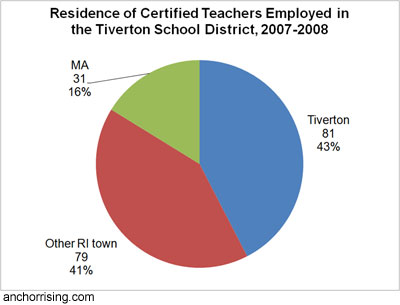
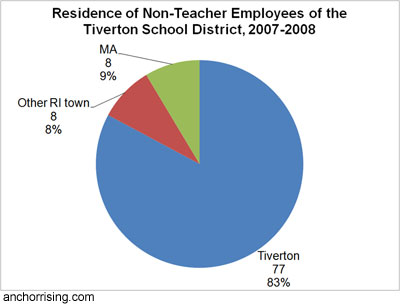
I'm curious what this data looks like for other towns. That information wouldn't happen to be centralized (or at least readily accessible) anywhere, would it?
February 11, 2008
Taking Care of Rhode Island (In the Hit Man Sense)
The business section of the Providence Journal was full of discouraging words, yesterday. Consider this from the dangerously clueless Senate Finance Committee Chairman Stephen Alves (D., West Warwick):
When I asked him afterward about his remarks, Alves said that state tax collections were down last month, compared not only with January 2007, but also with January 2006."This is getting larger and larger," he said of the state’s budget problem, "and passing it to cities and towns" isn't the way to go.
He said he doesn't favor increasing the state's personal income-tax rates. Nor does he favor raising the state's sales-tax rates (although he said he would consider "expanding the scope" of the sales tax).
What about raising the minimum corporate income tax? "It's certainly something we're looking at," he said.
For example, he said, raising the tax to $1,000, from the current $500, would mean an increase of about $10 a week for 94 percent of the companies that do business in Rhode Island, he said.
That seems reasonable, he said, especially given the deficits that Rhode Island is facing, and the costs that workers must shoulder, Alves said. "The pain has to be shared equally," he said.
Senate President Joseph Montalbano throws in increases to the flat-tax and the capital gains tax.
Then we get this gobbledegook from some URI electrical and computer engineering professor named Donald Tufts:
We need greater tax fairness in Rhode Island and a spirit of sharing and common sacrifices like that of the "Greatest Generation" of the 1940's. Then we can come through our state's difficult financial period, as we did during the credit union crisis. The present crisis, like the credit union failures, was caused by inappropriate special-interest legislation, which needs to be quickly reversed.
Only, by "special interests," Tufts doesn't mean unions and entitlement grabbers; he means the wealthy. You know, the few percent of Rhode Islanders who pay 40% of the taxes. People who are free to leave, as the residents in the income categories below them have been doing.
These folks have us on a course to find out just how much pain Rhode Island can share among its residents — at least those who pay the bills.
February 10, 2008
Which Way the Population Blows
With the numbers debate becoming increasingly involved, and now that it is clear that we RI bloggers are no longer merely talking among ourselves, I thought to expand my examination of population and wealth trends in Rhode Island. The most straightforward method is to start where I began with my proclamations of middle-to-upper-class flight from the state:

As I've explained before, this chart shows that, from 2005 to 2006, Rhode Island lost about 30,000 people whose households had been over three times the poverty level (roughly $60,000 for a family of four), and almost 22,000 over twice poverty. As a matter of personal history, I made limited use of this information until, at the tail end of December, WPRO's Matt Allen spurred me to look again, at which point I was actually surprised at how high the number had been.
Of particular concern, as I began to broaden my inquiry, was the observation that, stepping back a year, from 2004 to 2005, the number over five times poverty actually grew 22,058, over three times poverty 21,754, and over two times poverty 21,166. In other words, 2005 saw a spike at the high end, and although the 2004–2006 results still show losses of 2,498 (5x), 6,495 (3x), and 471 (2x), I have to admit that I had begun charging as if I carried a sharper sword than I actually held.
Unfortunately, 2004 was the first year for which the Census broke out the income to poverty ratio with such a degree of granularity. However, the income to poverty ratio is provided up to twice poverty beginning in 2002, with the following results:
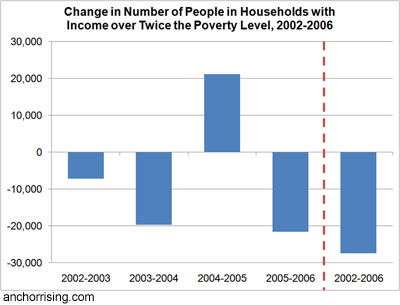
Whether it has something to do with the measurement of the statistics or actual events in the state, I haven't been able to determine. It is clear, though, that the spike in 2005 was more the oddity than the plunge in 2006. Trying to explain the data, I turned to U.S. Census household income data.
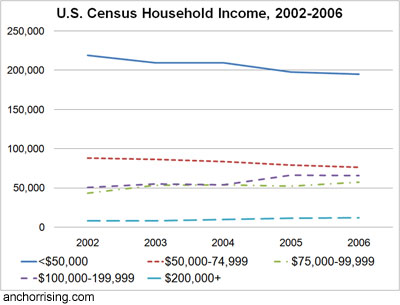
As is plain, the spike was specifically among households earning between $100,000 and $199,999 in the twelve months before the 2005 survey. For a view that highlights the range on which we've been focusing thus far, the following chart zooms in on households with incomes over $50,000.
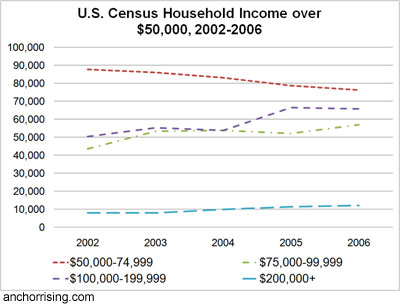
By the numbers, households with incomes over $75,000 per year (which one can very roughly compare with three times poverty) increased 12,364 from 2004 to 2005 and 5,032 from 2005 to 2006. Households with incomes over $100,000 per year (which one can somewhat more accurately compare with five times poverty) increased 14,092 from 2004 to 2005 and 23 from 2005 to 2006. Although both groups advanced more slowly in 2006 than 2005, all of the numbers are still positive.
However, factoring in household size helps align this data with the income to poverty ratio data above: From 2004 to 2005, married households earning over $100,000 per year increased 11,048, but from 2005 to 2006, they decreased 815. All of that decrease came from married with kids households, which only increased 6,007 in 2005 and which decreased 1,033 in 2006. What I'm getting at is that the decrease on the household income chart came in large part from families, whereas the income to poverty ratio data is individuals whose households have that much income. That doesn't explain all of the difference, but it does describe one ripple in the wave.
Because the clincher of this post (as long in coming as it's already been) comes via IRS data, let me offer the related figures from that data set. Perhaps the most significant finding is the support that the comparison lends to the hypothesis that families are partly (maybe mostly) responsible for erraticism of the income and income to poverty ratio trends. Lower income households are less numerous than lower income returns, while the opposite is true at higher incomes, which would happen if couples filed separately or households had a third income earner.
Don't forget, when comparing these to the Census charts, that the IRS has not yet released data for 2006, so the downturn is not present in the data.
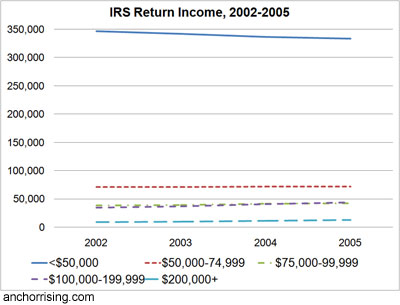
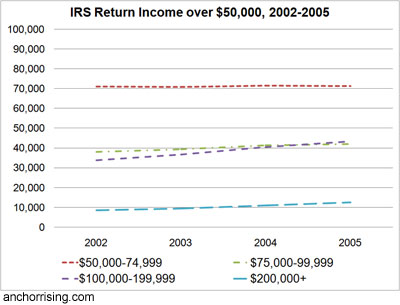
And now, without further delay, here — purchased with a small percentage of readers' generous donations over the past couple of weeks — is the data that ought to simply end the conversation about what's happening and propel the conversation about what we ought to do about it.
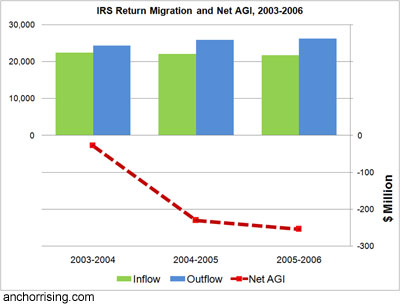
Lest disbelief lead you to doubt your reading ability, the chart does indeed show net losses in tax returns of 1,818 from 2003 to 2004, 3,869 from 2004 to 2005, and 4,427 from 2005 to 2006. The corresponding loss in citizens' adjusted gross income over that total period was indeed $513,117,000, and to the surprise of nobody who's read the above, 2005 marked a huge increase in that amount.
One might surmise, although my research hasn't gotten far enough to state it as more than a theory, that the leap in "wealthy" citizens in 2005 was the result of houses sold in the course of leaving the state. The migration data is attributed to the year in which the return was filed (i.e., the year after the income in question), while the Census data is income over the previous twelve months for a survey that took place throughout the year, so both would be in keeping with a large burst of income at some point during 2004 and 2005 and tax returns filed in 2005 and 2006.
As one final piece of the puzzle (for now), I compared the average AGIs of those coming to the state from and leaving it for the five counties in Massachusetts and Connecticut that are right across the border. These populations, it seems to me, are the most likely to include migrants who either work in or have close ties to the areas that they are leaving. They might include, among other groups, low-income families pursuing Rhode Island's extended benefits (incoming) and workers who just can't take the taxes and poor infrastructure of their home state (outgoing).
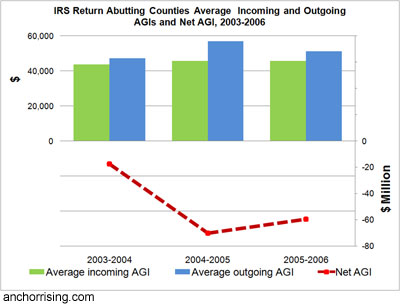
I suppose the shadow of doubt is in the eye of the beholder, but it would take quite a bit of argument to persuade me that middle-class and above citizens of Rhode Island — especially families — are not loudly declaring — by placing their families beyond the tax collector's reach — that they will not accept the likely solutions of the General Assembly to our financial crisis.
Now what do we do about it?
ADDENDUM:
One factor on the table that I didn't address above is the Phoenix Marketing data that has Rhode Island climbing from the 20th highest percentage of millionaires to the 17th. Thus far, I've mostly pointed out that our neighbors, Connecticut and Massachusetts, are consistently in the top 5, and some have suggested that we can't make that comparison. However, upon closer inspection, it turns out that Rhode Island's "improvement" was largely due to the number of non-millionaire households that have left. (We also have a discouraging foretaste of the likely results of Census and IRS data collection for 2006 and 2007.)
| 2006 | 2007 | Change | |
|---|---|---|---|
| Total households | 428,941 | 424,216 | -4,725 |
| Millionaire households | 20,229 | 22,550 | +2,321 |
| Millionaire % of total | 4.72% | 5.32% | +0.6% |
| Rank | 20 | 17 | +3 |
If Rhode Island had not lost 1.1% of its households from 2006 to 2007 — that is, if its household population had remained the same — then millionaire households would have accounted for 5.26% of the total, which would have put us right back in slot #20, just keeping pace with national trends, perhaps because of some of the very policies that the progressives and the Democrats are heaving onto the chopping block.
February 9, 2008
The Percent of the Percent, or the Additional Percentage?
It's good to see that the gatekeepers over at RI Future have allowed somebody actually to address the points that I'm making (as opposed to making distinct points and scoffing at whatever it was that some right-winger was saying elsewhere). That somebody turned out to be sometime Anchor Rising commenter Thomas Schmeling, and his argument is that my analysis of Rhode Island's, Massachusetts's, and Connecticut's increases in $200,000-earners measures the wrong thing. I encourage readers interested in the debate to read Schmeling's lucid post in its entirety before returning to my reply, below.
As well as Schmeling has illustrated the differences in approach between Crowley's/the Poverty Institute's/ITEP's statistics and mine, when it comes to arguing that one or the other is more useful or applicable to RI's current situation, it seems to me that he just swirls the water. He posits two identical states, both increasing the percentage of their populations earning over $200,00 per year at 10% annually, with one starting from a smaller proportion. He then states that the one's "lag is because, and only because, its starting point was lower." But the "only because" is the assumption under contention. I say again: when you're talking about a number of anything that doesn't self-multiply — households, in this case — it's easier to double 1% than to double 2%.
Ask yourself this (answers may differ): If I were to say that an economic boom is coming that would benefit all states equally, which of the following circumstances would you believe me to be describing?
- The percentage of every state's population earning over $200,000 per year would increase at exactly the same rate.
- An equal percentage of every state's population would advance into the $200,000 per year category.
Admittedly, the question is contrived; in reality you'd probably expect the boom to raise every state's average by the same percentage. In that case, according to the IRS data, Massachusetts's average AGI increased 40.31% from 1997 to 2005, while Rhode Island's increased only 34.94%.
But of the two options targeting the rich, I'd choose the latter, because (for the most part) rich people don't multiply; rather, others join their ranks. The economic boom doesn't cause the wealthy to bifurcate as might some chemical in a petri dish of amoebas; rather, it creates circumstances in which... umm... new amoebas can enter the petri dish.
Schmeling is correct that, "if RI's growth rate is larger then MA's, as it is in reality now, it must eventually catch up, even though in the early years MA appears to be pulling away." But that requires Rhode Island to add an ever-larger number of people to the group each year, to keep up its percentage. Moreover, the formulation implies that both will eventually reach 100%, which isn't a plausible percentage of the population for "The Rich" to reach.
Of course, it's very plausible that everybody who works will eventually earn at least the specific dollar amount of $200,000, because of inflation. To illustrate how this new consideration works into the discussion, I'll switch to U.S. Census data, because it breaks the population into narrower categories, although the relevant information is only available from 2002 to 2006.
According to InflationData.com, the inflation rate from 2002 through 2006 was 13.95%, which means that $200,000 in 2006 was equivalent to $175,515 in 2002. Assuming that households were spread evenly across the $150,000–$200,000 category, it's reasonable to suggest that, as a pure matter of inflation, the number of households over $200,000 in 2006 should have been the number of households in that category in 2002 plus one-half of the households in the lower category in that year. The following figure illustrates how this result compares with the actual change:
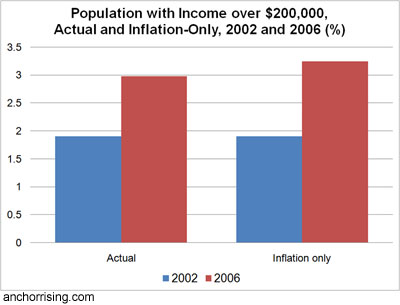
The red column above "inflation only" is the percentage of the households earning over $200,000 in 2006 if nobody did anything to advance their income beyond inflation and if everybody who entered the state during that period had incomes below that amount. Any citizens sufficiently surpassing inflation and any immigrants above the $200,000 mark would have increased the column, and as you can see, the actual results were lower than the purely inflationary results.
It's interesting to note — and indicative of this illustration's lack of practical utility — that Massachusetts actually fared worse by this measure. Schmeling might want to claim that note as evidence for his argument — that it is in keeping with RI's better growth rate in the highest-income category (the state came closer to matching inflation) — but I'd suggest that it ultimately supports just the opposite conclusion.
For one thing, using Schmeling's preferred measure — the rate of growth — even the pure inflation result favors Rhode Island. Rhode Island's wealthy group would have grown 70% to Massachusetts's 57%.
For another, consider the Phoenix Marketing data recently introduced into the comment discussion on Anchor Rising. In 2006, 5.64% of Massachusetts households were millionaires, in the sense that they had $1 million readily available in liquid assets. Rhode Island's percentage was 4.72. This difference brings to the fore the reality that Massachusetts's wealthy class outstrips Rhode Island's in ways beyond the reach of inflation. A state with a higher percentage of citizens over the $200,000 line has a smaller pool from which to draw improvement.
Which brings us back to dough.
Yes, obviously people can slip below the $200,000 line or withdraw themselves from the state altogether. The point is, however, that it's more relevant (in my view) to observe the additional percentage of the population that crosses the line than to calculate the rate at which the category is growing.
ADDENDUM:
I expect Schmeling to point out, with respect to the Phoenix Marketing data, that Rhode Island improved its nationwide rank on the millionaires list more than Massachusetts did in 2007. I'd respond with a whoop-dee-doo that RI climbed from 20th place to 17th when both of its neighbors have consistently been top 5, and then I'd promise that this finding will be incorporated into the post with which I intend to move on from the esoteric distraction of how to measure categorical increases.
February 8, 2008
The Chill Up Rhode Island's Spine
Legislators — even those who are trying to sound conciliatory to RI businesses — are making some scary noises:
Stephen D. Alves, chairman of the Senate Finance Committee, suggested yesterday that lawmakers may raise business taxes to balance the state budget.The remarks, at the Greater Providence Chamber of Commerce's high-profile legislative luncheon, ran counter to what had appeared to be a growing consensus at the State House regarding personal and corporate income taxes.
"I think we have been fair to the business community," Alves, D-West Warwick, said. "The pain should be shared equally."
High on my list of priorities for this weekend is to roll out some research that (I think) prove that to be a very bad idea and even making the suggestion to be a detrimental action. But there are other possibilities that we have to watch out for:
Senate Majority Leader M. Teresa Paiva Weed, D-Newport, pledged to study consolidating school services, such as busing, student lunches and health insurance for teachers.Paiva Weed also defended controversial limits on annual property tax increases. To help cities and towns cope, she said, the state plans to pay closer attention to spending by local school departments.
Consolidating health insurance under the watch of the union-controlled state government is tantamount to protecting the benefit from the gravity of the private sector's reality. They'll just try to shuffle the money around a bit less visibly. And "closer attention to spending by local school departments"? I'm sure I'm not alone in my utter lack of confidence that the state would be any better than the local school committees at promoting the correct priorities; they'll just be less reachable by the taxpayers.
February 6, 2008
The Difference a Day Makes
In attempting to match the Crowley/Poverty Institute/ITEP argument, I didn't include 2005 data (in part, ahem, because its availability didn't register in my whirlwind round of data collection). I've modified the charts in the previous post so that the scales match. The thing to note is how much more the columns grew for Massachusetts and Connecticut, even though it remains the case that this category of taxpayers increased "at a greater rate" in Rhode Island.
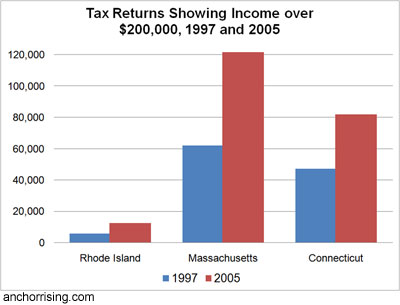
The same is true, here:
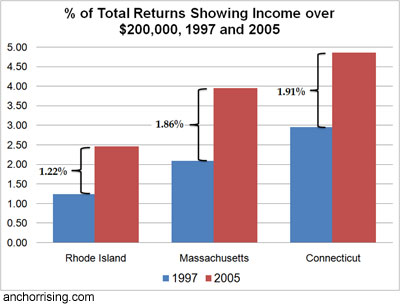
And when it comes to average adjusted gross income, Rhode Island compares even less favorably, now:
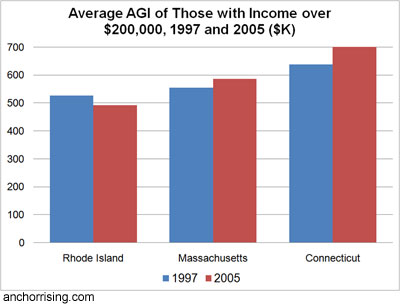
The reason that I returned to this information so soon was that commenter Chalkdust stated in the related comment thread that it is misleading of me "because it makes it appear as though the proportion or Rhode Islanders earning more than $200K is increasing at a slower rate than MA or CT, when the opposite is true." I argued that it's easier to almost double 1% than 2% and that wealthy people don't grow like spores; they're made (if only self-made) or imported. The race, if we want to see it as such, is more a matter of increments, and if MA starts one step ahead of RI and, over a period of time, takes one and a half steps, while RI takes less than one step, that isn't evidence that RI is moving more quickly.
To illustrate the point, consider the following line chart:
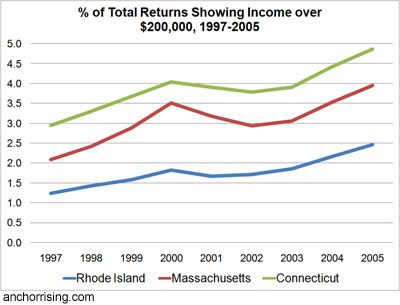
Rhode Island hardly looks as if it is catching up to its neighbors in this respect, especially when it is considered that the average AGI for this income group actually declined 6.7% from 1997 in RI, while increasing 5.6% in MA and 9.9% in CT. The combined result is that the total AGI of this group actually grew more in Massachusetts than in Rhode Island, and Connecticut wasn't as far "behind" as it appears by other measures. (One has to laugh at the numbers game, when a state with a total AGI for the wealthy group nine-and-a-half times the size of the corresponding AGI in Rhode Island is somehow behind.)
Moreover, Rhode Island's total tax returns increased at almost twice the rate as in Mass. and Connecticut (8.34% for RI, 4.20% for MA, and 4.99% for CT), which makes it less compelling to note that its wealthy population grew only 1.19 times that of Massachusetts and 1.57 that of Connecticut.
The real story of this round of charts, though, comes from the tax returns of those making between $75,000 and $200,000 per year:
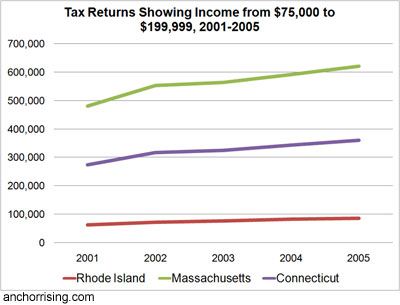
If poverty ratio trends in the 2005–2006 U.S. Census data carry through to IRS data sets, Rhode Island's red line is about to turn south among what might be termed as the state's productive class — 17% of the population that paid 34% of the income tax liability in 2005 and likely accounted for an even larger share of the sweat and ingenuity behind our economy.
February 5, 2008
Lying Down the Line
Readers familiar with NEA Assistant Executive Director Patrick Crowley's body of work are to be forgiven if they took the opening line of the letter to the editor that he's been passing around to all the local papers — "repeat the lie, no matter how false it is" — as advice, not a complaint. Dan Yorke did a much better job dissecting Crowley's Newsmakers appearance than I did, but the take-away is the same — namely, that Crowley's professional objective is to get away with as much twisting, stretching, and convenient misspeaking of the truth as he can. Of especial interest with his latest offering, however, is how much help he has.
Crowley's letter (which is not available online) is nothing more than a distillation of a recent report (PDF) published by the Poverty Institute at the Rhode Island College School of Social Work (and hosted on a Web site, incidentally, that is registered using a RIC address). The Poverty Institute, in turn, gets some of its key data from the Institute of Taxation and Economic Policy (ITEP), a Washington think tank funded by a long list of progressive foundations — in conjunction with the National Education Association.
I offer this information not to cast a cloud of innuendo about broad progressive conspiracies to fleece the Rhode Island taxpayers of their money, but because it is a critical consideration when observing how the Poverty Institute research document and Crowley's letter are constructed. Point by point (from the Poverty Institute):
- "The number of very high income Rhode Islanders is growing." This is really the credibility hook (so to speak) for the entire study, because the data comes from the IRS. As I'll show in a moment, however, the progressives' use of it is (surprise, surprise) misleading.
- "Incomes at the top are rising rapidly." This is the jealousy-evoking component, meant to help the reader toward the conclusion that wealthy taxpayers can afford to be taxed more. It's also the component that comes directly from ITEP, using (as far as I can tell) an untraceable methodology that allows an opposite conclusion than the data used for the first point.
- "More affluent taxpayers move to Rhode Island from Massachusetts than move from Rhode Island to Massachusetts." The Poverty Institute turns back to the IRS to bolster its point, but using data that is not easily accessible and offering little by way of actual numbers.
- "Charitable contributions by affluent residents have been stronger in Rhode Island than in neighboring states." The last claim is also meant to bolster the more significant openers, it is also from hard-to-access IRS data, and the data is also limited, inasmuch as the Poverty Institute provides only percentage differences from year to year, without any context as to what those percentages signify.
Here's how Crowley presents the first point:
The number of very high-income Rhode Islanders is growing. Using data (that is, real numbers) from the IRS, the Poverty Institute shows that between 1997 and 2004, the number of people with incomes over $200k rose 87 percent, more than Massachusetts and Connecticut.
Of itself, the claim is true enough. The IRS processed 5,064 more RI tax returns with over $200,000 in income in 2004 than 1997. But the related increases were 46,059 tax returns in Massachusetts and 26,433 in Connecticut.
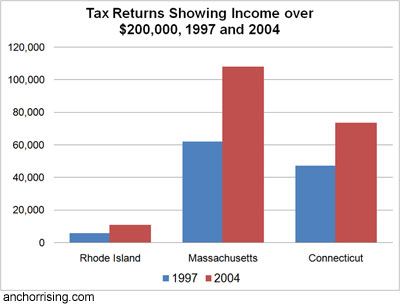
Our neighbors are larger, though, so consider that households over $200,000 accounted for 2.16% of total returns in RI, 3.53% in Massachusetts, and 4.42% in Connecticut. Over the eight years in question, an additional 0.92% of Rhode Island households entered the highest income group. Massachusetts pulled up an additional 1.44%, and Connecticut 1.47%.
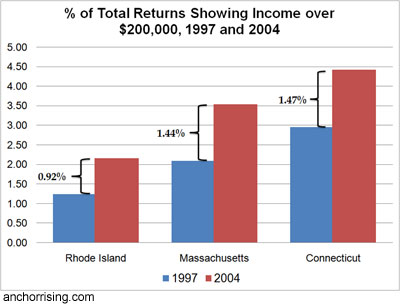
Incomes at the top are rising rapidly. In 2005, the highest earning 1 percent of Rhode Island households earned $965,908, an 11.9 percent increase from 1999.Income for the elite rich rose faster than neighboring Connecticut and Massachusetts. Elites in Connecticut had their incomes rise by 5.3 percent and in Massachusetts they actually dropped by 4.2 percent between 1999 and 2005.
As I've said, this sources directly to ITEP, not the IRS, with no public data in a form that can be analyzed. The time span switches to 1999–2005, and the group under the microscope is now the top 1%, not those over $200,000. Not having access to the data, I can't guess the reasons for these differences.
It's interesting, however, that the Poverty Institute report shows that the top 1%'s average 2005 income of $965,908 represented a $113,705 leap from 2003 and was $115,908 higher than the 1999-2003 average. Whether the sudden spike was a fluke or a trend, I guess we'll see. Although, I doubt that progressives' tax-the-rich schemes will help to make it the latter.
Whatever the case, sticking with the IRS data already on the table, one finds that the average gross income (AGI) of those in the top earning category ($200,000+) was down 5.79% in 2004 from 1997 in RI. In MA, it was up 0.52%, and in CT, it was up 3.85%.
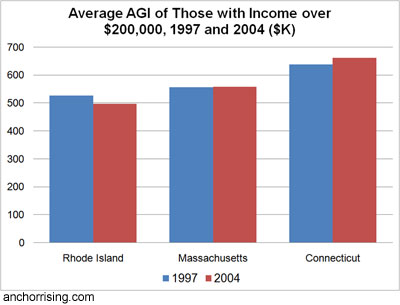
IRS data shows that Rhode Island is attracting more affluent people. Migration data based upon state of residency on tax returns show that more people are moving from Massachusetts to Rhode Island than the reverse.
It's suspicious that this is the only claim for which the Poverty Institute provides no illustrations — as if they wish the point to be made, but not considered. I'll take the Institute at its word that "the median income of in-migrants from Massachusetts has been higher than the median income of out-migrants to Massachusetts," although as an editor, I wonder whether "has been" means "has been consistently" or "has, at times over this period, been." As an intellectually curious fellow, it strikes me as odd that we're suddenly talking "median income," and I find it particularly peculiar that the only actual numbers come from the following:
This is true despite the fact that MA reduced its top income tax rate from 5.95 to 5.3 percent in 2000-2002 while Rhode Island’s top marginal rate at the time was 9.9%.
We've got quite a jumble of years, here. As I understand it, Massachusetts then raised its top rate, while Rhode Island lowered its rates. For these reasons, I'm confident that an analysis of the raw numbers would actually support the opposite argument from that which Crowley & Co. wish to make. Back to him:
Charitable contributions from the elite have rebounded better in Rhode Island than Connecticut and Massachusetts from the post-911 recession.
Based on the analysis above (not to mention long experience), it's easy to understand why readers ought to be wary of the Poverty Institute's presentation of percentages of increase and decrease. They give no dollar-amount basis for judging. Whatever the case, the overarching point is perverted: that Rhode Island's wealthy are particularly generous and therefore must be able to afford having more of their money taken by force of law.
I suspect that the Progressive Conspiracy's sky-ain't-falling points will become narrower and narrower as data approaching 2008 becomes available. Perhaps then they'll let their stripes show and declare victory over the rich.
ADDENDUM:
I've corrected a misfire of the synapses: The latter date in all of the above charts should have been 2004 — same data, different label — so I've fixed the problem.
January 30, 2008
Every Argument Will Be Made to Raise Taxes
Beware unsigned opinion pieces phrased in the first person. The instance in mind is this post from A Blog Called Hope, which appears to be a somewhat official production of the Rhode Island Democrats:
I know everyone hates taxes, but a longer and more destructive recession would be much worse.
Actually, it simply isn't the case that "everyone hates taxes." Some folks' livelihoods depend on taxes. Some folks currently see the situation in Rhode Island as taxes versus their own largess. And some folks believe it to be a simple matter of justice for the right people to be taxed. Whether "I" is among these groups is impossible to tell. What's not impossible to tell is whether the argument that he or she puts forward reasonably applies to Rhode Island:
I invite Governor Carcieri to read a report written during the last recession by Peter Orszag and Joseph Stiglitz. The report essentially reads that given the two options of cutting spending or raising taxes, the latter option is the least harmful for the economy during recessions.The reasoning is pretty straight-forward, although anathema to Republican thought. Basically, everything is dependent on an individual’s propensity to consume. And as Americans, we all love to spend our money on stuff! A reduction in government spending on goods and services will reduce consumption by exactly the same amount. For every dollar that the government does not spend, the economy does not generate that economic activity. Conversely, if taxes are increased by $1, there may be a drop in consumption by 90 cents while savings is reduced by 10 cents. This scenario is less harmful to the economy that the former.
Having skimmed the mentioned report, I'll go further than Orszag and Stiglitz: At the state level, unless the tax targeted for cutting is the sales tax or is realized in the form of a rebate, tax cuts probably have almost no tangible benefit toward ending a recession. (For simplicity, I'm ignoring intangible effects such as increased optimism based on the tenor of legislative debate.) By the time the government realizes that a recession is in effect and takes action, the downturn is likely to have run most of its course. In the case of tax reductions, actual cash yields from tax cuts are delayed even longer.
But recession (whether existing, pending, or threatening) is not the problem in Rhode Island; it's merely an exacerbation. Rather, the problem is the structural deficit and the economy-draining policies that make up the structure. Raising taxes to ensure that those to whom the state dollars go can continue to consume would not only not solve the long-term problem, because those taxes would have to be raised again as costs go up, it would make the problem worse, because the cost/benefit analysis of living in Rhode Island would cross a line for even more residents. And they'll take that taxable dollar — and the cumulative millions like it — out of play altogether.
ADDENDUM:
Incidentally, I'm not ceding the Democrats' argument that government spending is good for the state during a recession. The type of spending that they usually mean — handouts and other social programs, which go straight to the consumer category — has less economic value. The $1 bill is spent, but it dissipates into the economy. Subtract taxes, subtract the cost of goods brought in from elsewhere, subtract the cut of the dollar that goes back to the corporations (including, liberals might shudder to hear, executives), and so on.
On the other hand, a dollar left in the hands of local entrepreneurs, business owners, and other active citizens — all in the producer category — grows more money. They invest in local real estate, order more goods from local suppliers, hire more local employees, and so on. Even when they consume, I'd wager that it's more likely to be for productive purchases. (Picture me buying a new nail gun, which helps me to work more quickly, to complete jobs in a more timely fashion, and to negotiate a higher salary based on the utility of my work van.)
January 28, 2008
F.A.C.T.S. = Functional Absurdities Contorted for Teacher Salaries
I originally posted this in response to Pat Crowley's ranting on RIFuture. Since he's published the same propaganda as a letter to the Providence Journal, I thought it worth bumping the post to the top.
It is sufficiently tedious to respond to "analysis" from the NEA's Pat Crowley that, when it's limited to RI Future, it's hardly worth doing so. When one considers that he has a direct financial interest in his conclusions, the rest looks like the pure static that it is — meant to be hypnotic, but a mere annoyance when so poorly executed.
I'm the "lead spokesperson" for the "I Hate Rhode Islanders" crowd, according to him. See, Crowley goes right for the demagoguery: "Justin hates you! Fork over more money to the government." Yup. I simply want my state to provide folks in my circumstances a fair shot at making a living. Crowley wants to raid taxpayers wallets to fund lavish salaries, benefits, and pensions for his clients (union teachers) and to stroke his ideological ego by forcing others to subsidize social programs. Pat may not hate Rhode Islanders, but the end results of his actions sure make his own emotions moot.
But anyway. To his points (if they can rightly be called that):
1/2 of 1% of total state spending goes towards the Family Independence Program (the results of all those poverty pimps is just a drop in the bucket)
The interesting thing about this ploy is that it shows that Pat, the unionist, is happy to play the cards of the local poverty industry. Happily, that makes this an easy response, because Anchor Rising contributors have been pointing out the spin of this trick for years. In a word, as our shared commenter Pragmatist puts it in a comment to Crowley's post: "Care to cite the percentage of the state budget taken up by all of the human service programs? No, I didn't think so."
Rhode Island Ranks 23rd in the country for over all Tax burden according to the conservative Rhode Island Public Expenditure Council. Not 50th, not worst. But right in the middle.
As Pragmatist notes, Crowley links to an irrelevant source. Be that as it may, Andrew has looked into this particular instance of carefully chosen statistics in the past. The upshot is that Rhode Island is top 10 when state-to-state tax burdens are compared. It's when one adds fees that we drop, and Andrew's post notes that Rhode Island is toward the bottom in collecting fees for a variety of activities, such as hospital activity and solid waste management.
The reasons for this would take more detail than Crowley's work merits, but comparing states on such things is problematic. For example, if (as Jeff Grybowski comments to Andrew's post) the reason RI's hospital fees don't amount to much is because the state has only one (small) public hospital, then this particular statistic would be more at home in an expenditures, rather than revenue, analysis. With respect to sewerage, if a high percentage of properties have septic tanks, rather than public sewer, then what isn't collected in public revenue is spent for private services.
I agree that fees ought to figure into a tax burden analysis, but one must review them carefully. If the tax burden is light on a particular service for which people pay anyway, then the fact that the check doesn't go to the government is hardly a positive point. If the fee structure is such that middle class and above citizens end up paying the bulk of the government's total collections, then that only contributes to my point, which was (lest we forget) that Rhode Island is driving out productive citizens in favor of unproductive ones.
The tax that hurts the average Rhode Islander the most, the property tax, needs to be changed but RIGHT WINGERS won't let that happen. Why? Because it would take an increase in the income tax to offset the change. People in the highest income quintile with an average household income of $196,419 pay only 2.85% of their income on property tax. People in the Lowest bracket pay 8.1% of their income to the property tax.
Here Crowley goes for a classic non sequitur phrased in such a way as to make the careless reader believe that the wealthy are getting away with something. Note that he provides no source for his numbers. Note, too, that he gives the average income for the "highest income quintile," but not for the lowest (and is that "bracket" a "quintile"?). It may surprise Crowley to hear that property taxes are based on the value of property, not on the owner's income. The poor man pays the same tax that a rich man would pay for the same property. Generally speaking, the asset has the same value.
So, if an income tax increase were necessary to offset a property tax decrease (because, say, one refuses to allow expenditures on unionized public workers to stagnate, much less decrease), then the "lower bracket" would still have to pay a higher rate on their income than the "highest income quintile." Otherwise, again, we're exacerbating our corrosive progressiveness of taxation.
In 1979, the corporate income tax accounted for 10.4% of general revenue. In 2002, that dropped to 1.3%. Did it work? You be the judge
Commenter johnpaycheckri explains that "the tax law changed in 1986 so that most corporations became s-corps which means that the income of the s-corp was passed through to individual shareholders," and that's sufficient answer, as far as I'm concerned. For my part, the factoid is most remarkable because of the stark light that it shines on one plain reality: None of Crowley's proclaimed "FACTS" does anything to refute my argument. People are leaving Rhode Island, especially people in the demographic that pays the majority of taxes, and folks with a vested interest in the system that is driving them away — Pat Crowley notable among them — are only tightening their grip on Rhode Island's throat.
January 20, 2008
Economic Perspective
With all the talk that you're sure to hear over the next year about "Bush's recession" and (usually separately) Rhode Island's financial troubles, it'll be crucial to maintain proper perspective:
Rhode Island payrolls shrank for the second straight month in December and the unemployment rate climbed to 5.5 percent, its highest level in more than a year, a government report released today shows.The state Department of Labor and Training reported that the number of unemployed people last month increased to 31,800, the highest number since June 1995.
Massachusetts last month lost 2,700 jobs, and the unemployment rate rose two-tenths of a percentage point, to 4.5 percent.
The national unemployment rate last month was 5 percent.
Anybody who wishes to lay the blame for Rhode Island's troubles at any other doorsteps than those of the state and local governments has to explain why the economic policies of Mr. Bush (to pick one likely target) leaves Rhode Island behind the national average, and twice as far behind its "closest" neighbor.
January 19, 2008
Now There's an Interesting Idea
Not long after I'd circled the following paragraphs in my copy of today's paper, I noticed a typical bit of ad ignorantiam over on RI Future:
Carcieri's chief budget officer, Rosemary Booth Gallogly, suggested earlier in the week that the administration may have "another alternative if there were a fiscal crisis."A provision in Rhode Island law gives the governor emergency power to suspend law during "disaster emergencies."
Rhode Islanders with anything above an eighth-grade reading level (whether that level is judged according to our standards or, say, Massachusetts's) might understand that the place to research "a provision in Rhode Island law" would be our state's General Laws, not its Constitution, and indeed, among the statutes is this definition (emphasis added):
(1) "Disaster" means occurrence or imminent threat of widespread or severe damage, injury, or loss of life or property resulting from any natural or man made cause, including but not limited to: ...(vi) Epidemic; ...
(viii) Blight; ...
(x) Infestation; ...
(xiv) Endangerment of the health, safety, or resources of the people of the state
I'll leave it to lawyers to discern whether epidemic stupidity, a blight of legislative corruption, and infestation by parasitic moochers apply, but even if the governor must rely on the imminent endangerment of citizens' resources, it's at least plausible that a sufficiently reckless and harmful budget passed by the General Assembly this year might entitle the governor to:
Suspend the provisions of any regulatory statute prescribing the procedures for conduct of state business, or the orders, rules, or regulations of any state agency, if strict compliance with the provisions of any statute, order, rule, or regulation would in any way prevent, hinder, or delay necessary action in coping with the emergency, provided that the suspension of any statute, order, rule or regulation will be limited in duration and scope to the emergency action requiring said suspension.
Of course, the General Assembly "may terminate a state of disaster emergency at any time," but I'd say it would make for very interesting workplace and dinner-table discussion for Rhode Islanders to consider the description of "what actions are being taken to control the emergency and what action the public should take to protect themselves" that the governor would thereafter be required to produce.
Among the latter class of actions is an option that the NEA-RI's executive director, Bob Walsh, continues to ignore:
"It's crazy to tell some of the top earners in Rhode Island, people making millions of dollars a year, that they don't have to share in this burden," Walsh said.
Those "top earners" — many making much less than millions of dollars a year — already share a disproportionate amount of the burden that Mr. Walsh has worked so diligently to help foist on the state's shoulders. And in point of fact, it's simple truth to tell them "that they don't have to share in this burden": They can simply gather up their belongings and assets and leave.
January 10, 2008
Alzheimer's Research Breakthrough and the RI Economy
Take this with a grain of salt--it's early research after all--but there may have been a substantial breakthrough in Alzheimer's research:
A drug used for arthritis can reverse the symptoms of Alzheimer's "in minutes".For any who have been effected by Alzheimer's, this could be great news. What does this have to do with Rhode Island? The manufacturer of Enbrel--the drug used in the study--is Amgen and the drug is made right in her in its West Greenwich plant. The same facility has experienced a rough patch lately as Amgen attempted to make up for losses other areas by implementing cost-cutting measures (read: job cuts) here in Rhode Island (it appears to have worked). This new use for an established drug could mean an economic boon to the company and perhaps--eventually--more jobs here in Rhode Island.It appears to tackle one of the main features of the disease - inflammation in the brain.
The drug, called Enbrel, is injected into the spine where it blocks a chemical responsible for damaging the brain and other organs.
A pilot study carried out by U.S. researchers found one patient had his symptoms reversed "in minutes".
Other patients have shown some improvements in symptoms such as forgetfulness and confusion after weekly injections over six months.
The study of 15 patients with moderate to severe Alzheimer's has just been published in the Journal of Neuroinflammation by online publishers Biomed Central.
The experiment showed that Enbrel can deactivate TNF (tumour necrosis factor) - a chemical in the fluid surrounding the brain that is found in Alzheimer's sufferers.
When used by arthritis sufferers, the drug is self-administered by injection and researchers had to develop a way of injecting it into the spine to affect the brain cells.
Sue Griffin, a researcher at the University of Arkansas for Medical Sciences, said: 'It is unprecedented to see cognitive and behavioural improvement in a patient with established dementia within minutes of therapeutic intervention.
'This gives all of us in Alzheimer research a tremendous new clue
about new avenues of research.' Enbrel is not approved for treating Alzheimer's in the U.S. or the UK and is regarded as highly experimental, said Dr Griffin.
'Even though this report predominantly discusses a single patient it is of significant scientific interest because of the potential insight it may give into the processes involved in the brain dysfunction of Alzheimer's,' she added.
Lead author of the study Edward Tobinick, of the University of California and Director of the Institute for Neurological Research, said the drug had 'a very rapid effect that's never been reported in a human being before'.
He added: 'It makes practical changes that are significant and perceptible, making a difference to his daily living.
'Some patients have been able to start driving again. They don't come back to normal but the change is good enough for patients to want to continue treatment.'
January 7, 2008
Stupid Question of the Day
From Katherine Gregg in Saturday's Projo…
A [spokesman for Governor Donald Carcieri] confirmed that the governor’s staff had also “been approached about the concept of selling both the Rhode Island Lottery and the Pell Bridge.” Some proposals apparently came in unsolicited; others in response to a query from the budget office about opportunities for “public-private partnerships” that was appended to a recent request for proposals from underwriters.Now, can somebody explain to me exactly what a private company can do with a bridge to make it more "profitable" that a state government can't?
January 6, 2008
Affecting Columnists Across the Sections
Perhaps it's grasping at straws for something on which to hang some optimism, but judging from the cross-section unity among columnists, perhaps the common wisdom in Rhode Island is rocking in the right direction. On page A2, LifeBeat columnist Mark Patinkin head-fakes a silver lining and then highlights the problems of the state in the form of a humorous wishlist, such as:
- Interstate bridges strong enough to support trucks. ...
- Requiring General Assembly members to demonstrate fifth-grade proficiency in math so they can make Column-A equal Column-B instead of having a $500-million-or-so deficit. ...
- A post allowing Steve Laffey to take care of the few dozen other crossing guard-like contracts in the state.
- Physician remibursement rates a bit higher than those in Ghana so we can keep good docs from fleeing the state. ...
- A governor's veto that cannot be overridden by opposition leadership casually snapping its fingers.
Meanwhile, in the business section, looking toward Rhode Island's future made columnist John Kostrzewa so depressed that he leaped categories from business to history:
As I prepared a forecast of Rhode Island's economy, the data was so dismal that I decided to get out of the office for a different view. I headed for the ocean and stopped at a spot I’d passed by hundreds of times — Blithewold.I walked the grounds of the 33-acre estate in Bristol, on Narragansett Bay, and learned about the fascinating history of Augustus Stout Van Wickle, the coal baron from Pennsylvania who developed the property.
But I had a question.
Of all the places he could have lived, why did he pick Rhode Island?
And of course, the drumbeat's echo can still be heard where it arguably began (within the paper), on the editorial page:
Rhode Island's beauty, superb location, coastline and institutions of higher education should make it a magnet for well-educated people and shrewd entrepreneurs. Yet, U.S. Census estimates say, its population has declined for the last four years — and, last year, declined more than that of any state, beating even Michigan, battered by the decline of the U.S. auto business.Maybe one of the most crowded states could use a little more breathing space. But what is alarming is who seems to be leaving: It appears to be the state's working-age (and heavily taxpaying) population, including highly educated residents who are looking for work. Unfortunately, as mounting state and local budget deficits show, Rhode Island cannot function at its best unless it has a vigorous economy, with jobs to keep young, ambitious and educated people, and tax revenues to pay for its government programs.
Maybe — just maybe — the same refrain will start to enter the general public (even those with an interest in the status quo) and effect change.
December 31, 2007
Exodus Means Less Reason to Stay
Seasonality is likely a factor, but I'd been intending to offer the anecdotal testimony that the help wanted sections of various local and state papers are more sparse than I've ever seen them. Apparently, it isn't just my impression:
Job vacancies in Rhode Island declined from 10,949 in spring 2006 to 8,637 last summer, a drop of 21.1 percent. It’s a trend that continues from 2005, when Rhode Island job vacancies numbered 12,114. Economic analysts said the drop in job vacancies indicates a slowdown in the Rhode Island economy. ...The median hourly wage for full-time occupations also dropped, from a range of $14 to $15 an hour last year to a range of $12.10 to $13.28 an hour this year. Murray said the drop is probably due to the decline in vacancies for some of the higher-paid job classifications, such as management or finance and insurance. ...
"The figures on the surface indicate the need to grow Rhode Island's economy much faster. We need to get existing Rhode Island companies to expand, and to lure other companies into the state," [William B. Sweeney, professor emeritus of economics at Bryant University,] said. But Sweeney said the state deficit looms as "a long-standing problem" in creating a climate that will bring business to Rhode Island.
Edward M. Mazze, Distinguished University Professor of Business Administration at the University of Rhode Island, also said the job vacancy figures indicated bad news. "Rhode Island is going into its own recession," he said. Mazze said there is a lack of confidence in the state's economic future and that, generally speaking, the state's economy is not creating new jobs.
More on it later, but news from the General Assembly doesn't offer much encouragement that the legislators truly understand the problem and what needs to be done. Best case scenario — and I'm well beneath optimism, myself — is that the General Assembly puts on an ineffective show this year and the voters express enough disapproval in the fall to scare next year's General Assembly into actually doing something.
Like I said, though, my optimism is decreasing more rapidly than Rhode Island's median wage.
December 27, 2007
The Old In-and-Out in Rhode Island
Subbing for Dan Yorke on WPRO 630AM, Matt Allen has been talking about Rhode Island's first place ranking among states for lost population, which Marc investigated this morning.
I called in to the radio during my commute to mention my finding back in September (and my related Providence Journal op-ed) that, on top of the state's losing citizens, thousands of people in Rhode Island fell below the twice-poverty line. As it turns out, my day raising and sheathing a roof by the water in the cold misty drizzle affected my memory, because I guessed (from the road) that the high-end drop was actually about the same as the total leaving the state, but the actual number was 21,637 fewer people earning more than twice the poverty level.
There is almost an exact match between the 30,577 increase of those making 1–1.99 times the poverty rate plus the 3,144 fewer people in the state with the 12,084 decrease in people under the poverty level plus the 21,637 decrease in people earning over two times the poverty rate. The last chart of my September post shows that the biggest drop was actually the roughly 25,000 fewer people making over five times poverty level, followed by the nearly 15,000 fewer people making between three and four times poverty. The bottom line is that the productive are being dragged down and driven out in order to achieve a much less significant improvement at the bottom of the scale.
ADDENDUM:
As I pulled into my driveway, Matt had shifted the topic slightly and asked listeners what one law would change their mind about leaving. My response is that my daily urges to leave Rhode Island might be dispelled were the RI government to pass a law requiring members of the General Assembly to pay for any deficits at the end of the year out of their own pockets.
I think that, at the very least, would give our elected officials a sense of the magnitude of the problem
Rhode Island Leads the Nation...in Population Loss
Tipped off by 7 to 7, I went over to the U.S. Census Bureau web site, which has just released population estimates up to July 2007 (raw data here). From the AP summary:
Rhode Island is losing residents at a faster clip than any other state in the nation.Here are some more details . First is a list of raw population numbers and rankings from 2006 to 2007; it is broken out by the U.S. as a whole as well as four geographic regions and RI itself (I apologize for the table lines not being completely drawn and other truncation. Thanks to "chalkdust" for giving a heads up on some oversights on my part. The perils of hasty post compilation!):New population estimates being released today by the Census Bureau show that in the year ending July 1, the state's population declined by four-tenths of percent. Rhode Island lost just over 3,800 people to end up with an estimated 1.058 million residents.
According to the Census figures, the only other state to lose population was Michigan, which saw a decline of three-tenths of a point.
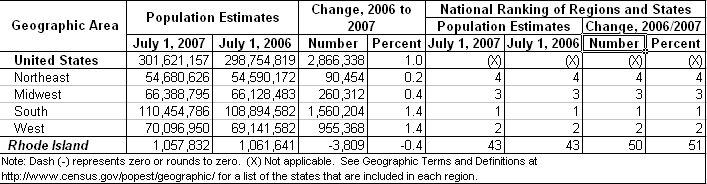
Note that over the past year (as usual) the Northeast is the slowest growing region and Rhode Island is at the very bottom of all states. Here's another table showing the raw numbers:
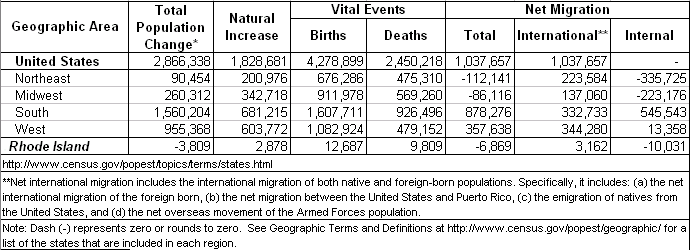
And another table that summarizes rates per 1,000 people:
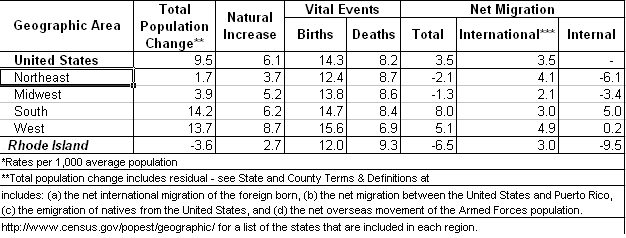
Finally, here is a graph of the net internal migration for Rhode Island up until 2006.
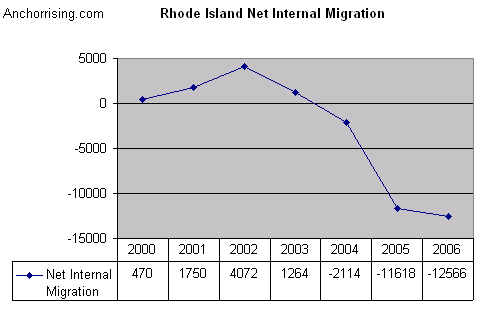
Starting in 2004, but really picking up speed in 2005 and 2006, our state has been hemorrhaging people. Time to shrink government too, huh?
December 26, 2007
"Take to Give" Has Got to Go
Unless I allow my cynicism free rein, it continues to astound me that Poverty Institute types can look at the evidence and persist in their conclusions. A recent jobs study from the institute raised the following concerns:
The gap between the haves and have-nots in Rhode Island has widened in recent years and the bulk of new jobs in the years to come will be “low-wage, low-skill service-sector occupations,” such as food service industry workers. ...A major problem facing Rhode Island is the loss of manufacturing jobs. Between 1990 and 2006, 42,000 manufacturing jobs disappeared, the sharpest decline of any state in the nation, the report says. ...
A troubling trend in the report shows that, since 2000, Rhode Island is the only New England state to experience a decline in median wage. ...
Further troubling is the fact that Rhode Island’s unemployment rate, 5.2 percent or 28,000 people, has exceeded the national average and has been higher than in the neighboring states of Massachusetts and Connecticut. ...
During the years 2000 to 2005, the percentage of Rhode Islanders without health insurance jumped from 6.9 percent to 13.3 percent. Today, the report says, there are more than 119,000 state residents under the age of 65 without health insurance.
And yet these are some of the suggestions:
Still, the report says that the state's "changing job market" calls for a need to invest more time and money into its growing immigrant work force.The report says that it’s essential for the state to offer more opportunities for native and foreign-born residents to earn high school diplomas, including education programs that meet at night. ...
"As the report shows, Rhode Island is a relatively low-wage state and an increasing number of workers no longer have access to health insurance on the job," said Kate Brewster, executive director of the Poverty Institute. "Until workers are able to earn sufficient wages to support their families and we come to a consensus on how to get to universal health care, Rhode Island must continue to provide RIte Care and subsidized child care to protect working families from falling further behind."
The state's Brewsterites behave as if industry and government programs operate with total independence. Manufacturing jobs mysteriously "disappeared." Meanwhile, "sufficient wages" will somehow materialize, making RIte Care and subsidies temporary crutches.
A flash for those who will not see: Higher wages, healthcare benefits, and jobs that create incentive for adult education require a thriving business environment, and for Rhode Island to achieve that — and it must come before the rest can be expected — the state has to transform its take-to-give mentality.
You're part of the problem, Kate. With all of the time and money that your institute devotes to studying poverty, why is it that you seem most proficient at creating more of it?
December 17, 2007
Incentive to Produce
This sort of thing shouldn't be anywhere near the chopping block:
Investors in six start-ups are getting a lucrative reward for betting on local entrepreneurs, part of a new and costly state effort to grow local companies.Last night, the state Economic Development Corporation approved the first applications for the Innovation Tax Credit. The companies may now offer investors a credit of up to $100,000 off their individual state income-tax bill in return for their investments. ...
But it is being unveiled at a time of alarming fiscal challenges for the state, as the legislature struggles to close a projected $450-million budget deficit.
Those strains have prompted cuts in public spending, including the recent layoff of more than 100 state workers and sharp reductions in support for social-service agencies.
The imbalance has provoked demands from advocates for the poor that many state tax credits, such as those given to the film industry and developers renovating historic buildings, be scaled back or eliminated. ...
Participating companies can receive a maximum of $100,000 in tax credits to bestow on investors, distribute to employees or hand over to a new executive as a signing bonus. (The credits can be shared by up to 10 individuals. Unlike other state programs, they cannot be sold.)
The program offers investors a 50-percent credit on their investment. For example, an investor who puts $100,000 into one of the companies could end up paying $50,000 less on his state income tax bill.
The six applicants approved last night received $100,000 apiece in credits. Under the 2006 law, the EDC can dole out $2 million every two years, leaving another $1.4 million available this period. The legislation expires in 2016.
Add some strings, if you want. Require, for example, a time commitment to the state. Heck, require some percentage of residency. But these back-door balms are crucial to take the sting out of Rhode Island's otherwise unattractive business climate and local infrastructure.
December 11, 2007
ProJo's Flawed Manchester/Green Airport Comparison
On Saturday, the ProJo took the opportunity to compare the expansion of Manchester, NH's airport to the lack thereof at T.F. Greene (though they're still trying). Arguing over the efficacy of expanding T.F. Green is fine, and I have my own opinion. But comparing Green and Manchester isn't apples to apples by any means. Here's what the ProJo editors wrote:
By all accounts, Mark Brewer has done a good job as director of T.F. Green Airport. But Manchester, N.H., officials confirmed that he has agreed to leave by the end of the year to run the airport there — for a cut in pay, at least initially.A few things. First, I agree that "New Hampshire’s competitive tax climate and generally well managed local and state government leaves the Granite State better poised for economic growth." How could you not? However, two other lines, when taken together, point to the problem with the ProJo's proselytizing. "Manchester did it with little fuss" and "Demographically, the Granite State and Rhode Island are quite different in several important ways, and so comparisons must be made carefully." Well, it's the demographics, along with the geopraphics, that explain why it's harder to expand T.F. Green. Two pictures help to explain the key difference.“I feel bad for Providence,” said Sean Thomas, an aide to Manchester Mayor Frank Guinta. “We’re getting a great guy.”
Mr. Brewer, 54, has led Green since 2004. He is not saying exactly why he is leaving but it is hard to avoid the suspicion that it’s because Manchester seems more serious about expanding its airport in ways necessary to keep it and its area’s economy healthy than is Rhode Island.
Warwick officials have done everything possible to drag out a much-needed runway expansion. Manchester did it with little fuss.
In addition, New Hampshire’s competitive tax climate and generally well managed local and state government leaves the Granite State better poised for economic growth — which will obviously spur airport growth.
While both airports had sharp dropoffs in passenger traffic last year, Mr. Brewer seemed to choose the environment where he has the better prospects for growth and success.
Demographically, the Granite State and Rhode Island are quite different in several important ways, and so comparisons must be made carefully. But Rhode Island could take some lessons from New Hampshire when it comes to public infrastructure.
Here's Manchester's already expanded airport:
View Larger Map
Here is T.F. Green:
View Larger Map
These are done to the same scale and you can "google" around with them to see that Manchester Airport is located south of the city in a relatively unpopulated area (note that a lot of green surrounds the airport). Few people were or will be affected by expansion because not many people live around the airport. The exact opposite is true of T.F. Green, which lay smack-dab in the middle of RI's 2nd largest city.
Extending into a hayfield that lay outside of the population center is one thing; knocking down houses (and neighborhoods) and splitting a city is another. One is simply easier than the other. Thus, I think the ProJo was disingenuous in its comparison because of this basic factor.
November 30, 2007
T.F. Green Runway Expansion May Not Be Affordable Right Now
According to Cynthia Needham of the Projo, the state budget situation may kill plans for the proposed Green Airport runway extention…
In a letter last week to the chairman of the [Rhode Island Airport Corporation] board, Warwick Representatives Joseph M. McNamara and Eileen S. Naughton criticized the agency for not keeping the Federal Aviation Administration and the Rhode Island public better informed about their spending plans for the proposed longer runway.Their frustrations come on the heels of an FAA letter last month to the Airport Corporation saying it will contribute only $150 million to the runway extension project at Green, despite estimates that project costs could total more than $500 million. That letter also raised questions of whether the runway plans have grown too costly and possibly overreaching, given the transportation needs of passengers at T.F. Green.
The FAA’s contribution would leave the Airport Corporation, an independent state agency, responsible for a bill of $350 million or more if it wants to implement expansion plans. The agency says it may eventually float bonds to pay its share....
In an interview last month, Airport Corporation CEO Mark Brewer (who will step down as CEO today to run the Manchester-Boston Regional Airport, in New Hampshire) said the corporation will plan on looking at other funding sources including floating bonds or increasing passenger facility charges once it selects a preferred expansion alternative, next year.
If it does choose to float bonds, it will need approval from the General Assembly, which must sign off on bonding for any state agency, including the Airport Corporation.
November 15, 2007
Moody's Forecast: Rhode Island Will Have the Slowest Five-Year Growth of the Six New England States
The Boston Globe reports on one more dire indicator of the State of Rhode Island's economic future, produced by analysts at Moody's Economy.com, and presented at the New England Economic Partnership's recent semi-annual get-together (h/t Ian Donnis)…
Projected Average Annual Change in Gross State Product, 2006-20011Apparently, those uncontrollable national-level macroeconomic forces that people are eager to blame for this state's economic woes really have it out for Rhode Island.
- New Hampshire 3.0%
- Connecticut 2.3%
- Vermont 2.3%
- Massachusetts 2.1%
- Maine 1.9%
- Rhode Island 1.6%
November 14, 2007
"But What Can We Do?": Mainstream Media Edition
A few weeks back, Justin observed that the single biggest factor retarding fiscal and economic reform in Rhode Island may be the "but what can we do?" attitude of learned helplessness prevalent in Rhode Island's legislature and municipal councils. Members of the But-What-Can-We-Do Caucus profess that they are powerless to do anything but raise taxes to maintain the state's current (and mediocre) level of services, because impersonal macroeconomic forces beyond anyone's control dictate that paying more to receive less is the inevitable reality of modern life.
Today, Steve Peoples of the Projo opened up the mainstream media chapter of the But-What-Can-We-Do club…
The state’s largest revenue streams — income tax and sales tax — are not keeping pace with projected expenditures, in part because of a weak national economy that may be headed toward a recession.I see. The state's structural deficits are the result of a sluggish national economy, not poor choices made at the various levels of Rhode Island government.
Except, as URI Economics Professor Professor Leonard Lardaro just noted, while Rhode Island's economy has been contracting, the national gross domestic product has been growing by 4%.
Except, as the National Governors' Association noted in June, Rhode Island was one of only three states that couldn't cover its beginning-of-the-year projected spending for fiscal year 2007 -- if Rhode Island's fiscal problems are rooted primarily in a national slowdown, then why are 47 other states able to stay within their projected budgets when Rhode Island can't?
Except, as the Rhode Island Public Expenditures Council noted in their analysis of Rhode Island's current operating budget, spending from general revenues in fiscal year 2008 increased by 5.7% over the previous year. How exactly is it reasonable to assume that it will take something as dramatic as a recession to prevent revenues from automatically "keeping pace" (Peoples' phrase) with 5.7% expenditure growth?
Despite the desire of many of Rhode Island's leaders and activists to shift blame to some other place, Rhode Island's perennial fiscal crisis is occurring in spite of, not because of, the national economic situation. And in the event of a national slowdown, there will be new fiscal and governance problems piled on in addition to the set of existing problems the state has already created for itself.
"But What Can We Do?": Mainstream Media Edition
A few weeks back, Justin observed that the single biggest factor retarding fiscal and economic reform in Rhode Island may be the "but what can we do?" attitude of learned helplessness prevalent in Rhode Island's legislature and municipal councils. Members of the But-What-Can-We-Do Caucus profess that they are powerless to do anything but raise taxes to maintain the state's current (and mediocre) level of services, because impersonal macroeconomic forces beyond anyone's control dictate that paying more to receive less is the inevitable reality of modern life.
Today, Steve Peoples of the Projo opened up the mainstream media chapter of the But-What-Can-We-Do club…
The state’s largest revenue streams — income tax and sales tax — are not keeping pace with projected expenditures, in part because of a weak national economy that may be headed toward a recession.I see. The state's structural deficits are the result of a sluggish national economy, not poor choices made at the various levels of Rhode Island government.
Except, as URI Economics Professor Professor Leonard Lardaro just noted, while Rhode Island's economy has been contracting, the national gross domestic product has been growing by 4%.
Except, as the National Governors' Association noted in June, Rhode Island was one of only three states that couldn't cover its beginning-of-the-year projected spending for fiscal year 2007 -- if Rhode Island's fiscal problems are rooted primarily in a national slowdown, then why are 47 other states able to stay within their projected budgets when Rhode Island can't?
Except, as the Rhode Island Public Expenditures Council noted in their analysis of Rhode Island's current operating budget, spending from general revenues in fiscal year 2008 increased by 5.7% over the previous year. How exactly is it reasonable to assume that it will take something as dramatic as a recession to prevent revenues from automatically "keeping pace" (Peoples' phrase) with 5.7% expenditure growth?
Despite the desire of many of Rhode Island's leaders and activists to shift blame to some other place, Rhode Island's perennial fiscal crisis is occurring in spite of, not because of, the national economic situation. And in the event of a national slowdown, there will be new fiscal and governance problems piled on in addition to the set of existing problems the state has already created for itself.
The Local Economic Indicators Are Not Good
In an unbylined report in the Providence Business News, University of Rhode Island Economics Professor Leonard Lardaro reminds us that Rhode Island's continuing fiscal troubles have been occurring while most of the rest of the country has been booming…
“The third quarter was a very difficult one for Rhode Island,” University of Rhode Island Prof. Leonard Lardaro wrote in his monthly report.So what's going to happen here when the rest of the country slows down?“As the national economy’s rate of growth accelerated – real GDP growth was almost 4 percent – the Rhode Island economy slowed noticeably.”
Though his Current Conditions Index rose to 42 points from August’s six-year low of 33, “that still means Rhode Island is in a contracting model,” Lardaro noted. (Fifty points is the neutral level, indicating the state’s economy is neither expanding or contracting.)
November 4, 2007
Turnabout: Who, Whether, Why?
Dan Yorke has wondered who among Rhode Island's governing elites will be the first to break off from the pack and join the governor in taking dramatic steps to stop the sky from falling. While honesty requires me to admit that Yorke's studies of the topic are much more extensive, and his knowledge of the players much closer, than mine, I'm not yet sold that the question isn't whether, rather than who.
Rhode Island's problems are generally obvious to us, but to those who've created them, less so. Even if one assumes, for the sake of argument, that some elected officials have a vague sense that they're getting away with something — that they oughtn't be creating the regime that they're creating — there are many layers of self-delusion, groundless hope, and skepticism about strategy between that sense and an attempt to navigate a policy turnabout without highlighting the degree to which an official (and his or her entire party) facilitated the problems themselves.
Such were the thoughts brought to mind by a story Thursday about the initial stages of the RI government's forecasting of its near-term economic future:
Officials had hoped for good news.An economic upturn involving substantial job growth, higher wages and lower energy prices would help close a 2008-09 budget deficit now projected at $211 million. More income would mean more income taxes, the state's largest revenue stream. And more income also suggests Rhode Islanders would have more to spend, which would create more sales taxes, the state's second-largest revenue stream.
But the economists concluded yesterday that job growth would be relatively flat in the coming fiscal year — up just 1 percent over this year and in line with expectations set last May. Wages and salaries increases across the state will not meet expectations, they said, projected at 3.7 percent instead of 4.1 percent.
We can't just sit around and hope for good news. Policies must be changed to make it more likely. That which brings the shower of bad news must be evaluated and addressed.
"To think that there may be a slowdown in the Rhode Island economy ... it's the last thing we need," said Ellen Frank, chief economist for the Poverty Institute at Rhode Island College. "A lot is going to hinge on what happens over the next week."
And yet Ms. Frank's executive director at the institute is advocating more of the same approach that has doomed Rhode Island thus far. Politicians are a different animal than poverty advocates and other special interests (however difficult it may be to tell them apart in this state), but we haven't drifted to our current straits, and the paddling has been a coordinated effort. Attempts at delusion and cover-up will be, as well.
October 17, 2007
They Can't Enjoy Their Risotto If They Can't Pay Their !@#$%^& Bills?
During a commercial break from Kitchen Nightmares, featuring master chef turned restaurateur self-help guru Gordon Ramsay, I read the following comment from George to my Too Cheery post:
Yesterday morning some drunk fell flat on his face at a RIPTA bus stop. 7 AM! Just think of the cost of having this loser in our state. What did it cost Cranston FD and PD to respond. What did the delays cost RIPTA. What was the cost of the delay to the 5% of the riders who were actually heading to do something productive. (The other 95%, not yet "falling-down" drunk, were only headed somewhere looking for a hand-out.) What was the cost of his emergency room treatment? By 9 am, this loser had probably sucked 20 grand out of the economy. The first step in the right direction is to stop making this state so attractive to losers AND make it attractive to productive, law-abiding citizens who speak English. People who contribute!These people don't need "assistance," they take advantage of it. "Assistance" only perpetuates their condition. They need tough love. No assistance, no shelters, no hand outs! They'll either get it together or move somewhere else!
I really do feel bad for these people because I see first hand every morning how the "system" is doing absolutely nothing to improve their condition.
And Michael Morse's:
On an average day in Providence on Rescue 1 I take five intoxicated males to the hospital ER for "detox." There are six rescues in Providence. Sometimes every rescue has an intoxicated person getting a free ride. All this while tax paying, law abiding citizens wait for help from Warwick, Cranston, Lincoln, Cumberland, Coventry, Seekonk.... Every day. Day after day. Taxpayers in those towns wait longer for help because the rescues their tax dollars are paying for are tied up in Providence on mutual aid.
And it occurred to me that Rhode Island needs the Chef Ramsay treatment. Give him behind the scenes access to our government. Not necessarily to make substantial changes, but it would surely be helpful for somebody to give those who run our state a good profanity-laced dose of the ol' wake up dip!@#$.
The High Priority of Rising Sea Levels...100 Years from now?
Today's ProJo contained this story about the latest warnings from the enviro-Henny Pennys:
This fall, the state agency that regulates coastal development in Rhode Island plans to become one of the first local regulatory agencies in the country to officially recognize the likelihood of sea-level rise and write policies and regulations to prepare for higher water.The CRMC website contains an explanation, too:The rising waters will require that new buildings in flood zones be constructed at higher elevations, says Grover Fugate, executive director of the Coastal Resources Management Council. He says there should also be changes in the state building code for coastal development and different rules for septic systems. Sewer outfalls and bridges may be affected.
Climate change refers to fluctuations in the Earth’s climate system – a result of natural and manmade causes – and is evidenced largely by rising global temperatures, increasing weather extremes which result in more frequent floods and droughts, and rising sea level. The Intergovernmental Panel on Climate change (IPCC) 2007 report states a potential rise in sea level of 18-59 centimeters by 2100 (depending on the scenario chosen). State experts have agreed that for planning purposes, Rhode Island should expect a minimum rise of 3-5 feet by 2100. The actual sea level rise may be higher than that, however, if greenhouse gases are not reduced far before that time.Set aside that we're talking about yet more onerous regulations and bureaucracy being imposed on the citizens of the state. That's nothing new around here. But now we're gonna spend tax dollars--and force citizens to devote portions of their paychecks to abide by these new regulations--based on what might happen 100 or so years from now. I'm all for scientific research and forecasting, but imposing government regulations based on a 100 year out forecast seems to be kinda low priority right about now.
This is the sort of misplaced prioritization that Bjørn Lomborg writes of in Cool It: The Skeptical Environmentalist’s Guide to Global Warming .
Continue reading "The High Priority of Rising Sea Levels...100 Years from now?"
Hey, Rhode Islanders: You Just Gotta Live with the Taxes. They're Immutable!
Anthony DiBella's column in yesterday's Providence Journal has to be read to be believed:
The immutable fact is that the bulk of a state’s revenue is based on scale or size. Unless we are going to merge with Massachusetts or Connecticut or become part of the United States of New England, we will always be at a relative disadvantage when it comes to tax liabilities. Even the governor's experience as a corporate executive should tell him that operational efficiencies derive primarily from economies of scale.There are fixed, unavoidable costs to run any organization: salaries for employees, utility bills to heat offices and expenses to buy, lease or maintain equipment. Large states can apportion expenses over a large set of assets that reflect taxing capacity. ...
With regard to land area, we all know that we are the smallest of the 50 states, but relatively speaking, we are even smaller than that. Alaska, the largest U.S state, is over 570 times the size of Rhode Island. Our biggest neighbor, Massachusetts, ranks 45th in size but is nearly 8 times larger than us. Then there's the size of our population. As of the 2000 census, Rhode Island ranked 43rd, but again, relatively speaking, the state with the largest population, California, is over 33 times our size. Putting together these data regarding land area and population, the only surprise about Rhode Island having the 7th highest property tax rate in the nation (according to a brochure used to promote the Narragansett Indian Casino last year) should be that it isn't higher.
Considering that DiBella writes as if Rhode Island's 30th out of 50 median household income (not, apparently, adjusted for our high cost of living) and as if our 37th out of 50 "competitiveness" are positives for the state, readers may be forgiven for suspecting that his conclusions are a priori. "It's foolhardy to presume that the principle cause of our high taxes is frivolous or unnecessary state services," he writes. Apparently, it is incumbent upon small states to offer extended welfare benefits compared with the rest of the nation, including their neighbors, and to give lifetime benefits to part-time crossing guards.
The centerpiece of any solution, according to DiBella, must be a consolidation of "as many functions as possible." Somehow, I suspect the state's power mongers have a fondness for such solutions. And somehow, I don't think the supposed naturalness of the high tax burden in Rhode Island will stop the people who actually pay the bulk of the taxes from leaving.
Myself, I'm more of the Edward Achorn school of thought:
Last week, the nonprofit research group The Tax Foundation released its annual rankings for business tax climate.Where did Rhode Island finish? If you guessed dead last, you've probably been reading the newspaper during the last several years.
The report makes clear that the Ocean State could hardly do more to scare off economic growth — you know, the jobs people need if they are to survive and pay sky-high taxes to support all those who depend on government. Rhode Island beat out New Jersey, New York and California for the highly dubious honor. ...
Rhode Island ranked 50th — dead last — in job creation from 2003 to 2006 and 42nd in production growth, says Tax Foundation economist Curtis Dubay, citing data from the U.S. Bureau of Labor Statistics and the Bureau of Economic Analysis.
It ranked 49th in population growth, as the middle class (notably including retirees) fled for less punishing states. While the nation's population has grown almost 3 percent, Rhode Island's fell over half a percent
Its income growth was 48th. While America's income grew almost 19 percent between 2003 and 2006, Rhode Island's grew at just under 14 percent.
Its state and local spending per capita ranked 9th highest in the country.
Those are terrible, even scary, numbers.
The one correction that I would make to Achorn's column is that his characterization of Rhode Island's quality of life as "superb!" does not apply to those many families whom the state forces to struggle to get by. Or those who must watch their children depart in order to find opportunity, or (for that matter) those who find themselves without it. A family that can't afford a night of cultural events is not made richer by them. Parents who must work seven days a week experience festivals as mere news stories, and those could come from anywhere.
Telling Our Less Fortunate Citizens Where the Opportunity Is
I've got a piece in today's Providence Journal explaining two realities that ought to be considered in tandem: that Rhode Island is toppling or driving away those who make enough to be net gains for the state to the benefit of those who are net drains, and that there are really much better opportunities for low-skilled workers elsewhere.
Readers interested in some relevant charts can find them here.
October 16, 2007
We Don't Have a Tax Revenue Problem
The usual suspects are out complaining about Governor Carcieri's proposed budget cuts:
Even without details, Kate Brewster, executive director of Rhode Island College’s Poverty Institute, said the outcome is predictable and “slashing public services while not addressing the tens of millions of dollars that are being lost to some of the recently enacted tax cuts and tax credit programs is really not fair to the average Rhode Island taxpayer … Capital gains tax cuts, personal income tax cuts, movie picture tax-cuts. We have to ask ourselves whether these are affordable.”Ah yes, the money that is "lost" to tax cuts. That means we're not getting as much tax revenue as before, right? Well, let's see.
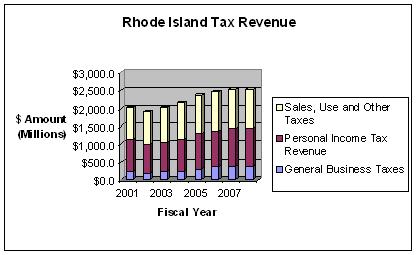
For clarity, I'll break them out by category. First, let's see how much less Rhode Island businesses are paying in taxes:
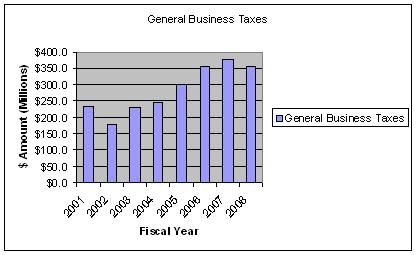
Business tax revenue dipped in 2002 (after 9/11) but had rebounded by 2003/2004. However, it is predicted to dip in 2008, from $376.4 million to $354.9 million. I guess it is around $20 million less...but that certainly bucks the trend that has resulted in about a 50% increase in business tax revenue from 2001 to 2008.
Well, how about Rhode Island taxpayers?
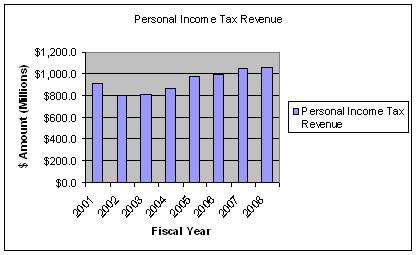
Same sort of trend as the Business tax revenue, though there is no projected "dip" in 2008.
Income tax revenue has continued to climb, increasing by about 30% since 2001. The same trend and percent increase is also true for "other" tax revenue, which climbed from 2001-2005 but have leveled off since then (and that's fine by me!).
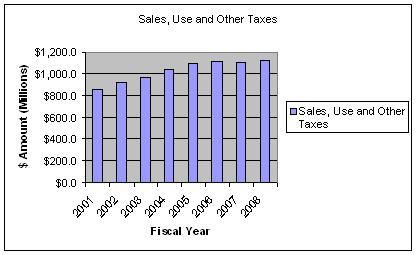
Basically, tax revenue from all sources hasn't gone down (though it will remain essentially the same in both 2007 and 2008). Between 2001 and 2008, it has increased from $2,011.9 to $2,543.6 million (about 26%), but increases in government expenditures have easily outpaced these revenue increases.
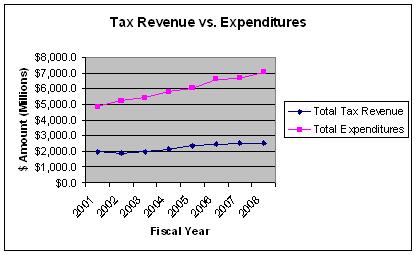
In short, expenditures have gone from $4,839.2 to $7,017 million (about 45%) over the same period.
The horse has been flayed and it's bones turned into meal....but for the millionth time: it's spending, not revenue that is the problem.
All data obtained from the RI State Budget Office web site. Figures for 2001-2005 are actual/audited, for 2006 are revised, for 2007 as enacted in FY budget and 2008 as proposed or projected.
October 14, 2007
Rhode Island Crossword Clue: Common Knowledge, Perhaps. Answer: Our Demise.
Knowledge of the approaching precipice in Rhode Island — or rather, the precipice that Rhode Island is approaching — has moved off the commentary pages in the Providence Journal. Here's Lifebeat section columnist Mark Patinkin today:
"Fascinating, Spock. It seems this planet has organized itself into the perfectly self-destructive organism.""Indeed, sir. As one example, the normal life forms here — taxpayers, they’re called — spent $350 million this year on the state pension system. Next year, it will be $400 million, meaning taxpayers have gone from footing 10 percent of government pension costs in 1999 to 25 percent today. Not to mention that the unfunded pension liability has risen to a preposterous $4.9 billion. But even whisper the words 'pension reform' and you'll be lynched."
"Madness, Mr. Spock. Pure madness. There must be a solution. Can't this planet attract new businesses to expand the tax base?"
"Not likely, Captain. Just last week, an objective tax-research group in Washington ranked Planet Rhode Island dead last in the whole galaxy of 50 planets for business climate."
... "There's got to be a solution. Can't this planet attract more high-net-worth taxpayers?"
"Indeed, the 2 percent of Rhode Islanders who make over $200,000 pay 44 percent of all taxes, but oddly, Captain, they are being chased away. If you start to make a high income here, the state will tax you an unheard of 9.9 percent, not to mention that property taxes are almost the highest in the galaxy. All high-income life forms here are fleeing to planets like Florida, which have lower taxes. And ironically — is that the word, Captain? — such low-tax states have budget surpluses."
"Why doesn't Planet Rhode Island try the same system?"
"Like I said, Captain, it's a strangely illogical place."
And here's Business section columnist Neil Downing:
Higher-income people aren't stupid. They know how much they pay overall in taxes — often 50 percent or more of their individual incomes, especially when federal and state income tax and self-employment taxes are counted.They typically don't hold jobs in government or in nonprofits; they run businesses, creating wealth and jobs and money for charities — and they pay lots and lots of taxes.
That's why we need to keep them here, not in Florida.
Still want to raise taxes even more? Fine. If you're employed in the government or nonprofit sector, maybe it won't matter, at least not right away. But it will in the long run.
And if you're employed in the private sector, you may feel the impact far more quickly.
So while you're reading the usual blather from the usual commentators about taxing the rich, remember that seminar that's coming up in Warwick, and others like it.
Keep an eye on the airport, as well. Flights to Florida are leaving daily. Raise Rhode Island taxes even more, and maybe the owner of your business will be onboard, leaving Rhode Island.
Maybe your job will be leaving Rhode Island, too.
The disheartening, even frightening, question to ponder is how deep the state will have to sink before this knowledge makes the leap to a medium with which even those who don't read the paper are familiar — say, their layoff letters and notifications that their public assistance is being cut.
October 2, 2007
Amgen Shows Economic Diversification is Best
I'm sure I've written something similar to this ProJo editorial before (I know the link is here somewhere....)
What a state like Rhode Island must do to prevent being hammered by the decisions of one company is to focus less on attracting individual firms and sectors and more on creating an overall climate for companies, large and small, already doing business here or considering coming here. That means a solid physical infrastructure, building on the state’s comparative advantages (which the state has disastrously failed to do with its international-port potential), good schools and a tax structure not less attractive to business than neighboring states’. (The paucity of graduates in the Ocean State with the skills needed for high-level 21st Century work is probably the problem most frequently cited by executives of companies in doing business in the state.)Oh, here it is:Ignoring those requirements in favor of headline-grabbing deals with famous, glamorous individual companies and sectors is the road to economic disaster.
Crafting specific, sweetheart deals seem to only work so long as they are in place. Once they expire, off go those who took advantage of them. Instead, we need to follow a holistic plan. The entire business climate needs to change to first attract, and then maintain, new employers. Targeted business tax credits aren't enough. What needs to be done is to lower the tax burden across the board and reduce the red-tape and regulatory roadblocks.Sheesh, if a Sox cap wearing yahoo like me can figure it out, what's taking all of the "smart" people so long?
September 12, 2007
Whither the Don't Knows Will Go
Under the headline "Hiring plans looking up in Providence area":
More than 4 of every 10 Providence-area employers plan to maintain their current staffing, while few plan to cut their payrolls in the fourth quarter, according to the latest Manpower Employment Outlook Survey.The study showed that from next month to December, 43 percent plan to keep the same work force level and 7 percent plan to cut jobs.
About 17 percent of the companies interviewed said they plan to hire more employees in the fourth quarter, while 33 percent said they are not certain of their hiring plans.
I don't want to see Rhode Islanders losing their jobs, and I certainly don't want to talk down the economy any more than participatory realism requires, but the "looking up" phrase seems a little optimistic to me. If 17% of companies plan to hire, while 7% already plan to fire, that's a net increase of 10%. But imagining ourselves in the place of the interviewees, which way are those "uncertain" companies more likely to go? Because all employers would prefer to be hiring (which would mean that they are growing), my guess is that at least a third of that 33% comes from businesses that are hoping that they won't have to lay anybody off.
Whither the Don't Knows Will Go
Under the headline "Hiring plans looking up in Providence area":
More than 4 of every 10 Providence-area employers plan to maintain their current staffing, while few plan to cut their payrolls in the fourth quarter, according to the latest Manpower Employment Outlook Survey.The study showed that from next month to December, 43 percent plan to keep the same work force level and 7 percent plan to cut jobs.
About 17 percent of the companies interviewed said they plan to hire more employees in the fourth quarter, while 33 percent said they are not certain of their hiring plans.
I don't want to see Rhode Islanders losing their jobs, and I certainly don't want to talk down the economy any more than participatory realism requires, but the "looking up" phrase seems a little optimistic to me. If 17% of companies plan to hire, while 7% already plan to fire, that's a net increase of 10%. But imagining ourselves in the place of the interviewees, which way are those "uncertain" companies more likely to go? Because all employers would prefer to be hiring (which would mean that they are growing), my guess is that at least a third of that 33% comes from businesses that are hoping that they won't have to lay anybody off.
A License to License
As an add-on to my recent column about the effects of occupational licensing on competition, I wanted to note an article from Sunday's Projo that doesn't appear to be available online:
Pharmacists, barbers, electricians, elevator mechanics, massage therapists, travel agents, landscape architects, acupuncturists, fire alarm installers, auctioneers. All those occupations, and lots more, are licensed by the State of Rhode Island, according to a report by the Reason Foundation, a libertarian organization in Washington, D.C. According to the study released last month, Rhode Island ranks sixth, tied with Michigan, in the number of occupations it regulates. ...[Adam B. Summers, author of the report,] said one of the chief reasons occupational licensing exists is as a means for interest groups to reduce competition, and keep prices artificially high. "They [licensing laws] are simply a means of utilizing government interests to serve narrow economic interests," he said.
As it happens, during the same time frame that I was writing my column, I spotted the license on the wall of my Main Street barber here in Tiverton, and it struck me, at the time, that it doesn't just limit competition, but is a hidden tax on a particular form of business. It isn't a one-time fee for a piece of paper that a barber (in that case) is qualified; it's a regular source of income for the government. One can almost picture a legislator waiting for a haircut and having an epiphany about an untapped source of revenue.
Oh well. Just one more list on which Rhode Island ranks poorly.
September 5, 2007
Will the Rhode Island Legislature be the Last to Know that RI is in Trouble?
A Projo editorial from Monday, quoting a press release from General Treasurer Frank Caprio, quoting all three major bond rating agencies, serves reminder that the rest of the country understands that Rhode Island's current financial quagmire is occurring at a time when the national economy is booming, increasing the difficulty of investment in RI…
Standard and Poor’s: “While the outlook remains stable, Rhode Island’s use of one-shot revenues to balance operations is growing. The state needs to make measurable progress in better balancing recurring revenues to expenditures; failure to address this concern will pressure the rating.”Add (or subtract, I guess) the big loss in revenue that could result if gambling is expanded in Massachusetts, and it becomes obvious that a fundamental change in the structure of Rhode Island's spending -- a change reducing the total level of spending, not a change that tries to shift the spending burden around -- is necessary very soon to prevent RI from falling into bankruptcy.Fitch Ratings: “The state’s financial position is strained, reflecting weakness in certain key revenue sources....Additional stress or failure to achieve spending restraint goals could result in downward rating pressure.”
Moody’s: “This is the second time in six years that Rhode Island has resorted to deficit bonds to resolve its budget imbalance, underscoring the state’s continuing financial strain at a time when most states are moving toward structurally balanced budgets.”
September 3, 2007
Bring Some Up... Bring More Down
In an attempt to understand the "unusual" something (as Andrew put it) that led to simultaneous drops in Rhode Island's poverty rate and median household income, I've spent some time sifting through the U.S. Census Bureau's recently released data from its annual American Community Survey. The first resulting chart gives a pretty clear indication of the basic dynamic:
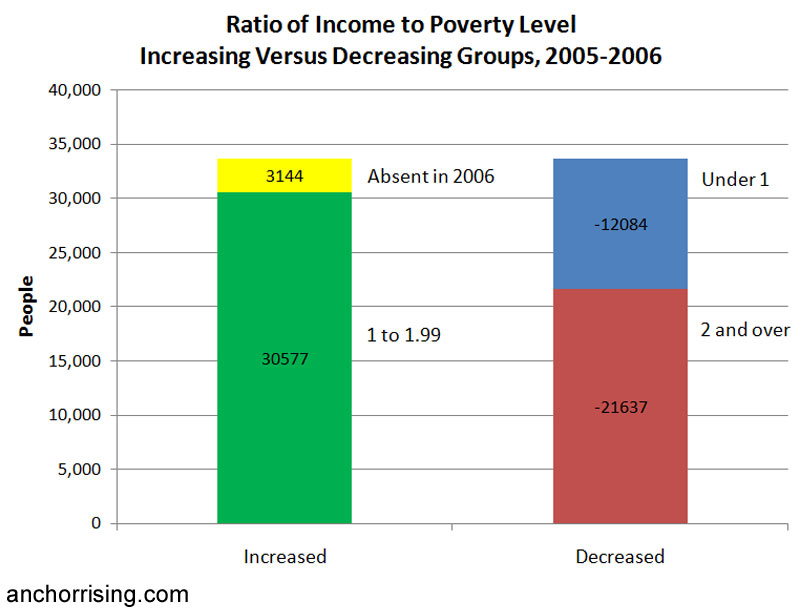
The blue segment of the "Decreased" column shows that, indeed, 12,084 fewer people live in households with income below the relevant poverty level. The unfortunately corresponding fact is that the red segment represents the 21,637 fewer people whose households make over twice the poverty level. And these two drops equate almost exactly with the 3,144 fewer people in the total plus the 30,577 more people with households just over the poverty level. In other words, it would be fair to say (albeit in a rough way) that the economic system that succeeded in pulling a good number of people out of poverty came with the cost of dragging almost twice as many people toward it.
To get a better sense of who, precisely, was gaining and losing in this trade-off, I plotted varying family types (married versus unmarried, with and without children) on line graphs corresponding to their household incomes. Although there were some interesting shifts in the data, from 2005 to 2006, it didn't appear that they crossed the above ratio lines in any significant degree, most being well above twice poverty or well below poverty. One possible reason for that unexpected finding would be if smaller families were doing better, while larger families have fared worse, blurring the movement of individuals as represented in the ratio chart. The way poverty levels work, for example, a divorce in a borderline family could actually result in an on-paper elevation of one spouse and the children. Or a third income, from a working son or daughter, could disappear if he or she no longer counted as a child.
So what's going on under the poverty level?
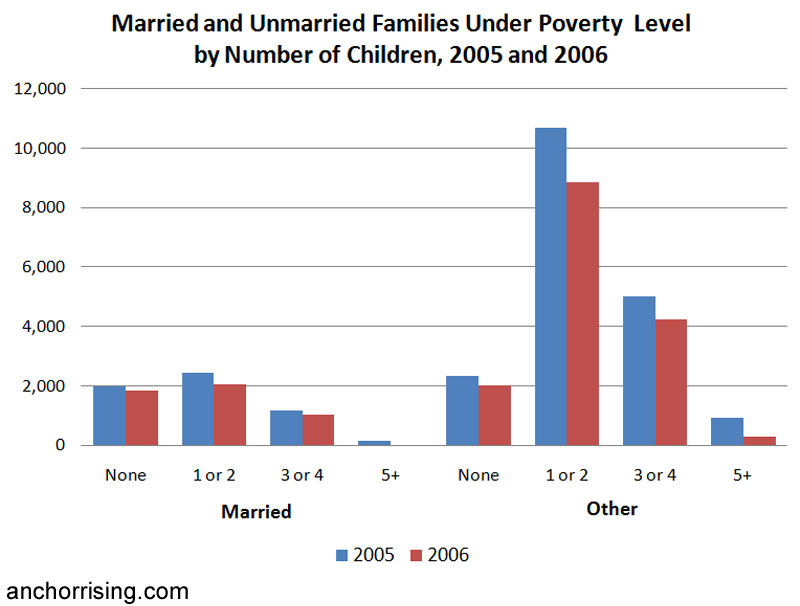
The first thing to note, as I jump into this series of charts, is that it's very difficult to make generalizations. It goes beyond my time (and interest) to attempt to distill, say, retirees from newlyweds or growing families from economically declining ones. The movement of actual families could be all over the place. But in a general way, it's reasonable to observe that the trend was out of poverty for all family types and sizes, but that unmarried families with children did a lot better. Perhaps the married families on this chart have more intransigent problems. Or perhaps unmarried families are having more children (thus rising above poverty... again on paper). Or maybe Rhode Island's welfare system favors the unmarried.
A glance at impoverished families by the number of family members working suggests that the trends might be healthy. (I'd count it as unhealthy, for example, if the number of families under poverty with low numbers of workers were increasing.)
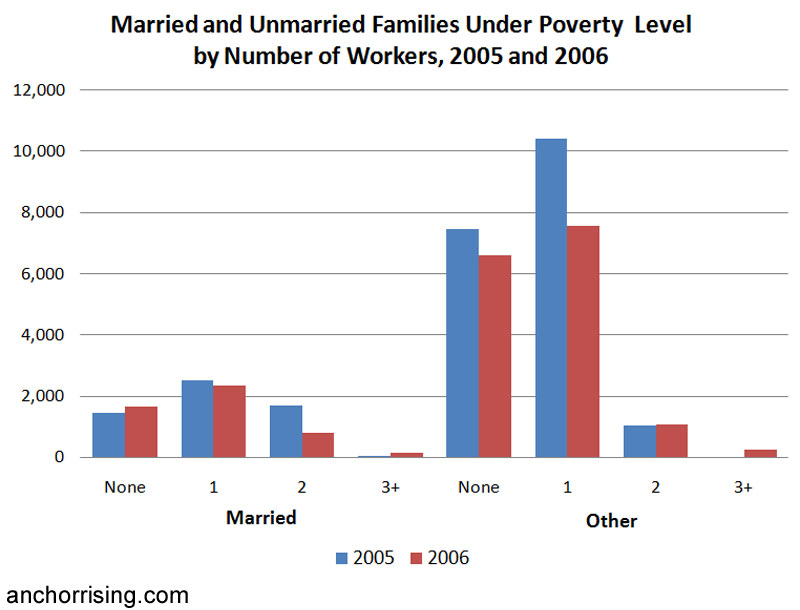
Now, what about over the poverty level?

It's difficult to make generalizations about this data, although there's certainly nothing to disprove theories crediting our aging population for the shifts in income distribution. The increases in married couples with no children and with three or more, along with the slight decrease in married families with one or two children, would be consistent with older couples and growing families. I'd note, however, that the largest increase was among unmarried families (which includes cohabitors and single parents) with one or two children. That would be consistent with the trend of poverty-level divorces that I noted, or perhaps with increasing generosity to non-nuclear families.
As for workers:

Of these four mildly helpful charts, this offers the most food for thought (or further research). For one thing, the increase in married families with one worker suggests that more families might be living on one income, as the price of childcare makes a second income less attractive. On the whole, I'd take that as a positive development. On the other side of the ledger, though, it's discouraging to the taxpayer to find that there are actually more unmarried families with no workers on this chart.
But having gone through the trouble to research this data and feeling unsatisfied at having only meager grounds for general hypothesizing, I thought to mix my two types of data:

A bit more can be said of this. Note that, when broken out by families, rather than people, more have risen out of poverty than fallen closer to it. It may be that smaller families are improving while larger ones are sinking after all. It's downright disconcerting that married families with children fell out of the top group at the greatest rate, while unmarried families with children slid into it at the greatest rate.
Lest anybody with social views different than mine protests that I'm making too much of this mere transition, a more granular representation of the data from the first chart of this post illustrates that it is not an even trade:
What this shows is that the change at the edges is more drastic than pictured above. We're not, in other words, merely talking working class people slipping past an arbitrary 2 x poverty line to help the poor slip above a less arbitrary poverty line. We're talking about a much more precipitous drop among those above what might be thought of as a comfort line. Believe me that I deal with enough very wealthy people to know how that previous sentence sounds, but we're not talking the ultrarich, here. We're talking about a family of four (two children) that earns around $60,000–100,000 per year.
If one were to form a prognosis from this information, I can't see that it matters much whether "comfortable" families have plummeting resources, divorces are splitting incomes, or some other cause is to blame. This is the range of income in which families move from just getting by, with some hope of a reasonable retirement, to having enough money to put it to good use in the economy. It's also a key range in the collection of the taxes that weave the tenuous safety net helping those toward the bottom, and although I'm making a guess based purely on personal experience, it likely lies around some sort of threshold at which it becomes relatively easy to pack up and leave.
August 29, 2007
Incoherent Indicators
Poverty appears to be down, both in the United States as a whole, and in Rhode Island in particular. According to the annual figures released this week by the Census Bureau, the national poverty rate fell from 12.6% to 12.3% and the Rhode Island poverty rate fell from to 12.1% to 10.5% between 2005 and 2006. The good news is that Rhode Island has ended its four-year streak of poverty levels greater than 90% of the national rate. The bad news is that Rhode Island's relative poverty rate still hasn't dropped below the level it was at just before the beginning of welfare reform in 1996…
| Year | US Poverty Rate | RI Poverty Rate | RI Rate as Pct of US Rate |
| 1993 | 15.1% | 11.2% | 74.2% |
| 1994 | 14.5% | 10.3% | 71.0% |
| 1995 | 13.8% | 10.6% | 76.8% |
| 1996 | 13.7% | 11.0% | 80.3% |
| 1997 | 13.3% | 12.7% | 95.5% |
| 1998 | 12.7% | 11.6% | 91.3% |
| 1999 | 11.9% | 10.0% | 84.0% |
| 2000 | 11.3% | 10.2% | 90.3% |
| 2001 | 11.7% | 9.6% | 82.1% |
| 2002 | 12.1% | 11.0% | 90.9% |
| 2003 | 12.5% | 11.5% | 92.0% |
| 2004 | 12.7% | 11.5% | 90.6% |
| 2005 | 12.6% | 12.1% | 96.0% |
| 2006 | 12.3% | 10.5% | 85.0% |
(Interestingly, there was a corresponding spike in the Massachusetts poverty rate, from 10.1% to 12.0% while the RI rate was dropping. Maybe we should ask Jon Keller for his thoughts on this).
A second piece of bad news is that Rhode Island's one-year decline in poverty rate was accompanied by a one-year decline in median income -- the second largest decline observed in the data…
| State | Median Income, 2006 | Change from 2005 |
|
| 1. | Delaware | $52,833 | -$1,574 |
| 2. | Rhode Island | $51,814 | -$1,068 |
| 3. | Maine | $43,439 | -$700 |
| 4. | Iowa | $44,491 | -$495 |
| 5. | Missouri | $42,841 | -$469 |
| 6. | Colorado | $52,015 | -$260 |
| 7. | Michigan | $47,182 | -$251 |
| 8. | Ohio | $44,532 | -$235 |
| 9. | North Dakota | $41,919 | -$168 |
| 10. | Georgia | $46,832 | -$118 |
| 11. | Wyoming | $47,423 | -$90 |
The other 39 states saw their median incomes increase between 2005 and 2006. (Kansas, incidentally, had a median income increase [+$1,133] that was larger than RI's decline, showing that there's really nothing the matter with Kansas -- nor with the 14 states that did better than Kansas in the rankings!)
For both of these metrics, there is a danger of inferring too much from single-year numbers, but a simultaneous, dramatic drop in both poverty rate and median income suggests something unusual. Whether the strangeness is methodological or a real effect is yet to be determined.
July 31, 2007
On Value and Ownership
House/building painting isn't a very difficult job. I don't say this disparagingly; working in construction, I'm certainly aware of aspects of the professional painter's job that require skill and patience that I myself often lack (or have little interest in developing). That painting tasks exist for which one is well advised to hire an experienced professional, however, does not mean that a particular job requires workers who obsess over the bristles in their brushes.
So there's a simple answer and an extending tangent to BAM's comment to my most recent post:
Are you implying that the market rate for painters (non-union? union?) is $7.40 per hour? I would suggest to you that this young woman and young man are, in fact, being cheated by the Little Compton School Committee.
In one sense, this is a prima facie matter: The fact that two adults, acting of their own free will and presumably not based on a life-or-death incentive, have accepted the terms shows that $7.40 is indeed the market rate for this particular job. Professional painters who can expertly patch drywall, glaze windows, and clear-finish fine carpentry work can surely command more, but as it happens, those skills weren't necessary for the work available in Little Compton.
It requires a level of abstraction to see Stephanie and Corey as "being cheated," because if the school committee were to offer the job for substantially more — the union's doubled rate, for example — then it would be much less likely that the young adults would have gotten the job in the first place. As is often the case, the folks at the bottom compose one group that is harmed by the urge to dictate terms to the free market, because such dictation extends its benefits up the payscale. The person who would be more qualified to take a simple painting job at $14 per hour would not have to take work more suited to his abilities, and so on up the line, ultimately costing society productivity and resources that it ought to have achieved.
That chain leads to the other group harmed by the rejection of the free market — the consumer — and to BAM's subsequent thought:
As to who "owns" the job, that's a legal question that neither you nor I have enough knowledge to address. I'm not a lawyer, and neither are you.
I'm not sure why one would need a law degree to address questions of job ownership. Even if painting were in the union's contract, it could scarcely claim ownership. Could the union declare that the work does not exist and will not be done? Could it create new similar work on its own authority? Creation and nullification are the markers of ownership and rest entirely with the school, in this case.
If it is not so, then the public consumers — the taxpayers — have all the more reason to ensure that the self-interested unions, claiming to be owners of their own patronage at others' expense, are extricated from the equation.
July 29, 2007
Lopping Off the Competition Camel's Nose
Suppose you had a variety of tasks, none of them highly specialized, for which you wished to hire workers. Of the several people whom you interview, one declares that he can do everything himself, provided you sign a contract to that effect. Now, do you expect him to offer an hourly rate that is:
- Substantially less than,
- About the same as,
- Roughly double the market rate for each job individually?
I ask, because it looks as though, in its relationship with the local educational support personnel segment of the NEA, the Little Compton School Committee may have chosen C:
The two [non-union] summer painters, Stephanie Chapman, 21, of Warren, and Corey Leite, 18, of Tiverton started work July 2 and have since been painting parts of the school building, outside and inside. They are being paid $7.40 per hour for 30 hours weekly, working from 8 a.m. to 2 p.m. for seven weeks of work until August 18, for a combined total of $3,108.The union has asked the labor board to order that the school cease and desist its employment of Ms. Chapman and Mr. Leite, and instead post and fill the positions with bargaining unit employees at the union pay scale rate of pay, $14.73 to $15.58 per hour (reported figures differ), which for the seven weeks would amount to between $6,186 and $6,543.
Jane Argentieri, who filed the complaint, is assistant executive director of the National Educational Association Rhode Island/National Education Association (NEARI/NEA), the parent organization for Little Compton Local #862 that represents the approximately 20 educational support personnel in the local school bargaining unit.
Ms. Argentieri said the two positions should have been posted first to members of the union, who would be hired on the basis of their seniority if any of them wanted the work. The work belongs to the union. Only if no one "inside" wanted the work could the positions go to "outsiders."
Inside, outside... "the work belongs to the union." With an eye toward charity, the union may conceivably be imparting a tough-love lesson to Stephanie, who just received a degree in psychology from Roger Williams, and Corey, who just acquired a trade school GED: Get out of the state now if you want to have a future. Don't take a quiet summer of symbolic school painting to figure out what steps to take at this critical juncture in your life. Leave. All the work is owned 'round here.
The message for the school committee is more of a warning. According to the fantastically named Sakonnet Times reporter Tom Killin Dalglish, the latest Collective Bargaining Agreement with the union says nothing at all about painters or painting. And although it does spell out a "grievance procedure" to resolve alleged violations of the contract, "for reasons not explained the grievance procedure was not utilized in this case." Surely the committee is capable of doing the math necessary to understand the "reasons" — and the message:
- $6,186–6,543 to hire two workers who will keep the union happy, or
- $3,108 to hire two young Rhode Islanders trying to get a jump on their adult lives, plus the services of the school's $135-an-hour lawyer
We own the work. How far yous want to take this?
From the Rhode Island taxpayer's point of view, the mystery is what benefit this sort of extortionary relationship provides to the school. Ours is not, however, a point of view that is commonly considered in these matters, and one gets the sense that politicians and administrators sold that soul long ago. The question that ought to concern union officials — before they go rendering our college-aged sons and daughters unemployed for the summer — is whether there's a threshold at which we'll come to claim the soulless body.
July 20, 2007
State of the Rhode Island Economy
RI Report has compiled the most recent information on the overall economic picture in Rhode Island, including an update on Governor Donald Carcieri’s much publicized campaign promise to create 20,000 new jobs…
Governor Carcieri declared victory on his pledge to add an additional 20,000 new jobs to the Rhode Island economy yesterday.…and a link to a Providence Business News article on URI Professor Leonard Lardaro’s latest economic forecast for the state Rhode Island…Citing the monthly jobs report released yesterday by the state Department of Labor & Training (DLT) Carcieri said that there is now a record-high level of jobs in the Ocean State.
The report from the DLT on the state's employment figures showed 499,100 jobs in Rhode Island last month -- a record number of jobs for the state. This figure represents 800 new jobs from the previous month, 3,200 new jobs since the beginning of the year, and 5,400 new jobs added in the past 12 months.
According to statistics compiled by the DLT, since more than 20,000 new jobs have been created in Rhode Island since Carcieri took office in January 2003.
The Ocean State’s health took a U-turn for the better in May, according to University of Rhode Island economist Leonard Lardaro. His Current Conditions Index registered 67 in May, a large increase from April’s 42 and well above the 33 reading in May 2006 (a reading of 50 is considered neutral)....UPDATE:The unemployment rate in May fell to 4.8 percent when compared with May 2006, even as the labor force grew 0.2 percent - May's rate, however, was higher than April's 4.5-percent unemployment. Retail sales showed the highest level of activity since December, while consumer confidence rebounded from three months of declines....
If there were a cloud on the horizon, it was the fact that unemployment benefit exhaustions increased by 9.3 percent, indicating that there was significant long-term unemployment, while new claims for unemployment insurance, which measures layoffs, increase 3.9 percent.
According to Ian Donnis of the Providence Phoenix's Not for Nothin' Blog, Steve Laffey, possible Republican candidate for Governor in 2010, is also concerned about the long-term trends affecting Rhode Island's economy...
The high-profile former mayor predicted that Rhode Island will be in worse economic shape in 2009 than when he assumed the reins in Cranston. While the Carcieri administration touts new job-creation numbers, Laffey points to an outflow of RI residents and says the state economy is deeply troubled.When I followed up on this remark, asking why the Republican governors who have mostly held office for the last 20 years haven't been able, even with the Democrat-controlled General Assembly, to implement a different economic program, Laffey agreed that responsibility has to go to the chief executive. He declined to assign a letter grade to Carcieri's performance, but said the governor introduced a "bad" budget that was made worse by legislative Democrats.
May 31, 2007
Revised Airport Expansion Plan on the Table
From Matt Bower of the Warwick Daily Times…
The airport corporation yesterday voted to study a plan that would expand the runway from its current 7,166 feet to 8,700 feet - a reduction from the 9,350 listed in previous proposals. That's under a modified version of the plan known as "Option B" - one of five plans that had originally been under consideration.…and Cynthia Needham of the Projo…Still on the table is the original Option B, which would take the runway to the full 9,350 feet. The airport corporation also hasn't ruled out calling off runway expansion entirely. No other options are currently being considered.
If the airport corporation decides to go with the 8,700 foot extension, it would save $69 million on the overall program, $68 million in relocating Airport Road, Lurie said. Only 152 homes would be acquired, nearly cutting that acquisition in half. Commercial acquisitions would stay nearly the same, with 71 being acquired. The number of additional passengers would drop to 5.9 million, with 91 percent of the demand for nonstop flights to the West Coast being fulfilled.
There 8,700 foot extension and the 8,300 foot extension plans are similar - but only 79 percent of the demand for nonstop flights to the West Coast would be met, Lurie said. The number of additional passengers and commercial acquisitions would largely stay the same, and there would be 19 fewer homes acquired. The airport corporation opted not to pay for a plan to study the 8,300 foot extension option.
The scaled-back, 8,700-foot proposal would extend the runway to the south of the airport -- to avoid significant impact on the wetlands [to the north of the airport]. But instead of burying Main Avenue to create space for federally mandated safety zones at the runway’s edge, this plan calls for a graded runway, essentially, a runway that slopes up, so planes take off well above street level. It’s a creative way of adhering to federal safety codes, while fitting runways into congested areas. FAA officials cited several other airports in the United States with similarly constructed runways.The state Airport Corporation voted last night to spend $500,000 to study the shorter expansion option. That analysis is expected to be completed in the fall.
The FAA says 8,700 feet is long enough to accommodate about 91 percent of planes that travel nonstop to the West Coast, including the Boeing 737-500 series, considered “the workhorse” of the industry and a preferred model for airline giants such as Southwest and United. Anything shorter than 8,700 feet would prevent that fleet from making the nonstop coast-to-coast trip, said Airport Corporation President Mark Brewer.
The second plan still under consideration is the sole remaining 9,350 proposal. That option calls for lengthening the runway to the north of the airport, thus relocating Airport Road and scooping up many houses in the Spring Green neighborhood. It also significantly impacts the Buckeye Brook.
May 23, 2007
Airport Expansion Update
Warwick Mayor Scott Avedisian is dissatisfied with the Green Airport runway expansion evaluation and planning process. From Matt Bower of the Warwick Daily Times…
After reviewing the recent Environmental Impact Statement on the expansion of T.F. Green Airport, Mayor Scott Avedisian said he is not happy with the study.…and John Howell of the Warwick Beacon…
Avedisian yesterday announced that the city has submitted a 73-page response to the Federal Aviation Administration (FAA) concerning the impact study, stating the city considers the study "incomplete and in need of improvement in data collection, independent narrative and comprehensive threshold assessment."The city's response faults "the methodology used to determine the environmental, health, noise and air quality, traffic and community impacts" expansion would have….
Avedisian said the city strongly objects to the assessment that 350 families that would be forced out of their homes would easily find affordable housing elsewhere in the city, and questions the stated economic benefits brought on by expansion.
"There's nothing left here that's affordable and comparable. They can move lines around a map all they want, but to us those aren't lines, they're people," he said. "I don't believe it's rational or reasonable to assume that 350 displaced families will be able to find another place to live [in the city]."
The public will get a closer look at the environmental consequences of five alternative plans to extend Green Airport’s main runway June 14 at a meeting held by the Federal Aviation Administration at the Crowne Plaza Hotel. Originally scheduled for 6:30, a presentation will start at 5:30 so as to accommodate Mayor Scott Avedisian….According to a FAA press release, the agency and the consultants, Vanasse Hangen Bruslin, Inc. now have enough information to evaluate the environmental impacts and the feasibility of the five options, all calling for a 9,350-foot runway. Also, according to the release, the FAA has “worked closely with the federal and state agencies and the City of Warwick in preparing and reviewing the findings of the preliminary environmental impact analysis.”“Working closely,” is not how Avedisian sees it. He said last week that the scheduling of the meeting came as a surprise, which, he added, should indicate how closely the FAA and the city have been working.
Peters apologized for lack of communication over the scheduling of the meeting, adding that both the FAA and VHB have kept city principal planner William DePasquale informed throughout the process....
Avedisian finds fault with the study in that it rationalizes that existing conditions are already degraded and any additional impacts would not be significant. He says that process “does not properly recognize the cumulative effects on the community”…. He says the city “demands, and deserves, a more comprehensive assessment of the existing and long term health, social and environmental impacts on our community beyond bare-minimum analysis.”
April 9, 2007
Same Old Story...
The new RI Report website juxtaposes the release of the Tax Foundation's report showing Rhode Island's tax-burden to be fourth highest in the nation with census bureau data showing population in the Providence-New Bedford metro area to have declined since 2004, implicitly implying a connection. Actually, there's one other factor needed to complete the chain. When taxes are high and the quality of services they pay for is low, then people have great incentive to leave and resettle in a part of the country where they can pay less to receive more.
Here's a concrete example -- literally -- of the collapsed state of public services in Rhode Island. According to the Federal Department of Transportation, the percentage of RI bridges that are "functionally obsolete or structurally deficient" is one of the highest in the nation. What level of fiscal mismanagement does it take to push the state with the fourth highest tax-burden AND the smallest geographic footprint to near-last place in bridge quality? Where does all the tax money go?
March 14, 2007
Airport Expansion: Impacting Real People and Real Communities
I've taken a bit of flack, including a charge that I've lost credibility on economic development issues, over my last post discussing the impact of the T.F. Greene airport expansion proposals (more on it here, here). In it, I took ProJo columnist Ed Achorn to task because I thought that (to quote from a follow-up comment of my own) his "comment implied that this was only a mere runway expansion and that a bureaucracy or insiders or whatever were holding it up. In truth, it's real people who value their quality of life. If they lose the argument, well, so be it. But for Achorn to so cavalierly dismiss them rankled me."
According to some expansion proponents, it's apparently either all or nothing. Your either for economic development or your against it. It's all black and white, you see. And if all you see when looking at airport expansion is dollar signs being put into the state's economy, I would imagine that it is black and white. Especially if you or your community is not affected.
The most aggressive of the proposals put forward so far seem to be too hard on the City of Warwick. {Update: thanks for the map, Andrew. Here are maps of the actual proposals--MAC}. Others, while less detrimental to the city, may not result in sufficient economic growth to justify a smaller expansion. What if the best course is to stand pat? These are the questions that I and many other Warwick residents want to have answered before a decision is made.
While it may be an economic boon to the State, the City of Warwick isn't so lucky. Losing 200-350 homes worth of property taxes (that the State isn't obligated to compensate) while at the same time picking up a net gain in infrastructure costs (water and sewer, trash collection, roads, etc) doesn't bode well for the pocketbooks of those who choose to reside in Warwick. There are also aesthetic changes that will occur, like increased pollution, the loss of wetlands, noise, extension of fenced-off airport property. I know, not very "conservative" of me to bring up some of this stuff, is it? Apparently, it's not very "progressive" of me either.
Look, I know the arguments. The airport has been there forever, so people who live or move to Warwick should have known that expansion was a possibility. They should have known that the State was thinking about planting LAX in the middle of an 80,000 person suburb. If it is really so bad, then current Warwick residents could just move. Besides, the State will pay them good money for their homes and they'll move elsewhere and everything will be fine. They should just get over it and move on. That about sums it up, right?
I guess that, for some people, it is easy to simply pick up and leave a community in which they've either lived their whole lives or have put down roots and made new friends and joined community organizations. Perhaps this is because no one worries about maintaining a "community" anymore. Not really. Pat of this may be because fewer people join community organizations or associations for the sake of making things better. The result is that fewer people have a real stake in the community in which they reside.
Thus, we can all just live in our McMansions and not talk to our neighbors (unless we need something), so one house is as good as any other and one neighbor is just as nondescript as another. As for the kids, well, they can make new friends in a new school--they're all the same. But for some people, it's a lot harder to just write off all of that time and money they've spent trying to help and better their community. And if that is what ultimately happens, there's a good chance that they will move on to the next city or town, but newly jaded and less likely to lend a hand. In today's throw-away society, I fear that we're also throwing away the already dying sense of community, too.
Despite the apparent conventional wisdom, conservatives--me included--don't necessarily privilege economic concerns over less measurable, and thus more aesthetic, factors, such as the quality of life in a community. Perhaps I'm falling prey to a predisposition that romanticizes the idea of a community. Yet, if so, it is rooted in my own experience. A real community is built on personal relationships, of groups of people joining together to make their neighborhoods--and the city or town as a whole--a better place for their families. That includes supporting such things as economic development, which can help to ease the tax burden on families, which, in turn, will allow them to devote more time (and money) to their families and communities. Yet, the by-products of economic development can also have a negative impact.
I support airport expansion, but only if it is done with forethought and with the goal of achieving the best cost/benefit ratio (and that means more than just dollars) possible. To bring up very real concerns about the burden that a particular community will bear so that the State as a whole may benefit--to ensure that any negative impact is either acceptable or manageable--is both fundamentally conservative and economically smart. The discussion going on now in Warwick is over where, exactly, is the point at which the economic benefits of economic development begin to be outweighed by the negative impact that will be felt by the city. As this discussion continues, it's not too much to ask that Warwick residents receive at least a little forbearance from their fellow Rhode Islanders. After all, it is they who are being asked to sacrifice a portion of their community--both property and personal relationships--so that the rest of the State can become more prosperous.
Pre: Airport Expansion
To help understand the options being considered for an airport runway extension, here is a link to a map of T.F Green Airport and the surrounding neighborhoods, courtesy of Mapquest.
March 13, 2007
Greene Plans Involve More than "Mere" Runway Expansion
In an otherwise good piece explaining the reason why Mississippi just got a new Toyota car plant and Rhode Island did not, ProJo columnist Ed Achorn writes:
Its culture of NIMBYism (Not In My Backyard) is so bad that the state must engage in a prolonged struggle merely to extend the main runway at the airport, a crucial engine of business.Well, that airport is in MY backyard (though my home isn't in any danger) and, as the ProJo reported on Saturday, the plans involve a lot more than "merely...extend[ing] the main runway."
If the main runway at T.F. Green Airport is expanded, it will swallow at least 204 houses, up to 53 businesses and dozens of acres of wetlands, according to a draft summary of a Federal Aviation Administration report released yesterday, examining the consequences of expansion.Believe me, I realize that there are long-term economic benefits to be had by expanding the airport, but at what price? The airport already bisects Warwick and most of the proposed plans would only make it worse, which would be detrimental to the quality of life in the community--my community--as a whole.Expansion would also increase noise pollution and cut the city’s tax base by as much as $2.2 million a year. On the flip side, it is predicted to generate $138 million in business revenue within the next 13 years...
Depending on which, if any, option is ultimately selected, the draft summary shows the following:
•204 to 339 houses would be taken
•10 to 32 acres of wetlands would be taken
•6 to 53 businesses would be displaced
•36 to 60 houses would experience such an increase in the level of noise that they would become eligible for a volunteer land-acquisition program
The FAA has not ranked any one alternative above another, saying it does not plan to choose a preferred scenario until the summer.
But the release of the consequences summary yesterday signals the beginning of what is expected to be a protracted battle between expansion critics — many of them at the city level — and the FAA.
“No matter what you do, there will be adverse effects,” Mayor Scott Avedisian said. “All the options will encroach on different parts of the city.”
Warwick’s principal planner was more forthright. “Whatever alternative you look at, you are devastating either neighborhoods and family homes, or destroying wetlands,” said William J. DePasquale. “It seems like the impact of all this expansion is disproportionately set on the community.”
City officials say they’ve known for years what expansion would do to their community. They expressed frustration yesterday that the FAA is only now recognizing those impacts.
Yes, I know that (to paraphrase) the needs of the many outweigh the needs of the few or the one, but here is the fundamental problem: why is the State hellbent-for-leather on putting an international-quality airport in the middle of a suburban community? The fact that the State chose to develop it's major airport there in the first place belies Rhode Island's historical penchant for having a lack of foresight. Unfortunately, at this time, there is really no other plausible choice for making it possible for Coast-to-Coast or international flights via Rhode Island. (Quonset, for instance, has it's own problems and I don't see any way that our cash-strapped State could possibly build a new airport).
At the very least, the citizen's of Warwick deserve a chance to weigh-in on the plan they favor the most (see the extended entry) should this inevitable "march of progress" proceed. If the State is insistent on expanding the runway, then they are stuck dealing with a community that is wary of losing even more of it's identity via what amounts to a large scale exercise of eminent domain. How would Achorn respond if the same thing was happening in his town?
March 6, 2007
CRIP's Proposal to Close the Rhode Island Budget Deficit
Here’s the package of tax-increases proposed by the “Campaign for Rhode Island Priorities” for closing the state budget deficit…
Some comments, in no particular order…
- Stop the elimination of the 5% capital gains tax scheduled for 2008. Massachusetts, which eliminated its own capital gains tax suffered so badly, and fell so far behind in meeting the needs of its people, it rescinded the law and now tax long-term gains at 5.3%.
- Close abusive corporate tax loopholes.
- Broaden the sales tax to reflect our changed economy by taxing selected services such as golf, marina and fitness memberships.
- Eliminate sales tax exemptions for luxury items like private aircraft.
- Freeze the alternative flat tax – an entitlement benefiting only 13,119 of the wealthiest Rhode Islanders. When fully phased in, the flat tax will cost Rhode Island as much as $73 million!
- Place a moratorium on ‘06 tax legislation that artificially limits the ability of cities and towns to meet their own needs – in the face of stagnant state support to cities and towns for education
- Impose a tax on the capital gains from short-term land sales. This legislation exempts owner-occupied homes but targets short-term investors that flip properties for large profits, driving property rates and rents out of reach for many Rhode Islanders.
- Implement ‘06 legislation that sets up a state office of revenue policy analysis.
- The overall philosophy of proposing nothing but tax-increases to balance the budget is flawed. It says Rhode Island taxpayers should accept paying more to receive the same failing education system and social welfare programs they always have. RI has already fallen behind in “meeting the needs of its people”. Pouring money into the same fiscally irresponsible and failing programs won’t fix the problem.
- The description of Governor Carcieri’s proposed education increases as "stagnant" tells you where the priorities of this group really are. The Governor has proposed a 3% increase in education aid to all cities and towns. That’s only stagnant if you believe that the smaller cities and towns should be slow-bled of their resources, so that the urban core can get a bigger percentage of state subsidies each year.
- On a related note, the call to lift the local property tax caps is code for demanding that the smaller cities and towns raise their property taxes so that more state money generated from sales and incomes taxes will be available for transfer to the urban core. Someone remind me what the towns get out of this deal?
- I don't know much about capital gains tax-policy, but I’m not sure there as much logic behind the capital gains tax proposals as there is visceral hostility to the concept of profit. I'm assuming the short-term land sales tax would apply to cases where someone buys a property, improves it value, and then sells it without ever moving in. Isn't that a good thing, in terms of the property-tax revenue from the improved property eventually captured by the city or town -- and in terms of the quality of life in the neighborhood where the property is improved? Isn't CRIP basically saying they want to keep property taxes low by keeping property values low by discouraging the improvement of substandard housing? Is there anyone familiar with the ins and out of capital gains who'd like to chime in on this (and/or the long-term capital gains proposal in the CRIP plan)?
- Finally, it would be nice if CRIP could add some numbers on how much revenue they expect each of these proposals to generate.
Starve the Budget Beast
To no one's surprise, the various "advocates" who have taken up permanent residence at the State House pleaded with lawmakers to accept their solution to the budget shortfall: either raise taxes or stop any scheduled tax cuts:
Freeze the so-called “tax-cut-for-the- rich” in its tracks before state government loses tens of millions of dollars.Ahhh yes, nothing like pulling the good ol' class warfare card. Unfortunately, it seems like--this time at least--the House rules have changed and that trump card has been devalued:Halt the phaseout of the capital gains tax before the state loses millions more.
And then extend the state’s sales tax to “luxury items,” such as airplanes; boat moorings; fitness, golf and country-club memberships; medical and legal services and any single article of food or clothing that costs more than $150. And slap a new tax on land speculators who make big money buying and quickly reselling real estate at inflated prices.
But the notion of raising taxes to plug a projected $354-million revenue-spending gap this year and next drew a cool reception from key Democratic lawmakers interviewed after yesterday’s news conference — and outright opposition from Republican Carcieri.The "advocates" are all about short-term thinking. They want "their" money--including an already-spent annual increase, of course--and they want it now, to heck with the long-term repercussions. For their part, it appears as if some State House Democrats are finally looking beyond meeting the short-term needs of one of their valuable constituencies. For his part, the Governor would not budge:House Majority Leader Gordon D. Fox was non-committal, saying: “I recognize the need for long-term planning regarding budgetary matters. However, I will refrain from commenting on the specific proposals that were raised today because they all have to be viewed in the context of the overall state budget.”
House Finance Chairman Steven M. Costantino said he would consider proposals for reining in the state’s expensive historic tax-credit program, but would not look favorably on any proposal to halt the long-promised capital gains tax phase-out or revoke the new opportunity lawmakers gave the state’s wealthiest taxpayers last year to reduce their income taxes by paying an alternative flat tax...
The tax cut was not linked — as its predecessors had been — to the creation of a specific number of new jobs. But it was pitched to lawmakers — and enthusiastically embraced by House Democratic leaders — as a way to both keep and bring “major decision-makers” to Rhode Island who would produce jobs.
Given how concerned the legislature remains about jobs, Costantino, D-Providence, said he would be “afraid to touch that right now.”
A statement issued late yesterday by [the Governor's] office said: “Fundamentally, Governor Carcieri believes we must cut spending so we can cut taxes. By contrast, this group’s only answer is to increase Rhode Island taxes so we can also continue to increase state spending. Unfortunately, the ‘Coalition to Raise Your Taxes’ continues to cling to the mistaken belief that we can tax and spend our way to good fiscal health.”According to the story, written by the ProJo's Katherine Gregg, the coalition "also proposed lifting the newly lowered cap on how much the cities and towns can raise their own taxes each year." But, as Gregg pointed out, "That too promised to be a hard sell." Indeed:“Like every Rhode Island family,” spokesman Jeff Neal said, “state government must begin to live within its means. A family cannot increase its spending by 8 or 9 percent each year if their household income is only going up by 4 or 5 percent. Similarly, state government cannot continue to increase spending by 8 or 9 percent a year if our underlying revenues are only growing by 4 or 5 percent a year.”
The state is firmly committed to enforcing the new 5.25-percent tax levy cap, but also acknowledges that some details have not been worked out. Senate Majority Leader M. Teresa Paiva Weed, one of the key sponsors of the tax cap, which passed last summer, called the tax relief act a work in progress and stressed that the state is committed to helping municipalities work through all their questions.Perhaps the General Assembly has finally realized that they have to rein in the spending. One way to do this is by implementing laws that force they and others to do so. The property tax ceiling will be felt on the municipal level, for sure, and there seem to be some valid concerns regarding the acute issue of education spending. But, that aside, the limit on how much property taxes can increase will help limit the growth of local government. But it will take more than just starving these budgetary bear cubs. Rhode Island needs to starve the she-bear, too. Hopefully, the legislature agrees: it's time to starve the Beast. To do so, they need to follow the advice of McGee-Cienki and get "to the root of why taxes have continued to go up." Here's a hint: payroll.Despite that assurance, many local officials were left shaking their heads yesterday. They cited the burden of the new levy cap and said they think it was implemented too quickly and without addressing state aid to education and other key factors that affect municipal spending.
“Were my questions answered? No,” said Suzanne McGee-Cienki, chairwoman of the East Greenwich School Committee. “I applaud the state effort to try to control property taxes, which have increased so significantly, but I question as to whether they’ve really gotten to the root of why taxes have continued to go up, and I also don’t think that they studied all the implications the cap will have on school departments and communities.”
February 26, 2007
An Economic Development Project Acceptable to Rhode Island?
In the Providence Phoenix from two weeks ago, Ian Donnis quoted University of Rhode Island Political Science Chairwoman Maureen Moakley on Rhode Island’s tendency to reject development of all sorts…
For too long, Moakley believes, there has been a lack of vision and an excess of parochialism on economic development: “We don’t want a port, we don’t want a casino, we don’t want LNG in our backyard, or an airport runway extension,” she says, paraphrasing opponents. “If you look at Boston, and if you look at New York, how can you expect to develop sophisticated economic structures in a global environment under those kinds of restrictions? If we want to remain a pretty backwater, those are the consequences.”How about this for an economic development project that everyone can get behind: a destination rail yard that would receive ethanol shipments from the Midwest. According to the Sioux City Journal, such a project is being considered for Rhode Island…
In eight years [Union Pacific] has seen a 515 percent growth rate in the ethanol area. The railroad's investment is an effort to make this expanding business efficient, largely through use of unit-trains of 75 or more cars of ethanol and/or distillers' dry grain from and to the same locations, with no car switching en route.The Wall Street Journal has more detail on the link between railroads and ethanol…While the UP trackage is mostly west of the Mississippi River, it does serve Chicago, where many grain trains are switched to other railroads such as the CSX and Norfolk & Southern, for destinations on the East Coast. Those facilities are currently located in New York and New Jersey, with a UP yard in Dallas, Texas. New destination yards are planned for California, Maryland, Rhode Island and Florida…
Unlike gasoline, natural gas and oil, ethanol attracts water and other chemicals, so it can't be sent through the long-established pipelines that move those fuels. That means the ethanol industry has been forced into a marriage with the already groaning railroads....As of data retrieved today from the National Ethanol Vehicle Coalition, there is presently only a single ethanol filling station in the six New England States (Burke Oil in Chelsea, Massachusetts). The lack of ethanol pumps is at least partly the result of the lack infrastructure needed to transport ethanol here. (You know that Vermont would be all over ethanol, because of its reduced greenhouse emissions, if it was easily avialable, right?). Whoever gets the destination rail yard is going to become the central distributor of ethanol-based fuel for all of New England.Railroad executives say ethanol, though still a small part of their total freight traffic, promises to be a lucrative growth opportunity. Shipments of ethanol have nearly tripled since 2001 to about 106,000 rail carloads last year and are projected to increase to at least 140,000 in 2007, according to the Association of American Railroads in Washington. Each tank car has a capacity of 30,000 gallons....
After the corn is distilled into ethanol, it's mixed with a small amount of gasoline at the production plant before being shipped by train to a petroleum terminal, where it is blended with gasoline. Large petroleum terminals are accustomed to receiving their product by pipeline and then distributing locally by truck. Most terminals haven't developed the infrastructure of tracks, storage tanks and rapid unloading to receive ethanol by unit trains, says Kevin Kaufman, group vice president of agricultural products of BNSF's rail unit. Expanding is difficult because they are sometimes hemmed in by buildings, highways and bodies of water.
Let's hope that that the NIMBYs and the BANANAs ("build absolutely nothing anywhere near anybody") don't start manufacturing excuses to stop a project that could be good for Rhode Island and, as it reduces our dependence on foreign oil, good for the nation.
February 6, 2007
Boy, Without that Weekly Hamilton, We'd Be Sunk!
According to a press release, RI House Speaker Tempore Charlene Lima is continuing her quest to save Rhode Island's "working families" one quarter at a time:
House Speaker Tempore Charlene M. Lima today introduced legislation that will continue her mission to raise the minimum wage for Rhode Island’s working men and women.The bill would raise the minimum wage to $7.75 as of January 1, 2008, and $8.00 as of January 1, 2009.
Last year, Representative Lima spearheaded an effort to increase the minimum wage in Rhode Island. Her legislation, which was enacted into law, raised the minimum wage from $6.75 to $7.10 as of March 1, 2006 and $7.40 as of January 1, 2007. Representative Lima said she hopes that this second minimum wage bill will continue to help the working men and women of our state.
The most important part of the legislation, said Representative Lima, will be the provision that, beginning on January 1, 2010 and occurring each January 1st thereafter, the minimum wage will be automatically adjusted by the Department of Labor and Training to maintain employee purchasing power by increasing the minimum wage rate by the rate of inflation.
“My legislation will help workers who are struggling to make ends meet in a difficult economy,” said Representative Lima. “The democratic philosophy has always been to help hard-working men and women, rather than cater to wealthy corporations and big business. Therefore, my question to opponents of an increase in the minimum wage is quite simple: Do you feel that the average working men and women in our state deserve a modest raise for their hard work?”
I actually have two questions for Rep. Lima:
- How do you keep a straight face while claiming that another $10 per week every year will help low-paid Rhode Islanders keep up with a market in which "rents... have increased nearly 47 percent and the average price of a home has increased almost 66 percent since 1998"?
- Do you really believe that Rhode Island's "average" is at the minimum wage level?
These piecemeal minimum wage laws are little more than ineffective gestures on behalf of people who aren't, as Lima suggested during last year's debate (as I recall), "the backbone" of the Rhode Island economy. And a more dramatic wage law would be devastating to that economy. So, Charlene, why don't we get past the easy posturing and figure out what is truly holding this state — and, disproportionately, its working families — down?
Eureka! Overtaxation leads to Unintended Consequences
Editorializing about the "Charitable Conundrum," the ProJo provides this bit of evidence that some Democrats may (finally!) be learning about basic economic principles:
The opening years of the 21st Century have not been happy ones for many nonprofits in Rhode Island. High taxes have driven many rich people away from the state, for at least more than half of the year, and with them went the charitable dollars that are crucial to helping our neediest citizens and maintaining the region’s quality of life.Ah yes, the "law of unintended consequences"--something that too many liberals can't seem to grasp. That is why they continue to call for higher taxes on business and individuals to fund their pet programs. It never occurs to them that people will eventually get sick of it and take action to lessen their tax burden and keep more money in their own pockets. Like move away.Matters were made worse by a 2001 state Supreme Court ruling that found that charitable giving could be used to determine residency for tax purposes. Since then, accountants have been advising their clients who live more than six months of the year in Florida or other low-tax states: If you don’t want to be taxed as if you live in Rhode Island, don’t give a cent here.
Thus, we highly commend Senate Majority Leader Teresa Paiva-Weed and House Majority Leader Gordon Fox for filing legislation to address this problem. Under their bills, no longer could Ocean State tax authorities use charitable gifts as a weapon against the givers.
It is encouraging to see these State House powers demonstrate such a grasp of reality. They have apparently come to realize that in a free society where people are allowed to live where they want, slapping more taxes on people does not always generate more tax revenue — it may merely prompt the well-off to take their money elsewhere, often to Florida and other Sunbelt venues but also to such lower-tax states in our region as New Hampshire — and, yes, Massachusetts. The apparent decline in charitable giving in Rhode Island underscores the law of unintended consequences.
For example, in a perfect liberal world, we could tax all corporate profits, say, 50% (yes, I know they'd probably really prefer closer to 100%, but this is just an example). So, if a company made $1 million, well, cool! The state would get $500,000. Awesome! But wait, what if the company decided they couldn't afford this because--surprise--they wanted to keep more of their money? (It is their money, too. Not the government's). Such a high tax rate would be a big enough disincentive to convince the company to relocate to, say, Massachusetts. So now, that 50% tax rate is applied to one less company. And 50% of $0 is still $0. RI wouldn't get anything and all of those programs would be underfunded! Bad company! How dare they want to keep their own money! So, how can we keep companies (or people, for that matter) from moving?
Simple, have a competitive tax rate. It doesn't even have to be less than our neighbors, just close enough to be competitive. (But if you really want to attract business, you make it less). And, to paraphrase my comment made on an earlier post, it is better for working families if the state becomes more business friendly and tax-competitive. As more businesses come, they compete with each other for RI workers and maybe even attract out of state workers. This increased competition for workers would translate into higher wages. This would lead to higher taxable incomes and, thus, higher revenue. The end result? A broader tax base with steadier revenue from more workers making more money working for more companies. And all of that money could be used to help out those who are less fortunate.
The theory really is that simple. So why can't liberals grasp this? Despite all of their protestations of being intellectually superior, they continue to betray a particular ignorance of basic economic theory, don't they? Instead, their first response is always to tax and tax and tax, paying no heed to the aforementioned "law of unintended consequences." But it takes some time to get the word out the RI is now business friendly. That's why the State has been offering tax incentives to businesses who want to relocate here. Remember, RI has a reputation to overcome. That won't happen overnight.
January 9, 2007
James Davey: Life Does Go On, Even When You’re Not Being Taxed to Death
Former State Representative James Davey sends Rhode Islanders a civic-postcard (actually a letter-to-the-editor in the Projo) from his new home in North Carolina…
In a Jan. 3 story, Cranston Fire Chief Richard Delgado was quoted as saying, in response to Mayor Michael Napolitano’s possible proposal to cut all departments’ spending by 5 percent, that: “It’d be very difficult. We’re down to bare bones.”Projo columnist Edward Achorn gives his thoughts on Representative Davey’s letter in today's paper...I suggest Chief Delgado contact the Cary, N.C., fire chief for suggested cost-saving measures. Cary has a population of 110,000 compared with Cranston’s 80,000, yet Cary’s fire department budget is 60 percent less, at $15.4 million, compared with Cranston’s $24.6 million.
Of course, the fact that there are no public-sector unions in North Carolina is a major reason Cary’s costs — and taxes — are much lower than Cranston’s….I also compared the police budgets. Cranston’s, including the animal control function, is $17.7 million. Cary’s, including the animal control function, is 15 percent less, at $15.4 million. How does Cary do it and still be acclaimed as one of the 10 safest cities in America for six years in a row?
Which state is more interested in serving the common interest, rather than the special interests? Which state is drawing in the middle class? Which is losing middle-class taxpayers? Which state is creating more jobs? Which is attracting more tax-paying retirees?One doesn’t require an advanced degree in economics to answer those questions.
The problem with Rhode Island government has never been a lack of tax dollars. It’s governance. Until the state is better governed, its middle-class citizens will confront strong incentives to leave, in spite of all the things they love about this delightful and beautiful state.
November 17, 2006
Rhode Island is in a 360 Million Dollar Hole Over the Next 2 Years
Scott Mayerowitz of the Projo provides some specific numbers on the projected state budget deficits, for this year and next...
But state government is also spending more than was budgeted, particularly in the Department of Corrections and the Department of Children, Youth and Families. Additionally, a reduction in the state's work force hasn't been fully implemented.Remember, this is what Rhode Island is facing during a national economic boom. What's going to happen to RI in the event of an economic downturn?State lawmakers face not only the $104.8-million deficit this year, but an expected $254-million deficit for the fiscal year that begins on July 1.
November 14, 2006
Rhode Island's Retrograde Fiscal Culture, the Saga Continues
According to an unbylined story in today's Projo, as was the case last year, a budget shortfall for Rhode Island is being projected for this fiscal year...
The state's budget situation looks bleak, real bleak.As was also the case last year, our neighbors in Massachusetts and Connecticut are not experiencing similar crises. The State Comptroller of Connecticut is projecting a surplus for for fiscal year 2007?The amount of cash flowing into the state's coffers this year is estimated to fall $74.2 million short of previous predictions, causing a major headache for all branches of state government.
To further exacerbate the problem, a report due out later this week is expected to show that department spending is far above what has been budgeted. Those added expenses could push the current year deficit well above $100 million, according to state Budget Officer Rosemary Booth Gallogly.
State Comptroller Nancy Wyman today projected the state will end the 2007 fiscal year with a budget surplus of $266.4 million.And while Massachusetts does not provide a comprehensive monthly forecast including both revenues and spending like Connecticut does, according to the Massachusetts Department of Revenue, as of October's collections, revenue collection by Massachusetts is very slightly ahead (about $16,000,000 out of a total of $18,900,000,000) of what was anticipated.The estimated surplus increased by $53.5 million over the last month. That growth was mainly due to higher-than-expected revenue from the income tax, especially the capital gains portion of the tax related to investors' robust returns from the financial markets. Modest job growth of about 1,700 positions in September also produced higher revenue from the payroll-withholding portion of the tax.
Unsurprisingly, the fundamental problem facing Rhode Island has not changed from a year ago...
The fact that our neighbors doing well shows that the Rhode Island budget shortfall is not a problem created by implacable macroeconomic forces spiraling out of control; economic conditions in Rhode Island are similar to economic conditions in Massachusetts and Connecticut.Rhode Island's problems are rooted in poor fiscal management and irrational spending policies. They cannot be solved by giving even more money to the government that created this mess in the first place.
October 30, 2006
The Cost of Doin' Business in Rhode Island (Industry by Industry)
A study commissioned by the Pioneer Institute for Public Policy Research and carried out by Global Insight Inc. analyzed the cost of doing business in Massachusetts in nine different commercial sectors. The study is of interest to Rhode Islanders for two reasons: 1) Rhode Island was one of six states used for the detailed breakdown of the cost-of-doing-business for a comparison to Massachusetts and 2) the study's conclusion is different from the usual "Rhode Island is nearly worst in everything" you probably have grown accustomed to seeing when discussing the business climate in RI.
Since the study was focused on Massachusetts, basic results were presented in terms of how much more or less profitable a Massachusetts company would be be if it were located in another state. In two sectors, Rhode Island based businesses would do significantly worse than comparable businesses in Massachusetts...
- A plastics manufacturing company in Rhode Island would be 58.8% less profitable than a comparable company in Massachusetts.
- A precision metal manufacturing company in Rhode Island would be 59.6% less profitable than a comparable company in Massachusetts.
- A biotechnology manufacturing company in Rhode Island would be 16.8% more profitable than a comparable company in Massachusetts.
- A financial services company in Rhode Island would be 31.1% more profitable than a comparable company in Massachusetts.
- An aerospace/defense company in Rhode Island would be 50.0% more profitable than a comparable company in Massachusetts.
- A software company in Rhode Island would be 26.4% more profitable than a comparable company in Massachusetts.
- A semiconductor equipment company in Rhode Island would be 18.4% more profitable than a comparable company in Massachusetts.
- A medical device company in Rhode Island would be 12.1% more profitable than a comparable company in Massachusetts.
- A search and navigation instruments company in Rhode Island would be 46.5% more profitable than a comparable company in Massachusetts.
The cost of energy was one factor among the 10 making costs in Massachusetts higher than elsewhere, and little can be done about that in the short term. But a number of the other nine are subject to reduction through policy changes, the report suggests.Mr. Iaia's analysis suggests that Rhode Island's education system may be so underperforming that it more-than-cancels out any economic advantages Rhode Island has over Massachusetts.They include unemployment insurance, higher here than in four other states; municipal property taxes, where in biotech and finance sectors they were lower in three states; and corporate income taxes, where Massachusetts was the highest of all....
Stergios said Massachusetts businesses' high costs can be controlled. An efficient procedure for siting a liquefied natural gas facility would even lower energy prices in the long run, he said....
Dave Iaia, senior principal at Global Insight Inc. and author of the study, said executives gave two reasons for staying in Massachusetts: the pool of skilled and educated workers, and simple inertia.
"It's one ace in the hole, this pool of workers," Iaia said. "If we start driving them away, that's going to be a problem."
Two quick cautions about the results...
- One consistent advantage Rhode Island had over Massachusetts in the study was cheaper property costs/rents. If Rhode Island did become attractive to businesses, that gap would almost certainly close.
- Although RI has an advantage of MA in many industry sectors, it was frequenty a smaller advantage than the two states outside of the Northeast (North Carolina and Texas) that were analyzed.
August 30, 2006
Rhode Island's Poor Regional Performance on Income and Poverty
A just released Census Bureau report (pdf format) ranks that median household income of the fifty states plus the District of Columbia over past 12 months. Most of New England is at or above the national average ($46,242)...
- Connecticut $60,941 (3rd)
- Massachusetts $57,184 (5th)
- New Hampshire $56,768 (6th)
- Rhode Island $51,458 (12th)
- Vermont $45,686 (23rd)
- Maine $42,801 (33rd)
- New Hampshire 7.5% (1st)
- Connecticut 8.3% (3rd)
- Massachusetts 10.3% (11th)
- Vermont 11.5% (19th)
- Rhode Island 12.3% (25th)
- Maine 12.6% (26th)
With that qualification, here are two questions worth considering...
- Why does Rhode Island always do so much worse than Massachusetts and Connecticut on these kinds of lists, when we are all subject to the same regional economic trends?
- Why then does New Hampshire, about the same size as Rhode Island in terms of population and at about the same proximity to Boston, do so much better than RI in this survey?
August 20, 2006
The Mindset of the Complicit
I wonder how public union employees feel when they read such pieces as this editorial in the Providence Journal:
Taxpayers may face a daunting future because of the pension benefits that politicians have promised public employees.States and cities across America confront huge liabilities, with shrinking assets, and the shortfall threatens both to hammer taxpayers and to hurt public services, The New York Times reported this month ("Public Pension Plans Face Billions in Shortages").
No one knows precisely how much has been promised to public employees or what it will cost the taxpayers; statistics are not kept uniformly. But estimates of the liabilities range from about $375 billion to $800 billion. That's a lot of money for state and local taxpayers to pony up.
Sadly, I don't suspect most of them struggle with the guilt of being complicit in one of the major problems looming over our state and nation. More likely, the majority's reaction is, "They'd better not take away my benefits!"
July 19, 2006
Making Shopping Even More Expensive in Rhode Island (?)
Here's the question for consumers: If you were intending to purchase an item of moderately high price — a flat-screen TV, for example — would you buy it in Rhode Island or head to Massachusetts if you could get a $50–100 mail in rebate in the northern state (on top of the lower sales tax, of course)?* I wouldn't state it as a certainty, but I'd say that such an option is a reasonably foreseeable consequence of this legislation:
Under the law, retailers advertising a manufacturer's rebate on any sale item must apply the rebate amount at the time of the sale and complete the rebate redemption process themselves, rather than requiring the consumer to do it.The law prohibits retailers from advertising a "net," or final, price for an item that includes a payment from a manufacturer -- unless the retailer gives the buyer the amount of the manufacturer's payment at the time of the sale.
"In many cases, [companies] assume consumers are going to forget all about it," allowing the businesses to keep the money, [bill sponsor Rep. Brian P.] Kennedy said. "Offering a deal and then making the consumer jump through hoops to get it is inappropriate and not all that great a deal." ...
Retail-industry research estimates that 40 percent of all rebates are never redeemed, said John Palangio, director of the consumer protection unit for Attorney General Patrick C. Lynch. That rate translated into $500 million in unredeemed rebates last year, Palangio said.
Personally, I'd always assumed that one of the reasons companies offered such large rebates through a mail-in process was that they expected not to actually have to pay a significant number of customers, but it never occurred to me that such a game ought to be illegal. If a rebate amount isn't worth the effort to claim, it seems to me, then it wasn't a decisive factor in the purchase. (Curious that protection of citizens with inadequate self-agency doesn't play, among our legislators, when it comes to preventing the bad deal of gambling.) Making the rebate game illegal seems likely to make it go away altogether, particularly considering that manufacturers and retailers already offer on-the-spot discounts and rebates as a separate category.
How deeply does our society have to dig its myopia-permitted hole before we realize that we — particularly a "we" in such a small area as Rhode Island — can't simply insist that people and companies behave as we dictate, in eschewal of their own interests? Perhaps I'm too cynical, but I can't help but wonder whether the legislation doesn't have more to do with the following than with consumer protection:
Last year, Rhode Island joined 39 other states in a federal lawsuit against Young America Corp., a Minnesota company that processes rebates for manufacturers and retailers. State treasurers say the company, the nation's largest rebate processor, improperly keeps unredeemed rebates that should be turned over to the states as unclaimed property.That lawsuit is pending.
When it comes to lawsuits, the states are becoming a frightening maw, indeed — always in search of rebates, no matter the difficulty of the process.
* With the possible added burden of having to receive the check via an out-of-state friend.
July 13, 2006
Supreme Court Won't Review Casino Amendment
The Rhode Island Supreme Court declined to review the proposed Casino Amendment as requested by Governor Carcieri and AG Lynch. Carcieri and Lynch were obviously disappointed:
Governor Carcieri and Attorney General Patrick Lynch released a joint statement this afternoon, saying they were disappointed that the court had declined to offer an opinion...Meanwhile, Narragansett Chief Sachem Matthew Thomas wasn't content to be just content. Obviously emboldened by the decision, he decided to throw down the gauntlet against casino opponents.The court's decision leaves "a constitutional cloud over the casino referendum."
"An advisory opinion from the Supreme Court would have conclusively laid to rest any question about the constitutionality of the casino proposal," they said in the joint statement. "It would have provided the clarity necessary for the voters to make a fully informed decision. And it would have prevented the chaos that the Supreme Court had earlier predicted would ensue if Rhode Islanders were asked to vote on an unconstitutional casino proposal."
Carcieri...told reporters it "doesn't change the basics, that this is just, as far as I'm concerned, and I think a lot of people out there agree with me, a terrible way to put a casino in place in our state. To put in our constitution a no-bid deal for one operator, for Harrah's -- by the way, this is not the Narragansetts, this is Harrah's -- is just terrible. I can't think of anything more outrageous."
Thomas said the casino deal will bring the tribe “benefits and opportunities we have only dreamed of,” millions of dollars that will help the Narragansetts relieve poverty and improve healthcare.To my knowledge, most opponents of either a Casino in general or this particular Amendment don't wish any ill will toward the tribe. By directly associating the "project" the "tribal casino" the "supporters" and the tribe's "partner" so closely with the Narragansett Indian tribe, Chief Thomas is deliberately trying to stack the debate such that he can portray all casino opponents as "really" being anti-Native American racists.Thomas also said he would not allow casino detractors to attack the credibility or integrity of the tribe.
“I want to put our opponents on notice,” he said. “Attacks on this project, attacks on our effort to establish a tribal casino, attacks on our supporters or our partner will be considered a direct attack on the Narragansett Indian tribe.”
I don't think people like to be told that because they disagree with the Narragansett's over a casino that they are closet racists and deserve to be attacked. In fact, I'd say most people think that the State should do more to help the Narragansett's, but they just don't think that a Casino is the best way to go about it. Unfortunately for the Narragansett Tribe, the Chief's beligerence probably undermined some of that goodwill. Thus, flush with this procedural victory, Chief Thomas' hubristic declaration may end up being the tactical error that will eventually lose him his Casino war.
May 27, 2006
Affording Rhode Island
Perhaps I take rhetoric such as Bernie Beaudreau's in the Providence Journal a bit too personally:
Low-income Rhode Islanders register little in the present tax debate, except for the false promise that there is a connection between tax breaks for the rich and more bread for the poor. "The flat tax will reduce poverty," we're told.They offer no proof for this assertion. The tax proposal does indeed promise to take tens of millions of dollars out of state revenues at a time of budget deficits and when investments are needed to meet the basic food, health and shelter needs of our people. That's just plain wrong.
As a matter of decency, we all should recognize that everyone in our community should at least have enough to eat, a place to sleep at night and health care before we choose to further enrich the relatively few who live already abundantly. This is a fundamental principle of our great nation.
I am no stranger to the choice between writing checks for housing or for food. At several key points of my life, when doing no more nor less than looking for work, the state of Rhode Island has let me down: out of college, when no longer able to stand the commute to Framingham, Massachusetts, when children required me to work additional hours, and when only partially employed for a year. Mr. Beaudreau complains of Rhode Island's poor having to work two jobs, well, depending on how the term is defined, I've worked between three and five jobs for the past fourteen months, and largely because of the accumulating debt by which I've survived in this state for almost a decade, if I can't maintain 80+ hour workweeks for the foreseeable future, I'll have no choice but to leave, tearing my children from their large extended family.
For all his lamentations about others' lack of proof, Beaudreau offers not a single economic fact himself. Instead, he tosses around his own class-warfare assertions and gives absolutely no indication of empathy for those who are struggling to stay out of his food lines. Come to think of it, I don't think I've heard a single member of the charity industry spare a word of understanding for anybody who is feeling the crunch of this state's economy, but has not yet been crushed by it.
Well, to Mr. Beaudreau and all of his fellow singers in the choir of Give'em Gimme, I suggest that, before they ask where the plight of the rich leaves "the rest of us," they ponder to whom they're speaking and what changes to the local government might answer our needs. Cheap lines about "year-round golf" are certain to yield diminishing returns.
Surely a man pulling upwards of $90,000 a year has the time and wherewithal to research economics for himself. Perhaps he can devote his next vacation (a privilege that I haven't enjoyed for just about seven years) to a search for a bottomless well, and if he doesn't find one, maybe he can come back home and ask "the rest of us" how our lives can be enriched.
May 21, 2006
The Myth of the Reality: Fun with Statistics
Opinion pieces that seek to demythologize economic reformers' rhetoric are magnificent fodder for analysis (often facilitating sympathy, in the analyst, for those who don't care enough to investigate). Institute on Taxation and Economic Policy state-tax policy director Matt Gardner offers one such opportunity with his "Correcting myths -- R.I.'s economic climate compares well." I've no knowledge of the leanings of either Mr. Gardner or his institute, but as seems often to be the case with such things, upon opening up the cabinet, one finds its contents all but spilling outward. Cracking it open:
Myth: The number of high-income earners in Rhode Island has fallen in recent years, even as such numbers have risen in neighboring Connecticut, Massachusetts, and New Hampshire.Reality: Between 1997 and 2003 (the years for which detailed Internal Revenue Service data are available), the number of taxpayers reporting incomes over $200,000 rose 60 percent in Rhode Island -- a greater rate of increase than in Connecticut (37 percent), Massachusetts (51 percent), and New Hampshire (55 percent).
I'll put aside the question of whether anybody's actually made an explicit claim about raw numbers of rich people dropping, as well as the observation that the "recent years" of 2004 and 2005 are not included in Gardner's assessment. Having picked apart the IRS data to which Gardner refers, I'd suggest that percentage increases don't tell the whole story. Here's a chart of the "new" (i.e., additional) high-income earners in the states that he mentions:
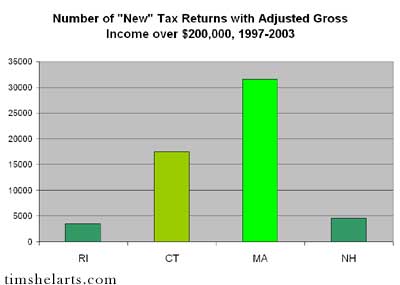
One obvious objection to my graphic would be that the raw numbers aren't really comparable, given the different sizes of the states. To be sure, it is a bit unreasonable to compare Rhode Island's 9,252 high-earners with Connecticut's 64,692, but that's pretty much the point: it takes less of an increase to make it appear as if Rhode Island's stock of rich folk is on the same trend path as those of other New England states. Putting the trend in context of the broader societies, however, the reality is that — again, using Gardner's own IRS source — Rhode Island is behind the listed states in the rate at which it is expanding its wealthy class. Relative to total tax returns, the percentage claiming adjusted gross income over $200,000 went from:
- 1.24% in 1997 to 1.86% in 2003 in Rhode Island
- 1.43% in 1997 to 2.05% in 2003 in New Hampshire
- 2.09% in 1997 to 3.06% in 2003 in Massachusetts
- 2.95% in 1997 to 3.91% in 2003 in Connecticut
So, when Gardner states that "the average annual income of the top 1 percent of Rhode Island taxpayers rose by $235,000," he's talking about a relatively stagnant pool, not the froth of a rising tide. In Massachusetts and Connecticut, by comparison, just about a full 1% entered the high-income group.
But here's where the aforementioned spilling begins; expanding the quotation:
Myth: Wealthy Rhode Islanders are getting poorer. The Journal asserts that the wealthiest saw their incomes drop by 17 percent between 1995 and 2002, while high incomes rose in the neighboring states.Reality: This misuse of statistics would be almost funny except that the statistics being abused come from my organization, the Institute on Taxation and Economic Policy. The data come from two ITEP reports, which look at two very different groups of Rhode Island taxpayers. An "apples-to-apples" comparison over the same period shows that the average annual income of the top 1 percent of Rhode Island taxpayers rose by $235,000 -- for a healthy 46-percent gain in average family income.
It would have been helpful of Mr. Gardner to expend a dozen words or so explaining what made apples apples and oranges oranges in the Providence Journal editorial in dispute, because turning back to the IRS spreadsheets that he found so helpful up to this point, one finds that the total adjusted gross income of $200,000-earners as a group did indeed grow from $3,033,302,000 in 1997 to $4,281,410,000 in 2003. However, those amounts were divided among 5,764 and 9,252 taxpayers, respectively, for an average AGI of $526,249 in 1997, but only $462,755 in 2003. Somehow, this apples-to-apples comparison finds a decrease of 12%.
No doubt, such analysis could go on. It would be interesting, for example, to attempt to reconcile Gardner's sunny view of the low end of Rhode Island's tax spectrum with his seemingly conflicting proclamation that "the gap between rich and poor in Rhode Island was the 12th fastest-growing in the nation." It would be even more interesting to find some sort of data that would shed light on the types of occupations through which the different states' rich earn their wealth. My suspicion is that Rhode Island's upper crust disproportionately boasts those who consume, rather than generate, wealth by draining the public reserves.
Unfortunately, as a man who must actually earn a living in Rhode Island — without the resources to patronize "the plethora of new high-end eateries and cafés" that Gardner sees as evidence of our state's affluence — I haven't the time for further numbers games.
March 17, 2006
Casinos, Monopolies, and the Right to Vote
Tracy Scudder of the Kent County Times reports that the West Warwick Town Council will vote on a casino resolution next week…
A casino item has been added to the West Warwick Town Council agenda for Tuesday night. The council will vote whether or not to ask the Rhode Island General Assembly to allow the voters to decide if there should be a casino in West Warwick.Casino supporters (and the Town Clerk) emphasize that the resolution is not an endorsement of a casino, just an endorsement of the people’s right to vote on a casino…The resolution reads: "We are memorializing the General Assembly to enact legislation to permit the qualified voters of the State of Rhode Island to vote on the establishment of a casino in the Town of West Warwick."
Town Clerk David D. Clayton said the resolution doesn't say that the council is in favor of the casino or against it.However, if the West Warwick effort is really mostly about the right of Rhode Islanders to vote, then a gambling referendum that does not favor any specific town, corporation, or Indian Tribe should be acceptable.The council is "just asking the General Assembly to enact legislation to allow the voters to vote on the subject," said Clayton. "This is strictly asking (the General Assembly) to do legislation so people can vote"...
If the governor is for the voter initiative, the governor should be for letting the people decide on the casino, according to [Councilor Jeanne] DiMasi.
"I think one way or another we will know if the people in Rhode Island want a casino," she said.
"What the council will be voting on is whether they believe that the people should have the right to vote on the issue. I think that is very important. So it will be very interesting to see how the two opponents of the casino on the council will vote on this because this is what the issue has become," said Council Vice-President Edward A. Giroux (D-Ward 3).
"Let the people decide. Let the people have a choice. Get it on the ballot once and for all and put it to bed."
And as the Cato Institute’s John Samples points out in today’s Projo, breaking the state-created monopoly on gambling is the most effective way to end the problems associated with gambling corruption (problems that spawned the creation of a lobbyist named "Abramoff")…
By raising barriers to market entry, government fleeces its citizens. The resulting monopolies also induce people to take risks with ethics and the law, in the interest of preserving their unjustified status. The government-created monopoly of Indian gaming and [lobbyist Jack] Abramoff's shenanigans are two sides of the same coin. That's the real scandal we're in danger of missing in the Abramoff affair.What exactly is the rationale behind locking a provision for locking a single mega-casino in the Constitution -- besides the fact that a casino monopoly can make one town, corporation, or Indian tribe rich? If this really is about the right to vote on a casino, and not the casino itself, is there any reason why the sections of casino amendments creating monopolies are not disposable?What can we do? If the government simply permitted free entry into gambling, monopoly profits would be washed away by competition, reducing the incentive for wrongdoing. Should this prove politically untenable, a possible second-best solution would be auctioning off the right to enter the gambling business. Investors would pay sums for that right consistent with reasonable (not abnormal) profits.
March 14, 2006
An Accuracy Deficit Won't Help Close Rhode Island's Fiscal Deficit
The Emergency Campaign for Rhode Island’s Priorities wants to blame George W. Bush for the state budget deficit…
In fact, a significant state deficit is due to slashed spending by the Bush Administration in order to fund deep tax breaks for millionaires.Yet most other states aren’t facing defecits, they are running surpluses. If the problem is Federal level tax-cuts, then why is Rhode Island one of the only states affected?
There are further problems with the ECRIP position. It's not really accurate to say that tax breaks that are being "funded" by the Federal Government at the expense of other programs. First, the actual amount of revenue collected by the Feds has gone up since the 2003 tax cuts. Even more directly, the Bush administration has presided over major increases in social spending. Here are the statistics from USA Today…
A sweeping expansion of social programs since 2000 has sparked a record increase in the number of Americans receiving federal government benefits such as college aid, food stamps and health care.If ECRIP wants to address the budget problem in an honest way, they need to explain why Rhode Island has been unable to take advantage of the current economic and policy climates to meet its needs in the way that most other states have.A USA TODAY analysis of 25 major government programs found that enrollment increased an average of 17% in the programs from 2000 to 2005. The nation's population grew 5% during that time…
It was the largest five-year expansion of the federal safety net since the Great Society created programs such as Medicare and Medicaid in the 1960s.
Spending on these social programs was $1.3 trillion in 2005, up an inflation-adjusted 22% since 2000 and accounting for more than half of federal spending. Enrollment growth was responsible for three-fourths of the spending increase, according to USA TODAY's analysis of federal enrollment and spending data. Higher benefits accounted for the rest.
February 27, 2006
If Our Neighbors Can Spend Responsibly, How Come Rhode Island Can't?
Just a reminder to accompany all the quotes you may be reading (like the quotes in this Scott Mayerowitz Projo article) coming from people who say that it is absolutely impossible to expect the government of Rhode Island to spend within its budget (the state budget shortfall is now estimated at $77,000,000 for this fiscal year).
The state comptroller of Connecticut is projecting a $536,800,000 budget surplus for Connecticut for fiscal year 2006.
By the most conservative estimates, Massachusetts is projecting a surplus of at least $120,000,000. Here is an estimate of the Massachusetts surplus proivded by the poverty advocates at the Massachusetts Budget and Policy Center...
If tax collections for FY 2007 simply reach the level announced last week...the state could open the FY07 budget cycle with a modest structural surplus of $120 million.What is the magic that our neighboring states have discovered that seems untransferrable to Rhode Island?If tax collections for FY 2007 ultimately prove higher than those now envisioned, this positive gap could be larger. For example, the FY07 surplus could exceed $210 million if tax collections attain the upper bound of the FY07 estimate put forward by the Department of Revenue in December; it could climb to roughly $390 million if tax collections sustain their recent rates of growth and continue to grow in a robust fashion throughout FY07.
January 10, 2006
Tax Reform and the Minimum Wage III
Secretary of State candidate Guillaume de Ramel helps advance a point I began making at the end of last week (h/t RI Future)...
I write today to strongly support legislation (2006 H 6718) that will incrementally increase the minimum wage in Rhode Island from $6.75 to $7.40 by January 1, 2007.I submit that this response was entirely predictable. Whenever any fiscally reasonable politician (like Governor Carcieri) discusses some aspect of fiscal and economic policy as a standalone issue, he loses, unless there is a major crisis looming. No matter how much is proposed, Dems argue that even more on the one issue -- be it more regulation, higher taxes, or greater redistribution of wealth -- is necessary to fix the problems that are there. Or, to paraphrase Mr. de Ramel, "You want to raise the minimum wage? Well, you should want to raise it more!"Your committee members and House and Senate leaders showed real leadership when you passed legislation last year that would have increased the minimum wage, affording hardworking Rhode Islanders the opportunity to earn more critically-needed dollars in each paycheck. Unfortunately, as we are both aware, Governor Carcieri turned his back on Rhode Island's workers and vetoed that measure. Now he is offering the General Assembly and these same hardworking Rhode Islanders a half-hearted compromise of increasing the minimum wage to $7.10 an hour.
Governor Carcieri's hollow election year compromise is not enough. All working Rhode Islanders should be able to afford life's basic necessities without compromise -- especially in this time of extraordinary home heating and utility costs. A $7.40 minimum wage is critical to that goal.
The result, as this case illustrates, is that the Governor gets limited political benefit from something like a minimum wage increase presented in isolation from the rest of his economic policies. His opponents join together to say the increase was not enough, that it would have been more had they been in office, and who cares about what other effects it might have.
The way for the Governor to overcome this dynamic is to clearly link taxation and regulation in his policymaking. Had Governor Carcieri established the connection between business taxation and the minimum wage as soon as the proposed wage increase was announced, he would have had a response ready for his detractors...
We can raise the minimum wage as high as you want, as long as additional costs being imposed on small and medium size businesses can be offset with a set of appropriate tax-cuts. Aren't you willing to cut back the money that the state takes in to help give more money to the people -- in terms of both an increased minimum wage and a smaller tax burden?
January 8, 2006
Governor Carcieri and the Politics, Maybe, of Tax Reform
Possibilites for tax-reform in this session of the Rhode Island legislature appear strangely muddled. On the one hand, Speaker of the House William Murphy named tax-reform as one of the three highest priorities for the 2006 legislative session...
Let it be our New Year's resolution; let it be our sense of duty to every Rhode Islander struggling to make ends meet that puts Responsible Tax Reform, A Comprehensive Energy Strategy, and A Fair Minimum Wage and to protect identities of individuals and other things that come to the floor front. Let?s resolve to make those some of our legislative priorities this year (emphasis in original).(Sidebar: Does anybody understand what the phrase "to protect identities of individuals" means in this context?)
Despite the fact that the Speaker of the House -- generally regarded as the most powerful individual in Rhode Island politics -- is amenable to tax-reform, Governor Donald Carcieri was recently quoted in an Andrea L. Stape article in the Projo as saying that he doesn't believe tax-reform is possible this year...
Consequently, he is considering a legislative proposal that would phase in a reduction of the historic-preservation tax credit and follow that with a phased-in income tax cut. Overall, he said that structural change would bring the state's tax burden more in line with neighboring New England states and make it more attractive to companies.I see two possibilities for the disconnect between Governor Carcieri and Speaker Murphy. The first is that the governor wants to proceed with extreme caution due to the budget shortfall. The most recent estimate says that Rhode Island needs to close a gap of about $77,000,000 for the current fiscal year. It could be that the Governor doesn't want to advocate tax-cuts while the budget still needs to be reconciled and program cuts may be necessary.The governor said the proposal is interesting now, since it would work to reduce the state's tax burden in future years without significantly affecting the 2007 fiscal budget.
"This year is probably not the year to get tax [reform] done," he said.
However, there may also be a political element at work here. The Governor's political strategists could be telling him that he and Republican legislative candidates would lose an issue to run on if a major tax-reform package were to pass this session. The idea that the Governor is thinking politics also explains why he has embraced the minimum-wage increase this (election) year that he vetoed last year.
Either way, I fear the Governor is being a tad shortsighted. Governor Carcieri needs to seize this opportunity to shape the debate about Rhode Island's economic and fiscal future. By talking about the minimum wage increase and tax-reform at the same time, explaining how employers and employees are all part of the same community, and how taxes and regulations are all part of the same system, the Governor could effectively counter the Democrat's message of class warfare in a way that cannot be done when fiscal and economic issues are discussed in an isolated, unconnected manner.
December 30, 2005
The Best Place to Start a Business that Serves Rhode Islanders is Probably Attleboro or Seekonk
I often think of Massachusetts (my home for 20 years) and Rhode Island as very similar places in terms of government and political and social culture. However, a study conducted by The Beacon Hill Institute at Suffolk University noted by Jack Perry on the Projo’s 9-to-5 blog says otherwise.
According to the study, Rhode Island rates 41st in the nation in economic competitiveness while Massachusetts rates 1st. Rhode Island’s poor ranking comes from it position amongst the worst 5 states in the categories titled “government and fiscal policy”, “business incubation”, “openness”, and “environmental policy”.
Do we have a clue here as to why Rhode Island is facing a $60,000,000 shortfall while Massachusetts is running a surplus?
December 23, 2005
Sure, EB is laying off...but we've got more slots! III: The Governor Has His Say
In my first post in this series, I sarcastically contrasted two headlines that seemed to sum up the current state of RI economic development. In the second post, I noted that ProJo columnist Edward Achorn had also noticed the contrast and wrote on the topic. Achorn was especially critical of the state's reliance upon gambling revenue to foot thebill. Now Governor Carcieri has responded with a point by point rebuttal to Achorn. He explains why he's against a container port (not enough interest by private business), against an LNG facility in Providence (safety concerns), why he supported the expansion of slots at Lincoln Park (and went along with the legislature's 11th hour expansion at Newport Grand so the deal wouldn't get killed) so that the burden on RI taxpayers could be lightened, and that the Electric Boat layoffs had more to do with Department of Defense policy than Rhode Island's business climate. The Governor also noted that there was progress being made:
Almost three years ago, I set an ambitious goal of creating 20,000 net new jobs during my first term as governor. Today, Rhode Island is on track toward achieving that goal. Through November, we have created 14,600 net new jobs -- one of the best performances in New England. Further, last month Standard & Poor's upgraded Rhode Island's bond rating to AA, citing our economic progress, pension reforms, and overall financial management.The Governor has a right to be proud of the economic development he's fostered, especially given he's a lone-wolf Republican running with a pack of Democrats. Though I may disagree with him on individual issues (gambling and the container port), overall his policies have been a benefit to the state. Most importantly, he is a valuable check to one party power and has sought to be the representative of the people of Rhode Island: not the lawyers or lobbyists, not the unions, not the insurance companies. For the coming year, let's all focus on trying to give him a little help in 2006.. . . Rhode Island already has a good base to its economy, and we have been working very hard to further strengthen and diversity it, with particular emphasis on biotechnology and other life sciences.
As governor, I have been pro-growth. I will continue to champion economic development and job growth in Rhode Island. I will continue to make the tough decisions to secure our state's future. And I will continue to protect Rhode Island citizens from unnecessary risks to their safety. Contrary to Mr. Achorn's misplaced criticisms, that is the correct strategy for moving our state forward, and it's working! We are removing impediments and Rhode Island is beginning to flourish.
December 14, 2005
Beware Dictators Bearing Oil III
It seems that Hugo Chavez's Public Relations campaign--"Petrol Populism"--is making some headway here in RI.
Rhode Island's senators will meet today with officials of Venezuela and its state-controlled oil company to discuss what may be an imminent deal to sell discounted heating oil to the state's poor people.Boy, that's clever. That Sen. Reed sidestepped the real issues of Chavez's questionable democratic bona fides, his desire to become South America's leading military power and his various strong arm tactics shouldn't be surprise. Oil-from-Chavez offers a double-bonus: cheap oil for a valued constituency and a poke in the eye of the Bush Administration. How could he resist? For that matter, how could Senator Chafee?Citgo, a Houston-based business owned by Venezuela's government oil concern, has already agreed to distribute 12 million gallons of heating oil at below-market prices to needy households in Boston and 8 million gallons to residents of the Bronx in New York City.
Those agreements, which stem from a pledge last summer by Venezuelan President Hugo Chavez, emerged last month after discussions between Rep. William Delahunt, D-Mass., and representatives of the Chavez government and of Citgo.
The deals have generated controversy because of the contention between the U.S. and Venezuelan governments. Chavez has reportedly accused the Bush administration of seeking to assassinate him or topple his government. The Bush administration has criticized Chavez's support for Colombian guerrillas and his declaration that the United States brought the terrorist attacks of Sept. 11, 2001, upon itself.
Sen. Jack Reed has minimized the controversy, saying that the first associaton many people have with Citgo is the company's sign near Fenway Park in Boston.
Sen. Lincoln D. Chafee said he can understand why Chavez believes he has not been accorded respect by the Bush administration. Chafee said Mr. Bush should invite Chavez to the Oval Office for a meeting. Noting that Chavez has ties to Cuban President Fidel Castro, Chafee partly attributed the bad blood between the two governments to Mr. Bush's desire to pander to Cuban-Amercans in Florida before the 2004 election. . .Look, I can appreciate the realpolitik that seems to be motivating our Senators: sometimes you have to deal with the devil (so to speak). And it is a worthy effort to try to find cheap heating oil for the disadvantaged. Besides, as Senator Chafee's allusion to China indicates, we've been dealing with authoritarian's for a long, long time. But this is taking things to a particularly acute and intimate level, isn't it? Continue reading "Beware Dictators Bearing Oil III"Chafee, who has a separate meeting with Venezuelan and Citgo officials, said the "dynamic" of the deal under negotiation is that "President Chavez wants to embarrass President Bush because we don't have good relations with Venezuela." Chafee said, "It's not hypocritical for me to explore this initiative" because he has twice visited with Chavez in Venezuela and said that "we need to repair our relations" with that nation.
Chafee, who is chairman of the Senate Foreign Relations Committee panel with responsibility over South America, held out former President Richard M. Nixon's overtures to communist China as an example for Mr. Bush to follow with Venezuela.
December 7, 2005
Sure, EB is laying off...but we've got more slots!
In a moment of negative serendipity (if there is such a thing), the following headlines great the reader of today's ProJo:
"Electric Boat to cut 2,400 jobs"
"State OKs expansion in Newport Grand slots"
The Electric Boat layoff is a result of a reprioritization by the Navy and is an example of the normal economic corrections that go on all the time. Jobs go away in one sector of the economy and are added in others. While it can be difficult and trying for the individual affected by this normal economic ebb and flow, a job-seeking EB welder can take heart that his skillset is probably coveted by another employer here in Rhode Island or (more likely) somewhere else. If he can't find a job as a welder here in Rhode Island--and doesn't want to move--he could forget welding altogether, sign-up for job retraining, and look for a job in some other area. Or he could always take a job at Newport Grand. It seems they're expanding.
November 30, 2005
Re: Rhode Island's Retrograde Fiscal Culture
Andrew puts his post about Rhode Island's fiscal position relative to its neighbors in the "Rhode Island Economy" category, but the issue is at least as political and cultural as it is economic. Over years of patchwork research, I've found that Rhode Island always tops Massachusetts in all the wrong ways. It takes bad or questionable policies, or policies that require moderation, and goes a bit further with them.
- The process for becoming a master tradesman, for example, is longer and more arduous, providing incentive to conduct such business in other states.
- As I recall from personal experience, teacher certification is just a bit more difficult to maintain and the inducement for those already in the club is a bit stronger, providing incentive (if not a requirement) for the young and innovative to ply that trade out of state.
- The welfare net is somewhat more generous (and tolerant of delinquency), providing incentive for the non-productive to move here.
Throw in the prominence of such "passing through" industries as tourism and higher education (which, I've a feeling, generate "residents" with minimal personal investment in the state), and you've got a state heading in all the wrong directions at once.
November 29, 2005
Rhode Island's Retrograde Fiscal Culture
Rhode Island has a $60,000,000 budget shortfall. And the news gets worse. Rhode Island’s revenues have gone bust at a time when tax revenues in most other states are booming. According to a recent USA Today article…
Soaring state tax collections have created momentum for tax cuts in 2006, when most governors and legislators will face voters.The problem is not that conditions in Southern New England are somehow different from conditions in the rest of the country. The Boston Globe reports that Massachusetts is ahead in its revenue collection for the current fiscal year…State and local revenue rose 7.2% in the first nine months of this year, the biggest jump since 1990, according to the U.S. Bureau of Economic Analysis.
Because of the improved economy, tax revenues from personal income taxes, corporations, and other levies are running 7.9 percent ahead of projections for the current fiscal year, putting the state $232 million ahead of what it expected to have by the end of October.(Most of the Globe story is about how Massachusetts is, in fact, very much like Rhode Island; with revenues running ahead, the Democratic controlled state legislature is preparing to spend! spend! spend!)
The State Comptroller of Connecticut projects that Connecticut will also end the year with a significant surplus…
State Comptroller Nancy Wyman today projected the state will end the 2006 fiscal year with a $135.4 million budget surplus.The fact that our neighbors doing well shows that the Rhode Island budget shortfall is not a problem created by implacable macroeconomic forces spiraling out of control; economic conditions in Rhode Island are similar to economic conditions in Massachusetts and Connecticut.The estimated surplus has risen by about $106 million in the last month, mainly due to strong collection of income taxes related to taxpayers' investments in financial markets.
Rhode Island's problems are rooted in poor fiscal management and irrational spending policies. They cannot be be solved by giving even more money to the government that created this mess in the first place.
November 27, 2005
A Reason to Support Hugo Chavez!
A Projo op-ed by Maria Cristina Caballero explains one reason you should support Venezuelan President Hugo Chavez…
The boom in oil prices has helped fuel a 43 percent increase in Venezuela's public spending this year, to $37 billion. Chavez is investing in a commuter train and the fourth phase of Caracas's subway system.In other words, you should look past Chavez’s repression of free speech and public dissent because, like Italy's fascist leader Benito Mussolini, he can make the trains run on time.
Has the American left really sunk this far?
November 25, 2005
Beware Dictators Bearing Oil II
Rhode Island’s political left is ready to sell its soul for cheap oil. Rhode Island’s liberal blog, RI Future, approvingly reports that two Providence city councilors want to buy discounted heating oil from Venezuela. Marc posted on some of the details earlier this week.
In its comments section, RI Future’s primary contibutor, Matt Jerzyk, goes as far as to call the president of Venezuela, Hugo Chavez, a "real leader". Here are a few examples of what progressives like Jerzyk must consider real leadership…
1. Chavez has signed laws censoring the free press. Here’s a description of the most recent censorship laws passed by the Venezuelan government in March 2005, courtesy of the American Prospect (not exactly a member of the vast right wing conspiracy)…
The language of the March law has a totalitarian ring: "He who offends in speech or in writing, or in any way disrespects the President of the Republic or causes another to do so, shall be punished by six to thirty months jail." Legislators, judges, and cabinet ministers all have similar protections, with similar punishments.2. This set of restrictions follows last year's restrictions on electronic media, the Law of Social Responsibility in Radio and Television. Here are the details from Human Rights Watch…To be prosecuted under the new codes, it makes no difference whether the offending article is true or not, and news organizations that violate them are subject to crippling fines and, after two fines, closure.
Television and radio stations would be obliged to transmit the government’s educational, informative or public safety broadcasts for up to 60 minutes a week. This is in addition to the president’s powers under article 192 of the Telecommunications Act (introduced in 2000 by the government of President Hugo Chavez) to order stations to transmit in full his speeches and other political messages….Under the standards established by Real Leader Chavez, this sort of posting on RI Future would be illegal; why do American progressives think that citizens of other countries don't deserve the same rights that they themselves enjoy?The law establishes an 11-person Directorate of Social Responsibility, part of whose mandate is to enforce the law and punish infringements. Seven members of the directorate are government appointees. Its president, the Director General of the National Telecommunications Commission (CONATEL), is appointed by the president and does not enjoy fixed tenure.
3. Chavez’s anti-democratic rise to power included establishment of a “judicial emergency committee” that had power to remove judges without consulting any other branch of government. Here’s a quote from the emergency committee chairman on the subject of removing judges…
"The objective is that the substitution of judges will take place peacefully, but if the courts refuse to acknowledge the assembly's authority, we will proceed in a different fashion."It also included the formation of a constitutent assembly that declared meetings of the sitting congress illegal. Chavez’s general attitude towards opposition is summed up in this quote…
“We can intervene in any police force in any municipality, because we are not going to permit any tumult or uproar. Order has arrived in Venezuela.”The repression of Venezuelan citizens ignored by an American left searching for cheap oil starkly illustrates what has sadly become the first rule of contemporary progressivism: government repression is acceptable -- in some cases, even desirable -- so long as the government involved is anti-American.
November 23, 2005
Beware Dictators Bearing Oil
Let's nip this in the bud. Just because New York and Massachusetts think it's ok to get discount oil from a radical, totalitarian, doesn't mean Rhode Island should follow suit. Sure, it sounds good. . . at first.
Local legislators and Venezuelan officials yesterday vigorously defended an agreement that will bring discounted heating oil to more than 40,000 low-income Massachusetts residents courtesy of a Latin American leader engaged in an acerbic public campaign against President Bush and US foreign policy.Who could be against such choice, right Mr. Rodriguez? Setting aside the impropriety of a Congressman engaging in foreign policy or the interests of erstwhile Massachusetts political families, there is still a bit more to the animosity ginned up against Pres. Chavez than his distaste for President Bush. Continue reading "Beware Dictators Bearing Oil"The deal, signed yesterday in a Quincy couple's front yard, will provide more than 12 million gallons of heating oil from Venezuela, with each qualifying household eligible to buy up to 200 gallons, enough to last several weeks, at a 40 percent discount. The Quincy couple, Linda and Paul Kelly, were the first beneficiaries of the arrangement.
The agreement has come under fire because President Hugo Chávez, whose nation is the fourth-largest supplier of US oil, has used harsh language to criticize Bush policies on free trade, poverty, and the war in Iraq. But representatives from his government yesterday said politics played no role in the gesture, which was negotiated recently in a face-to-face meeting between Chávez and Representative William D. Delahunt, a Quincy Democrat.
''Our objective is simple: to help people of limited means through the winter," said
Felix Rodriguez, chief of CITGO, a US subsidiary of the Venezuelan petroleum company, said: ''No one should have to choose between heat and medicine or food."
November 1, 2005
The Perils of Gambling on Gambling
According to this story:
For years, slot machines at Lincoln Park and Newport Grand have seen double-digit growth. But now -- while the machines are still extremely profitable -- they are not producing the same boom, and that could have grave ramifications for the state.Setting aside the questionable practice of relying on gambling revenue to the degree that Rhode Island does, what was the thinking that went behind a projection of 15% growth? Doesn't that seem a little too rambunctious?This year's state budget is based on the assumption that slot-machine revenue would increase by 15.3 percent. However, data presented yesterday by the Rhode Island Lottery show that since the start of the fiscal year on July 1, there has been only a 4.2-percent bump.
While it's early in the year and there are many other factors that go into the state's budget, failing to meet the expectations could create a multimillion-dollar shortfall. . .
State leaders yesterday urged caution about the lottery figures.
"These estimates are preliminary and based only on the first quarter of the fiscal year," Carcieri's spokesman Jeff Neal said. "However, these estimates highlight the fact that we must begin to get control of state government spending. Rhode Island has the sixth-highest tax burden of any state in the nation. We will never be able to cut those taxes until we reduce spending."
House Majority Leader Gordon D. Fox, D-Providence, said through a spokesman that he is concerned about the lottery but that it is "too premature right now." Fox said he wants next week's final report so he can see the gambling numbers "in the broader context" of the rest of the budget.
April 1, 2005
Casinos & Financial Literacy
Don’t ever let it be said that your RI state legislators don’t have a sense of humor. Yesterday, the bill paving the way for building a casino in Rhode Island was re-introduced to the Rhode Island House. And the day before that? A resolution was introduced to the Rhode Island Senate declaring April to be “Financial Literacy Month”.
Does this sound like a revenue raising program that the financially literate would favor?
1. Hire a company to take money from a group of people.
2. Allow the company to skim a certain percentage off of the top.
3. Have the company give what's left of their original take (the original take minus the skim) to another group of people.
4. Have the company return a quarter of the skim to the state, and keep the rest for itself.
This is how any casino works; the bells, whistles and flashing lights are there to distract you from this fact.
January 31, 2005
Finishing the Line
In his commentary in the Providence Journal, which Don mentions in the previous post, Rhode Island College student Bill Felkner does the single most important thing for government reform:
Let's draw a straight line: The school teaches the "perspective"; graduates get jobs at the state Department of Human Services and the Poverty Institute; the DHS testifies (using Poverty Institute "research") to the State House on how well programs are doing. How can we blame politicians for developing ineffective programs when they are guided by biased testimony?
He doesn't draw the line far enough, though, to illustrate that it is actually a loop. Note Felkner's explanation of the approach to welfare that his school advocates and that the Rhode Island government follows:
Welfare programs are employment- or education-focused, further defined by "strict" or "lenient" requirements. Rhode Island has a "lenient, education-focused" model, and the proposed legislation advocates greater leniency.
In summary, not only are educators populating the state bureaucracy with ideologues, not only are educators helping to develop policies and put the shine on those already instituted, but the policies that these educators advocate are focused on increasing the customer base for — yup — educators. Consider the emblematic story of Providence's April Brophy, told in the Providence Journal last June. Ms. Brophy and her husband divorced, then he became disabled, so her child support payments were miniscule. State assistance helped, but it wasn't enough, until:
BROPHY'S BOSS wanted her to start working Saturdays. But Brophy had no one to care for her youngest child, Bobby, then in kindergarten. When the situation could not be resolved, Brophy quit, and entered an eight-month case-management program at Rhode Island College."It ignited my passion for social justice," Brophy said.
There Brophy learned that as kind as her social worker had been, she had neglected to tell Brophy that there were dozens of training and education programs open to her, part of her welfare benefits. The social worker had mentioned only two: RIC's case-management program and a certified nursing-assistant program. ... Brophy received her certificate in case management in May 2003 and tried to get a job in the field. ...
A few months later, she landed her current job: organizing for Rhode Island Parents for Progress, an advocacy group for low-income working families. ...
She says she has regained her sense of self-confidence. She hopes to go back to school to earn an associate's or bachelor's degree in social work. She now earns $11 an hour -- the highest salary she has ever received.
Described from a business point of view, Ms. Brophy is an ideal customer of the education industry. Not only did she complete the circuit between educators and government funds in her own case, but she is now employed to find other such human conductors. Seen in this light, the "perspective school" that Felkner now attends has a clear conflict of interest in its dealings with state policy, and the corruption is manifest along the entire loop, including the corruption of the ideals of higher education.
As I highlighted in response to the Projo's piece on Brophy, one can in good faith and with charitable intentions put forward solutions that align with one of two worldviews. Corruption aside, Rhode Island's more common worldview believes that people's particular difficulties must be addressed in the most expedient way possible: giving to them what the government has collected from others. The worldview that I favor puts the responsibility for people's lives in their own hands, believing that human nature creates a marketplace that incorporates every aspect of society, from economics to familial culture to religion, and that people ought to be allowed — empowered, in modern Marxist jargon — to seek their own balance.
As a nuclear family, the Brophys were doing just fine on $35,000 per year. According to Rhode Island College's Poverty Institute, a family of four needs $48,000 in combined income and handouts to get by. Unless we break this cycle whereby interest groups set policies that siphon tax dollars in their own direction while creating incentives for people to make unhealthy decisions, our state will eventually find itself attempting to subsidize everybody with revenue from nobody, and our culture will only generate more messes to mop up with public green.
January 22, 2005
The Giant's Footprint and the Little Guy's Plea
The temporary part-time job delivering Christmas packages in Tiverton that I took to cross the financial finish line in December greatly helped me to gain a sense of my new hometown. (We bought a house here in July.) The most significant impression that the town makes is the dividing line that runs roughly in the area of Route 24. Tiverton south of the highway is one town; Tiverton north of the highway has an entirely different feel. I live north of the highway, where talk of the town's "village style" jars a bit against quotidian experience.
Be that as it may, rattling around in a delivery truck, I developed a tremendous appreciation for the town as a whole. The writer's assessment: it would be a fantastic setting for a novel, or perhaps a series of novels. Much of the town is just beautiful. The process of development has left little surprises, like the driveway off one of the main streets that rambles back only a couple hundred yards to a shack that might as well be miles removed from civilization. And several neighborhoods are a young family's dream.
Unfortunately, personal experience suggests that dreaming is now all that young families can do. Even my circa 1950 neighborhood, full of blue-collar workers and their young children, is claiming prices that, at best, require change-in-the-sofa mortgage payments. Tiny houses with just enough land to call a proper yard cost well over a quarter-million dollars.
All this is preamble to my admission that I'm entirely unable to choose a side on the matter of business development:
Monday's hearing invited the public's views on a zoning proposal designed to encourage smaller-scale retail proposals that would fit into Tiverton's village style. The hundred or so who attended the meeting largely agreed that the zoning proposal was still not restrictive enough.Some Tiverton officials and council members have sought retail development to raise new town revenue and avoid increasing taxes. But raising revenue at the expense of the town's village character seems to be unpopular in Tiverton. ...
Tiverton faces the dilemma confronting most lovely old towns. The cost of town services is always rising, and a major way to meet that cost without raising taxes or cutting services is to add to the tax base by attracting more taxable business.
Just about the time that real estate prices in my rented hometown of Portsmouth hit twice the number that I had believed was the highest they could possibly go, I began to wonder how much town governments and those households with the time and money to invest in influencing its policies would really care if less wealthy families, some of them fixtures in the towns, were driven out. I even made a video blog (vlog) expressing my acceptance of the natural ebb and flow of a region's society.
Still, its citizens all being equal, a town ought to do its best to meet the needs of all of them, which means enabling them to stay if they wish to do so. Higher taxes will, without doubt, mean that some of them will have to become citizens of somewhere else.
Not having yet had the opportunity to delve into Tiverton's finances, this is only a guess, but surely there is fat to trim in the "services" category. And surely my townsman Richard Rounds's sentiment that the business "giant leaves mighty 'footprints' that get filled in with slop" ought to be balanced with the sentiment that the fading "little guys" leave a hole when they fall away.
Or are we the slop?
December 15, 2004
No Longer Looking, No Longer Here
Here's an interesting find from URI economics professor Leonard Lardaro:
As our unemployment rate fell from 5.8 percent to 4.5 percent, resident employment, the number of Rhode Islanders who were working, rose by only 423! The decline in our labor force, 7,146, was almost identical to the drop in the number of unemployed, 7,569, which is consistent with the discouraged worker effect.
It would make for an interesting study to examine increases and decreases in welfare caseloads and emigration during the same period. I've never quite understood how people can just stop looking for work. (That lack of comprehension, just so you know, has both practical and moral components.) People have to survive. Are the "discouraged workers" attempting to get by on a single income, if married? Are they going on welfare? Are they moving out of state? (Are they even fully autonomous adults?)
Looking at some additional information that Professor Lardaro provides for his "Current Conditions Index" on his Web site, new claims for unemployment insurance are up, while new housing permits are even more dramatically down. That's on a month-to-month basis, so it doesn't accurately capture longer term trends. Still, I'm close enough to the financial brink to know the temptations of abandoning ship and heading where work is more plentiful and housing cheaper. And I'm sure that many Rhode Islanders have taken that course; I wouldn't be surprised if it were the case most frequently (and most distressingly) among the young and ambitious.
Another chart on Lardaro's site shows that increases in local government employment dramatically outpace those in the private sector. In Rhode Island — a state that saw a mere 2.4% growth in population from 2000 to 2003 (PDF) — fewer people are paying for more public employees and improving benefits for them. Discouraging, indeed!
Circumstances must improve, one way or another. The question for such families as mine is whether we can afford to hang on until they do.

 About Community Crier