
 Click here for the new Anchor Rising & Ocean State Current page

Keeping Taxpayers in the Dark, by Patrick Laverty
Adventures in Town Government
9:00 AM, 02/11/13
The Deterioration of New England Local Government (and of the United States), by Justin Katz
Political Thought
4:56 PM, 12/ 4/12
A Familiar School Committee Time Line, by Justin Katz
Tiverton
11:14 AM, 11/ 3/12
Things We Read Today (24), Thursday, by Justin Katz
Rhode Island Economy
7:34 PM, 10/ 4/12
Tiverton Toll Meeting Shows Rhode Islanders Have to Stop Fighting Fire with Paper, by Justin Katz
Rhode Island Politics
4:57 PM, 09/28/12
Against Borrowing in Providence or Anywhere, by Justin Katz
Infrastructure
3:28 PM, 07/28/12
106 Plays Right Into Their Hands, by Patrick Laverty
Adventures in Town Government
5:17 PM, 07/24/12
How I'd Fix the School Committees, by Patrick Laverty
Adventures in Town Government
11:00 PM, 06/24/12
Waiting on Senator Crowley, by Patrick Laverty
Adventures in Town Government
11:00 AM, 04/30/12
Transparency Now Equals Union Bashing, by Patrick Laverty
Adventures in Town Government
1:00 PM, 04/26/12
February 11, 2013

Keeping Taxpayers in the Dark
I hope everyone was able to keep safe and as warm as they could through the storm. The cleanup has begun, and even probably ended in many towns. However in some places, we hear about the plows' inability to keep up and even still some people complaining that their road hasn't seen a plow yet. For some great updates on cities like Pawtucket and North Providence, the Valley Breeze's Ethan Shorey has been using his Twitter feed to report on conditions
Some of the more interesting tweets from Shorey included:
#Pawtucket resident just informed me that they're hiring private plowing contractors so they can leave their homes.and
Pawtucket's cut a lot of staff since the last big snowy winter. In this case, I'm hearing lighter plows didn't keep up during the day so they couldn't get through later on. Shortage of big trucks.Others were reporting that mayors of Pawtucket and Cranston were asking Governor Chafee for help with the snow removal in those cities.
Wait, what?
These are the cities that had some of the most fiscal problems in the past, due to overly generous municipal compensation packages, and now they're having trouble paying for snow removal? The answer is to ask the state to take state-funded trucks off state roads and put them in those towns to do the town's snow removal?
To be clear, these are drivers and trucks that are paid for by people in all 39 cities and towns being sent to the couple of, at least previously, most fiscally irresponsible cities in the state.
Why does it seem like politicians are able to dodge a major awakening from their citizens just in time? What if these cities weren't able to get help from the state? How angry would the residents get? Would they then start asking questions why there is no money allocated in the city budget for snow removal? Would they then start going over the budget and looking to see where their money is going?
If cities and towns are responsible for anything at all, one could argue that as an absolutely minimum, the responsibility is for safety and infrastructure before all else. Otherwise, you don't even have a city.
I am glad that people are finally going to be able to dig out and get around, but I think some hard questions really need to be asked in some of these towns about priorities.
December 4, 2012

The Deterioration of New England Local Government (and of the United States)
Paul Rahe's written an excellent essay explaining why libertarians ought to be social conservatives (via Instapundit), which is a point on which I'm writing for future publication. For the moment, though, this paragraph is more immediately relevant:
In America, [Tocqueville] found institutions, mores, and manners antithetical to what he took to be democracy's natural drift. Vigorous local self-government drew the inhabitants of New England townships out of their homes and into the public square. Initially, they made this move in self-defense, but the experience of participating soon became a pleasure all its own, and it induced individuals to abandon what he called "individualism" and to devote themselves to public concerns. In the process, these Americans learned to think ahead, they developed a powerful sense of their own capacity to cope with the vicissitudes of life, and they learned to cooperate with their neighbors and even with strangers in forming private associations for public purposes.
Rahe attributes much of the erosion of American civic society, including the ideas of local governance, private organizations, and moral self-control, to the sort of apathy that arises when generations forget what their ancestors saved them from, and what was necessary in order to accomplish that end. There's certainly a point to be made, in that regard, but I find myself returning to his phrase, "initially, they made this move in self-defense."
On the local level, it doesn't take quite the dramatic threat that is necessary to bring out the self-defense vote (so to speak) in big-time politics, which is one of the reasons pushing governance toward the local level is generally advisable. So why do we not see the apathy of prosperity looping back every now and then to a rejuvenated public engagement?
November 3, 2012
A Familiar School Committee Time Line
"I had the sense that everybody around the table knew that we were part of the same team.” That's how Tiverton School Committee member Carol Herrmann described negotiations with the teachers' union this summer. On August 14, the committee passed the contract extension.
It isn't surprising that the negotiations would be "cordial," as Herrmann put it. Negotiating for management were Herrmann (a union teacher), Deborah Pallasch (Herrmann's campaign partner in 2008), Superintendent William Rearick (formerly a union teacher), and Finance Director Douglas Fiore (who works for Rearick). Chairwoman Sally Black is a retired union teacher.
The committee's "negotiations," so to speak, with the people of Tiverton have been less cordial.
In January 2009, the committee approved a contract with retroactive raises despite residents' fears that the recession would continue. And voters at the May 2009 financial town meeting (FTM) refused to approve the committee's requested budget increase.
The school committee meeting a week later was heated. One guidance counselor told the committee: "I am the last person on this Earth that would want to hurt a child, but you need to make a statement… to get people to the town meeting."
As it happened, the Obama administration's stimulus filled the gap and then some.
In May 2010, Pallasch proposed an increase, as an FTM voter, that essentially made the stimulus a permanent part of the budget. Herrmann's husband, Nick Tsiongas, then made the familiar threats; if her budget didn't pass: "We will begin by closing one of the new elementary schools… eliminating all extracurricular activities… every sport and every after school activity… middle school band, high school chorus… and then five or six teaching positions at the high school."
We'd heard that before, and we've heard it ever since, including before this year's financial town referendum (FTR), which has replaced the FTM.
For the upcoming FTR, the "five-year plan" that the committee mentioned when it approved the teacher agreement calls for a school department appropriation of $29,106,009, an increase of $1.2 million (4.3%), well over the state tax cap.
And the cycle continues. The only way to stop it — and to make the people of Tiverton feel as if they are the ones "on the same team” — is for voters in Tiverton to elect Susan Anderson, Ruth Hollenbach, and me to the school committee. We will insist that the district maintain its programming within the budget that taxpayers feel they can afford, without threatening to "hurt" children in order to "make a statement."
October 4, 2012
Things We Read Today (24), Thursday
West Warwick for all; the essence of education reform; declines in people births; declines in business births; the easy street to dependency.
September 28, 2012
Tiverton Toll Meeting Shows Rhode Islanders Have to Stop Fighting Fire with Paper
Last night, I attended the first organizational meeting for the Tiverton branch of Sakonnet Toll Oppostion Platform (STOP), a cross-community effort to stop the state of Rhode Island from placing a toll on the Sakonnet River Bridge. If I was skeptical about the ability of residents to prevent the tolls before, I'm pretty well convinced that the people of the East Bay will not be able to stop them, now.
The audience consisted of approximately fifty residents, from a broad variety of local groups and interests — many most often seen in heated attacks against each other over the usual slate of issues that face the town. Even though the only state-level official in the room was Sen. Walter Felag (D, Bristol, Tiverton, Warren), the opportunity should be there, in other words, for some effective leaders to draw on the strengths of the different groups to affect state-level lawmakers.
Instead...
July 28, 2012
Against Borrowing in Providence or Anywhere
In his Saturday column, Ted Nesi makes a point that I'd been thinking about as the week came to a close, related to a proposed $40 million infrastructure bond in Providence:
Governments should borrow to fund long-term infrastructure projects that have a higher rate of return than the interest on the bonds, but [in Providence's past] bond money was used to pay a principal’s salary and develop a restaurant. Buddy Cianci, apparently confusing borrowed money with free money, told Stycos: “This way, we can make the improvements and the tax rate doesn’t go up.” Cianci left off the crucial word “now” — because the tax rate certainly will go up eventually if the projects aren’t ones that will boost the city economy and help offset the interest costs. Taveras would do well to burnish his reformer credentials further by finding a new, transparent way to allocate bond money if voters approve the proposal in November.
In theory, Ted's argument definitely applies. One clarification I would make, first, is that one can't forget the actual cost of the work. The "higher rate of return," as Ted puts it, can offset the interest, but one suspects that new streets and sidewalks will require replacement well before their incremental benefit has compensated for the whole $40 million plus interest.
That said, suppose an accurate projection finds that improved pavement would increase city revenue — through increased commerce, property values, and so on — by three percent. In such a case, even if the interest paid on the bonds were exactly the same, the city might as well borrow the money rather than save it up over the same period of time and then do the work. Residents and visitors would gain the benefit of tomorrow's new sidewalks, today.
There are good reasons to resist that argument, both in practical and in theoretical terms.
Continue reading on the Ocean State Current...
(Note: edited at 7:48 a.m., 7/30/2012, to clarify that the bond is for roads and sidewalks.)
July 24, 2012
106 Plays Right Into Their Hands
When you're budgeting for a school department, there are a lot of moving pieces. Of course you wish you had money to fund everything really well, but that's not the case. Choices need to be made and sometimes cuts are necessary. But where those cuts should come from is often the topic for debate. We've seen multiple times recently when school departments are using the Washington Monument Syndrome:
The most visible and most appreciated service that is provided by that entity is the first to be put on the chopping block.In our local examples, the school department cuts school sports. We saw that a few months back when West Warwick cut high school sports which led to hundreds of people showing up to a Town Council meeting and some even getting so agitated, they had to be removed by the police. Of course after all the gnashing of teeth, the money was found and sports were replaced.
Now there's a group in East Providence calling themselves Project 106 that seeks to fund middle school sports in the town. First of all, I've lived in a handful of states and I've never heard of middle school sports before. Usually kids participate in CYO basketball, Little League or Pop Warner Football and the like. Rhode Island seems to have this big devotion to middle school sports. Additionally, quite often these groups won't be so quick to offer up that they're looking to save middle school sports, instead leaving it up to the listener to sometimes assume it's high school sports that are under attack.
Nevertheless, it must be pretty nice to get the heat taken off you as a school board member. You can negotiate these escalating contracts and pay more to areas that don't directly affect the students and cut things that do, like sports. No big deal because some nice group, like Project 106 will step right in and raise money for the sports. The same sports that were already being paid for through taxes!
It's great that these parents want to find a way to fund after-school sports, but why are they letting the administrators off the hook so easily? Why was the money available last year but not this year? Keep their feet to the fire, let them know that you're watching and paying attention. It'd be nice if parents were as keenly aware of all school budget decisions and expenditures, but we'll start here. Once the administrators see that they can cut sports and parents will replenish those funds, what's next? Books? Busing? Supplies? Electricity? Heat? Why not? After all, isn't heating the school even more important than sports? If parents will pay a little more for sports, won't they do the same to keep the lights on?
June 24, 2012
How I'd Fix the School Committees
We have a problem in many towns with how our governance is set up. Towns have an executive and a legislative body that assist each other in running the town. Those two manage the municipal affairs including the Town Hall, police, fire, public works and almost all other parts of the town. However for some reason, we don't trust them to run the schools. Instead, we elect a completely separate body to run that one department. Why?
Along with this setup, we let the school committee negotiate contracts on behalf of the school system and they are responsible for the budget for the schools. However, the school committee has no ability to generate their own funding through taxation. Instead, they rely upon the town council to give them enough money to run the schools. But in most towns (all?) the council and executive have very little to no say in the budgeting and contract negotiations. It's kind of like the school committee is going shopping with someone else's credit card. And then what happens when the town council doesn't give the school committee the amount of money that the committee wants? The school committee sues the town council under the George Caruolo Act. When that happens, you have one group that represents the town's taxpayers suing another group that represents the town's taxpayers. In this situation, only the lawyers win.
Add on to this, the mayor and town council have very little say over how the schools are run and managed. The mayor stands out in front, creates a budget, sets a tax rate, the town council approves it and then just hands the money over to the school committee. When people aren't happy with the schools, they complain to the mayor. When people aren't happy with their tax increases that may be due to budgets created by the school committee, people complain to the mayor. There's little the mayor can do about the complaints.
So here's how I'd fix it. Maybe this change would require a change of the state charter, but whatever it takes, this is the change I'd make.
First, abolish the school committee as it exists today for all the reasons I wrote above. At least to eliminate the ability for one town committee to sue another town committee. That's just ludicrous.
Basically what I'm going to do is make the school committee a hybrid sub-committee of the town council. First, pick a number of members for the new schools sub-committee. For my example, I'll pick seven. I will let the chair or president of the town council appoint three members of the town council to the schools sub-committee. Town councils already have various subcommittees, so this isn't a big deal. Doing this guarantees that the town council has oversight into the schools and is involved with their budgeting and contract negotiations. If they're going to be involved with funding the schools, I want them to have some oversight as well. I can also see where this could be a lot of work and we may want to have some people who are focused on the schools. I am also going to add three at-large seats. These are people who will be on the schools sub-committee but will not be members of the town council. They will be elected by the voters, much like today's school committee members are elected today. So that's six members that I've added. The seventh and the chair of the committee will always be the mayor or town manager. Now the person who frequently receives the questions, complaints and frustrations with the schools will have direct oversight of the school system.
There we go, a whole new school committee system. It seems to work well. It allows the town council to have oversight without burdening the entire council with school management responsibilities and it also dilutes the power of the town council by having an equal number of people specifically elected to the committee. It also has the same people creating the budget and negotiating contracts that have to set the town's tax rate. Best of all, the person who many already believe runs the schools actually does get to do just that.
Why can't this work?
April 30, 2012
Waiting on Senator Crowley
Some of you might remember a few months ago when Senator Elizabeth Crowley of Central Falls wrote a letter to the editor in the Providence Journal excoriating the city's receiver Robert Flanders. Flanders had recently appeared at the newspaper's annual Follies show dressed in an executioner's outfit and touted himself "Lord of the Pink Slip."
Crowley didn't find this too amusing, she didn't see the humor in it. Neither did Bob Plain, as he also wrote about it in his forum. So I guess gallows humor doesn't work for them and they even appear to be somewhat offended by someone making light of a bad situation.
So can we expect them to have at least something similar to say about President Obama and one of his jokes from this weekend's White House Correspondents' Dinner?
"Look at this party. We’ve got men in tuxes, women in gowns, fine wine, first-class entertainment. I was just relieved to learn this was not a GSA conference."In case you missed it, there has been some concern lately after the General Services Administration (GSA) spent $823,000 of taxpayer money for a 300 person conference in Las Vegas.
Now I'm not going to feign any anger or say that I didn't find some of the President's jokes funny. I'm not that much of a partisan. My point is whether Crowley and Plain will be consistent in their indignation and write similarly about the president?
As another local who shares the Senator's surname would say, the silence is deafening.
April 26, 2012
Transparency Now Equals Union Bashing
I was in my car yesterday afternoon listening to Matt Allen talking about this new ordinance in North Smithfield and talking with town councilor Ed Yazbak about it. The Town Council in North Smithfield will put new contracts up for public review for two weeks before signing. This ordinance will only cover contracts that the Town Council negotiates, so teacher and fire contracts are not subject to this change.
Imagine that. Openness. Transparency. Accountability. All good things in government.
I had a similar experience in my own town a few years ago when my School Committee was negotiating with the teachers union. I emailed back and forth with a few of the committee members sending a few of my own suggestions and to their credit, they didn't respond to me like some crazy person from outer space. When I learned through the media that the committee had come to an agreement with the union on a contract and that it was to be signed at the upcoming committee meeting, I asked to see what they'd agreed upon. I simply wanted to comment on it before its signing. One committee member responded that I could see it after it is ratified at the committee meeting. No one may see the contents of the contract before it is signed.
Well that hit me like a brick wall. I can't see a contract that I have to help pay for before it is signed? This sounds a lot like Nancy Pelosi referring to Obamacare in that we have to pass it in order to see what's in it.
But now, North Smithfield is attempting to make the change toward openness and transparency. Who could possibly be opposed to transparency in government?
Senator John Tassoni, that's who. His claims include "union bashing" as well as
"Not only is the recent action taken by the North Smithfield Town Council a clear and obvious attack on the municipal union, it is also a clear indication that the members of the council who support this action are shirking their responsibilities and avoiding the duties they were elected to perform,” said Senator Tassoni.
He goes on to add:
“The council is the duly authorized body to be voting on these negotiated contracts, and shouldn’t be looking to avoid their duty by seeking public input that they are then able to hide behind,”Hide behind public opinion? So if the public, the ones paying the bill, decide that the contract is not something that they want, if they feel the value isn't there, then they should have every right to voice that opinion to their town council. If anything, this could put additional pressure on a town council. They spend time working through negotiations only to get hammered by the public? How does that sound like shirking any responsibility?
Also, if the employees covered by the contract are doing a good job and are getting paid fair compensation, then what is Senator Tassoni afraid of? Why does he want the council to continue hiding behind "We can't show you the contract until it's passed?" The only people who look to hide things are those who have something to hide. Clearly the town council in North Smithfield feel they have nothing to hide. So why does Senator Tassoni feel that differently?
Among some of the other ludicrous statements by Tassoni comes this gem:
“These people ran for office knowing that they would occasionally face some tough decisions and difficult votes,” said Senator Tassoni. “If they are not willing to live up to those responsibilities, they should get out of office. Seeking public input on union contracts is not, for them, about transparency. It is about stirring up anti-labor sentiments.”If anything, it would seem the town council is more than living up to their responsibilities, they are demonstrating how they want to be more accountable to the taxpayers and the voters.
When people think of what's wrong with Rhode Island and more specifically its politics, Senator Tassoni would be one of the poster children. Fortunately however, he announced last September that he will not seek re-election this year. So I guess we at least have that to look forward to.
Congratulations to Councilors Ed Yazbak, Christine Charest and Thomas McGee for voting in favor of good government.
March 24, 2012

Bankruptcy Judge Rules that Central Falls' School District is Separate from the City
Federal Bankruptcy Judge Frank J. Bailey has issued a preliminary ruling that the Central Falls School District is not part of the City of Central Falls. The Projo has the complete ruling available here.
Specifically, Judge Bailey rejected a request from Central Falls receiver Robert Flanders to issue a declaration "that the School District is part of the City and therefore, ipso facto, the collective bargaining process is within the Bankruptcy Court’s subject matter jurisdiction".
Judge Bailey's reasoning is that...
- School committees are parts of local government...
- ...to which the state legislature, under its Constitutional grant of authority for education, has "vested" "the entire care, control, and management of all public school interests in the several cities and towns".
- However, in a 2007 referendum, the people of Central Falls approved changes to their City Charter which eliminated their school committee...
- ...meaning that they eliminated the organ of their municipal government authorized to exercise local jurisdiction over the schools...
- ...through the process specified in Home Rule Article of the State Constitution for making permanent changes to local forms of government...
- ...and that this act, when combined with the laws that placed the Central Falls school system under the control of a Board of Trustees appointed by the State Education Board of Regents and "not mentioned in the City’s charter [or] answerable to City authorities"...
- ...fully separated the Central Falls school district from the City of Central Falls.
Though I am not predisposed to favor the outcome, I have to say that Judge Bailey's reasoning is pretty solid, given the Constitutional structure of Rhode Island government and the laws that have been passed under it. This ruling also strongly suggests that it is only Central Falls' school district that is part of the state, at least until such time as other municipalities begin holding local referenda to wipe out their school committees (though I'm not sure how the regional districts cleanly fit in to all of this).
There are still some process hurdles to be cleared, but where this is likely leading to the bankruptcy court also rejecting a second item that Receiver Flanders asked for a ruling on, "that the Receiver has the power under the Fiscal Stability Act to act on behalf of the City relative to collective bargaining with the Union".
March 12, 2012
Déjà Woonsocket
Everything going on in Woonsocket sounds so familiar that I had to check back in Anchor Rising's archives for the city. It's worth scrolling down to the summer of 2009; very instructive. First observation, from a liveblog of a school committee meeting (most of which I missed):
I've got to say that the casual atmosphere, here, is almost disconcerting. As I drove in, the lazy summer evening feel of the streets brought to mind the degree to which most residents are oblivious to the actions of their local, state, and even national government representatives. Given the points of levity, it's almost as if that mood has infiltrated even the bodies that those representatives populate.
At the time, the district was cutting everything and seeking 40 furlough days from teachers. Peruse the surrounding posts, and you'll see that the district's teachers had enjoyed unabated raises since at least the turn of the millennium, and the budget problem could have been solved with a 13-14% reduction in pay. But then, fast forwarding through a bunch of Caruolo noise, we get to this very familiar-sounding item:
There's a $6.9 million difference between the School Committee and the City Council over how much to spend on schools in this fiscal year; it jumps to $10.6 million when the 2008-09 deficit is added in. The reconciliation of those numbers is set to start Wednesday at a joint budget workshop session between the committee and the City Council.Essentially, the school committee plugged its 2009 hole with 2010 money, and the town council, which legal precedent leaves with no authority to stop that from being done, acknowledged as much and agreed to move on to the next budget. The downside is that even the school committee's impossible plan for the next year will come up 62% shy of the budget gap. With the teachers' union digging in, the school committee surely expects the money to be found, somewhere, and that somewhere would have to be the town's taxpayers.
Of course, we all know that the Magic Obama ARRA Money came in shortly after, and although I lost track of its impact on Woonsocket, at the time, I can't shake the feeling that we're really only seeing the fruits of hole-plugging with the blind hope of a rapid economic recovery unrealized.
ADDENDUM:
As if to deliberately emphasize the point: closing the schools in April would be roughly equivalent to the 40 furlough days that the School Committee was seeking back then.
March 10, 2012
RISC Panel Discussion on Municipal Finance
[9:16] Good morning, from the Rhode Island Statewide Coalititon Winter Meeting, where a panel discussion on municipal finance in Rhode Island has been convened. Panel members are Woonsocket Mayor Leo Fontaine, Cranston Mayor Allan Fung, Central Falls Receiver Robert Flanders, and the multi-titled Gary Sasse.
[9:18] Central Falls Receiver Flanders is the moderator, and introducing the discussion. He says he'd like to spend some time focusing on the legalities of receivership.
[9:21] CF entered into many agreements with its public employees that were unsustainable over time. $16M in revenue was being collected to pay for $22M in benefits, and that's before the real costs for OPEB benefits kick in.
[9:21] Flanders reminds us that CF petitioned the state for a judicial receiver. The state responded, eventually, by passing the current fiscal stabilization law. Flanders reviews the triggers that allow the state to step in.
[9:23] The triggers, Flanders says he's been told, are present in Providence and Woonsocket.
[9:24] Flanders reviews the 3 layers of fiscal stabilization (overseer, budget commission, receiver).
[9:26] The two powers the receiver has are 1) to take a city or town into bankruptcy and 2) all of the powers that the city government has (this is Flanders' description),
[9:27] Flanders discusses chapter 9 bankruptcy. Little used, not many precedents, but it seems to be generally agreed that a receiver can start making changes immediately after bankruptcy is filed for. Motion to reject all of the problem contracts can immediately be filed.
[9:30] Chapter 9 also requires state authorization. The RI law makes a receiver the only official who can give this authorization.
[9:31] A judge can't appoint a trustee to manage a city in a different way than it is currently be managed, nor liquidate the city.
[9:37] Biggest lesson of Central Falls: It's possible to get over the stigma of bankruptcy, which is just a restructuring.
[9:39] Flanders is discussing "regionalization" and "consolidation" as longer term structural fixes, but it's the lite version of each, incremental sharing of services, school dept./muni consolidation within towns.
[9:40] Other perception problem: City and town officials have to lose all of their powers -- but that doesn't have to happen.
[9:41] In my opinion, Judge Flanders is trying to redefine the concept of receivership as it has so far been applied, so that Providence or Woonsocket would be able to ask for a receiver as a form of power sharing, not as a complete state takeover.
[9:42] Flanders goes on, receivership is the best way to short circuit court interference in the process.
[9:43] Flanders also says, rather directly, RI state judges are ruling on items that could affect their own pensions.
[9:44] Now talking about the bondholder law. Flanders defends it with conventional argument that one muni bond failure in Rhode Island would cause higher interest rates to spread to other communities. This "tempers" concerns that bankruptcy would be bad for Rhode Island.
[9:49] Woonsocket Mayor Leo Fontaine is up next. Starts with a reference to the Declaration of Independence. To have a Tea Party today, we'd need a permit, a detail police officer, and probably get fined by the EPA and start a conflict with the Tea carriers union.
[9:51] We're collapsing under the pressure of bunches of promises made with good intentions.
[9:52] This isn't a problem of one or two cities or towns, this impacts all of us.
[9:52] Woonsocket looked at the same corporate receivership option that CF originally pursued. Woonsocket wanted to wait until the GA was out of session, so it couldn't be quickly contravened.
[9:54] Current receivership law is trying to solve the problem of government by inserting more government.
[9:54] Woonsocket has been trying to solve its problems by cutting costs.
[9:55] Fontaine claims that Woonsocket is one of the highest-taxed communities in the state. (However, I have questions about this claim).
[9:56] Mentions that it's school-side spending that's nout of control in Woonsocket, because of the independence that school committees have been given, again with good and noble intentions.
[9:58] Doesn't think that receivership is the answer.
[10:00] (Note to commenter "John": Mayor Fontaine is making the people of Woonsocket look like they have taken to choosing responsible politicians (at least lately)).
[10:04] Cranston Mayor Allan Fung up next: Cranston is not in as bad a position as Woonsocket or Providence, but it's not out of the woods yet. Percentage of budget going into contracted costs is about the same in Cranston as in other distressed communities. Both the costs, and the "playbook" for dealing with those costs are the problem.
[10:07] Binding arbitration has imposed many structural costs that are now a problem. Serious fiscal analyses were not done, when benefits were offered.
[10:09] Gary Sasse, advisor to the Providence City Council: If we have a sick capitol city, we're not going to have a healthy state. Bankruptcy can be made more predictable -- in public decision making, predictability is very important.
[10:12] Two factors creating difficulties for Providence: #1 State mandates, which make it difficult to treat property taxpayers fairly. 20 pieces of legislation have been proposed to relieve this, they couldn't get a hearing.
[10:13] Factor #2: The payments needed to keep the city pensions solvent.
[10:14] Huge tax increases will be needed, under the current system, just to make pension payments (basically the same argument that Gina Raimondo has explained regarding state pensions).
[10:18] 3 options 1) bankruptcy 2) negotiating with the unions and 3) a supplemental tax increase. It's legitimate to ask, from a tactical perspective, how do you get the unions to come to the table, to renegotiate what are effectively guaranteed annual raises and other benefits.
[10:20] Concept of bankruptcy needs some more conversation.
[10:21] State Rep. Laurence Ehrhardt (whom I neglected in the intro) is the final panelist to speak.
[10:22] Mentions taking back longevity increases and, of course, state-system pension reform as two things the legislature has done, to help RI's finances, that in the past he wouldn't have thought possible. However, there were some unique circumstances of timing and leadership that allowed this to happen.
[10:24] Leadership of the House is facing organized opposition pressure, because of their decisions.
[10:26] "Haven't seen much in the way of requested legislation, to deal with the municipal problem". Legislation that has been filed is mostly taxes on non-profits, that just moves money from one pocket to another.
[10:28] Mentions binding arbitration -- it wasn't clearly dead last session until the last night of the session (suggesting it could come back again this year?)
[10:29] Flanders asks for specific examples of problem mandates. Fontaine: BEP mandates on the school side, DEM mandates impact Woonsocket's waste water plant, mandates on renovating historic buildings.
[10:31] Sasse: 2 types of mandates that unnecessarily drive up costs: Environmental regulations and mandates that public employee unions got added to the law, when they couldn't get them written into contracts.
[10:32] Fung: We need reform, not repeal of mandates, to get the public to understand that cities and towns need more freedom to reduce their costs, e.g. evergreen contracts aren't mandates, as much as they are bad laws.
[10:40] Audience Q portion, based on written questions:
[10:41] Q to Gary Sasse on the specifics of Providence's pension. Sasse explains the difference between statutorially awarded pensions, and contractually negotiated pensions. Mentions state judges are making decisions that set precedents for their own pensions.
[10:42] Would a Providence bankruptcy affect the state's bond rating? Sasse: Bond markets don't just look at bankruptcy. They also look at what will be done, with the new flexibility gained through bankruptcy.
[10:46] A tax-to-the-max strategy would be worse than bankruptcy (from the perspective of the bond markets, I think).
[10:47] Q: Why are there so many school department deficits? Should all school departments be consolidated with their municipal governments?
[10:48] Flanders: "I think so". There should more connection between the tax-raising power and spending on schools in cities and towns.
[10:49] Fung: Cranston was downgraded, with 2 reasons cited 1) the pension system 2) school spending. Cities can't be an ATM for the schools, cities need more accurate info for budgeting.
[10:50] Fontaine agrees with above sentiments. Fung: End the Caruolo act.
[10:53] Q: Can local plans be merged into the MERS plan? Flanders: Courts have ruled that whatever plan someone retires under cannot be changed.
[10:54] Fung: You also need a carefully considered transition plan, to make a move into MERS work.
[10:55] Sasse: In Providence, 16M of 60M in pension costs is to pay COLAs to retirees.
[10:56] Q: could RI become a right-to-work state? Fontaine: Why shouldn't employee service costs be put out to bid, like other costs that cities deal with.
[10:58] Harry Staley wraps up. Bad bills get defeated, but come back the next year. Can the legislature afford to waste time, reconsidering things like binding arbitration every year? Or trying to repeal something like voter ID, that was just passed last year, and hasn't even been implemented yet?
[11:00] The time should be used to consider the real issues that are critical to our future.
[11:01] There's either going to be a voluntary or an involuntary solution to RI's problems. He hopes it's voluntary.
Justin's liveblog of today's RISC event is available at the Ocean State Current.
March 9, 2012
Why Are We Soft on the Assembly?
I'm frequently reading articles about how towns are struggling financially because of millions of dollars less being given to the municipalities. The mayors say that they're struggling because they're not getting as much money. The Assembly is plugging their own budget holes with that money instead.
Providence Mayor Angel Taveras has said that a part of Providence's financial problem is cuts to his city's aid. The amount of cuts in aid is more than a town can make up in increases in taxes, especially with the town capping tax rate increases.
More recently, in the Valley Breeze, Woonsocket Mayor Leo Fontaine said:
"I need to give some credit to the governor in that he recognizes that cities such as Woonsocket have been placed in this situation by the actions of the past administrations at the state level that have continually cut funding to cities and towns,"
We've also seen the former governor get blamed:
The deep cuts in aid to cities and towns that Chafee decries so often and so loudly were made by Carcieri
Ok, two points here. First, why don't these mayors put their own Assembly members on the hot seat? Why aren't they being called out directly? The Assembly is at least partially responsible for the situation that these cities are in. Why is it just the faceless "Assembly" that gets the blame? Who is going to be the first mayor to call these people out individually? I could understand this phenomenon a little better if the actions of the Assembly were affecting just one town. But it's not. Virtually every town in the whole state is affected by these cuts. When will the local leadership actually do something substantial and hold their local Representatives and Senators accountable? When will Taveras, Fung, Fontaine and others actually call out Assembly members for their specific votes on the aid cuts? Put a face on the problem and put the blame squarely where it belongs.
Speaking of putting the blame where it belongs, why does Carcieri get blame for cutting aid to the cities and towns? He did no such thing. I recently heard Pawtucket Mayor Don Grebien on the radio blaming Governor Carcieri for aid cuts to his city. If you believe that Carcieri had the power to do this, let me ask you something. Remember last year when Governor Chafee wanted to broaden the sales tax? Why isn't that a law now? Answer, because the General Assembly didn't want it. The Governor cannot do anything that the General Assembly doesn't approve of. The Governor merely suggests a budget and then the Assembly, specifically the Budget Committee creates and approves the budget. So yes, Carcieri did suggest these cuts in aid to the towns but it was the General Assembly, those very same people who knock on your door in October and ask to put a sign in your yard, who cut the aid to your town.
Go back to http://www.rilin.state.ri.us and look at the past budget votes. Look to see who voted in favor of the budget, which included the cuts to local aid. Those are the people who cut the aid to your town. When they come knocking on your door this fall, ask them why they did it. Ask them why your taxes have gone up. Ask them why your town is cutting services. When they try to blame Carcieri, you'll see the problem first hand, right on your doorstep.
February 29, 2012
Imagine Reevaluation of Political Philosophies...
... It may be more difficult than it seems.
If dislike of dictators
Is contingent on progressive dreams
Over on the Current, I express restrained hope that some noise on the Left about Central Falls' receiver will spur reconsideration of liberals' long-running centralization project.
I note, too, that Anchor Rising's unease with the entire municipal receivership program goes back to a May 2010 post by Andrew.
February 13, 2012
Cranston Pensions: Rhode Island… with Emphasis
The RI Center for Freedom & Prosperity had published data covering all of Cranston's public-sector retirees, and I've posted a general comparison of the numbers with those for the state system overall.
February 2, 2012
Legislation to Beat Cities and Towns Senseless with Their Own Amputated Legs
Fresh on the heels of Governor Chafee's declaration of the Year of the Cities and Towns, Reps. Scott Guthrie (D, Coventry), Roberto DaSilva (D, East Prov., Pawtucket), and John Savage (R, East Prov.) have introduced legislation (H7317) that may win the sure-to-be-tough contest for union-loving lunacy:
28-7-7.1. Representation of towns and cities - maximum legal fees. — Notwithstanding any provision of law to the contrary contained in any general or public law, rule or regulation, legal fees pertaining to a labor contract entered into by a city or town, shall not exceed two tenths of one percent (0.2%) of the value of the contract.
Says Guthrie in the associated press release:
"My legislation is not intended to interfere with contract negotiations, or muddle the legal process associated with them... My legislation is intended to be a form of property tax relief, by setting a specific monetary cap on legal fees so they do not grow and grow like top seed."
One needn't be but so cynical to think that his legislation just might be intended to add a restraint on the employer in negotiations. They have to fight with the knowledge that a buzzer will eventually go off requiring them to lower their gloves and take whatever beating is coming their way.
Then again, given the lack of a "what then" in the legislation, a municipality surely would gain some immunity to accusations of unfair negotiation tactics if it unilaterally imposes contract terms the day that the law says its paid advocate has to go home.
January 30, 2012
Municipal Pensions as Covenant
The principles underlying debate about Providence's ability to suspend the cost of living adjustments (COLAs) of its public-sector retirees are fascinating. On one hand, we're told that they're contractual, unlike the state-level pensions, which are legislated:
Unlike state-level public employee pension benefits, which are set by state law, municipal retirement benefits are incorporated in collective-bargaining agreements. Courts in Rhode Island and across the country have ruled that contractual benefits are harder to cut.
On the other hand, Providence is facing legal difficulties because its COLAs are included in an ordinance, at least for most retirees:
In that long-running case, which the Rhode Island Supreme Court decision likened to the Dickens novel "Bleak House," the court ruled that the city could not cut COLAs granted in the early 1990s. Because a 1991 city ordinance had awarded the 5-and 6-percent compounded COLAs, the court said, they were a vested contractual right and not a “gratuity” subject to change.
Now add in the fact that the contracts were negotiated with labor unions that no longer represent retirees, and which cannot negotiate on their behalf, leaving cities and towns to negotiate with retirees one-by-one. (But let's conveniently put aside the fact that municipal contracts aren't permitted to extend beyond three years, in Rhode Island.) One begins to get the sense that COLAs are a bit to RI law what light is to physics. When declaring them inviolable requires them to be particles (ordinances), then that's what they are; when their inviolability requires them to be waves (contract rights), then they're that, as well.
In short, the retirement benefits represent contracts that never expire and that no collective interest has the authority to renegotiate. No wonder "all but 300 to 400 of Providence’s current 2,900 pensioners retired prior to" a 1995 ordinance reining in COLAs. In doing so, they boarded an ark in which the covenant of their corrupt deals could not be touched.
January 12, 2012

Warwick Government Makes Itself Jump Through Hoops, Taxpayers Pay
It's true: the City of Warwick charges the School Department to get multiple building permits for work being done in school buildings that the City itself owns. From today's Warwick Beacon:
School Committee Chair Beth Furtado said, for example, if there were six projects being conducted on one building, instead of getting one permit for the work on the building, six permits would be required, each with a fee.After learning how the building permit and fee process worked, School Committee Vice Chair Patrick Maloney requested a resolution be drafted requesting the city to reduce the permit fees it charges the school department for construction work and building upgrades on buildings the city owns in the first place.
“We’re being charged $17,000 in permit fees on buildings the city owns and the school department incurs that cost,” he said at the December meeting....Following the December meeting, a resolution was drafted, and approved Tuesday, requesting the city waive any fees and associated costs in regards to building permits for school-related construction projects....“It’s not right to be charged the fees that we are being charged,” Maloney said at Tuesday’s meeting prior to the vote. “The Pilgrim roof permit was $18,000. That’s $18,000 that did not go directly into our students and programs. There are a lot of things we could be doing with that money.”
January 3, 2012
Big Finance Likes Totalitarianism, but Democracy Requires Hard Lessons
I'll admit that I don't have much new to say about the continuing activities of the state-appointed budget commission now ruling East Providence:
The state-appointed budget commission overseeing the city's finances convened for the first time Wednesday, chose Michael O'Keefe, a former state budget director, as its president, and established its first priority: improving the city’s cash flow.
Essentially, that means debt; the city needs $10 million in tax anticipation notes, and the lowering of its rating to "junk" will make that "more difficult and expensive," as O'Keefe puts it. It all comes back to government debt and charming investors. We've discussed previously that the municipal takeovers are meant as "a statement to Wall Street," and the point merits continued emphasis. What Wall Street likes about state-imposed budget commissions is that they open the door to options that might benefit civic units as economic entities, but not necessarily as self-determinant civil societies. The state can take money from other parts of the state to hand to struggling cities and towns; it can impose taxes on local residents without fearing democratic reaction; it can change policies and, ultimately, contracts to address shortfalls.
At bottom, the problem is that the way in which the state determines a preferred mix of these solutions will depend on the influences on it. That means not only special interests, like organized labor, but also the general priorities of the class of people who occupy the state's bureaucracy and elected positions. The people who actually live in a city or town are not likely to rate very highly, and voters in other cities and towns are not likely to pay all that much attention.
I'd suggest that a healthier solution — in the long term, and with an eye toward effective democracy — would be to let a city or town run out of money. Let it reach the point at which it cannot provide services or pay employees. Or, alternately, that it must raise taxes and impose fees almost immediately. If we're to be a self-governing people, we have to experience, together, the consequences of incompetent leaders and bad decisions.
Of course, if people start learning such lessons on the small, local scale, they might begin applying them at the state and national levels. And we couldn't have that, now could we?
December 31, 2011
Devious Democracy
This time of year, you can tell quite a bit about a writer or publication by the items it highlights from the past year and wishes it expresses for the coming one. This gem of a wish, from the Sakonnet Times, is an excellent example:
That Tiverton’s new Financial Town Referendum really does bring peace and fair play to budgets (and that it’s not merely a devious way to cut the life out of town services).
As much as I hate to play the villain, I'd like to take a moment to emphasize the deceptiveness of my master plan by revealing my scheme — along with 50 other petitioners — to place a 0%-increase budget on the FTR ballot. Once the petitioners' identities are reviewed and verified by the town clerk and officially in the public record, my next step will be to sneakily make the case for my proposal in every available public forum. Then, on the day of the referendum, perhaps some of my co-conspirators will join me in a stealth operation to stand outside polling places with large, brightly colored signs encouraging voters to consider our case when they engage in the most devious activity of all: entering the privacy of the voting booth to express their degree of willingness to continue increasing their taxes at a rate well above inflation.
I'll admit that ends do not justify all means, but this evil plot at least has as one of its objectives the fulfillment of another of the Sakonnet Times editors' wishes:
That town/school unions grasp the fact that Rhode Island (which is losing population faster than any other state) is in this tax mess because the gold plated benefits they demand cannot be sustained (they need merely glance across the border into Westport and other Massachusetts towns for a dose of contract reality).
Such wishful thinking — that public employees and the politicians whom they help to elect — will simply accept the necessary restraint — and the pain associated with addressing the lack thereof in the past — may play well in editorials, but Rhode Island is among the best examples in the nation of the consequence when wistfulness is treated as a basis for public policy. Sometimes firm action is necessary, and if voters must make the dastardly statement that enough is enough, well, so it must be.
November 8, 2011
A Referendum to Thwart Dishonest Politics
So, today Tiverton voters will have the opportunity finally to do away with the financial town meeting (FTM) that has allowed a relatively small group of very motivated people to double taxes in the past ten years and ensure that they would continue to climb even during the worst economy that most of us have ever experienced. Not surprisingly, the ringleaders of that relatively small group are in a panic to stop the referendum from becoming a reality, with an astonishingly dishonest last-minute surprise from Budget Committee Chairman Chris Cotta, who is a veritable picture of the Rhode Island Way.
Cotta, who is so Rhode Island that he achieved #34 on GoLocalProv's list of the state's 50 highest-paid staffers, appears to have sent a series of questions regarding the financial town referendum (FTR) to Suzanne Greschner, chief of the state Division of Municipal Finance, signed in his capacity as Budget Committee Chairman. My understanding is that he did not call a meeting of the Budget Committee for these purposes and, moreover, that he did not express his concerns to the local committee charged with creating the referendum despite being asked on multiple occasions.
I haven't been able to get a copy of Greschner's reply, but even through Cotta's spin, it appears that she essentially confirmed that the process for reviewing budgets, in particular with respect to the state property tax cap, will remain as it has been. Here's Cotta:
Of great concern was the proposed concept of permitting elector budgets on a ballot without being vetted and approved by the Office of Municipal Finance. The ballot question and related charter changes offer ballot access to electors without following the same stringent taxpayer protection reviews or notice requirements that the municipal budget must endure. It is now clear through the response that the Department of Revenue will approve only one budget and one tax levy for the town of Tiverton whether such budget exceeds the statutory tax cap or not. The Department of Revenue will not approve several budgets from the town as addressed in the charter change proposed.What this means is that any budget supported by a tax levy that has not been preapproved, heard and advertised in accordance with state laws can and will be challenged by any aggrieved taxpayer in the town. This has far reaching consequences both legal and financial for the town.
Plainly put, this is bull. Under the FTM, the only budget and levy that receives public notice and state review is the Budget Committee's. That means that the School Committee's proposed amendment, if different, is not thus vetted, that the Town Council's proposed amendment, if different, is not thus vetted, and that the three amendments permitted out of thin air at the FTM are not thus vetted. The fact that voters will have advance notice of all such budgets prior to voting at an FTR allows for more scrutiny and transparency (not to mention dishonest spin such as Cotta and his allies are sure to offer), not less.
Compounding Christopher Cotta's deceit is the timing of the whole thing. According to Town Council President Jay Lambert, Cotta's letter, which (in his words) urged the council to "provide notice to the public that Ballot question No. 2 does not meet the legal standards required for taxpayer protections required under State Law," did not arrive in the Town Clerk's office until 11:26 a.m. Thursday morning. Conspicuously, that timing just makes the deadline for election-related letters to the editor in the Newport Daily News, which paper appears to have published a missive from Cotta complaining that "to date, the Town Council has taken no action."
Curiously, Cotta's public letter to the editor appeared on the opinion pages of the Fall River Herald's Web site at 1:56 p.m. It appears that Cotta submitted his letter to the Town Council calling for action at just about the same time that he sent his letter to local newspapers declaring that no action had been taken in response. Also curiously, the blog for the above-mentioned ringleaders posted Cotta's letter to the council at 1:40 a.m. the previous day — indicating that his intended audience was not, in fact, the elected officials. (Naturally, that blog did not also provide the substantiating letters from the state.)
Look, I realize that to most people all of these fine details seem a bit much, but such is this state's underlying problem: People with extreme self interest in the policies and financial dealings of the state and its cities and towns have constructed a web of fine details that funnels policy toward their preferred ends and taxpayer dollars to themselves and their political allies. What they cannot accomplish through policy, they accomplish through dishonest rhetoric and political tricks.
Thus, they abuse the people of Rhode Island, just as Cotta has been abusing his local elected office. The old FTM plays into this process by increasing the degree to which only those most caught up in the system will exercise their right to vote on the town's budget. The more convenient it is for everybody to vote — and the more notice everybody has with respect to the budgets on the table — the less spellbinding the Rhode Island Way will be.
October 7, 2011
Usurpation Cannot Be Challenged in Central Falls
This ruling is worth highlighting before it slips in the vast mire of news about Rhode Island's fatally ill civic structure:
The state-appointed receiver running Central Falls can go after Mayor Charles D. Moreau and the City Council to recoup legal fees spent defending the receivership law from Moreau’s unsuccessful state Supreme Court challenge, a special federal bankruptcy court judge ruled Friday.
Look, it stinks that a struggling city would have to pay for both sides in this legal battle, but there's a clear value to ensuring that a law that completely removes local democratic control is at the very least vetted in a court of law. Compare that with, say, Tiverton, where taxpayers are paying the school committee's legal council to argue against the town solicitor, for whom the taxpayers are also paying, over $367,000 that the town treasurer removed from the school committee's earmark on the grounds that it exceeded the local appropriation approved by the financial town meeting and that represented a surplus for the schools, anyway. In that case, the lawyers' bills must fund the process through the education commissioner and the Board of Regents before it even gets to a court of law. (Not surprisingly, the commissioner in charge of the school system found in favor of the schools.)
The controversy in Central Falls reads like a tale out of some third-world backwater trying to fake representative democracy:
The receivership law gave the first state receiver, Mark A. Pfeiffer, and then Flanders the powers of every elected and appointed official in city government. Pfeiffer had specifically refused to authorize the lawsuit and told Moreau and the council not to contest the law. They did anyway.In the effort to recover the expenses from the appeals, Flanders' lawyer, Theodore Orson, has argued — and a Superior Court judge agreed — that because Moreau and the council disregarded Pfeiffer's orders, they can't claim the suit was part of their official duties.
Well, duh. After a coup, the elected officials have no "official duties," and the usurper will never be likely to grant permission for a legal challenge. Apparently, the judicial system in Rhode Island buys the logic of tyranny (which should be too surprising, considering that the American judiciary has been imposing policy and amending the Constitution via lawsuit shortcut for decades).
August 29, 2011
Car Tax Shame All Around
It's always appropriate to call for a greater sense of shame among Rhode Island's politicians, but Ed Achorn was a little too specific in his column, last week:
The politicians of Rhode Island would be ashamed of themselves, had they not lost the capacity for feeling shame long ago. Their determination to balance their enormous budgets, larded with stunning benefits for special interests, on the breaking backs of struggling working people is outrageous.I write of the General Assembly's action in permitting cities and towns to hike property taxes on the most shabby motor vehicles. Now, some municipalities are hammering people who own anything valued at $500 or more (according to the municipalities' highly skewed definition).
The reality must be acknowledged that municipal governments didn't have to increase their revenue from the car tax. Other means exist for them to absorb losses in money that the state, in its mismanagement, is unable to provide. For one, lost revenue is among the exemptions that allow them to raise property taxes beyond the cap; going that route would have given residents a stronger sense and say in whether their hometowns raised taxes at all. More wisely, local governments could simply have cut back spending, even though it might mean reducing the scope of their activities. We can't forget that the General Assembly also gave cities and towns permission to reduce school budgets for a couple of years, temporarily disengaging the statutory ratchet that requires school spending to go in no direction but up.
Yes, state legislators ought to feel shame that the tools that they leave to municipalities to balance budgets are so limited. Taxing clunkers was the easiest and most visible means of compensating for losses in state aid, and the General Assembly should have taken the opportunity of hardship to tone down the demands that it makes on local governments, from minimum manning to basic education plan (BEP) requirements to the way in which labor contracts must be negotiated.
The real shame, however, belongs with the people of Rhode Island, who continue to accept government as it is. Apathetic or on the take, too many voters implicitly agree that this is the way things ought to be.
August 27, 2011
When the Municipal Dictator Has a Political Boss
Apparently, when a municipal dictator (i.e., a "receiver") deals with those who previously held power locally, it's one thing when that power derived from the voting public, but it's another when it derives from an organization that's politically connected at the state level:
Frank Flynn, president of the Rhode Island Federation of Teachers, which represents Central Falls, said he had appealed to Governor Chafee."We haven't met with the receiver, but we have spoken to the staff of the governor and we told them it was our intention to go to court and get a temporary restraining order," Flynn said. "The governor's office, through the receiver, asserted his authority to intervene."
And since the teachers' unions have such sway in the state:
Receiver Robert G. Flanders Jr., who is overseeing the bankruptcy filing of the state's smallest and poorest city, notified Gallo Friday afternoon that her authority to negotiate with the union was being revoked. He also revoked her plan to unilaterally impose new terms on the school district's 330 teachers on Sept. 1.The district's negotiation team, which included Central Falls Board of Trustees Chairwoman Anna Cano-Morales and two parents, is also no longer included in the negotiating process.
Instead, Flanders or his designee and Deputy Education Commissioner David V. Abbott will participate in the talks. ...
"I asked him if the teachers' union negotiating team was also being replaced and he said no, they would remain," Gallo said.
Unless Flanders moves to impose new contract terms that are more harsh than Gallo's, the entire process will have further proven the bone-deep corruption of Rhode Island's political system. Voters across the state ought to be concerned at the ease with which democratic processes are being swept aside for the benefit of particular parties. And public-safety retirees from Central Falls ought to be livid.
August 11, 2011
Property Tax Rates Don't Matter
Reading this article, I thought it worth reminding everybody once again that, given the way local budgeting is done, property tax rates don't really matter:
After voting to take court action against Mayor Charles A. Lombardi's vetoes, the Town Council changed its tune Wednesday night and voted unanimously to set the tax rate for residential property at $24.15 per $1,000 of assessed value.This was the same rate proposed by Lombardi. For his part, he rescinded his previous veto of the $23.35 tax rate voted by the Town Council, showing a measure of deference to the council’s authority as the town’s tax-setting authority.
The tax rates might matter if cities and towns assessed the value of the property in their towns, applied the tax rate to it, and then figured out how much money they have to run local government. That's not how it works. In practice, the government calculates how much it needs, typically based on projected increases from the previous year, divides that number by the total value of property in the town, and figures out what the rate turns out to be per $1,000 of value.
Assuming that everybody's property increases or decreases at roughly the same rate, the actual dollar amount that every household pays in taxes will increase by the same percentage that the town's budget increases. In other words, it's more of an ownership fee based on the portion of the town's value that the family owns.
One consequence of this method is that you can't really compare property taxes from town to town, because a town with lower property values will have higher tax rates. Another, more central, consequence is that the town has no real incentive to attract additional property owners or try to get homeowners to invest in their own homes.
August 3, 2011
The Government's Monopoly on Garbage
This fiscal year, residents of Tiverton are paying $580,000 through their tax bills for trash collection. The town dump is approaching capacity, however, and due to decades of poor fiscal management, the local government lacks the funds to pay for its closure and for the initiation of an alternative method of disposal. So, the powers who be have imposed a "pay as you throw" program that adds $2 per thirty-gallon bag in the hopes of, first, encouraging recycling and thereby extending the life of the dump and, second, of collecting the money to pay for capping the landfill.
I've been arguing that taxpayers already pay roughly the equivalent of one bag per household for trash pickup, and that if each were given that bag, recycling rates would skyrocket such that the town would gain plenty of time for better fiscal management. Indeed, when I first realized that the pay as you throw program was probably inevitable, I managed to cut our weekly curbside trash to thirty gallons, mainly through recycling. Alternately, the town could allow residents to opt out of curbside pickup and receive a refund for the portion of their taxes that pay for it.
Unfortunately, the Town Council thought it better to impose this usage tax on its own authority, and I couldn't get the votes at the financial town meeting to grant each household the single weekly trash bag for which we already pay. As reported in the May 26 Sakonnet Times, summarizing events at the prior Town Council meeting:
Heard from Town Administrator James Goncalo that Patriot Disposal Company has reported it's picking up half the trash it had been and needs to add another recycling truck to deal with the increased recycling that residents are engaging in.
Well, there you go. But the best part is the letter that the company sent out to residents:
ATTENTION: TIVERTON RESIDENTS
As you are aware, the Town has implemented a "Pay As You Throw Bag" Program. We would like to offer curbside pickups to residents at a very affordable price with the convenience of not having to purchase bags for all of your waste needs. We will provide trash removal and recycling services on a weekly basis for one low monthly fee. We offer 96-Gallon toters that are easy to wheel to the curbside. Also, unlike bags that rip easily, rodents and animals are not able to access the toters.
A friend who has looked into it found that the service would still come at a little bit of a premium: Using the toters would cost $30 per month, or $6.92 per week, so in the absence of a credit for garbage-related taxes, putting out three 30-gallon bags would be about a dollar less expensive per week — although factoring in the inconvenience of picking up the bags and individually loading them could make a big difference for folks with that much garbage.
Some people in town government apparently fumed when they heard of Patriot's presumption, but I think it's a wonderful lesson that municipal leaders ought to encounter from time to time. In seeking to profit from one of the services that it provides (so as to compensate for past mismanagement), the town has opened itself to market competition and risks breaking the spell that leaves residents feeling as if rubbish removal is something that simply must be a public service.
Were it not for regulations, I'd wager that an few unemployed Tivertonians could make some money competing at an even better rate, driving down prices for everybody.
July 29, 2011
Feedback and the Public Sector Exemption
A recurring theme arose when the Providence School Board voted to eliminate administrator unionization:
[Stephen Kane, executive secretary of the Association of Providence Public School and Staff Administrators] now worries that the fate of each administrator will be left to "the whim of the School Board. Of course, it's going to get personal. It's going to get political."
You can call it "whim" or "judgment," but granting responsibility throughout any organizational hierarchy is the most effective way to ensure efficiency and productivity. Whether the goal is corporate profit or public education, whether consumers react to policies through purchase decisions or taxpayers through votes, administrators must be accountable to policy makers, and policy makers must be accountable to stakeholders.
Unions certainly change the calculation a bit for their members, but not unlike resistors in an electrical circuit, they inherently distort the feedback loop by distributing some of that responsibility onto labor processes. That can have its benefits, but over the long term, it hinders the organization's ability to adjust to the interests of those it ostensibly serves.
And when the organization is a government entity, it can survive by fiat as problems fester.
July 27, 2011
On School Budget Confusion and Arbitrary Authority
Trying to follow public policy debates — particularly those having to do with the transfer of government money — is like trying to make sense of an incoherent dream. Whenever you hear or read that there is "confusion" or "ambiguity" related to a particular law, it's a reasonable assumption that one or more parties are doggedly asserting false conclusions based on irrelevant information. Such appears to be the case with a recent disagreement between the Warwick School Committee and City Council concerning legislation that allowed towns to reduce their contributions to their schools during the recession.
Normally, towns must follow "maintenance of effort" provisions in the law that require at least the same amount of local money to be appropriated for the schools each year, with some allowance for reduction based on shrinking enrollment. In 2009, the legislature added the following language to the relevant statute:
Provided, that for the fiscal years 2010 and 2011 each community shall contribute to its school committee in an amount not less than ninety-five percent (95.0%) of its local contribution for schools for the fiscal year 2009.
The clear and plain reading of that language would allow a town to hold the schools to 95% of their 2009 local contribution for 2010 and 2011 without regard to the rest of the statute. The fiscal 2012 requirement brings back the requirement to contribute at least as much as "the previous fiscal year." Careful reading of the article (which is confusing, and which, for some reason, doesn't cite the relevant law) suggests that Warwick allocated $123.9 million in local funds for schools in FY10 but took the legislature up on its offer to reduce that amount in FY11, to $117.7 million.
The Warwick School Committee is asserting a legal right to at least the FY10 amount for its FY12 budget. Since the law makes no mention of reverting back to 100% of older budgets, however, it is clear that "the previous fiscal year" (FY11) would be the new baseline. That is, the Warwick City Council is entirely within the law to hold to the $117.7 million, and the leaders of both chambers of the General Assembly have chimed in to confirm as much.
School Committee Chairwoman Bethany Furtado cites a letter from Commissioner of Education Deborah Gist justifying the schools' position and, no doubt, in true Rhode Island fashion has some behind-the-scenes assurances from the Department of Education. Although I can't find the text online, having read a few such "rulings," I'd expect it to be the legal equivalent of mumbling in one's hand before asserting an arbitrary decision. Unfortunately, these things aren't decided by the clarity of the law, but by the willingness of the parties to keep rolling the dice at each successive stage of legal review, up through the Department of Education and then the judiciary.
That's all pretty standard, though. The disturbing aspect is what tends to get lost in these narrow debates and, through accumulation, in civic discourse more generally:
"She is the commissioner of education and she's our boss," Furtado said. "I honestly don't know where we're going to find the money; we're already down to the bone."
Deborah Gist is not the boss of the Warwick School Committee; the people of Warwick are. Too often, elected officials join with the education bureaucracy to conspire against their communities' taxpayers. Rather than muddying the legal waters with strained analysis, Furtado and her committee ought to set about finding a way to live within the restraints that they have insisted must be imposed. Many of the people of Warwick are surely "down to the bone," as well, and very few of them have $150 million annual budgets to comb for savings.
July 26, 2011
The Kaleidoscopic Arguments Against Democracy
Last week, in Tiverton, the committee tasked to create an alternative to the financial town meeting (FTM) held a hearing on its proposal. Basically, the budget process would follow the same steps, with the Town Council and School Committee submitting budgets to the Budget Committee, which puts together a final request for the consideration of the electorate. However, rather than having a few hundred voters (many with direct financial interest in the outcome beyond their tax bills) gather together in the high school gymnasium and offer amendments before voting on final approval by a show of hands, residents would be able to stop by a polling place for an all day referendum during which they would vote on the budget using a private ballot.
The Town Council and School Committee could place alternatives in front of voters, as could any resident, with the signatures of at least 50 people. If no option wins a majority of the vote, either a run-off referendum would decide between the two highest vote getters or the previous year's budget would remain in effect for another year, depending which version of the proposal the current Town Council and special-election voters approve.
Not surprisingly, the most interesting aspect of the hearing was the series of objections offered by members of the Democratic Town Committee, most of whom have been active advocates of the policies that have doubled property taxes in the past decade. Joanne Arruda — a former Town Council member, current Budget Committee member, and plaintiff in a lawsuit apparently intended to punish the leader of a local taxpayer group for his civic activities — complains that (in the reporter's paraphrase) "anyone could get 50 signatures and put a budget before the voters." (Over course, with the FTM, anyone can do the same without any signatures.) And current Town Council member Brett Pelletier thinks it should remain the job of elected representatives to prepare the budget. In short, the referendum would be too democratic.
Meanwhile, Carol Herrmann, currently a member of the School Committee (and herself a public-school teacher, in Westport, MA, I believe), complains that voters will only be able to vote on the budgets as presented on the ballot. That is, the referendum would not be democratic enough.
My favorite commentary is in the "not democratic enough" wing of the attack and comes from former Town Council member Louise Durfee, herself a plaintiff in the aforementioned lawsuit:
"There's an elephant in the room and no one is talking about it," she said. "Both of these proposals give the Town Council power over the budget that it has never had before."By eliminating the FTM, she said, just two members of the council would have veto power over any budget that goes over the cap, a possibility she saw on the horizon as pension contributions squeeze town and school budgets.
"Despite all the claims that this [referendum proposal] can increase participation, unstated and not disclosed is the other fact that under these proposals the budget control passes to the town council," Ms. Durfee said.
The only reason that's even arguably true is that her Town Council used every trick in the Rhode Island insider playbook, with some help from connections in the state bureaucracy, not to follow the plain meaning of the tax cap legislation. The referendum would close the loophole that allowed the Town Council to squeak by without taking the required 4/5 vote to exceed the tax cap, so the town would have to follow state law. In Durfee's political view, that constitutes a power grab.
The best part is that her justification is a professed need for future money grabs: She expects the pension crisis to drive tax increases well above the state cap and wants as few hurdles as possible to ensuring that residents, not the town government, have to downsize their budgets.
With a referendum, Durfee and her crew would have to dominate town government or at least gather 50 signatures to place a massive tax increase on the ballot, persuade a majority of residents to vote for it, and convince six of the seven sitting Town Council members to let the people's vote stand. With the FTM, as currently practiced, they can just follow their annual strategy of scaring a couple hundred town employees and heavy users of town services into taking a couple of hours to force their will on the other 15,000 of us.
July 24, 2011
An Interesting Whisper from the Governor to the Receiver
This one nearly slipped through the cracks, inasmuch as I haven't noticed its being developed into a larger story:
The overseer of deficit-plagued Central Falls could be replaced just five months after he was appointed to steer the city through its dire fiscal straits.Governor Chafee told public radio station WRNI that he is considering replacing the current state receiver with someone who has experience in municipal administration. Chafee appointed retired Supreme Court Justice Robert G. Flanders Jr. to manage Central Falls' finances in February.
You'll recall that Chafee bumped Flanders into the Central Falls dictator role as part of his overhaul of the previously reform-minded Board of Regents for the state's public schools. Interesting that the governor would let this little bird fly just a couple of weeks before Flanders was to bring down the big hammer on the public sector workers retired from the city that he's now running.
June 28, 2011
An A Priori Ruling from RIDE
Every year, for the past several, Tiverton's Financial Town Meeting has made a distinction between the amount that it was appropriating from "local funds" and the amount that it expected from state and federal aid. For fiscal year 2010, the state aid came in $367,165 less than predicted, and the school department took the money out of the town's general fund, anyway, even though it had a surplus that year.
The town treasurer at the time, Philip DiMattia, returned the money to the town, and the school committee sued. Not surprisingly, given that this is Rhode Island, the first step in such litigation is with the state Department of Education, and even less surprisingly, RIDE ruled in favor of the government body more directly under its control:
In her summary, [Education] Commissioner [Deborah] Gist stated that "[w]hen state aid does not materialize in the sum expected, a city or town must still fully fund the appropriation it has made."In other words, she said, the Town of Tiverton is required to hold the school committee harmless for the total appropriation if the anticipated state aid does not materialize. The law requires a single sum ("an amount") to be appropriated, she ruled.
In a broad context, the ruling illustrates a huge problem with our modern bureaucratic system of government. The elected legislature passes laws, and the elected governor appoints bureaucrats to implement those laws, but often those bureaucrats make significant changes to those laws while acting as all three branches of government in one unelected body: legislature (by creating specific "regulations"), executive (by implementing the laws), and judiciaries (by, as in this case, ruling on disputes related to its execution of the regulations).
There are two relevant statutes containing the reference to "an amount." 16-7-23 doesn't refer to "appropriations," but to "provision":
The school committee's budget provisions of each community for current expenditures in each budget year shall provide for an amount from all sources sufficient to support the basic program and all other approved programs shared by the state.
The law goes on to say that the "community shall contribute local funds to its school committee in an amount not less than its local contribution for schools in the previous fiscal year," with certain exceptions, and to say that additional state funds cannot displace local funds already appropriated. The simple reading of this statute is that the town's appropriation of its own money must take into account revenue from other sources and then provide enough funding to meet the state's basic education plan (BEP). That this is the appropriate reading is solidified when "an amount" appears again in 6-7-24:
Each community shall appropriate or otherwise make available to the school committee for approved school expenditures during each school year, to be expended under the direction and supervision of the school committee of that community, an amount, which, together with state education aid and federal aid: (1) shall be not less than the costs of the basic program during the reference year, (2) plus the costs in the reference year of all optional programs shared by the state; provided, however, that the state funds provided in accordance with § 16-5-31 shall not be used to supplant local funds.
There's no way around the fact that the law draws a distinction between what a town appropriates and what it receives in state and federal aid. It cannot do otherwise, because a town cannot appropriate money from other, higher government entities. In the case at hand, the schools did not prove that they need that $367k to meet the BEP; it was, after all, a surplus.
So now, to force the law to be applied accurately, the town would have to appeal the commissioner's ruling to the Board of Regents, which is just as likely to be in schools' camp, and then to the state judiciary, all while paying the lawyers on both sides of the aisle. Little wonder citizens become apathetic; the law, as Tiverton's school and municipal government entities have proven repeated over recent years, is whatever you can get away with.
June 1, 2011
This Is Consolidation
The Providence Journal editorial board highlights a piece of legislation that, while unlikely to become law, illustrates the potential consequences of consolidation for the sake of efficiency and ease:
... Sen. John Tassoni (D.-Smithfield) — a member of the state's AFL-CIO executive board, former business agent for the state's largest public-employees union, AFSCME Council 94, and the publisher of a union newspaper — wants to use his public power to oust Ms. Gallo. He also wants to replace the Board of Trustees that voted to fire those teachers. ...Clearly, [Tassoni's rhetoric] can be taken with a grain of salt, given that he had not bothered to discuss his concerns with Ms. Gallo, and he has an obvious huge conflict of interest as a union official, elected to public office with the strong financial backing of government unions to promote their economic interests.
Hey, if the state can insert a municipal dictator (popularly known as a "receiver") to oust the elected mayor and make the elected city council less than an advisory body, then why shouldn't it also pass judgment on superintendents and school boards? That's consolidation.
The lesson extends even to less brazen steps. The farther governance moves from voters, as from local development of school policies among neighbors to regional and statewide implementation of policies, the more incentive special interests (notably unions) will have to fill elected positions with the likes of Tassoni. As the Projo editors note, Governor Chafee has already "removed several of the student-focused reformers... from the state Board of Regents," even though large segments of the state did not vote for this governor's election.
May 16, 2011
Still Wary of Consolidation, Even of Pensions
RI Senate Minority Leader Dennis Algiere (R, Westerly) reminds me that I'm wary of consolidation, even when it's meant to resolve the state's pension crisis. The voices of National Education Association Rhode Island Executive Director Bob Walsh calling for reamortization of the pension system and union consultant Tom Sgouros urging Rhode Island to treat pensions as an annual expense rather than a looming debt keep hovering around suggestions such as Algiere's first point on a list of pension suggestions:
Create one whole-state system that provides state, city, and town workers with comparable benefits.
To the extent that municipal pension programs are struggling, it's because they're more apt to be caught between the unions' demands and the taxpayers' willingness to pay. Consequently, they've been apt to make promises to the former and shirk their responsibility to help the latter understand the real cost (mainly by making them pay it). If final responsibility for public pensions in the state were flipped from the cities and towns to the State House, which side of that coin do you think would be more likely be found facing up?
Some of Algiere's other suggestions, it seems to me, answer the problem without consolidation (perhaps better without it):
* No municipal contract or budget can be accepted if it increases that municipality's unfunded liability.* A municipality must fund 100 percent of its required contribution.
Don't take the heat off of municipalities; make them face it. Don't move the pension system farther away from the people who must fund it; stop disguising the cost.
May 3, 2011
The Advantaged Class at the Town Level, Too
Providence Journal reporter Mark Reynolds dipped into the pension situation in Johnston, on Sunday, focusing on this case:
Fire Lt. William R. Jasparro was 41 when he ended his 20-year career as a Johnston firefighter in 1990.Jasparro's retirement package paid him about $18,255 per year [with cost of living adjustments] — based on half of his final years' earnings. He went to work in construction and later took a job at the state's Central Landfill, which ultimately paid him $80,000 a year.
Most folks would be satisfied with a "retirement" benefit payable for 30-plus years (plus health care coverage for life), assuming he lives to the median age for men and doesn't hand it off to a spouse. Eight years into his retirement (or perhaps "second career" would be more accurate), Jasparro sued to be bumped up to a disability pension, which would have yielded 100% of salary, tax free. At least by the article's description, it doesn't sound as if he had much of a case, but the town settled, giving him 67% of salary, tax free.
It occurs to me that Rhode Island would profit from a town-by-town investigation, with the results aggregated somewhere to give the public a fair sense of just how pervasive such deals are. How many people are collecting retirement benefits while working in another branch of the state's public sector? It'd be interesting to know. For example, another Johnston retiree, 51-year-old former police detective and union president John Nardolillo, is now a police officer in West Greenwich. Whatever his salary is, there, he's taking home $33,982 based on his previous career.
Growing up, I planned to figure out what I wanted to do with my life and adjust my income expectations accordingly. Rhode Island's public sector clearly has more than its share of people whose focus is mainly on working the system. And there's a lot of system to work. As much attention as I pay to such matters, I don't believe I've ever come across this factor, before:
Also, under Rhode Island law, the state pays the tuition for the disabled firefighter or police officer and his or her children to attend any Rhode Island state college.
It'd be interesting to see a total cost of that benefit and have the list of beneficiaries combed for young retirees who go on to second careers or intensive weight-lifting hobbies.
April 26, 2011
An Illustration of RI's Advantaged Class in Cranston
Like the swapping of high-paying public jobs for the sons of union leaders, the fact that Cranston is currently paying $67,107-86,778 annual pensions to six former police chiefs feels emblematic of the state's broader systemic corruption:
In the past 20 years, Cranston has hired — and retired — six police chiefs.Most served three years or less at the helm of the Cranston Police Department and they ranged in age from 48 to 51 when they retired. Their pensions are based on their salaries on the day they retired — with no minimum tenure or averaging of final years of pay.
The retirements placed six top-salaried employees on Cranston's pension payroll with guaranteed minimum 3-percent cost-of-living raises each year for life.
There is clearly a class that lords it over Rhode Island. Get into the club, and you're set for life. Otherwise, you'll spend your years in the state with a target on your back... or rather, on your wallet. All but one of these ostensible community leaders retired in his 40s.
April 18, 2011
Re: Local Governments Founded in Deception
Rhode Island Association of School Committees Executive Director Tim Duffy commented as follows to the post in which I suggested that pension problems are a self-inflicted wound among governments, especially local governments:
The wound is not a locally self-inflicted one. School committees are not responsible for pension debt. We do not negotiate these benefits with unions. The rates we pay are determined actuarially and that is driven by factors set in state law. How long it takes an employee to become vested, when they can retire, when they can begin to draw down a pension, what % of pay the pension is set at, how much their pension increases annually, COLAs, are all embedded in state statute. During the 1990's recession the state changed the employer contribution ratio, from 60% state – 40% local to 40% state – 60% local. So when the retirement board changes the actuarial assumption, as they should, and it results in an increased unfunded liability, locals get to bill the pay.A lot of communities are doing less with more, but our hands are tied by collective bargaining statutes that create an unleveled playing field in favor of the unions. Teacher unions can employ work to rule as a protest against management and hurt students in the process. Illegal teacher strikes, while infrequent, don't result in any financial penalty for teachers. Binding arbitration awards for police and fire have largely ignored a community’s ability to pay and in many instances have set conditions for retirement, selected costlier health care providers, and set manning and staffing levels.
When the legislature passed 3050 lowering the property tax cap, a bill we supported, it also required the state to fund mandates passed by the General Assembly or initiated by regulations of a state agency. The FY 2012 budget, like budgets before it, does not appropriate money for mandate reimbursement. In many instances local government is failing, but not necessarily due to any fault of locally elected officials. Rather much of the failure can be laid at the feet of state leaders who have passed the accountability buck down to the locals while denying them the authority to act in the interests of their citizens, taxpayers and students.
That's a reasonable response, but it requires a certain amount of acceptance of Rhode Island's paradigm for governance. Having watched school committees play at bringing negotiations to a close while continuing to promise that any raises would be retroactive, no matter how many times the union scuttled an agreement, I'm not willing to buy into the game.
More importantly, local government has played its role in the system of unions dominating the Statehouse and the Town Hall, as well, cycling taxpayer dollars into public-sector coffers.
As the elected officials closest to the voters, school committees (and town councils) should have pushed back harder. So, "self-inflicted" may be too strong, but only if one excludes passivity.
As the General Assembly has changed the pension system detrimentally to municipalities, those local governments should have taken steps to decline participation in the system altogether. If that didn't prove feasible, they should have insisted that new costs be worked into existing personnel costs, pushing salaries and other benefits down, as well. Let the unions decide whether they'd rather take their winnings in cash, benefits, or retirements.
There are surely dozens of actions, practical and political, that school committees could have taken to fight back. To my experience, they've been content to play along, complaining about labor and the legislature, to be sure, but also observably happy to have places to which to pass blame.
And if the system had pushed back more, then at the very least, those with an investment in the pension system wouldn't have been so complacent about its being sacrosanct.
April 15, 2011
Local Governments Founded in Deception
One can't call the vote "party line" because Rhode Island's Pension Review Board is technically non-partisan, but as Marc observed on Wednesday, the vote to bring investment estimates closer to what the pension fund has actually been earning nearly fell along what might be called a "union picket line" vote. Basically, the question was about whether to give Rhode Islanders a better sense of just what their elected officials have promised, and that's not a reality that the unions want the public to face.
The perspective of one public figure who often falls on the other side from the unions is very interesting:
With school districts now facing a $55.5-million hike in pension costs in 2012-13, beyond the increases they were already expecting, Tim Duffy, executive director of the Rhode Island Association of School Committees, said: "I don't know how local government is going to continue to exist, given all the financial stresses."
If it's true that the pension promises of government amount to a self-inflicted and fatal wound, maybe local officials should lead the way in accepting reality, especially school committees. That's going to mean completely rethinking the way in which they structure compensation. Like countless private-sector organizations, families, and individuals, they're going to have to begin doing much more with much less. If that's an impossibility, as Duffy seems to imply, then local government is a failed experiment, anyway.
April 12, 2011
CORRECTED: The Minutia of Getting Your Way Locally
Among the oddities of local politics is the stuff that you have to care about and pay attention to. A number of years ago, Tiverton opted to build three new elementary schools. I wasn't around for the debate, but at least a significant portion of the electorate believed that the old schools would be sold at the highest possible price to offset the cost.
At last year's financial town meeting, the voters gave the Town Council authority to transfer ownership by the following language:
RESOLVED, that pursuant to Section 204 of the Town Charter, the Town Council is hereby authorized to transfer ownership of any of the following of Tiverton’s municipally owned buildings: Nonquit School, Old Ranger School, Judson Street Community Center, Senior Center, Town Hall, and DPW facility; provided however that the Municipal Facilities Committee shall have completed its study of the current use and structural status of such buildings and submitted its recommendations to the Town Council; and further provided that any such transfer is at not less than Fair Market Value (FMV); and provided that any such transfer be subject to such conditions as required by the Town Council. This approval shall expire as of the second Saturday in May, 2011.
The resolution was explicitly amended to eliminate the clause: "or if less than FMV, to a non-profit or government entity acting for the public good." Well, wouldn't you know, with the deadline fast approaching, the Municipal Facilities Committee still has yet to submit its study and recommendation. But it has put together a request for proposals for one building that would, among other things, express preference for land uses that would allow public access to any building built on the property and give purchase price only 25% weighting in the decision process.
And the wheel goes 'round and 'round. Guaranteed: the reauthorization for the sale will attempt to allow the building to be given away to a nonprofit again. They'll keep on trying until their preferred result slips through.
ADDENDUM:
Thanks to Councilor Brett Pelletier for correcting me with regard to the significance of the 25% figure. I had written that offers with 25% of value would be considered, but the proposal is actually that purchase price will only count for one-quarter of the decision when comparing offers.
April 5, 2011
Doubling Expenses Through Fees
For this week's Patch column, I took on Tiverton's new Pay as You Throw (PAYT) garbage-bag fee:
Granted, of all of the factors contributing to this increase, the proximate end of the landfill's usable life is among the most legitimate. Town leaders have spent decades inadequately preparing for the day that the dump was full - so much so that we'll be shy of the $6.8 to 8.2 million needed to cap the dump around 2015 by between $2.4 and 3.8 million. That's a real problem, and it still doesn't include the costs of implementing another solution for Tiverton's refuse. Moreover, the estimated $500,000 per year that the PAYT program is supposed to generate will still cover only half of the shortfall.These are just the numbers, though. The point that has not been adequately considered is that the lack of preparation has not been caused by a refusal to raise taxes. This has been proven dramatically as the tax levy doubled over the last decade. In other words, the money that should have been saved in order to close the landfill was not given back to taxpayers; it was spent on other things, most significantly labor costs. Why, then, should the pain for this error be felt among those who've been forced to increase town revenue, these many years, rather than those who've benefited by the profligate spending?
April 1, 2011
Using Transparency to Know What Administrators Should Be Investigating
My Patch column, this week, notes that school administrators in Tiverton appear to analyze differences between their approach and that of one of the most successful districts in Rhode Island (neighboring town, Portsmouth) only to the degree that they can formulate excuses why their own students and community in general are to blame for the disparity in results:
It's typical, among public officials, to focus on others' mystery resources and sunnier demographics and to insist on the impossibility of comparison and accountability. The fact remains, though, that Tiverton pays $1,290 more per pupil. Yes, Portsmouth's budget is 33% bigger, but its student body is 46% bigger. And even if it were accurate to suggest that Portsmouth has expenses that it doesn't report to the Department of Education, its unlisted expenses would have to amount to $3.6 million, not $300,000-400,000, for the per pupil spending to match Tiverton's.Moreover, the UCOA shows that one needn't imagine phantom revenue, because the lines in the budget show that the "philosophical shift" is reflected in how the district spends the money that it does declare. The two districts spend about the same percentages of their budgets on regular education (73% Tiverton; 72% Portsmouth) and special education (both 24%), and Tiverton throws another 1% in for vocational and technical education. The strategies for allocating those budgets makes all the difference.
A lower median income surely has some effect on educational outcomes and the strategy used for achieving them, but it doesn't explain why Tiverton appears to focus on higher-cost employees and, say, health education over math education.
March 30, 2011
Where's the Money Supposed to Come From?
On Monday night, the Tiverton Town Council finally let the ax swing on a new trash collection system that will at least double the cost of curb-side pickup for residents. (The metaphor is meant to indicate an executioner, not a lumberjack.)
The Tiverton Town Council approved a contract on Monday night to begin a trash metering program on May 16. Town officials state they will notify the more than 7,000 residents who use Tiverton’s trash service that they [must] purchase and use special bags for the pay-as-you-throw program, or else their roadside rubbish will not be taken a few weeks after that date.
Yes, prior councils have not adequately prepared the town for the expense of closing the dump in a few years. Yes, it's only a hundred, or a couple hundred, dollars more in expense per year. Yes, provisions have to be made. But this sort of fiscal responsibility is real easy for folks whose oil tanks don't dry up on Christmas Day, as mine did. For the rest of us, where is this money supposed to come from?
Inasmuch as a some hundreds of dollars per year are already collected, per household, to pay for garbage pickup via property taxes, this is not truly a pay-for-use reform. We cannot opt out of 50% or so of the cost. What remains is not sufficient for us to make other arrangements.
Moreover, this new fee structure is essentially a 2-4% tax increase added to what is sure to be a 4-5% increase in regular property taxes, which comes on top of last year's 7-8% increase. To my knowledge, no public contract is going down in cost; no departments are seeing their budgets reduced, and yet homeowners are presumed capable of tightening their belts ever more. If my experience is any indication, many residents have seen their income stagnate or even decrease over the past few years; many have been unemployed.
Where's the money supposed to come from? Guess we'll just notch our quality of life down accordingly.
March 22, 2011

"It's Just Enough" vs a $3 Million Increase
They get it up north; in one corner of East Bay, not so much.
Last night, the Woonsocket City Council unanimously confirmed Mayor Fontaine's shift restructuring of the fire department in an effort to alleviate a seven figure overtime overage. From the Woonsocket Call.
The council voted 7-0 to roll the 124 members of the fire department into three platoons instead of the current four, with an average work week ballooning from 42 hours to 56. Instead of working two 10-hour days, followed by two 14-hour nights with four days off in between, firefighters would work endless loops of 24 hours on duty followed by two days off.Clad in blue and red, some 45 firefighters packed the hall to protest the proposal, but nearly as many citizens — some affiliated with the Woonsocket Taxpayer Coalition, a local government watchdog group, cheered the council on.
“I'm not faulting the firemen — they do a great job,” said Steve Lima, the president of the group.
“But $1.2 million in overtime is unacceptable in any economy. We can't keep working our overtime to pay for them. It's just enough.”
Concurrently, a sub-committee of the Woonsocket School Committee is struggling mightily to find ways to close a budget gap opened up by a pending reduction in state aid.
Contrast with the work product of the Bristol Warren Regional School Committee last week.
Superintendent of Schools Melinda Thies presented the school committee’s approved budget proposal to the Joint Finance Committee on Tuesday evening, asking the towns to share a requested increase of $2,916,164 for the school budget that begins July 1. That’s a total request of $21.7 million from Bristol and $12.2 million from Warren.
In defending this $2.9 million increase to the budget in a time of shrinking revenues and a lousy economy, the school committee pointed out that they had made cuts and balanced the budget last year.
In his opening statement to an audience of 250 people, Mr. Barboza noted the school district’s positive end to last year’s budget. A $22,700 surplus and over $2 million in funds reserved for cash flow and emergencies, he said, is the result of “doing more with less.”* * *
To achieve the surplus, Ms. Thies said the district has made sacrifices, including an administration pay freeze, accepting a 20 percent co-pay to keep medical premiums lower, and a reduction in full-time employees. These measures were taken in the past year while the district experienced “an uptick” in student enrollment, she said.
Question for the B-W School Committee: what do you see as the frequency of the obligation to balance a budget? Once a decade? Every five years? Or is this, like, a one shot deal and you're pretty much clear of the whole thing going forward?
To the Woonsocket Mayor, City Council and School Comm: Roses and our heartfelt thanks for all of your efforts.
To the Bristol Warren School Committee: Raspberries and a nice, spacious drawing board. The job is not nearly finished yet.
March 16, 2011
A Lesson for the Town's Educators (and Parents)
Not surprisingly, a majority of Little Compton parents would prefer to keep the town's students flowing through one of the state's best high schools, in Portsmouth, rather than move them over to Tiverton's facility right next door. I've explained why I would feel the same, were I among them, but the number of reasons that the parents gave makes for a stunning rebuke to Tiverton and its leadership:
Some factors favoring Portsmouth are its 13 Advanced Placement classes. Middletown has 11 and Tiverton has nine, respectively. Portsmouth also offers 74 extracurricular activities and sports. Middletown offers 28 and Tiverton offers 22, respectively.Portsmouth scored 70 percent proficient on their New England Common Assessments Program tests. Middletown scored 69 percent proficient and Tiverton score 63 percent proficient, respectively.
For the 2012-13 tuition, Portsmouth offered Little Compton $9,000, while Middletown offered $9,602. Crowley said Tiverton could not provide a cost, but instead, a range of $14,187 to $15,954. For the 115 slated pupils to attend high school during that first year, with tuition at a 3 percent annual increase, Portsmouth was the lowest. Middletown's would have increased approximately $69,000 and Tiverton’s approximately $596,000. ...
Another parent said one can’t ignore Tiverton High School's 827 suspensions, while Middletown has 252 and Portsmouth has 85.
Perhaps most stinging is the impression of one Little Compton School Committee member that Tiverton High School, alone among the three, lacks a "sense of community."
Joining the most limited offerings with the highest price (by far) is not a winning combination. One wonders why Tiverton tolerates that which Little Compton looks likely to decline to accept. Yet, scarcely a word can be heard or read from Tiverton parents demanding better results from the town's public schools.
March 11, 2011
Once Again Re: The Direction of Imposition
This started out as a comment to my previous post on the topic, but it began to feel more like a post in its own right.
As usual, our left-leaning readers have got me all wrong. I have absolutely no problem with any religion having an exclusive prayer posted in public schools, even with required recitation each morning provided there is no national policy that prevents the same for other religions. That is, let some community somewhere implement daily Muslim prayers, as long as there is no longer an ACLU veto on Christianity elsewhere.
If God blesses a minority-religion community with smarter, better adjusted, and more economically productive young adults as a result, perhaps the rest of the country would benefit from the example. (Go ahead and argue against that proposition without founding your argument in some article of faith.)
For my own community — that in which I pay taxes and am registered to vote — I would advocate for support (maybe even encouragement) of individual exploration and articulation of beliefs, with all given equivalent rights to public expression, and the added proviso that traditions already in place require the democratic process (not threats of lawsuits or judicial fiats) to change. If there's a banner, if there's a traditional appearance by the Easter Bunny, if there's an annual Hanukkah festival, then the entire community should agree to ending it.
As much as it pains me to use the "m" word with reference to my own stance, you don't get much more moderate than the above. Unfortunately, ideologues have succeeded in convincing a broad swath of people (especially in the Northeast) that their extremism is the default for all right-thinking people.
Re: The Direction of Imposition
I've been at a loss as to how to respond to the comments to my post this morning about the Cranston school prayer banner, because those who advocate for the removal of the banner are so extreme in their beliefs (even those who are typically reasonable and moderate in their approach) that they appear to lack any sense of proportion or capacity for compromise on this issue. Fortunately, Mangeek has phrased the position in a way that facilitates my response:
I'm an atheist dues-paying member of a conservative Christian church (figure that one out).It would be one thing if there was a prayer/religious group in the school that met weekly and put something like this up in their 'wall space', but it's not. When a school itself puts a banner up that starts with 'Heavenly Father', it's an overt endorsement of religion, and it gives people like me the willies.
I've also been omitting the (recent) McCarthyist addition of 'Under God' line from the pledge since I was twelve. When I was a scout leader, I made an effort to drop the 'God stuff' from our various daily oaths and sayings. I also allowed my scouts who weren't religious to stay back at the campsite during mandatory 'religious hours' at Yawgoog so we could engage in somber, silent reflection of the week's successes and failures.
Keep in mind, I'm in no way anti-religious, I'm anti-authoritarian, and putting 'heavenly father' banners up, adding 'God' to a pledge spoken at the opening of school, and mandating religious service attendance at camp all fall under the 'authoritarian' category for me.
You want religion in school? Fine, have it from students on the same terms that groups meet to discuss the environment or school governance, but keep it firmly separated from school administration.
By what conceivable measure is it possible to see the first of the following as more authoritarian than the second?
- A local school committee, with the apparent backing of a majority of town residents, keeping in place a banner that has been with the school since the very beginning, even though it hails from a time when it was acceptable to urge prayer in public
- A national advocacy organization (and certain commenters from Pawtucket, Providence, Arizona, and other places that are not the town in question) trying to use the expense of legal action as a means of bullying the district into taking the banner down on the grounds that a handful of residents do or might object to it
I'm especially confused about how Mangeek could choose the former as more authoritarian because he also believes it's authoritarian for a religiously founded private group (the Boy Scouts) to require prayers and attendance at some kind of religious service).
The Direction of Imposition with Cranston Prayer
The debate over a banner with a prayer in a Cranston public school — which the ACLU attempted to bully the district into moving with the threat of a lawsuit and which the school committee has voted to defend — makes very stark the contrast of the sides. On one side is the fact that public statements of religion were once part of the culture, and that this particular prayer is interwoven with the history of the school:
The students picked the school colors and the mascot and, following models from other schools in the district, a prayer and creed.Originally, Bradley said, the prayer banner and creed were stored in the school building. In 1962, Bradley said, students started reciting the prayer instead of "Our Father" as part of their morning exercises. And, in 1963, when the auditorium opened its doors, the prayer and creed were affixed to the walls of the auditorium as a gift from the first graduating class.
On the other side is the assertion by an aggressive minority that merely being in the presence of such a banner somehow forces them to do something against their religious nonbeliefs:
"This prayer endorses religion. It endorses a specific religion," said [sophomore Jessica] Ahlquist, who is an atheist. The prayer, she says, "is discriminating against us."For "a majority to say that you can take away a minority right, it's wrong," Ahlquist said. "It's also un-American."
There is no minority right being taken away. Students are not forced to recite the prayer. They are not forced to stand silent while others recite it. They are merely required to acknowledge that belief in God is a significant part of the school, city, state, nation, and civilization's heritage and, indeed, present culture and accept that they have no right to unilaterally erase its markers.
That's what really underlies the broader movement to strike religiosity from the public square: a claim to a special right to forbid the majority from acknowledging its shared faith, even to the degree that historical expressions thereof must be completely erased — wiped out. The zealotry of this movement is so strong that the ACLU will now harm real, present students in the Cranston district, as well as the employees and taxpayers of that community, by forcing the district to pay for a legal defense simply because the most local, discrete tier of government — where the inherent self-definition of democracy should be greatest — refuses to bow to a powerful national cult.
March 9, 2011
A Process That Binds
As an applicant for an interim town treasurer job in Tiverton, I found the process to be peculiar:
One can objectively question some of the more peculiar aspects of the process. For instance, in every blind selection process that I've encountered --- whether for employment or, say, for college admissions --- the identities of the candidates are withheld from the people making the decision. In Tiverton's hiring practice, they are the only people permitted to know who the candidates are.It is certainly reasonable of candidates to expect some level of public privacy. Indeed, Personnel Board Chairman James Camara related an anecdote about a previous applicant who lost his or her current job after being mentioned in the local press. (Of course, this didn't stop the journalist in the room from publishing my name without seeking either permission or statement.) Still, how can the public have confidence that the Personnel Board isn't applying political litmus tests or stacking the pool of interviewees when they alone have access to the identities of applicants?
That problem compounds into others.
March 8, 2011
Maybe the Mistrust Is Indicative of Knowledge, Not Ignorance
Here's an interesting tidbit from last week's Political Scene. The Rhode Island League of Cities and Towns, which collects dues from the state's municipalities in order to act as their advocate to the state — thus lightening the necessity of representatives and senators to do their job, one suspects — held some focus groups while stratagizing about its legislative agenda:
And Daniel Beardsley, the league's executive director, says he was surprised by what he heard: "I was absolutely shocked at the disappointment, disgust and cynicism that those 30 people, representing a broad spectrum, showed for local and state government," he said during a recent taping of Rhode Island PBS' "A Lively Experiment."
Typical symptom of the problem that he appears to be, Beardsley's conclusion isn't that his organization should strive to help local governments figure out the ways in which they aren't satisfactorily doing their jobs. It isn't to seek legislation that would force local governments to operate in more admirable fashion. Rather, the league is thinking that it might spend the taxpayer money that it collects as dues in order to persuade taxpayers that their local governments are making good use of their tax dollars.
Elected officials would do well to take another approach. A public that does not share an undying love for government might be asking for better execution of public duties — and perhaps a smaller scope of activity — when it expresses "disappointment, disgust, and cynicism."
In related, news, I note that, two items down, Political Scene also mentions four state Representatives who attended a labor union rally at the State House. David Bennett (D, Warwick) said he was there both as a union member and as a government official. "We have to stand up and speak for ourselves," he declared, not apparently hearing the question in the air: Against whom?
March 2, 2011
Another Acronym to Track
My Patch column, this week, discusses the latest acronym with which active citizens must acquaint themselves:
... OPEB stands for "other post-employment benefits" and, in Tiverton for example, includes health, dental and life insurance covering employees and their families after their retirement.According to a press release announcing the issuance of the final report from the Rhode Island Senate Municipal Pension Study Commission, the unfunded OPEB promises that cities and towns have made to their employees amount to $2.4 billion. As the Providence Journal highlighted when reporting on the release, this is on top of about $2 billion in unfunded pension liabilities that cities and towns have incurred. ...
Eventually, of course, the bills begin to come due. Tiverton currently covers its OPEB responsibilities on a year-to-year, pay-as-you-go basis, amounting to nearly a million and a half dollars annually. For fiscal 2010, the expense was $1,362,886. That's more than 4% of the tax levy, for that year. It's also only 42% of the GASB-suggested payment (technically called an "annual required contribution"), which was $3,222,448. A payment of that size would have been 10% of the levy.
In fact, if Tiverton were to make the "required contribution" to all of its post-employment obligations, it would be storing away about 18% of its tax levy, each year, to keep public employees retiring young.
March 1, 2011
Proving the Unprovable in SLAPP Response
You may recall the legal battle between Tiverton Citizens for Change (TCC) President and current Town Council Member David Nelson and form Town Council Members Louise Durfee and Joanne Arruda. The latest development is thut Superior Court Judge Melanie Thunberg has denied Nelson's request for a summary judgment. According to a Sakonnet Times article, not online:
Lawyers for both sides said in separate interviews that the reason Judge Thunberg ruled as she did was that she believed a key fact was in dispute.Jeffrey Schreck, who represents Ms. Arruda and Ms. Durfee, said the "critical disputed fact was whether Mr. Nelson knew that what he was saying was false."
Jennifer Azevedo, the lawyer representing Mr. Nelson, said Judge Thunberg believed "there were facts in dispute with respect to whether Mr. Nelson did or did not know that the statements he made were false."
One needn't be intimately familiar with the case to wonder how it could even be conceivably true that Nelson knew the offending statement, which follows, to be inaccurate (if it was, indeed, inaccurate, which is similarly impossible to prove):
Still worse are the efforts of Ms Durfee, Joanne Arruda and their allies, in deliberate cooperation with the Town Administrator to avoid a Town Council vote exceeding the State Tax cap. They have submitted false documentation to the State to facilitate a tax increase of at least 9%.
It is simply beyond debate that Durfee and Arruda worked "to avoid a Town Council vote." And it wouldn't be possible to prove that they weren't, in some way, included in a group of "allies," with Goncalo as the point person, that submitted false documents to the state — much less that Nelson knew that when the events were still fresh.
The concern that Dave has, which I share, is that so immense would be the scope of communications necessary to determine that he knowingly fabricated the cooperation that Durfee, Arruda, and their political allies would gain access during the discovery process to a veritable book of politically relevant communications between Nelson and his own allies.
February 28, 2011
The Hot Issue of Taxation
Tonight's Tiverton Town Council agenda includes a public hearing on a proposed tax cap process for the town. The Town Hall is about 20% over capacity (meaning 120 people with a capacity of 100). The fire chief notified the council that, if some people don't clear out, he'll have to call the meeting off.
Only a few people were willing to leave, and taking faces that I recognize as a representative sample, the bulk of the audience was only too happy to see anything that might limit tax increases tabled and held off for a number of weeks. A number of teachers, for example.
February 19, 2011
When the Numbers No Longer Add Up
The timing of Wisconsin's contribution to the era of global protest coincides profoundly with a new report on pensions from the Rhode Island Senate:
The new report also factors in the cost of other post-employment benefits, which cities and towns, as well as the state, have only recently begun to show on their accounting statements. With those costs added to the pension costs, whether state-managed or locally managed, the annual payments needed to keep pace with current and future retirement benefits begins to eat up a significant portion of some local tax levies.
What sorts of numbers are we talking about?
While the unfunded liability for locally managed pension plans totals about $2 billion, the unfunded liability for other post-employment benefits totals another $2.4 billion, according to the report. This does not include the millions of dollars in retirement obligations that cities and towns share with the state for teacher pensions.
From the sampling of numbers reported in the Providence Journal, there appears to be significant variation from municipality to municipality, but the average city or town would have to devote about one-quarter of its annual budget to support employees who are no longer working. Pawtucket, Central Falls, and Johnston would need 59%, 57%, and 47%, respectively. And, again, that's excluding payments that the state subsidizes.
Keep in mind, too, that government continues to operate and to grow. This is an after-the-fact payment to those who've already retired.
February 17, 2011
Ending the Caruolo Act
This being Rhode Island, one expects it to be a long shot, but it's worth noting that Patricia Morgan (R, Coventry, Warwick, West Warwick) has filed legislation to repeal the Caruolo Act:
The Caruolo Act allows school committees to file suit against their taxpayers when they overspend their budgets. Rep. Morgan’s legislation would eliminate this costly and lengthy method of resolving funding disputes."Quite simply, the Caruolo Act has been a costly and detrimental policy," said Representative Morgan. "What this law has done is increase the cities' and towns' costs of education, reduce their councils' ability to control spending, and drive up property taxes. It has done nothing to promote accountability for the efficient and effective education of our children. I believe that continuing this failed policy is foolish and the time has come to repeal it."
Her preemptive reply to those who might criticize her lack of alternative is that school committees should learn to live within their budgets. I'm not sure that goes far enough. As former Majority Leader George Caruolo has argued that the law that his displaced put judicial authority on these matters in the hands of the Department of Education, which is likely where school districts would argue it should return upon repeal of Caruolo.
The current and perennial makeup of the General Assembly (not to mention the governor) likely puts Caruolo beyond reach, but raising the subject of its repeal is a start to a start of some fiscal sanity for municipalities. Another route, or perhaps a next step, would be to put the taxing and spending authority in the same hands — whether with school committees or town councils — thus allowing more direct control by local taxpayers of school budgets.
February 1, 2011
Taking Past Excess Off the Table
Some elected officials, in Tiverton, are encouraging their fellows to ignore the past while constructing the next budget. My Tiverton-Little Compton.Patch column, this week, I suggest that such an approach is, well, improper:
It certainly shouldn't be a foregone conclusion that a tax base that grew by 2% over a period of 28% inflation can afford a 78% increase in the cost of local government services. All else being equal, the community for which $17.5 million was the affordable levy in 2001-2002 should only have been asked for $22.9 million in 2009-2010 [instead of $31.1 million].Obviously, a panoply of other considerations come into play, but it's awfully convenient of Cotta to insist that Tiverton's leaders should weigh the upcoming budget in isolation from the past. Moreover, it brings to the fore the error in government budgeting processes.
January 28, 2011
"Surplus" Just Means They Haven't Spent It, Yet
Gary Trott tries to apply too much common sense to public-sector budgeting:
What should a Rhode Island city or town do if it suddenly finds itself with a surplus of unspent funds amounting to nearly $6 million? You'd think that it would do the responsible thing and not spend those funds in order to ease up a little bit on the taxpayer.Well, that's not what the School Committee in Warwick did during the final days of December when it voted unanimously to take the $6 million surplus from the previous year and spend it by giving raises to teachers and also by cutting the 20 percent contribution that the teachers were to pay toward their health care benefits (ProJo 7 to 7 News Blog, Dec. 29).
The problem is that this isn't just spending for spending's sake, as Trott takes it. Rather, all of the incentives push government bodies in the direction of spending everything and, in particular, spending as much as possible on raises and benefits for employees.
Obviously, the electoral threat implicit in public-sector unionization is one incentive. So is the likelihood that unspent dollars won't just be considered a windfall to be kept, but will be targeted (rightly, in my view) both for a direct return to taxpayers and for a reduction in subsequent years' budgets. When the money isn't given freely as an economic exchange, but is taken under threat of law as taxation, the emphasis shifts from claiming as much money as a consumer can be convinced that the service is worth to providing cover for the claim that so much, and more, is needed, or even required by law. The process becomes one of budget tricks.
In Tiverton, for example, the school department claims that the town is required to make up for any difference in the amount of state aid that is estimated at the financial town meeting. (Naturally, extra aid is never reduced from the local appropriation.) So, say the local appropriation is $20 million and the FTM estimates that the schools will get $5 million in state/fed aid. If the aid comes in at $4 million, then the schools take another $1 million from the town's property tax pool.
Here's the best part: for the purposes of calculating the state-imposed cap on how much additional money it can request, the school department considers the $21 million to be part of its new baseline. It then begins the performance of declarations about what it will have to cut, close, and eliminate if the town doesn't bust the cap.
The process doesn't begin, in short, with the question of what the payer will bear, but with what the payee can take. The only way to change the incentives and the outcome would be to organize enough voters to place better candidates on the boards, councils, and committees and counterbalance the corrupt symbiosis between elected officials and labor.
January 25, 2011
Failure With or Without Tiers
The idea of a tiered diploma system is causing much teeth-gnashing in Tiverton and elsewhere. My Patch column, this week, explains the effect of the proposal and points out that a related topic really ought to be the controversy to which every School Committee meeting is dedicated:
In light of that change, a cynic (or, the cynic would say, a clear-eyed observer of Rhode Island politics) might suggest that the "certificates" are being introduced to ensure that non-proficient students receive something for their efforts, with the new diploma tiers layered in to disguise the fact that Rhode Island's public educational system has failed to live up to its own standards. Those resisting both the tiers and the certificates are (by this interpretation) effectively playing chicken with the Board of Regents, holding them to their prior, more-dramatic regulations in order to force the Department of Education either to be lax in judging exceptions to NECAP proficiency or to postpone or scrap the current reforms altogether.Rhode Island voters and parents should look beyond the blurry bureaucratic dances and focus on the truth behind all of the rhetorical agreements and semantic disagreements. When it comes to high scores on standardized math tests, Rhode Island trails the nation of Turkey.
January 24, 2011
Pursuing Business Friendliness
The Tiverton Town Council meeting has already been running very long, and there's still a full agenda page of meaty topics. On the floor, right now, is a discussion of what the Town Council can do to make the town more "business friendly." I touched on this topic not long ago.
The first to speak, tonight, was Tax Assessor David Robert, who addressed the topic from the perspective of increasing tax revenue by bringing in businesses. Solicitor Andrew Teitz subsequently made the point that business activity doesn't necessarily indicate a "net gain," once the costs of the business to the town (fire, police, streets, etc.) are considered. I'd correct that: The "net gain" must include other advantages to the town, such as increasing opportunity for residents and their children, improving their quality of life, defining the town's character, creating employment for locals, and making it easier for locals to start businesses.
Resident Joe Souza took the microphone to speak from his experience on the Zoning Board, noting that zoning is so restrictive that businesses want to come and to begin within town. Specifically, Souza described his aunt's former business cutting hair in her basement, which allowed her to stay home and bring in some money. According to Souza, such a use of her property would no longer be allowed.
9:02 p.m.
Appropriately, the next item on the agenda is a presentation by Councilor David Nelson, proposing a cap of 2.5% on the town's tax levy. He noted the town's rapid increase in taxes and the state's poor standing economically and for business and taxpayer attraction. Councilor Cecil Leonard noted that the budget process for next year is already well underway, with work done without regard to a new tax cap. Nelson noted that there's plenty of time to accommodate changes. I'd note that, whatever the budget activity, the financial town meeting can undo all planning anyway.
9:44 p.m.
We just moved through a long presentation and discussion of a zoning/development plan being developed by Town Planner Chris Spencer for Tiverton's Four Corners Village area. From my perspective, living on the other side of town, it seems to me that the urge to tie up and continually delay development plans with objections about environment and such is indicative of the very problem that is making economic development very difficult in the modern era. Nobody wants changes in their own neighborhoods, but everybody's got a neighborhood to protect, which pushes anything potentially undesirable (typically by increasing the liberty of property owners) to the less politically active, less procedurally aware, and less financially backed neighborhoods.
Those neighborhoods simply cannot offer all of the opportunities that the town should allow or even pursue.
10:02 p.m.
Among a flurry of policy proposals, Councilor Rob Coulter suggested that the council request General Assembly legislation delaying the state mandate for a town-wide property revaluation. The tax assessor is against the move, and other council members didn't seem to have much stomach for it. I say it's worth sending every possible message to the legislature that mandates are a problem and putting the topic in the public repeatedly.
January 18, 2011
Why I'm Suing the Town
My Tiverton Patch column this week explains why I'm suing the Town of Tiverton:
The entire episode was further evidence that government in Tiverton, as in the rest of Rhode Island, has long been characterized by an insulated cooperation. Officials and bureaucrats willingly making things happen for each other, connecting the letters of the law in retrospect when called on their improprieties.If the town and the state are to pull out of the spiral toward which such corruption has pushed them, residents will have to insist that the rules by which we operate must be followed, even when political insiders find them inconvenient and even when it's their judgment that taxpayers can afford the extra bill.
January 13, 2011
Controversy Continues in Tiverton
Among the first items under discussion at the Tiverton School Committee meeting is whether the School Committee should subpoena Town Treasurer Phil DiMattia to appear before it, since he has opted not to attend their meeting at their request. Committee Member Carol Herrmann noted that it might be worth waiting to see whether the fact that he (for some undivinable reason) changed his voter registration to Middletown precludes his continuing as treasurer.
Interestingly, Committee Chairwoman Sally Black requested that this discussion be moved to the beginning of the meeting because there are Town Council members in attendance, presumably for this purpose. However, when Committee Member Danielle Coulter brought up a related letter from the Town Council President, Black stated that they'd be discussing that at the end of the meeting.
7:34 p.m.
Strange turn to the discussion. Town Council Member Dave Nelson asked whether the committee would be releasing a list of questions that was referenced earlier. Superintendent Bill Rearick got testy and said that the list was his and that he didn't bring it to a meeting that had on its agenda "FY2009/2010 Treasurer's Audit Adjustments," because the treasurer had indicated that he wasn't going to come.
There's been much debate about what questions to ask when, whether the treasurer will know what information to bring with him, and so on. What's strange is that there's simply no question about what happened. If a lowly wannabe Internet pundit like me can figure it out, then these folks ought to be able to. Why pretend that it's a mystery? Is it just a matter of getting it out of the treasurer's mouth for legal reasons.
7:43 p.m.
This is unbelievable. The next topic on the agenda is that of transporting so-called "restricted" aid to the general budget. In summary, the school department has heretofore left money from the state and federal governments that's earmarked for specific purposes completely out of their budgets, claiming the irrelevance of dedicated funds to general revenue. Now, with aid being cut and the state changing the way it handles it, well, in Supt. Rearick's words: "Previously restricted aid will have to be integrated with our regular budget."
So now, they're going to engage in a campaign to make sure that voters, prior to the financial town meeting in May, "realize that it's not part of a new funding stream." This even as they're filing litigation to keep almost $400,000 in extra local tax money that the school department spent, last year, arguing that their state aid was cut by that amount and the town has to cover it — but the increase in their "restricted" aid more was nearly double the loss in general aid.
It's worth noting that the committee managed to maintain all of its lost aid, this year, by raising local taxes (after threatening to close schools and so on).
One gets the sense that our money is their money — they just need to figure out how to take it. Somehow, the people who pay the bills seem never to get a break.
8:16 p.m.
Now on to an actual education issue: They're expressing unanimous disapproval of the Board of Regents and Education Commissioner's plan to change to a three-tier diploma system, based on standardized tests, with a fourth tier of "certificate" for students who don't make the grade for the lowest.
Everybody's speaking as if this ratchets up the stakes, but my interpretation is completely opposite. Back in August, the news was how many Rhode Island students would not be graduating at all (in 2012) under the current system. It seems to me that the introduction of a third tier was mainly to disguise the fact that the Dept. of Education is adding the certificate, so that all of the students whom Rhode Island public schools failed to educate to the current standards would get something.
It may be too cynical, but it strikes me as plausible that certain groups would like to play chicken with the state — daring the commissioner and regents to allow almost half of Rhode Island students to get nothing at all.
Party Games in "Non-Partisan" Tiverton
Back in 2007, I argued against non-partisan elections in Tiverton. Those who disagreed took a very community-oriented view:
ARGUING AGAINST asking Tiverton voters whether they'd like to return to partisan elections after one cycle of nonpartisanism, Charter Review Commission member Frank "Richard" Joslin made two points that have the ring of Rhode Islandry: First, that residents who actually vote (or get involved) know who belongs to what party, and second, that Joslin's fellow members of the Tiverton Democratic Committee are so ideologically diverse as to make party labels of negligible value. At the previous meeting, Commissioner Frank Marshall had asserted that everybody elected to local office is there simply to work hard and do right by the town.Thus do Rhode Islanders like to believe about themselves. Everybody who cares knows, so inside information is by definition public, and everybody votes for the person, not the party, because the individuals are so independent and well intentioned.
That's all well and good, and to large extent true. But party isn't nothing; otherwise, there would cease to be a Tiverton Democratic Committee.
I raise the debate now because it came to light in the comments of my liveblog from Monday night's Town Council meeting that the lone Republican in Tiverton's delegation to the State House, Dan Gordon, was not informed that his peers would be briefing the local governing body. In fact, the same thing happened at the last regular School Committee meeting.
There are certainly legitimate reasons that the relevant clerks for the municipal government and the school department did not contact the only non-incumbent elected representative that Tiverton has sent to the General Assembly for this session. His contact information might not have been readily at hand or accurate. And the Democrat senators and representative might have merely forgotten to mention the meetings, even after the Republican's absence at the School Committee meeting.
It is conspicuous, though, that Rep. Jay Edwards is a member of the Democrat committee... as is Town Clerk Nancy Mello... as are three of the five School Committee members... as is, I believe, the Democrat candidate whom Gordon defeated in the last election. As Joslin once said, everybody knows who belongs to what party, especially those who continue to operate as members thereof.
January 10, 2011
State Reps in Town
The Democrat trio of Tiverton's state representation — Rep. Jay Edwards, Sen. Walter Felag, and Sen. Louis DiPalma — appeared before the Tiverton Town Council tonight. Here are my notes:
Edwards started out by noting his request for legislation enabling biannual licensing reviews (or longer).Felag: The budget is the major issue, and Governor Lincoln Chafee must submit a 2012 budget by February 3, and he could also submit a supplemental 2011 budget.
Town Council President Jay Lambert: has heard that school aid may be cut.
DiPalma: State aid to schools only indirectly affects town (mainly affecting the school department). RIDE is reworking funding formula; Little Compton, for example, was going to lose money but is now gaining money [funny how nobody ever loses money, given time]
Edwards: Tiverton's projected loss is about $165,000 per year, "give or take"
Lambert: Referring to the current controversy over whether the town must indemnify the schools against losses in state aid, then cuts certainly do affect town.
Edwards: Has proposed to increase construction aid. Also noted that it would cost only $13 million per year to "hold harmless" suburban communities from changes in the funding formula, and he's put forward legislation to do so for two years.
Felag: The funding formula that passed last year doesn't go into effect until next year, and it will see multiple legislative attempts to change it before then.
Coulter: Asked about mandates from the state: how would we formally appeal them.
Felag: Until 2006, there were about 280 mandates from the state. "It's easy to say I'm going to get rid of state mandates, but there are a lot of good mandates." Solution: "submit a list that you'd like us to work on."
Edwards: "Doesn't have to be formal; you can just send us an email."
Felag: Trying to get state to have budget by beginning of June, but municipalities should think about having some 13-month budget needs.
Resident Joe Souza: The state should repeal the funding formula. The governor's legislation to eliminate mandates died in legislature, last year. Souza illustrated by requesting a show of hands that there's no support on the council for binding arbitration for teachers, and he opined that fire and police arbitration should be non-binding.
Felag: [Changing the subject.] Already have in legislation for no tolls on the Sakonnet River Bridge and the Mount Hope Bridge.
7:38 p.m.
To continue the liveblog with material that's mainly of local interest: Town Solicitor Andrew Teitz has researched who has authority to act on behalf of the town administrator when he's not able to be reached (for signatures and so on) and, finding nothing satisfactory, drafted a resolution that would allow the council to appoint somebody (e.g., the town clerk).
Councilor David Nelson asked whether Mr. Teitz thinks that President Lambert acted inappropriately by signing a request to the state auditor general for an extension. Teitz said he believes so.
8:06 p.m.
Town Administrator Jim Goncalo presented his first draft of the municipal budget; some notes:
Goncalo:
- 2% increase in salaries for department heads.
- No increase for any bargaining units.
- Addition of a 1/2 clerk in treasurer's office.
- Blue Cross/Blue Shield advised that they include a 10% general increase in costs, plus 2.5% for a "health reform" increase
- Tax base has increased from $2,183 million to $2,191 million; motor vehicle tax from $1,192 million to $1,150 million.
Council Member Nelson: 3.8% increase in budget = $644,002
Goncalo: The application of the projected near-million-dollar surplus from FY10 would be taken up by the Budget Committee as a recommendation to the financial town meeting
Council Member Coulter: If we're increasing the budget even as we're collecting more in taxes than we need, then we can change the increases.
Council Member Ed Roderick: If we have liabilities, we may not be able to access the surplus.
Council Member Cecil Leonard: Surplus only brings town up to 3% reserve required in the charter.
Goncalo: Regarding "so called" increase [so called?]
- $10,000 in debt service
- $225,000 for mandates revaluation
- 15,000 general government
- $257,000 financial administration
- health insurance/liability: $128,000
- pension costs: $76,000 (50 in police)
- unfunded liabilities: $40,000
- half-clerk in treasurer's office: $20,000 (not including benefits)
- $62,000 for fire and police combined increased
- $74,0000 for DPW ($30,000 for engineering study for new license for landfill, and landfill closure engineering study)
Lambert: Budget should reflect full liability to the schools, if we're obligated to pay for state aid shortfalls
Goncalo: The best place would be as a FTM docket resolve. [an astonishing suggestion, I think, that would write that interpretation explicitly in town policy, if approved at the FTM]
Talk of folks on fixed income (meaning, typically, Social Security) is common in these discussions. I didn't get a chance, but I wanted to point out that retirement income isn't the only way to have "a fixed income." The amazing thing about public budget discussions is that increases such as labor and utilities are presented as things that must be passed on to taxpayers. I can't go to my boss with the assumption that he'll cover my increased costs of living; what's the equivalent restraint on public budget setters? (Elections, of course, but that should be a more explicit consideration.)
8:49 p.m.
Councilor Coulter proposed the following resolution:
WHEREAS: The Town Council is responsible by Charter for a long-range plan which includes the development of goals, objectives, strategies, plans, and policies in furtherance of such planning; andWHEREAS: Rhode Island General Laws also place responsibilities upon the Town Council, among other things, to generally manage the affairs and interests of the Town and specifically partake in financial and budgetary matters concerning the Town; and
WHEREAS: Long-range planning will better assist the Town in meeting its current financial obligations and future needs and facilitiate improved financial and budgetary decision making all for the betterment of the Town’s financial stability and security;
IT THEREFORE BE RESOLVED, by the Town Council of Tiverton, Rhode Island that:
(1) That the Town Council supports and approves in concept the development of a Long-Term Financial Plan to be in the best interests of the Town;
(2) That the Town Council hereby expresses its intent to further investigate, develop, and as appropriate, implement a Long-Term Financial Plan;
(3) That such Long-Term Financial Plan will include the Capital Improvement Plan and may also include a Financial Corrective Action Plan to address the known outstanding obligations of the Town; and
(4) That all Town departments, boards, commissions, and officers shall be so notified and invited to assist in the investigation, development, and as appropriate, implementation of the above.
It passed. Coulter will start by collecting known liabilities.
9:02 p.m.
Now, they're discussing a new controversy related to school budgets.
President Lambert in previous discussion spoke about school committee's claim of indemnification against loss of aid. Now, he wants to discuss a second issue under potential litigation. School lawyer Robinson's letter to the education commissioner requesting a hearing and a ruling says that the town has "taken control" of $75,000 in tuition from Fall River students attending Tiverton schools. School Committee Chairwoman Sally Black's related letter calls the move "illegal."
Lambert summarizes the school department's argument as follows: The town must include Fall River students in its budget and then hand over Fall River tuition directly to the schools, effectively paying the schools twice for the same students. No town official was aware that there was an issue. The treasurer says they're handling the matter just as they always have (at least for 8 years). The town budgets for the students and then puts the money in the general fund. Indeed, Lambert cited a requested deposit from the schools into the town's general fund of one of last year's checks from Fall River. The school committee has never discussed the matter in an open meeting.
In Lambert's opinion, "This dispute has nothing to do with tuition for students coming from Fall River." It is no coincidence that this issue arises during discussion of Little Compton students' possibly attending Tiverton High School (paying over a million dollars per year). "This is simply an attempt to set a legal precedent that would have Tiverton taxpayers paying for Little Compton students through the school budget, while the district still receives payment from Little Compton."
Frankly, under Chairwoman Black, with the advice of Solicitor Robinson, one begins to get the feeling that the School Committee is hungry for lawsuits. Some might call it out of control.
9:46 p.m.
It's been a long meeting. One interesting note: Treasurer Phil DiMattia has submitted notice that he's "temporarily" changed his voter registration to elsewhere, although his wife maintains property in town. There was some discussion of whether he can keep his elective job; Solicitor Teitz is researching it.
What School Choice Is Already Telling Us
For several generations, Little Compton, RI, has been practicing a community school choice by sending its teenagers elsewhere for high school. The obvious choice should be Tiverton, just over an indistinguishable border, but at least since the '70s, the kids of LC have been traveling to Aquidneck Island. My Patch column, this week, looks at the probable reason and suggests that the implied changes would benefit local kids, too:
In his presentation to the Little Compton School Committee, available on his district's Web page, Tiverton Superintendent William Rearick made the case that Tiverton has the excess capacity to accommodate its neighbors. He noted that the high school is in compliance with state requirements. And he pointed out that Tiverton's students outperform the state average on all four of the New England Common Assessments Program (NECAP) tests - albeit, just barely in math and science.Tiverton's advanced placement course and SAT data, Rearick presented without comparison, leaving no context by which to understand whether the results are admirable or unimpressive. The absence of competitive spirit only highlights the presentation's avoidance of the choice that Little Compton actually faces.
January 5, 2011
Deflate the Bubble — There's Only One Way
John Kostrzewa sees municipal deficits as "the next big bubble," specifically related to municipal bonds. If cities and towns begin to default, then investors will stop considering them so safe and, per those who support public debt, the sky would fall.
In outlining options for Central Falls, Mark Pfeiffer, the state receiver, said bankruptcy should be a last resort because a filing in federal court would ripple across the country, sending a message that Rhode Island is a risky place to do business. Investors would demand more interest on any municipal bonds sold here, or they could pull out and not buy at all.Investors would also be spooked because the federal courts could change the terms of bond sales, leaving investors with more uncertainty and less safety about what they had purchased.
I say, "good, let it happen." It's time that financially incompetent politicians learned to stop treating debt as a revenue source. Those playing with public dollars ought to be the most financially conservative; saving up for investments and improvements, rather than passing bond issues in political blasts and obligating future taxpayers to cover the expense.
Diplomats and Accountants
As I write in this week's Tiverton-LittleComptonPatch column, the two aspects of a local budget controversy are diplomacy and accounting. That is, one controversy is over communication and process, and the other is over actual tax dollars and how they should be allocated:
The starkest delineation of this dynamic came during a special meeting of the Town Council, last Thursday evening. Council President Jay Lambert opened with an (overly) extensive review of the who-said-whats with regard to a joint meeting of the Town Council and School Committee, after which Councilman Dave Nelson (also president of Tiverton Citizens for Change) offered to walk the council and the audience through a presentation explaining the origin of the financial disagreement. (See clips 1 and 2 of the included video.)Before Nelson could project the relevant spreadsheet for public viewing, Councilman Brett Pelletier interrupted to express his own intention for the meeting: "I'm trying very hard to prevent people who want to fight with each other to fight with each other, because I won't have it." In patrician fashion, Pelletier began his plea not with an olive branch of good will, but by describing Lambert's monologue as "tainted with smug, cavalier, and disingenuous terminology." (See clip 3.)
December 29, 2010
Self Governance in a Diverse Community
I got a little philosophical on the topic of small-town New England democracy for my Patch.com column this week:
At such times, one marvels at the brazen perpetuation of democracy in a society so diverse that even some few dozen square miles contain irreconcilable lives. New England, with its proud tradition of town meetings, raises that dogged practice to the status of an organizing principle. In his classic 1942 painting "Freedom of Speech," Norman Rockwell portrays a grubby-handed working man standing among his fellow electors at the annual financial meeting of an unidentified Vermont town. The styles of those around him suggest that they inhabit distinct social strata.As different as the WWII-era lives of the town banker and the dairy farmer may have been, however, they still bore commonalities that technology has largely erased.
December 21, 2010
Setting Up the Failure
Although the majority of the teachers probably just wanted to keep their jobs, observers with a cynical (I would say "realistic") opinion of labor unions likely foresaw the Central Falls teacher absences issue back when Superintendent Fran Gallo unfired the high school faculty back in May. There is no way union organizers want the transformation model of reforming the school (or any model, really) to work, particularly as it's been initiated from the education commissioner down, and I'd suggest that the employee attendance record at the school proves that enough teachers are willing to pull the union rope to cause problems:
The high rate of teacher absenteeism has sparked a new wave of outrage and fed the ongoing debate about how to improve the nation’s worst-performing schools.Bitterness remains over the mass firing of all the school’s teachers in February, jobs that were eventually won back through a compromise agreement in May. In exchange for their jobs, the teachers agreed to a list of changes administrators said were necessary to turn around the school, which has among the lowest test scores and graduation rates in the state.
Some teachers resent the new requirements, which include tutoring and eating lunch with students each week, attending after-school training sessions and being observed by third-party evaluators. In all, about 15 teachers resigned between June and November; two others retired. One position remains unfilled, according to school officials.
As you may recall, the other alternative was the "turnaround model," by which the entire teaching staff would have been fired, and no more than 50% could have been rehired. One suspects substantial overlap among three groups:
- The retirements and absentees
- Teachers who look to the union playbook for ensuring the failure of reform
- Central Falls High employees who would not have been rehired under the turnaround model
The lesson for Rhode Island administrators and commissioners is clear: Making those who oppose reform integral to it is not likely part of a formula for success.
ADDENDUM:
And let's not allow the issue to slip into the background without marveling at this deal:
According to the contract, teachers receive 15 sick days a year at full pay and are allowed to accumulate up to 185 sick days — which takes slightly more than 12 years of service to accrue. They also receive two personal days each year.Veteran teachers with at least six years of service are also entitled to 40 days of extended sick leave at full pay; teachers with 15 or more years are entitled to 50 days, also at full pay.
If I'm reading that right, in a (give or take) 180-day school year, a Central Falls teacher can theoretically have 237 available paid days off. Presumably, there are procedures in place to review extended sick leave, but by the numbers, a teacher could work just six weeks a year for two years.
Local Budgets and Generosity at Christmas
A local controversy with statewide implications is the subject of my Patch.com column, this week. In short, the Tiverton school department spent $367,165 in local funds to make up for estimated state funds that didn't materialize, and now the municipal government is taking it back.
Of course, given the season, I couldn't treat the topic without working in a moral:
The largest portion of my workdays, over the last decade, has been spent remodeling houses in neighborhoods of Newport that appear zoned to require airy names rather than street numbers. Tourists who venture away from the Breakers, Chateau-sur-Mer, and the rest of the Bellevue arcade of opulence may spot plaques and embossed stones labeling the homes of families still in the flesh and still in the money. My sense of humor being what it is, I've dubbed my North Tiverton cottage Piddlinghouse and await only the free time and resources to whittle a name-post at the end of my driveway.The title would be apt, given the Dickensian feel of this Christmas season. Most of the presents under our tree will be a testament to the generosity of my children's extended family - as well as the generosity of Mr. and Mrs. Claus. The legendary couple made an appearance at a recent family gathering, and the next day, the person who arranged the visit swung by Piddlinghouse with a box of like-new used clothes that the jolly Mrs. had thought we might put to good use.
Does Santa Claus exist? I'll offer an unequivocal "yes."
December 14, 2010
Defining the Terms of Economic Development
Everybody supports economic development, even in a proudly ruralish town like Tiverton, but as I suggest in my Patch.com column, the details are decisive:
At least in the recent past, it has seemed that Tiverton's policy for economic development has been that it should occur only in places in which businesses struggle to succeed - mostly Stafford and Crandall Road along the eastern border and Main Road in North Tiverton. It's only a mild exaggeration to suggest that Town Council members of the past have been loath to fell a single tree for the benefit of the private sector. Meanwhile, residents in such neighborhoods as Four Corners have arisen in opposition to any attempts to nudge planning and zoning codes a little bit closer to the sweet spot between quaint and flourishing. ...In this respect, the grocery store symbolizes the error in our very concept of economic development. Councilor Ed Roderick came closest to correcting the error when he noted that the town must "offer something that [businesses] can't get somewhere else." Truth be told, there are really only two things unique to Tiverton: Tivertonians and the town itself. The geography is what it is, and the inclination to protect its rural, coastal New England character is well placed, which leaves only the character of the people. ...
In short, the objective of luring attractive residents to a town comes down to making it a great place to live, which brings us right back to all of those issues in contentious disagreement. Clearly, for one, our schools must be top-notch. A district's threat that a large tax increase is necessary to avoid shuttering a brand new elementary school indicates that the town is already having difficulty funding schools as they are, and Tiverton is currently producing high school classes that are only 31% proficient in math and 21% proficient in science, as measured on statewide NECAP tests. Knowledge-working parents are unlikely to be impressed by such results.
By the way, while I'm posting Tiverton content:
Last night, the Town Council came out of executive session around 11:00 p.m. and voted unanimously to support Town Treasurer Phil DiMattia as he recoups $367,000 from the school department. Apparently, with state/federal aid coming in lower than budgeted at last May's financial town meeting, the schools did exactly as Tiverton Citizens for Change and I explained that they would: They've taken the position that the town is now responsible for every penny that it budgeted, regardless of the fact that it broke out that budget into "state/federal aid" and "from local sources."
Readers may recall that the controversy centered around a potential 22% tax increase. As I explained here and here, that's the outward boundary, should the schools lose all state and federal aid. That's not likely, but unless the municipal government cuts its own budget by an equal amount — and municipal is much more strapped than the school department — every $300,000 will require a 1% tax increase.
December 7, 2010
Positions: One Per Resident
My Patch.com column this week takes up a minor local controversy over residents' holding multiple town positions, in light of the relevance to local politics to larger political battles:
The potential for conflicts of interest and corruption is remote between the school district and oyster farming; it is less so between those who draft the school and municipal budgets and a committee addressing the method by which those budgets are approved. However obscure these specific instances may be, the principle that transforms minor town hall expectorations into webs of state and national intrigue is easy to see: The people invest every office, council, committee, board, panel, and subcommittee with a certain amount of its collective power. Factions inevitably labor to collect enough of them to achieve their ends, and the competition can, itself, be healthy...provided they must find enough politically palatable members that each need only hold one government position at a time.
December 1, 2010
Miles to Go Before Tiverton Sleeps
I'll be writing a weekly column called "15 Miles of Main Road" for the Tiverton-LittleCompton Patch.com, and my first offering seeks to set the stage for what could be an extremely interesting couple of years in Tiverton politics, perhaps with implications for politics across the state:
The infamous Tiverton Financial Town Meeting of May 2010 was fundamentally a two-tone affair. There was the red and the yellow, and while individual residents are more likely to be shades of orange, the debate was defined by the purer hues toward which each side tugged. As reductionist as it may be to posit two, simple, opposing forces, doing so allows a model for understanding what has come and what may be expected in public affairs.
November 29, 2010

A Right-Reform Fly on the Wall
Remember when a raucous School Committee meeting in East Providence gave reason to hope that the game might be up for the National Education Association's unchallenged control of Rhode Island education? If so, odds are that Anchor Rising plays in that memory. We liveblogged, photographed, recorded, and analyzed. And it made a difference.
Two days later, East Providence union president Valerie Lawson and NEA lawyer John Liedecker were on the Dan Yorke show, with Jim Hummel filling in. Lawson was explaining that the teachers would never shout down a member of the public who held the microphone; rather, teachers were a little overenthusiastic in cheering for the next person in line to speak. Hummel played a clip of audio from the recordings linked, above, that proved Lawson to be lying, and Liedecker had to jump into the conversation to change the subject.
The point is that we were there, and because we were there, people had access to the truth about what happened. That is why it's so important that Rhode Islanders who want to pull the state back from the brink help us to create a full-time job within Anchor Rising. So that we'll be there when it matters.
Please email or call (401-835-7156) Justin to pledge support for 2011. We're still a long way off, but pledges only commit you to payment if we achieve our goal.
November 26, 2010
East Providence as Emblem of Rhode Island
Ed Achorn laments the political reality of East Providence. Noting that voters supported a local tax cap, he points out that they removed from office the very people who would strive to meet it.
The unions, in short, outhustled, outspent, out-deceived and out-organized the public-spirited incumbents in East Providence, making sure that they won't be an impediment for the next two years.I know, I know. That's democracy, and there is no way to constrain special interests from swamping elections in that manner without undermining the whole system. If people are ill-informed or apathetic enough to let them get away with it, they deserve everything they get — good and hard.
Personally, I think Achorn's a bit too bleak and cynical. It's true, as he writes, that special interests have larger individual financial stakes in each election than the average voter, but it's also true that their political opposition has a better, more salable message. It ought to take fewer dollars and less repetitive action (advertising, stumping, and so on) to mount a defense.
Other than hoping that voters might someday become better informed and take their duty a little more seriously, or that good-government groups might somehow find the resources to fight fire with fire, I don't really have an answer for all of this. Wish I did.
It wouldn't take a "fire with fire" match of investment for good-government groups — and Web sites (ahem) — to compete. A relatively small, sustained investment with motivated individuals and organizations, even outside of election season, could create an atmosphere in which voters are better informed, not only about the minutia of local government, but also about the players and principles involved.
November 22, 2010
Oh Goody; a Surplus
I just learned, during tonight's Town Council meeting in Tiverton, that Town Treasurer Phil DiMattia is projecting that the 2010 fiscal year brought nearly $1 million surplus. During a recession. With a large tax increase for the current fiscal year.
That, by the way, doesn't include federal funds given to the school department by the federal and state governments. Nice to know as I go through the weekly exercise of figuring out which bills will be least punitive not to pay, even as I try to figure out how to afford some Christmas presents for my children.
November 11, 2010
A Town Story Being Missed at the State Level
In all of its coverage of the election, thus far, including an "Election Digest" published last Thursday, the Providence Journal — like every other major news outlet in the state — has neglected to report on the fact that my local taxpayer group, Tiverton Citizens for Change, has taken a commanding role on the Town Council. Granted, we're out here on the edge of the state, but the fact that a much-vilified group has placed its president, David Nelson, who happens also to be the target of an outlandish slander lawsuit filed by two outgoing council members, has taken a public office, along with enough of his allies to constitute a majority, is surely newsworthy.
From Receiver to Totalitarian
Curiously, giving somebody total power over a municipality seems likely to do nothing so much as expand the scope of "total":
The state-appointed receiver who assumed Mayor Charles D. Moreau's powers in July announced Tuesday that he was appointing a three-member advisory council to act in place of the five-member elected City Council.
A mayor's role is administrative, so it's not surprising (although it's still objectionable) that a state-appointed receiver would assume the mayor's responsibilities. But what's a city council do?
Pfeiffer's advisory council will review business licenses, zoning and other matters that normally go before the City Council.
This is character-of-the-town stuff. This is the heart of self-governance. And the single-person-receiver, accountable, ultimately, to the state Department of Administration and the governor has now handed it off to yet another layer of unelected officials, accountable to him. The explanation of this usurpation of the democratic process offers no comfort. The elected council rejected a demand from receiver Mark Pfeiffer:
[Council President William] Benson said the council voted to reject the policy plan because it believed that October's court ruling had already put it in an advisory role and approving a policy could have exceeded that role and possibly put the council in contempt of court.The policies included requirements that Pfeiffer be informed of agenda items three days ahead of a council meeting, that he had the right to strike or add agenda items and that he be provided with copies of materials the council received during its meetings.
One needn't know anything about the day-to-day issues that face the Central Falls City Council to see danger in this development and to believe that Governor Don Carcieri should rein in his appointed dictator. Unfortunately, insinuation into town operations isn't the only direction in which the receivership idea is expanding:
Pawtucket's finances have drawn the attention of state officials. Rosemary Booth Gallogly, the state Department of Revenue director, sent a letter to Doyle focused on the city's deficits, saying that "savings haven't materialized" despite a deficit-reduction meeting held with Pawtucket officials."The state reserves its rights to examine the city's finances," Gallogly's Sept. 29 letter said, in part. The letter also referred to a new law that lets the state intervene in a financially distressed municipality, as it did in Central Falls where a receiver is in charge. However, Amy Kempe, a state Department of Administration spokeswoman, said last month that the state does not at this point expect to intervene in Pawtucket.
In passing, note that Ms. Kempe is also cited repeatedly as spokeswoman for the Central Falls receiver. Whether the state currently has plans to take over Pawtucket, as well, the power of the threat is the matter of concern, because threats tend to grow and eventually must spill into action.
Nonetheless, right-leaning reformers in the state might be tempted to accept the bad with the good, in the case of the government's new right of receivership. After all, the threatening letter in Pawtucket has inspired the mayor to push the School Committee to pressure the teachers' union to begin talking, at least, about financial easing of contractual requirements. Consider, though, that in mere months, the person who will ultimately appoint any new receivers will not be Don Carcieri, but Lincoln Chafee — he with the left-wing head of the state National Education Association branch on his transition team.
November 5, 2010
Union Theory Proven
The best election-results quotes from Rhode Island conservatives/reformers came out of East Providence:
[Soon-to-be-former School Committee Chairman Anthony] Carcieri laughed in the face of defeat and said, "The public has spoken, so get your checkbooks out. We'll be paying a lot of taxes in the near future."
Soon-to-be-former Mayor Joseph Larisa points to the deeper lesson of the election:
... Larisa said the results show "East Providence is now bought, owned and paid for by organized labor. This election proves that misrepresentation and money can buy elections in East Providence."
Actually, the more significant proof that the results offer is of the rationale for banning public-sector unions. In this case, the unions didn't like the parties with whom they were negotiating, so they've elected themselves new ones. Union members are fully within their rights to do so, but to allow them an organized — often statewide or national — movement funded via negotiated salaries and mandatory dues tilts the balance to an unjust degree.
In effect, public-sector employees are doubly represented, as employees and as employers taxpayers. Since it would be contrary to principles of democracy to disenfranchise them, it would be fair and reasonable to bar their unionization.
October 19, 2010
Towns Serving at the State's Pleasure
Ted Nesi reports that Superior Court Justice Michael Silverstein has found the Central Falls receivership to be constitutional:
As I mentioned back in July, the big constitutional question here was whether or not putting a city or town into receivership represented a permanent change in a municipality's form of government. Administration lawyers and Pfeiffer argued it does not, and therefore the new law would withstand judicial review under a 1994 R.I. Supreme Court precedent. Central Falls Mayor Charles Moreau and four out of five City Council members argued the opposite, and lost.
Permanence, by Silverstein's lights, appears to mean that municipal voters will be able to return to a representative form of government... someday. Moreover, the justification for the law remains broad:
The judge also noted that cities and towns' right to self-government "is not unfettered," because matters of statewide concern remain in the General Assembly's hands even if they affect municipalities. With that in mind, he agreed with the administration that an individual community's financial collapse would be a matter of statewide concern because of the cascade effect it would have on other places' finances.
In a state the size of Rhode Island, there's very little that a city or town can do that doesn't affect the others. Consider even the union strategy of leapfrogging benefits from town to town — with each district's local pointing to increases elsewhere in the state as a reason for increases. Or, to pick a topic of current interest, consider whether a wind farm controlled by a handful of municipalities that dumps energy into the grid will long be free of the state's groping fingers.
Basically, municipalities are subdivisions of the state, permitted autonomy and democracy only insofar as it's convenient to the powers in the statehouse. Of course, local leaders have been at the head of the herd in promoting that notion — especially around budget time — so it's hardly a one-way affront.
August 30, 2010
How Central Falls's Property Tax Rate Nearly Doubled Year Over Year
There's been some question, in the comments sections, about differing tax rates reported for property in Central Falls. John Hill explains what happened:
Last year, the total value of residential, commercial and industrial real estate in the city was just under $685 million. The new valuation, based on sales figures from the past year, was $411.6 million, a loss of $273 million, or 40 percent.The drop in the value of taxable real estate meant the city had to increase the 2010-2011 tax rate just to generate the same amount of revenue as last year. Last year, the property-tax rate was $10.78 per thousand of assessed value; this year it went to $19.22 per thousand.
State receiver Mark A. Pfeiffer, who oversees the city's municipal finances, announced last week a 10-percent increase on top of that, to $21.14.
This is one of those ambiguities of taxation that comes up from time to time. Is the amount that you are taxed, for your property, better thought of in context of the rate or of the amount? Most RI towns treat your property essentially as a share in the government's cost and tax you according to your share more than directly according to the value of the asset that they're taxing. Personally, I think that slyly saddles homeowners with all of the risk for local property values, insulating municipal governments from the effects that their own policies can have thereon. But given all of the other things wrong with the way government operates in this state, it's not really worthy of a crusade.
August 20, 2010
You're All Missing the Point on Central Falls
I don't know if it's a Rhode Island municipality v. municipality thing or massive frustration with the insider v. outsider structure of our civic culture, in this state, but the commenters to my Central Falls post are marching all around the point. Patrick writes:
... I understand the point that you're making, but I think it's quite a leap to think that Cumberland, Lincoln, Coventry, North Kingstown is going to receivership anytime soon. If a city goes into receivership, it means it has been so badly managed that this is what it deserves. Clearly the voters don't want good representation, they don't know what's good for them.
This is true under normal circumstances, but the trampling on principle that the General Assembly has done in Central Falls is at least somewhat likely to start wheels turning in different directions. That brings us to commenter riborn:
You are missing the first costly misstep that was taken down this path Central Falls now finds itself on - the filing of the receivership. At some point the question has to be asked why receivership in the state court and not bankruptcy in the federal court. The estimated fees of Savage and Larisa may shed light on that decision. Do you have any inkling of the fees they would have reaped had they terminated union contracts and battled it out in state court? Do you think either of them cared if they won or lost that battle? It's about the money - nine lawyers and five staffers, and a firm spokesperson, all being paid by those CF taxpayers you are so concerned with now. In receivership Savage and Larisa would get paid whether they won or lost that battle with the unions, whether they benefited CF or not. And while it presented an interesting intellectual exercise to keep nine lawyers busy for a good long time and many billable hours - who decided it was a good move on behalf of CF? Did the elected officials have any idea of the costs that were going to be incurred in that exercise? In RI, receivership is primarily a money making business for a small group of receivers/lawyers.Yes, the GA absolutely protected their main constituents, the unions, in drafting and passing the Pfeiffer appointment bill, what is the news in that? It was begging to be done when CF was advised to seek and then filed for state court receivership. And Mr. Savage, who can't seem to speak to the media now and must hide behind a spokesperson, was front and center on the TV and ProJo front page telling everyone he was going to terminate union contracts. Did the elected officials think that was a good strategy? This is RI, who didn't know the GA would come in and save the unions?
So far there appears to be one "winner" in the CF receivershp debacle - after 60 days the $191,000 prize goes to Mr. Savage. Second prize to Mr. Larisa, who probably never made $54,000 in two months in his life.
Patrick's point only holds if receivership is an unattractive end of the line for badly run town and city governments. But as riborn highlights, the General Assembly's version has plus sides for important constituencies. With the judicial receivership, the power brokers of a municipality are rolling the dice that the self interest of the lawyers involved won't turn against them. With the new legislative receivership, unions and their elected and appointed government pals are protected, giving the decision a strong plus for a powerful constituency.
There is now, in short, a safety net for the union–municipal-government scam. Don't be surprised should the next example fall far short of Central Fall's degree of mismanagement.
ADDENDUM:
Contra riborn, I think the first costly misstep was allowing Central Falls to be so thoroughly state subsidized in the first place — at least without some pain involved. Had the state funds come with the requirement that Central Falls must match the highest tax rate in Rhode Island, the locals might have had reason to put more competent people in office.
The People of Central Falls Should Fire Their Receiver
... only they can't, because the people who govern Rhode Island have decided that bond ratings justify a sort of economic martial law. They simply don't believe that democracy works. So, bond rating agencies' threat to devalue Rhode Island's ability to borrow more money (which it shouldn't be doing, anyway) has given a single man, retired judge Mark Pfeiffer, the right to do this without recourse for those subject to his dictats:
City taxpayers can expect a 10-percent property tax increase and higher taxes on the cars they own as the receiver appointed to reorganize the city’s troubled finances tries to close a $2.1-million deficit in last year’s city budget and a $6.3-million hole in the current one, the state receiver running the city’s finances announced Wednesday.
Anyone inclined to object that Central Falls is already at its 4.5% tax cap needn't worry, because:
The 10-percent supplemental bill is legal, Pfeiffer said, because the taxation cap legislation allows a municipality to exceed it if the governing council votes to ask the state for permission and if the state allows it.Pfeiffer said the receivership state law gives him the power to act as the council, and he would do that when he asks the state Division of Municipal Finance to approve the increase.
Of course, the tax cap law — naively presuming that a "governing body" isn't a single man — requires a 4/5 vote of that body. Such is the distortion of language that one gets when the rules are suspended.
That suspension of rules, by the way, seems conspicuously to benefit a particular group. Note this tidbit from a sidebar to the current story:
[Judicially appointed receiver Jonathan] Savage was appointed May 19 after the city went to court for the state-law version of federal bankruptcy. Savage was replaced July 16 after a new state law put municipal receiverships under the Department of Revenue. [Spokesman Bill] Fischer said that was a mistake because under the old system Savage could have imposed new contracts on the city’s unions. The new law forbids that.[Gubernatorial Spokeswoman Amy] Kempe disputed that, saying the law wasn't clear and had Savage tried to change contracts, it would have led to a months-long court battle.
So, before, Savage could have addressed unreasonable expenditures on and promises to labor — much like East Providence's School Committee did — and taken the likelihood of a lawsuit into consideration. The actions of the state government, however, have taken that off the table, so it's an historic tax increase without representation one of the poorest communities in Rhode Island at the behest of a very well paid dictator.
August 19, 2010
A Question on Pensions
I actually agree with former Johnston Policewoman Michele Capelli's lawyer that the town has no right to demand that she repay a disability pension excess that was given to her erroneously — much less simply remove it from her bank account — unless there was some criminal activity involved in giving her the money in the first place. Johnston should improve its system for tracking such things and move on from here.
But the same article gives some information for which, I realize, I've no basis to know how to feel:
As of June 30, 2009, the town had 27 disabled retirees earning an average monthly disability pension of $3,088, according to records.
An average of $37,000 per year isn't all that much, assuming the retirees aren't actually receiving the money as gravy on top of other income, and we should definitely provide for public servants who are hurt in the line of duty. But is that number of retirees high? I don't know. Compared with my own experience in construction, it certainly seems like a lot of people to be paying for not working, but I wonder if a study has been done of other Rhode Island towns as well as municipalities in other states.
That's really the relevant question, and it seems like the sort of thing that somebody in the press, the government bureaucracy, or a think tank should be concerned about. Oh, to have a think tank's resources!
August 16, 2010
Injustice Seen Across the Political Board
By way of an update on the local situation, here's a press release from Tiverton Citizens for Change (TCC) President David Nelson:
Citing the important free speech issues involved in the case, the ACLU of Rhode Island today announced it has agreed to represent Tiverton resident David Nelson, the president of a local tax reform group, who has been sued for defamation by two Town Council members. Nelson, head of Tiverton Citizens for Change, was sued for making public comments alleging that Council members submitted "false" documentation to the State Department of Revenue relating to an unapproved proposal for a tax increase. The ACLU called the complaint against Nelson "a classic SLAPP suit designed to intimidate town residents from speaking out on political matters."Nelson made the comment after the Town Council filed what it called an informal "checklist for eligibility" with the state to see if the Town could get permission to impose a tax increase beyond the 4.5% cap authorized by state law. The Town Council made this request without the knowledge of the town's Budget Committee, the entity officially authorized to recommend a budget to the Financial Town Meeting, and which had formally proposed a budget below the cap. Arguing that the request was never publicly authorized by the Town Council and was prepared on the state documents necessary to formally apply for a state waiver from the tax cap, Nelson publicly charged town officials with submitting "false documentation to the State to
facilitate a tax increase."Last month, two Town Council members, Louise Durfee and Joanne Arruda, sued Nelson for punitive damages, calling his comments "false, defamatory and harmful to plaintiffs' reputation." Their lawsuit is also against unknown individuals the council members say participated in preparing and sending the letter. Interestingly, in a letter to state finance officials after the Town Council's actions came to light, the chair of the town budget committee also called the submission a "falsified document," but he has not been sued.
Nelson has filed a counter-claim for damages under the state's SLAPP suit law, and the ACLU has agreed to represent Nelson in getting the lawsuit against him dismissed. SLAPP suits ("Strategic Lawsuits Against Public Participation") refer to lawsuits brought to chill people from exercising their freedom of speech on matters of public concern.
Concerned about the use of SLAPP suits to try to stifle public debate on a variety of issues, the Rhode Island ACLU has succeeded in getting a number of similar suits dismissed since an anti-SLAPP statute was enacted in 1995. In the first such case handled by the ACLU, the R.I. Supreme Court ordered dismissal of a defamation suit brought against North Kingstown resident Nancy Hsu Fleming for critical statements she made about a private landfill. Shortly thereafter, the ACLU also helped the South Kingstown Neighborhood Congress in a suit filed against it for public comments its members made against a local developer's activities.
RI ACLU volunteer attorney Karen Davidson, who is representing Nelson, said today that the councilors' suit was "a classic SLAPP suit designed to intimidate town residents from speaking out on political matters. The SLAPP suit statute was enacted in order to prevent just this type of litigation, and we are hopeful for a quick dismissal of the suit." Nelson added: "Our bedrock constitutional rights allow us to express disagreement with elected officials and report on matters of public concern. l will not cower from this attempt to intimidate my public participation in local budget and taxation issues."
Honestly, it's difficult to understand what Durfee and Arruda are thinking, and the fact that support of Nelson spans from the ACLU to RISC suggests that they should reconsider. Several of us made comments in multiple venues calling out the documents sent to the state as "false," because they absolutely were. It was actually Town Administrator James Goncalo who submitted them, and when we brought the matter to the Town Council's attention, none but Jay Lambert thought it much worth discussing.
That doesn't mean that Durfee and Arruda were in on Goncalo's action, but as part of the generally fishy attempt to exceed the tax cap without actually voting to do so, the documents certainly fit a pattern. And that pattern, in my view, suggests that six out of seven current Town Councilors do not deserve their positions.
The two who filed the lawsuit should resign immediately and take a graceful exit from public office.
August 2, 2010
Standing Up to That Old Time Political Bullying
Justin's post announcing Arruda and Durfee's despicable lawsuit against Dave Nelson here.
The following press release from the defendant was in my in-box this morning. Note well the second paragraph describing a demand that Dave rat out his fellow concerned citizens, apparently for the crime of behaving like ... concerned citizens.
A principle of democracy is public participation in local government. The right of such participation is found in the First Amendment, which includes the right of free speech. These fundamental rights are at the core of our political system and permeate our society. It seems that not everyone likes this-please read on.About two months ago, and only 3 days before Tiverton's second FTM, I received a letter threatening legal action from Councilors Louise Durfee and Joanne Arruda's private attorney. This letter included a demand that I hand over names of people who received a letter to the editor from Tiverton Citizens for Change which highlighted tactics used by Tiverton's Town Council to request a 9% tax increase in the weeks before Tiverton's 2010 FTM. TCC views this as an attempt to intimidate, to silence the voice of dissent, stifle public debate and transform Tiverton's public debate into a lawsuit.
Durfee and Arruda filed this politically motivated civil suit, also known as a Strategic Lawsuit against Public Participation (SLAPP) suit, against me and Tiverton Citizens for Change in apparent retaliation to the April letter to the Editor which described 'false' documents filed with the State Department of Municipal Finance. The suit seems to be part of a larger strategy to intimidate and silence critics of Durfee and Arruda, and chill public debate.
The issue originates from Tiverton's Town Council's efforts to obtain an 'advisory' opinion from Rhode Island's Division of Municipal Finance by filing a Notice of Proposed Tax Rate Change which was not approved by the Town Council or Budget Committee. I, along with other TCC members spoke against this effort during an April 26 town Council Meeting. See our website
TivertonCC.com for the video of this meeting. The request was subsequently denied by Susanne Greschner, Chief of Division of Municipal Finance.Our bedrock constitutional rights allow us to express disagreement with elected officials and report on matters of public concern. l will not cower from this attempt to intimidate my public participation in local budget and taxation issues. I am vigorously fighting this blatant attempt to intimidate TCC and have filed a countersuit under the State's anti-SLAPP law protections.
Dave Nelson
President of Tiverton Citizens for Change
July 28, 2010
Of Rates and Levies
This intra-conservative debate in East Providence points to one of those issues that tends to slide under residents' awareness:
[Mayor Joseph] Larisa is now trying to solidify tax limits by putting language into the city's Home Rule Charter. Charter amendments have to be approved by voters in a referendum, while ordinances are approved — and can be repealed — by a council majority. ...But Bill Murphy, spokesman for the East Providence Taxpayers Association, said the charter language isn't identical to the ordinance and the changes, although "subtle," are a "step in the wrong direction."
Larisa has changed the limit from one on the total tax "levy" to one on the tax rate.
I've noted before that, in Tiverton, those who set policy treat the tax rate as entirely incidental to the levy, while in Providence, the change in tax rate has been a major fight. On one hand, focusing on the rate more closely aligns with the meaning of the tax; you're paying based on what your property is worth, and if you property values decrease you have less wealth and should therefore pay less. On the other hand, focusing on the levy insulates the town from downturns in the market, but it also prevents the town from taking upturns in the market as well as the fruits of economic development as an excuse to grow — which could become a huge problem when the market contracts or the tax base decreases.
For the record, I'm with Murphy, on this one.
July 23, 2010
The Government They Prefer
It's always notably plausible that there's a larger truth in the mix when I agree with Bob Kerr, but while his column lamenting the possibly fatal restrictions that the Tiverton Town Council has placed on an annual charity event, this year, counts in that regard, I'd suggest that he should think on the larger lessons that the controversy teaches about government. As Kerr describes it:
For seven years, Jane Bitto, who owns Evelyn's Restaurant with her husband, Dominic, has gone to Town Hall to get the permit for "Singing Out Against Hunger," three days of music in September that has raised a lot of money and a pile of nonperishable food for East Bay Community Action’s food pantries. Last year, in a bad economy, it raised $25,000. ...There have been complaints. That's what Bitto heard when she went to Town Hall. There have been complaints from people living on the opposite side of Nanaquaket Pond from Evelyn's. The music is too loud and it goes on too long, they say.
As Kerr touches on — and as I've seen occur time and again in local politics — the process wasn't one in which people with complaints were asked to step forward to make them and confront those whom they wished to restrict. Council members made general statements about hearing complaints — complaints submitted through the typical Rhode Island method of a note, visit, or phone call to people with power — and blindsided their target only when the time to the event was too short to mount an effective response.
Kerr calls it "the flip side of small town charm." Over on the Tiverton Citizens for Change Web site, I beg to differ. This turn of events is the entirely predictable consequence of small-town fiefdoms. "Community minded" tends to mean a town or neighborhood conforming with a small group's personal preferences, with differences resolved through imposition rather than compromise. Just like we weren't the ones who turned this year's financial town meeting into an offensive circus, or who strove to ban the Easter Bunny from the public schools a couple of years ago, it isn't us selfish tax-hawk newcomers who aren't willing to tolerate a little prime-time music come a late-summer evening.
Rather, it's the same folks who regularly squash businesses' attempts at economic development. It's the same contingent who skirted the law to raise taxes by an oppressive amount and who then sued TCC President Dave Nelson for having the audacity to complain about their tactics, including Town Administrator James Goncalo's sending of false documents to the state. In other words, Kerr and his sympathizers should look at their concept of a government that cares and question whether it's possible to preserve such an entity from people who care above all about themselves.
I've heard it stated many times that those who hate the town — as indicated by an aversion to massive mid-recession tax increases — should leave. Oddly, I don't expect to hear similar suggestions when the indication of that hatred is aversion to live music in a public place for an excellent cause.
July 13, 2010
That Old Time Political Bullying
Government reform is, ought to be, and may have to be a coherent movement from the municipality to the federal government. Here in Rhode Island, it's easy to see how a broad set of principles and tactics applied across government tiers have corrupted (and expanded) government and hobbled our society, and mutual support and encouragement across town and state borders will be critical to building a lasting reform movement.
It's wonderful that national tea party activities have been putting pressure on elected officials at the federal level. It's also important that, in Rhode Island, the Ocean State Policy Research Institute has formed as a think tank following issues of statewide concern, that the Rhode Island Statewide Coalition is taking an increasingly active role in highlighting bad legislation and reviewing candidates for office, and that the Rhode Island Tea Party has directed its activities toward statewide issues as well as national. I've maintained, however, that individual activism should begin at the city and town level, where government office is most accessible and where basic political principles have an immediate and local effect on voters' lives.
We're certainly finding, in my hometown of Tiverton, RI, that members of the political establishment who operate locally are willing to act as the vanguard in intimidating active residents (of the undesirable sort) to get out of politics.
The same week* Tiverton Citizens for Change President David Nelson officially put his name down as a potential candidate for Town Council, two current members of that body, Louise Durfee and Joanne Arruda, filed a defamation lawsuit against him (and an unnamed group of John and Jane Does that may turn out to include me). Their lawyer, Jeffrey Schreck, sent the initial threat of litigation to Mr. Nelson shortly before this year's contentious financial town meeting, and I'll have more to say about the suspicious timing of these events, as well as the lack of merits to their claim, in the future, but on first review, I have to express my disappointment at the level of thinking that the resources of our public judiciary must be expended to address.
The substance of the complaint made by Arruda and Durfee — the latter a former director of the state Department of Environmental Management and one-time candidate for governor — hardly has grammatical grounds, let alone legal ones — from a PDF of the summons:
6. The Letter accuses plaintiffs and their allies of submitting false documentation to the State of Rhode Island to support a tax increase. The Letter further states that this accusation of official misconduct by plaintiffs is "not an idle charge" and is "well-documented." The Letter accuses plaintiffs and others who constitute a majority of the members of the Town Council of making "a practice of sending secret, falsified documents to the state government."7. Mr. Nelson's statements in the Letter accuse plaintiffs of wrongful, criminal conduct, and assert that TCC has written evidence to support his charges.
Here's the relevant section of the offending letter from Mr. Nelson:
Still worse are the efforts of Ms Durfee, Joanne Arruda and their allies, in deliberate cooperation with the Town Administrator to avoid a Town Council vote exceeding the State Tax cap. They have submitted false documentation to the State to facilitate a tax increase of at least 9%. This is not an idle charge, and it is well documented. Town Administrator Goncalo has stressed that the documents are secret except for him, the Town Treasurer, Budget Committee, and the State. In fact, he promised “to find out who put that form on the Internet”, as if posting public documents is now a matter for witch hunts and suppression of transparency. We have this on tape.It is astounding that a town official would make a practice of sending secret, falsified documents to the state government based on information that distorts the current status of the town’s budget process. More astonishing is that a majority of the Town Council supports it.
Either Durfee and Arruda have skin so thin that it pains them even to be in proximity of accusations, or they're twisting the facts in order to present themselves as victims. Their names appear in the letter specifically with reference to efforts to "avoid a Town Council vote exceeding the State Tax cap," which is irrefutably accurate, given the months of public debate in which they took precisely that position. The "they" who submitted false documents to the state is the whole group of "allies," including Mr. Goncalo, and it is simply a fact that he did so. Whether Durfee and Arruda's cooperation with the larger effort extended to direct prior knowledge of Goncalo's act is immaterial, although it's reasonable to have suspicions.
Furthermore, as evident in video of the Town Council meeting at which TCC brought this matter to a public head, the town administrator clearly did stress that his act was meant to be secret. And Nelson's letter explicitly faults "a town official" — that is, Town Administrator James Goncalo — for this particular action within the larger campaign to avoid the letter of the tax cap law.
Lastly, as is also evident in the video, the lack of outrage from the majority of the Town Council implicitly lends their support. If, as their lawsuit implies, Durfee and Arruda believe that Mr. Goncalo's actions were "criminal conduct" — an accusation that Nelson's letter does not make — then they are guilty of shirking their responsibility by not censuring their employee when the matter came to their attention.
That local elected officials — who deserve partial blame for the town's thinning tax base and demand for massive tax increases in the midst of an historic recession — would twist language for political purposes is to be expected. That they would seek to leverage the overburdened court system in an effort to cost a candidate for local office time and money during campaign season is one more example of the methodology by which political insiders have fostered public disengagement from the political process.
* This post initially and incorrectly stated that the suit had been filed the day after Nelson submitted his intention to run for office. The actual filing appears to have occurred the day before his official submission, although he had inquired at the town hall about the process and requirements previously.
June 11, 2010
A Formula, but It's Just Numbers
It looks like the General Assembly actually did get around to passing a state aid formula for Rhode Island's schools. As we've been pointing out all along, folks at the local level have seemed to assume that a "fair funding formula" would be one that gives them, specifically, more money, and this legislation does acknowledge some districts as "over funded," therefore reducing their aid.
From a taxpayer perspective, though, this is a critical component:
Besides correcting inequities in state aid distribution, the legislation would help local communities by providing predictability for school district and local budget planners. Without a predictable formula, school districts and municipalities have been forced to guess at the amount they will receive when they are preparing their budgets each spring. Their budgets must be created in time for the start of the fiscal year on July 1, but the amount of state aid they can expect to receive is in flux until the General Assembly passes the state budget, which usually happens in late June.
In Tiverton, for example, the School Committee predicted a low aid number and frightened parents into believing that schools were going to be closed and every program cut. As it turns out, our 8% tax increase could have been almost to the state cap of 4.5% without a change in the practical outcome. Now, ostensibly, school districts will have to find other ways of creating doomsday scenarios to shake down property owners for money to keep up with the promises of inadvisable contracts. In particular, it will be more difficult for districts to compensate for losses in "restricted" — about which they tend to be less vocal — without acknowledging that they are doing so.
There is a reason for concern, though. The current system hasn't been unpredictable because the General Assembly has heard pleas from individual districts and shifted money around on a whim. It's been unpredictable because the state is in perpetual deficit and long-term economic decline, leaving the state government ever in need of places to cut. Although the existence of a big scary formula might make legislators a little more timid about reducing aid to cities and towns, it will hardly prevent them from doing so, whether on a permanent or this-year-only basis.
May 27, 2010
Getting to Details on Regionalization
As is common among advocates of regionalization in Rhode Island, Joseph Paolino proclaims savings as if they should be obvious:
There is much to be gained from consolidation; unity and taxpayer savings go hand-in-hand. Why should the trucks plowing snow in Pawtucket stop at the boundary with Central Falls? Why should six purchasing agents be buying the same kinds of supplies instead of one? In this age of computer automation, why should there be finance divisions in six city halls, all processing revenues and expenditures? Why should police, fire and rescue personnel be overworked in the busy cities during business hours, while suburban personnel survey nearly empty neighborhoods? Undoubtedly, there would be major gains if public-safety forces in the six communities served under a unified command and were dispatched, wherever needed, throughout the county.
At the very least, one can say that answers to these hypothetical questions are possible. The very fact that snow plows stop at town borders means that there's no overlap in the service, so consolidation would only help in some minimal planning sense. A purchasing agent for an entire county would have more work to do determining who needs what, when, and why, requiring more input (and potential for waste) among underlings, and requiring the agent him or her self to be compensated for the greater authority. The same dynamic plays into finance divisions; as the overall authority moves up the tiers of government, more must be done by subordinates, who have more incentive to waste, not being ultimately responsible, and the person who is ultimately responsible is that much farther away from the individuals whom they are supposed to represent, directly or indirectly.
As for safety personnel, I wonder whether Mr. Paolino believes that the suburbs ought to have no coverage. If not, then regionalization provides no mechanism for reducing excessive staffing beyond that already available to the townsfolk who pay the bills. What regionalization could accomplish is to give city dwellers the chance to load up their staffs at the expense of the suburbs, either increasing the cost all around or decreasing the services available outside of the urban ring.
Regionalization and consolidation sound good, and they'll surely be a common theme as politicians strive to prove their fiscally responsible bona fides, but I'd wager that the effects would, at best, be neutral, but more likely detrimental to the cost and services outcome.
May 12, 2010
Bringing the Town to the State's Attention
I've got an op-ed in today's Providence Journal placing Tiverton's budget battles in the context of community and different notions thereof.
In one version of "community," it's a good thing to be a slob, thereby creating a need for other residents to pay somebody to clean up, and it's a bad thing to take an idle moment to clean where children play.
May 8, 2010
Punch Drunk from Local Politics
I just got home from Tiverton's financial town meeting and a lunch decompression session. I'll attempt a more thorough report for the TCC Web site once my disorientation dissipates. I'll say this, for now: I really did not imagine how far — how dirty — the Democratic Town Committee/union coalition was going to be willing to go. Their strategy, as it emerged, was to scare parents into showing up, delay away half the allowable meeting time, rearrange the order of the meeting in completely convoluted ways. distort the meaning of adopted rules to erase all distinctions between amendments and motions so as to pass their preferred budget, get in one talking point about all the horrible things that will happen if they lose, shut off debate on the expenditure of $25 million — by far the greatest expense of the town — so that their newly frightened contingent (parents) wouldn't have a chance to hear contrary arguments, and vote for more money for themselves and their pet causes.
If you've been to a heated school committee meeting during negotiation season, this was that on steroids. As it happened, we didn't actually get to a single budgetary vote. But that's more of a summary than I intended, for now. My intention was to mention an anecdote from the end that will likely amuse Anchor Rising readers:
Not wanting to fight the traffic on the way out, I was hanging around the gymnasium while the crowd dissipated, and I couldn't believe the amount of trash that people just left lying around. So, I grabbed a garbage bag that was hanging next to a barrel and began walking the bleachers policing the area, as we used to call it in Boy Scouts.
This is so predictable that I wouldn't dare make it up: An older guy (clearly with family under the town's employ) berated me, in front of a janitor, for doing his work for him. I remarked how selfish the people who took their garbage with them must have been, at which point, a woman in the same group let loose the common riffs: if you hate the town, leave it, etc. She suggested that I send my children to private school, to which I agreed, if she'd vote for a voucher system.
On Anchor Rising, we talk a lot about the high perspective manifestation of this mentality, and we debate the folks in ties and the organizers, but it's really something to physically step into a world in which it is actually poor etiquette to get off your butt and pick up trash in the school gymnasium. Not surprisingly, that's the same world in which opposing people who threaten to cut every program in the district unless they get money to float around to the unions is evidence of hating the town.
I have to say though, that I had it easy, even as one of the most vocal folks on my side. The town moderator and budget committee chairman actually needed uniformed protection as the meeting dissipated.
Ladies and gentlemen, that's quite a face for the people who "love this town" to put forward. And now we have to do it all again next Saturday.
April 30, 2010
Different Towns, Different Compassion for Taxpayers' Plight
According to the Newport Daily News, some elected officials in Middletown are willing to acknowledge the economy in which constituents are having to struggle:
Councilman Edward J. Silveira said he submitted a docket item to discuss the issue [of a zero percent increase] after hearing from residents and businesses about the increased hardships they're facing. Silveira, Councilwoman M. Theresa Santos and Robert J. Sylvia said this week they will recommend deep cuts to line items across the board because most people cannot afford any additional expenditures. ..."When I look and see what residents are going through and the fact our foreclosures are the highest they've been in years and families are going through so much right now, we need to do everything we can to make sure we're being reasonable," Sylvia said. "I will say this, however: Given what's going on out there, I will actively be campaigning against any member of the Town Council who votes for any tax increase. I'm a businessperson and I look at the town like a business and we can't beat up our residents any more than we already have."
The initially proposed budget represented a 2.7% increase, although some town officials are citing decreasing state and federal aid as justification for an 8% increase. Meanwhile, in Tiverton, we're having to fight to keep a compromise budget at a 4.39% tax levy increase, with town officials like the superintendent of schools proclaiming the end of our local civilization unless home owners accept a 9% increase in taxes.
Spurred by the Tiverton School Committee, rumors are flying around town declaring to parents that their children's schools will be closed, and students as early as fourth grade will be forced into the middle school, riding the bus with eighth graders. There is simply no way that will happen. For his part, Superintendent Bill Rearick warned at a public hearing, Wednesday, that even more extreme measures may be required — like forcing a reduction in teacher pay. (The only reason I didn't put the italicized phrase in quotation marks is that he may have said, "more egregious," and I haven't had a chance to check the tape.)
Hard economic times bring such clarity about who's on whose side.
April 27, 2010
Shady Maneuvers in Local Government
One periodically hears the complaint that Republican candidates, in Rhode Island, too often shoot for the bigger state and federal elected offices, rather than starting local. Each person has to determine his or her interests and preferences for participation, but I've been finding local politics, here in Tiverton, to be extremely instructive in helping to form my understanding of governance in general.
As I mentioned on Anchor Rising, recently, Town Administrator Jim Goncalo has modified official documents with false information for the purposes of an "inquiry" to the Department of Revenue Division of Municipal Affairs. What he and some members of the Town Council are attempting to do is to get the state to promise to certify a tax increase above the 4.5% cap (over 9%). In that way, they avoid going on record voting to request a waiver of the tax cap before the financial town meeting but effectively achieve the same thing.
At last night's Town Council meeting, which I liveblogged on the Web site of Tiverton Citizens for Change (TCC), some of us concerned citizens raised the matter under the agenda item "financial town meeting," to which it is clearly relevant. What we confirmed immediately was that the Town Council had not seen the document (officially, anyway) and did not approve it for sending to the state as part of an "inquiry." The notable exception was that Council Member Louise Durfee was clearly very familiar with the package, suggesting that she might be working independently without council participation in the background.
That's when the education really began.
The strategy of the key players — Durfee, Goncalo, and Council President Don Bolin — was to insist that, in the context of the package, it really wasn't a big deal that the town administrator had misrepresented formal documents submitted to the state, apparently without authorization to do so. They then engaged in misdirection and personal attacks against those of us who took the public podium to speak.
Town Administrator Goncalo stressed that nobody was supposed to see the documents except for him, the town treasurer, the Budget Committee chairman, and the state. In fact, he promised "to find out who put that form on the Internet" (I did), as if posting public documents is now a matter for witch hunts and suppression of transparency. As if it would be preferable for town officials to make a practice of sending secret, falsified documents to departments of the state government in order to receive promises of certification based on information that does not accurately reflect the current status of the town's budget process.
The fact is that the budget, as it stands, is currently below the tax cap, an inconvenient fact for those who hope to confiscate more tax dollars.
Council Member Hannibal Costa then objected that the item wasn't on the agenda. President Bollin slammed down his gavel and ended the meeting.
For the final lesson of the evening: Even though the subject of falsified documents from a town official that had ostensibly been inappropriately released to the public was clearly the most newsworthy development of the evening, neither Tom Killin Dalglish, of the Sakonnet Times, nor Marcia Pobzeznik, of the Newport Daily News, both in attendance, approached any of the principal speakers for further information.
Now extrapolate this drama to the state and federal levels. The one hope, it seems to me, is that truth and principle will shine through, no matter the breadth of the issue or the complexity of the obfuscation.
April 24, 2010
A Little Consideration During Budget Season
You'll want to keep this in mind as your town wades through budget season:
The current budget dedicates $37 million in these stabilization funds this year, leaving a balance of $32 million to be used next year — the final year of the stimulus package from the American Reinvestment and Recovery Act. ...School districts are going to have a hard enough time absorbing the 3.8-percent cut proposed for the 2010-2011 school year, she said.
I've emailed Commissioner Gist's office for clarification about the amount of stimulus Tiverton, specifically, should expect and the title under which the ARRA money will be distributed. Our district, for example, received three separate categories of ARRA funds, and it has left all three as zero for the purposes of next year's budget. And somehow they're coming up with a 6% increase of local contributions.
April 19, 2010
More Shenanigans in Tiverton
Somebody in town really wants a waiver of the state-imposed property tax cap, which currently limits the total property tax levy to a 4.5% increase. As I reported in a liveblog from last Monday's Town Council meeting, the council voted to send an extra-statutory "letter of inquiry" (meaning that there's no such thing in the law) to find out how much the town could exceed the cap, if it so chose.
I've tried to find out, from Jill Barrette, Acting Chief of the Division of Property Valuation and Municipal Finance, in Providence, how her office could possibly give a hypothetical number with an implied promise without the town's following the process of requesting a waiver. That would mean a 4/5 vote of the "governing body" claiming that the town's budget exceeds its allowed increase, as well as a majority vote of the financial town meeting.
The problem is that the Tiverton Budget Committee, which ultimately determines the budget on which residents will vote on May 8, managed to get it below the cap, negating the need for a waiver. To skirt this difficulty, Town Administrator Jim Goncalo has apparently reworked official documents to show a higher proposed budget, with a 9.04% increase in taxes.
Budget season, this year, has certainly been a lesson in politics, and I can't help but extrapolate local behavior to government more broadly. The law is what you can get away with, it seems, and without a bottom-up re-engagement of the electorate, it's hard to see how this tangled up mess can do otherwise than sink.
In the meantime, if anybody's got a line to the State Division of Municipal Finance, the Department of Revenue, or the governor's office, I'd love to hear some official opinions on issuing non-waiver promises of waivers based on documents that are arguably falsified. I expressed my concern, back when the tax cap was new, that it would, first, present a goal for which budgeters would shoot, every year, even if they were able to come in significantly lower and, second, regularly be waived with little difficulty. If the process of acquiring a waiver is indeed as some folks in Tiverton would like it to be, the law is little more than smoke and mirrors to give the impression of concern about taxpayers.
April 12, 2010
Government in Miniature
With Tiverton's financial town meeting (FTM) fast approaching, I've been having to attend multiple town meetings per week to keep an eye on the local powers who be. For anybody who's interested, the resulting liveblogs and videos are up on the Tiverton Citizens for Change Web site.
The experience has been a real education in the functioning of government — which clearly operates in a separate and distinct reality from the rest of us. From the rhetoric being flung at those of us who wish to halt the perpetual tax increase during a time of economic hardship — that we're "destroying the town" and so forth — you'd never guess this to be the case:
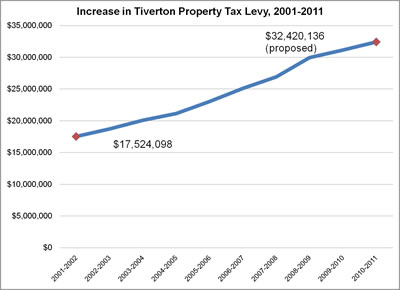
The school side of the budget is particularly disconcerting. According to state law, school committees cannot request "municipal funds (exclusive of state and federal aid) in excess of one hundred four and one-half percent (104.5%) of the total of municipal funds appropriated by the city or town council for school purposes for fiscal year 2010." As far as General Assembly language goes, that couldn't be clearer. Yet, the committee actually requested 106.17%.
Its stated reasoning was that last year's FTM "appropriated" both the local funds and the estimated state funds, and since the state cut its contribution by about $300,000, that money ought to be figured into the budget. Nevermind that the above legislation contains language making all laws to the contrary "notwithstanding." Nevermind that the state actually did give the school district all of its expected aid, just using federal funds to fill the gap.
Over the past week, TCC finally managed to learn the district's revenue from all sources. Until now, the school department has kept millions of dollars undisclosed on the grounds that it was for "restricted" purposes. Working that data into the mix reveals that direct state aid to Tiverton schools actually went up. Moreover, federal money exploded, moving the total state and federal aid from $6,150,846 to $6,967,039.
The problem, from the school department's perspective, is that total aid is expected to drop back to $5,848,725 this coming year — mostly through a drop in those secret "restricted" funds. The end result is that all of the declarations of hardship and of a danger of the schools' being "gutted," "destroyed," and "decimated" represent an attempt to pressure the town into making up for "restricted" money that the district built into its budget. It seems to me that money for special purposes — of which townsfolk supposedly had no reason to be informed — should bring those special purposes with it when it goes. Otherwise, it wasn't really "restricted," was it?
Of course, we all know where most of the money actually goes:
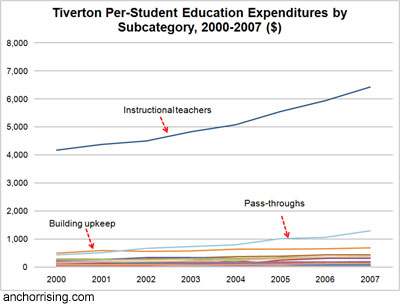
What makes the battle all the worse is the creeping suspicion — rather, confidence — that government functions like this all the way up the chain, only exponentially more expensive and exponentially more deceptive the broader its reach.
April 9, 2010
Another Unlikely Budget Provision
I'm surprised nobody else has highlighted this provision noted in the Providence Journal's summary of the RI House Finance Committee's supplemental budget plan:
The budget would also change a school funding "maintenance of effort" provision that requires cities and towns to provide at least as much local money for school as was provided the year before. Instead, cities and towns would be able to cut that amount by 5 percent for the current year only.
Maybe it's only because I'm up to my ears in budget details for Tiverton, but I'd say this is among the most significant changes that I've heard proposed, which is why I'll be very, very surprised if it makes it into law. Requiring town councils to approve teacher contracts is also significant and unlikely to make it into law.
On a different note, I have to say that I'm still not a fan of mandating health coshare percentages. All we're doing by pushing these changes up to the state level is increasing the power of the General Assembly and consolidating the target for which the unions have to shoot. As grassroots reformers, we'd do much better to concentrate on local elections and make the contractual changes where they belong: within the cities and towns.
Lastly, every time the General Assembly mucks with one of the governor's proposed budgets, the same dynamic applies: They reduce the hit to everybody, and the game becomes finding out where they're getting the money from; that's the hand that they don't want us to watch in their magic trick. In the current case, this appears to be it:
Budget hawks, meanwhile expressed concern that the package included a measure to "reamortize" the state retirement system's $4.3 billion in unfunded pension liabilities over 25 years, a move akin to refinancing a mortgage that costs less now, but more over the long term. The state had been in the ninth year of a 30-year plan to pay off the massive debt.The overall cost to taxpayers is $2.2 billion, according to House fiscal adviser Sharon Reynolds Ferland.
All they'll be doing, with such a strategy, is making Rhode Island's inevitable judgment day even more painful.
April 1, 2010
The Two Basic Solutions
Two approaches to returning services to Cranston schools have emerged, and it's conceivable that they highlight the natural line dividing all various budgetary disputes at the town level:
[Mike] Stenhouse's admittedly "more aggressive" stance on political issues caused a rift this week with an earlier local partner, BASICS (Benefiting All Students In Cranston Schools), a group that bills itself as a "blame-free" organization looking for practical solutions to Cranston's financial crisis.
On one side are folks who've identified the ever-growing tab for union personnel as the culprit in stealing the services that we once expected away from our students. On the other side are folks who think that if we just raise a little more money everything can go back to the way it once was. Some (as in Tiverton) see taxes as the most expedient route. Some (apparently like the BASICS group) want to exact a voluntary tax supplement.
Anchor Rising readers know where I stand. I simply don't think union bullying and scheming should continue to be rewarded.
March 29, 2010
Tiverton Budget Talks Inch Forward
For those who are interested, I'm liveblogging from a special Tiverton Town Council meeting, which is including discussion of proposing legislation to the General Assembly that would allow cities and towns to delay final budgetary decisions for up to 90 days in order to procure more accurate information about revenue.
March 15, 2010
More Re: Committee Wins
Here's the decision from Superior Court Justice Silverstein: PDF.
About halfway through the document, it appears that Silverstein would draw his lines very tightly around his ruling in favor of the school committee:
Under the language of § 16-2-9 a school committee must bargain in good faith with certified public school teachers in accordance with Title 28 and honor current collective bargaining agreements. However, under a narrow set of circumstances, when such collective bargaining negotiations have reached an impasse and there is no longer a valid collective bargaining agreement, a school committee must comply with the mandate in subsection (d) and avoid maintaining a school budget that results in debt.
However, in most of the substantive ways in which Anchor Rising readers might want a little bit of breadth to the ruling, they won't be disappointed. For one, the judge determined that a never-ending contract is not implied by existing laws (citations deleted):
Although the Union contends that the Committee was under a statutory duty to continue to adhere to the terms and conditions of the expired CBA until a successor agreement was realized, the Court disagrees. Title 28 does not contain such a mandate pertaining to school teachers' labor contracts, and in fact under § 28-9.3-4, "no contract shall exceed the term of three (3) years." Further, when previously discussing the effect of an expired contract this Court found it to be no longer valid and cited to Providence Teachers Union v. Providence School Bd., City of Cranston v. Teamsters Local 251, In Providence Teachers, when discussing the effect of a general arbitration clause in an expired contract, the Court stated that "[a]n expired contract has by its own terms released all its parties from their respective contractual obligations, except obligations already fixed under the contract but as yet unsatisfied." Here, the CBA by its terms expired prior to the implementation of the disputed salary and benefits changes. Therefore, the Court finds that the CBA was no longer binding and the Committee did not "abrogate any agreement reached by collective bargaining."
And when a school committee finds itself facing a budgetary shortfall (determined as a measure of its best knowledge on the date that it takes action), and when the contract has expired, employees don't have an overriding claim to district money beyond other line items under the committee's control (citations deleted):
The Union has continually argued that there were other avenues that the Committee could have taken to reduce the FY 09 deficit. However, this Court remains mindful that under § 16-2-9 the Committee is vested with the entire care, control, and management of the interests of the East Providence public schools. Further, under the same provision the Committee has both the power and the duty to adopt a school budget. Accordingly, this Court will not discuss whether the changes to the teachers' salary and benefits were the only or even the best possible way to comply with the balanced budget mandate of § 16-2-9(d). However, this Court does note that the parties stipulated that the teachers' salaries and benefits consumed 63% of the Committee's total revenue from all sources for FY 09. Therefore, given the mandate in § 16-2-9(d) that a school committee "shall be responsible for maintaining a school budget which does not result in a debt" and the evidence before this Court that the Committee was, in fact, facing a debt for FY 09, this Court declares that the Committee acted lawfully under Title 16 by implementing the teachers' salary and benefit changes.
Lastly, Siverstein found that the State Labor Relations Board cannot, in effect, make law to suit its rulings (citations deleted):
The Court is mindful that when deciding such questions, the SLRB is empowered under § 28-7-22 to issue orders and award the relief it deems to be appropriate. However, our Supreme Court has cautioned that "[n]o state official by administrative action can affect the substantive rights of parties as they have been set forth by an affirmative act of the general assembly." Further, as indicated supra, administrative agencies are bound by statutory schemes and a decision or award is invalid if the decision or award contravenes a statutory scheme.
March 8, 2010
Building the Easy Road
A certain faction in Tiverton, working with the town solicitor, is striving to make it as easy as possible for the town to exceed the 3050 statewide cap on municipal tax levies. I've got background and video up on the TCC Web site, and I'll be liveblogging over there during tonight's town council meeting, at which the solicitor is going to try, once more, to slip the objectionable interpretation of the law into town policy.
March 7, 2010
Peculiar News from Lincoln
[Lincoln] Town Administrator T. Joseph Almond is recommending a $70.1-million budget for the next fiscal year that would reduce the tax levy and scale back the School Committee's budget request.The bottom line for the municipal and school budgets would increase by $123,015 in the fiscal year that starts July 1, but Almond said it would decrease the amount raised through local taxes by $531,616. Finance Director John F. Ward said that’s about a 1-percent levy decrease, but that the budget could still be affected by proposed state aid cuts.
Frank Champi, a partner at Providence-based Lefkowitz, Garfinkel, Champi & DeRienzo, P.C., the firm that did the audit for the fiscal year ending June 30, 2009, said the town's operating budget had a $538,828 surplus, and the school budget, a $919,258 surplus. He said the audit put the town among the least financially stressed communities in Rhode Island.
Has Lincoln been doing something right, or has it simply been over-taxing its residents and businesses? I see that it's tax rate is relatively high, and without corresponding to an obviously low median house price, so it looks like an even larger cut would be just. (And that's before taking into account Lincoln's unique circumstance of having gambling revenue from Twin River.
March 4, 2010
Issues on Suburban Minds: Regionalization and Arbitration
I know many of the right reform crowd in Rhode Island disagree with my general take on regionalization, but I'm relieved to see this, from Tuesday's Newport Daily News:
Senate President Teresa Paiva Weed, D-Newport, and Rep. Deborah L. Ruggiero, D-Jamestown, met with members of the Town Council and School Committee before the regularly scheduled council meeting to discuss legislative issues. Both legislators said they would not support any regionalization of municipal functions unless the communities involved agreed to the consolidation. ...Weed and Ruggiero both agreed that the impetus should come from cities and towns.
I'm even more relieved to see this:
When Weed asked school officials for a list of their legislative priorities, several members held up wrists bearing plastic handcuffs."No binding arbitration," Kaiser said, referring to legislation that would require binding arbitration for teachers. "This is not the time to handcuff school committees."
Council President Michael Schnack agreed. "There is no negotiating with binding arbitration," Schnack said. "You get a terrible contract and terrible results."
Weed said she did not think the idea had a lot of legislative support.
Of course, continual vigilance will be required. A lack of legislative support is not necessarily a good enough reason for legislation to fail.
February 28, 2010
Rhode Island Statewide Coalition Winter Meeting Table of Contents
Anchor Rising's complete coverage of the Rhode Island Statewide Coalition's winter meeting:
- My on-the-scene liveblog
- Video: RISC Chairman Harry Staley's opening remarks
- Video: 630AM/99.7FM Host John DePetro
- Video: Central Falls Superintendent Frances Gallo
- Video: RISC President James Beale and Business Network Organizer Jeff Deckman
- Video: Rhode Island Governor Don Carcieri
- Video: Board of Regents Member Angus Davis
February 27, 2010
Town Democrats Just Say Whatever
I've meant to address a letter in the Sakonnet Times (not online) that attacks Tiverton Citizens for Change, not because it's particularly worthy of response, but because it's such a clear illustration of the up-is-down rhetoric that our local opposition has decided to pursue as a political strategy. The letter, expressing concern about an "extreme right-leaning campaign," is by Charlie Moran, arguably the town's most partisan Democrat, and Nick Tsiongas, arguably the town's most prominent left-wing radical:
The Tiverton Democratic Committee believes we need to work together to solve our problems rather than making unfounded accusations and turning residents against each other. Our town council and school committee need our support and input as the make difficult financial decisions, which will include negotiating concessions with all our unions.
The letter itself is an attempt to turn residents against each other, and its substantive claims are based on unfounded accusations. On the latter count, there are two examples:
First, Tsiongas and Moran bring up the controversy, mostly out of public view, around an attempt by some to change state law such that a simple majority at the financial town meeting could vote to exceed the cap on budget increases. That story culminated in a town council meeting at which not only a large number of concerned residents, but also Harry Staley of the Rhode Island Statewide Coalition showed up in opposition. In a curious maneuver that I've seen before, the solicitor raised the issue during his comment period (just about dead last on the agenda) and Councilor Louise Durfee practically jumped out of her seat to pivot the discussion away from where everybody expected it to go and toward an attack on TCC. Had we not been there, the result may have been quite different. (I'll have video of the strange moment up later this week.)
Specifically, Tsiongas and Moran note a press release from TCC President Dave Nelson citing "months of negotiation behind closed doors" and an effort at "keeping the effort under wraps, with the topic quietly inserted into the agenda." They emphasize that the negotiations were part of a lawsuit, and so were kept secret for that reason, but the legality of secrecy does not negate the fact that it is, indeed, out of public view. Moreover, it is entirely true that the issue was slipped onto the agenda in a surreptitious way, appearing on the published agenda just a couple of days before the meeting and, as I said, raised during the solicitor's segment at the tail end of a predictably long meeting.
Second, the Democrat duo raise the school committee meeting at which Dave Nelson and I suggested that freezing or slightly reducing salaries/benefits would be a preferable approach to resolving financial difficulties to cutting pencils, technology, and programs:
... the TCC called on the school committee to unilaterally impose contract terms on our school employees, a strategy that is not only illegal in Rhode Island but also not in the best interests of our community. A similar strategy pursued in a neighboring town has resulted in legal fees in excess of $750,000 and has torn that community apart.
What is tearing communities apart is the ever-increasing tax burden that goes to the benefit of highly paid adults, a majority of whom often live out of the town in question, even as children cannot grasp simple mathematics and science. The citation of East Providence's legal bills is misleading, inasmuch as that town has already blazed the trail. The law is such that each town needn't reinvent the wheel every time. Additionally, as the court battles in East Providence prove, it isn't a statement of fact that its methods (which are currently in effect, saving the town much more money than the litigation costs, I believe) have been "illegal." That is the question that the judiciary is considering.
Most conspicuous of all, however, is Tsiongas and Moran's complaint about Harry Staley's presence at the town council meeting. Shall we expect the Democrats to speak out every time a union fills the school gymnasium with out-of-town hacks who jeer at residents who have the courage to speak up? Are we to believe that they would hesitate to bring in state-level interests when local bodies are considering matters of statewide concern?
No. We need only understand that the letter is mere political calculation that will disappear into the continuing noise of the left-wing and partisan political strategy bent on attacking Tiverton residents with opposing views, tying the hands of grassroots groups that seek to counterbalance entrenched interests, and distorting the issues to the benefit of unions.
February 25, 2010
Re: Times of Drasticness
By way of follow up, I asked Director of Administration and Finance Doug Fiore a couple of questions after tonight's school committee meeting, here are various interesting data points derived from our conversation:
- Approximately $130,000 of the $450,000 increase in health insurance costs would have been erased from the next budget if the union hadn't blocked the intended coshare increase from 12% to 18%. I assume (but did not clarify) that $260,000 would have been saved if that percentage had been applied to this year and next.
- The layoffs and reassignments that the district is leaving open as possible by sending out notices to teachers would, in total, save $1.3 million.
- That same amount could be saved by reducing combined salaries and benefits across the board by approximately 8%.
- That means that the current shortfall of $750,000 could be covered with an across-the-board reduction of about 4-5%.
I want to stress that these are ballpark figures provided while wrapping up a meeting, so they shouldn't be taken as working numbers. I'm merely trying to illustrate comparative options for covering the budget shortfall that, for some reason, aren't aired publicly.
Times of Drasticness Begin
I was a few minutes late to tonight's Tiverton School Committee meeting, and it was already underway. The high school library is pretty well filled, which means probably about 30-40 people, an apparent mix of students, teachers, and residents. The topic: closing the high school. Of course, when the union is looking for a juicy raise, the teachers pack the gymnasium, which means three digits rather than two.
Frankly, I can't help but recall the first school committee meeting after the financial town meeting at which the electorate restrained the school district's budget by $627,000 or so. At that time, the message coming from people associated with the district was that the committee had to do something drastic to drive parents to the financial town meeting and vote for lots of money.
Now Superintendent Bill Rearick said, just now: "Folks in our community need to decide what they want." He says they should go to town meetings, including the financial town meeting. This is just a dance to drive a few hundred more people to the FTM to raise taxes by double digits for everybody else.
7:25 p.m.
Rearick argued that adjustments to labor would only solve this year's problem, not the systemic problems that are yielding such high deficits, ignoring:
- That one of our problems is that raises are compounding.
- That the committee spent hundreds of thousands of dollars in "stimulus funds."
- That he really shouldn't leave such things as pensions out of the labor costs.
We're something like $750,000 short for next year. Had the committee frozen compensation rather than giving out retroactive raises, it would now be only about $150,000 short, and the federal stimulus money was much beyond that.
7:36 p.m.
Deborah Pallasch just read a letter on behalf of the Democratic Town Committee urging rapid resolution of negotiations with the union. No doubt some of the Democrats are urging the union to secure the maximum as they can right now, because they see that things are only going to deteriorate.
7:39 p.m.
A resident whom I don't know just said that the retirement communities that moved to town in recent decades are "cancers on our community." He must be among the faction calling for unity and cooperation in town.
7:41 p.m.
If he's talking about Tiverton Citizens for Change, I can testify that a majority of the core members are not gated community types.
Jan Bergandy took the opportunity to say that people have to turn out for the FTM
Dave Nelson is now addressing the committee. As he's began speaking, he turned periodically to face the audience. Unbelievably, Deborah Pallasch shouted from the audience: "You need to address the committee, not the audience." Who does she think she is?
7:49 p.m.
Here's an interesting angle: A resident just asked whether there's been any communication about bringing Little Compton students into our system. I know they used to do that, and I'm not sure what happened. But it does raise the interesting point that the district has an opportunity if it concentrates on making its programs attractive.
That means getting more for its money.
The next speaker talked about hiring maintenance staff who keep the property up, rather than merely cleaning it. Again: The upshot is that the district now allocates its money poorly. It needs to shift some of its per-pupil expenditures toward new programs, some to maintenance, some to technology, and so on. That will mean holding existing labor flat or somewhat decreased to make the school more attractive — especially with the possibility of increased student choice in the near future.
7:58 p.m.
School Committee Chairman Jan Bergandy just pointed out that the argument that some have made that losing the high school would make property values plummet has the problem that Little Compton's property values are much higher even though the town has no high school. It's not really a valid comparison, because the two towns are very different, but it's interesting that he argued that way.
Deb Pallasch just suggested that the committee "do whatever it can do" to drive people to the FTM.
8:12 p.m.
They've moved on to talking about possible health insurance switches. The upshot is that it would take a lot of money and research even just to find out whether switching would make economic sense.
8:17 p.m.
Health insurance increases account for $450,000 of the current shortfall. Not sure what percentage of that is due to the union's argument that it didn't have to negotiate a new contract this year and would not accept the budgeted increase of health insurance coshare from 12% to 18%.
Now they're discussing the 31 pink slips and 15 displacement letters that the district will send out to meet the legislative deadline of March 1 for such notices.
How absurd is it that the district must simply pick the junior employees for all layoffs. Are there no older teachers whose absence would save more money and whose absence would minimally affect the students (or perhaps not at all)? Moreover, I just don't understand how the union can make all of the arguments for class size, solidarity, and basically its entire argument for existing if it would rather cut young teachers loose rather than give concessions.
A young librarian is making an extended argument for what her department accomplishes. Good for her. None of these programs should be cut.
8:35 p.m.
Just an observation: Supt. Bill Rearick is offering a conciliatory lay-off-related speech, encouraging more participation in the leadership process, but his tone of voice is confrontational. His tone isn't always so, which makes me wonder who, in his mind, he's confronting.
8:41 p.m.
A recent graduate of the high school just argued on behalf of the library staff, and she closed by expressing the opinion that "a more critical eye" should be applied to the layoff process. Perhaps it's an introduction to the effect that the union system can have on a professional workforce. It's plainly wrong and strategically ludicrous.
8:47 p.m.
Bergandy mentioned that there's been no movement with NEA negotations, except the scheduling of a March 4 mediation.
8:49 p.m.
I'm increasingly persuaded that union-friendly legislators set the deadline for layoffs so early precisely for the angst and disruption it causes among teachers and the community, even though budgeting can't possibly be complete by this point. The law should change, and teachers should be leading the charge.
February 23, 2010
The Same Old Local Political Roundabout
As circumstances deteriorate, it's instructive to observe the varying reactions and strategies for handling them. In Tiverton, the established order, so to speak, has redoubled its efforts to keep the negative focus on Tiverton Citizens for Change in the hopes that people won't notice that the plans for improvement bear a striking resemblance to the plans that got the town into its current mess. I've got a letter pointing out the 'round-and-'round nature of the debate:
On January 27, 2009, the school committee approved a largely retroactive contract for teachers that ate up about $300,000 of that year’s budget, added approximately $150,000 to the current year’s, and is contributing more than that to the $600,000-plus increase in salaries and benefits budgeted for the next fiscal year. At a November 2008 meeting, Ms. Pallasch argued for approval, saying, “Let's start working on the new one, and give ourselves a little bit of room to refocus on the classroom and away from the adults.” The argument was that we should resolve the running dispute while there was still time to negotiate the subsequent contract amicably.At the time, I spoke up to predict that the union would not negotiate. Rather, it would wait out the recession based on the obvious reasoning that it could avoid concessions during hard economic times and — as we’ve taught its members to expect — receive retroactive raises when times improved. I also handed out a chart showing that there had been no abatement of the increases in teacher salaries and benefits in the past decade. Indeed, the per-pupil dollar amount had gone up more (54%) than the same number for the state as a whole (40%). Over the same period, the chart showed that most other expenditures had hardly moved.
Well, negotiations did not resume with an amicable tone. Indeed, in August, the union pointed out a clause in the contract extending it for another year. The school committee had somehow missed the trick that it was supposed to notify the union of its intention to negotiate the next contract a full month before the previous one was actually approved. Changes in healthcare copayments for which the committee had budgeted went out the window. So did negotiations.
And the usual suspects are back, making all of the union's arguments for it in advance of the debate. Wealthy people wanting to increase taxes rather than stand firm with the organized labor behemoth that has soaked up a growing portion of our educational and municipal funds.
The system is broken. Revving it up for another season is not the solution.
February 22, 2010
The End Is Near; Blame Somebody Else!
Reading about the budget woes on both the school and municipal sides, in Tiverton, I find it somewhat striking that none of the elected or appointed officials appear to worry that they'll face accountability for the things about which they're complaining. For example:
Tiverton's schools could also take a $386,286 education aid hit next year, said Doug Fiore, chief finance officer for the schools.Officials are confounded by the depth of proposedfunding losses, and the uncertainty.
I'm not directing this to Fiore, but to "officials": How could they be confounded? They can read the papers. They know what's going on in the state and in the country. And yet they approved a substantial retroactive raise for teachers last year. And yet they spent every dollar of the magic Obama money. I personally suggested to Superintendent Bill Rearick and School Committee Chairman Jan Bergandy that they put that money aside for the current budget, and they explicitly told me that their intention was to deal with the forthcoming budget as a separate matter. In other words, they didn't want to let the future infringe on the spending of the present.
Incidentally, apparently the superintendent and school committee are going around proclaiming that Tiverton Citizens for Change "cut their budget" last year, a claim that is false or irrelevant for two reasons. First, the budget cut originated with a handful of angry residents, not with TCC. Second, current budget documents available on the district's page state that its "surplus of $229,546 [is] to be included in next year’s budget."
In other words, had there been no reduction in the local contribution to the district's budget, last year, it either would have found something on which to spend the money, or it would currently have a $900,000 surplus. If the administrators and elected officials are complaining that struggling residents didn't hand them an extra million dollars to leave lying around in the worst economy in a century, then their contempt for the people for whom they work is astonishing.
Also astonishing is this sort of thinking, which one hears across local government:
"I think the concept of closing the high school is ridiculous," said Leonard Schmidt, chairman of the town economic development commission. "There are many ways to save money other than by closing schools." Mr. Schmidt suggested reopening contracts for teacher concessions, and centralization of school functions, but cautioned against looking to the schools to resolve the crisis.
The teacher's contract does not have to be "reopened," because there currently is no contract. At the very least, one can say that it is not "closed."
February 19, 2010
A Negative Approach to Governance
And around and around not-my-town goes:
Rep. John G. Edwards (D-Dist. 70, Tiverton, Portsmouth), whose district encompasses neighborhoods on both sides of the Sakonnet River Bridge, has introduced legislation that will prohibit tolls from being charged on the bridge. ...Instead, Rep. Edwards proposes placing a toll on Interstate Hwy 95 (I-95) in Westerly and in Pawtucket as an alternative revenue source.
As a political matter, it's an easy call to reject state-level policies that will affect one's subregion negatively. And sure, perhaps there are marginal justifications for putting a toll in one place rather than another. However, this is just gamesmanship. If Rep. Edwards wishes to submit legislation that will solve the acute problem of a toll proposal while addressing the underlying difficulty, he should propose that the General Assembly allocate money from its general revenue to the basic infrastructure matters to which it ought to be going before anything else.
Of course, that would require the risk that people in his own district might dislike the decreased revenue for the ancillary government expenditures that would have to be cut, such as nanny state programs, inside deals, and union giveaways.
February 6, 2010
The Window and the House of Cards
Apart from the complications of Rhode Island law, as a matter of political theory, this strikes me as a reasonable argument:
The lawsuit [by the city of Woonsocket], which also names State Controller Marc A. Leonetti and General Treasurer Frank T. Caprio as defendants, said the money [that the state was supposed to give towns for automobile excise taxes] was appropriated by a legislative act of the General Assembly and that means Carcieri, Leonetti and Caprio have "a clear legal duty" to pay it."He may submit the budget, but he does not have the authority under the state Constitution or state law unilaterally to change the General Assembly's budget after it has passed," [Woonsocket Mayor Leo] Fontaine said.
I've long been including, among my complaints against Governor Carcieri, that he is far too passive about describing the ownership of the budget. Even though we're into the second month of the calendar year — and the legislative session — legislators have yet to act on the supplemental budget. So, the governor should pay out whatever money is due, to whomever it's due, until the money runs out and then just shut down. "I'm bound by law to follow the General Assembly's budgeting," he could say, "and they've chosen to spend the account dry rather than take corrective action." It's their responsibility.
WPRI's recent poll data gives reason to hope that the public is coming around to an understanding of the political dynamics, in this state. Overall, 53% of Rhode Islanders blame the GA for the budget crisis, with another 25% splitting blame between the legislature and the executive. Perhaps based on relative degrees of attention, the General Assembly fares worse as the age of the respondent goes up. Moreover, 61% of respondents want cuts in spending and services and not in taxes.
If increasing understanding is to translate into the appropriate electoral actions — rather than merely contributing to the general grumble — the governor must make the necessary political decisions crystal clear. He should declare that the General Assembly's failure to act has been an open window next to the budgetary house of cards and then get out of the way of the inevitable.
February 4, 2010
A Conservative at the Library
On the Matt Allen Show, last night, Andrew admitted to using the public library (albeit a couple of times per year) and suggested a reason for RI towns' fiscal profligacy. Stream by clicking here, or download it.
My two cents: Public libraries are wonderful resource for students and people who don't work. During a period when my wife's job gave her summers off, she took our children to the library all of the time, where the books and various programs kept them engaged and learning. Other folks seeking to find ways to fill their days, and perhaps those who work from home, also benefit from the system. Whether that's enough of a reason to fund libraries is up to each town to decide. Personally, I think a certain baseline access to knowledge, especially now that libraries can be a public portal to the Internet, is worth maintaining.
February 1, 2010
Too Big to Fail Towns?
Along with a table with the statewide results, Providence Business News has an article describing the results of "fiscal stress tests" that a state panel ran for cities and towns:
Pawtucket, North Providence, East Providence, Central Falls, Warwick and West Warwick are in the most serious trouble, the Municipal Fiscal Stress Task Force reported Friday after examining municipal reserves, property tax rates, pension liabilities and public employee health care benefits, among other factors. ...Task force members -- made up of financial experts, CPA and several municipal finance directors -- have asked that a permanent commission be formed to monitor local spending and develop recommendations.
Peder Schaefer, chief of the Department of Revenue's municipal finance division and a member of the task force, told reporters Thursday that the report would lead to legislation that would "beef up oversight by the state."
For instance, one bill that being worked on would require local school departments to file quarterly financial reports with the R.I. Department of Education, he said. Another would give municipal councils or chief executives the authority to approve school department spending plans, administration officials said.
I remain skeptical about the urge to consolidate and control from above. The state is hardly in a condition of fiscal health, and residents have more access to change their local government than they do their municipal leadership. Indeed, the policies of the state are a contributing factor to the difficulties of the towns. It would be a mistake to assume that the people leveraging this greater influence, at the state level, would be the same people who took the initiative to study the numbers in the first place.
I say this as an active taxpayer in the most fiscally stressed "rural" town, by far. Tiverton's Fiscal Stress Test score is in company with the state's "urban" communities and fares only slightly better than the "urban ring" municipalities about which the state is so concerned.
January 25, 2010
Mainstreet Loses an Anchor and the Council Looks to Tax
So, Bank of America is abandoning the Main Street location in North Tiverton that it has inhabited for decades (most of the time as Fleet bank). According to somebody in a position to know, the branch remains profitable, but corporate executives have analyzed the prospects of Tiverton, Rhode Island, and determined that there will be insufficient small business activity to justify a presence in the town. Municipal officials may dream of a down-town-style business district, but when one of the two institutions that would anchor the community with access to capital and money management expresses its skepticism by packing up and leaving, residents should stop daydreaming and look at what's happening in reality.
In reality, Town Solicitor Andy Teitz has put it on tonight's agenda (PDF) for the town council to discuss the state law that places a cap on the amount that towns and cities can increase their taxes. At issue is this statutory language:
Any levy pursuant to subsection (d) of this section in excess of the percentage increase specified in subsection (a) of this section shall be approved by the affirmative vote of at least four-fifths (4/5) of the full membership of the governing body of the city or town or in the case of a city or town having a financial town meeting, the majority of the electors present and voting at the town financial meeting shall also approve the excess levy.
What the solicitor is expected to argue is that the town should entirely disregard the word "also" and accept it as town policy that a simple majority of the electorate in attendance at the financial town meeting should be able to authorize an increase above the tax cap. A lawsuit is already in process, in the town, to test that reading of the law, so one avenue that the solicitor and certain town councilors may be interested in pursuing is to change the above language, through the General Assembly, to remove the "ambiguity" of the law to conform with their reading.
Residents should decline to join in the imaginative exercise of pretending there's any ambiguity at all beyond the grammatical error of using "or" rather than a semicolon in the statute. The town council ultimately approves the baseline budget that the residents consider at the town meeting, and elected officials should therefore have to submit themselves to accountability. Otherwise, voters should take it to be their duty to reconstruct the budget line-item by line-item, perhaps with constituencies developing complete and competing budgets.
Also at tonight's town council meeting, by the way, will be a vote on the "pay as you throw" policy by which the town is seeking to more than double the cost of trash pickup for residents. Not coincidentally, I'm sure, its plan to charge households for the garbage bags that they use will not figure into the tax cap. Put it all together, and over the course of a few Monday night hours in January, Tiverton's council of seven could lay the groundwork for a truly massive increase in taxes and fees in the midst of a deep economic recession in a town and state in long-term economic decline.
January 24, 2010
Towns on the Teat, Too.
This article is a few weeks old, but I've been holding on to it because the statement contained therein really requires philosophical correction:
One by one, mayors and municipal managers from Cumberland to Westerly told the House Finance Committee on Thursday that the midyear aid cuts proposed by Governor Carcieri will wreak havoc on local services and tax rates, shifting a state budget crisis onto the backs of municipal employees and property owners already feeling the bite of previous state-aid cuts.
If the towns and cities have allowed themselves to rely heavily on the state for financial support and the state is having a budget crisis, then the crisis isn't shifted, it's shared. We should expect our municipal leaders to be more self-motivated, active, and demonstrative than welfare queens.
What really irks me about the attitude expressed in the article, though, is the degree to which government operates as if behind a wall of glass. Mayors and managers shouldn't be wasting time on their knees at the state house. Even were groveling successful in staving off cuts to "state aid" this year, circumstances are only going to be more dire in the next budget unless things change dramatically in Rhode Island.
In other words, officials should be turning to the people who elected them (or who elected the people who appointed them), explaining what the state must do to turn things around, and more importantly, encouraging residents to get involved — not to join in the groveling, but to run for office and join taxpayer groups and the like. After all, they pay the taxes whether it's to the town or the state, and when revenue improves for the state, it will improve for the municipalities, as well.
Of course, this assumes that municipal leaders have a clue about what might save Rhode Island — an optimistic assumption if ever there was one.
January 21, 2010
Hummel Report: The Abuse of Power of the Emergency Board-Up
Jim Hummel's original report available here.
In addition to the issue of Mayor Moreau's third party billing arrangement for his new furnace, Hummel's report throws a spotlight onto the Mayor flexing emergency powers to deal with empty, foreclosed houses.
These – and more than 200 other houses – were boarded up by Bouthillette’s company, under the mayor’s ``emergency powers’’ – which meant Bouthillette was the only game in town. The Hummel Report has also learned it meant Bouthillette’s company had the building official and in some cases the police department, behind him when he went to board up a house – sometimes charging more than 10 times what other companies we spoke with would charge for the same job.
By keeping emergency powers in place, the Mayor was able to avoid putting the work out to bid. Competition drives down prices. But when you're designated as the only company for the job, you set your own rates. Property owners, then, were at the mercy of Certified Disaster Restoration Corporation, which was
one of several companies owned by Mike Bouthillette, a close friend and campaign contributor to Mayor Charles Moreau.
Except that, at ten times the going rate, Certified Disaster did not show much mercy.
I called City Hall this morning to ask how long the emergency powers were in effect. The Mayor's Executive Assistant, Kristin Sullivan, did not know, which is puzzling because she works for the man who put them in place and couldn't avoid being familiar with this detail. Kristin did inform me that the Mayor himself could not answer my question because is presently away at the US Conference of Mayors in DC. Why the City Solicitor, who presumably assisted the Mayor in establishing the emergency board-up powers, is also attending this event is not clear.
I also reached the Central Falls Building Official, Todd Olbrych, and asked him the same question: how long were these emergency powers in effect? After two "no comments", he abruptly terminated our conversation.
By the time the Mayor had lifted the emergency powers, the company of the "close friend and campaign contributor to Mayor Charles Moreau" had boarded up over 200 buildings. This turned out to be, in Hummel's words, the "lion's share" of foreclosed buildings. Interestingly, then, while everyone at City Hall is studiously refusing to 'fess up to the duration of the state of "emergency", we know that, at a minimum, it was long enough to allow a close friend of the Mayor to vacuum up most of the high priced work.
Hummel reports today that the RI State Police have visited Central Falls City Hall to check into various details of this matter, including the strange billing arrangement for the Mayor's new furnace. Possibly they can also establish the duration of the "emergency" and whether the Mayor was more entranced with exerting power than he was by the definition of "emergency" or with preventing a "legal" mugging of property owners that he purportedly represents.
January 19, 2010
Mandated Monitor Waste
Here's the scene: Shortly after 7:00 a.m. on a semi-rural road that locals often use to avoid a mile or so of Middletown's two main roads, the school bus pulls up to a modest split-level house, and the driver opens the double doors. A middle-school girl skips up the driveway and stops a few feet from the bus. She waits. She hooks her thumbs in her backpack straps. Motorists crane their necks to see what's going on.
Finally, first one leg then another appear. An elderly woman in an reflective vest climbs backwards onto the street. With one arm still attached to the handrail, she leans a little out of the way, and the young girl bounds effortlessly up the stairs. The bus monitor bows her head, takes a deep breath, and begins the laborious climb back up to her seat.
Now, if the people of Middletown feel that the benefit of intergenerational cooperation is worth the expense of such morning-time chaperons, then I'm hardly in a position to object. However, we have, here, a living, breathing example that the arguments proffered for a state-level bus-monitor mandate are not actually the most significant motivations. The woman in question makes no pretense of inspecting the underside of the bus for suicidal children, and were a child about to enter into danger crossing the street, or something, she would likely prove physically unable to prevent the calamity. The bus driver and the horn would be more effective.
This, folks, is one small emblem culled from daily life explaining Rhode Island's deterioration.
A Fortieth Municipality
At a time when common wisdom is marching straight toward a cliff labeled "consolidation" (at the bottom of which are sharp rocks of incumbency, special interests, and political corruption), I'm encouraged to see that the independent spirit lives on in some corners of the state:
Started in early December by Prescott Avenue resident and Riverside native William J. Hurley, a group officially titled the "Coalition to Secede The Riverside from East Providence" has expanded over the last five weeks to include more than 100 members. While many have joked in the past that Riverside should become it's own town, Mr. Hurley and his peers say they want to see the idea come to fruition.
Of course, Riverside residents should be made aware of the huge additional cost of going it alone, but if they're comfortable bearing it, then the desire for more local control is a healthy one. One East Providence city councilman puts his finger on the most prominent benefit (emphasis added):
City councilman Bruce DiTraglia, whose ward is contained entirely to Riverside, said the idea definitely has its advantages."I would like it," he said. "I would think it would be a lot cozier and a lot more personal. I think you could get a lot more people involved. I think it's a good idea."
When the playing field to change policies is smaller, more people will think it worth their time. As gravity pushes control out to state and national governments, more and more people conclude that the possibility of change is so remote as to make civic engagement fruitless. Moreover, as the pain of errors in governance spreads more broadly, it takes a higher degree of incompetence to teach the electorate the lessons that it needs to learn.
January 12, 2010
Budget Season Begins
Tonight's the first meeting at which the Tiverton School Committee will address next year's budget. The upshot is that Superintendent Bill Rearick is offering, as an initial budget, an increase at the state cap (4.5%). Of course, he included in last year's budget "surprise" federal "stimulus" cash, so this budget is actually 7.13% above the allocated amount at last year's FTM.
ADDENDUM (from home):
My coverage of tonight's meeting wasn't exactly comprehensive, because I was following the conversation with especial intentness and offering comments from time to time. A few points:
- I was incorrect about the reason, but correct about the result, when it comes to budget discrepancies. The "stimulus" money wasn't included in the number for last year's budget, but it shows up as a deficit in the coming budget, meaning that current projected spending exceeds the amount laid out in the budget by $892,268.
- Superintendent Rearick mentioned several times that the taxpayers' attempted level funding (thwarted by the federal gift) was to blame for the large shortfall, but it fell to me to point out that the district could have planned for that when it discovered itself flush with revenue.
- Owing to pension changes, the district currently has something like $235,000 lying around, but since midyear cuts in aide from the state are on the table, the committee and administration are inclined to leave that completely out of the picture, for now.
- The teachers' union, which is currently without a negotiated contract, is concentrating on "ground rules" and such rather than taking up actual dollar amounts and negotiations.
- The currently proposed budget assumes no changes to healthcare-copays and zeroes out salary increases, excepting steps and an AFSCME raise scheduled at 2%.
- There does not appear to be much support from the folks on the state (metaphorically speaking) to impose labor policies unilaterally.
- Rearick was not shy about speaking the phrase "program cuts."
- I estimated that a 3.5-4% across-the-board cut in combined salaries and benefits would entirely erase the deficit, and nobody contradicted my math.
- Tiverton Citizens for Change President Dave Nelson was not happy.
So basically, we're looking at a district administration that's pushing for the maximum tax increase that it can secure, a school committee that isn't ready to commit to anything, a union that wants to delay, delay, and delay until the economy improves, as I predicted they would do back when the school committee made the ill-advised give-away that the last contract represented, and the TCC is not going to simply watch this budget float away.
January 7, 2010
Rule by Funding and Memoranda
I'm one of two people in the audience of an "emergency" Tiverton School Committee meeting, which was called in order to approve a memorandum of understanding from the Rhode Island Department of Education for the state's Race to the Top application, and the sense that I'm getting from the discussion is not encouraging.
Here's the upshot: School committees are under a lot of pressure to sign the MOU so that the state can prove "political will" to implement the program to the federal government. The problem is that the document that the local officials are being asked to sign is apparently not wholly inclusive of the information on which they believe they're voting. Some supposed facts are in a repeatedly changed FAQ document. Others were conveyed during in-person meetings. Some of it is in documents from the federal government. And the really-honestly-truly final document won't be released until Monday.
So, in the name of chasing after taxpayer money, the people whom taxpayers have elected to guide their local investment in childhood education are being asked to sign on to mandates and requirements from state and national officials without, as far as I can understand, even receiving assurances that the higher tiers of government will provide more money than they're requiring districts to spend.
ADDENDUM:
Here's an interesting point from School Committee Member Leonard Wright, who seems extremely suspicious of this whole thing: There is language in the memorandum that the district agrees to comply with the terms of the federal grant and a "RIDE subgrant" that apparently has not yet been produced.
ADDENDUM II:
And isn't this FAQ point interesting:
Are there "supplement, not supplant" requirements for Race to the Top?Race to the Top contains no "supplement, not supplant" requirements.
Furthermore, the language that Mr. Wright cited about a state "subgrant" suggests to me that the state could take advantage of the lack of "supplement, not supplant" language while still imposing that very rule on individual districts.
Another point that's coming up is that the town is probably going to be subject to increasing regulations and mandates whether it signs on for Race to the Top or not. It's the old "nothing to lose" lure. But imagine this outcome: The collapsing state causes a political surge for reform, among which is the elimination of state-driven mandates... except, of course, where those mandates are part of contractually agreed grant programs.
ADDENDUM III:
The school committee has added, as a condition of its agreement, stipulations that all program requirements will be fully funded and that the funding from Race to the Top would supplement, not supplant, allocated state and federal aid to the town.
December 28, 2009
Tiverton's Forthcoming Garbage Tax
It appears to have fallen through the online cracks, but I've got the following letter in the current issue of the Sakonnet Times:
On December 14, Tiverton's town council meeting included a public hearing concerning a proposed "pay as you throw" trash program to fund the closure of the town landfill in five or so years. Basically, residents would have to buy garbage bags from the town at a cost of $2 for a 33 gallon bag or $1 for a 15 gallon bag.Figuring a ridiculously low single bag per household, the Landfill Committee estimates that the program would generate $520,000 per year. Taxpayers currently allocate an annual $573,000 for trash pickup. In other words, the cost of rubbish disposal for residents of the town of Tiverton would more than double.
It's too little known, around town, that the local government has failed to adequately prepare --- over the half century of the landfill's usage --- for the millions of dollars in expenditures that loom just over the horizon. Without action, the restricted account set aside for that purpose will be several million dollars short when it's finally needed, even without considering the additional cost to develop and build a transfer station to process trash on its journey out of town.
Clearly, something must be done, but as currently constituted, the "pay as you throw" program would be nothing other than a massive hidden tax increase that skirts the Paiva-Weed tax cap, leaving homeowners open to another large increase on top of the new "fee." Even residents willing to forgo pickup and bring trash, themselves, to the landfill would have to buy the bags and pay for pickup, anyway. In other words, it's a fee for a service that most residents have no choice but to utilize. It's a tax.
The more straightforward approach would be for the town to place an increase in landfill-related savings within its next budget. Of course, that wouldn't answer a secondary (and supremely advisable) purpose of the program: encouraging recycling and more conscientious trash disposal. Perhaps curbside pickup could move to a fee system, or residents could "opt out" and receive a refund of that portion of their property taxes.
Or there might be another solution. Whatever the case, the council continued the hearing to its regularly scheduled meeting on January 25. If residents tune this issue out now, the next they hear of it may be when official instructions arrive in their mailboxes explaining how to pay for trash pickup a second time.
December 21, 2009
Garbage Goes Straight to Video
Mostly for the edification of Tiverton residents, I've posted the portion of the last town council meeting that represented the public hearing on a pay-as-you-throw trash program. Nine of the 10 video clips are in the extended entry.
Continue reading "Garbage Goes Straight to Video"
December 15, 2009
The Fight Moves Outward
The General Assembly will no doubt search for tricks and methods of denial, but the state is going to have to continue cutting its budget, and according to the Providence Business News, Governor Carcieri is looking toward the cities and towns:
The state budget would be balanced by cuts in spending for local education, aid to cities and towns, one-time land sales that include the Veterans Memorial Auditorium and other savings, under a plan Gov. Donald L. Carcieri was expected to submit on Tuesday.
The amount in reimbursements for vehicle excise taxes that the state would keep for its own use would go up to $65.1 million (having previously been about half that, as I recall). School districts would also see a $41 million cut, offset in part by the end of cost-of-living adjustments for pensions.
In general, sending the fight out to the cities and towns is a positive development, from a taxpayer perspective, because it's easier for engaged residents to rally against entrenched forces at that level. The missing components, however, are statewide regulations and mandates, which limit what municipalities can do and which restrict economic activity.
December 14, 2009
Garbage Talk
There's an unusually large crowd for tonight's town council meeting... unless, of course, the recession has made this a more common form of entertainment than was the case back before I stopped attending regularly. It seems a handful of attendees are here to discuss increases in mooring fees (for late payment). Hopefully, a greater number are here to object to the proposed pay-as-you-throw trash program that would more than double (or more) the amount that residents pay for trash pickup.
8:44 p.m.
I took the podium to suggest that I'll not be able to avail myself of trash pickup if its cost more than doubles for my household, and Department of Public Works Director Stephen Berlucchi hastened to correct my misunderstanding: Residents will have to buy the bags to dispose of trash in the dump, whether it's picked up or dropped off. There'll be no way around it.
In other words, this is just a massive hidden regressive tax increase during the worst recession since the Great Depression, implemented because the town did not adequately budget for the closure of the landfill over the half-century since it emptied.
One other observation: Over the phone, my wife mentioned to a friend in town where I was headed tonight, and the friend had no idea this was coming. If people have to start buying garbage bags, I'd wager they'll be in a budget cutting mood come the financial town meeting, this spring.
8:58 p.m.
It sounds as if some sort of tax offset will be created. Councilor Louise Durfee suggested that some portion of the revenue from pay-as-you-throw should offset the budget line item for the landfill. Council President Don Bollin suggested that one $2 bag per week should be considered included with one's taxes.
9:18 p.m.
The public hearing on this issue has been continued to the second town council meeting in January.
December 9, 2009
Bad Government, Sneaky Taxes, and Garbage
This coming Monday, December 14, the Tiverton Town Council will (hopefully) be hearing from residents concerning a proposed "pay as you throw" program for garbage pickup. The nutshell background is that (despite regular and significant annual tax increases) the town has not been putting aside adequate resources to close the landfill when it runs out in five or so years, and it's going to have to come up with around $4 million one way or another.
The proposed solution is to charge residents for the garbage bags that they may use — $1 for a small bag (15 gallons) and $2 for a large bag (33 gallons). With an extremely conservative estimate of one bag per household per week (my household will probably burn through two or three large bags on an average week), the Landfill Committee is estimating gross revenue of $520,000.
The catch is that, even if we go with that ludicrously low number, the cost of garbage pickup to residents will pretty much be doubling, because the budget line item for "rubbish/recycling collection" currently runs us $573,601. The new bag fees would amount to a massive tax increase that isn't subject to the tax cap. Worse still, families (like mine) that cannot afford another regular household expense and opt, instead, to lose weekend time going to the dump, will end up subsidizing the trash pickup of those who are better off, because we'll still be paying the initial taxes.
Personally, I'd support ending curbside pickup altogether. That's not politically feasible, though, so if the town council goes forward with this proposal, it should allow households to "opt out" and receive a refund of that portion of their property taxes that support rubbish collection (around $105, on average).
December 7, 2009
We Need a Taxpayer Grievance
How can an entity — whether a business, a town, a nonprofit, whatever — operate like this?
[Little Compton Firefighter Fred] Melnyk was off duty at the time, out of uniform, and had been in the fire-station earlier at 11:16 when the medical incident in question was called in. An emergency medical technician (EMT) with cardiac training, Mr. Melnyk immediately responded to the call by himself, driving the Rescue 1 to the scene at John T. Martin Road, one mile from the station.He later found himself stranded there when two other firefighters, who had arrived in two separate fire trucks, fresh from finishing another nearby incident, took Rescue 1, with a patient inside, and drove to Charlton Memorial Hospital, 30 minutes away.
That left Mr. Melnyk with the two parked fire trucks that needed to be returned to the station. With him was the fire chief and his command car. A decision was made (that Lt. Woods later grieved) that Mr. Melnyk, still off duty and at no cost to the town, would drive the two trucks back to the station, and not leave them parked on John T. Martin Road, a task Mr. Melnyk accomplished in two trips, ferried back to the residence by the chief in the command car.
Lt. David Woods has filed a grievance claiming that he should have been called in for his four-hour minimum of overtime pay, receiving $127.36 for around twenty minutes worth of work.
December 3, 2009
About That Status Quo
Meeting with East Greenwich town officials, Sen. Leonidas Raptakis (D, Coventry, East Greenwich, Warwick, West Warwick) spoke against state mandates:
"We have so many archaic statutes, contracts and mandates, unless we start deleting these mandates or give cities and towns latitude, we're going to start this revolving circle again, and it's going to get worse," he said. "If we don't get tough this year and next year, things are going to get worse for many years to come."
And House Minority Leader Bob Watson (R, East Greenwich, West Greenwich) made this interesting suggestion:
He also said he was intrigued by the idea of cities and towns protesting by withholding the funds they collect on behalf of the state.That, he said, would get the General Assembly's attention. "I think that would create a great dynamic."
But missing from their comments — or at least reportage of them — is an explanation of what they would do to make up the difference for the cuts to municipalities that they oppose:
"I do not support any idea of taking monies off the table that have been earmarked for communities. I take that as irresponsible, particularly because we didn't give any relief from state mandates," said Watson. "I think there will be enough pressure to at least preserve the status quo."
The "status quo" is a deficit. It's a state with insufficient funds to pay its bills. Senators and representatives, especially, have a responsibility, if they oppose cutting one area of spending, to explain what area ought to see the cuts instead. When they meet with local officials, they ought to take the opportunity to explain the reality of that situation; perhaps they'll begin to loosen the logjam of apathy and ideology that's flooding the state.
November 29, 2009
Tiverton School Committee Merit Pay Workshop Video, 6
Tiverton School Committee Merit Pay Workshop Video, 5
Tiverton School Committee Merit Pay Workshop Video, 4
Tiverton School Committee Merit Pay Workshop Video, 3
Tiverton School Committee Merit Pay Workshop Video, 2
Tiverton School Committee Merit Pay Workshop Video, 1
So when I arrived at last Tuesday's Tiverton School Committee workshop on merit pay for teachers, I set up such that I could capture the faces of speakers in the audience. But the committee out-thought me and positioned a microphone at the table typically set aside for the stenographer, and by the time I realized it, the more-appropriate side of the room was filled (and with my political opposition). Consequently, my video features mainly the backs of non-committee member participants. Consider it an effort to make the viewer feel as if he or she is actually there.
Each of these posts will include three videos, two in the extended entry.
Continue reading "Tiverton School Committee Merit Pay Workshop Video, 1"November 24, 2009
A Merit-Based Meeting
Thankfully, the Tiverton School Committee's workshop on merit pay is much better attended than has been, well, any other meeting since the poorly considered passage of the retroactive teacher contract. Maybe 50 people.
School Committee Chairman Jan Bergandy mentioned some communications that he's received from teachers to the effect of: "How dare you let people discuss this."
Superintendent Bill Rearick just suggested that adding money to payroll may not be necessary, if the goal is to sort through teachers. He suggests stronger evaluations and the ability to dismiss bad teachers. I don't think anybody from Tiverton Citizens for Change would argue against that strategy.
7:27 p.m.
Some discussion has passed, but I was participating, so I couldn't be posting, as well. Former School Committee Vice Chairman Mike Burke is speaking against spending any further time discussing merit pay. He's clearly presenting his prepared remarks as a direct political response to some initial thoughts by Tiverton Citizens for Change. But that's what one is to expect from the people who've been running Rhode Island and its cities and towns: His position is that all change is blocked at contractual, legal, and budgetary considerations.
Tiverton Establishment: "No change. Keep funding a failing system. Let's do some research."
One interesting point that he's made is that the financing of the districts is too closely integrated for a district's merit pay system to work. I'd argue that a system that has relatively low pay for just showing up to work, but high pay for good teachers would tend — within the static system that Burke describes — to attract the better teachers within the state. Not surprisingly, he wants to wait for the state to act and force something from union-controlled top down.
8:24 p.m.
I haven't written much because the conversation has gone along pretty predictable lines, and there's been no deep investigation into specifics of a program. One notable thing is that merit pay does reshuffle the ideological deck, some. I know I've had behind the scenes arguments on my side, and it's clear that the other side is (or should be) having their own.
One lesson, perhaps, could be that merit pay isn't its own issue, apart from broader reforms, especially in Tiverton, which is currently working through the first stages of a strategic plan. I'll agree with some of the suggestions of folks with whom I generally disagree, that we don't want to derail other initiatives. So, perhaps merit should be built into the evaluation system currently in development. (I happen to be on the evaluation committee...)
Afterthought
Overall, the workshop had a productive, cordial tone, so one thing that stuck out felt inappropriate to explore — mostly because it could have devolved rapidly. Comments were made several times that, essentially, teachers aren't really motivated by money. Indeed, School Committee Vice Chairwoman Sally Black said that she found the idea insulting that teachers would work harder for money. A teacher in the audience said the same. School Committee Member Carol Herrmann suggested that perhaps "merit pay" could be refigured as a sort of merit acknowledgment, with no money necessary.
Having sat through school committees watching teachers visibly shaking with passion over raises that amounted to a few thousand dollars, I find tonight's assertions kinda hard to square with experience. Boiled down, they seem to be suggesting that it is insulting not to give them annual increases (on top of step raises) simply for being teachers, but that it is also insulting to promise them additional money for proving themselves to be good teachers.
I honestly believe that the teachers do hold these views sincerely and with honorable intentions, but it just goes to show how infantilizing union membership and propaganda can be.
The bottom line on merit pay, from my perspective, is that it shouldn't be just a bonus, but an entire system aligning compensation with performance. And it shouldn't be based solely on test scores, but on job performance as broadly written as is appropriate. Just like career advancement is in the private sector.
Sure, some component would have to be related to students' actual performance. But other components could be tied to district targets. For example, one argument that I hear all the time is that parents simply aren't sufficiently involved, so perhaps some component of the evaluation and merit increase could kick in for teachers who do something to bridge that divide. A perfect example: retired music teacher (and TCC member) Anne Parker spoke of her experience doing extra work with a parent/student choir. Or, if a target area is math, a shop teacher could prove merit by integrating lessons with the students' math classes, thus improving immediate understanding while illustrating the practical utility of an abstract subject.
When it comes right down to it, though, none of this is going to be free, and the real test of whether teachers are "motivated by money" is whether they think a system of objective, useful evaluations to be worth a few years of very minimal raises.
Losing Sleep Over and Paying Attention to Education
I've got a letter in the online version of the Sakonnet Times (prospectively in the print edition out tomorrow) that begins thus:
Residents who wish to understand the gradual deterioration of Rhode Island's public school system need only contrast school committee meetings addressing two issues: teacher contract negotiations and abysmal standardized testing results. The passion that sets the auditorium on fire when adults' high pay and lavish benefits are threatened with mild budgetary restraint is nowhere to be found when, say, only 25.8% of eleventh graders prove proficient in science (down from 30.5% the year before).
I go on to make some general suggestions regarding the necessary shifts in attitude and policy.
While I'm on the topic: The Tiverton School Committee's workshop on merit pay is tonight at 6:30, in the high school library.
October 13, 2009
The Science of Running Schools
The Tiverton School Committee meeting has gotten around to the abysmal NECAP science scores, which I described when they came out. Superintendent Bill Rearick has run through the process of evaluating the problem, yadda, yadda, yadda, yadda. It takes some years to turn things around. The East Bay Collaborative is attempting to come up with money to fund new "kits." The district is applying for grants.
News flash: There are kids graduating every year. There are students taking inadequate classes right now.
This is a bottom-line kind of thing for me. Screw contracts and hierarchies and standards and all the other grown-up junk. The district has resources allocated to it within which it must work. This is a basic function at which it is utterly failing. Expand the time that science teachers must work, if it's necessary. Fire anybody who isn't willing to put in the same degree of effort that any other professional who is utterly failing would have to put in.
Everything must stop until students are receiving the education that they deserve, and for which the town is already paying.
7:51 p.m.
Chatter. Starting the conversation with the statement, "this is obviously unacceptable," isn't sufficient. I don't want to hear what balls the district has started to roll. I want to hear what they're doing to roll them faster.
7:55 p.m.
Committee Member Danielle Coulter is trying to push the conversation toward what can be done immediately and what further effort can be pushed. You know, any private company, in any industry whatsoever, seeing a public release of this level of badness would be out in the public with a plan for repairs within a day. The tone of the administrators of Tiverton school district is what one unfortunately expects in the public sector. Essentially: "We're doing all of the steps that you're supposed to do. We need money. We're looking into tools."
These results (and not just science, either) should be keeping administrators across the state up at night.
7:59 p.m.
Supt. Rearick just said that there is no local money left to invest in this. Earlier in the evening, Director of Administration and Finance Doug Fiore proclaimed that the budget is balanced. I hate to contradict that, but there are clearly holes therein.
September 22, 2009
Taking Care of Trash
On my way home from the school committee meeting, I caught part of Matt Allen's conversation about towns (including Tiverton) requiring residents to put out their recycle bins in order to have their trash picked up. I share Matt's impulse to decry the nanny-state aesthetic, but having sat through a number of town-hall discussions on the topic, I have to disagree about the impulse's validity.
I can't speak to other towns' issues, at this high detail, but in a few years, Tiverton will be facing a multi-million dollar budget wall when its landfill is full. Proper budgeting would have left the town better prepared, but we are where we are, and residents' choice not to recycle brings the doomsday that much closer. If we're going to have the town offer house-to-house trash pickup, we have to accept that certain terms will apply.
Personally, I'd do away with the "free" pickup. The town should provide a place to drop off garbage, perhaps at a compactor, like Portsmouth has, and residents can pay for pickup services. Perhaps private service providers could offer a more expensive plan for those who opt not to recycle, thus not sticking neighbors with the bill.
Where Competition Ought to Happen
I hadn't intended to attend tonight's school committee meeting in Tiverton, but I saw on the agenda that they'd be discussing the item on the floor today: full-day kindergarten, rather than the current half day. Superintendent Bill Rearick put the additional cost at $223,953 per year, although he noted that, with next year's financial difficulty — by which he means the budget hole approaching $1 million resulting from a failure to hold over any of the magic Obama money — make it financially infeasible.
It's a shame. Rather than year after year paying more for the same or fewer services, the public schools should start to add services — to increase the value of the system to the town, rather than to the employees.
7:47 p.m.
It's the theme of tonight's meeting. Now they're talking about the district's inability to adequately monitor and coordinate curriculum development across all grades because they can't afford the extra hours for teachers. Committee Member Carol Herrmann presented the choice as between canceling classes or monitoring the classes we keep.
Superintendent Rearick put the price tag at about $100,000, saying, "We know how to build a Cadillac. We know what we need. We just can't afford it. We have a survivalist budget."
And yet the committee approved retroactive raises in the middle of an open-ended recession earlier in the year.
September 14, 2009
Vlogging About Open Negotiations
My latest video blog is about open negotiations, drawing on material from Tiverton, but applicable elsewhere.
I'd be especially interested in feedback on this one, inasmuch as I tried some new tricks (in an effort to throw myself at the learning curve) and am still trying to get a sense of appropriate content for the medium. Let me know your thoughts on any aspect of video that might inspire comment. In advance, I'll say that this is probably about as long as my vlogs will ever be, and yes, next time, I'll take a few minutes to shave beforehand. (Hey, it was a busy weekend.)
September 12, 2009
Open Negotiations in Tiverton
Yes, this is a local instance, but I've no doubt whatsoever that similar opinions exist — and the same arguments would be made — in towns across Rhode Island, were school committees to begin considering a demand for open negotiations.
I've posted video of the discussion about the topic at the last school committee meeting in the extended entry.
Continue reading "Open Negotiations in Tiverton"September 11, 2009
East Providence Moves Forward in Another Way
From a press release just out from the East Providence School Committee:
The proposal calls for a collaboration among "stakeholders" in developing the system of evaluating teachers that will be the basis for paying them beginning in 2011. The "stakeholders" would include parents, teachers, administrators, the teachers' union and educational experts from Rhode Island and beyond.The proposal would pay a top step "Master" teacher a base salary of over $80,000, higher than any other school department in the state.
"We're not just willing to pay for excellence, we want to pay for it," said Carcieri. "We have many, many teachers who are worth their weight in gold. It's time to stop pretending that all teachers are the same, and to reward those who go the extra mile, who really bring the best out in their students."
The details are the difficulty, of course, and the trick is getting the union to agree, inasmuch as folks will tend not to abandon a really good deal (as the teachers currently have) if there's any risk at all that obtaining a better deal will require work and will not be a sure thing. But this is a direction that the United States must pursue if it is eventually to cease its dereliction when it comes to educating younger generations.
My guess, though, is that it's yet another obvious and necessary change that is going to have to be implemented unilaterally.
Continue reading "East Providence Moves Forward in Another Way"September 10, 2009
Mixed Messages from School Districts, and Final Decisions from the Judiciary
Doesn't it seem that school districts somehow always just happen to find money? I mean, sometimes a car's brake lines just happen to go the day after it's been in the shop for a tuneup, but it's difficult to know what to make of the Woonsocket superintendent's claim that the district can now hire a few new teachers, as the state insists, without increasing the budget deficit:
Gerardi said those positions could be paid for with money that the district was receiving from the Northern Rhode Island Collaborative and by consolidating classes elsewhere in the system because of lower-than-expected enrollments that became apparent after the start of school.For two other positions — an administrator for part of the literacy program and a librarian at the high school — Gerardi said the district believes it can show that more qualified people already on staff will be capable of fulfilling the responsibilities of those positions.
So was that collaborative money just going to be used for red balloons? Were those "qualified people" just going to be employed blowing them up? One begins to sympathize (just a little) with unions' feeling that school committees and the administrations that they direct preserve plenty of fat in their budgets that they can trim when required.
That impression adds a little bite to Education Commissioner Deborah Gist's reference, in this context, to state law requiring "maintenance of effort." It would be disconcerting to think that Ms. Gist sees the maintenance of effort clause as license to force districts to adhere to her demands.
Meanwhile, in East Providence, the embattled school committee is seeking a 3.5% increase in the municipality's contribution to its funding, even as the state demands that the city revise its plan for balancing its budget. Look, I'm thrilled about the list of items slated for increases:
The proposal calls for a 210-percent increase, from $250,000 to $776,962, in what was allocated for textbooks and instructional supplies this year. It also has more money for building and classroom maintenance (from $289,500 to $820,500); technology (from $214,682 to $489,682); and athletics and extracurricular activities (from $46,453 to $146,453).
But not only are these things that Rhode Island's townspeople should be considered as already paying for, but it can't do otherwise than leave it to judges to decide between this spending and increases in adult compensation packages. Maybe they'll rule the right way, maybe they won't. But it's way too easy to envision their joining with Gist in affirming the principle that budgets may always be balanced with an increase in taxes.
September 9, 2009
East Providence Plan Not Good Enough
General Assembly Auditor General Ernest Almonte has rejected East Providence's budget balancing plan (PDF):
The City of East Providence and the School Department have a well established history of deficits. Unfortunately, the City has failed to adequately resolve its financial dilemma. The current Plan is similar to prior deficit reduction plans which proposed the sale of school buildings and dedicating meals tax revenue. I find this Plan does not provide sufficient detail. It includes speculative and uncertain elements, and does not provide calculations in support of the savings you assert will be realized. A serious deficiency in your Plan involves the teachers' union complaint pending before the Rhode Island Superior court and the State Labor Relations Board. The Plan's failure to provide for a contingency in the event the union prevails in this litigation is unacceptable. Clearly, a ruling adverse to the City would undermine your Plan. I expect the city to address its course of action if the union prevails in this litigation. The Plan also fails to eliminate the accumulated deficit by annual appropriation, over no more than five (5) years, in equal or diminshing amounts as required by law. ...The school deficit has been accumulating for too many years and must be immediately addressed in a financially responsible fashion.
So, the school deficit must be addressed, but the city can't count on its being done via the single greatest expense in that budget.
September 8, 2009
Public Business in the Open
Arriving at tonight's Tiverton School Committee meeting even a few minutes before the usual time wasn't sufficient for me to catch most of the meeting. According to the current agenda, an executive session began at 5:30, with the public meeting scheduled thereafter, and the committee is almost all the way through the scheduled topics. Luckily, I didn't miss the planned discussion of holding NEA negotiations in the open.
To be honest, I thought there'd be more people here, for that item, but perhaps the prospect of waiting out a closed session of indeterminate duration dissuaded some folks.
7:15 p.m.
I brought the video camera, although I don't plan to tape these sorts of meetings from start to finish. The particular discussion, though, is one to which I'd like to be able to make reference later.
But it does raise an interesting new problem: Contrasted with a small audio recording device, a camcorder (plus tripod) cut a figure in the room, and while it isn't my intent to be a hidden-camera guy, I also don't wish to become a focal point in the room.
Consequently, I'll have to figure out how to choose seating. The current arrangement in the high school library pretty much forces me to capture any speakers in the audience from behind.
7:38 p.m.
This isn't a complaint, but there's an extended conversation going on about AP classes and exams. The conversation began because the trends in Tiverton aren't the best, but the conversation has become general about the essential concept of AP. It's more like something from a social gathering than a meeting of an elected body. Just an observation; I wouldn't have expected the interest to be so high.
What an astonishing conversation about open contract negotiations. Some familiar faces — none of them direct NEA union members, as far as I know — came forward to argue that the school committee shouldn't even bring up open negotiations with the union because it would start things off on the wrong foot. Put the degree of assumption aside; the committee is already in court over something about union claims that Chairman Jan Bergandy is openly declaring to be lies. The notion of good faith in these negotiations is a fantasy, a sham.
But the same people went on to argue that giving the public more information is intrinsically bad, in part because of the possibility of differing interpretations. In other words, it's better to allow participants in closed-door discussions to tell the public what their interpretation is than to let we dolts in the electorate decide for ourselves.
The kicker was when school committee member Carol Herrmann argued that if Mr. Bergandy feels that he cannot trust the union negotiators, then perhaps he shouldn't be participating in the negotiations! Think about that. The union lied about something that he said (in his view), and he is now openly and fairly raising ways in which trust can be regained and ensured, and the response — from an ostensible representative of the public! — is that he's been tainted and ought to take himself out of the picture.
It was like watching the lunchtime supervisors in middle school argue that a beaten and bloody student should proceed into a dark corner with the bully in good faith, because, honestly, really, truly, this time the bully is interested in calmly resolving differences.
Some folks expressed concern that requesting open negotiations would create costly delays in the contract creation process, but let's be honest: As I warned the committee before it made the ridiculously poor decision to approve the last contract, the union is simply not going to negotiate until the economy recovers. Precedent has proven that they'll receive retroactive pay from the economic perspective of the date that the contract is approved (i.e., in good times), and as long as they're able to hold out, they will.
August 29, 2009
Conflict Is a Big Black Marker
Developments in Woonsocket are fascinating:
Education Commissioner Deborah A. Gist has warned School Committee members that they could be sued and Supt. Robert J. Gerardi could have his superintendent's certification questioned if the committee follows through on its threat to defy state rulings on hiring new staff for its literacy program. ...She warned the committee that willfully failing to comply with state and federal education laws could provide "good cause" to examine Gerardi's state certification as a superintendent. It could also leave the School Committee members personally liable under federal and state laws that require government officials to fairly discharge their duties and enforce the laws that apply to their positions.
School Committee Chairman Marc A. Dubois said the response to the committee's Wednesday night vote was not a surprise, but the tone was.
"I expected a reaction," he said, "but not as harsh or personal."
It would be easy to scoff that Dubois had a small-town understanding of the role and responsibility of municipal school committees and didn't comprehend the powers with which he was contending, and there may prove to be a certain amount of accuracy to that assessment if he is unwilling to face consequences of which is legal council should have been able to warn. More central, though, is his apparent expectation that the conflict would more immediately be addressed at a higher level of authority. If Commissioner Gist had moved the conflict up the chain in the form of an inquiry — perhaps to the judiciary — it would have entered the purview of somebody able to dictate a broader range of changes. Hearing Dubois's complaints, a judge might have gone so far as to prescribe a course of action for the school committee or the town council, thus absolving the locals of the blame.
But Gist chose to halt the process with a test of her own remedies' strength. Inasmuch as she lacks a police force, threats will have to be carried out from above, anyway, but her order for the town to address the issue will be first in line. In other words, before a judge decides whether the Woonsocket School Committee is correct in its claim that the members are merely choosing between conflicting laws and resolves the matter for them, he or she must consider the weight of the education commissioner's assessment that they are shirking their responsibility as government officials.
In essence, the question will be whether the committee's responsibility to taxpayers, and the authority deriving therefrom, or its obligation to enact state education policy is primary. Opinions about which outcome would be preferable likely break along the lines of reform strategies:
- If the commissioner's authority is such that she can manage municipal finances under threat of superintendent decertification and challenges to elected officials' execution of their legal duties, then we've got a system of de facto regionalization, with Gist as the statewide executive.
- If the commissioner is unable to assert her authority in this way, towns across the state will be more inclined to test their capacity for unilateral decisions, expanding the range of options open to local officials when setting policies for cities and towns.
Those who see locals as too weak and incompetent to stand against powerful interests (mainly the unions) should welcome the stronger hand of a state-level administrator. Those who see municipal offices as the most accountable to voters and available for change should prefer an education commissioner whose authority extends pretty much to the setting of guidelines and performance of assessment.
Personally, I'm of the latter mind. An authoritarian commissioner may, at first, mix forced property tax increases with new restrictions on union power, but the unions are massive organizations with endless resources, and after the initial round of hits, they'll direct those resources toward controlling the single seat in which the power of public education in Rhode Island will have been made to reside.
August 28, 2009
A Union Gotcha in the Contract
Given recent developments, I thought I'd review my notes and the audio from the Tiverton School Committee meeting at which the members approved a largely retroactive contract. Several townsfolk warned the committee that approving the contract in the current economy was reckless. I specifically suggested that, former Vice Chair Mike Burk's suggestion to "hold the line" with the subsequent contract notwithstanding, the union would have every incentive to avoid negotiations at this time. But four of the five committee members thought it would be the fair, community-minded thing to pass the contract (PDF) and move on to negotiations for the next one — which should cover the upcoming school year — in a spirit of collegiality.
Well, the union must have been snickering behind its hand, with Article 31 of the approved document (carried over from the previous contract) in mind:
The provisions of this Agreement shall be effective as of September 1, 2007 and will continue and remain in full force and effect until August 31, 2009. Said Agreement will automatically be renewed and will continue in full force and effect for additional periods of one (1) year unless either the School Committee or the Association gives written notice to the other not later than December 1 of the year prior to the aforesaid expiration date, or any anniversary thereof, of its desire to reopen the Agreement and to negotiate over the terms of a successor Agreement.
Never mind that the contract wasn't approved until after the deadline, the union is insisting that notice was not given, so the contract remains in force until next year. As the Newport Daily News reports, that serves to keep all salaries where they are — with step increases continuing, of course — and prevent the school committee from realizing the increase in healthcare contributions for which it had budgeted.
Even union-friendly committee member Sally Black was "surprised" by the move. Gotcha.
See, to the union, talk of community, fairness, openness, honesty, education, and the good of children is merely a pack of cards to play. It's all about the adults and their remuneration and their benefits and their occupational comfort and soaking taxpayers for the maximum amount possible. If I were a teacher, I'd be ashamed to be associated with such an organization. As a taxpayer, I've certainly got my eye out for school committee candidates who won't be so easily fooled.
As services for students begin evaporating and taxes go up, parents and their neighbors should be careful to allocate blame where it belongs: With the calculating, manipulative union that represents the single largest expenditure in either of the town's budgets.
August 27, 2009
Two Sides of the Budget
So I note from the town-by-town chart (PDF) showing the amounts saved by Governor Carcieri's plan to withhold motor vehicle tax reimbursements from the towns that Tiverton stands to lose $344,616 this year. From where, I wonder, will the money come to replace it?
As much as I don't wish to darken a potential dawn arising from the school committee, it strikes me as worth mentioning that the district received $500,951 in stimulus funds, above and beyond the explicit cap that voters placed on its appropriation at the financial town meeting. The law being what it is, it's probably not worth a taxpayer group's time and resources to fight the committee's decision to ignore that cap (even to the point of declining to put some of the windfall aside for next year), but with the municipal side of the budget suddenly short hundreds of thousands of dollars, perhaps the town council should consider an objection.
Just a thought.
August 25, 2009
A Quiet Rumble in the Tiverton School District
As I pulled up to the Tiverton High School at the usual time for a school committee meeting, I saw two of my Tiverton Citizens for Change co-conspirators leaving. The committee scheduled an executive session for 5:00 p.m. and had worked through all of tonight's interesting public discussions before 7:00. The key results, as conveyed to me in the parking lot:
- Chairman Jan Bergandy read a letter from local union President Amy Mullen that suggested that the union and school committee had agreed to accept the current contract as expiring next year (a brazen ploy that surfaced out of nowhere a few weeks ago). Mr. Bergandy declared Mullen's statement to be an outright lie, and the committee authorized its lawyer to take some sort of action.
- The committee agreed to issue a statement to the General Assembly opposing any sort of legislation calling for binding arbitration.
- The committee also put on the agenda for its next meeting discussion of conducting union negotiations openly and in public.
August 11, 2009
Strange Moments in Liveblogging and Support for School Choice
It probably isn't even accurate to call this "liveblogging," but I'm at the Tiverton School Committee meeting, mostly researching contract issues online while the committee handles small matters of the sort in which most people in the world would have no interest. On the agenda are two families seeking permission to send their children to Rogers High School in Newport, and the committee and Superintendent Bill Rearick were discussing with the parents the option of handling the matter in executive session for the sake of their children's privacy.
Out of nowhere, committee member Leonard Wright "warned" the parents that I'd be putting their statements on the Internet. Not sure how I feel about that. Presumably, the meeting is being recorded for the public record anyway, and the notion that I'd dip into private details on Anchor Rising suggests that Mr. Wright has been dealing with unions for too long.
As I listen, though, it occurs to me that this sort of discussion is probably among the most important for residents, and especially parents, to be able to hear. The crux of the matter is the parents' right to enroll their children in academic programs in other districts that would better suit their needs. Their personal circumstances are largely irrelevant.
These students are already on track to participate in a part-time vocational program at Rogers (periods one and two every day), which is apparently their right under Rhode Island law. At least one of the parents is extremely disappointed in the education that her child has received over the past four years in Tiverton Middle School — specifically with the lack of helpfulness and motivation among multiple teachers — so she wants him to enroll full-time in Newport for high school.
School Committee Chairman Jan Bergandy has made the argument that other parents will come forward and request to send their children to other schools — public and private — under the same logic. Good. This friction is utterly unnecessary and should be alleviated with the implementation of a statewide voucher program.
What all parents should witness is this group of five people — the school committee — standing in judgment of parents' circumstances. I don't mean this as an insult to them, but to a system in which towns collect property taxes and the state collects various other fees and taxes for the purpose of educating children, but only those who can afford to pay an additional tuition on top of that can make decisions for their own. Otherwise, they have to beg the school committee.
The district should be in the position of selling the value of their programs, not explaining why they cannot permit students to go elsewhere.
8:34 p.m.
Nobody wanted to make the motion, so Chairman Jan Bergandy took it upon himself. Carol Herrmann seconded. The vote to deny the appeal was unanimous. (They actually took a separate vote for each student, but the results were the same.)
8:36 p.m.
I wonder if the reduction of students to such utter despondency that they kick over chairs when five strangers deny them the ability to attend a school of their choice will be part of the new teacher evaluation standards. Perhaps contracts could fund the out-of-district tuition of students who've been poorly served locally.
August 7, 2009
Challenges Must Be Issued in Woonsocket
Amidst all the talk about what can and might be cut in Woonsocket, this paragraph stands out:
The 40 no-pay days were intended to save about $5 million. Council President Leo T. Fontaine questioned why the committee considered that approach, saying it was a violation of federal labor law. Schools Supt. Robert J Gerardi Jr. said the plan was dead anyway, after an official notice from the Woonsocket Teachers Guild that it would not agree to it, leaving the committee trying to find other big-ticket items to eliminate.
Oh well. The union issued an "official notice"; gotta look in other places than the — by far — single greatest expense that the school district has in order to shave 10% of its budget. If that's the case, then elected officials in the town must, of course, take into account changes in the work environment in light of the cuts that have to be made.
For example, Superintendent Robert Gerardi suggested canceling all busing for all students except those classified as special education. Clearly, accommodations for parents would have to be made, to assist them in transporting their children. One helpful tweak might be to give them an extra two hours to get their kids to school in the morning, moving the lost hours to approximately twenty weekdays in the summer. On page 19, the teachers' contract (PDF via Transparency Train) states only that "the maximum hours of the school day and the number of school days shall coincide with the minimum established by the RI Board of Education."
Unless I've missed it, nowhere in the contract or in the law is a "school day" defined as occurring in tandem with a "calendar day." So, each school day would be scheduled to correspond with two calendar days, with an overnight recess. According to regulations (PDF), Commissioner Deborah Gist would have to sign off on any non-standard schedule, but she does have the authority to approve plans that maintain the number of classroom minutes over the course of the year.
I'm sure there are a number of similar... adjustments... allowable within the contract and the law that might persuade the union to be a little more altruistic. Call the strategy "employ to contract" or "employ to rule." A secondary benefit is that flooding the commissioner's and regents' offices with requests for waivers would shine a great bright spotlight on the degree to which the state is conspiring with unions to increase property taxes.
Moreover, it ought to go without saying that the school committee has an unequivocal mandate to change the terms of the contract that it offers the union next time around so as to reinstate all of the sports, extracurriculars, busing, and whatever else it shaves to meet its budget, in addition to a healthy cushion. That future contract ought to be compiled and published for the public's approval within a week. Six, ten, twenty million dollars would be easy to shake out of the deals that teachers currently get when their financial comfort is measured against the decimated education experience of young Rhode Islanders who can never have their childhoods repaired.
August 6, 2009
A Fireside Chat with Dan
Alright, there wasn't really a fire, but since we're talking radio, I like to imagine that there was one. Dan Yorke and I had that sort of conversation, yesterday, on 630AM/99.7FM WPRO. Those who missed it or who would like to revisit something (for kind or scurrilous reasons) can stream the whole segment (about an hour, without commercials) by clicking here, or listen to portions:
- On Anchor Rising, my writing habits and schedule, and blogging specifics (traffic, money, etc.): stream, download (5 min, 49 sec)
- On our blogging mission (or obsession) and the effect that AR and blogs in general are having: stream, download (3 min, 46 sec)
- On profiting (or not) from online writing: stream, download (4 min, 03 sec)
- A call from Mike and discussion of "excellence" in Rhode Island and the effects of local participation, with Tiverton Citizens for Change as an example: stream, download (12 min, 45 sec)
- On Dan's opinion that RI reformers need a "big win" and my belief that we focus on smaller victories: stream, download (2 min, 52 sec)
- On hopelessness and a magic wand policy change in Rhode Island (public sector union busting) and the problem of regionalization: stream, download (6 min, 48 sec)
- On what to do about unions: stream, download (2 min, 18 sec)
- On the coalition of problems in RI and whether all are addressable by the same principle (dispersing power and building from the community up, as well as a tangent about binding arbitration: stream, download (6 min, 2 sec)
- On the Republican Party in Rhode Island and awareness of reform groups: stream, download (4 min, 7 sec)
- On prescriptions for Rhode Island and the lack of leaders: stream, download (6 min, 34 sec)
- A call from Robert and discussion of Republicans and the Tea Party as a political party: stream, download (3 min, 14 sec)
- On the Moderate Party: stream, download (2 min, 9 sec)
- A call from John and discussion of Steve Laffey's plan: stream, download (1 min, 42 sec)
August 5, 2009
What It Means to Settle in Woonsocket
It may be that news coverage of municipal issues falls into a cycle of confusion leading to disinterest leading to ignorance leading to confusion. Yesterday, John Hill and Richard Dujardin reported an event in Woonsocket as follows:
The City Council on Monday night gave its unanimous approval to a proposed out-of-court settlement that could stave off continued litigation by the School Committee over $3.69 million that the School Department is seeking from city coffers for the fiscal year that ended in June.
Today, the story has moved from the Rhode Island section to the front page with a more thorough explanation:
The good news for the city administration Tuesday was that the School Committee agreed to drop its lawsuit over a $3.69-million deficit in the last budget year.The bad news: The anticipated deficit in the current school budget is much bigger.
There's a $6.9 million difference between the School Committee and the City Council over how much to spend on schools in this fiscal year; it jumps to $10.6 million when the 2008-09 deficit is added in. The reconciliation of those numbers is set to start Wednesday at a joint budget workshop session between the committee and the City Council.
Essentially, the school committee plugged its 2009 hole with 2010 money, and the town council, which legal precedent leaves with no authority to stop that from being done, acknowledged as much and agreed to move on to the next budget. The downside is that even the school committee's impossible plan for the next year will come up 62% shy of the budget gap. With the teachers' union digging in, the school committee surely expects the money to be found, somewhere, and that somewhere would have to be the town's taxpayers.
Of course, it's possible that all of the committee's proposed cancellations that are not protected by contract and law — sports and extracurricular activities — will remain in the final result of the wrangling to come. The people of Woonsocket, in other words, will have their elected representatives to thank for the inexorable trend in Rhode Island government of paying much, much more for much, much less.
It seems to me that taxpayers and the parents of school children should begin negotiating contracts with those whom they elect. Union contracts are held up as inviolable, while, as we're learning in Tiverton, even democratically mandated expenditure caps may be dismissed with a puff of administrative hot air.
July 22, 2009
The Travesty of the School System
The union's response to the Woonsocket school committee's approved cuts — which, as Monique suggests, it hopes the judiciary will obviate — was predictable and probably wouldn't have merited mention except for the closing words of Woonsocket Teachers Guild President Richard Dipardo:
"They've cut all sports but track, all extra-curricular activities," Dipardo said. "It's just survival."
Yeah. Survival for the kids, and the minor discomfort of a pay freeze for the grown-ups, some six dozen of whom (I'm told) are approaching retirement with free healthcare grandfathered from a 1994 contract change, and after several years of 7-10% raises.
And let's not leave retired Superintendent Maureen Macera out of the mix. Here's Valley Breeze publisher Tom Ward, writing in January 2008:
A few years ago, Macera was Woonsocket's assistant superintendent, earning on average $103,000 per year for her final three years of service in that post. Three years ago, she was promoted to superintendent. Upon her promotion, she called for the elimination of the assistant superintendent's post, asking the School Committee to fold those duties into her own and asking for a much larger compensation. The School Committee agreed, and in the past three years, Macera earned $152,900 in year 1, $162,900 in year 2, and now earns $172,900 this year.In Rhode Island, a pensioner like Macera, with more than 35 years service, receives 80 percent of their highest three years' pay. ...
Had Macera retired as assistant superintendent three years ago with a top three-year average pay of $103,000, she would have a pension of $82,400 per year.
Instead, she took the promotion and worked for a new three-year average wage of about $163,000. Her annual pension now? $130,320. For those of you without a nearby calculator, that's $2,506 per week. Oh yeah, she gets a 3 percent raise (about $75 per week) every year, too.
That deal puts Macera on the list of public employee retirees taking home six figures as a lifetime "thank you for service." A few months after Ward wrote the above, Macera retired, and the school committee hired Robert Gerardi at $150,000, with up to ten weeks of paid time off per year.
Reaching a state of mere survival, in this context, isn't typically a quirk of circumstances; it's the consequence of years of incompetence and greed. Vicious, drooling, self-fondling greed.
Turn your attention, if you can stand it, to an April 2008 article titled, "Woonsocket schools show surplus":
Macera and other urban educators are pinning their hopes to a proposed bill called the Fair Share Education Funding Formula, which Macera says would distribute state aid more equitably. The bill proposes redistributing state funds to towns and cities bases on the wealth of the community, student enrollment and the the number of special education students, English language learners and children from poor families. The bill is sponsored by Representatives Edith H. Ajello, D-Providence, and John A. Savage, R-East Providence, and Senators Rhoda E. Perry D-Providence, and Hanna M. Gallo, D-Cranston. "The formula has been used across the country. It does not increase funding but redistributes it based on these factors, making it fairer," Macera said.Under the new system, Woonsocket would stand to get an additional $13,164,914 to be phased in over three years. Pawtucket would receive an additional $10,772,350, Providence would receive $49,674,333 and Cranston would get $14,604,658.
The Woonsocket district is already spending half of that amount, in deficit, can there be any doubt that the extra would be filched, as well?
July 19, 2009
A House of Zoning Cards Turns into a Trap
Come on. You've got to laugh at the irony:
... a pitched zoning battle — ostensibly over a single sign — has horrified more than two dozen merchants and property owners who have invested their savings and their futures in this country crossroads [at Tiverton Four Corners]. ...The hearing — over whether a tenant of Sakonnet Purls can put a second free-standing sign up on the property — has droned on for hours and involved arcane legal arguments and thousands of dollars in attorney's fees. ...
... the idyllic tableau conceals tension between the shopkeepers and a zoning ordinance which some say works against the people whose enterprises maintain the character of the village, named to the National Register of Historic Places in 1974.
The problem, as reported by Gina Macris:
For one or another reason, like size, or setback from the road, [property owner James Weir] said, none of the signs conform to the sign ordinance, which Weir asserted was written to protect the town from shopping centers and is not tailored to the historic village. ...While the village commercial district went through [in 2000], it did not expand, leaving more than half the properties in Tiverton Four Corners — including the yarn shop — in a residential zone.
Donald Bollin, president of the Town Council then as he is now, cast the deciding vote in 2000.
At the time, Bollin said, he was swayed by residents who "thought the commercial district was already too much."
"In the end, enough of the residential people were concerned about the traffic," said Bollin.
While Bollin believes he made the right decision nine years ago, some recent zoning decisions — unrelated to Four Corners — have opened his eyes to the fact that the zoning ordinance envisions nonconforming uses will eventually disappear.
They may or may not. The larger problem is that strict regulations and a reliance on "non-conforming" uses creates a minefield when consensus proves not to be as strong as previously thought or rams into the individual interests of an insider. In an attempt to block brand-named stores (which would probably do very well with such an isolated community) while ensuring that small shops emerging into the void remained rustic rather than ragged, all while micromanaging traffic for the locals, the town set up a system whereby most development would have to be individually reviewed. That permits the desired subjectivity empowering zoning and council officials to block (for example) a CVS wrapped in a planning-board-mandated bucolic veneer.
When a town management strategy relies too heavily on the wink-wink-nod method of site-plan approval, however, the potential always exists for somebody to stop nodding and frown, instead.
July 16, 2009
Gutting the District in Woonsocket
For those who need a bright light in the lazy days of a tardy summer, here are the cuts approved by the Woonsocket School Committee last night (PDF, including other documentation):
- All sports except track & field: $155,903
- Athletic supplies: $12,750
- Athletic uniforms: $9,350
- Choral, class advisors 8 through 12, RI Honor Society, band, drama senior high publication, VICA: $49,461
- Saturday detention: $2,000
- 40 teacher furlough days: $6,084,033
- Total: $6,548,134
Pondering what students are going to do with no teachers for 40 of the school year's 180 days brings to light a general principle that seems to have been baked into the Rhode Island education paradigm: Everything must be cut, rather than reduced. Salaries never go down; staff are laid off. Extra activities are never included in teachers' already high salaries; they are eliminated. An across-the-board cut in the combined salaries/benefit total of about 13-14% for all teachers, staff, and administrators would eliminate the shortfall with no cuts to programs.
Sure, that's a bitter pill for employees to swallow, but it's hardly unique among workers in today's environment. It's also mitigated with some perspective about salary trends, especially (as ever) among teachers:
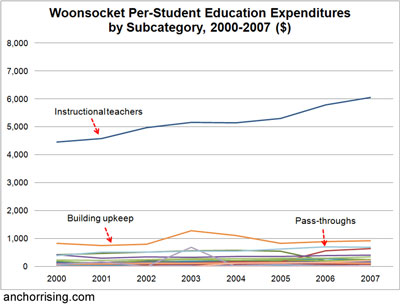
Over the three years of the most recent teachers' contract (PDF), the average pay scale step has increased 7.64%. In any given year, the average salary increase from one step to another is 6.5%. The result is that an actual teacher has seen nearly a 10% increase each year and a 21.5% increase in salary since the contract went into effect. (Higher education bonuses are not included.)
Of course, teachers at step 10 have had to make do with the 7.64% increase to their step and longevity (as well as whatever seniority-based perks are worked into the contract), but sometimes an organization has to do what it must do in order to maintain its purpose. And besides, those teachers hired before 1994 (about 70 of them, I'm told) have never paid a penny for their healthcare.
It remains a possibility — another principle baked into the public sector paradigm — that the objective, here, was to put forward cuts that the unions, government, and public wouldn't permit to happen rather than adjustments that might actually solve the problem. Eventually, everybody involved is going to have to cease petulant demands that money just be found... somewhere... and accept that the old way is not sustainable.
July 15, 2009
So This Is Woonsocket
Almost an hour late, I finally made it to the Woonsocket School Committee meeting — I'll confess that the I-Way change got me — and just caught the tail end of the consent agenda. That's quite a difference from Tiverton, where tardiness of five minutes is apt to see the first page or more of the agenda completed. The room is mostly full, with maybe two dozen people, but hardly what one would expect during a time of tough decisions.
So far, I've heard mostly complaints about the General Assembly — with which complaints I'm enormously sympathetic, of course, but when a $6 million deficit is on the table, perhaps it's time to skip the complaints against higher authority.
8:03 p.m.
I have to wonder if part of the difference between this meeting and my imagination of what a Tiverton School Committee meeting (let alone an East Providence School Committee meeting) would be under similar circumstances is the union that represents the teachers. Woonsocket is AFT, while those districts in the East Bay are NEA. Or maybe it's just the difference between my home region and the Deep North, over here.
8:14 p.m.
Well OK, then. Apparently the reason they were just wrapping up the consent agenda when I got here was that they took the budget discussion out of order and front-loaded it. Monique was here on time, and although she's not versed on the specifics, she said it sounded as if they cut a multitude of things. The email that tipped me off to tonight's significance explained the result as follows:
Nobody is advertising much about it, but the new budget will be based on assumed concessions from the unions (I'm told upwards of a 10% pay cut), waivers of certain regulations (nothing specific that I have been made aware of), and there will be cuts in all areas of extracurricular activities (all sports except boys and girls track & field and all but one of each program in music and arts).So they will be cutting football, baseball, softball, soccer, fieldhockey, tennis, volleyball, golf, wrestling, basketball, theater, debate, math team, jazz band, all Middle school programs, and others I'm sure I can't remember. On the academic side, for the fifth year in a row, the only textbooks to be purchased will be those provided to the catholic school students as required by law (they are the only ones academically protected), supplies will be cut to a bare minimum, the only capital project will be a repair to a leaking high school roof, and whatever else is not commited by law and class size limitations.
That would explained why School Committee Chairman Marc Dubois was joking about taking a lesson from the governor and putting forward a budget that's balanced on paper only.
I've got to say that the casual atmosphere, here, is almost disconcerting. As I drove in, the lazy summer evening feel of the streets brought to mind the degree to which most residents are oblivious to the actions of their local, state, and even national government representatives. Given the points of levity, it's almost as if that mood has infiltrated even the bodies that those representatives populate.
8:33 p.m.
Another topic on which it's possible to hear angst is the failure of the state government to pass legislation (PDF) allowing the district to institute a uniform/dress code policy. Being both conservative and working class, I'm a fan of uniforms in school... one obvious point of in-school disputes and discrimination is removed, and it's a lot easier to get the kids out the door in the morning.
Another small thing that I've noticed, and that may or may not be significant, is that the committee's agenda (PDF) calls for a moment of silence before the Pledge of Allegiance. Interesting.
8:46 p.m.
A member of the audience who's in the know informs me that the reason the room isn't filled into the hallway is that nobody in town knows what's just happened. There is allegedly an intention among school committee members to swirl the cuts around offices of authority in the hopes that somebody, somewhere — commissioner, judge — will mandate that the money be taken from somebody — state, taxpayers — to remedy what is, in point of fact, the current circumstance of the Woonsocket school system, as described in the block quote above.
9:04 p.m.
The same member of the audience just explained to me that the teachers' pay cut that the just-passed budget assumes comes in the form of 40 furlough days — roughly 20% of pay.
It's astonishing that even the union isn't in the room creating that tension that they create so well.
July 14, 2009
Giving Cards to the Other Side
The Tiverton School Committee is discussing whether to grant a leave of absence to an elementary school art teacher, and it's a strange circumstance. Apparently, the custom is to discuss such matters vaguely, so Superintendent Bill Rearick is offering details only inasmuch as is necessary to rebut reluctance from the school committee, but some details have come out:
- The teacher received a layoff notice, as required by law.
- She found another job.
- Additional funds enabled the district to cancel the layoff notice.
- The teacher is seeking a leave of absence so that she'll have until early next year to decide whether to stay at her new job or to return.
The downside, as I'm hearing it, is that the district can expect a larger pool of applicants — perhaps with an upward shift of quality — if the position is explicitly on the permanent track.
ADDENDUM:
Interestingly, union president Amy Mullen, who was granted a maternity leave of absence just before, responded to a question from committee member Danielle Coulter about the affect of the duration of the opening on the applicant pool by saying, "If I'm an art teacher looking for employment, I'll take whatever I can get in this economic environment." This statement of bald fact is interesting because I've been arguing that the school committee should keep precisely this in mind when handling negotiations with the union.
Also interesting was committee member Carol Herrmann's progression during the discussion. Known as one of the union-friendly members of the committee, Herrmann was clearly arguing in favor of granting the leave. What's peculiar is that she appeared to have thought through the arguments, beforehand, but she started from a stance nearing ambivalence. Like Rearick, she played her cards only as necessary, finally arguing that the district put the teacher in a "stressful position." I wonder how many folks in the private sector make the decision, every year, to simply turn down jobs that they've taken in expectation of a layoff that didn't materialize.
The leave of absence request failed, with Herrmann and Sally Black as the two votes to grant.
7:45 p.m.
There was no handout covering the budget discussion, and I've been typing, so I might have missed important details. It appears, however, that the district administrators (Supt. Rearick and Director of Administration and Finance Doug Fiore) intend to blow off the voters' requirement that the district stick to the dollar amount that was approved at the financial town meeting and treat that amount as creating a budget gap to be filled with stimulus money.
7:53 p.m.
Bill & Doug noted that, if the stimulus money isn't repeated next year, the district will be facing a $800,000 deficit — or $100,000+ more than the district is supposed to be trimming as a result of the FTM.
They're talking about closing a school. Oddly, nobody has suggested a few percent across-the-board cut in combined salaries and benefits; they go right for cutting positions, even though there is no contract yet for next year.
Why are they afraid to put forward such an obvious and reasonable solution?
8:05 p.m.
Again, I don't have the paperwork, but it sounds as if extracurricular activities and athletic programs are on Rearick's hit list. Can't help but wonder whether this is all part of the strategy to motivate parents to turn out at next year's FTM and vote for more money.
8:19 p.m.
Yup. Committee President Jan Bergandy just noted that the district "avoided a catastrophe" thanks to the stimulus money and suggested that the district "provide additional information for parents" as to the consequences of cuts.
8:25 p.m.
A high school nurse just received a reduction in hours.
From home:
Here's audio of NEA-Tiverton President and NEARI Treasurer Amy Mullen arguing — in response to a question from School Committee Member Danielle Coulter — that it's an employer's market when it comes to teachers: stream, download.
July 10, 2009
The Pervasive Structure of Rhode Island Corruption
It would be the work of a lifetime of academic study to unravel the thread, but I've been increasingly impressed (in a bad way) with the intricacies of Rhode Island's structural corruption. It's as if certain principles of the culture filter throughout local society to create an organic network whose instinctual task is to create little pools of power and influence that political parasites can siphon and share.
Take, for example, local zoning regulations. A busy-body factor comes into play, as does a back-roads totalitarianism that seeks to freeze a town in time, but the effect of stringent permitting and zoning codes is to force individual approval (variances) of projects. When every change to one's property must be made "legal, non-conforming," a local board gains the power of arbitrary judgment; the projects are already contrary to the law, so the legal guidelines for arguing in their favor are limited, and the aesthetic and political guidelines are vague. It behooves residents, therefore, to have influential people around town think kindly of them, and it creates an advantage for, say, building contractors who have conspicuous success rates acquiring variances for their clients.
This story reeks of the insidious structure:
A Town Council proposal to expand the governing board of the Johnston Housing Authority from five members to seven has hit a roadblock in the General Assembly, where a key lawmaker says it appears the move is meant to "target someone" in a political squabble.Sen. John J. Tassoni Jr., D-Smithfield, who heads the Senate Committee on Housing and Municipal Government, on Thursday, June 25, refused to release the enabling legislation for a floor vote. The bill was introduced by Rep. Deborah Fellela, a Johnston Democrat — whose husband, Henry, swore at Tassoni after the chairman shelved her legislation.
"It's quite obvious after what I went through on Thursday that there's a vendetta in Johnston and I'm not going to be part of it," said Tassoni. He declined to say who might be the "target" of the legislation.
Obviously, Tassoni's declaration that he doesn't want "to be a part" of a "vendetta" in a town that he does not represent is nonsense. First of all, the way for him to have stayed out of the squabble would have been to step back from the proposal and let it move to a vote; by blocking it, he's made his action much more intrinsic to the outcome. More significantly, it makes for an incoherent thought to call the broadening of power a "vendetta" — whereas, shrinking the board would push somebody out — unless one is protecting the influence of an individual member and sees that heightened power as a right.
The question is, which of the Housing Authority's commissioners wields his or her influence in such a way that a state senator from another town has an interest in girding it? And what reciprocity might there be?
Don't Bind Elected Unionists; Force Them Out
Last night, Matt Allen made the point that Congressman Patrick Kennedy's perpetual reelection makes his antics most profoundly an indictment of the voters who keep sending him back to Washington. The same is true of most corruption at the state and local levels, and I'm not sure, therefore, whether the proper route to reform is to leverage an unelected government panel, the Ethics Commission, to build low barriers around school committee members who are also teachers' union members in another town:
Groups such as Operation Clean Government and Common Cause Rhode Island argue that the rules should be tightened, because how public officials act on union matters in their communities could affect their own unions. Labor contracts in one town are often cited in negotiations in another town. And local unions are often affiliated with the same statewide union.Defenders of the status quo argue that the current ethics rules are sufficient. The Ethics Commission has held repeatedly that there is no financial or business relationship between a public official who belongs to a union in another town and a union negotiator.
Realistically, the single largest task of any school committee member is to vote up or down on negotiated contracts, so removing the ability to make that vote effectively denudes an elected official. Anything short of disallowing that vote — or even disallowing the candidacy — places an Ethics Commission stamp of approval on the problem itself. That, I must admit, puts me in agreement with a crowd with which I'm typically at odds:
George Nee, secretary-treasurer of the Rhode Island AFL-CIO, countered that further restrictions would unfairly limit a public official’s ability to participate in the democratic process. Voters are aware of the backgrounds of the people they elect, he said. That position was echoed by lawyer Robert Mann, who spoke on behalf of Working Rhode Island, a coalition of labor organizations.
The tasks before those of us who see the problems are to educate the public and to move preferred candidates into office. It's a long, slow process — and, given the emigration of some of our natural allies, not at all a sure thing — but people are beginning to awaken to the damage that's been done. Having identified the methods by which the unions and others have done that damage, our best use of that information would be to inspire opposition and motivated participation — at the local level, first, and then, with the advantage of a statewide farm team, at the state and then national levels.
Otherwise, it's not inconceivable that we may find our own methods of instituting constraint through the Ethics Commission binding our own hands in the future.
July 2, 2009
Corruption and Dollars
Andrew and Matt spoke of "speech in debate" and political corruption in Rhode Island Matt Allen Show, as well as Andrew's posts (1 and 2) on town taxation. Stream by clicking here, or download it.
Caruolo Not a Foregone Conclusion
As a threatening cudgel to wave during negotiations and town meetings — allowing school committees to declare that they'll just take what they "need" and unions contriving to force them to do so — the Caruolo Act is still an insidious force in Rhode Island politics. But with the move being denied in West Warwick, it would appear that many of us, including school committees and unions, expected it to be a bit more of a rubber stamp:
Judge Steven P. Nugent, in a ruling from the bench, dismissed the School Committee's Caruolo suit against the town, saying that school officials didn't even try to balance their fiscal 2009 budget after voters at the Financial Town Meeting limited their spending to $49.2 million — roughly $4 million less than they had requested.Nugent said the committee had failed to heed the state law requiring that it give the town and the state auditor general a corrective action plan within five days of realizing that it would have a substantial shortfall.
Although this may be good news in the long run, in the short term for West Warwick, it will require cuts in programs and services. Plan B, in other words, will not be to tighten belts on payroll, but to limit benefits to the town and its children. And it's not as if belt tightening would be egregious. According to the district's budget plan released in March 2008 (PDF via Transparency Train), making up the $3.3 million that the district sought through Caruolo would require merely a 6.7% cut in the combined salary/benefit totals for next year's projected budget. Salary/benefits, by the way, were projected to go up 5.4%. The amount of actual cuts to current salary and benefit amounts would be approximately 1.4%.
Cry me a river.
You'll recall that the 2009-2010 school year is the so-called "fourth year" that the school committee tried to opt out of in the teachers' contract — which it was contractually permitted to do. After a few months of damaging work-to-rule by the teachers, the committee relented. The result (PDF) is that teachers' salaries are contracted as follows, with the categories after step 10 (10 years of service) incorporating longevity payments:
| Step | 2008-2009 | 2009-2010 | % increase in step | % increase in pay |
|---|---|---|---|---|
| 1 | $40,802 | $41,822 | 2.5 | NA |
| 2 | $44,273 | $45,379 | 2.5 | 11.2 |
| 3 | $47,743 | $48,937 | 2.5 | 10.5 |
| 4 | $51,212 | $52,492 | 2.5 | 9.9 |
| 5 | $54,683 | $56,050 | 2.5 | 9.4 |
| 6 | $58,153 | $59,607 | 2.5 | 9.0 |
| 7 | $61,624 | $63,165 | 2.5 | 8.6 |
| 8 | $65,093 | $66,720 | 2.5 | 8.3 |
| 9 | $68,564 | $70,278 | 2.5 | 8.0 |
| 10 | $72,034 | $73,835 | 2.5 | 7.7 |
| 11 to 14 | $72,926 | $74,750 | 2.5 | 3.8 |
| 15 to 19 | $73,819 | $75,665 | 2.5 | 3.8 |
| 20 to 24 | $74,711 | $76,579 | 2.5 | 3.7 |
| 25 to 29 | $75,603 | $77,494 | 2.5 | 3.7 |
| 30+ | $76,495 | $78,409 | 2.5 | 3.7 |
And that's not all; extra payments for other activities are all going up, as well. Summer school will pay $42 per hour, rather than $40.50 per hour (3.7%). Substitutes will get about 4.5% more (to around $110 per day, depending on the length of the assignment). Teachers who cover other teachers' classes will see a 3.7% increase in the resulting payment, to $42. Tutors will see the same. Extracurricular pay is going up approximately 2.5%, with the student council adviser, for example, getting $2,510 rather than $2,450. The bonus payments for graduate credits and degrees are all going up — an average of 2.6% (to $4,200 for a Master's in the teacher's field).
All with a 7% share of healthcare premiums.
Little wonder the teachers were willing to damage their students' educations back in 2007! Little wonder, as well, that Rhode Island's schools are in their sorry state.
June 28, 2009
Private School as Money Saver
Think about this, from amidst the continuing saga of the West Warwick school budget:
After one resident learned that it costs about $15,000 to educate each child in West Warwick, she suggested that the town simply send its students to private Catholic schools. [Town Council Member Angelo] Padula quickly agreed, saying, "If we sent 200 children to a private school, Prout is $9,500. LaSalle is $9,800. We would save $6,000 per child."
For those who've learned under new math techniques (or do not have a calculator handy), $6,000 times 200 children is $1.2 million. As a bonus, with those millions of dollars in savings, Rhode Island private school students on average score 200 points higher on the SATs than their public-school peers.
(Yeah, I'm aware of the arguments about demographics. Just sayin'...)
June 25, 2009
When Negotiators Are Using Monopoly Money
Think of the attitude expressed, here, by West Warwick School Committee Chairwoman Lindagay Palazzo:
"Regardless, whether we win or lose [their Caruolo lawsuit], the town is responsible for our bills," Palazzo said. "They're going to have to pay them anyway."
One wonders what effect that point of view has on Mrs. Palazzo's negotiation tactics. One also isn't surprised to learn that she just retired (PDF) from her $80k job (PDF) as a Clinical Training Specialist with Rhode Island College's Child Welfare Institute.
Being in the public sector tends to impart the belief that somebody else has to pick up every professional bill that public "servants" manage to rack up — the racking up of which seems to become their central goal.
June 23, 2009
A Press Release to Emulate
East Providence School Committee Chairman Anthony Carcieri has issued a press release on which other elected representatives throughout the state should take notes:
On being informed that NEA has voted "no confidence" in the East Providence School Committee, its Chair, Anthony Carcieri, said this."So what’s new? No union is going to give a big vote of confidence when they're told they have to contribute to their health insurance. It's unfortunate, but it's the way of the world. That all happened six months ago. We've moved past it. We're bringing technology to our students for the first time in the Fall. Our Vocational School is launching innovative new programs that will catapult our students forward. We're pushing forward a revolutionary initiative to raise the quality of special education in East Providence to World Class standards. These are just some of the things we’ve accomplished in the last six months, as we are bringing the school system back from the brink of bankruptcy.
What has NEA done in the last six months?
They put on red shirts and disrupt School Committee meetings. They say they want to bargain, but they never schedule a meeting. They try to stop innovation. They demand that we raise taxes and go deeper in debt.
The East Providence Schools will be a magnet for students from other communities within the next few years. We will be a magnet for creative energetic teachers who put kids first. We don't need teachers who want to spend their time parading around like the Red Army. We need teachers who will help us to prepare our kids to deal with an increasingly competitive world.
We're told that NEA has threatened to tell their members to leave our school system. Any teacher who doesn't want to be a part of what's going on here should do what NEA says. We're building to be the best. We're putting the students first. Any teacher who doesn't want to be a part of that should follow NEA's direction.
Remember, we pay our teachers better than 90% of the school teachers in America. The teachers' union just can’t get over the fact that we had to retrench a little bit in January so we could pay their salaries in June. This is the time to focus on delivering the best education for our students without breaking the backs of our taxpayers. It's time to get over it. We have a lot of work left to do to raise the performance of our schools. We have to do a better job for the kids. That's our focus, and it’s the focus of most of our teachers."
June 18, 2009

Jim Quinlan: Another $25,000 Wasted by the Cranston School Department
According to a Projo article by Randy Edgar:
The [Cranston] School Department will pay outgoing Supt. M. Richard Scherza $25,000 this summer to work as a consultant and help with the transition to a new superintendent, according to an agreement signed last month.
Scherza will work on an as-needed basis during July and August, providing "technical assistance" and helping in areas such as community and government relations.
In a city whose school department is struggling, to say the least, to balance a budget filled with years of giveaways and mismanagement, it is curious that the School Committee would vote unanimously to continue to keep Mr. Scherza on board on an "as needed basis."
Budget session after budget session has been filled with program cuts and layoffs — directly affecting our children. EPIC, middle school sports, guidance vounselors, and teaching positions have all been on the table, yet the committee has found $25,000 to pay Mr. Scherza more than he was making while employed by the department.
If in-coming Superintendent Peter Nero was not qualified to sit in the big boy chair (after 3 years of working directly under Scherza), the committee should have not rushed to promote him in one week. If he is qualified, then the elected representatives should insist that he does the job.
I brought this concern to a School Committee member who told me that "because this was a personnel matter we could not discuss it." I would like to know since when an independent contractor is a personnel member of the School Department.
We deserve to know what Mr. Scherza's contract says and what his duties will be. I am not ready yet to deem this decision as corrupt, but it is certainly a poor business decision and another example of the School Committee's lack of leadership.
Jim Quinlan is the chairman of the Cranston GOP.
June 9, 2009
Trudging Through the School Budget
Amazingly enough, I get email from people around the country who don't care about Tiverton politics! That's like not caring about politics in the Shire. Well, yeah, I know; these things have to be fictionalized in order to emphasize the undercurrents.
One issue of national interest, though, is the arrival of the first infusion of federal "stimulus" money. In Rhode Island's case, the "stimulus" is more like defibrillator funds. From the school's perspective, the federal dollars are merely a replacement for state dollars. Superintendent Bill Rearick expressed a wary hope that various one-time dollars might help the district to get through this year's financial trouble, with a stress on the one-time part.
May 29, 2009
The Differences in Barrington
So why did Barrington buck the school-budget-cutting trend? I'd say that there are three factors, the most important of which being the track record of the schools themselves.
As Andrew illustrated yesterday, Barrington's schools are arguably the best in Rhode Island. Of course, as even the union will argue when it suits its purposes, it's very difficult to tease those results apart from demographics, but one can make some interesting observations about spending. First of all, the district's per-student spending on teachers is relatively low; a spreadsheet that I've developed over time places the town as 23rd in the state for this measure. Indeed, Barrington's per student spending on just about everything is relatively low.
One other curiosity is the structure of the town's steps. For the 2007-2008 school year, the town was seventh from the top in pay for its highest step, but eight from the bottom in average step. Plotting all of the state's step structures on a line graph (covering the 2008-2009 school year) illustrates why:
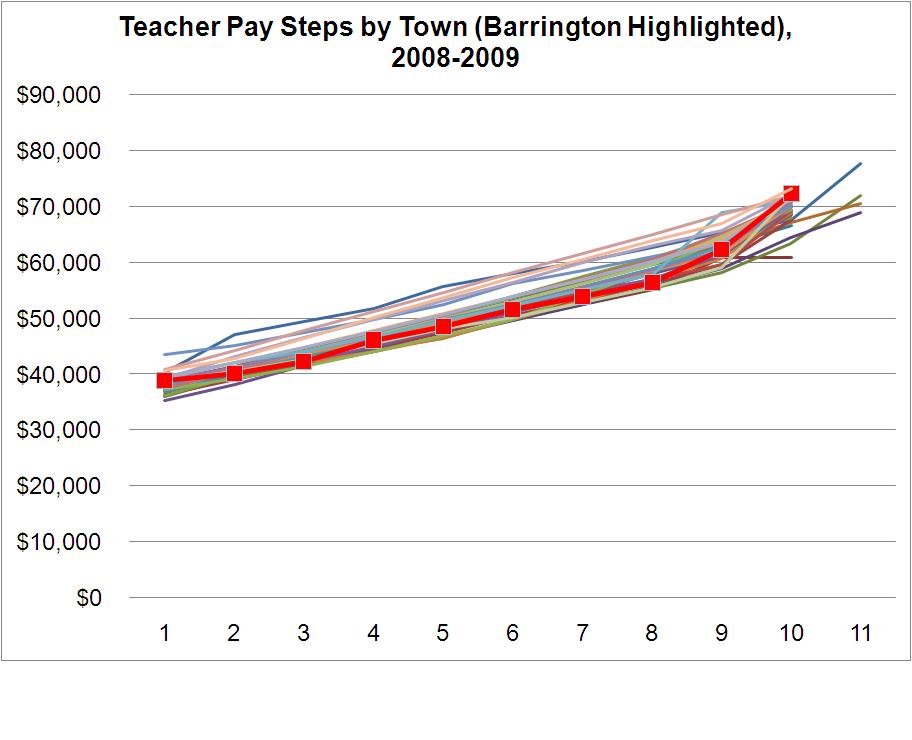
Barrington doesn't escape the middle and back of the pack, in teacher pay, until the upper steps. The town also has relatively high longevity and higher-degree bonuses. In other words, one could surmise that the Barrington school district strains within the very narrow limits of the union step structure to reward desired behavior. It ain't a merit system, but it has some related features.
The second factor that I would note as explanation for the results of Barrington's financial town meeting is probably less consequential, but related. It's a relatively wealthy suburb, especially compared with some of the more politically heated towns in the news lately.
The third factor — once again related and once again of less significance — is that the taxpayer group formation in Barrington is tied, in its inchoate form, to property revaluations, especially on higher-end homes. The currently active (as opposed to potential) constituency is not as broad as with, say, Tiverton Citizens for Change, which has resulted from a mix of working-class and fixed-income ire, general response to suspicious political games at last year's financial town meeting, and (yes) property-tax concerns.
It isn't my intention to offer opinion on the Barrington voters' action, the other night, or to suggest a direction in which the town should head. Among the things that I love about Rhode Island, however, and among the reasons I'm hesitant to jump on the regionalization bandwagon, is that one really can look around at each municipality as a self-contained segment of the statewide experiment.
May 26, 2009
The Real Discussion Happens in the Dark
A pre-meeting executive session has occupied the Tiverton School Committee for the past hour and fifteen minutes. About twenty minutes ago, Chairman Jan Bergandy and Vice Chairwoman Sally Black stepped into the auditorium to announce that a discussion of legal issues related to the budget would delay them for another fifteen.
Although my reader-funded high-speed Internet makes my entire office essentially mobile, I do wonder whether there ought to be some sort of start-time clause in public meeting laws.
I'll admit that it was kinda neat to sit in an empty auditorium for forty-five minutes. (The teachers who are no in the room with me were hanging out in the lobby area.) Pleasant memories of practicing piano in a mostly dark auditorium during study hall seventeen years ago.
And here comes the committee...
8:30 p.m.
The budget discussion has begun with the pivotal nature of state and federal aid. Supt. Bill Rearick suggested that everything is speculative until those numbers are in. (Of course, he was a bit less circumspect when telling the Sakonnet Times that children are going to be hurt.
8:37 p.m.
About eight of the 24 or so teachers in the room left when the agenda moved on from the budget to the district's strategic plan. Just sayin'.
8:54 p.m.
And that's it. Short meeting... once the waiting was over. Of all of these meetings that I've attended, this was by far the most promotional of the students' activities. That's a good thing, and prudent, too, given the realities of budget formation. For one thing, it shows an increased appreciation for the importance of bringing the community into the various processes.
The next step should be to find ways to increase the percentage of per-student spending that goes toward such activities.
May 18, 2009
Municipal Increases Are Mainly Pay and Benefits
This story on the likely decreases in state aid to municipalities appears to break apart two categories of spending that are very closely related (emphasis added):
Indeed, the numbers suggest that municipalities have largely avoided the budget cuts that swept across state government in recent years, according to a report to be released this week by the Rhode Island Public Expenditure Council.Since 2004, "the increase in local government expenditures has outpaced the growth in the state general fund budget, [the consumer price index], and personal income in almost every year," the report says. "The majority of this expenditure growth has been to support education spending, which accounts for the majority of local spending; however, spending on employee benefits is the second-fastest increasing component of municipal budgets."
In point of fact, most of the increase in education spending has gone toward employee pay and benefits. Treating education as its own all-inclusive category blurs the story. And that story relates to a point made later in the article:
The governor has introduced legislation to eliminate most of the mandates. But the Democrat-controlled Assembly has been reluctant to support the Republican governor's initiatives, most of which are opposed by organized labor.
Labor has the RI system structured so well in its favor, that there isn't much by way of reform that won't disrupt its schemes to some degree. Yet, they must be disrupted, and both union members and elected representatives must soften their opposition.
May 12, 2009
A New Dawn for Tiverton Education... or Is It Dusk?
A larger-than-usual crowd is in t Tiverton High School library for the first school committee after the financial town meeting cut the district's budget by $627,247. A healthy TCC showing; the rest, I assume, are teachers and sympathizers.
School Committee Chairman: "Our only priority in dealing with this cut is to protect our students, and to make sure that our students are impacted as little as possible... everything else is secondary."
7:17 p.m.
They're going to speak vaguely for public consumption and reserve specific strategies for executive session because, as Bergandy put it: "We have to explore possible legal consequences."
Carroll Hermann started by thanking those who showed up at the FTM and voted against the cut. "With $600,000, everyone will get hurt. No one will walk away whole."
7:21 p.m.
Sally Black is taking a general tack, currently suggesting that, at a certain point, "tinkering" with the "delicate balance" has to stop.
She's emphasizing the "fair funding formula" from the state, pointing to a clause in proposed legislation reading "regardless of annual availability of state revenues."
Mild dig at Budget Committee members who didn't vote with the budget they proposed.
7:27 p.m.
Bergandy suggested that, when the state is done cutting, the shortfall may reach a million dollars.
TCC member Joe Souza is speaking, saying that the cut wasn't to "hurt the kids." Scoffs from the teachers in the room: "Yes it was."
7:29 p.m.
"We need to stand up in this town and make some noise... together." Too much in-fighting.
"It's not the Tiverton taxpayers against this school committee."
Guidance Counselor Lynn Nicholas — who is heavily involved in the union — thinks that lawsuits against the town "need seriously to be considered."
Now she wants to know what advocacy the school committee will pursue to get parents to the town meeting.
7:35 p.m.
One teacher wants to form an organization to battle TCC. My impression was that the union and the town Democrats were organized for such purposes.
How absurd that a small group fighting back can make these people feel that the process was somehow unfairly tilted.
7:37 p.m.
Bill Rearick just read the new charter amendment that prevents town funds from advocating for causes.
Sally Black described an undue concern about what it allowed her to do.
7:41 p.m.
A reader just emailed to remind me of Lynn Nicholas's comment during contract disputes: if the committee does not pass the contract, there will be "a lot of harm done — some financial, some not."
The audio is here. Full quote:
Before I ask Doug a question, I just need to make it clear that, if the award is not agreed upon tonight, there will be a lot of harm done. Some of it will be financial; a lot of it will not be, and I'm not going to go into detail.
When you make a statement like that when you're looking for money for yourself, you don't have a whole lot of credibility to villainize taxpayers as hurting children.
7:51 p.m.
And business moves on to sex offender notification and heating oil bids.
7:54 p.m.
At last night's town council, apparently at the beginning (why I missed it), Council Vice President Joanne Arruda made a point during the consent agenda segment of expressing opposition to a petition to end the Caruolo act and another to allow town councils power over teacher contracts.
7:58 p.m.
It just occurred to me that one of the speakers during the financial town meeting segment of this meeting pointed out that services to students have been declining for years. She was making the point that parents will leave town if the new cut exacerbates the problem; I'd note that TCC is less than a year old.
The NEA-RI has been around for quite a while, though...
8:02 p.m.
And out into the night...
May 11, 2009
The Meeting After
I apologize to readers from elsewhere for all the Tivertonalia 'round here lately, and I've got so much on my plate, right now, that I wasn't intending to come to tonight's Town Council meeting. But rumors that the council might (at some point) call for a special financial town meeting for a redo vote and the fact that discussion of Saturday's result is on the agenda for this evening persuaded me that it would be prudent to be in the room.
Of course, I've also heard whispers from my allies about town that a second round might be fun, perhaps to go back for the municipal cuts that the 1:00 p.m. deadline prevented in round 1. Me, I'd prefer that the town spend a year in these new waters before any more such tugs of war.
7:49 p.m.
Discussion of the financial town meeting was limited to an announcement that Michael Smith won the FTM moderator position, 373 to 312, and a vote to send a letter of thanks and compliment to Mike Burk for his job at the last one.
8:31 p.m.
During the administrator's announcement and comments section, Council Member Louise Durfee asked Administrator Jim Goncalo what the effect will be of the council's failure to secure an additional $300,000 for abatement. He'll reply at the next meeting.
8:36 p.m.
And now into executive session for a "quick" discussion about unspecified litigation.
Myopia Versus the Long View in Rhode Island
Self-described newcomer to local politics, Brian Gough, has a letter on the Sakonnet Times Web site criticizing reformers' efforts. Individuals' understanding of the appropriate actions of elected representatives, particularly those in leadership roles, may vary, and differences of opinion aren't necessarily worth the expenditure of much heat. But Mr. Gough's snap assessment of the sides makes an egregious error:
The level of passion behind the actions taken at this meeting was apparent. I am a realist, and quickly did the math. I realize the impact of a small group's efforts to push their agenda is minimal in the short term but the impact on our long term financial viability is extreme. They are selling us out for a short-term reduction in our taxes, and willing to risk our long-term values (home value, bond viability, etc.) Based on this, I must question whether I am a short- or long-term resident of this town. The answer is easy, I am here for the long term, and based on this, I will focus my energy on what will help all of us for the long term.
Members of Tiverton Citizens for Change, as the most local representatives of our broader movement, take a very long view of the actions and the changes necessary to renew our town, our state, and our nation. Those who think we see each cut in terms of its immediate affect on our tax bills miss the point and are likely to stop following the thread before they've come to the real structural problems that we're trying to address.
May 10, 2009
Where Tiverton Goes from Here
Saturday morning, a majority of electors at the Tiverton financial town meeting (FTM) for 2009 voted to cut the Budget Committee's recommended school department budget by $627,247 — explicitly subtracting $174,054 from the local contribution and $453,193 from the expected general state aid. Owing to a Budget Committee resolution passed earlier in the meeting, any "federal, state, or local government aid" in excess of that amount would be "returned to the Town's General Fund as a surplus."
If not for a time limit before the meeting would automatically have recessed until the following week — thus risking a repeat of last year's performance — the municipal budget could have experienced a similar cut.
As one might expect, rumors (aka threats) of litigation are already circulating, and Rhode Islanders have been conditioned to see such actions as unavoidable consequences of cold process. As with children decrying the restrictions imposed by peer pressure, the excuse will go out from officials and union members alike that laws, mandates, and contracts leave them no choice. Adults should understand that there are always choices, the question being who refuses to make the right ones.
In evaluating the path forward, Tiverton should recall to mind two antecedents without which Saturday's result would likely have been quite different: the suspicious outcome of last year's FTM and the imprudent raise and retroactive giveaway to the teachers' union in January. Both galvanized those of us who see a need for an overhaul of priorities, and both compounded the difficulty of dealing with current financial strain.
For all the shades of gray, there are really only two paths forward. Our representatives can take the taxpayers' cue and push back on those whom they've previously perceived as tying their hands — the unions and the state. Or our representatives can continue fighting reformers and attempting to move as much of their habitual agenda as possible.
If they choose the former approach, they'll force the unions and state lawmakers to accept the mantle of intransigence against financial reality and taxpayers' demands. They'll also find eager support amidst a growing wave of active citizens with their eye on transforming Rhode Island into the national leader that it ought to be.
If they choose the latter approach — if they cling to the remnants of a withering status quo, if they continue to pile on the antecedents to escalation — they might just push an increasingly organized opposition to the next level of involvement: namely, campaigns for office.
May 9, 2009
Rule of Lawyer: Tiverton Town Solicitor Andrew M. Teitz and Disenfranchisement of a Lowly Blogger
Reflection has not changed my opinion, stated while liveblogging, that Mike Burk, the moderator of today's financial town meeting in Tiverton made every effort to be fair and, on the whole, succeeded. That said, he did make a few substantial errors, one of which brings into stark relief a problem of governance pervasive in Rhode Island — namely, the undue power of hired attorneys in the conduct of school and municipal business.
I am neither an experienced parliamentarian nor a lawyer, so in the flow of the meeting, I focused more on principle than on procedural law. Moreover, as is evidenced by my ready willingness to modify an amendment that I'd made to the proposed school budget, I wasn't heavily invested in the specific numbers that I put forward. But it is my opinion that Tiverton Town Solicitor Andrew M. Teitz strove to disenfranchise me as a taxpaying voter in the town, and that Moderator Burk permitted him to accomplish that goal.
As I offered the initial discussion on my amendment, Solicitor Teitz interrupted to make a point of order (stream, download):
Teitz: Excuse me, I have a point of order. The number that you suggested for the appropriation is 20,046,960; is that correct? Which is actually less than the number that was appropriated last year.
Burk: Which means that that is out of order, am I catching that?
Teitz: Yeah, the state law requires that they receive at least as much... that the appropriation be at least as much as it was in the previous year.
Katz: My understanding, though, is that if the number of students declines, maintenance of effort permits an adjustment downward.
Burk: I will rule that out of order if it is below the number that was appropriated last year.
Audience: No.
Teitz: You are correct; it can be adjusted if you have the information on that.
Katz: I'm not aware that I actually need that information to pass an amendment. These are questions of... I mean, if people distrust my number, they can vote my amendment down and vote for another one or the main motion, if they prefer, but I'm not understanding why I... [somebody handed me a piece of paper.] Alright: In the past six years, enrollment is down 13.5%, and tax spending has gone up 45%. I think if we're trying to show maintenance of effort, we've certainly done so.
School Committee Chairman Jan Bergandy requested that the school department's attorney Stephen Robinson have the floor to offer relevant information. What he offered (included in the above audio link) was a statement that he's previously made as to the procedure for proving maintenance of effort and the right of the FTM to address line items in the school budget, as opposed to the whole thing. Then, Budget Committee Vice Chairman Rob Coulter pointed out that the law is certainly not as unambiguous as Mr. Robinson had stated and argued that, given the trends in enrollment and funding, it is simply "incorrect" to state that the previous year's exact dollar amount must be matched. Furthermore, Rob noted Teitz's opinion, elsewhere, that the charter trumps state law in these contexts, and the charter allows for line-item modification.
At that point, Burk insisted that he was going to rule the amendment out of order, based on a lack of "significant enough details" and gave me the option of modifying it to avoid the objection. Wishing to expedite the process, I agreed. However, upon further discussion, I thought it necessary to take the thread up again (stream, download):
Katz: I disagree that the legal issues are a matter of procedure for this particular meeting. An amendment is not "out of order" because there may be litigation. This body can submit the numbers that it would like to do, and that could be resolved after the fact. The fact that there are lawyers in the room who are willing to testify to the law does not mean that we are bound by their judgment. And I would remind people that Mr. Coulter is also a lawyer, so if he presents a different opinion...
Burk: He is not here to practice law. Our solicitor is our legal council.
Katz: Right. But if they're simply giving an opinion of the law, we can disregard that. They're not judges. They're not juries. And they're certainly not executioners.
Teitz: Point of information regarding that. The advice that is given here is to the town. The client is the Town of Tiverton. You're right: it is to this financial town meeting, as interpreted by the moderator, and you can listen to everybody. You can listen to all the lawyers, including me, as to what the advice is. And this body, if there's an appeal — if you want to do it over a dollar [the substantial difference of my proposal] — you can. An appeal going through the proper decision... an appeal to the moderator's decision, a majority vote, and whatnot can overrule that. Obviously, you do it at your own risk, but you are correct. The body can overrule the legal opinion through the moderator if you wanted to do it. I have provided you with the information; the moderator has ruled it "out of order"; but even if it is out of order, it can be appealed.
Katz: I'm merely stating the opinion that it is not the procedure that the lawyers in the room dictate the procedure of the meeting — dictate what's in order and what's out of order. We can vote on what we want.
Teitz: I'm agreeing with you, but there's a way to do it, which would be to appeal the moderator's decision.
Katz: Right, but that's only if the moderator turns to the lawyers and takes your dictation wholesale.
The point that became obscured amidst all of Teitz's agreeing with me was that he had managed to deprive me of my right to make the motion that I desired in the financial town meeting despite three parliamentary and legal matters of which he — as the paid "expert" in the room — should have been knowledgeable and of which the moderator — presumably qualified for his role — should have been aware:
- Mr. Teitz had no standing to interrupt me for a point of order. Robert's Rules allow members to make such interruptions, but not being a resident of the town, Teitz does not qualify. Somebody else could have done so, and the moderator could have requested Mr. Teitz's opinion, but as it happened, the lawyer displayed his eagerness to turn the direction of the meeting in a preferred direction, and the moderator let show his willingness to be led.
- Mr. Teitz's point of order was too late. As one can plainly hear (stream, download), my motion to amend had been duly made and seconded, and the moderator had stated the question and opened the floor for debate. According to Robert's Rules: "After debate on such a motion has begun — no matter how clearly out of order the motion may be — a point of order is too late."
- There is no restriction in Robert's Rules, the Tiverton Town Charter (PDF), or the Rhode Island General Laws that forbids a town meeting from explicitly taking actions that challenge the law. Indeed, the RIGL makes provisions for a ballot vote option in situations "involving... the incurring of liability by the town." In other words, it is not out of order to make a motion that knowingly opens the door to litigation, much less a motion that kinda-sorta, in the opinion of a hired lawyer, might open that door.
None of this is to say that I'm particularly upset about the outcome. I would suggest, however, that the people of Tiverton — and I'm sure this applies across the state — should insist that our elected officials enlist the services only of lawyers who are sufficiently knowledgeable and ethical to avoid trampling the rights of citizens. Because I know it couldn't possibly be the will of those officials to do so.
ADDENDUM:
For further clarification of my thoughts on Teitz's speech about the proper procedure for disregarding the advice of lawyers: The hired legal advisers do not enter the procedure as issuers of decisions that must be overruled. They are there to offer analysis of the legal repercussions of particular decisions and, if necessary, to give suggestions as to the specific procedural rules governing the meeting. There is no procedural rule that requires a meeting to steer well clear of potential sources of legal liability.
Furthermore, it is inappropriate for the moderator to behave as a proxy by which the legal advisers can accomplish this end. Moderators are not the dictators of the meetings that they are running. Unless I'm mistaken, to accomplish their end, the moderator should have put forward as a resolve — or the body should have made as a prior motion — a stipulation that no motions would be entertained if, in the judgment of the town solicitor, they stood a reasonable chance of creating an opportunity for litigation. That would have negated my objections #2 and #3 above.
(Before anybody on the other side spends too much time pondering the possibilities, let me suggest that I think Tiverton Citizens for Change could have a lot of fun with such a rule.)
UPDATED: Correction on Property Taxes
Based on conversation here and here, it appears that I was wrong to state that "a new methodology will skew taxes toward waterfront properties." Several people who are typically more specifically knowledgeable about town financial matters made statements that I apparently took too literally.
That said, Tiverton Tax Assessor David Robert has strangely refused to answer, here, direct questions about the process, a decision that I attribute more to my local reputation than to his having anything to hide. (I suspect that, in certain circles, I'm taken to be much more of a conniver than I actually am.)
What I'm trying to determine is whether a decreasing pool of sales from which to determine trends has resulted in differing bases for different neighborhoods. I'd welcome feedback from folks familiar with the controversy in Barrington, especially if it might pertain to the varying results in Tiverton.
ADDENDUM 05/09/09 2:14 p.m.:
After conversation with Tax Assessor David Robert after today's financial town meeting, I'm persuaded that nothing different was done that unfairly skewed the revaluation results... at least any more than is always the case.
In essence, all sales forming the basis for the revaluation were in town. In cases in which a subsection of houses had insufficient sales to make reassessments valid, the assessor calculated based on overall sales and the typical ratio of that neighborhood to the overall. (I'm summarizing the effect, here, and may not be to-the-letter accurate about the procedure as implemented.)
I'd argue that this methodology is inherently unfair, inasmuch as a neighborhood with too few sales can't even be said to have kept up with the values of the rest of the town. If a dozen houses sell in my working class neighborhood at a 10% decrease from previous assessments, but no houses sell down the hill from me, closer to the water, one cannot infer that they would have sold at that 10% decrease. Indeed, they might well have sold only if offered at a 50% decrease, which means that their value is unfairly assessed to have held.
That said, it would be difficult (mathematically or politically) to come up with a number that adjusts for sales that didn't happen. The town could investigate the prices that the houses weren't getting, but that would only give one a maximum and, as a matter of principle, bases taxes on prima facie unrealistic home values.
Whatever the case, I was unequivocally wrong to assert a change in methodology.
Financial Town Meeting 2009
Quirky Internet service has delayed my initial post, but I've been sitting in the Tiverton High School gymnasium for about a half-hour already. At about ten-of-nine (start time), I'm a little surprised that the turnout isn't better. We're probably somewhere in the 300-400 people range — sufficient for a quorum, but disappointing, given the turn-out-the-vote effort on all sides. I wonder if the lack of substantive immediate political controversy (as opposed to the specific disputes typical of town politics) have kept the enthusiasm low. Maybe it's the weather, cultural depression... who knows.
9:08 a.m.
Moderator Michael Burk just announced a few more minutes of delay to allow the lines of people to get in. Rumors have it that the lines extend to cars waiting to get in several blocks away.
9:29 a.m.
Still waiting. We're probably nearing 1,000 people at this point. Apparently, if the building hits capacity (upwards of 2,000, I believe), they postpone the meeting.
My early concerns appear to have been premature.
Town Solicitor Andy Teitz, Budget Committee Chairman Jeff Caron, and Moderator Michael Burk
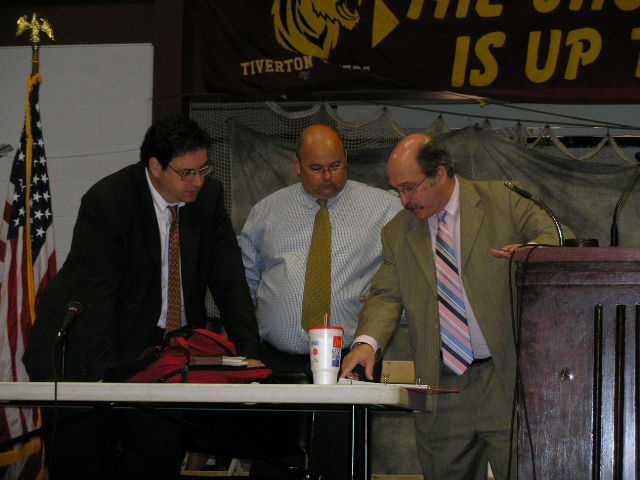
Budget Committee Vice Chairman Rob Coulter chats with School Committee Attorney Stephen Robinson, while Superintendent Bill Rearick speaks with school department Director of Administration and Finance Doug Fiore as I take a picture immediately over Fiore's shoulder on the big screen:
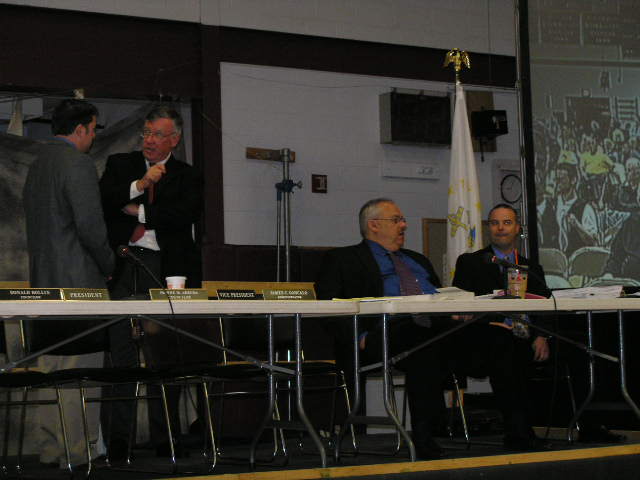
The crowd just before the start of the meeting:
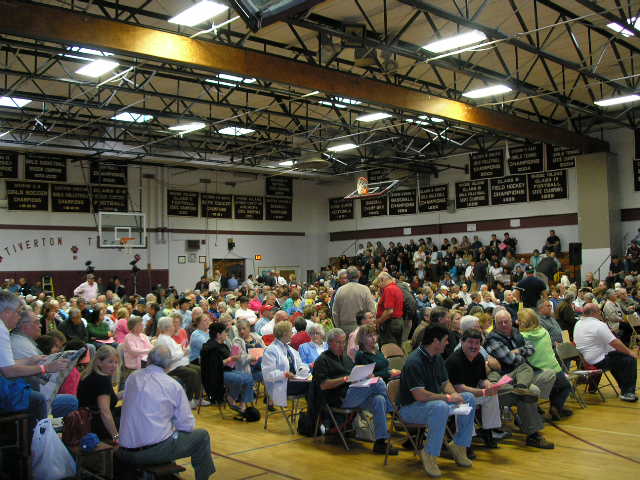
9:41 a.m.
We're under way. The official count is 700 people. Mr. Burk is currently going over the process for a ballot vote; the presentation is certainly persuasive to avoid them for more than close, important votes.
9:52 a.m.
The town council just lost its bid to add $300,000 to the budget for abatement protection. That should have been in the budget.
9:56 a.m.
Current discussion is whether the petition for a ladder truck is in order. Burk ruled the resolution is in order, even if it would be impossible to actually enact it.
A resident asked whether more firefighters would have to be hired to man the truck. Town Council President Don Bollin said that they don't have that information. Audience unrest, but Bollin clarified that he doesn't support the truck.
Chief Robert Lloyd is answering that all firefighters will be trained on the truck.
10:09 a.m.
Fire truck goes down.
10:20 a.m.
Some resolves from the Budget Committee were unexpectedly controversial. The mood may indicate that the taxpayers are again rising up.
10:55 a.m.
We're talking about the school department's budget. Three amendments to the initial amount have reduced the total and divided the total into an Operating and Capital Budget from Local Sources amount and a General State Aid, essentially determining who has to make up the difference if aid falls short: the town (taxpayers) or the school.
11:29 a.m.
An amendment that I made to the school committee budget was voted down. It was the third amendment, which is the maximum allowed. In short, I'm not too sad that it fell. It was actually the highest in dollar amount of the three by one dollar.
11:36 a.m.
Just a note: Mr. Burk is being fair, writing down the order of questioners regardless of microphone, etc. There have been a couple of points in which he's seemed a hair argumentative, but nothing beyond the boundaries of plain human nature.
The latest people count was 666, and people continue to leave.
11:43 a.m.
School Committee Chairman Jan Bergandy requested a paper ballot.
11:48 a.m.
I can't believe the amount of contention even to do a paper ballot. If this happens and the vote changes there will be huge angst.
11:51 a.m.
No paper ballot, and there's been a motion to move the remainder of the budget.
11:54 a.m.
A moment to breathe while we figure out procedure. I'll take the opportunity to suggest that the powers who be in Rhode Island take note that the Tiverton School Department just experienced a taxpayer-driven cut in its budget.
12:25 p.m.
Town Council member Hannibal Costa appealed the moderator's decision to let amendments be made to the municipal total. His appeal passed, and Jeff Caron appealed on the grounds that Robert's Rules disallow appeals after debate has proceeded. Costa's clearly incorrect, and Caron is clearly correct that Costa's appeal was out of order. But, we have to finish the meeting in order to ensure that there's no redux of last year's reworking of the budget, so it's probably a good thing that reformist efforts thus far are preserved.
12:43 p.m.
Town Council member Louise Durfee just took the opportunity of a procedural intermission to chastise a few members of the school committee for not speaking out more forcefully in favor of their budget.
Well, well, well...
May 7, 2009
Rob Coulter: Property Revaluation and Subjectivity
I had a very helpful conversation with a gentleman from the property revaluation vendor for Tiverton last night, and I learned quite a bit about the process. By the way, he was very patient and cordial, and I was very impressed with him, even if we may arrive a different conclusions. I agree with Justin that this should be an exploratory dialogue, and I do not pretend to have all the answers either.
The truth is somewhat in the middle of what I'm reading from comments here. As far as I can tell, they are using a multivariable regression computer model. It is susceptible to error because the sample sizes are not statistically robust enough for so many variables. When this happens, judgment calls have to necessarily be made. In a sense, the "methodology" has not changed, but there are still many, many variables calling for subjectivity on the appraiser's part.. I don't want to go so far as to call these judgment calls arbitrary, but there is definitely enough play between the joints for the appraiser to "skew" (if that's the right word) a result based on assumptions being made.
Although it sounds fancy and complicated, the idea of using multivariable regression is to let the computer try to find the impact of one variable while holding all others constant. It's like algebra on acid. This can't be done by hand when there are dozens and dozens of variables, as there are, here, so we let a computer do it.
I do not believe that it is incorrect to use this type of modeling, but there are two very important qualifiers:
- The model only works if there are enough samples for each variable. I'm not sure there are here.
- More importantly, this model and all models have assumptions built into them. These assumptions are necessary for any model but are at the end of the day subjective and subject to dispute. For example, I learned last night that (roughly speaking) all taxpayers are taxed at nearly one acre of land no matter how much less they have, and owners with additional acres are only taxed at a very low cost per acre. So if you own one-third of an acre or one full acre, you pay about the same tax on land. Do you think that's fair? Maybe yes, maybe no, but these are some of the assumptions that lurk behind the "methodology."
There are myriad assumptions and they have a major impact. They do not involve only objective things such as acreage and square footage, but multiplying factors applied based on the style of the house. These are very subject to debate. For example, I argued that a solar panel on a roof should add value to a house based on fuel costs. The vendor suggested that it might detract because of decreased curb appeal. I replied that a new buyer could simply remove the panel. And so on. You can see how very quickly a lot of error and assumptions can creep into a system that otherwise sounds so impressive.
Again, I want to stress that I don't think anyone is trying any funny business here. I was very impressed with the vendor, and I also very much respect David Robert, Tiverton's tax assessor. But I do have experience with multivariable regression, and if that is the model behind this, I can tell you that we can't trust it wholesale. I don't think the "methodology" has changed, but there are many assumptions under this methodology that can be adjusted and are essentially subjective.
Rob Coulter is a member of the Tiverton Budget Committee as well as Tiverton Citizens for Change.
May 6, 2009
Nick Gorham, North Westconnaug Needs You!
The conventional wisdom is that Nick Gorham lost his seat in the Rhode Island House of Representatives because of his support for regionalizing Exeter, Foster, Glocester, Scituate, West Greenwich and part of Coventry into a single town of Westconnaug, offending the delicate parochial sensibilities of his constitutents.
I wonder what Mr. Gorham's former constituents from Foster think of former Providence Mayor Joe Paolino's plan, published in today's Projo, to fold the town of Foster into a new Super-Providence…
The Providence County I envision would include Providence, East Providence, North Providence, Cranston, Johnston, Foster and Scituate — 36 percent of the state’s population at present, hardly enough to take over the state.At least Mr. Paolino is more honest than most about his reasons for regionalization -- Providence needs more tax money from other communities to fund city development…
Providence needs a much larger, growing tax base to launch additional renewal campaigns in the city.Mr. Paolino also demonstrates the primary reason why people are rightly skeptical of municipal consolidation plans, with this section of his op-ed…
The new Providence County would be created by a “merger of equals,” rather than by an annexation of the other cities and towns by the capital city.Why is "annexation" even being brought up in this context? Is Mr. Paolino suggesting, perhaps, that if you're not from Providence you should agree to a regionalization plan, because Providence might just annex you anyway if you don't do the right thing?
But if Joseph Paolino and others think that annexation of cities and town is a legitimate bargaining chip in the regionalization discussion, just think how they're going to act towards those (former) cities and towns, when they have taxation and other formal powers over them!
A Full Court Press, in Local Terms
Well, it's some sort of milestone, I suppose, to be denounced by name in a mailing to the email list of Tiverton Youth Soccer (with which my children are not currently involved):
Hi all,It is that time of the year again.... time for me to urge each of you to attend Tiverton's Financial Town Meeting. I know, I know, sheesh Deb we don't like to go to those. They are long and confusing and lots of folks just get angry and yell.
You are right about all that, but here's the thing - I can think of lots of other things I could be doing on a Sat. morning at 9am, but I do not want to wake up on Sunday morning and hear that because enough reasonable people weren't at that meeting, a group of extreme, self-seeking residents slashed the town budget by $2 million dollars. It almost happened last year!! It would have been devastating to town services - a closed fire station, no trash pick up, etc. The schools would have had to eliminate anything not considered basic by the state - band, sports, maybe close a school. You all know the things that will go. The TCC contingent on the budget committee already tried for a $1 million dollar cut to the schools and over $250,000 to the fire department. They produced graph and charts and yelled and cut off any that would try and counter the incorrect, skewed or misleading "facts." Luckily, more reasonable and responsible voices on the committee prevailed. But, now read the letters in the Sakonnet Times from TCC members Justin Katz, Jeff Caron and Tom Parker (available on-line) filled with anger and innuendo and rumors which will stir the pot and get their cut-cut-cut base to the FTM.
I am NOT for higher taxes, but I am for maintaining services. That is what a community does - share the costs of preserving services. The proposed municipal operating increase is .5% over last year, the school increase is 1.48% over last year. These are reasonable and prudent and all have worked hard to keep taxes down while maintaining the services we all want (or at least I want). PLEASE, PLEASE try to have at least one member from your family (or 2 or 3) at the financial town meeting so we don't wake up on Sunday to find out that our town has been drastically changed. It is only a few hours but will impact the entire town for the rest of the year and beyond. Please call or forward this message to at least 10 others and let's spread the word. Thanks.
Deb
Oh, yes. Deb would never use anger (unless calling people self-seeking [sic] extremists with double exclamation points counts) or rumors to rile her base audience to the FTM. Yeah, villainizing neighbors to community groups — as opposed to letters to the editor and such — might be a little aggressive, but in order to be offended, one must imagine that we right-wing agitators are merely people trying to do what we believe to be right, not only for ourselves, but for the town, as well, and that clearly cannot be the case in Deb's aw-shucks world. Never mind that TCC's position (which may be different than a given member's) is to "hold the line" by approving the budget as it stands, without any surprise increases.
I do wonder, though, whether Deb's ever taken the opportunity of a group mailing to warn that the ever-growing remuneration of public-sector unions would squeeze out those "services we all want." If it's the Deb whom I believe it to be, she took quite the opposite view with the recent teachers' contract. So add that to the list of reasons for a community to exist: to provide services to the town, and to ensure disproportionate pay and benefits for union members.
Meanwhile, our old friend Richard Joslin once again appears to have hijacked (or attempted to hijack) TCC's mailing list:
If you do not want this email, please just delete it.Once more, the TCC is lying to you. No one is planning to increase the School Budget; we support the Budget Committee on the schools. No one is trying to steal votes at the FTM. That is a paranoid fantasy Parker, Nelson and your TCC leadership are trying to "sell" you. . I for one am sick of David Nelson's lies, and you should be too. There has been an 8 month campaign to destroy our public school system by cynical people like Mr. Parker, who is claiming falsely this week that people will try to add $500K to the School Budget. And by Mr Coulter who has authored two legal suits- one attacking volunteer counters at the Town Meeting, and one destructive lawsuit which will accomplish nothing but spending your money on lawyers to defend the Town. Do you want you political "heroes" to attack the Town with lawsuits? All we are asking is for all voters to attend the FTM and vote for the Budget already approved by the Budget Committee, Town Council and School Committee. Please attend.
You cannot vote to reduce teacher's salaries or benefits at the FTM, you cannot vote to change the public pension structure at the FTM. You cannot change minimum manning of the Fire and EMTs at the FTM. Just about no one wants a ladder truck we cannot afford.
But keep on believing the lies of Parker, Coulter and Nelson. The TCC is proving to be a rogue right-wing bunch of idiots. It is an embarrassment.
This is being sent to you because (twice) three weeks ago Mr. Nelson intercepted emails I sent to supporters of the budget approved by the Budget Committee and TIV Town Council and sent my it to all TCC members. He urged you all to go to a non-public meeting to be held about the budget. Only one sad person tried to come, and as it was a private meeting he was turned away. You deserve to know the nasty tactics your TCC leadership practices.
Richard Joslin
Yup. No anger, there, from the man who decries a "right-wing bunch of idiots"! No paranoia from the guy complaining about Dave's "interception" of an email in which he (Joslin) — whom I'm pretty sure I've spotted attempting to spy on TCC meetings — asked all residents to attend a meeting that he hosted and encouraged recipients to forward the invitation.
Joslin never explains for whom he intends to speak with his "we," but perhaps his extensive network of informants are the reason he's so confident that "no one" is planning to increase any budgets at the financial town meeting. "Just about no one" wants a ladder truck, and yet enough residents petitioned for one to get it on the FTM docket.
At least Mr. Joslin realizes that unions are an issue, though. Unfortunately, in the cluelessness typical of those comfortable with the same-old governance of Rhode Island and its municipalities, he looks right past the effect that taxpayer pressure can have during negotiations. He has no concept of the importance of the leverage that officials can derive from downward pressure from voters.
And pressure is all we have. The unions may give some slack for this year, but their contracts are typically for three. Thus, at next year's FTM, any increase given away by negotiators will be declared untouchable. The current budget provides for no increase. That means that we're seeing a budget unaffected by the unions — and it still represents more than a three percent increase! (Unaffected, of course, except for the retroactive raise that the teachers just got and that carries through to this contract as the new baseline. In the absense of a contract, by the way, I imagine, contra Joslin, that line item is in fact available for modification.)
It's time to change the conversation and to stop falling for the soothing tones of people who turn their smiles to snarls with a disconcerting ease, depending on whether they're addressing the opposition or those whom they'd like to lull back to sleep while they make decisions — folks like Yer Pal Deb, Richard the Level-Headed, and Mike Burk, the FTM "moderator" who happens to have been one of the most aggressively anti-TCC partisans to emerge over the past year.
May 5, 2009
Town as Big Business
One could understand, perhaps, the city/town being its own biggest employer in a rural area or suburb with little by way of industry. But Warwick? Bob Cushman writes:
According to Warwick’s 2007 Comprehensive Annual Financial Report, the City of Warwick was the No. 1 employer in Warwick, with 2,900 employees. Number two was Kent Hospital, with 2,050 employees. Number three was Metropolitan Life/Property Insurance, with 1,450 employees. Number four was United Parcel Service, with 1,000 employees. Number five was Leviton Manufacturing, with 840 employees.In 1998, the population of Warwick was 85,427 citizens. By 2007, the population had increased slightly, to 87,365 citizens. In 1998, the number of full-time municipal employees was 875. By 2008, the number of municipal employees had increased more than 6 percent, to 929 employees.
In 1997, the number of students in Warwick’s schools was 12,124. By 2008, the number had decreased to 11,150 students. In 2012, the projected student population is expected to further decrease, to 10,442, or a 14 percent decline from 1997 levels. In 1997, the number of teachers employed was 1,056. By 2003, the teaching staff had increased more than 7 percent, to 1,133.
Since then the teaching staff has been reduced to 1,088 teachers, still an increase of 3 percent over 1997 levels.
Little wonder public-sector unions do so well, as a political constituency, when the biggest employer in town receives its revenue through force of tax.
May 4, 2009
Government as Pension Program
Here's an eye-popper: Cranston spends more than a fifth of its total budget on pensions (not including teachers). Nine municipalities spend over 10%.
While Rhode Island's political leaders wrestle with state pension reform, there's another big pension headache out there — the soaring cost of municipal pensions.A new study by the business-backed Rhode Island Public Expenditure Council reports that the amount of money that communities spend on pension costs has increased nearly 50 percent in the past five years, from $101 million in 2004 to $149 million in the current fiscal year ending June 30.
But the raw amount, the exclusion of teachers, and the addition of state employees is not all:
The study found that locally administered pension plans were able to fund only an average of 45 percent of their obligations as of June 30, 2006, with an unfunded liability of $1.6 billion. That encompasses quite a wide range, from a Coventry police pension plan that is only 7.9-percent funded, to the Jamestown police pension plan, which is over-funded, at 123.9 percent.
In other words, as much as they're spending, many cities and towns ought to be devoting more resources to pensions.
That's if you look at it as a funding matter. If you look at it as a practical and moral matter, they ought to be devoting less to pensions. It's time to bring public workers back to the real world.
Property Tax Illusion
Because it works differently than most other taxes with which we're familiar, it surprised me when first I learned how property taxes are calculated, at least in Tiverton. In short, the rate is almost an irrelevant statistic. Confusion over that fact has led local Budget Committee and TCC member Tom Parker to pen the following explanation
2009 property revaluations have been mailed out in Tiverton, and if you listen carefully you can hear a collective sigh of relief across the town: "My property value has gone down, my taxes must be going down. Life is good, and I'm safe, at least for the time being, from the insatiable tax demands of the Tiverton government. For once, I can relax...right?" Actually, no. Unfortunately, things are not what they seem. There are two good reasons why you need to pay careful attention.First, the letter we taxpayers got in the mail was our property revaluation, and, indeed, for many of us it is significantly lower than the previous assessment (my own decreased about $120,000). The tax RATE is the other key component in the final calculation of YOUR property tax bill. The FY2009 tax rate proposed by the Budget Committee is $14.73/1000. This is a $3.47/1000 increase (31%) over the current tax rate of $11.26/1000. So even if your assessment has gone down, your taxes could substantially increase. In my case, even though my assessment decreased $120,000 (14%), I estimate my tax bill will increase by over $1,100 (12%).
The town doesn't apply the rate to the property values to figure out how much money it has to work with. Rather, it figures out how much money it wants and then divvies the total up among all of the property in town. When property values go down, it doesn't figure out how to function with less revenue; it simply adjusts the rate to ensure the same revenue as a matter of course, with no votes or political risks necessary.
So the key question, when it comes to revaluations and taxes isn't whether your house is worth more or less; it's how it changed compared with all of the other properties in town. If they all decrease by the same percentage, everybody's taxes stay the same.
It's true that, in Tiverton, a new methodology will skew taxes toward waterfront properties, this year, which means that recalculations will hurt those homeowners more. But as Tom describes, the huge leap in the rate likely means increase for anybody whose house's value dropped less than 31%. And that's before tax-revenue beneficiaries have their whack at the budget during the upcoming financial town meeting this Saturday.
ADDENDUM 05/09/09 5:10 p.m.
The deleted sentence is incorrect. See here for explanation. Apologies for the error.
May 2, 2009
Public-Sector Rules May Be Strict, but Respectful
It is wholly reasonable — even obvious — for the city of Woonsocket to implement these rules for its firefighters:
The order bans work that that would involve using department time or resources, including the uniform, for personal gain; doing work that would normally be expected to be done for the city while the firefighter was on duty; any acts that would have to be reviewed or approved by the Fire Department or other city employee; and lastly, work that "involves such time demands as would render performance of his or her duties as a firefighter less efficient and effective."
These four requirements follow basic ethical and professional norms from which public sector employees and officials seem too often to be excused in Rhode Island. Where Woonsocket goes too far, however, is in presuming not to treat firefighters as adults and professionals:
The city has issued a general order to its firefighters that says starting May 11, if they want to work a second job, they will need the permission of the chief or the public safety director.
Policies should be in place to take corrective and punitive action when rules are broken, but giving an employer a preemptive veto power over activities outside of the workplace is a clear violation of rights and due respect.
April 29, 2009
With Friends (and Moderators) Like These...
Contrary to aspersions in the comment section of my previous post on this topic, my source was not incorrect that Town Council member Jay Lambert voted against Mike Burk as financial town meeting moderator. According to a Sakonnet Times article (not online), following a profiles-in-courage strategy, he changed his vote, apparently in a way, by tone or by timing, that kept the news from getting back to members of Tiverton Citizens for Change right away:
After an initial 5 - 1 vote made it clear that Mr. Burk had won, Mr. Lambert asked to change his vote to Mr. Burk "to make it unanimous."
I'll say this: TCC moved quickly last summer. For the next election, it may be that we'll need a better developed endorsement procedure.
As for Mr. Burk, himself, he's very confident in his own capacity for neutrality:
Council member Louise Durfee said that Mr. Burk, in his application, had addressed these concerns. In the e-mail, Mr. Burk said that while "I am certainly a passionate advocate for my beliefs, I also fully recognize that the Moderator's role is to be the neutral arbiter and facilitator of the Town Meeting and I take that role very seriously."Mr. Burk went on to say he recognizes the need to put his own beliefs in his back pocket "to ensure a fair Town Meeting process" and said that others who had seen him in action leading meetings would say "I am a very fair and reasonable facilitator."
First, as I mention in the comment section to a letter that I sent to the Sakonnet Times, Mr. Burk has previously given some indication of his fidelity to rules by asserting it to be his job (as a school committee member) to advocate for their budget using resources available to the committee, even though that's explicitly against school department administrative policy.
Second, I'd point out that the back pocket is a nicely accessible location from which to draw a metaphorical knife. Moderators help to determine who speaks when, to determine what is and is not in order, and even to make the call on voice votes. It is not unreasonable paranoia to imagine that advocacy can have a way of creeping into one's judgments on such matters. Recall, for example, the moment at last year's FTM when an audience member challenged the one and only amendment — of the allowable three — to propose decreasing the budget on the grounds that he had been at the microphone first. He was lying, and even a toss of the coin would have been unfair.
Can we expect balanced judgment from this man?
Participate, Because Somebody Else Will
Herewith, the text of my speech at the Tiverton Citizens for Change Taxpayer Forum on Monday night. (Audio, with some extemporaneous differences: stream, download [5min 29sec])
Let's be honest. For most of us, this whole civic participation thing is a chore. It's a responsibility. We stay informed; we vote; and really that should be enough. One reason we have elected representatives is to free up the rest of us to be productive, keep the economy going, and pursue happiness.
And yet the previous speakers who called for increased participation — to the extent of committing ourselves to campaigns and elective office — are absolutely right. We may have no desire to make a career, or even a sabbatical, out of public service, we may have no thirst for political power, but that is precisely why we are needed. Simply put, if we don't step forward, somebody else will. Somebody who doesn't see government as a chore.
As an indication of what I'm talking about, I'm going to read a few lines from the infamous fire-truck petition:
This proposal is being sought because the item was not considered by the Tiverton Budget Committee in the docket for this year and because numerous members of the Tiverton Budget Committee have advocated a maximum increase in the annual tax levy not to exceed one percent or zero, because the Tiverton Budget Committee is recommending a slashed school operational budget in order to achieve their desired goal ... and because these same Budget Committee members are squandering the limited ability to utilize tax revenues under the State mandated cap of 4.75% to improve the community as a whole.
There's no statement of dire need to buy such equipment despite the horrible economy. No research about the likely changes in property insurance. No examples of lives that would recently have been saved. The authors of this petition didn't even bother to note properties that might have been preserved in the past. According to news reports, they didn't even consult the fire chief!
Their primary motivation, in other words, is to out-maneuver people they don't like on the Budget Committee, and secondly, to claim as much of your income as possible. Their design is to take money from every taxpayer in Tiverton and allocate it to the priorities of a few people with the time and motivation to manipulate procedure.
Some of these people either benefit directly from town government or are close to people who do. Others of them, well, who knows? Maybe they've got their eyes on the State House and maybe, in their long-term aspirations, on Congress. Maybe they just like the feeling of a little local prominence. Or maybe it's more like a high school popularity thing.
I want to stress, here, that I'm not talking about everybody in local government, whether I agree with them or not. But this is certainly a segment — a vocal and active contingent that must be countered. And the reason it must be countered is that if somebody is in government for personal gain, whether of the wallet or of the ego, or even if he or she just thought it'd be a nice way to get involved in the community, then that person is going to be more susceptible to special interests.
For example, throughout the recent teachers' contract discussions, we heard again and again, from the union as well as people on the other side of the negotiating table, that the money was "in the budget." The people of Tiverton — the argument went — wanted that money to go to the teachers' union. And now, here we stand, with all of the town's major contracts up for negotiation during a down economy, and the school committee chairman told the Budget Committee that he's got no bargaining leverage. The Town Council President claims it's easier to have too much money in the budget for labor and to put some back in the general fund if negotiations go well.
What these representatives should be advocating is to force the unions to negotiate against a taxpayer-mandated cut. Instead, there's been a push, which we'll probably see again at the financial town meeting, to postpone budget decisions until after the unions are all settled up. The Committee and the Council want to negotiate with an admittedly weak hand rather than to be able to say to the unions, "The money is not in the budget. At least you have your jobs."
You probably already know the argument that we'll hear if the FTM occurs after the fact. "These contracts are signed. There's nothing we can do. Except raise taxes. Oh, and by the way, we're going to need more money to staff, equip, and fuel our new fire truck."
Folks, we do have to start small, and that means simply attending the financial town meeting. But we also have to build, because these people, these problems, already permeate our system at every layer of government. TCC is available to provide some structure — and some moral support — at the town level, and the Rhode Island Statewide Coalition is growing at the state level for the same purpose, but there really is no substitute for participation.
We've reached the point in Tiverton and in Rhode Island that participation is no longer a civic duty or chore. It's a matter of self defense.
TCC Taxpayer Forum Audio
The following speeches were given at the Tiverton Citizens for Change taxpayer forum on Monday, April 27.
- TCC President David Nelson: stream, download (4min 30sec)
- TCC and Tiverton Budget Committee member Thomas Parker: stream, download (13min 39sec)
- Rhode Island Statewide Coalition Executive Director Harry Staley: stream, download (19min 39sec)
- TCC member and Tiverton Budget Committee Chairman Jeff Caron: stream, download (17min)
- East Providence Taxpayers Association spokesman Bill Murphy: stream, download (27min 4sec)
- Anchor Rising's me: stream, download (5min 29sec)
- TCC member Joe Souza: stream, download (35sec)
April 28, 2009
Corrected: Breaking Local News Related to FTM Moderator
At the tail end of our Tiverton Citizens for Change meeting, I received word that Mike Burk won the position as financial town meeting moderator on a unanimous council vote a council vote of five to one, with Jay Lambert voting against and, with Council President Don Bollin suspiciously absent.
Well, I warned of the outcome should this come to pass.
April 27, 2009
Gearing up for the Financial Town Meeting
I've arrived early at tonight's Tiverton Citizens for Change FTM-prep meeting, at which I'll be speaking. (FTM stands for financial town meeting). Even people who aren't speaking began walking through the VFW door about a half-hour early.
Hopefully turn-out will be good, although it would likely be too optimistic to expect an equivalent turnout to our meeting last year. After all, that one followed a controversial event. This year, we're trying to prevent a repeat.
I'll be checking in as I'm able. If you can come, please do.
6:52 p.m.
Well, we've already surpassed the average town council, school committee, or budget committee meeting. Harry Staley from the Rhode Island Statewide Coalition is here (he's speaking). General Assembly Rep. Jay Edwards (D., Tiverton) just arrived (he's not speaking).
7:10 p.m.
We're starting a little late, owing to a delayed speaker. Rep. John Loughlin (R., Tiverton, Little Compton, Portsmouth) just arrived, though.
7:23 p.m.
About sixty people are here. TCC President Dave Nelson opened the meeting, followed by TCC & Budget Committee member Tom Parker, who is currently reviewing budget amounts and processes.

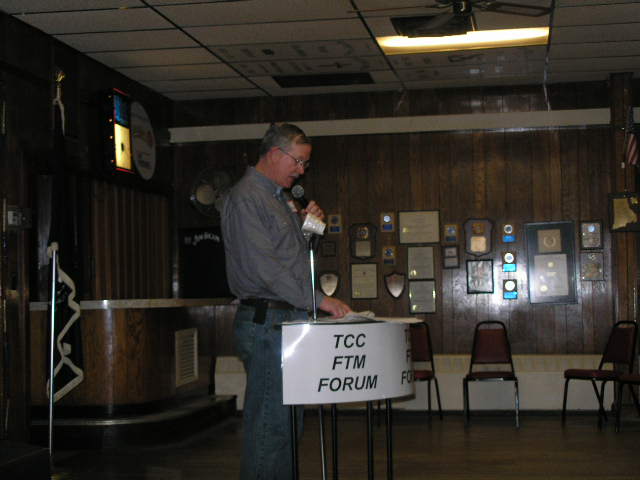
7:34 p.m.
Harry Staley is up:

7:37 p.m.
Providing some anecdotes, Harry's describing the way things work in Rhode Island. He emphasized that it doesn't matter what party it is that has a monopoly on government; it's not healthy.
"Instead of facing up to the problems that we have, they're going to turn to the stimulus money to pump it in to the current deficit." That'll make things worse... and he's somewhat pessimistic.
7:56 p.m.
TCC member and Budget Committee chairman Jeff Caron is going through some financial changes that we'd like to see made moving forward:
8:12 p.m.
Bill Murphy of the East Providence Taxpayer Association has taken the microphone:
Bill's characterizing the current power of special interests in RI as "a hostile takeover of government."
8:19 p.m.
A great comparison of the U.S. Army, in which officers wait for the enlisted men to eat, with U.S. and RI government, in which the leaders take for themselves and then divvy up some of what's left.
When the Majority Is Convenient
Here in Tiverton, there's some growing grumbles about the latest property revaluation, which appears to have shifted the weight of the tax burden toward those with waterfront property. Our situation appears mild (so far) in comparison with Barrington's. Nonetheless, the phrase "class warfare" has been uttered, here and there, which is why a sentiment expressed by Barrington Town Council member Kate Weymouth raises a red flag:
"The majority of residents in this town are satisfied with their assessments and I am elected by the majority."
Not knowing Ms. Weymouth's history, I wouldn't apply this to her, but the thought occurs that public officials are keen to be the voice of the voiceless, when that suits their preferences, or the voice of the majority, when their inclinations are in sync.
April 24, 2009
How to Ensure Municipal Discord
The name won't mean much to Rhode Islanders from elsewhere (except inasmuch as you've seen it on Anchor Rising), but I heard last night that the Tiverton Town Council is considering appointing Mike Burk as the moderator for the upcoming financial town meeting. Do they want unrest? Do they want to encourage discord across the town?
This is a man who has been not only open, but active in his contempt of local reformers in Tiverton Citizens for Change. He's expressed paranoiac class-warfare insinuations about them in the local media. He's paced the back of Budget Committee meetings, swearing and seeking to shout down TCC members on the committee. (He's captured in the background of the two audio clips here).
Having Burk stand as the ostensibly neutral conductor of the session would be downright hostile to democratic compromise and would ensure broad suspicion of the results even before the meeting's opening. The demeanor that he displayed during meetings when he was an elected official — even when he's been advancing policies that I've supported (such as holding the line for months against the teachers' union) — would be perfect if the town's aspiration is to stoke controversy, but wholly inappropriate if the objective is to host a thoughtful, productive meeting.
April 19, 2009
Revenue-Driven Quota, or Union Stranglehold Workaround?
A busy week moved this Hopkinton tidbit to the bottom of the pile, but the multiple angles make it of broader interest:
If you drive through Hopkinton, keep this in mind: The officers you see are each required to write 20 traffic tickets per month, "more or less," under a new Police Department policy.Excuses, like being busy doing something else, or having taken vacation days, "are not acceptable," Lt. Daniel C. Baruti said in a March 3 internal e-mail that spells out the policy.
Drivers who think they have been ticketed unfairly often suspect that they were cited because of a police quota rather than their driving. The police almost universally deny that quotas exist.
The e-mail says, in bold, italic type, "Do not forward this e-mail."
Baruti tried to put a business-as-usual face on the controversy, with the emphasis on "business" by presenting law enforcement in terms of money-making:
Baruti and the other local officials said that the policy is a management tool intended to make the police more productive. Although it has drawn some criticism, Baruti said, the policy is legal and that they have no intention of abandoning it. ...The e-mail said that officers who don't meet the quota — an average of one ticket for every shift worked — will have to fill out daily activity sheets to account for what they have done during their shifts. Baruti acknowledged that officers would rather not have to do that.
Baruti's e-mail said that the department's "production level" has fallen and that the town manager and some members of the Town Council "are very dissatisfied with our numbers." He said he thinks a decline in the department's ticket production reflects a lack of motivation.
Baruti wrote that he plans to send the officers' statistics to the Town Council, so members can "see for themselves who is producing and who is not." DiLibero said the council hasn't acted on the issue, which he considers an administrative matter.
Police Chief John Scuncio, by contrast, fires the union flare:
Scuncio, on the other hand, said the policy is aimed at a single officer who does practically no work. One example of his lack of effort, the chief said, is that month after month, the officer writes no tickets at all. The chief said the officer's inactivity "really creates problems" because new officers "see this guy doing nothing." He didn't identify the officer, saying he didn't want to single the officer out. ...He said he's reluctant to try to discipline the officer because of the difficulty under the legal and contractual protections provided to Rhode Island police.
Maybe I'm getting tired of games in my ornery middle age, or maybe my incredulity results from daily experience with the demands and strains that exist in the private sector, but I'm inclined to offer solutions to both justifications for this policy, no matter which is the actual one: Make all officers fill out daily activity sheets, regardless of their "productivity," and stop negotiating contracts that make it difficult to discipline egregiously "unproductive" employees.
Seems like every time the public discovers an objectionable policy or practice in the government sphere, it's excused with reference to the deeper problems that it's supposedly attempting to solve. Well, let's do away with the deeper problems, even if it annoys big contributors, people in the family-and-friends camp, and special interests.
April 13, 2009
Moderate Town Council Meeting
The first thing of note at tonight's Tiverton town council meeting is consideration of appointments for the moderator at the financial town meeting. Apparently, the town has received a single réumé to date. It's not like the moderator has to do anything important; as we learned last year, he or she mainly relays town solicitor Teitz's findings related to Robert's Rules.
7:52 p.m.
Director of Public Works Stephen Berlucchi is currently suggesting a program that would begin charging for trash pickup (in addition to what comes out of our taxes). Councilor Louise Durfee just suggested that not all money raised in this way should go to putting money aside for the big pending expense of closing the town landfill, but that some should be redirected toward landfill operating expenses. (Apparently, she wasn't happy with the condition of the landfill on her last visit there.)
8:00 p.m.
If I heard correctly, Berlucchi's program amounts to another $750,000-plus tax increase on residents (a point that council President Don Bollin must made).
I'm new to this debate, but I'm not sure why the town can't allocate more land. Alternately, the town could do some of the back-end work to facilitate private pickup services for residents who want it.
8:47 p.m.
The council just voted 3 to 2 to "encumber" additional funds from their contingency fund for use in preparation for the financial town meeting. The issue is mainly an inability to predict the attendance.
One a positive note, the council voted unanimously to have voting machines available for use during votes at the FTM. In that setting, especially pitting police, fire, and teachers against senior citizens to some extent, voice votes are simply unfair, and hand votes are problematic for reasons both of accuracy and of political pressure.
8:52 p.m.
Councilor Jay Lambert is asking Solicitor Teitz whether the petition to put a fire truck on the docket at the FTM is actually allowable according to the town charter, given the size of the expense and the questionable accuracy of the expenses stated in the petition (lacking operational and other costs that would be implied by the purchase).
April 11, 2009
Tivertonians: They Just Want Your Money
On the last page of the main section of the recent Sakonnet Times comes news of a petition that has succeeded in putting a ladder truck for the fire department on the docket for the financial town meeting. The meat of the petition is as follows:
This petition seek [sic] to appropriate and expend the annual sum of $110,290.00 for twelve (12) years for the purpose of acquiring a ladder tower for the Tiverton Fire Department. The amount paid annually will represent a financed amount of $950,000.00 over a twelve (12) year period at 5.51% interest. This proposal is being sought because the item was not considered by the Tiverton Budget Committee in the docket for this year and because numerous members of the Tiverton Budget Committee have advocated a maximum increase in the annual tax levy not to exceed one percent (1%) or zero. Because the Tiverton Budget Committee is recommending a slashed school operational budget in order to achieve their desired goal of a maximum levy increase of one percent (1%) to a zero percent [sic], and because these same Budget Committee members are squandering the limited ability to utilize tax revenues under the State mandated cap of 4.75% to improve the community as a whole, we the Tiverton Taxpayers listed below believe it is in the best interest for the Town of Tiverton to acquire a Fire Apparatus Ladder Tower vehicle that will be used to save lives, provide fire protection to the community as a whole, assist in lowering our already too high insurance premiums by generating a more favorable national Fire Standard Rating than currently exists and to provide appropriate equipment for the health and welfare of the Tiverton Fire Department professional staff.
Before touching on its dishonesty, think of the small-mindedness behind this proposal. During the worst financial downturn in decades, perhaps since the Great Depression, a minority of the town Budget Committee supports a leveled budget. Therefore — because the committee is recommending a restrained school budget — a handful of revenge-seeking agitators and a few dozen folks who likely don't follow town finances very closely wish to spend over a million dollars on a fire truck, adding more than $100,000 to the town's annual debt requirements for so many years that students now entering first grade will be graduating high school at around the time we're done paying off the truck. (That number obviously doesn't include any extra expenses in maintaining, fueling, operating, and manning it.)
The dishonesty of the petition points to the more basic goal of its backers. As one discovers elsewhere in the Sakonnet Times, the Budget Committee's docket currently calls for a tax levy increase of 3.36%, not 1% and certainly not 0%, and that doesn't account for the additional $300,000 that the town council wishes to set aside for abatements. In this context, look again at this line:
... these same Budget Committee members are squandering the limited ability to utilize tax revenues under the State mandated cap of 4.75% to improve the community as a whole ...
In other words, the goal for this cadre is to achieve or exceed the state's cap on tax increases. It's to take money from every taxpayer in Tiverton and allocate it to the priorities of a few people with the time and motivation to manipulate procedure. That is why the rest of us can no longer afford not to participate.
ADDENDUM:
It's worth highlighting a few notables among the petition's signers:
- Former Budget Committee Chairman and thwarted Town Council candidate Chris Cotta
- Former School Committee Chairwoman Denise deMedieros
- Current Budget Committee member Alex Cote.
ADDENDUM II:
I'd be interested if anybody has information on this "national Fire Standard Rating." I'm not even sure that there's a rating with that name, and moreover, some light research on the matter has left me with the impression that insurance rates aren't easily calculable based on National Fire Protection Association (NFPA) standards. Insurance savings are being thrown about as a vague promise of cost-offsets, but such statements don't seem to be based on much more than a general sense that spending money might, in the words of the petition, "assist in lowering" costs.
April 6, 2009
Moderating the Muddle
Tiverton Town Clerk Nancy Mello has reason to fear that the town council may consider her to be the default appointee for the position of moderator at the pending financial town meeting. So, as she and I spoke amidst children hunting for Easter Eggs this weekend, I promised to make some inquiries. Count this as one.
Candidates need not be from Tiverton, but they must be comfortable with Robert's Rules. One will be appointed by the town council to open the financial town meeting, and another (or the same) will be elected at the meeting for a two-year term. A fair and strong person could do much to help the town of Tiverton through contentious times.
Interested people must file with Mrs. Mello by the 16th.
April 2, 2009
New General Revnue Sharing Figures for Local Communities
Based on...
- The language of last night's supplemental appropriations bill, which reads...
For the fiscal year ending June 30, 2009, the total amount of aid shall be twenty-five million dollars ($25,000,000) with such distribution allocated proportionately on the same basis as the original enactment of general revenue sharing for FY 2009.
- Katherine Gregg and Cynthia Needham's story in today's Projo...
The state aid debate spanned hours, despite an early — and almost universally supported — decision by the beleaguered Democratic leadership to reinstate $25 million of the $55 million in local revenue-sharing dollars targeted for elimination.
- And the figures from the state's FY09 enacted budget document for general revenue sharing, which sum to about $55 million (see page 89),
| Barrington | $206,206 | $93,540 | $(112,666) |
| Bristol | $840,384 | $381,217 | $(459,167) |
| Burrillville | $597,138 | $270,875 | $(326,263) |
| Central Falls | $1,432,052 | $649,611 | $(782,441) |
| Charlestown | $345,546 | $156,748 | $(188,798) |
| Coventry | $859,727 | $389,992 | $(469,735) |
| Cranston | $4,599,682 | $2,086,520 | $(2,513,162) |
| Cumberland | $1,321,917 | $599,652 | $(722,265) |
| East Greenwich | $149,812 | $67,958 | $(81,854) |
| East Providence | $2,272,041 | $1,030,649 | $(1,241,392) |
| Exeter | $76,718 | $34,801 | $(41,917) |
| Foster | $262,927 | $119,270 | $(143,657) |
| Glocester | $480,786 | $218,095 | $(262,691) |
| Hopkinton | $191,394 | $86,821 | $(104,573) |
| Jamestown | $124,220 | $56,349 | $(67,871) |
| Johnston | $2,164,234 | $981,746 | $(1,182,488) |
| Lincoln | $812,824 | $368,715 | $(444,109) |
| Little Compton | $89,670 | $40,676 | $(48,994) |
| Middletown | $829,818 | $376,424 | $(453,394) |
| Narragansett | $747,514 | $339,089 | $(408,425) |
| Newport | $1,564,737 | $709,800 | $(854,937) |
| New Shoreham | $77,527 | $35,168 | $(42,359) |
| North Kingstown | $754,148 | $342,099 | $(412,049) |
| North Providence | $2,032,742 | $922,098 | $(1,110,644) |
| North Smithfield | $556,079 | $252,250 | $(303,829) |
| Pawtucket | $4,630,267 | $2,100,394 | $(2,529,873) |
| Portsmouth | $554,736 | $251,641 | $(303,095) |
| Providence | $13,135,563 | $5,958,590 | $(7,176,973) |
| Richmond | $125,675 | $57,009 | $(68,666) |
| Scituate | $383,576 | $173,999 | $(209,577) |
| Smithfield | $1,582,243 | $717,741 | $(864,502) |
| South Kingstown | $860,708 | $390,437 | $(470,271) |
| Tiverton | $547,575 | $248,392 | $(299,183) |
| Warren | $425,488 | $193,011 | $(232,477) |
| Warwick | $4,128,906 | $1,872,966 | $(2,255,940) |
| Westerly | $642,010 | $291,230 | $(350,780) |
| West Greenwich | $189,201 | $85,826 | $(103,375) |
| West Warwick | $1,245,850 | $565,146 | $(680,704) |
| Woonsocket | $3,270,235 | $1,483,453 | $(1,786,782) |
March 30, 2009
A Special Town Council Meeting
Interested in the process of the town's postponing the financial town meeting, I made room in my schedule to attend a special meeting of the town council at which we'll find out whether the town solicitor believes the town can legally seek to move the meeting to September.
Immediately upon opening the meeting the council voted to move the executive session that had been scheduled as a sort of intermission between the special meeting and a "workshop" to the beginning of the meeting. Solicitor Teitz had estimated the length of the executive session at seven minutes; I'm pretty sure that we're now over twenty.
7:27 p.m.
They're back, reviewing a handout from Teitz, with no copies for the audience.
Teitz: "I do think that it would be possible for the General Assembly to change the date for all the towns in the state." Broad, sweeping crisis stuff. He spoke to somebody who spoke with somebody who spoke with somebody, and that does not appear likely.
"There's nothing stopping the FTM, itself, from continuing it... however, you'd still have to have a budget prepared for them, and there's really no way of knowing what would happen."
"My philosophy is always to accomplish the goals of the client... So, I will tell you that it is my opinion that it is not constitutional for the General Assembly to change the date of Tiverton's financial town meeting alone."
7:32 p.m.
Teitz: "We're asking to unilaterally amend our charter without going through the charter amendment process."
"The only way that I see to do it is if you had an elect --- put the question to the voters of the town."
The special election would be "practical," "difficult," but "doable."
The authority to postpone the meeting is "only with the people." The special election might still require a special bill at the General Assembly, as well.
7:36 p.m.
Louise Durfee: "I think it would be easier to have the financial town meeting."
Teitz: "You are able to call a special town meeting afterwards." So, if budget considerations change, the council has the authority to call a meeting to change the budget.
Jay Lambert: "This General Assembly is not going to address the real issues, and we will have no more information in July, August, and September."
Broad agreement that the General Assembly sucks.
7:47 p.m.
Don Bollin: "I think we're better off going into that financial town meeting with the understanding that we're not getting that aid."
They've now adjourned the special meeting and entered into a scheduled workshop about the council's goals, etc.
8:11 p.m.
They're talking budgets and revaluations of properties in town. Town Administrator Jim Goncalo just said that the last he looked, the revals were running, overall, 15-18% lower than last year.
The Pressure to Give and Give
There's something very Rhode Island about a financial town meeting that admits non-resident outside guests and then adds half a million dollars to the school budget:
The non-resident ban the Lincoln Town Council approved 4-1 last week stems in part from controversy over last May's rollicking Town Meeting that increased this year's school budget by $517,248. In the aftermath, the meeting moderator questioned whether non-residents had voted for the increase and intimidated voters from opposing it. But the Budget Board reluctantly certified the budget on legal advice.Councilman Keith Macksoud, who said he brought the proposal to the council after talking with the Budget Board and moderator, said in an interview that some people indicated they felt intimidated to vote when teachers turned out at the meeting to support adding to the budget.
The ordinance says meeting attendees can vote by majority to allow the media, non-resident town officials/department heads, the town solicitor and "others" to attend.
I can see time's being an issue if every vote must be balloted, but it would seem feasible to have secret votes on substantive matters such as the school budget.
March 27, 2009
A Slightly Longer History of Police Budgets in Cranston
Two substantive objections offered in the comments section to my short history of the Cranston Police Department budget were…
- The figures for the Napolitano years include some million-dollar-plus temporary "rent" costs associated with the construction of a new police station, and
- Napolitano's first police budget was the 3rd year of a contract negotiated by his predecessor (that would be Steve Laffey, for those not paying attention), and therefore can't be held against him.
| FY2005 | Laffey II | $17,709,556 | -- |
| FY2006 | Laffey III | $16,616,502 | ($1,093,054) |
| FY2007 | Laffey IV | $17,447,623 | $831,121 |
| FY2008 | Napolitano I | $18,677,744 | $1,230,151 |
| FY2009 | Napolitano II | $19,424,221 | $746,447 |
In FY09 (the "year" that started July 1, 2008), the evil Laffey contract had expired. If the Democratic Mayor/Democratic Council believed that the City had been snookered into a backloaded contract, their hands were free to make the corrections and "fundamental changes" they thought were necessary to get department spending down to levels they thought reasonable. It certainly appears that that's what Mayor Laffey did in the first year of the contract that his administration negotiated, where the amount spent decreased by over 1 million dollars from the previous year.
But the only major adjustment that Mayor Napolitano and the Democratic City Council called for in the FY09 budget was a pay freeze. Mayor Fung has gotten the police union to agree to a pay freeze, plus only a small raise for next fiscal year -- but now the Council and other contract opponents are saying that the pay freeze doesn't really count as savings. That doesn't strike me as wholly consistent. I'd appreciate it if the next commenter who says that "this contract is a giveaway" would explain how an 18 month pay freeze, followed by a small increase after that, plus the increased health care co-shares, all with no retroactivity, is a "giveaway".
If the Democrats on the City Council think that more drastic measures, like layoffs or pay cuts have become necessary, they should inform the public and the Mayor of this. They might also consider providing an explanation of why their eleventh-hour call for "fundamental change" should be seen as anything more than political posturing, when the Democratic Mayor/Democratic Council certainly didn't act during calendar year 2008 as if changing contract terms scheduled to take effect in July of 2008 was a significant priority.
I don't think the Cranston City Council has any better idea of what "fundamental change" is this year than they did last year, when they saw no need to act on the police contract. Maybe the Council's actions are being driven by something that changed between last calendar year and this one; I wonder what that could be?
March 26, 2009
A Short History of Police Budgets in Cranston
Here are the official budget numbers for the last several years of the operation of the Cranston Police department, plus a column showing the change from the previous year…
| FY2006 | Laffey III | $16,616,502 | -- |
| FY2007 | Laffey IV | $17,536,373 | $919,871 |
| FY2008 | Napolitano I | $19,919,454 | $2,383,081 |
| FY2009 | Napolitano II | $20,679,721 | $760,267 |
I had a chance for a brief interview with Cranston Mayor Allan Fung yesterday on the subject of the police contract and budget. I asked him about the $400,000 savings he is claiming that the contract he negotiated will save. Since the new contract will covers this fiscal year (FY2009), the $400,000 savings is a savings against the budgeted total. For the subsequent years, Mayor Fung's administration is applying zero-based budgeting analysis, calculating how much it should cost to run the department with a full complement of officers, then factoring in how concessions like the hiring freeze, the 18-month pay freeze, etc. will lower costs.
I asked if there were any concerns about overtime related to the positions left vacant by the hiring freeze, and if it could unexpectedly drive costs up. The Mayor answered that that overtime can be driven by different factors, but that the City has been watching its overtime expenditures, and is assuming they will stay reaonably stable. Finally, I asked about the City Council’s claim that this contract "requires" vacancies to be filled at the end of the term. Mayor Fung said that the rules regarding vacancies at the end of this contract will be no different than the rules in the previous contract.
Returning to the numbers themselves, the largest recent increase by far in the Cranston Police Department budget occurred in Mayor Michael Napolitano's first year, an increase of 2.3 million dollars over the previous year (N.B. see the addendum below for an explanation of this expense). Cranston City Councilmen John Lanni, Anthony Lupino, Terrence Livingston and Emilio Navarro were all on the City Council that approved the 2008 increase that significantly raised the "structural" baseline that they are now expressing concern about. If they had concerns about structural problems being created during the Napolitano administration, they never took a stand on the steps needed to correct them. What could have changed in Cranston, I wonder, to make the Councilmen discover their inner fiscal conservatives?
Unfortunately, this is Cranston as a microcosm of Rhode Island politics. Spend like crazy when it's all one, big happy (Democratic) party. Then blame someone else for not doing enough, when it comes time to correct the problems.
The logic of Democrats in Cranston has been that, without the contentiousness might arise from having a Republican administration deal with unions, they can negotiate deals that deliver qualiy services at reasonable costs. But compare the theory to what actually happened; look at the change in the police department budget in FY2008, under a Democratic Mayor/Democratic council, and look at what is happening now. The Dems here don't really seem to be able to deliver on either half of their promise -- they somehow manage to spend big and create turmoil at the same time.
If this City Council is going to kill this police contract, they need to be specific about the "fundamental changes" they want to see carried out. To borrow the description that Justin recently offered of the state's situation and apply it to the local level, standing around like frozen deer in the midst of a financial crisis isn't sufficient action. What exactly does the council want to see done, to mitigate the structural budget problems that took a mighty big leap under the all-Democratic watch of FY2008?
ADDENDUM:
Commenter Donald Botts makes a fair point explaining the big budget increase in Napolitano year I...
The reason for the huge jump during [Mayor Napolitano's] first term is a $1.2 mil jump in the rent line item. I would assume this can be attributed to the new police station.
March 24, 2009
Non-Negotiating Season School Committee Meetings
The contrast is huge between these school committee meetings when there's no contract under negotiation versus when there is. An interested resident who came to tonight's meeting and took it as representatives would surely have trouble motivating him or her self to come to others. They're discussing the budget, but a viewer would have to know quite a bit of back story in order to discern the interesting points. (Frankly, I'm pretty well versed in the controversies, and I'm not finding much of note.)
7:53 p.m.
As at last night's town council meeting, the longest discussion comes with small-town stuff, in this case, over the names that will be included on the plaque that will commemorate the completion of the new school buildings. School committee member Sally Black suggested a second plaque to capture some language suggested by fellow member Carol Herrmann (thanking the citizens of Tiverton). Danielle Coulter asked the cost per ($1,500 each) and suggested that all changes be made to the one plaque.
8:27 p.m.
The committee has been discussing the possibility of pulling fifth graders from the middle school and putting them into the elementary schools. It's clear that Superintendent Bill Rearick opposes the move, and he presented the cost-benefit analysis as a dramatic cost to the district. Carol Herrmann asked Mr. Rearick for his rational for including new hires at the rate that he has (e.g., creating a 4/5 position), and his response was that the numbers were all discussed with the principals, but that he didn't have the supporting materials with him.
I'm not sure what is implied by the fact that the superintendent didn't bring all relevant material to a meeting at which the elected officials to whom he reports would be considering the issue, but it seems very unlikely to indicate something positive.
8:38 p.m.
During discussion of the stimulus money, Herrmann asked whether decreases in the town's budget for the schools would disqualify the town for stimulus funds. Rearick said that to be his understanding.
One wonders why spending millions of additional dollars on schools doesn't qualify as "maintenance of effort." It's also curious that government handouts somehow always require other levels of government to spend more money themselves.
It's almost like a conspiracy.
March 23, 2009
Back in the Town Hall
Missing a town meeting or two reminds the active citizen how nice it is to have nights at home. Ah, well. If we're going to have a democracy...
When I walked in (yes, a few minutes late) RI Rep. John Loughlin (R., Tiverton, Little Compton, Portsmouth) was giving the council the newly regular update of happenings at the State House. Now, Wayne [somebody] is describing the state's stimulus-related activities. Councilor Louise Durfee asked whether the money-related decisions will be made by the General Assembly or ladled out after the session's end. Loughlin answered, "Yes." Both methods will play a role.
7:19 p.m.
Just an observation: Councilor Jay Lambert asked Loughlin about state aid (receiving no concrete answer), and jovial comments from Durfee thereafter gave the impression that something has changed in their relationship. Since the last meeting that I attended.
7:23 p.m.
On state aid and the financial town meeting, Durfee told Loughlin that the town is considering giving the legislature a bill for spending needs or demand a change in the financial town meeting's date.
TCC member Joe Souza just asked the town council to request that Loughlin introduce a bill to end binding arbitration for police and fire. Souza: "We've heard the town council complain that they have no control over the budget."
8:13 p.m.
Town Administrator Jim Goncalo informed the council that the governor has offered to reinstate some of the state financial aid to the town... but only if he can use stimulus money for the general fund.
This issue seemed to be raised mainly to offer another opportunity for councilors to mention postponing the financial town meeting.
8:34 p.m.
The town recreation committee is requesting permission to put up outfield banner ads for the Little League fields in order to fund capital projects. They're estimating that 20 banners will generate $20,000-$25,000 per year. The committee sees the practice as the norm.
Louise Durfee is objecting that allowing advertising puts the town on slippery slope as other leagues come forward for similar treatment. "We've kept our recreation areas free of commercialism." Council President Don Bollin is getting pretty fired up about the visibility of the signage.
Hey, here's an idea: Let's raise taxes! It's almost the same thing, only the people paying the money get no advertisements in return.
8:45 p.m.
Lambert suggested trying one field for a year. Councilor Ed Roderick is partial to the slippery slope argument.
9:00 p.m.
Durfee moved to reject the proposal. Lambert amended to make it a one-year, one-field experiment, but received no second. All but Lambert voted to reject the proposal to place green signs with yellow letters (lettering only visible within the field) in order to build a new concession stand that isn't rodent-infested.
Have I mentioned that the town recently approved raises for AFSCME employees? Maybe we should make them wear advertising buttons on their shirts.
If I had time, I'd prove a point by standing near the outfield fence with a handheld sign for one of the organizations with which I'm involved and see if the police come after me.
9:22 p.m.
Jay Lambert and Ed Roderick are about to move to postpone the financial town meeting to allow for more information to be available.
9:24 p.m.
Actually... Lambert's making the point that all estimates are for tax increases below the 3050 cap even with the state aid listed as zero dollars. Consequently, he's proposing to go ahead with FTM as scheduled, where town officials would lay out what will happen with any state money: half to the reserve fund and half to tax relief for the town. "A lot of people may not trust us on a continuance."
9:29 p.m.
Durfee wants to recess a meeting to "level the playing field." At the latter point, we'll have facts that we don't currently have, on which list she includes labor agreements. She argues that the low tax increase currently on the table provides for no increases for any employees. Regarding negotiations: "Changes we want in contracts, we may need to give a little to get it."
They (i.e., Durfee and her backers) just want to give more away to the unions than they should, and they don't want the citizens to feel that they have any say in the budget.
9:38 p.m.
The solicitor (not Teitz) is suggesting that the General Assembly may lack the authority to permit the town to change the date of the FTM.
Durfee interrupted to argue "that doesn't ring accurately with me."
9:41 p.m.
Councilor Cecil Leonard just noted another instance of numbers games in the low, low budget: Revenue projections that are dramatically higher than history, such as a jump in mooring fees from $3,500 to $45,000.
He's also arguing that postponing the FTM will result in unrest. He cited the 58% of people who rejected the proposal to let the town council decide the budget.
9:44 p.m.
Chris Cotta took his regular turn at the microphone to suggest that nobody's trying to fool the taxpayers; they're just trying to have accurate information for the taxpayers. I'd suggest that the only information that they want to feed the taxpayers is how much they have to pay for signed union contracts.
9:51 p.m.
Durfee moved to proceed in seeking legislation that would postpone the FTM until Saturday, September 12, pending a legal decision that it is legal to do so. Just curios: when do our seasonal retirees leave town?
If this passes, I think my summer may be devoted to campaigning to cut a double-digit percentage from the budget.
9:59 p.m.
The council voted to have a special meeting next Monday, at which time, the solicitor will have an opinion, and they'll take the vote on postponement then.
March 20, 2009
Good Night, Sweet Tiverton
I hadn't planned to attend the Tiverton Budget Committee meeting on Wednesday night, so when my eyelids became heavy around 9:30, and with the meeting looking as if it had settled into a series of unanimous votes on heavily debated dollar amounts, it was easy to talk myself into heading home. I wish I'd stayed:
All but one voting member of Tiverton's Budget Committee supported a proposal to move the town's financial town meeting to a later date, when more concrete state aid figures are available.The vote came at the end of a long budget meeting Wednesday night, and just days before the Town Council is scheduled to meet and discuss whether to ask the General Assembly for the ability to postpone the meeting, which the town charter states is to take place the second Saturday of May. ...
Budget Committee Chairman Jeff Caron did not vote on the motion, and Vice Chairman Robert Coulter voted against it. The chairman usually votes only as a tiebreaker. ...
Sanford Mantell, a newly elected member of the Budget Committee, said he didn't have a problem with a request by Town Council President Donald Bollin for "unified" support from the Budget Committee to move the financial town meeting to a later date.
Some committee members made it clear that they would not want the meeting to open on May 9 only to be recessed to a later date. That would disenfranchise voters and cost the town additional money, they said.
Caron said the committee will continue to work on its budget recommendations and have a docket ready for May 9 if the meeting does end up convening on that date.
I very much hope I'm wrong about this, but it appears to me that the powers of Tiverton are in the midst of another scheme. Facing unexpected push-back from the budget committee, the town council and school committee squeezed their budgets as hard as they could even pretend to be doing. (Recall statements from the town side that the draft budget that they approved is "too low," even presenting a danger to residents.) Between that, some likely fudging of probable contract terms, and a very deep dip into reserve funds, the town brought the expected tax increase below the state cap.
That will depressurize some of the incentive for citizen activism, and a postponement of the financial town meeting will push actual decisions into the lazy summer, perhaps after municipal and school contracts are a done deal. No doubt, town officials are still hoping for the magic Obama money to save the day, but I suspect they're already planning methods of peeling the facades from the budgets and coming on strong with the message that "we must raise taxes" because we're awash in "obligations."
Business as usual may be in the middle of a hiccup, but it remains the paradigm, and when our eyes clear, we'll see whether the town's gamble that the world will go back to the way it was has paid off. Me, I think Tiverton's future gets a little bit darker every week.
As I said, I hope I'm wrong.
March 17, 2009
Chaos in Cranston
Last evening, the finance committee of the Cranston City Council voted to table the contract negotiated by Mayor Allan Fung with the International Brotherhood of Policemen's Local 301.
According to Mayor Fung, the contract would have saved the city approximately $1.4 million dollars over three years through measures that include not filling vacancies, implementing an 18-month pay freeze, implementing a gradual increase in employee healthcare co-share, eventually to 15%, and exchanging holiday pay for comp time.
- Mayor Allan Fung presents the contract, Part I
- Mayor Fung presents the contract, Part II
- Local 301 President Steven Antonucci speaks in favor of the contract.
- Steve Bloom, former independent City Council candidate, tells the council either approve this contract, or tell the Mayor an exact figure he needs to try to save.
- A large percentage of the amount saved would come from not filling police department vacancies, but the positions would still exist. Some committee members were concerned that this could trigger a sudden increase in expenses in the future, if the positions are eventually required to be filled. Mayor Fung says in the absence of this agreement, he could be required to budget and fill those positions immediately. (Mayor Fung and Finance Committee Chairman Emilio Navarro discuss the vacancy situation).
- Multiple members of the committee seemed to believe that, no matter what else was conceded by the union, the police should be required to pay a 20% co-share for their healthcare. Mayor Fung's response was that a) the value of the negotiated concessions is about equivalent to what a 20% co-share would save and b) based on what comparable communities are paying, if this issue is arbitrated instead of negotiated, it is unlikely that the city will get 20% (City Council President John Lanni, Mayor Fung, and Finance Chair Navarro on co-shares, savings and other contracts).
- The contract is automatically reopened, in the event the state requires a 20% co-share in all municipal contracts. The committee was concerned this created too much ambiguity to allow a decision to be made now.
Finally, if there is one thing that this meeting made absolutely clear, it is that tentative contracts need to be made available to the public for a reasonable period of time before they are voted on. I know that Rhode Island public employee union members sometime perceive this idea to be anti-union, but last night's meeting showed how it is not.
Allow me to defend that proposition by posing a question and by inviting anyone who attended last night's meeting to offer their take in the comments section: Which of the following options do you believe would best serve the cause of explaining the positions on all sides of a contract negotiation to the general public…
- Posting contracts in some kind of public forum, where questions and answers from knowledgable people could be exchanged for a week or two before a vote, or
- Trapping people in a room with Cranston City Council members, then disallowing them from discussing anything important until Councilmen like John Lanni and Anthony Lupino spend nearly an hour confusing themselves about how "special details" work, and then expecting the Councilmen to be able to understand that issue, all of the other contract issues AND be able to explain it all to their constituents?
I submit that, with direct access to information and a little time to process it, the public will be able to determine what's reasonable and what's not, much faster than this Cranston City Council ever will.
March 12, 2009
Tiverton Would Rather Fire Employees than Keep Their Compensation in Check
In an article that doesn't appear to be online, Tom Killin Dalglish of the Sakonnet Times perpetuates the analytical error that I've been describing:
Councilors were told that the contract will cost $117,000 less than the contract it replaces, and ultimately it was this feature that motivated the council members to end the debate and vote to approve the deal.
According to my analysis, the contract will cost only $5,233* less than three additional years of the final year of the last contract. Since that year was undoubtedly the most expensive of the three that it covered, the number is probably an overall increase in cost.
More interesting, in Tom's article, is another consideration that several council members apparently found persuasive:
But the ensuing discussion molified [Jay Lambert's] concerns. "There's no promise in this contract that guarantees a level of employment," said Council President Donald Bollin."It's not a no-layoff contract," said Town Solicitor Andrew Teitz.
"As long as we have Mr. Teitz's confirmation that there may be layoffs and fuloughs," Mr. Lambert said, he was satisfied, and he subsequently withdrew his motion to postpone council consideration of the contract.
Well that's just great. The town council bought a too-expensive contract in the midst of an unpredictable economic downturn at the state and national levels on the grounds that they can always increase unemployment and decrease town services in the future. As I've said, if this sort of thinking dominates the three larger contracts that the town must negotiate in the coming months, we're in a great deal of trouble.
* * My initial number resulted from a data entry error as explained here.
March 6, 2009
Displacing the Tiverton Elite
I've got a letter in the current Sakonnet Times, responding to some discouraging observations at recent town meetings:
To the editor:The self-presumed ruling class of Tiverton — in and out of office — has no governing ideas but to raise taxes in good times and bad while comfortably accepting that most of the town's budget is locked in by law or by contract. So, they've turned their ire toward the members of Tiverton Citizens for Change who have stepped forward to change the trajectory of municipal government.
First the accusation against TCC was, "They're not from here, and they haven't done anything!" Then it was, "They're not from here, and they make mistakes when filing campaign finance forms!" The new one is, "They're not from here, and they need practice conducting public meetings with a hostile audience!"
Well, golly. The meetings that the familiar voices reference are those of the current Budget Committee, on which local reformers have a controlling hand, and the heat radiated most strongly (thus far) when the group interviewed the School Committee. It's almost as if the town aristocracy is trying to distract from school officials' admission of difficulty facing down the obscenely aggressive National Education Association labor union.
An anonymous commenter on my web site, AnchorRising.com, mocked Budget Committee (and TCC) member Thomas Parker, a successful naval officer, and suggested that we should "take a good look at who we have running some of our meetings and think about providing effective leadership to the town in this time of crisis." Yes, let's.
At its most recent, notably quiet, meeting, the School Committee did not have members of the Town Council gabbing disruptively in the back of a small meeting room or former School Committee Vice Chairman Mike Burk bellowing attacks as he paced the room, both of which set the tone of the prior Budget Committee meeting. However cordial their gatherings, school committee members and representatives bemoan the strength of the teachers' union and (unbelievably) their own sense that they have weak hands for negotiation. (How about having employment on offer during the worst downturn since the Great Depression?) And when the town administrator and council president recently asked for financial help to maintain services in the current budget, committee members were awfully quiet, considering that the request came mere weeks after they had given away hundreds of thousands of dollars to the intimidating unionists.
On the Town Council side, meeting attendees walk away with the sense that even contracts that are up for negotiation are "locked in." Council President Don Bollin recently declared an inability to "trim a budget based on what [he] would like to see happen in negotiations," and that "it's easier to have the money put back should the results we want happen." As the School Committee recently acknowledged, however, the unions typically demand more than is budgeted, rather than allow any earmarked dollars to flow back to the town. Indeed, a central rationalization of the school department for awarding not only raises but retroactive pay was that the "money was in the budget."
So, if your overarching preference is for peaceful government meetings in which all of the meat is chewed during executive sessions and in which officials practice comity most enthusiastically while conspiring, along with the unions, to manipulate procedural rules to ram double-digit tax increases through financial town meetings, then side with the familiar faces. Me, I'll take fresh leadership that conducts entertaining meetings but checks unions to lower taxes and maintain services at the same time.
February 27, 2009
Ka-Boom! Tiverton Residents Sue for Refund of Illegal Tax Increase
Things are going to get even a leetle more interesting in our sleepy corner of the state:
Danielle Coulter, a chiropractor and Tiverton School Committee member just elected to office last November, has filed a lawsuit against the Tiverton’s tax assessor.She claims that last year’s property tax levy in excess of the tax cap was excessive and unlawful, and she asks the court for relief from paying the taxes on property at 34 Lawton Avenue which she and her husband Robert D. Coulter are listed as owners.
Their property is assessed for tax purposes at $395,700 and they pay, according to tax assessor records, $4,455 in taxes.
Mr. Coulter is a lawyer with a Providence law firm and was elected last November to the town Budget Committee, on which he serves as vice-chairman.
Explaining the process that "has brought about this suit," Ms. Coulter said "I am simply appealing my tax bill, everyone has that right."
"The suit is not about money," she said. "The overall amount in question is $193. If returned to us it will be donated to the Tiverton Land Trust. The Financial Town Meeting process is in question. This is about fairness and following the law. It is my belief that the town was lied to in the initial FTM, regarding the timing needed to reconvene the next FTM." ...
Ms. Coulter made other allegations in her complaint about last year's town meeting that she said was "fraught with irregularities ... (that) amounted to a deprivation of due process."
I can't promise to give my refund to charity, but I might donate some of it to a joint Coulter reelection fund.
February 20, 2009
The Town Governments Need the Taxpayers' Help
The bottom line for Tiverton — indeed, for all of Rhode Island — came into stark relief at last night's Budget Committee meeting. The town's infrastructure is crumbling. Taxes have been skyrocketing. The schools are laying off teachers and talking about cutting into services. And town officials are insisting that there is simply no way in which they can avoid raising taxes in the double digits — during the worst economic downturn in three-quarters of a century.
As a prelude, the Department of Public Works Director Stephen Berlucchi detailed how much ground his staff must cover and how dramatic is the disrepair of the town's infrastructure. By all accounts, the DPW employees work very hard, but the fact remains that, with overtime, longevity, and sick-time buy-backs, their average income allotted in the currently proposed budget is $47,877.60. That doesn't count benefits or pensions. Mr. Berlucchi noted that their work time is all too precious, but they get two weeks of vacation to start, which climbs to three weeks after five years, and (possibly) four weeks after ten years. Factoring in their twelve sick days per year, that's potentially more than a full man-year in paid time off.
The matter of real interest, though, came from the school department's turn at the microphones. The conversation was quite revealing when the elephant in the room stepped from the shadows: stream, download.
Superintendent William Rearick: It's one thing to have discussions and say what the objectives may or may not be, but until you've done it and faced the full fury of an organization that has over 2.1 million members nationally, has unlimited resources, and will go after elected officials on the school committee and family members and say or do whatever --- it's not an easy process. And I'm saying it from experience, and I'm speaking for my former chairman, and my vice chairman, and my current members that went through that horrible process. It's not easy.And when we were going through it, quite frankly, there weren't a whole heck of a lot of people standing shoulder to shoulder with us when we were taking on the battle, when we were the tip of the spear. And I think people need to know that. It's one thing to to pontificate about this that or the other thing. It's another thing to actually do it, to sit there and then have to withstand the assault that you will come under during negotiations.
The teachers unions, whether you like them or not, they're very powerful, well organized, and the way it's structured now, in my opinion, until we get a statewide contract, local school committees will always be under that gun.
It's just simply not that simple. I just ask people to take that in mind, having lived through it, having seen people's families negatively affected by it to the point where they're still affected by it --- needs to be taken under consideration. In simple terms: easier said than done, and folks need to consider that when the rubber hits the road.
Budget Committee Member Thomas Parker: So you're actually intimidated by contractual negotiations?
Rearick: Sir, I went eighteen months toe-to-toe with the toughest teachers union in this country. I'm not intimidated by them or anyone.
Parker: Well you just implied that you were.
Rearick: I'm telling you that they went after school committee members personally.
Former School Committee President Denise DeMedeiros: I was not intimidated.
Parker: What kind of organization is this you're dealing with that intimidates you and threatens your family?
DeMedeiros: That's what I asked every day the last year, and we were not intimidated. We did the very best we could. And my family...
Parker: Mr. Rearick just said that they were intimidating.
DeMedeiros: Of course they're intimidating. Wouldn't they intimidate you if they went after your job and your children? Wouldn't that be intimidating to you?
Parker: I've been in combat, lady...
[Crowd noise.]
Demedeiros: I'm very glad you just did that, because you just did that in front of the camera, and people in this town know who I am and know what I have done and what I went through the last year.
Parker: My point is this: You're dealing with an organization which has intimidated you, which has threatened your families.
DeMedeiros: Yes.
Parker: And you admit it here, and as a result... what kind of an organization are you dealing with? That's the only question I'm asking.
DeMedeiros: That's what we asked every day for the last year. It's called a labor union. NEA, actually.
Rearick: And we weren't intimidated, because we didn't concede the field.
Parker: So you're saying the NEA are the ones who intimidated you?
Rearick: They're the labor union that we had to deal with. They didn't intimidate us.
The bottom line is that those who populate municipal governments are placed before an orchestrated assault. It's little wonder that labor costs are scraping the services from the budget. And it's easy to empathize with the frustration that elected officials — essentially volunteers — have expressed as the local citizen group, Tiverton Citizens for Change, has stepped into the mix to push back against the union tide. In their view, they've stood up for their town and done as well as they believed possible in the face of extremely powerful interest groups that aren't afraid to throw stones and sling mud.
The boards and committees aren't empowered to fight against such dominating strength. In addition to behaving beyond officials' moral boundaries, the unions act and organize beyond their scope, controlling the fundamentals of the debate. Each town union's victorious negotiation gives every other town's union leverage to compare salaries. The dynamic infects even discussions about student performance. When Budget Committee Member Cynthia Nebergall raised the issue of unacceptable test scores, the superintendent's argument entailed comparisons across the state and across the nation (stream, download. But none of those comparisons rise above the core problem.
We who see must organize at the state level and remove some of shackles that bind our towns and cities, but even more importantly, taxpayers must begin to stand as a group and let the unions know that their game is over by cutting budgets and thereby forcing deep concessions. The school committee stands on its record of resisting last year's onslaught, but the reality is that the union simply wouldn't come down to a number that the district could concede. The teachers took the town's appropriation, tacked some more demands on top of it, and then began their campaign of intimidation.
It has to stop.
February 19, 2009
A Different Sort of Meeting
Tonight is my first Tiverton Budget Committee meeting (public-access television excepted), which means I'm not in the utter minority of the room. Town Hall is actually pretty well populated — moreso than for many Town Council meetings.
Of course, it helps that the entire School Committee is here to argue (or not) for their proposed budget, which along with the proposed municipal budget, will raise property taxes in the town by an estimated 13%.
7:10 p.m.:
An updated tax increase is now 12.1%
7:21 p.m.
First in the hotseat is the Department of Public Works — Director Stephen Berlucchi.
7:29 p.m.
Berlucchi reviewed the tight circumstances of the Tiverton DPW, and with a workforce of ten, there doesn't appear to be much fat there. Now he's talking about the huge increase in the cost of sand and salt for snowstorms. He predicts that supplies will run out in the middle of next year.
7:37 p.m.
It sounds like Tiverton can treat the roads for two more storms this year. After that, who knows. Clearly our budget dollars flow somewhere else.
7:41 p.m.
Apparently, street-sign theft is a real problem. The consequences of things I didn't realize as a teenager...
7:44 p.m.
The paving budget (now equal to last year's $70,000, down from a proposed $85,000) serves also as a reserve fund for sand and salt, overtime, and so on. As the director admits (and everybody knows) the roads in town are just horrible.
Again: where's all the tax money going? These are basic government services.
7:52 p.m.
And drainage is a problem, wasting manpower and sand/salt for ice that forms unnecessarily in the street. For this reason, Berlucchi applies his paving budget to alleviate this problem (you know, the paving budget that serves as a reserve budget for other things).
I'd say that, in addition to cutting the budget to a 0% tax increase, the town ought to redirect resources to these basic necessities that keep residents and visitors safe.
8:30 p.m.
Budget Committee Chairman Jeff Caron asked Mr. Berlucchi what he would do to come up with a 15% reduction. Being very helpful, Berlucchi suggested that he couldn't come up with that off the top of his head, but he'd put something together and move it through Town Administrator Jim Goncalo, who (I believe — I looked away) waved him off of doing so. The conclusion is that such a document will not be forthcoming.
8:43 p.m.
Currently on the table is the police pension, and former Budget Committee Chairman Chris Cotta is giving a history lesson on the poor investments in the past. According to Cotta, the problems originated in the '90s, when the money was pretty much placed in a simple 5% interest account.
8:48 p.m.
The question has been raised whether Budget Committee member Rob Coulter can vote on the budget of the School Committee (now up), considering that his wife, Danielle serves on it. The answer is that Rob must recuse himself only if Danielle stands to gain financially (as with a committee member stipend).
8:52 p.m.
Supt. Bill Rearick just stated that the School Committee's goal is to bring its budget to an increase of 2.75%. He also noted that Blue Cross/Blue Shield expenses are likely to go down 4% (around $100,000).
9:00 p.m.
The school department estimates that unfunded mandates amount to $347,000 (as an arbitrary amount for which the state would pay, but of which the town has received nothing).
9:05 p.m.
The school department has been told to expect $623,000 from the federal stimulus package, but there is no information about how many years that covers. The School Committee's lawyer also clarified that existing laws require that money to supplement, not supplant, funds already dedicated, although some rumors suggest that requirement might be relaxed.
9:15 p.m.
Two teachers are expected to retire and be replaced with lower-step employees — conversation planned for next Tuesday night.
9:18 p.m.
One Budget Committee member asked why budgets keep going up although enrollment goes down. Supt. Rearick is explaining that costs keep going up — and he listed everything except the cost for classroom instruction.
9:20 p.m.
Rearick's message: The school department doesn't control anything that's driving up the cost of education. Unmentioned: labor contracts.
9:24 p.m.
Sally Black is expressing hope that the three government bodies (town council, budget committee, and school committee) will work together, unlike historical ire prior to the last few years.
9:27 p.m.
Jeff Caron handed out a package of documents illustrating the school department's budget increases well beyond CPI. Here's where tension may ratchet up in the room.
Growth of expenditures has been more than twice CPI.
9:34 p.m.
Rearick is complaining that Budget Committee worksheets show "total appropriations" and might confuse "the average citizen who reads it" into thinking that's the total tax levy. Doesn't make much sense to me... state aid and such is reduced down the line.
9:42 p.m.
Jeff Caron is going through his sheet showing that school funding must drop somewhere around 5% and everything else that's changeable by 16.5% in order to stop a tax increase. I'd like to think that the school committee is picturing families that will watch their spending money shrink.
9:46 p.m.
Some bickering between Supt. Rearick and Jeff Caron has seen some real heat the room. One member of the committee left the table.
9:49 p.m.
School Committee Solicitor Robinson is urging the Budget Committee to "tread carefully" in taking state statute to permit a decrease in school aid.
9:56 p.m.
The arrogant gaggle at the back of the room — consisting of the old powers of the town — are gabbing like highschoolers at a performance put on by the unpopular kids.
9:59 p.m.
School Committee President Jan Bergandy is discussing the contractual complications that they face. Nothing new. All of the arguments for higher pay and such (keeping quality teachers) lose force in a non-merit, collective bargaining scenario.
10:12 p.m.
Michael Burk is shouting out from the back of the room.
10:37 p.m.
Very, very heated discussion, centering around Supt. Rearick's contextualization that going up against the NEA in negotiations can be very intimidating.
I'd submit that the way in which the Budget Committee can stand "should-to-shoulder" with the school committee is by forcing the issue by constraining budgets for the sake of the taxpayers.
February 18, 2009
Cuts or Layoffs, City by City, Town by Town
It's going to become impossible to catalog all such stories, but a couple came with today's paper. In Woonsocket:
Woonsocket officials warned the city's two public safety unions yesterday that if they don't agree to substantive concessions on pay or benefits, they will lay off about 40 of the community's 101 police officers and 55 to 60 of its 135 firefighters, possibly by the end of the week.They did so after a Superior Court judge, ruling on a request by both unions, scuttled the 5 percent pay cuts and 15 percent health coverage contributions that the city unilaterally imposed on both unions two weeks ago in an effort to cut current-year spending by more than $1.2 million.
In a series of open and closed sessions in the library of North Providence High School, the mayor gave leaders of the police, firefighters, public works and municipal workers unions until 10 p.m. Sunday to accept his demand that they accede to 5 percent wage cuts and start contributing 15 percent of the cost of their health care.Also, he put the School Committee on notice that the Town Council would unilaterally cut its budget unless the board secures similar concessions from the School Department's unions.
Those developments, against the backdrop of a current-year deficit that threatens to hit $13 million, came out of a meeting at which state Auditor General Ernest A. Almonte warned officials and union leaders that failure to achieve a balanced budget could lead to a state takeover that he said would be painful.
And as the editors of the Sakonnet Times describe:
It happened in New Bedford where the all-but-broke city asked police and firefighters to accept a 10 percent pay cut or else dozens of their own would be let go. Ten percent is a significant loss but with many of the rank and file earning $100,000 or more with overtime and enjoying world-class benefits, the loss seems bearable given what’s going on all around.When, as promised, the city followed through with layoffs, those same workers who had refused to compromise voiced outrage that the city would put its citizens at risk by cutting police and firefighters.
Faced with similar options, teachers' unions have been just as rigid. Teachers in East Providence have taken the city to court rather than concede the pay and benefit changes asked of them. Since the city simply doesn't have the money to pay what the contract dictates, the price of victory for teachers will surely be the loss of many of their own. They need only look to West Warwick or Central Falls if they think otherwise.
And in Tiverton, teachers celebrated retroactive raises finally won after a long fight with their town. Almost going unnoticed was the school committee’s next act — the elimination of a half-dozen teacher assistants.
One-time fixes will not last forever. Public-sector unionists would do well to do some reading:
God forbade it indeede, but Faustus hath done it:
for vaine pleasure of 24. yeares, hath Faustus lost eternall
ioy and felicitie, I writ them a bill with mine owne bloud,
the date is expired, the time wil come, and he wil fetch mee.
February 14, 2009
A Cut Above, in Multiple Senses
In Portsmouth, they're debating whether a 5% reduction in town spending should be a "goal" or a "mandate":
After a freeze in discretionary spending for what remains of this fiscal year, Portsmouth will try to cut spending by 5 percent in the next fiscal year.The Portsmouth Town Council voted 6-0 Monday evening to make next year's 5 percent reduction a "goal" rather than the mandate sought by Republican Councilor Jeffrey Plumb who had called for the budget action.
"Welcome to an emergency," Mr. Plumb said, adding that strapped taxpayers cannot afford business as usual from their town government — "We should have cut our spending three years ago."
Town Administrator Robert Driscoll agreed that spending must be tightened but asked the council to make the 5 percent reduction a townwide goal. He said that while managers will do their best to "embrace" the challenge of identifying savings, departments in Portsmouth have less leeway than other places since they are already more lightly staffed than most towns.
In Tiverton, meanwhile, the Budget Committee has concluded that the only way (PDF) not to raise taxes on a struggling citizenry will be to institute the maximum reduction in school funding (enabled by declining enrollment) and to cut every expenditure that can legally be cut by 16.5%. As it is, the budgets currently submitted by the school committee and town council will result in a 13% tax increase (PDF).
A request from the Budget Committee, which is currently dominated by members of Tiverton Citizens for Change, for department heads to give the town a sense of what it might look like to cut 15% from their budgets has stirred up all kinds of resistance. Town Administrator Jim Goncalo has intervened to insist on a process of moving that request through him and the Town Council (with some ambiguity about whether he'll actually follow through). In a very interesting exchange, Fire Chief Robert Lloyd insisted that he simply cannot cut the budget 15%, called the committee a "kangaroo court," and stormed out of the meeting (audio: stream, download).
The line from town officials appears to be that expense accounts are already bare-bones, and everything else is mandated by law or by contract. Oddly, our elected and appointed negotiators (as it were) appear reluctant to acknowledge that every labor contract that is relevant to next year's budget is currently open. Perhaps they intend to accede to the unwritten law that union deals can only advance or, during real calamities, level off.
Further along in the meeting, Budget Committee member Rob Coulter noted that committee documents show the school department's budget growing from $16,504,785 to $25,156,129 (52.4%) from FY01 to FY09, even as enrollment fell from 2,201 to 1,965 (-10.7%); per-student expenditures therefore grew from $7,799 to $12,802 (64.1%). For some perspective, I calculated what the per-student expenditures would have been if they had only increased along with inflation and found that, rather than $12,032 in FY08, the number would have been $9,120, which works out to a total appropriation of $18,642,027. In other words, from 2001 to 2008, the school department's budget increased 31.9% more quickly than inflation — or $5,952,360.
One gets the impression that the primary goal of municipal government is to transfer money from residents to union members.
February 12, 2009
Open Meetings and Public Comments
Given opinions expressed from multiple quarters at Tuesday night's East Providence School Committee meeting on whether members of public bodies can respond directly to questions offered during the public comments, I want to point out that Rhode Island law is explicit on the subject, and the answer is yes...
42-46-6(d) Nothing within this chapter shall prohibit any public body, or the members thereof, from responding to comments initiated by a member of the public during a properly noticed open forum even if the subject matter of a citizen's comments or discussions were not previously posted, provided such matters shall be for informational purposes only and may not be voted on except where necessary to address an unexpected occurrence that requires immediate action to protect the public or to refer the matter to an appropriate committee or to another body or official. Nothing contained in this chapter requires any public body to hold an open forum session, to entertain or respond to any topic nor does it prohibit any public body from limiting comment on any topic at such an open forum session. No public body, or the members thereof, may use this section to circumvent the spirit or requirements of this chapter.A public body can choose to limit the topics that are discussed, not even a requirement that what happened during the "official" part of the meeting be an "allowed" topic, and never any requirement that committee members not respond.
This change in the law was added in 2006, presumably in response to some less-than-clear guidance that had been offered on the subject by the Attorney General (making this a perfect example, by the way, of the democratic process working well. Executive branch says "this is how I'm going to enforce the law". Legislative branch says "we don't like how the enforcement is proceding, so let's change the law".)
February 9, 2009
Trying to Keep Up with a Fluid Government
A very tight 'round-the-state schedule today made attending the Tiverton Town Council meeting difficult, but there was an item on the agenda that I very much wanted to follow:
Discussion with Honorable Representatives Jay Edwards and John Loughlin III and Honorable Senators Walter Felag, Jr. and Louis DiPalma Regarding the Governor's Proposed Cut in Aid to Cities and Towns and Relief from Mandates.
Granted, I was about 25 minutes late, but the item was well into the second page of the agenda. Even so, the state representative discussion was well under way by the time I got through the door. Sounds like the council blew through the early parts of the agenda.
Hurdles.
7:41 p.m.
Councilor Jay Lambert is asking the legislators some big-picture questions about the supplemental budget and his impression that the General Assembly is "tiptoeing" around the reasons Rhode Island is in its current position. His suggestions are regionalization
and full state funding of schools, both of which are certainly not as straightforward as he appears to believe.
7:45 p.m.
Councilor Ed Roderick observed the difficulty of budgeting without knowledge of the likely cuts in state aid.
Councilor Louise Durfee asked whether the town will have a number for next year's aid by the time of our financial town meeting. Senator Felag is explaining that no numbers will be available at that point.
7:48 p.m.
Louise Durfee just stated that many people are thinking about entering the financial town meeting and immediately moving to recess until July so as to deliberate with accurate numbers.
Councilor Joanne Arruda is seconding the underlying notion.
7:50 p.m.
Rep. Loughlin, with concurrence of his peers, just put the time frame for passing a supplemental budget in March or April — as the state bleeds millions of dollars per week!
7:59 p.m.
Jay Lambert just asked about a Curuolo-related provision in the budget, and the two Democrat legislators at the table looked to John Loughlin. Said Rep. Jay Edwards, "He's your governor."
Oddly, I'd been under the impression that he was the governor of the entire state.
8:02 p.m.
Jay Edwards has remained behind for the next item on the agenda, which is his House bill (H-5200), naming the Sakonnet River Bridge after local son Christopher Potts, who died in Iraq a few years ago.
8:12 p.m.
The town council passed a resolution to support Rep. Edwards's bill. Voting against was Louise Durfee and Hannibal Costa.
January 31, 2009
The Process of Reigning
I'm increasingly noticing the degree to which procedural minutia affect the balance of power in the disputes resolved among the lower tiers of government. The reality was stark at the last financial town meeting in Tiverton, but even in the day-to-day operations, one must weave through various traps and catches in order to bring about a particular policy. It becomes, essentially, an extra-judicial battle of lawyers.
That sense struck me during a conversation at the latest Tiverton town council meeting concerning a motion to permit the town administrator to send another draft of the next budget to the budget committee (stream, download). This exchange, in particular, makes me think that there's some defense being built of which the casual follower would remain unaware:
Ed Roderick: Isn't there a requirement that the council get this budget to the budget committee by a certain date, and we already exceeded that date?Louise Durfee: They have it. They do have it. So, we haven't withdrawn it, I mean, so, you know...
Joanne Arruda: They can certainly work with what they have.
Roderick: I believe the wording is "an approved budget."
Durfee: Yeah, but is it "approved" really?
Arruda: It's a recommendation. It's a...
Roderick: It's a working budget?
Durfee: Yeah, it's very much of a...
Arruda: Proposed.
Roderick: I just want everybody to be cognizant that it is a requirement that we get it to the budget committee.
Be it an approved proposed recommendation, the fact is that the town council submitted a budget with which to begin the process, and it was one that would require significant tax increases on struggling residents.
January 28, 2009
Listening in on the School Committee
Here's some significant audio from last night's school committee meeting in Tiverton, as I described on scene. A key take-away from the evening is that almost half of the $300,000+ that the school district must cut from the 2009-2010 budget to stay within the state spending cap is a direct result of this contract's approval. Unless the committee plans to cut teacher pay next year, that means either layoffs or decreases in other budget items, which already constitute a lower percentage of per-student spending than is true for the state as a whole.
- Superintendent Bill Rearick: stream, download
- Carol Herrmann: stream, download
- Danielle Coulter: stream, download
- Leonard Wright: stream, download
- Sally Black: stream, download
- Jan Bergandy: stream, download
- David Nelson: stream, download
- Joe Souza: stream, download
- Richard Rollins: stream, download
- Me: stream, download
- Rob Coulter (and a long response from Jan Bergandy): stream, download
- Mike Burk: stream, download
- Chris Cotta: stream, download
- Denise Demedeiros: stream, download
- Jay Lambert: stream, download
- Amy Mullen confirms Wright's vote: stream, download
January 27, 2009
Back to School
The new teachers' contract is up for approval again in Tiverton, and inasmuch as the agenda item is "approval of arbitrator's interim award (NEA contract)," it looks likely to go the other way. Apparently the latest info is that the state is only reducing their funding by 5%, so they're confident giving away over $300,000.
The crowd is certainly not of East Providence proportions, but some of the same principals are here (e.g., Pat Crowley), and the local union leaders are way too happy, and much too chummy with Superintendent Bill Rearick, for the outcome to be good.
ADDENDUM 7:01 p.m.:
As we wait for the school committee to have their beginning-of-meeting executive session (probably deciding how to vote after the formality of public comment), I thought I'd note that I've prepared some remarks to read when the time comes. I sincerely hope that I've done enough work with the recorder, already, to have persuaded the union to let people speak without attack.
We'll see.
ADDENDUM 7:08 p.m.:
While I wait, some more broad musing: I'm really not afraid of public speaking... I've made too much of a fool of myself in too many situations to be timid, but it's really an intimidating prospect to speak at school committee meetings. I really wish Tiverton would do as East Providence does and put the audience microphone off to one side, rather than in the very middle, of the space below the stage so that speakers don't feel as if they're in some interrogation setting with the angry audience bearing down from behind.
ADDENDUM 7:40 p.m.:
We're back in session and hearing a review of the status of the new school construction. The contract discussion is next.
The school committee looked somewhat glum when it entered, but it's impossible to tell from that which way things might go.
ADDENDUM 7:49 p.m.:
Here goes. Carol Herrmann voted to approve, and Sally Black seconded.
Supt. Rearick is about to speak and suggested that committee members speak before public comment.
ADDENDUM 7:52 p.m.:
Rearick just stated that this money is budgeted and will not affect the tax rate... as if every year is distinct.
He's also arguing that negotiations are holding up needed reform and accreditation changes.
ADDENDUM 7:54 p.m.:
Carol Herrmann is for the contract. Again, she brought up the held-up reforms.
ADDENDUM 7:56:
Danielle Coulter is arguing that economic times have changed and that, since we're laying off teachers, it's ridiculous to give their coworkers raises.
ADDENDUM 7:58 p.m.:
Growing titters in the crowd as Danielle speaks. They're clearly trying to keep it down, but the habit must be strong.
ADDENDUM 8:00 p.m.
Leonard Wright is "on the fence," but willing to listen, and leaning toward approving the contract for "high quality teachers."
Sally Black is arguing that "during this time" --- when people are suffering --- education is something that we need to hold on to.
ADDENDUM 8:03 p.m.:
Jan Burgandy (committee president) is also "on the fence." "This is the most difficult vote I will probably ever have to take."
"We have to hope that in the future this process will be more civil and converge must faster."
As I'm about to argue: it won't.
ADDENDUM 8:06 p.m.:
I cannot believe that it doesn't strike the school committee as plain wrong that an employment contract should potentially hold up the educational need of students (e.g., accreditation).
ADDENDUM 8:08 p.m.:
Bergandy just held up a giant gavel. The audience is laughing. Glad it's so clubby.
ADDENDUM 8:09 p.m.:
David Nelson (TCC president) is speaking. I hear shushing behind.
ADDENDUM 8:12 p.m.
TCC member Joe Souza is talking about state-wide budget history.
He just mentioned that, in his construction job, he had to lay off 16 guys, this year.
ADDENDUM 8:16 p.m.:
A citizen I don't know is saying that teachers should sacrifice. "We're not asking you to move into a tent city. You're all doing pretty well."
ADDENDUM 8:24 p.m.:
I was working through my three-minute statement and — amazingly — Jan Bergandy stopped me to state that we're not getting into monetary or performance analysis.
Guess I really am disliked around town.
ADDENDUM 8:27 p.m.:
Ms. Black stopped me as I walked away to say that she voted against unreasonable contracts, so it is clearly not her intention to give teachers everything they want. I'm open to correction on this, but my understanding is that the committee decided the maximum amount that they could give to the teachers and told the teachers that was it. In other words, Ms. Black voted not to give over an impossible amount, but did intend to give over what she understood to be the maximum amount possible.
That was the attitude against which I was speaking.
ADDENDUM 8:32 p.m.:
TCC member Rob Coulter suggested that the school committee should consider this action (approving the contract) to negate any further request for money from the taxpayers.
ADDENDUM 8:35 p.m.:
Jan Bergandy just stated that the school committee held off on signing the contract longer than anybody else in local government.
Mike Burk just mocked me — I brought up onto the stage a chart for the school committee to consider — by throwing up a bag of candy. ("Red herring.") It struck me that several of them were not actually arguments that had been made, which would make the statement about red herrings a red herring itself.
ADDENDUM 8:43 p.m.:
Burk just said that the committee should really "hold the line" with the next contract. Well, there's the excuse for the union to spin the wheels until the economy is better suited to their contractual desires.
ADDENDUM 8:46 p.m.:
Chris Cotta (formerly a local elected official) just suggested that the school committee shouldn't listen to us taxpayers because "they'll always come forward to complain." Guess that's as good a reason to ignore us as any.
ADDENDUM 8:49 p.m.:
I've wondered why local officials take themselves so seriously. That's not to say that their job is not important, but the heat of the politics strikes me as excessive. Some of the speeches tonight from (former) elected officials confirm my growing conclusion that it's really an ego thing.
Not to say that's not understandable. But it's interesting.
ADDENDUM 8:53 p.m.:
The contract passes. All for, except Danielle Coulter's no and Leonard Wright's abstention.
ADDENDUM 8:59 p.m.:
Five minute recess.
You know, this went the way I expected, so I guess it was good to state some principles and considerations for future use. Watching the whole interplay of local politics can be dispiriting, I must say, and I'd suggest that, for that very reason, more regular folks should get involved. Society at large doesn't operate this way, and neither should our government.
It certainly isn't pleasant to be the bad guy, though — especially when it's on top of financial struggles and a frequently tough day job.
ADDENDUM 9:12 p.m.:
Rearick is talking about the next budget and the various reductions in staff. Almost all of the teachers who were here have left.
Guess it's easier to leave on a high note.
ADDENDUM 9:18 p.m.:
My mind drifted a bit, but I think I just heard Supt. Rearick say that he's considering cutting a high-school technology teacher position. That doesn't sound good.
ADDENDUM 9:21 p.m.:
I do have a positive note, by the way: The union members were very well behaved tonight. I'm sure much of that had to do with their apparently sure knowledge from the beginning that they were going to get their big checks, but I do hope that it helps that they know they're being recorded.
That's something that other reform-type folks around the state should consider. I'd be willing to help.
ADDENDUM 9:33 p.m.:
Town Council Member Jay Lambert is objecting to the school committee's apparent complacency with the notion of increasing taxes — during a recession, with the state losing population at nation-leading rates — at the maximum amount.
"This committee is a real disappointment."
"That cap was not put in place to be a goal to shoot for every single year, especially during these economic times."
ADDENDUM 9:43 p.m.:
Rob Coulter just clarified with the school committee that the 09-10 budget — on which the committee voted at the previous meeting — did reflect the passage of the contract this evening. The district's financial guy stated that it's reflected in the 08-09 budget, but it seems to me that the numbers would have carried through to the next year.
ADDENDUM 10:18 p.m.:
Local union head Amy Mullen just asked to clarify Mr. Wright's vote on the contract. He said that he abstained and subsequently voted to approve. ("The minutes will reflect the vote as four for.")
I've been here the whole time, but I must have missed his switched vote.
Well, well.
ADDENDUM (from home):
After the meeting, I confirmed with district financial director Doug Fiore that the budget that the school committee submitted to the budget committee did include the contract that was approved tonight. What that means is that the number for '08-'09 would have been $301,264 lower had the contract been voted down. It also means that the number for '09-'10 would have been roughly $150,000 lower, as well — almost one-half of the current budget gap.
Supt. Rearick has already brought the $323,376 down to around $209,000 (mainly through staff reductions), so absent the approval of the new contract, the school district would only need to come up with roughly $59,000 more in reductions. Five figures instead of six.
January 26, 2009
A Late Meeting Early
So how is it that I can walk in, at 7:02 p.m., to a public meeting that's advertised (PDF) for a 7:00 start, and the town council is already through the first page of its agenda? It's typical — the meetings really start at 6:30 p.m. [see footnote] — but this evening, I walked into a mildly contentious-seeming discussion between the police chief and councillor Louise Durfee, and it does make me wonder at the appropriateness of such business being conducted before an uninitiated citizen would have arrived.
ADDENDUM 7:21 p.m.:
Council President Don Bollin is absent tonight because of a very unfortunate and close death in the family. My prayers and condolences go out to all those close to the deceased.
ADDENDUM 7:31 p.m.:
A local lawyer seeking a position on the new Juvenile Hearing Board just noted that the children who go awry aren't all from "low income families in North Tiverton" (my neighborhood), but also from "good taxpaying families on the south side of town."
For the record, that I pay way too much to the town to let that comment go without response.
ADDENDUM 7:39 p.m.:
Man of local fame, Michael Burk, just failed in a bid for a position on the Tiverton Housing Authority. Louise Durfee and Joanne Arruda voted for him, but the other four councillors (led by two TCC-endorsed candidates) voted for Elaine Nearpass.
ADDENDUM 7:47 p.m.:
Councillor Jay Lambert just withdrew his suggestion that the council cut their own pay, leaving it as a personal decision for each. Councillors Durfee and Arruda complimented his willingness to take opposing arguments under advisement.
ADDENDUM 8:03 p.m.:
An auditor brought in by the town treasurer is giving a presentation with an overheaed projector and transparencies. Now there's a frugal guy!
By the way, Treasurer DiMattia mentioned that the town currently has reserves in the amount of 1.3% of expenditures, while the town charter requires one of 3%. Nobody gasped, so it doesn't appear that anything will be done with urgency.
ADDENDUM 8:09 p.m.:
The auditor just suggested that the 3% in the charter should actually be 8-10% for bonding reasons.
ADDENDUM 8:27 p.m.:
The auditor just said that Tiverton's net pension obligation is one of the lowest in the state (covering only police officers, with everybody else in the state plan).
ADDENDUM 8:40 p.m.:
The auditor's done, and further along in the agenda: Louise Durfee is suggesting that the council go through its budget line by line before approving it and sending it to the Budget Committee, so the council doesn't get "beat up over it."
ADDENDUM 8:42 p.m.:
Maybe one has to be a lawyer, but I'm not sure how it's possible for the council to vote down a motion to send the budget to the Budget Committee on the grounds that the committee already has a budget with which to work. Semantic debate about whether the Budget Committee currently holds a budget or a proposal or a vague suggestion.
ADDENDUM 8:49 p.m.
A couple of local advocates for animal care are presenting a preemptive request to maintain funds and efforts in light of budget problems. They have offered, to help with funds via a group called Placing Paws.
ADDENDUM 8:56 p.m.:
This is interesting: If feral cats aren't controlled, they will multiply to the point at which they'll start to support larger predators, like coyotes.
My summation might have been wrongly emphasized. In summary, the advocates are suggesting that they're looking for ways to maximize dollars and contribute money to defray the costs and keep the services going.
ADDENDUM 9:18 p.m.:
Councillor Hannibal Costa just suggested that towns sell bonds to buy pieces of Twin River, with the state. No action taken.
ADDENDUM 9:23 p.m.:
The town administrator just announced — as one early means of saving money — that the town will no longer pick up white goods (appliances, etc.) for delivery to the town dump.
Councillor Ed Roderick just asked whether the town can charge for such pickup, and the administrator said that's on the table.
It's only a sense, but I take that as a small shot across the bow of budget cutters.
* I honestly did not know how significantly this comment would be treated. Had I realized that the excessively short-hand version of my thought would be taken so seriously — and literally — I would have taken a moment to flesh it out. The fact is that, during my previous bout of regular town council meeting attendance, I changed the time on my calendar to 6:30, because it seemed that arriving at 7 always led me to miss the beginnings of the meetings. That was the heart of my reference, not any knowledge that town council meetings habitually begin early according to some unwritten schedule. As I formed that concept into words while initially writing this post, it started to get away from me, so I cut it far too short so as not to interfere with my following of the meeting.
I maintain that it has always seemed to me that the council starts early, and given the sparse attendance (except for those scheduled for business), it didn't occur to me that it might be a point of controversy: So it starts early (my thinking went); regular attendees learn to arrive with time to spare, and those with business before the council will do the same, or the council will give them time to arrive.
As for this specific meeting, I can only attest to my observation and conclusion that the meeting began early.
January 24, 2009
Turning Around the Train
Apparently, I missed quite a show at the latest Budget Committee meeting in Tiverton, and it merits watching across the state. While East Providence is a battle occurring during free fall, Tiverton is an example of a municipality that can still choose to stop its train from speeding toward a collapsed bridge.
The town administrator and school department submitted their initial budget requests, on Thursday night, and there was some controversy over how seriously they should be taken and how much the public should treat these as actual government documents that will affect their lives. The usual process, as I understand it, is for the town administrator and superintendent to put together quick budget drafts to enable an unprepared town council and school committee to meet a charter-driven deadline. Over the next few months, the number typically grows, and then the Financial Town Meeting rubber stamps the budget.
That has to stop. My house is on the line.
My understanding is that the Budget Committee will have the full municipal budget on its Web page on Monday, but here's the summary page (click for a larger view):
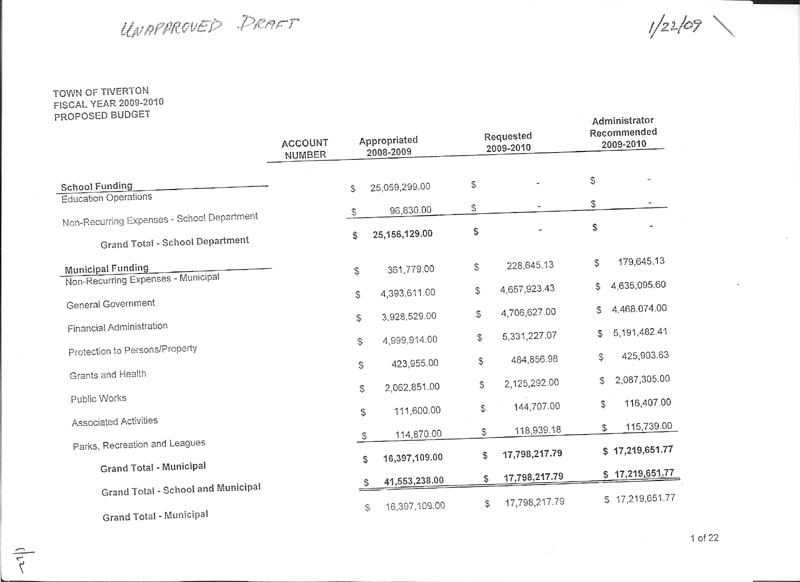
Note the 5%, $822,542.77, increase and the lack of response to the probable cut in state funding, which I'm told will likely amount to roughly $1,000,000 .
At least the school department acknowledged the expected state cut of $242,638 in its budget:

Of course, from the Tiverton taxpayer's point of view, that admission mattered not at all, because the department already assumed an increase of taxes to the state cap of 4.75%, or $952,278. Moreover, the budget calls for an increase in expenditures of 4.06%, or $1,020,245, which is 46.4% greater than the expected increase in revenue. In other words, the district's initial budget overspends by $323,376 — even with the maximum tax increase.
That's for a district that will have 79 fewer students come the autumn.
The truly astonishing news from the school department is that the School Committee looks likely to pass the mostly retroactive increase in teacher pay on Tuesday night. The additional cost? $301,264. It's one thing to give away money and then find one's self short on unanticipated bills. It's quite another thing to have the two numbers in front of you and still opt to sign the check.
It gets worse. To even get within a few hundred thousand dollars of a budget that's already requested to grow by over a half-million, the district has to plan to reduce its staff by nine employees:
- One full-time kindergarten teaching position
- One grade 1 teaching position
- Four full-time teaching positions at the middle school
- Two full-time special education teaching assistant positions at the high school
- One part-time elementary teaching assistant position
It also struck four new positions that it was considering, including a high school math coach who might have been able to do something about the town's losing ground on its high schoolers' math proficiency, which actually dropped to 24% (from 29%) in the latest round of NECAP scores (PDF.
And worse still: The "new" contract only lasts until August, so negotiations will have to resume in the very near future. When they do, the union will have been given no incentive to settle, because the principle of retroactive pay covering years of intransigence will have been reinforced, and it would clearly be a more profitable strategy to delay a final deal through these dark days of economic decline.
In Tiverton — as in many other places — the pain of the next few years is exacerbated, not alleviated, at ever tier of government. But there's still a chance that citizens, working from the bottom up, can apply the brakes.
January 20, 2009
Mighty Mouse Versus Yosemite Sam
It's kinda funny to contemplate what local establishment figures and their one-mind sympathizers imagine about reform groups. Former school committee member (and foiled town council candidate) Michael Burk likens Tiverton Citizens for Change to a false Mighty Mouse and whispers spooky insinuations that would surely spark laughter in anybody with a reasonable understanding of the scope of town government:
On September 15, 2008 Mr. Gerald Felise contributed $1,000 to the TCC. However, on October 7 the TCC filed a CF-5 with the Board of Elections stating they would accept donations of no more than $100 from any individual and no more than $1,000 from all contributors combined. Yet they still didn't report any contributions/expenses until November 17 – 13 days after the election and two months after Mr. Felise's contribution.Rhode Island law prohibits political contributions from corporations. The TCC's Novemer 17 filing listed Mr. Felise as an individual donor with his home address as 896 Fish Road. His business, eCo Industrial Park Corporation of Rhode Island, also has an address of 896 Fish Road.
Jump ahead to the December 11 Sakonnet Times. Mr. Felise is proposing a "Giant 'eco-development'" on both sides of Route 24. Did Mr. Felise, obviously a strong TCC supporter and probably a member (they don't release their membership list), present this to a meeting of the Planning Board or the Town Council as would be the appropriate first step? No, he chose to present it to "a meeting of invited town officials and residents at the company’s offices at 896 Fish Road" the Friday after Thanksgiving. The timing of this was so close to the TCC's purported election victory that it seems rather odd to me. Mr. Nelson would like us to think that he and the other leaders of the TCC knew nothing of this proposal prior to Election Day.
The first part is an accusation that we've already covered. Trying to hit the ground running in mid-summer — and having no expectation of large or numerous donations — TCC opted for the easier route requiring less time filing reports. Mr. Burk doesn't bother to explain this, but that's the purpose of a CF-5: to minimize unnecessary paperwork, not to forswear large donations.
But we did receive that one large donation — and many smaller ones — so campaign finance law required us to begin filing regular reports. That's the process described on the CF-5; there's no actual or intimated violation involved. Owing to some confusion during a very hectic time, however, our first report missed the deadline, so several of us spent a late night filling out forms. Nothing nefarious.
That night, as it happens, was the first time I'd ever heard Mr. Felise's name, and to my knowledge, nobody active in TCC was aware of his plans. I don't believe that any of us had so much as met the man. As odd as the timing may appear to Mr. Burk, that's all there is to it. The tale that he weaves tells the reader much more about his and others' paranoia than about TCC or (I can only surmise) Mr. Felise.
One needn't have memorized the group's secret knock to have observed its formation: The results of the financial town meeting brought several previously known trouble-makers (me among them) together with existing non-establishment groups (notably the retirement communities) and some newly aggrieved residents. In the handful of months leading up to the election, we recruited and endorsed candidates mainly with the next FTM in mind. The calendar left us very little room to address anything else.
Now that the election is over, we hope to begin exploring the multiple issues that ultimately contribute to the budgets that the town passes each year, but the effort hasn't yet begun. We haven't discussed, for example, whether Mr. Felise's development is something that TCC ought to back. When we do take the matter up as a group, enough of us are sufficiently idealistic that large donations are unlikely to be of more than passing interest. Moreover, when we put forward arguments on any issues, interested residents will be able to judge them on their merits, with due consideration of our own finances.
For Michael Burk's part, the merits of Mr. Felise's project seem to hold no relevance. Some conspiracy is necessary to explain the rapid emergence of a vocal taxpayer group, and a businessman wishing to invest in the town makes as good an evil conniver as any. Nevermind the individual histories of the group's members. Nevermind the fact that Mr. Burk proclaims no evidence apart from what we have made available.
Nobody active with Tiverton Citizens for Change believes that we have all the answers. All we have are voices and an interest in using them to offer arguments that we feel haven't been adequately made in the past. We don't see ourselves as swooping in to get Tiverton "well in hand," as Burk quotes from the Mighty Mouse theme. We're more interested in asking questions, offering suggestions, and doing what we can to keep individual egos and personalities from dictating the direction of our town.
We're a bit more like Bugs Bunny than Mighty Mouse, I'd say — trying to get through each episode with little more than a sense of humor and a knack for dodging the throes of absurdity.
So fire away, Mr. Burk, for the plot needs its Yosemite Sam.
January 15, 2009
All-Government Strategery
A Sakonnet Times article (that doesn't appear to be online) reports on a meeting of "all elected town and school officials and some top administrators" in Tiverton to discuss budget woes. (A van breakdown prevented me from getting there.) Speaking to the reduction in state aid, Town Administrator James Goncalo states, "The municipal side cut is at least $600,000, so we're looking at ways to cut $100,000 per month."
That looks like an insurmountable number, but in context of monthly spending on the municipal side of town government of about $1,370,000, we're talking roughly 7%. For some additional perspective, the town spends over a quarter-million dollars per month on debt service alone.
What caught my eye in the article, however, was the closing quotation from this paragraph:
"The school department is limited in what it can do to cut its budget," said Mr. Rearick. A mandatory minimum retirement age of 59, and other pension and health benefit recommendations affecting retirees, could precipitate the departure of numbers of town and educational employees prior to April 1 — "people walking out the door April 1st. They just leave," said Mr. Rearick.
Clearly, such folks would be making a financial decision as employees of the town. That's fine; everybody should do what they believe to be best. What it serves to emphasize, though, is that those who govern the town should feel free to make rational financial decisions, as well, behaving above all as employers acting in the interests of their constituents.
The Locus of Disruption
Andrew's call in to the Matt Allen show, last night, turned into a longer form interview about the East Providence School Committee meeting. Stream by clicking here, or download it.
To the conversation about Anthony Carcieri's microphone volume (or lack thereof), I'd add my impression that Carcieri fully anticipated a disruptive atmosphere and was focused on moving through the agenda, without expectation that the audience would be following along — or would be able to do so, given audience noise. Consequently, he didn't bother much ensuring audibility beyond the dais.
That said, from my limited experience in Tiverton, the tone that the union set in East Providence was pretty standard for negotiation-season school committee meetings. The "can't hear you" heckles are a mainstay — anything to rattle the small-time public officials.
Indeed, if you listen to the second snip of audio from the meeting, somebody shouted that very phrase — amid a drown-out wave of boos — almost before Carcieri'd said a single word.
January 14, 2009
The Sound of the Beginning of the End
The following are some audio clips from the East Providence School Committee meeting. Keep in mind, while listening, that the sound isn't entirely representative. For one thing, I was sitting near the taxpayer group, so they might be overrepresented in the general sound level (although still greatly outnumbered).
- School Committee Chairman Anthony Carcieri makes his appearance to booing: stream, download
- The union sets the tone right from Mr. Carcieri's very first words (and, yes, that's me shouting "grow up" — keep in mind that I'd already been subjected to a half-hour of union slogan chanting and screams): stream, download
- The teachers cheer that some of them have actually done (gasp!) extracurricular work: stream, download
- The teachers cheer that they can blame poor performance on "facilities" (nevermind that keeping up with teacher contracts has been bleeding other segments of school budgets for years): stream, download
- A moment of heckling, including the call of "Scared?": stream, download
- Just a snippet of the tone that continued, with a gradual escalation, throughout the meeting: stream, download
- The teachers find the phrase "anti-bullying" humorous: stream, download
- The teachers find the quip "outdoor voice" humorous: stream, download
- Anthony Carcieri attempts to lay down the ground rules for public comment, and local union leader Valerie Lawson speechifies: stream, download
- East Providence teacher Mary Texeira offers a reasonable statement — although she probably goes off the union message a bit when she states that she wouldn't mind a five-year pay freeze if the school committee would lay out the reasons that it's necessary: stream, download
- Taxpayer Tom Riley takes the mike and faces down the hecklers — inspiring the single most silent moment of the night when he suggests that younger teachers will lose their jobs if the union doesn't let the district spread the costs across their pay packages — but the devolution of the meeting leads the school committee (almost inaudibly) to adjourn: stream, download
January 13, 2009
Breaking Location
I just received word that the East Providence School Committee meeting has been moved to the high school at 2000 Pawtucket Ave.
Small Strands of the RI Web of Interests
Simply because it represented an unanticipated expenditure during a time of extremely tight budgets — indeed, when the town council is pondering a "token" reduction in its own pay totaling $2,520 — I made note of the Tiverton Town Council's decision to make $900 available to municipal officials to attend a Grow Smart RI workshop on "making good land-use decisions." Now, I don't want to make a big deal of such a (relatively) small expenditure, and the council did pass the measure unanimously, but there's a curious point to consider.
Town Solicitor Andrew Teitz made the suggestion during his "announcements, comments and questions" section at the tail end of the meeting, and ex-president Louise Durfee was the first to ask questions about the cost. She initially asked whether $90 was to cover all attendees and then made a joke indicating some surprise at the high expense. Yet, when it came down to it, she was the one who made the motion to release almost a thousand dollars.
She's also listed as a director emeritus of Grow Smart and was an active member of the board of directors until a few years ago.
Like I said: It's a small thing, but we've all heard the phrase "death by a thousand paper cuts." It's a torturous death, indeed, when experienced amid the salt of layoffs, foreclosures, and general financial hardship. To a carpenter who just found himself $50 short of the amount needed to avoid late fees on his mortgage (which, incidentally, would have been affordable had his property taxes not gone up so much this year), $900 isn't such a token.
The Intangibles of Rhode Island
With taxpayers — especially business taxpayers — beginning to get uppity, one often hears the invocation of Rhode Island's Political Knot. Nothing objectionable is anybody's fault; it's all a natural construct that can't be changed... at least by the person to whom one would turn for relief.
Take the "tangible tax." I know of at least one local business owner who complained that the "tangible property tax" collected by the town was doing palpable harm to his business and whom the Tiverton Tax Assessor informed that the town has no choice: State law compels him to assess and collect the tax. Presumably, he's referring to Rhode Island General Law 44-3-1:
Real and personal property subject to taxation. – All real property in the state, and all personal property belonging to the inhabitants of the state, whether individuals, partnerships or corporations, and all tangible personal property located in the state belonging to nonresidents, are liable to taxation unless otherwise specially provided.
The rest of Chapter 44-3 is essentially a list of exemptions, but I see no provision requiring "specially provided" to be an action of the General Assembly. Indeed, turning to 44-3-3.1:
Exemption of office equipment used for manufacturing or commercial purposes. – (a) The city or town council of any municipality may by ordinance wholly or partially exempt from taxation for a period of up to twenty-five (25) years any items of office equipment, which include, but are not limited to, computers, telephone equipment, and any other items of personal property used in an office and/or any leasehold improvements which are not exempt and are used for manufacturing or commercial purposes and may by ordinance establish the procedures for taxpayers to avail themselves of the benefit of any exemption permitted under this section.
In other words, the town could opt to gut the tangible property tax on business if it chose to do so. Note, also, that the law places no requirements or limits on the rate. My understanding is that a town or city could set its tangible property tax rate to 0%, effectively eliminating it.
Now that we've cleared up the confusion, town councils across Rhode Island can feel free embark on business-saving changes to local tax codes.
ADDENDUM:
According John, in the comments, RI law prevents a town from charging a greater than 50% higher rate for any class of tax than any other, so zeroing one rate would require zeroing them all.
That factor does not appear to affect the possibility of exempting businesses from tangible property taxes for a period of 25 years.
January 12, 2009
Back into the Swing of Day to Day
With the new year and the new dynamic in the town council, I thought I'd best resume the habit of attending all meetings — exuding my apparently intimidating presence.
At the moment, there's one of those typical town-level debates about development issues. Somebody wants to develop and needs some sort of concession from the town concerning a road of somewhat ambiguous ownership, and old grievances come to the town microphone. I do wonder whether this is a practice that diminishes as towns move from quasirural to suburban, decreasing the ambiguities and limiting additional development.
ADDENDUM:
TCC member Joe Souza just pointed out that, if the developer is asking the town to cede some land, then the town ought to get some money for it. A reasonable point, although I don't know the amounts involved.
ADDENDUM:
On the other hand, there are road improvements and such involved in the package. As with much else, these "negotiations" could stand to be more explicit about what is given and what is exchanged, for lack of a better word.
ADDENDUM:
TCC member and councillor Jay Lambert just suggested that the town ease the burden on businesses and save processing expenses by enabling various licenses and such to be held for longer than one year terms. Solicitor Teitz explained, first, that the year term is set by the state and, anyway, that it's convenient to have businesses come before the council every year just in case there are any issues for which the town doesn't want to (or can't) go through the appropriate due processes.
ADDENDUM 8:26p.m.:
Jay Lambert just called for the town council to take the lead on reductions by cutting their $2,400 stipend by 15% or 20%. Cecil Leonard put forward a motion for 15%.
Ex-Council President Louise Durfee expressed concerns that future councils won't be able to attract the poorer of Tiverton's "diverse" residents without the full stipend.
Leonard pointed out that his motion was specifically a one-year action, but Durfee stated that the council can't, in the future, raise its own salaries back.
Joanne Arruda, Don Bollin, and Hannibal Costa all suggested that the action be made a personal option for individual councillors.
Lambert's arguing that the people who'll see their salaries cut and so forth won't be able to opt for it.
Durfee wants to wait and see what the finances actually do.
ADDENDUM 8:34 p.m.:
Durfee and Joanne Arruda are both making the argument that the stipend allows them to give to charity. Hmm.
ADDENDUM 8:38 p.m.:
With that motion tabled until next meeting, Lambert is suggesting the compilation of potential projects to put forward for our share of the magic Obama money.
ADDENDUM 8:41 p.m.:
One town official, in detailing "shovel ready" projects, noted that nobody knows the form of stimulus (grants, loans, a combination). But hey, it might be that Obama's going to hook me up to a sewage line!
I ask again: Why hasn't anybody else ever thought of dishing out money to give everybody in the nation somethin' fer nuthin'?
ADDENDUM 8:53 p.m.:
Now Lambert's suggesting that the town council send a statement to the General Assembly asking them to reduce their own compensation and eliminate or reduce their own healthcare. "I don't see any rational relationship between being in the General Assembly and healthcare benefits."
Durfee again: Their salary is set by the constitution of Rhode Island. "I wouldn't want the town to look stupid." She and Teitz are going over the history: The current deal was a compromise with reformers to get rid of expensive pension deals.
ADDENDUM 9:00 p.m.:
Tabled pending conversation witth local legislators.
ADDENDUM 9:06 p.m.:
With no notion of how many people might be involved, Solicitor Teitz suggested that the council (out of its contingency fund) pick up the $90 fee for local officials whose boards have not so budgeted to attend a GrowSmart RI seminar. The council passed unanimously up to $900 in payments.
January 7, 2009
West Warwick Next in Line
The school committee in West Warwick appears mainly to be doing the bare minimum to support a Caruolo suit for more money from the town, but it may be headed down the road behind East Providence soon:
The performance audit, commissioned by the town as a part of the Caruolo lawsuit proceedings from the last fiscal year, found that most substantial savings — $14.67 million — in the School Department budget would require concessions from the teachers union or waivers from state and federal mandates."These are recommendations for the future and going forward," said consultant Salvatore Augeri. "They could cut some supplies for a couple thousand, but we're not talking millions right now."
But $3.5 million is what the School Department says it needs to finish the remainder of this budget year. Last month, the committee sent the town a letter requesting an additional $3.5 million in operating funds and school officials have authorized their lawyer to file a lawsuit seeking the additional money once all other avenues are exhausted.
Is "the future and going forward" anything like "infinity and beyond"? It seems to me that the school committee has to stop toying around. It isn't enough to publish a list possibilities like "eliminating 16 teachers by requiring the maximum number of students allowed in each class by contract, and cutting 23 other positions that are not required by the state." The committee ought to be bringing that to the teachers' union and explaining that it will happen in the absence of deep concessions.
January 3, 2009
Chariho Fiefdom Temporarily Suspended
Apparently powerful players on local school committees can't just subvert the will of voters without providing the public any warning that they intend to do so:
Superior Court Judge O. Rogeriee Thompson has ordered the Chariho Regional School Committee to reinstate William Felkner until it properly votes on whether to allow him to serve on the school board while seated as a member of the Hopkinton Town Council.Thompson enjoined the school board from enforcing its Nov. 18 decision, based on a finding by Chariho Solicitor Jon M. Anderson, that when Felkner took the oath of office as a Town Council member the evening before, he in effect gave up his seat on the School Committee.
Although the Nov. 18 school board meeting was properly advertised, there was no public notice that the board was considering a vote on whether Felkner could continue to serve.
Assuming that public light doesn't cause Chariho School District lawyer Jon Anderson — and whoever's prodding him — to recede into their hovels to scheme for another day, manipulating the system by other means, it would behoove Rhode Islanders interested in fair dealings and sane reforms to attend any duly advertised meeting at which the dabblers in conspiracy may attempt, again, to deny voters' right to elect whom they like for local offices.
ADDENDUM:
As a side note: Doesn't the Providence Journal have anybody on staff who could provide some sense of where the relevant law actually stands when it comes to simultaneously holding the two particular offices to which Bill has been elected? I'd gladly do the research, if I had time, but it seems to me that such contributions to news stories represent an area in which a state-level newspaper would be well positioned to provide an added value worth paying for.
December 31, 2008
Saved by Failure
The vicious insinuations that Tiverton Citizens for Change faced for turning in some campaign finance reports late gives me a whole new perspective on this sort of thing:
The former Tiverton Town Council violated the state's Open Meetings Act last summer, an assistant attorney general has ruled, but the matter is moot, because a proposed town charter amendment that was the subject of the complaint was not approved by voters during the November election. ...If voters had approved the proposed amendment that would have replaced the annual financial town meeting with a process that would have given the Town Council the final say on the annual budget, the vote could have been invalidated because of the attorney general's finding, said James Amarantes, a former town treasurer who filed the complaint in July. The answer to the complaint is dated Dec. 17.
Amarantes said he depends on the postings of meeting agendas to know what the Town Council will be discussing at its upcoming meetings. The proposed charter amendment was not on the agenda for a meeting on July 7, when the council first voted to send it — and several other amendments — to a public hearing that was slated for later that month. The proposed amendment was included on the meeting notice for the public hearing on July 28.
In all honesty, I don't believe the town council was up to anything suspicious by moving to place a newly thought-up amendment in among the rest. Indeed, the fact that the technicality might have led to voters' being overruled had the results gone another way raises questions about the damage that too many specific rules and tight hoops through which to jump can do to a local government's ability to lead in new directions.
On the other hand, in this instance, the new direction entailed a councilor disregarding months of Charter Review Commission meetings and proposing a new budgeting strategy that handed more authority to the town council. As I suggested, I don't think the proposal was planned for introduction thus, but it is telling, and convenient, that the upshot was the arrogation of more power.
The underlying problem may be that local legislators believe in their own good intentions and capacity for sound judgment. They've witnessed the difficulty of doing things that they think ought to be done, and the way appears clear to making it possible for themselves to act more expediently. Thus, a councilor has a brainstorm epiphany that nobody is better suited to develop the town's budget than him and his peers, and it appears perfectly reasonable to slide that thought onto a list of other items resulting from a lengthy formal process conducted by another elected body.
December 17, 2008
Predirecting Anger
My response to Richard Joslin made it into this week's print edition of the Sakonnet Times (as did TCC President David Nelson's), and I'm sure it'll spark an angry response or two from unionists.
Who knows but that ringleader Crowley will pen a guest letter from across the state. Given the extent of his so-called research and other writings at RI Future, his day job apparently leaves him with copious amounts of time for extracurricular activities. That assumes, of course, that the teachers aren't paying his salary for his blogging.
Whether that's the case or not, I'd suggest that teachers are misdirecting their anger if I'm the recipient. I'm merely arguing in what I believe to be the best interests of my town and its students (agree or disagree). On the other hand, the central justification for teachers' union dues' going to the state NEA would seem to be for state-level advocacy and planning.
Tiverton teachers should take especial note of the latter, because for all of their "research" and statewide contacts, the union officials appear to have failed to foresee and/or advise members of the likelihood of a state budgetary collapse. Inasmuch as it contributed to the local's dogged pursuit of a better deal, that failure cost the union members thousands of dollars, with no end to the state's and town's fiscal crises in sight.
Seeping Illness in Tiverton
The tentative deal between Southern Union and residents of Tiverton concerning contaminated soil has fallen through. It's a travesty that those who live in the Bay Street area should spend so long in limbo, as the article puts it, but this is particularly disconcerting:
In the end, Southern Union could not strike a deal with the town. The town's lawyer, Andrew Teitz, told Torres in October that Tiverton could not agree to hold Southern Union harmless as long as the utility continued to seek money from the town, claiming the town was at fault for allowing the contamination.Teitz said that the pipes, which were put down with a life expectancy of 80 to 100 years, already are starting to fail.
The Town Council is worried that the fire district's customers, about 1,500 to 2,000 town residents living north of Route 24, may have to shoulder an estimated $2-million liability for replacing the water lines, Teitz said.
And he said that some settlement discussions between the plaintiffs and Southern Union raise the possibility that a future DEM director may hold the town liable for millions of dollars in costs for cleaning up toxic soil under public roads.
It sounds to me as if Southern Union might have been spooked by the prospect of financial responsibility for the replacement of a substantial amount of utility and road infrastructure. As unsettling as the idea may be of requiring just a section of the town (the poorer section) to cover a multimillion-dollar construction project, the knowledge of contaminated soil surrounding failing pipes — serving residents who are forbidden to sell their properties — is worse.
Somebody better start compromising soon, particularly considering that nobody currently engaged in the game of chicken appears likely to face health repercussions from its continuation.
December 11, 2008
Bounced vs. Presented: Parsing A Denial
About his brother's bad $75,000 check, Mayor David Cicilline said this yesterday to the I-Team's Jim Taricani:
But what is absolutely not possible is that it was ever brought to my attention that a check had been issued, had been dishonored by bank or bounced in the amount of $75,000 by my brother. I would have immediately intervened.
Doesn't "bounced" or "dishonored" mean that it was actually handed in to the bank, processed and then returned by the bank to payee? The ProJo's Mike Stanton reported in September that the check was handled as follows:
But when the city's lawyer tried to deposit the check, which was written on May 9, 2006, on John Cicilline's law office account at Fleet Bank, he was told that there were insufficient funds.
Standing at the teller window with a check and being told that there are insufficient funds to cover it is not the same as depositing a check and then having it bounce. Choosing his words carefully, the mayor has denied an event that no one alleges took place.
Killing the Seeds
I've been arguing that change has to come to Rhode Island from the municipality up. If we begin at the local level identifying and placing worthy candidates and generating a grassroots comprehension of the state's problems, we'll be positioned to grow upward and begin to crowd out the entrenched interests.
Although I haven't followed the politics of Little Compton very closely, this letter from the Little Compton Taxpayers Association appears to provide evidence that those entrenched interests are intent — probably long have been — on squelching local whispers of change:
In a stunning turn of events, the newly elected School Committee tossed out experience and accomplishments by electing Attorney Mike Harrington as its chairman, and rejecting incumbent Joe Quinn. Mr. Quinn, a lifelong educator himself as well as an experienced contract negotiator, has been of tremendous benefit to our school by helping Wilbur & McMahon to be among the best in Rhode Island, attending numerous state conferences and hearings representing our interests, working with the school superintendent to develop fully accountable school department budgets, and taking part in teacher contract negotiations resulting in one of the best contracts ever seen in Little Compton. He also voted to outsource student transportation saving the taxpayers nearly $1 million over a 5-year contract. ...And who caused this? It was Lynn Brousseau who ran as an endorsed Republican in the November 4 election only to turn against the Republicans by nominating both Attorney Harrington as the chair; and, newcomer Micah Shapiro, a registered Democrat, as the clerk. When confronted, her response was that she did not believe in "party loyalty" but was for "the kids." She also said the teachers are angry and miserable, and so are the children. She must see something that nobody else does. She went on to be elected as the vice-chair, and Micah Shapiro became the clerk. Joe Quinn, Don Gomez, and their combined experience were dumped in favor of two newcomers. ...
The National Education Association vowed to "get" the ones that outsourced the transportation function. They delivered, at the expense of the taxpayers of Little Compton.
The voting habits of the new leadership bear watching, if only to disallow their actions from occurring in the dark. If we remain collectively aware, we'll likely see a pattern emerge across the state.
The LCTA has more, including video, on its Web site.
December 9, 2008
Reply to Joslin
As East Bay scribe can attest who's spent a late-night hour or two trimming words and sentences from a letter to make it of acceptable length, the Sakonnet Times has a 500-word limit on missives. Yet, by the time Richard Joslin got around, last week, to challenging Tiverton Citizens for Change (TCC) to "prove they care about Tiverton's children," the paper could have printed both his introductory reminiscences of his own childhood and a letter that I'd written explaining why public officials should define "fairness" from a budgetary standpoint, not a union one. As it was, Mr. Joslin's diatribe rambled on for 908 words, and my letter disappeared into cyberspace.
In the light of Joslin's assault, a pillar of erroneous thought is starkly observable: Both he and young Caitlin Alexandra, whose letter appears just behind his, gauge concern for education in terms of teachers' remuneration. This despite the fact that a higher percentage of Tiverton's per-pupil costs already go to teachers than is true for the state overall. Indeed, Joslin positions "oust[ing] the teachers' union" as an unthinkable option following cuts to "programs in sports, advanced placement, language, music, art and more" that have already been made.
Personally, I happen to believe ousting the unions to be a prerequisite for improving both Rhode Island's educational system and its economic viability. Surely neither has sunny prospects as long as teachers absorb more and more of our education dollars, continuing to cost us programs that might keep RI parents from having to sacrifice for private school (which they do more frequently than parents of most other states). One mustn't forget, by the way, that the loss of programs will tend to mean the immolation of teachers whose jobs depend on them.
So, although I can speak only on my own behalf, I say, yes, let's "break the teachers' union" --- and use the savings to reinvigorate sports, advanced placement, language, and music programs (and more). Perhaps the crossing of that rubicon will give Ms. Alexandra cause to consider Tiverton a superior place to raise her "potential family" than some "small developing communit[y] in the south of Africa." Perhaps, too, the political loss will motivate Mr. Joslin to examine the roots of his hatred and anger and give him something for which to be truly thankful during this season next year.
ADDENDUM:
I see this letter made it onto the Sakonnet Times Web site, as did one by TCC President Dave Nelson. Now comes the interesting new game of waiting to see what gets into print.
December 6, 2008
Not the Way to Run a City... or a City-State
At this point in our decline, every public official should have a policy of zero increase. This is simply irresponsible:
Mayor David N. Cicilline is facing criticism this week for a one-time payment of retroactive raises to five current and former high-ranking police officers — over the objections of the City Council — and for his plan to merge the parks and recreation departments.Cicilline's administration last month made payments ranging from $14,400 to more than $20,000 to two majors, two retired majors and Deputy Chief Paul J. Kennedy, for time worked from Jan. 1, 2006 to July 1, 2008. ...
According to the mayor's chief of administration, Richard I. Kerbel, the retroactive pay for the nonunion officers matches retroactive pay awarded to police union members in arbitration over the last fiscal year and will be paid out of a reserve account for union arbitrations.
It exists everywhere, but the tendency toward battles of ego and plays of power (on both sides) is particularly acute in Rhode Island. One can picture the mayor telling his employees, "Don't worry, you'll get yours." If he wants to make a stand against the unions, that's wonderful, but the passive aggressive skirmish along the road will make it more difficult to achieve substantive goals on the next battlefield.
December 4, 2008
Individuals in a Package Deal
In the midst of a very edifying conversation in the comments section of my "Powers and Victims" post, Tiverton teacher Ed Davis offers the following significant perspective:
You're right, no one is forcing us to work here. Unfortunately, I saw this philosophy take hold in the school system my son attended. Many of the good young teachers, in the critical areas of math and science, left for better paying jobs. This is beginning to happen in Tiverton.
Doesn't that just highlight the spectacularly inappropriate setting that unions create within the public school system? In order to keep well qualified and fresh teachers covering central subjects, the school must hand out raises across the board. The cost of giving a young science whiz a 5% raise (beyond steps) can turn out to be hundreds of thousands of dollars.
That is plainly insane, and plainly indicative of the detriment that unions present to our children.
Relieving Rhode Island of Providence's Pension Burden
On last night's Matt Allen show, Monique presented her proposal that the state of Rhode Island deduct the unreasonable excess of Providence's pension system from its state aid. Stream by clicking here, or download it.
December 3, 2008
Even Nature's Against the Taxpayer
Apparently, Tiverton's deer population is conspiring to cost taxpayers even more money:
Deer have run into three of the town's police cruisers in the last 10 days, smacking the front of one and causing minor damage to the sides of two others. The repair bill will exceed $5,000, according to Police Chief Thomas Blakey.
Of course, other folks than the police are experiencing damage to their vehicles, but we can look to Gina Macris's excellent ending for relief:
Shotgun season for deer hunting starts Saturday.
I'm not sure what the market rate is for venison, these days, but perhaps there's a means for the town to make up some of that lost cash.
Whistles Can Make a Lot of Noise
Enabling employees and citizens to bring attention to immoral or illegal behavior is a necessary goal, but North Kingstown may be creating a new tool for exactly the sorts of people that it wishes to disarm:
Town employees, vendors and even students can now complain online about government abuse — without fear of retaliation.The complaint form is a few mouse clicks away and users don't have to leave a name. ...
... Visitors can log a variety of charges, from the serious to the outright criminal: conflict of interest, violation of policy, discrimination, harassment, falsification of contracts, substance abuse, theft or embezzlement. ...
... those who fear retaliation can rely on the anonymous reporting system, which is handled by EthicsPoint, an Oregon-based company.
The complaints are reviewed by [Town Manager Michael] Embury, the school superintendent and members of the town audit committee, depending on the charges. A complaint involving the town manager or superintendent may be made directly to the audit committee through the EthicsPoint hot line or Web site.
So without any fear of repercussions, anybody in the world can whisper directly to key officials about disliked people and political enemies. That's a pretty powerful weapon, and the safeguards are just about nonexistent:
Residents should try traditional channels first. "Everyone is encouraged to use the 'chain of command' to report problems or resolve disputes," the new site says. ...Officials, meanwhile, hope the site won't be abused.
Complaints are considered to be serious matters, they say. Users are urged not to "file frivolous or mischievous reports or in retaliation for slights, either real or perceived."
Well, I would have hoped that political corruption and abuse would be avoided in the first place. Attacking those cancers with promises of secrecy isn't fighting fire with fire; it's adding gunpowder.
The Powers and the Victims
I note something telling and pervasive in the latest anti-TCC assault by Tiverton Democrat stone-thrower Richard Joslin (currently online only; we'll see tonight whether it gets into the Sakonnet Times):
I know TCC supporters who are elderly, on fixed income and live mostly in North Tiverton. I am not upset about these people. I know they struggle with paying taxes. I think the TCC leadership uses these people and incites them with economic fear. I think these taxpayers deserve assistance.I believe that the TCC in part is fighting for a large number of older wealthy adults without kids who bought very expensive retirement property here during the real estate boom of 2002-2007. Stuck now with houses whose value has plummeted, they are just looking out for their pocketbooks. Holding onto their wallets trumps any care for the future of education here.
Isn't that always the storyline from the Left? The ideas are presumed to be in the service of affluent greed, and those without the bank accounts who sympathize are mere pawns. Couldn't it be that the "root cause" of that right-wing evil can't be so simply drawn? One hesitates to point out something as obvious as the fact that those on fixed incomes have, if anything, more reason to "hold onto their wallets," but, well.
In his ideological determination, Mr. Joslin misses a blindspot that leaves him vulnerable to the charge of allowing union benefits to trump local education:
TCC says it wants budget cuts. Tiverton schools have already cut programs in sports, advanced placement, language, music, art and more. So, TCC, cut what else? Oust the teachers' union? As a 12-year resident and taxpayer I demand that we all make the TCC more transparent. They are arrogant; as newcomers they tell us that we have been incompetent and they know best. They point fingers at respected officials.
I haven't polled my peers, but I suspect that there'd be a softening of their wallet-grips if the argument weren't that programs have been cut and teachers need more money, but that teachers' compensation had been cut and the programs required more funding. Be that as it may, it's a curiosity, indeed, that those who argue so vehemently for the future of education seem incapable of articulating the thought that, in tight financial times, all increases ought to go to programs, rather than teachers (who make more individually, by the by, than whole households up here in the North).
Count me among those inclined to withhold further contributions from the obligatory charity of public education if the dollars are to be snatched from the table for the enrichment of adults, rather than for the restoration of programs that might allow me to return my children to public education without feeling irresponsible as a parent.
November 29, 2008
It's Always a Matter of "Fairness"
The title of this post refers to the words of Paul Saccoccia, a national rep for the International Brotherhood of Police Officers, who believes that disabled policemen and firefighters in the state pension system should receive pension contributions from their towns when the state doesn't give them the full amount that they want:
Lawyers for the city [of Cranston] and the firefighters' union say the request stems from the fact that the employees' disabilities — which officials would not disclose — have been verified by doctors but were not recognized by the state Retirement Board because they developed over time rather than stemming from one event or injury.Yet, state law says that a police officer or firefighter who retires because of on-the-job injuries shall receive not less than two-thirds of their pay at the time of retirement — the amount the employees sought through the state system.
The situation has left all three employees on the city payroll, at 100-percent pay.
And union leaders say the only way to get them off the city payroll is to have the City Council adopt two ordinances that would allow the city to make up the difference between the disability pensions the state will grant and the work-related disability pensions the employees want.
Thus is Rhode Island pulled by the heartstrings (purse strings, for some) toward policies that give privileged classes multiple opportunities for benefits. And thus do the unions abuse the communities that their members serve: Somehow (note the passive voice) the three employees have been "left" on the city payroll and cannot be "gotten off" unless the law were to be changed to give them what they want.
Translating into active voice, that means that the employees refuse to officially retire, and the unions have structured contracts such that the city can neither force them out nor fill the positions that they are not currently performing. I'd suggest that, if it isn't a matter of critical public safety for those positions to be filled — that is, if it isn't utterly unconscionable for the union to use their vacancy as a bargaining chip — then they really don't need to be filled, anyway.
(And that's not an excuse to puff up the overtime salaries of other employees.)
November 26, 2008
Not the Way to Arrive at a Salary
By far the most interesting audio from last night's Tiverton School Committee meeting, in my opinion, was Vice Chairwoman Sally Black's reasoning for voting to approve the teachers' contract (stream, download) because the thought processes are indicative of the flawed way in which Rhode Islanders have conducted their public business.
Mrs. Black cycled through a bit of education policy history to conclude that the state and federal governments have not followed through with promised funding for decades, even as they've demanded more and more from local schools. From her perspective, the school committee did the work that they were supposed to do, and moreover, she was very pleased with her children's experience in the school system and believes the teachers deserve as much compensation as the town can give them. Therefore, the contract is "fair and just" and ought to pass.
The problem with this approach is that it disconnects financial decisions from financial realities. We cannot come up with a notion of fairness and justice based on abstractions or on emotions and then make that the primary consideration. The primary consideration has to be the money that's actually coming in.
Especially from the perspective of elected representatives — unless they were elected of the unions, by the unions, and for the unions — the first question has to be what is good and what is sustainable for the town. Double-digit tax increases are not sustainable. The next question has to be what is good for the students, and as I've pointed out, based on Department of Education data, Tiverton already pays more per pupil for teachers than the state average, and its student-teacher ratio is only slightly lower than the state's overall. In other words, based on the money that the district actually has, it is already more generous to the teachers than the norm for Rhode Island, which is more generous than the norm for the nation.
Rhode Island has, for far too long, begun with the pay and benefits that "should be deserved" and only as an afterthought wondered where the money would come from and what the effects would be of taking it. Our teachers, specifically, are paid above the national average, even as our median household income is below the national average. We have to readjust, and we have to do so quickly.
ADDENDUM:
For interest and public record, here's the audio of Guidance Councilor Lynn Nicholas's threat of "harm": stream, download:
Before I ask Doug a question, I just need to make it clear that, if the award is not agreed upon tonight, there will be a lot of harm done. Some of it will be financial; a lot of it will not be, and I'm not going to go into detail.
November 25, 2008
Another Night at the High School
Well, here we are, at what's sure to be a tense school committee meeting — as the teachers demand their retroactive pay and a handful of us concerned citizens try to explain that it would be insane to dig our financial hole deeper, with the state facing such a daunting task.
You know it's got to be an event, because Mr. Crowley made the trip all the way from Lincoln. Luckily, a few AR readers made a point of introducing themselves to me before the meeting to lessen the minority feeling, and we've also got some moral support from the Portsmouth Concerned Citizens.
Which is not to say that there's anything resembling parity in numbers. But when a special interest is used to facing absolutely no opposition, perhaps a ragtag band of reformers can mount an adequate defense.
ADDENDUM 7:23 p.m.:
Interesting anecdote: During a start-of-meeting executive session, I left the auditorium to use the men's room, and as I stepped to the sink to wash my hands, a man came in complaining about the traffic from Boston: "But you get the call that you've got to come down; what are you going to do?"
I joked about the traffic, and he further stated, "I just hope they don't say anything bad about the teachers in front of me, because I just drove down from Boston and I'm not in the mood."
He appears to be intending to sit near the audience-use microphone.
Ah, union tactics.
ADDENDUM 7:27p.m.
While I look around the room during the wait, I'm reminded of the difficulty of this whole process. Here is a roomful of people most of whom are dedicated to educating children and only want a fair salary in keeping with what they were told to expect when they entered the field. And yet, their combined efforts, in town and across the state, are a significant part of the chain that's dragging us under.
Little wonder they've been able to do it, though: as contentious a man as I am, I very much dislike having to look at the faces around me and see opponents. The average citizen is certain to accede to their demands.
ADDENDUM 7:35 p.m.:
Committee Chairman Jan Bergandy just announced that the executive session was going to be longer than expected. Odd, if they're deciding how to vote, that they have public discussion at all.
ADDENDUM 8:04 p.m.:
Interesting note: they just voted to approve the minutes from the last meeting — usually an uninteresting formality — but it was actually necessary for one of the new members to amend the minutes to include comments from Tom Parker, whom you'll recall made a citizen's plea not to approve the NEA contract for financial reasons.
Wonder how that became omitted.
ADDENDUM 8:07 p.m.:
The feeling of reluctance, from those on the stage, to progress through to the meat of the agenda (contract negotiations) is palpable. Can't say I blame them. I'm stressed, and here I am hiding out of view.
ADDENDUM 8:13 p.m.
Interesting to watch Pat Crowley reading Anchor Rising real time:

ADDENDUM 8:18 p.m.:
Chairman Jan Bergandy is expressing grave doubts about the contract, given likely cuts from the state, so he's posing the question: What are the consequences of not approving the contract?
ADDENDUM 8:22 p.m.:
Predictably, new committeewoman Carol Herrman moved to pass the contract (Sally Black seconded): She argued that if the numbers don't work out... hey, we'll reopen the contracts. Of course, she didn't mention that the leverage would be completely different.
She also argued that all contracts should be reopened, but the teachers' is by far the biggest, and if the teachers take a hit down the road, there will be more leverage to renegotiate the others.
ADDENDUM 8:26 p.m.:
Of course, the teachers cheered loudly when Carol made her motion. Subsequently, new member Danielle Coulter spoke in favor of holding off on the contract until the state makes more information available.
In support of Mrs. Coulter a few of us in the audience applauded, and Chairman Bergandy chided us for being inconsiderate to the teachers' feelings.
Sorry. It clearly was not easy for Danielle to say what she did. She's going to get heat for it. And I for one am going to make sure that she's not sitting up there without support.
ADDENDUM 8:31 p.m.:
Vice chair Sally Black just made an impassioned speech that the state isn't living up to its end of the bargain, so she votes to pass the contract because it's "fair and just."
We can no longer operate that way. We have to start with the financial reality and negotiate from there. The money doesn't appear on the grounds of justice or fairness.
ADDENDUM 8:51 p.m.
Strangely, the teachers are arguing that the committee has long known that cuts were coming. Me, I'm inclined to agree — which has made it a dubious proposition to allow things to get to this point — but I don't see how that's an argument for irresponsible financing, now.
ADDENDUM 8:57 p.m.:
Despite a stated two to three minute time limit per person, one teacher has been going on for about ten minutes now saying that political changes in the past few weeks have accounted for the change in the committee's opinion.
I disagree to an extent, but beyond that: so what? That's how we decide how things should work in a democracy! Politics is what makes it in officials' interests to represent the interests of their constituencies.
ADDENDUM 9:14 p.m.:
Guidance Councillor and active unionist Lynn Nicholas just took the microphone to say that, if the committee does not pass the contract, there will be "a lot of harm done — some financial, some not," and she made a point of leaving it there, continuing with: "Have you even begun to think about the lawyer fees."
Yes, they're all about preserving the quality of our schools.
ADDENDUM 9:19 p.m.:
I'm surprised it took this long for a teacher to suggest that Obama might swoop in and save us all.
ADDENDUM 9:26 p.m.:
Mr. Bergandy is making the very good point that, if the committee approves this contract and large cuts do come, programs will be cut, which means that teachers will be laid off.
ADDENDUM 9:30 p.m.:
Now we're having classroom logic lessons from the teachers: "If you admit that this is a fair contract and then there are cuts and you decrease the contract, wouldn't that make it an unfair contract?"
This mindset is maddening.
ADDENDUM 9:32 p.m.:
Union President Amy Mullen just threatened that the deal on the table will not be available in the future.
ADDENDUM 9:35 p.m.:
The contract failed, and the teachers stormed out...
Except for one — an English teacher — who although clearly upset took a moment to introduce himself and give me hope that we can, through it all, resolve differences.
Thank you, sir, for that.
ADDENDUM 9:48 p.m.:
There's a feeling of afterward to the continuing meeting. The committee is deciding whether to hire a technology person. Carol Herrmann moved that they hold off on this contract; Danielle Coulter concurred.
The difference is that they're currently paying a per diem person to fill a necessary role.
ADDENDUM 9:58 p.m.:
The new technology guy was not hired, with discussion postponed until after the union issue is resolved.
ADDENDUM 10:04 p.m.:
A potentially telling statement: the committee is discussing the process of bidding for a new attorney, and Superintendent Rearick just recused himself on the grounds that he's been working with the current attorney for a very long time.
November 24, 2008
Open Letter Against Ratification
Dear Tiverton School Committee members:
It so happened that, the Friday before you'll decide whether to approve the arbitrated teacher contract, my boss called me on the construction site to tell me that, after I take my five paid days of annual vacation this week, he and I will have to sit down and agree to cut my salary. Having trimmed all indulgences from my family's budget, I'm already barely making enough to get by, but as you know, times are hard. Indeed, the governor has already warned you that the state will likely be cutting your budget, too.
I understand that everybody in Tiverton just wants to move beyond the current contract negotiations --- buy a respite and feel, for a short time, that we're all working together toward the same goals, maybe kick off the new school committee with a lowering of the tension that simmers with each meeting. But that feeling would be an illusion, and shorter-lived than you'd like to believe. Times are only going to get harder, and any compromises made now, when the contract is not yet signed, will be unreachable for modification when Tiverton joins other RI towns in considering asking its unions for contractual concessions.
Forgive the passive voice, but I was informed this week that I'm broadly disliked in certain circles in town, circles with which some of you run. That, I cannot help; I am who I am, and I believe what I believe. As our town's elected education representatives, however, you ought to be concerned about my belief that the teachers' negotiating tactics and their ever-increasing slice of the budgetary pie made it a matter of parental responsibility to pull my children from our public schools. My wife and I cannot afford private school, but our assessment is that we would be shirking our duties as parents not to sacrifice for it.
Our house --- the only home that our children can remember --- should not be among those sacrifices. But if the cost thereof should increase in keeping with recent yearly trends, its loss is a very real possibility, and we are most definitely not alone.
In these times, Tiverton teachers --- who are already well paid in comparison with the norms under which average Rhode Islanders live --- ought to be giving back, not demanding thousands of dollars in retroactive pay. If they receive raises, instead, the possibility of keeping tax increases within bounds will disappear, and I'd remind you that you do not represent them, but us.
At every meeting you are all presented the faces, the voices, and the requests of public school teachers. They may not demand so much attention, but my family has faces and voices, too. Ms. Black and Ms. Herrmann see those faces and (despite my admonishments) hear those voices every Sunday morning, and I hereby request that you represent us and refuse to write large checks to working-to-rule teachers during times of fiscal uncertainty. I request that you consider my children before you decide that teachers whom their tax-paying father does not trust with their education deserve to be rewarded even as every private-sector Tiverton worker suffers pay cuts, unemployment, or (if they're lucky) insecurity.
If you would hesitate before telling my children that they should live in their grandparents' basement so that union teachers can continue to earn well above the median household income for the state, do not ratify this contract. The stakes are that high.
With sincerity and hope,
Justin Katz
November 23, 2008
Clearly Not "For the Children"
Tiverton Citizens for Change is moving forward from its electoral successes:
The School Committee should reject a tentative two-year teachers' contract at its meeting Tuesday in light of possible unanticipated cuts in state aid to local schools during the current fiscal year, according to the anti-tax group Tiverton Citizens for Change.The committee and the union representing about 190 teachers were at an impasse for about 14 months before reaching a tentative settlement in nonbinding arbitration Nov. 5, a day after the general election, which turned out the longtime committee chairwoman and put two new members on the five-person panel. ...
In calling for the committee to oppose the pact, Tiverton Citizens for Change cited Governor Carcieri’s recent announcement of a projected deficit of $233.6 million in revenue before the end of the fiscal year. ...
"Some will suggest this additional funding request is for the children. It is not. It is for the teachers," said TCC president Dave Nelson in a statement.
Schools Supt. William F. Rearick has recommended passage of the agreement, which he estimated would give each teacher an annual net raise ranging from about $1,100 to $2,500.
I've suggested to the governor that he (or a representative) should attend Tuesday night's school committee meeting as a statement of, essentially, "This is the sort of thing I'm talking about." He won't likely be there, but I'd encourage anybody else with an interest in stopping Rhode Island's hole-digging to make an appearance.
November 22, 2008
Rhode Island's Fiefdoms
Although, as I've admitted, I'm not particularly familiar with the laws of those distant Rhode Island municipalities, further information about Bill Felkner's ouster from the Chariho School Committee seems likely to have involved multiple violations:
Bill Felkner of Ashaway, who has served on the School Committee since 2006 and whose term expires in 2010, was elected to the Hopkinton council on Nov. 4 and sworn in on Monday. He said he asked both the state Board of Elections and the Ethics Commission if he could hold both seats and was told -- unofficially --that he could hold both as long as he didn't vote on school issues for the town or town issues for the school committee.He said he didn't get the packet of meeting documents that is routinely delivered to members of the School Committee on the Friday before a Tuesday session, he said.
When he arrived at the Chariho Middle School on Tuesday for the 6:30 p.m. closed session that was to precede the 7 p.m. public meeting, he still did not have a packet and there was no name card marking his place at the table.He sat down anyway.
The meeting opened at 6:30 with the Chariho Regional School District lawyer, Jon M. Anderson, being invited to speak. He delivered the opinion that Felkner was no longer a member of the School Committee.
William Day, a Richmond member who was still chairman of the School Committee until his successor was elected about an hour later, said he was satisfied with that opinion and refused to acknowledge Felkner as anything but a member of the public. He did not allow Felkner to comment and instructed the clerk not to count his vote. ...
In a few minutes, they all came out again and took their seats. Day again invited Anderson to speak.
The lawyer told Felkner that he had effectively given up his board seat when he was sworn in as a Hopkinton councilman the day before.
Day polled the committee members on whether Felkner should be removed from the meeting. With Felkner's vote not counted and Terri Serra abstaining, the vote was 5 to 4, and Day asked Patrolman Kelley to remove Felkner.
Without public announcement, an elected official was simply written out of the committee by the chairman and the committee's lawyer. No process, no hearing.
Bill's got much more detail on his blog, with this noteworthy bit:
George Abbott tried to reason with the attorney as well – "you mentioned these conflicts of interest...I realize that the issues are rather different, but I would say we have to remove all the people that have family working at Chariho. I don't say this to insult anybody, but how does that differ from your opinion that voting on various issues affecting the town would present a conflict of interest ..."[editors note] Andy McQuade just graduated from Chariho 2 years ago and has an aunt working there. Frmr vice chairman Andy Polouski worked at Chariho for 34 years and has a niece working there. Current vice chairman Bob Petit's cousin is Brian Stanley, the business administrator. Chairperson Holly Eaves is going to school right now to become a teacher. And frmr chairman Bill Day's wife and son are employees at Chariho and Bill works for Perspectives as a "one on one" — this position requires that he spend his day with a special needs individual at that person's workplace. Where does that person work? You guessed it, Chariho — shredding paper. So the frmr chairman, who just arbitrarily ruled to have me removed, has a wife and son employed at Chariho and he spends his days there too. And his employer (Perspectives) receives compensation for that time.
So, with no specific legal justification, and with plenty of evidence that the bar for conflict-of-interest violations is high indeed, the committee's attorney issued, essentially, a ruling that Felkner was in violation. As we're observing in Tiverton, these municipal lawyers seem often to take their role as justifying the desires of the councils and committees that they serve — or the desires of a handful of members — rather than advising the citizen politicians about what the law actually is.
November 20, 2008
In and Out of Town Government
I don't know the rules in Hopkinton, so I can't comment on Bill Felkner's ejection from the Chariho School Committee dais on the grounds that he's also a Hopkinton Town Council member, but it seems to me there must be some laws permitting him to sit in the audience of a public meeting:
Bill Felkner, a member of the Chariho School Committee who was elected to the Hopkinton Town Council, was escorted from the school board meeting last night after a vote that he be removed.A lawyer for the School Committee, Jon M. Anderson, said Felkner stopped being a committee member when he took the oath of office for the Hopkinton Town Council on Monday night. He said a courtroom, not the Chariho School Committee’s first meeting, was the proper place to decide the dispute.
William Day, in his last few minutes as chairman before Holly Eaves, of Charlestown, was elected to succeed him, polled the other members of the board about whether Felkner should be removed. A majority voted yes.
Richmond police Officer Dan Kelley, who was standing by, was asked to escort Felkner out.
Felkner asked if he could sit in the audience, which included Town Council members from all three Chariho towns, but the officer told him he had to leave the building.
November 14, 2008
A Little Perpective for the School Committee
So here's what's going on in other towns while the Tiverton teachers demand retroactive pay for time spent working to rule:
As state leaders wrestle with a second-straight year of mid-term budget cuts, mayors and managers across Rhode Island are looking at everything from later bill payment schedules to union concessions to offset expected losses in state aid.In Cumberland, Warwick, South Kingstown and other communities, major purchases are on hold, unfilled positions are staying vacant, and other options, including layoffs, are being considered given the likelihood of cuts this fiscal year.
Some local leaders think those moves won't be enough.
I'd suggest that the Tiverton school committee should get those union concessions while it's still called "negotiation" and the default is that the unionists don't have access to the money that's supposedly sitting around waiting to be claimed.
November 12, 2008
An Ear on the "Controlled Environment," or Why Regular Townsfolk Don't Participate
Now that I've discovered that I already had the technology to record audio at these events, I'll be able to let Anchor Rising readers better appreciate the experience of sitting in an auditorium surrounded by people with a financial interest in the proceedings. (I apologize for the sound of me typing; I'll get better at this.)
First, here's Tom Parker reading his letter to the school committee: stream, download.
Here's Deb Pallasch's speech in favor of the teacher contract: stream, download. Note, especially her telling closer:
I would just ask, for all of us that are in the system, that you do consider to move past it — approve it like you did the other two [the facilities and administrators contracts]. And let's start working on the new one, and give ourselves a little bit of room to refocus on the classroom and away from the adults.
I submit that Ms. Pallasch's admission that teachers are incapable of keeping their professional focus on the classroom while negotiating employment contracts is ample evidence that teacher unionization has got to end.
Now give a listen to the sequence of events when Tom returned to the microphone to insist that his suggestion is reasonable: stream, download.
My equipment didn't fully pick up the low rumble of the teachers' reaction, but you can get the sense of what any citizen speaking against their demands would face. Note what happened next: Quite naturally, Tom turned around to address those who were attacking him from behind, and School Committee Chairman Jan Bergandy chastised him.
Overall, what struck me — as a construction worker who knows people who are being laid off, as well as some who are being asked to take actual reductions in pay and benefits — was the utter greed of the unionists. The town is raising taxes well past the state cap and, more importantly, well past what struggling families can afford, and people who are already compensated above the median Rhode Island household are acting as if tighter boundaries on their increases in pay are oppressive.
Their argument is that "the money is there" for such things as retroactive pay back to 2007, so that they can receive raises for their year of working to rule (which, a resident informed me after the meeting, did indeed cost students such things as teacher recommendations for college). The school committee should rephrase that to "money is there." There's no "the"; until the contract is approved, the teachers have no more claim to that money than, say, the students who still attend debilitated classrooms and have ever-more-limited opportunities as funds dry up. (Or even, perhaps, the parents who are so concerned about the effects of this environment on their children that they're struggling even more to pay for private school.)
Town Controversy, State Law
So here's a question on local governance that reaches beyond the town of Tiverton:
The letter that Tom Parker submitted to the Tiverton School Committee circulated a bit via email prior to the meeting, and one budget committee member appears to have asked whether others wished to sign on as individuals.
When Former Budget Committee Chairman Chris Cotta took the mic, having heard about the emails, he declared the action to be illegal. After the meeting, he informed one of those involved that the attorney general had been informed and would be investigating.
Could it really be illegal for members of a budget committee to discuss tangential matters via email? In their individual capacity? I've always assumed that such activities took place, and that it became a matter of public record when the individuals progressed from discussion and thought to public action.
A Reshuffled Deck
Tonight's the night that the newly elected school committee takes up the torch, and I heard rumors that it might vote on an arbitrated teacher contract. So far they've elected a new chairman, Jan Bergandy and a new vice chairwoman, Sally Black.
Having attended these meetings for a year or so, I'll say that it's nice to see several members of Tiverton Citizens for Change in attendance, some of whom are newly elected town officials themselves.
ADDENDUM:
I was just about to note that Superintendent Rearick so expected the renewal of the committee's lawyer's appointment that he didn't prepare any sort of spiel, when Carol Herrmann suggested that they put the position out to bid.
And it goes out to bid! Amazing that simple matters of good government can seem like refreshing reform.
ADDENDUM (7:29 p.m.)
Superintendent Rearick just argued in favor of approving the arbitrator's teacher contract award.
Leonard Wright moved to table on the grounds that the two new committee members need more time to get up to speed. Negative reaction from some teachers.
Newly elected budget committee member Tom Parker (and TCC member) read a letter suggesting that likely decreases in state aid to Tiverton and the economic crisis will undermine "assumptions made throughout the contract."
He suggested that the committee put the contract away until money matters are more settled and to confer with all relevant town committees and boards.
ADDENDUM 7:36 p.m.:
Deb Pallasch, who was (thankfully) denied in her run for school committee, spoke in favor of the contract.
ADDENDUM 7:42 p.m.:
Former Budget Committee Chairman Chris Cotta just protested the pressure of public groups on public representatives.
ADDENDUM 7:51:
The contract approval (or denial) is tabled/continued to the next meeting, to give the new members a chance to ask questions and so on.
Either Way, the Children Suffer (but One Way Is the Way Out)
There's creeping desperation in West Warwick:
The Town Council and School Committee agreed to open the lines of communication as part of a settlement of the Caruolo lawsuit the schools filed against the town in April, which seeks a $1.1-million addition to its $49.4-million budget. ...... the first step, Thomas said, is addressing the schools budget. This year, the School Department is projecting a $4-million deficit. The projections increase in coming years until they reach $12 million in fiscal 2012.
School Committee member James A. Williamson said the schools may have to get creative with ways to save — or raise money. It may propose charging teachers a parking fee, increasing the distance students have to walk to school to cut down on busing, or cutting sports programs. If that doesn't work, Williamson said, he'll propose the schools refuse to comply with some state or federal mandates that don't directly affect student learning. "It sounds drastic, but if we're to a point where if all else fails, and if there's something we can do that won't have a tremendous impact on students, we have to consider trying it out," Williamson said. "It may be time to get bold, and try some things we've never tried before."
If the schools begin cutting programs or making children walk longer distances in the cold, it adversely affects the students. If the schools begin to squeeze the overly remunerated union teachers, it adversely affects the students by way of unconscionable labor actions such as work to rule. At least the latter might lead to changes that can actually salvage a decent education for future classes; the former merely accepts a few more inches into the quicksand.
The single greatest mandate that towns must begin to fight is unions' legalized monopoly of public education.
November 7, 2008
A Way Toward a Better RI Future
Seeing some of the bright spots in the election results for Rhode Island listed on one page gives a sense that things can change, not the least because it shows that I understated their breadth the other day. The nature of the Republican and reform victories also provides some valuable insight for the Republican Party that doesn't involve, as Dan Yorke suggested, blowing the party up for a year or two:
1. Republicans can overcome the straight ticket curse if they provide compelling candidates lower down on the ticket. It's easier to convince voters that a particular candidate — a fellow townie — is worth a non-Dem vote than it is to do the same with somebody at a higher, more-distant level. Succeed at that, and not only does the straight ticket box go blank, but the face of the RIGOP becomes a friendly neighbor.
2. Town-level political action groups work — in two senses of the word. They'll work in the sense of putting in hours to elect a slate of candidates with immediate and direct power over matters of local interest. And they work in the sense that they can get people elected.
So, let me amplify what I've already said. The RIGOP should forswear state and national elections and invest in town candidates and support town groups. (It will be key, in the latter effort, just to support them — not to trample them with requirements or superseding actions.) These local people will become better known, redefining the Republican Party as they go, and in very short order will find it an easy matter to challenge unpopular state-level incumbents.
And whether or not the RIGOP wises up to the need for a basic, longer-term retooling of its strategy, citizens of Rhode Island who wish to save the state from calamity ought to step up and do so.
November 6, 2008
Governor Carcieri's Preview of the Coming Budget Battle
At an impromptu press conference following this morning's Economic Forum, Rhode Island Governor Donald Carcieri gave a strong hint as to where efforts to address the latest budget shortfall will focus.
This is part of the Governor's answer to a question on whether the state will be seriously looking at consolidating services between cities and towns in the coming year…
Ultimately we are squeezed, and we've made huge changes within the state. The state budget is three pieces. It's people and benefits including pensions. It's the social services. And the largest piece of the state's general revenue budget is aid that goes back to the cities and towns.We've been putting extraordinary pressure on the personnel side [of state government]. I just saw the stats, we're going to be down about 1,800 people in the last sixteen months. We'll be down to 12,800, plus-or-minus, FTE positions. That's the lowest in 20 years in the state. When I came in, I think it was 15,000. So we are shrinking the size of the state in terms of the workforce; you know all of the changes we negotiated in the terms of the contracts and the retiree healthcare.
What I'm saying is that we have really squeezed this hard. And you won't find any state anywhere in the country that has done more aggressively the personnel piece. We also made major reductions in the human service areas and we're in the midst of trying to finalize the global Medicaid waiver. We left the local aid in the last budget intact. In fact, they're going to get more money because out of the 24/3, some of that money goes back into the schools. So at the end of the day, the pressure from what the state is facing is going to go back to the cities and towns, and I'm not going to listen to them just say that they're going to raise property taxes. That's when you've got to look at the kinds of [regionalization] things you're talking about.
November 5, 2008
Beginning at the Beginning
One ray of hope in the evening — perhaps gleaming a little more brightly because of my proximity — is the success of Tiverton Citizens for Change.
In summary, four out of five of our endorsees made it onto the seven-person council. Our one school committee endorsee won the greatest number of votes! Our two non-write-in budget committee endorsees received high totals. (No info, yet on write-ins.) And the two ballot measures that we supported won in landslides.
I am disappointed to see that School Committee Chairwoman Denise DeMedeiros didn't keep her position — because she's certainly preferable to the alternatives — but at least there's a bit of gratification to knowing that the margin was sufficiently close that the outcome would almost definitely have been different had she accepted our endorsement.
And now we get to work rebuilding Tiverton, and that's where the glimmer of light breaks through a prism. I very much feel that what we're building, with TCC, is a new model that can ultimately change the state. A group of very (and diversely) talented people got together, worked through some prickly differences, kept egos from diluting effectiveness (which is a clear problem among reformist groups in Rhode Island), and achieved its goals, almost in total, within an extremely short time span.
This is how we build a backing organization and a farm team of candidates who can put up a better showing than the odd Republican who takes an interest in state-level or higher office.
November 4, 2008
Good News at the Local Level
Well, I was able to cheer something: Some good results for Tiverton Citizens for Change, so far, and if they hold: Four of our endorsees made it on the seven-person council. The school committee results couldn't have been better: our candidate (meaning an original member of our group) led the vote percentage for school committee). The town will no longer be able to use town resources to influence votes, and both the council and school committee will have to publish all negotiated contracts before at least three days before actually approving them.
November 2, 2008
Breaking News: East Providence Teachers Vote to Work-to-Rule
Further to a prior conversation thread, Anchor Rising does not specialize in scoops. But if someone - in this case, Will Ricci of the Ocean State Republican, with access to a telephone but not a computer - kindly offers one, this contributor at least will not refuse it.
East Providence teachers met this afternoon to determine a course of action in the absence of a contract. Will advises the upshot: teachers did not vote to authorize a strike but did vote to work-to-rule.
ADDENDUM
In Friday's ProJo, Alisha Pina had more details about what led to the breaking off of negotiations Wednesday between the East Providence School Committee and the East Providence Education Association.
[School Committee member Anthony] Carcieri said the district needs $3 million in annual concessions from the teachers and suggested over the last two weeks of meetings that the union could get to that amount with minimum or no salary increases, health insurance cost contributions, and the elimination of a current contract provision that allows teachers to receive up to $5,100 if they choose not to take coverage under the school’s health-insurance plan.The union’s counteroffer was about $1 million in annual concessions, Carcieri said. [Negotiator for the teachers' union Jeanette] Woolley said Carcieri’s “math is wrong” and she didn’t want the specifics of their offer made public before the teachers are told.
October 31, 2008
Contract Games
Some last-minute pre-election teacher contract controversy has arisen for Tiverton voters' edification:
Superintendent William Rearick and School Committee Chairwoman Denise deMedeiros thought they were close to approving a contract for the teachers this week, saying this is the closest they have been in more than 16 months of negotiating, but teachers union President Amy Mullen said there is no deal because the terms of the agreement keep changing.Mullen said she thought they had a deal Oct. 15 when she met with Rearick and Fiore, but Rearick said the union's figures did not mesh with the amount of money that is available for the teachers and some tweaking was needed.
"We've gone backwards," Mullen said Wednesday. "We thought we had an agreement. We shook on it. I thought for sure they'd vote to approve it (Tuesday night at the School Committee meeting)."
Rearick gave the union a last best offer Wednesday morning after meeting with the School Committee.
"We're pretty far apart," Mullen said.
DeMedeiros was surprised to hear that Wednesday.
"We're very, very close in salary. We're almost right on," said deMedeiros, who hopes to avoid costly arbitration that is scheduled to begin again this Wednesday. "When we first filed for arbitration, we were miles apart. We are now extremely close. There is no need for any of this anymore. If they want to go to arbitration, that's fine, but I don't understand it."
So the union is blaming the school committee, and the school committee is blaming the union. That's all unremarkable, and since the taxpayers who'll be footing the bill don't have access to the terms of the negotiations, there's no way to tell who's closer to the truth.
The cast of candidates for school committee gives some reason to think it's the union that's playing games. Of the five committee members, three seats are up for grabs, and two incumbents are running. Three non-incumbents are in the race — two who would be more amenable to union demands and one who would be more inclined to hold the budgetary line, Danielle Coulter. In other words, the union has reason to believe that the next school committee will be more apt to vote in its favor.
Union President Amy Mullen is on the right track on one count, though:
"We have no confidence in his educational leadership of this system," Mullen said of [Superintendent Bill] Rearick. "He is dragging us down. He has no vision for this system. He's shown no leadership."
Watching from the outside, it has seemed that Rearick is more inclined to compromise with the union than the school committee is. If he wanted to show visionary leadership, he'd walk into negotiations, toss on the table a contract that the school committee has already approved, and tell the union that it's a take it or leave deal. (And, no, I didn't forget an "it" in that sentence.)
October 28, 2008
A Brief History of TCC
For those interested in some video highlights of the last six months' events in Tiverton budgetary politics, Tiverton Citizens for Change has a video up on its Web site. Watching it all unfold again, it's remains difficult to believe the scam that the local government pulled to get the budget that it wanted. It also manifestly recommends against a charter amendment on the ballot next week that would put the budget entirely in their hands.
October 21, 2008
Working for Change in Tiverton
Anybody interested in changing the way in which Tiverton's government conducts business should consider attending Tiverton Citizens for Change's volunteer/candidate night tonight. We'll be looking for people to help in myriad ways, from canvassing neighborhoods to putting up yard signs, but even those who aren't able or willing to help out are invited to meet the endorsed candidates and learn about the organization.
The meeting is at 7:00 p.m. in the CountryView Community Center, 325 Hurst Lane, Tiverton.
October 18, 2008
Fighting the RI Machine
My return to the Providence Journal editorial pages today offers a synopsis of recent establishment v. reform events in Tiverton, with the suggestion that, since the powers who be are interconnected across the state, so should the reformers be aware of and cooperate with each other:
There seems to be little reason for residents of one municipality to take much interest in the controversies of another, but when once one hears them, they all have a familiar sound. Play the tones in concert, and the chord is that peculiarly Rhode Islandish dissonance that fosters apathy, inculcates a feeling of helplessness, and drives the American dreamer from the state.Whether that effect is the fruit of careful orchestration or circumstances have merely attracted improvisational manipulators is a matter for debate during healthier times. At this moment, it is enough for Rhode Islanders to understand that defense of the unsustainable status quo will span all layers and branches of government, and the only hope for change is for us regular folk to unite in empathy and strategy.
October 15, 2008
Who's Got the Solutions?
There's something peculiar about the tack that the incumbents of Tiverton are taking against Tiverton Citizens for Change (TCC) — implying some shadowy intention to be vague about our agenda. We have no solution, they say, and it doesn't require much political savvy to imagine their fingers twitching in anticipation that we'll offer something up that they can use either to demagogue or to declare our ignorance.
We don't claim to have all the answers. Rather, a few hundred of us (for starters) have had a strong reaction to the results and methods of the current crew of town officials and wish to change the playing field a bit. To that end, we asked candidates questions about various topics that seemed either core or emblematic, we considered the candidates' answers (i.e., their solutions), and we endorse those whose answers we liked. Simple as that.
The negative campaign is particularly odd coming from School Committee Chairwoman Denise deMedeiros, because we liked her answers enough to offer her an endorsement. She complains that TCC is "not telling us solutions" and how we're "going to run the town," but we're not going to be running the town. She is. The other elected candidates will be.
In other words, TCC's solutions are none other than those that she enunciated in her responses to our questionnaire. If Ms. deMedeiros would like to refresh her memory as to what she told us should be done, all questions and answers are available at TCC's Web site.
October 11, 2008
When Bullying Is What We Can't Do Individually
Soon-to-be-former Town Councilor Brian Medeiros (who isn't running to maintain his seat) expresses a potentially alarming notion about governance:
Government is supposed to help us all do things we can't do individually.
If he's talking about communal defense against plausible military attack, then I'd agree. If he's talking about making teachers into an unaccountable class with disproportionate earnings and benefits, then I disagree. The point is that humanity developed societies to accomplish its larger, more complicated goals, but government and society are not synonymous. Some communal tasks are best assigned to families, to businesses, to religions, to cultural institutions.
It's particularly galling to hear a town councilor's protestation that we should have "an honest, respectful debate about what kind of town we want to live in" mere months after the body of which he is a part subverted public confidence in our financial procedures in order to pass a budget that faced tangible opposition. It's difficult to take seriously admonitions to work together as a community in order to avoid the loss of services when the local government maintains the character of the town — as they call it — by rezoning swaths of land to forbid commercial development and then leverages procedural technicalities to brush off applications submitted hastily to beat the zoning switch.
I kid you not that there's a local political action committee (PAC) that calls itself the Alliance to Preserve Tiverton's Quality. From my place in the working class quarters, that sounds like a group advocating on behalf of "quality" residents to ensure aesthetic lifeboats from our sinking economy. In that spirit, thwarting developers and squeezing ever more tax dollars out of residents is something that those pulling town levers couldn't accomplish individually.
October 9, 2008
The Mayor's Call to Close the Pension Loophole is Welcome But ...
... does anyone else have the impression that he wouldn't be quite so indignant about the Providence Pension Board's decision or quite so passionate about excluding future convicts from receiving a municipal pension if Frank Corrente had been a member of his rather than the prior administration?
Mayor David N. Cicilline wants the City Council to change an ordinance in order to bar city employees who serve time for corruption from getting taxpayer-subsidized pensions. And the mayor said he has retained a lawyer to try to stop a former City Hall official from collecting pension.The mayor's office said today the submitted proposal is prompted by the city Retirement Board's recent decision to award a partial pension to Frank E. Corrente -- once a top official in former Mayor Vincent A. Cianci Jr.'s administration -- who was convicted for racketeering, conspiracy and attempted extortion as a result of the Operation Plunder Dome probe at City Hall.
October 4, 2008
Rhody Politics at the Local Level: Use Their Fairness Against Them
To be clear, I don't speak for Tiverton Citizens for Change with what follows (or, really, in any sanctioned sense). However, I do have some insight into the group's candidate-endorsement process, which may be summarized with two words: fair and open.
Every candidate received a questionnaire specific to the position that he or she sought, and a volunteer committee (of which I was a member) considered the answers, conducted interviews when needed, and spent long hours debating the merits of each candidate individually and as part of a broader strategy for improving municipal government. Wanting ideas, knowledge, and disposition to be of substantial import, we didn't employ a litmus test against incumbents and ended up extending endorsements to three of them.
Two of those three declined politely and took the opportunity to run to the Providence Journal's Gina Macris to provide a front page story for the East Bay section of the paper:
The TCC has made accusations without having all the facts, [School Committee Chairwoman Denise DeMedeiros] said.And she said she doesn't like what she calls the negativity of some TCC members, alluding to letters to a local newspaper attacking the incumbent leadership of the Town Council and the Budget Committee. ...
The TCC has suggested that the School Committee failed to fully inform the community about the financial impact of the school bonds before voters approved an overhaul of all three elementary schools in 2004.
But deMedeiros said "a lot of these people didn't even live in this town when this campaign was going on."
Yup, we regular citizens simply don't have all those facts that make it palatable to drive our neighbors out of town with taxes. I further am sorry, I must say, to see Ms. DeMedeiros hop on Town Council President Louise Durfee's nativist campaign wagon.
Macris also gave some running room for (essentially) a free attack ad to two school committee candidates who might be termed as "on the other side" from TCC. By contrast, absent from the piece was any word from actual members of the group — most notably member and school committee candidate Danielle Coulter. One would think that a professional journalist would have considered Danielle's two cents to be a crucial component of the article.
If, however, Ms. Macris intends to extend her coverage beyond joint statements issued by candidates Carol Herrmann and Deborah Pallasch, I'd be happy to respond to this:
"Our top priority as School Committee members will be to provide a high quality public education to all students with the limited dollars available to us," they said.
I'd advise voters to be wary that past evidence (particularly from the last Financial Town Meeting) suggests that the pair's actual top priority will be to make those dollars a little less limited. For that reason, I still intend to vote for DeMedeiros and Black... even if I'll be careful never to turn my back on them.
October 3, 2008
Looking Forward in Tiverton
I've got a letter in the current Sakonnet Times looking ahead in the effort to get Tiverton on a better, more sustainable track:
In short, if a revolt is to be successful and enduring, it must be considered, and from that necessity derives the difficult, often tedious work that must be done. Razing the town square requires only a match and the flick of a wrist; rebuilding Main Street requires thought and mutual action.We have to come to understand our town and its governance intimately in order to apply pressure just so, just there (a little to the right) — with light prods to reposition policies where they are awkward or detrimental, with caressive persuasion to relax resistance to new, sometimes frightening ideas, and with the occasional painful tug through which we may find relief. That, in my estimation, is the framework within which TCC must act and in which citizens should participate. Change is a regimen, not a pill.
September 25, 2008
The Tone of the Incumbent
The other evening, an older gentleman in Tiverton told me of his experience working in town government with Tiverton Town Council President Louise Durfee... during the Nixon administration. Well, the heiress apparently sees something of concern in Tiverton Citizens for Change, because she took out a big advertisement in the Sakonnet Times this week, the implications of which will no doubt strike familiar, dissonant chords among Anchor Rising readers:
Citizens of Tiverton Be Wary!A group of recent residents to Tiverton has formed a Political Action Committee (PAC) to teach us fiscal "responsibility". The PAC is Tiverton Citizens for Change (TCC) which is composed of the same people who sought a $2 Million dollar cut at the recent Financial Town Meeting.
The $2 Million dollar cut was sought even after the Municipal budget as proposed by the Town Council for the Town Meeting had a ZERO impact on the tax rate. For example the municipal budget covers among other things, the Police Dept., the Fire Dept., the Senior center, the Highway Dept., the Library, Summer programs, the Town Hall and all volunteer boards.
The TCC has a responsibility to come forward with the budget cuts they would make.
Would they do away with our Senior Center?
Would they go back to a Volunteer Fire/Police Dept.?
Would they operate the Police Dept. from 9-5?
Would they do away with trash pick-up and snow plowing?
Would they ditch any proposed plans for a new library?
Would they cut summer recreation programs?Be careful what you "wish for" and most of all be well informed about WHO you vote for!
Ah, the familiar ring of the Rhode Island political strategy: scare as many citizens as possible that their pet programs will be lost with disastrous results, stoke nativist prejudices against newcomers to the town, and treat those newcomers as if their voices ought to count for less in the governance of our town.
Ms. Durfee best be wary. Among the intended effects of TCC's advocacy is preventing all those "recent residents" from leaving the (quote/unquote) real Tivertonians to foot the bill for town services all on their own.
September 15, 2008
The Beginning of Actual Change
Just a quick reminder for any Tiverton residents (or fiscal conservatives who wish to offer moral support to their peers here): Tiverton Citizens for Change is hosting its first public meeting tonight from 7:30–9:00p.m. at the VFW Hall at 134 Shove St., Tiverton.
ADDENDUM:

The meeting starts at 7:30 p.m., and people are already showing up at 6:43. Space is limited.
ADDENDUM 7:00p.m.
Town officials in the room so far: Town Council members Don Bollin and Joanne Arruda, Town Administrator James Goncalo, School Committee member Sally Black, Town Clerk Nancy Mello, and Budget Committee Chairman Chris Cotta. I suppose from a good-government standpoint, incumbents really ought to attend these things, but given that the group is decidedly anti-establishment, it's still a surprise.
Might make for an interesting evening.
ADDENDUM 7:12 p.m.
We're probably about halfway to capacity, right now (with a big rush coming in), and even a crowd of this size can give one a sense of the complexity of society. That's something that I think gets lost in the week-to-week operations of town government, and the number in attendance already is much more than enough to have made a difference at the last Financial Town Meeting.
When a typical Town Council meeting has more people at the official tables than in the audience, it isn't surprising that the officials begin to take the people in the room as their constituency. When the School Committee is facing a grumbling crowd of teachers, with very minimal taxpayer representation, it isn't surprising that Rhode Island teachers' unions have pushed things as far as they have.
Even if local groups such as TCC manage nothing more than organizing an attendance movement (a phrase perhaps worth coinage), they could make a huge difference.
ADDENDUM 7:23 p.m.:
State Rep. John Loughlin just waved and called me Matt. "Wrong blogger." By far, representative, by far.
ADDENDUM 7:30 p.m.:

We're starting the meeting at room capacity. The reason, as moderator Tom Parker just said: "We have a problem in Tiverton."
ADDENDUM 7:37 p.m.:
TCC president Dave Nelson is making his presentation now, beginning with the bio that he moved here from NY, where he saw his taxes double over four years. Now he's seeing the same thing happening in Tiverton.
ADDENDUM 7:41 p.m.
A representative from the Little Compton Taxpayers Association is describing their experience: "Our main weapon is a newsletter... we have become a force in town."
"When you belong to this group [meaning the TCC], you better wear your helmets."
ADDENDUM 7:46 p.m.
Larry Fitzmorris of Portsmouth Concerned Citizens: "As individuals, when you go against town government, you don't have a voice... Together you have a voice; individually, you'll be ignored."
ADDENDUM 7:48 p.m.:
Harry Stanley of RISC: "You have enormous power in your hands" if everybody here tonight joins TCC and then goes out and brings one other person. (Presumably beginning with those people whom we had to turn away at the door...)
"A day will come when they [town and state government] are going to have to listen to you and to me... Don't let this be a one-meeting organization, because we need you — this state needs you."
ADDENDUM 7:57 p.m.:
Dave Nelson: "Our message is simple: We can do this."
It bears mentioning that the key take-away of this meeting is that we must vote, and we must be aware and organized in our voting. One important tidbit: Our ballot allows voting for up to seven town council members (and five school committee members), but voters don't have to vote for that many. Just getting people to withhold free votes could be decisive.
Heard in the audience when a candidate I don't recognize introduced himself to somebody: "Are you endorsed by this group? If you're not, I'm not going to vote for you."
ADDENDUM 8:02 p.m.
The free hot dogs are unveiled and the mingling begins.
ADDENDUM 8:18 p.m.:
His waving to me from the crowd reminded me that I neglected to mention the presence of my nigh-upon-inevitable state representative Jay Edwards. As at other public events — presumably in a display of pre-election comity — he spent the evening standing next to Rep. Loughlin.
By the way, the rough head count for the event was somewhere north of 200 people, meaning that we turned away about a quarter of those who showed up for the meeting because they wouldn't fit in the room. (I did my part by walking to the event, so as not to dissuade attendance due to lack of parking.)
September 10, 2008
The Difference Is in What We Love
Most workday mornings (especially if everybody in the house slept through the night), my drive over the Sakonnet River Bridge brings a wave of gratitude for the sights that fill my days. Similarly, the breeze off the water, whether warm or cool, as I cross the parking lot to church come a Sunday morning makes it that much easier to understand that life per se is a blessing, and life in Rhode Island, in Tiverton, serves to emphasize that fact.
I describe these sensations because those who love Rhode Island from an ideological cocoon (often receiving sustenance and livelihood in some degree from its corrupt civic culture) tend to go straight for the smear that reformers despise the place that they are attempting to improve and the people whom they are attempting to enlighten. Such was the case when one artist of aspersion, Patrick Crowley, the Assistant Executive Director of National Education Association Rhode Island, called me "the lead spokesman for 'I Hate Rhode Islanders'" in the Providence Journal back in January. And such is the rhetoric simmering behind the lips of those who would scald Tiverton Citizens for Change.
Nobody devoting hours to the cause of improving the place in which he or she lives "hates" that place. Such crusaders may be wrong. They may be right, although too eager. But differences of opinion at the local level indicate, at their most profound, that the disputants merely love different things about their home towns.
So, while I can't speak to the motivation of everybody who has expressed a desire for lower taxes and a less suffocating public sector, I can offer two examples of moments that leave me unable just to let Tiverton, and Rhode Island, be as they are. One (the obvious) comes as an echo to an envelope ripped open annually in the kitchen, bringing knowledge that a flat-rate mortgage is no protection against the town government's demands for more of homeowners' slender budgets. Ordering our household finances as carefully as we may is no charm against our representatives' promising our taxes for things we cannot afford.
The other example comes when I'm driving around the area on some errand and get a glimpse of the intriguing character of our surroundings. That geographic personality is an attribute that I lack the time and resources to explore, and its tantalizing, unattainable proximity directly affects citizens' quality of life. For too many of us, this town and state provide a setting for survival, not opportunity. For passing wistfulness, not sustained enjoyment. Yet, those who believe that the reins of power are theirs by right resent our refusal to accept legislated and negotiated largess as part of the inviolable scenery.
I don't know what sort of sensation will greet me with the evening wind outside the VFW hall on Shove St., Tiverton, after the first public TCC meeting, next Monday (the 15th), but I'm certain of the chance that it will contain hope, and he whose hope is nourished has much to love.
September 6, 2008
Is it Time for the State to Cut Funding to Woonsocket?
A couple of loud fiscal alarm bells sounded in Woonsocket over the last ten days as we were all glued to convention coverage and moose-burgers. A week ago Friday, Fitch Ratings downgraded Woonsocket's General Obligation Bonds. Courtesy iStockAnalyst:
In the course of routine surveillance, Fitch Ratings has downgraded the rating on Woonsocket, RI's approximately $119 million of outstanding general obligation (GO) bonds to 'A-' from 'A'. The Rating Outlook has been revised to Negative from Stable.
And on Tuesday, Richard Lepine, the only financial professional on the Woonsocket Pension Board, quit. From the Valley Breeze.
... he neither agreed with the direction of the fund nor does he believe others sharing authority over the fund are listening to his warnings.As of June 30 of this year, the pension fund for retired police and fire personnel was an estimated $12 million short of the approximate $90 million value it was required to maintain by state law, or face payments back into it to keep it fully funded.
The shortfall meant an estimated $16 million loss from the previous year as the stock market tumbled, but an actuarial "smoothing method" for the fund meant it was only $2.1 million "short" and still had time to catch up before the city would be on the hook for much larger payments a few years down the road, according to the city's actuary, Dennis Jacobs.
Estimates based on the new mortality tables the city will likely be required to use now have the fund short of full funding by about $17 million, and could require more significant payments.
Lepine said in his letter that the city should start making larger payments than the required $500,000 installments recommended by Jacobs based on the $2.1 million figure, and agreed to by other board members, to avoid an even more significant shortfall down the road.
"My 21 years of experience as an investment adviser leaves me with little confidence that these proposed minimal payments will be nearly enough to solve our funding shortfall, and that the greater risk to the city is that the unfunded liability may grow over the next few years to a perilous and unmanageable figure," Lepine said in his letter ...
"Smoothing method"? Is that a euphemism for "Do nothing and hope it all goes away"?
In his editorial this week, the Valley Breeze's Tom Ward does not mince words.
The money is running out much faster than it should, and it's clear that Mayor Menard is angry with Lepine for blowing the whistle on this mess to the City Council. Every city retiree who depends on those funds owes Lepine a debt of gratitude for speaking the truth.The bottom line is that Menard is smart enough to know there's a problem, but likely was hoping to paper over the shortage of money that wouldn't come to light until after she left office. Let the next poor slob clean up her mess.
An honorable mayor would thank Lepine. Instead, he's made an outcast. That's Menard's "my way or the highway" style of leadership. The truth be damned - protect the boss at all costs.
Too late. I urge the City Council to keep a close eye on the mess a compliant Pension Board doesn't care to address.
These developments follow upon the damning audit released in March. And of course, all of this follows upon the colorful tenure of Mayor Susan Menard (yes, she's still in office; she changed her mind), whose dubious fiscal methods include but are by no means limited to no-bid motorcycles, no bid copy machines, hidden cameras, campaign contributions from the (prior) city auditor and the expenditure of legal fees on an ultimately unsuccessful bid to prevent the City Council from questioning city employees. [As to the last item, why has she been so anxious to keep them silent?]
Oh, and Woonsocket's 2006 School Superintendent made the Providence Journal's list of 100 highest paid municipal employees: Ms. Maureen Macera was the third highest paid muncipal employee in the state that year.
I point out such little items because Rhode Island taxpayers are the source for seventy five cents of every budget dollar spent in Woonsocket. Tom Ward is correct that the City Council needs to keep an eye on the Pension Board. But as the guardian of our hard earned tax dollars, the Rhode Island General Assembly needs to start looking much more closely at Woonsocket City Hall. Regardless of whatever hidden cameras may be set up.
September 2, 2008
I'm Not Comforted by This "Progress"
So the teachers head back to class today, in Tiverton, and although their contract is still under negotiation, there appears to be some movement. One of the reasons, however, is probably not a positive:
... both sides agreed to keep the details of negotiations private, in a departure from the practice of publicly airing differences on salaries and health insurance, the sticking points of the labor impasse.
So much for open government. Instead, they'll come up with some numbers and let the taxpayers know when it's a fait accompli. But that's not all:
Most recently, the union has told school officials it cannot meet until December — after the November election, which could affect the composition of the School Committee.
So the union has gone without a contract for a full year, with only an extension of the older contract in the previous year, bringing it up to this election, in which at least one very union-friendly resident is on the ballot. Now the union organization will try to elect negotiation opponents who are more amenable to their view and then "resolve" differences of opinion when it comes to the contract.
If only everybody could elect new bosses for negotiation purposes, too!
August 30, 2008
West Warwick Democrats: Teaching Their Children Well
Dateline: the small town which generates a disproportionately large share of the political mischief and bad governmentalism in this state.
The trouble began when someone swiped a “Vote for Anybody But Alves” sign from Alan Palazzo’s lawn on Robin Lane.About a week later, somebody egged his wife’s BMW, as well as another political sign on his property.
Three hours later, shortly before midnight on Aug. 11, according to the police report, Palazzo was working at his computer when he heard the bang of a door and looked outside to see someone steal a political sign from his yard and jump into a Toyota Camry.
Palazzo, a longtime political critic of eight-term Sen. Stephen D. Alves, gave chase in his car. The Camry got away, but not before Palazzo got the license plate.
The car turned out to be registered to Joan Brousseau, wife of recently retired Police Chief Peter T. Brousseau, according to the police report.
The West Warwick police investigated and, according to a spokesman for the state attorney general, identified two of the people in the Camry as the daughter of the ex-chief and Alves’ son, William.
Where oh where could these young 'uns have learned such disrespect for their neighbors' fundamental Constitutional rights?
For the record, in this ABC 6 report, Senator Alves decries the release of his seventeen year old son's name and offers an alibi on his behalf.
ADDENDUM
By the way, remember the night that Senator Stephen Alves turned up at a West Warwick Town Council meeting apparently inebriated and definitely combative? What had him riled was the non-unanimous vote by the Council to approve the appointment of J. Patrick O'Neil as the new district court prosecutor. From a December 20, 2006 Kent County Times article no longer available on line.
The arguments stemmed from a vote that took place earlier in the evening. The council voted 3-2 to appoint J. Patrick O'Neil as the new district court prosecutor, replacing Brenda Carcieri (see accompanying story).Councilmen David Gosselin Jr. (D-Ward 2) and Angelo A. Padula Jr. (D-Ward 1) voted against O'Neil.
Toward the conclusion of last night's council meeting, Sen. Stephen D. Alves (D-Dist. 9) entered the council chambers and took a seat.
After the council adjourned, he pointed toward Gosselin and Padula. Apeaking loudly enough to be heard through the room, he told them they were each leaving the council after one term.
"You threatening me?" Padula said as he flew out of his seat. "You can't threaten me." A few more words were exchanged and Padula took off out of the back of the chambers in an effort to get to Alves.
And from the ProJo:
News of the possible replacement of District Court prosecutor Brenda E. Carcieri with state Rep. J. Patrick O’Neill brought protesters to the council meeting. Residents voiced concern about the appointment, suggesting it was a result of political favoritism. The council went on to vote 3 to 2 to appoint O’Neill. Council members Angelo A. Padula Jr. and David Gosselin Jr. voted against the appointment.“If it’s not broke, don’t fix it,” Padula said yesterday. “It’s not anything against O’Neill, but we had a prosecutor everyone was satisfied with. I didn’t think we needed a change.”
The nerve of those two council members, not voting to replace a perfectly good prosecutor!
We should further note here that J. Patrick O'Neil, the subject of the contention of that 2006 meeting, is the West Warwick prosecutor currently declining to prosecute Senator Alves' son and the daughter of retired Police Chief Peter Brousseau for vandalism and theft in the recent sign incidents. (Signs, to reiterate, critical of Senator Alves.)
To paraphrase Mel Brooks, "it's good to be Steve Alves".
August 18, 2008
OSPRI's Transparency Train
Ocean State Policy Research Institute President William Felker published an op-ed in this Sunday's Projo introducing the new "Transparency Train" feature of OSPRI's website that makes detailed information on municipal budgets, spending, and contracts available to the general public…
Climb aboard and find budgets, payrolls and even employee contracts – fire, police, teacher, administrator, and more. We will also include brief contract analyses, school-test scores and even the check register – every check or bank transfer that goes out each month.Some of this information is already available online such as the check registers in Cumberland and soon in Lincoln. We salute the leaders of those communities for their commitment to transparency and we look forward to the day that every municipality and school district places all information online. But even then, this transparency project adds value to that accessibility as it provides one-stop-shopping to find all the information you want.
Another unique feature of this site is the cross-document search capability. Public documents are normally in “pdf” format, a digital picture of the document. Unfortunately, until now, you had to open each document to search for the information you needed. But with this new technology you can search the entire collection of documents with one mouse click.
July 30, 2008
Separation of Advocacy and State
Tiverton's public hearing on charter-related questions potentially to be placed on the next ballot didn't let out until after 11:00, Monday night, although many in the audience (including the Providence Journal's Gina Macris) left after the headline-grabbing debate over the future of the financial town meeting had ended. I stayed so late — despite dying stealth-blogger-gear batteries and a lack of worthwhile reading material — out of interest in the penultimate question, the passage of which would result in the insertion of the following language in the town charter (with the deleted text removed, per Monday night's vote, I believe):
No officer or employee of the Town, including the School Department, shall use, or cause to be used, Town property, goods, money, grants, or labor to influence the outcome ofor encourage or discourage elector voting with respect to,an election, ballot question, Financial Town Meeting, or referendum; the foregoing shall not prohibit the distribution or publication of election, ballot question, Financial Town Meeting, or referendum information by the Town Clerk, the Board of Canvassers, or a Charter Review Commission.
During the discussion period, Town Council President Louise Durfee let it be known that she had consulted an ACLU attorney who believed the question to be sufficiently broad that a suit could be brought against the town on First Amendment grounds even before the rule had been invoked in response to an alleged violation. Inasmuch as she must file a W2 with the town, and is therefore an employee, she is concerned that she might be restricted from offering her opinion to a constituent while waiting in line at CVS on the grounds that she had expended town "labor" to promote her side.
Thus do lawyers leverage their own proclivity for distorting plain understanding to argue that reformist legislation might be subject to invidious interpretation beyond the scope of its language. By constitutional law, the argument goes, all town employees must be free to speak their minds, and some judge might interpret the above language in contravention of that right, so the law must be unconstitutional.
One needn't be a lawyer (indeed, it might help not to be) to comprehend that no judge could produce such an interpretation because the First Amendment forbids it. The language clearly does not explicitly propose a restriction of free speech, and I believe that a fair reading cannot do otherwise than conclude that it doesn't implicitly do so.
To illustrate this point, I asked Ms. Durfee whether she is currently permitted to respond if a constituent in line at CVS asks her whether she believes there to be a God. Her response, in concert with Councilor Brian Medeiros, was that, as a secular servant of the people, her opinion on theology is irrelevant. It is not. That only seems to be the case because church/state boundaries in the law have been so thoroughly traversed, thereby illustrating the legal delineation of public "labor," specifically by precedent allowing public officials to express opinions on religion, whether in the course of their duties or in their private lives.
If Louise Durfee, as an always-on-duty public servant, can speak her mind about religion despite clear proscriptions against her implementing such views via the resources and privileges available by virtue of her office, then certainly she could offer her views on a budget despite a charter rule intended to "prohibit the use of Town resources to influence the outcome of a voting contest."
July 29, 2008
Trash Day Rant Redux
Given past experience with the vulnerability of our trash receptacles on garbage day, we should have known better. We shouldn't have run out of garbage bags. The children shouldn't have filled an unlined can. My wife shouldn't have put that can out on the street to be emptied into the truck.
But it seems to me that it ought to have been perceivable that the whole thing wasn't meant to be taken, and I'm close enough to that line of work to imagine that we were on the receiving end of a lesson about pushing the boundaries of those who serve us. Personally, were I a garbage man in a sour mood, my instructional method would have been to leave the can untouched. Moreover, were they garbage men who stood to lose my business, they might have been more circumspect about the conclusions to which I might come, and were their employer not assured of my payment no matter my personal impression of his company, I'd be more confident that a complaint would be justly addressed.
July 28, 2008
Trying Out a Public Hearing
With continuing interest in a visible rift in Tiverton politics, I'm at the public hearing at the high school at which the town council will decide which suggested change to the town financial meeting will appear on the next ballot. The current discussion is whether the town council has the authority to take the charter review commission's suggestions (months in the making) as little more than a suggestion.
Not surprisingly the council's lawyer says "yes," so Council President Louise Durfee has moved on without discussion to discuss the process of the meeting.
ADDENDUM (7:21 p.m.):
Pretty tame so far. The con arguments have most notably highlighted the degree to which the charter commission's proposal creates opportunities for litigation.
As for the temper, I imagine it will have much to do with the way in which tonight's process is manipulated. The stages strike me as inappropriate: public comment, official discussion, vote. To my experience, the audience doesn't really know what to say until the officials start to state their opinions.
ADDENDUM (7:41 p.m.)
Huh. The charter review commission president just submitted my live blogging of the financial town meeting into the record. No "Anchor Rising" plug, though.
ADDENDUM (7:56 p.m.):
Interesting proposal: hold a vote on the tax increase (or decrease) before the budget is even formulated.
ADDENDUM (8:33 p.m.)
I hate to speak at these things. For some reason, I get much more anxious than I ever did with musical or theatrical performances or even offering extemporaneous political opinion to much larger audiences than the 60 or so people here.
Basically, I pointed out that concerns about the divisive rift encouraged by the financial town meeting would only be exacerbated were the process to move further from direct democracy, toward a legislature-only process.
I also noted the talk, in this process, that the voting booth and the budget meetings are the people's opportunities to affect the budget process. Well, the review committee held meetings for months, and that was the opportunity for town officials to express their concerns and make suggestions with respect to its proposal.
ADDENDUM (8:51 p.m.):
Moving toward "official" conversation, VP Don Bollin suggested that the commission's proposal should be included, by virtue of the effort and the process. Presumptive state representative (because of a lack of competition) Jay Edwards said that the proposal is so flawed that he can't let voters decide. Councilmember Medeiros agreed. Mrs. Arruda, too.
Hannibal Costa noted that, following the last financial town meeting sparked 16 bids for town council (as opposed to the usual 8). He suggested that the commission's proposal be used as a template for future changes, but that Medeiros's council-only method (with a referrendal undo) as well as Arruda's date-chainging proposal go on the ballot.
President Louise Durfee noted the legal flaws of the commission's proposal and suggested that allowing the people such power to affect the budget would shirk the town's obligation to keep its services going.
But isn't that the point? Can't we force the town to pick from among its services and benefits?
July 23, 2008
Mayor Menard's Strange Accusation
Twenty minutes ago on the John DePetro Show, Mayor Susan Menard repeated her belief that
This would not happen in South County or Barrington or East Greenwich."
"This" refers to the on-again off-again closure for lack of funding of the World War II Memorial Park in Woonsocket. It is difficult to reconcile her charge of "discrimination" by the state against the City of Woonsocket with the revenue section of the city's budget; more specifically, that 75% supplied by the State of Rhode Island.
If discrimination were the goal, wouldn't it have been far more effective, not to mention public relations savvy, for the state to have kept the multimillions in aid all these years for boring, invisible stuff like schools and municipal operations and popped up in the bright spotlight at just the right moment with $200,000 for Social Ocean?
July 20, 2008
Of Signatures and Sardines
Three commenters, Oz, Rhody and Anthony, expressed the view under Justin's post "Is Getting on the Ballot Half the Battle?" that the task of collecting signatures for a state or local candidate's nominating papers can be accomplished fairly quickly with some diligence and focus on the part of the candidate.
None of those commenters mentioned the sardine factor.
[Caveat: kids and candidates, don't try this at home.] See, if you're collecting signatures at a family cookout and some people are over at the barbeque grilling sardines, they can't simultaneously sign your papers. So it's necessary for someone else to sign all their names on your nomination papers. But this is okay as long as they call over from the grill, presumably with spatula in hand, and give that person permission to do so.
Actually, no, it's not. East Providence School Committee candidate Brian Monteiro learned this first hand last week. 131 of the 285 of the signatures he submitted on his nomination papers were disqualified, leaving him forty six signatures short. Third party signing for sardine-occupied family members disqualified half a dozen of those signatures.
While one wonders how such an unusually high number of unqualified signatures made it onto his nomination papers, this is after all Mr. Monteiro's first run. So his lack of familiarity with every requirement of this process is understandable.
Potentially less forgiveable, because unlike Mr. Monteiro, they will not be able to claim ignorance of election law, could be the actions tomorrow night of the East Providence Canvassing Authority. They will be meeting to hear challenges to the nomination papers of two candidates whose papers the Authority has already certified. I'd point out the party affiliation of two out of three Canvassing Authority members (Democrat) and the affiliation of the candidates to be challenged (not Democrat). But that might make me appear inordinately suspicious. Let's just leave it by quoting Justin. In the event nomination papers are disqualified tomorrow night,
[I'll be] curious which reason accounts for the most disqualifications, and if the former, I'd like to see some samples of illegibility.
July 10, 2008
Something Pervasive
I took the call last night to Matt Allen to talk about the RI governance philosophy on display at the Tiverton School Committee meeting this week (segment streamable by clicking here, or download). I'm not sure whether it's a good thing or reason for concern, but I think I'm starting to get the feel of Rhode Island politics.
July 9, 2008
Mid-Year Tax Increase in Cranston?
It passed so quickly, Cranston residents may have missed it, but reporter David Scharfenberg in Sunday’s Projo referred to the possibility of a “mid-year” tax increase in the city of Cranston…
In Cranston, the mayor and City Council never seriously entertained a tax increase this past budget season.I asked Allan Fung, the Republican candidate for Mayor of Cranston, for his thoughts on a possible mid-year tax increase; here is his reply...Elections were approaching in November, after all.
And [Mayor Michael Napolitano], who has since announced he is not running for reelection, was still expecting a tight race.But as the city’s financial problems mount, there is a growing sense in the halls of government that something has to give.
A midyear property-tax increase is a distinct possibility. Officials say salaries should be frozen and employees should pay more for their health care.
Cranston residents are in this financial mess because the current Mayor and his allies on the City Council were afraid to cut spending. Instead, in 2007 Napolitano and his Council allies raised taxes to the maximum allowed by state law while giving little additional money to the schools. Napolitano and his rubber stamp City Council wasted this new revenue by entering into an unaffordable Firefighters contract filled with jaw dropping benefits and spent millions on unnecessary legal settlements. Now the school bills are due, and the financial house of cards Napolitano and his followers on the Council built is starting to come tumbling down. Unfortunately, it will be the Cranston taxpayers who will have to pay the price and pick up the pieces.ADDENDUM:
Jim Quinlan, Republican candidate for one of Cranston's three citywide City Council seats, also weighs in...
Not only is a supplemental tax increase possible, but Councilman John Lanni (D-City Wide) has already announced publicly, at the June Council Meeting, that it was to be expected in order to fund the Council's irresponsible spending.In 18 months, this Council and Mayor have undone the financial repairs made to the City of Cranston prior to their term. They have given unaffordable contracts to Firefighters, bought swampland that the City does not have the money to pay for, and dipped into the rainy day fund on three occasions.
Cranston residents have a chance in November to put a stop to the waste and demand a little Common Sense in Cranston City Hall.
We need to elect leaders who understand priorities and know that Cranston taxpayers can not be expected to take any tax increase without first seeing a dramatic cut in spending and an overhaul of how business is done in Cranston.
Rhode Island Government in Miniature
A habit of governance in Rhode Island came into view after an interesting item from the Tiverton Schools Administrative Policy came up at last night's School Committee meeting:
Distribution of literature as to candidacy, bond issues, or other public question to be submitted at election: prohibited. No literature which is any manner and in any part thereof promotes, favors or opposes the candidacy of any candidate for election, or the adoption of any bond issues proposal, or any public question submitted at any general, municipal or school election shall be given to any public school pupil in any public school building or on the grounds thereof, for the purpose of having such pupil take the same to his home or distribute it to any person outside of said building or grounds, nor shall any pupil be requested or directed by any official or employee of the public schools to engage in any activity which tends to promote, favor or oppose any such candidacy, bond issue, proposal, or public question.There are several areas of particular concern to the Board with respect to this law:
1. No school paper or supplies or reproducing equipment nor any other facilities of the school are to be used for the purpose of campaigning for or against passing of the budget or for any candidates. These provisions apply to all formal school publications.
2. Lists of student names are provided only when needed for school activities and are not to be used for other purposes and should contain a warning against their unauthorized use.
The committee's lawyer, Stephen Robinson, argued that various suspect uses of public resources — a PTO letter on school letterhead and a recording of Superintendent Bill Rearick issued via the district's telephone notification system, both encouraging attendance at the financial town meeting — did not violate this policy because the materials did not offer instructions "for or against" the budget. "Where public bodies get into trouble," he explained, "is when they go out and hire a PR firm" — when they take up a political campaign "to maximize the troops."
Even putting aside the fact that at least one of these communications used language suggesting that attendance was necessary for cuts to be "avoided," the context leaves little doubt about the intention, no matter what linguistic legalistic niceties might permit. It was only after voters rejected an excessive increase in taxes that the communications went out from public bodies with reference to the follow-up meeting, at which that vote was ultimately reversed (with undertones of disenfranchisement).
Indeed, both Committee Chairwoman Denise DeMedeiros and Vice Chairman Michael Burk evinced no compunction about their belief that it is their job to advocate for the budget on which they've settled as elected representatives. Mr. Robinson might be better equipped than I to address the question of whether there's a hidden clause in area of concern #1 (quoted above) to the effect of: "except when citizens behave as if direct democracy is actually supposed to allow contrary outcomes."
This is where something more broadly typical of Rhode Island governance comes into play: One of my fellow small-government types in the audience pointed out, after the meeting, that some of the strongest voices in defense of the district's political activities have also been among the strongest holding the budgetary line, especially when it has come to negotiations with the teachers' union. Targeting DeMedeiros and Burk for elimination would not likely serve tax-conscious voters well, and yet they apparently both possess a view of governmental processes that ought to be of grave concern.
By their ire last night, they gave the impression that the voting booth ought to be the only point of public interference with their authority. In their view, they've done their best in accordance with elective mandate to develop a budget, and it follows naturally from that mandate that they are to advocate, promote, and push their result toward passage. The idea that any means at their disposal ought to be disallowed from that end seemed visibly to agitate the pair. If (hypothetically) they pushed an envelope while flexing their muscle as part of a coordinated, cross-municipality campaign to effect a particular democratic result, then the only legitimate forum for grievance is the next ballot with their names on it.
The local effect of such a regime is to dilute public input, as voters misconstrue which officials are most directly to blame or are bedazzled by political maneuvering. It also discourages participation beyond general election votes. As the arrogance moves up the governmental scale, however, the corrupting influence of believing that the "democracy" ought to be minimized in a "representative democracy" becomes more problematic. "Take me or leave me" presents an elected official with compoundingly greater leeway than "take me, but forbid me that." I imagine it's a relatively simple matter to conclude that it is in the public interest for its officials to prosper, after all.
Factor in the consideration that these particular elected officials are our neighbors, whom we see regularly and whom we know personally, and the Tiverton School Committee is Rhode Island government writ small. In it we can observe, as in a model, the intellectual strains and policy structures that have brought us to the leading edge of state-level corruption in the U.S.A. If there were a good-government advocacy group with an interest in civil rights and constitutional litigation, these small axes would certainly worthy of some grinding; the sparks might start fires more broadly than might initially seem likely.
July 8, 2008
Grumbling to Power
Well, exhausting schedule notwithstanding, I'm at the Tiverton School Committee meeting because a concerned citizen is on the agenda to raise questions about the superintendent's use of public resources to invite interested citizens to vote for higher taxes at the last financial town meeting.
Speaking of which, I see the town council is taking careful steps toward undermining the year-long efforts of the Charter Review Commission to come up with a potential alternative to such meetings:
"We need to let the citizens weigh in before we nix any of these proposals," said council Vice President Donald Bollin, even though he and others said they would not support the main question that would ask voters if the annual financial town meeting should be replaced with an all-day referendum.Council President Louise Durfee said that question is so "fatally flawed" that she couldn't even bring herself to vote to have it heard at a public hearing.
If voters do not approve the budget at the all-day referendum, the proposed process calls for the previous year tax levy to be adopted and increased by a percentage equal to an indexing factor of no more than 4 percent.
Durfee contends that a "no" vote could have a chaotic effect on the town — "the likes of which we have not seen."
Just in case your jaw didn't drop, let me repeat that Town Council President Louise Durfee "couldn't even bring herself to vote to have it heard at a public hearing." The "fatal flaw," apparently, is that citizens could limit budget increases to around four percent — which is about what state law will soon limit them to, anyway. It would seem that Ms. Durfee doesn't take the state cap very seriously. (She must think that the small-government contingent in town has now been noticed and can be squashed as a matter of course in the future.)
To remedy this "fatal flaw" of citizen activism, the council proposed its own change to financial processes in the town, taking our government in completely the wrong direction:
A counter amendment to replace the annual financial town meeting was submitted by Councilman Brian Medeiros and calls for the Town Council to adopt an annual town budget, including the School Department budget. Any resident not happy with the budget could petition for a referendum that would have voters decide the dollar amount.
So the system would shift from a regular, expected, meeting at which everything in the budget is available for change to a representative-only decision that citizens would then have to petition (with signatures in the hundreds, probably) to vote on.
One can only hope that a goodly number of Tiverton residents will prove unable to bring themselves to return a majority of council members to their offices as election cycles go by.
ADDENDUM (8:00 p.m.)
The meeting is back in session. Rob Coulter will be taking the microphone after some regular business. The delay may prove to have been worth the time, though, because it gave some worthy candidates who'll move the town government in the right direction a chance to gather signatures to appear on the ballot. Among those candidates were Rob, for Budget Committee, his wife Danielle, for School Committee, as well as a gentleman name Tom Parker for Budget Committee.
ADDENDUM (8:20 p.m.)
The difference between summer meetings and school-year meetings during teacher contract negotiations is palpable. It'd be nice, though, if the citizenry were sufficiently engaged to keep the meetings lively year-round.
ADDENDUM (8:35 p.m.)
Rob: "The morale of the town is pretty low, and this is an opportunity for this body to address what did or did not happen." The council seems skeptical that "the town" is upset.
Denise DeMedeiros (chairwoman): "A group is upset, I'll give you that."
Rearick: "I think the confusion, if there is any confusion, is that a letter may have gone out on our letterhead that was not signed."
DeMedeiros: "In my opinion, the more people that you get in that room at the financial town meeting the better." Of course, especially if those voters might be inclined to "redo" the will of voters at the previous meeting.
Rob noted that the language of the committee's messages suggested that the budget cuts should be "avoided." DeMedeiros explained that it's the school committee's job to advocate for the school, and a budget cut is part of that.
The committee's lawyer cited state law suggesting that the school committee communicate with the public. "Where public bodies get into trouble when they go out and hire a PR firm." It's the political campaign, he suggests, "to maximize the troops" that is contrary to policy and law. One wonders how a last ditch effort to undermine citizen unrest isn't an effort to "maximize the troops."
ADDENDUM:
Committee member Leonard Wright has moved for Supt. Rearick produce a report on the use of town resources. Other members seem content with this current conversation.
ADDENDUM:
DeMedeiros is trying to close the meeting. "This isn't a public hearing." Boos from the crowd.
Jeff Caron, of the Budget Committee, pointed out that school resources have been used to distribute PTO advocacy.
ADDENDUM (from home):
I'm no constitutional scholar, but it seems to me that the school committee admitted that the PTO frequently uses school resources, and it was an "oversight," but not a travesty, that the group managed to send some of its advocacy out on official school letterhead. Be opinions on that as they may, no doubt the next budget cycle will see small-government groups permitted to send messages via school children also "offering information" to parents with regard to the need to vote on budgetary matters. Surely letterhead in the name of "Tivertonians for Non-Crushing Taxation" would be acceptable... so long as the message didn't advocate a vote in any particular direction.
July 1, 2008
It's Time to Hold the Line, Down the Line
As some of Justin's "adventures in town government" have revealed, the town of Tiverton has decided they simply "have to" break the 5% cap on annual property-tax increases because they can't cut anything. They are not alone, according to Susan Baird at the Providence Business News:
Nine cities and towns so far have requested permission for property-tax increases exceeding this year’s state cap of 5.0 percent, according to data released today by Gary S. Sasse, director of the new R.I. Department of Revenue. But 28 are seeking tax increases “at or below” this year’s statutory cap of 5.0 percent, he said.PBN also has this handy chart:***
The largest planned increases were in rural West Greenwich (14.05 percent), North Smithfield (13.19 percent), Foster (12.48 percent) and Tiverton (12.20 percent). Also seeking tax-levy increases that would exceed the state cap were Glocester (8.59 percent), Exeter (8.33 percent), Richmond (8.06 percent), Bristol (5.40 percent) and Westerly (5.15 percent).
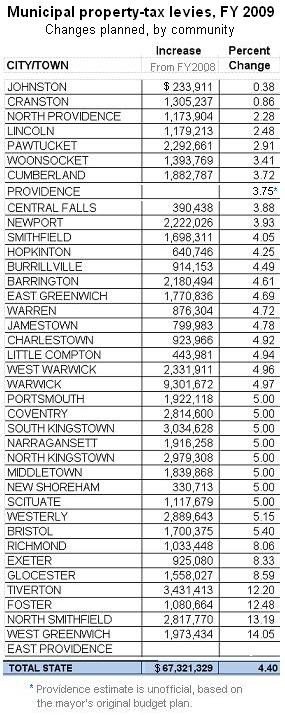
In addition to the 9 towns who "went over," there are 8 more who went right to the 5% cap and 11 more who upped their rates at least 4%. So that's 28 towns jacking up rates over 4%, which I suppose we we could consider to be (a bit generously) the cost-of-living increase. To try to be optimistic, I figured that more towns would spend to the 5% cap. Regardless, I'm sure the towns are feeling the pinch this year. And so are the taxpayers, yet again.
To be fair, some of the cuts made by the General Assembly are being manifested at the city and town level, so property tax increases aren't a surprise. That doesn't mean that local governments can't spend more wisely and make cuts in city "services." If taxpayers are upset by these increases, then it's up to them to send the right message to local town and city politicians at the ballot box in November. If they don't, they can expect more of the same. And they'll only have themselves to blame.
ADDENDUM: Good points made by "John" and "Tom W" in the comments. Basically, as John noticed, some of the communities that didn't go to the 5% cap are also those who are labeled as "distressed" and receive lots of state aid. And he asks the question, "Should they be commended or is the state giving extra where it isn't really needed?:
Tom explained how "state aid to education" is a vehicle of redistribution from rural and suburban communities to the "urban core."
The suburban people pay income taxes (while many if not most urban dwellers do not), and those taxes go into the general fund. From there the "education aid" money is disproportionately directed toward the urban systems.So those in the suburbs are then hit with disproportionate property taxes to make up the difference. In effect, they're paying for two school systems at once - their local one through property taxes, and urban ones through their "progressive" income taxes.
June 30, 2008
Evergrow Government in Tiverton
Some small-government types in Tiverton support an all-day referendum, instead of the financial town meeting, to handle the town's budget on the grounds that it would give the average working citizen more opportunity to vote and would diminish the out-in-the-open pressure power of such vested interests as public-sector unions. While both of those points are well taken, a couple of provisions in the proposed charter revision (PDF) seem designed to make the most of the opportunity for the town government.
First, there's opportunity to offer one side of the budget debate right on the ballot — the town's — with no mechanism for argument from the other side (emphasis added):
The ballot shall have a single question with a yes or no choice and a short explanation of what will happen if the proposed budget is rejected.
Nowhere are interested citizens empowered to explain why the consequences are counterbalanced or to enlighten the voter as to alternatives.
Second, the proposal would ensure some increase in the budget every single year:
The no vote explanation will state that if the proposed budget is rejected then the current fiscal year tax levy multiplied by an indexing factor up to a maximum of four percent (4%) will be the budget for the next fiscal year. No exception to exceed any tax increase "cap" will be allowed if a no vote prevails.
Roughly speaking, in other words, the referendum would give voters the opportunity to deny exceptions from the tax cap imposed by the state but would ensure that the town government always gets its increase at about the level of the cap. The only way to achieve level funding or a decrease (as merely theoretical as that budgetary possibility may be) would be for the town government itself to propose it.
With the town council apparently poised to assert its authority to change the proposal at a special meeting tonight, the balance could shift even more toward government's favor.
June 9, 2008
Cranston Mayoral Update
According to a Matt Jerzyk post over at RI Future, apparently based on a statement coming from the Councilwoman herself, Paula McFarland is out as a potential Democratic candidate for Mayor of Cranston. Mr. Jerzyk speculates that this clears the way for state Representative Charlene Lima to seek the Democratic Mayoral endorsement.
The Projo's weekly Political Scene column still mentions Councilwoman McFarland as a possibility (I guess it really is a weekly column, pretty obviously filed sometime last Friday, before the RI Future post on Councilwoman McFarland appeared on Saturday) as well as Rep. Lima, Daniel Beardsley of the Rhode Island League of Cities and Towns, and former Cranston City Council Members Cindy Fogarty and Mario Carlino.
Strangely, Political Scene refers to declared Republican candidate Allan Fung only as someone who has "expressed interest" in running for Mayor, lumping Cranston's only formally announced candidate in with the undecideds.
June 6, 2008
Gettin' While the Gettin's Good
Perchance this is the news for which I'd been told to watch:
At least three of Tiverton's seven Town Council members won't be seeking re-election in the fall, and one of them, John Edwards, is "seriously considering" running for the state representative seat that is expected to be vacated by District 70 Rep. Joseph N. Amaral, R-Tiverton."I'm going to seek a seat on the state level so I can continue to serve the residents of Tiverton," Edwards said.
Although citizens might not know it because Tiverton's local elections are (ahem) "non-partisan," Edwards is a Democrat.
An overwhelmingly busy and unwealthy blogger can only hope that some of the several hundred people who voted against the budget "compromise" and stormed out of the high school gymnasium last week will run for the open slots.
June 3, 2008
The Real Must Prevail
A letter from locally known Tivertonian Richard Joslin in last Wednesday's Sakonnet Times let's slip a mild frame of mind that, when metastasized, generates oppression and tyranny. The implication of positing a "Real Tiverton" (i.e., citizens who would naturally support the town's original budget proposal) is that everybody else can and must be overruled by any means necessary. After all, why ought the citizens who really count be pushed around by interlopers?
Herewith, my letter to the editor in response:
In a letter printed in last week’s Sakonnet Times, Richard Joslin scorns the "tyranny of a small minority" (255 Tiverton voters of 11,000) for rejecting a double-digit increase in property taxes. As we now know, a tyrannical minority of 376 undid that mandate the following week, and presumably Joslin's just fine with THAT example of democracy, inasmuch as he encouraged it. Me, I'm still trying to figure out which of the four groups that Joslin blames for the first result is my proper company.I'm certainly not a senior citizen on a fixed income, although perhaps Richard could spare some sympathy for thirtysomethings with multiple children and limited dispensable cash. I'm also not among the "fairly wealthy people.”
From a certain perspective, I suppose it would be reasonable to count me among the "extreme economic conservatives and libertarians whose anti-tax views border on the 'wacko,'" but since Richard describes this group with reference to his personal knowledge of the Budget Committee's political temperament (rather than, say, an example of the "wacko" views), I can't say for sure. I may also number among those who "for ideological and/or religious reasons are not interested in funding public schools," although I'm once again unable to interpret their nature through Joslin's personal experiences.
If he means people who dislike financing secular schools that teach various topics with which a theist might disagree, then my allegiances lie elsewhere. On the other hand, if Joslin means people who've been frightened out of the public school system by work-to-ruling teachers and who've been aspiring to asceticism in order to pay for their children's education twice, then one I am.
Whatever it is that makes me not part of the “Real Tiverton,” in Joslin's view, I've been around town enough to have made this observation of the empire that struck back last Wednesday: Among those who voted for the faux "compromise budget" were seniors wishing to keep specific services, "fairly wealthy people" who can easily afford a few more hundred dollars a year in taxes, and parents whose children go to private school. I'd also speculate that some of the Yea voters were extreme economic naifs and liberals whose pro-tax views border on the socialist, although I've no names to put on the list.
We also oughtn’t forget those whom increasing budgets benefit financially in a degree much greater than an extra dollar or so per $1,000 of their property value. That would include the contractless teachers who nodded along when a red-faced School Committee Vice Chairman Michael Burk demanded to know which services tax-revolters would like to snatch from school children. Apparently, taking benefits from union members who'll let entire school years pass with bare-bones participation is not an option.
Now Joslin's preferred tyranny has won the day, with a little help from clever budgetary and procedural maneuvering. Some contentious counts and a dubiously judged voice vote brought the second try budget to the floor. Behind-the-scenes scheming no doubt accounts for the fact that two of the allowable three amendments thereto were higher and different from each other by a measly $10,000. And we're one Caruolo Act lawsuit away from finding that all of the contention and "compromise" will have changed the way the town does business not one bit.
June 1, 2008
A Few Sunday Quick Hits
A handful of items that are blogworthy, but not extensive, have been building up on my desk, so herewith, some quick hit thoughts:
- An objection was made, last week, to my mention of the exceedingly sparse Projo Jobs section that it was a holiday weekend and thus hardly representative. Well today's Jobs section may (or may not) have a greater number of smaller ads than larger ones, but it's still pitifully small. I repeat: cut taxes... now... drastically.
- Somebody in a position to hear things has told me to keep my eye on Tiverton-related news in the next few days because something affecting me, as a resident, is soon to be announced. The comment was so vague that I'm not even sure whether it was a warning or a promise. My blind guess (in keeping with a surmise already expressed) is that the school committee is going to file a Caruolo Act lawsuit to recoup the $100,000 that constituted its share of the so-called "compromise" budget.
- The bad news: Rhode Island is one of only 11 states currently in economic recession, and the only one in New England, and (according to a Lynn Arditi article from Friday that I can't find online) will likely stay there "through the third-quarter of next year" — that's fall 2009 (at least).
- As more of a reminder than anything: we're winning the war against terrorism.
May 29, 2008
The Actual Upshot
The Newport Daily News has the most thorough explanation of the outcome of Tiverton's Financial Town Meeting that I've seen:
More than 800 voters packed Tiverton’s reconvened financial town meeting Wednesday night and approved a slightly amended budget of $41.7 million for fiscal 2009.Voters also approved a tax-levy override of $1.6 million, which will necessitate an increase of 99 cents to the tax rate, making it $11.25 per $1,000 of property value.
The tax rate is 10 cents less and the excess tax levy is $250,000 less than the $1.9 million override proposal presented to voters at the start of the May 21 meeting. That proposal was defeated by a majority of the 465 voters in attendance. Town officials initially proposed a $42.1 million budget for fiscal 2009, which begins July 1. ...
The amended budget that was approved includes a $100,000 cut to the school budget, a $100,000 reduction in the amount for uncollected taxes and a $50,000 reduction in the police pension fund.
The $100,000 from "uncollected taxes" will, presuming a revenue shortfall, have to be made up somehow in the future. The $50,000 not put into the police pension fund is even more of a mere postponement; if the pension is of the defined benefit sort (which I haven't been able to confirm with a quick search, but which is likely presumable), then the money not put in is of no immediate concern to the participants. That leaves the $100,000 school budget cut, which a Caruolo Act lawsuit could erase.
In other words, the "compromise budget" is very Rhode Island.
Random Observations About Last Night
* An older woman was passing jibes to a group of teacher unionists across the aisle from her, and a guidance counselor whose name I'd have to look up, but who is very active and vocal with union matters, brought over one of the policemen on duty to chastise her. I didn't hear any of the particulars, but it struck me as an example of an adult tattletale bully.
* School Committee Vice Chairman Mike Burk had a heated exchange with one speaker, demanding that he explain what services ought to be cut from the children's educations. I suspect an unspoken retort for many in attendance would have been that educational services for children shouldn't be cut, but benefit services for teachers should.
* Superintendent William Rearick at one point asserted that not a single resident had attended any of the school committee meetings and made his or her voice heard. That's a lie. I went to many school committee meetings, and my voice has been heard via email, via letters, and via op-eds. Nobody on the committee seemed to object when I was defending them from the union.
But in the course of that participation, I lost confidenc in the school system that threatens programs regularly as a mode of argumentation for more money, that already offers less than I enjoyed as a public school student, and that tolerates teachers' "working to rule."
* Republican Representatives John Loughlin and Joe Amaral were in attendance and both (although I didn't see Mr. Amaral as frequently) seemed to vote on the side of the tax-raisers at every opportunity.
* Now that I've got a private school tab to cover (somehow), I've been trying to shave every unnecessary penny from my spending, down to such things as a flavored beverage at lunchtime. The Town of Tiverton has now undone all of that effort.
Meeting on Matt Allen
Monique's conversation with Matt Allen last night can be streamed by clicking here (or download). They mainly discussed financial town meetings, and Monique teased a very interesting post on state-level nepotism.
Town Financial Meeting, In Summary (How Things Apparently Work)
First off: if I am incorrect in any of the particulars that follow, please correct me. I've been playing catch-up, and I'm tired.
- Last week, a body of 437 Tiverton residents rejected a tax levy of $30,200,000, which exceeded the budget cap by about $2,000,000. Specifically, "by a vote of 255 in favor and 151 against, [voters] directed the town to live within that [5%] cap."
- During the following week, the budget committee devised a scheme to propose exceeding the cap by a little bit less: $1,659,505. Meanwhile, the superintendent (and other town officials, I believe) used public resources to encourage voters to come out and pass the budget.
- An appeal to the decision to stop the Budget Committee's proposal (on the grounds that it was not "substantially different" than the one that was rejected the week before) failed by a narrow vote, with questions of overcounting. Then, a motion to recess and give the Budget Committee another month to pull the numbers down some more failed on (for some reason) a voice vote that pitted an opposition consisting of many older citizens versus interested parties consisting of police, firemen, and teachers, all of whom have career tendencies toward voice projection.
- The Budget Committee's motion to exceed the tax levy cap by $1.659,505 passes, and almost half of the crowd storms out. That dollar amount should bring taxes to around $29,860,000, or $11.24 (an increase of 9.55%).
- After some discussion of the fact that the crowd is teetering around the 437 mark needed to make changes to the previous week's voter instructions, the government officials push a vote to permit the Budget Committee to (I think) reduce or increase the amount set aside for abatements and uncollected taxes in such a way as to compensate for the $250,000 reduction with which the meeting started.
- Somehow, the upshot is that the budget is $41,797,101, of which between 31,097,228 and 31,297,228 will be generated through taxes, for a homeowner tax rate of $11.78, or 14.8%. (To be as clear as possible, the $31 million number may include motor vehicle taxes, which aren't included in the property tax cap. If that's the case, then the total property tax revenue would come in at $29,892,228, or $11.25 per $1,000 of property, which is a 9.6% increase — of course, with the difference from the last budget apparently coming out of the money set aside for likely tax shortfalls, thus requiring some action midyear. On a total basis, that's an 11.08% increase over last year's $26,909,360, as opposed to the plan last week, which would have been an increase of 12.5%.)
This, ladies and gentlemen, is how your kindly government officials handle a taxpayer revolt.
The only question now is whether it's better to jump into local politics and wreak havoc from within or to focus efforts at the state level.
May 28, 2008
The Tiverton Powers That Be Try Again
Well, my first financial town meeting is about to begin. As if knowingly, the woman at the rapidly moving G-L registration line stamped my admittance arrow to the right. (Or perhaps it was a sly political statement from her perspective.)
If you're coming, wear your walking shoes:
Of course, you get to go right by the school if you drive one of these:

Here's the audience as of the meeting's beginning:
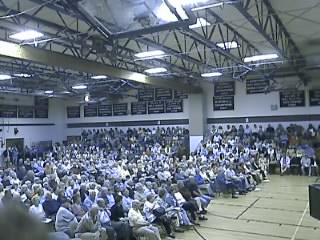
7:41pm
The Budget Committee proposed another budget that raises the budget by $250,000 less than the previous budget proposal. A citizen appealed, and now we're debating whether the new proposal is appropriate given last week's occurances.
7:47pm
The woman who appealed the decision to allow another proposal just pointed out that doing so would disenfranchise those who voted previously and would be equivalent to allowing the losing side a week to gather the troops and try again.
I gotta say, by the way, that the joining of legal actions with a public gathering makes for some confusing discussion.
7:54pm
The official count of those in attendance, by the way, is around 750 (747), I think, but I was trying to pay attention to other things when it was stated.
The updated count: 775 786
8:01pm
A vote in which the appeal failed (with the effect that the new budget would be considered) will be retaken, because of confusion about the number of people voting and in the room (more people voted than appeared to be present).
They'll now be closing the doors during votes.
(It seemed clear to me that the "yes" votes were clearly more numerous, but I can't see the whole room.)
8:09pm
Current count: 789.
8:13pm
Appeal denied. Proposal goes forward for consideration.
Now an appeal to recess 30 days to allow more budget restructuring.
8:18pm
The appeal debate continues: The vote count exceeds the attendance count by 3, with the "no" (to the appeal) having won by 14.
8:27pm
Some controversy because the vote to recess was done by voice, not by count. I'm not sure what determines the method of voting. The "no" to the recess certainly was louder, but a few male voices were clearly prominent.
8:38pm
I'm really confused. The budget committee chairman (Mr. Cotta) suggested a slightly reduced budget excess over the cap than last year, and a couple of women amended that, I think, to be more, perhaps restoring last week's number (?).
Much more discussion on a proposal to reduce it than the two to increase it.
(The increase was, I believe, to the previous number.)
8:45pm
Note on voting method: the voice votes strike me as fundamentally biased, because many who can be presumed to want a larger budget (police officers, firemen, and teachers) are selected by their careers to have practice projecting their voices.
9:23pm
The first of three amendments to the budget committee's new number (currently the lowest number has failed). Of course, that's now four amendments that have to fail before the tax increase cap can stand.
9:37pm
Having just voted down an increase over the tax levy of $1,860,000, we just voted down $1,850,000. (Now 688 people in the room.)
10:09pm
Low battery.
The Budget Committee's motion to exceed the cap by $1,659,505 ($250,000 less than last week) passed 376 to 319 (with a body count of 689).
A large number of people got up and walked out, despite urging to stay for further votes. A motion was made and seconded to close the doors to keep them in. I shouted that they ought to just shoot them and inquired whether they constitute a quorum if they're dead. School Committee President DeMedeiros laughed.
Now they're recounting to see if we've maintained a quorum. (Now 442 remain.)
11:14pm (from my now more-expensive home)
Odd things happened after the walkout. Budget Guy Cotta proposed another motion that I didn't fully understand, but it apparently had something to do with resolution 7, which apparently passed last week:
RESOLVE, that the voters of the Financial Town Meeting approve setting aside a reserve sum of $474, 213.00 as a restricted expense for the purpose of accounting for annual abatements and uncollected taxes which amount to 1.5% of levied taxes on Real and Tangible Properties. Historically the Town of Tiverton allocated a reasonable percentage of abatements and uncollected taxes as a method of ensuring the town could operate as budgeted without requiring 100 percent tax collections. Because the town has received permission to levy taxes beyond the permitted tax cap, and there are presently insufficient unreserved general funds available to offset taxes, fiscal prudence requires the town to account for potential abatements and uncollected taxes.
An objection was made that the resolution passed with attendance of 437, and undoing that seemed imprudent. Meanwhile people were storming out. A request was made for another room count, and the two police officers keeping track conferred. The folks on the stage worked quickly to move to a vote in the meantime, and in short succession the police officers announced that 16 people had left (bringing the number to 426), and the motion passed. Objections followed that there was no longer a number exceeding 437, and the moderator (who didn't seem very unbiased, given some sarcastic remarks to certain audience members) asserted that the number had been in the room when the vote was called (or something along those lines).
The net result, at the end of the day (although numbers were flying, and the town clerk had to correct the motion several times, so I might have confused things a little), is that Tiverton will raise property and vehicle excise taxes to an amount not less than $31,097,228, and not more than $31, 297,228.
I've got to sort some things out, but it looks like the net effect could be to raise property taxes from $10.26 to $11.78, or 14.8%.
Welcome to democracy, Rhode Island style.
(Note, see here for a summary. It may be, by the way that the tax increase no a per $1,000 basis is actually 9.6%, although it's still an 11% increase from last year's collections on a total basis.)
May 27, 2008
Pulling on the Hands Reaching Out
We just received a call from Tiverton Schools Superintendent William Rearick (or, more likely, a recording) encouraging us, as parents in the town, to attend tomorrow night's financial town meeting in order to vote for the 11% increase in taxes so that the district won't have to tighten its belt anymore. A related Projo article today makes me wonder how many similar phone calls our town officials are making this evening:
The resumption of the annual Financial Town Meeting tomorrow night was to be largely a procedural affair, leading to yet another recess.But town officials aren’t so sure about that anymore.
They say they have concerns that a relatively small number of voters could move forward with budget cuts deep enough to fundamentally alter the character of the town — without a word from those who want to maintain the current level of municipal services. ...
Town Council president Louise Durfee and council member Brian Medeiros urged those who want to maintain existing services to turn out for the resumption of the Financial Town Meeting tomorrow night at 7 in the high school gymnasium.
Medeiros predicted that those who want to limit the tax increase will take action to finalize budget cuts tomorrow.
"I hope enough people show up so that the Town Council gets a sense of whether [last week's] vote reflects the majority will of the town," Medeiros said.
"Does a majority want services to continue at a reasonable level, or do they want to take a meat cleaver" to the budget, he asked.
Durfee said she was concerned last Wednesday that she hadn't heard the voices of people "who enjoy summer recreation, a good education, the need for a rescue service and a police department."
Me, I'm in a meat cleaver state of mind. For one thing, in part to protect them from work-to-ruling teachers, and the related constriction of services and opportunities on offer in the public schools, I'll be pulling my children from the school system, so the tax money therein invested will merely be tacked on fruitlessly to the expense of the education that they'll actually be receiving. Beyond that, I'm not sure what services I'm supposed to credit the town with providing. The roads en route to my neighborhood are poor. The storefronts are increasingly empty. I don't have sewer service. My water pressure is horrid (even though my section of town pays more for water than does the wealthier side of town). The "free" garbage pickup has cost me an annual garbage can, and I receive a suspicious chastisement every time I try to bring home-renovation refuse directly to the landfill.
Mind you, I'm not complaining so much as explaining my reason for hope that drawing the line on tax increases will force some much-needed reflection among those in government and otherwise who — for whatever reason — have a different understanding of the cost-benefit balance of town services.
May 23, 2008
Building the Cleansing Fire in Tiverton
Life kept me away from Tiverton's Financial Town Meeting, Wednesday night, although to be honest, I suspected that I would have been one of the few not falling into line in response to town official arguments such as the following:
... since Mr. Cotta and other officials said that legally the school budget cannot be cut below what it was for this year, that shifts much of the burden to the municipal side. ...In addition to the town's obligation to pay the bond debt, Mr. Cotta said the town has employee contracts that must be honored. Other legal requirements were mentioned, such as public safety minimum staffing requirements in the police and fire departments, which will have to be dealt with.
As it turns out, however, the voice of the majority is such as would warm the hearts of most Anchor Rising readers:
"Let's make a stand and tell the state we can't take it anymore," said Joe Sousa."How about cutting some services," added Tom Morse. "I don't care, I would suggest you start talking about cutting." ...
And Roger Bennis, who supported the cuts, said, he cares less about where the cuts are made than that it happen. "I don't have any specific recommendations. I am looking to send a message."
And:
Shouting "no," the voters signaled that they would not approve the final $2 million of the Budget Committee's proposed $30 million tax levy. ...Joe Sousa asked fellow voters to “send a message upstate” that the town’s taxpayers reject unfunded state mandates, particularly those related to the schools, like the education of special-needs students.
“We can’t afford it any more,” Sousa said.
“The prices we’re paying to send these children to school are outrageous,” he said.
And from this week's Sakonnet Times Web Words:
Who should be surprised with the pay and benefits they give out. Who else in this world gets to retire at 45, like cops and fire, or 55 like teachers and get almost full pay for life — and we pay and pay. The benefits we throw around are crazy.
And a letter from Tiverton resident Chris Hart:
In regards to Tiverton's exhorbitant proposed tax hike, all I can say is NO,NO,NO!Perhaps it is time that we take a good accounting of all our town services, with no exceptions. The police, fire, and water departments are all equiped with new vehicles, which I frequently see being used for personal uses (unless the Moose Cafe, Barcellos, Subway, Dunkin' Donuts, etc. are having water trouble, high crime rates, or fires on a daily basis? )
With the ever increasing fuel prices, a crackdown on all this running around to pick up lunches, coffee, and the like is in order. Hopefully, with all the taxes we are already paying there is someone under contract to keep track of all these expenditures.
Returning to the first link, above, one finds the spreading of a necessary crack in Rhode Island's corrupt veneer:
That prospect [that the money will reductions largely come from the municipal side of the budget] upset Bob Martin, a town maintenance worker and head of the town employees union."What we're talking about is the gross waste in the schools," he said.
It looks, however, as if sympathetic townies may not have the luxury of continuing to remain in the shadows, because the local government will probably try again:
When the town meeting does reconvene, Mr. Cotta said Thursday, the budget committee could recommend more than one budget, for example the original one recommended at last night's meeting and another reflecting $2 million in cuts. Parliamentary requirements would have to be met, he said."We can present more than one budget as long as we have the same or more than the number in attendance when we do as were present when the original vote was taken," he said. The quorum present at the time (approximately 9 p.m.) the vote was taken last night is thought to be close to what it was (437 voters) when the meeting was called to order at 7:20 p.m. The total vote on the motion was 406 voting, with 151 yeas and 255 nays. Mr. Cotta said people he knows of who voted on the prevailing side could move to reconsider, and thus bring the recommended measure back again that was rejected last night.
One can only hope that the peremptory and condescending tone of officials won't go unnoticed:
"What we saw were people angry at the oil companies; people who were angry at oil heating costs," [Town Council President Louise] Durfee said.With the price of gasoline approaching $4 a gallon, they were saying, "this is not something that we can control. Let's take it out on the powers that be," Durfee said.
But voters did not think through the consequences, Durfee said. ..
[School Committee Chairwoman Denise] DeMedeiros said yesterday, "I do take offense" at the notion "that this was some kind of underhanded thing that we got that bond," deMedeiros said.
"It's disturbing to me that they're telling us we didn't do due diligence," she said. ...
"People just don't like the tax," she said. "Maybe some people weren't paying attention." ...
... when extra money trickled in, it went to the general fund, helping to replenish monies used to offset taxes, [Budget Committee chairman Christopher Cotta] said.
But there has been no such cushion in the last two years, when the town exceeded the state limit on tax increases, Cotta said, and the general fund has dwindled to about $1,266,000.
That amount is barely enough to meet a requirement of the Town Charter that the town maintain reserves equivalent to 3 percent of its operating budget.
Cotta said, "you got the benefit of the $900,000 (from the general fund) in your taxes this year. Now you want to cry about it."
Two observations:
- Odd that our elected officials are responding to the night's democratically expressed voice as a personal rebuke rather than a direct instruction from the people who are ultimately in charge.
- Curious — as much as the lower economic waters may have brought the rapids' rocks into sharper relief — that our elected officials remark upon the tide, but not the stones. Surely Cotta ought to include, in his "supercollision of everything wrong happening at the same time," work-to-ruling teachers, a contentious departure of the town administrator, repeated blocking of development efforts, and higher property tax assessments, even as property values decline.
Good morning Rhode Island politicians. Grab a cup of coffee and join us around the fire or we'll drag your sleeping bag into the river.
May 22, 2008
The Meaning of "Self-Insured"
This is a recurring issue with school committees and town/city councils across the state; Matt Bower of the Warwick Beacon reports that the Warwick City Council has formally expressed its support for a General Assembly bill that would prevent specific health-insurers from being named in teacher contracts…
Members of the Warwick Teachers Union are not pleased with the School Committee’s approval last Tuesday of a resolution in support of two bills (Bill 7776 and Bill 7108) that would prevent teachers’ unions from naming a specific health care provider in their contracts.Now, I'm not sure "provider" is the right word for Bower to have used in his opening paragraph. According to Committeeman Cannistra, quoted later in the article, the City of Warwick is "self-insured". That means that Warwick employees don't send premiums to an insurance company. Instead, they pay into a fund maintained by the city of Warwick and the city hires an insurance company to administer the fund. The distinction is important, I believe, because participants in a self-insured plan are not limited to an administering company's HMO/PPO network created for direct customers. It is the self-insuring body, not their hired administrators, who sets the terms of coverage.The resolution, sponsored by Paul Cannistra, follows similar resolutions passed by school committees in Westerly, East Greenwich and North Kingstown.
Cannistra said the bills concern cost savings to taxpayers while restoring some management rights to school committees and administration.
However, in the Beacon article, there is disagreement on this point. Warwick Teacher Michele Landrie says that participants in a self-insured plan administered by, say, United Healthcare, are limited to United's network…
“Doctors don’t participate with United,” she said. “You’re limiting my health care options by switching. You’re taking away the protection we have to ensure a health care provider.”Committeeman Cannistra disagrees…
“There’s no reason to be limited; with being self-insured we can dictate our coverage,” Cannistra said after the meeting.This is a pretty straightforward question of fact, so let's put it to bed. Who's right about who sets the terms of a self-insured plan?
May 20, 2008
Mayoral Injunctions to Stop the Dirt Being Dug Up on Your Administration
... can only be obtained and maintained if one continues to occupy the mayor's office. Addendum: link to the Providence Journal story.
[Woonsocket Mayor Susan] Menard, who won her seventh mayoral term last fall, announced that she would leave office on June 15, a year and half before her current term expires.But as the weeks went by, controversy in the Police Department died down and the City Council’s investigation of misuse of city resources by city employees hit a snag when Menard filed an injunction to stop the investigation.
Last week, during her weekly visit with WNRI radio talk show host Roger Bouchard, Menard said she wanted to stay to see the adoption of the 2008-09 budget and the mailing of the first-quarter tax bills on July 1. Menard said she would decide on July 1 when she would go.
Taking a powder was a pretty reasonable course of action under the circumstances - an ethics investigation going full steam ahead, an off-the-books mayoral slush fund, hazy funding of the city pension, a phantom budget surplus, the aforementioned injunction to halt the questioning of city employees, not to mention hidden recording equipment in the mayor's office.
Then again, if the mess is bad enough, perhaps the only option is to stay in order to block prying eyes, fix or undo what you can and hope that, with time, it will all blow over.
May 19, 2008
Stamping an Increase
So this Wednesday, at the annual Tiverton Financial Town Meeting (potentially among the last), voters will be asked to approve an 11% property tax increase:
Town electors who attend next Wednesday night's Financial Town Meeting will be asked to vote on a total recommended budget of $41.7 million.To raise that amount, a tax levy is projected that will require an increase in the tax rate by 11 percent over this year's rate — up to $11.39 from $10.26 per $1,000 of value.
"Our committee is not happy about putting forward an 11 percent increase, but to retain current levels of public safety and services, this is what's required," said Chris Cotta, chairman of the town budget committee. "There's no fat in this budget that we're aware of."
Although the spending plan proposed by the budget committee falls within the state's 5 percent tax cap, debt costs, which are not counted toward that calculation, contribute to tax hike pressure for Tiverton property taxpayers. The tax cap legislation limits the actual dollar amount that can be raised in successive years by declining quarter percentage points. Last year the cap was 5.25 percent, this year it is 5, and next year it will be 4.75 percent.
However, the legislation allows for state waivers from the cap requirement when the payment of bonded indebtedness is involved. Tiverton committed to paying off $30.7 million in school bonds in 2004, before the tax cap legislation was passed.
The true abomination is how little of the budget voters are actually empowered to change. The debt service is beyond the tax cap; the school budget comes with the threat of a Caruolo Act lawsuit if the town returns a "no way"; many services and employment deals are contracted; unfunded mandates filter down from higher levels of government. In characteristic Rhode Island fashion, democracy is constructed to give the semblance of voice, but the reality of dictation.
And worse, for me, the meeting falls during one of the busiest, most stressful weeks that I can recall, between work and family obligations. Civic participation can't always have been like this.
May 7, 2008
Cranston School Committee Approves a Caruolo Action
From today's Providence Journal:
The School Committee voted late Tuesday night to sue the city for $4.9 million in additional education aid, setting the stage for a costly, bruising legal battle.The committee became the second in the state this year, after the West Warwick board, to authorize a lawsuit seeking more cash from a local municipality in what is known as a Caruolo action.
* * *Talk of a Caruolo action has been swirling since the beginning of the fiscal year, when school officials said they could not run the schools with the $125.3 million they got from federal, state and local sources.
The school district has maintained, for months, that it would need something on the order of $4 million more from the city to meet its obligations.
But city officials have long speculated that the school district would be willing to settle for something closer to $2 million in the end.
That speculation, it now seems, was faulty.
Is it too obvious to point out that this could have been avoided if the School Committee had structured budgets and executed contracts that were within the means of the city?
April 12, 2008
After Further Thought
I've most likely been overstating the number of Tiverton teachers who stand to lose their jobs if the union remains implacable. Thirty-four notices of potential layoffs went out to meet a deadline; one position was eliminated in the school budget as passed; so I've been saying that intransigence might result in the actual layoffs of the other thirty-three.
The probability, however, is that the school committee sought to allow itself options should circumstances require positions to be eliminated. Their situation would have to be dire indeed for such a large portion of the workforce to be let go.
My point remains, though: union persistence will cost some members dearly, and a negotiating collective that is willing to push things that far would seek to soak up any new funds that become available.
April 4, 2008
Out of the Din
Throughout my adult years, I'd never so much as considered sending my children to private school (parochial or otherwise) until very recently. Even my particular tincture of religious faith leads me strongly to feel that spending one's formative years among a cross-section of the local society — an opportunity that my own experience led me to take as an apt description of the public school environment — is a valuable component of education. Yet, yesterday our attempts to move our children outside of Tiverton's school district met with success.
After receiving my wife's call, in the morning, the rest of the day brought a noticeable increase in my stress level, involving anxiety about the now-certain new monthly bill. But what is one to do? The headline at the top of this week's Sakonnet Times is "Teachers reject two-year offer":
Tiverton teachers Monday afternoon "clearly expressed disapproval" of a two-year contract proposal put forward by the School Committee Friday, March 14, according to Amy Mullen, the union's president and Pocasset School teacher.The school committee's contract offer was not proposed for ratification, and no vote was taken, said Ms. Mullen. Rather, it was discussed with "roughly 192 members present" at what union leadership characterized as an "emergency union meeting" at Green Valley Country Club in Portsmouth that began at 4 p.m. Monday and lasted nearly an hour and a half.
"The membership let us know it was not acceptable," Ms. Mullen said.
The complaint is that, when increasing healthcare costs are factored in, step 10 teachers will see minimal increases. Me, I can't keep my head from shaking: These teachers know the problems facing our state and our town. They know that money is extremely tight — so much so that their unreasonable demands will require the district to send out up to three dozen pink slips. Yet they persist.
And they persist in this (from an anonymous letter in the print edition's "Web Words" section):
Teachers, at this point why start anything to benefit the students. As parents of seniors, we know first hand you have disappointed the students all year. Some of the teachers were unprofessional, discussing the contract situation in the classroom, threatening to cancel events such as homecoming, dances and prom. You claim to be fulfilling your contract responsibilities, but as far as the students and parents are concerned, you failed! The seniors worked hard on their senior projects and, at this point, knowing they will not be graded by the teachers for their presentation portion of the project, their enthusiasm has diminished. This just adds to the list of disappointments such as mock trial, math team, class advisers, yearly art gallery shows, class trips, National Honor Society attendance, College Fair, limited letters of recommendation and limited after school help.Fortunately for the students, replacements were found and many of the above activities continued due to the principal and his office staff and concerned parents. Yet again you try to use the seniors as pawns! So you're not going to show up at graduation, who cares, it's too late. You lost the respect of most students and parents.
What responsible parent wouldn't reconsider the value of a public school education when faced with such an environment? I can't be alone in veritably itching for a concrete opportunity to fight for a school choice/voucher system.
March 20, 2008
Evil Men in Tiverton
A typo in Tom Killin Dalglish's Sakonnet Times piece on the Tiverton police department sexual harassment suits is just too ripe for speculation of the subconscious not to note it:
Defendants named in the lawsuits besides the Town of Tiverton are James Amarantes (the former town treasurer), Louis Durfee (president of the Town Council), Mr. Steckman (the former town administrator), and Chief Blakey.
It's man versus woman in Tiverton, with James, Louis, Glenn, and Thomas named in the suits. Except, of course, that Louis is actually Louise.
As I said, it's just a typo, but it's good for a conservative chuckle, anyway.
Woonsocket: No Bid Vroom-Vrooms Go Bye-Bye
Two weeks ago, an ethics complaint was filed against Mayor Susan Menard for her role in the city's no-bid lease of four motorcycles from her son-in-law's dealership. She announced soon thereafter that she would be retiring in June.
Fast forward to Monday night's City Council meeting at which Mayor Menard was a surprise show. This Providence Journal article, devoted exclusively to the pleasantry of her "good-bye" comments, missed a couple of other developments during the meeting which the Valley Breeze picked up. The first was the presentation of an audit revealing that 1.) contrary to prior representations, the city is operating in the red and 2.) the amount of the deficit is not known due to poor record keeping and accounting practices by certain city officials and departments. (They "borrowed" $503,000 from the pension fund ...?)
The second item of business that failed to make the ProJo article was a request by a Council member for a copy of the motorcycle lease and an inquiry by the Council President as to the present location of the motorcycles which are the subject of the ethics complaint. The city solicitor, replying to the former inquiry, stated that the lease could not be found in city records nor, perplexingly, did the leasing company have a copy of same.
No reply was apparently offered at the meeting to the Council President's question. However, the Woonsocket Police Department informed me this morning that while the motorcycles are still in Woonsocket at the moment, they will shortly be on their way back to the leasing company as that company has been told to come and pick them up.
Still outstanding is the $10,000 [Edit - commenter John has provided the correct figure] $40,000 paid to date by the City of Woonsocket towards the leasing of the motorcycles. If the $10,000 $40,000 is subsequently returned, the motorcycles go back and the lease mysteriously never surfaces, does the ethics bell, as Dave Kane phrased it, get unrung?
UPDATE
As to who authorized the return of the motorcycles to the leasing company, someone in attendance at the City Council meeting Monday night has advised that it was the Woonsocket Public Safety Director who did so - "that would mean the Mayor".
March 16, 2008
Tiverton Harassment Suits
And things just get worse for the town of Tiverton:
Three discrimination suits against the town filed by female employees in Police Department resurrect the controversy involving former Town Administrator W. Glenn Steckman 3rd and his failed attempt to fire Police Chief Thomas Blakey.Blakey was reinstated by the Town Council nearly a year ago.
Both Steckman and Blakey are named as defendants in the civil rights complaints filed by two civilian dispatchers and a former patrolwoman during the past six months in U.S. District Court, Providence.
The dispatchers and the police officer all allege that Blakey subjected them to sexual harassment and, once they complained, varying degrees of retaliation. The police officer, Amy Barboza, was fired. ...
After Blakey's reinstatement, cracks emerged in the relationship between Steckman and the Town Council, which ultimately bought out about 11 months remaining on his contract for $40,000. ...
The terms of the agreement were sealed until after Steckman's last day, on Feb. 22. They include a stipulation that the town will pay Steckman's expenses in connection with his role as a defendant in any lawsuits brought against the town.
Normally, I'd be inclined to point out to the women that their lawsuits, which are based on incidents from some time ago, will likely have the effect of putting people who have absolutely nothing to do with any harassment out of work and costing others their homes. It's kind of hard to make that moral case, though, when the alleged perpetrator still holds his job — and that deliberately against the wishes of the town administrator.
(I should stress, however, that I wasn't paying attention to local politics when this controversy erupted, so I can't say but that the four council members who voted to reinstate Police Chief Thomas Blakey were in the right.)
March 14, 2008
Advice for the Lenders
Reading news of Providence Mayor Cicilline's intention to borrow money from the federal government to deal with foreclosed neighborhoods brings to mind, once again, the fact that debt is excluded from municipalities' spending increase maximums.
Standing on a sidewalk lined with boarded-up houses in the city's West End, Mayor David N. Cicilline yesterday announced plans to seek $10 million in federal loans to purchase, rehabilitate and, if necessary, demolish foreclosed properties that are blighting city neighborhoods.The federal funds would be administered through the city's redevelopment agency as part of the Housing Trust to provide no-interest and low-interest loans to purchase or fix up properties that otherwise might not qualify for financing. The funds also could be used to board up vacant houses, demolish those which are deemed beyond saving and improve the city's tracking system for foreclosed and vacant properties.
My advice to the federal lender is to administer the loans personally. Rhode Island ain't so good at such things.
More Taxing than Expected
A Sakonnet Times story that does not appear to be online confirms my suspicions: Tiverton's going to raise my taxes even more than the previously suggested maximum. Apparently, "the big jump is in the debt service on school bonds" (a 45% increase), followed by an estimated 3.2% increase for the school district. Of course, Rhode Island law encourages increased debt, because it is exempt from legislated increase limits.
Also notable is the passivity with which article conveys tax increase information:
That budget figure factors out to a new tax rate of $11.59 per every $1,000 of assessed valuation for Tiverton property owners, [interim Town Administrator James Goncalo] told the council. The current tax rate is $10,26 per $1,000, while the year before ('06–'07) it was $9.62 per $1,000.
Nobody raises the taxes, they just "factor out."
The rest of the council's budget discussion will be carried out behind closed doors because "further budget reductions might affect staffing and/or labor contracts." The party's over; expect a fight.
March 11, 2008
Still Going to School
A cost-benefit analysis of sorts has led me to give up on the Tiverton town council. I simply can't afford to devote that much time to such an unprofitable activity (especially if my taxes are going to continue to climb).
Still, the school committee remains sufficiently interesting and important that I'll continue to make the time for it. That despite the likelihood that my children won't long be in the public system. (Another matter that will require me to maximize the profitability of my hours.)
It'll wear you down, this local government participation. The latest cuts that Superintendent Bill Rearick has proposed include a hundred dollars for repair here and there, $2,500 each from a couple of testing accounts. And yet the teachers are working to rule.
Now Rearick is talking about the NECAP results and pointing out that Tiverton High School was #11 in the state overall. But 72% of the kids aren't proficient in math. "It's certainly not a cure-all, but money would help us — push our kids and get our teachers additional training." Now a teacher is explaining that the kids have no incentive to apply themselves to the test.
Rearick: "It's a new test that assumes that students have basic skills and tests them on higher level thinking."
A principal: "Not sure whether this is a valid test." Apparently, low-scoring kids said they had plenty of time for the test (because they hadn't been prepared for a signficant number of the questions anyway), while higher-scoring students felt that they didn't have enough time.
Stunningly, nobody in the auditorium seems to feel any sense of urgency to improve these math scores. Not a single specific request or declaration concerning steps to improve them was voiced. Some stuff is up to the state. Some stuff has to do with the test. Some stuff involves the alignment of the stars.
The superintendent and some committee members congratulated the staff and teachers for doing so comparatively well. What? Either the test is invalid or our children are being abysmally cheated when it comes to math.
Can I possibly be the only person in some way connected to the Tiverton school district who thinks this matter shouldn't be brushed off the table with just a few minutes of mitigation?
March 8, 2008
Susan Menard: ProJo Omits the No Bid Vroom-Vrooms
Woonsocket Mayor Susan Menard will be retiring on June 15.
The Providence Journal got that much right. And they kindly mentioned her accomplishments. What they left out was that an ethics complaint had been filed against her this week. Yes, the same newspaper that repeatedly and breathlessly speculated about some not-so-nefarious reasons for Bev Najarian to have stepped down as the Governor's Director of Administration left this fairly significant development - some might even term a "factor" - out of their article reporting the retirement of Mayor Menard.
From the Valley Breeze:
In his two-page complaint, backed by various "proof" documents, [former police detective sergeant and City Council candidate Edward] Roy alleges that Menard violated state ethics law by her involvement in the process of leasing four Harley-Davidson motorcycles through her son-in-law's dealership, Paramount Harley Davidson, in Framingham, Mass.Roy said in the complaint that Paramount, with Menard's son-in-law James Pilavin as a principal owner, is not the dealership contracted to the city by the Greater Boston Police Council, and leasing through the company "is an egregious violation of the Rhode Island General Laws".
We should point out here that this was by no means a one-way transaction: James Pilavin made two contributions totalling $1,750 to Mayor Menard's re-election campaign.
The motorcycles were for the use of the Woonsocket Police Department. The funding for the lease did not come from city coffers but from the Justice Department's Local Law Enforcement Block Grants ("LLEBGs"). Nevertheless, the lease had to be offered as an RFP. It appears that this did not happen.
Speaking at Monday's City Council meeting, council President Leo Fontaine said the timeline for the lease of the motorcycles last month is especially disturbing to him.* At the Feb. 18 City Council meeting, Fontaine said the council asked why the city didn't go out to bid, as the City Charter stipulates for such leases.
* On Feb. 19, he said, a quote came in from Boston Harley-Davidson.
* Now it has been discovered, according to Fontaine, that a $10,000 two-year lease payment was sent to Paramount on Feb. 18.
"Why would we go out for bid a day after a payment was made?" he asked.
Well put.
ADDENDUM
The Providence Journal got itself updated and ran a more complete article yesterday on Mayor Menard's retirement and questions that are arising out of her administration. These are not limited to the no-bid motorcycles.
Also, the City Council has started an internal investigation to determine, among other things, if city employees were being made to do work they should not be doing, although they would not get more specific. On Thursday, the council had planned to meet with two city employees it had subpoenaed to ask questions, but Menard hired an independent lawyer and was able to obtain a temporary restraining order in Superior Court to stop the meeting.
Here's a question. Why would it be necessary to take steps to legally prevent the City Council from asking questions of city employees?
And another: who was doing what work they shouldn't have, for whom were they doing it and who requested that they do it?
March 7, 2008
Of Two Minds on Money
Of course, it's always more pleasant to have surpluses, rather than use them, which is a question that the Newport school department is facing:
Last week, Supt. John Ambrogi proposed hiking school spending 2.12 percent next year to $38.5 million. But the budget would require the city to increase its education appropriation by 5 percent, or $1.17 million, because of declining and stagnating federal and state aid and a projected increase of 15 percent in employee and retiree health coverage.The School Department has accumulated a surplus in recent years and Ambrogi said he planned, for the second year in a row, to use $800,000 of it to help balance the budget. But he and committee members warned then, and again last night, that using all of it to pay for operating expenses would potentially set the schools up for budget crises in the years to come. The state tax levy cap would prohibit the schools from being able to make up the large shortfall they would eventually face, they said.
I incline toward City Councilman Justin McLaughlin's response:
The school surplus, he said, was built on savings that Ambrogi described as coming from reductions in staff due to declining enrollment and less costly negotiated labor contracts."This is not a windfall," he said. "That money belongs to the taxpayers. ... It's money that was appropriated for operating expenses."
Being in the financial black is wonderful, but government is supposed to be a non-profit operation, and when red times come, it should dip into reserves and cut back on expenses.
February 26, 2008
My American Dream May Be Dying in Tiverton
A bout of cynicism kept me from last night's town council meeting. Here's one of the revelations that I missed (emphasis added):
Also last night, the council received a warning from its auditor that the town’s rainy day fund is too low.Standing at about $1.2 million for the fiscal year that ended last June, the fund represents a reserve of only 4 to 5 percent of budgeted expenses, far less than the 10 to 15 percent fund balance that bonding agencies look for when they rate municipal bonds, according to Paul Dansereau.
Dansereau indicated that the town fund is likely to shrink even further before it gets and bigger, since the current budget relies on $900,000 from the surplus to offset taxes.
The town is planning to discontinue the practice of using the surplus to keep down the tax rate in the budget year beginning July 1.
Dansereau, of the accounting firm of Parmelee, Poirier, and Associates, of Warwick, also said the School Department had a $14,000 deficit in its unrestricted fund last June 30, a shortfall that must be made up.
I don't know whether the new high-tax practice was included in the former town administrator's expectation of a 12% property tax hike, but either way, it looks like the council is set to push my monthly mortgage payment past the limit that we can afford. So much for moving to Tiverton as one of the last towns in the area able to sustain a budding family's dream of homeownership.
See, when families find themselves facing tightening budgets, they cut back. They dip into reserves. When a municipal government finds itself unable to sustain its multimillion-dollar "rainy day fund" during an economic storm, it opts to discontinue the heroic practice of limiting tax inflation (which apparently happens as a matter of nature, not by explicit action by a limited group of elected officials). Thanks for holding the line, guys. I know those wealthy enough to keep their homes will appreciate the healthy bond rating.
Anybody got a house that they'd like to rent at a discount to a nice young family headed by carpenter? Willing to move out of state...
February 12, 2008
Tough Decisions for the Tiverton School Committee
Superintendent William Rearick of the Tiverton school district just announced that federal grant funding is being reduced $200,000. He's gone back through the budget and found $27,513 in reductions (e.g., $4,000 from high school textbooks). Another $77,464 can be saved by reducing a middle school Math Literacy position by 4/5.
Now begin the pleas for cuts to be found anywhere but where they look likely to be taken.
Teacher applause.
Well, look. The single largest chunk of the budget is their pay and benefits, and those are still under negotiation. In the private sector, when the company's revenue is dropping, at the very least, demands for raises, especially up to double-digits, would be entirely inappropriate.
The detriment of unionization is increasingly stark.
January 22, 2008
Changing the Tenor of Contracts
Although I missed the budget discussion, I'm glad that I stopped by the Tiverton Town Council meeting, because discussion of a particular contract for an administrative assistant turned into debate of the contract policy overall. (My money's on the likelihood that the position will remain unfilled.) Some key highlights that councilors throughout Rhode Island ought to be competing to out-do:
- Councilman Jay Edwards suggested that all contracts going forward should call for 20–25% healthcare copays.
- Councilman Brian Medeiros said that, although he understands the reasoning behind it, offering health-insurance "buy backs" might be a bad idea. He backed off a bit, suggesting lower amounts; me, I'd argue that the town should bring its healthcare benefit itself in line with private-sector offerings such that there's around a 50:50 chance that married employees will take the other plan for the reason that it's better.
- Councilman Hannibal Costa absolutely refuses to be a part of passing any contract that offers merit-related pay but that does not enumerate the expectations and benchmarks for judging success. He argued that department heads (e.g., the fire chief) are highly trained professionals who ought to be able to impress the average person; their contracts, therefore, ought to set forth guidelines for judging standard, expected achievement versus stellar keep-this-one-at-any-cost achievement.
Budget Self-Immolation
It looks like I've made it to the town council meeting just in time to miss the budget discussion, and I'm still shaking a bit from the school committee meeting. (Although, to be honest, I'm not sure what emotion is the cause.)
School Committee member Leonard Wright made one of the union's talking points by asking Superintendent Rearick's money man, Director of Administration and Finance Douglas Fiore, to calculate the amount of change in a step-10 teacher's income following one of the budget proposals, including healthcare payments. The upshot was that the average step-10 teacher would be out a little over $1,000 on the year. Wright said, essentially, that such a change would be unfair.
Here's where I almost did take (and probably should have taken) the microphone after the teachers' cheers subsided to testify as a taxpayer that I face dire financial circumstances this year. Moreover, my healthcare is pretty pitiful. A single-digit-aged child's fractured wrist cost me the better part of a week's take-home pay.
And given a probable increase in my property taxes, this year, it is possible that I will not be able to finish the year as a Tiverton resident. Forgive me if my heart doesn't bleed for an employee making plus-or-minus on $70,000 for a shortened work year.
Thankfully, committee member Michael Burk had the presence of mind to ask for the same information for a teacher going from step 9 to step 10. If I heard right, the total increase (accounting for healthcare) would be 15%. If Mr. Wright wants a contract that is fair to teachers and fair to residents, let him look at that dynamic.
It should hurt the pride of Tiverton's liberal citizens to know that some of their representatives seem willing to take from the poor to give to the relatively wealthy — at least when the former aren't union and the latter are.
ADDENDUM:
It seems to me that there is a straightforward way to address the "inequity" of which Mr. Wright complained. The three options that the administrators offered to the school committee were as follows:
- Reduce the projected 2% salary increase for teachers to zero but reduce the co-pay on insurance from 18% to 15%.
- Reduce the projected 2% salary increase for teachers to (1) one percent but increase the co-pay from 15% to 20%.
- Maintain the proposed 2% salary increase and raise the co-pay from 20% to 25%.
If the numbers work out roughly the same for the district, then the difference is mainly how it is distributed among teachers. If the complaint is that teachers who no longer benefit from the guaranteed raises of the step system can actually go backwards on take-home pay because of health insurance, then the solution would be to go with option #3, because a 2% raise means more to somebody making $70,000 than somebody making less.
Of course, I'd say that the most fair system would adjust the step system (ideally by eliminating it) and increase percentages across the board. The next stage would be to eliminate group raises and judge the employees on their individual merits.
And the Budget Is...
Given my inability to attend both significant budget meetings for the Town of Tiverton, tonight, I opted to be present at the School Committee's.
For one thing, the way Tiverton's budget process is structured, the Council's passage of the budget is merely the first step, and not necessarily an important one. As I've noted, the budget passes through so many sequential hands (ending with the townspeople's) that there are plenty of steps to absorb and affect the discussion.
Additionally, the ongoing teacher contract dispute adds an element of interest to the School Committee's budget. The single largest group of direct municipal revenue recipients has been making a good deal of noise that it ought to receive even more,and there really ought to be txpayers filling the seats.
... And as I type, the contention begins. During discussion of some projects to benefit children, union president Amy Mullen pointed out that a related (and necessary) position has not been filled. Superintendent Rearick pointed out that the work-to-rule prevented the position from being filled and suggested that this meeting is not the forum for negotiating the contract. After further discussion, Rearick pointed out that a non-teacher volunteer could be sought.
The committee moved on, with shouts and accusations from the ostensible professionals in the audience.
ADDENDUM:
It's worth mentioning something that happened as I was getting situated: A local man who (as I understood) runs a field next to one of the elementary schools asked the school committee for $3,000–5,000 to help with maintenance for property of which the district makes plenty of use. After Superintendent Rearick's statement that money existed in the current budget that could be redirect to the purpose, Committeeman Burk moved to give the full $5,000.
The assembled teachers, as readers might expect, let their surprised be known. "He only asked for $3,000!" somebody yelled.
Flipping through tonight's budget handout, I notice that, even if the steps (and teachers already at step 10) receive no increase, the cost of their salaries would go up 3.5% — or $486,215, from $13,739,442 to $14,225,657. It brings to mind that old Cat Stevens lyric, something like this:
Well you picket schools, placards fill the air
If your salaries get much higher, there won't be a dime to spare
Every step increase must be for the kids
Though proficiency's straight across the grid
I know we've come a long way
Negotiating day by day
But tell me: where do the children play?
January 20, 2008
A Public Disservice
Let it be noted for the public record that it is patently unfair of the Tiverton Town Council and the Tiverton School Committee to have key budget-related meetings at the same time on Tuesday evening. Should interested citizens (few as we may be) follow the doings of those most directly able to take our tax dollars or of those who spend the greatest part of it?
Which do you, dear reader, think I should attend?
January 14, 2008
Resolved to Resolutions
Some of the numbers floating about at tonight's Tiverton Town Council meeting left me unable to suppress my guffaws.
The town pays, if I heard right, $13,000 per family healthcare plan. Indeed, according to the outgoing town administrator, Glenn Steckman, the reason he included a healthcare buyback in the contract that he put forward for an assistant to his office was to offer some level of disincentive to take the program because it's so top-notch fantastic.
As a resident of Tiverton who recently had to downgrade health insurance due to a change in employment circumstances, and who has been astounded at the additional, uncovered costs of a bottom-notch plan (with a child's hairline fracture limiting the mid-winter oil order to half-full), I have to wonder why it is that town employees should have a healthcare benefit that is so wonderful that the municipality finds it advisable to pay them not to take it. I've heard the intention of discouraging double coverage for spouses, before, but this is an admission entirely new to my ear: benefits that are so golden as to dim all others, therefore requiring (essentially) a subsidy of spouses' programs to bring them up to a parallel notch, so to speak.
What's particularly upsetting about this dynamic is that it is absolutely clear that the town council intends to increase taxes to the maximum amount allowed by law. There's no hope, here, as far as I can see, that my fixed rate mortgage won't keep going up, owing to my variable rate tax bill.
It doesn't help that the council's discussion reminded me that town employees actually work 6.5-hour days, with the standard (again, if I heard right) being that overtime is paid after that. Councilor Brian Medeiros suggest that, in the future, the policy should be changed to require 40 hours of work before the salary increases by half, and I hope that he puts forward a resolution to make that official policy.
Councilor Don Bollin expressed some reservations about the provision in the fire chief's just-approved three-year contract for 5% raises with up to 5% in potential merit pay, which has apparently been pretty standard among department heads, heretofore. According to Bollin, these are "numbers we used in the past when we weren't under the pressure of caps." Council President Louise Durfee assured the audience that she, for one, won't be shy about approaching department heads, if finances require, to ask their cooperation in accepting, say, 4.2% as merit raises.
Ms. Durfee, as it happens, was also the lone vote against Medeiros's resolution to discourage the introduction or increase of any bridge tolls in the surrounding area. Her reasoning was that, given the state's financial difficulties, nothing should be taken off the table.
So I suggest that all future employment contracts be explicitly put on the table, via a town council resolution. Something of the following flavor:
Whereas some hard-working residents of Tiverton face the very real prospect of losing their houses this year, and whereas the various governments of Rhode Island can no longer afford to constitute the single most generous employer in the state, be it resolved that all future employment contracts with the Town of Tiverton will seek to provide salaries, benefits, and schedules more in line with those enjoyed by workers in the private sector.
I was never privy to the discussions, of course, but my understanding was that the high tech market research company with which I used to be an editor would attempt to project the upcoming year's revenue, expenses, and so on and distribute raises based on the expected growth. The contract-only approach in Rhode Island — whether those contracts are individually or collectively bargained — are a bit like a defined-benefit retirement program in that they are promised regardless of future ability to pay. As Mr. Bollin noticed, problems loom if public employees are contracted to receive raises at a greater percentage than the town is allowed to apply to taxes.
January 5, 2008
Let's Not Forget the Larger Problem
Tiverton resident Jay Lambert makes a good point in a letter in the latest edition of the Sakonnet Times:
According to Mr. Medeiros, the lack of a contract with the teachers "is actually the result of the union refusing to accept the (financial) challenges we all face." This seems to be the view of several members on the Town Council.Stated bluntly, the teachers shouldn't get a raise because of the town's financial mess. I think we can all fairly assume that the town's financial mess certainly will not affect the salary of Mr. Medeiros, or anyone else on the Town Council. So much for challenges we all face.
By coincidence, at the Dec. 17 meeting, the town administrator presented a town-side proposal budget that represents a 13.5 percent increase from last year. And we haven't even heard about the school-side budget. Doesn't Mr. Medeiros' argument really beg some questions? How did we get into this financial mess? Why are town officials talking to themselves about skyrocketing tax increases for the indefinite future? Why don't we have a broadened tax base? Why don't we have more commercial and industrial properties instead of the boarded-up buildings, empty storefronts and "for sale" signs on Main Road? At present, we can't even get a grocery store to move into our town. Most importantly, what are our elected officials doing to get us out of this mess?
I'd suggest that it is not, actually, fair of Mr. Lambert to assume that the council members are not affected by the town's problems. It's a part-time council, don't forget, and I don't believe (although I could be wrong) that it comes with a pay check.
But that slight adjustment has no effect on the larger point: Restraining the teachers' union has to be one component of the solution to budget problems. Municipal leaders can't expect standing symbolically firm against it to suffice.
Admittedly, I multitask at the Town Council meetings, so I periodically miss a word or two, but I've yet to hear the word "relief" spoken with respect to local taxpayers, although I have heard it stated as simple fact that lower property values, and the subsequently lower property tax revenue, require tax rates to be raised.
Townspeople contribute to the local atmosphere, too, of course, and we've all got an obligation to figure out ways to make our town as safe a haven as it will be possible to find during Rhode Island's coming Dark Era. I've faith in at least some of the councilors to listen.
December 14, 2007
When Town Executives Are Let Go
An editorial in yesterday's Newport Daily News makes an excellent point with reference to recent departures of town administrators:
... the lack of information about why the (Middletown and Tiverton) administrators are departing — whether because of poor performance, personality conflicts or political pressure — is frustrating, as is the fact that neither agreement has been made public, even though both involve a severance payment.That involves public money, and that means taxpayers have a right to know how much administrators are being paid, in effect, to take an extended vacation while they hunt for their next job.
Of course, if the town administrator were an elected official — you know, a mayor — there would be less he-said/she-said about his or her reasons for leaving. If Tiverton's Glenn Steckman were a mayor, rather than a hired manager, he wouldn't be making cryptic remarks like this on his way out the door:
He said the town needs to do considerable work including improvements to its worn out infrastructure but the town is limited by a lack of funds to get these things done and by soaring property taxes. "The debt keeps getting bigger and bigger and there's no end in sight," he said. "These are tough times and things are going to get a lot worse."
He'd be making political hay over the reasons that it's true.
December 10, 2007
Out and In in Tiverton
My observation of Tiverton government began too recently — and I'm insufficiently inside — to really get the significance of the move, but Town Administrator Glenn Steckman offered, and the town council accepted, his resignation tonight. Apparently the "arising rift" in town government noted in recent Providence Journal coverage was more of an arisen rift.
Being a fan of rifts, though, I'd suggest that now is the perfect time for the Charter Review Commission to consider placing the possibility of creating a position of elected mayor before the voters. That way the lead executive of the municipality wouldn't work for the town council, but with it and sometimes, one would hope, against it.
Other town council news is likely of minimal interest to readers in the rest of the state, but I would very much like to know if a bizarre moment from tonight's meeting is at all common at this level of government: After several neighbors of the Boathouse restaurant spoke in strong opposition to the possibility of indoor live music at the establishment (more, I got the impression, of the during-dinner ambient sort), and after several town council members spoke as if in agreement with the residents, Councilman Jay Edwards made, Councilwoman Joanne Arruda seconded, and the council overwhelmingly passed a motion to permit the entertainment license. So disjointed was the moment that I thought I'd misheard until other members of the audience whispered their own surprise to each other.
I almost wonder whether some of the council members mistook the motion actually made for its opposite. Or did they intend to grant the license, but with the restaurant's representative in total understanding that he'd best keep the new feature tightly in hand? Or perhaps some of my fellow interested citizens and I did mishear...
ADDENDUM:
Apparently, the confusion was mine (which is always a possibility and one that I emphasized in this post). Councilman Edwards has corrected me, in the comments, that his motion was "NOT to grant the license for entertainment at the Boat House," meaning (I take it) that it was to deny the license. It would seem that either I misinterpreted the reactions of others in the room (including the manager from the restaurant), or I'm not alone in having misheard.
I apologize for my confusion... although per my usual habit, I'd like to mitigate my culpability slightly with a reminder that my mind is much occupied with the difficulty of simply sustaining a household in this state, thanks to the end result of the RI Democrats' reign. (That's written with a wink and a smile, of course.)
November 30, 2007
Cranston's Creche
Thanks to Mayor Michael Napolitano (D) who has tried to summon the Ghost of Controversy Past, the front lawn in front of Cranston City Hall will not have a manger scene or any religious decorations this year.
In December, 2003, then Mayor Steve Laffey (R) invited Cranston residents to place religious and seasonal decorations on the front lawn of Cranston City Hall. Mayor Laffey, then Treasurer Randy Rossi and the City of Cranston were sued.
The first displays to appear on the lawn included a menorah and a creche. Grace C. Osediacz, a citizen of Cranston and the plaintiff in this matter (“Plaintiff”), considered the placement of these displays on the City Hall lawn to be a demonstration of support of religion by the City and its Mayor.
In 2004, citing a 1984 ruling by the US Supreme Court, US District Judge William E. Smith ruled that both religious and seasonal decorations can be displayed on the front lawn of Cranston City Hall. In December of 2004, 2005 and 2006, Mayor Steve Laffey decorated the front lawn pursuant to Judge Smith's ruling. From the article in today's Providence Journal:
But the judge, while finding that Laffey’s display passed constitutional muster, ruled that the mayor could not pick and choose specific displays without violating the free-speech rights of the city’s residents.The decision left Laffey with two options: open the 2004 display to any and all decorations or sponsor a city-run spectacle complete with religious items and secular holiday trinkets.
Laffey went the latter route and the controversy dissipated with time.
Until this year. First term Mayor Napolitano has eschewed religious items for the front lawn at City Hall. Instead,
On Wednesday, Mayor Michael T. Napolitano, a Democrat, will switch on 50,000 white lights on the trees and bushes surrounding City Hall.A high school choir will croon and Santa Claus will pose for photographs with children in the foyer.
The Mayor is reported to have said that it is his prerogative to do so. Presumably it is. But if so, why did he consult with the ACLU prior to making his decision? And publicly acknowledge doing so? Was he so uncomfortable with his decision and the potential public relations fallout that he wanted someone standing next to him for affirmation and a co-share of the blame? Or did he think that his "involvement" of the ACLU, which has in the past mounted legal challenges to the presence of religious items on government property, would lead an inattentive public to believe that the matter had not been settled and that he was averting controversy by seeking their counsel?
The ACLU in turn, which apparently suffers from only partial amnesia in the area of court rulings and public policy, chose not to point the Mayor towards the 2004 court ruling involving his predecessor but instead commended the decision and referred to "recognizing the importance of religious neutrality by the government".
Can we only have religious neutrality with the complete absence of religion? District Judge Smith did not think so:
Nothing in Lynch or its progeny suggests even remotely that a holiday display, either sponsored by the City or allowed to be displayed on City property, must be sanitized of all religious content in order to be constitutional.
Yet this seems to be the goal of Mayor Napolitano who, in addition to placing only seasonal decorations at City Hall, has not yet corrected a statement by one of his spokespersons who (religious scholars, take note) is single-handedly attempting to redefine the meaning of Christmas in secular terms.
“I think this is definitely a little bit more of a sincere approach and more of a real approach to the true meaning of Christmas,” said Ann Marie Harty, a spokeswoman for the mayor.
November 28, 2007
A Backwards Lesson in Government Structuring
A point of extended discussion at tonight's Tiverton Charter Review Commission meeting was how citizens can be given some sort of budgetary power when 86% of the budget is untouchable by them because it is bound up in contracts. Looking at a flow chart of the budgetary process in Tiverton, commissioner Frank Marshall asked who is ultimately responsible for budgetary decisions.
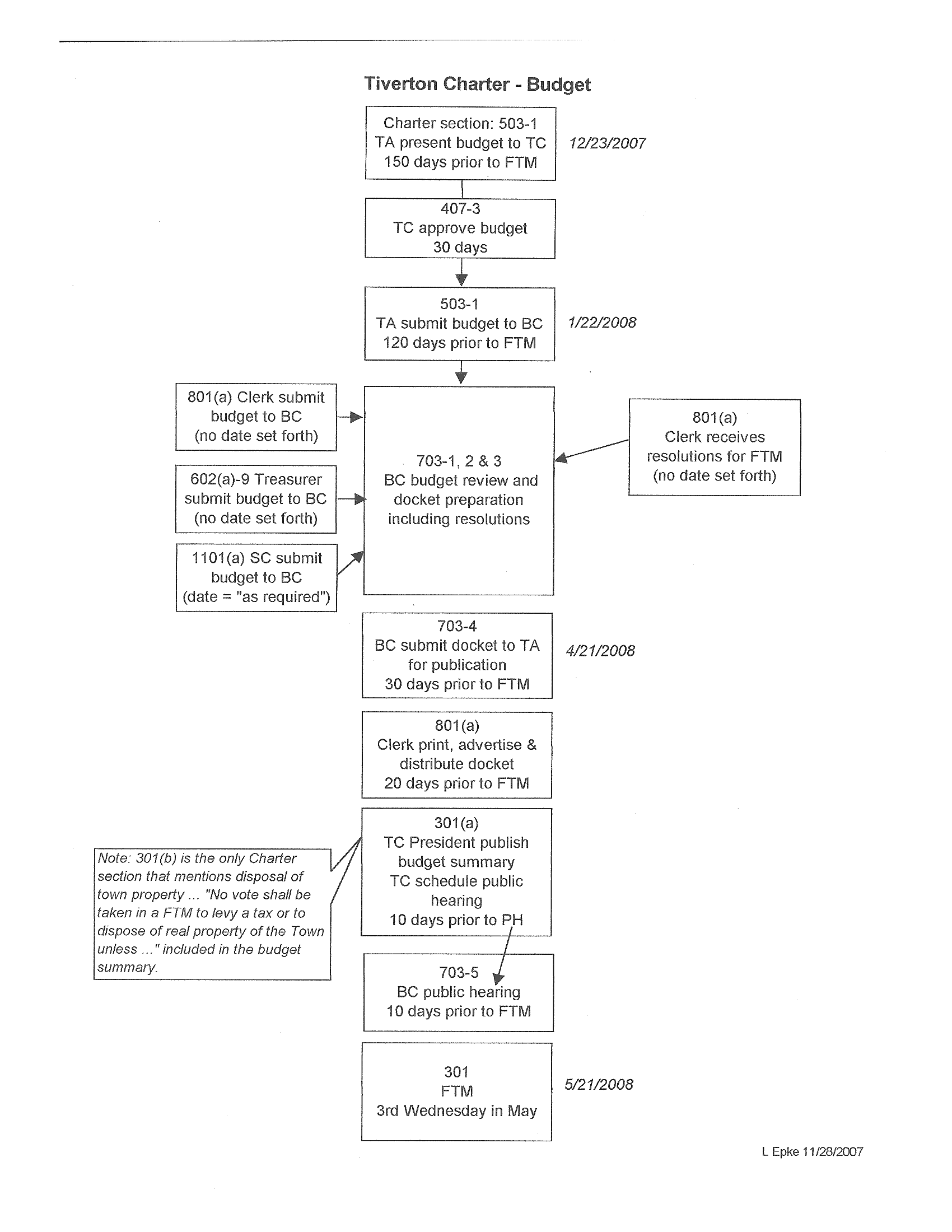
After quite a bit of debate, the answer is: ultimately the voters. And how do they know whom to hold responsible?
Personally, I don't see the big mystery about giving the voters a greater say in those "untouchable" contracts: give them the electorate's power over the key negotiator. Tiverton's executive authority currently rests with a town administrator whom the town council hires. Perhaps if he were elected, the town would have a point man whose employment would more directly rely on citizens' getting the government that they desire or, alternatively, an elected watchdog in the town government.
Changing the administrator to the mayor strikes me as within the purview of a charter review commission.
Keeping the Blanket on the Parties
My suggestion to have the Charter Review Commission reconsider asking the voters whether they'd like to have partisan elections was just shot down. A commission member who wasn't here for my spiel last time, Frank "Richard" Joslin (I'm almost positive), himself a member of the town Democrat committee, spoke against me, making two points to which I would have offered rebuttal had I had opportunity:
- It's a small town, and everybody who cares to vote (or gets involved) knows who belongs to what party.
- His fellows on the Democrat committee are very ideologically diverse, so it serves no end for voters to know that they are all Democrats for the purpose of electing them.
Regarding the first point, I'd offer my testimony that Richard is patently wrong — and in a way that highlights the problem of the supposed non-partisan elections: When I began looking into the party affiliations of Tiverton's elected officials, I had to look for such things as political donations and old, pre-non-partisanism election results. Is this the marker of good government? That a piece of information about elected officials ought to require private-eye-style investigations? The idea that the circumscribed group that currently participates in the running of the town of Tiverton ought to have largely exclusive access to an absolutely relevant bit of data is a recipe for exclusion, apathy, and stagnation.
This bleeds into my response to the second point: Whether party affiliation should be a consideration while voting ought to be a decision that the voter makes for him or her self, not a dictation from the limited group that makes the rules. Moreover, if party affiliation means nothing, then why does Tiverton have a Democrat Committee in the first place? And why does that committee promote its members for town offices?
Clearly, whether Richard's fellow Democrats are liberal, conservative, or simply cantankerous, there is something that they have in common that causes them to gather and work together, and inasmuch as the party is a political organization, that something would seem relevant our self government. Richard may not like the idea that people might hold his party affiliation against him (one of his expressed concerns), but then perhaps he ought to question why he is involved with the party in the first place.
And frankly, given the condition of this Democrat-run state — for which condition the municipalities bear their share of blame — it is preeminently rational for voters to hold their party affiliation against them.
Governing the Empty Seats
Alright. I realize that a Charter Review Committee meeting is hardly likely to generate passions and intrigue, but the Tiverton town hall is mostly empty. The committee is currently discussing ways to market the meetings.
The truth is that even the "big" meetings of town government types — the town council and the school committee — are sparsely attended as a matter of course. Individual issues sometimes bring their own crowds, of course, and that ought to indicate something: Any contingent that made an effort to attend these meetings could have a disproportionately large effect.
Disappointingly, it seems as if the only organized group that pervades state and local governments in Rhode Island — the Democrat Party — has slipped by default into the role of conducting the meetings (so to speak). Arguably, that pervasive presence saves certain well-known special interests the effort of attending at times that their numbers aren't needed.
I should emphasize that I'm not saying that the particular members of a town government such as Tiverton's (much less its minor councils and committees) are stand-ins for special interests. However, there's a cumulative effect to imbalanced participation, as well as a sort of potential energy of political action.
November 25, 2007
I, Mindless Taxpayer
There's that learning curve again. Amidst all of the things that I've had to learn as a homeowner (not including carpentry, plumbing, electrical, and so on), it took me until today to realize an important part of my town's tax structure: In addition to my annual property tax bill for the Town of Tiverton, I pay property taxes to the North Tiverton Fire District. Part of what confused me about the bills is that the NTFD also charges me for my water usage (leading me recently to question why my water bill was so much higher than it ought to have been, because I confused the taxes for the water charge). What's worse is that the fire district taxes have nothing to do with, you know, the fire department.
According to a 2006 report on Rhode Island Fire Districts (PDF), Tiverton and Portsmouth are the only towns in the state with fire districts that provide "water supply only." Yet until this year, the North Tiverton rate was just at the average for the state, even as its per-usage water rate (PDF) is well above the average — third highest in the state.
It's also interesting to note the intramunicipality comparison. North Tiverton is the working-class side of town, but for some reason, its rates are higher all around than those of the Stone Bridge Fire District. Our taxes are $0.62 per $1,000 of property value to their $0.30, and our water costs $5.32 per 1,000 gallons to their $3.90. It may be the case that it is just extremely difficult to get water to residents of North Tiverton, in which case it might be unfair to jack up the prices for the rest of the town, but one would have to break down all town expenditures by fire district in order to see whether it's fair to break out this particular cost.
Whatever the case, both the additional tax and the cross-town differences bear further research. They also don't cool my ire about the truly terrible water pressure in my neighborhood.
November 24, 2007
Having Parties in Tiverton
Although it's not online, a letter of mine encouraging my fellow residents of Tiverton to ask the Charter Review Commission to reopen the question of partisan elections is in the current issue of The Sakonnet Times:
To the editor:At the latest Charter Review Commission meeting, member Frank Marshall made a successful motion to strike from the commission's to-do list consideration of a ballot question that would bring party labels back to Tiverton elections. We don't need them, he asserted; everybody who gets involved in local government is there simply to work hard for and do right by the town. Even taking his assertion as a given, however, it is immaterial to the question of whether the political parties to which those well-intentioned citizens belong ought to be publicly known.
Despite the implication of arguments for nonpartisan town government, being openly affiliated is not unseemly. Exactly what it means to "do right by the town" is not a matter of clear and objectively identifiable decisions; it's a matter of subjective preference and ideology. A candidate's party affiliation will tell citizens something about what his or her approach and priorities will be.
School Committee member Leonard Wright is the Tiverton Democratic Committee Vice Chair. Is he governing less as a Democrat because the school committee is nonpartisan? Town Council President Louise Durfee has run for governor as a Democrat, a Democrat governor's director of the DEM, and contributes to Democrat candidates for higher office. In what way is she nonpartisan? Four members of the Charter Review Commission --- Cecil Leonard, Frank Joslin, Raymond Medeiros, and Stanley Zeramby --- were publicly endorsed by the Democratic Committee, which offered voters rides to voting locations, and of which they are all members. How, exactly, was their election nonpartisan?
These revelations aren't meant to imply inappropriate behavior on these folks' part, but with all of the care and concern that interested citizens will observe among elected and appointed members of the Tiverton government when it comes to observing open meetings laws, avoiding quorums for non-meeting events, and so on, this deliberate omission seems incongruous. I'll confess to the hair-trigger on my suspicions, but when people in government (politicians all, ultimately), throw a blanket over a particular appurtenance, I can't help but worry about the allowances of secrecy.
The commission meets again on Wednesday, November 28, at 7:00p.m. at the town hall, and its policy is to listen to the open-mic suggestions of the public. Whichever party it may benefit, the people of Tiverton are better served by truth in labeling than by a pleasant illusion of nonpartisanism, and all we need do is ask.
November 15, 2007
That's Tellin' 'Em
Unfortunately, Melissa Wicks's letter to the Sakonnet Times does not appear to be online, but the Tiverton resident has a point of view with which many folks outside of town government and a specific neighborhood probably sympathize:
Since the current Sakonnet River Bridge is so pristine, I can see why there is a $14 million argument over the looks of the new bridge.Actually, it's ridiculous. Who cares what it looks like as long as we all have the convenience of driving over it, including trucks that weigh more than 22 tons. Is the fabulous paint job going to make it more structurally sound? Is not having a paint job going to make people drive around the entire state?
Doubt it. Use the $14 million on something that's worth it and stop arguing over something so bloody stupid.
For the record, the argument has nothing to do with paint. The question is whether the structural steel (all beneath the road, as I understand it) will be stainless or "weathered," which develops a consistent rust-colored patina. Ultimately, therefore, the debate might as well be over a paint job. (The only additional consideration with weathered steel is that it requires the design to collect and redirect runoff water, which can stain surfaces such as concrete if it's allowed to simply flow down.)
November 14, 2007
Party, Shmarty, Everybody Works Hard
During a brief break, some of my fellow attendees of the Tiverton Charter Review Commission meeting engaged me in discussion, with two interesting points made:
- A Republican suggested that running as such probably costs a candidate votes.
- A Planning Board member suggested that, in Tiverton (at least), party doesn't really matter, because anybody elected to office is there to work hard and do right by the town.
I don't doubt that both of these suggestions are accurate, but they strike me as beside the point. Regarding the first, it isn't necessarily a permanent state of affairs that citizens are thoughtlessly wooed to the Democrats by "R"-labeled bogeymen. With the monopartisanism of the state being such a problem, making party ostensibly irrelevant to local governance hardly helps. The people of Rhode Island have an interest in explicitly strengthening the opposition party. Two benefits of doing so (both of which may prove to be of great importance in the state's near future) are that it:
- Gives a clear alternative via which dissatisfied citizens can express that dissatisfaction
- Can create an atmosphere of constructive contention.
The point that people involved in municipal government are simply there to do right by the town was actually made subsequently by commission member Frank Marshall as part of his successful motion to strike the matter from the commission's list of items to consider. I would (and will) argue that even universally good intentions among town governmentals is immaterial to the question of whether the political parties to which they belong ought to be publicly known.
School Committee member Leonard Wright is the Democratic Committee Vice Chair (for Tiverton, I gather). Is he governing less as a Democrat because the school committee is "nonpartisan"? Town Council President Louise Durfee has run for governor as a Democrat, has been appointed to the DEM, and contributes to Democrat candidates for higher office. In what way is she nonpartisan?
Despite the apparent implication of arguments for nonpartisan town government, being openly affiliated with a particular party is not untoward. "Doing right by the town" doesn't involve clear and objectively verifiable decisions, and a candidate's party affiliation will tell citizens something about what his or her approach to making them will be.
Moreover, the civic participation of townies is not disconnected from the usual party activity just because they white-out their affiliation. Somebody at tonight's meeting suggested that nonpartisan elections mean it's up to the individual candidates to get out among the people and make their cases. But the reality is that the majority of voters (let alone the majority of citizens) barely recognize the names on the ballot, let alone the views of the folks who bear those names. To the extent that the candidates are able to get their names and messages out there, it is through the usual political methods and organs, which are steeped in partisan politics.
With all of the care and concern that elected and appointed members of the Tiverton government devote to observing open meetings laws, avoiding quorums for non-meeting events, and so on, why ought they hide their allegiances? I'll confess to the hair-trigger on my suspicions, but when people in government (politicians all, ultimately), throw a blanket over a particular appurtenance, I can't help but fear that it is actually the behavior out of sight beneath it that is untoward.
ADDENDUM:
I notice that, of the nine members of the commission, four are members of the Tiverton Democratic Town Committee. And unless I'm mistaken, Deborah Pallasch was the only commission member, of the seven there, to vote against removing the nonpartisanism question from the working document.
How Things Happen (?)
I wasn't planning to attend tonight's meeting of the Tiverton Charter Review Commission, but based on the concern about its actions expressed by the school committee last night, I thought it worth observing. Also based on that concern, I sorta expected the attendance to be greater. I'm one of nine non-commission attendees, a group including:
- Two members of the planning board
- A member of the school committee
- The school superintendent
- A member of the town council
The others here may very well be similarly involved, but I haven't gotten to the point in my own involvement to recognize them. I'm also not entirely sure what the powers of this commission are, but the absence of regular ol' citizens is disappointing.
ADDENDUM:
Well, I couldn't help but take the podium to make some points that may betray me as rogue citizen who doesn't really understand the processes and history of the issues:
- Bring back partisanism to the elections. It's a sham, anyway, and it removes the ability of citizens (most of whom are voting for strangers
- Keep financial town meetings, if only because the lack of participation is an important bit of information for citizens to know. (Heck, it got me started participating in local issues.)
- Do not lower quorum minimums, because we risk getting within the range in which special interests can achieve a quorum from among their own member and sympathizers.
- Find a way to give citizens more say in the negotiation and approval of the contracts that are taking away the purpose of a financial town meeting.
How Things Happen (?)
I wasn't planning to attend tonight's meeting of the Tiverton Charter Review Commission, but based on the concern about its actions expressed by the school committee last night, I thought it worth observing. Also based on that concern, I sorta expected the attendance to be greater. I'm one of nine non-commission attendees, a group including:
- Two members of the planning board
- A member of the school committee
- The school superintendent
- A member of the town council
The others here may very well be similarly involved, but I haven't gotten to the point in my own involvement to recognize them. I'm also not entirely sure what the powers of this commission are, but the absence of regular ol' citizens is disappointing.
ADDENDUM:
Well, I couldn't help but take the podium to make some points that may betray me as rogue citizen who doesn't really understand the processes and history of the issues:
- Bring back partisanism to the elections. It's a sham, anyway, and it removes the ability of citizens (most of whom are voting for strangers
- Keep financial town meetings, if only because the lack of participation is an important bit of information for citizens to know. (Heck, it got me started participating in local issues.)
- Do not lower quorum minimums, because we risk getting within the range in which special interests can achieve a quorum from among their own member and sympathizers.
- Find a way to give citizens more say in the negotiation and approval of the contracts that are taking away the purpose of a financial town meeting.
Re: "What Can We Do?"
At last night's Tiverton town council meeting, my man Councilor Hannibal Costa took the opportunity of a routine tax assessor request (regarding the firm that will handle the assessment) to make everybody well aware that he's not going to sit idly by while rates get jacked up — what with all those houses sitting on the market as people cash out on their Tiverton properties. In the discussion that followed, Council Vice President Donald Bollin offered the following explanation (with the wording pretty close):
If the values go down, then we have to raise the rates. There's nothing we can do.
No hint of a suggestion that if the people of the town are getting poorer (via the devaluation of their largest assets), perhaps the town ought to cut back on its expenditures. Yet somehow, governments never talk about cutting the tax rates when citizens' property is increasing in value, giving the town more money than it needs.
Re: "What Can We Do?"
At last night's Tiverton town council meeting, my man Councilor Hannibal Costa took the opportunity of a routine tax assessor request (regarding the firm that will handle the assessment) to make everybody well aware that he's not going to sit idly by while rates get jacked up — what with all those houses sitting on the market as people cash out on their Tiverton properties. In the discussion that followed, Council Vice President Donald Bollin offered the following explanation (with the wording pretty close):
If the values go down, then we have to raise the rates. There's nothing we can do.
No hint of a suggestion that if the people of the town are getting poorer (via the devaluation of their largest assets), perhaps the town ought to cut back on its expenditures. Yet somehow, governments never talk about cutting the tax rates when citizens' property is increasing in value, giving the town more money than it needs.
2,606 - 722
The Projo is reporting that Stephen Tocco has lost his seat on the Smithfield Town Council by a decisive margin.
November 13, 2007
Tuesdays with Tiverton
Thanks to the holiday, both the town council and the school committee are meeting tonight, and I've discovered that I'm not yet sufficiently informed to be able to spot the hot-button items on each body's bland-looking agenda. So, I've started with the committee and will hit the council on my way home if the town hall is still inhabited.
So far the Tiverton High School auditorium is quiet. Pat Crowley, who has been absent from Anchor Rising for some time now, appears to be absent from this meeting, as well.
Perhaps he's lurking...
November 8, 2007
Cranston's Fire Department - Staffing Levels
Under "Institutional Racism, Quotas and Cranston", commenter EMT makes the following observation:
Actually, they need another station in Western Cranston (10-minute response times are unacceptable for a paid department in 2007), and NFPA-complaint staffing department wide. It would probably double the department, minus a few.
There are a couple of broad implications in this comment. The first is that the Cranston Fire Department is understaffed. The second is that all fire stations in Cranston are ideally located. Both of these are flatly contradicted by the Performance Audit of the Cranston Fire Department conducted in 2003.
Staffing level from a cost analysis:
The ICMA [International City/County Management Association] publishes data relative to average fire per capita costs for cities in specific population ranges. The per capita costs listed in the ICMA Municipal Year Book, 2003 for 2002 per capita costs are as follows:126 cities with a population range of 50,000 to 100,000: $118.45
60 cities with a population range of 100,000 to 250,000: $125.53
17 cities with a population range of 250,000 to 500,000: $119.94
7 cities with a population range of 500,000 to 1 million: $127.42The City of Cranston Data for FY2002:
Cranston-Rhode Island Web site (80,072 ÷ $21,134,085) $263.94
Caution is required in the interpretation of the data. The ICMA notes that its average per capita costs include retirement and medical costs.
Staffing level on a per capita basis:
The per capita staffing listed in the ICMA Municipal Year Book, 2003 for 2002 staffing is as followsCity Classification Total Uniformed/Sworn
73/69 cities in New England 1.70 1.67
7 cities with a population range of 500,000 to 1 million: 1.93 1.69
17 cities with a population range of 250,000 to 500,000: 1.42 1.42
81/79 cities with a population range of 100,000 to 250,000: 1.57 1.41
152/148 cities with a population range of 50,000 to 100,000: 1.52 1.35The data for Cranston:
Cranston Authorized (202 Uniformed, 208 Total - 80,072): 2.59 2.52
City of Cranston - 2003 Estimated Population 81,674: 2.54 2.47
The audit points out not only that
If the Department equaled the fire staffing ratio of Uniformed/Sworn per 1,000 residents for the average of 148 cities with a population of 50,000 to 100,000 (1.35 x 81.674 -2003 estimate), Cranston would need 111 Uniformed/Sworn personnel, substantially fewer than the current 202
but that fire department staffing levels exceed those for the Cranston Police force.
In the Study Team’s experiences in 40 states, it is most unusual for a fire department to have a higher ratio or number of sworn personnel per 1,000 population than police departments in those ... same cities. In Cranston, the Fire Department has 53 more uniformed/sworn positions than the Cranston Police Department.
As to the present location of fire stations within the city:
Fire Stations 1 and 2 are approximately .5 and .6 miles, respectively, from the borders with Providence and Warwick. The proximity to the city border means that these two fire stations, where currently located, will never have full service areas within Cranston as compared to the other fire stations. These fire stations have “half/partial pie-shaped” response areas which do not allow them to operate as efficiently as the other fire stations in terms of service for the dollars spent.Moreover, Fire Stations 1, 2, and 3 are very close together, .9 miles between Fire Stations 1 and 2 and .8 miles between Fire Stations 2 and 3, via the closest response routes. When considering the 1.5 mile ISO coverage standard for engine companies, these fire stations are significantly closer geographically than necessary.
Fire Stations 4 and 5 are approximately .75 and .7 miles, respectively, from the border with Warwick. This proximity to the City border means that these two fire stations, where currently located, also will never have full response areas within Cranston as compared to the other fire stations. These fire stations also have “half/partial-pie shaped” response areas which does not allow them to operate as efficiently as the other fire stations in terms of service for the dollars spent. Moreover, the proximity of Fire Stations 4 and 5 to each other is 1.3 miles, and indicates that there may be up to 1.5 miles of over-coverage between the engine companies located at these two fire stations.
The audit addresses the over-staffing and uneven distribution of fire stations with specific suggestions, including the reduction and consolidation of staffing as well as the relocation of Fire Station 4 to the Oaklawn Avenue/Route 37 area. Focusing back on EMT's call for a new fire station in western Cranston, it appears that the staffing of such a station could be accomplished in house, with or without closing Fire Station 4, but certainly without additional hires.
November 6, 2007
Regional Government in Two-and-a-Half Acts
Most of the changes that the Department of Transportation proposed to the new Sakonnet Bridge project, last night, were centered on cost savings. The bridge will be starting closer to the water; parts of it will be built on back-filled land (rather than additional structural columns); the metal will be "weathered steel," which acquires a consistent brown color over time (rust colored, but not splotchy or suggestive of decay), rather than stainless steel.
Now, it's the job of local elected officials to fight for ideal circumstances for their constituents, and the disrepair of the current bridge, with its weight restrictions and shabby look, certainly cost the town in money, convenience, and aesthetics. Assurances ought to be sought that the bridge won't (1) soon be in need of major repair or replacement and (2) look like a slap-dash affair.
It's a bit much, though, to hear a largely (perhaps totally) Democrat town council, along with the state representatives in attendance, harangue a Dept. of Transportation representative over poor upkeep and cost saving efforts. Council VP Donald Bollin insisted, to DOT Deputy Engineer Kazem Farhoumand, that the old bridge should be repaired such that the weight limit could be lifted, and then the new bridge built "whatever the cost will be to get a bridge that will last."
Not having researched the project extensively, I can only surmise that sufficient repairs to the old bridge would be such an extensive undertaking that simply replacing it is ultimately more efficient and cost effective. That some elected officials and citizens of the town gave scarcely lip service to the savings suggests that they don't see the expense as their own. It's "get as much as you can," without a broader picture of the costs of that approach.
According to the Newport Daily News article about last night, the current projected cost of the project is around $180 million. If DOT's federal funding breakdown (which I found under its Web site's FAQ of "Where does the Rhode Island Department of Transportation get its funding?") is the whole story, only about 13% will come from earmarked federal funds. Unless I'm missing something, that means that the rest of the funds are allocated under state control.
To broaden the picture, consider the state's 2008 budget appropriations (PDF): Federal funds account for 73.4% of DOT's entire budget. In other words, the state contributes very little to the department beyond what it procures from above. Transportation, altogether, accounts for just 5.4% of all state appropriations, while DOT's share represents 13.7% of the state's total federal funds. If the bridges are in disrepair, the blame lies with a state government that relies disproportionately on a higher layer of government to cover the costs.
For all of the fear that building the bridge more cheaply will harm the town, I didn't hear any hint that the state legislators intended to take another look at the structural reasons that DOT's maintenance record leaves much to be desired. I also didn't hear any suggestion that the town would find money in its budget to cover discarded amenities.
As I wrote last night, such infrastructural items as roads and bridges ought to be a central responsibility of government, not a dependent investment based on whatever revenue can be drawn above and beyond internal resources. Anybody who's upset at their lost glimpses of water or the brownish hue of the bridge ought to direct their ire at the people who've come up with a thousand better uses for our money, from enviable remuneration packages for public union employees to generous handouts to the state's free-riders.
November 5, 2007
A Bridge to Somewhere
Tonight's Tiverton Town Council meeting will almost entirely — excepting the closed executive session, of course — be taken up with a presentation concerning some proposed changes to the New Sakonnet Bridge from Tiverton to Portsmouth. I will say this: comparing the before and (proposed) after pictures really gives one a sense of what government funds ought to be used to accomplish.
The new bridge will certainly be an improvement, not the least because it will allow for pedestrian and bicycle traffic. It doesn't take much to improve quality of life incrementally.
It's also been edifying to note that this "special meeting" (and the multimillion dollar project that it addresses) is of sufficient import to bring out my state-level representatives. Hopefully, they're having similar thoughts to mine with respect to worthwhile and appropriate government expenditures (beyond, you know, the rub-and-tug political benefits).
ADDENDUM:
Unfortunately, I decided to start bringing my laptop to these things, rather than relying on my stealth bloggerware, and all of the meeting setup has put all of the important people behind me, so they can all plainly see that I'm spending most of the time reading the Corner etc.
October 28, 2007
Chartering Citizen Negotiations
I see that the Tiverton Charter Review Commission, formed to take a closer look at the town's practice of financial town meetings and propose changes on the November 2008 ballot, has also taken up a possible change that I pondered last month:
Another suggestion would have the town return to partisan elections.According to that line of thinking, "the American system benefited from the party label and we were being foolish at the town level not to recognize at least two parties," Leonard said.
He said he "didn't notice any lack of activity by the political parties" in the last election.
"Both Democrats and Republicans worked to support their candidates," he said, even though party affiliation is not listed on the ballot.
Unless partisan organization is to be banned for these elections (and good luck with that), it makes no sense to hide the affiliations of those whom the public chooses.
Unfortunately, it isn't agreement that is leading me to consider adding this commission's meetings to my "to attend" list. It's this:
... legally binding labor contracts with school and municipal workers and other long-term financial commitments necessary to run the town's affairs mean that the voters don't have any real discretion over much of the budget, Leonard said.For example, Leonard said, "the amount of money allocated for heating oil is variable," but there is now a contract for that too.
"The purpose of the Financial Town Meeting has dwindled as more and more things have developed in a contractual manner," he said.
Of all the trends that need arresting, the burgeoning "what can we do?" excuse of politicians may top the list. With contracts discussed at sparsely attended meetings and decided in executive sessions, with straight-armed public participation amounting to disgruntlement at negotiations' length and momentary reactions when deals are announced, any opportunity for citizens to throw wrenches in the budgetary clockwork ought to be preserved.
In some ways, a charter review may be thought of as residents' opportunity to negotiate a new contract between themselves and their local leaders. Somehow, I don't expect them to invest as much time and energy into the process as the town's employees and service providers do their own negotiations.
October 23, 2007
Empathy with Apathy
I very much wanted to attend Donna Hughes's lecture this evening at URI's Kingston campus, but with teacher contract negotiations still ongoing, I felt somewhat obligated to attend tonight's school committee meeting. Committee and union members alike may be asking: What school committee meeting? Apparently, it was canceled, but I'm not sure how a regular ol' citizen could have known.
The Town of Tiverton's Web site doesn't mention anything, even in the Quick Announcements and Notices section. The town calendar doesn't even include school committee meetings. The parent handbook says, "Announcement of all regular School Board Meetings will be made to the Newport
Daily News as least two (2) days prior to the meeting by the Superintendent," but that paper's Web site doesn't seem like the place to check for updates. Nor does the Fall River Herald News, to which the school committee's page instructs readers to turn, instead of the Newport Daily News.
Having a simple and consistent means for interested townspeople to check for basic operational information that will allow them to plan their lives is a basic requirement for a functional governing body. I have to say that I can empathize with my fellows' apathy. This sort of unpredictability is unacceptable, and it only helps those who've organized in order to take as much as they can from the taxpayers.
It is incredibly simple, and virtually free, to set up an email list to which all interested parties can subscribe in order to receive up-to-date schedule changes and announcements. (And their receipt of the emails will help to motivate citizens' attendance.) At the very least, there ought to be a single page on the Internet to which all town boards and committees can post announcements.
October 22, 2007
Budget Inflation
You know, in the handful of town council meetings that I've attended in Tiverton, I don't think I've seen the council vote down a single increase in spending.
Glenn Steckman, the town administrator, just requested permission to advertise for an assistant position that would represent roughly a $10,000 per year increase in salary expense. (The current assistant is under contract, so I suspect increased benefits would also be a consideration.) The council gave him permission to advertise the position, but made no commitment on salary, just yet. The likelihood is minimal, it seems to me, that the council, upon receiving résumés, much less hearing the results of interviews, would decide not to go with the new position.
Inasmuch as I still haven't climbed the learning curve, I can't say whether such a position is worth the expense. I do, however, see a large number of For Sale signs in my neighborhood. And the little guy's hero on the council, Hannibal Costa, is not in attendance.
I really don't want to become more of a troublemaker than I already am, but many more spending-increase approvals, and I don't know whether I'll be able to resist an old time usurpation of the podium.
ADDENDUM:
I should note that the council's spending has not struck me as profligate or unconsidered. I just don't think I've seen it turn anything down.
Budget Inflation
You know, in the handful of town council meetings that I've attended in Tiverton, I don't think I've seen the council vote down a single increase in spending.
Glenn Steckman, the town administrator, just requested permission to advertise for an assistant position that would represent roughly a $10,000 per year increase in salary expense. (The current assistant is under contract, so I suspect increased benefits would also be a consideration.) The council gave him permission to advertise the position, but made no commitment on salary, just yet. The likelihood is minimal, it seems to me, that the council, upon receiving résumés, much less hearing the results of interviews, would decide not to go with the new position.
Inasmuch as I still haven't climbed the learning curve, I can't say whether such a position is worth the expense. I do, however, see a large number of For Sale signs in my neighborhood. And the little guy's hero on the council, Hannibal Costa, is not in attendance.
I really don't want to become more of a troublemaker than I already am, but many more spending-increase approvals, and I don't know whether I'll be able to resist an old time usurpation of the podium.
ADDENDUM:
I should note that the council's spending has not struck me as profligate or unconsidered. I just don't think I've seen it turn anything down.
October 9, 2007
In Attendance
The number of cars in the parking lot of the Tiverton High School was surprising and forced me to park way out in a dark lot. The girls' basketball game accounts for much of that, but the school committee meeting is the most heavily attended that I've seen yet. So far all is proceeding without event.
In Attendance
The number of cars in the parking lot of the Tiverton High School was surprising and forced me to park way out in a dark lot. The girls' basketball game accounts for much of that, but the school committee meeting is the most heavily attended that I've seen yet. So far all is proceeding without event.
October 3, 2007
East Providence: New "Heights" of Voter Fraud
Accusations of voter fraud in East Providence reached a hitherto unexplored level tonight when it was revealed that recently appointed School Committee Member Stephen DeCastro (D) is registered to vote in both Bradenton, Florida and East Providence, Rhode Island.
In an emergency meeting at East Providence City Hall prompted by an inquiry from the Tax Assessor's Office, the East Providence Board of Canvassers reviewed documentation including certification that Mr. DeCastro was registered to vote in Manatee County, Florida as of July 27, 2004 and his Rhode Island Voter Registration Form indicating that he voted in the November, 2004 election in East Providence.
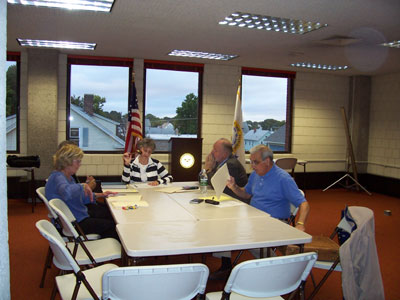
It was noted that Mr. DeCastro had also voted in the 2006 election in East Providence but no documentation was presented because the East Providence Canvassing Authority had switched over to all electronic records by then. It is not presently known if Mr. DeCastro also voted in Florida in 2004 and 2006.
While cautioning the Board that there may be mitigating circumstances (my characterization) to Mr. DeCastro's dual voter registration, East Providence City Solicitor William Conley also presented documentation or provided testimony that Mr. DeCastro had claimed homestead exemptions on both his Florida and Rhode Island residences (the latter potentially qualifying him for a 15% discount off the assessed value of his East Providence property); that he possesses a Florida drivers license; that he has vehicles registered in East Providence and that he specified his East Providence address on his personal income tax returns.
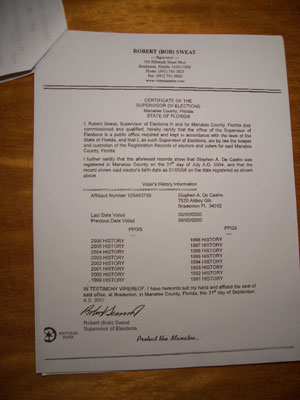
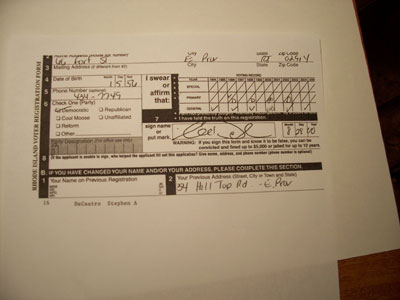
On the basis of the considerable documentation placed in front of them, the Board of Canvassers voted to formally challenge Mr. DeCastro's right to vote in East Providence.
UPDATE
According to Alisha Pina at the ProJo, School Committee Member DeCastro did not also vote in Florida.
UPDATE II
Images added.
September 27, 2007
Smithfield: Democracy Denied by Thirty Six Minutes
In a special election set for November 13, Smithfield voters will have the opportunity to answer the question:
"Should Stephen G. Tocco be recalled and removed from the office of Town Councilman for the Town of Smithfield under the Recall Provision as set forth in Article IX of the Charter of the Town of Smithfield?"
Over 3,000 Smithfield residents signed the petition, which set in motion the effort to remove Smithfield Town Council President Stephen G.Tocco. But if Smithfield votes Councilman Tocco out of office on November 13, the choosing of his replacement has been taken out of the voters' hands and placed within the exclusive purview of the Smithfield Town Council.
In a serious blow to the democratic (small "d") process, the Smithfield Town Clerk and Chairman of the Board of Canvassers missed a critical filing deadline with the Secretary of State by thirty six minutes — or possibly by just six minutes:
[Town Clerk Diane] Ady said later that someone at Town Hall had called [Secretary of State Ralph] Mollis's office to ask when the office closed. The answer was 4:30 p.m., she recounted. She and the canvassers assumed that the deadline was 4:30, but it actually was 4 p.m.
With this missed deadline, the recall election will take place less than a year prior to the next election. Smithfield's Town Charter dictates, then, that the selection of the replacement councilor falls to the Town Council and that he or she must be of the same party affiliation (Democrat, in this case) as the recalled councilor.
To review. Smithfield officials fail beforehand to correctly ascertain the deadline for the required certification and signatures to reach the Secretary of State. No valid reason has been offered afterwards for the missed deadline. And most telling, on the fateful day of September 14, the Chair of the Smithfield Board of Canvassers, Pasquel Matteo, did not sign the requisite document until 4:10 p.m., leaving only nineteen minutes for the trip from Smithfield to the Office of Secretary of State in Providence. (During rush hour.)
How very Rhode Island that a "miscalculation" should default to the detriment of Smithfield voters.
(The interesting case for Councilman Tocco's recall is here.)
September 25, 2007
The Non-Partisan Route to Homopartisanism
For some reason, it didn't register when last I filled out a Tiverton ballot (for the first time) that most of the town's key offices are "non-partisan." That doesn't necessarily mean that the representatives aren't affiliated with a party — either officially or ideologically. It just means that voters and taxpayers have to take a very keen interest in the partisan breakdown in order to figure it out.
I became interested when I discovered that my potential hero on the Tiverton Town Council, Hannibal Costa, is in fact a Democrat. After some online research of prior listings, political donations, and news articles, which I hope to supplement with a more thorough investigation in the future, I've put together the following overview of some key bodies/offices:
- Town Council:
- Louise Durfee (president): Democrat
- Joanne Arruda: Democrat
- Donald Bollin: Democrat
- Hannibal Costa: Democrat
- Paul Carroll: Democrat
- John Edwards: [don't know]
- Brian Medeiros: [don't know]
- Town Administrator:
- Glenn Steckmann: [don' know]
- School Committee:
- Denise deMedeiros (chairwoman): Independent
- Michael Burk (vice-chairman): Democrat [not confirmed, but confident]
- Sally Black: Democrat
- Jan Bergandy: [don't know]
- Leonard Wright: Democrat (Democratic Committee Vice Chair)
The two "don't knows" on the town council could go either way, as could the town administrator. The two "don't knows" on the school committee, I'd be comfortable placing tentatively in the Democrat column on the basis of their both being professors, as I understand. The point is that this "non-partisanship" seems peculiarly likely to result in an overwhelming number of Democrats.
If we put aside the lefty quip that Democrats support the policies that most people want, and if we acknowledge, but move on from, the observation that there are almost three times as many registered Democrats as registered Republicans in Tiverton (although unaffiliated voters make up 55% of the electorate), there's a ready explanation for this blind lopsidedness: Given an apathetic citizenry, town positions are won mainly on the strength of name recognition, and even if candidates are not advertised as belonging to a particular party, those party organizations can still help (and pay) to build just that. Moreover, on a list of mainly unknowns, this large advantage to the state's vastly dominant party is exacerbated by the fact that citizens can't cast their votes based on the likelihood that party affiliation means a given candidate is closer to their views.
I don't know how many towns in Rhode Island are similar to Tiverton in this proud, but counterproductive, insistence on erasing partisan labels. It would seem a natural issue over which the state GOP could make some hay, while simultaneously expanding awareness that the monolithic party system is corrosive.
Justin Q. Public, Unwanted
Apparently — as the janitor informed me when I hopped out of the minivan with bloggerbag (aka a canvas briefcase) in hand — the union and the Tiverton school committee have decided to take eleven days off. So, no school committee meeting tonight.
The way things operate 'round here, it's as if the interested citizen is meant to learn to decipher, over the course of a few months, some hidden message in the town's meeting schedule saying, "Participation not encouraged."
I'm sure that town officials of various stripes have sat through their share of meetings with no public participation and have therefore decided not to waste their time meeting for the benefit of empty rooms. But the flip side of that decision is that the public has ever less reason to attend.
Couldn't the school committee have announced (and publicized) an opportunity for interested citizens to comment on the contract negotiations? It might be that the first effort at that sort of a meeting would feel like time wasted, but if such opportunities were expected, they would be better attended.
In the meantime, I guess I'll chalk it up to a victory for the union — albeit a minor one, as modesty requires me to admit — that there will be no first-hand observations of hostile behavior posted on Anchor Rising this evening. (Of course, a backfire could be seen in the fact that I now have more time tonight to ponder broader matters and to do some organizational-type thinking.)
September 24, 2007
Another Notable Moment
Tiverton Town Councilor Brian Medeiros just proposed — and the council approved unanimously — a statement of support for the school committee's "efforts to contain costs" within the boundaries set by the property tax cap with respect to the teachers' union contract. Although the movement is largely symbolic, it's very encouraging to see the council express trust in a school committee that has been standing firm.
It was also notable that School Committee Member Sally Black took the podium to add to the record a recognition that all of the town's spending derives from a single "pie," and that as public officials deal with each item, they should (paraphrasing: "at home under their comforters with a glass of wine") consider the police officers and public works employees out there performing their necessary duties for the town.
Another Notable Moment
Tiverton Town Councilor Brian Medeiros just proposed — and the council approved unanimously — a statement of support for the school committee's "efforts to contain costs" within the boundaries set by the property tax cap with respect to the teachers' union contract. Although the movement is largely symbolic, it's very encouraging to see the council express trust in a school committee that has been standing firm.
It was also notable that School Committee Member Sally Black took the podium to add to the record a recognition that all of the town's spending derives from a single "pie," and that as public officials deal with each item, they should (paraphrasing: "at home under their comforters with a glass of wine") consider the police officers and public works employees out there performing their necessary duties for the town.
A Reliable "Opposed"
This meeting is definitely stretching out, but I'm glad that I've remained because I've witnessed a notable moment. To paraphrase Councilor Hannibal Costa (who has previously railed against unfunded mandates from the state), on a discussion about advertising to fill administrative jobs:
If you look around the town, you'll see that we have a lot of properties for sale. We have reached the point that any further taxes will force people to leave. We're not talking elderly people, here. With each new tax and assessment people are deciding that it's just not worth it to stay.
I've had a very difficult time figuring out councilors' party affiliations, but I hope that Mr. Costa is Republican, and if he is, let me offer a keep-'im-in-mind to the state party.
Let's Keep Everything Important Under Wraps
If I had the authority — as an audience member — I'd move to end executive sessions at these town council meetings.
The council is running through a list of appointments and pretty much rubber stamping applicants (who are far outnumbered by openings, it seems), and the discussion over a town planning–related position became somewhat contentious. The planning committee did not recommend the person who was supposed to transition into it. The guy who is supposed to be transitioning out of it into a more important position has (as I understand) been too busy to do so thoroughly (or something). As soon as the relevant parties from the audience began to approach the microphone, Council President Louise Durfee suggested that "if the discussion is going to get to this level" it ought to be moved into an executive session.
Am I exhibiting my naivété in finding it disconcerting that all important discussions seem to happen behind closed doors?
Prioritizing Priorities
It's so much easier to be active in the summer.
How am I supposed to keep up with Prison Break and Heroes if I intend to attend Tiverton Town Council meetings? Maybe it would be different if I could afford a TiVo machine, but such tools are out of my range of affordability.
But there's a thought... inasmuch as participation is a necessity for having a say in our government and inasmuch as certain television shows are clearly addictive to people with certain "natural" — perhaps genetic — brain operations, an argument could be made that the federal government ought to ensure a TiVo in every home.
Think I'll call my congressman! (He's into that sort of thing.)
Prioritizing Priorities
It's so much easier to be active in the summer.
How am I supposed to keep up with Prison Break and Heroes if I intend to attend Tiverton Town Council meetings? Maybe it would be different if I could afford a TiVo machine, but such tools are out of my range of affordability.
But there's a thought... inasmuch as participation is a necessity for having a say in our government and inasmuch as certain television shows are clearly addictive to people with certain "natural" — perhaps genetic — brain operations, an argument could be made that the federal government ought to ensure a TiVo in every home.
Think I'll call my congressman! (He's into that sort of thing.)
September 22, 2007
Update: Menard's Canard Exposed; Alaska's Chilly Reaction
It's a darn good thing Woonsocket's Mayor Susan Menard keeps records. That was the only way she was able to determine that the source of the purloined speech she gave at the Woonsocket High School graduation in June was the City of Woonsocket's controversial former Director of Human Services, John Dionne. The whole incident might otherwise have remained a major mystery.
Meanwhile, the unattributed author of her speech, Alaska's Lieutenant Governor Sean Parnell, was able to view the Mayor's "instant replay" of his speech before it had been removed from YouTube. The Valley Breeze reports that he called it shocking:
In a highly critical statement Tuesday, he said the Woonsocket mayor failed to take responsibility for stealing a speech he gave a month earlier at a graduation in Anchorage, Alaska."Besides the outright plagiarism, I was concerned about the mayor's unwillingness to take responsibility and apologize for her actions and those of her speech-writer," said Parnell.
As to Mayor Menard herself, Turn to 10's Bill Rappleye reports that
Menard wouldn't go on camera but told NBC 10 by phone that she doesn't write her own speeches and considered the accusation politically motivated and trivial.Menard also told NBC 10 that she doesn't even remember the contents of the speech.
Turn to 10 reminds us, however, that
... plagiarism can derail a politician.In 1988, Joe Biden pulled out of the presidential race when it was revealed he borrowed from a speech from a British politician.
September 16, 2007
Plagiarism and Menard's Canard?
Woonsocket (along with Jamestown) will be holding an off-year election this November, to be preceded on October 9 by a primary for City Council and Mayor on October 9. This is undoubtedly the driving force behind the revelation that significant portions of the speech that incumbent Mayor Susan Menard gave in June at Woonsocket’s High School graduation ceremonies had been plagiarized from one given by Alaska’s Lieutenant Governor Sean Parnell a month earlier.
In a wonderful bit of irony, the emphasis of the "joint" speech was character. The Valley Breeze’s Ethan Shorey points out that during the speech, the Mayor:
… had trouble with the word theologian, pronouncing it wrong. She also stumbled over several other words in the copied portion of her speech, skipping the word "leprous" when it came up in a stolen passage.
Her Honor denies that she is the author but also insists that she cannot recall who on her staff supplied the speech to her, leaving us in the dark at the moment as to the identity of the plagiarist.
Mayor Menard is seeking a seventh term. This is not the first time she has "appropriated" — would her PR flak prefer the term "borrowed"? — something that did not belong to her. During the 2005 campaign, she committed a major no-no by drafting both city equipment and the highly unapproved research services of Woonsocket’s Chief of Police in her bid for reelection.
September 13, 2007
The Cranston City Republican Committee Invites You to Examine Mayor Michael Napolitano's Record
The Cranston Republican City Committee has put up a website questioning Mayor Michael Napolitano's commitment to promises he made during his campaign and since taking office.
This sequence of events listed compiled from the site is particularly illuminating…
- Mayor Napolitano's budget has raised local property taxes "by over 5%, nearly the maximum allowed by state law"...
- …while proposing " no additional aid to Cranston Schools"...
- …and underfunding the city pension plan by about $900,000...
- …but still appropriating $815,000 for artificial turf at Cranston Stadium.
September 11, 2007
Trash Day Rant
After years of bringing my garbage to the town dump in Portsmouth, I actually rather enjoyed not having to go farther than the end of my driveway when I moved to Tiverton. The glow wore off the experience of deceptively free trash collection when my one non-construction-grade barrel was demolished during pickup.
Being a believer in self-directed corrections, I went out and purchased one of those super-heavy-duty (and large) wheeled garbage barrels, and for a while, all was blissful at my curb. Then came the day that I returned home from work to find my garbage still in the barrel, with a note taped thereto highlighting the town's maximum barrel size. So my wife went out and purchased a moderately sturdy (and smaller) wheeled barrel.
Almost immediately, the garbagemen popped a plug out of the lid, resulting in pints' worth of maggots on certain days in the summer. Overcoming an urge to just let the trash collectors deal with it, we taped the hole. Then I found the handle half broken off after collection, and the maggots returned.
Tonight my garbage can has no handle at all. They didn't even leave it for an attempted fix. Perhaps I can opt out and receive a tax rebate...
Not Alone, but Alone?
The movement of the Tiverton School Committee meeting from the library to the auditorium at least seems merited tonight. In that sense, I'm not alone. Inasmuch as I've no evidence that I'm the only plain ol' interested citizen in the audience, I may prove to be alone in another, perhaps more important sense.
Perhaps it was my imagination, but I'm pretty sure that I heard the voice with which a drive home with Dan Yorke made me familiar the other day. At least I've got this tenuous connection with y'all. If only they'll let me hit "Post" before they run me out of the room.
(I kid. I kid.)
September 6, 2007
This Is the Way the System Works, the System Works, the System Works
As pleasant of an evening as it is to be sitting in my car at the Tiverton High School writing blog posts, I have to say that I'm a little disappointed at the way the system apparently works.
Having been informed that tonight's negotiation-related school committee meeting, wherein the committee would bring the town council up to speed, was open to the public, I overcame my four-day-week-Thursday inertia and traveled out to observe and, if given the chance, to participate. The two heads of the committee, Chairwoman Denise deMedeiros and Vice Chairman Michael Burk, were heading in just as I arrived, and they let me know that the public component of the meeting would consist of little more than a motion to enter closed executive session. They mentioned that the union had decided not to attend — and can you believe that gesture of good will? — and I quipped that I had hoped the reason Pat Crowley had left Dan Yorke's airwaves was to make it out here to the boonies.
As I sat down in the library and began to take out my stealth bloggerware, I first heard somebody say "that's Justin Katz," and the town council immediately moved for executive session (not that I'm implying that the latter words were hastened by the former). Out I went, sardonic smile irresistible.
Now, I understand that the committee and the council have money matters to discuss, and that cards might be shown that are best not seen by the other party to the teacher contract negotiations. But couldn't there be some pro forma production put on for the benefit of citizens? Some announcement of the meeting's purpose and allowance of public comment as our representatives debate how to handle the single largest component of the town's financial business?
So which came first? The chicken of closed meetings, or the egg of public apathy?
(By the way, with my subject line, I'm thinking less nursery rhyme and more T.S. Eliot.)
August 28, 2007
Jumping into a Blue State
During a recess, one of the school committee members, a man to whom I frequently wave as he walks his dog by my house, came over to ask what brought me out this evening. For the time being, it's probably to the good that my answer was simply "to become more involved" (with a reference to my daughter's entry into the school system): as it turns out, he's a state employee and a social worker.
Ours should be a society in which he and I could not only continue to wave during dog walks, but enter into contentious debates about our philosophical and political differences while continuing to do so. As a blue-state conservative (and a constitutionally insecure one, at that), I worry that similarities of general interests, prioritization of the intellect, and temperament are too easily overwhelmed by passion and personal investment.
I imagine I'll have more basis to judge as I become more involved (and more recognized).
Tonight...
... They actually managed to delay me by involving my extended family in the plot. My brother-in-law's mother-in-law is moving, and we claimed her washing machine; of course, it had to be taken this evening (of course). But they are too tricky by half, because they moved the school committee meeting from the high school library to the high school auditorium, making them visible by the entrance as I pulled in.
I will say that it's more difficult to lurk when you're one of five people in the audience in such a large room. (Especially when you sit beneath the American flag before the pledge!) Perhaps some of my fellow interested townsmen just haven't found their way over from the library (or perhaps some of them were diverted toward the cheerleader practice that I can hear through the exterior door).
Truth to tell, with the teachers' union still without a contract, I expected at least a slightly larger crowd. A similar expectation may be what led them to move to the auditorium in the first place. (Although I haven't seen an itinerary.)
Maybe I'll be home early.
August 27, 2007
Lament of a Newly Engaged Citizen
I feel as if I should be speaking up about the town fees that are rapidly increasing before my eyes, but I really haven't done my homework on them.
I present as an extenuating circumstance the vast learning curve: Tiverton has a lengthy planning document. There's a massive spreadsheet for the budget. There are countless meetings that I haven't attended. And I don't want to invalidate future action on my part by establishing a history of blind statements.
Am I rationalizing? Is this part of the reason that an apathetic public tends not to become active on general principle (i.e., without a specific issue prompting involvement)?
Motivation for Infiltration
My decision to attend this week's town council meeting was not a reaction to Ed Achorn's latest Projo column, but it could have been:
LOCAL OFFICIALS in Rhode Island talk a good game about financial woes, but they act as if they have money to burn. And they will keep on doing it — as long as taxpayers, through their silence and apathy, tell them: "Go ahead. Feel free to toss my money on the fire."
Behind Government Lines
[Whispering.]
I've infiltrated a Tiverton Town Council meeting. They attempted to delay me by placing a slow-driving woman in my path, but I persevered. I expected an attempt to drive me away with boredom, but they inadvisably postponed the actual meeting to make way for professional interviews for labor counsel. No doubt, however, they'll follow up with the minutia of the town's business, at which point my endurance will surely be tested.
But my resolve must be strong if I wish to prevent the town from driving me out of my house with taxes and fees. My secret weapon, as you can plainly see, is that I have the capability to entertain myself during the long dull stretches by posting somewhat silly commentary on Anchor Rising. I am a bit concerned, though, that my fellow citizens' lack of attendance may give me away, as my typing is conspicuous in the largely empty room.
ADDENDUM:
A respectable crowd has showed up, although I should note that it's a very small room.
ADDENDUM II:
In retrospect, "respectable" might have been an overstatement. Given the small number of chairs put out in the first place, it would be more accurate to say that the room was non-empty.
August 9, 2007
Roland Benjamin: “A very sound case can be made that the proponents of recycling as an environmental cause are being manipulated by quasi-public and private interests looking to monopolize the entire process in the state.”
Roland Benjamin, South Kingstown resident and member of the town GOP Committee, has thought in great detail about his town council's move towards restricting citizens who want to pay someone to pick up their trash to a choice of one company. All of Rhode Island should take note, because as Mr. Benjamin explains, the issues are as much statewide as they are local...
Roland Benjamin: Living in South Kingstown, and being fundamentally conservative, the trash hauling issue strikes a chord with me. In a letter to the South County Independent editor I wrote a few months back, I discussed what the inevitable regression of enabling and encouraging a monopoly would be. The central landfill monopoly is at the core of the “problem” here, yet the solution offered merely layers another monopolistic bureaucracy on top of the already dysfunctional one.
The publicly stated issue here is that the landfill is running out of space and the only solution will be to increase diversion (recycling) rates. Towns that do not comply with diversion targets will face higher per ton rates for its residents. On the one hand, there is a sense of embarrassment that a town as “progressive” as SK has the third lowest recycle rate in the state. Ironically, 4 of the 5 worst communities have no Republican representation on their respective Town Councils, while the 3 of the top 5 communities are balanced, non-partisan and/or Republican controlled.
But forget that for a moment and consider an alternative motive driving the “need” to recycle. In the central landfill’s annual report, it’s not hard to miss the margins on recycling. The cost to operate the recycling center is about $3.9 million as referenced in section 8-2-3 of the Solid Waste Management Report from 2006. With revenues of $7.5 million from recycling in 2005, the operating margin for recycled waste management is 48% compared to 7% for traditional waste. The RIRRC is simply doing what any business would do by trying to expand its more profitable product line. The downside to citizens is that the surplus generated from recycled material processing gets transferred to the state. In 2005 and 2006, that transfer was a combined $11+ million. We’re talking about a tax here that gets buried in the quasi-public world of waste management. So SK is faced with a choice: a) pay higher rates for regular waste (thus balancing operating margins at the landfill and enabling higher transfers to the State coffers), or b) send more recyclable waste to the landfill and allow greater transfers to the State coffers.
The Town of SK has decided that option (b) is optimal because, in their opinion, no one wants to pay tipping fees at double the current rate. But the societal cost of that choice will mean putting several independent haulers out of work and greatly limiting the service provided to and choices of the taxpayer. So what are the real consequences of choosing option (a) then? Reports state that tonnage rates will increase by approximately $30/ton if SK does not meet diversion targets. The average SK individual generates 0.425 tons per year of non-diverted waste according to this study, on page 5 of attachment 1. Essentially, this means the town is going through all of this effort to save the typical resident $12.50 per YEAR!!! Yet the cost (regardless of funding source) to contract the study and to administer the single franchise Request for Proposal will at least partially offset the $12.50 per resident savings in tipping fees. And if lawsuits arise from disabling companies to do business in town, regardless of the merits of the cases, legal fees will further devalue any savings to the residents. It may be cheaper for us to simply pay the higher rates to the landfill!!!
This is all occurring while technologies to manage Municipal Solid Waste are developing and shrinking. The central landfill is currently evaluating these technologies that can convert waste to electricity through gasification and other technologies. Additionally, the town could take advantage of the advancements in the shrinking footprints, throughputs, and costs of these technologies, but the easiest route is simply to charge more. With NO competitive price pressures (and with the power of the legislation) they will just increase the price to the taxpayer.
This issue is only about recycling on its surface. Prevailing wisdom is that recycling is absolutely needed to address the shrinking resource of land in Johnston. A very sound case can be made, however, that the proponents of recycling as an environmental cause are being manipulated by quasi-public and private interests looking to monopolize the entire process in the state. The taxpayer of SK has nothing to gain going down the path of single franchise and would cede control of the waste management to a small handful of bureaucrats and some of the largest pseudo-monopolies in the world with no price controls on the horizon and no incentive for innovation.
August 8, 2007
Run to the City (or Town) of Refuge
Apparently, I'm not the only resident of Tiverton who knows that something wicked is this way coming:
The Rhode Island budget deficit will bankrupt the state in just a few years. I wonder if most of the state’s citizens are aware of just what this means:• Governmental collapse.
• Extreme cuts in essential services, such as police and fire departments.
• Rapid deterioration of the school system.
• Cessation of public construction projects, as well as lack of maintenance for public buildings, roads and bridges.
• Major rise in the crime rate.
• Mass exodus of the best and brightest people and businesses and resulting tax-base erosion, worsening downward spiral.
Only a change in our welfare-state mentality can fix this!
Reading Stephen Miller's letter brought to mind a thought project (or perhaps a quixotic inquiry) that I've been meaning to explore: What could towns do, or begin doing, to insulate their citizens against Rhode Island's coming freeze?
Whether or not townies would be willing to insist on policies that must be followed, or elected town officials would be willing to implement them, is a separate question. But it occurs to me that the joint attendance of Mr. Miller and myself at a town council meeting would represent a sizable contingent of the involved citizenry scattered among the folding chairs. Where would we even start with our complaints and suggestions?
A Government-Created Monopoly That’s Complete Garbage
Jon Pincince of the RI Law Journal, blogging both as someone interested in Rhode Island legal issues and as a South Kingstown resident, provides an interesting summary of the trash hauling situation in his town. Apparently, the South Kingstown Town Council is leaning towards implementing a system that makes it illegal for anyone but one company, selected by the town, to haul trash. This is not a change to a system of “free” (i.e. paid for through tax dollars) municipal trash collection, as residents will still have to individually contract with the favored trash hauler. However, they will have only one company which they are allowed to choose, if they don't want to carry their trash to the town's transfer station themselves. Pincince comments…
Apparently we will not be allowed to hire someone else to do it for us, at least not someone else of our choice. Not only will we no longer be allowed to contract with RPE or other local haulers, but if my neighbor’s enterprising kid wants to offer a service to his neighbors, and he will do it less expensively than the Town’s chosen company? Competition be damned. We’ll have to haul it ourselves or call the chosen one.According to the Liz Boardman article in the South County Independent referenced by RILJ, at least one current South County trash collector is already planning to fight the monopoly ordinance in court, arguing that a town has no legal basis to prevent a company able to meet licensing requirements from running a trash collection business…
[Leo Roode, owner of RPE Waste Services,] plans to fight Town Hall over the loss of business.And already, two of the problems intrinsic and endemic to government monopolies have begun to raise their heads…“We have contracts with our customers and we have a substantial investment in South Kingstown - we probably have $300,000 invested in our clients there,” he said. “We’ll sue the town and will keep picking up trash until the Supreme Court tells us we can’t.”
- One size fits all mandates: The pricing scheme the town wants to impose gives no consideration to the fact that family-households create more trash than single-person households…
The bid asks for quotes on basic service - weekly collection of one 35-gallon trash container and two 64-gallon recycling bins - one for paper and one for bottles and cans. Residents creating additional trash would have to put it in a special bag….But critics said 35 gallons isn’t enough.
It’s expensive enough to raise children these days. Do we really need to penalize families for their trash collection too?“It’s stupid to think a customer has only 35 gallons of trash a week,” said Leo Roode, who owns RPE Waste Services in Wood River Junction. “The poor working slob with four or five kids might get one 35-gallon can for $15 a month, but [then] has to buy two or three bags a week for the extra trash. It’s right back up to what it is now
- Tipping the scales in favor of certain companies: Once the most important aspect of business becomes dealing with the government, rather than making a quality product, or providing a good service, funny things start to happen. Sometimes, for instance, specs get written that can only be satisfied by big companies with lots of resources to devote to something other than a company’s core business…
Under the terms of the bid, the hauler has to find a vendor to make [special bags for trash that exceeds the 35 gallon limit] and is responsible for getting them on the shelves of local stores, where residents can buy them.
Mandates like the above have led several South Kingstownites to wonder if a big, out-of-state trash hauler had a hand in writing the bid…Finding someone to make the bags and marketing them seemed impossible to Roode.
“Who has resources to do it? Allied, BFI, someone owned by investors, not some family,” he said. “They can pull 20 people in to get the bags in the stores.”
“This bid was written by one of the three big haulers. It’s too detailed. The town didn’t come up with it,” Roode said.
“On the business end, the RFP reads as if a Professional Trash Hauler vendor wrote this document,” [South Kingstown Republican Town Committee chairman Dave Coté] wrote in an e-mail to the town manager. “Please confirm how the RFP was created.”
[South Kingstown Public Services Director Jon Schock] said he wrote the bid, along with Ellen Rynasiewicz, an employee of the Public Services Department, and John Merritt and Matt Zettek of Merritt Communications. It was based on specifications from other towns with similar plans but was modified to the fit the town’s needs.
Finally, one footnote: Facing similar circumstances, the town of Narragansett has decided for the time being that it can meet its local trash collection needs without driving the local trash haulers out of town. From Randal Edgar in the Projo...
The town wants to know what South Kingstown residents would pay for curbside pickup should that town choose a single hauler.If the cost is reasonable, Narragansett might consider the single-hauler approach, local officials say. Otherwise, Town Council members have said they prefer staying with a system of multiple haulers, who would have to be licensed and offer recycling.
Five months ago, it appeared the two towns might seek bids together from single haulers, but Narragansett council members concluded that hiring one hauler would put smaller, local haulers out of business.
A Government-Created Monopoly That’s Complete Garbage
Jon Pincince of the RI Law Journal, blogging both as someone interested in Rhode Island legal issues and as a South Kingstown resident, provides an interesting summary of the trash hauling situation in his town. Apparently, the South Kingstown Town Council is leaning towards implementing a system that makes it illegal for anyone but one company, selected by the town, to haul trash. This is not a change to a system of “free” (i.e. paid for through tax dollars) municipal trash collection, as residents will still have to individually contract with the favored trash hauler. However, they will have only one company which they are allowed to choose, if they don't want to carry their trash to the town's transfer station themselves. Pincince comments…
Apparently we will not be allowed to hire someone else to do it for us, at least not someone else of our choice. Not only will we no longer be allowed to contract with RPE or other local haulers, but if my neighbor’s enterprising kid wants to offer a service to his neighbors, and he will do it less expensively than the Town’s chosen company? Competition be damned. We’ll have to haul it ourselves or call the chosen one.According to the Liz Boardman article in the South County Independent referenced by RILJ, at least one current South County trash collector is already planning to fight the monopoly ordinance in court, arguing that a town has no legal basis to prevent a company able to meet licensing requirements from running a trash collection business…
[Leo Roode, owner of RPE Waste Services,] plans to fight Town Hall over the loss of business.And already, two of the problems intrinsic and endemic to government monopolies have begun to raise their heads…“We have contracts with our customers and we have a substantial investment in South Kingstown - we probably have $300,000 invested in our clients there,” he said. “We’ll sue the town and will keep picking up trash until the Supreme Court tells us we can’t.”
- One size fits all mandates: The pricing scheme the town wants to impose gives no consideration to the fact that family-households create more trash than single-person households…
The bid asks for quotes on basic service - weekly collection of one 35-gallon trash container and two 64-gallon recycling bins - one for paper and one for bottles and cans. Residents creating additional trash would have to put it in a special bag….But critics said 35 gallons isn’t enough.
It’s expensive enough to raise children these days. Do we really need to penalize families for their trash collection too?“It’s stupid to think a customer has only 35 gallons of trash a week,” said Leo Roode, who owns RPE Waste Services in Wood River Junction. “The poor working slob with four or five kids might get one 35-gallon can for $15 a month, but [then] has to buy two or three bags a week for the extra trash. It’s right back up to what it is now
- Tipping the scales in favor of certain companies: Once the most important aspect of business becomes dealing with the government, rather than making a quality product, or providing a good service, funny things start to happen. Sometimes, for instance, specs get written that can only be satisfied by big companies with lots of resources to devote to something other than a company’s core business…
Under the terms of the bid, the hauler has to find a vendor to make [special bags for trash that exceeds the 35 gallon limit] and is responsible for getting them on the shelves of local stores, where residents can buy them.
Mandates like the above have led several South Kingstownites to wonder if a big, out-of-state trash hauler had a hand in writing the bid…Finding someone to make the bags and marketing them seemed impossible to Roode.
“Who has resources to do it? Allied, BFI, someone owned by investors, not some family,” he said. “They can pull 20 people in to get the bags in the stores.”
“This bid was written by one of the three big haulers. It’s too detailed. The town didn’t come up with it,” Roode said.
“On the business end, the RFP reads as if a Professional Trash Hauler vendor wrote this document,” [South Kingstown Republican Town Committee chairman Dave Coté] wrote in an e-mail to the town manager. “Please confirm how the RFP was created.”
[South Kingstown Public Services Director Jon Schock] said he wrote the bid, along with Ellen Rynasiewicz, an employee of the Public Services Department, and John Merritt and Matt Zettek of Merritt Communications. It was based on specifications from other towns with similar plans but was modified to the fit the town’s needs.
Finally, one footnote: Facing similar circumstances, the town of Narragansett has decided for the time being that it can meet its local trash collection needs without driving the local trash haulers out of town. From Randal Edgar in the Projo...
The town wants to know what South Kingstown residents would pay for curbside pickup should that town choose a single hauler.If the cost is reasonable, Narragansett might consider the single-hauler approach, local officials say. Otherwise, Town Council members have said they prefer staying with a system of multiple haulers, who would have to be licensed and offer recycling.
Five months ago, it appeared the two towns might seek bids together from single haulers, but Narragansett council members concluded that hiring one hauler would put smaller, local haulers out of business.
June 7, 2007
How to Defuse a Rabble Rouser
Go beyond addressing his concerns before he's even asked. It also helped to quell my ire that it took over two hours for the Tiverton zoning board to get to the matter of renovations to the school next to my house last night. While I waited, I was able to peruse the project plans and blueprints, and it seemed as if the architecture firm had seen me coming.
The number of parking spaces will be decreasing, but so will the number of students (with many going to newly renovated schools in their own neighborhoods). Inasmuch as I think it possible, the school design plans will discourage people from parking in front of my house. But beyond that, the section of the building that is closest to my property, its broken windows looming as much of the view from my bathroom window, will be reduced to a single floor. If the object had been to lower the aesthetic and practical effects of the school on my property as much as possible, I don't think that much more could have been done. In addition, the hazardous materials within the existing school have been assessed and will be removed appropriately.
So, as happy as I was, last night, I returned home from the long meeting with the frustration of he who must look elsewhere for a fight. From what I hear, there's a school committee meeting next week...
June 4, 2007
I've Had It... With What? or
I've Always Been a Troublemaker, so Why Stop Now? or
Learning the Laffey Lesson
After a bit of consideration, I'm not so sure I've the resources to up and leave Rhode Island. There's an ire that rises when one feels trapped, but at the same time, brawling has its attractions, and a couple of community items have recently led me to believe that there's another path to take than that which leads across the border.
Item 1 is a certified letter that I received regarding construction and renovations to the school next to my house. It seems the Connecticut architecture firm that is handling the project needs a special use permit and a variance, the former given only the esoteric explanation of zoning ordinance numbers and the latter to allow "less than required parking spaces." Inasmuch as my street becomes a parking lot for the school already (not to mention a smoking section for the tobacco-free property), I'm curious, to say the least, what the plan is. Per the law (I assume), the petition for these waivers is available for public examination:
Said petition is now on file in the Building/Zoning Department at the Tiverton Town Hall and may be examined during regular office hours, 8:30 a.m. to 12:00 p.m. then 1:00 p.m. to 4:00 p.m.
Who gets a full hour for lunch anymore, especially one so rigid that the office is officially closed during that siesta? Second, how are interested parties supposed to view the petition when it is available only during hours when most people are working? The letter mentions that "interpreter services [are available] for the hearing impaired," and that the "location is handi-cap accessible," but it seems to me that the most disadvantaged class, when it comes to dealing with the town hall, is that of the occupationally employed.
Item 2 is a report in the Sakonnet Times:
After getting off to slow start, voters at Tiverton's financial town meeting Wednesday night eventually flew through and approved a $39.86 million town budget for next year that will raise property taxes by 62 cents per thousand dollars of value, from $9.62 to $10.24. The budget voters approved was unchanged from that recommended by the budget committee.It took almost as long to assemble a quorum as it did to approve the budget. At 7 p.m., the announced "official" start time, nothing happened. Town officials noted that another area newspaper had published a start time of 7:30. The weather was ominous, with storm warnings and threats of a tornado watch being broadcast. "The storm isn't helping," said Town Council President Louise Durfee. ...
Next year's $39.86 million budget is 7.5 percent higher than last year's. After accounting for all other revenue from the state and non-tax miscellaneous sources, the amount needed to be raised by local property taxation is $26.9 million. Some of that total will be raised by taxes on tangible personal property, but the bulk will derive from real estate taxes at the newly established $10.24 per thousand rate. ...
Town meeting attendees voted the budget item by item, in a series of over 44 separate votes, for schools, debt service, fire, police, town council, public works, library, Board of Canvassers, town sergeant, Town Hall, and many other. The total approved for schools was $24.59 million, and for the town or municipal side of the town budget $15.27 million.
They voted item by item and everything passed. True, some objections were made, including an attempt at salary protection by a union council president and a reasonable suggestion to shut street lights off at times and reduce the $125,000 expense for them. (Apparently, doing so would actually cost more money "because of contractual obligations with the electrical supplier," although I note that the one on the corner of my property works only sporadically, anyway.) Of course, even if our streets remained totally dark, we'd have reduced the budget by only 0.3%. In other words, in response to an ever-increasing budget, the only notable suggestion to save money would have, if possible, probably not even saved taxpayers a tenth of a percent of their bill.
Given the movement of social and, well, most issues upward to the state and federal levels, like the vast majority of people, my druthers would be for municipal government to operate more or less invisibly — just keeping things running — but clearly, my civic activity has to become more extensive than writing for Anchor Rising, if only to play the part of rabble rouser and get my fellow townsfolk to begin thinking of local budgets and projects as debatable things. As my first adventure in town government, I'll be attending the public hearing on the school construction this Wednesday, and — assuming it's there — my second order of business will be to thank my civil servants for keeping the building open late enough for a working stiff like me to actually find out what my taxes will be funding on the other side of my fence.
In all of these endeavors, I'll be applying what I took to be the "Laffey Lesson" of the last election: Partly by virtue of our being correct in our policy prescriptions, even those of us who are of an ideological minority in Rhode Island can have a direct effect at some level of government and, in threatening the stability of those who stand above us, at higher levels, as well. Officials to the right of this state's to-the-left center cannot afford to face split votes, and an openness, among conservatives, to creative destruction may help us to spread our ideas, en route to increasing our impact, even if we have to spell "destruction" with a capital D in our districts.
May 24, 2007
Continuing Adventures in Narragansett
Mayor Laffey (on chair) supporting Rudy Giuliani because, essentially, he saw 9/11 first-hand:

Andrew interviewing RI Republican Party chair Gio Cicione:

And here's the NBC reporter (Brian Crandall) whom we're scooping (and who declined my outstretched hand when I introduced myself to him a few minutes ago) doing the same:

And lastly, here're the straw-poll boxes for two Democrat candidates:

Text:
Hanging Chads
RI law #1234567 requires the collection of all hanging chads. Attorney Gen. Lynch will send them to Florida where ALGORE is demanding another recount of the 2000 election.
Vote for Hillary
To protect the identity of the giver, all donations will be SHREDDED. Please smile for the camera. You are now identified as A WITNESS in any future WHITE WATER trial.
ADDENDUM:
One more personage; here's Ryan Bilodeau, of College Republican fame:

Getting Involved Again for the First Time
The beautiful location of the South County Republican event that I'm currently attending isn't the best for my poor phone/camera, but pictures may be of interest as I begin a trial of involvement in local politics. Here's RI House minority leader Bob Watson speaking in favor of John McCain:
And here's Andrew chatting with Mayor Laffey on his way to the buffet table:

Now that I'm only working full-time, my new motto may be "feed me and I will be there." Stay tuned. (Hopefully for better pictures...)
| Sun | Mon | Tue | Wed | Thu | Fri | Sat |
|---|---|---|---|---|---|---|
| 1 | 2 | 3 | 4 | 5 | ||
| 6 | 7 | 8 | 9 | 10 | 11 | 12 |
| 13 | 14 | 15 | 16 | 17 | 18 | 19 |
| 20 | 21 | 22 | 23 | 24 | 25 | 26 |
| 27 | 28 | 29 | 30 | 31 |



About Engaged Citizen
Readers' op-ed opportunity on AR
RSS/XML feed
Twitter feed
AdministratorHomeblog:
Dust in the Light
Twitter:
JustinKatzRI
Recent Publications:
"Transparency With No Action Won't Help Students"
— Tiverton-LittleComptonPatch, 04/01/11
"Bottling Economic Potential Energy"
— Tiverton-LittleComptonPatch, 03/22/11
Carroll Andrew Morse
EmailRecent Publications:
"No precedent for striking down ethics"
— The Providence Journal, 01/11/09
"Jack Murtha and the Lessons of Vietnam"
— Tech Central Station, 12/09/05
Marc Comtois
Homeblog:
Postings of a Polymath Poseur
Twitter:
marccomtois
Recent Publications:
"Fix DCYF’s structural problems first"
— The Providence Journal, 07/08/07
Monique Chartier
EmailRecent Publications:
"Station-fire secrecy warps R.I. justice"
— The Providence Journal, 02/20/09
Patrick Laverty
EmailHomeblog:
Another RI Blogger
Donald B. Hawthorne

Recent Publications:
"Breaking the taxpayer — How R.I. teachers get 12-percent pay hikes"
— The Providence Journal, 08/25/04
"R.I. public unions work to reduce your family's quality of life"
— The Providence Journal, 07/24/04
Mac Owens
 Email
EmailRecent Publications:
"The President Takes a Hard Line on Israel"
— Wall Street Journal, 07/24/09
"Brute Force"
— National Review, 01/09/09
Portraits by Colby Cook
Adventures in Town Government
An Even Livelier Experiment
Barrington
Basic Government Functions
BlogWorld
Blue v. Red
Brave New World
Bristol
Business
Casino
Central Falls
Chariho
Charlestown
Civil Liberties
Community
Conservatism
Coventry
Cranston
Crime
Culture
Cumberland
Democrats on the March
East Greenwich
East Providence
Economy
Education
Election Reform
Energy
Environment
Federalism
Fiscal Policy
Foreign Affairs
General Assembly
Healthcare
Heroes
History
Homeland Security
Hopkinton
Housing
Immigration
Infrastructure
Inspiration
Interviews
Johnston
Judiciary
Labor
Law and Order
Liberalism
Liberty & American Founding
Lincoln
Little Compton
Mainstream Media
Marriage & Family
Middletown
Military Affairs
Multimedia
National Defense
National Politics
Newport
North Kingstown
North Providence
North Smithfield
Northeastern Republicanism
Obamanation
On a Lighter Note...
On the Campus
Only in Rhode Island...
Pardon Jim Taricani?
Pawtucket
Pensions
Personal Notes
Phantom Finance
Political Thought
PolitiFarce
Portsmouth
President '08
President '12
Promotions
Providence
Public Service
Race
Religion
Rhode Island Culture
Rhode Island Economy
Rhode Island GOP
Rhode Island History
Rhode Island House
Rhode Island Politics
Rhode Island Senate
RI Attorney General '06
RI Attorney General '10
RI Congress '06
RI Congress '08
RI Congress '10
RI Congress '12
RI General Treasurer '10
RI Governor '06
RI Governor '10
RI Governor '14
RI Political Corruption
RI Senate '06
RI Senate '12
Richmond
Satire
Science
Scituate
Seeding the Grass Roots
Self-Government
Separation of Powers
Site-Related Announcements
Social Security
Social Services
South Kingstown
Sports
State Government
Taxation
The Chafeedom
Tiverton
Under the Government's Wing
United Nations Reform
Voter Initiative
War on Terror
Warwick
West Warwick
Westerly
Where in Rhode Island...
Woonsocket
March 2013
February 2013
January 2013
December 2012
November 2012
October 2012
September 2012
August 2012
July 2012
June 2012
May 2012
April 2012
March 2012
February 2012
January 2012
December 2011
November 2011
October 2011
September 2011
August 2011
July 2011
June 2011
May 2011
April 2011
March 2011
February 2011
January 2011
December 2010
November 2010
October 2010
September 2010
August 2010
July 2010
June 2010
May 2010
April 2010
March 2010
February 2010
January 2010
December 2009
November 2009
October 2009
September 2009
August 2009
July 2009
June 2009
May 2009
April 2009
March 2009
February 2009
January 2009
December 2008
November 2008
October 2008
September 2008
August 2008
July 2008
June 2008
May 2008
April 2008
March 2008
February 2008
January 2008
December 2007
November 2007
October 2007
September 2007
August 2007
July 2007
June 2007
May 2007
April 2007
March 2007
February 2007
January 2007
December 2006
November 2006
October 2006
September 2006
August 2006
July 2006
June 2006
May 2006
April 2006
March 2006
February 2006
January 2006
December 2005
November 2005
October 2005
September 2005
August 2005
July 2005
June 2005
May 2005
April 2005
March 2005
February 2005
January 2005
December 2004
November 2004
Nesi's Notes
Breaking News (Projo)
On Politics
Legal Insurrection
RI Freedom Blog
The Ocean State Republican
Not for Nothing
RI's Future
Ryan Bilodeau
Don Roach
Hard Deadlines
Kmareka
RI Democrats
RIRepublican
The Senescent Man
Rhode Island Law Journal
Two Party System
Unlikely Words
Thomas P.M. Barnett
Subterranean Homepage News
Dust in the Light
News/media
The Providence Journal
RI Newspapers (etc.)
630 WPRO
TivertonLittleCompton.Patch
The Providence Phoenix
Brown Student Radio
1320 WARL
Resources
—Government—
RI.gov
RI Constitution
RI General Laws
Transparency Train
The Money Trail
RIDE data
—Advocacy—
Ocean State Policy Research Institute
Transform RI
RI Republican Assembly
RI Statewide Coalition
RI Ethics Commission
Operation Clean Government
Common Cause of RI
RIPolicyAnalysis
RI Kids Count
R.I.G.H.T.
Citizens for Tax Reform
Rhode Island Young Republicans
GOPUSA Rhode Island HQ
North Providence Taxpayers Association
Patients First Coalition
North Providence Town Council Must Go
Rhode Island Elected Must Go
—Arts—
RI State Council on the Arts
Arts & Cultural Alliance of Newport County
Timshel Arts
Neoga Music
The Redwood Review
New England Republican
SNE Bloggers
Connecticut in the Crosshairs
Kaiser.com
Bettnet
MassRight
SevenStripes
The Snob
Flynn Files
Mansfield Fox
Daleynews
Connecticut Conservative
Galois
Maggie's Farm
New England Weather
News/media
Boston Herald
The Boston Globe
MA Newspapers (etc.)
CT Newspapers (etc.)
NH Newspapers (etc.)
ME Newspapers (etc.)
VT Newspapers (etc.)
Resources
—Advocacy—
The Yankee Institute
Family Institute of Connecticut
The Corner
Instapundit
Right Wing News
Marriage Debate Blog
Lileks Bleat
Michelle Malkin
Scrappleface
AuH2ORepublican
INDC Journal
Open Book
Power Line
The Volokh Conspiracy
Studio Matters
Cox & Forkum
The Thicket
Belmont Club
No Left Turns
Democracy Project
JunkYardBlog
The Command Post
Arts & Letters Daily
Blog from the Core
Day by Day
Extreme Catholic
The Curt Jester
Cella's Review
Townhall's C-Log
A Small Victory
Bluey Blog
The Mesopotamian
What Attitude Problem?
Off the Record
Midwestern Conservative Journal
Master of None
Sed Contra
The Spoons Experience
Professor Bainbridge
Church of the Masses
One Hand Clapping
Lead and Gold
Regnum Crucis
Catholic and Enjoying It
IrishLaw
Fringe Blog
Fragmenta Philosophica
Dustbury
Catholic Analysis
Matt Lewis and the News
Gideon's Blog
HobbsOnline
JustOneMinute
Rightwing Film Geek
Times Against Humanity
Demosophia
Eve Tushnet
Tim Blair
Rightwingsparkle
GayPatriot
Critical Mass
A Certain Slant of Light
Axis of Right
Sunny Days in Heaven
The Thing Is
The Mench Times
News/media
National Review Online
Tech Central Station
Townhall
First Things
OpinionJournal
Fox News
City Journal
Touchstone
WorldNetDaily
The Washington Times
The Drudge Report
Congresspedia
TheFactIs.org
Jewish World Review
Talk Radio Network
Resources
—Government—
FirstGov
Library of Congress
Guide to Law Online
U.S. Government Printing Office
The Official U.S. Time
—Advocacy—
Media Research Center
Tax Foundation
MEMRI
FactCheck
The Heritage Foundation
American Enterprise Institute
Cato Institute
National Center for Policy Analysis
Mackinac Center for Public Policy
BlogsforTerri
The Claremont Institute
Thomas B. Fordham Foundation
The Friedman Foundation
Veterans for Common Sense
—Arts—
Art Renewal Center
GarageBand
The Classical Music Archives
NewPages
Merriam-Webster Online
Guide to Grammar and Writing
World Wide Words
W3U's Glossary of Terms
Acronym Finder
RhymeZone
Encyclopedias & Texts
LibrarySpot
Bartleby
Bible Gateway
U.S. National Archives & Records Administration
WatchingAmerica
Christian Classics Ethereal Library
Statistics
FedStats
The World Factbook
NationMaster
City-Data
Johnston's Archive
U.S. Census Bureau
Adherents.com
Open Secrets
RI Economic Development Corp. RI DataBank
Charity Navigator
GuideStar
Transparency Train
The Money Trail
RIDE data
Maps & Imaging
MapQuest
Map24
GlobeXplorer
Space Imaging
History
Historical Sources Online
American Writers
Hosting Matters
Movable Type
Site Meter
BlogAds
OldVersion
Web Design
HTML Tutorial
CSS Tutorial
Webopedia
PicturesNOW
Animation Factory
Webdeveloper animations
Clipart Searcher
Sound Effects
Networking & Promotion
The TTLB Blogosphere Ecosystem
Popdex
Blogdex
Technorati
Information
EasyWhoIs
ARIN
Wayback Machine
Broadband Reports
All content © Timshel Arts upon publication, with deference to the individual authors for their own work.