
 Click here for the new Anchor Rising & Ocean State Current page

Syria, France and the US: the More Apt Reference, Senator, Is Vietnam, by Monique Chartier
Foreign Affairs
8:04 PM, 01/27/13
Things We Read Today (23), Wednesday, by Justin Katz
Healthcare
8:28 AM, 10/ 4/12
Mid-East Foreign Policy, by Marc Comtois
Foreign Affairs
12:00 PM, 09/14/12
Things We Read Today (10), Thursday, by Justin Katz
Foreign Affairs
11:18 PM, 09/13/12
Things We Read Today, 9, by Justin Katz
President '12
7:33 PM, 09/12/12
Why Did Hillary Deny Our Involvement In the Latest Nuke Scientist Assassination?, by Monique Chartier
Foreign Affairs
7:05 PM, 01/12/12
Ah, Communism: the Political Structure of the People!, by Justin Katz
Political Thought
9:50 AM, 10/ 6/11
Hey Iraq, Be Careful of What You Wish For, by Patrick Laverty
Foreign Affairs
12:21 AM, 09/11/11
The War Will Find the Shire, by Justin Katz
Culture
2:12 PM, 08/14/11
Who Is Pulling the Trigger?, by Justin Katz
Obamanation
9:45 AM, 07/11/11
January 27, 2013

Syria, France and the US: the More Apt Reference, Senator, Is Vietnam
Senator Whitehouse has just returned from a trip to the Middle East with a pronouncement: the United States should help Syrian rebels just as France helped the American Revolutionaries in the 1700's.
Actually, the French reference to the situation in Syria that can far more easily be envisioned is nearly two hundred years later and in another part of the world: the United States entering the war in Vietnam as the French withdrew.
The senator claims that he is not advocating for American boots on the ground in Syria. That's good. Any such calls for ratcheting up of support for the rebels in another - any country - however, should and will be met warily lest they become the prelude to such a completely unacceptable step. No one needs to be reminded that the US did not decide overnight to send American troops to Vietnam. They were preceded, over the course of years, by the dispatch of US "military aid" and then US "advisers".
Overly romantic and inaccurate historic comparisons carried back to the United States by presumably well-meaning but misguided elected officials should not be permitted to gauze over the reality that a Syrian (or other) quagmire would not go any better than the Vietnamese one did.
[Monique is Deputy Editor of the RISC-Y Business Newsletter.]
October 4, 2012

Things We Read Today (23), Wednesday
Controlling prices across a continent; a look back at erroneous polls; Matthews in the echo chamber; excuse #2 for Benghazi.
September 14, 2012

Mid-East Foreign Policy

CNN is tracking events throughout the Middle East.
More disturbing pictures (and story) from the Benghazi Consulate in Libya are here.
September 13, 2012
Things We Read Today (10), Thursday
Madness overseas and at home, lunacy in the Fed, the disconcerting growth of government, and the performance art of public-sector negotiations.
September 12, 2012
Things We Read Today, 9
No deep theme, today, but bad British commentary, union priorities, stimulus as wishlist, the fame of Dinesh, and a response to Dan Yorke's Congressional District 1 analysis.
January 12, 2012
Why Did Hillary Deny Our Involvement In the Latest Nuke Scientist Assassination?
Yesterday, the fifth Iranian nuclear scientist in two years was assassinated.
Secretary of State Hillary Clinton wasted no time hustling to a microphone.
“I want to categorically deny any United States involvement in any kind of act of violence inside Iran,� Clinton said at a Wednesday news conference.
Former US Ambassador to the UN John Bolton was on Fox radio's John Gibson Show in the 1:00 hour this afternoon. I'm not a big fan of Bolton but he raised a good point: what is the effect of the Sec of State's categorical denial? It points the finger of blame definitively elsewhere (like to one of our allies). It also makes us look afraid. Bolton's remarks to the Washington Post:
“Hillary [Clinton] said we had nothing to do with it whatsoever. Traditionally, we say, ‘We don’t comment on alleged intelligence activities.’ Why go out of your way to say ‘Not us’? It’s because they are afraid of retaliation. But when she goes out of her way [to deny U.S. involvement], it reflects fear.�
With the Secretary of State's emphatic statement, we narrow the list of potential perpetrators and make ourselves look weak. Wouldn't it have been far smarter for the Obama administration to have simply been silent on the point?
October 6, 2011
Ah, Communism: the Political Structure of the People!
This is about what one should expect from a communist utopia:
Until May, a sign inside the gate identified the property as the Beijing Customs Administration Vegetable Base and Country Club. The placard was removed after a Chinese reporter sneaked inside and published a story about the farm producing organic food so clean the cucumbers could be eaten directly from the vine. ...Many of the nation's best food companies don't promote or advertise. They don't want the public to know that their limited supply is sent to Communist Party officials, dining halls reserved for top athletes, foreign diplomats, and others in the elite classes. The general public, meanwhile, dines on foods that are increasingly tainted or less than healthful — meats laced with steroids, fish from ponds spiked with hormones to increase growth, milk containing dangerous additives such as melamine, which allows watered-down milk to pass protein-content tests.
Communism, like socialism more broadly, is about the haves buying off the have-nots with promises and rhetoric to make their tyranny sound charitable. At the end of the day, the wall around the edible food supply is just as high or higher, and the people outside have less opportunity to develop their own.
September 11, 2011

Hey Iraq, Be Careful of What You Wish For
Let's try to hold off the trolling comments from the start. I believe in hindsight, the US never should have gone into Iraq the second time, we went there with faulty information. Now, to the point of the post.
According to the NY Times, many Iraqis are a bit nervous about the recent information that the American drawdown will only leave about 3,000 troops in Iraq next year from the current 48,000 on the ground now. They loved to bluster and scream about the Americans being occupiers and they need to leave now. The US military was very much open to a request from Iraq's government to have the troops stay. After multiple iterations of "are you sure?" went unanswered, the US is going to pull out. But now, there are feelings of their own country's inadequacy:
Oh and there's also this gem of "you broke it, you fix it", even though they say they want our military out immediately:
- “They bring a balance to Iraqi society,� [a Shiite tribe leader] said.
- “Iraq is just not ready, and it’s necessary for the Americans to stay to prevent Iran from overrunning the country and helping to prevent violence. But we know 3,000 troops will not be enough.� said the Governor of the Anbar province
- “If the Americans withdraw, there will be problems because there will be no great power in the country that everyone respects,� said Mateen Abdullah Karkukli
- “The leading parties now in the government tend to act like dictators,� said Mr. Maamouri, the tribal leader. “I am afraid if the Americans withdraw from Iraq, these parties will act even more like dictators.
- “After the Iraqi government was formed, I began to discover that the Americans were far better than the current officials,� said Raad Hamada, 51, an oil engineer from Basra. “I wish that the United States would stay longer because we need their culture, their assistance and their development. The American security forces keep the evil and militias away.�
But they created all of these problems, so they should stay and fix them.�It'll be a great day when those 45,000 troops get to come home. Hopefully they will all get to come back home and not be sent somewhere else.
August 14, 2011
The War Will Find the Shire
As always, Mark Steyn does an excellent job articulating the conservative perspective, this time on the British riots:
While the British Treasury is busy writing checks to Amsterdam prostitutes, one-fifth of children are raised in homes in which no adult works — in which the weekday ritual of rising, dressing and leaving for gainful employment is entirely unknown. One-tenth of the adult population has done not a day's work since Tony Blair took office on May 1, 1997.If you were born into such a household, you've been comprehensively "stimulated" into the dead-eyed zombies staggering about the streets this past week: pathetic inarticulate subhumans unable even to grunt the minimal monosyllables to BBC interviewers desperate to appease their pathologies. C'mon, we're not asking much: just a word or two about how it's all the fault of government "cuts" like the leftie columnists argue. And yet even that is beyond these baying beasts. The great-grandparents of these brutes stood alone against a Fascist Europe in that dark year after the fall of France in 1940. Their grandparents were raised in one of the most peaceful and crime-free nations on the planet. Were those Englishmen of the mid-20th century to be magically transplanted to London today, they'd assume they were in some fantastical remote galaxy. If Charlton Heston was horrified to discover the Planet of the Apes was his own, Britons are beginning to realize that the remote desert island of "Lord Of The Flies" is, in fact, located just off the coast of Europe in the northeast Atlantic. Within two generations of the Blitz and the Battle of Britain, a significant proportion of the once-free British people entrusted themselves to social rewiring by liberal compassionate Big Government and thereby rendered themselves paralytic and unemployable save for nonspeaking parts in "Rise of The Planet Of The Apes." And even that would likely be too much like hard work.
Today, he moves from explicit references to science-fiction dystopias to an implied, perhaps unconscious, reference to Lord of the Rings. Responding to the suggestion of Peter Hitchens that rich liberals "will find ways to save themselves" as "the filthy thing they have created" roars around them, Steyn writes:
I think they will have difficulty "saving themselves". I have many in-laws and friends in delightful corners of village England, where as the sun rises on ancient hedgerows and thatched cottages it is easy to believe the paralytic chavs and incendiary imams and all the rest are somewhere far away and always will be. As leftie columnists in their Hampstead redoubts began (privately) to calculate as the rioters moved in from the less fashionable arrondissements, on a small island the mob doesn't stay beyond the horizon for long.
You'll recall, from J.R.R. Tolkien's novel, that the four Hobbits of the Fellowship of the Ring left the Shire almost with no sense of urgency. Moreover, the dangers of Middle Earth came to their village by Bilbo's unknowingly bringing the One Ring back from his far-off adventures. In other words, when they began their adventure, it seemed that the shire would never be affected by the distant evil but for the intrusion of that one magical item, and could be saved mainly by its expulsion. When the Hobbits return, however, it is clear that the larger war had reached the Shire, anyway, and an anticlimactic section of the book is required to clear its last remnants.
I've been working, for the better part of the past half-year on a waterfront property in Tiverton overlooking the northern tip of Aquidneck Island. As the headlines have continued to turn darker and darker, it's been odd to look out across the water and think that the society that we've built could actually fall. Washington, D.C., (let alone London) seems a long, long way away. Abstractions about debt ceilings seem many steps removed from an individual family's ability to put food on the table.
Consequently, many people remain models in apathy.
In intellectual and civic terms, it is high time that people set out from their comfort zones. It is too late to keep the Shire untouched, but unless the battle is engaged, our lives are sure to be unrecognizable in no time at all.
July 11, 2011
Who Is Pulling the Trigger?
Given that the mainstream media has appeared less interested in this story than in such critical events as royal weddings and the accuracy of Republicans' references to history, Anchor Rising should help in the effort to prevent it from slipping through the cracks:
In Fall of 2009, the Obama Administration conceived Operation Fast and Furious, in which the ATF sold thousands of advanced weapons to Mexican drug cartels in order to track them once they were used in crimes. This policy perfectly dovetailed with Obama's gun control arguments. First of all, by selling guns to the cartels that the ATF could definitely trace back to the US (because they were bought from the ATF), the percentage of guns used in Mexican crimes traceable to American guns would increase. ATF supervisors rejoiced at their success when they found that these guns were being used for violence in Mexico.
At the very least, Attorney General Eric Holder, who is knee deep in this operation, should be forced out of office. The political repercussions for the Obama administration should also reach all the way up to the top office.
July 4, 2011
When the Lender and Supplier Is Another Nation
Now, this is a curious development:
Last year, the U.S. Navy bought 59,000 microchips for use in everything from missiles to transponders and all of them turned out to be counterfeits from China.Wired reports the chips weren't only low-quality fakes, they had been made with a "back-door" and could have been remotely shut down at any time.
If left undiscovered the result could have rendered useless U.S. missiles and killed the signal from aircraft that tells everyone whether it's friend or foe.
I'm a free-trade kind of guy, but sometimes, you have to wonder whether we forget that nations are still independent and self-interested entities. We wouldn't send our most top-secret documents off to a Chinese plant for copying and binding, would we? (Would we?)
May 18, 2011
A Change of Tune on Radicalization
The opening sentence of an article about events in Libya makes deafening the dog that isn't barking:
Mourners vowed revenge and rattled off heavy gunfire in a Tripoli cemetery on Saturday as they buried nine men they said were Muslim clerics and medics killed in a NATO airstrike in mostly rebel-held eastern Libya.
Remember when an army of folks, like Senator Barack Obama, would take to the airwaves to mouth wisdom about how American intervention in Muslim countries would only radicalize the region and breed more terrorists. We haven't heard quite so much from them, and one suspects that the reason isn't just that Libya is sufficiently disconnected from U.S. national interests to make our motives seem pure.
The article goes on make the case that the increasing the risk to civilians is a ploy by dictator Moammar Gadhafi to make focus aggression on the West, rather than himself, but that's nothing new. What's new is that the mainstream media and Democrat operatives have different political motives, these days.
April 25, 2011
The Reign of Obama May Close Out the Age of America
It's not the current president's fault (although many of us would be inclined to suggest that he hastened the end result), but if Barack Obama wins a second term, it may be that he'll turn out the lights on the Age of America... at least according to the International Monetary Fund:
According to the latest IMF official forecasts, China's economy will surpass that of America in real terms in 2016 — just five years from now.Put that in your calendar.
It provides a painful context for the budget wrangling taking place in Washington, D.C., right now. It raises enormous questions about what the international security system is going to look like in just a handful of years. And it casts a deepening cloud over both the U.S. dollar and the giant Treasury market, which have been propped up for decades by their privileged status as the liabilities of the world’s hegemonic power. ...
The IMF in its analysis looks beyond exchange rates to the true, real terms picture of the economies using "purchasing power parities." That compares what people earn and spend in real terms in their domestic economies.
Brett Arends, who wrote the above, suggests that the Age of China won't be as benign a hegemony as has been the past few "ages" dominated by Western democracies. He also quotes NYU Stern business professor Ralph Gomory as suggesting that the United States has "traded jobs for profit," leading to "a small, very rich class and an eroding middle class."
On the latter count, I'd say that business leaders' transition of jobs to lower-cost foreign markets is only part of the story. As seems to be a repeating theme, in our society, the trouble arises by our failure to follow a particular governing philosophy. What I mean is that the pursuit of cheaper labor for reasons of profits has had to combine with government imposition of regulations, mandates, and other market controls in order to trip up the United States.
With ever-increasing barriers to entry, the middle and working classes have been unable to compete with established companies, decreasing the risk for the internationals in turning toward distant employees. Displaced workers, and those who would employ them, have also been restricted in their ability to explore new means of making a living.
The way through this is to trust in the American people by removing government manacles, despite the fears and selfish interests of our ruling class, and begin to rebuild the character of the nation.
April 23, 2011
Can Obama Juggle all of the Middle East Balls?
He inherited Iraq and Afghanistan and basically kept on the same path outlined by his predecessor. Then came Egypt. Then Libya. Now it's getting bad in Syria:
At least 90 people were reportedly killed and dozens were injured when Syrian security forces fired live bullets and teargas to disperse “Good Friday� protests in several cities, witnesses reported. The death toll seemed to be rising late Friday.President Obama condemned the Assad regime.The reported deaths have created a new crisis for the regime of President Bashar al-Assad, raising questions about whether he is fully in control of Syrian security forces. The deaths raise questions about how far Mr. Assad is prepared to go to stay in power, and if the international community will take steps to prevent a humanitarian disaster in this geopolitically strategic Arab country.
The United States condemns in the strongest possible terms the use of force by the Syrian government against demonstrators. This outrageous use of violence to quell protests must come to an end now...[The Syrian government has] placed their personal interests ahead of the interests of the Syrian people, resorting to the use of force and outrageous human rights abuses to compound the already oppressive security measures in place before these demonstrations erupted....Instead of listening to their own people, President Assad is blaming outsiders while seeking Iranian assistance in repressing Syria's citizens through the same brutal tactics that have been used by his Iranian allies. We call on President Assad to change course now, and heed the calls of his own people.But are words enough? They weren't enough in Libya, where the imposition of a no-fly zone and active support of a rebellion isn't even working. Not to mention the Israel/Palestinian question. With so many balls in the air, it won't be surprised if the President drops a few.
March 28, 2011
Foreign Policy Reset
In light of the Libya situation, Victor Davis Hanson concisely sums up the truth behind the past decade of anti-Iraq War stances made by liberals and the Democratic Party.
Libya is now an exegesis of the Iraq War. By now we know that the Bush-Cheney “shredding� of the Constitution (e.g., tribunals, wiretaps, intercepts, renditions, preventative detention, Predator drones, and Guantanamo Bay) was simply a liberal talking point. Why do we know that? Because Obama has either embraced or expanded all of those anti-terrorism protocols, and even hired the very lawyers and deans to legitimize them who used to sue the government to stop them. But Libya was the capstone of the entire liberal reset. When the MSNBC talking heads now support bombing an oil-producing Muslim Arab country that does not threaten our national security — without congressional approval, and with fewer allies than went with us to Afghanistan and Iraq — then we realize the entire Iraq hysteria was simply partisan politics, not about principles. That’s why we won’t see Rendition II at the movies, a return of Cindy Sheehan to network news, or Michael Moore in the VIP seats at the 2012 Democratic convention.Never let a crisis go to waste, right? I'm sure there are those who oppose the Libya war on the same grounds as they opposed all of the "Bush/Cheney/Haliburton!"(TM) actions, but they've been relegated back to the "fringe" by mainstream Democrats/liberals/progressives. They're just not as useful anymore.
March 22, 2011

Some Long-View Considerations Regarding Libya
1. Some of the hawkish public affairs commentators could afford to calm down just a bit on the issue of Europe (France, in particular) leading the way on advocating for intervention in Libya, with the United States joining the effort later. You don't have to believe that the world should return to a rigid great-powers spheres-of-influence system, to believe that a primary role for Europe is appropriate regarding decisions about international action in North Africa.
2. American leaders need to be aware that an intervention strategy based predominately on air power is not without long-term risks. The perception of American weakness that helped to fuel the September 11 attacks was created, in part, by a belief that become common in the 1990s that the United States would not go beyond long range air-strikes when attacked. If Gadafi's regime survives a campaign that has incorporated US air power, and the US does nothing further, the credibility of the US deterrent shield takes the same kind of hit that it took in the 1990s.
3. It is almost tautological yet often forgotten that in nations where a leader basically is the government, the time when the leader is rapidly losing or has lost power is a time when major change will occur, whether it is designed or not. Those who fancy themselves to be "realists" need to understand that there is nothing "realistic" about a foreign policy that leaves the United States in a position unable to influence world events at the times and places where regimes are most susceptible to a broad range of influences on their future -- not all of them consistent with goals that are favorable to the US. This applies to Egypt as well.
4. President Obama should have obtained an authorization from Congress for the current action in Libya.
Obama's Own Middle-East War
It's so obvious that we haven't even commented on it, really. Glen Reynolds calls attention to this by Niall Ferguson:
The president has been more Hamlet than Macbeth since the beginning of the revolutionary crisis that has swept the desert lands of North Africa and the Middle East. To act or not to act? That has been the question. The results of his indecision have been unhappy. Hosni Mubarak, for so long an American ally, has been overthrown in Egypt. Muammar Gaddafi, the erstwhile sponsor of terrorism so foolishly rehabilitated by the West just four years ago, has—until now—lived to fight another day in Libya. Meanwhile, in Bahrain, another insurrection is being quelled with the help of Saudi Arabia—an American ally even more important than Libya.When told to beware of schadenfreude for the sake of patriotism, Reynolds, who has been indulging in said Germanic thinking, notes:Obama, a novice in foreign affairs, is a president without a strategy. Once a critic of American military intervention in the Middle East, once a skeptic about the chances of democratizing the region, he now finds himself with a poisoned chalice in each hand. In one there are the dregs of the last administration’s interventions: military commitments in Iraq and Afghanistan that he is eager to wind down. In the other is a freshly poured draft of his own making...
Watching the people who savaged Bush and called his supporters warmongers and so on now faced with watching the Lightbringer doing basically the same thing, only less competently, is too good a pleasure to forego. Sorry. I hope that things will go well, but I agree with Niall Ferguson that Obama’s dithering has cost us. If we had elected a more competent President, we’d have fewer worries. But people got excited about Obama, and, well, this is what you get when you elect an inexperienced guy with no great interest — or any experience — in international relations.So far, they're mostly just watching and not commenting. I guess this foreign policy stuff is kinda tough, after all.
ADDENDUM: Seven Questions For Liberals About Obama's Libyan War
February 14, 2011
Gerecht: Islamic Concept of Justice Feeds Democracy
In a New York Times piece, former CIA Middle Eastern specialist Reuel Marc Gerecht reflects on Egypt and the democracy movement in the Middle East.
A revulsion against the Iraq war and a distaste for President Bush helped to blind people to the spread of democratic sentiments in the region. It blinded them to the fact that among Middle Easterners, democracy, not dictatorship, was now seen as a better vehicle for economic growth and social justice.As for Egypt:Most important, Mr. Bush’s distastefulness helped to blind Westerners to the momentous marriage of Islamism and democratic ideas. Men and women of devout faith, who cherish (if not always rigorously follow) Shariah law increasingly embraced the convulsive idea that only elected political leadership was legitimate. Islam puts extraordinary emphasis upon the idea of justice — the earthbound quid pro quo that a man can expect in a righteous life.
This sense of justice, which Iraq’s Grand Ayatollah Ali Sistani expressed so forcefully in 2004 against an American occupation fearful of letting Iraqis vote, has been irreversibly welded to the ballot box. Democracy for the faithful has become a means for society to affirm its most cherished Islamic values.
What we are likely to see in Egypt is not a repeat of Iran, where fundamentalists took undisputed power, but a repeat of Iraq, where Sunni religious parties did well initially but started to fade, divide and evolve as the powerful Sunni preference for laymen of no particular religious distinction comes to the foreground. Sunni Islam has no clerical hierarchy of the holy — it’s tailor-made for nasty arguments among men who dispute one another’s authority to know the righteous path. If the Brotherhood can be corralled by a democratic system, the global effect may not be insignificant.Given what is going on in Iran today, Gerecht's thoughts on that country seem prescient:
One of the great under-reported stories of the end of the 20th century was the enormous penetration of the West’s better political ideas — democracy and individual liberty — into the Muslim consciousness. For those of us who speak and read Persian, the startling evolution was easier to see. Theocracy-versus-democracy has been a defining theme of the Islamic Republic of Iran since the revolution, which harnessed both Ayatollah Ruhollah Khomeini’s religious charisma and the secular intelligentsia’s democratic aspirations. Over the last three decades, clerical Iran has nurtured an intense intellectual discourse about the duties that man owes to God.I've left a lot out; it's worth reading the whole thing.When the legitimacy of theocracy started to unravel amid the regime’s corruption and brutality in the late 1980s, democratic ideas, including powerful democratic interpretations of the Islamic faith, roared forth. The explosion on the streets after the fraudulent presidential elections of June 2009 was just the most visible eruption of the enormous democratic pressures that had built up underneath the republic’s autocracy. More regime-threatening moments are surely coming.
February 11, 2011
"Multiculturalism has failed" in Europe
French President Nicolas Sarkozy on Thursday declared that multiculturalism had failed, joining a growing number of world leaders or ex-leaders who have condemned it.I don't know if a "melting pot" approach will work in European countries, but it looks like they want to give it a try. We'll see how well they do integrating the "other" and all that."We have been too concerned about the identity of the person who was arriving and not enough about the identity of the country that was receiving him," he said in a television interview in which he declared the concept a "failure."
British Prime Minister David Cameron last month pronounced his country's long-standing policy of multiculturalism a failure, calling for better integration of young Muslims to combat home-grown extremism.
More from Sarkozy:
"If you come to France, you accept to melt into a single community, which is the national community, and if you do not want to accept that, you cannot be welcome in France...The French national community cannot accept a change in its lifestyle, equality between men and women... freedom for little girls to go to school....We have been too concerned about the identity of the person who was arriving and not enough about the identity of the country that was receiving him."
February 2, 2011
A Controlled Use for Weapons
Elbridge Colby has an interesting article in First Things (see here if you're not a subscriber) addressing the ability of nuclear weapons to fit within the just war tradition. One point worth emphasizing comes to mind upon reading his summation of the "nay" argument (with which he disagrees):
The argument proffered by the churchmen is as follows. For the use of force to be morally tolerable it must be discriminate - civilians may not be the object of direct, deliberate attack - and it must be proportionate to the evil confronted and the good achieved. In light of these premises, an empirical claim is made: that nuclear weapons, by their very nature, cannot be used in a discriminate and proportionate fashion and thus are illegitimate. As Archbishop O'Brien has argued, nuclear weapons "cannot ensure noncombatant immunity and the likely destruction and lingering radiation would violate the principle of proportionality."This judgment is grounded in an empirical assessment that escalation is highly probable in a nuclear exchange and therefore that the demands of proportionality cannot be satisfied. As Archbishop O'Brien puts it, "Even the limited use of so-called 'mininukes' would likely lower the barrier to future uses and could lead to indiscriminate and disproportionate harm. And there is the danger of escalation to nuclear exchanges of cataclysmic proportions." Nuclear weapons, in short, cannot be used discriminately and proportionately, both because of their inherent destructiveness and because their use is so likely to incur further, catastrophic damage. Therefore, because nuclear weapons cannot be used morally in warfare, they have no justifiable use and warrant elimination.
Specifically, Colby's topic is the "sharp change" from the Cold War acceptance that nuclear weapons were an unavoidable reality to "blunt statements insisting on the imperative of near-term nuclear disarmament." In that context, the largest point that the advocates for disarmament elide is that possession is not morally equivalent to use. If the act of possession of nuclear weapons assists actual peace, then the possibility of their deployment is not a trumping argument.
As Colby points out, it isn't implausible to suggest that the existence of nuclear weapons, and the utter horror with which they tinge the concept of war, have limited large-scale traditional war. To be sure, cataclysmic weapons merit tight control and constant warnings against their use, but it isn't at all clear that eliminating them totally is desirable — certainly not unilateral elimination.
December 24, 2010
A Hostile World Closes In
It is odd that one doesn't hear, see, or read more on this:
Among the two most alarming revelations is the already completed sale and delivery, to Venezuela by Russia, of nearly 2,000 advanced, shoulder-fired anti-aircraft missiles capable of hitting aircraft as high as 19,000 feet. Equally and perhaps more alarming is an October agreement between Iran and Venezuela. The agreement establishes a joint ground-to-ground missile base on Venezuelan soil and calls for the sharing of missile technology and the training of technicians and officers. In addition, Venezuela may use the missiles as it chooses for "national needs" and in case of "emergency." Several types of missiles will be deployed, giving Venezuela the ability to strike targets throughout South and Central America and throughout the U.S.The dangers arising from the Marxist, cult-of-personality rule of Venezuelan strongman Hugo Chavez are many. These weapons are only the largest and most destructive purchased or finagled by Chavez. He has also purchased an enormous number of Russian assault rifles — the real thing, fully automatic military rifles, not the non-existent "assault weapons" of gun control imaginations and press releases — and related weapons and ammunition.
A hostile dictator to the south — not far beyond our increasingly anarchic southern neighbor — is arming himself to the teeth, and coverage thereof appears somewhat less intensive than the media's handling of Lindsay Lohan's latest doings. Certainly, the White House doesn't give the impression of being concerned.
One suspects that (to some degree) folks in the mainstream media and administration are sympathetic to such arguments as I hear from time to time in the comments sections — namely, that a leftist dictator who's spent the last decade consolidating his power has a right to arm his country in response the U.S. hegemony. Not for no reason did Chavez cheer Americans' unserious, deluded act of electing Barack Obama.
December 16, 2010
Equivalence Beheaded
Whenever I express concerns about the odd and threatening behavior of such regimes as that currently ruling Iran, our comment sections become host to statements of blame-America relativism. No doubt, the same will prove true upon my posting this bit of news from the benighted region:
A Christan pastor in Iran has been sentenced to death for allegedly renouncing his Muslim religion and another faces a possible indictment on the same charge of apostasy, according to a prominent activist group working for human rights in Iran.Youcef Nadarkhani, a 32-year-old member of the Church of Iran ministry and pastor of an approximately 400-person congregation in the northern city of Rasht, faces death, according to the International Campaign for Human Rights in Iran.
Elsewhere in Iran, Christian pastor Behrouz Sadegh-Khanjani is up on charges of apostasy. In other Muslim nations, Christians are feeling the heat, as well.
Nadarkhani cleverly asserts that he's not an apostate because he rejected all religions until the age of 19. I'd wager that he shares my concerns about the sanity of those who implemented and enforce the laws that he's supposedly transgressed, and who are widely acknowledged to be working toward nuclear empowerment.
December 7, 2010
The Methods of a Mad Nation
David Samuels' insightful commentary addressing a day at the United Nations — the day President Obama and Ahmadinejad of Iran spoke — is definitely worth a read:
This odd fusion of religious dogma with the rhetoric of the Frankfurt School is characteristic of Ahmadinejad's speeches to Western audiences. The historical dialectic as he understands it is shaped by "the widespread clash of the egoist with the divine values" that are, apparently, incarnate in himself. His goal here is to undermine the legitimacy of the global institutions that falsely "promise to bring about peace, security, and the realization of human rights" - promises that he spits at daily in the name of God, truth, justice, fairness, national self-determination, the people of Palestine and Iraq, and whatever else comes to mind.The point of his polymorphous approach is not to present a coherent argument for his faith or foreign policy but rather to fracture the legitimacy of whatever language might be used to oppose Iran's development of nuclear weapons. He deploys a counterlanguage that aims to cancel out the claims that might be posed by the more familiar language of morality and human rights.
Of course the main purpose of Ahmadinejad's discourse is to inspire fear. His counterlanguage is simply a tool to heighten the disorientation that the listener feels in the presence of a maniac.
Most folks, upon a little reflection, will be able to bring up an instance from life experience of sudden revelation that somebody with whom one has come into contact is simply not playing by the same rules of communication. The person's use of language is not to communicate an idea, but to manipulate. There's a spectrum, here; the best salesperson, after all, will believe in the product, and the best liar will believe in the lie. If there's manipulation, in those cases, it's first and foremost of the self.
Those with wholly indefensible intentions fundamentally cannot allow language to beget clarity. Rather, they must establish that they are operating by different principles and rely on relativism to prevent their opposition from asserting conflicting beliefs nonetheless.
We cannot win a logical argument with the likes of Iran's leaders, because they will not acknowledge a common intellectual language. For the same reason, we cannot really negotiate with them without the plausible and proximate backing of action beyond language, whether economic or military.
December 5, 2010
More of the Same (Documents)? WikiLeaks Quizzical Counter-Attack
In the wake of its most recent release of US classified documents, WikiLeaks lost its domain name (though the website is still accessible via its IP address), Amazon kicked it off their cloud servicer and WikiLeaks lost a cash flow source when Paypal discontinued its account. Meanwhile, Sweden's highest court cleared the way for the issuance of an international arrest warrant for WikiLeaks founder Julian Assange on unrelated assault charges.
In response to this tightening of the perimeter around himself and his website, Mr. Assange has reminded everyone of his "insurance" file of additional documents, available for download since July and only requiring a password to unlock and purportedly trigger
a new deluge of state and commercial secrets. ...Other documents that Assange is confirmed to possess include an aerial video of a U.S. airstrike in Afghanistan that killed civilians, BP files and Bank of America documents.
Mr. Assange reconfirmed this week that he would provide the password to unlock this (additional) Pandora's file in the event anything untoward happens either to the website or to himself.
Certainly, it's understandable for someone in his position to prepare a booby trap defense. And, naturally, he's going to build it out of the materials that he has on hand.
But that is also the obvious weakness of the trap. Are we truly to believe that these "insurance" documents, terrible as they may be, would not have been released in due course, anyway, by the anarchistic, narcissistic Mr. Assange? Isn't it a somewhat ineffectual defense to threaten someone with the cudgel that you've been hitting them with all along?
November 30, 2010
Senator Whitehouse's Appearance in Wikileaks
So far, I've only found a single reference in the recently released batch of Wikileaks diplomatic cables to a member of Rhode Island's Federal Congressional delegation, in a report on a February 2009 meeting involving Syrian President Bashar al-Asad and RI Junior Senator Sheldon Whitehouse among others, where Senator Whitehouse takes a reasonably hard-line on the development of Iranian nuclear weapons...
P6. (C) Senator Whitehouse raised Iran, agreeing with Senator Cardin's assessment of the new political terrain and asserting: "We have a moment of opportunity for new policies." Whitehouse cautioned Asad that it was also "a time for choices." The manner in which the U.S. would proceed depended on "honest, sustained cooperation in the region," he said. The senator emphasized the time-frame for this cooperation was quite short. The one thing that could bring it to a premature close would be Iran's development of nuclear weapons. "If Iran insists," Senator Whitehouse stated, "it will create an atmosphere challenging for negotiations."
P7. (C) Asad swiftly responded, "we're not convinced Iran is developing nuclear weapons." He argued Iran could not use a nuclear weapon as a deterrent because nobody believed Iran would actually use it against Israel. Asad noted an Iranian nuclear strike against Israel would result in massive Palestinian casualties, which Iran would never risk.
P8. (C) ...Asad asserted demands for Iran to "stop" its nuclear program were unproductive and a violation of its rights under the [Non-Proliferation Treaty]. Instead, he said, "the argument should be about how to monitor their program," as outlined in the NPT. "Without this monitoring," Asad warned, "there will be confrontation, and it will be difficult for the whole region." Asad leaned slightly forward and said: "Let's work together on this point."
P9. (C) Senator Whitehouse replied, "I hope monitoring is enough," noting the difficulty of such a project in a closed society such as Iran. Asad responded an international system for monitoring was in place and should be followed...
November 29, 2010
When the Competition Catches Up, Despite Itself
Megan McArdle makes some interesting points about China's potential for economic growth that may quickly find it more susceptible to competition:
The endless acquisition of US currency is unsustainable. The sterilization transactions required to keep their foreign exchange operations from turning into inflation have left the banking system positively gorged with low-interest government bonds; and now that the sterilization has eased, the inflation is showing up anyway. The current official figures are 4.25%, and a bank economist we spoke to yesterday expects something over 5% in the near future.The wages, too, are starting to rise. Anecdotally, we're hearing reports of labor costs jumping 15-30% in major urban areas like Beijing and Shanghai. Importing low-wage workers from distant farms and using the labor cost advantage to dramatically undercut competitors is a strategy that has limits.
Both those who essentially believe in central planning and those who do not have a tendency to see its initial appearance of success (the lure) as perpetual. The laws of economics still apply, and it still spells disaster to subvert them for too long.
October 12, 2010
A Foreign Reason to Get Our Own House in Order
How about a frightening assessment of our relationship with China:
Why would China so brazenly challenge the world's economic powers like this? Because the country's leaders know what our leaders are only beginning to understand — that China would probably win a global trade war.
It's certainly worth reading Eric Weiner's entire essay for the details of his argument, but the point that I draw from his conclusion is that America's indebtedness and creeping cultural dependency have left us with no good governmental cards to play. Extrapolating a way forward, I'd suggest that Americans need to increase their efforts encouraging the Chinese people to push back against the abridgment of their rights and, perhaps more importantly, to begin restructuring our society so that we're less dependent on foreign loans and more apt to produce and to do business with our own countrymen and women.
Which strongly relates, it seems to me, to Peggy Noonan's latest insight into the national mood:
For those who wonder why so many people have come to hate, or let me change it to profoundly dislike, "the elites," especially the political elite, here is one reason: It is because they have armies of accountants to do this work for them. Those in power institute the regulations and rules and then hire people to protect them from the burdens and demands of their legislation. There is no congressman passing tax law who doesn't have staffers in his office taking care of his own financial life and who will not, when he moves down the street into the lobbying firm, have an army of accountants to protect him there.Washington is now to some degree the focus of the same sort of profound resentment that Hollywood liberals inspired when they really mattered, or seemed really powerful. For decades they made films that were not helpful to our culture or society, that were full of violence and sick imagery. But they often brought their own children up more or less protected from the effects of the culture they created. Private schools, nannies, therapists, tutors. They bought their way out of the cultural mayhem to which they'd contributed. Their children were fine. Yours were on their own.
It all comes down to a desperate need to return the focus of our nation to individual autonomy, which requires, most of all, that more of the necessary restraints on others' behavior be accomplished through cultural means, rather than governmental. Central management and individual liberty are mutually exclusive, in the long run, and since we can't manage our way to a stronger global economic footing, we have to achieve it through our heritage of freedom and personal volition.
October 1, 2010
Floating Anarchy
Elsewhere in the world, conditions akin to slavery:
Forced labour and human rights abuses involving African crews have been uncovered on trawlers fishing illegally for the European market by investigators for an environmental campaign group.The Environmental Justice Foundation found conditions on board including incarceration, violence, withholding of pay, confiscation of documents, confinement on board for months or even years, and lack of clean water.
The video included in the story tells of abandoned ships on which the companies, for some reason, keep lone crewmen. On active ships the condition is one of servitude, with all of those old manipulations, such as deliberate debt traps and physical abuse.
What's striking, from the standpoint of political thought, is the way in which the story points to the narrow path along which societies must tread. On the one hand, governments are necessary that can enforce basic rules concerning freedom and treatment of fellow human beings (and, yes, resource management). On the other hand, poverty and a lack of opportunity are the conditions that drag people into this modern slavery, and one needn't trace personal stories far, I'd wager, in order to see an abuse or poorly conceived intervention by government agencies.
September 30, 2010
Europe Hanging America Out to Dry (By the Heat of Terrorist Attacks)
One wonders whether the days of international comity are coming to an end:
The European Commission has announced that it will negotiate deals to prevent countries like Pakistan from providing travel data to the United States — except when the US already suspects a particular traveler or is otherwise investigating a particular case. In other words, the European Commission wants to bar the kind of wholesale data exchange that's needed to spot at the border terrorists who have successfully disguised themselves as tourists. And it plans to withhold all European travel reservation data from Pakistan unless the Pakistanis agree to join a data boycott of the United States. ...... The first salvo set forth the principles the Commission will insist upon in negotiations with the United States and other countries that gather travel data. These new negotiating principles include a demand that third countries supply data to the US and other third countries "only on a case-by-case basis." This would seem to prevent exactly the kind of sharing of information that the Caribbean countries have relied upon successfully for years. It would also prevent Pakistan from giving the US information about Europeans who traveled to that country for long stays.
Interestingly, the principles wouldn't prevent Pakistan from giving the same information to European countries. Quite the contrary. The EU's new principles for negotiation will require such sharing: "Information about terrorism and serious transnational crime resulting from the analysis of PNR data by third countries should be shared with EUROPOL, EUROJUST and EU Member States."
As Stewart Baker notes, this sort of attack on the United States by Europe has been a recurring theme in international intelligence cooperation, but wasn't that all supposed to end when the internationally respected, unifying, diplomatic figure of Barack Obama became president?
September 14, 2010
In the Interest of a Coherent View of Nation Building
As part of my continuing effort to work through right-leaning arguments for and against the sorts of foreign (especially military) efforts under the umbrella of "nation building," I can't but point out something that strikes me as a contradiction in reasoning in an essay by Justin Logan and Christopher Preble (emphasis added):
What was needed in Afghanistan was not counterinsurgency and nation building, but a violent response to the terrorist attacks. However, as the U.S. routed the Taliban in Afghanistan and trained its sights on Iraq, it became clear that the problem Defense Secretary Donald Rumsfeld had identified in Afghanistan — that there were no good targets — was true for the overall War on Terror. In December 2001, immediately after the successful overthrow of the Taliban (a feat accomplished with no more than a few hundred U.S. personnel on the ground), Charles Krauthammer published an article titled "We Don't Peacekeep," in which he argued that while U.S. military forces "fight the wars[,] our friends should patrol the peace." The Bush White House apparently disagreed, defining U.S. objectives in Afghanistan and Iraq expansively to include the establishment of viable, modern democracies, growing economies, and equitable judicial systems.
In context, the authors clearly agree with Krauthammer, even though, previously, while arguing against the very notion of nation building, they'd observed:
Similarly, in surveying conditions in Bosnia and Kosovo, Gordon Bardos of Columbia University recently concluded that "it is becoming increasingly difficult to argue that we have the intellectual, political, or financial wherewithal to transform the political cultures of other countries" at an acceptable cost. If Bosnia and Kosovo — European countries less rugged than Afghanistan, and with, respectively, one-sixth and one-twelfth of its population — represent the case for optimism in Afghanistan, then the case for gloom is strong.
I'm tempted to quip that the United States shouldn't take Europeans' inability to nation build shouldn't stand as evidence that our own country could not do so, but the logical problem is more substantial. In the quotation above, Krauthammer implicitly acknowledges that a peace-keeping/nation-building component follows naturally on a military victory. That is so for precisely the same reason that the "surge" strategy of capturing and holding territories was necessary: a slippery, insurgent-style opponent will simply reinsinuate itself where ever the conquering army does not look.
In that context, the evidence that Europeans can no longer be trusted to hold up that end of the process does not negate the necessity of finding some way to follow violence with reconstruction.
September 9, 2010
We Won't Long Be Weak... We Hope
Bing West takes a look at counterinsurgency in the era of Obama the Weak. Here's the critical part:
Our battalions are spending too much time on nation building: Every battalion gives a briefing that shows security as only one of its four Lines of Operation, or LOOs. Security, they say, is no more important than governance, economics, or the rule of law. That military catechism is a fantasy, because the tribal response to all these well-meant priorities has not been commensurate with our efforts.Nation building by LOOs was also part of our military doctrine in Iraq, but it does not explain our success in that insurgency. True, the Sunnis did eventually rebel against al-Qaeda and the Islamist extremists, but they did not come over because of improved governance; in fact, they loathed the American-installed Shiite regime in Baghdad.
Instead, they decided to join the Americans because we were the strongest tribe. I asked Abu Risha, who led the Sunni tribal rebellion, why it took three years of blood and fighting before the Sunnis came over. He said, "You Americans could not convince us; we had to convince ourselves." When they joined up, it was on the premise that the Americans would be staying. But that is not the case in Afghanistan. The Taliban repeat President Obama's pledge that we are leaving soon, so the people stand aside.
One smells the arrogant odor of the university and its rigged system of rewards for the dominant ideology in such strategies as declaring our certain intention to leave a battlefield by a certain date. More broadly, such an approach to international affairs could only be conceived by a ruling class for whom "failure" means moving from one lightweight job to another. Or, when things go really badly, departing to spend more time with the family.
If 9/11 wrenched us back from our "vacation from history," one can only hope that enough Americans recognize that we're currently operating in accordance with a pure fantasy in order to prevent an even worse wake-up call.
August 26, 2010
An Interesting Place to Visit (or at Least to Read About Visiting)
I have to say that P.J. O'Rourke manages to make Afghanistan seem like a nice place to visit and converse with the locals. Of course, it's not true that the world is populated by near-Americans, but neither is it true that people can be entirely foreign to each other. Bridging a language barrier and making note of some cultural pitfalls, human society is translatable and common ground can always be found and developed.
I'm especially intrigued by an Afghan parable with which O'Rourke closes his essay:
There was a student who had been studying for many years at a madrassa. He had memorized the Koran and learned all the lessons his teacher taught. One day he went to his teacher and said, "I am ready to leave and go be a mullah." ...Finally the student came to a village where a corrupt old mullah was using the mosque as a stall for his cow. The student was outraged. He gathered the villagers together and told them, "I have studied at a madrassa. I have memorized the Koran. It is a great sacrilege for your mullah to use the mosque as a stall for his cow."
The villagers beat him up. ...
The [student's] teacher gathered the villagers together and told them, "I see you have a beautiful cow being kept in your mosque. It must be a very blessed animal. And I hear the cow belongs to your mullah. He must be a very holy man. In fact, I think that this cow is so blessed and your mullah is so holy that if you were to take one hair from the cow's hide and one hair from the mullah's beard and rub them together, you would be assured of paradise."
The villagers ran into the mosque and began plucking hairs from the cow's hide. The cow started to buck and kick and it bolted from the mosque and disappeared. Then the villagers ran to the mullah's house and began plucking hairs from the corrupt old mullah's beard. And they tugged and they yanked so hard at the mullah's beard that he had a heart attack and died.
"You see," said the teacher to the student, "no cow in the mosque and a need for a new mullah—that is wisdom."
By "intrigued," I don't mean to express endorsement. Indeed, the tale describes a dishonest and cynical manipulation of religious belief, by a supposedly wise elder, for the material benefit of a clerical clique. If the mullah's call is to lead people closer to God, then creating confusion about plucking hairs from holy cows must be a grave dereliction of duty.
I should stress that O'Rourke heard this story from a political figure in Afghanistan, not a religious leader. It does, however, generate some food for thought regarding cultural differences and, perhaps, the route toward resolving them.
August 15, 2010
The Inevitable Victory Line Is Ringing Hollow
I've got to agree with David Pryce-Jones:
... [President Obama] admits we are in a fight and the reason we'll win "is not simply the strength of our arms — it is the strength of our values. The democracy we uphold." This in the week he's just been rejoicing about imminently in Cairo removing the strength of arms from Iraq, with Afghanistan to follow as soon as possible. Al-Qaeda, the Taliban, the Iranians going nuclear — and we are to meet them with approval for a mosque at Ground Zero and babbling about upholding democracy? This speech sent a shiver of fear down my spine.
I fear our nation has been so long without an existential threat that we've ceased to believe in them.
August 5, 2010
Topics Local and International
Last night Monique and Tony Cornetta talked, on the Matt Allen Show, about Iran, teachers' unions, and partisan ethics. Stream by clicking here, or download it.
August 4, 2010
Not Just a Loose Cannon, but a Regional Threat
Frida Ghitis highlights evidence that a nuclear Iran is a concern not just to the West and Israel:
[United Arab Emirates Ambassador Yousef al-]Otaiba, whose country lies less than 100 miles from Iran's coast, noted that Iran is much more of a threat to the UAE than to the United States. If countries "lack the assurance that the U.S. is willing to confront Iran, they will start running for cover towards Iran."Otaiba subtly removed another line from the traditional script, the part that suggests Israel is also a threat. "There's no other threat," he declared, "There's no country in the region that is a threat to the UAE."
None of the players, in that neck of the woods, are pure, and the word games and subtexts proliferate, but in our debate about Iran as lunatic theocracy, we sometimes we lose track of the continued relevance of plain ol' geopolitical interactions.
Thinking About War
In a lengthy essay for First Things, George Weigel seeks to begin the fashioning of a foreign policy that moves forward from the United States' tendency to swing back and forth between two guiding approaches. During some periods of our history, a progressive Protestant idealism has prevailed:
It set a high value on motive or intention and was not much concerned with an analysis of possible consequences (the purity of the actor's will being what most counted)--and thus it was chary of the idea of a "national interest."
That national interest has been championed, and has ruled the day during other periods, by realists who conclude, essentially, "that foreign policy is the realm of amorality." Such a view is not an endorsement of immorality, but an admission that international relations are from interpersonal relations and the determination that the needs of the nation trump.
In some ways, the ten principles that Weigel describes as components of his solution represent a honing of Catholic neoconservatism. The basic assumptions are that states must behave morally — and that war can be a moral action — but that the rules that govern the behavior of nations operate somewhat differently than those by which individuals live their lives. Thus, his number 7 encourages engagement beyond what realists might accept:
It is in the American national interest to defend and enlarge the sphere of order in international public life, through prudent efforts at changing what can be changed in the trajectory and conduct of world politics.
But that is restrained by Weigel's number 8:
National purpose is not national messianism. The national purpose is a horizon of aspiration toward which our policy (and our polity) should strive. That horizon of purpose helps us measure the gap between things as they are and things as they ought to be, even as it provides an orientation for the long haul. But "national purpose" as defined above is not something that can be achieved in any final sense, because international public life will never be fully domesticated, save under a particularly stringent global tyranny. Understanding national purpose as an orienting horizon of aspiration is a barrier against the cynicism that is the shadow side of realism--and, at the same time, a barrier against the dangers of a moralistic, even messianic, notion of national mission, which implies a far shorter time line and the possibility of final accomplishment.
In short, the objective is a foreign policy that acknowledges a national vision for an ideal world and labors toward that end, but that is realistic about what can be accomplished and cognizant that admirable ends do not justify any means that appear efficient in the short term.
July 23, 2010
Their Best Weapon Is That Which Ought to Target Them
Reviewing the background of hate-speech policies at the international level, Jacob Mchangama notes an interesting dynamic that one encounters in other areas of human interaction:
Human-rights agencies are sympathetic to hate-speech laws partly because international human-rights conÂventions at the United Nations were instrumental in globalizing and mainstreaming them. The U.N.'s International CovÂeÂnant on Civil and Political Rights (ICCPR) recognizes a right to freedom of expression, but it also states that "any advocacy of national, racial or religious hatred that constitutes incitement to discrimination, hostility or violence shall be prohibited by law."The first working draft, as early as 1947, included only incitement to violence — universally recognized as a permissible ground for restricting freedom of expression — but the Soviet Union, Poland, and France wanted to include incitement to hatred as well. This was met by resistance from most Western states; the U.S. representative, Eleanor Roosevelt, hardly a libertarian, called the prohibition of incitement to hatred "extremely dangerous." The U.K., Sweden, Australia, Denmark, and most other Western democracies opposed the criminalization of free expression, counseling that fanaticism should be countered through open debate instead.
But these objections did not impress the majority of the U.N.'s member states — Saudi Arabia asserted at the time that Western "confidence in human intelligence was perhaps a little excessive" — and the "incitement to hatred" language was kept in. So it was that a coalition of totalitarian socialist states and Third World countries, many of them ruled by authoritarians, succeeded in turning a human-rights convention into an instrument of censorship.
That's a sort of general broad-brush view of totalitarians' leveraging of notions of freedom; Mchangama subsequently offers a more specific instance:
The Holocaust was still fresh in the minds of those who drafted the hate-speech-related U.N. conventions during the 1950s and '60s, and fresh memories of Nazi atrocities helped them to get those conventions passed. A lax attitude to Nazi propaganda, their argument went, had helped pave the way for Nazi rule and the annihilation of millions of Jews. But justifying hate-speech laws with reference to the Holocaust ignores some crucial points. Contrary to common perceptions, Weimar Germany was not indifferent to Nazi propaganda; several Nazis were convicted for anti-Semitic outbursts. One of the most vicious Jew-baiters of the era was Julius Streicher, who edited the Nazi newspaper Der Stürmer; he was twice convicted of causing "offenses against religion" with his virulently anti-Semitic speeches and writings. Hitler himself was prohibited from speaking publicly in several German jurisdictions in 1925. None of this prevented Streicher from increasing the circulation of Der Stürmer, or Hitler from assuming power. The trials and bans merely gave them publicity, with Streicher and Hitler cunningly casting themselves as victims.
A modern tendency of people to try to be "on the right side of history" comes to mind in this context, because we're too inclined to count the wrong things as culpable. For simplified example, we see in retrospect how hate speech against a group contributed to the atrocities of the Holocaust, so we're apt to consider hate-speech laws to be a reasonable preventative measure. But this creates the opening for those who wish to silence ideological opposition to present themselves as victims and to cast their defense as a foresighted avoidance of potential atrocity.
Imagine a personification of two forces in history — we'll call them, I don't know, Good and Evil. The intent of Evil isn't to be mean or unpleasant, but to harm others, or at least to treat the harm of others as inconsequential. Sometimes that intention is accomplished by lamenting Evil's own strategies so as to benefit from the backlash against them, while painting Good with the tainted brush.
July 20, 2010
Depends Where We Look... and Stop Looking
It would presume too much to site the latter as disproof of the former, but in close proximity, last week, commenter Russ asserted that Iran has no designs on nuclear weapons and the following story broke into the news:
An Iranian scientist sought refuge in the Pakistani Embassy compound and asked to go home, an apparent defection gone wrong that could embarrass the U.S. and its efforts to gather intelligence on Tehran's suspected nuclear weapons program. ...Reliable and timely information about Iran's nuclear program is of enormous importance to the Obama administration and other countries seeking to stop the Islamic republic from getting the bomb. Beyond using diplomatic means to try to stop Iran, the U.S. and Israel have not ruled out using military force.
Look, when it comes to global intrigue, we have to assume that there are multiple angles to each incident at which we can only guess. I noted, in the comments, that the National Intelligence Council report that Russ cited as evidence (PDF treads carefully in such a way as to make the assertion that no "nuclear weapons program" exists in Iran... you know, per se, for sure, with that title on its letterhead. On the other side, one could suggest (I suppose) that countries that appear to take the threat of a nuclear Iran seriously enough to threaten military force are putting on some sort of political show despite the imaginary nature of that threat.
Frankly, I'll wager with my writing and with my votes, that the threat is real and that we ought to conduct ourselves, internationally, appropriately to that assessment.
July 14, 2010
The Seamless Burka of Sharia
In the context of addressing the prior activities and positions of Supreme Court nominee Elena Kagan, Andrew McCarthy takes up the distinction between radical Islam and moderate Islam:
To hear progressives tell it, we can do nice, clean, friendly sharia, just like we do nice, clean, friendly Islam. "Lapidations," [or stonings,] they will tell you, are no different from jihadist suicide bombings: outmoded vestiges of a long-forgotten time. Except they're not. They are undeniably rooted in Islamic scripture, and they are happening today, with frequency, wherever sharia reigns. That is because the "moderate Islam" progressives like to banter about is a mirage in search of a cogent set of principles. There is no moderate Islam that can compete with the mainstream, sharia Islam. Thus the crimes and punishments, in all their ghoulishness, endure. ...Stonings are common in Saudi Arabia, where, as in Iran, sharia is the only law of the land. Beheadings are common, too. A vice patrol, the mutaween, monitors the population, especially the women, to ensure compliance with sharia standards of dress, prayer observance, and segregation of the sexes. Sanctions are draconian, as a 19-year-old woman learned in 2007, when she was sentenced to 200 lashes with a rattan cane after being gang-raped. Saudi Arabia's crown jewels, Mecca and Medina, are closed to non-Muslims; forget about building a church or synagogue in those cities — non-Muslims are deemed unfit to set foot on the ground. The slave trade was still officially carried on in the kingdom until 1961 and has been indulged unofficially ever since. Slavery, after all, is expressly endorsed by the Koran (see, e.g., Sura 47:4, 23:5-6, and 4:24) and was practiced by Mohammed himself. The Koran and the prophet’s legends are the prime sources of sharia.
It would go too far to say that moderate Islam does not exist. Inasmuch as there are moderate people who adjust the religion to their underlying beliefs, it must. But moderate Islam will have difficulty winning the day for much the same reason that churches that adhere to Christianity Lite are fading: Over the centuries, religions come up with extensive answers to people's common doubts and questions (a spiritual FAQ, if you will). But if those answers drift too far from scriptures and traditions, the religion loses its claim of authority. In countries that incorporate sharia into their laws (let alone outright theocracies), it isn't a real option to simply stop believing (at least to the degree of letting disbelief change behavior).
McCarthy goes on to describe the creeping sharia of sharia-compliant finance (SCF). The likes of Kagan (for whom SCF was an issue during her time at Harvard) choose to disassociate this sort of sharia from the beheading-and-stoning-women-for-the-crime-of-being-raped sort But the link cannot be severed, because not only are the guiding principles of one the same as of the other, but Islamic clerics are necessarily intimately involved. And while they, individually, may be moderate, there is no mechanism for keeping out those who are not.
July 13, 2010
Responding to Our Signals
In response to folks who insist on seeing Iran's leadership as rational actors, Mark Steyn makes the somewhat obvious point that even a rational response to the pressures — the "stimulus," if you will — that the United States is bringing to bear for Iran leads to a very dangerous place:
But let's flip Dr Brzezinski's point around: An American might conclude that Iran isn't suicidal. But can the Iranians make the same confident claim about America? After all, we've just let them go nuclear — not under cover of darkness, as Pakistan did, but in slow motion and in open contempt of the US and its European negotiators. Why would you do that? Iran doesn't observe even the minimal courtesies of mutually hostile states: It seizes foreign embassies at home, and blows them up on the other side of the world; it kidnaps the sailors of permanent members of the UN Security Council in international waters; it seeds terrorist proxies in Gaza and Lebanon, and backs terrorist attacks all over the world. And it pays no price for any of this. If you can't rouse yourself to prevent a rogue state with a thirty-year consistent pattern of behavior getting nukes, what else won't you rouse yourself for?
July 9, 2010
The Slow Theocratic Revolution
Andrew McCarthy takes the radicalization of Turkey as an opportunity to trace Islamists' strategy for cultural hegemony (subscription required). That Turkey has been a partner to the West, he notes, was a result of efforts by Mustafa Kemal Pasha (Ataturk) to keep Islam out of government, an intention that appears now to have been circumvented. In opposition to Ataturk, McCarthy places Hassan al-Banna, the Egyptian founder of the Muslim Brotherhood, in 1928:
Banna was neither a dreamer nor an ivory-tower scholar. He was a thoughtful, patient, practical man of affairs. He meticulously schemed his revolution as a ground-up, self-consciously civilizational mass movement. It started with the Muslim individual and built outward to the family, the community, the town, the city, and finally the Muslim state. In each phase, the aim was to instill, install, and spread sharia. This is the divine mandate known as jihad.
Given the building blocks — individual, family, community, and so on — the strategy sounds like a dark inverse of the United States' increasingly abandoned method of instilling its citizens with individual initiative and a thirst for freedom. Of course, freedom can be a messy thing, not easily handled from the top down. People are not perfect, so any governing system that places people's rights at its center will sometimes face long, arduous corrections of course. Consequently, the West has become insecure about its imperfections while at the same time accepting other cultures' flaws, assuming the same intention to correct them and ignoring that other guiding lights, notably sharia, not individualism, are at their center.
McCarthy goes on to argue that Turkish Prime Minister Recep Tayyip Erdogan has leveraged this Western quality to install a gradually more radical government in his country:
It has worked like a charm. Echoing European sentiment, successive American administrations, seduced by the mirage of an evolving Islam with a Westernized Turkey at the fore, crowned Erdogan a leading "moderate." They even seemed unembarrassed when the prime minister ridiculed the very suggestion that there is such a thing as "moderate Islam": Such a term, he admonishes, is "very ugly, it is offensive and an insult to our religion. There is no moderate or immoderate Islam. Islam is Islam and that's it." With the West’s imprimatur and no emergent secular opposition, the AKP increased its electoral share to nearly 50 percent in 2007. ...In a 1991 memorandum, the Muslim Brotherhood's American leadership described the movement's work as "a kind of grand jihad in eliminating and destroying the Western civilization from within" by "sabotage." Islam's Western apologists — many of the same people who hailed Erdogan as a moderate — dismiss such assertions as farfetched chest-beating. Look at it, though, from the Islamist perspective. The Soviet Union, humiliated by the Afghan mujahideen, is no more. The Twin Towers, iconic symbols of Western economic might, have been reduced to a haunting crater. At the U.N., an organization easily bullied by the Organization of the Islamic Conference, an American administration joins in a resolution condemning Israel for defending itself against jihadists pledged to its annihilation. And now, after an 80-year struggle, Turkey — whose defection spawned the modern Islamist movement — is back in the umma and helping lead the civilizational jihad.
The current question of history is whether the great experiments of the Enlightenment and the United States, which in their essence, strive to force all social structures — from government to religion — to work through the individual human being, can stand against ideologies that self-consciously operate in an organized way to achieve regional and global domination.
July 2, 2010
The Power of Buried Treasure
By now perhaps you've heard this intriguing news:
Geologists have known for decades that Afghanistan has vast mineral wealth, but a U.S. Department of Defense briefing this week put a startling price tag on the country's reserves of iron, copper, cobalt, gold and other prized minerals: at least $908 billion.If impoverished Afghanistan is seen as having a bright economic future, that could help foreign governments persuade their war-fatigued publics that securing the country is worth the fight and loss of troops. It also could give Afghans hope, U.S. officials say.
Generally speaking, such a possibility could yield two results: residents of the country could see it as a golden ring for which to reach through an end to in-fighting and cooperation with foreign nations and companies capable of teaching Afghanistan to capitalize on its resources, or influential native forces could decide that they'll increase their take if they pursue the sort of tribal dominance that has characterized the region's society.
Which result obtains will probably have more to do with the people of that country than those leading our own, but it seems to me that this sort of approach will squander whatever influence we have:
The Obama administration reaffirmed Sunday that it will begin pulling U.S. troops out of Afghanistan next summer, despite reservations among top generals that absolute deadlines are a mistake.President Barack Obama's chief of staff said an announced plan to begin bringing forces home in July 2011 still holds.
If the message from our government is that we will stay in Afghanistan until the society is secure and leaders are working comfortably with the West &151; even (maybe especially) if the perception is that we're after the buried treasure — then terrorists and warlords perpetuating disruption will have reason to calculate a benefit to themselves if they cooperate, rather than face extinction at our hands. If the message from our government is that we really don't want to be there and will jump at politically sufficient excuses to flee, then the disruptive forces in Afghanistan will be more likely to look for strategies (and foreign allies) who will help them take control and then exploit the resources for themselves.
June 29, 2010
What's Worth Economic Disruption in a Recession
This mindset is well beyond my capacity for sympathy, and almost incomprehensible:
Trains stood still and children played instead of going to school as workers around France went on strike to protest President Nicolas Sarkozy's plans to raise the retirement age to 62.Neighboring countries suffered along with Paris commuters as walkouts by drivers delayed or canceled trains from Italy and Switzerland. Some flights were dropped or delayed. ...
The ranks of demonstrators swelled in comparison to a similar protest May 27. The Interior Ministry put the number of protesters around France at 797,000—double the number in May.
Such incidents should stand as a warning to the United States — a path not to take (any farther).
June 26, 2010
Lamenting the Impossibility of Having and Eating the Cake
This short article about job prospects for young adults in Greece catches many of the various nuances, but it still seems as if there's a disconnect of cause and effect. Consider:
From their settled perches, the elders criticize and cluck. The young, they say, have either no initiative, a dearth of opportunities, or some combination of the two. They fear that young people will be unable to start their own families and they fret over the prospect of Greece’s demographic undoing.
The youth of Greece are merely responding as the culture in which they were raised taught them. They feel owed — and their elders don't appear to be enthusiastic to undo the government catering that they've enjoyed in order to secure opportunity and a healthy polity for their children. This is the inevitable result of a big nanny-state government.
Now begins another phase, which one suspects was part of the intention of those who strove to set this international movement in motion:
[Twenty-year old Olga] Stefou believes that the government is bound to respond to her discontent. And she has suggestions: Greece should make up its budget shortfall by pulling its 122 troops from Afghanistan and levying steep taxes on the Orthodox Church rather than squeezing the workers, she says.
Moving six score troops from active to inactive duty and transferring wealth from a Church is not going to make up for the demands of unemployed youth with high expectations as to what the world owes them. It is, however, subtle evidence that there are people strategizing to turn a shiftless and insecure generation into a political, quasi-military weapon.
It makes for an interesting, frightening question to consider the addition of the Muslim fanatics currently permeating Europe to the dynamic. Secular revolutionaries may discover that the discontented troops that they've been carefully cultivating find something more compelling in the notion of jihad than of a worker's paradise.
June 22, 2010
What a Nation Can Do
David Goldman applies what he calls "Autustinian realism" to America's foreign affairs and comes up with a variety of interesting conclusions:
What we might call "Augustinian realism" is this premise, borne out in the world around us. To the extent that other nations share the American love for the sanctity of the individual, they are likely to succeed. To the extent they reject it, they are likely to fail. Our actions in the world can proceed from American interest--precisely because American interest consists of allying with success and containing failure.Augustinian realism begins with the observation that civil society precedes the character of a nation. The American state can ally with, cajole, or even crush other states, but it cannot change the character of their civil society, except in a very slow, gradual, and indirect fashion--for example, through the more than 100,000 American Christian missionaries now working overseas. This realism insists that the state should not try to do what it cannot do.
For the most part, he finds the Bush administration's policies unrealistic, but Obama's "baffling":
Instead of a president determined to use American hegemony to rid the world of evil, America has a president determined to rid the world of hegemony. As Barack Obama told the United Nations last September, "No one nation can or should try to dominate another nation. No world order that elevates one nation or group of people over another will succeed. No balance of power among nations will hold." Since America is the only nation capable of exercising hegemony on a world scale or maintaining the balance of power among other powers, President Obama's doctrine is the self-liquidation of American influence--an unprecedented and, on reflection, astonishing position for an American leader.
In Goldman's view, the United States is morally obliged to ally with and help other nations (and out-of-power factions) that share our understanding of civic society. That obligation is tempered, however, by a realistic acceptance that we cannot change other cultures in the same way that we can topple regimes and build schools.
It doesn't make for easy calculations, but in our messy world, no coherent political philosophy would. Prudential decisions must be made to remove threats, as I would argue Saddam Hussein represented and as most agree the Taliban did, but as Goldman argues, becoming "entangled in unrealistic objectives" has made our military a sort of hostage for the threats of Iran as it races toward nuclear weapons. But one could move on from there to lament years of mishandling Iran.
The difficulty that democracy presents is that foreign policy that is consistent over time requires a certain amount of cultural consistency among voters, and our culture has gained a distinct wobble over the past half-century.
May 18, 2010
Planning Military Strategy Around Politics
This account of military actions and strategy in Afghanistan makes for interesting reading. Here, writer Bing West notes an adjustment of strategy intended to prevent deleterious interference by America's political class:
Marja's objective area comprised about twelve by twelve miles of canals, irrigation ditches, and flat fields, with several thousand farm compounds. The assault began on February 13 with a night landing by helicopters of three Marine companies, with Afghan soldiers attached to every squad. They attacked from the center out, aiming to link up with two battalions moving in from the northwest and the east. Thus, once the attack had begun, no politician could stop it. This was a lesson from Fallujah, where in 2004 politicians called off the attack in mid-battle.
Pulling back in Fallujah was the single biggest mistake of the Iraq War, and it's encouraging to learn that military leaders are taking domestic weak knees into account while planning. Of course, it's easy to imagine that making troops' job more dangerous.
I'd stress, though, that I'm not arguing for military independence from political control. Politics, though, should be big picture, with strategy and the picking of battles left to the military.
April 10, 2010
For Us to Be Them, Somebody Must Be Us
Advocates for bigger government love to cite the small, still relatively homogeneous nations of Europe as an example of the bounty that awaits the United States if it just relies more on government to make decisions. Europeans, they say, are happier, more secure, less stressed out, etc. On Anchor Rising, we have argued, can argue, and will surely argue again the merits of these various claims, but for a moment let's grant that they aren't complete bunk.
The missing consideration — again, as we've argued before — is that Europeans have the space to create their little oases because the United States stands as a giant blocking the beating sun. Canadians can dictate lower costs for prescription drugs because Americans can pay more and thus keep innovation going. Great Britain can finance greater social welfare benefits because the United States finances global security. The French can take months at a time off from work because Americans will continue to work hard creating the technological innovations that give the world a semblance of moving forward.
Jonah Goldberg offers this analogy:
Look at it this way. My seven-year-old daughter has a great lifestyle. She has all of her clothes and food bought for her. She goes on great vacations. She has plenty of leisure time. A day doesn't go by where I don't look at her and feel envious of how good she's got it compared to me. But here's the problem: If I decide to live like her, who's going to take my place?Europe is a free-rider. It can only afford to be Europe because we can afford to be America.
The essential political question currently on the table, in the United States, is whether enough Americans see the country's current path for what it is and are willing to plug their ears to the siren call of welfare infantilization.
February 5, 2010
Which Way China... and the U.S.
Yesterday afternoon, a coworker and I were discussing a plaster molding that was sagging off a large house's dining room ceiling. He expressed surprise that the installers would rely entirely on adhesive to keep the heavy decoration attached, and although I shared his distrust of goop, in building, I pointed out that it had held up for a hundred years or so. The conversation turned toward the impressions that future carpenters might have of our work, a century on.
We were standing in the remodeled house's kitchen, which has brand new "green friendly" bamboo cabinets, and having just read about Rhode Island students' lack of substantial progress on standardized tests, as well as this George Will column, I quipped that a future owner will feel right at home when China takes over the country:
Fogel finds many reasons for this, including the increased productivity of the 700 million (55 percent) rural Chinese. But he especially stresses "the enormous investment China is making in education."While China increasingly invests in its future, America increasingly invests in its past: the elderly. China's ascent to global economic hegemony could be slowed or derailed by unforeseen scarcities or social fissures. America's destiny is demographic, and therefore is inexorable and predictable, which makes the nation's fiscal mismanagement, by both parties, especially shocking.
With no reason to know the basis for my comment, my coworker asked whether China's ascendancy would prove that communism had won the competition with capitalism. It's an interesting question, although I'd been thinking less in predictive terms of cultural competition than in the terms of our nation's appropriate response to trends in the present. I'd have been more prepared had Jonah Goldberg posted this reminder of an old column before my lunch break:
Ask yourself this: Why are we in this financial crisis?Any short list of reasons would include a lack of transparency in markets and regulatory rule-making; collusion between business and government; the politicization of lending practices (including the socialization of risk and the privatization of profit through giant governmental entities like Fannie Mae); and, of course, simple greed.
Does anyone honestly think China doesn’t have these problems ten times over? It has no free press, no democratic accountability, and no truly independent regulators.
On China's end, two things are likely to happen before it overtakes the United States: Either the country will collapse of its own weight (à la the U.S.S.R.) or its culture and political system will change to be more in keeping with the U.S. tradition. My own country's side of the equation concerns me more. It's a matter of some debate whether the United States continues to be an adequate example of democratic capitalism. As China strives to build the benefits of capitalism on a communistic base, we've been striving to lash the free market to the goals and mechanisms of big government.
It may turn out that this century will determine whether either trajectory can reach the liberal promised land of Heaven on Earth, or whether both will land in that fabled ash heap of history.
February 3, 2010
Taking a Principled Stance with Your Biggest Creditor
... when your biggest creditor has no principles. From UPI.
China, already outraged over U.S. arms sales to Taiwan, Tuesday warned of damage to bilateral ties if U.S. leaders met with the Dalai Lama.President Barack Obama plans to meet with the Dalai Lama when the Tibetan spiritual leader visits the United States but no date has been set.
Speaking to reporters in Beijing, Zhu Weiqun, executive vice minister for the Chinese Communist Party's Central Committee, said the United States would violate international rules by meeting the Tibetan Buddhist monk, Xinhua reported.
Saying such a move would be both irrational and harmful, Zhu said, "If a country decides to do so, we will take necessary measures to help them realize this."
Is he referencing the $789 billion (as of November) in US Treasury securities that his country holds?
Of course, President Obama is doing the right thing by selling arms to a democracy and by meeting with a religious/spiritual leader. But the President is also proposing a trillion and a half dollars in new spending and two trillion in additional deficits, on top of current spending and deficits. Setting aside for a moment that such an absurd level of spending is completely inadviseable in its own regard, if Congress approves anything like it, the money will need to be borrowed from some place. But if we tick off our biggest lender by doing the right thing, will they still loan us the money we want?
Put it another way. Hasn't our spending reached a patently unacceptable level when we have to ask ourselves: can we afford to stand on principle?
February 1, 2010
The International Noose Tightens
How long, do you suppose, until history encounters its first global totalitarian regime?
U.S. Rep. Barney Frank said a bank tax and other tough new measures would be introduced by the individual countries but in a coordinated way to prevent bankers from moving from one place to another to escape regulation."Lenin might have been able to put socialism in one country, but tough bank regulation in one country ain't going to happen because we will lose people," said Frank, a Massachusetts Democrat who heads the U.S. House Financial Services Committee, a key spot for any American decisions.
Expect "coordination" to expand in the authority that it entails and in the issues that it covers. This really is the sort of thing against which the United States should stand, on the global scene. Sadly, our current regime is likely a driving force behind it.
That also implies the possibility that the rest of the world will allow us to go first so as to drive our businesses away and then curtail their own enthusiasm.
January 17, 2010
Don't Let Randomness Validate Chaos
The photograph of the two-year-old Haitian being handed into his mother's arms has got to be among the most amazing captures of human expression that I've ever seen. The ordeal from which the boy has just been rescued is still discernible in his face, but his focus on his mother mixes with, well, almost surprise, as if of relief that the calamity did not wholly recast reality. The permanent remains — air and light and mom.
Of course, among the first lost dreams of youth is that parents are not permanent, and we adults know that this particular boy's ordeal was only just beginning when the Belgian and Spanish rescuers pulled him from the wreckage. Still, there's something in Redjeson Hausteen Claude's eyes, in the photograph, that needn't ever become an impossibility and that, indeed, we ought to strive to preserve at all times, for ourselves and for our culture.
Such preservation begins by addressing the inclination to see the catastrophe as an example of cruel randomness. From my perspective, randomness is hardly applicable. We live in a volatile world — on a planet of stone, fire, and fluid — and during a time that offers tremendous opportunity for preparation. Haiti is an overpopulated and underdeveloped nation that is far from fit to withstand the inevitable shocks that its location makes inevitable. Its condition, in that respect, results from accumulated decisions of human beings the world 'round.
This is to blame neither the victims nor those who've victimized them, but to point out the aggregate manifestation of choices — of free will in a reality that is punctuated with hard stops that we lack the knowledge to predict. Take it one step farther: such free will could not exist if there were no real choices to make or consequences to them. That one person should suffer for others' decisions is certainly unfair, but it's an injustice of human origin, not (if I may finally introduce the unspoken) of divine making.
Acknowledging as much is critical because a sense of meaning and purpose — a sense of a caring parent with whom we will ultimately be united — repercusses in our behavior. Without it, human cruelty takes something of the absolution of natural disaster. A loss of the rightly ordered perspective ultimately results in the piling of travesty upon tragedy:
As we hear reports of gunfire overnight, FEMA reports deteriorating security conditions continue to rise with widespread looting and armed gangs brandishing firearms. There are also reports of unescorted aid workers being assaulted for supplies are rising The problem also is the supply chain. Right now I am looking at a massive amount of food and water here at the airport, but only the U.S. Military is doing anything.
It allows fear to overcome responsibility:
Earthquake victims, writhing in pain and grasping at life, watched doctors and nurses walk away from a field hospital Friday night after a Belgian medical team evacuated the area, saying it was concerned about security.The decision left CNN Chief Medical Correspondent Sanjay Gupta as the only doctor at the hospital to get the patients through the night. ...
CNN video from the scene Friday night shows the Belgian team packing up its supplies and leaving with an escort of blue-helmeted U.N. peacekeepers in marked trucks.
Perhaps we cannot confidently predict the decisions that we'll make under pressure of panic, and surely nobody is innocent of poor, even unjust, choices made at a distance of time and space and probability from their consequences. But the likelihood that we'll choose well increases, it seems to me, to the extent that we keep Redjeson Hausteen Claude's expression ever poised just beneath the skin.
ADDENDUM:
Wonderfully, there are no shortage of methods of donating toward the assistance of the people of Haiti. Here are two opportunities:
December 18, 2009
Mid-east Oil Well Tagging
The headline caught my attention: "Iranian forces take over Iraq oil well." Yikes. Then I read the story...and the real situation is described by U.S. Colonel Peter Newell:
"What happens is, periodically, about every three or four months, the oil ministry guys from Iraq will go ... to fix something or do some maintenance. They'll paint it in Iraqi colours and throw an Iraqi flag up.For sure, the wells are in disputed territory, which has been a constant point of negotiation between Iran and Iraq. But the actual "actions on the ground" make it seem more akin to a graffiti turf war."They'll hang out there for a while, until they get tired, and as soon as they go away, the Iranians come down the hill and paint it Iranian colours and raise an Iranian flag. It happened about three months ago and it will probably happen again."
December 5, 2009
No Fingers Weaving Quick Minarets
You've seen this news, I imagine:
Swiss voters on Sunday overwhelmingly approved a constitutional ban on minarets, barring construction of the iconic mosque towers in a surprise move that put Switzerland at the forefront of a European backlash against a growing Muslim population.Muslim groups in Switzerland and abroad condemned the vote as biased and anti-Islamic. Business groups said the decision hurts Switzerland's international standing and could damage relations with Muslim nations and wealthy investors who bank, travel and shop there.
The entire world is condemning the result, and I certainly don't support the action. I do, however, support the right of the Swiss to take it.
A point of intolerable repression exists, of course, but if we cannot distinguish banning a particular type of religious structure from, say, unjust imprisonment, then relativism has numbed our moral senses. People have a right to shape their communities, and they have a right to differ on the appropriate means of preserving their cultures.
December 3, 2009
Random Mutterings
Having some kind of head cold nastiness for the better part of a week has left me more befuddled than usual and less able to focus thanks to various apothecary concoctions. Here's what I've been muttering about....
Apparently, Gen. Treasurer Frank Caprio is going to campaign as a right-of-center progressive.
Tiger Woods has garnered a reputation for being in the 99 9/10th percentile when it comes to mental toughness and discipline. It looks like that only extends to his golf game.
Latino leaders calling for a census boycott are only going to end up short-changing themselves and their people. Some think that's a good thing.
Seeing it through in Afghanistan means more troops, according to the experts (Generals). President Obama did the right thing in following their advice, if not exactly. But it is obvious that his heart isn't in it and that ennui is dangerous if translated down the chain of command.
Seeing sleeping cadets/midshipmen at a mid-evening speech by a politician is totally unsurprising to anyone who attended such an institution. Long days full of physical and mental strain cause the body to shutdown when it can. It's only a surprise that more weren't snoozing. The fault lay with the media for focusing on the slumbering in an attempt to convey...what, exactly? That cadets don't respect the CinC? Or that he's boring them? Not sure why they did it, but it was wrong.
Looks like the Patriots are in a rebuilding year. That used to mean a losing season or two; now it's just an early bow-out of the playoffs. I'll take it.
I like visiting other branches of the family for Thanksgiving. But I miss the leftovers.
When did regular exercise start meaning a constant battle against wear and tear injuries? Plantar fasciitis sucks.
It seems hard for a member of the Gen X vanguard like myself to find good music by new artists.
And when did the music of the '80s become oldies?
I think the last two items are related.
Thank God for Nyquil.
Finally, my science-degreed sister (medical technology) had the best Climategate-inspired line of the season: "I could totally prove the existence of Santa Claus, but I seemed to have lost the raw data, so you're just going to have to trust me."
November 17, 2009
Weakness Will Beget Proliferation
Folks over thirty may find it a strange reemergence to hear talk of nuclear disarmament. In what way is it plausible to expect those who seek leverage against us to decrease their efforts to correspond with our own unilateral dismantling of our weapons of mass destruction? That's among the questions that Keith Payne takes up in a recent National Review article, which includes this interesting point:
... the presumption that U.S. movement toward nuclear disarmament will deliver nonproliferation success is a fantasy. On the contrary, the U.S. nuclear arsenal has itself been the single most important tool for nonproliferation in history, and dismantling it would be a huge setback. America's nuclear arms, in combination with treaty commitments that connect them to the security of our allies, are what permits many of those allies to remain non-nuclear. The United States offers this "extended deterrent" (or "nuclear umbrella") coverage to over 30 countries, and if that coverage did not exist, some of them would seek nuclear deterrents of their own.
As with much else, on the global scene, other nations' more palatable behavior (to liberals) is wholly dependent upon the United States' taking a more difficult stand. And as with much else, talk of disarmament seems dependent on a presupposition that the world would be better of with a weaker United States, whatever the means of weakening it. Hopefully, President Obama and his party won't have the opportunity to finish proving how calamitously wrong that presupposition is.
November 1, 2009
Revelation: Russian War Games in September Simulated Nuclear and Conventional Attacks on Poland
... that would be right around the time President Obama announced that his administration would abandon plans for an American missile defense shield in Poland and the Czech Republic.
In August, 2008, Poland had reached an agreement with the Bush administration to host components of a missile defense shield, an arrangement that had "deeply angered" Russia. Reacting to the news, a Russian general stated that
“Poland is making itself a target. This is 100 percent� certain, Russia’s Interfax news agency quoted General Anatoly Nogovitsyn as saying.“It becomes a target for attack. ..."
Oops, he lied. A year later, President Obama cancelled the missile defense shield, which should have restored Poland's innocence. But it now appears that Poland is still very much a target for Russia.
The Telegraph (UK) reports today that the Polish weekly magazine Wprost (linked in conformance with blogotory style for the convenience of our Polish speaking readers) obtained documents pertaining to the Russian war games which targeted one of our allies.
The manoeuvres are thought to have been held in September and involved about 13,000 Russian and Belarusian troops.Poland, which has strained relations with both countries, was cast as the "potential aggressor".
The documents state the exercises, code-named "West", were officially classified as "defensive" but many of the operations appeared to have an offensive nature.
The Russian air force practised using weapons from its nuclear arsenal, while in the Russian enclave of Kaliningrad, which neighbours Poland, Red Army forces stormed a "Polish" beach and attacked a gas pipeline.
The operation also involved the simulated suppression of an uprising by a national minority in Belarus – the country has a significant Polish population which has a strained relationship with authoritarian government of Belarus.
Rumors about President Obama reconsidering plans for the missile shield had surfaced as early as March, 2009. Yet Russia proceeded with war games - clearly offensive and not defensive in nature - that can only be viewed as an explicit threat to a sovereign nation. Did they do so despite the missile shield or because it would soon be gone?
Whatever the exact order of events in September - war games followed shortly by President Obama's announcement or vice versa - this is a nasty development that simultaneously deals a blow to Poland's sense of national security and cannot but cast doubt on the foreign policy judgment of our own President.
October 27, 2009
A Lesson We've Unlearned
Given recent events, I found it difficult not to sigh and worry upon reading this parenthetical note from Paul Lettow's review of Nicholas Thompson's book about two early American Cold War strategists:
(Thompson helpfully quotes a later reflection from Andrei Sakharov that the Soviets would have perceived any U.S. refusal to pursue the hydrogen bomb as either a trap or a "manifestation of stupidity and weakness.")
Can there be any doubt that future reflections will reveal a perception of just such a manifestation in the current administration? The years ahead could be perilous, indeed.
October 24, 2009
No Easy and Safe Options
Former U.S. Ambassador to the United Nations John Bolton's assessment of the options available to the United States in dealing with Iran's drive for nuclear weapons ought to be absorbed and addressed by those on any side of the debate:
Sad to say, Obama's Iran policy is not much different from that of George W. Bush in his second term. Relying on multilateral negotiations (the Perm Five-plus-one mechanism), resorting to sanctions (three Security Council resolutions), and shying away from the use of force are all attributes inherited directly from Bush. Bush's policy failed to rein in Iran's nuclear ambitions, and Obama's will fail no less, leading to an Iran with nuclear weapons.The issue now, however, is not this bipartisan history of failure, but what to do next. The Qom disclosure only highlights just how limited, risky, and unattractive are the four basic options: allow Iran to become a nuclear power; use diplomacy and sanctions to try to avert that outcome; remove the regime in Tehran and install one that renounces nuclear weapons; or use preemptive military force to break Iran's nuclear program.
In practical terms, the options boil down to two: tolerate a nuclear Iran or pursue regime change. In brief, I favor a military strike — a NATO-type venture in an ideal, although fantasy, world; a green-lighted Israeli effort in all likelihood — to provide time for the West to encourage internally motivated regime change, in part leveraging the apparent progress of Iraq.
October 20, 2009
Messages to the Enemy
It looks like the Obama administration is casting about for some excuse to do the wrong thing in Afghanistan:
Before President Obama commits additional troops to Afghanistan, the United States needs assurances that Afghan leaders preside over a stable government that is seen as legitimate in the eyes of its citizens, top Democratic officials said in TV appearances on Sunday.White House Chief of Staff Rahm Emanuel, appearing on CNN's State of the Union, said the overriding question facing the Obama administration is whether it has "a credible Afghan partner for this process that can provide the security and the type of services that the Afghan people need."
Stabilizing the region is not a prerequisite for our mission in Afghanistan; it is the mission. Our own military decisions should not be contingent upon the emergence of a strong and uncontested government, there; it should be seen as a temporary base on which such a thing can be built. The United States has now signaled to its enemies that increasing efforts toward destabilization — or even just giving the impression thereof — will be rewarded.
And should this be evidence of the administration's intention to extricate from a difficult problem, no amount of Obamanian rhetoric is going to change the conclusion that actions will have proven: That the American president is not willing to make the difficult calls that are necessary during war. The fact that this particular rhetoric apparently entered the public sphere without the knowledge of key military and security strategists suggests that President Barack has little concept of the lives that such slips can cost.
October 15, 2009

Obama's foreign policy simply isn't working and, more importantly, is putting America at greater risk
Pete Wehner on Obama's foreign policy in The God That's Failing...:
...President Obama looks to have been taken to the cleaners by the Russians. The United States bowed before Russian demands when it came to retooling a missile-defense system for Poland and the Czech Republic. We gave up something tangible and important — and in return we got a vague promise that Russia might be amenable to tougher sanctions against Iran. Now that vague promise appears to be inoperative — but the decision to scrap the Bush-era missile-defense program remains in place.This episode captures Obama’s approach to international affairs and underscores its dangers. The president is weak and flaccid when it comes to our adversaries, and unreliable and unsteady when it comes to our allies. America’s enemies don’t respect us, and our allies increasingly don’t trust us. President Obama garners praise from the man attempting to lead a Marxist revolution in Latin America, Hugo Chavez, and is criticized by the hero of Solidarity, Lech Walesa. We pressure friends like Israel, Honduras, Poland, and the Czech Republic, and place our hopes in the goodwill and reasonableness of regimes like Russia, North Korea, and Iran. And in the process, some of the world’s foremost spokesmen for democracy publicly express their concern that Obama is "softening on human rights."
It was not supposed to be this difficult when Obama ran for president, when tyrants would bend to the will of America’s "sort of god." But reality is turning out to be a tough task master for our young president. All around the world, Mr. Obama is increasingly seen as impotent; he is both popular and largely ignored, viewed more as a celebrity than as an imposing leader.
It is all quite alarming and dangerous.
More:
...Obama has been sucked into — or rushed into, depending on your assessment of his motives — talks that have forestalled sanctions and provided Iran breathing room. In fact, the Iranians are no longer in the spotlight, facing harsh judgment for their violations of existing sanctions, a secretive enrichment site, and human rights atrocities. No, they’re sitting in cushy meeting rooms in Geneva getting encouragement to keep at it. Are we further ahead or further behind from six months ago in preventing a nuclear Iran?It seems that the entire engagement gambit was based on a false premise: the administration would be competent and maximize its leverage. Instead, we’ve tossed leverage away like confetti and have been, as Pete says, taken to the cleaners at each encounter with an adversary. At some point, even those inclined toward soft power will recognize that it’s time to get out of conference rooms if all we’re going to do is make concessions and provide cover for despots.
David Satter on Calming the Iranians.
Jennifer Rubin in Failure Everyone Can See Now:
At some point, not even the mainstream media can spin sufficiently for the hapless Obama foreign policy. This Washington Post report is blunt....In other words, Obama’s Middle East gambit, apparently inspired by those known Middle East policy wonks Rahm Emanuel and David Axelrod, has failed. Spectacularly so. Putting daylight between the U.S. and Israel and sneering at the Bush team for being too close to Israel didn’t really get the Obami anywhere, did it? The Post is candid that the fixation on settlements "backfired." As virtually every pro-Israel conservative commentator predicted, "It raised hopes among Palestinians, who began to demand nothing less than a full freeze, and led to severe tensions in U.S.-Israeli relations."
And all that ingratiating with the "Muslim World" in Cairo? Not much was gained; in fact, the parties are more estranged than ever. Our relations with Israel have not been this strained since...well, ever...and the administration’s credibility is arguably worse than any of its recent predecessors.
What can be learned from all this? Sanctimonious speeches and fractured history-telling don’t make for "peace." Savaging your allies doesn’t get you anywhere. And ignoring hard truths — including the Palestinians' unsolved internal divisions and refusal to renounce and root out terrorism — also doesn’t get you anywhere. Moreover, Obama’s appearance on the scene doesn’t change any of the fundamental issues; neither does chanting "diplomacy" or "dedication to the peace process."
This should be a wake-up call for the administration. The Obama team might want to consider letting domestic pols run foreign policy. And they might put away some of their egocentric misconceptions about the power of Obama’s aura.
More Rubin on The Seminar Presidency:
David Ignatius concedes that Obama is conducting a do-over on Afghanistan. ("What’s odd about the administration’s review of Afghanistan policy is that it is revisiting issues that were analyzed in great detail — and seemingly resolved — in the president’s March 27 announcement of a new strategy for Afghanistan and Pakistan.") But what is most horrifying is the description of the process — academic, indecisive, and seemingly designed to get to the lowest common denominator...Yikes. Works smoothly? Well, if the point is to reach some blissful, mushy middle ground on virtually everything without regard to the real-world consequences of the actions, then it’s like silk. But is the presidency a graduate course on international relations? This one appears to be — filled with platitudes and catch-phrases one would hear in the Ivy League ("interdependence" is right up there), disdain for military force ("Never solves anything!" — er, except slavery and Nazism), and the fetish for "consensus." It’s all very smooth and polite and the results are very well disastrous.
A half-measure in Afghanistan, the quagmire of "engagement" with Iran, and jerking missile defense out of Europe may engender "consensus" among essentially like-minded advisers, but all will leave the U.S. more vulnerable and the world more dangerous...
Previous AR foreign policy posts here, here, here, here, here, here, here, and here.
October 14, 2009
A Nobel Prize to End the World
Well, there you have it, from the chairman of the Nobel Peace Prize committee:
Jagland singled out Obama's efforts to heal the divide between the West and the Muslim world and scale down a Bush-era proposal for an anti-missile shield in Europe."All these things have contributed to - I wouldn't say a safer world - but a world with less tension," Jagland said by phone from the French city of Strasbourg, where he was attending meetings in his other role as secretary-general of the Council of Europe.
"Peace" is all about the release of tension, it would appear. Tension for whom? Well, for global elites and bureaucrats, of course. The hand-wringing from which Obama has rescued them was starting to foster calluses. And this sort of thing can be sighed away as purely the background noise of international relations:
Clinton urged her Russian counterpart, Sergey Lavrov, to work together on developing possible sanctions in case international negotiations over the Iranian nuclear program fail, said a U.S. official close to the talks.But the Russian was cool to the idea, saying he was concerned about backing Iran into a corner, the U.S. official said, speaking on the condition of anonymity to discuss the sensitive sessions.
Emerging from four hours of talks with Clinton, Lavrov told reporters that "threats, sanctions and threats of pressure" against Iran would be "counterproductive."
Time will tell, of course, but I'd argue that the Obama administration has made war and death on a massive scale much more likely. As has the Nobel Peace Prize committee.
October 13, 2009
Links to various articles
Power Line on Taking the National Debt Seriously
Veronique de Rugy on Elinor Ostrom and the Essence of Economics
Jagdish Bhagwati on Feeble Critiques: Capitalism's Petty Detractors
Power Line on Democrats to Curtail Free Speech
Cato on What Does the State Department Not Want Us to Know about Honduras?
John Derbyshire on The Thatcher Giant
ADDENDUM #1:
Harsanyi on The doers against the "thinkers"
Russ Roberts on Stimulus in the Real World
Victor Davis Hanson on The Power of Payback
Milton Friedman on 4 Ways to Spend Money
Milton Friedman on Libertarianism (Part 1 of 4)
Milton Friedman on Libertarianism (Part 2 of 4)
Milton Friedman on Libertarianism (Part 3 of 4)
October 11, 2009
What Sort of World Authority?
Douglas Farrow takes up one of the more difficult questions for the right-wing Catholic: Pope Benedict's call for a "true world political authority" in his recent encyclical, Caritas in Veritate. Farrow doesn't fully assuage fear that the pope has erred in the direction of his European intellectual surroundings, but he does provide the context of Benedict's previous writings, which assure us that the pope does see the danger of secular governmental consolidation.
From the Christian perspective, we must begin with the assumption that the world will converge in some way, making the question how, not whether, to govern that interconnected society:
Globalization, Benedict insists, is something more than the inevitable consequence of technology. In fact, it tells us something about the way humanity is made. Globalization, in other words, is a consequence of divine design. It is no mere accident of history affording "unusual opportunities for greater prosperity," as John Paul II said. History, as Paul VI suggests, is the site of development, and development is the function of the human vocation, at once personal and corporate, to an end that lies beyond history. On the way to that end, something like globalization was bound to happen. Humanity has been called together by God in Christ, and it will come together. ...In Caritas in Veritate, Benedict speaks of globalization in much the same terms. "Globalization, a priori, is neither good nor bad. It will be what people make of it," he notes, quoting from John Paul II. "We should not be its victims, but rather its protagonists, acting in the light of reason, guided by charity and truth. Blind opposition would be a mistaken and prejudiced attitude, incapable of recognizing the positive aspects of the process, with the consequent risk of missing the chance to take advantage of its many opportunities for development."
The resolution to the problem, it seems to me, comes into view if we take a classically American view of government rather than the more European view that we fear Pope Benedict to be promoting. In practical terms, this means that, taking a global tier of government to be inevitable, the only tolerable version is after a democratic, federalist model with authority and power inversely proportional to the distance from the individual. The higher one goes, the less the governing body should actually be authorized to do.
In more substantive terms, and here I think it unquestionable that the pope agrees, taking the American view means beginning with the idea that human society is governed by more than just a political government. Our Constitution acknowledges and provides for the maintained health of other spheres of authority, such as religion, commerce, and media, and any higher level of government must do the same to a heightened degree.
Of course, with America herself drifting from those principles, the fear that a "world political authority" formed during these times would have oppressive, totalitarian tendencies is eminently reasonable. What's needed, in other words, is a cultural conversion before such secular mechanisms would be tolerable. As the head of the Church, Pope Benedict surely sees that, and his encyclical, as Farrow suggests, should be seen less as an instructional document for immediate advocacy than as a presentation of where the world is headed and what final destination Catholics should envision.
October 9, 2009
Obama's Agenda and the Nobel Peace Prize
Thoughts on the strategic issues and political agenda driven by Obama's world view:
Power Line: Paul Rahe on Obama's Agenda
Charles Krauthammer on Decline is a choice
Peter Wehner links the two concepts of Obama's agenda and his winning of the Nobel Peace Prize. More thoughts from Jonathan Tobin, Jennifer Rubin and the NR editors.
Bill Whittle reminds us of the American exceptionalism Barack Obama doesn't believe in.
More valuable thoughts from Andy McCarthy and Peter Kirsanow. Human rights groups are skeptical as are certain liberal opinion leaders.
Previous AR foreign policy posts here, here, here, here, and here.
reason.TV ridicules the award while Obama finally says something many people can agree with.
Meanwhile, let your thoughts and prayers be with the people who were nominated for the Peace Prize but lacked the celebrity status of Obama or Gore. It is truly these people who are making valiant efforts to bring peace to the world.
ADDENDUM #1:
As a reminder, more thoughts on the alternative view of American exceptionalism here: Happy Birthday, America! and William Allen: George Washington as America's First Progressive.
More on who awarded the Nobel to Obama.
Victor Davis Hanson adds his thoughts on Lessons from Oslo and Mark Steyn asks Who Really Won? In diminishing American power abroad, Obama and the U.S. choose decline.
ADDENDUM #2:
ADDENDUM #3:
Just One Minute on Peggy Noonan wants to write Obama's Nobel Speech.
Jennifer Rubin on America’s Not Big Enough for Him.
ADDENDUM #4:
It could have been so different and influenced the future for the better.
ADDENDUM #5:
Neville Chamberlain would, no doubt, approve of Obama's latest with Russia. How does this advance the cause of peace or America's interests?
Nobel Peace Prize Jumps the Shark
One could argue that having Yassar Arafat awarded the Nobel Peace Prize was the true "Jump the Shark" moment for the Nobel Peace Prize...or even that Al Gore winning for a Power Point presentation on Global Warming Climate Change. But at least Arafat had been involved in something--no matter how disingenuously--that looked like a peace process and Gore had been around for a while doing his shtick (and I realize these are extremely low bars to hurdle that I've set up!). But now the Nobel Committee has awarded the Peace Prize to a President who has done....nothing (heck, they nominated him 10 days after he'd been inaugurated). Hope indeed. As the TimesOnline editorializes:
Rarely has an award had such an obvious political and partisan intent. It was clearly seen by the Norwegian Nobel committee as a way of expressing European gratitude for an end to the Bush Administration, approval for the election of America’s first black president and hope that Washington will honour its promise to re-engage with the world.Mickey Kaus suggests the President should politely decline:Instead, the prize risks looking preposterous in its claims, patronising in its intentions and demeaning in its attempt to build up a man who has barely begun his period in office, let alone achieved any tangible outcome for peace.
Turn it down! Politely decline. Say he's honored but he hasn't had the time yet to accomplish what he wants to accomplish. Result: He gets at least the same amount of glory--and helps solve his narcissism problem and his Fred Armisen ('What's he done?') problem, demonstrating that he's uncomfortable with his reputation as a man overcelebrated for his potential long before he's started to realize it. ... Plus he doesn't have to waste time, during a fairly crucial period, working on yet another grand speech. ... And the downside is ... what? That the Nobel Committee feels dissed? ... P.S.: It's not as if Congress is going to think, well, he's won the Nobel Peace Prize so let's pass health care reform. But the possibility for a Nobel backlash seems non-farfetched.Worth considering because, if some of the statements around the local water cooler are any indication, the backlash has begun. Plus, by declining the award, Obama would show the world that he, like most Americans, still believes that accolades should be earned for actions completed, not promised.
ADDENDUM: This is the best pro-"Obama wins the Nobel Prize" reaction I've read so far:
"Obama won? Really? Wow," said David Hassan, 43, of Pine Brook, New Jersey. "He deserves it I guess, he's the president. He's a smart guy and I guess he's into peace."
ADDENDUM II: President Obama will accept the prize. He's also being very careful:
"I am both surprised and deeply humbled by the decision of the Nobel Committee," Obama said Friday. "To be honest, I do not feel that I deserve to be in the company of many of the transformative leaders who have received this prize."Obama downplayed his own role in having one the prize, asserting it as more of "an affirmation of American leadership on behalf of aspirations held by people in all nations."
In that light, the president said he would accept the prize.
"I will accept this award as a call to action; a call for all nations to confront the common actions of the 21st century," he said.
October 7, 2009
Collection of interesting links
Jennifer Rubin on Selling Our Souls
Andy McCarthy on If you don't get Islamic ideology, you don't get the problem in Afghanistan; follow the links, too
Richard Cohen on Does Obama Have the Backbone?
Steven Hayward on Reagan's Unfinished Agenda: A potent brew for the Tea Parties?
Anthony Gregory on Jobs Government Creates, and Destroys
Veronique de Rugy on Where is the Fat in the Federal Budget?; follow the link
October 6, 2009
Negotiating Balance in the Middle East
With such results as this, can there be any question about why Palestinian leaders take the strategy that they do?
In the first video images since he was captured by Palestinian militants in 2006, Israeli Sgt. Gilad Schalit — looking thin but healthy, his hair freshly trimmed — sent love to his family, appealed for his freedom and held up a newspaper to prove the footage was recent.Israel freed 19 Palestinian women from prison on Friday in exchange for the video, raising hopes for the young soldier's release and taking a step toward defusing a key flashpoint in Israeli-Palestinian hostilities.
In the West Bank, jubilant Palestinians cheered and waved flags as the freed women returned home, some with prison-born babies in tow. And in Gaza, ruled by the Hamas militants holding Schalit, the prime minister called the swap a victory for Palestinians.
Nineteen women for a video. And there's an air of congratulations to the fact that Hamas has kept its prison "healthy" (if thin) and presented him with a haircut, while it's quickly passed by that the women have clearly been receiving thorough medical care.
Hamas's next step in "negotiations" is to request the release of 1,000 prisoners, some of them terrorist murderers, for Schalit. And so it goes.
October 2, 2009
Headline: "Iran talks ease tensions"
Well isn't that what always happens? Tension. Ease. Tension. Ease. And always Iran moves a little closer to nuclear capability. With consequences such as this looming over the country's head, I'm sure Iran understands how serious the United States is:
Tehran "must grant unfettered access" to international inspectors within two weeks, he said, warning that if Iran fails to follow through, "then the United States will not continue to negotiate indefinitely and we are prepared to move towards increased pressure."
Two questions: Why is the word "negotiate" appearing in this context? And why is this supposed to be comforting:
Western officials at the session said the Islamic republic had also agreed to allow Russia to take some of its enriched uranium and enrich it to higher levels for its research reactor in Tehran, a potentially significant move that would show greater flexibility by both sides.
September 27, 2009
A Quiet Cancer on the Globe
It gets kind of redundant, doesn't it? The world bangs a desk over Iran. Iran replies with a zerbert. The news cycle moves on.
Missile tests? Eh. Just inconsequential bluster. Iran's awfully far away. Really, at worst, we have this:
Iran's last known missile tests were in May when it fired its longest-range solid-fuel missile, Sajjil-2. Tehran said the two-stage surface-to-surface missile has a range of about 1,200 miles (1,900 kilometers - capable of striking Israel, U.S. Mideast bases and Europe.
Building ties with a dictator who delights in subtly mocking his new friend, the President of the United States? Eh. Unconfirmed. And anyway, nations can interact economically and otherwise without it being a matter of American interest.
HERE'S AN ISSUE that is drawing growing attention in Washington, but is going almost unnoticed in Latin America — allegations that Venezuela is helping Iran develop nuclear weapons, and that Iran's fundamentalist regime is setting up a foothold in Latin America from which to threaten the United States.While there has been speculation about Venezuela's ties to Iran's nuclear program in the past, it has risen to a new level since a Sept. 8 speech by New York district attorney Robert M. Morgenthau at the Brookings Institute in Washington.
Florida, I'd note, isn't that much farther from Venezuela than Israel is from Iraq, as the missile flies. Taking on the Great and Little Satans requires a lot of small steps undertaken as quietly as possible over years. And each step, well, it's hardly anything. Right?
Creating Allies and Enemies
The right wing is not really made up of warmongers, as the radical left and its pals in the entertainment and media fields would have the world believe. Where we advocate for military action without such provocation as makes war unequivocally necessary, it isn't because we do not value the lives of foreign nationals, but because we see the threat to humanity of inaction as greater. In recent wars, we've also noted the benefit of freeing the people whom hostile regimes have oppressed, under the theory that stable democracies are less of a threat to the world than dictatorships. And with the reality of weapons of mass destruction, there isn't much margin for error.
So it's disheartening to read that President Obama may be considering the path of short-term ease:
... the debate goes deeper than the question of American troops. Obama has questioned whether the broad U.S. "counterinsurgency" strategy -- improving government, combating corruption and economic development -- is worth committing the extra troops such approaches require.
Following the chillingly dubbed "Biden Plan," would actually be worse:
Rather than trying to protect the Afghan population from the Taliban, American forces would concentrate on strikes against al-Qaeda cells, primarily in Pakistan, using special forces, Predator missile attacks and other surgical tactics.
As a strategic matter, promising freedom to the native population was the key to pulling Iraq back from the brink of the dreaded quagmire. Even the infamous terrain of Afghanistan is not an inevitable repellent to foreign forces when they are fighting in harmony, rather than tension, with civilians. Periodic strikes from a distant superpower, even though the intention is to surgically extract an organization of terrorist thugs, will resonate among the people as a species of terrorism.
In balance against the oppressive Taliban regime asserting power domestically, al Qaeda will not appear to Afghans or Pakistanis as worth the regular disruption of American strikes (with the inevitable periodic misfire). Indeed, Islamofascists in the governments and their allies in the terrorist organization will have a propaganda bonanza.
September 24, 2009
What the Hostile Understand
A comment from "mangeek" suggests that differences in our understanding of how people think and what countries comprehend about each other may lie behind our contrary conclusions:
I believe that a Russia that's not pissed off at us makes the world a far safer place than an expensive an ineffective 'missile shield' would.
A very long discussion could be had about whether it's better to piss off Russia or to protect against actions that it might take, but what interests me is the first conclusion. Is Russia — as a nation or as represented by its leaders —
Russia, especially, has invested sufficient resources into studying the United States that it can be counted on to have a more thorough understanding of our system and our mission than the average American. It is playing a strategic game to prevent us from standing in the way of Russian leaders' designs, and our president is doing plenty of blinking.
September 21, 2009
Whose side is Obama on?
At some point, after the questions keep piling up, one overriding and fundamental question begs to be answered: Whose side is Obama on?
Obama Ready to Slash Nuclear Arsenal:
Disturbing report, from The GuardianObama has rejected the Pentagon's first draft of the "nuclear posture review" as being too timid, and has called for a range of more far-reaching options consistent with his goal of eventually abolishing nuclear weapons altogether, according to European officials...Unilaterally cutting your own strategic arsenal isn't just naive, it's downright dangerous. Consider the implications here -- Obama has just signaled to the Russians and Chinese that we'll drastically reduce our nuclear forces without a quid pro quo. That means that both nations are free continue the aggressive upgrades to their strategic nuclear forces (particularly so in Putin's Russia), without having to worry about what the U.S. or international community thinks.
The START Treaty, a valuable agreement that downsized the US and Russia's deployed nukes in a pragmatic, safe way, is set to expire in December. Thanks to Obama's baffling impatience with diplomatic process, he's now completely compromised our two most important bargaining chips -- the European Missile Shield and our nuclear inventory -- without even sitting down to the table. And when it does come time to negotiate a new arms reduction treaty, we will have absolutely zero leverage.
...Does he not understand stabilization through the balance of power, projection of strength, and goal-orientated (not ideologically orientated) foreign policy -- otherwise known as freshman grade realpolitik? During the short history of nuclear arms, there has never been a more dangerous epoch than the early 21st century, where non-proliferation efforts have widely failed. By surrendering the only two negotiating tools with muscle behind them, Obama has just flashed a green light to every aspiring nuclear power and every potential strategic competitor: build your bombs...
Related earlier stories:
And these are responses from our international friends!
Unilateral appeasement
Obama punishes international democrats and rewards international tyrants
9/11: Never forgetting means never forgetting
ADDENDUM #1:
John Steele Gordon on This Could Be Interesting
The [United States] Congressional Research Service, an arm of the Library of Congress, issued a report recently that the Honduran government did nothing illegal under Honduran law...It seems that the definition of coup d’état at Foggy Bottom and the White House is not just an "extra-constitutional change of government" but also a constitutional one—if the Obama administration doesn’t approve of it.
Emanuele Ottolenghi on Reset Button!
Russia just announced that it will not shelve its plans to deploy tactical missiles in the Kaliningrad enclave. Obama’s reset policy is beginning to work...for Russia!
Jennifer Rubin on The Adolescent President
The Washington Post’s editors are understandably nervous—Obama is wavering, perhaps crumbling before their eyes, on Afghanistan. They note that, not so long ago, he was sounding George W. Bush–like in his determination to prevail. But no more...While Obama "appears to be distancing himself from his commanders"—whom he installed and presented with his mission of ridding Afghanistan of the Taliban—there is little reason, they note, for him to back away from his own analysis offered just months ago that a return of the Taliban would be a disaster for Afghanistan and hugely destabilizing to its neighbor Pakistan.
There is something bizarre about the president’s disassociating himself from his generals and his own stated goals–within a span of just months. He gives the appearance of an errant teenager who one month ago simply had to do X and now can’t bring himself to even defend X. But we can’t say it’s without precedent...
In April, Obama defended missile defense in Europe...
In September, he pulled the rug out from under the Poles and Czechs. But April was April. It’s, like, you know, a whole different thing now.
In both cases, the only factor that "changed" was that objections arose to the president’s previously stated course of action. Russia made a fuss over missile defense, and the entire liberal wing of the Democratic party threw a fit over the idea that we’d have to devote time and money to winning the "good" war. So the president balked, giving way to those who screamed the loudest...
...someone in his administration must surely realize that a second reversal of this magnitude will only cement his image as a Jimmy Carter–esque figure–weak, irresolute, and easily manipulated–and invite endless challenges to the U.S. After all, if he’s going to back down whenever someone screams loudly, there will be a lot of very loud screaming.
The agreement by the United States and other world powers to launch negotiations with Iran on October 1--despite the regime's refusal to discuss ending its uranium enrichment program--makes clear that there will be no meaningful progress to stop Iran's drive for the bomb when world leaders, led by President Obama, gather this week at the United Nations General Assembly. All the more reason, then, that the president should use the occasion, and his considerable political skills, to at long last rally the international community on behalf of the beleaguered Iranian people--who last Friday took to the country's streets yet again by the hundreds of thousands, if not millions, to voice their contempt for the regime of supreme ruler Ayatollah Ali Khamenei.The facts of the past three and a half months are well known but bear repeating: A stolen presidential election on June 12. A brutal crackdown against peaceful protesters demanding their votes be counted. Young women murdered in broad daylight by rooftop snipers. Old men beaten bloody by plain-clothed thugs. University students terrorized in their dormitories in the middle of the night by axe-wielding vigilantes. Detainees, male and female alike, repeatedly sodomized and raped. Others tortured to death. Weekly Stalinist show trials. Threats from the regime's highest levels of large-scale purges to come, including the forceful targeting of top opposition figures.
Making matters infinitely worse is the fact that the Iranian people have had to endure this systematic assault on their human rights largely alone--to the great shame of the United States, Europe's major democracies, and the rest of the free world. Millions of Iranians have heroically sought to secure through peaceful means their most basic democratic rights. Untold numbers have been subjected to violence, illegal detention, torture, and even murder at the hands of a tyrannical regime that also happens to be the world's leading state-sponsor of terrorism. They deserve far better from America and the democratic community of nations than deafening silence.
...The fact is that since the disputed June 12 elections, the Iranian opposition has consistently requested that the rest of the world refrain from recognizing the government of President Mahmoud Ahmadinejad. At Friday's demonstrations in Tehran, protesters chanted "Obama, Obama, your talks should be with us [not the regime]." Leading Iranian human rights activists have pleaded for other states to avoid steps that would confer legitimacy on the regime and grant it psychological succor--while demoralizing its democratic opponents.
...There's no doubt that Ahmadinejad and his henchmen will seek to portray such talks as a major triumph, a sign that no matter what horrors the regime inflicts on its own citizens, the world is prepared to look the other way in a desperate effort to accommodate the Islamic Republic's rising power. The message conveyed to the Iranian people will be clear: You are alone and forgotten. Further resistance is futile.
The United States should not allow itself to become an accomplice in Ahmadinejad's power play. That is why even as engagement with the regime proceeds next week, Obama needs to make the plight of the Iranian people a top priority. Doing so, of course, has the virtue of keeping faith with America's highest ideals. But more importantly it also serves U.S. strategic interests.
Through their popular uprising, the Iranian people have mounted the most serious challenge to the Islamic Republic in its 30-year history. The regime is frightened and confused, on the defensive, never closer to unraveling. The United States should do nothing that needlessly risks relieving that pressure and giving comfort to Iran's rulers...
ADDENDUM #2:
Bret Stephens on Summits of Folly: Mr. Obama bankrupts his country while appeasing his foe
Beggar thy neighbor, bankrupt thy country, appease thy foe. As slogans (or counter-slogans) go, it isn't quite in a class with Amnesty, Acid and Abortion. But it pretty much sums up President Obama's global agenda—and that's just for the month of September.Continue reading "Whose side is Obama on?"In 1943, Walter Lippmann observed that the disarmament movement had been "tragically successful in disarming the nations that believed in disarmament." That ought to have been the final word on the subject.
So what should Mr. Obama, who this week becomes the first American president to chair a session of the U.N. Security Council, choose to make the centerpiece of the Council's agenda? What else but nonproliferation and disarmament. And lest anyone suspect that this has something to do with North Korea and Iran, U.S. Ambassador Susan Rice insists otherwise: The meeting, she says, "will focus on nuclear nonproliferation and nuclear disarmament broadly, and not on any particular countries."
But the problem with this euphemistic approach to disarmament, as Lippmann noticed, is that it shifts the onus from the countries that can't be trusted with nuclear weapons to those that can...
...But what's really historical is the explosion in the debt-to-GDP ratios of the G-20 countries, which the IMF predicts will rise to 81.6% next year from 65.9% in 2008. For the U.S. the jump is especially pronounced—to 97.5% next year from 70.5% last. Only Japan and Italy will be deeper in the red; even Argentina looks good by comparison. This is before the first baby boomer hits retirement age next summer, to say nothing of the liabilities coming from ObamaCare.
What happens to countries with these kinds of fiscal burdens? They decline. In 1983, Japan's gross government debt stood at 67% of GDP. It has since tripled. West Germany's was a little under 40%. It is twice that today. These used to be the economies of the future. They are, or ought to be, the cautionary tales of the present.
Meanwhile, Mr. Obama is earning kudos from the Russian government for his decision to pull missile defense from central Europe, even as Poland marked the 70th anniversary of its invasion by the Soviet Union. Moscow is still offering no concessions on sanctioning Iran in the event negotiations fail, but might graciously agree to an arms-control deal that cements its four-to-one advantages in tactical nuclear weapons...
And all of this in a single month. Just imagine what October will bring.
September 20, 2009
The Distressing Versus the Frightening
The rapid transformation of this country into a European-style socialist democracy is certainly distressing. American life is on its way to becoming more difficult and less free, less innovative — in a word, less American. But it is the combination of that atrophy with the existence of nations seeking to duplicate the international accomplishment of the United States (a global sphere of influence, if you will) without adhering to its methods.
More specifically, it is the combination of a strong-handed government at home with a weak-kneed government on the international scene:
The U.S. Defense Secretary is already on record as opposing an Israeli strike. If it happens, every thug state around the globe will understand the subtext — that, aside from a tiny strip of land on the east bank of the Jordan, every other advanced society on earth is content to depend for its security on the kindness of strangers.Some of them very strange. Kim Jong-Il wouldn't really let fly at South Korea or Japan, would he? Even if some quasi-Talibanny types wound up sitting on Pakistan's nuclear arsenal, they wouldn't really do anything with them, would they? Okay, Putin can be a bit heavy-handed when dealing with Eastern Europe, and his definition of "Eastern" seems to stretch ever farther west, but he's not going to be sending the tanks back into Prague and Budapest, is he? I mean, c'mon . . .
September 18, 2009
And these are responses from our international friends!
Headlines from Polish and Czech newspapers:
"Betrayal! The U.S. sold us to Russia and stabbed us in the back," the Polish tabloid Fakt declared on its front page."No Radar. Russia won," the largest Czech daily, Mlada Fronta Dnes, declared in a front-page headline.
Aren't you glad George W. Bush isn't president anymore so the United States can realize improved relationships with foreign countries?
Obama punishes international democrats and rewards international tyrants
ADDENDUM #1:
Polish Prime Minister, Peeved Over Missile Shield Reversal, Rejects Call from Clinton.
Democrats to Obama: Um, what exactly are we getting for selling out Poland to Russia?
What are you getting? You’re getting the same thing you got when he sold out Honduras to Chavez over that non-coup "coup" they staged: The warm fuzzy glow of knowing that George Bush would heartily disapprove...If you’re looking for tea leaves to read about future cooperation, enjoy this piece from Russian media suggesting that the U.S. backing down on missile defense is hardly a concession at all, in which case why would a quid pro quo be necessary? Oh, and this one too from Fox News reminding us that Iran somehow managed to launch a satellite into space earlier this year, which suggests the sort of near-term long-range missile capability that our crack intel team now insists doesn’t require defending against.
ADDENDUM #2:
Former Secretary of State Madeline Albright spoke at a forum in Omsk, Siberia. Pravda reported that her speech "surprised the audience." No wonder. The Russians in attendance must have wondered how they managed to lose the cold war:Madeleine Albright said during the meeting that America no longer had the intention of being the first nation of the world...The former US Secretary of State surprised the audience with her speech. She particularly said that democracy was not the perfect system. "It can be contradictory, corrupt and may have security problems," Albright said.
America has been having hard times recently, Albright said.
"We have been talking about our exceptionalism during the recent eight years. Now, an average American wants to stay at home - they do not need any overseas adventures. We do not need new enemies," Albright said adding that Beijing, London and Delhi became a serious competition for Washington and New York.
"My generation has made many mistakes. We give the future into the hands of the young. Your prime goal is to overcome the gap between the poor and the rich,' the former head of the US foreign political department said.
There you have it. And Albright was Secretary of State during the relatively moderate Clinton administration. I'm afraid she speaks for most Democratic foreign policy "experts." Promoting American weakness: it's not a bug, it's a feature.
By the way, since "overcoming the gap between the poor and the rich" is the world's number one priority, do you suppose Albright waived her speaker's fee, which is listed coyly as more than $40,000? No, I don't think so, either.
September 17, 2009
Unilateral appeasement
No missile shield for Poland and Czech Republic and the Iranian missile threat is downgraded.
Unilateral appeasement, plain and simple, to countries who wish America ill will. Furthermore, an action taken without realizing any simultaneous concessions from Russia on Iran, Georgia, and other Eastern European countries. Yet another example of how Obama coddles tyrants and abandons friends.
Yes, Lenin would be impressed, as I am sure Putin is.
Glenn Reynolds: "It really is like Jimmy Carter all over again. Well, actually that’s looking like a best-case scenario these days..."
Simply appalling.
ADDENDUM:
It sounds like a joke, but it’s all too real: you know American foreign policy is unraveling when France is the stern international voice of sanity on Iran and Israel...Unfortunately, the American president is not so clear. In fact, he is doing his best to be unclear—about what America will settle for and how far we will go with the charade of negotiations. Obama imagines that this buys time, but his procrastination is designed only to delay and delay the moment at which he will be obligated to take decisive action. ("Not yet—we’re still talking!") And the Iranians happily accept the gift of time to continue developing their nuclear program, hoping to reach the point at which their nuclear program becomes a fait accompli.
Obama imagines that by shrinking from conflict and reducing America’s profile he will somehow endear himself to our adversaries. But all he is doing is ceding American leadership and signaling to our adversaries that they need not fear a robust response, even a rhetorical one, from the U.S.
ADDENDUM #2:
Rubin continues:
Just when you think the Obama administration’s foreign policy cannot get more feckless or timid, the Obama team tops itself...One hardly knows where to begin. George W. Bush established, as even the Times concedes, "a special relationship" with Eastern Europe. After all, these are countries that emerged from the yoke of Communism and struggled to establish new market-based economies that avoided the errors of their Western socialist neighbors. And these countries again and again demonstrated their pro-American bona fides. The missile shield was intended as a check against Russian aggression and a symbol of their robust relationship with the U.S.
So much for that. Obama is in the business of kowtowing to the world’s bullies. Russia didn’t like the missile shield, so no more missile shield. Do we think we "got something" for this? I'd be shocked if we did, given the obvious willingness of the U.S. to prostrate itself before rivals.
What do our Eastern European friends have to say? They are not pleased...
The administration that promised to restore our standing in the world is on quite a roll. Open hostility toward Israel. Bullying Honduras. Reneging on promises to Eastern Europe. A strange policy indeed that dumps on our friends in the vain effort to incur the goodwill of our enemies. And if one is a "realist," not a fabulist, it should be apparent that this is a losing proposition. We will lose our friends and gain nothing. Weakness and the betrayal of our allies do not ameliorate tensions with our adversaries. We had a Cold War topped off by the Carter administration to prove that. But Obama’s never been very good at history.
Speaking of not knowing history, Obama announced this decision on the 70th anniversary of the Soviet invasion of Poland.
Senator Jon Kyl comments.
More.
ADDENDUM #3:
September 14, 2009
Tyranny Is Bad for the Nation
It's easy to lose sight of the possibility (likelihood) of civilizational decline in tyrannies — as if only Western style democracies can stumble into demographic traps. Perhaps we suspect that there's something cultural that permitted the tyranny and will negate Western rules of thumb.
But as Joseph Bottum points out, in Iran, the population has taken a downward turn, and many productive youths are looking to escape:
Birthrates tell us something about the feeling a people has for its own future, and the collapse of Iran's fertility is the fastest ever observed. Fifteen years ago Iran had 6.6 children per female. The number today is well below 2. "A first analysis of the Iran 2006 census results shows a sensationally low fertility level of 1.9 for the whole country and only 1.5 for the Tehran area (which has about 8 million people)," Tehran University demographer Mohammad Jalal Abbasi-Shavazi recently observed. ...Of Iranians fifteen to twenty-nine years old, 36 percent said that they wanted to emigrate.
Those trends will only increase in the wake of this summer's crackdown.
September 13, 2009
Obama punishes international democrats and rewards international tyrants
...the Honduran government disclosed yesterday the identity of the officials whose visas have been revoked by the United States as part of Washington’s continuing pressure to reinstate former president Manuel Zelaya, namely, the successor president and 17 other officials...The revocation of the visas for the 14 Supreme Court judges is a nice touch. In the future, even a unanimous Supreme Court faced with a violation of the country’s constitution will think twice before engaging in a "judicial coup."
Completing (or could there be more?) its streak of capitulations to rogue nuclear-wannabe states, the Obama administration has agreed to direct talks with North Korea. The welcome mat it is now out: lob missiles, declare your nuclear ambitions, snatch Americans, and your reward is direct, one-on-one talks with the Obama team...
Iran:
The Obama administration has folded, blowing through its self-imposed deadline and agreeing to “talks� that Iran has declared won’t concern limits on its nuclear program.Meanwhile: "Iran’s Supreme Leader Ayatollah Ali Khamenei, in his second address to the nation since the turmoil over the June presidential election, set a tough tone for where the country is heading: No compromises with opponents outside or inside Iran...Mr. Khamenei reiterated that Iran wouldn’t bend to Western powers when it comes to its nuclear program. To give up rights, 'whether nuclear right or otherwise, would result in a nation’s demise,' he said." One sense that Obama is morphing into Jimmy Carter before our eyes—with potentially more dangerous results...
And the White House is expecting "concrete action" from Iran. Honest. Soon. Or at the end of the year. Or whenever. Isn’t that what the September 15 deadline was all about? Not anymore.Back in the real world: "Iran said on Saturday it would not back down in its nuclear row with the West, a day after the United States said it would accept Tehran’s offer of wide-ranging talks with six world powers.'We cannot have any compromise with respect to the Iranian nation’s inalienable right,' Foreign Minister Manouchehr Mottaki told a news conference, in language Iranian officials normally use to refer to its nuclear program." Iran’s response, we are told by the U.S., was "nonresponsive," so naturally the U.S. will immediately commence talks. If this appears to you to be unintelligible and embarrassing, you are not alone.
...By the end of the day, the administration had announced that September was, well, not really a deadline and that we would be entering into talks despite Iran’s not having agreed to discuss its nuclear program. In fact, Iran had already said the opposite. But we’ll be talking anyway.One wonders what Rep. Berman thinks now. The administration has made itself, and those who were banking on some onset of diplomatic sobriety, look foolish. Those in Congress who were moving forward with an array of sanctions to enhance Obama’s bargaining position have been undercut by an administration that apparently doesn’t want its bargaining position enhanced.
The administration has prostrated itself before the Iranian regime and afforded it still more time to continue with its nuclear-weapons program. It has signaled that it has neither the will nor the interest to set deadlines or enforce them, and that it has failed to lay the groundwork for sanctions...
More on the threat from Iran. Discussing Iran, Power Line states that "Neville Chamberlain had more spine than Barack Obama."
And all of this is in the best interests of the United States, how?
ADDENDUM
Afghanistan. Rubin comments:
This may be the most damning, but not the only, indication that the president doesn’t have his heart in this. There’s the aversion to pursuing "victory." And the leaking game over troop levels and various options also suggests the "do what it takes" sentiment is not in full flower. A robust commitment to military victory does not come naturally to Obama...
More here.
And, of course, tyrannical regimes only become more aggressive when they sense weakness, leading to the geopolitical problems becoming inter-related.
Obama's tariff action toward China, the country largely funding the record Obama deficits. Rubin's comment:
As if we didn’t have enough economic problems: "President Barack Obama on Friday slapped punitive tariffs on all car and light truck tires entering the United States from China in a decision that could anger the strategically important Asian powerhouse but placate union supporters important to his health care push at home." It seems a trade war is the only war Obama is unreservedly enthusiastic about.
All of these failures by Obama to lead and protect America will eventually have serious adverse consequences for the United States' strategic self-interest.
ADDENDUM #2:
Yesterday, I pointed out that Reuters refers to Honduras’s Roberto Micheletti as a "ruler"; the wire service refers to the totalitarian dictator Fidel Castro as a "leader." Several readers wrote to say that it’s even worse than I portrayed: Reuters calls Micheletti a "de facto ruler." A reader points out that "de facto" means "actually existing, esp. when without lawful authority (distinguished from de jure)." He continues,The press keeps pushing the fiction that there was an unconstitutional coup in Honduras, when the opposite is the case. The Hondurans were defending their constitution against a would-be despot, and the world — with the American president leading the charge — wants to punish them for it.Stark. Blunt. True? It would appear so.
Funny about our new president. He seems to reserve his harshest words, and biggest stick, for two little, struggling democracies: Honduras and Israel. (Obviously, Israel faces greater challenges than Honduras, no matter what shape the Central American country is in.) Would that he were a fraction as tough on bad regimes — Iran’s, North Korea’s, Sudan’s, Venezuela’s, Cuba’s, Syria’s — as he is on those little democracies Israel and Honduras. Funny, this president.By the way, he called Chávez "mi amigo" — his friend. Would he call Micheletti that? Even Uribe? He yukked it up with Daniel Ortega (over the Bay of Pigs). Would he yuk it up with Micheletti?
Curious, our new American president.
P.S. He doesn’t accept the legitimacy of Honduras’s government. Does he accept the legitimacy of Cuba’s?
ADDENDUM #3:
Eastern Europe: Obama leaves our freedom-loving friends dangling.
ADDENDUM #4:
...five nations in Latin America commemorated 188 years of independence: El Salvador, Guatemala, Nicaragua, Costa Rica, and Honduras. Secretary of State Clinton issued five press releases (one with respect to each country) conveying regards on behalf of the people of the United States.To the people of El Salvador, she offered "warm wishes and congratulations." The people of Guatemala got "warm congratulations"—not wishes and congratulations, but still nice. To the people of Nicaragua and Costa Rica, she simply extended "congratulations"—apparently not warm ones.
And to the people of Honduras, she sent neither congratulations (much less warm ones) nor even warm wishes—just "greetings." And, she noted, "worry and sadness":
On behalf of the people of the United States, I send greetings to the people of Honduras as they commemorate 188 years of independence. . . . The turmoil and political differences that have [recently] divided Honduras are a source of worry and sadness. I remain hopeful that the spirit of Francisco Morazán, a founder and visionary leader of Honduras, will help return your nation to a democratic path that will unite and inspire, rather than divide and discourage, and rebuild the ties of solidarity that have characterized your relationship with the Americas.When your Supreme Court enforces your constitution, and your military forces obey their orders, and your Congress virtually unanimously chooses the successor president, and the new head of state is a member of the prior president’s party, and representatives of religious and civil society tell the Organization of American States they support the actions of their government, and the previously scheduled presidential elections will be held on time, in about two months, with international observers welcome, you have—in the view of the Obama administration—abandoned the "democratic path."
September 11, 2009
9/11: Never forgetting means never forgetting
With H/T to Instapundit, never forgetting means never forgetting about the true significance of 9/11.
Jennifer Rubin has more on the growing and deliberate amnesia.
We are at war and Obama is in denial. More here, here, and here, too.
In addition, Obama's parallel tendency to undermine our historical allies is driving changed behaviors by those allies.
ADDENDUM:
Ralph Peters: Betraying our dead - Forgetting the vows we made
John McWhorter: What 9/11 taught me about human nature
Charles Krauthammer: Van Jones - 9/11 Truther
Fouad Ajami: 9/11 and the 'Good War' - It was the furies of the Arab world, not Afghanistan, that struck America eight years ago today
Victor Davis Hanson: Our National 9/11 Schizophrenia - The great debate over 9/11 and the American response — is it coming to an end?
Michael Ledeen: Not You, Ahmadinejad, Obama Doesn't Love You Any More
ADDENDUM #2:
Judith Miller: The Week of 9/11 - Three reminders of terrorism’s enduring threat
September 8, 2009
A Lack of General Confidence in Commander in Chief
So, many of the same voices whom the U.S. military and President Bush proved wrong about Iraq — Sen. Chuck Hagel (R., Nebraska) prominent among them — and stepping forward to offer their wisdom to President Obama on Afghanistan. My stance on the matter is much like my issue-by-issue stance on Iraq: The president is in a much better position to judge the situation than I am. I'd only advise that, whatever he does, he should ignore the weak-kneed alarmists who see failure at every turn.
One thing that is dissimilar to Iraq is my lack of confidence in the administration, and it's not based only on general distrust. It's based on this sort of rhetoric:
Asked whether the administration would consider reversing its strategy in the direction of withdrawal, a senior official said: "The president's view is that there are a lot of good ideas out there and we should hear them all. When you come down to the question of governance, we've seen what happens when one viewpoint is not particularly debated or challenged or reviewed or measured."The reference is to the administration of George W. Bush, in which questions raised internally about the invasion of Iraq and detention policies for terrorism suspects were discouraged and quickly discounted.
Listening to all those darn good ideas is the core principle around which the strategy for this war is being developed? At some point (I would hope), the American people will become suspicious of the constant urge to answer questions with, "But wasn't that last guy terrible?" Surely, it's a glaring contradiction that candidate Obama ran for office with an End This War! plank only to reach office and find, well hey, we're just about done, here, anyway.
The bigger issue, though, is that whether one agreed with his premises or not, President Bush stated his goals in Western and Middle Asia and pursued them. When it came time to debate strategy, at least the American people knew why we were there (even if some wouldn't let go of kooky conspiracy theories). Obama's Afghanistan venture feels more like a policy dabble.
Unless that changes — unless he articulates his rationale and defends it with the enthusiasm that he allocates for domestic priorities — perhaps we are better off withdrawing, because defeat will be in the air, already.
August 8, 2009

A Hard Line for an Ally
My recent piece in the Wall Street Journal addressed the incentives that the Obama Administration is creating by pressing hard on Israel. Oddly, this is the very same U.S. president who believes it's important not to appear to be "meddling" in Iranian affairs.
August 7, 2009
Where Some (American) Presidential Empathy Would Be Entirely Appropriate II
Monique has noted in the comments to a prior post that French President Nicolas Sarkozy has taken a definite stand on the matter of Lubna Hussein, the woman who may be sentenced to 40 lashes for the "crime" of wearing trousers in Sudan. AFP described described his reaction yesterday…
President Nicolas Sarkozy vowed Thursday that France would continue to support a "courageous" Sudanese woman who faces 40 lashes for wearing trousers.President Sarkozy is hardly a neutral observer on this issue. In late June, as reported by the BBC, he went as far as suggesting that his country might consider a ban on the public wearing of burkas, the traditional Islamic garb that covers a woman from head-to-toe..."We will continue to work with her to help in her struggle which is the struggle of all women and which honours her," he wrote, in a letter made public by his office.
Sarkozy spoke of his "emotion" and "deep concern" for the fate of Lubna Ahmed al-Hussein, whose trial on public indecency charges is "an intolerable attack on women's rights".
"We cannot accept to have in our country women who are prisoners behind netting, cut off from all social life, deprived of identity," Mr Sarkozy told a special session of parliament in Versailles.I, for one, am not inclined to support this kind of extreme ban on what individuals are allowed to do in public. Government shouldn't be in the business of telling people how to dress."That is not the idea that the French republic has of women's dignity.
"The burka is not a sign of religion, it is a sign of subservience. It will not be welcome on the territory of the French republic," the French president said….
A group of a cross-party lawmakers is already calling for a special inquiry into whether Muslim women who wear the burka is undermining French secularism, the BBC's Emma Jane Kirby in Paris says.
President Barack Obama has expressed support for this general proposition, for instance during his response to a reporter's question during a joint press appearance with President Sarkozy on June 6 of this year…
Q: President Obama, the ban on headscarves and veils for young girls in French schools and President Sarkozy’s position on Turkey’s entry into the European Union, is this likely to hinder the new approach to Islam that you presented in Cairo two days ago…Yet so far, President Obama has had nothing to say about Lubna Hussein, despite the fact that she is involved with a clear-cut case of government telling its citizens what to wear.PRESIDENT OBAMA: … What I tried to do in Cairo was to open up a conversation both in Muslim communities, but also in non-Muslim communities; both in the Middle East, but also here in the West.
I will tell you that in the United States our basic attitude is, is that we’re not going to tell people what to wear. If, in their exercise of religion, they are impeding somebody else’s rights, that’s something that we would obviously be concerned about.
But my general view is, is that the most effective way to integrate people of all faiths is to not try to suppress their customs or traditions; rather to open up opportunities and give them a chance for full participation in the life of their country.
Why does Ms. Hussein's situation not qualify for the "conversation" that President Obama desires to have? Why is a real situation involving authoritarian governments banning the wearing of pants a less worthy of discussion than is a possible situation of democratic governments banning the burka?
August 5, 2009
Where Some Presidential Empathy Would Be Entirely Appropriate
Likewise, it is important for Western countries to avoid impeding Muslim citizens from practicing religion as they see fit – for instance, by dictating what clothes a Muslim woman should wear. We cannot disguise hostility towards any religion behind the pretence of liberalism.
Police used teargas to disperse protesters rallying in support of a Sudanese woman facing 40 lashes for wearing trousers in public Tuesday, a case that has become a public test of Sudan's indecency laws.Lubna Hussein, a former journalist and U.N. press officer, was arrested with 12 other women during a party at a Khartoum restaurant in July and charged with being indecently dressed.
What say you Mr. President? Am I being "hostile towards religion" for opining that Sudanese authorities are acting barbarously in this situation?
July 16, 2009
Miguel Luna on Honduras, or When A Providence City Councilman is Saying Obey Executive Authority at Any Cost, You Know He's Not Thinking Straight
As his term of office was coming to an end, Honduran President Manuel Zelaya decided he didn't like the way the government of Honduras was structured. Unfortunately for President Zelaya, according to Article 373 of the existing Honduran Constitution, a 2/3 vote by the Congress and not a unilateral decision by this President, is needed to initiate Constitutional change. ("La reforma de esta Constitución podrá decretarse por el Congreso Nacional, en sesiones ordinarias, con dos tercios de votos de la totalidad de sus miembros.")
And according to Article 375, the Constitution cannot be changed by means other than what it specifies. ("Esta Constitución no pierde su vigencia ni deja de cumplirse por acto de fuerza o cuando fuere supuestamente derogada o modificada por cualquier otro medio y procedimiento distintos del que ella mismo dispone.")
Faced with these obstacles, Zelaya decided to begin a process of going outside the existing political structures to convene a "constituent assembly" to write a new Constitution. We know the process was outside of any existing legal authority, because Zelaya said so himself, in the March Presidential decree (PCM-005-2009) calling for a referendum on the subject of a constituent assembly…
CONSIDERING that the Constitution does not provide a procedure for convening a National Constituent Assembly, the executive in order to practice participatory democracy must appeal to the mechanism of popular consultation to determine if Honduran society demands a new constitution.Various organs of the Honduran government -- most of them, actually -- objected to the extra-legal attempt to re-write the Constitution. Testimony from former Honduran Supreme Court Judge Guillermo Perez-Cadalso before the U.S House of Representatives provides a short outline of how they expressed their objections.("CONSIDERANDO: Que la Constitución vigente no preve un procedimiento para convocar a una Asamblea Nacional Constituyente; por ello, el Poder Ejecutivo, como una forma de practicar la democracia participativa, apela al mecanismo de la consulta popular para determinar si la sociedad hondurena demanda una nueva Constitucion.")
Paraphrasing Mr. Perez-Cadalso's timeline: The current Honduran Attorney General, Luis Alberto Rubi, went to court to prevent the referendum that Zelaya was attempting to conduct, arguing that it violated the Constitution. Honduras' Administrative Law Tribunal and an appellate tribunal agreed. Despite this, Zelaya continued to prepare to have the referendum carried out, ordering General Romeo Vásquez Velásquez, the chief of the Honduran military, to help facilitate it (note: I believe that it is not unusual for the military to be involved in the Honduran election process.). General Vásquez Velásquez refused, believing the order to be an illegal one. Zelaya fired him; Attorney General Rubi went to Supreme Court to have him re-instated, which the Supreme Court ordered. At about the same time (late June) Zelaya rescinded the referendum decree – but then on the next day issued a new decree (PCM-020-2009) calling for the referendum to go ahead, then led a mob to an Air Force base to take possession of ballots that had been ordered impounded by the Courts, so he could carry out the referendum on his own, outside of the existing electoral mechanisms of the government. The Supreme Court issued an arrest warrant for Zelaya, Congress voted (including every member of his own party) to remove him from power, and the military found Zelaya and forced him to leave the country.
Now enter -- the Providence City Council?
Providence City Councilman Miguel Luna has introduced a resolution supporting Zelaya's return to power, apparently believing that Executive Authority trumps all other authority in Honduras. (I wonder if he believes that principle should apply in his home city of Providence, too?)
Beyond the question of the Providence City Council taking positions on foreign affairs, the question to ask about the merits of the situation is this: If Governor Donald Carcieri decided that the best way to reform Rhode Island government was to call a "constituent assembly", to replace the existing constitution with a new one, without the consent of the state legislature or the courts, without any constitutional authority, and planning to administer the election directly himself, would councilman Luna (or anyone else) consider that action legitimate? Or do Councilman Luna and his fellow travelers believe that some countries have a lower bar for what constitutes democracy and the rule of law – so long as they agree with the leftist ideology of their leaders?
Below the fold is an excerpt from Mary Anastasia O'Grady of the Wall Street Journal, who has a few more details on Manuel Zelaya's colorful leadership style over his past (and hopefully last) few months in office.
July 2, 2009
Must Have Missed the International Outrage...
In the midst of an especially worthwhile Nordlinger Impromptus one learns of this unheralded news:
Egyptian border police guards last week shot and killed another African migrant who tried to infiltrate the border into Israel.Over the past three years, more than 60 African nationals, including women and children, have been shot and killed and hundreds others wounded or detained by Egyptian police guards in the Sinai Peninsula.
Most of the migrants were Christians from Ivory Coast, Sudan and Eritrea.
As for the nation toward which the migrants are headed:
"Because in our village in southern Sudan we have been hearing for a long time about the good life in Israel and that this was one of the few countries in the Middle East where Christians feel safe," the wife said without hesitation. "We were also told that Israeli soldiers don't open fire at women and children who are trying to cross the border."
African emigrants, it would appear, are more likely to be shot in the back, as it were.
ADDENDUM:
Be sure to take a look, as well, at Nordlinger's anecdote about a disclaimer to be found on certain reprints of Chesterton's Everlasting Man.
The Honduran Constitution's Checks on Executive Power
This was CNN's description, from June 25, of the events that led to the ouster of Honduran President Jose Manuel Zelaya Rosales…
The Honduran Supreme Court ordered Thursday that the military’s top commander be returned to his job immediately, a little more than 12 hours after President Jose Manuel Zelaya Rosales fired the general for saying the armed forces would not support a constitutional referendum scheduled for Sunday.What this, and other MSM coverage of events in Honduras neglects, is the fact that the nation of Honduras has a Constitution -- a Constitution that is very, very serious about its term-limit on the chief executive.Gen. Romeo Vasquez Velasquez had said the military was caught in a difficult position because the Supreme Court had ruled earlier that the referendum is illegal but Zelaya was going ahead with the vote and instructed the armed forces to provide security.
The heads of the army, navy and air force had resigned to show their support for Vasquez….
The court ruled 5-0 that Zelaya violated the general’s constitutional rights by firing him without cause, said magistrate Rosalina Cruz.
The referendum asks voters to place a measure on November’s ballot that would allow the formation of a constitutional assembly that could modify the nation’s charter to allow the president to run for another term.
Fortunately, the blogosphere has been picking up the slack. Brad Lawless Shepherd of the Zero Sheep blog has provided an excellent compilation of references and links analyzing the Constitutional basis of Zelaya's ouster and has noted two Constitutional provisions, inseparable from the crisis, that Honduras' courts and military have been operating under…
- Article 239, which makes it illegal for the President to propose to extend his tenure in office beyond a single term, with penalties of 1) immediate removal from office and 2) a 10-year ban on public service. ("El que quebrante esta disposición o proponga su reforma…cesarán de inmediato en el desempeño de sus respectivos cargos, y quedarán inhabilitados por diez años para el ejercicio de toda función pública"; any term limits supporters in the US feeling wimpy right now?), and
- Article 272, which makes defending the "alternation" in office of Presidents an enumerated duty of the Honduran military ("Se constituyen para defender… la alternabilidad en el ejercicio de la Presidencia de la República.")
Actually, we in Rhode Island should be able to relate, just a little bit, to the initial events that fomented the crisis in Honduras. In 2006, Rhode Island's legislature stripped the power the Governor previously had to place non-binding questions on the general-election ballot. If the Governor had declared that he was going to ignore the change in the law and ordered the Secretary of State to put his questions on the ballot, would that have been considered legitimate?
June 30, 2009
Handing Over Iraq
As Ralph Peters writes, "Our effort in Iraq passed a major milestone today: Our troops are leaving the cities." For whatever reason (um, dare I say victory?), interest in Iraq has waned since it collapsed as a viable anti-you-know-who talking point. But progress has been made and now we can safely return Iraq's cities to Iraqi's. Peters:
Looking back over six years of good intentions, tragic errors, generosity, arrogance, partisan vituperation, painful deaths and ultimate vindication, two things strike me: the ever-resisted lesson that human affairs are more complex than academic theories claim, and the simple truth that most human beings prefer a measure of freedom to immeasurable repression.And Pete Hegseth, Iraq veteran:Now the symbolism of our troops withdrawing from Iraq's cities is richer than Washington grasps. Mesopotamia created urban culture: Ur, Babylon, Nineveh and countless lesser-known sites are where humans first worked out ways to live together in close quarters in large numbers. The coming wave of terror will strike cities that make Baghdad seem a youngster.
The "cradle of civilization" is rising from the grave again.
Yes, sectarianism, old grievances and the greed for power may deliver future crises -- even an eventual civil war. An unnatural state with grossly flawed borders, Iraq has more obstacles to overcome than any of its neighbors except Lebanon.
But our achievement remains profound: We gave one key Arab state a chance at freedom and democracy. We deposed a monstrous dictator who butchered his own people and invaded two foreign countries. And we didn't quit, despite the scorn of the global intelligentsia.
The historic events of June 30, 2009 didn’t come about because politicians passed resolutions or regional allies capitulated. With the help of President who showed resolve and a General who changed strategy, this day was made possible by over 4,300 American warriors who gave their lives (and over 31,000 wounded) so that others—Iraqis they barely knew—could live free.This enduring truth is the legacy of this day. May we take pause and remember that nothing good comes without a cost, and that at the end of the day—the only thing standing between the sectarian abyss of 2006 and the triumphant transfer of 2009—were stalwart American troops, their brave Iraqi counterparts, and an Iraqi population that rejected the violent ideology of Al Qaeda.
And it wasn't just the surge. It was the troops who tore down Saddam's statue for the world to see, the Soldiers and Marines who crushed insurgents in Fallujah, Ramadi, Mosul, and elsewhere, the Special Operators who hunted and killed Zarqawi, and the thousands of young men who, every day, patrolled endless miles of Iraqi roads, deserts, and cities. Every action played a role, large or small.
We may forget all this, but only at our peril.
June 27, 2009
Charlie Hall on the Technical Intricacies of Iran's Election Process
... and how they make clear one aspect of the electoral fraud that took place June 12.
Of course, the rest of Iranian society is much more advanced - and wants to continue progressing, one of the impetuses of the post-election uprising. But this is a pretty good depiction of their voting and ballot counting process. And it's a perfectly fine method - when it's implemented.
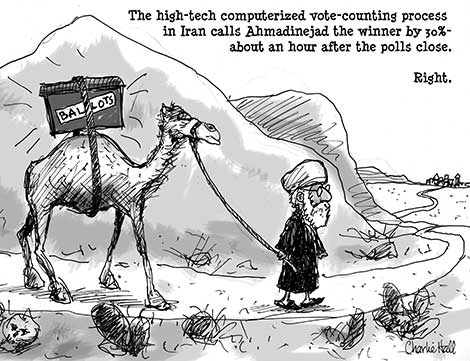
June 25, 2009
Why Exactly Does the Iranian Government Believe it is Beyond Criticism?
It may seem like a trivial question, but it's really a very important one: when Iranian President Mahmoud Ahmadinejad voices his displeasure at President Barack Obama voicing his displeasure over recent events in Iran, as described for example in an article appearing in today's Deutsche Welle…
[President Obama] has recently has ramped up his previously muted criticism, saying he was "appalled and outraged" by the crackdown on protesters. Ahmadinejad reacted by comparing Obama to his predecessor Georg[e] W. Bush.…exactly on what is President Ahmadinejad basing his belief that the actions of his government -- especially the violent ones -- are beyond criticism? We know he isn't shy about criticizing other governments. So what's his basis for making public criticism a one-way street?"Mr Obama made a mistake to say those things," he said. "Our question is why he fell into this trap and said things that previously Bush used to say."
It's not really possible to negotiate with his regime, until this underlying belief is understood.
June 23, 2009
The Latest Weapon in the U.S. Arsenal: The O-Bomb
Just wanted to share this fantastic line from Jonah Goldberg that readers might not have caught because it was in an extended entry:
So, if Obama deserves "credit" for what's happened in Iran, there are several possibilities. The first is that he intended for something like this to happen. He gave his speech in the heart of the Muslin and Arab world, knowing full well the glorious inspirational power of his words.Or, he didn't intend for his words to specifically inspire the Iranians, but he's glad the shrapnel from his wisdom grenade generated so much collateral hope and change.
June 22, 2009

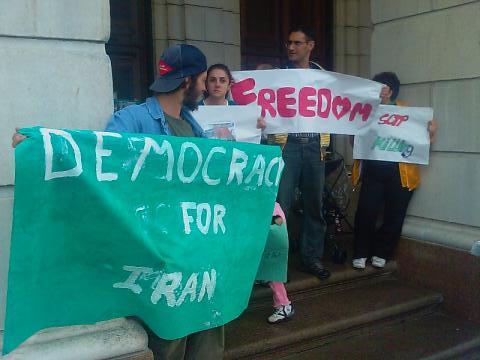
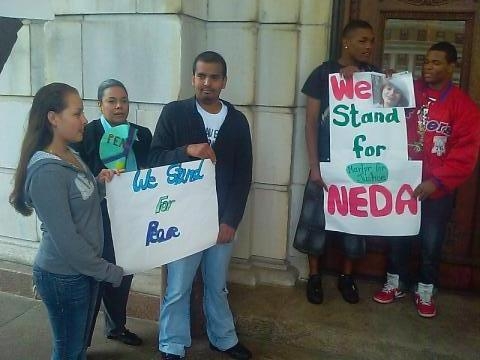
June 16, 2009
Is America a fading beacon for freedom in the world?
There is significant unrest in Iran in the aftermath of their "election." More here, here, here, and here.
Unfortunately, we now have a President whose response to the Iranian unrest (more here, here, and here) shows again how he does not believe in American exceptionalism.
Jonah Goldberg pleads for a different approach that endorses freedom. Both Goldberg and Power Line offer poignant comparisons of how America under JFK and Reagan was once the leading advocate for freedom in the world.
With nuclear weaponry imminent in Iran and the openly expressed threat to use it to destroy Israel, even a more narrow advocate of realpolitik should see value in endorsing freedom at this crucial juncture.
Hope doesn't mean what it used to mean in America. And the world will be a lesser and more dangerous place as a result. How profoundly sad.
ADDENDUM #1:
Technology enables freedom fighters in their fight against oppression. It is simply precious how the human longing for liberty naturally brings together kindred souls around the world in this important battle. Sometimes the most radical changes can occur in the most unexpected of ways. More here (H/T Instapundit) and here.
How can your spirit not be drawn to news like this and this? Or this?
More on Reagan's actions, contrasting with Obama's responses thus far - including this one.
ADDENDUM #2:
Ralph Peters connects the dots to Obama's speech in Cairo. Seth Cropsey offers his thoughts on the consequences of the Cairo speech.
And more on Reagan's response to the 1981 imposition of martial law in Poland, again contrasting it with Obama's response to current events in Iran. Bill Kristol exhorts Obama to speak out. Rich Lowry adds a thoughtful perspective.
ADDENDUM #3:
Is there really any question about Iran's publicly-stated intention to wipe Israel off the map? Does anyone actually believe that Hezbollah is not one of Iran's proxies in their war of terror against non-Muslim infidels?
With H/T to Instapundit, follow Michael Totten's blogging for updates on the situation in Iran. Nico Pitney is live-blogging at The Huffington Post.
ADDENDUM #4:
Mona Charen states the liberal tendency is to view foreign policy as a form of social work. It comes down to a difference in core beliefs about human nature, doesn't it? And the mullahs are showing their true colors, again, causing Charen to observe that it has suddenly become much more difficult to pretend that you are not betraying the Iranian people by engaging with the junta in Iran.
Nobody knows what will happen next in Iran, whether a true revolution is possible and - if so - what shape it might take. Amir Taheri offers thoughts on whether there is a nucleus in Iranian society to drive regime change. More on the nature of the Iranian regime.
ADDENDUM #5:
As a measure of how much Obama has conceded America's leadership role in the world as a beacon for freedom, the President of France (yes, France!) is showing more support for Iranian demonstrators than Obama. So much for real hope and change.
Explaining Obama's conventional view of the Iranian regime. By contrast, modeling on the Ukrainian revolution of 2004, here are some thoughts on what Obama could do instead.
Are crackdowns imminent?
Andy McCarthy, whose past experiences include prosecuting those responsible for the 1993 bombing at the World Trade Center, brings the issues of the Iranian regime legitimacy and regime change into sharp focus, noting the often incoherent policies of past administrations.
Cogent thoughts from Victor Davis Hanson. More from Jonah Goldberg.
June 12, 2009
Obama's False Equivalencies
During last week's Violent Roundtable on WPRO's Matt Allen Show, we discussed some of the faux moral equivalencies brought up by President Obama in his speech to the Muslim world. Charles Krauthammer also weighed in:
(A) He told Iran that, on the one hand, America once helped overthrow an Iranian government, while on the other hand "Iran has played a role in acts of hostage-taking and violence against U.S. troops and civilians." (Played a role?!) We have both sinned; let us bury the past and begin anew.(B) On religious tolerance, he gently referenced the Christians of Lebanon and Egypt, then lamented that the "divisions between Sunni and Shia have led to tragic violence" (note the use of the passive voice). He then criticized (in the active voice) Western religious intolerance for regulating the wearing of the hijab -- after citing America for making it difficult for Muslims to give to charity.
(C) Obama offered Muslims a careful admonition about women's rights, noting how denying women education impoverishes a country -- balanced, of course, with "meanwhile, the struggle for women's equality continues in many aspects of American life."
Well, yes. On the one hand, there certainly is some American university where the women's softball team has received insufficient Title IX funds -- while, on the other hand, Saudi women showing ankle are beaten in the street, Afghan school girls have acid thrown in their faces, and Iranian women are publicly stoned to death for adultery. (Gays, as well -- but then again we have Prop 8.) We all have our shortcomings, our national foibles. Who's to judge?
June 6, 2009
This Mission of D-Day Continues
Ocean State Republican has posted video and text of President Reagan's 1984 D-Day speech:
The men of Normandy had faith that what they were doing was right, faith that they fought for all humanity, faith that a just God would grant them mercy on this beachhead or on the next. It was the deep knowledge — and pray God we have not lost it — that there is a profound, moral difference between the use of force for liberation and the use of force for conquest. You were here to liberate, not to conquer, and so you and those others did not doubt your cause. And you were right not to doubt.You all knew that some things are worth dying for. One's country is worth dying for, and democracy is worth dying for, because it's the most deeply honorable form of government ever devised by man. All of you loved liberty. All of you were willing to fight tyranny, and you knew the people of your countries were behind you.
Take special note of this passage:
... Soviet troops that came to the center of this continent did not leave when peace came. They're still there, uninvited, unwanted, unyielding, almost 40 years after the war. Because of this, allied forces still stand on this continent. Today, as 40 years ago, our armies are here for only one purpose — to protect and defend democracy. The only territories we hold are memorials like this one and graveyards where our heroes rest.
Presence is not occupation; that's a notion some among our countrymen don't seem to comprehend in their distrust of their fellows.
June 5, 2009
An Interesting Convergence of Issues
This story confounds categorization:
Eastern District of Michigan judge Lawrence P. Zatkoff handed down the decision, in a case involving an alleged violation of the constitutional separation of church and state. The issue is whether a government-owned company, AIG, can market sharia-compliant insurance products. (To be sharia-compliant, an investment vehicle must be created and structured in ways that do not violate Islamic law.) In a well-reasoned and cogently argued opinion, Judge Zatkoff refused to dismiss the case prior to factual discovery. ...The problem with all of this public largesse is that AIG sponsors, pays for, and aggressively markets sharia-compliant insurance products. The practice of sharia finance has created lucrative advisory positions for often radical imams, who get paid to guarantee the religious "purity" of sharia-compliant products. Such vehicles typically follow the Muslim principle of zakat and donate a slice of their profits to charity. Unfortunately, many of the charities receiving these funds have links to terrorism. Mr. Murray objects to his funds' being used to legitimate and promote sharia law, when that is the same law that calls for jihad. For that matter, sharia allows Saudis, Iranians, Sudanese, Somalis, Afghans, Taliban members, and other adherents to justify the following: the execution of apostates who decide to abandon the faith; the criminalizing of "Islamophobic blasphemy"; the punishment of petty crimes with amputations, floggings and stonings; and the repression of “non-believers� from practicing their respective religions freely and openly.
On one hand, a private business should be able to develop, operate, and market whatever products it likes (provided doing so does not directly support our nation's enemies). On the other hand, AIG is not alone, now, in being a not-so-private company, and the government ought not be in the position of financing the adherence to religious law. It's a precarious balance, and the conceit of mere mortals to maintain it is apt to become hamartia.
Herman Melville functions out of context here:
So, when on one side you hoist in Locke's head, you go over that way; but now, on the other side, hoist in Kant's and you come back again; but in very poor plight. Thus, some minds for ever keep trimming boat. Oh, ye foolish! Throw all these thunder-heads overboard, and then you will float light and right.
Starboard side, we carry the notion that the government should not interfere with freedoms of association and religion. Port side, we've now hung the principle that the government can become a controlling investor in industry. Express no surprise when when find the deck taking on water.
May 30, 2009
But North Korea Is Way on the Other Side of the World
Someday, we'll all look back on global events in 2009 and... well, what? I'm afraid I believe that Mark Steyn offers some accurate clues:
Well, you never know: Maybe we're the ones being parochial. If you're American, it's natural to assume that the North Korean problem is about North Korea, just like the Iraq War is about Iraq. But they're not. If you're starving to death in Pyongyang, North Korea is about North Korea. For everyone else, North Korea and Iraq, and Afghanistan and Iran, are about America: American will, American purpose, American credibility. The rest of the world doesn't observe Memorial Day. But it understands the crude symbolism of a rogue nuclear test staged on the day to honor American war dead and greeted with only half-hearted pro forma diplomatese from Washington. Pyongyang's actions were "a matter of . . . " Drumroll, please! " . . . grave concern," declared the president. Furthermore, if North Korea carries on like this, it will — wait for it — "not find international acceptance." As the comedian Andy Borowitz put it, "President Obama said that the United States was prepared to respond to the threat with 'the strongest possible adjectives . . . ' Later in the day, Defense Secretary Robert Gates called the North Korean nuclear test 'supercilious and jejune.' "The president's general line on the geopolitical big picture is: I don't need this in my life right now. He's a domestic transformationalist, working overtime — via the banks, the automobile industry, health care, etc. — to advance statism's death grip on American dynamism. His principal interest in the rest of the world is that he doesn't want anyone nuking America before he's finished turning it into a socialist basket-case. This isn't simply a matter of priorities. A United States government currently borrowing 50 cents for every dollar it spends cannot afford its global role, and thus the Obama cuts to missile defense and other programs have a kind of logic: You can't be Scandinavia writ large with a U.S.-sized military.
The scary thing is that a weaker United States of America isn't going to make the world safer. It isn't even going to be a neutral development for world peace and safety.
On the bright side, global war, nuclear attacks, and even political domination might make it more plausible to develop a universal healthcare system that will last the duration of the nation.
May 27, 2009
What Happens After One Side Withdraws From a Truce?
North Korea has announced it is withdrawing from the truce that, at least in practical terms, ended the Korean War…
North Korea threatened to attack South Korea one day after Seoul announced that it would join a U.S.-led naval exercise, aimed at intercepting any shipments suspected of carrying materials used in the making of weapons of mass destruction....The government also proclaimed that the North would no longer honor the North-South armistice signed at the end of the Korean War.What happens next will be determined, in significant measure, by the facts that 1) the United States currently led by a President who fancies himself a liberal internationalist and 2) we are moving headlong into the kind of situation where the weaknesses of liberal internationalism are most exposed, i.e. what happens when one nation decides it doesn't want to honor its negotiated agreements, and that it has no interest in living in harmony with the rest of the "community of nations"?
The North Koreans are gambling that, despite its unsolved problems, the Obama administration will stay committed to a minimal-action, liberal internationalist ideology.
May 23, 2009
Iran: Quick Electoral Update and a (Nuclear) Question
Did you know Iran has an election coming up on June 12? It's amazing the things you learn sitting in a coffee shop, browsing electronic headlines and pretending to be an intellectual. (Drinking your coffee black enhances the illusion image.)
Iran's elections have a history of surprises, with unknown candidates suddenly ending as victors. [President Mahmoud] Ahmadinejad's challengers are backed by a coalition of prominent Muslim clerics and veteran Iranian politicians who oppose Ahmadinejad's policies both at home and abroad, turning this election into an unusually stark confrontation between two political factions with opposing views of the future of Iran.Ahmadinejad's main challengers advocate better relations with the United States. They promise to ensure that Iran's nuclear program will have strictly peaceful purposes, and they say the Holocaust should not be an issue in Iranian politics.
In fact, on the subject of Israel, one opponent put forward this bit of concise reasoning.
"Ahmadinejad's comments on the Holocaust were a great service to Israel," Mehdi Karroubi, a cleric and the most outspoken opposition candidate, told a group of students in April. "What has happened that we now have to support Hitler?"
Indeed, an excellent question.
Even if President Ahmadinejad's most "dove-like" opponent prevails in June, there is, of course, no guarantee that Iran's nuclear program will remain devoted to the benign generation of energy. This is not a personal criticism of any candidate. One thing that politicians around the world seem to have in common is the apparent difficulty of enacting all promises made on the campaign trail. This leads to the question, which pops into my head every time a commentator advocates, usually with some urgency, that the nuclear programs of both North Korea and Iran be stopped.
Short of the serious territorial breach, reportedly contemplated by Israel against Iran, of bunker busting bombs propelled by either planes or missiles, how do we accomplish this?
Cash diplomacy has been referenced in another comment thread. But this is complicated by issues of sanity: in the first instance, an actual madman; in the second, someone prepared to act like a madman for puposes of domestic politics. In short, the US could not count on the bribee staying bribed.
The dangers of such a situation are difficult to argue away and only more so with the missile launch Wednesday. The bigger issue is, how do we disassemble it without resorting to a jackhammer and the considerable - make that massive - direct and collateral damage it would wreck?
May 12, 2009
Obama Admin to Brits: Only We Can Rat Ourselves Out
This is a little confusing.
The Obama administration says it may curtail Anglo-American intelligence sharing if the British High Court discloses new details of the treatment of a former Guantanamo detainee.A court filing from the British Foreign Office released recently includes a letter from the U.S. government, identified as the "Obama administration's communication." Other information identifying the U.S. agency and author of the letter appears to have been redacted.
* * *
At issue is whether the British courts will disclose a seven-paragraph summary of the treatment of Binyam Mohamed, a former detainee who was released from Guantanamo Bay prison in February.
How about a compromise? Hand it over to the US Justice Department. It's not enough to fill four memos but that seems to be the acceptable channel for release of such info.
May 8, 2009
Whitehouse's Dog and Pony Show
So, Senator Whitehouse is pretty proud that he's finally getting a chance to question Bush Administration lawyers about "torture memos." I wonder if he's interested in questioning members of Congress, particularly House Speaker Pelosi, about what I'm sure Whitehouse would consider a lack of oversight of the program?
May 7, 2009
United States as Helpless Giant
Tony Blankley makes a chilling observation:
News item No. 1 concerns the testimony of Secretary of State Hillary Clinton before the House Foreign Affairs Committee on April 22. She said deteriorating security in nuclear-armed Pakistan "poses a mortal threat to the security and safety of our country and the world."News item No. 2 is this headline on the front page of the May 4 edition of The Washington Post: "U.S. Options in Pakistan Limited."
News item No. 3 is a quote in Jackson Diehl's May 4 column in The Washington Post from a senior Obama administration official: "It's not good when your national security interests are dependent on a country over which you have almost no influence."
In a matter of two weeks, we have gone from witnessing the U.S. secretary of state testify to Congress that a nuclear Pakistan run by Islamist radicals would be a "mortal threat" to America to hearing the administration admit that we have limited options to avoid such a threat.
What are we to make of such a development? I and many others had previously warned of the dangers of a nuclear "Talibanistan" (which have been obvious and talked about for years). Experts I have talked to in the past week do not believe Clinton is overstating the case. Nor do I. She is very careful with her words -- and they fit the danger.
Blankley isn't blaming the Obama administration ("not yet"), but he does want to see a plan for increasing our ability to address military matters around the world (in his view, by increasing troop counts). The American political landscape is not likely to be such that effective plans will be forthcoming for quite some time... hopefully not too late.
May 5, 2009
Banned from Britain: Michael Savage's Company
(... his real name is Michael Weiner?)
From the BBC News.
Islamic extremists, white supremacists and a US radio host are among the 16 of 22 excluded in the five months to March to have been named by the Home Office.Since 2005, the UK has been able to ban people who promote hatred, terrorist violence or serious criminal activity.
Home Secretary Jacqui Smith said coming to the UK should be a privilege.
Certainly, Madame Secretary. And some of the people on the list seem to pose a genuine threat of violence. However, some appear to be banned solely for certain utterances - speech - that has been deemed unaceptable for reason of thought, emotion or other non-threatening content. And therein lies the problem. Take it, Christopher Hitchens.
What is at stake in all these cases is not just the right of the people concerned to travel and to take their opinions with them. It is also the right of potential audiences to make their own determination about whom they wish to hear.* * *
The underlying premise of the First Amendment is that free expression, when protected for anyone, is thereby protected for everyone. This must apply most especially in tough cases that might raise eyebrows, such as the ACLU's celebrated defense of the right of American Nazis to demonstrate in heavily Jewish Skokie, Ill., in the late 1970s. One of the effects of the "war on terror," and of one of its concomitants, namely the attrition between the Muslim world and the West, has been an increasing tendency to make exceptions to First Amendment principles, either on the pretext of security or of avoiding the giving of offense. We should have learned by now that, however new the guise, these are the same old stale excuses for censorship. We might also notice that if one excuse is allowed, then all the others are mahde "legitimate" also. The risk of allowing all opinions by all speakers may seem great, but it is nothing compared with the risk of giving the power of censorship to any official.
Below is the list, excluding six whom the UK has declined to name. Details as to grounds for their banning here.
Abdullah Qadri Al AhdalYunis Al Astal
Samir Al Quntar
Stephen Donald Black
Wadgy Abd El Hamied Mohamed Ghoneim
Erich Gliebe
Mike Guzovsky
Safwat Hijazi
Nasr Javed
Abdul Ali Musa
Fred Waldron Phelps Snr
Shirley Phelps-Roper
Artur Ryno
Amir Siddique
Pavel Skachevsky
Michael Alan Weiner
May 3, 2009
War criminal claims and our ignorance of history
Instapundit does us another public service by highlighting this Pajamas TV commentary about Jon Stewart claiming Truman was a war criminal:
Jon Stewart, War Criminals & The True Story of the Atomic Bombs.
As one of my friends wrote me after listening to it: "We were moved nearly to tears by this. What has happened to the world we knew?"
Our society is increasingly ignorant of history, which means we have lost touch with our roots and are subject more and more to whims of the moment that can only further endanger our liberty.
April 30, 2009
Friedman on Obama and the Memos
Thomas Friedman thinks President Obama has taken the most pragmatic approach regarding the Bush Administrations "torture memos." But he also explains why fighting a unique enemy, al Qaeda, brought us to this point. And he wonders what the attitude towards "torture" would be had another attack on American soil occurred.
[T]herefore, the post-9/11 environment remains perilous. One more 9/11 would close our open society another notch. One more 9/11 and you’ll be taking off more than your shoes at the airport. We have the luxury of having this torture debate now because there was no second 9/11, and it was not for want of trying. Had there been, a vast majority of Americans would have told the government (and still will): “Do whatever it takes.�Continue reading "Friedman on Obama and the Memos"So President Obama’s compromise is the best we can forge right now: We have to enjoin those who confront Al Qaeda types every day on the frontlines to act in ways that respect who we are, but also to never forget who they are. They are not white-collar criminals. They do not care whether we torture or not — bin Laden declared war on us when Bill Clinton was president.
April 26, 2009
Comfort Means Your Eyes Are Down
A few days ago, Associated Press writer Liz Sidoti issued perhaps the most disturbing bit of "journalism" in recent memory:
It didn't take long for Barack Obama — for all his youth and inexperience — to get acclimated to his new role as the calming leader of a country in crisis."I feel surprisingly comfortable in the job," the nation's 44th president said a mere two weeks after taking the helm.
A milder complaint was often made of President Clinton, but frankly, a president who claims comfort amidst the current circumstances — from the economy to continuing battles with Islamic radicalism and the various conniving regimes across the globe — is either lying or dangerously overconfident. This isn't to say that our national head ought to appear panicked, but "comfort" wouldn't be a word in the vocabulary of an appropriately realistic and circumspect leader.
President Obama ought to ponder why it is that a significant portion of his constituency doesn't find the title of Mark Steyn's latest to be all that extreme: "The End of the World as We Know It." Steyn enumerates a number of uncomfortable developments on the world scene, but among the most chilling thought comes as an aside (emphasis added):
On the domestic scene, he's determined on a transformational presidency, one that will remake the American people's relationship to their national government ("federal" doesn't seem the quite the word anymore) in terms of health care, education, eco-totalitarianism, state control of the economy, and much else. With a domestic agenda as bulked up as that, the rest of the world just gets in the way.
One wonders if the president's comfort level has something to do with the likelihood that his response to Steyn's title would be something along the lines of, "Yup. The country, too."
We will soon find out unequivocally, as our country shifts its stance, whether the United States, as it has stood in the world, really has been a force for good or for ill.
April 20, 2009
Can't Blame Bush Forever
The Washington Post's Jackson Diehl makes an observation and then wonders...
New American presidents typically begin by behaving as if most of the world's problems are the fault of their predecessors -- and Barack Obama has been no exception. In his first three months he has quickly taken steps to correct the errors in George W. Bush's foreign policy, as seen by Democrats. He has collected easy dividends from his base, U.S. allies in Europe and a global following for not being "unilateralist" or war-mongering or scornful of dialogue with enemies.Indeed, as Victor Davis Hansen writes:Now comes the interesting part: when it starts to become evident that Bush did not create rogue states, terrorist movements, Middle Eastern blood feuds or Russian belligerence -- and that shake-ups in U.S. diplomacy, however enlightened, might not have much impact on them.
[D]id the “their old America did it, not my new one� Obama approach win his country anything? Russians helping out to prevent a nuclear Iran, or stopping the killing of dissidents abroad, or promises not to bully the former Soviet republics? More European combat units going to Afghanistan? Mexico vowing to curb illegal immigration? Turkey ceasing its new anti-Western Islamic screeds?And back to Diehl:His supporters would rejoin, “Oh, but give him time. He’s sowing the field with good will for a bountiful harvest of future cooperation�. I do think he’s sowing, but a minefield rather than a crop, whose explosions will be as inevitable as they will be numerous. Sarkozy’s crude dismissal and appraisal of Obama (nothing is worse for a liberal administration than to have their idolized French brethren bite their extended limp hands) are the templates of things to come.
Obama is not the first president to discover that facile changes in U.S. policy don't crack long-standing problems. Some of his new strategies may produce results with time. Yet the real test of an administration is what it does once it realizes that the quick fixes aren't working -- that, say, North Korea and Iran have no intention of giving up their nuclear programs, with or without dialogue, while Russia remains determined to restore its dominion over Georgia. In other words, what happens when it's no longer George W. Bush's fault?
April 10, 2009
Fiji: Undemocracy in Action
For those of us living in countries with democratic processes and smooth transitions of power, it's good to be reminded what the opposite looks like. From the Telegraph. (Scroll past the excessively long ad at the top.)
President Ratu Josefa Iloilo used a nationally-broadcast radio address to announce that he had abolished the constitution, assumed all governing power and revoked all judicial appointments. The move will deepen a political crisis gripping the troubled South Pacific nation.It came one day after the country's second-highest court ruled that the military government that took power after a bloodless coup in 2006 was illegal
So, miffed that the court ruled against his government, President Iloilo abolished the constitution and fired the entire judiciary.
However,
He also said Fiji would hold elections in 2014.
What matters is that they'll get around to it eventually.
April 8, 2009
RE: Message to Pirates....It was part of their training
First, to update the ongoing pirate story, it appears the Captain, Richard Phillips of Vermont, is still being held (it sounds like on a lifeboat).
Additionally, I remembered reading about a maritime school training its cadets in anti-piracy tactics a week or so ago. Turns out, it was Massachusetts Maritime...and the instructor of the course? Joseph Murphy, father of Shane Murphy, the Chief Mate (or First Officer) on board the Maersk Alabama.
The 1,000-student academy sends many graduates into seafaring careers where they might traverse pirate-plagued waterways, and joins other maritime academies in campaigns to thwart pillagers.Guess its a good thing they've been trained, even if merchant ships don't carry any sort of firearms and current policy is to make every attempt to avoid being boarded and then, if boarded, retreat to safe rooms (well, for a while). It sounds like the crew of the Alabama had other ideas."The world has become a much more dangerous place, and it's a problem that is getting worse all the time," said Joseph Murphy, who teaches anti-piracy tactics in his maritime security class. "We're all keenly aware that the ante has been upped."
Murphy's teachings are personal: His son often travels in dangerous waters and was onboard a commercial ship sailing through the Gulf of Aden last April when pirates attacked a Japanese oil tanker a short distance away.
Despite the heroics of the crew of American sailors, there is still a fundamental question that needs to be answered regarding the seizure of the Alabama by Somali pirates: why now? Pending the release of the ship's captain, the positive outcome shouldn't be allowed to mask the root cause behind the attack. Nor should we let the current Administration gloss over their potential response. Or how their current foreign policy stance may have, or have not, emboldened these pirates.
Or maybe they just didn't expect to run into a real U.S. ship:
Douglas J. Mavrinac, the head of maritime research at investment firm Jefferies & Co., noted that it is very unusual for an international ship to be U.S.-flagged and carry a U.S. crew. Although about 95 percent of international ships carry foreign flags because of the lower cost and other factors, he said, ships that are operated by or for the U.S. government—such a food aid ships like Maersk Alabama—have to carry U.S. flags, and therefore, employ a crew of U.S. citizens.But that's another discussion.
Message to Pirates: Don't Mess with U.S. Merchant Mariners
So Somali pirates decided to take a U.S. flagged ship. Except they apparently didn't realize that U.S.-flagged ships have something other ships don't--U.S. Merchant Mariners (including a couple from nearby Mass. Maritime Academy). So, while other countries bargain and dicker with pirates, this U.S. crew took matters into their own hands:
The crew of a U.S.-flag ship seized by pirates off Somalia has retaken the vessel, American officials said Wednesday, even as the national security establishment faced troubling questions about the hostage-taking at high sea.As a proud graduate of the U.S. Merchant Marine Academy, I was taught to live by the Academy's motto: Acta Non Verba (Deeds, or Action, not Words). Most of the mariners I know live by this creed, regardless of their schooling or training. It is the sort of attitude that has seen American merchant sailors through war since the founding of this country. And it's heartening to see that that spirit still thrives on the world's oceans, at least as long as the ship flies America's colors.Capt. Joseph Murphy, an instructor at the Massachusetts Maritime Academy, told The Associated Press that his son Shane, the second in command on the ship, had called him to say the crew had regained control.
The ship, captured by pirates near the coast of Somalia, apparently was the first such hostage-taking involving U.S. citizens in 200 years. In December 2008, Somali pirates chased and shot at a U.S. cruise ship with more than 1,000 people on board but failed to hijack the vessel.
"The crew is back in control of the ship," a U.S. official said at midday, speaking on condition of anonymity because she was not authorized to speak on the record. "It's reported that one pirate is on board under crew control—the other three were trying to flee," the official said. The status of the other pirates was unknown, the official said, but they were reported to "be in the water."
The crew apparently contacted the private shipping that it works for. That company, Maersk, scheduled a noon news conference in Norfolk, Va, defense officials said.
Another U.S. official, citing a readout from an interagency conference call, said: "Multiple reliable sources are now reporting that the Maersk Alabama is now under control of the U.S. crew. The crew reportedly has one pirate in custody. The status of others is unclear, they are believed to be in the water."
It's a long, long pull with our hatches full,
Braving the wind, braving the sea,
Fighting the treacherous foe;
Heave Ho! My lads, Heave Ho!
Let the sea roll high or low,
We can cross any ocean, sail any river.
Give us the goods and we'll deliver,
Damn the submarine!
We're the men of the Merchant Marine!
March 26, 2009
One Half of the Correction
Now events in France are beginning to look a bit more like a logical social correction:
French workers burned tires, marched on the presidential palace and held a manager of U.S. manufacturer 3M hostage Wednesday as anger mounted over job cuts and executive bonuses.Rising public outrage at employers on both sides of the Atlantic has been triggered by executives cashing in bonus checks even as their companies were kept afloat with billions of euros (dollars) in taxpayers' money and unemployment soars.
The hostage taking borders on the extreme (not crossing over, I should note, because it appears more a symbolic inconvenience than an actual threat), but this is how societies correct themselves when they get too far out of whack. Of course, the longer the correction remains unheeded, the more extreme the measures become. Taking an eye-popping bonus is still a long way from throwing a father a coin after you've trampled his son with your horse-drawn carriage, and in part because of technology, I don't think we'll get to the point of the French Revolution again.
Still, we should take a lesson from history and resist the urge to codify the social reaction within the government, as the pendulum will merely continue to swing. Rather, we should back off a bit and permit market corrections to do as they ought before emotions burst the market's boundaries. Let utter bankruptcy and shame be the correction for greedy corporate types, and leave the hostage taking to terrorists.
Our Image Among Extremists: Confusion About the Order of Events.
... reflected in this letter to the ProJo.
It was the Bush administration’s detention and torture policies that made us less safe and more reviled by the Muslim world. Former President Bush’s torture and detention policies certainly radicalized many individuals across the Muslim world, and President Obama’s executive orders are a first step to defusing that hatred and giving us an America we can be proud of again.
I'm going to take the liberty of assuming that in the first sentence, the author did not mean all Muslims but only that tiny percentage capable of acts of terror and violence.
The murder of 3,000 + innocent people in three locations strikes me as pretty radical. Certainly we can discuss the wisdom, adviseability, morality of some of the policies of former President Bush. There is no question, however, that these policies did not precede but followed the attacks on September 11, 2001.
March 4, 2009
Russian Rulers "Encouraged" by the New Tone
I'm sure they are:
President Obama said yesterday that he had told Russia that reducing Iran's pursuit of a nuclear weapon would in turn lessen the need for a U.S.-planned missile-defense system in Eastern Europe that Moscow has opposed. But Obama said he sought no "quid pro quo" with Moscow.Obama also said it was time for the United States to "reset or reboot" its relationship with Russia, a nod to the increasingly tense relations of recent years. ...
Medvedev reaffirmed strong opposition to the Bush administration's plan to deploy a battery of missile interceptors in Poland and a related radar in the Czech Republic. He said the move would hurt security in Europe.
Medvedev said Russia was encouraged by the Obama administration's readiness to discuss Moscow's complaints.
"Our American partners are ready to discuss this problem, and that's already positive," he said. "Several months ago we were hearing different signals: 'The decision has been made, there is nothing to discuss, we will do what we have decided to do.' Now I hope the situation is different."
Yes, now only one side is going to be saying that discussion is futile on such matters as the nuclear armament of Middle Eastern theocracies.
I hope liberals will be paying attention over the next few years and decades. They're about to see their policies tested for better or worse. I predict worse.
ADDENDUM:
Charles Krauthammer is even more critical.
February 20, 2009
Obama's First Round of Foreign Policy Tests
Charles Krauthammer is not optimistic that initial indications of foreign-policy acumen in the Obama White House are not plentiful:
The Biden prophecy has come to pass. Our wacky veep, momentarily inspired, predicted in October that "it will not be six months before the world tests Barack Obama." Biden probably had in mind an eve-of-the-apocalypse drama like the Cuban missile crisis. Instead, Obama's challenges have come in smaller bites. Some are deliberate threats to U.S. interests, others mere probes to ascertain whether the new president has any spine.Preliminary X-rays are not very encouraging. ...
With a grinning Goliath staggering about sporting a "kick me" sign on his back, even reputed allies joined the fun. Pakistan freed from house arrest A.Q. Khan, the notorious proliferator who sold nuclear technology to North Korea, Libya and Iran. Ten days later, Islamabad capitulated to the Taliban, turning over to its tender mercies the Swat Valley, 100 miles from the capital. Not only will sharia law now reign there, but members of the democratically elected secular party will be hunted as the Pakistani army stands down.
I must say that I share Krauthammer's sense that the mistakes are indicative of beliefs, rather than inexperience.
February 17, 2009
Two Explanations for Mark Patinkin
Mark Patinkin's bullet-list-style column, today, makes two quips that, helpful soul that I am, I'll try to answer:
Someone will have to explain to me why Palestinian militants feel it's productive to keep firing rockets into Israel.
Because, receiving no substantial international backlash against the practice, the terrorists wish to provoke Israel into military action, with invariably causes international backlash. Thus do the random rockets ultimately isolate Israel from the spinless West even as they wear down the confidence and comfort of the Israeli people.
Obama may fail yet, but it's impressive how readily conservative radio hosts who for eight years championed policies that led to a big mess abroad and at home have piled on the new administration for attempting to change course.
Conservatives fall into several categories on this. Some don't believe that the policies that they supported were ultimately the cause of our current predicament. Others believe that the necessary change to prior policies is being made in the wrong direction. Of course, it's unfair to lump conservatives together as Patinkin does (specificity, Mark!), although the world certainly doesn't lack for partisans who will offer support to the convenient cause.
January 20, 2009
So How Will He Do?
Fans of our new president perhaps imagine us non-fans as scowling through the day today, embittered by all that hope and rueful of the change to come. Me, I'm just going about my business, as I have on every inauguration day within my lifetime. That said, Andrew Stuttaford's suggestion is an attractive one, although I can't afford any of the Obama-branded merchandise that he subsequently lists:
It's better, I think, to borrow a few ideas from the Orange Alternative (Pomaranczowa Alternatywa). Fearless prankster surrealists of the Polish sort-of-Left from the 1980s, they used to taunt their country's crumbling Communist regime with cheers, not jeers, their specialty being sporadic displays of unsettlingly enthusiastic loyalty. These included a reenactment of the storming of the Winter Palace and a procession through the streets of Warsaw by 4,000 people chanting their love for Lenin. Now, I would not want to compare Obama with that other community organizer—no, not for a second!—but the cult of personality now surrounding our next president suggests that hosting an Orange Alternative inauguration dinner would be a perfect counterpoint to the pomp, sincerity, and cynicism on display in Washington. It'll also be an ideal opportunity to treat friends of all political persuasions to a confused, confusing, and almost certainly annoying celebration that can be read, as Obama has said about himself, in any way they like.
With a little more notice, a Long Live the King party might have been a pleasant way to spend this evening. Indeed, we could have begun with an extolment of a newly introduced bill from U.S. Representative Jose Serrano (D, NY) to repeal the 22nd Amendment and enable a longer reign for the One. Several party games involving the national debt and antes of coolness also come to mind.
The levity does raise a serious (if unanswerable) question, though: How is President Obama likely to do? The variables are infinite, and the wildcards too many to count. Not the least of the unknowns is what Obama will do, because his past is like a novelist's thumbnail sketch of a character. He's all personality.
The economy will be the irreducible determinant of his level of success, and there's little a president can actually do to affect it. Within the degree of economic influence that the government can be said to have, the general approach suggested by Obama and the Democrat Congress (with complicit Republicans, to be sure) does not give reason for optimism.
In order to escape recession and surpass stagnation, the economy requires an open field. That running room can emerge with a new technology that creates whole new industries. It can open up literally as new space to fill. Innovative financial tools can create economic activities as if out of air (or, as was the case with the recent bubble, make future income the open field). Where the government has built artificial walls, knocking them down in a spell of deregulation can free the economy. A newly opened national market can bring a burst in demand.
All of these possibilities are of like form — involving the creation, development, or discovery of voids that the economy can surge to fill — and none look likely in the near future. Put what hopes as we may into the everything-green movement, nothing new is being created; energy is still energy, and more cost-effective ways exist for creating it. The emphasis on government spending and "shovel ready" projects as stimulus may run the economic engine, but with nowhere to go, and eventually we'll run out of our borrowed fuel. New financial tools and deregulation are probably out of the question in the short term. And the international market is fraught with nations acting in their own interests.
Dealing with those foreign bodies is another variable. I believe the major players will postpone testing and challenging Obama for a while — not because the world sincerely wishes to see if the new U.S. president will govern in a way more to their liking than his predecessor, but out of strategy. If he takes his foot off the accelerator in the War on Terror, terrorist groups won't attempt an immediate strike; they'll regroup and rebuild, taking into account lessons learned since 9/11. Foreign powers such as Russia and China will want to see how sympathetic and manipulable Obama is. They'll begin to test him in ways so minor that it won't be immediately apparent that that's what they're doing.
In the meantime, once the elation of a new presidential face subsides, domestic turmoil may simmer as economic frustration spills over into the culture war. The left has its wish list out, and with Democrats controlling two branches of government, it will expect results. For its part, the right is arguably enlivened when on the defensive.
So in all of this, how will President Obama do? I won't hazard to say, but I will offer a three-part generality: Liberalism is a recipe for disaster; centrism is an inadequate approach when the economy requires inspiration, foreign affairs require a set jaw, and the sides refuse to let social issues balance; and powerful institutions have installed constructs to make conservatism a very painful option. Obama will probably shoot for a leftish centrism until circumstances knock over the fulcrum.
The real change, that brought by the tectonic forces of history, could be serendipitous or calamitous. Which it will be and how the president will react are questions sure to bring silence to the party.
January 17, 2009
Dutch Skaters, World Problems
In the Netherlands, the canals have frozen over for the first time in years and the Dutch are strapping on their skates and having a blast, albeit with a few bumps and bruises. But the politics are never far away, even in what you'd think would be a feel-good story. First, there's the environmental angle:
In the 19th century, when Hans Brinker, the hero of the novel in which he tries to win a pair of silver skates, coasted along Holland's ice, the canals froze almost every year. But water pollution and climate change have made this so rare that today a boy of 15, Brinker's age, may never have seen a frozen canal, or at least remember one. Until, that is, this year.Then there is the cultural and political angle:
"For us, it's in our genes," said Gus Gustafsson, 68, a retired insurance executive, explaining why he and his wife had rushed out to buy new skates and take to the ice under a cloudless blue sky. "It was like a frenzy that came over people, including lots of kids, like my granddaughter, who is 5." With thousands of others, they skated northeast toward the cheese capital, Gouda, then toward Utrecht.To be sure, a couple interesting asides. In particular, the second provides Americans a little glimpse into the mindset of an average European. But I'm just glad the Dutch were able to skate.With an influx of immigrants, the country has been struggling to maintain what it considers its Dutch soul, and Gustafsson was one of many here who thought the skating experience enabled the Dutch to reconnect with their identity. "There were only Dutch people on the ice," he said. "I saw no people of Arab descent."
But Andre Bonthuis, who has been mayor in this town of 23,000 people for the past 20 years, said he had seen Indonesians and Moroccans, among other newcomers to the Netherlands, on the ice. "It's rather new for people from Morocco," he said. But he agreed that there was something very Dutch about canal skating, which is depicted in paintings by Dutch masters as early as the 17th century.
January 13, 2009
A Global Riot
Although he offers an historical contextualization of the rioting in Greece, Robert Kaplan worries that they may be an indication of the century to come:
The protests of today are not about America; they are about the legitimacy of a government that has been in power for four years without achieving much. With the global recession bearing down on Greece, the country is in desperate need of difficult reforms and privatization measures to help it in the Darwinian struggle to attract foreign investment, upon which much economic growth is dependent. The problem is that despite the probability of new elections, Greece seems destined to suffer through a period of weak governments, which will lack the political capital to do what's necessary in the way of change. The conservative New Democracy party has been neutered by the riots, even as the left-of-center Panhellenic Socialist Union (PASOK) is compromised by close ties to the very labor unions who would have to be challenged if meaningful reform is to take place. Of course, PASOK could carry out the reforms, in the manner of a right-wing President Richard Nixon going to China, but it could only conceivably do so with a strong majority in parliament, which it will probably not get. What's more likely is increased influence by smaller and more radical parties, like the communists. Thus, Greece could dither and end up politically paralyzed.It's tempting to dismiss this as a purely Greek affair that carries little significance to the outside world. But the global economic crisis will take different forms in different places in the way that it ignites political unrest. Yes, youth alienation in Greece is influenced by a particular local history that I've very briefly outlined here. But it is also influenced by sweeping international trends of uneven development, in which the uncontrolled surges and declines of capitalism have left haves and bitter have-nots, who, in Europe, often tend to be young people. And these young people now have the ability to instantaneously organize themselves through text messages and other new media, without waiting passively to be informed by traditional newspapers and television. Technology has empowered the crowd—or the mob if you will.
I'd raise a point that I've enunciated before, and that is visible in Kaplan's suggestion that union reform is necessary: It isn't untrammeled capitalism that has wrought modern economic society; it's that infamous Third Way approach to putting a capitalist engine into a socialistic vehicle.
January 10, 2009
When Terrorists Smile
Mark Patinkin's reasonable on the Israel-Palestine conflict:
These were not rogue militants acting on their own. Gaza is now controlled by the extremist Hamas government. The missile firings were allowed, even encouraged, from on high.At last, on Dec. 27, Israel launched a counterattack to stop the rockets.
Much of the coverage outside the United States has cast Israel as the belligerent villain responsible for killing innocents. There is little mention by sites like Al-Jazeera of how militants hide in mosques, schools and neighborhoods, firing from behind those shields. When Israel fires back, it is called a war crime.
I've emphasized a key sentence in the above, and a vignette in the New York Times comes to mind:
A car arrived with more patients. One was a 21-year-old man with shrapnel in his left leg who demanded quick treatment. He turned out to be a militant with Islamic Jihad. He was smiling a big smile. ..."Don't you see that these people are hurting?" the militant was asked.
"But I am from the people, too," he said, his smile incandescent. "They lost their loved ones as martyrs. They should be happy. I want to be a martyr, too."
More than likely, this individual is, as Mark Steyn puts it, suffering from "a mental illness masquerading as a nationalist movement," but he might just as well have been smiling about the journalists' capturing the hospital scene. No doubt those above him in the Islamofascist ranks — safely ensconced in bunkers or even in other cities — were smiling because their well-practiced strategy is playing out once again.
Look, the various factions of Islamic fundamentalists have the game of the Middle East conflict down. They poke and provoke Israel until the nation responds; they wait for world opinion to grumble from within its stupor; and they declare that all they've really wanted was some small thing — some incremental step toward their end-Israel objectives.
Eventually it becomes a matter of survival to finally knock the weaselly bully out.
A Better Peace?
Like any patriot, I've got a problem with this:
U.S. manufacturers say they've learned to compete against China's lower wages. What they can't compete with are government subsidies that enable China to sell some finished products for less than the fiber alone costs in the United States.
The difficulty is in the solution. I've got my reservations about such manifestations of internationalism:
In an effort to mitigate the possibility of the Chinese dumping textiles, several members of Congress have called for the International Trade Commission to monitor Chinese textiles more closely now that the quotas are expiring. ...She initiated a case with the WTO to get China to stop its allegedly unfair trade practices, but it probably will be up to the incoming Obama administration to decide whether to file a formal case. China would face sanctions, such as penalty tariffs, if it didn't agree to stop violating trade rules.
No doubt, international organizations help to smooth the flow of history, and they probably do much to avert war. I wonder, though, at the cost of history with no sharp edges, as I wonder who benefits most from negotiated peace. The former will yield no satisfying answers until an edge pokes through the veneer and we all observe how well the tear heals. The answer to the latter would seem to be "the aggressor."
An aggressive nation like China will seek ways — in front of and behind the podium — to influence votes on any relevant council, and the outcome will be the imposition of various members' desires. On the other hand, if the United States acted alone, explicitly matching China's nakedly self-interested actions, the Chinese market would be harmed, and escalation would be its call.
In general, I think our state-to-state federal system works because national patriotism exists. There is no such emotion, and no fortified culture, behind international federations. In part for that reason, they bind the hands of those who follow the rules and hesitate to trip up those who do not.
January 9, 2009
Europe Still Europe
Given what follows, it's difficult to comprehend Matthew Stevenson's initial statement that "the more general trend is European indifference to the policies of the United States." He proceeds to explain:
Economically, Europeans blame America’s financial narcissism for the recent market panic and recession.
And:
On security, Europeans feel hung over from the binge of recent American imperialism.
I more or less stopped drinking a few months ago, but I don't recall ever being "indifferent" about a hangover, and if I'd ever had one because somebody else got drunk, I'd have been something quite different than ambivalent. And that brings us back to do.
Europe remains Europe: inclined to drift languorously off to a hibernal vacation from history and agitated whenever the nations keeping watch cry out an alarm.
January 6, 2009
The Curse Heard 'Round the World ("Rarely")
Both the remark and the reporter's presentation are worthy of note in this recent New York Times piece on Israel's movement of ground troops into Gaza:
Another woman found only half of the body of her 17-year-old daughter in the Shifa morgue. "May God exterminate Hamas!" she screamed, in a curse rarely heard these days. In this conflict, many Palestinians praise Hamas as resisters, but Israel contends the group has purposely endangered civilians by fighting in and around populated areas.
The version in yesterday's Providence Journal has a slightly different construction that accentuates the tone:
"May God exterminate Hamas!" she screamed, in a curse rarely heard these days during a conflict in which many Palestinians praise Hamas as resisters but which Israel contends has purposely endangered civilian lives by fighting in and around populated areas.
The grammar has some outright errors, so it could be that the Times subsequently edited its online edition for that reason, but the effect of the original, long sentence was to slither away from a stunning quotation and place its speaker in league with the enemy, against the group for which reporter Taghreed El-Khodary seems to think she ought to have more sympathy.
Consider, too, the insinuation that cursing of Hamas may have been less rarely heard in the past, thus diminishing its astonishing nature. If we admit that it has something new and surprising about it, then we must also wonder whether tides of opinion — of culture — are beginning to turn.
There has, after all, been a prominent example of a nation turning against the terrorists who proclaimed to be fighting for it and to begin the process of restructuring its society in such a way as to join the modern world.
January 4, 2009
Reason Corrupted by Evil
I have to believe that the day will come when society at large will share my disgust with such phrasings as Owen M. Sullivan's and be astonished that anybody would commit them to print, much less seek to publish them in major newspapers:
The Israeli attack on the Gaza Ghetto, much like the Nazi attack on the Warsaw Ghetto, is in the words of Israeli leaders "the beginning" and is intended "to send Gaza back decades."So far hundreds have been killed and over 1,000 injured, with many women, children and elderly along with many homes, police stations and civil-society buildings destroyed. According to the Al Mezan Center for human rights, most Gaza Ghetto victims, like Warsaw Ghetto victims, are civilians. And just like the Nazis who tormented those in Warsaw, the Israeli government blames the victims. Enough!
It could be, I suppose, that all of my history books were missing the pages about anti-German terrorism fomented from Jewish neighborhoods (or, actually, mislabeled such stories as Nazi propaganda, rather than accurate reportage), as well as accounts of the German Jews' comparable behavior to this:
The Hamas government has placed dozens of Fatah members under house arrest out of fear that they might exploit the current IDF operation to regain control of the Gaza Strip.The move came amid reports that the Fatah leadership in the West Bank has instructed its followers to be ready to assume power over the Gaza Strip when and if Israel's military operation results in the removal of Hamas rule.
Fatah officials in Ramallah told The Jerusalem Post that Hamas militiamen had been assaulting many Fatah activists since the beginning of the operation last Saturday. They said at least 75 activists were shot in the legs while others had their hands broken.
Wisam Abu Jalhoum, a Fatah activist from the Jabalya refugee camp, was shot in the legs by Hamas militiamen for allegedly expressing joy over the IDF air strikes on Hamas targets. ...
Meanwhile, sources close to Hamas revealed over the weekend that the movement had "executed" more than 35 Palestinians who were suspected of collaborating with Israel and were being held in various Hamas security installations.
What a strange, nasty world the likes of Sullivan must inhabit. Pity them, for they will surely tune out evidence of the corruption that evil has managed in their minds.
December 28, 2008
Coming Soon to Havana: Russian Orthodox Spires
In post-holiday catching up of some favorite columnists, I learn from Christopher Hitchens that Fidel Castro, near death, has commissioned the construction of a Russian Orthodox cathedral in the capital of a country that completely lacks adherents to that religion.
Hitchens soundly hypothesizes a desire on the part of Castro to solidify Cuba's ties with Russia.
I have been in Cuba many times in the past decades, but this was the first visit where I heard party members say openly that they couldn't even guess what the old buzzard was thinking. At one lunch involving figures from the ministry of culture, I heard a woman say: "What kind of way is this to waste money? We build a cathedral for a religion to which no Cuban belongs?" As if to prove that she was not being sectarian, she added without looking over her shoulder: "A friend of mine asked me this morning: 'What next? A subsidy for the Amish?' "All these are good questions, but I believe they have an easy answer. Fidel Castro has devoted the last 50 years to two causes: first, his own enshrinement as an immortal icon, and second, the unbending allegiance of Cuba to the Moscow line. Now, black-cowled Orthodox "metropolitans" line up to shake his hand, and the Putin-Medvedev regime brandishes its missile threats against the young Obama as Nikita Khrushchev once did against the young Kennedy. The ideology of Moscow doesn't much matter as long as it is anti-American, and the Russian Orthodox Church has been Putin's most devoted and reliable ally in his re-creation of an old-style Russian imperialism.
It is difficult to also exclude the possibility of a second, too obvious purpose for the construction of a religious edifice: a conscious or unconscious desire on the part of someone near death to either compensate for sins committed in the mortal coil or to ingratiate himself with God. In Castro's mind, God may or may not exist; such a project, however, would cover Castro (again, at least in his mind) in the event of the first of those two possibilities.
December 26, 2008
Christmastime in Baghdad
Being from an AP report, the headline is rapidly submerged in lest-you-think-this-is-good-news "context," but it's worth noting, nonetheless:
Iraq's Christians, a small minority in the overwhelmingly Muslim country, quietly celebrated Christmas on Thursday with a present from the government, which declared it an official holiday for the first time. ...In his homily on Thursday, Chaldean Cardinal Emmanuel III Delly praised the establishment of Christmas as an official holiday as a step toward easing tensions.
"I thank it too for making this day an official holiday where we pray to God to make us trust each other as brothers," he said at the Christmas Mass before several dozen worshippers in the small chapel of a Baghdad monastery.
A senior Shiite cleric, Ammar al-Hakim attended the event, flanked by bodyguards, in a gesture of cooperation with Christians.
"I thank the visitors here and ask them to share happiness and love with their brothers on Christmas. By this they will build a glorious Iraq," the cardinal said.
November 9, 2008
Can't Charm the World
Up there in far off Boston, Jeff Jacoby opines that the president elect hasn't thus far exhibited an accurate understanding of the world's opinion of the United States:
Sure enough, much of the international reaction to Obama's election has been ecstatic. "Legions of jubilant supporters set off firecrackers in El Salvador, danced in Liberia, and drank shots in Japan," the Los Angeles Times reported. Kenya declared a national holiday. South Africa's Archbishop Desmond Tutu exulted: "We have a new spring in our walk and our shoulders are straighter." The Sun, Britain's most popular newspaper, headlined its story "One Giant Leap for Mankind."For Obama, such worldwide jubilation must be gratifying. He should take it all with a healthy shake of salt, however. Because it isn't going to last.
Antagonism to the United States is as old as the United States. It didn't begin with the current president, unpopular though he is, or in response to American military action in Iraq. Nor is it going to vanish Jan. 20.
The difficulty of being the lead executive of the nation is that it rapidly becomes impossible not to get some dirt on your lapel, and it's a dangerous game to try. If President Obama moves unilaterally — or even just without the explicit permission of a corrupted United Nations — when our national security requires, he'll be reviled. If he fails to do so and the world's security worsens, he'll be reviled.
November 5, 2008
In the first 6 months? Nah, in the first 24 hours
Abe Greenwald on The Baltic Missile Crisis?
And you think the Russians haven't listened carefully to the video in this post, where Obama essentially promises to unilaterally disarm? That video took me right back to reliving the nuclear freeze movement in 1983. Or they haven't noticed Obama's lack of historical knowledge?
BTW, how about this?
Just like we learned after the 1990's, there can be no holiday from history. ACORN and related thuggery may help you commit domestic voter fraud, raise illegal monies, and win domestic elections but such Alinsky-esque "community organizing" won't help a bit when dealing with real Commie thugs who come from a political lineage which has killed tens of millions of people in their pursuit of power and control.
ADDENDUM
More.
And even more.
October 23, 2008
25th Anniversary of Beirut Barracks Bombing
Today's the 25th anniversary of the Hezbollah bombing of the US Marine barracks in Beirut. On my way to work, I pass a memorial to Edward Iacovino of Warwick, who lost his life that day.
Though it’s been a quarter of a century, for Elizabeth Iacovino, who lost her son Edward S. Iacovino at the age of 20 to the blast, it still feels like yesterday.“This anniversary is very sad. It brings back all my memories of when he was a child,� said Iacovino on Monday.
“The pain has never gone away. I have pain in my heart that will always stay with me.�
***
A Lance Corporal at the time of his death, Iacovino was promoted to Corporal posthumously. There is a monument to Iacovino at the intersection of Beach Avenue and West Shore Road.Brenda Gomes, a disabled veteran of Desert Storm/Desert Shield, who is also president of the local Disabled American Veterans Chapter, said it’s unfortunate that many Americans don’t take the time to adequately honor those killed in that attack.
“The years continue to go by, and there is less and less that is remembered about this tragedy. It seems like once there is a new conflict and a new tragedy, all of the old conflicts and tragedies are forgotten,� said Gomes.
Mayor Scott Avedisian, however, has by executive decree, named Oct. 23, Edward Iacovino day in the city of Warwick to honor his memory.
***
In her Conimicut home, Iacovino has a curio cabinet with her son’s Purple Heart and military ribbons, pictures and citations on display. One of the pictures depicts Edward in fatigues and wearing a helmet leaning on the hood of a jeep.“They were his two favorite things,� she says of the vehicles Edward maintained as a mechanic and the uniform he wore.
ADDENDUM: I thought hard about calling attention to this comment given the source. But it illustrates a fundamental difference in outlook and priorities.
Was this the attack that made Regan [sic] cut and run from Lebanon? ~ Posted by: Pat Crowley at October 23, 2008 9:57 PMI posted this item to acknowledge the sacrifices made by one of our own. But while I sought to memorialize, others can't help but politicize.
AND ANOTHER:
They shouldn't have been there and they served no purpose in being there. This makes their death a double tragedy. You might want to reflect on the ill conceived plan and planner that put them in such a vulnerable position in the first place. ~ Posted by OldTimeLefty at October 24, 2008 12:26 PMAnyone else want to politicize?
August 18, 2008
Musharraf Resigns
From the New York Times...
Under pressure over impending impeachment charges, President Pervez Musharraf announced he would resign Monday, ending nearly nine years as one of the United States’ most important allies in the campaign against terrorism.Speaking on television from his presidential office here at 1 p.m., Mr. Musharraf, dressed in a gray suit and tie, said that after consulting with his aides, “I have decided to resign today.� He said he was putting national interest above “personal bravado.�
“Whether I win or lose the impeachment, the nation will lose,� he said, adding that he was not prepared to put the office of the presidency through the impeachment process.
August 15, 2008
Re: Left's Response to Russia/Georgia
Prompted by Andrew's post, allow me point to Gerard Baker of the London Times, who has more to say:
Once again, the Europeans, and their friends in the pusillanimous wing of the US Left, have demonstrated that, when it come to those postmodern Olympian sports of synchronized self-loathing, team hand-wringing and lightweight posturing, they know how to sweep gold, silver and bronze.There's a routine now whenever some unspeakable act of aggression is visited upon us or our allies by murderous fanatics or authoritarian regimes. While the enemy takes a victory lap, we compete in a shameful medley relay of apologetics, defeatism and surrender.
The initial reaction is almost always self-blame and an expression of sympathetic explanation for the aggressor's actions. In the Russian case this week, the conventional wisdom is that Moscow was provoked by the hot-headed President Saakashvili of Georgia. It was really all his fault, we are told.
What's more, the argument goes, the US and Europe had already laid the moral framework for Russia's invasion by our own acts of aggression in the past decade. Vladimir Putin was simply following the example of illegal intervention by the US and its allies in Kosovo and Iraq.
It ought not to be necessary to point out the differences between Saddam Hussein's Iraq and Mr Saakashvili's Georgia, but for those blinded by moral relativism, here goes...
Olympics More Popular
Hm. Some are crediting NBC's Olympic ratings success to the individual pursuits of swimmer Michael Phelps. There's ratings data to back it up:
For Phelps' first gold medal - in the 400-meter individual medley - last Saturday night, NBC drew 24.4 million viewers; for his second gold, on Sunday, 33 million; Monday, 30.2 million; and Tuesday, when Phelps won two gold medals, 34 million. On Wednesday, Phelps rested and ratings dipped to 27.7 million.But I wonder if, just maybe, it has more to do with China. While I suspect U.S. audiences are interested in learning more about this relatively closed society--and NBC is giving us the puff pieces to scratch that itch--there is a developing theme coming out of these Olympics: the Chinese are attempting a massive PR campaign and they are willing to do anything to win the "medal count".
Exhibit "A" is the continuing controversy over the age of the Chinese gymnasts while the International Olympic Committee looks the other way. To American audiences, it appears as if a conspiracy is afoot. And there's nothing like a little good guy/bad guy to stoke the nationalistic flames of competition. In fact, isn't that the ultimate irony of the whole Olympic "experience"?
The theory is to have peaceful competition, sing "We are the World" and, well, win some medals. In actuality, the games tend to stoke pre-existing national rivalries--or create new ones. It looks to my eye like this Olympiad has finally put the long simmering US/China front and center for the American people. Even if Russia is trying its best to remind us all of the Cold War Olympic era by starting a war during this year's games.
An Admittedly Impressionistic Description of the Left's Response to the Russian Invasion of Georgia
After President Bush announces at West Point in 2002 that American strategy will evolve beyond containment in response to new threats, the left responds…
What!?!? The United States is abandoning containment? Containment is how we all worked together to win the Cold War. Our strategy must be based on containment!
Containment!
Containment!
Containment!
After the Russian invasion of Georgia in 2008, the left responds…
What!?!? You mean containment means that we actually sometimes have to take an active role is resisting aggression and supporting allies? That makes containment too dangerous and provocative. Aggressors can be trusted to stop when they've taken enough to feel secure.
Appeasement!
Appeasement!
Appeasement!
The End of American Indulgence
Victor Davis Hanson is must reading:
In reality, to the extent globalism worked, it followed from three unspoken assumptions:First, the U.S. economy would keep importing goods from abroad to drive international economic growth.
Second, the U.S. military would keep the sea-lanes open, and trade and travel protected. After the past destruction of fascism and global communism, the Americans, as global sheriff, would continue to deal with the occasional menace like a Moammar Gaddafi, Slobodan Milosevic, Osama bin Laden, Saddam Hussein, Kim Jong-il, or the Taliban.
Third, America would ignore ankle-biting allies and remain engaged with the world — like a good, nurturing mom who at times must put up with the petulance of dependent teenagers.
But there have been a number of indications recently that globalization may soon lose its American parent, who is tiring, both materially and psychologically.
August 12, 2008
Cold War Divisions to Return?
Not to scuttle all that harmony over dreams of a "working waterfront," but something's too eerie about this not to highlight it:
Launching an invasion while the world news is focused on the Olympics is pretty savy... and a grand first step towards a renewed, major US/Russia confrontation.
Yes, quite a clever fellow, that Putin, with his savvy first step toward the reascension of a leftist counterweight to that otherwise irredeemably vain, shallow, superstitious, greedy U.S. of A. Guess we should all take our usual sides on the escalation of global tensions.
(I'm curious from where Matt took the map. Note that South Ossetia and North Ossetia are the same color — as if to visually imply that Georgia is attempting to break apart a country.)
August 11, 2008
Re: Russia Invades Georgia
Glenn Beck adds one other factor to the "deeper historical background" in Marc's link.
Darth Vader, aka, Dick Cheney, decided to go over to Georgia because they built this giant pipeline and Dick Cheney being an evil oilman, knew exactly what Ronald Reagan, who wasn't an oilman was, just kind of like that freedom thing, decided, you know what, we really can't have only one pipeline coming out of this area. Otherwise Russia will control everything. So he got together with a few states and they decided to build a pipeline from the Caspian Sea to Baku, wherever the hell that is, okay? Putin didn't like that. That was a very bad idea because it would challenge his pipeline that ran from Baku to Turkey. That's the one Russia said don't ever let them build this. Well, the Russians along with the Italians who are now in bed with Gazprom are doing everything they can to ensure that a bypass and a second pipeline isn't built.* * *
The real story is this truly is war for oil. What Russia is trying to do is take all of their money and they are trying to buy up all of the natural resources of gas and coal and oil and they are going to be the world's leader in those natural resources. That's why they are connecting to anyone that has it. They want to be the leader of the new OPEC. Why do you think they took a submarine and shot a torpedo tube with a flag in it to the top of the world? Because they are laying claim to all of the natural resources underneath Santa's castle. They are consolidating their power through energy. They have replaced nuclear weapons with energy. Why use a nuclear weapon when you can just shut down somebody's energy. Oh, yeah, Germany, you really need to go along with this or we're going to shut down your power. Yeah, I don't think we're going to sell you any more natural gas. Oh, Georgia, you've got a problem with that? Boy, it's January. Yeah, you hear that? I'm just shutting down the pipeline for you. They are intent on being the world's superpower yet again.
It should be noted that Beck was channelling the far left in referring to Vice President Cheney as "Darth Vader" and "evil".
More importantly, this development makes it clear that Beck's analysis was not off base. [From Free Republic online.]
Russian jets targeted a key oil pipeline with over 50 missiles in a weekend bombing raid in Georgia that raised fears the conflict will tighten Moscow's stranglehold on Europe's energy supplies.Deep craters pockmark the landscape south of the Georgian capital Tblisi in a Y-shaped pattern straddling the British-operated pipeline.
The attack left two deep holes less than 100 yards either side of a pressure vent on the pipeline. Shrapnel of highly engineered munitions litters the area.
There was no visible damage to the pipeline. Its vulnerability is summed up by a yellow hazard sign next to the vent warning against digging in the area. Anyone venturing on to the site is warned against smoking.
Local police recorded 51 strikes. "I have no doubt they wanted to target the pipeline, there is nothing else here," said Giorgi Abrahamisvili, a policeman who witnessed the attack.
Russia Invades Georgia
President Bush has denounced Russia for escalating the conflict in Georgia:
"I just met with my national security team to discuss the situation in Georgia. I am deeply concerned by reports that Russian troops have moved beyond the zone of conflict, attacked the Georgian town of Gori and are threatening the Georgian capital, Tblisi," Bush said.If it hasn't happened already, I suspect the bloom is off the rose of President Bush's personal relationship with Vladimir Putin. To catch up, here's a quick "sitrep", a map of Georgia, a deeper historical background and the latest news, which indicates a full-blown Russian invasion of Georgia is underway.He cited evidence suggesting that Russian forces may soon begin bombing the civilian airport in the capital city.
"If these reports are accurate, these Russian actions would represent a dramatic and brutal escalation of the conflict in Georgia," Bush said.
He said the actions "would be inconsistent with assurances that we have received from Russia that its objectives were limited" to restoring peace in separatist pro-Russian areas.
August 10, 2008
Review: Your Government Failed You
Richard Clarke, Your Government Failed You: Breaking the Cycle of National Security Disasters
Your government failed you.
But, as reaction to his first book Against All Enemies: Inside America's War on Terror made evident, he can also be frustrating to those who are familiar with events he describes. And this familiarity with acute events can lead, ultimately, to a wholesale--albeit unwarranted--distrust of Clarke.
If I know that he's not being completely forthcoming on Event "A" for which I know a lot about, then how can I be sure he's not doing the same for Events "B, C and D" for which I'm not as familiar? And to the degree that his diagnoses and prescriptions rely upon his experience and expertise, as supported by his explanation of various events, then how seriously am I to take his ideas? In other words, are Clarke's ideas well-informed and worthwhile or just part of an exercise in legacy-protection? The answer, unsurprisingly, is all of the above.
When reading and analyzing a first-hand account of events, a reader should always be on the look out for bias; on the part of both the source and the reader. Ultimately, each of us have to rely on our sense of what seems like good, sound reasoning and argumentation. So, despite these reservations, there are still some things that even those most predisposed to distrust him can learn from Clarke.
Throughout Your Government Failed You, Clarke clearly names names and assesses blame. His reasoning seems sound and his grasp of the nuances of foreign affairs and diplomacy is worth noting as is his recognition of the role that contingency can play in outcomes. And while he doesn't let himself off the hook for some of the errors made, his phraseology can be passive/aggressive. For instance, the phrasing of his "apology" that gave title to this book leaves the impression that he's apologizing more for others than himself. In his opening to Chapter 5, Clarke explains that on the morning of 9/11
I knew that I had failed. In the days and years leading up to that awful moment I had failed to persuade two administrations to do enough to prevent the attacks that were now happening around me.You see, the decision makers in government didn't listen to Clarke, which is why they failed. And he only failed because they didn't listen. That's a fairly obtuse way of taking blame. The question is then: should we listen to him? Based on my reading and analysis of the events that Clarke describes, I certainly am wary of accepting Clarke's version of events prima facia.
For instance, he notes "the refusal of the Bush administration to ratify the [Kyoto] protocol...(p.277)" and makes no mention of the Clinton administrations similar "refusal." Elsewhere, he explains how he thinks partisanship is bad for national security, something for which many would agree. But the examples of partisanship he provides are markedly one-sided.
I think the record is fairly indisputable that national security issues have been used for partisan electoral advantage in recent years: terrorism threats have been overhyped near elections, predictions have been made about terrorist attacks occurring if the other party wins, people's patriotism has been questioned. (p.340-41)Common charges levied against the Republicans, all. No mention of the political rhetoric flying from the Democratic side--immediate withdrawal, illegal war, the Bush fascist state, etc.--which helped them sweep to Congressional power in 2006. I suppose if you believe one set of arguments, then they aren't partisan?
Much of the first part of the book is devoted to Clarke's restatement of many of the same charges he made in Against All Enemies. He still thinks Iraq is a distraction away from Afghanistan, which is an arguable point, especially with Osama bin Laden still loose. He also puts much blame for Iraq at the feet of the generals charged with preparing our forces for the invasion:
1) "Neither the Chairman of the Joint Chiefs of Staff [General Richard Myers] nor the regional commander at CENTCOM [General Tommy Franks] dissented from the initial war plan..."All of these points are worth debating. But elsewhere, Clarke essentially accuses General David Petraeus, architect of the proving-successful surge implemented in 2007, of moving the goalposts himself when his own counter-insurgency efforts were initially exhibiting slow returns. "It began to seem as if the reason for the surge, in Petraeus's mind, was to prove that his new counterinsurgency strategy could work."
2) The generals didn't implement proper counter-insurgency activities though they were aware of analysis from the CIA and State department that predicted insurgent activity in post-invasion Iraq.
3) Related to #2, once it became clear that the President intended to invade Iraq, the Generals did not advise the President and Congress that they did not have enough troops to deal with an insurgency.
4) "Inadequate training and...equipment" for American troops in Iraq.
5) Generals tacitly condoned torture, such as at Abu Grahib.
6) Generals didn't ensure that wounded troops were treated adequately (Walter Reed).
The recent success in Iraq is making Clarke a victim of the time line. For he claims that Petraeus
[b]y defending a policy that in the larger sense was injurious to the United States and the Army, by arguing for staying on when he admitted that his own condition for the U.S. presence (real progress toward Iraqi unity) was not being met...raised new questions about what makes a general political.When Clarke wrote these words, the effectiveness of the surge was still in doubt. But no matter the expertise that lay on the side of the predictor, reality has a way of ruining predictions.
Clarke has much else to say about a plethora of items related to national security and, not as impressively, global warming. As to the last, he essentially toes the Al Gore line. Nothing earth shattering (or warming?).
Further, it becomes clear that Clarke is a supporter of the Powell doctrine, though redefined for the times, which is entirely defensible. On the other hand, he also channels Thomas Franks (the academic, not the general) by basically asking "what's the matter with the military," because he can't understand why they have become so overwhelmingly Republican (though he notes that Democrats are gaining support).
All in all, this is a "thick" book. There is a lot to digest and a lot to think about. Clarke's writing isn't florid or light. Instead, he hits you time and again with anecdotes and antidotes that spring from the mind of the man who apologized to the American people on behalf of the U.S. Government. In the end, his is a voice that warrants a listen. Perhaps the best way to get a balanced view of some of the events is to read Clarke's book in combination with Douglas Feith's War and Decision. To quote Ronald Reagan, "Trust, but verify."
Cross-posted at Spinning Clio.
August 8, 2008
Olympic Talk
Those who missed Marc on Wednesday's Matt Allen Show can stream Marc's thoughts on the Olympics by clicking here or download it.
August 6, 2008
Beijing Olympics 2008: Of Smog, Crackdowns and a few Games
The Olympics are coming to China on Friday and amidst terrorist attacks and environmental embarrassment, the Chinese and their enablers are assuring us that all is well. About those terrorists?
"Kashgar is totally unified against the terrorists," the Communist party chief in the city declared yesterday, pointing to an episode when a local village near the city snitched to the police in January about 17 terrorists who were on the run.That's the spirit! And remember those cyclers who were photographed wearing the masks? Yeah, they apologized:The reality, however, is that the local Muslim Uighurs, a Turkic race who make up almost 80 per cent of the city's population, were too terrified of police reprisals to even whisper about Monday's bomb attack.
In the same breath as insisting that the Uighurs and Han Chinese live in "harmonious coexistence", the local party chief chillingly remarked that the Chinese are determined to have "complete master control of the environment".
The masks, issued to the athletes by the Olympic committee through USA Cycling, were given to about 200 of the 596 athletes in the United States delegation, U.S.O.C. officials said. The swimming team was among those teams that brought the masks to Beijing, said one of the doctors working with that team.Wouldn't want to offend anyone, right USOC? Hey, but China is trying to clean up its act (at least environmentally)...for now. On the other hand, the Wall Street Journal thinks that the Olympics can be a Democracy Accelerator:But the cyclists’ grave mistake, U.S.O.C. officials say, was to wear their masks in the airport. Photographers and cameramen captured the athletes on film as the cyclists walked through Beijing’s new terminal. In minutes, those images were on television and the Internet.
“It wasn’t the best judgment at the time, and the athletes understand that now,� U.S.O.C. chief executive Jim Scherr said. “We believe that this will be, hopefully, the last incident of this kind. We’re making sure the athletes understand how their actions are perceived by the host country.�
The U.S.O.C. sent the cyclists’ apology to Wang Wei, executive vice president of the organizing committee.
Another official from the committee, Sun Weijia, director of media operations for the Beijing Olympics, would not directly answer whether officials were insulted by the cyclists’ decision.
“We have all along said that it is not necessary for the athletes to wear masks because the air quality in Beijing has improved,� Sun said. “We have to explain that looks can be deceiving, and that it looks like fog, but actually the air quality is good.�
Even among the young and educated, the "democracy and rights" story of the Olympics is challenging th[e] "China's renaissance" story. Grace Wang, the brave Duke University student who faced down the hypernationalists on the Tibet question, could not have arisen apart from the dynamics of the Olympic year because it was the Olympics that set the protest-counterprotest (and then counter-counterprotest) into motion. On the People's Daily's popular Strong Country Forum chat room, the democracy question has come up frequently in recent months. In March a discussion erupted on whether authoritarian regimes that hold the Olympics tend to collapse shortly thereafter, examples cited being Berlin in 1936 and Moscow in 1980. In early July one post said that holding the Olympics is not in the interests of China and that in a democratic country the bid would have been rejected by the people.We'll see (and hope). One suggestion: pick up Peter Navarro's The Coming China Wars (reviewed here last month). It's an easy and quick read and will clarify a few things about the relationship between the Chinese economy, its environmental policies and the political ramifications of the short-cuts its been taking.And the cumulative results? By denying the Communist Party its moment of glory, the dissonance created by the Olympic year will accelerate the ongoing values transformation in China needed to erode the regime's popular support. At the same time, the mobilization of social actors and the creation of new venues of protest and expression will leave behind new levers for positive change. Beijing vice mayor Liu Jingmin's pledge in 2001 that the games will be "an opportunity to foster democracy, improve human rights, and integrate China with the rest of the world" will prove true.
Our Loss of Memory
Jonah Goldberg writes about Forgetting the Evils of Communism: The amnesia bites a little deeper:
Alexander Solzhenitsyn is dead. Peter Rodman is dead. And memory is dying with them.Over the weekend, Solzhenitsyn, the 89-year-old literary titan, and Rodman, the American foreign-policy intellectual, passed away...
What I admired most in both men was their memory. They remembered important things, specifically the evil of Communism. And, perhaps nearly as important, they remembered who recognized that evil and who did not.
Rodman, for example, was an architect of the Reagan Doctrine in places such as Angola and Afghanistan. One of his books, More Precious Than Peace: The Cold War and the Struggle for the Third World, was the quintessential defense of thwarting the Soviets in ugly spots of the globe where Americans were understandably reluctant to spend blood or treasure.
In Berlin on July 24, Barack Obama’s history of the Cold War sounded cheerier. There was a lot of unity and "standing as one," and we dropped some candy on Berlin, and now we need to be unified like we were then.
But unity was hardly the defining feature of the Cold War. There were supposed allies reluctant to help and official enemies who were eager to do their share. There were Russians — like Solzhenitsyn — who bravely told the world about Soviet barbarity. Here at home, there were a great many Americans, including intellectual heirs to the "useful idiots" Lenin relied on, who rolled their eyes at self-styled "cold warriors" such as Rodman. And from Vietnam through the SANE/Freeze movement, liberal resolve and unity were aimed most passionately against America’s policies — not the Soviet Union’s...
But it’s worth remembering how evil Communist governments really were. Stalin murdered more people than Hitler...The Black Book of Communism, a scholarly accounting of communism’s crimes, counts about 94 million murdered by the supposed champions of the common man (20 million for the Soviets alone), and some say that number is too low...
In 1974, when the New Yorker reviewed Solzhenitsyn’s The Gulag Archipelago, George Steiner wrote: "To infer that the Soviet Terror is as hideous as Hitlerism is not only a brutal oversimplification but a moral indecency." When Ronald Reagan denounced the "evil empire" — because it was evil and it was an empire — he too was accused of absurd oversimplification.
The real brutal oversimplification is the treacle we hear from Obama, that victory in the Cold War was some Hallmark-movie lesson in global hand-holding. The reality is that it was a long slog, and throughout, the champions of "unity" wanted to capitulate to this evil, and the champions of freedom were rewarded with ridicule.
"This is the moment," Obama proclaimed, "when every nation in Europe must have the chance to choose its own tomorrow free from the shadows of yesterday." Rodman and Solzhenitsyn understood that such talk was dangerously naive. People free from the "shadows of yesterday" forget things they swore never to forget.
Solzhenitsyn and Rodman are gone now, and a generation that learned such hard lessons is leaving us too quickly. The amnesia bites a little deeper.
August 4, 2008
Aleksandr Isayevich Solzhenitsyn, R.I.P.
The editors at National Review remember Solzhenitsyn, who died yesterday:
Born in 1918, Aleksandr Isayevich Solzhenitsyn became the voice and conscience of the Russian people. There was no greater or more effective foe of Communism, or of totalitarianism in general. His Gulag Archipelago was a crushing blow to the Soviet Union — after its publication in the mid-1970s, the USSR had no standing, morally. The book was effective because it was true.Because he was such a great and important man, it is sometimes overlooked how great, versatile, and prolific a writer he was. He wrote novels, novellas, short stories, poems, memoirs, essays, speeches, and more...
Truth was the essential ingredient of his controversial 1978 commencement address at Harvard: "A World Split Apart." He told the graduates, "[T]ruth eludes us if we do not concentrate with total attention on its pursuit. And even while it eludes us, the illusion still lingers of knowing it and leads to many misunderstandings. Also, truth is seldom pleasant; it is almost invariably bitter." Solzhenitsyn went on to discuss the multiple ailments of the West.
This speech rocked the country, with many prominent liberals — e.g., Arthur Schlesinger Jr. — denouncing him for it. Sidney Hook wrote, "Rarely in modern times...has one man’s voice provoked the Western world to an experience of profound soul-searching."...
Malcolm Muggeridge called him "the noblest human being alive." After passing away yesterday, he is now one of the noblest human beings on earth or in heaven. He is one of the greatest witnesses in all history. And, like all great witnesses, he was inspired by love, the crowning quality of his work and life.
His Harvard speech can be found here.
Jay Nordlinger offers a commentary from 2003 on the 25th anniversary of the speech:
...Perhaps most important in "A World Split Apart" is this business of courage — and its decline...Solzhenitsyn says, "The Western world has lost its civic courage, both as a whole and separately, in each country, each government, each political party, and of course in the United Nations."...
And consider, for a moment, one of the most famous passages of the speech. Some people here may know it by heart: "The human soul longs for things higher, warmer, and purer than those offered by today’s mass living habits, exemplified by the revolting invasion of publicity, by TV stupor, and by intolerable music."...
Cognoscenti may expect a National Review hand to say this, but Solzhenitsyn, in his speech, sounds, to me, very much like Whittaker Chambers. At the core of Chambers’s life and thought was the question, "God or man?" It was that stark: Would we have a God-centered world or a man-centered one? Solzhenitsyn puts the same question. For that matter, so does Paul — who, in the words of his King James translators, asks whether we will serve "the creature" or "the Creator."...
Aleksandr Isayevich Solzhenitsyn, R.I.P.
July 23, 2008
BerlinObama
 The Obama campaign's worldwide campaign--er, fact-finding--tour continues. (h/t)
For days, campaign advisers have attempted to present the trip as a listening tour with key leaders who Obama said he expects to forge relationships with for years to come. But the extent of the stagecraft and planning makes it hard to ignore that the campaign, long intent on positioning Obama as commander-in-chief material, has its eye on a much broader audience.Yup, that poster certainly doesn't seem campaign-ish. It's not like there is any overt campaign iconography included in the poster, or anything.Yet, a campaign aide at the briefing said the Berlin speech “is not for campaign purposes.�
“I don’t think the fact that large numbers of people gather to hear a speech makes it a campaign speech,� the aide said. “The substance of what he addresses is what’s important. And what he is addressing has nothing to do with campaigns. It has to do with his view of where we are today in the world.�
Aides suggested the speech would not target Republican John McCain, but might draw contrasts with President Bush’s policies.
When pressed by reporters, aides could not rule out that the campaign might use a film crew to shoot footage for an ad.


“It is not going to be a political speech,� said a senior foreign policy adviser, who spoke to reporters on background. “When the president of the United States goes and gives a speech, it is not a political speech or a political rally.Minor technicality. Just ask the German press.“But he is not president of the United States,� a reporter reminded the adviser.
“The German press, looking from Berlin, behaves as if the election of Obama is a foregone conclusion,� said Josef Joffe, publisher-editor of Die Zeit, a weekly German newspaper. “He’s being celebrated like a victorious Roman general who comes back from the conquest of Gaul or something.�
July 13, 2008
The Coming China Wars
I recently finished reading Peter Navarro's new book, The Coming China Wars: Where They Will be Fought, How The Can Be Won.
The purpose of this book is to warn that unless strong actions are taken now both by China and the rest of the world, The Coming China Wars are destined to be fought over everything from decent jobs, livable wages, and leading-edge technologies to strategic resources such as oil, copper, and steel, and eventually to our most basic of all needs--bread, water, and air.To achieve his purpose, Navarro explains and examines how various Chinese policies affect its people and government and those of the rest of the world. For example, the book is replete with examples of how China's government has set-up uneven economic playing fields domestically and globally through currency manipulation, protectionism, worker mistreatment, lax regulation--if any at all--and ignoring product piracy within its borders (80% of pirate products seized at U.S. borders come from China). Such practices have fueled China's economic growth at an unsustainable pace, according to Navarro. Throw in a growing appetite for natural resources, both its own and those of other countries, and China is a ravenous beast not easily sated. Its economic needs affect its judgment as the pressure to maintain the rate of economic growth encourages the maintenance of the same unfair and immoral practices.
Given the way China operates within its own borders, it is no surprise to learn that it makes no moral ties to its economic needs abroad; looking the other way when dealing with dictators in Africa or Iran or North Korea for natural resources in exchange for weapons or help with infrastructure, which in turn helps China extract the aforementioned resources. Environmental issues are also not high on their list of priorities. 18 of the 20 smoggiest cities are in China and that so-called "chog" finds its way into the air of its Asian neighbors and the West Coast of North America. Then there is the disastrous treatment of the Chinese waterways: the Yellow River is often also blue, green or red; the three Gorges Damn is proving to be an environmental and health disaster. Recent coverage of the upcoming Beijing Olympics has revealed to the world such things as a particularly large algae bloom and Beijing's poor air quality.
Their willingness to take environmental short-cuts buys them economic growth because such a lax atmosphere proves too tempting to foreign companies. Here, Navarro makes an important historical point:
There is both a danger and a paradox here that should not be lost on any student of Chinese history aware of the "foreign humiliation" that China was subjected to in the nineteenth and twentieth centuries. The danger is that these powerful foreign economic interests are overpowering the political will of the central government, thereby rendering it impossible for China to get a handle on its own pollution problems. The paradox is that as China's Communist Party seeks to mold the country into a superpower, it is quickly losing control of its own destiny to powerful foreign economic interests.Thus do foreign companies and countries (and their consumers) prop up Chinese economic practices. However, Navarro does suggest that such a climate is causing worker unrest upset over unpaid wages, revoked or reduced pensions and poor health. Then again, the Chinese government has also engaged in repression (Falun Gong, Tibet, Uighur), often with the implicit help of foreign companies (Yahoo! is singled out). This belligerence is also turning outward as China is amidst a dramatic military buildup with the apparent goal of power projection around the world and even into outer space. (An aside: this was the first time I'd heard that the moon may have rich deposits of Helium 3, a rare isotope that scientists believe could help with nuclear fusion.)
So what should we do about all of this? Navarro's concluding chapter offers some suggestions to both governments and to we the people. Focusing on his prescriptions for the individual, Navarro explains that we haven't really, truly been paying attention because of "the narcotic effect that cheap Chinese goods have had on us" or we've been more worried about the Middle East. Or, perhaps most importantly, there "is a general lack of awareness of the far-ranging implications of a world increasingly 'Made in China.'" As to this last, The Coming China Wars is a quick and succinct way to get up to speed. Cheap goods are good for the American consumer, but not if they are produced on playing field tilted as dramatically as portrayed by Navarro.
Note: Original version posted at Spinning Clio.
July 10, 2008
The Triumph of Cafeteria Libertarianism?
Over at RI Future, diarist PDM has posted a video that, I think, is intended to shock Americans into realizing what their country is becoming, or something like that.
Here's what I don't understand. PDM, I believe, is a Ron Paul supporter. If a similar incident happened in say Sudan or Zimbabwe or Iran, but instead of being escorted away, the protester was shot between the eyes, the response we saw from Ron Paul of the Republican Presidential debates would basically be to say "none of our business"; "someone might not like it if we try to help change the system that allows that, so we should do nothing".
So, if Ron Paul and his supporters don't believe that we should care enough to act when other human beings are treated cruelly at the hands of a foreign dictators, on what grounds do they expect anyone to care enough to act about much milder treatment of citizens by a government, for example when a lady is escorted away from a political event for what appears to be a legitimate, peaceful expression of her First Amendment rights?
May 18, 2008
President Bush's speech in the Israeli Knesset
Moving beyond the world of over-reactions and political drama, has anyone actually read President Bush's speech to the Israeli Knesset?
...We gather to mark a momentous occasion. Sixty years ago in Tel Aviv, David Ben-Gurion proclaimed Israel's independence, founded on the "natural right of the Jewish people to be masters of their own fate." What followed was more than the establishment of a new country. It was the redemption of an ancient promise given to Abraham and Moses and David -- a homeland for the chosen people Eretz Yisrael.Eleven minutes later, on the orders of President Harry Truman, the United States was proud to be the first nation to recognize Israel's independence. And on this landmark anniversary, America is proud to be Israel's closest ally and best friend in the world.
The alliance between our governments is unbreakable, yet the source of our friendship runs deeper than any treaty. It is grounded in the shared spirit of our people, the bonds of the Book, the ties of the soul. When William Bradford stepped off the Mayflower in 1620, he quoted the words of Jeremiah: "Come let us declare in Zion the word of God." The founders of my country saw a new promised land and bestowed upon their towns names like Bethlehem and New Canaan. And in time, many Americans became passionate advocates for a Jewish state.
Centuries of suffering and sacrifice would pass before the dream was fulfilled. The Jewish people endured the agony of the pogroms, the tragedy of the Great War, and the horror of the Holocaust -- what Elie Wiesel called "the kingdom of the night." Soulless men took away lives and broke apart families. Yet they could not take away the spirit of the Jewish people, and they could not break the promise of God. When news of Israel's freedom finally arrived, Golda Meir, a fearless woman raised in Wisconsin, could summon only tears. She later said: "For two thousand years we have waited for our deliverance. Now that it is here it is so great and wonderful that it surpasses human words."
The joy of independence was tempered by the outbreak of battle, a struggle that has continued for six decades. Yet in spite of the violence, in defiance of the threats, Israel has built a thriving democracy in the heart of the Holy Land. You have welcomed immigrants from the four corners of the Earth. You have forged a free and modern society based on the love of liberty, a passion for justice, and a respect for human dignity. You have worked tirelessly for peace. You have fought valiantly for freedom.
My country's admiration for Israel does not end there. When Americans look at Israel, we see a pioneer spirit that worked an agricultural miracle and now leads a high-tech revolution. We see world-class universities and a global leader in business and innovation and the arts. We see a resource more valuable than oil or gold: the talent and determination of a free people who refuse to let any obstacle stand in the way of their destiny.
I have been fortunate to see the character of Israel up close. I have touched the Western Wall, seen the sun reflected in the Sea of Galilee, I have prayed at Yad Vashem. And earlier today, I visited Masada, an inspiring monument to courage and sacrifice. At this historic site, Israeli soldiers swear an oath: "Masada shall never fall again." Citizens of Israel: Masada shall never fall again, and America will be at your side.
This anniversary is a time to reflect on the past. It's also an opportunity to look to the future. As we go forward, our alliance will be guided by clear principles -- shared convictions rooted in moral clarity and unswayed by popularity polls or the shifting opinions of international elites.
We believe in the matchless value of every man, woman, and child. So we insist that the people of Israel have the right to a decent, normal, and peaceful life, just like the citizens of every other nation.
We believe that democracy is the only way to ensure human rights. So we consider it a source of shame that the United Nations routinely passes more human rights resolutions against the freest democracy in the Middle East than any other nation in the world.
We believe that religious liberty is fundamental to a civilized society. So we condemn anti-Semitism in all forms -- whether by those who openly question Israel's right to exist, or by others who quietly excuse them.
We believe that free people should strive and sacrifice for peace. So we applaud the courageous choices Israeli's leaders have made. We also believe that nations have a right to defend themselves and that no nation should ever be forced to negotiate with killers pledged to its destruction.
We believe that targeting innocent lives to achieve political objectives is always and everywhere wrong. So we stand together against terror and extremism, and we will never let down our guard or lose our resolve.
The fight against terror and extremism is the defining challenge of our time. It is more than a clash of arms. It is a clash of visions, a great ideological struggle. On the one side are those who defend the ideals of justice and dignity with the power of reason and truth. On the other side are those who pursue a narrow vision of cruelty and control by committing murder, inciting fear, and spreading lies.
This struggle is waged with the technology of the 21st century, but at its core it is an ancient battle between good and evil. The killers claim the mantle of Islam, but they are not religious men. No one who prays to the God of Abraham could strap a suicide vest to an innocent child, or blow up guiltless guests at a Passover Seder, or fly planes into office buildings filled with unsuspecting workers. In truth, the men who carry out these savage acts serve no higher goal than their own desire for power. They accept no God before themselves. And they reserve a special hatred for the most ardent defenders of liberty, including Americans and Israelis.
And that is why the founding charter of Hamas calls for the "elimination" of Israel. And that is why the followers of Hezbollah chant "Death to Israel, Death to America!" That is why Osama bin Laden teaches that "the killing of Jews and Americans is one of the biggest duties." And that is why the President of Iran dreams of returning the Middle East to the Middle Ages and calls for Israel to be wiped off the map.
There are good and decent people who cannot fathom the darkness in these men and try to explain away their words. It's natural, but it is deadly wrong. As witnesses to evil in the past, we carry a solemn responsibility to take these words seriously. Jews and Americans have seen the consequences of disregarding the words of leaders who espouse hatred. And that is a mistake the world must not repeat in the 21st century.
Some seem to believe that we should negotiate with the terrorists and radicals, as if some ingenious argument will persuade them they have been wrong all along. We have heard this foolish delusion before. As Nazi tanks crossed into Poland in 1939, an American senator declared: "Lord, if I could only have talked to Hitler, all this might have been avoided." We have an obligation to call this what it is -- the false comfort of appeasement, which has been repeatedly discredited by history.
Some people suggest if the United States would just break ties with Israel, all our problems in the Middle East would go away. This is a tired argument that buys into the propaganda of the enemies of peace, and America utterly rejects it. Israel's population may be just over 7 million. But when you confront terror and evil, you are 307 million strong, because the United States of America stands with you.
America stands with you in breaking up terrorist networks and denying the extremists sanctuary. America stands with you in firmly opposing Iran's nuclear weapons ambitions. Permitting the world's leading sponsor of terror to possess the world's deadliest weapons would be an unforgivable betrayal for future generations. For the sake of peace, the world must not allow Iran to have a nuclear weapon.
Ultimately, to prevail in this struggle, we must offer an alternative to the ideology of the extremists by extending our vision of justice and tolerance and freedom and hope. These values are the self-evident right of all people, of all religions, in all the world because they are a gift from the Almighty God. Securing these rights is also the surest way to secure peace. Leaders who are accountable to their people will not pursue endless confrontation and bloodshed. Young people with a place in their society and a voice in their future are less likely to search for meaning in radicalism. Societies where citizens can express their conscience and worship their God will not export violence, they will be partners in peace.
The fundamental insight, that freedom yields peace, is the great lesson of the 20th century. Now our task is to apply it to the 21st. Nowhere is this work more urgent than here in the Middle East. We must stand with the reformers working to break the old patterns of tyranny and despair. We must give voice to millions of ordinary people who dream of a better life in a free society. We must confront the moral relativism that views all forms of government as equally acceptable and thereby consigns whole societies to slavery. Above all, we must have faith in our values and ourselves and confidently pursue the expansion of liberty as the path to a peaceful future.
That future will be a dramatic departure from the Middle East of today. So as we mark 60 years from Israel's founding, let us try to envision the region 60 years from now. This vision is not going to arrive easily or overnight; it will encounter violent resistance. But if we and future Presidents and future Knessets maintain our resolve and have faith in our ideals, here is the Middle East that we can see:
Israel will be celebrating the 120th anniversary as one of the world's great democracies, a secure and flourishing homeland for the Jewish people. The Palestinian people will have the homeland they have long dreamed of and deserved -- a democratic state that is governed by law, and respects human rights, and rejects terror. From Cairo to Riyadh to Baghdad and Beirut, people will live in free and independent societies, where a desire for peace is reinforced by ties of diplomacy and tourism and trade. Iran and Syria will be peaceful nations, with today's oppression a distant memory and where people are free to speak their minds and develop their God-given talents. Al Qaeda and Hezbollah and Hamas will be defeated, as Muslims across the region recognize the emptiness of the terrorists' vision and the injustice of their cause.
Overall, the Middle East will be characterized by a new period of tolerance and integration. And this doesn't mean that Israel and its neighbors will be best of friends. But when leaders across the region answer to their people, they will focus their energies on schools and jobs, not on rocket attacks and suicide bombings. With this change, Israel will open a new hopeful chapter in which its people can live a normal life, and the dream of Herzl and the founders of 1948 can be fully and finally realized.
This is a bold vision, and some will say it can never be achieved. But think about what we have witnessed in our own time. When Europe was destroying itself through total war and genocide, it was difficult to envision a continent that six decades later would be free and at peace. When Japanese pilots were flying suicide missions into American battleships, it seemed impossible that six decades later Japan would be a democracy, a lynchpin of security in Asia, and one of America's closest friends. And when waves of refugees arrived here in the desert with nothing, surrounded by hostile armies, it was almost unimaginable that Israel would grow into one of the freest and most successful nations on the earth.
Yet each one of these transformations took place. And a future of transformation is possible in the Middle East, so long as a new generation of leaders has the courage to defeat the enemies of freedom, to make the hard choices necessary for peace, and stand firm on the solid rock of universal values.
Sixty years ago, on the eve of Israel's independence, the last British soldiers departing Jerusalem stopped at a building in the Jewish quarter of the Old City. An officer knocked on the door and met a senior rabbi. The officer presented him with a short iron bar -- the key to the Zion Gate -- and said it was the first time in 18 centuries that a key to the gates of Jerusalem had belonged to a Jew. His hands trembling, the rabbi offered a prayer of thanksgiving to God, "Who had granted us life and permitted us to reach this day." Then he turned to the officer, and uttered the words Jews had awaited for so long: "I accept this key in the name of my people."
Over the past six decades, the Jewish people have established a state that would make that humble rabbi proud. You have raised a modern society in the Promised Land, a light unto the nations that preserves the legacy of Abraham and Isaac and Jacob. And you have built a mighty democracy that will endure forever and can always count on the United States of America to be at your side. God bless.
Noel Sheppard writes:
...From a speech that lasted over 20 minutes -- interrupted eight times by applause from Israeli Knesset members -- America's media exclusively reported 83 words they felt insulted the candidate for president they have been unashamedly supporting for over a year.Everything else in the President's stirring and emotional address went completely ignored, so much so that the other 2,400 words were totally irrelevant, as was the signficance of the day and the moment...
Or, as Andy McCarthy said:
Can Somebody Explain to Me...how Obama sat in Wright's church for 20 years and managed never to hear anything, but hears 20 seconds of a Bush speech that doesn't mention him and perceives a shameful personal attack?
ADDENDUM
In response to the first comment from Greg in the Comments section, let me highlight my response:
The point of this post was not to be a Bush apologist but to point out the overall nature of Bush's speech and thereby provide a context for showing how Obama looked thin-skinned and defensive by over-reacting to the appeasement comment. And to point out how the media grabbed 83 words of the speech and focused only on them.Separately, it is a blunt truth that Bush has greatly damaged, if not destroyed, the Republican "brand" through the reckless domestic spending which fell under his "compassionate conservatism" label (assisted in no small part by the then-Republican-controlled Congress), through his horrible handling of the illegal immigration issue, through poor execution for several years of the Iraq war, and for his general inarticulateness in defining and advancing a coherent policy agenda on a consistent basis.
It is why I have previously said I hoped the Republicans lost control of the House in 2006 and spent some time in the wilderness and why I have criticized McCain directly in the past on this blog site, saying he wasn't presidential timber. (And that doesn't even touch my problems with his policy preferences on illegal immigration.)
As a result, not only is the party direction-less but a generation of young people, unlike the 1980's, has been brought up with absolutely no reason to be part of the party's efforts.
And some of us older conservatives, who never completely bought into the party stuff anyway, are now adrift. McCain is hardly a viable alternative for some of us and it is far from clear at this time whether some of us will sit on the sidelines in November or not.
The real issue I am trying to highlight here in raising Obama's increasingly clear and worrisome foreign policy views is that those views, which only become more troubling with the passage of time, may drive some of us to hold our nose and vote for McCain when we were originally going to not vote for him.
Underlying the November politics of all this are two very different views of human nature, how the world works, and the scope of the battle against Islamofascism. My broader intent is to highlight the differences between those two vastly different world views because that is both worthy of debate and crucial to scrutinize, even as Obama attempts to declare such conversations as off limits.
May 17, 2008
Attitude Over Policies
Mark Steyn's astute observation is applicable to much more than foreign affairs:
Increasingly, the Western world has attitudes rather than policies. It's one thing to talk as a means to an end. But these days, for most midlevel powers, talks are the end, talks without end. Because that's what civilized nations like doing — chit-chatting, shooting the breeze, having tea and crumpets, talking talking talking. Uncivilized nations like torturing dissidents, killing civilians, bombing villages, doing doing doing. It's easier to get the doers to pass themselves off as talkers then to get the talkers to rouse themselves to do anything. And, as the Iranians understand, talks provide a splendid cover for getting on with anything you want to do. If, say, you want to get on with your nuclear program relatively undisturbed, the easiest way to do it is to enter years of endless talks with the Europeans over said nuclear program. That's why that Hamas honcho endorsed Obama: They know he's their best shot at getting a European foreign minister installed as president of the United States.
One gets the sense that, for too many Westerners, the important thing isn't so much to solve problems or to make good things happen as it is to feel the right feelings and think the right thoughts. And if vanity is the target, then self-expression — talking — is the medium via which to hit it.
May 16, 2008
Senator Obama's naive, ahistorical, and unrealistic foreign policy viewpoints: His Achilles Heel for the November election
In Israel for the 60th anniversary celebration of its founding, President George W. Bush gave a speech in the Knesset, saying these words:
Some seem to believe we should negotiate with terrorists and radicals, as if some ingenious argument will persuade them they have been wrong all along . . . We have heard this foolish delusion before. As Nazi tanks crossed into Poland in 1939, an American senator declared: 'Lord, if only I could have talked to Hitler, all of this might have been avoided.' We have an obligation to call this what it is — the false comfort of appeasement, which has been repeatedly discredited by history.
Kathryn Jean Lopez writes about what happened next:
Immediately, the Democratic party responded in outrage, insisting it was an unprecedented political attack on their presumptive nominee from foreign soil. Barack Obama himself said: “It is sad that President Bush would use a speech to the Knesset on the 60th anniversary of Israel’s independence to launch a false political attack.�Senator Joseph Biden called the president's remarks “bulls**t.�
The White House denied the remark was about Obama. White House spokeswoman Dana Perino responded, “I would think that all of you who cover these issues and for a long time have known that there are many who have suggested these types of negotiations with people that the president, President Bush, thinks that we should not talk to. I understand when you’re running for office you sometimes think the world revolves around you. That is not always true. And it is not true in this case.�
The White House’s denial is believable, and the Democrats’ accusation is a distortion and a distraction. The commander-in-chief, believe it or not, might have been concerned with something besides The Situation Room running a clip of him hitting Obama. The presidency, you see, is about more than the spin-cycle, the next election, and even the next president.
The president could have been speaking of any number of Democrats. Say, Jimmy Carter, who in April, 2008 said: “Through more official consultations with these outlawed leaders [Hamas and Syria], it may yet be possible to revive and expedite the stalemated peace talks between Israel and its neighbors. In the Middle East, as in Nepal, the path to peace lies in negotiation, not in isolation.�
Or Speaker of the House Nancy Pelosi, freelance diplomat, who in December 2007 said: “the road to Damascus is a road to peace.�
Or, perhaps he meant Speaker Pelosi in April 2007: “I believe in dialogue. As my colleagues have said over and over again, unless you communicate, you cannot understand each other. You cannot reach agreement.�
Or maybe he meant recent Obama endorser and former North Carolina senator John Edwards, who, according to his own press release in February of last year, believes “the U.S. should step up our diplomatic efforts by engaging in direct talks with all the nations in the region, including Iran and Syria.�
Or Bill Richardson, who has said, about meeting with Iran and Syria: “They’re bad folks … But you don’t have peace talks with your friends.�
It could have been about Congressman Henry Waxman, who in April said: “A Democratic administration would go back and try to open that possibility up for discussions [with Iran] of a grand bargain of one sort or another ... Democrats would certainly have seen that as a missed opportunity.�
Or Ohio Rep. Dennis Kucinich: “I can go to Syria. I can go to Iran and work to craft a path towards peace. And I will … How can you change peoples minds if you don’t meet with them?�
Or former Democratic presidential candidates and senators Chris Dodd and John Kerry, who met with Syria’s al-Assad and said: “As senior Democrats on the Foreign Relations Committee, we felt it was important to make clear that while we believe in resuming dialogue, our message is no different: Syria can and should play a more constructive role in the region … We concluded that our conversation was worthwhile, and that … resuming direct dialogue with Syria should be pursued.�
Or the former Secretary of State Madeleine Albright, from April 10: “[Diplomats] can deliver some pretty tough messages … You don’t begin with a president of the country, but you do need to talk to your enemy.�
You get the idea. The world does not actually revolve around Barackstar. It doesn’t even revolve around contemporary Democrats. There are two very different ways of looking at the world, represented by the two parties here in the U.S. President Bush, obviously, believes the other party’s approach is wrong. To say so, in his mind, was of historic importance, for obvious reasons. Obvious, at least, to any statesman who can see before and beyond this current election season. Thank you, Senator Obama, for helping make clear where you stand on that front.
Two different world views, for sure. John Podhoretz and Peter Wehner have more.
Ed Morrisey reports on what Obama has said on his own website and in political debates here. (And now Obama says this? Would that be change you can believe in?)
Power Line points out another significant and contradictory foreign policy position of Obama's here. Check out the photo at the bottom of the post and reflect on these words:
Commenting on the distinction that Obama vehemently observes between Iran and Hamas, Geraghty is unconstrained by the norms that Newsweek seeks to impose: "Obama contends a face-to-face summit with the guy on the left is long overdue; a face-to-face summit with the guy on the right is crazy talk."
Taking a further step back, recall Obama's NC victory speech when he said:
I trust the American people to understand that it is not weakness, but wisdom to talk not just to our friends, but to our enemies, like Roosevelt did, and Kennedy did, and Truman did.
To which, Tom Maguire writes:
Obama's supporters are too young to know any of this, but Roosevelt led the United States in the war against Hitler; the Allied policy was unconditional surrender, so there was very little for Roosevelt and Hitler to discuss, and in fact, the two did not meet at all (but they did exchange correspondence before the war).So my guess is that Obama is thinking of the Yalta Conference with Churchill and Stalin as talking to "our enemies," although of course we were still allied with the Soviet Union against Germany and Japan at that point. Beyond that, is the Yalta Conference something Obama and his advisers view as a success worthy of emulation? Puzzling.
Power Line adds these additional words:
And the United States has been talking with Iran right along in any event. It's not for lack of communication that Iran has been conducting its war on the United States.
Michael Novak discusses the implications of Obama's world view.
Glenn Reynolds summed it up with this pithy statement:
MEMO TO THE OBAMA CAMPAIGN: When somebody condemns appeasement, it doesn't help things to jump up and yell "Hey, he's talking about me!"
I think Obama's views on this related set of foreign policy issues are his single greatest vulnerability in the general election. They are a vulnerability because they provide the clearest and deepest insights into his view of the world and human nature, at a time of an unrelenting global war against our country. And it is in the context of those insights about Obama's world view that it is possible to attach a related and unfavorable interpretation to his parallel relationships with Reverend Jeremiah Wright and Bill Ayers.
May 9, 2008
The Ultimate Act of Nepotism and Cronyism
The United Nations was forced to temporarily suspend aid shipments to Myanmar because the ruling junta confiscated the intial materiel sent, saying that it preferred to distribute aid "with its own resources".
In order, presumably, to control exactly who receives the badly needed food and supplies. Because of unprecedented and unconscionable foot-dragging by Myanmar's government, only eleven aid planes have landed since the cyclone hit almost a week ago. The U.N. estimates that the death toll could reach 100,000 if assistance is not expedited.
May 5, 2008
Interpol Confirms FARC Data
We've heard a lot from Democrats for, what, the last 8 or so years, about how the U.S. should listen more to the "international community." Maybe we should (h/t):
The information found in the computers of the deceased leader of the rebel Colombian Revolutionary Armed Forces (FARC), Raúl Reyes, was not manipulated by Colombian authorities, according to an Interpol's report to be released next May 15, as disclosed by Bogota El Tiempo daily newspaper.Commenting on the story, Gatewaypundit summarizes the laundry list of info discovered on the computer.The report stated that a committee comprising computer science experts from Korea, Australia, and Singapore working for the International Criminal Police Organization (Interpol) completed last May 2 the investigation into the three computers found in Reyes' camp in Ecuador, Efe reported.
"The first finding was that Reyes' files were not manipulated and that security agencies and citizens who had the computer in their hands kept them safe," the Colombian newspaper stated.
-- FARC connections with Ecuadorean president Rafael Correa
-- Records of $300 million offerings from Hugo Chavez
-- Thank you notes from Hugo Chavez dating back to 1992
-- Uranium purchasing records
-- Admit to killing the sister of former President Cesar Gaviria
-- Admit to planting a 2003 car bomb killing 36 at a Bogota upper crust club
-- Directions on how to make a Dirty Bomb
-- Information that led to the discovery of 60 pounds of uranium
-- Letter to Libya's Moammar Gadhafi asking for cash to buy surface-to-air missiles
-- Meetings with "gringos" about Barack Obama
-- Information on Russian illegal arms dealer Viktor Bout who was later captured
-- FARC funding Correa's campaign
-- Cuban links to FARC
-- Links to US Democrats
-- $480,000 of FARC cash in Costa Rican safe house
-- $100,000 to President Correa's campaign for election
...And, more.
May 2, 2008
International Conservatives Continue Winning Streak
While many pundits still expect the U.S. to make a leftward move in November, it's interesting to note that political ground continues to be gained by the right in some important Western European countries. The latest example being the local elections in Great Britain:
Winning the London mayoral contest is expected to cap an historic electoral win for the Conservatives with David Cameron’s party on course for more than 44 per cent of the national vote. Labour is now expected to finish with as little as 24 per cent, humiliatingly pushed into third place by the Liberal Democrats on 25 per cent.This follows wins by the more conservative parties (hey, we're being relative here) in Germany, France and Italy (off the top of my head), though Spain is still leaning left.Prime Minister Gordon Brown admitted it had been a "bad" and "disappointing" night for the Labour Party in the local elections...The size of the Conservative majority is comparable to Labour’s local election win under Tony Blair in 1995. sparking speculation that Mr Cameron could be swept into power with a sizeable majority if repeated in a general election.
April 29, 2008
Being the Savior Nation
Front-page headline in the Sunday Providence Journal: "U.S. slow to react to food crisis." Page A13 detail (emphasis added):
But administration officials and legislative aides acknowledge that they have only recently begun to focus on the severity of the problem, and humanitarian groups fear that assistance from the United States, which already supplies about half of the world's total food aid, may come too late to provide much benefit in the near term.
It seems that we only find out about our positive international involvement deep in an accusatory context. (Although, of course, how and by whose authority we offer such aid is a whole 'nother topic.)
April 21, 2008
Free Trade Is a Two-Way Street
Trade isn't a topic on which I can express all of the relevant arguments, but this suggestion from University of Maryland School of Business Professor Peter Morici sounds reasonable to me:
China is the biggest problem. It subsidizes foreign purchases of its currency, the yuan, more than $460 billion a year, making Chinese products artificially cheap at Wal-Mart. The U.S. trade gap with the Middle Kingdom has swelled to $250 billion. ...As long as China subsidizes the sale of yuan to Wal-Mart and other U.S. importers, the U.S. Treasury should tax dollar-yuan conversions. When China stops manipulating currency markets, the tax would stop. That would reduce imports from and exports to China, create new jobs in the U.S., raise U.S. productivity and workers' incomes, and reduce the federal deficit.
Free trade has to go both ways. No doubt, there are economic arguments having to do with investment and leverage that support the allowance of manipulated imbalance, but then, once again, I think we're shifting toward the topic of government's appropriate behavior as a business entity.
April 19, 2008
A New Era of Nuclear Fear
Charles Krauthammer broached a chilling subject yesterday:
The era of nonproliferation is over. During the first half-century of the nuclear age, safety lay in restricting the weaponry to major powers and keeping it out of the hands of rogue states. This strategy was inevitability going to break down. The inevitable has arrived. ...The "international community" is prepared to do nothing of consequence to halt nuclear proliferation. Which is why we must face reality and begin thinking how we live with the unthinkable.
There are four ways to deal with rogue states going nuclear: preemption, deterrence, missile defense, and regime change.
The fall of the Berlin Wall was not the end of the story; it was the beginning of an even more complicated test. The world's leaders, it seems to me, have failed.
April 15, 2008
Being a People to Believe In
This is a point worth making over and over again:
[Iraqis] were willing to help us, but they are not a stupid people. They know that if they commit to the American side and the Americans abandon them as we did in 1991, it means death for them and their families. They know this, and it is real. It is not an abstract idea for them.Most Iraqis don't support Al-Qaida and the militias, but when our commitment to stay in Iraq and finish the job is in doubt — as it was when Sen. Harry Reid went on TV and said, "this war is lost" *#151; Iraqis are going to hedge their bets. They may not support the militias, but when they are betting their lives, most of them are not going to commit to America unless they are assured that America is committed to them.
Perhaps our greatest difficulty in foreign affairs proceeds from the national narrative, established in the romanticized argot of '60s nostalgists, that we are a people so self-reflective that we'll stop ourselves from succeeding, no matter the cost in others' lives. Iraq would be a wholly different place, right now, if the world had thought it a conclusion without disclaimer that we would stick it out until Iraq had taken the reins of the horse that we intended to provide.
Instead, we are inundated with poseurs' attempts to make of themselves self-fulfilled prophets.
April 14, 2008
Venezuela's Casualties of Revolution
This line from Ambassador William Middendorf's scathing critique of Hugo Chavez and his enablers published in Saturday's Projo should really grab your attention…
According to a 2005 U.N. report, more people die from gunfire in Venezuela than in any other country on Earth (including Iraq).Citing only gunfire deaths arguably obscures the issue since explosions in Iraq are also a source of civilian harm. But even after including civilian fatalities from all war-related violence, Iraq's civilian fatality rate over the past six months is still less than the most recently reported homicide rates from Venezuela.
Analyzing figures provided by the Department of Defense as part of the Iraq Index project, the Brookings Institution estimates that about 4,850 civilian deaths occurred in Iraq between September 2007 and February 2008, the last six months for which data is available. Given Iraq's population of 27.5 million, this translates to a rate of approximately 35 civilian fatalities per 100,000 people per year, which, make no mistake, is too high.
The numbers for Venezuela are significantly worse…
- According to a UNESCO study cited by the New York Times, presumably the study referred to by Ambassador Middendorf, Venezuela suffered 41.4 gun deaths per 100,000 people in 2002.
- The same New York Times article, using official figures from Venezuela's Criminal Investigations Police, reported a total of 7,616 murders in Venezuela through the first 8 months of 2006, a rate of 44 homicides per 100,000 people per year.
- According to the the Venezuelan newspaper El Universal, the Criminal Investigations Police reported a total of 12,249 murders in Venezuela between January 1 and November 30 of 2007, a rate of 51 homicides per 100,000 people per year. (h/t Gateway Pundit)
- The Times article reports that the current murder rate in Venezuela is approximately double what it was in 1999, the year President Hugo Chavez took office.
April 5, 2008
Absolut Aztlan?
So the makers of Absolut vodka are advertising in Mexico with the statement that, "In an Absolut World," the Southwestern United States would be the territory of our neighbors to the south. One might call it immanentizing the endgame.
Well, my choice of vodkas just became easier by the subtraction of one.
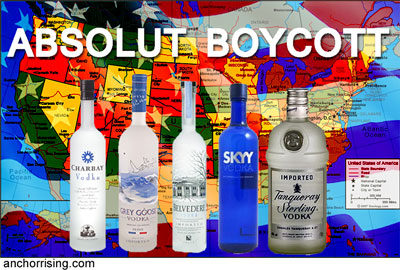
(More on Gateway Pundit.)
March 18, 2008
What to Do About China?
Concerned about your business prospects in the domestic market? Well, Providence Journal business-section columnist John Kostrzewa has a suggestion:
With the local and national economies weakening, and perhaps already in recession, small and large businesses are worried about where the growth will come from in 2008.How about looking overseas, especially to China?
He offers advice, gleaned from a seminar on the topic sponsored by Citizens Bank, the Bank of China and the Greater Providence Chamber of Commerce. "Don't underestimate the language barrier," says one speaker. However, to complement the growing Chinese urban consumer market:
Business owners... can find lower labor, operating and land costs, a surging demand for foreign products and less competition in other parts of the country.
Ah yes. Lower labor costs:
Officially, 2,375 trafficking cases were reported in China last year, a 7.6 percent decrease from 2006, according to the Public Security Ministry.But the statistics are based on China's narrow definition of trafficking, which covers only the kidnapping, purchase or sale of women and children younger than 14, not older teen-agers and men. Activists say the number is grossly understated and that tens of thousands of people are trafficked each year.
Historically, many victims have been women forced to marry lonely farmers, or male babies illegally adopted by couples who wanted a son. But those types of cases are leveling off, while cases of migrants deceived into sexual exploitation and forced labor are increasing, activists say.
I know, I know. I've got those libertarian, free-market leanings, as well. But I don't think we, as a nation, have come up with an adequate solution for dealing with the potential to globalize our economy without globalizing our principles — in part because we're so divided on what our principles should be. Without some truly visionary innovation on our shores, I'm not confident that either our economy or our moral center will remain strong enough for those invisible hands to crush international iniquity.
Jay Nordlinger puts it inimicably:
Reading a report about China's latest massacre in Tibet, I was struck by one line in particular: "China is gambling that its crackdown will not bring an international outcry over human rights violations that could lead to boycotts of the Olympics."That is a very, very good gamble. Nobody gives a rat's behind what the Chinese do, to Tibetans or anybody else. It is a curious fact of modern times. If only China's rulers would embrace the Bush administration: Maybe the world would care!
February 23, 2008
So What Difference Does Dictatorship Make, Anyway?
Perhaps a new Cuban declaration could assert the right of all people to life, liberty, and the pursuit of par (paragraphs rearranged):
Golf had been played on the island since the 1920s. At the time of the 1959 revolution, Havana boasted two award-winning courses, at the Havana Country Club and the Biltmore, which hosted such greats as Sam Snead and the rookie Arnold Palmer. A third course, where Mr. Castro would lose to Che Guevara, had just opened. U.S. tycoon Irénée du Pont had a private nine-hole course in Xanadu, his fabled Varadero beach estate. ...In 1962, Mr. Castro lost a round of golf to Ernesto "Che" Guevara, who had been a caddy in his Argentine hometown before he became a guerrilla icon. Mr. Castro's defeat may have had disastrous consequences for the sport. He had one Havana golf course turned into a military school, another into an art school. A journalist who wrote about the defeat of Cuba's Maximum Leader, who was a notoriously bad loser, was fired the next day. ...
The famous game between Messrs. Castro and Guevara took place shortly after the Cuban Missile Crisis, according to José Lorenzo Fuentes, Mr. Castro's former personal scribe, who covered the game. Mr. Lorenzo Fuentes says the match was supposed to send a friendly signal to President Kennedy. "Castro told me that the headline of the story the next day would be 'President Castro challenges President Kennedy to a friendly game of golf,'" he says.
But the game became a competitive affair between two men who did not like to lose, says Mr. Lorenzo Fuentes, who recalls that Mr. Guevara "played with a lot of passion." Mr. Lorenzo Fuentes says he felt he couldn't lie about the game's outcome, so he wrote a newspaper story saying Fidel had lost. Mr. Lorenzo Fuentes says he lost his job the next day, eventually fell afoul of the regime and now lives in Miami.
It's an iffy thing to live in a society in which one must constantly fear that the supreme leader's tastes will run afoul of one's own.
(via Instapundit)
February 20, 2008
Geldof - Press Has Shortchanged Bush's Successful Africa Policy
Live Aid organizer Bob Geldof is chastising the US Press corps for under-reporting the positive effect that President Bush's Africa policy has had:
Mr. Geldof praised Mr. Bush for his work in delivering billions to fight disease and poverty in Africa, and blasted the U.S. press for ignoring the achievement.And more...Mr. Bush, said Mr. Geldof, "has done more than any other president so far."
"This is the triumph of American policy really," he said. "It was probably unexpected of the man. It was expected of the nation, but not of the man, but both rose to the occasion."
"What's in it for [Mr. Bush]? Absolutely nothing," Mr. Geldof said.
Mr. Geldof said that the president has failed "to articulate this to Americans" but said he is also "pissed off" at the press for their failure to report on this good news story.
"You guys didn't pay attention," Geldof said to a group of reporters from all the major newspapers.
Bush administration officials, incidentally, have also been quite displeased with some of the press coverage on this trip that they have viewed as overly negative and ignoring their achievements.
Mr. Geldof said that he and Bono, U2's lead singer, have "gotten a lot of flak" for saying that Mr. Bush has done more for Africa than any other U.S. president.If the press has underplayed the success of such policies that liberals would otherwise find compelling (say, if a Democrat had implemented them), then what else has the media underplayed or spun differently? In some simple minds, the man can do no good.Mr. Geldof said that "the main thing now is asking the candidates, 'What are you going to do?'"
Mr. Bush, said Mr. Geldof, has "put in place a whole foundation" in the form of aid for disease prevention, government institution building with accountability measures, and investing capital in African countries to build up their economies.
"The next guy really must take it on," Mr. Geldof said, referring to the next president.
January 19, 2008
How Disappointing Is This Administration
As if to demoralize conservative hawks heading into an election year, the Bush administration is falling back to the U.S. political-class default with respect to Palestinian terror:
The "road map" for peace, conceived in 2002 by Mr. Bush, had become a hindrance to the peace process, because the first requirement was that the Palestinians stop terrorist attacks.As a result, every time there was a terrorist bombing, the peace process fell apart and went back to square one. Neither side ever began discussing the "core issues": the freezing of Israeli settlements in the West Bank, the rights of Palestinian refugees to return, the outline of Israel's border and the future of Jerusalem.
"The reason that we haven't really been able to move forward on the peace process for a number of years is that we were stuck in the sequentiality of the road map. So you had to do the first phase of the road map before you moved on to the third phase of the road map, which was the actual negotiations of final status," Miss Rice said.
Was a time when this administration understood that a willingness to resort to terrorism was the "core issue" — not just in the Israeli-Palestinian conflict, but throughout the world. Rice goes on to explain that it was necessary to "break that tight sequentiality ... to say, you can do these in parallel, you can do road-map obligations and negotiation for the final status in parallel," but we've been through this before: The result is that Israel and the United States display their carrots and domestic and international pro-Palestinian (anti-Israeli and anti-American) forces pressure them to start handing the carrots on the promise that it will inspire the Palestinians to lower their stick just a little more.
I'm with Jeff Jacoby:
Whatever happened to the moral clarity that informed the president's worldview in the wake of 9/11? Whatever happened to the conviction that was at the core of the Bush Doctrine: that terrorists must be anathematized and defeated, and the fever-swamps that breed them drained and detoxified? ...Now that policy has gone by the boards, replaced by one less focused on achieving peace than on maintaining a "peace process." No doubt it is difficult, as Rice says, to "move forward on the peace process" when the Palestinian Authority glorifies suicide bombers and encourages a murderous goal of eliminating the Jewish state. If the Bush Doctrine - "with us or with the terrorists" - were still in force, the peace process would be shelved. The administration would be treating the Palestinians as pariahs, allowing them no assistance of any kind, much less movement toward statehood, so long as their encouragement of terrorism persisted.
January 12, 2008
The Power of Snow
So here's a question: Does the effect of snow transcend culture, or has Iraq absorbed enough of the culture that flowed from Northwestern Europe to have a similar cultural reaction?
After weathering nearly five years of war, Baghdad residents thought they'd pretty much seen it all. But Friday morning, as muezzins were calling the faithful to prayer, the people here awoke to something certifiably new. For the first time in memory, snow fell across Baghdad.Although the white flakes quickly dissolved into gray puddles, they brought an emotion rarely expressed in this desert capital snarled by army checkpoints, divided by concrete walls and ravaged by sectarian killings—delight.
"For the first time in my life I saw a snow-rain like this falling in Baghdad," said Mohammed Abdul-Hussein, a 63-year-old retiree from the New Baghdad area.
"When I was young, I heard from my father that such rain had fallen in the early '40s on the outskirts of northern Baghdad," Abdul-Hussein said, referring to snow as a type of rain. "But snow falling in Baghdad in such a magnificent scene was beyond my imagination."
(No word, yet, on the effects of a couple of hours of snow on traffic in the desert country.)
December 27, 2007
Benazir Bhutto Killed in Suicide Bombing
From CNN...
Pakistan's former Prime Minister Benazir Bhutto was assassinated Thursday outside a large gathering of her supporters where a suicide bomber also killed at least 14, doctors and a spokesman for her party said.Pajamas Media has a continuing roundup here (via Instapundit).While Bhutto appeared to have died from bullet wounds, it was not immediately clear if she was shot or if her wounds were caused by bomb shrapnel.
December 6, 2007
After Latest NIE, Some Appear Willing to Believe that "Death to America" Really Does Mean "I Love You"
Cliff May boils down the problem with the reaction to the NIE report:
Many commentators are fudging the distinction between Iran “suspending� and “abandoning� its nuclear weapons program. According to the new NIE, Iran not only continues to enrich uranium, it also is “continuing to develop a range of technical capabilities that could be applied to producing nuclear weapons, if a decision is made to do so.� If your teenage son tells you he doesn’t smoke, but you nonetheless find tobacco, rolling papers and matches in his knapsack, what would be your guess regarding his intentions and capabilities?The NIE was summary explained that Iran has stopped weaponizing nuclear material. This has been extrapolated and distilled to "Iran isn't a threat anymore." The truth is that the writers of the document had a political goal themselves and this has led to various attempts to spin the report. Gives you all sorts of confidence in the ability of the "intelligence" agencies to offer objective analysis, doesn't it? So we have a choice: we continue to be wary of a country that openly proclaims it wants to destroy us or we believe them when the say that "Death to America" really means "I Love You."
December 3, 2007
Re: Thanking Hillary, Tongue in Cheek
When members of the College Republican Federation are at the corner of Post Road and Airport Road in Warwick at 3:30 today, they will have good reason to thank the Junior Senator from New York. Senator Hillary Clinton not only voted in favor of the war in Iraq, Christopher Hitchens pointed out in February that she actively made the case for our action there.
Here is what she said in her crucial speech of October 2002:In the four years since the inspectors left, intelligence reports show that Saddam Hussein has worked to rebuild his chemical and biological weapons stock, his missile delivery capability, and his nuclear program. He has also given aid, comfort, and sanctuary to terrorists, including al-Qaida members, though there is apparently no evidence of his involvement in the terrible events of September 11, 2001.Notice what this does not say. It does not say that she agrees with the Bush administration on those two key points. Rather, it states these two claims in her own voice and on her own authority.
Chavez Defeated
Hugo Chavez's attempt to reshape the Venezuelan constitution has failed. This despite the fact that, according to Providence City Council member Miguel C. Luna:
[T]he reforms would deepen the social and economic changes under President Chavez that have just begun to affect the population, lessening poverty and affording more human rights to the majority. Discrimination based on sexual orientation and health would be criminalized while community organizations would receive direct funding for social-development projects.Apparently the poor didn't get the message:
The loss signals waning support for Chavez's drive to bring socialism to the region's fourth-biggest economy by concentrating power in his hands and ramping up state control of private lives. Voters refused to abolish presidential term limits or allow government censorship during declared emergencies. Chavez also sought to shorten the work day and end central bank autonomy.Never fear, Mr. Luna, I have a feeling the Chavez will try again:``This is the first significant setback that Chavez has ever had,'' said Adam Isacson, director at the Center for International Policy in Washington. ``He has lost popular support. He has lost support of some of the army and the poor.''
``This is a democracy,'' the president said in Caracas. ``For me, this isn't a defeat. This is for now.''I bet.
November 16, 2007
Internet as International Allegory
The obviousness of keeping the Internet out of the hands of U.N.-approved tyrannies provides an opportunity to consider the internationalist impulse more generally:
When hundreds of technology experts from around the world gather here this week to hammer out the future of the Internet, the hottest issue won't be spam, phishing or any of the other phenomena that bedevil users everywhere.Instead, ending U.S. control over what's become a global network will be at the top of the agenda for many of the more than 2,000 participants expected at the United Nations Internet Governance Forum ...
With the Internet now dominating nearly aspect of modern life, continued U.S. control of the medium has become a sensitive topic worldwide. In nations that try to control what people can see and hear, the Internet often is the only source of uncensored news and opinion.
U.S. officials say that keeping Internet functions under their control has protected that free flow of information and kept the Internet growing reliably.
As I understand the structure, the U.S. government's actual "control" of the functioning of the Internet is minimal. The back-room, bird's eye view of the Internet Corporation for Assigned Names and Numbers (ICANN) certainly has potential for abuse, but I bet more people than might want to admit it trust the American people and their government to keep their hands off it more than they trust any other slice of the global society to do the same.
November 13, 2007
The Dried-Up Fruits of Socialism, in Venezuela and Everywhere
You many have noticed the price of oil heading towards record highs. That should imply that the people living in oil-producing countries are doing well, right? Well, not all of them are. According to Reuters, Venezuelan President Hugo Chavez's socialist management of his nation's oil wealth is creating shortages of basic products and crushing the quality of life of Venezuelans, middle class and poor alike…
Venezuelan construction worker Gustavo Arteaga has no trouble finding jobs in this OPEC nation's booming economy, but on a recent Monday morning he skipped work as part of a more complicated search -- for milk.Actually having to live under a socialist regime is making Venezuelans into the most pro-free market people in Latin America. According to a international survey conducted by the Pew Global Attitudes Project in April/May of 2007, support for the idea that "people are better off in free markets" is higher in Venezuela than in any other Latin American country surveyed…The 37-year-old father-of-two has for months scrambled to find basic products like cooking oil, beef and milk, despite leftist President Hugo Chavez's social program that promises to provide low-cost groceries to the majority poor.
"It takes a miracle to find milk," said Arteaga, who spent two hours in line outside a store in the poor Caracas neighborhood of Eucaliptus. "Don't you see I'm here slaving away to see if I can get even one or two of those (containers)?"
The state's consumer protection agency, backed by military reserves, often shutters supermarkets for selling above the fixed price, but vendors offer their goods from makeshift stands in downtown Caracas in plain view of authorities.
"This is an insult, but I can't find it anywhere," said Jose Ferrer, paying nearly $12 for a can of powdered milk regulated at $6. "I have to buy it for my kids, there is no other way."
The economy grew by a record 10 percent in 2006, and millions of Venezuelans receive government stipends to participate in education and community development programs.
One of Chavez's most popular programs is a chain of subsidized supermarkets scattered across rural areas and in hillside slums that sells food at fixed prices unaffected by rampant inflation -- though it too has been hit by shortages.
Percentage of people who agree with the statement that "Most people are better off in a free market economy, even though some people are rich and some are poor".
| 2002 | 2007 | |
| Argentina | 26% | 43% |
| Mexico | 45% | 55% |
| Venezuela | 63% | 72% |
| Brazil | 56% | 65% |
| Peru | 43% | 47% |
| Bolivia | 54% | 53% |
Apologists here in Rhode Island like to discuss how Chavez isn't properly understood in the United States. For example, here are two Providence City councilmen, Miguel Luna and Luis Aponte, announcing a recent visit to Rhode Island by Chavez's ambassador to the United States...
“Councilman Aponte and I are honored to serve as co-hosts of the reception,� said Councilman Luna. “Our goals are to thank Venezuelan President Hugo Chavez for the heating assistance he has provided to thousands of Rhode Islanders and other Americans, and to address the myriad, troubling misconceptions about the Venezuelan government.I wonder if the Councilmen consider the reporting on Chavez's strangulation of Venezuela's non-petroleum domestic economy to be based on "misconceptions", or if they see the problems as part of a state of emergency that will correct itself once Venezuela has been freed from capitalist encirclement. I also wonder if Councilmen Luna and Aponte have given any introspection to their role in the exploitation of Venezuela's people for political purposes, through their endorsement of a program that pays below-market value for heating oil to a country that finds it increasingly difficult to provide basic foodstuffs to its people.
In a related vein, James Keller, a local minister who has traveled to Venezuela, recently declared in a Projo op-ed that support for Chavez is obviously born of enlightened self-interest...
To add insult to injury, [an earlier Projo editorial] says that the people of Venezuela were “hoodwinked� by being given “social justice for the poor"....To Rev. Keller, an interest in living under strong government socialism apparently trumps any interest in being to obtain basic household necessities; who needs milk when you have the right to say you live in a glorious people's republic.Of course, the voters overwhelmingly supported Chavez for re-election to the presidency after they saw their lives improve. They weren’t “hoodwinked� but were voting out of enlightened self-interest, which every electorate does.
But the most important question that needs to be asked of Chavez's local supporters -- especially the ones in positions of political power -- is whether they believe his brand of political leadership and economic policy could provide a viable model for Rhode Island, despite the damage they inflict on the lives of regular people. After all, doesn't it reasonably follow that those who believe that welfare socialism is the right choice for a place that should be in the midst of a petro-economy boom will also believe that even stronger measures are necessary for places where the foundations of the economy are more uncertain.
The Dried-Up Fruits of Socialism, in Venezuela and Everywhere
You many have noticed the price of oil heading towards record highs. That should imply that the people living in oil-producing countries are doing well, right? Well, not all of them are. According to Reuters, Venezuelan President Hugo Chavez's socialist management of his nation's oil wealth is creating shortages of basic products and crushing the quality of life of Venezuelans, middle class and poor alike…
Venezuelan construction worker Gustavo Arteaga has no trouble finding jobs in this OPEC nation's booming economy, but on a recent Monday morning he skipped work as part of a more complicated search -- for milk.Actually having to live under a socialist regime is making Venezuelans into the most pro-free market people in Latin America. According to a international survey conducted by the Pew Global Attitudes Project in April/May of 2007, support for the idea that "people are better off in free markets" is higher in Venezuela than in any other Latin American country surveyed…The 37-year-old father-of-two has for months scrambled to find basic products like cooking oil, beef and milk, despite leftist President Hugo Chavez's social program that promises to provide low-cost groceries to the majority poor.
"It takes a miracle to find milk," said Arteaga, who spent two hours in line outside a store in the poor Caracas neighborhood of Eucaliptus. "Don't you see I'm here slaving away to see if I can get even one or two of those (containers)?"
The state's consumer protection agency, backed by military reserves, often shutters supermarkets for selling above the fixed price, but vendors offer their goods from makeshift stands in downtown Caracas in plain view of authorities.
"This is an insult, but I can't find it anywhere," said Jose Ferrer, paying nearly $12 for a can of powdered milk regulated at $6. "I have to buy it for my kids, there is no other way."
The economy grew by a record 10 percent in 2006, and millions of Venezuelans receive government stipends to participate in education and community development programs.
One of Chavez's most popular programs is a chain of subsidized supermarkets scattered across rural areas and in hillside slums that sells food at fixed prices unaffected by rampant inflation -- though it too has been hit by shortages.
Percentage of people who agree with the statement that "Most people are better off in a free market economy, even though some people are rich and some are poor".
| 2002 | 2007 | |
| Argentina | 26% | 43% |
| Mexico | 45% | 55% |
| Venezuela | 63% | 72% |
| Brazil | 56% | 65% |
| Peru | 43% | 47% |
| Bolivia | 54% | 53% |
Apologists here in Rhode Island like to discuss how Chavez isn't properly understood in the United States. For example, here are two Providence City councilmen, Miguel Luna and Luis Aponte, announcing a recent visit to Rhode Island by Chavez's ambassador to the United States...
“Councilman Aponte and I are honored to serve as co-hosts of the reception,� said Councilman Luna. “Our goals are to thank Venezuelan President Hugo Chavez for the heating assistance he has provided to thousands of Rhode Islanders and other Americans, and to address the myriad, troubling misconceptions about the Venezuelan government.I wonder if the Councilmen consider the reporting on Chavez's strangulation of Venezuela's non-petroleum domestic economy to be based on "misconceptions", or if they see the problems as part of a state of emergency that will correct itself once Venezuela has been freed from capitalist encirclement. I also wonder if Councilmen Luna and Aponte have given any introspection to their role in the exploitation of Venezuela's people for political purposes, through their endorsement of a program that pays below-market value for heating oil to a country that finds it increasingly difficult to provide basic foodstuffs to its people.
In a related vein, James Keller, a local minister who has traveled to Venezuela, recently declared in a Projo op-ed that support for Chavez is obviously born of enlightened self-interest...
To add insult to injury, [an earlier Projo editorial] says that the people of Venezuela were “hoodwinked� by being given “social justice for the poor"....To Rev. Keller, an interest in living under strong government socialism apparently trumps any interest in being to obtain basic household necessities; who needs milk when you have the right to say you live in a glorious people's republic.Of course, the voters overwhelmingly supported Chavez for re-election to the presidency after they saw their lives improve. They weren’t “hoodwinked� but were voting out of enlightened self-interest, which every electorate does.
But the most important question that needs to be asked of Chavez's local supporters -- especially the ones in positions of political power -- is whether they believe his brand of political leadership and economic policy could provide a viable model for Rhode Island, despite the damage they inflict on the lives of regular people. After all, doesn't it reasonably follow that those who believe that welfare socialism is the right choice for a place that should be in the midst of a petro-economy boom will also believe that even stronger measures are necessary for places where the foundations of the economy are more uncertain.
October 29, 2007
Shhh! World Is Becoming A Better Place
Stephen Moore calls attention to a UN report that--for some reason--didn't get much play in the media:
A new United Nations report called "State of the Future" concludes: "People around the world are becoming healthier, wealthier, better educated, more peaceful, more connected, and they are living longer."Yes, of course, there was the obligatory bad news: Global warming is said to be getting worse and income disparities are widening. But the joyous trends in health and wealth documented in the report indicate a gigantic leap forward for humanity. This is probably the first time you've heard any of this because--while the grim "Global 2000" and "Limits to Growth" reports were deemed worthy of headlines across the country--the media mostly ignored the good news and the upbeat predictions of "State of the Future."
But here they are: World-wide illiteracy rates have fallen by half since 1970 and now stand at an all-time low of 18%. More people live in free countries than ever before. The average human being today will live 50% longer in 2025 than one born in 1955.
To what do we owe this improvement? Capitalism, according to the U.N. Free trade is rightly recognized as the engine of global prosperity in recent years. In 1981, 40% of the world's population lived on less than $1 a day. Now that percentage is only 25%, adjusted for inflation. And at current rates of growth, "world poverty will be cut in half between 2000 and 2015"--which is arguably one of the greatest triumphs in human history. Trade and technology are closing the global "digital divide"...
The media's collective yawn over "State of the Future" is typical of the reaction to just about any good news. When 2006 was declared the hottest year on record, there were thousands of news stories. But last month's revised data, indicating that 1934 was actually warmer, barely warranted a paragraph-long correction in most papers.
So I'm happy to report that the world's six billion people are living longer, healthier and more comfortably than ever before. If only it were easy to fit that on a button.
October 15, 2007
Questions That Should Be Asked
Jay Nordlinger poses a series of questions that ought to be asked of the current crop of presidential candidates:
Putin's latest attacks on U.S. missile defense remind me of something: Do Democratic presidential candidates agree with those attacks? Sympathize with them? And, if one of them is elected president, are our efforts to defend ourselves, and our allies, against missiles off — dead, suspended until the next Republican president?Will someone ask Hillary & Co. about this?
His latest Impromptus column also makes me feel a little better about not getting into a certain Ivy League graduate program (despite grades, recommendation, GED, etc.):
The Nobel peace committee is not so much a peace committee as a standard left-wing pressure group — sending these Mickey Mouse "messages." They're like the board of the MacArthur Foundation, or the English department of Brown University or something — there is no connection between what they do and quality. It's just straight politics, or, more accurately, ideology.
September 30, 2007
Wary of the News from Russia
I hate to say it, but I'll be looking for Garry Kasparov to have a horrible chess accident during the next few months:
The former world chess champion Garry Kasparov entered Russia's presidential race on Sunday, elected overwhelmingly as the candidate for the country's beleagured opposition coalition.Kasparov has been a driving force behind the coalition, which has united liberals, leftists and nationalists in opposition to President Vladimir Putin. He received 379 of 498 votes at a national congress held in Moscow by the Other Russia coalition, coalition spokeswoman Lyudmila Mamina told The Associated Press.
September 27, 2007
Dems Showing Prudence?
If there's a Democrat elected President in 2008, will there be troops in Iraq in 2013?
"I think it's hard to project four years from now," said Sen. Barack Obama of Illinois in the opening moments of a campaign debate in the nation's first primary state.Oh, so you mean you'll gauge the situation at that time, examine the facts at hand, utilize your best judgment and then determine what is the most prudent path to follow?"It is very difficult to know what we're going to be inheriting," added Sen. Hillary Rodham Clinton of New York.
"I cannot make that commitment," said former Sen. John Edwards of North Carolina.
Huh.
I guess your perspective can change when you might actually have to make the tough decisions instead of just second-guess them.
September 14, 2007
The Propriety of Responding to the President
Feeding into the WPRO ad, "Where do bloggers go....", Dan Yorke brings up an interesting point. Why was there a need for a "Democrat response" to the Presidential speech on the status of the conflict in Iraq? Dan talked to Brown University's Darrell West about it, and they came to the following conclusions:
1) There was never any sort of "opposition party" response to a televised Presidential address until the 1980's (Ronald Reagan). Then, the argument was that the President could offer his side of a story without rebuttal. The networks acquiesced and began allowing a response to State of the Union addresses.
2) Over the years, and despite the removal of the so-called "Fairness Doctrine", the networks continued the practice.
3) Now, it seems they've expanded the practice such that any Presidential address is effectively rebutted by the opposition. Even a speech offering an update on progress made in a war. Anyone ever here about the time Wendell Wilkie aired a rebuttal to one of FDR's fireside chats? Didn't think so.
Yorke's point is that, since the networks are under no obligation to offer the rebuttal, they are being ideological activists by continuing to provide the opportunity. As such, the office of the President--regardless of whether a Democrat or Republican--is diminished. He can't even get 5 minutes of breathing room to offer his case without the other side being able to take partisan political shots. Incidentally, it looked like ABC, CBS and NBC aired the Democratic response, but FOX did not (though FOXNEWS did, I think). That should stoke some fires.
I suppose this is of a piece of the broader trend towards diminishing the office of the President or that how some of us realize there was a time when politics really did stop at the waters edge.
On a side note, the best analysis of Sen. Reed's retort comes from Kimberly Kagan:
Senator Jack Reed gave the Democratic response, and the contrast with Bush’s speech was striking to those who paid careful attention. Bush addressed the situation in Iraq with detail and nuance. He described varying situations on the ground in different, specific regions of the country, spoke of particular movements and individuals, and showed a grasp of the complexity and reality of the struggle. Reed spoke only in generalizations. He did not refer to any specific events, places, or individuals in Iraq. He spoke generally of a “Democratic plan� for withdrawal that sounded remarkably like the Baker-Hamilton plan, originally presented at the end of 2006 in a completely different operational context. The vagueness of his discussion of the situation and of his proposals contrasted starkly with the specificity even of Bush’s speech, to say nothing of the incredible complexity and detail evinced in the testimony of General Petraeus and Ambassador Crocker. That contrast highlights once more what is really the key question of the upcoming political debate over Iraq: Whom do the American people want to run this war, Congress or the people who know something about it?
August 24, 2007
Drawing the Iron Curtain?
Perhaps I'm just noticing examples more, of late, but there seems to be an increasing stream of worrying news items, such as the following, coming out of Russia:
Russia's armed forces chief of staff on Thursday described as "hallucinations" Georgia's claim that Russian warplanes had violated its border on Tuesday, Interfax news agency reported.Georgia, which has accused Russian aircraft of dropping a missile near its capital Tbilisi earlier this month, said on Wednesday two more Russian jets had illegally crossed its borders. Russia has rejected the claims.
"It must be that our Georgian colleagues are starting to suffer from hallucinations," General Yuri Baluyevsky said.
I'm beginning to see this January 2003 post as naive and to worry that we'll too soon be looking back on the palpable excitement of the '90s in wistful lament at our subsequent loss of illusion (a pleasant fantasy that the new millennium quickly proved, of course, to be naive). How much of the next ten years' politics will suffer the turbulence of mass longing to reenter the dream?
August 19, 2007
Maybe I'm Just Paranoid...
... but this sort of news is beginning to sound less and less like a series of flukes:
Libertyville-based DMH Ingredients has filed a federal lawsuit against Changzhou Kelong Chemical Co. Ltd., saying DMH found metal shavings in 11,200 kilos of aspartame artificial sweetener the Chinese company shipped in 2005.
What's going on over there?
August 8, 2007
The Sound of the Empire's End
Promising and active young professionals (among others) are fleeing Great Britain:
BRITAIN is facing a mass exodus of people looking to escape the crime and grime of modern living.The country’s biggest foreign visa consultancy firm has revealed that applications have soared in the last seven months by 80 per cent to almost 4,000 a week. Ten years ago the figure was just 300 a week.
Most people are relocating within the Commonwealth — in Australia, Canada and South Africa. They are almost all young professionals and skilled workers aged 20-40.
And many cite their reason for wanting to quit as immigration to these shores — and the burden it is placing on their communities and local authorities. The dearth of good schools, spiralling house prices, rising crime and tax increases are also driving people away.
Reading the whole article, Rhode Islanders may feel that the problems (and individual citizens' solution) sounds really, really familiar.
ADDENDUM:
It's a little off topic (depending how broad you take the topic to be), but coming across the statistic at the end of the following paragraph shortly after writing this post, my first thought was that we've an indication of who remains when the family and future–oriented folks look for bluer skies (emphasis added):
Today, the sexualization of girls begins in infancy with 12-month sized rompers announcing, "I'm too sexy for my diaper." At age four, it's The Bratz Babyz, singing "You've gotta look hotter than hot! Show what you've got!" At six it's a pouty, scantily dressed My Scene Bling Bling Barbie draped in diamonds. By 12, it's Ludacris singing ( Ruff sex): "make it hurt in the garden." Fully brainwashed by 13, lap dancer is by then considered a more desirable profession than teacher, as one British survey of 1,000 teenage girls found to be the case by a 7-1 ratio.
(via Mark Shea)
July 31, 2007
Good News in Iraq = Bad News for Some
Both Andrew and Mac have pointed to the NY Times piece by Brookings Institute's Michael O’Hanlon and Kenneth Pollack that claims progress is being made in Iraq. As Mac stated, it is important because of who is saying that things are looking up: "two severe critics of the Bush administration’s management of the war." Afraid of a potential sea-change in public opinion (how politically detrimental that would be for the Dems!), opponents of the Iraq War have attempted to counter the emerging meme (to use a favorite wonky term) that highlights the anti-Bush bona fides of the authors, claiming they supported the original invasion of Iraq, support the surge, one of them is friends with General Petraeus, etc. In the same NRO symposium to which Mac contributed, Victor Davis Hanson counters this argument:
What is interesting about the essay is that both scholars were early supporters of the war to remove Saddam Hussein, then constant critics of the acknowledged mistakes of the occupation, and now somewhat confident that Gen. Petraeus can still salvage a victory. In two regards, they reflect somewhat the vast majority of the American people who approved the war, slowly soured on the peace — but now have yet to be won over again by the surge to renew their erstwhile support.Finally, what are the opponents going to do to undermine the credibility of an anti-Iraq-invasion, liberal, Muslim congressman reports that things are looking up? (h/t Capt. Ed)
[Minnesota Democratic Rep. Keith] Ellison , a vocal critic of the Iraq war, said he still believes it was a mistake for the U.S. to invade Iraq.One final, semi-related note. I highly recommend Victory Caucus as a clearinghouse for the good and bad in Iraq."But there are 150,000 American soldiers there now, and I care very deeply about them," said Ellison, one of six members on the all-freshman trip led by Rep. Jerry McNerney, D-Calif. "I also care about the Iraqi people. I don't want to see them suffer."
The group met with Iraqi and U.S. military officials, including Gen. David Petraeus, the top U.S. commander in Iraq.
Ellison said that local leaders in Ramadi told him of how they partnered with U.S. and Iraqi military officials to virtually rid al-Qaeda from the city. Although the lawmakers had to travel in flak vests and helmets, "we did see people walking around the streets of Ramadi, going back and forth to the market."
There have been fewer anti-U.S. sermons as the violence has been reduced, Ellison said, and religious leaders meet regularly with U.S. military officials.
"The success in Ramadi is not just because of bombs and bullets, but because the U.S. and Iraqi military and the Iraqi police are partnering with the tribal leadership and the religious leadership," he said. "So they're not trying to just bomb people into submission. What they're doing is respecting the people, giving the people some control over their own lives."
Ellison said he was particularly impressed watching Maj. Gen. Walter Gaskin, U.S. commander in the Anbar province, greeting people with "as-salama aleikum," meaning peace be upon you.
"And they would respond back with smiles and waves," Ellison said. "I don't want to overplay it. There were no flowers. There was no clapping. There was no parade. But there was a general level of respect and calm that I thought was good."
July 25, 2007
Fatherland, Socialism, or …er …uh …Something Better, Maybe?
A number of blogs have made note of the Pew Research Center global opinion study showing that the number of people who believe that suicide bombings are justified is dropping across the Muslim world.
Here’s another stat from the same study. The number of people in Venezuela who believe that “most people are better off in a free market economy, even though some people are rich and some people are poor� stands at 72% -- higher than any other Latin American country listed! That’s a very noteworthy stat in a country whose President’s motto is “Fatherland, Socialism, or Death�.
There’s nothing like living under actual socialism to drive up support for capitalism.
July 11, 2007
Iraq: Taking Stock
I'm not a dead-ender on Iraq, but I do think we've got to give the new--albeit too-long in coming--strategy time to work. I suspect readers will just breeze on past this post as many, probably most, already have their minds made up. To them, we are frozen in time: the situation in Iraq will always be as it was in November 2006, just before the election. And that's not a coincidence. The domestic political component of the entire war debate is probably the most troubling to me. Without further (or much) ado--and in addition to Don's related post--here are some reports/opinions that inform my own current views on Iraq.
Continue reading "Iraq: Taking Stock"May 22, 2007
The Coming Summer in Iraq
Word is that Iran is getting ready to finance and run a major offensive in Iraq this summer in and effort "to tip a wavering US Congress into voting for full military withdrawal."
Tehran's strategy to discredit the US surge and foment a decisive congressional revolt against Mr Bush is national in scope and not confined to the Shia south, its traditional sphere of influence, the senior official in Baghdad said. It included stepped-up coordination with Shia militias such as Moqtada al-Sadr's Jaish al-Mahdi as well as Syrian-backed Sunni Arab groups and al-Qaida in Mesopotamia, he added. Iran was also expanding contacts across the board with paramilitary forces and political groups, including Kurdish parties such as the PUK, a US ally.Meanwhile, the Iraqis are preparing for just such an eventuality. Perhaps the most important development is political, here at home. Former Democratic Senator Bob Kerrey, Vietnam War veteran and member of the 9/11 Commission, has written an important editorial in today's Wall Street Journal.
American liberals need to face these truths: The demand for self-government was and remains strong in Iraq despite all our mistakes and the violent efforts of al Qaeda, Sunni insurgents and Shiite militias to disrupt it....Much of Iraq's middle class has fled the country in fear.With these facts on the scales, what does your conscience tell you to do? If the answer is nothing, that it is not our responsibility or that this is all about oil, then no wonder today we Democrats are not trusted with the reins of power....The key question for Congress is whether or not Iraq has become the primary battleground against the same radical Islamists who declared war on the U.S. in the 1990s and who have carried out a series of terrorist operations including 9/11. The answer is emphatically "yes."
This does not mean that Saddam Hussein was responsible for 9/11; he was not. Nor does it mean that the war to overthrow him was justified--though I believe it was. It only means that a unilateral withdrawal from Iraq would hand Osama bin Laden a substantial psychological victory.
Those who argue that radical Islamic terrorism has arrived in Iraq because of the U.S.-led invasion are right. But they are right because radical Islam opposes democracy in Iraq....Jim Webb said something during his campaign for the Senate that should be emblazoned on the desks of all 535 members of Congress: You do not have to occupy a country in order to fight the terrorists who are inside it. Upon that truth I believe it is possible to build what doesn't exist today in Washington: a bipartisan strategy to deal with the long-term threat of terrorism.
The American people will need that consensus regardless of when, and under what circumstances, we withdraw U.S. forces from Iraq. We must not allow terrorist sanctuaries to develop any place on earth. Whether these fighters are finding refuge in Syria, Iran, Pakistan or elsewhere, we cannot afford diplomatic or political excuses to prevent us from using military force to eliminate them.
May 9, 2007
Re: Sarkozy
There has been much media and internet speculation on the subject of whether incoming French President Nicolas Sarkozy could become France’s version of Ronald Reagan. But isn’t a comparison to Richard Nixon equally, if not more, valid…
- Domestically, just like Nixon, Sarkozy was clearly the law-and-order candidate.
- In foreign policy, the analogy is less perfect, but like the Richard Nixon of the Vietnam era, Sarkozy’s promise is to help his country, shaken by some foreign policy missteps and unsure of its place in the world, develop better relations with a superpower that no one expects to go away any time soon.
But even if Nicolas Sarkozy and German Chancellor Angela Merkel aren’t going to be updated versions of Reagan and Thatcher, the fact that French and German electorates have chosen the unabashed pro-American candidates a fact worth noting. The downside to the observation is the ray of hope it gives to Socialists in Europe and elsewhere -- they might begin to experience more electoral success if they ever decide to drop their reflexive anti-Americanism!
Re: Sarkozy
There has been much media and internet speculation on the subject of whether incoming French President Nicolas Sarkozy could become France’s version of Ronald Reagan. But isn’t a comparison to Richard Nixon equally, if not more, valid…
- Domestically, just like Nixon, Sarkozy was clearly the law-and-order candidate.
- In foreign policy, the analogy is less perfect, but like the Richard Nixon of the Vietnam era, Sarkozy’s promise is to help his country, shaken by some foreign policy missteps and unsure of its place in the world, develop better relations with a superpower that no one expects to go away any time soon.
But even if Nicolas Sarkozy and German Chancellor Angela Merkel aren’t going to be updated versions of Reagan and Thatcher, the fact that French and German electorates have chosen the unabashed pro-American candidates a fact worth noting. The downside to the observation is the ray of hope it gives to Socialists in Europe and elsewhere -- they might begin to experience more electoral success if they ever decide to drop their reflexive anti-Americanism!
May 8, 2007
Sarkozy
The election of center-right Nicolas Sarkozy as president of France prompts Ralph Peters to observe, "I never thought I'd see it in my lifetime." Election of a real reformer, that is. More:
Sarkozy is the first top-level French politician who openly accepts that the United States possesses virtues from which France might take a lesson. While Sarko's attraction to things American can be overstated - he sees our system's deficiencies, too, and won't always agree with our foreign policy - he'll be a leader who examines issues on their merits, not on the basis of shopworn Left Bank slogans.Peter's also provides a few quotes from Sarkozy's book, "Testimony," to provide a window on the man's policies:What's striking about this victory is Sarkozy's bluntness. Instead of mumbo jumbo about la gloire, he speaks frankly about the mess in which France finds itself.
* "The best social model is one that creates jobs for everyone, and this is obviously not ours since our unemployment level is twice as high as that of our main partners."Froma Harrop also weighs in, and cogently observes:* "I admire the social mobility of American society. You can start with nothing and become a spectacular success. You can fail and get a second chance. Merit is rewarded."
* "France is no longer the country that comes up with new ideas."
And Sarkozy offers some hard truths to those Americans who mindlessly praise the imaginary social justice and "better" quality of life in a France they know only from privileged vacations that tend to avoid the Muslim slums and collapsed industrial areas:
* "The French have never spoken so much about justice while allowing so much injustice to prevail . . . The reality of our system is that it protects those who have something, and it is very tough on those who don't."
* "France has been discouraging initiative and punishing success for the past 25 years. And the main consequence of preventing the most dynamic members of society from getting rich is to make everyone else poor."
* "It is hard to exaggerate the damage done to France by the 35-hour workweek. How can anyone think that you're going to create wealth and jobs by working less?"
* "Thirteen percent of retired women live below the poverty line, and a further 25 percent are barely above it . . . The unemployment rate for unskilled workers is 15 percent . . . It is 22 percent for those under 25 and nearly 40 percent for low-skilled youth who live in [immigrant ghettos]."
A conservative, Sarkozy has summoned the French to work harder and longer, but one has to understand the context. The French can work harder and longer without working particularly hard or long, by our standards, anyway.Ha!
May 6, 2007
Combatting Those We Can't Understand
With the news of Russia's slow slide back toward totalitarianism and Rocco DiPippo's observations about life in Iraq prior to the troop surge, I find myself baffled by those who seek not just power, but oppressive power. Writes Rocco:
Before the troop surge began, my friend Nabil's brother-in-law, a resident of Jordan, was shot in the head while he was visiting Baghdad for a week to help with Nabil's wedding plans. He was killed by a terrorist simply for being at the wrong place at the wrong time.A month prior to that event, Nabil and his parents fled their long-time home when they received a note, wrapped around a 9mm bullet, commanding them to leave their neighborhood in 24 hours or be killed. (Based on what had happened to some of those in Nabil's neighborhood who had ignored similar threats, he knew that he and his family had half that time to gather up a few possessions and leave, if they wanted to live.)
Oh, we can empathize with the various factors that we imagine contribute to a willingness to terrorize and oppress. If the Virginia Tech killer had been a bit more charismatic — we might be tempted to think — he could have been a Hitler or Saddam. But if he had possessed such qualities, the triggers of his atrocity wouldn't have existed and, if he lusted for power (rather than just acceptance), he would have been drawn to those means to power that our society has made to be more efficient and less personally perilous, such as politics, business, and even entertainment.
We can also understand that poverty and economic hopelessness can spur one toward desperate measures, and we can imagine ourselves, in such a state, being wooed by organized revolutionaries. But our society has generated organizations for assistance and political advancement. Moreover, we emphasize the power of information and communication over that of militarization.
We can even understand that, in nations that lack an established democratic rule of law, one has no guarantee that relaxing one's grip on power will not send it slipping into the hands of even more (or at least conflicting) tyrannical forces. But one would expect people in such predicaments to see how much more stable the general power structure is under a free, constitutional regime. (Pakistan's Musharraf comes to mind.) No doubt, being the faction that introduces democracy to a previously totalitarian society is a dangerous, courageous endeavor, but when the United States — and all of Western society (tentatively) — takes an interest, shouldn't that represent an opportunity? To be sure, certain factions will find that they are disadvantaged when it comes to the United States' affections, but the groups of which I'm thinking — those that oppose the West and the reformers whom Westerners woo — don't tend even to consider overtures.
With interest, experience, and time, we can indeed construct a theoretical model of the drivers and boundaries of anything from atomic particles to psychotics, but models are far removed from intuitive understanding. It is one thing to conclude that, in order to deal with insurgents, one must take certain steps. It is another to assess "what would work on me if I were an insurgent." That such a distinction exists at all appears to be a matter of some doubt along certain lines in Western Society.
The missing component, put another way, is the realization that oppressive, terroristic mindsets in other cultures sprout from different branches of human nature's development than the West. This is not to say that Western civilization is immune to similar follies, but that other cultures' versions exist under rules of law (writ large) that are parallel, not subordinate, to our own. Terrorists will not "come to their senses," because their senses are different, and Westerners' refined aversion violence and preference for talk and political maneuvering is not a reasonable predictor of our enemies' behavior.
Of course, some Westerners would object even to my calling hostile groups "enemies." One such, no doubt, would be Dr. Brian Alverson of Barrington, whose fortuitously timed letter to the Providence Journal expresses precisely the mentality that I've been describing:
What the Republican Party doesn't want Americans to realize is there is, in fact, no true war on terror. Terror is not a burly beast aggressor out there. Terrorism has been going on for millennia.
The implication, here, is that people commit acts of terrorism, and if we focus on people rather than actions, we can come to understand them, as Alverson continues:
What our Republican leaders have done is create a world-wide distaste for America, especially among extremist groups. More people want to hurt innocent Americans than ever before, and this is due mostly to our aggressive foreign policy.
One can understand (the train of thought goes on) why these poor people would lash back at America and Americans, and with that understanding, we can construct a solution:
A vote for the majority of Republican candidates is a vote for a continuation of foreign policy that puts our children in harm's way, and increases the likelihood of foreign terrorists on American soil.
The solution, in other words, is to scale back our "aggressive" foreign policy — leaving those whom American interference would turn into terrorists to themselves and, when it's necessary to interact with them, doing so as we do here in the West, with communication and politics. The first question that arises is what we should do when they don't keep to themselves — whether their expansionism amounts to direct attacks (as on 9/11) or to encroachment on our interests overseas. The next, trickier question is whether we have some responsibility to intercede in their affairs when notes begin appearing, wrapped around bullets, in family mailboxes.
As long as America protects either innocents or just its own interests, it will raise the ire of the oppressors of the world, and if it does not offer such defenses, those same would-be tyrants will read its inaction as opportunity. There's a strange gray area of ignorance lingering between our cultural guilt about imperialism, colonialism, and worse practices and our willingness to believe that other cultures have surely reached our degree of refinement. That we have built barriers and controls around human nature does not mean that it does not run more wildly among others.
The grounds for hope materialize with the realization that we can understand others through our shared humanity — and all of the good and evil that give humanity its character. We've a long history to examine of falling before the devil's whispers, and he whispers to us yet. To reformulate my statement above, we can observe how our enemies heed him, and we can model their likely behavior. The difficulty comes in understanding why they are deceived by certain of his lies, and in believing that he may deceive us through our own compassion and empathy.
May 1, 2007
Reported death of al-Qaeda in Iraq leader?
The reported death of Abu Ayyud al-Masri is still unconfirmed, but the firefight in which he was allegedly killed illustrates a change in Iraq that has been little noticed until recently: the deepening antipathy of the Sunni tribes of al-Anbar province toward the foreigners of Al Qaeda in Iraq (AQI).
There were reports of red-on-red� battles in the Sunni triangle as early as 2005, but the real shift began in the summer and fall of 2006 when a substantial majority of Sunni sheikhs in al-Anbar began to defect from their previous alliance with AQI. Bing and Owen West described the sheikhs’ defection in The Atlantic recently and even the New York Times reported the security improvements in al-Anbar resulting from the change in attitude and behavior by the Sunni sheikhs.
This is a positive development. Intelligence tips from the Sunni concerning AQI operatives and operations have been on the increase for some time and this event suggests that this trend will continue. The number of policemen has increased exponentially from a year ago. The Bush "surge" deserves some credit but AQI has brought most of this on itself by the barbarity of its attacks on Sunni civilians.
But as positive a development as it is, we need to realize that the fact the sheikhs have abandoned their alliance with AQI and are cooperating with the Iraqi government and the Americans doesn’t necessarily adumbrate a permanent situation. The long-term attachment of the Sunni of al-Anbar to the Iraqi government depends a great deal on the actions of the latter.
April 20, 2007
The "Bush Surge" vs. the "Reid Surge"
Not too long ago I posted a criticism of Rep. Nancy Pelosi (D-CA), the Speaker of the House of Representatives, for trekking to Damascus to meet with the thug dictator of Syria. In arguing against her trip, I used a scene from the Godfather as an analogy: Sonny dissenting from a decision made by his father, Don Corleone, during a meeting with a representative of another Mafia family. The representative—Virgil “the Turk� Sollozo—an assassin for the Tattaglias, immediately concludes that if the Don is eliminated, Sonny will take his place and cooperate. And sure enough, shortly thereafter, the Tattaglias attempt to assassinate the Don.
If “Sonny� Pelosi’s Syrian trip was ill-advised because of Assad’s likely perception that if he can wait out the Bush administration, he can make a better deal with the Democrats, how much worse was the widely-reported statement two days ago by Senate Majority Leader Harry “the Copperhead� Reid that the war in Iraq is lost? According to news reports, Reid told journalists "I believe ... that this war is lost, and this surge is not accomplishing anything, as is shown by the extreme violence in Iraq this week."
America’s enemies in the Middle East certainly took note of Pelosi’s trip; the Arab press was full of favorable reports of the Speaker’s pilgrimage to Damascus. The Middle Eastern press has also, not surprisingly, taken note of Reid’s comments (which he tried to take back later in the day). So in addition to feeding defeatism in the United States and demoralizing the troops who are in Iraq (or soon to be on their way there), Reid has most likely encouraged our enemies in that unhappy place.
Our enemies know that the war that counts is the one for the American mind. If we believe that the war is lost, they win. They have an incentive to keep fighting and to kill as many people as they can. In a gun battle with American troops, the insurgents lose. So they concentrated on killing as many Iraqis as they can in the hope and expectation that the news will demoralize the American public.
Lincoln noted that in a democratic republic, “public sentiment� is critical. During the Civil War, Robert E. Lee was an assiduous reader of Northern newspapers. By 1864 he understood that the only hope for the Confederacy was that war weariness in the North would lead to Lincoln’s electoral defeat. The Confederates put a great deal of hope in the “Copperheads,� the so-called “Peace Democrats� who did everything possible to obstruct the Union war effort.
During Vietnam, the Tet Offensive of 1968 was a military defeat for the North Vietnamese communists, but a public relations victory that helped turn the American public against the war. In audiotapes released by the insurgents over the last couple of years, their leaders such as the late and unlamented Abu Musab al-Zarqawi have demonstrated that they understand the lessons of Tet very well.
I believe that the bomb attacks in Iraq that caused such carnage in recent days are the expected consequences of the Democrats’ efforts to undercut the president’s new team and the changed strategy represented by the so-called “surge.� We know what the Bush surge is. I think a good name for the increasing body count in Iraq is the “Reid surge.�
Update: I have been pushing the similarities between today’s Democrats and the Civil War “Copperheads.� On Friday’s “Best of the Web,� James Taranto picks up the theme, comparing Reid’s statement to the Democratic Party platform of 1864, which was written by the Copperheads. Indeed, a Copperhead, Rep. George H. Pendleton of Ohio, was the Democratic vice-presidential nominee. Not much has changed.
"Resolved, that this convention does explicitly declare, as the sense of the American people, that after four years of failure to restore the Union by the experiment of war, during which, under the pretence of military necessity, or war power higher than the Constitution, the Constitution itself has been disregarded in every part, and public liberty and private right alike trodden down, and the material prosperity of the country essentially impaired, justice, humanity, liberty, and the public welfare demand that immediate efforts be made for a cessation of hostilities, with a view to an ultimate convention of the States or other peaceable means, to the end that at the earliest practicable moment peace may be restored on the basis of the federal Union of the States."--1864 Democratic platform
April 6, 2007
"Sonny" Pelosi, Redux
Here's what our friends at Power Line have to say about "Sonny" Pelosi's trip to the Middle East.
'We have pointed out that Speaker Pelosi's attempts at diplomacy in the Middle East haven't received good reviews from the Israelis or, here at home, from even the Washington Post. However, according to WorldNetDaily, she's big hit with terrorists. It reports, for example, that Khaled Al-Batch, a spokesman for Islamic Jihad, expressed hope that Pelosi would continue winning elections, and added that her Damascus visit demonstrated she understands the Middle East. Similarly, Abu Abdullah, a leader of Hamas' military wing in the Gaza Strip, said the willingness by U.S. lawmakers to talk with Syria "is proof of the importance of the resistance against the U.S." To this terrorist, then, Pelosi's visit is a reward for making war on the U.S. and its allies.
Jihad Jaara, a senior member of the Al Aqsa Martyrs Brigades terror group and the infamous leader of the 2002 siege of Bethlehem's Church of the Nativity, was also quite impressed with Pelosi. He said, "I think it's very nice and I think it's much better when you sit face to face and talk to Assad. It's a very good idea. I think she is brave and hope all the people will support her. All the American people must make peace with Syria and Iran and with Hamas. Why not?"'
Power Line is a conservative blog, but the Washington Post, not exactly a pro-Bush paper, seems to share Power Line's disdain for the Speaker's attempt at diplomacy.
'"We came in friendship, hope, and determined that the road to Damascus is a road to peace," Ms. Pelosi grandly declared.
Never mind that that statement is ludicrous: As any diplomat with knowledge of the region could have told Ms. Pelosi, Mr. Assad is a corrupt thug whose overriding priority at the moment is not peace with Israel but heading off U.N. charges that he orchestrated the murder of former Lebanese prime minister Rafiq al-Hariri. The really striking development here is the attempt by a Democratic congressional leader to substitute her own foreign policy for that of a sitting Republican president. Two weeks ago Ms. Pelosi rammed legislation through the House of Representatives that would strip Mr. Bush of his authority as commander in chief to manage troop movements in Iraq. Now she is attempting to introduce a new Middle East policy that directly conflicts with that of the president. We have found much to criticize in Mr. Bush's military strategy and regional diplomacy. But Ms. Pelosi's attempt to establish a shadow presidency is not only counterproductive, it is foolish.'
Foolish indeed. I wonder: does anyone think that Ms. Pelosi has ever even perused The Federalist?
April 5, 2007
The Situational Pragmatism of Congressman Langevin
In addition to talking about Iraq with Dan Yorke, Congressman Langevin also talked about Speaker Pelosi's recent botched Syrian excursion and said she was following the precepts of the Iraq Study Group report (PDF). While Langevin condemned the regimes of both Iran and Syria, he also offered that--as per the Iraq Study Group--pragmatic diplomacy was the way to go. He also talked about how the U.S. should encourage democracy movements, particularly in Iran. So, while the regimes are bad and we'd really like to see them taken down, we've still got to talk to them, despite their past intransigence. It's realpolitick all over again and very pragmatic. (Don't get me wrong, we need to talk, but keep in mind who we're dealing with here.)
On the other hand, when Yorke asked him about gas prices, the Congressman lapsed into the standard alternative energy chant and explained that the U.S. needed to decrease our dependence on oil My first thought was: where's the pragmatism here, Congressman? I agree that we should develop new energy sources. But in the meantime, why don't we take steps to become energy independent by actually taking advantage of some of our own domestic oil resources or expanding our nuclear power capability? Wouldn't the pragmatic approach be to take advantage of the technology we we have now and still provide incentives for new energy sources? Why can't we do both?
Langevin Stuck in November '06
I had a chance to hear a portion of Dan Yorke's interview with Congressman Jim Langevin yesterday afternoon. When asked about Iraq, Rep. Langevin continued to trumpet the line that things are getting worse in Iraq and that the "surge" won't work. They've already made up their minds and this unwillingness to reassess the situation when things may actually be changing is indicative of the quandary the Democratic Congress finds itself in.
They have staked their political fortunes to the popular perception of Iraq--it's bad and getting worse--that they believe got them elected to a majority last November. After years of calling for change in strategy and finally getting their wish with General Petraeus' new plan, they've now moved the goalposts and said, "Sorry, it's too late." Whether it is or isn't too late is still a question, but one that can't be answered by just saying so. The reality is that the recent successes in Baghdad are an example of how there is an inherent problem in trying to manage a war legislatively. The situation "on the ground" can change quickly. Washington bureaucracy: not so much.
The Wall Street Journal's Dan Henninger has a piece that contrasts the military vs. legislative reality (here's his source). A sample:
But the Democrats are locked into a narrative of predetermined failure in Iraq. Henninger recommends a way out:
On Jan. 23 Gen. Petraeus offered the Senate Armed Services Committee an outline of the surge. By Feb. 8, U.S. paratroopers and engineers in Baghdad had quickly put together 10 Joint Security Stations, the new command centers to be operated with Iraq's security forces...On Feb. 10, Gen. Petraeus arrived to take command of these forces in Baghdad. In the second week of February, U.S. troops conducted 20,000 patrols compared to 7,400 the week before.On Feb. 16, the House of Representatives passed a resolution, 246-182, to oppose the mission. Nancy Pelosi: "The stakes in Iraq are too high to recycle proposals that have little prospect for success."
...On March 4, 600 U.S. and 550 Iraqi forces commenced house-to-house searches in Sadr City's Jamil neighborhood. Also in early March, with little fanfare, U.S. and Iraqi forces arrested 16 individuals connected with the Jaysh al-Mahdi cell, suspected of sectarian kidnappings and killings.
On March 23, the House voted 218-212 to remove these U.S. forces by August's end, 2008.
It's not quite three months since the surge began in Iraq, and some early assessments of the operation have emerged. They are positive. Keep in mind that this strategy emerged from military reassessment over the past year, led largely by Gen. Petraeus; this isn't a pick-up team.
If the Iraq surge is succeeding, the Democrats' surge should stand down. If a year from now the Petraeus plan is foundering, the Democrats will have plenty of time to hang it around the GOP's neck by demanding a legitimate withdrawal date--November 2008. But not now.
Iran Declares Victory and Gets Out
Is it possible that the West’s self-flagellation about the release of the 15 British sailors kidnapped by Iran is going a wee bit too far? For instance, in his list of 7 reasons what Iran gained as a result of this incident, David Frum includes this point…
The Iranians succeeded in…establishing that Britain at least and quite probably the United States too fears the escalation of conflict with Iran more than do the leaders of the Islamic RepublicLet me propose an interpretation of events different from that of Mr. Frum and most others…
- Iran begins a conflict with Great Britain by kidnapping 15 British sailors.
- Britain and the U.S. offer possible concessions to Iran (we learn later) in return for the release of the sailors, but negotiations appear to go nowhere for a while.
- Then, on April 3, British Prime Minister Tony Blair says whatever offers are on the table are good for two more days. After that, he’s prepared to escalate.
- Now, if the Iranians have been paying attention, they must realize an important cross-cultural detail at this point – we Western infidels are hung up on specific dates, punctuality, and deadlines. When a Western leader says he’s going to do something after a certain time, he must act decisively soon after that deadline, or risk “losing face� with his own people.
- Iran must realize something else: Middle Eastern countries, despite some successes at proxy wars and low intensity conflict, don’t do very well in conventional military confrontations. If the situation gets to the point where Great Britain is willing to take direct military action, the Iranian military is going to end up looking impotent. And a major military loss will damage, maybe entirely destroy, the aura of inevitable international success that the Iranian government has been carefully cultivating for itself at home and abroad over the last several years.
- Unwilling to put its image of invincibility at risk, before Prime Minister Blair's deadline passes, the Iranian government decides to declare victory and get out.
- But we Westerners, with our unfortunate habit of looking at our adversaries as ten-foot tall supermen who never make a mistake, can't help ourselves from buying into the idea that the Iranian government has done nothing but make perfect, brilliant choices, even when they're really backing down.
Iran Declares Victory and Gets Out
Is it possible that the West’s self-flagellation about the release of the 15 British sailors kidnapped by Iran is going a wee bit too far? For instance, in his list of 7 reasons what Iran gained as a result of this incident, David Frum includes this point…
The Iranians succeeded in…establishing that Britain at least and quite probably the United States too fears the escalation of conflict with Iran more than do the leaders of the Islamic RepublicLet me propose an interpretation of events different from that of Mr. Frum and most others…
- Iran begins a conflict with Great Britain by kidnapping 15 British sailors.
- Britain and the U.S. offer possible concessions to Iran (we learn later) in return for the release of the sailors, but negotiations appear to go nowhere for a while.
- Then, on April 3, British Prime Minister Tony Blair says whatever offers are on the table are good for two more days. After that, he’s prepared to escalate.
- Now, if the Iranians have been paying attention, they must realize an important cross-cultural detail at this point – we Western infidels are hung up on specific dates, punctuality, and deadlines. When a Western leader says he’s going to do something after a certain time, he must act decisively soon after that deadline, or risk “losing face� with his own people.
- Iran must realize something else: Middle Eastern countries, despite some successes at proxy wars and low intensity conflict, don’t do very well in conventional military confrontations. If the situation gets to the point where Great Britain is willing to take direct military action, the Iranian military is going to end up looking impotent. And a major military loss will damage, maybe entirely destroy, the aura of inevitable international success that the Iranian government has been carefully cultivating for itself at home and abroad over the last several years.
- Unwilling to put its image of invincibility at risk, before Prime Minister Blair's deadline passes, the Iranian government decides to declare victory and get out.
- But we Westerners, with our unfortunate habit of looking at our adversaries as ten-foot tall supermen who never make a mistake, can't help ourselves from buying into the idea that the Iranian government has done nothing but make perfect, brilliant choices, even when they're really backing down.
April 3, 2007
Whither the European Union?
Today’s Projo editorial on the uncertain future of the European Union isn’t terrible, but its focus on economics obscures the real source of EU weakness that has been painfully demonstrated by the ongoing situation between Great Britain and Iraq.
In case you’ve forgotten (and you probably have, given the EU’s weak reaction), the 15 British sailors being held hostage by the Iranian government are citizens of the EU, as well as being British subjects. In spite of this, the EU has made no serious moves to use its considerable economic muscle in the Middle East to come to the aid of those who are supposedly are its own people.
If the EU doesn't think that its citizens are worth vigorously defending, for how long will those citizens think that the EU is worth vigorously defending?
April 2, 2007
"Sonny" Pelosi: Are the Democrats Seeking a "Separate Peace" with Syria?
Speaker of the House Nancy Pelosi is set to visit Syria for a meeting with a regime that the Bush administration has called a state sponsor of terrorism. Needless to say the White House is not exactly pleased.
The best way to explain the logic of the White House’s displeasure is to recall a scene from The Godfather. The Tattaglia Family, a rival to the family of Don Vito Corleone, has proposed that the Don enter the narcotics business. A meeting is scheduled, attended by the chief spokesman and assassin for the Tattaglias—Virgil “The Turk� Sollozo—and for the Corleones, the Don, his sons Fredo and Sonny, as well as the Don’s lieutenants, Clemenza and Tessio, and the Corleone family lawyer, Tom Hagen.
The Don is an old line Mafioso and rejects the proposal.
"I must say no to you, and I'll give you my reasons. It's true. I have a lot of friends in politics, but they wouldn't be friendly very long if they knew my business was drugs instead of gambling, which they rule that as a - a harmless vice. But drugs is a dirty business...It makes, it doesn't make any difference to me what a man does for a living, understand. But your business, is uh, a little dangerous."
But during the meeting, Sonny reveals his disagreement with his father's decision when he blurts out his enthusiastic support for getting into the drug business.
Clemenza and Tom are dismayed by Sonny's outburts. The Don diplomatically reprimands Sonny in Sollozo’s presence: "I have a sentimental weakness for my children, and I spoil them, as you can see. They talk when they should listen."
After Sollozo has departed, the Don rebukes Sonny. “Whatsa matter with you? I think your brain's goin' soft (from too much sex)...Never tell anybody outside the family what you're thinking again.�
The Don realizes that Sollozo believes that the Corleones would cooperate if Vito were to be eliminated. He is, of course, correct. It is not long before the Don is gunned down by the Tattaglias.
The lesson for us of Pelosi in Syria is not that the United States is a big crime family (although that is certainly an accepted view on the American Left), but that divided counsel may lead an adversary to believe that he can hold out for a more favorable deal. The principle lies at the foundation of the decision by the American Founders to create a unitary executive, capable of energy and dispatch in foreign affairs. The Senate certainly has a role in foreign affairs, but the president has the lead. Pelosi’s attempt to carry out an alternative foreign policy cannot help but undercut the country.
We went through this in he 1980s. I worked for a US Senator when the Democrats were pushing their own foreign policy in opposition to that of President Reagan in Latin America and vis a vis the Soviet Union. I still believe that the Democrats prolonged the Cold War because the Soviets thought they could wait for a better deal from Reagan’s congressional opponents.
As the New York Sun editorialized on April 2,
"Speaker Pelosi's visit to Syria, due to take place today, raises the question of whether the Democrats are prepared to seek a separate peace. When America was serious about war such a trip would have been seen as a scandal. At Casablanca, say, Roosevelt and Churchill decided, as one U.S. government Web site recounts, 'that no peace would be concluded except on the basis of unconditional surrender.' Roosevelt wanted 'to assure the people of all the fighting nations that no separate peace negotiations would be carried on with representatives of Fascism and Nazism and there would be no compromise of the war's idealistic objectives.'"
By the way, Sonny Corleone ended up a casualty of the gang war he helped to precipitate.
March 31, 2007
Britain and Iran
Re the seizure of the British sailors and Royal Marines by the Iranians, Lord Nelson must be spinning in his grave. It is Nelson, after all who said, among other things, “Our country will, I believe, sooner forgive an officer for attacking an enemy, than for letting it alone� and “No Captain could do wrong by laying his ship along side the enemy.� The behavior of our ally in permitting the capture of 15 sailors and Royal Marines signifies that the Royal Navy no longer subscribes to Nelson’s signal at Trafalgar: “England expects that every man will do his duty.�
In 1757, the Admiralty court-martialed and executed Adm. John Byng for failing to “do his utmost� at the battle of Minorca. Perhaps the Royal Navy might want to re-visit this policy. Voltaire understood the point even as he satirized the Byng affair. In his novel, Candide, the hero observes the execution of an officer in Portsmouth and is told "Dans ce pays-ci, il est bon de tuer de temps en temps un amiral pour encourager les autres" ("in this country, it is wise to kill an admiral from time to time to encourage the others").
One expects more from a country that gave us such great naval victories as The Nile, Copenhagen, and Taranto. These victories represented the indomitable spirit of the British people. It was this spirit that permitted a small island to become mistress of the world. How the mighty have fallen.
Great Britain has been an invaluable ally in Iraq and elswhere, but we see here the wages of weakness. This should be a cautionary note for us. It is the sort of thing that happens to second rate powers.
March 23, 2007
Common Ground and Credit Where Credit Is Due
The liberal foreign policy worldview too often begins from an assumption that America is a problem needing to be solved by the rest of the world and that eveyone will be better off once America has been put in its proper place. As a corollary, liberals are often prone to dismiss repressive actions by other governments, when speaking out means criticizing governments with interests divergent from U.S interests.
Matt Jerzyk of RI Future deserves credit for not automatically succumbing to the temptation to automatically blame only America for all that is bad in the world. Mr. Jerzyk posted yesterday in support of a protest of a the Chinese ambassador's appearance at Brown University. The protest is in response to China’s continuing obstruction of United Nations action to protect the people of Darfur from the government of Sudan.
Let's hope that in the future, left and right can find other areas of common ground in the world beyond America's borders to defend classically liberal, humanitarian, and yes American values, without having to wait for people to suffer as badly as they are suffering in Sudan.
March 19, 2007
Take Note Liberals: Even Hillary Clinton Thinks Venezuela is On the Wrong Track
According to the Associated Press, Senator Hillary Rodham Clinton of New York thinks American energy policy should be directed to undercutting governments that don't support American values -- like the government of Hugo Chavez of Venezuela...
[Hillary Clinton] pledged to promote energy independence and drew laughs from the crowd when she described replacing ordinary light bulbs with energy-efficient models and shutting off lights to conserve power.Does the fact that Senator Clinton has openly declared that she does not support Hugo Chavez's Bolivaran Socialism mean she should now expect to get the Joe Lieberman treatment from the netroots?"I turn off a light and say, 'Take that, Iran,' and "Take that, Venezuela.' We should not be sending our money to people who are not going to support our values," she said.
March 9, 2007
Dems Offer Up Pullout Plans....But to Where?
The Democrats in the House and Senate are expected to debate fresh, new Iraq withdrawal plans next week.
The Senate bill requires a "phased redeployment" of forces from Iraq with the goal of a complete withdrawal of combat troops by March 2008.That's a familiar refrain. OK, what about Speaker Pelosi?"The troops should not be policing a civil war," Senate Majority Leader Harry Reid, Nevada Democrat, said at a press conference to announce his chamber's plan.
House Speaker Nancy Pelosi said her chamber's measure, which accelerates the timetable for a pullout if the administration fails to certify that Iraq has met certain benchmarks for progress, will be attached to the nearly $100 billion in supplemental spending that President Bush is seeking this year for fighting in Iraq and in Afghanistan.Did you catch that? "Our bill calls for the redeployment of U.S. troops out of Iraq so that we can focus more fully on the real war on terror, which is in Afghanistan."No mention of bringing the troops home. Does this mean the troops won't be coming home? Are they going to go to Afghanistan? Maybe."Our bill calls for the redeployment of U.S. troops out of Iraq so that we can focus more fully on the real war on terror, which is in Afghanistan," the California Democrat said.
The House bill calls for U.S. troops to start pulling out of Iraq by March 2008 and complete the withdrawal within 180 days, or by September -- less than two months before the elections for president, the House and a third of the Senate.
The bill also shifts more resources into the war in Afghanistan, where Democrats say the real war on terrorism should be fought to prevent the resurgence of the radical Islamic Taliban movement and the al-Qaeda terrorist network that attacked the United States on Sept. 11, 2001.Don't get me wrong, I support their committment to fighting the Taliban. But does the anti-war Democratic base know about this?"This bill takes giant steps toward putting resources into that war, a war that is unfinished and nearly forgotten by the administration," Pelosi said in announcing the proposed legislation...
[Rep. David R.] Obey said the House bill "will essentially redirect more of our resources to the war against al-Qaeda and the Taliban in Afghanistan, fighting the right war in the right place against the people who attacked us and who are giving al-Qaeda sanctuary."
Biofuel Pact = Latest Bush Conspiracy!!!!
Well, silly me, here I thought that the Biofuel Pact that will be signed by President Bush and Brazilian President Luiz Inacio Lula da Silva would be viewed as a good thing. Here's what I thought would be the main storyline:
President Bush sees the new agreement with Brazil on ethanol as a way to boost alternative fuels production in the Americas and get more cars running on something other than gasoline....The first portion of the above excerpt is the first paragraph of the AP story. The second paragraph is much farther down and leads into a discussion of tariff's. But in between, the AP devotes space to the conspiracy theory that Bush really wants to CONTROL THE FLOW OF ETHANOL IN AN OPEC-LIKE CARTEL!!!!!Bush says he wants to work with Brazil, a pioneer in ethanol production for decades, to push the development of alternative fuels in Central America and the Caribbean. He and Silva also want to see standards set in the growing industry to help turn ethanol into an internationally traded commodity.
UPDATE: Hit the "Continue reading" link below to view the middle--and tone setting--portion of the AP story (removed from above) in full. And it looks like many enviro's in this country were for ethanol before they were against it (via Glenn Reynolds). Why the change? C'mon, you know...if the President is for it.....
UPDATE II: More here from WaPo (via this NRO post--which offers one conservative's reason for why ethanol isn't the way to go). From the WaPo:
The environmental organization Greenpeace issued a statement complaining that whatever environmental benefits ethanol would produce in reducing greenhouse gases pale in comparison to those that would be attained by a cap on carbon emissions, which Bush opposes.It's that "nothing is ever fast enough...we're all gonna die!" attitude that gives me pause."The U.S. government must take a giant leap forward quickly in order to make the necessary steps to combat global warming," said John Coequyt, an energy specialist with the group. "An aggressive focus on ethanol, without a federally mandated cap on emissions, is simply a leap sideways."
Continue reading "Biofuel Pact = Latest Bush Conspiracy!!!!"
March 7, 2007
Who Cares What the RI Legislature Thinks About Iraq?
Perhaps if House Democrats would refrain from debating utterly non-Rhode Island related "legislation" such as H 5340, a House Resolution "RESPECTFULLY REQUESTING THE UNITED STATES CONGRESS TO OPPOSE PRESIDENT BUSH'S PLAN TO INCREASE US TROOPS IN IRAQ," then they wouldn't have to put the pedal to the metal in June. (Of course, that's assuming they don't like shoving all of the legislation down our throats with little chance for review). Besides, does it really matter what the Rhode Island Legislature has to say about Iraq? Well, for those who wake up every day and drink a tall glass of hubris (Reps. Crowley, McNamara, Naughton, Shanley, and Lewiss), I guess it does:
WHEREAS, The initial war plans for Iraq had a preliminary American invasion force of about 130,000 soldiers and Marines, which would drop to 30,000 to 50,000 by the end of 2003; andSetting aside the total lack of perspective with regards to the first "WHEREAS" concerning initial troop estimates vs. reality (apparently, they've read somewhere that pre-conflict troop estimates are always accurate and never change as the situation changes.) And temporarily setting aside the aforementioned fact that it is a total waste of time. (Newsflash: no one gives a darn what the freakin' RI Legislature thinks about foreign affairs. Get over yourselves). The reality in Iraq is quickly bypassing their "RESOLVE"s, but they don't realize it because, like so many politicians, they have already made up their minds on Iraq--facts be damned--and are still sticking to the November 2006 script. What a wonderfully static way to look at the world.WHEREAS, As of mid-November 2006, there were approximately 152,000 United States troops deployed to Iraq; and
WHEREAS, In his State of the Union Address, President Bush affirmed his commitment of more than 20,000 additional American troops to Iraq; and
WHEREAS, This policy of "escalation" is simply the wrong answer to the situation in Iraq at this time; now, therefore be it
RESOLVED, That this House of Representatives of the State of Rhode Island and Providence Plantations hereby urges the United States Congress to oppose President Bush's plan to increase United States troops in Iraq; and be it further
RESOLVED, That this House urges the Congress to support a plan to redeploy American Troops currently serving in Iraq and seek a political resolution to the internal Iraq conflict; and be it further
RESOLVED, That the Secretary of State be and he hereby is authorized and directed to transmit duly certified copies of this resolution to the Rhode Island Congressional delegation.
The Mainstream Media has also been following the same template, which is why NBCs Brian Williams should be given credit for going to Iraq to see things for himself. And he's beginning to realize that the Conventional Wisdom in the U.S. doesn't reflect the reality in Iraq.
Continue reading "Who Cares What the RI Legislature Thinks About Iraq?"February 27, 2007
Iraq: Americans DO Want to Win, so Dems Backtrack
Yesterday, I asked if Americans had patience to see the war in Iraq through. Maybe they do, at least according to a poll published last week (which I missed):
"The survey shows Americans want to win in Iraq, and that they understand Iraq is the central point in the war against terrorism and they can support a U.S. strategy aimed at achieving victory," said Neil Newhouse, a partner in POS. "The idea of pulling back from Iraq is not where the majority of Americans are."Add to this the fact that President Bush is still supported by a large majority of Republicans (75%), which will probably limit any of that magical "bi-partisan" support that any Democratic Iraq draw-down plan would hope to garner, and we can start to understand why the Democrats now seem to be retreating from any too-cute-by-half Iraq pullout plan.- By a 53 percent - 46 percent margin, respondents surveyed said that
"Democrats are going too far, too fast in pressing the President to
withdraw troops from Iraq."- By identical 57 percent - 41 percent margins, voters agreed with these
two statements: "I support finishing the job in Iraq, that is, keeping
the troops there until the Iraqi government can maintain control and
provide security" and "the Iraqi war is a key part of the global war on
terrorism."- Also, by a 56 percent - 43 percent margin, voters agreed that "even if
they have concerns about his war policies, Americans should stand behind
the President in Iraq because we are at war."- While the survey shows voters believe (60 percent- 34 percent) that Iraq
will never become a stable democracy, they still disagree that victory
in Iraq ("creating a young, but stable democracy and reducing the
threat of terrorism at home") is no longer possible. Fifty-three percent
say it's still possible, while 43 percent disagree.- By a wide 74 percent - 25 percent margin, voters disagree with the
notion that "I don't really care what happens in Iraq after the U.S.
leaves, I just want the troops brought home.""How Americans view the war does not line up with the partisan messages or actions coming out of Washington," said Davis Lundy, president of The Moriah Group. "There are still a majority of Americans out there who want to support the President and a focused effort to define and achieve victory."
February 26, 2007
Iraq: Do Americans Have Patience?
As Andrew's post highlighting the reporting of Rocco Dippo shows, the real story, "the view from the ground," is different than what we regular Americans are getting from the mainstream press. But that really is no excuse. As Mitch Lewis writes:
We cannot make decisions about this war based on fatigue, anxiety or self-interest. The stakes are too high for that. If the news is disturbing, don’t look at it until you can read it with your head instead of your gut. Eventually, find the courage to read beyond the “if it bleeds it leads� headlines. Choose to base your thinking on your intellect and will instead of on your weariness or fear. Choose to look beyond your own needs to the needs our nation and our world. As a nation, choose whatever strategy or course of action you think best achieves the greatest good and the members of the armed forces will execute it.With very little effort, we could find blogs written by all sorts of Military Bloggers (millbloggers), including those who are blogging straight from Iraq or Afghanistan. They'll tell us what exactly is going on: the good and the bad. But even when bad things happen, they persevere. Even when they think that too many Americans are unable to do the same:
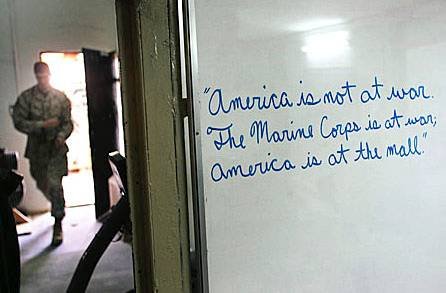
Too many Americans simply don't understand what it means to "see this thing through":
Why is it that the combat troops want to see this thing through, but the average American is tired of this war? What do you have to be tired of? Do you have any understanding of what it means to be truly tired? To patrol for hours in 120 degree heat wearing 100 pounds of kit? I'm sorry that watching images of Iraq on CNN has taxed you so greatly. No really, I am. That's ok, though, because I'm willing to share some of your load so that we can press on with the mission. Because that's what we do when we get tired.Whatya think? Can you stand a few more "reruns" of the "War in Iraq" TV show? Can you handle "fighting" the war from that easy chair just a while longer? Apparently, the Democrats in the Senate--with their finger in the political wind--can't take it anymore. Well, given that they are political animals, can you blame them? No, you can't. They're listening to what most Americans are telling them, after all.
February 1, 2007
The New York Times Says the US Should Ignore Its Enemies and Punish Its Allies. But That’s Nothing New.
To paraphrase Ambassador Jeanne Kirkpatrick, liberals have a distressing tendency to believe that the proper course of American foreign policy should be to punish allies and ignore enemies. Do you think that’s too harsh? Well, here’s the New York Times editorial board arguing for just that concept, explaining how America needs to ignore the actions of Iran while ratcheting up threats against the current government of Iraq in order to make progress in the Middle East (h/t Jonah Goldberg)…
We have no doubt about Iran’s malign intent, just as we have no doubt that Mr. Bush’s serial failures in Iraq have made it far easier for Tehran to sow chaos there and spread its influence in the wider region. But more threats and posturing are unlikely to get Iran to back down....No “threats and posturing� against the Iranians, sayeth the Times. After all, they’re the enemy. Apparently, “forceful� demands with “clear consequences� are only appropriate against an ally!Iran certainly is helping arm and train Shiite militias. But the administration is certainly exaggerating the salutary effect of any cutoff as long as these militias enjoy the protection of Iraq’s prime minister, Nuri Kamal al-Maliki. If Mr. Bush is genuinely worried — and he should be — he needs to be as forceful in demanding that Mr. Maliki cut ties to these groups and clear about the consequences if he refuses.
This is not to say the Maliki government shouldn’t be held accountable for actions (or non-actions) that make the situation faced by ordinary Iraqis and by coalition forces in Iraq more difficult. But shouldn’t a rational American foreign policy be at least as hard on the government that openly says it wants to destroy us as it is on the government that is an ally, at least nominally? If not, then what’s the incentive for anyone to sign on as an American ally?
January 25, 2007
The Political Situation in the Middle East
Dale Light offers a concise (and good) summary of the developing pan-Middle East political situation:
Already I am seeing analyses that say that the new middle-east lineup of Sunni states against Iran is vastly preferable to what existed before the Iraq invasion {for instance, here - MAC}. Suddenly the Sunni regimes are scared and need us to protect them from Iran. Our influence with them has never been greater. The New Republic thinks Bush just blundered into this favorable outcome, but others think that our diplomacy in the region has been aimed all along at dividing the region along sectarian and ethnic lines. Such a division undercuts pan-Islamist movements like al-Qaeda and the Iranian mullahs’ offensive, takes pressure off Israel, creates a broad Arab alliance supporting Lebanese independence, insures that OPEC won’t be agreeing on much of anything in the near future, counters Iran’s attempts to build an anti-American network of oil-producers, and gives the US [as opposed to the EU or China, neither of which can project a credible military force into the region] unprecedented leverage to influence regional development for decades to come. And don’t forget, Iraq will not be much of a threat to anyone anytime soon.As Light further explains, this was the "neocon" vision all along and even some in the press and (sigh) the State Department are finally waking up to the realization that the Iraq War, ya know, really is just part of a bigger conflict. Read on for more. Continue reading "The Political Situation in the Middle East"If we think of Iran, not al Qaeda, as the biggest regional threat in the future, and remember that ever since 1978 the “Islamic Republic� has been trying to forge an Islamist, anti-western, regional bloc that can use oil as an economic weapon, then the Iraq adventure makes one hell of a lot of sense. It is time to stop thinking about Iraq as a “war� to be “won� or “lost� and instead recognize that it is an essential part of a broader effort to remake the political, military, and economic map of the Middle East. It is this broader initiative, not the immediate military situation in Iraq, that really matters.
January 24, 2007
The President's Case for Winning in Iraq
To me, the most important portion of the President's SOTU last night was in his detailed description of what the nation has gone through since 9/11. It is a legitimate point that much of what he said last night could have and should have been said a year or three before now. And maybe it's too late to convince anyone, but, nonetheless, he did make a very clear case for why we must win in Iraq. We can't put our heads in the sand and wish it all away, folks. We either win in Iraq or we lose and deal with the consequences. (Read on for what is--to my mind--the most important section of the speech).
Continue reading "The President's Case for Winning in Iraq"January 13, 2007
Alas, Block Island is Too Close (and Probably Too Expensive) For a Shot at International Glory
I know this kind of thing happens in James Bond movies, albeit usually involving more ambitious goals, but I didn’t think it could happen in real life (h/t Drudge)…
Swedish file-sharing website The Pirate Bay is planning to buy its own nation in an attempt to circumvent international copyright laws.I hope this doesn't give anyone in Rhode Island strange new ideas for siting a casino...The group has set up a campaign to raise money to buy Sealand, a former British naval platform in the North Sea that has been designated a 'micronation', and claims to be outside the jurisdiction of the UK or any other country….
The "island" of Sealand, seven miles off the coast of southern England, was settled in 1967 by an English major, Paddy Roy Bates. Bates proclaimed Sealand a state, issuing passports and gold and silver Sealand dollars and declaring himself Prince Roy.
When the British Royal Navy tried to evict Prince Roy in 1968, a judge ruled that the platform was outside British territorial waters and therefore beyond government control.
The British government subsequently extended its territorial waters from three to twelve nautical miles from the coast, which would include Sealand, but Prince Roy simultaneously extended Sealand's waters, claimed that this guaranteed Sealand's sovereignty.
January 11, 2007
The Iraq Surge and the Democrats' Non-Solutions
Like Rich Lowry, I think that the President's new Iraq plan ("the Surge") is "better late than never." And that applies to more than just changes in the military operations side of things and includes such "hearts and minds" actions as giving ground commanders more walking around money and the implementation of an Iraq Oil Trust (a Glenn Reynolds favorite). Ralph Peters, a frequent critic of the way that the Iraq war has been waged, is willing to give the new plan a chance. In particular, he points to signs that, finally, Iraq President Maliki may be serious about the bi-partisan militia disarmament (ie; even Shia militias, like that of Maliki's fellow Shia Moqtada Al Sadr, will be told to disarm or else). But Peters warns that there are more obstacles to winning than just the militias, insurgents and terrorists:
And there's going to be another major problem that will require great fortitude on the president's part: Destructive fighting lies ahead in Baghdad, and the international media is going to blame us for every broken window and every Iraqi with photogenic wounds. We'll be accused of atrocities and wanton destruction, and the press corps will trot out the Vietnam-era cliché about "destroying the village in order to save it."Senator Joe Lieberman supports the President's new plan as does Rudy Giulianni. Both called on a scaling back of the partisan bickering that has so characterized the Iraq War, with Giulianni stating, “Success or failure in Iraq is not a matter of partisan politics but a matter of national security. All Americans should be hoping, praying and offering constructive advice for the success of our troops in Iraq and for those Iraqis seeking to create a stable and decent government," and Senator Lieberman writing:Our troops can stand up to any enemy. But I'm not as certain President Bush can withstand the onslaught of an enraged media - and any prospect that we might be turning the situation around will certainly enrage them. Media pressure will work through our allies, too.
I know there are deep differences of opinion about what the President has proposed tonight. In the coming days and weeks, we should undertake respectful debate and deliberation over this new plan. But, let us also remember that excessive partisan division and rancor at home only weakens our will to prevail in this war...At the moment, we and our Iraqi allies are not winning in Iraq and the American people are understandably frustrated by the miscalculations, the lack of progress, and the daily scenes of violence and casualties. But, make no mistake - defeat in Iraq would result in a moral and strategic setback in our global struggle against Islamist extremists who seek to strike our interests and our homeland...Yet, unsurprisingly, Democrats (and some Republicans) plan to oppose the plan, many for mainly partisan reasons. Yes, many Democrats believe it's time to pull out and let Iraq stand on its own. Sounds good, and I wish it were true, but I don't think that anyone really believes that the Iraq military or government is up to the task quite yet. Unfortunately, mostly the Democrats seem to want to "criticize Bush without taking any responsibility" as the Wall Street Journal writes today (via NLT).Tonight, the President did not take the easy path, but he took the correct and courageous course. We are engaged in a world-wide struggle against Islamist extremism, and Iraq is now the central front. It is a dangerous illusion to believe that we can depart Iraq and the inevitable killing fields and terrorist violence will not follow us in retreat - even to our own shores. That is why it is right and imperative that we recommit ourselves to success in Iraq. Weakness only emboldens our enemy, but united resolution will make our nation safer for generations to come.�
So the Democrats want the political mileage of opposing the troop increase rhetorically. What they don’t want is to take responsibility for their own policy choice. Meanwhile, their rhetoric will only serve to reassure the jihadis that sooner or later Democrats will force a U.S. withdrawal.And Victor Davis Hanson adds:
After listening tonight to Wesley Clark, Dick Durbin, Tom Vilsack, Nancy Pelosi, etc. I still can't for the life of me learn what they want to do. Not one will support Ted Kennedy's cut-off of funds. Apparently the party line is that we can't win, but we're afraid to pull out in case we do, and so we will equivocate as we watch the battlefield and make the necessary rhetorical adjustments just in time. Just what we saw in the past Reid/Biden/etc. call for the surge, then huff/puff when they got their wish. Apparently the shame of 1974-5 cut-offs apparently still haunt the entire party.And much of the Democrat (and some Republican) carping may be because so many are trying to position (insulate?) themselves for their 2008 political campaigns (Presidential and other).
But what Mr. Bush didn't refer to in his 2,900-word speech is what the media have been chewing on the past several days: the political implications of this proposal here at home.So I'm left to believe that, for too many politicians, even during war, it's just "politics as usual." The President may have a new plan, but the Democrats are still reading from their Election-winning script--move the goalposts and carp at every move and look for any partisan political edge they can get--and some nervous Republicans are running for political cover instead of supporting the President.First off, polls showed that the wave that washed the congressional Democrats into power was due in large part to the war in Iraq. In response, Democrats will be holding week after week of hearings on the war.
Democrats also been mulling over legislation that would actually have some teeth — from threats to cut funding for more troops to an idea that Massachusetts Sen. Edward Kennedy proposed Tuesday: forcing a congressional vote any time the president wants to increase the number of troops.
That's easier said than done, however. So in the meantime, the newly emboldened Dems are eager to get Republicans on the record on Iraq, not just to have the upper hand now — but for the next election as well.
For instance, Senate Majority Leader Harry Reid indicated he's going to bring a non-binding resolution to the floor next week that says the Senate disagrees with sending more troops to Iraq. If it's non-binding, what's the point?
"If there is a bipartisan resolution saying, 'We don't support this escalation of the war,' then the president's going to have to take note of that," Reid told reporters.
That's one reason. But it will also put the 21 Republican senators who are up for re-election in 2008 on the spot, giving those who vote against it an opening for their opponents next year.
In fact, four of those senators are on the record already saying they're not fans of the troop increase: Sens. Norm Coleman, R-Minn.; Susan Collins, R-Maine; Gordon Smith, R-Ore.; and John Warner, R-Va.
The ripple effect of the president's proposal is also evident in the nascent 2008 presidential race, with the liberal group MoveOn.org going as far as running a TV ad in Iowa and New Hampshire next week against yet-to-announce candidate Sen. John McCain, R-Ariz...Meanwhile, the Democratic candidates and candidates-to-be have been trying to out-sound bite each other with criticism of the Bush plan.
Former Sen. John Edwards has even gone so far to label the president's plan "the McCain Doctrine" — a dig at the presumed Republican front-runner.
Again, I say this because I have yet to see a clear, realistic, alternative plan from the naysayers. The President went out of his way to listen to "all sides," and still it's not enough. But now we have the final surge and the President is staking his legacy on its success. This is a last chance for Maliki and the Iraqi's to put up or shut up. If they fail then Iraq will be a weakened, near-failed state ripe for exploitation by radical jihadists. Failure in Iraq will endanger our own security, whether people want to put their head in the sand and ignore it or not. Hyperbole? No. The situation has happened before. Remember Afghanistan?
Mac Owens on "The Surge"
Via NRO:
The president’s speech was adequate. He said the right things. The question of course is whether or not the plan he outlined can be implemented.
In terms of substance, the president’s plan is not so much a true innovation as an adaptation to the changing circumstances in Iraq. Until February of last year, our operational strategy in Iraq — “clear, hold, build� — seemed to be working, because the main problem in Iraq was the Sunni insurgency centered in al Anbar.
But when Sunni extremists destroyed the Shia mosque in Sammarah, sectarian violence exploded, especially in Baghdad. American and Iraqi troops had to redeploy to confront the new threat, and in doing so, the gains that had been achieved in the war against the Sunni insurgents were lost.
The plan outlined last night is a response to these changing conditions. The main reason for the so-called surge is to provide enough troops to provide security for Baghdad while regaining the initiative against the Sunni in al Anbar.
Will it work? That depends on two factors: the Iraqi government and the Congress. The fact is that most deaths in Iraq today are the result of attacks by Shia militias against Sunnis. But until now, these Shia militias have been off-limits. That has to change, and President Bush put Iraqi Prime Minister Nouri al-Maliki on notice that this is the case.
Congress is another matter. The Democrats, who would rather see Bush lose than the United States win, can be expected to make life miserable for the president and his approach. Hopefully, the Democratic majority will limit itself to rhetorical opposition, since they have no alternative except withdrawal and defeat. The worst case would be for the Democrats to do what a precious Democratic majority did: cut off funding for the war and leave the Iraqi people to the tender mercies of both Sunni and Shia extremists.
We can only hope that they will be deterred by the recognition that our abandonment of South Vietnam remains the single most shameful act in the history of U.S. foreign policy. So success will depend on whether or not shame is a part of the makeup of the new congressional majority.
January 10, 2007
Democrats 9/11 Commission Bill: Both Less and More Than Advertised
So, the 100 Hours continue and Speaker Pelosi has gotten her 9/11 Commission legislation through. And though some may think that every one of the 9/11 Commission prescriptions were included (the necessity or wisdom of implementing them all is another discussion), apparently, that's really not the case (via The Corner).
Senator Joseph I. Lieberman, independent of Connecticut, who held a hearing Tuesday as the Senate prepared for its version of this bill, noted that one major recommendation — not in the House measure — was strengthening Congressional oversight of intelligence and counterterrorism efforts. “We found it a lot easier to reform the rest of the government than we did to reform ourselves post-9/11,� Mr. Lieberman said. “That’s unfinished work.�The relevant portion of the 9/11 Report to which Lieberman refers begins here (and I've excerpted it in full in the extended entry, below.
Finally, Speaker Pelosi's 9/11 Commission Legislation contains language making it possible for the federal employees of the TSA to unionize.
The 9/11 commission did not address union rights or personnel rules but urged improvements in airport screening operations. AFGE [American Federation of Government Employees] maintains that collective bargaining rights help smooth agency operations because labor-management contracts provide a structure for addressing employee issues, including job performance.The Bush Administration also provided an example:Peter Winch, an organizer with AFGE, said the union had asked Democrats to put bargaining rights for TSA screeners "on the agenda for the first 100 hours." He continued, "It does not make sense to keep these employees from collective bargaining rights when other Department of Homeland Security employees have those rights."
The TSA has said that collective bargaining is not appropriate for airport passenger and baggage screeners because of their national security mission and because the agency requires the ability to make personnel staffing changes rapidly in response to threats. In the law creating the TSA, Congress left it to the Bush administration to determine such issues as union rights for screeners.
As an example, officials pointed to the foiled United Kingdom airline bombing plot in August, when new procedures for screeners were put into place immediately.Then there is this point made by Senator Joseph Lieberman's office:"This flexibility is a key component of how the Department of Homeland Security, through TSA, protects Americans while they travel," the statement said.
"Other security personnel like customs agents and the Border Patrol have the right to collective bargaining, and that has not impaired their ability to protect American security."OK, fine. But isn't this really just an "earmark" by another name? The original legislation that allowed this potential TSA unionization had previously stalled in committee (granted, GOP controlled congress) and NONE of this 100 hour legislation is being debated in--or passed through--committee. Heck, to the victor go the spoils and all that, but for the Democrat led Congress to reward one of their key constituencies--a federal employee union--under the cover of national security smells like business as usual to me. Continue reading "Democrats 9/11 Commission Bill: Both Less and More Than Advertised"
December 24, 2006
Christmas During War (revisited)
{Nota Bene: Two years ago I wrote this post offering some thoughts from soldiers and others concerning spending Christmas at war. I still believe it to be relevant today. Merry Christmas.}
With the current confluence of Christmas and our nation at war, I think it appropriate to mention a few noteworthy writings that deal with the topic. First is a recent column written by Idaho Senator Mike Crapo that details the Continental Army's Christmas in 1778. Despite the sense of desparation surrounding the cause of upstart colonies during that Christmas, the small, underfed and under-equipped army weathered that winter at Valley Forge under the leadership of George Washington and went on to help build a nation.
I also offer these poignant words written during the Civil War by Corporal J. C. Williams, Co. B, 14th Vermont Infantry, December 25, 1862:
This is Christmas, and my mind wanders back to that home made lonesome by my absence, while far away from the peace and quietude of civil life to undergo the hardships of the camp, and may be the battle field. I think of the many lives that are endangered, and hope that the time will soon come when peace, with its innumerable blessings, shall once more restore our country to happiness and prosperity. (source)Equally as poignant are the words of Corporal John Ferguson of the Seaforth Highlanders, who noted the irony of a Christmas scene during World War I
What a sight; little groups of Germans and British extending along the length of our front. Out of the darkness we could hear the laughter and see lighted matches. Where they couldn't talk the language, they made themselves understood by signs, and everyone seemed to be getting on nicely. Here we were laughing and chatting to men whom only a few hours before we were trying to kill. (source)Finally, I'd like to point you to a piece by W. Thomas Smith Jr. at NRO about the Christmas time Battle of Bastogne during the Battle of the Bulge in 1944. (This is of particular significance to me as my great uncle Victor Comtois, a Lieutenant in the infantry (Yankee Division), died on Christmas Eve 1944 in Luxembourg during the pushback.)
With these stories in mind, I wish everyone a Merry Christmas, and hope that we all take the time to remember both the true reason for the season and to remember our brave men and women who find themselves in harm's way at this time. May God Bless America and may He protect our troops.
December 19, 2006
We Don't Want No Civil War
When two factions (or more) within one nation decide to contend with each other with bullets and bombs instead of through the political process, we are told that there is a civil war. At least, that's the case in Iraq. Now if, say, two factions (Hamas and Fatah) in, say, the Palestinian territory also resort to the bullets and bombs approach to negotiation...well, it's not quite a civil war. (How could it be? After all, the U.S. isn't "occupying" their country). No, that fighting is just "gunbattles" and "clashes." And even though "[t]he fighting has renewed fears of civil war in the Gaza Strip and the occupied West Bank," well, it isn't really a Civil War yet. (Via Instapundit)
December 7, 2006
Pearl Harbor, 9/11 and Conspiracy Debunking
For those so inclined, I've put up a longish piece (WARNING: excessive scholarliness may induce drowsiness) over at Spinning Clio that touches on Pearl Harbor, 9/11 and conspiracies about each. (Though it is mostly about debunking the Pearl Harbor conspiracies.)
December 2, 2006
The Iraq Study Group: Deserving of Scorn & Contempt
Recent days have brought a series of powerful editorials on the Iraq Study Group. This post presents 5 of them, none of which looks favorably on the Group's report. Be sure to read McCarthy's piece at the end.
John Podhoretz on Witless Wisdom: Baker's Worthless Iraq Advice
Yes, it's been quite a week for the 10 members of the Iraq Study Group, the committee formed last spring to offer recommendations on a path forward in Iraq.Continue reading "The Iraq Study Group: Deserving of Scorn & Contempt"They had a wonderfully invigorating leak session the other day with The New York Times, which was the first recipient of the group's key top-level save-America recommendation. Co-chairmen James...Baker and Lee...Hamilton didn't even bother to pretend to brief the president or key lawmakers first.
The president could wait his turn. After all, this is the Iraq Study Group we're talking about here, buddy. Even the mighty Times was probably kept waiting for its leak, since the only person who could not be kept waiting was Annie Leibovitz, celebrity photographer nonpareil.
As Dana Milbank reports in The Washington Post, on Monday the group's "co-chairmen, James Baker and Lee Hamilton, found time . . . to pose for an Annie Leibovitz photo shoot for Men's Vogue."
The value of Annie Leibovitz's pictorial scoop might have been reduced somewhat when the president scornfully consigned the Iraq Study Group to the ash-heap of history yesterday with a single dismissive sentence during his press conference in Jordan: "This business about 'graceful exit' just simply has no realism to it whatsoever."
Baker, Hamilton and their crew of old Washington hands...are recommending a "gradual pullback" of American troops but without a timetable. That basically translates into a nice, long, slow defeat...
As one of the study group's members told the Times yesterday, "We had to move the national debate from 'whether to stay the course' to 'how do we start down the path out'."
This is the consensus view of the Iraq Study Group, which is very proud that it reached consensus.
Its members also reached a consensus view that Depends is a really fine brand of adult diaper, and that they love reruns of "Murder, She Wrote."
You perhaps note that I am writing with extreme disrespect toward the Iraq Study Group. That's because its report is a scandal and an embarrassment; it's flatly immoral to seek to make or guide policy in this fashion.
Look, if its members believe the war is lost, they should say so. They should bite the bullet and advocate a pullout of American forces sooner rather than later.
If its members could not actually achieve consensus on that point...then it was simple vanity on the part of the Gang of 10 that led to the creation of a "consensus" document that split the difference.
There's no way to split the difference, unless you're hurrying off to have your mug immortalized by Annie Leibovitz and want to bang down the gavel so you can get plenty of time to get hair and makeup done.
America and its allies are either going to win this war or we're going to lose. We will either conclude our military actions in Iraq with terrorists and insurgents dead or fled and an imposition of civil order in the country by its elected government, or we will turn tail and leave the place in chaos and ruins.
What's even more appalling, if true, is the group's other key recommendation - which is that America should try to find answers to its problems through an international conference that would include Syria and Iran.
What do Syria and Iran want more than anything else in the world? To see an American defeat in Iraq. To see an America so crippled that they can work their will in the Middle East without fear of retribution...
...that's Baker for you. Give him a problem and he'll tell you your best hope of solving it can be found in sucking up to an Arab dictator...
...there's not much that even James Baker can demand of Israel that Israel's not already willing to give. Except maybe Jerusalem. Yeah: Israel can give up Jerusalem, and in exchange, Iran and Syria will leave Iraq alone.
Please stop laughing at the doddering old fools now. It's disrespectful.
This is an extremely dire situation. Half-measures will be disastrous, whatever form they take - and that's not true only of the Baker-Hamilton "graceful exit" disaster. Continuing as we're going would also constitute a half-measure with disastrous results as well.
The president treated the Baker half-measures with the contempt they deserved. But he will deserve precisely the same level of contempt if he doesn't champion a plan for victory immediately.
November 30, 2006
Oil Prices and Saudi Options in Iraq
An adjunct fellow at the Center for Strategic and International Studies (who is also an advisor to the government of Saudi Arabia, BTW) offers some fascinating insight into the political economy of oil prices in the Middle East. Writing in the Washington Post, Nawaf Obaid explains that if the United States cuts-and-runs from Iraq, the Saudis will not stand idly by if either the Shi’ite dominated government of Prime Minister Nouri al-Maliki or any of Iraq’s various Shi’ite militias embark on an ethnic cleansing campaign against Iraq’s Sunnis (h/t Rich Lowry). Because of their oil wealth, the Saudis have a number of options…
Options now include providing Sunni military leaders (primarily ex-Baathist members of the former Iraqi officer corps, who make up the backbone of the insurgency) with the same types of assistance -- funding, arms and logistical support -- that Iran has been giving to Shiite armed groups for years.Remember, Saudi manipulations to lower oil prices would serve a second Saudi objective, lessening the urgency being felt in much in the United States for developing oil alternatives -- alternatives that could permanently lower the price of Saudi crude.Another possibility includes the establishment of new Sunni brigades to combat the Iranian-backed militias. Finally, [Saudi Arabia’s King Abdullah] may decide to strangle Iranian funding of the militias through oil policy. If Saudi Arabia boosted production and cut the price of oil in half, the kingdom could still finance its current spending. But it would be devastating to Iran, which is facing economic difficulties even with today's high prices. The result would be to limit Tehran's ability to continue funneling hundreds of millions each year to Shiite militias in Iraq and elsewhere.
Then again, both motivations -- impeding Iran and stifling interest in new energy sources -- already justify a Saudi-engineered oil price drop, so it has to be asked why it hasn't happened already. (Certainly, there has been a drop over the past few months, but Mr. Obaid's article suggests that the Saudi domestic economy could easily absorb an even further decline). Could it be that it is important for the Saudis to see the US defeated, necessary to assauge domestic political considerations, before they take action?
Finally, including Saudi Arabia's long-term interests in the picture perhaps makes the refusal of Prime Minister Maliki to confront Iraq's Shi'ite militias just a tad more understandable. Knowing the Saudis are ready to surge aid to the Sunnis the moment the U.S leaves, he may already be preparing for his next war against a Saudi/Iraq Sunni alliance, if he believes that the United States is now destined to abandon him in his current war.
November 28, 2006
Will Chavez's Venezuela be the First Victim of Declining Oil Prices?
As we’ve been forecasting at Anchor Rising, declining oil prices are starting to impact the international landscape. This is from a Reuters report on how declining oil prices are increasing the stresses on the government of Venezuelan strongman Hugo Chavez…
A decline in Venezuela's energy revenue could dog President Hugo Chavez if he is re-elected as expected on Sunday, curbing his self-styled socialist revolution that relies heavily on high oil income…What the Reuters article is hinting at, but not quite saying, is that Chavez’s heavy-handed rule -- including politically motivated firings at the state run-oil company -- has been alienating Venezuela's professionals and skilled laborers, driving the knowledge base necessary for running a modern oil industry away from the country.First, the sector's output is shrinking for the first time in years -- bad news for a government that earns more than half of its revenue from the industry.
Second, while Mr. Chavez has said he needs the average price for Venezuela's basket of generally sludgy crude to be at $50 per barrel, a four-month slide pushed the price below that floor last week despite his promotion of OPEC cuts…
Also alarming is that private oil sector activity contracted by 11 per cent in the third quarter compared with the year-ago quarter.
And the effect has been magnified. Many former Venezuelan oil-industry workers have settled in Alberta, where they are using their expertise in refining “generally sludgy crude� to help Canada develop its tremendous heavy-oil potential. This relates very directly to the reason that OPEC is resisting production cuts proposed by Chavez; most of the OPEC nations understand that high oil prices will accelerate the development of oil alternatives, ultimately reducing the demand for conventionally obtained oil. (And somewhere in heaven, Milton Friedman smiles).
According to Reuters, the bottom line is that…
"[Chavez's] heavy levels of social spending eventually start to cut into oil field investment," said Maya Hernandez, an analyst with HSBC in New York. "Chavez's popularity rests so much on oil that any weakening in that area will hit him hard�….Furthermore, on top of the industrial woe, there is scant evidence that Chavez's "social spending" choices are improving the quality of life in Venezuela. Instead, Venezuelans are becomming increasingly victimized by violent crime. This is from an article by Sacha Feinman from yesterday's Slate Magazine…If oil revenue falls in 2007 -- either because of lower production or falling prices -- Mr. Chavez may face either runaway inflation or the need to cut government spending.
According to the United Nations, Venezuela recently passed Brazil to claim the dubious honor of having the highest rate of gun-related violence in the world among nations not at war....Lost in the media coverage of Venezuelan oil and Hugo Chávez's colorful antics is the fact that over the last decade, Caracas has become a very dangerous place to live. Colombia might have the history, and Brazil might make splashier headlines, but Venezuela has quietly eclipsed both its neighbors in levels of violent street crime. Unlike Colombia's narco-guerrillas or the heavily armed gangs in the favelas of Rio and São Paulo, crime in Caracas is indiscriminate; it has more to do with anarchy and the failure of infrastructure than it does organized, armed groups challenging the government's monopoly on the use of force.A runaway murder rate is not a sign that the social agenda being implemented is a healthy one.
Finally, this past weekend, several hundred thousand people, at least, turned out in Caracas to protest the Chavez government and to express support for his opponent in the upcoming Venezuelan Presidential election -- despite the fact the Chavez attemped to close the city off to outsiders. Hundreds of thousands don’t turn out to protest in a country where things are going well for the common folk. The bad news is that Chavez is likely to lash out ever more erratically as the collapse that he is bringing upon his country accelerates.
November 13, 2006
Moving Negotiations with Iran Beyond Appeasement, If That is Even Possible
The world anxiously awaits the report from the "Iraq Study Group" (aka the Baker-Hamilton commission) on what major changes the U.S. should make in conducting the War in Iraq. Most media sources anticipate that a key recommendation from the commission will be opening negotiations with Iran and Syria. Here's some representative speculation from Martin Walker of United Press International...
[T]hese high stakes also involve Iraq's neighbors in the region, who must somehow be brought into the process if Iraq is to be stabilized. This may well mean sitting down to negotiate with unsavory regimes like Syria and Iran, and accepting that they too have regional interests that will have to be dealt with....What precisely are these regional interests, important to our Baker-Hamilton-approved potential negotiating partners in Syria in Iran, that need to be addressed? Well, here's a fresh quote from Iranian President Mahmoud Ahmadinejad, as reported today by Agence France-Presse, that explains pretty clearly the Iranian position on the Israeli-Palestinian conflict...[T]he wise men will make clear, as they have done before in different contexts, their conviction that Israel-Palestine is the key to the stabilization of the Middle East. It is the running sore, the constant focus of Arab anger and resentment, the blood opera of Arab TV screens, as central to modern Arab political culture as the Trojan Wars to ancient Greece, and rather longer lasting.
According to the Iranian media Monday, Iranian President Mahmoud Ahmadinejad declared that Israel was destined to "disappearance and destruction" at a council meeting with Iranian ministers.Repeated calls by Ahmadinejad for the destruction of an American ally are the source of hawkish skepticism that negotiating with Iran serves American interests. It's not that hawks don't believe in negotiating. It's that hawks believe that the different sides in a conflict have to recognize the right of the others to exist before meaningful negotiation becomes possible. Without agreement that mutual coexistence is the starting point, negotiation becomes merely war-by-other-means, a tactical maneuver used by one side to continue a conflict against others.
"The western powers created the Zionist regime in order to expand their control of the area. This regime massacres Palestinians everyday, but since this regime is against nature, we will soon witness its disappearance and destruction," Ahmadinejad said.
Unfortunately, there is little potential for finding a good faith negotiating partner in a radical Islamist government prone to describing other governments as "unnatural". Ahmadinejad's choice of words reflect a central tenant of Islamic radicalism -- that it is "unnatural" to expect harmony on earth where Islamic law (the immutable system, created by God, for governing relations between men) is absent and that any institutions not based on Islamic law must be destroyed, because such institutions stand between man and Islam, the only path that will bring harmony to relations amongst men.
Those optimistic about Iran's potential as a peaceful negotiating partner (like the Iraq Study Group) obviously discount the Iranian government's official fundamentalist rhetoric. Both realists (aka "Republican Marxists") and progressives are comfortable dealing with governments that are based on violent, intolerant ideas, becasue they believe that economic forces ultimately erase all else in foreign affairs. Stanley Kurtz provides a pretty fair rendering of the negotiate-at-any-price position in today's National Review Online...
Those who favor a grand bargain believe that a faction of the leadership in Tehran is more pragmatic than the radicals who support Ahmadinejad. And while the Iranian public is nationalist enough to favor a nuclear program (many Iranians believe the government's line that the program is strictly for peaceful purposes), the public's first concern is the economy.But it can hardly be called "realistic" for the U.S. to ignore the fundamental beliefs of any government that it intends to negotiate with. If negotiations with Iran have any hope of creating a lasting peace, they must include the question of whether the Iranian government believes that governments and social institutions not based on Islamic law -- including Israel -- have a basic right to exist. If the Iranians cannot answer such questions in an unambiguously tolerant, pluralistic manner, then the United States has no obligation to provide Iran with any assistance or security guarantees.So those who favor a grand bargain (Kenneth Pollack, for example) believe that a combination of big economic carrots and big economic sticks might bring Iran's public over to the side of the "pragmatists." In a showdown (provoked by tough economic sanctions) between the pragmatists and Ahmadinejad's radicals, power would shift to Tehran's own "realists." The Iranian economy is in bad shape. Instead of being plowed into investment, Iran's oil revenues are doled out to the regime's core supporters through a web of patronage/corruption. Hold out the possibility of a national financial bonanza on the other side of tough economic sanctions, and Iran's long-suffering public will side with the pragmatists against the radicals.
November 1, 2006
Iraq and Domestic Political Considerations
The future of Iraq may now center around the Iraqi government's response to a search for an American soldier in Iraq believed to have been captured last week by a Shi'ite militia. The U.S. military responded to the kidnapping by sealing off and aggressively searching the Sadr City section of Baghdad. On Tuesday, the Iraqi Prime Minister either ordered or convinced American forces to shut down the search. This is from various wire reports compiled by the Hartford Courant...
Prime Minister Nouri al-Maliki flexed his political muscle Tuesday and won agreement by U.S. forces to end their weeklong near-siege of Baghdad's largest Shiite Muslim district.Prime Minister Maliki's order follows an earlier statement that he does not consider disarming Iraq�s Shi�ite militias to be amongst his government's top priorities. The Deputy Speaker of the Iraqi parliament has expressed a similar idea...American troops departed, setting off celebrations among civilians and armed men in Sadr City, the sprawling slum controlled by the Mahdi Army militia loyal to anti-American cleric Muqtada al-Sadr. Small groups of men and children danced in circles chanting slogans praising and declaring victory for al-Sadr, whose political support is crucial to the prime minister's governing coalition....
There were conflicting accounts of whether the decision to lift the barricades was made jointly with Americans. U.S. officials insisted the decision was taken after consulting with them, but an Iraqi official said al-Maliki made the decision, then spoke to Americans.
Khaled al-Attiya, the Shi'ite deputy speaker of parliament, said militias were not the main problem: "All the militias will disband at the end of the day but these are not the main enemy of the Iraqi people," he said.The more conspiracy-minded suggest that this may all be part of a plan to make the Maliki government look tough, allowing it to build the support necessary to eventually confront the militias. Whether that's true, or just wishful thinking, if Prime Minister Maliki will not confront the violence originating with Shi'ite militias, the Bush administration needs to prepare itself for some domestic repercussions of its own."The main enemy are the Baathists and Saddamists who want to destroy the political process and the main principles of the constitution."
Senator Jack Reed has offered a stern reaction to Prime Minister Maliki's order (request?) to stand-down the search (h/t RightRI)...
This is yet another example of Prime Minister Nuri al-Maliki and the Iraqi government yielding to sectarian pressure rather than providing national leadership.Senator Reed's reaction will resonate with the traditions of American hawkishness in a way that standard Democratic statements on the war usually don't. In America, popular support for sending troops into combat comes with at least one non-negotiable condition: that leaders who make the decision to go to war make an absolute commitment to victory. The American public will forgive a leader for making mistakes in pursuit of a noble cause, but they will not forgive -- or follow -- a leader who puts soldiers into harm's way in the absence of a total commitment to winning. (This is all a part of what the historian Walter Russell Mead calls the Jacksonian tradition in American foreign policy.)Our troops surrounded Sadr City, a major hot spot and a place where kidnappers may be holding one of our own soldiers, and Prime Minister Maliki is once again undermining efforts to rein in violence within Baghdad.
His on again-off again approach to disarming the militias is undermining efforts by both the Iraqi security forces and the United States military to provide basic security for the people of Baghdad.
Today, the critical issue in Iraq is whether the Maliki government can muster the political will to confront those who use violence to destabilize Iraq. If the Maliki government won't stand up to them, then military efforts alone will not guarantee success.
If the mission in Iraq changes from pursuit of unqualfied victory over the enemy to just helping a foreign leader improve his domestic positioning, support for keeping our troops in Iraq -- even for perhaps a smaller training-oriented force -- will quickly erode, regardless of the consequences that a rapid American withdrawal from Iraq would bring. If Prime Minister Maliki does not make some kind of commitment to reining in the sectarian militias, whatever support his refusal to take action against them wins amongst Iraqis will come at the cost of undercutting the American support that remains for keeping American soldiers deployed in Iraq.
This is an area where the Bush administration must quickly overcome its famous tin ear (think Harriet Miers or the Dubai Ports Deal) when it comes to listening to its natural base.
Not Everyone Has the Same Goal in Mind for a "Population Policy"
Last week, Justin noted a Froma Harrop Projo column where she approvingly cited an organization who believes that the United States should actively work towards cutting its population in half...
Negative Population Growth (www.npg.org) thinks that the optimal number for sustaining a decent quality of life in the United States is 150 million. That is half of what we now have, but in case you think that it's a crazy low figure, consider that the U.S. population was 150 million as recently as the 1950s, which many regard as a golden age of American contentment.Meanwhile, across the ocean, according to the Australian newspaper The Age, Iranian President Mahmoud Ahmadinejad would like to increase his country's population to 120 million, believing that more people means more power for his government...
Iranian President Mahmoud Ahmadinejad has called for a baby boom to boost the country's population to 120 million and enable it to threaten the West, as he boasted the country's nuclear capacity had increased "tenfold".I wonder how the central population planners of the West plan to address the central population planners in other parts of the world who intend to use increased population as a means of conquest.Mr. Ahmadinejad told MPs he wanted to scrap birth control policies that discourage Iranian couples from having more than two children. Women should work less and devote more time to their "main mission" of raising children, he said.
His comments were an attack on policies sanctioned by senior Islamic clerics aimed at limiting Iran's population of about 70 million. The Government backs birth control measures including female sterilisation, vasectomies and mandatory family planning classes for newlyweds. Iran also has a state-owned condom factory.
"Westerners have got problems," Mr Ahmadinejad said. "Because their population growth is negative, they are worried and fear that if our population increases, we will triumph over them."
He said he wanted to bring in legislation reducing women's working hours based on how many children they had. Women could work part time on full-time salaries, he said.
October 27, 2006
It's Up to the Government of Iraq Now
A George F. Will thought about Iraq from the winter of 2004 seems increasingly prescient...
A manager says, "Our team is just two players away from being a championship team. Unfortunately, the two players are Babe Ruth and Lou Gehrig." Iraq is just three people away from democratic success. Unfortunately, the three are George Washington, James Madison, and John Marshall.At the moment, current Iraqi Prime Minister Nuri Al-Maliki doesn't seem destined to be remembered by history as the George Washington of Iraq. This is from a Reuters report from this morning...
Al-Maliki told Reuters on Thursday his Shiite-led government could get violence under control in six months if U.S. forces gave them more weapons and responsibility.The militias referred to are the Shi'ite militias operating in Baghdad and the southern part of Iraq.He said police were having to share rifles but, with better American help, could bring respite from dozens of daily killings in half the 12-18 months the U.S. commander in Iraq says is needed before Iraqis can take full control.
Al-Maliki also said his priority was to suppress the insurgency and root out al-Qaida, rather than to disarm the militias.
The combination of wanting more weapons, but not wanting to confront the militias is not promising. Maliki's statement suggests that his highest aspiration for the Iraqi government is building it up to the point where it shares power with Shi'ite militias. If this is the best Maliki has to offer, it will become increasingly difficult to convince America that there is any purpose in staying in Iraq much longer.
Ralph Peters expresses this idea in his New York Post column...
Our soldiers and Marines are dying to protect a government whose members are scrambling to ally themselves with sectarian militias and insurgent factions. President Bush needs to face reality. The Maliki government is a failure.Peters has a specific idea about what getting tough means...There's still a chance, if a slight one, that we can achieve a few of our goals in Iraq - if we let our troops make war, not love. But if our own leaders are unwilling to fight, it's time to leave and let Iraqis fight each other.
The first thing we need to do is to kill Muqtada al-Sadr, who's now a greater threat to our strategic goals than Osama bin Laden.(Muqtada is the head of the Mahdi Army, Iraq's largest Shi'ite militia. Peters continues...)
We should've killed him in 2003, when he first embarked upon his murder campaign. But our leaders were afraid of provoking riots.Another option comes from Max Boot (both Peters and Boot are experts on military affairs) writing in the Los Angeles Times...Back then, the tumult might've lasted a week. Now we'll face a serious uprising. So be it. When you put off paying war's price, you pay compound interest in blood.
We must kill - not capture - Muqtada, then kill every gunman who comes out in the streets to avenge him.
There's another course short of withdrawal: reducing U.S. forces from today's level of 130,000 to under 50,000 and changing their focus from conducting combat operations to assisting Iraqi forces. The money saved from downsizing the U.S. presence could be used to better train and equip more Iraqi units. A smaller U.S. commitment also would be more sustainable over the long term. This is the option favored within the U.S. Special Forces community, in which the dominant view is that most American soldiers in Iraq, with their scant knowledge of the local language and customs, are more of a hindrance than a help to the counterinsurgency effort.Boot's plan would help get Prime Minister Maliki more rifles for his soldiers, but as Peters noted about his own call for an offensive, Boot's lighter, specialized force only works if implemented in conjunction with an Iraqi government determined to make itself into the sole legitimate governing authority in the country, and not just Iraq's biggest militia.Make no mistake: This is a high-risk strategy. The drawdown of U.S. troops could catalyze the Iraqis into getting their own house in order, or it could lead to a more rapid and violent disintegration of the rickety structure that now exists.
We have reached a point where how much of a commitment America continues to make towards Iraq will be largely determined by how much of a commitment the government of Iraq makes towards Iraq -- all of Iraq, not just a few favored sects.
October 9, 2006
North Korea Tests Nuclear Bomb
The North Korean government is claiming it tested a nuclear bomb last night. Here is the Washington Post report on the claim…
North Korea declared on Monday that it had conducted its first nuclear test, asserting a claim to be the world's newest nuclear power and drawing strong international condemnation.The United States Geological Survey has confirmed a seismic event occurring on the Korean peninsula at the time of the claimed nuclear test…The South Korean government informed officials in Washington that an explosion occurred at 10:36 a.m. local time. Minutes later, North Korea's official Korean Central News Agency announced the test, calling it "a historical event that has brought our military and our people huge joy."
The U.S. Geological Survey registered a "seismic event" of magnitude 4.2 at 10:35 a.m. Monday local time (9:35 p.m. Sunday EDT) 240 miles northeast of Pyongyang, the North Korean capital, said Amy Vaughan, a geophysicist at the agency. She said the event occurred 45 miles north of the North Korean town of Kimchaek.Russia's defense minister said the reported test was equivalent to between 5,000 tons and 15,000 tons of TNT, the Associated Press reported. That would make the blast possibly as powerful as the atomic bomb dropped by the United States on Hiroshima in World War II, which was equivalent to 15,000 tons of TNT, the news agency said. Although the United States and Asian countries said they had registered a seismic event, Russia said its monitoring services had detected a nuclear explosion, but no radiation.
UPDATE:
There’s growing speculation circulating around the blogosphere that the North Korean test was a dud, either a deliberate fake, or a bomb too small to be considered significant. Instapundit is providing a catalog of interesting links. As Matt Druge likes to say, “developing”…
September 28, 2006
No Vote on the Bolton Nomination Before the Election
The Associated Press (via the Washington Post) is reporting that the nomination of John Bolton as United Nations Ambassador will not be sent to the Senate floor anytime soon...
John R. Bolton's quest for a longer lease on his temporary job as U.S. ambassador to the United Nations remained elusive Thursday as the Senate shied away from a vote to confirm him.The Senate could still vote to confirm Bolton, after its electoral recess, when it reconvenes in November. However, Bolton's best scenario for confirmation appears to be for Senator Chafee to be defeated in November's election while the Republicans remain control of the Senate, allowing a different Republican Senator to take a seat on the Foreign Relations Committee.Sen. Richard Lugar, chairman of the Foreign Relations Committee, said the Senate likely would recess later this week without voting on his nomination....
Lugar said that if one Democratic senator were to step forward and support Bolton, he might be able to set a committee vote before the recess. In the meantime, Lugar added, Sen. Lincoln Chafee, a Rhode Island Republican, is holding up the nomination with questions about the Bush administration's Middle East policy.
Specifically, Chafee wants the administration to restrain Israel from expanding settlements in Palestinian areas on the West Bank. Bolton, as U.S. ambassador, has taken a strong and visible role in across-the-board support for Israel.
September 25, 2006
John McCain (aka Lincoln Chafee's Most Important Senate Electoral Ally) Says Confirm Bolton Now
The Associated Press (via the Washington Post) is reporting that Senator John McCain is calling for swift confirmation of the nomination of John Bolton as United Nations ambassador. Senator Lincoln Chafee, whom Senator McCain plans to campaign for in Rhode Island on October 4, is the individual responsible for bottling up the Bolton nomination at the committee stage.
Is this a hopeful sign for the Bolton nomination, i.e. would Senator McCain risk embarrassment for all sides by making his statement without knowing if Senator Chafee has changed his mind on this issue? Or has Senator McCain underestimated Senator Chafee's penchant for sticking his thumb in the eyes of people who should be his strongest supporters?
September 21, 2006
Translating Ahmadinejad
Iranian President Mahmoud Ahmadinejad's address to the United Nations General Assembly was laced with what might be interpreted as standard progressive rhetoric. Here's an example...
All members of the United Nations are affected by both the bitter and the sweet events and developments in today's world. We can adopt firm and logical decisions, thereby improving the prospects of a better life for current and future generations.OK, I guess the reference to "Almighty God" means that Ahmadinejad's statement couldn't have come from American or European-style progressives. But references to God aren't the part of Ahmadinejad's remarks that people need to be concerned about. The quest for "good, virtue, perfection and beauty", the stuff that might resonate with the post-Christian West's "spiritual but not religious" crowd, should be of more concern.Together we can eradicate the roots of bitter maladies and afflictions and, instead, through the promotion of universal and lasting values, such as ethics, spirituality and justice, allow our nations to taste the sweetness of a better future.
Peoples, driven by their divine nature, intrinsically seek good, virtue, perfection, and beauty. Relying on our peoples, we can take giant steps towards reform and pave the road for human perfection.
Whether we like it or not, justice, peace and virtue will sooner or later prevail in the world, with the will of the almighty God. It is imperative and also desirable that we, too, contribute to the promotion of justice and virtue.
Contemporary Islamist thought is clear that earthly harmony and the universal acceptance of Islamic law are one and the same. Here is Sayyid Qutb, a main influence on modern radical Islamist thought, explaining the concept in Milestones, a tract widely read in the Islamic world today...
Indeed, the Shari'ah of God harmonizes the external behavior of man with his internal nature in an easy way. When a man makes peace with his own nature, peace and cooperation among individuals follow automatically, as they all live together under one system, which is a part of the general system of the universe.When Ahmadinejad talks about ending "oppression" in his address (which he does frequently), if he is true to radical Islamist beliefs, he is not talking about Western-style progressive programs for ending oppression, e.g universal health care or a living wage or giving Africa a veto on the Security Council. Radical Islamists believe that freedom from oppression can be achieved only by destroying every earthly system not based on Islamic law. Here's Qutb again...
Islam, which is a way of life, takes practical steps to organize a movement for freeing man. Other societies do not give it any opportunity to organize its followers according to its own method, and hence it is the duty of Islam to annihilate all such systems, as they are obstacles in the way of universal freedom. Only in this manner can the way of life be wholly dedicated to God, so that neither any human authority nor the question of servitude remains, as is the case in all other systems which are based on man's servitude to man....Jihaad in Islam is simply a name for striving to make this system of life dominant in the world.Ahmadinjead's speech is consistent with Qutb's philosophy. Nothing that he said gives any sign that he or his government believes that Islam and other religions can peacefully co-exist. Instead, he tells us that one single version of justice and virtue -- his version -- is coming, "whether we like it or not".
September 20, 2006
Robert Novak: Senate Republicans Still Hoping for Chafee’s Support on Bolton
Columnist Robert Novak (via The Conservative Voice) has an update on the status of John Bolton’s stalled nomination to the post of United Nations Ambassador. Apparently, Senate Republicans are still holding out hope that Senator Lincoln Chafee can be convinced to support the nomination, allowing it to move to the Senate floor…
Senate Republican Whip Mitch McConnell sat down Tuesday for a heart-to-heart talk with Chafee, pleading with him to permit Bolton's nomination to reach the Senate floor....Given Senator Chafee’s history on similar decisions, I think it is safe to assume that the non-divulged outcome was “I’ll think about it”.Chafee's avowed complaint, laid out in a letter to Secretary of State Condoleezza Rice, had nothing to do with Bolton's performance at the UN. Chafee complained that U.S. Middle East policy under Bush tilted too much toward Israel, and demanded an answer before he would discuss Bolton's nomination.
Although the Bush administration generally answers letters from Capitol Hill with glacial speed, Rice immediately responded to Chafee. The senator, however, was in no hurry to get back to Washington from Rhode Island after his renomination. Thus, McConnell waited a week before pressing Chafee Tuesday to support Bolton (as he did last year) or at least permit the nomination to go to the Senate floor. The outcome of the meeting was not divulged.
Novak also notes that Senator Charles Schumer of New York is now likely to support Bolton’s nomination…
AIPAC, the pro-Israel lobby, now backs Bolton, and the usually partisan Democrat Sen. Charles Schumer has indicated he will change his vote from last year and vote for cloture to end debate.It’s going to be hard for a candidate who moves to the left of Charles Schumer on foreign policy to maintain a “I am the true moderate” façade.
Because Senator Chafee’s objection is not based on professional competence, but on an ideological disagreement with Bush administration policy towards Israel, it is not clear what type of UN ambassador the Senator would accept should he cast his vote against Ambassador Bolton.
September 14, 2006
Senator Frist Expects the Bolton Nomination to Reach the Senate Floor. What Does He Know that We Don't?
Senate Majority Leader Bill Frist is using his political action committee website (VOLPAC) to organize grassroots support for confirming John Bolton as America's United Nations ambassador…
Nearly five years after 9/11, we are well into an epic, generational struggle. A struggle that pits freedom against tyranny ... hope against fear ... democracy against Islamic radicalism. The men and women of our Armed Forces are fighting with heroic resolve ... and they deserve to be supported in their mission by diplomats willing to call evil by its name, able to rally our friends and allies behind the global expansion of freedom and democracy, and unafraid to passionately pursue reform of our dysfunctional international institutions.Assuming that Bolton’s nomination gets through committee and that he has the support of all 55 Republicans in the full Senate, then at least 5 Democratic votes are needed to break a filibuster and allow Bolton an up-or-down vote.That's why we need John Bolton's leadership at the United Nations. Unfortunately, his recess appointment expires in January of 2007 ... so we must act now to confirm him permanently.
This month Senate Republicans will do everything they can to break Democrat obstruction and give John Bolton the fair up-or-down vote that he was denied last year. But we need your help to turn up the heat on the Democrats by flooding their offices with your calls in support of Ambassador Bolton and the President's agenda for reforming the waste and incompetence of the United Nations.
Senator Frist is asking people from states represented by Democratic Senators to call their Senators and urge that Bolton be confirmed. To assist in this effort, the VOLPAC site lists Washington office numbers for every Democratic Senator. The contact number for Senator Jack Reed is (202) 224-4642. If you have the opportunity to make a call to Senator Reed (UPDATE: although he has already declared he will vote against Bolton), be polite to the staffer you speak with and be concise in your expression of support.
The implication here is that Senator Frist expects the Ambassador Bolton's nomination to reach the Senate floor, even though it still has not passed the Senate Foreign Relations Committee. A committee vote scheduled for last week was postponed due to Senator Lincoln Chafee's unwillingness to support Bolton. Does Senator Frist have some inside info leading him to believe Bolton will get through committee, or is he just willing to risk the embarrassment of advocating for a nomination that could still be killed by a committee controlled by his own party?
September 7, 2006
Associated Press: Senator Chafee “Pulls the Plug” on John Bolton
The Associated Press is reporting that Senator Lincoln Chafee is the source of today’s postponement of a Senate Foreign Relations Committee vote to confirm John Bolton as America’s United Nations ambassador…
Sen. Lincoln Chafee has pulled the plug on a push by his fellow Republicans to confirm John Bolton as U.N. ambassador, saying he had more questions that needed to be answered…Senator Chafee is courting electoral disaster with this action."Sen. Chafee said he still had questions that were not answered," said the senator's spokesman, Stephen Hourahan.
Chafee was expected to send a letter to Secretary of State Condoleezza Rice later in the day outlining his questions about Bolton, Hourahan said.
September 1, 2006
Syrian Arms Smugglers Agree to Police Themselves
Dave Schenker reminds us that:
On August 15, Syrian president Bashar Assad gave a lengthy speech to the Syrian Journalists Association condemning the Bush administration, disparaging the United Nations, declaring support for Hezbollah and regional “resistance,” and calling for the removal of the democratically elected government of Lebanon. The address and subsequent interviews with Assad in the Arab press highlight the absence of any foundation for fruitful discussions with Damascus. Indeed, given the context and the content of Assad’s recent remarks, it would be difficult to interpret the Syrian position as anything less than a resounding rejection of dialogue with Washington.Assad also threatened any U.N. troops should their deployment conflict with the policies and sovereignty of Syria. Hence, U.N. Sec. General Kofi Annan went to Damascus to barter with Assad. Apparently, Annan's efforts have been a success.
U.N. Secretary-General Kofi Annan said Friday that Syria would step up border patrols and work with the Lebanese army to stop the flow of weapons to Hezbollah.Annan has achieved a diplomatic coup by bringing Syria on board. Who better to police illegal arms smugglong to Hezbollah than those who have been coordinating them for two decades?Syria will increase its own patrols along the Lebanon-Syria border, and establish joint patrols with the Lebanese army "when possible," Annan said after meeting with Syrian President Bashar Assad in Damascus.
Assad made no public comments after their meeting...[bu] Annan said Assad informed him that Syria would "take all necessary measures" to implement paragraph 15 of U.N. resolution 1701, which calls on countries to prevent the sale or supply of weapons to entities in Lebanon without the consent of the Lebanese government or U.N. peacekeepers.
Iran and Syria are still trying to smuggle arms to Hezbollah across the Syrian-Lebanese border, Miri Eisin, a spokeswoman for Israeli Prime Minister Ehud Olmert said yesterday. The weapons include Russian-made anti-tank missiles, Syrian and Iranian-made rockets and Iranian rocket-launchers, she said.Ahhh, twenty-first century diplomacy, you gotta love it!
August 18, 2006
The Meaning of Islamic Fascism
Parvez Ahmed, chairman of the Council on American-Islamic Relations, has an op-ed in today's Projo where he objects to President Bush's use of the term "Islamic fascists" to describe fascists who are Islamic (or maybe he denies that fascists who are Islamic can even exist; I can't quite tell)...
The phrase "Islamic fascists" has drawn the ire of the American Muslim community. We use "Islamic ethics" to mean ethics based on Islamic teachings that guide our behavior. Similarly, Islamic art draws its inspiration from Islamic teachings that discourage certain types of art (immodest imagery or certain life forms). When the president uses "Islamic fascists," it conveys that fascism is rooted in or inspired by Islam. This is the way the Muslims see it, regardless of what Mr. Bush may claim he really means.But the term "Islamic Fascism" is no more beyond the pale than terms like "German Fascism" or "Italian Fascism", terms universally accepted by the historical and political science communities because they meaningfully distinguish the movements they describe from other forms of socio-political organization. More importantly...
- No one conflates the acceptance of the terms German Fascism or Italian Fascism with an assumption that there is something intrinsically wrong with Germans or Italians.
- And the fact that many Germans and Italians did not approve of the actions of their early-to-mid 20th Century governments does not change the fact that fascist leaders of the period manipulated German and Italian nationalism as part of organizing a violent fascist movement. In the same way, that fact that a majority of Muslims do not approve of terrorism does not change the fact that modern day fascist leaders are manipulating the Islamic religion as part of their organization of a violent fascist movement.
Fascism is distinguished from the broader category of extreme right-wing politics by its willingness to defy public civility and openly violate the law. As such it represents a radical departure from the tradition of ultra-conservatism. The latter aims to preserve established social relations, through enforcement of law and reinforcement of authority. But the fascist organizations of Mussolini and Hitler, in their conquests of power, showed no reluctance to rupture peace and repudiate parliamentary and other institutions; the fascists employed terror against both the existing political structure and society at large...Islamofascism similarly pursues its aims through the willful, arbitrary, and gratuitous disruption of global society, either by terrorist conspiracies or by violation of peace between states. Al Qaeda has recourse to the former weapon; Hezbollah, in assaulting northern Israel, used the latter. These are not acts of protest, but calculated strategies for political advantage through undiluted violence.
August 17, 2006
There are Sensible People in Hollywood
First a confession: I'm still in full-blown vacation mode. I was in northern New England all last week and have been enjoying various aspects of the Ocean State with my family this week. I have been tempted to post about the impending revelation of the Warwick Teachers contract, but I'll wait until the details are finally released (and perhaps after the scheduled School Committee meeting tomorrow).
Now, since you've been fully informed of my current political lightheadedness, I offer this:
Hollywood heavyweights Nicole Kidman, Michael Douglas, Danny DeVito, Rupert Murdoch and more than 80 other stars played against type and entered stage right yesterday with an ad condemning Hezbollah in Lebanon, Hamas in Palestine and terrorists everywhere.This doesn't mean that all of these people are conservatives. However, at least they're on the right side of one of the "big things" of our times. That can't be said for everybody. Now, back to serious political issues. Andrew?“We the undersigned are pained and devastated by the civilian casualties in Israel and Lebanon caused by terrorist actions initiated by terrorist organizations such as Hezbollah and Hamas,” the full-page ad in the Los Angeles Times reads.
Whatever will the crowd at Spago think?The undersigned also include La-la luminaries Dennis Hopper, Sylvester Stallone, Bruce Willis, Don Johnson, James Woods, Kelly Preston, Patricia Heaton of “Everyone Loves Raymond” and William Hurt.
Directors Ridley Scott, Tony Scott, Michael Mann, Dick Donner and Sam Raimi also signed their names. Other Hollywood powerplayers who signed their John Hancocks included Sumner Redstone, the chairman of Paramount Pictures, and billionaire mogul Haim Saban.
The move is a variation on the usual script in Tinseltown, where the political noise has been predominantly anti-Bush, anti-war on terrorism and anti-war in Iraq from high-profile stars such as George Clooney, Barbra Streisand, Susan Sarandon and Sean Penn.
But this alternate A-List appeared to steal some of President Bush’s “A” material with lines like: “If we do not succeed in stopping terrorism around the world, chaos will rule and innocent people will continue to die. We need to support democratic societies and stop terrorism at all costs.”
August 14, 2006
Liberal Commentary on the Anti-War Democrats
A pair of commentators with strong liberal bona-fides make the point that Ned Lamont’s victory in Connecticut shows that there is a strong faction in the Democratic party united by the fact that they do not see Islamic extremism as a threat worth fighting against. Here’s Jacob Weisberg in Slate…
The problem for the Democrats is that the anti-Lieberman insurgents go far beyond simply opposing Bush's faulty rationale for the war, his dishonest argumentation for it, and his incompetent execution of it. Many of them appear not to take the wider, global battle against Islamic fanaticism seriously. They see Iraq purely as a symptom of a cynical and politicized right-wing response to Sept. 11, as opposed to a tragic misstep in a bigger conflict. Substantively, this view indicates a fundamental misapprehension of the problem of terrorism.Kevin Drum of the Washington Monthly agrees, at least with respect to the left’s netroots…
Much as I'm reluctant to agree with him, Weisberg has a point: aside from kvetching about Bush's policies, the liberal blogosphere has chosen to almost unanimously sit out any substantive discussion of the fight against radical jihadism and what to do about it. Emphasis counts, and this widespread silence makes it hard to avoid the conclusion that liberal bloggers just don't find the subject very engaging.The question that both Weisberg and Drum duck is does Ned Lamont himself believe that the war on terrorism is worth fighting to win, or, if elected to the Senate, would he advocate for a truce with terrorists that left their ability to attack the United States fully intact, so as long as a superficial appearance of "peace" was maintained.
August 7, 2006
Ned Lamont's Search for a Truce (with Terrorists, not Joe Lieberman)
The Connecticut Senate primary between Democratic incumbent Joseph Lieberman and challenger Ned Lamont will be held tomorrow. Mr. Lamont is running as an anti-war candidate. At the heart of anti-war ideology is a belief that attacks against America from radical Islamic groups and governments have become an unchangeable feature of the international system. Anti-war politicians ask the American people to be "adult" and accept that enemies possessing both the means and the intention to attack the United States will always exist, so the American people must accept casualties arising from terrorism -- even mass casualties -- as a permanent facet of modern life.
I would direct you to the subsection of Mr. Lamont's campaign website where he discusses these concepts, but I can't because the War on Terror is not important enough to Mr. Lamont to warrant its own section on the site. In Mr. Lamont's opinion, apparently, there is no War on Terror to discuss. He is thus anti-war in a literal sense -- he rejects the idea that attacks on the American mainland, by themselves, constitute acts of war. He doesn't look on potential foreign attackers as enemies to be defeated before they do grave harm, but as problems to be managed after an attack. (He does have a section on the War in Iraq, but I'm assuming he accepts standard Democratic boilerplate about there being "no connection" between the War on Terror and the war in Iraq).
Ultimately then, Mr. Lamont endorses a program of 1) dismissing the War on Terror as not central to American foreign policy, 2) maximum cut-and-run from Iraq and 3) appeasement of violent elements in the Middle East (see Martin Peretz in today's OpinionJournal for more details on this subject). Mr. Lamont's position -- that the War that started on September 11 is over and the only things left to do now are walk away from Iraq, wait for future attacks on the US to occur, and then respond if we first get permission -- is increasingly becoming the position of the Democrat establishment. But if Mr. Lamont believes that his views on this subject reflect those of the American people, then why doesn't he give a position on the war on his campaign site?
August 2, 2006
Dictators Are Cool...Unless You Live Under Them
As Andrew pointed out, there are--and always will be--a certain set of people who love to trumpet the purportedly egalitarian societies headed by tin-pot dictators. And then we have those who've lost family members to them. Like Mike Lowell, of the Boston Red Sox:
“My dad had to pack up his suitcase at 10 years old with his three brothers, who had nothing. And my mother was 11 years old and my grandfather, who’d been a dentist for 15 or 20 years, had to go back to school to be (politically) re-educated,” Lowell said.“My cousins were political prisoners. My father-in-law was a political prisoner for 15 years because, at 19, they asked him if he agreed with communism and he said, ‘No,’ so they sentenced him to death. That’s not the way to live. I know it’s terrible to say, but I think of all of that and I hope he (Castro) passes away.
“I don’t care if he dies,” Lowell said. “There are so many people who have died because of him and there’s been so much wrongdoing and so many human rights violations that I hope he does die. That sounds bad, but it’s the truth.”
(via Kathryn Jean Lopez)
Anti-American Dictators and the Progressives who Love Them
Today’s Projo has a stupid op-ed celebrating the supposedly democratic virtues of modern Venezuelan fascist Hugo Chavez…
The U.S. Press often repeats U.S. government propaganda, rather than analyze and accurately report events in Venezuela. Democratically elected President Hugo Chavez is subjected to numerous false allegations and innuendoes. For example, a New York Times editorial concluded, amidst a failed coup attempt in April 2002, that "Venezuelan democracy is no longer threatened by a would-be dictator."The fact that the authors are accusing the New York Times of being part of the vast right wing conspiracy should raise a red flag right away.
Since the authors of the op-ed are obviously the sort willing to either excuse or ignore any action by a dictator so long as that dictator is anti-American, let me present just a few of the undisputed facts about how Hugo Chavez destroyed democracy in Venezuela and propose a simple test. Ask yourself what your reaction would be (and for even more fun, you can speculate about what the reaction of the typical Hugo Chavez defender would be) if President George Bush applied any of the steps below in the United States. Then ask yourself why Chavez apologists don’t think Venezuelans deserve the same freedoms that Americans do...
- Chavez called a constitutional convention which declared it was illegal for Venezuela's elected congress to meet and eventually replaced the elected congress in mid-term.
- Chavez established a “judicial emergency committee” that had the power to remove judges without consulting any other branch of government.
- Chavez has tried to use a nationwide referendum to remove the leadership of Venezuela’s labor unions (is there any more obvious case of progressives saying “screw our principles; we’ll support anyone who’s anti-American” than this one?)
- Chavez signed laws censoring the free press…
He who offends in speech or in writing, or in any way disrespects the President of the Republic or causes another to do so, shall be punished by six to thirty months jail,
…and requiring television and radio stations to carry up to sixty minutes of government programming.
August 1, 2006
More From Senator Reed on Iraq
In today's Projo, John E. Mulligan reports on Senator Jack Reed’s Monday lecture at the Johns Hopkins University School of Advanced International Studies on the situation in Iraq…
Reed's tone during the speech and the question session that followed seemed darker than it had in discussions of Iraq only a few weeks ago.Perhaps witnessing the discussion in person revealed a different tone, but the prepared text of Senator Reed's lecture doesn't present an assessment of the Iraq war that is significantly darker than his other recent assessments. The Senator did express concern about the progress of "Operation Forward Together", the current attempt to secure Baghdad…
Over the last few weeks, we have seen a significant surge of violence in Baghdad, a state of emergency declared by Iraqi Prime Minister Nuri al-Maliki in Basra, and continued violence in the Sunni Triangle. One must recognize that there are areas of relative calm in Iraq, most noticeably in the Kurdish region….The violence in Baghdad is taking place after Operation Forward Together, a commitment of approximately 50,000 additional security forces charged with the specific mission to end such violence. Operation Forward Together's current failure is ominous.However, most of the problems described by Senator Reed, as well as his proposed solutions, were consistent with what he has been saying for several months now.
1. The most important thing that the US needs to do, the Senator continues to say (and he is not alone), is provide more resources for the civil reconstruction of Iraq…
July 27, 2006
The Israel Non-Sequitur
The foreign policy non-sequitur of the week seems to be believing that Israel would not have been attacked by Hezbollah if the United States hadn’t deposed Saddam Husein. Sheldon Whitehouse more or less says this directly to John E. Mulligan and Scott MacKay in today's Projo...
Whitehouse said that the Bush administration's failed policies in Iraq have created some of the problems in the Middle East and made it more difficult for the U.S. to spearhead a peace process in the volatile region. What he called the Bush administration's "disasterous strategy and decision to invade Iraq has cast a pall across the entire Mideast."I don't see the connection. If Saddam Husein was still in power, Syria would probably still be overtly occupying Lebanon, Arab Sunni and Shiite radicals would feel better about cooperating with one another than they do at the moment, and Hezbollah would have even a freer reign in Lebanon than it does now. Hezbollah’s tactical postion against Israel would be much stronger.
The only way that you reach the conclusion that Hezbollah wouldn’t be launching rocket attacks and kidnapping soldiers across the Israeli border from its stronger tactical position in a Saddam-is-still-in-power universe is if you believe that not just actions, but intentions of states and militias are essentially reactions to the United States. In other words, believing that Hezbollah wouldn’t attack Israel if the United States was more quietist in tolerating dictatorships and violence requires believing that a more passive American policy could cause Hezbollah to change its very reason for being.
The key operating assumption is that the goal of destroying Israel and spreading violent revolution shouldn't be treated as innate to an organization like Hezbollah or the current regime in Iran, because violent goals are only created as a reaction to the actions of the United States. This assumption is a restatement of blaming-America-first.
July 17, 2006
More on Bureaucratic Failure & Iraq
Two more voices have added themselves to the rising chorus saying that America’s government bureaucracies responsible for engaging the outside world are failing in their basic mission to protect the nation.
One of the voices is that of former House Speaker Newt Gingrich. On this Sunday’s Meet the Press, Gingrich twice made the point that America’s civilian bureaucracies are not effectively supporting the War on Terror…
I mean, we, we are in the early stages of what I would describe as the third world war, and frankly, our bureaucracies aren’t responding fast enough, we don’t have the right attitude about this……and…
We need to fundamentally reorganize our nonmilitary bureaucracies to be effective. I mean, part of the reason you don’t have an effective Iraqi bureaucracy is the American inability at the State Department, the Agency for International Development, the Treasury Department, the Justice Department to provide any level of systematic competence is, is almost zero.Interestingly, neither time that Mr. Gingrich made this point did Meet the Press host Tim Russert follow-up on it. Perhaps bureaucratic reform is too unsexy a topic for top-of-the-pinnacle MSM journalists.
Or perhaps a more subtle bias is at work. “Objective” news reporters have been known to express some very strange ideas about the role of bureaucracies in a democratic government. Here, for instance, is of the New York Times national-security reporter James Risen (quoted via a column by Michael Barone) describing how he believes that elected and cabinet-level government officials should not discuss policies, even amongst themselves, lying outside of parameters determined by career bureaucrats...
Well, I–I think that during a period from about 2000–from 9/11 through the beginning of the gulf–the war in Iraq, I think what happened was you–we–the checks and balances that normally keep American foreign policy and national security policy towards the center kind of broke down. And you had more of a radicalization of American foreign policy in which the–the–the career professionals were not really given a chance to kind of forge a consensus within the administration. And so you had the–the–the principles–Rumsfeld, Cheney and Tenet and Rice and many others–who were meeting constantly, setting policy and really never allowed the people who understand–the experts who understand the region to have much of a say.Can a reporter with Mr. Risen's odd theory of democratic governance be trusted to be “curious” (to use the favorite word of reporter-journalists) about the failures -- described by multiple sources -- of American’s civilian bureaucracies? Or is a reporter who believes that the government that governs best is a government composed of bureaucrats operating without interference from those pesky elected officials ideologically predisposed not to pursue stories on bureaucratic shortcomings?
The second criticism of bureaucratic effort in the War on Terror comes from Andrew F. Krepinevich (bio) who suggested in Friday’s New York Times that America’s military bureaucracy also bears some culpability for the sluggish American response to the enemy we are fighting. According to Mr. Krepinevich, some of America’s most effective military units are the units closest to their Iraqi counterparts…
Advisers coach their Iraqi counterparts on how to plan, conduct and sustain counterinsurgency operations involving dozens and eventually hundreds of soldiers. They also work to identify and report the corruption in the Iraqi government that can make it difficult to get adequate supplies to Iraqi troops. Unlike the soldiers in American units, who retreat to fortified bases with air-conditioned barracks and other amenities, the advisers live, train, eat and fight with their Iraqi counterparts.One problem faced by the adviser corps, however, is that our military bureaucracy does not reward them in proportion to the additional risks they take and the additional hardships they endure…It is not surprising that many Iraqi officers come to treat their American advisers as “brothers,” whereas they view United States units with skepticism. Revealingly, Lt. Gen. Martin Dempsey, who is in charge of training and equipping the Iraqi forces, reports that Iraqi troops have never betrayed their United States advisory teams to the insurgents.
Sadly, the Army’s best officers avoid serving as advisers if at all possible. The reason is simple: the Army is far more likely to promote officers who have served with American units than those who are familiar with a foreign military.America clearly has soldiers in the field who know what needs to be done and how best to do it. What we may be missing is an upper echelon of officers who place top priority on advancing the current mission rather than advancing within an outdated promotions policy.Because of the resulting shortfall, some Army units have been given the task of augmenting the advisory teams. Yet often these units simply send their “problem children” — their most marginal officers and sergeants — to support the advisers. This places an additional burden on the advisers, who must not only coach the Iraqis but also deal with their less-than-capable American colleagues.
July 12, 2006
The Important Stuff Beneath the "Civil War" Headline
The Projo headline over today's John E. Mulligan story describing Senator Jack Reed’s assessment of Iraq blares “civil war”…
Reed describes 'civil war' in Iraq…A "low-grade civil war" is under way in Iraq that could erupt into full-scale war among the nation's rival ethnic and religious groups, Sen. Jack Reed said yesterday.After Senator Reed’s press conference, at a lecture given at the Center for Strategic and International Studies, Zalmay Khalilzad, the United States Ambassador to Iraq, was asked specifically to respond to the "civil war" assessment …
Q: Maya Beydoun from Al Jazeera…Senators Biden and Reed today have described what's going in Iraq as a civil war, whereas you are downplaying it now. So, I mean, for the American administration, when will -- how do you define civil war?Though they may not agree on what to call it, the Senators and the Ambassador do agree on how the essential nature of the war in Iraq has evolved; sectarian conflict has replaced an insurgency as the key driver of violence. The war in Iraq is no longer a concerted effort to drive the U.S. out, but a fight for control of Iraqi governance. Here are Senators Reed and Biden again…A: I believe that this is a matter of definition, of course. And there is a sectarian conflict focused particularly in Baghdad right now. But the state institutions are holding.
The leaders of the different communities are in the government. They say they want to stay in the government. And therefore because of that, because of the desire of the leaders to work together, and they are, and the state institutions to hold together, I do not believe that what's happening could be described in terms of just what I described as a civil war. But there is significant sectarian violence, there's no question about that.
Over the past weekend, apparently in reprisal for Sunni attacks of Shiite mosques, the militia staged a broad-daylight reprisal that, according to Reed's theory, was partially intended as a show of force for the benefit of al-Maliki and the government....Ambassador Khalilzad sees the same relative danger, with sectarianism eclipsing the insurgency…"If you don't call that a nascent civil war, I don't know what it is," Biden added. "I think it exceeds the danger of the insurgency."
A year ago, terrorism and the insurgency against the coalition and the Iraqi security forces were the principal source of instability. Particularly since the bombing of the Golden Mosque in February, violent sectarianism is now the main challenge. This sectarianism is the source of frequent tragedies on the streets of Baghdad. It's imperative for the new Iraqi government to make major progress in dealing with this challenge in the next six months….So if we can agree on what the conflict is (save for whether sectarian violence automatically constitutes a civil war or not), can we also agree on a best course of action?
In broad brush strokes, yes. Senators Reed and Biden and Ambassador Khalilzad agree that Iraq's sectarian militias are not beyond redemption and that many can convinced to pursue their interests peacefully rather than through arms. Senator Biden singles out the importance of reaching out to Sunni sects…
"In the absence of a political solution, the Sunni insurgents are not going to stand down and the [Shiite] militia violence won't stop," Biden said. "We have to cut this Gordian knot. The [Shiite]-led government has to take significant steps to bring the Sunnis in, and they have to move against the [Shiite] militia and guarantee the Sunnis a share of the oil revenues."Ambassador Khalilzad discusses the government's outreach to Iraq's sects without singling out Sunnis as the most intransigent…
The new government's effort to enhance the unity of the Iraqi people will be channeled through Prime Minister Maliki's National Reconciliation and Dialogue Project. This is a bold initiative which puts all of the toughest issues on the table for resolution.Biden’s remarks, however, tilt uncomfortably towards appeasement – he inexplicably mentions moving against Shiite militias, but not Sunni ones -- while Ambassador Khalilzad is explicit that sectarian groups must renounce violence before entering the governing process...The central goal of the National Reconciliation Project is to bring insurgent elements who are currently in the armed opposition into the political process. Many insurgents have fought the coalition and the Iraqi government as a result of misplaced fears that the United States was seeking to occupy Iraq indefinitely or was motivated by a sectarian agenda. Now many are considering the pursuit of their goals by means other than violence….
Prime Minister Maliki understands the importance of reaching out to the maximum extent to groups who are willing to lay down their arms, provided they accept the new Iraqi order and fully cooperate in helping target those who persist in engaging in terrorism. We support this view because it will help to reduce the violence in Iraq and support other measures to defeat the terrorists.Finally, there is one area where Senators Biden and Reed seem to be ahead of the official administration position. Senator Reed reiterates a point he made earlier this week; more non-military resources are needed in Iraq to speed reconstruction and make it obvious that it is our side that is helping to build a better future for the average Iraqi…A chasm has been developing between al Qaeda and those Sunni Arabs in Iraq who have been part of the armed opposition. Previously, many Sunni Arab insurgents saw al Qaeda operations as beneficial for their own cause. Now, the Sunni Arabs increasingly understand that the terrorists are not interested in the future of Iraq, and that al Qaeda's leaders see Iraqis as cannon fodder in an effort to instigate a war of civilizations.
Both men stressed that they think there have been significant military and political gains in Iraq -- particularly in the training and equipping of Iraqi forces. They said there remains a pathway to a stable, democratic Iraq -- but one full of pitfalls and requiring a greater U.S. commitment to costly economic rebuilding work….Ambassador Khalilzad also talks about more resources for economic and infrastructure development, but in a not very comforting way. The Ambassador focuses achieving development through old-style international bureaucracies…[Senator Reed] said American military leaders have told him repeatedly that "the single most decisive and effective thing we can do to move toward the most favorable outcome" is to step up the pace of civilian reconstruction assistance to Iraq.
In addition, a number of countries and firms, including major energy companies, have approached the Iraqi government proposing to increase their involvement in Iraq, to make investment in important Iraqi economic sectors and to commit to binding contracts. These developments represent a shift reflecting our calculation that the new Iraq is increasingly likely to succeed.The programs discussed by the Ambassador have histories of being too top-heavy and too hyper-bureaucratic to quickly and effectively get aid to people on the street. Similar programs have failed to produce results in much more tranquil circumstances. A more direct American plan for increasing the flow of non-military aid to Iraq needs serious attention and discussion in this country.The Iraqi government has secured an agreement with the United Nations to co-chair a process to develop a compact between Iraq and the international community. Under this compact, Iraq will commit to specific goals and timelines for economic and other reforms, in exchange for commitments for assistance from coalition allies, the IMF, the World Bank, and other nations, including those who may have opposed Iraq's liberation but who now have a stake in seeing a prosperous Iraq.
July 10, 2006
Senator Jack Reed on the Situation Iraq…
…or “Reasons to trust your local paper, and not the national coverage”.
The emphasis in the national coverage of Senator Jack Reed’s report following his recent trip to Iraq is very different from the emphasis in the local coverage. The national report (from Reuters) creates the impression that the only issue important to Senator Reed is when the withdrawal of American troops from Iraq will begin…
Iraqi leaders and U.S. military commanders there anticipate that American troops could start withdrawing this year, two Democratic U.S. senators who favor such a move said on Saturday after a visit to Iraq.By discussing only a withdrawal timetable and his speculation that U.S. forces "produce as many problems as benefits", Reuters makes Senator Reed sound like an unreconstructed McGovernite who believes the answer to any foreign policy problem is for the United States to walk away."The commanders on the ground, and Iraq's political leaders, suggest that it is appropriate to begin a redeployment of American forces as early as some time this year," said Sen. Jack Reed of Rhode Island....
Reed said that among the U.S. military and the leaders of Iraq's government there was a growing recognition that an indefinite stay by U.S. forces would produce as many problems as benefits.
But contrary to the Reuters report, Senator Reed doesn't believe that the size of the American military presence is the only issue that merits serious discussion with respect to Iraq. According to John E. Mulligan in Sunday's Projo, Senator Reed believes that the major obstacle impeding the reconstruction of Iraq is an inadequate American civilian presence…
Reed and Sen. Joseph R. Biden Jr. warned that economic and political rebuilding efforts in Iraq still lag dangerously behind the military progress that, in their view, makes significant U.S. troop reductions advisable….Senators Reed and Biden are not the first to make this observation. Here are some of the key findings of retired General Barry McCaffrey who made the same essential observation after touring Iraq in April of this year…In contrast to the strides taken on the military front, Reed said, "We haven't summoned the resources, will and effort to begin to address the economic problems, the political problems, the social problems" that continue to darken prospects for a stable Iraq.
The U.S. Inter-Agency Support for our strategy in Iraq is grossly inadequate….The State Department actually cannot direct assignment of their officers to serve in Iraq. State frequently cannot staff essential assignments such as the new [Provincial Reconstruction Teams] which have the potential to produce such huge impact in Iraq. The bottom line is that only the CIA and the U.S. Armed Forces are at war. This situation cries out for remedy….To make progress in Iraq and to improve the effectiveness of American foreign policy in general, much more than a debate about politically motivated timetables for withdrawing troops, this country needs a debate about why America's civilian government bureaucracies seem unable to effectively support America's foreign-policy interests.It would be misguided policy to fail to achieve our political objective after a $400 billion war because we refused to sustain the requirement to build a viable economic state. Unemployment is a bigger enemy then the AIF. It is my view that we will fail to achieve our political-military objectives in the coming 24 months if we do not continue economic support on the order of $5-10 billion per year. This is far, far less than the cost of fighting these people.
June 29, 2006
Media and Citizen Responsibility during Wartime
In response to the decision by the New York Times (and other newspapers) to reveal the details of the U.S. Government’s Terrorist Finance Tracking Program, the House of Representatives will today debate the following resolution…
Resolved, that the House of Representatives –Hugh Hewitt thinks the resolution is too vague…(1) supports efforts to identify, track, and pursue suspected foreign terrorists and their financial supporters by tracking terrorist money flows and uncovering terrorist networks here and abroad, including through the use of the Terrorist Finance Tracking Program;
(2) finds that the Terrorist Finance Tracking Program has been conducted in accordance with all applicable laws, regulations, and Executive Orders, that appropriate safeguards and reviews have been initiated to protect individual civil liberties, and that Congress has been appropriately informed and consulted for the duration of the Program and will continue its oversight of the Program;
(3) condemns the unauthorized disclosure of classified information by those persons responsible and expresses concern that the disclosure may endanger the lives of American citizens, including members of the Armed Forces, as well as individuals and organizations that support United States efforts; and
(4) expects the cooperation of all news media organizations in protecting the lives of Americans and the capability of the government to identify, disrupt, and capture terrorists by not disclosing classified intelligence programs such as the Terrorist Finance Tracking Program.
The House resolution that will be debated tomorrow may be accompanied by blunt words in the floor debate, but its language is the language of indecision and purposelessness. It doesn't name the New York Times and the Los Angeles Times, so it isn't directed at them. It is a half-measure in a time when Americans in the military are asked to give their full measure. I don't think I could vote for it.What do Anchor Rising’s readers think; too soft, too hard, or just right?Tomorrow's vote is instead a choice on what the House might have said and what it did say. And what it proposes to say is a half measure. It should be defeated, and the leadership should bring forward a resolution that let's its "yes" be "yes" and its "no" be "no."
June 24, 2006

Deluded America
Extending the discussion that began with Worse Than Even Moral Equivalence, Diana West writes about Deluded America:
...a quotation by Churchill on the subject of war. Specifically, what happens to a civilized society when it goes to war with a barbarous one...what I remember as being the main point was that if the civilized society is to prevail over the barbarous one, it will necessarily and tragically be degraded by the experience as a vital cost of victory. Partly, this is because civilized war tactics are apt to fail against barbarous war tactics, thus requiring civilized society to break the "rules" if it is to survive a true death struggle. It is also because the clash itself — the act of engaging with the barbarous society — forces civilization to confront, repel and also internalize previously unimagined depredations. This is degrading, too...The question is, did bombing Dresden to defeat Hitler or dropping two nuclear bombs to force Japan to stop fighting make the Allies into barbarians?
I think most people would still say of course not and argue that such destructive measures were necessary to save civilization itself — and certainly thousands of mainly American and Allied lives. But if this argument continues to carry the day, it's because we still view that historic period from its own perspective. We view it from a perspective in which Allied lives — our fathers, husbands, brothers and sons — counted for more than Axis lives, even those of women and children.
How quaint. That is, this is not at all how we think anymore. If we still valued our own men more than the enemy and the "civilians" they hide among — and now I'm talking about the war in Iraq — our tactics would be totally different, and, not incidentally, infinitely more successful. We would drop bombs on city blocks, for example, and not waste men in dangerous house-to-house searches. We would destroy enemy sanctuaries in Syria and Iran and not disarm "insurgents" at perilous checkpoints in hostile Iraqi strongholds.
In the 21st century, however, there is something that our society values more than our own lives — and more than the survival of civilization itself. That something may be described as the kind of moral superiority that comes from a good wallow in Abu Ghraib, Haditha, CIA interrogations or Guantanamo Bay. Morally superior people — Western elites — never "humiliate" prisoners, never kill civilians, never torture or incarcerate jihadists. Indeed, they would like to kill, I mean, prosecute, or at least tie the hands of, anyone who does. This, of course, only enhances their own moral superiority. But it doesn't win wars. And it won't save civilization.
Why not? Because such smugness masks a massive moral paralysis. The morally superior (read: paralyzed) don't really take sides, don't really believe one culture is qualitatively better or worse than the other. They don't even believe one culture is just plain different from the other. Only in this atmosphere of politically correct and perpetually adolescent non-judgmentalism could anyone believe, for example, that compelling, forcing or torturing a jihadist terrorist to get information to save a city undermines our "values" in any way. It undermines nothing — except the jihad.
Do such tactics diminish our inviolate sanctimony? You bet. But so what? The alternative is to follow our precious rules and hope the barbarians will leave us alone, or, perhaps, not deal with us too harshly. Fond hope. Consider the 21st-century return of (I still can't quite believe it) beheadings. The first French Republic aside, who on God's modern green earth ever imagined a head being hacked off the human body before we were confronted with Islamic jihad? Civilization itself is forever dimmed — again.
Pfc. Kristian Menchaca and Pfc. Thomas Tucker, RIP.
ADDENDUM:
Diana West has more in It's an Islamic jihad, stupid:
Discussing the "war on terror" has been endlessly awkward. Terror -- like a blitzkrieg, sneak-attack or disinformation -- is a tactic, not an enemy. But in our politically-correct era, we dwell on the tactic, never defining the enemy...but don't describe him as an Islamic jihadist in the age-old tradition of Islamic jihadis going back to Muhammad. Such historical precision might be hurtful and insensitive, and we wouldn't want that.Indeed, as a matter of American foreign policy, we don't want that. Better to keep things vague and indirect...Once upon a time, We the People were crass enough to have repelled a German blitzkrieg, defied Japanese sneak attack, and even, some of us, combated Soviet disinformation. Now, We the Peoples are "enlightened" to the point where we send armies out for years to fight generic "terror" -- no matter how specifically Islamic that it is.
There are many reasons why this matters, not least of which is that, without understanding the religious nature of jihad (holy war), along with its sister institution of dhimmitude (inferior status of non-Muslims under Islam), there can be no triumph over jihad and no avoiding dhimmitude. There can also be no understanding of the religiously rooted attitudes toward jihad movements among even non-violent Muslims, generally ranging from a tacit ambivalence to wild adulation.
Even as we fight our war against "terror," we simultaneously fight against any such understanding. Maybe the reason goes beyond reflexive PC manners. Maybe the West simply doesn't want an "enemy" at all; maybe we simply want to safeguard ourselves against "terror." Maybe our elites believe that, in targeting only terror, the enemy will learn to like us, and terror will go away.
This mindset may explain why the United States exhausts itself trying to disclaim a connection between Islam and jihad, opening Islamic centers on U.S. military bases (most recently at Quantico at the behest of a Wahhabi-educated cleric). Thus, as Paul Sperry writes at frontpagemag.com, "facilitating the study of the holy texts the enemy uses, heretically or not, as their manual of war"; treating those same holy texts reverentially by military order at Guantanamo Bay; and even sending in the Marines to donate prayer rugs to an Iraqi mosque.
Such tactics suggest we no longer seek a military triumph over Islamic jihad -- if we ever did. Had we prosecuted such a war, it would be over by now. The president would have directed the military to eradicate, freeze or neutralize jihadi threats where they exist...
But no. Such a war on terror long ago gave way to the Struggle to Make Everyone Think We're Swell. In this no-win fight, we must watch what we say...And we must watch what we do...In a war in which an interrogation could save a city, we rewrite our interrogation rules to make sure that it won't. "If this debate were limited to what's best for interrogation purposes, the decision (about whether to soften interrogation techniques) would be pretty easy," a senior Defense Department official told The New York Times. "But then you have to look at what we lose diplomatically.'"
Why? What are we, Liechtenstein? We sure act like it. The Washington Times' Tony Blankley recently noted the defeatism in America's about-face with jihadist Iran -- the looming front in the war. By offering non-military nuclear technology or else threatening non-military sanctions, the Bush administration seems to have acquiesced to what Blankley describes as "the only 'respectable' position" among both European and American elites: namely, "the absolute exclusion of a military option."
If true, this would mean that the already inadequately titled "war on terror" would no longer refer to "war" at all. And that would leave only...
ADDENDUM II:
Israel offers an appropriate and, by American standards, politically incorrect alternative approach for dealing with Islamic jihadists:
Israel will work to ensure the Hamas-led government falls if a soldier kidnapped by Palestinian militants is not released alive, a high-ranking security official said."We will make sure that the Hamas government ceases to operate if the kidnapped soldier is not returned to us alive," the source told AFP...
June 23, 2006
The Senate's Vacuous War Debate
In addition to rejecting John Kerry's hard deadline for withdrawing from Iraq, the Senate on Thursday also voted on an Iraq proposal sponsored by Democratic Senators Jack Reed and Carl Levin. The Reed-Levin amendment was a non-binding resolution that called on the President to begin withdrawing troops from Iraq by the end of this year and to submit estimates for further withdrawals beyond 2006, but established no final deadline for completing a withdrawal. The amendment failed by a vote of 39-60.
I am not sure what the public gained through the "debate" of this proposal.
Reed-Levin would not have mandated -- nor even suggested -- any change in the President's current Iraq policy. Here's what the resolution asked of the President...
(D) the President should--Yet according to the June 9 International Herald Tribune, the beginnings of withdrawal from Iraq, to occur this year, are already planned...(i) expedite the transition of United States forces in Iraq to a limited presence and mission of training Iraqi security forces, providing logistic support of Iraqi security forces, protecting United States infrastructure and personnel, and participating in targeted counterterrorism activities;
(ii) after consultation with the Government of Iraq, begin the phased redeployment of United States forces from Iraq this year; and
(iii) submit to Congress a plan by the end of 2006 with estimated dates for the continued phased redeployment of United States forces from Iraq, with the understanding that unexpected contingencies may arise;
(2) during and after the phased redeployment of United States forces from Iraq, the United States will need to sustain a nonmilitary effort to actively support reconstruction, governance, and a durable political solution in Iraq; and
(3) the President should carefully assess the impact that ongoing United States military operations in Iraq are having on the capability of the United States Government to conduct an effective counterterrorism campaign to defeat the broader global terrorist networks that threaten the United States.
The subject of future troop levels is certain to be an important part of President George W. Bush's two-day war cabinet meeting, which will start Monday at Camp David in Maryland. Senior U.S. commanders in Iraq will join the meeting by a video link.So suppose the President brings home 15,000 troops by Christmas and announces tentative plans to withdraw more troops after that. That meets conditions spelled out in the Reed-Levin amendment; how then has the amendment altered the US war plan?
In preparation, military planners in Iraq and at the Pentagon have been refining troop-rotation proposals that, in the best case, would reduce levels to between 110,000 to 120,000 troops by the end of December, from current levels of about 130,000, administration and military officials said.
Most Republicans, rightly, voted against this proposal because it would have made American policy look weaker than it actually is. Passage of the amendment would have created a perception that any forthcoming withdrawal of American troops from Iraq was the result of American division and inconstancy and not of the consideration of the facts on the ground.
Forcing a vote on this kind of resolution shows that the Democrats do not understand how critical avoiding an unnecessary perception of weakness is to a deterrence-based defense policy. There is no advantage in focusing on low-substance but high-profile atmospherics that make an existing policy look weaker than it is. And it is neither good military strategy (because it boosts enemy morale) nor good political strategy (because it reduces the room that domestic hawks have to compromise) to make considered political/military decisions look like purely military retreats.
June 22, 2006
Worse Than Even Moral Equivalence
Yesterday's Best of the Web from the Wall Street Journal offers this story:
Horrific news out of Iraq, where two U.S. soldiers, Pfc. Kristian Menchaca and Thomas Tucker, were either killed or captured and later killed in an enemy attack Friday. Their bodies were found Monday, CNN reports, "mutilated and booby-trapped":The bodies also had been desecrated and a visual identification was impossible--part of the reason DNA testing was being conducted to verify their identities, the sources said...Not only were the bodies booby-trapped, but homemade bombs also lined the road leading to the victims, an apparent effort to complicate recovery efforts and target recovery teams, the sources said.
To most of us, this is a reminder of the depravity of our enemies. But blogress Jeralyn Merritt sees it as a reminder of America's sins:
Violence begets violence. Inhumanity and cruelty bring more of the same. The whole world is watching and we don't have the right to claim the moral high ground so long as those responsible for the abuses at Guantanamo and detention facilities in Iraq and Afghanistan go unpunished, the policies stand uncorrected and the Pentagon continues to prevent the media from learning the facts first-hand.The always excitable Andrew Sullivan similarly laments "the cycle of depravity and defeat."
This rhetoric about "cycles" appears to reflect a theory of moral equivalence, but in fact it is something else. After all, if the two sides were morally equivalent, one could apply this reasoning in reverse--excusing, for example, the alleged massacre at Haditha on the ground that it was "provoked" by a bombing that killed a U.S. serviceman--and hey, violence begets violence.
But America's critics never make this argument, and its defenders seldom do. That is because it is understood that America knows better. If it is true that U.S. Marines murdered civilians in cold blood at Haditha, the other side's brutality does not excuse it. Only the enemy's evil acts are thought to be explained away by ours.
Implicit in the "cycle" theory, then, is the premise that the enemy is innocent--not in the sense of having done nothing wrong, but in the sense of not knowing any better. The enemy lacks the knowledge of good and evil--or, to put it in theological terms, he is free of original sin.
America ought to hold itself to a high moral standard, of course, but blaming the other side's depraved acts on our own (real and imagined) moral imperfections is a dangerous form of vanity.
But they claim to support the troops and don't want anyone to question their patriotism.
June 16, 2006
American Policy Towards War and Peace in the Middle East, Part 3
Finally, the House of Representatives today approved a non-binding resolution declaring “the United States will prevail in the Global War on Terror”. The resolution, which passed by a margin of 256-153 with most Democrats voting against, rejects a set timetable for withdrawing American forces from Iraq. Reuters (again via the Washington Post) explains the Democratic rationale for voting no…
In the House, many Democrats called the Republican resolution a sham that tried to connect the Iraq war with the September 11 attacks, even though no such links have been established.I suspect if these findings had been removed…The nonbinding resolution that has no force of law declares that the United States will prevail in the war on terrorism and declares that it is not in the national interest to "set an arbitrary date to withdraw or redeploy U.S. forces" from Iraq.
House Democratic Leader Nancy Pelosi of California called it "an affirmation of the president's failed policy in Iraq."
Whereas by early 2003 Saddam Hussein and his criminal, Ba'athist regime in Iraq, which had supported terrorists, constituted a threat against global peace and security and was in violation of mandatory United Nations Security Council Resolutions;...as well as these "action" items (action in quotes because they're part of a non-binding resolution)...Whereas the mission of the United States and its Coalition partners, having removed Saddam Hussein and his regime from power, is to establish a sovereign, free, secure, and united Iraq at peace with its neighbors;
Whereas the terrorists have declared Iraq to be the central front in their war against all who oppose their ideology;
Resolved, That the House of Representatives—...then the resolution would have been non-controversial.(3) declares that it is not in the national security interest of the United States to set an arbitrary date for the withdrawal or redeployment of United States Armed Forces from Iraq;
(4) declares that the United States is committed to the completion of the mission to create a sovereign, free, secure, and united Iraq;
Representatives Patrick Kennedy and James Langevin both voted against the resolution.
American Policy Towards War and Peace in the Middle East, Part 2
Senators Lincoln Chafee and Jack Reed both voted against an amendment to the National Defense Authorization Act introduced by Senator Rick Santorum that would have extended existing trade sanctions on Iran…
United States sanctions, controls, and regulations with respect to Iran…(relating to exports and certain other transactions with Iran) shall remain in effect until the President certifies to the Committee on International Relations of the House of Representatives and the Committee on Foreign Relations of the Senate that the Government of Iran has verifiably dismantled its weapons of mass destruction programs,...and would have supported democratic reform in Iran…
Congress declares that it should be the policy of the United States--The amendment failed by a vote of 46-53. Both of Rhode Island's Senators voted for a more concise alternative, introduced by Senator Joseph Biden, that endorsed resolving the continuing conflict with Iran through diplomatic efforts...(1) to support efforts by the people of Iran to exercise self-determination over the form of government of their country; and
(2) to actively support a national referendum in Iran with oversight by international observers and monitors to certify the integrity and fairness of the referendum…
(a) Authorization.--The President is authorized, notwithstanding any other provision of law, to provide financial and political assistance (including the award of grants) to foreign and domestic individuals, organizations, and entities that support democracy and the promotion of democracy in Iran. Such assistance may include the award of grants to eligible independent pro-democracy radio and television broadcasting organizations that broadcast into Iran.
-- Congress --The Biden amendment passed by a vote of 99-0.(1) endorses the policy of the United States, announced May 31, 2006, to achieve a successful diplomatic outcome, in coordination with leading members of the international community, with respect to the threat posed by the efforts of the Iranian regime to acquire a capability to produce nuclear weapons;
(2) calls on Iran to suspend fully and verifiably its enrichment and reprocessing activities, cooperate fully with the International Atomic Energy Agency, and enter into negotiations, including with the United States, pursuant to the package presented to Iran by the High Representative of the European Union; and
(3) urges the President and the Secretary of State to keep Congress fully and currently informed about the progress of this vital diplomatic initiative.
American Policy Towards War and Peace in the Middle East, Part 1
The United States Senate has overwhelmingly rejected an amendment to the National Defense Authorization Act that would have required most American troops to be withdrawn from Iraq by the end of the year. Here’s the full text of the failed amendment…
(1) SCHEDULE FOR WITHDRAWAL.--The President shall reach an agreement as soon as possible with the Government of Iraq on a schedule for the withdrawal of United States combat troops from Iraq by December 31, 2006, leaving only forces that are critical to completing the mission of standing up Iraqi security forces.The amendment failed by a vote of 93-6. Senators Lincoln Chafee and Jack Reed both voted against.(2) CONSULTATION WITH CONGRESS REQUIRED.--The President shall consult with Congress regarding such schedule and shall present such withdrawal agreement to Congress immediately upon the completion of the agreement.
(3) MAINTENANCE OF OVER-THE-HORIZON TROOP PRESENCE.--The President should maintain an over-the-horizon troop presence to prosecute the war on terror and protect regional security interests.
(b) Iraq Summit.--The President should convene a summit as soon as possible that includes the leaders of the Government of Iraq, leaders of the governments of each country bordering Iraq, representatives of the Arab League, the Secretary General of the North Atlantic Treaty Organization, representatives of the European Union, and leaders of the governments of each permanent member of the United Nations Security Council, for the purpose of reaching a comprehensive political agreement for Iraq that addresses fundamental issues including federalism, oil revenues, the militias, security guarantees, reconstruction, economic assistance, and border security.
However, Reuters, via the Washington Post, suggests that the debate on this is not yet over…
With Democrats blasting Republicans for the maneuver, the Senate overwhelmingly voted to put aside the measure which allows Kerry to bring it up again next week for full debate.Gotta love those wacky Senate rules of procedure....A large group of Senate Democrats also was working on an amendment to the defense policy bill for a troop withdrawal starting this year, but without a deadline for completion.
June 8, 2006
"Abu Musab al-Zarqawi killed in air raid"
Associated Press story here...
Abu Musab al-Zarqawi, al-Qaida's leader in Iraq who led a bloody campaign of suicide bombings and kidnappings, has been killed in an airstrike, U.S. and Iraqi officials said Thursday. It was a long-sought victory in the war in Iraq.Al-Qaida confirms here (h/t Kathryn Jean Lopez) taking the concept of declaring victory, no matter the circumstance, to a whole new level...Al-Zarqawi and seven aides were killed Wednesday evening in a remote area 30 miles northeast of Baghdad in the volatile province of Diyala, just east of the provincial capital of Baqouba, Prime Minister Nouri al-Maliki. said.
"We want to give you the joyous news of the martyrdom of the mujahed sheik Abu Musab al-Zarqawi," said the statement, signed by "Abu Abdel- Rahman al-Iraqi," identified as the deputy "emir" or leader of al- Qaida in Iraq.President Bush's statement here..."The death of our leaders is life for us. It will only increase our persistence in continuing holy war so that the word of God will be supreme," it said.
Now Zarqawi has met his end, and this violent man will never murder again. Iraqis can be justly proud of their new government and its early steps to improve their security. And Americans can be enormously proud of the men and women of our armed forces, who worked tirelessly with their Iraqi counterparts to track down this brutal terrorist and put him out of business.AND the Iraqi government has filled the posts of interior minister, defense minister, and national security minister. Details here.The operation against Zarqawi was conducted with courage and professionalism by the finest military in the world. Coalition and Iraqi forces persevered through years of near misses and false leads, and they never gave up. Last night their persistence and determination were rewarded. On behalf of all Americans, I congratulate our troops on this remarkable achievement.
June 5, 2006
Covering War, and Also Ignoring It
Last week, Projo columnist Bob Kerr wrote about the disproportionate attention given to journalists killed or wounded in the war zone in Iraq. His point is not that journalists receive too much attention, but that regular soldiers receive too little...
A television news crew gets hit by a car bomb. And the war in Iraq gets moved to the front page.Capt. James A. Funkhouser was the soldier killed alongside the journalists.The explosion, during another bloody day in Baghdad, killed CBS cameraman Paul Douglas and soundman James Brolan. It seriously injured reporter Kimberly Dozier.
And, oh, by the way, an American soldier was also killed in the blast. His or her name was not included in the story. This war, this horrible muddle, continues its strange and frustrating presence on the fringe of public awareness. The birth of the child of two vapid celebrities will claim far more attention than the death of thousands in a war gone brutally out of control.
Kerr offers two explanations for what he believes to be underreporting of events in Iraq. First, he believes that war coverage is being improperly "controlled" by the American military...
[Dozier] has pushed the war news into higher visibility by becoming part of it.Second, Kerr suggests that dangers inherent in a war zone place a limit on the ability of journalists to fully report on what is important...She has done it while covering the war in the masterfully controlled way that has allowed the military to keep so much of the carnage out of public view....
Horror stories occasionally slip through the control net, but it will be a long, long time before we know all there is to know.
We don't see reporters moving around Iraq as reporters moved around Vietnam. We see the war in very narrow focus. It is partly because of imbedding, partly because the country is so terrifyingly unpredictable. There is apparently no place totally secure, no place where murder and kidnapping are not a possibility.If, as Kerr speculates, American "control" of journalists is as serious a problem limiting the scope of war reporting as is the nature of war itself, then a conflict without the "controlling" American presence should receive more complete coverage, right?
So how then is the dearth of coverage of a war like the current civil war in the Congo, where the US has no "control" of any sort, explained? As Time magazine describes in its coverage of "The Deadliest War in the World"...
Simmering conflict in Congo has killed 4 million people since 1998, yet few choose to cover the story. Time looks at a forgotten nation -- and what's needed to prevent the deaths of millions more.A key difference between Iraq and the Congo, of course, is that Americans are fighting and dying in Iraq, but not in the Congo. But is that the full extent of the discussion? Does the lack of American involvement in a war, no matter how brutal, justify not covering it? This result of this version of blood-and-soil nationalistic thinking runs counter to the reasonable rule-of-thumb laid out by Kerr at the start of his column -- out-of-control wars deserve more coverage than "the birth of the child of two vapid celebrities". By this standard, the civil war in the Congo should defintiely receive more coverage than it does. That it doesn't has nothing to do with any supposed military "control" of journalists. Bob Kerr needs to look beyond blaming-America's-military-first to explain why violent conflict doesn't always get the scale of coverage it merits.
One final point: a widespread willingness to ignore national-scale violence, so long as Americans are not involved is what makes the position of withdraw-from-Iraq and damn-the-consequences held by politicians like Carl Sheeler and Sheldon Whitehouse so deeply unsatisfying. The idea of making violence in Iraq easier to ignore, because once America is no longer directly involved, Iraq won't get very much coverage, is not a sound basis for American foreign policy.
May 28, 2006
President George W. Bush Discusses the War on Terror, Freedom & Democracy
President George W. Bush gave the West Point commencement address this weekend, where he again addressed the serious issues of the War on Terror.
All of his prior speeches on the War on Terror and the great themes of freedom and democracy - along with some commentary - are presented below (as previously highlighted in an earlier posting):
1. September 20, 2001 initial speech about War on Terror
2. October 7, 2001 Afghanistan speech
3. January 29, 2002 State of the Union speech
4. June 1, 2002 West Point graduation speech
5. January 20, 2005 Inaugural speech
6. March 8, 2005 National Defense University speech
7. May 7, 2005 speech in Latvia on freedom and democracy
8. May 10, 2005 speech in Georgia on freedom and democracy
9. October 6, 2005 National Endowment for Democracy speech about War on Terror
10. October 25, 2005 speech to Joint Armed Forces Officers' Wives' Luncheon
11. November 11, 2005 Veterans' Day speech about War on Terror
12. November 16, 2005 speech in Kyoto, Japan on freedom and democracy
James Q. Wilson wishes Bush would give this speech.
Norman Pohoretz asks Who is Lying About Iraq?
Rich Lowry comments that If Bush lied, it stands to reason that Democrats who followed are all naifs, foolishly drawn to the seductions of a charlatan.
Michelle Malkin writes about Bush's Veterans' Day speech in Bush Battles Back and provides links to other reactions in the blogging community.
Other commentaries about the claim that Bush misled the nation about going to war by Instapundit, J.D. Johannes, Mark Goldblatt, Power Line, Christopher Hitchens, Power Line, Power Line, Joel Engel, Stephen Hayes, Instapundit, Instapundit, Power Line, and Captain's Quarters.
Read the links in this posting to remind yourself how Cindy Sheehan is wacky beyond words.
The Wall Street Journal comments on Bush's speeches in Latvia and Georgia.
Duncan Curries comments on Bush's speech in Japan.
ADDITIONAL INFORMATION:
President Bush gives additional major speeches:
13. November 30, 2005 Naval Academy speech on the strategy for victory in Iraq
Marc highlights commentary on the speech by Mac Owens and Rich Lowry and links to the National Strategy for Victory in Iraq report.
14. December 7, 2005 Council on Foreign Relations speech on War on Terror and Rebuilding Iraq
16. December 14, 2005 Woodrow Wilson Center speech on Iraqi Elections, Victory in the War on Terror
Peggy Noonan has these thoughts.
ADDITIONAL INFORMATION II:
In a separate commentary, Peggy Noonan has some questions.
Angela Codevilla offers a counter-argument:
In 2005, the U.S. government's "war on terror," as well as its operations in Iraq, were entwined in the same tortuous logic by which they had been conceived. After redefining the mission in Iraq from finding Weapons of Mass Destruction, to building democracy, to eliminating terrorists, to enabling the Iraqis to fight for themselves—and not being serious about any of these—the Bush Administration was arguing that to withdraw would be to admit defeat. But what would victory look like?In December, pressed from all parts of America to address that question, President George W. Bush spoke, surrounded by banners that read, "The Strategy for Victory." Yet the speech, as well as the seven-point, 35-page White House document that accompanied it, simply reiterated hopes for a united, democratic Iraq and the beneficial influence this might have. It described efforts to bolster Iraqi armed forces, foster national reconciliation, and build up the country's infrastructure. None of this amounted to a strategy any more than it ever had, because wishes are a poor substitute for explaining why anyone should expect these actions to produce those outcomes. In short, the Bush Administration never attempted logically to balance ends and means, the things it desired with the things it was doing...
Harry Jaffa discusses Human Equality and Democracy in the Middle East - and in America.
May 15, 2006
More From Jeane Kirkpatrick
Today's Washington Times had an article entitled Kirkpatrick hit liberals for blaming America first, in which she was quoted as saying:
"I worked very hard on that Dallas speech, and I believe the charges I made were defensible and that I could document them," Mrs. Kirkpatrick, 79, says as she sorts through old manuscripts in the living room of her Bethesda home. "At that time, there really were very widespread attacks on Ronald Reagan and the Reagan administration. I thought they were unreasonably harsh, and that's what I was referring to."While foreign policy led her away from her former party, Mrs. Kirkpatrick also had domestic policy differences with Democrats.
"Democrat welfare policy not only was not working but was damaging to the people who were the supposed beneficiaries," she says. "I believe in self-reliance."
Her own current foreign policy views seem not quite to match either party's talking points.
"I don't think we have an obligation to engage in a new imperialism," says Mrs. Kirkpatrick, who adds that she is "skeptical of nation-building. It is extremely difficult for one nation to seriously remake another nation."
She calls President Bush's foreign policy "a little too interventionist for my taste, frankly -- but not across the board. I am very much in favor of his actions in Afghanistan and have not opposed them in Iraq."...
If you want to read her 1984 speech, it can be found in the posting, Revisiting Jean Kirkpatrick's "Blame America First Democrats" Speech.
May 7, 2006
Human Equality and Democracy in the Middle East - and in America
Harry Jaffa discusses human equality and democracy in the Middle East and connects the issues there to our own confusion in America about The Central Idea:
According to Abraham Lincoln, public opinion always has a central idea from which all its minor thoughts radiate. The central idea of the American Founding—and indeed of constitutional government and the rule of law—was the equality of mankind. This thought is central to all of Lincoln's speeches and writings, from 1854 until his election as president in 1860. It is immortalized in the Gettysburg Address.The equality of mankind is best understood in light of a two-fold inequality. The first is the inequality of mankind and of the subhuman classes of living beings that comprise the order of nature. Dogs and horses, for example, are naturally subservient to human beings. But no human being is natural subservient to another human being. No human being has a right to rule another without the other's consent. The second is the inequality of man and God. As God's creatures, we owe unconditional obedience to His will. By that very fact however we do not owe such obedience to anyone else. Legitimate political authority—the right of one human being to require obedience of another human being—arises only from consent...The rights that governments exist to secure are not the gift of government. They originate in God.
The great difficulty in forming legitimate governments is in persuading those forming the governments that those who are to be their fellow citizens are equal to them in the rights, which their common government is to protect...
The United States is engaged today in a great mission to spread democracy to the Middle East...Under the tyranny of Saddam Hussein, the minority of Sunnis persecuted the majority Shias. It is understandable that the minority Sunnis are today resisting majority rule, while the majority Shia favor it. The Sunnis clearly believe that majority rule by Shia will be used as a means of retribution and revenge...It is inconceivable to the Sunnis that the rule of the Shia majority will be anything other than tyranny. Indeed, it is inconceivable to them that any political power, whether of a minority or a majority, would be non-tyrannical. The idea of non-tyrannical government is alien to their history and their experience...they see no other form of rule other than that of force. Our government assumes that the people of the Middle East, like people elsewhere, seek freedom for others no less than for themselves. But that is an assumption that has not yet been confirmed by experience.
Our difficulty in pursuing a rational foreign policy in the Middle East—or anywhere else—is compounded by the fact that we ourselves, as a nation, seem to be as confused as the Iraqis concerning the possibility of non-tyrannical majority rule. We continue to enjoy the practical benefits of political institutions founded upon the convictions of our Founding Fathers and Lincoln, but there is little belief in God-given natural rights, which are antecedent to government, and which define and limit the purpose of government...We, in short, engaged in telling others to accept the forms of our own political institutions, without any reference to the principles or convictions that give rise to those institutions.
According to many of our political and intellectual elites, both liberal and conservative, the minority in a democracy enjoys only such rights as the majority chooses to bestow upon them. The Bill of Rights in the American Constitution—and similar bills in state Constitutions—are regarded as gifts from the majority to the minority. But the American Constitution, and the state constitutions subordinate to it have, at one time or another, sanctioned both slavery and Jim Crow, by which the bills of rights applied to white Americans were denied to black Americans. But according to the elites, it is not undemocratic for the minority to lose. From this perspective, both slavery and Jim Crow were exercises of democratic majority rule. This is precisely the view of democracy by the Sunnis in Iraq, and is the reason they are fighting the United States.
Unless we as a political community can by reasoned discourse re-establish in our own minds the authority of the constitutionalism of the Founding Fathers and of Lincoln, of government devoted to securing the God-given equal rights of every individual human being, we will remain ill equipped to bring the fruits of freedom to others.
May 4, 2006
Rumors of American Defeat in Iraq are Greatly Exaggerated, Part 2
These are the findings of Retired General Barry McCaffrey with respect to America's immediate objectives in Iraq. General McCaffrey toured Iraq between April 13 and April 20.
1. There has been substantial progress in building an effective Iraqi army, though problems with a lack of equipment and a lack of professionalism still need to be overcome...
The Iraqi Army is real, growing, and willing to fight. They now have lead action of a huge and rapidly expanding area and population. The battalion level formations are in many cases excellent - most are adequate. However, they are very badly equipped...[and] the corruption and lack of capability of the ministries will require several years of patient coaching and officer education in values as well as the required competencies.2. Progress towards building an Iraqi police force, which McCaffrey believes should be the top US priority, has been more elusive and needs better support...
The crux of the war hangs on our ability to create urban and rural local police with the ability to survive on the streets of this incredibly dangerous and lethal environment...3. General McCaffrey is a hair's breadth towards the optimistic side with regards to the prospect of forming a permanent, unified, democratic Iraqi government...The police are heavily infiltrated by both the [anti-Iraq forces] and the Shia militia. They are widely distrusted by the Sunni population. They are incapable of confronting local armed groups. They inherited a culture of inaction, passivity, human rights abuses, and deep corruption.
This will be a ten year project requiring patience, significant resources, and an international public face. This is a very, very tough challenge which is a prerequisite to the Iraqis winning the counter-insurgency struggle they will face in the coming decade. We absolutely can do this. But this police program is now inadequately resourced.
The incompetence and corruption of the interim Iraqi Administration has been significant. There is total lack of trust among the families, the tribes, and the sectarian factions created by the 35 years of despotism and isolation of the criminal Saddam regime. This is a traumatized society with a malignant political culture....4. "The foreign jihadist fighters have been defeated as a strategic and operational threat to the creation of an Iraqi government"....However, in my view, the Iraqis are likely to successfully create a governing entity. The intelligence picture strongly portrays a population that wants a federal Iraq, wants a national Army, rejects the AIF as a political future for the nation, and is optimistic that their life can be better in the coming years....
It is likely that the Iraqis will pull together enough political muscle to get through the coming 30 day crisis to produce a cabinet to submit to the Parliament - as well as the four month deadline to consider constitutional amendments. The resulting government is likely to be weak and barely functional. It may stagger along and fail in 18 months. But it is very likely to prevent the self-destruction of Iraq. Our brilliant and effective U.S. Ambassador Zalmay Khalilzad will be the essential ingredient to keeping Iraq together. If the U.S. loses his leadership in the coming year, this thing could implode.
The foreign fighters remain a serious tactical menace. However, they are a minor threat to the heavily armed and wary U.S. forces. They cannot successfully stop the Iraqi police and army recruitment. Their brutal attacks on the civil population are creating support for the emerging government.5. American policy towards detainees in Iraq now errs towards the side of caution...
Thanks to strong CENTCOM leadership and supervision at every level, our detainee policy has dramatically corrected the problems of the first year of the War on Terrorism. Detainee practices and policy in detention centers in both Iraq and Afghanistan that I have visited are firm, professional, humane, and well supervised. However, we may be in danger of over-correcting....Many of the AIF detainees routinely accuse U.S. soldiers of abuse under the silliest factual situations knowing it will trigger an automatic investigation.
Rumors of American Defeat in Iraq are Greatly Exaggered, Part 1
Retired General Barry McCaffrey, now an Adjunct Professor of International Affairs at the United States Military Academy, has toured Iraq several times since 2003. General McCaffrey was an early critic of the administration's war plan and is not known to be a member of the "Donald Rumsfeld Fan Club". According to the Belmont Club blog...
General McCaffrey took his most recent tour of Iraq between April 13 and 20 of this year. Slate Magazine has printed the memorandum where he describes his findings. Anyone interested in American policy towards Iraq going forward should read the whole thing; General McCaffrey doesn't waste a sentence in his writing. His key findings with respect to America's level of effort in Iraq are as follows...
- MSNBC described McCaffrey as skeptic on the war as early as 2003.
- The New Republic called General McCaffrey Secretary Rumsfeld's "most outspoken critic" in 2004
1. Neither American servicemen and servicewomen nor America's armed forces as a whole in Iraq are broken. Here is the entirety of General McCaffrey's first finding...
The morale, fighting effectiveness, and confidence of U.S. combat forces continue to be simply awe-inspiring. In every sensing session and interaction - I probed for weakness and found courage, belief in the mission, enormous confidence in their sergeants and company grade officers, an understanding of the larger mission, a commitment to creating an effective Iraqi Army and Police, unabashed patriotism, and a sense of humor. All of these soldiers, NCOs and young officers were volunteers for combat. Many were on their second combat tour - several were on the third or fourth combat tour. Many had re-enlisted to stay with their unit on its return to a second Iraq deployment. Many planned to re-enlist regardless of how long the war went on.2. Unfortunately, the rest of the government is not living up to the standard set by the armed forces (and, as McCaffrey later mentions, the CIA)...Their comments to me were guileless, positive, and candidly expressed love for their fellow soldiers. They routinely encounter sniper fire, mortar and rocket attacks, and constantly face IED's on movement. Their buddies have been killed and wounded. Several in these sessions had also been wounded. These are the toughest soldiers we have ever fielded. It was a real joy and an honor to see them first-hand.
The U.S. Inter-Agency Support for our strategy in Iraq is grossly inadequate. A handful of brilliant, courageous, and dedicated Foreign Service Officers have held together a large, constantly changing, marginally qualified, inadequately experienced U.S. mission. The U.S. influence on the Iraqi national and regional government has been extremely weak. U.S. consultants of the [Iraqi Reconstruction Management Office] do not live and work with their Iraqi counterparts, are frequently absent on leave or home consultations, are often in-country for short tours of 90 days to six months, and are frequently gapped with no transfer of institutional knowledge....The U.S. Departments actually fight over who will pay the $11.00 per day per diem on food. This bureaucratic nonsense is taking place in the context of a war costing the American people $7 billion a month - and a battalion of soldiers and Marines killed or wounded a month.3. Beyond inter-agency cooperation, the element most needed for facilitating success in Iraq is increased resources for reconstruction...The State Department actually cannot direct assignment of their officers to serve in Iraq. State frequently cannot staff essential assignments such as the new [Provincial Reconstruction Teams] which have the potential to produce such huge impact in Iraq. The bottom line is that only the CIA and the U.S. Armed Forces are at war. This situation cries out for remedy.
CENTCOM and the U.S. Mission are running out of the most significant leverage we have in Iraq - economic reconstruction dollars. Having spent $18 billion - we now have $1.6 billion of new funding left in the pipeline. Iraq cannot sustain the requisite economic recovery without serious U.S. support. The Allies are not going to help. They will not fulfill their pledges. Most of their pledges are loans not grants.4. "There is a rapidly growing animosity in our deployed military forces toward the U.S. media"...It would be misguided policy to fail to achieve our political objective after a $400 billion war because we refused to sustain the requirement to build a viable economic state. Unemployment is a bigger enemy then the AIF. It is my view that we will fail to achieve our political-military objectives in the coming 24 months if we do not continue economic support on the order of $5-10 billion per year. This is far, far less than the cost of fighting these people.
We need to bridge this gap. Armies do not fight wars - countries fight wars. We need to continue talking to the American people through the press. They will be objective in reporting facts if we facilitate their information gathering mission...
April 11, 2006
Taking a Local Stand Against the Government of Sudan
State Representatives Joseph Almeida (D-Providence), Edith Ajello (D-Providence), Anastasia Williams (D-Providence), James Davey (R-Cranston), and Thomas Slater (D-Providence) have introduced a bill to the legislature that would require the state government of Rhode Island to divest from the Sudan (House bill 7969). This action follows the recent and laudable decisions by the city of Providence and by Brown University to divest.
But how about also getting any money from lobbying firms that have represented the Sudan out of Rhode Island politics?
According to the Washington Post, the government of Sudan tried last year to hire a Washington consulting firm to represent its interests in the US…
[Robert] Cabelly, 55, is managing director of a Washington consulting firm called C/R International LLC…The Post reports that C/R “dropped Sudan as a client last month” in response to pressure from Virginia Congressman Frank Wolf. According to Congressman Wolf, C/R reported their contract with the Sudan to the US government in August of 2005…Cabelly, who declined to speak publicly on the matter, reported to the Justice Department that his contract with Sudan paid his firm $530,000 a year plus transportation expenses.
On August 12 of this year, Mr. Cabelly filed with the Foreign Agents Registration Unit at the Department of Justice, reporting a contract with the Government of the Republic of Sudan for $530,000 per year. The contract lists the agreed representation by Mr. Cabally for the Government of Sudan as providing “public relations, government relations and strategic counsel as they would relate to implementing the North-South peace agreement, cooperating in the war on terrorism, and addressing other issues....Given these dates, according to Rhode Island campaign finance records, there was a single Rhode Island politician who accepted a campaign contribution from a C/R International employee while the firm was in the employ of the Sudan…
| Candidate | Amount | Date | Donor | |
| Patrick Lynch | $200 | 12/20/2005 | Stephen F. Riley, C/R International |
March 28, 2006
What Does The Future Hold?
Charles Krauthammer has written an important editorial entitled Today Tehran, Tomorrow the World: What's at stake in the dispute over Iranian nukes? Ultimately, human survival in which he says:
Like many physicists who worked on the Manhattan Project, Richard Feynman could not get the Bomb out of his mind after the war. "I would see people building a bridge," he wrote. "And I thought, they're crazy, they just don't understand, they don't understand. Why are they making new things? It's so useless."Feynman was convinced man had finally invented something that he could not control and that would ultimately destroy him. For six decades we have suppressed that thought and built enough history to believe Feynman's pessimism was unwarranted. After all, soon afterward, the most aggressive world power, Stalin's Soviet Union, acquired the Bomb, yet never used it. Seven more countries have acquired it since and never used it either...
But that's the point. We're now at the dawn of an era in which an extreme and fanatical religious ideology, undeterred by the usual calculations of prudence and self-preservation, is wielding state power and will soon be wielding nuclear power.
We have difficulty understanding the mentality of Iran's newest rulers. Then again, we don't understand the mentality of the men who flew into the World Trade Center or the mobs...who...embrace the glory and romance of martyrdom.
This atavistic love of blood and death and, indeed, self-immolation in the name of God may not be new--medieval Europe had an abundance of millennial Christian sects--but until now it has never had the means to carry out its apocalyptic ends.
That is why Iran's arriving at the threshold of nuclear weaponry is such a signal historical moment. It is not just that its President says crazy things about the Holocaust. It is that he is a fervent believer in the imminent reappearance of the 12th Imam, Shi'ism's version of the Messiah. President Mahmoud Ahmadinejad has been reported as saying in official meetings that the end of history is only two or three years away...He believes that the Islamic revolution's raison d'etre is to prepare the way for the messianic redemption, which in his eschatology is preceded by worldwide upheaval and chaos. How better to light the fuse for eternal bliss than with a nuclear flame?
Depending on your own beliefs, Ahmadinejad is either mystical or deranged. In either case, he is exceedingly dangerous. And Iran is just the first. With infinitely accelerated exchanges of information helping develop whole new generations of scientists, extremist countries led by similarly extreme men will be in a position to acquire nuclear weaponry. If nothing is done, we face not proliferation but hyperproliferation. Not just one but many radical states will get weapons of mass extinction, and then so will the fanatical and suicidal terrorists who are their brothers and clients.
That will present the world with two futures. The first is Feynman's vision of human destruction on a scale never seen. The second, perhaps after one or two cities are lost with millions killed in a single day, is a radical abolition of liberal democracy as the species tries to maintain itself by reverting to strict authoritarianism...
Can there be a third future? That will depend on whether we succeed in holding proliferation at bay. Iran is the test case. It is the most dangerous political entity on the planet, and yet the world response has been catastrophically slow and reluctant. Years of knowingly useless negotiations, followed by hesitant international resolutions, have brought us to only the most tentative of steps--referral to a Security Council that lacks unity and resolve. Iran knows this and therefore defiantly and openly resumes its headlong march to nuclear status. If we fail to prevent an Iranian regime run by apocalyptic fanatics from going nuclear, we will have reached a point of no return. It is not just that Iran might be the source of a great conflagration but that we will have demonstrated to the world that for those similarly inclined there is no serious impediment.
Our planet is 4,500,000,000 years old, and we've had nukes for exactly 61. No one knows the precise prospects for human extinction, but Feynman was a mathematical genius who knew how to calculate odds...
Michael Leeden has more, with even more editorials on Iran spread throughout his archive.
These are not nice people.
March 27, 2006
A Serious Challenge to the Bush Doctrine?
The Bush doctrine -- the idea the fighting terrorism requires changing the nature of authoritarian regimes -- may have its first serious challenger. Francis Fukuyama and Adam Garfinkle (who have their own journal with which to promote their views) have an essay in today’s OpinionJournal where they argue that dismantling tyranny and defeating radical Islamism are two different conflicts that should be decoupled from one another…
As an editorial in The Wall Street Journal recently asked: "Anyone out there have a better idea" than the Bush administration's policy of high-profile democracy promotion in the Arab and Muslim worlds as a means to fight terrorism? Well, yes, there is one. That better idea consists of separating the struggle against radical Islamism from promoting democracy in the Middle East, focusing on the first struggle, and dramatically changing our tone and tactics on the democracy promotion front, at least for now…This idea has the potential to replace the Bush Doctrine for two reasons. First, the willingness to identify "Islamic radicalism" as the problem makes this idea, in part, stronger than the Bush Doctrine. The Bush administration usually describes America's enemies as terrorists who exploit Islam, not radical Islamists who use terrorism, resulting in a focus on defeating a culturally neutral “terrorism”. Since Fukuyama and Garfinkle talk about America's enemies in a way more direct than the administration does, politicians embracing their ideas won't be labeled as wimpy (though they may be labeled as "insensitive" by the left).Democracy promotion should remain an integral part of American foreign policy, but it should not be seen as a principal means of fighting terrorism. We should stigmatize and fight radical Islamism as if the social and political dysfunction of the Arab world did not exist, and we should shrewdly, quietly, patiently and with as many allies as possible promote the amelioration of that dysfunction as if the terrorist problem did not exist. It is when we mix these two issues together that we muddle our understanding of both, with the result that we neither defeat terrorism nor promote democracy but rather the reverse.
Second, Fukuyama and Garfinkle's willingness to discuss defeating Islamic radicals -- an identifiable group of people -- rather than defeating a more abstract enemy of "terrorism" narrows the focus of the war. Since Americans prefer foreign committments with clear objectives to potentially open-ended ones, this shift will gain its adherents.
I'm not yet sure if the Fukuyama/Garfinkle Doctrine is a good idea or not -- at the very least, more about their specific program for confronting Islamic radicalism needs to be known before it is evaluated -- but I am sure that you'll be hearing more about it in the coming months.
March 23, 2006
Re-Examining the Dubai Port (non)Deal
Now that the hyperbolic rhetoric surrounding the Dubai Port deal has reduced a bit, it's time to look at the consequences of this little exercise in political gamesmanship. In a recent issue of Newsweek, Robert Samuelson recently explained the nature and effect of the politicization of the port deal:
The idea of letting an Arab-owned company, Dubai Ports World, run container terminals at five U.S. ports struck many Americans as an absurdity. Why not just turn control directly over to Al Qaeda?. . . The company's withdrawal last week can be seen as a triumph of public opinion. Or it can be acknowledged for what it is: a major defeat for the United States, driven by self-indulgent politicians of both parties who enthusiastically fanned public fears. Continue reading "Re-Examining the Dubai Port (non)Deal"
March 22, 2006
Confronting Afghanistan
The President needs to make sure he is in synch with the American people's fully justified negative reaction to the case of the Afghan man facing a death sentence for converting to Christianity or else he will face a loss of public confidence that will be bigger than what followed from the Dubai Ports World deal.
Fortunately, he seems to be aware of and concerned about the problem…
Bush said in a speech that a young democracy is growing in Afghanistan, but he's concerned about the case."We expect them to honor the universal principle of freedom," Bush said. "I'm troubled when I hear, deeply troubled when I hear, the fact that a person who converted away from Islam may be held to account. That's not the universal application of the values that I talked about.
March 21, 2006
Iraq: Open Forum
Since Anchor Rising is primarily a blog about Rhode Island, we don't talk about the War in Iraq much. But I'm curious as to how Rhode Island conservatives view the situation three years out. So whether you're a neocon, a paleocon, a realist or a "to-hell-with-them-hawk," please comment on whether or not your outlook on the Iraq project has changed and in what ways. (If you're not a conservative, you can chime in too...but let's stay away from "war for oil" and all that, ok?)
March 6, 2006
Revisiting Jean Kirkpatrick's "Blame America First Democrats" Speech
Andrew's two posts (here, here) about Senator Jack Reed's recent foreign policy speech made me recall former U. S. Ambassador to the United Nations Jean Kirkpatrick's speech at the 1984 Republican Convention:
This is the first Republican Convention I have ever attended.I am grateful that you should invite me, a lifelong Democrat...
I want to begin tonight by quoting the speech of the president whom I very greatly admire, Harry Truman, who once said to the Congress:
The United States has become great because we, as a people, have been able to work together for great objectives even while differing about details.He continued:
The elements of our strength are many. They include our democratic government, our economic system, our great natural resources. But, the basic source of our strength is spiritual. We believe in the dignity of man.That's the way Democratic presidents and presidential candidates used to talk about America.
These were the men who developed NATO, who developed the Marshall Plan, who devised the Alliance for Progress.
They were not afraid to be resolute nor ashamed to speak of America as a great nation. They didn't doubt that we must be strong enough to protect ourselves and to help others.
They didn't imagine that America should depend for its very survival on the promises of its adversaries.
They happily assumed the responsibilities of freedom.
I am not alone in noticing that the San Francisco Democrats took a very different approach.
A recent article in The New York Times noted that "the foreign policy line that emerged from the Democratic National Convention in San Francisco is a distinct shift from the policies of such [Democratic] presidents as Harry S Truman, John F. Kennedy and Lyndon B. Johnson."
I agree...
When the San Francisco Democrats treat foreign affairs as an afterthought, as they did, they behaved less like a dove or a hawk than like an ostrich - convinced it would shut out the world by hiding its head in the sand.
Today, foreign policy is central to the security, to the freedom, to the prosperity, even to the survival of the United States.
And our strength, for which we make many sacrifices, is essential to the independence and freedom of our allies and our friends...
The United States cannot remain an open, democratic society if we are left alone - a garrison state in a hostile world.
We need independent nations with whom to trade, to consult and cooperate.
We need friends and allies with whom to share the pleasures and the protection of our civilization.
We cannot, therefore, be indifferent to the subversion of others' independence or to the development of new weapons by our adversaries or of new vulnerabilities by our friends...
The inauguration of President Reagan signaled a reaffirmation of historic American ideals.
Ronald Reagan brought to the presidency confidence in the American experience.
Confidence in the legitimacy and success of American institutions.
Confidence in the decency of the American people.
And confidence in the relevance of our experience to the rest of the world.
That confidence has proved contagious.
Our nation's subsequent recovery in domestic and foreign affairs, the restoration of military and economic strength has silenced the talk of inevitable American decline and reminded the world of the advantages of freedom.
President Reagan faced a stunning challenge and he met it.
In the 3 1/2 years since his inauguration, the United States has grown stronger, safer, more confident, and we are at peace...
And at each step of the way, the same people who were responsible for America's decline have insisted that the president's policies would fail...
They said that saving Grenada from terror and totalitarianism was the wrong thing to do - they didn't blame Cuba or the communists for threatening American students and murdering Grenadians - they blamed the United States instead.
But then, somehow, they always blame America first.
When our Marines, sent to Lebanon on a multinational peacekeeping mission with the consent of the United States Congress, were murdered in their sleep, the "blame America first crowd" didn't blame the terrorists who murdered the Marines, they blamed the United States.
But then, they always blame America first.
When the Soviet Union walked out of arms control negotiations, and refused even to discuss the issues, the San Francisco Democrats didn't blame Soviet intransigence. They blamed the United States.
But then, they always blame America first.
When Marxist dictators shoot their way to power in Central America, the San Francisco Democrats don't blame the guerrillas and their Soviet allies, they blame United States policies of 100 years ago.
But then, they always blame America first.
The American people know better.
They know that Ronald Reagan and the United States didn't cause Marxist dictatorship in Nicaragua, or the repression in Poland, or the brutal new offensives in Afghanistan, or the destruction of the Korean airliner, or the new attacks on religious and ethnic groups in the Soviet Union, or the jamming of western broadcasts, or the denial of Jewish emigration, or the brutal imprisonment of Anatoly Shcharansky and Ida Nudel, or the obscene treatment of Andrei Sakharov and Yelena Bonner, or the re-Stalinization of the Soviet Union.
The American people know that it's dangerous to blame ourselves for terrible problems that we did not cause.
They understand just as the distinguished French writer, Jean Francois Revel, understands the dangers of endless self- criticism and self-denigration.
He wrote: "Clearly, a civilization that feels guilty for everything it is and does will lack the energy and conviction to defend itself."...
Jean Kirkpatrick reminds us of the days when Democrats stood for something noble and strong on foreign policy. Our country would be so much better off if today's Democratic party offered a viable and vigorous alternative to the policies of President Bush. Instead, we get speeches that trigger memories of this 22-year-old speech - a speech that shows both how weak-kneed Democratic policies have become and how nothing has changed for the better in that party over the last 30+ years. With many empirical history lessons to the contrary in recent years, Democrats should know better.
Jack Reed's I-Told-Ya-So, Part 2
In his Stephen Ogden International Affairs Lecture at Brown University, Senator Jack Reed repeated the now-standard Democratic line that there is no connection between the War in Iraq and the War on Terror…
[T]he Bush Administration faced a significant strategic choice. The first option was to focus on the Long War, which I define as the generational struggle against terrorism, using all of our power, not just our military power. A focus on the Long War would have required completing the stabilization of Afghanistan and concentrating overwhelming resources on the destruction of Al Qaeda and its associated elements worldwide while strengthening states like Pakistan so that they could root out these groups. The other option facing the Administration was to return to their pre-9/11 agenda of regime change in Iraq, first outlined in a letter sent to President Clinton in January 1998 by Secretary Rumsfeld, Paul Wolfowitz and other prominent neoconservatives.Senator Reed omits the fact that regime change was more than an idea mentioned in a single letter. Regime change in Iraq was a policy that the Senator himself voted in favor of and became the official policy of the United States government. This is from the text of the Iraqi Liberation Act of 1998, signed by President Bill Clinton (after unanimous passage by the Senate) on October 31, 1998...
It should be the policy of the United States to support efforts to remove the regime headed by Saddam Hussein from power in Iraq and to promote the emergence of a democratic government to replace that regime.
In the fall of 2002, President Bush defined regime change. Contrary to how it is remembered now, regime change didn’t necessarily involve a military invasion, or even bringing democracy immediately to Iraq. In September of 2002, the President spoke before the United Nations General Assembly spelling out five conditions that Iraq had to meet to comply with the Security Council resolutions that were in effect. Those conditions were…
- "Immediately and unconditionally forswear, disclose, and remove or destroy all weapons of mass destruction, long-range missiles, and all related material."
- "Immediately end all support for terrorism and act to suppress it, as all states are required to do by U.N. Security Council resolutions."
- "Cease persecution of its civilian population, including Shi'a, Sunnis, Kurds, Turkomans, and others, again as required by Security Council resolutions.”
- "Release or account for all Gulf War personnel whose fate is still unknown....return the remains of any who are deceased, return stolen property, accept liability for losses resulting from the invasion of Kuwait, and fully cooperate with international efforts to resolve these issues, as required by Security Council resolutions."
- "Immediately end all illicit trade outside the oil-for-food program. It will accept U.N. administration of funds from that program, to ensure that the money is used fairly and promptly for the benefit of the Iraqi people."
By taking these steps, and by only taking these steps, the Iraqi regime has an opportunity to avoid conflict. Taking these steps would also change the nature of the Iraqi regime itself.This was the backdrop of the October 2002 vote to authorize the use of force against Iraq. Yet Senator Reed would not vote to authorize the use of force to pursue these publicly stated goals. Here is what the Senator said in Friday's lecture about his vote...
[W]hen we first debated the resolution to authorize force against Iraq, a resolution I opposed. At that time, I said:In this statement, the Senator has again played fast and loose with the facts, ignoring the detailed reasons that the President gave for action against Iraq and referring to WMD as if they were the only item ever mentioned.…looking at Iraqi capabilities alone, the threat is not immediate. If unchecked, the threat is inevitable and dangerous. But, at this time, we have the opportunity to pursue a collective solution to Iraq. This is an approach that offers a greater chance of success and a greater chance of long-term stability.
The Administration rested its case on the claim that Iraq possessed weapons of mass destruction and was in close collaboration with terrorists.
In the abstract, Senator Reed likes the idea of international community handling crises. In the abstract, he liked the idea of regime change in Iraq. Yet when the time came, he would not vote to give the President the authority to act in support of these ideals. How is this explained?
The answer lies in another part of the Senator Reed's speech, where the Senator stakes out an unmistakably blame-America-first position to explain two of the biggest foreign policy problems (after Iraq) facing America…
It is a stunning example of unintended consequences that the Bush Administration’s policies have enhanced the position of Iran. And this turn of events undoubtedly has emboldened Iran to continue to pursue its nuclear ambitions, which threaten the region, Israel and the global non-proliferation regime. Iran must not be allowed to have the capacity to create nuclear material. The international community must work to eliminate their nuclear aspirations.In Senator Reed's analysis, nuclear programs in Iran and North Korea would not now pose a threat if the United States had not led the liberation of Iraq. Senator Reed leans towards the view that intrinsically hostile leadership of other nations is not a key driver of foreign affairs. Instead, actions and intentions of other nations are shaped primarily in response to the actions of the United States.As Iraq and the Middle East have consumed so much of our attention and concern, other dangers continue to fester. The North Koreans have abandoned any pretense of arms control and represent a continuing threat in the North Pacific. In addition, the North Koreans are constant proliferators – willing to sell anything to anyone.
One of the many the problems with this view of events is that it leads to a foreign policy of constant retreat. If you believe that other nations are motivated mostly by a fear of America, you end up repeatedly calling for America to walk away from any confrontation. If a dictator resists opening up his country for internationally sanctioned inspections, you say that America has to ask more patiently and more nicely for inspections. If foreign powers fund an insurgency in a region when where your troops are stationed, you say America has to withdraw its troops so they won’t be a target. The hope is that removing a destabilizing American presence will calm affairs down.
But if dictators and fanatics know that the United States will retreat wherever they are pushed, then the dictators and fanatics will keep pushing. Rewarding aggressive behavior through a policy of never-ending retreat is what emboldens militant behavior, not what deters it.
Jack Reed's I-Told-Ya-So, Part 1
This was Senator Jack Reed’s conclusion to his Stephen Ogden Memorial Lecture on International Affairs at Brown University, delivered this past Friday…
We are engaged in a Long War that transcends the boundaries of any one country. It is a generational struggle that calls upon all of our national power, not just our military strength. It is a clash of ideas as well as armed forces. It demands a strategy grounded in a realistic assessment of threats, not ideological presumptions…For someone criticizing policies for having too much ideology and not enough realism, in other parts of his speech, Senator Reed plays awfully fast-and-loose with the facts. Here are two examples from two consecutive sentences from the opening section…
In the fall of 2002, Iraq did not pose an imminent threat to the United States or to the region. After a disastrous and inconclusive war with Iran, after a decisive defeat in Desert Storm and ejection from Kuwait, and after a decade of sanctions, Iraq was a bankrupt nation with little military capability…1. American policy was not based on the imminence of an Iraqi threat. Here is the President's most high-profile statement on the imminence of an Iraqi threat from the January 2003 State of the Union address…
Before September the 11th, many in the world believed that Saddam Hussein could be contained. But chemical agents, lethal viruses and shadowy terrorist networks are not easily contained. Imagine those 19 hijackers with other weapons and other plans -- this time armed by Saddam Hussein. It would take one vial, one canister, one crate slipped into this country to bring a day of horror like none we have ever known. We will do everything in our power to make sure that that day never comes.The old Spinsanity website had a good round-up on the entire imminent threat debate.Some have said we must not act until the threat is imminent. Since when have terrorists and tyrants announced their intentions, politely putting us on notice before they strike? If this threat is permitted to fully and suddenly emerge, all actions, all words, and all recriminations would come too late. Trusting in the sanity and restraint of Saddam Hussein is not a strategy, and it is not an option.
2. Calling pre-March 2003 Iraq "bankrupt" is a dubious characterization at best. Iraq’s leaders, at least, we doing quite well through oil-for-food corruption, and Iraq was developing robust commercial ties with the countries of Europe. Resources may not have been getting to the Iraqi people, but that didn't mean that the Iraqi government wasn't getting what it needed to fund its schemes.
The most serious problem in Senator Reed’s speech, however, comes in his view of the policy options that are available to the United States of America...
March 1, 2006
William Bennett: Kill the UAE Port Deal
William Bennett (and Seth Leibsohn) come out strongly against the United Arab Emirates port deal in today’s National Review Online…
We are indeed a commercial republic, but we should not allow commerce to dictate our republican principles any more than we should allow it to trump our wartime sensibilities, goals, or lessons. The stakes are too high, and the nobility of our effort is too great. Kill the deal, Mr. President.Bennett throws down the gauntlet to those who say barring the UAE from operating ports in the US would be nativist, isolationist, or Islamophobic and asks what compels the US to do business with a nation that itself refuses to do business with another American ally…
Despite post-9/11 reforms, to this day the UAE will not recognize Israel, and has funded Islamic terror movements, including Hamas, during the very time we are told it has changed it ways. It may have changed some of its ways, but it is a country that in its 34-years of existence has been unable to recognize the first, original, and perhaps only fully-fledged democracy in the Middle East — Israel — which has been in existence for almost 60-years, and where Arabs enjoy more freedoms than they do in the UAE.Bennett also makes note of the intransigence of the UAE with respect to democracy…To this day — and since it has become a post-9/11 ally — the UAE continues to support the Arab commercial boycott of Israel. Since we are told the UAE would be offended by being barred from trading with and in the United States, perhaps it might take the next 40 days or so to rescind its boycott of Israel, and — if it is not asking too much — actually see fit to recognize the existence of Israel.
Freedom House rates the UAE "not free" and puts it one notch above Saudi Arabia. The Economist actually ranks it one notch worse than Iran in its "political freedom index." In its report on the country, Freedom House reports that "[c]itizens of the UAE cannot change their government democratically. The UAE has never held an election. All decisions about political leadership rest with the dynastic rulers of the seven separate emirates of the UAE in what is known as the Supreme Council of Rulers." That is not something that can be said about Great Britain.I’m not sure how much pull Bennett has with this particular White House, but as a conservative celebrity, his message of “kill the deal” will certainly attract attention.As for freedom of expression, the UAE "severely restricts this right." While freedom does exist in the economic sector-mostly for the promotion of trade-"Discrimination against non-citizens, who make up the vast majority of the population and at least half of the workforce, occurs in many aspects of life, including employment, access to education, housing, and healthcare."
There is still a way, maybe, that the President can save this deal while staying true to the foreign policy framework he has established (and also stopping isloalationism from gaining its first serious post-September 11 foothold in American foreign policy). The President can come out and openly talk about some of the problems with the UAE cited by Bennett, talk about how engagement is they only way the problems can be fixed, and pick one or two items off of Bennett’s list as the ones he’d like to see the leaders of the UAE work on changing within some reasonable time frame.
If it works, the President gets the best of both the commercial and political worlds. He gets his port deal and he shows he can advance the democratization agenda without resort to force. But if it is not possible to discuss any of these issues because their public mention by the administration would cause the leaders of the UAE to back out of the deal, then it is perfectly reasonable to ask how entangled the US should become with an autocratic nation that is unwilling to even consider the possibility of liberalization in the future.
February 24, 2006
The Substance of the UAE Port Deal Uproar
I am trying to keep an open mind, but I find the Bush administration’s defense of allowing a state run enterprise of the United Arab Emirates (Dubai Ports World), to purchase control of operations of six major American ports to be deeply unsatisfying. The emerging conventional wisdom -- the deal is acceptable on substance, but has been mismanaged politically -- is too forgiving towards the administration, excusing a lack of strategic vision that extends beyond politics.
Contrast the administration's handling of the Dubai Ports World deal, which impacts physical objects that cross the border, with its handling of electronic communications that cross the border. Several months ago, the public learned that the Bush administration had established a National Security Agency program for monitoring international telephone traffic. The administration justified this program because the country was at war, developing a doctrine of heightened Presidential power -- based on heightened Presidential responsibility -- created by the nexus of the President's Constitutional power and the Congressional Authorization to Use Military Force.
Yet when it came to the port deal, the idea of heightened executive power and heightened executive responsibility in this time of war suddenly vanished. Incongruously, the public learned that less scrutiny than usual had been applied to the official evaluation of the Dubai Ports World sale. The Associated Press describes a few provisions, usually standard, that were waived in this specific case...
In approving the purchase, the administration chose not to require Dubai Ports to keep copies of its business records on U.S. soil, where they would be subject to orders by American courts. It also did not require the company to designate an American citizen to accommodate requests by the government.The administration tried to assure Americans that this was not a problem. The government of the United Arab Emirates had signed the proper, formal anti-terrorist paperwork and the current leadership of the UAE was an ally. The President tried making the case that having a UAE-based company running American ports was not any different from having a UK-based company running American ports…Outside legal experts said such obligations are routinely attached to U.S. approvals of foreign sales in other industries.
Bush said he was struck by the fact that people were not concerned about port security when a British company was running the port operation, but they felt differently about an Arab company at the helm. He said the United Arab Emirates was a valuable partner in the war in terror.It has all reeked of a pre-September 11 approach to foreign affairs. The key assumption of America’s post-Cold War but pre-September 11 foreign policy was that the domestic nature of other countries didn't matter, so long as our leaders got along with their leaders and their commercial elites made good business partners. Part of the everything that changed on September 11, many of us thought, was that the US had learned the limits of such a stark foreign policy. Economic and commercial ties, by themselves, could not be trusted to promote an international environment that enchanced American security.
The fact that business isn't everything in foreign policy doesn't mean that the port deal should be disallowed. It does mean that the President has to explain how this business deal squares with the ideals-based foreign policy framework he has sought to establish. It will be fatal to his program if the President is viewed as someone who preaches democracy to his domestic audience, but talks about "just business" when dealing with foreign elites.
The President must explain how this is more than just a good deal with the UAE at this specific moment. He must make the case that this is part of a larger program where, ultimately, the US expects to have a much greater effect on the UAE than the UAE will have on the US. And if such a statement cannot be made because of fears that it would kill the deal, then the Bush administration has to ask itself what the UAE's long term interest in this venture really is.
February 23, 2006
Hypocrisy
Jonah Goldberg offers these words on the destruction of the Askariya mosque, a sacred Shiite mosque in Iraq:
But where are the protests in London and Denmark and Pakistan (other than the anti-American ones) denouncing the destruction of the shrine in Iraq? You judge people by what they do. Is blowing up Mosques and Holy Shrines not as offensive to mainstream Muslims as doodling cartoons in Denmark? No? Prove it.
February 22, 2006
Port Debate Update
1. Writing in National Review Online, Mansoor Ijaz provides some recent facts consistent with Marc’s experience that the United Arab Emirates are in the top tier of the world’s port-operators…
As Jim Robbins noted Tuesday, in December 2004, Dubai was the first Middle East government to accept the U.S. Container Security Initiative as policy to screen all containers for security hazards before heading to America. In May 2005, Dubai signed an agreement with the U.S. Department of Energy to prevent nuclear materials from passing through its ports. It also installed radiation-detecting equipment — evidence of a commitment to invest in technology. In October 2005, the UAE Central Bank directed banks and financial institutions in the country to tighten their internal systems and controls in their fight against money laundering and terrorist financing.2. Writing in National Review Online’s Corner, Cliff May, another hard-nosed security hawk ala Frank Gaffney, would like to learn a bit more about the deal, but doesn’t see an obvious red flag…
While it can’t hurt to study this deal a little more thoroughly (which would be a face-saving measure for all concerned), it is not obvious that national security will be compromised by giving the UAE a green light,…but also reminds people that there are increased vulnerabilities inherent in having a foreign country manage your ports…
Suppose a British firm manages the ports…And one day he gets a phone call telling him there are certain documents he will deliver to a specific location or his wife and children back in Devon will be toast. You think that wouldn’t pose a security risk?3. James Lileks sums up my visceral feelings, as well as, I suspect, the visceral feelings of many others on this issue pretty well…
The average American’s reaction to handing port control over to the UAE is instinctively negative, and for good reason. There are two basic reactions: We can’t do this ourselves? and We should trust them, why?…Wanting port control to remain in American hands is not a matter of Arabiaphobia, any more than selling Boeing to China means you harbor deep hatred of Asians. Some things ought to be left in local hands. It seems absurd to have to make that argument in the first place. The UAE is not exactly stuffed stem to stern with pro-American individuals; the idea that the emirs will stand foursquare against infiltration by those who have ulterior motives is the sort of wishful thinking that makes buildings fall and cities empty. I’m not worried that some evil emir is putting a pinky to his monocled eye, and saying Mwah! at last I have them where I want them! I’m worried about the guy who’s three steps down the management branch handing off a job to a brother who trusts some guys who have some sympathies with some guys who hang around some rather energetic fellows who attend that one mosque where the guy talks about jihad 24/7, and somehow someone gets a job somewhere that makes it easier for something to happen.
UPDATE:
Also writing in National Review Online, Frank Gaffney stands by his original position.
February 21, 2006
RE: I�m with Hillary Clinton on This One�
Perhaps it's my maritime background--one in which I've seen the near complete disappearance of a genuine U.S. maritime industry--, or perhaps its the fact that I've been to the UAE and seen that the U.S. Navy sees fit to rely on its safe and reliable port (as well as one in Bahrain) as a base for operations in the Persian Gulf, but I'm neither surprised nor quite so ready to be upset (at least yet) over this deal. James Carafano represents my wait-and-see approach:
Foreign companies already own most of the maritime infrastructure that sustains American trade — the ships, the containers, the material-handling equipment, and the facilities being sold to the Dubai company. It's a little late now to start worrying about outsourcing seaborne trade, but congressional hearings could serve to clear the air.Sure security is important. That’s why after 9/11, America led the effort to establish the International Ship and Port Security code that every country that trades with and operates in the United States has to comply with. And compliance isn’t optional—it is checked by the U.S. Coast Guard. And the security screening for the ships, people, and cargo that comes into the United States is not done by the owners of the ships and the ports, but by the Coast Guard and Customs and Border Protection, both parts of the Homeland Security department. Likewise overall security for the port is coordinated by the captain of the port, a Coast Guard officer.
What happens when one foreign-owned company sells a U.S. port service to another foreign-owned company. Not much. Virtually all the company employees at the ports are U.S. citizens. The Dubai firm is a holding company that will likely play no role in managing the U.S. facilities. Likewise, the company is owned by the government, a government that is an ally of the United States and recognizes that al Qaeda is as much a threat to them as it is to us. They are spending billions to buy these facilities because they think it’s a crackerjack investment that will keep making money for them long after the oil runs out. The odds that they have any interest in seeing their facilities become a gateway for terrorist into the United States are slim. But in the interest of national security, we will be best served by getting all the facts on the table.
I’m with Hillary Clinton on This One…
…but it’s Frank Gaffney who really convinces me. A group of Senators, including Senator Clinton, and now the Republican Governors of Maryland and New York, are opposing a plan to let a state-owned enterprise of the United Arab Emirates take over operation of 6 major American shipping ports.
Mr. Gaffey, President of the Center for Security Policy and former Assistant Secretary of Defense in the Reagan Administration (full bio here) who has rock-solid credentials in national security matters, no interest in electoral grandstanding, nor an interest in embarrassing the President for political reasons, explains the details of how this deal came to be and why it is a bad idea...
The federal bureaucracy has made a strategic mistake that threatens to cost the president dearly. The question is not whether last week's ill-advised decision by the secretive Committee on Foreign Investment in the United States (known by its acronym, CFIUS, pronounced syphius) will be undone. Rather, the question is: By whom -- and at what political cost to Mr. Bush?In the latest of a series of approvals of questionable foreign takeovers of American interests, CFIUS has given the green light to a company owned by the United Arab Emirates (UAE) to acquire contracts to manage port facilities in New York, Newark, Philadelphia, Baltimore, Miami and New Orleans….
A case can be made it is a mistake to have foreign entities responsible for any aspect of such ports, including managing their docks, stevedore operations and terminals. After all, that duty affords abundant opportunities to insinuate personnel and/or shipping containers that can pose a threat to this country. Even though the company in question may not be directly responsible for port security, at least some of their employees have to be read in on the relevant plans, potentially compromising the latter irreparably.
February 14, 2006
Froma Harrop on the Dutch Cartoons
Let’s commend Projo columnist Froma Harrop for her defense of the principle of free speech, for not accepting conventional liberal wisdom about the source of Islamist grievances against the West, and for putting some actual policy options on the table in response to the Dutch cartoon riots…
The conflagration over a cartoon in a Danish newspaper greatly clarifies things, especially for Europe. It used to be commonplace that a flawed American foreign policy was the root of most Muslim unhappiness. Now the poster children for peace-loving Continentals -- Denmark and Norway -- are having their embassies torched across the Muslim world. In police states where people get shot for holding up the wrong sign, crowds are given free rein to smash up European consulates and Christian churches. The puppet masters have big agendas. And for them, stirring anger against the West does have its uses….Want to end the violence?...Tell the various strongmen, sheiks and clerics that they may no longer partake of the pleasures and comforts of the West while inciting the masses at home. Henceforth, Saudi princes may not come to the great medical centers of Berlin or Boston to have their cancer treated. The militant mullahs can't send their children to private schools in England. The men who cultivate anti-West paranoia among their impoverished masses may not own villas on the Cote d'Azur. And their wives may no longer shop on the Via Veneto….
Westerners must be clear that we establish our own rules about what's acceptable in our own countries -- and that the job of defusing the crazed masses belongs squarely with their manipulators. The West, after all, can make life a lot less pleasant for the puppeteers.
December 27, 2005
The Non-Wilsonian Roots of Republican Foreign Policy
In today’s OpinionJournal, Jeffrey Hart attempts to sum up the state of contemporary conservatism...
The Conservative Mind is a work in progress. Its deviations and lunges to ideology and utopianism have been self-corrected by prudence, reserved judgment as an operative principle, a healthy practical skepticism and the requirement of historical knowledge as a guide to prudent policy. Without a deep knowledge of history, policy analysis is feckless.Jonah Goldberg and Ramesh Ponnuru at National Review Online, two gentlemen very familiar with the history and principles of conservatism, have serious reservations about the views expressed by Mr. Hart towards life and cultural issues.
I have a reservation of my own. Mr. Hart believes that Republicans have turned away from conservatism to pursue what he calls a “hard Wilsonian” foreign policy. Hard Wilsonianism is the term often used (improperly, in my opinion) to describe the belief that the US should aggressively promote its ideals in its foreign policy, by force of arms if necessary.
This definition -- consistent with Mr. Hart’s essay -- too broadly construes the meaning and the dangers of Wilsonianism. Wilsonians want to do more than just promote (classically) liberal, democratic ideals in the conduct of foreign policy. They want to promote those ideals using specific means -- by endowing supra-national institutions with a legitimate right to coerce sovereign governments into behaving in a particular way.
This doesn’t really describe the foreign policy of George W. Bush.
No version of “Wilsonianism” would have allowed the toppling of Saddam Hussein’s government of without UN, or some kind of formal, supra-national permission. You might argue that the foreign policy of George W. Bush is overly idealistic (I would disagree), but calling it "Wilsonian" stretches the definition of "Wilsonian" beyond any useful meaning.
UPDATE:
Marc has compiled many reactions to Jeffrey's Hart's essay over at Spinning Clio.
December 16, 2005
It’s not Unpatriotic to be Incoherent
Just a reminder: conservative criticism of Democratic foreign policy is not based on a belief that Democrats are “unpatriotic”. It's based on the belief that Democrats are “incoherent”. Here’s Exhibit A of Democratic incoherence, courtesy of the Washington Post (h/t OpinionJournal)…
House Minority Leader Nancy Pelosi (D-Calif.) said yesterday that Democrats should not seek a unified position on an exit strategy in Iraq…Pelosi said Democrats will produce an issue agenda for the 2006 elections but it will not include a position on Iraq….
"There is no one Democratic voice . . . and there is no one Democratic position," Pelosi said in an interview with Washington Post reporters and editors….
Her comments ruling out a caucus position appeared to put Pelosi at odds with some other party officials. Democratic National Committee Chairman Howard Dean recently said Democrats were beginning to coalesce around a strategy that would pull out all troops over the next two years. Rep. Rahm Emanuel (Ill.), chairman of the Democratic Congressional Campaign Committee, said on the day Murtha offered his plan, "As for Iraq policy, at the right time, we'll have a position."
December 15, 2005
Iraqi Elections Successful (Again)
Short version of the Iraqi elections...
High turnout, including in the Sunni areas.
Lots of people celebrating, literally, their right to vote.
Pajamas Media has a roundup including on-the-ground reporting from bloggers who are there.
ProJo Editors: Beware of Dictators Bearing Oil
While the ProJo Editorial board thinks Senators Reed and Chafee are on "safe," though borderline, foreign policy ground in trying to obtain discounted heating oil from the state-operated oil company of Venezuala, Citgo, they do offer some familiar sounding warnings:
A close ally of Cuban dictator Fidel Castro, Mr. Chavez famously declared that the U.S. brought the attacks of 9/11 on itself, and that Secretary of State Condoleezza Rice has spoken out against Venezuela because she lusts after Mr. Chavez -- but that he is not interested in her sexually! He also accused President Bush of trying to assassinate him. South American politicians often find it useful to scapegoat the United States, deflecting attention from their own failings, and from sometimes painful remedies for problems at home.It appears that Mr. Chavez is hoping, through deals with U.S. politicians, to embarrass the richest country and position himself as the hemisphere's champion of the poor. He is making some progress in achieving these aims.
The Venezueland president is counting on the world to ignore that while he is giving away something to Americans with one hand, he is taking away much more with the other. While apparently showing concern for America's poor, Mr. Chavez is working, through the OPEC cartel, to drive up oil prices. His dream of $100-a-barrel oil could obviously hurt the poor much more than limited reduced-price programs would help them.
When it comes to demagogic politicians who befriend dictators, some skepticism is usually in order.
December 14, 2005
Beware Dictators Bearing Oil IV
Senator Jack Reed and Senator Lincoln Chafee have helped broker a deal to bring heating oil assistance supplied by Venezuelan autocrat Hugo Chavez. Senator Reed has no problem doing business with Chavez because he believes the deal is not political. According to John E. Mulligan in the Projo…
Sen. Jack Reed has minimized the controversy, saying that the first associaton many people have with Citgo is the company's sign near Fenway Park in Boston.Citgo is a subsidiary of Venezuela's state-run oil company.
From what the Projo presents, Senator Chafee goes further in justifying dealing with Chavez. Chafee blames America first…
Sen. Lincoln D. Chafee said he can understand why Chavez believes he has not been accorded respect by the Bush administration. Chafee said Mr. Bush should invite Chavez to the Oval Office for a meeting. Noting that Chavez has ties to Cuban President Fidel Castro, Chafee partly attributed the bad blood between the two governments to Mr. Bush's desire to pander to Cuban-Amercans in Florida before the 2004 election.If Senator Chafee thinks that Chavez bears any responsibility for strained US-Venezuela relations, the Projo does not mention it.
Supporters of the assistance program point out, reasonably, that it is unfair to single out the Chavez government for vilification. America does business with lots of bad characters to keep the oil flowing. The world’s largest oil producer, Saudi Arabia, is not exactly a bastion of civil liberties.
But no one pretends that Saudi Arabia is a liberal democracy. President Bush himself has called for political reform in Saudi Arabia. Here is President Bush speaking before the National Endowment for Democracy this past October…
By standing for the hope and freedom of others we make our own freedom more secure.As the President is willing to challenge the Saudi government about its need to respect the rights and choices of its people, are Senators Reed and Chafee willing to challenge the Venezuelan government to respect the rights and choices of its people? Ironcially, the chain of events leading to the oil assistance deal provides a perfect context in which to do so....America is making this stand in practical ways. We're encouraging our friends in the Middle East, including Egypt and Saudi Arabia, to take the path of reform, to strengthen their own societies in the fight against terror by respecting the rights and choices of their own people.
How to take the Oil and Respect the Rights of the Venezuelan People
In March of 2005, the Venezuelan government passed a law making criticism of the President and other high government officials in Venezuela a criminal offense. According to the law, Venezuelan citizens can get as much as 30 months in jail for criticizing government officials in print or writing.
Are Senators Reed and Chafee are troubled by this policy implemented by their new oil ally? If they are, here is a statement they can use to appropriately express their dissatisfaction…
President Chavez, we thank your government for making this oil assistance available to our people. And we hope that you will take the time to appreciate the lesson about the importance of freedom that this agreement affords.Will our Senators, who proudly, frequently and appropriately avail themselves of their right to criticize their own President also criticize a foreign president when it is appropriate? Or will our Senators censor themselves, fearing that Venezuela will kill the oil-assisistance deal if public criticism of Chavez neutralizes its propaganda value. Or do they just not care about freedom of speech and democracy outside of the United States?The reason this deal is possible is because of the strength and openness of American democracy. In America, when our President makes a decision that not all of us agree with, we are free to criticize it. In America, we are even free to work towards policies that our President does not support.
President Chavez, the law passed in Venezuela this past March denies this right of public dissent, essential to a democracy, to your people. We hope that your government learns from what has been achieved here, and repeals the unwarranted restrictions on criticism of government officials that are now part of Venezuelan law.
Of course, Senator Reed tells us that the oil assistance deal has minimal political overtones, so the Venezuelan government should not be bothered by hearing the truth. After all, the Saudis still provide oil to America even as President Bush calls for reforms in their country. Why should Venezuela be held to a lower standard?
Venezuelan Oil Deal Coverage
Bill Rappleye from NBC 10 (WJAR) interviewed me for tonight’s 6 o’clock news on the subject of the Rhode Island Senate delegation's attempt to broker a deal for discounted heating oil from Venezuela.
In case you're wondering, I have some reservations.
December 13, 2005
Syria Tipping the Wrong Way
The Grape’s Vine (based in North Providence) has a good summary of the most recent events following from likely Syrian involvement in the car-bomb assassination of a Lebanese opposition leader…
The second report issued by German prosecutor Detlev Mehlis detailing his investigation into the assassination of Lebanese Prime Minister Rafiq Hariri further implicated Syria in the assassination plot. Adding to the seriousness of the mounting case against Syria, Mehlis found strong evidence of witness tampering and the destruction of key evidence on Syria's part….In a TechCentralStation column from about a month ago, I predicted that events concerning Syria could drift in two different directions. Unfortunately, the worst case seems to be emerging…Based on mounting evidence against Syria, the US is pushing for UN sanctions against the rogue state. As it did last time, however, France is once again waffling on any inclusion of the threat of sanctions in a UN resolution. France agrees with pushing forward another resolution against Syria, however it is still holding out against wording that would actually give that resolution some teeth. The French version of the revolution accuses Syria of not "providing full and unconditional cooperation" however it stops short of punishing them for their failure to fully cooperate.
And in the worst case? The liberal internationalists succumb to their own worst tradition. Instead of leading, they follow the lead of the visceral anti-Bush partisans and join tortured arguments that at best ignore, and at worst justify, state-sponsored political assassination. Sensing a divided America, the UN is never compelled to move beyond approving resolutions that do nothing more than threaten other resolutions...I think we're in an "ignore" phase right now.
Syria’s government-sponsored, cross border assassination of a neighboring political leader -- an act of war by any reasonable standard -- is a case where those who believe in international law should be not just hoping for, but demanding meaningful, collective institutional action. But liberal internationalists too frequently disappear when enforcing international norms means taking action against a rogue regime.
Why is it that liberal internationalists and their fellow travellers make a big deal of obeying international laws and norms when it would stop the United States from doing something, yet ignore international law when it could be used to deter dictators from expanding their power by violent means?
December 8, 2005
Murtha's Flawed Plan
Earlier today, I described Congressman Jack Murtha's plan for "redeploying" troops out of Iraq as appeasement. I explain why Congressman Murtha's approach is deeply flawed in my latest TechCentralStation article.
Re: Explanation of Sen. Reed's "generalities"
This is a quick follow on to Marc’s last post. The President has made his case for progress in Iraq, including lots of specifics. Now, if there is to be a real debate, the Democrats have to answer. Here are a few questions the Democrats can answer to help clarify their position…
Do they agree with Congressman Jack Murtha that appeasing the Iraqi insurgency is the next logical step?
Do they have any facts of their own to back up Democratic party chairman Howard Dean's assertion that Iraq is unwinnable? Does Rhode Island Senate Candidate Matt Brown want a quick withdrawal from Iraq because he agrees with Dean that Iraq is unwinnable?
Does the non-defeatist, non-appeasing wing of the Democratic party have anything to add?
Actually, Senator Jack Reed may have answered “no” to that last one already. According to John E. Mulligan in the Projo…
Reed declined several times when asked what he or his party would offer by way of specific cash outlays, troop commitments or other resources that the United States should devote to the war.Maybe it would help if the Democrats would be more specific about what they mean by specifics.
Explanation of Sen. Reed's "generalities"
President Bush gave another speech on our progress in Iraq and our own Senator Jack Reed (again) offered the Democrat response. Senator Reed referred to the speech like this:
"Another missed opportunity to be candid with the American public," Reed tagged Mr. Bush's speech. During a news conference in the Capitol, Reed said, "The American people were eager to hear the president's plan for the economic reconstruction of Iraq. Instead, we again heard vague generalities."Such vague generalities can be found here.
December 5, 2005
Hugo Chavez holds an Election but Nobody Comes
If Hugo Chavez is a such popular leader and respectable democrat, then why was the turnout in yesterday’s Congressional election in Venezuela only about 25%?
(We’ll give a special award to the first moron who claims it’s because 75% of Venezuela’s population are members of the rich capitalist robber-baron elite).
Here are links to direct blog reporting on the subject from Miguel Octavio and A.M. Mora y Leon . (h/t Instapundit).
December 4, 2005
The Projo's Dueling Impressions of Joe Wilson
Over the past several days, the Projo has printed contrasting views on Joseph Wilson, the former ambassador and Bush adminstration critic who lectured at Brown University on Wednesday evening. A Saturday editorial focused on Mr. Wilson’s latest instances of not telling the truth while on the public stage...
Mr. Wilson told Brown that Saddam had not bought uranium from Niger. He did not tell Brown that he had told the CIA (and subsequently the Senate) that Saddam had tried to buy uranium. He told Brown that Mr. Bush had lied in his 2003 State of the Union address. He didn't tell Brown that the president had said only that Saddam had tried to buy uranium. He also did not tell Brown that his wife had recommended that the CIA send him to Niger.The final sentence from the excerpt is at odds with Elizabeth Gudrais’ report on Wilson's lecture from Thursday’s paper…
Wilson was sent not because of vicarious clout with the CIA, as his detractors have claimed. "I had served as ambassador to another French-speaking, uranium-producing country," he said, going on to cast himself as a trusted friend of officials in Niger, thanks to his role in crafting U.S.-Africa policy, and in nourishing Niger's fledgling democracy, late in his diplomatic career.Taking advantage of a spousal recommendation certainly seems to qualify as using “vicarious clout” to get an assginment. Are we witnessing open disagreement between the reporters and the editorial writers of the Projo? As exciting as that might be, I suspect what we are really witnessing is a blown punctuation mark in Gudrais' article. By standing it alone, the Projo presents the first sentence from the above excerpt as generally accepted knowledge. Change the period at the end of the first sentence to a comma, however, and the first sentence becomes part of Wilson's statement, instead of an accepted fact.
Charles Bakst, on the other hand, makes it clear that he has no problem with the issue of Wilson's credibility. This is from Bakst's column in Sunday's Projo...
In a nutshell, Wilson, 56, represents truth, and his main message this night was the importance of telling it as it is, even if you or your spouse have to pay a price, because democracy depends on citizens informing themselves and holding government officials accountable.A good message, in the abstract. Maybe at some point in the future, Mr Wilson will pay heed to it. It is well established that Joseph Wilson has been less than truthful in his public pronouncements, including the Brown lecture. Don't take my word for it; read Saturday's Projo editorial page. For a bit more detail, here is the Chairman of the Senate Intelligence Committee, Pat Roberts, as quoted in the Weekly Standard…
On at least two occasions [Wilson] admitted that he had no direct knowledge to support some of his claims and that he was drawing on either unrelated past experiences or no information at all.Joe Wilson doesn't represent truth; Joe Wilson represents the belief that some causes are so important, truth must be discarded to advance them. He is just another pol advancing an agenda using any means, honest or not, that he thinks he can get away with. Charles Bakst has a long and distinguished career of taking such politicians to task. What leads Mr. Bakst to believe that Joe Wilson's continuing problems with truth-telling are not worth reporting in a column about Joe Wilson?For example, when asked how he "knew" that the Intelligence Community had rejected the possibility of a Niger-Iraq uranium deal, as he wrote in his book, he told Committee staff that his assertion may have involved "a little literary flair."
December 1, 2005
The Rage of the Bureaucrat: Joe Wilson Retells the Same Discredited Story
According to Elizabeth Gudrais’ story in today’s Projo, this is what former Ambassador Joe Wilson said last night at Brown Univesity about his famous trip to Niger…
Early in 2002, Wilson traveled to Niger to investigate a report that Iraq had attempted to buy 500 tons of uranium ore from the West African country's government, and that a memorandum of sale existed....The problem is that you don’t need increased quantities of workers, trucks and supplies to seek uranium, which is what the President claimed.Producing 500 extra tons of uranium would have represented a 35-percent increase in production, an increase that would have been apparent in increased quantities of workers, trucks and supplies, Wilson said.
So it came as a surprise, Wilson said, when President Bush said in the State of the Union address, on Jan. 28, 2003: "The British government has learned that Saddam Hussein recently sought significant quantities of uranium from Africa."
The CIA analysts that debriefed Wilson after his trip -- not Bush administration officials -- believed that Wilson’s trip provided evidence of an Iraqi quest for uranium. This is from item from factcheck.org, which is run by the Annenberg Public Policy Center of the University of Pennsylvania…
Based on what Wilson told them, CIA analysts wrote an intelligence report saying former Prime Minister Mayki "interpreted 'expanding commercial relations' to mean that the (Iraqi) delegation wanted to discuss uranium yellowcake sales." In fact, the Intelligence Committee report said that "for most analysts" Wilson's trip to Niger "lent more credibility to the original Central Intelligence Agency (CIA) reports on the uranium deal"….Factcheck.org cites a report from the Senate Select Committee on Intelligence as its primary source of information.In the CIA's view, Wilson's report bolstered suspicions that Iraq was indeed seeking uranium in Africa. The Senate report cited an intelligence officer who reviewed Wilson’s report upon his return from Niger:
Committee Report: He (the intelligence officer) said he judged that the most important fact in the report was that the Nigerian officials admitted that the Iraqi delegation had traveled there in 1999, and that the Nigerian Prime Minister believed the Iraqis were interested in purchasing uranium, because this provided some confirmation of foreign government service reporting.
Perhaps Mr. Wilson felt he was qualified to write a book called The Politics of Truth because he is neutral towards rather than a supporter of the idea of truth.
November 30, 2005
President Bush's Iraq Plan Speech
Anchor Rising contributor Mac Owens alludes to Federalist 71 as he gives his positive impression of the President's Iraq strategy speech:
I don’t know if President Bush has ever read The Federalist Papers, but the steps he is to taking to explain the policy and strategy of the United States in Iraq means that he has at long last recognized [Alexander] Hamilton’s principle. His speech today at the Naval Academy is as fine an example of republican rhetoric as I have heard since the presidency of Ronald Reagan.Instapundit also notes that the plan has been there all along:We often forget that opinion polls have no constitutional standing. Nonetheless, when properly done, they can tell us a great deal about what the citizenry are thinking. And it is clear that in the absence of any attempt by the president to defend his policies, the vacuum has been filled by “by the wiles of parasites and sycophants, by the snares of the ambitious, the avaricious, the desperate, by the artifices of men who possess [the people’s] confidence more than they deserve it, and of those who seek to possess rather than to deserve it.” Under such circumstances, it should not be surprising that public support for the war has gone down.
Another name for such operators is “demagogue.” Our demagogues have pandered to the fears and weaknesses of the American rather than to their virtues and strengths. In his Naval Academy speech, President Bush did just the opposite, exercising his “duty [as one whom the people have] appointed to be the guardians of [their] … interests, to withstand the temporary delusion, in order to give them time and opportunity for more cool and sedate reflection.”
Today’s speech is the opening salvo in a campaign of public diplomacy to reinvigorate the war effort and restore public support for our enterprise in Iraq. . . . The fact is that the United States has always had a strategy for Iraq, but any strategy worthy of the name must be adaptable.
What critics mean when they say there is no strategy is that they don’t like what the president is doing, although none have offered any alternative but withdrawal. By publishing the outline of his strategy, the president makes it impossible for his critics to take the easy way out. Now they will have to put up or shut up…if only.
Some people are asking what's new about this strategy. The answer. . . is nothing, really. . .Indeed. Continue reading "President Bush's Iraq Plan Speech"What's new is that the White House is forcing people to pay attention to the plan, and to the fact that there is, and has been, a plan even though the press has ignored it. That many media outfits, as Henke notes, seem to think this is all new is merely evidence that they've been providing lousy war coverage all along.
But the White House, if a bit late in the day, is doing something it needs to do. You can't rely on bloggers to do it all.
November 27, 2005
A Reason to Support Hugo Chavez!
A Projo op-ed by Maria Cristina Caballero explains one reason you should support Venezuelan President Hugo Chavez…
The boom in oil prices has helped fuel a 43 percent increase in Venezuela's public spending this year, to $37 billion. Chavez is investing in a commuter train and the fourth phase of Caracas's subway system.In other words, you should look past Chavez’s repression of free speech and public dissent because, like Italy's fascist leader Benito Mussolini, he can make the trains run on time.
Has the American left really sunk this far?
November 26, 2005
Freedom, Democracy & the War on Terror
With all of the Iraqi war naysayers playing loose with both facts and reality, I thought it might be helpful for all of us to reread some major speeches by President George W. Bush about the War on Terror and the great themes of freedom and democracy. While earlier postings (here, here) have highlighted speeches #1-8, I would encourage you to pay particular attention to the more recent speeches #9-12:
1. September 20, 2001 initial speech about War on Terror
2. October 7, 2001 Afghanistan speech
3. January 29, 2002 State of the Union speech
4. June 1, 2002 West Point graduation speech
5. January 20, 2005 Inaugural speech
6. March 8, 2005 National Defense University speech
7. May 7, 2005 speech in Latvia on freedom and democracy
8. May 10, 2005 speech in Georgia on freedom and democracy
9. October 6, 2005 National Endowment for Democracy speech about War on Terror
10. October 25, 2005 speech to Joint Armed Forces Officers' Wives' Luncheon
11. November 11, 2005 Veterans' Day speech about War on Terror
12. November 16, 2005 speech in Kyoto, Japan on freedom and democracy
James Q. Wilson wishes Bush would give this speech.
Norman Pohoretz asks Who is Lying About Iraq?
Rich Lowry comments that If Bush lied, it stands to reason that Democrats who followed are all naifs, foolishly drawn to the seductions of a charlatan.
Michelle Malkin writes about Bush's Veterans' Day speech in Bush Battles Back and provides links to other reactions in the blogging community.
Other commentaries about the claim that Bush misled the nation about going to war by Instapundit, J.D. Johannes, Mark Goldblatt, Power Line, Christopher Hitchens, Power Line, Power Line, Joel Engel, Stephen Hayes, Instapundit, Instapundit, Power Line, and Captain's Quarters.
Read the links in this posting to remind yourself how Cindy Sheehan is wacky beyond words.
The Wall Street Journal comments on Bush's speeches in Latvia and Georgia.
Duncan Curries comments on Bush's speech in Japan.
ADDITIONAL INFORMATION:
President Bush gives additional major speeches:
13. November 30, 2005 Naval Academy speech on the strategy for victory in Iraq
Marc highlights commentary on the speech by Mac Owens and Rich Lowry and links to the National Strategy for Victory in Iraq report.
14. December 7, 2005 Council on Foreign Relations speech on War on Terror and Rebuilding Iraq
16. December 14, 2005 Woodrow Wilson Center speech on Iraqi Elections, Victory in the War on Terror
Peggy Noonan has these thoughts.
ADDITIONAL INFORMATION II:
Angela Codevilla offers a counter-argument:
In 2005, the U.S. government's "war on terror," as well as its operations in Iraq, were entwined in the same tortuous logic by which they had been conceived. After redefining the mission in Iraq from finding Weapons of Mass Destruction, to building democracy, to eliminating terrorists, to enabling the Iraqis to fight for themselves—and not being serious about any of these—the Bush Administration was arguing that to withdraw would be to admit defeat. But what would victory look like?In December, pressed from all parts of America to address that question, President George W. Bush spoke, surrounded by banners that read, "The Strategy for Victory." Yet the speech, as well as the seven-point, 35-page White House document that accompanied it, simply reiterated hopes for a united, democratic Iraq and the beneficial influence this might have. It described efforts to bolster Iraqi armed forces, foster national reconciliation, and build up the country's infrastructure. None of this amounted to a strategy any more than it ever had, because wishes are a poor substitute for explaining why anyone should expect these actions to produce those outcomes. In short, the Bush Administration never attempted logically to balance ends and means, the things it desired with the things it was doing...
November 25, 2005
Beware Dictators Bearing Oil II
Rhode Island’s political left is ready to sell its soul for cheap oil. Rhode Island’s liberal blog, RI Future, approvingly reports that two Providence city councilors want to buy discounted heating oil from Venezuela. Marc posted on some of the details earlier this week.
In its comments section, RI Future’s primary contibutor, Matt Jerzyk, goes as far as to call the president of Venezuela, Hugo Chavez, a "real leader". Here are a few examples of what progressives like Jerzyk must consider real leadership…
1. Chavez has signed laws censoring the free press. Here’s a description of the most recent censorship laws passed by the Venezuelan government in March 2005, courtesy of the American Prospect (not exactly a member of the vast right wing conspiracy)…
The language of the March law has a totalitarian ring: "He who offends in speech or in writing, or in any way disrespects the President of the Republic or causes another to do so, shall be punished by six to thirty months jail." Legislators, judges, and cabinet ministers all have similar protections, with similar punishments.2. This set of restrictions follows last year's restrictions on electronic media, the Law of Social Responsibility in Radio and Television. Here are the details from Human Rights Watch…To be prosecuted under the new codes, it makes no difference whether the offending article is true or not, and news organizations that violate them are subject to crippling fines and, after two fines, closure.
Television and radio stations would be obliged to transmit the government’s educational, informative or public safety broadcasts for up to 60 minutes a week. This is in addition to the president’s powers under article 192 of the Telecommunications Act (introduced in 2000 by the government of President Hugo Chavez) to order stations to transmit in full his speeches and other political messages….Under the standards established by Real Leader Chavez, this sort of posting on RI Future would be illegal; why do American progressives think that citizens of other countries don't deserve the same rights that they themselves enjoy?The law establishes an 11-person Directorate of Social Responsibility, part of whose mandate is to enforce the law and punish infringements. Seven members of the directorate are government appointees. Its president, the Director General of the National Telecommunications Commission (CONATEL), is appointed by the president and does not enjoy fixed tenure.
3. Chavez’s anti-democratic rise to power included establishment of a “judicial emergency committee” that had power to remove judges without consulting any other branch of government. Here’s a quote from the emergency committee chairman on the subject of removing judges…
"The objective is that the substitution of judges will take place peacefully, but if the courts refuse to acknowledge the assembly's authority, we will proceed in a different fashion."It also included the formation of a constitutent assembly that declared meetings of the sitting congress illegal. Chavez’s general attitude towards opposition is summed up in this quote…
“We can intervene in any police force in any municipality, because we are not going to permit any tumult or uproar. Order has arrived in Venezuela.”The repression of Venezuelan citizens ignored by an American left searching for cheap oil starkly illustrates what has sadly become the first rule of contemporary progressivism: government repression is acceptable -- in some cases, even desirable -- so long as the government involved is anti-American.
November 21, 2005
Is the CIA Impeding the President's Ability to Act on Foreign Policy Matters?
With H/T to Power Line, Dafydd ab Hugh writes:
Paul over at Power Line poses a fascinating question -- in subtext -- in a recent post:How does the CIA protect its turf so well? Its skill in the art of the leak must play a major role. For one thing, this skill helps explain how the agency exerts so much control over those in the mainstream media who cover it.The subtextual question is, of course, what to do about this?
My suggestion is that the Bush administration must realize that this is a terribly dangerous situation: at a time of national danger, when we are at war, the CIA has become a rogue agency, uncontrolled by any branch of the federal government. It conducts its own foreign policy; it dictates military policy (through control of the intelligence the Department of Defense needs); it has seized control of a significant portion of the powers of the elected Executive.
It's time to fight back... and best and quickest way to do so would be for President Bush to direct Attorney General Alberto Gonzalez to immediately begin Justice Department investigations of this rash of recent leaks from the CIA, including the decision to allow Joe Wilson to go public with his lying claims in the New York Times about "what [he] didn't find" in Niger; the leak about the previously secret prison facilities for terrorists; and so forth.
Reporters should be subpoenaed; if they refuse to testify, put them in jail for contempt until they do. Use the full powers of the Patriot Act to seize records and find out who is doing the leaking. And then drop the hammer on them: prosecute them for misuse of classified information or even worse criminal violations. At the very least, get enough evidence to strip them of their security clearances... make it plain that leaking to the press to damage the administration is a career-terminating offense and might even lead to prison time.
Also, be sure to widely publicize the names of leakers as soon as you dredge them up. These people rely upon anonymity; if word gets around that whatever you tell Harry ends up in a Walter Pinkus column tomorrow, the leakers will be shunned by many of the folks who have unwittingly been helping them funnel damaging information to the mainstream leftist media.
Bush can do all of this without Congress lifting a finger. He can do it over the Thanksgiving Day weekend, and he doesn't need any votes from the Democrats. The press will scream; but if Bush were to demand time to give a short speech for broadcast and explain his reasons to the American people, I think they would not only back him, they would applaud lustily: "My fellow Americans, this constant stream of political leaks from the CIA has just got to stop... for God's sake, we're in a war! It's time for the Central Intelligence Agency to get out of politics and back to their actual job: gathering intelligence on our enemies, not leaking stories to the press."
JunkYardBlog has more.
November 20, 2005
Re: War Is Peace
This sentence in Andrew's previous post captures something that has been eating away at my confidence that September 11, 2001, seared a new clarity into the thinking of the American people:
... toothless is not how our enemies see us today; toothless is how they saw us leading up to September 11. A series of weak responses to attacks on Americans had convinced terrorist organizations and their sponsors that they could launch a September 11-scale attack and probably suffer only the effects of frozen assets and a few cruise missiles in response.
Isn't it simply astonishing that this lesson has been so quickly and so thoroughly disguised by the translucent gloss of apathy and political bandy? Perhaps nothing can be done about the degree to which time glazes all eyes in a culture that persists in seeing tomorrow's possibilities as today's reality and in which the ornamental ignorance of cocktail party conversation — wearing names, factoids, and fashionable impressions as so much costume jewelry — has become the standard for being "well informed." But the political campaign to cast Iraq as something distinct from the War on Terror — crystallized in the willful deafness to the distinction between "links to 9/11" and "ties to terrorism" — has brought forth the galling frivolity of our visible classes.
A return to serious discussion about how the United States should address the world as it actually is will require, it increasingly seems to me, an unequivocal move to use Iraq as a staging ground for further offensives against Islamofascism. Whether subsequent steps are military, cultural, or both, the crucial element will be the clear revelation of our action in Iraq as part of a process — justified in its own right, but a battle no less than a war.
The enemy is watching, and achievement of peace hinges on whether we, in our fiction-drenched minds, see Iraq as a "military adventure" or as a chapter in history.
ADDENDUM: On its face, the above may appear at odds with the preface to The Mudville Gazette's history of the war (via Instapundit):
One of the most blatant - and most effective - examples [of history being rewritten] has been the highly successful propagation of the idea that the war in Iraq began as a misguided result of the terrorist attacks on the US on September 11th 2001.
The reason this view accords with my call for further tying of Iraq with the War on Terror is apparent in the subsequent sentence (which has echoes in Andrew's post):
To achieve this feat of near-universal denial requires the dismissing of over a decade of real history - years in which a handful of Americans drew a line in the sand on distant shores - a line crossed repeatedly and re-drawn too frequently by too many hands to be forgotten so swiftly.
Our handling of Saddam Hussein became indicative for our enemies, enemies whose company Hussein kept, of our weakness and our indecisiveness. September 11 represented the exploration of that lesson and taught us — or should have taught us — that such mistakes will reverberate directly within our individual lives, not as news items, but as a lurking palpable danger.
Addressing our error in the case of Iraq was a discrete action, yes, but the damage permeated the broader world and must be undone more broadly.
November 19, 2005
Jerry Landay in the Projo: War is Peace
The problem with leftists is that they’ve got no foreign policy arguments of their own to make. This leads them write articles, like this Jerry Landay op-ed from Friday’s Projo, where they hitch themselves to any anti-Bush argument around, even when the factual basis is weak and the logic doesn’t make sense. In Landay's case, he hitches himself to the Brent Scowcroft realist bandwagon.
Landay lets his readers know right away that historical accuracy is not going to be his strong suit…
Both Scowcroft and [retired Colnel Larry] Wilkerson are case-hardened realists who scorn the taking on of military adventures with uncertain outcomes.Scowcroft is anything but a non-interventionist. Scowcroft supported the American invasion of Panama in 1989. As national security advisor, he supported America's ultimate "adventure with an uncertain uncome" in Somalia in 1992.
Landay’s Swiss-cheese approach to history leads him to uncritically buy into Brent Scowcroft’s “realist” distortions of the recent past. Here’s Landay’s version of a history that never was…
The candid words of these wise old warrior-patriots underscore the menacing place to which our present national leadership has led us -- and the world. With a wrecked Army, Marine Corps, National Guard and Reserves, we are seen by our rivals and enemies as toothless. The "Pax Americana" we have imposed on the world for more than 50 years is undermined.In Landay’s view, the world of the September-11 attack -- a world where 3,000 people in their home country were killed by foreign attackers in one day -- was a world at peace. You might coherently argue that liberating Iraq was the wrong move for neutralizing the most major threat to America, but you cannot coherently argue, as Landay does, that it was the wrong move because it brought an end to “peace”. For a bit more detail, here’s Christopher Hitchens’ description of the Scowcroft/Landay 50 years of peace…
Realism of the Scowcroft sort presided over the Iran-Iraq war with its horrific casualties and watched indifferently as genocide was enacted in northern Iraq. It allowed despots free rein from Saudi Arabia to Pakistan, and then goggled when this gave birth to the Taliban and al-Qaida.But the biggest problem with Landay’s and Scowcroft’s acceptance of war as peace is not how it distorts the past, but how it threatens the future. Contrary to Landay’s statement, toothless is not how our enemies see us today; toothless is how they saw us leading up to September 11. A series of weak responses to attacks on Americans had convinced terrorist organizations and their sponsors that they could launch a September 11-scale attack and probably suffer only the effects of frozen assets and a few cruise missiles in response.
That perception ended with Afghanistan and Iraq. Iraq may yet prove that the US does not know how to rebuilding a government once we’ve destroyed it, but nobody doubts any longer that the US will hit back hard if attacked.
November 17, 2005
Sovereignty, Olive Branches and Big Sticks
John Adams wrote in his diary
I had something to say about Advizing the States to institute Governments, to express my total despair of any good from the Petition or any of those Things which were called conciliatory measures. I constantly insisted that all such measures, instead of having any tendency to produce a Reconciliation, would only be considered as proofs of our Timidity and want of Confidence in the Ground We stood on, and would only encourage our Ennemies to greater Exertions against Us.While I recognize that he was speaking of the acute issue at hand (how long to wait for a peaceful solution to the splintering of the American colonies from Great Britain in 1776), his observation is applicable to both other historical situations as well as to those which we face today.
It is nothing new to say that effective diplomacy is supported by the plausible threat of force. Jefferson realized this in his "dealings" with the Barbary Pirates in America's first encounters with Muslim "non-state actors." World War I was an example of what could happen when an overweaning desire for peace blotted out the wisdom of maintaining the requisite arms to safeguard it.
However, after the Cold War, the idea of arms undergirding diplomacy appears to have been deemed antiquated by many nations. To crib from one theorist, Europe and America prematurely and mistakenly began to believe that the theories of their very "Kantian" world was extending into places in which the reality was a very "Hobbesian" conception of the sovereignty of nations and their power. Yet, when 9/11 ocurred, the U.S.--if not Europe--reconceived of the wisdom and necessity of using force again. The lead up to the Iraq war only solidified this epiphany as it exhibited the folly of relying on the process of diplomacy without any serious threat of violence. If there is only process without consequences, then the process would end because of lack of interest and nothing more. Indeed, with the Oil-for-Food revelations and all of the related corruption, it seems that was the goal all along.
But the root of the attitude that diplomacy can occur without the threat of force may be linked to a changing conception of sovereignty whereby anyone who can claim and hold power is deemed legitimate, democratic or not. However, as Andrew's very good piece concerning recent events concerning Syria indicate, perhaps such conceptions are changing. It may be that the events in Europe of the past year have helped to quicken the pace as more realize that patronization will get them nowhere with those who don't think "reasonably." Perhaps more are realizing that the only way to get some to the bargaining table is with an olive branch in one hand and a big stick in the other.
Who Said This...
To not give the answer away too easily, I changed one word in the quote below, and masked a proper name. With those caveats in mind, who said most of the following...
The president seems to have taken, at least until recently, the most anachronistic aspects of that policy -- an excessive reliance on arms, an obsessive antiterrorism and an imperial, unilateral behavior at odds with our constitutional democracy -- and carried them to the breaking point. However inadvertently, the administration has dramatized the inadequacy of policies no longer relevant to the real world.Answer (and the point of this exercise) a little later in the day...
UPDATE:
Reader GWB nails it on the first try. The quote is from the father of modern Democratic foreign policy, George McGovern. McGovern wrote the above passage about Ronald Reagan in 1987 (As GWB also points out, GM talked about anticommunism, not antiterrorism). That’s right, just about a year before the collapse of the Soviet Empire, McGovern wanted to withdraw the pressures about to cause that collapse.
The core beliefs of Democratic foreign policy haven't changed. Liberals continue to see every use of American power as obsessive, imperial and unilateral, and continue to respond to every challenge by urging America to walk away. That policy makes as much sense today as it did in ’87.
Syria at the Tipping Point
How the world responds to Syria’s involvement in the assassination of former Lebanese Prime Minister Rafik al-Hariri is going to have a huge impact on the future shape of the international system, and the response is going to be determined mostly by how Americans view the situation. I explain the details in my latest TechCentralStation column.
November 13, 2005
Two Views of American Foreign Policy
Last week, the New Yorker published a Jeffrey Goldberg article based on an interview with former national security advisor Brent Scowcroft. Scowcroft gets a lot of press for being a Republican foreign policy mandarin critical of George W. Bush’s foreign policy.
In setting up the article, Goldberg gives too stark a description of the Scowcroftian foreign policy worldview…
Like Kissinger, he is a purveyor of a “realist” approach to foreign policy: the idea that America should be guided by strategic self-interest, and that moral considerations are secondary at best.I know you have to simplify when describing political philosophies, but Goldberg completely misses the essential divide that exists within Republican foreign policy circles. The Scowcroft/Kissinger view of the world is based on accepting the permanence of your enemies. The key assumptions are that opposing leaders are ultimately reasonable and that foreign policy is process of continuing deal-making over who can do what in the other side’s sphere of influence. The opposing school of thought is the Reagan school of thought. The key tenants are a belief that an enemy who says that his goal is to destroy you probably means it and that security comes from defeating your enemies.
The White House sent out an e-mail in response to the Goldberg article. Some national Republican version of Michael Levesque had this to say about the e-mail…
"I was so disgusted that I deleted the damn e-mail before I read it," the Republican said. "But that's all this White House has now: the politics of personal destruction."Actually, the e-mail turned out to be a list of sober, substantive rebuttals to various issues raised in the Scowcroft interview.
I’ll reprint the points from the e-mail in the extended entry (courtesy of RealClearPolitics). You have the link to Goldberg article/Scrowcroft’s comments. Which vision of American foreign policy do you prefer?
November 2, 2005
Frog-Marching Liberal Democracy Around the Globe... Successfully?
Rod Dreher's latest addition to the conservative-ire-at-Bush line of commentaries has made an appearance on Anchor Rising, so I thought I'd mention that I've contemplated part of it further in a post over on Dust in the Light:
Dreher, it seemed to me, began to drift not long after he made the leap from displaced red-stater-in-NY working for National Review to editorial writer and columnist for the mainstream media down in the Great Red Yonder. He's still to be counted among conservatives, without doubt, and fairness requires that I admit to not reading him much anymore.Still, "rolling disaster" is a strong and unambiguous characterization of the war, and I wonder whether being steeped in media that "harp on the negative and pessimistic" explains the ease with which Dreher bowls it out.
October 29, 2005
Iraq, the War on Terror, & American Politics
A Wall Street Journal editorial today says this:
Patrick Fitzgerald's investigation took nearly two years, sent a reporter to jail, cost millions of dollars, and preoccupied some of the White House's senior officials. The fruit it has now borne is the five-count indictment of I. Lewis "Scooter" Libby, the Vice President's Chief of Staff--not for leaking the name of Valerie Plame to Robert Novak, which started this entire "scandal," but for contradictions between his testimony and the testimony of two or three reporters about what he told them, when he told them, and what words he used......[Fitgerald] noted that a criminal investigation into a "national security matter" of this sort hinged on "very fine distinctions," and that any attempt to obscure exactly who told what to whom and when was a serious matter.
Let us stipulate that impeding a criminal investigation is indeed a serious matter; no one should feel he can lie to a grand jury or to federal investigators. But there is a question to be asked about the end to which the accused allegedly lied. The indictment itself contains no motive. And Mr. Libby is not alleged to have been the source for Robert Novak's July 14, 2003 column, in which Valerie Plame's employment with the CIA was revealed...
If this is a conspiracy to silence Administration critics, it was more daft than deft. The indictment itself contains no evidence of a conspiracy, and Mr. Libby has not been accused of trying to cover up some high crime or misdemeanor by the Bush Administration. The indictment amounts to an allegation that one official lied about what he knew about an underlying "crime" that wasn't committed...
On this much we can agree with Mr. Fitzgerald: These are "very fine distinctions" indeed, especially as they pertain to discussions that occurred two years ago, and whose importance only became clear well after the fact, when investigators came knocking. In a statement yesterday, Mr. Libby's counsel zeroed in on this point when he said, "We are quite distressed the Special Counsel has now sought to pursue alleged inconsistencies in Mr. Libby's recollection and those of others' and to charge such inconsistencies as false statements."...
On the answers to these questions hang a possible 30-year jail term and $1.25 million in fines for a Bush Administration official who was merely attempting to expose the truth about Mr. Wilson, a critic of the Administration who was lying to the press about the nature of his involvement in the Niger mission and about the nature of the intelligence that it produced. In other words, Mr. Libby was defending Administration policy against political attack, not committing a crime.
Mr. Fitzgerald has been dogged in pursuing his investigation, and he gave every appearance of being a reasonable and tough prosecutor in laying out the charges yesterday. But he has thrust himself into what was, at bottom, a policy dispute between an elected Administration and critics of the President's approach to the war on terror, who included parts of the permanent bureaucracy of the State Department and CIA. Unless Mr. Fitzgerald can prove beyond a reasonable doubt that Mr. Libby was lying, and doing so for some nefarious purpose, this indictment looks like a case of criminalizing politics.
For a review of the chain of events in this whole episode, read The White House, the CIA, and the Wilsons: The chain of events that gave rise to a grand jury investigation. For more on Joe Wilson, read The Incredibles: The only debate about Joseph Wilson's credibility is the one taking place at the Washington Post and the New York Times.
This is part of a bigger and more important issue. Power Line has this to say: "The administration long ago gave up making the factual case to support the centrality of Iraq in the war on terroristm" and refers us to another Hayes article entitled A Spooked White House: The damage that has already been done by the CIA leak investigation, which notes:
There are other documents from Iraq that would help the American public understand the nature of the former Iraqi regime and why a serious war on terror required its removal. Iraqi Intelligence Service (IIS) documents currently stored in a warehouse in Doha, Qatar, as part of the Defense Intelligence Agency's document exploitation project are a case in point. Many of these documents, listed in a database known as HARMONY, have rather provocative titles:Money Transfers from Iraq to AfghanistanSecret Meeting with Taliban Group Member and Iraqi Government (Nov. 2000)
Iraqi Effort to Cooperate with Saudi Opposition Groups and Individuals
Order from Saddam to present $25,000 to Palestinian Suicide Bombers' Families
IIS Reports from Embassy in Paris: Plan to Influence French Stance in UN Security Council
IIS Report on How French Campaigns are Financed
Improvised Explosive Devices Plan
Ricin research and improvement
There are thousands of similar documents. Many have already been authenticated and most are unclassified. That's worth repeating: Most are unclassified.
Of course, nothing is more important than winning on the ground in Iraq. Demonstrating that we are killing terrorists and making steady progress on the political front will do much to blunt the criticism of the war. But if the White House refuses to challenge its critics, and refuses to explain in detail why Iraq is the central front in the war on terror, and refuses to discuss the flawed intelligence on Iraqi WMD, and refuses to use its tremendous power to remind Americans that Saddam Hussein was, in fact, a threat, then it risks losing the support of those Americans who continue to believe that the Iraq war, despite all of its many costs in blood and money, was worth it.
September 11, 2005
9/11: A Vivid Memory of a Horrible Day
We all have vivid memories of where we were on September 11, 2001.
On that fateful morning, my wife was in surgery at Rhode Island Hospital and I was sitting in the waiting room when the morning television programs switched to viewing the World Trade Center buildings with the then-unconfirmed story that a plane had hit one of the towers.
With a view of only the North Tower from the television camera's midtown angle, all of us sitting there saw - live - a second plane fly in from the right side of the television screen and not continue to be visible on the left side of the screen. It had hit the South Tower.
Our thoughts and prayers go out again to all of the families who lost loved ones on that horrible day. And our thanks go out to those many Americans who joined in numerous efforts to save lives and take care of the injured and grieving.
We salute all of you with pride, gratitude, and a commitment to never let your memory, bravery and acts of kindness be forgotten.
On this fourth anniversary of that horrible day, we can only benefit from rereading some key speeches (here, here) that remind us how we are engaged in an ongoing war against a treacherous enemy who seeks nothing less than our country's demise.
Unfortunately, we also face some domestic foes whose actions (here, here, here, here, here) are misguided and dangerous because they fail to accept the enormous evil of an enemy which has been attacking and killing American citizens for much longer than just the last four years.
Addendum: Thanks to Greg Wallace, here are some other special links commemorating 9/11: The Blue State Conservatives, American Digest, Winds of Change.
Here are numerous links from Michelle Malkin.
PoliPundit has more. Follow the many links at the bottom of the posting.
August 27, 2005
Able Danger: Does it Lead to a Further Chinese Communist Connection to the Clinton Administration?
It is impossible to know right now what is true in the Able Danger story. With that in mind, Power Line has this interesting posting that highlights potential issues we should keep in mind as we watch events unfold on this story.
The China story is not a new one; here is a previous posting, which has additional links at the bottom to other postings. The recent joint Russian-Chinese military war games only reinforce some of the points in those postings.
Nor is the Clinton Administration's connection to illicit behaviors by Chinese Communists a new story. As I wrote in this posting:
We cannot forget that the real price America is likely to pay for the Clinton-Gore years will not be from inappropriate sexual dalliances, but from that administration's peculiar dealings with China, which Bill Gertz outlines in his 2001 book entitled Betrayal: How the Clinton Administration Undermined American Security. Character does matter in the end.
In addition to the inappropriate transfer of technology to China during the Clinton administration, do not forget that over 120 people either exercised Fifth Amendment rights or fled the country when asked to testify under oath about highly questionnable Chinese foreign money contributions to the Clinton-Gore campaign.
So character does matter in the end and Bill Clinton is Exhibit #1. He showed empirically that the underlying unethical habits that led him to conduct dishonorable behaviors in private did carry over into some important public behaviors as President.
August 25, 2005
Fear and Hope in the Sudan
At TechCentralStation, I have an article giving some background on how the death of Southern Sudan's long-time leader John Garang is likely to effect the situation there.
August 23, 2005
More on American Will to Win a War
To amplify Don's previous post, read what Max Borders has to say in a column over at TCS. He labels it "Vietnam Syndrome" and echoes many of the points mentioned by both Preston and Frum. He also has some of his own ideas as to how to combat this creeping mindset.
First, the Administration needs constantly to remind Americans of the vision, not just the discreet goals. The war is no longer just about quelling the insurgency, if it ever was. The war has always been about transforming Iraq into an example of peace, prosperity and successful liberal institutions in a dangerous part of the world. No one believes Iraq can be an oasis. It is enough that the Iraqi people have a hand in their own destiny and that they are prepared to accept the transformative power of the rule of law. Such transformations may have short-term costs. But in the longer term, Iraq can be a catalyst for change that makes us all more secure.Second, we the people need to think longer term. Our obsession with quick victories and homeward-bound troops should be tempered by the knowledge of what is at stake. Our all-volunteer forces are professional fighters who understand that they have been called to serve in real conflict. If we accept the neoconservative vision of the United States' role in the world, we should be prepared for the possibility of other, future engagements as we project our power globally for the sake of a comprehensive liberal order. Minimally, we are in a strategic position in the Middle East. With troops in Afghanistan and Iraq, the US is geographically poised to deal with Iran as an emerging nuclear threat. For that reason alone, we should not be so eager to pull out.
Finally, the media will have to understand that, while they can never be "objective," they have a responsibility fairly to address many facets of an event. Criticism, debate and even dissent are healthy elements of a free society. But the media should be aware of its responsibility to provide the broadest range of relevant facts and perspectives so readers can shape more informed opinions. That means, when it comes to Iraq we need the bad news and the good. Instead of journalistic integrity we get a competition among spin doctors who selectively include or omit at will. We get Cindy Sheehan ad nauseum. We get Abu Ghraib and daily death tolls. And we get those who use their editorial powers to further their own agendas. To treat Vietnam Syndrome, this will have to change.
Does America Have the Sustained Will to Win at Post-Modern Warfare?
Bryan Preston, of JunkYardBlog, is one of the guest bloggers on Michelle Malkin's site and he has posted a very important piece on the American mindset regarding our battle against Islamofascists in the War on Terror:
The war we are fighting, the one that includes Iraq as a theatre of combat but encompasses a second theatre in Afghanistan and many smaller ones in Africa, the Philippines and elsewhere, is a post-modern war. That is this war's one striking similarity to the Cold War, of which Vietnam was a theatre we happened to lose without losing a single battle. How did we lose that theatre without losing any battles? Can the same thing happen again today?We lost Vietnam because it was the first post-modern war theatre, and we failed to appreciate that. One man did appreciate it, though, but unfortunately for us he commanded the other side. His name was General Vo Nguyen Giap, and he commanded the North Vietnamese army from the 1950s through the 1970s. In that time he defeated in succession France (at that time a world power), the United States (a superpower) and China (a rising regional power). The latter is especially interesting--Giap studied infowar under Mao Zedong in the 1930s...Giap managed to defeat three nations whose military capabilities were vastly superior to his own. He may have been the 20th Century's most intelligent general.
How did Giap do it? In short, he discovered how to make his own troops expendable proxies, while he waged the actual war in the mind of his opponent. With the US, he discovered that we are unbeatable in combat but we are political hemophiliacs. Prick us in just the right spot, and we will bleed ourselves to death. The facts on the battlefield become secondary to the facts as we perceive them, whether those perceptions are accurate or not. The Tet Offensive was Giap's greatest show of post-modern warfare. It was an unmitigated disaster for his own troops, who were slaughtered all across Vietnam during that uprising. But it crystallized in the US political mind as a defeat for us that presaged inevitable defeat in the war itself, thanks mostly to the way the anti-war movement and the media portrayed Tet. Giap went on to lose Tet and every other battle after it, but he won the war. He won with a post-modern war strategy, the only type of strategy that can defeat us.
Principally, he played to the US anti-war movement, using it as a psychological nuclear weapon to devastate our will to fight...Absent a coherent counter message coming from our own leadership at the time, through the Johnson and Nixon administrations, Giap's message prevailed...We won every battle but the one that mattered most--the one that took place in the American mind.
It can happen again today. We premised this war not so much on a nation's right of self-defense as on our moral superiority over the enemy. We do happen to be morally superior to Osama bin Laden and his head-chopping henchmen, but our war premise had the effect of leaving us vulnerable to any flimsy charge either the caliphascist enemy or the anti-American agitators in the West could throw at us, and they have managed to throw quite a lot at us: Abu Ghraib, false allegations of mistreatment at Gitmo, old charges of US crimes in the MidEast, our support for Israel, whatever small offense or canard our enemies could come up with. Once our moral superiority is punctured, our rationale for war loses much of its steam. And absent a coherent and consistent counter message from our own leadership, the enemy's narrative begins to take hold: We're bogged down in a fruitless war in Iraq, we should never have invaded in the first place, our leaders are liars, etc.
We're not getting that coherent and consistent message from the Bush administration. The facts are available, but we're getting a muddle of same-old same-old and platitudes instead of a sustained morale-building information campaign. David Frum is sounding the alarm that we're in trouble in the post-modern aspects of the war, and I hope the White House gets the message...
ADDITIONAL INFORMATION
Power Line offers a related and valuable commentary, including these words:
...The sins of the news media in reporting on Iraq are mainly sins of omission. Not only do news outlets generally fail to report the progress that is being made, and often fail to put military operations into any kind of tactical or strategic perspective, they assiduously avoid talking about the overarching strategic reason for our involvement there: the Bush administration's conviction that the only way to solve the problem of Islamic terrorism, long term, is to help liberate the Arab countries so that their peoples' energies will be channelled into the peaceful pursuits of free enterprise and democracy, rather than into bizarre ideologies and terrorism. Partly this omission is due to laziness or incomprehension, but I think it is mostly attributable to the fact that if the media acknowledged that reforming the Arab world, in order to drain the terrorist swamp, has always been the principal purpose of the Iraq war, it would take the sting out of their "No large stockpiles of WMDs!" theme.One wonders how past wars could have been fought if news reporting had consisted almost entirely of a recitation of casualties. The D-Day invasion was one of the greatest organizational feats ever achieved by human beings, and one of the most successful. But what if the only news Americans had gotten about the invasion was that 2,500 allied soldiers died that day, with no discussion of whether the invasion was a success or a failure, and no acknowledgement of the huge strategic stakes that were involved? Or what if such news coverage had continued, day by day, through the entire Battle of Normandy, with Americans having no idea whether the battle was being won or lost, but knowing only that 54,000 Allied troops had been killed by the Germans?...
We are conducting an experiment never before seen, as far as I know, in the history of the human race. We are trying to fight a war under the auspices of an establishment that is determined--to put the most charitable face on it--to emphasize American casualties over all other information about the war.
Sometimes it becomes necessary to state the obvious: being a soldier is a dangerous thing. This is why we honor our service members' courage. For a soldier, sailor or Marine, "courage" isn't an easily-abused abstraction--"it took a lot of courage to vote against the farm bill"--it's a requirement of the job.
Even in peacetime. The media's breathless tabulation of casualties in Iraq--now, over 1,800 deaths--is generally devoid of context. Here's some context: between 1983 and 1996, 18,006 American military personnel died accidentally in the service of their country. That death rate of 1,286 per year exceeds the rate of combat deaths in Iraq by a ratio of nearly two to one.
That's right: all through the years when hardly anyone was paying attention, soldiers, sailors and Marines were dying in accidents, training and otherwise, at nearly twice the rate of combat deaths in Iraq from the start of the war in 2003 to the present. Somehow, though, when there was no political hay to be made, I don't recall any great outcry, or gleeful reporting, or erecting of crosses in the President's home town...
The point? Being a soldier is not safe, and never will be...they never will be safe, in peacetime, let alone wartime.
...We would all prefer that our soldiers never be required to fight. Everyone--most of all, every politician--much prefers peace to war. But when our enemies fly airplanes into our skyscrapers; attack the nerve center of our armed forces; bomb our embassies; scheme to blow up our commercial airliners; try to assassinate our former President; do their best to shoot down our military aircraft; murder our citizens; assassinate our diplomats overseas; and attack our naval vessels--well, then, the time has come to fight. And when the time comes to fight, our military personnel are ready. They don't ask to be preserved from all danger. They know their job is dangerous; they knew that when they signed up. They are prepared to face the risk, on our behalf. All they ask is to be allowed to win.
It is, I think, a reasonable request...
August 22, 2005
Islamic Law and the Iraqi Constitution
Take a look at the phrasing, translated by the Middle East Media Research Institute, on two of these anti-democratic posters from Iraq.
Whoever did not rule by what Allah has revealed, [those] are the infidelsThe “reasoning” of the anti-democratic forces is clear. They are trying to convince the Iraqi people that they must choose between Islamic law or laws based on a written constitution. This is, I believe, why the framers of the Iraqi Constitution are insisting on some sort of statement in the constitution along the lines of…Our constitution is the Koran, and there is no substitute for it… Who will defend us from the wrath of Allah if we choose a heretical constitution instead of Allah's law?
Islam is a main source for legislation and it is not permitted to legislate anything that conflicts with the fixed principles of its rules.The pro-democracy forces, at least in part, are trying to emphasize that Islamic law and a constitutional system can co-exist. How far they are reaching beyond that goal depends largely upon the meaning, if any, of “the fixed principles of its rules” within an Islamic context.
Cindy Sheehan
Mac has already written a previous posting about Cindy Sheehan entitled What Cindy Sheehan's New Pals Really Think About Her Army Son.
As painful as it is to provide the woman with one iota more of publicity, here are some informative and recent writings about her:
Patrick Frey: Peacenik paper fawns over antiwar mom
Power Line: Today's Must Read Piece
Mark Steyn: 'Peace Mom's' marriage a metaphor for Dems
Camped out in Crawford: Bush shown kissing Cindy in family pix
Reflections on Camp Sheehan
Sheehan plays 'Hardball' with Matthews: Leader of protest outside of Bush's Crawford ranch explains her stance
Cindy Unleashed: "The Biggest Terrorist in the World is George W. Bush"
While I can only imagine the pain that comes from losing a child, Cindy Sheehan is nothing more than a left-wing crazy.
[Thanks to Greg Wallace over at What Attitude Problem? for leads to two of these articles.]
ADDITIONAL INFORMATION
Here are more articles:
Cathy Young: The Cindy Sheehan you don't know
American Digest: The Absolute Moral Degeneracy of Cindy Sheehan
JunkYardBlog: Summer of Sheehan: Another Day, Another Outrageous Quote
Byron York: Cindy Sheehan’s Radical Strategist
Little Green Footballs: How Phony Can They Get?
George Will: The Left's Folly
John Leo: Looking the Other Way
August 20, 2005
Cultural Misunderstanding?
The final line in this story about the new Iraqi constitution caught my eye...
"I expect that the constitution would be finished before Monday," Sunni negotiator Saleh al-Mutlaq said. "Negotiations are still under way and everybody is determined to finish it before the deadline."We Westerners are known for being more uptight about times and deadlines (the nice way we say this about ourselves is that "we place high value on punctuality") than many other cultures of the world. The Arab world, at least anecdotally, is less inclined towards punctuality. Here's Berlitz on the topic...He said American and British officials were pressing the Sunnis to compromise on the issues of federalism and other topics. "Americans are more concerned about the sacred deadlines rather than the contents of the constitution," Mutlaq said
Punctuality is not considered a virtue in the Arab world.You'll find similar sentiments in almost any guide for doing business with the Arab world.
The Iraqis drafting their new constitution may not really understand, deep in their hearts, how important hitting exact deadlines is to the minds of Americans and Europeans. Let's hope a cultural difference like this doesn't end up unnecessarily derailing the Iraqi democratization process.
August 18, 2005
Democratization Skepticism on the Right I
Conservative arguments against a foreign policy of promoting democracy are becoming more common. Here's the start of one from Lawrence Auster in The American Thinker...
Now that the democratization of Iraq has led to a constitution based on the totalitarian sharia law, perhaps President Bush and his advisors can better understand the truth enunciated by Norman Davies in his 1996 book, Europe, A History:The underlying premise here is that "the prevailing culture" of Germany led to the rise of Nazism in the 1930s. But, by the 1950s, Germany was well on its way to becoming a social democracy. Unless Auster is arguing that Germany is a prime candidate to revert to totalitarianism now, doesn't the Auster/Davies example lead to the conclusion that an occupying power can substantially liberalize the underlying culture of another country in just a generation or two?Hitler's democratic triumph exposed the true nature of democracy. Democracy has few values of its own: it is as good, or bad, as the principles of the people who operate it. In the hands of liberal and tolerant people, it will produce a liberal and tolerant government; in the hands of cannibals, a government of cannibals. In Germany of 1933-4 it produced a Nazi government because the prevailing culture of Germany�s voters did not give priority to the exclusion of gangsters.
Twenty years ago, or even ten years ago when Davies' book was published, a significant number of thinking Americans would have granted the evident validity of these observations. A democratic government, in the sense of a government chosen by popular election and therefore reflecting the concerns and values of a particular people, will also naturally reflect the moral and cultural character of that people.
July 26, 2005
Rhode Island Senators on UN Reform - ???
I’ve put calls into both Senator Reed’s and Senator’s Chafee’s office inquiring about their positions on the UN reform proposals in Congress. There are basically 3 possible positions…
1. The “Hyde-Pence” position – Congress should pass a list of objective reform criteria and automatically cut some portion of UN funding if the criteria are not met.
2. The “Coleman-Lugar” position – Congress should pass a list of reform criteria, then leave it to the discretion of the President if funding is to be cut if the criteria are not met.
3. The position that tying funding cuts to reform is too harsh a position to be considered.
I will let you know our Senate delegation's position on this matter as soon as it becomes available to me.
July 22, 2005
Aussie Prime Minister Howard: Challenging Fanciful Thinking About Global War on Terror
Australian Prime Minister John Howard cuts through all the nonsensical, politically correct talk about the global war on terror with these words:
Could I start by saying the prime minister [Tony Blair] and I were having a discussion when we heard about it [July 7 attacks in London]. My first reaction was to get some more information. And I really don't want to add to what the prime minister has said. It's a matter for the police and a matter for the British authorities to talk in detail about what has happened here.Can I just say very directly, Paul, on the issue of the policies of my government and indeed the policies of the British and American governments on Iraq, that the first point of reference is that once a country allows its foreign policy to be determined by terrorism, it's given the game away, to use the vernacular. And no Australian government that I lead will ever have policies determined by terrorism or terrorist threats, and no self-respecting government of any political stripe in Australia would allow that to happen.
Can I remind you that the murder of 88 Australians in Bali took place before the operation in Iraq.
And I remind you that the 11th of September occurred before the operation in Iraq.
Can I also remind you that the very first occasion that bin Laden specifically referred to Australia was in the context of Australia's involvement in liberating the people of East Timor. Are people by implication suggesting we shouldn't have done that?
When a group claimed responsibility on the website for the attacks on the 7th of July, they talked about British policy not just in Iraq, but in Afghanistan. Are people suggesting we shouldn't be in Afghanistan?
When Sergio de Mello was murdered in Iraq -- a brave man, a distinguished international diplomat, a person immensely respected for his work in the United Nations -- when al Qaeda gloated about that, they referred specifically to the role that de Mello had carried out in East Timor because he was the United Nations administrator in East Timor.
Now I don't know the mind of the terrorists. By definition, you can't put yourself in the mind of a successful suicide bomber. I can only look at objective facts, and the objective facts are as I've cited. The objective evidence is that Australia was a terrorist target long before the operation in Iraq. And indeed, all the evidence, as distinct from the suppositions, suggests to me that this is about hatred of a way of life, this is about the perverted use of principles of the great world religion that, at its root, preaches peace and cooperation. And I think we lose sight of the challenge we have if we allow ourselves to see these attacks in the context of particular circumstances rather than the abuse through a perverted ideology of people and their murder.
July 18, 2005
The Pacifist's Double Standard
The headline on today's Financial Times article about Iraq suffers from a double standard all too common in MSM reporting.
Weekend of slaughter propels Iraq towards all-out civil war.For some reason, continuing violence directed against a population does not constitute a state of war. Only once the population fights back in a systematic way do the evils of war attach. So to avoid war, all you have to do is not fight back against organized killers.
July 17, 2005
A Brutal Fight to the Death Against Rabid Ideologues
Gordon Cucullu of Democracy Project writes about the recent London bombing, making these comments:
...Recite the dismal laundry list of terrorist attacks that have taken place globally since the late 1990s. We have read the names so many times that we have almost become jaded to them but we can’t let that happen. We need to remind ourselves of Lebanon, the Achille Lauro, Munich, Israel, the World Trade Center, Iraq, Oklahoma City, East Africa, Somalia, Sudan, Bali, Madrid, Holland, the USS Cole, Lockerbie, Philippines, Egypt, Libya, Teheran, Pakistan, India, Bosnia, Chechnya, and Afghanistan. Now we can add London to that sad list. We must recognize a stark fact that too many of the self-styled intelligentsia seem not to comprehend: regardless of what we do the terrorists are coming after us. They are coming not to negotiate, not to seek accommodation or understanding, not to learn how to work together: they are coming to kill and destroy.Unless we grasp the enormity of that fact, accept it, and hold it close we will lose this war. For war it is. Not crime, not misunderstanding, not something than can be resolved on a psychiatrist’s couch or with an anti-depressant medication. From time to time we drift away from our purpose, forget what started this war in the first place...
Worst of all, we pretend that this war is somehow a war against “terror” rather than a brutal war to the death against rabid ideologues who have declared the war against us and intend to destroy us and our way of life. This is not a war against Islam per se, but as Paul Marshall notes “the root of this wave of terrorism is extremist religion.” These terror leaders have said that they intend to impose their twisted version of Islam upon us. We need to listen to what these people say and be candid in our own thoughts and speech. No longer can we go to ridiculous lengths to avoid offense, or to deceive ourselves that we are dealing with a “religion of peace.” Ayatollah Khomeini said, back when all this began in earnest, “we did not create a revolution to lower the price of melon.” More recently Hussein Massawi, former leader of Hezbollah, made terrorist intentions clear: “We are not fighting so that you will offer us something. We are fighting to eliminate you.”
The wave of attacks in London ought to have been a wake up call – again! How many of these will we require before we act against the root cause?...
...But how many wake up calls do we need to galvanize our will? Will it require a nuclear, poison gas, or biological attack before we at last have the moral courage to recognize our enemy for who and what he is? If the London attack can produce that result then the lives will not have been spent in vain.
Marc quotes Lee Harris in an earlier posting, with this additional perspective:
After the London bombing, I feel more than ever that the war model is deeply flawed, and that a truer picture of the present conflict may be gained by studying another, culturally distinct form of violent conflict, namely the blood feud.In the blood feud, the orientation is not to the future, as in war, but to the past...
In the blood feud, unlike war, you have no interest in bringing your enemy to his knees. You are not looking for your enemy to surrender to you; you are simply interested in killing some of his people in revenge for past injuries, real or imaginary -- nor does it matter in the least whether the people you kill today were the ones guilty of the past injuries that you claim to be avenging. In a blood feud, every member of the enemy tribe is a perfectly valid target for revenge. What is important is that some of their guys must be killed -- not necessarily anyone of any standing in their community. Just kill someone on the other side, and you have done what the logic of the blood feud commands you to do.
In the blood feud there is no concept of decisive victory because there is no desire to end the blood feud. Rather the blood feud functions as a permanent "ethical" institution -- it is the way of life for those who participate in it; it is how they keep score and how they maintain their own rights and privileges. You don't feud to win, you feud to keep your enemy from winning -- and that is why the anthropologist of the Bedouin feud, Emrys Peters, has written the disturbing words: The feud is eternal...
Contemporary Islamic terrorism has permitted the ancient practitioners of the blood feud to introduce its brutal and primeval logic into a world of modern technology and parliamentary politics. The sooner we grasp this fact, the sooner we will be in a position to know our enemy for who he really is. Until then we will be as dazed and confused as those who, while peacefully riding a commuter train, suddenly find themselves bloodied and blackened, in the midst of maimed corpses and twisted steel, whispering to themselves over and over, "Why? Why?"
July 15, 2005
This is America
From the Army Times, via the Drudge Report
During a routine patrol in Baghdad June 2, Army Pfc. Stephen Tschiderer, a medic, was shot in the chest by an enemy sniper, hiding in a van just 75 yards away. The incident was filmed by the insurgents....After tracking down the now-wounded sniper with a team from B Company, 4th Battalion, 1st Iraqi Army Brigade, Tschiderer secured the terrorist with a pair of handcuffs and gave medical aid to the terrorist who’d tried to kill him just minutes before.
John Derbyshire's Question
National Review Online’s John Derbyshire asks the following question about the relationship between democracy and terrorism:
Given that the four London suicide bombers were all raised -- in at least one case, born and raised -- in Britain, the quintessential liberal democracy; and given that the entire premise of current U.S. policy is that we can end suicide bombing and other terrorism by bringing liberal democracy to the Middle East; shouldn't we be re-thinking our policy?Let me give my answer by proposing another question: is the following question as poignant as Mr. Derbyshire’s question. If not, why not…
In theory, the Westphalian nation-state system exists to control the use of violence by limiting its legitimate use to the appropriate sovereign authority. But the Westphalian system failed to stop the September 11 attacks on the United States by foreign nationals. As a result, should we not be re-thinking the usefulness of conducting foreign policy according to Westphalian rules?
July 12, 2005
Iraq: Terrorist Flypaper or Terrorism's "Cassus beli"?
I've thought that there was some credence to be given to the flypaper theory--fight the terrorists there so we won't have to fight them here--as applied to Iraq. With the recent London bombings as background, Gregory Scoblete convincingly argues that Iraq-as-flypaper is a flawed theory.
The strategy of aggressively preempting terrorists and terror-threats, the essence of the administration's counter-terrorism policy, is fundamentally sound. The problem begins when the pitched battle between Jihadists and U.S. forces in Iraq is framed as an either/or equation -- either we fight terrorists in Iraq or we fight them here -- because the reality, as London, Madrid, Turkey and the entire tragic litany demonstrates, is that we're fighting them everywhere. That Iraq has attracted the flies is both true and largely irrelevant; the flies continue to murderously alight elsewhere, despite our presence in Iraq. . .I concur. It really isn't an either/or choice, as London and Madrid have reminded us. Thus, Scoblete is accurate when he further explains that Al-Qaeda is too decentralized and "that the 'central battlefield' on the war on terror is wherever a suitably fanatical Muslim is prepared to blow him/herself up. That U.S. forces are decamped enticingly in Iraq does not mean that terrorists will forsake Western targets." Iraq is the biggest front, but not the only front.The idea that Iraq is an irresistible magnet for jihad, diverting the radicals' attention from U.S. domestic targets, assumes that there is a hard-and-fast number of holy warriors and that once they enter the killing fields of Iraq in sufficient numbers our troubles will be over. It also ignores the still open question of whether the conflict is motivating Muslims who would otherwise have demurred from martyrdom to join the fight and thus constitute a seemingly limitless suicide assembly line. [emphasis in original]
Yet, this leads me to a criticism of Scoblete's belief that there is still an "open question" regarding the War in Iraq as the centerpiece of jihadist motivation. He should know better. It is more than mere mantra to say such things as "9/11 happened before Iraq." And as the blogger Callimachus reminds us:
But wait, weren't we told not too long ago it was all about Israel? And that they were all on fire over the defiling presence of U.S. military boots way on the other side of the Land of the Two Holy Mosques?In essence, while Scoblete is correct that Al-Qaeda is too decentralized for us to think that all of their jihadist eggs will be broken in the Iraq basket, he shouldn't buy into the belief that Iraq is a unique, or even the primary source of jihadist fertilizer. In fact, why Iraq and not Afghanistan?Face it: there's a simmering stew of resentment among a vast pool of Muslims over a broad swath of the earth. Many sticks can stir the pot. If a more potent one comes along, the stirrers will use it till they find an even better.
The answer is because, unlike the War in Afghanistan, the War in Iraq has caused a rift in the West which Al-Qaeda has sought to exploit. In this, they have succeeded. They have picked up on the Western rhetoric espousing the illigitimacy of the "War for oil" and used it to add a kind of warped legitimacy to their terrorism. As such, their own rhetoric is both derivative of, and buttressed by, that of Western critics of the War in Iraq. (This does not mean that Western critics are conscious, or even unconscious or subconscious, supporters of terrorism. Nonetheless, like it or not, their words are being used by those who commit terrorism). In a society already predisposed to have a strong dislike for the Western "other," stories that support these predispositions, especially when accompanied by the "confessions" of those from the West, are extremely attractive. The result is a strengthening of both the appeal and apparent legitimacy of the ideology of radical Islam, particularly Al-Qaeda's strain, among those ready to receive it.
Scoblete touches upon the inherent strength of organizational decentralization, but he doesn't really say why it is effective. The reason decentralization is so effective for Al-Qaeda is because the organization of Al-QAeda has succeeded in installing the ideology of Al-Qaeda as preeminent throughout radical Islam. In essence, the ideology has superseded the organization itself. As such, while Iraq has been used effectively as a recruiting tool and rhetorical touchstone, there were, and will be other, perceived "insults" to Islam that will be used as legitimization for jihad. There is still Israel, after all. It is correct to say that Iraq is not the only front in the War on Terror. It also isn't the only reason for it.
Continue reading "Iraq: Terrorist Flypaper or Terrorism's "Cassus beli"?"July 9, 2005
Comments From the Left on the London Bombings
James Taranto, in yesterday's Wall Street Journal's Best of the Web, offers this commentary on various editorials from the left about the bombings in London:
So what does the New York Times have to say about yesterday's terrorist murders in London of more than 50 people at last count? Here's a quote from the paper's lead editorial of today:That fear has already led to questions about why the British security agencies did not anticipate the attacks, why the wealthy nations have not done enough about the root causes of terrorism and why Al Qaeda and Osama bin Laden continue to function after almost four years of the so-called war on terrorism. Many will wonder why the United States is mired in Iraq while Al Qaeda's leader still roams free.There are no easy answers to these questions.
That's right, the Times is complaining that "wealthy nations have not done enough about the root causes of terrorism"! Now granted, one can talk of the root causes of terrorism without slipping into liberal weeniedom. This column has long endorsed the theory that terrorism springs from the tyrannical and fanatical political culture that prevails in most of the Arab and Muslim worlds. The Bush administration subscribes to this theory too, which is why it has embarked upon a strategy of democratization, a key element of which was regime change in Iraq.
Do the editorialists at the Times disagree with this theory? No, apparently they are completely oblivious to it. First they complain about the failure to deal with "root causes," then they scratch their collective head over why we're "mired in Iraq."
So what does the Times think are the "root causes" of terrorism? Well, the paper addresses that question in another editorial:
As the leaders of the richest nations carry on their annual conference despite the bombings in London, they have a chance to embrace what should be an essential element of any long-term global strategy against terrorism. By adopting a coherent plan to tackle the extreme poverty of Africa, the leaders of the G-8 countries will also take on the civil wars, governmental breakdowns and illicit financial flows of one of the world's most troubled regions.The idea that poverty in Africa contributes to terrorism is not as ridiculous as it sounds. As the Times notes:
American military forces fought what may have been their first encounter with the new international terrorism in the streets of Mogadishu, Somalia, a dozen years ago. . . . Failed states that cannot provide jobs and food for their people, that have lost chunks of territory to warlords, and that can no longer track or control their borders send an invitation to terrorists.It's worth noting that a dozen years ago, when President Clinton decided to pull out of Somalia, a Times editorial praised this "wise stand-down." In any case, we don't disagree with the Times that misrule in Africa is a moral outrage and in some cases a security threat. But how dense do you have to be not to acknowledge that the same is true to an even greater degree in the heart of the Middle East, the place where terrorists actually come from?
At least the Times doesn't go so far as to say terrorism is America's fault. Others do. Here's columnist Derrick Z. Jackson of the Boston Globe:
The world, of course, shares the sympathies of Mayor Michael Bloomberg of New York, who said the London bombings were a ''despicable, cowardly act." Yet every invoking of the innocents also reminds us of our despicable, cowardly killing of innocent Iraqi civilians. . . .The innocents in the so-called war on terror are always ''our" citizens or the citizens of our allies. The only innocent Iraqis are those killed by ''insurgents." Our soldiers clearly did not intend to kill innocents. But this posturing of America as the great innocent, when everyone knows we kill innocents ourselves, is likely only to make us look more like the devil in the eyes of a suicide bomber.
And here's someone with the unlikely name of Jann Wenner, on the Huffington Post:
If the London bombings are the work of an Al Qaeda offshoot, then you have to fairly say, in the same way we condemn other's [sic] terror, this is in part the result of Bush's War on Iraq.To Jackson, there is no moral distinction between deliberately targeting civilians and accidentally killing civilians in a war of liberation. To Wenner, it is America's fault that terrorists deliberately target civilians. And note that the Times and Jackson both sneer at the "so-called war" on terrorism.
This has been a brief tour of the mindset of some American liberals. Folks, Karl Rove is not making this stuff up.
One liberal who makes sense, though, is Slate's William Saletan:
Bin Laden's whole game plan is to turn the people of the democratic world against their governments. He thinks democracies are weak because their people, who are more easily frightened than their governments, can bring those governments down. He doesn't understand that this flexibility--and this trust--are why democracies will live, while he will die. Many of us didn't vote for Bush's government or Blair's. But we're loyal to them, in part because we were given a voice in choosing them. And if we don't like our governments, we can vote them out. We can't vote out terrorists. We can only kill them.America needs more voices like this on the left.
Cliff May offers additional analysis of the left's viewpoints:
On the BBC today one British official was quite puzzled that the terrorists would strike during the G8, a time when world leaders were addressing “poverty, inequality and injustice.”That presupposes that the terrorists care about “poverty, inequality and injustice.” How stupid do you have to be to believe that someone who takes money from a Saudi billionaire to buy bombs cares about “poverty and inequality”? How ignorant do you have to be to believe that to Radical Islamists “justice” means anything other than infidels choking on their own blood, their civilization burning and a glorious, renewed caliphate arising from the ashes?
Similarly, a German official lamented that the G8 was about alleviating poverty in Africa and, she suggested, alleviating poverty is imperative because otherwise we have to expect more terrorism.
First, though the sub-Saharan regions are mired in poverty, there has been very little terrorism out of Africa. Most Africans do not appear to be of the view that one can murder one’s way into the middle classes.
Second, in a very real sense, the German official was legitimizing terrorism, implicitly arguing that poverty is sufficient justification for killing other people’s children.
CONTRASTING INFORMATION:
Now go read President George W. Bush's major speeches on terrorism and the spreading of freedom - here and here.
July 8, 2005
Thoughts Spurred by London
Here is a summary of some of the main themes emerging in reaction to the London bombing. (For a compilation of some of the diverse Arab reactions, go here. My own thoughts are at the end of this post). There are many, like Mark Steyn and Christopher Hitchens, who point to the bombing as evidence that we in the West have let our vigilence slip. Victor Hanson and Wretchard at the Belmont Club agree, but Wretchard reminds that, though tragic, London should help us to refocus our attention.
The first and most important hard fact to grasp is that this Al Qaeda strike, their first against an Anglosphere city since 9/11, has caused much less damage than that on New York. This despite the fact that Al Qaeda has had nearly four years to brood on its humiliations and losses and to plot its revenge. The reasons for this are simple: the enemy is now operating in a much more hostile environment. The accessible methods of mass destruction, such as wide body aircraft, have been secured; not perfectly, but for a defense to work it must only be sufficient to blunt the onslaught of the enemy. Increased surveillance, tighter controls on movement, etc have all played their part. The second reason the enemy is weaker is Iraq. It is widely accepted that thousands of Al Qaeda fighters, the cream of their rancid crop, is fighting to expel the American infidel from the Land Between the Rivers. A moment's reflection will show that if they are there they cannot be elsewhere -- in London, Paris, Rome or Boston -- sowing bombs on buses and trains. Furthermore, fear in formerly smug circles within Pakistan, Saudi Arabia, Syria and Libya at sharing the fate of Saddam have left terrorists have fewer powerful confederates. Thirdly, allied forces are in contact with the enemy all over the world, buying intelligence with their blood, just as a SEAL team in Afghanistan did. Nothing yields as much information as the act of grappling with the enemy. Liberals often talk about the need to improve intelligence capability without admitting that you can't gather it without being in action against the enemy.Frank Gaffney, Jr. also offers some corrective actions and Andrew McCarthy (as mentioned by Don) focuses in on the missteps made by Tony Blair's government.The Al Qaeda have characterized the attack on London as 'punishment' for Britain's temerity to resist the inevitability of Islam. It is the kind of punishment these self-ordained masters of the universe are accustomed to meting out against harem women and insolent slaves. A few administered licks, and no doubt the cowardly kuffar will crawl back to his place. The tragedy is that Al Qaeda's perception is perfectly correct when applied to the Left, for whom no position is too supine, no degradation too shameful to endure; but incorrect for the vast majority of humans, in whom the instinct for self-preservation has not yet been extinguished. It will result in history's greatest case of mistaken identity; the mismatch that should never have happened. The enemy is even now dying at our feet, where we should kick him and kick him again.
Despite this sort of reasoning, there are plenty of people, like Tariq Ali, who inevitably blame the Western involvement in Iraq as the acute cause of the London and Madrid attacks. This map reminds us that there was indeed terrorism before Iraq. Of course, that won't matter to those who share George Galloway's worldview. Others, like Josh Marshall, think Iraq is a mistake and waste of resources. Marshall also believes that the notion that fighting the terrorists in Iraq will preclude having to fight them in our own backyard has now been proven false. To this sort of "un-nuanced" thinking, Stephen Green offers a reminder to Marshall et al that sometimes "the bad guys shoot back."
Even in a cause as noble as the D-Day landings, the bad guys shot back. So effectively, in fact, that we suffered 10,000 casualties that day. Let me repeat: We suffered 10,000 casualties that day. The bad guys shot back in North Korea, too – to the tune of 36,000 dead Americans. They shot back in Vietnam for twelve years, until we finally got sick of the whole mess and let the bad guys take over.(Joe Gandelman also offers a good defense of the Iraq-as-fly-paper theory). Marshall has recommendations, essentially defensive in nature:
This common complaint implies that we can't both fight abroad and protect ourselves at home adequately and to my mind seems to echo the sort of zero-sum game economic thought that prevails on the Left. Green offers this corrective
The immediate answer to this is to hunt down the people immediately responsible, root out the primarily-non-state terror networks that support, plan and make these attacks possible and start getting about serious homeland defense -- port security, rail security, nuclear power plant security.
The Army is in Iraq, not our local police forces. The CIA is focused on Iraq, not the FBI. The Air Force is patrolling Iraqi skies, not the Department of Homeland Security...Finally, while this has indeed reminded us all that we are at war, Lee Harris thinks we may need to reevaluate the very nature of the conflict: we may be in error when we view this as a war. Instead, we are involved in a blood fued.I'm going to repeat myself here, because it's a point I cannot repeat enough: Sometimes the bad guys shoot back. We're at war, and getting shot at is half of what war entails. And who says we aren't serious about homeland defense? Britain suffered an attack yesterday. Spain suffered an attack last year, and Indonesia before them. All bad jokes aside, we've been doing pretty well here at home since 9/11. I don't mean to preclude another massive attack on our soil, but events the last three years have shown that al Qaeda thinks other nations are easier marks than ours. By that measure, has the Bush Administration really been such a failure?
After the London bombing, I feel more than ever that the war model is deeply flawed, and that a truer picture of the present conflict may be gained by studying another, culturally distinct form of violent conflict, namely the blood feud.In the end, regardless of whether we call this a war or a blood feud, we must realize that Western Civilization is under attack. The first step is that we in the West have to be confident that our civilization is better than others in accomodating the beliefs and social practices of those who come from other "civilizations." Yes, we make mistakes, but Western Civilization continues to stand and strive for ideals and is uniquely willing to admit and navel-gaze when we fall short. As a result, the openness of our society and the tendency to engage in deep self-criticism has been used by the jihadists to expose and exploit political rifts, which I need not recount.In the blood feud, the orientation is not to the future, as in war, but to the past. In the feud you are avenging yourself on your enemy for something that he did in the past. Al Qaeda justified the attack on New York and Washington as revenge against the USA for having defiled the sacred soil of Saudi Arabia by its military presence during the First Gulf War. In the attack on London, the English were being punished for their involvement in Iraq and Afghanistan.
In the blood feud, unlike war, you have no interest in bringing your enemy to his knees. You are not looking for your enemy to surrender to you; you are simply interested in killing some of his people in revenge for past injuries, real or imaginary -- nor does it matter in the least whether the people you kill today were the ones guilty of the past injuries that you claim to be avenging. In a blood feud, every member of the enemy tribe is a perfectly valid target for revenge. What is important is that some of their guys must be killed -- not necessarily anyone of any standing in their community. Just kill someone on the other side, and you have done what the logic of the blood feud commands you to do.
In the blood feud there is no concept of decisive victory because there is no desire to end the blood feud. Rather the blood feud functions as a permanent "ethical" institution -- it is the way of life for those who participate in it; it is how they keep score and how they maintain their own rights and privileges. You don't feud to win, you feud to keep your enemy from winning -- and that is why the anthropologist of the Bedouin feud, Emrys Peters, has written the disturbing words: The feud is eternal...
Contemporary Islamic terrorism has permitted the ancient practitioners of the blood feud to introduce its brutal and primeval logic into a world of modern technology and parliamentary politics. The sooner we grasp this fact, the sooner we will be in a position to know our enemy for who he really is. Until then we will be as dazed and confused as those who, while peacefully riding a commuter train, suddenly find themselves bloodied and blackened, in the midst of maimed corpses and twisted steel, whispering to themselves over and over, "Why? Why?"
What is the answer? We have to presume that "our side" is in the right and rid ourselves of the one-way cynicism that correctly measures our actions against a Western "ideal" but does not hold our opponents to the same ideal. We must tone down the rhetoric and hyper-criticism that implies that the perfect war with no deaths, mistakes or miscalculations can be fought. We must resist the temptation to acquire short-term political advantage by engaging in hyperbole that not only weakens political opponents but weakens the moral standing of Western Civilization and the war effort in general. We must stop presuming conspiracies for oil, empire, etc. and be more willing to accept the genuiness of the actions and statements of our leaders: they are acting in what they believe to be the best interest of our respective nations and Western Civilizaton as a whole. We must not stop questioning our leaders when mistakes are made, but we also must be willing to accept their answers and not resort to yelling "You Lie!" and persist in a fantasy world of conspiracy in which we are in a "War for Oil" or bent on world empire or "hegemony."
We should not inflate the importance of the unfortunate instances where we fall short of our moral ideals to the point that the thus enlarged footprints of our failings stamp out the multitudinous, if softer, footprints made by our generous and tolerant society. Such instances, enhanced by hyperbole and charges of Western hypocrisy, are gleefully picked up and used as propaganda by our enemy. In fact, the moral relativists among us would do well to apply some relativistic thought in a comparison of the standing of the average men, women and children in Western society to those in the type of ideal Islamic society being championed by our enemy. Finally, while Western ideals, particularly the "ideology of Freedom," are worth spreading, we should be pragmatic in our analysis of the "what, where and how" of how best to accomplish a broader baseline of freedom. While it is unfortunate that freedom sometimes can only be nurtured after a regime is toppled via armed intervention, this should not be taken as an indication of the normal Western way of spreading freedom. Freedom can also be propogated through gradual reform in autocratic or oligarchic regimes. It shows a lack of nuance to think otherwise.
I still have a bumper sticker on my car that I purchased shortly after 9/11. It reads, "United We Stand." Though it's words are a bit faded, they are as important now as they were when they were printed. They are so simple and so plain and yet they convey such an important message. Who would have thought it would be so difficult for so many to heed them.
Is It a War, or Isn't It?
Andrew McCarthy has written a thought-provoking editorial entitled Is It a War, or Isn’t It? The London bombings and different approaches to terror where he notes:
Unfortunately, points like these are best made when terror strikes and the collective public mind is focused. So it is worth pausing today to consider that British law and government have many features that critics both here and in the "international community" contend the United States should adopt. It's times like these when such claims appear most starkly dubious...Amid the carnage today, Home Secretary Charles Clarke is talking about the people who carried out "these terrible criminal acts." That's an understandable reaction — and we shouldn't quibble too much over a choice of words by people who have been stellar allies, who are in the middle of a rescue effort, and who are unsure the bombing has actually stopped. But it is worth repeating that what happened today is not mere crime.
This is war. It can't sensibly be separated from Bali or Mombassa or Istanbul or Madrid or Baghdad or Virginia or lower Manhattan — or any of the other places where the enemy has attacked.
The only security — and an imperfect security it is — is to acknowledge that this is a war and fight it like a one. Prime Minister Blair has been a staunch ally after 9/11, but many in his country, and throughout Europe, have not grasped what we are up against.
Not a Gulf in Every Sense
A debatable comment from the Providence Journal's editorial about the London bombings:
Thursday's attacks seemed clearly timed to coincide with the opening of the G-8 summit meeting in Scotland, where efforts to help Africa (home of almost 350 million Muslims) have been high on the agenda. Quite a gulf between that and Islamic terrorists' agenda of establishing a religious totalitarianism in as wide a swath of the world as possible.
Perhaps there's a "gulf" between opposing sides in the same fight, but Islamicists have every reason to resist economic improvement in Africa. A Dark Age ideology will fester better on a continent that's kept in the dark.
Otherwise, apart from its ending with a vague and gratuitous reference to "our suicidal oil habit" (isn't there oil in Africa?), the editorial is dead on.
July 7, 2005

June 28, 2005
President Bush, Polls and Iraq
On the eve of the President's press conference to buck up America with regards to Iraq, the pollsters are busy trying to set the table for their spin. First, we have this from CNN/USA Today:
As Bush prepares to address the nation Tuesday to defend his Iraq policy, just 40 percent of those responding to the poll said they approved of his handling of the war; 58 percent said they disapproved. . .Then, we have this from ABC/Washington Post:The lone bright spot for the president in the poll was his handling of terrorism, which scored a 55 percent approval rating, compared to just 41 percent who disapproved.
As President Bush prepares to address the nation about Iraq tonight, a new Washington Post-ABC News poll finds that most Americans do not believe the administration's claims that impressive gains are being made against the insurgency, but a clear majority is willing to keep U.S. forces there for an extended time to stabilize the country.Further, ABC/WaPo continues thatThe survey found that only one in eight Americans currently favors an immediate pullout of U.S. forces, while a solid majority continues to agree with Bush that the United States must remain in Iraq until civil order is restored -- a goal that most of those surveyed acknowledge is, at best, several years away.
So far, continuing spasms of violence in Iraq are competing with regular declarations of progress in Washington. Few people agree with Vice President Cheney's recent claim that the insurgency is in its "last throes." The survey found that 22 percent of Americans -- barely one in five -- say they believe that the insurgency is getting weaker, while 24 percent believe it is strengthening. More than half -- 53 percent -- say resistance to U.S. and Iraqi government forces has not changed, a view that matches the assessment offered last week in congressional testimony by the U.S. commander in Iraq, Gen. John P. Abizaid.But Chrenkoff, the erstwhile updater of the "hidden" news going on in Iraq, makes the point that
Putting aside the discussion whether the insurgency in Iraq is getting worse, or better, or has stayed pretty much the same, the problem with those sorts of questions is that they contrast the opinion of Administration officials who have access to a broad range of detailed, and sometimes classified information, with the opinion of the average Joe and Joanne, formed from reading newspapers and watching TV. And if just about the only news coming out of Iraq in the mainstream media are suicide bombings and more American bodybags - as opposed to security successes - it will be very difficult for the majority to ever have a positive feeling about the situation in Iraq.For contrast, he points to Col. Brad MacNealy, whose actually been to Iraq, in the rubble, on the streets, not holed up in some hotel in Baghdad.
There are a lot of good and positive things going on there that the national news media just won't tell you about, so I'm here to tell you what's really going on over there and not what you hear on the television or read in the newspapers. They're not putting the true picture out there, so don't believe everything you see on TV.So, setting the reality vs. the media portrayal aside (you know, perception is reality...), what explains the seeming difference in the two aforementioned polls? Here's a theoretical comment from a theoretical person on the street: "Well, in an ideal world in which ideal wars are fought, in which it is possible to make no or few mistakes, President Bush has fallen short and I disapprove (CNN/USA Today) of his handling of things and don't have a lot of confidence in his plans because he hasn't told me of any (or at least, I haven't heard them much). Nonetheless, we are now in Iraq and we have to see it through. Again, I'm not as optimistic as the Administration seems to be--after all, our men and women are dying every day--but we can't cut and run and give our enemies a victory." In short, yes it's tough, but we're Americans, we don't quit. If only our politicians would be so unbending.
[Cross-posted at Ocean State Blogger.]
June 26, 2005
China: A Lurking Threat
Respected defense analyst and journalist Bill Gertz writes:
China is building its military forces faster than U.S. intelligence and military analysts expected, prompting fears that Beijing will attack Taiwan in the next two years, according to Pentagon officials.U.S. defense and intelligence officials say all the signs point in one troubling direction: Beijing then will be forced to go to war with the United States, which has vowed to defend Taiwan against a Chinese attack.
China's military buildup includes an array of new high-technology weapons, such as warships, submarines, missiles and a maneuverable warhead designed to defeat U.S. missile defenses. Recent intelligence reports also show that China has stepped up military exercises involving amphibious assaults, viewed as another sign that it is preparing for an attack on Taiwan...
China's economy has been growing at a rate of at least 10 percent for each of the past 10 years, providing the country's military with the needed funds for modernization.
The combination of a vibrant centralized economy, growing military and increasingly fervent nationalism has transformed China into what many defense officials view as a fascist state.
"We may be seeing in China the first true fascist society on the model of Nazi Germany, where you have this incredible resource base in a commercial economy with strong nationalism, which the military was able to reach into and ramp up incredible production," a senior defense official said...
The release of an official Chinese government report in December called the situation on the Taiwan Strait "grim" and said the country's military could "crush" Taiwan.
Earlier this year, Beijing passed an anti-secession law, a unilateral measure that upset the fragile political status quo across the Taiwan Strait. The law gives Chinese leaders a legal basis they previously did not have to conduct a military attack on Taiwan, U.S. officials said...
The advances give the Chinese military "the ability ... to reach out and touch parts of the United States -- Guam, Hawaii and the mainland of the United States," he said...
China's rulers have adopted what is known as the "two-island chain" strategy of extending control over large areas of the Pacific, covering inner and outer chains of islands stretching from Japan to Indonesia...
The official said China's buildup goes beyond what would be needed to fight a war against Taiwan.
The conclusion of this official is that China wants a "blue-water" navy capable of projecting power far beyond the two island chains.
"If you look at the technical capabilities of the weapons platforms that they're fielding, the sea-keeping capabilities, the size, sensors and weapons fit, this capability transcends the baseline that is required to deal with a Taiwan situation militarily," the intelligence official said...
...A recent Japanese government defense report called China a strategic national security concern. It was the first time China was named specifically in a Japanese defense report.
For China, Taiwan is not the only issue behind the buildup of military forces. Beijing also is facing a major energy shortage that, according to one Pentagon study, could lead it to use military force to seize territory with oil and gas resources.The report produced for the Office of Net Assessment, which conducts assessments of future threats, was made public in January and warned that China's need for oil, gas and other energy resources is driving the country toward becoming an expansionist power...
The report also highlighted the vulnerability of China's oil and gas infrastructure to a crippling U.S. attack.
"The U.S. military could severely cripple Chinese resistance [during a conflict over Taiwan] by blocking its energy supply, whereas the [People's Liberation Army navy] poses little threat to United States' energy security," it said...
The report stated that China will resort "to extreme, offensive and mercantilist measures when other strategies fail, to mitigate its vulnerabilities, such as seizing control of energy resources in neighboring states."
U.S. officials have said two likely targets for China are the Russian Far East, which has vast oil and gas deposits, and Southeast Asia, which also has oil and gas resources...
Richard Fisher, vice president of the International Assessment and Strategy Center, said that in 10 years, the Chinese army has shifted from a defensive force to an advanced military soon capable of operations ranging from space warfare to global non-nuclear cruise-missile strikes.
"Let's all wake up. The post-Cold War peace is over," Mr. Fisher said. "We are now in an arms race with a new superpower whose goal is to contain and overtake the United States."
Here is Gertz' second article entitled Thefts of U.S. technology boost China's weaponry.
Here is an additional article by Gertz entitled Beijing devoted to weakening 'enemy' U.S., defector says.
Related topics can be found in previous postings entitled Sobering Possibilities and The Geopoliticization of World's Oil & Gas Industry.
June 15, 2005
The River Campaign in Iraq
This is my piece on Iraq from today's New York Post.
ROLLIN' ON THE RIVERS
By MACKUBIN T. OWENS
MAY was a costly month in Iraq: 700 Iraqis and some 80 Americans died, making it one of the bloodiest months of the war. While bombings in Baghdad decreased over the last two weeks as the result of a major sweep by some 40,000 Iraqi soldiers and policemen, backed up by 10,000 troops (Operation Lightning/Operation Thunder), insurgent attacks against Iraqi civilians and police have resumed.
The continuing attacks have generated the usual sort of stories in the U.S. press: America is mired in a Vietnam-style quagmire. Thus a recent Boston Globe report began by claiming: "Military operations in Iraq have not succeeded in weakening the insurgency."
But the Globe is wrong. Coalition operations in Iraq have killed hundreds of insurgents and led to the capture of many hundreds more, including two dozen of Abu Musab al-Zarqawi's top lieutenants. Intelligence from captured insurgents, as well as from Zarqawi's computer, has had a cascading effect, permitting the Coalition to maintain pressure on the insurgency.
Vice President Dick Cheney's recent claim that the insurgency was in its "last throes," however, was clearly an overstatement. But while the outcome in Iraq is far from certain — and even a favorable one won't come overnight — evidence suggests the United States and the new Iraqi government are on the right track to ultimate success. To understand why, it is necessary to grasp the essentials of the current U.S. strategy in Iraq and how it seems to be playing out.
The Globe's problem, one shared by most of the American press, is the tendency to see events in Iraq as isolated. They fail to see the overall campaign: a series of coordinated events — movements, battles and supporting operations — designed to achieve strategic or operational objectives within a military theater.
No force, conventional or guerrilla, can continue to fight if it is deprived of sanctuary and logistics support. Accordingly, the central goal of the U.S. strategy in Iraq is to destroy the insurgency by depriving it of its base in the Sunni Triangle and its "ratlines" — the infiltration routes that run from the Syrian border into the heart of Iraq.
One ratline follows the Euphrates River corridor — running from Syria to Husayba on the Syrian border and then through Qaim, Rawa, Haditha, Asad, Hit and Fallujah to Baghdad. The other follows the course of the Tigris — from the north through Mosul-Tel Afar to Tikrit and on to Baghdad. These two "river corridors" constitute the main spatial elements of a campaign to implement U.S. strategy.
This campaign began last November with the takedown of Fallujah.
Wresting Fallujah from the rebels was critically important: Control of the town had given them the infrastructure — human and physical — necessary to maintain a high tempo of attacks against the Iraqi government and coalition forces.
In and of itself, the loss of Fallujah didn't cause the insurgency to collapse, but it did deprive the rebels of an indispensable sanctuary. Absent such a sanctuary, large terrorist networks cannot easily survive, being reduced to small, hunted bands.
With Fallujah captured, the Coalition continued a high tempo of offensive operations. After losing the city, Zarqawi apparently tried to reconstitute the insurgency in Mosul, but was unable to do so because of continued U.S. pressure. In Mosul as in Fallujah, Coalition forces killed and captured insurgents — forcing Zarqawi to move west into Al Anbar province. In March, an Iraqi special operations unit captured an insurgent camp near Lake Tharthar on the border of Anbar and Salaheddin provinces. Such operations forced him back to positions along the Syrian border.
Next came the rivers campaign — to destroy the insurgent infrastructure west and northwest of Fallujah, and so shut down those "ratlines" — which continues apace.
May saw four operations within that campaign:
* The first, Operation Matador, was a week-long Marine action centered on Qaim, near the Syrian border. Matador sought to kill and capture followers of Zarqawi known to be located there and to interdict the smuggling routes they used to move downriver to Baghdad. Some 125 insurgents died in the fighting.
* Next came Operation New Market, another Marine operation, in the Haditha area southeast of Qaim. Here, a major highway from Syria crosses the Euphrates and then branches north toward Mosul and southeast toward Fallujah and Baghdad. While the insurgents did not stand and fight as they had in Qaim, the operation still netted substantial intelligence.
* The third was a joint U.S.-Iraqi operation in the Mosul-Tel Afar region that contains the Tigris River ratline.
* The fourth operation of this campaign was the aforementioned Lightning/Thunder in Baghdad itself, which led to the capture of a former general in Saddam's intelligence service, who (according to the U.S. military) led "the military wings of several terror cells" operating in west Baghdad. Hundreds of other insurgents were captured as well.
The rapid tempo of Coalition operations will likely continue. Indeed, as U.S. and Iraqi forces shut down these ratlines, the insurgency will likely fall back on its "strategic rear" in Syria. Thus, "hot pursuit" into Syria may soon become an issue.
The U.S. strategy in Iraq is limited by a number of factors: the U.S. forces available, Iraqi politics and the time it is taking to create a competent Iraqi military. But the ongoing river campaign indicates that America has chosen to go on the offensive, taking advantage of the success in Fallujah to deny the insurgents respite. The high operational tempo is intended to rapidly degrade the rebels' lines of communication at both ends of the two river corridors, while killing and capturing as many of the enemy as possible.
But while military operations have weakened the insurgency, military means alone cannot defeat an insurgency. That is why it is necessary to bring the Sunnis into the government. Recent evidence suggests that the steps so far have already begun to drive a wedge between the Sunni and the foreign jihadis who have come to fight for Zarqawi.
Indeed, one of the reasons U.S. forces have been able to go on the offensive — despite the fact that U.S. troop strength is actually lower than it was earlier this year — is an improvement in actionable intelligence. Some of this is coming from captured insurgents. But much of it is coming from Sunnis who realize that their best chance for a future requires them to choose the new Iraqi government and reject the jihadis.
If current trends can be sustained, Zarqawi and his jihadi murderers will soon run out of time and space.
Mackubin Thomas Owens is a professor of national security affairs at the Naval War College in Newport, R.I.
June 14, 2005
U.N. Secretary-General Kofi Annan: A Man of Principle?
Articles here and here have raised fresh questions about U.N. Secretary-General Kofi Annan's behavior in the oil-for-food program controversy.
The first article notes:
Investigators of the U.N. oil-for-food program said Tuesday they are "urgently reviewing" new information that suggests U.N. Secretary-General Kofi Annan may have known more than he revealed about a contract that was awarded to the company that employed his son.The December 1998 memo from Michael Wilson, then a vice president of Cotecna Inspections S.A., mentions brief discussions with Annan "and his entourage" at a summit in Paris in 1998 about Cotecna's bid for a $10 million-a-year contract under oil-for-food.
If accurate, the memo could contradict a major finding of the Independent Inquiry Committee - that there wasn't enough evidence to show that Annan knew about efforts by Cotecna, which employed his son, Kojo, to win the contract. Cotecna learned it won the contract on Dec. 11, 1998, days after the meeting.
The statement from the Independent Inquiry Committee, led by former Federal Reserve chairman Paul Volcker, said it would "conduct additional investigation regarding this new information."...
Both Annans also deny any link between Kojo Annan's employment and the awarding of the U.N. contract to the company...
The memo, a copy of which was obtained by The Associated Press, Wilson said he "had brief discussions with (Kofi Annan) and his entourage" about Cotecna's effort to win the contract.
Cotecna "could count on their support," Wilson wrote.
The memo, dated Dec. 4, 1998, was written a week before the company won the U.N. contract...
In an interim report in March, Volcker's committee accused Cotecna and Kojo Annan of trying to conceal their relationship after the firm was awarded the contract.
It said Kofi Annan didn't properly investigate possible conflicts of interest surrounding the contract, but cleared him of trying to influence the awarding of Cotecna's contract or violating U.N. rules.
The second article notes:
...evidence, obtained by FOX News, appears to contradict Annan's claim that he knew nothing about the awarding of a major Oil-for-Food contract to a company that employed his son.Kojo Annan worked for Cotecna Inspection Services, a Swiss firm which won one of the most lucrative contracts in the multi-billion-dollar program.
One of Kojo Annan's supervisors there was a man named Michael Wilson...
The secretary-general has consistently denied ever discussing the Cotecna contract with any of the company's executives.
"I have no involvement with granting of contracts either on this Cotecna one or others," Kofi Annan said in November.
But Cotecna has given a new document to investigators with the Independent Inquiry Committee [IIC], the U.N.-approved panel headed by former Federal Reserve chairman Paul Volcker charged with looking into corruption associated with the Oil-for-Food program.
The document is an e-mail from Wilson, the old Annan family friend, to other executives at Cotecna describing a meeting in Paris just weeks before the Oil-for-Food contract was awarded.
The e-mail refers to the U.N. Iraq Program and says: "We had brief discussions with the SG [the acronym for Secretary-General] and his entourage. Their collective advise [sic] was that we should respond as best as we could to the Q and A session of the 1-12-98 and that we could count on their support."
The numbers "1-12-98 " refer to a Dec. 1, 1998, meeting between Cotecna executives and U.N. officials in New York at which the contract was discussed.
Asked to explain the contradiction between this evidence and Kofi Annan's claim never to have been involved in contract discussions, a spokesman for the secretary-general said the office was looking into it...
The e-mail from Wilson adds to doubts about Kofi Annan's denials of familiarity with the Cotecna contract.
In March, a report from the Volcker panel concluded there was no evidence the U.N. chief tried to influence the world body's decisions in order to benefit his son's business interests. The panel reached its conclusion despite Annan's own omissions about his contacts with Cotecna. [For more information, see this article.]
Annan at first did not tell investigators that he had met twice with Cotecna representatives as the Swiss company began soliciting United Nations business. One investigator for Volcker reportedly was so concerned with Annan's veracity that he sought to make note of it in the report.
But the final report toned down the language offered by Robert Parton. He and another member of the IIC quit the panel following the report's release...
Here is another news article.
Kofi Annan has no credibility.
Electromagnetic Pulse: A Real Threat to the Security of the United States
Frank Gaffney delivered a speech on May 24, 2005, in Dallas, Texas, at a Hillsdale College National Leadership Seminar on the topic, "America’s War Against Islamic Terrorism."
An adapted version of that speech can be found in the latest edition of Hillsdale College's Imprimis publication and is entitled "EMP: America’s Achilles’ Heel".
...[What if the] destruction [of America] could be accomplished with a single attack involving just one relatively small-yield nuclear weapon—and if the nature of the attack would mean that its perpetrator might not be immediately or easily identified.Unfortunately, such a scenario is not far-fetched. According to a report issued last summer by a blue-ribbon, Congressionally-mandated commission, a single specialized nuclear weapon delivered to an altitude of a few hundred miles over the United States by a ballistic missile would be "capable of causing catastrophe for the nation." The source of such a cataclysm might be considered the ultimate "weapon of mass destruction" (WMD)—yet it is hardly ever mentioned in the litany of dangerous WMDs we face today. It is known as electromagnetic pulse (EMP)...
Estimates of the combined direct and indirect effects of an EMP attack prompted the Commission to Assess the Threat to the United States from Electromagnetic Pulse Attack to state the following in its report to Congress:
The electromagnetic fields produced by weapons designed and deployed with the intent to produce EMP have a high likelihood of damaging electrical power systems, electronics, and information systems upon which American society depends. Their effects on dependent systems and infrastructures could be sufficient to qualify as catastrophic to the nation....The EMP Threat Commission estimates that, all other things being equal, it may take “months to years” to bring such systems fully back online. Here is how it depicts the horrifying ripple effect of the sustained loss of electricity on contemporary American society:
Depending on the specific characteristics of the attacks, unprecedented cascading failures of our major infrastructures could result. In that event, a regional or national recovery would be long and difficult and would seriously degrade the safety and overall viability of our nation. The primary avenues for catastrophic damage to the nation are through our electric power infrastructure and thence into our telecommunications, energy, and other infrastructures. These, in turn, can seriously impact other important aspects of our nation’s life, including the financial system; means of getting food, water, and medical care to the citizenry; trade; and production of goods and services...Unfortunately, today’s strategic environment has changed dramatically from that of the Cold War, when only the Soviet Union and Communist China could realistically threaten an EMP attack on the United States. In particular, as the EMP Threat Commission put it:
The emerging threat environment, characterized by a wide spectrum of actors that include near-peers, established nuclear powers, rogue nations, sub-national groups, and terrorist organizations that either now have access to nuclear weapons and ballistic missiles or may have such access over the next 15 years, have combined to raise the risk of EMP attack and adverse consequences on the U.S. to a level that is not acceptable.Worse yet, the Commission observed that "some potential sources of EMP threats are difficult to deter." This is particularly true of "terrorist groups that have no state identity, have only one or a few weapons, and are motivated to attack the U.S. without regard for their own safety." The same might be said of rogue states, such as North Korea and Iran. They "may also be developing the capability to pose an EMP threat to the United States, and may also be unpredictable and difficult to deter." Indeed, professionals associated with the former Soviet nuclear weapons complex are said to have told the Commission that some of their ex-colleagues who worked on advanced nuclear weaponry programs for the USSR are now working in North Korea.
Even more troubling, the Iranian military has reportedly tested its Shahab-3 medium-range ballistic missile in a manner consistent with an EMP attack scenario. The launches are said to have taken place from aboard a ship—an approach that would enable even short-range missiles to be employed in a strike against "the Great Satan." Ship-launched ballistic missiles have another advantage: The "return address" of the attacker may not be confidently fixed, especially if the missile is a generic Scud-type weapon available in many arsenals around the world. As just one example, in December 2002, North Korea got away with delivering twelve such missiles to Osama bin Laden’s native Yemen. And Al Qaeda is estimated to have a score or more of sea-going vessels, any of which could readily be fitted with a Scud launcher and could try to steam undetected within range of our shores.
The EMP Threat Commission found that even nations with whom the United States is supposed to have friendly relations, China and Russia, are said to have considered limited nuclear attack options that, unlike their Cold War plans, employ EMP as the primary or sole means of attack...
What makes the growing EMP attack capabilities of hostile (and potentially hostile) nations a particular problem for America is that, in the words of the EMP Threat Commission, "the U.S. has developed more than most other nations as a modern society heavily dependent on electronics, telecommunications, energy, information networks, and a rich set of financial and transportation systems that leverage modern technology." Given our acute national dependence on such technologies, it is astonishing—and alarming—to realize that:
Very little redundancy has been built into America’s critical infrastructure. There is, for example, no parallel “national security power grid” built to enjoy greater resiliency than the civilian grid.America’s critical infrastructure has scarcely any capacity to spare in the event of disruption—even in one part of the country (recall the electrical blackout that crippled the northeastern U.S. for just a few days in 2003), let alone nationwide.
America is generally ill-prepared to reconstitute damaged or destroyed electrical and electricity-dependent systems upon which we rely so heavily.
These conditions are not entirely surprising. America in peacetime has not traditionally given thought to military preparedness, given our highly efficient economy and its ability to respond quickly when a threat or attack arises. But EMP threatens to strip our economy of that ability, by rendering the infrastructure on which it relies impotent.
In short, the attributes that make us a military and economic superpower without peer are also our potential Achilles' heel. In today’s world, wracked by terrorists and their state sponsors, it must be asked: Might not the opportunity to exploit the essence of America’s strength—the managed flow of electrons and all they make possible—in order to undo that strength prove irresistible to our foes? This line of thinking seems especially likely among our Islamofascist enemies, who disdain such man-made sources of power and the sorts of democratic, humane and secular societies which they help make possible. These enemies believe it to be their God-given responsibility to wage jihad against Western societies in general and the United States in particular...
We have been warned. The members of the EMP Threat Commission—who are among the nation’s most eminent experts with respect to nuclear weapons designs and effects—have rendered a real and timely public service. In the aftermath of their report and in the face of the dire warnings they have issued, there is no excuse for our continued inaction. Yet this report and these warnings continue to receive inadequate attention from the executive branch, Congress and the media. If Americans remain ignorant of the EMP danger and the need for urgent and sustained effort to address it, the United States will continue to remain woefully unprepared for one of the most serious dangers we have ever faced. And by remaining unprepared for such an attack, we will invite it.
The good news is that steps can be taken to mitigate this danger—and perhaps to prevent an EMP attack altogether. The bad news is that there will be significant costs associated with those steps, in terms of controversial policy changes and considerable expenditures. We have no choice but to bear such costs, however. The price of continued inaction could be a disaster of infinitely greater cost and unimaginable hardship for our generation and generations of Americans to come.
You will learn much more by reading the entire article.
In addition, this link leads to a release from the Center for Security Policy, which Gaffney leads, and the executive summary of the classified EMP Commission report.
Remembering Stalin's Gulag: Further Perspective on Amnesty International's Comments
Ned Rice's article entitled Amnesty Irrational: Lessons in "gulag" provides a valuable history lesson on the Soviet gulags:
...For their edification, the Soviet gulag consisted of hundreds, possibly thousands of forced labor camps that existed from the time of the Russian revolution right up through the Gorbachev era...Here somewhere between 18 million and 25 million Soviet citizens — not foreign-born terrorists or enemy combatants, but Soviet citizens, mostly — were housed in POW-style barracks and given just enough nourishment, usually, to survive. Unlike POWs, or the current residents of Guantanamo, gulag residents performed slave labor in the mines, forests, and farms of the Soviet empire. This vast pool of unpaid labor was, in fact, instrumental in propping up the otherwise unsustainable Soviet economy.Solzhenitsyn writes that the gulag interrogators weren't content to simply torture until the pain became so unbearable...fought for their lives while suspended from a ceiling by their heels with electrodes stuck in their various orifices.
...Plus, many of the camps were located in virtually uninhabitable Siberia...The kind of place where any day in which the temperature approached zero degrees Fahrenheit was considered balmy...
...to get into the old Soviet gulag...All you had to do was say or write something against the Soviet government, or even be suspected of doing so...And if all else failed you could just get on the wrong side of some petty military bureaucrat like Solzhenitsyn did and it was goodbye, civilian life, hello gulag!...
Much has been written about real and alleged abuses in Guantanamo and Abu Ghraib. But by way of perspective, consider this: In the current war on terror coalition forces, mostly American, have liberated some 50 million people in Afghanistan and Iraq. Of these 50 million newly liberated people, about 68,000 have been detained as possible enemy combatants, terrorists, or both. Of these 68,000 detainees, (many of whom were trained to claim that they were tortured after being released), about 325 have formally claimed some degree of abuse. Each of the claims is being investigated, and 100 people found guilty have been punished...
Comparing even the reprehensible criminal acts of abuse during the current war to the breadth and depth of the decades-long horrors of the Soviet gulag is, frankly, an obscenity...The abuses in question now were initially uncovered as the result of internal military investigations that were under way long before the Abu Ghraib photos were publicly disseminated. Guilty parties have been charged, and punished, and further adjudicating is an ongoing process.
To date, according to the Pentagon, at least ten major probes have been launched into the current abuse allegations, and so far not a single one of them has found that President Bush, Vice President Cheney, or Defense Secretary Donald Rumsfeld ever knew of or condoned so much as a single act of torture, much less ordered any of them. Compare this to the Soviet gulag, where decades of daily torture and forced labor under starvation conditions were official, explicit Soviet policy. Yet the administration's critics insist that we still haven't gotten to the bottom of things yet and that more studies are needed...
All of which is lost on the "new American gulag" crowd because they don't really care about prisoner abuse. If they truly cared about the mistreatment of the incarcerated they would have demanded the liberation of Iraq long ago. And Afghanistan, and Cuba...These Bush haters aren't even focusing on the genuine outrage of the few cases in which detainees were genuinely tortured and even killed. No, most of their ire is over the embarrassment of few dozen prisoners by a handful of sick people at an understaffed military prison called Abu Ghraib. The same prison where Saddam's surgeons practiced punitive amputations. Where men and children watched their wives and sisters and daughters being gang raped. Where tens of thousands were murdered, and then dumped into unmarked trenches. And on, and on, and on.
No, the real goal of these Bush haters is to delegitimize this war and this scandal is just another weapon in their feeble arsenal...As anyone familiar with history and warfare knows, Amnesty International's characterization of the U.S. prisons as being a "the gulag of our time" are more than just obscene. They are, as President Bush recently noted, absurd.
JunkYardBlog comments here.
Then JunkYardBlog comments further, including this Power Line link, which shows how disingenuous Amnesty International has been throughout this entire affair they created.
For further information on Amnesty International's behavior, go to posting entitled Amnesty International's "Gulag" Claim: Is It Real OR Is It Just Partisan Politics?.
June 2, 2005
Amnesty International's "Gulag" Claim: Is It Real OR Is It Just Partisan Politics?
The Washington Times reports:
The top leadership of Amnesty International USA, which unleashed a blistering attack last week on the Bush administration's handling of war detainees, contributed the maximum $2,000 to Sen. John Kerry's presidential campaign.Federal Election Commission records show that William F. Schulz, executive director of Amnesty USA, contributed $2,000 to Mr. Kerry's campaign last year. Mr. Schulz also has contributed $1,000 to the 2006 campaign of Sen. Edward M. Kennedy, Massachusetts Democrat.
Also, Joe W. "Chip" Pitts III, board chairman of Amnesty International USA, gave the maximum $2,000 allowed by federal law to John Kerry for President. Mr. Pitts is a lawyer and entrepreneur who advises the American Civil Liberties Union...
Amnesty International describes itself as nonpartisan. Disclosure of the leadership's political leanings came yesterday as the Bush administration continued to lash out at the human rights group for remarks last week by Irene Khan, Amnesty's secretary-general.
Mrs. Khan compared the U.S. detention center at U.S. Naval Base Guantanamo Bay, Cuba, where more than 500 suspected al Qaeda and Taliban members are held, to Soviet dictator Josef Stalin's "gulag" prison system.
At the same time, Mr. Schulz issued a statement calling Defense Secretary Donald H. Rumsfeld and other top administration officials "architects of torture." Mr. Schulz suggested that other countries could file war-crime charges against the top officials and arrest them.
Since Sunday, Air Force Gen. Richard B. Myers, chairman of the Joint Chiefs of Staff; Vice President Dick Cheney; and President Bush have accused Amnesty International of irresponsible criticism.
Yesterday, it was Mr. Rumsfeld's turn.
"No force in the world has done more to liberate people that they have never met than the men and women of the United States military," Mr. Rumsfeld said at the Pentagon press conference. "That's why the recent allegation that the U.S. military is running a gulag at Guantanamo Bay is so reprehensible. Most would define a gulag as where the Soviet Union kept millions in forced labor concentration camps. ... To compare the United States and Guantanamo Bay to such atrocities cannot be excused."Amnesty International has hit the White House for refusing to treat suspected al Qaeda and Taliban terrorists as prisoners of war subject to the Geneva Conventions; for abuses at Abu Ghraib prison in Iraq; and for a list of largely unsubstantiated complaints from detainees at Guantanamo.
Mr. Rumsfeld said "at least a dozen" of the 200 detainees released from Guantanamo "have already been caught back on the battlefield, involved in efforts to kidnap and kill Americans."
Mr. Schulz posted a statement yesterday on Amnesty's website that said, in part, "Donald Rumsfeld and the Bush administration ignored or dismissed Amnesty International's reports on the abuse of detainees for years, and senior officials continue to ignore the very real plight of men detained without charge or trial."...
For some of us, the logic is reasonably straightforward: We are in a global war against a terrorist group that has directly attacked our country and vowed to destroy America. The people conducting that war against us do not belong to one identifiable country and do not wear standard uniforms as in past wars. In the meantime, we have liberated two countries from tyranny.
With that as the fact pattern, all Amnesty International can do is say the USA is running a gulag, as if America is the reincarnation of Stalin's Soviet Union. Now who has a fact and reality problem?
While you are at it, go onto their website and do a search for their public comments about the misdeeds of Al Qaeda. Don't worry, it won't take you long because there is not a lot to read.
Here are some good postings from Austin Bay and JunkYardBlog. The former notes:
Amnesty International is paying a hard price for its PR cheap shot, and it should. Amnesty’s current leadership inhabits a self-referential echo chamber, and over the next few months will find that there is such a thing as bad publicity, particularly when an organization relies on "moral principles and human rights" An organization with genuine moral principles and genuine respect for human rights must be able to distinguish between scattered crime and focused genocide, between criminal actions at Abu Ghraib and Gitmo (on the one hand) and 9/11, the Taliban, Bali, Saddam, suicide bombers (etc) on the other. Koran flushing? Does anyone remember the Taliban’s destruction of the Buddas of Bamiyan? Does Amnesty? Amnesty has cheapened the language of suffering, and for an organization espousing Amnesty’s principles, this is a grievous error.Continue reading "Amnesty International's "Gulag" Claim: Is It Real OR Is It Just Partisan Politics?"
May 30, 2005
Reflections on Memorial Day
Several years ago, I was asked to deliver a Memorial Day address at Newport City Hall. Since that time, I have republished it several times. With only slight modifications, I am posting it on Anchor Rising. Never forget those who died in the service of our country.
Today, we mark the 137th anniversary of the first official observation of the holiday we now call Memorial Day, as established by General John A. Logan’s "General Order No. 11" of the Grand Army of the Republic dated 5 May, 1868. This order reads in part: "The 30th day of May 1868 is designated for the purpose of strewing with flowers and otherwise decorating the graves of comrades who died in defense of their country during the late rebellion, and whose bodies lie in almost every city, village and hamlet churchyard in the land." Logan’s order in fact ratified a practice that was already widespread, both in the North and the South, in the years immediately following the Civil War.
As young Americans continue to make the ultimate sacrifice in Iraq and Afghanistan, we at home should hold to the true meaning of this day. Alas, for too many Americans, Memorial Day has come to mean nothing more than another three-day weekend, albeit the one on which the beaches open, signifying the beginning of summer. Unfortunately, the tendency to see the holiday as merely an opportunity to attend a weekend cook-out obscures even the vestiges of what the day was meant to observe: a solemn time, serving both as catharsis for those who fought and survived, and to ensure that those who follow will not forget the sacrifice of those who died that the American Republic and the principles that sustain it, might live. Some examples might help us to understand what this really means.
On July 2nd, 1863, Major General Dan Sickles, commanding III Corps of the Army of the Potomac, held the Union left along Cemetery Ridge south of Gettysburg, Pennsylvania. Dissatisfied with his position, he made an unauthorized movement to higher ground along the Emmitsburg Pike to his front. In so doing, he created a gap between his corps and Major General Winfield Scott Hancock’s II Corps on his right. Before the mistake could be rectified, Sickles’ two under-strength divisions were struck by General James Longstreet’s veteran I Corps of Lee’s Confederate Army of Northern Virginia in an attack that ultimately threatened the entire Union position on Cemetery Ridge.
At the height of the fighting, a fresh Alabama brigade of 1,500 men, pursuing the shattered remnants of Sickles corps, was on the verge of penetrating the Union defenses on Cemetery Ridge. Union commanders including Hancock rushed reinforcements forward to plug the gap, but at a critical juncture, the only available troops were eight companies—262 men— of the 1st Minnesota Volunteers. Pointing to the Alabamans’ battle flags, Hancock shouted to the regiment’s colonel, "Do you see those colors? Take them."
As the 1st Minnesota’s colonel later related, "Every man realized in an instant what that order meant—death or wounds to us all; the sacrifice of the regiment to gain a few minutes time and save the position, and probably the battlefield—and every man saw and accepted the necessity for the sacrifice."
The Minnesotans did not capture the colors of the Alabama brigade, but the shock of their attack broke the Confederates’ momentum and bought critical time—at the cost of 215 killed and wounded, including the colonel and all but three of his officers. The position was held, but in short order, the 1st Minnesota ceased to exist, suffering a casualty rate of 82 percent, the highest of the war for any Union regiment in a single engagement.
Memorial Day is also about the sacrifice of other units, for example, the 54th Massachusetts, a regiment of black soldiers whose exploits were portrayed in the movie Glory. The 54th’s assault, in the face of hopeless odds, against Battery Wagner, which dominated the approaches to Charleston Harbor, cost the regiment over half its number and proved beyond the shadow of a doubt that black soldiers were the equal, in both bravery and determination, of white soldiers. In addition, the 54th Massachusetts is directly related to Memorial Day. It took part in the first celebration of its predecessor, Decoration Day, on 1 May, 1865, which as David Blight points out in his book, Race and Reunion, was primarily the creation of Black South Carolinians and their white abolitionist allies.
But Memorial Day is also about individuals we may have known. It is about a contemporary of my father, who himself fought and was wounded in the Pacific during World War II. Marine Sgt. John Basilone was awarded the Congressional Medal of Honor for his actions on Guadalcanal. Though he was not obligated to do so, he insisted on returning to combat and was killed on the first day of the struggle for Iwo Jima.
Memorial Day is also about Corporal Larry Boyer, USMC, a member of the platoon that I led in Vietnam from September 1968 until May 1969. The men of that platoon would all have preferred to be somewhere other than the Republic of Vietnam’s northern Quang Tri Province, but they were doing their duty as it was understood at the time. In those days, men built their lives around their military obligation, and if a war happened on their watch, fighting was part of the obligation.
But Corporal Boyer went far beyond the call of duty. At a time when college enrollment was a sure way to avoid military service and a tour in Vietnam, Corporal Boyer, despite excellent grades, quit, enlisted in the Marines, and volunteered to go to Vietnam as an infantryman. Because of his high aptitude test scores, the Marine Corps sent him to communications-electronics school instead. But Corporal Boyer kept "requesting mast," insisting that he had joined the Marines to fight in Vietnam. He got his wish, and on 29 May, 1969, while serving as one of my squad leaders, he gave the "last full measure of devotion" to his country and comrades.
Today, young Americans, the best our country has to offer, willingly place themselves on the altar of the nation. What leads men to behave as the soldiers of the 1st Minnesota, the 54th Massachusetts, John Basilone, Larry Boyer, and the countless others who have shared their sacrifice?
Since the Vietnam War, too many of our countrymen have concluded that those who have died in battle are "victims." How else are we to understand the Vietnam War Memorial—"The Wall"—a structure that evokes not respect for the honored dead, but pity for those whose names appear on the wall and relief on the part of those who, for whatever reason, did not serve?
Most Americans in general and veterans in particular reject this characterization. But there is a tendency these days also to reject the polar opposite: that these men died for "a cause." Many cite the observation of Glen Gray in his book, The Warriors: Reflections on Men in Battle: "Numberless soldiers have died, more or less willingly, not for country or honor or religious faith or for any other abstract good, but because they realized that by fleeing their posts and rescuing themselves, they would expose their companions to greater danger. Such loyalty to the group is the essence of fighting morale."
It is my own experience that Gray is right about what men think about in the heat of combat: the impact of our actions on our comrades always looms large in our minds. As Oliver Wendell Holmes observed in his Memorial Day address of 1884, "In the great democracy of self-devotion private and general stand side by side." But the tendency of the individual soldier to focus on the particulars of combat makes Memorial Day all the more important, for this day permits us to enlarge the individual soldier’s view, to give meaning to the sacrifice that was accepted of some but offered by all, not only to acknowledge and remember the sacrifice, but to validate it.
In the history of the world, many good soldiers have died bravely and honorably for bad or unjust causes. Americans are fortunate in that we have been given a way of avoiding this situation by linking the sacrifice of our soldiers to the meaning of the nation. At the dedication of the cemetery at Gettysburg four months after the battle, President Abraham Lincoln fleshed out the understanding of what he called in his First Inaugural Address, the "mystic chords of memory, stretching from every battle-field, and patriot grave, to every living heart and hearthstone, all over this broad land…"
Lincoln’s Gettysburg Address gives universal meaning to the particular deaths that occurred on that hallowed ground, thus allowing us to understand Memorial Day in the light of the Fourth of July, to comprehend the honorable end of the soldiers in the light of the glorious beginning and purpose of the nation. The deaths of the soldiers at Gettysburg, of those who died during the Civil War as a whole and indeed, of those who have fallen in all the wars of America, are validated by reference to the nation and its founding principles as articulated in the Declaration of Independence. Though Lincoln was eulogizing the Union dead at Gettysburg, the Confederate fallen were no less worthy of praise, and the dialectic of the Civil War means that we include them in our national day of remembrance. As Holmes observed, "…we respected [those who stood against us] as every man with a heart must respect those who give all for their belief."
Some might claim that to emphasize the "mystic chords of memory" linking Memorial Day and Independence Day is to glorify war and especially to trivialize individual loss and the end of youth and joy. For instance, Larry Boyer was an only child. How can the loved ones of a fallen soldier ever recover from such a loss? I corresponded with Cpl. Boyer’s mother for some time after his death. Her inconsolable pain and grief put me in mind of Rudyard Kipling’s poem, Epitaphs of the War, verse IV, "An Only Son:" "I have slain none but my mother, She (Blessing her slayer) died of grief for me." Kipling too, lost his only son in World War I.
But as Holmes said in 1884, "…grief is not the end of all. I seem to hear the funeral march become a paean. I see beyond the forest the moving banners of a hidden column. Our dead brothers still live for us, and bid us think of life, not death—of life to which in their youth they lent the passion and joy of the spring. As I listen, the great chorus of life and joy begins again, and amid the awful orchestra of seen and unseen powers and destinies of good and evil our trumpets sound once more a note of daring, hope and will."
Linking Memorial Day and Independence Day as Lincoln essentially did enables us to recognize that while some of those who died in America’s wars were not as brave as others and indeed, some were not brave at all, each and every one was far more a hero than a victim. And it also allows us forever to apply Lincoln’s encomium not only to the dead of the 1st Minnesota and the rest who died on the ground at Gettysburg that Lincoln came to consecrate, but also to John Basilone, Larry Boyer, and the countless soldiers, sailors, airmen, and Marines who have died in all of America’s wars, that a nation dedicated to the liberal principles of liberty and equality might "not perish from the earth."
May 23, 2005
Uzbekistan
Most analysis (like here or here) trying to set up Uzbekistan as a realist-versus-idealist problem in foreign policy is missing an important point. No matter how the US reacts to the Andijan massacre, Uzbekistan's current government is likely to replace us with the Chinese as an alliance partner. So tolerating their brutal actions makes no sense whatsover.
Here's the full explanation, in my latest TechCentralStation column.
May 18, 2005
The Changing Dynamics in the Middle East
The Wall Street Journal published an adaptation from a recent speech by Fouad Ajami about his four week trip to various spots around the Middle East.
"George W. Bush has unleashed a tsunami on this region," a shrewd Kuwaiti merchant who knows the way of his world said to me...To venture into the Arab world, as I did recently over four weeks in Qatar, Kuwait, Jordan and Iraq, is to travel into Bush Country. I was to encounter people from practically all Arab lands, to listen in on a great debate about the possibility of freedom and liberty...
The weight of American power, historically on the side of the dominant order, now drives this new quest among the Arabs. For decades, the intellectual classes in the Arab world bemoaned the indifference of American power to the cause of their liberty. Now a conservative American president had come bearing the gift of Wilsonian redemption...Unmistakably, there is in the air of the Arab world a new contest about the possibility and the meaning of freedom. This world had been given over to a dark nationalism, and to the atavisms of a terrible history. For decades, it was divided between rulers who monopolized political power and intellectual classes shut out of genuine power, forever prey to the temptations of radicalism. Americans may not have cared for those rulers, but we judged them as better than the alternative...That bargain with authoritarianism did not work, and begot us the terrors of 9/11...
...Mr. Bush may not be given to excessive philosophical sophistication, but his break with "the soft bigotry of low expectations" in the Arab-Islamic world has found eager converts among Muslims and Arabs keen to repair their world, to wean it from a culture of scapegoating and self-pity. Pick up the Arabic papers today: They are curiously, and suddenly, readable. They describe the objective world; they give voice to recognition that the world has bypassed the Arabs. The doors have been thrown wide open, and the truth of that world laid bare. Grant Mr. Bush his due: The revolutionary message he brought forth was the simple belief that there was no Arab and Muslim "exceptionalism" to the appeal of liberty. For a people mired in historical pessimism, the message of this outsider was a powerful antidote to the culture of tyranny...
It was Iraq of course that gave impetus to this new Arab history. And it is in Iraq that the nobility of this American quest comes into focus. This was my fourth trip to Iraq since the fall of the despotism, and my most hopeful yet. I traveled to Baghdad, Kirkuk, Erbil and Suleimaniyah...We met with parliamentarians and journalists, provincial legislators, clerics and secularists alike, Sunni and Shia Arabs and Kurds. One memory I shall treasure: a visit to the National Assembly...There was the spectacle of democracy: men and women doing democracy's work, women cloaked in Islamic attire right alongside more emancipated women, the technocrats and the tribal sheikhs, and the infectious awareness among these people of the precious tradition bequeathed them after a terrible history...
A lively press has sprouted in Iraq: There is an astonishing number of newspapers and weeklies, more than 250 in all. There are dozens of private TV channels and radio stations. Journalists and editors speak of a press free of censorship. Admittedly, the work is hard and dangerous, the logistics a veritable nightmare. But no single truth claimed this country, no "big man" sucked the air out of its public life. The insurgents will do what they are good at. But no one really believes that those dispensers of death can turn back the clock. Among the Sunni Arabs, there is growing recognition that the past cannot be retrieved, that it had been a big error to choose truculence and political maximalism. By a twist of fate, the one Arab country that had seemed ever marked for brutality and sorrow now stands poised on the frontier of a new political world. No Iraqis I met look to neighboring Arab lands for political inspiration: They are scorched by the terror and the insurgency, but a better political culture is tantalizingly close.
...Everywhere, the order is under attack, and men and women are willing to question the prevailing truths. There is to this moment of Arab history the feel of a re-enactment of Europe's Revolution of 1848 -- the springtime of peoples: That revolution broke out in France, then spread to the Italian states, to the German principalities, to the remotest corners of the Austrian empire. There must have been 50 of these revolts -- rebellions of despair and of contempt. History was swift: The revolutions spread with velocity and were turned back with equal speed. The fear of chaos dampened these rebellions.
As I made my way on this Arab journey, I picked up a meditation that Massimo d'Azeglio, a Piedmontese aristocrat who embraced that "springtime" in Europe, offered about his time, which speaks so directly to this Arab time: "The gift of liberty is like that of a horse, handsome, strong, and high-spirited. In some it arouses a wish to ride; in many others, on the contrary, it increases the desire to walk." It would be fair to say that there are many Arabs today keen to walk -- frightened as they are by the prospect of the Islamists coming to power and curtailing personal liberties, snuffing out freedoms gained at such great effort and pain. But more Arabs, I hazard to guess, now have the wish to ride. It is a powerful temptation that George W. Bush has brought to their doorstep.
May 16, 2005
The Press' Abu Ghraib: Newsweek Apologizes, But Only After Inflicting Serious Damage to USA Interests
Austin Bay Blog comments on the serious damage done to the interests of the United States and to its allies fighting worldwide terrorism, beginning with these comments:
History may see Newsweek's fatal "Koran flushing" story as the US press' Abu Ghraib.Under any circumstances, Newsweek's flagrant, tragic error is an error a long-time-coming. The magazine's "apology" doesn't begin to account for the damage. [The apology appears at the end of this post. Call the mea culpa "News Weak."]
Several other websites have covered the issue of anonymous and "single sourced" allegations. (See Powerline’s take here and here. Roger L. Simon says there’s no business like source business. Michelle Malkin covers the story with "Newsweek Lied, People Died.")
The sin of greed always seems to creep into every scandal and it's certainly lurking in this tragic incident. Newsweek wants market share, and a scoop grabs readers. But profit generated by a frantic "me first" quest isn’t the only motive. The "Vietnam-Watergate" motive's also in play. That's a tired and dirty game but for three decades it's been a successful ploy for the New York-Washington-LA media axis. It's rules are simple. Presume the government is lying– always make that presumption, particularly when the president is a Republican. Presume the worst about the US military– always make that presumption, even when the president is a Democrat. Add multi-cultural icing– the complaints and allegations of "Third World victims" are given revered status, the statements of US and US-allied nations met with cynical doubt and arrogant contempt. (Yes, the myth of the Noble Savage re-cast.)
But why might this be the press' Abu Ghraib?...
There's a war going on, a global war, and Newsweek acts like it's trying to "Get Nixon"...The problem is not simply a reporter's mistake but editorial ignorance of the global information grid...
Anti-American propagandists –and that includes Al Qaeda– have used Gitmo and Abu Ghraib as emotional/political weapons. Responsible reporting must take that into account– in fact, credible reporting has to take that into account. A news organization will ultimately lose credibility if it doesn't factor the Al Qaeda propaganda angle into its reporting on Gitmo and Abu Ghraib. I know, this makes for a more complicated story, but this is an intricate, complex war on an intricate, complex planet. I argue that the "Vietnam/Watergate" template directed Newsweek to "get Bush"– and that’s a narrow vision for a quality journalistic enterprise in a world where information technology puts us all within earshot of one another...I will bet that Al Qaeda has sympathizers in Afghanistan and Pakistan who are cued to re-act to Western news reports that "insult Islam" – particularly reports involving US troops.
Read the rest of the posting to learn more and follow the links.
For additional commentary, see this JunkYardBlog posting, which includes these words:
The mistake this time--Newsweek erroneously reporting that US interrogators flush the Koran down the toilet to elicit confessions from terrorists--has gotten more than a dozen people killed and turned many in Afghanistan and other Muslim states irrevocably against the US. The damage that this story will do will be with us for a long, long time--long after that part of the world has stopped ignoring Newsweek's too-late apology.So why doesn't Newsweek make a mistake in the US' favor once in a while?
The same posting also contains a link to this comment:
Austin: I’m on my way back to Kabul, as I typically do every summer, but my family is completely opposed to my travel and work this year in Afghanistan even though I’ve safely transited there, in and out of State and UN/NGO service for nearly 20 years. The word I receive from Kabuli friends is that Isikoff has singlehandedly turned US triumph in the country to a total disaster. It was thought an anamoly last summer that some wonderful–and tragically forgotten–American DynCorps workers (mostly ex-military and my good friends) were killed in an environment that was pro-American to the core. That could be seen as a terrible tragedy, an unreasonable sad event impinging on an overall positive atmosphere–a last ditch effort by desperate Al Qa’eda remnants from outside Afghanistan to vent anger at the overwhelming success of the Americans. Now thanks to one Bush-hating reporter (google Isikoff if you doubt his intentions,) the recidivist Taliban-Pathans of southeast Afghanistan once again have an issue to de-legitimize the Karzai-US alliance. This is a disaster perpetrated by a single reckless reporter…will he ever be required to answer for his sins? Fifteen dead so far…how many more? The streets of Afghanistan, just days ago filled with pro-American citizens, are now roiled with hatred. What has Newsweek wrought? Who will call Isikoff to answer in courts or Congress for his destruction of an important alliance? GW…it’s time for you to step up to the plate and talk directly about this issue, this renegade journalist, to both the American public and the Afghan people.
This is the last thing we needed to have happen to the USA and its allies in the war on terror.
The Anchoress and La Shawn Barber have both posted on this story and have links to numerous other related postings. Michelle Malkin shares a reader's observation which, when combined with the links in that posting, shows how Newsweek's woefully biased political agenda made such unethical behavior possible.
And who said that the lack of editorial control means the blogsphere has legitimacy problems? That wasn't people in or attached to the mainstream media, like Newsweek, was it?
May 11, 2005
President George W. Bush in Latvia and Georgia
President George W. Bush made two important appearances this week in Riga, Latvia and in Tbilisi, Georgia. At each stop, he spoke about freedom and democracy:
Here is how a Wall Street Journal editorial described the visits to Latvia and Georgia:
...two...moments from the trip better capture its real import.The first was the sight of Mr. Bush standing alongside the presidents of the Baltic states at a press conference in Riga, Latvia. Asked by a reporter what he had to say to those who argue the U.S. is "inappropriately meddling in the neighborhood," Mr. Bush replied: "The idea of countries helping others become free, I would hope that would be viewed as not revolutionary, but rational foreign policy, as decent foreign policy, as humane foreign policy."
The second moment came Monday upon Mr. Bush's arrival in Tbilisi, Georgia. The President was met at the airport by his Georgian counterpart, Mikhail Saakashvili, with a bouquet of roses, a reminder of the Rose Revolution that peacefully toppled Eduard Sheverdnadze's post-Soviet regime. His motorcade was then cheered by thousands of onlookers as it made its way into the city; some 100,000 Georgians were expected to hear Mr. Bush speak today in the city's Freedom Square...
But perhaps the most important aspect of Mr. Bush's trip is that it underscores the coherence of his broader foreign-policy objectives. "Freedom is on the march," the President likes to remind his audiences, and that message is as apt in Riga or Tbilisi as it is in Baghdad or Beirut. It also serves as a reminder that the achievement celebrated on May 9 was an incomplete one, and that the project Mr. Bush is embarked on now is nothing if not an extension of that achievement. As Mr. Bush said in his extemporaneous remarks in Riga:
"We now have the same opportunity -- this generation has the same opportunity -- to leave behind lasting peace for the next generation, by working on the spread of freedom and democracy. And the United States has got great partners in doing what I think is our duty to spread democracy and freedom with the three nations represented here."
These speeches are important additions to the public debate about freedom and democracy, joining the arsenal of other key speeches put forth by the President since the War on Terror began. This posting links to those other key speeches since September 11, 2001.
April 25, 2005
You Can Run, But You Cannot Hide (Forever)
Today's news reports:
Jordanian rebel Abu Musab al-Zarqawi -- Iraq's most wanted fugitive -- recently eluded capture by American troops, but left behind a treasure trove of information, a senior military official told ABC News.On Feb. 20, the alleged terror mastermind was heading to a secret meeting in Ramadi, just west of Fallujah, where he used to base his operations, the official said.
Task Force 626 -- the covert American military unit charged with finding Zarqawi -- had troops in place to grab the fugitive, and mobile vehicle checkpoints had been established around the city's perimeter. Another U.S. official said predator drones were also in flight, tracking movements in and around the city...
What the task force did find in the vehicle confirmed suspicions that Zarqawi had just escaped. The official said Zarqawi's computer and 80,000 euros (about $104,000 U.S.) were discovered in the truck.
Finding the computer, said the official, "was a seminal event." It had "a very big hard drive," the official said, and recent pictures of Zarqawi. The official said Zarqawi's driver and a bodyguard were taken into custody...
April 23, 2005
Bolton: Is it Undiplomatic to Call a Dictator a Dictator?
A Newsweek article about John Bolton references a speech he delivered on the subject of North Korea in July, 2003.
Here is a quote on the subject of North Korea…
Often described as the world's largest prison camp, no country is more deserving of international condemnation on human-rights conditions than North Korea.Yes, that is a quote. But it is not a quote from John Bolton. It is a quote from Human Rights Watch.
Bolton, on the other hand, is accused of calling life in North Korea a “hellish nightmare” and calling North Korean leader Kim Jong Il (warning: blame-America-first types should be sitting down when reading this next quote) a “tyrannical dictator”. It certainly doesn’t appear that Bolton’s view of North Korea is out of line with Human Rights Watch’s view.
The state department has the full text of the supposedly offensive speech up on its website. The official text contains the supposedly damning phrases of “hellish nightmare” and “tyrannical dictator”, so this appears to be the speech referenced in the Newsweek article.
Anchor Rising invites Bolton opponents to use the comments section of this post to explain exactly what about this speech disqualifies Mr. Bolton for the post of UN ambassador.
April 21, 2005
The Case Against Bolton
Scrappleface says it better than I've been saying it...
"Clearly Mr. Bolton is a blunt man, with a focus on results and little patience for fools and swindlers. How could he ever function at the U.N.?"Mr. Voinovich added that [I am] "not beholden to any special interest group -- like the Republican party or the United States -- so I can be fully in touch with the feelings of diplomats from other countries and other political ideologies."
Request for Explanation
From today's New York Times, on the John Bolton nomination
Mr. Chafee told CNN that the committee's Republicans might consider whether to recommend that the nomination be withdrawn.Senator Chafee, you need to tell your constituents exactly why you believe this. The article hints that the sole reason is "bad temperament"
Mr. Chafee and 2 others have now voiced significant doubts about whether Mr. Bolton has the temperament and credibility to win confirmation.The "bad temperament" charge rests on two flimsy accounts, both from anti-Bush partisans; 1) testimony about a single incident, ten years ago, from the organizer of a group called "Mothers Opposing Bush" and 2) testimony from a permanent bureaucrat who seemed primarily interested in defending his turf and who supported John Kerry in the last Presidential election. You owe your constituents an explanation of why the testimony of two anti-Bush partisans outweighs all else in this matter. (Even if the explanation is "well, most of my constituents are anti-Bush partisans").
Senator Chafee, if you are truly the maverick that you are often described as, give your constituents a bold explanation, on policy grounds, why John Bolton is unfit to be America's UN ambassador. Do not let yourself be used by partisans who seek to 1) to embarass the President in any way possible and, more importantly, 2) who believe that the job of the UN ambassador is to relay the "international community's" instructions to the US, not to represent the views of America to the world.
April 20, 2005
Bolton's Opposition Unraveling
Over at The Corner, Rich Lowry has some preliminary reporting debunking the latest, apparently groundless charge against United Nations Ambassador appointee John Bolton. Here’s a one-sentence summary, in the form of a direct quote from a letter sent by the firm that had sub-contracted Bolton’s accuser
Her [Melody Townsel’s] claims against Mr. Bolton make no sense but are consistent with her belligerent attitudes towards others.Of course, the lack of substance in any of the charges against Bolton does not mean that our Senators are not entitled to vote against him. It does mean that, if either of our Senators choose to vote no, they owe the voters of Rhode Island an explanation based on policy grounds.
The UN, of course, believes that any criticism of the organization is beyond the pale. Here is Article 29(3) from the Universal Declaration on Human Rights.
These rights (including your right to free speech)and freedoms may in no case be exercised contrary to the purposes and principles of the United Nations.Is there such strong opposition to Mr Bolton's nomination because this country's Democrats also believe that any criticism of the UN is unacceptable?
March 30, 2005
The Evil Empire, Revisited
An article published today states:
New documents found in the files of the former East German intelligence services confirm the 1981 assassination attempt against Pope John Paul II was ordered by the Soviet KGB and assigned to Bulgarian agents...The Corriere della Sera said that the documents found by the German government indicated that the KGB ordered Bulgarian colleagues to carry out the killing, leaving the East German service known as the Stasi to coordinate the operation and cover up the traces afterwards.
Bulgaria then handed the execution of the plot to Turkish extremists, including Mehmet Ali Agca, who pulled the trigger...
Ronald Reagan was right: The Soviet Union was indeed an evil empire.
George F. Kennan, 1904-2005
America’s most revered foreign policy strategist of the Cold War, George F. Kennan, recently passed away. Like many great figures in history, Kennan’s views have been oversimplified by succeeding generations. My small contribution towards setting the record straight about Kennan is available at TechCentralStation.
March 14, 2005
What is at Stake in the War on Terror
Every once in a while it is worth stopping and taking a look back.
I recently reread some of President George W. Bush's major speeches on the War on Terror, dating back to shortly after September 11, 2001.
I thought it might be helpful to have many of them accessible in one posting:
1. September 20, 2001 initial speech about War on Terror
2. October 7, 2001 Afghanistan speech
3. January 29, 2002 State of the Union speech
4. June 1, 2002 West Point graduation speech
5. January 20, 2005 Inaugural speech
6. March 8, 2005 National Defense University speech
The clarity of these core speeches helps us stay focused on what we are fighting for as free men and women.
March 8, 2005
Could It Be True?
In a recent article on the January 30 Iraqi elections, Bill Kristol notes:
History is best viewed in the rear-view mirror. It's hard to grasp the significance of events as they happen...But sometimes not. Just four weeks after the Iraqi election of January 30, 2005, it seems increasingly likely that that date will turn out to have been a genuine turning point. The fall of the Berlin Wall on November 9, 1989, ended an era. September 11, 2001, ended an interregnum. In the new era in which we now live, 1/30/05 could be a key moment--perhaps the key moment so far--in vindicating the Bush Doctrine as the right response to 9/11. And now there is the prospect of further and accelerating progress.
Consider three surprising testimonials from this past week--one from the Old Middle East, one from Old Europe, the third from Old New York.
From the Middle East, listen to Walid Jumblatt, the Lebanese Druze Muslim leader and member of parliament, formerly an accommodator of the Syrian occupation and no friend of the Bush administration or its predecessors.
It's strange for me to say it, but this process of change has started because of the American invasion of Iraq. I was cynical about Iraq. But when I saw the Iraqi people voting three weeks ago, 8 million of them, it was the start of a new Arab world. . . . The Syrian people, the Egyptian people, all say that something is changing. The Berlin Wall has fallen. We can see it....From Old Europe, listen to Claus Christian Malzahn of Der Spiegel, writing under the headline "Could George W. Bush Be Right?" Malzahn's answer: Perhaps.
President Ronald Reagan's visit to Berlin in 1987 was, in many respects, very similar to President George W. Bush's visit to Mainz on Wednesday. . . . The Germany Reagan was traveling in, much like today's Germany, was very skeptical of the American president and his foreign policy. When Reagan stood before the Brandenburg Gate--and the Berlin Wall--and demanded that Gorbachev "tear down this wall," he was lampooned the next day on the editorial pages. He is a dreamer, wrote commentators. Realpolitik looks different.But history has shown that it wasn't Reagan who was the dreamer as he voiced his demand. Rather, it was German politicians who were lacking in imagination--a group who in 1987 couldn't imagine that there might be an alternative to a divided Germany…
Europeans today--just like the Europeans of 1987--cannot imagine that the world might change…
It was difficult not to cringe during Reagan's speech in 1987...At the end of it, most experts agreed that his demand for the removal of the wall was inopportune, utopian and crazy.
Yet three years later, East Germany had disappeared from the map…When analysts are confronted by real people, amazing things can happen. And maybe history can repeat itself…
Just a thought for Old Europe to chew on: Bush might be right, just like Reagan was then.
...As for Old New York, listen to Kurt Andersen in the February 21 New York magazine:
Our heroic and tragic liberal-intellectual capaciousness is facing its sharpest test since the collapse of the Soviet Union. Back then, most of us were forced, against our wills, to give Ronald Reagan a large share of credit for winning the Cold War. Now the people of this Bush-hating city are being forced to grant the merest possibility that Bush, despite his annoying manner and his administration's awful hubris and dissembling and incompetence concerning Iraq, just might--might, possibly--have been correct to invade, to occupy, and to try to enable a democratically elected government in Iraq...It won't do simply to default to our easy predispositions--against Bush, even against war. If partisanship makes us abandon intellectual honesty, if we oppose what our opponents say or do simply because they are the ones saying or doing it, we become mere political short-sellers, hoping for bad news because it's good for our ideological investment.
A second article by a Bush opponent makes several interesting comments:
We need to face up to the fact that the Iraq invasion has intensified pressure for democracy in the Middle East......the US-led invasion of Iraq has changed the calculus in the region…
...[W]e have to say that the call for freedom throughout the Arab and Muslim world is a sound and just one - even if it is a Bush slogan and arguably code for the installation of malleable regimes. Put starkly, we cannot let ourselves fall into the trap of opposing democracy in the Middle East simply because Bush and Blair are calling for it. Sometimes your enemy's enemy is not your friend.
The Weekly Standard's latest issue has a series of interesting articles on these Middle Eastern developments (here, here, here, here, here, here).
President Bush gave a speech today at the National Defense University, where he reiterated his beliefs in the strategic calling of bringing freedom to oppressed people in the Middle East and beyond:
Our strategy to keep the peace in the longer term is to help change the conditions that give rise to extremism and terror, especially in the broader Middle East.Parts of that region have been caught for generations in the cycle of tyranny and despair and radicalism.
When a dictatorship controls the political life of a country, responsible opposition cannot develop and dissent is driven underground and toward the extreme.
And to draw attention away from their social and economic failures, dictators place blame on other countries and other races and stir the hatred that leads to violence.
This status quo of despotism and anger cannot be ignored or appeased, kept in a box or bought off.
Because we have witnessed how the violence in that region can easily reach across borders and oceans, the entire world has an urgent interest in the progress and hope and freedom in the broader Middle East.
The advance of hope in the Middle East requires new thinking in the region.
By now it should be clear that authoritarian rule is not the wave of the future, it is the last gasp of a discredited past.
It should be clear that free nations escape stagnation and grow stronger with time because they encourage the creativity and enterprise of their people.
It should be clear that economic progress requires political modernization, including honest representative government and the rule of law.
And it should be clear that no society can advance with only half of its talent and energy. And that demands the full participation of women.
The advance of hope in the Middle East also requires new thinking in the capitals of great democracies, including Washington, D.C.
By now it should be clear that decades of excusing and accommodating tyranny in the pursuit of stability have only led to injustice and instability and tragedy.
It should be clear that the advance of democracy leads to peace because governments that respect the rights of their people also respect the rights of their neighbors.
It should be clear that the best antidote to radicalism and terror is the tolerance and hope kindled in free societies.
And our duty is now clear: For the sake of our long-term security, all free nations must stand with the forces of democracy and justice that have begun to transform the Middle East.
Encouraging democracy in that region is a generational commitment. It's also a difficult commitment, demanding patience and resolve when the headlines are good and when the headlines aren't so good…
Across the Middle East, a critical mass of events is taking that region in a hopeful new direction. Historic changes have many causes, yet these changes have one factor in common. A businessmen in Beirut recently said, "We have removed the mask of fear. We're not afraid anymore."
…We're also determined to seek and support the growth of democratic movements and institutions in every nation and culture with the ultimate goal of ending tyranny in our world.
This objective will not be achieved easily or all at once or primarily by force of arms. We know that freedom by definition must be chosen and that the democratic institutions of other nations will not look like our own.
Yet we also know that our security increasingly depends on the hope and progress of other nations now simmering in despair and resentment.
And that hope and progress is found only in the advance of freedom…
Yet the success of this approach does not depend on grand strategy alone. We are confident that the desire for freedom, even when repressed for generations, is present in every human heart.
And that desire can emerge with sudden power to change the course of history.
Americans, of all people, should not be surprised by freedom's power. A nation founded on the universal claim of individual rights should not be surprised when other people claim those rights.
Those who place their hope in freedom may be attacked and challenged, but they will not ultimately be disappointed, because freedom is the design of humanity and freedom is the direction of history…
Millions have gained their liberty and millions more have gained the hope of liberty that will not be denied. The trumpet of freedom has been sounded and that trumpet never calls retreat.
Before history is written in books, it is written in courage: the courage of honorable soldiers, the courage of oppressed peoples, the courage of free nations in difficult tasks.
Our generation is fortunate to live in a time of courage, and we are proud to serve in freedom's cause.
ADDENDUM:
KelliPundit has posted an interesting article by Charles Krauthammer.
PowerLine highlights comments from both The Belmont Club and Austin Bay, which take a less optimistic view of current events in Lebanon.
ADDENDUM II:
Here is a further update on the latest in Lebanon and the broader implications for Syria and Iran.
The latest demonstration in Lebanon, calling for an end to Syrian occupation, was reported to have over 800,000 people in attendance.
Sobering Possibilities
A previous posting highlighted some sobering possibilities in international politics.
A recent editorial by Arnaud de Borchgrave only reinforces some of the growing geopolitical challenges and risks:
Imagine a world where Russia and the European Union of 25 nations, and Russia and China, and the EU and China, all find more in common with each other than with the United States...the seeds of such an anti-U.S. entente were planted in Europe last week.In Brussels, President Bush told the EU3 — France, the United Kingdom and Germany — it was their responsibility to quash Iran's nuclear ambitions and the United States would not negotiate directly with the totalitarian theocracy in Tehran. The U.S. position was judged absurd by the EU3 before Mr. Bush arrived. And it was still deemed absurd after he left…
Russia, meanwhile, says it is satisfied the mullahs are not playing with nuclear fire and it will go on helping Iran's peaceful nuclear power program. Score one for a rapprochement between the EU and Russia over Iran.
Next comes the EU plan to lift a 15-year-old arms embargo against China next June…
The last major crisis between China and...[Taiwan]...came...in 1996. As volleys of Chinese missiles plunged into the sea near Taiwan, Mr. Clinton quickly dispatched two carriers to the region. Today, say Pentagon war planners, carriers wouldn't scare Beijing the way they did then. China now has the latest Russian submarine torpedoes that can arc around a carrier, attack from the stern and knock out its giant propellers.
What the Chinese want from European defense industries are the electronics for command and control, as well as communications and surveillance, to achieve command of a modern battle space, the way the U.S. did in Afghanistan and Iraq.
Congress has already blown the whistle. The House recently voted 411-3 to warn the EU if it lifts the arms embargo on China, the U.S. will halt technology transfers to Europe. The Senate will follow suit shortly. The Europeans are now drawing up a list of American "civilian" technology transfers they say have added muscle to China's military girth. Score one for rapprochement between the EU and China.
It is yet to dawn on U.S. gatekeepers that 6.7 percent of Chinese defense imports come from the United States and only 2.7 percent from Europe…Russia gets most of China's $15 billion defense market.
On the third front — Russia's democracy deficit — cooler heads prevailed…Mercifully, Mr. Putin and President Bush focused instead on the survival of civilization — combating nuclear terrorism. Russia still has thousands of nukes, some of them still loose, and scores of still insecure nuclear materials storage facilities. Ten billion dollars has been spent in 10 years under Nunn-Lugar legislation to foil would-be terrorists seeking to acquire Russian nuclear know how. Another $20 billion — half from EU and Japan — has been committed to finish the job by 2010.
CIA Director Porter J. Goss recently testified terrorists "have targeted nuclear weapons storage sites." Former Georgia Democratic Sen. Sam Nunn believes it would be a miracle if leakage has not already occurred…
In the meantime, the United States has introduced a new counterintelligence policy:
The Bush administration has adopted a new counterintelligence strategy that calls for "attacking" foreign spy services and the spy components of terrorist groups before they can strike, a senior U.S. intelligence official said yesterday...The new mission for counterintelligence is to identify foreign spies and terrorist threats, and then develop "a counterintelligence doctrine of attacking foreign intelligence services systematically via strategic counterintelligence operations," [National Counterintelligence Director] Miss Van Cleave said.
The offensive counterintelligence strategy is part of the Bush administration's policy of pre-empting strategic threats. It is also part of President Bush's announced plan to promote democracy and freedom and undermine global tyranny, she said.
In the past, counterintelligence often was limited to "catching spies."…
In the battle against terrorists, new counterintelligence activities will target the intelligence services of state sponsors of terrorism, such as Syria and Iran.
"The intelligence services of state sponsors may represent the key links in the global terrorist-support network," Miss Van Cleave said. "Terrorist groups perform traditional intelligence activities in the way they gather information, recruit sources and use assets."
Under the new strategy, U.S. intelligence agencies will more aggressively work to disrupt terrorist operations by targeting their intelligence links.
The strategy was approved March 1 by the president, and formal guidance to the CIA, FBI and other security agencies involved in counterintelligence work will be issued in the next several weeks…A formal report on the strategy also will be made public and sent to Congress…
Miss Van Cleave's comments came as FBI and CIA officials at the conference said the threat from foreign intelligence services -- specifically, Russia and China -- is growing.
Barry Royden, a veteran CIA official, said Russian intelligence services are targeting U.S. troops in the Middle East for recruitment as agents, as well as seeking recruits among Americans in Russia.
Russian intelligence officers are using "very aggressive actions and operations," including blackmail, extortion and entrapment "to try to get people to commit espionage," Mr. Royden said…
Tim Bereznay, a senior FBI counterintelligence official, said Chinese intelligence activities are a major threat -- specifically, Beijing's covert targeting of U.S. weapons technology.
Counterintelligence against Chinese spying "is our main priority,"…
"China has somewhere between 2,000 and 3,000 front companies in the U.S., and their sole reason for existing is to steal, exploit U.S. technology," Miss Bronson said…
China has "an aggressive military modernization program and we're concerned about that aggressive military modernization program, and that's probably going to be one of the biggest challenges in the combination of the counterintelligence and technology security world in the next five or 10 years," Miss Bronson said.
America faces some determined and powerful foes. For the sake of freedom around the world, we must never forget that - and then act appropriately in response.
ADDENDUM:
The news in this March 13, 2005 article notes that:
China's top legislative body has approved a resolution that authorizes Beijing to use military force to prevent Taiwan from declaring its independence...to move against any formal secession attempt by Taiwan as a last resort...The law also declares that the status of Taiwan "is China's internal affair, which subjects to no interference by any outside forces."
ADDENDUM II:
Here is some additional news on Russia and the energy industry.
February 23, 2005
Lest We Forget
Today is an important date in American history. Sixty years ago today—February 23, 1945—a Marine patrol from Easy Company, 2nd Battalion, 28th Marine Regiment reached the summit of Mount Suribachi, the highest point on the volcanic island of Iwo Jima. It was the fifth day of the savage battle for the island, which would last another 31 days and kill nearly all of the 22,000 Japanese defenders and 6,825 Marines and sailors. Another 19,000 Americans were wounded during the 36-day operation. One out of every three Marines was either killed or wounded, including 19 of 24 battalion commanders. Twenty-seven Marines and naval medical corpsmen were awarded the Medal of Honor for their actions on Iwo, 13 posthumously. In the words of Admiral Chester W. Nimitz, commander in chief of the U.S. Pacific Command, "Among the Americans who served on Iwo Island, uncommon valor was a common virtue."
After reaching the summit of Mt. Suribachi, members of the patrol raised an American flag that one of the Marines had brought with him. It was too small to be seen from the beach, so the Marines raised a second, larger flag. AP photographer Joe Rosenthal captured the second flag raising on film. The result was the most famous image of World War II.
Rosenthal’s photo also has come to symbolize the Marine Corps as a fighting force. In 1954, the sculptor Felix de Weldon rendered the photo into three dimensions, creating the Marine Corps Memorial that stands near Arlington National Cemetery in Virginia.
As subsequent events in such places as Inchon, the Chosin Reservoir, Hue City, Khe Sanh, and Fallujah have proven, uncommon valor continues to characterize the Marine Corps. But is hard to imagine anything worse that the living hell those men experienced on seven square miles of volcanic island.
February 20, 2005
Dictator Chavez of Venezuela
Sunday's Projo had a good op-ed about Venezuelan President Hugo Chavez's increasingly dictatorial behavior. In case you may have heard from some sources that Chavez is a legitimate democrat, here is a full explanation of why he is not.
February 11, 2005
Hanson Offers Ten Reasons Why We Need Democracy in the Middle East
In our continuing effort to expose Rhode Islanders (and others) to conservative thought, I highly recommend reading Victor Hanson's Why Democracy?:Ten reasons to support democracy in the Middle East. Hanson begins with a helpful summarization of the various views of the predominant foreign policy "schools":
Neoconservatives hope that a democratic Iraq and Afghanistan can usher in a new age of Middle Eastern consensual government that will cool down a century-old cauldron of hatred. Realists counter that democratic roots will surely starve in sterile Middle East soil, and it is a waste of time to play Wilsonian games with a people full of anti-American hatred who display only ingratitude for the huge investment of American lives and treasure spent on their freedom. Paleoconservatives prefer to spend our treasure here at home, while liberals oppose anything that is remotely connected with George W. Bush or refutes their own utopian notions of a world to be adjudicated by a paternal United Nations. All rightly fear demonocracy — the Arafat or Iranian unconstitutional formula of "one vote, one time."I recommend reading the piece in its entirety, but for those short on time, here's a summary of the answer to a question Hanson poses, "So why exactly should we support the daunting task of democratizing the Middle East and how is it possible?":
1. It is widely said that democracies rarely attack other democracies. Thus the more that exist in the world — and at no time in history have there been more such governments than today — the less likely is war itself. . .2. More often than not, democracies arise through violence — either by threat of force or after war with all the incumbent detritus of humiliation, impoverishment, and revolution. . .
3. Democracies are more likely to be internally stable, inasmuch as they allow people to take credit and accept blame for their own predicaments. They keep their word, or as Woodrow Wilson once put it, "A steadfast concert for peace can never be maintained except by a partnership of democratic nations. . ."
4. The democratic idea is contagious. We once worried about the negative Communist domino theory, but the real chain reaction has always been the positive explosion of democracy. . .
5. In the case of the Muslim world, there is nothing inherently incompatible between Islam and democracy. Witness millions in India, Malaysia, Indonesia, and Turkey who vote. Such liberal venting may well explain why those who blow up Americans are rarely Indian or Turkish Muslims, but more likely Saudis or Egyptians. The trick is now to show that Arab Muslims can establish democracy, and thus the Palestine and Iraq experiments are critical to the entire region.
6. Democracy brings moral clarity and cures deluded populaces of their false grievances and exaggerated hurts. The problem in the Middle East is the depressing relationship between autocracies and Islamists: Illiberal governments fault the Americans and Jews for their own failure. Thus in lieu of reform, strongmen deflect popular frustration by allowing the Wahhabis, al Qaedists, and other terrorists to use their state-controlled media likewise to blame us rather than a Mubarak, Saudi Royal Family, or Saddam Hussein. . .
7. We fret rightly about the spread of weapons of mass destruction. But the truth is that we worry mainly about nukes in the hands of autocracies like China, Iran, or North Korea. . . We cannot expect a successful democratic Germany or Japan to sit back and watch criminal states like Iran and North Korea go nuclear without expecting them to do the same — thus the need now to support democratic agitation in Tehran and elsewhere.
8. The promotion of democracy abroad by democracy at home is internally consistent and empowers rather than embarrasses a sponsoring consensual society. All sensible Europeans and Americans eventually ask themselves why freedom is fine for us but not for others. . .
9. By promoting democracies, Americans can at last come to a reckoning with the Cold War. If it was wrong then to back a shah or Saudi Royal family ("keep the oil flowing and the Commies out") or to abandon Afghanistan after repelling the Soviets, it is surely right now not to repeat the error of realpolitik. . .
10. Like it or not, a growing consensus has emerged that consumer capitalism and democracy are the only ways to organize society. We are not at the end of history yet — wars and revolutions may well plague us for decades. But if we cannot achieve universal democracy, we can at least get near enough to envision it. . .
February 4, 2005
Oil-For-Food Update
According to an interim report by Paul Volcker, Benon Sevan, head of the Iraq/UN Oil-for-food program was as corrupt as was suspected.
An interim report by a commission investigating the U.N. oil-for- food program in Iraq said the former head of the program had violated the U.N. Charter by helping a company run by a friend obtain valuable contracts to sell Iraqi oil.Some point out that the reputations of both Volcker and the UN are on the line. Volcker's report has caused many Iraqis to call for justice.The conduct of Benon Sevan, a Cypriot official who ran the program between 1997 until its demise in 2003, was a "grave and continuing conflict of interest" and "seriously undermined the integrity of the United Nations," the report concludes. (source)
Anyone who stole from the UN's oil-for-food program for Iraq must stand trial and the money be repaid to the Iraqi people, Iraq's Human Rights Minister said.It seems that "some of these so-called dignitaries" had an interest in maintaining the status quo in Iraq. Saddam Hussein in power meant money in their pockets. No Saddam, no money. But the UN's, and international community, couldn't possibly have opposed the War in Iraq for something as lowly as their own interests, could they?Bakhtiar Amin praised Thursday's report by Paul Volcker, the former head of the US Federal Reserve charged with probing corruption in the program, and said it revealed that even UN dignitaries were not above robbing the poor for profit.
"It shows that some so-called dignitaries had not an iota of shame in their bones, no conscience and no morals," Mr Amin told Reuters in an interview.
"They profited as parasites on the misery of an impoverished nation."
February 2, 2005
Call for More Troops II
I previously endorsed a call for more troops championed by Sen. Jack Reed. Now, an open letter from a bi-partisan group (really!) has done the same. An excerpt:
The United States military is too small for the responsibilities we are asking it to assume. Those responsibilities are real and important. They are not going away. The United States will not and should not become less engaged in the world in the years to come. But our national security, global peace and stability, and the defense and promotion of freedom in the post-9/11 world require a larger military force than we have today. The administration has unfortunately resisted increasing our ground forces to the size needed to meet today's (and tomorrow's) missions and challenges.I was initially against increasing the troop levels, but a better understanding of the way the military operates, such as how people are cycled in and out of Iraq and Afghanistan, has made me rethink my initial assumptions. Before the War on Terror, before 9/11, and in the aftermath of the Cold War, a solid case could be made for "downsizing" the military. Since 9/11, our foreign policy goals have changed and it seems it would behoove the Pentagon and the Bush Administration to also adjust. Am I saying that more troops will enable us to be a more effective (gasp) EMPIRE? No, and I refuse to get into semantical games over the definition of empire. (I think the recent elections in Iraq and Afghanistan give proof to the motives of the "American Empire.") Instead, as one who believed in the ideal of spreading freedom as expressed by the President in his Inaugural Address, I think that all of the tools for effecting that spread of freedom -- be they diplomatic, political or military -- are necessary. Simply put, more ground troops will allow the U.S. to cover more ground.So we write to ask you and your colleagues in the legislative branch to take the steps necessary to increase substantially the size of the active duty Army and Marine Corps. . . There is abundant evidence that the demands of the ongoing missions in the greater Middle East, along with our continuing defense and alliance commitments elsewhere in the world, are close to exhausting current U.S. ground forces. For example, just late last month, Lieutenant General James Helmly, chief of the Army Reserve, reported that "overuse" in Iraq and Afghanistan could be leading to a "broken force." Yet after almost two years in Iraq and almost three years in Afghanistan, it should be evident that our engagement in the greater Middle East is truly, in Condoleezza Rice's term, a "generational commitment." The only way to fulfill the military aspect of this commitment is by increasing the size of the force available to our civilian leadership.
The administration has been reluctant to adapt to this new reality. We understand the dangers of continued federal deficits, and the fiscal difficulty of increasing the number of troops. But the defense of the United States is the first priority of the government. . . We can afford the military we need. As a nation, we are spending a smaller percentage of our GDP on the military than at any time during the Cold War. We do not propose returning to a Cold War-size or shape force structure. We do insist that we act responsibly to create the military we need to fight the war on terror and fulfill our other responsibilities around the world.
The men and women of our military have performed magnificently over the last few years. We are more proud of them than we can say. But many of them would be the first to say that the armed forces are too small. And we would say that surely we should be doing more to honor the contract between America and those who serve her in war. Reserves were meant to be reserves, not regulars. Our regulars and reserves are not only proving themselves as warriors, but as humanitarians and builders of emerging democracies. Our armed forces, active and reserve, are once again proving their value to the nation. We can honor their sacrifices by giving them the manpower and the materiel they need.
January 31, 2005
The Geopoliticization of World's Oil & Gas Industry
Irwin Stelzer has written a sobering article in the February 7, 2005 issue of the Weekly Standard on what he calls the "geopoliticization of the world's oil and gas industry."
His key point is:
...it can't be said that the free play of supply and demand ever set prices in the oil market. But we are now seeing an even more profound uncoupling of the oil industry from anything resembling the model characteristics of market economies. Governments rather than traditional commercial enterprises are increasingly taking control. And those governments often have interests quite hostile to ours.
In support of his thesis, Stelzer makes the following points:
...America remains highly dependent on Saudi oil, the production of which is controlled by state-owned Aramco, an instrument of the Saudi government's foreign policy...[Through] the Iran-China Chamber of Commerce, established in 2000,...state-owned companies in China [are] buying oil from state-owned companies in Iran...
The China Petroleum & Chemical Company (Sinopec) also signed a 30-year natural gas purchase deal to help the mullahs get their gas industry moving and agreed to invest in the development of the Yadavaran oil fields in return for Iran's agreement to sell it 150,000 barrels per day of crude oil...
As Gal Luft and Anne Korin pointed out in the March 2004 issue of Commentary (subscription required), China "has sold ballistic-missile components to Iran as well as air-, land-, and sea-based cruise missiles...Even more significantly, China has provided Iran with key ingredients for the development of nuclear weapons," and China's Fiber-Home Communications Technology is building a broadband network in Iran.
Sinopec agreed to spend $300 million to develop natural gas resources in Saudi Arabia...The Sino-Saudi oil-for-arms trade has included the sale by China of ballistic missiles with a range of 1,800 miles and capable of carrying a nuclear warhead...
China clearly aims to position itself as an alternative to America as an ally and armorer of countries that oppose U.S. foreign policy...China also tends toward countries that are key suppliers of the oil that keeps the wheels of American commerce turning...
We cannot forget that the real price America is likely to pay for the Clinton-Gore years will not be from inappropriate sexual dalliances, but from that administration's peculiar dealings with China, which Bill Gertz outlines in his 2001 book entitled "Betrayal: How the Clinton Administration Undermined American Security." Character does matter in the end.
Gertz has also elaborated previously on the growing threat from China in his 2000 book entitled "The China Threat: How the People's Republic Targets America."
Stelzer continues:
Canadian prime minister Paul Martin just visited Beijing and came away with a broad-ranging deal to cooperate in a wide variety of energy projects, including plans for a pipeline and ports that would allow...oil from Alberta's tar sands to move to Canada's west coast for export to China...According to their joint communique..."Canda and China share the view that the United Nations and other multilateral institutions have an essential role to play in the development of a peaceful, prosperous and sustainable world."...[Chinese] President Hu Jintao has agreed to invest $100 billion in Latin America in a variety of energy-related an dother partnerships...
Most threatening is the arrangement made with Venezuelan president Hugo Chavez, a man with close ties to Fidel Castro and who claims his country is under "a new U.S. imperialist attack." China has agreed to invest over $400 million in Venezuela's oil and gas industry, and to buy 120,000 barrels of that country's fuel oil each month. Chavez has made it known that he plans to use the proceeds of his oil industry to fund sales of cheap oil to Castro, and he has not denied rumors that he plans to finance revolutionary groups in other Latin American countries. Moreover, he has announced that he is no longer bound by his exploration and development deals with American companies ConocoPhillips, Harvest Natural Resources, and ChevronTexaco, putting into question the reliability of supplies from Venezuela, which account for 15% of U.S. imports...
We cannot forget that any long-term consequences here were made possible by Jimmy Carter's ignoring of well-documented voting irregularities which allowed Chavez to "win" what most other observers said was a stolen election that he should have lost. (Or, as Power Line subsequently said when talking about Carter and Iraq: "Jimmy Carter isn't just misguided or ill-informed. He's on the other side.")
Stelzer continues with the litany of problematic developments:
CNOOC, China's third largest oil company, is preparing a series of acquisitions in Asia that will allow China to acquire the resources it needs to fuel its growth and extend its influence into countries in which its commercial presence has until now been insignificant...Putin has been developing what astute observer Roger Boyes calls "a new policy instrument" to reassert Russian power. That instrument is "the Russian gas and oil-exporting companies that already all but dominate Europe's energy supplies...According to the IEA, by 2020, natural gas will account for 62% of Europe's energy consumption, and Russia will supply two-thirds of that gas...
Germany already gets 35% of its oil and 40% of its gas from Russia...
Russia is using its reserves to...make Germany, France and other countries heavily dependent on Putin's goodwill...[Putin can then] rely on German and French self-interest to tip those countries to his side in any dispute with the United States...
Ronald Reagan must be turning over in his grave since he led the effort to stop a Soviet pipeline to Western Europe, thereby denying the Soviets both hard currency and political leverage.
The list of other efforts contrary to American self-interest continues:
Russia also plans to use its ample reserves of oil and gas to extend its influence in Asia. It has already agreed to allow Japan to finance an oil pipeline from eastern Siberia to the Pacific, from where it can be transported to Japan...and allow Russia to export to several Asian nations as well as Japan...Perhaps most important is Russia's use of oil to cement relations with China...Putin has offered China National Petroleum Corporation a piece of Yukos, the Russian oil giant that produces 1 percent of the world's crude oil, and that Putin effectively renationalized...Putin's siloviki, which includes his old KGB chums, is now firmly in control of Russia's oil industry...
Putin's offer to the Chinese of a branch connection with the pipeline joint-venture with Japan...
At the same time, there is a new report about the growing number of Russian spies in our country.
The core issues raised by Stelzer were also raised in a 2004 book by Bill Gertz called "Treachery: How America's Friends and Foes are Secretly Arming Our Enemies."
Stelzer sets up a potential endgame conflict scenario:
Russia and China are using state-owned companies that are not bound to profit-maximize to achieve their long-term goal of weaving a web of relationships that will stand them in good stead in any diplomatic confrontation with the United States. Whether America can continue to rely on its private sector to provide us with comparable clout is no longer certain. After all, when companies that have to maximize profits compete with companies that seek to maximize national influence and power, the latter will engage in projects that the former simply cannot.
Does anyone doubt that these actions amount to nothing less than economic warfare against the United States?
Will anyone pay attention and act before it is too late?
ADDENDUM:
A recent news article also highlights the strong presence of Chinese spies in America.
January 30, 2005
The Driving Forces in Iraq
PROEM:
To mark the historic elections today in Iraq, I republish, here, a column from December 10, 2001, that has been available in full only in my book, Just Thinking: Volume I. A view that was then extreme has proven predictive, and I, for one, do not question that the world is better for it.
Congratulations to the people of Iraq for having come to a point that was all but unimaginable only three years ago. How fortunate the world is that so many Americans are brave enough to do the hard work necessary, that our leaders are willing to move doggedly ahead with necessary action, and that the people of Iraq have stood with us by standing up for themselves.
"No leader of any country, no matter how cruel, inhumane or stupid he might be, would purposely deny his own people the necessities of life," wrote Al Taylor in an October 23 letter to the editor of The Providence Journal.
Upon digging up the edition of that paper with "Saddam Wouldn't Be That Bad to His People" for this column, I was surprised to discover that it had the same author as an email that I recently received attacking my essay, "Who Are These People?" I say "surprised," not "shocked." But maligning Mr. Taylor is not my intention. He has just provided such a concise — albeit extreme — example of a way of thinking that I quote him directly to avoid accusations that I am creatively rebuffing arguments that nobody is making.
The letter then states that "the people of his country [are] the only reason any leader exists." This is a noble, demand-side view of leadership. Antithetically, through my wife's experience as a bar tender for an exclusive beach club, I've observed that certain members of the modern aristocracy still feel that the average citizen is alive expressly for the purpose of serving them. Although other views exist, the prevailing political philosophy in most of the Western world today places leaders, as does Mr. Taylor, in the role of the chauffeurs of their people.
However, maintaining the good graces of their passengers is a particularly modern prerequisite for governments. That Al could so dogmatically state his assumptions is a testament to how much good our culture and our country have done in this area over the past few centuries. Assuming that today's truth has been held as true always and by all is a natural inclination. Nevertheless, it is a distinct privilege of the long-removed descendants of revolutionaries to be able to forget the reality that spurred the movement toward representative government and to believe that the entire world has been won over by what is so obviously the proper relationship of government to people.
Our fortunate problem in America is that we have difficulty comprehending that a leader would decimate his people to pursue unattainable ends. To the extent that U.S. (or U.N.) sanctions are to blame for suffering in Iraq, our nation can be forgiven by the fact that we couldn't have anticipated that they would be allowed to go this far by that nation's leadership. It took a long time for the situation to degrade to its current state, and the shifty, watchful eyes of every despot and potential despot in the world oblige the United States to avoid the appearance of rewarding Saddam's willingness to play chicken with his own people in the back seat.
If the Iraqis were empowered to research a balanced explanation of the causes of their predicament, it is likely that their distress would eventually become sufficiently intense to spark a revolution. To avoid an overthrow, Saddam uses the pervasive strategy of dictators everywhere: deflecting blame toward the United States. Outside the stadium where the dictator's is the only voice, foreign spectators, right down to lowly letter writers, act as spokespeople for his propaganda if they do not place him at the hub of their analyses.
As our fight against terrorism intersects with our desire to stop the needless languishing of the people of Iraq, we cannot allow our resolve to be curbed by beliefs about how leaders should act in an ideal world, or even how they do act in the Western world. With so many people's lives at stake in both initiatives, our actions cannot be indecisive or delayed.
So-called "smart" sanctions that would more efficiently target Saddam and not his people should, perhaps, have been instituted several years ago, but now they merely represent an attempt to salvage a wreck of a strategy. They may serve to duct tape the steering column in place, but on the unpredictable path of post–September 11 international affairs, they will not hold. Further sanctions would only prolong the unnatural circumstances of the Iraqi people and extend Saddam Hussein's reign. His rhetoric and his oppressive might would come to outweigh, even more, the drive of his people to be free of him. Yet, for the same reasons, we cannot simply cease the sanctions.
To give the children of Iraq a deservedly promising future, we must ensure that the nation's tyrannical leader is replaced by a government that agrees with Al Taylor... at least about a driver's responsibility to his passengers.
January 27, 2005
Senator Reed, Iraq and Troop Strength
Reed called a recent Pentagon pledge of a long-term military presence in Iraq "helpful prudence." And he deemed it a welcome change from Bush administration skimping on Army troop strength in Iraq and its "disingenuousness" about the cost of the war.The first paragraph holds the "compliment," the last is the straw man. In emulation of Senator Reed, let me be the first to warn against legalizing the killing of civilians in Iraq, OK? The point is, I don't believe that the Bush Administration has signaled that they plan on "phasing out" of Iraq any time soon. This was essentially confirmed by Reed himself.
Reed warned against any steps to withdraw or "phase out" the U.S. military force in Iraq and pledged legislative efforts this year to increase the size of the Army by at least 30,000 troops. He spoke in a telephone conference with reporters.
Reed specifically applauded this week's renewed expression of the U.S. commitment by Lt. Gen. James J. Lovelace. Lovelace, the director of Army operations, said leaders assume that troop strength in Iraq will hold at the current level of 120,000 for at least two more years.Thus, Reed has clearly warned against something that he knows isn't going to happen.
Given that, I do agree with Reed that more troops are needed. As one who believes in the President's call for the global spread of freedom, I also believe that more ground combat troops will be needed to help secure that freedom. We need more boots added to the pool of troops that can be rotated in and out of Iraq and other hot spots.
He also said the United States expects to continue to rotate active-duty soldiers through yearlong stints in Iraq and to try to tap reserve forces more.This last is a good move as I believe we need more active duty soldiers to carry the load. The Guard and Reserves have gone above and beyond anything we could have imagined. There is a history of using the National Guard in foreign wars.
"You're going to need more soldiers" to maintain that pace, Reed said, particularly since the strain of the Iraq deployment is beginning to show in weaker recruitment and retention rates in the National Guard and Army reserves.
Reed noted that the Army's wartime "operational tempo" depends on keeping large numbers of Guard and reserve troops on active duty. Because those soldiers tend to be older and more committed to family and career than active-duty Army, they have become the first to decide in significant numbers against reenlisting, he said.
"The heart and the core" of the Guard and reserves -- young captains and senior enlisted personnel -- are beginning to say, "I can't be called back again in six months or a year" because of the wear and tear on jobs and families, Reed said.
Largely to relieve the strain on these reserves, Reed and Sen. Chuck Hagel, R-Neb., sponsored legislation last year that expanded the Army by 50,000 troops. Reed said they will try this year to add another 30,000 troops to the currently authorized active-duty force of 502,000.
In 1903, important national defense legislation increased the role of the National Guard (as the militia was now called) as a Reserve force for the U.S. Army. In World War I, which the U.S. entered in 1917, the National Guard made up 40% of the U.S. combat divisions in France; in World War II, National Guard units were among the first to deploy overseas and the first to fight.What is different now, to my knowledge, is the nature and duration of deployment that the members of the Guard and Reserves are experiencing.
Following World War II, National Guard aviation units, some of them dating back to World War I, became the Air National Guard, the nation's newest Reserve component. The Guard stood on the frontiers of freedom during the Cold War, sending soldiers and airmen to fight in Korea and to reinforce NATO during the Berlin crisis of 1961-1962. During the Vietnam war, almost 23,000 Army and Air Guardsmen were called up for a year of active duty; some 8,700 were deployed to Vietnam. Over 75,000 Army and Air Guardsmen were called upon to help bring a swift end to Desert Storm in 1991.
A recent memorandum from Lt. General James Helmy to the US Army Chief of Staff, written on December 20th 2004, regarding US Army Reserve troop readiness has revealed the depths of the problems experienced by the Reserves and National Guard. (PDF) I urge all to read it. It is a sobering assessment, but hopefully it will provide an impetus for reform. Some of the burden of the Reserves and Guard will be alleviated by the expansion of the regular Army by adding 30,000 more troops.
In war, there are always mistakes. The important thing is to learn from them and make the appropriate adjustments in strategy, tactics and policy. Hopefully, the experiences of how the Guard and Reserves have been handled thus far in the Iraq War and the broader War on Terror will lead to a better understanding of what we can expect from, and what we owe to, our citizen soldiers. Yes, these people "signed up" for this and they are obligated to serve. But their superiors, both in the military and in the Administration and Congress, are obligated see to it that our soldiers, marines, and sailors are treated fairly.
In these times of heated partisanship that bleeds over into nearly all policy debates, it is difficult to remove our ideological blinders and try to look objectively at an issue. This is especially true if we may find ourselves agreeing with those with whom we usually disagree. At times, it has appeared to me as if Senator Reed has used problems in the War in Iraq for partisan gain, especially during the recent Presidential campaign. In contrast, General Helmy has consistently exhibited a genuine concern for those under his command and has been championing reform. However, regardless of past perceptions I may have had, in this specific case, I believe both General Helmy and Senator Reed are doing their part to look out for the men and women in our military. For that I commend them.
January 25, 2005
Andrew's Latest up at TCS
January 22, 2005
The Argument All Along: Uncertainty
It is, and has been, encouraging that the Providence Journal editorial page is willing to argue on the side of rational response to Saddam Hussein:
The AP saw no reason to seek further comment on that news [that 120 Iraqi scientists who had been working in weapons programs were being paid by the U.S. government to work in other fields], but we think it speaks volumes. Some people want those volumes to just go away, but the fact remains that whatever happened to the WMDs -- they were in Iraq at some point, and then disappeared -- Saddam Hussein was dangerous, and the U.S., Iraq and the world are safer now that he is gone. ...... while Saddam may have scrapped his WMDs, he kept his WMD scientists, and worked to break U.N. sanctions -- rather than just ending them by proving he had indeed destroyed his WMD arsenal. Instead, he scammed billions from the United Nations. He did not spend it on food or medicine for Iraqis. Nor did he spend it exclusively on palaces.
So what were those 120 scientists doing before they fell into U.S. custody? Scholarly research? At least now we needn't worry about learning the answer the hard way.
It's easy to forget that even after September 11 people were arguing for the cessation of sanctions. There's still reason to fear that weapons slipped out of the country before the war, and the frightening quality of WMDs is that "stockpiles" and "large-scale production" aren't necessary to do inconceivable damage. Considering the Ba'athists' efforts to facilitate renewed WMD production once the country's activities didn't need to be routed through the corrupt caverns of the United Nations, an alternate historical timeline may well have seen a more-massive terrorist attack within our borders by now — whether evidence of Iraq's involvement would satisfy the true disbelievers or not.
January 14, 2005
Comparative History Helps Put Iraq in Perspective
We now look back in awe at World War II, the model of military success, in which within four years an unprepared United States won two global wars, at sea, on the ground, and in the air, in three continents against Japan, Italy, and Germany, and supplied both England and the Soviet Union. But our forefathers experienced disaster after disaster in a tale of heartbreak, almost as inglorious as the Korean mess or Vietnam tragedy. And they did things to win we perhaps claim we would now not: Shoot German prisoners in the Bulge, firebomb Axis cities, drop the bomb — almost anything to stop fascists from slaughtering even more millions of innocents.Thus, despite all of the personal and more widespread tragedy and failure that occurred during World War II, Americans, both current and contemporary, have correctly viewed the efforts of the U.S. as admirable and good. Time and the passions of proximity provide perspective when looking at the truly "Big Things" accomplished. Would it be that more people could take off their ideological blinders and see history while it is being made in Iraq.
Our armored vehicles were deathtraps and only improved days before the surrender. American torpedoes were often duds. Unescorted daylight bombing proved a disaster, but continued. Amphibious assaults like Anzio and Tarawa were bloodbaths and emblematic of terrible planning and command. The recapture of Manila was clumsy and far too costly. Okinawa was the worst of all operations, and yet was begun just over fourth months before the surrender — without any planning for Kamikazes who were shortly to kill 5,000 American sailors. Patton, the one general that could have ended the western war in 1944, was relieved and then subordinated to an auxiliary position with near fatal results for the drive from Normandy; mediocrities like Mark Clark flourished and were promoted. Admiral King resisted the life-saving convoy system and unnecessarily sacrificed merchant ships; while Bull Halsey almost lost his unprepared fleet to a storm.
The war's aftermath seemed worse, to be overseen by an untried president who was considered an abject lightweight. Not-so-quite collateral damage had ruined entire cities. Europe nearly starved in winter 1945-6. Millions were on the road in mass exoduses. After spending billions to destroy Nazi Germany we had to spend billions more to rebuild it — and repair the devastation it had wrought on its neighbors. Our so-called partisan friends in Yugoslavia and Greece turned out to be hard-core Communist killers. Soon enough we learned that the guerrillas in the mountains of Europe whom we had idolized, in fact, fought as much for Communism as against fascism — but never for democracy.
But at least there was clear-cut strategic success? Oh? The war started to keep Eastern Europe free of Nazis and ended up ensuring that it was enslaved by Stalinists. Poland was neither free in 1940 nor in 1946. By early 1946 we were already considering putting former Luftwaffe pilots in American jets — improved with ample borrowing from Nazi technology — to protect Europe from the Red Army carried westward on GM trucks. We put Nazis on trials for war crimes even as we invited their scientists to our shores to match their counterparts in the Soviet Union who were building even more lethal weapons to destroy us. Our utopian idea of a global U.N. immediately deteriorated into a mess — decades of vetoes in the Security Council by Stalinists and Maoists, even as former colonial states turned thugocracies in the General Assembly ganged up on Israel and the survivors of the Holocaust.
After Americans had liberated France and restored his country, General de Gaulle created the myth of the French resistance and immediately triangulated with our enemies to reforge some pathetic sort of French grandeur. An exhausted England turned over to us a collapsing empire, with the warning that it might all turn Communist. Tired of the war and postbellum costs, Americans suddenly were asked to wage a new Cold War to keep a shrinking West and its allies free. The Department of War turned into the Department of Defense, along with weird new things like the U.S. Air Force, Strategic Air Command, Food for Peace, Alliance for Progress, Voice of America, and thousands of other costly entities never dreamed of just a few years earlier.
And yet our greatest generation thought by and large they had done pretty well. We in contrast would have given up in despair in 1942, New York Times columnists and NPR pundits pontificating "I told you so" as if we were better off sitting out the war all along.
December 30, 2004
Imports and Price Controls for a Mature Nation
The idea, which Marc noted in the previous post, that "Europeans and Canadians are able to get quality drugs at lower prices only because Americans pay free-market prices that fuel research and development" is one that I've touched on before. Michelle Malkin had made the point that the price negotiation practices of the Veterans Administration would be catastrophic if transported to a program as huge as Medicare. (She also offers this bit of corrective to the Harrop line: "the [Medicare drug] law will create a number of regional health plans, each of which will be free to use committed-use contracting on its own.")
As I wrote at the time, the benefits of collective bargaining and unified administration only outweigh the costs as long as the group is reasonably small compared with the total market. This goes for various groups within the U.S. market, and it goes for various countries on the global market.
There are a number of topics in which we find other countries getting away with practices that would have dire consequences were the United States to emulate them (the atrophied militaries of Europe come to mind). That, it seems to me, is the price that the U.S.A. pays for being the U.S.A. The question of the century may very well be whether we're a sufficiently mature people to acknowledge and accept it.
December 20, 2004
Understand the UN!
If you would like to understand why the United Nations is not nearly as ineffective as you first might think, check out my latest article over at TechCentralStation.
December 18, 2004
Truce vs. Detente vs. Victory
Instapundit quotes the following from blogger Jon Henke:
One year ago, Al Qaeda believed they should work against the United States, rather than working to destabilize the Arab regimes. One year ago, Al Qaeda was focusing outward, rather than inward. One year ago, Al Qaeda believed in coexistence with the House of Saud.One year ago, Al Qaeda believed the Caliphate could best be established by detente with the House of Saud, and War against the United States.
Today, Al Qaeda seeks detente with the US, and war against the House of Saud.
Henke cites some very interesting material about Islamist goals, but he uses the term “détente” improperly. Détente refers to a situation where two, potentially mortal rivals agree to acknowledge the permanence of each other, and work together to reduce the negative consequences of confrontation. Neither side has accepted the permanence of the other in this conflict.
What Henke describes is closer to a truce, where two mortal rivals simply agree to stop shooting at each other right now, and put off how to deal with one another until later. (North Korea and South Korea, for example, have been putting things off for over 50 years). But I don’t think the statements quoted by Henke qualify as even that. Instead, they reflect a strategic and/or tactical decision about where to apply resources against the enemy, e.g. the fact that Japan did not directly attack Great Britain during WWII did not imply any sort of truce existed between Japan and the UK.
These are not pedantic differences. They go to the heart of Peter Beinart’s challenge to the American left. To avoid alienating anyone in their political base, the Dems have been unclear about whether they seek détente, truce, or victory in the war on Islamist terror. Beinart’s challenge is a call for the left to clearly come out in favor of victory, and reject truce or détente.
December 16, 2004
Why The Dems Have a Hard Time with Foreign Policy Cred
For a classic example of why the Democrats have a hard time gaining foreign policy respectability, see this Matt Ygelsias post over at Tapped (via Jonah Goldberg at NRO).
Yglesias' post is an example of the classic Jimmy Carter-style thinking that has crippled Democratic foreign policy, attacking the United States for pursuing its own interests, while simultaneously saying there is no real threat from our enemies aggressively pursuing interests contrary to ours.
December 6, 2004
UN & NAACP: Usefulness Outlived
The two began feuding after Mfume nominated National Security Advisor Condoleezza Rice for his 2003 NAACP Image Award. Furious that Mfume was reaching out to the Bush administration, Bond responded by nominating "Boondocks" cartoonist Aaron McGruder...[who] had ridiculed Rice in his comic strip and later caller her “murderer” for her role in the war in Iraq....As originally conceived, the NAACP played a large and important role in the Civil Rights movement. It's original mission accomplished, it has survived as a watchdog organization, albeit one that, as presently constituted, serves as little more than a wing of the Democrat Party. As such, the current NAACP offers no independent vision for the future that can be reasonably disconnected from the mundane political desires of the Democrat Party. While Mfume's outreach to Republicans could be taken as nothing more than political calculation, the resulting political conversation would have fostered an intellectually diverse dialogue that is currently non-existent within the NAACP. Such intellectual diversity would seem to be desirable to an organization based on broadening the spectrum of the American body politic. A political foot in the door with the party in power would also seem to benefit the communities ostensibly served by the NAACP. However, Bond's actions indicate that the organization's current adherence to simplistic demonization and knee-jerk reactions to anything Republican or conservative will continue. Unfortunately, this lack of interest in intellectual diversity is predictable given that the old mantras and polemics have served the current leadership so well. They have maintained their own power at the expense of the best interests of their constituency. Until the average members of the NAACP, or the greater minority community in general, realize that they are being ill-served, they will continue to be led by those who deem power more important than progress.
The final tear came after the election. Mfume suggested sending a letter to President Bush, mapping out ways that they could work together to help the community. Bond rejected the idea. Mfume sent the letter anyway. To Bond, this was an unforgivable. A few weeks later, Bond had Mfume voted out. The message was clear: There is no room within the NAACP for intellectual diversity. Just loyal servitude to the Democratic Party.
Similarly, the UN Oil-for-Food program scandal can leave one with no other conclusion than that the United Nations, as presently constituted, has survived beyond its own usefulness. Once seen as an example of democracy writ large, it now serves as a vehicle of power and prestige for men and women who "represent" mostly undemocratic nations. Politically immune from prosecution in both the country of their birth and the country in which they work, they live in a different reality than the rest of the world. They suffer few or no consequences for their actions: they are accountable to none but their own government, whose interests they represent. In such an environment, these self-interests, both personal and political, often win out over any "greater good." The UN has become slave to unending processes in which nothing is ever really solved, though much is discussed. Instead, its members flit about, condemn the U.S. "Empire" and remain comfortably insulated in a cocoon of privilege, forever confirmed of the rightness of their reality by the chattering classes of the Boston-New York-Washington corridor, the Enlightened on the Continent, and their own oppressive governments abroad.
Both organizations, the UN and the NAACP, are operating anachronisms. While the context in which they were founded has changed, the institutions themselves have not altered to meet new challenges. The original missions of each were praiseworthy, albeit (in the case of the UN) a bit idealistic. With proper leadership, these organizations could update their missions. They could refocus, modify or redefine their goals to better address the needs of the people for whom they claim to represent. Unfortunately, such reform requires strong leadership and intellectual flexibility. The NAACP's adherence to a simplistic "oppressed black" vs. "white oppressor" dichotomy or the U.N.'s upside-down geopolitical worldview where America is an opressive Empire and Saddam Hussein a victim of aggression are evidence of "truths" in need of reexamination. Unfortunately, Julian Bond and UN Secretary General Kofi Annan are too inept, corrupt and power-hungry to steer a new course toward redefined goals. Most importantly, it is not in their best interest to do any such thing. Until they are removed, change is impossible and both organizations will continue to sink and wallow in the mud of irrelevancy.
November 19, 2004
So, Why DO "They" Hate Us?
But before providing those links (go to the bottom if you just can't wait!), I'd like to point out that the ongoing investigation into the UN Oil for Food Program has provided evidence of some of the pragmatic reasons as to why the world was against our going into Iraq. The roadblocks set up to block anyone from taking final action were not put up out of any sense of fairness or due process (though the UN and Europe certainly do love "process"), but instead were placed for more selfish reasons.
According to the historian Paul Johnson, George Washington stated that "no nation can be trusted further than it is bound by interest." (A History of the American People, p. 89) With this in mind, the information coming out of the aforementioned investigation has made it perfectly clear that it was those who most benefited from the corrupt UN Oil-for-Food program - particularly France, Russia and China who are all permanent members on the UN Security Council - who were also the strongest opponents against taking action against Saddam Hussein. While we have heard much about America going to war for oil, the Senate investigation is showing that, in fact, these nations were interested in preventing war for oil. Why? Because it was in their own best interest to do so. Over the years, Hussein earned $21 billion in Oil-for-Food money, but he didn't keep it all.
According to U.S. officials, the former Iraqi leader spread billions of dollars around the globe, particularly targeting France, Russia and China, all permanent members of the U.N. Security Council.What Saddam instituted was, essentially, an oil voucher program whereby he gave vouchers to "sympathizers and supporters" who could then sell them and earn "hundreds of thousands, or even millions of dollars."
While diplomats from those three nations deny they were bought off, and U.N. Secretary-General Kofi Annan says he doesn't believe they were, Saddam's oil voucher scheme was aimed at ending sanctions, and a CIA report [The Duelfer Report, this link is to the Key Findings (pdf format)] revealed that Saddam was very generous to his friends and supporters.
The Bush Administration is constantly criticized for failed diplomacy because it did not effectively "make the case" to our "traditional" allies for war with Iraq. The cleverness of this argument is that it implies that the onus for diplomacy is always on the United States and gives the rest of the world a pass. The natural result is that any diplomatic failure is the fault of America. The possibility of the intransigence of our prospective "allies" is never acknowledged. Thus, the importance of the UN Oil-for-Food investigation is that it is finally exposing the truth. It is not that the Bush Administration wasn't putting forth a convincing case, it was that these nations simply didn't want to listen. They had no interest in changing their behavior because they were profiting from the situation as it was and probably believed that, once the sanctions agains Hussein were eventually lifted, they would be in a prime postion to profit even more.
However, Europe is comprised of more than its governments. What explanation can be given for why the general population seems to loathe us so? To answer this question, I recommend the following articles. (Note: some of the linked articles are quite long).
Perhaps the best article, and the only one that needs to be read, is by Bruce Bawer, called Hating America. Two shorter pieces, here and here, (each written by the co-authors of the book Hating America: A History) show that Europe's loathing of America really is nothing new, while Joshua Levesto's piece puts forth the theory that Europe is led by the wrong kind of anachronistic politicians who set the example for the general population. In "The Psychology of Appeasement," Russell A. Berman shows it may go deeper than that. Finally, Victor Davis Hanson has written much that touches on this subject (an index of his columns are here). I'd recommend "Our Weird Way of War," which shows that our enemies in the Middle East know which Western buttons to push; "Civilizaton vs. Trivia"; which illustrates the idiocy of relativistic outrage; and finally, "Let Europe be Europe", which is almost self-explanatory.
There are many more, but these few articles are probably enough to illustrate the alternative viewpoint that the diplomatic rift between the U.S. and Europe are not all the fault of America.
November 18, 2004
Sovereignty and the War on Terror
In general, those in the Vatican, the UN, "Old Europe" and the Democrat Party suffer from applying old concepts to our post-9/11 world. The best and most concise explanation I have seen that describes this mindset was in a Tech Central Station article by Lee Harris in March of 2003. Without getting into the weeds too much, the basic crux of the problem, as framed by Harris, is this
All previous threats in the history of mankind have had one element in common. They were posed by historical groups that had created by their own activity and with their own hands the weapons - both physical and cultural - that they used to threaten their enemies. In each case, the power that the historical group had at its disposal had been "earned" by them the hard way: they had invented and forged their instruments; they had disciplined and trained their own armies; they had created the social and economic structures that allowed the construction of their armies and navies; they had paid their own way.In the case of much of the Arab world, this has not occurred.
If we look at the source of the Arab wealth we find it is nothing they created for themselves. It has come to them by magic, much like a story of the Arabian nights, and it allows them to live in a feudal fantasyland.The magic elixir, if you will, is oil. Ironically, the nations in the Middle East have been allowed to thrive because the Western world, the same that they encourage the mullahs and sheiks to demonize, has allowed them to take ownership of the natural resources within their borders, which has enabled them to form sovereign nations. In the past, "Empires" would have never allowed such a situation, they would have simply used armed force, if necessary, to take a coveted natural resource out from under the people who lived in a region. This changed after World War II because of many factors (detailed by Harris).
The result has been that an Arabic/Islamic culture of "fantasists" has arisen in the Middle East led by those who have never had to really risk anything to acquire their great wealth. They simply lucked into it. The countries they rule are not the sort set up under what Harris previously described as "classical" sovereignty but instead exist under a sort of "honorific" sovereignty. According to Harris
A world has been virtually achieved where each nation state is an inviolable entity, its borders protected by an international consensus, and the benefits of such a system are so obvious that there is no need to enumerate them....Because these nations didn't form in the way that most previous nations had formed, they have not adhered to, nor have they been forced to adhere to, the rules of the West, much less cope with other nations in the Western realm of "reality." As such, attempts by European countries, the UN and the Vatican to apply a "Western ruleset" to these nations, or extra-national groups like Al-Queda, are doomed to fail. (For more on this contrast of "rule sets," and a heckuva lot more, see Thomas Barnett's "The Core and The Gap"). Thus, attempts such as that by the Vatican and others to apply classic Just War Theory to the War on Terror are nearly impossible. Seeing this, it seems as if the Vatican is taking its blinders off, or at least peaking from beneath them by justifying preemptive action in the name of humanitarian relief. Unfortunately, the UN, Old Europe, and too many Democrats, are still operating blind in a 9/10 world.
If the existence of a nation state is guaranteed by some external authority - whether by the United Nations or the United States - then it means that one of the chief incentives to a realistic policy, both domestic and foreign, has been removed from play.
November 15, 2004
Leading by the Force of Example
On the radio, Dan Yorke is talking about the possibility of Condoleezza Rice's ascension to the post of Secretary of State. Yorke speaks often and forcefully in support of women's rights and respectful treatment of them, so I'm sure it pains him to say it, but he's concerned that Condoleezza's gender will represent a problem for the United States' dealings with regimes such as those in the Middle East.
Perhaps the first typically American response — certainly mine — is to say, "tough luck." She's our representative, and if a backwards dictatorship or oligarchy doesn't like it, well, then that country's going to have a hard time drawing out the benefits that come with being a friend to the world's only superpower. However, as John Kerry tried so hard to symbolize, sometimes we have to compromise our principles in the short term to make more profound gains in the future.
Such questions are right along the line of disagreement between fortitude and nuance that characterizes so much of the American political debate, right now. Both sides make legitimate points. In this specific instance, though, I don't know that the gut response is as unnuanced as it seems.
Our foreign policy currently has as its focus the relatively rapid remaking of entire regions so as to preclude catastrophic terrorism. Consequently, we must force and lure regimes toward radical change. Perhaps it shows how serious we are if we take the risk of choosing a diplomat with whom those regimes will be reticent to work — forcing them, in that one respect, either to be the sorts of governments that we believe they must become or to emphasize the ways in which they are more sympathetic to our enemies than to us.
ADDENDUM:
In the comments, Marc asks whether Madeleine Albright's name came up. I didn't hear the entire segment of Yorke's show, so I can't say. It's interesting that the circumstances between the Clinton '90s and now are so dramatic that the comparison mightn't come immediately to mind. (It didn't to mine.)
Although we're still too close to those years to judge accurately, it seems likely that some text-book producer of the future won't be able to come up with a more accurate section title for the 1990s than "A Break from History."

 About Community Crier

 About Engaged Citizen