Click here for the new Anchor Rising & Ocean State Current page

Note in Response to the Providence Journal, by Justin Katz
Mainstream Media
9:46 AM, 03/30/13
As Local Talk Radio Churns...., by Marc Comtois
Mainstream Media
12:00 PM, 02/15/13
Government as Reporters' Parachute, by Justin Katz
Mainstream Media
8:09 AM, 01/23/13
What a Football Hero's Fake Girlfriend Tells Us About the Media, by Marc Comtois
Mainstream Media
12:00 PM, 01/17/13
A State Full of Smart Non-Criminals and GoLocalProv Had to Import a Felonious, Bad Government "Mindsetter"?, by Monique Chartier
Mainstream Media
3:00 PM, 01/ 8/13
Gary Alexander's Long Commute and Rhode Island's Big Compensation, by Justin Katz
Public Service
12:00 PM, 12/14/12
Things We Read Today (41), Wednesday, by Justin Katz
Mainstream Media
5:37 PM, 12/12/12
Things We Read Today (30), Monday, by Justin Katz
Political Thought
5:46 PM, 11/ 5/12
Things We Read Today (28), Thursday, by Justin Katz
Mainstream Media
5:28 PM, 11/ 1/12
Projo Tilt on RIVotes.org, by Justin Katz
Mainstream Media
7:46 AM, 10/ 9/12
March 30, 2013

Note in Response to the Providence Journal
Because Providence Journal staff writer Lynn Arditi never made any attempt, of which I'm aware, to contact me or anybody associated with the Ocean State Current while writing her article,"Overtime reports inflated, say R.I. officials," a few moments of a Saturday morning are justified for response.
In the article, the Projo reports on the payroll controversy that we reported in three articles this week (here, here, and here). Arditi's failure to seek comment from — or even to name — the people whose credibility her article attacks is in stark contrast to the response that the story has gotten from all of the following local media sources, most of whom also contacted government officials for their explanation of the payroll numbers.
February 15, 2013

As Local Talk Radio Churns....
First the "Big O", now Ron St. Pierre. The talk radio landscape is a-changing and one wonders where it will lead. While we can appreciate what both Glenn Ordway and St. Pierre have done, it seems to me like it's a pretty normal changing of the guard. In short, out with the old and in with the new.
For WEEI, Ordway's firing is yet one more reaction to the success of 98.5 the Sports Hub, which has supplanted WEEI as the preeminent sports talk station in the region. Ordway was a pioneer, but he was expensive and his schtick just wasn't working any more. And, particularly in sports talk, younger (and cheaper...and hungrier) voices willing to offer "hot sports takes" abound. Ordway will be replaced by one such guy (Mike Salk) and there is talk that WEEI is pursuing other young talent (such as CSNNE's Mary Paoletti) to freshen up their product. What seems apparent is that WEEI is not looking to go with national shows.
As for St. Pierre, the RI Radio Hall of Famer has nothing to worry about as far as his legacy. He's just about done it all in this market. But with the money spent on Gene Valicenti for the new WPRO Morning show, perhaps such a move should have been predicted: in retrospect, keeping St. Pierre on to hold hands with the afternoon drive-host was a luxury that a local station simply couldn't afford. And all of this seems to indicate that the Mayor may not be far behind his long-time friend in exiting the broadcast center on the Wampanoag Trail. The only question is whether other hosts will follow suit, too. However, throughout the tumult, my guess is that WPRO will try to keep it local and I wonder if they'll try to woo other local hosts over to try to consolidate their strength in the market? Time will tell.
January 23, 2013
Government as Reporters' Parachute
During the handful of interactions I had with Connie Grosch at the State House, last session, she was friendly and very helpful. Moreover, she did her job taking photographs for the Providence Journal well.
So, I was sorry to see her name added to the list of personnel cuts that the paper has made in recent years, and I'm glad that she's landed on her feet. But the way she's done so worries me.
Grosch has taken a job (perhaps "has been offered and accepted a job" would be better put) as Congressman David Cicilline's press secretary. At Governor Lincoln Chafee's State of the State address, her former media colleagues highlighted her attendance in that capacity.
In the past year, I've also had a few introductory lunches with folks in the Rhode Island media, and a number of them have declined my offer to pick up the bill for their sandwiches. For some, it's apparently company policy. As a matter of risking the credibility of reportage, how a couple of slices of bread with meat between them compares with, say, Providence Journal reporters' largely undisclosed membership in the RI AFL-CIO, I'm not sure.
How it compares with a politician's saving a late-career journalist from unemployment, I'm a little more confident. ...
January 17, 2013
What a Football Hero's Fake Girlfriend Tells Us About the Media
If you haven't heard by now, Notre Dame football star Manti Te'o claims he was scammed into believing he had a girlfriend who then was in a car accident and died of leukemia. The details are too involved to be summarized, so read about it at Deadspin, who broke the story. The larger take-away is how the media (and yes, sports media is still media) completely fell down here. As Michael Calderon wrote:
Te’o's story was the type sportswriters — or really, journalists in general — flock toward. Here was a talented young man, who in the face of deep personal loss, triumphed on the field. The problem was that there’s no such person as Lennay Kekua, the nonexistent girlfriend whose life and death was referenced by several news organizations. …It’s understandable that journalists may not have double-checked Te’o's account of how, say, he supposedly met Kekau after a football game. But it’s amazing that news outlets were so quick to cover a woman’s death without any verification — an obituary, local report from the funeral, or comment from the family. …Herd mentality. The media? Noooooooo.The Deadspin investigation may be remembered as much as an indictment of the media’s herd mentality than for its revelations about the hoax itself.
January 8, 2013

A State Full of Smart Non-Criminals and GoLocalProv Had to Import a Felonious, Bad Government "Mindsetter"?
Look, GoLocalProv does and has done some excellent work. Just this morning, for example, we taxpayers appreciate the reminder to our elected officials that 30+ cities and towns have busted the tax cap since 2009. (Why? Property taxes in Rhode Island were quite high enough in 2009. Was there, for example, a corresponding increase in population?)
The quality of GoLocalProv's work is also clear also from the fact that, a couple of weeks ago, another news outlet just poached one of their best reporters.
They have, however, had a couple of semi-serious missteps in the past couple of weeks. (No GoLo links will be provided from this point forward.)
David Cicilline as Man of the Year??? Prevaricator of the Decade, perhaps!
And now, a cultural commentary piece this morning from the former Speaker of the Massachusetts House, Thomas Finneran. In 2007, Mr. Finneran pleaded to a federal obstruction of justice charge involving redistricting.
C'mon, GoLocalProv. People are judged by the company they keep. News/media outlets are judged by the commentators that they publish. Mr. Finneran's criminal record for bad government practices is quite incongruent with your notable efforts to promote good government in Rhode Island.
[Monique is Deputy Editor of the RISC-Y Business Newsletter.]
December 14, 2012
Gary Alexander's Long Commute and Rhode Island's Big Compensation
Rhode Island resident and former human services chief Gary Alexander has been making news back home related to his current job as Secretary of Public Welfare in Pennsylvania.
About two weeks ago, Alexander's work came up on the Current and Anchor Rising regarding a chart suggesting that a single-mother in the PA public welfare system is better off not making more than $29,000 in gross income unless she can leap above $69,000, because her loss of public assistance payments drops so much.
This week, Alexander caught the attention of Rhode Island Public Radio reporter Ian Donnis after the Pennsylvania Independent published a story about his use of a state vehicle to travel to and from his family's home in Rhode Island.
December 12, 2012
Things We Read Today (41), Wednesday
Two narratives on the economy; a health exchange story the media is missing; government as pretend leader; powerful teachers' unions (plus Ted Nesi's Rolodex)
November 5, 2012
Things We Read Today (30), Monday
Pre-election restlessness; race, politics, and advancement; differing job estimates without optimism; situational social issue calculus; old media as the election's big loser.
November 1, 2012
Things We Read Today (28), Thursday
Mainstream reporters chat; the unknown cost of economic development; improving higher education by dumbing it down; a lawless society.
October 9, 2012
Projo Tilt on RIVotes.org
I'd finished an email exchange with Providence Journal reporter Philip Marcelo somewhat encouraged, on Friday night. He apparently had some questions about the RI Center for Freedom & Prosperity's RIVotes.org site; some legislators disputed that they'd missed as many votes as the site says.
On my way out the door to a social function, I didn't exactly perform an extensive review, but I checked the House Journals for five randomly selected bills for which RIVotes says Rep. Robert Flaherty (D, Warwick), the most vote-missingest legislator, did not cast a vote. For one of the bills, he was absent; for the others, he was noted at the top of the journals as in attendance, but the roll calls did not have his name. That is, on all five, RIVotes was accurate.
I explained this to Marcelo, and he said the information was helpful. Not helpful enough, it appears, to include in the article ...
October 4, 2012
Obama/Romney Debate: Moderator Lends a Hand (Twice)
Due to technical issues, I heard only scattered snippets of the debate last night (so I did not realize how it went until learning this morning that they were all but rushing counselors and a case of Zoloft to stricken MSNBC commentators).
At one point, however, the livestream kicked in just at the moment that the moderator, Jim Lehrer, said this.
But, Mr. President, you're saying in order to get the job done, it's got to be balanced.
Did I hear correctly? The moderator is actually helping President Obama answer a question?
Yes, he was - Breitbart confirms with the clip, below. It turned out, in fact, to be the second half of a two-part assist (on a question about whether to raise taxes to balance the budget).
Things We Read Today (23), Wednesday
Controlling prices across a continent; a look back at erroneous polls; Matthews in the echo chamber; excuse #2 for Benghazi.
October 2, 2012
Things We Read Today (22), Tuesday
Economic development options, from all-government to government-dominated; the heartless-to-caring axis in politics; Southern New Englanders' "independence"; solidarity between Romney and his garbage man; the media coup d'etat.
September 26, 2012
Things We Read Today (20), Wednesday
Mainly on media culpability and the economy: RIPEC's unquestioned report; skewed polls; the president's reportorial zombies; and the reluctance to invest in the economy.
Things We Read Today (19), Tuesday
Believing the political worst of priests; spinning bad SAT results; the skill of being trainable; the strange market valuation in Unionland.
September 23, 2012
Things We Read Today (17), Weekend
Returning RI to its natural state; RI as a playground for the rich; the gimmick of QE; the gimmick of digital records; killing coal/economy; when "Mostly False" means true.
September 19, 2012
Things We Read Today (14), Wednesday
Why freedom demands father-daughter dances; the U.S., less free; PolitiFact gets a Half Fair rating for its Doherty correction; and the mainstream media cashes in some of its few remaining credibility chips for the presidential incumbent.
September 18, 2012
Things We Read Today (13), Tuesday
Days off from retirement in Cranston; the conspiracy of low interest rates; sympathy with the Satanic Verses; the gas mandate; and the weaponized media.
September 4, 2012
Things We Read Today, 2
Today's quick(ish) hits touch on:
- Partisanship as evidenced by Bill Maher, Rachel Maddow, and Nick Gillespie.
- The libertarian-conservative divide and this year's election.
- Ed Fitzpatrick's one-way love of fact checking.
- The dependency nation as an existential threat.
August 30, 2012
Fact-Checkers 4 Sale
Isn't it amazing that various, different "fact check" outfits all seemed to focus on virtually the same items from GOP VP Candidate Paul Ryan's speech last night?
"The Five Biggest Lies of Paul Ryan's Convention Speech" ~ New Republic
"Top 5 Fibs In Paul Ryan’s Convention Speech" ~ Talking Points Memo
"Ryan Takes Factual Shortcuts in Speech" ~ ABC News
"Paul Ryan Has Some Fibs He Just Isn’t Willing To Give Up" ~ Slate
That one of the above is called "Talking Points Memo" pretty much explains it all. They all focused on the same (usually 5) items. It's almost as if they all got the same fax or something. Not to be outdone, the Washington Post is actually fact-checking GOP Presidential Nominee Mitt Romney's speech--"the details...are not known"--before it happens!
Here are just a couple of the numerous counter-"fact"uals to the quickly-failing narrative shaping that was attempted in the wake of the widely-viewed-as-successful Paul Ryan speech: "Fact-checking the factcheckers on Ryan’s speech" & "Media ‘Fact Checkers’ Lie About Ryan Speech".
August 16, 2012
DePetro's Petard
You'd have to be living under a rock around here if you're not aware of the accusations of sexual harassment that have been leveled against John DePetro by WPRO co-worker Dee DeQuattro (the complaint can be found here). Yesterday DePetro talked to RI Future's Bob Plain (who also used to work for WPRO) in an attempt to give his side of the story and was subsequently suspended by the radio station (until next Monday) for commenting on the case against their orders.
I always go back and forth on whether to deal with these types of issues--accusations--when it relates to, for lack of a better term, "newsmakers". In general though, I've tried to err on the side of "letting it play out" before jumping in. The DePetro incident, however, is unique in that it involves someone who, by any measure, is all for jumping in feet first and running with accusations and letting the derision fly. As I've mentioned before, it's a style that, apparently, appeals to some but I don't care for it and I'm not a fan.
This is a classic he said/she said and we all have our own predispositions on who to believe. So the question is: do we hoist him on his own petard and take him to task under the assumption that the accusations are true? Or do we hold our fire until the process plays out? Many have no problem ripping into DePetro--giving him a dose of his own medicine. For me, while I see more than a little plausibility in the accusations, I have a hard time stooping to DePetro's own level in this, mostly out of empathy for his family. If the charges are proven true, it's pretty obvious that DePetro should be fired and deserves all of the vitriol hurled at him. Karma is a bitch. But I'll only dance on his grave when--or if--he's actually buried.
ADDENDUM: I was working on this prior to seeing Bob Plain's lame attempt at moral equivalency:
Conservatives across Rhode Island are upset that a Warwick public works employee didn’t lose his job after being accused of stealing from the city. Accused, mind you, not convicted. Meanwhile, not a peep from the right about what WPRO should do with the state’s biggest blowhard John DePetro, who is accused of something far worse than property theft. He’s accused of sexual harassment, something that can cause serious emotional scars on another human being. But I suppose so long as it doesn’t cost them any money, conservatives just don’t care about who does what.That I even have to explain the differences is pretty ridiculous. I mean, even the employee's union didn't dispute that he attempted to steal items, Bob. Instead, they based their case on the fact that he'd been "punished" already by being suspended and that his subsequent firing was too far--"double jeopardy". As Mayor Avidesian put it, the City lost because they had taken "too many bites of the apple" in punishing the employee. That the arbitrator agreed with this line of thinking points more to the failures of arbitration than the "innocence" of a tax-payer funded thief.
Now, Bob is correct that the worker hasn't been convicted yet (the criminal case is pending and the City tried to have the arbitration hearing after the conclusion of the criminal case, to no avail). I agree that the sexual predation DePetro is accused of is worse than stealing, but being caught red-handed by a third party is different than a he said/she said accusation with no other witness (at least, as far as I could determine). Sorry, it's just more black and white and, hence, provides more solid ground for critiquing prior to conviction.
August 10, 2012
10 News Conference - Justin and RIFuture's Bob Plain
Jim Taricani invited me and RIFuture.org owner/editor Bob Plain to sit in for 10 News Conference, this morning. The topics leaned more toward politics than policy, but we bloggers did manage to pull the conversation toward political philosophy a bit. Specifically, we discussed economic development, the RI economy, the Congressional district 1 race, and the presidential race.
Watch video and continue reading on the Ocean State Current...
July 25, 2012
Mancession Recovery... Sexist!
In a strong indication that, among journalistic practitioners, the biased media narrative is more a matter of intellectual laziness than cultural duplicity, the latest canned story, by Los Angeles Times reporter Don Lee, is that workplace discrimination is landing men the great majority of "newly created" jobs:
Since the recession ended in June 2009, men have landed 80% of the 2.6 million net jobs created, including 61% in the last year. ...The gender gap has raised concerns about possible discrimination in hiring. If the trend persists, it could set back gains made by women in the workplace, experts said.
"It's hard to know [whether] some employers place a priority on men going back to work," said Joan Entmacher, vice president for Family Economic Security at the National Women's Law Center. Of particular concern, she said: Opportunities for women in higher-paying fields such as manufacturing are shrinking.
But back in February 2009, even the New York Times had to acknowledge the reality of the male-dominated recession, or "mancession":
The proportion of women who are working has changed very little since the recession started. But a full 82 percent of the job losses have befallen men, who are heavily represented in distressed industries like manufacturing and construction. Women tend to be employed in areas like education and health care, which are less sensitive to economic ups and downs, and in jobs that allow more time for child care and other domestic work.
Of course, Times reporter Catherine Rampell saw the silver lining as women's approaching men's percentage of the workforce. A conservative can't help but think of Margaret Thatcher's criticism of socialists, that they'd be happier to have everybody equally poor than wealthy over wide spectrum.
July 24, 2012
July 3, 2012
Woonsocket Call Reverts Almost Entirely to Paper Paper
You used to be able to read the Woonsocket Call on-line. Sometime in the last ten days, however, that changed. Now, when you click on an article, you get only the first paragraph or two followed by a non-clickable directive. Example below from today's (I think) paper.
WOONSOCKET — After receiving a quarter of its state aid nine months earlier than it normally would have, the Woonsocket Education Department will pay off more than $11 million in overdue vendor bills by the end of the week. The state-appointed Budget Commission approved the first payout of $2.5 million to Blue Cross/Blue Shield of Rhode Island last week, and on Monday authorized another payment of more than $2.3 million to 11 more vendors. The recipients got first dibs on the cash because they were owed at least $100,000 longer than 90 days, said Schools Supt. Giovanna Donoyan.Read more in our print edition.
Reporters, editors and photographers are entitled to make a living. More importantly, anything resembling good government requires a robust and inquisitive press . The Call's "new" approach of directing the reader to "older" technology would seem like a step backwards. At the same time, haven't newspapers which have switched to an electronic format and a paywall done so with mixed results? I wish the Call all the best with this endeavor. We need them and all newspapers to find their footing in electronic territory ... even if it's firmly among the (dead) trees.
June 26, 2012
Anchor Rising Readers Poll Winners!
As Matt Allen tweeted me last week, "Well isn't this fun." And yes it was! Thanks to all who voted and especially thanks to the local media who participated in "electronic canvassing" for our scientific bragging-rights Anchor Rising Readers Poll covering the Local RI Media. In addition to bragging rights, every winner can download a printable certificate (right-click the category you won to download--except for Advice category co-winners) commemorating the watermark achievement of being recognized as a favorite of Anchor Rising's readership, which is no small feat given the irascible tendencies of the lot!
So, without further ado, here are the 2012 winners:
Favorite Local Political Talk Radio Show: The Helen Glover Show link
Favorite Political Roundtable Show: Newsmakers (WPRI-TV) link
Favorite Local Electronic Media News Team: CBS 12 - WPRI-TV link
Favorite Local Media Investigative Team: Target 12 - WPRI TV link
Favorite Local Radio News/Info Show: The Gene Valicenti Show link
Favorite Local Business Talk Show: MONEYTALK w/Don Sowa link
Favorite Lifestyle/Entertainment Radio Show: This Week in Entertainment w/Bekah Berger link
Favorite Advice Show (here for BBB and here for Pet Care): TIE: Big Blue Bug Solutions w/ Tony DeJesus link and Pet Care w/ Dr. Dan Simpson (link)
Summary & (Rank-Amateur ) Analysis
Favorite Local Political Talk Radio Show: In our most popular category, Helen Glover won comfortably with 39% of the vote. Second was Matt Allen with 27% of the vote and Dan Yorke was third with 20%. Buddy Cianci came in fourth with 12% and John DePetro rounded out the category with 2% of the vote. Early on, it was a 3-horse race between Glover, Yorke and Allen, but Glover pulled away and Allen overtook Yorke. Neither Cianci nor DePetro were ever a factor. Commenters (and here) gave Helen high marks for regularly having both national and local guests and asking "tough questions" as well as being the "only voice of true conservatives in RI." Matt Allen was credited with being original and having "opinions that are his own." Dan Yorke was perhaps the most polarizing talker with one commenter finding him "pretty fair in his criticisms of people and groups" while another called him "over dramatic to the detriment of his argument sometimes." Each have their own style, to be sure, but I've always found all three of the aforementioned hosts to be interesting and pretty fair.
Cianci was credited as the "most fun to listen to" and "good for [a] mid-day laugh" while DePetro simply wasn't popular among Anchor Rising readers. Perhaps because I'm not a native Rhode Islander, I haven't been drawn to "the Mayor" and his style, though his insights on politics--especially at the local level--are interesting. DePetro tends to be more of a rabble-rouser than someone who delves deeply into topics and he's been rewarded with regular spots on Nancy Grace for his efforts. Generally not my cup of tea (or, apparently, that for most Anchor Rising readers), though he does have interesting guests and is good at integrating the webcam into his broadcast when said guests warrant it (ahem).
Favorite Political Roundtable Show: WPRI's Newsmakers ran away with this category and never looked back, garnering 55% of the vote. The race for second place was between two public broadcasting programs, which was won by WSBE's Lively Experiment (19%) over RIPR's Ian Donnis-helmed Political Roundtable (15%). 10 News Conference almost caught RIPR's 'Roundtable with 12%. ABC 6's On the Record didn't receive a vote. While some of the votes can be chalked up to active campaigning to the web-savvy Ted Nesi (hey, all is fair...!), the selection of Newsmakers is a clear affirmation that Tim White et al deal with topics in both a fair and entertaining way and the show is simply better than the rest.
The combined 2nd and 3rd place showing (34% of the vote when combined) of public broadcast-originated shows indicates that there is respect for these outlets amongst Anchor Rising readers. Lively Experiment has gotten better with Dianna Koelsch and has the advantage of drawing from a large stable of political commentators (including many of its competitors in this category). Similarly, though it suffered for being a short-form program amongst longer-formed shows, RIPR's Political Roundtable is deftly moderated by Ian Donnis and is helped by having a "third chair" guest join regular panelists Scott MacKay and Maureen Moakley in commenting on the news of the week. 10 News Conference is a solid and respected show, but maybe bringing in other interviewers to supplement Jim Taricani and Bill Rappleye would add a new, fresher element.
Favorite Local Electronic Media News Team: WPRI also won this category fairly handily with 39% of the vote and is clearly the favorite news source of Anchor Rising readers. Perennial market leader WJAR came in with 20% followed closely by the surprising GoLocalProv.com with 18% of the vote. The closeness of the vote between #2 and #3 indicates both GoLocal's inherent online savvy and, perhaps, a general slippage of WJAR in the market. AM 630 WPRO came in third with 13% of the vote, which seems like a slight under-performance given the medium and the demographics of the Anchor Rising readers. Perhaps they suffered because many people can't listen all day and this may point to a need to further bolster their on-line product. RIPR came in 4th with 9% of the vote, but given the relatively small news staff and fact that most of their programming is national, this isn't too surprising. Neither is the fact that WLNE came in last (1%), unfortunately.
Favorite Local Media Investigative Team: Stop me if you've heard this before: WPRI's Target 12 investigative team handily won this category and it wasn't even close with them getting 62% of the vote. Tim White, Ted Nesi and Sean Daly have demonstrated time and again a penchant for digging out good stories and exposing them to daylight (even if the General Assembly doesn't like it!). Of the rest, WPRO's The Hummel Report with the indefatigable Jim Hummel was the best (13%). WJAR's I-team with veteran reporters Jim Taricani and Bill Rappleye found themselves neck and neck with GoLocalProv's Dan McGowan, which is another interesting outcome for both outlets. The Providence Journal came in next with 6% and was followed by RIPR's Donnis and MacKay with 3% and the Providence Phoenix's David Scharfenberg with 1%. Meanwhile Hummel's former employer--ABC 6--garnered no votes. It's not meant as a knock on Mark Curtis et al, but Hummel provided the perennial ratings loser with at least some cache, which they've yet to recapture.
Favorite Local Radio News/Info Show: WPRO/WJAR Renaissance man Gene Valicenti easily won this category with 57% of the vote. A commenter described the show well: "Gene Valicenti has a nice, entertaining, informative, freewheeling show--no agendas showing--and the whole style is relaxed and non confrontational. There's a certain Jean Shepherd quality to the show. Not a bad thing. Plus Gene is a real pro." Whether it's current events, Godfather quotes or disco music, Valicenti has taken advantage of the chance to stretch out his legs on Saturday mornings to good effect. The WPRO Morning News with Tara Granahan and Andrew Gobeil came in 2nd with 28% of the vote. The broadcast is certainly professional, but its format seems hampered by the time slot. While "Tara & Andrew" get just about any guest you could want, they are limited by time constraints from digging deeply into topics. The quality of their questions is good, it would just be better if they could ask more of them without having to run for traffic! The rest of the vote-getters were WPRO produced shows Saturday Morning News with Steve Klamkin (7%) and Amazing Women with State Representative (and WPRO employee) Deb Ruggerio & Cumulus Community with Bill Haberman each getting 4%. WPRV's Perspectives with Elaina Goldstein received no votes, but, from the guest list, sounds like it could be an interesting listen.
Favorite Local Business Talk Show: Longtime Rhode Island business show stalwart MONEYTALK with Don Sowa garnered 82% of the vote and the win. No contest and the results speak for themselves. If you're looking for a quick perspective on the market news of the day or for well-reasoned (and conservative) financial advice, tune into Sowa's program on AM 790 WPRV at 5 PM and you won't be disappointed. Finishing a distant second was WPRV's Common Ground with State Senator and Council 94 Labor leader John Tassoni, which garnered 12% of the votes for a show that looks at things from a labor perspective. WPRV's Positively Rhode Island with James Lawrence and the Madman was the only other vote-getter (6%). I've caught the show once and their aim is to look at the positive business stories in the state. WPRV offerings Positive Business with Patricia Raskin and We Are Rotary were shut out.
Favorite Local Lifestyle/Entertainment Radio Show: This Week in Entertainment with Bekah Berger on WPRO dominated this category with 72% of the vote. The web-savvy Berger gets kudos for mobilizing her base and for producing an entertaining show (indeed!) on Saturday afternoons. It's also key source material for those Dad's (ahem) looking for a clue as to what their tween/teen daughters are talking about. WEEI's Go Local Sports w/John Rooke and Scott Cordischi & WPRV's Dining Out w/Bruce Newbury tied for a distant 2nd with 9% of the vote each. The Southern New England Golf Show on WEEI was next with 7% and WPRV's Radio Italia received 2%. The Go Local show with Rooke and Cordischi is a solid show and reminds us of what we once had in 790 The Score. Bruce Newbury is a Rhode Island institution and rarely steers you wrong in gastronomic advice. I've never listened to Radio Italia, but thought it worth including given the preponderance of Italian-Americans in the Ocean State.
Favorite Advice Show: Talkin' 'bout critters of one sort or another dominated this category, with WPRO Saturday stalwarts Big Blue Bug Solutions w/ Tony DeJesus and Pet Care w/ Dr. Dan Simpson battling to a tie with 38% of the vote each. WPRO's Legal Tips with Steve Linder (13%) and The Myrna Lamb Show (8%) were the only other vote-getters.
Congratulations to all our winners and be sure to give ALL of these shows a listen. You never know, you might like 'em!
June 24, 2012
Anchor Rising Readers Poll: All In One
NB: THIS POLL CLOSED 6/26/2012
Thanks to all who have voted so far in the Anchor Rising Readers Poll! There are still a couple days left, so for the sake of convenience I've compiled all the questions together in one post. Read on "after the jump" to see the current results and vote in categories you may have missed. Thanks again to all who have voted!
Continue reading "Anchor Rising Readers Poll: All In One"June 23, 2012
Anchor Rising Readers Poll: Favorite Local Radio News-Info/Business/Lifestyle/Advice Talk Show?
NB: THIS POLL CLOSED 6/26/2012
The fifth and final "question" in our Readers Poll deals with favorite Local Radio News/Info/Advice/Lifestyle type talk shows. As I looked for "candidates", I discovered that there was such a broad array of shows that I broke them up into a few categories. Here are the groups with choices (listed alphabetically).
First up is News/Info these are primarily news or current events news shows that also do interviews.
Next are the Business/Investing shows
Next is the Lifestyle/Entertainment category:
What is your favorite Advice show:
Here is the schedule of polls:
Tuesday, June 19th (today) - Favorite Radio Political Talk Show
Wednesday, June 20th - Favorite Political Roundtable Show
Thursday, June 21st - Favorite Local Electronic Media News Team
Friday, June 22nd - Favorite Local Media Investigative Team
Saturday, June 23rd - Favorite Radio News/Info/Lifestyle/Advice Talk Show
All polls will be closed by next Tuesday, June 26th (yes, that means unequal polling time length, but live with it!).
June 22, 2012
Anchor Rising Readers Poll: Favorite Local Media Investigative Team
NB: THIS POLL CLOSED 6/26/2012
The fourth question in our Readers Poll deals with favorite Local Media Investigative Team. Caveats: 1) had to have statewide coverage; 2) couldn't be from an overtly partisan outlet or advocacy group (that eliminates us at AR as well as folks like RI Future's Bob Plain or that guy Justin Katz over at The Current). Here are the choices* (listed alphabetically):
*Note: I didn't include talk show hosts even though they often investigate plenty of stories, too. Names in ( ) are primary personalities associated w/investigative journalism (except w/ProJo - too many to name!).
Here is the schedule of polls:
Tuesday, June 19th (today) - Favorite Radio Political Talk Show
Wednesday, June 20th - Favorite Political Roundtable Show
Thursday, June 21st - Favorite Local Electronic Media News Team
Friday, June 22nd - Favorite Local Media Investigative Team
Saturday, June 23rd - Favorite Radio News and Info Talk Show
All polls will be closed by next Tuesday, June 26th (yes, that means unequal polling time length, but live with it!).
June 21, 2012
Anchor Rising Readers Poll: Favorite Local Electronic Media News Team
NB: THIS POLL CLOSED 6/26/2012
The third question in our Readers Poll deals with favorite Local Electronic Media News Team.* The requirements for being put on this list were: 1) Had to Rhode Island based; 2) Had to provide local news coverage w/actual in-the-field reporters.** 3) Had to be non-partisan (so no RIFuture or Ocean State Current).
Here are the choices (listed alphabetically):
Notes:
* Why only an "Electronic" Local Media News Team poll? Because the ProJo is the only statewide newspaper and it's kinda/sorta a different animal, IMHO.
** WHJJ AM 920 has regular newsreaders, but no independent reporters. Fox 25 shares their news team with CBS 12.
Here is the schedule of polls:
Tuesday, June 19th (today) - Favorite Radio Political Talk Show
Wednesday, June 20th - Favorite Political Roundtable Show
Thursday, June 21st - Favorite Local Electronic Media News Team
Friday, June 22nd - Favorite Local Media Investigative Team
Saturday, June 23rd - Favorite Radio News and Info Talk Show
All polls will be closed by next Tuesday, June 26th (yes, that means unequal polling time length, but live with it!).
June 20, 2012
Anchor Rising Readers Poll: Favorite Political Roundtable Show
NB: THIS POLL CLOSED 6/26/2012
The second question in our Readers Poll deals with favorite Political Roundtable Show* (TV & Radio). The requirements for being put on this list were: 1) Had to be a show based in Rhode Island (so no Boston-based shows); 2) Had to focus primarily on news and political analysis with multiple viewpoints represented.
So without further ado, here are the choices (listed alphabetically):
*Note that RI Public Radio's political roundtable show is actually called Political Roundtable. Clever marketing!
Here is the schedule of polls:
Tuesday, June 19th (today) - Favorite Radio Political Talk Show
Wednesday, June 20th - Favorite Political Roundtable Show
Thursday, June 21st - Favorite Local Electronic Media News Team
Friday, June 22nd - Favorite Local Media Investigative Team
Saturday, June 23rd - Favorite Radio News and Info Talk Show
All polls will be closed by next Tuesday, June 26th (yes, that means unequal polling time length, but live with it!).
ADDENDUM: Most of the above media organizations do a terrible job of highlighting these shows on their websites and often don't even point to the shows even if they have a "Politics" category listed (WSBE did provide a link to their schedule where you can easily find the show). Of course, you sure can find the weather!
June 19, 2012
Anchor Rising Readers Poll: Favorite Radio Political Talk Show
NB: THIS POLL CLOSED 6/26/2012
This is the first in a series of polls that I'm putting together this week to find out who our readers turn to for their news and political analysis in the Mainstream Media (that means no bloggers or website-based organizations <--I changed my mind in a couple areas...stay tuned).
UPDATED: Here is the schedule of polls:
Tuesday, June 19th (today) - Favorite Radio Political Talk Show
Wednesday, June 20th - Favorite Political Roundtable Show
Thursday, June 21st - Favorite Local Electronic Media News Team
Friday, June 22nd - Favorite Local Media Investigative Team
Saturday, June 23rd - Favorite Radio News and Info Talk Show
All polls will be closed by next Tuesday, June 26th (yes, that means unequal polling time length, but live with it!).
First up are the local radio political talk shows. The requirements for being put on this list were: 1) Had to be a daily show based in Rhode Island (so no Boston-based shows); 2) Had to focus primarily on news and political analysis (WPRO Morning News didn't qualify--they'll be in another category); 3) I had to be able to hear their signal in my car (which eliminated the shows on the Woonsocket Radio station. Sorry guys!).
So without further ado, here is the first poll questions (listed alphabetically by last name):
March 25, 2012
The Value of Resembling the President
I wonder if Melissa's Coon son looked like Pres. Obama. That's the 13-year-old Kansas City boy who may have been set on fire because "You get what you deserve, white boy."
As Robert Wargas notes, the story appears not to rate national attention in the eyes of the national media.
Wargas's post, linked by Instapundit, comes at the end of a week that saw the President of the United States describe a young black man tragically shot in Florida as follows: "If I had a son, he would look like Trayvon."
During the same week, movie director Spike Lee set off a series of tweets providing the home address of the Hispanic man who shot Trayvon Martin. Meanwhile, the New Black Panther Party issued fliers calling for his capture "dead or alive."
Hope. Change. And very dangerous times ahead.
ADDENDUM:
It occurs to me that I should specify my intention and concern with the above.
The facts in the case of Tayvon Martin are still in question. What appears known is that Martin was visiting his father and step-mother in a gated community in which he did not live. As he walked back from a nearby 7-Eleven, neighborhood watch "captain" George Zimmerman began to follow him, thinking him suspicious. Watson appears to have asked Zimmerman why he was following him. They wrestled, and Zimmerman shot Watson.
The unknowns bear on the range of factors that bridge an accusation of racially motivated murder to self defense, and it would be unwise to propound on them from a distance. Suffice it to say, for now, that human interactions are such that it's very easy to imagine that tense situation escalating into a fight, sadly culminating in death, in this case.
The point of this post, however, bears on something that is known and available for comment across the country — namely, the shameless racial demagoguery that have poisoned our politics for far too long.
ADDENDUM II:
Apparently, even the right-leaning blogosphere is raising questions about the Kansas City story, wondering whether it may not be what it at first appears to be. On the other hand, an American Thinker piece expands the subject to raise deeper racial problems in the school district.
As with the Martin/Zimmerman case, though, the point of legitimate concern from a distance isn't to get to the bottom of a local investigation and pass judgment, but rather to survey the national discourse.
February 27, 2012

Re: Providence Journal Lowers The Boom On Us Freeloaders Tuesday
I started this as a comment to Monique's post, but then decided to move it up.
I bet with my wife yesterday that the ProJo's paywall will only accelerate the decline. The ProJo likes to say "But the NY Times did it" but that's like me trying to hit a baseball like Kevin Youkilis and saying "Yeah, but that's how Youk hits!" We're not even in the same league. Plus, the NYT gives about 20 articles a day away for free. ProJo is instead giving about two to three paragraphs of most, if not all articles on the site, and then gives no indication that there is more to the story in the eEdition. Given the choice, I'd rather have what the NYT is giving away.
I really think many newspapers, especially the locals like the Woonsocket Call and Pawtucket Times will really need to rethink their business model and maybe they need to cut down to just two or three times a week and only focus on local news. Because really, who reads the Call or the Times for stories on Obama or Syria or even California. That's what we have all the national outlets for and if they're just pulling down AP stories, then it's all the same content anyway.
Plus, don't they need to ask themselves why they're failing in their model while the Valley Breeze-Observer is succeeding? Yeah, a huge difference is they are dalies and the Breeze is a weekly, but maybe that's something they need to look at. And what if the Breeze-Observer decided to add a paper a week and went twice a week, depending on area? What would that further do to the Call and Times?
And the ProJo is in a similar boat. Take a look and check out how many stories are "off the wire." Why should I pay the Journal money for the same articles I can read on cnn.com and other places for free? So two changes I would make to the Journal would be to actually do what they claim and go "hyper local" and phase out the national and international news. Example, just the other night, Dan Yorke chided the Journal for one instance of their lack of local coverage:
#ricanchorman pull miracle comeback down 11 w/3 to play hour away in league semi all they get in @projo is a box score
And I'm still at a loss for why the Journal would be emphasizing their print version over the digital so much. Look at it this way, if you had two ways of delivering your product, and one has the cost of huge reams of paper, barrels of ink, huge multi-million dollar machinery and a large distribution network of trucks, vans and independent carriers, plus all the staff it takes to maintain that process or you could simply send out a stream of 1s and 0s out to the internet at very little additional cost, which one would any normal business emphasize? This is the exact argument the recording industry lost and one that Apple completely figured out early with its iTunes model. Digital is cheaper and the way to go. Instead, the Providence Journal is still figuratively pressing 45s on wax.
The other idea I've put out there before for the Journal to try is micropayments. I don't necessarily want to pay $416 a year for a paper that as I've described simply has many wire stories and not as many local stories as they used to. Maybe there are individual articles that they could market and get people interested in. So sell individual articles. Have people put up a certain amount of money and then pull from that credit as they read individual articles. Maybe it costs 15 cents to have access to an article for 24 hours. I don't know what the right price is, but maybe people would be more willing to participate in a model like that. I have offered the suggestion and others directly to the people making the decisions (as have other people) but I have no idea if it even got received or read. There's never any kind of response from Fountain Street.
I'll just have to assume they know what they're doing. What do I know, I'm just an internet blogger. Hey Justin, since it appears the better way to go, should we start up a print edition of Anchor Rising?
February 26, 2012
Providence Journal Lowers The Boom On Us Freeloaders Tuesday
... so the ProJo itself announced earlier today.
Starting on Tuesday, The Providence Journal will begin charging some subscribers for access to the newspaper’s digital editions.
I came across the announcement just now while browsing Rhode Island news. But readers of "On Politics" with Ian Donnis and Scott MacKay would have learned about it three full days ago as MacKay had obtained and shared the contents of
a memo sent to ProJo employees from Deb Tomlinson, the newspaper’s vice president for audience, business development and digital
which included a description of the various pay options that the ProJo will offer.
... the Journal will begin charging for “new subscription packages’’ that include a choice of print-only, a hybrid of print and digital, or digital only subscriptions. And customers will have options for either a seven day and weekend subscription or a Thursday-Sunday package or Sunday only home delivery.
January 29, 2012
By Acclamation, Howie Carr's Compilation of How America Has "Changed" Since January 20, 2009
Under my post and to cheers from MSteven and Joe Bernstein, Warrington Faust points to Howie Carr's column in Friday's Boston Herald.
I was pondering this the other night during the State of the Union address. Did you know that our elite military units like the Navy SEALs are now examples of America at its absolute finest? Why, wasn’t it just a few years ago that Sen. Dick Durbin was comparing these very same troops to the Khmer Rouge and Joe Stalin’s Red Army?What used to be Dick Cheney’s hit squad is now a beacon of freedom.
But now of course the president is a Democrat. When Durbin spoke a Republican resided in the White House.
...
On Jan. 20, 2009, all the homeless people went home. Inflation ended that same day. No longer do dying Americans have to travel to Canada to buy affordable prescription drugs.
The Tea Party — violent rhetoric. Occupy Wall Street and the publicly defecating hippies — in the finest tradition of our Founding Fathers.
Bush mispronounces nuclear — idiot. Obama butchers corpsman — misspoke.
Raising the debt ceiling under Bush — the worst kind of fiscal irresponsibility. Raising the debt ceiling under Obama — a valiant effort by our young president to save the world economy. ...
It's all about consistency ... or the lack thereof. On January 20, 2009, the rose colored glasses were popped in front of many pairs of eyes including, problematically, some in the Fourth Estate.
January 13, 2012
Daily Show on Harrop's Hypocrisy
Last August I took ProJo columnist Froma Harrop to task for being hypocritical because she called Tea Partiers "terrorists" while at the same time being the Chair of the National Conference of Editorial Writers that oversees the Civility Project. Now, as Ted Nesi posts, the Daily Show tries to square the circle with comedic results.
If nothing else, Harrop shows she's a good sport. (UPDATE: But others think she just didn't get that she was being lampooned).
January 4, 2012
The Dogs That Didn't Bite in Pension Reform
Two aspects of this Monday editorial in the Providence Journal, lauding Central Falls Superintendent Fran Gallo for progress in her school district are interesting.
For one, multiple Projo columnists have compared Democrat General Treasurer Gina Raimondo favorable with Republican reformers in other states, like Wisconsin Governor Scott Walker and Ohio Governor John Kasick, on the grounds that union intransigence illustrates that the Republicans' method of reform wasn't sufficiently collaborative. Yet, here we have Gallo receiving the full union-thug treatment (short of physical violence, which even the thugs must have seen to be a losing proposition against a diminutive older woman), and the editors hailing the "cooperative efforts."
More pointedly, the editors detail some union-friendly legislators' efforts to bully Gallo in order "to disrupt public-spirited efforts to improve Central Falls High School." The essay also mention's last year's conspicuously high absenteeism among teachers. It ought also to have mentioned the aggressive campaign of threatening nastiness that Gallo experienced when things were at their roughest.
What's interesting about that is how it compares with the relatively light touch of the unions and their members during the supposedly radical pension reform. Sure, they held a fun evening rally one warm evening. Sure, some paid union leaders made some silly statements and issued threats of electoral defeat. But where was the real heat?
Reform was necessary for both Central Falls schools and for the state pension system. In both cases that was and is impossible to deny. In both cases, union deals had to be pushed back. Yet, there's a marked difference in the tone of the response, with the smaller of the two skirmishes sparking a higher degree of venom. What could account for that?
November 22, 2011
The Horse Looked Desirable; That's Why It Was Deadly
In a post illustrating why he's risen so quickly to the status of "must read" and why it's so crucial to have intellectually curious people making their full-time livings investigating state-level politics and government, Ted Nesi responds to my incredulity at everybody's willingness to accept the pension reform narrative. This is the most important paragraph of Ted's post:
All of them had different opinions on the best approach to shore up a significantly underfunded pension system like Rhode Island's. But I never talked to anyone who dismissed the changes enacted here — the nation's highest public-sector retirement age; a years-long COLA freeze; a limited reamortization; a hybrid plan for most workers — as fig leaves. These are significant, consequential policy changes. And with big increases in pension contributions looming next year, is that really any surprise?
Much of the difference between Ted and me can be traversed with the reminder that I didn't use the image of fig leaves, but of a Trojan horse. A Trojan horse is dangerous, in the first instance, because on its surface it's desirable enough to lure defenders to bring it within the city walls. A hybrid plan, later retirement, COLA suspensions, changes in the formulas for calculating base pensions... these are all desirable reforms, but the "how much" and "what else" are what matters.
Even by the admission of enthusiastic supporters of the bill, the actual reforms covered less than half of the total liability problem. If one considers that reamortization cost nearly two billion dollars, it's reasonable to suggest that the amount of the problem only shrunk about a sixth or seventh. If one expects the 7.5% assumed return to prove much too optimistic, then this reform will look like a bare minimum to get by in the present.
And then comes the invading army hiding in the belly of the reforms, which Ted neglects to cite in his response: The Retirement Board (7 of 15 members labor appointed) will now dictate legislation for future changes that address the other 5/8, 6/7, 17/18, or whatever of the liability that remains to be solved.. The 5.5% privatization tax and any other post facto concessions from the legislature (such as binding arbitration) are additional legions. Meanwhile, the unions will endeavor to scale back the hit that they've taken, on one front through the courts, and on a second front by whittling in the legislature. (Take note that the NEARI president has "fix this law" first on his agenda for the next session.)
As to whether a reform more to my liking — the main criterion of which would be actually solving the problem — would have passed, I don't know. If it had not come this year, it would have come next, or the one after, and it would have been more likely to come without all of the deadly catches. As I've suggested before, a step in the right direction isn't worth taking if it leads into a fatal trap. I'm increasingly confident that this reform, beyond making the larger pension problem more difficult to solve in the future will wind up thwarting a number of other reforms having nothing to do with pensions and without which Rhode Island will continue to slide toward insolvency.
The Reason Behind Pension Credulity
In his Sunday Providence Journal column, Ed Fitzpatrick reviews the passage of pension reform, and I have to say that he contributes to my surreal feeling of different realities based on different narratives:
Keep in mind that this isn't Texas: This happened in Rhode Island, a deep-blue state where unions are considered a legendary force at the State HouseKeep in mind that this happened under Governor Chafee, the Republican-turned-independent who ran with union backing and is seen by some as being just to the left of Bernie Sanders, the Vermont senator who describes himself as a democratic socialist.
Keep in mind that this happened thanks to Gina M. Raimondo, a Democrat who had a top Laborers' union official on her transition team. It happened thanks to a General Assembly dominated by Democrats; thanks to Gordon D. Fox, D-Providence, who became House speaker amid concerns that he'd be too liberal; and thanks to Senate President M. Teresa Paiva Weed, D-Newport, who has union officials on her leadership team.
Yet, in the end, it wasn't even close.
Wouldn't it be reasonable — no, obvious, obligatory — at least to wonder out loud whether there might be something more going on here than the advertisements and political speeches proclaim? I mean, not only does Paiva Weed have union officials on her leadership team, but they voted for the bill. Senate Majority Leader Dominick Ruggerio (D, North Providence, Providence), who exchanges nepotism jobs with his fellow high-paid union leaders, voted for this pension reform bill. Why does it feel like Anchor Rising is the only outlet in Rhode Island concerned that maybe, just maybe, there are some major catches built into this reform — perhaps so dramatic that the actual "reforms" were boards on a Trojan horse?
I think Fitzpatrick gives a piece of the answer when he subsequently writes:
In short, it was not like Wisconsin, where Republican Gov. Scott Walker engaged in a bitter battle with public employees, [Raimondo] said.
Others in the media have talked about how reform never would have happened with a Republican executive slate. I can't help but wonder — as big government chokes on its weight and proves unable to repair itself nationwide, as the collapse of entitlement programs approaches inexorably, as treasured Democrat-left solutions to economic downturns prove ineffectual and (surprise!) prone to corruption, and as the great beacon of hope, President Obama, disappoints on a historic scale — if pension reform didn't tap a deep need to believe that sitting down and negotiating in order to reach a result that benefits everybody is actually possible, provided a few technocratic figures show the resolve and leadership of demigods.
The Wisconsin comparison is telling for two reasons: First, Rhode Island's pension reform is simply not sufficient to solve the problem, and apparently, it was soft enough to gain support even within the ranks of union leaders, leading one to believe that the payoff, for entrenched powers, will ultimately be greater than the surface sacrifices. Walker's reform efforts were much more substantial and struck much more clearly at the heart of Wisconsin's problems.
Second, a large part of Governor Walker's difficulties can be explained by the act of several Democrats in fleeing the state and short-circuiting the legislative process. I don't believe that Rhode Island Democrats are any less friendly to labor than Wisconsin Democrats, nor do I believe that they are any less capable of dramatic tactics to thwart reforms that they do not like. Rather, I'd suggest that the absence of anything but a few public performances and aggressive letters (leaked or otherwise) is evidence that the reform fell well short of where it should be.
Yes, the unions will sue, in part to prevent legislators in other states from getting the wrong idea about what happened in Rhode Island. Yes, they'll make lots of noise about voting legislators out, mostly as a negotiation tactic to push their agenda through the next session of the General Assembly. But the snarl doesn't reach their eyes. What we've seen in Rhode Island wasn't the objective process of lawmaking as it should work; it was the variation of political theater performed when the powerful backers are ultimately getting what they want. Look to Wisconsin for the variation that one can expect when they aren't.
But for the time being, it appears that the performance has been enough to reinforce belief that a blue vision for government can work. Sadly, even some who ought to know better have fallen for it, too.
October 25, 2011
At Last, The Lightbulb (A Curliecue, Eco-Friendly One, Of Course) Goes On: The New ProJo Website Is A Kamikaze Mission to Save the Dead Tree Edition
Major H/T to Ian Donnis for spotting and highlighting this illuminating Dan Kennedy post about the redesign of the ProJo's website.
... the Providence Journal unveiled its new website — a prelude to its long-promised (or long-threatened) paywall. ...But this is not a digital strategy — it’s a print strategy, built on the idea of downgrading the Journal’s electronic presence. [WPRI's Ted] Nesi and I talked last December, when the Journal announced the new direction, and what I said then seems to apply now:
The Journal is sacrificing its website in order to bolster its print edition, which is where it makes most of its money. I understand why Journal managers are doing this, but it’s a short-term solution that could prove harmful in the long term. I also wonder whether it will even accomplish anything. Newspaper readers are skimmers, and a headline and brief synopsis of a story may be all that they want.
Thank you! That explains the previously inexplicable .
Fervent best wishes to the ProJo on this new approach, for their sake as well as ours. Athens on the Narragansett very much needs a vibrant, inquisitive press if it is ever going to get its house in order.
October 18, 2011
A Protest the Media Can Love
After a decade of blogging, the hunt for mainstream media bias gives me about the same thrill as finding three-leaf clovers. Even so, the Providence Journal's front page declaration in its Sunday edition took me back a bit:
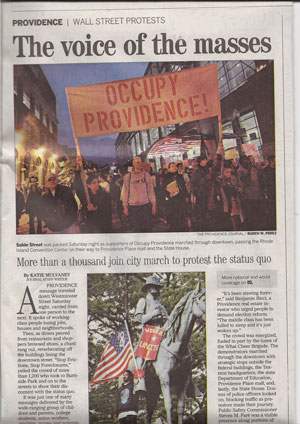
"The voice of the masses"? Since Sunday, multiple polls have emerged suggesting that it just ain't so. From The Hill:
The movement appears to have struck a chord with progressive voters, but it does not seem to represent the feelings of the wider public.The Hill poll found that only one in three likely voters blames Wall Street for the country's financial troubles, whereas more than half — 56 percent — blame Washington.
And again from USA Today/Gallup:
When asked whom they blame more for the poor economy, 64% of Americans name the federal government and 30% say big financial.78% say Wall Street bears a great deal or a fair amount of blame for the economy; 87% say the same about Washington.
We've been hearing a lot about the supposed ideological overlap between the Occupy movement and the Tea Party, but actual poll results from "the masses" seem to trend more toward the latter than the former when the question moves toward whom to blame and (more importantly) where to focus efforts for change. Indeed, describing his own poll-based research, Douglas Schoen describes the Occupiers as follows:
Our research shows clearly that the movement doesn't represent unemployed America and is not ideologically diverse. Rather, it comprises an unrepresentative segment of the electorate that believes in radical redistribution of wealth, civil disobedience and, in some instances, violence. Half (52%) have participated in a political movement before, virtually all (98%) say they would support civil disobedience to achieve their goals, and nearly one-third (31%) would support violence to advance their agenda.
But all of these results were released after the Providence Journal decided what narrative to append to the Occupy Providence event, so perhaps the size of the crowd put the group in the Projo's "masses" category. Of course, recalling that the Projo estimated the initial Tea Party rally at twice the size, one would expect objective news reports to apply the same narrative, right? Well, no:
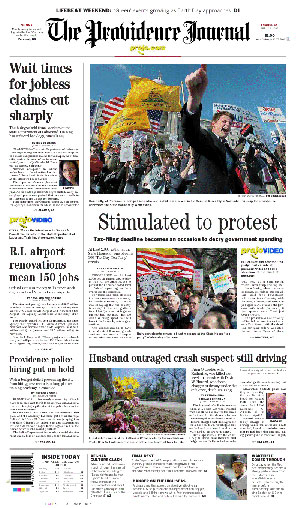
And of course, in the case of Occupy Providence, the "masses" were assisted by a free front page advertisement in the state's paper of record on the morning of the event:
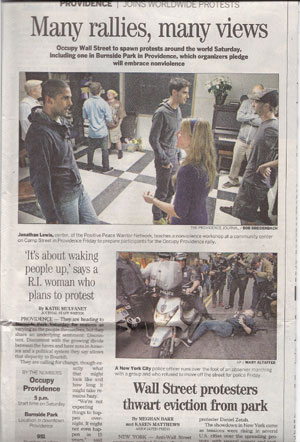
Surely, to achieve even greater attendance, the Tea Party must have had a similar courtesy. Umm...
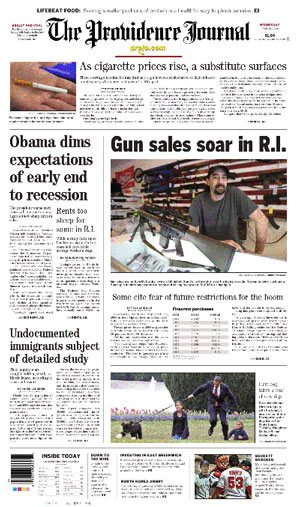
The kid in me would like nothing more than to head down to the Providence Journal newsroom to test out the echo.
September 8, 2011
The Projo's Preferred Narrative
I notice that the wire story that the Providence Journal chose for its coverage of President Obama's Labor Day speech didn't make mention of the call to arms of Teamster leader Jimmy Hoffa, Jr. The omission would be one thing if the article were narrowly focused on President Obama's words (that is, if they took the spin that only what the president said is newsworthy), but even that isn't applicable:
Before Obama's speech U.S. Secretary of Labor Hilda Solis picked up the UAW's frequently used "fired up, ready to go," slogan today as she urged union members to provide vocal support to U.S. President Barack Obama, who soon will unveil a new jobs plan."It won't be an easy thing to do," Solis said. "We know some will fight us and...some will say we can't afford to invest in our workforce."
Solis also criticized those who are trying to reduce the salaries, benefits and collective bargaining rights of union members.
I suppose a major figure in labor warming up Obama's audience with declarations that unions should target the opposition in such a way as to "take the son-of-bitches out" doesn't quite fit the narrative of Tea Party as terrorists versus the well-meaning president (who can only be faulted for giving in to the extreme Republicans in his urge to hear all sides).
August 22, 2011
The Mainstream Advocate
Even the presidential primaries are too far away for me to be invested in any particular candidate, yet, but perusing my Sunday Providence Journal, I found it a little disconcerting to see that every section of the paper that appropriately touches on politics had a piece attacking Texas Governor Rick Perry.
Ed Fitzpatrick threw a jab on the presidential candidate and climate change. Letter writer John Bush Jones likened Perry to a clown based on his comments about the Federal Reserve and (again) climate change (letter not online).
Most striking, though, was a McClatchy piece by Dave Montgomery that the Projo carried in the Nation section, questioning Perry's role in Texas's booming economy:
No issue is closer to the heart of Texas Gov. Rick Perry's presidential campaign than his claim to be responsible for the state's impressive record of creating jobs. Is he? The answer is less black and white than a shade of gray. ..."The jockey in the horserace is very important, but which horse he gets on also matters," said economist Terry Clower, director of the Center for Economic Development and Research at the University of North Texas.
To be sure, outside a totalitarian dictatorship, the chief government official will never be the sole party to praise or blame for economic activity. My view is that, as a rule of thumb, the government does best when it tries to do little, so it would be particularly difficult to claim that the top official has ownership of success. At the very least, one can say that the governor knows what a thriving economy looks like from the top political office.
Whatever the case, it's too bad the mainstream media didn't spend this much time questioning the effect that a short-term Senator (much spent campaigning) had had on, well, just about anything, before the American people elected him to the Presidency in a fit of romantic irresponsibility.
August 6, 2011
Hypocritical Harrop
I alluded to it and Justin dealt more directly with Froma Harrop calling tea partiers "terrorists." Others in the "national" blogosphere have called attention to the hypocrisy of Harrop's comments given she is the chair of the National Conference of Editorial Writers, which runs the Civility Project, whose goal is to help all of us blogging rubes get more manners or something. When called to the carpet for her tea party terrorists hyperbole, Harrop defended herself on her personal blog (didn't know she had one...). Ed Morrissey covers it all. Harrop justified herself because, you know, she was just sooooo mad! Harrop:
Yes, I was angry, but I’m engaging in the defense of my country. I know the tea partiers say the same, but their behavior is that of a national wrecking crew. Most may be nice people who don’t know what they’re doing, but many a country has foundered on the passions of nice people.She then tries to support herself with a Wall Street Journal report on cyber-terrorism:As far as the facts are concerned, I stand my ground. Terrorism is not confined to physical attacks.
The Pentagon has concluded that computer sabotage coming from another country can constitute an act of war, a finding that for the first time opens the door for the U.S. to respond using traditional military force. …Harrop then adds:“If you shut down our power grid, maybe well put a missile down one of your smokestacks,” said a military official.
Blowing up the U.S. economy to make a point would be an even more serious attack, in my book. And that’s what the tea party saboteurs were threatening. They are what they are.Morrissey rebuts her poor logic:
Does Harrop miss the point that the military was talking about actual sabotage, not policy changes and negotiation? The Pentagon sent a warning to other nations that an attack on our virtual infrastructure would be an act of war — explicitly and literally. The point wasn’t that rhetorical arguments are the equivalent of terrorism. For all of her syndicated reach, Harrop seems to have trouble reading for comprehension.Earlier, in her defense, Harrop had written:
I see incivility as not letting other people speak their piece. It’s not about offering strong opinions. If someone’s opinion is fact-based, then it is permissible in civil discourse. Of course, there are matters of delicacy, and I dispensed with all sweet talk in this particular column. And I did stoop to some ad hominem remarks, I’ll admit.So, basically, civil discourse is whatever Harrop says it is, especially if she agrees with you. Many commenters took Harrop to task for her skewed logic and hypocrisy. They were even civil in their discourse. But Harrop closed comments to the post.
Too bad for her, Morrissey preserved the comments for posterity's sake. Just another terrorist act, I suppose.
July 29, 2011
A Frothing Projo Editorial and a Much Needed Policy Reversal
"House GOP vs. America" — that's quite a headline for an unsigned editorial about the debt ceiling battle. The text below it is the sort of summary of economic assumptions and narrow conclusions about specific issues that is therefore impossible to address without revisiting every particular issue and arguing line by line.
For example, writes the editorial board:
That House Republicans, dominated by Tea Party zealots, still refuse to support raising the debt ceiling after having been offered a deal to cut $3 of spending for every $1 of new tax revenues shows a frightening willingness to wreak havoc with the American economy.
For that one, Jerry Pournelle has already provided the points that I would make:
... What's called a cut is in fact merely a small decrease in the rate of increase, so that "cut" means spending more money. There will be a $1.1 Trillion cut spread over ten years, with a Commission of 12, 6 Republicans and 6 Democrats, to propose more cuts. If 7 of them can agree on a "cut" — which may be an actual cut but is more likely to be a reduction in the rate of increase — then both Houses of Congress have to approve the "cut". This may amount to $2 Trillion spread over ten years, or $200 billion a year.The government will continue to borrow $100 billion a month. That amount will go up as the deficit rises. We will then be told that gollies, we did everything we could, but it's not working, we have to have more revenue or we are in default, give us more money. When we point out that they promised cuts and didn’t deliver, we will be told that, well, yeah, but look at that guy with the private jet over there! Tax him, tax him! Look, that company made obscene profits last year! Tax them, tax them!
But so it goes, with the Projo's style mirroring a mouth-breathing lefty blogger rather than a respectable publication. From the above-quoted title and the term "Tea Party zealots" to putting "conservatives" in quotation marks to a declaration that it is "nonsensical" to say that letting tax cuts expire, thus increasing the amount that people pay in taxes, is... umm... raising taxes. You know, because the average American family, when plotting out its budget projections for the next decade, has already taken into account the expected increase. Right?
You do account for projected tax policy when you budget for the next decade, don't you?
The key paragraph of the editorial is this one (emphasis in original):
[The Bush years were] years of the partly unfunded Iraq and Afghanistan wars, TARP and other bailouts and the (totally unfunded) Medicare drug benefit, among other things. New policies during Bush years, including the above-mentioned tax cuts, cost $5 trillion. New costs in the Obama administration, including the economic stimulus, totaled only $1.4 trillion.
Although the editors don't bother citing a source for their data, it appears to come from this New York Times chart, which derives from the left-wing Center on Budget and Policy Priorities. Having sifted through CBPP data reports in the past, I'd suggest that we're not looking at an objective fact, but (again) at a series of assumptions and narrow conclusions that are eminently arguable. In other words, by the time you get to a chart that broad, use of the numbers ought to be heavily qualified.
Even this idea of "new costs" illustrates the point. As the Iraq war wound down, President Obama ramped up activities in Afghanistan, yet the chart does not include any such costs. The Projo insists that letting tax cuts expire is not a "new" policy, but the chart does not appear to treat the extension of those cuts in 2010 to be an Obama-era cost.
Next consider that the Bush total is entirely actual results, while most of the Obama total entails projections. How is it possible that "health reform and entitlement changes" can possibly represent an increase of only $152 billion from 2009 to 2017? Be sure to check back on that one in 2020. And be sure to note that roughly $2 trillion of the total "new policies" derives from the failed stimulus spending of which liberals, including at least some of the Projo editors, wanted more. These are the people making righteous declarations about others' hypocrisy?
Another choice bit of the editorial has to do with taxation in general:
Meanwhile, the Republican refusal to let some of the Bush tax cuts expire or to close tax loopholes is nothing short of delusional. Federal tax collections as a percentage of the economy are the lowest they’ve been in over six decades!
While that's pretty much true, collections and percentage of GDP aren't as clearly relevant as the editors imply. As the first chart here shows, since 1960, the federal tax percentage of GDP has consistently been between 15% and 20% — despite changes in tax policy and despite economic booms and recessions. Those of us who've been in the working world for at least 10 years will likely recognize that the two big recent dips in this data point corresponded with two economic contractions.
Indeed, it's interesting to note that tax collections as a percentage of GDP actually increased after the maligned Bush tax cuts. (The Reagan tax cuts show a similar, though more gradual, trend.)
In the context of the debt ceiling two additional points ought to be remembered. First, government expenditures as a percentage of GDP have never been higher. Second, the "tax cuts for the rich" that President Obama insists be part of any debt ceiling deal (which gives him at least as much blame for the Projo's "budget Armageddon" as Republicans) amount to about 15% of the Bush tax cut total — which is a point that the CBPP and Projo alike are not particularly careful about making.
I'll agree with the Projo editors on one thing: "It's time for Republicans to take ownership of their failed policies of the last 10 years and reverse them." Government spending is out of control and must be reined in. Whether it results from policies implemented during the presidency of Obama, Bush, or FDR the size of government must be reduced. If anything, the House Republicans are not being stringent enough.
July 25, 2011
Letting the Spinners Get Away with Economic Baloney
It's getting kinda hard to take the spin that permeates economic reporting. Reporter Kate Bramson and her headline writer mainly adopt RI Department of Labor and Training Director Charles Fogerty's line that the statistics show "slow, steady progress." The headline and lede are, "Rhode Island unemployment dips slightly, to 10.8 percent, Still, 10.8% an improvement over numbers for December," and the story deepens with this:
Job growth in Rhode Island is one of the positive trends in the first half of the year. Although the number of jobs dropped from May to June by 1,500, Rhode Island had 4,200 more jobs in June than in December. That six-month growth is an increase of 0.9 percent -- which Fogarty said is "outpacing the nation."
A quick glance at the accompanying table, mostly taken from the U.S. Bureau of Labor Statistics' page for Rhode Island unemployment, shows that, while the number of unemployed Rhode Islanders dropped by 4,891, the number of people working also dropped, by 5,362. That is, the overall labor force shrank by 10,153 and hasn't been this small since September 2009.
As for the increase of "jobs based in Rhode Island" since December, a closer look at the month-to-month statistics (which are all that are easily found) suggests that the uptick is mainly in construction and accommodation and food services, which can be expected to increase in Rhode Island this time of year.
July 1, 2011
ProJo Editors Frack it Up, Trust NY Times
Like the ProJo, I've actually supported the idea of having an LNG terminal somewhere in the region. But their latest attempt to boost the idea by editorializing against "fracking" of natural gas in shale deposits is misinformed and relies too much on a much criticized, recent NY Times investigative piece. For instance, as the ProJo editorial states:
One problem is that well production in many fields is declining much more rapidly than expected. For instance, wells in the Barnett Shale, underlying Fort Worth, that had been projected to have a 20-30-year life or longer, will become financially unviable in half that time, The Times reported. Indeed many in the industry bank on rising energy costs to keep the industry afloat.However, as Christopher Helman of Forbes wrote a few days ago:
The shale play that started it all, the Barnett of northern Texas, is today producing more than ever (5.6 billion cubic feet per day) despite there being half as many rigs working the land than there was two years ago (when production was 5.3 bcfd). As analyst Dan Pickering of Tudor, Pickering & Holt wrote in a note this morning, “If wells are declining faster than expected, the Barnett would not be at record production with reduced rig count.”And so on. Setting this acute issue aside, the real problem is that the ProJo editors appear to be following a real "old media" path here: relying on the New York Times as the "paper of record" when there a multitude of sources available--with just a couple mouse-clicks and a search engine--that would help add some nuance and additional perspectives to the story.
June 29, 2011
About Bachmann's "Founding Father's fought Slavery" statement
Apparently we're at the point in Campaign 2012 where we play the game of dissecting political statements for "gotcha moments." The pols have to be ready for the questions, so they should work to make sure they mitigate damage by reading up beforehand. That being said, of all the things to talk to a Presidential candidate about, why focus on interpretations of who exactly was a Founding Father? But, since it was broached....
The question, from ABC's George Stephanopoulos, and Bachmann's answer:
Stephanopoulos: [E]arlier this year you said that the Founding Fathers who wrote the Constitution and the Declaration of Independence worked tirelessly to end slavery. Now with respect Congresswoman, that’s just not true. Many of them including Jefferson and Washington were actually slave holders and slavery didn’t end until the Civil War....First of all, because "some" Founders had slaves doesn't mean that "some" didn't fight against slavery. This isn't an "either or" kinda thing. Besides, someone else offered an opinion on this (H/t)Bachmann: Well if you look at one of our Founding Fathers, John Quincy Adams, that’s absolutely true. He was a very young boy when he was with his father serving essentially as his father’s secretary. He tirelessly worked throughout his life to make sure that we did in fact one day eradicate slavery….
Stephanopoulos: He wasn’t one of the Founding Fathers – he was a president, he was a Secretary of State, he was a member of Congress, you’re right he did work to end slavery decades later. But so you are standing by this comment that the Founding Fathers worked tirelessly to end slavery?
Bachmann: Well, John Quincy Adams most certainly was a part of the Revolutionary War era. He was a young boy but he was actively involved.
Who were our fathers that framed the Constitution? I suppose the "thirty-nine" who signed the original instrument may be fairly called our fathers who framed that part of the present Government. It is almost exactly true to say they framed it, and it is altogether true to say they fairly represented the opinion and sentiment of the whole nation at that time. Their names, being familiar to nearly all, and accessible to quite all, need not now be repeated....Thanks for clearing that up, Mr. Lincoln.In 1784, three years before the Constitution - the United States then owning the Northwestern Territory, and no other, the Congress of the Confederation had before them the question of prohibiting slavery in that Territory; and four of the "thirty-nine" who afterward framed the Constitution, were in that Congress, and voted on that question. Of these, Roger Sherman, Thomas Mifflin, and Hugh Williamson voted for the prohibition...[t]he other of the four - James M'Henry - voted against the prohibition, showing that, for some cause, he thought it improper to vote for it.
In 1787, still before the Constitution, but while the Convention was in session framing it, and while the Northwestern Territory still was the only territory owned by the United States, the same question of prohibiting slavery in the territory again came before the Congress of the Confederation; and two more of the "thirty-nine" who afterward signed the Constitution, were in that Congress, and voted on the question. They were William Blount and William Few; and they both voted for the prohibition...This time the prohibition became a law, being part of what is now well known as the Ordinance of '87....
In 1789, by the first Congress which sat under the Constitution, an act was passed to enforce the Ordinance of '87, including the prohibition of slavery in the Northwestern Territory. The bill for this act was reported by one of the "thirty-nine," Thomas Fitzsimmons, then a member of the House of Representatives from Pennsylvania. It went through all its stages without a word of opposition, and finally passed both branches without yeas and nays, which is equivalent to a unanimous passage. In this Congress there were sixteen of the thirty-nine fathers who framed the original Constitution. They were John Langdon, Nicholas Gilman, Wm. S. Johnson, Roger Sherman, Robert Morris, Thos. Fitzsimmons, William Few, Abraham Baldwin, Rufus King, William Paterson, George Clymer, Richard Bassett, George Read, Pierce Butler, Daniel Carroll, James Madison.
Is this a stretch? Perhaps, but no more, really, than the gymnastics that Stephanopoulos went through just to get to this point.
June 22, 2011
Looking for the Cuts
First above-the-fold headline in yesterday's Providence Journal: "Cuts trump expanded sales tax in House plan." The lead is: "Finance Committee's $7.7-billion budget trims spending by $160 million, curtails sales-tax growth." The only cut that the story provides as an example, however, is $1.6 million "in state spending from programs affecting low-income families, the disabled and the elderly."
The rest of the story describes tax increases and budget increases (as to education) that are still planned. Where's the other 99% of the supposed cut? Well, here's a clue:
It also takes advantage of improving revenue projections and makes cuts to close next year's projected budget gap. While details remained unclear Monday, the cuts include some $160 million in reductions relative to Chafee's proposal, including $31 million in transportation, higher education, corrections and human services, said House Finance Chairman Helio M. Melo.
The "cuts" are mostly to the governor's wild-spending proposal.
And even so, it appears that the largest part of the General Assembly's adjustment to Governor Chafee's budget came in not finding new expenditures to eat up improvements in revenue projections. Legislators cover another big chunk with $17 million from newly taxed sales items (e.g., over-the-counter drugs, digital downloads, insurance proceeds, and travel tours).
In other words, the Providence Journal is mainly passing along the spin of politicians who want to appear more responsible. Little wonder the general public is so ill informed.
June 18, 2011
ProJo.com Edges Towards Subscription Territory
On Thursday, for a third day in a row, the day's on-line newspaper had not appeared until 8:00 am (versus midnight or earlier, which had been the norm). In response to my inquiry, the ProJo sent me the following.
Newspaper content is now available on projo.com at 8:00 am each day of publication. To read newspaper content prior to 8:00 am, you can subscribe to The Providence Journal with the convenience of home delivery. Home delivery is by 6am Monday-Friday and by 8am on weekends.In general, the site is not intended to be an online version of the newspaper. There is newspaper content you cannot get on projo.com and projo.com content you cannot get in the newspaper. The news areas of the Web site are updated continuously, including braking news and sports. Some other features are updated less frequently.
Coming soon, subscribers will be able to access an exact digital replica of the daily and Sunday Providence Journal through our eEdition. More information on this new product will be available soon!
The urge to stop here and kvetch for a moment is irresistable. I, a peruser solely of the on-line Providence Journal who would be impacted by these changes, had to learn of them by asking. But subscribers of the dead tree version, who receive the paper paper and would, therefore, not be materially impacted by this change or even necessarily notice it, were informed of it a while ago (so a subscriber tells me). Hasn't the ProJo targeted the wrong potential customer base? Or perhaps the real hammer drops on us electronic non-customers when the upcoming "eEdition" turns out to have a subscription barrier 24/7, not just early in the morning.
Adding to the confusion, this message
Note to readers:Due to technical difficulties over the weekend, some Providence Journal newspaper stories did not publish on projo.com. That issue is being addressed, and all content will be published on the site.
has been on the main Opinion page for months. Okay, so today's paper hasn't appeared on line yet this morning "due to technical difficulties"???
Mixed messaging asite, democratic (small "d") government is healthier and more accountable in the presence of a robust, inquisitive press. It is in everyone's best interest that the Providence Journal and other information outlets, traditional and not (ahem), find secure financial footing for their operations. Accordingly, I wish the ProJo nothing but the best as they roll out this new approach.
June 14, 2011
The Media Style Book on "Rights"
The Providence Journal reprint of this article has the headline "Gay rights: The backlash" and the following lead:
Some who oppose gay rights say their views are targets of discrimination.
I'm not sure I've ever seen such an excellent example of the way in which media bias begins even at the level of the style book. With one exception, every example of the "rights" in question is same-sex marriage. The one exception isn't even about any kind of rights, but about a group encouraging gays to change their orientation.
In other words, an objective media would have characterized it as same-sex marriage opponents who are the targets of discrimination. That doesn't quite have the same propagandistic ring, though.
May 25, 2011
A Comedy of Endorsement
Thanks to Patrick for mentioning and Max Diesel for finding the Providence Journal editorial board's endorsement of David Cicilline for Congress. Give it a read if you need a morning laugh:
Mr. Cicilline has been an honest, energetic and often innovative mayor of Rhode Island’s largest city. He has cleansed city government of much of its reputation for corruption and hired capable people, most notably Police Chief Dean Esserman. He has looked for ideas on better governance from cities all over the world. And he has brought a level of fiscal discipline (including in relations with the city’s far too powerful public-employee unions) that has not been seen in the city for many decades.
The editorial goes on to explain that its authors share Cicilline's affection for Obamacare and big-government stimulus, and in general, they dislike Republicans' approach to government. Whether the delusion about the Democrat's honesty and discipline as mayor would have overcome the preference for big government had the paper's reporters exposed it sooner, we may have to wait until the election to find out.
Given subsequent revelations, though, the biggest question to me is when liberals will begin to see that the two considerations — in-office performance and ideology — are not distinct issues. Slick, dishonest politicians have a larger playing field on which to profit themselves when the scope of government expands. It may be frustrating that a perfect world would allow us to come together collectively and solve our problems in the most efficient way possible, but the world isn't perfect, which is why we need checks and balances both within and against government.
May 24, 2011
And Where Was the Projo?
One can infer that a politician is on the ropes when he insists that his constituents look to the future rather than the job that he held until six months ago (and for which he can credit his subsequent political advancement):
"This poll reflects some disagreement about some of the decisions I made in Providence, rather than my work as a new member of Congress for the past five months," [David Cicilline (D, RI)] said in a telephone interview. "I intend to continue to work hard every single day to earn the support and trust of the people in my district by doing everything I can to get people back to work and rebuilding our state’s economy."
The problem is that, while Cicilline may be able to escape to Washington, the people of Providence and Rhode Island cannot. Election to higher office is not a born-again baptism:
Providence Mayor Angel Taveras has said the city faces a $180-million structural deficit for the current fiscal year and next. An independent auditing firm concluded the Cicilline administration overspent its budget and nearly depleted the city's rainy day account in its final budget year. And a City Council report asserted that the former mayor violated the city's Home Rule Charter, inflated revenue estimates and ignored budget procedures.
So here's the lingering question: Where was the city and state's newspaper of record back when Cicilline was still in the state and in the office? Where was the paper, that is, other than attacking his opponent with bleedingly obvious bias through its PolitiFarce mechanism?
May 11, 2011
Four New Faces... Same Old Media
An interesting feature in Monday's Providence Journal came as four short reports about new legislators in the General Assembly: Rep. Dan Reilly (R, Portsmouth), Rep. Doreen Costa (R, North Kingstown), Sen. Nick Kettle (R, Coventry), and Rep. Chris Blazejewski (D, Providence). The way they're framed from the beginning tells readers a great deal about the perspective from which the Projo is written:
- Reilly is learning how much work it is to be a legislator.
- Costa is "a bona fide right winger, a Tea Party member who wanted to restrict abortions, preserve traditional marriage and 'cut, cut, cut' the state budget," who is having fun in both the legislative and community-involvement aspects of her new job.
- Kettle sent a poorly considered email to "Tea Party supporters" concerning a hearing on homelessness.
- But Blazejewski, ah well, Blazejewski "may well be the House freshman who most bears watching," and he's not a "bona fide left winger," but rather "a self-described progressive Democrat" (which sounds so much more pleasant and less extreme."
Frankly, I'm tempted to agree that it's worth watching Blazejewski, albeit in a different sense than that intended by reporter Randal Edgar. One of the featured bills on which he's a lead sponsor (PDF) would unionize any group of public employees without secret ballots if 70% sign authorization cards. Query: Why would nearly three quarters of a workforce sign authorization cards even when 50% plus 1 won't vote in secret toward the same end? Perhaps unions prefer their odds when they can intimidate.
Be that as it may, based on these four articles, I find the other three more interesting. Consider Reilly's excellent response to Governor Chafee's "show me a better budget" challenge:
"I'm not a huge fan of them saying, 'Well, we've done our job, now you come up with the rest of it.' As if we have the resources to do these studies. I wasn't elected governor."
The real story of the Journal's series, although the reporters don't emphasize it, arises in a cross-article fashion from Costa to Kettle. Regarding a bill that Costa supported to eliminate "held for further study" from the GA leadership arsenal:
"This is not really going to change too much," she said as she summed up her argument. "It's just going to give us a chance to get the bills voted on quicker and get them to the House floor quicker."
The Kettle article illustrates what, precisely, would change were "held for further study" no longer a technicality by which every piece of legislation gets its legally required committee vote:
About four months into the session, Kettle says he regrets having voted for Democrat M. Teresa Paiva Weed for another term as Senate president, a move that he hoped would earn him at least a committee hearing on some of his proposed legislation this year.To date, none of the eight bills Kettle has submitted — including one that would eliminate the state’s $500-minimum business corporation tax — have been subject to a public hearing. Those hearings are generally granted at the discretion of the Senate leadership. "Clearly, that did not pan out as I hoped," he says.
In stark contrast to the Providence Journal, Andrew Morse has done an excellent job following and explaining how it is that the "further study" trap door transfers power from individual legislators to House and Senate leaders. With the power to control legislation in hand, the Senate president and House speaker can extract votes and favors, as Kettle illustrated with his assumption that backing the right president would increase his odds of legislative success.
That concentration of power isn't going to go away unless the next wave of new legislators willing to challenge the status quo is much larger than the last one.
April 25, 2011
That Old Welfare Draw Question Poorly Answered, Again
A weekend PolitiFact giving Colleen Conley "half true" for a statement regarding the generosity of Rhode Island's welfare system illustrates the flaw in the media enterprise's entire methodology:
Do welfare recipients really have it that good in Rhode Island? We decided to check.The simple answer: When it comes to how folks commonly define welfare -- cash assistance to poor people -- they don’t.
The RIPEC report, released in 2010 using data from 2008, doesn't have a state-by-state comparison of cash payments.
Instead, it examines them by two different measures. And both show we’re far from the most generous in New England.
The real lesson, I'd say, is that folks making such statement's as Conley's have to add a parenthetical note to include other welfare programs than just cash assistance. It has long been a tactic of social service advocates (and therefore the mainstream media) to focus on cash payments as (in the ubiquitous phrases) "how folks commonly define welfare."
Personally, I've yet to see any evidence that most "folks" do not intend to include every variation of payment and service rendered to needy people when they say "welfare." Ask a person on the street, that is, whether child care subsidies are part of "welfare," and I'd wager you'll get a "yes."
More to my point, it misses what's relevant to investigate aggregate state spending in order to compare social services, as PolitiFact does. Conley said that Rhode Island leads New England in being "known for its generosity toward its welfare recipients." That calls for measurement from the perspective of those who receive services, not the government that processes the redistribution of money.
The problem, as Andrew noted a few years ago (here and here), is that such information is difficult to come by. To answer the question of whether Rhode Island is a "welfare magnet," one must know whether the state is perceived to offer benefits that can't be garnered elsewhere.
That shift emphasizes, first of all, that cash payments are not all that should be considered, and second of all, that such conclusions as PolitiFact's should be based on an analysis of actual program offerings. For example, it's been a number of years since I've had the opportunity to look deeply into this question, but it used to be the case that Rhode Island didn't count other states' cash payments when considering eligibility. That has changed, but I believe it remains unlikely that dishonest applicants will be caught.
Moreover, Rhode Island was (and still is, as far as I know) generous in allowing other sources of income when calculating check amounts. It isn't enough, in other words, to note that a family of three would get $554 per month in RI, but more than that in every other New England state but Maine. One must see how quickly other states adjust their payments to address other household income. When last I looked into it, Rhode Island quickly exceeded Massachusetts for those who were able to find a couple hundred dollars a month from other sources.
April 20, 2011
A Matter of Protest Perspective
Did you hear that this year's middle-of-the-workday Tea Party rally last Friday attracted fewer people than in past years? According to the Providence Journal's historically low estimate, about 400 people made it, and the article on the rally concentrated on that point:
The tea party rally at the State House Friday brought out a lower turnout than previous years, and for some attendees that brought frustration.Stephen Struck, of Cumberland, remembered the marble plaza being "mobbed" with people during the first tea party rally in 2009. He says last year's crowd was about half that amount, and this year's crowd is about half of last year's.
Another rally, which arguably represents the opposing view, got quite a different treatment:
Tax Day rallies around Kennedy Plaza, one during lunch and the other at rush hour, drew some of the same participants and aired similar themes: that hard-working Americans pay more than their fair share of taxes.Protesters who started gathering at 12:15 p.m. at the statue of Ambrose Burnside warmed up by chanting "Hey, hey, ho, ho, Wall Street greed has got to go," and "I pay, you pay, why doesn't Bank of America pay?"
This rally attracted a whopping 40 people, and since comparing that turnout with the rally just a few days earlier apparently wasn't relevant, reporter Donita Naylor spent most of the article conveying the talking points of the speakers. By comparison, based on the Projo's report, readers wouldn't be able to name a single one of the folks who spoke at the Tea Party event, much less what they said.
By the way, look who turns up in the second article:
Tax researcher Tom Sgouros said "problems are not going to be solved if we cut services" and stop doing preventative maintenance.
Tom's becoming like David Bowie. One week, he's an economist, the next he's a "tax researcher." He used to be a "consultant."
April 11, 2011
RI Gets a National Chuckle
I'm behind on all of my reading, so it was just last night that I made it to Mark Steyn's return column in the March 21 National Review and was humored to see that he devoted a large section thereof to characters from the Rhode Island scene. Noting Providence Teachers' Union President Steve Smith's hyperbole comparing Mayor Angel Tavares's teacher termination notices to Pearl Harbor, Steyn expands the topic:
But I'm getting ahead of myself. Reporting for the Providence Journal, Linda Borg, mindful of the fact that most of her readers have been educated by members of Mr. Smith's union, felt obliged to add a more basic clarification: "That was the day the Japanese government bombed Pearl Harbor."December 7, 1941: a day that shall live in infamy, but not in Providence.
By the way, that's why America's monodailies are dying. Maybe they'd die anyway, but wouldn’t it be more fun and more dignified to go down in flames like a kamikaze pilot or Charlie Sheen than by self-anesthetizing your prose into utter unreadability? As Capt. Jean-Luc Picard of the starship Enterprise remarked apropos Ms. Borg's namesakes, resistance is futile. You can try to read on, but the vast J-school-credentialed army of lethal parenthetics will crush you 'neath their feet: December 7, 1941, is the day the Japanese government bombed Pearl Harbor. Pearl Harbor is a U.S. naval base in the Pacific. The Pacific is a large body of water. Water is what your eyes are beginning to do
March 28, 2011
Lamenting Taxes While Endorsing Taxers
The Providence Journal editorial board is right, of course, to speak out against Governor Chafee's proposed expansion of sales taxes:
This is not a matter of greed; for many businesses, it is a question of survival. Small businesses are the job engines of any economy, and when they are wiped out, jobs disappear. Rhode Island's years of suffering one of America's worst unemployment rates should have taught that lesson. ...Taxing manufacturing machinery and equipment, which Mr. Chafee wants to do, seems especially shortsighted --- which is why 33 states, including Rhode Island, currently do not do it, Mr. Sasse notes. Encouraging productivity and innovation ultimately pays off in more jobs and higher tax revenues.
I convey the thought only half seriously, but I did wonder whether the Projo should make a habit of mentioning — disclosing, if you will — that its product will face a new tax, as well.
More broadly, the editorial is an excellent example of the paper's tendency to treat issues as if they can be constructed to generate the perfect political regime (from the writers' perspective). That is, the Providence Journal is an establishment entity, in Rhode Island, and its endorsements and policy advocacy have helped to bring Rhode Island to its current circumstances.
Hopefully those who are coming to see the folly of the Chafee Way will follow the logic back to other aspects of RI governance and politics that preceded his election.
March 25, 2011
Gist, Education Consultants & Skeptical Radio Anchors
This morning, I listened as the new WPRO Morning News team of Tara Granahan and Andrew Gobeil went after Education Commissioner Deborah Gist for her proposal to hire up to 50 retired educators (teachers, principals, etc.) as 90 day consultants to help implement the programs funded via Race to the Top. Earlier, Granahan and Gobeil--apparently taking their cue from a ProJo story--interviewed Warwick Rep. Joe McNamara, who sponsored the legislation. I missed that part of the interview, but apparently McNamara basically explained that it was Commissioner Gist's idea. It was apparent that Gobeil and Granahan were particularly bothered by the fact that the bill would allow retired educators to make up to $500/day while still collecting a pension.
Commissioner Gist then called in to try to clear things up, but Granahan and Gobeil took a hard line on paying retired, pension collecting educators $500 a day to consult. The commissioner explained that, basically, $60-70/hr is the going rate for the expertise offered by "master educators" and that she wanted to be able to hire Rhode Island educators and this legislation enabled that. Gobeil and Granahan weren't buying it and pounded away on how $500/day seemed like an awful lot in these tough times. Further, Granahan asked Gist if the consulting fees would be subject to Governor Chafee's new 6% tax (like other consulting fees), to which Gist basically replied, "Of course."
Nowhere was the distinction made (though I think Gist may have assumed this was known) that the money to pay for these consultants was part of the Race to the Top funds. In essence, the bill was a mechanism to allow the Department of Education to hire Rhode Island based educators to perform the consulting. As Gist said, with or without the bill, she will hire the consultants--from another state if necessary--and the going rate is $500/day. I don't think she changed the minds of Gobeil and Granahan, but I'm not sure if they really "got" that the money was earmarked for that specific purpose.
I know $500/day seems like a lot, but professional consultants in all sorts of industries make that and more. I don't doubt that Gist is correct and that's the going rate (at the least!). And while Republicans like Joe Trillo oppose the measure, I think that its more of a knee-jerk reaction than anything else. One other thing: the teachers' unions apparently oppose the legislation:
Several union leaders voiced concerns again Wednesday, saying it was bad fiscal policy to have retirees drawing down the pension fund while working.But Gist isn't looking for regular educators, she's looking for experienced and special ones. Not just the most senior ones left on the laid off list or new hires with lower pay (as Trillo suggested). She needs top-of-the-line folks to implement RTtT (like it or not). As reported by the Brown Daily Herald:“This is bad for the pension system … and it’s bad employment practice when hundreds of teachers are out of work,” said Maureen Martin, political director for the Rhode Island Federation of Teachers. “We want them to use local teachers already in the school system.”
Gist encouraged available teachers to apply for the positions, but emphasized that the plan "can't be a program for jobs."But back to the interview itself. On the surface, it seemed like Gobeil and Granahan (in particular) were aggressive and skeptical of the Ed. Commissioner's motives because they were trying to safeguard taxpayer money. That may have been the case and, while there are important, technical reasons why their apparent watchdoggedness, in my opinion, was misplaced (the money is earmarked for a particular purpose, etc.), I won't fault them for that. (Plus, to the benefit of WPRO, they successfully turned it into a "newsmakers" moment and have been covering it in the news breaks all morning)."This is not going to resolve employment," she said. "We have to make the decisions that are best for our students."
Yet, then I remembered their interview last week with new Warwick School Committee member Gene Nadeau. Nadeau had gotten some publicity for his statement that state education dollars were going disproportionally to Providence, Central Falls and other urban core cities and he was ostensibly on the show to talk about that, which he did. Then Granahan went off-topic and asked Nadeau, to paraphrase, "Is it true that they are going to close a high school in Warwick?" Nadeau was obviously surprised by the question and explained he hasn't heard any discussion of that during his time on the School Committee. Granahan wouldn't let him off that easy and re-phrased the question a couple times. It was clear to me that Granahan, who grew up and has family in Warwick, was skeptical of Nadeau and didn't believe him.
Taken together, the Nadeau and Gist interviews have left me with the impression that Granahan in particular is, at the least, skeptical of local and statewide education administrators. Yes, "twice is a coincidence" and all that. But that's two times in two weeks I've heard an education administrator interviewed and given a tough time by Granahan. That's not a bad thing, but it's interesting to see the perspectives and biases of supposedly "straight news" personalities slowly revealed.
March 24, 2011
NPR: No Such Thing as Unbiased
The thing about bias is that 1) we're all biased; 2) we often have a hard time identifying when those of similar bias are being biased; 3) we can identify bias, but probably overstate it because of our own bias! Thus, when NPR's Steve Inskeep defends the unbiasness of NPR, well, my own bias leads me to conclude he's biased.
[L]et's consider the fundamental question: the accusation of "liberal bias" at NPR, which drives many critics calling to eliminate its federal funding. It's not my job as a reporter to address the funding question. But I can point out that the recent tempests over "perceived bias" have nothing to do with what NPR puts on the air.I know it's my bias showing, but conservatives can walk and chew gum at the same time. Hence, they can listen to conservative "talk radio" and still get their hard news from NPR. Frankly, I think that the news from NPR is perfectly fine. It's all the other stuff--the feature piece selections, the lifestyle/culture talk shows, seemingly all the editorializing (when it is done)--that tilts it leftward. (A locally notable exception is WRNI's Political Roundtable, which is a balanced affair). You see, it's not that we expect NPR to be unbiased, just be balanced...and fair (couldn't resist!). You know, show a few different sides of a political story instead of the one emanating from the Minnesota Prairie, for instance.The facts show that NPR attracts a politically diverse audience of 33.7 million weekly listeners to its member stations on-air. In surveys by GfK MRI, most listeners consistently identify themselves as "middle of the road" or "conservative." Millions of conservatives choose NPR, even with powerful conservative alternatives on the radio.
March 10, 2011
End Subsidies To Corporate Fat Cats
Contrary to what many think, most conservatives actually don't approve of "corporate welfare" (see: GM, Big Agriculture, etc.) and think it's ridiculous when a company receives government subsidies when it pays salaries like this:
• Four vice presidents and producers pulled in more than $300,000 — and another 10 took home more than $200,000 — in pay and benefits;Of course, I'm talking about WGBH, the Public Broadcasting station that "received $11.5 million in federal money this year— about 8 percent of its $156 million operating budget." Obviously, that's a crucial 8%. Keep those pledges comin'!!!!• 145 of...950 employees — about 15 percent — earned more than $100,000.
• Ex-...president Henry Becton Jr. — now the station’s vice-chairman — made $160,873 in total compensation for working just 24 hours a week.
• Top brass pocketed more than $200,000 in bonuses.
[The] $425,000-a-year CEO, Jonathan Abbott, defended the salaries, saying he hasn’t had a raise since taking the helm in 2007 and that [the company] has to compete for talent with the country’s leading media companies.
“We also benchmark all of those salaries to comparable salaries at media and nonprofit organizations in this area and nationally,” Abbott said. “If you look at my compensation relative to . . . my peers in Boston or in this country, I am . . . paid a fair wage.”
March 6, 2011
Cover-Up Collusion by the Fourth Estate? ProJo Endorsed David Cicilline Three Days AFTER the Release of the Internal Auditor's Report
In an excellent post at Legal Insurrection entitled "What Did Former Providence Mayor David Cicilline (D-RI) Know, And When Did He Know It?", William Jacobson points out, among other interesting items, that David Cicilline was endorsed by the Providence Journal.
One's initial reaction is, sure, they endorsed him; he was the Dem candidate. And this is certainly a natural reflex. The ProJo has a marked propensity to support and endorse liberal and Dem candidates.
This one is particularly troublesome for the ProJo, however. In their endorsement, they specifically cited Cicilline's "fiscal discipline" and called him "a highly competent public servant". Yet this praise and endorsement came three days after numerous news and media outlets, including the ProJo itself, had reported that Cicilline had failed to make numerous payments to city pension funds, had emptied the reserve fund, had refused to provide numbers and documents to one of the city's own auditors and had baldly lied about all of it.
Doesn't the Editorial Board read its own newspaper? Or did they read about the Internal Auditor's report and unquestioningly dismiss it as someone once again just being mean to poor David?
This is not to dilute or detract from David Cicilline's culpability in the original matter. The ProJo played no role in his egregious budget fixes. By ignoring the Internal Auditor's report (even to the extent of disregarding their own reporters!), however, the Editorial Board did assist the mayor in smothering this disturbing revelation as to the true condition of the city's finances and the corollary matter of any contributory policies of the Cicilline administration. This, of course, helped him preserve the false image of a "competent public servant" just long enough to obtain a political promotion.
In doing so, the ProJo became a watchdog guarding the wrong object.
In the wake of necessary and dire budget steps taken by Providence's new mayor, the ProJo has belatedly started asking questions of David Cicilline, going so far as to publish an unfortunate (from his perspective) exchange between his office and a ProJo reporter seeking answers from the reluctant congressman.
It is to be hoped that, in the future, the Providence Journal undertakes such diligence before and not after a candidate has gained a political promotion - gained, in part, via the dissemination of false information about a vital public matter. This state needs all the (properly focused) watchdogs it can get.
February 16, 2011
WPRO Shaking it Up
Our corporate overlords are shaking up their lineup. Jeff Derderian at GoLocalProv broke the news:
John DePetro who currently holds down the 6am till 10am slot is said to have a major deal in play that could include a nationally syndicated show down the line. Details of what that national show may be are not being made public yet. And because of that timing opportunity, we hear that a change in the morning show will mean that DePetro moves his show to a new time from 9am till Noon. And it doesn't just affect DePetro....The plan is also to move both Dan Yorke and Buddy Cianci. Yorke, now on the air from 10am till 2pm will be on from to noon till 3pm....then have Cianci going to 3pm to 6pm. So all three talk show hosts would be doing a 3-hour shift and the “new” morning show would be on the air from just 6am till 9am.Ted Nesi reports that the goal is to have a more objective morning news program from 6-9 AM:
In a statement, WPRO Program Director Paul Giammarco said only that the station plans “to recast The WPRO Morning News” to provide “objective news reporting.” He also confirmed the station will be adding a fifth local host in the morning but did not say who it would be.Maybe that explains the various guest co-host spots that have been occurring on some of the WPRO shows over the last few weeks.Multiple sources say WLNE-TV ABC 6 anchor Andrew Gobeil is in advanced talks to host a new morning rush-hour program on WPRO that will air from 6 to 9 a.m. But that deal has not been finalized.
Gobeil, who joined ABC 6 in October 2009, confirmed that he’s leaving WLNE – which is in receivership and set to be sold within weeks – but was coy when asked whether he was doing so to join WPRO.
“I’m not at liberty to discuss where I’ll be in the weeks ahead, but I am absolutely thrilled at what the future holds,” Gobeil told me.
February 11, 2011
ProJo Blames Conservatives in Congress for Complicated Taxes
The ProJo Editors came out against tax fiddling and focused on a couple areas of "trouble" related to taxation and the implementation of President Obama's health care program. They think that the 2.3% tax on medical devices is no big deal because the manufacturers of said devices make a lot of money now and will make even more thanks to the health care reforms, so they should pay more. Except, with their usual blinders, they don't account for reality: the manufacturers will probably just pass that tax increase off to consumers (or, by extension, their health insurer, which is us...so how does this work?).
They ProJo Eds are particularly troubled by the complicated tax code, in general and are in favor of making it "flatter" and simpler (here here!). And they blame...conservatives?
The biggest problem is Congress’s (and especially its “conservatives’ ”) tendency to promote such fiscal dodges as tax credits instead of transparent taxes and spending. The taxes that folks don’t pay because they get a tax credit are taxes that someone else must pay. But members of Congress like to make it all as opaque as possible.Huh? Well, you see, from the Eds perspective, the Democrats fell down on the job because they "believed the insurance lobby was just too powerful to overcome in Washington" and the Republicans who all voted against the Obamacare plan somehow benefited from the insurance lobbyists...it's pretty confusing rhetoric, really. Never mind that they ignore the fact that nearly every reform plan that aims to make the tax system "flatter" (at least to my knowledge) has come from fiscal conservatives (from Steve Forbes, to Paul Ryan to Ron Paul, etc.). Cognitive dissonance strikes again.
February 3, 2011
One Man's Left-of-Center Is Another Man's Far Left
Really, what could we say about RI House Speaker Gordon Fox's appointment of Rep. Edith Ajello as Chairwoman of the Judiciary Committee that would surprise anybody or that would have any effect on anybody's opinion? The state's political leadership is zagging when it needs to zig, and she's a strong indication of it.
The labels that the Projo article announcing her appointment applies to her, however, are interesting. The headline writer dubbed her "unabashadly liberal." Reporter Philip Marcelo eased up with "unabashadly left-of-center." The woman herself says, "I feel that, in some way, I'll have to step away a little from my progressive, liberal extreme left advocacy to do the job of chair properly." Perhaps Marcelo meant to emphasize the "step away," when it appears that Ajello wanted to emphasize the "in some way" and "a little."
One quote in the article, however, is a bit more than just interesting:
Observers reject the notion that Ajello's appointment heralds a political shift in the House leadership under Fox, who is beginning his first full two-year term as speaker.[House Minority Leader Robert] Watson, the GOP leader, says the elevation of the left-leaning Ajello in concert with other more conservative-leaning lawmakers, such as Brien, points to a level of pragmatic politics. "He is being very careful and deliberative in trying to bring varying factions and groups under one umbrella," Watson said.
Why on Earth would Watson want to bolster the spin that appointing Jon Brien as chairman of Municipal Government in any way counterbalances Ajello as chairwoman of Judiciary? One might as well pretend that Watson's status as Minority Leader counterbalance's Fox's as Speaker or Nicholas Mattiello's as Majority Leader.
January 24, 2011
The Journal's Us and Them
Did you happen to catch this front-page story in last Sunday's Providence Journal?
On Friday, three former governors and several professors of communications and political science offered varying opinions about whether Chafee had made the right decision, as well as some historical perspective on discourse — civil and otherwise — in American democracy.
Not a single quote from anybody associated with talk radio, whether as an on-air personality or executive... or even a supporter or listener to the medium. Simply by its presentation, the article makes clear that those who work in that particular medium, and perhaps their audience, aren't really part of the Rhode Island community, but an external "them" to be dissected by academics and handled by politicians.
January 14, 2011

Some Guy Named Chafee, On the Remedy to Bad Discussion
Professor Zechariah Chafee ended Chapter 5 of Government and Mass Communications, the chapter on "Group Libel" and its possible remedies, with this passage...
When wise men refuse to mention disagreeable facts, foolish and stupid men will have their say more than ever. The responsible leaders of the press ought frankly to face the facts of group dissenions whenever a proper occasion demands. When the evil is thus frankly faced, its size will seem to be smaller than is commonly supposed, and methods for reducing it still further can then be satisfactorily explored. The remedy for bad discussion is not punishment but plenty of good discussion.Since having a discussion, good or bad, requires multiple parties, and since not many people would be interested in a press that simply talks amongst themselves, the challenge that Professor Chafee puts to "responsible leaders of the press" applies to responsible political leaders as well.
Zechariah Chafee believed that in an open discussion, evil would lose. I don't know that Lincoln Chafee would label the adversaries he perceives he has in talk radio as "evil", but he is certainly not behaving as though he believes that he (or the members of his administration) can win in public debates with them.
The question is, does this tell us more about the ideas of Zechariah Chafee or of Lincoln Chafee?
(Fortunately, there is some evidence that the tradition represented by the older Chafee is being carried onin the form of former Republican Gubernatorial candidate John Robitaille, who advised Governor Chafee via Philip Marcelo of the Projo to directly face those with whom he disagrees...
Robitaille, whose former boss had been a regular on talk radio during his eight-year tenure, suggested that if Chafee disagrees with the positions taken on talk radio, he should face his detractors head on. “Go into the den of the lion. Conflict avoidance never settles a dispute, however, open and honest communication often does.”
January 13, 2011
Some Guy Named Chafee, on Relations Between Government and Mass Media
For further examination of Rhode Island Governor Lincoln Chafee's decision to not allow state officials to participate in (certain aspects) of talk radio, let us turn towards a figure from another era, widely revered for his ideas on the subject of government and mass communication. The individual to whom I refer is the renowned First Amendment and free speech scholar Zechariah Chafee Jr., Professor of Law at Harvard University and primary author of a 1947 report put forward by a body known as "The Commission on Freedom of the Press" titled Government and Mass Communications. I believe he also had a nephew and a grand-nephew who went into the more practical side of politics.
Part III of Government and Mass Communications is titled "The Government as a Party to Communications". Chapter 25 within that section is titled "The Government Talks to the People". Despite the fact that the book was written before the birth of the talk radio formats which predominate the locally-produced politically and civically oriented broadcasts of today, many of Professor Chafee's ideas are relevant to Governor Chafee's decision to bar members of state government from appearing on certain local radio programs.
1. Regarding any from of communication between government and the media, Professor Chafee expressed skepticism about favoring one media organization or reporter over another...
[Press conferences] supply a much fairer method for getting governmental news and ideas into newspapers than the practice, which Theodore Roosevelt had initiated, of giving important stories to a single correspondent. "If a story is public, it should be made public,", said an experienced informant. "To release it only to a favorite correspondent is definitely a harmful practice."It is hard to believe that Professor Chafee would have supported a blanket ban on government participation in particular media outlets, for reasons of either organizational structure (i.e the "for-profit" rationale) or conflicts between individual personalities.
2. Professor Chafee did express some specific ideas about the medium of radio...
When a President had many things to say, he was obliged to improvise a series of meetings in widely separated cities...The radio has changed all this. Unfortunately, its great merits were first appreciated by unmeritorious leaders. Still, not many years elapsed before Roosevelt and Churchill realized that a statesman at last had what he always needed -- a direct road from his mind to the minds of millions, open for use almost the moment his thoughts were matured.The Professor probably would not have harbored the attitude, which emanates from some Rhode Island quarters, that a Governor elected by the voters should not spend much time talking via long-form radio interviews directly to the voters. Rather, Professor Chafee saw the technologies which allowed executives to communicate their thoughts directly to the people as a positive, when in the hands of a meritorious leader (I'm pretty sure by "unmeritorious" leaders, he is referring to the European Fascists and the American "Populists" of interwar and World War II eras).
3. As to the purposes for which a meritorious leader talks directly to the people, Professor Chafee offered that...
Many purposes come to mind which can be promoted through governmental information. The broadest of all, perhaps, is to provide models of discussion that win respect for "talk" as an efficient, orderly means of clarifying goals, trends and the alternatives among which a choice is to be made. Free government depends in part on maintaining confidence in "talk". Many forms of existing public discussion undermine respect for it. Often, the proceedings follow no clear line and seem to provide no more than entertainment or the chance to sound off in an undisciplined fashion.The idea of a top priority of government being to provide examples to the public seems quaint today, embraced by neither the modern right, who see government full of strange behaviors to be avoided, nor the modern left, who see example-setting as a function secondary to the direct technocratic management of society. But the fact that the patricians of Professor Chafee's era assumed something no longer uncritically accepted, i.e. that the best exemplars of civil behavior would automatically find a place government, does not diminish the importance of recognizing that government leaders do set examples that certainly will be observed and, to some degree, that will be emulated.
Whether he intends to or not, Governor Chafee (the younger) is providing a model of a leader who is either unwilling or unable to directly express matured thoughts directly to the public and who would prefer to eschew the process of persuasion and "talk" as much as possible. To be frank, he gives every appearance of fearing that "talk" will highlight a lack of coherence between the goals that important to society and the choices that his administration will make. The damage done by this example -- if you believe the ideas that Professor Chafee sought to advance -- impacts more than just short term political fortunes or to the day-to-day operation of government; it extends to a weakening of the democratic fabric in general.
Or maybe you believe that Great Uncle Zechariah had it all wrong.
January 12, 2011
Day Late and a Dollar Short: ProJo & Harrop Decide Now is the time to Blame Tea Party and Conservatives for Tucson
After the meme has all but been destroyed, the ProJo editors and columnist Froma Harrop (one in the same?) have thrown in their lot with the "blame the right wing/tea party for Tucson" crowd. The editors:
While there has been some menacing left-wing rhetoric (the left was particularly extreme in its attacks on George W. Bush), and there are such hyperbolic media types as Keith Olbermann, most of the rhetorical rage has come from the right.Yes, the internet and the anonymous commenters--not to be confused by anonymous journalists publishing unsigned editorials, of course. I won't parse through examples of left wing "vitriol" nor delve into the conspiracies Loughner indulged (though here is an interesting interview with a friend of Loughner's from Mother Jones). They can be found elsewhere and, frankly, Loughner's "ideas" were all over the ideological map. Yet, that doesn't trouble the ProJo Eds., who just wish, dontcha know, for the days of yesteryear and "good" conservatives:Indeed, a turn of the radio dial shows where the majority of the highly profitable political-hate industry is based these days. And the Internet, which encourages people to spout off, often in the comfort of cowardly anonymity, has also raised the temperature. Conspiracy theories, of which, said a friend, Mr. Loughner was a devotee, thrive in such an environment. He had expressed to friends a strong if incoherent anti-government animus.
Some of the rhetoric in the media has been sincere, some of it mercenary, and some a mix; Sarah Palin, Glenn Beck and their colleagues, for their part, have found that high-on-hysteria, low-on-facts denunciations have been very lucrative show business, much more saleable than the careful analyses by such old-fashioned — and highly informed — conservatives as George Will; too boring!Would that be the same George Will who just wrote:
It would be merciful if, when tragedies such as Tucson's occur, there were a moratorium on sociology. But respites from half-baked explanations, often serving political opportunism, are impossible because of a timeless human craving and a characteristic of many modern minds....An example of what Will explains lay in the way the Progressive ProJo Eds open their editorial:A characteristic of many contemporary minds is susceptibility to the superstition that all behavior can be traced to some diagnosable frame of mind that is a product of promptings from the social environment. From which flows a political doctrine: Given clever social engineering, society and people can be perfected. This supposedly is the path to progress. It actually is the crux of progressivism. And it is why there is a reflex to blame conservatives first.
The shooter in the Arizona case, Jared Lee Loughner, is mentally ill. There were signs of that before he shot and killed six people, including a federal judge, and critically injured Congresswoman Gabrielle Giffords.So, while they have jumped on the wheel-less bandwagon regarding the "vitriol", I suppose credit is due for twisting it to their cause celebre--health care reform--even if it is ridiculous "political opportunism."Perhaps a better health-care system would have gotten him off the streets before he could erupt, or maybe not.
See, I'd have less problem--though still disagree--with the ProJo if it had simply gone off on the Tea Party, Beck, Palin, conservatives, whatever (as they have in the past) if they hadn't tried to tie it all to Tucson. Instead, we have a case of RI's own old gray lady not letting a good crisis go to waste, so to speak.
Maybe John Nolte has figured out what is really going on here:
Imagine what it was like as recently as 15 years ago to enter the field of “journalism” under the promise that if you were successful you’d have unlimited and, better yet, unaccountable powers to destroy whomever you wanted and to tell whatever lies necessary to further a personal agenda. Now imagine how frustrating it must be to have that promise almost completely evaporate with the rise of Citizen Media, New Media, and Fox News.Apparently, some fools come late to the party.What we witnessed these past three days wasn’t just political partisanship, what we witnessed was the horror show of entitled and angry elitists desperate for that warm, nostalgic feeling of reaffirmation that comes with a successful character assassination and a death blow to their political enemies. Yes, the media made complete fools of themselves and further damaged what was left of their reputations, but the brass ring of a momentary return to the good old days was impossible not to reach for.
January 8, 2011
Timely Embargo Coverage of MA District Four Race by MA PBS
In July, 2009, the dining room table told three college-aged PBS interviewers that
I’m tired, and I think . . . it’d be nice to have some free time, not have to read a lot of stuff I don’t care about.
One would have thought that the easy solution was for Congressman Frank to simply not pull the nomination papers which would once again place him in a job which simultaneously bores and exhausts him.
More troubling than the unfathomable thinking process of the congressman who facilitated the housing and mortgage collapse, however, is the spectacle of a news outlet whose conduct ranges somewhere between gross negligence and the active shielding of a candidate from his own words.
The Boston Herald reports that PBS aired the WGBH “Roadtrip Nation” episode containing this very frank interview just two days ago.
Two days ago. A year and a half after it took place and, more to the point, very comfortably past the point that this information could have been of use to Mass District Four voters mulling over their options for the House of Representatives. It is difficult not to conclude that the public (what does the first letter in PBS stand for again ...?) has been poorly served by a news outlet which failed to release in a timely fashion a revealing and pertinent insight into a candidate - an incumbent candidate at that - for United States Congress.
December 24, 2010
Cherry Kerr-y
It feels uncharitable, somehow, to respond seriously to this column by Bob Kerr, but then it would have to be uncharitable to read him seriously in the first place.
Neil Diamond has just been named to the Rock 'n' Roll Hall of Fame. What's next — Sarah Palin on the short list for the National Book Award?Chuck Berry, Little Richard, Springsteen, The Stones, Elvis and ... Neil Diamond.
Or, Renoir, Matisse, Picasso and the guy who makes balloon animals at birthday parties.
The time of year was the decisive factor in my decision to highlight Kerr's call for rock 'n' roll purity. My only real investment in Neil Diamond derives from his (unbelievably) twenty-year-old Christmas album, which is so bad that it can't help but make you smile. I worked in a NJ record store when the album was new, and from the all-too-predictable rock clichés that form the structure of "Santa Claus Is Coming to Town" to the shout of "let your Christmases be any color you like" in the midst of a barbershop quartet "White Christmas," it was guaranteed to usher along a good chunk of retail drudgery.
Neil Diamond singlehandedly taught me the value of cheese — how to let yourself go and just enjoy it for what it is. It seems telling and broadly significant that Bob Kerr's "light" column on Diamond's inclusion in the Rock 'n' Roll Hall of Fame is so vituperative, and with no sense of humor about its own self-righteousness. A culture that can't sway its shoulders to "Crunchy Granola" is a culture that fundamentally can't empathize with people who don't need to lace enjoyment with dark cynicism — a culture that can't relax and can't relate, as the song says.
The biggest Neil Diamond fan I've ever met made her appearance toward the end of my time as a teenage record store clerk. As I recall, the meeting corresponded with the release of Diamond's Christmas sequel, and I mentioned my affinity for the first one. The customer apparently didn't spot my dark irony as she detailed the experience of Neil in concert, and an unhealthy pose that had pervaded too much of my life started slipping away, that day, at the sight of a black woman shimmying and singing the lyrics of some white bubblegum favorite.
A decade prior, a young Al Sharpton had led marches in the next town over when a police officer shot a black teenager who'd pulled a realistic-looking water pistol. Race was too often in my mind, as a white kid selling tapes and CDs in a heavily black neighborhood. But if races and cultures can unite along the thin strand of Neil Diamond, surely all of us serious people should appreciate the sound of its vibration.
Truth-O-Meter, Pants on Fire
The Wall Street Journal doesn't give PolitiFact a grade, but one suspects it wouldn't even reach the level of "half true":
So the watchdog news outfit called PolitiFact has decided that its "lie of the year" is the phrase "a government takeover of health care." Ordinarily, lies need verbs and we'd leave the media criticism to others, but the White House has decided that PolitiFact's writ should be heard across the land and those words forever banished to describe ObamaCare."We have concluded it is inaccurate to call the plan a government takeover," the editors of PolitiFact announce portentously. "'Government takeover' conjures a European approach where the government owns the hospitals and the doctors are public employees," whereas ObamaCare "is, at its heart, a system that relies on private companies and the free market." PolitiFact makes it sound as if ObamaCare were drawn up by President Friedrich Hayek, with amendments from House Speaker Ayn Rand. ...
PolitiFact's decree is part of a larger journalistic trend that seeks to recast all political debates as matters of lies, misinformation and "facts," rather than differences of world view or principles. PolitiFact wants to define for everyone else what qualifies as a "fact," though in political debates the facts are often legitimately in dispute.
And that's precisely why they wish to define "facts." For the same reason that the left typically strives to define its preferred cultural innovations in terms of "science." Facts and science are supposed to be the objective foundations on which our opinions are built; treat one side's opinion as a lie, and its structure will necessarily lean the other way.
The journalists behind PolitiFact across the country may not be self-aware purveyors of malicious propaganda, but the "lie of the year" (like the local variation on the Social Security Ponzi scheme question) proves them unable to control their rhetorical experiments for their own opinions.
December 10, 2010
More Bias on Display
We're well past the point at which it became fruitless to care, but it's fascinating to watch a mainstream media "fact check" feature contort itself to justify the bias that we all know to exist in the halls of Big Journalism. One can almost see the erased editorial marks reading, "this organization couldn't possibly say anything 'false'," in a recent PolitiFact concerning Steven Brown of the ACLU."
The statement being addressed is that "over half of the foreign-born population in Rhode Island is white," and the findings were as follows:
Brown directed us to the U.S. Census Bureau's American Community Survey, 2006-2008, which includes three-year estimates of foreign-born populations in the United States. Specifically, he said he was citing the figures showing that 45.2 percent of foreign-born Rhode Islanders are white.That's not more than half. ...
Drawing from data in the 2006-2008 survey, the census said that 32 percent of foreign-born people, about one third, are white alone, not Hispanic or Latino. ...
A one-year report from 2009 showed that 30 percent of Rhode Island respondents identified themselves as "white alone, not Hispanic or Latino."
So, judged by the statistic that Brown incorrectly thought he should be using, his statement was only false by a little; judged by the appropriate statistic, Brown's statement was false by a lot. On what grounds did PolitiFact give him a "half true"? The bias, here, needn't have been as overt as a decision to figure out how to preserve the ACLU's shine, but belief in that shine helped Mr. Brown escape the public acknowledgment that something that he said was so misleading as to be false.
November 24, 2010
Headlines as Wish Fulfillment
It's a small thing, perhaps, but it's been bugging me that the headline writers for the Providence Journal gave the title "Election shows Obama needs to shore up his base" when the paper published this article on November 14:
Two years before voters render judgment on his tenure, Obama's most critical task may be winning back those who aren't affiliated with a party but who hold enormous sway in close contests. National exit polls from the midterm elections show these voters broke heavily for Republicans after helping elect Obama and Democrats in the two previous elections.
Either the headline writer doesn't know what a political "base" is, or he/she so wants the president to move farther left that political analysis has been entirely subsumed by ideology.
November 22, 2010
Creating Pants on Fire Out of Truth
Sunday's PolitiFact correctly rates as "true" RI Democrat Senator Sheldon Whitehouse's statement that "the law... permits companies that close down American factories... to take a tax deduction for the costs associated with moving the jobs to China or India or wherever." But in its headline, in its presentation, and in an expanded quotation from Whitehouse, the article restates the argument in such a way as to drift into "pants on fire" territory.
The headline in the print edition of the Providence Journal is "Businesses do get tax incentive for 'offshoring.'" Reporter Eugene Emery rephrases the question as whether "the U.S. tax code actually offer[s] an incentive for firms to engage in such 'offshoring.'" And an expanded quotation shows Whitehouse stating that "loopholes in the tax code... reward American companies for moving American jobs overseas."
One needn't enter the debate about whether and what the United States should do about the loss of jobs to lower-cost workers in other countries to note that the rephrasing of the question is significantly deceptive. As the initial quotation states, businesses can deduct "for the costs associated with moving," but:
Robert E. Scott, senior international economist with the Economic Policy Institute, a liberal-leaning think tank that deals with issues of concern to low- and middle-income workers, confirmed that relocation expenses are deductible and that existing tax law makes no distinction between whether a company moves part of its operations to another state or to another country.
In other words, the code doesn't create an incentive to move, it just doesn't create a disincentive to do so. That's a very different dynamic. Were the U.S. government actively encouraging companies to leave our shores, the public reaction would rightly be greater than if tax law merely allows the usual adjustment for revenue spent on business-related activities.
The incentive to offshore is actually that labor is much less expensive overseas, and that merits a different response than pursuing a species of protectionist policy. I'd suggest endeavoring to increase the rights and expectations of those foreign workers and encouraging Americans toward more profitable careers.
November 19, 2010
Orwellian Media
You may have heard that House Republicans' effort to defund NPR has failed. A cynic might wonder why Republicans would push the issue during a Democrat-dominated lame-duck session, but the it came up because it won a new "online contest that allows Americans to vote for the items they want slashed from the federal budget."
Rob Long has given the best summary of the popular backlash against NPR that I've seen (unfortunately under subscription; emphasize added):
From the smug, deluded bunker of NPR, Fox News is a big, greasy, angry, hate-filled state fair, where right-wing nuttery is passed along like deep-fried Twinkies to an obese and ignorant public. Juan Williams was a crossover artist — everybody loved him on the Brit Hume show on Fox — and that's usually a good thing. But from the tasteful offices of NPR, it was as if he were conferring, by the power invested in the chyron "Juan Williams, NPR," a little class to that awful, tacky network. Juan Williams gave Fox News legitimacy. Juan Williams, by his very presence with Bill O'Reilly, made it impossible to paint Fox News as the monotonal mouthpiece of the American Right. So, Juan Williams had to be fired from a network that claims to value diversity of opinion but doesn’t, for bringing diversity of opinion to a network that isn’t supposed to have it but does.
November 17, 2010
ProJo's Politiflackdom is built into the Model
I promise after this that I won't hack at the ProJo's politiflack (for at least today). Remembering that the ProJo's model for Politifact came from the St. Petersburg Times, I note Mark Hemingway's reminder that "‘Politifact’ is often more politics than facts":
In 2009, Politifact won a Pulitzer prize, so people put a lot of a faith and credibility in what they say. However, rather than objectively weighing the facts, Politifact is hardly above employing highly-politicized context to render judgment. The latest example of this is their recent item on Rand Paul.Lack of context, sophistry...Well, I guess the ProJo is following the model.Here’s what Rand Paul said: “The average federal employee makes $120,000 a year. The average private employee makes $60,000 a year.”
Here are the facts: “Federal civil servants earned average pay and benefits of $123,049 in 2009 while private workers made $61,051 in total compensation, according to the Bureau of Economic Analysis. The data are the latest available.”
Here’s how Politifact rated Rand Paul’s statement: “False.”
Come again? The only way that Politifact can reach this conclusion is through a great deal of sophistry, which they lard on with abandon:
Since most people usually think about how much they, their spouses and their colleagues get paid in salary alone — not salary plus benefits — we think most people hearing this statement would assume that Paul means that the average federal employee gets paid a salary of $120,000. That’s simply not true.So what they’re saying is not that what Paul said was literally false, but that according to how they think people will understand what he said, it’s not true.
November 8, 2010
With the Journal's Hot Air in His Sails
This paragraph, from a post-election article by Providence Journal staff writer Peter Lord deserves some reflection:
For much of the general election campaign, polls indicated there was no contest. Cicilline was running ahead by 20 points or more. And he raised and spent about $1 million more than Loughlin, though that included financing his primary campaign.
Any list of Cicilline's advantages should include the assistance that the Providence Journal offered — notably through its ostensibly neutral PolitiFact feature (as we noted several times, including here, here, here, here, here, and elsewhere). There's simply no denying the bias; the Projo's own handling of headlines shows some awareness of the fact. For the online version of the story — which will remain as a public record for people around the world to see — the title is "Cicilline holds off GOP's Loughlin." On the front page of last Wednesday's print edition, however, the headline jubilantly proclaims, "Cicilline sails past GOP's Loughlin."
Sorry, ye power brokers, given advantages of fundraising, name recognition, local partisan preferences, media adulation, presidential campaigning, and so on, Cicilline should have won by a much greater margin than 6% of the vote.
Let's hope that Loughlin continues to campaign over the next two years — including a dedicated effort to remain relevant and heard on issues in the news — and begins 2012 on a more equal footing for a race with a different outcome.
November 2, 2010
A Vague Election Night Mood
For some reason, I've been glum, today. Stresses at work have much to do with it, to be sure, but some of my mood has to do with concern about what voters will do, tonight. What portion of voters have even a generally accurate sense of the people and policies for which they're voting tonight? That cuts both ways, of course, although it's a particularly dangerous question and answer in Rhode Island.
But then a couple of findings in my evening reading brought a paradoxical improvement in my mood. First was something that Ted Nesi gleaned for his election night liveblog:
Another fascinating data point from the national exit polls — "about 4 in 10 voters said that they supported the Tea Party movement," according to The New York Times.
That's not exactly where us Tea Party types would want that number to be. But then I came across this AP story, to which the Providence Journal gave the following headline and lead:
Vote outcome could add to uncertainty, Analysts doubt expected GOP gains will spark business growth
Here's a taste of reporter Paul Wiseman's piece:
A standoff between the Obama administration and emboldened Republicans will probably block any new help for an economy squeezed by slow growth and high unemployment. Congress might also create paralyzing uncertainty for investors and businesses by fighting over taxes, deficits, health care and financial regulation.
My first instinct, of course, was to argue: That just means that the Republicans must have enough of a majority to overpower the President; at least he'll do less harm for the last two years of his term; there will be no uncertainty if the Republicans just full-out undo what the Democrats have done to our country; and so on. But then it occurred to me that Wiseman and the AP are just trying to stoke any lingering doubts among independents and Democrats who might be considering some Republican candidates, today. The same is true of the New York Times (although, not, I'm pretty sure, Ted Nesi).
In short: The mainstream media is on the Democrats' side. Just look at the Providence Journal's endorsements. That being the case, it's foolish to take anything less concrete than actual election results as accurate... especially if it appears in a mainstream publication. Me, I'll be getting the important, RI-based news of the evening from the Board of Elections.
Breaking, Like a Solid Styrofoam Block Dropped From a Height of Six Inches
"Exit polls show voters unhappy with economy, both parties" says Associated Press headline.
Related: Guess who's been repeatedly Googling the words "exit polls" for the last 10 minutes or so?
October 28, 2010
ProJo PolitiFlacks for Cicilline
Oh, it sounds so good, doesn't it? PolitiFact will fact check politicians to see what is true and not. But, as we've been pointing out here and there, PolitiFact can be used as another vehicle to slant political news coverage, albeit under the guise of "fair and balanced" fact checking. Justin has already explained how context can skew the "meter reading", but selection bias is also a major factor in the sort of "news shaping" for which the ProJo is obviously using PolitiFactFlack when it comes to the Laughlin/Cicilline Congressional race.
The ProJo has already endorsed Cicilline, but it's also interesting that the last three "fact checks" done by their inferentially unbiased PolitFact feature have all had to do with the 1st Congressional District race and all have come out favorably for Cicilline. They include a "Mostly True" in favor of a Cicilline claim against Loughlin, a "Barely True" regarding an independent ad attacking Cicilline and a "False" about a Loughlin claim regarding global warming (which doesn't seem particularly germane to the overall race). Overall, since the beginning of the race, the 'Flacks have given Loughlin 1 "Barely True", 2 "False" and 1 "Pants on Fire." Meanwhile, Cicilline has earned 1 "True", 1 "Mostly True", 1 "Half True" and 1 "False" (Cicilline's exaggerated claim that he brought $3 billion in economic development).
It's understandable that a Congressional race would garner significant attention from the 'Flacks. But the breakdown of their "results" and their late concentration on this race to the exclusion of others is revealing. Could it be that the CD-1 race is a little too close for comfort for the Fountain street gentry?
Further Tying Credibility to Cicilline Campaign
I wonder if anybody at the Providence Journal — particularly on the PolitiFact crew — is concerned that, every few days, Cynthia Needham whacks a big chunk of their organization's credibility off the table in the service of David Cicilline's Congressional campaign. Last week, she gave David Cicilline a "mostly true" rating for his claim that John Loughlin "voted to let people accused of domestic violence keep their guns":
Nowhere does the 2005 bill suggest one must be accused of a crime to have the statute apply.Cicilline overstates the scope of the bill that Loughlin voted against. But he is correct to suggest that if Loughlin's side had prevailed, those subject to domestic violence restraining orders would be allowed to keep their guns.
This week, she's declaring an ad by Americans for Common Sense Solutions to be "barely true" even though it's nearly identical in character to Cicilline's claim:
In 1996, Rhode Island lawmakers took the existing sex offender registration law, which required convicted offenders to register with local police departments, and added language requiring police to notify the community. That vote took place while Cicilline, now the mayor of Providence, was still a state representative.So how did he vote? The short answer is, he was one of three representatives who voted against it.
Probably realizing that she's pushing the envelope on applying her political preferences as the deciding criterion in an ostensibly objective measure, Needham resorts to the PolitiFact rulebook:
PolitiFact's definition of a Barely True statement says it "contains some element of truth, but ignores critical facts that would give a different impression."
What a complete joke. The Providence Journal should consider whether there's any relationship between this sort of thing and their sliding circulation.
October 22, 2010
No Country for Candid Commentators
It was yesterday's big news online, so it'll surely be in the paper today: Long-time NPR political analyst Juan Williams has been fired for comments that he made while a guest on Bill O'Reilly's show:
The move came after Mr. Williams, who is also a Fox News political analyst, appeared on the "The O'Reilly Factor" on Monday. On the show, the host, Bill O'Reilly, asked him to respond to the notion that the United States was facing a "Muslim dilemma." Mr. O'Reilly said, "The cold truth is that in the world today jihad, aided and abetted by some Muslim nations, is the biggest threat on the planet."Mr. Williams said he concurred with Mr. O'Reilly.
He continued: "I mean, look, Bill, I'm not a bigot. You know the kind of books I’ve written about the civil rights movement in this country. But when I get on the plane, I got to tell you, if I see people who are in Muslim garb and I think, you know, they are identifying themselves first and foremost as Muslims, I get worried. I get nervous."
I guess we can't have political analysts expressing candidly their feelings — then we might actually know what they think beyond the politically correct. Sarcasm aside, Williams went on to suggest that the United States needs leaders who'll take the spotlight, as President Bush did, and direct Americans' attentions to the Muslim radicals, not to Islam in general. His point, in other words, was that these impulses are natural and should be addressed so that people don't act on the emotions inspired by such facts as the Times Square dud bomber's declaration that "America's war is just beginning, first drop of blood" (in Williams's words).
At any rate, given other instances in which NPR employees have made offensive comments — about groups and people other than Muslims, of course — and gone without repercussions, the organization should be made to answer for its heavy hand and double standard.
ADDENDUM:
Speaking of NPR, by the way, I'm on WRNI's Political Roundtable, this morning, which airs on 102.7 FM at around 6:45 a.m. and 7:45 a.m.
October 11, 2010
Healthcare "Huh" for Today
The article's a couple of weeks old, but it's still worth noting a bit of writing that I don't think Projo journalist Felice Freyer or her editors would have allowed into print if they weren't fundamentally in favor of government healthcare:
The increases will pay for the coverage of dependents through age 26 and preventive services that now must be provided without any cost to the consumer.
Yup. The extra money you'll be paying for insurance is intended to make sure that you don't have to pay for certain services. Makes sense...
Of course, there may be a correlation-is-not-causation effect, here. Perhaps an habitual tendency to believe that something is free as long as its cost is filtered through a few steps of disguise results in a preference for government solutions.
October 10, 2010
Cynthia Needfacts and the Politiham Feature
Frankly, if the folks behind the Providence Journal's PolitiFact feature wish not to lose entirely the salable premise thereof — its neutrality — mere months from its introduction, they should ban Cynthia Needham from touching the Truth-O-Meter. Monique made mention of Needham's take-down of Republican Congressional candidate John Loughlin, last week, but the matter deserves a little closer look, beginning with Needham's prior finding that Democrat David Cicilline was being "half true" when he said that "the Republican candidate has talked about privatizing Social Security... so we know where he stands on the issue."
Taking it point by point, Cicilline is correct when he says Loughlin has talked about privatization. It's important to note however that words matter. Had Cicilline made a more stringent accusation, we might have judged it differently.
It's important to note, too, that it would be entirely accurate, by this measure, to state that David Cicilline has "talked about privatization." It's a dumb measure that one would only apply if the objective was to assist the Cicilline spin. Note, especially, that the folks at Politifact chose the phrasing that they investigated. Alternately, they might have looked to a September 29 article in the Pawtucket Times, helpfully provided on Cicilline's campaign Web site:
Privatization, which Cicilline contends his Republican opponent, John Loughlin, has said might be appropriate for younger workers, would "eliminate Social Security the way we know it and make seniors take their savings, go into the stock market, and gamble your future."
Everything about this statement is false. Loughlin has suggested that partial privatization would be appropriate for younger workers, leaving Social Security "the way we know it" intact; the money being invested, rather than stored away in phony federal IOUs, would come from those young workers, not "seniors"; and the money would not come out of savings, but out of contributions already slated for Social Security taxation. Personally, I think Loughlin's view isn't nearly strong enough, but I'm not the one trying to claim an elective office. The point is that PolitiFact is supposed to investigate actual statements and facts, and in this case, Cynthia Needham chose a particular quotation from a field of lies that she found to be easier to spin in a positive way for the candidate whom she presumably prefers. She goes on:
He's also right that Loughlin voted against the resolution urging Washington to oppose it.
Again, Needham's parsing of language is entirely one-sided. The accusation in question is that Loughlin wishes to privatize Social Security. There's plenty of room between that position and thinking that a state legislature shouldn't pass a symbolic resolution in favor of not doing so.
On the third point, however, Cicilline misses the mark. He does not appear to know where his opponent stands on the issue. Loughlin himself says Cicilline is flat out misinterpreting his position. Yet that hasn't stopped Cicilline from criss-crossing the state using the accusation to scare elderly voters and win votes.
So, here at the end of an article that provides the quick-check device of a Truth-O-Meter to allow skimming readers to get the sense of the article, Needham acknowledges that the core substance of Cicilline's comment constituted a misrepresentation. She proceeds to give that an equal rating to an irrelevancy ("has talked about") and an insignificant vote made half a decade ago.
Now turn to Needham's subsequent attack on John Loughlin's veracity on the same issue, which is utterly absurd. The statement under investigation is that "Social Security is a Ponzi scheme" (click here for video of that answer). To which Needham finds:
There are similarities. As PolitiFact Wisconsin notes, Social Security uses taxes on current wage earners to finance the retirement checks of millions of Americans.
So, structurally, Needham acknowledges that Social Security operates in a way at least similar to Ponzi schemes. How does she weave a Truth-O-Meter "False" from a statement that is substantively accurate?
... there is a second, critical component that defines a Ponzi scheme: fraud. To reach the level of this kind of scam, an investment setup must intentionally con investors, while making efforts to convince them that the finances are legitimate.
At best, this is a statement of opinion. As an investor in Social Security, I absolutely distrust the promises being made about the returns that I can expect on my investment. More importantly, whatever honesty the government is able to muster for its own scheme (whether Ponzi or some other variety) derives from the fact that the "investors" have no choice. Would Needham pick the "fraud" nit if an entity other than the federal government were offering the same investment opportunity and threatening to confiscate property and even imprison people who chose not to participate? To ask is to answer.
The article then moves from opinion to advocacy with this:
A Ponzi scheme is guaranteed to run aground when the pool of investors is tapped out, whereas the Social Security administration's troubles could be remedied by raising taxes or other restructuring, should the federal government choose to do so, [URI Economics Professor Rick McIntyre] said.
In other words, Social Security differs from a Ponzi scheme because the latter will inevitably fail, while the government can simply transform its own variation of the scam into a straight-up redistribution of wealth. When the "investors" in Social Security can no longer keep up with the recipients, the government has the power to unilaterally change the payouts and/or draw on resources (taxation) external to the program. Any Ponzi scheme could be resolved with that sort of power.
And for closing, Needham simply can't maintain the mask of objectivity:
But there's one more thing. Loughlin doesn't just compare Social Security to the Ponzi scheme concept, he takes it a step further and draws a parallel with the specific case of Madoff, who is believed to have run the largest fraud of this kind in history.Publicly measuring a 75-year-old U.S. government program against such a massive crime is not only overstating the issue, it's bordering on irresponsible.
Deploying poor logic and a tautology, Needham illustrates her personal investment in the issue of which she's presenting herself (falsely) as a neutral arbiter. That the perpetrator of the scheme is the U.S. government does not make it less of a scam. That the program has lasted 75 years is merely a consequence of the fact that each wave of investors is a full generation or more removed from the beneficiaries, meaning that the demographic collapse is certain to be slow. And raising ire on the basis of comparing a federal program to a crime merely begs the question.
October 4, 2010
We Don't Need Intellectual Chaperones
Although I'm sympathetic to dislike of the e-reader technology that is displacing print media, it is most definitely not for the reason that Dan Bloom enunciates:
Well, be careful what you wish for. Frankenpapers might turn out to be another turn in the screw that seals the decline of the republic. Think about it. With no agreed-upon national consensus, on political, economic, cultural and religious issues, delivered in the past by a team of unaffiliated and diverse print newspapers and magazines, America might become a deeply divided republic of 500-plus news channels and screens.Where once it was possible to have a national discussion delivered carefully and judiciously by the plodding print media, the future might turn out to be a national shouting match, a digital free-for-all. Some pundits say we are already there.
Dictatorships typically have limited "news channels and screens" for a reason, and the slow death of the mainstream filters that Bloom laments has less to do with the emergence of new technologies, in my opinion, than in readers distrust that they're getting the objective product for which they thought they were paying and advertisers' distrust that their reach is as substantial as asserted. With a great variety of news sources, readers should find it relatively easy to find, and judge, opposing views.
Whether readers will seek that balance or compare their sources adequately is another matter, having more to do with education and cultural priorities. On developments in those areas, I'm more concerned.
October 3, 2010
Only One Side Counts
I've been meaning to note Bob Kerr's continued function as the elder statesman who says what the younger folks must strive to keep to themselves at the Providence Journal. Here's the crux of his Wednesday column:
You might remember protest. It's an honored American tradition. It's how this whole thing got started. People speak out and other people are moved to think about things they hadn't thought about before. ...This is not the golden age of protest. Despite the brutal cost of two misguided wars and an economy knocked cruelly out of balance, it is difficult to move people to take their feelings out in public.
It might be fear, it might be indifference, it might be the desire to stay comfy and cozy at any cost.
His purpose, the reader quickly finds, is less to make grand statements about protest culture than to promote a particular protest with which he's sympathetic. But in his entire column, he offers not one sentence, one phrase, one carefully sharpened jab about the Tea Party movement that has been redefining politics in the United States. In the left's strained and rigid lexicon, shining ideals like Protest can never be applied to people with whom they disagree.
When the Kerrs of the old guard raise "question authority" to the highest of principles, they conveniently neglect to consider that, as they slipped into their social positions and reached middle age, they themselves became authorities who must be questioned. And so, not only are many deliberate in their refusal to answer, but some try with all their might not to hear the inquiry.
Rating of John Loughlin on Social Security: PolitiFact's Truth-O-Meter Earns Itself a "Pants on Fire"
The "Truth"-O-Meter in today's Providence Journal rates Congressional candidate John Loughlin's comparison of social security to a Ponzi scheme as "False".
Let's take a look, shall we?
Here's the definition of a Ponzi scheme.
A Ponzi scheme is an investment fraud that involves the payment of purported returns to existing investors from funds contributed by new investors.
Here's how social security works.
The Social Security system is funded primarily by federal taxation of payrolls.
Okay, so the social security system funds the benefits (purported returns) paid to retirees (existing investors) out of the pockets of current employees (new investors).
Social security's revenue situation is even worse than that, however. As of this year, seven years ahead of projections, spending on benefits exceeds revenue, meaning that all of the social security taxes paid by employees and employers IS NOT ENOUGH TO COVER benefits currently being paid out.
So is it fair to say that social security is beginning to lose a "consistent flow of money"? Returning to the definition of a Ponzi scheme,
With little or no legitimate earnings, the schemes require a consistent flow of money from new investors to continue. Ponzi schemes tend to collapse when it becomes difficult to recruit new investors or when a large number of investors ask to cash out.
In sum, it pays "returns" to investors from revenue it collects from new investors. It's not pleasant to say, much less address. And there is no imminent threat to the checks of those currently collecting. But social security appears to be a textbook Ponzi scheme. Why are PolitiFact and the Providence Journal attempting to deflect this rather obvious characterization?
September 28, 2010
Plenty of Anti-GOP News, Still No DOJ News
As of Monday's edition, the Providence Journal had still not deigned to mention Congressional testimony about racial bias in Obama's Department of Justice. Indeed, yesterday's paper revisited the apparently more-important testimony of comedian Stephen Colbert that migrant farm workers do work that a Hollywood celebrity might find arduous.
Curiously, as well, Sunday's paper featured an entire above-the-fold page (B7) of arguable advocacy for national Democrats. Top left was an "analysis" declaring the GOP's "Pledge to America" to be a heavily poll-tested document, with all of the insinuations that come with such a quality:
Billed as a Pledge to America, the House Republican campaign manifesto is as much political straddle as conservative call to action, long on poll-tested goals, short on controversial specifics and designed to reassure independent voters who abandoned the party in the last two elections.
In case that tint wasn't adequate, the piece immediately below gave President Obama almost as much space to do his hyper-partisan schtick about the "disastrous decade" that he managed to make worse. Filling the rest of the page was an article about potential third-party election spoilers, with a heavy emphasis on moderate (read: "liberal") Republicans edged out in primaries by dissatisfied conservatives:
Nine-term Rep. Mike Castle of Delaware is the third prominent Republican to consider a third-party bid this year after a suffering a stinging setback at the hands of tea-party-backed conservatives.If Castle decides to make an independent run for Senate, he will join Florida Gov. Charlie Crist and Alaska Sen. Lisa Murkowski in refusing to let GOP primary voters force them into retirement.
Some folks presume that media bias is a subconscious slip into what editors and journalists believe just to be objective truth, but it simply isn't possible that a quasicompetent editor wouldn't see how this collection of stories would come across.
September 27, 2010
Willingly Distracted from the Real News
Before it actually occurred, many in the blogosphere speculated that Congressional testimony by comedian Stephen Colbert was intended to distract from concurrent testimony. If that was the case, from the perspective of mainstream media, the ploy clearly worked. Saturday's Providence Journal, for example, dutifully covered the "controversy" over the Colbert performance.
Unless I've missed it, the paper has yet to mention more-serious testimony by former voting chief for the Department of Justice's Civil Rights Division Christopher Coates that race determines whose voting rights are protected under the Obama administration.
Yes, Colbert thwarted the strategy at least to the degree that he made a mockery of such hearings and thus threw mud on those who oversee them. But getting dirty is part of politics, and it's a calculated and tolerated outcome for politicians who prefer that you look at the dirt on their lying faces rather than the tar that they've smeared on our civic structure. As for the mainstream media, their pages probably won't bear the weight of much more fluff.
September 18, 2010
Democrat PR as Editorial
Perhaps it shouldn't seem odd, but it's still discouraging to see the editorial board of the state's major daily paper offer up partisan spin as an unsigned editorial. Consider:
The GOP argues that extending the tax cuts for the affluent is good for small business, which creates most new jobs. The Democrats, pointing to dismal wage and job-creation data since the first of the big Bush tax cuts went into effect, in 2001, say that boosting the economy by expanding middle-class purchasing power would be the best approach. It would, they assert, help small firms by bringing in more customers.
Read that again. The argument is that:
- The tax cuts have not worked since 2001, but that keeping some of them will work now.
- Keeping taxes exactly the same as current levels is "expanding... middle-class purchasing power
Whoever penned that paragraph should be embarrassed and angry at the rest of the editorial board for not pointing out that only one who is completely submerged in Demorat Kool-Aid could fail to see its illogic. Or try this:
Perhaps Mr. Boehner fears that the Democrats might force him into a corner as favoring the well off in the election campaign over the next few weeks. The Ohioan complains that the Democrats are conducting "class warfare" on this matter.
Except that Republicans appear to be winning on the issue:
Sen. Ben Nelson, D-Neb, made clear last week that he supports extending all of the Bush tax cuts, particularly in a bad economy, but on Monday he went further. Nelson told reporters he would be willing to join Republicans in crafting a bipartisan bill that does just that and even left open the possibility of supporting a GOP-led filibuster of any measure that stops short of a full extension.Nelson said he does not expect to have to filibuster anything, however, as he does not expect his leadership to bring foward a bill that leaves out the well-to-do.
Meanwhile, Independent Democrat Joe Lieberman, who has said he supports extending all of the tax cuts, as well, told reporters he is not prepared to join Republicans in opposing a bill that only extends tax cuts for the middle class. ...
Several other Democrats in the chamber have come out publicly in opposition to letting tax cuts for the wealthy expire, and a number of others are known to be in that camp, as well.
And one more from the Projo editorial:
Consider that investment income, not earned income, is a major source of money for many better-off people. They pay a 15 percent capital-gains tax on their investments while people working for them might be paying an income-tax rate twice that on their wages.
Considering that the percentage of Americans paying no income tax at all is nearing 50%, including household incomes up to $51,000 per year, complaints against a 15% rate have a little less bite. For some perspective, 15% of $250,000 is $37,500, which begins to near the threshold at which those of us at the lower end begin paying taxes at all. I'm not supporting the rich over the working class with this point, just encouraging fair rhetoric and clear thinking.
To the current crop of Democrats (on and off the editorial board), not raising taxes is actually a cut, and taxation can never be high enough on disfavored groups of Americans.
September 6, 2010
The Wrong Kind of Terrorist
It's interesting that this AP article by Sarah Brumfield withholds until the last quarter the information that James Lee actually wanted more extreme environmentalist programming on the Discovery Channel:
A man who railed against the Discovery Channel's environmental programming for years burst into the company's headquarters with at least one explosive device strapped to his body yesterday and took three people hostage at gunpoint before police shot him to death, officials said.
To be fair, other versions of the article informs readers, right up front that Lee's complaint was against programming that arguably encourage population growth. But it does seem that the mainstream media, generally, doesn't find environmental terrorism quite as interesting as anything that might serve to paint the Tea Party as bigoted lunatics.
August 7, 2010
Subtle Admission of Truth
The matter still comes up from time to time, in the comments sections, so it's worth noting that the New York Times has finally (quietly) admitted the truth about the core example of that supposed Tea Party racism:
The Political Times column last Sunday, about a generational divide over racial attitudes, erroneously linked one example of a racially charged statement to the Tea Party movement. While Tea Party supporters have been connected to a number of such statements, there is no evidence that epithets reportedly directed in March at Representative John Lewis, Democrat of Georgia, outside the Capitol, came from Tea Party members.
That's not the entire story. There's actually no evidence that those "reported epithets" were made at all. The Times is sly about leaving room for the faithful to continue to believe, but that's in keeping with the strategy of slandering a mass movement that the media elite despises and looking for evidence later.
July 23, 2010
Patinkin Back to His Comfort Zone
Having chided Mark Patinkin for his colum lampooning Republicans (poorly), I think it only fair to note that he's offered an attempt at some fair-play turnabout. It would be fascinating, I think, for a literature class to devote some discussion time to the differences in sentence structure and related attributes as a means of discerning Patinkin's actual position behind the authorial screen.
Note the general presentation of the Republican piece:
I wondered why we’re trying 9/11 terrorists in federal court instead of a military court.And why my state doesn’t have capital punishment.
I decided next time someone asks me for a handout, I’ll tell them to get a job. Which is actually compassionate conservatism. It helps no one to promote a culture of dependency. ...
Though I care about the environment, I decided I’m now against mandatory carbon emissions controls. Let the free market work it out.
I got cranky about activist judges banning the Pledge of Allegiance.
And so on. There's clearly an element of "wondering" about policies, an element of hyperbole, and assertions of principle, rather than argument. Contrast the Democrat piece; he does some character lampooning (which, unsurprisingly for multiple reasons, I find to be more accurately done), but then goes on to the socio-political opinions:
I wrote my congressman urging more money for social programs, since I believe it's government's obligation to help the needy.As for those who say this leads to a culture of dependency among the poor — no, that’s society's fault.
I'm a die-hard union supporter, and as for those who say organized labor makes America uncompetitive, let's not forget the sweatshops of the 1920s and '30s, and thanks to unions, we don't have those anymore.
I felt good about myself for supporting health care for all, whatever the cost, as well as gay marriage, gun control and abortion. And affirmative action, too, because America is still a racist society.
The statements are significantly more demonstrative, are less hyperbolic, and, especially with the union point, begin to take up actual argumentation. That last is quite differently presented than this, from the Republican parody:
As for getting God out of education the last decade or so — how's that working out for us?
Note the lack of a concrete example of the writer's argument; he offers, instead, an open-ended question indicative of an assumed prejudice, rather than considered conclusion. It's reasonable to explain the difference by his own sympathies, which is why I suggested, with the Republican column, that Patinkin suffered from a lack of familiarity with his subject.
July 17, 2010
Unemployment the Same; "Unemployment" Down
Here's an interesting observation. The Providence Journal's story about Rhode Island's decreasing unemployment rate may have been headlined "State's jobless rate declines to 12 percent," but the lead reads, "The figure is counteracted, however, by decline in size of labor force," and Andy Smith sets the tone of the article at the very beginning:
On the surface, there is good news in the state unemployment numbers released Friday. The Rhode Island jobless rate dropped to 12 percent in June, a decline from 12.3 percent in May, and the number of people classified as unemployed decreased by 1,900, falling to 69,300.
By contrast, the cycling news on WPRO — to which I'm able to listen at work, now that Buddy's show has moved to drive time — clearly presented the numbers as positive.
The upshot is that 800 government jobs (mostly for the Census) went away; 800 private sector jobs appeared (presumably with a significant percentage of temporary seasonal jobs); and 2,800 Rhode Islanders gave up their job searches and exited the calculation. Anybody who is tracking unemployment as a measure of actual economic health and resident well-being, in other words, should not be encouraged.
I will say this, though: It looks like my prediction of 15% unemployment was off the mark, but mostly because I didn't include the possibility of workers exiting the market.
Silence About the All-Important Felon Vote
If you get your news from a mainstream media source, you might not have heard — as Dan Gifford notes — about the apparent likelihood that Senator Al Franken (D., MN) was elected based on the illegal votes of felons:
- A conservative watchdog group Minnesota Majority has gone through voting records reportedly finding that at least 341 convicted felons voted illegally in just two of Minnesota's 87 counties during the 2008 general election. Undoubtedly other felons voted illegally in other counties.
- After culling through 500 initial allegations of felons illegally voting, the Ramsey County Attorney's Office told The Minneapolis Star Tribune Monday that they are seriously investigating about 180 cases. Another 28 felons have already been charged. Hennepin county, which includes Minneapolis, winnowed 451 initial cases down to 216 that they are still looking at. Some other felons have already been charged. Both the Ramsey and Hennepin county attorneys are Democrats.
Franken won by 312 votes. Liberals will note that the news above comes via Fox News, which in their minds instantly invalidates it; that which is not reported by an alphabet channel does not actually happen. Of course, that's why non-liberals correctly understand Fox News to be the most balanced of the television news options.
Gifford suggests that even liberal Democrats like most journalists ought to find interest in the Franken voter fraud case, inasmuch as Franken cannot be ousted from office, at this point, and they could cast the story toward advocacy of allowing felons to vote legally. Unfortunately, shedding light on the matter might make voters elsewhere suspicious, conservative watchdog groups across the country might begin researching the results in their own states, and bloggers and alternative information sources might rack up more scoops.
July 15, 2010
Overt Newspaper Advocacy for Taxpayer Spending
Nobody wants to argue against assisting people who are striving to improve their lives during hard times, but when journalists leverage the public trust for naked advocacy, they do readers a grave disservice. Providence Journal reporter Steve Peoples did just that in a front page story on expiring social services programs, last Saturday, and the angles that he left entirely unexplored illustrate the bias. For example:
The 22-year-old Pawtucket native studies bookkeeping at Rhode Island College for six hours every Monday, Tuesday and Friday. She spends Wednesdays and Thursdays at an internship in the business office of Monster Mini Golf.
As Peoples notes, we're in the midst of "Rhode Island's worst economic downturn in decades." Doesn't it stand out, then, that a solvent company like Monster Mini Golf is filling a two-day-a-week job with an intern? The program arguably offers businesses valuable assistance, in that way, but one wonders why the reporter didn't ask the company what it would do were it not able to fill a slot with a free employee. And, for that matter, why does it take a government program to join companies looking for unpaid work and people willing to work without pay?
Then there's Peoples's choice of a very sympathetic protagonist. She's a 22-year-old single mother with a high school diploma. All we learn about the father of her child is that "it became clear that [he] could not contribute financially." Why not? What's he up to while taxpayers fill in the gaps that his actions have helped create? And didn't the young adults receive "comprehensive sex education," with lessons on (and probably access to) birth control? It goes a bit afield of Peoples's article, but it's also worthwhile to wonder whether, during an era in which how long and how extensively the government can and should prop up struggling citizens, we should also be devoting some attention to the deterioration of institutions — specifically, marriage — that shift some of the work over to the culture.
But the most egregious indication of the article's advocacy is the fact that it was published at all. Note the information that Peoples saves to the end, having only mentioned the possibility of a three-month extension in passing previously:
[The woman's] bookkeeping course ends in less than a month. There are no more training programs in sight. And her temporary welfare extension expires at the end of September.State officials encourage her and anyone else hitting the new time limit to apply for another three-month hardship extension if necessary.
"Those 850 clients of ours that are closing are clearly entitled to a hardship. And the lack of finding work is something that fits our criteria," says Buffi, of the Department of Human Services.
In other words, after two years of giving them welfare payments, the state doesn't automatically cut people off. It just requires that the case be reviewed in quarterly increments. Whether there's a limit to those, Peoples doesn't say, but it seems to me that his article would have been more appropriate had he profiled somebody who isn't getting an extension. Of course, such a character wouldn't have made as effective a protagonist for the message that readers are meant to receive.
July 8, 2010
Chafee and His Supporters Get National Play
The national press loves the independent candidate and USA Today (h/t Ian Donnis) is the latest to report about them in this year of the disgruntled voter. RI's own Lincoln Chafee plays prominently in the story and all of the classic Chafee themes are there. First, there's the typical RI attitude towards "name candidates" like Chafee:
As Chafee carries bags of the eatery's signature doughboys — a cardiologist's nightmare of deep fat-fried dough and crab — Antonio Ferreira, 67, comes over to get his photo snapped and a trio at the next table give him a friendly wave.Can talk ourselves into and out of anything, can't we? Then there was the Chafee-as-victim of ungrateful Republicans theme:"I remember when he went to Cedar Hill Elementary School," says Hilda Poppe, 83, a retired librarian from Warwick whose younger daughter was in Chafee's class. She and her husband, Norman, 84, are having lunch on the outdoor deck with their older daughter, Nonnie O'Brien, 59.
"I always vote Democratic except for him," O'Brien says.
"He has a Republican name but he's always been independent," her father says approvingly.
What about his idea of raising the sales tax?
Norman Poppe hadn't heard about the proposal. "I don't like that," he says, frowning.
"But if it pays the debt," his wife chimes in. With the state's finances in trouble — there's a projected budget shortfall for next year of $405 million — she says any remedy will be painful.
"The others are saying they won't do it," her husband concedes, "but they might when they get in anyway."
Chafee, 57, is a happier, more confident candidate than he was during his last race four years ago.Lest we all forget, Chafee won the GOP primary, largely thanks to the support of national Republicans, who campaigned for him & gave him money all while Chafee actively ran as and independent-minded Republican who proudly stood against a President of his own party. As to the Moderate part? Well...that leads to the final theme: an example of the Chafee disconnect:Then, he was challenged from the right in the Republican primary by Cranston Mayor Steve Laffey. He lost in November to Democrat Sheldon Whitehouse.
Chafee felt rejected by the GOP, which no longer seemed willing to include moderate Republicans like himself.
After losing the race, he taught at Brown, his alma mater, and wrote a book titled Against the Tide. In 2008, Chafee voted for Barack Obama, his first vote for a Democrat. He weighed joining the Green or Libertarian parties but found neither a good fit. Chafee considered Rhode Island's fledging Moderate Party but thought the name sounded "wishy-washy."In other words, "I'm a moderate but I didn't run as a Moderate Party candidate because that name, 'moderate', sounds so wishy-washy." So now he's a liberal Independent instead of a "big M" moderate (there is a difference, right?) because I guess that doesn't sound as wishy-washy. Okey doke.
June 30, 2010
ProJo Editors: Confused on Gambling
Ian Donnis points to the ProJo editorial pushing for an override of the Governor's veto of the most recent Casino ballot question and reminds us that, not so long ago, the ProJo was decidedly anti-casino. Ian puts the change in the ProJo's stance towards gambling at around 2006 and some digging in the AR archives supports that. Back in 2006, I posted on the aforementioned ProJo switcheroo and that post had an addendum re-stating the research done by Dan Yorke, who looked at previous casino-related ProJo editorials:
"Just Say No to Casino" 1994 - Against the economics of it vs. other options.Their most recent editorial essentially says that while there is a lot of bad stuff and serious unanswered questions with the casino ballot question they still support it. (Kind of like what they said about the recent health care reform, incidentally). But they then argue that the General Assembly should return from their break, make some fixes and override the Governor's veto for fear of losing gambling revenue to Massachusetts. Confused.
"No Casino" November 6, 1994 - About the inherent corruption around casinos.
"Vote No in West Warwick" June 1999 - Money spent by RIers in a casino will go out of state.
"Allow Vote on Casino" - June 6, 2000 - A big casino will raise cost of public services (police, fire), hurt local businesses, hurt the quality of life and send $ out of state. But voters should decide.
"Put Casino to Vote" June 20, 2004 - Harrah's casino would hurt RI, create a net outflow of $ and potentially fuel corruption. But voters should decide.
April 20, 2010
What Ed Has to Believe
Strolling amidst the crowd of the latest Tea Party, Ed Fitzpatrick reflected as follows:
I've got to believe the health-care law is going to do more good than the Iraq war, and I wondered if Tea Party members were concerned that the cost of the war had reached $717.5 billion as of Thursday, according to the National Priorities Project (costofwar.com).
I don't begrudge Fitzpatrick's shorthand use of the faith-based statement, "I've got to believe"; after all a full year of columns could be penned in defending the belief. Still, it's worth a question mark.
One could argue the execution of the war, its justifications, and its costs (both expected and actual), but from our current vantage point, it was overall a benefit to the United States and the world. In less than a decade, Iraq has moved from a reckless and brutal tyranny to the second most legitimately democratic governing system in the Middle East, after Israel. In short, cost removed, the action was to the better.
The healthcare legislation, on the other hand (the hand understood by most tea partiers), will make things worse. Costs will continue to go up, and they now come with a government mandate, absorbing taxes, decreasing employment opportunity, limiting innovation, and restricting access to services. That's a negative consequence.
Even without taking into account, in other words, the difference that the Iraq war will quickly decrease in costs from here into the future, it simply isn't the case that a negative action "does more good" than a positive action.
April 16, 2010
The Common Wisdom of the Newsroom
Odds are that Philip Marcelo doesn't recognize how much he's bowed to the left-wing common wisdom of the American newsroom, as indicated by this paragraph in his profile of Colleen Conley:
Still, for many detractors, it is telling that the national Tea Party movement began not in the eight years of enormous federal spending during the Bush years, but in the first year of the nation’s first black presidency.
The "for many detractors" phrase is a fudge; Marcelo clearly finds it telling, because he thought it a detail worth an unrebutted mention. Those who fell for all of the Hope and Change pablum don't see the consistent theme of the public's early experience with Obama, which was absent from the Bush presidency: the cult-like commercials and logo, the messianic talk, Bill Ayers, Reverend Wright, Michelle Obama's implied dislike of the country, spreading the wealth, cap and trade, stimulus, the union shadow, Chris Matthew's declaration that he saw it as his duty to make sure Obama succeeded as president, the bizarre promotion of an "office of the president elect," the many (and questionably ideological) czars, politicized reports about theoretical domestic right-wing terrorists, and of course government overtaking of healthcare. The list could go on.
The fact of the matter is that Barack Obama would not currently be President of the United States were many of the current Tea Partiers and sympathetic voters not so deeply dissatisfied with President Bush. They were fed up with the spending and growth of government and reacted as angry voters are accustomed to doing: Putting the opposition in power. That the Republican candidate was within the "moderate" range, was a Senatorial old hand, and had championed pro-incumbent, anti-First Amendment campaign legislation didn't help.
Unfortunately, too many Americans were snookered by the happy talk and caught up in the zeitgeist — much of which had to do with a desire to break racial barriers — and chose not to see just how different a politician Mr. Obama was until it was too late. That they came to their senses quickly is not an indicator of racism, although those of us who were on to the game before the election predicted that President Obama's skin color would become a political weapon.
March 30, 2010
Media Message: Healthcare Simply Rosy
As Marc mentioned this morning, large companies have been assessing the direct cost of the Democrats' healthcare plan to them (i.e., their employees and customers) in the billions of dollars, and Congress has responded by "fuming." Those who read the from the mainstream media and left of there wouldn't have heard much about it, though.
I haven't combed the Providence Journal but about the closest thing to an admission that the healthcare plan might have such negative effects that I've noticed in the Providence Journal has been a column by John Kostrzewa saying that "nobody has a clear answer" the the question of whether small businesses will see their own costs rise. My general assessment, to which Kostrzewa alludes, is that the plan will wind up saving small businesses money inasmuch as they'll simply pay the government fee for unloading their employees into healthcare exchanges and any federal plans that pop up.
There could have been a healthcare reform in which that sort of switch would have been positive, but it would have been based on an increase of choices and decrease in mandates. Such an approach would lead employees to opt to fund their own healthcare and thereafter pressure their employers to give them some of the savings in increased pay. At the same time, consumer-controlled demand would have brought prices down.
As it is, healthcare costs will continue to rise, and small businesses will see canceling healthcare benefits as a necessary savings measure, so the push to split the savings with employees will not be as strong (at least for those employees who need the most help improving their hands in the power game)
March 5, 2010
Poll: What do you think about WPRO's Lineup Change
WPRO has announced that they are flip-flopping Dan Yorke and Buddy Cianci in their lineup. Yorke will be taking the midday slot from 10 AM 2 PM and Cianci will take over the afternoon drive from 2 - 6 PM. What do Anchor Rising readers think about the move?
March 1, 2010
The Providence Journal and Advocate
The Providence Journal news departments have clearly been populated by advocates for same-sex marriage for quite some time. Staff Writer Maria Armental takes it to another level with this:
Politically liberal, Rhode Island is split when it comes to gay issues: it remains the only New England state that hasn’t recognized gay marriage.(Maine voters overturned that state’s same-sex law in November).
If you didn't already know the whole backstory — the imposition of marriage redefinition through the judiciary and the targeted big-money advocacy through state legislatures, combined with a populist push to maintain the traditional understanding of the institution — you'd likely miss the fact that Rhode Island is not the "only New England state" that doesn't "recognize gay marriage." I don't see any explanation for Armental's subtle language except an intention to mislead readers of her newspaper. Most people won't read "that hasn't recognized" as "that hasn't, at some point in its history, recognized"; they'll think Maine voters overturned the traditional definition.
Objective reportage, one supposes, would have come too close to conveying the impression that the same-sex marriage "split" across New England is between the politically powerful and the people for the Providence Journal.
February 27, 2010
630AM/99.7FM Host John DePetro at RISC's Winter Meeting
John DePetro took on the role of first featured speaker at the Rhode Island Statewide Coalition's 2010 winter meeting, described in my liveblog of the event. (More video in the extended entry.)
Continue reading "630AM/99.7FM Host John DePetro at RISC's Winter Meeting"February 9, 2010
Anti-Abstinence Crusaders See What They Want to See
On the day that the news section of the Providence Journal acknowledged that abstinence-only sex-ed programs could potentially be successful, the editors of the Lifebeat section thought it necessary to rush to the defense of their modern kulturkampf with the headline, "Program blamed for rise in teen pregnancy" on the section's front page. Of course, the immediate question is who is doing the blaming:
The national teen pregnancy rate is on the rise again after 15 years of decline, and the group providing the data lays the blame squarely on the Bush administration’s stepped-up funding for abstinence-only education programs.The Guttmacher Institute, a nonprofit that’s aligned with Planned Parenthood but nevertheless is respected for its data on reproductive issues, reported last week that the U.S. teen pregnancy rate had risen by 3 percent from 2005 to 2006, the latest year for which figures are available.
What makes the citation especially troublesome is that the article specifically notes the research of John Santelli. Back when one of his studies was fresh, something in the reported data bothered me, so I actually purchased a copy of the study in order to review the methodology. What I discovered was that Santelli's basic math simply didn't show what he claimed it to show. In a nutshell, his equations credited contraception not only with its own success rate, but also with the success of increasing abstinence. My communications with Dr. Santelli became snippier, on his end, in proportion to the specificity of my explanations.
The basic pattern of distorted findings being spun to even greater distortions in the press is very familiar. Indeed, back in 2004, the New York Times heralded a study disclaiming the effectiveness of an abstinence pledge. When I looked into the numbers, I noticed not only that abstinence had, in fact, increased, but also that many of the respondents who had not "lived up to their vows" to remain abstinent had actually broken that vow after making another: they got married.
Thus, we end up with a bifurcated society, in which readers of the Projo's Lifebeat section heed the research wing of Planned Parenthood, while others share Robert Rector's understanding of the situation:
No one knowledgeable about abstinence education, however, would find this startling. In fact, eleven previous sound studies showed strong positive effects from abstinence programs. The mainstream media simply ignored them.
Human nature will always tend toward a (generally productive) battle between groups preferring different conclusions. But when that battle is amped up on the steroids of massive amounts of federal funding and even more substantial potential for the regulation of people's lives, objectivity — not to mention common sense — becomes more difficult to maintain. (See also, climate change.)
February 7, 2010
Economic Up Is Down
Do you think there comes a point at which people simply stop listening to measurements? As the latest national unemployment numbers rolled out, one certainly got the impression that the news was positive, that recovery is just around the corner. Yet:
U.S. payrolls unexpectedly fell in January, but the unemployment rate surprisingly dropped to a five-month low, according to a government report Friday that hinted at labor market improvement. ...While a sharp increase in the number of people giving up looking for work helped to depress the jobless rate, some details of the employment report were encouraging. The number of "discouraged job seekers" rose to 1.1 million in January from 734,000 a year ago.
The storyline is becoming repetitive. It seems that every time the unemployment numbers drop, lately, it turns out to be a result of discouraged people giving up. In this case, the Reuters reporter is downright confusing. Increasing numbers of "discouraged job seekers" represent an "encouraging detail"? Of course not, but it's as if one can read right through the text and see the will to spin behind it.
January 25, 2010
Identifying the Stealth
The Providence Journal ran this story on the front page, Saturday, with the headline "Stealth GOP effort helped Brown win." The first paragraphs surely give comfort to those who continue to prefer that the upset not be proof of real grassroots unrest and voter discontent with the Democrats' policies:
The stunning Republican come-from-behind victory in Massachusetts' special U.S. Senate election wasn't entirely a shock to Sen. John Cornyn, the chairman of the National Republican Senatorial Committee.The Texas senator had led a stealth Republican operation in the Bay State since December that quietly funneled top staffers, $1 million in cash and campaign knowhow to backstop Republican candidate Scott Brown.
But what constitutes stealth ought to be a question. Here, the Republicans just didn't advertise their financial support of a candidate in a critical (if long-odds) race. Further along in the article, reporter Maria Recio looks to give the other side's interpretation:
State Democrats dispute that they were in the dark about the national Republicans being in the state.
And what Democrat does Recio present as comparable to a Republican in elected office who sits on a committee to elect more Republicans?
"We were very much aware that this was a national election," said Tim Sullivan, the legislative and communications director for the Massachusetts AFL-CIO. "Contrary to popular belief, our side was running a campaign. When it came down to the race being a race, everyone got mobilized."
Perhaps the acronym needs an addition: D-AFL-CIO. Indeed, on the very same interior page as the above quotation is Randal Edgar's application to Rhode Island of the recent U.S. Supreme Court ruling on campaign finance legislation. The lead reads:
Campaign finance ruling could lead to more spending on ads by corporations and unions.
But three-quarters of the way through the story, one comes upon this:
"It allows too much special interests and lobbying," said Edward Eberle, a professor at the Roger Williams University School of Law. "And I think it makes whoever is up for reelection beholden to the special-interest groups."Also critical were William Lynch, chairman of the state’s Democratic Party, and George Nee, president of the AFL-CIO of Rhode Island.
I'm not sure how much more beholden Democrats could be to their major interest group when journalists treat party activists and interest group activists as interchangeable. One suspects that the unionists oppose loosened campaign finance rules because they're already so thoroughly interwoven with a political movement — and political party — that the slight leveling of the playing field that comes with allowing corporations to spend more money independently is far more of a threat than being able to spend their own money more overtly is a benefit.
January 24, 2010
Protestations to ProJo Pronouncements
1) The ProJo editors on global warming:
Still, that a few scientists are accused of manipulating a bit of data from some climate research does not do away with the preponderance of evidence. The latest controversy revolves around the validity of the collection and use of data behind a U.N. Intergovernmental Panel on Climate Change 2007 report that Himalayan glaciers will shrink dramatically, or even disappear, in a few decades. However, the scientific consensus that Himalayan glaciers will dramatically recede is unlikely to be overturned anytime soon."[A] bit of data", huh? That interpretation explains why the ProJo has ignored Climategate. The attempt to hide data, manipulate data, leave out non-conforming readings from Siberia, etc.? Aw, no big deal. I suppose they're right about that "scientifice consensus" concerning Himalayan glaciers....
The scientist behind the bogus claim in a Nobel Prize-winning UN report that Himalayan glaciers will have melted by 2035 last night admitted it was included purely to put political pressure on world leaders.Oh.Dr Murari Lal also said he was well aware the statement, in the 2007 report by the Intergovernmental Panel on Climate Change (IPCC), did not rest on peer-reviewed scientific research.
2) Froma Harrop is ticked about Massachusetts electing a senator to stop national health care reform, especially since Masachusetts has already enacted state health care reform. (Echoes of the temper tantrum the ProJo editors published a few days ago--guess we know who penned that one!). Harrop thinks the national plan superior to the Mass. one, particularly in that it does a better job containing costs. But Massachusetts is going to fix it, which gets us to Harrop's favorite rejoinder to critics of national health care: "Politically, the Massachusetts program could serve as a national model. Pass universal coverage now, fix it later." Here's an idea: let's revert to the the "laboratory of the states" idea. The reason for the reputed success of national health care programs in other countries rests largely on their relatively smaller populations and cultural homogeneity. Neither of these are comparable in the U.S. So let states handle it, if they choose, like Massachusetts did.
3) Some minor quibbles with Ed Fitzpatrick's piece on what went wrong with Coakley, mostly with his parrotting of two memes that don't have much substance, but apparently make Democrats and liberals feel a little better. First:
Republicans might convince themselves that Brown’s victory heralds a new level of affection for the GOP. But voters aren’t expressing love. They’re expressing anger.No kidding. I really haven't seen many Republicans convinced that they're suddenly the darlings of the polity. Hardly. File under, "I know you are, but what am I...." Second:
But after a year of economic turmoil and seemingly endless debate, many people remain unconvinced that a complex health-care overhaul should top government’s priority list. (If I had to guess, the top three priorities are simple: jobs, jobs, jobs). And now Brown, who as a Boston College law student posed nude for a Cosmopolitan magazine centerfold, has stripped Democrats of any easy way to move forward with the existing bill.It's become an obvious tactic, let's call it Scott Brown Commentary Rule #1: reference his nude modeling "career" no matter what. The attempt is clearly to imply an unseriousness about Brown. Well, sorry, too late. Oh, and one more thing: like all proper thinking columnists, Fitzpatrick is worried that we're headed towards "partisan gridlock.' And that's a bad thing?
January 21, 2010
ProJo Editors Throw Tantrum, Call Names Over Brown Victory
With their preferred candidate going down to Scott Brown, the ProJo editors can't help but throw a little tantrum excoriating the easily fooled and selfish voters of Massachusetts (remember, it's all about healthcare for 'em):
Part of this was the well-financed campaign pumping up fears of higher taxes for the middle and upper classes to pay for national health-care reform, and anger at the Wall Street bailout. As always in such races, misinformation machines worked overtime.Again, no distinction is made between the mythical, ideal "universal healthcare" (though they cried again about their preferred "like Medicare" option, which doesn't account for the non-Medicare subsidization!) and the actual plan being bandied about in Washington. And no mention is made of Coakley's misinformation campaign against Scott Brown, largely composed of disingenuous negative ads, which the ProJo regularly opposes (except when it fits their agenda, I suppose????). Oh, and they blamed Bush (really).Although about 95 percent of Bay Staters have health care in a program similar in many ways to congressional plans — and most seem to like it — the 52 percent who backed Scott Brown seem unwilling to extend such comfort to the rest of America. (Mr. Brown voted for the Massachusetts plan!) There’s a growing disinclination among many Americans to help their fellow citizens with health coverage, or with anything else, as the country’s political tone becomes ever harsher. “I’ve got mine! Fend for yourself!”
They also engage in a little class-warfare:
...as often happens in special or mid-term elections, turnout among lower-income people, who tend to vote Democratic, was fairly low, while it was very high among affluent suburbanites who fear higher taxes and/or reduced benefits in any national health-care reform.One of the commenters (FACTSONLY) to the ProJo's whine pointed out that the Coakley won both the urban areas and the affluent "elite" in the cities and suburbs. This reflects the Democratic Party's current core constituencies since Obama took office.
Finally, there's this:
And now the insurance industry has another vote in the form of Scott Brown.Who was meeting with the insurance lobbyists to raise money about a week ago? Is there any clearer example of why the MSM--particularly newspapers--are in trouble? Maybe there once was a time when such slanted editorials could be produced without fear of being called on the supposed "facts" that support it. No more.
January 19, 2010
ProJo's Last Shot at Brown - Scare Tactics
On election day in Massachusetts, the desperate ProJo editors have resorted to listing a bunch of "what ifs?" should Scott Brown be elected and Obamacare not pass. Notwithstanding that a counter-argument can be made that passing this particular monstrosity called health care "reform" would make all of the items they identify even worse, the panicked essay reveals that the fatal flaw in their reasoning still exists. They clung so stubbornly to a mythical, ideal single-payer system--like Medicare for all!--that they've been blind to other (yes, free market) reforms that would accomplish many of their desired goals, if differently. So they're left to exclaim that we need to pass something, anything ("the warts can be removed later") before it's too late.
January 15, 2010
A Battle of the Medias
I'm not entirely sure what it was, but I found hilarious Matt Allen's tete-a-tete with Bill Rappleye about the latter's performance during John Robitaille's press conference announcing his GOP gubernatorial candidacy. Audio here.
On the substance of the discussion, I sorta split the difference. On the one hand, Matt's concern that Bill holds a personal grudge against a gubernatorial candidate is justified, and placing Bill's questions in the press conference context of other journalists with an ax to grind about Governor Carcieri's relationship with select media venues gives the whole thing the sound of hyenas who've found the Lion King's son out rambling in an elephant graveyard. Frankly, the notion that "objective" reporters should be able to disguise their personal feelings has things precisely backwards, if you ask me... readers/viewers/listeners should know that reporter X is ticked that she couldn't get an interview with a candidate's former boss.
On the other hand, Bill had a point that his skirmish was a small part of the press conference, and that it'd be helpful to know the origin of the perceived slight. But that points to something that I'm surprised neither Matt nor Bill brought up: Robitaille had no productive way to answer that line of questioning. Even if it were his intention, he couldn't declare, as a candidate, that he intends to stonewall journalists whom he doesn't like once he's elected to office. Moreover, he's not currently in a position from which he can be expected to badmouth the governor and/or reveal the administration's strategic discussions.
I'd note, in closing, that Rappleye did say he found Robitaille's openness and lack of overt political handling to be refreshing.
(Note: Yes, I'm aware that "media" is plural.)
January 13, 2010
ProJo Ideology Identified: Healthcarism
With the ProJo editorial board's endorsement of Martha Coakley for Senate, it's become more apparent than ever that the ProJo editorial board has become a single-issue shill for health care reform at all costs.
Most important to us is that she is the candidate most likely to carry on the work of the late Sen. Edward Kennedy in health-care reform.This really isn't a surprise. In October, after the death of the late Senator Kennedy, the editorial board gnashed their teeth over the "contortions" that Massachusetts Democrats went through to enable Governor Duval Patrick to select a seat-warmer, but legitimized it to themselves:
Mr. Kirk’s immediate duty will be to ensure that the Democrats keep 60 votes in the Senate so they can push through major legislation, especially on health care. That is why Massachusetts’s Democratic leadership went through contortions to change the law to get their man in there. We’d be happy to see health reform pass with his help, of course.Yeah, it kinda stunk, you see, but the ends justify the means. Just so.
Over the past few months, we've witnessed them twist and turn with every permutation of the various, nebulous health care reform bills that weaved through Congress. First, while they didn't necessarily like the Baucus bill (preferring a single-payer system), they urged Democrats to be ready to go it alone because "[t]he stakes are too high to let political wrangling stop Congress from addressing the many flaws of our chaotic health-care 'system.'” In October, they did accurately portray the opponents of this nebulous version of health care reform at one time:
One is the principled conservative, or at least libertarian, view that the less government role in health care the better. Another is just old-fashioned bribery, in which some legislators take care of health-insurance and pharmaceutical companies, which pay vast campaign contributions and thrive from the current arrangements. And another is the worry among Republicans that the Democrats might get long-term credit for health-care reform, as with Social Security and Medicare –– two other very popular “socialistic” plots opposed by much of the GOP when they were started....Yet, setting aside the disingenuous implication that the opponents breakdown equally into these three groups, the ProJo's subsequent editorials have focused on the two worst factions--the hypocritical Republicans who previously supported the Bush-era Medicare hike (which many, many conservatives opposed) and the insurance company water-carriers. The arguments that principled conservatives have made for alternative plans remain unaddressed. Instead, the ProJo editors lump good-faith opposition together with the so-called hypocrites and bribe-takers. For example, they complained that "the public option was forced out of the legislation by Connecticut’s Joe Lieberman, an 'independent' who is quite dependent on insurance-industry contributions." Big insurance bad. Big government good!Of course as often is the case in the sausage-making of legislation, the public’s memory of the hypocrisies involved is dim — for instance, that while many Republicans now in Congress voted for President Bush’s $1 trillion Medicare drug plan (which had no stated way of paying for itself and was a grandiose gift to the drug companies), they now oppose plans that would offer close to universal health coverage to non-elderly Americans –– including kids and poor working adults, of all people.
Now, even as their dreams have come true and a purely partisan bill has passed the Senate and moved into conference (or whatever the House and Senate Dems are doing behind closed doors), the ProJo editors are trying to have their cake and eat it too. They've argued for the passage of anything, explaining that "the warts can be removed later" and, as an example, recently urged the Democrats to remove the special deal cut by Nebraska Senator Bill Nelson that would exempt his state from any health reform related tax hikes. Fine and dandy. Now we await the editorials on the numerous other deals cut by Senators and other interest groups that enabled the passage of this health care "reform" that the ProJo editorial board has pushed at all costs. Right.
For now, they seem content to blame the majority of the public that opposes this mess for our "vast willful...ignorance of what’s actually in the House and Senate health-care bills." Silly us. And here we thought we were opposing a pastiche of bloated government power-grabbing and special deals masquerading as health care reform. I, for one, am all for reform. But this ain't it and calling it such doesn't make it so, no matter what the ProJo editors want us to believe.
ADDENDUM: It's being reported (h/t) that the leaders of organized labor have twisted enough arms to get an exemption for "collectively bargained health care plans" that would otherwise be considered "cadillac plans" and thus subject to taxation that would help pay for the current health care reform proposal. I wonder if the Providence Journal will draft an editorial against this "wart", too? It seems like creating a billion dollar program that everyone supposedly wants requires an awful lot of sausage making.
January 8, 2010
What Good Are Judges' Sales Pitches?
With the judiciary as important as it is, and with those who typically populate its benches being, by nature, somewhat less prominent, in the public eye, than politicians, the Providence Journal's series of profiles of the five people whom the Judicial Nominating Commission has passed along to Governor Carcieri as candidates to fill a state Supreme Court vacancy could have been a valuable resource. But the pieces that reporter Tracy Breton actually offered — here, here, here, here, and here — read more like the self-promotional blurbs that actors submit about themselves for playbills than as reportage intended to serve the public. That is to say that they're useless and not worth the time to read.
Sure, actual research of the potential judges' pasts, with an eye toward opposition and problems, could create an uncomfortable position for the subject and journalist, both. If a reporter can't find anything good about one candidate or anything bad about another, that could create the impression of favoritism. But in any employment competition, facts should favor the candidate who ultimately wins. The governor's task shouldn't be seen as the selection of the most darned nice and inspiring personage on the slate, but of the one whose experience and proven disposition — in positive circumstances and negative — suits the mission of the court.
January 7, 2010
A Desperate Industry
Here's an interesting tidbit, from the very last bullet paragraph, at the bottom of the page here:
Times are tough for magazines and newspapers, and necessity still seems to be the mother of invention. The New York Times, in an apparent effort to increase readership and influence, has begun marketing aggressively to college students. This means we can expect to see more free copies of the Times handed out on college campuses, right? Well, no. It’s actually a bit more aggressive than that. An email sent from the Times to college professors informs them that they are entitled to a complimentary subscription if they include the Times as required reading for one of their courses. That’s right, required.
Personally, I'm less concerned that desperation will be the mother of invention, for the mainstream media, but the impetus for calls for intervention by the government. By their failed business models and ideological restrictions, a state-controlled media may be born.
January 4, 2010
A New Year Begins...
... with the Providence Journal declaring itself part of the old, dead Rhode Island. Some of the paper's journalists have been doing an admirable job of trying to cover Rhode Island as we all see it, but its list of "10 people to watch" in 2010 consists of:
- An arts entrepreneur
- A far left healthcare activist
- A social-service-oriented pastor
- A leader in a Providence student group
- A long-time central figure in the RI labor movement
- An Hispanic activist working with the U.S. Census
- A wind-farm executive
- A left-wing legislator likely to become House Speaker
- A moderate Republican mayor
- A big-dollar-hire, centralizing, unelected education commissioner
This isn't to say that the choices aren't individually defensible from a "news maker" perspective — some of them are even obvious — but the only one even close to arguably involved in deep statewide reform is Education Commissioner Deborah Gist, and as I indicated, she's a hired dynamo working from within government. Where's OSPRI, RISC, RIRA, the RI Tea Party, Operation Clean Government, Common Cause Rhode Island, RIILE, the Moderate Party, or any one of the various talk radio hosts? Anybody. The Providence Journal ignored the fight for Rhode Island's soul in preference for identity groups and special interests, and even by that attenuated method, it didn't consider right-leaning reform worthy of inclusion.
My characterization of an old, dead Rhode Island is not a statement of braggadocio with regard to political and cultural victory of a new Rhode Island. It's a description of our choice as between killing an old way of doing things in this state or watching the state itself die. In some respects, one could suggest that the Providence Journal compiled a list of people to watch with the intention of stopping their political activism.
To be honest, if this weren't an election year during a dire time, I'd be moving Anchor Rising back to the category of occasional hobby in my personal scheduling. We've been at this for half a decade, now, and although we've grown a respectable readership and thereby gained some satisfying privileges, all of the opportunities that have arisen through that effort have been to provide more free content in exchange for the potential for vague additional opportunities. I reach the down-slope of my '30s, this year, and I need better prospects with greater definition.
That state of being applies to Rhode Island, as well. If things don't turn around with this budget cycle and with the coming election, productive, ambitious Rhode Islanders will have very little reason to stay. The next ten years won't be a period of rebirth and exciting growth, but a lost decade of struggle and wallowing. We're off the cliff, and salvation is do or die.
So I, for one, am taking the Projo's new-year step into line with the old guard as a motivator for renewed effort. Somebody's got to do something. We've got to make every feasible effort to turn the tide. Anchor Rising was created for that purpose, but in order for the purpose to be served, we're going to need your participation and your support. I'll hurl myself at the wall of Rhode-apathy for another year, but if we're going to break through, 2010 will have to see not just a shift in increment, but in level of combined effort and response.
December 3, 2009
UPDATED: Is This News, Yet?
Just a quick note that the Climategate scandal has reached the level at which scientists are stepping down, and the only mention of the issue in our state's environmentalism-besotted paper of record hasn't been from its environment department, but in a letter to the editor.
You know, it's kind of like that scene in Men in Black in which Tommy Lee Jones explains to Will Smith that the tabloids — in which aliens make regular appearances — offer the best investigative reporting on the planet. To read the top environmental story of the day, you have to turn to the bottom of the opinion page.
Then again, it can hardly be considered a surprise. The Projo's environment page actually has the header "Projo Green," which intrinsically expresses a bias. Perhaps the paper should begin collecting its political news under the header "Projo Blue."
ADDENDUM:
The Providence Journal did indeed run this story (on page B3) the day after I put up this post. I should also note that the Commentary page did mention the scandal in an editorial on the 28th, although I can't find it online, at the moment.
December 2, 2009
It's Dying, but It's Not What They Say It Is
Zooming the camera back from the Providence Journal's reluctance to expose some questionable science behind the global climate change panic, John Nolte argues that the death throes of the mainstream media were self inflicted:
A non-partisan, unbiased news media simply doesn't exist anymore. All that remains of this once somewhat respectable profession are two kinds of media: those who lie about their agenda and those who don't — and Mr. Gerson's employer is one of the liars. Whether it's Glenn Beck, Arianna Huffington, National Review or MSNBC, tell me your biases upfront and we can at least start a dialogue from an honest foundation. On the other hand, the Washington Post, New York Times, Newsweek, Time, CNN, NBC, ABC, CBS and the like, have spent years making jerks out of us — lying to our faces. We knew this, there just wasn’t any alternative. But now that there is, their time is just about up.
Having procured a still-distant peak inside media professions, I've been gaining a sense of what they do wrong. Just look at the output of the typical motivated blogger versus that of a well-paid, perhaps unionized journalist. I'm not denying that many of the professionals do good work and that many bloggers produce a good deal of garbage. Moreover, bloggers obviously rely on journalists' product to a great extent. What I'm pointing toward is the working model.
Frankly, some of the contributors to Anchor Rising would very much like to delve more deeply into research and investigation, but we're tied to day jobs. The demise of some of the major media players might just free up societal resources to finance independent journalists who can pretty much run the whole show for less cost than a single reporter. Again, I'm not necessarily hoping that it takes the downfall of (say) the Providence Journal to open up opportunities for online revenue; I'm just suggesting the possibility.
And this is before we get to the more common part of the discussion:
What profession could [Gerson] possibly be talking about? Certainly not the same profession who set out to destroy Clarence Thomas, circled the wagons to save President Clinton, summoned all their resources to lose the war in Iraq, told us more about the background of an unemployed plumber than our current President, dragged Sarah Palin's family through the mud, and on this very day refuse to investigate three of the biggest stories of the year (if not the decade): ACORN, CzarGate and ClimateGate.
"Since the whole of the MSM put their blinders on and jumped in the tank for President Bows-A -Lot," bloggers and independent media groups have been stepping up to fill in the gap. The Internet has made that sufficiently easy and inexpensive to do that the gaps that the giants leave as they fall will not take long to fill.
November 29, 2009
With Time, the Truth About Healthcare Is Coming Out
So, according to Rasmussen, public opinion on the Democrats' healthcare plan is currently at 38% for, 56% against. The specifics are even less positive:
Only 16% now believe passage of the plan will lead to lower health care costs. Nearly four times as many (60%) believe the plan will increase health care costs. Most (54%) also believe passage of the plan will hurt the quality of care.
One wonders how much of an effect it has had that, as the longevity of the debate carries it over Americans' great wall of apathy, people are catching on to the oft-repeated falsehoods such as Ramesh Ponnuru addressed in a recent National Review article:
Earlier this year, Ceci Connolly reported, in another front-page story for the Washington Post, that people who go without health insurance raise premiums for the rest of us by $1,000 a year. Supporters of universal coverage routinely invoke this factoid. It's not a fact. The source is a left-wing advocacy group, and nonpartisan observers, including the CBO, believe that the real premium increase is much smaller, perhaps $220 a year.In the same piece, Connolly reported that the U.S. spends more money on health care than other countries while generating less impressive statistics. She specifically cited our high infant-mortality rate--without mentioning that we have, for example, a higher proportion of low-birthweight babies than other countries, which is hardly the fault of our system of health finance.
Maybe Connolly's worst blunder was to report that there is a "consensus" that the cost of health care undermines the competitiveness of American business. That consensus includes other news outlets, such as Reuters, and President Obama. There is a directly opposed consensus that includes most health-care economists, the CBO, and some members of Obama's economic team. It holds that health-care costs come out of wages, not profits, and thus generally do not affect firms' competitiveness.
The mainstream media, by the way, is in a tough spot. If they continue with their current practices, many of its practitioners will be entirely devoid of credibility by the end of the Obama administration, and the same will be the case if they turn around to the opposite tack. Of course, the opportunity always exists for a great self-reckoning and a deliberate, visible effort to recapture objectivity.
November 26, 2009
Climazdat
In a sense, it oughtn't be surprising, but it does seem as if the degree is notching up, and each step is shocking: Even some among the better informed among the folks with whom I interact on a daily basis (who are, to be sure, less well informed than even the most disengaged among readers of online punditry) remain unaware of this story:
Some of the world’s top climate scientists have been accused of manipulating data on global warming after hundreds of private emails were stolen by hackers and published online.The material was taken from servers at the University of East Anglia's Climatic Research Unit — a world-renowned climate change research centre — before it was published on websites run by climate change sceptics.
It has been claimed that the emails show that scientists manipulated data to bolster their argument that global warming is genuine and is being caused by human actions.
Go to just about any right-of-center Web site with a national or international focus, and you'll find the details (which, of course, most of you have already seen). James Delingpole provides a good starting point. Mark Steyn notes the expanding scope.
Most striking, though, is this reader email, sent to Instapundit Glenn Reynolds (link added):
I now have a sense of what it was like living under Communism in Eastern Europe. The state-owned (in our case, establishment) press won’t report on reality so people had to turn to Samizdat to learn what’s actually happening in their world. It’s rather amazing. Also, having an Army of Davids go through these emails will pay dividends for years.
It may be a tired formulation, but you can just imagine if there were even hints of this scale of controversy on an issue with which mainstreamers held an ideologically opposing view.
November 15, 2009
Continued Advocacy
As expected, the Providence Journal Sunday edition marks the fourth out of the last five days that the gay-funeral/governor-veto story has landed on the front page, this time with the personal story, by Randal Edgar, of Mark Goldberg, one of the advocates for the legislation.
Goldberg's experience with the current law was terrible — so much so that it's difficult to believe that a more efficient government wouldn't have been able to resolve the matter much more quickly (and humanely) under existing policies. That said, I disagree with the governor; this "piecemeal" approach is precisely appropriate — certainly more so than legislation granting "all but the name" marriage-like partnerships for homosexuals. The reason is that, as we enact laws recognizing relationships, we should ask ourselves the questions of "what" and "why."
Take, for example, this explanation for Goldberg's motivation, in today's paper:
GOLDBERG SAYS the delays were all the more frustrating because he was grieving."Here's somebody just lying on a slab, and you're thinking, what is the dignity in this," he said. "I still loved the man and I wanted to do what was right for him, what was honorable, and respectful."
Are married people, homosexual partners, and people with nearby family members the only ones with a claim to dignity in death? Compassion provides no explanation for the expansive definition of "domestic partner" provided in the vetoed legislation. Why must one be "financially interdependent" in order to have a sincere desire to execute the last wishes of somebody for whom one cared? Why, for that matter, does the legislation contain language stating that such partners could not be "related by blood to a degree which would prohibit marriage in the state of Rhode Island? Under the funeral law, all such relations have rights to claim bodily remains.
It's difficult not to suspect an ulterior motive in injecting the definition at some highly emotional point in the law. Personally, I say we do away with that necessity: Put the legislation's description into the law somewhere more central, defining the "domestic partner" relationship for all purposes, and then on an issue-by-issue basis, decide whether a particular right or privilege ought to apply... or ought to be expanded more broadly.
November 14, 2009
Did Somebody Mention Propaganda?
Curious to note that today marks the third time in four days that the Providence Journal has run the governor-as-bigot story on the front page. And unless I've missed it, the paper's reporters have yet to indicate that they've any interest in disrupting that there is nobody in Rhode Island whose views fall within any proximity to the governor's stance. Indeed, for today's article, Steve Peoples sought comment from Marriage Equality Rhode Island, but didn't apparently bother to call the National Organization for Marriage Rhode Island.
We'll see whether the newspaper's advocacy carries over to the big Sunday edition.
September 19, 2009
Ignoring the Lesson Plan
One of the topics that came up on last night's Violent Roundtable was the failure of mainstream commentators to leaven their mockery of conservative concern about President Obama's in-school presentation with an acknowledgment of the objectionable suggested lesson plan that stoked the ire in the first place. Host Matt Allen suggested that bias leads such commentators to accept administration assurances that they've taken care of that aspect and then — poof — forget about it altogether. That's certainly plausible, given the likelihood that many MSMers didn't even know about the dispute until alternative-media heat and constituent reaction had brought the story to a head.
Particularly disappointing was the Providence Journal editorial on the matter (no longer online), published well after the event in question. Space is understandably short in such pieces, but by any journalistic standard with even mild pretensions to critical objectivity, the lesson plan should have been included in the summary of the controversy. Consequently, the reader can't help but feel that the editors' parting line is less a conclusion than a purpose:
The flap over the president's speech diminished his critics, while enhancing his own status as a role model.
An editorial, whether right or wrong in its expressed opinion, should represent the collected wisdom of the newspaper in which it appears — or at least of the guardians of its opinion pages. That it couldn't accurately summarize the sides in a national story like this suggests that it is content to enhance the status of a preferred politician at the expense of its own.
September 13, 2009
The Projo's Front Page Argument Against Campaign Finance Reform
Massive continuing protests against the direction of the U.S. government, a healthcare improglio, 9/11, shakeups in Japan, murmurs in Russia, continued economic pain. And what does the Providence Journal believe to be the most significant story of the day — deserving of one-third of its Sunday print edition front page? A big ol' face-licking in-kind contribution to Congressman Patrick Kennedy.
If a corporate rag can behave thus (and I do not believe the law should attempt to prevent it), there is simply no argument whatsoever against allowing individuals or corporations to donate millions upon millions of dollars to the candidates of their choice. From here through the next campaign season, the news section of the Providence Journal should be considered first and foremost a venue for campaign literature produced on behalf of its favored candidates.
In other words, readers would get the most appropriate value out of any "news report" including the Kennedy name by cutting it out of the paper and rolling it between plies of toilet paper.
September 10, 2009
An Inexorable Pull of Echo Chamber Snark?
Putting down his column about the race for attorney general of Rhode Island, I thought about what an improvement the Providence Journal's Ed Fitzpatrick is over his predecessor. And then he had to go and write a bit of got-a-laugh-at-the-cocktail-party received wisdom like his reaction to the story of parents opting their children out of the President's speech to school children. His general position is hardly indefensible, and for the most part, I agree with him, but there's a big ol' blob of the goo that dribbles out from a bias of which mainstream media types remain amazingly unaware:
After listening to right-wing talk show hosts, Web sites and Republican Party officials, I wouldn't be a bit surprised if Mr. Obama tells my first grader how to use condoms and exchange needles. I think Florida GOP Chairman Jim Greer spoke for all of us when he said he was "appalled that taxpayer dollars are being used to spread President Obama's socialist ideology."
A state party chairman is now a representative of an army of right-leaning Americans? Clearly, Fitzpatrick didn't (and doesn't) actually spend much time reviewing the content of radio talk shows and conservative Web sites, because there is no way he would have failed to be cognizant of the fact that complaints arose most especially from the classroom discussion suggestions. And if he had encountered such points, he would surely have used his prominent space in the state's major newspaper to explore more intricate themes, rather than riff on that unwashed class of right-wing "others."
Instead, because he hadn't bothered to investigate the other side, he proved himself of a kind with Bob Kerr, who used his similarly prominent space toward almost the same ends, with a very minor variation in hue.
September 6, 2009
Nuts in the Government
Have you heard of the Van Jones controversy? No? You know, the thing with Obama's environmental jobs "czar" and his kooky left-wing extremism? Huh. The spotlight got sufficiently intense that Mr. Jones had to resign; of course, the light didn't emanate from mainstream sources — which typically promote themselves as just such seekers of truth and keepers of accountability.
Ed Morrissey provides a good starting point to catch up on the controversy, including its infection of the negligent American press. Andy McCarthy, meanwhile, argues that President Obama shouldn't be seen as floating above a staffer mishap:
The point, of course, is that Obama vetted Jones just fine. President Obama is not Mr. Magoo — haplessly gravitating to Truther Van and Ayers and Dohrn and Klonsky and Davis and Wright and the Chicago New Party and ACORN, etc. Jones is a kindred spirit. Obama knows exactly who he is. Jones was given a non-confirmation job precisely because that circumvented the vetting process. This isn't one of those things that just happen. This is Barack "Transparency" Obama gaming the system.
In keeping with the media's disinterest in Googling Van Jones, we're still largely in the dark about the specifics of Mr. Obama's career of community organizing (although McCarthy raises some disturbing anecdotes). With that note sounded, an interesting thought experiment all but throws itself on the examination table: Van is a "Truther" because he was among those fanning the blue flame of belief that the "truth" about 9/11 was that it was an inside job; what do you suppose will be the media reaction if the next Republican president attempts to slip a "birther" onto his staff?
Okay, okay. It's not much of an experiment.
September 5, 2009
A Zealot's Confidence, Not an Advisor's Circumspection
Since the pre-Anchor Rising days of Dust in the Light, I've found it to be among the great puzzles of Rhode Island media that somebody is actually willing to pay Froma Harrop a living wage to write political opinion pieces. The young writer might be tempted to find encouragement in the apparent height of the bar, but he or she should not fail to recall that the rules vary by ideology, among other things.
With the escalation of the healthcare debate, Harrop has been helpfully reminding me why it was that I gradually came to find my time better spent elsewise than trying to sort through her sentences in search of something that might profitably be raised in discussion. I recently noted her apparent inability to understand why there's any left-right controversy over the currently floating healtcare "reforms" at all. In a subsequent offering, Harrop seems immune to suspicions of risk; that is, the question of whether the proposed regime will work never enters her argument:
On Nov. 2, 2010, voters will not be asking, "What's in it for me?" They'll already know.And consider how voters would feel if there were well-designed health reform. The uninsured would be delighted, of course. But that newfound sense of security would have spread to Americans covered through a workplace: A lost job would no longer leave their families vulnerable in a medical crisis.
Older people would see that nothing they care about in Medicare has changed. They might even find themselves enjoying new benefits included in current legislation: a gradual phasing-out of the drug benefit's "doughnut hole" and no co-payments or deductibles for colonoscopies and other preventive-care screenings.
Employers might already be observing their health-insurance premiums moderating, thanks to more efficient delivery of care. And their workers might have begun enjoying higher paychecks as the boss started to pass on those savings.
Considering that the legislation piles mandate upon unwise regulation, rather than streamlining the healthcare system and aligning incentives appropriately between user and funder, I'd say that the more likely outcome is that bosses will have begun pushing their employees onto a public option and pocketing most of the savings for themselves (perhaps to compensate for increased expenses resulting from cap 'n' trade). But the point, here, is Harrop's total lack of fear that Congress's passing anything could have a worse outcome for the country than its passing nothing. By the next election, she writes, "America will have fixed the health-care mess or it will not have," depending in binary fashion on whether the Democrats have passed a bill. The jaw-dropping insinuation is that the Democrats' style of "fixing" the economy is as sure a fix as plugging a damaged tire.
If that legislation is so masterful, I wonder, why delay various provisions and hide them from view? Why backload the costs to hit after the next presidential election? I'm inclined to see it as ignorance, rather than deceit, that guides Harrop away from the fact that Republicans hardly have to make things up to "spook" voters about the potential to lose their current healthcare. One need only read the bill, which explicitly kills grandfathered policies after five years of forced attrition.
The sentence that doesn't enter Harrop's rhetoric, though it should is: Of course, all this requires that Democrats keep their tendencies toward big-government excesses in check and actually contrive a "reform" that will work. She has an unbounded faith in liberal government agents pushing forward an increase in government control.
Far be it from me to offer the Democrats political advice, but a sense of fair play compels me to suggest that, wherever they ultimately seek guidance, Froma Harrop's columns would be a sweet-tasting laxative formulated to kick into effect at precisely the wrong moment.
August 25, 2009
The Rhode Island Lack-of-Blame Game
Whether by ignorance or deceit, there's a curious omission from the Providence Journal's coverage of Governor Carcieri's plan to bring the state government's budget out of deficit. It's not in the summary article by Cynthia Needham and Katherine Gregg. It's not in the article conveying state workers' anger, by Richard Dujardin. And at best, it receives a vague allusion in Barbara Polichetti's article about municipal mayors/managers' anger, when East Providence Mayor Joseph Larisa says, "We understand why this is being imposed."
Inasmuch as the alerts of Dan Yorke and Matt Allen are broadcast fleetingly over the radio, one has to dig deep into the comments section of the middle link, above, to find it stated by somebody calling him or her self TPaine:
If the General Assembly continues to be spineless cowards, then it is up to the governor to get the budget in line. Since the General Assembly removed the Governor's power to remove items from the budget (something 38 OTHER governors have) last decade, the tools at his disposal are blunt and heavy. Blame the General Assembly that you all elected. You reap what you sow.
So far, five out of six people have given the comment a thumbs down.
The bottom line is that the General Assembly handed Carcieri the requirement to find some $68 million in "unspecified cuts." The governor's authority to actually make cuts has a limited scope, while the Democrats in the GA have the entirety of state expenditures at their disposal. The gnashing of teeth that we're hearing, today, is orchestrated and loosely conducted by a design that directs heat away from the den of Rhode Island's corruption. With another $65 million that apparently must be found to make up for the final deficit of the last budget year, that heat is reaching furious temperatures.
In conversation after the recent picnic hosted by the Rhode Island Republican Assembly, I half-joked that the RIGOP should forswear all state-level races in the next election cycle. Focus resources at the national and municipal levels, but let the Democrats own the hollow center. Based on the electoral results, last time around, the broad failure of the state's mainstream media to explore beyond the scripted political outline, and the absence of substantial healthy skepticism among the general public, one can only prescribe an emulation of God's lesson for Jerusalem in Ezekiel 16:43: "Because you did not remember what happened when you were a girl, but enraged me with all these things, therefore in return I am bringing down your conduct upon your head."
When a structure is rotted to its very foundation and the owner refuses any expense beyond minimal cosmetics, the only remaining possibility is to allow its collapse, clear the rubble, and rebuild something new.
August 24, 2009
The Difference a Word Makes
Remember how quickly it seemed that the words "quagmire" and "Iraq" seemed to become joined after the U.S. invasion some years back? I couldn't help but chuckle at the headline that the Providence Journal gave to this story: "Obama's headache in Afghanistan."
A headache, we can presume, is much preferable to a quagmire. The latter is an unwinnable war (even if history proves it to have been winnable). The former is a mere political difficulty.
Apparently, the key to being a political Superman isn't to leap tall issues in a single bound, but to make big issues small enough to step around.
Re: Edward Fitzpatrick Versus Scott MacKay
Having not had cause to develop much of a sense of Scott MacKay — beyond noting his chumminess with Matt Jerzyk, who introduced us at the most recent Ocean State Follies performance — I have to say that I'm astonished at how shallow a well of insight is indicated by the quotation that Andrew posted earlier:
The meetings with members of the state's Washington delegation were magnets for a grab-bag of unfocused rage, much of it aimed at issues far afield from health-care. There were folks protesting abortion, illegal immigration, the banking and auto company bailouts, socialism, President Obama and even the end of the gold standard.
"Far afield from health-care"? Abortion — a [monstrous] medical procedure — is far afield from healthcare? The question of whether illegal immigrants will have access to free health insurance is far afield from healthcare? Whether a government that has already rewritten the rules guiding other large sections of our economy should add the medical industry to the list is far afield from healthcare? The observation that injecting government into the middle of every citizen's health, well-being, life reeks of socialism is far afield from healthcare? Should the president ostensibly guiding the nation not be brought up in these discussions? Amazing.
The only partially redeeming possibility is that MacKay was making a sly statement that the government itself should remain far afield from healthcare, but somehow I doubt that that's the case.
August 21, 2009
Up or Down, It's All Good News
So, despite a decrease in the national rate (because Americans have begun giving up on finding work), Rhode Island's unemployment moved up to 12.7%. Not to worry, though; see, when the national rate decreases because folks give up, it's a positive sign, and when Rhode Island's rate goes up, it's also a good sign:
The news is not all bad for the state. The total labor force — a number that includes the unemployed — grew to 573,700, its highest level in more than two years. A rise of 1,700 in the number of employed state residents contributed to the overall jump in the labor force, although that growth was outpaced by the increase in unemployed workers.
The silver lining, it would seem, is that, despite growing unemployment, there are more people competing for the fewer jobs. Yay!
A few minutes ago, I made a quip on the jobsite that the world is turning, the grass is growing, and RI's unemployment rate is going up. One of the electricians smiled and said, "Yeah, but that's a good thing."
I think the public's starting to discern another way in which the "analysis" with which news stories are served up isn't to be taken seriously. I can't help but wonder if this is the sort of banter that goes on under regimes with state-controlled media.
August 17, 2009
The Casual Assumption of Correctitude
There are surely practitioners of the stratagem on both political wings, and it's the sort of ploy into which one can slip from time to time, but it seems to me that it is much more characteristic of liberals to weave rhetorical comforters that allow them to slip opinions through as objective fact. This, from Jamison Foser of the liberal Media Matters, is a fine sample. After 75% of a conspicuously benign essay on the need for substantive discussion of the healthcare legislation, this paragraph rolls across the table:
When you see people yelling, "Keep your government hands off my Medicare," that's a clear sign that the public needs some solid facts. How many people do you think know that health-care reform with a strong public option would cost taxpayers less than a plan without such an option? I bet that a distressingly large number of members of Congress don't know that, and that very, very few voters do.
Thus, wrapped in a blanket of mutually agreeable observations about a heated debate, Foser slips through the talking point that really ought to be the object of his argument — because it's a point that actually requires argument. Given the organization for which he writes, promulgating the assertion about costs probably is the objective of the piece, even though it's offered in a tone of "for example."
Ponder, for a moment, the not-so-fine distinction between error and misinformation. On the surface, here, Media Matters is requesting bias; in actuality, the group is endeavoring to insert it.
July 31, 2009
What's with the Web Site Collapse?
Is anybody else concerned about the implications of Projo.com being completely collapsed all day? I can't recall that happening even to Podunk blogs in recent years, let alone a significant mainstream media Web site.
A Thread Through Culture-War Stories
In response to my reservations about grand preening in celebration of a "counter protest" that exponentially outnumbered the mentally feeble Phelps family whom it targeted, commenter Chris offered the following:
I approve of both the reporting, and the action. I like the idea that 1) our kids have learned to spot human junk, and react accordingly ( there's always a built-in respect for elders taught to kids. Its good for them to know when to shake it off ), and 2) the projo carrying it helps other kids to learn to markings of this kind of animal, and learn to reject it out of hand faster.Its a pity violence isn't allowed. It would be a quicker lesson for those things.
Such comments are typically best let to evaporate like gasoline, because regardless of the extent to which they capture something existent in the thoughts and emotions of more moderate sympathizers, elevation of extremists repels all parties by pushing them to different corners. In other words, it doesn't help us to resolve disputes if one party gives the impression that it believes its opposition to have more common ground with the lunatics in its midst than with those engaged in conversation. It's difficult enough to convey innate sympathy despite disagreement.
But Chris draws with his bright red crayon a line to the anti-traditionalist assault in Warwick. Note the protective gauze that Providence Journal reporter Kate Bramson wraps around the perpetrators:
The weapons included mayonnaise, ketchup and salsa — but also pepper spray, a glass jar and fists.A difference of opinion over gay marriage sparked the incident, and emotions escalated quickly. Punches were thrown.
A small group of men visiting Rhode Island this week urging people to support traditional marriage called the police.
Offended by the men's message, four young women now face charges of assault or battery and disorderly conduct. The youngest, 17, also faces a more serious charge — felony assault with a dangerous substance.
On a hot, sticky Tuesday afternoon, on a grassy area just in front of the Rhode Island Mall, stood six men from a group headquartered in Spring Grove, Pa. They were dressed in suits, red sashes flung over their shoulders. ...
Driving by, stuck at a red light on Route 113, two women saw the men. Once the light turned green and the driver accelerated, the passenger threw a bottle out the window. ...
The men dispute the women's account and face no charges. Four are listed in the police report as victims ...
"I feel immature," Scungio said Thursday. "... We obviously shouldn't have gone up to them at all, because none of this would have happened."
Bramson may have backed away (slightly) from reporter Maria Armental's jocularity, yesterday, but her spin is made more stunning by its incorporation of more details. In her attempt to excuse physical violence, including the use of pepper spray, Bramson casts the whole thing as a street-side debate gone wrong; even the weather and the traffic signal were culprits, let alone the audacity of those men with "red sashes flung over their shoulders." Never mind that the assault was premeditated. Never mind that two women somehow multiplied into four — with one just happening to drive by in time to participate in the attack. Never mind that the police report contravenes Bramson's scenario of a two-way dispute with the opposing tellings to be balanced equally. Nineteen-year-old Kristen Scungio and her pals just got carried away in their understandable "immature" reaction to that "anti" group.
Pat the kids on their heads; they're blameless, really. Chris's lesson appears well on its way to being learned.
Between the two incidents, the murder of abortionist George Tiller sparked discussion about the responsibility of pro-lifers generally for the flares of the occasional madman. Such associations are nothing more than political acts meant to silence opposition; freedom of speech — the entire principle of democracy — means little if taking a particular position about public policy of itself imparts culpability when the susceptibility of humanity to evil appears in an isolated stranger's horrific action.
Advocating on behalf of our traditional understanding of marriage does not translate into blame should somebody, somewhere take the issue as a context for the expression of his or her personal frustrations. By the same token, advocating for the redefinition of marriage to include same-sex relationships does not translate into blame for affronts in the other direction. However, publicly celebrating the sport of mocking extremists and making light of the escalating violence of "counter protests" against traditionalists leads us toward a future in which ignorance will be no defense. Sadly, it's embedded within the narrative according to which progressives choose and pursue their advocacy; according to the script, traditionalists are always the oppressors, and kids can hardly be faulted for their overly zealous support for freedom and equality.
July 24, 2009
Apparently, "Irrational" Is in the Eye of the Reporter
Randal Edgar has a head-shaking opening to his ostensibly objective report on the outcome in the matter of the Cranston Teamsters' argument that 20% of healthcare actually means a set dollar amount:
It has long been accepted that the terms of a labor contract continue after the agreement expires but a Superior Court judge placed limits on that theory Wednesday, ruling that arbitration was not appropriate when the Cranston Teamsters union objected to higher health-insurance premiums imposed by the city.Even though the Teamsters contract points to arbitration as a means of resolving disputes, and even though it states that contract terms remain in effect until there is a new agreement, state law allows no labor contract to have a term of "more than three years," said Judge Michael A. Silverstein.
The raw bias of that opening opens a window that must give the aware layman the feeling that labor, law, and public-sector union contracts exist in some bizarre world of invisible striped felines doing kabuki dances. With his ruling, it appears that Judge Silverstein skirted the question of whether the arbitrator's award showed "manifest disregard of a contractual provision" or a "completely irrational result." The award fails by both criteria: The contract (PDF) states that employees will pay 20% of their healthcare with no provision (that I've found) limiting adjustments. The worker's responsibility is 20%. Period.
From the perspective of reformers, I suppose Silverstein's ruling is a positive development, in that expired contracts would appear to be more vulnerable to adjustment by towns and school districts. On the other hand, by lobbing the ball back to the Labor Relations Board, he may have cleared the path for an unelected body to set the policy, removing culpability from lawmakers for a desired mandate that drew considerable heat from concerned citizens.
July 3, 2009
A Bipartisan Thorn
It's encouraging to see that figures most often noted for their irascibility against right-leaning politicians can find fault with the other side:
Following a testy exchange during today's briefing with White House Press Secretary Robert Gibbs, veteran White House correspondent Helen Thomas told CNSNews.com that not even Richard Nixon tried to control the press the way President Obama is trying to control the press."Nixon didn't try to do that," Thomas said. "They couldn't control (the media). They didn't try. ...
"I'm not saying there has never been managed news before, but this is carried to fare-thee-well—for the town halls, for the press conferences," she said. "It's blatant. They don't give a damn if you know it or not. They ought to be hanging their heads in shame."
Two questions to which I won't presume to supply answers: Is this an indication of Thomas's objectivity or President Obama's extremity? If the latter, is it possible that the standard storyline about the partisan nature of oppressive behavior can be made to change?
July 1, 2009
Shield Speech in General
Bloggers have an awkward perspective when it comes to shield laws protecting journalists' sources. The difficulty arises with the following statement from Channel 10 reporter Jim Taricani, as described by Projo columnist Ed Fitzpatrick:
As he concluded his comments Thursday, Taricani said, "The Founding Fathers carved out a very special place for freedom of the press. They wanted the press to watch over government." Now, he said, "We have judges in the courts making these rulings about our use of confidential sources," and "it flies in the face of what the Founding Fathers wanted the press to do in this country."
It would be reasonable to state that the Founding Fathers wanted the people to watch over the government, with the press as a tool for accomplishing that end. The question is, therefore, what the substantial distinction is between a run-o'-the-mill citizen and one who has undertaken the profession of journalism. It isn't the same distinction as a lawyer, priest, psychiatrist, or other doctor deserves when sensitive information is necessary for the performance of an occupation. For each of them, the information is presumed to be private under an oath, and all have professional associations (after a fashion) that provide career-ending incentive against breaking that oath. Journalists cannot be prevented from practicing journalism if they run afield of standards.
Moreover, the very purpose of giving sensitive information to a journalist is to disseminate it. When that dissemination is, itself, a crime, the journalist is an accessory, just as would be any citizen who assists another in distributing information illegally. It's easy to forget, but leaks and such can themselves potentially harm the nation and become the sort of government activity over which we all must remain vigilant.
Teetering between journalism and regular communication, bloggers illustrate the conundrum: Somebody with the intent to break the law with a leak could easily contrive for somebody else to set up a Web log specifically for the purpose of furthering his intent. Is the government to set standards for how much blogging one must do before receiving immunity? We would rapidly trample First Amendment rights in the name of protecting them.
If it is, for whatever reason, necessary for the law to more explicitly protect journalists from being made to divulge sources of information that was given to them legally — if embarrassingly for some powerful party — then it's difficult to see why every citizen oughtn't have the same protections.
June 11, 2009
Covering the Tea Party
Will Ricci filled the gap on his Facebook page, but it didn't occur to me, yesterday, to try to get pictures of all of the speakers at the Gaspee Tea Party, as I focused instead on the people in the crowd and the message that they're sending via their hand-made signs. (MikeinRI has photos up, as well.)
That's really the story of these rallies, which is why it's objectionable that an unplanned visit from the governor toward the end of the rally became the photo for the Providence Journal's front page coverage, a fact made only more egregious by the Nixonian double-victory-sign pose that the editors chose. Contrast that with the Rhode Island section front page coverage of East Providence teachers' union protests. When a loose affiliation of angry taxpayers gathers, the governor becomes the face; when a group of organized union members gather (wearing identical t-shirts), they're presented as a "teachers and their supporters." (The online version, which is consistently more slanted, couldn't even spare the pixels for a picture for Steve Peoples's story, although there's one of the teachers.)
That said, Peoples's actual reportage is good, including this interesting tidbit:
Capitol Police Sgt. Joseph Habershaw said that the group — calling itself the "Gaspee Tea Party" — was the largest protest under the dome since the credit union crisis of the early 1990s.
There's also this concerning indication that, if we really want to encourage our legislators to take the only approach that will get Rhode Island out of its hole (namely, cutting taxes and reducing regulation and mandates), the phone of House Finance Committee chairman Steve Costantino ought to be ringing today:
"I think we've done pretty good on spending. I think we've dropped spending the last three years," he said. (State-only spending in the current budget dropped 3.7 percent in the current fiscal year, but increased 5.6 percent the year before.)Costantino refused to discuss continuing negotiations on next year's budget plan, expected to be released by the House Finance Committee early next week.
Will there be any tax increases?
"I can't answer that," Costantino said of the budget that must fill a $590-million hole. "I'm in the process of negotiating a balanced budget."
Sounds to me like they've got a tax increase in the works, and if "few lawmakers paid attention to the outdoor event" (because miraculously, they happened to have a contracted session, yesterday), perhaps ringing phones will get their attention.
Or maybe they really do not care what the regular folks of Rhode Island want and need.
ADDENDUM:
At least as of 8:22 a.m. — when Andrew commented to this post — Projo.com has had a picture and video associated with its story on the Gaspee Tea Party, so that complaint no longer applies. My opinion that the Web site turns up the bias a bit from the print edition is a long-standing impression, so it still stands.
June 6, 2009
Re: Truly He Is the One
Justin, how about the Daily Show with Jon Stewart instead of SNL?
NewsBusters' Noel Sheppard concludes his post highlighting a segment of Comedy Central's not-exactly-right-wing mock news show thusly.
I guess it's time for NBC and others in the media to understand that when your gushing and fawning for Obama is fodder for comedians, you should consider becoming journalists again rather than the disgraceful sycophants you've been ...
| The Daily Show With Jon Stewart | M - Th 11p / 10c | |||
| The Real World D.C. | ||||
| ||||
Truly He Is the One
Wow:
EVAN THOMAS [editor of Newsweek]: Well, we were the good guys in 1984, it felt that way. It hasn't felt that way in recent years. So Obama's had, really, a different task We're seen too often as the bad guys. And he, he has a very different job from ... Reagan was all about America, and you talked about it. Obama is - we are above that now. We're not just parochial, we're not just chauvinistic, we're not just provincial. We stand for something, I mean in a way Obama's standing above the country, above above the world, he's sort of God.
Some of our behind-the-mic conversation last night had to do with the fact that it's no longer fun to spot media bias. Back when I began blogging, it was like an easy game — conservative blogger solitaire or something. Now it's just nauseating, and not a little frightening. Just look at this from yesterday's Washington Post (also in the Providence Journal):
The 55-minute address electrified many Muslims in the Arab Middle East. The president celebrated the cultural, scientific and intellectual achievements of Islam to the delight of the audience inside the domed hall at Cairo University where he spoke -- and beyond.Using spare language and a measured explanatory tone, the country's first African American president, whose Kenyan family has deep Islamic roots, drew on history, biography, moral principles and mutual interests to dispel cultural stereotypes that divide Christians from Muslims, Arabs from Jews, and the United States from many in the Islamic faith. Seemingly small but symbolically important gestures by Obama drew warm applause, including his use of the phrase "May peace be upon him" after a reference to the prophet Muhammad. Speaking in Arabic, he offered the traditional greeting of "May peace be upon you" on behalf of the American people, again to applause.
Kathryn Lopez has posted a parody Newsweek cover, but it's hardly possible to parody the president-media dynamic anymore. (Has Saturday Night Live been on this? I haven't seen.)
May 30, 2009
Celebration of the Majority's Jeering
Fully expecting scurrilous attacks that deliberately miss my point, I was going to put this one aside, but it nagged at me at periods throughout the day, as I constructed a client's two-flight deck stairs, so here it is: Am I alone in finding there to be something discomfiting about the Providence Journal's making this a front page story?
Hundreds of Rhode Islanders turned out on street corners Friday in opposition to the anti-gay, anti-Jewish message of a tiny group of demonstrators from Kansas. ...Various counter-protesters chanted — "Go Home" or "Gay is the Way" — and for a short time the shouts unified in obscenities.
The Westboro Baptist Church crew is certainly deserving of jeers, but there's an aftertaste of mocking the infirm to this episode, and a belch of moral preening in making it the stuff of newspaper celebration. Is this really the sort of lesson that we want to teach our young? The Phelps family has absolutely no power but that of controversy; students and others amassing by the hundreds to oppose them is nothing if not safe (one could call it sport, even). And for their public display of the clear majority opinion in the state, they've been rewarded with just about the highest-profile reinforcement that Rhode Island has to offer.
Now, I am absolutely not saying that the counter-protesters should not have participated, and I'm not disagreeing with their general statement. What made me decide to post on this topic, however, was my total certainty that I'd have precisely the same reaction if the "tiny group of demonstrators" were of the left-wing-nut variety and the counter-protesting majority were right-leaning. Promoting such displays of force against minority viewpoints is a precarious principle, even when that minority contributes nothing to the public debate.
May 12, 2009
Re: Bizarro Beauty Pageant World
What caught my eye about the Miss USA story that Marc mentioned earlier was this line from an unattributed Providence Journal "staff" report:
Prejean created controversy when, during the live pageant broadcast, she gave her philosophy of marriage.
Not "confronted." Not even "caused." "Created." Out of the thin air of a perfectly benign question, Miss California created controversy with her not-to-be believed agreement with a majority of her countrymen and just about every culture throughout history.
Well, I suppose this is light fare — of interest only to language folks, like me — from a paper that's had regular pieces promoting the cause of same-sex marriage recently.
April 18, 2009
Giving Whitehouse an Easy Go
Although Arlene Violet subsequently whacked him with a great question about using stimulus money to suppress changes to teachers' healthcare benefits, I'm very disappointed that the Newsmakers gang let Sen. Sheldon Whitehouse ramble on with this partisan mumbo-jumbo for three minutes:
I think it's sort of an ironic moment on this subject, and particularly to the extent that the tea party was orchestrated through the Republican Party and its organizations, because here we are in a bleak recession, which is the one time when economists agree that federal spending is really important, even when you have to borrow to spend, because families are contracting their budgets, businesses are contracting their budgets, states and municipalities are contracting their budgets, and so the whole economy contracts and collapses unless the federal government can engage in what they call "countercyclical spending" to moderate the downturn. So, this is the one time when it really makes sense.When George Bush took office, we were headed for being a debt-free nation now. The non-partisan Congressional Budget Office took a look at where the budget was when President Clinton left it, and we were in surplus, and we were headed for debt-free, and in eight years, George Bush changed that, nine trillion now, 8.9 trillion, to be specific, and that was fair-weather times. That was money for everybody. That was Wall Street on a roll, and he spent that 8.9 trillion on things like a war in Iraq and letting Wall Streeters rake in billions of dollars and get their taxes reduced while they were doing that.
So, there's a kind of sad irony in, now that we need it, people becoming so upset about the federal spending when nobody really paid attention to it, and there weren't tea parties going on when George Bush was running up $9 trillion in debt to give tax breaks to Wall Street millionaires.
First of all, the Republican Party did not "orchestrate" the tea parties. Watch, for evidence, big-spending Republicans being booed at them across the country.
On the financial points, what is Whitehouse talking about with that $8.9 trillion? The total national debt now stands at $11.1 trillion (PDF). When President Bush left office, it was $10.6 trillion (PDF). But when Bush took office, it was $5.7 trillion.
It risks a fatal tangent, but it's worth noting that this number includes intragovernmental holdings, most notably the infamous Social Security IOUs. Such internal borrowing is not typically included in annual deficit numbers. In a sense, the government owes this money in promised services, but there aren't lenders with bills for eventual payment. Excluding this total, the debt under Bush grew from $3.4 trillion (9/29/00) to $5.8 trillion (9/29/08).
Whether we count the increase in the debt as $4.9 trillion or $2.4 trillion, it's still too much — anything above zero is too much — but it simply isn't true that the federal government under President Bush ran up "$9 trillion in debt." It's a lie. And it doesn't take into account the fact that about half of the increase — by either measure — occurred during the two of Bush's eight years during which Democrats controlled Congress, which controls the federal purse.
Moving on to Whitehouse's assertion of Wall Street's being on "a roll" during the Bush presidency enables a nice return to the notion of that "countercyclical spending" of which he's so fond. In actuality, the DOW dipped about 2,000 points around the time of 9/11, recovered some, and then spent much of 2H02 and 1H03 even lower. According to the federal Bureau of Economic Analysis, private domestic investment dipped from 2001 through 2003. During and beyond this period, government revenues plummeted.
Bush and the Republican Congress increased outlays at the outset of this downturn and held them reasonably steady as a percentage of GDP. (The fiscal conservative in me, though, is still inclined to complain that outlays went up steadily in absolute terms no matter the economic situation, PDF.) Then the economy improved. Consequently, the deficits under Bush show a U pattern, maxing out in 2004 and then heading back toward zero, until the recession began to really sink in in 2008.
An inconceivable number of factors come into play, here, but the point is that, if you buy Senator Whitehouse's economic excuse for the Obama-Dem spending spree (which I don't), the Bush years would have to count as a prime example of mitigating recessions through government spending. This intellectual necessity is evidenced most strongly in the fact that the dot-com bust, an unprecedented terrorist attack in the U.S. financial core, and years of war did not prevent those years from being such that Whitehouse speaks so glowingly of the economy, then.
Even so, in the graphic shown at that last link, the jaw-dropping difference between the Bush deficits and those projected for Obama and beyond makes so much mumbling of Whitehouse's chatter. The Congressional Budget Office expects most of the next decade to have annual deficits that more than double Bush's worst year.
It's understandable that the journalists wouldn't have had the information at hand to rebut the Senator's talking-points nonsense on air, but Whitehouse was sufficiently brazen that they should have recognized a need for him to explain his numbers. Maybe an inevitable stumble or two would have at least given viewers a sense that he wasn't rolling through economic gospel truth.
Re: The CNN Reporter Just Couldn't Stand the Opposing Views
Mark Steyn's take. (Heaven knows we need a free press and nosy reporters. But that's not license to be as stunningly misinformed as this woman.)
Well, for a start, let’s say she’s missing the point. The guy was right. Taxes are a liberty issue. When she stands there and she says oh, but you’re going to be getting a $400 dollar check from the government, I say keep it. I don’t want a $400 dollar check from the government, I don’t want a $4,000 dollar check from the government, I don’t want a $40,000 dollar check from the government. I want my liberty. I want to be able to live my life the way I want to live it without having to account to an all-powerful state that gives me lollipops in return. And the condescension of this woman, here is an informed man talking to her about Lincoln’s principles, the condescension of this woman, it’s sort of talking on a completely different track saying oh, but you’re eligible, you’re eligible for a $400 dollar check. This guy wants his freedom.* * *
This guy understands the point of the original Tea Party. What’s pathetic is that the CNN reporter doesn’t. King George…this is why America rebelled against my king, George III. And if George III came back today and had been running against John McCain and Barack Obama, he’d be the small government candidate. That’s how out of whack things are.
April 17, 2009
The CNN Reporter Just Couldn't Stand the Opposing Views
In the seven years or so since Fox News came on the scene in a real big way, the back and forth about which station is conservative and which is liberal has become redundant, and it's rare that examples are interesting, but an email from Our Country Deserves Better PAC highlights a telling scene.
Here is CNN's Susan Roesgen hectoring participants in a tea party crowd in Chicago. A sign likening President Obama to Hitler was the catalyst, but she then goes on to argue heatedly with a man whose statement had more to do with government principles than political rhetoric. Of course, during the previous president's term, she apparently thought it a splashy of levity that somebody in a Bush-Hitler-Satan mask made an appearance at a rally involving Catholic school girls.
My favorite part is in the first video, when she argues against the statement that President Lincoln believed in freedom from oppressive taxation by referencing the large amount of stimulus money recently apportioned for Lincoln's home state.
April 16, 2009
Don't Let Them Convince You That It Was Something That It Wasn't
This is a topic that I intend to consider from a couple of angles for some posts tomorrow, but it's worth making the general suggestion that attempts by various folks to define yesterday's tea party in Providence as something that it wasn't, or in a light that doesn't really apply, suggests that they just don't understand what's going on among right-of-center grassroots movements and the right side of the blogosphere. It could be that a basic difference in priorities, interests, and style precludes their understanding.
Consider the professional/mainstream media inclination to highlight a partisan aspect to the rallies — actually, to embellish for the purpose of highlighting it. Last night, as I waited in studio to go on the air with Matt Allen, WPRO reporter Steve Klamkin opened the door to discuss the tea party and was adamant that it was a "Republican event." The response that I gave on air to Matt was that the correlation is only a detracting factor — making it truly a "partisan" event — if the motivation for attendance was partisan regardless of the message. This was the opposite.
But this morning, Mr. Klamkin's report highlighted one speaker: Representative Joe Trillo, who said a few extemporaneous words after signing a no-tax pledge. Consider that: A reporter who wishes to see the event as a partisan event made a point of portraying it that way — not only picking a speaker who is known to be Republican, for one reason or another, but singling out one who is, by the nature of his office, a Republican figure.
The Providence Journal did something similar by using a picture of Republican candidate Dan Reilly for its front-page story of the event. It certainly isn't a denigration of either Mr. Reilly or Rep. Trillo to suggest that a picture of Colleen Conley, Bill Felkner, or Helen Glover would have been more appropriate as the signature image.
More than half of the other speakers are not explicitly partisan and would have conveyed a better sense of what the bubbling unrest is about: It's about people forming a popular movement, and that should be a much more frightening prospect to entrenched powers than the inevitable fact that politicians will find their way to microphones.
April 3, 2009
Fitzpatrick Not for Censorship
Ed Fitzpatrick has emailed to correct my impression that he would prefer the Supreme Court to make a narrow ruling that bans Hillary: the Movie: "I am totally against banning this film."
I had read the "narrow ruling" sentence as suggesting one that would ensnare this movie without enabling the broad control that the cited government lawyer claims for campaign finance reform legislation. Fitzpatrick meant it more generally, as "one that wouldn't have big implications for other cases, such as scuttling McCain-Feingold or setting a horrible precedent for 1st Amendment law."
April 2, 2009
The Sides Stay the Same on Abuse
The headline splash: "Catholic bishops warned in '50s on abusive priests." The story describes some correspondence from Rev. Gerald Fitzgerald, who founded the Servants of the Paraclete to assist clergy facing various personal difficulties with their vows, such as alcoholism, emotional issues, and (on the extreme end) abuse of children. In religious terms ("charity to the Mystical Body should take precedence over charity to the individual"), Fr. Fitzgerald suggested that abusers would not often change.
Why didn't the Church listen to this man, who was especially well positioned to speak from authority? Well:
By the 1960s, Fitzgerald was losing control over the direction of the religious order, and medical and psychological professionals began working at the center — a change he had resisted. Those experts said some abusers could return to ministry.
If the take-away from the story is that the Church should be wary of relying on secular professionals who aren't first and foremost concerned with the organization or its divine mission, then perhaps I'd agree. Unfortunately, too many people won't get much past the headline in their comprehension — even if they read up to the end.
April 1, 2009
Ed Fitzpatrick's Pick-and-Choose Censorship
Most of us on the right have opposed campaign finance reform, as enacted, and it wouldn't be outlandish to suggest that the issue cost McCain votes and good will for his bid for president. Folks on the left, particularly in the mainstream media, tend to have a sunnier view. Of course, media types tend to like the idea of freedom of speech, so there's bound to be a conflict somewhere along the way.
A skeptical reader couldn't help but catch an interesting admission of inner conflict in Ed Fitzpatrick's most recent column about court proceedings to determine whether the right-wing flick Hillary: The Movie is a campaign ad or a work of free expression:
I'm hoping the high court issues a narrow ruling, but that might prove difficult because the government's lawyer pushed his arguments pretty far.Chief Justice John G. Roberts Jr. asked whether it would matter if a 500-page book contained one sentence saying, "Vote for X," and he asked about "a sign held up in Lafayette Park saying vote for so-and-so." The lawyer said Congress would have the power to ban the book or the sign before elections if corporate money paid for them. ...
Ultimately, I see greater danger in allowing the government to suppress such films, books or signs — no matter how political they are.
Based on his implying that he'd like the movie banned, but without applying a broader, consistent principle, Mr. Fitzpatrick would like to empower the Supreme Court to determine what is and is not political speech, based mainly on content. Too many people see the judiciary as a mechanism for applying rules that nobody would be so gauche as to promote as legislation. (Although, perhaps I write too soon on that last count...)
ADDENDUM:
Stating that he is in no way for government censorship, Ed corrects my impression.
March 31, 2009
Justification for Being Upset?
In a comment to Harriet Lloyd's Engaged Citizen piece decrying the lack of press coverage of Rhode Island Statewide Coalition's recent meeting, an anonymous reader suggested:
I don't remember the Journal or any local papers covering any other special interest group's "Annual Winter Meeting" either. Until that happens, I'm not sure you have much to be upset about.
Well, it looks like Harriet can now feel free to be upset (emphasis added):
The state is losing the war on homelessness, leaders of the Rhode Island Coalition for the Homeless said at the organization's annual awards luncheon Monday.
March 24, 2009
A Step Towards State-Run Media in the US?
This is a tad frightening...
With many U.S. newspapers struggling to survive, [Democratic Senator Benjamin Cardin] on Tuesday introduced a bill to help them by allowing newspaper companies to restructure as nonprofits with a variety of tax breaks...Cardin's Newspaper Revitalization Act would allow newspapers to operate as nonprofits for educational purposes under the U.S. tax code, giving them a similar status to public broadcasting companies.
Under this arrangement, newspapers would still be free to report on all issues, including political campaigns. But they would be prohibited from making political endorsements.

Harriet Lloyd: News Not Fit to Print or Newsmakers Not Fit to Cover?
Amidst much wailing and gnashing of teeth, national and local newspapers bemoan dwindling readership and diminishing profits, with many closing their doors, unable to make ends meet. While the demise of the Fourth Estate is a shame, it is hardly a shocker. When a business consistently misdirects its marketing, it must expect to pay dire consequences. While most businesses would rapidly move to staunch financial bleeding by changing strategy, such appears not to be the case among Rhode Island's print and television media.
Here, newspapers are losing their fight for survival for a reason that is fairly simple to objective observers. Citizens seeking high-quality, unbiased information, as well as thorough coverage of important events, no longer expect to find it in Rhode Island's newspapers or network programming. Instead, our media is saturated with third-grade level, tabloid-type material, "lightweight" news often gleaned from syndicated sources. Replete with bald-faced political propaganda, inarticulate reporting and an abundance of advertising, Rhode Island's media have buckled under to political pressure and pandered to society's lowest denominator — and then have blamed their lack of popularity on the Internet.
While the Web is a force with which newspapers must now reckon, Americans still enjoy news in hard copy; many would maintain subscriptions merely for convenience if they found the contents worthy. Disgusted and hungry for real information, they are forced to turn to the Internet and radio for the "down and dirty." No matter what political stripe, age, race, or religious affiliation, people in increasing numbers are turning away from their newspapers, finding them less and less relevant and reliable. The trust is gone.
Take a recent example from Newport. Governor Carcieri, General Treasurer Frank Caprio, Department of Administration Director Gary Sasse, and Bill Murphy of the East Providence Taxpayers Association addressed a ballroom packed with taxpayers concerned about the state's financial crisis. With them were twenty state senators and representatives, as well as mayors of the state's major cities and towns. Sponsored by a non-partisan group, the Rhode Island Statewide Coalition, the free Saturday morning forum at the Newport Hyatt Regency was broadly advertised to the media; press releases were circulated repeatedly in the weeks prior to the event. News personnel would have had to be living under a granite boulder not to have been aware of it.
As a capacity crowd of over 250 Rhode Islanders embraced the opportunity to interact with their government leaders and to make their voices heard, not one newspaper reporter attended — not even those most local. For more than two hours, one could have heard a pin drop as Rhode Island leaders — Democrats, Independents and Republicans — spoke candidly about their concerns, frustrations and the steps being taken to address our most serious economic challenges. Among their concerns was incomplete and inaccurate reporting. Following their remarks, they entertained questions and comments from citizens in a rare, intimate discussion. Democracy was at its finest that morning, but no stories appeared in newspapers. Among the television news stations, only Channel 12 was present; all other television news programs were conspicuous by their absence. Indeed, the only place to find a full, accurate recording of the morning's events is on Web sites, as the event was streamed live and videotaped.
The irony was obvious to all in attendance: Rhode Island's media market was alive and well in the Hyatt ballroom that morning; where was the media? Present were citizens who were interested, informed, and educated about the crucial issues facing the state. These were the very people most likely to read newspapers, contribute letters and opinion columns, and tune in to high-quality news programming. They were the individuals most likely to influence and finance media consumption in Rhode Island. They were voters, business owners, the unemployed, college students, school board members, town councilors, young couples, and retirees. Once again, they were disregarded by their state and local news people.
Is it any wonder that online news sources, e-newsletters and radio programs are replacing newspapers? Sadly, traditional media simply doesn't get it: there exists a considerable market for literate, fair, and thorough journalism. Media leaders can whine about the Internet, but if they will not provide news of substance and quality, Rhode Islanders surely will find it elsewhere.
Harriet Lloyd is Vice President and Secretary of the Rhode Island Statewide Coalition.
March 19, 2009
Scatting and Be-Bopping All Over the Paper
There isn't much advantage to pointing these things out, at the local level. Those who get it will see, and those who choose not to see won't get it. But I do wonder what the keepers of the Providence Journal's credibility think of reporter Alisha Pina's assessment that the following comment had sufficient content to include it in her article prior to today's Labor Board hearing:
Patrick Crowley, an assistant executive director of NEARI, said, "Having had the displeasure of reading this so-called report, it only serves to confirm Mayor Larisa and Mr. Felkner have no idea what they are talking about. Given their bumbling and lack of popular support this isn't surprising at all."
As they (might) say in the circus: You can't blame the clown. The quotation is a twofer for Crowley; he gets to mock and belittle his opposition and further the ailing state newspaper's decomposition into a rag. Crowley's entire raison d'etre in the RI scene is to serve as a distraction from the real players and schemes of the union industry in the state. A pity ostensible journalists haven't the instinct to see through that, perhaps even to the extent of seeking the story behind the jester's curtain.
Somebody on Fountain St. must understand ... right?
February 14, 2009
But Whose Truth Must We Tell?
Now here's an interesting, disturbing idea:
Undoubtedly you've heard the calls for a return of the Fairness Doctrine. Listen, I am so sick and tired of "fair and balanced" as the next person yet I believe in separation of press and state.Hmmm. What to do...what to do?
I got it!
How about reversing the court decision that actually states the media is not legally required to tell the viewer the truth!
As Northeastern conservatives are particularly well trained to understand, based on experience walking deep in the heart of bizarro country and often (for those of us who've gone through a political conversion of some degree) a memorable period of discovering that everything you thought you knew about the world was wrong, the concept of "telling the truth" is not immune to spin and relativity. For effectiveness and accuracy, no legal policy will ever match habits of discerning credibility and applying common sense. Indeed, a government stamp can numb the drive to exercise those two knacks.
January 25, 2009
What's the Stylebook Definition of "Independent"?
It's not unreasonable to think such things possible in the United States as we tumble down the "stimulus" hill:
The French state will help provide free newspaper subscriptions to teenagers for their 18th birthdays, President Nicolas Sarkozy announced Friday. But the bigger gift is for France's ailing print media.Sarkozy also announced a ninefold rise in the state's support for newspaper deliveries and a doubling of its annual print advertising outlay amid a swelling industry crisis.
Sarkozy argued in a speech to publishers that the measures are needed because the global financial crisis has compounded woes for a sector already suffering from falling ad revenues and subscriptions.
In a speech to industry leaders, Sarkozy said it was legitimate for the state to consider the print media's economic situation.
"It is indeed its responsibility ... to make sure an independent, free and pluralistic press exists," he said.
The obvious question is: From whom is such a press "independent" if it depends upon the government for funds? The sorts of people willing to put down their own money for subscriptions?
(Via Ian)
January 24, 2009
The Warm Glow of Press Affection
It was a sad sort of laugh, but I couldn't stop the guffaw's escaping into the tire shop's waiting area when I read the following from AP writer Charles Babington (emphasis added):
At one point in Friday's meeting in the White House's Roosevelt Room, GOP Sen. Jon Kyl of Arizona objected to a proposal to increase benefits for low-income workers who do not owe federal income taxes.Obama replied in a friendly but firm way that an election had been held in November, "and I won. I will trump you on that," according to several people briefed by participants who took notes.
Ah, the media: Supplying the "tone" that the president promised.
January 17, 2009
Taxpayer Group's Message Spun
The East Providence Taxpayer Association is getting a lot of well deserved press, lately. The dispute in their city is big news, and the EPTA is keeping a consistent and measured message out there. From today's Providence Journal:
Standing in the cold outside East Providence High School yesterday, a lone spokesman for the East Providence Taxpayer Association said public school teachers are being misinformed by their union in their ongoing dispute with the School Committee."We are pleading with our teachers not to let an out-of-touch leadership lead them off a cliff that perhaps will result in layoffs, missed payrolls or even the closing of the school system," William Murphy said. "Solidarity is little consolation at the bottom of the abyss."
In a statement, the association said one misconception is that the teachers were "attacked and victimized" by the School Committee when it decided earlier this month to reduce the teachers' salaries by nearly 5 percent and force the educators to pay 20 percent of their health insurance costs. The taxpayers group said the changes were "in no way motivated by the ill will toward teachers."
Of course, it's worth a moment's note that the Projo's headline for the report amounts to spin: "Taxpayer group says teachers misinformed." The group's tempered plea thus becomes an insult. Yesterday's Projo headline was "Taxpayer group criticizes teachers." Funny how the passive voice comes and goes. It would not have been grammatically unusual for the paper to have gone with "Teachers' Behavior Criticized."
The phrasing is a matter of interest within the belly of Alisha Pina's Friday report, as well:
The audience erupted in cheers when union President Valarie Lawson told the committee it should accept a recent arbitrator's recommendation for a new contract, which included a wage freeze this year and teachers' contributions to health care that would increase to 15 percent — 5 percent this year and 10 percent next year — within three years. She said the teachers were willing and simply want to get back to the business of teaching.The rest of the meeting was dominated by boos and outbursts, most of which were directed at School Committee Chairman Anthony A. Carcieri.
Note that it was the entire audience — not the teachers and their unionist allies — who applauded the union president and that the union supporters are taken entirely out of the sentence about "boos and outbursts." Teachers of English and writing take note: These are some illustrative examples of bias's insertion into ostensibly neutral reportage.
January 4, 2009
Hashing out New Media/Old Media Roles
Justin explained in his Newsmakers appearance one potential method by which the "old media", newspapers (like the ProJo) in particular, could recalibrate and take advantage of the forum that bloggers provide (basically for free). To summarize, let the MSM focus on collecting news and the blogs deal with the discussion of the news . Glenn Reynolds provides one example of the benefits of one such relationship:
[T]he relationship between blogs and Big Media should be thought of as symbiotic rather than competitive, and here’s some more evidence. Jack Lail, managing editor of the Knoxville News Sentinel, emails that InstaPundit sent them nearly a million pageviews last year, and holds two spots (for instapundit.com and pajamasmedia.com/instapundit) on their list of top 20 referrers. Smart news people — like Lail — are more interested in getting bloggers to deliver traffic than in complaining about blogger competition. And smart news organizations will take advantage of new technology to facilitate their hard-news reporting ability via the “Army of Davids” approach, rather than complaining that people who post breaking-news reports on blogs or Twitter don’t have journalism degrees.It’s interesting to me that we see far more anger from Old Media folks aimed at bloggers, etc., than at Craigslist, even though Craigslist has done far more economic harm to the newspaper industry than bloggers, who probably add eyeballs rather than (as Craigslist does) subtracting them. My suspicion is that the Old Media folks care more about prestige and position than money, and bloggers have hurt them in the prestige and position department. Of course, caring more about prestige and position than money isn’t a formula for a flourishing business . . . .
Meanwhile, here’s more on how bloggers and Big Media can work together in covering an issue.
January 2, 2009
Feeding the Watchdog
And here, beginning in Connecticut, comes the reasoning that many suspected would arise for a mainstream media bailout:
"I truly believe that no democracy can remain healthy without an equally healthy press," said Fiedler, now dean of Boston University's College of Communication. "Thus it is in democracy's interest to support the press in the same sense that the human being doesn't hesitate to take medicine when his or her health is threatened."
Professor Fiedler's error is one of mechanism: The appropriate manner in which a democracy supports its press is via freely willed financial support, and the way the press ensures such support is by giving citizens what they want and need. If the government props the press up, then it will not make necessary corrections as it continues down a path of bias and unnecessary fluff.
What the media needs is to sharpen its tools and hone its core capabilities — remembering that "gathering news" doesn't mean snatching reports from wires and larger newspapers, but actually going out and developing fresh information of interest to the paper's concentrated audience. It's difficult work, no doubt, and may not employ as many people as the newspapers have hired previously, but it's the only viable route for a successful and independent industry.
The promise of government — in line with Thomas Sowell's observation that politicians pledge the impossible — is of ease, but Quinnipiac journalism professor Paul Janensch puts it well when he says, "You can't expect a watchdog to bite the hand that feeds it." In the media's case, the easy way out is an impossibility. Ultimately, readers will know it's a fraud, and they'll turn to alternatives such as the Internet, even though hobbyists' news gathering resources are clearly inadequate.
January 1, 2009
Abandon Hope All Ye Who Run for Office
Is it me, or is the continued media harassment of the Palin clan beginning to seem like a more general warning:
Alaska Gov. Sarah Palin says her future son-in-law is not a high school dropout as the press is reporting. ...Palin said some media outlets also are erroneously reporting that her 18-year-old daughter, Bristol, is a high school dropout. The governor said her daughter is enrolled in regular high school and has taken correspondence courses.
Beware, you ordinary (right of center) Americans who are not from the political class: Your lives will undergo tabloid treatment, even from ostensibly respectable news wires, should you find success running for office.
December 30, 2008
Keeping an Eye on Content
Dan Yorke took the opportunity of the seasonal downtime on his radio show to turn back to an op-ed by Tim Giago published in the Providence Journal a couple of weeks ago:
About 14 years ago I attended a convention of the National Newspaper Association in New York. The publishers of all of the major newspapers in America were there. The keynote speaker was Bill Gates of Microsoft. Later I asked an officer of the NNA why it chose Gates as the speaker. I told him that I believed that the Internet would become the greatest enemy of newspapers. He angrily dismissed my concern. ...The New York Times is now suffering because its publisher chose to put the paper on the Internet. The bean counters at The Times discovered too late that the paper could not make the money on advertising on the Internet that it made the old-fashioned way, by placing ads in the newspaper itself. It soon found that no advertiser would pay the price of an ad placed in the newspaper for an ad on the Internet. And advertising is the life’s blood of the newspaper industry.
The Internet is doing what radio and television could not do: It is killing the American newspaper. And until every newspaper publisher in America rebels and says, "No, we are not going to put our newspaper on the 'Net," the slow death of newspapers will continue.
Dan concurred, saying that "content is king" — by which he meant that the audience is after the content, which therefore ought to be placed behind the revenue stream like a castle behind a moat. I'd suggest that, while Dan's assessment of a media organization's value is dead on, his defensive strategy is misdirected, if understandably so. The alternative began to emerge when caller Chris offered the following comments (which begin around minute four in the mp3 file that Dan helpfully had his producer post for me):
I think the proposition has to be about value, and the newspaper has to have currency. That's what the value of your show is; you bring a currency to the topics that you don't get in print media. But the print media can certainly provide a quick read and synopsis of the news events that are going on out there and then provide a link or a reference in the article to their Web site, where you can get more details, and in that Web site location provide a link to their sources, if they can disclose them, so you can make your own opinion — validate the integrity of the paper. Then you've got a value proposition.
Dan paraphrased this as using the Web site as a "backup or development spot," rather than "a duplicative spot," but the specific suggestion isn't the key element, as evidenced by the easy transition that Dan made to decrying online newspaper "feedback" sections, which he likened to blog comments (with unflattering reference to another RI site). Both Dan and Chris are describing ways in which newspapers can use the Internet to add something — presumably of value — to their existing product. The critical difference that makes Chris's suggestion insightful and reader comment features dubious is that his plugs into the new reality of media distribution, while blog-like anonymous "reactions" attempt to trample it.
One can imagine the conversation in a hypothetical newspaper office boardroom: The executives saw the emerging force of bloggers and other Internet media as a threat and sought to leverage their own market clout to carve out a safe area. The goal was to "keep readers on our site," returning to pages (and triggering ads) again and again. As Dan stresses, though, any success in that area came at a huge loss of self-definition and credibility:
Dan: Why the newspaper business has tried to duplicate on the Internet what blog sites do is beyond me.
Chris: And that's where they lose their readership, because you look to the newspaper for consistent factual reporting.
The content, to return, has to be king. Newspapers have to invest in and reclaim their core competency: gathering and transmitting news. That doesn't mean that they should lock their content up on dead-tree pages and fight the Internet as so many journalistic practitioners would like to do; in general, the realities of new media won't allow such a thing. Tim Giago claims to have managed it, but his experience was at some unspecified time in the past, and more importantly, his audience was niche: a regional American Indian market. The same is true for the retrograde newspaper editor whom David Carr recently highlighted:
Finally, I thought, a story about a print organization that has found a way to tame the Web and come up with a digital business approach that could serve as a model. Except that TriCityNews of Monmouth County, N.J., is prospering precisely because it aggressively ignores the Web. Its Web site has a little boilerplate about the product and lists ad rates, but nothing more. (The address is trinews.com, for all the good it will do you.)"Why would I put anything on the Web?" asked Dan Jacobson, the publisher and owner of the newspaper. "I don't understand how putting content on the Web would do anything but help destroy our paper. Why should we give our readers any incentive whatsoever to not look at our content along with our advertisements, a large number of which are beautiful and cheap full-page ads?" ...
"I don't allow our name to be used on any kind of content on the Web — not bulletin boards or listings or anything," Mr. Jacobson said. "I don't want anybody to connect The TriCityNews and the Internet. I don't want anything that detracts from the paper and the presence of those big, beautiful full-page ads."
Mr. Jacobson hasn't stumbled upon a revolutionary strategy of ignoring the Internet; his paper has a well defined niche, so the Internet hasn't smoked him out, yet. TriCityNews has bought itself some time, but it should use that leeway to adjust to the evolving market, not to set up barricades against change. Jacobson may not want TriCityNews associated with the Internet, but that won't be a choice that he'll be able to make for long. Aggregation sites will eat into his audience. His writers will make their offerings available online. And even the print pages themselves will be digitized in one fashion or another.
The scary thing, for newsies and we who rely upon their output, is that nobody's found the magic formula for online profitability, yet. Personally, I think the Era of Pay for Nothing is running its course, and if the newspaper industry would focus on what it does best, it could bring the online culture around more quickly to a willingness to pay for desired content by some mechanism.
For one thing, the mainstream media should let the blogs be blogs. I know corporate wants the "eyeballs" to impress potential advertisers, but they're missing the real lesson of blog economics. Perhaps a couple of dozen regular readers will engage in extended conversations on newspaper Web sites, but a greater number of readers will be attracted by letting independent blogs into the mix. Consider the result when high-traffic blogs allow smaller blogs to acquire links and traffic by tracking back to individual posts: To rack up their currency of readers, the smaller blogs race to write pieces that link back to whatever the bigger blog puts up; readers then tend to use the bigger blog as an aggregation site for topics initially of interest to its owner.
The same would happen if newspapers made the decision to let their readers comment on somebody else's Web site by means of a "what the bloggers are saying" feature. Let some hobbyist Web site commentator deal with the vitriol. New participants and rhetorical pugilists will ultimately go back to the source. And if bloggers and other readers have to pay a subscription to access more details, they'll do so more willingly if there's a wall between the room where the spittle flies and where the professionals make their wares available.
What will develop is a tiered market, in which the basic facts of any given story are free and widely available online, in which blog-level analysis is free (or just about free), but conducted on the wooden nickel of the blogger, and in which in-depth coverage justifies advertising and subscription revenue. That will mean that journalists will have to produce something for which people are willing to pay.
That's a frightening prospect for some, I know, but if the Internet is killing the newspaper star, it is only because it undermines the profitability of easy content. Newspapers won't be able to continue to be aggregators, themselves, because their medium just isn't ideal for that task. It is no longer enough — and never will be again — for a few hundred papers around the country to fill their pages by recycling AP stories, Washington Post reportage, and New York Times analysis, with a few syndicated columnists to flesh out the opinion section. (Especially when there are local bloggers who could use the money!)
December 29, 2008
Pro-Obama Media Bias
In response to assertions by commenters under Justin's post "All The Difference from D to R" that no bias exists in the press, below are two studies conducted just before the election which demonstrate otherwise.
An MSNBC article of October 31 cites the Center for Media and Public Affairs.
Comments made by sources, voters, reporters and anchors that aired on ABC, CBS and NBC evening newscasts over the past two months reflected positively on Obama in 65 percent of cases, compared to in 31 percent of cases with regards to McCain
And a October 22 article at Journalism.org references a study by the Pew Research Center's Project for Excellence in Journalism.
The media coverage of the race for president has not so much cast Barack Obama in a favorable light as it has portrayed John McCain in a substantially negative one, according to a new study of the media since the two national political conventions ended.Press treatment of Obama has been somewhat more positive than negative, but not markedly so.
But coverage of McCain has been heavily unfavorable—and has become more so over time. In the six weeks following the conventions through the final debate, unfavorable stories about McCain outweighed favorable ones by a factor of more than three to one—the most unfavorable of all four candidates—according to the study by the Pew Research Center's Project for Excellence in Journalism.
Or is it contended that, well, yes, there was bias during the election but all media bias ceased on November 5?
All The Difference from D to R
Michelle Malkin marks an early example of the can't-make-this-stuff-up media bias that conservatives will no doubt make a regular pastime of spotting over the next few years:
Sighed smitten reporter Eli Zaslow, "The sun glinted off chiseled pectorals sculpted during four weightlifting sessions each week, and a body toned by regular treadmill runs and basketball games." Drool cup to the newsroom, stat.Zaslow imparted us with vital information about buff Bam's regimen: "Obama has gone to the gym for about 90 minutes a day, for at least 48 days in a row." The Washington Post enlightened us with more gushing commentary from Obama friends and associates, who explain how, as the subtitle of Zaslow's opus put it, "Gym Workouts Help Obama Carry the Weight of His Position."
Compared with:
Former Washington Post writer Jonathan Chait famously attacked Bush three years ago in an opinion piece for the Los Angeles Times headlined "The (over)exercise of power." Recounting how President Bush ran 3.5 miles a day and preached more cross-training to a federal judge, Chait fumed, "Am I the only person who finds this disturbing? ... What I mean is the fact that Bush has an obsession with exercise that borders on the creepy."Chait argued that Bush's passionate devotion to exercise was a dereliction of duty. "Does the leader of the free world need to attain that level of physical achievement?" he jeered. "It's nice for Bush that he can take an hour or two out of every day to run, bike or pump iron. Unfortunately, most of us have more demanding jobs than he does."
Can you imagine any member of the Obamedia mocking the incoming gym rat-in-chief this way?
No, I cannot. Neither can I imagine that any comments from mainstream media types will treat Obama's periodic flights out to remote Hawaii in the same manner as met Bush's jaunts to his own vacation spot in the middle of the contiguous states.
December 5, 2008
Insertion of a Legacy
I may be reading too much into this, but it strikes me as odd that some versions of this AP report of good news in Iraq contain Obama's name, but none (that I've found) contain Bush's:
Attacks fell in November to their lowest monthly level since the Iraq war began in 2003, a top U.S. commander said Wednesday. ...U.S. troops are working with Iraqi soldiers and police in hopes of improving their performance ahead of substantial withdrawals expected next year.
President-elect Barack Obama wants to bring most U.S. combat troops home from Iraq within 16 months.
My recollection is that the withdrawals were already being planned, based on improvements in the field. Am I wrong? We may have the first sign, here, of a fawning media's intention to make ultimate success in Iraq part of President Obama's legacy, rather than President Bush's, even before he's taken office.
December 2, 2008
ProJo Administers Both Pink Slip and Red Pen
In an exclusive at Not For Nothing, Ian Donnis has learned not only the identity of the editorial writer laid off at the Providence Journal - David A. Mittell, Jr. - but that the ProJo refused to print his last column, which was critical of how newspapers have been operated in recent years.
At what point does such a decision cross the line from the inalienable right of an owner to operate his private business as he sees fit to censorship?
Below is an excerpt from Mr. Mittell's spiked column, more of which can be read at Not for Nothing.
The Boston Globe has reduced the number of papers distributed to stores -- presumably to save the cost of picking up unsold copies. I would call it suicide.You would think newspapers would be democratic; "Here are my clips. Judge me accordingly!" In fact, large newspapers are hierarchical bishoprics in which power takes a long time to acquire and is jealously guarded. De-ossifying antiquated stratification, not gutting content, is the correct imperative.
This newspaper, like many others, runs three-inch ads stuck on the front page above the fold. We were sorely criticized in 2006, when a political ad of this genre ran on election day. A candidate had outsmarted his rivals. What would they have said if we had censored the ad? The critic missed the more revealing point that the literally tacky ad eclipsed the news headline and a logo commemorating the Journal's 175 years of service to Rhode Island and the nation.
December 1, 2008
The Scars of Top Marks
Yeah, I get that the top-of-page story on today's Rhode Island section is more of a departing profile than report on the state's conservation efforts — even if the title is "Federal conservationist gives Rhode Island Top Marks" — but a word about the costs of some of what Roylene Rides at the Door applauds in Rhode Island would have been justified:
Now, as she prepares to move on to another post, as conservationist in Washington state, Rides at the Door, 39, says she has been pleasantly surprised by Rhode Island and its people. She says Rhode Island is a national leader in land conservation and in supporting local farming.She was amazed to see 450 people at a Save the Bay meeting. Back in Montana, she said, an environmental group would be lucky to attract 30 people.
Last summer at the dedication of a new fish ladder at the Rising Sun Mill in Providence, which her federal agency helped pay for, more than 100 people, including much of the state's congressional delegation, were in attendance. She says she has not seen such political and popular support for conservation in many other states.
A few weeks ago, in the face of staggering state deficits and a recession, Rhode Islanders voted overwhelmingly for a $2.5-million bond issue to preserve open space and farms.
"It's a bad economic year, with high unemployment, yet everyone is willing to tax themselves for conservation. I think Rhode Island could teach a lot of other places how to do it," said Rides at the Door.
Religious fanatic that I am, I treasure the many reminders of God's creation that one may find throughout Rhode Island (including, incidentally, as it is expressed in human history). On Saturday, we took our children for the annual trip down Main Street into the country to cut down our Christmas tree, and the contrast of the rows of trees to the temporarily forested parking lots of my Northern New Jersey childhood is clear.
That said, the fact that they approved the bond issue that Rides at the Door lauds is proof enough that Rhode Islanders need to hear about the costs of going too far. The state is suffocating, and we're breaking out the public credit card to charge some open space. The government structure is strangling the private sector, and we're making it even harder to lower the taxes that are driving out thousands of productive citizens every year.
Young adults are having to look elsewhere for homes, if they wish to fly from the nest at an appropriate age, because the scarcity of suitable residences has driven prices beyond their reach, even as the market deflates. The young and the working do not want "affordable housing," they want housing that's affordable, and if Rhode Island's efforts against sprawl push them (their productivity, and their tax and retail dollars) out of state, that's where they'll go.
Conservation is an important goal, but it doesn't so outweigh human suffering that we should allow ourselves to forget the latter when patting ourselves on the back for the former.
November 17, 2008
The Shackles of PCism
Here's a jarring line from a story about the ongoing battle between reporters and the corrupt in Russia (emphasis added):
"Beketov has lost a leg and is still in a coma, but that is not all -- threatening calls were also made to the hospital where he was taken," Reporters Without Borders said."Violence against journalists continues to be very much in the news in Russia... This cycle of violence must stop."
Cycle of violence? Surely Reporters Without Borders isn't suggesting that journalists' coverage of corruption is tantamount to their end in an exchange of violence. And yet, there it is: Apparently unaware that its language does so, the group equivocates and hands a portion of the blame to the victims.
The violence must stop, period, as must the corruption that begets it.
November 8, 2008
The Position We're In
One consideration that brings some of the darker visions for an Obama presidency a few steps closer to the light of plausibility is the astonishing complicity of the media. Victor Davis Hanson states it well:
In the 3rd book of his history, Thucydides has some insightful thoughts about destroying institutions in times of zealotry—and then regretting their absence when there is a need for refuge for them. The mainstream press should have learned that lesson, once they blew up their credibility in the past election by morphing into the Team Obama press agency.There will come a time in the year ahead when either Obama's unexamined past will come back to haunt him, or his inexperience and tentativeness in foreign affairs will be embarrassingly apparent, or his European-socialist agenda for domestic programs simply won't work. And as public opinion falls, what will MSNBC, the New York Times, the editors of Newsweek, a Chris Matthews or the anchors at the major networks say?
Not much—since they will have one of two non-choices: (1) either they will begin scrambling to offer supposed disinterested criticism, which will be met with the public's, "Why should we begin believing you now?" or "Why didn't you tell this before?", or (2), They can continue as state-sanctioned megaphones of the Obama administration in the manner that they did during the campaign. They will lose either way and remain without credibility.
In short, we live now in the Age of Post-Journalism. All that was before is now over, as this generation of journalists voluntarily destroyed the hallowed notion of objectivity and they will have no idea quite how to put Humpty-Dumpty back together again.
If the Democrats should move toward a program of idea rationing, perhaps with other measures to restrict ideological opposition, we'll be treading on very dangerous territory.
November 7, 2008
Bias Illustrated
Granted, Bob Kerr is a columnist, but it would be difficult to concoct a more striking example of the mentality behind the media's liberal bias. Indeed, it's difficult to believe that he's not a right-winger and parodist.
His basic premise is that the Era of Mean is over. Liberals have borne victory better than blustering conservatives did four years ago. "We did a good thing Tuesday." Ah, sublimity!
I did make the mistake of turning on the radio to see if even the really hard core hatemongers had been softened by Obama's inspiring victory. They hadn't. They were still taking about Bill Ayers and Jeremiah Wright and sounding pathetically trapped in their own foul juices. They will probably continue to feed strange needs in those conspiracy fans who spend a lot of time indoors. But I have to believe fewer and fewer people will bother to listen.
And so continues the liberals' practice of defining those who disagree with them outside of consideration. Yeah, no bluster here, from the man calling the losing side "pathetically trapped" and waning. No bitterness in the column that derisively calls Bush The Decider (without noting the President's grace and professionalism in preparing for the transition). Kerr's sure to highlight the "boorish boos" among some of McCain's supporters during his "classy concession"; had he been in the room with me and a few hundred Rhode Island Democrats, he'd have heard plenty of boos — and hisses — when McCain first appeared on television to offer it.
Then, having just scorned the famous Joe the Plumber by comparison with a friend who "really is a plumber. He has a license," Kerr proves his utter inability to rise above his own perspective:
And I want one of those bumper stickers Richard just ordered. He ordered 30 of them. They say "Joe the Plumber, Meet Barack the President."That is so good. It's clever and funny and not mean-spirited. That's the difference now. We can have fun again without mocking and ridiculing and howling.
Not mean-spirited? The sticker is as much as saying, "Hey Mr. Plumber (even though you're not really a plumber), you ain't nothing compared with our President." The difference now is that Democrats — they of "Shrub" and "Bushitler" and assassination fantasies — can posture as if the cuts are merely good-natured jabs.
All the way from Rhody calling conservatives in the Republican primaries "the Taliban" in our comment boxes to the president elect, himself, mocking Nancy Reagan out of nowhere (another glimpse of the conversations he's used to having), the evidence is clear that the New Tone is little more than scorn offered from a position of power. Just so will the New Unity likely prove to be enforced conformity with the declarations of the powerful. Compromise will mean that the opposition folds.
Sincerely, I hope I'm wrong, but too many appear too anxious to interpret the world according to a preferred storyline, rather than reality. In such an environment, it becomes a simple matter to silence those "hatemongers" on the other side under the bylaws of irrelevance.
October 23, 2008
Dressing Up the Spin
In case anybody's wondering, Clothing-gate is a non-story. Governor Palin didn't hit the streets of New York on a Pretty Woman shopping spree. The campaign sent out aids to outfit a sudden candidate who had an Alaskan wardrobe for a whirlwind tour of the country in an environment in which campaigning has become showbiz. Rich Galen's got it right:
"If they hadn't done this, Saturday Night Live would be doing jokes where Governor Palin would be dressed in elk skin," said Rich Galen, a Republican consultant not associated with the McCain campaign.
The linked New York Times story doesn't mention it, for some reason, but according to top McCain adviser Nicolle Wallace, the clothes will be donated to charity upon the completion of the campaign.
Hard and Soft News: A Difference of Candidate
Last night on the Matt Allen Show, Marc and Matt chatted about the egregious media bias evident in the current campaign. Stream by clicking here, or download it.
October 22, 2008
A Free and Fair Press
By now, conservative complaints about media bias is well-trod ground and indulging in them tempts the tune-out factor, but when Mark Halperin of Time magazine, former CBS newsman Dan Rather and sci-fi writer and registered Democrat Orson Scott Card are publicly acknowledging the media slant in this year's presidential campaign, well, it's worth a mention.
First, though, it's important to note there is some nuance involved. It's not that the MSM doesn't report negative stories about liberals. Instead, they have a different standard that must be reached before running a negative report on a liberal/Democrat and they display a certain vigor when the topic redounds negatively towards a conservative or Republican.
Halperin was asked by CNN's Howard Kurtz, "If a Republican had not taken public financing and had raised all that money, and the Democrat was struggling financially, wouldn't we see a lot of stories about one candidate essentially trying to buy the election?"
We would. We'd also see a lot of stories about his going back on his word saying that he would accept the public money and would reach out to Senator McCain to try to work out a deal. So I think this is a case of a clear, unambiguous double standard, and any reporter who doesn't ask themselves, 'Why is that, why would it be different if it's a Republican?' I think is doing themselves and our profession and our democracy a disservice.Rather was asked about the media coverage of Sen. Biden's remark concerning an attack in 6 months should Obama be elected President and replied, "...if Sarah Palin had said this, the newspapers would have jumped all over it and so would have the major television outlets." Meanwhile, some media outlets left the most damaging parts of Biden's statement out of their coverage. On the same topic, another journalists even confirmed that there is bias:
CNN: I guess we have to wrap it up.Card took the entire media to task for playing down the Democrats role in the Fannie/Freddie portion of the recent financial crisis:Palin: Yes.
CNN: I mean I could go on with you forever.
Palin: So could I, on that one especially.
CNN: [LAUGHS] I mean, did Joe Biden get a pass?
Palin: Drew, you need to ask your colleagues and I guess your bosses or whoever is in charge of all this: Why does Joe Biden get a pass on such a thing? Can you imagine if I would've said such a thing? No, I think that, you know, we would be hounded and held accountable: What in the world did you mean by that, VP presidential candidate? Why would you say that, "mark my words, this nation will undergo international crisis if you elect Barack Obama?" If I would've said that, you guys would clobber me.
CNN: You're right. [LAUGHTER] You're right.
Your job, as journalists, is to tell the truth. That's what you claim you do, when you accept people's money to buy or subscribe to your paper.And that trust isn't helped when the media so obviously swallows every rumor about Sarah Palin or carefully scrutinizes Cindy McCain all while ignoring similar items on the Democratic side of things. Or investigating the background of a plumber who asked a question of Obama with more vigor than they have with the candidate himself. Maybe the ratings drops the big 3 networks are experiencing are a reflection of this loss of trust.But right now, you are consenting to or actively promoting a big fat lie — that the housing crisis should somehow be blamed on Bush, McCain, and the Republicans. You have trained the American people to blame everything bad — even bad weather — on Bush, and they are responding as you have taught them to.
If you had any personal honor, each reporter and editor would be insisting on telling the truth — even if it hurts the election chances of your favorite candidate.
Because that's what honorable people do. Honest people tell the truth even when they don't like the probable consequences. That's what honesty means . That's how trust is earned.
The Obama-McCain match-up is proving to be a lackluster election ticket for the Big 3 network news programs, according to NIELSEN MEDIA RESEARCH.Yet, while bias may be one cause, it's also likely that people simply continue to move away from the 6:30 news hour and are going to cable and the internet for their information because it's just more convenient. In particular, news outlets providing partisan-slanted information are popular while being upfront about their biases. Politically engaged people know where O'Reilly and Olberman are coming from and less tuned-in people can quickly figure it out. But the same can't be said for the New York Times or Wall Street Journal. Be that as it may, it is a free press and the internet and talk-radio have given partisans of all stripes the opportunity to get their viewpoint out there.As the shouting from the trail and the frantic spinning from the anchor desks intensify, the audience is voting with their remotes.
All 3 evening news shows experienced audience drops year-to-year for the week of Oct. 13-19, 2008.
CBSNEWS w/ Couric shed a half a million viewers, falling from 6.4 million to 5.9 million; ABCNEWS dropped from 8.1 million to 7.6 million; NBCNEWS slumped from 8.2 million to 7.8 million.
All of this explains why conservatives are so skittish--moreso than liberals--when the spectre of a reimplementation of the Fairness Doctrine is raised. Even if Sen. Obama has stated he would not seek to reimpose it if elected President and if there is supposedly bipartisan opposition. Hopefully they'll continue to avoid the temptation. If the radio airwaves become regulated, will the internet soon follow?
October 21, 2008
The Power of Headlines and Scandal
So, if you were to see the headline "Priest compelled to reveal he's gay," what would you expect to see in the story? That the Church (or somebody) forced him to admit his orientation as a targeted effort laced with malice. But in actuality, the LA Times story to which the Providence Journal gave that title is about a Fresno priest who couldn't stand to be reminded of the Church's teaching on marriage and took his homily as an opportunity to contravene it:
With Proposition 8 on the November ballot, and his own bishop urging Central Valley priests to support its definition of traditional marriage, Farrow told congregants he felt obligated to break "a numbing silence" about church prejudice against homosexuals."How is marriage protected by intimidating gay and lesbian people into loveless and lonely lives?" he asked parishioners of the St. Paul Newman Center. "I am morally compelled to vote no on Proposition 8."
Not only that, but he was apparently compelled to notify the local media and do a television interview before Mass and then skip town after Mass. In other words, Farrow's was a premeditated action bringing scandal to his diocese.
The news stories mention Farrow's loss of position and salary, as well as possible defrockment, but it takes an egregious aversion to the nature and purpose of religious organizations not to see how declaring one's Church to be "an accomplice of injustice" provides a fine example of what Roman Catholics mean when they say that a person is not so much actively excommunicated as acknowledged as having excommunicated him or herself. It also provides a taste of the paradigm that will exist in American society if same-sex marriage were to become a part of the law.
In the meantime, Christians should pray for Mr. Farrow — that he overcomes whatever demons have been whispering in his ear and seeks reconciliation.
ADDENDUM:
It's also worth noting that the Providence Journal excised several paragraphs between these two:
"He ambushed us," Gallegos, 44, said while leaving the white concrete-block church with his wife and two children.Farrow's statements, they said, were not in accord with church teachings.
Non-Catholics might scoff at the presumption of a lay family's correcting a priest with decades of experience on a matter of church teachings. The "they" in the second paragraph, however, was actually "parish leaders," including the parish's Deacon, who read from the bishop's letter that sparked Farrow's action.
October 19, 2008
Poise by Contrast
Ann Althouse isn't sure how to understand Saturday Night Live's script as delivered by Alec Baldwin, standing next to Sarah Palin:
Alec Baldwin got to stand next to Palin and insult her -- by accident, thinking she was Tina -- and then got to say something that's true: Sarah Palin is more attractive than Tina Fey. Did Fey deserve that? No. Palin seemed like a seasoned actor, which is nice... but disturbing. If our politicians are great actors, we have a big problem. [ADDED ON REWATCH: Did Baldwin say Palin is more attractive than Fey? He mistook Palin for Fey, then, corrected, told Palin she was more attractive in person. I think that means he believed Palin was less attractive than Fey, but now, seeing Palin in person, he acknowledges Palin's equivalent attractiveness. Or something. The disrespect to Fey that I thought was there is, technically, not.]
Considering that Baldwin goes on to express incredulity that SNL would allow a woman like Fey to play a woman like Palin, I think the joke was meant to be Baldwin's sycophancy. If taken at face value (again, analyzing from within the script), that would certainly have been disrespectful of the actress).
For my part, I wouldn't go quite so far as his feigned compliments, but even in the short clip, there is a stark contrast between Palin and Fey that highlighted the exaggerations in Fey's characterization and the fact that one is a woman of poise and power while the other is an actress.
October 5, 2008
A Quick Question on Granting Power
Why does my Sunday newspaper inform me that "an American member of al-Qaida... taunted Americans over their economic crisis" in a half-hour video? That's quite a reward of notoriety for a twenty-nine-year-old terrorist based on little more than a dull YouTube rant.
September 25, 2008
More Pink Slips at the Providence Journal
Ian Donnis at Not for Nothing brings this to our attention. From the Providence Newspaper Guild website:
Journal to Lay Off 30 From News Staff; No One Cut From AdvertisingThe Journal will be cutting its entire News Department part-time staff plus five full-time positions. No advertising jobs will be cut.
With one exception, the cuts will result in the least senior employee being laid off. The one exception is a reduction in the number of news online designers from three to two. All the employees in this classification are fulltime. The least senior designer will be laid off unless she qualifies for another job.
This may be the one area where my good government instincts clash with my belief in capitalism. We (all democratically based countries/societies/governments) need a healthy, inquisitive press. Period. Informing the public, asking questions, exposing government failures, over-involvements, cover-ups, ineptitudes, conflicts-of-interest. Television and radio play a vital role in a free press but as they cannot always get sufficiently in-depth, they cannot substitute for the newspaper.
Diversification of news sources resulting in a serious loss of advertising revenue has jeopardized the Providence Journal and newspapers across the US. Capitalism dictates that this is how it must be. At the same time, a free press seems a little too important to subject to the vicissitudes of the free market, not just for maintenance of some degree of honesty in our government but as the free market itself may in turn be jeopardized by the loss of a free press.
I wish fervently there were a remedy for this but don't see one off-hand. Important as newspapers are, I don't want them subsidized by the government. Experience has shown that the wrong kind of conditions would be placed with such funding; the last thing we need, for example, is a family member of Steve Alves covering Smith Hill.
Now, am I a fan of all of the ProJo's reporting? No, I am not. Too often in recent years, it's been news with a slant or some serious omissions. Or a sob story instead of both sides of the story. But that doesn't mean I'm happy to watch it get chipped away.
So perhaps this is a double lament - on a more local level for a newspaper that doesn't always comprehend the critically important role it plays in "simply" reporting in full and on the macro level for the slow loss of a vital player in a free press.
September 17, 2008
A Rich Lesson in Government Finances from Gregg
The article's a few days old, but one comment from writer Katherine Gregg yields too rich of a lesson for Governor Carcieri not to highlight:
How did we get to this point? Despite orders to cut spending, some state administrators simply couldn't bring themselves to do it. And state lawmakers seemed content to accept the Carcieri administration's promise of millions in unspecified cuts, rather than demand the kinds of emergency cutbacks in state-subsidized Medicaid programs, municipal aid, layoffs and government shutdown days that might have worked.
Yes, anybody who's followed the headlines for the past nine or so months can attest that every difficult decision made in the course of trimming our overgrown government brings indignation and media coverage painting the pruners as perpetrators, and here we are with a post facto instruction that such steps "might have worked." And no, going in the other direction — making the tough decisions in order to save the budget — probably won't produce post facto statements about doing what we had to do.
The lesson: hack away, because if one pays attention to the vested interests, the invested politicians, and the local media, becoming the fall guy for calamity is the likely result. The people of the state understand, though, and strong action will win them over.
September 15, 2008
Press to McCain: "Don't Cross Us... or Our Messiah"
With suspect editing of the VP candidate's recent interview and dueling front page hit pieces against her, yesterday, Boston Phoenix blogger Adam Reilly would say that "by declaring war on the media, McCain has given them license to cover his candidacy the way they should have from the beginning." The move "could actually be a corrective to the fawning press treatment the allegedly liberal media has for years lavished on McCain."
Now that the Democratic and Republican pep rallies are over, the candidates desperately need the press’s assistance to get their message out. But now that McCain has given the press the finger, most members of the media will be a lot less inclined to do anything that aids his campaign.Some of them may actually respond by leveling direct, aggressive challenges at the McCain-Palin ticket.
So much for the pretense of news being an uninvested, objective medium! (It's just Obama's turn to for lavishment, I suppose.)
Rather than an objective analysis, however, Reilly's piece reads as a balm for a newly insecure mainstream media. Never fear that our candidate doesn't have the lead one would expect based on our candidacy, the subtext goes, the other guy has finally given us reason to take off the gloves.
That's not unexpected. What's surprising is how very Old Media the column sounds. As far as I can tell, it's now an open question as to whether candidates "desperately need" the establishment media to communicate with voters. Those massively successful "The One" ads grew their buzz on the Internet, which is a force that The Press can no longer ignore, and which by its very openness exposes egomaniacal twists of the truth — whether out of liberalism or revenge — as politicking masked as journalism.
September 13, 2008
Katherine Gregg, Conspirator
It may be that it doesn't come across as often as it should, but I'm as disappointed as anybody that Governor Carcieri seems often not to understand the image that he must present to counter the break-and-blame strategy that the Democrats have woven into the governance of Rhode Island. If actions of the General Assembly impeded him from meeting his budget, he should have taken whatever proclaimedly draconian steps were necessary and offered the clear cause/effect argument. But oh how I wish that we could rely on our front-page-caliber journalists not to be as complicit in the conspiracy as the politicians.
The latest indicator of the problem comes with Katherine Gregg's attempted zinger at the end of a front page "news" report for which she apparently fabricated an entire (shall we say) journalistic act by leading House Majority Leader Gordon Fox (D, Providence) toward her chosen topic:
[Gubernatorial spokeswoman Amy Kempe] did not mention as a contributing factor [to executive overspending] the governor’s hiring of a second out-of-state lawyer, James Bopp, at a cost of $15,000 to file a legal brief here in a same-sex marriage case.
Apparently, Gregg didn't have time to find somebody else in whose mouth to put her riposte. And apparently, the Providence Journal didn't have space to list every single budgetary line item that Ms. Kempe "did not mention."
September 11, 2008
Discussing Energy Alternatives in the Phoenix
I make my debut in the Providence Phoenix this week, with an article on the possibility of turning factory-grown algae into home heating oil, right here in Rhode Island.
However, my article may get upstaged by this "Almost Famous" item about someone else familiar to RI blog readers…
Froma Harrop's Blog
Did you know that Projo op-ed columnist Froma Harrop has her own blog, where you can learn about things like her libertarian streak (h/t Jack Fowler of National Review)…
Froma Harrop is an independent voice on politics, economics and culture. Though often pigeonholed as “left of center,” she is widely known for her unconventional approach and libertarian streak.I have no control over what anyone than myself posts in the comments section of another blog, but knowing the full range of the RI blogosphere like I do, I'm going to urge commenters who decide to participate in her forum to take advantage of the opportunity she providing to respond directly to her writings when you believe she's made a mistake (or even when you want to compliment her!), and not waste the opportunity available to get the attention of an MSM op-ed/editorial writer by lobbing general insults.
The good ideas win out in the end, when there's a forum for exchanging them.
September 4, 2008
On Sticking to Business, Two: Anthony DiBella
Edward Mazze errs by inadvertently opening the door for the insidious consequence of socialist drift, Anthony DiBella takes his latest Business section "commentary" to the threshold of the socialist view of humanity. The humble Mr. DiBella volunteers for the task of bringing sun-shiny days to the lives of Rhode Islanders:
The governor's idea to assemble a tax policy group to find ways Rhode Island can be more competitive is an excellent one. Yet there is no guarantee that lowered taxes will lead to what should be our ultimate goal — greater happiness. If the governor is a true patriot encouraging the pursuit of happiness, then he should appoint a working group on how to make Rhode Islanders happier. I’d be happy to volunteer.
The proposal is especially telling if one has withstood the distracting history of the "gross national happiness, or GNH," and recalls DiBella's suggestion, a few paragraphs back, about what Rhode Islanders would do with tax dollars they were permitted to keep:
With regard to the impact of lowered taxes on J.Q. Publico, presumably that would give Rhode Islanders more money to spend on more important things, like lottery tickets and stuffies.
I don't know about my fellow face-stuffing gambling addicts, but I'd rather not invite Mr. DiBella to sort out my route to happiness. Somehow that particular pursuit seems more likely to feed his ego while depriving me of the opportunity for advancement and financial stability that I personally find to be the most fruitful field to sow for fulfillment.
On Sticking to Business, One: Edward Mazze
Sometimes the wisdom of allowing the Providence Journal Business section to indulge in "commentary" isn't at all apparent. Edward Mazze, for example, did just fine, yesterday, until he transitioned from business and economic statistics to education with the following paragraph:
Based on the number of elementary and secondary schools in a state with a little over 1 million population, Rhode Island should be well-positioned to prepare the worker of the future. Rhode Island currently has 304 public schools.
The "should be" isn't the case, however, as Mazze proceeds to illustrate, although his prescription misses the mark in its poor assessment of political realities in our state:
We need more accountability for dollars spent and on future investments. We are too small a state in population and geography to spend the amount of money for the management of education in over 30 school districts with numerous union contracts when a state our size should have no more than five school districts and a statewide union contract. The savings in dollars on administration and labor negotiations if placed back into the education of students should result in more progress in achieving targets.
Yes, you read that right: Mazze asserts that increased accountability can be achieved by pushing education even more into the General Assembly's purview. Where, in the legislative body that runs the state, does Mazze hear a strong opposing voice to unions? Where the inclination to spend and invest prudently? A statewide union contract would mean that the unions would no longer have to spread their resources out fighting small skirmishes around the state (small skirmishes for which groups such as Tiverton Citizens for Change can crop up when a lack of accountability appears as a line item on mortgage bills)?
A consolidated school system would fit in very nicely with Rhode Island's governmental practice of ensuring that no one group (much less individual) is every decisively accountable for failures of policy. Note Mazze's crucial "if":
The savings in dollars on administration and labor negotiations if placed back into the education of students should result in more progress in achieving targets.
Watchers of Rhode Island politics may suspect that "if" to be akin to the Black Spot in Treasure Island, although rather than being indicative of a pronouncement of guilt, it's a pronouncement of vulnerability. "Savings" from school consolidation would be quite an attractive supplement to the now-state-employed union members' contracts and a lucrative source of revenue for our spendthrift representatives.
Much as the Western Left has learned to use the language of diversity and compassion to promote its totalitarian policies, the Rhode Island corruptocrats are beginning to rehearse the language of business and economics. One needn't possess a degree in either to recognize that the actual benefits to the customer of consolidation are typically a secondary motive, at best. In a polity with such contempt for taxpayers, we would hardly register.
September 3, 2008
And What Tools We Are...
By the by, I want to thank Charles Bakst for including us in his "Toolbox for Political Junkies." Ideological differences being what they are, he didn't have to give us the even-handed plug.
(N.B. — This post is not an excuse to bash Bakst in the comments.)
August 27, 2008
Conventional Wisdom
Wow, conventions are BORING. I'm serious, whether it's Dem or GOP. It's all about preaching to the converted and talking points galore for a media obsessed with reporting on the spins and the spins of spins--and even trying to spin themselves--as well as the imagery, the pomp, the aesthetics, the show, the production, the message. Everything but the substance.
And the measurement of "big mo" relies on polls--tracking, flash, Gallup, Pew, Frank Luntz. Snapshots in time collated from answers given by people just waking up to an election year. All to help gauge the phenomena described by the word of the season: bounce.
"Is there a bounce?" Nope, no bounce? No Biden Bounce? Nope. Might be a bounce coming....not yet--no bounce. Ahh, but tomorrow night there'll be a bounce....Probably, usually is a bounce after the speech...Will McCain announce his Veep to dampen the bounce? Will that work, I mean, it could be quite a bounce and McCain risks having his Veep announcement bounce getting out-bounced by post-speech bounce! Well, we know that the GOP will get a bounce after their convention. They're bound too, right? Maybe. But one thing's for sure: the media will let us know.
August 25, 2008
DePetro Disappointment
I've essentially been "off the grid" for a few days, and I know Justin has mentioned the WPRO ratings thing (and I offered a quick, tangential comment to that post), but what initially disappointed (and irked) me, and continues too, is this:
“It’s embarrassing all the way around,” John DePetro, 44, said last night. “I don’t have a lot to add. My wife was asked to take part in a radio survey, she did and she shouldn’t have. It was wrong.”In a recent interview, George Will explained his belief that "sensibility precedes philosophy and ideology." Well, while DePetro and I are ideologically and, perhaps, philosophically akin, I guess our sensibilities are a little different. Call me old-fashioned, wannabe-chivalric or, heck, conservative, but--and I'm willing to give him the benefit of the doubt on the facts as he described--it's unseemly for a husband to use his wife as a shield to save his own posterior. It seemed awkward, ungracious and ungentlemanly for him to publicly blame her for either knowingly or naively trying to help his career. Look, I know it wasn't my ass on the firing line, but I'd like to think that I would have handled it differently. I just wish he had.
August 24, 2008
The Media's Side, and a Surplus of Senators
There's something strikingly inappropriate about the Providence Journal's top-of-the-front-page headline for this story:
Biden adds foreign policy expertise to Obama ticket
It's arguably a factual statement, but it carries the strong subtext of: "Readers can stop worrying about those questions of Obama's inexperience on such matters."
Reading on, a separate area of concern arises (emphasis added):
Barack Obama introduced Sen. Joe Biden of Delaware on Saturday as "a leader ready to step in and be president," and the newly named running mate quickly converted his debut on the Democratic ticket into a slashing attack on Republican John McCain.The GOP presidential contender will have to "figure out which of the seven kitchen tables to sit at" when considering his own economic future, said Biden, jabbing at the man he nevertheless called his personal friend.
This presidential race is far too seeped in the collegiality of the U.S. Senate. Whatever the outcome, our nation seems likely not to receive the full benefit of a healthy contention and interpersonal friction that comes from the leaders of our governmental branches being of different worlds.
August 23, 2008
One for 640
People apparently take radio show ratings seriously. I suppose that should be obvious, but especially on as anonymous a medium as radio waves transmitted indiscriminately over the air, I've never understood how anybody can state with confidence the number of listeners to any given show.
That said, I'm a little bit surprised that the Arbitron diary scandal hasn't had greater repercussions for John DePetro. Although, the news that a handful of surveys could make that much difference is striking enough that the "my wife didn't realize the impact" excuse is not wholly implausible.
August 21, 2008
Scott MacKay on the De-enhancement of Journalism
As an active local blogger, departing Projo reporter Scott MacKay's citation of the Projo's decision to allow anonymous and largely-unmoderated commenting on the Projo's news blogs as contributing to his decision to take his employer's buyout offer, quoted by Ian Donnis at the Not for Nothing blog, naturally caught my eye. The two-deep quotes are from MacKay, the intervening statement is from Donnis…
There are multiple issues here. One is the wisdom of allowing anonymous commenting and its associated problems. The anonymous commenting that many blogs provide does tend to get abused and maintaining a civil and worthwhile flow in a comments section is a continuing battle for any blog moderator."The emphasis has been on the web site, which would be fine if the same standards applied to the web as those that govern the newspaper. If one sends a letter to the editor commenting on a story, that person must sign his or her name. Abusive language is not permitted."Yet MacKay points to two "ridiculous examples of how the standards of the Providence Journal have dropped," including "a racist comment published [as a comment] on our web site after the death of Eileen Slocum." The other, also a blog comment, was made (and later deleted) about a local athlete."This is the kind of thing [editor] Joel Rawson used to warn about. Since his departure, the newspaper has apparently diluted its standards to the point where none should call it journalism."
But beyond that, there's a larger issue involved: why should what appears in a mostly open discussion forum attached to a news story, even in a forum that allows for anonymous commenting, be seen as detracting from the "journalism" of a newspaper website? The idea that presenting unfiltered comments to the public on journalism somehow hurts journalism itself seems to rely on some questionable assumptions about the value of journalism, that it resides not in the information being provided, but rather in the access to the public that established journalistic organizations control. After all, the information in a good story remains there for the public to learn about, whether or not nutty comments are added beneath it, right?
Moving over to a different medium, aren't the old-line journalistic objections to talk-radio in Rhode Island rooted in a similar conception that access and not information is the real source of journalistic value, and that talk-radio allows people outside of the establishment journalistic elite, from hosts to callers, to control their own access to the eyes and ears of the public?
August 15, 2008
Olympics More Popular
Hm. Some are crediting NBC's Olympic ratings success to the individual pursuits of swimmer Michael Phelps. There's ratings data to back it up:
For Phelps' first gold medal - in the 400-meter individual medley - last Saturday night, NBC drew 24.4 million viewers; for his second gold, on Sunday, 33 million; Monday, 30.2 million; and Tuesday, when Phelps won two gold medals, 34 million. On Wednesday, Phelps rested and ratings dipped to 27.7 million.But I wonder if, just maybe, it has more to do with China. While I suspect U.S. audiences are interested in learning more about this relatively closed society--and NBC is giving us the puff pieces to scratch that itch--there is a developing theme coming out of these Olympics: the Chinese are attempting a massive PR campaign and they are willing to do anything to win the "medal count".
Exhibit "A" is the continuing controversy over the age of the Chinese gymnasts while the International Olympic Committee looks the other way. To American audiences, it appears as if a conspiracy is afoot. And there's nothing like a little good guy/bad guy to stoke the nationalistic flames of competition. In fact, isn't that the ultimate irony of the whole Olympic "experience"?
The theory is to have peaceful competition, sing "We are the World" and, well, win some medals. In actuality, the games tend to stoke pre-existing national rivalries--or create new ones. It looks to my eye like this Olympiad has finally put the long simmering US/China front and center for the American people. Even if Russia is trying its best to remind us all of the Cold War Olympic era by starting a war during this year's games.
August 6, 2008
M. Charles Bakst To Take the Buyout
... effective September 12, Turn to Ten reports. [H/T Ian Donnis at Not For Nothing.]
The longtime political columnist for The Providence Journal is retiring.M. Charles Bakst is taking a buyout that was recently offered to a number of Journal employees.
For the past 40 years, Bakst has written weekly and Sunday columns for the newspaper. He also served as State House bureau chief.
August 4, 2008
Facts: What Progressive Activists Say They Are, or Something More?
In Saturday's Projo, Bill Moyers attempted to take the Projo's David Mittell to task for not getting his facts correct in a recent set of columns by Mittell about Moyers (I promise, after the block quote, there will be no more references in this post to the timeline of how and when Bill Moyers became "Bill" instead of "Billy Don", an issue raised by Mittell in his original column)...
A course in Journalism 101 might have prepared [Mittell] to check his facts before making his judgments…But if you think that a writer accusing another of playing fast-and-loose with the facts is concerned with presenting accurate facts to the public in his own writing, at least in this case, you'd be wrong -- as wrong as Paul Bovenzi of Rhode Island's Future in his celebration of Moyers...I do indeed have many critics among Mr. Mittell’s right-wing friends, but, as he does here, they are always getting their facts wrong. I became “Bill” not in 1954 but four years earlier, when on my 16th birthday I went to work as a cub reporter for my hometown newspaper, whose managing editor decided that “Billy Don” didn’t fit neatly into the space for a by-line....That little bit of snide sleight-of-hand by Mr. Mittell should be a warning flag to your readers to take his other assertions about me with a slight dose of skepticism.
Reading Moyers gives you a glimmer into what is real journalism. It's a small difference, but something vital - Moyers only goes with facts, not assertions.Moving to an issue of greater general interest later on in his op-ed, Bill Moyers objects to David Mittell's assertion that public broadcasting is "taxpayer supported" and he presents a "fact" to back it up…
Speaking of PBS: Mr. Mittell refers to the fact that I work for “taxpayer-supported public broadcasting.” I would like to point out that PBS is indeed supported by “viewers like you” but that only around 17 percent of the system’s total budget comes via congressional appropriations.But Congress is not the only government body in the United States that authorizes taxes (a fact I'm sure I don't need to remind most Anchor Rising readers of). State and local governments also collect taxes and, like Congress, they also use a portion of their take to fund public broadcasting. According to the Corporation for Public Broadcasting's 2005 financial report, the CPB received 19% of its funding from the Federal government AND another 24.6% from state and local taxes. To quote the character of John Winger from Stripes, "That's a fact, Jack", but in Moyers' opinion, one-quarter of the CPB budget drawn from taxpayer sources is somehow not relevant to a discussion of taxpayer support.
Tell me, exactly what journalistic purpose was served by Moyers presentation of incomplete data and his not informing the reader that Public Broadcasting, by its own accounting, receives over 40% of its funding from taxpayers? To paraphrase none other than Bill Moyers: this kind of rhetorical sleight-of-hand by should be a warning flag to readers to take Mr. Moyers' other assertions -- and his presentations of what he claims are facts -- with a heavy does of skepticism.
Facts: What Progressive Activists Say They Are, or Something More?
In Saturday's Projo, Bill Moyers attempted to take the Projo's David Mittell to task for not getting his facts correct in a recent set of columns by Mittell about Moyers (I promise, after the block quote, there will be no more references in this post to the timeline of how and when Bill Moyers became "Bill" instead of "Billy Don", an issue raised by Mittell in his original column)...
A course in Journalism 101 might have prepared [Mittell] to check his facts before making his judgments…But if you think that a writer accusing another of playing fast-and-loose with the facts is concerned with presenting accurate facts to the public in his own writing, at least in this case, you'd be wrong -- as wrong as Paul Bovenzi of Rhode Island's Future in his celebration of Moyers...I do indeed have many critics among Mr. Mittell’s right-wing friends, but, as he does here, they are always getting their facts wrong. I became “Bill” not in 1954 but four years earlier, when on my 16th birthday I went to work as a cub reporter for my hometown newspaper, whose managing editor decided that “Billy Don” didn’t fit neatly into the space for a by-line....That little bit of snide sleight-of-hand by Mr. Mittell should be a warning flag to your readers to take his other assertions about me with a slight dose of skepticism.
Reading Moyers gives you a glimmer into what is real journalism. It's a small difference, but something vital - Moyers only goes with facts, not assertions.Moving to an issue of greater general interest later on in his op-ed, Bill Moyers objects to David Mittell's assertion that public broadcasting is "taxpayer supported" and he presents a "fact" to back it up…
Speaking of PBS: Mr. Mittell refers to the fact that I work for “taxpayer-supported public broadcasting.” I would like to point out that PBS is indeed supported by “viewers like you” but that only around 17 percent of the system’s total budget comes via congressional appropriations.But Congress is not the only government body in the United States that authorizes taxes (a fact I'm sure I don't need to remind most Anchor Rising readers of). State and local governments also collect taxes and, like Congress, they also use a portion of their take to fund public broadcasting. According to the Corporation for Public Broadcasting's 2005 financial report, the CPB received 19% of its funding from the Federal government AND another 24.6% from state and local taxes. To quote the character of John Winger from Stripes, "That's a fact, Jack", but in Moyers' opinion, one-quarter of the CPB budget drawn from taxpayer sources is somehow not relevant to a discussion of taxpayer support.
Tell me, exactly what journalistic purpose was served by Moyers presentation of incomplete data and his not informing the reader that Public Broadcasting, by its own accounting, receives over 40% of its funding from taxpayers? To paraphrase none other than Bill Moyers: this kind of rhetorical sleight-of-hand by should be a warning flag to readers to take Mr. Moyers' other assertions -- and his presentations of what he claims are facts -- with a heavy does of skepticism.
July 29, 2008
Re: ProJo Watch
The news of buyouts at the Projo reminds me of this item, from Glenn Reynolds, on a major reason why he believes newspapers have fallen on hard times…
I've said for years that hard-news reporting is the killer app for Big Media, but they just don't want to do it. They want to tell people what to think, instead of telling them what's happening.In most industries, when you're losing business, you assume that people don't like the quality of your product (or at least don't like the quality compared to what they have to pay for it) and adjust accordingly. So I don't understand how cutting reporting staff, making news reporting even more sparse, is going to lead to a turnaround in the long-term health of the Projo.
At least on the surface, the attitude on the business side reminds me of one those old Dilbert cartoons, where the pointy-haired boss wonders if he can cut costs enough to to make a profit without selling any products.
Another Instapundit item has more detailed thoughts on the general decline of newspapers, here.
July 28, 2008
ProJo Watch
As always, Ian Donnis has his finger on the pulse of what's going on at the Journal. Working off of his initial story about ProJo parent Belo Corp cutting around 500 jobs throughout the company, Ian also found out that ProJo will cut around 50 jobs or seek buyouts. He's talked to some veterans over on Fountain Street to get their thoughts:
A source indicates that Kathy Gregg, the Journal's longtime State House bureau chief, will not consider the buyout.Those are some substantial names.Metro columnist Bob Kerr, 63, says that he'd like to work indefinitely, but that he will feel compelled to consider the buyout. "I don't want to have to be told, 'If you stay, then some promising young reporter has to go,' " Kerr says. "I hope it doesn't come to that yet."
Political reporter Scott MacKay says, "You've got to think about it given the state of the industry. It's something a lot of veteran reporters are going to have to think seriously about."
Medical reporter Felice Freyer says she can't possibly even consider it, because she's can't afford it, and that a lot of people who might otherwise be logical choices to take the buyout won't do so, because "people don't feel like there are other opportunities out there for them."
Political columnist M. Charles Bakst, who had previously been thinking about retiring next year, says of the buyout, "I am definitely considering it."
July 21, 2008
Dear Ink-Stained Wretches: People Think You're in the Bag
Ian Donnis has been keeping tabs on the fall of the newspaper business, particularly the ProJo, for a while, most recently noting that "[t]he bottom line...is that the erosion of newspapers hurts us all." That's certainly true. And a couple recent Rasmussen polls point to some of the problems newspapers (as part of the larger Mainstream Media) face. In one poll (h/t):
49% of voters believe most reporters will try to help Obama with their coverage, up from 44% a month ago.In another:Just 14% believe most reporters will try to help John McCain win, little changed from 13% a month ago. Just one voter in four (24%) believes that most reporters will try to offer unbiased coverage.
Only 34% of Americans believe the United States has the world’s best economy, but 50% believe the media makes economic conditions appear worse than they really are, according to a new Rasmussen Reports national telephone survey....A plurality of Americans (41%) similarly believe that the media has tried to make the war in Iraq appear worse that it really is, while 26% say reporters have made it look better than reality and 25% think they’ve portrayed it accurately.
July 12, 2008
RE: Tony Snow, R.I.P.
As Don has noted, Tony Snow has passed away after a battle with cancer. Snow recently served as Press Secretary for the current Bush Administration, but he was perhaps best known as a conservative commentator and newsman (FOX). Undoubtedly partisan, he was also a class act. Snow's tone and tenor is something sorely lacking in these politically charged times. God bless he and his family. He'll be missed.
July 9, 2008
Waiting for that Hard-Hitting, Old-Time-Journalism Scott MacKay Column on Barack Obama's Misplaced Priorities
Presumptive Democratic Presidential nominee Barack Obama had this to say yesterday, in an address to the League of United Latin American Citizens in Washington D.C…
I fought with you in the Senate for comprehensive immigration reform. And I will make it a top priority in my first year as President -- not only because we have an obligation to secure our borders and get control of who comes in and out of our country. And not only because we have to crack down on employers who are abusing undocumented immigrants instead of hiring citizens. But because we have to finally bring undocumented immigrants out of the shadows.Projo news columnist Scott MacKay criticized Obama for making the immigration issue a top priority…
You might think our political leaders would have something more important to do than wrangle over the illegal-immigration issue.Wait?!?! You’re telling me I’ve made an error? You mean the above statement wasn’t directed at Senator Obama, but at Rhode Island Governor Donald Carcieri and Providence Mayor David Cicilline?
But if the idea that immigration reform is a distraction from real issues applies to Governor Carcieri and Mayor Cicilline, then columnist MacKay must believe that it applies to Senator Obama too, and that (as well as John McCain, for that matter) is wrong for making immigration reform a top issue in his platform, right?
July 7, 2008
ProJo Spins 75% Approval of E-Verify
Hey, you. The one who was part of the 75% percent of Rhode Islanders who said they approve of Governor Carcieri's E-verify Executive Order (and presumably the E-verify bill that just got killed by Senator Theresa Paiva-Weed). Guess what? The Journal's Steve Peoples and/or Cynthia Needham think you were just confused...or something...by the question (the only one they commented on, btw):
Seventy-five percent agree with the governor’s executive order cracking down on illegal immigrants. The order, according to a vague and rather long survey question, “requires that the Federal E-Verify system be used to screen state workers and employees of companies doing business with the state and directs certain state agencies to work cooperatively with Federal Immigration and Customs Enforcement personnel in enforcing federal immigration laws.”You poor, ADD-ridden rubes, you must have gotten distracted by a shiny object while listening to the question and just answered "Yes."
June 26, 2008
Bob Kerr, Grim Reaper
Bob Kerr tries to make it seem as if he wants more news coverage of the various war efforts in which the United States is currently engaged:
... this week, we learn there is even less effort than before to keep the wars, especially the war in Iraq, in front of the people who pay the bills.A New York Times story, which ran in The Journal Monday, points out that the three major networks have substantially reduced their coverage in Iraq.
Think about how seldom war intrudes into that string of commercials for erectile dysfunction and enlarged prostate treatments that make up so much of a nightly 30-minute newscast. Think about how often Brian or Charlie or Katie signs off at 7 p.m. after giving more time to panda cubs than to Americans fighting wars.
But as one reads his column, the sense emerges that he's mainly interested in a particular storyline's being offered:
War just doesn't draw. We've got two going on right now and both might last longer than the Vietnam War and mess us up in ways we never imagined. And yet we know so little of the daily grind. People who decide such things have apparently decided there's just no return in letting us know the grim details.
It's the "grim details" that Kerr would reap. Such details as those pushed out in the journalistically romantic time of a war in a country with a name, as I recall, beginning with a "V." (We've heard so little about that war, as I've grown up, that it's easy to forget the nation.) Details such as "a Marine setting fire to a thatched roof with his Zippo." Kerr starts by mentioning the mothers of the fallen, but the first thought that comes to his mind — when he considers what images we might not be receiving from the media — is those sons' potential for atrocities.
One can hardly be surprised, by his final words, that Kerr believes we must learn from our wars so that we don't "do the same crazy stuff all over again," without suggesting that we might also be accomplishing things that we should replicate in certain circumstances in the future. It must hardly pierce his worldview that the American people would also benefit from reportage of the mundane, but uplifting, details of foundation building.
June 13, 2008
Tim Russert
Via Dan Yorke, the New York Post (and MSNBC confirms) that "Meet the Press" host Tim Russert died of a heart attack today.
MORE: Needless to say, this is simply a shock, especially to those of us tuned into the world of politics and punditry. No one can dispute that Russert was one of, if not THE, top political/talk journalists of our day (and he could write, too). He'll be missed.
May 5, 2008
Jim Baron's Biggish Thoughts on Smallish Legislation
I tried to excerpt down Jim Baron's weekly column in today's Woonsocket Call, but couldn't find much to cut out. It's worth fighting through the lack of proper spacing between paragraphs to read the whole thing.
Raising Concerns
Methinks there's a missing "my" in Karen Lee Ziner's "Remarks raise concern" piece on the front page of yesterday's Local News section:
A nonprofit group whose board members include First Lady Sue Carcieri asserts that nearly 45 percent of all immigrants in Rhode Island — legal and illegal — lack high school diplomas and "this low-skilled cohort of immigrants to Rhode Island costs state taxpayers about $212 million per year.""It is because such a high percentage of immigrants, legal or not, lack a quality formal education that they represent a relatively high cost to the taxpayer," said the statement by the Ocean State Policy Research Institute. Its executive director, William Felkner, said he wrote the statement.
Felkner called people who sponsor immigrants to this country "the new deadbeat dad." He said he means that the government has assumed the financial role for immigrants that "family, faith and friends" formerly played.
The only person whom the remarks seem to have concerned is Ziner. It was then Ziner who proceeded to drum up concerns among others — specifically OSPRI's board members (emphasis added):
Carcieri spokesman Jeff Neal said Felkner's statements "are at odds" with Governor and Mrs. Carcieri's views on the subject of immigration. He said they were unaware of Felkner's news release until Neal brought it to their attention after The Journal sought comment. ...Board member Edward M. Mazze said he also was unaware of the statement until a reporter asked him about it. Mazze is a regular contributor to the opinion and financial pages of The Journal.
In other words, if the Projo were to follow the editorial rule of avoiding the passive voice, the headline should have been: "Reporter raises concerns about remark." Perhaps the follow-up could have been: "Report raises profile of nonprofit group."
May 4, 2008
The Front-Page Fifteen Minutes
I'm not in the least disputing the Martins' relevancy as a representative human interest topic (and my family would certainly not be so comfortable broadcasting personal financial information). Still, the Providence Journal's front-page profile of the family makes me curious about the genesis of the report. Did Journal Staff Writer Lynn Arditi advertise online for potential subjects? Does she know the family?
What stands out is the lack of general statistics or broad reportage, using the specific family as a point of reference. The story is constructed as if the family itself is of interest for some reason.
May 2, 2008
WelcomeToAllPawtucketAllTheTime,InPawtucketTimesStyle
No one can be sure if Pawtucket's new weekly newspaper, All Pawtucket All The Time, will make it (h/t Phillipe and Jorge), but APATT will be starting out with one advantage that its daily competitor, the Pawtucket Times has never been able to achieve -- they've figured out how to insert space between paragraphs in their online edition!
A bellwether? Or an overly-snarky blogger picking an annoying nit? I report. You decide.
April 21, 2008
NY Times Digs and Finds a Hole
Over the weekend, the ProJo ran a NY Times piece that divulged that (gasp) the Pentagon squired around ex-military types--some even with ties to military contractors--in an attempt to get favorable press about the Iraq War. Stunning, no? Both Max Boot and John Podhoretz have a say, with Podhoretz offering up an inside-baseball reason as to why 7800 words were necessary to explain this "gee, whoda thunk" story...
In the end, however, The story reads like a work of investigative journalism that came up entirely dry. Perhaps Barstow was tipped off to something seriously rotten and saw a Pulitzer dangling before him if he could only get chapter and verse. Perhaps someone else at the Times was, and threw the assignment to Barstow. Whatever is the case, there proved to be no there there, and Barstow was left with a huge amount of information with no clear act of wrongdoing.Another Pentagon strategy that's worked so well, right?So he did what is called a “notebook dump,” with the approval and even encouragement of his editors, revealing every single bit of information he uncovered. What began as a possible major scoop ended up as a “thumbsucker,” one of those “this is a cautionary tale about the way the Bush administration tried to spin the public.” Barstow’s endless tale reveals nothing more than that the Pentagon treated former military personnel like VIPs, courted them and served them extremely well, in hopes of getting the kind of coverage that would counteract the nastier stuff written about the Defense Department in the media.
April 9, 2008
An Absence of Story
This is odd. My morning blogging session was disrupted by the discovery that the story at the very top of the Providence Journal's front page, today, "Study finds gaps growing in R.I. between haves and have-nots," doesn't appear to be available online.
Well, I've got to go to work, but if experience is any guide, I'll soon be able to explain why reporter Edward Fitzpatrick's advocacy press release (disguised as reportage) actually supports the opposite policy suggestions from those that the Poverty Institute fed him.
ADDENDUM:
Here's the story, more on which later.
March 19, 2008
Once Again Offering AR's Services to Steve Peoples
The Providence Journal's Steve Peoples provides another scrapbook entry for the file illustrating how average folk around her develop such a skewed understanding of the state's operation:
Governor Carcieri has asked the state's highest court to strike down a law passed last year that he says threatens to paralyze Rhode Island government by blocking his ability to use private companies to conduct state business. ...The law requires state departments to conduct detailed cost comparisons before awarding contracts to private firms. It also requires that "the savings to the state is substantial," but does not define "substantial" savings. And the law gives "affected parties" — program recipients, state employees or unions — 60 days to appeal any privatization decision to a Superior Court judge.
The Democrat-dominated General Assembly has defended the law as an essential safeguard for ensuring savings.
"If the governor could prove by going through this process that he could save money, I would be standing next to him to support that," said Rep. Charlene Lima, D-Cranston, who had introduced the legislation for 13 consecutive years before it was approved close to midnight in the final days of the previous legislative session. "I just find it incredulous that the governor, in light of the great fiscal crisis we're facing, would be asking the Supreme Court about the constitutionality of a bill that would provide transparency and ensure that there's a taxpayers' savings."
As we've explained on this page before, requiring "state departments to conduct detailed cost comparisons" hardly does justice to what this law does. It stacks the deck for the unions, delays the process by months, and allows the General Assmbly to throw up road blocks.
The bill didn't make it into the law for thirteen years, until midnight on the even of our state's clearly looming fiscal crisis. One way or another, it ought to go.
March 11, 2008
Comparative Welfare
The Providence Journal, as represented by Steve Peoples, still isn't giving the whole story when it comes to Rhode Island's Family Independence Program:
Lawmakers spent yesterday afternoon poring through Governor Carcieri’s 101-page plan that would dramatically cut benefits to the poor, while encouraging a "work-first" model and promoting "healthy marriages."The governor's sweeping proposal, if adopted by the legislature in the coming months, would constitute the most significant shift in the state's Family Independence Program, often referred to as welfare, in more than a decade. Carcieri has even created a new name: the Rhode Island Work First Program. ...
Carcieri wants to push low-income Rhode Islanders into the work force immediately, while the current system allows for training and education first. He also wants to cut eligibility for cash assistance from 60 months to 24 months for new recipients beginning July 1. ...
The U.S. Department of Health and Human Services reports that 28 states and the District of Columbia have 60-month time limits for cash assistance, which is the maximum benefit allowed under federal Medicaid rules. Massachusetts is one of two states that have no lifetime limit, but intermittent caps allowing 24 months of cash benefits during each 60-month period.
For one thing, Rhode Island is one of seven states that continue to give support in some form after that limit (cash for children is one example). For another, Rhode Island doesn't count time spent on similar programs in other states. And although I can't find the mention of it, just now, I'm pretty sure we're unique among those seven states in offer our 60-month lifetime limit in consecutive years.
If the General Assembly were to tweak the governor's proposal to address these considerations, that'd be a good start. But the people of Rhode Island can't rally on behalf of reforms when they don't know the specifics of what they're reforming.
March 10, 2008
The Activist's Scientific Assertion
Following the titular formula typically used in articles about scientific (or at least quasi-scientific) studies, the Providence Journal gave this story the headline "Views may spur hate crimes":
Anti-immigrant sentiment is fueling nationwide increases in the number of hate groups and the number of hate crimes targeting Latinos, a watchdog group said Monday.The Southern Poverty Law Center, in a report titled "The Year in Hate," said it counted 888 hate groups in its latest tally, up from 844 in 2006 and 602 in 2000.
The most prominent of the organizations newly added to the list, the Federation for American Immigration Reform, or FAIR, vehemently rejected the "hate group" label, and questioned the law center's motives. FAIR said the center was using smear tactics to boost donations and stifle legitimate debate on immigration.
"Their banner may be 'Stop the hate' but it's really 'Stop the debate,'" said FAIR's president, Dan Stein. "Apparently you can't even articulate an argument for immigration reform without being smeared."
I suppose we should be grateful that the headline writer conceded the "may," but even if it the suggestion had been the result of some sort of actual correlative study, the emphasis strikes me as odd. It puts the responsibility all on one trend, on one group. An objective report would reflect the reality that hostilities grow from the interactions of differing groups, so the headline would be along the lines of "Immigration tensions may spur hate crimes."
As it stands, the paper takes a side, the opposite of which might be "Illegal immigration, government inaction may spur hate crimes."
WPRO AM gets FM Signal
Attention fellow members of the VRWC: set decoder rings to "Q2340442LLM"
The Score is no more and WPRO 630 AM has acquired the 99.7 FM slot to better promulgate VRWC talking points.
That is all.
March 5, 2008
Media Event or Partisan Rally?
Has anybody else picked up on something curious in coverage of the Providence Newspaper Guild Follies?
Chelsea Clinton, in town to campaign for her mother, was squired around by US Senator Sheldon Whitehouse. And US Senator John F. Kerry of Massachusetts, the Democratic nominee in 2004, turned up as a surprise guest about a third of the way into the program, upstaging the eventual Mystery Guests, Attorney General Patrick "Superdelegateman" Lynch, his Clinton-supporting brother Bill, chief of the RI Democratic Party, and their mother, who mediated their clashing presidential choices. Vote your conscience, she said.
Of course, the political split is what it is in Rhode Island, but I haven't seen anything that made this event distinguishable from a high-profile partisan gathering.
March 1, 2008
Loder is a Libertarian
Huh. Anyone who remembers MTV back when they played those things called "music videos" also knows who Kurt Loder is. Like me, you may be surprised to learn that he's a libertarian. That's what you get when you stereotype people based on their employer. He recently did an interview for Reason here, which is a discussion on technology, the MSM and freedom (among other things). In the interview, Loder is asked about "Rock the Vote" and responded, "It's a Democratic organization set up to speak to children." Heh. There's a suspicion confirmed...Another, "Don't trust anything celebrities say, they're not gonna save anybody's world. Not even their own..."
As an example of Loder calling upon his libertarianism in his work, the interview references Loder's review of Michael Moore's Sicko, which is worth a read.
February 20, 2008
Geldof - Press Has Shortchanged Bush's Successful Africa Policy
Live Aid organizer Bob Geldof is chastising the US Press corps for under-reporting the positive effect that President Bush's Africa policy has had:
Mr. Geldof praised Mr. Bush for his work in delivering billions to fight disease and poverty in Africa, and blasted the U.S. press for ignoring the achievement.And more...Mr. Bush, said Mr. Geldof, "has done more than any other president so far."
"This is the triumph of American policy really," he said. "It was probably unexpected of the man. It was expected of the nation, but not of the man, but both rose to the occasion."
"What's in it for [Mr. Bush]? Absolutely nothing," Mr. Geldof said.
Mr. Geldof said that the president has failed "to articulate this to Americans" but said he is also "pissed off" at the press for their failure to report on this good news story.
"You guys didn't pay attention," Geldof said to a group of reporters from all the major newspapers.
Bush administration officials, incidentally, have also been quite displeased with some of the press coverage on this trip that they have viewed as overly negative and ignoring their achievements.
Mr. Geldof said that he and Bono, U2's lead singer, have "gotten a lot of flak" for saying that Mr. Bush has done more for Africa than any other U.S. president.If the press has underplayed the success of such policies that liberals would otherwise find compelling (say, if a Democrat had implemented them), then what else has the media underplayed or spun differently? In some simple minds, the man can do no good.Mr. Geldof said that "the main thing now is asking the candidates, 'What are you going to do?'"
Mr. Bush, said Mr. Geldof, has "put in place a whole foundation" in the form of aid for disease prevention, government institution building with accountability measures, and investing capital in African countries to build up their economies.
"The next guy really must take it on," Mr. Geldof said, referring to the next president.
February 9, 2008
Najarian: The Providence Journal Statehouse Bureau Strikes Again
The ProJo reported on Thursday:
Governor Carcieri has withdrawn his nomination of Beverly Najarian for reappointment as director of the Department of Administration less than 24 hours before she was supposed to face a Senate committee hearing and confirmation vote.
The article went on to strongly imply that Governor Carcieri had done so because he and Ms. Najarian were fearful of a difficult confirmation hearing.
Friday morning, an exasperated Bev Najarian appeared on the John Depetro Show (am 630 WPRO) confirming that nothing could be further from the truth and that she had asked to be removed from consideration for reappointment over a year ago.
This morning, the ProJo took another whack at the matter. While continuing to hypothesize about difficult matters that Ms. Najarian might have faced at a confirmation hearing that was not going to take place, they did include this time a statement from the subject of their article:
“In all honesty, a year ago December I had made a decision that I did not want to continue in this particular office. I had served here four years, I loved the job, but I wanted to play another role,” said Najarian, who is paid $113,631 a year. “Since that time, two of my key lieutenants, Brian Stern went to work as [the governor’s] chief of staff, Jerry Williams went to DOT. Therefore there was not a viable candidate. Either one of those gentlemen could have assumed my position.
This incident was preceded by the contention last week that the Governor had declared war on Rhode Island nursing homes (or some such silliness) which had been preceded by other reporting mis-fires. As such inaccurate but satisfyingly sensationalist-toned articles are usually followed the next day by a corrected reference in a related article or even an entire corrective article, management of the Providence Journal may want to implement a twenty four hour cooling off period for stories promulgated by certain reporters in their Statehouse bureau. That seems to be about how long it takes to assemble the truth.
February 2, 2008
Such a Disappointment
Yesterday, Ian Donnis suggested that my latest Providence Journal op-ed "oversteps in prescribing [ascribing?] an advocacy role to [WPRI's Steve] Aveson, who like [himself] and other panelists, uses various rhetorical devices (the ever-popular devil's advocate, for example) in the interest of posing questions and stimulating discussion." Truth to tell, I didn't see myself as ascribing advocacy to Aveson. My impression was more that he was simply voicing his general opinion.
Yes, the "devil's advocate" defense is always available, but as with journalists' nigh upon pathological use of the word "alleged," that strategy of conducting interviews is generally heavily laden with such phrases as "some people say," and I don't recall Aveson deploying that device at all during discussion of illegal immigrant RIte Care. Indeed, I don't think a fair viewing of that exchange leaves any doubt that Aveson is speaking his own mind. At 3:53 of segment three, here, Aveson turns to somebody whom he knows agrees with the point of view that he's describing, Jennifer Lawless, and asks:
Jennifer, let's rally back to the question of depriving 2,000 kids who are illegal immigrants [sign language quotation marks], by definition, of access to healthcare. It seems like, of all the people that could be criticized for taking... solving the budget deficit on the backs of people, how do you solve it on the backs of kids who aren't able to go out and earn a living, for example.
And before she's even finished her thought, Aveson continues:
I mean, it almost feels a little bit like a harsh carrot and stick: "Okay, we can't solve this problem in a big way, so if we deprive children of this support, then at least they'll get the idea, those parents of those kids, and they'll go away from Rhode Island."
Let me be clear, here: I'm not faulting Aveson for expressing his opinion. I'm faulting him for having that particular opinion. But while we're on the topic of tough interviews, Donnis mentions that he poses a sticky question to Patrick Crowley on tomorrow's edition of Newsmakers (viewable already here). While I won't dispute that Ian's question is not an example of "rolling over," I have to admit that it struck me as pretty mild, considering that he and Aveson had just let Crowley get away with the following package of lies, after Aveson explained that "Governor Carcieri sat here.. and said that the rich are leaving the state":
Yeah, the facts don't bear that out. Since 2004, the number of people with incomes over $200,000 have actually risen in the state of Rhode Island. And while we have lost some population, it is a typical demographic shift, and we are not in any worse position than our neighboring states of Massachusetts and Connecticut. But what we have done is cut our taxes for the upper income people more deeply than Massachusetts and Connecticut has, and that's what's contributing to our economic problem, right now.
Ian should know better. He reads Anchor Rising and presumably skims my Projo op-eds. Even Crowley's latest propaganda (currently being published in local newspapers across the state) doesn't support his claims. In that letter, Crowley claims that the number of such people rose "between 1997 and 2004." The latest data that I've seen shows upper income Rhode Islanders disappearing by the tens of thousands between 2005 and 2006.
It's understandable that Crowley would find it advantageous to spread lies that undermine the reality that I and others have been trumpeting, but it's very disappointing how broadly those lies are enabled — even by respected and respectable media figures.
January 27, 2008
Another Source for Steve Peoples
Talk about transparency (emphasis added):
The state will forgo an estimated $23.4 million next year as a result of the flat tax, according to an analysis of the Poverty Institute at Rhode Island College. The average tax cut will be $5,337. And the beneficiaries are overwhelmingly in higher-income brackets: 98 percent of the savings will go to taxpayers earning $200,000 or more; almost two-thirds will go to those making more than $1 million, according to the Poverty Institute.Meanwhile, the reduction of the capital gains tax to 1.67 percent will cost Rhode Island $39 million in lost revenue from 4,384 taxpayers. The average savings for those taxpayers is estimated at $4,300, according to the Poverty Institute analysis. And 84 percent of the taxpayer savings will go to 7,500 people earning more than $200,000.
Since Mr. Peoples is so keen on using objective sources, I'd like to offer him another so that he can remove the "anecdotal" from the following:
Carcieri says he's asked his newly hired director of revenue, Gary Sasse, to study whether the tax breaks are indeed stimulating the economy. The governor cites anecdotal evidence that high-income earners are leaving the state because of Rhode Island's high tax burden, which is seventh-highest in the nation, according to an analysis of state and local tax collections for fiscal year 2005 by the Rhode Island Public Expenditure Council, formerly headed by Sasse.
Here's a paragraph that Mr. Peoples can cut and paste into his next related article (based on data to be found here):
According to an analysis of the most recent U.S. Census data performed by Anchor Rising, a public-policy think tank, 12,084 fewer Rhode Islanders lived in households earning over twice the poverty level (around $60,000 per year, for a family of four) in 2006 than 2005. Around 30,000 fewer people earned over three times the poverty level, almost 25,000 fewer were above the five-times-poverty mark.
I realize that the Journal may be reluctant to rely on sources of less manifest objectivity than the Poverty Institute, but really, how many times are journalists going to throw up the following lob to be smacked down?
"Welfare is the most commonly used weapon in class warfare. People don't understand the facts, such as that we spend less than one half of 1 percent of state funds on cash assistance and that those families who remain on the program have significant barriers to employment, including disabilities and very limited skills," said Kate Brewster, executive director of the Poverty Institute. "Therefore, it is an easy target for politicians who want to scapegoat the poor for our state's budget problems rather than asking tough questions like — can we afford to continue certain tax breaks or tax credit programs that are costing our state tens of millions of dollars?"
For those without the time to click the link just above the blockquote, the upshot is that holding up cash assistance as Rhode Island's "welfare system" is like holding up its tail as the elephant. But Peoples isn't done acting as the Poverty Institute's proxy yet:
Carcieri will cut welfare much deeper in his 2008-'09 budget, reducing eligibility from 60 months to 24 months. The governor's office would not say how many people would be affected. But the cut would put Rhode Island in the minority of states.Thirty-seven states have a 60-month limit and five states and the District of Columbia have no limit, according to an analysis provided by the Poverty Institute.
As has been pointed out several times on Anchor Rising (here, by Marc), 30 of those states have shorter consecutive time limits: "For instance, in Connecticut you can only receive assistance for 21 consecutive months and are capped at 60 months over your lifetime. In Massachusetts, you can receive assistance for 24 out of 60 months, but there is no lifetime cap." In other words, even with no lifetime limit, Massachusetts requires recipients to survive on their own for three years for every two of cash assistance. (If the Poverty Institute wants to be useful, perhaps it can research recidivism rates in Massachusetts — that is, how often people actually accumulate 60 months of handouts over their lifetimes in Mass.)
It may be that Anchor Rising's clearly stated ideological bent might deter reporters' usage of our analyses. Sometimes we even acknowledge a religious foundation for our beliefs. But then, in a state governed by theocrats, that should hardly disqualify us:
Meanwhile, [Sen. Harold Metts, D-Providence], a Baptist deacon, appealed to the public and other legislators to shift their priorities."Our mission is clear," he said. "Psalm 82:3,4 says to 'Defend the poor and fatherless; do justice to the afflicted and the needy. Deliver the poor and needy; rid them out of the hand of the wicked.'"
January 23, 2008
Nit-Picking the Coverage? I Don't Think So
Something jumps out about this isolated parenthetical "correction" in today's story about the state of the state address in the Providence Journal, by Katherine Gregg, Steve Peoples, and Cynthia Needham:
With respect to state workers, he said: “The average state employee earns $61,000 per year in salary with fringe benefits valued at another $34,000 (a total of $95,000) and a 35-hour work week. Bringing the health-care, pension benefits and work week into line with the private sector could save the state tens of millions per year. This will be the focal point of our contract negotiation with labor leadership.”(A Journal analysis found that the median state employee salary was $46,600 as of last June.)
As I'm sure the professional journalists are aware, there's a difference between the average of a set of numbers and their median., and there are different circumstances during which each is more appropriate. I have a hard time believing, frankly, that the writers of both the speech and of the news article weren't very careful about which word they used.
If it is indeed the case that the average is 31% greater than the median, the implication would be that more than half of state workers make well above the that number. I'd have to do more research than I care to expend on this particular item to say for sure, but I'd wager that there are additional considerations (e.g., which jobs are counted) that make it inappropriate for the Projo to offer such a note unless it's willing to spend the column inches on a thorough explanation.
December 31, 2007
The Projo's Technical Difficulties with Digital TV
An unsigned editorial in Saturday's Projo had this to say about the coming transition to digitial television…
The government is taking away the analog spectrum to boost wireless services (which are becoming ever more important) and for public-safety needs. That’s why the Feds (i.e., taxpayers) are even offering to help pay for those converter boxes.…but I don't think that's correct.So those rooftop antennae that were such important images in so many Christmas cards and magazine illustrations (will magazines disappear too?) will leave the scene, increasingly dominated by cell-phone towers.
Digital TV signals are broadcast over the airwaves on standard UHF frequencies, so cable or satellite TV is not required for receiving digital or high-definition broadcasts. All that's needed is a) a digital converter and b) a good UHF antenna for acquiring signals to convert. (Channels that were originally VHF; 6, 10, and 12 in the Rhode Island market, have each been assigned some portion of the UHF spectrum, which the converters are programmed to find whenever the "old" VHF channel numbers are selected).
In anticipation of the change-over to digital, most televisions being manufactured now have converters built directly into them. External converters will only be required for older sets. WJAR-TV (NBC 10) has more detail available here; WPRI-TV's (CBS 12) digital information is available here.
Thus, contrary to the Projo editorial, UHF antennas will be more important than ever for receiving over-the-air broadcasts after the conversion to digital.
December 28, 2007
Narnia Out of Order
Now why would Disney go and make the Narnia movies out of order?
I understand why the film makers wouldn't want to start with The Magician's Nephew, which is the first book according to the storyline. C.S. Lewis, after all, didn't write the book until after The Lion, the Witch, and the Wardrobe. I suppose I can even understand why the makers would hold off on the book even as they move on with the series: The whole thing reads a bit like the first few chapters of a long book.
But why skip The Horse and His Boy? Is it the Arabian flavor of the backwards Calormenes? More practical considerations could be holding the day, of course, such as the need to make all of the movies in which the Pevensie children play central roles so that the actors don't out pace their characters too dramatically in aging, as with the Harry Potter movies (which has been a huge distraction, for me as a viewer, anyway).
December 21, 2007
Tom Shevlin Goes National
Congratulations to RI Report founder Tom Shevlin on his new gig…
The presidential candidates can run, but it will be hard for them to hide from the horde of citizen journalists tapped by MTV's Choose or Lose '08 to cover the race for the White House.Don't worry Tom, even though you've gone MSM on us, we know you'll continue to bring a fresh and innovative perspective to your reporting!A group of 51 local reporters — one from each state and Washington, D.C. — will follow the 2008 elections and deliver weekly multimedia reports tailored for mobile devices.
December 18, 2007
Incredibly Random Bit of RI Political Trivia
I've thought of myself as pretty well tuned into Rhode Island political trivia, but until I stumbled across this Weekly Standard article mentioning a "famous Rhode Island drawl", I never realized that John McLaughlin – the McLaughlin of The McLaughlin Group -- was a native Rhode Islander. Here's the opening of his Rhode Island Heritage Hall of Fame entry…
The marvelous story of Rhode Island's own John Joseph McLaughlin leads one through more twists and turns than a Rocky Point roller coaster. Born on March 29, 1927 to Augustus and Eva (Turcotte) McLaughlin, he grew up in the neighborhoods of Edgewood and Mount Pleasant. His earliest run at greatness included stints as a pharmacy soda jerk, Triggs greenskeeper and caddy, Narragansett Park racetrack money-runner and a stock boy at Shepard's department store.(I am now trying to picture McLaughlin as a Triggs caddy)...
Golfer: Do you think I should use my six-iron here?McLaughlin even ran against John O. Pastore for Senate in 1970…McLaughlin: WRONG!!!
John "tiptoed" onto the political scene in 1970 by brashly challenging the iconic Senator John Pastore in McLaughlin's very first, and Pastore's very last, political campaign.Knowing John McLaughlin's origins certainly goes a long way towards explaining the rough-and-tumble format of his TV show!
December 8, 2007
See the Commercial too Controversial for NBC...
...then try to explain why NBC rejected it.
November 27, 2007
Sometimes, We Just Have to Agree to Agree
In the comments section of a recent post mentioning his book Rescuing Providence, after thanking Anchor Rising for the plug, Providence firefighter Michael Morse wrote…
I can't say I agree with a lot of your views, but they are always interesting and thought provoking.However, upon reading sections from his most recent Projo op-ed, like this one…
Our society once prided itself on rugged individualism, fairness and the ability to take care of ourselves, and our own. The tide has turned. People now expect to be taken care of.…or this one…
Taxpayers pay for a service and deserve to get their money’s worth. It is a sad day when a proud, effective force must be diminished to cater to a growing population that takes government services for granted, and treats emergency vehicles as their private taxi service.…I have to say that I can't see much disagreement at the level of basic philosophical views!
Belo Corp Subdividing?
Any local media watchers care to speculate on whether this announcement via CNN's Money.com means anything significant for the future of the Providence Journal...
Belo Corp. will present at the UBS 35th Annual Global Media and Communications Conference in New York on Tuesday, December 4, at 9:00 a.m. EST, providing an update on the Company's operations and its plan to create separate newspaper and television businesses.
Belo Corp Subdividing?
Any local media watchers care to speculate on whether this announcement via CNN's Money.com means anything significant for the future of the Providence Journal...
Belo Corp. will present at the UBS 35th Annual Global Media and Communications Conference in New York on Tuesday, December 4, at 9:00 a.m. EST, providing an update on the Company's operations and its plan to create separate newspaper and television businesses.
November 17, 2007
Bill Reynolds on Rescuing Providence
Projo sports columinst/general critic Bill Reynolds offers this capsule review in his weekly "for what's it worth" column...
Rescuing Providence, a new book by Providence firefighter Michael Morse, is an interesting look at the Providence they don’t put in the travel brochures, all told in a very readable, effective, descriptive style.
November 15, 2007
A Front-Page Parody of Journalism
Even just the lead of the Providence Journal's front-page reprint of this McClatchy Newspapers story deserves an LOL:
With little to gain and much to lose, the [Democrat] party's presidential hopefuls avoid highlighting their positions, which are more moderate than their GOP rivals.
But David Lightman's actual text gets even better (if one is judging his work as a specimen of journalistic parody, that is):
Democratic campaigns also are calculating that once the party nominations are decided, probably early next year, their party's detailed, comprehensive approaches to giving illegal immigrants a path to citizenship will look good next to Republicans' demands simply to get ultratough with anyone who's in the country illegally. ...Democrats are making two political calculations on immigration.
One is that their comprehensive, arguably more tolerant approach will help woo Hispanic voters, who could make up an estimated 10 percent of next year's electorate. ...
The other calculation by Democrats is that bringing up immigration can only hurt them at the moment, because it isn't easy to explain comprehensive action during a quick-answer debate.
Call me an intolerant simpleton, but it's all too easy to see legerdemain in comprehensive plans that, when looked at upside-down in a mirror (in Spanish), read: "Amnesty!"
November 14, 2007
"But What Can We Do?": Mainstream Media Edition
A few weeks back, Justin observed that the single biggest factor retarding fiscal and economic reform in Rhode Island may be the "but what can we do?" attitude of learned helplessness prevalent in Rhode Island's legislature and municipal councils. Members of the But-What-Can-We-Do Caucus profess that they are powerless to do anything but raise taxes to maintain the state's current (and mediocre) level of services, because impersonal macroeconomic forces beyond anyone's control dictate that paying more to receive less is the inevitable reality of modern life.
Today, Steve Peoples of the Projo opened up the mainstream media chapter of the But-What-Can-We-Do club…
The state’s largest revenue streams — income tax and sales tax — are not keeping pace with projected expenditures, in part because of a weak national economy that may be headed toward a recession.I see. The state's structural deficits are the result of a sluggish national economy, not poor choices made at the various levels of Rhode Island government.
Except, as URI Economics Professor Professor Leonard Lardaro just noted, while Rhode Island's economy has been contracting, the national gross domestic product has been growing by 4%.
Except, as the National Governors' Association noted in June, Rhode Island was one of only three states that couldn't cover its beginning-of-the-year projected spending for fiscal year 2007 -- if Rhode Island's fiscal problems are rooted primarily in a national slowdown, then why are 47 other states able to stay within their projected budgets when Rhode Island can't?
Except, as the Rhode Island Public Expenditures Council noted in their analysis of Rhode Island's current operating budget, spending from general revenues in fiscal year 2008 increased by 5.7% over the previous year. How exactly is it reasonable to assume that it will take something as dramatic as a recession to prevent revenues from automatically "keeping pace" (Peoples' phrase) with 5.7% expenditure growth?
Despite the desire of many of Rhode Island's leaders and activists to shift blame to some other place, Rhode Island's perennial fiscal crisis is occurring in spite of, not because of, the national economic situation. And in the event of a national slowdown, there will be new fiscal and governance problems piled on in addition to the set of existing problems the state has already created for itself.
November 3, 2007
Can't Teach an Old Media New Tricks, Either
Glenn is right that this isn't exactly surprising news, but it's worth remembering from time to time throughout the egregiously extended campaign season:
Just like so many reports before it, a joint survey by the Project for Excellence in Journalism and Harvard's Joan Shorenstein Center on the Press, Politics and Public Policy — hardly a bastion of conservative orthodoxy — found that in covering the current presidential race, the media are sympathetic to Democrats and hostile to Republicans.Democrats are not only favored in the tone of the coverage. They get more coverage period. This is particularly evident on morning news shows, which "produced almost twice as many stories (51% to 27%) focused on Democratic candidates than on Republicans."
The most flagrant bias, however, was found in newspapers. In reviewing front-page coverage in 11 newspapers, the study found the tone positive in nearly six times as many stories about Democrats as it was negative.
Who wants to be the first to argue that this is the case because the Republicans deserve more negative coverage? You know, just like college professors are overwhelmingly left-wingers because they're just the most darndest smartest people our society has to offer.
Yeah.
November 2, 2007
Buddymania Continues in the Darnedest Places
The return to WPRO-AM was suspected for months – maybe years – beforehand. The gig with ABC6 didn't really take anyone by surprise.
But the subject of a feature article in The New Republic? Now that's getting a tad ridiculous.
[Insert your own "Maybe TNR needed an association with someone with a cleaner reputation than Scott Thomas Beauchamp to bolster their image" joke here].
October 31, 2007
ProJo Pulls a Fonzi
They just can't say the "W" word, can they? Last week, the ProJo editorialized:
We agree with Governor Carcieri that Rhode Island must slash spending to close yawning budget deficits and get the state back on its feet economically. But courtroom translators are not the place to start.But the Governor had made it clear he wasn't talking about court interpreters before the ProJo published that editorial, and they eviscerated him anyway. And now they acknowledge that the Governor has "clarified" his position.During a recent radio talk-show appearance, Governor Carcieri seemed to argue that such translators are a needless extravagance, and that immigrants should do more to take care of themselves when they come to America, and rely less on the generosity of taxpayers when they get here.
Governor Carcieri has explained that he did not mean to include court interpreters in his recent radio comments denouncing taxpayer-funded interpreters for immigrants, the subject of the Oct. 24 editorial “Justice and translators.”Yeah, and he explained it before your editorial guys. Just like Arthur Fonzarelli, they can't admit they were "w- w- w- w-....wrong (episode #160)."All citizens should be pleased that the governor recognizes the importance of interpreters in securing justice for those, including immigrants, who find themselves in the court system.
Meanwhile, the debate continues over how to stem the flood of illegal immigration, which places a severe strain on government services and, of course, the taxpayers. As we noted, the governor makes a good point in raising that issue.
NOTE: Heh. Just noticed that Dan Yorke blogged about this too and said it was "Like a Happy Days episode" and mentioned the Fonz and the "w" word, too. I guess we use the same cultural reference dictionary!
October 22, 2007
A Point Worth Considering...
... in Jay Nordlinger's latest Impromptus:
... a reader wrote to ask me this: "Dear Jay: After the Senate threatened Rush — and remember the vast regulatory power of the federal government — did anyone utter the words 'chilling effect'?"Not that I heard, no. Because free speech is for liberals and leftists — for Izzy Stone and David Halberstam and Sy Hersh. Not for the likes of thee and me.
The mainstreamers, of course, would very much like for Rush to be chilled. And shaken (but not stirred.)
Could Negative Personal Experience Cloud MSM Economic Reporting?
Some have bemoaned the lack of positive media coverage of the comparatively strong U.S. economy over the past few years. Maybe there's a reason. In a review of -30-: The Collapse of the Great American Newspaper edited by Charles M. Madigan, John Saul notes:
From article to article, there is an echo of depressing statistics about the newspaper business: 44,000 news-industry employees lost their jobs in the past five years, pre-tax earnings at newspapers were off 8.4 percent in 2006 over the previous year, 200 papers closed in the past 25 years. Overall newspaper circulation was down 10 percent, as the population went up 12 percent, since the mid to late 1990s.Is it any wonder that the majority of the dead-tree MSM finds it hard to believe that the economy is doing well?
October 15, 2007
He's Baaack
Don Imus will return to the radio airwaves.
Embattled radio jock Don Imus is close to inking a multimillion-dollar deal to return to radio with Citadel Broadcasting, owner of ABC Radio Networks.The deal, expected to be finalized this week, would put Imus back on the air Dec. 3 on WABC-AM in New York City, the nation's largest talk-radio station.
Imus will not be national at this point.
... unless Citadel syndicates the show or he lands a TV deal, Imus becomes a well-paid but local personality with limited national pull.
The Drudge Report, which broke the story this morning, is suggesting that one subject - possibly "target" is more accurate - of the show will be the junior Senator from New York:
Imus is said to be particularly incensed by Senator Hillary Clinton's "shameless exploitation" of the Rutgers situation.The senator, who Imus has called "satan" and the "devil", traveled to Rutgers in April to praise the women's basketball team for its response to the controversy. In a campaign email, Hillary called Imus's comments "small-minded bigotry and coarse sexism."
September 28, 2007
Re: Forbidden Opus
Last month, Carroll Andrew Morse noted the controversial Opus cartoon, which the Providence Journal ran but many newspapers, including the Washington Post, did not.
In today's classic Bloom County cartoon on Yahoo News, Berke Breathed seems to have presaged the incident sparked by his own cartoon.
September 26, 2007
When in Doubt, Pull Back the Curtain
Watch as some MSNBC guy named David Schuster (perhaps a misspelling of "shyster") ambushes U.S. Congresswoman Marsha Blackburn (R, Tennessee) with a request that she name the last person in her district killed in Iraq. I find the following to be the despicable aspect of his barrage, because it traps the interviewee with the usual and understandable practices related to being interviewed:
But you weren't appreciative enough to know the name of this young man — he was eighteen years old — who was killed, and yet, you can say chapter and verse about what is going on with the New York Times and MoveOn.org.
Short of walking out with a statement about journalistic hacks, Ms. Blackburn should have replied in this fashion:
Well, Davey, your producers invited me on this show specifically to discuss MoveOn.org's "General Betray Us" ad, and so I thought I'd do your viewers — as few as they might be — the favor of knowing a little bit about the topic. I suppose that, if I were the host, I would find it quite easy to look down at my notepad and produce a name that you might have forgotten in the course of a job that sends hundreds of names through your head each day.
Of course, that's why I prefer a medium that allows me editorial honing.
ADDENDUM:
Apparently, Schuster couldn't even manage to get his ambush correct — the name on his notepad belonged to somebody outside of Blackburn's district.
September 18, 2007
Qualifying the Cynical Literary Kneejerkism of the Blogger
A note from Patrick Murray expressing dissatisfaction with my post about the first two parts of John Mulligan's Providence Journal series about him led me to take another look at what I'd written. My title was certainly too strong; the use of the word "sinister" was too suggestive of conscious action. My knee-jerk reaction was unfair to Mulligan and to Murray, and for that I apologize, but I continue to think that the first piece — which, appearing on Sunday, is likely to be the most read of the five — did not help matters.
Look, how a writer begins a story sets the context for what follows. If, for example, a story about a wounded Marine begins with his continued belief in the war (which may or may not be the case, here), or a touching vignette of the improved lives of the Iraqi people, or a scene related to the "great job offer from a big national construction company" that Murray is "on the verge of accepting," according to the teaser for part five, that would frame the injury and recovery differently than Mulligan's choice of opening scene: the attack that resulted in Murray's lost leg.
Of course, it's a matter of opinion whether Mulligan chose the correct tack — and for all I know, he consulted Murray about it beforehand. At a time when our nation is suffering internal battles about whether it is worth the cost to stay in Iraq, however, it is my opinion that a different approach would have served the United States of America, its military forces, and perhaps Patrick Murray, himself, better.
These posts are just my thoughts, expressed in a rapid and somewhat informal medium, on a piece of writing and its political background. I did not intend "to drag Pat's name through the mud," as a commenter inexplicably accused me of attempting. Perhaps being a writer and editor gives me an unusual approach to narrative-style news stories that doesn't translate well to those who are not so inclined. I most definitely did not wish to insult one of Rhode Island's heroes, and I apologize to him and to anybody who might have had a similar reaction.
September 16, 2007
Sunday's First Page, Above the Fold, Part II: A Media Surge Against the Military
There's something sinister about the timing of the Providence Journal's five-part series about Corporal Patrick Murray. A production this large was most definitely a long time in the making, but issuing part one this week makes it resonate as a response to General Petraeus, and its execution reinforces the impression.
Murray certainly deserves to have his story told in his home state's one major newspaper, but John Mulligan's telling overlays a subjective authorial eye. A notably different storyline could have acknowledged progress with the war; it could have highlighted noble and heroic motivations for entering it as a Marine. Instead, it opens with the dramatic day, over a year ago, that Murray was injured, with the first line, "Even the wisecracking Patrick D. Murray was grim with anger and grief as his platoon strapped on armor and helmets to go back out on night patrol." Either way, it would inevitably be a description of the cost of war, but in Mulligan's hands, it's a cost without a benefit.
Readers might wonder what would lead a young college student to put himself in harm's way. They might wonder whether he is disillusioned, affirmed in his stirring patriotism, or not quite sure whether his injury ought to bear on his larger thoughts about America and the war in Iraq, and the larger war against terrorism. What readers get is this:
The journey began at the dinner table of the Murray's raised ranch on Haverhill Street one night in March 2003, when their middle child dropped his bombshell."Well, Mom, I went up to Boston today to enlist in the Marines," Patrick said, as casually as "pass the potatoes."
"You did what?" his mother exploded.
"Well," Patrick ventured, "Big Joe was at Brown and he enlisted in the Marines."
Not the wisest comeback from her University of Rhode Island scholar, thought Suzanne Murray, a seventh-grade English teacher in Cranston. The United States is about to invade Iraq, and Patrick brings up his grandfather's war. Good Lord, doesn’t he remember that Big Joe was almost killed in Korea?
Suzanne began to cry. She wanted to fight this decision, but deep inside she knew it was what Patrick wanted to do. Family tradition was part of it. Patrick's other grandfather had spent World War II in the Navy. Suzanne's mom and dad, Joe and Sally Motherway, had both been Marines. Two of Suzanne's eight brothers and sisters were career military officers. One of her younger cousins was headed for Iraq.
Then there was Patrick's nature. The Murrays' only son had taken the Sept. 11 attacks to heart. Suzanne and David Murray had been so proud to see this boy — a young man now, she had to keep reminding herself — channel his anger into action, fixing up care packages to ship to the workers at Ground Zero. And now, four of Patrick's closest friends were preparing to fight in Iraq.
It took some days, but Patrick's mother reconciled herself to his decision. "I had to support him," she said, "but it was the hardest thing in the world."
In other words, we get an interpretation of Patrick's motivation from the mother who consulted a lawyer about enabling him to break his contract with the Marines.
The nature of events makes part 2 a little better. Despite a few paragraphs that make it sound as if the enemy held all of the cards, Mulligan does describe a military victory for the Marines. He then goes on to include this very interesting case study in politics' effect on distant American warriors:
LATE IN JULY, a distant political decision plunged Fallujah into its worst violence since the 2004 battle that dispersed the jihadists and destroyed large expanses of the city. In a goodwill gesture widely portrayed as reparation for the abuse of detainees by American soldiers, the U.S. and Iraqi leadership ordered the release of more than 1,000 men from Abu Ghraib prison. It was the first installment in shutting down the prison by summer’s end."Seven hundred of the prisoners came back to Fallujah in one fell swoop," said Francis J. "Bing" West, a military analyst and author from Newport who was in Fallujah that summer.
The very next weekend "the place just went crazy," Murray said. It started that Friday, the Muslim holy day. Now "the level of violence just skyrocketed," Murray said — against Iraqi civilians and police as well as the Marines. Rampant violence continued for the remaining weeks of 1/25's deployment, and beyond.
"Now every single day, with like a combat patrol, you were expecting something," Murray said. "We were sure going to get shot at today. Or our friends were going to get blown up. Or there was going to be a sniper out there. Or an IED."
Perhaps I've grown too cynical, but it strikes me as likely that Mulligan had a quote or two from his subjects voicing their opinions of that "goodwill gesture widely portrayed as reparation," and that he would have included them had they fit the storyline better. We'll see how the series evolves. In the meantime, if anybody out there has a way of getting in touch with Corporal Murray, I'm sure I'm not alone in my interest in thoughts of his that might not have made it into the story.
September 12, 2007
Anthony Colaluca, Man Without a Party
I know it's possible to develop overly sensitive rabbit-ears over stuff like this, but it is interesting to note that when the reporters at the Projo mistakenly thought that Coventry Town Councilman Anthony Colaluca was a Republican, his party was mentioned in their coverage of his drunk-driving arrest.
But now, after the Projo's news department almost certainly has been informed that Councilman Colaluca is actually a Democrat, the follow-up item on a delay in his arraignment refrains from mentioning a party affiliation.
September 6, 2007
The New WPRO Lineup
Ian Donnis of the Providence Phoenix's Not-for-Nothing blog has obtained the WPRO lineup card that includes former Providence Mayor and the recently released-from-prison Buddy Cianci as the DT ("designated talker")…
Each weekday morning, starting at 5, Bill Haberman will anchor WPRO’s First News. John DePetro and the WPRO Morning News will follow from 6 a.m. until 10 a.m.
The Buddy Cianci Show premieres on Sept. 20, and can be heard daily from 10 a.m. until 2 p.m. Ron St. Pierre will be on-air with The Buddy Cianci Show each day.The Dan Yorke Show will move up an hour, airing from 2 p.m. until 6 p.m.
August 30, 2007
Winners are Democrats. Troubled Souls are Republicans. Even When They're the Same Person.
The Projo news department got Coventry Town Councilman Anthony Colaluca's party correct when he won his 2006 election…
In [Coventry Town Council District 2], incumbent Republican Greg Laboissonniere was ousted by a political neophyte, Democrat Anthony Colaluca, 23, by a close margin,…but skipped over any fact-checking or consulting of their own archives when reporting on his recent encounter with the law (h/t Scott "I am the Duck" Duckworth)…
Town Councilman Anthony Colaluca was charged with driving while intoxicated after he was stopped on Arnold Road near New London Avenue shortly before 1:30 a.m. on Saturday, the police said…This was Coventry, not East Greenwich. It doesn't make sense that a reporter or an editor would guess "Republican" when preparing a story about a town official whose party affiliation they didn't know -- unless there was some kind of bias at work.Colaluca, a Republican, was elected to the District 2 seat on the Town Council last November. Efforts to reach him for comment yesterday were unsuccessful.
Winners are Democrats. Troubled Souls are Republicans. Even When They're the Same Person.
The Projo news department got Coventry Town Councilman Anthony Colaluca's party correct when he won his 2006 election…
In [Coventry Town Council District 2], incumbent Republican Greg Laboissonniere was ousted by a political neophyte, Democrat Anthony Colaluca, 23, by a close margin,…but skipped over any fact-checking or consulting of their own archives when reporting on his recent encounter with the law (h/t Scott "I am the Duck" Duckworth)…
Town Councilman Anthony Colaluca was charged with driving while intoxicated after he was stopped on Arnold Road near New London Avenue shortly before 1:30 a.m. on Saturday, the police said…This was Coventry, not East Greenwich. It doesn't make sense that a reporter or an editor would guess "Republican" when preparing a story about a town official whose party affiliation they didn't know -- unless there was some kind of bias at work.Colaluca, a Republican, was elected to the District 2 seat on the Town Council last November. Efforts to reach him for comment yesterday were unsuccessful.
U.S. Marines Didn't Commit War Crimes in Haditha, U.S. Press Disappointed
I heard a story on NPR this morning about the trial of Staff Sgt. Frank Wuterich--a leader of the Marine squad accused of killing 24 civilians in Haditha a year and a half ago. (NPR also included multiple excerpts from an interview that Wuterich gave to CBS' Scott Pelly---here's the text version of the NPR report). All in all, it was a decent job of telling the story, but there was something missing. The story didn't include this:
Since May, charges against two infantrymen and a Marine officer have been dismissed, and dismissal has been recommended for murder charges against a third infantryman. Prosecutors were not able to prove even that the killings violated the American military code of justice.That from the NY Times (h/t). It makes it a little more clear that maybe, just maybe, the war crimes charges were a little tenuous to begin with. Now, there were certainly some problems. One officer has been convicted because his actions delayed the investigation months after the incident. But while there appears to have been negligence up the chain-of-command, the Uniform Code of Military Justice (USCMJ) is a different ruleset than U.S. criminal law and gives fighting men leeway in these matters.
Experts on military law said the difficulty in prosecuting the marines for murder is understandable, given that action taken in combat is often given immunity under the Uniform Code of Military Justice.In the first place, this is a story about predispositions. Some of us are predisposed to give the military the benefit of the doubt in these matters, other are not. What is egregious, though, is when the individuals are exonerated and are not still given the benefit of the doubt. Witness the disappointment in the Times piece.“One could view this as a case crumbling around the prosecutor’s feet, or one could see this as the unique U.C.M.J. system of justice in operation,” said Gary D. Solis, a former Marine judge who teaches the laws of war at Georgetown University Law Center and at West Point.
Prosecuting the Haditha case was especially difficult because the killings were not thoroughly investigated when they first occurred. Months later, when the details came to light, there were no bodies to examine, no Iraqi witnesses to testify, no damning forensic evidence.
On the other hand, some scholars said the spate of dismissals has left them wondering what to think of the young enlisted marines who, illegally or not, clearly killed unarmed people in a combat zone.
“It certainly erodes that sense that what they did was wrong,” Elizabeth L. Hillman, a legal historian who teaches military law at Rutgers University School of Law at Camden, said of the outcomes so far. “When the story broke, it seemed like we understood what happened; there didn’t seem to be much doubt. But we didn’t know.”
Walter B. Huffman, a former Army judge advocate general, said it was not uncommon in military criminal proceedings to see charges against troops involved in a single episode to fall away under closer examination of evidence, winnowing culpability to just one or two defendants.
If the legal problems that have thwarted the prosecutors in other cases are repeated this time, there is a possibility that no marine will be convicted for what happened in Haditha....It seems that what the Times really wants is to criminalize war and those who prosecuted it: from the Commander-in-chief on down. Surprised?Regardless of what happened to charges against the other defendants, there is still great public pressure on the Marine Corps to investigate and punish any wrongdoing in a case in which so many civilians died.
August 26, 2007
Forbidden Opus
Kudos to the Providence Journal for running the Opus comic strip deemed too controversial for the funny pages by a number of major newspapers, including the Washington Post.
The spiked strip can be seen here, at the Salon magazine website.
August 24, 2007
The NY Times: All the Bad News That's Fit to Print
On Sunday, the NY Times published and op-ed by 7 soldiers from the 82nd Airborne in which they explained their reservations about the way the War in Iraq is going. An excerpt:
Four years into our occupation, we have failed on every promise, while we have substituted Baath Party tyranny with a tyranny of Islamist, militia and criminal violence. When the primary preoccupation of average Iraqis is when and how they are likely to be killed, we can hardly feel smug as we hand out care packages. As an Iraqi man told us a few days ago with deep resignation, “We need security, not free food.”Their credibility is obvious and their piece has generated much debate (google and ye shall find). Yet, the most credible response in support of the current effort in Iraq may be from 7 other soldiers who also served there.In the end, we need to recognize that our presence may have released Iraqis from the grip of a tyrant, but that it has also robbed them of their self-respect. They will soon realize that the best way to regain dignity is to call us what we are — an army of occupation — and force our withdrawal.
Until that happens, it would be prudent for us to increasingly let Iraqis take center stage in all matters, to come up with a nuanced policy in which we assist them from the margins but let them resolve their differences as they see fit. This suggestion is not meant to be defeatist, but rather to highlight our pursuit of incompatible policies to absurd ends without recognizing the incongruities.
We need not talk about our morale. As committed soldiers, we will see this mission through.
Of the almost 3,000 soldiers from the Army's storied 82nd Airborne Division currently serving in the hottest of Iraqi neighborhoods, seven felt confident enough in their misgivings to sign an opinion piece. They should not be surprised that many of their comrades--including the seven undersigned here--find their work to be misguided.But I call your attention to the last line of the author bio tag: This Op-Ed was originally submitted to the New York Times, which declined to publish it. (h/t)The 2nd Brigade is responsible for two dangerous areas of Baghdad: Adihamiyah and Sadr City. Airborne troopers there have seen the worst al Qaeda and the Mahdi Army can throw at them and the Iraqi people. But the whole story is that the Iraqis and soldiers in their sector have not yet been fully affected by the surge of troops and operations, which have barely been in place two months.
What a fine display of editorial responsibility, huh?
August 21, 2007

Shutting Down Freedom of Speech
Duncan Currie writes in The Libel Tourist Strikes Again: How to Kill a Book You Don't Like:
In late July, Cambridge University Press announced it was destroying all its remaining copies of Alms for Jihad, a 2006 book exploring the nexus of Islamic charities and Islamic radicalism. At the same time, Cambridge asked libraries around the world to stop carrying the book on their shelves. The reason? Fear of being sued in a British court by Sheikh Khalid bin Mahfouz, a Saudi billionaire who ranks as one of the world's richest men--and whose suspected links to terrorist financing earned him a mention in Alms for Jihad.Cambridge issued a formal apology to bin Mahfouz, and posted a separate public apology on its website...
Neither [authors] Burr nor Collins joined the apology. Both American writers and U.S. citizens, they stand by their scholarship. "We refused to be a party to the settlement," says Collins, a professor emeritus of history at the University of California-Santa Barbara. "I'm not going to recant on something just from the threat of a billionaire Saudi sheikh." What's more, he adds, "I think I'm a damn good historian."...
According to Ehrenfeld, there are "at least 36 cases" since March 2002 where bin Mahfouz has either sued or threatened to sue (mostly the latter) in England over the documentation of his alleged terror connections. He is the most prominent Saudi "libel tourist," the moniker given to those who exploit British law to silence critics. "It's had a tremendous chilling effect," Ehrenfeld argues, on those seeking to investigate bin Mahfouz and other Saudi bigwigs...
Therein lies the deeper significance of this case. Bin Mahfouz has a habit of using the English tort regime to squelch any unwanted discussion of his record. In America, the burden of proof in a libel suit lies with the plaintiff. In Britain, it lies with the defendant, which can make it terribly difficult and expensive to ward off a defamation charge, even if the balance of evidence supports the defendant...
Many "charities," it seems, have fueled Islamic radicalization across the globe and given tangible assistance to terrorists. As Collins points out, the book is extensively referenced with hundreds of footnotes.
More than two years ago, the London Times warned that "U.S. publishers might have to stop contentious books being sold on the Internet in case they reach the 'claimant-friendly' English courts." So why hasn't this become a cause célèbre for American publishing firms and journalists?
"There's been very little mainstream media coverage" of the Alms for Jihad story, observes Jeffrey Stern, president of the Los Angeles-based Bonus Books (which published Funding Evil). This lack of outrage is "absolutely appalling," Ehrenfeld says. "They are burning books now in England, and we are sitting here doing nothing." As for her own legal struggle, she says, "It's been a very lonely fight. It still is."
A tremendous chilling effect, indeed. And where is the outrage?
August 17, 2007
ProJo: In Foreclosure, there's profit!
What to make of the "Housing in R.I." section displayed prominently on today's ProJo.com frontpage?
Let's see, hmmm....wow, how ironic, Both condo sales and foreclosures are rising. Weird. Aw gee, Foreclosures taking a toll on Providence neighborhoods that's sad. Not just here either? Nation's mortgage woes put brakes on construction of homes, apartments. Yikes.

Wait a sec, I wonder.....I've seen those house flipping shows....hey look! Buying foreclosed property: What to watch out for. Oh, and What to do if foreclosure looms, yeah whatever....take me to the....
Talk about your journalistic and advertising symbiosis!
Heck, I recognize there are opportunities out there given current housing market conditions. (Full disclosure: I spent a summer as a cleaner of recently foreclosed homes). But isn't it a little weird for the ProJo to have a bunch of stories on various aspects of the current crunch all seem to lead into their own foreclosure advertisements?
August 14, 2007
On Journalism
A couple few related thoughts on today's journalism. First, former NY Times Magazine editor William Katz on today's journalists (h/t, via Powerline):
There have been many changes in journalism since World War II, but the most striking has come in the resumé of the journalist. Of course, there have always been college graduates in journalism. Even Ernie Pyle, the everyman reporter of World War II, had studied at Indiana. But what we've had in the last 50 years is a deluge of college graduates. They have brought some improvements. But they've also brought into journalism the culture, attitudes, and arrogance of the academic world.A disconnect is partly responsible, but so is an often misplaced attempt to show "both sides" of a debate. Whether intentional or not, showing both sides can make the viewpoints of a minority of 10% seem equitable to that of the other 90% (via The Remedy): Continue reading "On Journalism"I don't suggest that all was sublime before the sheepskins arrived. For every great paper of the past, there were twenty we'd like to forget....But there have been, especially since the sixties, disturbing trends in journalism. Just as Hollywood, in its hiring practices, has replaced talent with education, journalism is in danger of replacing experience with report cards. Journalism is not a profession. There is no specific body of knowledge required, and there is no licensing. What is needed is a sharp set of skills, high powers of observation, and a humility about how much we can understand quickly, and these come only from experience. But when you've gone through Yale or Stanford, when you've been told how smart you are, when you got 700s on your SATs, you start to believe what mom has whispered in your ear. You start to think that you "know." It's a kind of self-inflicted grade inflation. I'm bright, therefore I'm right.
The impact of this attitude has been profound. As reader Sparks said, there has been a separation between journalism and its audience, and I believe it derives directly from the separation between our universities and the nation. College graduates, especially from supposedly elite schools, see themselves as a class apart. They are encouraged to do so, especially by the sixties crowd that still patrols the hallowed halls.
August 7, 2007
Re: The "Scott Thomas" Saga at TNR Continues
According to Michael Goldfarb of the Weekly Standard, Scott Thomas Beauchamp has recanted his controversial New Republic articles concerning the conduct of American troops in Iraq...
THE WEEKLY STANDARD has learned from a military source close to the investigation that Pvt. Scott Thomas Beauchamp--author of the much-disputed "Shock Troops" article in the New Republic's July 23 issue as well as two previous "Baghdad Diarist" columns--signed a sworn statement admitting that all three articles he published in the New Republic were exaggerations and falsehoods--fabrications containing only "a smidgen of truth," in the words of our source....Instapundit has a complete round-up here.According to the military source, Beauchamp's recantation was volunteered on the first day of the military's investigation. So as Beauchamp was in Iraq signing an affidavit denying the truth of his stories, the New Republic was publishing a statement from him on its website on July 26, in which Beauchamp said, "I'm willing to stand by the entirety of my articles for the New Republic using my real name."
July 30, 2007

The "Scott Thomas" Saga at TNR Continues
My post on the “Scott Thomas” affair at The New Republic elicited a spirited debate. It has now taken some interesting turns. First of all, the author has now identified himself. Here is what he wrote in TNR:
My Diarist, "Shock Troops," and the two other pieces I wrote for the New Republic have stirred more controversy than I could ever have anticipated. They were written under a pseudonym, because I wanted to write honestly about my experiences, without fear of reprisal. Unfortunately, my pseudonym has caused confusion. And there seems to be one major way in which I can clarify the debate over my pieces: I'm willing to stand by the entirety of my articles for the New Republic using my real name.I am Private Scott Thomas Beauchamp, a member of Alpha Company, 1/18 Infantry, Second Brigade Combat Team, First Infantry Division.
My pieces were always intended to provide my discreet view of the war; they were never intended as a reflection of the entire U.S. Military. I wanted Americans to have one soldier's view of events in Iraq.
It's been maddening, to say the least, to see the plausibility of events that I witnessed questioned by people who have never served in Iraq. I was initially reluctant to take the time out of my already insane schedule fighting an actual war in order to play some role in an ideological battle that I never wanted to join. That being said, my character, my experiences, and those of my comrades in arms have been called into question, and I believe that it is important to stand by my writing under my real name.
As a number of folks have noted, neither he nor TNR have proved the veracity of his stories, which I still believe do not ring true. Here is what my friend Tom Lipscomb has written about the issue. I am especially struck by Tom’s point about where the burden of truth in this case lies. “It is TNR's responsibility to PROVE these assertions they 'rigorously fact-checked and edited,' not that of its critics to ‘disprove’ them.” That was the mistake that CBS made when the network ran its bogus story about President Bush and the Texas Air National Guard. Here is the whole thing:
Good for TNR... They let Pvt. Beauchamp out of the closet.But as I posted above, the real problem is still an editorial one. What remains to be seen is how TNR's investigation of Beauchamp's questioned postings proceeds.
It would hardly be fair of TNR to try to divorce itself from any responsibility for Beauchamp's statements. It claims to have published them after his work was "rigorously edited and fact-checked."
Fortunately what TNR announced today is a good roadmap on how to run their accuracy down, albeit after the fact.
"Although the article was rigorously edited and fact-checked before it was published [very hard to see without comparing what he turned in and how many changes exist between the original copy submitted and what was published], we have decided to go back and, to the extent possible, re-report every detail. [The New York Times gets credit for this kind of expensive and time-consuming analysis of the Jayson Blair disaster. NB It would not have been necessary if the the NYT "rigorously fact-checked and edited" Blair the way TNR says they did Beauchamp.]"
"This process takes considerable time, as the primary subjects are on another continent, with intermittent access to phones and email. Thus far we've found nothing to disprove the facts in the article; we will release the full results of our search when it is completed."
Last sentence has the process upside down. It is TNR's responsibility to PROVE these assertions they 'rigorously fact-checked and edited,' not that of its critics to "disprove" them.
Military and former military personnel (including me) already have raised simple and serious procedural and operational military questions about 1) The mess tent incident, 2) the bizarre Bradley vehicle story and 3) non-existent "square 9mm" cartridges.
These have nothing to do with the poisoned politics of left blogs vs right blogs. And they are easy for Beauchamp to prove with cites and witnesses that can be interviewed.
This has been common newsroom practice for reporters for a long time and I always expect to provide them to my editor when turning in a piece to back up my quotes and assertions. And BTW it doesn't take a "considerable time" to assemble them IF you already required them before publishing the piece. Let's start there.Bob Tyrrell cited Tom Wolfe's recent remarks about Marshall McLuhan's predictions in his column today that are directly to the point I raised earlier:
"Forty years ago, he [McLuhan] said that modern communications technology would turn the young into tribal primitives who pay attention not to objective 'news' reports but only to what the drums say... ."
"Mr Wolfe continued... 'The universe of blogs is a universe of rumors, and the tribe likes it that way."
Let's hope that TNR and its tormentors can prove they hold to a higher standard than a competition of rumors.
Let the drums stop now, and an objective evaluation take place.
Thomas H. Lipscomb
Annenberg Center for the Digital Future (USC)
1360 York Avenue, Suite 3D
New York 10021
It also seems to be the case that Beauchamp is either married to or the fiancée of a writer at TNR, Elspeth Reeve, which might explain how he got the gig. How very Valerie Plame-ish.
It also seems to be the case that the individual at TNR who leaked the story about the relationship has been fired. Curioser and curioser.
July 23, 2007
Rocco on the Radio
Rocco DiPippo will be discussing his experiences in Iraq on WPRO’s (630 AM) John DePetro Show, this morning, at 10:00 AM.
June 27, 2007
I Don’t Suppose We Can Blame This On a Lack of Local Ownership
From an unsigned editorial in today’s Projo…
It is time to consider consolidating many more town and city services regionally. To that end, it might be time to revive Rhode Island’s four counties — Providence, Kent, Bristol and Washington (aka South County) to provide local services.Um, what happened to Newport County?
June 25, 2007
Where Art Thou, Liberal Talk Radio?
One of the side conversations in the comments to my "Media Bias" post concerned the possible resuscitation of the so-called "Fairness Doctrine," which Sen. Diane Feinstein floated on FOXNews Sunday:
WALLACE: So would you revive the fairness doctrine?Of course, the counter-argument is that--what is really going on--is that liberals don't like talk radio because they can't make it work for them. Just ask Jim Hightower or Mario Cuomo or, most recently, Air America: all failed to become the Left's version of Rush Limbaugh. Heck, Air America couldn't even make it in deep-blue Rhode Island!FEINSTEIN: Well, I'm looking at it, as a matter of fact, Chris, because I think there ought to be an opportunity to present the other side. And unfortunately, talk radio is overwhelmingly one way.
WALLACE: But the argument would be it's the marketplace, and if liberals want to put on their own talk radio, they can put it on. At this point, they don't seem to be able to find much of a market.
FEINSTEIN: Well, apparently, there have been problems. It is growing. But I do believe in fairness. I remember when there was a fairness doctrine, and I think there was much more serious correct reporting to people.
I don't know why conservatives do better at talk radio. And I don't know why liberals do better at comedy, but they do. Witness Jon Stewart and Stephen Colbert. It's probably a deeper issue than business models or who controls what. Maybe it's a combination of temperament and style. Whatever it is, liberals will drive themselves crazy if they think they will be able to get total media saturation across the entire spectrum. Isn't 90% good enough?
June 22, 2007
Media Bias
I don't expect anyone was really surprised to learn that journalists open their wallets and donate to Democrats over Republicans by a 9:1 ratio. Well sweep me off my feet. In a trade where the panacea of "objectivity" is touted...well, these polls just don't help, do they?
But you know what? Bias isn't an inherently bad thing. We are obviously biased around here, but we say so. Besides, journalists file stories sans opinion all the time. But the MSM is so bent on keeping the un-biased charade alive that their preventing their reporters from donating to political parties. That's troubling:
...some major newspapers and TV networks are clamping down. They now prohibit all political activity — aside from voting — no matter whether the journalist covers baseball or proofreads the obituaries. The Times in 2003 banned all donations, with editors scouring the FEC records regularly to watch for in-house donors. In 2005, The Chicago Tribune made its policy absolute. CBS did the same last fall. And The Atlantic Monthly, where a senior editor gave $500 to the Democratic Party in 2004, says it is considering banning all donations. After MSNBC.com contacted Salon.com about donations by a reporter and a former executive editor, this week Salon banned donations for all its staff.Again, they aren't doing this because they don't approve of the particular political leanings of their reporters. They just don't like getting called on it.
As the policy at the [NY] Times puts it: "Given the ease of Internet access to public records of campaign contributors, any political giving by a Times staff member would carry a great risk of feeding a false impression that the paper is taking sides."Yeah, it's pretty difficult to determine which side the NY Times favors...Bah! (OK, sorry). That's the shell-game I'm talking about. I agree with Ed Morrissey:
Unfortunately, the reaction of these media outlets tends towards cover-up rather than openness. In that sense, they take a page from modern campaign-finance reform by trying to solve a problem through top-down suppression of political action rather than just opting for full disclosure....Why should journalists have to trade away their rights to political expression in order to work in the media? They are Americans, after all...it strips a fundamental right of political assembly and speech from a segment of American society. Regardless of how one feels about bias in the media, that approach is fundamentally wrong. Journalists should demand an end to those policies, and First Amendment activists should support them.On the other hand, media organizations are within their rights to dictate the actions of their employees. Though it is ironic, isn't it? Those who champion and benefit from free speech have no problem suppressing it. Then again, I suppose it's a natural evolution from the idea--which the MSM has championed--that, somehow, campaign contributions don't really qualify as free speech.
June 1, 2007
ProJo's Broad anti-Blog Brush
In "The blogosphere bog," the ProJo editors use the recent controversy about Katie Couric's ghostwritten blog as a jumping off point to damn the entire 'sphere. Much of what they say is true:
[T]he Internet, with its fluidity, lack of sourcing, misleading sourcing, problematic (or nonexistent) dating and vulnerability to manipulation is a veritable Great Dismal Swamp of error, lies and self-promotion that make the National Inquirer read like a corporate-earnings page in The Wall Street Journal.First, I'll set aside the irony that the negative example supplied is that of an MSM "professional" journalist behaving badly--not an amateur blogger or website. Their argument may have been more effective if they would have headed over to Wikipedia looking for bad entries.That may be one reason why as all the world threatens to get “wired,” the knowledge quotient of mankind can’t outrun the misinformation supply. Anyway, as for blogs, don’t think that they’re necessarily written by whoever’s name runs over them.
Nonetheless, why the "a few bad apples ruin the whole bushel" approach by the editors?
Apparently, it's because they want to make sure that we remember that "the bulk of news still comes from...those dusty old things called newspapers." That's debatable. Their own allusion to Couric serves to bring TV into the picture as a hefty source of the "news." The Internet, too--liveblogging and Internet-only news sources such as Drudge, Breitbart and PajamasMedia--deliver original and usually accurate content. Yes, there is a lot of chaff out there on the Internet and in the blogosphere, but not all are alike. Just like, to use the ProJo equation, the ProJo doesn't equal STAR.
Look, most blogs do what we at Anchor Rising do--use MSM content as a conversation starter. So, yes, bloggers do need "the papers"--and by extension the rest of the MSM like the ProJo or (ahem) CBS--to provide us with content for our insightful commentary. [Tangentially, I wonder how many newspapers have enjoyed an increase in (albeit non-paying) readership thanks to inbound links from blogs?] Anyway, the newspaper--well, their online editions--are important to us bloggers. That is why I've made the point in the past that we need a strong ProJo for the overall health of the news business in this market.
Maybe they should focus a little more on their own content and reportage and less on taking over-broad potshots at us amateurs toiling in the wilds of the 'sphere.
And by the way, ProJo, thanks for the content that enabled another blog post.
May 29, 2007
Left & Right Versus Big & Bland
When the publisher of National Review teams up with the president of The Nation (the magazine, that is) to write an op-ed, it's worth noting. In today's Los Angeles Times, Jack Fowler of NR and Teresa Stack of TN take a joint stand against the change in postal rates for magazines and other periodicals that will come into effect on July 15...
Magazine publishers are facing a radical postage rate restructuring that favors those with large circulations and transfers costs to small- and mid-circulation publications.Past increases to periodical postage were applied fairly equally across all publications. But this time, things are drastically different — and potentially damaging to the diversity of voices that our founders strove to foster when they created the national postal system.
Our respective magazines — the Nation and the National Review — sit on opposite ends of the political spectrum and disagree on nearly every issue. But we concur on this: These proposed postal rate hikes are deeply unfair.
For this latest round of rate hikes, the U.S. Postal Service proposed a 12% increase that would have affected magazines more or less equitably. Then, in an unprecedented move, that plan was rejected by the Postal Regulatory Commission, the body responsible for setting rates. Instead, it approved a complicated pricing system based on a proposal by Time Warner Inc., the largest magazine publisher in the country. Rather than base rates on total weight and total number of pieces mailed, the new, complex formula is full of incentives that take into account packaging, shape, distance traveled and more....
How will small magazines that operate on the economic margins — yet have an outsized effect on public discourse — accommodate $500,000 (in the case of the Nation and the National Review) in additional postage expense? Will we be forced to cut back on reporting, raise our prices, reduce our staffs or our number of pages to stay afloat? For some titles, the change may prove fatal. It certainly will make it more difficult to start a new magazine, and publishing will be less competitive as a result.
May 18, 2007
Ware the Innovators Among the Invaders
Walter E. Hussman Jr., publisher of the Arkansas Democrat-Gazette, wants his fellow newspaperati to stop caving to the urge to give away news content for free:
News has become ubiquitous, free, and as a result, a commodity. Anytime you are trying to sell something that becomes a commodity, you have lost much of the value in providing that product or service.Not many years ago if someone wanted to find out what was in the newspaper they had to buy one. But not anymore. Now you can just go to the newspaper’s Web site and get that same information for free. ...
Exacerbating the problem with free news was the decision by the newspaper industry, which owns the Associated Press, to sell AP copy to such news aggregators as Yahoo, Google and MSN. These aggregators created lucrative news portals where the world could get much of the news that was in newspapers. So readers could now get free news not only on newspaper Web sites, but also from portals and aggregators that had a chance to monetize the content, most of which was created and financed by the newspaper industry.
Although he does make the effort to contrast his online strategy with that of a comparable newspaper, he doesn't appear to have an intricate sense of the different pressures that various news corporations face based on specialty and market. And as is probably typical of isolationist voices in any situation, he also doesn't seem to have considered that, to outside competition, any piece of the industry's pie is more than previously held, even if the same amount would be an unacceptable loss of share to incumbents. If, for example, the AP had followed Hussman's industry-sector protectionism and refused to sell its content to news aggregators, somebody else would have utilized modern technology to collect that news for any high-tech upstarts that were willing to pay for it.
If every newspaper restricted its online offerings to subscription-based access, it's easy to imagine a new type of blog-like innovation that would have aggregated summaries of dead-tree news stories in every market around the world. Considering that even a little supplemental income would represent an increase for hobbyists, perhaps Anchor Rising would have participated. At least now, blogs and the like tend to send readers to mainstream media sites for more than blurbs that are essentially teasers.
Hussman cites the Wall Street Journal Online's 931,000 paying subscribers (without noting that the free content available via OpinionJournal has helped to make the Journal a major link-magnet). He touts his own paper's success with "a Web site that complements, rather than cannibalizes, our print edition." He doesn't, however, acknowledge the unique role that the Journal has played in the news industry, as almost a trade publication, or at least a unique voice amidst the homogeneity of the old-time media. Moreover, he doesn't explore what his own paper might be doing differently with respect to the content that it offers than other papers or what differences may exist in the competition that it faces locally.
Without a doubt, the Internet is still such an undefined market that organizations can come up with a wide variety of strategies for dealing with it, adjusted for their own strengths and weaknesses. We'll see which succeed and which fail as things evolve, but I'm quite sure that even Mr. Hussman Jr. would not like the results were his peers to circle the wagons rather than mingle with — and help to direct — the invaders. Those companies that have been courting the new, free paradigm may be diverting a mob that would otherwise overwhelm even the Arkansas Democrat-Gazette in its niche.
April 29, 2007
The Helplessness of Being the Joke
It's a tricky business responding to the personal anecdotes that opinionists sometimes use in their columns. The reader was not there, for one thing, and it isn't always evident what emotions the memory revives, for another. But the stories are offered, ostensibly for the purpose of illustrating an important point relevant to current events, and so they would seem fair game for commentary.
The disclaimer thus expressed, this in-my-life anecdote from M.J. Anderson is a doozy:
I WAS AN ELF ONCE. At the campus dining hall where I worked, somebody thought it would be fun if the servers dressed as elves for the Christmas dinner, so we did.I am hazy now on what our exact duties were. What counts in memory is that a diner in his cups — a large, athletic-looking guy — grabbed me, threw me over his shoulder, yelled “I got one of ’em!” amid a roar of male laughter and marched toward the door.
What counts is that I pounded on him with all I had and it did not matter. Suddenly, I was in a world I did not know. ...
As for my dining-hall abductor, he had me out the door and into the night before finally putting me down. What to him was a game was to me an education. I had found myself helpless against force, and never forgot the sensation.
This, we are meant to understand, relates to the ordeal of those Duke lacrosse players who took on the role of evil white males for the mainstream media for more than their promised (or threatened) fifteen minutes. See, M.J. was "put down" — spared the rape, one gathers she means — just as the fellas at Duke had the resources to ensure that they, too, were "put down" — spared wrongful prosecution and sentencing.
To be honest, I'm not sure how this observation should work into and/or unravel Anderson's parallel, but it seems not insignificant that the reason the elfish M.J. was powerless that evening wasn't that Mr. Athletic-Looking Guy could have done anything he wanted with her. Surely even some among his roaring peers would have stepped in had she been in any real danger. Rather, the reader mightn't be presuming too much to wonder whether her powerlessness derived from her inability to sense the joke.
It is precisely the humorless sense that all males — in their cups or otherwise — are potential abductors and rapists that set the scene for the actual and rending violation of those young athletes and, perhaps as bad, lured the unfortunate young woman who made the allegations, lacking the boys' "strong families and skilled lawyers," into that overly bright and wasting spotlight from which one is put down only after years of anonymity.
April 23, 2007
Fairness Doctrine Watch, or Newspaper Publishers for Stronger Government Control of the Media
1. Commenter “Suzanne” thought my characterization of those attempting to connect the events leading to the firing of Don Imus to the movement to restore the fairness doctrine as having an agenda of getting the government to "limit the expression of certain viewpoints in order to promote civility" was unfair.
Well, here is Henry Brandt Ayers, publisher of the Anniston Star, an Alabama newspaper that has been named as one of the Columbia Journalism Review’s top 30, commenting on Imus and the fairness doctrine…
The Reagan era seems to be ending. A new president and Congress have an opportunity to refresh public debate and restore civility in a renewed Fairness Doctrine. Call it the Imus Act.If that is not a call for content-regulation of media by the government, i.e. limiting how much of a certain viewpoint is allowed to be broadcast, in order to promote civility, then what is it?
2. Bizarrely, Mr. Ayres argues that one reason we need viewpoint regulation of broadcast media is to restore the faded credibility of print media…
Once the standards of good taste and fair play were removed, the way to be heard above the clamor of perpetual news was to shout louder, to make ever more outrageous statements. A confused public turned cynical, doubting the veracity of all news media.Print media credibility improves, by definition, when people feel that newspapers are dealing it down the middle. Media credibility has suffered because people sense that the professional culture of journalism encourages a certain, usually leftward, slant on the news.In 1985, just 16 percent of the public gave low credibility ratings to their daily newspaper; by 2004 that number had nearly tripled to 45 percent.
Given his position, Mr. Ayers should consider how much his call for voices on the right to be more strongly regulated by the government does to convince people that the fabled liberal bias in the media does not exist. Is print media credibility really damaged more by competition from broadcast media than it is by newspaper publishers who openly advocate for government enforcement of a certain slant on the news?
3. Even before l'affaire Imus, a bill to restore the fairness doctrine had been introduced in Congress. One supporter of the Senate version of the bill is Bernard Sanders of Vermont, a self-described socialist who caucuses with the Democrats. This brings America its least surprising headline of the year…
Socialist favors stronger government control of media.I guess ya' get what ya' vote for.
Thank You and a Complaint
I’d like to thank the Warwick Daily Times for acknowledging Anchor Rising in their new community blogs section and on their editorial page.
And now, because I’m a surly blogger, I have a complaint. How come the Times feels the need to point out that we’re “conservative”, while RI Future is just a blog…
We're particularly eager to grow our page for community and political blogs. The page already features automatically updated lead-ins to RIFuture.org, conservative blog Anchor Rising, and Leo Costantino's Brightside West Warwick.
April 13, 2007
Re: Imus and the Fairness Doctrine
The connection between the fall of Don Imus and the restoration of the fairness doctrine hits the mainstream media today, courtesy of the San Jose Mercury News. Remember, the following excerpt is from a news story, not an op-ed…
Radio has gone unbridled since the relaxing of the fairness doctrine in 1987, which required stations to present fair and balanced political viewpoints.Translation: The government should limit the expression of certain viewpoints, in order to promote civility.Since then, [Todd Gitlin, professor of journalism and sociology at Manhattan's Columbia University] said, radio networks have been governed by "the capacity to collect eardrums without any regard for veracity let alone civility."
Some points to ponder…
- What would Brad Kava, the reporter who wrote the excerpt at the top, think of a news story that stated -- as an unchallenged fact -- that American newspapers have become increasingly “unbridled” over the course of their history because the government has not required them to print fair and balanced viewpoints?
- How exactly is the connection between regulating broadcast content and promoting civility supposed to work? For example, more Al Franken on the radio might help meet restored fairness doctrine requirements, but it wouldn’t promote civility, because a) Franken is not a bastion of civil conversation and b) no one would be listening anyway. So where’s the connection?
- What would be the reaction if George W. Bush or Dick Cheney argued that the content of electronic media had to be more strongly government regulated in order to promote “civility”? Should the reaction be any less when other public figures call for increased content regulation of the media?
- Step 1: Restore the fairness doctrine.
- Step 2: Tell a station like WPRO that it can no longer run 13 hours of John DePetro, Rush Limbaugh, Dan Yorke, and Michael Savage (no offense intended to Jerry Doyle, but I don’t listen his show enough to comment on his content) as its weekday lineup, because there aren’t enough hours in the day left to provide the legally mandated balance...
- Step 3: ...but also tell WPRO that it can help satisfy its fairness doctrine requirements by dropping one of its existing programs and broadcasting Al Sharpton’s show instead!
April 12, 2007
Liberals Say Imus Proves the Need for Stricter Regulation of Broadcast Speech Content
In case you’re wondering where the Imus debacle is leading to, Sheldon Drobny of the Huffington Post gives us a hint…
Imus is another example of the degradation of talk radio that has been going on since Rush Limbaugh started this in 1980. Rush was another failed DJ that got lucky in 1980 when talk radio and the AM signal were in deep trouble. So they experimented with a show that had no boundaries as to the kind of racism and hate mongering that could be disseminated in talk radio.You see, we need stronger government mandates on the content of talk radio (which Reverend Al Sharpton openly called for on the Today show this morning) so that the government is in a better position to clamp down on improper speech before it occurs.
This was followed by the other right wing haters with a mix of the "shock jocks" like Howard Stern and Imus. The fairness doctrine was killed by the Reagan Administration, which was followed by the Telecommunications Act of 1996 signed by President Clinton. That is the short history of why hate and racist talk radio is the rule rather than the exception.
Expect proponents of the fairness doctrine to try to use the Imus debacle to advance their agenda of getting the government to limit the broadcast expression of certain viewpoints, i.e. if people don't want to tune in to Air America or Dave Barber on their own, then government should subsidize them, at the expense of other broadcasters, until people do.
Liberals Say Imus Proves the Need for Stricter Regulation of Broadcast Speech Content
In case you’re wondering where the Imus debacle is leading to, Sheldon Drobny of the Huffington Post gives us a hint…
Imus is another example of the degradation of talk radio that has been going on since Rush Limbaugh started this in 1980. Rush was another failed DJ that got lucky in 1980 when talk radio and the AM signal were in deep trouble. So they experimented with a show that had no boundaries as to the kind of racism and hate mongering that could be disseminated in talk radio.You see, we need stronger government mandates on the content of talk radio (which Reverend Al Sharpton openly called for on the Today show this morning) so that the government is in a better position to clamp down on improper speech before it occurs.
This was followed by the other right wing haters with a mix of the "shock jocks" like Howard Stern and Imus. The fairness doctrine was killed by the Reagan Administration, which was followed by the Telecommunications Act of 1996 signed by President Clinton. That is the short history of why hate and racist talk radio is the rule rather than the exception.
Expect proponents of the fairness doctrine to try to use the Imus debacle to advance their agenda of getting the government to limit the broadcast expression of certain viewpoints, i.e. if people don't want to tune in to Air America or Dave Barber on their own, then government should subsidize them, at the expense of other broadcasters, until people do.
April 2, 2007
Baseball and Blogging, and Trust the Locals on This One
With all due respect to Andrew Sullivan, Dan Shaughnessy's cranky Boston Globe column about Red Sox pitcher Curt Schilling’s blogging indicates nothing beyond what New Englanders have known for years -- that Shaughnessy writes cranky columns using whatever material he can find.
With Red Sox season starting today, he'll at least be able to turn his crankishness to events on the field.
March 23, 2007
As the ProJo goes...
The Providence Phoenix's Ian Donnis continues his ongoing coverage of the changes that are going on behind the walls of the Providence Journal. In his N4N blog, Donnis writes:
The shifts reflect ongoing cost cuts at the ProJo, which has been spared in recent years the kind of buyout taking place at the Boston Globe. That said, they still represent a downward trend in the substance of Rhode Island's biggest daily.Donnis promises more in next week's Phoenix.In an internal March 20 memo, ProJo publisher Howard G. Sutton cited the Providence Journal Company's No. 1 goal for 2007 as: "Achieve the 2007 Financial Plan while fully leveraging product and marketing investments and human and financial resources in order to grow revenues at rates that exceed market growth."
So why is this important, right? Well, it's apparent that the ProJo is sacrificing their overall depth of reporting for financial reasons. It's also been my personal observation (far from unique) that they also seem to have ceded local coverage to smaller, semi-weekly papers, like the Warwick Beacon, or smaller dailies, like the Warwick Daily Times (which has recently undergone an ownership change itself). These small papers with small staffs still manage to do a decent job of local reporting. And, I suspect, the ProJo recognizes that. Many has been the time when I've read a story in the Beacon or the Daily Times one day and seen it in the West Bay section of the ProJo on the next. (Let me stress that I'm not accusing the ProJo of anything like plagiarism or story-stealing. With limited local reporting resources they have to take their tips where they can get them.)
As Donnis' reporting reveals, the ProJo is also trimming back in other areas besides local reporting, with both staff losses and reassignments affecting their political, media and arts coverage. Put this all together and you have what appears to be the slow-bleed of a mid-market city's primary news and media driver.
For that is what the ProJo is in Rhode Island.
It's a mini-version of what the NY Times is to the national news outlets--and whether other media outlets will admit it or not--the ProJo sets the tone for what news is covered in this state, particularly by the TV and radio news outlets. Unfortunately, if the trend continues and the ProJo sacrifices reporting depth for the bottom line, it will also start to take on a generic feel.
The result will be that the ProJo will become the equivalent of a media "Big Box Store," offering the same, lowest-common denominator news that can be found in Syracuse or Billings or Flagstaff. By focusing on cost-cutting, the ProJo is only watering down their product. Yet, they are so focused on the bottom line--on running the paper from an accountants perspective and not a marketing perspective--that I really don't think they see the iceberg.
Here, the analogy to the NY Times also seems appropriate. Belo, Corp. (owners of the ProJo), if it was smart, should go to school on the Times, but it doesn't look like they will:
Advertising revenue at The New York Times Co. fell 6 percent in February on weaker performance in every category of newspaper ads, the company said on Tuesday.Sigh. That's probably because of numbers like this:Total company revenue from continuing operations fell 3.6 percent versus February 2006.
The results reflect ongoing trouble at the Times and other newspaper publishers as they try to stem an advertising loss as more readers spend their time online.
Monthly revenue figures are like snapshots rather than broader overviews of how publishers perform, but they often can cause sudden swings in their stocks.
Dallas Morning News publisher Belo Corp. said last month that it will stop providing monthly revenue reports, saying its interests "are in informing our shareholders of meaningful financial patterns."
At The Providence Journal, advertising revenue decreased 1.8 percent in December 2006 versus December 2005, with total revenue down 1.2 percent. Adjusting for the additional Sunday in December 2006, advertising revenue and total revenue declined about 9.1 percent and 7.5 percent, respectively. Online advertising revenue increased 50 percent on a reported basis in December 2006 versus December 2005 led by a 101 percent increase in online classified employment.I don't think staff cuts or re-shuffling is enough to stop the financial bleeding. As I've said, maybe it's time for Belo and the ProJo to look beyond their business model and concentrate on the qualitative content of the news coverage they're delivering.
Yet, if the current trend continues and we are left with a Journal that offers shallow, generic reporting, the citizens of Rhode Island will have been done a grave disservice.
But there is a positive side to all of this. The ProJo has already opened itself up to losing news media market share to niche outlets (like Anchor Rising!) and Rhode Island may be ripe for new media to take the lead. But blogs like this one and RIFuture.org are just some of the potential local niche fillers. For instance, RIReport.com--a promising new Rhode Island-centric news aggregation site--offers a variety of stories from all of Rhode Island's news outlets and blogs. The news media field is changing and the ProJo isn't keeping up. (Incidentally, their new web-design gets a thumbs-down from this quarter).
However, the fact remains that all of us "new media" types still rely on the dead-tree folks (and their on-line presence) to give us most of our information.
As such, before I dance on the ProJo's grave, there is a very important point to make. We bloggers don't have the time or resources to commit to in-depth or investigative reporting. We rely on the ProJo and other media outlets to provide us with the fodder for our bloviation. While it is true that some bloggers have gathered together to contribute original reporting on both national and international news; or that a single blogger can coordinate a "volunteer staff" to offer reporting on single story, I think that we're still a ways off from that here in the Ocean State. The success of the former (PajamasMedia.com) relies on many bloggers contributing to one, central information depot. The success of the latter (Brown's own Josh Marshall) is attributable to being a full-time blogger and having a huge audience, which kind of go hand in hand.
Besides, I suspect that most bloggers prefer commentary over reporting--unless, of course, some benevolent benefactor would like to step forward and fund a full reporting staff of pleasant, if right-leaning, fellows? But I digress.
To conclude, I think it is in all of our interests for the ProJo to use it's market-leading resources to do a good job of reporting. It is the Rhode Island media Leviathan and should operate with a bit more noblesse oblige--a sense of duty to it's customers and community.
Then again, I'm just a blogger.
March 16, 2007
Expanding the Echo Chamber
The NY Times has decided that the choir shouldn't be charged for their sermons (via Instapundit):
The New York Times is opening up access permanently to TimesSelect to all students and faculty who have .edu e-mail addresses beginning on March 13.Well, at least one side of the dialogue will be pretty well covered.“It's part of our journalistic mission to get people talking on campuses,” says Vivian Schiller, senior vice president and general manager at NYTimes.com. “We wanted to open that up so that college students and professors can have a dialogue.”
February 13, 2007
I don't know what's more depressing....
... that Anna Nicole Smith plays such a large role in these graphs, or that the 2008 election does. Anchor Rising is finally recovering from readers' hangover from the last election. Can't we all take some time to learn, consider, and argue matters more substantial than Playmates and political gamesmanship?
January 4, 2007
Phillipe and Jorge of the Providence Phoenix: Where the Liberals are Moderates, and the Moderates are Conservatives and the Democrats Have Imagination!
During the 2006 election cycle, I chided Providence Phoenix News Editor Ian Donnis about his labeling of Senator Lincoln Chafee as a moderate, despite a voting record and issue stands that were demonstrably liberal. I attributed the labeling choice to the fact that a garden-variety liberal might actually seem moderate to someone who spends his typical day with Phoenix staffers. Exhibit A in support of the assertion that the overall Phoenix political scale some Phoenix staffers use a political scale that is leftward-shifted comes from this week’s Phillipe and Jorge’s column on former President Gerald Ford. Any historian or political writer will tell you that President Ford was the archetypal Republican moderate. Through the filter of the Phoenix Phillipe and Jorge, this of course means that President Ford was a conservative…
Bob Woodward’s interviews revealed Ford as a traditional conservative Republican who was appalled by the hard-right swing of his party….
The Bush administration’s incompetents have no vision. They are tone-deaf to real progress and imaginative thinking. Despite his conservative leanings, Jerry Ford seemed to have a far more open mind….
Inequity is here, and the path of tax cuts for the rich, and eat sh** for the poor and middle classes, is the status quo. Jerry Ford was a conservative who knew better. Where are his likes today?
Seriously though, this labeling stuff does matter. Labeling choices in political writing are the canaries in the coal mine, warning when other perceptions of a political writer might be a bit off. The important perception in this weeks P&J’s column in need of some serious critical scrutiny, more subtle and important than the ideological taxonomy, is the idea that the contemporary Democratic party agenda is somehow based on "imaginative thinking". Look at the Democratic agenda on the most important domestic issues facing the United States…
- The Democratic agenda on retirement security is raising social security taxes and cutting social security benefits for future retirees.
- The Democratic agenda on healthcare reform(*) tends towards raising taxes to fund a government takeover of the current healthcare system, then, once in control, cutting benefits to contain costs.
- The Democratic agenda on improving education is raising taxes and/or cutting programs in suburban areas to subsidize failing urban schools (and in the case of Rhode Island, also raising taxes to pay for increased non-educational social-services spending).
(*)I'm not including Senator Ron Wyden's universal healthcare proposal which I have recently written about in the unimaginative category, but it's not a mainstream Democratic position.
CORRECTION:
I’ve been counter-chided (politely and fairly) by Ian Donnis, who suggests that Anchor Rising has demonstrated enough familiarity with the Rhode Island political scene & RI media outlets to realize that Phillip and Jorge are opinion columnists whose choice of conventions has no bearing on the Phoenix’s news reporting.
Mr. Donnis is correct. I wouldn’t attribute a position to “the ProJo” or the New York Times; I would specify the “ProJo Editoral Board”, or the name of a specific columnist. It was unfair of me in the above post to attribute any positions to the Providence Phoenix staff as a whole, and I've corrected the original post to remove my mistake.
December 16, 2006
How come every time the Phoenix does a Web Redesign…
…they make the Providence section just a little harder to find? Are you paying attention, Adam Reilly of the Boston Phoenix? Here’s at least one blogger encouraging an established media organization to make its web content a little more visible to help facilitate an open and robust civic discussion between old media, new media, and readers. Give people the chance to spot Ian Donnis’ latest, without having to click through two words of 8-point text, rendered in a powder blue font against a white background, buried in the middle of the Phoenix’s crowded top-level page.
Also, the new web design of the Projo is not great. News stories should have a much more prominent position on the website of a newspaper.
And if the folks at the the Pawtucket Times, the Kent County Daily Times, the Warwick Daily Times and most of the other Journal Register newspapers could contact the staff of the Woonsocket Call to learn how they mastered the technique of inserting blank space between paragraphs, that would be nice too.
December 12, 2006
Thinking Out Loud about Media Consolidation
Musicians have been opposed to media consolidation and, as the recent firing of Arlene Violet shows, local on-air talk-show talent may have cause for concern, too. And while the personal concerns of those who are directly affected would seem understandable, what about those of us who are the consumers of the resulting "watered down" product?
I don't like the idea of all radio stations playing the same 40 songs by Britney or Christina or 50 Cent or of all talk radio becoming national. Instead of formulaic diva ballads, 120 beats/sec synthpop or gangsta rap (with conspicuous bleeping!) assaulting my ears no matter where I turn my radio dial, I'd like a little variety. I think that most over-18 Americans feel the same. But let me back up.
Country music icon George Jones echoes my pattern of thinking on this:
"I'm not against companies making money," said country music great George Jones, who said he and his fans have suffered under tighter radio playlists that he says are often determined by a relative few with little knowledge of country music history.But there are those that say that consolidation actually keeps smaller stations viable:
Bayard Walters, past chairman of the Tennessee Association of Broadcasters, said many small-town radio stations are operating and viable today because of consolidation.According to this political typology test, I come out as an "Enterpriser," so it would seem that I'd be all for unfettered capitalism, including consolidation. I'm willing to concede that there is a chance that the concerns about it are over-blown. Today's technology--like iTunes or Yahoo Music and the like--enables the end-user to discover alternative music from almost every genre. (Some of these, such as Yahoo, even make suggestions based on individual listening tendencies--smart technology that certainly enhances the consumers listening experience by offering more variety). So maybe media consolidation isn't so much of a concern when it comes to the music we listen to. But what about talk radio?Many of those stations provide opportunities for new and local artists, as well as local content like news, weather and traffic, he said.
Walters argued that there are 11,000-plus commercial radio stations nationwide. The biggest five companies own 2,000 of those, while the next 20 only own 1,000 stations. There are a greater number of licensees today than there were in 1972, he said.
"There are those that say broadcasters don't do enough, but what is the balance in presenting local and new music versus what the public seems to indicate what it wants to hear through ratings and purchases?" he said. "It does not seem to me that the license says, 'Market for free the music of whomever wants to be on the radio.'"
As I mentioned, Arlene Violet comes to mind immediately, but what about the affect that consolidation has on competition within a local market? For instance, for a few years, 790 The Score (WSKO) was the only sports talk station in town. But through consolidation, the owners of Boston powerhouse sports talk station WEEI was able to convert one of its stations in the Providence market and bring Boston sports talk to Rhode Island.
In one aspect, this is good for the consumer. As the #1 rated sports talk station in the nation (if we're to believe WEEI's promos), WEEI brings a high quality product to the market. The deeper pockets helps the station provide fans with regular access (via interviews) to high profile sports peronalities like the coaches and players of the Patriots and the Red Sox. This is something a smaller station, like WSKO, can't do.
However, where WSKO does shine is in it's coverage of local sports, specifically college athletics (PC, URI and Brown). Sports talk on WEEI is almost totally dominated by the Big Two (Red Sox and Patriots), a reflection of the Professional Sports mentality that permeates the Boston sports culture. While The Score does a good job of covering pro sports, it's willingness and ability to cover the teams of Rhode Island's colleges sets it apart and gives its "brand" a quality different than WEEI. Nonetheless, the jury is still out as to whether this is enough to keep it viable.
Which brings me back to Arlene. Just like WSKO can cover local college sports better than a Boston station, local talk show hosts are familiar--and can deal more intelligently--with local issues. This is something (almost by definition) that national hosts can't and won't do. I guess the question is whether markets the size of Providence (and smaller) can have more than one viable, local option. Dan Yorke has obviously won the ratings war, or WHJJ wouldn't have made the move to fire Arlene. (While Yorke is certainly a good local host, WHJJ also has themselves to blame for making the disastrous turn to Air America, which killed their ratings across the board. Ironically, Violet had the most successful show throughout the Air America experiment.) I think Yorke is popular enough locally so that he doesn't have to worry about WPRO making a similar move as WHJJ and, as the only remaining local option at 3 PM, he stands to benefit from WHJJ's move. (Rhode Islanders--like most New Englanders--are notoriously provincial, after all!)
In the end, I understand the economic benefits that media consolidation generates for station owners. I'm also willing to concede that there may be some benefits acrued by the consumer of media, but I still have doubts that "it's all good." Maybe I'm being pretentious about aesthetics or maybe my concerns are a manifestation of my left-handedness/right-brain, artsy-fartsy sympathetic side coming through, but I can't help but think that more options would be better all around. Of course, maybe I don't know what the hell I'm writing about, either. I'm sure you'll let me know.
December 11, 2006
Baron Dazzled by MoveOn
Jim Baron writes:
...when I heard there was a [MoveOn.org] meeting scheduled at a home in Barrington last week, I thought I would sit in and see what it was all about.Um...Mr. Baron....over here! (Now, to continue...)The meeting, replicated in living rooms all over the country on the same night -- the national MoveOn organization claims 7,000 people at meetings in 350 cities, which divides into about 20 people each, which was about the number of folks at Sam and Pat Smith’s house on Tuesday -- was billed as a "Mandate for Change."
The idea, Sam Smith explained, was to "remind Congress members why they were elected." MoveOn likes to take at least a little credit for nationwide Democratic sweep in November and, Sam noted, "the progressives we sent to D.C. need support to carry out the agenda."
Ideology and issues aside -- I was there to observe these folks clinically, as a lab technician observes subjects of an experiment, and the content of their discussions were not as important to me as the fact that the discussions were happening -- I was pretty impressed and heartened that meetings like this could be taking place in living rooms across America in 2006. If there were another group, nationwide or local, similar to this one espousing conservative values and issues, that would be equally exciting.
This was a working meeting of individuals -- not a pre-existing group with an agenda, like a labor union, a parent-teacher organization or a religious group -- people who came together with the express purpose of participating in the political process. It was not a cocktail or dinner party where a political discussion happened to break out.Yikes...that's being a bit naive. "[N]ot a pre-existing group with an agenda"? Before a bunch of people get together to make a labor union, are they a pre-existing group? Howsabout a group of parents in a nascent PTO? In fact, Baron's last comparison, a religious group, may come the closest to describing what they are. These folks worship at the altar of liberal progressivism (and some at a sub-altar of anti-Bushism). In reality, they are nothing more than a grassroots PAC for the Democrat Party. That is their agenda: first, elect Democrats, second make sure that said Democrats act appropriately liberal and progressive. They are as ideological--and thus have an agenda--as any labor union or PTO or religion.
But Baron was apparently emotionally MovedOn:
Covering state government in general, and the General Assembly in particular, you can get a little bit jaded about the way politics works. Watching these sincere people gather in a living room in Barrington to try to convince their public officials to pay attention to people rather than lobbyists or contributors can restore your sense of the possible in politics.I'd venture to bet that most of those "sincere people" uniformly voted Democrat last election, putting back in power all of those in the RI Statehouse whom Baron seems to think need their feet held to a fire. In actuality, the watchdogs for whom Mr. Baron yearns are to be found hereabouts and in places like Common Cause and Operation Clean Government. Those are also groups of like-minded citizens.My first thought: We need these people, or some like them, to keep an eye on the Statehouse.
The folks who make up MoveOn are to be congratulated for their participation. But they neither represent anything new nor anything particularly unique in the history of this country. Abolition, the temperance movement, labor organization: all came about because individuals sought change via a grassroots movement. These small, localized efforts morphed into larger efforts driven by larger groups. Eventually, someone was bright enough to bring these disparately led groups together. That's what the founder's of MoveOn did.
Baron's MoveOn meetup group is just an example of a local chapter of a larger national organization getting together. Like a Cub Scout pack meeting--nothing more, nothing less. Let's not deify them just yet, OK?
December 4, 2006
Bob Walsh Needn’t Worry: Bloggers are Reading his Articles, Even When Projo Editors Can’t be Troubled To
I post to defend the honor of Rhode Island chapter of the National Education Association's Executive Director Robert Walsh. This is the headline of his op-ed that appeared in Sunday's Projo…
Robert A. Walsh Jr.: Straight-party option serves R.I.Yet beneath the headline, the op-ed makes no claim of the sort…
Second, [Edward Achorn] implied that public-employee unions encouraged people to vote a straight Democratic ticket. This, too, is inaccurate, as almost every Rhode Island union that represents public employees, including the National Education Association Rhode Island, supported candidates from both parties, and often took positions in non-partisan local races, which would not be included when voters "pulled the lever" for one party or another.The second excerpt almost certainly represents Mr. Walsh’s actual view, the discrepancy resulting from the journalistic practice of having someone different from an article's author write its headline.Therefore, encouraging straight-party ballot voting would have been counter-productive to the expressed views of these organizations.
However, it may be possible to blame Mr. Walsh just a wee bit for the fact that Projo staffers apparently assume that NEA officers will automatically be advocates for straight-ticket voting.
November 11, 2006
ProJo's "Editorial Mystery" Solved
I posted before about the questions that Ian Donnis was asking regarding the mysterious non-publishing of an editorial by the ProJo in which they attempt to justify endorsing"Yes on 1." (For posterity, I also included the text of the online only editorial). Now it appears as if there was no need. This morning's (Saturday) Op-Ed page contains the piece, titled "Editorial Mysteries." Indeed, it has been a mystery! Why did the editorial vanish? Why publish it now, so late after the election (on a Saturday, no less)? What could have possibly changed their mind? Regardless, my original problems with the piece still stand.
November 3, 2006
Re: Anchor Rising in Glossy Print
In response to Justin's post that mentioned that Providence Phoenix columnist Chris Chip Young (aka Philipe) isn't a fan of blogs, Providence Phoenix news editor Ian Donnis points out that he mentioned Anchor Rising (along with RI Future) among the winners from the 2006 election cycle...
While my Phoenix colleague might not have much use for the blogosphere, I find it indispensable, particularly Anchor Rising and RI Future, which each offer a strong measure of thoughtful and passionate analysis.Here's Ian Donnis' original item from the Phoenix...I make mention of the value of these two blogs in a piece in this week's Phoenix, on the winners and sinners of the 2006 political season.
The good news is that an abundance of in-depth political information is there for the taking, if people choose to look for it. Besides television and newspapers, there’s talk-radio, blogs like the liberal Rhode Island’s Future (www.rifuture.org) and the conservative Anchor Rising (www.anchorrising.com), and other new media offerings (such as the Polichicks, two college students who use their Web site, www.polichick.com) to make available video of various political debates).p.s. I hope Ian doesn't mind that I've placed this posting under the "mainstream media" category.
September 25, 2006
Name That World Leader: Special Media Paranoia Edition
Here are two quotes from recent media interviews. One was spoken by current Iranian President Mahmoud Ahmadinejad, the other by former U.S President Bill Clinton. See if you can guess which quote came from which leader.
Here's quote #1...
I always get these clever little political yields where they ask me one-sided questions....And it always comes from one source.And here's quote #2...
Are you asking the questions that are on your mind or questions that are given to you by others?Perhaps the sometimes inexplicable affinity between the American left and international totalitarianism comes from the conspiratorial worldview that both movements share.
Continue reading "Name That World Leader: Special Media Paranoia Edition"
August 31, 2006
Valerie Plame and the Risen Principle
As National Review’s Rich Lowry points out, the investigation of the Valerie Plame leak was obstructed by bureaucrats – a cabal if you will – who had motives different from carrying out the policies set by the elected President...
The Armitage revelation and way he and Colin Powell handled it—in the most self-serving way possible, with maximum damage inflicted on the administration—demonstrates what the real cabal in the first Bush administration was. It was Powell and Armitage, and their minions like Lawrence Wilkerson and Carl Ford. These people spent countless hours sitting around and figuring out how they could leak and use anonymously sourced hits within the press to undermine Cheney, Rumsfeld, and Rove (and, later, when he was up for the UN job, John Bolton). Powell was always very shrewd about it and left no fingerprints. Since Powell and Armitage didn't have strong policy motivations, they turned everything into a personal turf war, which went a long way to embittering and making dysfunctional the first administration.There is certainly an element of anti-Bush bias in how the Plame story has been covered (and non-covered since Armitage's role has become known). But the coverage of the Plame story is also another clear example of the Risen principle in action…Yes, Bush and Rice should have stopped it, but a lot of the blame goes to Powell and Armitage for engaging in this kind of bureaucratic tribal warfare in the first place. Of course, the story in the press was always that Powell and Co. were the embattled, innocent victims—but that was partly because they were feeding so many of the reporters. It's outrageous that because this small group was so adept at leaking and so adept at working the press that they managed to get the administration's "neo-cons" portrayed in the media as an out-of-control cabal, when these officials were just supporting the policy of the administration that Powell and Armitage and their small group of allies so disdained and did so much to undermine.
- The Risen Principle: The journalistic assumption that what happens within government bureaucracy, below the level of the leadership, is either beyond reproach or not worth reporting on and that failures within government departments are always failures of the leadership to set proper policies and never poor execution or active obstruction of otherwise effective policies.
Unfortunately, emboldened by the realization that mainstream journalists are incurious about bureaucratic obstructionism, current and future bureaucrats will be encouraged to pursue private agendas, knowing they will never be called to account.
May 27, 2006
A Curious Title?
I'm sure I'm not alone among Anchor Rising writers in feeling a glimmer of hope when such letters as Melbourne Fisher's appear in the paying press:
Columnists Bob Kerr and Charlie Bakst get plenty of ink, and the "loyal opposition" gets an occasional letter to the editor. Keep Bob and Charlie; just get another writer who gives your socially conservative readers a column to read.
But the title that the Projo gives the letter (at least online) reads a bit more like a response to, than a summary of, Fisher's complaint: "Conservatives need not apply."
May 9, 2006
Bakst Confusion: Democrat Tax-Cutters?!
ProJo columnist Charles Bakst is confused: how can Rhode Island Democrats want tax cuts for the rich? Playing to stereotypes, Bakst understands why Republicans want them--"Carcieri, who proposes spending slashes that will hurt the poor, asserts that he wants to boost Rhode Island's economy"--but he's simply flumoxed by how the representatives of the average working people could, too. So he tried to find out.
Here was Democratic Rep. Paul Moura, a proud, combative liberal steeped in the labor movement, standing in the House and touting the tax-cuts-for- the-wealthy bill. "We have to do this now," he thundered.And why is that? Let me help you out, Mr. Bakst. Nationally --somehow [it must be magic!!!]--tax revenue has increased even though the tax rates have gone down under President Bush.My head would have been spinning, except I'd already talked with two of his top House allies, Majority Leader Gordon Fox and Finance Chairman Steve Costantino. I mentioned the social service advocates standing near the House entrance with signs such as "DON'T HELP THOSE THAT CAN HELP THEMSELVES."
Costantino said he hadn't forgotten his roots and hoped to generate revenue and charity to finance social programs: "Ultimately, there's a responsibility of government to keep high-wage workers in the state . . . so that they can pay for those 'root' issues that are so dear to the Democratic Party."
As if in an echo, Chamber of Commerce president [Laurie] White would say later, "I'm very pleased that we're recognizing that a strong social service safety net and a competitive tax policy go hand in hand."
Indeed, Democrat Fox said economic development might alleviate the need for so many social services: "Stay the course; trust us." Long term, he said, the bill will benefit everyone.
And we shouldn't forget that just over 54% of those revenues come from the pockets of the top 5% of wage-earners. The very people to whom this new House bill is trying to appeal.
But I guess that's just silly math and accounting tricks, right? After all, it's much more emotionally gratifying to continue to demonize the wealthy and keep trying the same policies that continue to fail:
[There's] no guarantee this bill will work -- or is fair. Kate Brewster of the Poverty Institute at Rhode Island College contends it simply will drain money from state coffers. She often has depressing days at the State House, but on the day the House voted on this bill, she told me, "This is one of the worst."Ms. Brewster is a victim of her own inability to think outside of a class-warfare, static economic pie line of thinking.
To turn to the national economy one more time: tax rates went down, tax revenue went up, and spending went up. Now, the Congressional spending boom is a concern to many conservatives, but it should give liberals like Ms. Brewster some hope.
After all, with the time and money at her disposal as an advocate for the poor, she should have no trouble convincing her Democrat friends that some of the new tax revenue generated by a booming Rhode Island economy should find its way to her so that she can help the poor. And who knows, with a growing economy, there may be fewer poor for her to help, as Rep. Fox mentions. And isn't that what we all really want?
February 7, 2006
A Note of Praise for Senator Chafee
After a session of yesterday's Senate wiretap hearings, Paul Mirengoff of Power Line asked a couple of tough questions to Senators Edward Kennedy and Richard Durbin. Rather than answering the questions, Senator Durbin responded by asking who Mirengeroff was working for. Pajamas Media has the video, Stephen Spruiell has a transcript. I'd be remiss if I didn't let the blogosphere know that not all elected officeholders share Senator Durbin's attitude.
A few weeks ago, I attended a press briefing following Senator Lincoln Chafee's meeting with Rhode Islanders for Judge Alito (here is the post that resulted). The "press pool" turned out to be rather small, a reporter from the Projo and myself.
I identified myself as being from a local political weblog called Anchor Rising. I am not sure if the Senator and his staff were familiar with Anchor Rising's content, but whatever the answer, no one questioned my credentials or my right to be there and Senator Chafee answered the two questions I asked with the same seriousness he afforded the questions asked by the professional journalist in attendance.
I hope that more of our elected officials follow Senator Chafee's example in this matter and find a way to welcome new media into the means they use to keep the public informed.
January 21, 2006

Peggy Noonan: The decline of the liberal media monopoly and the future of the GOP
Peggy Noonan’s latest editorial Not a Bad Time to Take Stock: Thoughts on the decline of the liberal media monopoly and the future of the GOP notes:
I don't think Democrats understand that the Alito hearings were, for them, not a defeat but an actual disaster. The snarly tone the senators took with a man most Americans could look at and think, "He's like me," and the charges they made--You oppose women and minorities, you only like corporations and not the little guy--went nowhere. Once those charges would have taken flight, would have launched, found their target and knocked down any incoming Republican. Not any more. It's over.Eleven years ago the Democrats lost control of Congress. Then they lost the presidency. But just as important, maybe more enduringly important, they lost their monopoly on the means of information in America. They lost control of the pipeline. Or rather there are now many pipelines, and many ways to use the information they carry...
Could Democratic senators today torture Clarence Thomas with tales of Coke cans and porn films? Not likely. Could Ted Kennedy have gotten away with his "Robert Bork's America" speech unanswered? No.
And the end of the monopoly of course isn't only in the news, it's in all media…"You don't like it, change the channel," network executives used to say. But that, as they knew, meant nothing: There were only three channels. Now there are 500. And more coming.
You know who else experienced, up close and personal, the end of the information monopoly this week? Walter Cronkite. Once, he said America should leave Vietnam and the president of the United States said if we've lost him we've lost middle America. Now, Walter calls for withdrawal from Iraq and it occasions only one thing: stories about how once such a thing mattered…
We are in a time when the very diminution of the importance of network news leaves some old news hands to drop their guard and announce what they are: liberal Democrats. Nothing wrong with that, but they might have told us when they were in power. The very existence of conservative media--of Rush Limbaugh, of Fox, of the Internet sites--has become an excuse by previously "I call 'em as I see 'em/I try to be impartial" journalists to advance their biases. Actually, it's more Fox than anything. The existence of a respected cable network that is nonliberal and non-Democratic (or that is conservative, or Republican, or neoconservative -- people on the right have polite disagreements about this) is more and more freeing news outlets, encouraging them actually, as a potential business model, to be more and more what they are. Is this good? Well, it's clearer…
But where does this leave us? With our mass media busy with reluctant reformation...with the old network monopoly over and done...with something new, we know not what, about to take its place...with the Democratic Party adjusting to the loss of its megaphone...Where does that leave us? I think it leaves us knowing that, more than ever, the Republican Party--the party ultimately helped by the end of the old monopoly and the reformation of news media--must be a good party, a decent one, and help our country.
That it regain a sense of its historic mission. That it stop seeming the friend of the wired and return to being the great friend of Main Street, for Main Street still, in its own way, exists. That it return to basic principles on spending, regulation and state authority. That it question a foreign policy that often seems at once dreamy and aggressive, and question, too, an overreaching on immigration policy that seems composed in equal parts of naiveté and cynicism. That its representatives admit that lunching with lobbyists is not the problem; failing to oppose the growth of government--so huge that no one, really no one, knows what is in its budget--is. That they reduce the size and power of government. That they help our country…
Republicans in Washington struggle with scandal and speak of reform, and reformation. They would better think of words like regain, refresh, rebuild. If they don't, if Republicans don't choose to lead well, and seriously, and with principle, they should ask themselves: Who will? Seriously: Who will?
This is why the outcome of the House Majority Leader race is so important (see here, here, here, and here).
More on that race, and why Congressman John Shadegg is the best candidate, can be found here, here, here, here and here.
January 3, 2006
Projo Editorial Board to Most of America: We Are Better than You Are
The Projo welcomes Rhode Islanders back to the first work-day of the new year with a bit of regional jingoism that is equal parts inaccurate and ugly. The gist of a Tuesday unsigned editorial is that New England and the Pacific Northwest are so superior to the rest of the country, they need not care what the rest of the country thinks...
If you think of the United States as the upper half of a human body, New England and the Pacific Northwest are its shoulders. And in an economic sense, they are....Now, if you're going to insult most of the country that you live in, you should have a few facts to back up the points you make, but this editorial doesn't present the supporting facts -- because they don't exist.Politicians in the South and the heartland often forget this. They sometimes denigrate the northern East and West coasts as cul-de-sacs: picturesque places of little import. They are so wrong.
America's two shoulders need not worry about what others think of them. New England and the Pacific Northwest have the best social indicators [and] the country's upper corners are where much of the money is made.
The unsigned editorial asserts that...
[New England and the Pacific Northwest] both maintain socially liberal traditions of helping the less-well-off, while staying out of people's bedrooms,but there is no credible consensus that New England is a special place when it comes to helping the "less-well-off". The Boston Foundation recently conducted a study of state-by-state charitable giving adjusted for local cost-of-living and tax burdens. (In large measure, the study is a response to the Generosity Index, published by the Catalogue for Philanthropy, which consistently ranks New England states near the bottom in charitable giving). Though the Boston Foundation resists the concept of "ranking" states, a few state-level and regional-level conclusions are obvious.
Connecticut is the only New England state to make the Boston Foundation's top group of charitable givers in the most recent data (from 2002). Massachusetts also does well in the study, but not quite as well as the Southern states of Georgia, North Carolina, and South Carolina. Vermont and New Hampshire rate near the bottom of the study. It's pretty clear that a superior New England tradition of "helping the less well off" with charitable giving does not exist.
The Boston Foundation's charitable giving metric places Rhode Island in the middle of the pack. States most similar to Rhode Island are Alabama, Alaska, Florida, Mississippi, Louisiana, Arizona and Montana. When it comes to charity, RI has a lot more in common with the Deep South than it does with the rest of southern New England.
The editorial makes a second important assertion of questionable basis in reality...
The Northeast and the Northwest are both economic powerhouses, burdened with paying for much of the country's spending.Again, there are basic facts available which counter this assertion. According to statistics compiled by the Tax Foundation, 3 of the 6 New England states -- Massachusetts, Connecticut, and New Hampshire -- are "donor" states that pay out more in Federal income taxes than they receive. The other 3 -- Maine, Vermont, and, yes, Rhode Island -- are "beneficiary" states that receive more in Federal taxes than they pay. There is no pattern of New England superiority in matters of fiscal responsibility, and Rhode Islanders, in particular, are not paying for Sun Belt spending. Rhode Island gets all of its Federal taxes back, and then some.
Having twice taken a sloppy approach towards the facts, the editorial then delves into the realm of sloppy philosophizing...
[T]ax cuts engineered by the Sunbelt politicians will, ironically, leave more money up north for local use. After all, the country's upper corners are where much of the money is made.There is nothing "ironic" about the fact that Federal tax cuts allow people to keep their money closer to home. The core of the argument for reducing both the Federal tax burden and Federal spending is that money is spent most effectively when it is spent by the people closest to problems and not by remote bureaucrats. Now that the liberal bloc of Projo editorial writers bloc has come to realize this, will they be consistent and advocate that Federal spending be cut so that more money can stay closer to home?
December 5, 2005
I'm Pro Choice
OK, that was a cheap ploy. I'm pro-choice within the context of L. Brent Bozell's editorial in today's ProJo regarding 'a la carte' cable television options:
Consumers watch, on average, just 17 channels. But to get them, they are forced to buy this bundle of channels, because it opens up the universe of programming that they do want, from Disney and Nickelodeon to CNN and C-SPAN to channels for sports fans and history buffs.It's something I've been hoping for this for quite some time. Most cable providers are highly resistant to this infringement on their monopolistic programming power (satellite TV usage is still relatively scarce), but some other big hitters are supporting the measure. Speaking strictly as a consumer, I hope this goes through.This "all or nothing" approach is more than just an annoyance; it's a consumer rip-off. And it forces parents to try to protect their children from cable programs that they consider unsuitable just to get kid-friendly channels. . .
It would be unthinkable for a magazine publisher to tell you that in order to subscribe to the children's magazine Ranger Rick, you must also subscribe to Playboy and Guns & Ammo. But that's exactly what the cable industry has been forcing cable subscribers to do. The practice limits choice, raises consumer costs, and prohibits new and independent cable programming that might better reflect the diverse interests of viewers. . .
The cable industry knows there is growing consumer support for legislation requiring cable companies to provide "a la carte" pricing -- an option that would allow subscribers to select and pay for only those channels they want.
October 18, 2005
Offering the "Conservative Opinion" on the Evening News
This announcement comes after the fact, but I wanted to mention that Andrew was interviewed for the 6:00 news on WJAR NBC 10 regarding the latest anti-Laffey attack ad. The report was replete with a screen shot of this very page, and stands as evidence that Anchor Rising is beginning to have exactly the effect that we'd all intended from the start.
I'll keep an eye out for streaming video of the report.
October 12, 2005
On Being "Well Informed"
My latest column, "Speaking Past an Oppressive Template," remarks on the difficulty — in motivation and in practice — of being "well informed," and the accompanying difficulty of communicating.
October 1, 2005
Anti-War Protests: How the MSM Doesn't Tell the Whole Truth
Here is an interesting story on a San Franscisco anti-war march, where the local MSM's photo and article most certainly did not convey the whole story.
In the past, the MSM could push their political agenda and get away with it. Now, thanks to bloggers, more complete and accurate news is getting out to American citizens. And that means very different stories are being told.
H/T to Power Line.
The same issues of incomplete, and therefore misleading, disclosures by the MSM also showed up in the coverage of Cindy Sheehan's activities and words - about which others have now begun to tell a more complete story.
September 14, 2005
Racial Disaster
In "Katrina and the Media's Demand for Racial Division," I note that Hurricane Katrina seems to have undone some of the good that came from the evil of September 11 by rejuvenating racial divisiveness as a focus of conversation. Depressing. Sickening. Discouraging. And yet there's hope if only we can find the patience to let the unimaginative among us think matters through... ideally without further catastrophes for precipitation.
September 11, 2005
Media Bias at the Individual Level
I'm not picking sides, but a short Providence Journal bulletin by Scott MacKay turns an on-air spat between two talk radio hosts into a lesson in the methodology of media bias:
WPRO talk-show host Dan Yorke and John DePetro, a former Rhode Island talk-radio host, got into an on-air spat yesterday after DePetro showed up uninvited at a show Yorke was hosting in West Warwick, wrested a live microphone from Yorke and made derogatory comments that were broadcast on air.The tussle started after Yorke made comments criticizing Cranston Mayor Stephen P. Laffey for having DePetro as master of ceremonies for Laffey's Thursday announcement that he will challenge U.S. Sen. Lincoln D. Chafee in the Republican primary next year.
In contrast to direct quotes from WPRO's director of operations and news, David Bernstein, that the incident was "a DePetro out-of-his-mind experience," MacKay offers no explanation from DePetro's side. For that matter, he doesn't even report what Dan Yorke's critical comments were. Furthermore, the fact that the particular broadcast was "designed to raise donations of items and money for victims of Hurricane Katrina" is related in context of DePetro's "charg[ing] over to Cardi's Furniture store," without any indication that Yorke's attack — whatever it may have been — might have been a similar impropriety.
The story's lede perfectly captures the thrust of the subsequent text, with a splash of metaphor:
John DePetro, angry about comments made on Dan Yorke's radio program, storms into a live show to benefit hurricane victims and briefly takes over the microphone.
DePetro "storms" into the hurricane benefit in response to vague "comments" made by somebody.
Again, I'm not picking sides, nor would I claim that this represents important news. (Although the Providence Journal saw fit to run the headline on the main page of its Web site yesterday.) The slant could be an indication of a larger political tug-of-war, or it could just be local inside-media stuff. Either way, however, we who participate in Rhode Island's limited — but hopefully burgeoning — alternative media do well to be aware of who allies with whom.
August 8, 2005
Slanted A-Bomb History
Saturday’s Projo article on Atomic Bomb revisionism contains at least one highly, highly disingenuous point.
The well-known hawk, Gen. Curtis LeMay, publicly declared shortly after the bombings that the war would have been over in two weeks, and that the atomic bomb had nothing to do with bringing about Japan's surrender.If General LeMay thought the war could have been ended in two weeks, it was because he thought that was how long it would take to burn the country to the ground with napalm instead of the new atomic technology. This is from Victor Davis Hanson’s much more informative article at National Review Online.
In some sense, Hiroshima and Nagasaki not only helped to cut short the week-long Soviet invasion of Japanese-held Manchuria (80,000 Japanese soldiers killed, over 8,000 Russian dead), but an even more ambitious incendiary campaign planned by Gen. Curtis LeMay. With the far shorter missions possible from planned new bases in Okinawa and his fleet vastly augmented by more B-29s and the transference from Europe of thousands of idle B-17s and B-24, the ‘mad bomber’ LeMay envisioned burning down the entire urban and industrial landscape of Japan. His opposition to Hiroshima was more likely on grounds that his own fleet of bombers could have achieved the same result in a few more weeks anyway.Is there any reason to believe that the rest of the facts from the Projo op-ed have been any less slanted?
June 1, 2005
David Frum & Peggy Noonan on Liberalism, Deep Throat & the Significance of Watergate
I never liked Richard Nixon. As a student at the time, I listened to both the Senate and House hearings on Watergate. With what I heard in those hearings, I concluded he was a crook when he was President and my opinion of him has not changed with the passage of time. Over the years, I have also come to realize how his policies diminished freedom at home by ensuring the ongoing growth in the size and regulatory scope of the federal government.
With all of that in mind, though, it is hard not to react with a range of emotions, including some ambivalence, to the revelation of that W. Mark Felt, the former #2 at the FBI, was Deep Throat. The commentaries below highlight some of the reasons for that ambivalence.
David Frum has this to say about the significance of Watergate with the disclosure of Felt as Deep Throat:
...There should be no evasion here: Richard Nixon committed serious crimes as president, including violation of the campaign-finance laws and obstruction of justice. Under his bad example and following his perverse incentives, a whole generation of senior Republican officials marched into lawlessness.Continue reading "David Frum & Peggy Noonan on Liberalism, Deep Throat & the Significance of Watergate"That said, as it must be said, some additional perspective is in order as the big media descends into yet another spasm of Watergate delight ....
1) There were very few if any crimes committed under Richard Nixon that FDR, Truman, JFK, and LBJ did not also commit, from snooping on political opponents' IRS records (something that Nixon was prevented from doing but that FDR regularly did), to violating campaign laws (an LBJ speciality). Standards seem to have been a little higher under Eisenhower, but that may be a gap in the historical record. I argued in my history of the 1970s, How We Got Here that Nixon's misconduct has to be seen as an exaggerated form of the misconduct of his predecessors, and not as some unique deviation of his own.
2) One reason that Watergate memories so galvanize the press is that liberal journalists can now understand that Watergate represented the very zenith of their cultural influence. For one shining, shimmering moment, they decided who were cultural heroes and who were villains.
They could transmute a bitter old segregationist like Sam Ervin into a defender of the Constitution for standing against Nixon --and utterly destroy an innocent like former Commerce Secretary Maurice Stans for standing too close to him. There was no Fox News, no Rush Limbaugh, and barely even a Wall Street Journal editorial page as Robert Bartley would build it and we now know it.
Deep Throat is a perfect example of this. There is something disturbing is there not about a law-enforcement official becoming convinced of the guilt of his target, and leaking information against him to the media?
Didn't Clinton defenders rave against Ken Starr and his team for allegedly doing so? Isn't that the justification, to the extent that there is any justification, for Senate Democrats' unreasoning rancor against Bush judicial pick Brett Kavanaugh, a former Starr counsel?
And yet when the #2 of the FBI admits that he does so against Richard Nixon, it becomes time to pull out the block of marble and the chisels.
American liberals have lost this cultural power for good, but the memory of it remains sweet.
3) Finally, today might be a good day to recall that the techniques of cover-up used by Nixon were borrowed later by Bill Clinton. True, Nixon was covering up a grave political offense, and Clinton was covering up a tawdry affair. The Nixon administration was a somber and sometimes sinister tragedy; the Clinton administration an absurd farce. And yet in a purely formal sense, the parallels between the two scandal-tainted governments are striking, a point I made back in 1998 with this little jape, printed in The Weekly Standard and being posted today in the archive at David Frum's website.
May 16, 2005
The Press' Abu Ghraib: Newsweek Apologizes, But Only After Inflicting Serious Damage to USA Interests
Austin Bay Blog comments on the serious damage done to the interests of the United States and to its allies fighting worldwide terrorism, beginning with these comments:
History may see Newsweek's fatal "Koran flushing" story as the US press' Abu Ghraib.Under any circumstances, Newsweek's flagrant, tragic error is an error a long-time-coming. The magazine's "apology" doesn't begin to account for the damage. [The apology appears at the end of this post. Call the mea culpa "News Weak."]
Several other websites have covered the issue of anonymous and "single sourced" allegations. (See Powerline’s take here and here. Roger L. Simon says there’s no business like source business. Michelle Malkin covers the story with "Newsweek Lied, People Died.")
The sin of greed always seems to creep into every scandal and it's certainly lurking in this tragic incident. Newsweek wants market share, and a scoop grabs readers. But profit generated by a frantic "me first" quest isn’t the only motive. The "Vietnam-Watergate" motive's also in play. That's a tired and dirty game but for three decades it's been a successful ploy for the New York-Washington-LA media axis. It's rules are simple. Presume the government is lying– always make that presumption, particularly when the president is a Republican. Presume the worst about the US military– always make that presumption, even when the president is a Democrat. Add multi-cultural icing– the complaints and allegations of "Third World victims" are given revered status, the statements of US and US-allied nations met with cynical doubt and arrogant contempt. (Yes, the myth of the Noble Savage re-cast.)
But why might this be the press' Abu Ghraib?...
There's a war going on, a global war, and Newsweek acts like it's trying to "Get Nixon"...The problem is not simply a reporter's mistake but editorial ignorance of the global information grid...
Anti-American propagandists –and that includes Al Qaeda– have used Gitmo and Abu Ghraib as emotional/political weapons. Responsible reporting must take that into account– in fact, credible reporting has to take that into account. A news organization will ultimately lose credibility if it doesn't factor the Al Qaeda propaganda angle into its reporting on Gitmo and Abu Ghraib. I know, this makes for a more complicated story, but this is an intricate, complex war on an intricate, complex planet. I argue that the "Vietnam/Watergate" template directed Newsweek to "get Bush"– and that’s a narrow vision for a quality journalistic enterprise in a world where information technology puts us all within earshot of one another...I will bet that Al Qaeda has sympathizers in Afghanistan and Pakistan who are cued to re-act to Western news reports that "insult Islam" – particularly reports involving US troops.
Read the rest of the posting to learn more and follow the links.
For additional commentary, see this JunkYardBlog posting, which includes these words:
The mistake this time--Newsweek erroneously reporting that US interrogators flush the Koran down the toilet to elicit confessions from terrorists--has gotten more than a dozen people killed and turned many in Afghanistan and other Muslim states irrevocably against the US. The damage that this story will do will be with us for a long, long time--long after that part of the world has stopped ignoring Newsweek's too-late apology.So why doesn't Newsweek make a mistake in the US' favor once in a while?
The same posting also contains a link to this comment:
Austin: I’m on my way back to Kabul, as I typically do every summer, but my family is completely opposed to my travel and work this year in Afghanistan even though I’ve safely transited there, in and out of State and UN/NGO service for nearly 20 years. The word I receive from Kabuli friends is that Isikoff has singlehandedly turned US triumph in the country to a total disaster. It was thought an anamoly last summer that some wonderful–and tragically forgotten–American DynCorps workers (mostly ex-military and my good friends) were killed in an environment that was pro-American to the core. That could be seen as a terrible tragedy, an unreasonable sad event impinging on an overall positive atmosphere–a last ditch effort by desperate Al Qa’eda remnants from outside Afghanistan to vent anger at the overwhelming success of the Americans. Now thanks to one Bush-hating reporter (google Isikoff if you doubt his intentions,) the recidivist Taliban-Pathans of southeast Afghanistan once again have an issue to de-legitimize the Karzai-US alliance. This is a disaster perpetrated by a single reckless reporter…will he ever be required to answer for his sins? Fifteen dead so far…how many more? The streets of Afghanistan, just days ago filled with pro-American citizens, are now roiled with hatred. What has Newsweek wrought? Who will call Isikoff to answer in courts or Congress for his destruction of an important alliance? GW…it’s time for you to step up to the plate and talk directly about this issue, this renegade journalist, to both the American public and the Afghan people.
This is the last thing we needed to have happen to the USA and its allies in the war on terror.
The Anchoress and La Shawn Barber have both posted on this story and have links to numerous other related postings. Michelle Malkin shares a reader's observation which, when combined with the links in that posting, shows how Newsweek's woefully biased political agenda made such unethical behavior possible.
And who said that the lack of editorial control means the blogsphere has legitimacy problems? That wasn't people in or attached to the mainstream media, like Newsweek, was it?
March 28, 2005
Tyranny by Assertion
I understand that Jerry Landay, "a former CBS News correspondent," is part of the mainstream media club, and I continue to think the Providence Journal's editorial page admirably broad in what it publishes. Still, I'm a bit surprised that the page would publish this rant from Landay:
Few of the "hath littles" are aware of what's being done to them. The middle and blue-collar classes are victims of declining wages, ever-higher health-care costs, and other price hikes -- led by energy costs, the highest in history, and climbing. Behind the smokescreen of a glorious "patriotic war," fear of terrorism, and pumped-up religious fervor lies a home-front war against the middle and blue-collar classes: a conservative counter-revolution, which aims at a colossal redistribution of wealth upward, to the New Aristocracy -- supported by a self-serving rewriting of the law based not on legal principle but on "free-market" theory.The intended result is the creation of a "peasant" class, driven to the bottom by the need to compete against cheap labor pools, such as India's and China's, working for the bargain-basement wages that are all the big-business scrooges will dole out.
The intended result? And the former news correspondent knows this how? Unless somebody in the administration has said as much, Landay's assertion reeks of vicious libel. One gets the sense that the Projo allowed Landay to get away with such a thing because his arguments aren't meant to be taken as such, but rather as a noise pleasant to liberal ears — fare for the sort who would have had to invent Nazi rhetoric (perhaps through reams of phony memos) if it did not already exist.
It may be an amusing twist that Landay retools the "political ferment" in Ukraine and Lebanon (to which "citizens here look enviously") to support his own anger at the administration that has facilitated the global environment in which it has occurred. But his piece is pretty much boilerplate, right down to its citation of a famous psychological experiment showing that humanity can't be trusted to stand up to evil authority.
Asks Landay: "Why did 59 million voters, most of them victims of Bush's economic tyranny, vote for George W. Bush and his party against their own best interests?" Well, for one thing, because Landay's pined-for rebellion has yet to install the government for which we gullible citizens can't comprehend our need. Something, it would seem, a bit more for the people (at least in its talking points) than by the people.
March 14, 2005
Stupid Is, Stupid Does
Power Line has a commentary on an interview given by Washington Post Managing Editor Philip Bennett to the People's Daily Online, a Communist China publication.
The interview's headline quote by Bennett is:
I don't think US should be the leader of the world.
Bennett also offers up the following thought:
Democracy means many things. How do you define democracy? As a Chinese journalist, you may have your own definition of democracy which corresponds to your history and your way of seeing the world. I may have another definition. Someone else may have their own definitions. Democracy means a lot of different things.
Gotta love that clear thinking, no?
February 18, 2005
Wallace's Prime Directive
Over at NRO, Myrna Blyth references a famous panel discussion involving Peter Jennings and Mike Wallace. Here’s the extremely short summary. Jennings and Wallace were asked to place themselves in the positions of American reporters somehow embedded with an enemy military unit. During their assignment, they learned of plans to ambush a group of American soldiers. The question: should they try to warn the Americans? Wallace, and eventually Jennings, came to the conclusion that, as a matter of journalistic principle, they should not. Tim Graham provides a link to a fuller account of the discussion.
This discussion is referenced from time to time in discussions about the media and the military. As far as I know, since the original panel, no reporter has taken an occasion of equally high profile to either reaffirm or repudiate Wallace’s Prime Directive -- a reporter is bound to act in a way that allows a story to develop as if he or she were not there, regardless of the consequences. Do reporters still believe in Wallace’s Prime Directive?
Though he never stated it, my feeling was always that Wallace’s Prime Directive unfairly singled out members of the military as less worthy of protection from journalists as other citizens. Allow me to use the following example to make my case. A reporter is doing a story on teenage alienation. In the course of his story, he discovers a group of teenagers are planning to blow-up their high school. Does Wallace's Prime Directive apply here also, i.e. is he forbidden from interfering with what would develop if he were not present?
February 17, 2005
Why We Blog
Peggy Noonan's latest editorial discusses the world of blogging. She makes the following general comments:
The bloggers have...freedom. They have the still pent-up energy of a liberated citizenry, too. The MSM [main stream media] doesn't. It has lost its old monopoly on information. It is angry.But MSM criticism of the blogosphere misses the point, or rather points.
Blogging changes how business is done in American journalism. The MSM isn't over. It just can no longer pose as if it is The Guardian of Established Truth. The MSM is just another player now. A big one, but a player.
She then describes the power of the blogosphere:
1. They use the tools of journalists (computer, keyboard, a spirit of inquiry, a willingness to ask the question) and of the Internet (Google, LexisNexis) to look for and find facts that have been overlooked, ignored or hidden...What they are looking for is information that is true. When they get it they post it and include it in the debate. This is a public service.2. Bloggers, unlike reporters at elite newspapers and magazines, are independent operators. They are not, and do not have to be, governed by mainstream thinking. Nor do they have to accept the directives of an editor pushing an ideology or a publisher protecting his friends...[it] is true of bloggers: It's a story if they say it is. This is a public service.
3. Bloggers have an institutional advantage in terms of technology and form. They can post immediately...This is a public service.
4. Bloggers are also selling the smartest take on a story. They're selling an original insight, a new area of inquiry. Mickey Kaus of Kausfiles has his bright take, Andrew Sullivan had his, InstaPundit has his. They're all selling their shrewdness, experience, depth. This too is a public service.
5. And they're doing it free...This too is a public service...That you get it free doesn't mean commerce isn't involved, for it is. It is intellectual commerce. Bloggers give you information and point of view. In return you give them your attention and intellectual energy. They gain influence by drawing your eyes; you gain information by lending your eyes...They get something from it and so do you.
6. It is not true that there are no controls...What governs members of the blogosphere is what governs to some degree members of the MSM, and that is the desire for status and respect. In the blogosphere you lose both if you put forward as fact information that is incorrect, specious or cooked...The great correcting mechanism for people on the Web is people on the Web...their agendas are mostly declared.
7. I don't know if the blogosphere is rougher in the ferocity of its personal attacks...If you can't take it, you shouldn't be thinking aloud for a living. The blogosphere is tough. But are personal attacks worth it if what we get in return is a whole new media form that can add to the true-information flow while correcting the biases and lapses of the mainstream media? Yes. Of course.
In a nutshell, the liberty which is at the heart of the American experiment requires an engaged, informed citizenry. Citizens can only be engaged and informed when there are genuine public debates on major issues.
Over the years, the MSM became a one-sided ideological engine whose mission - implicit or otherwise - was to promote its view of the world. That inhibited open public debates. Politicians promoting their own self-interest have been no less prone to trying to control and limit the public debate. (Just look at Rhode Island House Speaker William Murphy, for example.)
By contrast, we do not try to stifle disagreements because our underlying motivation is to lift the quality of the public debate and let the best ideas win. We have conservative political leanings at AnchorRising. But not even all of us have identical views on all the issues. That is not only okay, but we celebrate it. It is why we will criticize certain ideas of other conservatives when we believe they are expressing misguided thoughts. We expect no less in return. That is why we welcome other sites which express alternative opinions in conflict with ours. After all, this is America!
The bottom line is that most bloggers are not afraid of open, even contentious, public debates. Democracy is, by its nature, a messy process. I believe that the blogosphere's major contribution, the "what we do," is to bring a fearless focus on putting previously unpublished empirical facts into the public debate, thereby lifting the rigor of the debate. That has advanced the cause of freedom.
In closing, it is no less important to keep a perspective on "how we do it." With that in mind, I would reiterate a quote from William Voegli that was contained in a separate posting:
The inevitable post-election blather about unity fails to make the crucial distinction. A healthy democracy does not require blurring political differences. But it must find a way to express those differences forcefully without anathematizing people who hold different views.
February 11, 2005
An Example of Abusing History for Rhetorical Advantage
If you're interested, over at Spinning Clio I've posted on how a piece of historical "fact" has been misused to support the oft-used "the-Founders-weren't-religious" argument. (Fair warning: it deals with treaty language.)
February 4, 2005
"It's Fun to Shoot Some People": How Headlines Don't Reflect the Story
WASHINGTON (Reuters) - A senior U.S. Marine Corps general who said it was "fun to shoot some people" should have chosen his words more carefully but will not be disciplined, military officials said on Thursday.The reason he won't be disciplined is because the context in which he made the statement, which has been downplayed and certainly wasn't as "sexy", wasLt. Gen. James Mattis, who commanded troops in Iraq and Afghanistan and is slated to be portrayed by star actor Harrison Ford in an upcoming Hollywood movie, made the comments at a conference on Tuesday in San Diego, California.
"Actually it's quite fun to fight 'em, you know. It's a hell of a hoot. It's fun to shoot some people. I'll be right up front with you, I like brawling," Mattis said.
"You go into Afghanistan, you got guys who slap women around for five years because they didn't wear a veil," Mattis said during a panel discussion. "You know, guys like that ain't got no manhood left anyway. So it's a hell of a lot of fun to shoot them."Now, I can understand the reluctance to officially condone such sentiments, but there are quite a few people, men and women, who share Mattis' sentiments.
A sidebar to the story: it is mentioned that Harrison Ford will portray Mattis in a movie. The movie is about the aborted assault on Fallujah in April 2004. The movie will be based on the book No True Glory: Fallujah and the Struggle in Iraq : A Frontline Account by Bing West, an imbed reporter who was with the U.S. Military during the battle.
February 3, 2005
Media Bias - or Just Incompetence?
During his State of the Union speech, President Bush introduced an Iraqi citizen with these words:
One of Iraq's leading democracy and human rights advocates is Safia Taleb al-Suhail. She says of her country, "we were occupied for 35 years by Saddam Hussein. That was the real occupation. Thank you to the American people who paid the cost but most of all to the soldiers." Eleven years ago, Safia's father was assassinated by Saddam's intelligence service. Three days ago in Baghdad, Safia was finally able to vote for the leaders of her country - and we are honored that she is with us tonight.
Subsequently, in praise of an American soldier who had given his life for freedom, the President said:
One name we honor is Marine Corps Sergeant Byron Norwood of Pflugerville, Texas, who was killed during the assault on Fallujah. His mom, Janet, sent me a letter and told me how much Byron loved being a Marine, and how proud he was to be on the front line against terror. She wrote, "When Byron was home the last time, I said that I wanted to protect him like I had since he was born. He just hugged me and said: 'You've done your job, mom. Now it's my turn to protect you.'" Ladies and gentlemen, with grateful hearts, we honor freedom's defenders, and our military families, represented here this evening by Sergeant Norwood's mom and dad, Janet and Bill Norwood.
The National Ledger captures a very poignant moment that followed when Safia Taleb al-Suhail turned and hugged Janet Norwood:
The symbolism was striking. A mother had lost her patriot son so that this woman--a person she had never met before--would have the opportunity to be free. Janet Norwood had her son's dog-tags wrapped around her hand while Safia Taleb al-Souhail's index finger was still slightly stained with ink from her first vote.It was a moment to make every patriot proud.
By contrast, The Washington Post described the hug with the following words:
The emotional highpoint of last night's event came near the end when Bush introduced the parents of a U.S. Marine from Texas, Sgt. Byron Norwood, who was killed in the assault on Fallujah, Iraq. As Norwood's mother tearfully hugged another woman in the gallery, the assembled senators and representatives responded with a sustained ovation, and Bush's face appeared creased with emotion.
Just "another woman?" And the mainstream media insists it carries no bias. Well, it is either bias or incompetent reporting - their choice.
ADDENDUM:
Power Line offers this update:
A reader says that the Post has now updated its story so that the offending paragraph now reads:The emotional highpoint of last night's event came near the end when Bush introduced the parents of a U.S. Marine from Texas, Sgt. Byron Norwood, who was killed in the assault on Fallujah, Iraq. As Norwood's mother tearfully hugged Safia Taleb Suhail, leader of the Iraqi Women's Political Council, the assembled senators and representatives responded with a sustained ovation, and Bush's face appeared creased with emotion. Suhail also was a guest of the White House sitting with the first lady in the gallery who had been introduced by Bush earlier in the speech as "one of Iraq's leading democracy and human rights advocates.No credit to Power Line, however, for pointing out the Post's blunder.
January 24, 2005
Commentary as Job Interview
Related to Marc's posts (here and here) on Peggy Noonan's reaction to President Bush's inaugural speech, Patrick Sweeney of Extreme Catholic delves into some of the relevant theological considerations. He also makes this story-behind-the-story suggestion:
Perhaps Peggy Noonan thinks she's in the running for William Safire's job.This is ankle-biting envy. This is offering a "Good, but I could have done better" criticism.
Too much cynicism paints the world in nasty tones, but positioning is inevitably a part of decisions, particularly among writers and particularly among opinion writers. Noonan's credibility is such that readers should doubt neither her sincerity nor perspicacity in picking up on something significant in the President's speech. Still, it must be difficult, at her level of success, to close one's mind to the benefits of dissent from the conservative Republican line.
January 18, 2005
The Power of a Podium
A 230-word piece in the Providence Journal nicely captures the good that disputatious writers like Edward Achorn and (to a much lesser extent... for now) us here at Anchor Rising can do:
[RI House Speaker William] Murphy had said he would seek an advisory opinion from the state Supreme Court, but said today that he has changed his mind."While I still believe there are merits to the legal questions involved in this issue, I have reached this decision to expedite the implementation of separation of powers and to honor the will of the people," he said.
Sen. Michael Lenihan, who plans to introduce legislation implementing the changes involved in separation of powers, said Murphy's decision was a surprise, but should help move the process along.
We, the people of Rhode Island, have a long, long way to go, but at least we've earned this glimmer of an indication that things can change — that things are changing already.
January 13, 2005
Driving a Stake into the Heart of the Mainstream Media
Peggy Noonan has nailed an issue, again, as only she can do. Here are some excerpts from her latest editorial, in which she discusses Rathergate and the busting of the mainstream media monopoly in America:
The Rathergate Report is a watershed event in American journalism not because it changes things on its own but because it makes unavoidably clear a change that has already occurred. And that is that the mainstream media's monopoly on information is over. That is, the monopoly enjoyed by three big networks, a half dozen big newspapers and a handful of weekly magazines from roughly 1950 to 2000 is done and gone, and something else is taking its place. That would be a media cacophony. But a cacophony in which the truth has a greater chance of making itself clearly heard...The MSM [mainstream media] rose because it had a monopoly. And it fell because it lost that monopoly...
What broke [the monopoly]? We all know. Rush Limbaugh did, cable news did, the antimonolith journalists who rose with Reagan did, the internet did, technology did, talk radio did, Fox News did, the Washington Times did. When the people of America got options, they took them. Conservative arguments rose, and liberal hegemony fell.
All this has been said before but this can't be said enough: The biggest improvement in the flow of information in America in our lifetimes is that no single group controls the news anymore...
Is there a difference between the bloggers and the MSM journalists? Yes. But it is not that they are untrained eccentrics home in their pajamas. (Half the writers for the Sunday New York Times are eccentrics home in their pajamas.) It is that they are independent and allowed to think their own thoughts. It is that they have autonomy and can assign themselves stories, and determine on their own the length and placement of stories. And it is that they are by and large as individuals more interesting than most MSM reporters...
Only 20 years ago, when you were enraged at what you felt was the unfairness of a story, or a bias on the part of the storyteller, you could do this about it: nothing. You could write a letter...
The most successful bloggers aren't bringing bluster to the debate, they're bringing facts--font sizes, full quotes, etc. They're bringing facts and points of view on those facts that the MSM before this could ignore, and did ignore. They're bringing a lot to the debate, and changing the debate by what they bring. They're doing what excellent reporters would do...
The same change is even beginning to happen right here in Rhode Island. Information is power and information is now beginning to flow more freely. The facts about how high taxes in our state unnecessarily burden working families and retirees is now becoming more public. How those high taxes are driven by sweetheart deals where outrageous demands by public sector unions are agreed to by spineless politicians and bureaucrats - this, too, is becoming more public.
Isn't freedom wonderfully liberating? People committed to empirical facts and doing right by all citizens have nothing to fear. People committed to sweetheart deals do have something to fear - because both facts and history are not on their side.
Change - irreversible change - is beginning to happen. Let the real competition for the best ideas get underway here in Rhode Island and all across America.
January 6, 2005
Chafee and McKay Oppose Electoral College
"Under the current system, the only states that get any candidate visits are the battleground states," said Chafee. "As a Rhode Islander . . . I'd like to see the presidential candidates make an investment in Rhode Island. The last election came down to just Ohio and Florida."Apparently, the journalist who penned the piece also opposes the Electoral College. I assume this from the immediately detectable amount of editorialization in Scott McKay's "news" story. In describing how the Electoral College was formulated, McKay wrote
What is more, Chafee said, is that a tie in the Electoral College in a presidential election would push the decision into the House of Representatives, where each state would get one vote. That, Chafee said, would not be a representative system.
It is an irony of the 21st century that presidential elections in an era of the Internet and international jet travel are decided by the Electoral College, a system established by men -- no women were allowed to vote -- who communicated by quill pen and horseback mail and traveled by clipper ship.As one familiar with the debate, and perhaps I'll post substantively on that in the future, it is easy for me to detect the anti-Electoral College "talking points" within McKay's prose. The allusion to modern items like the internet and jetplanes provided to accentuate the implied archaic nature of the Electoral College; the true but gratuitous line that "the Electoral College, a system established by men -- no women were allowed to vote"; that it was "erected" because the Founders didn't "trust" the average citizen, which is true but leaves a lot of the context out; and the tiresome recitation of how only white male property owners voted and how this small and exclusive group chose the President.
The system was erected by the men who founded the United States in 1789 because they did not trust average citizens. Voting was restricted to white males who owned property. And they only allowed those voters to select one segment of the U.S. government -- the federal House of Representatives.
U.S. senators were chosen by legislatures until 1913, when popular election of senators was established. The founders established the Electoral College -- which in those days was made up of community and political leaders -- to pick the president.
Now, perhaps McKay intended to convey that it was Chafee and Feinstein's argument that he was presenting. If so, he did a poor job of making that point clear. However, that he started a paragraph with the declarative "It is an irony that..." indicates to me that Mr. McKay has taken it upon himself to editorialize against the Electoral College within a news story. As such, I would urge him to confine his personal sentiments to the editorial pages where they belong.
January 5, 2005
Re x 3: And Never Shall They Meet
Re: Re: And Never Shall They Meet
I hope it was clear from my previous post, Marc, that my "complaints" are mostly tongue in cheek. With respect to Providence Monthly, I don't know how much being mentioned therein would help — particularly given our differing audiences. I also enjoy the feeling of challenge to reach the point at which Rhode Island media can no longer ignore us. (And being ignored makes for less internal conflict when jabbing them on the national stage.)
It has, however, been a point of contention between us for years that Sheila Lennon insists on pretending that Dust in the Light doesn't exist. In that case, I know it's deliberate, and she's ostensibly meant to be the Providence Journal's link to the online scene.
RE:And Never Shall They Meet
January 4, 2005
And Never Shall They Meet
I share Bil Herron's consternation at not making the cut for the latest local-media dip into the blogosphere. Unfortunately, neither Anchor Rising nor Dust in the Light nor The Ocean State Blogger has Bil's obvious reasons to blame. No, in our case, it's not a lack of effort; it's just us — the price of being counterculturalists.
The only three blogs that Jen Senecal mentioned in her Providence Monthly piece were Providence Journal blogger Sheila Lennon (of course), woneffe ("a mix of urbanism, politics, and gay issues in and around Rhode Island, along with some wonderful photographs"), and The PRESSblog ("a source for marketing news, ideas, and ad reviews, all focused on the Rhode Island marketing scene"). With the exception of PRESSblog, which appears to be politically neutral, the common theme of all the others (including those to which woneffe links to "spread the wealth") is easy to spot.
Oh well. I suppose it's best, when working for change, not to be too cozy with the keepers of the status quo. Being a good sport, though, I will offer one bit of advice to the folks at Providence Monthly. If you're going to make some of your content available online, putting up the piece about things that are... online might be a good idea. I'm sure the folks at PRESSblog would agree.
December 13, 2004
News Scope in the Internet Age
The Los Angeles Times, is "folding its daily national edition". Will the next tier of papers down the news chain (in scope, not quality, necessarily) take a cue from this?
As a news consumer, I would have increased interest in the Projo if it devoted less space to reprinting wire-service stories -- which I can get in a more timely fashion from other places on the web -- and devoted more space to actual local news, where the range of sources for information is much more limited.
Jump ahead of the curve, and give us more local news Projo!!!!
November 8, 2004
International Troops Enter Iraq
It's entirely possible that my media-cynicism adjuster is tuned too high, but whether rightly or wrongly, the following caption for the photo currently on the Providence Journal's home page surprised me. In big, bold letters on the picture itself is the word "Captured," and beneath it:
In this image from television, troops oversee captives at a hospital on the western edge of Fallujah, the Sunni insurgent stronghold being stormed by international and Iraqi forces today.
I'm glad to see the international community joining us over there in Iraq! The linked headline that follows is "Thousands of U.S. Troops Storm Fallujah," but that might be the Associated Press's handiwork.
I'm also glad to see the Iraqis getting into gear. Here's Prime Minister Ayad Allawi sending his troops off to battle:
"The people of Fallujah have been taken hostage ... and you need to free them from their grip," he told Iraqi soldiers who swarmed around him during a visit to the main U.S. base outside Fallujah just before the attack began."May they go to hell!" the soldiers shouted, and Allawi replied: "To hell they will go."
Well, wherever the insurgents end up, may God watch over the troops fighting to wrench the city from them.
ADDENDUM:
Mere minutes after I'd posted this entry, I noticed that the AP headline has been changed to "Troops Storm Fallujah in Major Assault." The tone is changing more quickly than I'd thought, even with my media-cynicism adjuster set to eleven!

 About Community Crier