Click here for the new Anchor Rising & Ocean State Current page

Ted Nesi Puts In Perspective Mike Riley's Remarks, by Monique Chartier
Law and Order
9:02 PM, 04/ 7/13
Late Addition: Bills on Requiring Armed Guards at Schools to be Heard Today, by Carroll Andrew Morse
Law and Order
8:49 AM, 02/28/13
Getting Past Cicilline Spin on Violence Against Women Act Reauthorization, by Marc Comtois
RI Congress '12
2:00 PM, 10/ 5/12
09/14/12 - Supreme Court Justice Samuel Alito - Roger Williams Law School, by Justin Katz
Law and Order
1:45 PM, 09/14/12
Mistaking Community Self-Protection with Street Justice, by Justin Katz
Law and Order
7:32 AM, 08/ 3/12
Legalize It, by Patrick Laverty
Law and Order
5:00 PM, 06/ 6/12
Ciccone Re Ruggerio: Do You Know Who He Is???, by Monique Chartier
Law and Order
11:30 AM, 03/31/12
One Lesson From the Police Raid on Kim Dotcom's Place: Always Ask to See the Search Warrant, by Monique Chartier
Law and Order
4:37 PM, 03/25/12
Sentence In the Head Kicking Case: What Is The Message Out of Superior Court?, by Monique Chartier
Law and Order
12:08 PM, 03/19/12
Watson Cops A Plea, by Monique Chartier
Law and Order
4:13 PM, 03/ 1/12
April 7, 2013

Ted Nesi Puts In Perspective Mike Riley's Remarks
With reference to the (regrettable) comments that Mike Riley made to the police on that Fateful Night, WPRI's Ted Nesi tweeted a couple of days ago,
Riley’s comments are still no match for Senator Ciccone’s immortal words, "You think you got pension problems now?" http://www.wpri.com/dpp/news/polit...
No match, indeed. (For those who might have missed it, explanation here.)
February 28, 2013

Late Addition: Bills on Requiring Armed Guards at Schools to be Heard Today
A bill (H5068) requiring cities and towns to post an armed guard at every school in Rhode Island was posted Tuesday for a House Municipal Government hearing today. Here's the complete text:
The school committees of various cities, towns, and school districts, shall appoint a guard to each school building within their jurisdiction. The guard shall protect the safety of all students and school personnel and preserve order at each school.I wouldn't oppose a decision by local authorities to assign armed guards at the schools they are responsible for, if they determined it made sense for their circumstances. However, I'm also skeptical that a blanket mandate by the legislature, especially one that rather casually combines protecting safety and preserving order, is the most sensible policy on this issue.
October 5, 2012

Getting Past Cicilline Spin on Violence Against Women Act Reauthorization
This afternoon, WPRO's Dan Yorke has taken the Doherty campaign to task (again, hey, it's a day that ends in "y") for not being clear on why Doherty supposedly opposes the Violence Against Women Act that is currently stalled in Congress. In truth, there are two versions of the act and Doherty supports the House version. Now, given that I agree with Yorke that Doherty could do a better job explaining his position, it seems Yorke is falling pray to Cicilline campaign spin on the issue. As such, I think this portion of the explanation from the sponsor of the House's version of the re-authorization--Sandy Adams, R-Fla (and, yes, a woman)--is warranted:
The House and Senate versions of VAWA are largely similar, but at the center of the controversy are three brand new proposals the Senate included in its reauthorization. These added provisions veer from VAWA’s original intent, as well as past reauthorizations.Obviously, there is room for disagreement, but to imply and state that House Republicans and the like "don't care" is yet another example straight from the same old Democrat playbook. Too bad people who should know better still fall for it.
The first of these three provisions would give sovereign Native American tribes potentially unconstitutional jurisdiction by allowing their courts to try non-Indians. While no one disputes that Native American victims of domestic violence, sexual assault or stalking need help and that their assaulters should be prosecuted, it should be done within the bounds of the Constitution.
Rather than trying to implement unconstitutional provisions, the House-passed bill designates domestic violence tribal liaisons within the U.S. Attorney’s Offices. The liaison would serve as a direct link between the U.S. Attorneys charged with prosecuting non-Indians who commit crimes on tribal lands, and Native American criminal justice systems. Additionally, the House bill allows Native American victims of domestic violence or stalking to get a restraining order against their abuser in a federal district court.
The second addition included in the Senate bill sets aside specific protections for lesbian, gay, bisexual and transgender victims of abuse. While I agree that these individuals should have access to VAWA services, I disagree with the Senate’s approach which pits victim against victim. I believe all victims of domestic violence, sexual assault, and stalking should be protected equally. This is why my bill includes language that specifically states, “No person in any State shall on the basis of actual or perceived race, color, religion, national origin, sex, disability be denied the assistance of, or excluded from receiving services from a grantee under, any program or activity funded in whole or in part with funds made available under the Violence Against Women Act.”
Finally, the Senate-passed bill disregards the fact that some immigration programs historically included in VAWA reauthorization legislation have been subject to fraud and abuse. The House-passed legislation allows illegal immigrants who apply for and receive a U-visa to stay in the United States to get the care and resources they need after being victimized by a criminal, while at the same time ensuring that the illegal immigrant works with law enforcement officials and prosecutors to put their perpetrators in jail.
However, the bill does not give them the right to permanent residence, unless the perpetrators of the crimes against them are aliens, are convicted of the crime, and are deported to the U-visa holders’ home country. Under these new requirements, the U-visa will no longer grant amnesty to illegal immigrants simply because they claim to have been the victim of a crime. My bill also guarantees the confidentiality of a self-petitioning immigrant who has been abused, and unlike the Senate bill, strengthens anti-fraud protections to ensure that victims – instead of perpetrators of fraud – receive the resources and benefits they need.
September 14, 2012

09/14/12 - Supreme Court Justice Samuel Alito - Roger Williams Law School
Justin writes live from a "fireside chat" with Supreme Court Justice Alito at Roger Williams University.
August 3, 2012
Mistaking Community Self-Protection with Street Justice
Fresh on the heals of more murders in one Providence neighborhood, residents in another provided an example of one way to cut down on crime:
The suspects fled empty-handed from the house ... and found a gathering crowd, said Randy Figueroa, 20, one of the neighbors. One of the suspects pulled out a gun and shot at a neighbor, Figueroa said. The man dropped to the ground, realized he wasn’t hit ––and then everyone went after them, Figueroa said.Police officers in the area heard the gunshot and saw a swarm of people chasing one man. The officers joined in, pursuing the man into a cemetery at the end of the street, where they arrested him.
One of the suspects has already been in and out of the Adult Correctional Institution (ACI) and was currently being sought for failure to appear in court after posting bail on subsequent offenses.
June 6, 2012

Legalize It
First, let me get this off my chest. Decriminalize and legalize are not the same thing. I've seen numerous news reports talking about how the General Assembly voted to legalize marijuana yesterday. That's not true. They voted to decriminalize it. Think of it this way, if you park your car next to a fire hydrant, you will not face criminal charges, but that doesn't mean it's legal to do so. Though I bet Mr. Morse and Mr. Kenney have at times wished it carried criminal charges.
Back to the original idea. Yes, the General Assembly voted to decriminalize marijuana and early indications are that the Governor will not veto it. So all this means now is if you get caught with an ounce or less, it's a fine, you don't go to jail. I say that the bill doesn't go far enough. Why not be the first state to completely legalize possessing less than an ounce of marijuana and legalize and license dispensaries and then tax it to the hilt?
Why not? Let's look at some of the arguments against.
We'll become a state full of pot heads. Oh right, there's that. Rhode Island, where all those pot-smoking hippies live. Just because something is legal, doesn't mean everyone's going to use it. Tobacco is legal if you're over 18, but many thousands of people don't use it. Why will this be any different?
Kids will have easier access to it. I'm not sure how this one is true. Right now, kids can certainly ask around at school and find it if they want to. Very similar to alcohol. I don't see how legalizing it makes it easier to access if it is properly sold, just like alcohol or oxycontin is today.
It's a gateway drug. Is it? It seems from all the historical videos and movies I've seen, in the 1960's, marijuana use was pretty prevalent. So why don't we have millions of grandparent cokeheads running around? Where's grandpa with his track marks and cashing his retirement checks to get his heroine fix? Plus, it's not even physically addictive, unlike many of the other things that are already legal today.
People who are high can't work or drive a car. Yeah, I think we already have laws against impaired driving.
The ATF will come in and bust it up. Maybe. But I'm supposing, and I think Joe Bernstein can confirm either way, that every time the federal government went in on a bust, the local law enforcement was aware and supportive. If the state were to legalize marijuana, the state and local police would have no legal standing to support the ATF's actions. They'd likely decline. If the ATF were to go forth with a bust anyway, we would need state leadership ready to support those who were arrested, all the way to the US Supreme Court. And that's really where this issue would belong. The question would be in regard to the 10th Amendment to the Constitution and whether a state has the right to make it's own laws. Oh sure, there's that interstate commerce thing, but I see that as just another benefit to Rhode Island. Because it would be illegal to transfer any of the product either in to or out of Rhode Island, we'd be 100% self-sufficient. Grown right here in RI (new business), sold right here in RI (increased pharmacy business), plus the state taxes on top of that. It becomes win-win-win all around. Think of the tourism. People from around the world would flock to Rhode Island to indulge in the legal consumption.
Does that create a bad environment? No more so than nightclubs or bars or casinos do. So regulate that part too. Worried about people smoking it in public? That's either akin to drinking alcohol in public, which is illegal, or if you're more on the libertarian side, it's akin to smoking tobacco in public, which is legal outdoors in most areas. Why would we be any more worried about being a state of pot heads than being a state of drunks where alcohol is legal?
Lastly, what would it do to the black market? It would eliminate it for marijuana. Sure, we'd still have drug dealers for the other drugs, but the small-time marijuana dealers would go the way of bootleggers after Prohibition. This would free up law enforcement to go after "real criminals" and also lessen the prison populations.
So maybe it isn't a popular stance, but I think the state's bill to decriminalize marijuana doesn't go far enough, let's completely legalize it. If you're going to argue against that, please tell me why, especially in the context of why alcohol and tobacco should be legal but not marijuana. Unless you're for banning those as well.
March 31, 2012
Ciccone Re Ruggerio: Do You Know Who He Is???
"Do you know who I am???"
That bullying, boastful phrase made famous by Moe Greene and sometimes uttered by politicians and the famous when they get in a jam.
After hearing a full accounting of the arrest of Senate Majority Leader Dominick Ruggerio (D) for allegedly DUI, some of us were left slightly wanting (and slightly impressed) by the absence of that phrase or the attendant attitude on the part of the arrestee.
Now, thanks to some excellent FOIA work by the Providence Journal, it turns out that the substance of the phrase was very much employed at the scene. But it emanated from a third party.
A North Providence state senator threatened police officers with legislative retribution Wednesday and tried to pull strings to get Senate Majority Leader Dominick J. Ruggerio off the hook after Ruggerio was pulled over and later charged with drunken driving, according to a Barrington police report released Friday after The Providence Journal filed an Open Records Request.In a roadside confrontation, Frank A. Ciccone III told Patrolmen Michael J. Gregorzek and Walter C. Larson, "You think you got pension problems now, wait 'til this [expletive] is all done. This guy voted against you the last time, it ain't gonna get any better now," according to Gregorzek's report.
Gregorzek also declared that Ciccone "was calling numbers from his cell phone trying to contact the major of the state police and every other person he could think of to deal with 'the problem.'"
The officer also said that Ciccone urged him to call "John," whom he identified as Police Chief John M. LaCross of Barrington.
The ProJo link above has links to both police reports: the "supplemental" report issued Friday by the Barrington police which contains this new information and the original report about the arrest of Senate Majority Leader Ruggerio.
I would be remiss if I failed to say:
Major kudos to the Barrington police for not being dissuaded from doing their job by such antics on the part of an unwelcome bystander.
Asked for his reaction to this new revelation, Senator Ciccone weakly tries to distance himself from it but ultimately does not deny its substance.
In a statement, Ciccone declined to address the details of the report. "While the Barrington Police were at all times courteous and professional, I do not agree with the accuracy of some of the details in the report," he said. "However, I certainly regret anything I may have said Tuesday evening that was inappropriate."
Two small questions arise from these new details about the incident: where did Senator Ciccone pop from to do this bullying and blustering? The "supplemental" police report says that he walked up to the scene where Officer Larson was questioning and administering a field sobriety test to Senate Majority Leader Ruggerio. Presumably, Senator Ciccone was not jogging beside the Senate Majority Leader as he drove down Wampanoag Trail but had been leading or following Senate Majority Leader Ruggerio in his own vehicle. If so, was the smell of alcohol also detected on Senator Ciccone?
March 25, 2012
One Lesson From the Police Raid on Kim Dotcom's Place: Always Ask to See the Search Warrant
... thought possibly it only applies in New Zealand as I could not imagine any American police force being stupid enough to do this.
Kim Dotcom, the notorious founder of MegaUpload and one of the most-wanted alleged copyright infringers in the world, may get all his stuff back from police after a judge ruled that authorities seized his property on a faulty court order. ...That means New Zealand police went on an unlawful manhunt and illegally invaded Dotcom’s home, taking his vehicles, electronics, jewelry and all other financial assets, without a valid court order to back them up.
New Zealand Justice Judith Potter noted that it wasn’t until hours after the raid that police realized their mistakes and actually applied for the proper court order, seeking to make it retroactive by listing targeted assets that had already been seized.
The criminal case against the founder of MegaUpload still stands but this latest development may have complicated the pending extradition request by the United States. [H/T commenter Andi Cockroft on Watts Up With That .]
March 19, 2012
Sentence In the Head Kicking Case: What Is The Message Out of Superior Court?
That you can kick a handcuffed person in the head and not go to jail ...
1.) Whenever you want?
2.) Only if you're a police officer?
3.) Either of the above as long as you have the right attorney?
From WPRO:
Edward Krawetz, the Lincoln Police Officer convicted of kicking a handcuffed suspect in the head outside of Twin River Casino in 2009, will serve no jail time.On Monday morning Superior Court Justice Edward Clifton sentenced Krawetz to a 10 year suspended sentence and 10 years probation. The state asked for 7 years with 18 months to serve behind bars but the judge showed leniency because the crime was not committed with a knife or gun and there was no injury. Krawetz could have faced up to 20-years in jail.
March 1, 2012
Watson Cops A Plea
... just this afternoon. Posted here in accordance with A.R. policy.
Looks like WJAR broke it.
Former House Minority Leader Robert Watson pleaded no contest Thursday to a charge of marijuana possession.Watson was arraigned in Washington County District Court.
According to a court clerk, Judge Mary McCaffrey imposed the recommended sentence, and if Watson stays out of trouble for a year, the case would disappear from his record. ...
February 23, 2012
Legalized Theft of Real Property: Rhode Island's Adverse Possession Law
Today's ProJo contained a description of the most alarming threat to the private ownership of real estate that I've seen since the Kelo vs New London ruling.
A [RI] Superior Court judge has ruled that some neighbors, not Our Redeemer Evangelical Luther-an Church, own a piece of land because they have had uncontested use of it for more than the 10 years required by a state law. ...
The plaintiffs filed suit under the adverse-possession statute in June 2008. In Rhode Island, adverse possession means that if someone can prove open, unchallenged use of land for at least 10 years, a judge can rule that they are the owners.
Of course, the law doesn't apply only to church property. So you can simply set up shop on a chunk of someone's land - say, the land of an elderly person who doesn't get around as much as he used to. And if he doesn't notice that you have done so, after ten years, you can simply file suit and take possession???
This is insanity. Why should such a right and power be given to a squatter?
February 22, 2012
Inst. for Int. Sport: No, There Is No Doctor In The House
Whelp, wherever the money went, we learn this evening that it didn't go to doctors or medical care at the World Scholar-Athlete Games last summer (the ones held in Connecticut because URI had booted the I.I.S. owing to their tab).
... A spokeswoman for [I.I.S. Executive Director Daniel] Doyle, Beth Bailey, said Wednesday that a different doctor was on call for the world games — West Hartford psychiatrist Ken Robson. Robson was both a volunteer and the licensed physician available around the clock, she said.Robson declined to be interviewed Wednesday but said in a statement read by an assistant, "I offered to be the doctor on call." When asked if he actually served as the doctor on call, Robson's assistant said the doctor had no further comment.
Members of the State Police Financial Crimes and Computer Crimes Units executed a search warrant at the embattled Institute for International Sport Wednesday afternoon and were still removing records two hours later.
February 6, 2012
Re: Legal Condom Tossing
Commenting to Monique's post on the topic, Matt writes:
There is no question this conduct was criminal in nature (whether it should be is another issue) and the AG prosecutes for this kind of stuff all the time. See e.g. State v. Cardona, 969 A. 2d 667, 675 (Battery is defined as "an act that was intended to cause, and does cause, an offensive contact with or unconsented touching of or trauma upon the body of another, thereby generally resulting in the consummation of the assault." Id. (quoting Fenwick v. Oberman, 847 A.2d 852, 855 (R.I.2004)).
He expanded the citations for me, via email:
Section 11-5-3, entitled "Simple assault or battery," provides:"(a) Except as otherwise provided in § 11-5-2, every person who shall make an assault or battery or both shall be imprisoned not exceeding one year or fined not exceeding one thousand dollars ($1,000), or both.
"(b) Where the provisions of `The Domestic Violence Prevention Act,' chapter 29 of title 12, are applicable, the penalties for violation of this section shall also include the penalties as provided in § 12-29-5."
Assault and battery are both chargeable under § 11-5-3.[4] Assault is "a physical act of a threatening nature or an offer of corporal injury which puts an individual in reasonable fear of imminent bodily harm." Broadley, 939 A.2d at 1021 (quoting Hennessey, 694 A.2d at 696). Battery is defined as "an act that was intended to cause, and does cause, an offensive contact with or unconsented touching of or trauma upon the body of another, thereby generally resulting in the consummation of the assault." Id. (quoting Fenwick v. Oberman, 847 A.2d 852, 855 (R.I.2004)). As this definition reflects, these two crimes, although independent and distinct from each other, are closely related and often arise from a single incident. See Proffitt v. Ricci, 463 A.2d 514, 517 (R.I.1983) (emphasizing that "assault and battery are separate and different acts, each with independent significance," that often arise out 676*676 of the same incident); see also State v. Messa, 594 A.2d 882, 884 (R.I.1991).
All this, of course, is in addition to other possible charges that I came across while perusing the General Laws over the weekend. (What, you don't do that?) There's this:
11-11-1 Disturbance of public assemblies generally. — Every person who shall willfully interrupt or disturb any town or ward meeting, any assembly of people met for religious worship, any military funeral or memorial service, any public or private school, any meeting lawfully and peaceably held for purposes of moral, literary or scientific improvement, or any other lawful meeting, exhibition or entertainment, either within or without the place where the meeting or school is held, shall be imprisoned not exceeding one year or be fined not exceeding five hundred dollars ($500).
And this:
11-11-2 Use of dangerous or offensive instruments or substances to disturb public assemblies. — Any person who shall willfully place in, on, about, or upon any theater, motion picture house, hall, or other building or place where people are assembled for the purpose of entertainment or instruction, any substance or thing that does or is liable to interrupt and disturb the peace and order of that place, or is liable to interrupt, disturb, or throw into confusion or endanger the life and limb of persons assembled in that place, or which is liable to or does cause injury to the property of the owner, lessee, tenant, or other occupant of the theater, motion picture house, hall, or other building or place, or whoever willfully throws into, against or upon, or puts, places, and explodes or causes to be placed or exploded in or upon any theater, motion picture house, hall, or any other building or place of public assemblage, any bomb, torpedo, or other instrument or package loaded or filled with any explosive or offensive substance with intent unlawfully to destroy or injure the theater, motion picture house, hall, or other building or place of public assemblage, shall be imprisoned not exceeding five (5) years, or shall be fined not exceeding one thousand dollars ($1,000), or both.
And especially this:
11-45-1 Disorderly conduct. — (a) A person commits disorderly conduct if he or she intentionally, knowingly, or recklessly: ... (1) Engages in fighting or threatening, or in violent or tumultuous behavior; ... (3) Directs at another person in a public place offensive words which are likely to provoke a violent reaction on the part of the average person so addressed; ... (5) Engages in conduct which obstructs or interferes physically with a lawful meeting, procession, or gathering
Clearly, there's room to suggest that throwing objects during a political assault on such a gathering as the pro-life rally is illegal... unless, of course, the judiciary has effectively nullified these sections of the law or the AG's office just wants pesky right-leaning bloggers to go away like the mainstream reporters do.
February 5, 2012
R.I. Attorney General: Barring Injury, Not Illegal To Throw Condoms or Light Objects Onto A Crowd
Last Friday, a Right to Life rally at the State House was cut short due to serious disruptions by, it would appear, a group of pro-choice, Occupy Providence activists. Check out the FOX News report of the incident here.
Barth Bracy, executive director of Rhode Island Right to Life, said their rally had to be cut short after the Occupiers began screaming and refused to allow a Catholic priest to deliver a prayer.“This is their idea of civil speech but we believe it’s an outrage,” Bracy told Fox News & Commentary “They started heckling, chanting and blowing whistles. They shouted down a priest.”
...
Bracy said one of the most egregious incidents occurred when an Occupier climbed to the third floor balcony and dumped a box of condoms on girls from a Catholic school.
“What kind of individual throw condoms at Catholic school girls,” Bracy asked.
Bracy said capitol police were outnumbered and overwhelmed by the protesters. At one point they even attacked State. Rep. Doreen Costa.
“This was one of the most disturbing sights I’ve ever seen,” Costa told Fox News & Commentary. “It was horrendous. “
Costa said a female Occupier hit her on the head with a sign and shoved her “moppy” hair in the lawmaker’s face.
There are several disturbing aspects to the incident. One of the bigger ones, for me, is the implications to all future rallies at the State House - the ability of any group to exercise their right of free speech at the seat of government without being drowned out, shut down, physically impeded or having objects thrown on them. One of the ways to ensure that this unacceptable incident will not be repeated would be to hold these disruptors acountable. (The preferred way would have been to have quelled it as it occurred. But for some reason, that didn't happen.)
Accordingly, on Friday, I called the office of Attorney General Peter Kilmartin. After some discussion with his spokesperson, Amy Kempe, we agreed that the initial question to be answered was: "Is it illegal to throw condoms or small objects onto a crowd?"
After consulting a Deputy Attorney General, spokesperson Amy Kempe came back with the answer: No, it is not illegal to throw condoms or small objects onto a crowd, in the absence of injury. As with Judge Sarah Taft-Carter's decision on a different matter, a legally correct answer, undoubtedly, but one which leaves in its wake an untenable situation.
Who has legal/physical custody of the State House? The Governor? The Speaker's office? How do they view the precedent set last Friday?
Because make no mistake, that's what it was - a precedent. Witness: what happens now if a conservative-leaning group decided to emulate the immature, repugnant actions of the disruptors last Friday? Suppose they drop, say, wet nap packs onto an Occupy rally or folded pictures of Jesus Christ onto a pro-choice rally. They also physically box in some of the rally attendees, push around one legislator, hit another one with a sign and then scream and whistle so much that they shut the speakers down and cause the rally to end early.
As things stand, absolutely nothing should happen to them. After all, according to the Attorney General, barring injury, it would be legal.
But legal does not necessarily equal desireable. Nor does it address the matter of escalation at subsequent rallies in the event that a group was stupid enough to repeat the disruptions of last Friday's rally. Of course, an escalation would be illegal because it would almost certainly involve injury - small consolation to those harmed. Far better, again, to head it off rather than react after the fact.
Governor Chafee. Speaker Fox. Is this the direction that future rallies at the State House should take? If not, what is being done to prevent it? And doesn't prevention have to involve, in part, holding accountable those who set the precedent last Friday?
January 22, 2012
What's the Point of SOPA?
It seems the recent blackout of many popular web sites caused some SOPA/PIPA supporters to change their tune. We even had Senator Reed and Congressman Cicilline come out against the bills, after they'd previously been non-committal. Senator Whitehouse still supports the bill that he is sponsoring, but says he is willing to make changes.
I find it interesting that Senator Whitehouse submitted a bill that he now says he's willing to make changes to. Why now? Is he sponsoring a bill that was hastily written and poorly thought out? It seems that he's now admitting that. If Senator Whitehouse's strong suit is in the area of law enforcement and this bill deals with enforcing the law, and he didn't get this one right, then what exactly can we count on him to get right in Washington?
However, with that aside, is there even any need for SOPA/PIPA at all? The aim of those bills is to protect intellectual property from internet pirates by shutting down access to web sites that violate US copyright law. These bills have not passed yet, but the United States was involved with the shutdown of alleged copyright violator Megaupload.com on Thursday. The owner and at least some employees of the site were arrested in various locations around the world and many of their servers were shut down and millions of dollars confiscated.
It would almost seems as though someone saw the bills going down in flames and decided to show the bills' opponents that the US can do just about any time it wants. If the US can already do this sort of thing without SOPA and PIPA having passed, what will they be able to do WITH those bills being law, or if it's nothing additional, then what's the point?
January 13, 2012
East Coast Law Enforcement
Two items have found their way to my long list of stories on which to post, and it occurs to me that they're sufficiently related to be presented together. And fortunately, they are so stark that additional commentary is scarcely necessary.
One:
McKay is the young father who, seeing a local druggie breaking into his truck and stealing the tools he uses to pay the bills, confronted him, subdued him and held him for the police. When the police arrived, they found the bad guy had a knife, a billy club and — thanks to the unarmed McKay — a broken jaw.Instead of thanking McKay for helping get an armed criminal off the streets, Swampscott officials charged him with a felony.
Anthony McKay lucked out and attracted the attention of the public, and the pressure led the DA's office to put the case in its "don't have time to prosecute" file — while leaving open the possibility that anybody who thinks to undertake some similar initiative to protect himself, his family, and his belongings mightn't be so lucky.
Two:
On his radio show this week, Derb discusses the case of Meredith Graves, the Tennessee nurse who, upon visiting the 9/11 memorial in New York and seeing the signs forbidding firearms, asked the staff if she could check her pistol (lawful and licensed in her home state). She was handcuffed, arrested, and now faces three and a half years in jail for firearms possession — for the crime of being unaware that the Second Amendment does not apply in New York City.
Mark Steyn, the author of that paragraph, goes on to relate how the Mayor Michael Bloomberg slandered Ms. Graves as a cocaine user, based on evidence that turned out to be aspirin powder.
Nothing is more threatening to the ruling class than the willingness of people to defend themselves.
January 10, 2012
Sen. Whitehouse Supports Ill-Conceived SOPA/PIPA
Sometimes, it isn't too bad being a nerd or a geek. Or as I guess as some geeks refer to themselves, a g33k. It's nice because when the news picks up a story that includes the discussion of DNS servers and IP addresses, I can more easily pick up on what they're trying to say and what the intent of the story is. Unfortunately, the same can't be said for Congress. Unfortunately, this is worse than
We have to pass this bill so you can find out what is in it.I'm referring to the Stop Online Piracy Act (SOPA) bill number HR3261, in the House and its related Senate Bill, Protect Intellectual Property Act (PIPA).
In a perfect world, the intent of these bills makes some sense. The goal is to protect intellectual property.
Someone who is savvy enough can today find all kinds of copyrighted material on the internet for free. From first-run movies to copies of music or even popular video games that can usually cost upwards of $50 a copy, all can be had for free. Assuming you're willing to do a little searching and willing to risk the side-effects of accidentally visiting a site ready to infect your computer with viruses and spyware.
Whether you agree with current US intellectual property law (author's lifetime plus 70 years) is a separate question. The question is how far should the government be allowed to go in order to enforce that law in foreign countries. Because that is the real issue here, that in general, the web sites serving up this property, are hosted in non-US countries, and out of the jurisdiction of US law. This leaves the hands tied of law-enforcement and leaves the people who make money off this software (i.e. Hollywood studios) frustrated.
Rather than remaining frustrated, many Hollywood studios have put together a law that would attempt to block these rogue web sites from continuing to serve their content in the United States. Look at it as a giant web firewall around the United States. The result would be for these web sites to effectively disappear from the internet.
The way that this would be achieved is by breaking DNS. DNS is the domain name system, comparable to a phone book for web sites. We have DNS because people are better at remembering names, like anchorrising.com, which is a domain name for a web site (incidentally the number one political blog in Rhode Island). Computers are better at using numbers, like 106.34.183.137, which is an example of an IP address for a web site. When a person types a domain name into a browser, the name goes to DNS and looks up the physical address of the site, also known as the IP address.
If these bills are passed, when someone lodges a complaint against one of these sites and attains a court order, the site owner will have five days to muster an effective appeal, or the domain name will be removed or redirected from the DNS. Additionally, the scope of the bill, the part that defines who can complain about a copyright infringement and what the infringement needs to be, is pretty broad and vague.
Maybe you don't violate copyright laws, you don't post videos or games or songs online, so you have nothing to worry about right? Maybe not. It depends on what the owner of the copyright would like do with that. Maybe you have a family web site and post a picture of a family picnic where someone is holding a can of Coca Cola. Did you get approval from Coke's lawyers to use their logo in your photo before you posted it on your web site?
Maybe that's extreme and it'll never happen, but it could.
That is the real problem with this bill, is its vagueness. Some have said that this is like using a chainsaw when a scalpel is all that's necessary. One of the major problems here is the lack of Congressional understanding of how the internet works, but yet they are waving off the experts telling them how the bill is flawed. During the debate, the bill's co-sponsor Mel Watts of NC even bragged about how he's "not a nerd" with regard to his understanding of the technical specifics, yet then continued to talk about why this bill, as it is written, is necessary.
Congress is scheduled to vote on these bills January 24.
Yesterday, Congressman Jim Langevin came out against SOPA/PIPA, for the exact reasons that I have outlined. Neither Cicilline nor Reed have issued an opinion yet.
In Senator Whitehouse, we have a different situation. He clearly supports it as he is a co-sponsor of PIPA (follow the money), the Senate's version of the SOPA bill. Conveniently, Senator Whitehouse is sponsoring a community dinner at Barrington High School this coming Thursday night from 6-8 pm. The dinner is first come, first served. This might be an great opportunity for people to go see Senator Whitehouse and let him know what you think about his support of this bill.
Lastly, I made no mention of anyone's political affiliations in this bill because for once, they're irrelevant. This might be the most bi-partisan/non-partisan yet contentious bill I've ever seen in Washington. We have Democrats and Republicans coming down on both sides of this issue. Even a couple weeks ago, local progressive David Segal also came out against these bills. And it's not just those who create the intellectual property who are in support of this bill, local game developers 38Studios is also opposed to the specifics of the bill.
This is an issue where the uninformed is trying to make a highly technical decision, and they're not listening to the technical people. This is a bill that could end up having chilling effects on how we use the internet every day.
December 20, 2011
Are Insane Acts Not Crimes by Definition?
I get that the law is full of technical distinctions and processes to determine how they apply in specific instances, but the outcome of a patricide and attempted matricide in Tiverton really emphasizes the strange conclusion to which such legal findings lead
Joel Beaulieu was found not guilty by reason of insanity because he "suffers from schizoaffective disorder, which can result in manic and depressive episodes, loss of contact with reality, and inability to distinguish right from wrong."
According to court documents, in the days that preceded the attack, Beaulieu, who at the time lived with his parents, had trouble sleeping, was paranoid with violent impulses and had auditory hallucinations. ..."It was kill or be killed in my frame of mind," Beaulieu told Dr. Barry Wayne Wall, director of forensic services at Eleanor Slater Hospital in Cranston, who interviewed Beaulieu at the Adult Correctional Institutions, according to court documents.
Joel stabbed his father "more than 50 times" until he died in his kitchen. His badly wounded mother made it out to the driveway. Is it possible to commit such an act without being insane? Sure, some killers will hear voices, and some won't. Some will express thoughts indicating paranoia; others' lunacy will be indicated by different pathologies.
I'm not questioning the judgment in this case, and I'm not worried that an insane asylum will be any less of a prison. (Although, I note with a chill that on the day of the murder "Beaulieu told his treating physician he was feeling better," and I wonder about the process of his future therapy.) But it seems to me that we introduce some dangerous concepts when it becomes legitimate to judge a person's guilt by his or her frame of mind.
Essentially, Beaulieu's claim is one of self defense, and the state's course of action is to treat him for the mental disorder that led him to feel threatened when he wasn't. Again, what motive for killing loving parents would not be an act of insanity? Or is it only a crime to kill people who give one a reason to want them dead?
November 9, 2011
IRS as Police Agency
I'm sure this sort of thing isn't as unusual as it feels, but there's something creepy and inappropriate about it:
Cars full of Internal Revenue Service agents descended on The Beach House Bar & Grill Friday morning but it is unclear what they were seeking.A witness said the 9:18 a.m. arrival was dramatic, "like something out of TV or the movies, not what you expect on sleepy Park Avenue.
"Five black cars came flying up from one direction, five from the other and then like 30 officers poured out," the witness said. He said they were wearing bullet-proof vests and were armed.
Does every government agency get its own black-sunglasses brigade? It seems as if the bullet-proof vests and guns ought to be limited to policing agencies, requiring the broader bureaucracy to receive warrants and request policing assistance when the scope of their duties requires it.
July 30, 2011
Disabled (Ha!) Weightlifter: The Prov Ret Bd Did Not Close the File. Why Did the AG Close the Case?
Following upon WPRI/Tim White's excellent expose, Providence had ordered that purportedly disabled weightlifting retired "firefighter" John Sauro be examined by a doctor. On Thursday, the Providence Journal reported the results.
Former firefighter John Sauro remains permanently and totally disabled from doing his job in the Fire Department, an orthopedic surgeon has concluded after a special examination.
Attorney General Kilmartin then proceeded to break a land speed record for dropping a criminal probe.
Only problem is, the Providence Retirement Board is not finished with John Sauro, which anyone who read past the FIRST PARAGRAPH of the ProJo article would have learned; to wit:
But the surgeon recommended additional tests to confirm his finding.The report by Dr. Anthony DeLuise Jr. was submitted Wednesday to the city Retirement Board, which voted to have the additional tests done.
I'm still as mystified as John Depetro and others as to why the doctor issued a determination without doing these tests. In any event, it remains to be seen whether Mr. Sauro refuses these new tests and if that matter then goes to litigation. Certainly, the basis upon which the doctor drew his initial conclusion
an examination of Sauro, a viewing of the video and an analysis of the medical records that were compiled before Sauro was pensioned off
is a disability faker's dream. Accordingly, the thwarting of any attempt by the city to ascertain the man's current physical condition ('cause the human body doesn't heal, does it ...?) becomes Mission Critical to preserving that $5,500 (including health care) monthly kiss in the mail.
In any case, it's clear from the article that the matter is still in the hands of the Providence Retirement Board - not too much pressure here, fellas! - and not the doctor. (Does anyone know, by the way, if the City Council or the Mayor can override the Retirement Board in the event they do something ill-considered?)
So now what happens on the law-and-order front if the tests go forward and the MRI is not helpful to Mr. Sauro? Can the AG re-open the criminal probe? Or has he, with his quick-on-the-draw dropping of the matter, innoculated against any further criminal liability a man who is effectively a welfare chisler?
July 18, 2011
Necessitating a Drug War Surge?
This is certainly good news for a couple of Providence communities:
The Providence Police Department's success in turning around two neighborhoods notorious for blatant drug-dealing and crime has made it a model in the Obama administration's national drug policy this year. ...The 2011 National Drug Control Strategy, released Monday, singles out the Providence police for their work in disrupting the two neighborhoods' drug markets and significantly lowering crime rates, while improving relationships with residents.
It's encouraging to hear that residents feel safe again, but one has to wonder: Did the demand for illegal drugs actually shrink? The article describes the concerted, targeted effort required to achieve the improvements and alludes to the need to maintain them:
[Lt. Michael] Correia cautioned that the initiative isn't a cure-all. It works best in defined neighborhoods, he said. The police and the residents need to be committed to making it work. And, there'll always be "maintenance work," Correia said, as drug dealers move on the edges.
Of course, there wouldn't be drug pushers if their efforts didn't expand the market, so to the extent that they aren't out in a particular neighborhood, demand will shrink — or at least not grow as quickly. And the more police raise the risk (and therefore the cost) of participating in the drug market, the less activity there will be.
Still, the unanswered questions are whether and to what extent such activity increased in nearby neighborhoods and what the cost is in tax dollars and liberty. (The article mentions street-level security cameras.) Expanding this initiative would necessitate something not unlike the Iraq surge, whereby police would win one neighborhood and expand their efforts across the entire country, increasing the scope of their activities in those neighborhoods that have already been won.
On the broader scale, America has to address the underlying causes of drug use and trade, and most of those are social, cultural, and economic.
July 2, 2011
"Cleaning Up": the Second Tell-Tale Action in the Story of the Socialist and the Housekeeper
Following upon the results of some slightly tardy due diligence on the part of the prosecutor’s office, the credibility of Dominique Strauss-Kahn’s accuser is now in tatters and she has exposed herself (my opinion only here) to, minimally, perjury charges on about six different fronts. Strauss-Kahn’s bail was lifted yesterday and the dropping of all charges appears the inevitable next and final step of the case.
When the story first broke, however, it was he-said-she-said. Naturally, one looks at all kinds of details to bolster one story or the other, including the actions of those involved.
Ben Stein early on strongly condemned the almost universal presumption of Strauss-Kahn's guilt. (Let the record reflect the broadmindedness demonstrated here of a right leaning capitalist defending a socialist.) Conversely, Strauss-Kahn’s action immediately following the incident (whatever comprised it) compelled me to take a different view.
Strauss-Kahn fled the hotel, they said, leaving behind personal articles, including his cell phone. He was seated in a first-class seat on a Paris-bound Air France flight when police arrested him.
He was so anxious to decamp that he was willing to leave behind his cell phone??? He must have done it! Of course, in retrospect, other reasons - flight from blackmail, escaping of false charges - for such a hasty departure suggest themselves. At the time, in the absence of strong counterveiling evidence, however, it was confirmation of his guilt.
In the same vein but more acutely telling, from my perspective, is the newly corrected statement by his accuser of her actions immediately following the incident (whatever comprised it).
Prosecutors said the woman lied to a grand jury by testifying she immediately alerted a supervisor about the assault.The maid actually cleaned a neighboring suite on the 28th floor and then scrubbed Strauss-Kahn's room before she reported the incident to her boss.
No. It strains credulity to breaking that a woman who had just suffered what her attorney termed a "terrible sexual assault" would simply pick herself up and proceed to clean two rooms, including that of her assailant, before advising her supervisor of the alleged assault.
Prosecutors have also determined that, less than two days after the alleged attack, the accuser called her boyfriend and told him
Don’t worry, this guy has a lot of money. I know what I’m doing.
It appears that after she calmly cleaned the two hotel rooms, she intended to clean up again - this time, in a very different way.
June 23, 2011
Has Any Governor Refused to Turn a Suspect Over to the Feds?
... 'cause that's what Governor Chafee has done today.
Governor Chafee declined on Thursday the U.S. Government's request for temporary federal custody of Jason W. Pleau, charged with murder in the case of a Woonsocket gas-station owner killed on the steps of a bank.Here is the statement from the governor's office:
Mr. Pleau is incarcerated in the Adult Correctional Institute (ACI) and currently stands untried for the September 20, 2010 robbery and murder of David D. Main. A transfer of Mr. Pleau to temporary federal custody would potentially expose him to the death penalty, a penalty consciously rejected by the State of Rhode Island, even for those guilty of the most heinous crimes. ...
[Gov's full statement after the jump.]
Is this a common occurance? I'm not a fan of the death penalty but does he even have the right to do this? The first impression is that this is a country to country refusal to turn over a suspect (i.e., France refusing to turn someone over to the US because we have the death penalty) but that is erroneous; this is a matter of federal vs state purviews within the United States.
ADDENDUM
... ahem, I swear I saw William Jacobson's commentary at Legal Insurrection on this matter, in which he characterizes Rhode Island as "France", only after this post went up.
Professor Jacobson also points out that this is not the first federal law that Gov Chafee has declined to observe.
Ever since Independent and former Republican Linc Chafee was elected Governor of my home State of Rhode Island and Providence Plantations last fall, Chafee has implemented an interesting twist on states rights by refusing to participate in federal immigration enforcement efforts.Now Chafee has taken it one step further, refusing to turn over a murderer to the feds because of the mere possibility that the defendant could be subject to the death penalty:
ADDENDUM II
Further to my exchange with Warrington, the ProJo reports that US Attorney Peter Neronha
said it was too early to determine whether prosecutors would seek the death penalty in the case.
So Governor Chafee is acting pre-emptively to shut out a course of action against a man charged with murder that may or may not even be on the table.
Yet, with his refusal to participate in the Secure Communities Program, the Governor is not willing to pre-empt the distinct possibility of crimes against innocent residents of the state by undocumented immigrants with outstanding federal warrants. (Tangent: in the Governor's mind, it's fine for citizens and legal immigrants taken into police custody to be screened for federal warrants, etc, but illegal aliens should inexplicably be held harmless from such a measure.)
Does anyone else see inconsistency here??? How about pre-emptiveness across the board or no pre-emptiveness at all? Phrased another way, can we average residents please have the same concerned foresight from the Governor as someone in custody for murder?
May 26, 2011
If Only President Obama Could Have Similarly Interceded for that Poor Housekeeper!
Assuming it's not a really clever photoshop, Dominique Strauss-Kahn's defense attorneys undoubtedly shuddered when this International Monetary Fund photograph by Stephen Jaffe went up on The Corner late this afternoon.

April 23, 2011
Facebook Facilitates the Preamble to Fraud
For 20+ years, especially on the right, Dave Talan has been a bit of a celebrity in Rhode Island politics. I first encountered him in 2000 as a volunteer for the McCain campaign. One of our tasks was to collect signatures to get him on the Republican primary ballot. Dave did not support McCain (if I recall correctly). But he made a point of collecting signatures for John McCain and all of the Republican presidential candidates; his view was that they should all get on the ballot and then let the people choose their candidate.
I'd direct you to Dave's Facebook page to learn more about him but that's the problem. It's been hacked and hijacked, so who knows whether what it now contains is accurate? Someone is squatting on his FB page, sending e-mails to the contacts on Dave's list, pretending to be Dave as a wind-up, almost certainly, to fraudulently obtain money. ("I'm stuck in London ...") And Dave cannot reach Facebook to tell them.
See, you can only e-mail Facebook via Facebook. And Dave is locked out of his page.
Someone found a phone number for Facebook. Dave called it but it is not set up to put calls through to a human, only to a series of unhelpful auto responses. ["Press two for Tech Support." - presses two - "Facebook does not offer Tech Support."]
Between politics and his other hobby, coaching baseball, Dave knows a lot of people. His FB contact list is many hundreds long. Accordingly, given enough time to fish in this large pond, the odds are pretty good that the squatter will catch someone who believes his story about "Dave" being stuck abroad and sends along some money.
When I spoke to him yesterday, Dave pointed out that this cannot be the first time that someone's Facebook page been hijacked. But Facebook has made it so that it is impossible to advise them when this occurs.
Dave also clarified that his e-mail account was not hijacked; only his Facebook page. The squatter set up an e-mail address similar to Dave's in order to carry out this dubious activity. (Here's a hint for distinguishing the real e-mail address from the phony: Dave's address does not contain any numbers.)
Three days and counting of this fraud-baited fishing expedition. By being so difficult to reach, Facebook has set itself up as a co-conspirator to it - the courts, if/when it comes to that, can decide whether their role is deliberate or unwitting. FB would undoubtedly claim the latter but their decision to be unreachable was clearly a deliberate one.
Dave observed yesterday that the one good thing that has come of this - to be balanced against the many hours spent fretting and trying to rectify the situation! - has been the slew of calls that he has received from friends and acquaintances checking on him.
Anyone who received a chat or e-mail from "Dave" which specifically included a solicitation for money is asked to forward it to yours truly. Anyone who actually sent money is advised to call the RI A.G. at 274-4400 and keep us posted.
March 28, 2011
My Social Cause for Your Law and Order
Most people probably have an idealized image of the legislative process as one in which legislators draft bills that they desire, other legislators sign on as they're interested, and everybody votes according to their understanding of the consequences. It seems somehow foreign to everyday life to trade votes on unrelated issues and such, but in a vote-counting occupation like lawmaking, it's inevitable.
And so, state representative Doreen Costa (R, Exeter, North Kingstown) is surely doing no more than offering a look into the regular processes of the General Assembly by going public with one example:
The bill's main sponsor, state Rep Teresa Tanzi last week asked Doreen Costa if she wanted one of the five coveted spots as an official co-sponsor. The legislation is meant to prevent people like Michael Woodmansee---who killed a 5-year-old boy in the 1970s---from leaving prison early. Tanzi, a Democrat, represents South Kingstown, where the boy lived. ..."I have to horse trade," Tanzi replied, according to Costa. "She said, 'You have to vote gay marriage out of committee.'"
In one sense, there's nothing surprising about this at all. Tanzi has a desirable legislative property, and she wishes to trade partial ownership of it to remove a roadblock on an issue about which she's interested, for whatever reason. In a practical sense, also, there's little to remark. As Costa makes clear, co-sponsorship is not a prerequisite for her vote, so the offer does not affect the likelihood of the bill's final passage.
Still, when we reapply the context, the matter takes on a distasteful aroma. Tanzi has under her control a sensitive issue concerning the gruesome murder of a young child and the ability of victims to be assured that dangerous killers will not roam the streets again while still relatively young. Using that ownership to buy votes for a long-discussed and still-controversial issue like same-sex marriage is cynical, to say the least.
March 25, 2011
Drugs Taxed School Zone
Some folks have been astonished that I could be ambivalent about the movement to legalize marijuana. A large item on the negative side of the ledger is my suspicion of the manner in which it's being approached, particularly the necessary involvement of the government.
On that note, and without striking for highfalutin waters on a Friday afternoon, I have to remark how amusing I find it to picture a large pot greenhouse over on East Main in Middletown, just a block from the high school. Again, I'm not arguing that there's any reason for it not to be there, but I just remember the implementation of the Drug Free School Zone initiative back in my high school days. We all thought it very unfair that a dealer living a block from the school would face harsher penalties than one who lived another block or two away.
When the government's getting a slice of the action, though, the rationale for particular regulations begins to slip. It'll be interesting to see how far it all goes. I know I experienced an injury or two during high school athletics that might have been palliated with marijuana... not to mention the emotional distress of being a teenager.
March 17, 2011
Latest Court Activity in the John Leidecker Cases (Yes, Cases)
Clicking on this RI Judiciary link ("Adult Criminal Information Database"), choosing "Search by Defendant Name/Business Name", clicking "Accept" at the bottom and then entering "Leidecker" in the "LAST NAME" field brings up two files/cases, both pertaining to John Leidecker. (Mr. Leidecker was arrested in late November and charged with a misdemeanor for allegedly impersonating former state Rep. Douglas Gablinske via e-mail.)
The second link indicates a charge of "USE OF FALSE INFORMATION/MISD" and that the arresting agency was the Rhode Island State Police Detectives. Below are the most recent entries; however at the top, under "Disposition / Date", it states
DISMISSED 48A
So the charges brought by the State Police were dismissed?
23-February-2011: CONTINUED FOR FURTHER HEARING (latest of three continuances - possibly in an effort to let public attention cool down?)09-March-2011: CASE DISPOSED
09-March-2011: CASE TRANSFERRED 3RD DIVISION
09-March-2011: Charge, Disposition Changes
15-March-2011: CASE REC'D BY 3RD DIVISION
By the way, does anyone know what the "3rd Division" is?
But what about the first file/case? This case indicates that Mr. Leidecker has been charged with "Cyberstalking", that the arresting agency was the Bristol Police Department and that a pre-trial conference has been set for 06-APR-2011 in the 6th District Court. This link contais five entries, all dated 09-March-2011:
INITIAL CASE DATA ENTRYCOMPLAINT FILED
PERSONAL RECOGNIZANCE SET
NO CONTACT ORDER
DEFT ARRGN & PLEADS NOT GUILTY
No attorney has yet entered an appearance on behalf of Mr. Leidecker in this case.
As for the second file/case, why was the charge of "Use of False Information" dismissed and who made that call? The use of false information seemed pretty self evident in this matter.
Regarding the first file/case, currently pending, whom has Mr. Leidecker allegedly been "cyberstalking"?
Addendum
Max Diesel and Brassband provide some answers and helpful information.
Max:
3rd Division is a division of the District Court located at the Kent County Court House on Quaker Lane. Unlike local police departments, the State Police use the AG's Office to prosecute all their cases. There could be many reasons why the case was dismissed but sometimes if two agencies file charges resulting from the same incident, sometimes they just role with the better case even if the charges aren't the same.
Brass:
Criminal case files are public record. Anyone who goes to the 6th Div. clerk's office (2d floor, Garrahy Courthouse)and asks for the file by docket number should be able to get a look at the file.The file would contain a copy of the complaint and might or might not identify the victim.
March 16, 2011
Drug Dealer... Not a Stretch for Rhode Island
I've admitted before that I'm more or less ambivalent about the legality of marijuana, but as usual, Rhode Island's method of operations layers in an unseemly and suspicious twist to the process:
All told, that's $3.5 million in new tax revenue over two years. The Health Department is expected to announce on Tuesday the names of operators for up to three dispensaries. They will be chosen from a list of 18 applications. ...The future of the state's caregiver system is unclear. Last month, two bills were introduced in the General Assembly that would require all medicinal marijuana to be grown and sold through dispensaries — a move that would for all intents and purposes end the caregiver program.
To put some totals on this sequence of legislation, the governor is expecting medical marijuana to be a $60 million business in Rhode Island, and the General Assembly may make the law of the land such that all the money filters through three entities hand-picked by the state. That's an instant $20 million business facilitated by the Department of Health. Looks like another instance of corruption by design, in Rhode Island.
If Rhode Island is to shift this slice of the illegal drug industry into the legal category, it should follow either the pharmacy model (if the pretense of medical benefit is to be maintained) or the liquor store model. Making the State House a den of pot kingpins is not the way to go.
(The applications submitted by the three newly selected dispensaries are linked here. There are no names as blatantly indicative of inside dealings as, say, Bill Lynch's, but that's hardly a mitigating factor when the potential for corruption is baked into the legal regime.)
March 9, 2011
Searching for Justice in Rhode Island
A result is the opposite of justice if it has the father of a child-killer's victim calling in to a radio show to express such thoughts as this:
It was a shame he only got forty years to begin with. He should have got a life sentence, but stupidly, I allowed the plea bargaining to go so I wouldn't have to put up with agony of hearing all of the events, at that time. I didn't want to hear them, so it was my mistake. You know what, that was my mistake to let that happen, to let the plea bargain happen, and I got myself to blame for that. I got myself to blame for allowing him to be released early, to become a predator to other people — if he's not released in Rhode Island, wherever he is, a predator to somebody else. I'm to blame for all that, and I'll make that right if he's released.
John Foreman is the father of Jason Foreman, a five year old whom Michael Woodmansee murdered in 1975. As the Providence Journal reported on Sunday, Woodmansee, who got off easy with a forty-year sentence, is scheduled to be released after serving only twenty-eight, for good behavior and for holding a job while in prison.
A stronger argument for the death penalty, I've never seen — if only so that authorities could have had the leverage both to spare the family the agony of a trial through plea bargaining and to put Woodmansee behind bars for life. This outcome is a travesty, especially considering that the only reason the killer was caught was that he botched another attempt seven years later.
I'm surprised, by the way, that neither South Kingstown Police Chief Vincent Vespia, who was on the show at the beginning of the segment, nor show host John DePetro responded to Foreman's multiple statements of intent to kill Woodmansee by discouraging him from doing so. Honestly, I had related thoughts to Foreman's upon reading the Projo article, but becoming a killer himself won't bring back his son, and it will only prolong the ordeal for everybody else affected by the initial atrocity.
More productive, should Woodmansee find himself on the street, would be a concerted campaign to find and expose him wherever he may go, perhaps by means of legislation that would treat multiple attempts at child murder with at least some of the enforced stigma that follows sexual abuse. Perhaps some vestige of justice would be salvaged if the killer finds freedom to be more restrictive, and less peaceful, than incarceration.
March 6, 2011
Buddy C to ABC6: Chafee Will Tap O'Donnell
ABC6 reported the following "Breaking News" item shortly after noon today. Assuming this to be true, what do we know about Marshal O'Donnell?
United States Marshal Steven O'Donnell will be named the next head of the Rhode Island State Police.ABC6 Chief Political Analyst Buddy Cianci says the announcement will occur this week.
O'Donnell, formerly the second-in-command with the State Police, was sworn in as the US Marshal in November of 2009. He had served with the State Police since 1986 and risen to the rank of Lieutenant Colonel. Prior to that, he was a patrolman with the North Kingstown Police Department and a correctional officer with the RI Department of Corrections. He is also a graduate of the FBI National Academy at Quantico, Virginia. ...
Update
Numerous outlets are reporting that it will be Marshal O'Donnell. Mike Stanton has a lengthy article in the ProJo about events that made a replacement necessary as well as a run-down of the nominee's career. And it looks like WPRO (source: Buddy Cianci again) was the first to report this development yesterday morning.
The Governor's office has called a press conference for today at 3:30 to formally announce the governor's choice.
March 3, 2011
BREAKING: RI State Police Commissioner Brendan Doherty Resigns
WPRO reports that RI State Police Commissioner Brendan Doherty has tendered his resignation to Governor Chafee effective April 1. No surprise, really.
UPDATE: Buddy Cianci and Tim White have both interviewed Doherty since the story broke. Sounds like Doherty will be running for office in the near future (Whitehouse or Cicilline?).
February 4, 2011
Opening the Gateway
Drug legalization isn't an issue about which I'm passionate; when it comes to marijuana, I'm pretty much ambivalent. The fact that Froma Harrop supports legalization does make me wonder whether the opposite view might be wiser. In that regard, Providence College history professor Richard Grace makes some reasonable points:
One wonders whether the real goal of the editorial and the column is to overshoot the mark deliberately, so that a compromise position could be broad toleration for marijuana while heavier substances would remain illegal. Would legal toleration of marijuana improve our society?As a "gateway drug" marijuana leads many teenagers toward cocaine. A Columbia University study found that teenagers who smoke marijuana are 85 times more likely to move on to cocaine use than their peers who do not smoke marijuana. Those who think of marijuana as relatively harmless need to consider a Dec. 17 Journal report, "Reale gets 8 years in death of Colin Foote," about a much-publicized trial involving a fatal accident. Before sentencing the driver to a prison term, Judge Edwin Gale concluded: "I find that marijuana killed Colin Foote [the victim] . . . The defendant [Laura Reale] was high on marijuana at the time of that fatal crash."
If she had been using a legally available drug, would the result have been any different? Or, would the removal of drug-interdiction programs be more likely to produce more such accidents, more such wasted lives, more such grieving families?
To be sure, drug-induced accidents already occur, and drug related crimes are already a problem. Honestly, I wouldn't hazard to guess which way the needle would move upon legalization. Judging by stories from before I was born, my own experience as a teenager, and the experiences of acquaintances I've known since, there has never been much difficulty procuring marijuana.
It seems to me, too, that drawing a bright line of legality between pot and other drugs, like cocaine, would reduce the degree to which it's a "gateway." The question is what line it leads people across. Alcohol already introduces people to the practice of introducing foreign substances into the body to alter perceptions. The main difference with grass is that it introduces them to skirting the law to do so.
January 25, 2011
The Bully and the Protector
There's no question that technology creates all sorts of challenges and that cyberbullying is among them. Just think of the malice that would have been required to do something similar in the past: Nailing nasty fliers around town took a lot more effort than posting a Facebook page, indicating a greater pathology. Yet, the effect on the victim is similar.
Nonetheless, we should be wary opening the door for government too widely to address bullying, because of both what might slip through in the process and what doing so indicates about our culture:
"I don't think it's going to eliminate bullying, but it will put a big dent in it," said [Sen. John] Tassoni [D, Smithfield]. He refused to provide specifics about possible legislation.The Rhode Island State Police, too, will again pursue a bill that would give law-enforcement officials the ability to subpoena information about Internet users without having to go through a judge, Tella said. State police will seek a measure that would require Internet services providers, such as Facebook and Google, to provide the name, address, and telephone numbers associated with an account in response to an administrative subpoena signed by a state police superintendent, or other high-ranking law-enforcement official.
Removing the judiciary from the process, shifting its authority in these matters to appointed officials in the executive, erodes protections against encroachment on citizens' liberty. Whatever the exceptions become, to the rules for subpoenas, will surely expand; cyberbullying, that is, will in short order become a very broad category of online activity.
Of course, the larger problem is that we're inviting such erosion by our very urge to involve government in the first place. It's a cycle: As we pass along the responsibilities of membership in a community to government, it becomes easier to conceive of government as the appropriate overseer, leading us to pass along more responsibilities.
Society once had stigma and cultural rules of behavior that helped enforce boundaries. With their evaporation, legal consequences are being substituted, but our system hasn't proven very effective at implementing objective, narrowly targeted laws.
To be sure, reasons beyond passivity exist for the shift. Social pressure must have had more weight when most people's lives were lived within a few miles. The black mark of a child's bad behavior could follow the parents to the workplace and social scene in more tightly woven communities. Homes are now often little more than rest stops in commuters' lives, so dirty looks at the corner convenience store are less apt to have a substantial effect.
December 22, 2010
When Enforcement Profits the Government
There must be enforcement mechanisms behind just laws and regulations, of course, but I'd say that it's healthy to be concerned about continued movement in this direction:
That sum [of $425,000] is Rhode Island's share of $21 million that Dannon agreed to pay to satisfy allegations and demands for money damages by the attorneys general of 39 states, who challenged Dannon's claims with the assistance of the Federal Trade Commission. It is the largest sum ever to be paid by a food manufacturer in a multistate settlement of its kind.Dannon represented, for example, that Activia helped to regulate a person's digestive system based largely on one ingredient, a bacterial strain that Dannon named Bifidus Regularis.
Dannon said that when one daily serving was consumed for two weeks, it would reduce the time that it would take for food to pass through the consumer's digestive system. But a majority of studies showed that the improvement required the consumption of three daily servings for two weeks, according to the attorneys general.
So, it looks like Dannon exaggerated to play down the amount of yogurt that would have the effect claimed, but at a certain point, caveat emptor has to apply. It does not appear to be the case that eating too little yogurt on the advice of advertisements harmed anybody's health, and frankly, consumers ought to be suspicious of all such declarations, in the first place.
Conspicuously — and confirming the sense that nobody was actually harmed — the money will go right into the state's general fund, with some directed into the attorney general's account.
August 21, 2010
The Randomness of a Night Out
I don't know why, and I didn't know in what category to place this entry, but this story stood out in the news, this week:
Prosecutors said a Massachusetts man angry after an argument with another bar customer broke a mug that sent shards of glass into the neck of bystander, causing him to bleed to death.
It appears that the alleged perpetrator exchanged words with one of the victim's friends after an inadvertent collision on the way to the bathroom. A flare of temper and an impulse for drama left a peripheral person dead, others injured, and another facing the life-altering consequences of a lack of self control.
It's the sort of thing about which we tend to cite the randomness of fate, although it's really not quite random, is it? Individuals made decisions within the context of a culture that imparts certain import to particular behaviors. Non-randomness doesn't require that we come to specific conclusions about how to prevent these rare occurrences, but it is food for thought.
May 24, 2010
When Bureaucrats Fill in the Gaps
Experience in Rhode Island has left me much more sensitive to this dynamic:
In section after section of the massive 1,560-page Senate bill, lawmakers leave much of the details for the regulators to figure out. These are the bank and market overseers — the Federal Reserve, the Office of the Comptroller of the Currency, the Securities and Exchange Commission — who took a beating for not overseeing Wall Street more strictly and for failing to see the danger before it struck in 2008.
Wall Street powerhouses will probably force a more even application of the regulations that bureaucrats build on the law than, say, a local taxpayer group, but this approach to governance is one more way in which we're handing off our freedoms and right to self governance. State law requires the Division of Municipal Finance to approve tax levies in excess of the tax cap. The law does not, however, have detailed information about time lines and processes, leaving that up to the regulator. For that purpose, the division published regulations that stipulate the following:
3.02 A. No later than fifteen (15) calendar days prior to the adoption of the annual operating budget, a city/town may petition the Department of Administration (Department of Revenue) to override the levy cap in accordance with amended RIGL Section 44-5-2(d)(1) or (3).
As we discovered, in Tiverton, two days before our financial town meeting, the head of Municipal Finance, Susanne Greschner, can undo her organization's regulations with a last-minute email to the town administrator, having been privately petitioned by influential people in government. While the parallel is not perfect, one suspects that regulators of the financial industry will find cause for similar adjustments on the fly, making capricious the rules that govern our nation. My recollection of government theory is that the entire purpose of regulation is to create a fair and consistent playing field for economic and political action.
March 9, 2010
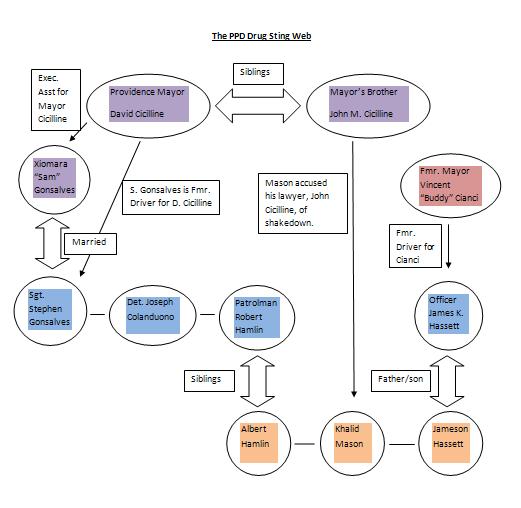
Connecting the Dots: The PPD Drug Ring
It's been a few days since the main players were divulged, so--based on information gathered in various stories--here is an attempt to show the links between the known players in the Providence PD drug ring and others. These links aren't to be inferred as an accusation against those not charged, but they are interesting in that they show how the saying in Rhode Island that "everyone knows everyone" is indeed the case.
Cicilline's Drug Test Head Fake
In a press conference yesterday, Providence Mayor David Cicilline announced the implementation of a random drug-testing policy for the Providence police department. How does a random drug test policy help find drug-dealing cops? While one member of the PPD was a user, the rest weren't (as far as I know, based on what's been reported). The logic that all drug dealers are also drug users doesn't work. Several aren't falling for Cicilline's head fake:
The mayor’s plan fell flat among several City Council members.I will say this, Cicilline should know political posturing when he sees it.Councilman John J. Lombardi, who is running for mayor, called for Esserman to resign and for Cicilline to end his campaign for Congress. Under Esserman, Lombardi said in a statement, “the Providence Police Department has harbored officers now charged with drug dealing, drug use and brutality. It is clear that his leadership — or lack thereof — has proven disastrous.”
He urged Cicilline to hire a public-safety commissioner and establish an independent civilian body to investigate these arrests, as well as the arrest and alleged beating in October of Luis Mendonca, a handcuffed suspect, by Providence police Detective Robert DeCarlo.
Councilman Luis Aponte called the mayor’s response a “knee-jerk” reaction. “This review is cursory at best,” Aponte said. “This is not the thoughtful review that is needed for the many serious issues that that department is facing.”
Council Majority Leader Terrence M. Hassett said he would submit a resolution to the council this week calling for an independent review of the Police Department.
Cicilline dismissed the council criticism as “political posturing,” saying that the state police and U.S. Attorney’s office would aid the department’s review. (The state police have not yet agreed to that arrangement.)
November 18, 2009
Moving Money Around in Different Ways
This quote from John Derbyshire's book, We Are Doomed: Reclaiming Conservative Pessimism, which I found via a review by Kyle Smith, in National Review, gave us opportunity for discussion and encouragement 'round the construction site:
American parents are now all resigned to beggaring themselves in order to purchase college diplomas for their offspring, so that said offspring can get low-paying outsourceable office jobs, instead of having to descend to high-paying, unoutsourceable work like plumbing, carpentry, or electrical installation.
In order to extend our conversation, I did a quick online search to see if anybody's posted a little more context and noticed — as I increasingly have — that the entire book has been posted online by Google, with searchable text. I'm torn.
It's great to have the high caliber of books bumping up Web content, and for hard to find literature, it's certainly a useful service. Everything that's entered the public domain would have to be fair game (and much of it was already online, somewhere). But I worry that nobody will ever manage to develop financial incentive to write books if they're readily available for free.
To be sure, it would be uncomfortable to read an entire publication in the format provided by Google, but e-readers are increasingly popular, and computer screens are increasingly readable. Our society is going to have to work something out, but with the current speed of technology, making the ability to process and distribute content at high speed, an entire literary culture could fall away while the lawsuits and compromises run their course.
October 27, 2009
Anti-Prostitution Bill Passes House Judiciary Committee
If I heard the roll properly on Capitol TV, Segal, Ajello and Driver were the only votes against.
October 26, 2009
Rhode Island as Prostitution Satellite
You may have noticed that "a compromise bill" has emerged on the prostitution issue that may actually have a shot at passage, this week. In response, A largely anonymous Web site (with the exception of Marc Doughty), Citizens Against Criminalization, has gone live (notably named in parallel fashion to Donna Hughes's Citizens Against Trafficking).
Look, I'm not without sympathy for the libertarian argument, on this one, honestly, but I don't believe the sale of sex to be a right. That is, a state is within bounds to make such financial transactions illegal, and I support doing so for cultural reasons, but even more so for the image and society that Rhode Island will build by explicitly accepting the whore trade. Since illegality is the case pretty much from sea to shining sea, across the United States, this argument, from the anti-criminalization site's FAQ is pretty much negated:
Q. What about organized crime? I heard that these places are run by the mafia. A. Surely one would come to this conclusion if one visited other parts of the country. Luckily, because sex work is not illegal in Rhode Island, nobody needs to be 'paid off' in order to carry on business below the radar of the authorities. Organized crime has no place and no purpose when business is carried out legally, as it is in Rhode Island. Investigations into Rhode Island's spas by law enforcement have showed no evidence of corruption.
Rhode Island simply won't become a beacon of a "clean" sex industry simply because within its very narrow borders the transactions can be conducted openly. We will become the Prostitution State, and the social implications of that status will be defined by the illegality of prostitution everywhere else. "Legitimate" businesses aren't going to isolate themselves from the criminal enterprises elsewhere (even if they set up some degree of technical insulation).
October 11, 2009
Reasons for the Obama Justice Department to Prosecute ACLU/"John Adams" Project Lawyers
Let's hope that the Justice Department's investigation (see Justin's post) leads in due course to prosecution. If it does not, the United States may well be left blind, without an intelligence/counter-intelligence department because no one will be willing to take or keep such important jobs.
And who could blame them? In the absence of prosecution in this case, misguided ACLU lawyers and other individuals will be emboldened in the future to take similar actions against agents and government officials who commit these and less serious "offenses".
In the process of doing a little research on this matter, I came across a remarkable statement by one of the ACLU attorneys involved.
["O'Reilly Factor" Producer Dan] BANK: Ma'am, you've hired researchers to follow CIA agents around all over the place and then show them to Al Qaeda terrorists, the same people who organized September 11th.[Attorney Nina] GINSBERG: What they did was try and find out who the names and the identities of the people who tortured, illegally tortured people because the government won't turn over that information, and people in this country have a right to defend themselves. Sir, get out of my way.
BANK: Ma'am, hold on one second.
GINSBERG: Sir, get out of my way.
BANK: Because there are federal laws prohibiting sharing classified information like that.
GINSBERG: It's not classified. If there's a person walking in the street who has a picture taken of himself, that is not classified information.
So she denies that the actions of the "John Adams" Project have endangered those CIA agents. Though this was not originally one of the reasons for prosecution, possibly Attorney Ginsberg would better comprehend the implications of such actions if they were systematically presented during a trial.
The other reason to prosecute pertains to the more pragmatic matter of turf. Looked at another way, this is an extreme example of getting justice by taking the law into one's own hands. (It could also have become a form of unofficial rendition, something that the ACLU presumably deplores, as do most of us.) While some in the Justice Department and in the administration may secretly sympathize with those who attempted to help and/or get revenge for those who may (or may not) have been tortured, the Justice Department hopefully has the attitude that it will suffer no unofficial competition in the area of justice and law enforcement.
If It Takes a Thief to Catch a Thief, Does It Take a Lawbreaker to Make a Lawyer?
From yesterday's Providence Journal.
The Rhode Island Supreme Court has ordered that the Stephen M. Hunter’s license to practice law be suspended for one year. Hunter has been convicted of five crimes.
One felony and four misdemeanors. And just one year later, Mr. Hunter will once again be able to practice law with the blessing of the State of Rhode Island.
In view of the confidentiality that shields the criminal records of both lawyers and non-lawyers and presumably precludes the ability to obtain some basic statistics, all we can do is ask questions. How many lawyers with a criminal record possess or anticipate recovering their Rhode Island law license? Percentage-wise, how does this stack up to the leniency demonstrated to felonious lawyers in other states?
One other important point, not to be found in statistics but in the law itself. Are the terms and conditions for lawyers to obtain, lose and re-obtain their law licenses dictated by the lawyer-heavy General Assembly of Rhode Island? Or does the statute on this point confer latitude and discretion to the RI Supreme Court?
September 23, 2009
From Husband to Landlord
Readers will no doubt recall the bizarre tale of Paul Kelly, whose ex-girlfriend moved into his house for a brief period while he prepared to depart for a Middle East war zone in July 2007 and refused to leave, claiming in court that they were married under common law. At last, Superior Court Judge Ojetta Rogeriee Thompson issued a ruling, yesterday, with the following results, as Kelly's lawyer, Pat McKinney, describes them:
The Judge found emphatically that there was no common-law marriage; awarded Paul possession of the premises; and awarded Paul $12,705.25 in back rent, with prospective rent for any continued occupancy, first installment due Thursday.. It came as absolutely no surprise to anyone present that Ms. Cooley immediately announced her intention to appeal to the RI Supreme Court and asked that the judgment be stayed pending the outcome of her appeal. The court responded to this by indicating that any Superior Court stay would be conditioned upon a supersedeas bond in the amount of $35k; ordered an immediate inspection of the interior of the house by Paul; and set the matter down for review on October 22.So two-plus years into a stunningly obvious case, Paul has at least made the transition from false husband to landlord, and now the process begins to restore him to status as "resident." We must safeguard the due process rights of estranged spouses, of course, but this is just unreal.
September 17, 2009
Oh Happy Commerce, or, "I felt like I was forcing myself on a 40+ year old fat sex slave"
"Where the hell else is a middle aged man gonna hook up with a young sexy hot sex slave in real life? Like the old saying goes, we want a ***** [whore] in the bedroom but a lady in the kitchen. Just don't expect you gf [girlfriend] to be as whory as the real whores. You'll be disappointed. Even though we have plenty of sex, I still crave that AMP [Asian Spa] experience just for the fun of it, and I doubt if I'll ever get over it. So beware what you're getting into, it can be very addicting."
Thus do the patrons of Rhode Island's prostitution industry speak of their experience, as related by Melanie Shapiro in a Citizens Against Trafficking review of johns' online commentary (PDF). Note that the misogyny extends even to personal relationships.
Advocates for legalized prostitution like to present the image of a clean-cut client looking for a little release by turning to a fully self-aware young woman using the occupation as a stepping stone to build a better life. That's a fantasy. The objectification of the prostitute and the corruption of the culture is the reality.
September 16, 2009
The Fallacy of Victimless Prostitution
My last post on "Pro-Prostitution Progressivism" generated a debate on the conservative/libertarian side. Justin entered the fray and, after some back-and-forth in the comments, expanded his thoughts, touching on political philosophy, ideology and making assumptions about those with whom you disagree. Those were his thoughts.
As for me, my opposition to indoor prostitution doesn't stem from some overarching political ideology. Call me old-fashioned (!), but I have the funny notion that people selling their bodies for money is neither empowering nor can it be sufficiently sanitized as an economic transaction to remove the emotional and physical scars said "entrepreneurs" will undoubtedly suffer. Face it: this isn't a profession that most would choose. Little Suzie or Joey don't put "Prostitute" at the top of their "What do I want to do when I grow up" list.
Prostitution is most often a last, desperate means to an end. It's a way to make money to support a habit. Or it's a "career path" people "choose" when under the thumb of those looking to exploit them for financial gain. It may not be particularly incisive or sufficiently philosophical, but my gut tells me that legalizing prostitution isn't going to clean up the "industry" or save us money in law enforcement dollars or provide a great new business opportunity for young entrepreneurs.
Until recently, I didn't know that Australia had legalized prostitution a decade ago. Now it offers a cautionary tale that shows that legalization is no panacea and that human trafficking goes up when prostitution is legalized:
Ten years ago, Australia made a risky policy move it thought would help protect women and children: it legalized prostitution. Today, only 10% of the prostitution industry operates in Australia's legal brothels. The other 90% takes place in underground, illegal sex markets thick with forced prostitution and human trafficking victims.Unintended consequences. There are other examples and others have studied the issue and concluded:The University of Queensland Working Group on Human Trafficking recently released a report stating that the prostitution laws in Australia had failed. Since 1999, women in Australia have had the option of working legally in licensed brothels or on their own. The hope was that women with an entrepreneurial spirit and a passion for commercial sex would set up their own businesses, and make everything safe, legal, and regulated. That hasn't happened.
What has happened, instead, is entrepreneurial pimps have lured and trafficked Asian women to Australia and set up illegal brothels with lower prices....And as legal brothels try and compete with the trafficking boom, they cut costs, which often involves cutting freedom and benefits for women. Even in the legal, licensed brothels of Queensland, women have reported being coerced into working under unfair conditions or against their will. {It's not a stretch to suppose that some would think this last could be alleviated via unionization, no?}
There are two major consequences of the legalization of prostitution. First, the institutional officialization (legalization) of sex markets strengthens the activities of organized pimping and organized crime. Secondly, such strengthening, accompanied by a significant increase in prostitution-related activities and in trafficking, brings with it a deterioration not only in the general condition of women and children, but also, in particular, that of prostituted people and the victims of trafficking for the purpose of prostitution.A victimless
August 13, 2009
The Pot Calling the Market Black
Somewhere in the mire of Rhode Island's approach to legalized medical marijuana is a lesson about the way in which various forces operate in our legislature:
Law-enforcement officials are uniformly opposed to the program that allows an illegal drug to be legally grown and distributed to licensed patients. They also are troubled by the lack of oversight of the program and their inability to get the names of the caregivers and patients.State police Lt. Col. Steven G. O'Donnell said there is nothing prohibiting caregivers from lacing their marijuana with phencyclidine (PCP) or other powerful drugs.
"It's very unregulated," he said. "It makes no sense to us. We regulate hamburger and food, but we do not regulate medical marijuana. There are no checks and balances." ...
"We like to think that people who are part of the program do have common sense," [Health Department spokeswoman Annemarie] Beardsworth said.
By creating distributors licenses for individuals and random folks from whom they'd like to buy their drugs, legislators have created a somewhat cozier corner for the black market. The story begins with the discovery that a pot "caregiver" (as suppliers are surreally named) may be dabbling in a harder trade. Another "caregiver" recently had his license revoked for seedy behavior. If the medical marijuana law hadn't been designed in such a way as to cloak every dealer with the shield of privacy concerns, it's likely that others could be proven to justify the Orwellian echo of the term "caregiver."
To the point, though, when a state government that repeatedly shows itself disposed to suspect the inability of constituents to take care of themselves assumes the common sense of drug dealers, it suggests one of two things (or both):
- The law was passed as a fashionable statement, without regard to consequences.
- Those who passed and advocated for the law have an interest in the illicit industry.
If the supposition is that pot is a medicine, then it ought to be distributed as such, and the legislature could have created a regulated supply chain. If, on the other hand, the supposition is that marijuana simply shouldn't be illegal, then the doors ought to be flung open so that the free market could bring down prices and draw a bright line between what's legal and what is not. Instead, government proves, once again, that it inclines toward worst-of-all-worlds solutions.
August 9, 2009
Still Out of a Home
By way of an update to the bizarre story of the veteran against whom an ex-girlfriend and the Rhode Island Superior Court conspired to keep him out of his own house for more than two years, now, I heard from Paul Kelly this week, and he's still locked out. Apparently, the trial that would remove Pocahontas Cooley from the premises with a restraining order is complete, but Judge Ojetta Rogeriee Thompson has decided not to issue a ruling until she conducts a separate trial involving Cooley's appeal of an eviction order that would have given Paul his home back many months ago.
The courtroom insanity resumes September 10.
Unbelievable.
July 27, 2009
The Target of Illegality
Andrew (not Morse) joins the intraconservative conversation about bringing Rhode Island back in line with the rest of the country by making prostitution explicitly illegal:
Justin, I agree with Dan on this. You can't legislate morality. There's a reason that prostitution is known as the oldest profession. Even Christ hung out with a hooker. And though it may be that most every country/state bans it, it still occurs.Drugs, same thing; make them legal and you eliminate half the income for organized crime and gangs. I smoked pot and worse when I was younger. Did I deserve to go to jail? No. And all arresting me would have done is make some lawyer's bottom line better while costing the state money. And if your child used drugs and was caught, wouldn't you do everything you could to keep them out of jail?
The point is that if people want to behave in ways that are damaging to themselves, society can't stop them.
An excellent example is my 18-year-old stepson who went through high school with what had to be an almost conscious desire to fail. Nothing his mother or I did would deter him from that path. So we told him that when his peers graduated he was out the door, no matter what. He was shocked when we followed through.
When he comes back in a year, he has to have a job and pay rent. That rent will be less if he's going to school, but there's no more free lunch.
First of all, the cliché that we "cannot legislate morality" is inaccurate. Consider the infrequency with which swear words wind up on public television; that's because the cost of slipping far outweighs the meager benefit of doing so, and the chance of being caught is high. What Andrew uses the phrase to state is that the market of losers and Narcissists who will seek to pay for sex even when the price goes up, and the supply of women willing to be sold at that higher price, will continue to exist. I don't dispute that, although I think it would be foolish to declare that legality increases the market by lower the price, including the prices of risk and stigma.
But Andrew misses the same mark as other commenters: It is not my objective to ensure that a particular person does not buy sex from another particular person. If that were the case, an inadvisably extensive police effort would be required. Rather, my objective is to foster a society in which sex is not considered to be a salable good. That, of course, has the ancillary effect of keeping particular people from pursuing the transaction, but it is neither the focus nor the primary motivation.
In the balance of things, I believe that the principle of freedom outweighs the principle of sexual morality when it comes to public policies regarding private behavior. Indeed, sacrificing the former in the name of the latter proves counterproductive for everybody involved. However, a sufficient firewall exists between engaging in sex and selling it that prostitution needn't be maintained as a barricade protecting more mundane freedoms (in the way folks argue that pornography must be maintained to protect more important freedoms of speech).
July 26, 2009
On Victims and Libertine Oppression
Today's epiphany — which I wouldn't be surprised to find to be common understanding among a great many people more insightful than myself — is the intellectual proximity of those who would erase from the books any "victimless crime" and those who see a "victim" of a social crime in every unhappy circumstance. The first believe that an act must directly harm an innocent party in order to be a crime, and the second, agreeing, qualify the circuitous, unintentional effects of social movements as adequate evidence of victim-producing acts.
For my part, I find it more practical to consider the presence of a victim to be only one factor in determining whether something ought to be a crime, and not necessarily the definitive one. After all, any undesired consequence can be reformulated as an imposition on a victim, reducing the debate over appropriate laws to a tug of war across the sliding scale of victimhood and, then, pitting one claim against another.
The thought arises in response to a comment from Dan to my most recent post on the matter of legal prostitution in Rhode Island:
Justin, I have been a long-time reader of Anchor Rising. I fully support your efforts to reduce the size of the state, out of control spending, corruption, and intrusion into the private lives of citizens. Which is precisely why these isolated pet "moral" issues of yours and Matt Allen's bother me so much, they are such transparent hypocrisy and they undermine all of the good that you do here. How do you determine what private consensual conduct should be regulated by the state and what private consensual conduct should not be? And why should you be the one who decides these "moral" issues for everyone else, banning any conduct which you don't think a righteous person should engage in? I submit to you that the most positive philosophical and practical change you could make for yourself would be to drop these moral crusades against victimless crimes. If somebody isn't harming anyone else, and a transaction is consensual by all parties (human trafficking/slavery/abuse aside, we already have laws against that) then the state should not have the right to intervene. A victimless crime is no crime at all, and the state certainly does not need an excuse to grow itself, spend money, and regulate its citizens further, I think we would all agree on that. The kindest thing you can do for someone is stop trying to save them from themselves. We, as people, all have the God-given right to do as we wish with ourselves as long as we do not harm others in the process. Any coercion that infringes upon that right, whether it is by the state or some private action, is an abomination.
For the presentation of a direct rejoinder, it might be sufficient to note that the essential observation of the post was the concession by the progressive legislators who oppose closing the prostitution loophole that it is not a "victimless crime":
Where does this leave the remaining women, likely the large majority of prostitutes, who engage in sex work by choice, whether out of [1] economic hardship or because of [2] substance-abuse problems?
Even a conservative can discern a fair degree of victimhood in either of those circumstances, as emphasized by efforts of those who profit from the women's condition to perpetuate it. To wit, it is not enough simply to declare that no victim means no crime; one must prove the prior point that there is no victim.
Of course, even believing the women to be victims, I'm not inclined to rely on that conclusion as the basis for supporting legislation to criminalize their profession. Therefore, I'm even less inclined to construct the argument that would prove society to be the victim, although the case would be strong. Instead, let's focus on the core proposition of Dan's comment, which he poses rhetorically as questions:
How do you determine what private consensual conduct should be regulated by the state and what private consensual conduct should not be? And why should you be the one who decides these "moral" issues for everyone else, banning any conduct which you don't think a righteous person should engage in?
The plain answer is that I determine what conduct ought to be discouraged, what conduct ought to be encouraged, and how that direction ought to be pursued based on the rational application of principles that are inherently and wholly religious in nature. The mildly less plain extrapolation of that statement is that everybody performs a similar assessment — unavoidably, as a consequence of self-cognizance.
It won't surprise readers, even as it may shock them to read it stated, that my judgment is primarily guided by the efficacy of the various possible policies at drawing the maximum number of people toward the realization of Christ's divinity, with all of the spiritual and material benefits that I believe to be consequent to that revelation. Others judge the possibilities against a scale of emotional satisfaction, whether the social average or their own, and a multitude of other options and combinations thereof exists.
With respect to Dan's second question, I can only explain that my rational application of Christian principles leads to the conclusion that I should not — cannot — "be the one who decides these 'moral' issues for everyone else." However, it is the most fundamental of assumptions, in any democratic system of government, that individual citizens must possess the freedom to define their own societies to the greatest conceivable degree. The liberties involved with private behavior pale in significance when compared with the right to apply one's judgment to the system under which one must live.
Balancing the inevitable contradictions of such an imperative quickly becomes a complicated matter — impossible absent a tolerance for disagreement. The fullest expression of that tolerance (true tolerance) comes in the acceptance that fellow human beings will congregate elsewhere to live an incompatible manner. That is why I would oppose an international or national ban on prostitution. The inverse of that opposition, however, is an insistence that we be able to ban the practice at a lower tier of government; as things stand, the lowest feasible tier is that of the state.
From there, the issue becomes a persuasion of preferences, and I want my society to be one in which sex is not available for commerce. We could have a very interesting discussion about the reasons that should be the policy, which would bring the degradation of the women (and men) back into the conversation, as well as introduce the cultural diminution of sex, marriage, and ultimately human life. The immediate point, though, is that I think enough of my fellow Rhode Islanders agree with my final conclusion that the law ought to be changed.
I'll debate the intricacies right down the dregs of disagreement, but public opinion probably would not require such debates prior to a decision to ban prostitution outright. Those who take Dan's point of view seek to present the question in such a way as to declare the preferences of that majority invalid, and the likes of Rep. David Segal undertake the slithering strategy of preventing the question's ever being directly put based on one prevarication or another.
Either way, the dark underbelly of bold libertarianism rolls around to expose the moral sclerosis by which libertines would impose their vision of society on everybody else. A philosophy that would declare even "private actions" to be "an abomination" if they seek to affect the behavior of others is not, in the end, concerned with rights and civic freedom, but with coercing the state to protect its own immorality.
July 20, 2009
A Crime Against Society
Before we let his subject drift into the vague pastures of public memory, let's join Mark Patinkin in shaking our heads at the tale of the neighbor-killer who retired in his twenties after six months of public service:
You no doubt saw that Nicholas Gianquitti, 41, now serving 40 years for murdering Cranston fire lieutenant James Pagano, will keep receiving his $3,841.50 monthly pension. The check will arrive at his home, for his family's use. The reason? His crime wasn't related to his police conduct.That may seem astonishing, but to me it's more astonishing that he got such a lifelong pension in the first place.
Here is a man who began as a patrolman in July 1991, and only six months later, fractured his left kneecap when he fell chasing two suspects in a parking lot. For that, he got a lifelong pension at two-thirds his salary — tax-free because it is for disability.
It is not the only such pension, and it makes me wonder: What planet is the Retirement Board living on?
In a healthy society, this story would have representatives and bureaucrats glancing out the window all day out of fear that the masses might be coming to remove them from bodily office. Instead, we can only wonder who won the office-lounge dispute over whether Gianquitti was an inevitable outlier in an otherwise honorable system or he represents everything that's great about promoting the government as an employer.
Peculiar Sensibilities Concerning Prostitution
As with much else in Rhode Island, it could be that some of the decisive ambivalence about the continued permissibility of prostitution in the state would dissipate if people took a moment to understand what it actually means. The blog of a new Web site that URI Professor Donna Hughes and associate Melanie Shapiro have set up, Citizens Against Trafficking, presents a scene witnessed in a Middletown store:
A business owner has told Citizens Against Trafficking that late last year, an Asian woman fled a spa-brothel nearby and came to their shop to ask for assistance.She burst into their store and excitedly tried to communicate. She could only speak a few words of English. She pointed to the brothel and used hand motions and the word "f***" to indicate that she was being forced to engage in sex acts.
When asked if she wanted to call the police, she said, "Me, no English. You." When asked if she wanted them to call the police, she nodded her head to indicate yes.
She frightened and confused the shop owner by pointing to their little girl, then to the brothel, saying, "Baby. Bad. Bad."
They asked her if she had any family or friends nearby. She said, "New York."
Brothels, Rhode Islanders should note, will not restrict themselves to urban streets. According to Citizens Against Trafficking, the suburban store in which the above scene occurred has had enough and is relocating in another town (PDF):
After years of problems and the inability of the police to do anything about the brothel next door, POW Science is relocating to another part of the state. ...The customers of Lee Health Tuina Center are all men. The men try to enter the brothel inconspicuously. Eric calls them "cowardly" and says that they hide behind a wall if the door to the brothel is not opened immediately. They peek around the wall to make sure no one can see them before entering the brothel. Men used to park behind the wall between the brothel and POW Science until the Bulmers confronted the men and refused to let them park there or in front of their store. Sunday is the busiest day for the brothel, because the other
stores are closed.The Bulmer's suspicion that the Tuina Center was a brothel was confirmed when they read men's descriptions of buying sex there on an Internet guide to prostitution. Another business owner in the strip mall emailed the Bulmers the men's Internet writings describing prostitution and the prices for different sex acts they bought there.
Shortly after that, Eric found several hypodermic needles and syringes with blood in them on the ground in the parking lot in front of his business. Eric believes the needles were used by men before they entered the brothel. Eric filed a police report. ...
On a number of occasions, the Bulmers have contacted the police to let them know what was going on. The police told them there was nothing they could do about it.
There's an interesting dynamic on Aquidneck Island, I guess. In Portsmouth, Trisha Smith was driven from her strip mall for her eye-catching efforts to draw attention to the fact that it housed her lingerie and sex toy shop. In Middletown, an educational store is now being driven from its own strip mall because police can do nothing, various zoning and health inspectors claim to have no reason to act, and property owners Kevin and Vicky Tarsagian of Newport Properties don't want to give up their slice of the lucrative sex trade.
June 1, 2009
Not a Direction in Which We Wish to Head
Growing up in the '80s, with all of the romanticizing of the '60s that was fashionable, then, I thought it pleasantly discordant to hear George Harrison describe his disappointment in the Beatles' visit to Haight-Ashbury, where the big scene consisted of "a bunch of spotty teenagers" (or something close thereto). Less pleasant was learning, some years later (under circumstances that I don't recall), just how tumultuous and violent the era really was.
I hope and pray, therefore, that the back-to-back shootings this week — both with political undertones — are an aberrant coincidence and not a sign of times to come. Details from Monday's atrocity:
Police say the incident occurred around 10:15 a.m. at a U.S. Army Navy Career Center inside the Ashley Square Shopping Center at 9112 North Rodney Parham Road. According to Lt. Terry Hastings with the Little Rock Police Department, two enlisted soldiers standing outside the office were hit when a suspect drove up in a black SUV and began shooting. ...At the Monday-afternoon briefing, Thomas said investigators believe [shooter Abdul Hakim Mujahid] Muhammad acted alone, and likely carried "political and religious motives." Thomas said the gunman targeted the military but was not believed to be part of a broader scheme.
So, for the second day in a row, we must offer prayers for the deceased and his family, the recovery of the injured, the liberation of the killer's soul from evil, and rebalancing of our society lest the descent continues.
May 31, 2009
All in the Service of Evil
Only evil was served by the killing of abortionist George Tiller. Just as one can imagine the phrases by which Satan guided Tiller to see his barbarous work as righteous, one can imagine the whispers that brought the killer to Tiller's church — leading him perhaps to see as poetry a setting that should have resonated as blunt screams to stop.
Just so will the evil perpetuate itself. Some will find in this atrocity justification for restricting the rights of we who strenuously oppose abortion, and in the current political climate, they may achieve no small portion of their goals. In turn, frustration and complex feelings of persecution will escalate in opposition. Where will it stop? Well, where does it ever? Now, never, or somewhere in between.
With the simple, psychotic act of one man's murder, our society comes to another precipice, and when Americans inclined toward prayer have offered ours for Mr. Tiller and his family and have spared a word for the dementia-strangled soul of his murderer, we should turn our hopes toward a miracle of temperament. We should pray that from this horrible catalyst will emerge a fuller appreciation for the value of human life and for the civic structures and rights that enable us to resolve issues of cosmic consequence without violence.
May 28, 2009
Another Sign of a Coarsening Culture?
As Americans accede to the concerted push to break down our mores and cultural definitions, we shouldn't be surprised if there's an increase in this sort of double-take news items:
Two men and a woman, ages 18, 19 and 20, have been indicted for allegedly raping a fellow University of Rhode Island student on campus on Sept. 14.
There are no details about the incident, although another report pinpoints the alleged victim as a female. Whatever the case, it should shock our sensibilities to see a young woman among the indicted — not out of some false notion of womanly purity (or weakness), but as evidence that something more fundamental may be slipping that male animalism cannot explain.
Even given the negative reversal, I can already hear the indignation of those who fetishize an unconsidered vision of equality: Why shouldn't women be just as violent and just as inclined toward sexual abuse? Gender is a construct, don't you know.
May 23, 2009
Turning Up the Heat on Smokers
Laws should be enforced (or stricken or modified if they will not be), but there's something unseemly — extortionate — about this:
The state in April increased the excise tax on cigarettes by $1, to $3.46 a pack, the highest in the country. The move has obvious health benefits, but it also aims to generate millions more dollars for the financially strapped state.Now, state taxation and law-enforcement officials are poised to do their part. They are cracking down on the illegal sale of out-of-state cigarettes to make sure that the state collects as much money as possible from smokers who now plunk down some $8.35 for a pack. ...
Under state law, Rhode Island residents can have up to a carton of out-of-state cigarettes in their possession. Anything more and they are subject to arrest.
Violators face up to three years in prison and a $5,000 fine.
For reasons unrelated to money, I quit smoking about a decade ago, and it's increasingly difficult to comprehend what drives people to continue with the practice, but reading today's article, I found myself surprised to recall that it's about a legal product. The state government is facing tough financial times, so it has arbitrarily decided to collect more money from a population of residents who have a chemical and psychological dependency on a particular item.
Here's a clue that something isn't right with the current government attitude: Resident smokers' doing the right thing by their health would do more harm to the state revenue than does the illicit behavior on which the state police are so focused. If only for that reason alone, Rhode Island's smokers should kick the habit.
Do what they will, however, I'll still predict that revenue from this tax is going to go down, even if the number of smokers stays exactly the same. Unfortunately, Rhode Island businesses are likely to take a hit, as well, and not only on sales of cigarettes, but also on sales of such goods as smokers will pick up when they're out of state shopping.
May 21, 2009
The Crier and the Untold Story
Last night, Matt Allen and I chatted about our new Community Crier feature and reviewed some of the particulars of Paul Kelly's ordeal with the Rhode Island judiciary. Stream by clicking here, or download it.
May 18, 2009
Judicial Empathy and a Veteran Without a Home
The tale begins and ends with Pocahontas Cooley (photo here), whose very name lends a fictional tone to a true story of justice deferred. The travesty is the number of times the setting has been the courtroom of Superior Court Judge Ojetta Rogeriee Thompson, Rhode Island Senators Jack Reed and Sheldon Whitehouse's pick to fill a vacancy in the first U.S. Circuit Court of Appeals. The case itself defies all reason, but the explanation could be precisely the judicial empathy for "underprivileged" groups on which President Barack Obama has placed such emphasis.
The person who is actually disadvantaged in the situation is 52-year-old Paul Kelly, Navy Reserve Boatswain's Mate First Class. Since July 2007, Ms. Cooley has refused to leave his house in Exeter, Rhode Island, or to allow him to enter it. In the hectic months before Kelly was deployed to Kuwait as part of Operation Iraqi Freedom, Judge Thompson stayed an eviction order from a district court and essentially handed Cooley a rent-free home until the owner's return from a theater of war, despite the availability of his brother to act as power of attorney.
That wasn't enough for Pocahontas. According to Mr. Kelly, she took the opportunity of access to his possessions and files to forge documents, order heating oil in his name, reopen a credit card for her own use, make withdrawals from his bank account, and arrange for insulation work to be done on the house by South County Community Action Agency, a non-profit provider of services for economically disadvantaged Rhode Islanders. At the request of Paul's brother, Thompson ordered Cooley to cease and desist such activities. At no point, however, did the judge see fit to change the housing arrangements, and Attorney General Patrick Lynch's office has postponed prosecution of related charges until the judge has ruled on the cases before her.
In Kuwait, Paul Kelly strove to maintain his habitually positive attitude, even as he received notices about delinquent payments on accounts that he thought he had suspended before he left, and even when his commanding officer pulled him off watch duty to mention the scene that his "wife" had caused trying to retrieve his paycheck from the Navy base back in Newport, RI. Fortunately, base personnel were able to determine within minutes what Ojetta Rogeriee Thompson has been mulling for over a year: that Mr. Kelly is not married.
In fact, Paul, a submarine rigger by profession, had been sharing his country-living bachelor pad with only his dogs when his ex-girlfriend Pocahontas caught him preparing to head to Norfolk, Virginia, for processing prior to deployment. She lied about having been kicked out of her mother's house, and still considering her a friend, he told her she could stay for a few days while he was away. But only a few days; his niece was going to move into the house while he was overseas.
Upon his return the next week, Paul found Pocahontas thoroughly at home. She declared the house to be hers and prepared to tell the Rhode Island judiciary that she was his common-law wife. Although disbelieving her outlandish insinuations of murder attempts from her "husband," Superior Court granted her request for a restraining order against harassment. When Mr. Kelly arrived on his property to collect clothes and other items for his tour of duty, he found all of his possessions in the barn.
And when he finally had his day in court, in October 2008, he found the woman whose 1998 personal ad in the Providence Journal claimed a desire for an "honest relationship" to be adept at manipulating the system. Her first ploy was to demand thirteen subpoenas for information — some of which actually proved to support the case against her, and all of which Judge Thompson granted at taxpayer expense. During one subsequent appearance in court, Cooley insisted that she was awaiting subpoenaed information from the Pentagon, a clear impossibility. At other times, she challenged the reality of Kelly's deployment.
In December, she had the good fortune to fall on the way into the courthouse. In the intervening months, Ms. Cooley has appeared in court on a regular basis, each time finding ways to err in her attempts to prove that she is not physically capable of a hearing. While granting continuance after continuance, the judge has provided Cooley with further instructions on acquiring the proper doctor's note.
Meanwhile, Mr. Kelly is living in his sister's basement (without his dogs), awaiting his next chance, on May 29, to receive a hearing date at last. Judge Thompson rotates out of the county at the end of June, at which point she may either take the case with her or leave it for one of her peers — one more whim over which Kelly is powerless. Even more so is Thompson's potential elevation to federal court a variable in his fate.
As for Pocahontas Cooley, the Internet may be catching up with her. Two pieces about the situation by Providence Journal columnist Bob Kerr have brought Kelly and his lawyer, Patrick McKinney, into contact with people from her past, some of whom find his story eerily familiar. (See the last comment here.) A few months ago, searches for Cooley's name turned up mainly announcements of her art exhibitions — one of them in the public offices of the City of Providence, which recently named a school after her politically involved late father.
Whereas episodes in her life before she found Paul Kelly seemed apt to fade away in the memories of individuals, permitting sequels with new characters, the worldwide public record online will now preserve a cautionary tale of political correctness, with the judge, the veteran, and the Indian princess illustrating the injustice of targeted empathy from the bench.
May 12, 2009
Providence Housing Offenders and One of Their Neighbors.
Further to Justin's post, the homeless shelter on Prairie Avenue in Providence, one of two in the state required to accept predators, is next to (that would be next to) Edmund W. Flynn Elementary School.
As the host city of the other homeless shelter required to accept predators, Cranston is understandably up in arms because
... the Howard Avenue location, less than a mile from Brayton Avenue Park and its youth playing fields, as well as three elementary schools and the city library, has sparked an outcry.
Less than a mile from children in Cranston. Less than a block from children in Providence.
It's one thing for a homeless shelter to be located near children. It's another matter when some quirk of funding or of law subsequently requires that that shelter house pedophiles. Somehow, the location of the shelter and the proximity to potential victims gets forgotten between the two steps.
Let's be clear that keeping a distance between elementary schools and shelters which accept offenders does not necessarily deprive offenders of new victims. Once offenders have served their sentence and are out in the community, they can and do strike again anywhere.
At the same time, there are certain steps that can be taken to eliminate easy targets. Keeping a twice daily parade of potential victims away from such offenders would seem to be one obvious step.
Addendum - Credit
Thanks to Michael Morse for pointing out, under Justin's post, the alarming juxtaposition of these two buildings.
May 11, 2009
Housing Offenders
Focusing mainly on the local controversy, journalist Randal Edgar didn't ask why this should be true:
Dennis B. Langley, president and CEO of the Urban League of Rhode Island, which runs Harrington Hall, played down the concerns, saying the shelter, which opened as a permanent center in 2003, has housed sex offenders for years. The only difference now, he said, is that more are being sent there."We have a large number of sex offenders throughout the state. We have never seen as many," he said.
It could be that offenders are attracted to the state of Rhode Island by legal loopholes that allow them to remain anonymous while they appeal their convictions as well as the risk tier at which they're classified. The process of appeals can take years. The process of closing the loophole is also likely to take years, inasmuch as the General Assembly has held for study a bill to close it. Also held for study is a bill requiring "sex offenders temporarily living in Rhode Island" to register with police within their first two weeks here.
In the meantime, we can only marvel at the lives that our guests lead:
... While sex offenders who have been released from prison might live in any given neighborhood, local residents say housing offenders at the shelter is different, because they are required to leave by 7 a.m. each day and cannot return until 6 p.m."It's just too much," Bergin-Andrews said.
Langley, however, said the likelihood of repeat offenses is small. People staying at the shelter are given bus passes and routinely ride to Providence shelters during the day to get free meals, he said.
Generally speaking, Rhode Island is a good place to be if you've got no place to be.
May 9, 2009
Rule of Lawyer: Tiverton Town Solicitor Andrew M. Teitz and Disenfranchisement of a Lowly Blogger
Reflection has not changed my opinion, stated while liveblogging, that Mike Burk, the moderator of today's financial town meeting in Tiverton made every effort to be fair and, on the whole, succeeded. That said, he did make a few substantial errors, one of which brings into stark relief a problem of governance pervasive in Rhode Island — namely, the undue power of hired attorneys in the conduct of school and municipal business.
I am neither an experienced parliamentarian nor a lawyer, so in the flow of the meeting, I focused more on principle than on procedural law. Moreover, as is evidenced by my ready willingness to modify an amendment that I'd made to the proposed school budget, I wasn't heavily invested in the specific numbers that I put forward. But it is my opinion that Tiverton Town Solicitor Andrew M. Teitz strove to disenfranchise me as a taxpaying voter in the town, and that Moderator Burk permitted him to accomplish that goal.
As I offered the initial discussion on my amendment, Solicitor Teitz interrupted to make a point of order (stream, download):
Teitz: Excuse me, I have a point of order. The number that you suggested for the appropriation is 20,046,960; is that correct? Which is actually less than the number that was appropriated last year.
Burk: Which means that that is out of order, am I catching that?
Teitz: Yeah, the state law requires that they receive at least as much... that the appropriation be at least as much as it was in the previous year.
Katz: My understanding, though, is that if the number of students declines, maintenance of effort permits an adjustment downward.
Burk: I will rule that out of order if it is below the number that was appropriated last year.
Audience: No.
Teitz: You are correct; it can be adjusted if you have the information on that.
Katz: I'm not aware that I actually need that information to pass an amendment. These are questions of... I mean, if people distrust my number, they can vote my amendment down and vote for another one or the main motion, if they prefer, but I'm not understanding why I... [somebody handed me a piece of paper.] Alright: In the past six years, enrollment is down 13.5%, and tax spending has gone up 45%. I think if we're trying to show maintenance of effort, we've certainly done so.
School Committee Chairman Jan Bergandy requested that the school department's attorney Stephen Robinson have the floor to offer relevant information. What he offered (included in the above audio link) was a statement that he's previously made as to the procedure for proving maintenance of effort and the right of the FTM to address line items in the school budget, as opposed to the whole thing. Then, Budget Committee Vice Chairman Rob Coulter pointed out that the law is certainly not as unambiguous as Mr. Robinson had stated and argued that, given the trends in enrollment and funding, it is simply "incorrect" to state that the previous year's exact dollar amount must be matched. Furthermore, Rob noted Teitz's opinion, elsewhere, that the charter trumps state law in these contexts, and the charter allows for line-item modification.
At that point, Burk insisted that he was going to rule the amendment out of order, based on a lack of "significant enough details" and gave me the option of modifying it to avoid the objection. Wishing to expedite the process, I agreed. However, upon further discussion, I thought it necessary to take the thread up again (stream, download):
Katz: I disagree that the legal issues are a matter of procedure for this particular meeting. An amendment is not "out of order" because there may be litigation. This body can submit the numbers that it would like to do, and that could be resolved after the fact. The fact that there are lawyers in the room who are willing to testify to the law does not mean that we are bound by their judgment. And I would remind people that Mr. Coulter is also a lawyer, so if he presents a different opinion...
Burk: He is not here to practice law. Our solicitor is our legal council.
Katz: Right. But if they're simply giving an opinion of the law, we can disregard that. They're not judges. They're not juries. And they're certainly not executioners.
Teitz: Point of information regarding that. The advice that is given here is to the town. The client is the Town of Tiverton. You're right: it is to this financial town meeting, as interpreted by the moderator, and you can listen to everybody. You can listen to all the lawyers, including me, as to what the advice is. And this body, if there's an appeal — if you want to do it over a dollar [the substantial difference of my proposal] — you can. An appeal going through the proper decision... an appeal to the moderator's decision, a majority vote, and whatnot can overrule that. Obviously, you do it at your own risk, but you are correct. The body can overrule the legal opinion through the moderator if you wanted to do it. I have provided you with the information; the moderator has ruled it "out of order"; but even if it is out of order, it can be appealed.
Katz: I'm merely stating the opinion that it is not the procedure that the lawyers in the room dictate the procedure of the meeting — dictate what's in order and what's out of order. We can vote on what we want.
Teitz: I'm agreeing with you, but there's a way to do it, which would be to appeal the moderator's decision.
Katz: Right, but that's only if the moderator turns to the lawyers and takes your dictation wholesale.
The point that became obscured amidst all of Teitz's agreeing with me was that he had managed to deprive me of my right to make the motion that I desired in the financial town meeting despite three parliamentary and legal matters of which he — as the paid "expert" in the room — should have been knowledgeable and of which the moderator — presumably qualified for his role — should have been aware:
- Mr. Teitz had no standing to interrupt me for a point of order. Robert's Rules allow members to make such interruptions, but not being a resident of the town, Teitz does not qualify. Somebody else could have done so, and the moderator could have requested Mr. Teitz's opinion, but as it happened, the lawyer displayed his eagerness to turn the direction of the meeting in a preferred direction, and the moderator let show his willingness to be led.
- Mr. Teitz's point of order was too late. As one can plainly hear (stream, download), my motion to amend had been duly made and seconded, and the moderator had stated the question and opened the floor for debate. According to Robert's Rules: "After debate on such a motion has begun — no matter how clearly out of order the motion may be — a point of order is too late."
- There is no restriction in Robert's Rules, the Tiverton Town Charter (PDF), or the Rhode Island General Laws that forbids a town meeting from explicitly taking actions that challenge the law. Indeed, the RIGL makes provisions for a ballot vote option in situations "involving... the incurring of liability by the town." In other words, it is not out of order to make a motion that knowingly opens the door to litigation, much less a motion that kinda-sorta, in the opinion of a hired lawyer, might open that door.
None of this is to say that I'm particularly upset about the outcome. I would suggest, however, that the people of Tiverton — and I'm sure this applies across the state — should insist that our elected officials enlist the services only of lawyers who are sufficiently knowledgeable and ethical to avoid trampling the rights of citizens. Because I know it couldn't possibly be the will of those officials to do so.
ADDENDUM:
For further clarification of my thoughts on Teitz's speech about the proper procedure for disregarding the advice of lawyers: The hired legal advisers do not enter the procedure as issuers of decisions that must be overruled. They are there to offer analysis of the legal repercussions of particular decisions and, if necessary, to give suggestions as to the specific procedural rules governing the meeting. There is no procedural rule that requires a meeting to steer well clear of potential sources of legal liability.
Furthermore, it is inappropriate for the moderator to behave as a proxy by which the legal advisers can accomplish this end. Moderators are not the dictators of the meetings that they are running. Unless I'm mistaken, to accomplish their end, the moderator should have put forward as a resolve — or the body should have made as a prior motion — a stipulation that no motions would be entertained if, in the judgment of the town solicitor, they stood a reasonable chance of creating an opportunity for litigation. That would have negated my objections #2 and #3 above.
(Before anybody on the other side spends too much time pondering the possibilities, let me suggest that I think Tiverton Citizens for Change could have a lot of fun with such a rule.)
April 25, 2009
Bank of America, TARP, and Government in Crisis Mode
Among the problems of government central planning is that the segment of society that is apt to make decisions that skirt the rules is the same one that must enforce them. Take, for instance, information that's coming out as a result of Bank of America CEO Ken Lewis's testimony to New York Attorney General Andrew Cuomo. Lewis and the bank's board failed to fully inform shareholders of material circumstances during the run-up to the merger with Merrill Lynch, which is in violation of securities law.
Complicating matters is that government officials, prominently former Treasury Secretary Henry Paulson, appear to have forbid the transfer of that information.
"Everyone involved knew that was a clear violation, that's material non-public information, so basically we just closed the rule book during the crisis and said we don't care, we need to keep the lights on, and we'll deal with that manana," [portfolio manager Peter] Sorrentino said. "Logic went out the window and they were just acting out of fear," he said. It was "completely panic mode."
The shadow lengthens:
Lewis testified that he asked Federal Reserve Chairman Ben S. Bernanke to "put something in writing" regarding the U.S. government's plan to support Bank of America's acquisition in view of Merrill's mounting losses.After Bernanke said he would consider the idea, Paulson called Lewis and said, according to Lewis, "First it would be so watered down, it wouldn't be as strong as what we were going to say to you verbally, and secondly, this would be a disclosable event and we do not want a disclosable event."
Attached to Cuomo's letter Thursday was a Dec. 22 e-mail from Lewis to his board. "I just talked with Hank Paulson," the e-mail says. "He said that there was no way the Federal Reserve and the Treasury could send us a letter of any substance without public disclosure which, of course, we do not want."
Plainly and simply, public officials should not be making promises to private institutions concerning public money with the explicit instruction that the public shouldn't know. Much like the trend for all of the laws, debts, and obligations of lower levels of government to flow back toward the broadly diluting sea of the feds, as well as the financial recklessness resulting from the implicit backing of Fannie and Freddie loans, backroom deals will erode responsibility in the private sector, insulating its actors and solidifying an untouchable class that cuts across the two sectors. The line of conflict will shift from public vs. private to elite vs. everybody else.
April 21, 2009
More "Drinking Games" in Barrington
At a minimum, the Barrington police need to present the Places with a bill for a police detail. Two hours times however many police officers were involved.
Be sure to add in the detective who placed the ultimately futile telephone calls to the parents, Chief.
John Place had called the police on April 10, the night of the party, and asked them to check on his house at 7 p.m. and again at 11 p.m. because he didn’t want teenagers partying at his house.When the police responded to reports of a loud party, they could hear yelling, laughing and music coming from the basement. When the police lifted the exterior bulkhead door, they said that they were “immediately overcome with a pungent odor associated with alcohol.”
Detective Lt. Dino DeCrescenzo immediately called John Place’s cell phone number, which he had left with the police.
“I told him about the odor or beer and alcohol,” DeCrescenzo said in his report. “I told him that I wanted his son to let us in the house so we could check on the safety of all the underage persons, seize the alcohol and then call everyone’s parents to ensure their safety and well-being.”
* * *
After speaking with the police off and on for 40 minutes, Place said he didn’t want them entering his house.
ADDENDUM
As to the cost of a police detail, the Barrington Police advised this afternoon that the rate per hour varies depending upon the seniority of the officer taking the detail but that the range would be $38 - $50 per officer per hour and there is a four hour minimum. Accordingly, presuming three officers (two responding to the house and one detective back at HQ making the telephone calls to the Places in Maryland) for the Place "detail", the cost would be $456 - $600.
April 12, 2009
March 15, 2009
Susan Estrich on Why Madoff "Pled Out"
It wasn't to escape jail time.
Madoff, who is 70, is looking at a life sentence for his crimes. He had to know that coming into the courthouse to plead guilty.* * *
By pleading guilty, Madoff cut his losses, not in the way most defendants do, by getting rid of a couple of counts or getting the charges reduced or getting a deal for a lower sentence based on cooperation, but in the only way he could: He limited the time he will spend in the spotlight, limited the opportunity for public outcry, deprived his victims of a daily ritual for the weeks or months the trial might have lasted. We who might have liked to see him squirm, to watch his face as the mountains of lies were laid bare, will be deprived of that opportunity. We will not see him suffer.
February 3, 2009
The Court's Presumption
I would hope that we could all agree that the events that Bob Kerr describes are a travesty in their own right, although certainly accentuated by the fact that their victim is a veteran:
Barone is a neighbor and friend and has testified in court on [Paul] Kelly's behalf. He remembers when Pocahontas Cooley, Kelly's former girlfriend, showed up shortly before Kelly left for pre-deployment training in September 2007. She's still there, claiming to be Kelly's common-law wife. She got a restraining order against him, saying he was bothering her when he visited his cabin."I think I would know if I was married or not," says Kelly.
That seems reasonable, since common-law marriage requires the man and woman to intend to be married and hold themselves out to the public as married. Kelly says the only relationship he had with Cooley was boyfriend-girlfriend, and that relationship ended in 2004.
Kelly admits he made a mistake when Cooley came to his door just before his deployment and he allowed her to stay in his cabin temporarily because she said she had nowhere else to go.
"I was trying to help her out," he says.
This is nuts. A man is kept out of his home for seven months after returning from nine months of serving his country. There is no way to justify it and no way to justify the length of time it is taking to resolve it.
Not knowing all of the specifics, I can't say for sure, but this certainly sounds related to the many complaints that I've heard of the bias in court on behalf of the female in a relationship. Whatever the case, it shouldn't be this difficult to resolve.
As Kerr says, Kelly's still paying the taxes on the property.
February 1, 2009
Tabula Rasa: The Attorney General's Position on E-Verify
Under "General Treasurer Frank Caprio on E-Verify and Immigration," commenter JoeB asks:
Has Lynch taken a stand on e-verify?
Good question. Where does Rhode Island's chief law enforcement officer stand on the question of a tool to aid compliance with certain laws?
My quest to answer this question actually began last July. After some research failed to uncover any public stance by Attorney General Patrick Lynch on the question, I left a message for Michael Healey, Director of Public Information for the Attorney General's office. He returned my call on July 21 and left me a voicemail saying, among other things:
I need to get a dialogue going with the General. I want to hash it out and refine it.
It appears that nothing ever came of the dialogue, if it even took place. On January 21 and then January 28, I left a second and third message for Mr. Healey with the same question: "What is the Attorney General's position on e-Verify?"
On Thursday, at last, came a voice mail reply. In it, Mr. Healey accepted with genuine regret all blame for both a "lack of timeliness" of response and for the continued lack of an answer to the question itself.
Mr. Healey can accept responsibility for the former. He cannot, even if he wants to, accept it for the latter. The merits of e-verify have been very publicly and sometimes vociferously debated for a year. In that time, the Attorney General never formulated an opinion. If he had, Mr. Healey would have simply called me back, whether six months ago or last week, and relayed it. Clearly, the Attorney General's spokesperson cannot be held responsible for the studious lack of a stance by his boss on an important law-enforcement issue.
If the Attorney General's position is eventually "hashed out," "refined," and communicated, either to me or through another medium, I will be pleased to share it here. In the meantime, it appears that Rhode Island's chief law enforcement officer has the time to lend a hand with, in his words to Dan Yorke, "court safety" — that's basketball, not judicial — but has not found the time over the last year to formulate an opinion as to whether potential employees of either the public or the private sector should be screened for compliance with U.S. immigration law.
January 12, 2009
Re: Making Indoor Prostitution Illegal
... or "Gosh, we would make it illegal but ..."
The reason given in the past by General Assembly leadership for its failure to close out the technicality that makes prostitution legal indoors is that the consequences of doing so would fall disproportionately on women - i.e., the prostitutes.
There is an easy solution to this dilemma. Make it illegal to purchase such services but not to sell them.
Understand that I am not saying that this would be fair. It would, however, accomplish both of the General Assembly's purported goals: outlawing prostitution while holding women legally harmless.
January 9, 2009
Making Indoor Prostitution Illegal
And while we're on the subject of Democrats sponsoring sensible legislation, let's not forget to mention that State Representatives Joanne Giannini (D-Providence), Elaine Coderre (D-Pawtucket), Helio Melo (D-East Providence), Al Gemma (D-Warwick), and Deborah Fellela (D-Johnston) have reintroduced the bill to the Rhode Island House (H5044) that would make indoor prostitution illegal in Rhode Island.
If this is the first you've been informed that indoor prostitution is currently legal here in Rhode Island, click here, here, or here for more background on the issue.
January 3, 2009
Red-Light Cameras' Green-Light
Despite a lack of evidence (as far as I'm aware) that red-light cameras have any reductive effect on accidents and questions about whether they even turn a profit for the controlling authority, the General Assembly eliminated the sunset provision to their allowance last June, and the change went into effect without the governor's signature. Happenings and controversies in Houston should perhaps dissuade localities from jumping into the game:
Accidents more than doubled at the Houston, Texas intersections where red light cameras are installed, according to a study released Monday by Rice University and the Texas Transportation Institute (TTI). This result posed a dilemma for TTI and the city of Houston which had requested the study. Houston Mayor Bill White was furious when he saw the report's draft text in August. He banned the document from publication and ordered a re-writing of the text that would reflect a more positive result. To accomplish this task, White was able to turn to the study's primary author, Rice University Urban Politics Professor Robert Stein. Stein's wife, Marty, is employed by the city of Houston as a top aide to the mayor. Stein's newly revised report now concludes that "red light cameras are mitigating a general, more severe increase in collisions."
So, not only do red-light cameras appear to increase traffic accidents, but they can become a lubricant for political corruption and deliberate manipulation of public research. Not a catalyst that would be wise to expand in our corrupt little corner of the nation.
The report's authors achieved the turnabout, by the way, thus:
To achieve the appearance of success, the study divided red light camera intersections into "non-monitored" approaches — the directions of travel at the intersection where the red light camera is not looking — and the "monitored" approaches where ticketing took place. There was a 132 percent increase in collisions at the non-monitored approaches of the intersection where red light cameras were installed and a non-significant 9 percent increase at the monitored approaches. The study treated these increases in both rear end and T-bone collisions as unrelated to the red light camera as long as the accident happened outside of the camera's view.
Frankly, I suspect that a broader study would find a greater increase in accidents, as the mere possibility that traffic lights have cameras increases accidents even at intersections that have none.
December 20, 2008
Searching for New Directions
Since it's been a topic of discussion around here, it's worth noting that — although Capitol Records continues on its litigious path, the Recording Industry Association of America is discerning the error of its ways:
After years of suing thousands of people for allegedly stealing music via the Internet, the recording industry is set to drop its legal assault as it searches for more effective ways to combat online music piracy.The decision represents an abrupt shift of strategy for the industry, which has opened legal proceedings against about 35,000 people since 2003. Critics say the legal offensive ultimately did little to stem the tide of illegally downloaded music. And it created a public-relations disaster for the industry, whose lawsuits targeted, among others, several single mothers, a dead person and a 13-year-old girl.
Instead, the Recording Industry Association of America said it plans to try an approach that relies on the cooperation of Internet-service providers. The trade group said it has hashed out preliminary agreements with major ISPs under which it will send an email to the provider when it finds a provider's customers making music available online for others to take.
ISPs are going to have a bevy of moral and strategic questions to answer, but this is certainly a more prudent approach than demanding to dig through the computers of families that, once upon a time, had different computers that may or may not have contained pirated digital music.
December 16, 2008
Claiming One's Life Repository
We should all hope that Capitol Records fails in its efforts to claim a Providence family's computer for inspection, but as the breadth of activities occurring on computers expands, the likelihood goes up that they will become subject to confiscation for one reason or another. In that light, even just the circumstances of the threat are disconcerting:
The company has asked the U.S. District Court in Rhode Island to compel his parents, Judith and Arthur Tenenbaum, to turn over the family computer so experts can inspect it.Judith Tenenbaum said before proceedings were to begin yesterday that the family disposed of the computer her son used as a teen years ago.
"That was two computers ago," she said. She is reluctant to turn over her current computer, she said, because it contains personal information.
This over seven songs downloaded when a doctoral student was in high school. Think of the potential for pretext when a small amount of questionable data processed by a computer (let alone previous computers owned by the same family) becomes an excuse for outside access to machines used for everything from private communications to personal finances to business back-office work.
August 1, 2008
RI Courts and Attorney General: Taking "A Second Chance" to a New Level
The passage of twenty four hours has conferred no perspective on or fathomability into this:
The state courts plan to keep doing business with two cleaning companies that the Carcieri administration fired last week after 31 of their custodians were arrested as suspected illegal immigrants.And Attorney General Patrick C. Lynch is also sticking with the one custodian he has left, even though the worker's boss and the president of the company has admitted to ignoring a federal law to keep certain documents on his employees.
In other words, two of the institutions charged with administering our laws and prosecuting crime propose to reward two companies which not only broke the law but broke the law within the physical boundaries of those institutions.
Crime in the Northeast
Is anyone else surprised by State Police Superintendent Brendan Doherty's assessment of the regional crime situation, as reported in today's Projo by Richard Dujardin…
Doherty said he believes [the joint local/state/federal task force operating in Providence] has become necessary now more than ever because “crime in the Northeast is out of control.”This is the first mention I've heard of a region-wide crime wave; are there other indicators out there pointing in the same direction?
July 17, 2008
The Communication Breakdown Between Governor and Mayor -- in Illinois
Glenn Reynolds is looking at this as a gun-control story, however, for Rhode Islanders, it serves reminder that tensions between Governors and Mayors can be more than simple partisan politics. …
Gov. Rod Blagojevich (D) on Wednesday raised the possibility of bringing in state troopers or even the Illinois National Guard to help Chicago combat a recent increase in violent crime -- an offer that Mayor Richard Daley(D) didn't know was coming….Governor Blagojevich and Mayor Daley are both Democrats.
Blagojevich said Daley had not asked for help and he had not talked to the mayor about offering it, adding he would call Daley after he met later in the day with the state police, National Guard and others.Daley's office said the mayor did not know anything about Blagojevich's comments and did not know he was going to make them.
Sometimes, urban mayors just have different views about what’s important and what’s successful than do statewide officials.
Life as Bobby O
As a writer (lamentably too little of creative works), I find it difficult not to spend some paragraphs indulging in imaginative exercises concerning what the experience of being Bobby Oliveira. Inasmuch as I've no interest in addressing the likely consequences of such an indulgence, I'll offer herewith only a link to his thoughts on his peculiarly timed arrest.
It's enough to say that it makes for interesting reading.
July 16, 2008
Corruption and a Criminal's Rights
Regardless of the identity of the alleged harasser, I agree with Will that the timing of Bobby Oliveira's arrest is suspicious. I'd even go so far as to suggest that it's reason for concern, given its Rhode Island political context:
The police yesterday picked up School Committee candidate Robert. T. Oliveira on a year-old arrest warrant, charging him with making harassing phone calls to a Tiverton woman who described herself as an ex-girlfriend. ...Tiverton police obtained the most recent arrest warrant on June 26 of last year after the woman complained to them about more than one call Oliveira allegedly made to her on her cell phone. ...
A Newport patrolman saw Oliveira jogging on Bellevue Avenue in front of The Elms mansion shortly before 8 a.m. yesterday, said Lt. William Fitzgerald. He said the officer believed an arrest for Oliveira was outstanding and, after confirming his belief, stopped Oliveira and took him into custody. Newport turned him over to Tiverton police around 10:30 a.m. ...
Neither Maltais nor Fitzgerald could specify why it took a year for the police to arrest him on a year-old warrant.
"It's not unusual that some period of time will lapse when someone is wanted on a warrant," said Maltais, who wasn't sure exactly how Newport police knew to pick up Oliveira.
Fitzgerald couldn't speak to the Oliveira case, but said that departments communicate with each other, sometimes by phone and sometimes by teletype. The information is related to patrol officers at roll call, but they may learn about warrants from other sources, he said.
Inasmuch as he'd continued to walk the streets unharassed, Bobby presumably did not know that he was a wanted man. Now, in response to some unknown stimulus, a Newport police officer happened to believe that an arrest was pending for a particular jogger, who happened to be notable on the local political stage.
Speaking from personal experience, I'm sure that the woman who filed the complaint did so with sufficiently credible evidence to justify a warrant, but the story still gives the impression that somebody out there in the state could file a report that could sit dormant until such time as an arrest would be particularly inconvenient, no matter the merits of the charge. Shouldn't even criminals have a right to a timely arrest and fair resolution?
July 14, 2008
Local Candidate Arrested in Newport
Will Ricci of the Ocean State Republican has the scoop on a breaking news story involving a name very familiar in Rhode Island's blogosphere...
July 10, 2008
Look What Happens When Local And Federal Law Enforcement Work Together
The general public keeps hearing from various quarters that immigration is a federal matter, therefore local police authorities shouldn't take any initiative in enforcing immigration laws.
That refrain brings to mind Amanda Milkovits' story from the Projo of two Saturdays ago…
At dusk, a dozen Providence police officers and state police troopers in unmarked cruisers drove into the back of the Manton Heights housing projects, where the teenage boy killed on Wednesday had lived, and they created a ripple in the neighborhood....I wonder if the FBI agents assigned to this task force told the Providence Police Department that though they would be riding along with this detail, they would only act in instances where Federal crimes were being observed, because it was up to state and local police to enforce state laws and federal agents to enforce federal laws.Last night, without public fanfare, the police quietly launched a new street-crime task force –– made up of city and state police, and agents from the FBI –– with the intention of driving down the violent crime rate in the city’s most troubled neighborhoods.
Or is it more likely that the FBI agents offered their full cooperation, to help a fellow law enforcement agency do its job. Wouldn't that be ironic.
July 2, 2008
Let's Not Forget DuPont
Under Andrew's post "RI Supreme Court Overturns Lead-Paint Verdict", commenter Greg brings up the unwritten agreement - don't call it a "settlement" - by which R.I. Attorney General Patrick Lynch excused DuPont paint from his lawsuit and the potential of a very expensive verdict.
While Attorney General Lynch said of the settlement in July, 2005 that details of exactly how the money will be spent will be worked out later (is it later yet?), the proposal was for $1,000,000 of it to go to Brown University at the specific request of Mr. Lynch. The bulk of the money - $9,000,000 - was to go to a non-profit called the Children's Health Forum. However,
On closer scrutiny, the Children's Health Forum turns out to have extensive ties to the giant chemical company; per the AP, "It was founded by a lawyer hired by DuPont to work on lead poisoning issues; it received most of its funding from the Wilmington, Del.-based company and most of its board members have ties to DuPont."
Possibly some points to raise when, following upon yesterday's verdict by the R.I. Supreme Court, the Attorney General's office starts making "at least we salvaged $12,000,000 from this case" noises.
July 1, 2008
RI Supreme Court Overturns Lead-Paint Verdict
From Brandie Jefferson of the Projo's 7-to-7 blog...
The Rhode Island Supreme Court today reversed a lower court’s judgments in favor of the state in its suit against companies that manufactured and sold lead paint in Rhode Island.The complete opinion is available online. Here is the court's decision on the central issue, that the case against Millennium Holdings, NL Industries and Sherwin-Williams should have been dismissed...The court reversed the Superior Court’s decision calling for Millennium Holdings, NL Industries and Sherwin-Williams to participate in an abatement program to clean houses that may have cost the companies upwards of $2.4 billion.
For the reasons set forth herein, we reverse the judgment of the Superior Court as to the liability of defendants, Millennium, NL, and Sherwin-Williams, because we conclude that the trial justice erred by denying defendants’ motion to dismiss. More specifically, we conclude that the state has not and cannot allege any set of facts to support its public nuisance claim that would establish that defendants interfered with a public right or that defendants were in control of the lead pigment they, or their predecessors, manufactured at the time it caused harm to Rhode Island children.In reaching this conclusion, we do not mean to minimize the severity of the harm that thousands of children in Rhode Island have suffered as a result of lead poisoning. Our hearts go out to those children whose lives forever have been changed by the poisonous presence of lead. But, however grave the problem of lead poisoning is in Rhode Island, public nuisance law simply does not provide a remedy for this harm. The state has not and cannot allege facts that would fall within the parameters of what would constitute public nuisance under Rhode Island law. As set forth more thoroughly herein, defendants were not in control of any lead pigment at the time the lead caused harm to children in Rhode Island, making defendants unable to abate the alleged nuisance, the standard remedy in a public nuisance action. Furthermore, the General Assembly has recognized defendants’ lack of control and inability to abate the alleged nuisance because it has placed the burden on landlords and property owners to make their properties leadsafe.
May 19, 2008
Speaking of Disheartening Tiverton Happenings
The behavior is bad enough, but one detail of this story leaves me with a big "huh?":
Two 17-year-old Tiverton High School students have been charged by police and disciplined by the high school, following two separate incidents in which they allegedly broke into a home, stole cash and other items, urinated on a bed, and then two days later threatened the youth who lived there in violation of a no-contact order. ...The two, accompanied by their parents, turned themselves in Tuesday, May 6, and were charged with breaking and entering, based on confessions, a police spokesman said. Police also said a shoe of one of the two youths matched a shoe print found on the television screen.
The two were arraigned on the breaking and entering charges the next day in Family Court, and a no contact order, prohibiting them from having contact with the victim, was entered.
On Thursday, May 8, however, both youths were charged again for actions against the victim that allegedly took place at school.
Apparently, a couple of days after confessing to this crime, the two were strolling the halls of the high school, enabled to further terrorize their target. Surely a policy change is in order.
April 23, 2008
Actually, This Might Explain A Lot…
Rhode Island's propensity for showing up on the top of negative lists is moving from the sublime to the ridiculous.
From the Associated Press…
The federal government also released estimates of driving under the influence of illicit drugs. The rates were highest in the District of Columbia, 7 percent; Rhode Island, 6.8 percent; and Massachusetts, 6.4 percent.
April 18, 2008
A Custody Battle in Texas
The custody hearing over the 416 children removed from the polygamist sect by the State of Texas got off to a hectic start.
A court hearing to decide the fates of hundreds of children seized from a polygamist retreat was off to a chaotic start Thursday as hundreds of lawyers in two different locations demanded to study the first piece of evidence before it could be introduced.State District Judge Barbara Walther called a recess 40 minutes after the hearing began in what could be the nation's largest child custody case. She wanted to allow the 350 lawyers spread out in two buildings to read the evidence and decide whether to object en masse or make individual objections.
The hearing resumed about an hour later.
The focus of this post is principally the legal issues before Judge Walther. But it is difficult not to make a comment in passing about the sect itself. Legally admissable evidence as to the most horrifying allegation about the sect, the forced marriage and the associative abuse of underage girls, has yet to be brought forth. So we will set that aside for the moment. What we do know is that
Members believe a man must marry at least three wives in order to ascend to heaven.Women are meanwhile taught that their path to heaven depends on being subservient to their husband.
Commenter Rhody is down on judgmentalism. Am I being judgmental if I say that treating children like trading cards is disgusting?
Additional details on life at the ranch began to emerge as child welfare investigator Angie Voss testified.She said that if one of the men fell out of favor with the FLDS, his wives and children would be reassigned to other men. The children would then identify the new man as their father. Voss said that contributed to the problem of identifying children's family links and their ages.
And caused the state to ask for genetic testing of the children, a request upon which Judge Walther has not yet ruled.
As to the legal issues to be addressed by this hearing, one of them will not be religion.
"The court is not in the position and certainly does not intend to rule about someone's religious practices and their freedom of religion," said Judge Walther.
The judge herself described the core issue which, of course, is custody.
What I'm trying to get to is whether or not these children should be returned to their parents or whether there's enough information that they need to be retained in the custody of the (child welfare) department
A component of this decision is that
Under Texan law, girls younger than 16 cannot marry, even with parental approval.* * *
Texas law states that if sexual abuse is happening in a home and a parent does not put a stop to it, then the parent can lose custody of the child.
Marrying off an underage daughter, therefore, would constitute failure to stop sexual abuse of a child.
A slightly exasperated Judge Walther continues.
The real issue we haven't even been able to get to, and the issue is whether or not the court can return these children to their parents. To the extent that you all want to argue about procedure [I'll let you)] but you need to help me focus on what the issue is: Did the department act on evidence in a way that, based on the light of day, is insufficient for the department to continue to be the temporary conservators? This is a continuation of the emergency process and it is designed to have a little looser procedure, so that the parents are not hampered.
An important part of the evidence would potentially be contributed by the 16 year old girl whose call to a family violence shelter led to the raid of the sect. She has not yet been identified, however, and some sect members are saying that she does not exist, which would place the raid and the removal of the children on shaky legal grounds.
One aspect upon which the judge must rule is a little baffling.
One of the judge's tasks is to determine whether or not the ranch constitutes a "home" under state law.
Does this mean that if the ranch was not a home, the parent did no wrong in marrying off an underage daughter?
March 18, 2008
Gosh, It's Really Here
Andrew outlines the "cons" of legalizing prostitution.
Bringing it back to Rhode Island, it's one thing to be aware in an intellectual vacuum that indoor prostitution is legal here. It's another to read a description of and begin to fully understand that a florishing trade has resulted.
Ed Achorn provides that description:
One does not have to search very hard on Google to discover that the johns who prey on young women are well aware of the state’s innovative approach to the world’s oldest profession. They tout Rhode Island as a land of opportunity, offer crude reviews of the charms and demerits of the “girls” who work in the city’s strip clubs, and share such consumer info as whether strippers provide “takeout service” and how much they charge. Last month, in a Channel 10 I-Team report by Jim Taricani, a young cameraman entered the Club Balloons strip club with a hidden camera. Within minutes, a dancer was offering him, for a price, two forms of sex.Money pours into the sex industry in Providence, particularly in a booming vice district along Allens Avenue. If Rhode Island has a “center of economic excellence” these days, this is it. Seedy customers from all over New England flock to Providence for the action, and “alternative” newspapers both here and in Boston survive on ads from local ladies (and a few gentlemen) who, to put it mildly, do not go to extreme lengths to disguise what they are selling.
The un-ironic title of this post was my reaction upon reading Achorn's column today. Presumably, it was a naive assumption on my part that a law had not engendered actual businesses.
So. Now I've caught up. It's here and business is apparently brisk.
Should it stay? Ed Achorn, Brad Plumer and others point to repugnant and illegal activity that gravitates towards legalized prostitution - slavery, pedophelia - as well as the self-destructive lifestyle - drug use - it can enable. But shouldn't the question be contemplated solely on its own merits?
"Should it be legal for a consenting adult to sell intimacy to another consenting adult?"
Or is it simply not possible to do so because there can never be a circumstance under which the repugnant and illegal activity can be screened out? And that by saying yes to the above question, one is automatically giving consent to and approval of the other completely unacceptable activity?
What's Wrong with Legalizing Prostitution Keeping Prostitution Legal in Rhode Island, You Ask?
Along with Edward Achorn's Projo op-ed on the state of prostitution in Rhode Island (or maybe that should be on the state of prostitution, Rhode Island), you may want to read this blog item written by Brad Plumer and recommended by Reihan Salam. The post points to a mountain of evidence showing that legalizing prostitution doesn't transform it into just another legitimate business. From Plumer's post…
In 2003, the Scottish government, looking to revamp its own prostitution laws, did a massive report on different policies around the world, and discovered that legalization-plus-regulation comes with its own set of problems.And from one of Plumer's links to an old Insight on the News article …The study found that, as you'd expect, legalization often led to a dramatic expansion of the sex industry: In Australia, brothels proliferated to the point where they overwhelmed the state's ability to regulate them, and became mired in organized crime and corruption. In many countries, child prostitution and the trafficking of foreign women also increased dramatically. More importantly, surveys found that many sex workers still felt coerced and unsafe even after decriminalization. In the Netherlands—often held up as a model—a survey done in 2000 found that 79 percent of prostitutes were in the sex business "due to some degree of force."
Yet wherever there is regulated prostitution, it is matched by a flourishing black market. Despite the fact that prostitution is legal in 12 Nevada counties, prostitutes continue to work illegally in casinos to avoid the isolation and control of the legal brothels. Even the legal brothels maintain a business link with the illegal pimping circuit by paying a finder's fee to pimps for bringing in new women.
January 10, 2008
Station Club Fire: Michael Derderian Applies for Parole
After pleading no contest to 100 counts of involuntary manslaughter and serving one third of his four year sentence, co-owner of the Station Night Club Michael Derderian, has applied for parole.
One of the one hundred people killed in the fire was Nicholas O’Neill. Below is the statement of his parents, Joanne O’Neill and Dave Kane, to the Rhode Island Parole Board.
We, the parents of Nicholas P. O’Neill the youngest victim of the Station Nightclub fire, are writing to you to express our objections to the parole of Michael Derderian. In the period following this tragedy, facts in evidence presented to the Grand Jury have shown clearly that it was Mr. Derderian’s continuing self-interested decisions that were the chief cause of this horrible event. It was Mr. Derderian’s choice to ignore the laws pertaining to fire safety and capacity and his ability to convince city officials to assist him that was responsible for the dangerous and life ending environment that existed at the Station Nightclub.It is important for the Parole Board to be clearly aware that Michael Derderian just doesn’t get it. He has always been about himself. He has constantly shown an attitude that the rules, regardless of whom they are meant to protect, just don’t apply to him. He has been found guilty of ignoring State law regarding Workmen’s Compensation. These were laws that would have assisted people he refers to and ‘friends’ and ‘family’. He certainly showed even less concern for the laws that would have protected the ‘strangers’ who came into his treacherous fire trap.
In addition to this, Mr. Derderian was obviously unconcerned with laws pertaining to underage drinking. We were recently informed by Nicky’s oldest brother, Christian, that Michael Derderian had on several occasions offered and indeed encouraged my 18 year old son Nicholas to ‘have a drink’. Nicky, who never drank, smoked or did any kind of drugs, declined these offers.
If this weren’t enough, Mr. Derderian’s disregard for rules and regulations has continued even while incarcerated. After receiving a stunning plea bargain, a Judge who was either incompetent or corrupt, immediately granted this man the privilege of being part of the Work Release program. However, Mr. Derderian promptly lost this unearned reward due to his inability to obey these rules. He was promptly returned to the general prison population for flaunting his disregard for the regulations relating to contraband.
Obviously, being found responsible for the deaths of 100 people, the injuring of 200 more, and the fact that he was now behind bars and in prison garb, have all failed to impress upon this man that the rules are also for Michael Derderian.
For these reason and many more, we the family of Nicholas P. O’Neill fervently plead with the Parole Board to deny Michael Derderian’s partition for parole.
November 3, 2007
A Pipe Bomb in a Nuke Plant (almost)
Question for anyone who drives a pickup truck. Would a pipe bomb in the back of your truck escape your attention as you drove to work? Overreaching for an explanation now, how if someone dropped it in while you were stopped at a red light?
The Palo Verde nuclear power plant, the largest in the United States, was sealed off for much of Friday after guards found a pipe bomb in a worker's truck as he tried to enter the facility, officials said. ...The pipe bomb was probably powerful enough to damage the vehicle but not the power plant, Sheriff Joe Arpaio said.
The engineer, identified as Roger Hurd, 61, of South Carolina, told investigators he was unaware the pipe bomb was in the bed of his pickup truck, the sheriff said.
"The mystery is how did it get in the truck and how he knew nothing about it. It's all very puzzling," Arpaio told Reuters, adding that a search of Hurd's Phoenix-area apartment turned up no clues. "There was nothing there that would connect him to the pipe bomb."
September 20, 2007
Re: Update: The Death of Edimar de Araujo
And the winner of this year's Alinsky award for staying on-message, no matter what facts, common sense and common decency all indicate, is Ali Noorani, the executive director of the Massachusetts Immigrant & Refugee Advocacy Coalition. Mr. Noorani receives this award for his quote appearing in Amanda Milkovits' and Karen Lee Ziner's story in today's Projo, following yesterday's revelation that the death of Edimar de Araujo was caused by a combination of cocaine and anti-anxiety medication...
"At the end of the day, a person died because they were an undocumented immigrant,” he said yesterday.How exactly does Mr. Noorani believe that the combination of chemicals in Mr. Araujo's system at the time of his death related to his immigration status?“How much money, time and emotional drama would have been saved if we had a functioning immigration system?” he said.
September 19, 2007
Update: The Death of Edimar de Araujo
Dr. Thomas P. Gilson, Rhode Island's Chief Medical Examiner, has just issued a press release as to the cause of Mr. Araujo's death:
"The cause of death for Edimar Alves De Araujo, a 34-year-old male from Milford, MA, who expired in Providence, RI, on August 7, 2007, after Federal Immigration agents took him into custody, has been determined to be acute intoxication due to the combined effects of cocaine and hydroxyzine (a medication used for the treatment of anxiety and emesis) with chronic seizure disorder as another significant condition contributing to death."
At the time of Mr. Araujo's tragic death, Ali Noorani, Executive Director of the Massachusetts Immigrant & Refugee Advocacy Coalition, stated, “I think everybody is waiting to see how this tragedy really occurred”. With the Medical Examiner's report, more of the picture has been filled in.
It is difficult to get away from the point Carroll Andrew Morse made in his original Anchor Rising post:
"From what we know, anyone with Mr. Araujo's medical condition -- citizen or non-citizen -- could have suffered the same unfotunate fate, if discovered to be the subject of an outstanding warrant following a traffic stop."
September 18, 2007
A Misplaced Focus
The case of the contaminated soil a Tiverton neighborhood just down the hill from me is beginning to exemplify everything that is wrong with our current mix of government ubiquity and the cultural knee-jerk reaction to litigate:
Fiscal woes notwithstanding, the DEM went into the red in the fiscal year that ended in June to pay a Washington law firm nearly $1.1 million to buttress its own five lawyers as it tries to force the Texas-based utility Southern Union to clean up the soil.Five years after the toxic wastes were discovered and two years after the DEM first called on Southern Union for remediation plans, there is no end in sight to a highly contentious legal battle.
Roger Williams University Law Professor Jared Goldstein has suggested that we might as well make those expenses permanent and "hire eight or nine staff lawyers at $100,000 a year" plus "supporting staff." DEM Director Michael Sullivan complains that the ability of the energy company to simply outspend Rhode Island in the courthouse is "fundamentally unfair to the citizens of the entire state."
I'd suggest that what's fundamentally unfair is a system that gets mired in expensive legally wrangling with the goal of assigning blame and finding somebody else to pay for the horrible remnants of our ignorant past. The article contains hints that there could be another approach:
Southern Union initially cooperated with the DEM in conducting two site investigations of the contaminated area.But since residents filed a civil suit seeking unspecified damages in 2005, Southern Union has insisted it is not responsible and claims the DEM’s own regulations do not require Southern Union to submit remediation plans.
The parallels between homeowners who unknowingly bought contaminated land and a distant company that unknowingly bought another business with a contaminated history suggest, to me, that a culture that encouraged shared efforts toward remediation of mutual misfortune would be to everybody's benefit. The search for big pockets seems to come around somehow to costing everybody else money.
September 7, 2007
The Death of Edimar de Araujo
Nobody should die as the result of a traffic stop. But the timeline of events leading to the unfortunate death of Edimar Alves de Araujo while in Federal custody, as assembled from witness testimony and audio/visual evidence provided by the Woonsocket Police and Providence Fire Departments, points to a tragedy that was sudden and unforeseeable, not the result of neglect or cruelty.
Karen Lee Ziner has an update on the investigation into Mr. Araujo's death in today's Projo, including pictures taken from surveillance video and recordings of several emergency calls that were made.
Two points worth adding to the Projo's coverage...
1. The stomach-turning attempts by immigration activists to advance a political agenda using Mr. Araujo's death make no real sense…
“I think everybody is waiting to see how this tragedy really occurred,” said Ali Noorani, executive director of the Massachusetts Immigrant & Refugee Advocacy Coalition, a group that demanded answers at the outset.From what we know, anyone with Mr. Araujo's medical condition -- citizen or non-citizen -- could have suffered the same unfotunate fate, if discovered to be the subject of an outstanding warrant following a traffic stop. Mr Araujo's immigration status is only relevant to his death while in custody to the extent that the United States (or any society) enforces any system of laws at all.“At the end of the day, somebody died because they were an undocumented immigrant who was detained,” said Noorani. “Those are the facts that we know.”
2. There had been initial reports that the Woonsocket Police department, for unknown but probably not good reasons, refused to provide Mr. Araujo with medication he needed. Here's what the Boston Globe reported on August 9…
Edmar Alves Araujo, 34, of Milford, called his sister to say he had been detained by local police after a traffic stop. Irene Araujo said she immediately brought his medication, Gardenal, to Woonsocket police headquarters, where he was being held, only to be turned away by officers who refused to accept it.Today's report from Ms. Ziner reminds us that this version of events was quickly debunked..."I told them he needed the medication, and I told them he had seizure problems," Irene Araujo said yesterday. "He can't skip a day without medication."
Randy Olen, a Providence lawyer who represents the family, said the case “represents a tragedy that should have and could have been avoided.” Olen said the family maintains that authorities “were put on notice that Mr. Araujo required life-sustaining medication, and the information was not acted upon, and that the failure to do so may have led to his death.”Mr. Olen made this distinction that it was "information" and not "medication" brought to the Woonsocket police as early as August 11. Between the statement of Araujo family's lawyer and what can be observed from the audio/visual evidence that has been released, there is nothing to support a claim that either Woonsocket Police or Federal authorities denied any medication that was otherwise readily available to Mr. Araujo.
September 4, 2007
Senator Montalbano's Flawed Defense, Part 2
Senate President Joseph Montalbano's claim of immunity from four Rhode Island Ethics Commission charges directly involving his Senate votes is based on a supposedly expansive view of speech-in-debate immunity recognized by the U.S. Supreme Court in the case of United States v. Brewster…
It is beyond doubt that the Speech or Debate Clause protects against inquiry into acts that occur in the regular course of the legislative process, and into the motivation for those acts.The true scope of the Brewster ruling, however, cannot be inferred from this single sentence. Before applying a Constitutional immunity to everything considered to be part of a regular legislative process, the Court carefully limited the future application of its decision...
- First, by noting that the ruling was limited to certain types of laws,
- Then, by expressly declining to extend speech or debate immunity to laws narrowly constructed to regulate the conduct of legislators.
The Brewster decision drew upon the 1966 U.S. Supreme Court case of United States v. Johnson, where the Court recognized that speech or debate immunity could be applied differently to different kinds of laws. One set of applications was to "general criminal statutes", i.e. to laws that apply [nominally] to everyone. Here, legislative immunity was to be interpreted broadly, the classic example being the well-established immunity that legislators have from general laws against slander for anything said during legislative debate.
However, the Court in Johnson also made clear that immunity from general criminal laws did not imply immunity from all laws, expressly refusing to extend speech or debate immunity to the subset of laws specifically intended to regulate legislative conduct…
We emphasize that our holding is limited to prosecutions involving circumstances such as those presented in the case before us. Our decision does not touch a prosecution which, though as here founded on a criminal statute of general application, does not draw in question the legislative acts of the defendant member of Congress or his motives for performing them. And, without intimating any view thereon, we expressly leave open for consideration when the case arises a prosecution which, though possibly entailing inquiry into legislative acts or motivations, is founded upon a narrowly drawn statute passed by Congress in the exercise of its legislative power to regulate the conduct of its members.Though not central to the matter being decided, the Supreme Court reaffirmed the Johnson distinction in its Brewster decision…
The [Johnson] opinion specifically left open the question of a prosecution which, though possibly entailing some reference to legislative acts, is founded upon a "narrowly drawn" statute passed by Congress in the exercise of its power to regulate its Members' conduct.Since Senator Montalbano has been charged under a narrowly drawn constitutional grant of authority intended to regulate the conduct of legislators, any broad interpretation of speech-in-debate immunity derived from the Brewster precedent and rulings that follow do not apply to his case.
There is a second problem with applying the Brewster precedent to Senator Montalbano's ethics case. The explicit language of the Constitution talks about protecting the speech and debate of legislators. But is it a cut-and-dry matter that voting is really part of “debate”? In the Johnson case, this issue was not central because the defendant was charged with making a floor-speech in return for money. Still, the question remains: does it automatically follow that if a legislator cannot be prosecuted for selling his oratorical skills, he also cannot be prosecuted for selling his vote?
In Federal case history, the extension of speech or debate immunity to the act of voting dates back to the 1880 Supreme Court case of Kilbourn v. Thompson. Here, the Court introduced a broad reading of the scope of speech or debate immunity into Federal law, directly quoting an interpretation taken from the 1808 Massachusetts case of Coffin v. Coffin…
These privileges are thus secured, not with the intention of protecting the members against prosecutions for their own benefit, but to support the rights of the people, by enabling their representatives to execute the functions of their office without fear of prosecutions, civil or criminal. I therefore think that the article ought not to be construed strictly, but liberally, that the full design of it may be answered. I will not confine it to delivering an opinion, uttering a speech, or haranguing in debate; but will extend it to the giving of a vote, to the making of a written report, and to every other act resulting from the nature, and in the execution, of the office: and I would define the article, as securing to every member exemption from prosecution, for every thing said or done by him, as a representative, in the exercise of the functions of that office; without enquiring whether the exercise was regular according to the rules of the house, or irregular and against their rules. I do not confine the member to his place in the house; and I am satisfied that there are cases, in which he is entitled to this privilege, when not within the walls of the representatives' chamber.Again, however, the case being decided concerned immunity from a general statute (Kilbourn was suing legislators who had voted to have him arrested on contempt of Congress charges), not from a law specifically regulating legislator conduct. Today, the scope of the Kilbourn ruling must be viewed in the light of the Court's opinion in Johnson, re-affirmed by Brewster. While the Kilbourn precedent makes clear that speech or debate immunity protects legislators from being prosecuted for the act of casting ethically challenged votes under general criminal statutes, that same scope of immunity does not necessarily extend to laws narrowly constructed to regulate legislative behavior.
Because of the clear limits established by the Supreme Court in United States v. Johnson and United States v. Brewster, the existing interpretation of Constitutional "speech or debate" provisions grants legislators no automatic immunity from ethics laws expressly intended to regulate their conduct. Thus, in asking for the ethics charges related to his Senate votes to be thrown out on the basis of Rhode Island's speech-in-debate clause, Senator Montalbano is not asking for the courts to apply an existing precedent. Rather, he is asking the courts expand immunity for legislators into a realm where it does not currently exist and, ultimately, for the courts to overrule the plain meaning of the Rhode Island Constitution and create a brand-new legal principle that a blanket immunity from ethics laws is necessary for legislatures to carry out their function.
August 2, 2007
Rhode Island Lawyers Versus Iranian Terrorism
The Bloomberg wire service is carrying this terrorism-related legal story that has a Rhode Island connection…
The Iranian government must designate an official to answer questions under oath from a lawyer seeking to seize Persian artifacts in the U.S. on behalf of victims of a 1997 Jerusalem terror bombing, a judge ruled.The Rhode Island connection is Mr. Strachman, a partner at the local law firm of McIntyre, Tate and Lynch. (The Lynch is William J. Lynch, who also happens to be the chair of Rhode Island’s Democratic Party.)A lawyer for nine of the victims is trying to enforce a $409 million default judgment obtained against Iran four years ago that made the nation legally responsible for training the bombers.
``The Iranian government is going to have to comply with the rules of this court instead of trying to interpose delay and stymie the process,'' plaintiffs' lawyer David Strachman said yesterday in a phone interview. ``They have to comply with the rule of law.''
Iran hired U.S. lawyers last year to fend off Strachman's efforts to enforce the judgment by seizing and selling Persian antiquities in the possession of the University of Chicago and the city's Field Museum.
Iran's lawyer, Thomas Corcoran Jr., has argued that the antiquities, about 300 clay tablets from the Persian Empire estimated to be 2,500 years old, are protected by the federal Foreign Sovereigns Immunity Act.
Continue reading "Rhode Island Lawyers Versus Iranian Terrorism"
July 30, 2007

Have We Lost Our Minds?
Have we lost our minds? In McMinnville OR, two middle school boys have been charged with five counts of felony sexual abuse after being observed swatting some of their female classmates on the butt. They were arrested and jailed. The District Attorney, Bradley Berry, has pledged to have the two boys registered for life as sex offenders. Mark Steyn has the story here
This is just plain nuts. It’s an example of PC run amok. We have lost the ability to make distinctions. The boys need to learn some manners, but this is ridiculous.
I certainly hope the statute of limitations applies to cases like this. I must confess that when I was in 8th grade in Fallbrook, CA, the way we impressed the members of the fair sex with our charm was to snap the bras of girls sitting in front of us on the bus. Oh it was great fun. We were very funny boys. The way we learned that this was not appropriate behavior was when one of the girls, tiring of the adolescent game, smacked one of us. Of course, under today’s rules, she would be standing in court right beside the male sex offener, charged with assault.
For those of you who listen to country music, there is a recent song that gets to the heart of some of today’s silliness. It by Bucky Covington and is entitled “A Different Life.”
We were born to mothers who smoked and drank
Our cribs were covered in lead-based paint
No childproof lids
No seatbelts in cars
Rode bikes with no helmets
and still here we are
Still here we are
We got daddy's belt when we misbehaved
Had three TV channels you got up to change
No video games and no satellite
All we had were friends and they were outside
Playing outside
It was a different life
When we were boys and girls
Not just a different time
It was a different world
School always started the same everyday
the pledge of allegiance, then someone would pray
not every kid made the team when they tried
We got disappointed but that was alright
We turned out alright
It was a different life
When we were boys and girls
Not just a different time
It was a different world
No bottled water
We'd drink from a garden hose
And every Sunday,
All the stores were closed.
It was a different life
When we were boys and girls
Not just a different time
It was a different world
It was a different life
When we were boys and girls
Not just a different time
It was a different world
It was a different world
June 20, 2007
Senator Montalbano’s Lawyer to Public: My Client’s Conflicts of Interest Are None of Your Business
This one is cute. The lawyer for Senate President Joseph Montalbano is arguing that requiring public officials to file any mandatory conflict of interest disclosure is unconstitutional. From W. Zachary Malinowski in today's Projo…
[Max Wistow] has said that Montalbano’s failure to disclose the income was inadvertent, and he has raised several defenses against the other charges, including the assertion that the mandatory filing of disclosures of potential conflict of interest amounts to self-incrimination.Senator Montalbano is the subject of eight ethics commission complaints.
Campaign finance reform laws have been upheld by the U.S. Supreme Court on the grounds that the government has a compelling interest in preventing “the appearance of corruption”. It will be interesting see if the political class is able to twist the law to protect a “right” of politicians to hide their conflicts-of-interest at the same time they've used it to limit the free speech rights of regular citizens.
And one other thing: if the best defense Mr. Wistow has is trying to suppress the evidence of Senator Montalbano’s conflict-of-interest problem, doesn’t that mean the evidence must be pretty strong?
June 14, 2007
State Department of Transportation to be Investigated by State Police
Governor Donald Carcieri has asked the state police to begin an investigation into the state’s Department of Transportation contract staffing practices. From Mike Stanton and Katherine Gregg in today’s Projo…
Governor Carcieri yesterday asked the state police to “begin a preliminary review” of the way business has been conducted by the state Department of Transportation…At least we now have a plausible answer as to why the percentage of Rhode Island’s bridges that are "functionally obsolete or structurally deficient” is one of the highest in the country.Bottom line: the now-infamous $102,858 typist was not an isolated case.
And the 145.99-percent markup the DOT was paying Vanasse Hangen Brustlin to provide that typist to an in-house traffic-monitoring center was by no means the highest of the “overhead” rates the DOT has been paying its consultants.
Responding to a public-information request filed a month ago, the DOT earlier this week acknowledged paying “overhead” rates that add anywhere from 65.94 percent to 210 percent to the bills it has been paying private companies for their staff engineers, draftsmen, technicians and typists.
With pay levels averaging $84.73 an hour (including the guaranteed overhead and profit payments), the state, for example, is paying one consulting company — in the middle of the pack — the equivalent of $176,238 a year for each of the engineers and technicians doing wind and traffic studies on a Pawtucket bridge.
One of the highest overhead rates, 201 percent, goes to Plangraphics, a Frankfurt, Ky., company that billed the state for what is broadly described in DOT records as a “plan library archival numbering system.”
The way the Plangraphics contract worked: the company would bill the DOT $260,656 for its direct labor costs and then, more than twice that — $549,203 — for overhead and $90,613 on top of that for profit. (For reasons that went unexplained yesterday, a $76,260 slice of the company’s $900,473 authorized contract went to the DOT’s construction-scheduling consultant, the Plexus Corp.)
One of the lowest rates, 65.94 percent, goes to Cataldo & Associates, the company that made headlines earlier this year for putting 11 retired DOT construction supervisors on its payroll doing the same kind of work they had been doing on state road projects — while drawing pensions. That practice was eventually nixed by the state retirement board.
April 20, 2007
An Aside on the Hazards of Comparing International Statistics
"Tom Paine" takes the Brits to task for their "smug" and "gleeful" take on the recent Virginia Tech massacre. He also makes this acute observation about comparing British and American homicide rates:
Britain's only statistical advantage in the field of crime is that our homicide rate is lower. That's largely because we only count convictions, not unsolved crimes or those plea-bargained down to something else. America counts all reported offences, including those that turn out to be justifiable homicides (e.g. self-defence). In our statistics, we would (at best) have counted the V-Tech killings as a single murder. We might not actually show them at all, if they were found to have been committed by a mentally-disturbed person (see Home Office Statistical Bulletin 02/07). America's statistics reflect the total number of victims.We know that there are lies, damn lies and statistics and we should keep in mind that the axiom is applicable internationally, too.
April 17, 2007
A Plea to Virginia Tech Officials for Better Clarity
Our prayers go out to the victims of yesterday’s Virginia Tech shootings.
No political commentary here, obviously. But what purpose is being served by investigators' seeming coyness about admitting whether there is the possibility of a second shooter or not…
Virginia Tech's president said Tuesday that a student was the gunman in at least the second of the two campus attacks that claimed 33 lives to become the deadliest shooting rampage in modern U.S. history.UPDATE:Though he did not explicitly say the student was also the gunman in the first shooting, he said he did not believe there was another shooter at large.
According to ABC News, Virginia Tech President Charles Steger has confirmed the possibility of a second shooter...
Virginia Tech President Charles Steger told "Good Morning America's" Diane Sawyer this morning that there was still the possibility that there were two shooters in the separate campus attacks on Monday morning.UPDATE 2:
Again, from ABC News...
At this time, police are not looking for a second shooter, however, they did not rule out the possibility that an accomplice may have been involved.
April 4, 2007
Accelerating Turnover... and Overturn?
Speaking of proposals with gaping holes, if not blatant contradictions, in their reasoning, "key lawmakers and other major players in the state's law and order community" offered Governor Carcieri some suggestions as to how he might free up some space in the ACI as part of attempts to decrease the state government's deficit. Apparently:
31 percent of released prisoners are reincarcerated within a year, a rate that is 10 percent higher than the national average. Within three years, the number that return to the ACI is 50 percent.
Yet, every single one of the proposals that the Providence Journal reports focuses on making it easier for inmates to get out and harder for them to get back in, including this gem:
Target probation supervision to the first 12 months after release, when people are most likely to reoffend, and limit felony probation — which can now extend over 10 years or more — to 3 years "except for offenses punishable by life imprisonment." Estimate: 27 fewer inmates.
If I'm reading this correctly, 27 incarcerated criminals would not currently be in prison under the proposed rules because they would have gotten away with crimes committed after their supervision ended or would have been sentenced with no consideration of their previous records, after probation ended. This strikes me as nearly the reverse of an effective focus.
Why is not a single proposal from these important folks in the "law and order community" targeted at making ex-cons more wary of doing things that might land them back in prison? If Rhode Island's reincarceration rate is 10% higher than the national average, I can assure you that it is not because we make it too difficult for convicts to get out from behind the bars.
March 20, 2007
ACLU et al: Stop Profiling...and by the way, Don't Enforce Immigration Laws
H 5237, promoted by the ACLU and the Rhode Island Civil Rights Roundtable and sponsored by Reps. Almeida, Diaz, Ajello, Handy, and Slater, will create the "Immigration Status Protection Act" and change the "Racial Profiling Prevention Act" of 2004. It is a true gem of self-contradiction. But I'll get to that.
First, though, as the ProJo reports (Amanda Milkovits), the hearing on this bill revealed that the police feel as if they've been double-crossed and aren't going to simply grin and bear it.
For years, local police chiefs and civil-rights activists have worked together on efforts to combat racial profiling. But in January, civil-rights leaders decided on their own to pursue legislation.So, as if the contentiousness surrounding the profiling issue wasn't enough, the sponsors of the bill decided to also throw in some guidelines severely restricting the ability of police to identify and detain illegal immigrants. Or did they. I don't really know. You read this section of the bill and try to figure it out:Among its key points, the bill would ban “pretext” traffic stops, forbid the police from searching juveniles without consent and ban the police from asking people about their immigration status except in extremely limited circumstances. The bill also would prevent the police from asking for passengers’ identification during routine traffic stops.
The Rhode Island Police Chiefs Association says many of the bill’s measures would severely handicap police officers from properly doing their jobs. After weeks of trying to negotiate a compromise, the association has given up, calling the bill “a deal-breaker.”
The chiefs also say the bill flies in the face of federal law and rulings by the U.S. Supreme Court, and upsets the delicate balance between civil rights and public safety.
...McCartney, the Warwick police chief, said the chiefs association was blind-sided by the bill and ACLU report. After the bill was submitted, the Civil Rights Roundtable invited the police chiefs to negotiate. The chiefs declared an impasse after two months. “I told them at the third session, ‘You’ve put us in the position of being the bad guys and naysayers, but you people changed the playing field,’ ” McCartney said.
Continue reading "ACLU et al: Stop Profiling...and by the way, Don't Enforce Immigration Laws"

 About Community Crier

 About Engaged Citizen