Click here for the new Anchor Rising & Ocean State Current page

Things We Read Today (43), Tuesday, by Justin Katz
RI Political Corruption
4:48 PM, 12/18/12
Things We Read Today (40), Weekend, by Justin Katz
Culture
5:54 PM, 12/ 9/12
Bury Power Lines? Too Expensive, by Marc Comtois
Energy
8:30 AM, 11/ 1/12
Things We Read Today (17), Weekend, by Justin Katz
Economy
8:44 PM, 09/23/12
Who's Got the Power, by Marc Comtois
Energy
11:00 AM, 09/23/12
Wind Turbine Profits Blown Away in Portsmouth, by Justin Katz
Energy
2:41 PM, 07/16/12
Brits To Withdraw All Windmill Subsidies By 2020; Rhody Does Not Need To Take That Long, by Monique Chartier
Energy
8:11 PM, 06/16/12
CBS News: "Department of Energy Loses Billions of Taxpayer Dollars in Bad Loans to Green Energy Companies", by Marc Comtois
Energy
11:00 AM, 01/13/12
How a State Buries Itself with Wind and Overreaching Government, by Justin Katz
Rhode Island Economy
6:08 AM, 08/24/11
ProJo Editors Frack it Up, Trust NY Times, by Marc Comtois
Energy
11:00 AM, 07/ 1/11
December 18, 2012

Things We Read Today (43), Tuesday
Explaining Rhode Island's decline in four brief sections: legal process, the economy, the media, and fashionable graft.
December 9, 2012
Things We Read Today (40), Weekend
What subsidizes green?; what the unions want the pension law to say; First Family Holiday Fame; America, the Special.
November 1, 2012

Bury Power Lines? Too Expensive
After Irene, the idea of burying power lines was bandied about. As I recall, the cost of such an endeavor was a major disincentive. Here's some hard numbers from Popular Mechanics:
80 percent of our power lines are located aboveground, and the main reason for that is cost. "It’s tremendously expensive to bury power lines," says Mark Garvin, president of the Tree Care Industry Association, whose members are often hired to clean up fallen trees after a big storm.Emphasis added. 'Nuff said.It can be somewhat affordable to use underground power cables when you’re starting from scratch, he says; developers building new housing tracts can install buried power cables alongside fiberoptics lines and water systems.
But retrofitting is much pricier. "If you’re talking about a built environment where the lines are already up and you’d have to dig through peoples’ lawns and driveways, it becomes prohibitively expensive," Garvin says.
For example, in a new suburban neighborhood, installing ordinary overhead power lines costs about $194,000 per mile on average. Installing underground power lines would cost $571,000 per mile. And to retrofit an older suburban neighborhood with underground lines, the costs climb up to an average of $724,000 per mile.
For high-voltage transmission lines—the thick cables typically slung between towers that carry electricity across long distances—new underground installations can cost as much as $23 million per mile. Those costs get deflected to the consumer.
September 23, 2012
Things We Read Today (17), Weekend
Returning RI to its natural state; RI as a playground for the rich; the gimmick of QE; the gimmick of digital records; killing coal/economy; when "Mostly False" means true.
Who's Got the Power
Germany and Great Britain are further along the "green energy" path than we are.
On Friday, September 14, just before 10am, Britain’s 3,500 wind turbines broke all records by briefly supplying just over four gigawatts (GW) of electricity to the national grid. Three hours later, in Germany, that country’s 23,000 wind turbines and millions of solar panels similarly achieved an unprecedented output of 31GW.But Germany is even farther ahead than Great Britain and, well, they've got a problem.
Germany is being horribly caught out by precisely the same delusion about renewable energy that our own politicians have fallen for. Like all enthusiasts for “free, clean, renewable electricity”, they overlook the fatal implications of the fact that wind speeds and sunlight constantly vary. They are taken in by the wind industry’s trick of vastly exaggerating the usefulness of wind farms by talking in terms of their “capacity”, hiding the fact that their actual output will waver between 100 per cent of capacity and zero. In Britain it averages around 25 per cent; in Germany it is lower, just 17 per cent.It gets better:The more a country depends on such sources of energy, the more there will arise – as Germany is discovering – two massive technical problems. One is that it becomes incredibly difficult to maintain a consistent supply of power to the grid, when that wildly fluctuating renewable output has to be balanced by input from conventional power stations. The other is that, to keep that back-up constantly available can require fossil-fuel power plants to run much of the time very inefficiently and expensively (incidentally chucking out so much more “carbon” than normal that it negates any supposed CO2 savings from the wind).
Thanks to a flood of subsidies unleashed by Angela Merkel’s government, renewable capacity has risen still further (solar, for instance, by 43 per cent). This makes it so difficult to keep the grid balanced that it is permanently at risk of power failures. (When the power to one Hamburg aluminium factory failed recently, for only a fraction of a second, it shut down the plant, causing serious damage.) Energy-intensive industries are having to install their own generators, or are looking to leave Germany altogether.Meanwhile, back in the U.S., 200 more coal-fired plants are being regulated out of existence. What will happen to our power grid "safety net" if this continues? Yes, some of that backbone capacity can be replaced with cleaner burning natural gas-fired plants or even nuclear (yeah, right). But probably not enough. So more, smaller generator packages, mostly of the fossil-fuel type, will be purchased by businesses and, one day, individuals, to guarantee that a constant flow of power is there. That will defeat the purpose of the green dream, won't it? Unless of course the next step is to make internal combustion engines illegal.In fact, a mighty battle is now developing in Germany between green fantasists and practical realists. Because renewable energy must by law have priority in supplying the grid, the owners of conventional power stations, finding they have to run plants unprofitably, are so angry that they are threatening to close many of them down. The government response, astonishingly, has been to propose a new law forcing them to continue running their plants at a loss.
July 16, 2012
Wind Turbine Profits Blown Away in Portsmouth
First, let's be clear about the economics of publicly backed wind turbines: The appearance of profit is only possible because the start-up costs are heavily subsidized and the expensive nature of the energy production is hidden by being spread out to all consumers, typically via mandated rates.
So, the $400,000 that the town of Portsmouth supposedly made on its giant fan was not a profit gained by offering a more efficient or desirable product, but by forcing other people to pay more. (Sounds like a tax, doesn't it?) The town government profited, but it would be wrong to extrapolate that benefit to the broader public... that is, the "we" that people seem to confuse with government bodies.
Now it appears that even that appearance of profit was illusory.
June 16, 2012

Brits To Withdraw All Windmill Subsidies By 2020; Rhody Does Not Need To Take That Long
From today's Telegraph (U.K.).
Despite opposition from the Liberal Democrats, who strongly support more renewable energy, the subsidy regime for onshore wind and solar panels is now firmly expected to be phased out by the end of the decade.A senior Conservative source said: “This is now very much the direction of travel.”
At present, householders pay for subsidies to renewable energy producers through an extra charge on household electricity bills.
"Extra charge on household electricity bills" to pay for a clumsy, inefficient but politically correct (in more ways than one) source of electricity. Where have Rhode Islanders heard that before? Oh,yes.
Terry Stewart, president of the Dorset branch of the Campaign for the Protection of Rural England gives the perfectly cogent reason, involving a splendid vocabulary word that I had never heard before.
The subsidy for wind turbines is iniquitous. It is a stealth tax.
A mandate to purchase electricity at an artificially high price is, indeed, a stealth tax, and an unjustified one at that. The only weakness in this phaseout plan is that the Cameron government is taking eight years to implement it.
Rhode Island does not have to make that mistake. The current phase of Deepwater Wind is essentially an experimental one. As the full-blown project will require rateholders across the board to pay two and a half times the market rate for electricity, it is time to conclude that this experiment is a failure (p.r. pros, give us a softer word!) and pull the plug on it.
January 13, 2012
CBS News: "Department of Energy Loses Billions of Taxpayer Dollars in Bad Loans to Green Energy Companies"
From CBS News:
CBS News counted 12 clean energy companies that are having trouble after collectively being approved for more than $6.5 billion in federal assistance. Five have filed for bankruptcy: The junk bond-rated Beacon, Evergreen Solar, SpectraWatt, AES' subsidiary Eastern Energy and Solyndra.
Government doesn't do a good job of picking winners. Even if--or especially if--they are in sexy industries like green energy.
Last November at a hearing on Solyndra, Energy Secretary Steven Chu strongly defended the government's attempts to bolster America's clean energy prospects. "In the coming decades, the clean energy sector is expected to grow by hundreds of billions of dollars," Chu said. "We are in a fierce global race to capture this market."Economist [Peter] Morici says even somebody as smart as Secretary Chu -- an award-winning scientist -- shouldn't be playing "venture capitalist" with tax dollars. "Tasking a Nobel Prize mathematician to make investments for the U.S. government is like asking the manager of the New York Yankees to be general in charge of America's troops in Afghanistan," Morici said. "It's that absurd."
August 24, 2011
How a State Buries Itself with Wind and Overreaching Government
Rhode Island had to have a speculative wind project. The General Assembly and former Governor
Don Carcieri effectively castrated the regulatory body that oversees energy policy and forced through the Deepwater Wind agreement that will raise energy costs for all Rhode Islanders in order to guarantee the company profits. Of course, those who use more energy, such as substantial manufacturers (and employers) like Toray Plastics are affected more.
Not to worry, though. Taxpayers can be tapped, yet again, to subsidize green energy:
The Economic Development Corporation board on Monday unanimously approved giving Toray Plastics (America) Inc. $1 million in energy-assistance grants that will pay about half of the company's costs to install 1,650 solar panels at its Quonset Point facility.The investment of state and federal money is not expected to bring any additional jobs to Rhode Island, company President and CEO Richard R. Schloesser said before the meeting, adding that the solar project is "strictly for the environment — renewable energy."
That won't be all, though. You'll recall that, in its zeal to leap into the wind energy business, the government of Rhode Island explicitly called for energy distributor National Grid to ensure a profit for itself and for green-energy suppliers like Deepwater Wind by charging a premium "to all distribution customers through a uniform fully reconciling annual factor in distribution rates."
With Toray implementing a government-subsidized system to supply some of its own energy, it will be paying a smaller share of that "uniform fully reconciling annual factor," which means that everybody else will be paying more.
This is how a government can bury itself and the people it represents while attempting to react to the negative consequences of poorly considered policies, and Rhode Island's manner of governance is practically defined by this short-sighted dictate-and-dig methodology.
July 1, 2011
ProJo Editors Frack it Up, Trust NY Times
Like the ProJo, I've actually supported the idea of having an LNG terminal somewhere in the region. But their latest attempt to boost the idea by editorializing against "fracking" of natural gas in shale deposits is misinformed and relies too much on a much criticized, recent NY Times investigative piece. For instance, as the ProJo editorial states:
One problem is that well production in many fields is declining much more rapidly than expected. For instance, wells in the Barnett Shale, underlying Fort Worth, that had been projected to have a 20-30-year life or longer, will become financially unviable in half that time, The Times reported. Indeed many in the industry bank on rising energy costs to keep the industry afloat.However, as Christopher Helman of Forbes wrote a few days ago:
The shale play that started it all, the Barnett of northern Texas, is today producing more than ever (5.6 billion cubic feet per day) despite there being half as many rigs working the land than there was two years ago (when production was 5.3 bcfd). As analyst Dan Pickering of Tudor, Pickering & Holt wrote in a note this morning, “If wells are declining faster than expected, the Barnett would not be at record production with reduced rig count.”And so on. Setting this acute issue aside, the real problem is that the ProJo editors appear to be following a real "old media" path here: relying on the New York Times as the "paper of record" when there a multitude of sources available--with just a couple mouse-clicks and a search engine--that would help add some nuance and additional perspectives to the story.
May 15, 2011
Subsidies in the Wind
Lacking the time to thoroughly confirm Benjamin Riggs's claims, I offer them here mainly as a point of interest:
Wind-turbine projects threaten the already fragile Rhode Island economy with extreme utility-rate increases that will hurt consumers and keep manufacturing businesses from expanding or locating here. Land-based wind turbines depend on subsidies at a rate of more than 12 times those given to the oil and gas sectors, according to the U.S. Department of Energy.
I do note that this Department of Energy report from 2007 puts wind energy subsidies at $23.37 per megawatthour, while natural gas, on which Rhode Island relies most heavily, got $0.25 and coal saw $0.44. (Oil isn't included in the tables.) I'm not sure if any of this data includes indirect subsidies created when government steps in and enables energy companies to charge a premium for "green" energy, as Riggs writes:
Legislation before the General Assembly sets the reimbursement rates for developers and municipalities at the full retail rate. That triples those electric costs for National Grid (and us), and guarantees that if conventional power costs go up, the cost of wind power will go up with it. And when these wind turbines wear out, they will have to be removed and replaced at an even higher cost.
Unfortunately, the General Assembly's Web site appears to have been down all weekend, so I haven't been able to look up the specific legislation to which Riggs is referring. However, the Environmental Council of Rhode Island does list a few "legislative priorities" that sound related.
It's interesting to note that a key proponent putting his name on these energy bills in the House is Majority Leader Dominick Ruggerio (D, Providence). You know, the guy who's forcing us all to subsidize the career of 25-year-old Stephan Iannazzi (son of Ruggerio's union buddy) to the tune of $90,000 plus benefits. It's certainly not the only dynamic of its kind, but it's funny how these pieces all start to come together... the environmental movement, unions, government corruption.
May 9, 2011
Lots of Support for Blowing Your Money Away
File this — from a story concerning legal challenges to the deal that Rhode Island has constructed for Deepwater Wind and National Grid — under "I'll bet":
"It was really impressive the range of support it had," said Jerry Elmer, staff attorney for the Conservation Law Foundation, who lobbied in favor of the law. "I had legislators coming up to me saying, 'I've never seen the utility and environmental groups on the same side of any issue.'"
Well, look, on the one hand, you've got issue advocates with a preferred cause that will increase the cost of living in an area and is therefore a difficult sell to the general public. On the other hand, you've got a virtual energy monopoly that must acquire government clearance for rate increases. It isn't really surprising that both hands would come together to applaud the government's forcing the public to foot the bill to make them happy, complete with long-term contracts with automatic increases and no mechanism to adjust should circumstances change down the road.
I say that National Grid is a "virtual energy monopoly" because it's currently possible for consumers (mostly those purchasing massive quantities of energy) to buy from other suppliers and pay National Grid only for the use of the infrastructure to deliver it. Of course, the lawsuit currently on the table centers on the energy giant's ability to charge even those who don't use its energy for Deepwater's premium, which comes in several times higher than the current market value.
See, when competitive dynamics look likely to thwart the intentions of activists and big-government advocates, out the window they go... gone with the wind, one might say.
May 7, 2011
Rhode Island Rate Payers Subsidizing Green Energy on Lon Gisland???
The latest development in the proposed Deepwater Wind farm confirms yet again that wind power is a complete non-starter.
Deepwater Wind has offered to sell power to Long Island from a 200-turbine offshore wind farm proposed in Rhode Island Sound at a price far cheaper than what the company would charge Rhode Islanders for electricity from a smaller project that would be built first.Last year in Rhode Island, National Grid signed a 20-year agreement to buy power generated by a five- to eight-turbine wind farm Deepwater wants to build about three miles southeast of Block Island. The starting price paid by Rhode Islanders would be up to 24.4 cents per kilowatt hour.
The price Deepwater offered to the Long Island Power Authority for electricity from the larger project, however, would be in the “low teens,” according to Deepwater chief executive William M. Moore.
See, Rhode Island rate payers are picking up Deepwater's start-up costs - for a reason still not fully explained - for the initial, eight turbine phase of this misguided project. ("Initial" applies to Deepwater, not to us; our elected officials have locked us into paying a considerably inflated electric rate for the next twenty years.) Long Island would come in on the second phase for which 200 turbines would be built. So they reap the benefits of economies of scale.
Again, a misleading term: the "economies" are relative. While Lon Gislanders' electric rate would be lower than ours, they would still pay a premium for their Deepwater electricity. And, of course, like us, they pretty much have no choice as to the source of their power. Their elected officials, like ours, have decided that their constituents must pay artificially high rates for electricity.
And this is the rub. In the misguided push to embrace the "green" power of wind, the very high price of electricity generated from this source is inexplicably being disregarded. This cannot be. The economic feasibility of an energy source cannot be set aside because a lofty goal is purportedly involved.
May 1, 2011
President Obama's Conflicted (to say the least) Oil Policy and Pronouncements
Strap in; it's a roller coaster ride.
High gasoline and oil prices are bad.
Obama, speaking at a San Francisco event for donors, called rising gasoline prices an economic drain on drivers and said curbing oil reliance is a “national security imperative.”
High gasoline and oil prices (if they are gradual) are good.
I think that I would have preferred a gradual adjustment. The fact that this is such a shock to American pocketbooks is not a good thing. But if we take some steps right now to help people make the adjustment, first of all by putting more money in their pockets, but also by encouraging the market to adapt to these new circumstances more rapidly, particularly U.S. automakers...
Action signaling that the President favors domestic drilling:
the administration has approved 39 new shallow-water permits as well as seven recent deepwater permits and is pushing for more production.
[Way to go, sir! I know that this is coming at a political cost to you which is regrettable.]
Potential action signaling that the President opposes domestic drilling:
A three-inch lizard that thrives in desert conditions could shut down oil and gas operations in portions of Southeast New Mexico and in West Texas, including the state's top two oil producing counties.Called the Dunes Sagebrush Lizard, it is being considered for inclusion on the federal Endangered Species listing by the U.S. Fish and Wildlife Service.
[We don't need to actually use the lizard's tail to drill for oil, as Glenn Beck has advocated. But let's not continue down the path of madness of putting animals ahead of the vital needs of human beings.]
Statement affirming that the level of oil supply globally is adequate.
It is true that a lot of what's driving oil prices up right now is not the lack of supply. There's enough supply. There's enough oil out there for world demand,
Statement strongly implying that the level of oil supply globally is not sufficient.
President Barack Obama on Tuesday urged world oil producers to lift crude output
Higher oil prices are good if fueled by an expensive, artificial carbon-control mechanism.
In a speech prepared for delivery in Portsmouth, N.H., the Illinois senator said the cap-and-trade plan would be the centerpiece of a wide-ranging set of measures designed to cut emissions of gases tied to global warming and weaning the United States off of dependence on oil. ...Obama's plan would require all credits to be purchased at auction, rather than allocated by industry -- a move his campaign said would ensure that all polluters pay for every ton of emissions released.
[... and also ensure that all consumers unnecesarily pay more for every joule of energy they need.]
Higher oil prices are bad if driven by capitalism and speculators.
President Barack Obama on Tuesday blamed speculators for driving gasoline prices higher and straining American consumers, saying there was enough oil in world markets to meet demand.
Wheee! That was fun! (... er, does anyone understand the President's stance on oil?)
April 23, 2011
The Price of Green
The Rhode Island supreme court decided that Toray Plastics and Polytop Corp. have standing (decision here) to challenge the Public Utility Commission's approval for Deepwater Wind to build a wind farm off of Block Island. Michael McElroy, lawyer for the companies, explains (in the dead-tree version of this morning's ProJo) why this is important:
We're pleased with the court's decision to review the merits of the PUC's majority approval of the purchase power agreement, especially in light of the fact that National GZrid has recently increased its estimate of the above-market costs of this project from $390 million to between $409 million and $415 million.As Alex Kuffner of the Journal explains:
The estimates of the above-market costs increased because the cost of natural gas, which provides a third of New England's power, has gone down because of increased supplies. The starting price in the Deepwater contract is 24.4 cents per kilowatt hour, more than three times the price that National Grid charges Rhode Island consumer through its standard offer rate.So, to clear it up, the lower energy prices go, the more subsidy (ie; rate-payer's money) will have to go towards keeping Deepwater Wind "viable." What a great deal. Wind power is promising and should be tried where it is economically feasible. Massive subsidization on the backs of economically troubled Rhode Islanders is hardly the way to go. At least there's still a chance (even if it's a small one) that, thanks to these companies, Rhode Islander's won't be stuck with the higher bills.
April 1, 2011
Darn (?), the Price of Electricity is Dropping
Let's go back a month.
Rising world energy prices, spurred by demand from India and China, will make wind energy off Rhode Island's shores a viable economic option, Governor Chafee told a group of Washington County town planners and officials Thursday night.
Fast forward to today's ProJo.
On Thursday, the state Public Utilities Commission unanimously approved an across-the-board rate decrease for National Grid’s 482,000 customers that will go into effect April 1.For residential customers, the standard offer rate — or the price of power without any surcharges factored in — will plummet 26 percent, from 9.4 cents per kilowatt hour to 6.9 cents.
Oops. The Deepwater Wind project just got even more unviable.
Of course, Governor Chafee is not the only person misguidedly looking for such rate increases, whether for power or at the gas pump. Advocates acknowledge that green fuel sources only "work" if fossil fuel sources achieve a certain quite elevated price point.
In the real world, far from being quietly crestfallen at the announcement yesterday from National Grid, most people will be only too happy to funnel the savings, however modest, from lower power costs to savings, other household bills or frivolities; i.e., to more productive uses.
Funny how what's good for consumers is bad for green energy. Isn't that a major red flag about the wisdom and practicality of this (heavy quotes) "industry"?
March 31, 2011
Why are Brazilian Greenhouse Gases Fine But Those Generated by the US Verboten?
Why are oil jobs created in Brazil desireable but those created in the US abhorrent?
Why should oil profits benefit another country and not the US?
WHEN WAS the last time an American president stood before an audience in a foreign country and announced that he looked forward to importing more of its oil? Answer: Just over a week ago, when President Obama joined political and business leaders in Brasilia in hailing the fact that their newly discovered offshore petroleum reserves might be twice as large as those in the United States. Americans “want to help with technology and support to develop these oil reserves safely, and when you’re ready to start selling, we want to be one of your best customers,” Mr. Obama said.* * *
The vast majority of U.S. shores, however, have remained off-limits for decades. This, too, is a policy made by two parties, with Republicans opposing drilling when it suited them; President George W. Bush prevented drilling off the Florida Gulf Coast in part to boost his brother Jeb’s 2002 run for a second term as governor. But it is tough to reconcile with U.S. eagerness to “help” Brazil pump oil off its coasts and ship it here.
February 20, 2011
Deepwater Wind: That Whirring Sound is Dollars Flying out of Our Wallets
Kudos to WPRI's Tim White and Ted Nesi for obtaining and releasing (against the will of National Grid) the cost to Rhode Island state and local government of the artificially jacked electric rates necessitated by the first phase (the experimental stage) of the Deepwater wind farm.
Keep in mind that this is the ADDITIONAL cost ONLY for state and local governments. It does NOT include the increases that will show up in the bills of individual rate payers - hundreds of thousands of residential households - or businesses. The latter will certainly not - this is laughably unlikely so why even bring it up? - simply pass that increase on to their customers, will they ...?
Deepwater Wind's initial project will raise state and local governments' electric bills by a combined $1.5 million in its first year, according to documents reviewed by the Target 12 Investigators.Municipal electric bills will increase by a total of $1 million while state government's bill will rise by $476,630, according to an estimate commissioned by National Grid from Energy Security Analysis Inc. The cost would rise by 3.5 percent every year for the next two decades.
January 21, 2011
Some Hot Air in the Green Economy
Speaking of the suspicious structure of the "new economy"... the economics of wind have come under some scrutiny, lately. Specifically, the project being questioned is Portsmouth's windmill:
Because the setup was considered net metering under state law, National Grid never negotiated a power purchase agreement with Portsmouth. An agreement would have been reviewed by the PUC, which could have rejected the selling price.Instead, state law required National Grid to buy the power at a prescribed rate that is higher than what the utility pays for power from other sources, such as natural gas-fired power plants.
Portsmouth sells its power to National Grid at the exact price the utility charges the town and other customers in the same rate class. It’s a retail rate, not a wholesale rate. The bundled price includes the actual cost of energy, along with other charges for distribution, transmission and transition. ...
That left the town a net income for the period of $257,075 — money it could use to pay its energy bills or any other line item in the municipal budget.
In other words, the state government forced the energy company to pay extra money for Portsmouth's wind energy, which it will pass on to other clients, thus shifting money from the private sector into the Portsmouth government's coffers. One suspects that much of the emphasis on "green technology" — especially that emphasis coming from the public sector — is built around similar schemes.
November 27, 2010
Break out the Pop Corn: Al Gore Revisits his Support of Corn-for-Ethanol Subsidies
Al Gore has let the cat out of the bag. On Wednesday, addressing a green energy business conference in Greece (undoubtedly, a non-greenhouse gas emitting tall ship carried the advocate of AGW there from the US), the former VP admitted that the net energy produced from corn grown for ethanol is
at best very small
and, accordingly, corn for ethanol is not a wise use of taxpayer subsidies.
He also 'fessed up to what anyone with half a brain knew about elected officials and candidates who vote for or support tax subsidies for corn - that he used his office to facilitate the flow of tax dollars to fields in Iowa and elsewhere so as to harvest votes, not corn or green energy.
Thanks, Al! Now can we please allow those corn subsidies to expire? Tax payers have no obligation to fund either the garnering of votes or the expensive delusion that corn ethanol is a viable clean energy source.
November 26, 2010
A Race Best Not Entered
An article about Massachusetts' race for a wind energy boom conveys the folly of Rhode Island's own quest:
Massachusetts could soon be home to the nation's first offshore wind farm -- and state officials are hoping to use the Cape Wind project to help fuel a small but burgeoning local wind-power energy boom.There are already more than a half-dozen companies staking out their claim to the state's wind energy landscape, from designing better turbine blades to marketing high-tech machines that can measure wind speeds and directions from the ground.
And when the nation's largest wind blade testing facility opens early next year on Boston's waterfront, officials are hoping to draw even more business.
One gets the sense that Rhode Island officials believe that being the first state to enter fully into the industry grants rights to house its hub. It's not going to work like that. There's no wall at the border that prevents companies serving the Rhode Island wind market from setting up shop in Massachusetts... or vice versa. Indeed, companies will likely wish to serve both from the same location.
The real determining factor is not going to be which state was first in the water with an offshore farm, but which state presents a better environment in which companies can begin operations and thrive. That should be our state's focus, and it doesn't require special deals for particular organizations in a narrow industry.
November 17, 2010
Cap Without the Trade
A blurb in a recent edition of National Review's The Week offers a necessary reminder of an issue that shouldn't slip out of public view:
Having seized for itself, with the help of the courts, the authority to regulate greenhouse gases without the consent of Congress, the Environmental Protection Agency under Obama has aggressively proceeded to do so. There shall be a 20 percent reduction in emissions from heavy trucks and buses by 2018, the agency decreed -- this following similar declarations regarding cars and light trucks. The idea of setting up a cap-and-trade system of emissions permits has lost favor in Congress, partly because a major scientific scandal diminished the credibility of cap-and-trade advocates, and partly because making energy more costly in a weak economy is politically as well as economically crazy. But the administration has proven that it is determined to unilaterally impose these unpopular caps, and there is little Congress can do to stop it. Unless the opponents of energy restrictions can win a difficult battle against the White House between now and 2012, we're getting cap but no trade.
What's needed is statutory language that takes this sweeping power out of the hands of unelected regulators.
October 18, 2010
Red Flags in the Wind
On first hearing that Tiverton might be the site of a new on-land wind farm, I was more or less ambivalent, but with the feeling that the project would provide more benefit than detriment. But details on the structure of the initiative raise concerns more fundamental than Rhode Island's habitual not-in-my-backyard (NIMBY) attitude:
Nine communities in the region have banded together to form the East Bay Energy Consortium, a group that proposes building a land-based wind farm that would provide enough clean, renewable power for as many as 7,500 homes.
What's notably different about this new form of economic development is that the towns are the entities receiving the grants and hiring consultants. In other words, this isn't a matter of a private developer working with municipalities to smooth the path toward construction and industry. It's the small-time elected officials of towns and cities deciding to go into the wind business, with a start-up cost "between $50 million and $63 million."
The insidious aspect arises with the intended handling of the money. Although the collaborative idea began as a way to "save taxpayer money," the wind farm isn't being envisioned as a sort of utility that would lower taxpayers' energy bills. Rather:
The group would sell power at market rates, and the member communities would then share revenues to help cover their municipal budgets. Initial estimates for total benefits to the consortium over 20 years range from $23 million to $39 million.
These nine communities might as well be opening up a video game development company. Their notion is to start a profitable business, claiming that the profits will enable them to lighten up on tax collections. If you believe that means tax cuts, well, then you haven't lived in Rhode Island for very long. More likely, the powers who be have observed that even the confused and apathetic electorates in their towns are chafing at tax levies that double every decade. Municipal leaders are therefore looking for a way to continue spending and to avoid reforms in their inefficient operational practices.
The generally positive view of green energy — which ranges out to cultish adoration on its fringes — provides them cover to dive into a speculative investment, with our tax dollars, probably through bonds, as their initial cash infusion.
October 13, 2010
The Premature Death of Incandescence
The latest National Review offers a brief reminder to stock up on incandescent light bulbs:
... the nation's last major incandescent-light-bulb factory, in Winchester, Va., has shut down, a victim of the enforced switch to more efficient twisted fluorescent bulbs. It's bad enough that Congress is telling Americans what to light their houses with, but compounding the indignity it is also sending jobs overseas: Manufacture of the new bulbs cannot be automated as easily as that of the old kind, so production has moved to China, where hand labor is cheap.
Would it be to much to hope that repealing that ridiculous bit of government presumption can be repealed, too? In the meantime, I'm thinking of switching to candles...
October 8, 2010
Not an Optimistic View
John Mauldin's report from an economic conference in Texas doesn't leave much room for optimism, with its first point being as follows:
John Hofmeister is the former president of Shell Oil and now CEO of the public-policy group Citizens for Affordable Energy. He paints a very stark (even bleak, as he gets further into the speech) picture of the future of energy production in the US unless we change our current policies. First, because of the aftereffects of the moratorium. It is his belief that the drilling moratorium will effectively still be in place until at least the middle of 2012. There won't even be new rules until the end of 2011, and then the lawsuits start.Gulf oil production will be down by up to 1 million barrels a day. Imported oil is now 67% of oil usage but will go to 75% by 2012. He thinks crude oil will be up to $125 and gasoline between $4-$5 at the pump. And it will only get worse.
Granted, Hofmeister is an insider, but the central difficulty he describes is a critical one. America's political polarization has made it difficult for the energy industry to advance, amidst regulations that shift regularly, depending who's in power. Moreover, the relentless growth of government has led to 13 energy regulation agencies and 22 congressional committees with a hand in oversight.
Mauldin goes on to review dark prognostications in employment and housing, but an interesting question of political philosophy emerges when the conference turns to questions of China:
Among the societies we describe as democratic capitalist there are vast differences in the bargains and hence in the nature of economic activity. America tolerates levels of instability, crime, inequality and pernicious religious zealotry that Europeans and Japanese consider absurd, but it gets in return a much more dynamic entrepreneurial system of wealth creation. Japanese willingly accept levels of social conformity that Westerners consider bizarre, but achieves a high level of social stability and tremendous success in economic areas (such as high precision manufacturing), where self-disciplined social cohesion is a plus.China, like all societies, is working out its bargain. It is still very much a work in progress but the process is dynamic, not static.
Mauldin's description of the return for America's bargain is far too limited. Dynamic entrepreneurialism is, after all, a subset of broad freedom and has its variations in other social realms than business — religion, science, art, and on and on. Unfortunately, for some of the same reasons that energy is set to become much more expensive, we're drifting away from our heritage, in that respect.
September 23, 2010
Adding Up the Turbines
An article about a small-scale windfarm to be completed by spring 2012 offers some numbers and thereby invites readers to do the math:
Three, 360-foot tall turbines — the largest in the state — will be built at the Narragansett Bay Commission's Fields Point Wastewater Treatment Facility. The team for the $12-million project includes Gilbane Building Co., Atlantic Design Engineers, Glynn Electric, Barnhart Crane & Rigging, Earth Systems Global Inc. and Terracon.The commission estimates that at that height, the turbines will generate 1,500 kilowatts and supply 55 to 60 percent of the current power demand at its facility. The electricity is valued at more than $500,000 per year and will offset 3,000 tons a year of carbon dioxide that would have been released from fossil fuel.
So let's assume that the project keeps to its budget and that the turbines generate the predicted amount of energy with the forecast value. Let's also leave out all costs associated with operating and maintaining the mini-farm. It will take 24 years for these turbines to pay for themselves, which brings us right about the time that they'll have to be replaced refurbished, for additional years of service required to cover the cost. (Again, that's the cost beyond operation and maintenance and with all of the friendly assumptions, as described above.)
Now, we can argue about the need to "go green," and I'll take the position that the environmental benefits of these programs are not worth the cost. But it remains disingenuous to speak of such projects as money-saving.
August 23, 2010
Deepwater, in Summary
OSPRI's Bill Felkner has an excellent summary of Rhode Island's adventures in mandated expensive wind power in the Daily Caller:
President Obama recently proposed spending $2 billion for the creation of 5100 green jobs. On government standards, that's a very thrifty $392,156 per job — a bargain compared to the $2.2 million being proposed in Rhode Island and other coastal states where the only windy, rent-free space to build windmills is on the ocean. ...The developers claim that the state would gain $129 million through a "multiplier" effect from the money "invested," but the CEO of the company could only testify that the project would create six permanent jobs.
The project may or may not be a fait accompli, at this point, but anybody in search of a silver lining could perhaps start a betting pool about the likelihood that Rhode Islanders will correctly recognize the source of future economic pain and, if they do, about the scapegoats that the culpable parties will find.
August 12, 2010
Putting Rhode Island in Deep Water
Well, the Rhode Island Public Utilities Commission (PUC) has reached the decision that the General Assembly and Governor Carcieri all but required it to make, signing off on the expensive contract for an offshore wind farm between Deepwater Wind and National Grid:
"It will be four cents a day more," Carcieri said. "Who wouldn't be willing to spend that to invest in our economy, keep our money here instead of sending it to Saudi Arabia [for oil] and start a major new industry?"
It may be only $15 dollars per year to whatever demographic Carcieri is describing, here, but it will be much more to companies and manufacturers that require large amounts of energy. Indeed, the best the PUC could say about official complaints from two Rhode Island companies, Toray Plastics and Polytop Corp., was that "at least they didn't threaten to leave." But they did note that the increased costs would make it more difficult for them to expand in the state. That statement raises another item in today's Providence Journal:
The United States is selling fewer products around the world and spending more on cheap imported goods, an imbalance that hurts the job market at home and means the economy is even weaker than previously thought.The trade deficit of nearly $50 billion for June is the biggest in almost two years, and economists fear that economic growth for the second quarter, which came in at a sluggish rate of 2.4 percent in early estimates, may turn out to be only half that.
"The problem is that to the extent we have a recovery in the United States, it is pulling in a lot of imported goods. That means it is not translating into production and jobs at home," said Nigel Gault, chief U.S. economist at IHS Global Insight.
Redirecting our energy dollars from the Middle East to the United States is certainly an important objective, but when the cost difference is so dramatic — with guaranteed increases year after year — it affects the activities of those who are required to pay the inflated rates. Government should not be as deeply involved in the economy as the Deepwater deal has exemplified, and I fear that Rhode Island is going to be on the bleeding edge when it comes to finding out why.
August 11, 2010
The Deprivation Path Towards a Politically Correct (and Possibly Non-Existent) Fuel
A couple of weeks ago, President Obama week showed off an expensive electric car with a short driving range and a nice taxpayer subsidy. On a tangential but important issue, Slate's Charles Lane is correctly not happy about the latter aspect of this vehicle.
... this little runabout is a rich man's ride.And that's my problem with the Obama administration's energy policy, or at least with his lavish subsidies for the Volt, Nissan's all-electric Leaf (likely sticker price $33,000), and Tesla's $100,000 all-electric Roadster: Where does the federal government get off spending the average person's tax dollars to help better-off-than-average Americans buy expensive new cars?
As the president pushes what he hopes are the wheels of the future, his EPA is pressing ahead with the president's dream to make electricity rates for that vehicle (and all electric powered necessities) "skyrocket" by imposing draconian new regulations - to possibly include Superfund financial assurance requirements on utilities?? - on the mining of the most cheap, plentiful (DOMESTIC) fuel available to generate electricity, coal.
Meanwhile, as Mario Loyola points out, highlighted by Justin, the Obama administration is not letting a crisis go to waste; it is creating "a hostile regulatory environment for oil extraction", obviously to try to slow or halt domestic oil drilling.
Via these measures and others, including a rose-by-any-other-name version of cap and trade still quietly lurking on Capitol Hill, the president is attempting to use government power to test the theory, popular among greenies, that if we take fossil fuels out of the picture (in part, by artificially raising the price and making them too expensive to use) to a sufficient degree, another fuel supply, as abundant and economical as fossil fuels but non-polluting, will be invented.
But in point of fact, only one new significant energy source - nukuler - has been discovered since man began using fossil fuels in earnest. (And this source has been deemed unacceptable by those who demand that we abandon fossil fuels). Speaking for myself, if the price of fossil fuels is jacked, I'm in no position to discover that break-through alternate power source. As for polluting less via additional conservation measures, having installed a timer thermostat, twirly lightbulbs and downsized from eight to four cylinders, I had already made my life energy efficient to the max years ago - probably true for most of us. Accordingly, I would be able to do nothing more to dodge artificially high energy prices but would be pointlessly dispensing money that could go to retirement or, heaven forbid, household necessities.
So leave it to the scientists, is the logical suggestion. But deprivation advocates have left one very important factor out of their theory: the possibility - indeed, likelihood - that the Magical, Mystery Fuel may not be found. Keep in mind its required characteristics: potent yet with energy that is easily released, plentiful, widely available, comparatively inexpensive to extract, not polluting and "acceptable"; i.e., no nuke-type sources need apply. This is quite a tall order, even for our best-funded, most talented scientists.
Depriving people of a needed commodity does not insure that they will buckle down and invent a substitute. This approach becomes even more problematic when it is not at all clear that a substitute, politically correct or otherwise, is out there waiting to be discovered.
Spills, Agendas, and Money
After an excellent description of the process and risks of deep sea oil drilling, Mario Loyola turns political (see PDF here if you don't subscribe to National Review):
What is more startling is that, judging by appearances at least, Obama may be trying to advance his agenda by intentionally causing a fuel shortage. The moratorium on offshore drilling; the browbeating of BP into disgorging assets regardless of actual liability; the EPA's unjustifiable quashing of licenses for most of the refineries in Texas, supposedly over air-pollution concerns; the Interior Department's failure to process license renewals for a slew of shallow-water wells, which are much less tricky than those in deep water — all these actions bespeak a desire to create a hostile regulatory environment for oil extraction.Many of Obama's supporters — those at the Brookings Institution, for example — seem to think that a severe oil shortage is precisely what we need to save the environment and kick-start the transition to green energy. Governor Jindal tells me that when he complained to Obama about the impact of the offshore-drilling moratorium on Louisiana's jobs and businesses, the president suggested, apparently in all seriousness, that the losses caused by his moratorium could be compensated from the $20 billion BP spill-liability fund that he had just seized control of.
The attack on American businesses and the United States economy is startling enough, but the procedural maneuver of extracting a massive pool of money from a company to be used toward the end of refashioning the energy industry in heavy handed ways is astonishing. My complaint isn't in defense of BP or the oil industry in total, but against this sort of government tactic.
The peculiar thing is that those who rail against Big Oil have no problem imagining conspiracies to squelch alternative energy technologies and U.S. presidents who go to war to increase the bottom lines of their oil executive pals. Yet, they are not discomfited by powerful politicians, with their own links to other industries, manipulating environmental disasters and threatening the well-being of the economy during a time of historic recession, provided the causes nominally being served are politically popular.
August 10, 2010
Too SmartGrid for Our Own Good
This so-called "smartgrid" technology is a disaster waiting to happen:
The hurried deployment of smart-grid technology could leave critical infrastructure and private homes vulnerable to hackers. Security experts at the Black Hat conference in Las Vegas last week warned that smart-grid hardware and software lacks the necessary safeguards to protect against meddling.Utilities are being encouraged to install this smart-grid technology--network-connected devices to help intelligently monitor and manage power usage--through funding from the U.S. government's 2009 stimulus package. The smart systems could save energy and automatically adjust usage within homes and businesses. Customers might, for example, agree to let a utility remotely turn off their air conditioners at times of peak use in exchange for a discount.
But to receive the stimulus money, utilities will have to install new devices across their entire customer base quickly. Security experts say that this could lead to problems down the road--as-yet-unknown vulnerabilities in hardware and software could open up new ways for attackers to manipulate equipment and take control of the energy supply.
Security against hackers is only the first problem of networking home power systems in such detail as to allow the remote control of individual appliances — via wireless networks, no less. Once the system is in place, it won't be long until governments begin claiming authority over what runs when in your home and perhaps developing profiles of particular behavior.
That latter possibility is too vague, as yet, for anything more concrete than conjecture, but one can imagine the suspicion aroused by a late-night load of laundry or bureaucratic clucking about an overused coffee machine.
July 31, 2010
A Post Facto Rival
Don't these people realize the work that Rhode Island's leaders have already put into handing a lucrative government contract to a particular wind farm developer?
A Canadian company that says it can provide Rhode Island with renewable power at a cheaper price than Deepwater Wind is urging state regulators to stop their review of a long-term contract involving the offshore-wind developer.TransCanada Power has filed a motion to dismiss a case before the state Public Utilities Commission for a power-purchase agreement between National Grid, Rhode Island’s main electric utility, and Deepwater, the New Jersey company proposing an eight-turbine wind farm in waters off Block Island. The PUC will hold a hearing on the motion Tuesday morning.
Sheesh. It's as if TransCanada thinks this ought to be relevant to the process of providing Rhode Islanders with power:
The total price of energy from the Kibby project would be lower than 11 cents per kilowatt-hour, said Tucker. At that price, the power would be less than half the cost of power from Deepwater's Block Island wind farm.
No, no, and no again. Rhode Island is going to become the wind-energy hub of the universe no matter how much it hurts our residents or economy, and no Maine project providing the same product for half the price is going to stop us!
June 17, 2010
A Sham of a Hot-Air Government
Rather than simply cut the Public Utilities Commission out of the process of approving an off-shore wind project, the General Assembly, with the enthusiastic assent of Governor Don Carcieri, has effectively permitted the commission a single stamp — a rubber one:
The new law changes that measuring stick by dramatically narrowing the window for the PUC assessment. Rather than ruling whether the price is broadly commercially reasonable, the PUC must now approve the contract if it is deemed to be "commercially reasonable for a small offshore wind-demonstration project that is limited to eight wind turbines, even if there may be other energy alternatives in the region that could produce electricity at a lower unit cost.""It's designed to make it difficult for the Public Utilities Commission to come up with a decision other than what the General Assembly wants it to decide," said Tricia Jedele, director of the Conservation Law Foundation's Rhode Island Advocacy Center. "They're essentially asking the PUC to compare the cost of this proposed project against itself."
In fact, the law is even more overt than that. It cuts the amount of time for review, appears to limit the amount of input that the PUC will accept, and requires Deepwater Wind to pay for an "expert" (via the Economic Development Corporation) to give an air of authority to the proceedings. Furthermore, in one of those cute little tricks of governance, the law states that the PUC should affirm that the "amended agreement contains terms and conditions that are commercially reasonable," and then subsequently, under a separate bullet on environmental benefits, defines the term as follows:
Notwithstanding any other provisions of the general laws to the contrary, for the purposes of this section, "commercially reasonable" shall mean terms and pricing that are reasonably consistent with what an experienced power market analyst would expect to see for a project of a similar size, technology and location, and meeting the policy goals in subsection (a) of this section.
In other words, the General Assembly and governor might just as well have passed a law approving of the project. At this point, the PUC is little more than a fig leaf of political cover.
June 8, 2010

Brian Bishop on Why the Deepwater Project Isn't a Good Up-Front Alternative Energy Investment
I am usually willing to give the benefit of the doubt to alternative energy projects, on the grounds that I believe that the development of new energy sources which can help the United States reduce its entanglements with demented foreign governments who happen to sit above fossil fuel reserves is, in general, a good thing. Based on this premise, I asked Brian Bishop of the Ocean State Policy Research Institute, who has been lobbying against Deepwater Wind's efforts to establish an offshore wind farm in Rhode Island (as well as a regulatory regime favorable to their efforts), why their project couldn't be regarded as a little upfront investment in this vein...
- Mr. Bishop agreed that geo-political and environmental considerations are reasonable factors to include in the cost-benefit analysis associated with any energy project (Audio, 1 min 9 sec).
- But, as far as the Deepwater Wind project is concerned, since Rhode Island gets most of its electricity from natural gas originating in the United States and Canada (Audio, 0 min 27 sec)...
- ...at a cost of between 6 and 9 cents per kilowatt-hour, and since Rhode Island already has access to renewable energy, sold at prices between 9 and 12 cents per kilowatt hour (Audio, 1 min 49 sec)...
- ...the price that Deepwater wants to charge for its wind-generated electricity, beginning at 24.4 cents per kilowatt-hour, with a 3.5% automatic rate increase every year, won't ever make economic sense (Audio, 0 min 32 sec)...
- ...and probably will do economic harm (Audio, 1 min 7 sec).

William Felkner: The Treacherous Waters of Deepwater Wind (Part Two of Two)
Add it all up and that rounds [down] to the paltry sum of $500 million or half a billion dollars above and beyond what we could buy renewable energy for from the market (are we talking about real money yet?).
The Deepwater sales pitch contains ephemeral "system benefits" and glowing statements about how we can become the leader in the renewable industry – ignoring the facts that we would have to overcome our crippling tax structure, crumbling infrastructure, and our well-deserved reputation for corruption, in order to leapfrog ahead of neighboring states that already have wind farms in operation or production.
Governors from California to Delaware, from Michigan to Ohio, and even nearby Massachusetts and Maine, are all convinced that they are the next Silicon Valley of Wind Energy.
And if the Quonset facility is so singularly appropriate for a turbine manufacturer, then surely purchasing eight turbines isn't going to be the make or break for such a decision – don't take my word for it, listen to Deepwater (per PUC report):
Deepwater admitted that it "does not expect suppliers of principal components to the Block Island Wind Farm to establish manufacturing facilities in Rhode Island or to hire from the RI labor force simply to supply the Block Island Wind Farm Project."
But outside of sworn testimony, Deepwater has a different sales pitch.
Deepwater tells us to ignore the high price because it compares favorably to the Cape Wind project, in Massachusetts. But Cape Wind is also a state imposed monopoly, priced at more than twice the market rate, and RI is still 1/3 more expensive.
Then they tell us to ignore the high price because the "fixed" price of Deepwater electricity may well be lower than the price from foreign fossil-fuel sources at some point during the contract. But two independent estimates were presented to the PUC which showed energy prices rising approximately 50% over the next 20 years. For the Deepwater price to look competitive, we would have to see a 410% increase.
And Deepwater tells us we can become the "Saudi Arabia of Wind" which would provide the State with a product to export. But who would buy energy from Deepwater when they can get the same energy from someone already on the grid for half to one third the price?
Then they tell us not to worry because it will only be about $1.50 on your electric bill. Putting aside the "new math" used to create that figure, common sense tells us that you can’t pay a $390,000,000 bill with $1.50 per month installments. Excluded from this figure is the cost to businesses. National Grid estimates the increased (not total) cost to Rhode Island’s fifteen largest businesses at $2,001,512.
Even the cost to run government will go up considerably because of the Deepwater Project.
First, the Project would increase energy costs for governmental entities. The impact on the State of RI's aggregate electric costs would be an initial annual increase of $476,630 ... municipalities would be $1,008,803, with a strong likelihood of escalation each year thereafter.
No matter how you slice it, Deepwater makes the cost of government and the cost of doing business in Rhode Island more expensive and that is bad for the economy.
Why the urgency in pushing this legislation in the face of a PUC rejection and in the final hours of the legislative session? Because federal loans are on the line and Deepwater stands to make a lot of money – over 28%, according to testimony provided to the PUC. And that amount just isn't reasonable.
For more information, please visit www.nodeepwater.com.
William Felkner is the President and Founder of the Ocean State Policy Research Institute.
June 7, 2010
William Felkner: The Treacherous Waters of Deepwater Wind (Part One of Two)
The Deepwater Wind Project will be heard in both the House and Senate on Tuesday in a last minute attempt to pass legislation that will burden Rhode Islanders with a $500 million "Windmill Tax". Supporters of the Project (which appears to be just the Governor and Deepwater Wind) say the price, 24¢/KWH escalating to 47¢/KWH, could be a bargain some day and will open the door to economic development. Opponents, who come from all political stripes (Common Cause, Operation Clean Government, RI Tea Party, RI Alliance for Clean Energy, Save the Bay, RI Republican Assembly, the Wiley Center and local tea party and tax payer groups, just to name a few), skeptically say they've heard all the promises before.
If you haven't followed the issue, you might be surprised at the twists and turns we've seen.
Deepwater was one of seven respondents to the Governor's non-binding inquiry, but once National Grid made it official, Deepwater seemed destined to become Rhode Island's wind farm. They opened the door with a bid of about 18¢/KWH but, after crowding out the competition, the price went up to 30¢/KWH. When National Grid balked they brought it down to 24¢/KWH. Keep in mind that if the legislature would allow us to purchase the same renewable power from the NEPOOL grid (the regional energy market) we could get it for 9¢.
The only thing standing between Rhode Islanders and a $500 million dollar "windmill tax" increase, then, was a decision by the Public Utilities Commission (PUC), and after numerous expert witnesses from all areas of interest, they rejected the Project with 3-0 unanimous vote.
So a bill was introduced (Senate Bill 2819 from Senator Sosnowski, D-SK) to bypass this ruling and give the approval of this contract over to department heads. Not only does this bill completely disregard the efforts of all the experts who worked with the PUC, but it also opens the door for others to bypass this consumer protection agency as well. And, indeed, it didn't take long to prove this point.
Shortly after S 2819 was introduced, Senate Bills 2841 and 2842 popped up.
S 2841 also bypasses a PUC decision rejecting a request from National Grid to decouple infrastructure costs. The concept is defensible, but the numbers weren't right so the PUC rejected it.
S 2942, on the other hand, doesn't bypass a PUC decision. It bypasses the PUC completely. This bill all but forces energy consumers to purchase renewable energy from a single-source provider (Ridgewood), under a proposed agreement to construct a methane gas energy generating plant at the Johnston Landfill.
But those are small potatoes when compared to Deepwater's "demonstration project" which would be the most expensive public works project in RI history yet only provide 1% or our power and create a paltry 6 permanent jobs. And that's not our estimate; it comes from Deepwater's sworn testimony.
Again, renewable energy is readily available in the 9¢ range. That means if we weren't forced to purchase from Deepwater we could get the same amount of renewable energy for about $400 million less. And, again, that’s not our estimate; it comes from National Grid, the people who will be passing the charge onto our electric bill.
Note that that figure does not include the cost of the cable necessary to get the electricity to the mainland, estimated at a capital cost of $45 million, or nearly $100 million with interest over the 20 year period. And then there is the 2.75% "sweetener" National Grid receives on every renewable contract. The Deepwater deal would bring National Grid an additional $19.25 million.
William Felkner is the President and Founder of the Ocean State Policy Research Institute.
When it Comes to Energy, Government Knows Best
The project to harness energy from trash at the Central Landfill is impossible not to like, in concept, and I'm not inclined to badmouth it. I do think, though, that state Rep. Laurence Ehrhardt (R., North Kingstown) has a worthy argument when it comes to process and oversight, saying that the just-passed legislation:
Authorizes the companies to enter into a no-bid, sole source contract for as much as $600 million for electricity. The contract is subject to minimal oversight and standards. We actually don’t know how much it will cost because the only limitations in the bill are the physical capacity of the plant and the number of years for the contract. (While sample prices were referred to frequently in the debate, they are not included in the bill itself.)
THERE IS NO REQUIREMENT THAT THE PRICE BE FAIR TO RHODE ISLANDERS.
- Instead of a full review by the PUC that has the staff and experience to deal with such matters, the contract requires approval, within thirty days, by four agencies, each headed by a direct appointee of the Governor. Negative rulings by three of the appointees can be overruled by the fourth so the absolute authority is actually vested in only one person. None of the four testified before the House Environment Committee as to their readiness or ability to do the job.
- Each of the four appointees is restricted to very narrow and different grounds on which to base his or her decision. They are not required to hold any hearings and members of the public will be given only 15 days to submit written comments to any of the four.
- Deliberations by the appointees are not subject to the administrative procedures act or the open meetings law so they will be able to meet with interested parties and do their decision making in secret.
- The four appointees are not required to explain the reasons for their decisions and there is no appeal.
- The House voted down, by a margin of 2 to 1, my amendment that would have at least required the rate of return to the company to be "just and reasonable."
- The House voted down, by the same margin, my amendment that would have required the appointees to publish their decisions on the internet along with their justification for making the decision.
Ehrhardt goes on to note that this process is mirrored in the proposed change in regulation of the Deepwater wind farm. At least by appearances, it would seem reasonable to worry that even good-government types, like Governor Carcieri, are so persuaded that they must race to corner the renewable energy market that usually central considerations (like transparency) are being put aside.
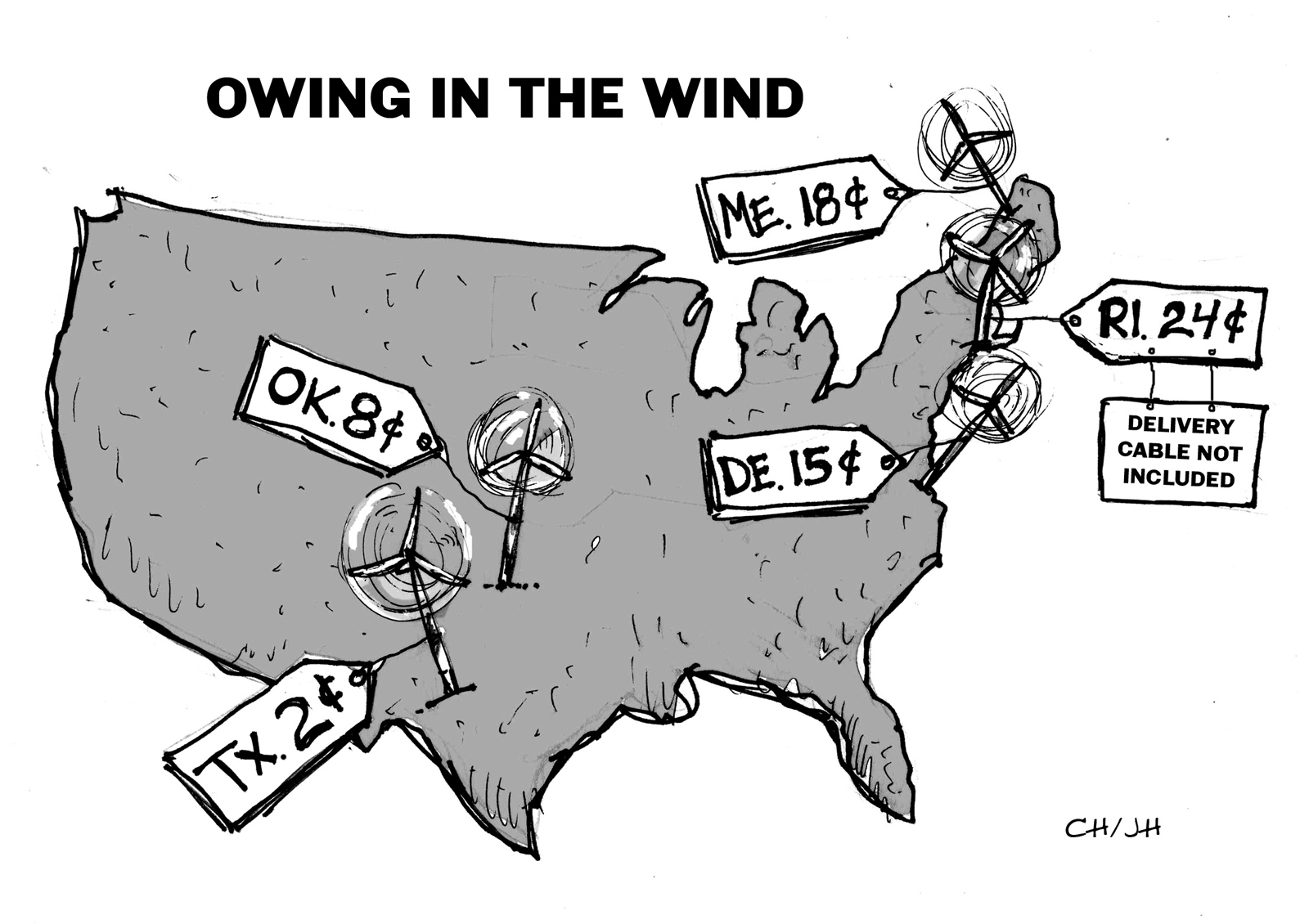
June 6, 2010
Thousands of Monuments to the Fiscal Non-Feasibility of Wind Power (Even Offshore)
In an American Thinker article in February, Andrew Walden points to a startling and very unpublicized fact about wind power.
In the best wind spots on earth, over 14,000 turbines were simply abandoned. Spinning, post-industrial junk which generates nothing but bird kills.
Now, some of the older ones would have been discarded for newer technology. But many were abandoned because the tax credits had run out and, along with then, the wherewithal to pay for maintenance. See, if wind power were truly profitable and fiscally self-sustaining, those windmills could be maintained and continue to operate from the revenue that they generated. But when the revenue is limited to tax credits or other government mandate, the project is going to last exactly as long as the artificial subsidies.
That hasn't stopped wind farm developers, however. Far from it.
... a new batch of colonists, having looted the taxpayers of Spain, Portugal, and Greece, seeks to expand upon their multi-billion-dollar foothold half a world away on the shores of the distant Potomac River. European wind developers are fleeing the EU's expiring wind subsidies, shuttering factories, laying off workers, and leaving billions of Euros of sovereign debt and a continent-wide financial crisis in their wake. But their game is not over. Already they are tapping a new vein of lucre from the taxpayers and ratepayers of the United States.
And Rhode Island. In fact, the names of the developers may have changed but the actual selling points have moved seamlessly across the Atlantic and up Narragansett Bay. As I researched this topic, the arguments being made to sell offshore wind farms in Europe - local jobs and an industry based upon clean, indigenous energy which would "establish Europe as world leader in offshore wind power technology" - sounded strangely familiar to those which have been made here in Rhode Island in recent weeks.
Proponents of offshore wind generation are attempting to distinguish it from ordinary on-land sites on the basis that the wind offshore is stronger and relatively more reliable. Unfortunately, offshore wind power suffers from exactly the same flaw as onshore: it simply doesn't work without either tax credits (i.e., a taxpayer funded handout) or a government mandate that compels consumers to pay an artificially high rate for the electricity generated.
Here's the bottom line on this issue: we're allowed to say "no!' to an energy source because of its high price. If the bill pending on Smith Hill passes, Rhode Islanders would be locked into paying unnecessarily higher electric prices and, worse, Rhode Island would exacerbate its already abysmal business climate by needlessly adding to the cost of doing business - especially for what is left of a manufacturing industry - in the state, all for some non-substantiated, feel-good reasons. (Want to bolster the state's economy? Create the business climate to draw industries that do not require tax subsidies or government mandates to survive. Want energy independence from foreign baddies? Drill near-shore and on land within the United States. Want to talk about global warming? Wake me when they've made a case that doesn't involve manipulated data, flawed computer models and a spokesman that has just purchased yet another property near an allegedly rising ocean.)
Walden's conclusion is pertinent both to Congress and to the RI General Assembly:
... the wind-subsidy proposals being floated in Congress suggest that American political leaders have yet to understand that "green power" means generating electricity by burning dollars.
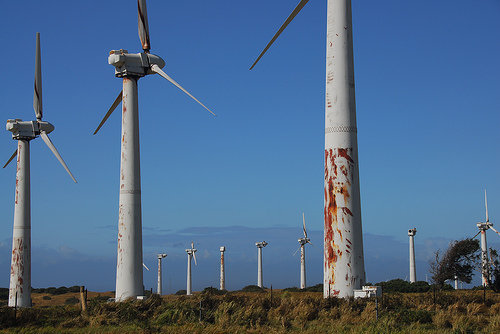
Photo by Gary Arndt at Everything Everywhere.
May 30, 2010
Conversely, the Moratorium on All New and Exploratory Drilling is Well Within President Obama's Control
... unlike the continued gushing of crude into the Gulf of Mexico,
Glenn Beck and Pat Gray do an excellent job breaking down how this moratorium is a wild overreaction on the part of the president and how he may not intend to "let this crisis go wasted" but use it to pass Senator Kerry's renamed yet still abominable cap-and-trade bill.
More to the point, the need for oil is not going away anytime soon, not even if the Magic Substitute Fuel Source were identified tomorrow. The effect of the president's moratorium will only be to make us more dependent on the foreign oil suppliers that everyone condemns while needlessly draining the pockets of all non-rich Americans. (It occurred to me recently that most of the people calling for us to get off fossil fuels now! now! now! would not be financially impacted if we actually did follow that pointless and very rash course of action.)
Accordingly, this should be treated (heh) as a learning moment. For example, it would not be nearly as difficult to cap this well if it were not one mile under water, a condition successfully imposed by well meaning but misguided environmentalists. Accordingly, wouldn't it make more sense for the moratorium to be solely on deep water drilling?
May 4, 2010
The Gang Striving for Cap and Trade
Sometimes you get a glimpse behind the closed doors of powerful people's decision-making rooms, and it's interesting how familiar names keep popping up. An Investor's Business Daily editorial on the Chicago Climate Exchange provides such an inkling.
The CCX is up and running as a mechanism for trading offsets for "all six greenhouse gases." It was initiated with start-up grants from the Joyce Foundation, on whose board Barack Obama sat at the time. The organization has since been purchased by the British company, Generation Investment Management, of which Al Gore is a co-founder.
Other founders include former Goldman Sachs partner David Blood, as well as Mark Ferguson and Peter Harris, also of Goldman Sachs. In 2006, CCX received a big boost when another investor bought a 10% stake on the prospect of making a great deal of money for itself. That investor was Goldman Sachs, now under the gun for selling financial instruments it knew were doomed to fail.The actual mechanism for trading on the exchange was purchased and patented by none other than Franklin Raines, who was CEO of Fannie Mae at the time.
In a way it's disappointing to think how much of our heated political culture ultimately comes down to the crass motivation of personal financial gain. It's frustrating, too, because once it all gets bound up in ideology and politics, the schemes become disguised in other people's battles about other matters.
Basically, these glimpses ought to be taken as reason to resist large, centralized government, especially at a global level.
May 3, 2010
Changing the Rules for "The Next Big Thing"
Special deals. Special laws. Once the state starts taking this sort of step, we're well past the point of reasonable accommodation for an incipient industry:
State lawmakers are attempting to breathe new life into a stalled proposal for an eight-turbine wind farm in waters off Block Island through legislation that would allow the project to bypass a difficult regulatory hurdle.A bill filed late Wednesday would make it possible for developer Deepwater Wind and National Grid, the state's main electric utility, to enter into a power-purchase agreement without having to win approval from the state Public Utilities Commission. ...
Instead of the PUC, approval of a new contract for Deepwater would be in the hands of the appointed directors of four other state agencies: the Division of Public Utilities and Carriers, the Economic Development Corporation, the Office of Energy Resources and the Department of Administration. All four agencies would have to certify an agreement for it to go into effect, but they would each be given very narrow parameters for their review.
Deepwater and its government supporters didn't get the result they wanted through the normal path — permission to force energy consumers to pay three times the going rate of electricity for its product — so the latter are changing the regulatory path and putting blinders on the regulators. Whatever good intentions may lie behind such initiatives, this sort of special treatment should be a red flag for voters and legislators and is a bright beacon for corruption.
Amy Kempe, Carcieri's spokeswoman, said the introduction of the bill had no connection to the Cape Wind decision. Approval of the Massachusetts project, she said, only buttressed the belief held by Carcieri and House and Senate leaders in the promise of a national offshore wind industry."Yesterday's announcement shows that this is a viable industry," she said Thursday. "It is going to be moving forward."
It appears that Ms. Kempe misses the distinction between evidence that an industry is viable and evidence that it is politically popular. The former means that people are willing to allocate their own money for a good or service; the latter means that elected and bureaucratic officials are willing to allocate other people's money for it. The standards for success are clearly quite different.
April 3, 2010
What Mileage Rules May Not Mean
The Newport Daily News headline for this AP report pretty well captures the spin and points to the possible problem: "New mileage rules will save drivers at the pump."
The rules will cost consumers an estimated $434 extra per vehicle in the 2012 model year and $926 per vehicle by 2016, the government said. But the heads of the Transportation Department and Environmental Protection Agency said car owners would save more than $3,000 over the lives of their vehicles through better gas mileage.
One would normally expect, as demand goes down, that prices would go down as well, owing to competition, but I'm not so sure that will be the case with a permanent reduction in the amount of fuel that people need for their cars. "Need" is the operative word, there. It takes a certain amount of infrastructure and investment to move gasoline from the ground to the pump, and since it's not a product that consumers will be able to go without, even with better gas mileage, providers may adjust prices upwards to make up the difference.
March 30, 2010
Putting Power in the Air
As much as I rely on technology for so much of what I do, and as enamored as I am of high-tech tools and gadgets, I hew to a common sense rule of thumb that the minor inconvenience of wires and direct switches and locks is counterbalanced by privacy and security concerns. With regard to "smart grid" energy technology, here's one reason:
In the US alone, more than 8 million smart meters, designed to help deliver electricity more efficiently and to measure power consumption in real time, have been deployed by electric utilities and nearly 60 million should be in place by 2020. Now the Associated Press reports that smart meters have security flaws that could let hackers tamper with the power grid, opening the door for attackers to jack up strangers' power bills, remotely turn someone else's power on and off, or even allow attackers to get into the utilities' computer networks to steal data or stage bigger attacks on the grid. Attacks could be pulled off by stealing meters — which can be situated outside of a home — and reprogramming them, or an attacker could sit near a home or business and wirelessly hack the meter from a laptop, according to Joshua Wright, a senior security analyst with InGuardians Inc, a vendor-independent consultant that performs penetration tests and security risk assessments.
Combine that concern with the trend toward the wireless meters relentlessly being placed in houses. We've all seen movies in which some spy or stalker must break open an outdoor telephone panel in order to tap the family's phone line or break into the house to cut the power line. The protagonist usually manages to figure out what's going on pretty rapidly by tracing wires. In the case of wireless technology, highly trained technicians would be sorting through the mazes of ones and zeroes in computer code trying to trace problems in the middle of the night.
Moreover, as the above link goes on to indirectly suggest, it's simply not possible to prevent people from stealing information that's traveling through the air, making encryption the only safeguard. As energy companies use their equipment to collect more data from our households' lights and appliances, the loss of privacy and control could be immense.
March 15, 2010
Adding "Green" Does Not Free the Industry of Market Forces
In the aptly named "Green Jobs and Rose-Tinted Glasses" (subscription required), Iain Murray argues that evidence does not suggest that the "green" subindustry is a windfall just requiring a little initial shaking:
Green jobs, it would seem, are a magic bullet for the administration, solving the problems of unemployment, poverty, community degradation (and therefore crime, presumably), class struggles, public health, terrorism, and global warming at a stroke. What could possibly lead anyone to object to them?The answer is, as ever for a conservative, real-world experience. Germany and Spain went down the green-jobs road many years ago, for much the same reasons as the administration. They saw it as a way to make their countries world leaders in coming technologies, provide good jobs to replace decaying industries, and insulate against energy shocks originating overseas.
It didn’t work out that way.
According to Murray, other countries (notably China) undercut Germany's production prices, even as the country continues to import most of its energy in the form of Russian natural gas, all without having contributed to job growth, once the jobs lost to higher energy costs are taken into account. In Spain, the green industry has lost jobs, and the government has reduced subsidies.
Of course, the United States has been picking up some of that slack. Murray notes that hundreds of millions of American tax dollars have slipped across the Atlantic as "green energy" investments to the Spanish company Iberdrola:
And Iberdrola isn't the only foreign recipient. According to a report from the Watchdog Institute, there are plenty of countries that received stimulus cash to create green jobs, but created plenty overseas and few or none here. Most of the jobs that were created here were temporary. Despite all the stimulus money, the American wind industry lost permanent manufacturing jobs (while creating temporary construction jobs) last year, because demand for over-expensive energy plummeted (without the stimulus money, the industry would likely have collapsed).
It ought to trigger suspicion when massive money giveaways are justified with miraculous promises, and that's one area in which "green jobs" have led the field.
March 14, 2010
A Bit of Hot Air
This is the proposed subsidy that the General Assembly and Governor are foolishly forcing energy consumers to provide for wind power, unless the Public Utilities Commission objects:
Under the deal being reviewed, National Grid would pay 24.4 cents per kilowatt hour for power from the project starting in 2013. The price would increase by 3.5 percent a year. The utility currently pays 9.2 cents per kilowatt hour for power from natural gas-fired plants and the like.
We've essentially created a controlled market for wind energy that begins two-and-a-half times the going rate and increases about 15% per year regardless of market forces. During a massive recession, this is a wonderful example of the insanity that Rhode Island does so well.
"A lot of industries are looking to pull out of this region," Energy Management vice president Dennis Duffy said. "This is one new industry that is trying to get in."
Of course, Mr. Duffy doesn't speculate as to what other industries might try to get in the region with the same subsidized deal and guaranteed market. Rhode Islanders should remember Duffy's argument in a few years when there are even fewer jobs, fewer business, and a smaller taxbase and public infrastructure has switched from crumbling to dissipating for lack of resources.
March 10, 2010
A New Look at Water Power
One of the interesting side effects of last year's stimulus bill was $400 million in funding for ARPA-E, the civilian, energy-focused cousin of DARPA. And in this week's first ever ARPA-E conference, MIT chemist Dan Nocera showed how well he put that stimulus money to use by highlighting his new photosynthetic process. Using a special catalyst, the process splits water into oxygen and hydrogen fuel efficiently enough to power a home using only sunlight and a bottle of water.
I'll even give the government credit for funding scientific research (although I'd argue that the prospect of owning such a technology would be very attractive to private investors). Regarding the relevance of "stimulus," I'd imagine that the net number of jobs in the economy would decrease if energy could be harvested in such a way.
The bigger consideration, though, is that this sort of breakthrough stands as evidence against investing a state's entire economy on a particular industry, like wind and wave power, for instance. Government operatives are not well suited to predict the market (if they were, they wouldn't be government operatives), and even putting aside state-to-state competition for industry leadership, aligning local policies and taxation with a particular technology leaves substantial risk that the another region will win the roll of the innovation dice.
November 20, 2009
"Smart" Like a Fox
At least I'm not alone in my concern that the "smart grid" craze opens up new horizons of privacy infringement:
Smart grid technology -- including new "smart meters" being attached to businesses and homes -- is designed in part to provide consumers with real-time feedback on power consumption patterns and levels. But as these systems begin to come online, it remains unclear how utilities and partner companies will mine, share and use that new wealth of information, experts warn."Instead of measuring energy use at the end of each billing period, smart meters will provide this information at much shorter intervals," the report notes. "Even if electricity use is not recorded minute by minute, or at the appliance level, information may be gleaned from ongoing monitoring of electricity consumption such as the approximate number of occupants, when they are present, as well as when they are awake or asleep. For many, this will resonate as a 'sanctity of the home' issue, where such intimate details of daily life should not be accessible."
According to the study, examples of information that utilities and partner companies might be able to glean from more granular power consumption data include whether and how often exercise equipment is used; whether a house has an alarm system and how often it is activated; when occupants usually shower, and how often they wash their clothes.
It's far too easy to imagine such information tempting government officials to find ways of "checking on" peculiar energy usages. Maybe that consistently high energy consumption in the basement zone of residential lot 57 is related to an elaborate toy train track setup, but maybe it's an illegal marijuana nursery. Best to check.
And even apart from government, it mightn't be long before targeted direct-mail campaigns begin filling mailboxes based on information learned via energy usage. No doubt detergent companies and out-of-the-home laundry services would be interested in the frequency of families clothes washing. For example.
October 30, 2009
The Old "Further Study and Hearings"
Environmentalists needn't be on the same page on every initiative, of course, but there's nothing in Tricia Jedele's letter to the Providence Journal that negates the NIMBYism suggested in their expressed concerns about wind turbines on Black Point:
Some of the signatories to the letter to the governor may ultimately support or oppose particular wind projects or the use of certain categories of public lands. A call for standards and transparent process, however, is not itself opposition. Allowing for a public process and establishing objective criteria to govern site selection will assure both reasonableness and fairness. In the end establishing a process will enable renewable-energy development in places that make sense for Rhode Islanders.
The Projo reported that Save the Bay opposes the project, transparency notwithstanding, as an infringement on a "pristine landscape" (Projo's phrase). Jedele may disagree, but her letter uses the vague language of obfuscation, and one suspects that "places that make sense for Rhode Islanders" will turn out, in the environmentalists' eyes, to be places that are not pristine — which locations, by their nature, have the most room.
October 28, 2009
A Grid That's Smarter than You
Frankly, I suspect the whole "clean energy" thing is a fad that will wind up costing much more money than it saves or than the benefits justify (catastrophically so as we dip into cap-and-trade-type policies). But whatever. There are so many ways that the government is wasting money and economic strength that it's difficult to isolate just one about which to be outraged. But I'm still suspicious about unspoken intentions with "smart grids." Consider:
A smarter grid, for example, might help hook wind farms in North Dakota with power consumers in Chicago and synchronize those consumers' energy use to match the times when the wind blows strongest.
It would be helpful, certainly, to be able to set timers on appliances, and even to have a setting that will run them when power is least expensive, but the push could head in a different direction. If the grid and the people who run it are the ones "synchronizing" supply and use, it's conceivable that you'd set your dishwasher to run at some point in the next 24 hours, and the government would choose the specifics. (What if you miss your slot? Well, that's a bit too deep into speculation even for me.)
I'm not saying it's worth getting hyped up about, but the issue meets phraseology in a way that's worthy of attention moving forward.
October 22, 2009
No, This Would Be the Best Form, If We Were Going to Allow You to Produce Energy
This is one of those stories that leaves the reader unsure of whether to laugh or cry:
Save The Bay, the leading environmental organization in Rhode Island, is opposing a plan to erect a wind turbine at Black Point, a coastal property in Narragansett that was preserved two decades ago using state open-space bonds.The Providence-based organization joined Tuesday with five other environmental advocacy groups — all supporters of green energy — to send a letter to Governor Carcieri that raises questions about the project. The plans being developed by the state Department of Environmental Management and the Town of Narragansett include the installation of up to six large wind turbines at various sites in the town.
First of all, I wonder whether it mightn't be time for Save the Bay to consider a name change, inasmuch as thwarting wind turbine projects takes the group out of the water, so to speak. Moreover, to the extent that we hinder production of energy of any sort, we increase pressure for alternate solutions, such as the LNG terminal that would bring large, traffic-clearing vessels into our waters, where they'll unload their product through a pipeline away from the dock.
The underlying issue is a bit more fundamental, though:
Jonathan Stone, executive director of Save The Bay, said his organization is against any plan to put up a wind turbine at Black Point because, he contends, it would be an industrial use that would mar an otherwise pristine landscape.
Call it NIMBYism, or whatever you like, but there's a strain in the modern mentality that wishes for everything to be produced — whether dinner or electricity — with no visible sign... at least in the lives of the advocates.
October 15, 2009
The "Jobs Bill" That Decreases Employment
In politics, every policy is critical to every social need, provided that the politicians desire the policies and the people are currently concerned with the need. So, President Obama declares cap-and-trade energy legislation to be "a jobs bill," even though it will cost the economy jobs overall, as a Heritage study shows. Ben Lieberman explains:
Sure, the president can visit wind-turbine factories and boast about the few hundred green jobs at each. But the billions of dollars in government subsidies to the wind industry siphon resources and jobs away from other parts of the economy.Worse, the higher cost of wind-generated electricity and other alternatives kills even more jobs, especially in the manufacturing sector, which needs reasonably-priced energy to compete in the global marketplace.
The next decade looks bleak, indeed. Hopefully, American voters will see the error of their ways — and force American politicians of both parties to see the error of theirs — in time to repair the damage before the subsequent decade begins testing just how low our nation can sink.
October 14, 2009
Unfree Energy
Is this the future of energy?
Planners envision installing a new kind of power meter in homes - a wall-based unit that can monitor how much electricity is being used by various appliances and turn them off when demand for energy is higher, and thus costlier to consume. The project also would upgrade the utility’s computer systems so it can integrate more renewable energy. ..."There's a lot of opportunities for us to improve our knowledge of what's using power, and making it easier for us to shut off the power when we're not around," said Bob Gilligan, a GE vice president. "Most consumers aren't really aware of how much energy they're using at any time of day."
A consumer unit that monitors energy in the house, giving the homeowner more information and control, would be a worthwhile product, but this sounds like more of a top-down initiative with some disconcerting possibilities for the future:
The smart grid would help integrate additional clean energy into the grid through computers that could quickly manage Maui's power needs, adding and subtracting alternative power sources when desired."It will give the utility another knob to turn when wind suddenly calms on an afternoon, or when people are coming home and turning on their air conditioning," said Devon Manz, an engineer at GE's Global Research Center.
Maybe there are two distinct components to this "smart grid" — the appliance-monitoring device and the new knob back at the power company's office — but even if that's the case, it's a short step to computers' rationing energy through appliance-specific restrictions.
August 12, 2009

Waxman-Marke: Bad for the Economy
i have a piece in today's ProJo about Waxman-Markey, which will be debated later this year in the Senate. The link is here. This legislation is on a par with Obamacare as an economic nightmare.
July 12, 2009
Knowing What They Want to Do on Energy
The letter that Walter Schmidt, of North Scituate, sent in to the Providence Journal deserves a hear hear:
A July 2 letter ("Bill's passage a fine day for the environment") thanked U.S. Reps. Patrick Kennedy and James Langevin for voting for the "cap and trade" bill.The author, however failed to mention the cost of this bill. While not a direct tax on the public, it is a stealth tax. The bill would tax energy producers by forcing them to purchase carbon credits. This tax will be passed on to consumers and will raise the cost of electricity, heating oil, natural gas and gasoline. Estimated increases range from $1,400 to $3,000 per household per year depending on usage.
Manufacturers and farmers will also pass their increased energy and transportation costs on to the consumer, raising the price of virtually everything.
Raising taxes on companies that produce and deliver energy will also cost jobs as they downsize to reduce expenses. With unemployment approaching 10 percent nationally, this should be unthinkable. The "green" jobs this bill would create would compensate for some of these losses but we need more jobs, not a transfer of jobs.
This bill has other negatives. New homes would be required to conform to the energy standards of California, the state that's issuing IOUs to state workers. Before you could sell an existing home it might have to pass an energy audit and be brought up to code at your expense. This will not help the housing market.
We are in the grip of the worst recession since the Great Depression. Passing any legislation that increases taxes, the cost of living and unemployment is insanity.
On the bright side, the letter gave me an excuse to watch the cap-and-trade song again:
June 29, 2009
Evening Music Video: We're Going Green!
Any song with the line "and estimated environmental impact is not really calculable" would be worth a listen, but I've been humming this one all day:
(via the Corner)
June 27, 2009
Rhode Island, Always Striving to Make Life That Much More Difficult
So, with legislation to make energy more expensive for all Americans making its way through Congress, what can one say about this?
Governor Carcieri on Friday signed into law legislation that could pave the way for offshore wind farms in Rhode Island.The bill, passed by both chambers of the General Assembly earlier this month, allows electrical utility National Grid to enter into long-term contracts to purchase "green" energy. For Deepwater Wind, the company proposing more than 100 wind turbines off the Rhode Island coast, the law means having a guaranteed buyer for its energy, a crucial selling point to investors. The legislation will also benefit other clean-power proposals, including a plan to build a solar farm in Coventry.
The first thing on which to remark is Journal Staff Writer Alex Kuffner's peculiar choice of the word "allows" to characterize the bill's relevance to the energy company. Here's how the General Assembly press release about the legislation puts it (emphasis added):
The House and the Senate each took final votes today approving legislation sponsored by House Majority Leader Gordon D. Fox and Senate Corporations Committee Chairman Joshua Miller to require the state's largest electric utility to enter into long-term contracts to purchase power from renewable energy producers in Rhode Island.
Under the eye of the state Public Utilities Commission (PUC), National Grid (and any other energy distribution companies that may be lured into the Rhode Island market) will have to enter into contracts with "new," "green," "renewable," whatever energy producers with a duration of at least 10 years. Then, if we turn to the statutory language itself (PDF) we find explicitly what we all should expect implicitly:
The electric distribution company shall file tariffs with the commission fo commission review and approval that net the cost of payments made to projects under the long term contracts against the proceeds obtained from the sale of energy, capacity, RECs or other attributes. The difference shall be credited or charged to all distribution customers through a uniform fully reconciling annual factor in distribution rates, subject to review and approval of the commission. The reconciliation shall be designed so that customers are credited with any net savings resulting from the long-term contracts and the electric distribution company recovers all costs incurred under such contracts, as well as, recovery of the financial remuneration and incentives specified in section 39-26.1-4.
In short, National Grid must enter into decade-long contracts for the purchase of energy at prices consistent not with the energy market in general, but with "newly developed renewable energy resources," however much more it may cost than regular ol' energy resources. It then sells the energy at market rate and tacks the "newly developed" premium on the bills of customers across the board. Oh, and the law permits the company to add another 2.75% premium to the cost of the fancy new energy as "incentive."
Let's follow the money, shall we? You, energy consumer, will pay more for your usage so that the distributor can, without loss (indeed, with explicit profit), subsidize politically preferred energy sources in order to guarantee sales of an energy product whose risk investors are not otherwise willing to accept. Your money, in other words, is serving to secure investment earnings for others. Those investments, in turn, will flow to land owners, materials suppliers, and workforces. To some degree, the prices of all of those things will be inflated; to the extent that unions are involved, another layer of money-takers slips into the mix; and to the extent that materials, land-owners, and workers reside elsewhere, the money will flow out of the state.
To those parties, the law represents a net benefit, but that requires a net cost to a much larger field of people. That field of people is contained geographically within the borders of Rhode Island, because National Grid has no reason to spread the "renewable" deficit more broadly across its own operations. Moreover, the state is contained geographically within the borders of a nation with a government hell-bent on piling on its own premiums.
June 26, 2009
BREAKING: Dark Days Getting Darker
Well, it isn't law yet, I suppose, but when legislative supporters of a government change as well as the Associated Press admit substantial cost to an initiative, it certainly gives pause:
In a triumph for President Barack Obama, the Democratic-controlled House narrowly passed sweeping legislation Friday that calls for the nation's first limits on pollution linked to global warming and aims to usher in a new era of cleaner, yet more costly energy.
Americans are going to feel the effects of their action with the last election, and they aren't going to like it. Bitter pills and broken eggs are key ingredients in the hope and change omelet.
April 22, 2009
The Energy and Healthcare Issues Come Together
Throw in environmentalism, too, because William Tucker's thoughts on windmilled energy bring some possibilities to mind:
The major limitation, of course, is wind's intermittency -- its lack of "dispatchability." Quite simply, you can never count on it. You can't even predict it from hour to hour with 100 percent accuracy and the windiest sites can go calm for days. On a national electrical grid, where supply and demand must be kept within 5 percent or each other in order to maintain voltage balances, this becomes very disruptive. ...The utilities' generating capacity, as McCracken points out, generally falls into two categories -- base load and peaking. Base load runs day-and-night, week after week, to meet the underlying demand. It is almost universally provided by coal plants, which run for weeks at a time before shutting down for maintenance, and nuclear reactors, which can go almost two years between refueling. Peak loads, on the other hand, are generally met with natural gas turbines, which do not boil water and can be started and stopped almost instantaneously.
Unfortunately, as McCracken notes, wind falls into neithercategory. "As wind provides neither baseload nor peaking plant it has no impact on reserve capacity," he writes. ...
In other words, thanks to government mandates and subsidies, wind will be there to throw power onto the market any time the wind blows. This will not replace base load plants but will only drive down prices, cutting into their revenues. Nonetheless, base-load nuclear plants will have to remain in operation, both because they will be needed as back-ups in case the wind doesn't blow or -- in the case of nuclear -- because it doesn't make sense to keep stopping and starting a plant that runs best for two years at a time.
For some reason, this problem joined, for me, with Senator Sheldon Whitehouse's suggestion on Newsmakers that one of the healthcare issues that government must address is obesity. If government takes ultimate responsibility for the healthcare of its citizens, it will gain some right to regulate individual health. What if we put overweight Americans to work generating energy?
Perhaps when the wind dies down, human treadmills could be hooked up to the generator to keep it going. Or, for an even more cartoonish suggestion, perhaps those in need of exercise could turn the wind propellers themselves by dangling off the edge.
December 5, 2008
The Energy Life of Trash
This seems to be a great idea — especially since it appears to be free-market, rather than government, driven —
An $80-million project to generate electricity from the methane gases that are given off by Rhode Island's trash drew support from local and state officials yesterday morning.Executives from a New Jersey company, Ridgewood Renewable Power, unveiled detailed plans and announced that their project, to start this spring, will more than double the output of gas-fueled electricity generation at the state's Central Landfill, creating the second-largest such facility in the United States.
The proposed plant would churn out 41 megawatts of electricity — enough to supply more than 38,000 homes, according to the company, which aims to bring the new plant online late in 2010.
Over three decades, the facility's projected energy output would be on par with what a coal-burning facility would produce with about 2.9 million tons of coal — enough to fill a freight train 275 miles long, the company said.
I'm curious how long of a freight train a coal plant actually accrues over three decades, but there doesn't seem to be any downside to letting a company create energy from trash, if it wants.
November 15, 2008
Who Should Pump the Oil?
In view of the consideration that President-Elect Obama is giving to the reinstatement via Presidential Executive Order of the recently lifted ban on certain domestic oil drilling, let us go back a month or so to an editorial by Tom Ward of the Valley Breeze [no longer available on line] which raised an interesting point.
I care about the environment, too. Almost all Americans do. We don't want to see any more disasters like the Exxon Valdez tanker spill of 1989 or the Santa Barbara spill of 1969. But how are we improving the environment for "the planet" when we pump the oil that we use, not in the highly regulated United States, but instead in countries like Nigeria, China, and other nations who don't give a damn about polluting their land, rivers and people? If environmentalists have a more "global" view, how come they care so much about clamping down on oil exploration in the United States, while letting the rest of the world run wild?
Taking the second half of his last question literally, the answer, of course, is that if the rest of the world "runs wild" environmentally, our options to stop them range somewhere between weak and completely ineffectual.
Concurrently, we should note Ward's point: that a gallon of crude can be pumped in a much "cleaner" and more environmentally-friendly fashion here than in the countries he lists. Until that magical alternate energy source arrives, where and how should our energy needs be met? And if the answer to that is, "not here", how do we justify letting someone else do our dirty work when, in fact, we could do that work much more cleanly ourselves?
November 14, 2008
For Local Biodiesel, Grease is the Word
This past weekend, the President of OPEC set a maximum on how high his organization would like to see the price of oil reach…
Reasonable prices should range "between $70 and $90 per barrel," said [Chakib Khelil], who currently holds the rotating presidency of the Organization of Petroleum Exporting Countries.Why is there a maximum, you might reasonably ask. Why doesn't OPEC want prices to be as high as they can be? The answer, in part, is that people who have decided they don't want to pay for super-expensive petroleum are beginning to create their own alternatives. Some of those efforts have already achieved an industrial-scale.
You can read about one such Newport-based group of innovators, in this week's Providence Phoenix.
For Local Biodiesel, Grease is the Word
This past weekend, the President of OPEC set a maximum on how high his organization would like to see the price of oil reach…
Reasonable prices should range "between $70 and $90 per barrel," said [Chakib Khelil], who currently holds the rotating presidency of the Organization of Petroleum Exporting Countries.Why is there a maximum, you might reasonably ask. Why doesn't OPEC want prices to be as high as they can be? The answer, in part, is that people who have decided they don't want to pay for super-expensive petroleum are beginning to create their own alternatives. Some of those efforts have already achieved an industrial-scale.
You can read about one such Newport-based group of innovators, in this week's Providence Phoenix.
October 22, 2008
Hassett Calls for Utility Rate Cuts
Providence City Council member Terry Hassett wants the Public Utilities Commission to revisit this summer's rate increase (h/t):
"If the rationale was to boost the rate for electricity here in Rhode Island because it is directly related to the cost of oil, then the PUC is obligated to summon National Grid before them to reconsider the more substantial change in the world market price of oil,” Hassett said.I agree. If the previous justification for raising rates is gone, then lower them. Too bad the same philosophy didn't get applied to government spending.“As the cost per barrel of crude oil has plummeted, it is the PUC’s turn to act on behalf of the consumers in Rhode Island and reduce the rate of electricity,” Hassett said.
September 12, 2008
Further Reading on Oil-From-Algae
For those skeptical about the idea that producing oil and other fuels from algae is viable in the near term, here are a few interesting links on recent developments I came across in putting the Phoenix article together. I was surprised by how far along this field seems to be.
Diesel fuel created from algae has been used to run a standard Mercedes C320 (Wired Magazine). Biodiesel from algae can processed to meet the same engineering standards that other biodiesels do (The Auto Channel).
The claim of a potential of 10,000 gallons of fuel per acre per year from pond-grown algae is backed by some serious scientists, for instance the Energy and Emissions Program Manager at the Boeing Company. Here's a less technical item discussing the claim (Arcwire.org).
A company called PetroSun Biofuels is developing 1,100 acres of algae ponds in Texas to be used for biofuel development (Wired Magazine).
Here's a CNN article on the claim that 100,000 gallons of oil per acre per year may be possible from vertically stacked algae incubators.
The processing test that had to be halted because the algae was growing too quickly was reported on in Business Week last December.
Finally, some cautious reporting regarding the potential and the difficulties with grow-in-the-dark algae is available from the MIT Technology Review and from a website that tracks developments in alternative fuels called Gas2.org.
August 25, 2008
A New Source for Heating Oil -- In Pawtucket?
How would you like to be able to buy cheap home-heating oil, made from algae in a factory in Pawtucket?
According to an item on the KTHV-TV (CBS 11, Little Rock AR) news-blog site attributed to CNN, oil-from-algae could become an option reasonably soon, and New England-based research is leading the way…
You see algae collecting on ponds and even swimming pools, but for some biofuel enthusiasts the green slime could turn into a gold mine…."Could very well be the fuel of the future...that's algae," says Scott Comey from Rhode Island with Energy Innovation."For every gallon of algae that you process you can get a half a gallon or more, depending on the strain of algae, of oil," says Comey.
Comey and his team of 30 PHD's, professors, and other working New Englanders envision a future in which they could sell algae based biofuel as home heating oil for under 2 dollars a gallon….
Using old factory buildings, the plan is to grow algae in mass quantities, and then convert it into heating oil through a few simple chemical reactions….Comey and his crew plan to move into a Pawtucket factory building to start production, but they still require additional funding to get the deal done.
Democratic Convention Goers Say "We're For Drilling, Just Don't Tell Anyone Here!"
According to an ABC News "Political Radar" Report from the Democratic National Convention, party opposition to expanded domestic oil-drilling is so staunch, the topic can't even be brought up in platform discussions on energy policy…
Offshore oil drilling is too controversial to be presented as part of the platform.But how likely is it that the Democrats will be able to make a meaningful change in an area they're afraid to talk amongst themselves about?Rep. Tim Walz, D-Minn., co-sponsor of HR 6709, says, "If we could change the platform to show us as centrists, it would take the wind out of the Republicans and give us momentum coming out of the convention. But many convention-goers are activists. They would not support this change."
Democratic supporters of comprehensive energy legislation like HR 6709 confirm they will not play hardball at the convention by introducing an amendment to the platform. But they will continue to pressure the party’s leaders and the Democratic ticket to make comprehensive energy policy, including offshore oil drilling, their top priority.
August 21, 2008
Will the Ethanol Era End Before It Begins?
This would be a cool way to put an end to the ethanol-as-vehicle-fuel debate, with average citizens winning though ethanol loses (h/t Instapundit)…
Dr. Kenneth Hall, associate director of TEES and the Jack E. & Frances Brown Chair and professor in the Artie McFerrin Department of Chemical Engineering at Texas A&M University, and his colleagues, Mark T. Holtzapple, a professor in chemical engineering, and Sergio A. Capareda, a professor in biological and agricultural engineering, have developed a process to make converting biomass to high-octane gasoline possible.The advanced process is possibly the only integrated system that converts biomass directly to gasoline. Most other emerging processes convert the biomass into alcohol and then blend it with gasoline. The system is relatively inexpensive and focuses on using biomass waste streams and non-food energy crops rather than food products such as corn.
Additionally, the cost of such a conversion would lie between $1.70 and $2.00 per gallon excluding all government subsidies and tax credits. This cost range is dependent on the type and cost of feedstock as well as the size of the biorefinery. This would provide some much-needed relief for consumers when it comes to fueling their vehicles, whose current options are to pay more or drive less.
Thoughts on Energy
On Matt Allen's show last night, Andrew summarized his post on the differences in domestic drilling suggestions from the national Democrats and Republicans. Stream by clicking here, or download it.
August 20, 2008
To Drill or Not to Drill, That is Not the Only Question
Most recent coverage of energy policy has focused on the issue of conventional drilling for oil in the Arctic National Wildlife Refuge and on the continental shelf, but there is much, much more that is in play in our national debate about sensible energy policy.
A bipartisan group of U.S. Senators, the so-called “Gang-of-10”, have responded to the Congressional Republican floor revolt against the Democratic leadership's refusal to allow a vote on domestic drilling with a compromise called “the New Energy Reform Act” which includes new drilling with a host of other items. The House Republican Conference has responded with a comprehensive proposal of their own, “the American Energy Act” which includes encouraging alternative fuel development, making better use of petroleum resources and encouraging conservation in addition to new drilling.
The key differences between the proposals are…
- The Gang of 10 proposal is much heavier into subsidies, direct money spent on R&D and things like “workforce training” (that don’t really produce any energy), partially paid for with new taxation on oil and gas companies, while the House Republican Conference program has more focus on getting government out of the way of improved energy production by reducing regulations on new refineries, nuclear plants, oil shale, etc.
- More importantly, the Gang of 10 wants to limit new drilling to a few states, but has not provided any sensible geologic or economic criteria for the ones they’ve chosen. The Republican plan opens up all of the continental shelf and Alaska so that drilling sites can be chosen on the basis of -- get this crazy criteria -- whether there’s oil there!
Allow development of our nation’s shale oil resources, which could provide an additional 2.5 million barrels of oil per day, as proposed in H.R. 6138 by Rep. Fred Upton (R-MI).The technology for extracting oil from oil shale is still under development, so it is difficult to pin down the exact quantity of oil that is extractable from shale within the United States, but conservative estimates put the figure at over 1 trillion barrels. For comparison, Saudi Arabia's oil reserves are estimated to be in the vicinity of 200-300 billion barrels.
But in 2007, Congress (with the support of Congressmen Patrick Kennedy and James Langevin) voted to prohibit the development of oil-shale on Federal lands, where about 70% of America’s useable shale is estimated to reside. There should be no “cost” in higher taxes or increased subsides like the kinds in the New ERA that should be needed to reverse bad decisions like this one.
The major provisions of both the New ERA and the AEA are listed below the fold. Can you assemble your own comprehensive energy proposal for lower gas prices and reducing American dependence on foreign oil that's better than what Congress can come up with?
August 7, 2008
A Case for Cuban Ethanol?
Commenter "OldTimeLefty" has put forth this interesting energy proposal…
We contract with Cuba for its sugar cane then refine the sugar into an ethanol based product. U.S. capital could invest in a refinery (on Guantanamo for example?). This keeps corn for food, employs the resources of Cuba and The United States in a joint venture that would profit both countries and go a long way towards establishing a peaceful coexistence between neighbors.Wired Magazine carried an article on this suggestion a few months back…
Cuba has the potential to produce 3.2 billion gallons of ethanol annually, according to an analysis by Juan Tomas Sanchez of the Association for the Study of the Cuban Economy. Another Cuba expert, Jorge Hernandez Fonseca, puts the figure closer to 2 billion gallons but even that figure would place Cuba third -- behind Brazil and the United States -- in worldwide production.However, Fidel Castro is opposed to any new ethanol production, as illustrated by this report from Reuters published just yesterday…Of course, reaching either of those numbers would require Raul Castro to open the door to foreign investment, but that may not be as unlikely as it sounds. The Washington Post notes there's speculation that Fidel's exit opens the door to economic reform like we've seen in China, and it's worth noting Cuba is quietly modernizing its ethanol infrastructure.
Raul Castro is seen as a pragmatist who is more concerned with improving Cubans' daily lives than spreading la revolución, and according to Reuters he is believed to favor loosening state control on Cuba's economy.
A Cuban official said on Wednesday the Caribbean island is modernizing its sugar industry but that plans to increase ethanol production have been scaled back.Cuba's leadership is, of course, dutifully following the kinds of land-use and "country" strategies that have made the idea of communist agricultural planning into the laughingstock of history. Two illustrations of the results of a half-century of Cuban land-use strategy were presented on the Wall Street Journal's Environmental Captial blog earlier this yeat, on February 19 and February 22 respectively...Galvez, who announced plans for a derivatives conference in October, refused even to use the word ethanol, stating plans for "alcohol" were reduced due to the market, land use and the country's strategy.
[According to Antonio Gayoso], another of the academics at the Association for the Study of the Cuban Economy. Cuba is presently neither self-sufficient nor sustainable. According to Cuban government figures, it imports about 85% of its food. The collapse of the country’s sugar industry has left huge swaths of cropland overrun by a type of Caribbean kudzu.So, Cuba's land-use strategy eschews using currently unused land to produce a crop the rest of the world would be interested in buying. If the price of Cuba becoming more self-sufficient and more economically viable is a lowering of world oil-prices, then Fidel Castro is against it. Castro is painfully aware, in a globalized world, that spreading around cash raised from the sale of easily obtained-natural resources is the only means the world's remaining totalitarian dictators have for holding on to their power. For his own warped ideological reasons, Castro is willing to pay any price -- including decimating his own nation -- to defend the advantage of other totalitarians.Before Castro’s 1959 revolution, Cuba was the world’s biggest sugar producer; today, its battered sugar mills and neglected land produce about 10% of what they did.
But biofuels are coming. With oil prices as high as they are, it's only a matter of when and of who's going to profit...
A Case for Cuban Ethanol?
Commenter "OldTimeLefty" has put forth this interesting energy proposal…
We contract with Cuba for its sugar cane then refine the sugar into an ethanol based product. U.S. capital could invest in a refinery (on Guantanamo for example?). This keeps corn for food, employs the resources of Cuba and The United States in a joint venture that would profit both countries and go a long way towards establishing a peaceful coexistence between neighbors.Wired Magazine carried an article on this suggestion a few months back…
Cuba has the potential to produce 3.2 billion gallons of ethanol annually, according to an analysis by Juan Tomas Sanchez of the Association for the Study of the Cuban Economy. Another Cuba expert, Jorge Hernandez Fonseca, puts the figure closer to 2 billion gallons but even that figure would place Cuba third -- behind Brazil and the United States -- in worldwide production.However, Fidel Castro is opposed to any new ethanol production, as illustrated by this report from Reuters published just yesterday…Of course, reaching either of those numbers would require Raul Castro to open the door to foreign investment, but that may not be as unlikely as it sounds. The Washington Post notes there's speculation that Fidel's exit opens the door to economic reform like we've seen in China, and it's worth noting Cuba is quietly modernizing its ethanol infrastructure.
Raul Castro is seen as a pragmatist who is more concerned with improving Cubans' daily lives than spreading la revolución, and according to Reuters he is believed to favor loosening state control on Cuba's economy.
A Cuban official said on Wednesday the Caribbean island is modernizing its sugar industry but that plans to increase ethanol production have been scaled back.Cuba's leadership is, of course, dutifully following the kinds of land-use and "country" strategies that have made the idea of communist agricultural planning into the laughingstock of history. Two illustrations of the results of a half-century of Cuban land-use strategy were presented on the Wall Street Journal's Environmental Captial blog earlier this yeat, on February 19 and February 22 respectively...Galvez, who announced plans for a derivatives conference in October, refused even to use the word ethanol, stating plans for "alcohol" were reduced due to the market, land use and the country's strategy.
[According to Antonio Gayoso], another of the academics at the Association for the Study of the Cuban Economy. Cuba is presently neither self-sufficient nor sustainable. According to Cuban government figures, it imports about 85% of its food. The collapse of the country’s sugar industry has left huge swaths of cropland overrun by a type of Caribbean kudzu.So, Cuba's land-use strategy eschews using currently unused land to produce a crop the rest of the world would be interested in buying. If the price of Cuba becoming more self-sufficient and more economically viable is a lowering of world oil-prices, then Fidel Castro is against it. Castro is painfully aware, in a globalized world, that spreading around cash raised from the sale of easily obtained-natural resources is the only means the world's remaining totalitarian dictators have for holding on to their power. For his own warped ideological reasons, Castro is willing to pay any price -- including decimating his own nation -- to defend the advantage of other totalitarians.Before Castro’s 1959 revolution, Cuba was the world’s biggest sugar producer; today, its battered sugar mills and neglected land produce about 10% of what they did.
But biofuels are coming. With oil prices as high as they are, it's only a matter of when and of who's going to profit...
August 5, 2008
Hey Hey Ho Ho! Nodrillosi Has Got to Go! Hey Hey Ho Ho ...
UPDATE - RESCHEDULED
To next Tuesday, August 12. Same bat time; same bat channel.
The RI College Republicans have organized a protest at 1:00 today [edit] next Tuesday against inaction by the US House on several bills to expand domestic oil drilling. It will start at Congressmen Kennedy's office, 249 Roosevelt Avenue, Pawtucket, and move to Congressman Langevin's, 300 Centerville Road, Suite 200 South, Warwick.
The College Republicans at Roger Williams University and the College Republican Federation of Rhode Island are inviting YOU to join us and show your support for bringing an end to the House of Representative's August Recess and stopping our energy crisis!HELP MAKE HISTORY
Last Friday, on the floor of the House of Representatives, an historical event took place. Several GOP congressmen defiantly stood up against an ignorant Democratic leadership in the House of Representatives. For almost 5 hours, several Republican members gathered on the floor of the House of Representatives in protest of the August recess that passed an adjournment vote Friday morning. They're protesting because for the last week or so, Democratic Speaker ("Dictator") Nancy Pelosi and her far-left colleague Harry Reid, majority leader in the Senate, have been blocking bill after bill that would be voted on to address the energy and gasoline crisis currently crippling Americans. Said bills would open up exploration for drilling in Anwar and allow off-shore drilling to drive down our dependence on foreign oil and lower gas prices.
To date, the DEMOCRATS have not allowed a vote on such a bill, and instead have decided to take a break for the ENTIRE MONTH OF AUGUST! Instead of remaining in D.C. and performing the duties they were elected to perform, they are running away from the biggest energy crisis since the 1970's and the Carter days.
In honorable defiance of the Democrats and their cowardly "recess," GOP congressmen gathered on the House floor and demanded a vote! To counter this revolution, Pelosi herself ordered the power to but shut off to the House. For hours the brave GOP congressmen conducted their rally behind locked doors and without electricity! The DEMS ordered the lights to be shutdown, the mics and CSPAN cameras to be turned off, and didn't allow reporters into the capitol. These revolutionaries had to resort to their cell phones to take pictures and relay messages of the happenings that took place on the floor.
COLLEGE REPUBLICANS ACROSS RHODE ISLAND ARE CONTINUING THIS FIGHT!
We have coordinated our efforts and put together a protest of our own to this ridiculous break the Democrats have taken! On Tuesday afternoon,
tomorrow, we will march down to the offices of Rep. Patrick Kennedy and Rep. Langevin and rally for the cause of the GOP congressmen, and a vote on an energy or drilling bill that will bring relief to the American People! Both Rep. Kennedy and Rep. Langevin voted Friday morning to adjourn the House into this month long recess (see House Roll Call 566). We need to let our elected officials know that they belong in Washington doing their jobs!JOIN US AND FIGHT FOR DEMOCRACY! TELL YOUR FRIENDS AND FAMILY! LET'S GET THE MESSAGE ACROSS!
We will meet in front of Rep. Kennedy's offices at 1:00PM sharp on Tuesday, August
5[edit] 12. We will then carry on the rally to Rep. Langevin's offices at 2:00PM. Bring your markers, your poster, your thoughts, your sunglasses, and your friends! Remember, there is strength in numbers.Sincerely,
Barry Christopher Lucier
Chairman, College Republicans at RWU
1st Vice Chairman, CRFRI
barry.lucier@crfri.org
ADDENDUM
For those who cannot participate next Tuesday but would like to convey their views via Mr. Edison's invention:
Congressman Patrick Kennedy - (401) 732-9400
Congressman James Langevin - (401) 729-5600
August 1, 2008
Pelosi Blocks Domestic Drilling Debate
Nancy Pelosi is blocking a vote, heck, a discussion, on lifting a ban on offshore drilling for oil. The talking points justifying her actions are out there. So are the polls indicating that a majority of the American people think we should do more domestic drilling, even while they recognize the benefits won't be immediate. Charles Krauthammer explains how Pelosi is exhibiting some cognitive dissonance on this matter:
Does Pelosi imagine that with so much of America declared off-limits, the planet is less injured as drilling shifts to Kazakhstan and Venezuela and Equatorial Guinea? That Russia will be more environmentally scrupulous than we in drilling in its Arctic?Of course, Pelosi et al don't think that the U.S., under Bushitlermonkeyboy would be "more environmentally scrupulous" than Russia or other countries, do they?The net environmental effect of Pelosi's no-drilling willfulness is negative. Outsourcing U.S. oil production does nothing to lessen worldwide environmental despoliation. It simply exports it to more corrupt, less efficient, more unstable parts of the world -- thereby increasing net planetary damage....They seem blissfully unaware that the argument for their drill-there-not-here policy collapses on its own environmental terms.
July 17, 2008
Having Energy for Capitalism
Monique took the mic with Matt Allen, last night, to talk about our congressional delegation and its difficulty applying economic principles consistently when it comes to oil (segment streamable by clicking here, or download).
July 16, 2008
If Supply is not a Factor, Why Should Oil Companies "Use It or Lose It"?
Those opposed to new domestic oil drilling attempt to deflect criticism of their stance by pointing to factors other than supply which may be contributing to the high and climbing price of gas and heating oil. Count all four members of Rhode Island's Congressional delegation in these ranks. In Sunday's Providence Journal, John Mulligan describes the pro-drilling feedback they have received from constituents. [Paragraphs quoted out of order.]
Rep. Patrick J. Kennedy said energy prices were easily the top concern among voters who greeted him during the Bristol parade. “It must have been 30 times along the two-mile route” that constituents raised the topic. “They are saying the most about that over any issue in the 15 years” he has been in the House, Kennedy said.* * *
Sen. Jack Reed heard it on the Fourth of July parade routes and other members of the local congressional delegation have detected a similar message from Rhode Island constituents worried about the soaring price of gasoline and other oil products: “Drill. Drill. Drill.”
Senators Reed and Whitehouse and Congressmen Kennedy and Langevin have so far resisted the calls, pointing instead to other factors such as oil speculation and attempting to make the case that any new drilling would not affect retail prices for a very long time. Certainly speculation in oil futures and a weak dollar have had an upward influence on the price of oil, though the extent of the former is difficult to quantify.
Contradictorally, however, our Senators and Congressmen have indicated support for the so-called "use it or lose it" bill, legislation currently pending on Capitol Hill that would compel oil companies to promptly drill on the sixty eight million acres for which they currently hold exploration leases or hand the land back to Uncle Sam.
And here we reach the crux of the matter. Let's hold off for a moment consideration of some reasonable questions of the efficacy of forcing exploration on the sixty eight million acres where the location and existence of oil is problematic (unlike in Anwr and off US shores) and remain focused on the logic and thought process of our elected officials. If drilling will not solve the problem, if supply is not the issue, why do all four gentlemen support this legislation? In a related matter, do they support the call by House Speaker Nancy Pelosi to tap US strategic oil reserves? If yes, why?
July 15, 2008
Cleaning the Attic
Time to clean out the "To do" link "attic" I keep handy. So, before they vanish into the ether, here are some that may be interesting to others.
Part I: Politics and Economy
Obama, Shaman by Michael Knox Beran:
Obama-mania is bound in the end to disappoint. Not only does it teach us to despise our political system’s wise recognition of human imperfection and the pursuit of private happiness; it encourages us to seek for perfection where we will not find it, in politics, in the hero worship of a charismatic shaman, in the speciousness of a secular millennium.But Obama is for school choice...and for union "card-checks," as Mickey Kaus mentions in his refutation of the same:
It seems to me that a) a tight 90s-style labor market and b) direct government provision of benefits (e.g. health care, OSHA) accomplishes what we want traditional unions to accomplish, but on a broader basis and without encouraging a sclerotic, adversarial bureaucracy that gets in the way of the productive organization of work.
A Newsweek report on the economic feasibility of oil shale.
Megan McCardle on Sweden, cultural homogeneity and the welfare state.
"A behavioral economist explores the interaction of moral sentiments and self-interest." Surprise! The guy who wrote about the "Invisible Hand" and The Theory of Moral Sentiments was on to something.
Part II: History
A piece on America's "special grace" :
If America has been given a special grace, it is because its founders as well as every generation of its people have taken as the basis of America's legitimacy the Judeo-Christian belief that God loves every individual, and most of all the humblest. Rights under law, from the American vantage point, are sacred, not utilitarian, convenient or consensual. America does not of course honor the sanctity of individual rights at all times and in all circumstances, but the belief that rights are sacred rather than customary or constructed never has been abandoned.
"The Paranoid Style Is American Politics" reminds that conspiracy theories have abounded in American politics since, and including, the American Revolution. Mentions one of my favorites, Bernard Bailyn.
How "luck" is an important, if often overlooked, factor in American History (or any History, for that matter). It's not all about conspiracy or inevitability.
A long and interesting piece on Herodotus and why he wrote his history (from the New Yorker--if you're not banning it or anything...).
Book review of Sean Wilentz's Age of Reagan.
A review of a book about the "Black Death."
Part III: Culture
A "conservative" review of Iron Man (I haven't seen it):
The fantasy wish-fulfillment that makes Iron Man so winning is not being a guy who can fly around and shoot fire from his robot suit. It's being the guy with all the money in the world, the guy who can afford to make that suit.
In "Cleavers to Lohans: The Downhill Slide of the American TV Family", Katherine Berry traces the devolution of "quality family TV" to the reduced importance of parental figures. (Isn't the Lohan show reality tv?).
"Violence and the Video Game Paradox," a fairly recent ProJo op-ed by Dr. Gregory K. Fritz:
...the boom in violent video games correlates with the sharpest decline in youth violence in many decades....The answer to this apparent paradox is that correlation does not prove causation.But, says Dr. Fritz, parents should still pay attention!
Finally, Where'd Generation X go?
June 29, 2008
In a True Free Market, Speculation Implies Investment
As evidenced by his use of the phrase "mistaken imperial war," Chris Powell and I are hardly simpatico, but he makes an important point, here:
Oil and oil products are hardly the only things whose prices have soared lately; nearly all commodities are up sharply, with the Commodity Research Bureau index reporting an increase of 37 percent in a year as the dollar's value against other currencies having fallen about 12 percent. But Congress has yet to interrogate wheat farmers, copper miners and pizza makers.
I'm neither a financial expert nor an experienced investor, but the term "speculator" evokes the impression of investment for the purpose of exploration. In other words, the speculative dollars building up in the oil industry ought to be going toward exploration and infrastructural development. The problem is that regulations and environmental zealotry are preventing what would amount to a market correction with profound geopolitical implications.
Various liberal commenters have been pointing to OPEC as a symptom of the free market and to the high price of energy as the free market's inevitable result. It seems to me that OPEC's power derives largely from other nations' deliberate restriction of the free market; to the extent that the cartel understands American political realities, it is able to hold production down and prices up.
June 26, 2008
Increasingly Shrill Anti-Drilling Rhetoric
Think on this Dave Granlund cartoon as you consider whom to throttle (or merely to vote out of office) in reaction to growing energy prices and the resulting inflation. As the costs of necessities go up, it will surely dawn on the Average American that we could drill for oil within our own borders to tide us over until such time as new "green" technologies are able to bear some of the burden of our energy needs.
As that happens, the Dave Granlunds of the country will find it necessary to up the ante from inaccurate declarations of the potential to despoil the "pristine" expanses of nature to downright paranoid warnings of oil rigs drilling holes in our very backyards.
June 25, 2008
A Little Perspective for NASA's James Hansen
Deliberately withholding aid to hundreds of thousands of cyclone victims under your direct control probably constitutes a crime against humanity. What is going on in Darfur definitely constitutes a crime against humanity. A good case could be made that a "justice system" that prescribes the death penalty for sixty eight different crimes constitutes a crime against humanity.
The sale of a perfectly legal fuel product utilized under some of the most environmentally sensitive conditions in the world to markedly improve the quality of life of 301m people is decidedly not a crime against humanity.
Now that that's cleared up, let's turn to your proposal. At the risk of asking an awkward question: how would it work, carried to its natural conclusion? Fossil fuel executives "see the light" and fall on their swords. Oil spiggots are shut off in the United States and coal goes unmined. How do we get to work; create electricity, heat, AC; put food on the table ...?
Here's the deal. When the Magic Alternate Fuel Source is invented (how about by your agency?), we will all rejoice and embrace it. Until then, the empty "Just Say No to Oil" lectures, hyperbolic pronouncements and borderline hysterical predictions are less than helpful.
June 8, 2008
Re: Ignoring a Force of Market
The subject of Justin's post is so off base, it has me speechless. (... though not altogether, it would appear.)
This legislation would introduce the seriously misguided concept of, as Rep John Loughlin (R) phrased it on the Matt Allen Show, paying National Grid a 3% commission on "clean" energy purchased, a commission that is to come, inexplicably, out of ratepayers' pockets. Savings to the consumer down the road are projected but not guaranteed.
So, “the only thing we know for sure is that it is going to mean more money on that electric bill?” Loughlin asked. “In the short-term there might be a small increase,” [House Majority Leader] Fox repeated. But, “in the long-term, cost savings are indicated as well as savings to our lives in terms of greenhouse emissions and global warming …”
So in addition, the entire premise of the bill is folly. Only one piece of information - the amount of man's contribution to greenhouse gases - is required to understand that if man is causing global warming, draconian measures would have to be implemented to reverse the effect. Such measures would require the participation of all countries, including those who have openly or effectively signalled a balk (hello, Russia and China) and would have to be on the scale of the complete sidelining of our cars and trucks PLUS one or more of the following: reduction by at least 75% of meat consumption, shut down of electricity generating plants ... and, actually, that should about do it because that last item stops a lot of other "problematic" activity.
Even if this enormous sacrifice is somehow achieved, there is no guarantee that global warming would be stopped because no one has conclusively ruled out the sun as the real cause. In short, the only effect of offering an unwarranted 3% gratuity to an energy provider out of the pocket of the hapless and unwilling public is the creation of a warm, fuzzy and completely false sense that one is accomplishing something.
Further, in the ProJo article, Majority Leader Fox refers to "direction", as though this bill were a new approach. It is actually the same ineffectual approach that Rhode Island state government has taken for decades - have everyone cough up more money. In point of fact, the number of "feasible" alternative energy sources is endless if feasibility is achieved by sticking a gun to everyone's head and making them kick in from a (non-existent) bottomless wallet.
I have the same hearty dislike of "big oil" as everyone else. If I could put them out of business by creating that magical cheap, clean alternate energy source with a snap of my fingers, I would do so, in a heartbeat. At the same time, I have developed a reluctant, resentful defensiveness of fossil fuels as an energy source, a defensiveness spurred mainly by the brainless, dreamy, unrealistic approach that some of our elected officials have taken to this serious problem. Justin's point about market forces is a good one. Well-intentioned elected and public officials who have obstinantly disregarded such forces in simultaneously refusing to tap our own resources, thereby driving up the cost of our primary energy source, while contemplating forced public funding of expensive alternative energy can only leave us impoverished and in the dark.
By all means, let us continue to search for that alternative energy source. But please look elsewhere for funding than our wallets, which are woefully inadequate to such a large project. And while we are searching, start drilling and building refineries. Rather than making us less oil or energy dependent, the only effect to date of refraining from these activities has been the bestowal of record profits on big oil.
June 7, 2008
Naval War College Policy Re Faculty Pubs
I have been so busy recently that I have not done any blogging for Anchor Rising. I thank Justin for posting something about my recent pieces on energy in the ProJo and the Wall Street Journal.
Justin's post elicited a response from "Ken" concerning the way in which I am identified and the fact that there is no disclaimer to the effect that my opinions do not necessarily represent those of the Naval War College, the Department of the Navy, or the Defense Department. I have been writing pieces for various publications since I arrived in Newport 21 years ago. Although not everyone has been thrilled by my views, the War College's policy has been that my pieces are covered by the principle of academic freedom.
The first time I wrote for the Wall Street Journal several years ago, I added a disclaimer. But the policy of the WSJ was not to publish disclaimers. When I asked why, the editor said, "well, no one is going to confuse you with the secretary of defense."
During the administration of Bush 41, some brainiac in DoD came up with the bright idea that all pubs by War College faculty should have to be scrubbed for policy. As soon as he got wind of the proposal, Adm. Joe Strasser, then the NWC president, got on a plane to DC. He made the simple point that if DoD wanted to ensure a fifth-rate War College faculty, this policy would achieve that goal. The proposal was withdrawn.
June 3, 2008
Big Oil Myths
Mac's series on domestic energy policy continues in today's Providence Journal:
The attack on Big Oil is a witches' brew of old-fashion demagoguery, economic ignorance and an apparent lack of historical perspective. To the degree that this attack is successful in punishing the oil and gas industry, it will ensure that Americans will be worse off in the future.
May 29, 2008
Mac in WSJ: "Blame Congress for High Oil Prices"
Mac Owens has a piece in today's Wall Street Journal, "Blame Congress for High Oil Prices." A sample:
To understand the depth of congressional complicity in the high price of gasoline, one must understand that crude oil prices explain 97% of the variation in the pretax price of gasoline. That price, which has risen to record levels, is set by the intersection of supply and demand. On the one hand, world-wide demand has accelerated mainly due to the rapid growth of China and India.On the other hand, supply has been curtailed by the cartel-like behavior of foreign national oil companies, which control nearly 80% of world petroleum reserves. Faced with little competition in the production of crude oil, the members of this cartel benefit from keeping the commodity in the ground, confident that increasing demand will make it more valuable in the future. Despite its pious denunciations of the behavior of U.S. investor-owned oil companies (IOCs), Congress by its actions over the years has ensured the economic viability of the national oil company cartel.
It has done so by preventing the exploitation by IOCs of reserves available in nonpark federal lands in the West, Alaska and under the waters off our coasts. These areas hold an estimated 635 trillion cubic feet of recoverable natural gas – enough to meet the needs of the 60 million American homes fueled by natural gas for over a century. They also hold an estimated 112 billion barrels of recoverable oil – enough to produce gasoline for 60 million cars and fuel oil for 25 million homes for 60 years.
This doesn't even include substantial oil shale resources economically recoverable at oil prices substantially lower than those prevailing today. In an exchange between Sen. Orin Hatch (R., Utah) and John Hofmeister, president of Shell Oil Company during the May 21 Senate Judiciary Committee hearing, the point was made that anywhere from 800 million to two trillion barrels of oil are available from oil shale in Colorado, Utah and Wyoming.
If Congress really cared about the economic well-being of American citizens, it would stop fulminating against IOCs and reverse current policies that discourage, indeed prohibit, the production of domestic oil and natural gas. Even the announcement that Congress was opening the way for domestic production would lead to downward pressure on oil prices.
May 27, 2008
Re: A Developing Theme on the Environment
Under Justin's post, Mark Steyn observes
... if the House of Representatives has now declared it "illegal" for the government of Saudi Arabia to restrict oil production, why is it still legal for the Government of the United States to restrict oil production? In fact, the government of the United States restricts pretty much every form of energy production ...
There's a principle in psychiatry - you can't control what other people do but you can control what you do and your reaction to other people's actions. It has been the height of silliness for Senator Hillary Clinton and then other members of Congress to ineffectually hound OPEC as they themselves continue to block drilling in Alaska and the Gulf of Mexico.
Steyn refers to the rising prices of oil and its end products. Has an explanation been offered by those who oppose the building of refineries and any new drilling for oil on US soil as to the benefits/advantages of high gas prices, not to mention higher prices for just about everything that involves or requires energy? Further, under the category of Conflicting Goals, most of those who oppose new refineries and drilling and advocate for a reduction in our use of fossil fuels presumably are not supporters of "big oil", either foreign or domestic, and do not wish it to florish. Is it possible that they do not understand that their policies, in addition to making people a little poorer, are also considerably enriching the very industry that is their bane?
Instead of making empty demands of unmotivated third parties, we need to take the steps necessary to help ourselves.
May 21, 2008
Mama Don’t Allow No Petroleum Cartels Around Here II
Although the Democrats deserve some credit for taking a decidedly non-blame America first position here, I still don't get how you could realistically enforce any penalty associated with this proposed law (short of say, declaring war) passed by the U.S House of Representatives yesterday…
The House of Representatives overwhelmingly approved legislation on Tuesday allowing the Justice Department to sue OPEC members for limiting oil supplies and working together to set crude prices, but the White House threatened to veto the measure.The bill would subject OPEC oil producers, including Saudi Arabia, Iran and Venezuela, to the same antitrust laws that U.S. companies must follow.
May 6, 2008
No Priority for Energy
Michael Zey's op-ed, yesterday, enunciates the factors indicating that the United States of America is just not that interested in developing energy independence — much less developing energy as an export industry.
As the Platts report plainly states, without a growing energy supply, countries face "declining growth rates, diminished standards of living, and growing transfer of wealth from importing to exporting countries." In other words the U.S. either enlarges its energy pool or just waits for accelerating gasoline and electricity prices to erode its global economic competitiveness over the next several decades. ...Last year saw the first applications for new nuclear-power plant construction in the United States since the 1970s, with 31 new plant-license applications soon to come. ...
Several U.S. governors, purportedly concerned about "greenhouse-gas emissions," have vetoed construction of coal-burning power plants in their states — at least 45 coal plants were abandoned in 2007. ...
The High Arctic region's resources are also critical to U.S. energy independence. But if the government accedes to demands to classify that region's polar bear as an endangered species, we cannot tap the estimated 10 billion barrels of oil in the Arctic National Wildlife Refuge (ANWR), equal to the next 10-15 years of oil imports from Saudi Arabia. A planned privately funded natural-gas pipeline to transport to the U.S. mainland some of the 35 trillion cubic feet of natural gas from Alaska’s North Slope would also be scrapped.
The list of such wasted opportunities is painfully long.
It's a positive thing that we're circumspect about our methods of creating energy, but by thus burdening our homegrown industry, we wind up funding anti-humanitarian regimes and doing the environment no good in the process.
May 2, 2008
Re: Just Say No to Ethanol
On the blog of Set America Free(*), a coalition of individuals and non-profit organizations dedicated to promoting progress toward American energy security, Robert Zubrin, author of Energy Victory: Winning the War on Terror and Breaking Free of Foreign Oil, challenges the idea that ethanol production is to blame for any recent increases in food prices (h/t Instapundit)…
The ethanol program has actually stimulated corn production so much that, after the part used for ethanol is taken away, the net US corn harvest available for food and feed is up 34% since 2002. Furthermore, contrary to claims in many articles, this has not been done at the expense of soy or wheat production. In fact, U.S. soy plantings this year are expected to be up 18% to a near record of 75 million acres, wheat plantings are up 6%, and overall, US farm exports are up 23%. Much more can be produced as demand requires, since of 800 million acres of US farmland, only 280 million are actually being farmed.Which is not to say that Dr. Zubrin isn't an advocate for more efficient ethanol production than is available from corn. As quoted indirectly by Instapundit, he claims…
It's possible to make enough ethanol and methanol to replace OPEC's output using only agricultural waste.
Continue reading "Re: Just Say No to Ethanol"
April 28, 2008
Just Say No to Ethanol
From a New York Times editorial almost two months ago:
The world’s food situation is bleak, and shortsighted policies in the United States and other wealthy countries — which are diverting crops to environmentally dubious biofuels — bear much of the blame.According to the United Nations Food and Agriculture Organization, the price of wheat is more than 80 percent higher than a year ago, and corn prices are up by a quarter. Global cereal stocks have fallen to their lowest level since 1982.
* * *
Yet the most important reason for the price shock is the rich world’s subsidized appetite for biofuels. In the United States, 14 percent of the corn crop was used to produce ethanol in 2006 — a share expected to reach 30 percent by 2010. This is also cutting into production of staples like soybeans, as farmers take advantage of generous subsidies and switch crops to corn for fuel.
In addition to the impact on food supplies and prices which is contributing to riots and starvation in certain countries, ethanol has ultimately proven not to be an acceptable substitute for fossil fuels.
> Calculations of the amount of energy ultimately produced range from negative to at most 34% more energy than ethanol consumes in its own production and delivery. And all of the 64% is fossil fuel. This equation alone renders ethanol a questionable propostion.
> Compounding the energy-yield problem is the fact that a vehicle's fuel efficiency is reduced by 20% - 30% when it runs ethanol.
> In addition to energy, ethanol production consumes water. It also creates dead zones in water bodies (Gulf of Mexico, Chesapeake Bay, etc.) due to the run-off of fertilizer.
> Finally, the ultimate insult: the burning of ethanol actually poses a greater risk to public health than does the burning of petroleum products.
It was a good experiment and well-intended. But the results are in. Ethanol is a non-starter. Congress must end ethanol mandates.
January 26, 2008
Enervating Energy Production
The topic is energy production, but the implications are much broader for the cast of characters who call Rhode Island, and New England, home. Exhibit A:
The Massachusetts Department of Environmental Protection has given final state approval to a Somerset power plant to use a new technology called coal plasma gasification.State environmental officials say the new process is a cleaner alternative than Somerset Power LLC's current emissions at its Riverside Avenue coal-burning plant. The technology uses high heat to convert coal to synthetic gas, which is then used as fuel.
The company says it will reduce some air pollutants by 95 percent.
But the state's action Thursday is being criticized by some environmentalists, who say it allows the plant to continue releasing carbon dioxide for decades to come. Opponents have 21 days to file an appeal.
The Fall River Herald News reported that community activists called the decision unacceptable and said it significantly undermined the state's policy against global warming.
To be honest, given life's twists and turns, I haven't followed this issue closely, and living right across the water, I'll be as happy as anybody to see that smoke-spewing monstrosity disappear. That said, it seems to me that every activist statement against the power plant, and every news story about it, ought to include some variation of the phrase "instead we should."
It seems almost to be a native character trait, in these parts, to indulge initial reactions. I dislike looking at those smoke stacks as I drive the local streets; the view that I'd enjoy during future dog walks would be much improved by their absence; and I hate the image of that tendril of smoke drifting toward my neighborhood.
On the other hand, if energy prices were to climb, much, based on the lower production, I might not be able to stay in the neighborhood long enough to enjoy the new scenery. In various scenarios, the economic upshot could be the loss of homes, of jobs, of health. And so, exhibit B:
The Ocean State has great potential sites for wind turbines, both offshore and on land, and it has plenty of room for wave-energy generators — less familiar but also promising given the state's coastal geography. There are several designs, but essentially a wave-energy collector is a large buoy containing some device — a piston or pendulum or air chamber — to generate electricity from the movement of water. These could be arrayed along the state's southern coast, for example, where they might have the added plus of reducing beach erosion. If we get to work, Governor Carcieri's call to generate 16 percent of energy consumed in Rhode Island from renewable sources by 2020 can be met and possibly exceeded. Indeed, the governor has expressed great enthusiasm for the idea of making the state a leader in the alternative-energy field.But as renewable-energy companies approach the state with cutting-edge wind- and wave-energy proposals, the state Office of Energy Resources is taking its time, handing over a lot of initiative to University of Rhode Island scientists to study (and study and study and . . . ?) alternative-energy projects. It wants them to come up with a statewide alternative-energy zoning plan that would take into account impacts on wildlife, commercial fishing, navigation, coastline views and the environment.
It sounds reasonable enough until one gets to the fine print. Until this study is complete, all proposals are on hold. That gives political figures cover from incoming fire from local people wanting to make sure that the views in the pristine-wilderness area known as Rhode Island are unsullied by reminders that electricity doesn't originate in a switch in the wall.
Running the process backwards, in short, the emphasis is wholly different: study everything before agreeing to think about studying some more. Give those who oppose advances every opportunity to delay them.
When it is a matter of changing the accustomed landscape, no question must be left unanswered, even at the cost of lost opportunity. When it is a matter of improving such critical measures of life's quality as one's view from the car to the front door, the priorities seem more likely to be bulldoze first, ask questions later.
December 12, 2007
Congress's Energy Bill: Lipstick on a Pig
Not too long ago, I addressed the security aspects of the pending energy legislation in the Christian Science Monitor. Today, I examine some of the economic consequences of the legislation in the ProJo.
Despite the attempt to appeal to environmentalists and advocates of "fairy dust" energy sources, aka "renewable energy," this bill, like most energy bills, is laden with pork, albeit "sophisticated" pork. Pork comes from pigs. You can try to dress up a pig by putting lipstick on it, but in the end, it'S still a PIG.
December 2, 2007
Energy Security vs. Energy
Congress is considering energy legislation that will create some very bad outcomes. One of the worst will be to make the United States less secure when it comes to access to energy. I addressed this issue Friday in the
Christian Science Monitor. A longer and more detailed version of my argument is over on the site of the Ashbrook Institute.
November 26, 2007
Why We'll Probably Never Have High-Speed Rail in New England
Megan McArdle of the Asymmetrical Information blog identifies the major limitation of what's supposed to be Rhode Island's high-speed rail link to the rest of the Eastern seaboard…
Why is America's high-speed rail so dreadful? The Acela delivers you, at enormous added expense, to Boston one hour ahead of the regional. On the DC-to-NY run, the added benefit is 10-15 minutes. The answer is that the Acela uses existing track, which is twisty, the better to serve every congressional district between here and Boston. Real high speed rail needs to be fairly straight, for the same reason you don't take hairpin turns at 120 mph in your car.Alas, any transportation project that would require moving train tracks is a non-starter is this part of the country, doomed by the difficulty of finding an acceptable straight-line route through the densely populated region. I like the way this commenter at Ms. McArdle's site put it…
Since the railpath must be wide and straight, the only way to build it would be a totalitarian use of eminent domain that would be tolerated only by third-world dictators and first-world liberal elites. This would involve literally steamrolling over everyone in the way for hundreds of miles, destroying families, communities, and businesses in the fashion of William T. Sherman.And even if a reasonable straight-line path were available, the nimby obstructionism prevalent in northeastern politics would almost certainly prevent anything new from being built.
November 17, 2007
Froma Harrop's Genius Economic Cure-All
And to think — as the cost of driving my work van, carting around the tools and materials of a jobsite carpenter, resumes its upswing — Froma Harrop had the solution all along:
Take oil. It’s not Bush’s fault that fast-growing China and India have fired up the global demand for oil, thus boosting its price. But his administration spurned proposals that could have cushioned Americans against the inevitable upward march of energy prices. It fought efforts to demand greater fuel-economy standards in vehicles. And it ignored calls for higher gasoline taxes, which would have spurred consumers to buy more energy-efficient cars. ...Europeans are less worried. After decades of paying high energy taxes, they have already adjusted their lifestyles to be more fuel-efficient.
See, if we'd been paying $3.00 to $6.00 per gallon of gas for the past couple of decades, we would have already made the adjustments that the market is now mildly encouraging. Call it preemptive corrective inflation. That millions of Americans are now in a better position to deal with increased costs than they were in the past doesn't appear to enter into Harrop's calculations (nor, by the by, do the efforts of her fellow liberals, among whom she finally admits to belonging, to ensure that oil would remain as much of an import market as it is).
But it is cause for reflection that I would have avoided the harder times ahead if only the taxes on the gas that I pour copiously into my work van, whatever the cost, had forced me to change my lifestyle previously. Forcing me out of work, perhaps, inasmuch as I'm finally seeing the light beyond the hard times of the past decade.
I wonder what other future instances of inflation could use some preadjustment. Food? Maybe we should wean ourselves into starvation now so that we won't be alive to see a $10 loaf of bread in the future.
Why can't I shake the impression that Harropian liberals' brilliant spotlight of economic and social insight ends before it reaches the working class?
November 9, 2007
Preliminary Rhode Island Wind Farm Planning
Michael Souza of the Narragansett Times has an initial report on sites being considered for a electricity-generating wind farm for Rhode Island…
Monday night’s monthly marine fisheries council meeting featured a presentation by Dan Mendelsohn of Applied Technology and Management Inc. of Newport.The topic of discussion was the possible location of offshore windmills.
The company has been assigned the task of investigating wind power alternatives for the Rhode Island Department of Energy. The state’s goal is to produce about 15 percent of its energy utilizing power generated from windmills....
The preliminary plan depicts about 12 sites suitable for a wind farm, from as close as Point Judith to as far as Sakonnet Point, Napatree Point and Block Island....
Mendelsohn also specified the wind farm cannot be situated in water more that 70 feet deep.
The wind speed off the coast of Narragansett and South Kingstown varies from 7.5 to 8.5 mph. He also explained that the windmills will be cited about one half mile apart.
September 18, 2007
Re: A Misplaced Focus
Justin's post about the contaminated land in Tiverton provokes a comparison to the major complication of nuclear energy — the issue of long-term storage of spent nuclear materials — and the advisability of augmenting our generation of nuclear energy which would, naturally, increase the amount of highly toxic waste product to be dealt with.
After the initial cooling off period, high-level radioactive waste requires isolation of 10,000 years . It is safe to assume that geologic and volcanic activity — or the low probability thereof — were a consideration in the choosing of Yucca Mountain .
It's not that ten thousand years is a long time, which of course it is. It's that one thousand years is a long time. However stable the storage location seems now, we cannot leave signs that say, "Nuclear waste buried here. Stay away." And if, heaven forbid, the water table shifts, people's water supply, and then the people themselves, could get contaminated.
Yes, 20% of our energy presently is nuclear generated. To turn to it in earnest seems almost a guarantee that two, three, seven thousand years from now, there will be many more victims like the 250 in Tiverton, except that the price they will pay will not be economic.
June 12, 2007
Let's Hope Our Senators Didn't Sleep Through Econ 101
I've been on the road for a couple of weeks, so I'm only now catching up. This piece ran in the Newport Daily News of 30 May. Of course, the title is wishful thinking.
By the way, I believe gasoline prices will drop from their high point at the end of May. The last couple of weeks vindicate this view. But the underlying market dynamics--increased demand for petroleum and petroleum products driven by the growth of the Chinese and Indian economies and the continued growth of our own--mean that the overall trend will be toward rising prices.
Let’s Hope Our Senators Didn’t Sleep Through Econ 101
US gasoline prices have surged recently to an average of over $3.00 a gallon. Some energy analysts are predicting that the price will reach $4.00 a gallon later this summer when demand for gasoline normally peaks.
At times like this, the natural, if misguided, impulse of politicians is to “do something.” One of those “somethings” in this case is to legislate against “price gouging.” And sure enough, the House of Representatives recently passed legislation that would make gasoline “price gouging” a federal crime. The Senate is considering similar legislation: On May 8, the Senate Commerce Committee reported to the floor a “fuel economy” bill (S. 357) that includes an amendment offered by U.S. Senator Maria Cantwell (D-WA) that would do the same.
“Anti-gouging” legislation is problematic on at least three levels. First—good intentions aside—“anti-gouging” legislation is a form of government price fixing, which will interfere with the ability of the market to efficiently allocate scarce resources. As any freshman economics student can tell you, the market sets the price of a commodity by equilibrating supply and demand. If the government sets a maximum price that is lower than the one established by market forces, the result is a shortage—the quantity of the commodity demanded at the lower price exceeds the quantity supplied at this price. If passed and implemented, this legislation will ensure that less gasoline is available while simultaneously guaranteeing that consumers will demand more of it.
The fact is that a rise in the price of a commodity is the market’s way of causing consumers to ration that commodity while attracting new supplies. This was what happened in the aftermath of Hurricane Katrina. Higher gasoline prices in the South resulting from the widespread damage to refineries attracted fuel supplies from other regions, both inside the United States and from overseas, eventually driving prices back down. Had “anti-gouging” regulations been in effect at the time, it is very likely that these supplies from outside the region would not have arrived, making a bad situation much worse.
The reason for this is the consequence of the bill’s second problem: its overly subjective language. Subjectivity is hardly a rational basis for establishing criminal liability for refiners, suppliers, or independent gas station owners. “Anti-gouging” legislation increases the uncertainty of those who supply and distribute energy, serving as a disincentive to those who would otherwise redirect resources into an area affected by an event such as Katrina because of the distinct possibility, indeed likelihood, that a supplier responding to market forces could be charged with “price gouging” and subjected to legal action.
Finally, the legislation is unnecessary. As long as gas stations provide motorists with price information, which they do—to the tenth of a cent—on large signs, “price gouging” is difficult, if not impossible.
The fact is that gasoline prices differ locally for a number of valid reasons. For instance, widely varying federal, state, and local taxes and environmental regulations contribute to substantial differences in the price of a gallon of gasoline from one locale to another. A price might be higher in one place than another because of regulations that mandate the use of expensive additives, for example the federal requirement to add ethanol to gasoline in certain places. Such regulations also tend to “fragment” the gasoline market, for example mandating the use of "reformulated gasoline" (RFG) in certain areas of the country, making it difficult if not impossible for suppliers to shift gasoline stocks efficiently from one part of the country—or even one part of a state—to another. But the Stupak and Cantwell bills open the door to criminalizing normal price variations.
So what has caused the recent spike in gasoline prices? The consensus among industry analysts is that it reflects the effects of the seasonal increase in demand for gasoline on the one hand and the fact that refinery capacity lags behind demand on the other. There are currently no refineries being built in the United States.
The capacity problem has been aggravated by accidents and unplanned shutdowns at the time of the year when refineries shift production from heating oil to gasoline. One reason for the recent rash of shutdowns is that refiners deferred scheduled maintenance in the wake of Hurricane Katrina to keep operating. Now they have to deal with the resulting maintenance backlog.
As the Senate considers “anti-gouging” legislation, let’s hope our RI senators didn’t sleep through Econ 101. Let’s also hope they will examine the historical record of government interference in the market, which demonstrates that the unintended consequences of well-meaning legislation usually make the problem worse.
Let's Hope Our Senators Didn't Sleep Through Econ 101
I've been on the road for a couple of weeks, so I'm only now catching up. This piece ran in the Newport Daily News of 30 May. Of course, the title is wishful thinking.
By the way, I believe gasoline prices will drop from their high point at the end of May. The last couple of weeks vindicate this view. But the underlying market dynamics--increased demand for petroleum and petroleum products driven by the growth of the Chinese and Indian economies and the continued growth of our own--mean that the overall trend will be toward rising prices.
Let’s Hope Our Senators Didn’t Sleep Through Econ 101
US gasoline prices have surged recently to an average of over $3.00 a gallon. Some energy analysts are predicting that the price will reach $4.00 a gallon later this summer when demand for gasoline normally peaks.
At times like this, the natural, if misguided, impulse of politicians is to “do something.” One of those “somethings” in this case is to legislate against “price gouging.” And sure enough, the House of Representatives recently passed legislation that would make gasoline “price gouging” a federal crime. The Senate is considering similar legislation: On May 8, the Senate Commerce Committee reported to the floor a “fuel economy” bill (S. 357) that includes an amendment offered by U.S. Senator Maria Cantwell (D-WA) that would do the same.
“Anti-gouging” legislation is problematic on at least three levels. First—good intentions aside—“anti-gouging” legislation is a form of government price fixing, which will interfere with the ability of the market to efficiently allocate scarce resources. As any freshman economics student can tell you, the market sets the price of a commodity by equilibrating supply and demand. If the government sets a maximum price that is lower than the one established by market forces, the result is a shortage—the quantity of the commodity demanded at the lower price exceeds the quantity supplied at this price. If passed and implemented, this legislation will ensure that less gasoline is available while simultaneously guaranteeing that consumers will demand more of it.
The fact is that a rise in the price of a commodity is the market’s way of causing consumers to ration that commodity while attracting new supplies. This was what happened in the aftermath of Hurricane Katrina. Higher gasoline prices in the South resulting from the widespread damage to refineries attracted fuel supplies from other regions, both inside the United States and from overseas, eventually driving prices back down. Had “anti-gouging” regulations been in effect at the time, it is very likely that these supplies from outside the region would not have arrived, making a bad situation much worse.
The reason for this is the consequence of the bill’s second problem: its overly subjective language. Subjectivity is hardly a rational basis for establishing criminal liability for refiners, suppliers, or independent gas station owners. “Anti-gouging” legislation increases the uncertainty of those who supply and distribute energy, serving as a disincentive to those who would otherwise redirect resources into an area affected by an event such as Katrina because of the distinct possibility, indeed likelihood, that a supplier responding to market forces could be charged with “price gouging” and subjected to legal action.
Finally, the legislation is unnecessary. As long as gas stations provide motorists with price information, which they do—to the tenth of a cent—on large signs, “price gouging” is difficult, if not impossible.
The fact is that gasoline prices differ locally for a number of valid reasons. For instance, widely varying federal, state, and local taxes and environmental regulations contribute to substantial differences in the price of a gallon of gasoline from one locale to another. A price might be higher in one place than another because of regulations that mandate the use of expensive additives, for example the federal requirement to add ethanol to gasoline in certain places. Such regulations also tend to “fragment” the gasoline market, for example mandating the use of "reformulated gasoline" (RFG) in certain areas of the country, making it difficult if not impossible for suppliers to shift gasoline stocks efficiently from one part of the country—or even one part of a state—to another. But the Stupak and Cantwell bills open the door to criminalizing normal price variations.
So what has caused the recent spike in gasoline prices? The consensus among industry analysts is that it reflects the effects of the seasonal increase in demand for gasoline on the one hand and the fact that refinery capacity lags behind demand on the other. There are currently no refineries being built in the United States.
The capacity problem has been aggravated by accidents and unplanned shutdowns at the time of the year when refineries shift production from heating oil to gasoline. One reason for the recent rash of shutdowns is that refiners deferred scheduled maintenance in the wake of Hurricane Katrina to keep operating. Now they have to deal with the resulting maintenance backlog.
As the Senate considers “anti-gouging” legislation, let’s hope our RI senators didn’t sleep through Econ 101. Let’s also hope they will examine the historical record of government interference in the market, which demonstrates that the unintended consequences of well-meaning legislation usually make the problem worse.
May 23, 2007
Mama Don’t Allow No Petroleum Cartels Around Here
I’m all for hawkish actions by the United States Congress, but this one seems a tad strange. From the Associated Press…
Decrying near-record high gasoline prices, the House voted Tuesday to allow the government to sue OPEC over oil production quotas.On the Judiciary Committee website, Congressman Conyers explains a few more of the details…The White House objected, saying that might disrupt supplies and lead to even higher costs at the pump. The Organization of Petroleum Exporting Countries is the cartel that accounts for 40 percent of the world's oil production.
"We don't have to stand by and watch OPEC dictate the price of gas," Judiciary Committee Chairman John Conyers, D-Mich., the bill's chief sponsor, declared, reflecting the frustration lawmakers have felt over their inability to address people's worries about high summer fuel costs.
The measure passed 345-72. A similar bill awaits action in the Senate.
My bill, the No Oil Producing and Exporting Cartels Act of 2007 (“NOPEC”), enables the Department of Justice to take legal action against the OPEC nations. It does this by (1) exempting OPEC and other nations from the provisions of the Foreign Sovereign Immunities Act when acting in a commercial capacity; (2) making clear that the so-called “Act of State” doctrine does not prevent courts from ruling on antitrust charges brought against foreign governments; and (3) authorizes the Department of Justice to bring lawsuits in U.S. courts against cartel members.Any legal experts out there want to take a stab at explaining exactly what remedies are available when you sue a foreign country in an American court for not producing enough oil?
May 21, 2007
End Ethanol Tariffs and Subsidies, Says Da Governator
Isn’t California Governor Arnold Schwarzenegger expressing the right basic idea about ethanol policy in this report from Reuters…
California Gov. Arnold Schwarzenegger said on Friday he wants markets to set policies on low carbon fuels, and called for eliminating subsidies and tariffs related to ethanol.However, Reuters adds this mystifying sentence into its story…"We need to take down the barriers we have created," Schwarzenegger said at a symposium on low carbon fuels at the Lawrence Berkeley National Lab in Berkeley, California.
The United States, he said, subsidizes domestic corn-based ethanol and imposes a 54-cents-per-gallon tariff to limit cheap ethanol imports from Brazil.
"It makes absolutely no sense. It's crazy, and it's definitely not in the best interest of the customers," said Schwarzenegger.
He did not offer specific alternatives to the tariffs and subsidies, but said the market should be allowed to come up with the best solutions after targets are set by governments like California's.Um, why does there have to be an alternative to removing a tariff and/or ending a subsidy? And couldn't we remove the state-mandated “targets” too, and really let the market set the price?
(Actually, a case can be made that government subsidies which help develop the infrastructure for distributing ethanol-based fuels remove legacy barriers-to-entry into the market and thus serve a legitimate purpose. However, government need not subsidize the production of the ethanol itself ).
May 14, 2007
Rhode Island Getting Ready for Ethanol
A Worcester Business Journal story on the expansion of the Providence & Worcester Railroad (including P&W receiving new automobiles "for the first time [in] the company's history" for transport to New England dealerships via the port at Davisville) hides the news with the most potential long-range impact at the bottom of the page…
P&W is also working on an agreement with "a major fuel provider" that [company president P. Scott Conti] would not name, to bring ethanol into an underused Providence yard the company rehabilitated to bring in the corn-based fuel additive.I hope I’m not revealing anything that is supposed to be secret about the unnamed partner, but a company called Aventine Renewable Energy announced last year that it was working with the Providence & Worcester rail line to develop an improved ethanol delivery network for the Northeast…"We all drive our vehicles, and we pump gas into them," Conti said, and in Massachusetts, Connecticut and Rhode Island, that gas contains ethanol.
Ethanol is also thought to have potential as an alternative to fossil fuels.
"You look at ways to grow. These opportunities don't come along each and every day, but when you see one, you try to capitalize on it," Conti said.
Aventine Renewable Energy Holdings, Inc. (NYSE:AVR), a leading producer, marketer and end to end supplier of ethanol, today announced additions to its existing terminal network footprint....This is a story to keep an eye on, because as the price of gas climbs towards $4.00 a gallon, more and more businesses are going to decide that investing in the permanent infrastructure needed to provide ethanol as a fuel is a good risk to take. And once an ethanol distribution network is built that parallels our nation's petroleum distribution network, and bunches of flex-fuel vehicles capable of using both primarily-ethanol and parimarily-gasoline fuels come into use, foreign oil suppliers will have to compete directly with ethanol producers when setting prices.Aventine has also recently contracted for significant rail and waterborne terminalling capacity in Providence, RI. The terminal facility in Providence will be provided by Motiva, a joint venture between Royal Dutch Shell and Saudi Aramco, and will be served by CSX Transportation via an interchange with the Providence and Worchester Railroad Company. This terminal will provide streamlined logistical infrastructure for ethanol supply for the emerging Rhode Island and nearby Boston area markets.
This will be an unprecedented upheaval in the economics of transportation fuel that will change the politics of energy -- and oil in particular -- in ways that will never be reversed.
April 17, 2007
Brazilian Ethanol Backgrounder
Here’s the background on the ethanol spat between Venezuelan President Hugo Chavez and Brazilian President Lula da Silva going on at the South American energy summit being held this week.
Brazil is a major importer of Bolivian natural gas. About a year ago, Bolivian President Evo Morales, a Hugo Chavez lackey, nationalized his country’s natural gas industry. Morales demanded that all foreign natural gas companies operating in Bolivia, including Brazil's government-owned energy company, renegotiate their existing contracts with terms more favorable to Bolivia. This sudden action led Brazil to realize that an over-dependence on energy controlled by Hugo Chavez and his clients was not in the Brazilian national interest, and President da Silva's government began work on an ethanol cooperation pact with a country outside of the Chavez sphere of influence, i.e. the United States. Agreement on a pact was announced in March.
Since control of natural energy resources is the only international bargaining chip that Chavez has (without oil, his place on the international stage would be exactly that of Cuba’s), Chavez is desperately trying to stop alternatives to oil from being developed. Without high oil prices to pay for Chavez’s subsidies to Venezuela’s poor, it will become obvious to everyone but anti-American ideologues that Chavez’s “Bolivaran revolution” has been a failure.
Chavez will now try a two-pronged strategy. 1) Try to flood Brazil and other Latin American countries with cheap oil to stave off the demand for ethanol. However, Brazil won’t buy into this plan, after the experience with Morales in Bolivia. Plus Chavez can only make the price so low, before he loses the money he needs to subsidize Venezuela’s dead non-petroleum economy. 2) Try to scare people into thinking that increased ethanol production will cause food shortages and demand the governments ban the production of ethanol as a fuel. Translation: We can never have any new technological developments again, because the resources used to produce them might drive up the price of something we already have.
The United States should cement its commitment to the energy pact with Brazil by immediately dropping its 54-cent-per-gallon import tariff on Brazilian ethanol.
April 5, 2007
The Situational Pragmatism of Congressman Langevin
In addition to talking about Iraq with Dan Yorke, Congressman Langevin also talked about Speaker Pelosi's recent botched Syrian excursion and said she was following the precepts of the Iraq Study Group report (PDF). While Langevin condemned the regimes of both Iran and Syria, he also offered that--as per the Iraq Study Group--pragmatic diplomacy was the way to go. He also talked about how the U.S. should encourage democracy movements, particularly in Iran. So, while the regimes are bad and we'd really like to see them taken down, we've still got to talk to them, despite their past intransigence. It's realpolitick all over again and very pragmatic. (Don't get me wrong, we need to talk, but keep in mind who we're dealing with here.)
On the other hand, when Yorke asked him about gas prices, the Congressman lapsed into the standard alternative energy chant and explained that the U.S. needed to decrease our dependence on oil My first thought was: where's the pragmatism here, Congressman? I agree that we should develop new energy sources. But in the meantime, why don't we take steps to become energy independent by actually taking advantage of some of our own domestic oil resources or expanding our nuclear power capability? Wouldn't the pragmatic approach be to take advantage of the technology we we have now and still provide incentives for new energy sources? Why can't we do both?
March 9, 2007
Biofuel Pact = Latest Bush Conspiracy!!!!
Well, silly me, here I thought that the Biofuel Pact that will be signed by President Bush and Brazilian President Luiz Inacio Lula da Silva would be viewed as a good thing. Here's what I thought would be the main storyline:
President Bush sees the new agreement with Brazil on ethanol as a way to boost alternative fuels production in the Americas and get more cars running on something other than gasoline....The first portion of the above excerpt is the first paragraph of the AP story. The second paragraph is much farther down and leads into a discussion of tariff's. But in between, the AP devotes space to the conspiracy theory that Bush really wants to CONTROL THE FLOW OF ETHANOL IN AN OPEC-LIKE CARTEL!!!!!Bush says he wants to work with Brazil, a pioneer in ethanol production for decades, to push the development of alternative fuels in Central America and the Caribbean. He and Silva also want to see standards set in the growing industry to help turn ethanol into an internationally traded commodity.
UPDATE: Hit the "Continue reading" link below to view the middle--and tone setting--portion of the AP story (removed from above) in full. And it looks like many enviro's in this country were for ethanol before they were against it (via Glenn Reynolds). Why the change? C'mon, you know...if the President is for it.....
UPDATE II: More here from WaPo (via this NRO post--which offers one conservative's reason for why ethanol isn't the way to go). From the WaPo:
The environmental organization Greenpeace issued a statement complaining that whatever environmental benefits ethanol would produce in reducing greenhouse gases pale in comparison to those that would be attained by a cap on carbon emissions, which Bush opposes.It's that "nothing is ever fast enough...we're all gonna die!" attitude that gives me pause."The U.S. government must take a giant leap forward quickly in order to make the necessary steps to combat global warming," said John Coequyt, an energy specialist with the group. "An aggressive focus on ethanol, without a federally mandated cap on emissions, is simply a leap sideways."
Continue reading "Biofuel Pact = Latest Bush Conspiracy!!!!"
February 26, 2007
An Economic Development Project Acceptable to Rhode Island?
In the Providence Phoenix from two weeks ago, Ian Donnis quoted University of Rhode Island Political Science Chairwoman Maureen Moakley on Rhode Island’s tendency to reject development of all sorts…
For too long, Moakley believes, there has been a lack of vision and an excess of parochialism on economic development: “We don’t want a port, we don’t want a casino, we don’t want LNG in our backyard, or an airport runway extension,” she says, paraphrasing opponents. “If you look at Boston, and if you look at New York, how can you expect to develop sophisticated economic structures in a global environment under those kinds of restrictions? If we want to remain a pretty backwater, those are the consequences.”How about this for an economic development project that everyone can get behind: a destination rail yard that would receive ethanol shipments from the Midwest. According to the Sioux City Journal, such a project is being considered for Rhode Island…
In eight years [Union Pacific] has seen a 515 percent growth rate in the ethanol area. The railroad's investment is an effort to make this expanding business efficient, largely through use of unit-trains of 75 or more cars of ethanol and/or distillers' dry grain from and to the same locations, with no car switching en route.The Wall Street Journal has more detail on the link between railroads and ethanol…While the UP trackage is mostly west of the Mississippi River, it does serve Chicago, where many grain trains are switched to other railroads such as the CSX and Norfolk & Southern, for destinations on the East Coast. Those facilities are currently located in New York and New Jersey, with a UP yard in Dallas, Texas. New destination yards are planned for California, Maryland, Rhode Island and Florida…
Unlike gasoline, natural gas and oil, ethanol attracts water and other chemicals, so it can't be sent through the long-established pipelines that move those fuels. That means the ethanol industry has been forced into a marriage with the already groaning railroads....As of data retrieved today from the National Ethanol Vehicle Coalition, there is presently only a single ethanol filling station in the six New England States (Burke Oil in Chelsea, Massachusetts). The lack of ethanol pumps is at least partly the result of the lack infrastructure needed to transport ethanol here. (You know that Vermont would be all over ethanol, because of its reduced greenhouse emissions, if it was easily avialable, right?). Whoever gets the destination rail yard is going to become the central distributor of ethanol-based fuel for all of New England.Railroad executives say ethanol, though still a small part of their total freight traffic, promises to be a lucrative growth opportunity. Shipments of ethanol have nearly tripled since 2001 to about 106,000 rail carloads last year and are projected to increase to at least 140,000 in 2007, according to the Association of American Railroads in Washington. Each tank car has a capacity of 30,000 gallons....
After the corn is distilled into ethanol, it's mixed with a small amount of gasoline at the production plant before being shipped by train to a petroleum terminal, where it is blended with gasoline. Large petroleum terminals are accustomed to receiving their product by pipeline and then distributing locally by truck. Most terminals haven't developed the infrastructure of tracks, storage tanks and rapid unloading to receive ethanol by unit trains, says Kevin Kaufman, group vice president of agricultural products of BNSF's rail unit. Expanding is difficult because they are sometimes hemmed in by buildings, highways and bodies of water.
Let's hope that that the NIMBYs and the BANANAs ("build absolutely nothing anywhere near anybody") don't start manufacturing excuses to stop a project that could be good for Rhode Island and, as it reduces our dependence on foreign oil, good for the nation.
December 5, 2006
The University of Rhode Island and the Cutting Edge of Ethanol Research
Because many estimates concerning the efficiency of ethanol-based fuels put forth in the 1970s and 1980s were based on an assumption that ethanol would be primarily derived from corn, ethanol developed a reputation that has been hard to shake for being inadequate as a gasoline replacement. However, with technological improvements in agricultural and refining techniques, the development of ethanol sources beyond corn and, of course, rising conventional oil prices, ethanol’s reputation as an alternative energy cul-de-sac is no longer warranted. Brazil, for instance, has weaned itself off of foreign oil using ethanol produced from domestic sugar cane.
Here in America, Professor Albert Kausch of the University of Rhode Island’s Cell and Molecular Biology Department is leading research into how to efficiently produce ethanol and transportation fuel from a crop known as switchgrass …
“Switchgrass is a native plant of the tall grass prairies. It grows 12 feet tall in one season and produces 10 tons of plant material an acre, more biomass per year than most other plants,” said Albert Kausch, a University of Rhode Island plant geneticist on the cutting edge of switchgrass research. “I’m confident my lab can make it produce 20 tons an acre using the tools and personnel we have right now”....Kausch is a world leader in developing transgenic grasses, having spent 20 years genetically modifying turf grasses, rice and corn.Here is the proverbial bottom line...“There are several impediments to the process of converting switchgrass to ethanol that would make unaltered switchgrass commercially unprofitable,” Kausch said. “We are working with professors at Brown University, for instance, to create better enzymes that will degrade cellulose into sugars for a more efficient conversion to ethanol.”
Kausch is now genetically engineering switchgrass that is both sterile and resistant to herbicides, and he has a long list of other traits he hopes to improve as well, including drought tolerance, salt tolerance and cold tolerance. He expects to have test plots of the genetically modified plants on the URI campus within two years, and he hopes the first varieties will be in commercial production by 2011.
Kausch has launched Project Golden Switchgrass at the University of Rhode Island, which he hopes will develop “the variety of enhanced switchgrass that everyone needs.” He said that native switchgrass grown commercially today could produce ethanol for approximately $2.70 per gallon, but by genetically improving a number of plant traits he believes the production price could get as low as $1 per gallon.I’m not sure that it is from the same analysis that Professor Kausch cites, but an article from the Winter 2001 edition of Issues in Science and Technology (a journal published by the National Academy of Science, the National Academy of Engineering, and the Institute of Medicine) broke down a $2.70 price for ethanol in detail and compared it to the cost of gasoline, adjusting for the fact that ethanol is not quite as efficient as gas. The $1.50 per-gallon price for gasoline used in the analysis seems almost quaint by today’s standards…
The refinery gate price of gasoline is about $0.80 per gallon; transportation, storage, and retailing add about $0.40 per gallon; and taxes raise the price at the pump to roughly $1.50 per gallon. Producing cellulosic ethanol costs about $1.20 per gallon (1.80 per gallon, gasoline equivalent, since ethanol has two-thirds of the energy of a gallon of gasoline). Assuming that the per-gallon distribution costs are the same for ethanol and holding total tax revenue constant, ethanol would sell for $1.80 per gallon at the pump. However, this is equivalent to $2.70 per gallon in order to get as much energy as in a gallon of gasoline.Conspiracy theorists should now convene with free-marketers to ponder this question: If $2.70 per gallon is the price where conventionally produced gasoline loses its economic advantage over ethanol, is it mere coincidence that gas prices have settled down into a range just below that?
October 27, 2006
Gasoline from Coal?
Over the past few months, the Projo has been running an interesting series of energy-policy editorials. Today's editorial contained a reference to a possible new way to produce gasoline that I had never heard of before...
The coal in Illinois alone could make more energy than all the oil in Saudi Arabia. And the technology to turn coal into gasoline is well tested. The Germans used it extensively during World War II. And the technology to control emissions of the traditional pollutants from coal-burning electricity plants -- such as nitrogen oxides and sulfur dioxide, which cause acid rain -- is readily available.The editorial calls to mind this famous (at least amongst energy-wonks) quote...What is still needed is a way to remove carbon dioxide, the greenhouse gas, in large quantities.
Wallace Broecker, a climatologist at Columbia University's Lamont-Doherty Earth Observatory, says that pulling out the carbon dioxide is not difficult. It's already done in submarines and space shuttles. The tough part is doing it on a gigantic scale, which would be necessary if coal were to be turned into motor fuel in large quantities.
Mr. Broecker asserts that doing this would come at a cost, but a manageable one. He says that gasoline can now be produced from coal for from $40 to $45 a barrel. The cost of capturing and storing the carbon dioxide would raise its price by 20 to 30 percent. But with oil recently at over $75 a barrel, the gasoline produced from coal could be economically competitive.
The Stone Age did not end for lack of stone, and the Oil Age will end long before the world runs out of oil.If you think the above quote came from someone like a venture capitalist trying to drum up investement for an alternative energy start-up, you'd be wrong! The quote is actually from Sheikh Zaki Yamani, a former Saudi Arabian oil minister, expressing concern that continually high oil prices would accelerate the process of alternative energy development and reduce the demand for (and therefore the price of) his country's oil.
This kind of concern among oil-suppliers, intensified when they start hearing people talking about making gasoline from coal, is almost certainly a large part of the reason we've seen a sharp and sudden decline in oil and gas prices over the last couple of months.
August 23, 2006
Sheldon Whitehouse Agrees with Bush Energy Policy
Sheldon Whitehouse continues his "Picnicing Across the Ocean State" campaign. He recently brought his basket to Tiverton and Little Compton. One of his big issues continues to be the price of gas, for which he blames President Bush's energy policy:
“George Bush and this Republican Congress have left us with a truly bad energy policy that’s dictated by the oil companies,” Whitehouse said. “I’ve met so many people here in Rhode Island who depend on gas to get by – and with these skyrocketing prices, they’ve got no way out. For our national security, our economy, and our environment, we urgently need a new energy strategy.”Predictably, Whitehouse offers his own alternative energy plan, which is characterized like this in the aforelinked press release:
Earlier this month, Whitehouse unveiled a major new plan aiming to make America the world’s leader in energy innovation and achieve energy independence by 2020. The plan includes raising Corporate Average Fuel Economy (CAFE) standards to an average of 40 mpg to improve fuel efficiency, and major new federal investments in development, production, and commercialization of new cellulosic biofuels made from sugar, wood waste, and switchgrass.These are good ideas and it certainly in marked contrast to current energy policy.......or NOT!! Here are two related points from the President's Advanced Energy Initiative first outlined (hint: this is the short version) in his State of the Union speech this year. On increasing CAFE standards (excerpted from the AEI website):
The Administration increased CAFE standards for light trucks and SUVs for the first time in a decade, raising the standard from 20.7 mpg to 22.2 mpg for the current model year 2007 vehicles. We have proposed additional increases in the fuel economy of light trucks and SUVs produced in model years 2008-2011, which would save 10 billion gallons of fuel over the lifetime of those vehicles.On Biofuels:
To achieve greater use of “homegrown” renewable fuels, we will need advanced technologies that will allow competitively priced ethanol to be made from cellulosic biomass, such as agricultural and forestry residues, material in municipal solid waste, trees, and grasses. Advanced technology can break those cellulosic materials down into their component sugars and then ferment them to make fuel ethanol.I'm sure that the Whitehouse campaign's response will be something like, "Yeah, but we want to do more and faster....", which of course is easy to do when you're working off of someone elses proposal. Thus, given that Whitehouse's "new plan" is 8 months older than the President's current energy plan, it's pretty clear that Whitehouse agrees with the White House on an important aspect of energy policy.To help reduce the costs of producing these advanced biofuels, and ready these technologies for commercialization, the President’s 2007 Budget increases DOE’s biomass research funding by 65%, to a total of $150 million. The President’s goal is to make cellulosic ethanol cost-competitive with corn-based ethanol by 2012, enabling greater use of this alternative fuel to help reduce future U.S. oil consumption.
June 27, 2006
Bill Harsch on What's Wrong with the Public Utilities Commission and the Attorney General
National Grid is overcharging its Rhode Island customers. In a May filing with the Public Utilities Commission, National Grid estimated they would be collecting $48,400,000 more than was needed to pay for electricity by the end of 2006. (Think of the amount of money involved this way: in the space of a year, National Grid will suck about 1/2 of the proposed casino license fee out of the Rhode Island economy).
As Rhode Island Attorney General Candidate Bill Harsch explained in a public briefing last week, the sequence of events in response to the overcharges show that neither the Public Utilities Commission nor the current Attorney General are upholding their legal responsibilities to protect Rhode Island citizens from the problems inherent in utility monopolies...
- The law is clear that the duty of the PUC with respect to electric carriers is to make sure that electricity rates accurately reflect production and transmission costs. Yet the Public Utilities Commission has invoked a mysterious “price stability” doctrine to justify keeping electric rates high. On what authority is the PUC going beyond the bounds of the law to mandate higher than necessary electric rates? When did the job of the PUC become protecting a monopoly carrier from market fluctuations, instead of protecting individuals from the danger of a monopoly fixing prices?
- The rate cut proposed by the PUC does not provide adequate relief to Rhode Island ratepayers. According to National Grid's March filing, a reduction to a 9.4¢ per-kWh rate would have reconciled $31,900,000 in overcharges. This means that the current reduction to a 9.6¢ per-kWh rate can erase only a fraction of the now-projected $48,400,000 in overcharges. Mr. Harsch believes (and he has the law on his side) that rates should be lowered to reconcile the entire amount overcharged.
- When National Grid asked for a rate increase in 2005, the PUC called for a series of public hearings within two weeks of the initial filings. When National Grid asked to lower rates this year, the PUC issued its recommendation against lowering rates without holding any hearings dedicated to the subject. Where was the opportunity for public participation in the process?
- Finally, where has the Attorney General been through this? By law, the AG is notified of rate filings. The docket for the rate increases that occurred in 2005 makes note of his participation, but there is no record of his participation in the 2006 rate-lowering/“price stability” process. When National Grid renegged on their proposal to lower rates, even as they conceded they were still overcharging, why didn’t the Attorney General intervene to demand that the law be followed?
Former Chairman of the Public Utilities Commission and Attorney General Candidate Bill Harsch today announced his intent to file a complaint with the PUC to reduce Rhode Island’s electric utility rates.“In the absence of an effective Attorney General and with the summer cooling season fast approaching, I am taking the initiative to argue for a reduction in Rhode Island’s soaring electricity rates in front of the Public Utilities Commission,” Harsch said….
Next week, I will be joined in my effort by former Special Assistant Attorney General Richard Crowell whose experience in rate cases is well-established and highly respected.
It is my hope that by taking this step, we will be sending a clear message to the people of Rhode Island that there is someone willing to stand up and fight for their interests. It is my hope that we will be triumphant.”
June 26, 2006
Bill Harsch: "In the absence of an effective Attorney General�I am taking the initiative to argue for a reduction in Rhode Island�s soaring electricity rates in front of the Public Utilities Commission"
Suppose the electric company offered you a rate cut. Would you answer...
- "Yes, I'll take it", or
- "No thank you, I'd prefer that my rates be stable instead of low".
In mid-2005, National Grid was making a Standard Offer of 6.2¢ per-kilowatt-hour (kWh) of electricity to its customers. Because of rising fuel costs, National Grid determined that a rate increase was necessary, made the appropriate filings, and received permission from the Public Utilities Commission to raise rates to 10.0¢ per-kWh beginning January 1, 2006.
National Grid and the PUC, however, overestimated how much fuel costs would rise. By the end of March 2006, it was obvious that millions of dollars more were being collected from customers each month than was needed to pay for electricity. To reconcile the overcharges, National Grid asked the Rhode Island Public Utilities Commission on March 31 of this year for permission to lower its rates.
On your behalf, the Public Utilities Commission initially answered don't bother -- keep your rates high if you want.
Here are the details. On March 31, National Grid sent a letter to the Public Utilities Commission stating that the utility expected to collect $31,900,000 more from ratepayers by the end of 2006 than was needed to cover costs and that the Standard Offer to electricity customers should be reduced from 10.0¢ to 9.4¢ per-kWh to reconcile the overcharges. But before the PUC took any action, National Grid revised its estimate. In an April 21 letter, National Grid said, due to changes in fuel costs, they had revised their year-end overcharge projection to $14,600,000 and that a reconciliation would only require dropping the Standard Offer to 9.7¢ per kWh.
Four days later, the Public Utilities Commission -- without holding any public hearings dedicated to the subject -- issued a recommendation in response to National Grid's filing. The PUC's recommendation was that no reduction in electricity rates occur, despite the projected overcharges. The PUC based its decision on a doctrine of price stability...
If price stability is the objective, then a prudent course of action may be to defer any action on the standard offer price at this time and continue to monitor the fuel markets and their effect on the underlying cost to serve the standard offer customer base. Another month or so of market information would be helpful in assessing what type of rate effects might occur in 2007 from a price reduction in 2006.However, on May 31, National Grid revised upward its estimate of how badly it was overcharging its customers. Now, National Grid projected that, if rates were held constant, $48,400,000 more would be collected from ratepayers by the end of 2006 than would spent on electricity. But despite the fact that the projected over-charges to Rhode Island customers were 50% higher than in their March estimate, National Grid now parroted the PUC line, withdrawing its rate lowering request and declaring that the price changes were too difficult to follow, so rates should just be kept high, regardless of actual costs...
The Company believes that, given the difficulty of predicting the reconciliation balance with a reasonable degree of accuracy by more than two or three months, the best course of action at this time is to maintain a stable Standard Offer Service rate at the current level. We will continue to monitor fuel prices and their affect on both the projected and actual Standard Offer reconciliation balance.Eventually, in June, in light of the electricity overcharges now averaging $100 per-ratepaying household (and because, I suspect, of the attention being brought to the problem by Bill Harsch) the PUC recommended a modest lowering rates to 9.6¢ per kWh starting on July 1.
Mr. Harsch does not believe this to be sufficient...
June 12, 2006
The War Against Wind Power Continues
The Washington Post follows up on the Chicago Tribune story about how Congress’s attempt to kill the Cape Wind project has derailed at least 12 other wind-power projects located in the Midwest…
More than 130 wind turbines are proposed for the hilltops of central Wisconsin, but that project and at least 11 others have been halted by the Defense Department as it studies whether the projects could interfere with military radar.Wind farm developers, Midwestern legislators and environmentalists say the farms pose no risk, noting that there are already numerous wind farms operating in military radar areas. They say a renewable, domestic source of energy such as wind is crucial to energy security and independence. They say their wind turbines are victims of the ongoing dispute between Cape Cod residents and developers of the proposed Cape Wind farm in Nantucket Sound.
The Defense Department study was put in the 2006 Defense Authorization Act -- inserted, say wind farm developers, by senators who want to block Cape Wind.
"This legislation was intended to derail Cape Wind, but it had a boomerang effect and affected a lot of projects around the country," said Michael Skelly of Horizon Wind Energy, a Texas company constructing the country's largest wind farm near Bloomington, Ill.
This spring, facilities in the works in North Dakota, South Dakota, Illinois and Wisconsin received "proposed hazard" letters from the Federal Aviation Administration saying the projects must be halted pending the Defense Department study.
May 31, 2006
Cape Wind and Collateral Damage in the Midwest
Today’s Chicago Tribune has an article describing how wind farms in the Midwest have been collaterally damaged by Congress’ attempt to kill the Cape Wind project …
The federal government has stopped work on more than a dozen wind farms planned across the Midwest, saying research is needed on whether the giant turbines could interfere with military radar....The Warner amendment took effect after the Federal Aviation Administration had already approved the Cape Wind project...Federal officials declined to reveal how many stop-work orders have been sent out. But developers said that at least 15 wind farm proposals in the Midwest have been shut down by the Federal Aviation Administration since the start of the year....
Most of the opposition focuses on the proposed location in a channel between Cape Cod and Martha's Vineyard, the bucolic Massachusetts vacation areas frequented by many high-profile celebrities, business executives and politicians....
The project continued to move forward until late last year, when [Senator John] Warner, chairman of the Senate Armed Services Committee, slipped an amendment into a military spending bill. The one-sentence congressional order directs the Defense Department to study whether wind towers could mask the radar signals of small aircraft.
Since then, at the Defense Department's behest, the FAA has been blocking any new wind turbines within the scope of radar systems used by the military.
Warner's amendment also appears to have reversed the government's position on the Cape Wind proposal. Both the FAA and the Air Force had previously signed off on the project, which would be located within miles of a missile defense radar system.Here’s an excerpt from the FAA memo dated April 2003 certifying that the proposed Cape Wind turbines present no threat to aircraft or to "air navigation facilties", e.g. radar stations....
The Federal Aviation Administration has completed an aeronautical study under the provisions of 49 U.S.C., Section 44718 and, if applicable, Title 14 of the Code of Federal Regulations, part 77, concerning:The Air Force was even more specific...Structure Type: Wind Turbine (A8)
Location: Nantucket Sound, MA…This aeronautical study revealed that the structure would have no substantial adverse effect on the safe and efficient utilization of the navigable airspace by aircraft or on the operation of air navigation facilities.
Our experts have reviewed the proposed locations for the Wind Power Plant near Cape Cod AFS and have determined it poses no threat to the operation of the PAVE PAWS radar at Cape Cod AFS. At the nearest proposed location, the main radar beam will clear the towers by more then 4500 feet.However, the Defense Department has offered no date for lifting its moratorium on the construction of wind farms in Illinois, Wisconsin, Minnesota, North Dakota and South Dakota...
"Until the potential effects can be quantified and possible mitigation techniques developed, it is prudent to temporarily postpone wind turbine construction in areas where the ability of these long-range radars that protect our country might be compromised," said Eileen Lainez, a Defense Department spokeswoman.Nothing is expected to change until the department's study is completed. It is unclear when that will happen, Lainez said.
May 30, 2006
New England Wind Update
1. According to Kevin Dennehy of the Cape Cod Times, the Federal legislation championed by Massachusetts Senator Edward Kennedy and Massachusetts Congressman William Delahunt intended to kill the Cape Wind project has been mellowed. Cape Wind proposes constructing a set of wind turbines in Nantucket Sound capable of generating three-quarters of the electricity used by Cape Cod. Opponents of the Cape Wind project had been trying to insert an amendment into the Coast Guard appropriations bill that would allow the governor of Massachusetts to veto Cape Wind even if all other regulatory hurdles had been passed.
In the face of widespread popular support for Cape Wind, the amendment has been modified to give an additional veto over the project to the Commandant of the Coast Guard, instead of to the Governor of Massachusetts. Why any additional veto is necessary at all still remains unclear
2. The Cape Cod Times also has the details on a second wind farm project proposed for Buzzards Bay. This project would produce a little less than three-quarters of the electricity that the Cape Wind project would (300 Megawatts versus 420). The regulatory path will also likely be different, as the Cape Wind project is to be situated in Federal waters, while the Buzzards Bay wind project will be in state waters.
May 8, 2006
Rethinking Ethanol
60 Minutes ran a story last night on ethanol as a fuel for automobiles. There now exists a proven fuel blend called E85 that is 15% traditional petroleum, 85% ethanol. The ethanol can be produced from corn which can be grown in abundance in the United States. Automobile engines using an advanced fuel injection system capable of sensing and adapting to different fuel mixtures ("flex-fuel engines") can use both E85 and regular gasoline. Flex-fuel engines are not significantly more expensive than standard fuel injection engines.
For years, conventional wisdom held that ethanol was not the solution to America's energy problems. The belief was that more energy was needed to produce a gallon of ethanol-based fuel than was released when burning one. A growing number of studies are casting doubts on this assertion. A recent study done by study done by Hosein Shapouri and James Duffield of the USDA and Michael Wang of Argonne National Laboratory concluded that corn-based ethanol contains 1.34 times the non-renewable energy needed to produce it.
This Department of Energy summary of Shapouri, Duffield and Wang's work explains two reasons for the new thinking. One is technical. Modern farming techniques and fertilizers have reduced the amount energy that goes into harvesting a bushel of corn. The other reason involves energy accounting. The DOE summary argues that the solar energy needed to produce a bushel of corn shouldn't be counted against the cost of ethanol production because solar energy is "free, renewable and environmentally benign".
To expand on the second point, the laws of physics (thermodynamics, to be exact) state that there is no process that can produce more energy than it uses. This is true even of fossil fuels. The energy released in burning a fossil fuel is less than the sum of the energy required to extract and refine it plus the energy from whatever geologic processes produced it. However, the geologic energy -- energy that's already been stored whether we use it or not -- is not counted in fossil fuel efficiency calculations. In the same sense, the solar energy that goes into crop farming should not be counted against the cost of producing ethanol; the energy is there whether we use it or not.
According to a USA Today article, E85 is not as efficient as traditional gasoline -- you'd have to burn more E85 than traditional gasoline (albeit at a cheaper price) to go the same distance. But unless there are problems bigger than this with the analysis of the viability of ethanol, it is long past time to consider what needs to be done to take the next step towards increasing the nationwide usage of ethanol-based fuels.
May 1, 2006
Senator Jack Hamlet
Back in February, the Projo editorial page dubbed Senator Lincoln Chafee "Senator Lincoln Hamlet" for taking too long to make up his mind on which way he would vote on the nomination of Samuel Alito to the United States Supreme Court. (The Senator disputes the notion that he took an inordinate amount of time to make his decision).
Now, the time has come for Rhode Island to pass the title of "Hamlet" to a new and rightful holder. According to Timothy C. Barmann in Saturday's Projo, Senator Jack "Hamlet" Reed has been unable to decide whether he supports or opposes the development of alternative energy sources in Massachusetts...
Sen. Lincoln Chafee and Rep. James Langevin say they oppose a bill pending in Congress that would probably kill the Cape Wind offshore wind farm proposed for Nantucket Sound.The article says that the Cape Wind project developers estimate that the wind farm could provide 3/4 of the electricity consumed by the Cape and the Islands. Despite the benefits, Senator and Congressman Kennedy, US Representative William Delahunt, and Massachusetts Governor Mitt Romney all want to use the power of government to crush innovation and keep the Cape dependent on non-renewable sources of energy.Rep. Patrick Kennedy, however, supports the measure, his office said, and sides with his father, Sen. Edward M. Kennedy, in opposing the Cape Wind project.
Sen. Jack Reed has not taken a position on the legislation or on the wind farm project itself, his office said.
Let's hope when Senator Reed finally makes up his mind, he doesn't join the opponents of alternative energy.
April 25, 2006
Oil Futures
At the behest of Congress, President Bush has offered a few solutions to the current gas crisis, including an investigation into whether the oil companies have engaged in price gouging. This last lays at the heart of the current debate. Bill O'Reilly certainly chalks it up to a sort-of-conspiracy and is particularly suspicious of the oil futures market, which he believes is probably the biggest factor in determining the price at the pump. Here's how the oil futures market works.
Gasoline retailers determine the prices they charge, but they often take their cue from the price of crude and gasoline that's reached at the New York Mercantile Exchange. Oil and gasoline producers sell their products at the exchange so they can lock in a price months before they're ready to deliver it. Speculators take the risk that prices will drop between the time the oil or gas is sold and when it is actually delivered, but reap the reward if prices rise. Through these active futures markets, benchmark prices are determined for crude, gasoline, heating oil, natural gas and other commodities.O'Reilly explains:
Gasoline supplies are at an eight-year high according to OPEC. There is plenty of gas selling on the open market, more than enough to meet the worldwide demand.Mac Johnson counters O'Reilly and traces the real rise in price as being a rise in the price of crude oil due to normal supply-and-demand economics. The free-marketer in me is inclined to side with Owens.So rising gas prices are not a supply-and-demand issue.
What the American oil companies are doing is exploiting the uncertainty in the world. Every time the nutty Iranian government threatens to kill the Jews or the Americans or whoever, speculators bid up the paper price of a barrel of oil.
These speculators operate in the so-called commodities markets. They gamble on where the price of oil and other tangible assets will be months from now. These Vegas-type people sit in front of their computers and bid on "futures" contracts.
Every time the oil company executives, guys like Lee Raymond, see these people bidding up oil "futures," they order their retail gas station owners to jack up prices to you. Supply and demand? -- my carburetor, this has nothing to do with the free market.
But I do often marvel at how quickly gas stations raises prices on the news of an increase in price on the futures market and how slow they are to lower it when the price on the futures market decreases. When the price goes up, they explain, it's because, well, the price is going up and they need their prices to reflect that. But when the price goes down, well, you see, they have to sell the inventory at a price so they can still make a small profit.
That being said, in addition to the long term benefit of developing alternative energy sources, the real short-term solution is to expand the area in which we can drill domestically (ANWR and other federal lands), thus making us less dependent on foreign--and more unstable--sources of oil.
April 17, 2006

Increasing Gasoline Prices & Misguided Energy Policies
I paid $2.77/gallon for gasoline this morning, a noticeable increase over prior days. This upward trend in prices is reflected in many media reports, like this Washington Post article.
Seeing the price increase this morning reminded me of a Wall Street Journal editorial (available for a fee) from last week entitled The Ethanol Tax:
Rising gas prices…are the result of the rising price of crude oil, as well as lingering hurricane damage. But even the government is admitting that some of the price increases and regional shortages are the result of the ethanol love-fest that Congress engaged in last summer as part of its energy bill.Congress has long required the use of such "oxygenates" as ethanol and MTBE in gasoline. Midwest drivers have tended to rely on locally produced and corn-based ethanol, while places where ethanol is expensive to ship -- such as the East Coast and Texas -- have used petroleum-based MTBE. But the ethanol lobby wanted more market share, and so last year's energy bill included a giant new ethanol mandate, while at the same time denying liability protection for rival MTBE makers that are getting sued for having sold a product that Congress had once mandated.
MTBE makers are now fleeing the market; most oil companies will drop the additive entirely on May 5. So bye-bye to a significant portion of the domestic fuel supply, which already stretched ethanol producers have no hope of replacing any time soon…
One eminently sensible short-term solution would be for the feds to drop the 54-cent-a-gallon tariff on imported ethanol, which would particularly help coastal areas. But eager to show the Bush Administration's own deference to the ethanol lobby, Energy Secretary Sam Bodman defended the tariff last week, saying it was necessary so that foreign producers "can have no advantage over American companies."
Heaven forbid foreigners should be able to compete with a heavily subsidized domestic ethanol industry that is getting rich off U.S. drivers. Politicians in Washington are blaming high gas prices in part for their low approval ratings, and as usual the voters are right.
The posting, Rancid Pork Leaves a Bad Taste in Your Mouth, includes a link to Energy-Bill Follies, a Cato Institute analysis of last year's energy bill, in which the authors state that "virtually every section of the bill represents a rejection of free markets and limited government." Read the report for specific details.
How can such wrong-headed policies be implemented to the detriment of consumers? One primary explanation is that politicians - aided and abetted by a misguided public debate - have very limited understanding of microeconomics as well as an inability to grasp how additional energy sources, economic growth and jobs are created only by the private sector, not by the public sector. Their ignorance leads to a misinterpretation of economic events and deeply flawed public policies based on the false belief - to paraphrase Jerry Taylor and Peter Van Doren of the Cato Institute - that capital is best allocated by vote-maximizing politicians who are unlikely to know what they are doing rather than by market actors disciplined by profit and loss.
This behavior pattern is nothing new as Taylor and Van Doren provide a litany of historical examples of costly government misadventures in the energy sector, while also making these comments on 2005 energy bill:
...The [1,724 page energy] legislation is premised upon the idea that energy markets are different from other markets and that they require political micromanagement. But price signals play the same role in the energy sector that they play in the rest of the economy. Unfortunately, neither Congress nor the public is content to leave energy choices to producers and consumers. Tax subsidies and regulations create investment and consumption patterns that would not exist if decisions were made by market actors...Continue reading "Increasing Gasoline Prices & Misguided Energy Policies"
February 7, 2006
Energy Numbers, Part 2
Some of the numbers in the White House's description of the Advanced Energy Initiative worry me. It seems, judging by the amount spent, that a serious effort is being made with respect to coal and hydrogen fuel cell vehicles...
The President's Coal Research Initiative. Coal provides more than half of the Nation's electricity supply, and America has enough coal to last more than 200 years. As part of the National Energy Policy, the President committed $2 billion over 10 years to speed up research in the use of clean coal technologies to generate electricity while meeting environmental regulations at low cost.However, in other areas, the amounts being spent lead me to believe that the efforts are little more than symbolic...The Hydrogen Fuel Initiative. In his 2003 State of the Union address, President Bush announced a $1.2 billion Hydrogen Fuel Initiative to develop technology for commercially viable hydrogen-powered fuel cells...
The President's Solar America Initiative. The 2007 Budget will propose a new $148 million Solar America Initiative -- an increase of $65 million over FY06 -- to accelerate the development of semiconductor materials that convert sunlight directly to electricity...I know money doesn't solve all research problems. But money does allow the solvable problems to be solved a whole lot faster.Expanding Clean Energy from Wind. The 2007 Budget includes $44 million for wind energy research -- a $5 million increase over FY06 levels. This will help improve the efficiency and lower the costs of new wind technologies for use in low-speed wind environments...
The Biorefinery Initiative. To achieve greater use of "homegrown" renewable fuels in the United States, advanced technologies need to be perfected to make fuel ethanol from cellulosic (plant fiber) biomass, which is now discarded as waste. The President's 2007 Budget will include $150 million -- a $59 million increase over FY06 -- to help develop bio-based transportation fuels from agricultural waste products, such as wood chips, stalks, or switch grass...
Developing More Efficient Vehicles. ...Advanced battery technologies offer the potential to significantly reduce oil consumption in the near-term. The 2007 Budget includes $30 million -- a $6.7 million increase over FY06 -- to speed up the development of this battery technology and extend the range of these vehicles....
Now, think in terms of other numbers you've seen associated with the Federal budget. $148,000,000 on Solar power -- which could benefit the whole country -- is only about 2/3 of what the Federal government was going to spend on a single bridge in Alaska (and now that money is just being given to the Alaska state legislature). $44,000,000 for wind energy research? That's less than what was earmarked in the highway bill for constructing bike paths and buying up land to limit growth near route 95 within the State of Rhode Island alone.
The relative amounts allocated in this "major" initiative imply one or more of the following...
1. The administration is not serious about promoting these programs. These are token sums, intended mainly to score political points by making it look like the government is doing something.
2. Things like wind and solar and biofuels have no immediate future on the scale that the country needs. In other words, if wind or solar could solve our energy problems soon, wouldn't the government pouring the same amount of money into them that we are about to pour into buying digital-to-analog TV converters ($3,000,000,000) for everyone in the country?
3. The alternative energy problem is not really a research problem anymore. We already know how to make good windmills, and solar cells, and biofuels, and there's not a whole lot more to be done. The real problem, now, is disseminating the technology and bringing products to market.
My fear is that the problem is a combination of 1 & 3. Reducing regulation and supporting businesses that will build and sell the new technologies are what need attention, but talking about reducing regulation is not sexy enough to score political points, so the government spends most of its effort (and our dollars) on funding a few, high profile, but low practical reward projects.
Energy Numbers, Part 1
On this week's 10 News Conference on WJAR-TV, Jim Taricani observed that promises to increase American energy independence are made year after year, but that there never seems to be adequate follow through. One reason for this, I believe, is that people (including myself) don't really know what is possible. To help separate what is not being done because of unsolved technical problems from what is not being done because of a lack of political will, I pulled a few proposed numbers together to serve as a basis for discussion...
1. President George W. Bush offered some macro-scale goals for reducing America's foreign oil consumption in his State of the Union...
Breakthroughs...will help us reach another great goal: to replace more than 75 percent of our oil imports from the Middle East by 2025.However, the day after the speech, Kevin G. Hall of Knight-Ridder Newspapers reported that the Secretary of Energy had already backed off of the President's remarks...
"This was purely an example," Energy Secretary Samuel Bodman said.So, lets drop the "Middle East" part from the equation, and just focus on foreign oil imports. Is a 75% reduction in foreign oil imports to the United States by 2025 a feasible goal? If not, how much of a reduction would be reasonable by 2025?He said the broad goal is to displace foreign oil imports, from anywhere, with domestic alternatives. He acknowledged oil is a freely traded commodity bought and sold globally by private firms. Consequently, it would be very difficult to reduce imports from any single region, especially the most oil-rich region on Earth.
2. Senator Lincoln Chafee has offered a target of his own (in conjunction with other Senators) focusing on overall consumption, not source-of-supply. Here is Senator Chafee in his response to the State of the Union...
I have joined with 11 other senators to introduce a bipartisan measure to reduce oil consumption by 2.5 million barrels per day within a decade, and by 2031 reduce oil consumption in the United States by half.Is a 50% reduction in total oil consumption by 2031 a feasible goal? (And, is that a true reduction total oil-consumption, or oil-consumption per capita, projecting for the effects of 25 years of population growth?) If a 50% reduction in consumption by some metric is not feasible by 2031, then how much is?
3. Steve Laffey has approached energy policy with a different philosophy. He appears less interested in a central planning model, where the government declares what the ideal amount of oil consumption is and, instead, looks at what other countries have been able to do with alternative energy production. Here are some figures from Laffey's energy policy presentation...
Germany: Wind & solar now 10% of nation’s electricity and going to 20% by 2020.Mayor Laffey believes that America is not getting as much of its energy from alternative sources as Europe is because our government's policies are out of synch with the needs of innovators and early adopters.Denmark: 20% of Denmark’s electricity is wind power; total installed wind power is greater than 3,000 megawatts.
Europe: Utilizes 35,000 megawatts of wind...Compare this to only 7,000 megawatts of wind used by the U.S.
Mayor Laffey wants to extend a tax-credit available to producers of renewable power from 2 years to 20 years and increase the tax-credit amounts for purchases of hybrid vehicles and alternative home-energy systems. Is it reasonable to believe that changing the tax-code to lower barriers-to-entry can create a boom in alternative energy production? If not, what else needs to be done to spur the development of oil alternatives?
Finding New Sources of Energy: Contrasting How Free Markets Allocate Economic Resources Without the Perverse Outcomes Generated by Government Meddling in the Marketplace
An earlier posting, Government Makes Us Pay Higher Gasoline Prices, offered another example of the perverse economic incentives that arise when the government meddles in the marketplace, violating our Founders' guidance about the importance of limited government.
Another posting, Government Meddling Creates Marketplace Distortions, Increasing Long-Term Costs, makes it clear that a meddlesome government can wreck havoc in other important areas of our lives like health care.
Returning to the issue of energy, do you recall how Congress worked itself up in the Fall of 2005 over allegations of "excessive profits" by the oil companies? How they brought oil company executives in for a public grilling?
As the current tensions with Iran are expected to continue, the price of oil is unlikely to decrease and that means the issue of oil industry profits will be with us for a while.
Once again, the public story about "high" oil industry profits masks another perversion created by government meddling in the energy marketplace. Scott Hodges and Jonathan Williams wrote about this in Who Profits at the Pump? Our government, for one:
Over the past quarter century, oil companies directly sent more than $2.2 trillion in taxes, adjusted for inflation, to state and federal governments — three times what they collectively earned in profits over the same time period. Yet some politicians say this is not enough and are proposing a new “windfall profits” tax to raise billions more for federal coffers.Of course, as most economists agree, corporations don’t pay taxes, people do. Folks like us will really pay those new taxes, either through higher prices at the gas pump or through lower returns in our 401(k)s. Smaller profits for companies means smaller returns for our retirement funds.
...At a minimum, both politicians and the media are guilty of biting the hand that feeds them and, perhaps, a bit of hypocrisy: Oil companies hand over more than $35 million per year to newspapers for advertising, while the government profits far more from each gallon of gas sold than do the oil companies.
Today, Americans pay an average of 45.9 cents in taxes per gallon of gas. The federal gas tax is 18.4 cents per gallon while the average state and local tax is 27.5 cents. These taxes pumped more than $54 billion into federal and state coffers last year alone. Diesel taxes totaled $9 billion more.
Almost all gas taxes are levied at a flat rate per gallon, regardless of whether a gallon of gas costs $1.49, $2.49, or $3.49. So while industry profits go through booms and busts, government profits grow steadily larger.
While politicians decry large corporate profits, those profits generate large corporate income-tax payments. We estimate that over the past 25 years, the major domestic oil companies paid about $518 billion in corporate income taxes to Uncle Sam and state governments. Oil companies pay billions more to governments in off-shore royalties, severance taxes, property taxes, and payroll taxes — and the list goes on.
The last time this country experimented with a windfall profits tax was in the 1980s. Back then, the tax depressed the domestic oil industry, increased our reliance on foreign oil, and failed to raise a fraction of the revenue forecasted...
Because it receives so much tax revenue from this one industry, the government is subject to the same risk as any parasitic organism: If it eats too much it will kill the host...
Check out the graph in the referenced article for a visual on taxes paid by the oil companies.
Continue reading "Finding New Sources of Energy: Contrasting How Free Markets Allocate Economic Resources Without the Perverse Outcomes Generated by Government Meddling in the Marketplace"January 30, 2006
"Energy is bad"
Tongue firmly in cheek, Mac Johnson observes:
High energy costs are a mystery. It seems like no matter how much we prohibit domestic energy production, energy prices just keep going up -- and we just keep getting more dependent on foreign sources. There is no law of economics that can explain it, no hypothetical relationship between supply and demand that could predict price. Bill O’Reilly must be right. High prices must be the result of a secret plot by big oil, or perhaps the freemasons.Indeed, whoda thunk? Johnson continues in this vein, listing all of the potential sources of energy we have at our disposal and the roadblocks that have been put up by US that keep US from availing ourselves of them. Why do we put up such restrictions?
...energy prices are high because Americans object to every possible source of energy known to mankind. Energy, it seems, is icky. Not so icky that we want to use less of it, mind you. But icky enough that we don’t want to make it ourselves. Instead, we fantasize about utopian energy sources of “the future,” and pay through the nose today for limited supplies of foreign energy that originate in the most backward, unstable, and faraway places imaginable.Johnson lists various energy sources and explains (humorously) why we Americans can't approve of them. Of New England, he explains:
Natural gas is a good alternative. It burns cleanly, but nobody wants it transported through their neighborhood. New England still relies upon noxious home heating oil, in part, because none of the states whining about pollution and price want terminals to be built for liquefied natural gas (LNG) tankers. They’re scary. Not as scary as Iran building a nuclear bomb with oil money, but scary. So LNG is obstructed at every turn. In one case, Reps. Barney Frank and James McGovern of Massachusetts took a break from bloviating about heating oil costs to propose that a decrepit condemned bridge across the Fall River be preserved as a bicycle path, solely because the bridge is too low to allow LNG tankers to pass on their way to an approved new terminal site, thus killing the terminal. Think of it as Massachusetts’ bridge to the 19th Century. Home heating oil forever! (Or at least as long as Hugo Chavez says it’s OK.)In summary, Johnson explains that to we Americans:
Energy is bad. Instead we will continue to live in a fantasy world in which we do not develop our own oil, coal, gas, hydropower, wind power or nuclear and instead dream about hydrogen and ethanol and solar because we know they are too far off to require us to make real decisions anytime soon. We will continue to restrict supply and then complain about price. We will prohibit domestic energy sources and whine about having to import energy from overseas. And we will continue to stifle our economy and instead fuel the economies of our enemies.Many critics contend that America does not have an energy policy. But that is wrong. Our policy is clear and has been unchanged for thirty years or more: produce little, use lots, and wonder why things never get better.
Here are some of the items that we Americans just can't seem to stomach, with the reason why, as explained by Johnson:
December 22, 2005
More thoughts on the ANWR Vote
The Defense Department appropriations bill has passed, with the ANWR drilling provision removed. If I read this right, the move to remove the ANWR provision passed the Senate 48-45, with 7 Senators not voting. Senator Lincoln Chafee was one of the 7 not voting.
Since Senator Chafee is also listed as “Not Voting” for the final Defense appropriation bill which passed by a vote of 93-0 a little later in the evening, I am guessing that this was a case of Senator Chafee not being physically present for the vote, not some sort of protest or procedural move. Still, I wonder if, just to be sure, Senator Chafee calls up the Democratic whip and asks “do you need me on this one?” before leaving for the evening.
The ANWR vote also begs a question for all those who argue that it is impossible for Congress to cut pork spending. ANWR drilling was put into the Defense Appropriation by Senator Ted Stevens from Alaska. I seem to recall reading arguments that individual Senators could not hope to defy the will of a powerful Senator like Ted Stevens on a pure-pork project like the Bridge to Nowhere and still be effective in the Senate. Yet on this issue, many Senators – including Lincoln Chafee – did make a stand against Senator Stevens. So if a bipartisan group of Senators can make a stand on this issue, why can’t a bipartisan group of fiscally responsible Senators also make a stand on runaway pork spending?
December 21, 2005
Laffey, ANWR, and the Link between Foreign Policy and Energy Policy
While none of us should be surprised about Senator Chafee's vote opposing ANWR drilling, some may be surprised to learn that Mayor Stephen Laffey-who ties energy policy and national security together in an op-ed in today's Providence Journal--also opposes ANWR drilling. Robert Bluey, editor of the conservative website Human Events Online, calls upon the National Republican Senatorial Committee to pull its support for Senator Chafee in light of his anti-ANWR stance (and got the predictable response that the NSRC thinks only Chafee can win in RI). But Bluey also reports:
Unfortunately for conservatives, Laffey also opposes drilling in ANWR. Laffey’s campaign manager, John Dodenhoff, said whereas Chafee caves to environmental activists, his candidate opposes drilling for national security reasons. Whatever the case may be, it means Chafee isn’t facing any home-state critics on ANWR, and therefore, probably sees no reason to support drilling. {Emphais added.}In the earlier-referenced op-ed, Mayor Laffey stated that his...
...new energy plan must be sold to the American public for what it is: a vital national-security program to help win the war for the free world. And the plan is not optional; it is imperative. Saudi Arabia, with a $26 billion surplus, will use some of that money against America. Iran is building a nuclear-power plant and talking about exterminating Israel -- our closest ally in the Mideast. The higher oil prices get, the more Russia moves away from democracy. And in Venezuela, Hugo Chavez's dictatorship grows more ominous with each up-tick in the price of oil. We must destroy the economic base of our enemies -- cash from oil -- if we are to win this war.Given Mayor Laffey's stance against "Big Oil," I suppose his opposition to ANWR drilling is understandable as he must believe that such an expansion of drilling would only encourage the "Big Oil" interests he finds so distasteful. However, by reading the Mayor's op-ed and his campaign's statement regarding ANWR together, I see an inconsistency in his policy of energy independence for the sake of national security. Apparently, his animosity towards "Big Oil" is clouding his judgement. While the Mayor's long-term vision to reduce oil dependence through R&D of alternative energy sources is admirable, it is not a mutually exclusive proposition to also promote domestic oil drilling. After all, both will alleviate foreign oil dependency.In a recent survey, 59 percent of the respondents gave "developing new energy technology and sources" as their top choice for reducing America's energy problem. The American public clearly gets it. So why does Washington sit on its hands while continuing to coddle big oil? This is a textbook example of government's being captive to special interests, rather than supportive of the best interests and stated desires of the American people.
The fact is that the Beltway and big oil have been in bed together for decades. It is now time to seriously re-evaluate the merits of this wasteful liaison, and move on to far healthier relationships. Our economy, our environment, and, most important, our national security hang in the balance.
Senators Chafee and Reed Filibuster Defense Appropriations
Ramesh Ponnuru at National Review Online is reporting that Senator Lincoln Chafee has joined with the Democrats (including Senator Jack Reed) to filibuster this year's Defense Department appropriation until a provision allowing oil-drilling in the Arctic National Wildlife Refuge is removed.
By the way, to read a more sensible approach to energy policy, click here.
UPDATE:
The Associated Press confirms ANWR oil-drilling as the reason for the filibuster. (h/t Kathryn Jean Lopez).
December 14, 2005
Beware Dictators Bearing Oil IV
Senator Jack Reed and Senator Lincoln Chafee have helped broker a deal to bring heating oil assistance supplied by Venezuelan autocrat Hugo Chavez. Senator Reed has no problem doing business with Chavez because he believes the deal is not political. According to John E. Mulligan in the Projo…
Sen. Jack Reed has minimized the controversy, saying that the first associaton many people have with Citgo is the company's sign near Fenway Park in Boston.Citgo is a subsidiary of Venezuela's state-run oil company.
From what the Projo presents, Senator Chafee goes further in justifying dealing with Chavez. Chafee blames America first…
Sen. Lincoln D. Chafee said he can understand why Chavez believes he has not been accorded respect by the Bush administration. Chafee said Mr. Bush should invite Chavez to the Oval Office for a meeting. Noting that Chavez has ties to Cuban President Fidel Castro, Chafee partly attributed the bad blood between the two governments to Mr. Bush's desire to pander to Cuban-Amercans in Florida before the 2004 election.If Senator Chafee thinks that Chavez bears any responsibility for strained US-Venezuela relations, the Projo does not mention it.
Supporters of the assistance program point out, reasonably, that it is unfair to single out the Chavez government for vilification. America does business with lots of bad characters to keep the oil flowing. The world’s largest oil producer, Saudi Arabia, is not exactly a bastion of civil liberties.
But no one pretends that Saudi Arabia is a liberal democracy. President Bush himself has called for political reform in Saudi Arabia. Here is President Bush speaking before the National Endowment for Democracy this past October…
By standing for the hope and freedom of others we make our own freedom more secure.As the President is willing to challenge the Saudi government about its need to respect the rights and choices of its people, are Senators Reed and Chafee willing to challenge the Venezuelan government to respect the rights and choices of its people? Ironcially, the chain of events leading to the oil assistance deal provides a perfect context in which to do so....America is making this stand in practical ways. We're encouraging our friends in the Middle East, including Egypt and Saudi Arabia, to take the path of reform, to strengthen their own societies in the fight against terror by respecting the rights and choices of their own people.
How to take the Oil and Respect the Rights of the Venezuelan People
In March of 2005, the Venezuelan government passed a law making criticism of the President and other high government officials in Venezuela a criminal offense. According to the law, Venezuelan citizens can get as much as 30 months in jail for criticizing government officials in print or writing.
Are Senators Reed and Chafee are troubled by this policy implemented by their new oil ally? If they are, here is a statement they can use to appropriately express their dissatisfaction…
President Chavez, we thank your government for making this oil assistance available to our people. And we hope that you will take the time to appreciate the lesson about the importance of freedom that this agreement affords.Will our Senators, who proudly, frequently and appropriately avail themselves of their right to criticize their own President also criticize a foreign president when it is appropriate? Or will our Senators censor themselves, fearing that Venezuela will kill the oil-assisistance deal if public criticism of Chavez neutralizes its propaganda value. Or do they just not care about freedom of speech and democracy outside of the United States?The reason this deal is possible is because of the strength and openness of American democracy. In America, when our President makes a decision that not all of us agree with, we are free to criticize it. In America, we are even free to work towards policies that our President does not support.
President Chavez, the law passed in Venezuela this past March denies this right of public dissent, essential to a democracy, to your people. We hope that your government learns from what has been achieved here, and repeals the unwarranted restrictions on criticism of government officials that are now part of Venezuelan law.
Of course, Senator Reed tells us that the oil assistance deal has minimal political overtones, so the Venezuelan government should not be bothered by hearing the truth. After all, the Saudis still provide oil to America even as President Bush calls for reforms in their country. Why should Venezuela be held to a lower standard?
November 30, 2005
An Electric Discussion, Part 1
National Grid, the company that most Rhode Islanders send their electric bills to, says it is not responsible for rising electric rates. Here's a spokesman from National Grid quoted by Jim Baron in the Pawtucket Times...
National Grid says the climbing cost it isn't their fault, they take care of the wires and the poles and the switching stations. The law forbids them from owning electric generating capacity. They deal strictly with transmission and distribution.The analogy doesn't work. When I use UPS, I pick the sender on the other end and I decide if I want to pay the cost of item being delivered. When I buy my electricity from National Grid, I don't get to choose whether I want oil-generated, nuclear-generated, or otherwise-generated electricity. National Grid picks the flavor of electricity that I receive. Mr. Ryan's analogy would only work if I told UPS "send me a book" and UPS picked the bookseller and price without consulting me.National Grid spokesman Michael Ryan likens the company to services like UPS and Fed Ex - it can't be blamed for the price of the goods it delivers, he says.
And Rhode Island residents do have different flavors of electricity to choose from. According to a letter sent by Governor Don Carcieri to the Federal Energy Regulatory Commission, "roughly half of Rhode Island's energy comes from sources other than oil or natural gas". Here's where things get less-than-intuitive. The price a customer pays for electicity is not necessarily tied to its cost of generation...
In his November 18th letter to the FERC Secretary Magalie Roman Salas, Governor Carcieri cited his concerns regarding "serious problems in the electric energy markets in New England that unnecessarily increase the price of electric energy to consumers"...The Governor's press release is a tad ambiguous about whether suppliers of non-oil, non-gas electricity raise prices because they can or whether they raise prices because of government mandates. Baron�s article explains that uniform pricing is the result of government mandates�Specifically, the Governor noted that two mechanisms for determining the price of energy are primarily responsible for this phenomenon. First, the market price for energy is determined by the highest cost charged by any single producer, forcing local energy distributors, and thus consumers, to pay inflated energy prices.
For instance, if the cost of producing energy from oil and natural gas goes up, but the cost of producing energy at a nuclear plant remains static, the nuclear producer increases its rates to match the price being charged by the oil and natural gas producers. In this scenario, the nuclear producers are enabled to charge higher rates even though their actual production costs have not increased.
In testimony earlier this year before the [Public Utilities Commission], Gov. Donald L. Carcieri pointed out a quirk in the law that ties the price of electricity to the price of oil and natural gas, even though that power may have been produced at a nuclear plant, or a coal-fired generator or at a hydroelectric facility.The URA is the "Utilities Restructuring Act of 1996", which ties electric rates to a "Standard Offer" tied to the prices of oil and gas. At first glance, the URA seems to be yet another example of government's uncanny ability to design systems that combine the compassion of raw capitalism with the efficiency of bureaucratic socialism.That decision was made when the URA was written, said Ryan and Robert H. McLaren, senior vice president of New England Regulatory Affairs and Energy Supply for National Grid.
Understanding the details of the current price regulations is the beginning -- not the end -- of understanding the relation between government intervention, markets, energy policy and electric rates. There's a whole other level of considerations centered on regulations disallowing companies from owning both electricity generation and electicity transmission facilities. However, from Baron's articles and Governor Carcieri's letter, two points emerge right away, one substantive, one seemingly semantic, but not...
An Electric Discussion, Part 2
Here's the seemingly semantic point about deregulation and electricity prices: how is a system where the lowest cost producer is forced by law to set prices at the level of the high cost producer considered "deregulated". This is more than semantics. Because the current system is considered "deregulated", a key Rhode Island official is arguing that tighter government contol of the power industry is self-evidently necessary. This is from a second Pawtucket Times article from Jim Baron...
Count Special Assistant Attorney General Paul Roberti, who specializes in regulatory issues in representing the Division of Public Utilities, among those who think deregulation is at least part of the problem....Mr. Roberti is arguing that the failure of the current set of pricing regulations can only be interpreted as evidence supporting the need for stronger price regulations, but he needs to do a bit more explaining to make his case.Deregulation, Roberti said, "is jeopardizing our reliability because it is not promoting fuel diversity (coal, waterpower, nuclear, solar and wind generation as opposed to oil and natural gas-fired plants), it is not promoting conservation and worst of all it is not promoting sufficient (capacity) to meet the peak day in summer and the peak day in winter, which means we are facing rolling blackouts without an administrative surcharge. That all adds up to failure. They may not believe it, but the market has failed.
A big part of the current problem, apparently, is that current regulations force all electricity to be priced the same, regardless of the cost of generation. Also, it is unclear how increased regulation limiting the price of electricity will promote conservation. Keeping prices artificially low promotes increased consumption, not conservation.
Mr. Roberti's case is based on the tragically flawed idea that good intentions guarantee good policy...
"The market has one thing on its mind, which is profits," Roberti said. "Regulation is the heart that wants to make sure that consumers get essential utility lifeline services at the lowest reasonable cost. That is the role of regulation."But the legislators who wrote the current set of regulations presumably had good intentions. Why should we expect them to do any better this time around? As Justin just pointed out, RI legislators have a tendency to take their regulatory powers a step (at least) too far, ultimately doing more harm than good.
Making a case for stronger, weaker, or status-quo regulation depends upon explaining the role and the concerns of National Grid. I can't quite determine from what I've read so far what National Grid's market incentives are supposed to be. If the FedEX/UPS analogy that National Grid suggests is accurate, then they are collecting the same fixed rate no matter what they deliver. Is that the case? Or are they a true wholesalers, buying from producers and reselling at a markup to retail customers? In either case, what is their incentive to shop around for the lowest prices?
We're starting to ask the right questions. Eventually we'll get the right answers. And then turning the right answers into good policy? We'll cross that bridge when we come to it.
November 27, 2005
A Reason to Support Hugo Chavez!
A Projo op-ed by Maria Cristina Caballero explains one reason you should support Venezuelan President Hugo Chavez…
The boom in oil prices has helped fuel a 43 percent increase in Venezuela's public spending this year, to $37 billion. Chavez is investing in a commuter train and the fourth phase of Caracas's subway system.In other words, you should look past Chavez’s repression of free speech and public dissent because, like Italy's fascist leader Benito Mussolini, he can make the trains run on time.
Has the American left really sunk this far?
November 25, 2005
Beware Dictators Bearing Oil II
Rhode Island’s political left is ready to sell its soul for cheap oil. Rhode Island’s liberal blog, RI Future, approvingly reports that two Providence city councilors want to buy discounted heating oil from Venezuela. Marc posted on some of the details earlier this week.
In its comments section, RI Future’s primary contibutor, Matt Jerzyk, goes as far as to call the president of Venezuela, Hugo Chavez, a "real leader". Here are a few examples of what progressives like Jerzyk must consider real leadership…
1. Chavez has signed laws censoring the free press. Here’s a description of the most recent censorship laws passed by the Venezuelan government in March 2005, courtesy of the American Prospect (not exactly a member of the vast right wing conspiracy)…
The language of the March law has a totalitarian ring: "He who offends in speech or in writing, or in any way disrespects the President of the Republic or causes another to do so, shall be punished by six to thirty months jail." Legislators, judges, and cabinet ministers all have similar protections, with similar punishments.2. This set of restrictions follows last year's restrictions on electronic media, the Law of Social Responsibility in Radio and Television. Here are the details from Human Rights Watch…To be prosecuted under the new codes, it makes no difference whether the offending article is true or not, and news organizations that violate them are subject to crippling fines and, after two fines, closure.
Television and radio stations would be obliged to transmit the government’s educational, informative or public safety broadcasts for up to 60 minutes a week. This is in addition to the president’s powers under article 192 of the Telecommunications Act (introduced in 2000 by the government of President Hugo Chavez) to order stations to transmit in full his speeches and other political messages….Under the standards established by Real Leader Chavez, this sort of posting on RI Future would be illegal; why do American progressives think that citizens of other countries don't deserve the same rights that they themselves enjoy?The law establishes an 11-person Directorate of Social Responsibility, part of whose mandate is to enforce the law and punish infringements. Seven members of the directorate are government appointees. Its president, the Director General of the National Telecommunications Commission (CONATEL), is appointed by the president and does not enjoy fixed tenure.
3. Chavez’s anti-democratic rise to power included establishment of a “judicial emergency committee” that had power to remove judges without consulting any other branch of government. Here’s a quote from the emergency committee chairman on the subject of removing judges…
"The objective is that the substitution of judges will take place peacefully, but if the courts refuse to acknowledge the assembly's authority, we will proceed in a different fashion."It also included the formation of a constitutent assembly that declared meetings of the sitting congress illegal. Chavez’s general attitude towards opposition is summed up in this quote…
“We can intervene in any police force in any municipality, because we are not going to permit any tumult or uproar. Order has arrived in Venezuela.”The repression of Venezuelan citizens ignored by an American left searching for cheap oil starkly illustrates what has sadly become the first rule of contemporary progressivism: government repression is acceptable -- in some cases, even desirable -- so long as the government involved is anti-American.
November 10, 2005
Oil Prices, Heating and Taxes II
At yesterday’s Senate energy hearings, one oil company executive gave the stiff, corporate managerialist answer when asked about the possibility of oil companies directly funding a winter heating assistance program…
The chairman and chief executive of ConocoPhillips, James J. Mulva, said he opposed a provision that would require oil companies to finance winter fuel assistance because it would create "a bad precedent" of a private company paying for a government program.If a private company paying for a government program is bad, then aren’t government payments to private companies equally as bad? According to Clay Risen, writing in the New Republic, the oil industry receives $7,400,000,000 in tax-breaks and subsidies each year. As Matt Yglesias points out…
How much sense does it make to take a heavily-subsidized industry and then slap a special excess profits tax on it? Wouldn't it be better to just eliminate the subsidies?Jonah Goldberg concurs…
I agree with Matt Yglesias, though I'm surely more hostile to a windfall profits tax, I think he's absolutely right that a better policy would be to simply cut government subsidies to the oil industry.The fact that the idea of a straightforward spending cut never crossed the mind of our elected officials provides a key insight into what is wrong with the whole big-government concept. Congress didn’t fund home heating assistance by cutting subsidies because achieving the immediate policy outcome -- making sure households have enough money for heat over the winter -- would have come at the expense of reducing the influence bought by oil subsidies. Congress was unwilling to take direct, effective action that would have reduced its long-term influence in the private sector.
Oil Prices, Heating and Taxes I
Oil-company executives were called to give testimony before the Senate yesterday on the subject of high fuel prices and profits. Though the hearings themselves were largely grandstanding, they did bring attention to a number of energy policy options currently under consideration: should a “windfall-profits” tax be imposed on oil companies, what kinds of tax exemptions should be offered for money reinvested in development of alternative fuel sources, and how should proceeds from a windfall-profits tax be used.
Senator Jack Reed wants to spend the money from a windfall-profits tax on increased heating assistance to low income households. This certainly sounds like the compassionate thing to do and a political winner. But there is a problem. As the past year has more than amply demonstrated, the Federal government consistently mismanages large sums of money under its control – bike paths instead of dam repairs, federal building improvements over aids drugs, bridges to nowhere over hurricane relief, etc. A low-income heating assistance program would be no different.
First problem: Senator Reed claims that an additional $2,900,000,000 is needed to fully fund the low-income heating assistance program, yet was unwilling to propose redirecting $3,000,000,000 spent just last week on a government subsidy of digital-to-analog television converters towards something more worthwhile. The Democrats' slogan is don’t force people choose between heating or eating. Senator Reed had a choice between helping people heat or helping them watch TV, and he chose in favor of TV.
Second problem: Senator Reed’s state-by-state list of where heating assistance money will go is evidence of yet more irrational government spending.
In the proposed heating assistance budget, the top five states in terms of heating assistance-per-household are Louisiana (#1), Texas (#3), and Florida (#5). Those aren’t cold-weather states. The average amount budgeted per household in Lousiana is $1,547, while the average amount budgeted per household in West Virginia is $264. There are more cold days in WV than there are in LA, WV’s coldest days are colder than LA’s coldest days, and you can’t explain the funding differences by citing West Virginia’s affluence. The state with the second most households receiving assistance would be North Carolina, a warm weather state that has more than twice as many households slated to receive assistance than does the colder state of New Jersey. Almost as many households in Hawaii are budgeted for heating assistance as are households in Alaska (though at much less per household).
Until the Federal government introduces increased transparency and rationality into its spending, the public is right to be suspicious of “Tax big to spend big!” as an actual solution to any problem.
September 20, 2005
Some Perspective on ANWR
Everyone can read about the good and the bad of drilling in the Arctic National Wildlife Refuge. Without further comment, and to add some "perspective," here is an image of the area in dispute.
September 15, 2005
Inviting a More Balanced Debate About America's Energy Policy
I wrote the words in this posting in response to Steve Laffey's criticisms last week of the oil industry. It was originally part of an extended entry, which did not give the policy issues sufficient visibility. As a result, I am re-posting the portion on energy issues below, with some minor modifications, and deleting them from the original posting:
I have been away from the oil industry for a long time now. My specific work experience in the industry included working in the Energy Department of The Morgan Bank in the summer of 1980, working for Aramco in Saudi Arabia during the summer of 1981, and working for ARCO during 1981-83 where, among other things, I had the privilege of playing a meaningful role in a $100 million joint venture financing of the Kuparuk pipeline on the North Slope of Alaska.
When I was at ARCO, we were one of the leading companies at the time in exploring alternative energy, including solar. If there was a chance to make profits in alternative energy, ARCO and the other oil companies would have been all over the opportunities. But it never happened - and oil was priced around $40/barrel back then in the early 1980's.
If there were new technologies that could really create new profitable sources of energy, then the investment community or the oil companies would have funded them. Ask someone how many billions of dollars Union Oil invested - and lost - in oil shale technology years ago. At $60-70/barrel, that funding may now open up and that would be a positive benefit of the higher oil prices. It certainly would be a more efficient way to develop new resources than having a bunch of Senators pass legislation that they then hand off to nameless bureaucrats to regulate from Washington, D.C. Consider this example of what they have already done to us in the past.
My point is that we do need to deal with energy issues but simply blaming the oil companies is a shallow and tired argument. I list a series of questions throughout the rest of this posting on energy issues. I don't agree with pursuing all of the answers to those questions but politicians will only be taken seriously when they show the courage to tackle many of the questions. Citizens also cannot complain about $3/gallon gas and then be stridently opposed to pursuing changes to the status quo. (And this posting is not about excusing unreasonable Big Government or Big Business actions such as this latest Tom DeLay story.)
An earlier posting entitled The Geopoliticization of World's Oil & Gas Industry points out that there are geopolitical trends in energy that are beyond the power of the oil companies to control and adversely affect oil prices:
...it can't be said that the free play of supply and demand ever set prices in the oil market. But we are now seeing an even more profound uncoupling of the oil industry from anything resembling the model characteristics of market economies. Governments rather than traditional commercial enterprises are increasingly taking control. And those governments often have interests quite hostile to ours...Russia and China are using state-owned companies that are not bound to profit-maximize to achieve their long-term goal of weaving a web of relationships that will stand them in good stead in any diplomatic confrontation with the United States. Whether America can continue to rely on its private sector to provide us with comparable clout is no longer certain. After all, when companies that have to maximize profits compete with companies that seek to maximize national influence and power, the latter will engage in projects that the former simply cannot...
Note in that article how Saudi Arabia, Iran, Venezuela, China, and Russia are all using oil as a de-facto weapon in international relations.
Also beyond the control of the oil companies is the increasing demand for energy products by booming economies in China and India and how their increased demand has tightened the supply of oil available for the rest of the world - and further raise oil prices.
If oil supplies are so tight, is anyone willing to expand domestic oil exploration efforts or build new nuclear power plants?
The tightness on the supply side is further explained in this Washington Times editorial which notes the ongoing and increasing shortfall in refining capacity, with the resulting impact on prices:
The fact that gasoline prices have soared while crude oil prices have stabilized strongly suggests that today's bottleneck in the evolving energy crisis has less to do with the total supply of crude oil and much more to do with current refining capacity. The petroleum reserve could be emptied; but if refinery capacity is not available to process the crude into gasoline, diesel, jet fuel, heating oil and other petroleum products, then the extra crude emptied onto the market will have little impact on the ultimate price of gasoline and other fuels...U.S. refineries have become increasingly temperamental because they have been around for a very long time. In fact, we haven't built a new refinery in more than 25 years. Yes, existing refineries have undergone significant expansion over the years as others have been shuttered, but many of them are more than 30 years old...
Beyond more frequent breakdowns and fires, America's pre-Katrina refinery problem was further apparent from the rising level of refined petroleum products that have been imported in recent years. Since 1995, imported petroleum products have nearly doubled, rising from 1.6 million barrels per day to more than 3.1 million for the first half of 2005...
As long as America continues to consume 25 percent of the world's oil, the least we can do is become self-sufficient in refining it.
Is anyone willing to build new refineries here in America?
Another article says:
We all know that the last new refinery in the US was built in 1976, and that many small refiners are forced to shutdown because capital improvements are not economic given RFG requirements.This is partly due to NIMBY in the US, and is exacerbated by the patchwork RFG requirements and boutique gasolines: if there was a standard blend, we could simply buy more gas from refineries in places like the Virgin Islands, Dominican Republic, Jamaica and (in the near future) Cuba. We wouldn't necessarily need new refineries on mainland US soil - but the boutique fuels make such projects more risky than they otherwise would be.
Reducing the number of blends required would ease short-term local spikes caused by localized refinery and pipeline outages (which will happen, random as they might be), and would encourage more refinery construction in the Caribbean, which would add some excess capacity (which is currently zero in the summer), thus dampening non-localized (nationwide) summer supply crunches.
Is anyone willing to build new refineries in their home state? Is anyone willing to eliminate boutique gasolines, which were often done in pursuit of lessening environmental emissions?
Yet another article states:
...major factors that determine pump prices, such as the cost of crude oil, are not under the direct control of Congress. Oil industry lobbyists have been pressing Congress to take action on one issue they claim Congress could have some influence over: the capacity of the United States to refine crude oil. Even if the cost of crude oil falls and other factors affecting gas prices improve, the U.S. cannot increase its ability to refine crude oil into gas that can fuel the nation's cars, trucks, jets, and heaters, unless new refineries are built or existing ones are expanded. Industry representatives have been asking Congress to help increase the economic viability of the refining industry by changing and simplifying environmental regulations. Industry critics, however, argue that energy companies actually benefit from tight refinery capacity and that environmental regulations are not a major cause of current energy problems.The United States currently has 149 refineries producing 16.9 billion barrels-84 percent of U.S. consumption- per day. No new refineries have been built since 1976, and over 170 have stopped operating since then. Many refineries are operating at over 95 percent capacity, which can be harmful to facilities and reduce the flexibility of the industry.The geography of refining facilities and transportation routes also poses challenges to energy supplies...
EIA has reported that tight refinery capacity contributes to price volatility, while its effects on actual prices are negligible. However, EIA does contend that U.S. refining capacity will need to be expanded in order to keep pace with growing gasoline demand. Refining industry representatives often argue that complicated, stringent environmental regulations and an inefficient permitting process imposed on refineries are largely responsible for the high cost of doing business, leading to tight refinery capacity.
Industry officials argue that the cost of refining could be lowered, and that increased refining capacity is necessary for the long-term energy independence of the U.S. They claim that simplifying environmental regulations will lead to an increase in the number of refineries that are built because of decrease in the cost of refining, which will ultimately lead to lower gas prices for consumers. If oil consumption continues to rise in the U.S., the nation will have to import increased amounts of expensive refined oil rather than refine it at home.
According to the American Petroleum Institute (API), a medium size refinery may need to comply with a half a million federal environmental requirements each year in addition to local and state regulations. There are at least fifty federal air programs that apply to refineries including the New Source Review of the Clean Air Act. Regulations affect emissions of pollutants such as nitrogen oxides, sulfur dioxide, particulates, volatile organic compounds, and benzene. API reports that in 2002, refinery operators had about $5.4 billion in environmental expenditures, defined as costs that would not have been incurred if environmental issues had not been considered by the industry. Industry lobbyists say that the complicated network of regulations, coupled with an extensive permitting process, causes potential investors to choose to put their money other places, and this is why no new refineries have been built in nearly thirty years...
...as noted by Senator Jeff Bingaman (DNM), there is no "silver bullet" that will solve the problem of high gas prices. There is no doubt that refining companies spend billions to comply with environmental regulations. Whether the regulations are the cause of tight refining capacity depends on who is consulted. If the cost of refining could somehow be reduced, it is uncertain whether savings of energy companies will necessarily fall back into the pockets of consumers.
Is anyone willing to lessen environmental requirements for US-based refineries?
While America dithers on adding refining capacity, Saudi Arabia is responding to market conditions:
...Saudi Arabia is responding to calls for refinery capacity increases with a multi-billion dollar investment programme. As well as its status as the biggest oil producer in the region, Saudi Arabia also ranks as the largest refiner in the Middle East and is a growing exporter of refined products particularly liquefied petroleum gas and naphtha. Multi-billion dollar refinery expansions will make this growing capacity increasingly important to global oil markets.Apart from rising oil prices global energy markets are also facing a shortage of refined products due to an almost total embargo on new refineries in the US and Europe because of strict environmental rules. Pressures have increased due to the year on year increase in world demands for oil especially from China and India...
Over the last two decades, Saudi Aramco has developed from principally an oil and gas producer to an integrated company with significant refining, shipping and distribution assets. The process has been led through a diversification and integration of operations via strategic joint venture alliances with leading refining and marketing companies in a variety of markets.
As a result, the company is a major participant in four refining and marketing joint ventures located outside the Kingdom...
The article also talks about how China is the world's second largest importer and Saudi Arabia is their main foreign oil supplier.
This graph highlights the tightness of worldwide refining capacity.
For a more indepth and complete report, go here for information on the demand for petroleum products, refining capacity, effects of product specifications. The report reinforces how worldwide demand is growing, there is a shift toward lighter products, concern over environmental considerations - especially sulfur - has spread worldwide, excess refining capacity worldwide has essentially disappeared and there will be a need for significant new refineries, building new refineries takes years, reduced sulfur requirements has increased competition and price premiums for sweet crude oil as well as changes to refinery processing equipment, and how tighter product specs in the US will make it more economic to ship oil products to the Far East instead of the US.
We cannot complain about prices or our lack of energy independence unless we have first agreed to make the hard choices necessary to increase our available supply of energy resources or gain our independence as a country.
Instead of simplistically blaming the oil industry, true leaders would engage in a reasoned and substantive public debate about the various alternatives so support can begin to coalesce around choices which represent an informed consensus for our society.
January 31, 2005
The Geopoliticization of World's Oil & Gas Industry
Irwin Stelzer has written a sobering article in the February 7, 2005 issue of the Weekly Standard on what he calls the "geopoliticization of the world's oil and gas industry."
His key point is:
...it can't be said that the free play of supply and demand ever set prices in the oil market. But we are now seeing an even more profound uncoupling of the oil industry from anything resembling the model characteristics of market economies. Governments rather than traditional commercial enterprises are increasingly taking control. And those governments often have interests quite hostile to ours.
In support of his thesis, Stelzer makes the following points:
...America remains highly dependent on Saudi oil, the production of which is controlled by state-owned Aramco, an instrument of the Saudi government's foreign policy...[Through] the Iran-China Chamber of Commerce, established in 2000,...state-owned companies in China [are] buying oil from state-owned companies in Iran...
The China Petroleum & Chemical Company (Sinopec) also signed a 30-year natural gas purchase deal to help the mullahs get their gas industry moving and agreed to invest in the development of the Yadavaran oil fields in return for Iran's agreement to sell it 150,000 barrels per day of crude oil...
As Gal Luft and Anne Korin pointed out in the March 2004 issue of Commentary (subscription required), China "has sold ballistic-missile components to Iran as well as air-, land-, and sea-based cruise missiles...Even more significantly, China has provided Iran with key ingredients for the development of nuclear weapons," and China's Fiber-Home Communications Technology is building a broadband network in Iran.
Sinopec agreed to spend $300 million to develop natural gas resources in Saudi Arabia...The Sino-Saudi oil-for-arms trade has included the sale by China of ballistic missiles with a range of 1,800 miles and capable of carrying a nuclear warhead...
China clearly aims to position itself as an alternative to America as an ally and armorer of countries that oppose U.S. foreign policy...China also tends toward countries that are key suppliers of the oil that keeps the wheels of American commerce turning...
We cannot forget that the real price America is likely to pay for the Clinton-Gore years will not be from inappropriate sexual dalliances, but from that administration's peculiar dealings with China, which Bill Gertz outlines in his 2001 book entitled "Betrayal: How the Clinton Administration Undermined American Security." Character does matter in the end.
Gertz has also elaborated previously on the growing threat from China in his 2000 book entitled "The China Threat: How the People's Republic Targets America."
Stelzer continues:
Canadian prime minister Paul Martin just visited Beijing and came away with a broad-ranging deal to cooperate in a wide variety of energy projects, including plans for a pipeline and ports that would allow...oil from Alberta's tar sands to move to Canada's west coast for export to China...According to their joint communique..."Canda and China share the view that the United Nations and other multilateral institutions have an essential role to play in the development of a peaceful, prosperous and sustainable world."...[Chinese] President Hu Jintao has agreed to invest $100 billion in Latin America in a variety of energy-related an dother partnerships...
Most threatening is the arrangement made with Venezuelan president Hugo Chavez, a man with close ties to Fidel Castro and who claims his country is under "a new U.S. imperialist attack." China has agreed to invest over $400 million in Venezuela's oil and gas industry, and to buy 120,000 barrels of that country's fuel oil each month. Chavez has made it known that he plans to use the proceeds of his oil industry to fund sales of cheap oil to Castro, and he has not denied rumors that he plans to finance revolutionary groups in other Latin American countries. Moreover, he has announced that he is no longer bound by his exploration and development deals with American companies ConocoPhillips, Harvest Natural Resources, and ChevronTexaco, putting into question the reliability of supplies from Venezuela, which account for 15% of U.S. imports...
We cannot forget that any long-term consequences here were made possible by Jimmy Carter's ignoring of well-documented voting irregularities which allowed Chavez to "win" what most other observers said was a stolen election that he should have lost. (Or, as Power Line subsequently said when talking about Carter and Iraq: "Jimmy Carter isn't just misguided or ill-informed. He's on the other side.")
Stelzer continues with the litany of problematic developments:
CNOOC, China's third largest oil company, is preparing a series of acquisitions in Asia that will allow China to acquire the resources it needs to fuel its growth and extend its influence into countries in which its commercial presence has until now been insignificant...Putin has been developing what astute observer Roger Boyes calls "a new policy instrument" to reassert Russian power. That instrument is "the Russian gas and oil-exporting companies that already all but dominate Europe's energy supplies...According to the IEA, by 2020, natural gas will account for 62% of Europe's energy consumption, and Russia will supply two-thirds of that gas...
Germany already gets 35% of its oil and 40% of its gas from Russia...
Russia is using its reserves to...make Germany, France and other countries heavily dependent on Putin's goodwill...[Putin can then] rely on German and French self-interest to tip those countries to his side in any dispute with the United States...
Ronald Reagan must be turning over in his grave since he led the effort to stop a Soviet pipeline to Western Europe, thereby denying the Soviets both hard currency and political leverage.
The list of other efforts contrary to American self-interest continues:
Russia also plans to use its ample reserves of oil and gas to extend its influence in Asia. It has already agreed to allow Japan to finance an oil pipeline from eastern Siberia to the Pacific, from where it can be transported to Japan...and allow Russia to export to several Asian nations as well as Japan...Perhaps most important is Russia's use of oil to cement relations with China...Putin has offered China National Petroleum Corporation a piece of Yukos, the Russian oil giant that produces 1 percent of the world's crude oil, and that Putin effectively renationalized...Putin's siloviki, which includes his old KGB chums, is now firmly in control of Russia's oil industry...
Putin's offer to the Chinese of a branch connection with the pipeline joint-venture with Japan...
At the same time, there is a new report about the growing number of Russian spies in our country.
The core issues raised by Stelzer were also raised in a 2004 book by Bill Gertz called "Treachery: How America's Friends and Foes are Secretly Arming Our Enemies."
Stelzer sets up a potential endgame conflict scenario:
Russia and China are using state-owned companies that are not bound to profit-maximize to achieve their long-term goal of weaving a web of relationships that will stand them in good stead in any diplomatic confrontation with the United States. Whether America can continue to rely on its private sector to provide us with comparable clout is no longer certain. After all, when companies that have to maximize profits compete with companies that seek to maximize national influence and power, the latter will engage in projects that the former simply cannot.
Does anyone doubt that these actions amount to nothing less than economic warfare against the United States?
Will anyone pay attention and act before it is too late?
ADDENDUM:
A recent news article also highlights the strong presence of Chinese spies in America.

 About Community Crier