Click here for the new Anchor Rising & Ocean State Current page

Study Finds that Twirlie Lightbulbs Pose Health Hazard (In Addition to the Mercury!), by Monique Chartier
Environment
7:28 PM, 01/ 5/13
No Global Warming For 15+Years, by Monique Chartier
Environment
6:47 PM, 10/15/12
Diverse Global Warming Developments from the Past Week, by Monique Chartier
Environment
12:52 PM, 10/ 7/12
The Conundrum of Consumer Bags, by Justin Katz
Economy
9:04 AM, 07/ 5/12
East Anglia CRU: Global Warming Ended Fifteen Years Ago, by Monique Chartier
Environment
8:46 AM, 01/30/12
The Market Can Only Do What It Can Do, and We Can't Know What Nature Will Do , by Justin Katz
Environment
6:13 AM, 01/11/12
A Better View Through Environmentalism, by Justin Katz
Environment
6:17 AM, 12/14/11
If Man's Greenhouse Gases Are The Cause of Global Warming, How Could the Warming Have Started in the 1600's?, by Monique Chartier
Environment
2:55 PM, 11/ 6/11
The Newest Cost of Global Warming Madness: Killing & Evictions To Preserve a Carbon Credit Forest, by Monique Chartier
Environment
10:32 AM, 09/25/11
Another Global Warming Problem, by Justin Katz
Environment
8:23 AM, 08/ 6/11
January 5, 2013

Study Finds that Twirlie Lightbulbs Pose Health Hazard (In Addition to the Mercury!)
While filling in at WPRO last week, John Loughlin shared a political rumor that Governor Chafee might take a position in the Obama administration - in the Department of Energy as (and it's possible that John was being facetious about this title) the Deputy Undersecretary of Twirlie Lightbulbs.
In that possibly fictional position, Mr. Chafee would have an increasingly steep marketing hill to climb. By now, the health hazard posed by the mercury contained in CFL bulbs is pretty well known. (Side question: why is mercury released from coal unacceptable but mercury released from a politically correct light bulb just fine? Don't they both cause nerve damage?)
Now the latest. A study conducted last summer, which just popped up, H/T, on Breitbart, indicates another problem with CFL bulbs. If you're too close to them, they hit you with UV light. You know, that cancer-causing spectrum emitted by the sun? PBS has a pretty good explanation.
First we had to understand why a household light bulb would produce UV light in the first place. As it turns out, all fluorescent light bulbs contain mercury vapor, which emits a lot of UV rays when hit with an electric current. Normally that UV is absorbed by a layer of molecules, called phosphors, on the inside of the bulb and reappears as safe white light.But if that phosphor coating cracks, UV light escapes. And according to the researchers at Stony Brook, defects are common. They saw bald spots in nearly all the bulbs they collected from retail stores.
"Nearly all"? Oh, goodie.
About six months ago, the fourth CFL lighbulb burned out in my apartment. I was thrilled when CFL's originally came out. Thrilled, that is, until, a couple of years later, it became clear that 1.) they did not last NEARLY as long as advertised and 2.) when they burned out, there was a very good chance that they would release their mercury into the room. (One of the prior CFL bulbs that had burned out turned out, upon examination, to have had a small hole in the twirlie glass, indicating that the mercury had definitely been released.)
What a way to live! Waiting for light bulbs to burn out and petrified of the nerve damage that almost certainly would result when they did so. Forget it. With the burnout of CFL Bulb Number Four, I needed light bulbs. After a little searching, I located and stocked up on 100 watt incandescent bulbs. Now, with this latest study, I'm doubly glad that I did. Al Gore and Lisa Jackson, you can keep your hazardous CFL bulbs. Nerve damage and skin problems are too high a price to pay to "save the planet", whether or not it has a fever.
[Monique is Deputy Editor of the RISC-Y Business Newsletter.]
October 15, 2012
No Global Warming For 15+Years
The Daily Mail (UK) reports.
The world stopped getting warmer almost 16 years ago, according to new data released last week.The figures, which have triggered debate among climate scientists, reveal that from the beginning of 1997 until August 2012, there was no discernible rise in aggregate global temperatures.
It is interesting that this news surfaced quietly,
... online with no accompanying press release – unlike six months ago when they showed a slight warming trend.
H'mmm, do you suppose someone is reluctant to publicize this inconvenient trend?
Man contributes less than 6% of the total greenhouse gases generated on Earth, with the other 94% created naturally, by Mother Earth. It is natural and responsible to ask, accordingly: if this small amount is the powerful tipping point, as is hypothesized by the theory of anthropogenic global warming, how could the planet go fifteen years with no warming?
October 7, 2012
Diverse Global Warming Developments from the Past Week
--> The latest proposal for fighting global warming: we need to set in motion help from "above".
To combat global warming, scientists in Scotland now suggest an out-of-this-world solution — a giant dust cloud in space, blasted off an asteroid, which would act like a sunshade for Earth.
--> Oopsie, sea levels are not rising nearly as quickly as alarmists would like anticipated.
A new, first-of-its-kind comprehensive scientific analysis has shown that there is little to fear from rising sea levels driven by global warming. The likelihood is that the 21st century will see rises much like those of the 20th, and even in the worst possible case sea levels in 2100 will be far below those foreseen by alarmists.
--> A new wing has been added to the Anthropogenic Guilt Department with the theory that man began causing global warming long before the rise of fossil fuel usage that accompanied the Industrial Revolution.
For 1800 years before industrialisation took off in the 19th century, emissions of methane rose in line with expanding populations, human conquest and agricultural techniques ..."This study shows the urgency of controlling greenhouse gas emissions as soon as possible, because it shows that the disequilibrium in the climate system caused by humans existed for much longer than we expected," [Dr. Celia Sapart] said in an email exchange with AFP.
The study indicates that the amount of methane emitted during this period is a small fraction of the methane that man emits today (and remember that ALL of the greenhouse gases currently emitted by man is less than 6% of the total generated). The next question, naturally, is about the effect of this pre-Industrial Age gas emission on climate. Ah, but no answer is provided.
The study was neither designed to calculate the additional warming from the methane emissions, nor probe whether any warming affected weather patterns, but it has clear implications for work on climate change
Presumably, it would be impossible to measure the effect of such a miniscule amount of historic methane on climate. But that's pretty much secondary, isn't it? The main point is that man is and always has been guilty, guilty, GUILTY!
---> Bad news about the overall environmental friendliness of electric cars, particularly in the production phase.
A new Norwegian study, “Comparative Environmental Life Cycle Assessment of Conventional and Electric Vehicles” published in the Journal of Industrial Ecology (full paper here) found that the “use phase” of electric vehicles (EVs) “powered by the present European electricity mix offers a 10% to 24% decrease in global warming potential (GWP) relative to conventional diesel or gasoline vehicles assuming lifetimes of 150,000 km. However, EVs exhibit the potential for significant increases in human toxicity, freshwater eco-toxicity, freshwater eutrophication, and metal depletion impacts, largely emanating from the vehicle supply chain.” The authors call that “problem shifting.”
--> Lastly (for the moment), a headline by National Review Online's Greg Pollowitz perfectly summarizes the latest unfortunate effect of global warming.
Global Warming Causes Drunk TourismOh, dear.
Global warming has opened up the Arctic to shipping and now also raucous tourists, say Canadian authorities who last month levied $10 000 in fines against an Australian tycoon for a booze-fueled party cruise.The Royal Canadian Mounted Police boarded a 34-meter, seven-stateroom luxury yacht moored in Cambridge Bay, Nunavut on 7 September and charged its owner, Paul McDonald (51) with providing liquor to a minor and being in possession of liquor without a permit.
The federal police seized 200 bottles of liquor, as well as illegal fireworks, said an RCMP statement issued Tuesday.
The Nunatsiaq News said the resource tycoon from Noosa, Australia and his crew ignored warnings not to shoot off fireworks in the pristine Arctic environment, harassed muskox, and allowed an underage girl to “dive off the side of the yacht during a wild party” into icy waters.
July 5, 2012

The Conundrum of Consumer Bags
So, the town of Barrington is well on its way to banning the use of plastic shopping bags among the commercial establishments within its borders:
... the town conservation commission has already voted to ban the use of plastic grocery bags at retail stores. The proposal now goes before the Town Council for review.If it passes, Barrington would become the second town in New England to impose such a law, increas ingly popular along the trendy West Coast. San Francisco banned plastic bags in large grocery stores and pharmacies in 2007, followed by Oakland and Los Angeles.
The move is triply surreal. For one thing, as American Progressive Bag Alliance spokeswoman argues, "Paper bags are worse for the earth." That is, the ban would be a government restraint on human activity that is at best debatable.
January 30, 2012
East Anglia CRU: Global Warming Ended Fifteen Years Ago
The supposed ‘consensus’ on man-made global warming is facing an inconvenient challenge after the release of new temperature data showing the planet has not warmed for the past 15 years.The figures suggest that we could even be heading for a mini ice age to rival the 70-year temperature drop that saw frost fairs held on the Thames in the 17th Century.
Based on readings from more than 30,000 measuring stations, the data was issued last week without fanfare by the Met Office and the University of East Anglia Climatic Research Unit. It confirms that the rising trend in world temperatures ended in 1997.
Thanks to former Rhode Island resident Tom Wigand for the heads-up.
Note that the source of this data, far from being an eeeeeeevil oil company, is the British university which was the site of the global warming scandal, ClimateGate - in other words, one of the institutions which has for years now been promoting the theory of anthropogenic global warming.
The Mail (UK) notes that the CRU released this data, interestingly, "without fanfare". If the temperature trend had been up rather than down, would they have released this report in such a low-key fashion?
January 11, 2012
The Market Can Only Do What It Can Do, and We Can't Know What Nature Will Do
Fred Schwartz highlights two stories related to Environment Protection Agency (EPA) dictats. First, it turns out that Americans are still disinclined to spend money on electric and hybrid vehicles. Second, the EPA has now put companies in the position of being fined for not including an additive that they simply can't get.
Both articles reflect the EPA’s "make it so" mindset, in which the agency enacts rules in the belief that the mere act of doing so will make the necessary technology become available.
Schwartz notes that the EPA lucked out, with such a declaration, when the catalytic converter appeared in the '70s and was actually able to meet fuel economy standards at a reasonable cost. The problem is that bureaucrats are not particularly well suited to determine what technologies are similarly just around the corner awaiting a little push. Of course, they no doubt think themselves luckier still when they're able to collect money from businesses for not doing what cannot be done.
In other environmental news, the phenomenon of global warming may have the effect of holding off another ice age:
"(Analysis) suggests that the end of the current interglacial (period) would occur within the next 1,500 years, if atmospheric CO2 concentrations do not exceed (around) 240 parts per million by volume (ppmv)," the study said.However, the current carbon dioxide concentration is of 390 ppmv, and at that level an increase in the volume of ice sheets would not be possible, it added.
Personally, having been scheduled to work outside pretty much all of this winter, I'm inclined to choose the latter between freeze and fry.
December 14, 2011
A Better View Through Environmentalism
I see, in the paper that cannot be linked, that Senator Whitehouse is leading the charge on legislation that would increase the difficulty of development in some coastal areas of Newport and Middletown "to prevent habitate and property damage":
The protections under the Coastal Barrier Resource System would be extended to an additional 45 acres in the two Aquidneck Island communities by expanding the barrier boundaries of Easton's Beach, Hazard's Beach and Almy Pond in Newport, and Sachuest Point in Middletown.
I've marked the four spots on this map:
View Hazard's Beach in a larger map
As readers likely know there's quite a bit of money in that area. In fact, I did some remodeling for one family who had purchased something like 10 acres of prime Ocean Drive real estate so that nobody could build on it and pepper their view. If this bill passes, Senator Whitehouse will have figured out a way to accomplish a similar feat for no cost to him. You'll probably have to zoom in a bit to see it, but his house is marked on the above map, just north of Hazard's Beach and west of Almy Pond. (His brother's house, by the way is the one directly north of his, and form Providence Mayor Joseph Paolino owns a house on the same block, closer to the beach.)
November 6, 2011
If Man's Greenhouse Gases Are The Cause of Global Warming, How Could the Warming Have Started in the 1600's?
... that would be 200 years before man started cranking up a whole array of back saving, medical advancing, temperature moderating, light extending, food preserving, comfort creating evil inventions driven by an equally wicked fuel supply.
When discussing the theory of anthropogenic global warming, it's always a little dangerous to move away from the Central Data Point (man generates only 6% of greenhouse gases) and the Comtois Corollary (therefore, it is far too costly, in every sense of the word, to halt global warming, even if man's 6% is the tipping point). While my mind and heart are entirely in the sceptics' camp, it is easy to get overwhelmed by the data and proclamations of scientists on both sides of the argument, as they go back and forth with irrefutable proof refuting the latest refute in the discussion.
However, last week on Watts Up With That, guest contributor Tony Brown posted a temperature chart which revealed a familiar trend - but at an intriguing start point.
Take several even longer steps backwards, through the medium of Central England temperature (CET) the oldest and most examined instrumental data set in the world- maintained by the UK’s Met office- and this puts GISS into further historic context, in that the temperature rise extends-with numerous advances and reverses- all the way to 1659.
Don't miss the plot of CO2 emissions at the bottom of his graph - completely flat from 1659 until 1845-ish, then a real spike starting around 1946; i.e., almost 300 years after the warming trend had started.
In the back and forth between warmists and sceptics, the accusation of "data cherry picking" has been thrown around a little too often. It would be easy to make it in this instance; however, the start-year of most AGW temperature-and-greenhouse-gas charts is probably not so much a case of cherry-picking but of simply neglecting to look back far enough to see when the trend started. "Let's see, man started generating greenhouse gases in the 1850's; let's look at the temperature trend from that point." "Sure! Makes sense."
Even if not a deliberate mistake, it appears to be a mistake nevertheless. With Brown's temperature chart, AGW advocates must now answer the most fundamental question about their theory:
If the planet started on a warming trend long before man's greenhouse gases arrived on the scene, isn't it possible that the "warming" in Anthropogenic Global Warming is really not "anthropogenic" at all?
September 25, 2011
The Newest Cost of Global Warming Madness: Killing & Evictions To Preserve a Carbon Credit Forest
Apologies for bringing this up on a Sunday. Then again, perhaps it is appropriate to do so as global warming is now treated by some not so much as a scientific theory which demands (so boring) consistency in data and observations and models but more as a sort of warped religion where questions and empirical challenges are eschewed.
Anthony Watts at Watts Up With That reports on the eviction aspect, though it sounds more like ethnic cleansing than an eviction. (The New York Times story that he quotes is behind a subscription wall.)
“They said if we hesitated they would shoot us,” said William Bakeshisha, adding that he hid in his coffee plantation, watching his house burn down. “Smoke and fire.”…
But in this case, the government and the company said the settlers were illegal and evicted for a good cause: to protect the environment and help fight global warming.
The case twists around an emerging multibillion-dollar market trading carbon-credits under the Kyoto Protocol, which contains mechanisms for outsourcing environmental protection to developing nations.
The company involved, New Forests Company, grows forests in African countries with the purpose of selling credits from the carbon-dioxide its trees soak up to polluters abroad. Its investors include the World Bank, through its private investment arm, and the Hongkong and Shanghai Banking Corporation, HSBC.
In 2005, the Ugandan government granted New Forests a 50-year license to grow pine and eucalyptus forests in three districts, and the company has applied to the United Nations to trade under the mechanism. The company expects that it could earn up to $1.8 million a year.
But there was just one problem: people were living on the land where the company wanted to plant trees. Indeed, they had been there a while.
“He was a policeman for King George,” Mr. Bakeshisha said of his father, who served with British forces during World War II in Egypt.
Let's repeat that, shall we?
But in this case, the government and the company said the settlers were illegal and evicted for a good cause: to protect the environment and help fight global warming.
Yes. The environment must come ahead of human life. As Anthony W. points out, the global warming conceit has achieved the "truly bizarre parallel" of the demented logic of the Vietnam War.
It became necessary to destroy the town to save it.
Prison Planet highlightts the killing aspect of this raid to "protect the environment".
Armed troops acting on behalf of a British carbon trading company backed by the World Bank burned houses to the ground and killed children to evict Ugandans from their homes in the name of seizing land to protect against “global warming,” a shocking illustration of how the climate change con is a barbarian form of neo-colonialism. ...The company claims residents of Kicucula left in a “peaceful” and “voluntary” manner, and yet the people tell a story of terror and bloodshed.
Villagers told of how armed “security forces” stormed their village and torched houses, burning an eight-year-child to death as they threatened to murder anyone who resisted while beating others.
Neo-colonialism and Vietnam War logic. It's a good guess that most of the people who believe in anthropogenic global warming oppose colonialism and opposed (or would have opposed) the Vietnam War. But this is the level to which their theory has sunk.
Man generates only 6% of greenhouse gases on the planet, with Mother Earth supplying the other 94%. Marc Comtois observed out a while ago that, even if man's tiny percentage is the tipping point (and this has not been proven) that has triggered global warming, the price is simply too high to reverse the phenomenon.
Recent developments now confirm his assertion.
The spectacular implosion of Solyndra, along with half a billion of our hard earned tax dollars, made it crystal clear (if Spain's failed experiment with green energy had not done so already) that, even with ample government mandates and very generous government subsidies (i.e., an open check drawn on the taxpayers' checking account), green energy is not a viable alternative. In fact, we will very quickly go broke pursuing it.
The revelation yesterday of these human rights violations carried out in Uganda exposes an entirely different and much higher cost.
Truly, the price is too high to stop global warming.
August 6, 2011
Another Global Warming Problem
I didn't want to let this one slip away without mention:
NASA satellite data from the years 2000 through 2011 show the Earth's atmosphere is allowing far more heat to be released into space than alarmist computer models have predicted, reports a new study in the peer-reviewed science journal Remote Sensing. The study indicates far less future global warming will occur than United Nations computer models have predicted, and supports prior studies indicating increases in atmospheric carbon dioxide trap far less heat than alarmists have claimed.Study co-author Dr. Roy Spencer, a principal research scientist at the University of Alabama in Huntsville and U.S. Science Team Leader for the Advanced Microwave Scanning Radiometer flying on NASA's Aqua satellite, reports that real-world data from NASA's Terra satellite contradict multiple assumptions fed into alarmist computer models.
Good thing nobody would dare consider further hobbling our economy on the basis of erroneous climate models!
March 29, 2011
A Moment for Misanthropy
It's the kind of commentary that's probably best let to drift out to the sea of forgotten column inches, but the following general observation from Mark Patinkin has been bugging me:
By contrast, little has been shown of the areas where the tsunami washed over natural areas. That’s because nature is designed to mostly absorb such a disaster. It’s a reminder that a natural catastrophe like this doesn’t destroy the landscape, it just destroys the unnatural things man adds to it. On one hand, human creations represent the highest form of evolution, but on the other, lowly animals in the tsunami zone have no doubt by now gone back to their burrows and lives.
If not treated as a throwaway line, Patinkin's misanthropy in the face of human suffering is quite astonishing and makes me sincerely concerned for his mental state. And it's absurd on its face. A wall of water sweeping across the land uproots countless plants and drowns countless animals. Those animals that return to the landscape, having survived, are wholly reliant on the continued existence of their food source and shelter.
To the extent that natural things bounce back more quickly — and the dinosaurs and shifting habitats prove there to be an "if" involved — it's because the line of their success is drawn at survival. Mankind strives for a bit more.
Patinkin presents human beings as interlopers in an otherwise Edenic nature, but the truth is somewhat starker. In nature, species that cannot survive in a region will not be there to perish when the region does what it periodically does — whether drought or tsunami — because they will have left or died off long ago. In that sense, I suppose, they are "designed" for the circumstances of their environment. Indeed, I'd agree that an active verb like "design" is wholly appropriate.
Human beings, by contrast, are designed to learn from and adapt to our environment. That which we build may not be "great achievements" if the requirement is that they be indestructible, but the defining quality of homo sapiens is that we not only retain the knowledge to rebuild, but we also have the capacity to improve that which we, ourselves, design.
February 13, 2011
Thus Endeth Global Climate Change
... oh, not global climate change itself, just the "theory".
In the wake of increasing public doubt about the theory of AGW as data collection and analysis problems continue to mount, there has been an attempt to recast the theory as "global climate change", "global climate disruption" or "global weirding", the proposition that man's greenhouse gases ... okay, may not be causing global warming but it's sure causing extreme weather. John Holdren, director of the White House Office of Science and Technology Policy, went so far as to call the term global warming "a dangerous misnomer”, a remarkably strange observation in light of the fact that so many AGW scientific endeavors have been aimed at proving both a warming trend and the dire consequences that could arise therefrom.
One hitch: there hasn't been any "extreme weather".
As it happens, the project's initial findings, published last month, show no evidence of an intensifying weather trend. "In the climate models, the extremes get more extreme as we move into a doubled CO2 world in 100 years," atmospheric scientist Gilbert Compo, one of the researchers on the project, tells me from his office at the University of Colorado, Boulder. "So we were surprised that none of the three major indices of climate variability that we used show a trend of increased circulation going back to 1871."
January 21, 2011
Some Hot Air in the Green Economy
Speaking of the suspicious structure of the "new economy"... the economics of wind have come under some scrutiny, lately. Specifically, the project being questioned is Portsmouth's windmill:
Because the setup was considered net metering under state law, National Grid never negotiated a power purchase agreement with Portsmouth. An agreement would have been reviewed by the PUC, which could have rejected the selling price.Instead, state law required National Grid to buy the power at a prescribed rate that is higher than what the utility pays for power from other sources, such as natural gas-fired power plants.
Portsmouth sells its power to National Grid at the exact price the utility charges the town and other customers in the same rate class. It’s a retail rate, not a wholesale rate. The bundled price includes the actual cost of energy, along with other charges for distribution, transmission and transition. ...
That left the town a net income for the period of $257,075 — money it could use to pay its energy bills or any other line item in the municipal budget.
In other words, the state government forced the energy company to pay extra money for Portsmouth's wind energy, which it will pass on to other clients, thus shifting money from the private sector into the Portsmouth government's coffers. One suspects that much of the emphasis on "green technology" — especially that emphasis coming from the public sector — is built around similar schemes.
January 6, 2011

Science, not Sensationalism
Many have probably heard about the "Great Garbage Patch" in the Pacific Ocean, which is "roughly the size of Texas" though some have claimed it's even bigger. Well, maybe not.
Claims that the "Great Garbage Patch" between California and Japan is twice the size of Texas is "grossly exaggerated" said the research which reckons it is more like one per cent the size....Oregon State University professor of oceanography Angelicque White...said: "There is no doubt that the amount of plastic in the world's oceans is troubling, but this kind of exaggeration undermines the credibility of scientists.I think most scientists believe this. But "just the facts" don't play as well in today's media, so we get sensationalized reports on "the latest study" about something that overturns the previously over-hyped findings (think of caffeine/coffee, for instance). Or worse, we learn of fraudulent studies--the Lancet's MMR/Autism piece--that do damage to the reputation of science in general. Basically, good scientists take a less hyperbolic, one could even say an--ahem--more conservative, approach."We have data that allow us to make reasonable estimates. We don't need the hyperbole.
January 5, 2011
When Government Is Empowered to Balance Fish and Farmers
The most stark example yet in the United States — thus far, still shy of mass starvation under Communist regimes — of the danger of letting the legislative brush slop regulations on too many areas of human activities has to be the destruction of California's Central Valley:
Why has California become the epicenter of unemployment? While Michigan and Florida have a mix of problems, including (in Michigan's case) a history of bad management decisions on labor contracts, California's Central Valley woes are entirely a government creation. As I wrote yesterday, the decision by a federal judge to cut off water supplies to an area that literally fed the world turned the Central Valley from an agricultural export powerhouse to a center of starvation within two years. Congress has refused to act to reverse this decision, and as a result, almost a quarter of the families in the area now need government assistance to feed themselves while living on some of the most productive land in the world.
The background is that the 1973 Endangered Species Act has worked its way to protection of the delta smelt, a species of inedible bait fish that is argued to be affected by the pumps that supply the Western portion of the valley with water, so the water has been cut off, leaving irrigation at 25% of its previous flow.
As we'll surely be hearing throughout the year, the Environmental Protection Agency is currently on course to enact similarly detrimental regulations by bureaucratic fiat, treating carbon dioxide as a pollutant covered under the Clean Air Act of 1970.
December 26, 2010
You Guessed It: All of this Snow and Cold is Due to Global Warming
... so says Judah Cohen, the director of seasonal forecasting at an unspecified atmospheric and environmental research firm, in an article in today's New York Times.
Strangely missing from the article - as from so many articles advocating AGW - are some important points:
1.) the paltriness - 6% - of man's contribution to greenhouse gases;
2.) the state of disarray of the scientific case that man's generation of greenhouse gas - the 6% - is the cause of global warming; and
3.) in the unlikely event man's greenhouse activity is causing global warming, what we're all supposed to use in place of fossil fuels to heat and light our houses, distribute food and goods, get to work, power manufacturing and business, etc., while we wait for a magical, mystery fuel to appear.
I would be remiss if I did not point to the latest, significant addition to item two: an analysis - h/t Watt's Up With That - which reveals serious weaknesses in the global circulation models relied upon by the IPCC and their pronouncements as to man's culpability in a 130 year (remind me how old Earth is?) warming trend.
Meanwhile, for the convenience of those of us experiencing the more local manifestation of global warming, here is the Providence radar to track the blizzard and a link to RIDOT highway cameras to check out road conditions.
November 26, 2010
A Race Best Not Entered
An article about Massachusetts' race for a wind energy boom conveys the folly of Rhode Island's own quest:
Massachusetts could soon be home to the nation's first offshore wind farm -- and state officials are hoping to use the Cape Wind project to help fuel a small but burgeoning local wind-power energy boom.There are already more than a half-dozen companies staking out their claim to the state's wind energy landscape, from designing better turbine blades to marketing high-tech machines that can measure wind speeds and directions from the ground.
And when the nation's largest wind blade testing facility opens early next year on Boston's waterfront, officials are hoping to draw even more business.
One gets the sense that Rhode Island officials believe that being the first state to enter fully into the industry grants rights to house its hub. It's not going to work like that. There's no wall at the border that prevents companies serving the Rhode Island wind market from setting up shop in Massachusetts... or vice versa. Indeed, companies will likely wish to serve both from the same location.
The real determining factor is not going to be which state was first in the water with an offshore farm, but which state presents a better environment in which companies can begin operations and thrive. That should be our state's focus, and it doesn't require special deals for particular organizations in a narrow industry.
November 17, 2010
Cap Without the Trade
A blurb in a recent edition of National Review's The Week offers a necessary reminder of an issue that shouldn't slip out of public view:
Having seized for itself, with the help of the courts, the authority to regulate greenhouse gases without the consent of Congress, the Environmental Protection Agency under Obama has aggressively proceeded to do so. There shall be a 20 percent reduction in emissions from heavy trucks and buses by 2018, the agency decreed -- this following similar declarations regarding cars and light trucks. The idea of setting up a cap-and-trade system of emissions permits has lost favor in Congress, partly because a major scientific scandal diminished the credibility of cap-and-trade advocates, and partly because making energy more costly in a weak economy is politically as well as economically crazy. But the administration has proven that it is determined to unilaterally impose these unpopular caps, and there is little Congress can do to stop it. Unless the opponents of energy restrictions can win a difficult battle against the White House between now and 2012, we're getting cap but no trade.
What's needed is statutory language that takes this sweeping power out of the hands of unelected regulators.
October 29, 2010

Daniel: Freitas: Who Is the "Denier"?
In a recent Congressional district 1 debate, David Cicilline asked John Loughlin what his evidence was that pollution is not causing global warming. If he asked this so that he could truly examine the evidence for himself, that would be a noble thing. But Cicilline appears uninterested in the evidence. It seems he would rather score political points by trying to label Loughlin as a global warming "denier." Apparently David Cicilline has already arrived at a verdict and is promising to act on it if elected to Congress.
Yet, despite Al Gore's pronouncement that "the debate is over," anyone who has ever inquired about this subject knows that there is wide ranging disagreement over the data. Mayor Cicilline might be interested to learn that many notable scientists have serious doubts that the earth is warming due to anthropogenic causes. One such scientist is Dr. Willie Wei-Hock Soon, an astrophysicist at the Solar and Stellar Physics Division of the Harvard-Smithsonian Center for Astrophysics and chief science adviser to the Science and Public Policy Institute. In one of Dr. Soon's papers, published in the peer reviewed Geophysical Research Letters, which ranks in the top ten of the most highly cited research publications on climate change over the past decade, Dr. Soon presents compelling evidence that natural causes, specifically changes in solar radiation, are responsible for temperature fluctuations from 1880 to 2000. The data presented by Dr. Soon also shows that during a period when carbon dioxide was essentially constant, temperatures were rising dramatically and when carbon dioxide was rising dramatically, temperatures were falling.
Unfortunately, it is too often the case, that when data is presented which challenges individual beliefs, the argument quickly descends into ad hominem attacks. Take, for example, a recent post on the blog, skepticalscience.com, where one contributor writes, "Don't get hoodwinked by scientists-for-hire like Willie Soon." Or Mayor Cicilline's ad where he calls Loughlin "an extremist" on global warming. These emotional responses only serve to stifle critical thinking.
The debate over Anthropogenic Global Warming (AGW) is legitimate, and the debate is not over. When people ignore or demean the work of scientists to promote what they "believe," they hurt science. When politicians make policy decisions that limit industrial capacity based on their "beliefs," they hurt us all. Mayor Cicilline should not only tolerate opposing views on AGW, he should actively seek them out. Cicilline's "case closed" mentality on AGW exposes a closed mindedness that our state and our nation can ill afford.
October 18, 2010
Red Flags in the Wind
On first hearing that Tiverton might be the site of a new on-land wind farm, I was more or less ambivalent, but with the feeling that the project would provide more benefit than detriment. But details on the structure of the initiative raise concerns more fundamental than Rhode Island's habitual not-in-my-backyard (NIMBY) attitude:
Nine communities in the region have banded together to form the East Bay Energy Consortium, a group that proposes building a land-based wind farm that would provide enough clean, renewable power for as many as 7,500 homes.
What's notably different about this new form of economic development is that the towns are the entities receiving the grants and hiring consultants. In other words, this isn't a matter of a private developer working with municipalities to smooth the path toward construction and industry. It's the small-time elected officials of towns and cities deciding to go into the wind business, with a start-up cost "between $50 million and $63 million."
The insidious aspect arises with the intended handling of the money. Although the collaborative idea began as a way to "save taxpayer money," the wind farm isn't being envisioned as a sort of utility that would lower taxpayers' energy bills. Rather:
The group would sell power at market rates, and the member communities would then share revenues to help cover their municipal budgets. Initial estimates for total benefits to the consortium over 20 years range from $23 million to $39 million.
These nine communities might as well be opening up a video game development company. Their notion is to start a profitable business, claiming that the profits will enable them to lighten up on tax collections. If you believe that means tax cuts, well, then you haven't lived in Rhode Island for very long. More likely, the powers who be have observed that even the confused and apathetic electorates in their towns are chafing at tax levies that double every decade. Municipal leaders are therefore looking for a way to continue spending and to avoid reforms in their inefficient operational practices.
The generally positive view of green energy — which ranges out to cultish adoration on its fringes — provides them cover to dive into a speculative investment, with our tax dollars, probably through bonds, as their initial cash infusion.
October 13, 2010
The Premature Death of Incandescence
The latest National Review offers a brief reminder to stock up on incandescent light bulbs:
... the nation's last major incandescent-light-bulb factory, in Winchester, Va., has shut down, a victim of the enforced switch to more efficient twisted fluorescent bulbs. It's bad enough that Congress is telling Americans what to light their houses with, but compounding the indignity it is also sending jobs overseas: Manufacture of the new bulbs cannot be automated as easily as that of the old kind, so production has moved to China, where hand labor is cheap.
Would it be to much to hope that repealing that ridiculous bit of government presumption can be repealed, too? In the meantime, I'm thinking of switching to candles...
October 9, 2010
Green and Blue v. Red
An op-ed in the New York Post, by Sen. James Inhofe (R, OK) points to a couple of topics worth discussion:
One insidious force keeping unemployment high is regulatory uncertainty: Companies that could hire (or re-hire), don't — because they're worried about what new restrictions will be coming down from Washington.Congress bears much of the blame — especially for the new "financial reform" law, which leaves so many details to be filled in later. But a major contributor to businesses' worries is the Obama Environmental Protection Agency, which is issuing a daily barrage of rules and regulations threatening jobs in American industry.
So concludes "EPA's Anti-Industrial Policy: Threatening Jobs and America's Manufacturing Base" — a new report from the minority staff of the Senate Committee on Environment and Public Works (on which I serve as ranking member).
Inhofe goes on to describe three of the four "most egregiously anti-business proposals" of the EPA, on which the report focuses:
- New rules for industrial boilers
- Unnaturally lowered ozone levels
- The claim that the agency has the authority to regulate carbon dioxide
The fourth proposal addressed in the full report (PDF) has to do with regulation of Portland Cement plants. Notably, all of the proposals have had the effect of putting Republicans and private-sector unions on the same side of advocacy — because both sides have reason to fear policies that could cost the economy almost a million jobs, many of them industrial.
But the Republicans don't have entirely clean hands on a broader view. Return your thoughts to Inhofe's lament over regulatory uncertainty. Such uncertainty is surely an inevitable consequence of our deeply divided political sphere. Indeed, the only thing that has been certain, over the past two decades, has been that government authority would grow and expand, but with a modicum of respect for free market principles that has driven the economy of the United States. Republicans of the current generations have failed to pull government in the other direction — with many, including President Bush, apparently quite comfortable with its expansion. That consistent trend enabled companies (particularly large companies) to adjust and plan for their own benefit, and smaller businesses and individuals could predict what rules would persist and which were prone to adjustment.
What President Obama and the Congressional Democrats have illustrated is that the balance cannot hold. Eventually, government's size and power becomes such that expansion requires it to rewrite rules by which other social powerhouses thrive. That's the line being crossed. Businesses operate by the larger principle (crass as it is) of profit, which makes it unlikely that a new corporate executive regime will change policies based on whim. When they do, the fact that companies are replaceable means that the gap they leave will be filled; another company will spot the poorly managed competitor's dash to the cliff and maneuver to fill its abandoned space. There is no secondary government.
Government, by its nature, is subject to the whims of those who hold its reins. Especially when public offices become the domain of independently wealthy politicians, they become prone to ideological excess, and ideology defines its own larger principles, making their decisions much less predictable. The nation's deep political divide matters most of all because the size of government grants unwieldy power to the side that happens to be winning for the moment.
October 4, 2010
The Humor of Ideological Murder
Watching this high-profile short put out by the 10:10 initiative, which is seeking to inspire people to lower their carbon emissions by 10%, it's very difficult to believe that it's not a deliberate mockery of the very movement it supports:
I get that humor has its twists from culture to culture, but really: What kind of culture finds humor in seeing school children covered in the blood of classmates whom their teacher has slaughtered because they're ambivalent about environmental activism — after having been deceitfully comforted that there was "no pressure" to conform?
Yes, it's just a silly little movie, and it would be excessive to make a profound deal of it. Still, the impression one gets while watching it is that the skit would be a clever and applicable take-down of most leftist movements. Asserted tolerance for different views, with the mandate presented in fun, smiling, community-minded terms, followed by vicious and cold-blooded destruction of those who remain unmoved.
September 20, 2010
The Obama-BP Message Control
It is odd in the highest degree that left-wing commenter Russ, responding to a post about the failure of onshore environmental armageddon to materialize in the Gulf of Mexico, thinks that conservatives would shrink from this information:
FLATOW: Yeah, let me to go the phones, Darren(ph) in College Station, Texas. Hi, Darren.DARREN (Caller): Hello, Ira.
FLATOW: Hi, there.
DARREN: I'm an adjunct professor here at A&M, and we were also in the Gulf, but got thrown out. We were testing a theory that the chemical composition of the dispersant they were using was causing the oil to sink. And we'd been there for approximately three days, and federal agents flat told us to get out. And it wasn't Fish and Wildlife officers. These were Homeland Security officers, and we were told that it was in the interest of national security. ...
DARREN: Oh, yeah, they inspected the boat. They, of course, checked everyone's identification, and they took all the samples that we had. And they also took some notes that we had. The theory that we were operating upon was information that had been given to us by someone who worked in the plant that made that dispersant. And they took everything.
So, the oil didn't wash over the land in the ecosystem-killing amount initially predicted, but it might not have been absorbed by the Gulf to the degree subsequently thought. Whether the remediation effort did, indeed, coat vast swaths of the seafloor with oil and what the repercussions will be — the breadth of the damage, whether the previously cited oil-eating microbes will remove it over time, and so on — are all questions that should be answered. And if this talk-radio caller can be trusted, it's discouraging to see the administration, whose deep-water-only policies and poor execution of oversight helped to precipitate the disaster, trying to keep those answers from materializing as quickly as possible.
September 8, 2010
The Great Misinformation Spill of 2010
Lou Dolinar takes certain folks to task for the coverage and official outlook on the BP oil spill (try here if you don't subscribe to National Review):
Four months after the Deepwater Horizon spill — which President Obama called the "worst environmental disaster America has ever faced" — the oil is disappearing, and fisheries are returning to normal. It turns out that this incident exposed some things that are seriously wrong in the world of oil — and I don't mean exploding wells. There was a broad-based failure on the part of the media, the science establishment, and the federal bureaucracy. With the nation and its leaders looking for facts, we got instead a massive plume of apocalyptic mythology and threats of Armageddon. In the Gulf, this misinformation has cost jobs, lowered property values, and devastated tourism, and its effects on national policy could be deep and far-reaching.
One interesting paragraph notes something about which I hadn't heard much, previously:
It also ignores the Gulf's well-known ability to break down oil. [Labyrinth Consulting Services petroleum expert Arthur] Berman points out that the Gulf has for millennia been a warm, rich ecological gumbo of natural oil seeps, oil-eating bacteria, and marine life that subsists on the bacteria. His research, he says, suggests that the spill represents at most four times as much oil as seeps into the Gulf naturally in a year — in other words, it is eminently digestible by the native ecosystem.
As it happens, an article in the morning paper takes up the topic of oil-eating microbes:
Government scientists studying the BP disaster are reporting the best possible outcome: Microbes are consuming the oil in the Gulf without depleting the oxygen in the water and creating "dead zones" where fish cannot survive.Outside scientists said this so far vindicates the difficult and much-debated decision by BP and the government to use massive amounts of chemical dispersants deep underwater to break up the oil before it reached the surface.
The debate that will likely arise in the space between these two articles is whether the toxic oil dispersants were actually needed in the tremendous amount that they were deployed. I'm certainly in no position to offer an opinion on that, so I'll content myself with an expression of relief that the near panic of the spring and summer appears to have been far overblown.
September 6, 2010
The Wrong Kind of Terrorist
It's interesting that this AP article by Sarah Brumfield withholds until the last quarter the information that James Lee actually wanted more extreme environmentalist programming on the Discovery Channel:
A man who railed against the Discovery Channel's environmental programming for years burst into the company's headquarters with at least one explosive device strapped to his body yesterday and took three people hostage at gunpoint before police shot him to death, officials said.
To be fair, other versions of the article informs readers, right up front that Lee's complaint was against programming that arguably encourage population growth. But it does seem that the mainstream media, generally, doesn't find environmental terrorism quite as interesting as anything that might serve to paint the Tea Party as bigoted lunatics.
August 25, 2010
Americans Subsidizing the Green Fetish of the Rich
Henry Payne questions the Obama administration's approach to saving the environment through the subsidization of green cars that only wealthy households can afford (try here if you don't subscribe to National Review):
In this unholy alliance of Big Government and Big Auto, the carmakers exacted their price — more taxpayer billions to underwrite their research, in addition to the same $7,500-per-vehicle tax credit that buyers get for purchasing a Tesla. And since plug-in hybrids like GM's Chevy Volt cost $40,000 — or about the price of an entry-level BMW — the program amounts to yet another set of subsidies for buyers with six-figure incomes.
Payne closes by noting that cars that Americans actually want, such as Jeep Grand Cherokees, remain profitable. All government intervention in this market is going to do is to distort incentives and place chips on technological bets that politicians — not scientists, not car designers, not consumers — consider promising. Of course, "promising" for a politician is always promising to their careers, not to the taxpayers and voters whom they are supposed to represent nor the economy that keeps the country rolling.
August 23, 2010
Deepwater, in Summary
OSPRI's Bill Felkner has an excellent summary of Rhode Island's adventures in mandated expensive wind power in the Daily Caller:
President Obama recently proposed spending $2 billion for the creation of 5100 green jobs. On government standards, that's a very thrifty $392,156 per job — a bargain compared to the $2.2 million being proposed in Rhode Island and other coastal states where the only windy, rent-free space to build windmills is on the ocean. ...The developers claim that the state would gain $129 million through a "multiplier" effect from the money "invested," but the CEO of the company could only testify that the project would create six permanent jobs.
The project may or may not be a fait accompli, at this point, but anybody in search of a silver lining could perhaps start a betting pool about the likelihood that Rhode Islanders will correctly recognize the source of future economic pain and, if they do, about the scapegoats that the culpable parties will find.
August 3, 2010
Green, but Smart
Bjorn Lomborg is every climate change skeptic's favorite scientist, and both sides do well to heed his advice. His point, basically, is that climate change is real, but that sufficient response is not currently within the realm of plausibility. So, he suggests, we should do what humankind does best: advance.
Can we achieve this technological miracle over the next 20 to 40 years? In a word, yes. The price of solar energy has been dropping steadily for 30 years — by about 50 percent every decade — and we could likely accelerate that decline further with sufficiently large investments in research and development.How large? If we were willing to devote just 0.2 percent of global GDP (roughly $100 billion a year) to green-energy R&D, I believe that we could bring about game-changing breakthroughs not just for solar power, but also for a wide variety of other alternative-energy technologies.
This belief in the potential of technological progress strikes some climate activists as naïve or even delusional. But is it really? Consider one of the miracles of the modern age — the personal computer. These devices didn’t become household items because governments subsidized purchases or forced up the price of typewriters and slide rules.
The market conservative would go on to stress that the private sector does advancement much better than do central government planners...
July 30, 2010
Issues Big and Small
I've been preoccupied, today, with the sorts of thoughts that are hugely important to the individual, but quotidian details on a larger scale... and there's been so much on that larger scale that might otherwise have merited consideration. The economy, obviously:
The recovery lost momentum in the spring as growth slowed to a 2.4 percent pace, its most sluggish showing in nearly a year and too weak to drive down unemployment. ...... the recovery has been losing power for two straight quarters. That raises concerns about whether it will fizzle out. Or worse, tip back into a "double-dip" recession. ...
In the revisions issued Friday, the government estimated that the economy shrank 2.6 percent last year -- the steepest drop since 1946. That's worse than the 2.4 percent decline originally estimated. The economy's plunge underscores why the unemployment rate surged to 10.1 percent in October, a 26-year high.
Businesses appear to have the resources to expand, but it's all about the uncertainty, and uncertainty has been the theme of the current Congress and administration. Thousands of pages of invasive law creating new bureaucracies to impose unwritten regulations. Those with resources, in other words, have reason to hold their breath.
The Gulf spill is another big item, today:
The generally accepted view of the Deepwater Horizon disaster has focused on the blowout preventer and the non-standard procedures BP conducted just before the explosion and fire. However, most of the damage and the main source of the spill came from the collapse and sinking of the DH platform rather than the initial explosion. A new report by the Center for Public Integrity, based on testimony from people on scene and Coast Guard logs, contains evidence that the platform sunk because of a botched response from the Coast Guard, which failed to coordinate firefighting efforts and to get the proper resources to fight the fire.
And the controversy will continue. Of course, now that BP has promised its billions in aid and the investigations into the incident pick up steam, we hear this:
Yes, the spill killed birds — but so far, less than 1% of the number killed by the Exxon Valdez spill in Alaska 21 years ago. Yes, we've heard horror stories about oiled dolphins — but so far, wildlife-response teams have collected only three visibly oiled carcasses of mammals. Yes, the spill prompted harsh restrictions on fishing and shrimping, but so far, the region's fish and shrimp have tested clean, and the restrictions are gradually being lifted. And yes, scientists have warned that the oil could accelerate the destruction of Louisiana's disintegrating coastal marshes — a real slow-motion ecological calamity — but so far, assessment teams have found only about 350 acres of oiled marshes, when Louisiana was already losing about 15,000 acres of wetlands every year.
Sometimes, it's difficult to know what to believe, when the issue isn't right there in front of you. Another argument, I'd suggest, for small, decentralized government.
Now back to my personal preoccupations...
July 27, 2010
Mark Zaccaria: Lobstering Moratorium Another Example of Bad Government Policy
In a climate of increasing regulation from Washington, the Atlantic States Marine Fisheries Commission recently recommended a five year moratorium be placed on lobster fishing all along the Atlantic seaboard. While the decision was fortunately voted down, it still represents a growing trend of dangerous restrictions being placed on individuals and industries by uninformed and misguided regulators.
The recommendation by the Atlantic State Marine Fisheries Commission would have been a death sentence for the RI lobster fishing industry. It would have cost the state countless jobs. Just the idea that a government commission was considering a complete ban on lobstering demonstrates the bureaucrat's disregard for the local economy. There are legitimate concerns about maintaining a healthy population of lobster in our waters and the lobstermen that I know are first among those seeking to do so. A complete ban on harvesting would not have been productive for either the shellfish or RI business.
Since 2008, the federal government has spent more than $1 trillion attempting to artificially "stimulate" the economy. Despite the massive increase in spending unemployment in Rhode Island remains above 12% and the national debt has grown to more than $13 trillion. It's clear that something is not working.
The problem is that the federal government believes that it is more effective at creating jobs than the individual entrepreneur or business owner. The regulations and restrictions being placed on individuals and industries by an ever growing government is killing jobs and bankrupting our economy. Rhode Island's representatives should be encouraging businesses to come to our state, not driving it out with overbearing taxes and regulation.
Mark Zaccaria is candidate for Congress in Rhode Island's Second Congressional District.
July 19, 2010
Tale of 2 Editorial Boards on Climategate
The green smoke is emanating from Fountain Street where the ProJo editors celebrate the recent finding that Climategate really was much ado about nothing.
Britain’s Royal Society and a panel at Pennsylvania State University said that while a couple of researchers wrote nasty and inappropriate e-mails about climate-change skeptics and didn’t want to share certain data, their research itself was sound and there was no plot to squash other views.Huh. Well, the Wall Street Journal editors lay out a case for why that is not exactly true:
Leading climate scientists were caught advising each other to delete potentially compromising emails, stonewall freedom of information requests and game the peer review process to exclude contributions from skeptical colleagues.In addition, contra the ProJo editors beatitudes about "settled science", claims that the Himalayan glaciers would melt by 2035, the Amazon rainforest would decline by 40% and the infamous "hockey stick" graph were all debunked thanks to the greater scrutiny generated by the Climategate fiasco. But the cheerleaders keep cheering. Continue reading "Tale of 2 Editorial Boards on Climategate"The Climategate emails also revealed a habit among climate scientists of trimming their scientific sails to the political winds, sometimes by emphasizing temperature and environmental trends at the alarmist end of the spectrum.
"I tried hard to balance the needs of the science with the IPCC, which were not always the same," wrote East Anglia climatologist Keith Briffa to Penn State's Michael Mann in April 2007.
June 27, 2010
Wondering What Comes Out of the Sea
Even though my love of seafood is yet another taste that I rarely manage to indulge, I have to admit that cost was not my greatest concern when it comes to the consumable effects of the BP oil disaster in the Gulf of Mexico:
Broadway Oyster Bar is not the only area business affected by the disaster. Retailers, distributors and other restaurants have had to tweak offerings, look for other seafood sources and pay higher prices, which are being passed on to customers. Prices of nongulf shellfish are going up, some buyers say.Hagen has had to go to a different source for his gulf oysters, switching from a Louisiana company to a Texas operation west of the Mississippi River where harvesting areas are still open. But the change has pushed prices for gulf oysters up by about a third, and gulf shrimp prices could double by the end of the summer, Hagen predicts, though he hasn't had to raise menu prices on shrimp yet. Some have.
I'm eager for correction from those who know better — and it would be wholly irrational to see the spread of toxins through water to be immediate — but something just feels more communicable about events that occur under water. The fluidity of oceans gives local disasters a global feel to a greater extent than events on land. Even beginning with the introduction to maps in elementary school, segmenting Earth's land mass into continents made more apparent sense to me than drawing arbitrary lines between oceans, seas, and gulfs.
Perhaps it's a peculiar Sunday fancy, but I wonder how much more unified we'd tend to be, as a species, were we submarine rather than terrestrial. Wherever such imaginings may lead, for the sake of economic stability and personal well-being, I'll resist universalist superstitions with regard to the dark cloud currently spreading over the abodes of the merpeople to our south.
May 24, 2010
Peter Bonk: The Opposite of Warming and a Brit Quotes Lincoln - the Last, Dramatic Day of the 4th ICCC
I attend talks focusing on the influence of solar activity on climate, and the news is not good. Both speakers suggest that we will soon be entering another Little Ice Age! For those of you keeping score, the Little Ice Age is a well documented period from 1300 to 1850 AD when generally cooler temperatures were the norm. It followed the Medieval Warming Period of 950-1250 AD.
I find the evidence fascinating. The earth’s orbit is not a perfect circle and has wobbles and wiggles and oscillations, all on time scales of thousands of years that bring it closer and farther away from the sun in a manner that is complex but well researched and predictable. This is one piece of the puzzle, the other being cyclic changes in the activity of the sun itself. The most well known change is the ~22 (or 11) year sunspot cycle. Solar activity also influences how many cosmic rays hit the earth’s atmosphere and make certain isotopes, including the well known Carbon 14. The measurement of these special isotopes in terrestrial samples often serves as proxies for solar activity over the ages.
To my mind, when one realizes all the factors at play that define and shape climate, the idea of hanging all the changes (and saying that they are all bad) on CO2, an important but minor atmospheric component, seem beyond all reason. But that’s me. The sun is huge, and since we know some cycles occur every 22 years, it suggests that other longer term cycles of solar size, luminosity or energy output would easily influence climate here on earth.
As was the case at the Second and Third Conferences, Lord Christopher Monckton is the final speaker during the last plenary session after lunch, giving the Benediction and dismissal. Monckton is a very gifted speaker, and to a large degree personifies much of what we in the USA like about the Brits.
Continue reading "Peter Bonk: The Opposite of Warming and a Brit Quotes Lincoln - the Last, Dramatic Day of the 4th ICCC"May 23, 2010
Peter Bonk at the 4th ICCC - Monday, Part II: Pointlessly Expensive Energy Policies; the Importance of Being Unearnest; In Defense of Proxy Measurements
The second half of the morning gets seriously wonkish.
I enjoyed the presentation from Mike Jungbauer, a State Senator from Minnesota ("Come for the weather, stay for the taxes") whom I had met at the 2nd ICCC in NYC last year. He describes the costs of many of the regulations in his home state: one example is the $1.55/month charge on utility bills and the over $1 billion spent to retrofit the three coal fired power plants in the state to reduce mercury emissions which, due to uncontrolled activity in other parts of the world, "does not fix anything".
Another example: The fees utilities pay for dry cask storage of nuclear waste at the two nuclear power plants in the state raise millions of dollars each year, and the money goes to fund renewable energy projects. And the situation will continue even though the current administration has shuttered the Yucca Mountain Nuclear Depository site in Nevada.
Like Rhode Island and its Regional Greenhouse Gas Initiative (RGGI), Minnesota has its regional compact, the Midwest Greenhouse Gas Accord, which requires an 80% reduction in CO2 by 2050.
Senator Jungbauer’s conclusions should sound familiar to Rhode Island residents:
We live in a Global EconomyMoney always seeks its highest return
High taxes do not change habits
You can get people to relocate (high net worth people leave the state)
Government seldom gets it right
Indeed there is a depressing similarity to the problems that Minnesota and Rhode Island share.
Chris Horner of the Competitive Enterprise Institute and Marc Moreno of Climate Depot finish off the morning in the public policy track.
It is this assault on freedom that has Horner all wound up; this same issue animates much of the Tea Party movement and its opposition to Cap and Trade. Many Tea Party supporters have made their way to Chicago this week. Lord Christopher Monckton closes the conference on this same theme in a remarkably emotional speech (more on this later).
Horner pulls no punches and describes how "global warming" is not about global warming; the Issue is not the Issue. It is about control of energy and power over the lives of people, an attempt to regulate and control all aspects of behavior and life. For Horner, it is the all too familiar story of totalitarianism over the ages, playing out yet again, at a country near you. It’s all there in the works of those promoting it; no conspiracy theory is needed.
Morano is the over the top, self appointed court jester of global warming realists, and the loud, lurid headlines at his website, reminiscent of the early Drudge Report, are off putting to some. He holds nothing back during his high energy evangelization, complete with a few "Hallelujahs" thrown in for good measure.
Continue reading "Peter Bonk at the 4th ICCC - Monday, Part II: Pointlessly Expensive Energy Policies; the Importance of Being Unearnest; In Defense of Proxy Measurements"May 18, 2010
Peter Bonk: Monday Morning at the 4th ICCC: Tough Talk about Fraud (and Rhode Island Once Again Pops Up on the Wrong End of a National Ranking)
The breakfast speakers are Patrick Michaels from George Mason University and George Allen, former Senator and Governor of Virginia. Professor Michaels is deadpan and funny with a serious message. He takes the reprobates associated with the “Climategate” scandal to task for corrupting the peer review process, labeling the behavior “hanging offenses”, and he is right. It is ok, (not fun, but ok) to be wrong in science, but most scientists don’t even get a second chance if fraud is involved. It is usually an instant career killer. Michaels chastises the University of East Anglia and Penn State for their whitewashing of the bad behavior of Phil Jones and Michael Mann.
As a scientist and someone with a modicum of common sense and decency I can not even imagine sending an e-mail like this:
The next time I see Pat Michaels at a scientific meeting I’ll be tempted to beat the crap out of him. Very tempted. [Climate researcher Benjamin Santer of Lawrence Livermore National Laboratory to Professor Phil Jones of the University of East Anglia, Oct. 9, 2009]
This behavior is shockingly unprofessional. We all think some people are fools and idiots, but most of us wisely keep those thoughts to ourselves.
Governor Allen talks about energy policy, and opines that even “Doing nothing is doing something” in that allows people to keep and spend their money as they see fit. His chart of energy costs and the sources of energy for the states has Rhode Island 46th out of 51 in average price per kilowatt hour. Allen reminds us that it is access to affordable, reliable energy that has given the developed world its high standard of living.
The meeting has break out sessions during the day, with four tracks in parallel: two on science, one on economics and one on public policy. I find myself spending most of the morning in the Economics and Public Policy talks.
Peter Bonk resides in Westerly. A chemist by training and profession, he, along with millions of us, scientists and laymen, has been attempting to discern whether the core science supports the policy positions, enacted and proposed, that have evolved out of the debate on anthropogenic global warming.
May 17, 2010
Peter Bonk: Standing Room Only at the First Evening of the 4th ICCC
The room is packed. Heartland Institute officials tell me the room can only hold 800 people, and all the seats are filled. Attendance had to be closed down prior to the start of the conference.
A small group of protesters, students from a suburban high school, were holding a long banner in front of the Marriott where the conference is being held. The students are polite and readily agree when I ask to take their picture. The sidewalk is full of youthful idealism. I don’t recall seeing any protesters back in March 2009 in NYC.
Keynote speakers at the Sunday night dinner were former Senator and Astronaut Harrison Schmitt (Ph.D, Geology) and Stephen McIntyre, former mining executive from Canada with training in statistics. It was McIntyre who, with fellow Canadian Ross McKitrick, challenged the validity of the famous (or infamous) “Hockey Stick” graph of Professor Michael Mann. The “Climategate” e-mails revealed in November 2009 speak of “tricks” and “hiding the decline” in reference to the now controversial graph of temperatures and CO2 over time. The folks from www.Junkscience.com have placed 2 foot hockey sticks in the conference goodie bags with the following inscription: “Mann Made Global Warming: Why we should be more worried about the intellectual climate”.
Schmitt talks about the Constitutional powers and climate legislation, a rather strange topic, but it does indicate where he sees legitimate government involvement vs. where overstepping of originally granted powers in Articles I and II may be occurring. McIntyre’s talk is “Climategate: A Battlefield Perspective”.
The real interest and heat is in the Q & A that follows, which takes a turn unimaginable 14 months ago in NYC. Climategate and the Tea Party (many later express sympathy and involvement with Tea Party groups from SC to TX to NM) have emboldened folks, and questions of fraud and criminal charges are raised again and again. McIntyre is reserved but unmoved, citing the need for the scientific community to police its own. Schmitt takes a more aggressive tack, and while not calling Mann’s work fraudulent says some have “An agenda different from science”.
There is a clear sense of accelerated momentum on the questioning of anthropogenic global warming since the 2nd ICCC in March 2009.
Peter Bonk resides in Westerly. A chemist by training and profession, he, along with millions of us, scientists and laymen, has been attempting to discern whether the core science supports the policy positions, enacted and proposed, that have evolved out of the debate on anthropogenic global warming.
May 16, 2010
Live Streaming Coverage of Portions of the 4th ICCC
... is available at PJTV, for AGW geeks (which includes yours truly) who could not make it to Chicago. [High speed - i.e., not dial-up - internet connection and not very onerous registration with PJTV required to access.]
First up tonight, at 8:10 Eastern time, will be Lord Monckton.
Peter Bonk: Reporting on the 4th ICCC from the Edge of a Long-Melted Glacier
I arrived in Chicago Sunday morning after a weekend in the Detroit area to see the Redsox play the Tigers and visit family, in the area where I grew up. Flying from DTW to Midway on this clear morning, one can't help but notice the many lakes in Michigan that we fly over; and there are literally thousands more scattered in bands across the state.
Lakes are temporal bodies, always getting filled up and filled in around the edges from the encircling plant growth. These many lakes, made by huge blocks of ice that remained as the bulk of the last ice sheet from the Wisconsinan epoch retreated, are evidence for just how recently the last glaciers shaped this landscape, and it is this knowledge of geologic history that has always made me skeptical of the alarmism of the global warming crowd.
I am in Chicago to attend the 4th International Conference on Climate Change: "Reconsidering the Science and Economics of Climate Change". The 4th ICCC is organized by The Heartland Institute, a 25 year old conservative/libertarian think tank based in the Windy City, and co-sponsored by about twenty other organizations.
I received my Bachelor of Science degree in chemistry from the University of Michigan, but when I started school I was planning to study geology. My doctorate, in organic chemistry was from the University of Wisconsin-Madison. A thousand mile Ice Age National Scenic Trail runs across Wisconsin, highlighting the Ice Age landscape aftermath.
Every state I have lived in for any period of more than six months has been shaped by glacial ice, of very recent origin, as geology goes. The four major cycles of the last 2 million years are clear evidence of the breadth of what has to be considered natural in the range of climate.
It's a lovely spring day in the city and I hope to play tourist a bit before the 4th ICCC starts at 5 pm this evening. I was fortunate to have been able to attend the 2nd ICCC held in NYC in March 2009, and was very impressed with the diversity of the theories (and the evidence to support them) to try and explain climate. As a scientist, this range of theory has an innate appeal to me, in that a wickedly complex phenomena such as long term climate variation is bound to have many, many factors shaping long term behavior.
Other aspects of the global warming/climate change debate were also eloquently covered in NYC last year, including policy, economics and even morality. I expect no less from this conference. Stay tuned.
Peter Bonk resides in Westerly. A chemist by training and profession, he, along with millions of us, scientists and laymen, has been attempting to discern whether the core science supports the policy positions, enacted and proposed, that have evolved out of the debate on anthropogenic global warming.
May 4, 2010
The Gang Striving for Cap and Trade
Sometimes you get a glimpse behind the closed doors of powerful people's decision-making rooms, and it's interesting how familiar names keep popping up. An Investor's Business Daily editorial on the Chicago Climate Exchange provides such an inkling.
The CCX is up and running as a mechanism for trading offsets for "all six greenhouse gases." It was initiated with start-up grants from the Joyce Foundation, on whose board Barack Obama sat at the time. The organization has since been purchased by the British company, Generation Investment Management, of which Al Gore is a co-founder.
Other founders include former Goldman Sachs partner David Blood, as well as Mark Ferguson and Peter Harris, also of Goldman Sachs. In 2006, CCX received a big boost when another investor bought a 10% stake on the prospect of making a great deal of money for itself. That investor was Goldman Sachs, now under the gun for selling financial instruments it knew were doomed to fail.The actual mechanism for trading on the exchange was purchased and patented by none other than Franklin Raines, who was CEO of Fannie Mae at the time.
In a way it's disappointing to think how much of our heated political culture ultimately comes down to the crass motivation of personal financial gain. It's frustrating, too, because once it all gets bound up in ideology and politics, the schemes become disguised in other people's battles about other matters.
Basically, these glimpses ought to be taken as reason to resist large, centralized government, especially at a global level.
May 3, 2010
Changing the Rules for "The Next Big Thing"
Special deals. Special laws. Once the state starts taking this sort of step, we're well past the point of reasonable accommodation for an incipient industry:
State lawmakers are attempting to breathe new life into a stalled proposal for an eight-turbine wind farm in waters off Block Island through legislation that would allow the project to bypass a difficult regulatory hurdle.A bill filed late Wednesday would make it possible for developer Deepwater Wind and National Grid, the state's main electric utility, to enter into a power-purchase agreement without having to win approval from the state Public Utilities Commission. ...
Instead of the PUC, approval of a new contract for Deepwater would be in the hands of the appointed directors of four other state agencies: the Division of Public Utilities and Carriers, the Economic Development Corporation, the Office of Energy Resources and the Department of Administration. All four agencies would have to certify an agreement for it to go into effect, but they would each be given very narrow parameters for their review.
Deepwater and its government supporters didn't get the result they wanted through the normal path — permission to force energy consumers to pay three times the going rate of electricity for its product — so the latter are changing the regulatory path and putting blinders on the regulators. Whatever good intentions may lie behind such initiatives, this sort of special treatment should be a red flag for voters and legislators and is a bright beacon for corruption.
Amy Kempe, Carcieri's spokeswoman, said the introduction of the bill had no connection to the Cape Wind decision. Approval of the Massachusetts project, she said, only buttressed the belief held by Carcieri and House and Senate leaders in the promise of a national offshore wind industry."Yesterday's announcement shows that this is a viable industry," she said Thursday. "It is going to be moving forward."
It appears that Ms. Kempe misses the distinction between evidence that an industry is viable and evidence that it is politically popular. The former means that people are willing to allocate their own money for a good or service; the latter means that elected and bureaucratic officials are willing to allocate other people's money for it. The standards for success are clearly quite different.
April 26, 2010
The Environmental Mandate
I suppose another unelected panel and some municipal and state mandates can only do so much additional harm:
Rhode Island may take another step toward addressing climate change issues if the General Assembly passes legislation initiated by students in the environmental studies program at Brown University.The bill, introduced by Sen. Joshua Miller, D-Cranston, calls for the creation of a study commission to monitor the impacts of climate change in Rhode Island and recommend responses to the government. An identical bill was introduced in the House by state Rep. David Segal, D-Providence.
The legislation also would require cities and towns to account for climate change when doing their comprehensive plans and mandate the state’s Emergency Management Agency to set up an automated system to alert the elderly about extreme weather.
But one can hardly avoid the feeling of futility. The Brown students who put together the report believe climate changes are on their way regardless of mitigation efforts, but even were that not the case, with a volcano pumping out ash just a short distance across the Atlantic, the relevance of "green" construction for public buildings in the state seems nigh upon nil.
Even an editorial a few pages away in the Providence Journal suggests the point:
Scientists believe that a volcanic eruption in northern Sumatra 74,000 years ago brought humans to the brink of extinction, blotting out much of the light of the sun with ash for six years, robbing plants of the rays they need to grow. The human population shrank to a few thousand, some scientists believe.The forces that shape this planet continue to make themselves felt as people delude themselves into thinking that we can control nature.
I think also of gigantic blasts from the sun arching across an area of space 100 times the size of the Earth. We human beings are having enough difficulty taking care of ourselves without putting the weight of the globe on a few extra miles per gallon and some squiggly light bulbs.
None of this is to say that people interested in such matters shouldn't continue to research them and to make suggestions, and that the rest of us shouldn't follow such suggestions as aren't too disruptive. When it comes to action by state and federal governments, disruption is unavoidable. Andrew McCarthy puts it well in the context of an intraconservative spat:
You say: "Put yourself in the position of a senior government leader tasked with making real decisions that affect the lives of millions. What would you do if faced with a matter of technical disagreement on such a quantitative-prediction question among experts?" I'll tell you what I would do. I would say that, given our finite capabilities and the shortness of life, AGW [anthropogenic global warming] may not be a problem at all, and, if it is a problem, it is not urgent enough to obsess over. Not if I am a senior government leader of a country trillions of dollars in debt who is also tasked with making real decisions about unsustainable entitlement programs, the high likelihood that states will soon default, 10 percent unemployment, crippling new taxes and inflation on the horizon, a global war against jihadists whose mass-murder attacks — and their catastrophic costs — are impossible to predict, the imminence of game-changing nuclear capability in a revolutionary jihadist state that has threatened to wipe Israel off the map and whose motto is "Death to America," aggression from other hostile nations, a judiciary that is steadily eroding popular self-government, and a host of other actually pressing problems.
April 3, 2010
For the Sake of the Environment: Drill, Baby, Drill! (It Reduces Natural Oil & Gas Seepage)
... okay, possibly not everywhere. But definitely in one of the many, many areas - California - that President Obama has just ruled off limits to exploration and drilling.
One of the side affects of offshore oil production has been the reduction of oil and gas seepage due to decreases in subsea oil-reservoir pressure. Seep oil is chemically the same as commercially extracted oil, although the seep oil and tar have often undergone partial oxidation by the time they move into the water or onshore.The seepage reductions due to offshore oil and gas extraction have, in some cases, resulted in significant reductions in natural oil and gas seep pollution over the last 40 years.
There are also anecdotal observations and research indicating that oil production around the world is responsible for ongoing reductions in hydrocarbon seepage pollution.
Ironically, the decreased oil and gas reservoir pressure due to ongoing "legacy" offshore oil and gas production (which continued even after the state-wide offshore moratorium was imposed) near the site of the famous 1969 Santa Barbara oil spill is resulting in reductions in California's coastal seepage pollution. California beaches have become significantly cleaner over the last 50 years due to offshore oil and gas production. ...
Thus offshore oil and gas production represents both an effective means of addressing the problems of seepage pollution as well as an economic opportunity.
What Mileage Rules May Not Mean
The Newport Daily News headline for this AP report pretty well captures the spin and points to the possible problem: "New mileage rules will save drivers at the pump."
The rules will cost consumers an estimated $434 extra per vehicle in the 2012 model year and $926 per vehicle by 2016, the government said. But the heads of the Transportation Department and Environmental Protection Agency said car owners would save more than $3,000 over the lives of their vehicles through better gas mileage.
One would normally expect, as demand goes down, that prices would go down as well, owing to competition, but I'm not so sure that will be the case with a permanent reduction in the amount of fuel that people need for their cars. "Need" is the operative word, there. It takes a certain amount of infrastructure and investment to move gasoline from the ground to the pump, and since it's not a product that consumers will be able to go without, even with better gas mileage, providers may adjust prices upwards to make up the difference.
March 27, 2010
So Earnest and So Misinformed: "Tom Brady of Boston, Massachusetts" Urges Us to Participate in Earth Hour 2010
H/T Michael Graham.
The main goal of Earth Hour is to raise awareness about man's purported role in global warming. However, there have been some developments in the theory of anthropogenic global warming that Mr. Brady and others may not be aware of.
* The theory itself has already proven to be badly flawed. The global temperature has risen by only 1.4 degrees Fahrenheit since the start of the Industrial Age and not by the 3.8 degrees Fahrenheit called for by the theory.
* The location of many temperature stations around the world are located in questionable - i.e., biased towards heat - spots.
* The data harvested from temperature stations has, in some instances, been cherry picked. Check out the no-no commited by NOAA and the bum's rush that the Hadley Center for Climate Change (Devon, England) gave to some of the Russian data.
(For these and other interesting developments on the global warming front, check out the website Watts Up With That.)
Tom Brady of Boston, Massachusetts obviously means well. But good intentions and insufficient information can do serious damage, especially when paired with draconian public policy solutions. It is to be hoped, also, that "awareness" involves a little more than a warm, fuzzy feeling about a vague, feel-good idea.
March 15, 2010
Adding "Green" Does Not Free the Industry of Market Forces
In the aptly named "Green Jobs and Rose-Tinted Glasses" (subscription required), Iain Murray argues that evidence does not suggest that the "green" subindustry is a windfall just requiring a little initial shaking:
Green jobs, it would seem, are a magic bullet for the administration, solving the problems of unemployment, poverty, community degradation (and therefore crime, presumably), class struggles, public health, terrorism, and global warming at a stroke. What could possibly lead anyone to object to them?The answer is, as ever for a conservative, real-world experience. Germany and Spain went down the green-jobs road many years ago, for much the same reasons as the administration. They saw it as a way to make their countries world leaders in coming technologies, provide good jobs to replace decaying industries, and insulate against energy shocks originating overseas.
It didn’t work out that way.
According to Murray, other countries (notably China) undercut Germany's production prices, even as the country continues to import most of its energy in the form of Russian natural gas, all without having contributed to job growth, once the jobs lost to higher energy costs are taken into account. In Spain, the green industry has lost jobs, and the government has reduced subsidies.
Of course, the United States has been picking up some of that slack. Murray notes that hundreds of millions of American tax dollars have slipped across the Atlantic as "green energy" investments to the Spanish company Iberdrola:
And Iberdrola isn't the only foreign recipient. According to a report from the Watchdog Institute, there are plenty of countries that received stimulus cash to create green jobs, but created plenty overseas and few or none here. Most of the jobs that were created here were temporary. Despite all the stimulus money, the American wind industry lost permanent manufacturing jobs (while creating temporary construction jobs) last year, because demand for over-expensive energy plummeted (without the stimulus money, the industry would likely have collapsed).
It ought to trigger suspicion when massive money giveaways are justified with miraculous promises, and that's one area in which "green jobs" have led the field.
February 27, 2010
The Deadly Rising Tide
Note: I've been receiving regular updates on the tsunami that's just now hitting Hawaii from Anchor Rising reader Ken Williamson. These are they, and I'll update this post as they come in.
Received 11:58 a.m.
27 Feb. 2010 at 6 AM the emergency sirens sounded.
Last night about 8 PM last night a 8.8 magnitude earth quake hit Chile and created a 3 ft tsunami wave.
News media made everyone aware before we turned in for the night there might be a tsunami generated.
This is about the same place in 1960 the same thing happened and a tsunami wave was created that hit Hilo, HI on the Big Island killing 61 people.
Hawaii is made up of about 120 islands stretching about 1,600 miles long. The Big Island of Hawaii is the southernmost point of the United States.
The Pacific Tsunami Warning Center has indicated a tsunami wave will hit the islands of Hawaii approximately 11 AM today.
The first to be hit will be Hilo, Hawaii on the Big Island south eastern side of the island.
The tsunami wave is predicted to be 3 to 5 or 6 ft. Which means first the water at the beach recedes and then the water tries to fill back to the beach with the tsunami wave riding on top of the water as it fills back in to the beach. So even though the wave sounds small it becomes a very destructive event!
About 11:30 the tsunami wave is expected to hit the Island of Oahu which I reside on 300 miles north of Hilo, HI
One thing to note, a tsunami wave will wrap around the island so all sides of the island are vulnerable!
I live on the west side of Oahu at the 200 ft above sea level. I am not in a tsunami flood zone.
Emergency Management in Hawaii has done a wonderful job of preparing people and providing information. The reason for sounding the sirens at 6 AM was to get anyone who needs to get out of tsunami flood zones can evacuate. Every telephone book in Hawaii has all the EMA instructions, tsunami flood zone maps, evacuation locations and alternate facilities locations printed in them. All public buses are instructed to stop and pick up people no charge and move them to higher ground.
Everything is pretty much under control here in Hawaii.
Received 1:11 p.m.
Tahiti just go hit by a 6 ft tsunami wave that was generated near Chile by the 8.8 magnitude earthquake.
The tsunami is now expected to hit Hilo, HI at about 11:05 AM HST (5 hrs behind from EST). Hilo Intl airport has been closed. All hotels have been evacuated in Hilo.
The Pacific Tsunami Warning Center also is also now advising the tsunami wave hitting Hilo, HI will be approximately 8 to 12 ft.
To put this in perspective, the tsunami wave that hit and devastated Samoa and American Samoa was 10 ft.
Governor Linda Lingle has ordered all roads block off (no access) to all tsunami flood zones at 10 AM. All people living in the flood zones are to be evacuated to shelters.
The tsunami wave hitting my island of Oahu is expected to be 6 ft at about 11:37 AM HST.
Keeping in mind, this is not just one wave but a series of long waves building on top on each other which can spread inland up to a mile depending on the terrain.
Again, my house is 1 1/2 miles from the beach and 200 ft above sea level in between two 18-hole championship golf courses not in any designated tsunami flood zone.
Received 3:37 p.m.
It is 10:10 HST and all access to tsunami flood zone have been blocked off by police and fire departments. There is no access to the shore line. The roads along the shoreline are empty
Police helicopters are flying over beach and surfing areas warning any nonbelievers to evacuate. All high rise building located in tsunami flood zones are following 3rd floor rule which is no one allowed below the 4th floor (1st, 2nd and 3rd floors must evacuate).
Public buses are traveling through the flood zones stopping for any stragglers' at no charge and taking them to shelters.
I must use Farrington Highway to get to/from my house and into Honolulu proper. Farrington Highway is in the tsunami flood zone. They highway is blocked off. I've also been advised the tsunami might flood the highway and cut off access in and out of the Waianae coast. There is only one way in and one way out!
This being my first ever tsunami I am surprised to find out the tsunami event is not slam-bang and it's over! It is the whole ocean rising up long wave after long wave also picking up boulders undersea and carrying them on to shore. A tsunami event lasts up to 10-12 hours! So this is going to last until midnight tonight on the Island of Oahu! That is a lot of water!!!
The sirens are sounding will sound 1 more time at 11AM. That will be the last warning also notice for police and fire to move to higher ground.
Received 4:41 p.m.
11:34 AM The water is receding in Hilo, HI bay reef and rocks are being exposed and helicopters are reporting they can see a surge in the water.
The tsunami is finally beginning to hit Hawaii. A little late (30 min).
Received 6:06 p.m.
This is totally unbelievable!
Watching this tsunami unfold hitting Hawaii is awesome!
Local TV station has cameras setup in Hilo Bay, HI, Oahu, Waikiki Beach and Maui Kahului harbor.
Hilo. HI Bay on the Big Island of Hawaii it's like someone pulling the plug on the ocean. Suddenly the water drains away at such a speed that as rocks are exposed rapids form from the rushing water We're talking about the whole ocean here!
Then it slows stops and then starts to build filling back in causing rapids flowing in reverse but each cycle the water has been getting higher!
The bridge in the TV camera is 10 ft above the water and the rise is almost beginning to touch the bridge which means the whole bay is rising and falling almost 10 ft!
The TV camera on Diamond Head Road on Oahu looking down where the surfers normally surf off Diamond Head the ocean is draining away exposing coral and rocks. Waikiki Beach is draining away exposing reef and rocks. The Ala Wai canal is draining and filling almost to spill over into the streets.
On Maui Kahului TV cameras show the harbor is draining trapping and stranding fish and then refilling. The humpback whales that normally visit Hawaii every year are acting strange according to TV reports.
Hawaii is now fully engulfed into this tsunami event. The ebb and surge has been building with each cycle. The cycles are very long about 20min to 35 min
How long and how high will the waves go??
Gamebookers that were placing bets on the time this tsunami would last would make this unfolding event more fascinating. Although, the public outcry for what could be seen as placing morbid bets could be morally crippling for them. Perhaps, instead, they should consider placing bets on when and where the next tsunami would be.
Received at 7:08 p.m.
01:43 PM 27 Feb 2010 we just got the official all clear from the NWS Pacific Tsunami Warning Center. A full all clear by each Hawaii County is to be issued individually.
There were recorded 4 each tsunami waves that hit Hawaii. There are a number of significant surges recorded from helicopters.
So far there has been no recorded damage in the Hawaiian Islands or loss of life due to this tsunami event. Vigilance is still recommended to any rouge wave.
As a resident who moved from RI to HI and just experienced my first ever tsunami event I can't believe the amount of professionalism exhibited by the State of Hawaii, City and County of Honolulu, Civil Defense, Emergency Manage, local police, local fire, TV stations and NWS Pacific Tsunami Warning Center. The amount of information provided was calming and informative.
The fact that all emergency information and instructions are printed in the local telephone books are very helpful. You can open the book and understand what you need to do. The fact the sirens were sounded at 6 AM giving everyone time for preparation and you were given a time line when roads in the flood zones would be closed was very helpful. I am amazed how calm and polite everyone was even going out of their way to help each other. After all, we all live on an island and depend on each other for our very existence.
Although it is reported more tsunami waves of lesser magnitude will continue to hit Hawaii over the next week, we are considered at this time.
Thanks for your concern!
Received Sunday, 3:30 p.m.
Hilo, HI is considered to be the tsunami capitol of the United States. The city has been flattened twice by tsunamis 1946 with loss of 96 people in Hilo and 1960 with 61 people lost. This is why people take tsunamis seriously here.
If you want to get a real feel for what happened in Hawaii with the tsunami yesterday the local newspapers today are chock full of stories, photographs and web videos taken as things unfolded around the different islands. The Honolulu Advertiser has the most streaming videos and photographs posted.
February 17, 2010
The Day After Yesterday
For at least a decade, now, it seemed as if whatever was happening on the planet, globally, regionally, whatever, was attributed to climate change. Here's more indication that even things that weren't happening on the planet were being thus attributed:
More trouble looms for the IPCC. The body may need to revise statements made in its Fourth Assessment Report on hurricanes and global warming. A statistical analysis of the raw data shows that the claims that global hurricane activity has increased cannot be supported. ...Hatton performed a z-test statistical analysis of the period 1999-2009 against 1946-2009 to test the six conclusions. He also ran the data ending with what the IPCC had available in 2007. He found that North Atlantic hurricane activity increased significantly, but the increase was counterbalanced by diminished activity in the East Pacific, where hurricane-strength storms are 50 per cent more prevalent. The West Pacific showed no significant change. Overall, the declines balance the increases.
"When you average the number of storms and their strength, it almost exactly balances." This isn't indicative of an increase in atmospheric energy manifesting itself in storms.
And while I'm on the topic of the collapse of the global warming hysteria, here's some more commentary on the matter of global temperatures:
In all, so far, at least 16 major claims made in AR4 (the report for which the IPCC won a Nobel Prize) have been shown to have originated with environmental groups rather than scientists, including the claim that climate change is already making tornado, hurricanes, forest fires and floods worse.This week, we also learned that NASA's Goddard Institute for Space Studies (GISS) may have been playing fast and loose with its own calculations of global average temperature. Among the four main repositories of global temperature records, GISS is the only one to show the Earth still warming during the past decade. Now two American climate researchers -- Joseph D'Aleo and Anthony Watts -- believe they know why: Scientists at GISS may have been cherry-picking the weather stations they take their records from to increase global averages artificially.
The pair write that there was a "major" decline in the number of stations GISS scientists were taking readings from "and an increase in missing data from remaining stations, which occurred suddenly around 1990 ... a clear bias was found toward removing higher elevation, higher latitude, and rural stations -- the cooler stations -- during this culling process." The pre-1990 temperature records, though, continued to include these cooler stations. These changes tended to make temperatures before 1990 appear extra-cool and those after 1990 extra-warm.
For some reason, I can't shake the image of a lead climate expert having his scientist mask ripped off to reveal his true identity as Al Gore, who'll say (of course) "And I would have gotten away with it, if it weren't for you skeptics!"
February 15, 2010
The Little Pictures in the Big Picture
In part to give my credulous environmentalist friends a reason for their daily exclamations about our lack of credibility and in part because it relates to points that I've made before about the construction of consensus on global warming, I thought I'd quote from a story in National Review about the two most prominent climate change skeptics, Stephen McIntyre and Ross McKitrick:
McKitrick is not particularly worried about being on the minority side in the global-warming debate. For one thing, he says, he has "the privilege of being a tenured professor at a university." And, as an economist, he has other fish to fry than global warming. But also, is his side really the minority one? McKitrick says that there are plenty of scientists and other well-informed people who are skeptical of the big IPCC claims. "I'm convinced that the numbers on our side, and the credentials on our side, are just as impressive as on the other side." The problem is that the global-warming red-hots have the funding, the influence, and the media. They also tend to be in control of the professional societies and journals. They can claim to represent thousands and thousands of scientists. But are their pronouncements ever put to a vote of those multitudes of scientists? McKitrick makes a further point: Many scientists, in many disciplines or subdisciplines, have a finger in the climate-change pie. They tend to say, "In my own particular field"--be it sea ice or solar physics or what have you--"I don't really see evidence for global warming. But I of course accept the consensus view." This calls to mind one of (Robert) Conquest's Laws: "Everyone is a conservative in his own field of expertise."
However far one's willing to sympathize with the skeptics, it is at least reasonable to suggest that the alarmists make claims that none of their specialized supporters can verify on their own. In other words, their claims filter a broad array of information through a relatively narrow (and politically manipulable) funnel.
February 14, 2010
Re: Not So Hot? Not So Fast ...
I refuse to scrap the entirety of my brilliant post about the new analysis of problematic temperature data stations just because Justin, the smart apple, beat me to it.
The most critical element of the theory of anthropogenic global warming is ... well, you know, some actual warming of the globe. Data - more specifically, an upward march of global temperature readings - is the heart of the theory. Remember that less than a month ago, the upward march had startling proved not so steep (a temperature rise of only 1.4 f since the dawn of the Industrial Age instead of the anticipated 3.8 f). In other words, there wasn't that much warming happening to begin with. With these critical looks at temperature station placement, we now have to ask: could what's left of global warming now be attributed to an extremely local - air conditioning vents, hot roof tops, jet fumes - anthropogenic source?
Under Justin's post, "HardRight" brings up the matter of the age of the Earth. In fact, it is AGW advocates who wish to disregard the age of the Earth. Any reasonable person, including most AGW skeptics, understands that the statement, "Earth has never warmed this fast!", not only is patently not provable about a planet that is 4.5 billion years old, it's also highly unlikely. In the process of "proving" the phenomenon, AGW scientists have relied in substantial part on inferred data. What would we use for inferred temperature data over a three hundred year period from, say, 3 billion years ago?
In fact, it is not necessary to go back that far to disprove the point. Earth has "warmed this fast", and as recently as 12,500 years ago.
... temperatures from the end of the Younger Dryas Period to the beginning of the Holocene some 12,500 years ago rose about 20 degrees Fahrenheit in a 50-year period in Antarctica, much of it in several major leaps lasting less than a decade.
Not so fast, indeed.
Not So Hot? Not So Fast...
Before we all begin reacting... I don't know... rationally to this sort of information let's just take a deep breath and remind ourselves that there's still time to undermine the global economy and cinch down on freedom, if we try.
"The temperature records cannot be relied on as indicators of global change," said John Christy, professor of atmospheric science at the University of Alabama in Huntsville, a former lead author on the IPCC.The doubts of Christy and a number of other researchers focus on the thousands of weather stations around the world, which have been used to collect temperature data over the past 150 years.
These stations, they believe, have been seriously compromised by factors such as urbanisation, changes in land use and, in many cases, being moved from site to site.
February 10, 2010
Training for Jobs That Will Never Come
A lot of people are pinning their hopes to the emergence of a "green economy," but wishing won't make it less of a fad:
Although it offers general optimism about the green sector, the state plan does not say how large the industry could be in Rhode Island or how many jobs it could create. The New England Economic Partnership, however, issued a report in November that projected the green economy would not be a major engine of growth in Rhode Island and the region in the immediate future. That report cited a study by the Pew Charitable Trusts that found only about 2,300 green jobs in Rhode Island in 2007.
The major difference between "green" and other revolutionary developments is that it doesn't create anything new. The Internet was an entirely unexplored public square and marketplace. Green energy is, well, energy. It doesn't do anything that regular old energy doesn't do, and the only thing "new" that it offers is a chance for everybody along the line of its production and usage to feel as if they're helping the environment. If there's any price differential at all, few people are going to seek out green.
Yet, we're distorting market dynamics in expectation of a wave that may not come:
The Providence Plan, a local nonprofit focused on socioeconomic advancement, will launch a jobs-training program next month geared at getting low-income city residents trained in the energy-efficient construction and renewable-power industries.Thanks to a $3.7-million grant from the federal stimulus plan, the Providence Plan will be able to expand Building Futures, the agency's program helping urban residents prepare to enter apprenticeships in carpentry, electrical work, welding, plumbing and other construction trades.
Training low-income, under-skilled people for work of any kind is a positive good of itself. But construction has been among the most receding industries in the state, and if the "green" thing doesn't pan out, there will be even more workers chasing even fewer jobs.
From where I sit, the situation appears to be one in which activists, politicians, and invested private business interests are pushing to use public money to create an industry segment for ideological and financial reasons. They're using public money because the private money is not there, and if their gamble doesn't yield rewards, the consequence will be paid by the working class in suppressed wages.
February 6, 2010
When "Consensus" Is a Weapon Word
A post-email-revelation tack being taken by global warming alarmists has been that we skeptics, as we're called, have no qualifications to judge the science, and the scientific controversies that have filtered out to our ignorant outskirts are really just minor complaints against a vast body of knowledge all pointing to the truth of the alarmists' claims.
That point of view would be acceptable, perhaps even correct, were the environmentalist Jeremiahs standing as lone voices in the city square. But they're not. They're professionals funded largely by the world's public sectors and insisting that limited global resources be allocated toward their particular area of concern. Under those circumstances, it is the duty of the people who comprise the relatively esoteric field and who wish to command the allocation of trillions of dollars in global wealth to persuade the owners and creators of that wealth (i.e., us) that their claims merit attention, not to mention historic expenditures.
Part of the process by which they might accomplish such persuasion is an open an honest dissemination of their information, honed in as untainted a forum as human nature allows and conveyed through an ostensibly neutral system of news media. In the particular case of mankind's relevance to climate change, it has been precisely through the sorts of claims that are being questioned — melting high-altitude glaciers, disappearing rain forests, rising tides — that the "consensus" is formed about the dire necessity for action. Additionally, appeals to authority and pre-modern methods of peer pressure and ideological exclusion have constrained public discussion.
William Anderson argues that the content of the surreptitiously distributed emails from the Climate Research Unit of the University of East Anglia rightly undermine the entire enterprise:
In the case of climate science, corruption of the peer-review process appears to have taken place. Communications among some of the principal investigators suggest a conspiracy to prevent the publication of work at variance to their own. In addition, they attempted to take action against editors and journals that published the work of their rivals.Worse, these same investigators refused to disclose their original data and their methods of analysis, threatening to destroy data rather than comply with freedom-of-information demands, as required by law. This action constitutes scientific malfeasance of the gravest type. Alone it is sufficient to discredit their entire enterprise. ...
So we will never know, with adequate confidence, what the temperature trends were thought to be by those who have been charged with custody of the many years of data on which, they insist, the future of humanity depends. Although there are four main foci of such data (the Climate Research Unit of the University of East Anglia, NASA, NOAA, and Darwin, Australia), they share some sources, remain unavailable to independent assessment, and show the same casual approach to integrity of the data. Requests for disclosure have been refused. This is a curious posture for publicly funded organizations.
On the matter of tracing the way in which falsehood becomes scientific common knowledge, Mark Steyn provides an excellent example:
But where did all these experts get the data [regarding the ostensibly rapidly melting Himalayan glacier] from? Well, NASA's assertion that Himalayan glaciers "may disappear altogether" by 2030 rests on one footnote, citing the IPCC’s Fourth Assessment Report from 2007. ...And the IPCC was awarded the Nobel Peace Prize for that report, so it must be kosher, right? Well, yes, its Himalayan claims rest on a 2005 World Wildlife Fund report called "An Overview of Glaciers." ...
... they wouldn't be saying this stuff if they hadn't got the science nailed down, would they? The WWF report relies on an article published in the New Scientist in 1999 by Fred Pearce. ...
Oh, but don't worry, back in 1999 Fred did a quickie telephone interview with a chap called Syed Hasnain of Jawaharlal Nehru University in Delhi. And this Syed Hasnain cove presumably knows a thing or two about glaciers.
Well, yes. But he now says he was just idly "speculating"; he didn't do any research or anything like that.
It is precisely by these minor matters' snowballing into the eye-and-headline-catching lines of authoritative studies that the "consensus" is formed. They are constitutive, not incidental. They form the point — the explanatory "therefore" for political action — that imposes an a priori theme to a vast body of scientific findings that indisputably conclude that the climate changes... a point that even we dabblers are not inclined to challenge.
February 2, 2010
Economic Strain for Nothing
OK. Let's pretend that we believe the prognostications of a handful of people who claim that their findings ought to incite transfers of billions of dollars in wealth and change the political and economic structure of the planet. Even with that suspension of disbelief:
Goals on reducing greenhouse gases announced by major industrialized nations are a step forward but not enough to forestall the disastrous effects of climate change by midcentury, U.N. officials said Monday.Janos Pasztor, Secretary-General Ban Ki-moon's top climate adviser, said the goals, submitted to the U.N. as part of a voluntary plan to roll back emissions, make it highly unlikely the world can prevent temperatures from rising above the target set at the Copenhagen climate conference in December. ...
"It is likely, according to a number of analysts, that if we add up all those figures that were being discussed around Copenhagen, if they're all implemented, it will still be quite difficult to reach the two degrees," Pasztor told the Associated Press.
Clearly we're doomed. Why not just let the people of the world waft along in the blissful ignorance of economic stability for the few decades that we have remaining?
January 31, 2010
And Then Fell the Rainforest Claim...
Boy, when people finally start looking into the claims of climate alarmists, dominoes start to fall:
A STARTLING report by the United Nations climate watchdog that global warming might wipe out 40% of the Amazon rainforest was based on an unsubstantiated claim by green campaigners who had little scientific expertise.The Intergovernmental Panel on Climate Change (IPCC) said in its 2007 benchmark report that even a slight change in rainfall could see swathes of the rainforest rapidly replaced by savanna grassland.
The source for its claim was a report from WWF, an environmental pressure group, which was authored by two green activists. They had based their "research" on a study published in Nature, the science journal, which did not assess rainfall but in fact looked at the impact on the forest of human activity such as logging and burning.
Look, they've been making environmental doomsday claims in cartoons and pushing "common knowledge" since I was a kid. There's a whole industry dependent upon the continued panic of people who don't pay much attention to the world around them.
Global Warming: Not Nearly as Warm as It Should Be
Under my post "Stop the Check...", commenter David says
Only a moron could fail to recognize that the earth is warming.
Sure, the planet is warming. Most people don't deny that fact. The problem for AGW scientists and advocates - in addition to the minisculity of man's role in the generation of greenhouse gases - is that it has not been warming nearly enough. Science Daily reported a couple of weeks ago that
According to current best estimates of climate sensitivity, the amount of CO2 and other heat-trapping gases added to Earth's atmosphere since humanity began burning fossil fuels on a significant scale during the industrial period would be expected to result in a mean global temperature rise of 3.8°F -- well more than the 1.4°F increase that has been observed for this time span.
So the theory and the computer models have over-estimated - by 240% - the warming that should have occurred as a result of man's greenhouse gases. (By the way, has this important development been splashed all over major newspapers and cable and network news for the last two weeks ...?) This is far from being the panic situation that Al Gore and others portray with increasing hyperbole. More importantly, this significant differential between predicted and actual temperature indicates something very wrong with the science of the theory of anthropogenic global warming.
This leads inevitably to the question: if global warming isn't all that warm, maybe it isn't anthropogenic, either. This conclusion becomes all the more acute when we factor in the size - a whopping 6% - of man's contribution to greenhouse gases.
January 26, 2010
Hurry to Pass Big Stuff Now and We'll Fix it Later (Promise!)
As I've pointed out, one of the arguments made by the Healthcarism advocates was that we must pass something, anything and "the warts can be removed later." Apparently, that attitude exists amongst global climate changistas, too (h/t):
Some researchers have argued that it is unfair to attack the IPCC too strongly, pointing out that some errors are inevitable in a report as long and technical as the IPCC's round-up of climate science. "Part of the problem could simply be that expectations are too high," said one researcher. "We have been seen as a scientific gold standard and that's hard to live up to."Let's look at what I emphasized:Professor Christopher Field,director of the Department of Global Ecology at the Carnegie Institution in California, who is the new co-chairman of the IPCC working group overseeing the climate impacts report, said the 2007 report had been broadly accurate at the time it was written.
He said: “The 2007 study should be seen as “a snapshot of what was known then. Science is progressive. If something turns out to be wrong we can fix it next time around.” However he confirmed he would be introducing rigorous new review procedures for future reports to ensure errors were kept to a minimum. {emphasis added}
1) "...errors are inevitable in a report as long and technical as the IPCC's round-up of climate science.": Yes, it is a compounding kinda thing: the bigger the report, program, idea, the more likely there will be mistakes, oversights, fraud, waste, abuse....
2) "...the 2007 report had been broadly accurate at the time it was written.": Global Warming? That's soooo 2007. Good thing there was enough resistance to that "consensus" about the inevitability of global catastrophe. If we'd all marched along blindly, can you imagine the sort of already obsolete government regulations and restrictions we'd have had? (Hope I'm not speaking too soon...)
3) "The 2007 study should be seen as “a snapshot of what was known then. Science is progressive. If something turns out to be wrong we can fix it next time around.": There it is. Based on "what we knew then" we were harangued about the need for the massive imposition of "environmental" safeguards that will impact the global economy negatively. And we're assured that things will be fixed next time around--just like health care.
How confident are you that a massive governmental program will be flexible enough to integrate such "change" on the fly? Or that the political will is there to do it. (Social Security, anyone)? No, every time I hear promises about fixing problems down the line, I recall that infamous line from Animal House about trust. My guess, in the wake of the Scott Brown win, is that most Americans are a little wary of Big Government for much the same reason.
January 24, 2010
Stop the Check: Grant Applications Cited Bogus Glacier Melt
On Wednesday came the revelation that the UN IPCC - the United Nation's global warming panel - had grossly exaggerated the rate at which the Himalayan glaciers will melt. (They had said it would melt in decades; the correct estimate of "centuries" is probably inadequate in light of the cooling trend that even AGW advocates admit we are entering.)
Touching in part on motive, the Daily Mail (UK) reports that
A scientist responsible for a key 2007 United Nations Intergovernmental Panel on Climate Change report warning Himalayan glaciers would be completely melted by 2035 has admitted that the claim was made to put political pressure on world leaders.
Some would point out that these "scientists" lied to shape public policy. But let us be not so quick to condemn: after all, Uncle Al said it was perfectly fine to do exactly that.
Now the lastest development. The Sunday Times (UK) reports that
The chairman of the UN's Intergovernmental Panel on Climate Change (IPCC), has used bogus claims that Himalayan glaciers were melting to win grants worth hundreds of thousands of pounds.Rajendra Pachauri's Energy and Resources Institute (TERI), based in New Delhi, was awarded up to £310,000 by the Carnegie Corporation of New York and the lion's share of a £2.5m EU grant funded by European taxpayers.
Whoops. Looks like some revisions to those grant applications are in order.
"When we said 'decades', we actually meant ..."
Weak.
"The 'decade' is the new 'century' ..."
What does that mean??
"We employed the term 'decades' in the bibical sense ..."
Think, man, think! Four million dollars is at stake ...
I was considerably amused by a stout disclaimer in the earlier IPCC statement which admitted the glacier error but defended the balance of that section of the report.
This conclusion is robust, appropriate, and entirely consistent with the underlying science and the broader IPCC assessment.
Science? Really? Let's review. We had the breaking of Mann's hockey stick . We have substantial problems with AGW computer models upon which the warming conclusions of the IPCC relies. There was the stunning expose of the "Hide the decline" ClimateGate data scandal. (British Parliament announced on Friday that they are opening an investigation.) Dare we mention that an uncooperative Earth has not warmed nearly as much as expected? Could that be attributed to the minisculity of man's role in generating greenhouse gases? And the IPCC glacier meldown Wednesday was followed by an admission that, contrary to the IPCC's prior assertion, severe weather is not a symptom of global warming.
It's becoming more and more clear that the "underlying science and the broader IPCC assessment" on global warming may be consistent, just not necessarily consistent with science and some facts on the ground.
Protestations to ProJo Pronouncements
1) The ProJo editors on global warming:
Still, that a few scientists are accused of manipulating a bit of data from some climate research does not do away with the preponderance of evidence. The latest controversy revolves around the validity of the collection and use of data behind a U.N. Intergovernmental Panel on Climate Change 2007 report that Himalayan glaciers will shrink dramatically, or even disappear, in a few decades. However, the scientific consensus that Himalayan glaciers will dramatically recede is unlikely to be overturned anytime soon."[A] bit of data", huh? That interpretation explains why the ProJo has ignored Climategate. The attempt to hide data, manipulate data, leave out non-conforming readings from Siberia, etc.? Aw, no big deal. I suppose they're right about that "scientifice consensus" concerning Himalayan glaciers....
The scientist behind the bogus claim in a Nobel Prize-winning UN report that Himalayan glaciers will have melted by 2035 last night admitted it was included purely to put political pressure on world leaders.Oh.Dr Murari Lal also said he was well aware the statement, in the 2007 report by the Intergovernmental Panel on Climate Change (IPCC), did not rest on peer-reviewed scientific research.
2) Froma Harrop is ticked about Massachusetts electing a senator to stop national health care reform, especially since Masachusetts has already enacted state health care reform. (Echoes of the temper tantrum the ProJo editors published a few days ago--guess we know who penned that one!). Harrop thinks the national plan superior to the Mass. one, particularly in that it does a better job containing costs. But Massachusetts is going to fix it, which gets us to Harrop's favorite rejoinder to critics of national health care: "Politically, the Massachusetts program could serve as a national model. Pass universal coverage now, fix it later." Here's an idea: let's revert to the the "laboratory of the states" idea. The reason for the reputed success of national health care programs in other countries rests largely on their relatively smaller populations and cultural homogeneity. Neither of these are comparable in the U.S. So let states handle it, if they choose, like Massachusetts did.
3) Some minor quibbles with Ed Fitzpatrick's piece on what went wrong with Coakley, mostly with his parrotting of two memes that don't have much substance, but apparently make Democrats and liberals feel a little better. First:
Republicans might convince themselves that Brown’s victory heralds a new level of affection for the GOP. But voters aren’t expressing love. They’re expressing anger.No kidding. I really haven't seen many Republicans convinced that they're suddenly the darlings of the polity. Hardly. File under, "I know you are, but what am I...." Second:
But after a year of economic turmoil and seemingly endless debate, many people remain unconvinced that a complex health-care overhaul should top government’s priority list. (If I had to guess, the top three priorities are simple: jobs, jobs, jobs). And now Brown, who as a Boston College law student posed nude for a Cosmopolitan magazine centerfold, has stripped Democrats of any easy way to move forward with the existing bill.It's become an obvious tactic, let's call it Scott Brown Commentary Rule #1: reference his nude modeling "career" no matter what. The attempt is clearly to imply an unseriousness about Brown. Well, sorry, too late. Oh, and one more thing: like all proper thinking columnists, Fitzpatrick is worried that we're headed towards "partisan gridlock.' And that's a bad thing?
January 4, 2010
Modeling for Political Gain
Christopher Horner's wry observation concerning policies that rely on result modeling suggests a valuable perspective adjustment on a variety of issues, especially when it comes to the environment and the economy:
You may have seen the Washington Times' lead story reporting that, when Obama's Department of Agriculture computer model assessments of cap-and-trade's impact revealed that it would encourage farmers to plant trees for carbon credits instead of food, the administration told the modelers to change the assumptions to get a different result. ...So the administration rushed to tell us there were problems with the models, wrong assumptions, etc. The modelers, without the intervention of politicians, had gotten it wrong, you see. But now that the pols have told them what to do, why, all will be well.
Horner then widens the picture to include climate modeling, ultimately applying the perspective that we lose all too quickly when we jump into the fray throwing bombs about scientists and talk radio talkers:
But of course, everyone knows that models predicting the weather are very reliable. Trillion-dollar-policy reliable, apparently.
The burden isn't on skeptics to prove that climatological models are wholly false; it's on those who would take economy-changing steps in order to save the planet who must prove that those particular measures will have the predicted effect on the predicted circumstances.
January 3, 2010
Global Warming Proponents: Not So Much Adhering to the Scientific Method as Choosing from an Evidence Buffet
What better time than the end of a snowy January day eleven years and counting into a global cooling trend to examine the latest global warming panic mongering?
Global alarm over climate change and its effects has risen manifold after the 2007 report of the Intergovernmental Panel on Climate Change (IPCC). Since then, many of the 2,500-odd IPCC scientists have found climate change is progressing faster than the worst-case scenario they had predicted.
In point of fact, the "global alarm" may pertain more to the lack of political will that led to the conclusion of COP15 without (thank heavens) substantive commitments and the corresponding perceived need among proponents of the theory to ratchet up the rhetoric yet another notch.
In any event, the case for "climate change ... progressing faster than the worst-case scenario they had predicted" is a compilation of facts that are incomplete or irrelevant. Interestingly, for example, an increase in the number of extreme hot and cold temperature events is cited, as well as an increase in the heavy-osity of snow and rain falls. Setting aside the question of pertinence (how is this evidence of global warming?), the authors are to be commended for making this assertion with a straight face on the basis of only 150 years of records, thereby dismissing outright climate patterns from the preceding four and a half billion years. In point of fact, dismissal of the entirety of Earth's climate history is a major component - and a fatal weakness - of the theory of AGW.
Most notably, however, this latest list demonstrates the hallmark of the theory of AGW: exquisite selectivity. The promotion of the theory has turned away from science and now, more than anything, resembles a visit to a Chinese buffet: "I'll take one of those, and two of those. No, Miss, don't bother refilling that one. Ooo, these look good! Eww, what's that?! Keep it off my theory ... er, plate!"
December 27, 2009
Green Flows Red
Admittedly, those of a conservative temperament are predisposed to fear rushes, but there's wisdom in a healthy fear of ideological mandates for urgency. Perhaps the greatest source of that anxiety, currently, is the global mania in the name of fashionable environmentalism. So we find cities neglecting to consider that "wasteful" light bulb heat might actually serve a purpose in outdoor applications:
Cities around the country that have installed energy-efficient traffic lights are discovering a hazardous downside: The bulbs don't burn hot enough to melt snow and can become crusted over in a storm — a problem blamed for dozens of accidents and at least one death.
And our quest to show green courtesy to Mother Nature results in her offering sharp rebukes for our alternatives:
The Basel criminal court said it acquitted Markus Haering because he had not deliberately damaged properties or acted carelessly on the heat mining project, which aimed to be the first to generate power commercially by boiling water on rocks three miles underground.The project was put on hold in 2006 after the drilling accidentally triggered a series of tremors, including one of 3.4 magnitude, rattling residents of the northwest city of Basel.
Project leader Geopower Basel has already paid around 9 million Swiss francs ($9 million) in compensation for cracked walls and other damage on properties near the experiment. The project was permanently shut down earlier this month after a risk analysis concluded that more quakes could follow if the drilling continued.
Drill first; ask questions later. These results come prior even to a thorough discussion of economic effects.
Look, if there are cleaner, more cost-effective solutions for the production of energy, they ought to be explored on a region-by-region basis, but a great many of us aren't persuaded that a failure to charge forward recklessly will spell doom for the Earth.
December 10, 2009
Global Warming: What is the 6% Solution?
The Climate Conference commenced Monday in Copenhagen. President Obama has promised that the United States will abate its greenhouse gas emissions to 17 percent below 2005 levels over the next decade and by 83% by 2050.
Adding to the madness, the EPA ruled on the same day that greenhouse gases, "emitted by factories, motor vehicles, livestock and just about everything else on the planet, natural or manmade" are a danger to the public health.
Recent revelations about the culling and grooming - not to mention wholesale deleting - of data have wrought considerable damage to the scientific case for anthropogenic global warming. (On that score, can someone please bring Al Gore a calendar and gently inform him what decade we are in?)
One fact that has never been disputed, though it has mostly escaped the debate for some inexplicable reason, is the degree to which man is (not) responsible for the hypothesized cause of global warming. All of man's vast activity on the planet amounts to only 6% of the total greenhouse gases generated (original link here), with Mother Nature generating the other 94% of greenhouse gases.
Now, that strikes me pretty much as a game ender to the whole discussion. If, indeed, man's measly 6% is the tipping point for global warming (already a very shaky proposition), obviously, cold turkey is the only solution. But without a substitute fuel, going cold turkey on fossil fuels means no heat, no lights, no electricity, no cars, very little food, no stores, no manufacturing and an unemployment rate of about 95%. ["Help Wanted: Experienced hunters and gatherers. Must have own transportation ox."]
If, however, proponents of the theory of AGW wish to overlook this fact as well as the considerable flaws that have developed in their theory, they need to answer one question.
What fuel, comparable in availability and affordability, do they propose to substitute for the fossil fuels 1.) upon which we heavily depend and 2.) that less developed countries look forward to depending upon so as to improve their quality of life?
December 3, 2009
UPDATED: Is This News, Yet?
Just a quick note that the Climategate scandal has reached the level at which scientists are stepping down, and the only mention of the issue in our state's environmentalism-besotted paper of record hasn't been from its environment department, but in a letter to the editor.
You know, it's kind of like that scene in Men in Black in which Tommy Lee Jones explains to Will Smith that the tabloids — in which aliens make regular appearances — offer the best investigative reporting on the planet. To read the top environmental story of the day, you have to turn to the bottom of the opinion page.
Then again, it can hardly be considered a surprise. The Projo's environment page actually has the header "Projo Green," which intrinsically expresses a bias. Perhaps the paper should begin collecting its political news under the header "Projo Blue."
ADDENDUM:
The Providence Journal did indeed run this story (on page B3) the day after I put up this post. I should also note that the Commentary page did mention the scandal in an editorial on the 28th, although I can't find it online, at the moment.
November 30, 2009
Harrop's Call for "rigorous journalists" on Climate Reporting Apparently Doesn't Include Herself
On November 19, 2009, climate science was severely shaken by the release of a collection of email messages, together with a collection of data and data processing programs, that were hacked or revealed by a whistle blower from the University of East Anglia Climatic Research Unit (CRU), one of the key centers of global warming research. These emails and text files have been the subject of intense debate, calling to question assumptions on anthropogenic (man-made) global warming.As Iain Murray summarizes:
1. The data were manipulated to hide a decline in recent temperatures, meaning that we cannot be sure that the paleoclimatological record shows that the recent warming was in any way unusual. This is separate from the issue of whether or not it has been warming or cooling, which is a distraction from what Climategate tells us.All this was known last week. And then From Harrop penned a column, "On climate: More rigorous journalists needed". Giving Harrop--a known believer in anthropogenic global warming--the benefit of the doubt, I wondered if she was going to acknowledge the burgeoning climate-gate controversy. Nope. Instead, more of the same...2. There was a concerted effort to subvert the peer-review process of journals that might publish "skeptical" articles (and thereby undermine the "consensus" argument).
3. There was an organized attempt to circumvent or obstruct the legal requirements of the UK's Freedom of Information Act 2000, which appears on its face to rise to the level of criminality.
When President Obama attends on Dec. 9 the United Nations meeting on climate in Copenhagen, you can be sure that the deniers of global warming will go on a romp. They’ll dredge up weather forecasters, scientists hungry for attention and various grudge-holders to argue that the Earth’s temperature isn’t rising, or that if it is, humankind plays no part in the process.Setting aside Harrop's willful mischaracterizations (a skeptic is different than a "denier"), it should come as no surprise that a cosseted journo like Harrop would hyperbolize the affects that the minority dissenters have on the public versus the received wisdom she so willingly accepts and dispenses.
That 72 percent of Americans still believe that global warming exists (down from 80 percent last year) seems a miracle, given the quality of much recent reportage. {Yes, it reeeaaaaalllly should be 100%, you see!}Yes, we're waiting for that.The eve of the Copenhagen talks would be an optimal time for American journalism to start treating science with more care.
November 26, 2009
Climazdat
In a sense, it oughtn't be surprising, but it does seem as if the degree is notching up, and each step is shocking: Even some among the better informed among the folks with whom I interact on a daily basis (who are, to be sure, less well informed than even the most disengaged among readers of online punditry) remain unaware of this story:
Some of the world’s top climate scientists have been accused of manipulating data on global warming after hundreds of private emails were stolen by hackers and published online.The material was taken from servers at the University of East Anglia's Climatic Research Unit — a world-renowned climate change research centre — before it was published on websites run by climate change sceptics.
It has been claimed that the emails show that scientists manipulated data to bolster their argument that global warming is genuine and is being caused by human actions.
Go to just about any right-of-center Web site with a national or international focus, and you'll find the details (which, of course, most of you have already seen). James Delingpole provides a good starting point. Mark Steyn notes the expanding scope.
Most striking, though, is this reader email, sent to Instapundit Glenn Reynolds (link added):
I now have a sense of what it was like living under Communism in Eastern Europe. The state-owned (in our case, establishment) press won’t report on reality so people had to turn to Samizdat to learn what’s actually happening in their world. It’s rather amazing. Also, having an Army of Davids go through these emails will pay dividends for years.
It may be a tired formulation, but you can just imagine if there were even hints of this scale of controversy on an issue with which mainstreamers held an ideologically opposing view.
November 22, 2009
The Green Religion and Expensive Government
Just wanted to mark this final stage in the incremental establishment of the green religion as the official doctrine of the land:
New major public projects and building renovations in Rhode Island, including schools, must be designed and constructed in conformance with high-performance green-building standards, according to legislation signed by Governor Carcieri.The law applies to new construction of more than 5,000 square feet and renovation of spaces greater than 10,000 square feet if such projects receive funding from the state. The law takes effect immediately but will apply only to buildings entering the design phase after Jan. 1. Under the law, building design must conform to the internationally recognized United States Green Building Council Leadership in Energy and Environmental Design rating system or an equivalent high-performance green-building standard, including the Northeast Collaborative for High-Performance Schools Protocol.
It almost reads like a comedic one-liner when Senator Louis DiPalma (D, East Bay Gerrymander) explains that "green building materials and systems [are] more affordable and available [...] than they used to be." Badum-bum. He goes on to assert that the investment "pays off in lower costs for energy, water and more over the life of a building," but if that's true, then the communities and organizations funding applicable projects should be easily persuaded without a state mandate.
To review: Our state is in the middle of a fiscal crisis, bleeding jobs for years on end; our government has structural deficits in the hundreds of millions in good times and bad; our communities are struggling to maintain the services that they provide; and the General Assembly and governor thought this would be an appropriate time to mandate a greater price tag on investments in public construction.
November 16, 2009
The Economy as Trojan Horse
It's Political Maneuvering 101 to encase your preferred issues within a popular Trojan Horse. So, if green is what you mean, declare its ability to end joblessness. However pretty a landscape that may paint, though, it's of questionable accuracy:
Green technology may help drive an economic recovery in New England but the fledgling industry will not be a major engine of growth for the region in the foreseeable future, economists said at a recent conference.The sobering assessment came during the New England Economic Partnership's fall conference, which was held last week in Boston and focused on so-called "green-collar jobs" and whether their creation will help pull Rhode Island and its neighbors out of recession.
The real hope for "green jobs" is that a particular state will become the hub of the industry. The problem is that — as is typical of politicians — the opportunity is so obvious that multiple states are competing for the title. Government operatives are good at innovating by fad, but business people survive by innovating, period.
States — and I'm speaking mainly to Rhode Island, here — should ease regulations across the board and otherwise refurbish the track along which the economy runs and let investors and corporate types discern which has the environment most conducive to their industries.
October 30, 2009
The Old "Further Study and Hearings"
Environmentalists needn't be on the same page on every initiative, of course, but there's nothing in Tricia Jedele's letter to the Providence Journal that negates the NIMBYism suggested in their expressed concerns about wind turbines on Black Point:
Some of the signatories to the letter to the governor may ultimately support or oppose particular wind projects or the use of certain categories of public lands. A call for standards and transparent process, however, is not itself opposition. Allowing for a public process and establishing objective criteria to govern site selection will assure both reasonableness and fairness. In the end establishing a process will enable renewable-energy development in places that make sense for Rhode Islanders.
The Projo reported that Save the Bay opposes the project, transparency notwithstanding, as an infringement on a "pristine landscape" (Projo's phrase). Jedele may disagree, but her letter uses the vague language of obfuscation, and one suspects that "places that make sense for Rhode Islanders" will turn out, in the environmentalists' eyes, to be places that are not pristine — which locations, by their nature, have the most room.
October 22, 2009
No, This Would Be the Best Form, If We Were Going to Allow You to Produce Energy
This is one of those stories that leaves the reader unsure of whether to laugh or cry:
Save The Bay, the leading environmental organization in Rhode Island, is opposing a plan to erect a wind turbine at Black Point, a coastal property in Narragansett that was preserved two decades ago using state open-space bonds.The Providence-based organization joined Tuesday with five other environmental advocacy groups — all supporters of green energy — to send a letter to Governor Carcieri that raises questions about the project. The plans being developed by the state Department of Environmental Management and the Town of Narragansett include the installation of up to six large wind turbines at various sites in the town.
First of all, I wonder whether it mightn't be time for Save the Bay to consider a name change, inasmuch as thwarting wind turbine projects takes the group out of the water, so to speak. Moreover, to the extent that we hinder production of energy of any sort, we increase pressure for alternate solutions, such as the LNG terminal that would bring large, traffic-clearing vessels into our waters, where they'll unload their product through a pipeline away from the dock.
The underlying issue is a bit more fundamental, though:
Jonathan Stone, executive director of Save The Bay, said his organization is against any plan to put up a wind turbine at Black Point because, he contends, it would be an industrial use that would mar an otherwise pristine landscape.
Call it NIMBYism, or whatever you like, but there's a strain in the modern mentality that wishes for everything to be produced — whether dinner or electricity — with no visible sign... at least in the lives of the advocates.
September 22, 2009
Global Warming: the (Non) Magnitude of Man's Role
President Obama speaking today at the United Nations:
And yet, we can reverse it. John F. Kennedy once observed that "Our problems are man-made, therefore they may be solved by man." It is true that for too many years, mankind has been slow to respond to or even recognize the magnitude of the climate threat.
With these words, President Obama by placing the responsibility for global warming at the feet of mankind. He is not alone in this view.
But wait. To what degree is man responsible for global warming? The answer is below.
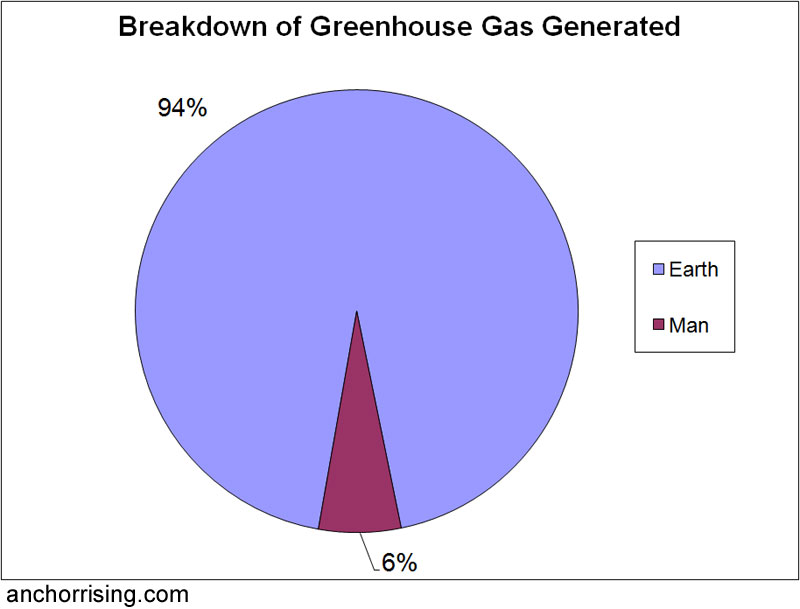
September 18, 2009
The Obama MO?
With the economy at best slowing its wobble (and reason to be wary even about that), the Obama administration has added requirements for "better gas mileage for cars and trucks and the first-ever rules on vehicle greenhouse gas emissions" to its list of desired drags thereon. Note this now-familiar feature:
The proposal will cover vehicle model years 2012 through 2016, allowing auto companies to comply at once with all federal requirements as well as standards pushed by California and about a dozen other states.
Now, I'm sure there are a whole lot of arguments that one could put forward, with respect to time for such things as research and marketing plans, but a growing fist of expensive programs seem slated to swing by during the millennium's teens — after the next presidential election.
I'd also highlight this:
The administration estimated the requirements would cost up to $1,300 per new vehicle by 2016. It would take just three years to pay off that investment, the government estimates, and the standards would save owners more than $3,000 over the life of their vehicle through better gas mileage.
Except for the fact that gas will increase in price as it adjusts for the lower demand...
August 12, 2009

Waxman-Marke: Bad for the Economy
i have a piece in today's ProJo about Waxman-Markey, which will be debated later this year in the Senate. The link is here. This legislation is on a par with Obamacare as an economic nightmare.
July 10, 2009
A Relieving Outcome to a Long-Standing Issue
It's a relief to see the issue of soil contamination in the Bay St. area of Tiverton headed toward resolution:
A settlement of the massive Bay Street area lawsuit has been agreed to and the contaminated neighborhood is expected to be cleaned up by the end of this year, the state Department of Environmental Management (DEM) announced today.The settlement was "executed" May 18, said Gail Mastratti, a spokesperson for DEM. In addition to the DEM, the pact includes Southern Union, the Town of Tiverton, and the estimated 125 plaintiffs in the lawsuit who are residents living on about 74 contaminated properties in the 50-acre Bay Street neighborhood in north Tiverton. ...
It wouldn't be a stretch to suggest that a change in the law that gives the state Department of Environmental Management (DEM) the power to issue fines up to $25,000 per day (from the previous $1,000 per day) as a "pollution penalty" expedited the agreement, and in that we see a dubious method for achieving the happy end. A daily penalty, it seems to me, implies pollution that is ongoing, that an organization or individual refuses to stop. It's possible that I'm missing something, but what the DEM now appears to have is a huge cudgel to dictate who will pay for remediation outside the processes of adjudicative law. It costs the state nothing to implement fines, but it escalates the risk of seeking a legal ruling if a loss means the payment of penalties accrued during the process.
I've long maintained that other strategies for dealing with our less-enlightened past ought to be absorbed into the culture and might, indeed, have resulted in a more rapid resolution in this case. Only time, and the next case down the line, will tell whether a harmful precedent has been set.
July 1, 2009
Fish Ladders
Conservative. Conservation. Fish Ladders.
For years, a consortium of government agencies and advocacy groups has struggled for funding to knock down dams and build fish ladders to help restore local fish migrations. That work was jump-started on Tuesday when the federal government came forward with $3 million in stimulus money for six projects on the Ten Mile and Pawcatuck rivers.I understand the raised eyebrows some fiscal conservatives have. Is this really economic "stimulus"?When the work is done, fish will be able to migrate all the way up the Pawcatuck from Watch Hill, in Westerly, to Worden Pond, in South Kingstown.
In East Providence, the 30-year campaign by volunteers to lift spawning herring one bucket at a time over the Omega Dam may finally come to an end. A fish ladder will be built there and at two other locations upstream.
In all, the money will open up 13 miles of rivers and streams and 1,640 acres of spawning habitat, including Worden, the state’s largest freshwater pond.
These projects were chosen partly because they were "shovel ready," and far along in the permitting process. The National Oceanic and Atmospheric Administration points out that this project may create up to 18 jobs. Does that seem right? $3 million in federal stimulus dollars will create up to 18 jobs. That comes out to $166,667 for each temporary job they create. For just a moment, let's put the project aside. Is it really worth while to spend $3 million to create 18 temporary jobs? Will this project have an economic impact that will stimulate the economy and put more people to work long-term? It seems doubtful.Perhaps. But the economic benefits may be realized farther out. A similar project was undertaken in Maine and has helped to reestablish various stocks of fish, including important bait fish and game fish like salmon, stripers and sturgeon. More bait fish and more game fish helps both commercial and recreational fishing entities here in the Ocean State. That seems like an economic plus to me. Additionally, the dam removal in Maine inspired other economic improvements. For example:
Augusta's Capital Riverfront Improvement District (CRID) is using the removal of the Edwards Dam as the keystone of its efforts to revitalize Augusta's downtown core. The District's legislative purpose is to “protect the scenic character of the Kennebec River corridor while providing continued public access and an opportunity for community and economic development ..." With funding and leadership from the August CRID, the Kennebec River waterfront is being cleaned and beautified, underutilized buildings are being renovated and converted into housing and commercial space, and the Edwards Mill Park is now on its way to completion.Economic development isn't always a straight line: conservatives should know that the law of unintended consequences can be both positive as well as negative. And there are political advantages to be found by supporting sound conservation policies:
I have argued the merits of promoting conservation as a conservative cause, including the construction of "fish ladders." I cringe when I hear Eric Cantor and other GOP leaders railing against this and a handful of other conservation projects as "wasteful" government spending. Not only are the hook'n bullet crowd one of the largest voting constituencies in the hinterlands, they spend billions of dollars every year on hunting and fishing and helping to support local communities. This is a wise investment not only for the fish but for the voting and recreating public.Conservatives shouldn't let their legitimate criticisms of the social ideology we know as "environmentalism" cloud their thinking when considering conservation policies. The latter is entirely consistent with a conservative philosophy, after all.
June 29, 2009
Evening Music Video: We're Going Green!
Any song with the line "and estimated environmental impact is not really calculable" would be worth a listen, but I've been humming this one all day:
(via the Corner)
June 27, 2009
Rhode Island, Always Striving to Make Life That Much More Difficult
So, with legislation to make energy more expensive for all Americans making its way through Congress, what can one say about this?
Governor Carcieri on Friday signed into law legislation that could pave the way for offshore wind farms in Rhode Island.The bill, passed by both chambers of the General Assembly earlier this month, allows electrical utility National Grid to enter into long-term contracts to purchase "green" energy. For Deepwater Wind, the company proposing more than 100 wind turbines off the Rhode Island coast, the law means having a guaranteed buyer for its energy, a crucial selling point to investors. The legislation will also benefit other clean-power proposals, including a plan to build a solar farm in Coventry.
The first thing on which to remark is Journal Staff Writer Alex Kuffner's peculiar choice of the word "allows" to characterize the bill's relevance to the energy company. Here's how the General Assembly press release about the legislation puts it (emphasis added):
The House and the Senate each took final votes today approving legislation sponsored by House Majority Leader Gordon D. Fox and Senate Corporations Committee Chairman Joshua Miller to require the state's largest electric utility to enter into long-term contracts to purchase power from renewable energy producers in Rhode Island.
Under the eye of the state Public Utilities Commission (PUC), National Grid (and any other energy distribution companies that may be lured into the Rhode Island market) will have to enter into contracts with "new," "green," "renewable," whatever energy producers with a duration of at least 10 years. Then, if we turn to the statutory language itself (PDF) we find explicitly what we all should expect implicitly:
The electric distribution company shall file tariffs with the commission fo commission review and approval that net the cost of payments made to projects under the long term contracts against the proceeds obtained from the sale of energy, capacity, RECs or other attributes. The difference shall be credited or charged to all distribution customers through a uniform fully reconciling annual factor in distribution rates, subject to review and approval of the commission. The reconciliation shall be designed so that customers are credited with any net savings resulting from the long-term contracts and the electric distribution company recovers all costs incurred under such contracts, as well as, recovery of the financial remuneration and incentives specified in section 39-26.1-4.
In short, National Grid must enter into decade-long contracts for the purchase of energy at prices consistent not with the energy market in general, but with "newly developed renewable energy resources," however much more it may cost than regular ol' energy resources. It then sells the energy at market rate and tacks the "newly developed" premium on the bills of customers across the board. Oh, and the law permits the company to add another 2.75% premium to the cost of the fancy new energy as "incentive."
Let's follow the money, shall we? You, energy consumer, will pay more for your usage so that the distributor can, without loss (indeed, with explicit profit), subsidize politically preferred energy sources in order to guarantee sales of an energy product whose risk investors are not otherwise willing to accept. Your money, in other words, is serving to secure investment earnings for others. Those investments, in turn, will flow to land owners, materials suppliers, and workforces. To some degree, the prices of all of those things will be inflated; to the extent that unions are involved, another layer of money-takers slips into the mix; and to the extent that materials, land-owners, and workers reside elsewhere, the money will flow out of the state.
To those parties, the law represents a net benefit, but that requires a net cost to a much larger field of people. That field of people is contained geographically within the borders of Rhode Island, because National Grid has no reason to spread the "renewable" deficit more broadly across its own operations. Moreover, the state is contained geographically within the borders of a nation with a government hell-bent on piling on its own premiums.
June 26, 2009
BREAKING: Dark Days Getting Darker
Well, it isn't law yet, I suppose, but when legislative supporters of a government change as well as the Associated Press admit substantial cost to an initiative, it certainly gives pause:
In a triumph for President Barack Obama, the Democratic-controlled House narrowly passed sweeping legislation Friday that calls for the nation's first limits on pollution linked to global warming and aims to usher in a new era of cleaner, yet more costly energy.
Americans are going to feel the effects of their action with the last election, and they aren't going to like it. Bitter pills and broken eggs are key ingredients in the hope and change omelet.
About those Extra and Missing Frog Limbs....
Remember how concerned we all were about frog limbs? Answers!:
In the late 1980s and early 1990s, researchers started getting reports of numerous wild frogs or toads being found with extra legs or arms, or with limbs that were partly formed or missing completely.Somehow, the voices of the latter group were much more prevalent in the media than the former. (Surprise!). Well, the mystery of the missing legs was resolved a few years ago (what, you didn't know?). Just like we all thought, it was we humans who were to blame.....!:The cause of these deformities soon became a hotly contested issue.
Some researchers believed they might be caused naturally, by predators or parasites.
Others thought that was highly unlikely, fearing that chemical pollution, or UV-B radiation caused by the thinning of the ozone layer, was triggering the deformations.
"Deformed frogs became one of the most contentious environmental issues of all time, with the parasite researchers on one side, and the 'chemical company' as I call them, on the other," says Stanley Sessions, an amphibian specialist and professor of biology at Hartwick College, in Oneonta, New York.
"There was a veritable media firestorm, with millions of dollars of grant money at stake."
Sessions and other researchers established that many amphibians with extra limbs were actually infected by small parasitic flatworms called Riberoria trematodes.Er...oh. OK, but what about all of those poor three-limbed frogs. Surely we did it to 'em!These creatures burrow into the hindquarters of tadpoles where they physically rearrange the limb bud cells and thereby interfere with limb development.
The mystery of what causes frogs to have missing or deformed limbs remained unsolved until Sessions teamed up with colleague Brandon Ballengee of the University of Plymouth, UK....While surveying, Ballengee also discovered a range of natural predators he suspected could be to blame, including stickleback fish, newts, diving beetles, water scorpions and predatory dragonfly nymphs.Hm. So bugs eat frogs. Payback is a b$%#&! I wonder if there are other environmental claims out there that could use some further research?So Ballengee and Sessions decide to test how each predator preyed upon the tadpoles, by placing them together in fish tanks in the lab.
None did, except three species of dragonfly nymph.
Crucially though, the nymphs rarely ate the tadpoles whole. More often than not, they would grab the tadpole and chew at a hind limb, often removing it altogether.
"Once they grab the tadpole, they use their front legs to turn it around, searching for the tender bits, in this case the hind limb buds, which they then snip off with their mandibles," says Sessions.
The Cap and Trade Scam
OK, what's this "cap and trade" thing all about? Well, first its a bid to massively change some fundamentals of our economy all for the sake of reducing global warming (by a few tenths of a degree Celsius in a few decades). Although the powerless House GOP has offered arguments against its passage, Democratic leaders have had more problems with their own rank-and-file (especially blue dog and farm-state Dems) and have been forced to make deals in hopes of pushing the Waxman-Markey bill through today (though no one will have a chance to read it--kinda sounds like RI).
The reason for the resistance is simple: no matter how you slice it, American's are going to pay more for everything for the sake of "feeling better" about "doing our part" to help reduce global warming. Or something. Its a redistributive tax increase, plain and simple, and it affects that 95% of the people President Obama claims to want to leave alone.
The Congressional Budget Office review of the bill explains the basics:
H.R. 2454 would establish two cap-and-trade programs, one for six GHGsThe CBO also determined that:
(mostly CO2) {GHG= "green house gas"--ed.} and one for a seventh GHG, hydrofluorocarbons (HFCs). The first program, the focus of this analysis, is generally referred to as the GHG cap-and-trade program. H.R. 2454 would set limits on GHG emissions for each year. Regulated entities could comply with the policy in some combination of three ways:■ By reducing their emissions,
■ By holding an allowance for each ton of GHGs that they emitted, or
■ By acquiring an “offset credit” for their emissions.Offset credits would be generated by firms that were not covered by the cap but that reduced their emissions or took actions to store emissions in trees and soil, using methods that would be approved by the Environmental Protection Agency. The bill would allow firms to use a significant quantity of offset credits—generated in the United States and overseas, with a maximum quantity for each specified in the legislation—toward compliance with the cap. Most of those offset credits would be generated by changes in agricultural and forestry practices. To the extent that acquiring offset credits was cheaper than undertaking more emission reductions, allowing firms to comply with offset credits would lower compliance costs overall.
Congressional Budget Office (CBO) estimates that the net annual economywide cost of the cap-and-trade program in 2020 would be $22 billion—or about $175 per household. That figure includes the cost of restructuring the production and use of energy and of payments made to foreign entities under the program, but it does not include the economic benefits and other benefits of the reduction in GHG emissions and the associated slowing of climate change. CBO could not determine the incidence of certain pieces (including both costs and benefits) that represent, on net, about 8 percent of the total. For the remaining portion of the net cost, households in the lowest income quintile would see an average net benefit of about $40 in 2020, while households in the highest income quintile would see a net cost of $245. Added costs for households in the second lowest quintile would be about $40 that year; in the middle quintile, about $235; and in the fourth quintile, about $340. Overall net costs would average 0.2 percent of households’ after-tax income.However, the Wall Street Journal explains the CBO was too narrow in its projections:
For starters, the CBO estimate is a one-year snapshot of taxes that will extend to infinity. Under a cap-and-trade system, government sets a cap on the total amount of carbon that can be emitted nationally; companies then buy or sell permits to emit CO2. The cap gets cranked down over time to reduce total carbon emissions....Kind of a big caveat, there. The WSJ also mentions the analysis of Waxman-Markey conducted by the Heritage Foundation, and summarizes the findings:The biggest doozy in the CBO analysis was its extraordinary decision to look only at the day-to-day costs of operating a trading program, rather than the wider consequences energy restriction would have on the economy. The CBO acknowledges this in a footnote: "The resource cost does not indicate the potential decrease in gross domestic product (GDP) that could result from the cap."
Under this more comprehensive scenario, [Heritage] found Waxman-Markey would cost the economy $161 billion in 2020, which is $1,870 for a family of four. As the bill's restrictions kick in, that number rises to $6,800 for a family of four by 2035.But, at least we'll have less global warming. Maybe. In truth, as the WSJ explained back in March:
Cap and trade, in other words, is a scheme to redistribute income and wealth -- but in a very curious way. It takes from the working class and gives to the affluent; takes from Miami, Ohio, and gives to Miami, Florida; and takes from an industrial America that is already struggling and gives to rich Silicon Valley and Wall Street "green tech" investors who know how to leverage the political class.Taking from blue-collars and giving to Bobos, how "progressive."
June 18, 2009
House Bill to Eliminate Coastal Resources Management Council, Replace with Department
Save the Bay's Jonathan Stone recently wrote:
For years, vacancies have undermined the CRMC’s capacity and effectiveness. Now, the council’s lack of compliance with the separation-of-powers amendment continues to leave its decisions open to legal challenge. The Supreme Court confirmed that CRMC members must be appointed by the governor with the advice and consent of the Senate. Only three current members, and indirectly the director of the state Department of Environmental Management, meet this standard. Save the Bay believes that the CRMC is taking a calculated risk in continuing to meet and make important decisions on this basis.Thus inspired, it would appear that the General Assembly (the House specifically: PDF) is adjusting to not having so many seats on the Coastal Resources Management Council by...replacing it. Goodbye CMRC, Hello Department of Coastal Resources Management.It is critical for the General Assembly to put a sound structure in place and for the governor to revitalize the council by submitting the strongest possible appointees. Now that the advisory opinion requested by the House has resolved the major questions regarding the status of CRMC, we have the opportunity to move ahead with legislation and appointments. It is high time for the Assembly and the governor to bring the council back to full strength with an infusion of well-qualified and public-spirited members.
46-23-2.3. Department of coastal resources management established -- Transfer of functions. – (a) There is hereby established within the executive branch of the state government a department of coastal resources management. The head of the department shall be the director of coastal resources management, who shall be in the unclassified service and who shall be appointed by the governor, with the advice and consent of the senate, and shall serve at the pleasure of the governor. Provided, this section shall not be construed to abrogate any contract in effect on the effective date of this act. (b) Upon the effective date of this act, the coastal resources management council shall be abolished, and all functions, powers, duties, liabilities and obligations of the council conferred thereon pursuant to the provisions of this chapter shall be transferred to and administered by the department of coastal resources management.All of those employed by the CRMC will be transitioned into the new department. The only political appointee will be the new Director: the rest of the CRMC will be replaced by and advisory committee made up of experts, not politicians (ahem). I don't think it's much of a stretch to read this as the General Assembly telling the Governor that if they can't stack the CMRC then they're going to take it away so that he can't stack it either--even if the State Supreme Court said it's his to stack! So they're restructuring it out from under him and defining who will be on the advisory council:
There shall be established a coastal resources advisory committee which committee, appointed by the director of the department of coastal resources management, shall include, but not be limited to, representation from the following groups: one of whom shall be a representative of the University of Rhode Island Graduate School of Oceanography and the College of Resources Development, one of whom shall be a representative of the Sea Grant National College Program, one of whom shall be a representative of the army corps of engineers, one of whom shall be a representative of the federal environmenta l protection agency's Narragansett Bay laboratory, one of whom shall be a representative of the department of coastal resources management, one of whom shall be the director of the department of environmental management; one of whom shall be a member of the Rhode Island Marine Trade Association and one of whom shall be a representative of a regional environmental group. The department of coastal resources management shall have the authority to appoint such additional members to said advisory committee as is deemed necessary or advisable by the advisory committee or the department of coastal resources management. It shall be the responsibility of the committee to advise the department of coastal resources management on environmental issues relating to dredging and permitting related thereto...Objectively, this does look like an improvement over the old way that was vulnerable to patronage and general hackery. However, it is notable that the General Assembly never saw fit to create such a department filled with non-political appointees until they were forced out of the loop. One would almost think they were having a bit of a tantrum.
May 26, 2009
The Environment Enables the Camel's Nose in the Tent
Casual attendees at local government meetings might on occasion be stunned by the utter lack of discomfort among officials about using children to advance environmentalist principles. As with much else, the English are blazing the path to the next step down:
Children as young as seven are being recruited by councils to act as 'citizen snoopers', the Daily Mail can reveal.The 'environment volunteers' will report on litter louts, noisy neighbours - and even families putting their rubbish out on the wrong day.
There are currently almost 9,000 people signed up to the schemes. More are likely to be recruited in the coming months.
Controversially, some councils are running 'junior' schemes which are recruiting children. ...
Luton Borough Council's Street Seen scheme encourages its 650 volunteers to report 'environmental concerns'. It is also recruiting 'Junior Street Champions', aged between seven and 11.
Primary schools could also be involved within two years.
It's one thing to train interested citizens to take relevant notes about such crimes as prostitution and drug deals, but leveraging public schools to enlist the help of children is a dangerous innovation. We've already seen decades of child-focused propaganda on environmental issues, and that's certainly had an effect on the habits of American families. Recruiting the kids to snitch on hold-outs should inflame such concerns as are mildly evoked by the phrase "government schools."
May 6, 2009
National Geographic Rains on the Global Warming Parade
... though snows would be the more accurate verb. Ha! (Additional silly jokes supplied upon request.)
The sun is the least active it's been in decades and the dimmest in a hundred years. The lull is causing some scientists to recall the Little Ice Age, an unusual cold spell in Europe and North America, which lasted from about 1300 to 1850.The coldest period of the Little Ice Age, between 1645 and 1715, has been linked to a deep dip in solar storms known as the Maunder Minimum.
During that time, access to Greenland was largely cut off by ice, and canals in Holland routinely froze solid. Glaciers in the Alps engulfed whole villages, and sea ice increased so much that no open water flowed around Iceland in the year 1695.
Of course, N.G. solicits the other side of the argument. (Would that more publishers of global warming articles did so.) To start with, an AGW devote accuses skeptics of infringing on the specialty of AGW advocates.
"[Global warming] skeptics tend to leap forward," said Mike Lockwood, a solar terrestrial physicist at the University of Southampton in the U.K.
Hey, no problem. We'll stop looking forward if you do.
Lockwood then goes on, remarkably, to make the case that the measly 6% of greenhouse gases generated by man (the other 94% being supplied by Mother Nature) has a greater influence on Earth's climate than the Sun.
I think you have to bear in mind that the CO2 is a good 50 to 60 percent higher than normal, whereas the decline in solar output is a few hundredths of one percent down. ... I think that helps keep it in perspective.
Perspective? Try this for perspective. The sun sends 29.4 Megajoules of radiation to every square meter of the Earth's surface every day. (No, I have no idea what a Megajoule equates to. It just sounds impressive because it has the word "mega" in it.) Now, how many Megajoules does man's CO2 equate to? Again, I have no idea. But it isn't in the realm of what the sun sends us.
Still not convinced? I don't blame you, after that bit of incomplete science. Let's compare the impact of man's carbon versus the impact of the sun another way. If man altogether ceased generating carbon, what would the effect be on our climate? on the planet overall? Well, we know the answer to that. Or at least, AGW advocates claim to know. They say it is man's carbon that has warmed the Earth one one hundredth of a degree a year for the last 120 years. This is the global warming part of the theory of anthropogenic global warming. So, using this measure, the worst thing that would happen if man stopped generating carbon is that the planet would be one one hundredth of a degree cooler every year.
Now, what would happen to our climate - to the Earth - if the sun altogether ceased burning?
Thank you, Your Honor. No further questions.
May 3, 2009
Repackaging Global Warming (Surprisingly, Not "Climate Change" This Time)
And speaking of fibbing, someone's fingers slipped when entering recipient e-mail addresses and a draft memo outlining a ... rebranding campaign for global warming got wider distribution than intended. From Friday's New York Times; h/t Drudge.
The problem with global warming, some environmentalists believe, is “global warming.”The term turns people off, fostering images of shaggy-haired liberals, economic sacrifice and complex scientific disputes, according to extensive polling and focus group sessions conducted by ecoAmerica, a nonprofit environmental marketing and messaging firm in Washington.
Instead of grim warnings about global warming, the firm advises, talk about “our deteriorating atmosphere.” Drop discussions of carbon dioxide and bring up “moving away from the dirty fuels of the past.” Don’t confuse people with cap and trade; use terms like “cap and cash back” or “pollution reduction refund.”
EcoAmerica has been conducting research for the last several years to find new ways to frame environmental issues and so build public support for climate change legislation and other initiatives. A summary of the group’s latest findings and recommendations was accidentally sent by e-mail to a number of news organizations by someone who sat in this week on a briefing intended for government officials and environmental leaders.
"Cap and cash back". Can we get a time frame on the second part of that phrase?
Other suggestions from the prematurely released memo.
“... remember to speak in TALKING POINTS aspirational language about shared American ideals, like freedom, prosperity, independence and self-sufficiency while avoiding jargon and details about policy, science, economics or technology,” said the e-mail account of the group’s study.Mr. Perkowitz and allies in the environmental movement have been briefing officials in Congress and the administration in the hope of using the findings to change the terms of the debate now under way in Washington.
"Change the terms of the debate" now that we've figured out that cap-and-trade alone will cost every U.S. household $3,100. (We're still waiting for the other wallet ... er, shoe to drop on all of the "green energy" and "green jobs" promised by the administration.) What we haven't figured out is how placing $366b in the hands of a public body not exactly renown for its fiscal restraint or dependability - i.e., Congress - would stop global warming, even if man is responsible for the phenomenon.
Why is all of this couching and reshaping necessary? Isn't it clear to everyone that "the planet has a fever" and that cap-and-trade legislation is "the moral significance equivalent to that of the civil rights legislation of the 1960s"?
Environmental issues consistently rate near the bottom of public worry, according to many public opinion polls. A Pew Research Center poll released in January found global warming last among 20 voter concerns; it trailed issues like addressing moral decline and decreasing the influence of lobbyists.Even behind moral decline? Yikes. Certainly, then, in their effort to raise consciences, advocates are justified in resorting to
April 23, 2009
Naysaying Man-Driven Global Warming on Earth Day
Monique explained why she believes trying to affect global warming by changing mankind's behavior is pointless and disruptive on the Matt Allen show last night. Stream by clicking here, or download it.
April 22, 2009
Global Warming vs Climate Change: Clarifying Terms on Earth Day
Over the course of the last couple of years, environmental advocates have slyly substituted the term "climate change" for "global warming".
Climate change is quite a different phenomenon than global warming. How can this redefinition of terms be anything other than a tacit acknowledgement that AGW is no longer a viable theory? The theory of anthropogenic global warming had purported to be both scientific and quite specific as to effect. Al Gore so testified - "the planet has a fever" - before the Senate as recently as two years ago; the Daily Show with Jon Stewart "covered" his testimony below, starting at minute 1:10, ending at minute 3:00.
But if the very people who have posited the theory no longer acknowledge the effect, clearly, there is no need to search for a hypothesized cause; in this case, the actions of man in generating too much greenhouse gas. Global warming has turned into the all-encompassing climate change, a phenomenon simultaneously easy and impossible to prove. No danger is posed and, accordingly, no action by man is required.
| The Daily Show With Jon Stewart | M - Th 11p / 10c | |||
| Welcome Back, Hotter | ||||
| ||||
The Energy and Healthcare Issues Come Together
Throw in environmentalism, too, because William Tucker's thoughts on windmilled energy bring some possibilities to mind:
The major limitation, of course, is wind's intermittency -- its lack of "dispatchability." Quite simply, you can never count on it. You can't even predict it from hour to hour with 100 percent accuracy and the windiest sites can go calm for days. On a national electrical grid, where supply and demand must be kept within 5 percent or each other in order to maintain voltage balances, this becomes very disruptive. ...The utilities' generating capacity, as McCracken points out, generally falls into two categories -- base load and peaking. Base load runs day-and-night, week after week, to meet the underlying demand. It is almost universally provided by coal plants, which run for weeks at a time before shutting down for maintenance, and nuclear reactors, which can go almost two years between refueling. Peak loads, on the other hand, are generally met with natural gas turbines, which do not boil water and can be started and stopped almost instantaneously.
Unfortunately, as McCracken notes, wind falls into neithercategory. "As wind provides neither baseload nor peaking plant it has no impact on reserve capacity," he writes. ...
In other words, thanks to government mandates and subsidies, wind will be there to throw power onto the market any time the wind blows. This will not replace base load plants but will only drive down prices, cutting into their revenues. Nonetheless, base-load nuclear plants will have to remain in operation, both because they will be needed as back-ups in case the wind doesn't blow or -- in the case of nuclear -- because it doesn't make sense to keep stopping and starting a plant that runs best for two years at a time.
For some reason, this problem joined, for me, with Senator Sheldon Whitehouse's suggestion on Newsmakers that one of the healthcare issues that government must address is obesity. If government takes ultimate responsibility for the healthcare of its citizens, it will gain some right to regulate individual health. What if we put overweight Americans to work generating energy?
Perhaps when the wind dies down, human treadmills could be hooked up to the generator to keep it going. Or, for an even more cartoonish suggestion, perhaps those in need of exercise could turn the wind propellers themselves by dangling off the edge.
April 19, 2009
AGW: 6% - The Single Most Inconvenient Data Point (Part II of II)
Ah, yes, "the need for action". Certain scientists have called for a 60% reduction in manmade greenhouse gases. (A few advocates call this target inadequate.) Let us set aside for a moment the lack of any feasible alternate energy source and focus on the matter of effectiveness. Sixty percent of six percent is three point six (3.6%) percent. Those scientist, then, are asserting that if total greenhouse gases are reduced by 3.6%, global warming will be considerably slowed and possibly stopped. This seems questionable at best. What is their scientific proof?
We turn now to the scientific heart of AGW. It is computer models. And they are the dirty little secret of Al Gore's theory. Because they are flawed. Even the IPCC so acknowledges.
> They are based on a certain amount of temperature data that is unreliable, having been collected inconsistently or achieved with a "fudge factor".
> Not all of the computer models agree.
> All failed to "predict" current or historic conditions.
> All mishandle in some way the effect of clouds, "... the largest source of discrepancy among climate models"
> All fail to include the effect of aerosols (fine particles) in the atmosphere.
In the absence of a clean, economically equivalent alternate energy source, a source that is not even on the horizon never mind the drawing board, the proposed reduction of 3.6% of total greenhouse gases - 60% of the greenhouse gases which man generates - could only be achieved at a staggering cost, financial and lifestyle, to man. Yet looking at those flawed computer models, there is no conclusive evidence that such drastic measures would even work!
This is a good point at which to issue two disclaimers.
1.) No one denies that up until 1998, the planet was warming. Skeptics only question the extent of the role of man.
2.) Personally, I have no love of fossil fuels. Yes, compared to past energy sources - the burning of wood and peat, the use of animals - it is far more potent and clean, especially the way the United States, with its myriad of enviro regs, utilizes them. Nevertheless, they are not 100% clean. Accordingly, the day a clean, adequate energy source that costs the same as bitumen by-products is discovered, I'll be standing right there with a champagne glass.
Al Gore has notoriously urged AGW advocates to resort to "over-representation" when making their case. AGW skeptics are happy to stick to the facts, especially as one in particular provides remarkable perspective on both the extent of man's role in global warming and the very high price he would have to pay if his actions, indeed, are the tipping point for the phenomenon.
AGW: 6% - The Single Most Inconvenient Data Point (Part I of II)
The EPA has reached a proposed finding that
greenhouse gases threaten public health and welfare because they contribute to climate change.
[Information on public hearings and how to submit written comment on this finding is here.]
Stated more succinctly, the EPA has fallen for the erroneous theory of anthropogenic global warming, which posits that man a.) causes global warming and b.) can stop global warming with only a reasonable expenditure of money and a quite modest sacrifice of lifestyle.
If the potential consequences of this ruling were not so drastic, their error would be understandable, if not excusable. After all, an international panel as well as many scientists and commentators have been saying over the course of several years with admirably energetic repetition, if not sufficient research or thought, that a.) man causes global warming and b.) man can stop global warming.
The hitch is that in their eagerness to confirm Al Gore's theory, these scientists and commentators have rushed past the single most important data point: the percentage of greenhouse gases that man contributes to the planet. It is six percent. Six (6%) Percent. Earth generates the other ninety four (94%) percent.
This is a simple yet crucial fact. Think about it. Think of the staggering amount of activity around the planet powered by coal, gasoline, diesel, natural gas. Factories, cars, heating, cooling, electricity. The millions of tons of goods and foodstuffs moved by ship, train, eighteen wheeler.
Yet it adds up to only 6% of greenhouse gases generated. Inexplicably, the theory of AGW has been passionately extolled, a US government agency has issued a potentially very expensive and onerous finding and ever more urgent alarms have been sounded about the need for action entirely in a vacuum without the acknowledgement of this most rudimentary of facts. Could it be that recognition of the tiny role that man plays in the generation of greenhouse gases would clarify too starkly the price that he would have to pay, even assuming that his paltry 6% is the tipping point for global warming, were he to "take action"?
April 18, 2009
Picking by the Side of the Road
About a dozen members of Tiverton Citizens for Change are currently picking up litter around the Park and Ride on Fish Rd. in Tiverton, off Rt. 24, although cigarette butt remediation might be a better term for the actual activity.
To correct an impression that I might have left previously, our activity was apparently coordinated, at TCC's initiation, with the townwide effort. As I said: community.
It's surprisingly warm, I might add. It may be time to store away the wool sweater (after a good cleaning, of course).
February 18, 2009
Memories Over Housing in Rocky Point
Even with the market sag, housing is still relatively expensive in Rhode Island, and part of what led to our being hit so hard in the subprime collapse was residents' inability to find suitable housing within their means, and the lack of in-state competition for property owners probably raises the threshold of taxation "price" tolerance in any given community. What to do? How about we devote ever-more-limited public funds to taking land off the RI market in the name of nostalgia and open-space aesthetic:
The state Department of Environmental Management wants to acquire a portion of the former Rocky Point amusement park that had been set aside for private development and preserve it as open space.DEM Director W. Michael Sullivan yesterday successfully asked the State Properties Committee for permission to begin surveying and appraising the roughly 82 acres that developers have been eyeing for luxury housing. Sullivan said he hopes to create an expansive coastal state park by coupling the land with the 41-acre shoreline portion of the old amusement park that was acquired by the city and state last year. ...
"Even though I grew up in Massachusetts, I did have the opportunity to go there," he said. "And like most people, when I stand there, I still can hear the laughter and have an overwhelming sense of times gone by.
"This is a legacy and an opportunity that we should not forgo without giving a final effort," Sullivan said.
February 2, 2009
A Home Overseas?
Conservatives sometimes lament that, unlike liberals, they lack for countries to which to move — or at least to threaten to move — when they lose elections. Judging purely from its president's attitude, it looks like the Czech Republic might be headed in the right direction:
When it comes to the climate, "there are competing theories. I'm very sorry that some people, like Al Gore, are not ready to listen to the competing theories. I do listen to them."Klaus has published a book called "Blue Planet in Green Shackles: What Is Endangered: Climate or Freedom?" Klaus told us that the answer is freedom — freedom is endangered — adding, "I imagine National Review would understand what I mean." I replied, "Actually, there are differing views about global warming at National Review."
Another journalist present said, "What freedom do you mean? What freedom is endangered?" Klaus pointed to her and said, "Yours, mine, [turning to the World Economic Forum representative] the moderator's. The freedom of publications like National Review."
A different journalist, with high-pitched indignation, said, "Are you saying that Al Gore is threatening freedom?" Klaus answered, "More or less. Environmentalism and the global-warming alarmism are challenging our freedom; Al Gore is an important person in this movement."
January 31, 2009
A Conclusion for All Evidence
The article quotes scientist after scientist declaring that "this means we must act quickly," but it seems to me a forced reaction to the new information:
Many damaging effects of climate change are already basically irreversible, researchers declared Monday, warning that even if carbon emissions can somehow be halted temperatures around the globe will remain high until at least the year 3000."People have imagined that if we stopped emitting carbon dioxide the climate would go back to normal in 100 years, 200 years; that's not true," climate researcher Susan Solomon said in a teleconference.
Solomon, of the National Oceanic and Atmospheric Administration's Earth System Research Laboratory in Boulder, Colo., is lead author of an international team's paper reporting irreversible damage from climate change, being published in Tuesday's edition of Proceedings of the National Academy of Sciences.
She defines "irreversible" as change that would remain for 1,000 years even if humans stopped adding carbon to the atmosphere immediately.
I take that to suggest that climate change (broadly speaking) is a long-term process to which no short-term contributions will have immediate effects. If that conclusion has an effect on policy, it ought to make our steps more measured, because irreversibility is not a threshold, in this case, but a degree. It's not no problem versus perpetual problem; the problem merely grows until it crosses an arbitrary line of really-bad-ness, and wreaking drastic changes to our short-term economy would cause immediate harm to the global community.
It doesn't much matter to a starving family whether the condition persists for 50 years or 1,000.
January 28, 2009
Snow Storm Tools - Especially For Those at Work and on an I-Palm-Thingy
Radar loop.
Traffic cams.
Listen, call, compare notes: WPRO News Talk 630/99.7 FM. ~ AM 920 WHJJ.
Addendum
And over at Not for Nothing, Ian Donnis came to the conclusion while driving to work today that we are a state of wimps. (Possibly I exaggerate slightly.) He also points out that in the spirit of the storm, a restaurant is giving out free bread and milk. Lactose intolerant customers are welcome to substitute vino for the latter.
January 19, 2009
Fanatics in the Cabinet
Jeff Jacoby has some suggested questions for U.S. Senators to ask Obama's nominee for director of the Office of Science and Technology Policy, John Holdren. The last one gives a sense of Jacoby's general concern:
8. You are withering in your contempt for researchers who are unconvinced that human activity is responsible for global warming, or that global warming is an onrushing disaster. You have written that such ideas are "dangerous," that those who hold them "infest" the public discourse, and that paying any attention to their views is "a menace." You contributed to a published assault on Bjorn Lomborg's notable 2001 book "The Skeptical Environmentalist" - an attack the Economist described as "strong on contempt and sneering, but weak on substance." In light of President-elect Obama's insistence that "promoting science" means "protecting free and open inquiry," will you work to soften your hostility toward scholars who disagree with you?
Mr. Holdren, it bears mention, appears to have a long history of erroneous alarmist predictions.
January 17, 2009
Dutch Skaters, World Problems
In the Netherlands, the canals have frozen over for the first time in years and the Dutch are strapping on their skates and having a blast, albeit with a few bumps and bruises. But the politics are never far away, even in what you'd think would be a feel-good story. First, there's the environmental angle:
In the 19th century, when Hans Brinker, the hero of the novel in which he tries to win a pair of silver skates, coasted along Holland's ice, the canals froze almost every year. But water pollution and climate change have made this so rare that today a boy of 15, Brinker's age, may never have seen a frozen canal, or at least remember one. Until, that is, this year.Then there is the cultural and political angle:
"For us, it's in our genes," said Gus Gustafsson, 68, a retired insurance executive, explaining why he and his wife had rushed out to buy new skates and take to the ice under a cloudless blue sky. "It was like a frenzy that came over people, including lots of kids, like my granddaughter, who is 5." With thousands of others, they skated northeast toward the cheese capital, Gouda, then toward Utrecht.To be sure, a couple interesting asides. In particular, the second provides Americans a little glimpse into the mindset of an average European. But I'm just glad the Dutch were able to skate.With an influx of immigrants, the country has been struggling to maintain what it considers its Dutch soul, and Gustafsson was one of many here who thought the skating experience enabled the Dutch to reconnect with their identity. "There were only Dutch people on the ice," he said. "I saw no people of Arab descent."
But Andre Bonthuis, who has been mayor in this town of 23,000 people for the past 20 years, said he had seen Indonesians and Moroccans, among other newcomers to the Netherlands, on the ice. "It's rather new for people from Morocco," he said. But he agreed that there was something very Dutch about canal skating, which is depicted in paintings by Dutch masters as early as the 17th century.
January 6, 2009
Symptoms Ignored in Treatment of a Questionable Cause
Be sure to read Bjorn Lomborg's op-ed suggesting that excessive and misdirected fervor over climate change is likely to harm many people in the present in order to help a few in the future. The following are a few points that I found particularly interesting:
... implementing the Kyoto Protocol at a cost of $180 billion annually would keep only two million people from going hungry by the end of the century. Yet by spending just $10 billion annually on direct food aid, the United Nations estimates that we could help 229 million hungry people now. For every amount spent on climate policies to save one person from hunger in a hundred years, the same amount could save 5,000 people now. ...Sea levels are rising, but they have been rising at least since the early 1800s. In the era of satellite measurements, the rise has not accelerated (actually we've seen a sea-level fall over the past two years). The U.N. expects about a 30-centimeter sea-level rise over this century — about what we saw over the past 150 years.
In that period, many coastlines increased, most obviously in Holland, because rich countries can easily protect and even expand their territory. But even for oft-cited Bangladesh, scientists just this year showed that the country grows by 20 square kilometers each year, because river sedimentation wins out over rising sea levels. ...
... famine has rapidly declined over the past half-century. The main deviation has been the past two years of record-high food prices, caused not by climate change but by the policies designed to combat it: the dash for ethanol, which put food into cars and thus upward pressure on food prices. The World Bank estimates that this policy has driven at least 30 million more people into hunger. To cite policy-driven famine as an argument for more of the same policy seems unreasonable, to say the least.
And while your mind is contemplating such matters, see Harold Ambler's detailed exploration of some of the the falsehoods and misleading presentation of the usual "climate change" argument.
December 31, 2008
Ireland's Unconventional Minister of the Environment
Unlike many of his counterparts around the world, put Minister Sammy Wilson squarely in the category of AGW sceptic. Drudge links to this article in today's Belfast Telegraph. [Check out all the global warming alarmist articles linked on that page, by the way.]
Spending billions on trying to reduce carbon emissions is one giant con that is depriving third world countries of vital funds to tackle famine, HIV and other diseases, Sammy Wilson said.* * *
"I think in 20 years' time we will look back at this whole climate change debate and ask ourselves how on earth were we ever conned into spending the billions of pounds which are going into this without any kind of rigorous examination of the background, the science, the implications of it all. Because there is now a degree of hysteria about it, fairly unformed hysteria I've got to say as well."
Exactly right, Minister Wilson! When Al Gore took up the cause of AGW, science was summarily shown the door.
A quick google led me to Minister Wilson's webpage, where can be found, naturally, all of the minister's Press Statements, inclusive of this little seasonal gem, excerpted below.
... what would Christmases be like if we had to live as the green fanatics would like us to?First of all, we probably would not have lights on our Christmas Trees, as they use energy which is frowned upon. And because the Greens are against artificial Christmas Trees you will only be able to get one if you manage to push your way past the tree huggers and cut it down yourself.
Not that this would matter anyway as there would be no presents to go under the tree. The Green Party has supported the Buy Nothing Christmas Campaign which advocates not buying anything for Christmas. If we all had to indulge in this there would no doubt be further redundancies and job losses as the Christmas trade keeps many companies afloat.
However we wouldn't have as much money to spend on Christmas: the massive cuts in carbon that the green lobby wants would result in our fuel bills rising by up to 40% so we wouldn't have as much cash in the kitty anyway.
If Christmas Day with no presents wasn't bad enough it gets worse when it comes to Christmas Dinner. The climate change extremists have said that we must stop eating meat as flatulent cows are the cause of so much carbon emissions. So far they haven't passed judgement on the turkeys but either way we would be eating less meat. This will of course mean more hardship for farmers, if they have not already been put out of business by the cost of rising fuel bills and more expensive feed for their livestock.
December 26, 2008
Diagnosis Hypecolodria
It certainly behooves humanity to follow the trends and assess the contributors to changes in the global environment, but increasingly, there seems to be an environmentalist version of hypochondria at play:
In one of the report's most worrisome findings, the agency estimates that in light of recent ice sheet melting, global sea level rise could be as much as four feet by 2100. The IPCC had projected a sea level rise of no more than 1.5 feet by that time, but satellite data over the past two years show the world's major ice sheets are melting much more rapidly than previously thought. The Antarctic and Greenland ice sheets are now losing an average of 48 cubic miles of ice a year, equivalent to twice the amount of ice that exists in the Alps. ...Scientists also looked at the prospect of prolonged drought over the next 100 years. They said it is impossible to determine yet whether human activity is responsible for the drought the Southwestern United States has experienced over the past decade, but every indication suggests the region will become consistently drier in the next several decades. Richard Seager, a senior research scientist at Columbia University's Lamont-Doherty Earth Observatory, said that nearly all of the 24 computer models the group surveyed project the same climatic conditions for the North American Southwest, which includes Mexico.
Throughout history, mankind has watched weather patterns change in regions around the world, but they used to talk about "dry spells" or "warm spells" (or their opposites). Now everything is plugged into incomplete models (the more honest of whose keepers acknowledge that prognosticating to a date as far out as 2100 represents mere speculation), and we're all instructed to panic and make dramatic changes to our ways of life.
Our planet is organic, and it is in the nature of organisms to change. As with our own bodies, we do well to be aware of signs and symptoms, but too much fear of illnesses can be a self-fulfilling prophecy.
Letting Truth Stand on the Environment
James Lewis worries that the incoming administration will sign the United States on with what he characterizes as a sort of eco-Inquisition, in the continued politicization of science:
The world's Green politicians are gathering in Poznan, Poland, to split the loot through a new Kyoto II Treaty. They blame the failure of the last Kyoto Accords on the United States, and now that America has seen the light by electing Obama, by golly, they are going to collect but good. Sugar plum fairies? How about power and riches through a worldwide carbon trading scheme? How about a centralized international planning bureaucracy for all the smokestack industries in the world (except in China and India, which have wisely exempted themselves). How about selling Papal indulgences to make all the dirty sinners living off coal and cars and cow meat beg for forgiveness for their transgressions against Mother Gaia?From a political viewpoint it's better not to have any evidence on global warming. If we had facts, we might find out that warming, if it existed, might actually go away. It's not much good to tax a sin that can be absolved. Much better to tax that pervasive feeling of guilt directly. Leave it to the popular media to spread free-floating guilt, and to the political experts in the new administration, who know in their very bones, like Danny the Red, that "You can believe what you want, I don't believe, I know that global warming is a reality."
Bow down, ye sinners. The time has come for you to pay through the nose.
December 17, 2008
Seeping Illness in Tiverton
The tentative deal between Southern Union and residents of Tiverton concerning contaminated soil has fallen through. It's a travesty that those who live in the Bay Street area should spend so long in limbo, as the article puts it, but this is particularly disconcerting:
In the end, Southern Union could not strike a deal with the town. The town's lawyer, Andrew Teitz, told Torres in October that Tiverton could not agree to hold Southern Union harmless as long as the utility continued to seek money from the town, claiming the town was at fault for allowing the contamination.Teitz said that the pipes, which were put down with a life expectancy of 80 to 100 years, already are starting to fail.
The Town Council is worried that the fire district's customers, about 1,500 to 2,000 town residents living north of Route 24, may have to shoulder an estimated $2-million liability for replacing the water lines, Teitz said.
And he said that some settlement discussions between the plaintiffs and Southern Union raise the possibility that a future DEM director may hold the town liable for millions of dollars in costs for cleaning up toxic soil under public roads.
It sounds to me as if Southern Union might have been spooked by the prospect of financial responsibility for the replacement of a substantial amount of utility and road infrastructure. As unsettling as the idea may be of requiring just a section of the town (the poorer section) to cover a multimillion-dollar construction project, the knowledge of contaminated soil surrounding failing pipes — serving residents who are forbidden to sell their properties — is worse.
Somebody better start compromising soon, particularly considering that nobody currently engaged in the game of chicken appears likely to face health repercussions from its continuation.
December 2, 2008
Green Jobs to Put Us in the Red
Russ Harding is skeptical of the persistent claims about "green jobs" being an economic stimulus:
Economic prosperity requires that we have access to both reliable and affordable energy to heat our homes and power our factories and vehicles. A steep run up in energy costs coincided with an economic recession in the 1970s and is once again a contributing factor to our current economic problems. Alternative energy mandates supposedly will serve as an economic stimulus by creating new jobs such as building wind mills and solar panels.Claims similar to those being made by Phil Angelides of the Apollo Alliance that the development of clean energy will provide concomitant "growth in jobs, technology, equipment, suppliers and productivity if the United States actually treated the development of clean energy as a national economic priority" conveniently ignore economic realities. Mandating more expensive forms of alternative energy takes money out of the pocket of consumers and drives up business costs, resulting in the loss of jobs. An additional test for the viability of green job economic benefit claims is whether these projects require government subsides or not. If the answer is yes, the end economic results are more likely negative rather than positive.
I've no problem with environmentally friendly sources of energy and would much rather live around windmills than coal plants. The thing that concerns me is that expending public money and public effort seeding the industry is essentially a gamble, and the potential risk outweighs the probable costs.
December 1, 2008
The Scars of Top Marks
Yeah, I get that the top-of-page story on today's Rhode Island section is more of a departing profile than report on the state's conservation efforts — even if the title is "Federal conservationist gives Rhode Island Top Marks" — but a word about the costs of some of what Roylene Rides at the Door applauds in Rhode Island would have been justified:
Now, as she prepares to move on to another post, as conservationist in Washington state, Rides at the Door, 39, says she has been pleasantly surprised by Rhode Island and its people. She says Rhode Island is a national leader in land conservation and in supporting local farming.She was amazed to see 450 people at a Save the Bay meeting. Back in Montana, she said, an environmental group would be lucky to attract 30 people.
Last summer at the dedication of a new fish ladder at the Rising Sun Mill in Providence, which her federal agency helped pay for, more than 100 people, including much of the state's congressional delegation, were in attendance. She says she has not seen such political and popular support for conservation in many other states.
A few weeks ago, in the face of staggering state deficits and a recession, Rhode Islanders voted overwhelmingly for a $2.5-million bond issue to preserve open space and farms.
"It's a bad economic year, with high unemployment, yet everyone is willing to tax themselves for conservation. I think Rhode Island could teach a lot of other places how to do it," said Rides at the Door.
Religious fanatic that I am, I treasure the many reminders of God's creation that one may find throughout Rhode Island (including, incidentally, as it is expressed in human history). On Saturday, we took our children for the annual trip down Main Street into the country to cut down our Christmas tree, and the contrast of the rows of trees to the temporarily forested parking lots of my Northern New Jersey childhood is clear.
That said, the fact that they approved the bond issue that Rides at the Door lauds is proof enough that Rhode Islanders need to hear about the costs of going too far. The state is suffocating, and we're breaking out the public credit card to charge some open space. The government structure is strangling the private sector, and we're making it even harder to lower the taxes that are driving out thousands of productive citizens every year.
Young adults are having to look elsewhere for homes, if they wish to fly from the nest at an appropriate age, because the scarcity of suitable residences has driven prices beyond their reach, even as the market deflates. The young and the working do not want "affordable housing," they want housing that's affordable, and if Rhode Island's efforts against sprawl push them (their productivity, and their tax and retail dollars) out of state, that's where they'll go.
Conservation is an important goal, but it doesn't so outweigh human suffering that we should allow ourselves to forget the latter when patting ourselves on the back for the former.
November 17, 2008
Hot Off the Press and Fully Cooked
Back in my proofreader days, I happened to catch a major error simply because the graphs didn't make sense. According to the document handed to me that day, the United Arab Emirates ranked much more highly than the United States in various measures of freedom. As it turned out, a row had been transposed on the spreadsheet, rearranging the scores of every nation studied, and we kicked the document back to start.
The point is that these things are bound to happen (especially as companies increasingly decide to forgo professional editors), but it would be nice if they were promoted as highly in error as in statement:
So what explained the anomaly? GISS's computerised temperature maps seemed to show readings across a large part of Russia had been up to 10 degrees higher than normal. But when expert readers of the two leading warming-sceptic blogs, Watts Up With That and Climate Audit, began detailed analysis of the GISS data they made an astonishing discovery. The reason for the freak figures was that scores of temperature records from Russia and elsewhere were not based on October readings at all. Figures from the previous month had simply been carried over and repeated two months running.
October 20, 2008
Carrots Down the Rabbit Hole
The range of protected groups continues to, umm, grow:
For years, Swiss scientists have blithely created genetically modified rice, corn and apples. But did they ever stop to consider just how humiliating such experiments may be to plants?That's a question they must now ask. Last spring, this small Alpine nation began mandating that geneticists conduct their research without trampling on a plant's dignity. ...
Many scientists interpret the dignity rule as applying mainly to field trials like Dr. Keller's, but some worry it may one day apply to lab studies as well. Another gripe: While Switzerland's stern laws defend lab animals and now plants from genetic tweaking, similar protections haven't been granted to snails and drosophila flies, which are commonly used in genetic experiments.
It also begs an obvious, if unrelated question: For a carrot, is there a more mortifying fate than being peeled, chopped and dropped into boiling water? ...
Seeking clarity, Dr. Poirier recently invited the head of the Swiss ethics panel to his university. In their public discussion, Dr. Poirier said the new rules are flawed because decades of traditional plant breeding had led to widely available sterile fruit, such as seedless grapes. Things took a surreal turn when it was disclosed that some panel members believe plants have feelings, Dr. Poirier says.
Frankly, the highest purpose in a vegetable's life must be to be eaten, although I can't say but that those called upon to serve mankind in the world of science, rather than be served to mankind at the dinner table, find their own callings meaningful, as well.
August 4, 2008
Captain Cook's Books Show Climate Change
British maritime historians are discovering that the information held in ye olde ships' log can help shed light on the "climate change" of the past.
Captain Cook and Lord Nelson seem unlikely figureheads in the fight against climate change alarmists.The two British sea heroes have been dead for more than 200 years.
But their ships’ logs, and thousands more like them, have revealed that recent global warming is not so unusual after all....Maritime historian Dr Sam Willis says: “Ships’ officers recorded air pressure, wind strength, air and sea temperatures and other weather conditions...From these records, scientists can build a detailed picture of past weather and climate.”
The findings are startling. They show we went through a similar period of global warming in the 1730s that could NOT have been man-made.
And freak storms like the ones experienced recently also occurred in the 1680s and 1690s.
They were the coldest decades in what is known as the Little Ice Age — so could not have been caused by global warming.
Many doom mongers have pointed to freakish patterns in modern hurricanes as more “evidence” of the effects of man’s environmental damage.
Hurricanes that form in the eastern Atlantic normally track westwards.
So weathermen were shocked in 2005 when Hurricane Vince headed north east and hit Spain and Portugal.
But we now know exactly the same thing happened with a hurricane in 1842, thanks to logs left by our seafaring ancestors....
Geographer Dr Dennis Wheeler, of Sunderland University, said: “British archives contain more than 100,000 Royal Navy logbooks from around 1670 to 1850 alone. They are a stunning resource...Global warming is a reality, but our data show climate science is complex. It is wrong to take particular events and link them to carbon dioxide emissions...These records will give us a much clearer picture of what is really happening.”
ADDENDUM: Apparently NOAA has now decided that the "Medieval Warm Period" actually did exist, according to medievalist blogger Richard Noke's, who observes this is
a big change from back when they were disparaging reliance on contemporary accounts and archeology, darkly hinting that the Medieval Warm Period had some kind of political agenda behind it.They didn't have much choice, as Noke's points out, for how else to explain how "this viking dock must have been constructed under the ice."
July 11, 2008
A Small Correction, Mr. President (or maybe not)
From the Telegraph (UK); h/t Mark Steyn filling in for Rush Limbaugh.
Departing the G-8 Summit yesterday, President George Bush
who has been condemned throughout his presidency for failing to tackle climate change, ended a private meeting with the words: "Goodbye from the world's biggest polluter."He then punched the air while grinning widely, as the rest of those present including Gordon Brown and Nicolas Sarkozy looked on in shock.
Of course, China surpassed the United States in the category of carbon dioxide emissions a year ago.
In a way, though, the president is not wrong. With all aspects of anthropogenic global warming, the facts are secondary to perception and feelings. "It feels like the US is the worst polluter." "It looks like we are causing global warming." "It feels like we can stop global warming (if we are even causing it)." "It feels like we can cut 50% of our greenhouse gas emissions by 2050 (even though the magical fuel source has not been identified and more countries are well down the road of fossil fuel consuming development)."
All of this despite the current scientific status of the supposed scientific theory of AGW; i.e., flat lined. Every component proven wrong and all alleged unprecedented facts - oops - with historic precedents. No one wants to call the M.E. and make it official, though, which, in the world of facts and real science, has rendered AGW a joke.
President Bush's jocularity on the subject and apparent mistake in naming us the world's worst polluter, then, is very much in keeping with the spirit and current state of affairs of AGW.
June 30, 2008

Population Bomb? Or Population Dud?
Want to keep abreast of the important subjects of the day and prepare yourself for the leading topics that the mainstream media will soon be discussing? Then remember to listen to the Anchor Rising spot on the Matt Allen show on WPRO radio (630 AM) Wednesdays, around 6:50 pm; a few weeks ago, Matt and I discussed the problems with conventional, elitist Malthusian wisdom about population growth. This Sunday, the New York Times Magazine picked up on the same topic in a long article by Russell Shorto (h/t Instapundit)...
Population Bomb? Or Population Dud?
Want to keep abreast of the important subjects of the day and prepare yourself for the leading topics that the mainstream media will soon be discussing? Then remember to listen to the Anchor Rising spot on the Matt Allen show on WPRO radio (630 AM) Wednesdays, around 6:50 pm; a few weeks ago, Matt and I discussed the problems with conventional, elitist Malthusian wisdom about population growth. This Sunday, the New York Times Magazine picked up on the same topic in a long article by Russell Shorto (h/t Instapundit)...
June 16, 2008
Environmental Mania Claims Jobs
Something has seemed forced — in a "just a bit too perfect" way — about the promise of "green jobs" as some sort of savior of our economy. Ben Lieberman suggests that, even if such jobs do proliferate, they don't match up with the number of jobs lost to the larger ecological zeitgeist:
According to a study conducted by the Heritage Foundation, the bill would cost half a million manufacturing jobs by 2018, 1 million by 2022, and more than 2 million by 2027. Of course, most of these displaced workers will eventually find something else to do, but often at lower wages.Some proponents claim that new "green collar" jobs would make up the difference. For example, there will be more work at solar-panel manufacturers and other industries helped by the bill. But these jobs will be swamped by the number of those lost. The Heritage figures are net of any manufacturing jobs gained, and also exclude blue-collar jobs likely to be lost for reasons unrelated to the global-warming bill. ...
To add insult to injury, as many households struggle with layoffs and shifts to lower-paying jobs, they also will have to endure higher prices for electricity, natural gas and gasoline thanks to this bill — a costly double whammy.
All for the promise of an ultimately minor benefit to the environment, if any. As some of us have been unable to avoid noticing, however, "green" is more of a religion than a considered reaction. It brooks no dissent and tabulates no costs, but permits the insertion of all manner of prior political preferences.
June 6, 2008
Ignoring a Force of Market
Here's a statement that I've read multiple times with reference to "alternative energy", specifically the bills to provide incentive to National Grid to buy it that have just passed the RI House:
Matt Auten of the advocacy group Environment Rhode Island denied that renewable energy would drive up electricity costs, describing the bill instead as a "prudent response to skyrocketing prices for electricity [and natural gas] because it will lock in a fixed price not tied to polluting fossil fuels for a portion of Rhode Island’s electric needs."
What am I missing in the provision of "alternative energy" that makes it free from market forces? As far as I can tell — letting legislators mandate what they will — the price of any energy will ultimately be "tied" to non-alternative energy prices, among other things. (One can foresee future conversations about the lack of wind in a given year.)
And that doesn't take into consideration the side effects of solidifying National Grid as a state monopoly through mandates and regulations.
May 26, 2008
A Developing Theme on the Environment
I was going to note that Colin Flaherty shows that there's at least some truth to every paranoia:
I am an ecophobe: I imagine environmentalists creating catastrophes all the time all over the world. I see great floods, famine, disease and death, and behind each is the same thing: a grinning environmentalist reveling in the mayhem as if it were magic. Before you commit me, hear me out. Then I'll go quietly.
Be the motivation what it will, Flaherty mounts a case that, if not convincing, ought to be cause for some reflection among the greens. Surely there's a balance to be struck (rearing its head even in book reviews concerning foreign nations' growth relative to the U.S.A.), but it seems to often to be the case that comeuppance isn't acknowledged as the foreseeable consequence of prior decisions.
With his inimitable way, Mark Steyn explains a recent example:
"It shall be illegal and a violation of this Act," declared the House of Representatives, "to limit the production or distribution of oil, natural gas, or any other petroleum product... or to otherwise take any action in restraint of trade for oil, natural gas, or any petroleum product when such action, combination, or collective action has a direct, substantial, and reasonably foreseeable effect on the market, supply, price, or distribution of oil, natural gas, or other petroleum product in the United States."Er, okay. But, before we start suing distant sheikhs in exotic lands for violating the NOPEC act, why don't we start by suing Congress? After all, who "limits the production or distribution of oil" right here in the United States by declaring that there'll be no drilling in the Gulf of Florida or the Arctic National Mosquito Refuge? As Congresswoman Wasserman Schultz herself told Neil Cavuto on Fox News, "We can't drill our way out of this problem."
Well, maybe not. But maybe we could drill our way back to three-and-a-quarter per gallon. More to the point, if the House of Representatives has now declared it "illegal" for the government of Saudi Arabia to restrict oil production, why is it still legal for the Government of the United States to restrict oil production? In fact, the government of the United States restricts pretty much every form of energy production other than the bizarre fetish du jour of federally mandated ethanol production.
Of course, as Flaherty reminds us:
Warning: Misguided faith in the ability of markets to produce food and energy is just one of the early signs of ecophobia. So is using the term "market."
May 17, 2008
Newsflash: Human Heaviosity & Inertia Contribute to Global Warming
So say two unknown medical types in the Lancet magazine.
By way of reference, this is the same magazine which published the discredited claim of 600,000 civilian deaths in Iraq - a number which proved to be four times too high. The Lancet requires a subscription or registration or something (sorry, no patience for a "science" magazine that seems to award contributing authors extra points for creativity) so this excerpt is courtesy of TierneyLab, a New York Times blog:
Compared with the normal weight population, the obese population consumes 18% more food energy. Additionally, more transportation fuel energy will be used to transport the increased mass of the obese population, which will increase even further if, as is likely, the overweight people in response to their increased body mass choose to walk less and drive more.Urban transport policies that promote walking and cycling would reduce food prices by reducing the global demand for oil, and promotion of a normal distribution of B.M.I. [Body Mass Index] would reduce the global demand for, and thus the price of, food. Decreased car use would reduce greenhouse gas emissions and thus the need for biofuels, and increased physical activity levels, would reduce injury risk and air pollution, improving population health.
If man even is causing global warming by his meager contribution of 6% of total greenhouse gas emissions, the margin represented by higher than average body mass indices is not at or near the top of the list of his impactful activities. Of greater concern is the understandable desire of less developed countries to acquire such "luxuries" as electricity, cars, heat, cooling, wider selection of food, etc, evidenced by China surpassing the United States in 2006 as the biggest producer of carbon dioxide.
While I am a great believer in exercise and doing errands on foot and bicycle as feasible, I am heartily sceptical of 1.) man's role in global warming; 2.) man's ability to reverse his impact, if any, without literally ending civilization as we know it; 3.) the adviseability of reversing global warming at all; and 4.) our obligation to the cute, cuddly polar bear. The propounding of this silly theory in Lancet, therefore, delights me because it vividly encapsulates the larger theory of anthropogenic global warming: it eschews scientific proof while attempting to make man feel guilty for his unproven role in a not unprecedented phenomenon.
April 25, 2008
Making the Bad Worse
Deroy Murdock is unremittingly critical of government subsidization and mandates related to ethanol:
Poor Haitians rioted last week outside Port-au-Prince's presidential palace, forcing Prime Minister Jacques Edouard Alexis's April 12 ouster. Haitians are sick and tired of food prices that are 40 percent higher than last summer's. Some have resorted to eating cookies made of salt, vegetable oil, and dirt. That's right: Dirt cookies.Developing-world denizens are taking it to the streets with growling stomachs. In Bob Marley's words, "A hungry man is an angry man."
Climbing corn prices have ignited Mexican tortilla riots. Enraged citizens in Egypt and Pakistan — potential Muslim powder kegs — have also violently protested premium prices for basic staples. Similar instability has erupted from the Ivory Coast to Indonesia. Resurrecting the defeated "import substitution" model of yore, India and Vietnam are among the nations that lately have prohibited grain exports and imposed government price controls. Kazakhstan, Earth's No. 5 wheat source, just halted wheat exports, hoping to hoard local supplies. One third of the global wheat market is now closed.
High oil prices and growing global food demand fan these flames, but government lit the match. Atop the European Union's biofuels mandate (5.75 percent of gasoline and diesel by 2010; 10 percent expected in 2020), America's 51-cent-per-gallon ethanol tax subsidy (2007 cost: $8 billion) and Congress' 7.5-billion-gallon annual production quota (rising to 36 billion in 2022, including 15 billion from corn) have turned corn farms into cash cows. Diverting one quarter of U.S. corn to motors rather than to mouths has boosted prices 74 percent in a year.
In keeping with Monique's post yesterday, I'd observe that environmentalism has become a mania, and as with other manias in history, it has the potential to cause grave harm to humanity. A food crisis is not a solution to the world's problems... unless one believes that human beings are the problem.
April 24, 2008
Out of the Mud
Although the details are sparse, thus far, I hope the pending settlement of all lawsuits related to the soil pollution down the hill from me brings the matter to a close that protects everybody involved, and helps those whose health has suffered. It's certainly been a tragedy of history's reach into the present.
I continue to think that the effort could have been handled better, and more expediently. Word around town was that the depositions and other suit-related events have been grueling, and I can't believe otherwise than that the goal of a more cooperative human society is harmed more than hurried by the storyline of government as the people's protector against evil corporations (which is to say, other people).
Re: Green Gingrich (& Global Warming Generally)
That Newt Gingrich's participation in the discussion on anthropogenic global warming has taken this form is disappointing. By appearing in an ad with US House Speaker Nancy Pelosi and looking around for solutions (even market based ones), Gingrich has lent his credibility to the erroneous propositions that 1.) man has caused this phenomenon and 2.) man can stop this phenomenon with just a little effort.
1.) It has not been scientifically proven, despite all of Al Gore and James Hansen's protestations, that man is causing global warming. Mann's hockey stick has been broken. The precious computer models are problematic, to say no worse. And the fall-back argument - that temperatures have never risen so quickly in such a short period of time, namely, three quarters of a degree over the course of one hundred and twenty years - is not provable. Not only is this is an absurdly short span of time in Earth's 4b+ year history by which to prove such a potentially impactful hypothesis but temperature charts covering periods prior to one hundred and fifty years ago are based on inferred measurements. It is not possible for such an imprecise gauge to reveal all micro spikes and dips in temperature that have occurred in Earth's history. How can it be definitively stated, therefore, that the micro spike we are experiencing (then again, perhaps we are not) is unprecedented?
2.) Man only generates 6% of the greenhouse gases on the planet. Mother Nature contributes the other 94%.
In the remote event it were true that man was causing global warming with his 6%, the solution would not be to hinkle-pinkle around with carbon trading, carbon taxes (are we to believe that these will not simply be more pointless taxes for ever more pointless pork barrel spending?) and twirly lightbulbs that give you nerve damage if they break. If man is causing global warming, the actions required to reverse it would be draconian. Not only would we have to demand that India, China, Africa and other countries stay in their current state of low development - actually, China would have to go backwards a good twenty years - and discomfort, we in "first world" countries would have to join them in that condition.
Item #2 constitutes perhaps the most scandalous aspect of the theory of AGW. Scientists and advocates who promote the theory of AGW are careful not to mention how small man's contribution to greenhouse gas generation is because the extreme measures that would be required to reverse the hypothesized effect would immediately be thrown into high relief. Nor, even more importantly, can these scientists and advocates say what amount of reduction of man's greenhouse gas generation will either slow or stop global warming (again, if man is responsible). We do know, because man only generates 6% of these gases, that it would have to be a considerable, even drastic, reduction.
Suppose somehow we stop half of all of our activity. We reduce our driving, our manufacturing, our food, our beef, our lights and our HVAC by half. Africa, India, China and other countries stop aspiring to cars, heat, better availability and distribution of food, etc. So. Now man's activity only contributes 3% of greenhouse gases. Will that do the trick? Will global warming be slowed? Stopped? No one can say for sure. We're just supposed to go along with the program, whatever it is, in blind faith, preferably without asking questions and certainly without noticing the traffic jams which AGW advocates get embroiled in.
April 22, 2008
Green Gingrich
Two interesting quotes from a Newt Gingrich chat session yesterday with Slate Magazine on the subject of green conservatism, from his opening statement...
I want to start by saying that I believe we need an entrepreneurial, science and technology oriented approach to the environment, and that most Americans agree with that. If you go to www.americansolutions.com, and pull up the Platform of the American People, you will see that a majority of Democrats, independents, and Republicans all agree that entrepreneurs can do more than bureaucrats to solve environmental challenges.…and from his answer to the question "Didn't a cap-and-trade system work well in reducing sulfur dioxide emissions in the 1990s"...
I think the tragedy has been that conservatives have been unwilling to spend the time and energy to debate the left on which will produce the better outcome.For example, if you are really worried about carbon loading of the atmosphere...if the United States produced the same percentage of our electricity from nuclear power as the French, we would take 2 billion, 200 million tons of carbon out of the atmosphere a year, and that one step would be 15 percent better than the total Kyoto goal for the U.S.
That cap and trade system involved a very small number of players and a very specific product. A carbon cap and trade system would be massively more complex. It would lead to corruption, political favoritism, and would have a huge impact on the economy.I think that tax credits for reducing carbon loading would work faster in a much more decentralized way by rewarding people for doing the right thing.
March 17, 2008
Thomas Wigand: Camouflage Green
As reported in the Providence Journal on March 13: "A coalition of labor unions, environmental advocates and antipoverty groups are collaborating to promote legislation that would help spark new renewable-energy industries in Rhode Island. The group, which calls itself the Green Jobs Alliance, says it has come together to promote a 'green economy' that improves the environment while at the same time creates middle-class jobs."
Neither the advance press release announcing the press conference regarding the rollout of this "Green Jobs Alliance," nor the subsequent Providence Journal story, made mention of the national and international roots and affiliations of this alliance. So it is fair to posit that there was a deliberate attempt to make it appear that this is some sort of homegrown, spontaneous effort within Rhode Island. But as we shall see, this seems unlikely — which in turn begs the question as to why the organizers sought to downplay those affiliations.
The Sierra Club, which was at the Providence news conference, has been engaged in a "partnership" with the United Steelworkers of America called the "Blue-Green Alliance" since 1996. This alliance, on March 13–14 hosted a conference called "Good Jobs, Green Jobs: A National Green Jobs Conference" in Pittsburgh. The speakers list includes representatives from various labor unions and the leadership of the AFL-CIO, which certainly was known to another attendee at the Providence news conference, George Nee of the Rhode Island AFL-CIO [who, with the local Sierra Club, co-authored a commentary piece calling for building wind farms in Rhode Island that appeared in the Providence Journal on February 20th].
The Blue-Green Alliance is sponsoring green jobs initiatives that appear identical to the Rhode Island "wind energy" effort in various of the "rust belt" states (arguably Rhode Island is one of the leading states in the expansion of the "rust belt" to encompass not just the upper Midwest, but the Northeast, as well). While an expansion of wind and solar powered energy generation is probably a good thing, it is fair to presume that the "green jobs" that they propose to create will actually be in the nature of taxpayer financed public works projects rather than incubating new private sector industries. After all, not every state can become a "leader" in a new "green" manufacturing sector, though it appears that this is how it is being marketed in each state.
Organized labor loves public works projects because they are de facto "corporate welfare" for unions. This is done through what are called "prevailing wage laws" and "project labor agreements." What these do is require public works projects (or private projects that get tax breaks) to pay union wages, the effect being that unionized contractors don't have to compete in a true competitive bidding process, so the playing field is shifted in favor of the unions … while the taxpayers are locked in to paying a higher-than-market price for the projects.
It is not a stretch to believe that the unspoken agenda here is to push new taxpayer financed public works projects, albeit labeling them as "good for the environment" and "fostering new industries with good paying jobs." After all, the Providence Place Mall and Route 95 projects are completed, so organized labor is no doubt on the hunt for new projects to fill the void.
Query whether Mr. Nee and the rest of organized labor would be willing, for the good of the environment, "to exempt such" green" projects from "prevailing wage" and "project labor agreements" so that they can be done at lesser cost, and so more of them can be completed. I think we all know the answer.
There is an international angle to this, as well. A group called the International Trade Union Confederation has involved itself with "global warming." This group declares on its Web site that "together with its affiliates, its regional organisations, the Global Union Federations, as well as with non-governmental organisations, the ITUC carries out ongoing campaign action for the universal respect of trade union rights, as guaranteed by the Conventions of the International Labour Organisation (ILO)." The ILO is an affiliate of the United Nations.
The Blue-Green Alliance and the ITUC are advocating for the use of trade agreements and treaties to advance a "green" agenda, including "protections" for "workers rights." To the ITUC and ILO, "workers rights" is a euphemism for the government's actively promoting union organizing and otherwise using its power to subsidize organized labor, such as eliminating workers rights to a secret ballot election by enacting statutory requirements allowing union organizers to collect "voluntary" signatures from workers (e.g., you can just imagine Teamster organizers collect "voluntary" signatures), and once a simple majority of employees have signed, imposing a union on the entire workforce. (Note that a simple majority of signatures would not be allowed to later decertify a union; rather, a secret ballot election would still be required for that.)
In fact, the 2007 ITUC "Annual Survey of Trade Union Rights" criticizes the United States for preserving an employer's rights to demand a federally supervised secret ballot election for employees contemplating unionization and to conduct meetings with employees (on paid time) to explain to workers the employer's position on unionization (otherwise known as First Amendment rights). The AFL-CIO's single biggest legislative goal is to have enacted an Orwellianly named statute called the "Employee Free Choice Act" that would strip workers of secret ballot election protections (at least when bringing unions in).
It is not a stretch to imagine that organized labor simultaneously seeks to bypass the legislative process and advance this special-interest agenda by burying it within trade agreements and treaties marketed to the public as "green." Ironically, the presence of such labor union special-interest terms might discourage emerging countries from entering into such trade agreements and treaties, thus actually inhibiting the "green" initiatives that are supposedly being advanced.
Certainly, advancing a "greener" economy is desirable. And there is nothing wrong with organized labor pushing its agenda, although it is a special interest. But neither is it wrong to recognize that there is much institutional self-interest going on here, and that organized labor's green initiatives are predominately "camouflage green" intended to mask its pursuit of its own self interests under the halo of environmentalism.
March 8, 2008
Cost of Living Seek and Find
There may be a bit of the old chicken and egg between the push for renewable energy and the Rhode Island government's lust for power. Whatever the case, when one sees Senate President Joseph Montalbano's name attached to a legislative initiative claiming to "spur economic development" by "sparking" environmentally friendly energy development, a game of cost-increase seek-and-find is surely available. Most obviously, the culprits are the second and fourth bills in the package:
The second bill resulted from a collaborative effort with environmental advocacy groups, renewable energy developers, and National Grid. The bill would help to promote private financing of large renewable energy projects through a long-term commitment that the energy output would be purchased by National Grid. It would be privately managed, through National Grid, with state oversight by the Public Utilities Commission to ensure ratepayer protection.The program would work as follows: National Grid would issue requests for proposals to purchase electricity for at least five percent of their overall load from large renewable energy projects for terms of 10 to 15 years. Their project selections would have to be approved by the PUC.
Energy developers would build their projects, using private investment, and sell their output to National Grid, which in turn would sell the output on the energy market.
So, in the final analysis, what is going to spur the private investment? The presigned long-term contracts from National Grid to purchase the energy harvested. Intelligent readers will wonder what would lead the energy giant to take these 10–15 year risks; according to the Providence Journal:
National Grid has opposed such a provision in the past because it saw these commitments as risky. If the market price of electricity fell below the cost it agreed to pay a renewable-energy developer, customers might opt to buy power from another supplier. That would leave National Grid stuck with a commitment to buy power but fewer customers to sell it to."There've been instances in the past where we have been burned," said Michael F. Ryan, president of Rhode Island distribution for National Grid.
The bill essentially shifts that risk to ratepayers by allowing National Grid to spread out any extra cost to buy the renewable energy among all its customers through a distribution rate surcharge. Conversely, National Grid would have to credit customers if the market price rises above the renewable-energy contract price.
So the general public, via electric bills, is the guarantor. It's almost like a renewable-energy tax. Of course, that's not the most explicit way in which our tax dollars will be dedicated to this initiative. The legislation's text doesn't appear to be online, yet, but it wouldn't be surprising if the "renewable energy grant funds" that bill number one places under the purview of the Economic Development Corporation are to be dedicated to enhancing (so to speak) the vaunted "private investment."
The fourth bill, meanwhile, seems intended to guarantee to National Grid that at least one sizable market won't go looking elsewhere if the price keeps climbing:
The final bill in the package would require existing state buildings to purchase a percentage of their energy from renewable sources at a rate that directly coincides with the state’s current renewable energy standards. Like the rate of renewable energy required to be produced in the state, the rate at which state buildings would be required to utilize renewable energy would gradually increase to 16 percent by 2019.
Senate Minority Leader Dennis Algiere (R, Westerly-Charlestown) is correct that "our economy and the environment are interrelated," but he stops short of looking to the laws of economics for guidance in managing the two. If it were profitable to create a green energy market, somebody would do it. The government's appropriate methods of expediting that process would be to seek out and eliminate regulatory obstacles and to offer seed money, preferably in the form of tax incentives.
Trying to guarantee a market, on the other hand, is a typically Rhode Islandish way of introducing the opportunity for corruption and further incompetent government meddling.
February 21, 2008
Joint Audacity
As the budget clock ticks, the General Assembly has been taking its precious time figuring out how to resolve the mess. One imagines the legislators hiding in dark corners awaiting a miracle. What they need to be doing, at the very least, is making the sorts of noises that would show their comprehension of the problem — noises soundly rejecting audacious overtures such as that put forward jointly by the Sierra Club's Chris Wilhite and the AFL-CIO's George Nee:
If we are going to re-energize the Ocean State's economy, we must start working today. We re-commend that all new publicly funded projects involving building construction have a requirement for a meaningful percentage of clean energy technology and transit-oriented design as part of the plan. Once the building is operational, this will result in ongoing savings to the taxpayers and an overall reduction in costly energy imports.
I'm all for making Rhode Island a leader in the newest energy technologies, and I'm certainly for investments in our economy, but those investments must not bring with them the taints that have helped to bring Rhode Island to its current state. Requiring all projects to incorporate a new layer of expense will simply drive up costs unnecessarily, with an unnecessary layer, also, of indirectness in the encouragement of the inchoate industry. George Nee lets slip his motivation, and the fatal attribute of the proposal, when he writes:
It would generate many new good union jobs and move us toward energy independence.
If we're looking to race ahead with the future of energy, it makes little sense to charge the unions with the task of building the industry. Better to loosen the government's hand, rather than tighten the union's. If anything, legislation requiring environmentally conscious energy provisions should also exempt such projects from the requirement to go union at all.
I fear that, whatever the merits of forward-looking proposals, Rhode Island will manage to squander its opportunities for the benefit of the four horsemen of its apocalypse.
February 9, 2008
Environmentalists Mugged by Reality
This article would have been noteworthy based simply on pure irony:
The rush to grow biofuel crops -- widely embraced as part of the solution to global warming -- is actually increasing greenhouse gas emissions rather than reducing them, according to two studies published Thursday in the journal Science.One analysis found that clearing forests and grasslands to grow the crops releases vast amounts of carbon into the air -- far more than the carbon spared from the atmosphere by burning biofuels instead of gasoline. ...
Even converting existing farmland from food to biofuel crops increases greenhouse gas emissions as food production is shifted to other parts of the world, resulting in the destruction of more forests and grasslands to make way for farmland, the second study found.
But comments by University of Minnesota economist and ecologist Jason Hill (whose political persuasion I do not know) transform it into an emblematic text:
"We're rushing into biofuels, and we need to be very careful," said Jason Hill, an economist and ecologist at the University of Minnesota who co-authored the study. "It's a little frightening to think that something this well intentioned might be very damaging."
Yes. It's a frightening road between where you want to arrive and how you have to get there.
Four Reasons to Stick to Coursework
Sadly, it seems unlikely that Brown philosophy professor Felicia Nimue Ackerman's attitude is the majority one on American (at least New England) campuses. Here are four reasons that she didn't "devote a portion of class time" on a particular week "to teach about climate change":
Reason 1: Climate change is not what students signed up to study in my courses. ...Reason 2: I am unqualified to teach about climate change. ...
Reason 3: My students can have better opportunities to learn about climate change. ...
Reason 4: I do not think climate change is the most important social problem in the world.
No doubt Ms. Ackerman and most Anchor Rising readers would have strong disagreements about any number of things, but her attitude certainly establishes a shared principle on which to build further discussion.
January 30, 2008
Whitehouse's Actions Commensurate with Danger
RI Senator Sheldon Whitehouse (D, Ocean Drive) has personal experience with the dangers of global warming:
Scientists say the world needs to reduce greenhouse gas emissions by 80 percent by 2050 to avoid the worst consequences of global warming.Repeating the mantra of frustrated environmental advocates across the world, Whitehouse told a supportive audience that President Bush should "lead or get out of the way."
Whitehouse said he has seen the evidence of rising temperatures locally.
The senator said he was alarmed to see the cherry tree at his Providence home bloom in January, and expressed concern over the warming of Narragansett Bay, and how even just one degree can throw the delicate ocean ecosystem off balance, often with dire consequences.
The good Senator is so alarumed that he's going to sell all but one of his properties and split his profits between scientists and all of the people who will experience economic harm from stringent policies aimed at reducing the damage.
Sorry; couldn't keep a straight face. The Senator's actual course of action is to make high-profile speeches and work toward the election of "a president that will lead the nation, and complement the Democratic majority in Congress." No word on whether such a leader would pressure the hoities on Martha's Vineyard to accept the terrible inconvenience of windmills in their views and perhaps even in some areas in which they like to pleasure cruise.
January 1, 2008
Panic! Panic! Pay No Attention to the Scientist Behind the Curtain!
Paul Driessen's op-ed in the first Providence Journal of the year is certainly worth a read. Regarding the U.N. Bali meeting on global warming:
Meanwhile, respected climate scientists were barred from panel discussions, censored, silenced and threatened with physical removal by polizei if they tried to hold a press conference to present peer-reviewed evidence that contradicts climate disaster claims, such as:
- Climate change is natural and recurrent. The human factor is small compared to that of the sun and other natural forces. ...
- The best approach is to adapt, as our ancestors did. ...
Other inconvenient arguments:
Even a 25 to 40 percent reduction over the next 12 years would impose huge sacrifices on families, workers and communities, especially poor ones — while leaving no room for population or economic growth.Fossil fuels provide 85 percent of the energy we use. Slashing emissions by even 25 percent means slashing the use of these fuels, paying vastly more to control and sequester emissions, and radically altering lifestyles and living standards. Families will do so voluntarily, or under mandatory rationing systems, enforced by EPA, courts, climate police and "patriotic" snitches. Getting beyond 25 percent would require a "radical transformation" of life as we know it.
But here's the possibility that glares as the symbolic crux of the debate:
Perhaps newly unemployed workers could find jobs in China and other developing countries, where the tough emission standards won't apply ... China is adding the equivalent of another Germany every year to global greenhouse emissions, says climatologist Roger Pielke.
Whether or not the West's voluntary self-restrictions will ultimately enable global dominance of those oppressive regimes that simply refuse to play by the rules of panic isn't really the point. One gets the impression that the allure of climate-based jeremiadry is that it offers an overarching concern that excuses activists for ignoring all of those complicated considerations that wind up advising the allowance of practices that they dislike, such as consumerism, big business, freedom, and so on.
December 16, 2007
The Pitchman Cares More About the Sale than the Benefit
Speaking of the solutions that politicians dubiously "favor," I note that Rhode Island's blue-blooded, old-money Senator Sheldon Whitehouse would support climate-related legislation even if the "average American household" suffers in both the short and long terms:
Landmark legislation to combat global warming will also be a long-term boon to the U.S. economy, Sen. Sheldon Whitehouse predicted yesterday, but in the short term it will disrupt and cost jobs in some industries.However, "if we do it right," he said of the legislation that passed a key Senate panel yesterday, the average American household budget will not suffer. ...
He had supported a more sweeping plan to reduce emissions of carbon dioxide and the other so-called greenhouse gases thought to cause global warming but supported the more modest bill that passed yesterday. ...
Whitehouse depicted himself as an enthusiastic adherent of the theory that — after some sharp economic dislocations in the near term — the new system of cutting greenhouse-gas emissions will do more than curb global warming. He said it should also force the marketplace to create cleaner energy sources and conservation tools that will be a long-term economic boon. ...
Further, Whitehouse said, "There's no doubt that costs are going to rise" for gasoline and other carbon-based fuels, which is why he and other advocates of a campaign against global warming have also put mechanisms in the bill to cushion the blow on the poor.
But Americans will more than recoup what they lose from the short-term price hike in coal- and petroleum-based fuels, Whitehouse predicted, if the final legislation includes the proper mixture of tax credits for energy conservation, energy subsidies for poor people and other forms of government aid. ...
But Whitehouse would not commit himself to opposing a bill that does not contain the subsidies and other cost-offsetting mechanisms that he favors. He reasoned that the cause of fighting climate change is too important.
Read the whole article. It's edifying to hear the good senator express his confidence that the government can "blunt" the blow to regular families "really from the very beginning" and to realize that even the most wildly unblunted outcome would hardly affect his family. That sort of perspective affects how much weight one gives to points such as Ed Achorn's:
One of the people driving the fundamentalists nuts is Danish author Bjorn Lomborg, notwithstanding that he is a True Believer himself ("Global warming is real and man-made," he writes). Mr. Lomborg, who once headed Denmark's Environmental Assessment Institute, argues in his new book Cool It (Knopf, $21) that alarmism and emotionalism, global treaties and energy rationing are not the best ways to deal with the problem.Mr. Lomborg contends that, rather than strangling economic growth with costly "solutions" that will do little to alter CO2 emissions, the world would be much better off using its wealth to fight AIDS, malaria, malnutrition and poverty, while radically increasing research and development of fossil-fuel alternatives.
He dares to note such politically incorrect facts as that far more people die from cold than from heat; that the number of polar bears (the poster children of the alarmists) is actually growing, and that hunting presents a far greater threat to them than warming; and that the United Nations estimates that sea levels will rise by only about 5 inches by 2050, no more than what we have experienced since 1940 — and a small fraction of the 20 feet that Al Gore projects by the end of the century.
Except inasmuch as he's worried that his waterfront Newport summer-mansion isn't sufficiently high above sea level, Senator Sheldon hasn't much personal investment in the accuracy of the fashionable environmental hysteria du jour. Whitehouse elides much when he argues that the economic impact is akin to "the problem that carriage-makers had when Henry Ford became successful." As energy and fuel prices increase because of regulation, everybody within a certain margin from the economic tide (as opposed to the oceanic tide) must fear the erosion.
If Mr. Whitehouse had more on the line, perhaps he'd be more inclined to seek solutions that might indeed cause only "industry-by-industry problems," such as what Cliff May calls the "alcohol solution":
... in his new book, Energy Victory, Dr. Zubrin does not just complain. He proposes a way to break free of dependence on a resource controlled by those who have declared themselves our mortal enemies. The technology already exists. It’s not expensive. All that is lacking is for voters to make this a priority — and to communicate that to the political class.Right now, 97 percent of the cars on America's roads run on gasoline. Only three percent are Flexible Fuel Vehicles (FFVs) — automobiles that can be powered by either gasoline or alcohol fuels, or any mixture of the two. The additional cost to make a new car an FFV is only about $100 per vehicle
For the sake of individual security, the government mandates that all cars have seat belts. For the sake of national security, Dr. Zubrin proposes, the government should mandate that all new cars be FFVs.
In three years, the change would put 50 million FFVs on the road. The free market would then mobilize to do what it does best: Entrepreneurs would compete to produce alternative, non-petroleum fuels for these potential customers.
According to May, Zubrin's solution would have international political benefits (taking power from America's enemies), environmental benefits (less CO2 and less damage resulting from spills), and economic benefits (the energy source would play to areas of U.S. strength, such as agriculture). Somehow, though, I suspect that the excuse to sacrifice the first and third benefits is part of the attraction for Sheldon Whitehouse's elite pals of the fashionable stances that they take toward the second.
November 1, 2007
Have You Hugged Your Local Tree Today?
I know America is often regarded as an overstressed society, but I hadn't realized just how far the stress problem had spread until I read this story in today's Warwick Beacon by John Howell…
If you feel this has been an especially drab fall, you’re not alone.Warmer and drier than normal conditions have dealt a double whammy to trees and shrubs and robbed them of the bright reds, yellows and oranges considered so much a part of a New England autumn….
What’s happened, explained [Brian Maynard, a professor of horticulture at the University of Rhode Island], is that trees and shrubs are “stressing out” and dropping their leaves while they are still green.
Have You Hugged Your Local Tree Today?
I know America is often regarded as an overstressed society, but I hadn't realized just how far the stress problem had spread until I read this story in today's Warwick Beacon by John Howell…
If you feel this has been an especially drab fall, you’re not alone.Warmer and drier than normal conditions have dealt a double whammy to trees and shrubs and robbed them of the bright reds, yellows and oranges considered so much a part of a New England autumn….
What’s happened, explained [Brian Maynard, a professor of horticulture at the University of Rhode Island], is that trees and shrubs are “stressing out” and dropping their leaves while they are still green.
October 17, 2007
The High Priority of Rising Sea Levels...100 Years from now?
Today's ProJo contained this story about the latest warnings from the enviro-Henny Pennys:
This fall, the state agency that regulates coastal development in Rhode Island plans to become one of the first local regulatory agencies in the country to officially recognize the likelihood of sea-level rise and write policies and regulations to prepare for higher water.The CRMC website contains an explanation, too:The rising waters will require that new buildings in flood zones be constructed at higher elevations, says Grover Fugate, executive director of the Coastal Resources Management Council. He says there should also be changes in the state building code for coastal development and different rules for septic systems. Sewer outfalls and bridges may be affected.
Climate change refers to fluctuations in the Earth’s climate system – a result of natural and manmade causes – and is evidenced largely by rising global temperatures, increasing weather extremes which result in more frequent floods and droughts, and rising sea level. The Intergovernmental Panel on Climate change (IPCC) 2007 report states a potential rise in sea level of 18-59 centimeters by 2100 (depending on the scenario chosen). State experts have agreed that for planning purposes, Rhode Island should expect a minimum rise of 3-5 feet by 2100. The actual sea level rise may be higher than that, however, if greenhouse gases are not reduced far before that time.Set aside that we're talking about yet more onerous regulations and bureaucracy being imposed on the citizens of the state. That's nothing new around here. But now we're gonna spend tax dollars--and force citizens to devote portions of their paychecks to abide by these new regulations--based on what might happen 100 or so years from now. I'm all for scientific research and forecasting, but imposing government regulations based on a 100 year out forecast seems to be kinda low priority right about now.
This is the sort of misplaced prioritization that Bjørn Lomborg writes of in Cool It: The Skeptical Environmentalist’s Guide to Global Warming .
Continue reading "The High Priority of Rising Sea Levels...100 Years from now?"October 16, 2007
A Dark Cloud Down the Hill
Such stories are terrible to hear:
Gail Corvello figured that if she and her neighbors held out for about five years, they would be able to get out from under the nightmare of the soil contamination in the Bay Street neighborhood that has had a stranglehold on their lives since 2002.She was wrong.
On Friday, Corvello will say an emotional goodbye to the last of innumerable children she has nurtured in her home-based child-care center on Bay Street over the last 13 years. ...
Now both Corvello and her daughter, Becky, 23, have auto-immune connective tissue disorder. They suffer from severe joint pain and must take steroids and pain killers. Last spring, illness forced Becky to drop out of graduate school at the University of Rhode Island, where she had been studying molecular biology. ...
They’ve cashed in their retirement savings, losing 30 percent of the net value, and making settlements with creditors. ...
Her husband was working two jobs until he got hurt and was out for 10 weeks, she said.
The family has applied for an Environmentally Compromised Homeowner (ECHO) loan — a program established last year with the Tiverton neighborhood explicitly intended to benefit, and I hope it's sufficient. I still can't help but wonder, though, why concomitant infrastructure wasn't set up for private donations. Why the emphasis on government aid to citizens rather than government's facilitation of citizens' helping each other?
As I've previously suggested, other approaches to the problem would likely have yielded better results.
October 13, 2007
Oslo Calling
The Norwegian Nobel Committee announced yesterday that the Nobel Peace Prize for 2007 would be shared by Al Gore and the UN's Intergovernmental Panel on Climate Change
for their efforts to build up and disseminate greater knowledge about man-made climate change
But the intrinsic assumption of that statement is that the theory of anthropogenic global warming has been proven and that evidence accrued in recent years has only bolstered the conclusion that man is causing global warming. In fact, the reverse has been true.
The attempted re-label - "climate change" - is in itself an admission by proponents of a weakness in the theory. But more substantively, problems have arisen in several components of the "evidence" to support the theory that the greenhouse gases generated by man are causing the planet's temperature to rise.
Let's back up and start with what we know:
> The Earth is warming. Since 1860 when man began putting all those icky fossil fuels into the air, the Earth's average temperature has risen less than one degree centigrade. [Not per year. For that 147 year span.]
> Man has been generating greenhouse gases. Responsibility for the generation of greenhouse gases is apportioned thusly: Mother Nature 94% ~ man 6%.
Now, the theory of AGW is that man, with the 6% of greenhouse gases he contributes, caused that rise in temperature. And AGW computer models predict that man's 6% will cause a further rise of 4 to 7 degrees fahrenheit over the coming century, with the attendant melt of certain ice caps and the well publicized projected rise in sea levels.
"Houston, we have a ..."
... several, actually.
> With the method of data collection; more specifically, the location of temperature sensor stations. Wish I could tell you more about this problem but
the NCDC removed all website access to station site locations, citing "privacy concerns." Without this data (which had been public for years), the validation effort was blocked.
> With the computer models, the scientific crux of AGW. These models do not (because they cannot) factor in the impact, either way, of clouds on the global temperature. Even more scary, they do not "predict" observed conditions.
> With how high we think sea levels will go. Two of the darlings of AGW, Dr. James Hansen and the IPCC, disagree.
In short, it is clear that the case against man as the cause of global warming is seriously flawed. Further, the above list of flaws, by no means comprehensive, also demonstrates that a non-scientist can easily ascertain the existence of such weaknesses.
The Nobel Committee, then, could have done a modicum of their own research on AGW as a function of weighing the worthiness of all nominees. They did not do so. The result is not only damage to their own credibility but the further promotion of a far from proven theory for which draconian solutions are being proposed and even legislatively considered.
August 9, 2007
Roland Benjamin: “A very sound case can be made that the proponents of recycling as an environmental cause are being manipulated by quasi-public and private interests looking to monopolize the entire process in the state.”
Roland Benjamin, South Kingstown resident and member of the town GOP Committee, has thought in great detail about his town council's move towards restricting citizens who want to pay someone to pick up their trash to a choice of one company. All of Rhode Island should take note, because as Mr. Benjamin explains, the issues are as much statewide as they are local...
Roland Benjamin: Living in South Kingstown, and being fundamentally conservative, the trash hauling issue strikes a chord with me. In a letter to the South County Independent editor I wrote a few months back, I discussed what the inevitable regression of enabling and encouraging a monopoly would be. The central landfill monopoly is at the core of the “problem” here, yet the solution offered merely layers another monopolistic bureaucracy on top of the already dysfunctional one.
The publicly stated issue here is that the landfill is running out of space and the only solution will be to increase diversion (recycling) rates. Towns that do not comply with diversion targets will face higher per ton rates for its residents. On the one hand, there is a sense of embarrassment that a town as “progressive” as SK has the third lowest recycle rate in the state. Ironically, 4 of the 5 worst communities have no Republican representation on their respective Town Councils, while the 3 of the top 5 communities are balanced, non-partisan and/or Republican controlled.
But forget that for a moment and consider an alternative motive driving the “need” to recycle. In the central landfill’s annual report, it’s not hard to miss the margins on recycling. The cost to operate the recycling center is about $3.9 million as referenced in section 8-2-3 of the Solid Waste Management Report from 2006. With revenues of $7.5 million from recycling in 2005, the operating margin for recycled waste management is 48% compared to 7% for traditional waste. The RIRRC is simply doing what any business would do by trying to expand its more profitable product line. The downside to citizens is that the surplus generated from recycled material processing gets transferred to the state. In 2005 and 2006, that transfer was a combined $11+ million. We’re talking about a tax here that gets buried in the quasi-public world of waste management. So SK is faced with a choice: a) pay higher rates for regular waste (thus balancing operating margins at the landfill and enabling higher transfers to the State coffers), or b) send more recyclable waste to the landfill and allow greater transfers to the State coffers.
The Town of SK has decided that option (b) is optimal because, in their opinion, no one wants to pay tipping fees at double the current rate. But the societal cost of that choice will mean putting several independent haulers out of work and greatly limiting the service provided to and choices of the taxpayer. So what are the real consequences of choosing option (a) then? Reports state that tonnage rates will increase by approximately $30/ton if SK does not meet diversion targets. The average SK individual generates 0.425 tons per year of non-diverted waste according to this study, on page 5 of attachment 1. Essentially, this means the town is going through all of this effort to save the typical resident $12.50 per YEAR!!! Yet the cost (regardless of funding source) to contract the study and to administer the single franchise Request for Proposal will at least partially offset the $12.50 per resident savings in tipping fees. And if lawsuits arise from disabling companies to do business in town, regardless of the merits of the cases, legal fees will further devalue any savings to the residents. It may be cheaper for us to simply pay the higher rates to the landfill!!!
This is all occurring while technologies to manage Municipal Solid Waste are developing and shrinking. The central landfill is currently evaluating these technologies that can convert waste to electricity through gasification and other technologies. Additionally, the town could take advantage of the advancements in the shrinking footprints, throughputs, and costs of these technologies, but the easiest route is simply to charge more. With NO competitive price pressures (and with the power of the legislation) they will just increase the price to the taxpayer.
This issue is only about recycling on its surface. Prevailing wisdom is that recycling is absolutely needed to address the shrinking resource of land in Johnston. A very sound case can be made, however, that the proponents of recycling as an environmental cause are being manipulated by quasi-public and private interests looking to monopolize the entire process in the state. The taxpayer of SK has nothing to gain going down the path of single franchise and would cede control of the waste management to a small handful of bureaucrats and some of the largest pseudo-monopolies in the world with no price controls on the horizon and no incentive for innovation.
Roland Benjamin: “A very sound case can be made that the proponents of recycling as an environmental cause are being manipulated by quasi-public and private interests looking to monopolize the entire process in the state.”
Roland Benjamin, South Kingstown resident and member of the town GOP Committee, has thought in great detail about his town council's move towards restricting citizens who want to pay someone to pick up their trash to a choice of one company. All of Rhode Island should take note, because as Mr. Benjamin explains, the issues are as much statewide as they are local...
Roland Benjamin: Living in South Kingstown, and being fundamentally conservative, the trash hauling issue strikes a chord with me. In a letter to the South County Independent editor I wrote a few months back, I discussed what the inevitable regression of enabling and encouraging a monopoly would be. The central landfill monopoly is at the core of the “problem” here, yet the solution offered merely layers another monopolistic bureaucracy on top of the already dysfunctional one.
The publicly stated issue here is that the landfill is running out of space and the only solution will be to increase diversion (recycling) rates. Towns that do not comply with diversion targets will face higher per ton rates for its residents. On the one hand, there is a sense of embarrassment that a town as “progressive” as SK has the third lowest recycle rate in the state. Ironically, 4 of the 5 worst communities have no Republican representation on their respective Town Councils, while the 3 of the top 5 communities are balanced, non-partisan and/or Republican controlled.
But forget that for a moment and consider an alternative motive driving the “need” to recycle. In the central landfill’s annual report, it’s not hard to miss the margins on recycling. The cost to operate the recycling center is about $3.9 million as referenced in section 8-2-3 of the Solid Waste Management Report from 2006. With revenues of $7.5 million from recycling in 2005, the operating margin for recycled waste management is 48% compared to 7% for traditional waste. The RIRRC is simply doing what any business would do by trying to expand its more profitable product line. The downside to citizens is that the surplus generated from recycled material processing gets transferred to the state. In 2005 and 2006, that transfer was a combined $11+ million. We’re talking about a tax here that gets buried in the quasi-public world of waste management. So SK is faced with a choice: a) pay higher rates for regular waste (thus balancing operating margins at the landfill and enabling higher transfers to the State coffers), or b) send more recyclable waste to the landfill and allow greater transfers to the State coffers.
The Town of SK has decided that option (b) is optimal because, in their opinion, no one wants to pay tipping fees at double the current rate. But the societal cost of that choice will mean putting several independent haulers out of work and greatly limiting the service provided to and choices of the taxpayer. So what are the real consequences of choosing option (a) then? Reports state that tonnage rates will increase by approximately $30/ton if SK does not meet diversion targets. The average SK individual generates 0.425 tons per year of non-diverted waste according to this study, on page 5 of attachment 1. Essentially, this means the town is going through all of this effort to save the typical resident $12.50 per YEAR!!! Yet the cost (regardless of funding source) to contract the study and to administer the single franchise Request for Proposal will at least partially offset the $12.50 per resident savings in tipping fees. And if lawsuits arise from disabling companies to do business in town, regardless of the merits of the cases, legal fees will further devalue any savings to the residents. It may be cheaper for us to simply pay the higher rates to the landfill!!!
This is all occurring while technologies to manage Municipal Solid Waste are developing and shrinking. The central landfill is currently evaluating these technologies that can convert waste to electricity through gasification and other technologies. Additionally, the town could take advantage of the advancements in the shrinking footprints, throughputs, and costs of these technologies, but the easiest route is simply to charge more. With NO competitive price pressures (and with the power of the legislation) they will just increase the price to the taxpayer.
This issue is only about recycling on its surface. Prevailing wisdom is that recycling is absolutely needed to address the shrinking resource of land in Johnston. A very sound case can be made, however, that the proponents of recycling as an environmental cause are being manipulated by quasi-public and private interests looking to monopolize the entire process in the state. The taxpayer of SK has nothing to gain going down the path of single franchise and would cede control of the waste management to a small handful of bureaucrats and some of the largest pseudo-monopolies in the world with no price controls on the horizon and no incentive for innovation.
Daily Show "Reports" on Cape Wind Opposition
Yeah, Jon Stewart has honed his knives at the expense of many a conservative...but here he takes a stab at some liberal hypocrites.
Via Watthead.
April 26, 2007
The Carbon Offset "Smokescreen"
According to a report in the Financial Times:
Companies and individuals rushing to go green have been spending millions on “carbon credit” projects that yield few if any environmental benefits...Aw, so what? If it makes you feel better...The FT investigation found:
■ Widespread instances of people and organisations buying worthless credits that do not yield any reductions in carbon emissions.
■ Industrial companies profiting from doing very little – or from gaining carbon credits on the basis of efficiency gains from which they have already benefited substantially.
■ Brokers providing services of questionable or no value.
■ A shortage of verification, making it difficult for buyers to assess the true value of carbon credits.
■ Companies and individuals being charged over the odds for the private purchase of European Union carbon permits that have plummeted in value because they do not result in emissions cuts.
April 24, 2007
They’re Baaack…
Not going quietly into the night or, more importantly, into tomorrow’s proceeding where the URI Student Senate will vote on revoking their recognition, Ryan Bilodeau and the University of Rhode Island College Republicans have chosen today to celebrate “the first annual Global Cooling Day”…
The University of Rhode Island College Republicans, a student group currently in the middle of a national controversy after offering a satirical White Heterosexual American Male Scholarship, continues to inject humor into what has become a campus environment hostile to conservatives today as they attempt to freeze out cataclysmic environmental scare tactics by handing out facts about global warming and popsicles to cool everyone down during the day in the Memorial Union and tonight as they show "The Global Warming Swindle" documentary at 7 PM in Memorial Union Room #360.The University of Rhode Island College Republicans contest that although the release of carbon dioxide contributes to the warming of the planet, the impact of man-made emissions is only a minor fraction of this.
Chairman Ryan Bilodeau chimed in by saying, "There is no doubt that the earth is warming. There is doubt, however, as to its causes and as to which actions should be taken to counter it, if needed to at all. The United States Senate sent a clear message in 1997 during Al Gore's term as Vice President in a 95-0 vote that we will not enter into a Kyoto Treaty which exempts 80% of the world and whose success for reducing CO2 emissions is negligible at best."
The first annual Global Cooling Day will occur today from 11 AM - 1 PM at the Memorial Union Booth #4 when the group hands out the facts about global warming and cools down by handing out free popsicles and tonight as the group watches "The Global Warming Swindle" Documentary at 7 PM in room 360 of the Memorial Union.
March 17, 2007
Al Gore, Working in A Zinc Mine and Going Down Down
Al Gore = fish in barrel (via Glenn Reynolds):
Al Gore Jr. received more than $500,000 in royalties from the owners of zinc mines who held mineral leases on his farm near Carthage, Tenn. Now the mines have a new owner and are scheduled to reopen later this year.Stay tuned.Before the mines closed in 2003, they emitted thousands of pounds of toxic substances and several times, the water discharged from the mines into nearby rivers had levels of toxins above what was legal.
State environmental officials say the mine has had a good environmental record and there is no evidence of unusual health problems in the area.
But the mine's reopening again raises concerns about threats to the environment.
Find out more about how Gore became connected to mining, what's happened at the mines through the years and what the former vice president is asking the new owners to do in the Sunday Tennessean and at www.tennessean.com.
Hey, wait a sec...are there such things as Zinc offsets?
UPDATE:Here's the link to the Sunday piece. Big headline, but--after press inquiries--VP Gore dashed off a letter:
Last week, Gore sent a letter asking the company to work with Earthworks, a national environmental group, to make sure the operation doesn’t damage the environment.And further down:“We would like for you to engage with us in a process to ensure that the mine becomes a global example of environmental best practices,” Gore wrote.
Victor Wyprysky, the company’s president and chief executive officer, did not respond to requests for comment on the letter.
The letter was sent the week after The Tennessean’s Washington bureau posed questions to the former vice president about his involvement with the mine.
In its last year of full operation in 2002, the Gordonsville-Cumberland mines ranked 22nd among all metal mining operations in the U.S., with about 4.1 million pounds of toxic releases. The top releasing mine, Red Dog Mine in Alaska, emitted about 482 million pounds that year. In 2002, Smith County ranked 39th out of more than 3,000 U.S. counties for lead compound releases and 21st for cadmium releases, according to tallies by Scorecard, a Web site run by environmentalists that compiles federal data.There are some who see hypocrisy:Even Gore noted in his letter that, according to Scorecard, “pollution releases from the mine in 2002 placed it among the ‘dirtiest/worst facilities’ in the U.S.”
[N]ow that the mine is reopening and Gore’s status as an environmentalist has grown, some of Gore’s neighbors see a conflict between the mining and his moral call for environmental activism.And some who don't:“Mining is not exactly synonymous with being green, is it?” said John Mullins, who lives in nearby Cookeville. A conservative, Mullins welcomes the resumption of mining for the benefits it will bring the community. But he says Gore’s view that global warming is a certainty is arrogant and that by being connected to mining, Gore is not “walking the walk.”
Earthworks president and chief executive Stephen D’Esposito said Gore’s involvement with mining doesn’t bother him “in any way, shape or form.”But here's the problem for Al Gore, as explained by Glenn Reynolds:
“We are going to have mining. The question is doing it in the right place and the right way,” said D’Esposito, who has not studied the Carthage mines.
That said, it's not clear that Gore himself has done anything wrong, though he's clearly made money from a project that's pretty environmentally unfriendly. But this will add to the perception that Gore's green talk is hypocritical, I suspect. As I've noted below, if you adopt a quasi-messianic posture, people will judge your actions very differently than if you do not.
UPDATE II: {See extended entry}.
Continue reading "Al Gore, Working in A Zinc Mine and Going Down Down"March 13, 2007
Scientists to Gore: "Cool the Hype"
The NY Times reports:
“I don’t want to pick on Al Gore,” Don J. Easterbrook, an emeritus professor of geology at Western Washington University, told hundreds of experts at the annual meeting of the Geological Society of America. “But there are a lot of inaccuracies in the statements we are seeing, and we have to temper that with real data.”Seems like I saw something along these lines last week...Remember, none of this is about denying climate change. Rather, it is about putting brakes on the hype and not falling for Gore's rather reductionist "it's all humans' fault" thesis.Mr. Gore, in an e-mail exchange about the critics, said his work made “the most important and salient points” about climate change, if not “some nuances and distinctions” scientists might want. “The degree of scientific consensus on global warming has never been stronger,” he said, adding, “I am trying to communicate the essence of it in the lay language that I understand.”
Although Mr. Gore is not a scientist, he does rely heavily on the authority of science in “An Inconvenient Truth,” which is why scientists are sensitive to its details and claims.
Criticisms of Mr. Gore have come not only from conservative groups and prominent skeptics of catastrophic warming, but also from rank-and-file scientists like Dr. Easterbook, who told his peers that he had no political ax to grind. A few see natural variation as more central to global warming than heat-trapping gases. Many appear to occupy a middle ground in the climate debate, seeing human activity as a serious threat but challenging what they call the extremism of both skeptics and zealots.
Kevin Vranes, a climatologist at the Center for Science and Technology Policy Research at the University of Colorado, said he sensed a growing backlash against exaggeration. While praising Mr. Gore for “getting the message out,” Dr. Vranes questioned whether his presentations were “overselling our certainty about knowing the future.”
Typically, the concern is not over the existence of climate change, or the idea that the human production of heat-trapping gases is partly or largely to blame for the globe’s recent warming. The question is whether Mr. Gore has gone beyond the scientific evidence.
Continue reading "Scientists to Gore: "Cool the Hype""
March 9, 2007
Biofuel Pact = Latest Bush Conspiracy!!!!
Well, silly me, here I thought that the Biofuel Pact that will be signed by President Bush and Brazilian President Luiz Inacio Lula da Silva would be viewed as a good thing. Here's what I thought would be the main storyline:
President Bush sees the new agreement with Brazil on ethanol as a way to boost alternative fuels production in the Americas and get more cars running on something other than gasoline....The first portion of the above excerpt is the first paragraph of the AP story. The second paragraph is much farther down and leads into a discussion of tariff's. But in between, the AP devotes space to the conspiracy theory that Bush really wants to CONTROL THE FLOW OF ETHANOL IN AN OPEC-LIKE CARTEL!!!!!Bush says he wants to work with Brazil, a pioneer in ethanol production for decades, to push the development of alternative fuels in Central America and the Caribbean. He and Silva also want to see standards set in the growing industry to help turn ethanol into an internationally traded commodity.
UPDATE: Hit the "Continue reading" link below to view the middle--and tone setting--portion of the AP story (removed from above) in full. And it looks like many enviro's in this country were for ethanol before they were against it (via Glenn Reynolds). Why the change? C'mon, you know...if the President is for it.....
UPDATE II: More here from WaPo (via this NRO post--which offers one conservative's reason for why ethanol isn't the way to go). From the WaPo:
The environmental organization Greenpeace issued a statement complaining that whatever environmental benefits ethanol would produce in reducing greenhouse gases pale in comparison to those that would be attained by a cap on carbon emissions, which Bush opposes.It's that "nothing is ever fast enough...we're all gonna die!" attitude that gives me pause."The U.S. government must take a giant leap forward quickly in order to make the necessary steps to combat global warming," said John Coequyt, an energy specialist with the group. "An aggressive focus on ethanol, without a federally mandated cap on emissions, is simply a leap sideways."
Continue reading "Biofuel Pact = Latest Bush Conspiracy!!!!"
March 8, 2007
One Conservative's Climate Change Confessional
OK, prompted by some comments to my recent post on our frigid February and by a ProJo letter to the editor which asked:
:Please provide the names of just two skeptics who work in the field of climate science and who have been published in respected peer-reviewed journals. Help me to escape the intellectual manacles that those “environmental clubs” like the National Academy of Sciences and the Intergovernmental Panel on Climate Change have duped me into accepting as good science.I thought I'd explain where I currently stand on "Global Warming" (or Global Climate Change, for those of you who prefer that term).
Continue reading "One Conservative's Climate Change Confessional"
March 7, 2007
"Weather story that's not topping the news"
After receiving our most recent gas bill from National Grid--and picking my wife up off of the floor--I thought back and realized that, "Gee, February was a pretty cold month." Don Surber (Via Glenn Reynolds) calls this the "Weather story that's not topping the news." He links to several stories, here's one example:
It was the coldest February since at least 1989 (18 years) and possibly 1979 for the nation as a whole, and the month is expected to rank between the 8th and 15th coldest in 113 years of national records. National precipitation trended up 134% over last year with snowfall up 60% over last year. Tornadoes and severe weather were also up with 89 during the month vs only 12 last year. Gasoline prices trended up 6% vs last year and were at the highest levels since middle September.As Surber notes, "They have politicized the weather. None of the coldest February stories mention climate." Well, don't forget Don that there is a consensus that says that the earth is getting warmer because of human activity. All the cool--er, warm?--scientists say so.
February 26, 2007
Do Aldroids Dream of Inconvenient Hypocrisy?
Ya know, do they really have to make it so easy? (via Instapundit):
Last night, Al Gore’s global-warming documentary, An Inconvenient Truth, collected an Oscar for best documentary feature, but the Tennessee Center for Policy Research has found that Gore deserves a gold statue for hypocrisy.Aw, c'mon Drew? Al just has to use all o' that energy in his great, big mansion so he can power the global media campaign that is spreading the Truth to all of us poor, working- and middle- class, ignorant rubes? Dontcha see? And that's why he uses a private jet, too: so he can spread the word to the masses faster than he could by riding a bike! Really! Honest!
Gore’s mansion, located in the posh Belle Meade area of Nashville, consumes more electricity every month than the average American household uses in an entire year, according to the Nashville Electric Service (NES).
In his documentary, the former Vice President calls on Americans to conserve energy by reducing electricity consumption at home.
The average household in America consumes 10,656 kilowatt-hours (kWh) per year, according to the Department of Energy. In 2006, Gore devoured nearly 221,000 kWh—more than 20 times the national average.
Last August alone, Gore burned through 22,619 kWh—guzzling more than twice the electricity in one month than an average American family uses in an entire year. As a result of his energy consumption, Gore’s average monthly electric bill topped $1,359.
Since the release of An Inconvenient Truth, Gore’s energy consumption has increased from an average of 16,200 kWh per month in 2005, to 18,400 kWh per month in 2006.
Gore’s extravagant energy use does not stop at his electric bill. Natural gas bills for Gore’s mansion and guest house averaged $1,080 per month last year.
“As the spokesman of choice for the global warming movement, Al Gore has to be willing to walk the walk, not just talk the talk, when it comes to home energy use,” said Tennessee Center for Policy Research President Drew Johnson.
In total, Gore paid nearly $30,000 in combined electricity and natural gas bills for his Nashville estate in 2006.
(h/t Philip K. Dick)
Continue reading "Do Aldroids Dream of Inconvenient Hypocrisy?"January 30, 2007
Our Warming Planet
I'd heard of the Medieval Warm Period (for a good, sensible analysis, I'd recommend "The Global Warming Two-Step" by William Tucker), but the Paleocene-Eocene Thermal Maximum was a new one to me until I received an unbidden issue of Inside Smithsonian Research in the mail the other day. In it was an article on how fossils hold clues to predicting how plants will respond to global warming. Here's a portion specifically concerning the PETM:
Continue reading "Our Warming Planet"October 25, 2006
State of Narragansett Bay
A detailed but accessible summary of Save the Bay's assessment of how conditions in Narragansett Bay have improved and declined since the year 2000 is available from the StB website (h/t RightRI)...
This edition shows that, despite considerable progress in some of the indicators, the Bay has declined slightly from an overall score of 4.5 in 2000 to a 4.3 today. The negative trend is driven by sharp declines of fish and shellfish resources, and a spreading area of low dissolved oxygen and unusually warm water temperatures creating a "dead zone" on the bottom.Though the report labels some of its own recommendations as "strong and even controversial", its description of fish and shellfish depletion suggest that Narragansett Bay will not fully rebound (especially as a commercial fishing center) in the absence of changes to current environmental management programs.
August 7, 2006
Restoring Nature, Maintaining the Status-Quo on Au Naturel
One phase of the cleanup of the January 1996 North Cape oil spill is nearly complete. As Peter B. Lord of the Projo reports…
Ten years ago, a winter storm drove the barge North Cape onto Moonstone Beach, where it spilled 828,000 gallons of home heating oil that killed thousands of shore birds and littered the beaches ankle deep with millions of dead lobsters.One question on the minds of those familiar with the history of South County may be what attire is expected for the celebration at Moonstone; here's a finding of fact from the Federal court decision in New England Naturist Association v. Larsen telling us what may have been expected in 1988…The spill forced Rhode Island to launch an unprecedented effort to replace all that was lost. That work is now nearly complete….
But Thursday morning, Governor Carcieri and Sen. Jack Reed will lead a celebration of the program's biggest component, an effort to replace some 9 million lobsters that were killed by the spill. Together they will "notch" the last lobster to be protected.
For many years, the public has used Moonstone Beach for sunbathing and swimming. Many of those using it, including members of the Association, have engaged in those activities unencumbered by bathing suits. By tacit agreement, the nudists have confined their activities to an area segregated from that frequented by their attired brethren.Actually, unencumbered bathing was banned at Moonstone Beach about seven years before the North Cape spill occurred, so I assume (and hope) that Governor Carcieri and Senator Reed will be part of the attired brethren.
March 9, 2006
Providence: Ground Zero in the Clash of Architectural Philosophies?
Over at RI Future, Providence City Councilman David Segal discusses the concept of “Inclusionary Zoning” (IZ) which he hopes to bring to Providence…
IZ’s one of the few, and one of the best, tools that cities have to provide affordable housing. It requires developers of big projects to provide affordable units, while allowing them to offset those costs by building higher or denser than zoning typically allows.But in a column describing a recent seminar held in Providence on the subject of the "New Urbanism", David Brussat of the Projo describes zoning as more of a problem than a solution…
New Haven architect Robert Orr introduced the seminar to a key tool of New Urbanism, the transect: a diagram that shows how, in a more natural environment, countryside should evolve gradually and gracefully into farmland, villages, towns, suburbs, urban neighborhoods and, at last, downtowns.I’m going to go out on a limb here and speculate that encouraging developers to build “higher and denser” is not going to mesh all that well with a people-friendly New Urbanism.What the transect illustrates may seem obvious, but it would help planners and zoning officials. Using the transect, they could envision and classify elements of a natural civic order that 50 years of modern planning and design have blurred.
Orr illustrated the transect with slides of places in New England that epitomize what New Urbanists want to recapture. Such places, which most people love instinctively, would be illegal to build under zoning codes in most of America, even in New England.
The disconnect stems from the fact that inclusionary zoning is based on the premise that human beings are primarily economic units. Packing people into tight spaces is ok, if it is economically efficient to do so. New Urbanism, on the other hand, takes a broader view of human nature and tries to design in a way that makes people go to places because they want to, not because they have to..
UPDATE:
In an e-mail, David Brussat says that I'm wrong about there being any inherent incompatibility between Inclusionary Zoning and New Urbanism...
I don't think Councilman Segal's "inclusionary zoning" is incompatible with an environment based on the transect -- which promotes greater density toward the center. The transect would push city officials to zone more density toward the center. Inclusionary zoning would presumably incent (hate that word) developers to build more toward the center, where height restrictions could be relaxed for those projects that include affordable housing.Of course, I oppose anything that's modernist and support anything that leans toward the classical.
December 22, 2005
More thoughts on the ANWR Vote
The Defense Department appropriations bill has passed, with the ANWR drilling provision removed. If I read this right, the move to remove the ANWR provision passed the Senate 48-45, with 7 Senators not voting. Senator Lincoln Chafee was one of the 7 not voting.
Since Senator Chafee is also listed as “Not Voting” for the final Defense appropriation bill which passed by a vote of 93-0 a little later in the evening, I am guessing that this was a case of Senator Chafee not being physically present for the vote, not some sort of protest or procedural move. Still, I wonder if, just to be sure, Senator Chafee calls up the Democratic whip and asks “do you need me on this one?” before leaving for the evening.
The ANWR vote also begs a question for all those who argue that it is impossible for Congress to cut pork spending. ANWR drilling was put into the Defense Appropriation by Senator Ted Stevens from Alaska. I seem to recall reading arguments that individual Senators could not hope to defy the will of a powerful Senator like Ted Stevens on a pure-pork project like the Bridge to Nowhere and still be effective in the Senate. Yet on this issue, many Senators – including Lincoln Chafee – did make a stand against Senator Stevens. So if a bipartisan group of Senators can make a stand on this issue, why can’t a bipartisan group of fiscally responsible Senators also make a stand on runaway pork spending?
December 21, 2005
Senators Chafee and Reed Filibuster Defense Appropriations
Ramesh Ponnuru at National Review Online is reporting that Senator Lincoln Chafee has joined with the Democrats (including Senator Jack Reed) to filibuster this year's Defense Department appropriation until a provision allowing oil-drilling in the Arctic National Wildlife Refuge is removed.
By the way, to read a more sensible approach to energy policy, click here.
UPDATE:
The Associated Press confirms ANWR oil-drilling as the reason for the filibuster. (h/t Kathryn Jean Lopez).
October 27, 2005
Cleaning up Cranston
According to Elizabeth Seal in the Cranston Herald, it took the Cranston City Council eight hours to come up with this plan to help residents clean up the recent flooding in the city…
The council is now asking anyone with flood damage to pick up a claim form and file it with the city.With that tough decision made, shouldn’t longer term infrastructure questions now be addressed? For instance…
The pump station [near Plainfield Pike] apparently failed during the storm and sent sewage backing up into many homes in that neighborhood.Why did the pump fail? Is repairing the existing equipment enough to prevent the problem from recurring, or does new pumping equipment need to be installed?
October 13, 2005
Preparing for a Flu Outbreak III
Nick Schulz has an article up at TechCentralStation that answers the basic questions about what is required to mount a comprehensive response to an avian flu outbreak. As I suspected, there are several steps that can be taken to increase our ability to rapidly produce vaccines in an emergency.
October 11, 2005
Preparing for a Flu Outbreak II
A Projo editorial reports that the Senate has approved about 4 billion dollars “for vaccine development, among other things” in anticipation of a possible avian flu outbreak. The appropriation was attached as an amendment to this year’s defense appropriation. Senator Reed was one of the sponsors of the amendment.
Here is the breakdown of the spending...
| Stockpiling of antivirals and necessary medical supplies | $3,080,000,000 |
| Global surveillance relating to avian flu | $33,000,000 |
| Increase the national investment in domestic vaccine infrastructure including development and research | $125,000,000 |
| Additional grants to state and local public health agencies for emergency preparedness, to increase funding for emergency preparedness centers, and to expand hospital surge capacity | $600,000,000 |
| Risk communication and outreach to providers, businesses, and to the American public | $75,000,000 |
The numbers beg a few reasonable questions…
1. How much of the $3,080,000,000 is wasted if the outbreak doesn’t occur this year? I know we need to be ready with a response to what could be an immediate crisis, but…
2. Wouldn't we better off investing more in the “domestic vaccine infrastructure” so we can quickly produce lots of vaccines, once we know exactly what we are dealing with if an epidemic begins? Given that flu strains mutate, spending $3 billion for today, but only $125 million for tomorrow doesn’t seem entirely rational.
3. $600,000,000 of taxpayer money is returned to local communities for emergency preparedness. But where would that money have gone in the absence of the present crisis? Back to local communities? I doubt it. This item is an argument for reducing the federal tax burden so that people can afford the local services they need.
4. $33,000,000 for “Global surveillance relating to avain flu”; $38,000,000 for bike paths in Rhode Island alone. Do I have to explain the problem here?
October 9, 2005
Preparing for a Flu Outbreak
The numbers don’t make sense to me. On the one hand, I’m reading about a government report that says an outbreak of avian flu could kill about 2 million people and cause irreparable social disruption…
"Social unrest occurs," the plan states. "Public anxiety heightens mistrust of government, diminishing compliance with public health advisories." Mortuaries and funeral homes are overwhelmed.I'm also reading that the government is buying vaccine to prepare for an outbreak. I keep seeing $100,000,000 reported as the amount spent on vaccine doses, but that, at best, $100,000,000 protects 20 million people -- less than 10% of the population – and that is the optimistic estimate.
Here is where I get confused. The government reports that the limited number of available vaccine doses plays a major role in the “social unrest”, as people riot to get the scarce vaccines, and those unable to get vaccinated refuse to leave their homes. So, given the potential harm, why not spend more on vaccines? $100,000,000 is not a lot of money in Federal government terms. This year, the Federal government will spend $49,000,000 -- about half of what has been reported for avian flu response -- for bike paths and conservation land in the state of Rhode Island alone.
I’ll let somebody else write the theories about how this is a government plot to decrease the surplus population and try to come up with a rational theory of why the government is attempting to prevent the apocalypse on the cheap. Maybe the spending on avian flu vaccines is only twice the spending on Rhode Island bike paths because the Feds realize there is a good chance, in any one year, an avian flu vaccine will never be used. If I understand properly, flu strains mutate from year to year. A vaccine against H5N1, the strain of flu causing worries today, might be worthless against an outbreak next year. Therefore, you have to hedge your bets, and not blow all your resources in any one year, because the big outbreak may not happen until next year.
To understand if this is the case, and to develop a more effective response to flu epidemics, the body politic needs to understand the answer to the following questions. What is the bottleneck in the vaccination production process? How can we prepare to work around the bottleneck in an emergency? Would building more production facilities help? Are there existing industrial facilities that can be rapidly converted to vaccine production in an emergency? Is there a problem with obtaining raw materials? What can we buy now to speed up our ability to produce vaccines in the future?
With the answers to these questions, we can start to determine if the relatively small amount spent on flu vaccines makes sense, or if it is another case of misplaced spending priorities.
October 6, 2005
Conservatives and PETA Unite!
Is there a conservative case to be made for Pawtucket’s ban on feeding stray cats? There must be a way to deal with this problem that doesn’t criminalize what people quietly do on their own front porches.
May 9, 2005
"Crunchy Conservatives"
In an attempt to dispel any notions of conservatives marching in lockstep, I'd point everyone to Rod Dreher. In a 2002 piece, he described how he and his wife found themselves rather quirkily with one foot in the conservative camp and the other in the crunchy camp. "There are four basic areas that are touchstones for crunchy conservatives: Religion, the Natural World, Beauty, and Family." (For more, see the extended entry to this post). Now, Dreher has just completed a book on the topic. It should be an interesting read. In some ways, this is similar to the idea of a so-called "Purple America" that has been proposed more recently. In short, it is possible to be politically conservative, enjoy the "fine things" (like wine, opera, classical music, art, literature, etc.) and not "buy" all the way into free-market capitalism and consumerism. In all things there is an appropriate balance and the quality of a conservative's life is often more important than the quantity of goods one can buy at the right price.
Continue reading ""Crunchy Conservatives""May 5, 2005
The Religion of Environmentalism
Jennifer Marohasy's "Environmental Fundamentalism" in the Australian journal Policy described an environmental movement in her nation (Australia) that can be just as easily used to describe the same movement in the U.S. and, for that matter, the world.
Australians generally perceive themselves to be affable and rational, and part of a secular nation that determines its public policies—including policies on environmental issues—largely on the basis of evidence. Most of us feel comfortable in the belief that our fellow citizens, and especially our policy leaders, are unlikely to ever be swept along by quasi-religious ideas. The reality, however, is somewhat different. There is ample evidence that environmental fundamentalism drives public policy decision making on a range of issues, with significant social and economic impact but little if any environmental benefit.Now, I really don't mean to sound like a one note piano here by continuing to equate liberal-tending "movements" with religion, it's merely a coincidence. Anyway, Marohasy provided more detail in her following article, which she summarized thusly (emphasis mine): Continue reading "The Religion of Environmentalism"I consider myself an environmentalist. I want to ensure a beautiful, healthy, biologically diverse planet for future generations. But this will be best achieved if we are honest to the data and proceed with our minds open to the evidence. A problem with fundamentalist creeds is that they are driven by adherence to predetermined agendas and teachings. The fundamentalist’s position is rarely tolerant of new information and is generally dismissive of evidence. Environmental fundamentalism is subversive in that it draws on science to give legitimacy to its beliefs—the same beliefs that, in many instances, have no basis in observation or tested theory. Environmental Fundamentalism
February 19, 2005
Chafee Vs. Clear Skies
In his most recent e-mail newsletter, Sen. Chafee touts his alternative to the president's Clear Skies legislation for reducing air pollution. The centerpiece of Chafee's plan, the Clean Air Planning Act (Carper/Chafee) is a significant reduction in carbon dioxide levels.
Chafee claims that he is "committed to addressing this serious problem with sound environmental regulation of the power industry while striking a balance among public health, the economy, and energy efficiency." But his plan would achieve its goals at high economic cost. I tried to explain why in an op-ed for the February 18 edition of the Newport Daily News:
The Nobel Prize Laureate Friedrich von Hayek once described his discipline, economics, as “the study of the unintended consequences of human action.” The idea that human action generates unanticipated and unintended effects has serious implications for policy makers: one who would propose legislation and regulations must be aware of their likely impact—both intended and unintended—on the incentives of human actors. The latter are often far more significant than the former.Trade-offs between the costs and benefits of environmental legislation illustrate Hayek’s point. And clean-air legislation in particular provides a case in point. The intended consequence of such legislation as the Clean Air Act is to achieve a significant reduction in smokestack emissions, especially from coal-burning plants that produce electricity. But a major unintended consequence of such legislation has been to increase demand for clean-burning natural gas, causing its price to triple over the last six years from $2 per thousand cubic feet to $7 today. Since June 2000, the run-up in gas prices has cost U.S. consumers over $143.7 billion, according to Industrial Energy Consumers of America, an organization of large industrial gas users. The demand for a clean environment is a reasonable one, but the unintended consequence of legislation to improve environmental quality is to increase the demand for natural gas. Since this increase in demand will most likely outpace increases in supply, the result will be an even more dramatic rise in the price of natural gas in the future.
Recent history suggests why this is true. When Congress amended the Clean Air Act in 1990 to reduce smokestack emissions, electric utilities basically had two options available to them: first, they could have replaced older coal plants with newer, more efficient coal plants that emitted less carbon; second, they could have switched to natural gas. Since the former alternative was far more expensive than the latter, the utilities largely chose to switch to natural gas.
Now the Senate is poised to pass legislation that will lead to the same sort of unintended consequences as the 1990 amendments did. Senate Democrats and Republicans alike are pushing a plan that would require a 90 percent reduction in coal plant emissions of sulfur dioxide, nitrogen oxides and mercury. In addition, the plan would establish binding limits on carbon dioxide equal to 1990 levels.
Why does any of this matter to Rhode Islanders? After all, 98 percent of the Ocean State’s electricity is already generated by natural gas. But what happens to the price of natural gas if states such as Massachusetts, where natural gas provides 30 percent its electrical generation, Connecticut (13.4 percent), New Hampshire, and Vermont (one percent each) shift to natural gas, the most likely response to the proposed Senate plan, since projections for construction of clean-coal plants, with their long lead times and high cost, are little more than wishful thinking? Both industrial and residential consumers of the premium fuel would face sharp price spikes.
There is a reasonable alternative to the Senate plan that makes clean-air regulations more realistic: the president’s “Clear Skies” legislation, which calls for a more reasonable 70 percent cut in emissions of sulfur dioxide, nitrogen oxides and mercury. It would also allow utilities to use the same cap-and-trade system that has reduced sulfur dioxide and nitrogen oxides by about a third since 1990. The goal of the Clear Skies legislation is reachable, because utilities know that such emission-control technology exists.
Of critical importance, the measure would place no mandatory controls on carbon dioxide emissions. Instead the White House is sensibly earmarking $2 billion for research and development on clean-coal technologies over the next decade, including almost $1 billion for construction of an emission-free coal-to-gas power plant, with facilities for safely storing carbon underground. The Administration is also calling on companies to voluntarily reduce carbon dioxide emissions.
The principle that human action leads to unintended consequences leads to the conclusion that Congress should approve the Clear Skies legislation rather than the Senate alternative. At the same time, Congress needs to take every reasonable step it can to stimulate a balanced mix of domestic energy sources. This task is especially urgent for states like ours that are heavily dependent on natural gas.
December 22, 2004
Conservative Conservationists
"Over the last 30 years there's no question that environmentalism has risen in all the religious traditions," says Green, who studies politics and religion. The message is that God expects his people to be good stewards of the Creation.Green's explanation regarding the "arrangement" of the political system and Harrop's notion of the way environmental issues "get packaged" is a nice way of saying that stereotypes about the relative stances of both political parties regarding environmental issues have taken a firm hold.
That includes largely conservative evangelicals. Green's own polling found that more than 50 percent of evangelicals agreed with the strong statement: "Strict rules to protect the environment are necessary, even if they cost jobs or result in higher prices." [For example, here is a website dealing with environmentalism and the Bible while the Quakers, who are not necessarily conservative though they are religious, also have much to say on environmentalism. ed.]
Conservative members of the environmental majority don't have more pull than they do, because of the way issues get packaged. As Green puts it, "The American political system is not arranged so that you can be a pro-life environmentalist and have a candidate to vote for."
In general, Republicans and conservatives are regarded as weak on environmental issues while Democrats and liberals are usually given high marks. (Stereotypes work both ways, however, as the public's perception of the political parties' stances on the military and defense usually result in the opposite dynamic). While it is true that in every stereotype there is a nugget of truth, I believe that the stereotypes have obscured the fact that conservatives and liberals simply have different approaches to environmental issues. Unfortunately for conservatives, liberals have succeeded in instilling their definition of environmentalism into the publics mindset. As such, when an average person thinks of environmental groups, the Sierra Club or National Audobon Society comes to mind, rather than, say, The Thoreau Institute.
To further elaborate on this point, the noted "objectivist" Ayn Rand, who was more of a libertarian than a conservative (but was denfinitely not a liberal), held a very antagonistic view of environmentalists.
"[O]bserve that in all the propaganda of the ecologists—amidst all their appeals to nature and pleas for "harmony with nature"—there is no discussion of man's needs and the requirements of his survival. Man is treated as if he were an unnatural phenomenon. Man cannot survive in the kind of state of nature that the ecologists envision—i.e., on the level of sea urchins or polar bears. . . .[Ayn Rand (1971), "The Anti-Industrial Revolution," Return of the Primitive, 277.]This, I believe, exemplifies the type of rhetoric that is perceived to be the typical conservative stance on environmentalism. I cannot say that I disagree with Rand's assertions. They are indeed necessary to counteract the rhetoric of the radical environmentalists such as the radical Earth First! "movement," or the extreme eco-terrorist organization the Earth Liberation Front (ELF). The actions and rhetoric of groups such as these, while they don't necessarily reflect the beliefs of the typical liberal environmentalist, further entrench the liberal definition of environmentalism, whether negatively or positively, into the political dialogue. It is from this base of ideas that all debates on the environment tend to originate.
As Ayn Rand asserted, liberal environmentalists view humans as the "enemy" of the environment, with the most radical excoriating nearly anything that is "of man" in their environmental crusade. Liberals have been particularly successful in establishing their worldview as the initial perspective through which most of the media views environmental issues. For example, despite claims to the contrary, the press operates from the supposition that Global Warming is a fact, despite conflicting research that often goes unreported.
While it is true that much of the conservative school of thought could be classified as anti-environmentalist, (which is best defined as being against the positions held by the extreme left-wing environmental groups) that does not necessarily mean conservatism is anti-environment. As I alluded in my earlier mention of The Thoreau Institute, there are groups that are looking for innovative approaches to protecting the environment. One of the most common "conservative" theories is called Free-Market Environmentalism. The Thoreau Institute is one such proponent, as is the Property and Environment Research Center (PERC). Acccording to their website, PERC believes that
[m]arket-oriented approaches to protecting the environment make sense for the private individuals who implement them and prosper from them, as well as for the public who enjoys the benefits of economically sound and environmentally sensitive endeavors.They have four basic guidelines that they follow in applying their methodology:
1) Private property rights encourage stewardship of resources.Here in Rhode Island, Governor Carcieri has shown that conservatives can work with environmental groups, such as Save the Bay, to come up with answers to environmental questions. He created the Narragansett Bay and Watershed Planning Commission, which has made progress in defining a unified plan for Naragansett Bay, with input from various environmental, business and citizen groups.
2) Government subsidies often degrade the environment.
3) Market incentives spur individuals to conserve resources and protect environmental quality.
4) Polluters should be liable for the harm they cause others.
As Governor Carcieri has shown, it is up to conservatives to more fully engage in the environmental debate by seizing opportunities to implement new ideas. They shouldn't shy away simply because the environment is a liberal issue. If conservatives can successfully implement new ideas that are environmentally sound, business friendly and acceptable to the general public, they can accomplish two things. First, by taking ownership of the environment issue, they will gain politically. Second, and more importantly, they can feel satisfied that they have contributed to preserving our world for future generations.

 About Community Crier