Click here for the new Anchor Rising & Ocean State Current page

And When I Ran, by Justin Katz
Personal Notes
7:24 AM, 04/16/13
Batten Down The Hatches!!, by Marc Comtois
Personal Notes
6:00 AM, 10/29/12
Things We Read Today, 8, by Justin Katz
Political Thought
7:11 PM, 09/11/12
Eye Opening, by Marc Comtois
Personal Notes
12:00 PM, 04/12/12
Powerless and It's OK, by Marc Comtois
Personal Notes
10:00 AM, 08/31/11
While I was away, by Marc Comtois
Personal Notes
12:30 PM, 08/ 2/11
A Note on Posting Productivity, by Justin Katz
Personal Notes
11:56 AM, 07/23/11
Burgundians in the Mist : The E-book, by Marc Comtois
Personal Notes
7:00 PM, 06/29/11
Burgundians in the Mist Released, by Marc Comtois
Personal Notes
12:00 PM, 06/ 8/11
Book on the Way, by Marc Comtois
Personal Notes
9:00 AM, 05/15/11
April 16, 2013

And When I Ran
Reflections the night of the Boston Marathon explosions.
And when I first learned my legs I ran to see how fast they could go
And when my friends called games I ran to laugh, to win, and (yes) to grow
And when my youth waned I ran to rule out paths that could not be mine
And when my children fell I ran to tell them (praying) they were fine
But now I look ahead for what might my arms slash and ankles bend
And when I run (I hope) it will be to save, to heal, to help, and
October 29, 2012

September 11, 2012
Things We Read Today, 8
Today: September 11, global change, evolution, economics, 17th amendment, gold standard, and a boughten electorate... all to a purpose.
April 12, 2012

Eye Opening
It may have been noticed that I've been MIA for about a month. So, for those wondering, I learned on St. Patrick's Day that when an eyeball (my left one, in this case) collides with a soccer ball traveling 80+ mph, the soccer ball will win. Thankfully, there was no damage to my retinal nerve, but the orb got a good squishing (no rupture, thankfully) and hyphema (blood in the eye) occurred.
I've spent the last month doing nothing (and I mean nothing) but sitting (relatively) still and watching TV, doing minimal email and some very short reading using the cyclops method (ie; with one eye). The key is keeping head (and my eye) as "still" as possible so it can heal. I've been taken more eye drops than I thought possible and was on more glaucoma medicine than an 80 year old because my eye pressure was pretty high. I'm not very good at the "keeping still" part, but got better (once surgery was mentioned!) and, eventually, so has my eye.
I've now progressed from "couch potato" to "tortoise" mode. I'm also finding that extended time on the computer (now with two eyes!) is still a little taxing, but as it gets better, I hope to get back to regular blogging.
August 31, 2011
Powerless and It's OK
We lost power. We still don't have power. It's ok. We didn't have flooding. We have gas/hot water and septic (good thing we're holding off on hooking up to city sewer--no grinder pump problems for us). No tree damage, no house damage. I was lucky enough to obtain a power inverter prior to the storm, so we've been able to run the fridge and keep things cool and power and charge the all important media devices that tween girls need to survive. We've played board games, laughed and spent time with each other. It's been a net positive. Things could be much, much worse.
I don't envy National Grid. They're in a tough spot. But I think their P.R. has been inadequate. Telling the state that Newport/Aquidneck Island was a serious problem then it's fixed in no time. Paranoid RIers aren't too keen to hear that those rich folks got power while those in the hinterland are still without. It's not just city vs. town. It's also neighborhood rivalry. People wonder: why is so much work being done in the Governor Francis neighborhood while I haven't seen a National Grid truck in my neighborhood in 3 days? Perception--real or imagined--reinforced by immediate circumstances.
Now, after some hue and cry, Nat'l Grid has updated their power outage map with expected dates of service resumption. The vast majority of which indicated that power will be back...this weekend. Just like they've been saying all along. Perhaps it will ease the minds of some who like to see a date (like September 4th at midnight), but the actual fact hasn't changed: They've been saying the weekend all along, they just added in the dates.
When power first went out, I never thought it would take 7 days to get it back in my neighborhood here in the populous exurb of Warwick. But that's what the map says. We'll manage. At least it wasn't water this time.
UPDATE: 6 PM
As I've been tweeting, I suspect the weekend estimates were put out to quiet the "no schedule" criticism. The fact is, by saying we'd have it by the weekend, getting power before that will seem like a lucky break or the like. Not that I blame National Grid. Lowering expectations is one way to manage them, after all. Regardless, thanks to the linemen for their continuing efforts.
August 2, 2011
While I was away
I was gone for a couple weeks and nothing unexpected really happened. A debt deal was made, whereby we are told we're going to "cut" the Federal budget by spending, say, 6% more over the next decade than the previously assumed 7% or 8%. Well, at least there were no tax increases (for now).
Central Falls finally went under--gee, who saw that coming--after unions and pensioners refused to accept the fiscally-sane plan laid before them by the receiver. Now they're getting the plan anyway...and it's actually a bit worse than what they turned down. Good foresight.
On the sports front, the Sox are still in first place (for now) and the Pats are back in camp (with a few interesting new faces). And August is the time when kids across RI start thinking about Fall sports. Coaches too.
All in all, I spent 10 days out of state (and most of that out of the country) and a few days digging myself out from under a pile of accumulated work. I basically checked out of politics and the news cycle and was much the happier for it. Ignorance is indeed bliss. But, as Justin pointed out, the road to apathy is an easy one to take around here. It's all downhill, after all.
Oh well. Back up hill I go.
July 23, 2011
A Note on Posting Productivity
I'm finally sorting through the piles of papers and magazines with stories about which I'd intended to post. Put together, the stack would be fully two feet high, and the dates on some of the papers provide evidence of something that surprised me, although of course I knew it to be the case on some level: I've been hacking my way through a jungle of responsibilities for more than a full calendar quarter.
In the way of life's ebbs and flows, every aspect of life swelled in activity and difficulty, this spring — family, work, hobbies, finances, and so on. I offer this not as a complaint, but as an explanation for those who might have wondered why my posting habits have suffered. How long it will take me to get everything back on track, I don't know.
Whether my priorities will prove to be the same when I'm done, I also don't know. Something has to be adjusted, and although I continue to leave open the possibility that a greater freedom to research and write political commentary will be that something, I have to admit that such an outcome has fallen from an intention to a hope. Indeed, it looks increasingly likely that the adjustment to my political activities will be in the opposite direction.
For the time being, I'll continue cleaning off my desk and reordering my surroundings.
As I type, I can hear a thunderstorm rolling in across the bay. What weather we'll find on its other end is never as certain as meteorologists would have us believe.
June 29, 2011
Burgundians in the Mist : The E-book
Old history in a new format: I'm happy to announce that my historical book Burgundians in the Mist is now available in a variety of e-book formats--including Kindle, Epub (supports Nook, Sony, etc.) and even PDF--for only $2.99! The neat thing about the Kindle version is that the footnotes are hypertext, so you can select a note, read the supporting sources and notes and then return to the main text.
You can still purchase a dead-tree version for $8.99 via the publisher (more $ for me!) or Amazon.com. Thanks to those of you who have purchased BitM already and please let me know what you think!
About the book
The Burgundian Kingdom of the sixth century occupied dangerous territory. Caught between powerful neighbors, it was doomed to attack and the Burgundians vanished into the mists of time, consigned to the annals as just another victim of history.
The Burgundian society of the fifth and sixth centuries successfully integrated both Roman culture and societal institutions. The result was an amalgamated Romano-Burgundian kingdom that had laws for all and tolerated two forms of Christianity. In this, the Burgundians, particularly the kingdom of Gundobad, provided a brief foreshadowing of the culture that would eventually emerge from the intermixing of Gallo-Romans, Christians and Germans.
The Burgundians have often been cast as bit players in the history of the Merovingian Franks. This book attempts to put them at center stage within the context of recent scholarship.
June 8, 2011
Burgundians in the Mist Released
As mentioned previously, I've had a book in the works. Not political; history (and ancient at that!). It's now out.

Thanks!
May 15, 2011
Book on the Way
In the first half of the 2000's I attended Providence College and earned an M.A. in History from that fine institution. Finally, after a few years, I've decided to formalize a portion of my studies by publishing a monograph.
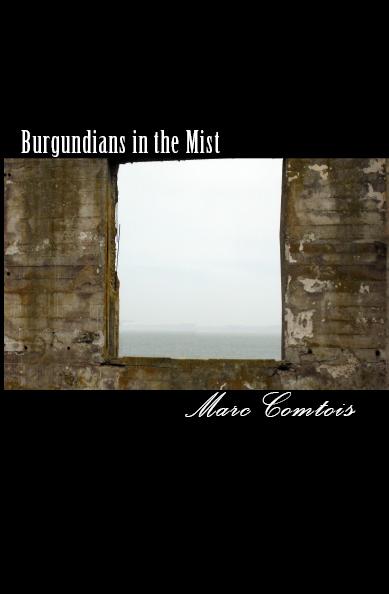
It's a historical work that focuses on the Burgundians of the period popularly called The Dark Ages (scholars prefer late antiquity or early medieval). For the Burgundians, it ended up dark indeed. They were crushed between Franks and Goths and, as is usually the case, the victors wrote the history. That's why the history of the Burgundians is truly in the Mist and why I've attempted to reassess their role in the period. Besides the Burgundians, the book also deals with the Germanic people in general, their migration into Western Europe, the Fall of Rome and what came after. While it is full of footnotes, it is accessible to anyone interested in the period.
Thanks to entities like createspace, it is much easier to publish than it used to be. I also plan to release a Kindle version. A sample chapter can be found here. Don't worry, I won't be going on and on about it around here, just giving a heads up. For more updates, check out my personal site. Thanks for your indulgence.
February 12, 2011
December 19, 2010
Feeling Galtish on Sunday
Somehow, I've fallen behind on everything, in the past couple of weeks, so I've been trying to catch up a little this weekend. I've also been sorting through spreadsheets, trying to figure out the fluctuations of millions of dollars flowing into Tiverton's school district.
While I had Microsoft Excel open, I thought I'd relax the mind and run some numbers inspired by a contentious meeting at the day job, on Friday afternoon. How, I wondered, would the labor numbers break out if one calculated all of the real costs of a typical construction gig with the amount billed to the client? The upshot is that — depending on the terms of employment and benefits — a carpenter's salary can take a big hit when once transportation, tools, and some other considerations are factored in.
Frankly, strolling through two years of unemployment payments doesn't compare all that unfavorably — and it tends to be a lot less strenuous, and certainly warmer, this time of year. Of course, that thought leads to the next: Layer in welfare, food stamps, RIte Care, housing assistance, and so on, and the fact comes into stark relief that, as a friend of mine is fond of putting it, all I really need is a library card. All the time I could spend reading and writing were I to decide just to step off the down escalator that I'm struggling to walk up.
That can't be a conclusion to which members of a healthy society would be inclined to come.
November 6, 2010
Seasons Change
Surely family schedules had more to do with it than the less whimsical shifts of nature, but New England's famed "foliage season" had a mythical quality, when I was still an adolescent Jersey boy. Actually, "mythical" is not quite right, because I'd had some experience of it and, of course, New Jersey lacks neither trees nor seasons. But in our periodic visits to my grandfather's house in southern Vermont, it seemed we were typically disappointed to find either that the trees had not yet begun to turn or had already moved past their most florid days.
This autumn, I've been working alternately on job sites in Little Compton, Tiverton, and Newport, so I've had almost daily experience with that certain quality of light shining off water and through leaves that seem only more fully alive in the shades of their dying. Turn a corner or overtake a hill at just the right moment and your face contorts and breath constrains in the same sensation that accompanies — as the cliché advises — setting free the one you love in the hopes that she or he will return more surely yours.
Now we enter the long gray season of chills and ruddy cheeks. Sweaters and the felt knowledge that the sun will view us only askance. There's no need for despondence in that forecast. Even apart from the holidays scheduled as lighted way stations through the late fall and winter — Thanksgiving, Christmas, New Year's Day, St. Valentine's Day, St. Patrick's Day — the season has its unique sense and, therefore, justifies daily gratitude that we are creatures of sensation.
The political parallels to be found in our moment in Rhode Island history are obvious, but let it suffice for me to observe how wonderful a place the state is in which to live. Complain as we might about those with whom we must share it, worry as we do that the state demands an economic premium that translates into a daily struggle for many of us just to get by, we ought not wish away the time or fail to appreciate the moment that we've been given for the very simple reason that we've been given it, and the moment is ours.
On the coldest of days, what sets us aright is warmth, and the surest warmth comes from within. We can find it whether the opportunity flows over us as waves on the August shoreline or brushes our cheeks as fiery falling leaves or nips at our noses in crisp frozen air. The Earth laid bare is a sight to see, with the intricacies of stone and bark. Just so, our vulnerabilities dance in the air as smoke from strangers' chimneys and the moist, visible heat that our breath dispenses as a message of the fire stirred by heart and lungs.
October 12, 2010
A Bit of the Book
My peculiar visage is currently at the top of Ted Nesi's WPRI.com blog, mentioning my essay in Proud to Be Right:
His contribution is a seven-page essay titled "A Nonconforming Reconstruction" that recounts his experience as a Gen X conservative and his belief that "the peculiarity of our time is that one must ... be conservative to be contrarian." It's not a particularly political piece, though, at least in a narrowly partisan sense; it's more philosophical.
Partly because my essay's focus isn't on college, which is a particular area of concern for people who are particularly concerned with "young" anythings, the more encompassing reviews that I've read haven't gone much beyond allusions to my contribution. See here, here, here, and especially here, where one will find the following:
The reader jumps from social conservatives to libertarians, from the home-schooled to hipsters, from proud contrarians to devout traditionalists, and a few unclassifiable whats-its, such as a self-proclaimed leptogonian.
The point of my essay, as I hope you'll all take the time to find out, is that traditionalists are contrarian, in our era, and real freedom can only come from self-mastery and a willingness to learn and draw from the past.
July 12, 2010
Me, Online
After a mild complaint from another Justin Katz, with whom I've been communicating since I discovered his band online in 1999, that I was only using justinkatz.com as a forwarding site to Dust in the Light, which at this point is essentially a manual summary feed of what I write here and elsewhere, I felt I should put something more useful at the coveted URL. (To be fair, Justin's complaint followed my mild jibe about his sparse use of his Twitter account in our name.) I've also been concerned that job and other prospects who found their way to any one of my sites would be led primarily to my controversial-in-this-region political opinions.
So, I came up with a concept and have been putting the new site together as I've been able. So far, I've gotten up a bunch of carpentry pictures, op-ed-style commentary that I'd written up to the middle of 2005, and PDFs of my books. I'm trying to make sure that I flesh out one "exhibit" per day. (The ones that I've done will shade in blue when you mouse over them on the timeline.)
Even though it's a work in progress, I welcome any feedback that might occur to anybody to offer.
May 13, 2010
Pausing During a Sunny Lunch
It's been a rough week. On top of the bite of local politics and the demand on one's time that being a political insurgent tends to make in the midst of important events, the workdays have been less and less pleasant for the past couple of weeks.
My employer is attempting to make up for shortcomings and errors elsewhere in the company by pushing me to do at least twice as much work as is possible. It's conceivable, of course, that I've just been around slow carpenters, during my years in the trade, and therefore do not realize how very slow I am. Still, accomplishing anything in the range of acceptable quality is a time-consuming, tedious task in century-old houses.
And so, between swear words, I get the request to put in extra hours for free — this not long after hours that I legitimately claimed on my time sheet were conspicuously absent on my paycheck. It's difficult for a person of strong work ethic and accommodating personality to know what to do.
But... and here's where I look up through my windshield at the way the sunlight filters through the leaves around me, all the same color, yet appearing to be a patchwork of different greens... in such tribulations, there is much to learn. There are also experiential contradictions and intellectual curiosities to unravel.
I find carpentry to be a very conservative trade — in the populist, traditionalist sense of conservatism. The carpenter builds something out of nothing. In renovations, he uncovers and respects what was placed before him. It's physical work, often rough, and it is quite clear how competent you are. The trim wood stays, or it does not. The door fits in its opening and swings easily, or it does not. Consequently, advancement has much to do with merit.
Still, if I may be retrogressive, for a moment, it's a very male trade. Shouting and cursing and masculine forms of resolving disputes and testing mettle abound. Given the difficulty of the work, when that masculine quality is driven to abusive degree, nakedly for the financial benefit of the abuser, it's easy to draw from experience in the field for empathy for the liberal view of society. The boss has work and influence, therefore the worker needs something more than talent as influence, if he wishes to live a stable economic life free of the mood swings of the Boss Man.
I intend to spend some time reconciling the two perspectives, but for now, my half-hour lunch is up, and although I'm not intending to work for free, today, I should put in all of the hours to which I've agreed as an employee.
March 12, 2010
UPDATED: Two Tiverton-Related Notes
UPDATE: I was able to restore the lost post
1. The post to which I linked on the Tiverton Citizens for Change blog was accidentally deleted, this morning. My time is way too limited to reconstruct it, and I apologize for any confusion.
2. The Tiverton Budget Committee voted last night to put a level-funded budget for the school district on the docket for the financial town meeting. Inasmuch as my visibility seems have positioned me to be among the most viscerally disliked people in town, I thought I should note — in my personal capacity — that I do not agree with that result. I don't agree with it strategically, as a means of reallocating resources from pay and benefits for adults back toward programs for students, and I don't agree with it as a final outcome, at least not yet, when the staff just voted to re open its contract and the school committee and teachers haven't played their cards, yet.
January 13, 2010
No Comparison of Need
I couldn't but scale back my pitch during my call to Matt Allen, knowing that he'd subsequently be speaking with a representative of the Red Cross concerning the dire need for money to help the people of Haiti. Simply put, there's no comparison to be found in everyday life to this sort of catastrophe:
Haitians piled bodies along the devastated streets of their capital Wednesday after a powerful earthquake flattened the president's palace, the cathedral, hospitals, schools, the main prison and whole neighborhoods. Officials feared hundreds of thousands may have perished but there was no firm count.
Prayers and assistance the world over should turn toward that small island.
December 24, 2009
Merry Christmas!!!

Merry Christmas to all Anchor Rising contributors, commenters and readers--the whole Anchor Rising Family! Thanks for the intellectual "gifts" you give every day. Now take a day off and enjoy Christmas with your families!
December 19, 2009
A Pre-Old School Jersey Boy
Shortly after commenter BobN mentioned Guido Beach in response to my post on reality TV, I came across this related post by Ed Driscoll. Driscoll points the way to this early/mid-'90s video about Wildwood, New Jersey, which as it happens was the specific site of my own early-'90s Jersey Shore romps.
It's all coming back to me, now.
The summer after I'd decided to drop out of college was the last during which my friends and I made the three-hour trip down the Garden State Parkway to Wildwood, and the reason, as I now recall, was an abrupt shift in the character of our summer getaway. While we were in high school, Seaside Heights (closer to the New York City suburbs) was the sleazier location. Wildwood was not yet done frightening away families and was fertile ground for the independent middle class teenage boys in search of the teenage daughters thereof.
As the '90s made the transition from early to mid, one of those jumbles of social cause and effect escalated the town's deterioration. That's about the time that the above-linked video appeared. Rolling Stone magazine chipped in with a profile of "The Prince of Wildwood" — a sex-crazed late-teen to whom I unfortunately related, back then. The gates of North Jersey hell opened, and we young, male, middle class predators — more interested in coming-of-age adventures than self defense — had to look elsewhere. As I wrote, in a song lyric, at the time:
Smiling faces are just a memory
And there's a battlefield where the party used to be
What used to be a beach is now a city street
Soldiers marching to a different beat
They've taken over Wildwood
Just like they ruin everything that once was good
They've taken over Wildwood
And I won't be here next year
The boardwalk's garbage from end to end
Flapping on the sea breeze in this two mile long pig-pen
All the promdressed teenagers that used to laugh out on the street
Must have known before I that it was time to retreat
[Chorus]
I remember fireworks on the balcony
Our cheers together, ears ringing with the sound
All the ashes now falling as glass
Raining shards of broken '40s on the ground
Dreams of margaritas frosted with ice
Whatever happened to our summer paradise?
Floating on the sea breeze somewhere before sunrise
Feels just the same if I close my eyes
Spent this vacation looking for a place to hide
But clientele means nothing to the rhythms of the tide
[Chorus]
Just when we'd found Point Pleasant, as the place of retreat for those whom we'd helped to chase out of Wildwood, I departed for Rhode Island, and New England and adulthood pulled me in.
To some extent, these are observations of a cyclical nature. On a personal level, people's interests tend to mature as they age, although adolescence is creeping further and further into adulthood and the level of maturity ultimately reached is arguably diminishing. On a social level, different clienteles consider a parade of locations fashionable, in keeping with their interests — with families seeking safe respite from hectic lives, young professionals edging in that direction, younger student-types following the older children of the families and emulating the young professionals, and the crowd deteriorating from there; the leading edge moves on, and the cycle starts again. But the speed of the cycle and the depths of deterioration appear to be escalating, in part because families do not appear to be keeping together as long or as thoroughly, and with fewer children, they no longer require vacation entertainment to span from pre-school through high-school and beyond.
To another extent, though, the same cycle appears to be happening on a much larger scale — that of the civilization — and civilizations do not merely ebb and flow in location and superficial details, as from one Jersey Shore boardwalk to another, but to change their character in the process. Some of us think that the character that is ebbing is worth fighting to preserve.
December 3, 2009
Random Mutterings
Having some kind of head cold nastiness for the better part of a week has left me more befuddled than usual and less able to focus thanks to various apothecary concoctions. Here's what I've been muttering about....
Apparently, Gen. Treasurer Frank Caprio is going to campaign as a right-of-center progressive.
Tiger Woods has garnered a reputation for being in the 99 9/10th percentile when it comes to mental toughness and discipline. It looks like that only extends to his golf game.
Latino leaders calling for a census boycott are only going to end up short-changing themselves and their people. Some think that's a good thing.
Seeing it through in Afghanistan means more troops, according to the experts (Generals). President Obama did the right thing in following their advice, if not exactly. But it is obvious that his heart isn't in it and that ennui is dangerous if translated down the chain of command.
Seeing sleeping cadets/midshipmen at a mid-evening speech by a politician is totally unsurprising to anyone who attended such an institution. Long days full of physical and mental strain cause the body to shutdown when it can. It's only a surprise that more weren't snoozing. The fault lay with the media for focusing on the slumbering in an attempt to convey...what, exactly? That cadets don't respect the CinC? Or that he's boring them? Not sure why they did it, but it was wrong.
Looks like the Patriots are in a rebuilding year. That used to mean a losing season or two; now it's just an early bow-out of the playoffs. I'll take it.
I like visiting other branches of the family for Thanksgiving. But I miss the leftovers.
When did regular exercise start meaning a constant battle against wear and tear injuries? Plantar fasciitis sucks.
It seems hard for a member of the Gen X vanguard like myself to find good music by new artists.
And when did the music of the '80s become oldies?
I think the last two items are related.
Thank God for Nyquil.
Finally, my science-degreed sister (medical technology) had the best Climategate-inspired line of the season: "I could totally prove the existence of Santa Claus, but I seemed to have lost the raw data, so you're just going to have to trust me."
November 26, 2009
Thankfulness, To and For
"What are you thankful for?" is a tough question. It's sort of an annual version of "how are you doing?" One isn't supposed to embark on an extended dissertation on the profundities of life, but it somehow feels as if a packaged response diminishes the courtesy of the question. "What are you thankful for?" "Oh, the usual."
And so, at the tail end of last week's Violent Roundtable, on WPRO, my response to the question was, essentially, "ditto." During the taping of this week's Political Roundtable on WRNI (airing tomorrow at 5:40 and 7:40 a.m.), I found myself expressing gratitude for corruption.
Hovering between cliché and theological depth is a dangerous place to be.
Thanks, therefore, to Marc, for posting President Washington's Thanksgiving Proclamation, which gives a helpful context for appropriate responses (emphasis added):
WHEREAS it is the duty of all nations to acknowledge the providence of Almighty God, to obey His will, to be grateful for His benefits, and humbly to implore His protection and favour; and Whereas both Houfes of Congress have, by their joint committee, requefted me "to recommend to the people of the United States a DAY OF PUBLICK THANSGIVING and PRAYER, to be observed by acknowledging with grateful hearts the many and signal favors of Almighty God, especially by affording them an opportunity peaceably to eftablifh a form of government for their safety and happiness:"
To be sure, we're grateful to friends, families, and institutions for their affections and assistance, and we're grateful for the fact that friends and family exist. But if the particular gratitude for which we designate the day is to God, then those things that are more immediately pleasurable in the personal fulfillment that they provide should be joined by those things that enable us to strive and suffer and overcome, ultimately by God's grace.
Corruption and suffering are sometimes like the pain of muscles made sore through exercise, and they are sometimes the sharp lap of flames that urge us away from fatal danger. A deeper personal fulfillment cannot be reached with a skip and a waltz, and for the existence of that transcendent objective, we should be thankful.
November 22, 2009
Thanks and Violence
At the tail end of Friday night's Violent Roundtable on the Matt Allen Show (the podcast of which may be found here), Matt asked Andrew, Marc, and I what we're thankful for. I've always found that to be a tough question, binding me up in considerations of appropriate pithiness.
Back during the dark days of my early adulthood, I'd have probably tossed out some heavy sarcasm phrased as levity — that red M&Ms had reemerged, or something — meant to imply that I found very little worthy of gratitude. A dumb, pitiful mindset, that was.
My difficulty now is quite the opposite. What am I thankful for? Well, literally everything. Sure, some items on that extensive list I include grudgingly; it's difficult to be jubilant about, say, the periodic sharp pains that accompany standing when I've been working low to the ground, but there they are, and truth be told, I'm thankful for the reminder that I'm aging, that I'm active, and that physical reality does place boundaries on the ability to contort one's body so as to swing a hammer with the correct velocity while crawling around in dust from a 150-year-old wall. And yet, that dust (whatever else it introduces to my body) brings odors rich with memory and imaginings. If it appears that thankfulness requires contradiction, well then, I'm thankful for the faith that the appearance is deceiving and the challenge of sorting through to the underlying truth.
Yes, yes, "everything" includes in large supply of all those aspects of life for which it is easy to be thankful. Family, friends, food, conversation. And certainly, there are changes to my current circumstances that I'd welcome with boundless enthusiasm... even as I give thanks for having had the experiences from which I'd emerged.
You can see why I hesitated before offering a "ditto" to the others' replies to Matt. I'll say this, though: I'm grateful that the final moments of the show were not indicative of our performance throughout, which I'd suggest is worth a listen.
October 5, 2009
A Matter to Resolve as Professional Growth
A couple of weeks ago, a professional television journalist in Rhode Island suggested that I should pay some attention to the audio for my video blogs, especially that which I've collected from public meetings. I agreed of course — could not reasonably do otherwise — but there's a difficulty that bloggers face in other ways. It's sort of like the science of physics, in which one must account for the act of observing within calculations. If I were to put a microphone in the faces of people speaking at a school committee meeting, as the journalist suggested, it would substantially change the results.
I bring this up because I seem to be making a habit, recently, of ticking off people with whom I share just about every goal and with whom I'd previously gotten along well. Today, as you're more likely than not to know (because he has more listeners than I have readers), that person was Dan Yorke. After a contentious exchange between Dan and URI Professor Donna Hughes — with both of whom I've had many amicable communications over the past couple of years — I sent Dan two emails from the parking lot of the Portsmouth Post Office (first mistake, I guess). The first raised pertinent information related to his guest, and the second attempted to convey my reason for empathy with Professor Hughes's being way too evasive in answering questions.
In the second email, I was sloppy with my language. I apparently miscalculated with regard to the attention that Dan would think my opinion worth. And I definitely didn't anticipate how my note would come across. It was a mistake along the line between interpersonal communications and professional activity, and as a now-public one, wisdom suggests that I take it as the final catalyst for my prior intention to devote some prayerful thought to the series of such instances of tension.
Which is not to say that I believe myself to have been equally wrong on the previous occasions (although I won't raise them, here). Moreover, I expect it to be a recurring difficulty because, as with the audio at town meetings, the "citizen journalism" captured under the vague boundaries of the word "blogging" is enriched, in my opinion, by some of the non-professional attributes. The phrase "big shot blogger" is denotatively incoherent. I'm a guy who offers my opinion. That's what I do, and I intend never to write anything for the primary purpose of having it advance my career or have a political effect. Those will hopefully be the results, on occasion, but the moment I become a self-conscious "player" — more than an engaged citizen — is the moment I hope to have the perspicacity to switch back to poetry and fiction.
I do, though, have to strive for a greater empathy with my audience, particularly individual members thereof — and perhaps especially when I think that the individual is the entire audience. So, all of you individuals out there know this: In part because I've never really had all that high an estimation of myself, my public and private writing begins with the assumption that the reader is in every way my superior — even if he or she has inexplicably erred on a particular topic or in choosing a particular pathway of thought.
That's all I have to say about that.
September 19, 2009
Easy Come, Easy Go on Saturdays
Working periodic Saturdays has its good points and its bad points. On the one hand, it provides earned income beyond what's accounted in one's long-term budget. On the other hand, it takes away time on which one comes to rely for other purposes.
With those mixed feelings, I worked my way to the jobsite on which I'd planned to spend the next five or six Saturdays, picking up lumber and other materials as I went. The sinking feeling was, however, unmitigated when it turned out that the client had changed his mind. The long-term budget had absorbed the additional money, you see, and it turns out that we'll remain a month behind on our mortgage payments. For now.
Thus do we all trudge on. With so much to do, the time will not be wasted, and it's not as if living on the economic edge is anything new. Adjust and find the positive. Find another perk that had heretofore seemed a necessity. (Some might call it "nonessential.") Get comfortable in a naked state, and the clothes matter little. And if they chafe, there's experience to be gained from the feeling.
Besides, there were dishes to be done, today, and children's bicycles with chains to be re-geared. I think I'll hold off for a few decades before I hand the kids the bill. With interest.
August 6, 2009
A Fireside Chat with Dan
Alright, there wasn't really a fire, but since we're talking radio, I like to imagine that there was one. Dan Yorke and I had that sort of conversation, yesterday, on 630AM/99.7FM WPRO. Those who missed it or who would like to revisit something (for kind or scurrilous reasons) can stream the whole segment (about an hour, without commercials) by clicking here, or listen to portions:
- On Anchor Rising, my writing habits and schedule, and blogging specifics (traffic, money, etc.): stream, download (5 min, 49 sec)
- On our blogging mission (or obsession) and the effect that AR and blogs in general are having: stream, download (3 min, 46 sec)
- On profiting (or not) from online writing: stream, download (4 min, 03 sec)
- A call from Mike and discussion of "excellence" in Rhode Island and the effects of local participation, with Tiverton Citizens for Change as an example: stream, download (12 min, 45 sec)
- On Dan's opinion that RI reformers need a "big win" and my belief that we focus on smaller victories: stream, download (2 min, 52 sec)
- On hopelessness and a magic wand policy change in Rhode Island (public sector union busting) and the problem of regionalization: stream, download (6 min, 48 sec)
- On what to do about unions: stream, download (2 min, 18 sec)
- On the coalition of problems in RI and whether all are addressable by the same principle (dispersing power and building from the community up, as well as a tangent about binding arbitration: stream, download (6 min, 2 sec)
- On the Republican Party in Rhode Island and awareness of reform groups: stream, download (4 min, 7 sec)
- On prescriptions for Rhode Island and the lack of leaders: stream, download (6 min, 34 sec)
- A call from Robert and discussion of Republicans and the Tea Party as a political party: stream, download (3 min, 14 sec)
- On the Moderate Party: stream, download (2 min, 9 sec)
- A call from John and discussion of Steve Laffey's plan: stream, download (1 min, 42 sec)
August 5, 2009
Principles of Different Types
Of all the topics covered in my wide-ranging conversation with Dan Yorke, my inarticulateness on the application of principles to discrete issues is bugging me the most. My intended meaning was much broader than the ideological platform that I described. "Principles," in my usage, was meant to indicate not only general rules of thumb, but also habits of mind and a gut understanding of reality.
Dan asked about my writing practice, and I mentioned my belief that I have some species of learning disability. I've often found it difficult to understand subjects in the way that they are taught, with a given fact applied under a set of rules, requiring instead the time to break the lesson down to a sort of molecular level of intellectual mush, the defining property of which is that it's "just the way the world works." So I'll stir a new subject or a new fact or a new perspective into the mush, and its essential hue and texture will change accordingly. When a problem presents itself — whether it's repeated or unique — I've found it necessary to figure or refigure it out from the scratch of the mush, because the directly relevant instructions have often been lost in the poorly organized jumble of my brain.
Perhaps this contributes to my being a good "test taker" — which term seems most often to be used as a mild pejorative. It also has the effect of encouraging continual reevaluation.
An obscure example: I've written books, studied piano, and built houses. The first and third of these activities are mainly different in externals; at the fundamental level of the intellectual mush they're different applications of the same mental processes. The underlying meaning of a house is the distribution of weight, which must transition down coherently from the roof ridge to the foundation. The architect must have a reasonably secure vision of the ending before the first blobs of concrete are poured; just so, in order for a book to have a solid purpose, the author's first words must take into account the very last, and all phrases between.
Rooms have the same relationship to the distribution of weight that a story's plot has to the underlying meaning. Sometimes the structure is dictated by spaces that make the building functional or appealing, and sometimes the spaces seem to have been fated to exist within the structure. Either way, their development is mainly an intellectual exercise prior to construction.
Aesthetic details — such as trim and repeating shapes and amenities — help to define the sense of the house in such a way as to make the plot seem plausible and the underlying meaning coherent. Ultimately, the details may be superficial (unless they are the meaning), but no one will believe the story if the setting and characters are not well drawn.
As to the piano playing, music has many of the same aspects as just described, but its greater contribution to the mush is a set of principles of performance. Typing takes on a flow like a piece of music, and the tapped rhythms and accents can help to coax appropriate words from the mind through the fingers. Similarly, rhythm brings fluidity to the act of building, and aesthetics contribute as much to the pursuit of efficiency as monetary incentive. (Indeed, among carpenters who enjoy their work, the aesthetic satisfaction of efficiency often outweighs a monetary incentive to slow down or work in a muddle.)
The upshot is that, when a topic comes up on which I'm disposed to write a blog post, the process is a reconstitution of my opinion based on the series of principles and intellectual practices that I've established to be true. In a sense, it's easier to write about disparate topics because I'm always writing about the same thing, ultimately.
With that all laid out, to be read or not, as you desire, I apologize for the self-indulgence. My lips betrayed me by falsely intimating my thought process to be "what should a conservative believe," rather than the more accurate "how does the world function around this topic." But I had to work these thoughts into written words, because whatever my brain's been up to, I've always been better with my hands than my mouth.
March 28, 2009
Yes, Justin Katz Is a Real Carpenter
While we're keeping things light, it would seem a good time to mention something of the sort that normally ought to be ignored, but which, in this case, is so absurdly humorous that I can't resist response. While indulging curiosity related to my recent registration with the state as a carpentry contractor, I happened upon this:
One night while Mr. Katz was tapping away on his laptop I asked him, " What do you do for living"? Mr. Katz responds, " I'm a carpenter ". I thought, that's odd his hands seemed Jergen smooth for a trades guy. Does he swing a hammer and blog at the same time ? Does the saw dust srew up his lap top ? Does he have a special carrying case for those jaunts up the ladder ? Does the scent of carpenters glue cloud his thoughts as he blogs ? Does his boss allow blog time during the work day ?
The author, not surprisingly, is the same fellow who expressed pro-union sentiments in the Tiverton High School men's room, called me a loser at the infamous East Providence School Committee meeting, attempted to derail the Q&A session at a recent Ed Achorn talk, and made nicey-nice at the Ocean State Follies.
With regard to the texture of my hands, I can only opine that Louis either has deficient powers of observation or is relying on the fact that most people who might come across his post have no basis for disputing his characterization. This is not to deny that I regularly use moisturizer, but I'm afraid that my skin is damaged beyond repair and that the cuts and scrapes from wood, metal, and masonry heal at their own pace regardless.
As for proof, well, when we workin' folks take out cameras on the jobsite, pictures of ourselves are of very low priority. However, I do have one photo in which the architect captured me doing my carpenter/foreman/project manager thing last spring:

Here's the (almost) finished room last summer, for those who are curious, and yes, those are my tools in the foreground:

To answer the unionist's questions, though, we get a fifteen minute break in the morning and an unpaid half-hour lunch. For most of the last year, I've been using that time for blog-related activities — with enhanced efficiency, of late, owing to the mini laptop and cellular Internet service that your donations enabled. The rest of the day, politics is relegated to my mind, but only when the task at hand requires little thought.
January 21, 2009
With the Medic
Bob Walsh is currently recovering from a stroke experienced during surgery. God willing, he'll quickly be back in full form; hopefully he'll take the meantime as an opportunity to enjoy a break from the battlefield.
(N.B. — When it comes to the comments section to this post, leave your blackjacks and billy clubs at the door.)
January 1, 2009
Another Year Come and Gone
Busy as we are — and, of necessity, reluctant to sign up for long-term contracts, as for oil — we found ourselves today on the verge of an empty oil tank, with a delivery already scheduled for tomorrow. As one might expect, few of the oil companies that we called answered, others could not come out for days, and a couple told us that they don't make emergency calls until the tank is entirely empty.
The kind woman at Heritage Oil, however, informed me of something that I'm surprised not to have known: That diesel fuel will work in a pinch. She even made sure that I was aware that I'd need virgin gas cans that had never been used for regular gasoline. So, off to Walmart, where the cashier wished me a happy new year. "It can't be worse than the last," she said.
Well, I don't know about that.
The first half of 2008 was a hopeful, if stressful, time for me. I was advancing quickly in the construction field, and whole new career paths were coming into view. I was able to meet my bills well in advance, and things looked likely only to improve.
The year has gone out on a decidedly down note, though, with a return to my usual state of being — by which I mean a return to paycheck-to-paycheck survival. I've even trimmed personal luxuries, such as flavored beverages with lunch, from my lifestyle.
Some of you will know how difficult it can be to live on the financial edge. A distracted glitch in one's financial system brings a wave of unaffordable fees, because no buffer exists. The considerations that must be kept always in view — such as home heating oil — emerge as more numerous than seems to be the case when resources tie up loose ends before they are truly severed. The minor inconveniences mount until their aggregate effect is dispiriting: a broken car door handle, a toilet that flushes only every other time, an old electrical system that often trips in the middle of microwave cooking, a basement sink pump that fills and expunges at a glacial rate. These things are all easily fixed with a minor application of time and money, but both are in short supply.
And then there's illness and injury. A broken bone in an active child can make a paycheck disappear without warning. Flus and coughs can cost in time and motivation. I spent much of Christmas Day returning to bed and sleeping on the couch. The daily schedule by which I feel life to be advancing has come up against the motivation-sapping effects of the worst illness I can remember since college, over the past couple of weeks.
Yet, things could be much worse, and there's always reason to remind one's self that they can get much better quickly. What will the new year bring? Probably good and bad. That's all that it's reasonable to say. We define our goals, develop our strategies, and do our best to build a structure by which to capitalize on the drifts of luck and blessing that ultimately determine our fortunes.
I hope you are entering the new year with determination and optimism. It would be naive to declare that it can't be worse, but it would be unnecessarily pessimistic to forget that it truly could be better, often in ways unexpected. And behind all the comforts and travails of life, a divine infinity transforms it all to bliss.
December 24, 2008
Merry Christmas!!!
Merry Christmas to my fellow Anchor Rising contributors and to all of our readers and commenters (both the "Hallelujah" chorus and our "polar" opposites)!
December 20, 2008

A beautiful day
It is one of those beautiful mornings after a snow storm where the crisp whiteness of the fresh snow is everywhere, set against the quietness of people still being largely indoors.
It is another one of those times when we all have an opportunity to take a step back and reflect on the beauty of our world as well as the power and majesty of nature.
December 12, 2008
In a funk
I've been preoccupied with several matters (work, family, volunteering) and have had little chance or time to ponder, much less post, about the news of the day and the like. It occurs to me that, to the regular (ie; non-political) person, this is the norm. There is plenty to worry about and deal with before one comes to the point of thinking about those matters that seem so uncontrollable by an average citizen. It is what it is and we just struggle to get by in the short term. Thus, focused on the day-to-day goings on, big pictures aren't even seen because we're living our lives through a zoom lens.
UPDATE: I guess that's another way of saying I wish I could've made the AR roundtable tonight!
November 3, 2008
Life lessons on the pitch
Took a break from politics this weekend. Watched a bunch of soccer up in Pawtucket and enjoyed seeing the youth from across our state compete and laugh and have fun. Even amidst these potentially nation-changing events. Good. They don't have to worry about the big picture stuff, that's for us adults. Even if things don't go the way we want, it's incumbent upon us to provide a positive environment for our kids (and through them for ourselves). Be optimistic and they will be too. Let them know that another way to view life's obstacles is as opportunity. Something to be overcome. But if they're not: learn from the experience.
A couple games showed this in spades. Our kids carried the play for the majority of the time, but a well-played through ball and one outstanding athlete can change the entire outcome of a game, and--boom!--just like that your down and, unfortunately, out. But even if you lose the match, you can take something from a game well-played and build on your small successes. The coaches of both of these teams did a great job and taught their players both how to play and enjoy the game. Of course the kids wanted to win, but the most important lesson learned was to keep working towards your goals, even if they aren't realized in the short term. Live to compete for another day and good things can happen. A third team did just that: carried the play in two games but couldn't score during regulation in either. But they won both games, including the championship, in a shootout. They persevered and were rewarded.
October 27, 2008
Dean Barnett, RIP
Dean Barnett has died after a long battle with CF. My fondness for Barnett dates back to a 2007 post entitled Muddling Nobly, Happily and with a Sense of Purpose Through Life's Unexpected Twists & Turns:
...And that’s where "muddling through" comes in. Regardless of who you are, at some point life plays some rotten tricks on you. Some people get terrible blows from fate; some people make their own bad luck. But everyone at some point realizes that life is at times a slog, and sometimes a cruel one.But we "muddle through." As I’ve gotten older, I’ve become ever more convinced that one of the keys to happiness is enjoying the "muddling," and being cognizant of your blessings while doing so.
Some people just can’t do that. The muddling makes them bitter and angry; they enter a spiral of self-pity...
Life is one big muddle. Sometimes you have to muddle more, sometimes you have to muddle less, but for all of us "muddling through" is the natural state of things. Luckily, while we muddle, we can surround ourselves with things we cherish. We can muddle nobly, happily and with a sense of purpose. We can choose to love and allow ourselves to be loved as we muddle.
Ultimately, if you want it to be and let it be, it’s a beautiful muddle indeed.
I am grateful to have had a chance to thank Dean personally for this column in an email and will always treasure his kind response.
RIP.
ADDENDUM
Tributes from Mark Steyn, John Podhoretz, and Peter Robinson.
ADDENDUM #2
More from Hugh Hewitt and Bill Kristol.
Finally, there is no better way to end than with Barnett in his own words:
As I grew sicker, I had what for me was an extremely comforting insight. I came to view serious and progressive illness as an ever constricting circle with oneself at the center. The interior of the circle represents the contents of one’s life. As the circle gets smaller, things that were inside get forced out. Some of these things are dearly missed; others that were once thought precious get forced to the exterior and turn out to go surprisingly unlamented.At the innermost point of the circle are the things that really matter: family, faith, love. These things stay with you until the day you die. At the very end, because the circle has shrunk down to its center, they’re all you have left. But as we approach that end, we finally realize that all along, they were what mattered most. As a consequence, life often remains beautiful and worthwhile right up until the end.
Thanks, Dean, for all you taught us about how to live.
September 6, 2008
Be still my soul: An invitation
We went to a memorial service today for a very nice man. May he rest in peace and his family be comforted by their faith and memories of him.
The service included many touching words and musical highlights, one of which was the singing of a great hymn, Be Still My Soul:
Be still, my soul: the Lord is on thy side.
Bear patiently the cross of grief or pain.
Leave to thy God to order and provide;
In every change, He faithful will remain.
Be still, my soul: thy best, thy heavenly Friend
Through thorny ways leads to a joyful end.
Be still, my soul: thy God doth undertake
To guide the future, as He has the past.
Thy hope, thy confidence let nothing shake;
All now mysterious shall be bright at last.
Be still, my soul: the waves and winds still know
His voice Who ruled them while He dwelt below.Be still, my soul: when dearest friends depart,
And all is darkened in the vale of tears,
Then shalt thou better know His love, His heart,
Who comes to soothe thy sorrow and thy fears.
Be still, my soul: thy Jesus can repay
From His own fullness all He takes away.Be still, my soul: the hour is hastening on
When we shall be forever with the Lord.
When disappointment, grief and fear are gone,
Sorrow forgot, love’s purest joys restored.
Be still, my soul: when change and tears are past
All safe and blessèd we shall meet at last.Be still, my soul: begin the song of praise
On earth, believing, to Thy Lord on high;
Acknowledge Him in all thy words and ways,
So shall He view thee with a well pleased eye.
Be still, my soul: the Sun of life divine
Through passing clouds shall but more brightly shine.
Here are different versions of the song performed by Libera, Mormon Tabernacle Choir, and St. Philip's Choir.
May all of us find a certain stillness for our souls.
August 31, 2008
The gift of life vs. "never going full retard"
Rich Lowry wrote a touching post, saying:
...I found the Palin event Friday incredibly moving. Partly because of Trig.The sentimentalist in me would be willing to see anyone who is loving and unselfish enough to welcome a Down kid into their family elevated to high office.
When I was thinking of Trig, I was reminded of an encounter I had a couple of weeks ago on the Delta Shuttle from Washington to New York. It was a mostly empty plane, but I went all the back to the very emptiest part of the plane to spread out and enjoy the quiet. And there was a man sitting in the very back row who immediately piped up, "Hi. I'm Ian. Would you like to sit next to me?"
He was a guy with Down Syndrome, maybe in his twenties. I declined the offer, but we struck up a conversation. He was going to New York for a family celebration, including for his birthday. I told him I had a birthday coming up too and he lit up and came over to vigorously shake my hand in congratulations—more delighted by my birthday than his own.
When the plane began to fill up a woman and her daughter came all the way to the back with a huge bag. I began to wonder to myself if I should offer to help them with it, when Ian popped up, told them he'd get it, and lifted it up and shoved it in the overhead compartment. When two men came down the aisle with a box they weren't sure would fit overhead, he intervened and told them it would—"trust me"—and put it up for them.
He chatted amiably with his neighbors during the flight, and when we landed was up out of his seat first thing to help that woman get her bag down.
From this brief encounter, I dare say Ian is friendlier, better adjusted and more considerate than about half of the people on the streets of Manhattan or San Francisco on any given day. Yet most of those people are perfectly unperturbed by the elimination of babies with Down syndrome in the womb. To hell with them. God bless Sarah Palin for bringing Trig into the world, and may he shower those around him with as much sunshine as the gentleman I met on that flight.
Here is Glenn Beck, who has a special needs child himself, on Trig Palin.
Years ago, Roy Rogers and Dale Evans wrote about their daughter born with Down Syndrome in a book entitled Angel Unaware: A Touching Story of Love and Loss, whose back cover notes:
Through great grief can come great joy. In the 1950s, doctors often advised parents of disabled babies to put them away in institutions or homes. But when entertainers Roy Rogers and Dale Evans Rogers discovered their new baby, Robin, had Down Syndrome, they were determined to take her home and give her their love. It wasn't easy. Through countless surgeries and sleepless nights, the Rogers found themselves exhausted and worried-until they began to notice a change in their lives. Somehow the unexplainable and unexpected was happening-Robin was helping Roy and Dale draw closer to God and to each other. Robin's brief life also persuaded them to do all they could to help others in similar circumstances. Told from Robin's point of view in heaven, Angel Unaware is a touching story that has inspired millions of readers around the world. Whether you are a parent of a special needs child or have experienced the loss of a loved one, Robin's story will bring you the peace and understanding you need in difficult times.
Earlier this week, I had the chance to spend time with my brother's family on the West Coast. He and his wife have two kids. One of them, my nephew who is 6, has Down Syndrome. He is a special boy, just like Ian and Trig Palin are special.
One of the topics which came up during the visit was a popular new movie called Tropic Thunder, which uses the word "retard" repeatedly. Related to the movie, a t-shirt is being marketed which says "Never go full retard."
When you meet the Ian's of this world and experience their guileless kindness and generous spirit, it is painful to hear such calloused talk. Down Syndrome people can teach all of us so much by their unaffected behaviors.
Can you imagine the outrage if the word "retard" was replaced by "nigger"? Or if someone was similarly cavalier about Holocaust victims? But no, calling another person a retard is supposed to be funny to the point that some people are trying to make money off of it.
By the way, when my brother - a high school teacher - hears one of his students call another student a "retard," he pulls out his wallet and shows a picture of his son to the student with these words: "Here is my retard." As you might imagine, an immediate embarassed silence and then an apology follow.
The words we use do matter. As does the very special gift of life, which offers each of us many blessings if we are open to them.
August 30, 2008
A thought
Sometimes it is valuable to step back from the hectic doings of our lives and reflect on deeper things...such as the direction of our lives.
The mystic Thomas Merton wrote "Your life is shaped by the end you live for. You are made in the image of what you desire."
July 12, 2008
RIP, Tony Snow
Tony Snow died today, at age 53, of cancer. We remember his family in our prayers as we pay tribute to the memory of a wonderful man.
Some tributes:
Cal Thomas
Byron York
Shannen Coffin
Kathryn Jean Lopez
Michelle Malkin
Fox News
Several selections from Snow's writings about Reagan, Parting Thoughts on the Ultimate Sacrifice, and Message to GOPers.
Finally, Snow wrote a poignant and powerful article last year entitled Cancer's Unexpected Blessings: When you enter the Valley of the Shadow of Death, things change where he discussed his cancer:
Blessings arrive in unexpected packages—in my case, cancer.Those of us with potentially fatal diseases—and there are millions in America today—find ourselves in the odd position of coping with our mortality while trying to fathom God's will. Although it would be the height of presumption to declare with confidence What It All Means, Scripture provides powerful hints and consolations.
The first is that we shouldn't spend too much time trying to answer the why questions: Why me? Why must people suffer? Why can't someone else get sick? We can't answer such things, and the questions themselves often are designed more to express our anguish than to solicit an answer.
I don't know why I have cancer, and I don't much care. It is what it is—a plain and indisputable fact. Yet even while staring into a mirror darkly, great and stunning truths begin to take shape. Our maladies define a central feature of our existence: We are fallen. We are imperfect. Our bodies give out.
But despite this—because of it—God offers the possibility of salvation and grace. We don't know how the narrative of our lives will end, but we get to choose how to use the interval between now and the moment we meet our Creator face-to-face.
Second, we need to get past the anxiety. The mere thought of dying can send adrenaline flooding through your system. A dizzy, unfocused panic seizes you. Your heart thumps; your head swims. You think of nothingness and swoon. You fear partings; you worry about the impact on family and friends. You fidget and get nowhere.
To regain footing, remember that we were born not into death, but into life—and that the journey continues after we have finished our days on this earth. We accept this on faith, but that faith is nourished by a conviction that stirs even within many nonbelieving hearts—an intuition that the gift of life, once given, cannot be taken away. Those who have been stricken enjoy the special privilege of being able to fight with their might, main, and faith to live—fully, richly, exuberantly—no matter how their days may be numbered.
Third, we can open our eyes and hearts. God relishes surprise. We want lives of simple, predictable ease—smooth, even trails as far as the eye can see—but God likes to go off-road. He provokes us with twists and turns. He places us in predicaments that seem to defy our endurance and comprehension—and yet don't. By his love and grace, we persevere. The challenges that make our hearts leap and stomachs churn invariably strengthen our faith and grant measures of wisdom and joy we would not experience otherwise.
'You Have Been Called'
Picture yourself in a hospital bed. The fog of anesthesia has begun to wear away. A doctor stands at your feet; a loved one holds your hand at the side. "It's cancer," the healer announces.
The natural reaction is to turn to God and ask him to serve as a cosmic Santa. "Dear God, make it all go away. Make everything simpler." But another voice whispers: "You have been called." Your quandary has drawn you closer to God, closer to those you love, closer to the issues that matter—and has dragged into insignificance the banal concerns that occupy our "normal time."...
The moment you enter the Valley of the Shadow of Death, things change. You discover that Christianity is not something doughy, passive, pious, and soft. Faith may be the substance of things hoped for, the evidence of things not seen. But it also draws you into a world shorn of fearful caution. The life of belief teems with thrills, boldness, danger, shocks, reversals, triumphs, and epiphanies. Think of Paul, traipsing though the known world and contemplating trips to what must have seemed the antipodes (Spain), shaking the dust from his sandals, worrying not about the morrow, but only about the moment.
There's nothing wilder than a life of humble virtue—for it is through selflessness and service that God wrings from our bodies and spirits the most we ever could give, the most we ever could offer, and the most we ever could do.
Finally, we can let love change everything. When Jesus was faced with the prospect of crucifixion, he grieved not for himself, but for us. He cried for Jerusalem before entering the holy city. From the Cross, he took on the cumulative burden of human sin and weakness, and begged for forgiveness on our behalf.
We get repeated chances to learn that life is not about us—that we acquire purpose and satisfaction by sharing in God's love for others. Sickness gets us partway there. It reminds us of our limitations and dependence. But it also gives us a chance to serve the healthy. A minister friend of mine observes that people suffering grave afflictions often acquire the faith of two people, while loved ones accept the burden of two people's worries and fears.
Learning How to Live
Most of us have watched friends as they drifted toward God's arms not with resignation, but with peace and hope. In so doing, they have taught us not how to die, but how to live. They have emulated Christ by transmitting the power and authority of love...
[Snow's best friend, dying of cancer several years ago] gift was to remind everyone around him that even though God doesn't promise us tomorrow, he does promise us eternity—filled with life and love we cannot comprehend—and that one can in the throes of sickness point the rest of us toward timeless truths that will help us weather future storms.
Through such trials, God bids us to choose: Do we believe, or do we not? Will we be bold enough to love, daring enough to serve, humble enough to submit, and strong enough to acknowledge our limitations? Can we surrender our concern in things that don't matter so that we might devote our remaining days to things that do?
When our faith flags, he throws reminders in our way. Think of the prayer warriors in our midst. They change things, and those of us who have been on the receiving end of their petitions and intercessions know it.
It is hard to describe, but there are times when suddenly the hairs on the back of your neck stand up, and you feel a surge of the Spirit. Somehow you just know: Others have chosen, when talking to the Author of all creation, to lift us up—to speak of us!
This is love of a very special order. But so is the ability to sit back and appreciate the wonder of every created thing. The mere thought of death somehow makes every blessing vivid, every happiness more luminous and intense. We may not know how our contest with sickness will end, but we have felt the ineluctable touch of God.
What is man that Thou art mindful of him? We don't know much, but we know this: No matter where we are, no matter what we do, no matter how bleak or frightening our prospects, each and every one of us, each and every day, lies in the same safe and impregnable place—in the hollow of God's hand.
RIP, Tony Snow.
ADDENDUM:
Snow's 2007 commencement address at Catholic University
Bill Kristol
...I’ll remember Tony Snow more for his character than his career. I’ll especially remember the calm courage and cheerful optimism he displayed in his last three years, in the face of his fatal illness.For quite a while now, optimism has had a bad reputation in intellectual circles. The fashionable books of my youth — and they are good books — were darkly foreboding ones like Aldous Huxley’s "Brave New World" and George Orwell’s "1984." Young conservatives of the era were much taken by Whittaker Chambers’s gloomy memoir, "Witness." We who read Albert Camus — and if you had any pretensions to being a non-Marxist intellectual, you read Camus — loved the melancholy close of his essay "The Myth of Sisyphus": "One must imagine Sisyphus happy."
The basic attitude one derived from these works was that pessimism is deeper than optimism, and existential angst more profound than cheerful confidence. This attitude remains powerful, perhaps dominant, among many thoughtful people today — perhaps especially among conservatives, reacting against a facile liberal belief in progress.
Tony Snow was a conservative. But he didn’t have a prejudice in favor of melancholy. His deep Christian faith combined with his natural exuberance to give him an upbeat world view. Watching him, and so admiring his remarkable strength of character in the last phase of his life, I came to wonder: Could it be that a stance of faith-grounded optimism is in fact superior to one of worldly pessimism or sophisticated fatalism?
Tony was one of the nicest guys you’d ever meet — kind, helpful and cheerful. But underlying these seemingly natural qualities was a kind of choice: the choice of gratitude. Tony thought we should be grateful for what life has given us, not bitter or anxious about what it hasn’t.
So he once wrote that "If you think Independence Day is America’s defining holiday, think again. Thanksgiving deserves that title, hands-down." He believed that gratitude, not self-assertion, was the fundamental human truth, and that a recognition of this was one of the things that made America great...
...Tony was a fascinating type. He was, literally, the opposite of a paranoid. He was a “pro-noid.” He assumed people liked him. It is a rare quality for any person. It is almost unheard-of in Washington. Tony lived a wonderful life in large measure because he believed the universe was on his side, and it was. Until it wasn’t...
...From the start I could see that Tony was blessed not just with brains and great looks — he had a far rarer virtue: God gave him the most superior temperament I've ever seen in a man of his prominence. Unfailingly gracious, sweet, and genuine, he was always a pleasure to be around. We kept in touch over the years and when he was hit by cancer, the entire world saw that what had at first seemed like just niceness was something far more, something approaching greatness. Constantly dismissive of his woes and worries, steadfast in his faith in a loving God, he bore his affliction with a most surpassing grace...
...He had a uniquely jovial demeanor; he got along with people of all political persuasions; he treated everyone with respect; he was deeply knowledgeable in all matters with which he would deal and a quick study as to the limited others; he was a fierce advocate for positions he believed in -- and most of those aligned nicely with this administration's; and his verbal agility was unparalleled. Even in fierce debate, he was always of good cheer.But in my opinion, Tony's greatest attributes were his genuineness and authenticity, his impeccable character, his abundant decency as a human being, his likability, his work ethic and, most of all, his profoundly held life priorities, beginning with his paramount and unshakable commitments to God and family.
Many have already spoken of Tony's consuming love for his wife and children and his passion for God. I am but another firsthand witness to his "walking the walk" and, like so many others, greatly admired him for it.
People tend to say very nice things about people who pass away -- and that is as it should be; it's the right thing to do. But be assured in Tony's case, all the eulogies you are hearing about and reading are heartfelt and utterly without reservation. Tony was the real article -- he and the life he led were examples to which we should all aspire...
...He was an amazing man who gave the impression he had all the time in the world for everyone he met. Which, of course, was the one thing he didn't have...
...the quality that most struck me then about Tony, whom I hadn’t met before, was not his energy and enthusiasm (which were wonderful—"a breath of fresh air" is quite right) but his deep and intensely cheerful curiosity.In his first week in the job [as White House press secretary], I made the mistake of sending Tony a half page of “talking points” about an issue I was charged with that was likely to come up that day. This was how his predecessor had preferred to get information from the policy staff. I quickly got a call from Snow saying that was all very nice, but why don’t we talk in some detail instead about what had happened, the background, the people involved, the history, the parts reporters may not know about that ought to shape our response...it was also one of the most peculiar telephone conversations I’ve ever had. We didn’t know each other when he called, and by the end of that fifteen or twenty minute conversation, he not only knew all about the issue in question, he knew all about me, my family, and my life, and I knew more about him than I do about some people I’ve known for years. Needless to say, in that afternoon’s briefing, when the subject did come up, Tony batted the question out of the park, putting things much better than I had on the phone.
...it became clear that he wanted to learn everything he could not only so that he could speak with some depth and authority to the press...but also because he himself was moved by a love of the little details and the big stories. This was an important part of his infectious enthusiasm. His love of life and his amazement at our country had to do with an appreciation for how the little pieces added up, and what extraordinary things happen here every day. His deep reserve of principle, love, and faith was never far from the surface, and he drew on it easily and often, even as the surface was always bubbling with excitement, confidence, and optimism...
Bob Beckel and Cal Thomas on Bill O'Reilly
Mark Hemingway
Kathryn Jean Lopez here and here on Snow's interview with David Gregory, which is here; Lopez concludes with these words:
Live life until you can no longer. "Every moment's a blessing." Tony's moments with us are up, but don't let that be the takeaway from his life, that he died; we all die. Focus on how we can live — as you can see, it can make people take notice, and that's a good thing when it's for the right reasons.
June 15, 2008
Happy Father's Day, Dads!
Happy Father's Day to all the Dads out there! Thanks for all you do, for the important contributions you make everywhere.
At this time every year, National Review has several articles about Dads. Here are this year's selections:
Hail the Male: Fathers, sons, and ghosts of feminism past
Fathers: Good, Bad, and Divine - "Thanks for not being a big, stinky jerk"
Here is the link which contains some earlier articles from 2006.
And a special Happy Father's Day to my Dad, to whom I paid this tribute in 2005.
ADDENDUM
Here are some additional articles -
The Difference a Dad Makes in a Family
Luke Russert speaks at his father's funeral
Juan Williams on The Tragedy of America's Disappearing Fathers
May 11, 2008
Happy Mother's Day!
Happy Mother's Day to all the Moms out there! Thanks for all you do.
Each corner of the world is made a better place when there is a loving mother there. We always need more loving mothers, too.
A special Happy Mother's Day to my Mom out in California, where she is still going strong at 81. An active docent and always on the go, driving her '69 Chevy classic car around town. For all those times of love, encouragement and support - extending from my childhood to more recent times - I thank her from the bottom of my heart.
ADDENDUM:
With a H/T to Instapundit, here is a touching Mother's Day tribute from Rachel Lewis to her Mom. I was particularly struck by her poignant reflection on what good parents do when raising their children:
...It wasn’t all perfect; but that’s what makes us normal. My parents went to a church none of us kids particularly cared for very much and that caused a lot of conflict in later years. But do you know what? I’m glad for it. I’ve always thought that if everything had been done exactly as I wanted when I was growing up, I’d be a real a**h*l* by now, out in the real world where almost NOTHING is how you want it. And the thing is, at some point you have to ask yourself if whatever your parents did that you didn’t like was done out of their true, sincere belief that it was the right thing to do. I asked myself that question and the answer was yes...
Every parent knows that it is natural for all children to want things done exactly as they desire it. But what appears to have changed in too much of our society today is the notion that Moms and Dads should accommodate these immature demands of children, thereby negating the teaching of an important life lesson described by Ms. Lewis. Failing to teach that lesson does children absolutely no favors, yielding only the unfortunate long-term side effect of making it harder for children to adapt when they leave the nest and discover, to their utter amazement, that the real world doesn't operate according to their whims.
So a special added thanks to the Moms (and Dads) who understand this "old" lesson of parental leadership and do their best to prepare their children for the responsibilities that go with living independently as an adult.
March 28, 2008
What a Day, and My Philosophy on Open Fora
Forgive me if this post has a patchwork feel to it, but I've had a dreadful day. Here's a telling time line for you:
- 6:12 a.m. (just before I begin getting ready for work) — A post of mine hits the Internet.
- 7:21 a.m. (just about the time I'm pulling into my boss's shop) — Tim leaves an irresponsible and strategically foolish comment.
- 7:41 a.m. (just about the time I'm pulling into my jobsite's driveway) — Pat Crowley leaves a comment attacking me for letting the comment stand.
Allow me some explanation for the benefit of those who've no experience (or memory, at least) of a working class day: In my line of work, carelessness can be fatal and mistakes can be costly (sometimes, especially in slow economies, for workers laid off due to delays). The pressure is on for productivity, and the atmosphere is far from water-cooler casual. By some cosmic quirk, I am currently personally responsible for an uncommonly detailed project, the very large (and very expensive) house involved, and all of the workers moving the thing along. At today's peak, there were eighteen of them.
I don't have a computer; I have a bells-and-whistles cell phone (which, of course, was being glitchy today). I get a fifteen minute break at 10:00 a.m. and a half-hour lunch at twelve. And on this particular day, I had to deal with a (we'll say) disconcerting personnel issue while resolving space complications between the plumber and the audio/video technician while clearing a tricky structural modification with an engineer while laying out cuts for the mason in old, structurally critical cinder blocks while helping the electricians to prioritize while going over alarm system details while ensuring that the plasterers were clear to cover up sheetrock while pushing the architect to commit to the placement of a sink vanity that would resolve the plumber-A/V conflict while wrapping a Band Aid around the one remaining finger on my right hand that hadn't previously been scraped while trying to figure out just how many hours a week I can work, because all of this doesn't pay quite as well as one might think.
I offer this synopsis of my day by way of illustration of the reason that I've little patience for the flicks and tugs of participants in a forum that I believe to be substantially distinct from Anchor Rising contributors' own writing, but which a cabal with a professional, financial, and ideological interest in marginalizing our research and analysis is apparently leveraging in a strategic effort to achieve that end.
Here's my opinion on the comment-section controversy of the day: Jerzyk's personal comportment and biography can't be otherwise than of legitimate interest in the sorts of debates into which he enters and issues concerning which he advocates. That's not a double standard; I don't consider myself immune. However, the line for public scrutiny is around the man (or woman) in question, although an inevitable gray area will arise whenever third-parties are intrinsic to his or her behavior.
As to commenters' methods of conveying valid information, well, here philosophies of rhetoric come into play. Word choice and focus are important components by which to understand and judge an argument, and were we to censor overly strong (and perhaps unfair) descriptive language, we would do a disservice to both sides: One side would have had its meaning changed, and the other side would be receiving an inaccurate gauge by which to judge what's said. If a commenter says something that invalidates his larger point, then it is eminently fair to treat him accordingly. It is not fair, however, to treat that tar-crusted brush as a weapon to be used against others.
That is to say: blame me for what I write, not what others write in my proximity. Ostensibly — if I'm personally so wrong and so vicious — that shouldn't present any difficulty for those who consider me an enemy.
Perhaps it's time for we Anchor Rising contributors to have our seemingly annual discussion about the state and future of the comments hereon, but I hope it will suffice, for now, to point out to our fellows on the Right that — though you may feel that you're cutting to the truth and exposing the other side for what it is — you are harming your own cause. You are providing ammunition for use against us all, no matter how unfair that usage might be. And you are providing an easy escape from the considered arguments with which we must continue to corner the other side.
I've no intention of allowing you to make it that easy for those who are sucking the vigor out of our state, and I hope you'll think twice before hitting the "Post" button henceforth. It only takes a tweak here and there to move a point from dismissible to utterly defensible, and if our case is as strong as we believe it to be, then the former can only do damage while the latter ought to come naturally.
Now I'm off to bed. It's back to the jobsite for me tomorrow morning. On the bright side, there's a chance that the sun will shine through the clouds, and for at least some of the day, I'll likely have the place to myself and actually manage to get some work done.
March 21, 2008
As I Crawl Through Holy Week
How like life that this week should find me simultaneously (1) working as much overtime as possible, (2) attempting to devote as much time as possible to the season's religious obligations, and (3) determined to address some weighty topics here on Anchor Rising (still forthcoming, given my schedule). Against that background, I'm absolutely astonished that NEA Executive Director Bob Walsh would think there to be any chance that I would chuckle at his vicious imputation that I'm confused about whether or not I'm a messianic savior and assertions (yes, judgment) about my faith:
When you start to disavow the hate filled diatribes on your own blog that are directed anyone who expresses a different point of view, you might have some standing to be making the statements you made. Re-read the many "hate-filled" comments made over the years on Anchor Rising, and question your own integrity in not challenging the authors of those comments.Until then, your confusion seems to continue - you may be a carpenter who converted to Catholicism, but you are not anyone's savior and you have not yet grasped the underlying principals of your chosen faith. Start with forgiveness and understanding, and work your way up to your obligation to your fellow man, and move on to love.
Any benefit of the doubt that I've reserved (against the urging of people close to me) that Walsh's public presentation is anything other than the self-serving machinations of a six-figure union boss have evaporated.
How horrible that he ought to accomplish such a feat on a day during which, and in the midst of a conversational thread in response to which, I've devoted much prayerful thought to a matter of deep division.
February 15, 2008

Russell Morgan Jones, RIP
I didn't know Russell Jones personally, though he was often in enthusiastic attendance of various political events I covered for Anchor Rising. Mr. Jones touched the lives of a great many people in his 84 years, many of whom would like it known that with his passing, our state, local and national communities are just a little bit less than they were before.
February 13, 2008
Congratulations to the Jerzyks
We see eye to eye on nary a thing, but Matt Jerzyk and I will have one thing in common very soon: fatherhood. Congrats to Matt and his wife on the impending birth of their first child. As proof that he has not yet gone through the birthing rite, Matt is apparently blogging from the delivery room. (Incidentally, he called it a "labor" room...no word yet on how Mrs. Jerzyk is "progress" - ing ... heh). Methinks his priorities may be about to change ... Anyway, "preemptive" congratulations and God bless to the Jerzyk family.
Update: (From Matt) COLIN BENJAMIN JERZYK born at 4:17pm at 8lbs. 15oz. Mother and son are doing great and resting at Women & Infants.
January 29, 2008
Station Fire Survivor Concert: Phoenix Rising
On February 20th, 2003 I started blogging. The next day, February 21, 2003, the Station Night Club Fire (<= link to original story) occurred and I blogged about it throughout the day.

Now it's five years later and the survivors still need our help. There will be a benefit concert on February 25 to help them out. Artists are from across the spectrum (including metal, rock and country) are scheduled to perform. Keep it in mind.
Continue reading "Station Fire Survivor Concert: Phoenix Rising"
Personal Connection to the State of the Union
One of the people in the First Lady's Box at last night's State of the Union Address was Army Staff Sgt. Craig Charloux, and old high school friend of mine from Maine. He couldn't make our 20th reunion this past summer because he was in Iraq. Here's more about Craig:
After leaving the military, Charloux owned an automobile repair shop in Hermon, [Maine] and later re-enlisted in the Army in 2005. In total to date, he has served nine years in the military.I'm proud to know him.His re-enlistment "was a result of 9-11, and the other reason I came back in the Army was because I was missing the Army," he said Monday.
Once back serving in the U.S. Army, Charloux was assigned to the 1st Calvary Division out of Fort Hood, Texas. He deployed for 14 months to Diyala Province, Iraq, in 2006, where he served as a squad leader in an Armored Reconnaissance Squadron. Charloux’s squad was ambushed during a raid in September 2007, and his arm, face, eyes and leg were injured by two grenade blasts. Despite his wounds, Charloux called for a medical evacuation of his soldiers and the raid collected a large quantity of enemy weapons and explosives and resulted in the deaths of eight al-Qaida operatives.
Charloux has received two National Defense Medals, two Army Commendation Medals, an Army Good Conduct Medal and soon will be awarded a Purple Heart for his service. Although wounded in combat, Charloux did not leave Iraq immediately, and only reunited with his wife, Bobbi Jo, and son, Stephen, 9, at the end of his deployment on Nov. 26, 2007....
When asked to weigh in on troop withdrawals and some of the timelines outlined by campaigning presidential candidates, Charloux responded, "As an NCO [non-commissioned officer] in the U.S. Army I concentrate on the duties of my soldiers and perform the mission given to me."
January 24, 2008
Deep Purple!
What a surprise to find Jonah Goldberg mentioning this morning a unique version of the song Smoke on the Water originally by the rock'n'roll band, Deep Purple, in one of his posts on The Corner.
If Deep Purple can make The Corner, then it can make Anchor Rising!
Now I know something about Deep Purple, having seen them in concert many times over the years and having over 30 CD's of their music. (Did you even know there were that many? And did you care!) For me, it all began back in the 1972-73 school year when Smoke on the Water (and Stairway to Heaven) were new songs played at my high school senior prom.
So, for a trip down memory lane, here are some other YouTube videos of the song, Smoke on the Water:
First found on the studio album, Machine Head, Smoke on the Water reached even greater popularity when it was one of the songs on Made in Japan, a 1973 album many consider one of the greatest live albums of all time. A quintessential version of the song, which they say had no remixing done to it.
Here is a video clip of the band performing the song in 1973, with what was called the MkII lineup of Blackmore, Gillan, Glover, Lord and Paice.
After Gillan and Glover were replaced as members of the band by Coverdale and Hughes, Deep Purple performed the song when they headlined the California Jam near my hometown in 1974.
When Bolin joined after Blackmore left the band for the first time, this version of the song was performed in Japan in 1975.
The MkII lineup reformed in 1984 and this is a 1993 version of the song.
More recently, two versions are here and here (the former has some nice guitar riffs at the beginning and the latter with Ronnie James Dio and an orchestra) where Morse replaced Blackmore after the latter's second and final departure.
For when you are feeling Lazy (Catch the first 3+ minutes of keyboard playing here and the walking bass line later on; and you thought Deep Purple was only about lead guitar playing! Earlier live version of Lazy is here.) and like a Child in Time, then sit back and enjoy this live version of another classic song from the MkII era, Highway Star, recorded during their Made in Japan tour and the opening song of MkII concerts. An early live version of the song is also here.
Okay, enough already. Now you can return to thinking about dismal budget deficits and how you live in a place where many in leadership positions in the state of Rhode Island act like they are Perfect Strangers. What a Black Night we face; it is as if people in the state are Haunted by unresolved legacy issues. It's enough to make each of us say that Sometimes I Feel Like Screaming.
Guess that leaves us no choice but to go Space Truckin'.
December 10, 2007
RIP, Ted
Last December, I paid tribute to Ted, a former teacher of mine:
Ted was my English teacher in 1971-1972, my junior year in high school. And he was one of four teachers who, over the years, had a profound effect on my life.A high school classmate told me two days ago that Ted had lung cancer and I called him yesterday for the first time in years.
This post is dedicated to offering a well-deserved tribute to Ted, to highlighting what made him such a special teacher.
It was in his class where I first read many of the great works of American literature. Prior to his class, my general attitude had been that reading literature was an utter waste of time. In particular, he introduced me to and I fell in love with Hemingway's writings.
But what changed my life forever was Ted's famous red ink "bleeding" all over our papers. As a straight A student, I was unaccustomed to receiving many critical comments on my school work. I still remember the shock when I received my first marked-up papers back from him.
Ted reminded me yesterday that he "bled" that red ink because he felt that he owed every student a thoughtful response to their hard work. As our school year together unfolded, I developed a deep appreciation for the advice contained in his written comments as he deconstructed my often pedestrian writing. The picture of our year together, however, would be incomplete if I failed to mention his simultaneous offering of verbal encouragement.
Ted is 81 years old now, having retired in 2005 after achieving the milestone of teaching for 50 years. Think of how many students' lives he was able to touch!
Ted was truly a remarkable teacher and I am only one of many former students who will always owe him a significant debt of gratitude. So, for all the guidance he thoughtfully offered in both red ink and the spoken word some 35 years ago, I thank him from the bottom of my heart.
Today I received this beautiful email from his wife:
I don't know if you heard, but Ted died on Monday, November 26. He had been hanging on to see our grandson, who was born on October 12. [Our grandson] and his father (our son) and mother arrived on November 18. He was baptized on November 20, what Ted was waiting to see. He was just thrilled. That evening I helped him to bed and said that he had done all that he was sent to do - taught for 50 years, been a wonderful husband for 45 years, raised a great son who was now a great dad himself. His work was done and as a good, faithful servant, he could go home.Ted never really awoke after that. He lingered in a semi-conscious state and finally peacefully died with all of us sitting around his bed, telling him that he was loved, praying and singing while [the baby] nursed. It was a beautiful death.
On November 30, we had a memorial mass...It was a time full of love, laughter and memories as we celebrated Ted's birth in heaven.
Ted's legacy lives on inside the many people whose lives he touched.
RIP, my dear friend.
October 17, 2007
Hope
Julieanne Dolan writes about comments this week made by Supreme Court Justice Clarence Thomas:
The most striking moment in his remarks was his response to a question about what he thought people would gain by reading his biography. His short answer was "hope." A simple, and perhaps common enough answer, but considered in light of the many struggles (something about which he spoke at length during the event) that permeate the chapters of Thomas's life; the answer turns out to be a rather extraordinary one.The kind of hope that Thomas is selling is not the hope for a life lived without struggle, nor does his idea of hope glow with the overwhelmingly disappointing idealism that has become a standard connotation for public use of the word. Rather, like the man himself, the "hope" he offers is a refreshingly real kind of hope, one that does not preclude the existence of the very struggles that shape a person.
Every human life has its own struggles. What defines each of us is how we respond to the struggles we do face, whether we let them bring us down or guide us to new insights which make us better persons for our remaining years.
October 6, 2007
Stanford 24, USC 23
I grew up in California, initially in the greater Los Angeles area where I was a huge UCLA fan - which meant never being a USC fan.
I then attended Stanford University for graduate school.
Stanford, a 41-point underdog with a first-time starter at quarterback, just beat USC - on USC's home field, ending USC's 35-game home winning streak.
Sweet!
September 26, 2007
The Lecture of a Lifetime - Really
The bloggers and commentators of Anchor Rising frequently debate many issues on this blog, issues which seem so interesting and important at the moment.
And then you come across something like this story (available for a fee), A Beloved Professor Delivers The Lecture of a Lifetime, which puts everything else in perspective.
Here are excerpts from the article:
Randy Pausch, a Carnegie Mellon University computer-science professor, was about to give a lecture Tuesday afternoon, but before he said a word, he received a standing ovation from 400 students and colleagues.He motioned to them to sit down. "Make me earn it," he said.
They had come to see him give what was billed as his "last lecture." This is a common title for talks on college campuses today. Schools such as Stanford and the University of Alabama have mounted "Last Lecture Series," in which top professors are asked to think deeply about what matters to them and to give hypothetical final talks. For the audience, the question to be mulled is this: What wisdom would we impart to the world if we knew it was our last chance?
It can be an intriguing hour...
At Carnegie Mellon, however, Dr. Pausch's speech was more than just an academic exercise. The 46-year-old father of three has pancreatic cancer and expects to live for just a few months. His lecture, using images on a giant screen, turned out to be a rollicking and riveting journey through the lessons of his life.
He began by showing his CT scans, revealing 10 tumors on his liver. But after that, he talked about living. If anyone expected him to be morose, he said, "I'm sorry to disappoint you." He then dropped to the floor and did one-handed pushups.
Clicking through photos of himself as a boy, he talked about his childhood dreams: to win giant stuffed animals at carnivals, to walk in zero gravity, to design Disney rides, to write a World Book entry. By adulthood, he had achieved each goal. As proof, he had students carry out all the huge stuffed animals he'd won in his life, which he gave to audience members. After all, he doesn't need them anymore.
He paid tribute to his techie background. "I've experienced a deathbed conversion," he said, smiling. "I just bought a Macintosh." Flashing his rejection letters on the screen, he talked about setbacks in his career, repeating: "Brick walls are there for a reason. They let us prove how badly we want things." He encouraged us to be patient with others. "Wait long enough, and people will surprise and impress you." After showing photos of his childhood bedroom, decorated with mathematical notations he'd drawn on the walls, he said: "If your kids want to paint their bedrooms, as a favor to me, let 'em do it."
While displaying photos of his bosses and students over the years, he said that helping others fulfill their dreams is even more fun than achieving your own. He talked of requiring his students to create videogames without sex and violence. "You'd be surprised how many 19-year-old boys run out of ideas when you take those possibilities away," he said, but they all rose to the challenge.
He also saluted his parents, who let him make his childhood bedroom his domain, even if his wall etchings hurt the home's resale value. He knew his mom was proud of him when he got his Ph.D, he said, despite how she'd introduce him: "This is my son. He's a doctor, but not the kind who helps people."
He then spoke about his legacy. Considered one of the nation's foremost teachers of videogame and virtual-reality technology, he helped develop "Alice," a Carnegie Mellon software project that allows people to easily create 3-D animations. It had one million downloads in the past year, and usage is expected to soar.
"Like Moses, I get to see the Promised Land, but I don't get to step foot in it," Dr. Pausch said. "That's OK. I will live on in Alice."
Many people have given last speeches without realizing it. The day before he was killed, Martin Luther King Jr. spoke prophetically: "Like anybody, I would like to live a long life. Longevity has its place." He talked of how he had seen the Promised Land, even though "I may not get there with you."
Dr. Pausch's lecture, in the same way, became a call to his colleagues and students to go on without him and do great things. But he was also addressing those closer to his heart.
Near the end of his talk, he had a cake brought out for his wife, whose birthday was the day before. As she cried and they embraced on stage, the audience sang "Happy Birthday," many wiping away their own tears.
Dr. Pausch's speech was taped so his children, ages 5, 2 and 1, can watch it when they're older. His last words in his last lecture were simple: "This was for my kids." Then those of us in the audience rose for one last standing ovation.
Pausch, a Brown University alumnus, talked about his childhood dreams, about enabling the dreams of others, and lessons learned. Some of my favorites:
- Brick walls are there for a reason. They let us prove how badly we want things. Brick walls let us show our dedication.
- Experience is what you get when you didn't get what you wanted.
- You've got to get the fundamentals down because otherwise the fancy stuff isn't going to work.
- Never lose your childhood wonder.
- Decide if you are a Tigger or an Eeyore.
- Loyalty is a 2-way street.
- I'll take an earnest person over a hip person every day because hip is short-term, earnest is long-term.
- Most of what we learn, we learn indirectly (or, using the football analogy, by "head fake")
He quoted a former assistant coach's words to him at the end of a football practice during his childhood:
Coach Graham rode you pretty hard, didn't he? That's a good thing. When you're screwing up and nobody's saying anything to you any more, that means they gave up.
His final words:
But did you figure out the head fake? It's not about how to achieve your dreams. It's about how to lead your life. If you lead your life the right way, the Karma will take care of itself. The dreams will come to you. Have you figured out the second head fake? This talk is not for you, it's for my kids.
Here is the video of his lecture and related tributes from others. It is worth spending the 100 minutes to see it all.
ADDENDUM
Two short video excerpts of Pausch just before his death and just after his death.
September 16, 2007
Lost & Then Found
From this morning's Mass, just because...
The hymn, Amazing Grace:
Amazing grace! (how sweet the sound) That sav’d a wretch like me! I once was lost, but now am found, Was blind, but now I see.’Twas grace that taught my heart to fear, And grace my fears reliev’d; How precious did that grace appear, The hour I first believ’d!
Thro’ many dangers, toils and snares, I have already come; ’Tis grace has brought me safe thus far, And grace will lead me home.
The Lord has promis’d good to me, His word my hope secures; He will my shield and portion be, As long as life endures.
Yes, when this flesh and heart shall fail, And mortal life shall cease; I shall possess, within the veil, A life of joy and peace.
The earth shall soon dissolve like snow, The sun forbear to shine; But God, who call’d me here below, Will be forever mine.
And this reading from Luke 15:1-11:
Then drew near unto him all the publicans and sinners for to hear him. And the Pharisees and scribes murmured, saying, This man receiveth sinners, and eateth with them. And he spake this parable unto them, saying, What man of you, having an hundred sheep, if he lose one of them, doth not leave the ninety and nine in the wilderness, and go after that which is lost, until he find it? And when he hath found it, he layeth it on his shoulders, rejoicing. And when he cometh home, he calleth together his friends and neighbours, saying unto them, Rejoice with me; for I have found my sheep which was lost. I say unto you, that likewise joy shall be in heaven over one sinner that repenteth, more than over ninety and nine just persons, which need no repentance. Either what woman having ten pieces of silver, if she lose one piece, doth not light a candle, and sweep the house, and seek diligently till she find it? And when she hath found it, she calleth her friends and her neighbours together, saying, Rejoice with me; for I have found the piece which I had lost. Likewise, I say unto you, there is joy in the presence of the angels of God over one sinner that repenteth.
And then this touching human story, (H/T Michelle Malkin), which contains this quote from Jeremiah 29:11:
"For I know the plans I have for you," declares the Lord, "plans to prosper you and not to harm you, plans to give you hope and a future."
September 4, 2007
A Role Model for Courageous, Principled Public Service: T. J. Rodgers
I spent nearly the first 20 years of my professional life attending Stanford Business School and working in Silicon Valley. Like many other young people in the formative years of their professional lives, I observed others who had attributes worthy of emulation, who provided examples of potential role models for the future.
Many years ago, T. J. Rodgers was the first such person in the business community for me: A demanding and entrepreneurial CEO of Cypress Semiconductor who was bluntly outspoken about public policy issues. A courageous and opinionated leader who stuck to his principles, regardless of whether they were fashionable. Someone who was imbued with a Western sensibility that valued freedom.
I was reminded of this long-ago connection by a recent Wall Street Journal interview of Rodgers which shared news on his latest public service initiative, being part of a "counter insurgency" on the Dartmouth College Board of Trustees:
Until recently, though, Dartmouth's elections have been indifferent affairs, with the alumni choosing from a largely homogeneous slate handpicked by a committee closely aligned with the administration. In 2004, things got--interesting. Mr. Rodgers bypassed the official nomination channels and was named to the ballot by collecting alumni signatures; he needed 500 and ended up acquiring more than 15 times that. He was dissatisfied with the college's direction and resolved to either "do something or stop griping about it." He was elected by 54% of the voters.Although there were a lot of political issues churning about the campus, Mr. Rodgers decided "that I would pursue just one issue, and my one issue, the one substantive issue, is the quality of education at Dartmouth...I decided that if I started debating the political argument du jour it would reduce my effectiveness."
That kind of pragmatism, however, didn't inhibit a highly political response from the aggrieved, including the college administration and some of the faculty. Mr. Rodgers notes that certain professors "seemed to specialize" in accusing him of being retrograde, racist, sexist, opposed to "diversity" and so forth. Or, in the academic shorthand, a conservative.
A curious label for a man who is in favor of gay marriage, against the Iraq war, and thinks Bill Clinton was a better president than George W. Bush. Mr. Rodgers's sensibility, rather, is libertarian, and ruggedly Western. He is also a famously aggressive, demanding CEO, with technical expertise, a strong entrepreneurial bent and an emphasis on empirics and analytics. His lodestars, he says, are "data and reason and logic."
At Dartmouth, he remarks, he has produced dozens of long, systematic papers on the issues. His first priority was to improve its "very poor record of freedom of speech." Soon enough, the college president, James Wright, overturned a speech code. The Foundation for Individual Rights in Education, a watchdog group, elevated Dartmouth's rating from "red" to its highest, "green," one of only seven schools in the country with that status. "We made progress, and I was feeling pretty good," Mr. Rodgers says.
He intended to move on to quality of education next, but the political situation at Dartmouth degenerated...
Curious, again, that Mr. Rodgers has been cast as the leader of some sinister conservative faction, since he is open about what his actual goals are. "They attack things that don't matter because they can't attack you for what you stand for--quality of education...The attacks become ad hominem...We get called the problem. The fact is that we're a response to the problem."
In Mr. Rodgers's judgment, the increasingly political denigration--the "rancor," he calls it--has seriously impinged on his effectiveness as a trustee, and on the effectiveness of the board in general. "Before I ever went to my first board meeting," he says, "I did what any decent manager in Silicon Valley does--management by walking around. You actually go and talk to people and ask how they're doing and what they need to get their jobs done."...
"In general, I don't have a prescription," he says. "I'm not trying to micromanage the place. What I'm saying is take the huge amount of money that an institution like Dartmouth has and focus it on your core business, which is undergraduate education, and make it really, really good. If you want to pinch pennies, pinch pennies somewhere else and not on the core business. That's all I'm saying."
Trustee politics is the reason that this problem with "the core business," as he puts it, has not been addressed. "I don't think we pay enough attention to it and care enough about it. We have time to worry about other things and somehow the main business of the college, which is to educate, doesn't dominate our meetings...
Now, Mr. Rodgers says, the argument has come to its endgame. "This is not a conservative-liberal conflict. This is a libertarian-totalitarian conflict."
One of the main criticisms leveled at the petition trustee process is that it is polarizing, divisive and somehow detrimental to the college. Mr. Rodgers replies, "If 'divisive' means there are issues and we debate the issues and move forward according to a consensus, then divisive equals democracy, and democracy is good. The alternative, which I fear is what the administration and [Board of Trustees Chairman] Ed Haldeman are after right now, is a politburo--one-party rule."
And so, after losing four consecutive democratic contests, the Dartmouth administration has evidently decided to do away with democracy altogether. "Now I'm working on the existence question," Mr. Rodgers notes mordantly.
Though he cannot say for sure--"I'll be kept in the dark until a couple of days before the meeting on what they're planning on doing"--a five-member subcommittee, which conducts its business in secret and includes the chair and the president, has embarked on a "governance review" that will consolidate power. "It looks like they're just going to abandon, or make ineffectual, the ability of alumni to elect half the trustees at Dartmouth," Mr. Rodgers says.
He believes that the model is the Harvard Corporation, where a small group "makes all the decisions. They elect themselves in secret. They elect themselves in secret for a life term. How's that for democracy?"...
But he contrasts the situation especially with his experience at Cypress: "Silicon is a very tough master. It operates to the laws of physics, there are no politics, you can't vote or will or committee your way around it...Therefore the culture of Silicon Valley, where winning and losing is being technologically successful or not, is an objective, nonpolitical culture. It's just different on the Dartmouth board."
Mr. Rodgers expects to be "severely criticized, unfairly and personally," for talking to The Journal. He may even be removed from his post entirely. "It's worth it," he says. "Doing what is right for the college that I love is more important than holding what is largely a ceremonial position."
We need more people in public service like T. J. Rodgers. It's not about having everyone agree on all the issues. But it is about having courageous people capable of grappling with the big issues which impact people's lives - including the proverbial "elephant in the room" that too many people know is present and hurtful but still choose to ignore.
It is about building a culture of public service where principled people take gutsy, reasoned stands based on what they believe is for the greater good.
Such efforts often come at a price. But the study of history shows that people who are willing to take principled stands and lose a short-term battle can alter the future of their world.
And that is the meaning of true leadership.
September 2, 2007
A Rookie No-Hitter
Last night was special.
As I sat working in the family room, I had the Red Sox game on in the background. Clay Buchholz, a rookie pitcher making just his second major league start, was steadily getting outs. Suddenly the game began to demand more attention - at least in the top half of each inning - as the announcers reminded viewers how Clay had still allowed no hits and it was now the sixth inning.
The 7th inning went by without any hits. Then the 8th inning. All the while, Clay was impressing everyone with his dazzling assortment of pitches: curveballs, changeups, fastballs. Fastballs in the 90's. Curveballs and changeups in the 70's. Simply beautiful pitches.
Various fine plays in the field made the no-hitter possible. The best was when Dustin Pedroia made a stunning defensive play which saved the no-hitter in the 7th. Both Coco Crisp and Clay himself had other nice defensive plays in the 6th and 8th innings, respectively. After walking Brian Roberts in the 6th, Clay picked him off 1st base, allowing a return to a full wind-up thereafter. Roberts would be the last Oriole to reach base. Catcher Jason Varitek deserves credit for calling a really good game.
Everybody at Fenway was standing during the entire 9th inning. And the rest of us at home just stopped working to watch the game!
More on the story here, here, and here.
This is baseball at its best: It is now September, nearly every division has a close race between teams, and then we get this beautiful no-hitter. What more can you ask for?!
Clay is only the 3rd pitcher in major league history to throw a no-hitter in either his first or second start. Not bad for a kid who just turned 23 several weeks ago and was only called up from the Pawtucket AAA team the day before!
Congratulations!
August 15, 2007
No Need to Worry About Chinese Toys
Upon hearing that Mattel was recalling several toys made in China, including the much-beloved Polly Pockets that can be found living throughout my house, my wife decided to explain the situation to my inquisitive daughters. (Incidentally, they had already noted before that a lot of toys were made in China).
Anyway, my wife explained that some of those toys weren't safe, etc. and the people who made them were "recalling" them for safety reasons. To which my clever daughters replied, "Well, we don't have to worry, then. All of our Polly Pockets came from the North Pole!"
My wife said she didn't tell them that sometimes Santa outsources to China.
{N.B. We don't have any of the unsafe Polly's in our house.}
July 5, 2007
Muddling Nobly, Happily and with a Sense of Purpose Through Life's Unexpected Twists & Turns
It is common for most of us to experience periodic painful events over the course of our lives.
I am going through such a time in my life, an unfortunate and deeply sad life event which I never expected to experience.
Like many unexpected and unhappy developments, it is often difficult to maintain perspective when riding the associated emotional rollercoaster.
In an ongoing search for perspective, Dean Barnett's A Beautiful Muddle from last Christmas continues to resonate as a particularly inspirational source of guidance:
I am told that one of the great burdens of being married to me is having to tolerate my "singing," especially while stuck in close proximity to my off key bass in a moving automobile. This weight is especially keen for Mrs. Soxblog on Christmas Eve and Christmas Day when we journey up to New Hampshire to see my in-laws. For an hour in each direction, I happily "sing" along with the Christmas tunes I’ve come to know and love.My favorite is the "downbeat" version of "Have Yourself a Merry Little Christmas," a song that has acquired a special resonance for a lot of people in recent years. Originally, the last verse went like this:
Someday soon we all will be together If the fates allow. Until then, we'll have to muddle through somehow So have yourself a merry little Christmas now.That’s how Judy Garland sang it in the 1944 movie, "Meet Me in St. Louis." For a war exhausted nation in which virtually every family had to endure being separated from a loved one, the idea of "muddling through" until everyone could once again be together was a powerfully poignant one.
The Judy Garland version isn’t the one that you hear most often on the radio, though. Frank Sinatra re-cut the song in the 1950’s, and Frank wasn’t exactly the muddle-through type...The Sinatra version transformed the song into a much less somber affair. Frank’s last verse went like this:
Through the years We all will be together, If the Fates allow Hang a shining star upon the highest bough. And have yourself A merry little Christmas now.In Frank’s version, the sense of separation so keenly felt in the original version sleeps with the fishes...
Me, I've long favored the Garland version, but not because it's sad. I find it inspiring. I also find it true.
I try not to write about my health except when I truly have something to say. This is one of those times. As most of the readers of this site know, I’m a 39 year-old man with Cystic Fibrosis. 39 is old for someone with CF. In many ways I’ve been lucky, and sitting here today I can honestly tell you I feel lucky. Lucky people don’t always know that they’re blessed. I do. I have a life filled with people I love, and I just spent the Holidays with them. Does it get better than that?
For me, actually it does. Five years ago, it didn’t look like I’d be here today. But I am, and not only am I rapidly gaining on 40 there’s even a realistic chance I’ll see 50. Hell, there’s even a possibility I’ll see 60...
None of which is to say it’s all been kicks and giggles. I began my 30’s as a guy who could run 5 miles in 35 minutes and could get by on 5 hours of sleep a day. Now I sleep about 11 hours a day, and make a sourpuss face whenever I’m confronted with a flight of stairs or a lengthy walk across a parking lot.
And that’s where "muddling through" comes in. Regardless of who you are, at some point life plays some rotten tricks on you. Some people get terrible blows from fate; some people make their own bad luck. But everyone at some point realizes that life is at times a slog, and sometimes a cruel one.
But we "muddle through." As I’ve gotten older, I’ve become ever more convinced that one of the keys to happiness is enjoying the "muddling," and being cognizant of your blessings while doing so.
Some people just can’t do that. The muddling makes them bitter and angry; they enter a spiral of self-pity...
Life is one big muddle. Sometimes you have to muddle more, sometimes you have to muddle less, but for all of us "muddling through" is the natural state of things. Luckily, while we muddle, we can surround ourselves with things we cherish. We can muddle nobly, happily and with a sense of purpose. We can choose to love and allow ourselves to be loved as we muddle.
Ultimately, if you want it to be and let it be, it’s a beautiful muddle indeed.
As to guidance on how to muddle with a sense of purpose, these Old Testament words from Micah 6:8 - a favorite of mine for over 30 years - offer advice about how to live a more noble life:
He hath showed thee, O man, what is good; and what doth the Lord require of thee, but to do justly, and to love mercy, and to walk humbly with thy God?
And, as the muddling is sometimes particularly painful, these words from Isaiah 41:10 suggest that God will be there even during the toughest times, providing a strength which allows us to retain the hope necessary to carry on:
Fear thou not; for I am with thee: be not dismayed; for I am thy God: I will strengthen thee; yea, I will help thee; yea, I will uphold thee with the right hand of my righteousness.
The field of cognitive-behavioral therapy (CBT) offers a perspective on the clinical benefits which can be derived by allowing ourselves to think differently as we "muddle through" what are otherwise painful moments:
...Cognitive-behavioral therapy is based on the idea that our thoughts cause our feelings and behaviors, not external things, like people, situations, and events. The benefit of this fact is that we can change the way we think to feel/act better even if the situation does not change...CBT therapists believe that the clients change because they learn how to think differently and they act on that learning. Therefore, CBT therapists focus on teaching rational self-counseling skills...
Building on that is yet another valuable lesson, which only becomes apparent with the passage of time spent "muddling through" and is reflected in these words from Ben Johnson:
He knows not his own strength that has not met adversity.
Finally, muddling happily truly is made possible by being cognizant of the blessings of having many dear family members and friends who have been kind enough to draw closer during these times. It is a development which has allowed some previously remote relationships to be renewed while simultaneously strengthening the bonds of other existing ones to unprecedented levels of closeness. These outcomes remind each of us - if we are open to it - that good can arise out of the ashes when least expected and what matters most in life is being able both to give love to and receive love from others. And, most poignantly of all, I am particularly blessed to be muddling alongside and together with 3 very special young people whom I love and cherish more deeply than words could ever express.
May 25, 2007
A Nameless Brain
In my haste to get up this morning's post before my foreman arrived on the jobsite, I messed up Mr. Cort's first name, and it occurred to me that it might be prudent to let it be known upfront, before I begin meeting more people from around Rhode Island, that I'm horrible with names. If I happen to mess up yours at any point in the future, please don't take it as a lack of interest.
To a more-than-normal degree, my grasp of language is based on sense, sound, and associations, as opposed to, say, definitions and images. Consequently, as I meet more people in life, I find those markers stumbling all over each other when it comes to names. So, for a reason that I haven't bothered to investigate, in the context of a beach-club political gathering, the sound of "Bob Cort" just seemed more correct, in my utterance on the fly, than that of "Hugh Cort." It certainly doesn't help that my daily activities keep my head spinning. (Although things may improve now that I don't have to remember the acronyms for every type of data storage technology...)
A Nameless Brain
In my haste to get up this morning's post before my foreman arrived on the jobsite, I messed up Mr. Cort's first name, and it occurred to me that it might be prudent to let it be known upfront, before I begin meeting more people from around Rhode Island, that I'm horrible with names. If I happen to mess up yours at any point in the future, please don't take it as a lack of interest.
To a more-than-normal degree, my grasp of language is based on sense, sound, and associations, as opposed to, say, definitions and images. Consequently, as I meet more people in life, I find those markers stumbling all over each other when it comes to names. So, for a reason that I haven't bothered to investigate, in the context of a beach-club political gathering, the sound of "Bob Cort" just seemed more correct, in my utterance on the fly, than that of "Hugh Cort." It certainly doesn't help that my daily activities keep my head spinning. (Although things may improve now that I don't have to remember the acronyms for every type of data storage technology...)
May 22, 2007
National Maritime Day
As the resident maritimer (KP, '91), I'd be remiss if I didn't take note that today is National Maritime Day. Besides, one would think that denizens of the Ocean State would be at least mildly interested. (Though the idea of the sea as anything other than an avenue for pleasure craft or something to "keep clean" is probably as maritime as most RI'ers get). Anyway, here's the President's 2007 National Maritime Day proclamation and a link to USMM.org, a great spot to read up on the contributions made by the U.S. Merchant Marine during war time. Fair winds and calm seas...
May 21, 2007
Rediscovering Traditional Unstructured Play for Children
Ann Althouse discusses a New York Times article entitled Putting the Skinned Knees Back Into Playtime in which a popular recent book, The Dangerous Book for Boys, is mentioned.
David Elkind writes these words in the Introduction to his new book, Power of Play: How Spontaneous, Imaginative Activities Lead to Happier, Healthier Children:
Children's play - their inborn disposition for curiosity, imagination, and fantasy - is being silenced in the high-tech, commercialized world we have created. Toys, about which children once spun elaborate personal fables, now engender little more than habits of passive consumerism. The spontaneous pickup games that once filled neighborhoods have largely been replaced by organized team sports and computer games. Television sitcoms and movie CDs have all but eliminated the self-initiated dramatic play that once mimicked (and mocked) the adult world. Parents...regard play as a luxury that the contemporary child cannot afford.Over the past two decades, children have lost twelve hours of free time a week, including eight hours of unstructured play and outdoor activities...
The psychological consequences of the failure to engage in spontaneous, self-initiated play are equally serious and equally worrisome...there is little time for exercising their predisposition for fantasy, imagination and creativity - the mental tools required for success in higher-level math and science...
In regard to the role of play in child development, I always assumed that children used play to nourish their cognitive, social, and emotional development. But I never made an effort to articulate how play contributes to healthy development at successive age levels. I now appreciate that silencing children's play is as harmful to healthy development (if not more so) as hurrying them to grow up too fast too soon...
A number of months ago, I came across an article entitled The Importance of Play published by the American Academy of Pediatrics. The press release related to the article notes:
A new report...says free and unstructured play is healthy and - in fact - essential for helping children reach important social, emotional, and cognitive developmental milestones as well as helping them manage stress and become resilient.The report...is written in defense of play and in response to forces threatening free play and unscheduled time...
Whereas play protects children's emotional development, a loss of free time in combination with a hurried lifestyle can be a source of stress, anxiety and may even contribute to depression for many children...
The report reaffirms that the most valuable and useful character traits that will prepare children for success come not from extracurricular or academic commitments, but from a firm grounding in parental love, role modeling and guidance...
Still, many parents...worry they will not be acting as proper parents if they do not participate in a hurried lifestyle...
Oh, if you only knew...
(H/T: Instapundit).
April 16, 2007
On the Passing of the "Mother of the Conservative Movement"
Last night I learned that Pat Buckley, wife of conservative giant William F. Buckley, Jr., had passed away. By all accounts, she was a truly remarkable woman.
March 11, 2007
Another Reflection
Building on several earlier postings of reflections here and here, the final throes of unpacking tonight led to the discovery of a quote by the famous portrait photographer Yousuf Karsh cut out of an old Sunday newspaper edition of Parade Magazine - of all things! - from my high school years over 30 years ago, a quote which has had a place on a bulletin board where I have lived for many of the years since then:
Can he recognize a person's extraordinary qualities right away? Is greatness visible?"Intuitively you sense that you are in its presence," Karsh answers, "but I cannot tell you how. At times, you can tell by someone's conversation and compassion. But not all great people are articulate or verbal enough to express it. Nevertheless, you feel that it's there.
"But I have found that great people do have some things in common. One is an immense belief in themselves and in their mission. They also have great determination as well as an ability to work hard. At the crucial moment of decision, they draw on their accumulated wisdom. But above all, they have integrity.
"I've also seen that great men are often lonely. This is understandable, because they have built such high standards for themselves that they often feel alone. But that same loneliness is part of their ability to create. Character, like a photograph, develops in darkness."
January 4, 2007
In praise of the inherent conservatism of Motherhood
With all that has been going on here in Warwick regarding the mycoplasma outbreak, I need to give public recognition to my wife. When we were informed that the schools throughout the city were shutting down for the rest of the week, my gracious spouse refrained from telling me, "I told you so," though she had every right to do so.
You see, she had kept our own kids out of school since Tuesday, reasoning that it was better to be safe than sorry. She figured that, given the rather ambiguous nature of the assurances uttered by our public health officials, that the conservative (and safe) course of action would be to wait a week for "them" (government officials) to figure out what exactly was going on. I, on the other hand, thought she was overreacting, based on what those very same officials were saying and some of my own "expert" research at WebMD, eMedicine and Wikipedia (heh).
Nonetheless, I did defer to her based on the well-established and scientifically proven fact that wives--especially those who are also mothers--are always right. Whether you want to call it mother's intuition or the she-bear protective instinct, events have borne out her intial suspicions. Never again will I question her instincts when it comes to the safety of our children. "The hand that rocks the cradle; Is the hand that rules the world"?
Yes. And my wife definitely has "hand."
December 27, 2006
Offering a Tribute to Ted
Ted was my English teacher in 1971-1972, my junior year in high school. And he was one of four teachers who, over the years, had a profound effect on my life.
A high school classmate told me two days ago that Ted had lung cancer and I called him yesterday for the first time in years.
This post is dedicated to offering a well-deserved tribute to Ted, to highlighting what made him such a special teacher.
It was in his class where I first read many of the great works of American literature. Prior to his class, my general attitude had been that reading literature was an utter waste of time. In particular, he introduced me to and I fell in love with Hemingway's writings.
But what changed my life forever was Ted's famous red ink "bleeding" all over our papers. As a straight A student, I was unaccustomed to receiving many critical comments on my school work. I still remember the shock when I received my first marked-up papers back from him.
Ted reminded me yesterday that he "bled" that red ink because he felt that he owed every student a thoughtful response to their hard work. As our school year together unfolded, I developed a deep appreciation for the advice contained in his written comments as he deconstructed my often pedestrian writing. The picture of our year together, however, would be incomplete if I failed to mention his simultaneous offering of verbal encouragement.
Ted is 81 years old now, having retired in 2005 after achieving the milestone of teaching for 50 years. Think of how many students' lives he was able to touch!
Ted was truly a remarkable teacher and I am only one of many former students who will always owe him a significant debt of gratitude. So, for all the guidance he thoughtfully offered in both red ink and the spoken word some 35 years ago, I thank him from the bottom of my heart.
December 25, 2006
Merry Christmas!
From the second chapter of Luke:
In those days a decree went out from Caesar Augustus that the whole world should be enrolled. This was the first enrollment, when Quirinius was governor of Syria. So all went to be enrolled, each to his own town. And Joseph too went up from Galilee from the town of Nazareth to Judea, to the city of David that is called Bethlehem, because he was of the house and family of David, to be enrolled with Mary, his betrothed, who was with child. While they were there, the time came for her to have her child, and she gave birth to her firstborn son. She wrapped him in swaddling clothes and laid him in a manger, because there was no room for them in the inn.Now there were shepherds in that region living in the fields and keeping the night watch over their flock. The angel of the Lord appeared to them and the glory of the Lord shone around them and they were struck with great fear. The angel said to them, "Do not be afraid; for behold, I proclaim to you good news of great joy that will be for all the people. For today in the city of David a savior has been born for you who is Messiah and Lord. And this will be a sign for you: you will find an infant wrapped in swaddling clothes and lying in a manger. And suddenly there was a multitude of the heavenly host with the angel, praising God and saying:
"Glory to God in the highest and on earth peace to those on whom his favor rests."When the angels went away from them to heaven, the shepherds said to one another, "Let us go, then, to Bethlehem to see this thing that has taken place, which the Lord has made known to us." So they went in haste and found Mary and Joseph and the infant lying in the manger. When they saw this, they made known the message that had been told them about this child. All who heard it were amazed by what had been told them by the shepherds. And Mary kept all these things, reflecting on them in her heart. Then the shepherds returned, glorifying and praising God for all they had heard and seen, just as it had been told to them.
Merry Christmas to all!
December 24, 2006
Christmas During War (revisited)
{Nota Bene: Two years ago I wrote this post offering some thoughts from soldiers and others concerning spending Christmas at war. I still believe it to be relevant today. Merry Christmas.}
With the current confluence of Christmas and our nation at war, I think it appropriate to mention a few noteworthy writings that deal with the topic. First is a recent column written by Idaho Senator Mike Crapo that details the Continental Army's Christmas in 1778. Despite the sense of desparation surrounding the cause of upstart colonies during that Christmas, the small, underfed and under-equipped army weathered that winter at Valley Forge under the leadership of George Washington and went on to help build a nation.
I also offer these poignant words written during the Civil War by Corporal J. C. Williams, Co. B, 14th Vermont Infantry, December 25, 1862:
This is Christmas, and my mind wanders back to that home made lonesome by my absence, while far away from the peace and quietude of civil life to undergo the hardships of the camp, and may be the battle field. I think of the many lives that are endangered, and hope that the time will soon come when peace, with its innumerable blessings, shall once more restore our country to happiness and prosperity. (source)Equally as poignant are the words of Corporal John Ferguson of the Seaforth Highlanders, who noted the irony of a Christmas scene during World War I
What a sight; little groups of Germans and British extending along the length of our front. Out of the darkness we could hear the laughter and see lighted matches. Where they couldn't talk the language, they made themselves understood by signs, and everyone seemed to be getting on nicely. Here we were laughing and chatting to men whom only a few hours before we were trying to kill. (source)Finally, I'd like to point you to a piece by W. Thomas Smith Jr. at NRO about the Christmas time Battle of Bastogne during the Battle of the Bulge in 1944. (This is of particular significance to me as my great uncle Victor Comtois, a Lieutenant in the infantry (Yankee Division), died on Christmas Eve 1944 in Luxembourg during the pushback.)
With these stories in mind, I wish everyone a Merry Christmas, and hope that we all take the time to remember both the true reason for the season and to remember our brave men and women who find themselves in harm's way at this time. May God Bless America and may He protect our troops.
December 21, 2006
The Pursuit of Happyness
Yesterday we went to see the movie, The Pursuit of Happyness, based on Christopher Gardner's book of the same name.
I didn't know anything about the movie before viewing it or know anything about Gardner until the end of the movie, including that it was based on his life story.
Today, I found this interview with Gardner:
Washington Technology [WT]: When you were one of the working homeless in San Francisco, did you have hope that you would get out of the situation?Gardner: We were homeless, we were not hopeless. There's a world of difference...
WT: To what do you attribute your rise to the top?
Gardner: My mother...I chose to embrace the "spiritual genetics" of my mom. We all understand genetics. You get your eyes from your dad, your mom's nose, there's nothing you can do about that. But your spiritual genetics you can choose, pick, embrace and commit to. That's what I did.
Though my mom had too many of her own dreams denied, deferred and destroyed, she instilled in me that I could have dreams. And not just have dreams but had a responsibility to make them reality...
...But I made a commitment to be world class at something.
WT: What important lessons have you've learned from your life experience?
Gardner: Man, I'm still learning. One is: The cavalry ain't coming. You've got to do this yourself...Another very important lesson is that baby steps count, too. As long as you are going forward. You add them all up, and one day you look back and you'll be surprised at where you might get to.
WT: What advice would you give people who are just starting out or who are trying to get ahead under difficult circumstances like those you experienced?
Gardner: Do something that you love. Whatever you're going to do is going to be tough enough. Find something that gets you so excited that the sun can't come up early enough in the morning because you want to go do your thing.
And you have to be bold because there will be folks who will say 'you can't' or 'you shouldn't' or 'why'? There is a certain boldness to saying 'Well, I really don't want to be a high-powered corporate lawyer. I'm really passionate about painting.'One thing I do say to folks — and I don't put myself out here as somebody who has all the answers — but I do state the obvious when I say that no matter how much money is involved or no matter how easy it is for you to do, if you're not happy, you are nothing more than a slave to your talent and money. So be happy.
...You have to be committed, and you have to find something that you are passionate about.
And forget about money. I've learned that money is the least significant aspect of wealth. Do something that makes you happy and makes you feel good about yourself. Do something that makes you feel your work is significant and meaningful. If you just want to make money, that's a whole different trip. I can't help you with that.
WT: How does it feel having a film being made about your life experience?
Gardner: I'll tell you when I wake up. I now know the definition of surreal. On the first day of filming, I didn't know where they were filming. They took me to 555 California St., the Bank of America world headquarters building. At times when I was homeless, I used to sleep in that building. Nobody knew. I never told that to the writers and never discussed it with the producers.
Another day filming. We're going to film in Golden Gate Park. We're filming in a place where I used to take my son to teach him how to fly a kite. We had nothing else to do, no other form of entertainment, no money. I told no one that...
WT: What do you hope that people take away from your book and the film?
Gardner: The film is going to focus on one year of my life. That year being the toughest, darkest, scariest year of my life. Living with a baby tied on my back, trying to work. It can be done. But you have to make it happen. And no matter what, you have to cling to it like it's life itself, if that's what you really want to do.
WT: Do you think that people who make it to the top have an obligation to mentor others?
Gardner: I do it [but], not out of a sense of obligation. I went to some very successful business people when I was trying to open the doors of my company, and none of them would give me the time of day. I made a promise to myself and to God. I said, 'God, if you ever let me get to a certain level, I am not going to be like that.'
Just like anybody else, you've only got so many hours in a day, but as far as being available and accessible and have these relationships developing, I did something a number of years ago. I got involved with a program in Chicago that was designed to help young people get internships in the financial services business and learn the business at the exchanges, insurance companies, banks, money management firms, brokers.
The coolest thing in the world is walking up the street in Chicago, New York or San Francisco and having someone say 'Hey, you might not remember me, but thank you for helping me get in the business.'
WT: So that was a way for you to give back something?Gardner: You know how mountains get moved? Everyone who can move a couple [of mountains], move a couple. Those who can move rocks, move rocks. Those who can move boulders, move boulders. That's how mountains get moved. If every one of us did everything we could, I believe we would be in a different world.
For more on Thomas Jefferson's ideas about the pursuit of happiness and the American Founding, go here and here.
December 7, 2006
Thanks, Arlene
Today is Arlene Violet's last day on 920 WHJJ.
I had the pleasure of being on her show a number of times in the last year or so - to discuss education issues - and I want to thank her for her graciousness to me during those times.
Thanks, Arlene, for the last 16 years and best of luck in whatever you do next.
Here are some of the posts we discussed on the show:
For a high level look at the strategic questions in education, read Bringing a New Strategic Focus to the Education Debate and Empowering Our Children to Live the American Dream Demands School Choice.
For a more indepth look at the education debate, read The Moral Imperative for School Choice: The Complete Posting.
We also discussed the earlier East Greenwich teachers' union contract dispute and some statewide education issues.
December 5, 2006
My Personal Experience with Organized Labor
I just discovered that the leaders of the union to which I once belonged were indicted under RICO in September and that their trial is underway.
Michael and Robert McKay have been living on borrowed time. Respectively, president and treasurer-secretary of the American Maritime Officers, the McKay brothers, aged 59 and 56, rigged elections, stole funds, obstructed justice, and orchestrated illegal campaign contributions. At least that’s what the Justice Department has been alleging in a criminal racketeering suit against the pair. Belatedly, the trial began on Tuesday, November 21.Yes, way back when, I was a member in good standing of the American Maritime Officers union. In particular, I voted in the 1993 election in which Mike McKay took over. Amongst the rank and file there had long been rumors of shenanigans at the top levels and I don't think that I knew one person who admitted to voting for McKay, but he still won. Now all of the rumors seem to have been proven true.The McKays have an unusually difficult hurdle to clear in order to convince the jury of their innocence: testimony by a longtime friend, now ex-friend, David Merriken, who’d run the union’s employee benefit plans during the latter part of the Nineties. Merriken for nearly a year had worn a hidden wire to work at AMO headquarters in the Broward County, Fla. community of Dania Beach. Federal investigators believed the McKays had been stealing from the 4,000-member national union, buying off local politicians in the process. Merriken was the feds’ inside man. With some 200 taped conversations in their possession, prosecutors are confident the charges will stick in what is expected to be a six-week trial.
(South Florida Sun-Sentinel, 11/19/06; McClatchy Tribune-News Service, 11/21/06).
As a former union member, I appreciate the role they play as a check on corporate America. Within reason. However, I suppose this is enough proof for some as to why I seem to take a generally negative view of unions and am especially distrustful of their leadership. It's not a good feeling when you know that your mandatory union dues (and pension funds!) go to financing union fat cats and to supporting political candidates with whom you disagree--and you have no say in the matter. Too much centralized, unaccountable power for my taste. Perhaps the McKay-led AMO is an anomaly--and I certainly hope so--but I'm not too confident. That ship has sailed.
December 2, 2006
Reflections
As occurred last February during a previous cleanup, another cleanup now allows me to pass along an excerpt from an article and two other quotes which I discovered during tonight's effort:
Patti Davis, President Reagan's daughter, wrote A Daughter's Remembrance: The Gemstones of Our Years on the occasion of his death in 2004:
...My father was always more accessible when he was teaching his children through stories...My father was a shy man; he wasn't demonstrative with his children. His affection didn't announce itself with strong embraces of dramatic declaration. We had to interpret it. Like delicate calligraphy, it required patience and a keen eye, attributes I had to acquire. I was not born with them.
Eventually, I grew beyond the girl who wanted more from her father than he was able to give. I began to focus on the gifts he gave me...You content yourself with moments; you gather them, treasure them. They are the gemstones of the years you shared...
...My father belonged to the country. I resented the country at times for its demands on him, its ownership of him. America was the important child in the family, the one who got the most attention. It's strange, but now I find comfort in sharing him with an entire nation. There is some solace in knowing that others were also mystified by him; his elusiveness was endearing, but puzzling. He left all of us with the same question: who was he? People ask me to unravel him for them, as if I have secrets I haven't shared. But I have none, nothing that you don't already know. He was a man guided by internal faith. He knew our time on this earth is brief, yet he cared deeply about making his time here count. He was comfortable in his own skin. A disarmingly sunny man, he remained partially in shadow; no one ever saw all of him. It took me nearly four decades to allow my father his shadows, his reserve, to sit silently with him and not clamor for something more...
Francine Klagsbrun wrote these words in Married People: Staying Together in the Age of Divorce:
Acceptance is a prerequisite for intimacy, and from acceptance grows trust. You trust another to accept you for yourself and, once accepting, not to betray that trust.
And, finally, there is this quote from the Lutheran pastor Dietrich Bonhoeffer in The Cost of Discipleship:
Costly grace is the gospel which might be sought again and again, the gift which must be asked for, the door at which a man must knock. Such grace is costly because it calls us to follow, and it is grace because it calls us to follow Jesus Christ. It is costly, because it cost a man his life, and it is grace, because it gives us the only true life...[Cheap grace] is the preaching of forgiveness without requiring repentance, baptism without church discipline, Communion without confession, absolution without personal confession. Cheap grace is grace without discipleship, grace without the cross, grace without Jesus Christ, living and incarnate....
July 1, 2006
California Dreamin' - Celebrating Fond Memories of Los Angeles & the San Francisco Bay Area
Business travel last week took me to Los Angeles for the first time in years.
My flight landed past midnight and I immediately turned on KLOS 95.5 FM (more here) after getting into the rental car - only to hear Jim Ladd was the disc jockey:
[Ladd]...is the last remaining freeform rock DJ in United States commercial radio.Unlike his contemporaries, Ladd personally selects every song he plays. He combines music with atmospheric sound samples and social commentary, often inviting listeners to participate on the air. Most of his music sets center around a theme or storyline, such as Wild West outlaws, beautiful women or fast cars. He often adds appropriate listener requests to his themed sets; sometimes a request will inspire an entire set. His repertoire combines classic rock standards...
Oh, did that bring back a flood of memories from my junior high school (1967-1969), high school (1969-1973), college (1973-1977), and early work years (1981-1983) there during the grand days of underground free-form style of rock music radio. In those years, the Might Met (94.7 KMET) (more here) was THE radio station and Jim Ladd was THE disc jockey:
...To its fans throughout the 1970s and mid-1980s, KMET's progressive rock radio format was what you listened to in Los Angeles if you were to be considered "hip." Evenings were given over to Jim Ladd, whose laid-back philosophical ruminations usually led into a song - often Pink Floyd, The Doors or Led Zeppelin - that underscored his point.KMET has stood alone in pioneering the free-form style of rock radio. Everything from folk to acid rock to rockabilly to modern jazz to pop to R&B might be heard in one well blended set...
B. Mitchell Reed was another key disc jockey I remember working at the station. So, over the years, were Jeff Gonzer, Cynthia Fox, Mary Turner, and Bob Coburn.
KMET also carried the wacky Dr. Demento show on Sunday nights! How can anyone forget songs like the National Lampoon's Deteriorata or Napoleon XIV's They are coming to take me away, ha, haa!, the latter of which called for opening your dorm room and banging a hammer on the metal door jam as the song played. (Okay, you had to be there!)
Those were truly special days in the world of FM radio music.
Even though some of us were too young to enjoy it at the time, the live music scene was also significant in those years, with LA clubs like the Troubadour making musical history.
During our pre-college years, I have fond memories of spending time at the house of my best friend, Mark, where we used to take special pleasure listening to the music by artists such as James Taylor (Sweet Baby James), Jethro Tull (Aqualung), The Who (Who's Next), the Guess Who (Best of the Guess Who), Black Sabbath (Paranoid), Led Zeppelin (the 4th album), Deep Purple (Machine Head), and numerous other bands. My high school senior prom featured "Stairway to Heaven" and "Smoke on the Water" - when they first came out, not when they were being played for the nth straight year.
Several years later, all of us began attending concerts - with a Led Zeppelin show at the LA Forum being one of the more spectacular ones.
The music scene was not the only hot doings in Los Angeles during those years. The performances of the many sports teams in Los Angeles were world-class, too.
Besides seeing family, I also had the chance to drive by my alma mater, Harvey Mudd College (more here) - which provided me with a collegiate experience for which I will always be grateful.
The week before my Los Angeles trip took me out to the San Francisco Bay Area for a 4-day, 25th reunion of my MBA Class of 1981 at the Stanford Graduate School of Business.
What a great time we all had seeing old friends on the beautiful Stanford University campus. With approximately one-half of the class returning to the campus, it was a chance to visit with some very special friends.
As was true even back in our classroom years, though, everyone is defining success to be what they want personally and that creates both traditional successes and unconventional successes. One of the more interesting current stories was shared with us by classmate Mike Murray, who is now involved in a global micro-finance effort to help the world's poor through his latest company, Unitus. What an inspiring idea.
The music scene was also great fun in the Bay Area over my later years in California. I had the pleasure of enjoying shows at classic San Francisco venues like Winterland and the Fillmore West as well as at blues bars all over the Bay Area, with seeing both Muddy Waters and John Lee Hooker (with Carlos Santana joining him) as two of the highlights. For several years, we attended the Dixieland Jazz Jubilee in Sacramento. In the later years, we enjoyed many shows at the Shoreline Ampitheather and at the old Paul Masson winery up in the Santa Cruz mountains. Bonnie Raitt's first large-venue concert after hitting it big, Van Morrison joining the Chieftains on stage, Robert Cray opening for Ray Charles, BB King in several venues, Bob Dylan, Neil Young, Tom Petty & the Heartbreakers, CSN, Jackson Browne, Fleetwood Mac, the Allman Brothers, etc.
Football was also good in those Bay Area days. John Elway was quarterback at Stanford during my years on The Farm. Bill Walsh and then George Seifert subsequently coached the San Francisco 49ers to five Super Bowl victories, first with Joe Montana and then with Steve Young at quarterback. Who could forget special players like Jerry Rice and Ronnie Lott?
And then there was the wine country in Napa and Sonoma counties, a roughly 1-hour drive north of San Francisco. From the first visits in the late 1970's when it was still much more rural until our move back East 20 years later, there were many trips where outstanding food and glorious wines were the norm.
The list could go on. Family vacations driving up the the coast line, stopping in San Simeon and Carmel or driving up the coast north of San Francisco to the giant redwoods. Remembering when Highway 101 was just a 2-lane highway - with stop lights in Santa Barbara and south San Jose - and you simply slowed down in the middle of the state when farm equipment pulled onto the road (there was no Highway 5 back then). Driving up to see my grandparents in the Bay Area. Learning to drive in my parents' 1969 Chevy Malibu with its 350 horsepower V8 - which they still have. Tubing down a river with my buddy, Mark. In later years, living and working in Silicon Valley for 17 years. Trips to Yosemite to celebrate Stanford friends' weddings or anniversaries. Learning to ski at Squaw Valley in Lake Tahoe - as an adult. Then watching my kids begin to ski at the same place - and now be better than me!
Politics was fun over the years, too. I had the pleasure of talking one-on-one in 1982 with Howard Jarvis, the author of Proposition 13, while sitting in Attorney General Evelle Younger's suite at the Century Plaza Hotel in Los Angeles. I was also an officer in the (Bay Area) Peninsula chapter of the California Republican Assembly (CRA), a group that served as foot soldiers for conservative politics across the state.
California Dreamin'....a very special place to have grown up and gone to school. Like many places, it is different now from what it was in those prior years. Regardless of those changes, there are many fond memories of wonderful times, memories that were stirred by two delightful trips in June.
June 19, 2006
Where I've Been Walking
Over on Dust in the Light: "A Life Begins" offers some explanation for my relative lack of literary activity in recent months.
June 18, 2006
Happy Father's Day!
Happy Father's Day to all the Dads out there!
I am fortunate to have a great Dad, about whom I wrote this last year. He is still going strong one year later. Happy Father's Day, Dad!
National Review Online has several interesting articles on the role of fathers:
Indispensable: Fathers and their day
The Father Effect: It can't be replaced
Husband's Day: Your children will thank you
Hope each of you Dads out there have a great day!

Happy Father's Day!
Happy Father's Day to all the Dads out there!
I am fortunate to have a great Dad, about whom I wrote this last year. He is still going strong one year later. Happy Father's Day, Dad!
National Review Online has several interesting articles on the role of fathers:
Indispensable: Fathers and their day
The Father Effect: It can't be replaced
Husband's Day: Your children will thank you
Hope each of you Dads out there have a great day!
March 29, 2006
Excelling by Daring to be Different
Don Boudreaux guides us to a thoroughly enjoyable article entitled The Secret of George Mason: What its Final Four basketball team and its unusual economics department have in common.
March 28, 2006
Remembering Quality Men From California
I grew up in California, in Reagan Country. Except for about 2 years, I lived there for the first 41 years of my life. Over the years, I had the opportunity to meet many interesting people. One of the more memorable ones was Howard Jarvis, the author of Proposition 13.
Two quality men from that era in California died today: Lyn Nofziger and Cap Weinberger. They each made a difference in our country. Here are some reflections on the two of them:
Nofziger, in his own words:
I am a Republican because I believe that freedom is more important than government-provided security. Sometimes I wish I were a Democrat because Democrats seem to have more fun. At other times I wish I were a Libertarian because Republicans are too much like Democrats.What I actually am is a right-wing independent who is registered Republican because there isn't any place else to go. In the future I expect to be critical of both parties and their leadership...
Here is more.
Writing in The Corner, Kathryn Jean Lopez had this to say about Cap Weinberger:
I'm getting a lot of e-mails like these:Kathryn I wanted to share with you a story about Mr. Weinberger. As a college senior, I wrote my thesis on SDI and its impact on ending the Cold War. On a whim, I figured I'd call Mr. Weinberger to see if he'd be willing to be interviewed for my thesis. I had no expectation that he'd answer my call, much less talk with me. I contacted his office at Forbes and spoke with his secretary. I explained to her what I was doing and she told me that she talk to him and get back to me. 15 minutes later she called back and asked if I had time to talk with him. He then gave me 30 minutes of his time, answering all of my questions and sharing a few stories as well. He could not have been more generous or gracious. I'm writing in hopes that you can in some way share my story with your readers. Too often it seems that we lose perspective on the human side of those serving in government. Here was a former Secretary of Defense willing to take time out of his day to talk to some no name college student he didn't know. I've always been impressed and somewhat awed by this. Anyway, I enjoy reading The Corner, keep up the good work. Best regards, Mike LaFontaine
Jay Nordlinger wrote this review of Weinberger's memoir In the Arena: A Memoir of the 20th Century:
Of all the men in the Reagan era, few made as deep an impression as Caspar Weinberger. And by "Reagan era," we mean, in this case, Sacramento, too, for "Cap" was there-working by the governor's side. He was also with Nixon and Ford, in Washington...The boy was always smitten by politics and government. By 15, he was reading the Congressional Record "avidly and daily." He made endless scrapbooks filled with bits about the national conventions and the like. He was an incorrigible Republican, arguing to one and all about the "Soviet menace" and the beauty of small government. In his senior year of high school, he was elected student-body president, promising a new constitution. His graduation speech was entitled "The Honorable Profession of Politics."
With a scholarship to Harvard College, he was really on his way. He majored in government...He spent much of his time in journalism, contributing a column to a magazine back home, and becoming president of the Crimson, the student newspaper. He was intensely idealistic, then as now: The "street side" of Dexter Gate said, "Enter to Grow in Wisdom"; the "Yard side" said, "Depart to Serve Better Thy Country and Thy Kind." "It has been an inspiration to me ever since."
There is no snickering in Weinberger.
He went on to Harvard Law School...He finished law school in June 1941, then signed up with the U.S. infantry in September, still eager, and restless: He idolized Churchill, and saw the conflict as one of pure good and evil. After Pearl Harbor, he was sent to Australia, and ended up a captain on General MacArthur's intelligence staff...
Weinberger always had a perfectly fine job at a law firm, but he was forever looking for ways into public life. "The trouble with Cap," said a friend, "is that he can't stand making money." His all-enduring wife, Jane, would sigh over her husband's "non-profit activities." He was elected to the state assembly, ran for attorney general — losing — and served as chairman of the California GOP. He also kept his hand in journalism, writing a column and hosting a public-TV show called Profile: Bay Area. Among his guests was "an extremely eloquent and persuasive Malcolm X."
When Reagan was elected governor, he called on Weinberger to be the state's finance director. Not long after, Nixon called, from Washington — to ask Cap to serve as chairman of the Federal Trade Commission. He did so. Then he became deputy director of the Office of Management and Budget (under George Shultz), then director...He ended his Nixon-Ford career as secretary of Health, Education, and Welfare. Weinberger is engrossing on the various Nixon weirdnesses, and on the major policy debates of the time, including the (pathetic) imposition of wage and price controls. Gerald Ford, he holds in suitably high esteem.
It was when Reagan called again — this time after being elected president-that Weinberger had his real rendezvous with destiny: serving as secretary of defense at a time when the military desperately needed rebuilding; only six years after the helicopters had lifted off from the embassy roof in Saigon; when the Soviet Union was enjoying unprecedented advantage. Weinberger may be seen as the very embodiment of Peace Through Strength, a meaningful slogan for once. He saw things with rare moral clarity, and talked that way, and acted that way. He and Reagan were intent on rollback — musty notion — not detente. In the present volume, Weinberger gives what is probably as good a short brief for Reagan's foreign and defense policies as can be found...
It is, in many ways, a formidable book. It comments incisively on the events, ideas, and political personalities of a very long and difficult stretch...Weinberger is at least as absorbed by domestic affairs as he is by grand world affairs. He has written a deeply personal book, too. He expresses great love: for his parents, for his brother, for his wife, for his children-and that's not to mention other objects of love, such as California and country (and cooking...). The author, throughout, is modest, self-deprecating, amusing, candid, earnest, and naturally patriotic. There is in these pages an overarching sense of decency. Weinberger is a throwback (high compliment). He is a Frank Capra American, though never naive. He reminds one a lot of Reagan: a more detail-oriented Reagan, without the Hollywood past.
The book is far from sugary, and not only with respect to Bill Clinton and other Democrats: Weinberger unquestionably has Nixon's number, and he jabs repeatedly at George Shultz, who was long a rival...This is by no means a score-settling or resentful book, but neither is it docile.
In telling his story, Weinberger is keen not only to pronounce on major events...Although he is "in the arena," he is also the wide-eyed spectator, delighting in the workings and pomp of government. He is wowed at inaugurations, and reverent in the presence of Congressional Medal of Honor winners. At one point, he writes, "Now I, a schoolboy from California, was making decisions that might affect the course of history." OMB was "particularly good fun for someone as fascinated by government as I am." OMB "particularly good fun"? Weinberger is a wonk with a song in his heart.
It is impossible — at least I found it so — not to read this book in the light of September 11. It is also impossible — at least I found it so-not to conclude that this is exactly the kind of man we could use right now, many times over. But then, he is the kind of man this country can always use...
Here is more.
RIP
February 6, 2006
Quotes
One of those periodic clean-up efforts at home led to the discovery of some random quotes which I had been collecting. Here they are:
From a description of Carroll Quigley's The Evolution of Civilizations in the Liberty Fund Catalog:
The Evolution of Civilizations is a comprehensive and perceptive look at the factors behind the rise and fall of civilizations.Quigley defines a civilization as "a producing society with an instrument of expansion." A civilization's decline is not inevitable but occurs when its instrument of expansion is transformed into an institution - that is, when social arrangements that meet real social needs are transformed into social institutions serving their own purposes regardless of real social needs.
From Lee Edwards in the book entitled Educating for Liberty: The First Half-Century of the Intercollegiate Studies Institute:
It is the duty of ISI to remind conservatives that in politics there are no permanent victories or defeats, only permanent things like wisdom, courage, prudence, and justice.
From Richard Epstein in his book entitled Skepticism and Freedom: A Modern Case for Classical Liberalism:
Legal and political institutions can take us only so far...There is no automatic safeguard against the scourges of totalitarianism. All that we can hope to do is improve the odds, and toward that end the most powerful bulwark is a determined citizenry that internalizes the basic lessons of human history.
From Michael Potemra in the July 14, 2003 edition of National Review:
Those lessons are clear enough - "private property and limited government" - but they are not self-enforcing. Their survival depends, as does much else, on human virtue.
From James Bowman in the the June 2004 edition of Crisis Magazine:
The debate - if you can call it that - about gay marriage is not really about gays but about marriage. What kind of thing is it? Those who take a sacramental view of the matter are horrified at the idea of gay marriage not because of "homophobia" but because it represents the culmination of the process of desacralization that began with the liberalization of restrictions on divorce...If two people pledging a union "until death do us part" is now a mere mockery of words that used to mean something but are now never uttered without the tacit stipulation, "or until I get tired of you," why shouldn't the mockery be extended further to make the two people of the same sex?Far better, it seems to me, to get the law out of the "marriage" business altogether, since there is no more marriage anyway. Why not pass "civil unions" legislation and make it apply to all domestic partnerships, hetero- or homosexual? True, we would have to bite the bullet and accept that it's worth the huge increase in business to divorce - or de-unioning - lawyers just to underline our commitment to equal rights, especially "the right to happiness." But that's the price we must pay for our attachment to the doctrine of true psychic reality and, with it, the belief that feelings matter more than loyalty in marriage...
From Charles Krauthammer's June 2004 article entitled The Clinton Legacy:
Clinton's autobiography, appearing as it does in such close conjunction to the national remembrance of Reagan, invites the inevitable comparison.The contrast is obvious.
Reagan was the hedgehog who knew - and did - a few very large things: fighting and winning the Cold War, reviving the economy, and beginning a fundamental restructuring of the welfare state.
Clinton was the fox. He knew - and accomplished - small things. His autobiography is a perfect reflection of that - a wild mishmash of remembrance, anecdote, appointment calendar and political payback. This themeless pudding of a million small things is just what you would expect from a president who once gave a Saturday radio address on school uniforms.
From George Will (unfortunately my notes say pages 366-367 but don't give the source):
An ancient Greek poet said, "The fox knows many things but the hedgehog knows one big thing."...But Reagan is much more of a hedgehog than a fox. He knows a few simple, powerful things. He understands the economy of leadership...He knows it is necessary to have a few priorities, a few themes. He knows how often - again, the peculiar patience of politics - you must repeat them when building a following. He knows what Dr. Johnson knew - that people more often need to be reminded than informed...Rhetoric is a systematic eloquence. At its best, it does not induce irrationality. Rather it leavens reason, fusing passion to persuasion. Rhetoric has been critical to Reagan's presidency.
From former Congressman J. C. Watts in the January 24, 2006 edition of the Wall Street Journal's Political Diary:
I can confidently say I saw this train coming years ago. The arrogance factor among some [Congressional] leaders, members and their staffs who were smitten with power and arrogance was starting to run amok even six years ago. By the way, if there are ever term limits on members of Congress, we might consider term limits on staff as well. It's all about access to power, and that access morphs quickly into greed.
From George Santayana's book entitled The Life of Reason, Volume 1:
Progress, far from consisting in change, depends on retentiveness. When change is absolute there remains no being to improve and no direction is set for possible improvement: and when experience is not retained, as among savages, infancy is perpetual. Those who cannot remember the past are condemned to repeat it. In the first stage of life the mind is frivolous and easily distracted, it misses progress by failing in consecutiveness and persistence. This is the condition of children and barbarians, in which instinct has learned nothing from experience.
November 15, 2005
Big Papi: He is our Most Valuable Player
Alex Rodriguez of the New York Yankees has won the American League Most Valuable Player award this week. Some of us disagree strongly with his selection over David "Big Papi" Ortiz of the Boston Red Sox.
Here is the best case I have read about why Ortiz deserved to win:
The MVP award wasn't about defense the year Jose Canseco won it.The MVP award wasn't about defense the years Juan Gonzalez won it.
The MVP award wasn't about defense the years Frank Thomas won it.
But suddenly, this year, defense mattered...
A-Rod had himself another spectacular season, all right. Nobody denies that...
The overall offensive numbers of these two men were amazingly close. Their teams finished with exactly the same record (95-67). And they both made the playoffs. So there wasn't much justification for using the standings as a means to separate them...
...If it wasn't about defense, then the wrong man won.
We know this can't have been about leadership, because that derby was no contest.
The Red Sox fed off Big Papi in a way that the Yankees never did off A-Rod. Ortiz had the presence of King Kong, inspired more smiles than Chris Rock and cast the follow-me aura of the Dalai Lama. A-Rod is the better all-around baseball player -- but let's just say he's no Derek Jeter in his ability to inspire those mortal humans around him...
If you really look closely at what happened in the batter's box when the biggest games of the year were on the line, it becomes clear that that can't be why A-Rod won, either -- because that, too, was a Big Papi landslide.
Alex Rodriguez had 24 more at-bats with runners in scoring position than David Ortiz this season -- and still drove in 18 fewer runs. That ought to tell you something. But if it doesn't, we'll spell it out for you.
Ortiz hit 62 points higher than A-Rod did with runners in scoring position (.352 to .290) overall...But that's in all games, in all RBI situations. If you keep looking, you find that as the games got tighter, that gap just kept getting bigger.
In the late innings of close games, A-Rod hit .176 with men in scoring position; Ortiz batted .313...
Ortiz's OPS (on-base plus slugging) in those situations was 1.224 -- to A-Rod's .813...
...A-Rod was vastly more productive in the Yankees' blowout wins than he was in games where a hit either way was the difference between winning and losing.
In the 20 games each of their teams won by six or more runs, A-Rod hit .549, had an OPS of 1.793 and racked up 46 of his 130 RBI (35 percent). Ortiz, on the other hand, batted .277, had an OPS almost 800 points lower than A-Rod's (.999) and drove in only 33 runs (22 percent of his overall total).
But in close games (games that either went to extra innings or were decided by one or two runs in regulation), the numbers look a whole lot different.
In those games -- and each team played exactly 65 of them -- A-Rod batted only .243, had an OPS of .805 and drove in just 38 runs (29 percent). Ortiz, meanwhile, clearly tapped some mysterious force that made him even better in moments like that -- batting .321, running up an OPS of 1.116 and knocking in nearly a run a game (62 -- or 42 percent of his overall total)...
October 27, 2005
Gaining Perspective When Experiencing Difficult Times
Sometimes things you really care about in life don't work out as planned, even when those things are special, world-class, and deserve only the best.
It hurts like hell when something like that happens. And when it does, it is hard to keep perspective.
Steve Jobs gave an amazingly insightful speech last June at the Stanford University commencement that talked about perspective. Video is here.
When I first started this posting, I tried to excerpt key parts of the speech. But there are so many good parts to the speech that I can only simply encourage all of you to read the whole speech.
Gaining Perspective When Experiencing Difficult Times
Sometimes things you really care about in life don't work out as planned, even when those things are special, world-class, and deserve only the best.
It hurts like hell when something like that happens. And when it does, it is hard to keep perspective.
Steve Jobs gave an amazingly insightful speech last June at the Stanford University commencement that talked about perspective. Video is here.
When I first started this posting, I tried to excerpt key parts of the speech. But there are so many good parts to the speech that I can only simply encourage all of you to read the whole speech.
October 14, 2005
Happy 95th Birthday to UCLA Basketball Coach John Wooden!
I grew up in Southern California during the 1960's and 1970's, a time of unbelievable sports team performance in the greater Los Angeles area.
Here was the lineup:
Los Angeles Rams under Coach George Allen and Chuck Knox. The Fearsome Foursome on defense. Dick Enberg was the announcer. They were consistently big regular season winners, winning at least 10 games per year (in a 14 game season) for 9 of the 12 years between 1967-1978 - and then falling apart in the post-season at Green Bay, Minnesota or Dallas.
Los Angeles Lakers with Elgin Baylor, Jerry West, Wilt Chamberlain, and Gail Goodrich. Chick Hearn was the announcer. They always won big, reaching the NBA Finals 9 times between 1962-1973. Once to the Finals, they lost 6 times to the dreaded Celtics and 2 times to the Knicks. Won the NBA Championship in 1972 in a year when they won a then record 33 games in a row. To be followed a decade later by Magic Johnson, Kareem Abdul-Jabbar, Coach Pat Riley and ShowTime when they played in another 9 Finals between 1980-91, winning NBA championships in 1980, 1982, 1985, 1987, and 1988.
Los Angeles Dodgers under Manager Walt Alston with Sandy Koufax, Maury Wills, Don Drysdale. Small ball offense, tight defense and awesome pitching. Later, in the 1970's, the infield of Steve Garvey, Davey Lopes, Bill Russell, and Ron Cey. Won the World Series in 1959, 1963, and 1965; played and lost in 1966 and 1974. When they created the National League West, finished 1st or 2nd every year between 1970-74 except for one year. Alston had 19 winning seasons and 7 pennants in his 23 years as manager, winning 2,040 games - the 7th highest of all time. Vin Scully was the announcer.
USC football coached by John McKay with multiple Heisman Trophy winners like Mike Garrett, Charles White, Marcus Allen, and the infamous O. J., winning 4 national championships in 1962, 1967, 1972, and 1974 - with Coach John Robinson winning another one in 1978.
UCLA football coached by Tommy Prothro with Heisman Trophy winner Gary Beban.
Equally successful but less visible programs included USC baseball coached by Rod Dedeaux (11 national championships, including 7 between 1968-1978)and UCLA track coached by Jim Bush (5 national championships, coached 21 Olympians, and had an 88% meet winning percentage).
But, even with all those stars, UCLA basketball under Coach John Wooden stood out. Here are some stats:
UCLA's basketball program has the international reputation of being No. 1. There is a major reason for that his name is John Robert Wooden, who announced his retirement after the 1974-75 season (his 27th campaign) as the Bruins' head coach with the winningest record in all of the sport's history...Wooden concluded his 40 years as a head coach that season and his 885-203 overall career win-loss record (a percentage of .813) is unequaled. A large part of that success was at UCLA. In 27 years as Bruin coach, his teams registered 620 wins, and only 147 losses while earning far more national honors than any other university.
Under Wooden, UCLA won an unprecedented 10 NCAA championships, including seven consecutive (1966-73). Included in the string is one of the most amazing win streaks in all of sports, 38 straight NCAA tournament victories.
In addition, there is the all-time NCAA consecutive winning-streak record of 88 games over four seasons, which included consecutive 30-0 seasons in 1971-72 and 1972-73. UCLA also won 149 of 151 games in Pauley Pavilion during his Bruin tenure.
John Wooden is the only coach to compile four undefeated seasons of 30-0 and his Bruin teams captured 19 conference championships (the record of which Wooden is most proud).
Coach Wooden is the first person to be inducted into the National Basketball Hall of Fame as both a player and coach...
Born in Martinsville, Indiana on October 14, 1910, Wooden attended high school there and won all-state prep honors in basketball three consecutive years, leading Martinsville High to the Indiana State title in 1927 and runner-up in 1926 and 1928.
At Purdue University, he won letters in basketball and baseball his freshman year and later earned All-American honors as a guard on the basketball team from 1930-32. He captained Purdue's basketball teams of 1931 and 1932 and led the Boilermakers to two Big Ten titles and the 1932 national championship...
Yet, even with all that success, Wooden was about more than just winning basketball games. It was who he was as a man, too. Small things like his ritualistic affection for his wife at games, e.g., rolling up the program in his hands and then turning to look at her in the stands before every tipoff. Even more importantly, it was the values and life skills he taught his players - and the influence he had on many others who saw him in action from a distance.
Coach is celebrating his 95th birthday today. ESPN had a marvelous story today about John Wooden, the man and the coach. Also check out the Photo Gallery on the site with its 25 pictures and some wonderful comments about Wooden.
They broke the mold after making John Wooden. Coach is one-of-a-kind. God bless you John Wooden. You have truly made a difference in many peoples' lives and that made you a hero we looked up to. Happy birthday!
August 22, 2005
A Vacation to Remember in Yellowstone & Grand Teton National Parks
My family just recently returned from a vacation in Yellowstone and Grand Teton National Parks.
An unbelievably breathtaking experience.
Among other things, we were fortunate to see grizzly and brown bears, elk, bison, osprey, deer, moose and many other animals.
The physical features of both parks are simply stunning.
We had the pleasure of joining two other families in an educational program run by the Yellowstone Association. Our tour guide, Linda Young, was nothing less than outstanding. She had been a ranger in the Park for 6 years and experiences from those years allowed her to regale us with stories based on her deep knowledge of the Park. Many thanks to Linda for making it such a remarkable and enjoyable time.
An experience not to be missed.
June 19, 2005
Happy Father's Day, Dad!
I am fortunate to have been blessed with a wonderful Dad. And on this Father's Day, his special day, I want to pay a special tribute to him.
Dad, who turned 80 last month, grew up in the Depression years. It was kids from his high school class year of 1943 who joined the World War II efforts in places like the Battle of the Bulge, although the effects from an earlier bout with rheumatic fever ended up disqualifying him from serving.
He went on to become the baritone soloist in his college choir, touring parts of North America. That was one of the earlier experiences in what has been a passionate lifetime love affair with music. Whenever music played at home during my childhood, I remember Dad often losing himself in the music - a practice made much easier by his deep knowledge of most classical music compositions. I also remember many years later, when the Three Tenors were first hitting it big with the general public, calling home to ask him the name of a certain piece they were performing on television, which he rapidly identified after I held the phone in the direction of the TV. Few things brought him more pleasure than attending musical performances at the Music Academy of the West when they lived in Santa Barbara for nearly 20 years or attending first-rate musical performances in downtown Los Angeles over the years by the Los Angeles Opera or Los Angeles Philharmonic. He has had the pleasure of seeing many of the great performers and conductors.
As a family, music was an active part of all of our lives and we had a number of particularly memorable musical traditions. One of my favorites was visiting the homes of numerous friends on Christmas Eve and singing Christmas carols as a family to those friends.
I will always remember the look of horror (or was it just outright disgust?) on his face over 30 years ago when, as the oldest child, I introduced Deep Purple records into a house in which Dad's definition of modern music was Brahms - with only a few 20th century exceptions! I was convinced back then that riffs from Ritchie Blackmore's guitar or Jon Lord's organ were far more interesting than Mozart or Beethoven. In response to such youthful moments, it seemed like Dad would just smile. Now, with the perspective that comes with time and some maturity, it was probably more of a pained grimace!
Dad, a retired Presbyterian minister, met Mom when they were both attending Princeton Theological Seminary. They will celebrate their 53rd wedding anniversary next week.
I remember how supportive he was nearly 25 years ago when Mom began to develop what became a passion in her life, a love for art. That love has led her to be an active docent first at the Santa Barbara Museum of Art and, more recently, at the Huntington Art Collections in Pasadena where she remains active today at the age of 78.
Dad has always loved nature. He maintained a garden at our homes and yardwork brought him great satisfaction - a concept I cannot comprehend even today! To this day, he can tell you the names of all sorts of trees, plants, and flowers.
Dad and Mom moved out to California in 1955, with the entrepreneurial charge to start a new Presbyterian Church in La Mirada, a then-small town of just several thousand people surrounded by orchards near the border of Los Angeles and Orange counties. Ever modest, we kids only found out many years later how Dad helped the Jewish synagogue get organized as he was building up his own church, including providing a meeting place at the Presbyterian Church until they had their own site. Or how, when his building was the only non-school public building in town, providing the first meeting place for the Boy Scouts. Dad built the church to over 600 members in his eight years of service in La Mirada.
Dad was a pastor's pastor. Kind, empathetic and always willing to help others. The helping of others took various forms ranging from assisting individuals with a variety of needs, speaking out for civil rights in the early 1960's long before it became politically fashionable, and being one of the original organizers of the Hospice of Santa Barbara - the second oldest hospice in the United States - where he subsequently served as Board member and President of the Board. To this day, he still provides counseling to others as well as periodic seminars focused on providing helpful tools to others in need.
Dad's work schedule created numerous logistical challenges, to say the least, for our family life. We did not spend a lot of time together when I was growing up. His busiest times of the year were Christmas and Easter - when we were out of school. His work week peaked on the weekend - when we were out of school. He had Monday's off - when we were in school. And he often had evening meetings at church on Tuesday through Thursday nights - when we were at home.
Nonetheless, we always had dinner together as a family where active conversations were a given. Whether discussing the activities of our individual days or discussing current events, some of the happiest memories of my childhood were from those times around the dinner table and afterwards when we moved into the living room.
Dad had the month of August off for vacation and some of the other happiest memories of my childhood happened during that month. We took two driving trips across the country. Whether it was seeing the grandeur of our great country - like Washington, D.C. or Colonial Williamsburg or Philadelphia or Cranberry Island in Maine or Route 66 or the Smoky Mountains or Utah - or just locking the keys inside the car at our Wyoming hotel, we always had fun. We still chuckle about that one scenic view stop which consisted of looking out upon acres and acres of corn fields. Mom used to read books to us during those trips, books such as Cheaper by the Dozen and the Trapp Family Singers' story.
We got lost a number of times on those driving trips and it was Dad's good humor about it that made experiences such as being lost in the warehouse district of Chicago - after dark - or in the heart of Boston - on a Friday afternoon - both memorable and a source of ongoing delight. To the point that we almost looked forward to getting lost again.
Other vacation trips included driving to Victoria, British Columbia and taking annual treks to see one set of grandparents in Northern California. It was on the latter trips where I discovered the majestic physical beauty of that great state and fell in love with its characteristics that have now, unfortunately, been largely lost forever.
Dad taught me some important personal values, usually by example and sometimes by explicit coaching. For those lessons, I will always be grateful.
A particularly happy recent memory was a weekend the two of us spent together several years ago in the Bay Area. Whether it was walking through Muir Woods, touring Napa Valley or having lunch in the beautiful City of San Francisco, it was an experience I will cherish forever.
Over ten years ago, he was able to overcome complications following prostate cancer surgery. He now has what is called smoldering (asymptomatic) multiple myeloma, against which his treatment regimen has been successful so far.
Last month, the L.A. Times did a wonderful article entitled These Retirees Have Centuries of Service to Faith, which was "about people who live at Monte Vista Grove Homes, a Christian retirement community in Pasadena in the shadows of the San Gabriel Mountains. It's an unusual center for 130 veteran Presbyterian leaders and their spouses, including many of whom have worked around the world." One part of the article briefly mentioned Mom and Dad:
Even in retirement, many of these Presbyterians are busy. They volunteer at local churches, schools and nonprofit groups.At home, they deliver mail, staff the reception desk, stand security watch at night, and help frail residents in the assisted living and skilled nursing facilities that are open to nonresidents.
For example, on Thursday, when residents gathered for a presentation of Mark Twain's "The Diaries of Adam and Eve," residents in wheelchairs from the assisted living quarters also were in the audience.
After a prayer and a hymn, the Rev. Donald Hawthorne -- also known as the whistler of Monte Vista Grove -- and his wife, Lee, an art historian, set the tone for a contemporary adaptation of Twain's commentary on the first man and woman. She read the creation story from Genesis 1. And he did a "musical overture" by whistling such Broadway hits as "Some Enchanted Evening" and "Wouldn't It Be Lovely."
Then the Rev. Jack Lorimer, who served 40 years as a missionary in Egypt, and Nancy Macky, a retired English professor from Westminster College in New Wilmington, PA., stepped on stage to read from Twain's diaries - with gestures and all. They're no amateurs; both taught drama in college...
Oh, the whistling. He is good at it and, when you know music well and have a bounce in your step, there is much to whistle about!
Dad, I am proud to be your son and to share your name. Happy Father's Day!
February 11, 2005
An Example of Abusing History for Rhetorical Advantage
If you're interested, over at Spinning Clio I've posted on how a piece of historical "fact" has been misused to support the oft-used "the-Founders-weren't-religious" argument. (Fair warning: it deals with treaty language.)
February 3, 2005
New, Improved and Expanded
Heck, may as well pile on. . . For those of you who drop by my Ocean State Blogger site, I thought I'd prepare you for a new site design. (Nothing big, but it's an improvement). Secondly, over at OSB I've announced another new "niche" blog, called Spinning Clio. Thanks!
With a Tweak Here and There
For anybody who's interested: now that the issue of National Review with my piece on Andrew Sullivan has slipped into the back catalogue, I've posted a version of my contribution over on Dust in the Light, with the title "The Foibles of Longing."
January 10, 2005
Making Excerptions
Just in case you still haven't made it to the magazine store for the latest issue of National Review, Marriage Debate Blog has posted another excerpt of my piece therein.
January 7, 2005
A Tithed Tease
I just noticed that NRO has posted the first section of my "One Man's Marriage Trap" piece. It's only about a tenth of the whole, so now there's another step for you to take:
- Read the excerpt.
- Buy the magazine.
- Write to the editors promising that you'll buy additional issues in which my work appears.
(FYI, I've compiled extended quotations and citations related to the piece here.)
January 1, 2005
Happy New Year!
I've put my personal thoughts about the coming of the new year over on Dust in the Light. But I wanted to be sure to wish Anchor Rising readers a happy New Year's Day, as well.
We've got plans to make 2005 an interesting, successful year for Anchor Rising, and we hope you'll be playing a role.
December 24, 2004
Christmas During War
I also offer these poignant words written during the Civil War by Corporal J. C. Williams, Co. B, 14th Vermont Infantry, December 25, 1862:
This is Christmas, and my mind wanders back to that home made lonesome by my absence, while far away from the peace and quietude of civil life to undergo the hardships of the camp, and may be the battle field. I think of the many lives that are endangered, and hope that the time will soon come when peace, with its innumerable blessings, shall once more restore our country to happiness and prosperity. (source)Equally as poignant are the words of Corporal John Ferguson of the Seaforth Highlanders, who noted the irony of a Christmas scene during World War I
What a sight; little groups of Germans and British extending along the length of our front. Out of the darkness we could hear the laughter and see lighted matches. Where they couldn't talk the language, they made themselves understood by signs, and everyone seemed to be getting on nicely. Here we were laughing and chatting to men whom only a few hours before we were trying to kill. (source)Finally, I'd like to point you to a piece by W. Thomas Smith Jr. at NRO about the Christmas time Battle of Bastogne during the Battle of the Bulge in 1944. (This is of particular significance to me as my great uncle Victor Comtois, a Captain in the infantry, died on Christmas Eve 1944 in Luxembourg during the pushback.)
With these stories in mind, I wish everyone a Merry Christmas, and hope that we all take the time to remember both the true reason for the season and to remember our brave men and women who find themselves in harm's way at this time. May God Bless America and may He protect our troops.
December 23, 2004
A Writer Covered
The author listed in the corner of the latest print edition cover of National Review (writing about Andrew Sullivan) has a familiar name:

Skimming the online version, I see the author apparently writes for this blog and Dust in the Light. Interesting development.
December 12, 2004
Serialized Second Edition
Just in case anybody's interested, I thought it worth mentioning, over here, that I've decided to serialize a second edition of my novel, A Whispering Through the Branches, on my personal blog, Dust in the Light. I've written a partial explanation of my decision in an "Author's Note for Blog Serialization." Beginning (appropriately) with the Preface today, I intend to publish a section each Sunday.
For those unfamiliar with Dust in the Light, I should note that you can change the layout to a potentially more-readable design by clicking "Turn Light On" at the top of the left-hand column. Alternately, given the length of the serialized posts, you may find it easier to read, either on screen or in print, the printer friendly versions that are available via the individual entries.
December 8, 2004
WARL 1320 AM Radio Show Appearance
I will be appearing on Rick Adams' radio show on WARL 1320 AM ("Reality Radio") in Providence, Rhode Island, next Wednesday, December 15, from 8-9 p.m.
You can also hear the radio station streamed online at its Web site.
November 25, 2004
The State of Thanksgiving
For some reason, this entire week has felt like a window for breathing. On a national scale, perhaps that has something to do with its being the first holiday after a startlingly contentious election season. On the personal level, for me, it follows a couple of months of big plans, significant breakthroughs, and large steps; the long weekend also stands as a pause before I find out, early next week, just how desperate my financial situation is.
Such is life. Amid all of the worries and confusion, one thing for which we can certainly be thankful is the opportunity to stop, every now and then, and turn our minds to other things, coming back to the difficulties with a fresh perspective.
A special thanks, therefore, is due to those who fight back the madness that would pull our minds from all things greater. I speak of those who articulate sanity, from religious leaders to teachers to writers and thinkers. Of those who root our lives in emotional stability — family and friends. And of those who risk their own lives to beat back the vines of iniquity on our own streets and in foreign lands.
Thank you all. When the time for pause is over, we'll strive to uphold our own role in the everyday effort of thanking God by making our world worthy of its birth and of the future for which we hope.

 About Community Crier

 About Engaged Citizen