Click here for the new Anchor Rising & Ocean State Current page

Government Employees Get Paychecks, Not Handouts, by Justin Katz
Under the Government's Wing
11:46 AM, 04/18/13
The Story of Rebecka and Jourie, by Marc Comtois
Under the Government's Wing
10:00 AM, 03/17/13
Block Report: Food Stamps Abused For Oxy and Vike, by Marc Comtois
Under the Government's Wing
4:00 PM, 03/13/13
Kicking Off the Office Pool on the Size of the Block-Report Scandal, by Justin Katz
Under the Government's Wing
1:01 PM, 03/13/13
Selective Standards in Legislation (Uneducated and Unemployed), by Justin Katz
Under the Government's Wing
10:00 AM, 01/28/13
Consequences Schmonsequences, as Long as We Have Control, by Justin Katz
Under the Government's Wing
8:20 AM, 01/15/13
Things We Read Today (44), Wednesday, by Justin Katz
Pensions
6:19 PM, 12/19/12
Gary Alexander's Long Commute and Rhode Island's Big Compensation, by Justin Katz
Public Service
12:00 PM, 12/14/12
Economic Freedom? Not in Rhode Island., by Justin Katz
Rhode Island Economy
8:30 AM, 12/ 4/12
Things We Read Today (37), Thursday, by Justin Katz
Under the Government's Wing
4:58 PM, 11/29/12
April 18, 2013

Government Employees Get Paychecks, Not Handouts
While I don’t expect to change his final assessment, I’d like to correct a misunderstanding in Thomas Kolodziejczak’s letter in today's Providence Journal, “Katz’s rightist ravings.” Responding to an op-ed of mine from the previous Saturday (“Apathy, fear as R.I. dusk turns to night”), Mr. Kolodziejczak paraphrases that I meant to suggest “that nearly 20 percent of the state population is employed by state or local government, is a retired employee or related to one.”
Actually, the “around twenty percent of the overall population [that] relies on government for direct handouts” is a different group from the “sixteen percent or more of the state’s working population” whom I cite as “employed by a state or local government.” I suppose I could have been clearer, but I don’t consider money earned through work to be a “handout,” so I thought the two categories would be sufficiently distinct. (Also, the “working population” is much smaller than the “overall population.”)
March 17, 2013

The Story of Rebecka and Jourie
The piece detailing "EBT day" in Woonsocket in the Washington Post this Sunday was sad and frustrating all at once. That's what made it a good piece. It showed how Woonsocket has come to rely on 12 days a year for its economic health: the first day of each month when SNAP EBT cards are "re-stocked" with money. It focused on a store owner who organized his business around the beginning of each month. It also focused on a young couple who relied on SNAP. This is part of the sad:
Rebecka and Jourie Ortiz usually ran out of milk first, after about three weeks. Next went juice, fresh produce, cereal, meat and eggs. By the 27th or 28th, Rebecka, 21, was often making a dish she referred to in front of the kids as “rice-a-roni,” even though she and Jourie called it “rice-a-whatever.” It was boiled noodles with canned vegetables and beans. “Enough salt and hot sauce can make anything good,” she said.Quickly followed by the frustrating:Late on Feb. 28, Rebecka came home to their two-bedroom apartment to make a snack for her daughters, ages 1 and 3. The kitchen was the biggest room in their apartment, with a stove that doubled as a heater and a floral wall hanging bought at the dollar store that read: “All things are possible if you believe!” She opened the refrigerator. Its top shelf had been duct-taped and its cracked bottom shelf had been covered with a towel. Only a few jars of jelly, iced tea, rotten vegetables and some string cheese remained in between.
For the past three years, the Ortizes’ lives had unfolded in a series of exhausting, fractional decisions. Was it better to eat the string cheese now or to save it? To buy milk for $3.80 nearby or for $3.10 across town? Was it better to pay down the $600 they owed the landlord, or the $110 they owed for their cellphones, or the $75 they owed the tattoo parlor, or the $840 they owed the electric company?They made some of the all too typical mistakes: teen pregnancy, move in together, have another child on their already low income and all exacerbated by a recession where the low-skilled are first and worst hit. Their economic ignorance and inability to prioritize is displayed by their $110 cell phone bill and tatoo parlor debt. That won't help earn them much sympathy.They had been living together since Rebecka became pregnant during their senior year of high school...
Yet, while they don't seem to really "get it"--and I don't want to give them a pass--society and the system certainly enable their naivete and ignorance. In today's world, having a cell phone is simply a given--well nigh a "right" in the eyes of many--and spending money on tatoo's is another norm, like getting your ears pierced used to be. That's what you spend your cash, your "extra" money, on. Food comes from SNAP.
However, despite these misplaced, even learned, priorities, it is also evident that they aren't satisfied with their current life. They seem to innately know that it needs to get better and they are trying to work and do the right thing. But it looks like they need direction.
The article doesn't mention if either is enrolled in the SNAP Employment & Training program like that offered at Family Resources Community Action in Woonsocket, which also offers financial literacy courses. (The center also offers direction in "Income Supports - Connections to public benefits and other financial support". My cynical side suspects this is probably a bit more popular than the get back to work programs). More troubling to me is that the article also doesn't mention if either have family support. Or if they are taking it. Or if the family of either are any better off in their economic literacy, for example. In short, are Rebecka and Jourie following the same path as their parents? We don't know and that is a bit of context that seems relevant.
Regardless of how they got to where they are now, the couple seems to be at a tipping point. They can either resign themselves to treading water, captured in the government "safety net" or they can try to swim to the real safety of self-suffiency by using the programs available to them. Let's hope for their sake and for their kids that they learn to swim.
March 13, 2013
Block Report: Food Stamps Abused For Oxy and Vike
According to the Waste and Fraud Report formulated by Ken Block and released in a redacted version by Governor Chafee this afternoon (pdf), there's a whole lotta Oxy and Vike on the market thanks to Food Stamps:
We performed a study where we looked at Medicaid drug utilizations for Vicodin and Oxycontin (and all of their various related forms). We chose these two drugs because there is a strong resale market for these drugs. In this study, we identified a pupulation of EBT recipients who the data suggest are selling their EBT cards on a monthly basis and wanted to see if their drug usage was statistically different from the Medicaid population at large.When comparing the 868 Food Stamp beneficiaries who received Medicaid drug benefits, 149 had Oxycontin prescriptions (17%) and 234 had Vicodin prescriptions (26%). That is compared to 4% and 8%, respectively, for other Medicaid beneficiaries. As the report continues:We only looked at Food Stamp recipients who requested more than 3 replacement EBT cards in the timeframe of a year. The operating theory here is that anyone replacing thier EBT cards that often are likely selling their Food Stamp benefits for cash.
RI has 1,358 Food Stamp beneficiaries who requested more than 3 card replacements in the course of a year. Of those, 868 had at least one Medicaid drug prescription filled. There were a total of 155,948 Medicaid beneficiaries who had at least one pharmacy benefit.
The difference in the percentage of the Food Stamp trafficking population receiving these prescriptions versus the entire Medicaid population's percentage of these prescriptions is significant and beyond statistically meaningful, suggesting a strong predictive link of fraud in one program leading to fraud in other programs.
Kicking Off the Office Pool on the Size of the Block-Report Scandal
With Governor Lincoln Chafee planning a “media availability” at 2:30 this afternoon related to an analysis by Ken Block’s Simpatico Software to find waste, fraud, and abuse in Rhode Island’s social services programs, many residents are wondering whether he’s been hoping to hide something.
Governor Chafee has excused his early decision not to release the full report on the grounds that there is an investigation ongoing into the results, but there is much that he could tell us without jeopardizing official state police activities. Most significantly: What’s the total? What’s the bottom line for what the State of Rhode Island is losing to incompetent, inappropriate, and illegal activity?
January 28, 2013
Selective Standards in Legislation (Uneducated and Unemployed)
Senate bill S0117 is one of those pieces of legislation that disguises its major effect in the description that most people will see (even among the minority of people who actually dig that deeply). The five initial sponsors of the bill are Senators Harold Metts (D, Providence), Elizabeth Crowley (D, Central Falls, Pawtucket), Paul Jabour (D, Providence), Roger Picard (D, Woonsocket, Cumberland), and Juan Pichardo (D, Providence), and it promises that it:
would provide for certain notifications that would need to be provided to parents or guardians of students identified as performing significantly below proficient on any state assessment
That sounds like such a reasonable "well, duh" requirement that one wonders whether it's actually necessary. Not surprisingly, it also isn't the first objective of the bill.
January 15, 2013
Consequences Schmonsequences, as Long as We Have Control
In one of those old cartoons that — for better or for worse — taught moral lessons to a couple of generations of Americans, Bugs Bunny and Daffy Duck come across a Middle Eastern cave filled with treasure. Searching every corner to make sure that he hasn't missed a penny, Daffy comes across a magic lamp, and its jinni does what jinnis do and offers him wishes.
But Daffy fears that the jinni is really after his gold, so he stuffs him back into the lamp... temporarily, before the jinni shoots back out and declares that there will be consequences. The duck dismisses the threat, saying, "Consequences, schmonsequences, as long as I'm rich."
The cartoon ends with Bugs' finding a pearl in a seaside oyster and a miniaturized Daffy appearing to claim it. "Mine! Mine! I'm a happy miser."
Two essays on very different topics, both by conservative stalwarts, brought that scene to mind — especially the part about consequences.
December 19, 2012
Things We Read Today (44), Wednesday
Government's corrupt pension handling; the discount rate scam; fighting off the zoning inspector; government peeking doesn't count as privacy invasion.
December 14, 2012
Gary Alexander's Long Commute and Rhode Island's Big Compensation
Rhode Island resident and former human services chief Gary Alexander has been making news back home related to his current job as Secretary of Public Welfare in Pennsylvania.
About two weeks ago, Alexander's work came up on the Current and Anchor Rising regarding a chart suggesting that a single-mother in the PA public welfare system is better off not making more than $29,000 in gross income unless she can leap above $69,000, because her loss of public assistance payments drops so much.
This week, Alexander caught the attention of Rhode Island Public Radio reporter Ian Donnis after the Pennsylvania Independent published a story about his use of a state vehicle to travel to and from his family's home in Rhode Island.
December 4, 2012
Economic Freedom? Not in Rhode Island.
To kick off a two-year planning process, the RI Economic Development Corporation under Governor Lincoln Chafee is seeking a contractor to, among other things, "analyze existing business climate reviews from the past three years, such as the Tax Foundation's State Business Tax Climate Index, Beacon Hill Institute's State Competitiveness Rankings, and Forbes Best States for Business to determine the reasons for Rhode Island's performance in these studies."
Read a little more closely, and one gets the impression that the idea is to find factors that Rhode Island could leverage without making substantial changes to the tax and regulatory policy that restrict the ability of Rhode Islanders to make their own paths in the economy:
The State intends to grow its business environment in a way that maintains high standards for development that equitably serves all our residents, protects the environment and builds on our assets. This analysis will help the State determine which indicators to improve, emphasizing those that further our standards of equitable growth as well as nurture our business environment.
You'll recall that Rhode Island does best on the Beacon Hill index, which attempts to capture what some might call the "mushier" considerations.
Not so mushy is Rhode Island's performance on the 2012 iteration of the Fraser Institute's "Economic Freedom of North America" report.
November 29, 2012
Things We Read Today (37), Thursday
Changing unions' privatization strategy; the government spending ratchet; the government spending racket; and the trap of dependency.
November 28, 2012
Things We Read Today (36), Wednesday
Threats to the economy (cliffs and debts); RI lagging again (yawn); dependors and dependees; Social Security a problem; and a civil right to the war zone frat party.
November 27, 2012
The Unmentionable Solution to the Fiscal Cliff
Watch public policy even for a short while and the trick becomes evident. Whether we're talking my hometown of Tiverton, Rhode Island, (population 15,780) or the federal government, the maneuver is to claim increasing amounts of power and make sure that's the one thing not on the table when something has to give.
Thus, we get massive government interwoven like a terrible tumor around the vital organs of our economy. When the predictable illness follows, the two operations suggested, as if in opposition, are cuts on the spending side and increases on the revenue side.
Either, we're told, is apt to drive the patient into shock. The government can take money out of the economy through taxes, or it can stop putting money into the economy via cuts. That's not much of a choice.
November 26, 2012
Things We Read Today (34), Monday
Political theory (watching where you're going); bonds added to the pool of bubbles; safe regions in a pool with dangerous; government as the most dangerous bubble.
November 1, 2012
Things We Read Today (28), Thursday
Mainstream reporters chat; the unknown cost of economic development; improving higher education by dumbing it down; a lawless society.
October 29, 2012
During Hurricane Sandy, Rhode Island Vendors Should Watch Their Prices
With the declaration of emergency for Rhode Island, Hurricane Sandy becomes the first instance in which a new law, passed by the Rhode Island General Assembly and signed by the governor this spring, goes into effect. H7409 (also S2606) outlaws price gouging during an emergency. In the heat of the experience, the adrenaline of survival pushes the consequences of public policy even farther out of the public consciousness than its usual peripheral place. Still, as we hunker down — with school canceled and government offices closed well in advance of the looming weather — interest in the storm creates an opportunity for education and debate.
October 24, 2012
Things We Read Today (26), Wednesday
Mainly on government's bad incentives: bad housing spending in Providence, unlearnable spending lessons for the governor, stimulus corruption, and Medicaid reform.
October 9, 2012
RI Governor Gives Nation a Preview of Obama’s Public Welfare Project
People across the United States should consider Rhode Island as a canary in the ObamaCare coal mine, whistling the tune of the President's larger public welfare project.
When he spoke on the first night of the Democratic National Convention, RI's Lincoln Chafee introduced himself as "the nation's only independent governor." That's "independent" as in belonging to no political party. He went on to claim the mantel of "moderate" and to upend the dictionary with a new, inverted definition of "traditional conservative," applying that label to himself, as well.
Actual moderates and conservatives should be wary of Chafee's brand of independence. The most stunning reason is his state's status, in July, as one of only three to have lost employment since the end of the U.S. jobs free fall in February 2010. A more subtle, but profound, reason is the vision of health benefit exchanges toward which he is hurrying his state.
October 8, 2012
Regulation Failure Is a Field, Not a Hole
An inherent problem with price fixing identified in basic economics is that we tend to see the proximate results of forced changes on the system, but not the more systemic results. Moreover, fixing prices prevents us from addressing the underlying difficulties that drove them up or down in an undesirable way.
The same is true of regulation, which (it doesn't take much work to observe) is true in this New York Times article "Scant Oversight of Drug Maker in Fatal Meningitis Outbreak":
October 2, 2012
Things We Read Today (22), Tuesday
Economic development options, from all-government to government-dominated; the heartless-to-caring axis in politics; Southern New Englanders' "independence"; solidarity between Romney and his garbage man; the media coup d'etat.
September 25, 2012
President Obama's Early Inklings of the Dependency Portal
In the battle of hidden video and archived recordings that is sure to characterize political campaigns during the digital age, audio emerged from a 1998 presentation by then-state-senator Barack Obama at Loyola University in Illinois. The statement that made headlines (at least on the center-right side of the media) was now-President Obama's belief in economic "redistribution" through the government.
Those who've been following the development, in the Ocean State, of what the Rhode Island Center for Freedom and Prosperity is calling a "dependency portal" may be more concerned about the context. Throughout the roughly twenty minutes prior to a question-and-answer period, Obama's talk exposes early indications of precisely the model of which the Center has been warning.
September 11, 2012
Things We Read Today, 8
Today: September 11, global change, evolution, economics, 17th amendment, gold standard, and a boughten electorate... all to a purpose.
September 10, 2012
Things We Read Today, 7
Today it's debt and gambling, from bonds to pensions to entitlements, with consideration of regionalization, ObamaCare, and campaign finance.
September 4, 2012
Things We Read Today, 2
Today's quick(ish) hits touch on:
- Partisanship as evidenced by Bill Maher, Rachel Maddow, and Nick Gillespie.
- The libertarian-conservative divide and this year's election.
- Ed Fitzpatrick's one-way love of fact checking.
- The dependency nation as an existential threat.
September 2, 2012
Against Incentivizing Cooperative Strategic Workarounds with Comprehensive Market-Driven Measurables
At the risk of repeating myself, I have to opine that one of Rhode Island's core economic challenges is the frequency of sentences like this:
To position Rhode Island to compete successfully for jobs and investments, a new public/private economic-development partnership should be designed to implement an integrated economic-development strategy that focuses on business retention and expansion, cultivates new business startups, supports a culture of innovation and entrepreneurship, develops market-driven workforce solutions to help grow the middle class, creates a robust research capability to help make better investment and policy decisions, develops a comprehensive manufacturing strategy, aligns state capital programs with economic-development strategies, develops best-in-class business information and knowledge exchanges, provides the highest level of customer service, builds on its regional economic-development assets and actively manages Rhode Island’s image and reputation in the marketplace.
Admittedly, I've been known to write a Melvillian paragraph from time to time, but I always try (at least) to make my endless sentences go somewhere. At a minimum, there should be some humor in there, or a rest-stop of wordplay to persuade the reader that it's worthwhile traveling on — perhaps rereading with justified suspicion that something worth catching might have been missed. But that's 109 words, a full four inches of Saturday Providence Journal column space, of the sort of technocratic jargon that leaves working self-starters rightly convinced that the underlying message is: "You're not included."
(Yes, I measured.)
August 31, 2012
All of Us Are the Job Generators
Although with regret, I have to opine that former East Providence city councilman Robert Cusack misses the target in his op-ed, yesterday, suggesting a way for Rhode Island to rejuvenate its sputtering economy:
We need to identify a job generator, make the changes needed to attract those jobs and then promote Rhode Island to execute the strategy. Which job generator? The initiative that brought Fidelity to the state has worked. Financial services remains a good candidate. Now we hear of bio-science in a new “Knowledge District.” Other ideas have been put forward that capitalize on our strengths. Whichever one or two job generators we target, that decision for once should be data-driven and fully vetted, and not a hipshot. Our future as a state is at stake.
The frame of mind that presents a policy prescription of what "we" (ultimately having to mean the government) need to do is fundamentally built around a trap in logic. Government officials — elected, appointed, or bureaucratic — have no competence in predicting the future bends of the marketplace. Just as the stock market is ultimately a gamble, wagering the state's economic well-being on the probability that the companies that happen to be in Rhode Island will happen to compete well in an industry that happens to take off is a high-stakes bet at best.
August 24, 2012
When I Grow Up, I Wanna Be a Crony
I can't confirm if this was filmed in Rhode Island or not (h/t):
"I'm gonna fight for MY piece of the taxpayer pie."
"What's a crony?"
"It's like having a best friend who gives you other people's stuff."
"We take care of our friends."
"We get to spend taxpayer money any way we want."
"Why be a taxpayer when I can be a tax spender?"
Yup, it had to be filmed here, right?
August 19, 2012

Bristol Withdraws From the EBEC Wind Turbine Project - And Other Reservations While We're At It
Some quick background. The East Bay Energy Consortium ("EBEC") consists of nine towns on the East Bay of Rhode Island which had banded together with the following goals.
... to develop a regional wind energy system that will produce a sufficient quantity of electricity equivalent to the total municipal load of all nine members. We will take advantage of state legislation favoring municipally-owned renewable energy projects, and exploit the economic leverage accruing from building a multi-turbine installation for the benefit of multiple communities....to: 1) reduce the energy load in the respective communities, thereby saving taxpayer money now and in the future; 2) develop local assets and technologies (wind) in an effort to offset reliance on foreign resources; and 3) take advantage of the economies of scale by doing the project collaboratively and collectively to benefit the entire region.
The project has so far received $435,000 in grants - aka, federal tax dollars - from the EDC (yes, that EDC) and is currently in the "pre-construction" phase.
In August 2011 EBEC erected a Met tower on site. This tower will gather wind data for one year. This data is required for financing.
Best I can figure from the research I did, at this point, the EBEC cannot proceed too much further without the RI General Assembly passing legislation more formally codifying the EBEC's existence and bestowing upon them the powers that they would need to finance and build a wind turbine project.
Now we come to Friday's stop-the-turbines-presses development, reported by EastBayRI.com.
Bristol’s involvement in the quest to build a regional wind turbine is in limbo after the town administrator yanked Bristol representatives from future meetings and the Bristol Town Council voted to oppose any new spending by the group.The town administrator’s action came the day after Bristol resident Marina Peterson questioned her town’s ongoing involvement in the project. Along with Warren resident Andy Shapiro, a former member of the East Bay Energy Consoritum, and speaking at a Bristol Town Council meeting on Aug. 8, Ms. Peterson sharply criticized Planner Diane Williamson as the town’s representative to the consoritum.
This EastBayRI article does not provide the substance of the citizen objections that triggered the town's pull-back from this project. However, from Marina Peterson's letter to the editor late last week, it appears, among other things, that the EBEC may have gotten over their skis legally.
But in good government fashion or bad, legalities can be straightened out. This is especially true where an authorizing body (the RI General Assembly) is involved that has a soft spot in its heart for green energy which then gives rise to a propensity not to look too closely at cost factors. The larger matter is whether the East Bay Energy Consortium's wind turbine project should even proceed.
The first of the two serious problems that I see with this project and this consortium appears to have been resolved a couple of months ago. Thanks to citizens sounding the alarm and our elected officials heeding them, the proposal to give the EBEC the power of eminent domain has been withdrawn. This is a very good thing as it was a complete non-starter. It is quizzical, in light of its grossly expanded use and abuse, that our elected officials, state and federal, should possess the power of eminent domain, much less an unelected quasi-public entity, as is envisioned that the EBEC would become.
The second serious problem is cost. Here we find precious few answers to the following questions. (If I have missed something in my research, please let me know.)
Electric Rate
At what electric rate would the towns be purchasing power from the project? Is there any stipulation that it will be at or below the market rate for electricity generated by more conventional means? If not, why not? If not, why should the residents and businesses of the nine towns pay more in taxes to fund an artificially higher electric rate?
Maintenance and Repairs
Who pays for maintenance and repairs of the turbines? An unforeseen half million dollar repair appears to have torpedoed the income and expense projections of the Portsmouth wind turbine, which was just three years old. Have the costs of such breakdowns and repairs been factored into the cost of the EBEC project and the resulting electric rate?
Bonds
Bonds would have to be issued to fund this project if it goes forward. In the event of default, will the taxpayers or ratepayers in the nine cities and towns of the EBEC have to pick up the bill?
Whatever the motive, I applaud the Bristol Town Council's decision to withdraw from the EBEC. All nine cities and towns should use this as a breather to attempt to quantify some of these questions of cost - WITHOUT the infusion of any additional tax dollars, please - before making a decision as to whether to proceed with the project.
August 13, 2012
What the Dependency Portal Changes
Over the weekend, two people whose opinions I value disagreed — with disconcerting vociferousness — with my objection to the innovation that the RI Center for Freedom & Prosperity is calling "dependency portals." When that happens, there are two possibilities: either my gut aversion was wrong and my reasoning was mere rationalization, or I'm not adequately explaining what I find objectionable.
Figuring out which is the truth is a matter of immediate importance. If I was wrong, then I'd best begin walking statements back, because charging forward would be a lunge toward a trap on the prayer that it won't go off. And if I was right, then it's critical to prevent such impressions as I heard this weekend from solidifying more broadly.
In summary, both people argued that it is entirely appropriate, if not obligatory, for the government to inform people that the law makes them eligible for various programs. Put differently, it would be inappropriate for the government to making hiding eligibility a budgeting consideration.
With two full nights and a day of thought (including contemplative time in the pew at church and philosophically fecund time pushing a lawn mower), I have to say that I'm inclined to march on. The reasons organize into three statements.
August 8, 2012
Bringing the Dependency Portal into Focus
The RI Center for Freedom & Prosperity has posted a hub page to explain and trace the development of Rhode Island's health benefits exchange into a full fledged "dependency portal," drawing people into government programs. As much as I strove to explain the concept on that page, two of the five points that one advocacy organization lists under "modernized eligibility procedures" express the disconcerting motivations behind the effort better than I was able:
- “No wrong door” policies through which, when an application is submitted to one agency, data from the application is forwarded to other agencies to see whether consumers qualify for additional assistance—in effect, using an application for one program as an “on ramp” to other programs ...
- Default enrollment strategies that provide eligible consumers with assistance unless they affirmatively “opt out.”
August 1, 2012
Hopkins Center Milton Party (and Thoughts on the Fuel of Capitalism)
The Stephen Hopkins Center for Civil Rights' panel discussion on the event of Milton Friedman's hundredth birthday offset "liberaltarian" Brown professor John Tomasi with June Speakman, a Roger Williams professor more inclined to agree with the prefix of the coinage. The panel would have benefited from the inclusion of an unabridged conservative who agreed with its root.
The most interesting idea placed on the Nick-a-Nees table was Tomasi's hypothesis that free markets can correspond with social justice if we think of the latter concept "in new ways." The people who developed social justice, he says, just "happened to be all from the left."
A conservative panelist might have suggested that there's no "happened to be" about it — that the very concept was designed to supplant the competing idea of charity and free association. Justice is the province of the police and the justice system, and "social justice" inherently suggests that those who hold the political levers can judge and impose their view of a just society on others against their will.
Watch video of the event and continue reading on the Ocean State Current...
July 15, 2012
Deepwater Wind: Federal Hearing Monday Night
Tomorrow (July 16) at 7:00 pm on the URI Bay Campus in Narragansett (215 South Ferry Road; Coastal Institute Building, Hazard's Room), the federal Bureau of Ocean Energy Management will be holding a "public information session". Below is a description of the scope of the hearing.
BOEM leadership is hosting the following public information sessions to provide an overview of the EA and next steps in the leasing process. In addition to accepting comments on the EA, BOEM will address questions on the environmental and leasing processes as time permits.
This is a good time to remember who is responsible for foisting the Deepwater Wind project upon Rhode Island and why the project is a very bad idea. It was not BOEM or any other federal agency who decided to implement Governor Carcieri's suggestion for an offshore wind farm. It was the Rhode Island General Assembly.
Numerous factors make this a deeply misguided decision and project.
> It will compel all Rhode Island residents and businesses to needlessly overpay (by up to 250% or more of current rates) for the electricity generated by this project.
> Proponents say that it will bring an industry to the state. But this prospect has been getting ever more remote. Firstly, Rhode Island would be competing with neighbor Massachusetts for this manufacturing. However, as of two days ago, the prospect of either state getting the industry dimmed considerably. From the Patriot Ledger.
When Cape Wind Associates signed a letter of intent to buy the foundations for its offshore turbines from a Middleboro company, it offered hope that the controversial wind farm would generate good-paying local manufacturing jobs.But now it’s possible that those monopoles – the hollow steel foundations for the turbine towers that would be driven into the seabed – might not be made here after all.
> Further on the theory that an industry would be brought to the state, in actuality, the General Assembly can only mandate that the equipment for this specific project be made in state. Even in a best case scenario of the in-state manufacturing of both the turbines and the foundations for Deepwater Wind, these are project-specific and, therefore, temporary jobs, not an industry. Worse, they are based upon the manufacture (generation) of an end product with a grossly inflated price point. How financially sustainable or desirable would it even be to bring such an "industry" or manufacturer to the state?
> On the gritty front of operating maintenance and repair, who picks up the bill when, as Portsmouth just found out, one of the windmills requires a half million (or more) dollar repair ? How much more expensive will this or any repair be if it has to be carried out miles offshore in the ... well, "deep water"?
> Perhaps most confounding of all, no one has explained how this does not further denigrate the business climate in the state by ballooning already high electric costs, especially for manufacturers. Sincere-sounding statements are frequently made by both politicians and commentators as to the need for more manufacturing to take place in the state. In the case of the approval of Deepwater Wind, it is difficult to close the gap between word and deed.
Larger picture, Rhode Island's terrible business climate was not achieved overnight, it was built up incrementally on many fronts, spurred by well-intentioned but very impractical ideas like the Deepwater Wind project. The reality is that if the full Deepwater Wind project gets built and our electric rates go up, businesses and manufacturers are not going to dismiss those artificially high rates with the thought, "Oh, but it's to save the planet and bring an industry to Rhode Island". On the contrary, even higher electric rates get added to the hopper already loaded with Rhode Island's other business ... charms.
July 11, 2012
Costantino, Ferguson, and Roberts Describe "Unified Infrastructure"
A brief that I wrote for the RI Center for Freedom & Prosperity describing the reasons that Rhode Island should opt out of the Medicaid expansion and health benefit exchanges of the Patient Protection and Affordable Care Act (PPACA) refers to "dependency portals." That is, the exchanges will be used to draw new enrollees into other welfare programs, like food stamps and cash payments.
Here is the audio (presented as a captioned YouTube video) in which RI Health & Human Services Secretary Steven Costantino, Health Benefits Exchange Director Christine Ferguson, and Lt. Governor Elizabeth Roberts describe their first-in-the-nation intention.
January 24, 2012
A Gift That Turns into an Expense
Ted Nesi notes that Rhode Island has moved up a couple of notches on a nationwide scale when it comes to funding higher education in the state budget. The reason, however, is that our officials are better at dancing to the federal tune:
However, Rhode Island was one of only five states that has federal stimulus money for higher education in its current budget, and the whopping $30.2 million in stabilization funds Rhode Island received was twice as much as second-place New York's $14.4 million and 190 times as much as West Virginia's $158,781.When federal money is excluded, Rhode Island's spending on higher education rose by a more modest $6.1 million, or just under 4%, to $163.5 million. That's down 17% from the $196.4 million in state money Rhode Island spent on URI, RIC and CCRI as the recession began in 2006-07.
So, the federal government is propping up Rhode Island's higher ed. expenditure with money that it doesn't have, and you can bet we'll hear calls about the moral necessity of replacing them with state funds when they go away. This as the walls of the higher education bubble attenuate to the point of bursting.
Subsidies for public universities and colleges are another illustration of the backwards thinking that government's taxation and bonding powers have enabled. We're like a car buyer who begins with a list of features without regard to the ability to afford them. If higher education merits a larger public investment, then let's figure out what other government expenditures are of less value and reduce them.
Frankly, I think dollars spent is the wrong way to judge a public system's success. With a different standard for judgment, we might focus more on how we achieve more for the dollars we spend than how we can manipulate the government financial system to grab more money.
January 18, 2012
RE: Life Before Entitlement - Historical Perspective
The article to which Justin referred discusses the mutual aid societies that cropped up during the late 19th and early 20th century to deal with poverty and other social issues. Historian Walter Trattner, author of From Poor Law to Welfare State, was quoted in the article:
Those in need. . . looked first to family, kin, and neighbors for aid, including the landlord, who sometimes deferred the rent; the local butcher or grocer, who frequently carried them for a while by allowing bills to go unpaid; and the local saloonkeeper, who often came to their aid by providing loans and outright gifts, including free meals and, on occasion, temporary jobs. Next, the needy sought assistance from various agencies in the community–those of their own devising, such as churches or religious groups, social and fraternal associations, mutual aid societies, local ethnic groups, and trade unions.Anecdotally, I know this to be true in my own family. My grandparents owned a small general store in northern Vermont and many was the time when they carried people going through a rough spot. (After he died, my grandfather's papers included more than a few uncollected IOUs, including property or farm deeds). The sense of community was very real and aid societies were comprised of such like-minded individuals who bonded together to help their neighbors and those in need.
A good paper on the topic was written by Dave Beito.
Continue reading "RE: Life Before Entitlement - Historical Perspective"
Life Before Entitlement
My knowledge of social history is not sufficiently detailed to take this without some suspicion (although those on the other end of the political spectrum will no doubt dismiss it without consideration). There may certainly be a significant "yes, but" required in the assessment of the period in question, but this strikes me as something that ought to be remembered:
In the 19th century, even though capitalism had only existed for a short time, and had just started putting a dent in pre-capitalism's legacy of poverty, the vast, vast majority of Americans were already able to support their own lives through their own productive work. Only a tiny fraction of a sliver of a minority depended on assistance and aid–and there was no shortage of aid available to help that minority.But in a culture that revered individual responsibility and regarded being "on the dole" as shameful, formal charity was almost always a last resort. Typically people who hit tough times would first dip into their savings. They might take out loans and get their hands on whatever commercial credit was available. If that wasn't enough, they might insist that other family members enter the workforce. And that was just the start.
Although it may have amplified important principles that already existed in the culture, a reasonable historical analysis could find that progressive governance merely happened to coincide with the prosperity of 20th century America. Indeed, certain of its initiatives have arguably hindered economic and social advancement, but because of the way they overlap in history, we've come to feel that big, minutely involved governance has a causative relationship with that which was good in the past dozen decades.
Of course, even if there were some truth to that feeling, the next questions are whether such government will inevitably lead to circumstances such as we currently face and whether our circumstances truly do herald the collapse of our society. If both are the case, then a good half-century is hardly worth the cost.
January 11, 2012
The Market Can Only Do What It Can Do, and We Can't Know What Nature Will Do
Fred Schwartz highlights two stories related to Environment Protection Agency (EPA) dictats. First, it turns out that Americans are still disinclined to spend money on electric and hybrid vehicles. Second, the EPA has now put companies in the position of being fined for not including an additive that they simply can't get.
Both articles reflect the EPA’s "make it so" mindset, in which the agency enacts rules in the belief that the mere act of doing so will make the necessary technology become available.
Schwartz notes that the EPA lucked out, with such a declaration, when the catalytic converter appeared in the '70s and was actually able to meet fuel economy standards at a reasonable cost. The problem is that bureaucrats are not particularly well suited to determine what technologies are similarly just around the corner awaiting a little push. Of course, they no doubt think themselves luckier still when they're able to collect money from businesses for not doing what cannot be done.
In other environmental news, the phenomenon of global warming may have the effect of holding off another ice age:
"(Analysis) suggests that the end of the current interglacial (period) would occur within the next 1,500 years, if atmospheric CO2 concentrations do not exceed (around) 240 parts per million by volume (ppmv)," the study said.However, the current carbon dioxide concentration is of 390 ppmv, and at that level an increase in the volume of ice sheets would not be possible, it added.
Personally, having been scheduled to work outside pretty much all of this winter, I'm inclined to choose the latter between freeze and fry.
December 24, 2011
Schools from Bailout to Bankruptcy?
An article in today's Providence Journal describes a familiar aspect of a town's movement toward receivership that might point to a common contributing factor:
A national investment ratings agency, Fitch Ratings, on Thursday downgraded the outlook for Woonsocket. In its report the agency said the city of almost 42,000 people faced a School Department deficit of about $2.6 million in this current budget and that it views "the potential implementation of state oversight positively." ...The city narrowly averted not meeting its $1.7-million school payroll next week, the re- port says, until the state altered its payment schedule for education aid and gave the city its $4.5-million share early.
As we've been discussing a school department deficit is at the center of East Providence's problems, too. It would take some research to confirm, but I'm beginning to suspect that President Obama's stimulus gifts to public schools might be a proximate cause of the bankruptcy.
I know that the Obama windfall to Tiverton averted the difficult decisions that the local taxpayers had managed to force through budget maneuvers and, indeed, led to additional spending. The following year, the school department successfully manipulated the budget system in its own direction (with threats of school closings and more) in order to build the federal handout into the regular budget. Indeed, it was clear from the first mention of the magic Obama money that the plan was to do exactly that.
In towns that hadn't just slowed the growth of their school budgets (which the public-sector folks love to refer to as "a cut"), the stimulus funds wouldn't have been used to replace lost funds, but to add new services. When the funds went away, the result would be a massive deficit. So, I wonder: how much of these budget-and-democracy-destroying deficits are attributable to the federal government's gifts (borrowed from future taxpayers)?
To the extent that such is the case, the obvious and fair remedy is to stop the unfunded services, raises, and whatever else the federal money covered.
December 22, 2011
Taking Over Municipalities: The Governor's New Toy
Somehow, I thought the state would go a bit more slowly when it came to using its new "tool" for taking over governance of Rhode Island municipalities:
Again raising the sense of urgency and severity, Governor Chafee appointed a financial commission to oversee East Providence on Tuesday. The decision makes the city the state's first municipality to receive such intervention, renders the City Council a mere advisory board, and stunned city officials. ...East Providence officials were bothered and offended by the governor's decision and dumbfounded by how it was delivered. They said they first learned of the news in a TV report Monday night on Channel 12, when Chafee reported being "very close" to appointing a financial commission.
No review, negotiations, or appeal. No judge, no legislative approval. Just the governor, invalidating the votes of the city or town. I can't help but wonder what effect this will have on that famous Rhode-apathy.
December 21, 2011
As the Governing Scam Turns
I've found the ProCAP matter to highlight a thoroughly depressing fact of the modern civic arrangement, and it came to a point when Russ stated the following, in a comment to one of Andrew's recent posts:
If providing a bridge loan is cheaper than taking over the functions that would be lost if PROCAP goes under, it's money well spent. If not, it isn't. Why is that so confusing?I'm also not sure why you'd think it a concern for the city if PROCAP pays back loans with money from federal or other grants.
To the extent that such argumentation sounds reasonable, it emphasizes the approach to government spending that is leading to the downfall of the West. The objective is to find the cheapest way to provide each function, with the list growing every year (as with the state and federal foray into preschool), not to determine what functions government must cease to provide because there is no money.
That ProCAP operates with "federal or other grants" does not help the situation, because government is funded with money taken out of the economy across the board, and it is broke at every level. Here we have a collapsing quasi-public agency receiving a loan from a city in deficit, with both receiving payments from a state that must annually paper over its own fiscal gaps and a federal government in debt beyond imagining.
Mark Steyn's column in the most recent National Review describes the scheme on the international level:
Oh, by the way, the IMF itself has spent most of the last few years operating with a $400 million budget deficit. So a broke G7 economy [Italy] is being bailed out by a broke transnational organization funded by a broke hyperpower. That seems likely to work.
Government finance has become a giant shell game in which there is no ball to find. Starting from the premise that this or that must be funded through public dollars, the plan is simply to assume that the money will come from somewhere. Miracles and breakthroughs are always possible, but the safe bet is that hard times are coming.
December 15, 2011

The Redistricting Process
This seems like another one like I referenced earlier with the call for a "Wait, What?!" category, or maybe it's even slipping into a different one, some three-letter acronym that begins with the same letter as "Wait, What?!"
What is going on with this redistricting process? Let's take a step back for a minute. What is the whole point? Isn't the point to simply change up districts in such a way that everyone is as close to being equally represented as possible? Isn't that it? So then why don't we simply stick a couple smart people in a room with some maps and census data, stick the Capitol TV cameras on them the whole time and let them redraw some maps. Transparent and open. That's apparently not what we have.
We had Common Cause asking to make sure that no incumbent was specifically protected or that any incumbent's home address was taken into consideration with the process. They got no response to that request.
Then GoLocalProv reported on a redistricting meeting back in November:
For example, during a redistricting commission hearing last month, Representative Joseph Trillo told Kimball Brace, the consultant in charge of advising the state on how to redraw its legislative maps, that he wanted him to make sure no two current incumbents would be forced to face one another.Wait, what?! Why? What gives an incumbent any advantage here? Isn't the point to simply redraw the lines? Why is it the goal to redraw the lines AND protect incumbents? So while we're politicizing this, hey Joe, in case you didn't notice, there aren't too many Republicans at the State House. Maybe if some districts were drawn up where there was no incumbent, maybe a Republican could grab a seat like that.
Trillo asked: “Is every effort being made to insure that—let’s say there’s a situation where there’s a rep on one street and one on the next street over, there’s another representative with an entirely different district—to keep those individual reps in separate districts?”What? 'making sure politics played a role'? What? Isn't that the last thing we want?Brace said he was doing his best at following orders—making sure politics played a role in the process of redistricting—but said that given the realities of population shifts, there may be situations in which, two sitting representatives would be forced to challenge one another.
“We did attempt to prevent that occurrence,” said Brace.
[Trillo] realized that he had been drawn into a district with another incumbent. The problem, he reasoned, was that the consultant used his business address to draw the maps, as opposed to his home address. Trillo made it known that he was none too happy with the result.In spite of the fact that this reads like a parent scolding a child, let me say again, it shouldn't matter. Draw the lines wherever they make the most sense.“I made it very clear to you when we met downstairs which was my home address and which was my business address,” said Trillo.
Trillo caught some heat for his comments. Other people thought he was out of line with his demands, as I do. However I think the major difference here is Trillo is a Republican, so he doesn't really have any other forum to state his case. One can't be blamed for having a suspicion that if any "leadership friendly" Democrats had concerns, those could be brought up and addressed privately.
Plus, this was not something only limited to Republicans. One night last week, we had requests from legislators asking their colleagues to take a lie detector test with regard to the procedure. Also, Democrat Charlene Lima of Cranston, no stranger to the politics of redistricting, complained loudly when map 'C' had her put in the same district with fellow incumbent John Carnevale. Yet again, who cares. Draw the lines where they make the most sense.
Then on the Congressional level, we hear of the mass griping about where the line will be drawn between CD1 and CD2. We have staffers from both the Langevin and Cicilline camps poring over the data and even Langevin helpfully offering up his own suggested map.
Redistricting might be the second scummiest thing in Rhode Island politics (nepotism and 'in the know' hiring may rank higher) so if politicians wanted to really clean up their image, this was an opportunity to do so. Open up the process, make it transparent and clear, make the goals public and clear ahead of time and stick to them. The wrangling isn't done yet, the back room dealing isn't done yet and as always, there will be winners and losers. It's just too bad that yet again, the losers will be the voters of Rhode Island.
December 14, 2011
A Better View Through Environmentalism
I see, in the paper that cannot be linked, that Senator Whitehouse is leading the charge on legislation that would increase the difficulty of development in some coastal areas of Newport and Middletown "to prevent habitate and property damage":
The protections under the Coastal Barrier Resource System would be extended to an additional 45 acres in the two Aquidneck Island communities by expanding the barrier boundaries of Easton's Beach, Hazard's Beach and Almy Pond in Newport, and Sachuest Point in Middletown.
I've marked the four spots on this map:
View Hazard's Beach in a larger map
As readers likely know there's quite a bit of money in that area. In fact, I did some remodeling for one family who had purchased something like 10 acres of prime Ocean Drive real estate so that nobody could build on it and pepper their view. If this bill passes, Senator Whitehouse will have figured out a way to accomplish a similar feat for no cost to him. You'll probably have to zoom in a bit to see it, but his house is marked on the above map, just north of Hazard's Beach and west of Almy Pond. (His brother's house, by the way is the one directly north of his, and form Providence Mayor Joseph Paolino owns a house on the same block, closer to the beach.)
December 12, 2011
The Incentive Trap of Government Subsidies
Small business president Gerry Auclair has observed an interesting conundrum arising from the effect of government subsidies in society. He participated in a program through Workforce of Rhode Island to hire and train an employee as a sewing-machine operator, which essentially provided a $5,000 subsidy for the company's cost of employing her, but:
Then, in July, she got married. The state now looks at combined income of husband and wife, and quickly dropped daycare assistance for her two children. A few months later, it notified her it was dropping the health-care assistance for the children, as well.If she continues to work, the cost of day care plus the family health-insurance co-pay is more than she earns working. She had no choice but to give her notice, quit working, so she would fall under the magic income level and secure affordable health care for her kids.
While I'm certainly in favor of indirect participation, if the government is going to attempt to move the economy forward, Auclair's anecdote strikes me as evidence that government handouts will tend to multiply. It's a bit like inflation; we give money to assist with healthcare so children don't suffer poor health, then we add in daycare so a single mom can provide for her own family, but these payments then become part of the baseline for other activities.
The mindset comes to be that subsequent actions (such as marriage and employment) are premised on these underlying payments, and the recipient ought therefore be entitled to their continuation; otherwise, we're creating disincentive to good decisions. Small-government conservatives will find that to be a very human response, inasmuch as we think that healthy choices tend to require the application of social and financial incentives; rarely are healthy choices so inherently and immediately attractive that people will give up government handouts in order to make them.
Part of the reason society (and government) ought to encourage marriage is that parents working together will be more self contained when it comes to raising children, both for the well-being of the children and to alleviate pressure for public assistance. What Auclair is requesting, in a sense, is that his former employee continue to be considered a single mom, even though she's now part of a married family with income beyond the bounds that merit public assistance. (One wonders: Should we subsidize well-paid single parents whose one income is equivalent to that of a married pair?)
Of course, it also ought to remain a question whether, as a community, we should really prefer having both parents in the workforce. As my family staggers through our busy schedules, with inadvisably extensive involvement in community activities of various sorts, I'm increasingly struck by the value of having one spouse relieved from the necessity of work. Not only is maintaining a home a labor-intensive operation, but community involvement and other volunteer activities suffer when homes become mere rest-stops between workdays and cleaning, maintenance, management of children's schedules, and so on all must be squeezed in amidst professional responsibilities. (This drain of free time among the population, I'd speculate, increases the call for government to direct money toward community services and charity, thus making jobs out of them.)
It seems to me that we'd all be better off if Mr. Auclair's ire were directed toward relieving the burden of government on his business (through mandates, regulations, and taxes) so he could pay for his own training and raise the salary that he offers until it is sufficiently attractive to bring employees to him. Instead, his call for continued subsidies is little more than an attempt to ensure that he, with his particular needs, realizes a net gain from government's hand in economic affairs, even though it will inevitably increase the burden on somebody else.
December 9, 2011
Killing the Weak as Recovery Strategy
Reading about Rhode Island's effort to return its unemployment fund to solvency in yesterday's Providence Journal, I got the impression of a system so counterproductive that only government officials could conceive of it (and getting worse):
The employers' payments are determined by the number of former workers qualifying for payments; those paying the highest taxes now will pay even more....
Employers will now be split into two categories and pay unemployment insurance taxes based on two taxable wage bases. Most employers will pay a tax calculated with a wage base of $19,600 — a 3-percent increase over last year's base of $19,000.
But those employers whose taxes are calculated at the 9.79-percent rate because they have the highest number receiving benefits will have a wage base of $21,1000. That's intended to offset the large drain these employers exert on the unemployment fund...
It's funny: When children are poor, we don't tax their parents more because their kids are a drain on the system, yet when the economy turns sour, we tax the hardest-hit businesses most. That'll teach them! No doubt, as they begin to recover to profitability, they'll be that much more reluctant to hire new employees.
And call me cynical, but splitting the "wage base" looks like an elaborate way to avoid having the high-end tax break the 10% barrier. Taken together, these two points illustrate well how the government in Rhode Island perceives businesses — not as partners, allies, or patrons, but as a "them" that has money to take.
December 6, 2011
Government Sets a Thief to Catch... a Business
Yes, the story isn't as simple as a gut reaction allows, but broken down into a summary, this story feels like a cautionary tale of the leviathan state:
David Whitaker's cooperation with the Google investigation was called extraordinary several times during his sentencing [for Internet fraud crimes] in U.S. District Court in Providence. Assistant U.S. Attorney Andrew Reich said that because of the probe, millions of Americans have been protected from rogue online Canadian pharmacies advertising prescription drugs through Google's AdWords program. ...After his arrest, Whitaker disclosed to investigators that he had been selling prescription drugs online in Mexico with the help of Google's AdWords program, Reich said. Whitaker described how he developed relationships with Google employees who allowed him to place ads for drugs obtained from overseas without a prescription, Reich said.
Whitaker helped investigators construct phony websites that purported to sell the drugs, officials said. Then, an undercover investigator would tell Google employees who were creating the advertising for the products that they were manufactured overseas and did not require customers to have a valid prescription, officials said.
Ailing people seek legal drugs sold in Canada because U.S. government regulations (among other things) drive up the cost in their own country. Canadian pharmacies advertise on the World Wide Web, and American customers follow those links and purchase their products. So, the U.S. government enlists a criminal to help set up essentially a scam designed to relieve Google of $500 million. (Funny how, in the context of government spending, that hardly seems like a significant amount of money.)
Somehow, I can't help but think of some of our government's other activities that have been in the news lately, such as this one (although, at least in this case, the targets are criminal organizations selling drugs that are illegal with or without prescription):
Fast and Furious was a Bureau of Alcohol, Tobacco, Firearms and Explosives program, overseen by the Justice Department, which facilitated the sale of thousands of weapons, via straw purchasers, to Mexican drug cartels. Straw purchasers are people who can legally purchase guns in the United States but do so with the intention of illegally trafficking them into Mexico.At least 300 Mexicans were killed with Fast and Furious weapons, as was U.S. Border Patrol agent Brian Terry. Gosar said Holder bears responsibility for the operation. Holder is expected to face another round of questions about the scandal on Thursday when he appears before the full House oversight committee.
And that stops short of consideration of state involvement with the gambling industry...
December 1, 2011
The Hidden Power Grab
So, the Obama administration has given Rhode Island another $58 million to work on its government-run healthcare exchange, along with compliments for being so resourceful as to skip the legislative process in its implementation. At this point, the federal government shuffling around money that it doesn't have is hardly news, nor is the Obama administration's affection for imposing policies on the electorate. The real news, in my view, comes in the third-to-last paragraph of the Providence Journal story:
Additionally, it [the exchange] will decide how many plans will be included, and how they will be designed
Presumably, reporter Felice Freyer doesn't mean that the exchange will be an entity with artificial intelligence, so the decisions will actually be made by the really smart people (like Lincoln Chafee and Elizabeth Roberts) whom we elect to office, and their appointees. As I've noted before, the exchanges are just a sly way to impose government-run healthcare without elected officials' ever having to tell the American people explicitly that they're doing so. Create an exchange that enables regulation to the point of minute control, and then draw people toward its offerings.
One can hope that the world of the future will be such that the history books make note of the shadowy organization that used foreign money borrowed on future generations' backs to build a trap designed to give it minute control over the life decisions of a supposedly free people.
November 30, 2011
Bullies, Allowed and Not Allowed
It's a substantially different issue from the banalization of Christmas trees, in a number of ways, but I think there's something of the same mentality as emerged from Morgan Hill, CA, here summarized by Glenn Garvin:
... When a federal judge in San Francisco ruled earlier this month that school administrators in a California town had the right to kick out kids for wearing American flag T-shirts because they were offending Mexican-American students, the silence among First Amendment activists and the media was deafening....
At Morgan Hill's Live Oak High School, scores of the many Mexican-American students wore the red, green and white colors of the Mexican flag. But five kids came in American-flag T-shirts. As the five sat at a table outside during a morning break in classes, assistant principal Miguel Rodriguez summoned them into the school office.
The Mexican-American students were angry about the American flags, Rodriguez warned the five, and they had to either turn their T-shirts inside-out or go home for the day. "They said we were starting a fight, we were fuel to the fire," sophomore Matt Dariano told the Gilroy Dispatch.
As Garvin suggests, this turns the First Amendment on its head — applying the weight of the law to suppress the speech of the targets of threats, and taking the side of bullies who would silence others. The common thread between this mentality and that which renames Christmas trees but not menorahs is a tendency to treat groups of people as if they've got some sort of unified racial conscience.
A parent naturally places stronger restrictions on an older sibling's treatment of a younger sibling than the other way around, because the older sibling ought to know better, because he or she can do more harm, and because we want to inculcate a sense of obligation to protect those who are not as strong. One gets just such an impression from debates handling government's involvement in cultural disputes — as if to say that Christians need to be adult enough to keep their faith unstated or that white students can live without their patriotic t-shirts so as to get along with their immigrant peers.
But group dynamics aren't equivalent to the interaction of individuals in this way, and a truly representative and objective government must consider its citizens in their capacity as individuals. Of course, this is a path that diverged along political lines long ago, and so touches on a great number of hot-button issues.
November 2, 2011
Angry at the Banks?
Some have accused me of having an "obsession" with the Occupy protesters. Many think I have contempt for them. However, upon introspection, I don't think this is true. I think "frustration" might be a better word.
I think we can all agree that the government is broken. Much of our system is broken. I like the energy of the Occupy people and I think they have or maybe had the potential to actually enact change. However my frustration comes from where I believe they have the wrong target. They're targeting the banks. They're angry at Wall Street. They're angry at the players for playing the game. It seems the angst against those who create and enforce the rules has been minimal. Where is the anger for Washington? Why is it "Occupy Wall Street" and not "Occupy Capitol Hill"? If people are so angry at the banks for what happened, then let's look at one of the reasons that Wall Street is allowed to play by the rules they have. Let's "follow the money".
Using the data available at OpenSecrets.org, I looked at all the members of the US Senate Banking, Housing and Urban Affairs committee and their campaign donations for a period between 2007 and 2011. Some of these people have come and gone from office but they were members of the committee according to the Senate Banking Committee web site.
I also only looked at the top 11 sectors for the donations. Maybe not so amazingly, the frequent #1 category for the members was "Lawyers". But looking beyond that, here is the data, keeping in mind, this is the committee who sets the rules for Wall Street Banks and their investments. (Note: A zero in a column does not indicate that Senator took zero dollars from that sector, it just means the amount was not in their top 11. The "rank" is how that sector ranked for that Senator.)
| Senator | Securities & Investment | Rank | Commercial Banks | Rank | Finance/Credit | Rank | Misc. Finance | Rank |
|---|---|---|---|---|---|---|---|---|
| Tim Johnson, Chair | $285,402 | 2 | $214,905 | 5 | 0 | N/A | 177,600 | 7 |
| Jack Reed | $410,200 | 2 | $141,521 | 7 | 0 | N/A | 0 | N/A |
| Chuck Schumer | $2,718,714 | 1 | 0 | N/A | 0 | N/A | $560,700 | 7 |
| Robert Menendez | $268,700 | 6 | 0 | N/A | 0 | N/A | 0 | N/A |
| Daniel Akaka | 0 | N/A | $9,000 | 10 | 0 | N/A | 0 | N/A |
| Jon Tester | $208,135 | 3 | $181,319 | 7 | 0 | N/A | $81,650 | 10 |
| Mark Warner | $1,258,542 | 2 | $258,350 | 11 | 0 | N/A | $485,488 | 5 |
| Jeff Merkley | $342,017 | 3 | 0 | N/A | 0 | N/A | 0 | N/A |
| Michael Bennet | $1,104,024 | 2 | 0 | N/A | 0 | N/A | $384,657 | 5 |
| Kay Hagan | $282,241 | 4 | $141,521 | 7 | 0 | N/A | $177,790 | 8 |
| Richard Shelby - Ranking | $769,038 | 1 | $263,400 | 6 | $291,400 | 5 | $163,350 | 10 |
| Mike Crapo | $353,813 | 1 | 0 | N/A | $106,556 | 10 | 0 | N/A |
| Bob Corker | $482,267 | 1 | $342,250 | 6 | 0 | N/A | $378,863 | 4 |
| Jim DeMint | $221,133 | 5 | 0 | N/A | 0 | N/A | $122,994 | 11 |
| David Vitter | $198,740 | 11 | 0 | N/A | 0 | N/A | 0 | N/A |
| Mike Johanns | $133,404 | 7 | $132,440 | 7 | 0 | N/A | 0 | N/A |
| Pat Toomey | $926,929 | 3 | 0 | N/A | 0 | N/A | $338,129 | 7 |
| Jerry Moran | $133,750 | 6 | $132,440 | 7 | 0 | N/A | 0 | N/A |
| Roger Wicker | $196,391 | 9 | $165,899 | 11 | 0 | N/A | 0 | N/A |
I broke the table down to Democrats on the top half and Republicans on the bottom half. So is it just Republicans that care about Wall Street? Is it mainly the Republican party who is the "Friends of Wall Street"? Here are a couple more stats:
Democrats on this committee received $9,671,055.
Republicans on this committee received $7,452,743
The Securities & Investment ranking averaged a 3.6 for Democrats and a 4.5 for Republicans.
The Commercial Banks ranking averaged a 7.8 for Democrats and 6.1 for Republicans.
Our own Jack Reed doesn't get out of this unscathed. The Securities and Investments sector donated more than $410,000 to Reed during the last four years. His #1 was also Lawyers, at $411,000.
A total of $17,123,798 was donated by Wall Street to members of the US Senate Banking Committee. So ask yourself, when you have one group of people donating $17 million to politicians, who do you think the politicians are going to listen to? No one politician is solely to blame and this data shows that neither is one party. It's the whole system, we see over and over again, it is the fox watching the hen house.
November 1, 2011
In-State Tuition Raises Larger Question About Social "Investment"
In a Providence Journal op-ed (which now apparently inevitably means "not online"), Sandy Riojas and Daniel Harrop argue in favor of in-state tuition for illegal immigrants. The first part of their argument is that President Ronald Reagan would have supported their side of the debate.
As admirable and iconic as Reagan may have been, a former president's view of a current state policy question is effectively irrelevant. And besides, it's not as if illegal immigration and in-state tuition are recent developments, so one might well reply: Forget "would have"; the applicable question is, "did he?" I've not seen the evidence.
More interesting, however, is the view of government and higher education that Riojas and Harrop promulgate:
There are Rhode Island Republicans who believe the state wastes its investment when it educates undocumented students through high school and then forces them to pay hiogher prices to attend a public college. Is high school graduation the milestone when these students are penalized for unknowingly entering the country illegally?... [Subsidizing in-state tuition, the] state ultimately loses nothing, while gaining a greater proportion of the population that is college-educated and can participate in improving the future of Rhode Island.
Is high school really so worthless that a graduate cannot "participate in improving" the state? I'd argue that such an attitude, with the concomitant increase in the subsidization that the government provides for higher education, is what's driven the unsustainable inflation of tuition across the board. A high school diploma is, or ought to be, valuable in its own right, and any reasonable assessment of the actual skills needed in the workforce will likely conclude that it is sufficient for a great many jobs. So, yes, a high school diploma may, indeed, be the line after which the local society should consider legal residency status.
A precondition to both the development of the economy and the improvement of the state and nation as civic units is that the rules apply. Individuals and private organizations can bend them, but the state — with its ability to apply force and confiscate property — cannot. Putting aside the fact that subsidizing in-state tuition does, undeniably, cost the state something, the greater cost may lie in the lesson that doing so for illegal immigrants teaches about the validity of the rule of law.
October 24, 2011
A Little Bit of Practical Experience Regarding Food Stamps
Let's state, right up front, that I don't think most people who receive food stamps are living in the lap of luxury. Yes, one often hears of folks who've got the whole system figured out and seem to do pretty well making a job of milking the system, but presenting them as a majority of safety-net recipients would require some evidence, and in any case, I've yet to meet a self-sufficient American who really wants to build that sort of life.
That said, heart-sleave-tugging public service announcements like Edward Fitzpatrick's Sunday column (not available online, except in the Providence Journal's e-edition) don't really advance public discussion about the appropriate balance of public subsidy and individual responsibility.
Fitzpatrick's central premise is that he's going to find it difficult to abide by the Food Stamp Challenge, which calls on participants to live on "the nationwide average monthly food stamp benefit for FY2010," which comes out to $31.50 per week. Knowing my own family's weekly food budget to be $200, most weeks, and the number of people in my family to be 5 (not including the dog, which would rank third in size, if counted, or the bunny, which stays with us on weekends), I can't say I find the challenge but so daunting.
Look, having such a tight food budget really stinks, some weeks. Running out of orange juice on Wednesday and sandwich meat on Thursday can be discouraging, especially when the apple juice is gone and the peanut butter's low. Sometimes the fast food joint beckons on the side of the road, and the smell of the many fine restaurants in Rhode Island can bring a tear to the eye. (Especially when eating Friday's peanut butter sandwich on a downtown-Newport construction site.)
It isn't fun, but it's certainly doable, and in discussing welfare programs, we're talking about handouts from a government that's more in debt than any entity in the history of humankind — handouts that ultimately must be paid for with money taken out of the economy. (Not to mention that the USDA's Supplemental Nutrition Assistant Program allotments are calculated under the assumption that recipients will spend 30% of their own income on food.)
Among the lead activists behind the Food Stamp Challenge in Rhode Island is RI State Council of Churches Executive Minister Rev. Don Anderson, who offered Fitzpatrick the following testimony:
The Food Stamp Challenge is also designed to highlight "what a modest supplement this is," Anderson said, noting the $1.50-per-meal supplement is less than the $1.94 he spends each morning for a cup of Dunkin' Donuts decaf.
As I recall, my family only numbered three people last time I had anything resembling a regular Dunkin' Donuts habit. Perhaps Mr. Anderson should consider making his coffee at home, like many people must who are struggling to get by in this declining state, rather than wasting the equivalent of one meal per day.
October 3, 2011
Block on the Labor-Social Welfare Crackup
Moderate Party founder Ken Block has been circulating an interesting letter:
I have been waiting for someone to call out Bob Walsh on his comments in the September, 22, 2011 Providence Journal article "Business Coalition Backs R.I. Pension Reform."Since no one else has yet taken Mr. Walsh to task, I will now do so.
The article describes how Crossroads RI and Family Services of RI - two prominent providers of social services to the needy - have joined a coalition whose mission is to advocate for thorough pension reform in the upcoming special legislative session in October.
The NEA chief has this to say about about Crossroads' joining the coalition: "They should think long and hard about who is the bigger supporter of social services - the unions or the Chamber of Commerce. Labor is their ally, not the business community."
Mr. Walsh's error in logic is that Crossroads is choosing between 'Labor' and 'Business'. I am fairly certain that Crossroads is looking at the issue as to how the organization can best assure that their funding stream from the State is maintained into the future.
Rhode Island's pension crisis threatens everything that the State government touches. If Rhode Island's pension problems are not fixed, an ever growing chunk of tax revenues will go solely to keeping the pension system afloat - to the detriment of funding schools, building roads and yes, funding worthy organizations such as Crossroads RI and Family Services of RI.
It is time for Labor's union bosses to meaningfully engage in helping to resolve Rhode Island's pension problem - a problem that these bosses have helped to create. Red herrings like selling off Twin River or trying to frame the pension issue as 'Labor' versus 'Business' are attempts to distract an easily distractible public from a simple truth: If we do not fix the pension problem, every aspect of Rhode Island's economy and society will be massively and permanently harmed.
Pension reform is not an us versus them issue. Successful pension reform means a stable and guaranteed pool of retirement monies for pensioners and a kick start to rebuilding Rhode Island's ailing economy. Failed or incomplete pension reform will keep Rhode Island on our downward spiral into the economic abyss.
Perhaps recent cuts to social-service spending at the state level helped advocates for the less fortunate to see the writing that others of us have long seen on the wall. If businesses cannot operate and productive residents continue to leave, there will be no tax revenue to divvy up against the various groups that survive on government revenue. It may be easier for the government-dependent to pretend that they can survive without a thriving economy, but they can't, and ultimately, they'll have to fight over what the government is able to confiscate from the shrinking pool.
The shared interest of public-sector labor and the needy isn't much deeper than a mutual interest in having the government redistribute money, and the pension crisis threatens to absorb more of it than social services groups can afford. What's particularly interesting, though, is that the alliances that have formed like fingers around Rhode Island's throat have created another division: between the members of various groups and their government-class leaders.
The deeper alliance, that is, is between the labor leaders, like Mr.Walsh, and the professional advocates who usually speak for the poor. They represent the core of the left-wing movement, and although a few groups might splinter off, the members who actually suffer by the difficulties of bad governance will have to replace their own leaders before a new paradigm becomes possible.
Mr. Walsh should take note of that fact. Eventually, the teachers who ultimately give him his power will figure out that his interests aren't the same as theirs, much less of the state in which they live and work.
August 30, 2011
Missing Something with the Guilt Pieces
News organizations love to "put a human face" on policy changes that restrain public spending, rather than raise taxes, and I frequently feel as if something must be missing from the stories. Based on the specifics, budget cuts just don't appear as evil as the tone of the reportage seems to imply. The profile of the Goes family, of Warwick, a few weeks ago, is an excellent example.
The family has two developmentally disabled adult children, and their mother, Pam is worried that the General Assembly's budget is going to affect their quality of life:
She says the cuts, effective with the start of the new budget year on July 1, may mean less state aid for her 23-year old son, Paul, who lives in her Warwick home and needs hired help to complete the most basic tasks, such as bathing, dressing and eating.It also may mean less state aid to help her younger son, Joshua, 21, who lives on his own but still needs someone to manage his doctors visits, his prescription-drug regimen, his bills, and more, according to Goes.
"We're holding our breath," she says. "I don't know if I will have to maybe not work as many hours so that I can be home with [Paul]. I don’t know if it means I will have to cut his staff hours or cut their pay."
With her husband unemployed and her working part-time, the cuts could put a greater financial strain on the family. It is a "very real impact" that Goes believes lawmakers failed to take into account.
None of the tasks described is such that specialists are necessary. While unemployed, the father could surely perform them. The mother, employed part time, could surely help with the time management tasks. And apart from the parents, I have to believe that — if we didn't expect government to have the hold world in its hands — other family members, neighbors, community groups, or other charitable organizations could easily fill this void.
It's natural to react to others' unfortunate life circumstances with a just-fix-it prescription of government money, but the inefficiency and far reach of government is the central reason that Rhode Island's (and the U.S.'s) economy is in such bad shape. Let's not forget that, from an expenditure standpoint, these "cuts" are usually reductions of the amount of increase Unless we rein the beast in, people like Mr. Goes will remain unemployed, even as less money is available to fund human services expenditures.
August 22, 2011
One Sector of the Economy Booms: Government Regulation
First, a chart and explanation from Investors Business Daily (h/t):

Under President Obama, while the economy is struggling to grow and create jobs, the federal regulatory business is booming.More than just the size and scope is changing, too. So is the attitude.Regulatory agencies have seen their combined budgets grow a healthy 16% since 2008, topping $54 billion, according to the annual "Regulator's Budget," compiled by George Washington University and Washington University in St. Louis.
That's at a time when the overall economy grew a paltry 5%.
Meanwhile, employment at these agencies has climbed 13% since Obama took office to more than 281,000, while private-sector jobs shrank by 5.6%.
It has long been the case that regulatory agencies could utilize discretion in policing their realms. For instance, OSHA could reduce fines and work with companies to come into compliance by following a process that had the company accept or admit the violations and have fines reduced by 2/3 while also putting a payment plan in place. (This last is especially important to small companies who can't afford to pay the fine all at once, up front). No more. Apparently the Obama administration has directed OSHA to scrap that approach to "generate" as much "revenue" as possible.
The EPA will also become even more hardline and that will effect businesses and local governments (and your taxes). They've ordered the City of Newport to pay a $170,000 fine and spend $25M to fix a problem with their Waste Water treatment plant, after the city had already spent $32M to fix it (whether we can blame the EPA, City of Newport for incompetence--or both--is probably an open question). In addition, the EPA has now tightened their already tough regulations even more. Going from concentrating on so-called “point sources” (smokestacks, fan exhaust outlets, etc.) that emitted certain threshold levels of chemicals they have identified as hazardous wastes to regulating (and fining) any exposed amount of any of these chemicals found in a facility. The apparent theory being that opening a door allows pollution of the atmosphere.
Regulations impact jobs, especially on the small business level. Obviously, we need safe, clean work environments. But working with small companies, as has been done in the past, seems to have been, well, working. This new change in philosophy is both antagonistic and ill-timed, given the current state of our economy.
August 12, 2011
Saving Everybody from Themselves
On July 14, Andrew put up an excellent post responding to a comment from Michael Morse and explaining what we mean when we talk about the inherent corruption of the public sector, particularly with respect to unionization:
When someone regularly deals on a firsthand basis with people in need of real help -- and in the case of public safety workers, people who are in real danger -- it is natural to prioritize the needs of those making or answering calls for help ahead of the monitions raised by people not immediate in distress, who are asking for relief from the strains they feel are being created by publicly-imposed obligations. But just like self-interest is not inherently bad, but leads to problems when pressed too far, so too can the impulse to help those whom we have most direct contacts with create problems and confusion, when effects of our actions on people outside of our personal interactions are too severely discounted. No human being is immune to this, which means no human system is immune to this.
The next day, Michael made a relevant appearance in a Bob Kerr column titled, "It keeps happening because no one tries to stop it":
... among the shooting victims and stabbing victims, those injured in traffic accidents and those hurt in fires, are the drunks. There will always be the drunks because, says Morse, they are a problem that is tolerated rather than dealt with. There have been a few initiatives, some trying to shift the focus from the physical to the psychological. But they haven't gotten anywhere. The drunks keep falling and the city has to keep picking them up."They're survivors," says Morse. "I don't get angry. They're using the tools at their disposal. They get to eat and get cleaned up at the hospital. If they're a little too ripe, they get new clothes."
There will always be drunks, but I'm not sure one can blame society for not "dealing with" their problems. Indeed, it's not unlikely that public efforts to assist alcoholics reinforce the thinking and bad impulses that draws them to the bottle in the first place. (Rephrasing it from language of personal decisions and responsibility to language of psychological disease doesn't gain us any ground, here.)
Being familiar with Bob Kerr, I'm comfortable inferring that his means of dealing with alcoholics problems would take some form of government action to alleviate "root causes." If they've got some diagnosable medical issue (such as depression), he'd have the government provide them with treatment and medicine. If they're lacking for material comforts, he'd have the government supply them. If they're chronically unemployed, he'd have the government employ them, train them, and give them subsidies while waiting for them to conclude that working a whole lot harder for a little bit of income beyond the subsidies makes sense.
In other words, he'd respond using methods that have seemed to me only to prolong adolescence and cultivate dependence when applied to teenagers.
Kerr begins and ends the column lauding a woman who took time out of her life to stop and call 911 to help a particular drunk passed out on the street. Even in a libertarian construct, there is an extent to which we are obligated to deal with drunks, even if only to keep them from disrupting the lives of everybody else. If the expense isn't too great relative to the society's wealth, picking them and helping them home is preferable to turning them into criminals.
But the error to which we incline when we take that woman's compassion as a model for public policy is one of hindering long-term objectives in the service of the short-term gratification that comes with feeling compassionate. We will never eliminate the problems of human society and remain human. To alleviate those problems, though, and to improve the lot of our fellows as individuals, we ought to focus less on assuring them that we will do everything we can for them and more on creating a society in which the rewards of better decisions can overcome the lure of self destruction.
That means making it less difficult for people to find ways of supporting themselves. It means getting government out of the way of both productive activities and destructive stumbles. And it means returning to a confidence in higher purpose and more profound truths than a Marxist can admit.
July 31, 2011
Letting the Government Fill Our Pockets
As one would expect John Derbyshire inclines toward conservative perspectives on the distribution of government handouts:
Such attitudes are in any case so quaint and fogeyish now, they are as far beyond praise or blame as the wearing of a tricorne hat would be. They are relics of the time before Anglo-Saxon civilization collapsed into hedonism, dependency, ethnic masochism, consumer credit, and trillion-dollar national deficits. In Liverpool today, one household in three is "economically inactive" — that is, contains no working adults. In Britain overall the statistic is one household in eight. No doubt parts of the U.S.A. are as bad.
The rub comes with the fact that he has reached an age at which the governments of the United States and the United Kingdom have both determined that it's time residents are good and bought with handouts: He is now receiving pension payments from the latter and Social Security disbursements from the former. Does that make him a hypocrite?
Whether or not it does, conservatives aren't quite as apt to consider hypocrisy the biggest sin known to man, as progressives hypocritically seem to insist on a regular basis. Personally, I'll be apt to take any money thrown my way. It's not as if my refusing it sends it back to the person from whom it was taken, and especially in my continuing circumstances, my use of it will be lest wasteful than others' might be.
Perhaps it's enough for a conservative to strive not to be dependent on government handouts and therefore not beholden to those who would perpetuate them. That, one suspects, is the main attraction to politicians of ensuring that everybody's got at least a finger in the till.
Generous Benefits Attract Those Who Need Them
When PolitiFact found Gary Sasse to be truthful about Rhode Island's 52% premium for human-service programs, as compared with the national average, it offered a bit of broader speculation:
The 52-percent figure could mean that the state is being overly generous with its benefits.Or it could mean that the characteristics of Rhode Island's population require us to spend more to give the same level of service that other states provide.
Or it could mean that the national average is depressed by states that are declining to provide some of the "optional" services, such as hospice care for the poor, that some Rhode Islanders might regard as anything but optional.
I'm not sure that the "or" conjunction is entirely appropriate, in the sense that finding a high percentage of people eligible for benefits would minimize the possibility that the state is too generous. Obviously, more expansive benefits will apply to a greater number of people. Also obviously, greater benefits will attract people who would be eligible for them.
As for the third quoted option, other states' "declining to provide" certain services is merely the flip side of Rhode Island's deciding to provide them.
Whatever the case, considering Rhode Island's position on the wrong side of one national listing after another, from employment to business friendliness to welfare benefits, it ought to be general policy to strive at least for the middle of the national pack when it comes to government spending and pervasiveness.
July 30, 2011
Poverty Discussion Focuses on "Them," Not "Us"
Victor Davis Hanson makes an excellent point:
Instead [of descriptions of modern "poverty" and examinations of whether government spending works], we hear the rhetoric of Dickensian poverty, usually in terms of relative rather than absolute want, as in the president's constant referencing of "corporate jets" for "millionaires and billionaires" rather than any statistics about average American access to a big-screen TVs, serviceable automobiles, or personal computers. The president made this clear when, during the campaign, he rejected any idea in cuts in capital-gains taxes even if it should lead to greater national and collective wealth, "fairness," he said, being the only issue. (I supposed that meant something like "it does not matter whether I am better off if you are way better off.") And completely absent in the current debate of who gets more and who pays more is any adult discussion over the causes of being less well off than someone else, and whether such criteria can always be addressed and remedied by more government money.
July 29, 2011
Zapped: Rhode Island Gets Not One, But Two, Artificial Rate Hikes
... both in today's Providence Journal; both courtesy a misguided General Assembly.
One hike for the poor.
The Henry Shelton Act, signed into law earlier this month by Governor Chafee, creates a new state fund to help low-income families pay for their heating and electric bills, authorizing the state to develop a new surcharge for utility ratepayers of no more than $20 a year –– or about $1.66 a month. ...Senate President M. Teresa Paiva Weed, D-Newport, said that for many needy Rhode Islanders, the current utility-bill system was simply “not working.” Households previously faced utility shutoffs if they had any outstanding debt — no matter how small, according to lawmakers.
Another hike for the planet.
When the Rhode Island Supreme Court issued a ruling earlier this month upholding a long-term contract for the sale of power from Deepwater Wind’s proposed wind farm off Block Island, it was a green light for the company to resume work on the project. ...Because developing offshore wind power is expensive — Deepwater’s proposal, with the transmission cable included, will cost about $250 million and, because no similar projects have been built in the United States yet, such wind farms are considered a huge risk to investors and lenders.
But Deepwater’s contract with National Grid guarantees a source of income for 20 years, with a selling price that starts at up to 24.4 cents per kilowatt-hour. With the deal now in place, a project that was once uncertain becomes something much more attractive to banks and other financial institutions.
July 2, 2011
Should We Even Be Celebrating Independence?
Mark Steyn's Fourth-of-July-weekend column is a doozy:
Big Government on America's unprecedented money-no-object scale will always be profoundly wasteful (as on that Williamsburg flight), stupid (as at the TSA) and arbitrary (as in those waivers). But it's not republican in any sense the Founders would recognize. If (like Obama) you're a lifetime member of the government class, you can survive it. For the rest, it ought to be a source of shame to today's Americans that this will be the first generation in U.S. history to bequeath its children the certainty of poorer, meaner lives — if not a broader decay into a fetid swamp divided between a well-connected Latin-American-style elite enjoying their waivers and a vast downwardly mobile morass. On Independence Day 2011, debt-ridden America is now dependent, not on far-off kings but on global bond and currency markets, which fulfill the same role the cliff edge does in a Wile E Coyote cartoon. At some point, Wile looks down and realizes he's outrun solid ground. You know what happens next.
One could go quite a bit farther. The retiring generation has left the rest of us a decaying culture after decades of knocking chips from its foundation. Arguably, the lunge of government into this disconnected realm in which budgets are optional and unimaginable debt defines the new baseline for spending is a crass manifestation of the broader collapse.
It might be a manifestation that we could actually repair, though... if only so many Americans weren't dependent on government profligacy in one way or another.
June 13, 2011
Not Positive Stories, but Stories of Debt
Everybody wants to get in the picture and to appear involved in such transfers of federal money to local communities:
The state's political establishment turned out in force Friday to announce a $400,000 federal grant that will help lead to the cleaning and development of Rhode Island brownfields. They came to Meeting Street school, built with earlier state and federal assistance on nearly nine acres of one such formerly polluted site.
Let's stipulate that recovering defunct industrial sites is worthwhile and might even justify some government involvement. One wonders, though, from where the money is coming. In the near view, the money is nothing but debt — $400,000 that the federal government will borrow and that the American people will have to pay back with interest. What uses will that money not be put to in order to create this photo op? It's not inconceivable that this review of the state's blight will come at the cost of further blight in the future.
Mark Steyn's Saturday column resonates on this topic. Noting the dominance of McDonald's in recent anemic job growth, the apparent ability of the Dept. of Education to execute search warrants, and the unaccountable incompetence of the TSA, Steyn writes:
The American Dream, 2011: You pay four bucks a gallon to commute between your McJob and your underwater housing to prop up a spendaholic, grabafeelic, paramilitarized bureaucracy-without-end bankrupting your future at the rate of a fifth of a billion dollars every hour.In a sane world, Americans would be outraged at the government waste that confronts them everywhere you turn: The abolition of the federal Education Department and the TSA is the very least they should be demanding. Instead, our elites worry about sea levels.
The assembled politicians at the Meeting Street school presented their efforts as pointed toward job growth, and the school's President and CEO, John Kelly, emphasized the point. That presentation is a little misleading, though. For one thing, Meeting Street already existed, just in a different location. Did a better location and facility result in higher revenue and more employment? Perhaps, but it's not as recovering the brownfield created something that had not previously existed. Moreover, the facility is a tax exempt non-profit, which isn't quite the same when it comes to economic activity and public revenue as a for-profit enterprise would be.
They might take longer than top-down government decrees, but at this point, the Rhode Island and American economies would probably do better to find other methods of economic development than borrowing money to renovate abandoned industrial land for use by non-profit organizations
May 30, 2011
But What Are They Dying For?
Honestly, I don't want to sully Memorial Day with politics, but a pair of Mark Steyn posts make me wonder: What, precisely, are we sending our sons and daughters to defend?
First is a post in which Steyn notes USDA investigations of small-time professional magicians, specifically those who are suspected of using rabbits in their shows. As he writes, in his inimitable way:
When the brokest nation in history still thinks it can afford to send federal investigators snooping through the back yards of children's magicians on the off-chance they might be using rabbits on stage, you’ve got to conclude it actively wants to die.
Regarding the European and U.S. ratios of workers to public-benefits recipients, Steyn writes:
The entire Western world is approaching the point at which Wile E Coyote looks down and realizes there's nothing under his feet.
Since a line must be drawn, I suppose that I'm a hair on the hawk side, but I'll say this: If we're fighting for the authority of magician-rabbit regulators and continued freewheeling spending by politicians and bureaucrats, then not another American should risk his or her life. Those who find something in the United States that is worthy of one's life must make very clear that freedom, not centralized regulation, is the principle that they have in mind.
May 27, 2011
NOAA Run Amuck: Fraud, Waste and Abuse
The Providence Business News tipped me off to this story.
The mayors of the region's two leading fishing ports Wednesday said a special master's report on miscarriages of justice by federal fisheries law enforcers described an "un-American" system that presumed guilt, and seemed consistent with a disrespectful view of fishermen they said permeates high levels of the agency.According to a CBS News investigation earlier this year:"The penalties were shakedowns," said Mayor Scott Lang of New Bedford.
"The coercion was remarkable," added Mayor Carolyn Kirk of Gloucester. "It's unimaginable that this could be happening in America."
"Normally," Lang added, "people go to jail, but here they get transferred to a better climate." {as this editorial explains-ed.} ....[NOAA administrator Jane] Lubchenco led an entourage to Gloucester last Tuesday to meet with fishermen, issue an apology for failings of the law enforcement system, discuss a suit of reforms and announce the decision to return $649,527 in fines levied against elements of the commercial fishing industry which had its start here in the 17th century.
An investigation by the Commerce Department's Inspector General found the regulations were "unduly complicated." Federal agents "overzealous" and "abusive." Excessive fines including one for $270,000 for "administrative errors."Another related issue is the "catch shares" policy being pushed by NOAA's Lubchenco. Congress stopped funding the program, which rewards bigger fishing operations and penalizes smaller fisherman. But that didn't matter to the NOAA bureaucrat."We're honest hard-working people," [fisherman Richard] Burgess said. "And we have been treated as common criminals."
The inspector general found the $30 million the fishermen paid in fines went to a NOAA fund with no oversight. The fund was used by regulators to buy more cars (202) than agents (172,) and for trips to fishing conferences in exotic locales such as Australia, Malaysia and Norway. It was also used to purchase a $300,000 "luxury vessel" used by government employees for "fishing trips."
And according to this memo obtained by CBS News while under investigation NOAA officials in Washington had a "shredding party" destroying garbage bags full of documents.
As part of its fiscal 2011 Continuing Budget Resolution, Congress earlier this spring voted to bar spending on new catch share systems in the Atlantic and Gulf fisheries through the end of the fiscal year, but in response Lubchenco drew in grants from the Congressionally created non-profit National Fish and Wildlife Foundation and other foundations to fund future catch share systems.Who needs legislation. Use the bureaucracy, right?
May 23, 2011
One of Few Growing Demographics in RI
We can't all game the system to retire at any age with a public-sector disability pension, but the Social Security Administration does offer some benefits, and the number of Rhode Islanders receiving them has been growing enormously:
In 2001, there were about 25,000 Rhode Islanders receiving benefits from Social Security Disability Insurance, known as SSDI.By 2010, the figure had grown to more than 34,000 — a number about equal to the entire population of Cumberland.
Meanwhile, over the same period, the overall number of Social Security beneficiaries in Rhode Island — including those collecting retirement benefits, survivor benefits and disability benefits — grew by only about 6 percent, to 203,660, Social Security Administration figures show.
The "only" in that last sentence seems a bit misplaced when one considers that the state's overall population growth effectively remained nil. Approximately one in five Rhode Islanders are receiving Social Security benefits, with about one in six of them of the disability sort. How is a society supposed to cohere and function with such high numbers of public dependents?
And don't be distracted by the term "disability":
... Because of high unemployment, more people are turning to Social Security disability as a source of income, said Czarnowski, a retired Social Security official who runs Czarnowski Consulting, a Social Security consulting firm in Norfolk, Mass.In better times, some people worked "despite their impairments because it [made] sense for them economically," he said. But amid the recession, and its persistently high rate of long-term unemployment, many such workers lost their jobs, could not find other work, exhausted their extended unemployment benefits, and turned to SSDI as a kind of last resort, he indicated.
One thinks of the fact that our state's unemployment numbers are decreasing mainly because our workforce is shrinking; how many of those discouraged job seekers have merely opted for a public assistance existence? Moreover, one wonders what extra incentive it's going to take to break the economic inertia that will keep them from reentering the market.
April 25, 2011
That Old Welfare Draw Question Poorly Answered, Again
A weekend PolitiFact giving Colleen Conley "half true" for a statement regarding the generosity of Rhode Island's welfare system illustrates the flaw in the media enterprise's entire methodology:
Do welfare recipients really have it that good in Rhode Island? We decided to check.The simple answer: When it comes to how folks commonly define welfare -- cash assistance to poor people -- they don’t.
The RIPEC report, released in 2010 using data from 2008, doesn't have a state-by-state comparison of cash payments.
Instead, it examines them by two different measures. And both show we’re far from the most generous in New England.
The real lesson, I'd say, is that folks making such statement's as Conley's have to add a parenthetical note to include other welfare programs than just cash assistance. It has long been a tactic of social service advocates (and therefore the mainstream media) to focus on cash payments as (in the ubiquitous phrases) "how folks commonly define welfare."
Personally, I've yet to see any evidence that most "folks" do not intend to include every variation of payment and service rendered to needy people when they say "welfare." Ask a person on the street, that is, whether child care subsidies are part of "welfare," and I'd wager you'll get a "yes."
More to my point, it misses what's relevant to investigate aggregate state spending in order to compare social services, as PolitiFact does. Conley said that Rhode Island leads New England in being "known for its generosity toward its welfare recipients." That calls for measurement from the perspective of those who receive services, not the government that processes the redistribution of money.
The problem, as Andrew noted a few years ago (here and here), is that such information is difficult to come by. To answer the question of whether Rhode Island is a "welfare magnet," one must know whether the state is perceived to offer benefits that can't be garnered elsewhere.
That shift emphasizes, first of all, that cash payments are not all that should be considered, and second of all, that such conclusions as PolitiFact's should be based on an analysis of actual program offerings. For example, it's been a number of years since I've had the opportunity to look deeply into this question, but it used to be the case that Rhode Island didn't count other states' cash payments when considering eligibility. That has changed, but I believe it remains unlikely that dishonest applicants will be caught.
Moreover, Rhode Island was (and still is, as far as I know) generous in allowing other sources of income when calculating check amounts. It isn't enough, in other words, to note that a family of three would get $554 per month in RI, but more than that in every other New England state but Maine. One must see how quickly other states adjust their payments to address other household income. When last I looked into it, Rhode Island quickly exceeded Massachusetts for those who were able to find a couple hundred dollars a month from other sources.
April 13, 2011
Governments Redirect Disaster Money
Prepare to have your worldview shattered:
Tasers. Brand-new SUVs. A top-of-the-line iPad. A fully loaded laptop. In the year since the Gulf oil spill, officials along the coast have gone on a spending spree with BP money, dropping tens of millions of dollars on gadgets and other gear — much of which had little to do with the cleanup, an Associated Press investigation shows....Florida's tourism agency sent chunks of a $32 million BP grant as far away as Miami-Dade and Broward counties on the state's east coast, which never saw oil from the disaster. BP announced Monday it would give another $30 million to help several northwest Florida counties promote tourism.
Some officials also lavished lucrative contracts on campaign donors and others. A Florida county commissioner's girlfriend, for instance, opened up a public relations firm a few weeks after the spill and soon landed more than $14,000 of the tiny county's $236,000 cut of BP cash for a month's work.
Government officials finding unrelated and ethically dubious uses for money meant for disaster relief? No way! Government is all about service and honestly helping people. That's why we can rely on it to regulate our lives in minute detail and dabble directly in the economy.
April 11, 2011
The Top-Down Model of Economic Development
It's possible that all of the corporate executives on the Economic Development Corporation's board wouldn't dream of allowing their own companies' interests affect their prescriptions for the state's economy. It's even more possible that state government will treat the board's activities as a nice show to prove that everybody's really, really interested in turning Rhode Island around. Still, this makes me nervous:
EDC Executive Director Keith W. Stokes, who previously served on the board for 15 years, commended the board and gave Chafee credit for its new direction."This is unique," Stokes said. "This is the first time that the EDC will be driven by the board ... and that in itself is going to have an incredible value because these men and women — they're the eyes and ears of the business leadership."
Well, they're the eyes and ears of Collette Vacations Inc., Ximedica, CVS Caremark Corp., Betaspring, VIBCO, and Banneker Industries, anyway. Whether they'll recommend steps that would make it easier for start-ups or immigrating businesses to compete with their companies remains to be seen.
April 5, 2011
Finding a Way to Build the Tax Wall
Rhode Island's aristocracy chose to believe in their own power to impose taxes rather than the power of economic incentives, and some don't like the result:
State Rep. Raymond Gallison, D-Bristol, says local businesses are losing revenue that could help the state's financial situation, while the state itself has not generated any new revenue from the law, according to the Chafee administration.Large online retailers such as Amazon.com and Overstock.com cut ties with local companies and individuals immediately in response to the state law. In effect, the companies absolved themselves of the responsibility of collecting the Rhode Island sales tax, but they also denied local affiliated businesses vital revenue, he says.
Of course, the preferred solution is to turn to state government's big brother to help with the bullying:
Governor Chafee, state Senate President M. Teresa Paiva Weed and House Speaker Gordon D. Fox are urging the state's congressional delegation to pursue national legislation that would require online retailers and other remote sellers to collect state sales taxes.
You'd think they'd learn that increasing taxes is increasing taxes, and consumers and the economy ultimately pay the price. eTailers aren't forcing their sales upon Rhode Islanders, and there are reasons Rhode Islanders turn to them and are willing to delay their gratification to buy goods online.
Elected officials should devote their energy to helping brick-and-mortar companies counteract those reasons rather than seeking to build economic barriers in everybody's way.
March 25, 2011
Drugs Taxed School Zone
Some folks have been astonished that I could be ambivalent about the movement to legalize marijuana. A large item on the negative side of the ledger is my suspicion of the manner in which it's being approached, particularly the necessary involvement of the government.
On that note, and without striking for highfalutin waters on a Friday afternoon, I have to remark how amusing I find it to picture a large pot greenhouse over on East Main in Middletown, just a block from the high school. Again, I'm not arguing that there's any reason for it not to be there, but I just remember the implementation of the Drug Free School Zone initiative back in my high school days. We all thought it very unfair that a dealer living a block from the school would face harsher penalties than one who lived another block or two away.
When the government's getting a slice of the action, though, the rationale for particular regulations begins to slip. It'll be interesting to see how far it all goes. I know I experienced an injury or two during high school athletics that might have been palliated with marijuana... not to mention the emotional distress of being a teenager.
March 16, 2011
Drug Dealer... Not a Stretch for Rhode Island
I've admitted before that I'm more or less ambivalent about the legality of marijuana, but as usual, Rhode Island's method of operations layers in an unseemly and suspicious twist to the process:
All told, that's $3.5 million in new tax revenue over two years. The Health Department is expected to announce on Tuesday the names of operators for up to three dispensaries. They will be chosen from a list of 18 applications. ...The future of the state's caregiver system is unclear. Last month, two bills were introduced in the General Assembly that would require all medicinal marijuana to be grown and sold through dispensaries — a move that would for all intents and purposes end the caregiver program.
To put some totals on this sequence of legislation, the governor is expecting medical marijuana to be a $60 million business in Rhode Island, and the General Assembly may make the law of the land such that all the money filters through three entities hand-picked by the state. That's an instant $20 million business facilitated by the Department of Health. Looks like another instance of corruption by design, in Rhode Island.
If Rhode Island is to shift this slice of the illegal drug industry into the legal category, it should follow either the pharmacy model (if the pretense of medical benefit is to be maintained) or the liquor store model. Making the State House a den of pot kingpins is not the way to go.
(The applications submitted by the three newly selected dispensaries are linked here. There are no names as blatantly indicative of inside dealings as, say, Bill Lynch's, but that's hardly a mitigating factor when the potential for corruption is baked into the legal regime.)
March 12, 2011
A Non-Waiving Waiver of ObamaCare
One of the biggest flaws of the federal government's healthcare take-over reform law is its usurpation of the authority and power of the states via a serious overreach of the Commerce Clause. Possibly in anticipation of a Supreme overturning of the law on this particular basis, the Obama administration has now issued guidelines for states to obtain a waiver to the law.
The problem is that the conditions for obtaining a waiver look strangely familiar.
The plan is designed to improve flexibility for states as they implement health-care reform. But the waivers would only be granted if a state can provide coverage that is just as comprehensive and affordable as ACA's new health insurance exchanges. The state alternative must also cover as many people as ACA's plan.States would also be required to maintain consumer protections that form the cornerstone of the law, even if they obtain a waiver.
"Cornerstone of the law", indeed. These conditions are all cornerstones of Obamacare!
If the conditions for a waiver are a recitation of the components of the law purportedly being waived, is it really a waiver? If it looks, walks and quacks like an onerous federal mandate, isn't it still a mandate and not really a waiver at all??
It is doubtful that everyone, including the Supreme Court, will be as easily duped by this non-waiver as the Obama admin seems to think. This is, after all, the administration that disregarded court ruling after court ruling to lift its offshore oil drilling moratorium under the flimsy cover of claiming - honest! we lifted it! - that it had done so despite their embarassing inability to point to ... you know, any actual drilling permits issued. (The administration has finally begun to end this moratorium over the last two weeks and only because it became clear that the president would take a political hit for not doing so in light of rising oil prices.)
Fortunately, unlike the question of to drill or not to drill, the potential lifting of ObamaCare will not rest quite so exclusively with an administration that seems too often motivated by a highly misguided sense of Doing What is Best for Mankind, no matter how overreaching, suffocating, impoverishing, destructive or unconstitutional that policy may turn out.
February 15, 2011
On The Other Hand...Warwick Firefighter Cleared After Doing the Right Thing
After taking Providence firefighters to task for the remarkable number of them who seem to be retiring on disability, I'd like to turn attention to a Warwick firefighter who did good by the City of Warwick and ended up suffering for it:
Fire Lt. Henrik Dunlaevy, who in 2004 sold his software to a private firm after he had been letting the city use it for free, was the owner of the product and within his rights, states a letter from the state police financial crimes unit....In 2004, Dunlaevy sold his product to PURVIS Systems, a public safety software company based in Middletown.It was pretty obvious to all that this was exactly the thing we'd want our public employees to do:The state police noted that when Dunlaevy sold the software he insisted that the buyer honor his promise to give Warwick five years of free maintenance and updates.
Both Mayor Scott Avedisian and Fire Chief Kevin Sullivan said that Dunlaevy, who came to Warwick after serving as a firefighter in Barrington, had already developed the computer software that tracked fire department runs when he was hired by the city.That wasn't good enough for the "gotcha" lovin' former Warwick Councilwoman Helen Taylor (and this issue stemmed from an earlier p**ing match between the City and Purvis).Sullivan said that Dunlaevy offered to let Warwick use it for free, and did not use city time to work on the product. Avedisian called the council's accusations "ridiculous" and said they would have a chilling affect on any employee who wanted to go above the call of duty by "sharing their own ingenuity with the city."
At the request of former Councilwoman Helen Taylor in October, the majority of council members asked the state police to investigate the sale, saying they believed the software was enhanced by its use in Warwick and that it was the intellectual property of the city.So, seven of the nine city councilors joined Taylor (Gallucci and Colantuono voted against) who was convinced that Dunlaevy developed the software on City time and believed that, somehow, the City should get some of the money for "enhanced...intellectual property." The State Police looked into it and cleared Dunlaevy.
"In short, the City of Warwick holds no proprietary interest in the software that Mr. Dudley, alone, developed that would allow the City to criminally complain, in any manner about Mr. Dunlaevy's use or sale of the software," Lt. John Lemont, head of the financial crimes unit, stated in a letter to the Warwick City Council...."After review, the financial crimes unit has found no evidence of criminal wrongdoing and have therefore closed the investigation," concludes the letter.So, while I complained about firefighters not stepping up and calling out their colleagues, I also can understand that bad things can happen when you do step up, especially if politicians get involved.
February 9, 2011
What a Tangled BigBiz Tech Web We Weave
First we all disapproved of Microsoft and they went down. Now it's Google's turn....and guess who it blames?
Google is under siege in Washington like never before — and it says an “anti-Google industrial complex” is to blame.Hm. U.S. Steel or Standard Oil? Who to choose?! Oh, but there's more.In an interview with POLITICO, a Google spokesman argued that a cabal of antitrust lawyers, lobbyists and public relations firms is conspiring against the Internet search giant. The mastermind? Google says it’s Microsoft.
In the 1990s, Microsoft was the tech industry wunderkind that got too big for its britches — and Google CEO Eric Schmidt, then an executive at Sun Microsystems and later Novell, helped knock the software titan down a peg by providing evidence in the government’s antitrust case against it.Ah, so competitors to Microsoft used the government to help "even the playing field" to such a degree that another company--Google--emerged and became so successful that now their competition wants to do the same thing. Not saying there aren't legit concerns, but see what happens when government gets involved? Meet the new boss, same as the old boss? In more ways than one:The constraints imposed on Microsoft in that case helped clear the way for Google’s rise to rule the Web. Now — as Google spreads its tentacles into everything from mobile phones to digital online libraries to green energy — some of Microsoft’s allies are saying it’s time for the search giant to get its comeuppance.
Google officials say they’ve learned from Microsoft’s mistakes. That was one reason the company opened an office in Washington in 2005, only a year after it went public. The company’s spending on lobbying climbed to $5.1 million last year, edging closer to Microsoft’s $7 million.The thing is, Google would have probably beat Microsoft without all of the histrionics: it really was a better search engine after all. Further, caught in an old business plan--desktops, OS's, etc.--Microsoft was blindsided on many fronts of the internet revolution, not just search engines. Then there's Apple. Wonder why no one's brought them to court yet due to there ubiquitous domination of the music download market?The company has hired its share of consultants, lobbyists and attorneys, too....In fact, three years ago, Google brought in some hired guns to try to persuade regulators to prevent the proposed merger between Microsoft and Yahoo — a partnership devised to counter Google’s dominance in search. Google lined its bench at the time with Jamie Gorelick, a Clinton-era deputy attorney general, and public relations firm Chlopak Leonard Schechter — in addition to the Washington veterans the company already had on retainer, such as the King & Spalding law firm and the Podesta Group.
Yahoo rejected Microsoft’s bid but settled for a search and advertising partnership last year that the DOJ approved, saying it would increase competition to Google.
ADDENDUM: Here's why we like have commenters: First "Mangeek" takes the Politico article (from which I pulled the above selections) to task.
How was Microsoft 'knocked down a peg'? They had virtually no action taken on them as a result of the antitrust case. See this: en.wikipedia.org/wiki/United_States_v._Microsoft#SettlementThen "Dan" provides a little direction re: "monopolies":Google's ascent wasn't at all related to the antitrust case. Microsoft is a technology -follower-, they didn't even have a search engine before Google.
There are some good EconTalk episodes on the subject of antitrust law in the US with attention paid to many past "Monopolies" that ended up vanishing off the face of the earth through simple competition without any intervention whatsoever.To my re-reading, both have mitigated some of my nebulousness on the above. Thanks, men.www.econtalk.org/archives/2009/12/winston_on_mark.html
www.econtalk.org/archives/2007/10/boudreaux_on_ma.html
February 5, 2011
Another Track for the Narrative
Sometimes, it's difficult to feel about the personal profiles as the news-crafters clearly want you to feel:
Meyers initially welcomed his termination in October 2008 as a vacation from the daily grind of catering to tip-hungry cocktail waitresses and standing behind a crowded bar. He raided his $30,000 rainy-day fund and cut back on luxuries such as new clothes and hair cuts.But as more people lost their jobs and the stock market teetered, Meyers became panicked. The casinos on the Las Vegas Strip, where he had worked his way up from a lowly bar-back to a comfortable $1,100 weekly wage, seemed reluctant to hire a pudgy, gray-haired bartender over the flocks of young women competing for the same jobs.
The one time he was called to an interview, his inexperience with mixing mojitos, a trendy mint-fused drink unheard of in the unassuming Vegas era that drew him to Sin City, cost him the opportunity, he said.
"Single and childless," Bud Meyers was making almost $60,000 per year and had over half-a-year's salary saved up as a cushion. He was in a perfect position to redirect his career; instead, it appears that he failed even to keep up with trends in his field. Instead of preparing for a second career or moving where he might find work, he appears to have waited for opportunity to come to him — at least as the article presents the story.
Look, we should all have a natural sympathy for people in such positions, but with productivity and employment increasingly disengaged and an economy that continues to struggle, we have to begin asking serious questions. To what extent are we obligated to allow people to hover in a publicly subsidized stasis? Shouldn't perpetual unemployment benefits be tied to increasingly demanding requirements? Perhaps the unemployed should get a few months of self-directed job searching; then they must prove that they are turning over every stone in their respective fields; then they must prove that they are taking steps to find different lines of work that align with the opportunities that actually exist in their area; then they must prove that they are broadening their searches to include the possibility of moving.
January 25, 2011
The Bully and the Protector
There's no question that technology creates all sorts of challenges and that cyberbullying is among them. Just think of the malice that would have been required to do something similar in the past: Nailing nasty fliers around town took a lot more effort than posting a Facebook page, indicating a greater pathology. Yet, the effect on the victim is similar.
Nonetheless, we should be wary opening the door for government too widely to address bullying, because of both what might slip through in the process and what doing so indicates about our culture:
"I don't think it's going to eliminate bullying, but it will put a big dent in it," said [Sen. John] Tassoni [D, Smithfield]. He refused to provide specifics about possible legislation.The Rhode Island State Police, too, will again pursue a bill that would give law-enforcement officials the ability to subpoena information about Internet users without having to go through a judge, Tella said. State police will seek a measure that would require Internet services providers, such as Facebook and Google, to provide the name, address, and telephone numbers associated with an account in response to an administrative subpoena signed by a state police superintendent, or other high-ranking law-enforcement official.
Removing the judiciary from the process, shifting its authority in these matters to appointed officials in the executive, erodes protections against encroachment on citizens' liberty. Whatever the exceptions become, to the rules for subpoenas, will surely expand; cyberbullying, that is, will in short order become a very broad category of online activity.
Of course, the larger problem is that we're inviting such erosion by our very urge to involve government in the first place. It's a cycle: As we pass along the responsibilities of membership in a community to government, it becomes easier to conceive of government as the appropriate overseer, leading us to pass along more responsibilities.
Society once had stigma and cultural rules of behavior that helped enforce boundaries. With their evaporation, legal consequences are being substituted, but our system hasn't proven very effective at implementing objective, narrowly targeted laws.
To be sure, reasons beyond passivity exist for the shift. Social pressure must have had more weight when most people's lives were lived within a few miles. The black mark of a child's bad behavior could follow the parents to the workplace and social scene in more tightly woven communities. Homes are now often little more than rest stops in commuters' lives, so dirty looks at the corner convenience store are less apt to have a substantial effect.
January 24, 2011
Advice for the Young Regulator
Kevin Williamson churns out the economic heresies when he defines "social value" as "the stuff society actually values" and "profits" as "evidence of the creation of social value." Much of modern discourse is a debate over semantics, but choose the words as you wish, the underlying economic principles remain the same, and Williamson is entirely correct to explain the perversity of heavy government regulation as follows (addressed as if to the newly appointed regulator):
You can see the problem: You want to regulate because you do not trust competition among firms to serve the public interest. But regulation becomes just one more arena for . . . competition among firms. Round and round we go: Instead of competing to sell people the tastiest hamburgers at the lowest price, or competing to hire the most productive Teutonically efficient burger-slingers at the most efficient wage, companies compete in the field of regulatory-compliance efficiency, which does not shovel any greasy social value into anybody’s ravening public-interest maw at all. The weird thing is that the more you regulate, the more McDonald's will discover that its most important profit-controlling variables are only tangentially related to selling people hamburgers. The clown finds out that Jack in the Box got himself a waiver from Obamacare, and now he wants one for the Hamburglar and Grimace, and we're right back to the original competition among firms that you didn't trust in the first place, but with a perverse twist: Instead of competing to provide social value in the marketplace, firms compete to wring profit out of politics.
And that, if we extend Williamson's logic outward, introduces competition among politicians to make promises to powerful parties, so that they can define social value in such a way that the firms will support their campaigns and arrange for special deals and lucrative gigs when the political career runs its course, not only for the politicians, but also for the regulators and the people whom they hire to come up with the rules.
So, the rules pile up, creating unnecessary, unproductive jobs navigating them, drawing profits and wages away from people who create things that society actually values, rather than people whose main occupation is trying to convince others that they're acting in the interest of "social value." Moreover, the rules become a minefield limiting the ability of new firms to arise and compete with the big boys, who therefore can get away with much more of the objectionable activity (devaluing labor and the rights of the community) that much regulation is broadly meant to curb.
But here's the thing: Betamax and the Arch Deluxe and Clairol's Touch of Yogurt Shampoo (seriously, that existed) just get yanked off the shelves when hordes of people don't buy them, and the great big milling laboratory of the marketplace tells Joe Businessman, who is really a research scientist seeking social value, to shelve that particular hypothesis and maybe not expect a bonus this year. But there's no feedback mechanism like that in government, which means that when you do stupid, you do immortally stupid. You might find yourself asking why Alabama has a law against having an ice-cream cone in your back pocket at any time or chaining your alligator to a fire hydrant. (What was the precipitating episode there, Bubba?) You get Americans in the 21st century still paying the temporary emergency telephone tax to fund the Spanish–American War (1897–98). On and on it goes. Forever. Deathless stupidity tends to accrete and clog up the system, over time, and Washington is a factory whose workers produce deathless stupidity like it's their job, like they're getting paid for it. Because it is. Because they are.
January 22, 2011
The Crashing System
Unfortunately, the decision at National Review to cease providing access to the online issues of the magazine to print subscribers has left me unable to copy and paste interesting passages from its pages, and inasmuch as I'm not going to pay for two subscriptions and like the portability and markability of actual paper pages, I'm not willing to switch media. But some thoughts from an essay by Anthony Daniels are worth typing. (The article's here, if you can access it.)
The angry young people [of Europe], not unnaturally, want the same privileges that their parents awarded themselves in the high-minded name of social justice, on the live-now-pay-later principle. Why should they, the younger generation, have to live harder, more arduous, less secure lives than their elders lived? If their parents enjoyed free education, secure employment with guaranteed holidays and sick pay, and early retirement with generous unfunded pensions linked to the rate of inflation — what the french call les acquis — why should not they? Is not an ever-rising standard of living, with more and more entitlements and holiday destinations within the reach of al, the fundamental law of the universe, to say nothing of the meaning of life?
There are moral and philosophical aspects of the topic, of course, but the economics are full of lessons (emphasis added):
That the scheme of the welfare state was in essence improvident if not outright criminal was known from the very first. The British Labour politician for long revered in some quarters of Britain as the founder of the National Health Service, Aneurin Bevan, famously or infamously boasted that the great thing about the National Insurance Fund (from which various benefits were to be paid the sick, the unemployed, and the retired) was that "there ain't no fund." Payments were thus to be met from current tax receipts, which, if insufficient, were to be augmented by borrowing. Bevan gloried in the improvidence because he knew that it would change once and for all the relationship between the citizen and the state, increasing enormously the power of the political class and its bureaucratic clientele. It would destroy saving for a rainy day as the personal source of security, replacing it with dependence on the government. A strong government needed a feckless population, and — certainly in the case of Britain — got it.
To some extent, this system provides an economic boost by transporting wealth from the future to the present, via borrowing. Moving more of that inclination from private debt to government debt helped to obscure the economic fact that the future might need that money.
January 12, 2011
Sympathy for the Dictator
My, isn't that totalitarian hand attractive for reasons small and large. From Another RI Blogger:
Sheldon Whitehouse was a sponsor of S2847, Commercial Advertisement Loudness Mitigation Act (CALM Act), which has been a long, long time coming. What this bill does is finally requires the television networks to make the volume of the commercial advertising to match the programming. Hallelujah. This has been high on my list of irritants for many years.I remember being a kid and watching TV in bed in my upstairs bedroom. The latest from Happy Days or Laverne and Shirley. All would be fine until the commercials would come on at an increased volume. My father would yell from downstairs "Turn that TV down!". So I'd get up and turn the volume down. Then when the program came back on, I couldn't hear it. So I'd get up and turn it back on until the next commercial break. "I said turn that TV down!" Back and forth we’d go.
Now a father, RI Blogger has had that familiar experience of loud commercial waking a light-sleeping baby.
Look, government regulation of television volume is not likely to signal the end of the republic, but the oppression of "there ought to be a law" is a patchwork, encouraging voters to acclimate to the big government mentality and investing them in its exercise of power. In both of RI Blogger's examples, the conspicuous factor is the willingness to deal with the supposed hardship for the sake of Happy Days. If loud commercials were apt to drive viewers away from television, then those who control programming wouldn't allow them. But television is apparently now a right and a necessity, so we get the U.S. Senate wielding its power to make it a more pleasurable experience.
January 10, 2011
Evolving the Welfare State
Jim Manzi argues that, as conservatives strive to claim a decisive voice in governance, we should see the welfare state not so much as a demolition project, but as remodeling, with a different end-goal in mind:
... it would be foolhardy, from a conservative perspective, to eliminate a system so central to day-to-day life and long-term planning — and especially to do so all at once, acting on an unproved theory.While it is always possible that some future society will find a way to cultivate widespread wealth and stability without a welfare system, or that existing welfare systems will wither away, the welfare state appears to be concomitant with the growth that capitalism creates. As far as can be determined from history, the idea of an advanced capitalist society without a welfare system is misplaced nostalgia — or more accurately, an anachronism. It is like wishing for a commercial jet aircraft without wing stabilizers. ...
... First, the primary purpose of the system should be to support capitalism, not to oppose it. Second, we should seek the system's maximum alignment with the elements of human nature that make us want it in the first place. Together, these two criteria simply mean that we should be as informed as possible about the costs and benefits created by the welfare system as we seek the greatest possible benefit for each unit of theoretically forgone growth that we invest in it. Third, we should attempt to shoot ahead of the duck by modifying the welfare system in a fashion that anticipates foreseeable changes in society and technology while leaving us maximum flexibility to respond to unforeseeable changes.
This all begins to sound like the folly of central planning — only declaring that our experts will manage the beast better than their experts. To be sure, we should not forsake those who simply fall through the inevitable economic and charitable cracks of a freely operating society, and we should not pull the rug out from under those who have taken the central planners at their word without offering a path off of it. Still, if increased individual autonomy and shrinking government are not the goals of reform, then the same incentive structures that have pulled the welfare state to its current position will remain in place.
The distinction manifests in all aspects of government operation, including in education:
... For several decades, a goal of the libertarian Right has been to voucherize social programs so that the government provides the cash but allows private firms to compete in markets to provide the services. But this is not always as practical as it sounds. ...To return to the example of K–12 schools, the focus on true privatization has been both doctrinaire and artificial. If school choice ever grows beyond Tinkertoy demonstration projects, taxpayers will appropriately demand that a range of controls be imposed on the schools they are funding. Would we allow families to use vouchers to send children to schools that taught no reading or mathematics, but only bomb-making, or that offered lavish "support payments" to parents that were, in effect, bribes? No, we would inevitably — and justifiably — have a fairly detailed set of regulations, along with inspection, adjudication, and enforcement mechanisms. At that point, what would be the difference between such "private" schools and "public" schools that were allowed greater flexibility in hiring, curriculum, and student acceptance, and had to compete for students in order to capture funding? Little beyond the label.
Publicly funded private schools is an oxymoron, but greater flexibility to meet different needs and to improve general performance through market competition can nonetheless be found in a public-school system involving parental choice and the freedom of schools to operate outside of collective-bargaining agreements and other restrictions. The most basic institutional requirements of a market would be present: consumer choice and widely distributed buying power on the demand side, capacity and flexibility on the supply side.
Here, Manzi embarks on the same sort of argument from extremes that his entire promotion of temperance eschews. The conservative principle of trade-offs and individual assessment of costs should make it obvious that the problem that Manzi raises is a matter of the degree of vouchers. The core rationale behind including private schools in a voucher system even if, for example, they concentrate on religious education, is that the state is giving the money to the parents for the purpose of education, not "establishing" the religion that its money ultimately supports. That perspective draws obvious lines for vouchers.
The system could be one in which parents can allocate every penny earmarked for their children's education to the full-fledged public school of their choice, including charter schools that are freed from some of the chains of the broader system. But parents could also receive a portion — say, only that money which they pay into education through taxes — if they opt for private schools. In that way, the vouchers are only relieving the parents of the burden of paying for schools that their children do not use. Even by that structure, the government could reasonably have limited requirements that the schools actually teach basics like mathematics, whatever else they include in the curriculum.
The idea, again, is not to change the guiding principle of the overwhelming state machine, but to increase the autonomy and authority of individual citizens.
January 5, 2011
Don't Lament the Inevitable; Change the Thinking
It's always amusing to read such things from an editorial board that has, among other things, advocated for centralization of the healthcare system:
One of its themes is how much government policy has been taken over by self-interested individuals who rotate between government and the private sector (including academic) jobs. They use government jobs as a way of ensuring even greater riches for themselves when they get out. Perhaps the most noteworthy are the "scholars" paid vast consulting and directorship sums to promote certain interests. In doing so, these academics become rich themselves.Such "scholars" are supposed to be disinterested seekers after truth. In fact, all too many are just businesspeople in search of the fast buck, combined, of course, with the respect due to professors.
The Providence Journal can question the scholars' authenticity all it wants, but the distance between the financial-services individuals whom it attacks and those whose fortunes are based on the promotion of particular ideologies as academic research is not far. For that matter, wealth is not the only motivation for corrupted thinking on the campus.
More to the point, though, when a system relies on "experts" and "scholars" to set policies that, although ultimately filtered through a representative democracy, affect huge expanses of the economy and human life, the incentive will be inevitably strong to procure those labels and slap them on special interests. After all, who is more of an expert than the person who lives and breaths a topic?
This is a core flaw in all approaches to problem-solving via government, whether the area is finances, education, or healthcare.
When Government Is Empowered to Balance Fish and Farmers
The most stark example yet in the United States — thus far, still shy of mass starvation under Communist regimes — of the danger of letting the legislative brush slop regulations on too many areas of human activities has to be the destruction of California's Central Valley:
Why has California become the epicenter of unemployment? While Michigan and Florida have a mix of problems, including (in Michigan's case) a history of bad management decisions on labor contracts, California's Central Valley woes are entirely a government creation. As I wrote yesterday, the decision by a federal judge to cut off water supplies to an area that literally fed the world turned the Central Valley from an agricultural export powerhouse to a center of starvation within two years. Congress has refused to act to reverse this decision, and as a result, almost a quarter of the families in the area now need government assistance to feed themselves while living on some of the most productive land in the world.
The background is that the 1973 Endangered Species Act has worked its way to protection of the delta smelt, a species of inedible bait fish that is argued to be affected by the pumps that supply the Western portion of the valley with water, so the water has been cut off, leaving irrigation at 25% of its previous flow.
As we'll surely be hearing throughout the year, the Environmental Protection Agency is currently on course to enact similarly detrimental regulations by bureaucratic fiat, treating carbon dioxide as a pollutant covered under the Clean Air Act of 1970.
January 3, 2011
Almost Like Another Ponzi Scheme
This doesn't appear to be a sustainable system:
Consider an average-wage, two-earner couple together earning $89,000 a year. Upon retiring in 2011, they would have paid $114,000 in Medicare payroll taxes during their careers.But they can expect to receive medical services - from prescriptions to hospital care - worth $355,000, or about three times what they put in.
As each generation shrinks in size from the previous, the number of payers decreases, and as medical science and individual longevity advance, the pay outs increase. That's why folks my age don't really expect to see a penny of such "entitlements."
December 11, 2010
An Insidious Mindset
So, the Providence Journal editorial board likes ObamaCare. What are you gonna do? A recent unsigned editorial, though, points toward a disturbing underlying premise:
Let us start with one of the provisions most beefed about on the campaign trail but also most necessary — the requirement that everyone buy coverage. Forcing people to obtain insurance is essential for two reasons: One is that it ensures a larger insurance pool to cover the expenses of sick people. Does this mean that the healthy must subsidize the ill? Yes, but that’s how insurance works.
This, in a phrase, is socialized medicine, and there's no difference between this sort of involuntary insurance and compulsory redistribution of resources. Indeed, what redistributive scheme would not be possible to present in terms of "insurance"?
Relatedly, note this double misconception:
Perhaps the most important place to trim waste is in the unhealthy economic incentives that nudge doctors to prescribe more treatments and office visits than are necessary. This is also the hardest to fix, because it means narrowing or shutting down some income streams in a health-care industry that has virtually bought many members of Congress.The Medicare program and private insurers are the ultimate payers and therefore perfectly placed to move health care away from the wasteful fee-for-service model and toward a results-oriented one.
First of all, Medicare bureaucrats and insurance providers are not the "ultimate payers." They are middle-men between the people you pay for healthcare and people who deliver it. The ultimate payers are policy holders and taxpayers. They are perfectly positioned to trim waste from the system by deciding whether they're willing to pay for it.
That suggestion leads to the second of all: It is hardly obvious that the players in the healthcare industry who neither receive the care nor deliver it have any incentive to lower costs in a way that maintains services. Their incentive is to extract more money from the payers and procure lower prices from the providers. Take more money from the payers, and they're going to seek more services to make the higher price worthwhile; give less money to the providers, and they're going to seek ways to tack more services on to their bills.
December 8, 2010
Your Kids' Diet, Their Business?
The fat cats in Washington will soon be telling your children what they can and cannot purchase to eat in school. The U.S. government will also be regulating what sorts of treats school-related organizations can provide during fundraisers and luring more children to after-school meals, making it even easier for busy parents to ignore the critical activity of families' taking care of themselves and spending time together.
More children would eat lunches and dinners at school under legislation passed Thursday by the House and sent to the president, part of first lady Michelle Obama's campaign to end childhood hunger and fight childhood obesity.The $4.5 billion bill approved by the House 264-157 would also try to cut down on greasy foods and extra calories by giving the government power to decide what kinds of foods may be sold in vending machines and lunch lines. The bill could even limit frequent school bake sales and fundraisers that give kids extra chances to eat brownies and pizza.
There's been some debate over whether the bake sale ban actually exists, but the language seems pretty clear that, even if the feds don't swoop in to snatch away those Rice Krispie Treats, schools will self-regulate to avoid the eye of Sauron:
The knot-hole exemption that might keep bake sales alive is found in Section 208 of the bill, which says there are "special exemptions for school-sponsored fundraisers (other than fundraising through vending machines, school stores, snack bars, a la carte sales, and any other exclusions determined by the Secretary), if the fundraisers are approved by the school and are infrequent within the school."
Bake sales are front-and-center, probably because of their domestic feel, but consider the scope of foods and events that Big Brother might deem unhealthy: hot dogs at sporting events, pizza at movie nights, spaghetti and meatballs at dinner theaters, bacon and sausage at special breakfasts. And the implications are broader than that (from the first link, above):
Agriculture Secretary Tom Vilsack said the measure gives USDA the chance to make significant changes to school lunch programs for the first time in more than 30 years."Our national security, economic competitiveness and health and wellness of our children will improve as a result of the action Congress took today," Vilsack said.
By this criterion, anything that would move our children closer to the image of the Ideal Human would be within the government's purview. Soon, we'll be hearing about the physical and mental health benefits of properly executed marches.
It occurs to me that the newspapers have been full, lately of stories about anti-bullying initiatives, with a particular emphasis on homosexual students. I bring that up, in this context, because a frequent attack on social conservatives is that they create a a hostile environment for those who deviate from their traditional moral code. (I don't agree, but it's a common assertion.) Curious that the same allegations aren't levied against government do-gooders who target children who deviate from their dietary code.
December 3, 2010
Land and Money
Last month, Marc noted that the Providence Journal editors' article pointing out that some relatively conservative states lead the nation in per-capita stimulus funding conveniently sliced the data. As Marc showed, the top 10 states by dollar amount were not all that surprising. As he also showed, funding per square mile shifted the list to mainly blue (and small) states.
A recent letter to the editor by Ernie Rabideau, of Bristol, makes the same point from another direction:
Note that five of the top seven by low population match five of the top seven by stimulus funding per capita, including all of the top four. If you further consider states with the lowest population densities, six of the top seven are matches with the top funding recipients per capita. This is because an equivalent bridge, road or utility system in Alaska or Montana costs more per capita than one in say, California, because of its cost being divided by a much lower number of people.As an extreme example, a construction expenditure in Wyoming actually costs over 68 times more per capita than the same one in California. Sure, fewer people may need fewer roads and bridges, but roads in big sparsely populated states must be longer to connect population centers, and basic construction costs in cold and/or mountainous locations are generally higher than in warm flat ones. I suppose if we want to balance per- capita spending by state, we don’t have to connect the cities and towns in the rural west, or Vermont, with safe roads and bridges; but there are many benefits to our entire country when we do.
November 21, 2010
TSA Enters New Terrain
This video is currently Drudge's headline, and at the time of posting has only about 8,000 views, so I'm sure it's newly in the public realm. Frankly, this should be the metaphorical shirt stripped from the entire enterprise of the Transportation Security Administration:
Surely there are means of providing airplane security without strip searching children in full videorecordable view of the public... although we may have to discard a liberal shibboleth or two.
November 19, 2010
Pre-Boarding Pat-Downs May or May not Be Necessary; A Waiver to Any Group (Other Than Pilots) Will Render Them Completely Pointless
Further to Marc's post, on the one hand, the TSA has yet to explain the logic of scanning or patting down, in search of weapons and other deadly contraband, airline pilots minutes before they enter the cockpit and come into possession of the ultimate ability to terrorize a commercial flight.
On the other, in an alarming signal that either political considerations or political correctness may possibly trump homeland security, Homeland Security Secretary Janet Napolitano on Monday did not explicitly rule out exempting persons of a particular gender and a certain religion (the specific gender and religion are irrelevant) from pat-downs.
I honestly don't know whether the intrusive pat-downs are an intrusion necessary to protect a planeful of innocent people or an over-the-top violation of privacy by an out of control Big Brother.
Let's be clear, however. ANY exemption would completely nullify the panoply of pre-boarding screening measures to which all flights and fliers are currently subjected - and for obvious reason. The exemption, intended in this case to respect the religious requirement of privacy of an innocent person, will inevitably draw not so innocent posers on future flights, thereby breaching the security of the flight.
If this - safety and security - truly is the goal of the scans and pat-downs, there can be no exceptions. If one exception is made, the TSA needs to dispense with the examination of all passengers and wave everyone straight onto the plane from the parking garage. Every passenger gets screened or none do. The continuation of any passenger screening measures once a single group is exempted would not only be a complete waste of passenger time and TSA resources but would turn all air travel security measures into a sham, and an obvious one at that.
November 17, 2010
Cap Without the Trade
A blurb in a recent edition of National Review's The Week offers a necessary reminder of an issue that shouldn't slip out of public view:
Having seized for itself, with the help of the courts, the authority to regulate greenhouse gases without the consent of Congress, the Environmental Protection Agency under Obama has aggressively proceeded to do so. There shall be a 20 percent reduction in emissions from heavy trucks and buses by 2018, the agency decreed -- this following similar declarations regarding cars and light trucks. The idea of setting up a cap-and-trade system of emissions permits has lost favor in Congress, partly because a major scientific scandal diminished the credibility of cap-and-trade advocates, and partly because making energy more costly in a weak economy is politically as well as economically crazy. But the administration has proven that it is determined to unilaterally impose these unpopular caps, and there is little Congress can do to stop it. Unless the opponents of energy restrictions can win a difficult battle against the White House between now and 2012, we're getting cap but no trade.
What's needed is statutory language that takes this sweeping power out of the hands of unelected regulators.
November 16, 2010
Transparency? Equality? ObamaCare Waivers Issued to 111 (One Hundred Eleven) Companies
... a one year waiver but how easy will it be to simply grant an extension after the first year ... and after the second ... and so on? (Kind of like Gina Raimondo and the one year moratorium she issued on her tax returns.)
These waivers [H/T Fred Thompson Show] raise, first of all, two bigger picture questions.
1) If you have to issue so many waivers to it, is the law in question - whatever the law may be - such a good idea to begin with?
2) Doesn't this rather blatantly violate the principle of equality under the law? With ObamaCare and its waivers (some companies must comply; some do not), haven't we definitively moved into the surreal and patently unfair realm of "Some animals are more equal than others"?
Additionally, this waiver situation is notably lacking in transparency: HHS has taken some pains to bury both the waiver application page (... and the pertinent PDF's on the HHS link are now damaged; does the application page magically get repaired if the proper* contribution has been made?) and the list (posted after the jump) of those 111 companies which have so far obtained the waiver was released by the administration at a point - last Friday afternoon - notorious for being the low point of the media attention cycle.
One of the largest segments receiving this waiver is labor unions. Habledash points out that this waiver to comply with ObamaCare is ON TOP OF the exemption that they previously received for their "Cadillac" plans. You don't suppose these waivers are related to the *multi millions that labor unions have been pouring into the campaign coffers of President Obama and the Democrats, do you?? Nah ...
November 10, 2010
Who the Government Thinks Is "Good"
It's not a new program, and I know I've read about it before without finding reason for objection, but, somehow, I'm seeing this sort of thing in a new light, recently:
Foreclosures are leading to home-buying deals — half off the appraised value — as the federal government sells houses it has repossessed.For people who work in a select range of occupations, the Federal Housing Administration sells houses at half price under its Good Neighbor Next Door program, or GNND. These homes were insured by the FHA and foreclosed on. Now, the Department of Housing and Urban Development is selling them.
Back in pre-Obama times, I just didn't see anything notable in government efforts to move public employees into the communities that they were serving. It seemed a noble plan. But after a stimulus program that drove the United States into massive debt in order to insulate the public sector from the Great Recession, after Congress slipped a takeover of higher-education loans into its oppressive healthcare legislation, and with a president who speaks of forgiving loans for students who enter into "public service," the housing program has come under a wholly different light.
One doesn't have to work for the local government to serve the local community, and surely many other professionals can just as accurately be assumed to be "good neighbors" as public-sector employees.
October 27, 2010
Another Problem With Entitlements Is That People Feel Entitled to Raises, Too
I've been meaning to comment on this casting of the non-increasing Social Security payments for a couple of weeks:
As if voters don't have enough to be angry about this election year, the government is expected to announce this week that more than 58 million Social Security recipients will go through another year without an increase in their monthly benefits.It would mark only the second year without an increase since automatic adjustments for inflation were adopted in 1975. The first year was this year.
Look, there's a method by which the Social Security Administration calculates whether and by how much it is more expensive for recipients to live and adjust their payouts accordingly. Two years ago, that method yielded a higher-than-justified increase. Now, with a stagnant experienced economy no increase is justified.
The solution is to eliminate policies that increase costs (such as taxes) that don't factor into the equation and that hamper the healthy growth of our economy. Demanding more money as a handout just because a raise is expected and might be wrestled out of the political system will prove counterproductive.
October 13, 2010
The Premature Death of Incandescence
The latest National Review offers a brief reminder to stock up on incandescent light bulbs:
... the nation's last major incandescent-light-bulb factory, in Winchester, Va., has shut down, a victim of the enforced switch to more efficient twisted fluorescent bulbs. It's bad enough that Congress is telling Americans what to light their houses with, but compounding the indignity it is also sending jobs overseas: Manufacture of the new bulbs cannot be automated as easily as that of the old kind, so production has moved to China, where hand labor is cheap.
Would it be to much to hope that repealing that ridiculous bit of government presumption can be repealed, too? In the meantime, I'm thinking of switching to candles...
Regulating for Their Own Benefit
Not surprisingly, politicians are strongly bipartisan in protecting their own unique ability to engage in insider trading:
A few lawmakers proposed a bill that would prevent members and employees of Congress from trading securities based on nonpublic information they obtain. The legislation has languished since 2006."Congressional staff are often privy to inside information, and an unscrupulous person could profit off that knowledge," says Vincent Morris, a spokesman for Rep. Louise Slaughter (D., N.Y.), a leading backer of the "Stop Trading on Congressional Knowledge Act," or STOCK Act. "The public should be outraged there is no law specifically banning this."
When the bill was introduced nearly five years ago, just 14 other lawmakers endorsed it. The current version of the bill has fared worse: Only nine lawmakers support it. There is no companion legislation in the Senate.
Veronique de Rugy points out that the very same activity would be illegal outside the halls of government. You won't be surprised that I think a critical component of the appropriate solution would be smaller, less micromanaging, government. That's after, of course, elected officials and their staffs are held to the same standards as everybody else.
October 5, 2010
When Government Is All, Political Connections Are Decisive.
Stephen Spruiell describes the "atypical" way in which the Federal Deposit Insurance Corporation (FDIC) has handled ShoreBank, a Chicago-founded bank with a leftist lending bent. Apparently, "the FDIC relieved ShoreBank of its most toxic assets but left largely intact its management team — a highly unusual move" — and is not requiring an adjustment of its business model. The suspect treatment began in earnest after the Treasury Department said that the bank would have to raise $125 million in private investment to qualify for a TARP bailout:
That was a staggering sum for a bank that, at its zenith, had dared to dream about raising $100 million in a stock offering but was now losing that much money at an annual rate. Not to be underestimated, ShoreBank's network of political patrons, from Illinois Democrats such as Sen. Dick Durbin and Rep. Jan Schakowsky to friends of Bill [Clinton] and buddies of Barack, started suggesting to the biggest players on Wall Street — names like Goldman Sachs, Morgan Stanley, and GE Capital — that they really ought to consider helping ShoreBank. And what do you know? Last May, this who's who of bailout recipients and regulatory targets announced that they couldn't think of a worthier cause. ShoreBank ended up raising nearly $150 million. The banks ponied up most of the money (the Ford and MacArthur Foundations kicked in their share) and placed it in an escrow account, to be invested in ShoreBank upon its receipt of TARP money.But by then it was too late. The Federal Reserve took another look at ShoreBank's rapidly deteriorating assets and determined that any taxpayer investment in the bank would quickly disappear, never to be paid back. The administration couldn't afford to let the bailout be that explicit, because House Financial Services Committee ranking member Spencer Bachus (R., Ala.) had already fired off a letter demanding to know whether any administration official had played a role in the bank's private-capital raising. That removed TARP from the administration's tool kit, but, having coaxed nearly $150 million out of the private sector, the bank's friends in government found another, less obvious way to save ShoreBank.
The investors created a bank with the different name of Urban Partnership Bank; the FDIC seized ShoreBank and sold it to Urban Partnership at a $368 million loss of its public fund. Moreover, contrary to its rules, the FDIC allowed the cast of characters from the failed bank to take their places in the new bank.
No doubt, many folks believe that ShoreBank's stated mission of giving people on the same degree of concern as profits is a wonderful goal, and worth preserving. But when the model isn't working, red flags should suggest that more people might be harmed than helped. Those flags should all but cover the field when big-government corruption becomes the savior.
September 17, 2010
And Government Busts Our Boom
After a brief lesson in economics — which is most likely to be ignored by those most in need of heeding it — Kevin Williamson notes that the tweaks and adjustments that central planners make to running systems are not light in their effects:
... It's easy to say: Well, we'll just raise the retirement age, or cut benefits, or means-test them, or raise taxes on the wealthy who receive them (which amounts to means-testing, but Democrats like that version better). And, yes, that probably is what we will do, eventually. But that does not get us out of the economic pickle: People have been making decisions for years and years — decisions about saving, investing, consuming, working, and retiring — based at least in some part on what are almost certainly faulty assumptions about what sort of Social Security, Medicare, and other benefits they will receive when they retire. When those disappear, a lot of consumption is going to have to be forgone — and a lot of capital dedicated to producing those goods and services for consumption will be massively devalued. Businesses will have to retrench, probably in a way that is more disruptive and more expensive than the housing-bubble recession necessitated.
A core reason that conservatives prefer natural mechanisms (such as price in the marketplace) to regulate human society, with slow, "soft" influences through culture, is that human decisions can be made rapidly and based on factors that have little to do with the topic at hand. One can look at the current landscape for retirement, say, and plan and predict, and while surprises and errors are always possible, at least there isn't the possibility that a one-party government will force through legislation that changes the entire regulatory and budgetary landscape.
My assertion may jar against assumptions that government programs ensure a baseline benefit that recipients, providers, and everybody in between can count on, but that's only true to the extent that government can find the resources to fulfill the expectations better than can individuals operating on their own behalf. When government fails to do so, it must take money from elsewhere — in huge quantities — often entirely unrelated to the service and bound up in the plans and expectations of others.
Moreover, as we learned with the housing/mortgage crisis, giving markets false reasons to decrease the influence of perceived risk on decisions can be very dangerous.
Government Drives Us Crazy
My first thought, upon reading about Butler Hospital's attempts to gain government approval for a 26-bed addition for psychiatric patients was, "Must everything be a controversy?" Unfortunately, the more government involves itself in every corner of American society, the more the answer becomes, "yes."
Psychiatric hospitals around the country have also been expanding, and about a dozen new psychiatric hospitals have been built in the past few years, said Mark Covall, president and CEO, of the National Association of Psychiatric Health Systems, in Washington, D.C.This is in reaction to a decline in psychiatric beds during the previous decade, the closing of state mental hospitals, and today’s surging demand as insurance coverage improves and the stigma of mental illness eases, Covall said.
The improvement of insurance coverage can be substantially explained, one supposes, by the government parity mandates spearheaded by our own Rep. Patrick Kennedy. And when people feel like they are either getting something for free or paying for it regardless of usage, they'll tend to use it more, eliminating price mechanisms as a fulcrum for supply and demand. What people are willing to pay for becomes moot to the extent that government requires that they (or others) provide financing.
Naturally, it therefore falls to government to regulate usage — whether through quotas, rationing, or the allocation of funds for supply. Thus, when a provider, like Butler Hospital, perceives a shift in demand and seeks to adjust accordingly, competitors, like Rhode Island and Miriam hospitals, and organizations that handle the money, like Blue Cross & Blue Shield, have the opportunity to stop it from doing so through public hearings. The determination, ultimately, is made by unelected bureaucrats, in this case, in the state Health Department, tasked with oversight of the entire system.
Such judges will perforce be drawn from within the industry and, however much they proclaim a narrow focus on the public interest, will be most approached, wheedled, and manipulated by large, powerful entities. Which entity wins, ultimately, is only incidentally related to the well-being of one-voice-one-vote citizens who live and die by the ability to acquire that which they need.
September 15, 2010
Hitchens' "Dossier" on Bloomberg
During his just-ended Dem primary campaign, Anthony Gemma darkly warned that, bad as his attack informational ads were, the GOP had even worse goods on David Cicilline. It will be interesting to see over the next seven weeks whether this hypothesized dossier pertaining to the newly chosen Dem congressional candidate materializes.
Meanwhile, the unaffiliated mayor of New York arrives tomorrow to campaign for Rhode Island's unaffiliated gubernatorial candidate. Six years ago, Christopher Hitchens conducted a slightly different investigation of Mayor Bloomberg for Vanity Fair.
In fact, the law these days is very clear. It states that New York City is now the domain of the mediocre bureaucrat, of the inspector with too much time on his hands, of the anal-retentive cop with his nose in a rule book, of the snitch willing to drop a dime on a harmless fellow citizen, and of a mayor who is that most pathetic and annoying figure—the micro-megalomaniac.
September 13, 2010
Arriving on Track One, ObamaCare Mandates; Arriving on Track Two, Heightened Premium Control
Last week, when insurers dared to point out to their customers that premiums will have to be raised so as to meet ObamaCare mandates, HHS Secretary Kathleen Sebelius treated them to her best Edward G. Robinson.
It has come to my attention that several health insurer carriers are sending letters to their enrollees falsely blaming premium increases for 2011 on the patient protections in the Affordable Care Act. I urge you to inform your members that there will be zero tolerance for this type of misinformation and unjustified rate increases. ...We will also keep track of insurers with a record of unjustified rate increases: those plans may be excluded from health insurance Exchanges in 2014.
You mugs are gonna shut up, see? Or we'll cut you out of the action, see?
Meanwhile, back in little Rhody, Health Insurance Commissioner Christopher F. Koller has sent out letters to the state's major insurers informing them that past is no longer prologue and a piddly matter like an expansion of coverage is no longer an adequate reason to raise premiums without first getting permission ... at least, not if it's an expansion brought on by ObamaCare.
On Thursday, Koller wrote to the three plans’ presidents informing them that any surcharges attributed to the federal law still had to pass muster with his office. Koller said he learned of the planned increases from a reporter for the Providence Business News.For plans that renew after Sept. 23, the federal law requires insurers to allow adult children up to age 26 to enroll in their parents’ policies. It also eliminates out-of-pocket payments for preventive services. Other mandates in the federal overhaul, such as a ban on excluding people with preexisting conditions, are already part of Rhode Island law.
In doing so, he is complying with an earlier directive from Edward G. Sebelius that states aggressively challenge all proposed rate increases.
Look, I don't harbor any more warm feelings towards the health insurance industry than the next guy. And quite possibly, Commissioner Koller will approve this round of rate increases - or, anyway, allow an increase of up to 2%, as the HHS Secretary herself identified this as the outer limit of the "potential premium impact" of ObamaCare.
But suppose this projection proves overly optimistic? It's the next rate increase necessitated by ObamaCare, and the one after, that is worrisome. Already, the president is backing away from initial representations about the cost curbing that "reform" would confer. As costs rise, it appears that states will deny any additional premium increases. What happens then?
All-encompassing health coverage for all is a nice idea ... and an expensive one. Congress picked up fast on that first characteristic. It's alarming that they haven't yet figured out the second one.
September 1, 2010
Don't Let the Bureaucrats Bite
Bedbugs, a common household pest for centuries, all but vanished in the 1940s and '50s with the widespread use of DDT. But DDT was banned in 1972 as too toxic to wildlife, especially birds. Since then, the bugs have developed resistance to chemicals that replaced DDT.Also, exterminators have fewer weapons in their arsenal than they did just a few years ago because of a 1996 Clinton-era law that requires older pesticides to be re-evaluated based on more stringent health standards. The re-evaluations led to the restrictions on propoxur and other pesticides.
Effect:
Bedbugs, infesting U.S. households on a scale unseen in more than a half-century, have become largely resistant to common pesticides. As a result, some homeowners and exterminators are turning to more hazardous chemicals that can harm the central nervous system, irritate the skin and eyes or even cause cancer. ...... authorities around the country have blamed house fires on people misusing all sorts of highly flammable garden and lawn chemicals to fight bedbugs. Experts also warn that some hardware products — bug bombs, cedar oil and other natural oils — claim to be lethal but merely cause the bugs to scatter out of sight and hide in cracks in walls and floors.
The government transformation of supposedly too-popular station wagons into too-popular SUVs comes to mind.
Now will come the public cry for widespread use of DDT, where limited, judicious use might have prevented the problem in the first place.
August 20, 2010
The People of Central Falls Should Fire Their Receiver
... only they can't, because the people who govern Rhode Island have decided that bond ratings justify a sort of economic martial law. They simply don't believe that democracy works. So, bond rating agencies' threat to devalue Rhode Island's ability to borrow more money (which it shouldn't be doing, anyway) has given a single man, retired judge Mark Pfeiffer, the right to do this without recourse for those subject to his dictats:
City taxpayers can expect a 10-percent property tax increase and higher taxes on the cars they own as the receiver appointed to reorganize the city’s troubled finances tries to close a $2.1-million deficit in last year’s city budget and a $6.3-million hole in the current one, the state receiver running the city’s finances announced Wednesday.
Anyone inclined to object that Central Falls is already at its 4.5% tax cap needn't worry, because:
The 10-percent supplemental bill is legal, Pfeiffer said, because the taxation cap legislation allows a municipality to exceed it if the governing council votes to ask the state for permission and if the state allows it.Pfeiffer said the receivership state law gives him the power to act as the council, and he would do that when he asks the state Division of Municipal Finance to approve the increase.
Of course, the tax cap law — naively presuming that a "governing body" isn't a single man — requires a 4/5 vote of that body. Such is the distortion of language that one gets when the rules are suspended.
That suspension of rules, by the way, seems conspicuously to benefit a particular group. Note this tidbit from a sidebar to the current story:
[Judicially appointed receiver Jonathan] Savage was appointed May 19 after the city went to court for the state-law version of federal bankruptcy. Savage was replaced July 16 after a new state law put municipal receiverships under the Department of Revenue. [Spokesman Bill] Fischer said that was a mistake because under the old system Savage could have imposed new contracts on the city’s unions. The new law forbids that.[Gubernatorial Spokeswoman Amy] Kempe disputed that, saying the law wasn't clear and had Savage tried to change contracts, it would have led to a months-long court battle.
So, before, Savage could have addressed unreasonable expenditures on and promises to labor — much like East Providence's School Committee did — and taken the likelihood of a lawsuit into consideration. The actions of the state government, however, have taken that off the table, so it's an historic tax increase without representation one of the poorest communities in Rhode Island at the behest of a very well paid dictator.
August 19, 2010
Integral Government Strings
Upon reading of the $9.4 million or so in federal money coming to Rhode Island for the purpose of expanding charter schools, I couldn't help but wonder about the strings that must be attached even to such a piddling sum, by current government standards.
Reviewing the U.S. Dept. of Education's onlne materials related to the program, I couldn't find any explicit strings, though. That leaves a cynic like me with general complaints about big government. Charter schools are popular among Americans, and by offering even a little bit of money toward their growth, the feds begin to insinuate themselves into their operation. (Specific office holders may also be interested in purchasing some cover for the billions of dollars that they've been devoting to preventing local school districts' having to reform in ways, during this recession, that might affect unionized labor.)
It's probable that many people involved in such initiatives, right up to Secretary of Education Arne Duncan and the president himself, honestly wish to improve public education and see charter schools as a mechanism for that purpose. Politicians and bureaucrats are no doubt sincere in their good intentions for a great number of big government programs. What they have to learn, though, is that good intentions are only as valuable as the individuals who hold them, and centralizing American life will ultimately give power to people more intent on exploitation.
August 10, 2010
The Government's Business Model
It's quite model the U.S. government has created for itself, as an entity, and the Democrats have made its principles undeniably clear with their ownership of power:
Spending more on border security commands bipartisan support, but the jobs bill, which narrowly passed the Senate, is being described in starkly different political terms. Democrats say it could save the jobs of more than 300,000 teachers, police officers and other public health workers. Republicans see it as more profligate government spending and a pre-election gift to teachers' unions and other public service unions that are crucial to helping keep Democrats in the majority.The legislation provides $10 billion to school districts to rehire laid-off teachers or ensure that more teachers won't be let go before the new school year begins. The money could keep more than 160,000 teachers, including 16,000 in California and 14,000 in Texas, on the job, advocates say.
The other half of the bill has $16 billion for six more months of increased Medicaid payments to the states. That would free up money for states to meet other budget priorities, including keeping more than 150,000 police officers and other public workers on the payroll. Some three-fifths of states have already factored in the federal money in drawing up their budgets for the current fiscal year.
With all tiers of government unable to operate in ways that maintain their workforces — and reluctant to trim unnecessary labor — the feds are simply borrowing money against the livelihoods of future taxpayers to fill the gap. They're taking money from the private sector to insulate their own employees against the combination of mismanagement and hard economic times. Conveniently, since government employees can vote for their employers, the larger government gets, the greater its directly bought and paid voting bloc becomes.
This is what way-too-big government looks like, and the trend must be reversed.
August 5, 2010
Is It ObamaCare or a Maze?
If this survives its legal challenges and becomes our national healthcare system, perhaps they'll give us breadcrumbs or string to navigate. By the way, kudos to 71% of Missouri voters for boldly (but possibly non-bindingly) turning thumbs down on this idea Tuesday.
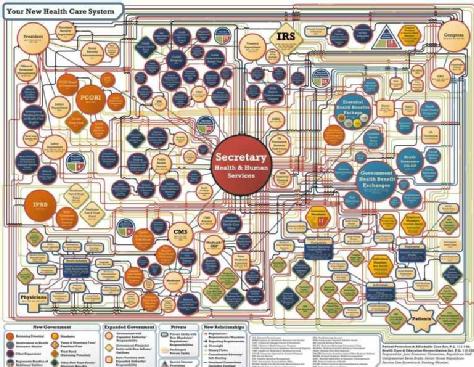
[Compiled by Republicans on the Congressional Joint Economic Committee.]
August 1, 2010
Different Escalators to and from Sanity
Did you happen to catch this in the New York Times, last week?
Even as the new coalition government [of Great Britain] said it would make enormous cuts in the public sector, it initially promised to leave health care alone. But in one of its most surprising moves so far, it has done the opposite, proposing what would be the most radical reorganization of the National Health Service, as the system is called, since its inception in 1948.Practical details of the plan are still sketchy. But its aim is clear: to shift control of England's $160 billion annual health budget from a centralized bureaucracy to doctors at the local level. Under the plan, $100 billion to $125 billion a year would be meted out to general practitioners, who would use the money to buy services from hospitals and other health care providers.
The plan would also shrink the bureaucratic apparatus, in keeping with the government’s goal to effect $30 billion in “efficiency savings” in the health budget by 2014 and to reduce administrative costs by 45 percent. Tens of thousands of jobs would be lost because layers of bureaucracy would be abolished.
Yes, the move is to doctors, but more importantly, it's toward patients. In other words, the much lauded National Health Service is decentralizing, even as the ruling class of the United States attempts to push our system in the other direction.
Note, also, the underlying justification for government bureaucracy: the employment of government bureaucrats! One wonders what is given up in the private sector in order for paper pushers to survive on plush government compensation.
July 31, 2010
Why Dependency Is Chronic
The article, by Neil Downing, takes the tack of describing people who find their Social Security checks indispensable, but the recipient numbers are the important part, to my mind:
Now, 200,202 Rhode Islanders are collecting Social Security benefits, according to newly issued figures from the Social Security Administration’s Office of Research, Evaluation, and Statistics. ...Nationwide, Social Security beneficiaries now number more than 52.5 million, up from 50.9 million as of December 2008, and 49.9 million as of December 2007.
Drawing on U.S. Census data, 19% —almost one-fifth — of Rhode Islanders receive some sort of Social Security benefit (which compares with 17% nationwide). The ratio is going to grow, given retiring Baby Boomers, shrinking generations, and longer lives, bringing the feasibility of the program into question.
The larger lesson (which one can see national politicians, especially Democrats, have learned) is that it's possible to buy constituencies. The trap of European quasisocialism (or the real thing) is that the political parties begin striving to prove that they can better manage benefits, not to admit that they are far less competent than the citizenry to manage individual lives.
July 25, 2010
They'll Find the Money or Change in Ways We Don't Like
One wonders whether U.S. legislators don't understand the consequences of their work — which isn't implausible, inasmuch as it's a real question whether they read the legislation on which they vote — or don't care. Of course, the conservative critique of government is that big government will tend to work in the interests of those with the incentive to manipulate lawmakers who cannot or will not see pitfalls, leaving the only rational and ethical choice for legislators to be to decline to micromanage the private society that they're supposed to serve.
The point comes to mind, this time, on news following passage of the "sweeping financial overhaul":
Investors are worried about banks' future earning power after Thursday's passage of the most dramatic rewriting of banking rules since the Great Depression. Adding to the pessimism are falling trading profits — which all three banks mentioned in the their earnings reports — and weak U.S. loan demand. ...Yet banks are already moving to recoup any losses. One approach: making traditionally free services premium offerings. A Bank of America pilot program in Georgia, for instance, charges customers $8.95 a month to get paper statements or use bank tellers. The bank could start the program nationally as soon as next month.
Bank of America is also considering raising minimum balances on some accounts and charging customers who fall below it, Moynihan told analysts during a conference call.
Locking more money in savings accounts is probably not the best outcome for our struggling economy. But more generally, it simply isn't the case that companies — banks or otherwise — sit on large piles of money that they know they don't need and that they are willing to give up at the wave of the president's magic pen, as if they were children refusing to share their candy. That's not to say that businesses don't hoard wealth or don't rationalize self-serving strategies; it's merely to make the obvious point that they'll seek to profit as much as the market will bear, saving as much as they deem wise and distributing their profits as they perceive their internal dynamics to require.
When government operatives pick a particular policy of the banks, such as debt card "swipe" fees, to disallow by fiat, the affected organizations will look elsewhere. They're obviously in a much better position to know what fees can conceivably be imposed, and with industry-wide rules (excepting government debt cards, naturally), they've less to fear from their competition as they impose them.
Perhaps the most chilling paragraph in the article, though, is this:
But banks won't have free rein to raise fees on whatever they choose. The financial overhaul calls for the creation of a new Bureau of Consumer Financial Protection. The agency will have vast powers to enforce regulations covering mortgages, credit cards and other financial products to ensure customers are getting a fair deal.
Unelected bureaucrats, in other words, will now have "vast powers" to make a laboratory of the finance industry for experiments in consequences. At least when private businesses engage in such experimentation, they do so at the risk of their own financial health. When government agencies muck things up, they tend to find themselves with more authority.
And that reality presents a golden opportunity for large incumbent players in the industry who can find ways to take over and influence their regulators in such a way as to ensure that they profit even in calamity.
July 24, 2010
The Slow March of Papa Government
Public education is in keeping with much else during the Obama administration: The trends toward big-government control have long been in motion, their seeds well sown and fertilized, but are now being coaxed to the next stage of flowering. Lindsey Burke elaborates:
The New York Times reports that 27 states are planning to adopt the set of national standards developed by the National Governors Association (NGA) and the Council of Chief State School Officers (CCSSO) — standards being backed by the Obama administration with federal funds. ...One thing the Times gets right — and which explains why the president is wrong to call these "voluntary" standards — is this: "Those states that are not winners in the Race to the Top competition may also have less incentive to follow through in carrying out the standards." ...
The administration is clearly aware of this little glitch. That's where Title I — $14.5 billion in federal funding for low-income school districts — comes into play. Earlier this year the administration released what they're calling a "blueprint" for No Child Left Behind reauthorization, which is likely to be debated next year. Within the blueprint, the Department of Education states, "Beginning in 2015, formula funds will be available only to states that are implementing assessments based on college- and career-ready standards that are common to a significant number of states."
The first ill effect that Burke cites with this development is that the federal program is likely to nationalize mediocrity (at best), because they are "a distraction from what really needs to be done to improve education." More importantly, and...
... most insidious of all, these national standards will come at the expense of parental control. Parents will have to relinquish the most powerful tool they currently have when it comes to their children's education: control over the content of state standards and tests. National standards will further diminish parental authority in education, and the federal government will gain more control as a result.
Moreover, the standards are already expanding from reading, writing, and arithmetic to science, and we can trust that the voluntary-if-you'll-forgo-money requirements will gather subjects like a black hole gathers celestial bodies and that non-public schools will rapidly be pressured to adopt the standards, as well. In the not-to-distant future, in other words, the debate may very well be the degree of autonomy that private religious schools have to reject federal standards for sexual education and ethics.
Which, from my perspective, brings us back to the imagined personifications of Good and Evil.
July 23, 2010
The Government They Prefer
It's always notably plausible that there's a larger truth in the mix when I agree with Bob Kerr, but while his column lamenting the possibly fatal restrictions that the Tiverton Town Council has placed on an annual charity event, this year, counts in that regard, I'd suggest that he should think on the larger lessons that the controversy teaches about government. As Kerr describes it:
For seven years, Jane Bitto, who owns Evelyn's Restaurant with her husband, Dominic, has gone to Town Hall to get the permit for "Singing Out Against Hunger," three days of music in September that has raised a lot of money and a pile of nonperishable food for East Bay Community Action’s food pantries. Last year, in a bad economy, it raised $25,000. ...There have been complaints. That's what Bitto heard when she went to Town Hall. There have been complaints from people living on the opposite side of Nanaquaket Pond from Evelyn's. The music is too loud and it goes on too long, they say.
As Kerr touches on — and as I've seen occur time and again in local politics — the process wasn't one in which people with complaints were asked to step forward to make them and confront those whom they wished to restrict. Council members made general statements about hearing complaints — complaints submitted through the typical Rhode Island method of a note, visit, or phone call to people with power — and blindsided their target only when the time to the event was too short to mount an effective response.
Kerr calls it "the flip side of small town charm." Over on the Tiverton Citizens for Change Web site, I beg to differ. This turn of events is the entirely predictable consequence of small-town fiefdoms. "Community minded" tends to mean a town or neighborhood conforming with a small group's personal preferences, with differences resolved through imposition rather than compromise. Just like we weren't the ones who turned this year's financial town meeting into an offensive circus, or who strove to ban the Easter Bunny from the public schools a couple of years ago, it isn't us selfish tax-hawk newcomers who aren't willing to tolerate a little prime-time music come a late-summer evening.
Rather, it's the same folks who regularly squash businesses' attempts at economic development. It's the same contingent who skirted the law to raise taxes by an oppressive amount and who then sued TCC President Dave Nelson for having the audacity to complain about their tactics, including Town Administrator James Goncalo's sending of false documents to the state. In other words, Kerr and his sympathizers should look at their concept of a government that cares and question whether it's possible to preserve such an entity from people who care above all about themselves.
I've heard it stated many times that those who hate the town — as indicated by an aversion to massive mid-recession tax increases — should leave. Oddly, I don't expect to hear similar suggestions when the indication of that hatred is aversion to live music in a public place for an excellent cause.
Chicks in the City
Some folks--who I'll conveniently pigeon-hole as "Whole Foods" types--want to raise chickens in Providence.
About 35 people packed a small City Council meeting room on Thursday in support of a proposed ordinance that would allow residents to raise up to six chickens.A chicken in every pot? Bah! 6 Chickens in every home! They have state support, too:Proponents said raising home-grown hens provides a local source of high-quality protein, fertilizer and natural pest control. They said it also gives urban children a chance to interact with nature.
“It’s important for children to have an understanding of where their food comes from and an appreciation for the environment,” said Camille Smith, a South Providence resident who says she’s been raising chickens illegally for years.
Kenneth Ayars, of the state Department of Environmental Management, noted that chicken-raising helps meet a region-wide goal of boosting locally grown food sources. Currently, less than 1 percent of Rhode Island food is locally grown; in New England, it is about 10 percent, he said.But wait--animal rights activists aren't too keen about this idea from their (what I presume to be) whole food pals:
Dennis Tabella, director of Defenders of Animals, says the change would open the door for chicken abuse and neglect and that, unregulated, home-grown eggs would lead to an increase in cases of food poisoning and other health hazards.Good point: there are plenty of chickens and rats at the State House, so apparently they do co-habitate. There are also concerns that the chicken license will cost too much:“It opens up Pandora’s box,” Tabella said prior to the hearing.
E.J. Finocchio, president of the Rhode Island Society for the Prevention of Cruelty to Animals, said in a letter to the council that chickens would only exacerbate the city’s rat problem.
Leo Pollack, education director at the Southside Community Land Trust, which helped develop the proposed legislation, said the land trust supported the idea of a permit, so long as it was not costly or difficult for poorer residents and non-English speakers to obtain.Finally, they say "the law would ban roosters," but that strikes me as unfair--downright discriminatory!--and, apparently, unenforcable. There seems to be regular crowing emanating from both City Hall and the State House, so there must be some roosters, somewhere. As for what to do with the fecal matter generated by our urbane poultry? It can be mixed with the regular output produced at the two aforementioned buildings.
July 22, 2010
Stimulating Something Other than Lethargy
Stephen Spruiell argues that there have now been five rounds of stimulus spending by the federal government, totaling $1.085 trillion, which surpasses the cost of both wars in which our nation has been engaged over the last decade. He further argues that the approach that the government has been taking has been flawed in its very principles.
This isn't just a matter of wasted money, because the mounting debt will eventually come due and, moreover, the debt is creating a bubble likely to pop, moving us (at last) to the ultimate "too big too fail" collapse. Not surprisingly, I like his proposal for a reworked stimulus policy:
Keynesian economists also argue that scaling back stimulus spending might actually hasten a debt crisis. Cutting spending during a period of economic weakness, they say, would depress growth, which would depress tax revenues, which would make debt service even more difficult. The reason they are enchanted with this argument is that it never occurs to them to cut spending and tax rates simultaneously. To be clear, I am not claiming that tax-rate cuts would foster enough economic growth to pay for themselves, but there is strong evidence that they would foster more growth than deficit-financed government spending would — evidence that economist N. Gregory Mankiw recently summarized in the journal National Affairs. The incentive effects of tax-rate cuts would more than offset whatever harm (my guess is: very little) might accompany spending cuts of an equivalent size. Meanwhile, the spending cuts would offset the revenue lost to the tax cuts.
July 21, 2010
Considering Unemployment
Having followed the work of Providence Journal reporter Neil Downing for years, now, I'm confident that it was not a deliberate omission, but I can't help but wonder why a particular factor contributing to economic malaise didn't make it into his recent article about unemployment:
In the current recession — which began in late 2007, and is now in its fourth calendar year — people are often out of work for 6 to 12 months — "if they're lucky to find a job," [URI Professor Edward] Mazze said; many are out of work for more than a year — or longer, he said.The main reason, Mazze said, is that "no jobs are really being created." Partly because of high rates of foreclosures and consumer debt amid this recession, "businesses are afraid to spend because consumers are not spending," Mazze said.
Businesses and consumers both are facing uncertainty not only because of the depth of the recession but because we've got a "transformative" regime running the country. Massive public debt. Looming changes to healthcare requirements. Environmental regulations appearing inevitable, whether Congressionally enacted or administratively implemented. And the list goes on.
In such an environment, planning for as-yet prospective demand is even riskier than usual.
We Didn't Agree to That
As Marc noted yesterday (and as we've been talking about for quite some time), Rhode Islanders are due to see their annual expense for public-sector pensions grow into the foreseeable future. I wonder how much issues such as this have contributed to the increasing disaffection with government.
Partly, that angst is a function of the feeling that there's now a ruling class that cannot be dislodged from office notwithstanding our ability to vote. Partly, it's the realization that the public-sector has insulated itself from the effects of the recession, at the expense of everyone else. (The supposed "stimulus" programs count, too). But pensions are a hard, cold fact that surely prods many private sector residents toward the opinion that our representative government doesn't really speak for us, and that we are not really responsible for the promises that it makes.
From the second link, above:
Republican Governor Carcieri had urged the General Assembly to eliminate entirely the promise of any cost-of-living increase, leaving it to the General Assembly to decide how much — if anything — the state could afford to give its retirees in any given year.But the Democrat-dominated General Assembly was unwilling to go that far in an election year.
That was a decision they made, and it's easy to question — philosophically and practically — why they have such power over our money. Look at the language that even reporter Katherine Gregg uses (emphasis added):
To keep the promises state lawmakers have made over the years to more than 50,565 current and future retirees, the state will have to increase its contribution to the pension fund from 20.78 percent to 22.98 percent of payroll for employees.
And the pension system was built with such unrealistic expectations for a return on investment (8%, I believe) that the entire thing leaves the aftertaste of an illegitimate scam:
In their report, they noted the fair market value of the state's pension portfolio had dropped from $7.88 billion to $6.07 billion during the critical 2009 period they looked at, the rate-of-return on the investment of these dollars was minus 20.1 percent that year and despite some good years along the way, the state's "average market return for the last 10 years is 1.83 percent."
At the state level, of course, residents can change their entire slate of representatives by moving. Those who remain may or may not be able to oust the old guard, whether or not the individual representatives change, but perhaps there's reason to hope that more folks are asking themselves what "representative" ought actually to signify.
July 17, 2010
Rationing Life
I'd forgotten it during the national debate about universal healthcare, but in processing old columns for my personal site, I came across this, from May 2005:
Intrinsic human worth may not dominate the scales during other lifecycle stages for long, either. One indication of the slide is the British judiciary's hearing arguments concerning a problem that arises from government-funded healthcare: deciding whether the patient or the doctor/public has the final say on when to cease care.As the lawyer representing the General Medical Council stated, "a doctor should never be required to provide a particular form of treatment to a patient which he does not consider clinically appropriate." Instead, in a "joint decision-making" process, the doctor should provide a menu of "appropriate" courses of action from which the patient may choose. The lawyer for the National Health Service noted that the doctor should compile the list of options "having regard to the efficient allocation of resources." It may not be appropriate, in other words, for treatment to include a hospital bed and the expensive attention and technology associated with it.
When the government encourages expectations of "cradle to grave" care, the focus of major decisions shifts from humans' dealing with the contingencies of life to society's managing human beings. An ailing patient can weigh every consideration related to his or her own life and choose, or not, self-sacrifice for things that he or she values — whether personal dignity or the preservation of savings for a family's well-being. When the authority ultimately rests with the public, however, this opportunity translates into a judgment of comparative value between citizens. There is a bottom line to balance, and it helps to exclude patients who cannot move sustenance to their digestive systems, for example.
We're now on the path.
July 15, 2010
Overt Newspaper Advocacy for Taxpayer Spending
Nobody wants to argue against assisting people who are striving to improve their lives during hard times, but when journalists leverage the public trust for naked advocacy, they do readers a grave disservice. Providence Journal reporter Steve Peoples did just that in a front page story on expiring social services programs, last Saturday, and the angles that he left entirely unexplored illustrate the bias. For example:
The 22-year-old Pawtucket native studies bookkeeping at Rhode Island College for six hours every Monday, Tuesday and Friday. She spends Wednesdays and Thursdays at an internship in the business office of Monster Mini Golf.
As Peoples notes, we're in the midst of "Rhode Island's worst economic downturn in decades." Doesn't it stand out, then, that a solvent company like Monster Mini Golf is filling a two-day-a-week job with an intern? The program arguably offers businesses valuable assistance, in that way, but one wonders why the reporter didn't ask the company what it would do were it not able to fill a slot with a free employee. And, for that matter, why does it take a government program to join companies looking for unpaid work and people willing to work without pay?
Then there's Peoples's choice of a very sympathetic protagonist. She's a 22-year-old single mother with a high school diploma. All we learn about the father of her child is that "it became clear that [he] could not contribute financially." Why not? What's he up to while taxpayers fill in the gaps that his actions have helped create? And didn't the young adults receive "comprehensive sex education," with lessons on (and probably access to) birth control? It goes a bit afield of Peoples's article, but it's also worthwhile to wonder whether, during an era in which how long and how extensively the government can and should prop up struggling citizens, we should also be devoting some attention to the deterioration of institutions — specifically, marriage — that shift some of the work over to the culture.
But the most egregious indication of the article's advocacy is the fact that it was published at all. Note the information that Peoples saves to the end, having only mentioned the possibility of a three-month extension in passing previously:
[The woman's] bookkeeping course ends in less than a month. There are no more training programs in sight. And her temporary welfare extension expires at the end of September.State officials encourage her and anyone else hitting the new time limit to apply for another three-month hardship extension if necessary.
"Those 850 clients of ours that are closing are clearly entitled to a hardship. And the lack of finding work is something that fits our criteria," says Buffi, of the Department of Human Services.
In other words, after two years of giving them welfare payments, the state doesn't automatically cut people off. It just requires that the case be reviewed in quarterly increments. Whether there's a limit to those, Peoples doesn't say, but it seems to me that his article would have been more appropriate had he profiled somebody who isn't getting an extension. Of course, such a character wouldn't have made as effective a protagonist for the message that readers are meant to receive.
July 12, 2010
The Price of Insurance
Iain Murray offers a summary of the government's entry into the insurance business (subscription required), which practice has appropriately spread like an uncontrolled fire:
[Private fire insurer Nicholas] Barbon did more than promise to defray costs in the event of disaster. He formed a private fire brigade, staffed, as one observer put it, with "watermen and other lusty persons," to help put out fires. The Fire Office also instituted "fire marks," identifying insured buildings so that assistance could reach them more quickly in the event of a fire. Interestingly, the British government entered the market shortly afterwards but was unable to compete with Barbon, who persuaded potential customers that the government could not devote the attention necessary to the task.
The impetus for this move, although surely not entirely unrelated to community-mindedness, was financial. It was cheaper to pay firefighters than to pay out claims, and the more fires the company could prevent, the lower the premiums had to be, the more clients could therefore be found, and the better the company could compete. Although some anachronism is required, the notion of private firefighters deployed by an insurance company provides a good example to follow on this explanation, from Murray:
While private insurers estimate the risk of various activities, price it accordingly, and thereby encourage insured parties to carefully consider whether undertaking the activity is worth the cost, government insurance does the opposite: It minimizes losses from engaging in risky activities by taxing less risky ones, encouraging hazardous practices.
Before contracting with a client, a private fire insurer could look at such things as whether the client smokes, what sort of heating system the house uses, and the safety of cooking appliances. A premium adjusted accordingly would signal to the individual and to society at large that there is a cost to actions that can burn down the house — the city. With no direct personal cost associated with public fire protection, and with no fear that coverage could be lost, individuals have no reason to adjust their behavior rather than drive up the widely distributed expense.
We're about to experience that (even more painfully) with health insurance.
July 10, 2010
The Question of Cape Wind Profits and Marsha Marsha Marsha!
Mass AG Marsha Martha Coakley is an ick. The fact that she facilitated the election of Scott Brown by running a lousy senate campaign does not ameliorate her sins, which extend, most recently, to an excuse for illegal immigration
Technically, it's not illegal to be illegal in Massachusetts
which rivals "I didn't inhale" for hair-splitting lameness.
Having said that, I concede that she is not wrong to demand the disclosure of the profits anticipated from the Mass Cape Wind project.
Massachusetts Attorney General Martha Coakley is demanding that Cape Wind’s developers disclose cost and profit estimates for the energy project and is questioning whether power from the proposed Nantucket Sound wind farm would be a good deal for consumers.
Is this an anti-capitalist, anti-free market, anti-privacy stance on the part of someone (me) who is pro-capitalism and prefers that Big Brother butt out of everyone's business? Certainly, that last describes Cape Wind's reaction to the AG's request.
Cape Wind’s developers are fighting Coakley’s demand, saying they believe their cost estimates are proprietary and should be kept confidential.
Unfortunately, they have no basis upon which to make this assertion. The Nantucket wind farm is not a capitalist or free market project, nor are any of Cape Wind's projects in the area. They have secured a government mandate that compels everyone to pay a lot more for the electricity generated by these turbines. This makes them government projects; therefore, privacy is not a factor.
We can take this a little further. One of the reasons that profits are paid is because the investor takes a risk with his capital. He's gambling that the project will be a success and that he will secure the return of his investment and then some. Profits are in part the reward for that gamble. But if he calculates wrong, he loses his money.
Yet, theoretically, there is no risk with the Cape Wind project. The return has been guaranteed by an overly intrusive government (mistakenly attempting to alleviate a phenomenon that has been linked weakly, if at all, to the generation of electricity through fossil fuels ... but that's a secondary matter here).
So, disclosure of profits. Yes, minimally. A larger question arises, however. In light of the absence of risk attached to this project, plus the government mandates which make it, effectively, a government operation, why should Cape Wind make any profits at all?
A spokeman for the company points out that the AG's demand
could have a chilling effect on companies investing in clean energy projects in Massachusetts going forward.
Respectfully, sir, those of us who face the prospect of paying three or four times market rate for electricity while watching ever more businesses flee the area to escape pointless expenses such as this sure hope it does.
July 9, 2010
Hucksters Not Wasting the Crisis
Funny, I hadn't heard insufficient involvement of "disadvantaged groups" included among the contributing factors to our the economic crisis that supposedly necessitates a stronger government hand in the finance industry. And yet:
Chris Dodd, Barney Frank, and Barack Obama insist that the new financial regulation bill pending a vote in the Senate is a necessity to restore stability to troubled markets. Instead, it looks as though Democrats have been more concerned about quota systems than economic growth. Buried deep within the bill is a requirement for all regulatory agencies with jurisdiction in economic arenas to start beancounting based on ethnicity and gender.
It's almost as if regulation is not a means to correct problems, but an end in itself, expanding government authority to dictate the terms of our social existence.
July 8, 2010
Charity and Government
It is fundamental to the view of big-government advocates and outright statists that the role of government is to run the society. Not just those aspects (like policing) that require legitimate use of force or (like foreign affairs) that require a unified social face to present to outside entities or (like roads and infrastructure) that empower citizens to compete with each other to the economic benefit of all, but everything. The notion is that a centralized bureaucratic brain can discern the problems of the nation and resolve them.
Of course, conservatives see that premise as insidious and sinister and don't see the creeping, relentless means by which government expands as indicative of a reasoned effort to implement intelligible plans so much as a sly strategy for aggregating power for its own sake. John Miller offered an example in a recent essay about governments' overtures to regulating (and taxing) private charity:
The fight is finished in Florida, at least for now. But the war over government control of philanthropies is set to break out in other state capitals as well as in Washington, D.C. As politicians seek to close budget gaps, many are turning their gaze to high-income givers and foundation endowments — and wondering how they can plunder the wealth that allows Americans to give more than $300 billion annually to support everything from churches to cancer research. President Obama has proposed slashing the charitable deduction for the richest Americans. So far, Congress has resisted. Yet some of its members would like to go even further than the White House. California Democrat Xavier Becerra, who sits on the House Ways and Means Committee, has referred to the tax-favored treatment of charitable donations as a "$32 billion earmark" because that’s the amount of revenue Washington supposedly forgoes each year. Becerra wants Congress to play a stronger role in overseeing philanthropy: "I have an obligation to make sure that those $32 billion that would have gone to the federal government are used for a . . . public good."The "public good" is in the eye of the beholder, of course. Last year, Becerra embraced a rather specific vision of it when he spoke at an event sponsored by the National Committee for Responsive Philanthropy. He praised the release of an NCRP report called "Criteria for Philanthropy at Its Best." The document called on foundations to spend at least half of their grant dollars on "lower-income communities, communities of color, and other marginalized groups." It also said grantors should spend at least a quarter of their donations on "advocacy, organizing, and civic engagement to promote equity, opportunity, and justice in our society."
It's a four-step trick of which Americans should beware: As illustrated in the first paragraph of the quotation, step one entails government officials asserting authority based on any thread they can find, in this case, the supposedly foregone tax revenue, as if allowing charitable organizations to keep money that others have freely given is no different than cutting a public check for the same amount. (Becerra ignores, of course, that taxing donations would translate into fewer of them.) Step two, noted in the second paragraph, sees the government implementing regulations that appeal to particular notions of charity, equality, and redistribution.
And step three leaves all pretense discarded, as at least one state government has already revealed:
Earlier this year, Arizona's legislature snatched a $250,000 bequest from the coffers of the Arizona State Parks Board. The politicians decided that the gift of Asta Forrest, a Danish immigrant who had wanted to support a park system that she had grown to love, instead would help close a budget gap. "She never would have given the money if she had known that the state was going to take it away from the parks board," a friend told the Arizona Republic.
And then, when the government has killed private charity by (1) taxing it and (2) scuttling donors' confidence that their money will actually support the cause that interests them, the argument will become — you guessed it — that the government must pick up the slack through more taxation and government "oversight."
July 6, 2010
The "Stimulus" in Miniature... or Hatchback
It appears that many residents' car tax bills will offer an early illustration of the consequence of the big-spending stimulus pursued by Congress and the White House:
A number of cars, which normally lose value each passing year, have increased in value this year as a result of several economic forces hitting the used car market. ..."There are less used vehicles out there for people to buy," said [state Vehicle Value Commission Chairwoman Linda] Cwiek, who also is the tax assessor in North Kingstown. She placed blame for the short supply of used cars on the federal "Cash-for-Clunkers" program.
To stimulate a sagging automotive economy and to aid the environment, the federal program offered financial incentives to turn in older vehicles in favor of buying more fuel-efficient models. In all, the program removed 677,842 vehicles from the road and sent them to the shredder. That prevented them from entering the used-car market.
Not only does the government have to take money out of the economy to put money into it (even if it takes from the future), but distortions of the marketplace will ripple. In this case, the effect was exacerbated by the environmentalist lunacy of destroying the cars. Many of us observed at the time that the government was essentially paying out money to ensure that used cars would be more expensive.
On a broader scale, big government-initiated spending only works as a stimulus if the economy is already headed for a breakthrough. Softening the interim with public debt is a gamble that's best hedged, and Obama and the Democrats went all in, mostly in order to prevent government entities from having to contract.
ADDENDUM:
By the way, it looks as if I wasn't so unreasonable to question the General Assembly's change of law allowing vehicle assessments to go up for the purposes of taxation.
July 5, 2010
A Comfort of Consistency
Do you need an example of the reason that it's inadvisable for the ostensibly objective entity that regulates the marketplace to participate in its activities? Here's a small one:
Limits on the fees banks charge merchants who accept debit cards would not apply to government-issued cards, under a tentative House-Senate deal aimed at easing worries raised by state treasurers.The agreement announced Monday softens a Senate provision in a broad financial regulation bill that requires the Federal Reserve to limit the amount banks collect from merchants for every debit card transaction.
We err in seeing the playing field as business versus government. Government is just another entity and it will naturally seek to draw power and authority toward itself. Here, it's giving itself advantages in the promulgation of a particular technology and service. Government cards may never expand, but as cards issued by private banks become more expensive for consumers, those issued by states and the feds will become more attractive candidates for future applications. In other words, if we see debit cards as a marketplace, government is moving to corner it.
Also evident in the above is that it will privilege those among the interests affected by its policies (i.e., state treasurers) who are most closely aligned and most easily controlled by its bureaucracy.
Earning Happiness
The behavior of both sides of the liberal-guilt–welfare axis might find some explanation in this line, drawn from a review of Arthur Brooks's The Battle: How the Fight Between Free Enterprise and Big Government Will Shape America's Future by Matthew Continetti (subscription required):
It is not inequality, Brooks writes, that makes people unhappy. It is a lack of self-worth. It is the feeling that success is unearned.
On the welfare-recipient side, Continetti notes:
In 2001, the University of Michigan's Panel Study of Income Dynamics noticed a correlation between welfare dependency and sadness. The panel found that going on the dole increased the chances of feeling "inconsolably sad" by 16 percent. "Welfare recipients," Brooks writes, "are far unhappier than equally poor people who do not get welfare checks." And while Brooks is quick to point out that correlation is not causation, the data certainly suggest that welfare doesn't make you any happier.
On the guilty liberal side, one thinks of the simplified explanation that Rush Limbaugh (gasp!) frequently offers: they know that they're wealthy beyond their merits, so they assume the system that so blessed them must be unjust. Rather than returning their "unearned" rewards, though, they seek to take a smaller amount from everybody — regardless of desert — in order to give to those who have "unearned" and not received.
Move beyond — if you can — the previous paragraph's poke at our pals on the left and focus on Brooks's point, which he states thus, in a 2007 City Journal article:
What I found was that economic inequality doesn't frustrate Americans at all. It is, rather, the perceived lack of economic opportunity that makes us unhappy. To focus our policies on inequality, instead of opportunity, is to make a grave error—one that will worsen the very problem we seek to solve and make us generally unhappier to boot.
Pointing out that income inequality in the United States has been expanding because "the rich are getting richer faster than the poor are getting richer," Brooks highlights the astonishing fact that, for some who rail against inequality, discouraging work among the successful is actually a feature, not a bug, of income redistribution:
According to British economist Richard Layard, "If we make taxes commensurate to the damage that an individual does to others when he earns more"—the damage to others' happiness, that is—"then he will only work harder if there is a true net benefit to society as a whole. It is efficient to discourage work effort that makes society worse off." Work, according to this postmodern argument—contrary to millennia of moral teaching—is no different from a destructive vice like tobacco, which governments sometimes tax in order to discourage people from smoking.
We who are productive, but not yet successful, might wish to interject that making gobs of money typically involves enabling other people to make or save money, too. As we've discussed on Anchor Rising before, replacing the rich folks who run WalMart with an army of mom 'n' pops would eliminate the employment of the large company's relatively well-compensated employees and disallow people of the same economic class from economizing in the way that WalMart's retail model allows.
Unsurprisingly, the difference in perspective ultimately seems to come down to whether one views society as a collection of castes or of individuals. The left sees those who work for WalMart as People Who Work for Walmart and, implicitly, always will. The right sees them as people who currently see WalMart as offering the greatest opportunity given their current circumstances. The poster representative for the former view is the single mother grasping about for any means of supporting her family; the poster representative for the latter view is the young adult making some side cash while learning the benefits of a strong work ethic and developing workplace interpersonal skills.
By way of a disclaimer: these distinctions are false. The single mother is just as apt to see "check out clerk" as a stepping stone, and the young adult may just as likely max out his potential stocking shelves. The point is that one side of the political divide presents current occupation as demonstrated maximum potential without public assistance, while the other side leaves potential up to the individual to demonstrate. (Shades of this difference can also be seen in union lamentations that teachers don't make as much money as others with the same amount of education. The problem is that individuals who go on to higher-paying gigs — say, quarter-million-dollar education commissioner — no longer appear in the "teacher" category.)
As Brooks and Continetti also explain, the effect of attempts to eliminate income inequality don't increase happiness. Because perceived opportunity is the greater contributor to that emotion, their policies actually have the opposite effect. We can take this assessment a step forward if we look to an underlying consequence of the mindset, whether it's conscious or not: The left's policies make government the provider of opportunity. To the extent that the right believes opportunity is provided (rather than seized from amidst the flow of uncontrollable natural and social forces), its policies put the responsibility in the hands of individuals.
July 3, 2010
Somebody Has to Make Hard Choices
Reading about the petering out of unemployment benefits, I have to admit some cynicism. The hand-scribed note in the border of my newspaper notes that people want jobs, but the federal government is giving them expensive and counterproductive healthcare "reform," but it's clear that a great number of our fellow citizens expect it all. But the article doesn't provide much meat for that discussion, so I'll settle for a tangential juxtaposition. First:
[Unemployed warehouse worker Edward Gullage, of Pawtucket] is looking into state-sponsored training courses in plumbing, carpentry and landscaping, while searching for work. He lives with his wife, who has a job, but once his benefits expire, the couple will have to make hard choices about their spending, he said.
Second:
Opponents [of renewal of federal benefit programs], including Senate Republican leader Mitch McConnell, do not want to renew the programs if it means higher taxes (which they said will kill jobs) or increased borrowing (which they said will boost the national debt, burdening future generations).
Somebody has to make hard choices. Actually, I'd argue emphatically that the government's options for decreasing spending are quite the opposite of difficult, and it would be nice to believe that the Gullages in our current economy understand as much. My cynicism derives from my suspicion that they do not and would prefer, with the Democrats, to push the hard choices on to others. Unfortunately, those others represent the segment of American society on whom we must rely for an economic recovery.
June 29, 2010
Money for Nothing and Your Economy Cut Free
This is interesting (subscription needed):
You don't have to be a scholar to know that congressional chairmen bring home the pork. But researchers at Harvard Business School, working with decades' worth of data, put a number on it: Earmarked spending targeted at a specific state increases by about 40 percent when one of that state's senators becomes chairman of one of the major committees, such as appropriations, and by about 20 percent when one of its representatives heads such a committee in the House. The surprise twist: The economy chokes on all that pork. Rather than thriving on the injections of federal cash, local businesses actually retrench.
Government money helps the government and hurts its private-sector competition for funds and for employees. The full report is available online as a PDF.
June 17, 2010
Tiogue School's Insane Idea of a Weapon
A half inch piece of plastic. H/T WPRO's John Depetro; kudos to WPRI Eyewitness News for exposing this palpable danger (or something) to the students of Tiogue School:
Eight-year-old David Morales says he made the camouflage hat with army men on top, as a school project. The hat was more than just a fashion statement, it was meant to honor military members.When Morales wore the hat to classes he was informed by Tiogue School officials that it violated their no tolerance policy that prohibits students from bringing drugs or weapons to school.
... because of the tiny plastic guns that the tiny plastic army men were carrying. Get a magnifying glass as you click on the WPRI link to view the hat and the "weapons" and to fully comprehend the danger that they posed. The only question is why the Tiogue School didn't call out a SWAT team ...
June 9, 2010
Formerly Admirable, Now a Bad Example on the Way to Obviation
Bringing his military eye to the topic, Theodore Gatchel provides an astute summary of the Obama movement in government:
Two competing schools of thought have developed. One holds that the government's role should be one of educating people about the risks so that they can make informed decisions. The other school holds that the issues are too complex for most people to comprehend, thereby requiring the government to make the decisions for them.President Obama is clearly in the latter camp, which fits nicely with his promise to fundamentally change America. In this case it means transforming the country from one in which people who take risks are admired and rewarded to one in which risk taking is regarded as harmful to the common good.
To be sure, it's possible to go too far lauding unnecessary or ill-considered risks (or those that involve others without consent), but the freedom and opportunity of turning from security en route to improvement as the individual defines it has been essential to the American character — and should remain so.
June 6, 2010
Tightening the Union Loop into a Noose
It could just be that I'm in my annual phase of presummer burnout, or it could be an indication of the complexity that Big Government imposes on a democratic society — to such degree that it ceases to be possible for the individuals who comprise that democracy to function as they must — but the number of fronts for manipulating the public sector feel like they've been multiplying, lately.
The issue that brings that statement to mind is the Democracy Is Strengthened by Casting Light on Spending in Elections (DISCLOSE) legislation that Democrats have brought to the table in Washington, which Bradley Smith describes, here. Given my usual areas of focus, this part earned a bracket in the margins of my issue of National Review:
DISCLOSE's partisanship is apparent in its different treatment of corporations and unions. Every major federal campaign-finance-reform effort since 1943 has attempted to treat corporations and unions equally. If a limit applied to corporations, it applied to unions; if unions could form PACs, corporations could too; and so on. DISCLOSE is the first major campaign-finance bill that has not taken this approach. For example, it prohibits corporations with government contracts of as little as $50,000 from making independent expenditures in elections or engaging in "electioneering communications." This very low threshold would bar not only large contractors such as Boeing but also thousands of small businesses from exercising the rights recognized in Citizens United. Yet no parallel provision exists for unions that bargain with the government for multimillion-dollar benefit packages. Corporations that received TARP funds are prohibited from spending, but unions at those companies — which in many cases benefited far more from the bailouts than shareholders — are not.
Smith doesn't go far enough, to my mind, by raising this as a matter of teams in a partisan dispute. It's actually part of a broad effort to shift the role of unions in our political society. Recall a post from November that noted, tangentially, that hospitals receiving federal money are barred from lobbying the government while their workers' unions are not (see "addendum," below). As the federal government continues to grow — especially in the amount of our economy for which it takes direct authority — the loop whereby businesses rely on the unions with which they negotiate to lobby the government will tighten into a noose, excluding organizations that are not unionized and siphoning off more money for politicians, bureaucrats, and the unions that serve as the middleman transferring economic wealth to the public sector.
ADDENDUM:
I've said before that among the greatest advantages of blogging to a mixed audience is that one is more likely than not to have errors or inadvertent stretches corrected. In that vein, Stuart called me on the statement about hospitals receiving federal money being barred from lobbying the government. Going back to my initial citation, I see that I paraphrased the following poorly:
SEIU's corporate campaigns, however effective, are nothing new. Stern's real breakthrough came when he realized that labor could offer a carrot as well as a stick Around 50 percent of SEIU's members work in the health-care industry as nurses, hospital attendants, and lab techs. The facilities that employ such workers benefit from a number of government programs. SEIU's pitch was simple: Let us organize your workforce, and we'll use our lobbying power to push for increased government spending on health care.It worked. Fred Siegel and Dan DiSalvo recently observed in The Weekly Standard that, "under the brilliant leadership of Dennis Rivera, [SEIU Local] 1199 built a top-notch political operation, and with the hospitals, which were barred from political activity, formed a partnership to maximize the flow of government revenue." The alliance has been so successful, they wrote, that New York now spends as much on Medicaid as California and Texas combined. Rivera now serves as the SEIU's point man on national health-care-reform legislation, with over 400 union staff members working full time at his disposal. Sen. Chuck Schumer called him "one of the few key players" shaping the final bill.
In essence, I joined concepts that were only related: The union offers lobbying clout, but the political activity from which hospitals are barred probably doesn't have to do with the federal dollars that the lobbying seeks, but rather with such things as bans on non-profit political activities. My understanding is that unions are not so restricted.
So, the statement in specific was incorrect, but the point remains valid. To the extent that government restrains the employer in political activity and speech, while leaving unions exempt from those restraints, the union and the government gain leverage versus the productive organizations.
May 29, 2010
A Direct Line from Health, Through Information, to Political Manipulation
The problem with giving government authority over everything is that, well, it gives government authority over everything. For a shocking example, consider Mark Steyn's description of a minor controversy in Great Britain.
It seems that, in the course of the recent election cycle, the then-ruling Labour party sent out postcards warning that, if victorious, the Conservatives would reduce access to breast cancer treatment. What's shocking is that Labour appears to have culled the list of all citizens to include only those who have" been either diagnosed with, treated for, survived or, in at least one case, died of breast cancer." Writes Steyn:
So a quantum leap in targeted marketing has just been made: The governing party of a free society was able to identify women with breast cancer in swing constituencies and send them a postcard warning that if you vote for the opposition they’ll cut off your chemo and kill you.
I suppose that's not much different than local school committees sending parents warnings that their children will have to return to paper-less one room school houses if they don't receive the budgets that they desire. The difference is that it's unavoidable for school departments to know which households have children in the school system, but at least in the United States, it isn't yet the case that political parties have ownership of everybody's personal health histories.
The easy availability of information has its pluses and minuses. The real danger lies in giving a centralized authority the power to use that information for its own purposes.
May 25, 2010
More of What Americans Don't Want
The financial regulation legislation — which has passed both houses and is awaiting reconciliation — hasn't raised the ire that healthcare did before it. Several factors come play into that dynamic no doubt: financial regulation is less tangible, Wall Street makes a better villain than insurance companies, folks are tired from the healthcare skirmish, and so on. But it still represents fine evidence that we need wholesale change of the people representing us in Washington.
Kevin Williamson describes one reason why (subscription required):
Much too much has been made of the $50 billion resolution fund and the levy that financial firms would pay to fund it. Senator McConnell abominated it as a "bailout fund," but he was paying attention to the wrong pot of money: That $50 billion is a little ladle-load of cashola compared with the buckets of schmundo that the Dodd bill will make available for indirect bailouts and endless support of troubled businesses — financial and non-financial firms alike. Case-by-case interventions may be out, but the bill would allow — in fact, appears designed to ensure — bailouts for the creditors of troubled firms. Under the Dodd bill, Wall Street firms (or unions, or sovereign-wealth funds, or anybody else with the right political connections) who are exposed to losses on failing financial companies will be able to collect significantly more money than they would be able to under normal bankruptcy procedures. That is the bailout.We've seen this before, of course. The AIG bailout, for instance, amounted to bailout of Goldman Sachs and other banks that had a lot of AIG exposure and would have had a harder time being made whole in bankruptcy court than they did under Washington's management. The Dodd bill instructs that the government shall "ensure that unsecured creditors bear losses in accordance with the priority of claim provisions" in the existing law — but how well has that worked out in the past? What legal authority did the Obama administration have to upend the normal priority of claims in the bailout of General Motors, a corrupt deal that saw secured creditors forced to take substantial losses while unsecured creditors received a better deal than they were legally entitled to — all because those unsecured creditors were the union bosses who put Barack Obama into the White House? That wasn't just a bailout of GM; it was also a bailout of the UAW. That's the kind of bailout regime that the Dodd bill will make permanent: the indirect bailout.
May 23, 2010
The Fatal Bubble
What defines an economic bubble? There are probably technical answers to that question, perhaps even involving percentages and such, but the basic inference is an apparent growth that's really just full of air, deceiving people into behaving as if the cause of the increase is actually something of substance when, in reality, it could dissipate immediately upon exposure to the atmosphere.
In a recent letter to the Providence Journal, Philip Overton, of Westerly, expresses something that has likely been nagging at a great many of us, in recent months and years:
There is no fiscal integrity in our government right now and this is the next possible great bubble building.
The substance in which we've been deceived to believing is that the government can absorb the vicissitudes of the economy. We're relying more and more on government not only to fill the craters that other bubbles have left when they've popped, not only to fill other bubbles (sometimes in the form of doomed companies), but also to conduct matters of economy and even personal well-being. It can't last.
The only question is what happens when the government bubble bursts. A free-for-all of wealth grabbing and recriminations seems likely, and let's not forget that there are those on the global playground relentless in the eye that they keep on our every step, in the hopes that the lone superpower will falter.
May 21, 2010
Race to the Cash Crop
I'm not sure one has to be a conspiracy theorist to think that government policies have become little more than a series of scams perpetrated on the American people. Take Secretary of Education Arne Duncan's Race to the Top concoction. Sure, there's some favorable nods in the direction of reform and school choice, but those nods may be easily dispersed when eyes turn away. And even up front, as Frederick Hess points out, they aren't really the meat in the stew:
A few of the 19 priorities rewarded states for moving on measures such as charter schooling and merit pay, with states earning 40 points (out of a maximum total of 500) for supporting high-performing charters and 58 points for using student-achievement results to improve teacher and principal effectiveness. But the vast majority of the points are awarded for compliance with often woolly federal criteria: 65 points for articulating an agenda and securing local buy-in, 10 points for prioritizing education funding, 20 points for providing effective support to educators, and so on. If you're not entirely sure what these categories entail, welcome to the club; they reward states for procuring signatures of union support, for spending more on schools, and for adopting impressive-sounding professional schemes.Andy Smarick, a Bush Education Department veteran who has painstakingly reported on RTTT, recently observed, "All this talk about revolutionary state change has really been overstated." While RTTT enthusiasts talk of states' lifting caps on charter schooling or removing "firewalls" that prevent student-achievement data from being linked to teachers, he noted that "the full story of states' legislative changes is more complex and less exhilarating." No state that previously prohibited charter schooling has enacted a new charter law to attract RTTT funds, and while Wisconsin technically relaxed its data firewall, it still prohibits student achievement from being used in teacher evaluations. Smarick explained this resistance to major changes as a consequence of union influence: "The problem is how much states had to give up to get that union support and buy-in."
Take away the catchy buzz words meant to disarm natural opponents of schemes implemented by and for big, centralized government and what you've got is a huge bundle of money being used to persuade state and local officials and bureaucrats to seek special-interest buy-in.
April 29, 2010
Whistling Past the Regulatory Problem
Senator Carl Levin (D, MI) strode right past the fundamental problem while lambasting Goldman Sachs executives (emphasis added):
Wall Street is on the wrong side of this fight. It insists that reining in that -- those excesses would unduly restrict the free market that is the engine of American progress.But this -- this market of ours isn't free of self-dealing or conflict of interest. It isn't free of gambling debts that taxpayers end up paying.
It isn't free of those debts because — primarily by backing risky mortgages through Fannie Mae and Freddie Mac and increasing barriers to competition with regulatory bars to clear — the government has allowed too-big-to-fail bailouts to become an implicit part of the economy. Layering on regulations will only increase complexity and the potential for the manipulation of the financial industry, whether for financial or political purposes.
April 27, 2010
Regulation Taking a Grain of Salt
Sometimes, just after waking in the morning, it's possible to believe that people like this do not actually exist, but they're out there, they're more plentiful than is good for our nation's health, and they seem to be getting bolder and bolder:
If State Assemblyman Felix Ortiz has his way, the only salt added to your meal will come from the chef's tears.The Brooklyn Democrat has introduced a bill that would ban the use of salt in New York restaurants - and violators would be smacked with a $1,000 fine for every salty dish.
"No owner or operator of a restaurant in this state shall use salt in any form in the preparation of any food," the bill reads.
Every movement and every era has its kooks, but this example cuts a bit too close to the debate about healthcare costs and government involvement in that industry for my tastes.
April 23, 2010
Handing Charitable Authority to the State
In a recent iteration of his editor's column for First Things, Joseph Bottum takes up the topic of the branches of religious organizations that reside at the edges of the organized church, itself, what he calls "limicole institutions":
As [Archbishop] Chaput notes, the first leverage typically used is financial. Public bureaucrats and lawmakers pressure Catholic agencies by threatening to withdraw funding or to revoke tax exemptions. And, as a result, Catholic Charities in many jurisdictions end up obliged, for both practical and legal reasons, to hire a majority non-Catholic staff.Of course, that issue is but one aspect of the larger issue of religious liberty. Over the next decade, this is where the battle of religious liberty will be most visibly fought—in the limicole institutions. And particularly in the Catholic ones, as the most visible and, in bulk, significant. Homosexual activity, contraception, and abortion will be the flashpoints. To quote, again, Archbishop Chaput, "Critics rarely dispute the Church's work fighting injustice, helping community development, or serving persons in need. But that's no longer enough. Now they demand that the Church must submit her identity and mission to the state's promotion of these newly alleged rights—despite the constant Catholic teaching that these behaviors are personal moral tragedies that can lead to deep social injustices."
As I've stated, before, there are two issues, here, the first being the obvious matter of religious liberty and the lines that protect it. The second issue, which is less remarked in this context, is the oppressively broad government that, frankly, many religious people have helped to bring about as they've sought to leverage civic authority as a means of social change and charitable action.
Once it became a matter of law that the government could enforce non-discrimination in employment, it became a matter of political maneuvering to define what constitutes discrimination. It should not surprise religious people that those who find their worldview misguided, even fundamentally offensive, would determine that their religious doctrine violate the law. Similarly, as the government has taken on the role of regulating and funding charitable services — a cause for which religious officials and laypeople continue to advocate — it has gained authority over those who provide such services as a religious mission.
People seem to believe that common sense and reasonable allowances will always be a factor in government action. It's a dubious proposition of itself, but religious citizens, especially, ought to appreciate the problem that their civic opposition believes that common sense and reasonable allowances are subjective, shifting concepts, conveniently tending toward their core beliefs, not ours.
April 16, 2010
The Way to Government Ownership
Since I mentioned, earlier this morning, the government's "overtaking of healthcare," it's relevant to point out an explanation offered in a recent National Review, in the magazine's short-take "The Week" section (subscription required):
American college-loan policy offers an illustration of how the government can absorb an activity incrementally, claiming to cherish the benefits the private sector provides until the bait has worked and it's time for the switch. Government support for student loans began in the form of subsidies for private loans, much as the Democrats' health-care bill would succor the insurance industry by subsidizing its product while forcing people to buy it. In the 1990s, Democrats added a "public option" — making government the direct provider of some student loans — with the Clinton administration claiming that "students and schools are served by healthy competition" between the private sector and the government. This is the same rhetoric Obama used when he tried to sell us a public option for health care. And now we see how quickly Democrats dispense with the rhetoric of competition when a government takeover seems viable: The new student-loan bill would make the public option the only option, thus completing the absorption of the activity. In a similar way, the current health-care legislation isn’t the endgame.
Government ownership of student loans gives politicians strong influence over your career. Healthcare will do the same to your body.
April 15, 2010
Oops, Congress May Not Have Excluded Itself from Health Care Reform
Robert Pear reports in the New York Times, of all places.
The law promises that people can keep coverage they like, largely unchanged. For members of Congress and their aides, the federal employees health program offers much to like. But, the [Congressional Research Service] report says, the men and women who wrote the law may find that the guarantee of stability does not apply to them.“It is unclear whether members of Congress and Congressional staff who are currently participating in F.E.H.B.P. may be able to retain this coverage,” the research service said in an 8,100-word memorandum.
And even if current members of Congress can stay in the popular program for federal employees, that option will probably not be available to newly elected lawmakers, the report says.
Further,
The law apparently bars members of Congress from the federal employees health program, on the assumption that lawmakers should join many of their constituents in getting coverage through new state-based markets known as insurance exchanges.But the research service found that this provision was written in an imprecise, confusing way, so it is not clear when it takes effect.
The new exchanges do not have to be in operation until 2014. But because of a possible “drafting error,” the report says, Congress did not specify an effective date for the section excluding lawmakers from the existing program.
These are not the only complications to Congressional health care coverage in the brave new world of health care reform that the Congressional Research Service uncovered.
Two questions pose themselves. Pear asks the first.
If they did not know exactly what they were doing to themselves, did lawmakers who wrote and passed the bill fully grasp the details of how it would influence the lives of other Americans?
Well, Speaker Pelosi did say that Congress had to pass health care reform so that we could find out what's in it. Who would have guessed it was going to be a surprise for Congress as well?
Secondly, if health care reform is as wonderful as advertised, why does Congress want to exempt itself from it? And please don't trot out the line that "Everyone will get to choose their health care plan, just like Congress does now!" This is nonsense. After health care reform goes fully into effect and all health insurance carriers have declared Chapter 7, the great unwashed will be getting their medical care from one source only - the American NHS - while the number of concierge doctors in the DC area will blossom to serve the new health care patrician class on Capital Hill.
No? The question stands, then: why does Congress wish to exempt itself from one of the most far-reaching laws it has ever passed?
April 13, 2010
The Nanny State Will Tax Your Skin
Fellow blogger and Providence Firefighter/EMT Michael Morse and his wife sent an op-ed to the Providence Journal objecting to an Obamacare tax on tanning salons:
A small group will be the first to pay for national health-care reform, the first to put their hard-earned dollars into the system. Starting July 1, they will pay 10 percent more for a service that helps them feel better and look better and promotes healthy living.You can’t tax sunshine, right? Think again. The indoor-tanning industry, mostly small-business owners, the majority of them women, has been singled out to provide funds for a program that claims to be equitable for all.
As they note, other skin-related professions avoided proposed taxes because of the size of their lobbies and the urge to protect people from themselves that has begun to creep from smoking to tanning (let alone eating fast food). For their part, the Morses dispute the ill effects of artificial tanning on health.
Personally, I think that's besides the point. It isn't the role of government to impose a healthy lifestyle on individuals, especially with matters of such long-term repercussions as exposure to light. We'd best get used to it, though. With the government intimately involved in our healthcare system — even more than was already the case — your every behavior is now a matter of interstate commerce.
April 10, 2010
For Us to Be Them, Somebody Must Be Us
Advocates for bigger government love to cite the small, still relatively homogeneous nations of Europe as an example of the bounty that awaits the United States if it just relies more on government to make decisions. Europeans, they say, are happier, more secure, less stressed out, etc. On Anchor Rising, we have argued, can argue, and will surely argue again the merits of these various claims, but for a moment let's grant that they aren't complete bunk.
The missing consideration — again, as we've argued before — is that Europeans have the space to create their little oases because the United States stands as a giant blocking the beating sun. Canadians can dictate lower costs for prescription drugs because Americans can pay more and thus keep innovation going. Great Britain can finance greater social welfare benefits because the United States finances global security. The French can take months at a time off from work because Americans will continue to work hard creating the technological innovations that give the world a semblance of moving forward.
Jonah Goldberg offers this analogy:
Look at it this way. My seven-year-old daughter has a great lifestyle. She has all of her clothes and food bought for her. She goes on great vacations. She has plenty of leisure time. A day doesn't go by where I don't look at her and feel envious of how good she's got it compared to me. But here's the problem: If I decide to live like her, who's going to take my place?Europe is a free-rider. It can only afford to be Europe because we can afford to be America.
The essential political question currently on the table, in the United States, is whether enough Americans see the country's current path for what it is and are willing to plug their ears to the siren call of welfare infantilization.
April 8, 2010
Can You Hear the Sly Taxation?
Bills have been introduced by Sen. William A. Walaska (D-Dist. 30, Warwick) to increase medical insurance coverage for hearing aids and to require insurance coverage for surgery and services associated with hearing aid implants.
Without a doubt, hearing loss increases the difficulty of one's life. So does poor eye sight and any number of other ailments and disabilities. There are two problems with this continuing trend of legislating mandatory insurance coverage for related aids, medication, and surgeries:
- It essentially turns insurance premiums into a tax to fund redistributed wealth, without allowing voters a direct influence on those increasing the cost/tax. In other words, the government is making the insurance companies levy a tax and block the political heat.
- Determining how much addressing each health difficulty is worth works best on a case-by-case basis, and when somebody else is forced to pay for the remedy, nobody in the chain from provider to patient has significant incentive to make actual, often difficult decisions, thus driving up costs all around.
But, as I said, there's a firewall against political heat built into this practice, so the politicians will keep doing it until we all decide to reassert basic principles of good governance.
The Mindboggling Contortions of Nanny Staters
Beyond her many ways of saying "raising taxes" without saying "raising taxes," note the convoluted language that this advocate of poverty uses to confuse voters (emphasis added):
Kate Brewster, executive director of the Poverty Institute in Providence, which analyzes tax and budget policies on behalf of low-income people, said, "State leaders need to take a balanced approach to solving our financial problems, which includes carefully reviewing our tax policies. We agree with RIPEC that the state should avoid a piecemeal approach to tax policy. However, there are several reasonable policies that could be enacted that would generate much-needed revenue in a fair and responsible manner, such as ending corporate giveaways, modernizing our sales tax and considering the hundreds of millions of dollars we forgo each year through tax expenditures."
Would any casual reader understand that not forgoing expenditures means raising taxes? Hopefully a reader who does will understand that, by Brewster's reasoning — which, to be fair, appears to have been the dominant perspective of those who determine Rhode Island's budgetary and spending policies — every dollar in the private economy is ultimately just tax revenue that the state chose not to collect and every decision not to collect it is an "expenditure."
Here's another interesting tidbit from the same article, by the way:
Taxes paid by businesses in tax year 2008 amounted to 5.7 percent of the state's gross state product for that year, compared with 4.2 percent for Massachusetts, 3.7 percent for Connecticut, and a national average of 4.9 percent. "We have a very heavy business-tax burden," Simmons said.
We must stop this now, or everybody who remains in the state of Rhode Island is going to suffer, the poor and working class most of all.
April 2, 2010
The President's Fortune for Flood Relief
Be sure to listen to this 49 second Allison Gaito report on federal funding for disaster relief. As if striving to outdo Sen. Sheldon Whitehouse's bumbling use of metaphor, Congressman Patrick Kennedy declares:
What is more important than having the President here is having his money here.
I'm surprised the local media hasn't made more of the news that President Obama is dipping into his private fortune to help victims of the flood. Unless, of course, Patrick meant that taxpayer dollars actually belong to the president.
The Obama-Era Binge
One gets the sense, watching state and national politicians in action, that paying for things is by far a secondary or tertiary consideration. As Ed Achorn puts it:
The government will borrow 40 cents of every dollar it spends this year. Under the most optimistic scenarios, borrowing will continue at historically high levels, putting a severe strain on the dollar and either dampening or devastating the economy. The federal debt will rise to a chilling 90 percent of the nation's economic output by 2020, the Congressional Budget Office reported Thursday.Most politicians and most of the media do not pause to consider such things. They prefer happy talk about growing government through clever (often corrupt) maneuvers and passing out public dollars as if they were candy. If pols dwell at all on how to pay for it, they cite budget figures that are based on transparent gimmicks or they advocate taxing that man behind the tree. But nobody seems to be very seriously engaged in the unnerving development that we are aboard a runaway train and we’re rapidly running out of track.
Big-government spending is self-feeding, inasmuch as the recipients of the dough are sure to vote for the people handing it over to them. Our only hope, it seems, is for folks with less direct incentive to get involved and push governance back toward status as an adult activity.
March 31, 2010
Pulling Back from the Entitlement Cliff
Andrew Biggs reviews the reckless state of our national entitlement, with this bit pointing toward something that I've been thinking might be the wisest approach, financially and socially:
Meanwhile, New Zealand offers a flat universal benefit to all retirees, with voluntary "Kiwi Saver" retirement accounts providing additional income. Such a setup would be a significant change from our current system, but would allow us to give the household of every retired and disabled worker a poverty-level benefit with a payroll tax of under 6 percent. A reform that effectively eliminated poverty for retirees and generated income above the poverty level by means of individual savings would be good policy, and might even be good politics.
As I've suggested before, with respect to healthcare, every American should have some sort of account with some very limited rules, into which they and others could contribute toward healthcare and retirement. If it helps for the government to issue the account with a person's Social Security number, then that'd be fine, but government involvement would pretty much end there. Over a person's life, he or she could contribute money from payroll, tax free, the government could provide whatever minimum benefit we all decide is appropriate, and employers, charities, family members, whoever, could add money, as well. The accounts could be partitioned — part for healthcare and part for retirement — or that could be left up to the owner.
The most important part of the switch would be that the person would pay directly for healthcare services and save directly for his or her own retirement. And, unlike current entitlements, upon the person's death the remainder would be inheritable, giving lower-income families assets with which they could improve their lot over time.
March 30, 2010
Big Business v. Big Government on Healthcare
Big Business learns that Big Government giveth and taketh away:
On Capitol Hill and in the White House on Monday, Democrats were fuming over a series of announcements that started Friday from Fortune 500 firms saying their bottom lines will take huge negative hits because of changes in tax law mandated by Obamacare. That hit in turn means lower profit projections. Caterpillar estimates, for example, that Obamacare will cost it $100 million; John Deere faces expenses of $150 million; 3M, $90 million; AK Steel, $31 million; Valero, $20 million. And then there's AT&T, which is marking its balance sheet down by a whopping $1 billion. All in all, the Wall Street Journal estimated a $14 billion haircut for these corporations.Under post-Enron accounting rules, the corporations were required to revise their projections to account for the effect of Obamacare on their bottom lines. The effect is negative because Democrats, in their zeal to raise revenues and improve Obamacare's claimed effect on the federal deficit outlook, took away a tax break these companies needed in order to supply prescription drugs to their retirees. The tax subsidy, itself a government accounting ruse crafted in 2003 by the Republican Bush administration to dissuade corporations from dumping their retiree drug benefit programs on the then-new Medicare Part D, becomes taxable under Obamacare. Corporations are now being reminded of the harsh truth: What Big Government giveth, Big Government taketh away, too.
March 25, 2010
What Profiteth a Non-Profit to Advocate Big Government?
I concur with Marc that seeking to compensate for horrendous government spending, taxing, and economic policies by squeezing money from non-profits would be shameful. We shouldn't let the news cycle revolve, however, without noting the significant overlap between the non-profit community and the segment of the population that advocates for the very policies that are sinking the state.
Every time somebody demands charitable assistance from the government, whether effected as a mandate or revenue, that person is demanding a shift in responsibility from private citizens to the government. Once the structures are in place, the government considers that it owns the cause. Heed well the parenthetical note from the article to which Marc links:
Aside from health facilities, Rhode Island law also grants tax-exempt status to churches, Little Leagues, public and private schools (Costantino noted that public schools and universities probably wouldn’t be affected by any proposal), and afterschool programs such as the YMCA.
First the government is a partner. Then it's competition. Then it gives itself unfair advantages. And ultimately, the same organization that extracts money by force of law for taxes is the same organization that grants college loans, manages the healthcare industry, maintains a criminal justice system, maintains a military, and determines how much help people deserve, what sorts of strings ought to be attached to that aid, and what social agenda ought to be furthered by the charitable process.
Feeding the Beast: General Assembly Looks to Take a Bite Out of Non-Profits
"Desperate times call for desperate measures", right? So now we learn that the RI General Assembly is looking at taxing non-profits to earn more "revenue." The method will be via suspension of the tax-exempt status by removing the sales tax waiver that non-profits receive (the GA isn't considering property taxes or taxing donations...yet). According to the Steve Peoples' story in the ProJo, this will effect 6,600 nonprofit organizations, including churches, hospitals, private schools, youth sports leagues, PTO's/PTA's and the YMCA among others.
It's obvious that the General Assembly has done a poor job of managing state revenue and has made poor choices in what it prioritizes for spending. I'm also sure there are those who will argue that hospitals and private schools and the larger non-profits that proliferate in this state can afford to be taxed. But what about the Parent-Teacher groups and sports leagues and any number of smaller non-profits? Many of these groups help fill the gaps caused by budgetary oversights and misplaced priorities that have trickled down from the General Assembly into our cities and towns.
For instance, with more education dollars going towards personnel costs, it is up to the Parent-teacher groups to pay for programs--field trips, assemblies, etc.--that once were funded by the school districts. In Warwick, youth sports leagues help keep Jr. High age kids on fields because Warwick schools don't offer organized sports. Levying the sales tax will leave less money to spend on an event at a school or available for financial aid to help a kid from a poor family play ball with his friends.
Then there are animal shelters and soup kitchens and hundreds of other small groups of people giving of their free time to do what they can to help the community. They didn't expect the government to help pay for things, but asked instead to be left alone and given a tax break in recognition of the good works they perform. These groups certainly didn't expect to be taxed for giving a helping hand. This really is shameful.
March 24, 2010
Owing Uncle Sam
It seems like such a small step, and obvious, too:
Students and families who borrow money to help pay for college will see sweeping changes as a result of federal legislation approved by the House on Sunday night.Although the bill was focused mainly on health care, it contains key provisions involving loans for higher education — including the Stafford Loan for students and the PLUS Loan for parents.
Under the bill, all such federally backed loans will be issued directly by the U.S. government, through the colleges and universities themselves, effective July 1.
See, up to now, a significant number of loans have been handled through private entities, so although the money came from or was backed by the federal government, they took a couple of percentage points of interest to process paperwork (as Neil Downing puts it). All the change — somehow passed along with the healthcare power grab — does is to cut out the middle man. But from a statist's point of view, just about everything and everyone is a "middleman"; all rights and activities ultimately come from the government. When statists' wish to engage in some form of charitable activity (by their definition), the most efficient way will always be through the bureaucracy that controls everything.
I can offer testimony that college loans are like an entry drug to debt. With a bachelor's degree becoming a baseline for jobs that have no practical need for higher education, the loan used to acquire one is like a mortgage for your career, and the government now holds every string. The government approves the loan. The government enforces laws related to debt. And, as President Obama has made clear, owning the debt, the government can opt to forgive it for those who enter preferred occupations, such as "public service."
We were already heading into an era of new indentured servitude over debt. We now know to whom we'll be indentured: Uncle Sam.
March 22, 2010
The Fly Trap's Lure
This thought, from a review of a posthumous book by Jean-Francois Revel by David Pryce-Jones (subscription required), strikes me as particularly timely, today:
A couple of years after Furet's book, six equally reputable scholars published The Black Book of Communism, detailing how the experiment of Communism had cost about a hundred million helpless people their lives. It fascinated and appalled Revel that this book, in contrast to Furet's, was not well received but criticized as unnecessary, "visceral" again, somehow too much. Revel's conclusion from this strange example of double standards was that freedom is too demanding for some people and they will hanker after Communism even though it has irrefutably demonstrated its moral, political, and economic bankruptcy. The Left, in short, still refuses to treat centralization, a command economy, and equality of social outcomes as the impediments to freedom that they are.
Freedom naturally entails a certain degree of risk, and there will always be those who prey on fear of that risk to gain power for themselves or desire, for charitable reasons, to prevent it in the first place. Humanity is so constituted, however, as to long for freedom, and using the force of government to restrain it in broad, comprehensive strokes will inevitably have consequences far greater than an individual's choices possibly can.
March 20, 2010
Government Keeps Its Fingers Clean, but Collects Junk
Undaunted by Monique's earlier quotation of the happy right-wing scribe, I'm proceeding with plans to not a recent essay by Mark Steyn, highlighting the peculiar way in which politicians manage too often to remain blameless for the damage that their policies cause. After describing a government program to install electrically dangerous foil insulation technology that burns down houses and kills installers, Steyn notes the quick defense of Environment Minister Peter Garrett, formerly lead singer of the band Midnight Oil:
... As Australia's Deputy Prime Minister, Julia Gillard, breezily told a TV interviewer, "Peter Garrett can't be in every roof in this country as insulation is being installed."They never are, are they? Likewise, the European Union grandees and eco-poseurs of the US Congress who mandated sudden, transformative increases in "biofuel" production and at a stroke turned the food supply into part of the energy industry and made grain more lucrative as fuel than as sustenance weren't there in Haiti, Indonesia, Ivory Coast, Pakistan, Mexico and even Italy when the food riots broke out. Nor was Al Gore able to be up there on every one of California's 14,000 abandoned wind turbines. They're not entirely useless, not if you're an ornithosadist who enjoys seeing our feathered friends sliced and diced by the Condor Cuisinarts.
These are the "green jobs" that Barack Obama says will both save the planet and revitalize the economy: electric Zambonis, foil insulation, wind turbines, corn-powered cars. They will put America back on the cutting edge. In reality, like the spiked cutting edges of the electric ice-resurfacer, they'll leave the economy full of artificial speed-bumps that, when not actually sending you crashing to the ground, will make it harder and harder ever to get going.
Environmental mania is just another manifestation of the madness currently overtaking Western civilization and subsuming our freedom. On a daily basis it's increasingly clear that if our society is to survive as anything recognizable as such, all levels of government must be reset, like a computer brought back to its factory settings, removing all of the junk that piles up in dark corners of the hard drive and quirks that slow the system down.
The Unwelcome Job Creation that Would be Engendered by Healthcare Reform
... points out Mark Steyn.
Meanwhile, Obamacare will result in the creation of at least 16,500 new jobs. Doctors? Nurses? Ha! Dream on, suckers. That’s 16,500 new IRS agents, who’ll be needed to check whether you – yes, you, Mr and Mrs Hopendope of 27 Hopeychangey Gardens - are in compliance with the 15 tax increases and dozens of new federal mandates the Deemocrats are about to “deem” into existence. This will be the biggest expansion of the IRS since World War Two – and that’s change you can believe in. This is what “health” “care” “reform” boils down to: Fewer doctors, longer wait times, but more bureaucrats.
Oh, goody. Not more doctors - more regulators.
March 19, 2010
The Bucks Are in Busing
And for today's Astonishing but True:
The highest-paid municipal employee in Madison, Wis., is bus driver John E. Nelson, whose salary last year totaled more than $159,000. Half a dozen of his fellow drivers also earned in six figures. How is this possible? The Wisconsin State Journal explains: "A high base salary and other benefits for drivers were largely set in the 1970s and 1980s, when the city took over the bus company." Combine that with generous, federally mandated leave provisions that make for lots of overtime, and it's not unusual for a bus driver to out-earn the mayor (and with much better job security).
February 19, 2010
Government Can't Just Dictate Reality
I certainly don't want any of my family's regular expenses going up. Indeed, if I were able to dictate terms to companies who provide me services, I'd lower my rates. But that's not how the world works. Of course, one doesn't get the impression that government officials comprehend such mundane observations of reality.
Rhode Island's Health Insurance Advisory Council, for example, in considering insurers' requests to increase their rates, acknowledges that "most of the proposed increases result from growing hospital and pharmaceutical costs." But the body can only think to posture and demand more squeezing from the companies. Several candidates for public office who put in an appearance at the hearing had nothing additional to offer:
State General Treasurer Frank Caprio, a candidate for governor, offered the council "an update from kitchen tables across the state." He said bills are piling and people are forced to cut back. "I respectfully ask you to say, 'Enough is enough' to these insurers," Caprio said.Lt. Gov. Elizabeth H. Roberts, a candidate for reelection, acknowledged that medical inflation was the underlying problem, but urged Koller to push insurers to develop proposals for dealing with it. "We need to put the challenge on the table," she said.
State Sen. Leonidas P. "Lou" Raptakis, D-Coventry, a candidate for secretary of state, suggested linking health-insurance premiums to the consumer price index.
Why is nobody proposing the clear solution to the problem of increasing in-state health insurance? Look, our mechanism for dictating terms to those who provide us services is to find another provider willing to agree to them. A market of just three insurers is clearly not enough, so we need to bring others in. To do that — and to enable them to keep down costs — we've got to lighten up our mandates and regulations.
Unfortunately, we're learning that the one thing that Rhode Island's ostensible leaders will not consider is decreases to their own authority. That's why we have to apply a political version of the Central Falls high school "turnaround model": Vote them all out of office and reelect no more than the one percent or so who might have something resembling a clue.
February 16, 2010
Asserting Humanity by Little Steps (Literally)
Even apart from the political point, Mark Steyn's most recent last-page essay for National Review is worth a read for the scene that the anecdote presents.
February 13, 2010
Hurting a Dedicated Constituency
In an article about the ways in which Democrats' preferred policies hurt black Americans, Kevin Williamson emphasizes union racism and especially the minimum wage:
THE first answer many economists will give to that question is: the minimum wage. Milton Friedman, a Nobel laureate who spent much of his career showing how government programs reliably end up hurting those they are intended to help, was scathing on the subject, calling the minimum wage "one of the most, if not the most, anti-black laws on the statute books." And he's not alone: Acongressional survey of economic research on the subject, "50 Years of Research on the Minimum Wage," has a string of conclusion lines that read like an indictment, the first three counts being: "The minimum wage reduces employment. The minimum wage reduces employment more among teenagers than adults. The minimum wage reduces employment most among black teenage males." Other items on the bill: "The minimum wage hurts small businesses generally. The minimum wage causes employers to cut back on training. The minimum wage has long-term effects on skills and lifetime earnings. The minimum wage hurts the poor generally. The minimum wage helps upper-income families. The minimum wage helps unions." Helping the affluent and high-wage union workers at the expense of the young, the poor, the unskilled, and small businesses: That amounts to a lot of different kinds of injustice, and it also amounts to a wealth transfer from blacks to whites. ...And it's not just that the minimum wage prices some low-productivity workers out of the labor market: It's that it prevents entry into the labor market in the first place for the most marginal would-be workers. If Will the candy hustler's real economic output is worth $6.67 an hour, his implied wage on the subway, he's unemployable with a $7.25 minimum wage. He can sell candy on the subway, but he can't sell candy for Big Candy Corp., make connections, learn what it's like to go to an office every day and have a boss, get references, get promoted, and sign up for the tuition-reimbursement program. And that, not the paltry lost income of a minimum-wage job, is the price he pays. Very few American workers actually earn the minimum wage--about 1 percent, in fact--but the minimum-wage job is a gateway into the labor force for many young workers. The value of your first job isn't the money you earn from it: It's your second job, and your third. With the right experience and network, a candyman like Will can do well for himself. But without that first job, he has a much higher chance of becoming a statistical blip on the long-term unemployment charts than a middle manager at Hershey or a salesman at Cadbury.
Perhaps for reasons of length, Williamson doesn't even touch on the deleterious effects of liberal social programs (from the welfare state to easy divorce to abortion on demand) and extra-statutory principles (like identity politics) that have destroyed family structures in minority communities. If the Ku Klux Klan had called grand meeting in the middle of the last century to contrive a national conspiracy that would effect long-term evisceration of blacks' progress, the bigots could hardly have done so more effectively than the American Left.
February 1, 2010
The International Noose Tightens
How long, do you suppose, until history encounters its first global totalitarian regime?
U.S. Rep. Barney Frank said a bank tax and other tough new measures would be introduced by the individual countries but in a coordinated way to prevent bankers from moving from one place to another to escape regulation."Lenin might have been able to put socialism in one country, but tough bank regulation in one country ain't going to happen because we will lose people," said Frank, a Massachusetts Democrat who heads the U.S. House Financial Services Committee, a key spot for any American decisions.
Expect "coordination" to expand in the authority that it entails and in the issues that it covers. This really is the sort of thing against which the United States should stand, on the global scene. Sadly, our current regime is likely a driving force behind it.
That also implies the possibility that the rest of the world will allow us to go first so as to drive our businesses away and then curtail their own enthusiasm.
January 24, 2010
Towns on the Teat, Too.
This article is a few weeks old, but I've been holding on to it because the statement contained therein really requires philosophical correction:
One by one, mayors and municipal managers from Cumberland to Westerly told the House Finance Committee on Thursday that the midyear aid cuts proposed by Governor Carcieri will wreak havoc on local services and tax rates, shifting a state budget crisis onto the backs of municipal employees and property owners already feeling the bite of previous state-aid cuts.
If the towns and cities have allowed themselves to rely heavily on the state for financial support and the state is having a budget crisis, then the crisis isn't shifted, it's shared. We should expect our municipal leaders to be more self-motivated, active, and demonstrative than welfare queens.
What really irks me about the attitude expressed in the article, though, is the degree to which government operates as if behind a wall of glass. Mayors and managers shouldn't be wasting time on their knees at the state house. Even were groveling successful in staving off cuts to "state aid" this year, circumstances are only going to be more dire in the next budget unless things change dramatically in Rhode Island.
In other words, officials should be turning to the people who elected them (or who elected the people who appointed them), explaining what the state must do to turn things around, and more importantly, encouraging residents to get involved — not to join in the groveling, but to run for office and join taxpayer groups and the like. After all, they pay the taxes whether it's to the town or the state, and when revenue improves for the state, it will improve for the municipalities, as well.
Of course, this assumes that municipal leaders have a clue about what might save Rhode Island — an optimistic assumption if ever there was one.
January 23, 2010
Again: It Wasn't Stimulus; It Was a Government-Insulation Program
We've argued multiple times, 'round here, that the federal government's approach to "stimulus" — especially as defined by President Obama — was not, in fact, designed to stimulate the economy and yield job growth. Rather it was designed to insulate government structures from the effects of an economic recession... at the expense of the economy. In case you missed it, here's one more bit of evidence from recent weeks:
A federal spending surge of more than $20 billion for roads and bridges in President Barack Obama's first stimulus has had no effect on local unemployment rates, raising questions about his argument for billions more to address an "urgent need to accelerate job growth."An Associated Press analysis of stimulus spending found that it didn't matter if a lot of money was spent on highways or none at all: Local unemployment rates rose and fell regardless. And the stimulus spending only barely helped the beleaguered construction industry, the analysis showed.
As Rhode Islanders who follow state and local politics should be amply able to attest, such infrastructure money from the feds only serves to take the pressure off lower tiers of government, which tend to neglect obvious, necessary expenditures in favor of less popular, more ideological ones. They typically float bonds and create targeted taxes to accomplish the building and repairs that must obviously be done for the good of the local society, but in the current environment, taxpayers were likely to resist either strategy, requiring governments to cut back on other areas of spending.
The "stimulus" money, in other words, didn't create any new work. It merely enabled continued profligate behavior. And the reason it "only barely helped the beleaguered construction industry" is that the government has instituted policies that create high barriers to entry in order to compete for its contracts, sending the money mostly to companies that were already prepared (and expecting) to receive it.
January 19, 2010
Mandated Monitor Waste
Here's the scene: Shortly after 7:00 a.m. on a semi-rural road that locals often use to avoid a mile or so of Middletown's two main roads, the school bus pulls up to a modest split-level house, and the driver opens the double doors. A middle-school girl skips up the driveway and stops a few feet from the bus. She waits. She hooks her thumbs in her backpack straps. Motorists crane their necks to see what's going on.
Finally, first one leg then another appear. An elderly woman in an reflective vest climbs backwards onto the street. With one arm still attached to the handrail, she leans a little out of the way, and the young girl bounds effortlessly up the stairs. The bus monitor bows her head, takes a deep breath, and begins the laborious climb back up to her seat.
Now, if the people of Middletown feel that the benefit of intergenerational cooperation is worth the expense of such morning-time chaperons, then I'm hardly in a position to object. However, we have, here, a living, breathing example that the arguments proffered for a state-level bus-monitor mandate are not actually the most significant motivations. The woman in question makes no pretense of inspecting the underside of the bus for suicidal children, and were a child about to enter into danger crossing the street, or something, she would likely prove physically unable to prevent the calamity. The bus driver and the horn would be more effective.
This, folks, is one small emblem culled from daily life explaining Rhode Island's deterioration.
January 11, 2010
How the Economy Interacts with the Poor
As economic units is perhaps the last way in which clergy should consider human beings, but it's worth their while, on prudential matters, to take into account the ways in which economic principles affect charitable intentions. Unfortunately, in the quotation that Ed Fitzpatrick recently utilized, I fear Roman Catholic priest John Kiley has the mechanism reversed:
"When many of our fellow citizens are constrained by unemployment and illiteracy, and even by hunger and disease, the whole society suffers," said the Rev. John Kiley, ecumenical officer of the Roman Catholic Diocese of Providence. "Because of poverty, civilization's greatest resource, the human person, is prevented from sharing his intelligence, his gifts and his uniqueness with the world at large. Thus, mankind's social capital is depleted. Poverty makes poorer persons of us all. The elimination of poverty in Rhode Island over the next 10 years will improve the living standards of all citizens. Elevating the poor will actually enrich the prosperous."
An accurate assessment would find an organic give and take, but if the dominance tilts in one direction or the other, I'd say that it's more true that improving the economy will elevate the poor than the other way around. Prosperous people who increase their charitable giving — and, more generally, behavior — during hard times will certain reap rewards in many ways, but if the suggestion is for society to reallocate funds from the wealthy to the poor by means of government coercion, the economy will slip even farther, and the most vulnerable will wind up being harmed more profoundly and with an increasing number of fellows.
Dependency and the dilution of natural motivators for self improvement can also prevent the human person from growing and sharing. Nothing depletes social capital and human potential more surely than a government with its fingers in everybody's pockets, whether it's taking or giving.
January 7, 2010
Rule by Funding and Memoranda
I'm one of two people in the audience of an "emergency" Tiverton School Committee meeting, which was called in order to approve a memorandum of understanding from the Rhode Island Department of Education for the state's Race to the Top application, and the sense that I'm getting from the discussion is not encouraging.
Here's the upshot: School committees are under a lot of pressure to sign the MOU so that the state can prove "political will" to implement the program to the federal government. The problem is that the document that the local officials are being asked to sign is apparently not wholly inclusive of the information on which they believe they're voting. Some supposed facts are in a repeatedly changed FAQ document. Others were conveyed during in-person meetings. Some of it is in documents from the federal government. And the really-honestly-truly final document won't be released until Monday.
So, in the name of chasing after taxpayer money, the people whom taxpayers have elected to guide their local investment in childhood education are being asked to sign on to mandates and requirements from state and national officials without, as far as I can understand, even receiving assurances that the higher tiers of government will provide more money than they're requiring districts to spend.
ADDENDUM:
Here's an interesting point from School Committee Member Leonard Wright, who seems extremely suspicious of this whole thing: There is language in the memorandum that the district agrees to comply with the terms of the federal grant and a "RIDE subgrant" that apparently has not yet been produced.
ADDENDUM II:
And isn't this FAQ point interesting:
Are there "supplement, not supplant" requirements for Race to the Top?Race to the Top contains no "supplement, not supplant" requirements.
Furthermore, the language that Mr. Wright cited about a state "subgrant" suggests to me that the state could take advantage of the lack of "supplement, not supplant" language while still imposing that very rule on individual districts.
Another point that's coming up is that the town is probably going to be subject to increasing regulations and mandates whether it signs on for Race to the Top or not. It's the old "nothing to lose" lure. But imagine this outcome: The collapsing state causes a political surge for reform, among which is the elimination of state-driven mandates... except, of course, where those mandates are part of contractually agreed grant programs.
ADDENDUM III:
The school committee has added, as a condition of its agreement, stipulations that all program requirements will be fully funded and that the funding from Race to the Top would supplement, not supplant, allocated state and federal aid to the town.
December 23, 2009
Impressions from a Declining Country
Sometimes the order in which one processes information can create broader impressions than the individual items suggest. For just such an experience, first watch Steven Crowder's short video about the crumbling, desolate city of Detroit, whose condition he attributes to the loving manipulations of big government.
Now consider this news:
Almost two months ago, the Commerce Department cheered the announcement that the third quarter GDP had grown at an annualized rate of 3.5%. The Obama administration hailed it as a sign that their economic policies had spurred real growth. Even when Commerce sharply revised the number downward a month later to 2.8%, the White House continued to argue that the lower number still meant that the US had turned the corner, even after a number of critics asked how Commerce could have missed the number so widely. ...Today, Commerce backtracked even further. The annualized growth number for Q3 turns out to have been 2.2%, a revision of over a third from its original estimate two months ago...... The Cash for Clunkers program and the first-time homebuyer tax credit was estimated to have contributed as much as half of the original Commerce estimate of 3.5%. Assuming that to still have contributed at least 1.5% of the final GDP, that leaves a rather pathetic 0.7% growth in Q3 without it. It's barely a recovery at that level.
And this morning, we learn:
November saw a dramatic increase in the number of houses sold in Rhode Island — up 61.1 percent compared with November 2008, according to statistics compiled by the Rhode Island Association of Realtors.
Part of the increase can be explained by a one-month-only $8,000 tax credit that expired at the end of November. Part of it may be related to the false prediction of growth. No doubt, there's also a genuine improvement of buyer mood; people who have been in the market for a home are more comfortable with the probability that prices are at or near their new bottom and that interest rates aren't going any lower. University of Rhode Island Economics Professor Len Lardaro puts it thus: "we're [now] in a typical recession, not a free-fall, like we were in a year ago."
Nowhere, however, has anybody explained what specifically is going to turn things around. Even up to the Commerce Department, it seems as if economic forecasts are taking as an assumption that 4% or so is simply "normal" growth, to which the economy will return as a function of its essential nature. The picture that is actually beginning to emerge more resembles an old car, and all variety of government officials, economists, and media cheerleaders are standing around trying various tricks and gimmicks to get the beast moving — not the least by employing positive thinking: "It's just about to go, now!" It whines and whirs and sputters, but it isn't turning over. And it's cold outside.
Of course, economic movement is only necessary for certain destinations. We can trust, for example, that Detroit will come to us. Rhode Islanders should be especially aware of the fact that, by contrast, economic turnaround and improvement must be pursued, not awaited
December 20, 2009
What Government Healthcare Really Means
Well, this about sums it up:
Far from being a brilliant plan constructed by top doctors and financial experts in a government brain trust, this health-care bill is a twisted, deformed political document, seen in its entirety by only a few high-ranking politicians belonging to a single political party. Its components have not been precisely crafted as part of a fantastic system calibrated to ensure the maximum access to quality health care for all Americans.The bill is not being examined with transparency and careful deliberation by representatives who behave as humble servants of the people and their Constitution. Instead, it's being hastily rammed through in the dead of night, over the objection of powerful majorities of the American people, with desperate last-minute deals cut to acquire the necessary votes, financed by vast sums of taxpayer money. The primary consideration is not crafting the most sophisticated and intelligent health care reform... it's getting a bill pushed through before angry voters have a chance to blast the Democrats out of Congress. Look at it this way: if the average middle-class American paid about $5000 in federal income tax last year, then you might be one of the 20,000 people who paid for Mary Landrieu's vote, in the hope of giving Barack Obama a bill to sign as a Christmas present.
November 25, 2009
Hey, Why Don't You Just Pay Yourselves?
Didn't want to let this slip away:
In what it called a sign of progress, GM also pledged to start paying back $6.7 billion in U.S. loans. But the money will come from a contingency account full of government cash, leading critics to question just how healthy the automaker really is.
Welcome to government self-financing of its market wings, where debtors pay their loans by taking money from the lender. If the public companies can't compete, well then, they'll just make other companies' customers pay for it in taxes.
November 22, 2009
The Green Religion and Expensive Government
Just wanted to mark this final stage in the incremental establishment of the green religion as the official doctrine of the land:
New major public projects and building renovations in Rhode Island, including schools, must be designed and constructed in conformance with high-performance green-building standards, according to legislation signed by Governor Carcieri.The law applies to new construction of more than 5,000 square feet and renovation of spaces greater than 10,000 square feet if such projects receive funding from the state. The law takes effect immediately but will apply only to buildings entering the design phase after Jan. 1. Under the law, building design must conform to the internationally recognized United States Green Building Council Leadership in Energy and Environmental Design rating system or an equivalent high-performance green-building standard, including the Northeast Collaborative for High-Performance Schools Protocol.
It almost reads like a comedic one-liner when Senator Louis DiPalma (D, East Bay Gerrymander) explains that "green building materials and systems [are] more affordable and available [...] than they used to be." Badum-bum. He goes on to assert that the investment "pays off in lower costs for energy, water and more over the life of a building," but if that's true, then the communities and organizations funding applicable projects should be easily persuaded without a state mandate.
To review: Our state is in the middle of a fiscal crisis, bleeding jobs for years on end; our government has structural deficits in the hundreds of millions in good times and bad; our communities are struggling to maintain the services that they provide; and the General Assembly and governor thought this would be an appropriate time to mandate a greater price tag on investments in public construction.
November 20, 2009
The End of the Entitlement Road
Is this astonishing video of a protest turned near riot related to a wrongfully imprisoned innocent, wanton murder of grandmothers, or government confiscation of children? Nope. It's over a proposed 32% tuition increase for the University of California system. It's a symptom of the inevitable collapse of a society built on an entitlement mindset.
Don't get me wrong. Such increases create real hardships and truly disrupt people's lives — and their plans for their lives. But intimidating administrators who have only so many dollars to allocate and declaring that it's "our university" only avoids the broader questions about how the situation came to be. What decisions have California and the United States made to create these circumstances?
UCLA Political Science Professor Mark Sawyer's point is true enough:
Sawyer said he is angry over the 9 to 10 percent salary cut he's taken because of mandatory furloughs. But he said he worries more for the status of the university system as a place for affordable education and how it will affect the "future leaders" of the country."I'm also worried about the mission of a public institution," Sawyer said. "It's a gateway to the middle class and to building the California economy and the nation's economy, and these institutions are where that all happens."
It might be too much for which to hope, but perhaps this era of hardship will remind Americans that they can't simply declare everything to be a priority. Either we can have loose immigration laws, or we can pay public university professors well. Either we can subsidize healthcare and retirement, or we can subsidize young adults' educations. Either we can regulate industry to the fine detail of our every preference, or we can hold open gateways to individual economic advancement. (Right-wingers will note that the protest sign pictured at the second link advertises for the AFL-CIO.)
In actuality, the long run may prove there to have been only one option, as a failure to build a self-propelling society (rather, a failure to allow it to build itself) undermines our ability to give resources away.
November 19, 2009
Backfilling the Stimulus Spending; "Who really knows?"
And in a sentence, posted by Kevin Boland, we have the perfect summary of the government stimulus program:
Ed Pound, the director of communications for the Obama Administration's "stimulus" website (recovery.gov), dropped a bombshell in interview with the New Orleans Times Picayune, stating that the Obama Administration has no idea how phantom congressional districts - such as Ohio's 00th or Louisiana’s 26th - received "stimulus" funds. The Times Picayune story reported:'We're not certifying the accuracy of the information,' said Pound ....Asked why recipients would pluck random numbers - 26, 45, 14 - to fill in for their congressional district, Pound replied, 'who knows, man, who really knows. There are 130,000 reports out there.'
Boland goes on to describe several of the myriad examples of error, misstatement, and probable fraud associated with "creating and saving" jobs. Marc speculated, the other day, about the location of Rhode Island's lesser-known Congressional districts. At this point, what should be coming into focus for every clear-eyed American is that the "stimulus" was little more than a scam to insulate the government from the effects of the downturn. For a further indication of that reality, look to Stephen Spruiell's National Review exploration of the relationship of the Obama White House with the Service Employees International Union (SEIU):
The stimulus bill was a top priority for SEIU because it contained massive bailouts for state governments and Medicaid. As mentioned above, states such as California, New York, and New Jersey have expanded their social-welfare systems beyond what they can afford, in response to pressures from SEIU and other public-sector unions. At the same time, their progressive income-tax structures have made them especially vulnerable to boom-and-bust cycles. When the credit bubble burst, these states were looking at massive deficits, layoffs, furloughs, and budget cuts. The stimulus bill included a $50 billion slush fund for state governments and $90 billion in Medicaid expansions, helping the states avoid a necessary round of belt-tightening and tax reform.
Witness the inevitable theft that big government perpetrates against the nation's people, and unions have a critical role to play. Spruiell notes elsewhere that hospitals receiving federal money are barred from lobbying the government... but the union whose members benefit mightily from those same dollars are not.
This sort of shadow structure will not fail to emerge when a single entity is empowered with the federal government's broad control over every other aspect of the society. They'll lobby. They'll bully. They'll launder. They'll lie about their intentions and then throw together phony explanations for what they've done. They'll crush the United States for their own narrow interests.
ADDENDUM:
I've said before that among the greatest advantages of blogging to a mixed audience is that one is more likely than not to have errors or inadvertent stretches corrected. In that vein, a commenter in a subsequent post that refers to the above called me on the statement about hospitals receiving federal money being barred from lobbying the government. Going back to my initial citation, I see that I paraphrased the following poorly:
SEIU's corporate campaigns, however effective, are nothing new. Stern's real breakthrough came when he realized that labor could offer a carrot as well as a stick Around 50 percent of SEIU's members work in the health-care industry as nurses, hospital attendants, and lab techs. The facilities that employ such workers benefit from a number of government programs. SEIU's pitch was simple: Let us organize your workforce, and we'll use our lobbying power to push for increased government spending on health care.It worked. Fred Siegel and Dan DiSalvo recently observed in The Weekly Standard that, "under the brilliant leadership of Dennis Rivera, [SEIU Local] 1199 built a top-notch political operation, and with the hospitals, which were barred from political activity, formed a partnership to maximize the flow of government revenue." The alliance has been so successful, they wrote, that New York now spends as much on Medicaid as California and Texas combined. Rivera now serves as the SEIU's point man on national health-care-reform legislation, with over 400 union staff members working full time at his disposal. Sen. Chuck Schumer called him "one of the few key players" shaping the final bill.
In essence, I joined concepts that were only related: The union offers lobbying clout, but the political activity from which hospitals are barred probably doesn't have to do with the federal dollars that the lobbying seeks, but rather with such things as bans on non-profit political activities. My understanding is that unions are not so restricted.
So, the statement in specific was incorrect, but the point remains valid. To the extent that government restrains the employer in political activity and speech, while leaving unions exempt from those restraints, the union and the government gain leverage versus the productive organizations.
November 3, 2009
Could Have Been Worse, Will Not Be Better
Unsurprisingly, Kate Brewster, of Poverty Institute fame, is inclined to cheerlead for stimulus money:
"It could have been worse" might not be an inspirational slogan, but it aptly describes the situation in Rhode Island and other states thanks to unprecedented federal efforts to fight back against one of the worst recessions in memory.
She goes on to list some big dollar amounts that have been handed out, but my mind keeps returning to her opening quotation. In the years and decades to come, we should pause from time to time to wonder whether, in those future days, things could have been better in the absence of all of that advance spending.
In Rhode Island, surely, and probably throughout the nation as a whole, we are likely to be measuring our progress in degrees of economic pain, rather than of success, for the better part of our lives. Unless, of course, we turn our nation from the path on which Brewster's ilk has set us.
October 31, 2009
What a Scam
Here's the stimulus story in a sentence: The government — in which I'm including the entire structure from the town to the nation — insulated itself from the souring economy and is now attempting to justify and perpetuate the scam by touting its own health. A little bit of basic math puts this in perspective:
Nearly 650,000 jobs have been saved or created under President Obama’s economic stimulus plan, the government said yesterday, and the White House declared the nation on track to meet the president’s goal of 3.5 million by the end of next year.
A $787 billion program "creating or saving" 650,000 jobs comes at a price of $1.2 million per worker. Alright, fine, the whole amount hasn't been spent, yet. But look at it this way: The federal government could have given 650,000 people the nation's median income of roughly $52,000 at a total cost of $33.8 billion. For $50 billion, the government could have given one million Americans $50,000 and said, "You've got a year to figure out a way to make a living."
It's a matter of plain deduction to observe that a lot fewer people must be getting a lot more money thanks to government action.
Of course, as I began by implying, the audience of the government's self-congratulations isn't the group of people whom it merely represents. Rather, the government is advertising its success for the benefit of its real clients: its various codependents. Look to some of the details in Rhode Island:
Nearly all of the 1,489 jobs created or saved through the state's allocation of funds were in three areas: corrections, education and labor and training. ..."There aren't a lot of sustainable jobs in those numbers," [gubernatorial spokeswoman Amy Kempe] said.
Transferring money from productive, economy-growing segments of the population in order to maintain the government workforce at a cost of over a million dollars per job is a teetering model.
October 23, 2009
An Argument for the Second Amendment
Sometimes news out of Europe suggests the possibility that another revolution may be coming, such as this story from England:
On Monday afternoon, the mother gave birth to a girl by Caesarean section.And 28 hours later, social workers arrived at the maternity ward to take the baby into care, after serving child protection papers on the patents.
Yesterday morning, a meeting of the Children’s Panel of Dundee Council decided the three youngsters still living at home should also go into care.
They are expected to be removed from the family home before the end of the week.
The family called "social services" over one child's developmental problems, and the government turned around and imposed weight limits and exercise regimes. (A picture of the family shows them to be heavy, but hardly unbelievably so.)
As Mark Steyn notes, the children are being take based on social worker "fears" of what their future "might" entail, and measuring parents on a literal scale is not many steps removed from assessing them on other grounds. Unhealthy can be a state of mind, and if the government controls healthcare, and if (through the efforts of Congressman Patrick Kennedy) it defines and covers emotional and intellectual well being, bureaucrats and social workers might not see much difference between being overweight and being, say, religious.
I'll tell you this: Any social workers who come to take my children away had better come armed, and everybody who approved the decision on up the chain of command had better lock their doors. If this is the government's wing under which our society is preparing to nestle, it would be an act of patriotism — of moral imperative — to cut it off.
September 30, 2009
Michigan: No Free Babysitting allowed!
Common-sense government at work:
Each day before the school bus comes to pick up the neighborhood's children, Lisa Snyder did a favor for three of her fellow moms, welcoming their children into her home for about an hour before they left for school.Snyder's house is at the bus stop, so sheltering the kids for an hour a day or so seemed to make sense. But, hey, a rule is a rule!Regulators who oversee child care, however, don't see it as charity. Days after the start of the new school year, Snyder received a letter from the Michigan Department of Human Services warning her that if she continued, she'd be violating a law aimed at the operators of unlicensed day care centers.
Under state law, no one may care for unrelated children in their home for more than four weeks each calendar year unless they are licensed day-care providers. Snyder said she stopped watching the other children immediately after receiving the letter, which was well within the four-week period.Apparently, a local Mrs. Kravitz dimed her out. Meanwhile, I'd suggest that Snyder start organizing her fellow Bus-stop Sitters into a union (local B.S. #1?) for protection and potential compensation down the road. Hey, it worked for crossing guards....
Hints of Things to Come with Public Healthcare
An interesting find by Joseph Bottum. Belmont Abbey College, an institution sponsored by Catholic monks, opted to remove provisions for abortion, contraception, and sterilization from the healthcare plan that it offered employees, as it must do as an institution run by believing Catholics. The matter will end up in court, but the Equal Employment Opportunity Commission chimed in with this specious ruling:
Now, after a complaint was filed by eight faculty members, the U.S. Equal Employment Opportunity Commission has ruled that Belmont Abbey is discriminating against women: "By denying prescription contraception drugs, Respondent is discriminating based on gender because only females take oral prescription contraceptives. By denying coverage, men are not affected, only women." Should the college and the faculty members who filed the complaint not be able to reach an acceptable settlement, the EEOC can file a lawsuit against the college in federal court.
Apart from setting an apparent precedent that any medical procedure relevant to only one gender must be covered on the grounds that the other gender isn't affected by lack of coverage, the ruling contrasts explicitly with North Carolina law. An unelected federal board, in other words, is attempting to assert its authority above elected representatives at the state level.
This is one of those topics on which we must remind the ruling political faction that they will not always rule (no matter how confident "progressives" are that things will always move in their direction). Removed from all ideological specifics, the size and reach of the ever-growing federal bureaucracy cannot be otherwise than a suppressant of freedom.
September 29, 2009
Vlog #8: What They Want to Suppose
My vlog, this week, addresses a thread through our Congressional delegation's healthcare forums, indicative of their worldview and illustrative of the problem with with progressive thought, generally:
I'm curious how many people could explain the vlog's title without watching to the end. (Actually, probably only those within a pretty narrow range of television experience will recognize the phrase, even having watched the video.)
September 28, 2009
The Public Sector Can't Have It All
Comment-section conversation to the previous post, and to the prior post on the same op-ed, brings to mind the basic philosophical problem with public-sector labor, these days. It was once cliché to think of government jobs as akin to government bonds. The work (or the investment) isn't going to make one rich, but it is characterized by reliability.
Over the past few decades, especially in Rhode Island, the reliability of raises and other remunerative increases has made the public sector lucrative as well as secure. That's simply not a sustainable model, and it can't do otherwise than spark backlashes.
Salary Caps as Barrier to Entry
Whereas I focused on the likelihood that international governments' participation would ultimately exacerbate the problem of "too big to fail" and risk taking among large banks, Matthew Lynn argues that the big banks will leverage salary caps to hinder the one thing that could truly restrain their pay and risk taking — namely, competition:
They are talking their own book. Any controls on the financial industry will only make the existing big firms more profitable, and make it harder for new competitors to emerge. The people with most to gain wouldn’t be the general public. It would be banking CEOs such as Ackermann and Blankfein. ...It would create an effective cartel among the main, established investment banks. They wouldn’t have to worry about their best staff being poached by a rival bank offering a better deal to the star traders. That would be banned. It would, at a stroke, transfer power from the staff to the managers.
Hopefully we won't have to find out how large a scale of damage can be done when the government-big-bank system that the internationalistas are pursuing experiences inevitable failure.
September 27, 2009
Socialism Goes Global
Without going into details, I'll say that I've got reason to be especially averse to news about exorbitant salaries for banking executives, but the international structure for market dictation that they're proposing to build to control the salaries of the ultra-rich will prove to be a ratcheting constrictor:
The treasury secretary said the G-20 countries had reached a consensus on the "basic outline" of a proposal to limit bankers' compensation by the end of this year. He said it would involve setting separate standards in each of the countries and would be overseen the Financial Stability Board, an international group of central bankers and regulators.Until now, European countries had pressed harder than the U.S. for limits.
"We want to have very strong standards to limit the risks that compensation practices" encourage, Geithner said.
The issue of compensation has been one of the more difficult ones facing the summit.
Europeans in particular pressed for strict limits on salaries and bonuses for executives of financial institutions to keep them from being rewarded for the risky practices that contributed to the financial crisis.
National — and now international — governments are doing nothing less than absorbing the financial sector, which will prove to have calamitous consequences. If we wish to restrict salaries and restrain risk taking, we must allow the market to exact consequences for failure and ease the path by which small competitors may flourish.
September 21, 2009
Medicaid as Boomer Inheritance Program?
Stephen Moses, Health Care Policy Fellow for the Ocean State Policy Research Institute, brings to light an easy to miss loss of state dollars:
In 1993, the federal government made it mandatory for state Medicaid programs to recover the cost of benefits paid to older people with exempt (sheltered) assets out of their estates. In research I conducted for the Health Care Financing Administration in 1988, we found that Oregon, for example, recovered 5.2 percent of its Medicaid nursing-home expenditures from the estates of deceased recipients.The comparable number for Rhode Island is only .67 percent. In other words, Rhode Island, which recovered only $2 million last year from estates, is leaving over $13 million on the table by not pursuing this non-tax resource more vigilantly.
Whoa! Wait a minute. Isn’t estate recovery like "picking the bones of the elderly"?
Not at all. With very generous income- and asset-eligibility rules, easy ways to self-impoverish and little estate recovery, Rhode Island's Medicaid long-term care program has become, in effect, free inheritance insurance for Baby Boomer heirs. Is that really how Ocean Staters want to use their scarce public-welfare resources?
I remain in the starve-the-beast camp, but there are other sectors of the population that could make better use of this break.
September 15, 2009
The Key to Campaign Finance Reform Is Smaller Government
Doug Kendall's argument in favor of tight campaign finance controls on corporations is, essentially, that corporations are too rich and powerful (and thus would have too much ability to "buy" elections), and that the freedoms listed in the Constitution and Bill of Rights are designed for individuals, not corporations:
In his historic run to the presidency, Barack Obama broke every political fundraising record, raising nearly $750 million from more than a million contributors in 2007 and 2008. Now consider a corporation such as Exxon Mobil. During 2008 alone, Exxon generated profits of $45 billion. With a diversion of even 2 percent of these profits to the political process, Exxon could have far outspent the Obama campaign and fundamentally changed the dynamic of the 2008 election.
Looking at the numbers, it's strange that everybody's first conclusion isn't be that government shouldn't be so significant to people's lives, in a consolidated, national way, that individuals or corporations would have such mammoth incentive. Exxon Mobile, as an organization, doesn't want to spend billions of dollars on politics, so don't make it a monetary winner for it to do so.
The line between corporations and individuals when it comes to constitutional protections is as old as the United States. The framers wrote the Constitution to protect citizens and the people and never once used the word "corporations."Early Supreme Court rulings embraced this distinction, holding that the legal rights of a corporation derive from its corporate charter, not the Constitution.
The Constitution lays out the foundation for the structure of our government, which means that any laws governing corporate charters must conform with the Constitution. And the Constitution declares that Congress can pass no laws abridging free speech, and it is implicit that political speech ought to be the most protected of all. That citizens sharing a corporate structure choose to join their resources for political purposes ought to have no bearing on that fact. That they have organized themselves thus for the purpose of economic activity is irrelevant on its face.
If corporate campaign contributions are a problem, then the remedy would be to propose an amendment to the Constitution. What we've done, instead, as part of Kendall's "progress," is to create an alternate amendment process whereby the federal legislature passes a law, the federal executive signs it, and the federal judiciary stamps its approval. The consequence is ultimately that more power — and money — flows to the federal politicians, whether individually or for use in their capacity as officials.
September 11, 2009
The Size of the Incentive
A couple of things that I've read, recently, reinforce a healthy concern about the sheer size of the aggregated pool of power that a growing government creates and the incentives that it generates. The first example comes from an article by Kevin Williamson in National Review about Congressman Barney Frank (subscription required):
Fannie Mae and Freddie Mac thought they had a shot at becoming the bond market. It was not long ago that the U.S. government was expected to be running surpluses, or near-surpluses, for the indefinite future. The folks at Fannie and Freddie calculated that this meant that Washington was going to be selling fewer Treasury bonds than it had been, and that the GSEs' bonds, with their implicit federal backing, would be able to fill the void, in effect displacing Treasuries as the new benchmark for the bond market. Issuing the benchmark bond, the GSEs would be able to borrow at the "risk free" rate, i.e. what the U.S. government pays to borrow. With a line of credit at the Treasury, the implicit backing of Uncle Sam, and the power that comes from issuing the benchmark in the all-powerful bond market, the GSEs — privately owned corporations, bear in mind — would have enjoyed a combination of political and economic power normally reserved for entities that have armies and navies. Fannie and Freddie were so sure that they’d end up stealing Treasuries' pride of place that they trademarked the name "Benchmark Bonds" and began issuing them.
It was the implicit government backing — which has the implicit power to take resources by military force — that made those dreams conceivable.
The second example comes from a First Things piece in which Reuven Brenner argues that government negligence facilitated the financial collapse. For one thing:
By accepting the rating agencies' opinions as the criteria for the amount of leverage that banks could apply, the Federal Reserve turned the ratings agencies into a quasi-official monopoly. And by securitizing trillions of dollars of structured bonds on the strength of these ratings, the financial system put the ratings agencies into a pivotal position in the economy. The ratings agencies never grasped their new roles. On the contrary, they saw their monopoly position as a license to print money by issuing rubber-stamp opinions about structured product that they neither understood nor cared to understand. Meanwhile, in the case of the federally sponsored mortgage corporations Fannie Mae and Freddie Mac, the government made it cheaper for a while for anyone to speculate in the housing market.
With the housing-related organizations, the federal government lost sight of its role by behaving as a social engineer dabbling in home ownership. In the case of the ratings agencies, the government took its eye off plain principles of economics that it ought to guard because of its belief in regulators' ability to comprehend and manipulate minute trends. The pool of power is there, glittering with the reflected light of prosperity, and is simply too much for human beings to guard, even if they are nominally accountable to voters. With all of that money and influence at stake, there's further incentive for distortion and political theater to leave others with the blame:
... relying on government and the Federal Reserve to access capital is not the same as relying on banks and other financial institutions. Bankers make decisions about who gets the loans, and on what terms, based on the ability of entrepreneurs and managements to carry on successfully. But a government's decision to finance ventures—as in the case of the auto industry—is based on political clout.Of course, political clout sometimes passes under the name of national interest, a phrase that bankruptcy judge Arthur Gonzalez used in his opinion concerning the objection of investors challenging the administration's use of TARP money for Chrysler: He wrote that the U.S. government "made the determination" that it is in the "national interest to save the automobile industry, in the same way that the U.S. Treasury concluded that it was in the national interest to protect financial institutions."
Using national interest as a criterion for financing has allowed politicians at all times and in every country to usurp the responsibilities of the private sector. It is happening again in the United States, and without much resistance, since the public's attention has been focused on the failure of private financial institutions to correct their mistakes. This failure destroyed public trust in these institutions, especially since their mistakes were visible, whereas the mistakes of the government—without which the private sector could not have carried on with its own—were less visible.
We can and should hold private institutions accountable (in part, ahem, by enabling competition and allowing them to fail), but we also shouldn't neglect the questions of whether our rule-keeper is competent and whether it's even possible for any person or group to be up to the task of keeping rules in proximity to the lure of combined governmental and economic power.
September 7, 2009
Fiscal Non-Feasibility: Let's Focus on the Real Problem with the Green Jobs Czar (the Mission)
Stephen Spruiell over at The Corner on National Review brings up something that has troubled me for a while: green jobs cannot exist outside of the vacuum of government subsidies and mandates. In fact, he points out that their survival is dubious even with such props and cudgels.
To buy into the "green jobs" scam, you must have an unshakeable faith in the ability of the government to create a viable industry from whole cloth, because there is no commercial demand for the services these green-collar workers would provide. We don't have to guess about the future of green jobs; we can look to the ethanol industry.In 2005, after decades of subsidization, the government finally mandated the consumption of ethanol. It upped the mandate in 2007. This, plus high gas prices, was the boost the industry was looking for. Ethanol plants started springing up all over the Midwest.
Corn prices went up to meet the government-mandated demand for ethanol. Then oil prices fell, bringing the price of ethanol down with it. The industry's profit-margins disappeared. VeraSun, one of the largest ethanol makers, is in Chapter 11. Last December, the industry asked Congress for a bailout.
Exemptions Granted to Imply Supremacy
Cardinal George Pell, of Sydney, is entirely correct that "part of the logic in attacking the freedom of the church to serve others is to undermine the witness these services give to powerful Christian convictions." Providing, say, adoption services in Massachusetts is thus defined not as something done out of religious conviction, but a secular practice that a religiously founded organization opts to pursue.
A church-based charity is no different, in this view, than a company offering a service for profit or a non-profit corporation processing charity as a means of professional occupation for its employees. Even if a religious group is filling a void, it must abide by the state's rationale for providing the service, and if it refuses to do so, well then, either the service must be ended or the state must pick up the slack.
To the contrary, says Pell:
Believers should not be treated by government and the courts as a tolerated and divisive minority whose rights must always yield to the minority secular agenda, especially when religious people are overwhelmingly in the majority. The opportunity to contribute to community and public good is a right of all individuals and groups, including religious ones. The application of laws within democracies should facilitate the broadening of these opportunities, not their increasing constraintModern liberalism has strong totalitarian tendencies. Institutions and associations, it implies, exist only with the permission of the state and to exist lawfully, they must abide the dictates or norms of the state. Modern liberalism is remote indeed from traditional liberalism, which sees the individual and the family and the association as prior to the state, with the latter existing only to fulfill functions that the former require but which are beyond their means to provide.
Civic involvement has been redefined as secular behavior, with the effect being that religion is a permissible eccentricity to be practiced outside of public view. Thus secularists foment the impression that the religious impulse does not increase charity and moral goodness, but is an unnecessary burden that our ancestors unfortunately attached to a feeling of fellowship that human beings naturally feel.
And if they do not feel that way (or don't express their feelings in preferred way), well then, the government must correct them. Once again, we see that government-based "social justice" is a cure worse than the disease. Actually, it's not a cure at all; it's an opiate for control while the disease festers.
September 5, 2009
Concern About the Swine Flu Crisis Mode
Does anybody else see imaginary warning signs whenever news media convey urgency related to the swine flu and its predicted resurgence with the resumption of school? Parents and non-parents alike do well to pay attention to developments on the H1N1 front, but before leaping onto the latest and greatest protections, all should seek context like this:
It is not clear whether the new virus is more dangerous than ordinary seasonal flu for children, though some health officials suspect it is. ...Swine flu was first identified in April and is now responsible for almost all flu cases in the United States. It has caused more than 1 million illnesses so far, though most were mild and not reported, the CDC estimates. More than 550 lab-confirmed deaths and 8,800 hospitalizations have been reported.
Those statistics don't mean the new flu is worse than seasonal flu, which is particularly lethal to the elderly and plays a role in an estimated 36,000 deaths each year, the CDC says.
Cause for concern, yes, but anybody who declares that any particular action is necessary to halt certain death and the decimation of human society on its basis has an ulterior motive.
August 29, 2009
Bringing Transparent Excuses and Modern Technology to Good Old Fashioned Censorship
In 2007, President Hugo Chavez shut down a television station that was critical of him. Less than a month ago, he ordered the shut down of thirty four radio stations for the "crime" of belonging to the "bourgeoisie".
(Golf enthusiasts, check out what else is "bourgeoisie" and had to be shut down in Venezuela a couple of weeks ago.)
Listening with half an ear a couple of days ago to Glenn Beck as he was plugging [correction] DirecTV - I think; in any case, Dish Network - a company that allows you to remotely order the recording of your favorite programs on your television back home - it occurred to me, obviously in a first amendment vacuum, how convenient it would be for a dictator president to hook up all of the media outlets in his country to such a device. An offending outlet could then be easily and swifty shut down with a couple of key strokes.
That got me musing on a slightly more serious matter: what exactly is the difference between shutting down media outlets because they're "bourgeoisie" and elbowing them out on the basis of insufficient diversity or localism?
“The FCC must ensure that the communications field is competitive, generates widespread opportunities, and is open to new ideas from all sources,” said Chairman Genachowski. “This exceptionally talented team will collaborate on the policies and legal framework necessary to expand opportunities for women, minorities, and small businesses to participate in the communications marketplace.”[NewsBusters' Seton Motley has more about the FCC's new "Chief Diversity Officer" - is such a position even legal? - here.]
Though one sounds slightly more noble than the other, aren't these reasons - bourgeoisie bad, diversity good - simply a cover to accomplish the same thing: censorship and a hijacking of airwaves?
August 14, 2009
Czars Are Un-American (That's Why We Use a Russian Word to Describe Them)
It doesn't take a stethoscope to hear the reckless "what could it hurt" beat behind the creation of a "pay czar":
Q: So what happens Thursday?A: Thursday is the last day the companies can submit proposed pay packages for the 25 highest earners at each one. At least one company, General Motors, said Tuesday it already had submitted its plan.
Q: What's next?
A: [Special Master for TARP Executive Compensation Kenneth] Feinberg has 60 days to review the proposals, then accept or reject them. He is expected to meet and negotiate with the companies during this period. He also will approve broader compensation formulas that will apply to the 75 next-highest-paid workers at each company.
Seven hundred of the wealthiest, most powerful corporate types in the United States, and the infrastructure that has heretofore granted their proclaimedly outsized remuneration, now have incentive to exert influence on a single person. It doesn't take a dyed-in-the-wool libertarian to see where this is going.
August 12, 2009
Self-Defeating Government Systems
First things first, Grafton Willey deserves a round of applause for speaking truth:
"This is a deep recession which we worked hard in Rhode Island to get into. We have to take a long-term recovery view," said Willey, who is also a managing director of CBIZ Tofias, a CPA firm with offices in Providence and Newport.
Don't let anybody tell you that Rhode Island has reached its lowly state without effort. Of course, it would be accurate to suggest that some of our problems do flow naturally from basic assumptions of political philosophy, and those intellectual problems will continue to hinder our recovery. The above-linked report from Neil Downing, for example, proclaims that the General Assembly has given employers a little boost by waiving a surtax that would have more rapidly passed on the cost of borrowing unemployment funds to them. But that doesn't mean that business owners won't see an increase in their insurance that's directly proportional to the difficulty that their operations have faced:
Thus, it is "very likely" that employers will have to pay more in regular unemployment insurance tax, starting in January, to help replenish the fund, [state Department of Labor and Training Director Sandra] Powell said.On average, employers may wind up paying $674.50 in state unemployment insurance tax per worker next year, up from $628.20 this year, an increase of 7.4 percent, according to the agency's preliminary estimates.
Rhode Island's unemployment insurance tax rates (which are set by state law) range from a minimum of 1.69 percent to a maximum of 9.79 percent. That range of rates probably won't change for 2010, Powell said.
But some employers will probably wind up facing a higher tax rate within that range next year because of layoffs. (In general, the more layoffs an employer has had, the higher the tax rate.)
In other words, the human beings who thunk up this system managed to yoke the companies that have been the hardest hit with a higher proportion of the post facto costs of recovery, and to retard new employment to compensate for previously lost employment. I'm not saying that I could have come up with something better, but this is why government solutions are problematic. Of course, a problematic emphasis in the following likely contributes to our woes:
Carcieri proposed that the budget be amended to include the waiver. The General Assembly approved the waiver mainly because levying a surtax on employers now, amid a global recession, would not be fair, said Steven M. Costantino, D-Providence, chairman of the House Finance Committee.
The waiver is prudent, without a doubt, but the question of fairness shouldn't be more than an afterthought. Wisdom is what is required, and it's in short supply in government generally and Rhode Island government especially.
August 10, 2009
An Unstimulated Recovery
Having just read promises of impending economic recovery, readers may have a common question in response to news about the implementation of the "stimulus" program:
THE STATE HAD SPENT $254.2 million of the $1.1 billion [promised to Rhode Island] as of July 24, according to data released by the state Office of Economic Recovery & Reinvestment. Close to $207 million — more than 80 percent — has gone to help plug budget holes, although $31 million was used to increase unemployment benefits and another $5.6 million was spent to expand food stamp access.
Which URI Economics Professor Len Lardaro reinforces as follows:
"I will say, not that the stimulus is perfect, but the fact that there is so much criticism is because the economy is doing so much better. We can afford to gripe," he said.
So, if only $10.6 million has gone toward projects that do more than plug budget gaps and mitigate the experience of the unemployed, and yet the economy is recovering, why do we have to spend the millions and billions of taxpayer dollars still in the pool? One begins to suspect a scam:
Andres Carbacho-Burgos, an economist at Moody's Economy.com, notes that Rhode Island so far has received more stimulus dollars per capita than any other state, save Alaska.There was no immediate impact on job growth, he says. But hundreds of jobs were saved as cash-strapped schools and state and local governments used stimulus funds to plug budget holes that would have caused widespread layoffs.
The government has done little more, it would seem, than redistribute wealth from the private economy — present and future — to government workers. Sure, we know you're hurting, they say, but be encouraged about how healthy we are!
The political gamesmanship from RI Democrats, of course, is to blame Governor Carcieri for failing to spend the money more rapidly, but that is the nature of government. If he'd dumped $1.1 billion on the stairs of the State House and the corruptocrats who loiter in the shadows, there, had soaked it all up, the Democrats would be pointing to him when it came time for reckoning.
Look, if you pour money into the machine of the economy, it's going to run for a bit. Not efficiently. Not in a self-refueling way. But it'll run. That doesn't change the fact that government spending is minimally stimulative, slow, and prone to fraud. The slower it is, the less stimulative it will be, and the faster it is, the more prone to fraud it will be. Moreover, it can do no more, for this inefficient and wasteful effort, than steal money from other parts of the economy, including the economy of decades to come.
August 9, 2009
Penalizing the Non-Participant: National Health Care Reform IS Massachusetts Health Care Reform
Andrew had a contemporaneous post on Massachusetts health care reform, which includes the stick of a tax penalty on those who refused to participate. Note that the stick gets bigger from 2008 to 2009. Note also that Mass' reform has not accomplished its goals, though the author provides little to bolster her conclusion that national health care reform would fix everything that ails the health care system of Massachusetts and the rest of the country.
Now, from HR3200:
SEC. 59B. TAX ON INDIVIDUALS WITHOUT ACCEPTABLE HEALTH CARE COVERAGE.(a) Tax Imposed- In the case of any individual who does not meet the requirements of subsection (d) at any time during the taxable year, there is hereby imposed a tax equal to 2.5 percent of the excess of--(1) the taxpayer's modified adjusted gross income for the taxable year, over
(2) the amount of gross income specified in section 6012(a)(1) with respect to the taxpayer.
Although
(A) IN GENERAL- The tax imposed under subsection (a) with respect to any taxpayer for any taxable year shall not exceed the applicable national average premium for such taxable year.
So the penalty equates to the premium you "should" be paying. Let's see, pay a tax penalty or pay a premium. If I chose the penalty, will I dodge this experience?
By the way, HR3200 exempts the following groups from the penalty.
(1) DEPENDENTS- Subsection (a) shall not apply to any individual for any taxable year if a deduction is allowable under section 151 with respect to such individual to another taxpayer for any taxable year beginning in the same calendar year as such taxable year.(2) NONRESIDENT ALIENS- Subsection (a) shall not apply to any individual who is a nonresident alien.
(3) INDIVIDUALS RESIDING OUTSIDE UNITED STATES- Any qualified individual (as defined in section 911(d)) (and any qualifying child residing with such individual) shall be treated for purposes of this section as covered by acceptable coverage during the period described in subparagraph (A) or (B) of section 911(d)(1), whichever is applicable.
(4) INDIVIDUALS RESIDING IN POSSESSIONS OF THE UNITED STATES- Any individual who is a bona fide resident of any possession of the United States (as determined under section 937(a)) for any taxable year (and any qualifying child residing with such individual) shall be treated for purposes of this section as covered by acceptable coverage during such taxable year.
(5) RELIGIOUS CONSCIENCE EXEMPTION-
August 4, 2009
By Their Rhinestone Ban You May Know Them
Walter Olson, of Overlawyered, highlights Rhode Island as the base of "America’s costume jewelry industry" in his coverage of the Consumer Product Safety Commission's ban on rhinestones and crystals and has collected multiple telling details, including this one:
It doesn’t even matter whether a kid’s health is at more risk (by way of traffic accidents) from being driven to the mall to buy a substitute garment than from going ahead and wearing the rhinestone-bedecked tiara or camisole in question.
The crux of the issue, of course, is this:
To a large extent the Commission's hands were tied by the absolutist, not to say fanatical, prescription of CPSIA itself, which directs that exemptions be turned down if they could lead to "any" — not "infinitesimal", not "too small to worry about" — absorption of lead or public health risk.
Which makes consumer protection legislation a "practice exam" for healthcare overhaul, in Hugh Hewitt's words:
In short, the CPSIA is a perfect example of Congress's inability to write reasonable, coherent legislation free of devastating though unintended side-effects even in a relatively simple area of legislative endeavor.Imagine what havoc it will unleash when Congress turns to the massive and massively complicated area of health care and begins to mandate that all or almost all businesses in America adopt certain policies and make obligatory choices. It has done so in the past with regard to important matters such as retirement savings programs and union elections, and always the roll-out of such undertakings has been difficult and marked by uncertainty and difficult questions of legislative intent. ...
... The refusal of Congress to move to clean up the mess it made with CPSIA also announces what will happen after Congress passes its magic wand over health care and blows up who knows what: nothing. Tough luck. Deal with it. They will all have campaigns to run which won't want to focus on the new laws failures and shortfalls.
July 27, 2009
The Insanity Sparkles
So, the economy is struggling, right? Well, what better time to beginning banning products that are acknowledged to be safe and for which there's an active market?
... all items for children ages 12 and under — from sneakers and sunglasses to dance costumes and denim jackets — won't be shimmering as much now that the U.S. Consumer Product Safety Commission has refused to exempt crystals and rhinestones from the latest federal consumer safety law. ...In written statements accompanying their July 16 decision, commissioners acknowledged that even though crystal and rhinestones exceed allowed lead limits they actually pose little health threat because the lead is bound to them on a molecular level and would be difficult to leach free even if swallowed.
But they said they could not grant an exemption because they are bound by the very specific language of the new product safety law.
"Because the statute does not give us the ability to be flexible, I cannot vote to grant exclusion in this case," wrote Commissioner Nancy Nord, adding that she is aware that "there will be significant and severe economic injury to those who make and sell these products."
On the other hand, perhaps we can salvage a useful metaphor from the foolishness. Instituting a "progressive" government is a bit like swallowing rhinestones: The sparkle is alluring, although useless once it's swallowed, and the ingestion appears harmless... until it constitutes a majority of one's diet, at which point it can be extremely painful or even fatal.
ADDENDUM:
The obvious commenter quip, here, would involve a comparison of the above with my support for making prostitution illegal in Rhode Island. Allow me to respond, in advance, that such comments would miss my point on prostitution and that I'll be elaborating when I've got a moment, later.
July 19, 2009
Health Care Reform: A Roundup of the Bad and the Ugly (Sorry, very little "Good" to be Found)
A defect to suit every taste.
- Contrary to representations by the Obama administration, the proposed reform would increase not
"Reduce long-term growth of health care costs for businesses and government".
- Funding to come at the expense of Medicare; i.e., care of our seniors. In fact, the Philadelphia Inquirer, not exactly a radical right newspaper, takes it one step further.
Even in the short term, one could argue that taxpayers are looking at an old-fashioned shell game. No sooner was the ink dry on the federal stimulus package, which provided millions of dollars for care for the elderly in Pennsylvania, than Congress and the administration began to propose major cuts in Medicare.
- By its mere existence, it would indirectly eliminate private health insurance in due course.
- As it would explicitly prohibit private coverage, it would also directly eliminate private coverage and sooner than "in due course". [Thanks to commenter TomW for this item from Wednesday's Investor's Business Daily.]
Under the Orwellian header of "Protecting The Choice To Keep Current Coverage," the "Limitation On New Enrollment" section of the bill clearly states:"Except as provided in this paragraph, the individual health insurance issuer offering such coverage does not enroll any individual in such coverage if the first effective date of coverage is on or after the first day" of the year the legislation becomes law.
So we can all keep our coverage, just as promised — with, of course, exceptions: Those who currently have private individual coverage won't be able to change it. Nor will those who leave a company to work for themselves be free to buy individual plans from private carriers.
- It has commentators openly advocating health care rationing.
- New York's Mr. Tax Compliant has spilled the beans about the need for higher taxes to fund it. (Shhh! Wait 'til it's passed, Charlie ...)
- The introduction of increasingly more intrusive state dictates in the area of personal behavior and private decisions. Commenter Rhody has expressed skepticism. But while these are not explicitly enumerated in the bill, Justin makes a good case that they would emerge inevitably, indeed, naturally.
By "investing" in "wellness programs" as a means of lowering costs, the government would be putting the weight of the nation's entire healthcare system on individual citizens' behavior. What couldn't be declared intolerable with such a consequence as the collapse of everybody's medical care?* * *
... it is enough simply to acknowledge that the party that pays is the party that controls and that to control a person's health is to control the person.
July 18, 2009
John Loughlin: Kennedy Vote For Cap & Tax Trade Bad for Economy AND Bad for the Environment
On June 26, 2009, Congressman Patrick Kennedy returned to the House of Representatives to cast a partisan vote in favor of the Waxman-Markey Climate Change bill known as Cap & Trade. A few days later, a blast e-mail arrived from the Congressman’s office to tell Rhode Island how proud of this vote he was. Despite the claims of his e-mail, I would respectfully submit that this poorly crafted and poorly considered bill will harm both Rhode Island’s economy and ultimately harm the environment we pass on to our children.The bill mandates a “cap” on carbon emissions, while providing a percentage of carbon-emission “allowances” to the business sector. If the number of allowances do not cover the carbon emitted by a Rhode Island manufacturer, for example, they would either have to spend more money to retrofit their operations or purchase additional allowances from the federal government. These costs could only be met by laying off more workers or passing the cost on to you and me in the form of higher prices – or both.
More likely than not, these manufactures will simply move more manufacturing jobs off-shore to countries like India and China where the cost of doing business is significantly less.
The Heritage Foundation, a conservative think tank in Washington estimates that will translate into a loss of more than 5,800 jobs here in Rhode Island by 2012. Let’s say they’re off by 50%, can we afford to outsource more than 2,900 Rhode Island jobs in the next three years?
Further, they estimate that our economy here in Rhode Island will loose more than 530 million dollars in Gross State Product. Translation? Less money in state and local coffers to pay for
education, infrastructure and assistance to the poor and elderly – coupled with rising property taxes and rising electric bills. As President Obama said, electricity rates will “necessarily skyrocket” and those costs will be passed on “to consumers.” (San Francisco Chronicle, January, 2008)As manufacturing industries move overseas, (with our jobs), they will be setting up shop in countries that have little or no environmental protections, meaning our planet becomes even more polluted. That’s why this bill is bad for our environment as well.
Here’s a simple but common sense alternative. Why not sharply increase domestic production of oil, natural gas and clean coal? We would use the money generated by expanded royalties from US government leases to invest directly in tax cuts for green industries, based on actual jobs created. Here are some of the benefits. We decrease our dependence on foreign sources of energy and do so immediately. We generate revenue from the carbon rich petroleum and natural gas industry and invest it directly into renewable energy produced right here in America. We grow the green segment of our economy and grow the associated jobs, without exporting our few remaining manufacturing jobs. As more and more sources of green renewable energy come on-line, we improve our environment.
There’s an old saying that a little common sense goes a long way. I believe we need to return common sense to the vocabulary of Washington, DC. It is my sincere hope that cooler heads in the US Senate will not pass this harmful House bill known as Cap & Trade and cheerfully supported by Congressman Kennedy.
John Loughlin is a State Representative from District 71, Tiverton, Portsmouth & Little Compton. He is rumored to be considering a run against Congressman Patrick Kennedy.
June 20, 2009
Heads Up, Recreational Saltwater Fishermen: Kilroy Killjoy Was Here
A bill is on its way from the House to the Senate. It would mandate that you buy an annual license at a cost of $100 $7 (seven dollars) [correction supplied by Rep Loughlin via e-mail: the cost of the license is $7.00; it would be a $100 fine if you were caught without a license] and that you keep a log of all fish that you catch. Said log would have to be presented when you renew your license the following year. If said log was not maintained, said license would not be renewed.
This fun-killer of a soon-to-be law is not entirely the brainchild of the Rhode Island General Assembly. Apparently, the federal government would have imposed the requirement for a federal saltwater fishing license, inclusive of the fishing log component, if the state did not implement a state license. It is not entirely clear, however, whether the state is obliged to charge a fee for the license or, if it is, that it has to be as high as a c-note [see correction above]. Addendum: Or that the fine has to be as high as $100. It's not like someone is counting on the proceeds of such an offensive fine for revenue. Right?
And while we're on the subject of fishy, heavy-handed regulation, it was revealed this week that President Obama would like to zone the ocean. Yes, you read that correctly: zone the ocean.
(Let's see, zone the ocean. A media that swoons over the president catching a fly. Health care reform to be accomplished by gutting existing programs. Predatory lending to be outlawed ... unless conducted by the federal government. Now I get it. We're trapped in a Saturday Night Live skit!)
June 15, 2009
The Saintly Purity of Government
So the story is that business executives and corporate boards have created a scheme of mutual backwashing that has resulted in salaries disconnected from economic reality. I'm open to that possibility, as well as solutions that open up the process to light and give tools to shareholders, but how in the world does the concept of imbuing an unelected individual with power over these decisions of the powerful respond to the insight that riches can corrupt?
The regulations followed requirements set by Congress earlier this year when it passed the $787 billion economic stimulus legislation. The regulations will limit top executives of companies that receive TARP funds to bonuses of no more than one-third of their annual salaries. But the administration also went beyond the steps mandated in the legislation.The administration named Kenneth Feinberg, a lawyer who oversaw payments to families of Sept. 11 victims, as a "special master" with power to reject pay plans he deems excessive at the seven companies with the biggest injections of public money. Feinberg also would have authority to review compensation for the top 100 salaried employees at those companies.
Going one step more deeply, how is it that we can assert the guilt of those who run individual corporations but not fear the result of expanding power on a president who is now not only the top government executive, not only commander in chief of the military, but also the de facto head of auto companies, banks, and other financial institutions? A handful of rich people can manipulate investors to ensure their little empires, but an unprecedented concentration of power in the hands of a federal administration yields no opportunity to corrupt the democratic process?
The right-wing view of a capitalistic free market isn't that it's a divine ideal. It's that nothing else will work as well for as long — a historical observation that the left wing is intent on proving true once again.
June 12, 2009
The Next Step in Government's Ambivalent Relationship with Tobacco
President Obama now has on his desk a bill permitting the FDA to regulate tobacco.
After the bill becomes law, tobacco-product manufacturers must register with the FDA and provide a detailed product list. They also must pay user fees to cover the cost of the new regulation.The FDA can evaluate health claims made by cigarette makers and require companies to change their tobacco products. Packets of cigarettes will have larger and more strongly worded warning labels. There will be strict controls on advertising, stopping use of the terms "mild" and "low tar."
Because, after all, tobacco use is a seriously unhealthy habit.
However, setting aside yet another unacceptable instance of goverment meddling (if you extend the definition of meddling to include outright ownership) in a private industry and looking at this pragmatically,
Since 1998, federal, state and local governments collected more than $284 BILLION in cigarette taxes and payments
So this unhealthy habit is, in fact, a cash cow for our government. They count on it to fund programs that they deem valuable.
Is it wise, then, to mess with a revenue stream by empowering a government agency to modify the product sold?
It's necessary to do so for reasons of public safety, comes the reply. Indeed, such a case can be made. But if that is so, should the goverment be profiting from an unhealthy habit practiced by its citizens?
June 6, 2009
GM: 17% UAW Stake + 60% Federal Gov't Stake = 100% UAW Control
Referring to the federal government acquisition of 60% of General Motors, President Obama stated that
the government would refrain from playing a management role in all but the most critical areas
It appears, however, that "critical" is in the eye of the beholder.
The latest self-appointed car czar is Massachusetts's own Barney Frank, who intervened this week to save a GM distribution center in Norton, Mass. The warehouse, which employs some 90 people, was slated for closure by the end of the year under GM's restructuring plan. But Mr. Frank put in a call to GM CEO Fritz Henderson and secured a new lease on life for the facility.
Congressman Frank has swiftly demonstrated one of the major perils of a government acquiring control of a business: the temptation to make operating decisions on the basis of political rather than business considerations can be overwhelming.
June 5, 2009
An Interesting Convergence of Issues
This story confounds categorization:
Eastern District of Michigan judge Lawrence P. Zatkoff handed down the decision, in a case involving an alleged violation of the constitutional separation of church and state. The issue is whether a government-owned company, AIG, can market sharia-compliant insurance products. (To be sharia-compliant, an investment vehicle must be created and structured in ways that do not violate Islamic law.) In a well-reasoned and cogently argued opinion, Judge Zatkoff refused to dismiss the case prior to factual discovery. ...The problem with all of this public largesse is that AIG sponsors, pays for, and aggressively markets sharia-compliant insurance products. The practice of sharia finance has created lucrative advisory positions for often radical imams, who get paid to guarantee the religious "purity" of sharia-compliant products. Such vehicles typically follow the Muslim principle of zakat and donate a slice of their profits to charity. Unfortunately, many of the charities receiving these funds have links to terrorism. Mr. Murray objects to his funds' being used to legitimate and promote sharia law, when that is the same law that calls for jihad. For that matter, sharia allows Saudis, Iranians, Sudanese, Somalis, Afghans, Taliban members, and other adherents to justify the following: the execution of apostates who decide to abandon the faith; the criminalizing of "Islamophobic blasphemy"; the punishment of petty crimes with amputations, floggings and stonings; and the repression of “non-believers” from practicing their respective religions freely and openly.
On one hand, a private business should be able to develop, operate, and market whatever products it likes (provided doing so does not directly support our nation's enemies). On the other hand, AIG is not alone, now, in being a not-so-private company, and the government ought not be in the position of financing the adherence to religious law. It's a precarious balance, and the conceit of mere mortals to maintain it is apt to become hamartia.
Herman Melville functions out of context here:
So, when on one side you hoist in Locke's head, you go over that way; but now, on the other side, hoist in Kant's and you come back again; but in very poor plight. Thus, some minds for ever keep trimming boat. Oh, ye foolish! Throw all these thunder-heads overboard, and then you will float light and right.
Starboard side, we carry the notion that the government should not interfere with freedoms of association and religion. Port side, we've now hung the principle that the government can become a controlling investor in industry. Express no surprise when when find the deck taking on water.
June 4, 2009
A Missed Opportunity for a Lesson in Charity... and Independence
Marc addressed the intention of the Roman Catholic Diocese of Providence to request that its pastors advocate during Mass on Sunday for maintenance of welfare payments. Dan Yorke expressed dismay, as well.
What I find most discouraging about the initiative is its indication that the Church is misassessing (or not adequately considering) the political tides. Religious organizations are facing increasingly pointed questions about the justification for social and political exemptions when it comes to the practical expression of their faith. The most prominent example has been Massachusetts's refusal to permit Catholic Charities to apply its religious beliefs to the practice of placing children in adoptive homes consisting of a mother and a father. With the swell of the same-sex marriage movement, those questions will become demands.
What the diocese and the Church must do is to define religious organizations' position in contrast with the state — delineating distinctions of priorities, appropriate approaches, and independent value. Preaching political activism from the pulpit in the service of maintained government spending and services does not take the wise path. It affirms the principles that will smother the vitality right out of America's religious institutions.
Observing budget-driven hardship among those who rely on government services and handouts, the Church should strive to pick up the slack, not to crack the whip. The homilies that Rhode Islanders hear this weekend should not focus on asking the Statehouse's little Caesars to wield the the power of their thumbless economic hands, but on asking parishioners to target charity toward people in need, to consider hiring from among the ranks of the unemployed, especially the long-unemployed. Rather than using its structure in the fashion of a political action committee, the hierarchy should mobilize an institutional brainstorming session to determine how the diocese's own programs and resources might be leveraged for the benefit of those whom the state can no longer afford to support financially.
Stepping in to do God's work when the government cannot (or should not) will reestablish religious organizations as an important institution apart from the political structure, deserving of maximum freedom to do what they do. By contrast, not only endorsing, but advocating for statist economic policies will inevitably compromise the Church's strength when it comes to resisting the social and cultural policies on which those who deify the state will insist.
May 26, 2009
The Environment Enables the Camel's Nose in the Tent
Casual attendees at local government meetings might on occasion be stunned by the utter lack of discomfort among officials about using children to advance environmentalist principles. As with much else, the English are blazing the path to the next step down:
Children as young as seven are being recruited by councils to act as 'citizen snoopers', the Daily Mail can reveal.The 'environment volunteers' will report on litter louts, noisy neighbours - and even families putting their rubbish out on the wrong day.
There are currently almost 9,000 people signed up to the schemes. More are likely to be recruited in the coming months.
Controversially, some councils are running 'junior' schemes which are recruiting children. ...
Luton Borough Council's Street Seen scheme encourages its 650 volunteers to report 'environmental concerns'. It is also recruiting 'Junior Street Champions', aged between seven and 11.
Primary schools could also be involved within two years.
It's one thing to train interested citizens to take relevant notes about such crimes as prostitution and drug deals, but leveraging public schools to enlist the help of children is a dangerous innovation. We've already seen decades of child-focused propaganda on environmental issues, and that's certainly had an effect on the habits of American families. Recruiting the kids to snitch on hold-outs should inflame such concerns as are mildly evoked by the phrase "government schools."
May 19, 2009
How Economic Development Should Work
Brian Bishop takes up the appropriate call to government when it comes to economic development: just get out of the way.
The last thing we need is a government-run Chamber of Commerce, a retread bureaucracy of fortune tellers picking winning businesses or sectors that will be offered state loans and regulatory absolutions. Rather, we should attract new businesses and nourish existing businesses with the level playing field of a better business environment.You might think this is a time when we need an economic development agency more than ever. It’s not a military secret that Rhode Island is among the nation’s leaders in unemployment, a key indicator of a low-performing economy.
But it is also not a secret why. Corporate and personal income taxes are high, estate taxes are repulsive, energy costs are high, our education system produces a labor force with below-average skills, our legislature has empowered unions over management, our roads and bridges are in worse shape than other states’ at higher costs, our regulatory environment is stifling, and this all takes place in a good-ole-boy environment that breeds, at minimum, a perception of corruption.
In other words, our policies make us unattractive to business, and when you look at these problems you realize they are not to be addressed by the EDC. This systemic hostility to economic growth is brought about by the legislature and all the other departments of state government. These are the arenas where change must take place.
Of course, Jim Beale raises salient questions as we move toward implementation of necessary changes:
Does anyone believe that the Rhode Island General Assembly will enact the major structural reforms necessary to put this state on a new course — a path to prosperity for everyone instead of just their favored special interests: the public-employee unions, their relatives' state jobs, and the Poverty Institute constituency?Does anyone believe that absent such reforms — and therefore regime change in the General Assembly — that Rhode Island will not continue its decades-long economic decline?
May 18, 2009
Marketing-Consultant-In-Chief?
Courtesy the CBS blog Econowatch.
The Obama administration appears to have reminded Chrysler about the cost of accepting government bailouts: with federal funds comes federal control.A report this week in Advertising Age said that Chrysler wanted to spend $134 million in advertising over the nine-week duration of its bankruptcy. But Mr. Obama's auto-industry task force sliced that figure in half.
Robert Manzo, executive director of Capstone Advisory Group and a Chrysler consultant, testified at a May 4 hearing in bankruptcy court that the task force "believed that it was not feasible to not spend anything on marketing and advertising for fear of eroding the image of the brand." But, Ad Age said, the task force overruled the car maker. (Chrysler's factories will be shuttered for those nine weeks.)
Mr. Obama's Presidential Task Force on the Auto Industry includes Treasury Secretary Tim Geithner and officials from the Commerce, Transportation, Labor, and Energy departments, plus representatives of the EPA, White House, the Economic Recovery Advisory Board, and the National Economic Council. It includes no professional marketers.
This happened on Thursday; it took me four days to figure out the problem. (Yup, not always swift on the uptake.)
Say what you want about corporations, they don't generally expend advertising dollars unless they deem it necessary and then only after consultation with marketing experts. It is alarming to watch our federal government override the decision of industry and marketing experts in a clumsy attempt to manage a private corporation through a non-expert committee.
May 11, 2009
A Broader Application than Broadband
It seems to me that Frank Rizzo's reasoning in deciding that government-run broadband Internet is a bad idea applies pretty much across the board for possible government actions beyond a limited set of activities:
At the heart of the problem is this: The economics simply didn't work [in Philadelphia]. To come close to breaking even, municipal systems need to attract sufficient numbers of low-dollar subscribers to help offset the ever-swelling capital costs of building, maintaining and upgrading the network.Typically, any wire line or wireless broadband network will cost, conservatively, tens of millions of dollars in initial investments. On top of massive start-up capital costs for initial construction, broadband networks require huge annual operating costs to pay for administrative staff, customer service, repairs and maintenance. Equipment upgrades — needed every four to five years — often cost potentially tens of millions of dollars more.
To offset these costs, municipal systems need to attract thousands of local subscribers by either drawing customers away from commercial providers or by persuading nonbroadband users to sign up.
But commercial providers generally offer more reliable and faster service — few of their subscribers are likely to switch to a slower municipal service to save a couple of bucks. And, as the Pew Internet & American Life Project has found, broadband nonusers don't see relevance of the technology in their lives, making it unlikely that a taxpayer-subsidized network would suddenly change their minds.
Government isn't as sufficient. It can rig the system. And it drives up prices for everybody outside of its offering and diminishes quality for those within.
Despite his insight, Rizzo falls back on brainstorming ways in which to make the system work:
What's really needed is not a utopian dream bound for fiscal bankruptcy, but rather a true national broadband policy that will give the nation's mayors the resources for low-cost computers, digital training, local technology centers and resources for creative nonprofits and other third parties to generate targeted online content that will foster greater interest in broadband by nonusers. When Wireless Philadelphia failed, we did just this with the Digital Inclusion 2.0 program and, as a result, more low-income residents are online in our city than ever before.
Thus does a limited effort to level the playing field and create a baseline public infrastructure for Internet access grows into the generation of content meant to generate interest in a government service. It's like government mission-creep at Internet speed.
May 8, 2009
The Fire Code Strikes Again
And the squeeze on non-governmental services — most notably from the Roman Catholic diocese — pushes another one over the edge:
The Roman Catholic Diocese of Providence has told a state nursing home association that it is closing St. Francis House, its assisted-living center at 167 Blackstone St. later this year, a spokeswoman for the association said. ...Mary K. Talbot, of the Rhode Island Association of Facilities and Services for the Aging, said the diocese told the association it would cost $250,000 to $500,000 to bring the center into compliance with the state fire code.
WPRI has more details:
It serves 46 low-income elderly residents who require assistance with normal daily activities, but do not qualify for nursing home care.To achieve full compliance with fire code regulation in Rhode Island, the St. Francis House would need $500,000 in immediate upgrades to the sprinkler and fire alarm system.
In addition, officials say that low reimbursement rates for patient care at the facility has caused St. Francis House to incur monthly deficits of $10,000.
Yes, many of these suborganizations were struggling already, but that's nothing new to charitable groups, and $500,000 is more than four years worth of $10,000 monthly losses.
By the way:
St. Francis House employs 22 full- and part-time employees.
May 5, 2009
Regulations Are Like Taxes
Although he isn't speaking solely about our state, Theodore Gatchel's op-ed, Sunday, presents a worthy reminder that taxation is not the only government burden that must decrease in Rhode Island:
The idea held by many politicians and government bureaucrats that simply passing a new law or issuing a new regulation will solve a problem is a common one. Unfortunately, once a new regulation is turned over to the bureaucrats who administer it, the focus becomes the regulation, not the problem it was created to solve, and common sense goes out the window. The resulting mindset also ensures that most regulations can easily be circumvented.
Whether it's in housing, healthcare, or business, a heavy regulatory hand creates a minefield — albeit one navigable by those clever enough to game the system (or wealthy enough to pay somebody else for that service). Thus do we see name changes, the shuffling (rather than mandated servicing) of patients, and a class of government officials with lapses in their tax records.
April 8, 2009
Remote Control: Good for televisions; Not So Good for the Internet
Computer and internet tech stuff is not my forte. But wouldn't it be far more effective to build (or bolster as needed) protections and barriers into critical computer infrastructure - electric, water, banking - rather than create a shut-down switch to be operated remotely and, most likely, after the infrastructure has been attacked and damaged?
Under the new bill, a national cyber security adviser reporting to the president would coordinate the efforts of the U.S. intelligence community and civilian agencies on all cyber security matters. The adviser would have the authority to disconnect from the Internet any infrastructure network found to be at risk.
Not to mention a piddly item like giving the federal government ultimate control over the internet ...
March 31, 2009
Pay for Performance: the Logical Extension
Thanks to WPRO's Matt Allen for the heads-up about the "Pay for Performance Act of 2009" bill that got voted out of Elmer Fudd's ... er, Barney Frank's committee last week. Byron York at the Washington Examiner reports.
But now, in a little-noticed move, the House Financial Services Committee, led by chairman Barney Frank, has approved a measure that would, in some key ways, go beyond the most draconian features of the original AIG bill. The new legislation, the "Pay for Performance Act of 2009," would impose government controls on the pay of all employees -- not just top executives -- of companies that have received a capital investment from the U.S. government. It would, like the tax measure, be retroactive, changing the terms of compensation agreements already in place.
NewsBusters' Tom Blume points out why this bill is a really bad idea.
Geez, it wouldn't be much of a stretch to extend Geithner's reach to:- Any company with a Small Business Administration loan.
- Any university with students who have borrowed money from the government to attend (i.e., almost every institution of higher learning in the US).
- Any company whose employees use government services (i.e., an interstate highway or a subsidized mass-transit ride) to get to work.That is, it's not a very far trip to controlling everyone's earnings.
So, responding to this amazingly bad idea, Matt Allen this evening proposed a trade: we allow the government to void those contracts and retroactively set those wages; in exchange, we get to open all state and local collective bargaining contracts touched by TARP or stimulus money and adjust the compensation therein.
I would go one step further. No trade is necessary. If Barney's bill (did I mention what a bad idea it is?) does become law, it enables exactly what Matt proposes. We could reach back and retroactively adjust public employee contracts. And not just contracts that get TARP or federal stimulus money. State and municipal contracts are funded with public tax dollars, the same type of funds as TARP and stimulus money. Barney's Law could become the precedent for all states and municipalities to unilaterally revisit their contracts across the board. No trade, bankruptcy or court order needed.
As Matt said, "Who's in?"
March 10, 2009
Experience with the Darker Side of Employment
You may have noticed that my posting has been sporadic, of late. I've been going through the sort of experience that all government meddlers ought to have, and it's proven not only time consuming, but apt to scuttle deeper thoughts.
I read, somewhere, that new regulations are set to take effect that will help the unemployed to afford COBRA health insurance. To now, the way it has worked has been that laid-off employees could keep their health insurance, but they've had to pay their entire premiums (plus an administrative fee). The new (temporary) system will leave them paying 35%, with the employer covering 65%, which he will get back as a tax credit. In other words, it doesn't cost the employer, but he has to front the money for a year (during a down economy).
Well, let me tell you that a certain type of employer, already reluctant to lay people off for unemployment insurance reasons, now has even more incentive to get employees to quit than was previously the case. There's a subjective line at which an employer's behavior amounts to "constructive discharge" — meaning that no reasonable person could be expected to endure the work environment — but that's a hefty gamble when unemployment insurance and continued healthcare are on the line.
February 17, 2009
Censorship, a.k.a. the "Fairness" Doctrine, is Nothing to Laugh at but ...
... did anyone else get the giggles when they heard who is now promoting it?
"Essentially, because there's always been a lot of big money to support the right wing talk shows and, let's face it, Rush Limbaugh is fairly entertaining even when he's saying things I think are ridiculous," Clinton said. "I think the American people know now that we're in a very serious time. We all need to be questioned. The president, I'm sure, would be the first to admit none of us are right all the time and everything should be debated.""With the future of the country hanging in the balance, we shouldn't be playing petty politics or just going for entertainment," he said. "What I think we need to do is have more balance in the programs, or have some opportunity for people to offer countervailing opinions," he said.
"When the Fairness Doctrine was done away with I was not in favor of doing away with it," Clinton said. "I never minded having somebody be heard who disagreed with me."
Setting aside the large vat of whitewashing contained in that last sentence, the former President couldn't see this as a way of getting back at some of his more "vocal" critics, could he ...?
February 16, 2009
Milestones on the Road to Serfdom
Linking to an illustrated Road to Serfdom, Instapundit Glenn Reynolds conveys a reader's question about what page we're currently on. Of course, one must take into consideration, as Michael Ledeen does, that American fascism is likely to have some significant differences in character from that described by Hayek, but I'd suggest that we're somewhere around pages eight and nine. (Sadly, that assessment includes both Republicans and Democrats in the category of "planners.")
This paragraph, from Ledeen, struck an uncomfortable chord for me, having recently observed many state and local "leaders" casting their eyes to Washington for salvation:
The metaphor of a parent maintaining perpetual control over his child is the language of contemporary American politics. All manner of new governmental powers are justified in the name of "the children," from enhanced regulation of communications to special punishments for "hate speech;" from the empowerment of social service institutions to crack down on parents who try to discipline their children, to the mammoth expansion of sexual quotas from university athletic programs to private businesses. Tocqueville particularly abhors such new governmental powers because they are Federal, emanating from Washington, not from local governments. He reminds us that when the central government asserts its authority over states and communities, a tyrannical shadow lurks just behind. So long as local governments are strong, he says, even tyrannical laws can be mitigated by moderate enforcement at the local level, but once the central government takes control of the entire structure, our liberties are at grave risk.
Any Rhode Island school committee member will complain of unfunded mandates from the feds. What they may not have considered is that, when the funding encompasses the entire enterprise, increasingly invasive mandates will follow. The same is true on the town side, as well.
February 15, 2009
Welcome to the Era of Dependency
I have a question. Once the dust settles on the big grandchildren's money drop heading the states' way, how is our failed public finance system going to maintain all of this on top of the infrastructure and assets that it currently struggles to keep in one piece?
To Providence Mayor David N. Cicilline, new federal investment in his city means streetcars.Not the RIPTA buses with the fine wood trim that resemble trolleys. But real trolleys running on rails along city streets. He sees crater-pocked Bridgham Street in the city's Elmwood section and dozens of other neglected city streets and sidewalks finally repaved and refinished.
In Warwick, Mayor Scott Avedisian sees a new bridge over Mill Creek on Tidewater Drive, and maybe a boardwalk and a handicap-accessible pier at Gorton Pond, a freshwater pond that is a popular spot for bass fishermen and beachgoers.
In Pawtucket, Mayor James E. Doyle sees something that young city residents have been dreaming about for well over a decade: a skateboard park in the heart of the city, right across from McCoy Stadium, at Joseph Jenks Junior High School.
It's the dawn of a new era of big government, and big government spending. Millions of federal dollars are expected to come to Rhode Island as part of an economic stimulus plan.
The certainty of the windfall has inspired local cities and towns to dust off development plans, some long-held and many that may have just never had the money to begin with, in the hopes that maybe, finally, they’ll see the light of day.
Perhaps the most important whisper to heed comes from our Congressional delegation, which doesn't think the current borrow-and-spend plan is big enough. It's a sort of trap we're in:
- If the stimulus money doesn't boost the economy, the powers who be will insist that the windfall wasn't big enough, and nobody down the money-grubbing line will be inclined to disagree.
- If the stimulus money has a mild effect on the economy, the powers will say the same thing, and states will have all sort of new items and programs for which they have no real prospects of continued funding.
- And if by some miracle throwing borrowed money at the country really does revive the economy, it will be seen as having validated the principle, and the practice will be continued in good times and amplified even more in bad.
Some would argue that this monster will be something worse than ineffective.
Through it all, the spectacle of hearing officials of every layer of government, right down to small-town school committees, place their hopes and dreams in a federal check writer is evidence of that malignant addiction to receiving. Yes, it's the dawn of the Era of Dependency, and not a few paths that lead from here into the future begin the end of the United States of America.
February 9, 2009
Advertising the Dole
The front page of today's Providence Journal questions why welfare payments would decrease even as the economy worsens, and it looks to me like Cynthia Needham and her "experts" missed one explanation:
Experts attribute the decline to several factors including tighter eligibility, a potential lag time between when the economy falters and when people seek state benefits, and the fact that some newcomers might not know how to find help.
Perhaps it falls under factor #1, but I wouldn't discount the possibility that those who would seek welfare — as opposed to unemployment payments — have become outgoers from the state. Such an explanation is consistent with recent policy history:
Here in the Ocean State, for example, children were exempt from a cap restricting the amount of time they could receive cash assistance, essentially assuring that their families received some money until they were 18. That could explain in part why in 2007 Rhode Island had the third-highest number of recipients on welfare as a percentage of population in the nation, according to a report in Congressional Quarterly's State Fact Finder.That rule changed last year when Rhode Island lawmakers, desperate for savings, voted to limit children to a total of five years of assistance.
The new legislation took effect this past october, cutting upwards of 2,400 children from the rolls that month alone.
At the time, more than half of the enrolled families had been receiving FIP money for more than five years, according to data from the Department of Human Services. One quarter had been on the rolls for more than a decade.
Newly desperate families will still have an aversion to falling into the welfare pool. They'll rightly take assistance targeted at those who are out of work and looking, but it couldn't possibly have a positive effect on our society to lure them toward the government dole.
January 21, 2009
A Creeping Emergency
It's a few days old — which in Internet time is a matter of months — but Mark Steyn's column on the mission creep of FEMA is worth a read if you haven't gotten to it, yet:
The proposition that a new federal administration is itself a federal emergency is almost too perfect an emblem of American government in the 21st century. FEMA was created in the 1970s initially to coordinate the emergency response to catastrophic events such as a nuclear attack. But there weren't a lot of those even in the Carter years, so, as is the way with bureaucracies, FEMA just growed like Topsy. In his first year in office, Bill Clinton declared a then-record-setting 58 federal emergencies. By the end of the Nineties, Mother Nature was finding it hard to come up with a meteorological phenomenon that didn't qualify as a federal emergency: Heavy rain in the Midwest? Call FEMA! Light snow in Vermont? FEMA! Fifty-seven under cloudy skies in California? Let those FEMA trailers roll!The Cato Institute's James Bovard was struck by the plight of Vernon, Conn., a town ravaged in the winter of 1995-96 by, er, slightly more snow than they'd expected. So FEMA sent them a check for $40,023. Vernon had 30,000 people, and its town snow-removal costs that winter were $258,000. "That's just $8.60 per person," Bovard pointed out, "less than a 12-year-old charges to shovel out a driveway after a good snowfall."
So why did they need "federal emergency" aid? Because the town had only budgeted $104,516, and so claimed to be "overwhelmed" by the additional costs. They could have asked the good burghers of Vernon to chip in an extra five bucks apiece. But why bother when FEMA's so eager to give you a warm bath in the federal love nectar? The town government wised up pretty quickly. The next winter, they set the snow-removal budget at just $69,383.
Everything inches toward the federal government, it seems, because power has a sort of gravity. (Next will be the international level.) Eventually, though, you end up with an uncontrollable mass in which citizens can only suffer.
January 16, 2009
The Benefit of a Word
It's may be a small thing, but it always bothers me when the word "benefit" is used to describe welfare-type payments and services, as in:
"This is to make the system better," [Governor Carcieri] said yesterday, noting that nursing home residents could more easily use Medicaid funds to live with family or friends under the new plan. But when asked about a separate proposal to limit the "benefit package" for thousands of low-income health-care recipients, Carcieri referred questions to a department head.
The connotation of one's "benefit package" at work seems to me to be that it is an extra benefit of doing something — namely, helping to move the company forward. In the case of insurance (not necessarily of the healthcare kind), one receives "benefits" for having invested in the plan.
If language matters, and I believe that it does, we ought to come up with a new term for receiving public largess, taken under penalty of legal repercussions, based purely on perceived need. Maybe "graft."
January 1, 2009
"The fire codes are still outlandish"
So sayth Justin. And with that adjective, he understates the case.
In 2003, before (before) the new fire codes uselessly promulgated as a result of the Station Night Club fire went into effect, Rhode Island had the highest per capita expenditure on fire prevention. Imagine how much higher that number now is and how much more burdensome those regulations.
Conceptually, whether it's a fire code or a building code, we can have no end of regulations and corresponding construction or retrofit requirements to make us so safe as to approach infinity. There is a point at which the resulting cost renders the buildings too expensive to buy or rent or, minimally, places a heavy, unwarranted burden on an economy.
In practical terms, our expensive fire codes and fire prevention infrastructure proved completely irrelevant to three hundred people in West Warwick. Mountains of expensive fire codes are useless if not enforced (and if an Attorney General then does all in his power to shield the fire official from the legal consequences of such a fatal dereliction of duty).
The new fire code, built on an already excessively burdensome fire prevention infrastructure, became yet another regulatory/fiscal cudgel with which the General Assembly pounded Rhode Island businesses. Inadvertantly and with all good intention, some might point out. Yes, but weren't most of the laws and regulations - including tax laws - that have unnecessarily rendered Rhode Island all but unfit in which to operate a business pass innocently and with good intention? That in no way diminishes the considerable damage that they have wrought and continue to work on Rhode Island's economy: insufficient numbers of desireable corporations, the attendant dearth of good paying jobs, first into a recession, high unemployment rate, nightmare flashbacks for the CEO of a large corporation, et cetera.
December 18, 2008
The Business of Poverty
Marc and Matt talked Poverty Institute research last night on the Matt Allen show. Stream by clicking here, or download it.
December 1, 2008

Embrace Your Inner Underfunded Pension!
According to RI Future contributor Pat Crowley, if your pension plan is underfunded don't think of it as a bug, think of it as a feature…
An unfunded liability may in fact enhance the security of the plan because it requires more caution, therefore, more long term thinking.I wonder if progressives will apply this line of reasoning to universal health care too -- sure there's no way we can pay for our proposals, but that's a good thing, because it means the government will plan them better! (The version of this kind of thinking often joked about amongst salespeople is "we lose a bit on every sale, but we make it up in volume.")
Anyway, back in the reality-based community, understanding why pension underfunding is a bad thing is straightforward. A pension plan is underfunded if, according to reasonable actuarial and design assumptions, it will run out of money before all obligations owed can be paid out. This situation should be avoided not only in pension plans but anywhere else in life. Claims from defined-benefit advocates that the current underfunding of Rhode Island's public pension system does not present a serious problem severely undercut the notion that defined benefit plans can be as cost-effective as defined contribution plans, if decades of total annual contributions equal to at least 25% of employee payroll are considered par-for-the-course for keeping a defined benefit system afloat.
In terms of present specifics, the underfunding of Rhode Island's state employee pension plan means that the state is required to contribute over 20% of employee payroll next year, to help get the pension plan to point where it will be self-sustaining by 2027, while still meeting all obligations until then. If the pension plan had been fully-funded (and never raided), the required state contribution would be much smaller, probably somewhere in the vicinity of 3% to 4% of total payroll per year. Given the current size of the state workforce, the difference between 4% and 20% of payroll is about $120 million, meaning that, if the state employee pension plan had been funded in accordance with its obligations assumed, $120 million more would be available to pay for existing programs or to reduce the deficit next year.
Finally, the pension study cited in Mr. Crowley's post takes a curious approach to the concept of "moral hazard". Here is the study's explanation of the concept…
If [pension plans’] investment decisions are being distorted by moral hazard, then we would expect to see less well-funded plans adopting more risky asset allocations.But this formulation is incomplete. Moral hazard could also manifest itself in pension managers who don't believe they need to pursue a high-return (and associated high-risk) strategy because, hey, no matter how poor the investment returns are, as much money as is needed can be taken from future taxpayers – or should I say from current taxpayers, at a future time.
October 26, 2008
Isn't This Just Social Security on Steroids?
Possibly hoping to tap disenchantment with the recent performance of the stock market, Workforce Management reports that
Powerful House Democrats are eyeing proposals to overhaul the nation’s $3 trillion 401(k) system, including the elimination of most of the $80 billion in annual tax breaks that 401(k) investors receive.House Education and Labor Committee Chairman George Miller, D-California, and Rep. Jim McDermott, D-Washington, chairman of the House Ways and Means Committee’s Subcommittee on Income Security and Family Support, are looking at redirecting those tax breaks to a new system of guaranteed retirement accounts to which all workers would be obliged to contribute.
A plan by Teresa Ghilarducci, professor of economic-policy analysis at the New School for Social Research in New York, contains elements that are being considered. She testified last week before Miller’s Education and Labor Committee on her proposal.
At that hearing, the director of the Congressional Budget Office, Peter Orszag, testified that some $2 trillion in retirement savings has been lost over the past 15 months.
Under Ghilarducci’s plan, all workers would receive a $600 annual inflation-adjusted subsidy from the U.S. government but would be required to invest 5 percent of their pay into a guaranteed retirement account administered by the Social Security Administration. The money in turn would be invested in special government bonds that would pay 3 percent a year, adjusted for inflation.
Firstly, as with social security, is this not simply a pyramid scheme, where it becomes impossible for contributors at a certain point, probably fairly soon, to receive promised retirement funds because the kitty has been distributed to people ahead of them on the list? Or do these Congressional Democrats propose to augment this revenue by reinvesting it, say, in the stock market ...?
More importantly, given the ease with which any future Congress can switch the flow of that new, 5% tax from those "special government bonds" to general revenue, it is not possible to create a secure, credible lockbox for this proposed program. In addition to all the perfectly valid drawbacks of efficacy and logistics which will be cited, this is perhaps the most significant flaw of the proposal. No matter how loudly and sincerely current members of Congress proclaim the sancity of that revenue, "Guaranteed Retirement Accounts" will never be viewed as "guaranteed" or as an "account" by anyone even slightly familiar with Congress' track record of keeping promises in the area of taxpayer funds and other important matters.
Incompatibility and a lack of shared goals should also fuel this scepticism and resistance. With this program, millions of people would be placing their retirement funds in the hands of officials who, too often, are not guided by considerations of the long term or what may be best for their constituents but by what they think they need to do legislatively to get reelected in a couple of years.
This is not necessarily a defense of the stock market. The bursting of the bubble created by the Community Reinvestment Act (oh, look, another unnecessary crisis covered with the federal government's fingerprints) has pretty much trashed our retirement accounts. But subjecting retirement funds to our government's whim, i.e., to values and actions which are the antithesis of good retirement fund management, and then expecting to receive retirement income when we hit sixty five strikes me as untenable and ill-advised from the get-go.
[Thanks to commenter Anthony for the prodding on this subject.]
October 9, 2008
Mitigating Circumstances?
I don't know anything other than what's reported below, but this strikes me as heavy-handed, no?
A 20-year-old woman pleaded not guilty to animal cruelty charges this morning after authorities accused her of muzzling her two pit bulls and abandoning them in an apartment before she went to a hospital to give birth.Gee, where were her priorities?Judge Jeanne E. LaFazia in District Court, Warwick, ordered Diana Tetrault to have a mental-health screening and released her on $2,000 personal recognizance, according to a clerk.
Tetrault is scheduled to return to District Court on Oct. 24 for a pretrial conference.
Johnston’s animal control officer found one of the pit bulls leashed to a closet door in Tetrault’s second-floor apartment on Sept. 26, according to police Maj. Ralph Bubar III. At the time Tetrault was in Women & Infants Hospital after having given birth.
The other pit bull was caged in the kitchen at 28 Osgood Ave., he said. Neither animal had food or water, he said.
At the time, residents in the apartment house said they hadn’t seen anyone visit the second-floor apartment since the morning of Sept. 23.
The two dogs remain in the custody of the Johnston Police Department, which placed them at the Providence Animal Rescue League.
The Department of Children Youth and Families received notification of Tetrault’s arrest and the alleged abuse. {emphasis added}
March 11, 2008
Comparative Welfare
The Providence Journal, as represented by Steve Peoples, still isn't giving the whole story when it comes to Rhode Island's Family Independence Program:
Lawmakers spent yesterday afternoon poring through Governor Carcieri’s 101-page plan that would dramatically cut benefits to the poor, while encouraging a "work-first" model and promoting "healthy marriages."The governor's sweeping proposal, if adopted by the legislature in the coming months, would constitute the most significant shift in the state's Family Independence Program, often referred to as welfare, in more than a decade. Carcieri has even created a new name: the Rhode Island Work First Program. ...
Carcieri wants to push low-income Rhode Islanders into the work force immediately, while the current system allows for training and education first. He also wants to cut eligibility for cash assistance from 60 months to 24 months for new recipients beginning July 1. ...
The U.S. Department of Health and Human Services reports that 28 states and the District of Columbia have 60-month time limits for cash assistance, which is the maximum benefit allowed under federal Medicaid rules. Massachusetts is one of two states that have no lifetime limit, but intermittent caps allowing 24 months of cash benefits during each 60-month period.
For one thing, Rhode Island is one of seven states that continue to give support in some form after that limit (cash for children is one example). For another, Rhode Island doesn't count time spent on similar programs in other states. And although I can't find the mention of it, just now, I'm pretty sure we're unique among those seven states in offer our 60-month lifetime limit in consecutive years.
If the General Assembly were to tweak the governor's proposal to address these considerations, that'd be a good start. But the people of Rhode Island can't rally on behalf of reforms when they don't know the specifics of what they're reforming.
March 9, 2008
Facing Reality on RI Poverty
The point's a little bit of a tangent from poverty advocates' request for more workers to make food stamps easier to claim and disperse (which always raises questions about the responsibility of the government to promote its handouts), but this closing quotation illuminates one of the indistinct areas in which liberals and conservatives move toward different solutions:
"The governor is not facing reality. We have a major hunger problem in Rhode Island" and the state is not serving enough people, [Henry Shelton, director of the George A. Wiley Center,] said.
Liberals look at increasing numbers of "hungry" Rhode Islanders and say "make it not so," meaning "give them food." This being an endemic problem, not a temporary crisis in food production, one must also offer suggestions for solving the underlying issue of poverty, and the liberal solution is, again, "make it not so," meaning "give them money," whether that directive takes the form of direct welfare payments, supplemental resources to increase the ease of working or the earnings that may be treated as discretionary income, government jobs, union organization to muscle for jobs, or legislated minimum wages and benefits.
The problem is that, eventually, the society finds itself saying "make it not so" to an avalanche in progress. Dependency becomes a habit, rather than an uncomfortable temporary necessity. Those inclined toward it will migrate in search of it. Those overburdened in its provision will migrate away. Meanwhile, the system's demands drive away businesses and generally drag the society down. The question avoided via imperative at the beginning was "what's the best way to make it not so given our circumstances," and that question quickly transforms into "how can we continue to afford this?"
Rhode Island no longer has the resources to deal with the increasing demand. That is the reality that we must face, and denying it will only increase the amount of need. Those who do the work of angels for the poor certainly have admirable priorities, but at least in degree, those priorities are shared by too few of their fellow citizens. Keep requiring, by government fiat, that average citizens contribute more than they believe reasonable, and they'll continue to leave, even as those whom the policies benefit continue to arrive.
The conservative would suggest that Rhode Island should fortify itself first. As aesthetically unpleasing and morally uncomfortable as it may be, we must get our house in order before we invite others in. That will mean giving the needy incentive to seek out states with the resources to address their needs. It will mean making the state an attractive place to live and do business for those who already have some advantages and wish to build more. Then let those in need return for the opportunity to climb, not to tread water.
I do not believe, as I may be accused of believing, that success proves value. Rather, I believe that people, as a matter of human nature, will work much more assiduously toward their own success than toward the subsidization of others' subsistence, and that they are therefore more advisably treated as an engine than a pool.
Thus, presented the prison of poverty and disadvantage, the liberal seeks to adorn the cell with such things as will make it more tolerable until freedom arrives, while the conservative wishes merely to open the door and make the society outside more apparently worth joining.
February 1, 2008
What's "Financial Aid" in Spanish?
Consider this vignette from Katherine Gregg's Projo story on Rhode Island's misuse of federal healthcare funds:
Emma Villa told the lawmakers what would happen to her, as the operator of a small day-care business in her Laban Street, Providence, home, where she looks after two children in addition to her own.With the help of a translator, the Spanish-speaking Villa, 40, said: "It is very important that we have health care," she said, "because we are the ones that hold the entire welfare-to-work system up. If parents, children and those of us who care for them lose our health care, we could face the spread of disease without treatment — maybe even an epidemic...Is that what we really want?"
Without health insurance, Villa said she will have to look for another job and if she is unable to find one with health insurance, she will be forced to seek financial aid from the state for the first time in her 20 years in this country.
The tale of Rhode Island's woes couldn't be told with much more concision. Here's a woman who watches two children as a job (the minimum she can take and receive healthcare), who apparently can't speak English well enough to be much help to those kids in that regard, and who sees the substantial money that the state pays toward her health insurance as something other than financial aid.
Online details of state financed health insurance are spotty, as far as I've been able to see, but assuming that she's married (which perhaps can't be assumed), Villa's entire family could be eligible for RIte Care at a cost to her of $61 per month if their income is up to around $39,000 per year, or free if it is less than around $32,000. At the high end, her family could make over $70,000 per year, and she and her children would still be eligible for the Child Care Provider Rite Care (CCPRC) Program for a monthly cost of $130.
I don't know what's standard, out there, but based on the little bit of information I've found online (PDF, PDF2, and this), I wouldn't be surprised if there are Rhode Island taxpayers who make nowhere near that amount and pay $130 per week for a comparable plan.
Villa throws up the specter of an "epidemic" if the healthcare gravy train were to stop, but the real epidemic lies down the path of continued state overspending, increasing taxes, and exodus of its victims.
January 18, 2008
Well, It's a Start
Representative Kenneth Carter (D, North Kingstown/Exeter) deserves credit for putting forward one piece of the solution:
"... a humane society is concerned about all its members, including those who must pay the bill for the needier," he said. "We cannot continue to drain others dry so that individuals on public assistance are able to do nothing for five years but hold out their hand and pick up a check. We are supporting a non-working class of people for too long, and driving many of our taxpayers to the brink."Representative Carter's solution is to put a time limit on public assistance, shorter than the five years now allowed. His legislation, (2008 - H7021), would limit public assistance to 24 months in a continuous five-year period. The initial continuous five-year period would begin on January 1, 2009, for those receiving assistance on that date, or the date that a family unit first becomes eligible for assistance.
We'll see whither this goes, but even its passage is insufficient. As any public-dime activist in the state will tell you, the cash assistance program doesn't represent the bulk of social services spending in the state.
Watch for the General Assembly to either let this one die in committee or pass some version of Carter's bill with a compensatory increase somewhere else on the government hand-out menu.
November 27, 2007
Bakst's Worthy Question
Charles Bakst presents a question that he thinks the governor ought to ask himself, and although my way of answering it mightn't be what Bakst expects, I think it's a worthy consideration:
I said Carcieri would say he wasn't calling them bad people, only that they'd made bad decisions. [URI Feinstein hunger center director Kathleen Gorman] said, "Point to me the first person who never made a bad decision in their life. I think he is calling them bad people." She termed him "very mean spirited."I prefer not to think of Carcieri that way. He certainly doesn't think of himself that way. But if I were he, I'd ask myself: "What am I saying that's coming across wrong? How can I demonstrate I really do care?"
Bakst's first question is both silly and a bit of a trap. It's not Carcieri's presentation so much as his conclusions and beliefs that are branding him. My suggestion is that he could both prove his sincerity and highlight the inadequacy of the expected "I really do care" answer from the usual suspects by making room in his schedule for explaining his beliefs directly to the kids and adults most dramatically affected by his conclusions.
How does he demonstrate that he really cares? By speaking truth to powerless, thereby giving them more power — in the form of confidence — to make better decisions.
November 25, 2007
The Way Jerzyk's World Works
I'd like to, if I may, correct a couple of misconceptions on Matt Jerzyk's part without thereby lending credence to the parts of his post to which I don't think response merited:
... please provide me one woman in the entire state of Rhode Island who, when confronted with the reality of having a child and whether to have that child and the status of her relationship with the child's father, stops and thinks, "Why am I worried?? I can get on Welfare and life will be alllll good!" That's not how life works, folks. And I guess if Don Carcieri ever left his cushy East Greenwich neighborhood and visited the low-income areas of his state he would realize this!
The key flaw of Jerzyk's rhetoric (or its key ploy, if you prefer) is the moment that he picks in the series of decisions that leads to out-of-wedlock children. Indeed, although I don't wish to make presumptions as to his actual familiarity with such people, it seems to me that Jerzyk, despite his "visit[s] to low-income areas," has a far too belittling view of their decision-making capabilities. Can't low-income women, to wit, consider the possibility of children when they elevate their relationships with men such that they become potential fathers of their children? In the progressive world, it seems, low-income women can't do otherwise than have sex first and ask questions later, the poor, dear, disadvantaged savages Others.
Here's how the world has appeared to work for the human beings (of all races and classes) whom I've known in every setting from an Ivy-League-in-all-but-name campus to the navy-blue-collar commercial fishing docks: Having frequent and direct contact with similarly situated people whose poor decisions have proven dramatically detrimental discourages like behavior. Observing that those people receive increased benefits — not to mention increased creds toward the coveted victim status — enables poor decisions, especially when the detriments are still hypothetical, and tangential to the action under scrutiny (as conception is, in the hyper-sexed modern mind, a tangential consequence to the perceived benefit of casual sex).
Generally speaking, women don't expect to become pregnant from one-night stands or otherwise promiscuous behavior. When the consequences of that outcome are more dire, however, the pre-fling calculation is more likely to be made in terms of risk than of hypothetical possibility.
It is without a doubt a difficult balance to strike — that between raising up children who've had the misfortune to be born into such circumstances and easing the burden of adults' loose behavior. I'm still haunted, however, by this article out of England a few years ago:
In Britain, surveys indicate that for many teenagers becoming pregnant is an aspiration: the benefits and cheap local authority housing available is seen by some as a reason to become pregnant - especially for teenagers from impoverished or broken homes. A recent poll by the Family Education Trust indicated that 45 per cent of single pregnant teenagers had either wanted to conceive or "didn't mind" that they had. The introduction of £5,000 worth of free nursery care to enable pregnant teenagers to return to school is seen by many as a "perverse incentive" to attract young girls into parenthood.As Robert Whelan, the director of the Family Education Trust, points out: "The scale of state help directed at young single parents is such that girls who do not have babies are losing out."
Jerzyk's fallacious reasoning with respect to the way the world actually works twists that very concern on its head with his notion of familial advantages:
Ask teenagers in Barrington what two parents got them. Two parents does not equal a nurturing family environment. Two parents can be working high-stress jobs as lawyers and doctors in Barrington and never be home for their kids. Or two parents can be working long-hours jobs as janitors and CNAs in Pawtucket and never be home for their kids.
Or two parents can construct a not-uncommon household (such as mine) in which one parent earns the predominant income, and the other stays home with the kids or takes on a decreased workload. It would seem that progressive families are all overworked and miserable, with two parents being hardly preferable to one. But a child with only one parent around, whether he or she is working as a janitor or a lawyer, has next to no chance of such a living arrangement. (And that's letting Jerzyk slide on his assumptions that Barrington households are not nurturing and that they're all two-parent.)
Between the progressive ideology of and the excessive "safety net" preferred by those who are driving this state into the ground, it becomes a moralist's question to ask whether young women ought to be having sex with men whom their children would be better off without. It becomes a sign of an oppressor to expect too much of the poor things.
November 21, 2007
Negotiating Our Own Demise
A comment from the "stunned" Senate Majority Leader Teresa Paiva Weed in yesterday's Projo article raises a couple of beguiling questions:
As a tradeoff for the new work requirements and time limits the state adopted in 1996, she said, Rhode Island made subsidized health care and childcare available so, she told the luncheon audience, talk today about "cutting welfare" to save any significant money would have to mean significant cuts in health and childcare.
First of all, with whom was the state "trading off" for work requirements? Is this another instance of Rhode Island's negotiating with the recipients of its largesse?
Second, if the health- and child-care benefits were a substitute for cash, anyway, why should the state treat them any differently as far as cuts are concerned? Of course, we'd probably be right to suspect that the "trade off" was actually a transfer to a give-away made more secure by the infamous "what can we do" factor. "What can we do? Let the children suffer?"
It's one thing to take away the money for somebody's cable bill. It's another to take away the extra food money that we gave him so that he could afford to pay his cable bill himself.
October 27, 2007
But Do We Want to be Protected?
New York City has tweaked and reissued proposed regulations requiring chain restaurants to put calorie information next to prices on their menus and menu boards.
Many chains, including McDonald’s, Burger King and Starbucks, already provide calorie information on their Web sites or on posters or tray liners.But health officials say customers rarely see this information before deciding what to order. The regulation would require the calorie counts to be posted as prominently as the price of each menu item. For many fast food outlets, that means the information would be added to the big signs behind the cash registers that list food items and prices.
The regulations will be subject to public comment on November 27 and then a vote by the Board of Health, which is expected to approve them. Naturally, intrinsic to these regulations is the assumption that if caloric information is readily available to customers, they will make different - more healthy - choices from the menu.
“The big picture is that New Yorkers don’t have access to calorie information,” said Dr. Thomas R. Frieden, the city’s health commissioner. “They overwhelmingly want it. Not everyone will use it, but many people will, and when they use it, it changes what they order, and that should reduce obesity and, with it, diabetes.”
Subway restaurant has proven to be a bit of a testing ground for at least the first part of this theory.
A health department survey this spring found that only 3 percent of customers at Domino’s, Papa John’s, Taco Bell and other popular restaurants saw the calorie information provided by those chains on their Web sites or other locations before ordering.By contrast, about 31 percent of Subway customers reported seeing the calorie information, which was posted prominently next to the cash register at the time of the survey. Those who said they did consumed about 634 calories, about 50 calories less than those who did not, the study found.
So it appears that about an eight percent reduction in calorie consumption can be credited to more prominent signage.
This new regulation will follow upon New York's widely publicized ban last year of trans fats in all city restaurants. Both regulations were applauded by the Center for Science in the Public Interest last year.
Congratulations to the New York City Board of Health, Health Commissioner Tom Frieden and Mayor Michael Bloomberg for adopting these bold new measures to promote the public’s health. When New York City's major chain restaurants comply with these sensible new regulations, I hope they make the changes nationwide. ...The calorie-labeling regulation approved by the board today will be of enormous help to weight-conscious New Yorkers. ... Most of the industry's arguments against calorie labeling are simply red herrings. ... Calorie labeling will put consumers back in the driver's seat and let them exercise personal responsibility for themselves and their children.
CSPI will be encouraging other cities and states, as well as Congress, to ensure that the rest of the country receives the same kind of protection from trans fat and information about calories as New Yorkers will soon have.
Some questions arise.
Aren't the menu boards of New York City chain restaurants going to be awfully cluttered with this new regulation?
Will the 8% calorie reduction experienced by Subway customers carry over to all chain restaurants? If it does, will there be a corresponding reduction in obesity and diabetes?
Do we dare to ask: is it worth it? Worth the bigger government? The expense to modify menu boards? The inconvenience of the extra time to sort through an information-packed menu board?
And finally, at what point does regulation cross the line from protection to intrusion?
September 9, 2007
Too Appropriate to Make Up
Periodically, one comes across coincidences that are so appropriately rife with subtext that only a heavy-handed author would layer them in a fictional story. Putting aside the RI-welfare-state practice in question, there's an example of reality's too-obvious plot line in Elizabeth Gudrais's Projo piece, "R.I. is ripe for welfare abuse, critics say":
Last spring during General Assembly hearings on bills aimed at thwarting illegal immigration, some lawmakers asked whether the state was doing enough to limit social-service programs to people who are legally eligible for them.The lawmakers’ questions focused on the practice of entering a standard code number — 666 — into the state computer system when someone seeking benefits such as welfare or childcare assistance can’t provide a valid Social Security number, generally available only to U.S. citizens and those with legal immigration status. ...
Compared with other states, Rhode Island’s numbers are easy to track because all programs use the same code number. Back in the late 1980s, the developers of the computer system used by the social-services programs chose 666 because they needed a number that was not in use by the federal government as a prefix for Social Security numbers. Edward P. Sneesby, who was a policy officer with DHS at the time and is now the department’s associate director for program operations, says there were “only a handful of options” and that other states used the same number.
Taking our Social Security numbers as a form of identification, from the government's perspective, how appropriate that those drawn under the government's wing with no SSN identity of their own would be branded with 666! Woonsocket's Rep. Jon Brien (a Democrat, incidentally)...
... finds it hard to believe that the law is being enforced without exception. "There exist actual guidebooks that are given to illegal aliens, once they get here, by social organizations in this state, telling them how to go about getting State of Rhode Island benefits," he says."We're talking about people who have just arrived here illegally, children in tow."
What are the odds, I wonder, that the person to call for copies of the guidebooks would be Lucy Devlin (or some such), at extension 13? Perhaps when she hands one to you, she'll say, "All these benefits the state of Rhode Island will give to you."
September 7, 2007
A Movable Sob Story
My heartless campaign to explain to Rhode Island that there are alternative, more comprehensively beneficial ways of helping families than maintaining our state's structural deficit and driving out businesses and our most promising citizens continues in today's Providence Journal.
August 21, 2007
Problems Overcome
My Projo piece from last Friday is now up. I mention it for those who haven't read it, for those who wish to read it in Projo html, for those who'd like to help me create the illusion that I can drive readership, for those who have the time and inclination to play "find the edits," and for those who disbelieved me.
August 18, 2007
Assurances of Unscrupulousness
PROEM:
First published in the August 17 edition of the Providence Journal.
It's a suspicious thing for a legislature's press release to use the word "unscrupulous."
"Unscrupulous" is a word for activists and marketers. When a representative body uses it to describe some of its constituents --- in this case, building contractors --- one suspects that it bubbled up as a talking point from the dark places of the statehouse, where laws are sold and bought. It's an adjective that novelists use to label minor businessman-type characters as "very bad."
This is not to say that there are no unscrupulous contractors in Rhode Island, but the specificity with which the General Assembly has targeted those in the construction industry and its notions about what actions will remedy the supposed problem give the impression that somebody behind the scenes stands to gain from the measures taken. It is telling that the 2007 anti-unscrupulosity bill (H6511Aaa) creates, as one of its provisions, seats for two builders' associations on the Contractors' Registration and Licensing Board. And it is not surprising that the law's matron in the House of Representatives, Charlene Lima, is the very same woman who tagged an after-your-bedtime amendment onto the state's budget seeking to thwart privatization of government jobs.
Call her the Champion of the Established Player.
Suppose that a carpenter discerns several ways in which to meet clients' needs more efficiently and inexpensively --- and with more scruples--- than contractors for whom he's worked. After years of the legislature's "protecting consumers," if he intends to undertake projects costing above the piddling amount of $1,000 (labor and materials), that well-meaning carpenter will have to register as a contractor (for $200), take up the lawyerly art of contract writing (including research of the various items that must be included in the language of each contract), acquire insurance for half a million dollars, and figure out what, exactly, will fulfill the requirement for "continuing education" (followed by paying for and participating in applicable courses). All of this before so much as handing out business cards, under threat of a devastating $5,000 fine ($10,000 for subsequent offenses, although one would hope that the first batch of cards counts only as one).
It would be exaggerating to call any of these requirements barriers, but even hurdles create disincentive, particularly in an industry populated by workers who picture concrete, not cursive, when they hear of "forms." An obstacle course of regulatory hoops would seem less apt to trip up schemers who require just the sort of advantage that paper shields can provide in the marketplace than craftsmen who merely wish to ply their trade.
This dynamic applies more broadly than just to the trades, of course. For all the astonishment at the disproportionate remuneration of CEOs, the lack of consequences for such mammoth waste is too often treated as inexplicable. That a national CEO for UnitedHealthcare, for example, could in one year earn 150% of the combined salaries of the 2,000 employees of RI's St. Joseph Health Services (including two hospitals and an assisted-living facility) suggests that something more than mutual insider backwashing is thwarting competition.
Healthcare is a heavily regulated industry, to be sure, but regulations and restrictions provide a safety cushion for incumbents generally. Registration/licensure, continuing education, industry-specific, and even minimum wage requirements all dam the flow of competition, while doing little more than adding administrative costs for corporations, category killers, and Big Box stores. Established players can pass on those costs to customers with an ease of inverse proportion to the difficulty that upstarts and up-and-comers have addressing the same necessities. Moreover, in a world of rapid transportation and instantaneous communication, the capability of moving facilities overseas makes larger companies the ones that benefit from the possibility of excising regulatory baggage.
Notwithstanding the good intentions of those who would wield the law to protect the little guy, nothing is so much to his advantage as freedom. That includes the freedom to make bad choices, as well as the freedom to profit from others'. Immoral and unfair business practices can be prosecuted; complaints can be filed and posted for the public. More importantly, businesses can leverage the poor behavior of their competition. If the goal is to stop wrongdoers, their deeds can be judged when done. Instead, the General Assembly has sought to "give consumers some assurance" in advance and encourage potential contractors to hedge, rather than strive, lest they stumble on "a rule or regulation promulgated by the board."
Just as one cannot deny that some contractors are crooks, one must acknowledged that not all of those who would wield the law have good intentions. Who will protect Rhode Islanders from unscrupulous legislators, and what assurance is available that those we elect are aware of their own responsibilities to us?
August 17, 2007
Assistance to the Established Player
Although programming problems (as I've been given to understand) have kept it in print-only limbo, I've got an op-ed in today's Providence Journal about the ways in which, under the headline of protecting the "consumer" from "unscrupulous" free agents (including construction contractors), government generally (and the General Assembly in particular) creates a regulatory regime that ends up protecting established players from the anti-corruptive of competition.
I'm particularly satisfied that the piece gave the Projo reason to add the fact that I'm a "non-union carpenter" to my biographical line.
So go on out and put down the fifty cents for a Friday edition of the Providence Journal, and if you're so inclined, it couldn't hurt to send the suits a note explaining that you did so out of interest in the opinions and writing of the Anchor Rising gang.
August 2, 2007
Putting Out the Litigatory Fire
These two items aren't directly related, but reading them in close proximity to each other, I discerned some dots that could be connected. First is RI Senate Majority Leader Teresa Paiva Weed's defense of the General Assembly's failure to reform our state's fire code:
Following enactment of the new code in 2003, the Senate has responded when necessary with legislation to address concerns that were expressed to us about the code by the business community. Clarifying the code’s flexibility in 2005 is one example. Additionally, Sen. V. Susan Sosnowski championed the effort to create more flexible options for fire safety in churches and houses of worship. Using the flexibility of the existing code, I worked to ensure that consideration was given for bed-and-breakfast establishments. The Senate provided substantial staff support to the Council of Churches and the Bed and Breakfast Association in these successful efforts to find workable and practical interpretations of the code.
I'm not sure what "concerns" the "business community" has "expressed" to the legislature, but I've heard tales from electricians on various jobsites, and seen evidence, of ridiculous requirements that cost much more money than they appear to be worth. I've also discovered that the school next to my house is being rebuilt in part so that the younger children can actually enter the cafeteria, which the current code forbids.
On to the next, which is a bit of autobiography from Eric of Classical Values (who is not speaking of Rhode Island, specifically):
After spending years running a very popular but commercially unsuccessful nightclub, I was advised (by some attorneys who meant well) that the ideal career change for me would be to sue business owners for non-compliance with the ADA."Attorneys fees are there by statute!" I was told.
Great. Now that I was out of business, I could be born again as a despicable parasite and help ensure that other business owners would be put out of business. It struck me that if I became a homeless derelict, I'd be doing more for the world than if I helped ruin other people's businesses. (It didn't help much that one of the many reasons my business failed was that the building was cited by the fire marshall for inadequate handicapped access, and there was no way to remedy this without major alterations to the building, which I did not own, for patrons in wheelchairs who never came.)
Senator Paiva Weed makes much of the fire code's flexibility, but there's flexibility, and then there's flexibility. I'd suggest that the flexibility of business owners and taxpayers to switch jobs and rebuild buildings should not count.
June 21, 2007
A Word from a Neighbor
I can't imagine what I would do — or, more to the point, demand — if my little square of land turned out to be contaminated. My family would probably be moving into somebody's basement while we tried to figure out how to either save the property or extricate ourselves from ownership of it. Folks right down the hill from me have been facing just this situation for several years, now, so it's not merely hypothetical, but as the legal bills flow out of the attempt to force a company to pay for the clean up, the efficacy, as well as the principle, of doing so is becoming a serious question:
The battle over a contaminated Tiverton neighborhood and the cost of cleaning it up moved to the Rhode Island State House last night, where it was revealed that the tab for a Washington, D.C., law firm representing the state has risen to $777,000 — and climbing. ...The Rhode Island Department of Environmental has traced the contamination to the former Fall River Gas Co., which allegedly dumped waste material in the area in the early 1900s. The company later became part of New England Gas, which was in turn purchased by Southern Union, a big utility company based in Houston, Texas. ...
Sutherland Asbill, which billed $355,000 in January and February, as previously reported, billed the state another $322,000 for March and April. Noting that the state has yet to receive the firm’s bills for May and June, Alves noted that the bills have been piling up at the rate of $200,000 a month and have likely already reached the $1 million range — with no clear end in sight.
Each month's bill is, by itself, over three times the $60,000 that the DEM was authorized to spend. Clearly, somebody in the line of command is under the impression that victory is certain, but American governmental types' recent transformation into big-wallet-seeking plaintiffs may be crossing into poorly considered territory.
Scarcely a Rhode Islander, no doubt, is not sympathetic to the plight of the affected families, and calls for some sort of well-defined fund to help them would likely draw impressive response; I'd probably contribute to a rattled cup, and if the state weren't on the verge of financial collapse, some of its resources would more readily be available to help. Attempting to enforce modern environmental standards on a company that bought a company that bought a company that violated those standards one hundred years ago, however, may be a no-victory endeavor.
If the state loses the legal battle, nobody has benefited but the lawyers; if it wins, a dubious precedent would have been set. Perhaps we'd be better off ensuring that all environmental regulations are updated to account for our more advanced scientific understanding and then turning our attention to lightening the burden of our darker past, rather than seeking live people in another part of the country to pay for the mistakes of our deceased neighbors.
February 6, 2007
I Laughed When My Mother Warned Me About DWC in NJ
By DWC, I mean "driving while conversing." In New Jersey, you see, talking on a non-hands-free cell phone while driving an automobile is a ticketable offense. Apparently, South Kingstown Senator V. Susan Sosnowski thinks that's a swell idea:
Citing the many dangers associated with talking on a cell phone while driving, Senator V. Susan Sosnowski has again introduced legislation that would prohibit drivers from using a non-hands-free cell phone while operating a motor vehicle.“Talking on a cell phone while driving is just plain dangerous, and is the cause of thousands of car accidents a year,” said Senator Sosnowski (D-Dist. 37, New Shoreham, South Kingstown). “Unless we prohibit this practice, innocent people will continue to be injured or killed on our roadways.”
The bill (2007 - S0094) would make exceptions for public safety personnel, such as firefighters, police officers and ambulance operators. Also, any motorist who needs to make an emergency phone call to a 911 operator, hospital, physician’s office or health clinic, fire department, police department or ambulance company would be allowed to do so under Senator Sosnowski’s legislation.
Any individual charged with using a cell phone while operating a motor vehicle could be fined up to $100. However, the fine will be waived for a first time violator if he or she obtains a hands-free accessory for the phone.
I haven't time to look into the vaguely referenced "recent University of Utah study" that represents the sole evidence that such a law is needed, but I wonder: How much have accidents increased since the widespread use of cell phones? And how much will forbidding actual conversations help when such things as dialing are not covered by the law?
I also wonder whether I'll have to go to the Supreme Court to find out whether I can check my email on the phone. On the one hand, the legislation (PDF) provides:
An operator of a motor vehicle who holds a hand-held mobile telephone to, or in the immediate proximity of, his or her ear while such vehicle is in motion is presumed to be engaging in a call within the meaning of this section.
On the other hand, the proposed language includes this catch-all:
Except as otherwise provided in this section, no person shall engage in any activity not related to the actual operation of a motor vehicle in a manner that interferes with the safe operation of such vehicle on any highway.
So much for disciplining the kids to "pipe down back there."
ADDENDUM:
Readers may notice that this post is the first under the brand new topic "Under the Government's Wing," which I've increasingly desired, now that I'm receiving RI state legislature press releases.

 About Community Crier

 About Engaged Citizen