Click here for the new Anchor Rising & Ocean State Current page

Union Rules and "Unique System" Drive Up Overtime for State Government Community Living Aides, by Justin Katz
Labor
11:00 AM, 04/17/13
Redistributive Property Taxes: Who's in the Providence Crosshairs?, by Justin Katz
Taxation
12:54 PM, 04/13/13
Property Tax Assessments, by Patrick Laverty
Taxation
10:15 AM, 04/12/13
UPDATED - Providence: 8th Highest Residential Tax Burden in the Country (Commercial Taxes Even Worse), by Monique Chartier
Taxation
9:55 PM, 02/16/13
02/13/13 - Senate Finance Committee, Sakonnet River Bridge Tolls, by Justin Katz
Taxation
4:59 PM, 02/13/13
When the Insiders' Cut Comes First, by Justin Katz
Taxation
8:04 AM, 01/30/13
Hm. Maybe the Status Quo Option Will Work for RI, by Marc Comtois
Taxation
3:30 PM, 01/16/13
Legislation Under the Radar - Mo' Money for the General Fund, by Justin Katz
General Assembly
8:48 AM, 01/16/13
Burying the Legislative Lead, by Justin Katz
General Assembly
4:37 PM, 01/15/13
GOP and Sales Taxes, by Patrick Laverty
Taxation
9:00 PM, 12/27/12
April 17, 2013

Union Rules and "Unique System" Drive Up Overtime for State Government Community Living Aides
Suzanne bates has another state-payroll-related investigative report on the Ocean State Current, this one covering a job titled "community living assistant."
These are high-school-educated employees with average regular pay below $36,000, who've been able to triple their pay with overtime and other salary enhancements, topping out near $130,000. Their job entails helping the residents of group homes, with at least two CLAs watching over four to six patients on a 24-hour basis. Obviously, there's apt to be downtime.
Especially notable, in this case, is the role of union rules in driving up the overtime costs. A decade ago, the department attempted to introduce "floaters," who could cover shifts at more than one of the facilities. The union objected that the strategy wasn't fair. On the other hand, senior CLAs can effectively "float" around the state... as long as they're doing it for overtime.
As we continue to sort through the outrageous spending for which so of Rhode Islanders' income is confiscated through taxes, Suzanne's doing a great job of filling in the picture of how the game works.
April 13, 2013
Redistributive Property Taxes: Who's in the Providence Crosshairs?
The way property taxes work, in Rhode Island, revaluations are little more than a way of redistributing the tax burden, and in Providence, a shift from taxing buildings to taxing land has repercussions for a number of recent issues, from the Superman Building to legislation affecting the entire state.
April 12, 2013

Property Tax Assessments
Based on some Twitter chatter this morning, I learned that the property tax assessment letters are going out today in Providence. The citizens of our capital city are learning what value their homes and land will be taxed at. There is always some confusion as to what this means.
First, the city should be using a value that they think is the current fair market value for the land and the building on it. This should be approximately what the property would sell for on the open market. I've seen many times when these aren't even close, especially in my own town and my own property. I tried selling mine for nearly $30,000 less than the assessed value and I couldn't even get an offer. My solution to this would be to require the town or the company doing the assessing to purchase the property at this assessed price, if the owner is willing to sell, within 30 days. I'm guessing the property values would be set much more closely to what is realistic at that point.
But what do these values mean? If your assessed value goes down, does that mean your property taxes will go down too? Not likely and in most cases, they'll actually go up. They go up because the town still needs (or thinks it needs) additional revenues every year. Employees get raises, services and goods like electricity, heating oil, natural gas, are all things that cost more.
The way a city derives your tax bill is actually in two pieces. Neither piece means anything by itself. It's a combination of the assessed value and the tax rate. According to RILiving.com, the last property tax rate for non-commercial property was $31.89 per $1,000 of assessment. If your property is assessed at $300,000, simply mutiply that $31.89 by 300 and you get your property tax bill of $9,567 per year. However, Providence does offer a homestead exemption. This means if the property is your primary residence, Providence cuts that bill in half. Well, unless you're the Governor, then you can live anywhere you want and still get the homestead exemption.
Seems pretty straightforward. The town has their rate, does their assessments and that's their revenue. This would seem to be a problem if the property values drop at all. That would mean less revenue for the city, right? Nope. The cities actually do these calculations in reverse. In a way that might not really make sense. First they figure out how much money they need for everything they want to do and everything they want to support. Next, they take the total assessed value, divide one by the other and the result becomes the tax rate.
In a nutshell, your assessed value going down really doesn't mean anything at all. You need to take both values, assessment and the tax rate into effect. Because the city doesn't want to have a decrease in revenues along with the decrease in assessed value, they will in turn either increase the tax rate, lower or eliminate the homestead exemption or some combination of both.
February 16, 2013

UPDATED - Providence: 8th Highest Residential Tax Burden in the Country (Commercial Taxes Even Worse)
Funny that this should pop up now. (Major H/T Michael Graham. By the way, welcome back to the air, Michael. We missed you.)
It's the reason that I haven't shared the enthusiasm [link added] for the ... um, fiscal "achievements" of Mayor Taveras' tenure, genuinely nice guy though he is. His pension reform, as tepid as the state's, has only succeeded in locking Providence taxpayers into the eighth highest taxes in the country. Block Talk Editor Jenna Bromberg reports.
The tax burden of taxpayers living in different parts of the United States varies due to differences in state and local income taxes, property taxes, sales taxes and automobile taxes. So how does your city stack up?Drumroll please…
The top ten cities* with the highest tax burden for a hypothetical family of three making $50,000 in 2011:
#10 Boston, MA
Paul Revere made his famous midnight ride on horseback here — but today, trading in the horse for a car of your own would cost $303 in taxes per year. The total tax burden for our hypothetical family in Boston sits at 12.2%, or about $6,125 annually.
#9 Burlington, VT
Vermont’s largest city, home to the very first Ben & Jerry’s, was ranked by Forbes as one of the prettiest towns in America — and we’re sure its 42,500 residents agree. But at a 12.3% tax burden ($6,150 per year), it’s #9 on our list of the most taxed cities in America.
#8 Providence, RI
The city of Providence is known for its historic and cultural attractions; it was first settled in 1636 by Roger Williams and was one of the original Thirteen Colonies. As of the 2010 census, 178,042 people lived within the city of Providence — and our hypothetical family paid $6,034 in taxes in 2011. $3,876 was property tax alone.
Yes, undoubtedly, backing down a substantial tax burden cannot be carried out in one term. But let's save the praise for when the burden is lessened, not just stabilized - especially when "stabilized" means assuring our position on yet another undesirable Top Ten List.
ADDENDUM
That, of course, is the residential tax rate. We would be remiss if we did not note that Providence's commercial tax rate - second highest in the country - is even higher. When do we start addressing both of these absurdly high burdens?
[Monique is Editor of the RI Taxpayer Times newsletter.]
February 13, 2013
02/13/13 - Senate Finance Committee, Sakonnet River Bridge Tolls
Justin writes live from the Senate Finance hearing on repealing the Sakonnet River Bridge toll.
January 30, 2013
When the Insiders' Cut Comes First
Even if you've disagreed with everything I've ever written, take a moment to ponder the thinking on display in this Kathy Gregg article. It's about a study from the left-wing Institute on Taxation & Economic Policy finding that Rhode Island places a high tax burden on lower-income families.
January 16, 2013

Hm. Maybe the Status Quo Option Will Work for RI
Offered entirely tongue in cheek...I think.......Anyway, it looks like Governor Patrick is going to propose a series of tax hikes that could end up making Rhode Island look good in comparison (shhhhh, don't tell anyone!):
According to Boston.com, Patrick listed possible revenue sources including:Of course, my guess is that our leaders oft-stated goal of trying to be more like Massachusetts will finally take hold once these proposals get through!Raising the gas tax from 21 cents to 51 cents per gallon
Raising the sales tax from 6.25 percent to 7.75 percent
Raising the state income tax to 5.66 percent from 5.25 percent
Levying a vehicle miles-traveled tax at 2.4 cents per mile
New, emissions-based vehicle title and registration fees could raise $175 million
A payroll tax on workers in regions with transit service could raise $140 million to $207 million
Legislation Under the Radar - Mo' Money for the General Fund
I'm going through all legislation as it's introduced to the Rhode Island General Assembly, and the Center for Freedom & Prosperity will be putting out a real-time Freedom Index — essentially a watch list — in a couple of weeks. That'll have the collection of good and bad within the think tank's scope.
Card check? Check. Master lever? Yup. Mail ballots for lazy voters? Uh-huh. General Assembly term limits? Absolutely.
But in keeping with yesterday's post about overly discreet legislation concerning Bryant's taxes, I'm not able to resist mention of bills that I find intriguing, including those that are of interest because of the way they're presented.
January 15, 2013
Burying the Legislative Lead
Most legislation introduced into the General Assembly comes with a brief summary that appears with references to the bill — most visibly on the various pages of the legislature's Web site. Sometimes the descriptions are misleading; sometimes they're just confusing. (Usually, they're pretty good, assuming one understands the lingo of policy.)
Today, Representatives Thomas Winfield (D, Smithfield, Glocester) and Gregory Costantino (D, Lincoln, Smithfield, Johnston) submitted legislation with a description that puts a superficial effect first and excludes the most significant purpose of the bill from the locations where it would be most easily spotted.
December 27, 2012
GOP and Sales Taxes
It seems the RI Republicans in the State House might be finally stumbling on to an idea they can hang their hats on. Eliminating the state sales tax. Granted, it's one that they may be simply saying "me too" on as the RI Center for Freedom and Prosperity suggested this back in June. However, that's the whole point. The reason for places like this Center is so they come out with reasoned and researched ideas and then the legislature can decide which ones make sense and move them forward.
This type of idea is exactly the kind of bold thinking that the GOP needs to jump on. This is the party that can't even come up with a unified platform, but if they could forget about all the silly internal bickering they seem to get involved with and rally around an idea like this and sell it to the people of the state, from the leadership to every town committee, it's something that they could possibly see advanced.
Some are having difficulty understanding how eliminating the sales tax can help the state after about $880M of revenue is brought in through this tax. Even if businesses were to boom with the elimination of the tax, a trillion dollars multiplied by zero percent is still zero. But, if you need any evidence in seeing what a lower sales tax can do, look no further than Attleboro and Seekonk. It's no coincidence that so many stores are sitting right on Rhode Island's borders. If Rhode Island were to go to zero sales tax, we'd gradually see these stores move across the border and into the state.
But how would the state cope with the loss of the $880M in lost sales tax revenue? Well, for one, it's not that much, it's only about half of that when you don't count the gas tax, tobacco tax and meals tax that would remain in effect, according to the actual report on the Center's site. They also claim somewhere between 50 and 70% of the lost revenue would be reclaimed on the increased business presence in the state and the additional income tax revenues. If you have more business, you have more jobs and with more jobs, you have more income tax. The Center advocates for the remaining 30-50% to be made up through cuts to the state's services and even eliminating about $7M just by downsizing the state's tax collectors and tax enforcement agents.
I believe that many perceived and real problems go away when people have a job and have income. If we have businesses in the state, people will have jobs, people will have money, people will buy homes in the state, property values will finally increase and municipalities will be able to turn around many of their financial woes.
Finally, here is an idea that the state Republican party can actually get behind, do the work and get all the numbers. Make an intelligent and reasoned case to the people of the state, put on an election-like campaign blitz and then let others explain why we should all pay 7% on top of the cost of goods. Even better, this would get people to stop shopping in Massachusetts and keep the money in Rhode Island, for Rhode Island.
December 8, 2012
Mortgaging the Economy
Marc Comtois highlights another fascinating glimpse into the reasoning behind policy ideas that he and I agree are, well, in error. I'm speaking of this paragraph from Slate's Matthew Yglesias:
... I'm especially enthusiastic about the mortgage part. Suppose homeowners in expensive coastal cities couldn't deduct their mortgage interest, what would happen? Well, what would happen is that prices would fall. But nothing more dramatic than that. All the deduction does is encourage further bidding up of the price. In a normal market, that bidding up of the price might lead to additional construction. But the main reason those blue metro areas have such expensive houses is that zoning doesn't allow demand to be matched with supply. No matter how expensive Georgetown or Harvard Square or Park Avenue gets they're not demolishing the existing structures and replacing them with much larger ones. So you'd get some extra tax revenue this way with no real change in the amount of underlying economic activity.
Look, I've been known to make statements about the effects of policies that are arguably over-confident, but at this level of detail, human behavior has a definite x-factor of which policymakers (and policy-propounders) should beware.
December 5, 2012
Stop Spending
As Michael Barone points out, historically, no matter the tax rate, tax receipts have almost never eclipsed 20% of GDP. The only time they did (20.5%) was in 2000 just before the dotcom bubble burst. Here's the chart:
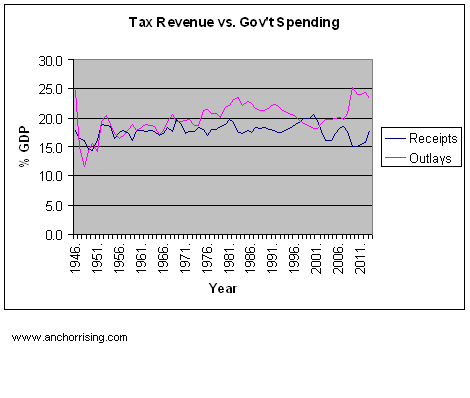
Source: Economic Report of the President 2012, Appendix B, Table B-79, p. 412.
As Barone explains:
In the Obama years, federal receipts have hovered at 15 percent of GDP.Any serious economic plan has to reduce spending to below 20% of GDP because receipts just aren't going to get above 20% of GDP. But no one is interested in being serious.That's just because tax rates are too low, Obama backers reply. Just raise the rates on high earners and the problem will be solved.
Actually, high earners don't make enough money to close the current budget deficit. You'd need to raise taxes on middle-income earners too.
But we have had higher income tax rates in most of the years since World War II. What history and Table B-79 show is that even much higher rates -- like the 91 percent marginal rate on top earners imposed from the 1940s to the 1960s -- have never produced federal receipts higher than 20 percent of GDP.
Why is that? As the late Jack Kemp liked to say, when you tax something, you get less of it. When the government took 91 percent of what the law defined as adjusted gross income over a certain amount, not many people had adjusted gross income over that amount.
According to a Congressional Research Service study, the effective income tax rate on the top 0.01 percent of earners in the days of nominal 91 percent tax rates was only 45 percent. Others have pegged it at 31 percent.
In the 1970s, when the top rate on wage and salary income was 50 percent and 70 percent on investment income, high earners spent much of their time and energy seeking tax shelters. The animal spirits of capitalists, to use John Maynard Keynes' term, were directed less at productive investment and more at tax avoidance.
ADDENDUM: And, for the umpteenth time, any proposed spending "cuts" aren't cuts at all, just a reduction in the projected amount of increased spending.
November 28, 2012
Things We Read Today (36), Wednesday
Threats to the economy (cliffs and debts); RI lagging again (yawn); dependors and dependees; Social Security a problem; and a civil right to the war zone frat party.
November 21, 2012
To Starve or Gorge the Beast?
"[W]e've got to reduce spending before we can reduce taxes. Well, if you've got a kid that's extravagant, you can lecture him all you want to about his extravagance. Or you can cut his allowance and achieve the same end much quicker. But Government has never reduced. Government does not tax to get the money it needs. Government always needs the money it gets." ~ Ronald Reagan
Hence was born the idea of "starve the beast," a conservative core belief if ever there was one. But is it true? As explained in a recent column by Andrew Ferguson, economist (and libertarian) William Niskanen didn't think so.
Beginning in 2002, Niskanen published a series of papers and op-eds about tax cuts and spending increases that turned conventional conservative wisdom on its head....If we wanted a smaller government, he said, we would have to raise taxes....Niskanen, looking over 25 years of budget data, noticed something about STB ["Starve The Beast" ~ ed.]: It didn’t work. In fact, attempts to starve the beast by tax cuts seemed to lead to increased federal spending.That last--the ability of government to write checks on credit--was overlooked by STB advocates.Niskanen looked at both spending and taxes as a percentage of GDP. On average, he found, if federal revenues declined by 1 percent, federal spending increased by 0.15 percent. When revenues rose, on the other hand, relative spending decreased. A further study in 2009 by another Cato economist, Michael New, came to the same conclusion after the gluttonous administration of George W. Bush. Under Bush and his mostly Republican Congress, new benefits like subsidized Medicare drugs and increased federal education spending followed on the heels of large tax cuts.
Niskanen’s explanation for the failure of STB was straightforward, a conjecture based on standard economics: When you cut the price of something, demand for it will increase. Lowering taxes without lowering benefits meant that taxpayers were getting the benefits at a discount. The government made up the true cost with borrowed dollars that future taxpayers would have to repay. There was a big difference, Niskanen said, between a kid on an allowance and the federal government: The government has a credit card with no debt limit. {emphasis added}
[E]arly advocates of STB had counted on something that never materialized. They had assumed that as the debt piled up to finance annual budget deficits caused by free-flowing benefits, public outrage would force politicians to restrain spending without raising taxes. Yet we’ve had the deficits and the borrowing, in amounts that would have left Friedman and Reagan agog; what’s been missing is the outrage.People aren't outraged because they don't feel the immediate pain of increasing government because the money for government expansion is either borrowed or paid for by increasingly fewer individuals. So around 50% of the population feels no pain (they don't pay income taxes) while a majority of the rest pays relatively minimal amounts. And a lot of that pain is left to future generations. This aligns with Niskanen's reasoning for why higher tax rates lead to lower spending:
“Demand by current voters for federal spending,” he explained, “declines with the amount of this spending that is financed by current taxes.” When you make them pay for government benefits out of their own pockets, in other words, voters will want fewer of them. The journalist Jonathan Rauch put Niskanen’s point more pithily: “Voters will not shrink Big Government until they feel the pinch of its true cost.”Yet, as I mentioned, not everyone shares the tax burden evenly in our progressive income tax system. So, perhaps a flat tax would prove or disprove Niskanen's theory, but it's doubtful that will happen any time soon.
Ferguson's article brought some critiques of Niskanen's ideas. Noah Glyn offers up another reason for why government spending decreases when tax revenue increases:
[It's] the business cycle. As the economy grows, people earn more so they pay more in taxes; conversely, when the economy enters a recession, government revenue plummets. During recessions, however, the public relies on increased government spending, in the form of Medicaid, food stamps, and other transfer payments. (This can go the other way, too: Some state and local governments have used economic growth to justify increasing promises to government employees’ pension plans, but those costs typically come much further down the line.)This is buttressed by Ramesh Ponnuru's important, technical point and "thought experiment":
Let’s say we still had the Clinton-era tax rates and a (smaller but still quite large) long-term debt problem. Wouldn’t we be debating an increase in tax rates to a higher level than we are now? That seems to me pretty likely. The baseline from which we’re negotiating would be higher, perceptions of what’s tolerable would be higher, expectations of tax rates would be higher. On the Niskanen theory there would be a countervailing effect: In the interim the tax cuts caused spending to be higher and thus moved the spending baseline higher. But Niskanen didn’t find that a dollar of tax cuts were associated with a dollar of spending increases; he found that a 1 percent reduction in revenue over GDP was associated with a 0.15 percent increase in spending over GDP. So the countervailing effect would be smaller.Jonah Goldberg adds:
I always liked Niskanen’s argument, even if I didn’t quite find it persuasive. One thing that always bugged me about it which, to my surprise, Ferguson doesn’t mention, is the implicit assumption that Americans behave like rational economic actors with regard to what they get from government....The American species of homo economicus has been paying hundreds of billions to get rid of poverty for decades, what do we have to show for it? Poverty rate in 1975: 26 percent. Poverty rate in 2010: 26 percent. What a great return on the investment. Federal spending on education? Ahem...For reasons, good and bad, voters don’t treat tax dollars the way they do their own dollars. They don’t demand quality. They don’t demand accountability. They don’t push for efficiency. Many people think the government should spend money as if it comes from someplace other than the wallets of citizens and that what we get for it should be graded on some spiritual, emotional, philanthropic or metaphysical curve. How we spend for X so often seems to matter more than how much X is actually delivered.Yet, as Patrick Brennan argues, re-stating Niskanen's implicit premise, the missing demand for government quality is because so many have so little stake in the game.
People might be a lot more likely to start caring about where their tax dollars go (whether the ends are efficient and whether the money comes back to them) when those taxes are really substantial, broad-based, and they actually have to pay them.Brennan also compares U.S. expectations for government services to that of Europeans:
If you live in a society where, as Jonah pointed out Arthur Brooks has argued, the state is considered the main conduit for meeting societal needs and caring for the poor and vulnerable, you’ll care more about how well government works and whether it can care competently for you, and that’s a cultural matter. But it’s also important to homo economicus, because Leviathan has taken most of his paycheck, and he now has to hope, and should ensure, that government will provide for society at large, the poor and vulnerable, and even him at times, and do so as efficiently and competently as possible.Regarding the last, many conservatives (well, at least me) believe that a smaller government is one that is easier to make workable!There are obviously other explanations for these differences: Charlie Cooke has lamented to me on many an occasion that in Britain, the conversation about almost all government policies ends up being debates over efficacy of programs, not whether the programs should exist in the first place. Leaving aside the financial constraints Britain and elsewhere are now experiencing, if you don’t have a constitution with enumerated federal powers, a truly conservative and independently minded political movement, etc., you’re going to spend more time on making government work, not on making it smaller, and that’s for other reasons than I’ve just proposed.*
==========================
* Brennan expounded on the point later in the post: "It’s difficult to assess my thesis inasmuch as big government and the cultures that give rise to it have other negative effects on efficiency, so it’s possible citizens subject to a huge government and a regressive tax code get a more efficient government than they would if they didn’t have higher expectations than free-riding Americans, but still not a very efficient one. It’s been suggested, in fact, that it’s highly efficient yet regressive taxation (like light capital taxation, competitive corporate-tax rates, consumption taxes, etc.) that’s allowed places such as France and Scandinavia to have functional economies despite the burdens of absurdly large governments; perhaps it’s also the relative efficiency and usefulness of their government spending programs, and not just their tax system, that’s allowed them to manage as well. Thus again, economic preferences force the hand of citizens and politicians in a completely government-dominated society but not in one like America."
October 24, 2012
Things We Read Today (26), Wednesday
Mainly on government's bad incentives: bad housing spending in Providence, unlearnable spending lessons for the governor, stimulus corruption, and Medicaid reform.
October 10, 2012
Cato Gives Governor Chafee a D in Fiscal Policy
In a white paper out yesterday from the Cato Institute, Governor Lincoln Chafee (as the chief executive of the Rhode Island government) received a score of D for fiscal policy. His score of 41 is based on spending, revenue, and tax changes that he proposed and/or that were implemented under his watch from January 2010 to August 2012, and marks him as the seventh worst governor for fiscal policy.
September 28, 2012
Tiverton Toll Meeting Shows Rhode Islanders Have to Stop Fighting Fire with Paper
Last night, I attended the first organizational meeting for the Tiverton branch of Sakonnet Toll Oppostion Platform (STOP), a cross-community effort to stop the state of Rhode Island from placing a toll on the Sakonnet River Bridge. If I was skeptical about the ability of residents to prevent the tolls before, I'm pretty well convinced that the people of the East Bay will not be able to stop them, now.
The audience consisted of approximately fifty residents, from a broad variety of local groups and interests — many most often seen in heated attacks against each other over the usual slate of issues that face the town. Even though the only state-level official in the room was Sen. Walter Felag (D, Bristol, Tiverton, Warren), the opportunity should be there, in other words, for some effective leaders to draw on the strengths of the different groups to affect state-level lawmakers.
Instead...
September 24, 2012
Even a 100% Tax on Millionaires Wouldn't Close Federal Deficit
"Even if the government took all of the income earned by those who have an after-tax income of $1million or more, the amount of revenue generated would fall far short of eliminating the deficit."

September 20, 2012
House Makes it easier for Buffet, billionaires to pay down Federal debt
The House of Representatives--on a bi-partisan voice vote--passed the "Buffet Rule Act", which allows anyone to voluntarily pay more in taxes.
Under the legislation, which would still need Senate approval, taxpayers could check a box on their taxes and send in a check for more than they owe to the IRS."If Warren Buffett and others like him truly feel they're not paying enough in taxes, they can use the Buffett Rule Act to put their money where their mouth is and voluntarily send in more to pay down the national debt, rather than changing the entire tax code to inflict more job-killing tax hikes on hard-working Americans," said Rep. Steve Scalise, the Louisiana Republican who wrote the bill....Current law already allows taxpayers to send money to pay down the debt, but Republicans said that process is onerous. Under their new plan, taxpayers would have an easy option on their tax returns allowing them to pay more.
Under Republicans' legislation, the money would go directly toward reducing the debt.
September 3, 2012
Things We Read Today, 1
One thing I've learned, in years of blogging, is to be wary of proclaiming new regular features. Yet, I've been finding myself at the end of each day with a browserful of tabs of content on which I'm inclined to comment.
So, as interest and time allow, I'll publish quick-hit posts containing commentary that is somewhere between a tweet and a full-on blog post.
Leaning Against the Privileged Place of Investments
Readers shouldn't be surprised to hear that I'm largely in agreement with Peter Ferrara's "Obama's Accelerating Downward Spiral for America," but he happens to voice one bit of center-right common wisdom with which I have growing disagreement:
There is no secret or magic as to how to turn around these declining incomes. Increased investment in business expansion and start ups increases demand for labor, which drives up wages. That investment buys new tools and capital equipment for workers, making them more productive, which provides the cash flow to increase wages.Increasing investment results from reducing the tax rates on investment, which enables investors to keep a higher percentage of what they produce, increasing incentives for investment.
My resistance to this suggestion — notwithstanding Ferrara's positioning of it as a statement of the obvious — has three sides.
August 27, 2012
Note To GoLocalProv: RI "Rich Pay Less In Income Tax" = Third Highest Income Tax Rate In Country
GoLocalProv's Dan Lawlor has a column today in which he attempts to causatively link Rhode Island's top income tax rate to our unemployment rate.
In 1997, during a boom economy in RI- remember the Renaissance? - the top income earners had a 27.5% income tax rate. Our jobless rate was 5.3%.
Ah, but then, in 2010, according to Dan, we hit the skids, both in unemployment and top tax rate-wise.
In 2010, the General Assembly and Governor Carcieri reduced the top income tax rate from 9.9% to 5.99%. The state's sales tax remained at 7%. Our unemployment rate was 11.6%.
Uh huh. Two years later?
Top income earners now pay 5.99% in income taxes. Our jobless rate is 10.8%.
And the conclusion (according to Dan)?
Our tax policy has basically been that the rich pay less in income tax, and we all pay more in property and sales tax.
We could at this point ask if perhaps ALL of Rhode Island's taxes aren't too high and if this situation isn't most likely a direct result of too much spending on the state and local level. But we'll stick to what Dan wrote, only, if it's okay with Dan, we're going to overlay some context, a.k.a., facts.
By the way, H/T RIGOP StrikeForce Co-Chair Mike Napolitano for highlighting this column. About the 27.5% income tax rate of the 1990's, Mike points out in comments under Dan's column that Rhode Island's income tax was calculated quite differently than it is today.
In fact, that rate was not based on the taxpayer’s income but on the taxpayer’s entire federal income tax liability. In other words if a taxpayer paid $100 in federal income tax they in turn paid $27.50 to the state of Rhode Island. The rate was piggybacked on to the federal rate and not on their wages.
So comparing 1997's 27.5% income tax rate to today's 5.99% rate is not valid at all because the former was a piggy back rate. (Imagine a state income tax that was 27.5% of your income. By the second year of such a rate, Rhode Island literally would no longer exist as a state.)
Now, with regard to Rhode Island's current top income tax rate of 5.99%, let's mosey on over to the Tax Foundation and click on the Rhode Island page.
Rhode Island's personal income tax system consists of three brackets and a top rate of 5.99%, kicking in at an income level of $129,900. Rhode Island's income tax system closely adheres to the federal income tax code. Among states levying personal income taxes, Rhode Island's top rate of 5.99% is the 3rd highest nationally.
Follow up question for Dan. Under his theory, how much higher would we have to make Rhode Island's top income tax for unemployment to start going back down? Obviously, it would have to go from number three nationally to number one. But by how much would we have to overshoot the current highest rate to get back to a decent unemployment rate?
Off topic ADDENDUM: To prove that I am not merely out to pick on GoLocalProv with this post, permit me to direct you to their very good story today about the star of that video released Saturday by the ProJo.
The man seen in an undercover video telling a campaign staffer for Congressional candidate Anthony Gemma that he could deliver mail ballot votes in exchange for $500 per week received a $103,000 taxpayer-funded loan for a restaurant from the city of Providence in 2004, GoLocalProv has learned.
Remember that Mr. Ramirez allegedly secured mail ballots for the David Cicilline campaign in a prior election. Now, who was mayor of Providence in 2004 when Mr. Ramirez' business secured this loan and who might have been feeling grateful for Mr. Ramirez' assistance to his campaign? Gosh, I'm trying to think ...
August 24, 2012
When I Grow Up, I Wanna Be a Crony
I can't confirm if this was filmed in Rhode Island or not (h/t):
"I'm gonna fight for MY piece of the taxpayer pie."
"What's a crony?"
"It's like having a best friend who gives you other people's stuff."
"We take care of our friends."
"We get to spend taxpayer money any way we want."
"Why be a taxpayer when I can be a tax spender?"
Yup, it had to be filmed here, right?
August 10, 2012
Legislative Votes For and Against Tolls on the Sakonnet River Bridge
Rhode Islanders, mainly from the East Bay, have organized a protest at Clements Market in Portsmouth, this afternoon, against tolls on the Sakonnet River Bridge. The hope is that the language that the General Assembly passed into law, this session, as Article 20 of the budget bill (7323Aaa) can be reversed.
That article and the budget to which it was attached were on the agendas of the RI House and Senate on June 7 and June 11, respectively. (The links are to the Ocean State Current's liveblogs, so readers can see who said what during debate.) In the Senate, Article 20 came up for a vote when Sen. Louis DiPalma (D, Little Compton, Middletown, Newport, Tiverton) proposed an amendment to remove it from the bill.
In the House, several amendments were raised and voted down to modify the article to make it less burdensome on local residents. The following table shows how the votes went in both chambers. The House voted on the article in three parts: Section 4, transferring the bridge's title to the RI Turnpike and Bridge Authority and authorizing tolls; parts of Section 3, authorizing the authority to maintain the bridge and set up tolls; and the rest of the article.
The votes below reflect the first vote, which is most explicit about tolls, but the article is written such that tolls would have been likely if any part of it passed. However, the only differences for the other two votes were that Baldelli-Hunt voted in favor of the language of Section 3, and Messier voted against the rest of the article.
July 19, 2012
Rhode Island To Offer Tax Amnesty
Governor Chafee's spokeswoman, Christine Hunsinger, confirmed this morning that one of the items in the FY2013 budget was a tax amnesty program. It will run from September 2 to November 15, 2012 and will apply to state taxes including income, sales, use, and unemployment insurance. Note that while monetary penalties and prosecution will be waived (for qualified applicants), interest would still be owed, albeit at a reduced rate.
More details from the CCH division of Wolters Kluwer Law & Business.
The program provides amnesty from penalties and from civil or criminal prosecution for any tax imposed under Rhode Island law and collected by the tax administrator for any taxable period ending on or before Dec. 31, 2011.Amnesty will be granted only to those taxpayers who apply on or before Nov. 15, who have paid the tax and interest due or who have entered into an installment payment agreement as a result of financial hardship.
Amnesty will not be granted to taxpayers who are under any criminal investigation or are a party to any civil or criminal proceeding pending in federal or Rhode Island court for fraud in relation to any state tax imposed.
As for how to apply, there appears to be nothing yet on the RI Division of Taxation's website; it is early. I left a message with an official at the Division of Taxation asking him how interested taxpayers would get started. When he calls back, I will post an update.
UPDATE
The Division of Taxation has advised that, as the start date of the program approaches, information will be made available on the Division's website for interested applicants.
July 17, 2012
A Decade of Moving Next Door
I've been following taxpayer migration data for years, but in a haphazard way. A new study that I've coauthored for the RI Center for Freedom & Prosperity finally gave me the opportunity to review all fifteen years of available data from the IRS.
The picture — from the 2003 beginning of what can only be described as an exodus — is frightening. After accounting for the tens of thousands of Rhode Islanders who moved to other states and other taxpayers who moved in the opposite direction, Rhode Island lost 24,455 households, with $1.2 billion of annual income (not inflation adjusted). More conspicuously, a net 3,406 taxpayers moved right across the border, to abutting counties in Massachusetts and Connecticut, taking with them $254.5 million in annual adjusted gross income (AGI).
July 10, 2012
Small Business Getting the Screws
While President Obama attempts to frame the lapse of the "Bush tax cuts" in 2013 as a supposed return to the norm--with plenty of help from the media, who have accepted the premise that the extension of current tax rates are actually revenue "losses" should they be "extended"--he also recognizes that it would be political suicide to let that happen in toto. So he has come up with a plan to "extend" the "Bush tax cuts" another year for individuals making less than $200,000 and businesses making less than $250,000. According to the President, anyone making more will be taxed at the rate "we were paying under Bill Clinton." Not quite according to the Wall Street Journal:
[President Obama] ignores his ObamaCare tax increase of 0.9% on top of the current 2.9% Medicare tax, plus a new 2.9% surcharge on investment income, including interest income.How does this affect small business?That's an additional 3.8% surcharge on investment income, and added to the Bush expirations would take the capital gains rate to 23.8% from 15% today, and the dividend tax rate to about 45% from 15%. In Mr. Obama's economic world, tax cuts for middle-class "consumption" are good, but low rates to spur saving and investment are bad. This makes no sense because consumption is ultimately the product of saving and investment.
The President dismissed all of this as merely affecting 3% of small business owners. But that includes tens of thousands of the most productive, fastest-growing small businesses—those most likely to hire workers amid a national jobless rate of 8.2%.No, but the President--and the Federal Government--aren't as friendly to small business as they'd all like us to believe and it's nothing new, as the U.S. Small Business Administration reports:Congress's Joint Tax Committee—not a conservative outfit—estimates that in 2013 about 940,000 taxpayers will have enough business income to meet Mr. Obama's tax increase threshold. And of the roughly $1.3 trillion in net business income, about 53% will get hit with the higher tax rates.
This is because millions of businesses report their income as sole proprietors and subchapter S corporations that file under the individual tax code. So Mr. Obama wants these businesses to pay higher tax rates than the giant likes of General Electric or J.P. Morgan. Does that qualify as "tax fairness"?
The federal government last year fell short of its “small business” contracting goals for the eleventh straight year, a streak that stretches back to the first year of the George W. Bush administration. Federal agencies awarded contracts worth $91.5 billion to small companies in fiscal year 2011, equal to 21.7% of all prime government contract dollars awarded. Despite ongoing efforts to boost small business contracting, 2011 saw a drop of 6.5% from the 2010 total of $97.9 billion, which represented 22.7% of prime contract dollars. With a goal of 23%, however, the government came up short in both years, according to data released by the Small Business Administration (SBA).Couple the above with the way regulations are stacked against small-businesses, as Jay Carney explains in his analysis of a new policy paper arguing against corporatism (and for truly free markets) by Matt Mitchell, senior research fellow at George Mason University's Mercatus Center:
The government also failed to hit its contracting goals for businesses owned by women or service-disabled veterans, as well as for those located in traditionally underserved and underemployed regions of the country.
Politically favored businesses of course benefit from direct subsidies (think agribusiness) and government loan guarantees (think Solyndra and Boeing), but Mitchell makes the important point that regulation itself creates a privileged class.This is not an idea held by just free-market think tanks, either. Carney continues:Regulation often acts directly or indirectly as a barrier to entry. The conservative and libertarian media have documented this anecdotally -- Philip Morris supported and is benefiting from Obama's tobacco regulation, for instance, because the rules allow it to lock in its dominant market share.
For instance, liberal activists Ralph Nader and Mark Green wrote in the Yale Law Journal that the "regulatory system undermines competition and entrenches monopoly at the public's expense." Mitchell in this section also cites Alan Krueger, who now heads Obama's Council of Economic Advisers.Between regulation and higher taxes, it's no wonder that small-business owners feel like the screws are being put to them.In the Obama era, as Democrats and the media try to paint deregulation as some sort of dangerous sop to big business, Mitchell's notion of "regulatory privilege" is a crucial tool for dismantling the old narrative that regulation protects the public. Mitchell uses a colorful image to make his case: Bruce Yandle's "bootleggers and Baptists."
Illegal booze smugglers, Yandle wrote, "support Sunday closing laws that shut down all the local bars and liquor stores. Baptists support the same laws and lobby vigorously for them. Both parties gain. ..."
Rhode Island Is Not Delaware - Why Not?
I've been sitting on this article for a few days because I couldn't think of the best way to write about it. I guess in many ways, it's just so obvious that there isn't a whole lot to say. I'll just throw it out there.
On June 30, the NY Times published the article: How Delaware Thrives as a Corporate Tax Haven. The focus of the article seems to be the tax dodging and the criminal aspects of it. Some states, like Pennsylvania, get angry about Delaware's business-friendly tax laws and claim that Delaware robs them of their tax revenues.
State lawmakers in Pennsylvania are now trying to close the loophole, arguing that their state is being robbed of its tax dollars. Of particular concern is that many companies involved in drilling for natural gas in the Marcellus Shale region of Pennsylvania are, in fact, incorporating in Delaware instead.
“Delaware is an outlier in the way it does business,” said David E. Brunori, a professor at George Washington Law School and an expert on taxation. “What it offers is an opportunity to game the system and do it legally.”
Exactly, they do it legally. At least one state has set up an environment that is business-friendly to the point that many US corporations will actually seek it out to put an office there and pay tax dollars there. Even international entities will set up shop in Delaware due to their tax laws.
“Companies choose our state and we are proud of it,” said Richard J. Geisenberger, Delaware’s chief deputy secretary of state and its leading ambassador to business. “We spend a lot of time in the United States and traveling internationally to let people know that Delaware is a great place to do business.”
I'm sure some will turn up their nose at being "business friendly." It must come at the expense of everyone else, right? If you're going to be friendly to businesses, someone has to pick up the tax bill and the only alternative there is the lowly taxpayer. So let's take a look at Delaware's tax rates, especially in comparison to Rhode Island, using the Tax Foundation's numbers: DE RI
| State | Indiv. Income Tax Top Rate | Corporate Income Tax Flat Rate | Sales Tax | Property Tax Per Capita | Taxes Paid to State Per Capita | Unemployment rate |
| Delaware | 6.75% | 8.7% | 0% | $712 | $2,432* | 6.8% |
| Rhode Island | 5.99% | 9% | 7% | $2,019 | $3,290* | 11% |
*Total paid to the state is for 2009
According to those numbers, the residents of Delaware pay less in taxes and have an unemployment rate that's just a little bit more than half of Rhode Island's. Even better, they don't have a sales tax, so that will also attract residents of neighboring states into Delaware for puchases. Like I said earlier, this sort of thing is just so obvious, what else is there to say?
June 29, 2012
It's a Tax on Your Body
Unless I missed some language, the Supreme Court's ruling on ObamaCare shirks the responsibility of explicitly defining exactly what sort of tax Congress has imposed and how similar taxes might be structured in the future. Still, a thread can be followed.
Having just read through the tax-related sections of the ruling, and although the logic is as incoherent and slave to convenience as any I've ever read, it seems to me that a straightforward conclusion can be drawn.
First, on the incoherence: The health insurance mandate is apparently not a tax for determining the standing of the suit, but it is a tax to save the law. It's not a capitation tax — "a tax that everyone must pay simply for existing" — for the purpose of evading the constitutional requirement that such taxes be apportioned by state, but it's like a capitation tax for the purpose of evading precedent that prevents taxation from being used as stealth regulation. Bob and weave; whatever form it has to take to pass each obstacle.
However, in writing his opinion, Supreme Court Chief Justice John Roberts makes a big deal about the fact that people with no income tax burden do not have to pay the tax: "It does not apply to individuals who do not pay federal income taxes because their household income is less than the filing threshold in the Internal Revenue Code." Later, he likens it to a tax incentive.
The only way all of this makes coherent sense (which may be too high a standard for the highest court, granted) is if one takes the ruling a step farther to determine what sort of tax it is. I'd propose that the ObamaCare tax is effectively a capitation tax or a property tax on one's body.
June 27, 2012

Residential Property Tax Burdens in Rhode Island Municipalities
For reference from an upcoming post, but also interesting in its own right...
This table shows the residential property tax levy in each Rhode Island municipality, as a percentage of aggregate income in that municipality, as reported by the census bureau.
The details of residential property tax levy, involving the separation of residential from commercial property taxes (and treating apartment and mixed property tax classifications as residential, since much of that tax will be passed along to residential tenants), fire-district taxes and car-taxes, is explained here.
Community income in this chart is a single figure available from the Census Bureau's American Community Survey. This is a slightly different from the method I used last time where I presented this chart, where I multiplied per-capita income by total population figures taken from the ACS. Both methods give similar results.
The biggest gap in this chart is that the percentage of income paid in property tax in communities with many second vacation homes is inflated, since the income from non-residents is not included in the denominator.
As always, I'm open to further adjustments that can be made to these figures.
| Community | Estimated Residential Tax Levy (2011) | 2010 ACS Aggregate Household Income (2010) | % |
| New Shoreham | $7,548,403 | $44,124,500 | 17.1% |
| Westerly | $60,068,382 | $721,805,600 | 8.3% |
| Charlestown | $22,344,774 | $278,517,600 | 8.0% |
| Jamestown | $18,226,276 | $238,357,100 | 7.6% |
| Barrington | $52,531,961 | $751,029,500 | 7.0% |
| Smithfield | $44,556,739 | $637,479,200 | 7.0% |
| Narragansett | $41,330,974 | $598,013,000 | 6.9% |
| Hopkinton | $17,371,823 | $260,645,500 | 6.7% |
| Glocester | $20,367,277 | $307,319,000 | 6.6% |
| Tiverton | $32,555,171 | $493,782,200 | 6.6% |
| Foster | $10,126,928 | $155,949,200 | 6.5% |
| Cranston | $140,031,603 | $2,159,795,100 | 6.5% |
| North Providence | $55,663,407 | $877,310,000 | 6.3% |
| East Greenwich | $40,943,187 | $651,042,000 | 6.3% |
| South Kingstown | $59,666,885 | $960,168,600 | 6.2% |
| Little Compton | $9,690,006 | $156,354,200 | 6.2% |
| Scituate | $18,898,836 | $314,783,900 | 6.0% |
| Warren | $18,903,276 | $318,957,300 | 5.9% |
| Richmond | $14,284,170 | $241,437,600 | 5.9% |
| Coventry | $59,892,348 | $1,028,785,800 | 5.8% |
| North Smithfield | $22,118,882 | $380,866,900 | 5.8% |
| Portsmouth | $41,832,221 | $720,966,500 | 5.8% |
| Newport | $48,915,879 | $843,900,100 | 5.8% |
| Burrillville | $25,001,269 | $432,281,800 | 5.8% |
| Middletown | $31,522,496 | $548,112,800 | 5.8% |
| Warwick | $142,107,199 | $2,493,240,300 | 5.7% |
| North Kingstown | $57,562,579 | $1,034,986,400 | 5.6% |
| West Greenwich | $11,254,689 | $202,598,500 | 5.6% |
| Johnston | $40,940,330 | $749,941,000 | 5.5% |
| Providence | $187,919,289 | $3,489,797,500 | 5.4% |
| Exeter | $12,546,640 | $247,293,600 | 5.1% |
| East Providence | $64,344,891 | $1,280,295,600 | 5.0% |
| Cumberland | $55,052,263 | $1,098,496,100 | 5.0% |
| Pawtucket | $74,151,943 | $1,487,635,000 | 5.0% |
| Lincoln | $37,704,656 | $762,295,100 | 4.9% |
| Woonsocket | $38,789,267 | $812,621,300 | 4.8% |
| Bristol | $32,574,555 | $701,069,200 | 4.6% |
| West Warwick | $33,739,187 | $763,230,600 | 4.4% |
| Central Falls | $9,700,424 | $269,642,600 | 3.6% |
June 7, 2012
Who's Flying Now? (And Why?)
Ted Nesi posted an interesting graphic from the Tax Foundation that shows that:
Rhode Island posted the 18th-fastest growth in high-income taxpayers between 1999 and 2009.This prompted the NEA's Pat Crowley to chime in with a by-now familiar bit of rhetoric:While the total number of Rhode Island taxpayers grew by just 4% during that period, the number with adjusted gross incomes above $200,000 jumped 63%, for a net gain of 58.9% at the top end, the biggest in New England.
Vindication once again. The “flight of the earls” myth that was used as a justification to cut taxes on the elite in the middle part of the last decade is, once again, shown to be untrue.Well, as I responded, whether you believe in the "flight of the earls" theory or not (and setting aside that it's a bit of a strawman set up by Crowley anyway), the Tax Foundation chart and data doesn't really prove or disprove it at all because the data only compares the beginning and end of a time period in which RI cut the capital gains tax and enacted the flat tax (around 2006), which were aimed at keeping/attracting high earners. It’s just as possible that the "earls" were "flying" until the 2006 reforms and then we saw an influx. We’d have to see yearly data to more accurately determine causation/correlation. So let's do that.
First, even though what follows is a more robust way to look at the trend of higher income taxpayer migration, it is by no means comprehensive. It doesn't take inflation into account (though, as the Tax Foundation points out, their percentages are relative so that affect is mitigated in their analysis), which is why the relative increase in $200K wage-earning households when comparing 1999 to 2010 may be exaggerated. Additionally, the multitude of effects that the economic recession has had on wage-earners aren't adequately accounted for in this simplified manner.
I turned to the IRS's Statistics on Income data from 1999-2010 and tallied up the number of + $200K taxpayers. (Yes, I thought I'd look at 2010, too).
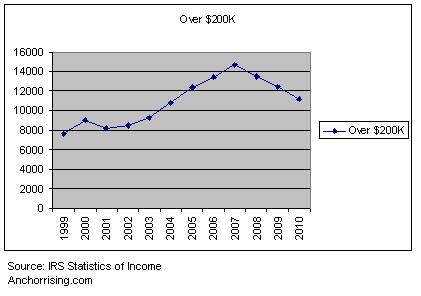
Further, thanks to a timeline provided by Justin, we can compare the implementation of tax policies that were meant to impact high wage earners.
2002: capital gains tax phase-out passed to begin in 2007
2006: flat tax reduction begins
2007: capital gains tax phase-out begins with 2/3 reduction; then it's frozen
2010: capital gains tax increased to personal income level
2011: Flat tax rate reduction frozen
Keeping these dates in mind, let's look at the effects on + $200K wage-earning households. In 2000 there were 9,013 such taxpayers and this dropped to 8,259 in 2001, which, if memory serves, may have helped serve as an impetus for the tax policies that followed.
In 2002, when the capital gains tax phase-out was passed (to go into effect in 2007), the number of + $200K wage-earners went up to 8,500. From 2003 thru 2005, the numbers continued to increase, from 9,252 to 10,798 in 2004 to 12,376 in 2005. In 2006 the flat tax reduction begins and the climb continued to 13,387. In 2007, the capital gains tax phase-out begins with a 2/3 reduction of the previous level and the total + $200K wage-earning households climbed to 14,737. That year the General Assembly voted to freeze the capital gains tax (so the other 1/3 reduction did not occur) and the number dropped to 13,475 in 2008 and 12,416 in 2009. In 2009, the capital gains tax was set to be increased by matching it to personal income level in 2010. The number of households earning over $200K dropped to 11,117 in 2010. In 2011 the Flat tax rate reduction was frozen and we'll have to wait to see what happened.
When looking at the data for both "upper" middle-class and (I guess) "regular" middle-class, it looks like there is no relation between these tax policies and the number of wage earners.
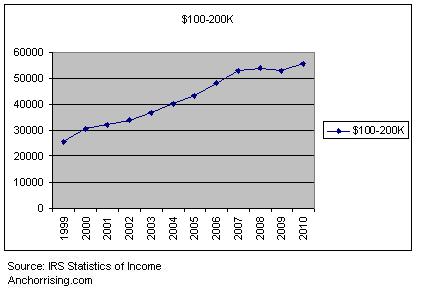
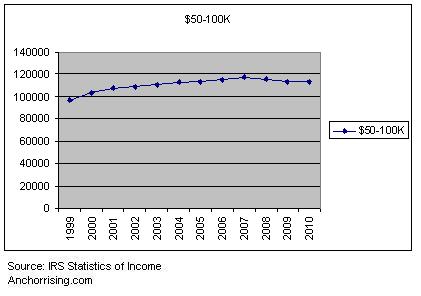
For myself, I've been more of a "flight of the squires" kind of guy than "flight of the earls", believing that it's the middle-class who is suffering--and fleeing Rhode Island--more than the wealthy. As the above charts show, maybe that's wrong.
What I think this does show, however, is that there is a link between capital gains and flat tax policies and the impact they have on the number of high wage earners. During the time that these taxes were reduced, the number of + $200K wage-earners increased. After these taxes were frozen or raised, the number of + $200K wage-earners decreased.
ADDENDUM: The freeze/increase occurred before the economic downturn of 2008/2009 and, it looks like, the "earls" were already fleeing. It also looks like a lot of the "earls" became, um, "counts"(?), as the number of upper middle class wage earners seems to to be continually increasing, perhaps because some earls stayed in RI but dropped an income category. Also, the upper middle class is also being continually refreshed by regular middle class wage-earners moving up. In other words, it's important to remember that these classifications don't necessarily cover the same households.
May 19, 2012
What Is The Point Of Tax Credits?
A state will offer tax credits in order to incentivize a certain behavior that they wish. The holder of those credits then then use them to offset their own tax liability to the state. I have a friend who earns tax credits in various states by building affordable housing. Sometimes, his tax credits exceed his tax bill, so those credits become useless. Except, the state does allow the credits to be transferred. He'll then sell those earned credits to another business for cash and for less than the value of the credits. It's win-win-win. My friend wins because he gets cash, the other business wins because they're getting discounted money in the form of the credits and the state wins in that they get the affordable housing they desire.
Rhode Island has gotten into this game as well with the RI Film and TV Office. The state wanted to incentivize movies and television shows being made in Rhode Island, so they hand out tax credits for filming in RI and hiring Rhode Island businesses and citizens.
According to Ted Nesi, 38 Studios has applied for $12M in film tax credits for this year and has also submitted an application for $8.7M in credits for last year. So how in the world is 38 Studios going to justify applying for these tax credits? Are they going to get into the movie or television business now? The Film Office's definition of a motion picture does include video games, but only for theatrical or television purposes. I don't know that the definition fits.
If for some reason the state grants these requests, the only logical use for them is to sell them. Go back to the original scenario I described. A state wants a certain outcome, they incentivize it, someone grants the outcome and ends up with a surplus of credits in some instances. That's not what's seems to be happening here. It appears that 38 Studios would be applying for the tax credits for the sole purpose of selling them. If they plan to make a movie or television show and film it in RI with RI businesses and citizens, then great, give them the credits. If the sole purpose is to sell them, then no, the applications should not be approved.
During Governor Chafee's press conference yesterday, he also said that he will be proposing a bill that would cap the amount of tax credits to a single source at $5M. That's just in case you were wondering how the Governor felt about the state handing 38 Studios all this money.
I think if Chafee wants to go the distance on this one, add in that the credits cannot be transferred. Or, if that's too draconian, add in a provision that they cannot be transferred unless some portion of them (at least 50%?) have already been used by the requestor. To me, that makes perfect sense. It fits the original intended purpose of tax credits.
Bottom line, make a film or disallow the applications.
April 30, 2012
Businesses Go Where Taxes are Lower
Businesses will set up shop where the tax laws are more favorable to them.
And in other news, water is wet. Maybe it would seem obvious to most that people will be motivated by lower tax rates. However, if you listen to some on the left, especially locally, this isn't true. But how do you argue it when it comes straight from the horse's mouth?
“We set up in Luxembourg because of the favorable taxes,” said Robert Hatta, who helped oversee Apple’s iTunes retail marketing and sales for European markets until 2007.A New York Times article today "How Apple Sidesteps Billions In Taxes" tells much of the story and explains some of the various ways that Apple has chosen various places around the world to open offices, strictly due to the favorable tax laws. One of their offices has as few as twelve people assigned to it, but records revenues of one billion dollars a year.
It's not just international either. The California company even plays states off against each other.
Apple’s headquarters are in Cupertino, Calif. By putting an office in Reno, just 200 miles away, to collect and invest the company’s profits, Apple sidesteps state income taxes on some of those gains.If this can happen in a state as large as California, where 200 miles to Reno is considered "nearby", then can the same happen here where a 200 mile radius can land you in any of seven different states? Of course it can. It does! But yet, we still have those on the left who want to continually increase tax rates on businesses and further drive them away from Rhode Island.
California’s corporate tax rate is 8.84 percent. Nevada’s? Zero.
It's also interesting to see the outrage against Apple for paying so little in taxes or paying it to foreign countries or a state other than California, where they're headquartered. The NYT spoke with DeAnza College President Brian Murphy, as DeAnza is a nearby neighbor in Apple's hometown of Cupertino.
But the company’s tax policies are seen by officials like Mr. Murphy as symptomatic of why the crisis exists.I'd have a question for Mr. Murphy and anyone else who criticizes Apple for legally paying as few taxes as possible. Do you take the standard deduction on your tax return? Do you have children and claim them as a deduction? Do you take the mortgage interest deduction? Do you take charitable deductions or any other kinds? If so, what's the difference? Each of those are "loopholes" within the US tax law that we all legally take advantage of. Apple and many other corporations are merely doing the same.“I just don’t understand it,” he said in an interview. “I’ll bet every person at Apple has a connection to De Anza. Their kids swim in our pool. Their cousins take classes here. They drive past it every day, for Pete’s sake.
“But then they do everything they can to pay as few taxes as possible.”
If we don't like the loopholes, then we should close them. Work with those in Washington who make the tax laws and get them changed. In the meantime, let's see this for what it is, proof that businesses will go where the tax laws are favorable and at the same time ask ourselves, "How's business in Rhode Island?"
(h/t Ted Nesi)
March 8, 2012
Cities & Towns Appear Unwilling to Sign Onto Meals Tax Fools Bargain
As reported by the ProJo, many, many people testified before a House panel that was convened to discuss the new meals (and other) taxes being proposed by Governor Chafee. Purportedly, the money will be sent back to cities and towns, which caused the legislators to make an interesting observation.
Lawmakers, meanwhile, noted that no city or town officials testified in support of the tax plans, even though a significant chunk of the revenue would benefit their communities....“I found that pretty amazing,” House Finance Committee Chairman Helio Melo, D-East Providence, said afterward of the lack of support from cities and towns.Perhaps, just perhaps, cities and towns realize that this is a twofold fools bargain. What good is a raise in a tax if it can't be collected because its added cost caused the local business to close or move? And whose to say the money that is supposedly earmarked for cities and towns won't just end up elsewhere in the black hole of Rhode Island government?
Maybe a third reason is that they know every business is against it, so it's not a very politically popular stance to take, either. Well, for most people anyway:
The only person to testify in favor was Kate Brewster, executive director of the Economic Progress Institute, which advocates for policies affecting the poor....and never met a tax increase they didn't like. 'Nuff said.
March 5, 2012
Why RI Is Driving Out the Hushions
Jennifer Hushion submitted an op-ed to the Ocean State Current explaining why the City of Cranston and the state of Rhode Island are pushing her family toward the door:
The economic climate in Rhode Island — and specifically Cranston — is why we are considering leaving. It’s not that we are necessarily against higher taxes; we are against higher taxes when we receive so little in the way of services. Even more important to us than our current situation is the outlook for the future. Unfunded pension commitments and budget deficits are burying Cranston, and my family only sees the situation getting worse. ...I can understand why one might think that those who make over $250,000 are 'rich.' We have worked very hard and are grateful for what we have, but the math is undeniable. Spend 30% of taxable income on private education because of local schools’ inadequacy, pay another 10-15% in state property and income taxes, put another 15% away for a retirement that is slipping away, and being “rich” means driving an 11-year-old car and postponing badly needed household repairs.
March 4, 2012
Tax Surprise Time
It's tax time again and people are sitting with their 1040 and Schedule A and 1099 and W2 and all the other fun hoops the IRS makes you jump through. This year, it took me a minute but I was reminded of a little change to the RI tax code last year that very few people noticed.
Last June, with the fiscal mess the General Assembly was dealing with, they cooked up new ways to bring in revenue. One of those being to hold on to even more of our money. I normally get a pretty small refund from the state. My goal each year is to have both my tax returns end up as close to zero as possible. I don't want to have to pay anything more, but I don't want to give the government an interest-free loan either. However this year, we had no choice. The state decided that I can't afford to get back what I'm owed from the state. Or something. They've been withholding even more from each paycheck than they have in past years, even though they've already been withholding enough to result in a refund in past years.
On the face of it, it's a pleasant surprise to get a bigger refund than usual, but at the same time that money never should have been withheld from me in the first place. The state knows how much I need to pay them and I've been doing it just fine each year. Yet last year I needed to have even more withheld?
What the state did was give themselves an interest-free loan all year. If I missed my tax payments by the amount that Rhode Island missed their withholding, there'd be penalties involved. Interest added. But there's no interest in the other direction. Why?
Plus, there's the dumb economics of it. Let's say RI was withholding $40 a month too much from my paycheck. Let's also say I make the average salary and just to pick numbers out of the air, let's say there are 400,000 people working (eliminating the unemployed, retirees and underage). Just doing some back-of-the-napkin math, that's $1.6 million that the state has taken out of the economy each month or nearly $20 million over the last year. Does that make much sense? Our economy didn't need $20 million to be pumped in? I guess if they look at it selfishly and could get even a 2% return on that money, the state got a free $400,000 for simply holding on to it all year, only to give the $20 million back now. Not a bad deal, I guess.
Happy tax season.
February 24, 2012
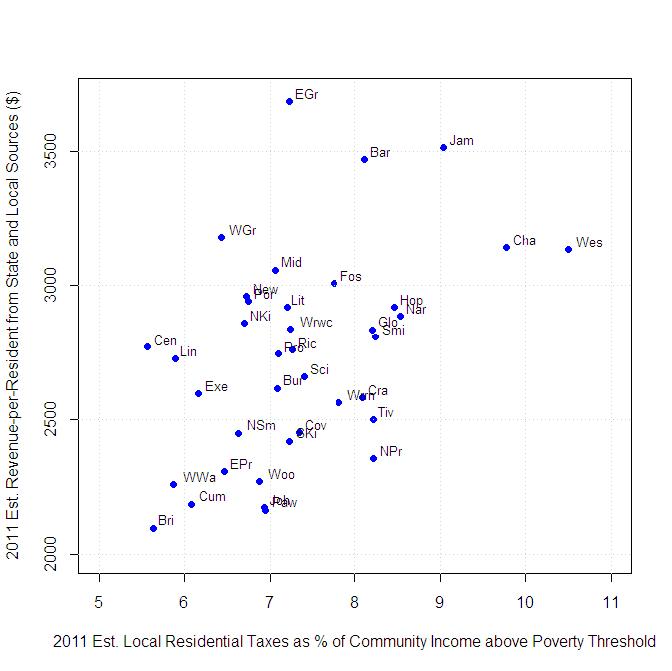
The State of Local Taxation in Rhode Island, Measure II
How do amounts paid by municipal residents, in the form of local taxes, relate to how much their local governments have to spend?
Here is the answer for Rhode Island's cities and towns with the local tax levies measured in terms of percentage of income above a community's aggreggate poverty threshold...
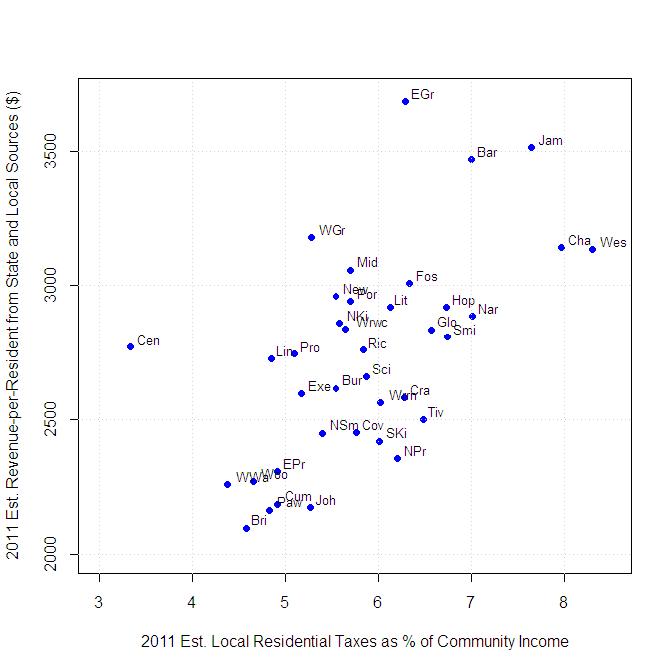
The State of Local Taxation in Rhode Island, Measure I
How do amounts paid by municipal residents, in the form of local taxes, relate to how much their local governments have to spend?
Here is the answer for 38 Rhode Island cities and towns (New Shoreham is way off in the direction of the upper right-hand corner) with the local tax levy measured as a straight percentage of community aggregate income...
Revenue per Resident in Rhode Island Municipalities
While the percentage measures used in the previous posts provide initial insights into the question of willingness and ability to pay with regards to local taxation, the total picture requires looking at an absolute measure of what each RI city and town has available to spend, since the cost structure for local services is not a linear function of local income. For example the fact that per-capita income in North Providence is 80% of what it is in Foster does not mean that North Providence can provide the same services for 80% of what they cost in Foster.
Revenue from five sources for fiscal year 2011 (with the exception of the fire levies, noted below) is included in this table:
- The real property levy from all sources; residential, commercial and industrial.
- State non-education aid, which includes PILOT payments and the state car-tax reimbursement.
- Fire-district levies from all sources (using the 2010 data).
- Local car-tax levies.
- State education aid.
The amounts in each of the five categories for each city/town are below the fold, in Table 4.
Results are ranked using the sum of the five revenue sources per-capita...
| Community | Revenue From All Considered Sources | Population | Estimated Revenue per Resident |
| New Shoreham | $8,569,119 | 1,051 | $8,153 |
| East Greenwich | $48,431,608 | 13,146 | $3,684 |
| Jamestown | $18,984,613 | 5,405 | $3,512 |
| Barrington | $56,539,329 | 16,310 | $3,467 |
| West Greenwich | $19,504,001 | 6,135 | $3,179 |
| Charlestown | $24,593,699 | 7,827 | $3,142 |
| Westerly | $71,429,766 | 22,787 | $3,135 |
| Middletown | $49,407,769 | 16,150 | $3,059 |
| Foster | $13,860,749 | 4,606 | $3,009 |
| Newport | $73,014,485 | 24,672 | $2,959 |
| Portsmouth | $51,175,543 | 17,389 | $2,943 |
| Hopkinton | $23,912,807 | 8,188 | $2,920 |
| Little Compton | $10,196,191 | 3,492 | $2,920 |
| Narragansett | $45,773,136 | 15,868 | $2,885 |
| North Kingstown | $75,786,657 | 26,486 | $2,861 |
| Warwick | $234,713,634 | 82,672 | $2,839 |
| Glocester | $27,639,056 | 9,746 | $2,836 |
| Smithfield | $60,184,769 | 21,430 | $2,808 |
| Central Falls | $53,669,511 | 19,376 | $2,770 |
| Richmond | $21,284,730 | 7,708 | $2,761 |
| Providence | $488,555,304 | 178,042 | $2,744 |
| Lincoln | $57,568,015 | 21,105 | $2,728 |
| Scituate | $27,473,139 | 10,329 | $2,660 |
| Burrillville | $41,749,102 | 15,955 | $2,617 |
| Exeter | $16,680,553 | 6,425 | $2,596 |
| Cranston | $207,593,421 | 80,387 | $2,582 |
| Warren | $27,196,787 | 10,611 | $2,563 |
| Tiverton | $39,471,890 | 15,780 | $2,501 |
| Coventry | $85,874,992 | 35,014 | $2,453 |
| North Smithfield | $29,330,391 | 11,967 | $2,451 |
| South Kingstown | $74,173,165 | 30,639 | $2,421 |
| North Providence | $75,579,151 | 32,078 | $2,356 |
| East Providence | $108,554,357 | 47,037 | $2,308 |
| Woonsocket | $93,586,294 | 41,186 | $2,272 |
| West Warwick | $65,936,808 | 29,191 | $2,259 |
| Cumberland | $73,274,936 | 33,506 | $2,187 |
| Johnston | $62,572,597 | 28,769 | $2,175 |
| Pawtucket | $154,046,441 | 71,148 | $2,165 |
| Bristol | $48,178,255 | 22,954 | $2,099 |
Now, to put this all together...
Continue reading "Revenue per Resident in Rhode Island Municipalities"
February 23, 2012
Residential Taxation in Rhode Island Municipalities, Part 2
In the previous post on local resident taxation in Rhode Island, there is a group of distressed communities (and Bristol?) at the bottom of the percentage-of-resident-income levied list. The clustering raises a question worth addressing of whether total income is the appropriate basis for measuring the taxation level in very poor communities.
The argument for adjusting the straight percentage is that there are certain fixed costs to human existence that are at least as important as paying your taxes and that taxation should be measured against what's left after basic necessities have been taken care of. The argument against is that an adequate adjustment has already built into a percentage metric, i.e. 5% of Central Falls' income would rank equally to 5% of New Shoreham's income on the straight-percentage list, even though it means much less money from Central Falls, and a further adjustment will open the divergence even wider.
I will calculate one version of a additional poverty adjustment, and present it along with the straight percentage measures going forward.
The Federal government annually calculates poverty thresholds based on family size. The Census Bureau's American Community Survey for 2010 includes a 5-year-based estimate of the number of households by number of household members in each RI community. Combining these two data elements, the amount of aggregate income needed to reach the Federal poverty threshold in each community can be estimated. Subtract that figure from the total estimated income in a community, and the result is estimated income above the poverty threshold.
The aggregate poverty thresholds alongside total community income for each Rhode Island community are listed below the fold in Table 3.
Using income-above-poverty-threshold as the percentage denominator does noticeably change the rankings. Pawtucket and Woonsocket, in particular, move up from the bottom of the list, though West Warwick and Central Falls stay about where they were...
| Community | Estimated Residential Taxes | Est. Community Income Above Poverty Threshold | % |
| New Shoreham | $7,548,403 | $43,156,924 | 17.5% |
| Westerly | $60,068,382 | $572,176,124 | 10.5% |
| Charlestown | $22,344,774 | $228,566,907 | 9.8% |
| Jamestown | $18,226,276 | $201,536,359 | 9.0% |
| Narragansett | $41,330,974 | $483,824,656 | 8.5% |
| Hopkinton | $17,371,823 | $205,331,075 | 8.5% |
| Smithfield | $44,556,739 | $540,793,934 | 8.2% |
| North Providence | $55,663,407 | $677,191,804 | 8.2% |
| Tiverton | $32,555,171 | $396,244,079 | 8.2% |
| Glocester | $20,367,277 | $248,135,004 | 8.2% |
| Barrington | $52,531,961 | $648,026,956 | 8.1% |
| Cranston | $140,031,603 | $1,731,101,472 | 8.1% |
| Warren | $18,903,276 | $242,159,186 | 7.8% |
| Foster | $10,126,928 | $130,700,587 | 7.7% |
| Scituate | $18,898,836 | $255,536,328 | 7.4% |
| Coventry | $59,892,348 | $816,146,172 | 7.3% |
| Richmond | $14,284,170 | $196,708,025 | 7.3% |
| Warwick | $142,107,199 | $1,962,582,789 | 7.2% |
| South Kingstown | $59,666,885 | $824,990,949 | 7.2% |
| East Greenwich | $40,943,187 | $567,021,673 | 7.2% |
| Little Compton | $9,690,006 | $134,548,069 | 7.2% |
| Providence | $187,919,289 | $2,645,403,886 | 7.1% |
| Burrillville | $25,001,269 | $352,665,391 | 7.1% |
| Middletown | $31,522,496 | $446,713,652 | 7.1% |
| Pawtucket | $74,151,943 | $1,067,974,255 | 6.9% |
| Johnston | $40,940,330 | $590,829,955 | 6.9% |
| Woonsocket | $38,789,267 | $563,406,119 | 6.9% |
| Portsmouth | $41,832,221 | $619,570,326 | 6.8% |
| Newport | $48,915,879 | $727,564,232 | 6.7% |
| North Kingstown | $57,562,579 | $859,563,071 | 6.7% |
| North Smithfield | $22,118,882 | $333,768,892 | 6.6% |
| East Providence | $64,344,891 | $996,042,498 | 6.5% |
| West Greenwich | $11,254,689 | $175,003,296 | 6.4% |
| Exeter | $12,546,640 | $203,667,786 | 6.2% |
| Cumberland | $55,052,263 | $905,804,162 | 6.1% |
| Lincoln | $37,704,656 | $640,511,273 | 5.9% |
| West Warwick | $33,739,187 | $574,321,052 | 5.9% |
| Bristol | $32,574,555 | $577,082,755 | 5.6% |
| Central Falls | $9,700,424 | $174,284,570 | 5.6% |
So now we have half of a story: how much do local governments collect from their own residents, measured in two different ways. Next we'll add the other half, and look at how much governments have to spend on their residents...
Continue reading "Residential Taxation in Rhode Island Municipalities, Part 2"
Residential Taxation in Rhode Island Municipalities, Part 1
Everything up until now has basically been the prologue. Now on to the real thing.
Commercial property tax revenue is a relatively small portion of how RI municipalities generate their funds. The major part of the story involves residential tax revenue plus state aid.
An important quantity that needs to be taken into consideration, usually entirely neglected in Rhode Island taxation debates, is the degree that communities actually tax their own residents to pay for local services. Presently, the measures of "tax effort" that the state uses for various bureaucratic purposes (including calculation of the education aid "funding formula") seem to lump residential and commercial taxation together, meaning that a community can inflate its appearance of "tax effort" by raising taxes on commercial properties. There is a fairness issue here tied directly to an economic one -- if a community makes short-sighted decisions that run a bunch of businesses out of town because of high commercial tax rates that keep residential taxes low, is that community then entitled to demand that the state make up the difference in some kind of "funding formula"?
Data is available for painting a better picture of what is happening on the residential side. In terms of residential tax levies in each RI city and town, 3 components will be considered:
- "Residential" real property levies, provided by the RI Division of Municipal Finance for the year 2011, with the usual caveat that apartments and mixed-used properties which can officially be classified as commercial will all be treated as residential.
- Fire-district levies in communities where they occur, using the most recent data available from the Division of Municipal Finance from the year 2010 and that I will just move forward for the purposes of this particular analysis. I believe that fire levies are applied to both commercial and residential properties in the places where they are used, so the official figures will be pro-rated by the percentage of residential valuation.
- Car-tax levies, provided by the Division of Municipal Finance for the year 2011
(See Table 1, below the fold)
The U.S. Census Bureau American Community Survey provides mean income data for all 39 Rhode Island cities and towns, based on a 5-year data span (and I can hear the skinflint pseudoconservatives shrieking: What? We spent money to pay for 39 estimates. We should consolidate everything, and then we'd only have to pay for 1 estimate).
(See Table 2, below the fold)
Based on those numbers, local taxation in Rhode Island can be calculated in terms of the income of local residents. There are some interesting variations in the results.
| Community | Estimated Residential Taxes | Estimated Community Income | % |
| New Shoreham | $7,548,403 | $50,670,812 | 14.9% |
| Westerly | $60,068,382 | $723,623,972 | 8.3% |
| Charlestown | $22,344,774 | $280,245,735 | 8.0% |
| Jamestown | $18,226,276 | $238,128,085 | 7.7% |
| Narragansett | $41,330,974 | $589,639,012 | 7.0% |
| Barrington | $52,531,961 | $750,732,990 | 7.0% |
| Smithfield | $44,556,739 | $660,901,200 | 6.7% |
| Hopkinton | $17,371,823 | $258,085,760 | 6.7% |
| Glocester | $20,367,277 | $310,049,498 | 6.6% |
| Tiverton | $32,555,171 | $501,504,180 | 6.5% |
| Foster | $10,126,928 | $159,648,566 | 6.3% |
| East Greenwich | $40,943,187 | $650,450,934 | 6.3% |
| Cranston | $140,031,603 | $2,230,900,024 | 6.3% |
| North Providence | $55,663,407 | $896,195,164 | 6.2% |
| Little Compton | $9,690,006 | $158,047,920 | 6.1% |
| Warren | $18,903,276 | $313,342,830 | 6.0% |
| South Kingstown | $59,666,885 | $990,620,148 | 6.0% |
| Scituate | $18,898,836 | $321,459,138 | 5.9% |
| Richmond | $14,284,170 | $244,582,548 | 5.8% |
| Coventry | $59,892,348 | $1,038,550,254 | 5.8% |
| Portsmouth | $41,832,221 | $732,059,511 | 5.7% |
| Middletown | $31,522,496 | $553,331,300 | 5.7% |
| Warwick | $142,107,199 | $2,515,047,584 | 5.7% |
| North Kingstown | $57,562,579 | $1,030,596,746 | 5.6% |
| Burrillville | $25,001,269 | $451,319,085 | 5.5% |
| Newport | $48,915,879 | $883,701,696 | 5.5% |
| North Smithfield | $22,118,882 | $410,133,024 | 5.4% |
| West Greenwich | $11,254,689 | $213,215,790 | 5.3% |
| Johnston | $40,940,330 | $778,402,833 | 5.3% |
| Exeter | $12,546,640 | $242,627,275 | 5.2% |
| Providence | $187,919,289 | $3,691,700,870 | 5.1% |
| East Providence | $64,344,891 | $1,310,121,561 | 4.9% |
| Cumberland | $55,052,263 | $1,121,847,892 | 4.9% |
| Lincoln | $37,704,656 | $777,803,670 | 4.8% |
| Pawtucket | $74,151,943 | $1,534,520,064 | 4.8% |
| Woonsocket | $38,789,267 | $833,687,012 | 4.7% |
| Bristol | $32,574,555 | $711,183,782 | 4.6% |
| West Warwick | $33,739,187 | $771,810,040 | 4.4% |
| Central Falls | $9,700,424 | $290,465,616 | 3.3% |
We're not done yet (hence the "part 1" in the title of this post), but I will make two immediate comments:
- A major factor that's missing that's really needed to complete this analysis for Rhode Island is the contribution made by summer residents. In effect, in communities that have a large number of summer homes, there is more property value than residents, which makes the final percentage appear higher than it should. A strong case can be made for backing that number out to calculate the percentage of year-round resident income that is collected in local taxes.
- We've got a couple of more posts to go, to contribute to a fuller understanding of the revenue side in each RI city and town...
February 22, 2012
Commercial Property Levies by Rhode Island Municipality
The next local tax table is a little more concrete than the previous two and their somewhat amorphous bases of "valuation" per resident. The table presented here is a list of Rhode Island communities, ranked by the amount of commercial and industrial property tax levy per resident. Again, the amount of "commercial" revenue attributed to "apartments" and "combined" use properties, as reported to the state's Municipal Affairs Office, where most of the cost is passed on to residential renters, has been removed from the figures.
And again, there is scant evidence that the City of Providence is being forced to work with an unreasonably low amount of property tax revenue from commercial and industrial sources due to tax exempt property within city limits...
| Community | 2011 Com & Ind Prop. Tax Levy | Population | Com & Ind Rev / Resident |
| West Greenwich | $4,980,923 | 6,135 | $812 |
| Warwick | $58,802,556 | 82,672 | $711 |
| New Shoreham | $620,655 | 1,051 | $591 |
| Lincoln | $12,364,301 | 21,105 | $586 |
| Providence | $99,836,045 | 178,042 | $561 |
| Scituate | $5,704,885 | 10,329 | $552 |
| Middletown | $8,731,200 | 16,150 | $541 |
| Newport | $12,853,970 | 24,672 | $521 |
| Smithfield | $10,196,186 | 21,430 | $476 |
| East Greenwich | $5,650,568 | 13,146 | $430 |
| West Warwick | $12,504,505 | 29,191 | $428 |
| Johnston | $12,231,284 | 28,769 | $425 |
| East Providence | $18,994,556 | 47,037 | $404 |
| Cranston | $32,293,301 | 80,387 | $402 |
| North Kingstown | $7,909,636 | 26,486 | $299 |
| Woonsocket | $10,678,058 | 41,186 | $259 |
| North Smithfield | $2,956,222 | 11,967 | $247 |
| Westerly | $5,584,407 | 22,787 | $245 |
| Warren | $2,512,512 | 10,611 | $237 |
| Pawtucket | $16,468,956 | 71,148 | $231 |
| North Providence | $7,160,107 | 32,078 | $223 |
| Coventry | $7,525,842 | 35,014 | $215 |
| Portsmouth | $3,607,447 | 17,389 | $207 |
| Narragansett | $3,030,702 | 15,868 | $191 |
| Richmond | $1,446,315 | 7,708 | $188 |
| Burrillville | $2,934,771 | 15,955 | $184 |
| Foster | $843,037 | 4,606 | $183 |
| Cumberland | $5,936,890 | 33,506 | $177 |
| South Kingstown | $5,368,927 | 30,639 | $175 |
| Central Falls | $2,428,000 | 19,376 | $125 |
| Barrington | $2,007,183 | 16,310 | $123 |
| Exeter | $752,776 | 6,425 | $117 |
| Tiverton | $1,787,720 | 15,780 | $113 |
| Hopkinton | $924,978 | 8,188 | $113 |
| Bristol | $2,583,927 | 22,954 | $113 |
| Glocester | $943,014 | 9,746 | $97 |
| Little Compton | $211,991 | 3,492 | $61 |
| Jamestown | $326,121 | 5,405 | $60 |
| Charlestown | $420,655 | 7,827 | $54 |
Combining the levy table with the valuation table raises a basic tax sanity question: Providence obviously achieves its high commercial levy ranking through the use of a high-tax rate, e.g. East Providence has more commercial and industrial property tax value within its city limits, but generates less tax revenue, because of a lower tax rate.
The forward-looking question is what the ultimate purpose of getting more money from the tax-exempts is. Ultimately, should Providence be looking to lower its extremely high commercial tax burden with new revenue from the tax-exempts, or is there really a long term advantage is being a community that has high commercial property-tax rates and that taxes non-profits like no one else does? Or are these two separate policy questions (and is money not fungible)?
Newport, interestingly, is one community on the other side of this dynamic. They are an outlier at the top of the list in terms of commercial property available for taxation, but they keep their commercial tax rates relatively low, but still generating a relatively large commercial levy. Is this a factor that should be counted for or against Newport, when they wants more state aid, or to be subsidized by Portsmouth and Middletown in some sort of "consolidation" scheme?
February 21, 2012
Commercial Property Assessments by Rhode Island Municipality, Plus PILOT Payments
Furthering the discussion from both Justin's post on Providence and Brown University, and my post from last week on commercial and industrial property values in Rhode Island municipalities, bear in mind that Providence is already receiving state support, nominally related to some of its tax-exempt properties. Providence receives on the order of $20 million per year in state funds through the PILOT program, described in the state budget as follows...
Legislation creating this program requires the State of Rhode Island to reimburse cities and towns for property taxes that would have been due on certain types of real property that are exempted from taxation by state law. This includes property owned by nonprofit educational institutions, nonprofit hospitals, or any state owned hospital, veteran’s facility, or correctional facility.Cranston received about $4 million per year from this program in fiscal year 2011 and no other Rhode Island community received more than $1 million in FY2011.
Given the City of Providence's commercial tax rates, the $19 million dollar PILOT subsidy is equivalent to being able to tax about a half billion dollars worth of additional commercial property.
For every RI city and town, the additional commercial property assessment that would have been needed to generate their PILOT subsidies can be calculated...
| Community | FY2011 State PILOT funds | 2011 Local Com Tax Rate | C&I Prop. Value Covered by PILOT Funds |
| Providence | $19,097,871 | $36.75 | $519,669,959 |
| Cranston | $4,239,850 | $30.39 | $139,514,643 |
| Warwick | $957,595 | $26.53 | $36,094,798 |
| Newport | $833,229 | $13.76 | $60,554,433 |
| Bristol | $580,241 | $12.43 | $46,680,692 |
| North Providence | $456,364 | $30.85 | $14,792,998 |
| Smithfield | $429,064 | $15.85 | $27,070,284 |
| Pawtucket | $377,406 | $24.54 | $15,379,218 |
| Woonsocket | $134,688 | $36.14 | $3,726,840 |
| South Kingstown | $124,230 | $14.51 | $8,561,682 |
| Westerly | $110,040 | $9.74 | $11,297,741 |
| East Providence | $91,188 | $22.25 | $4,098,337 |
| Burrillville | $66,573 | $16.15 | $4,122,167 |
| Barrington | $48,984 | $17.95 | $2,728,914 |
| Central Falls | $19,158 | $33.23 | $576,562 |
| East Greenwich | $7,599 | $17.49 | $434,477 |
| North Kingstown | $5,803 | $17.26 | $336,211 |
| Foster | $417 | $17.58 | $23,720 |
| Cumberland | $109 | $15.34 | $7,106 |
...and added to the actual commercial/industrial tax base, to yield an "effective" commercial/industrial tax base for each community.
With PILOT funds taken into consideration, Providence rises to near the top of the list of Rhode Island's urban areas, roughly tying East Providence, when ranked in terms of an effective tax base on a per-resident basis. (And note that using local commercial tax rates skews the results to Providence's advantage, since an equivalent subsidy will translate to less taxable value in a high-tax community compared to a lower-tax one)...
| Community | 2011 Com&Ind Assessed Prop. Value | C&I Prop. Value Covered by PILOT Funds | Effective Com&Ind Prop Value | Population | Effective C&I Value/Resident |
| New Shoreham | $130,939,920 | $0 | $130,939,920 | 1,051 | $124,586 |
| Newport | $934,154,749 | $60,554,433 | $994,709,182 | 24,672 | $40,317 |
| West Greenwich | $212,634,500 | $0 | $212,634,500 | 6,135 | $34,659 |
| Smithfield | $643,292,510 | $27,070,284 | $670,362,794 | 21,430 | $31,282 |
| Middletown | $478,133,706 | $0 | $478,133,706 | 16,150 | $29,606 |
| Warwick | $2,216,473,370 | $36,094,798 | $2,252,568,168 | 82,672 | $27,247 |
| Westerly | $573,347,700 | $11,297,741 | $584,645,441 | 22,787 | $25,657 |
| East Greenwich | $323,074,200 | $434,477 | $323,508,677 | 13,146 | $24,609 |
| Lincoln | $499,566,954 | $0 | $499,566,954 | 21,105 | $23,671 |
| East Providence | $853,687,753 | $4,098,337 | $857,786,090 | 47,037 | $18,236 |
| Providence | $2,718,570,863 | $519,669,959 | $3,238,240,822 | 178,042 | $18,188 |
| North Kingstown | $458,263,940 | $336,211 | $458,600,151 | 26,486 | $17,315 |
| Johnston | $494,193,192 | $0 | $494,193,192 | 28,769 | $17,178 |
| Cranston | $1,062,342,644 | $139,514,643 | $1,201,857,287 | 80,387 | $14,951 |
| Portsmouth | $259,361,400 | $0 | $259,361,400 | 17,389 | $14,915 |
| Narragansett | $225,330,972 | $0 | $225,330,972 | 15,868 | $14,200 |
| North Smithfield | $167,491,298 | $0 | $167,491,298 | 11,967 | $13,996 |
| Warren | $146,246,352 | $0 | $146,246,352 | 10,611 | $13,783 |
| Scituate | $141,574,476 | $0 | $141,574,476 | 10,329 | $13,707 |
| South Kingstown | $369,939,495 | $8,561,682 | $378,501,177 | 30,639 | $12,354 |
| Burrillville | $181,718,900 | $4,122,167 | $185,841,067 | 15,955 | $11,648 |
| Cumberland | $387,020,200 | $7,106 | $387,027,306 | 33,506 | $11,551 |
| Little Compton | $39,773,100 | $0 | $39,773,100 | 3,492 | $11,390 |
| Bristol | $207,878,241 | $46,680,692 | $254,558,933 | 22,954 | $11,090 |
| Foster | $47,954,300 | $23,720 | $47,978,020 | 4,606 | $10,416 |
| West Warwick | $298,922,040 | $0 | $298,922,040 | 29,191 | $10,240 |
| Richmond | $78,348,600 | $0 | $78,348,600 | 7,708 | $10,165 |
| Coventry | $345,856,734 | $0 | $345,856,734 | 35,014 | $9,878 |
| Pawtucket | $671,106,617 | $15,379,218 | $686,485,835 | 71,148 | $9,649 |
| Exeter | $56,010,100 | $0 | $56,010,100 | 6,425 | $8,718 |
| North Providence | $232,094,220 | $14,792,998 | $246,887,218 | 32,078 | $7,696 |
| Woonsocket | $295,463,687 | $3,726,840 | $299,190,527 | 41,186 | $7,264 |
| Tiverton | $113,794,995 | $0 | $113,794,995 | 15,780 | $7,211 |
| Barrington | $111,820,800 | $2,728,914 | $114,549,714 | 16,310 | $7,023 |
| Jamestown | $35,409,500 | $0 | $35,409,500 | 5,405 | $6,551 |
| Charlestown | $46,429,900 | $0 | $46,429,900 | 7,827 | $5,932 |
| Hopkinton | $47,827,200 | $0 | $47,827,200 | 8,188 | $5,841 |
| Glocester | $38,302,758 | $0 | $38,302,758 | 9,746 | $3,930 |
| Central Falls | $73,070,759 | $576,562 | $73,647,321 | 19,376 | $3,801 |
The list once again unavoidably brings us to the question that the urban chauvinists refuse to consider: Is there any real justification for demanding that significantly more non-residential "value", for taxation or for other in purposes, be available to Providence than to other densely populated Rhode Island communities like Pawtucket, Cranston or North Providence?
Indeed, if you forgo the assumption that the most populous place is a region must automatically become the place where everybody wants to go for everything, and then compare Providence to its surrounding communities, Providence seems to have done very well for a non-tourist urban area in terms of the amount of commercial property within the reach of its tax assessor. Certainly, in terms of commercial and industrial tax revenue collected, there are only a few places in Rhode Island doing better, at least in the short term. That will be the subject of the next chart...
February 16, 2012
Placing Providence's Property Tax Burden in a National Context
Further to Andrew's post, Providence's very high property taxes undoubtedly result from a combination of two critical factors. One, at least, was eminently controllable and, therefore, avoidable.
The first is that 40% of the city's real estate is tax exempt. The second factor contributing to its very high property taxes, and the one that could have been avoided, has been decades of elected officials formulating and/or affirming (i.e., passing along) seriously irresponsible budgets - budgets that appear to have completely disregarded the first factor and its implications to revenue.
Below are the national rankings of Providence's property tax rates. It is difficult to see where there is room to increase them. In fact, the city clearly needs to go in the opposite direction.
Residential Tax Rate: 7th highest[As of 2009. Source: The US Census.]Commercial Tax Rate: 2nd highest
[As of 2010. Ranking of US urban cities by the Minnesota Taxpayers' Association and the Lincoln Institute of Land Policy.]
February 15, 2012
Commercial Property Assessments by Rhode Island Municipality, as a Measure of the Impacts of Tax-Exempts on Providence
To what degree is governing the City of Providence hampered by the existence of tax-exempt property within its boundaries? One way to begin answering this question is to start with readily available fiscal-data. Each year, all Rhode Island municipalities report tax assessment and levy information to the Division of Municipal Finance in the state’s Department of Revenue, with results separated into residential and commercial/industrial categories.
In the past, I've used the data collected and provided by the Municipal Finance Division to calculate the commercial/industrial tax-levy per resident in each RI city and town. However, with respect to the question of "tax opportunities" missed in Providence, this introduces at least one confounding factor. Because commercial tax-rates vary from community to community, the commercial tax levy measures both opportunities and what is made of those opportunities (for better or for worse). Since we are asking (at least for now) whether Providence is handicapped right from the beginning, before any incomes are earned or tax rates are set, we will go back one step further, to examine at how much commercial/industrial taxable property value is within each Rhode Island municipality, on a per-resident basis.
One technical note: In Rhode Island, taxes on apartments with more than five units and mixed residential/commercial properties are often classified as commercial. Since most, if not all, of the taxation levied on these properties will be passed along to residents, they will be considered residential and not commercial for this analysis. The Municipal Affairs Office collects assessment information that is detailed enough, in most cases, to allow the part of the official commercial levy due to class 3 (“apartment”) and class 4 (“combination”) properties to be determined and subtracted.
In the table below, the second column is a city or town's reported commercial/industrial tax levy for tax roll year 2011 with any portion due to class 3 or class 4 properties subtracted out. The third column is population from the 2010 census, and the fourth column is the amount of commercial/industrial property value per resident:
| Community | 2011 Com&Ind Assessed Prop. Value | Population | Val/Resident |
| New Shoreham | $130,939,920 | 1,051 | $124,586 |
| Newport | $934,154,749 | 24,672 | $37,863 |
| West Greenwich | $212,634,500 | 6,135 | $34,659 |
| Smithfield | $643,292,510 | 21,430 | $30,018 |
| Middletown | $478,133,706 | 16,150 | $29,606 |
| Warwick | $2,216,473,370 | 82,672 | $26,810 |
| Westerly | $573,347,700 | 22,787 | $25,161 |
| East Greenwich | $323,074,200 | 13,146 | $24,576 |
| Lincoln | $499,566,954 | 21,105 | $23,671 |
| East Providence | $853,687,753 | 47,037 | $18,149 |
| North Kingstown | $458,263,940 | 26,486 | $17,302 |
| Johnston | $494,193,192 | 28,769 | $17,178 |
| Providence | $2,718,570,863 | 178,042 | $15,269 |
| Portsmouth | $259,361,400 | 17,389 | $14,915 |
| Narragansett | $225,330,972 | 15,868 | $14,200 |
| North Smithfield | $167,491,298 | 11,967 | $13,996 |
| Warren | $146,246,352 | 10,611 | $13,783 |
| Scituate | $141,574,476 | 10,329 | $13,706 |
| Cranston | $1,062,342,644 | 80,387 | $13,215 |
| South Kingstown | $369,939,495 | 30,639 | $12,074 |
| Cumberland | $387,020,200 | 33,506 | $11,551 |
| Little Compton | $39,773,100 | 3,492 | $11,390 |
| Burrillville | $181,718,900 | 15,955 | $11,389 |
| Foster | $47,954,300 | 4,606 | $10,411 |
| West Warwick | $298,922,040 | 29,191 | $10,240 |
| Richmond | $78,348,600 | 7,708 | $10,164 |
| Coventry | $345,856,734 | 35,014 | $9,877 |
| Pawtucket | $671,106,617 | 71,148 | $9,432 |
| Bristol | $207,878,241 | 22,954 | $9,056 |
| Exeter | $56,010,100 | 6,425 | $8,717 |
| North Providence | $232,094,220 | 32,078 | $7,235 |
| Tiverton | $113,794,995 | 15,780 | $7,211 |
| Woonsocket | $295,463,687 | 41,186 | $7,173 |
| Barrington | $111,820,800 | 16,310 | $6,855 |
| Jamestown | $35,409,500 | 5,405 | $6,551 |
| Charlestown | $46,429,900 | 7,827 | $5,932 |
| Hopkinton | $47,827,200 | 8,188 | $5,841 |
| Glocester | $38,302,758 | 9,746 | $3,930 |
| Central Falls | $73,070,759 | 19,376 | $3,771 |
Quick conclusions, not exclusive to Providence:
- Much to the dismay of folks who don't like suburbs for various reasons (whom Joel Kotkin would call "urban chauvinists"), a good way to generate commercial tax revenue seems to be through strip-mall/big box commercial development, e.g. as in Warwick and Middletown.
- West Greenwich and Smithfield seem to be doing well in collecting revenue for their residents to use from large employers, though the conditions that make this possible are no more generalizable to every community in Rhode Island than are conditions in New Shoreham and Newport.
- Compared to its neighbors like Johnston and East Providence, there is plausible evidence of a bit of a dent in Providence's available commercial revenue per resident (although Johnston is a beneficiary of the strip-mall dynamic). And East Providence is doing well, even though most of its big-box potential has been grabbed by Seekonk, MA.
- On the other hand, Providence, in 13th place on the list, does have considerably more commercial property to tax than do the neighboring communities of Cranston, North Providence and Pawtucket.
Moving from the table of numbers to the taxation and subsidy policy questions that are the reason for their creation suggests a question central to this issue despite being rarely a subject for explicit discussion. Is it a sign of a problem, when the largest city in a region doesn't have the most commercial revenue per unit, i.e. does it automatically mean that something is out of balance, because Providence doesn't have as much commercial revenue per resident to work with than does Middletown or Warwick?
January 29, 2012
Warren Buffett On Taxation: Listen To My Advice, Not My Accountant's
On Friday, I learned of this
Mr. Buffett has also already sheltered the bulk of his fortune from federal taxes by putting them into a foundation that will give the money away.
which was definitely puzzling in light of this.
But for those making more than $1 million — there were 236,883 such households in 2009 — I [Warren Buffett] would raise rates immediately on taxable income in excess of $1 million, including, of course, dividends and capital gains. And for those who make $10 million or more — there were 8,274 in 2009 — I would suggest an additional increase in rate.My friends and I have been coddled long enough by a billionaire-friendly Congress. It’s time for our government to get serious about shared sacrifice.
On the one hand, Mr. Warren Buffett advocates for tax hikes on the rich. On the other, he has arranged to deprive the federal government of a huge chunk of taxes - namely, the taxes on his own estate.
After struggling, ultimately without success, to reconcile the words with the actions, it became impossible to argue with this.
It seems to me that Buffett’s actions imply a clear distrust of governmental taxing and spending programs and their ability to improve society in an efficient manner.
Indeed, Saul Elnadav. And casts his calls for tax increases in a less than credible light.
January 28, 2012
Latest Tax Rankings: Why The Nuclear Tax Hike Option Should Be Completely Off The Table, Not Simply At The Bottom of The List
While Majority Leader Mattiello's expressed intent is appreciated,
"The last thing you want to do is raise taxes," House Majority Leader Nicholas Mattiello said at a Greater Providence Chamber of Commerce luncheon at the R.I. Convention Center. "We have not gone there in the past and we hope this year we will not go there. I am confident we will not."
to be respectfully blunt, it doesn't go far enough. Accordingly, as we await Governor Chafee's proposed budget, a review, courtesy the invaluable Tax Foundation, of Rhode Island's current tax rankings is in order.
State and local tax burden: 5th HighestCorporate income tax: 5th Highest.
Combined state/local property taxes: 7th Highest
And inching up one step (yippee?) this year, our business tax climate: 46th worst
Note: The first Tax Foundation link to their Rhode Island page lists our top income tax rate as 9.9%. I believe that particular data point is outdated.
January 25, 2012
Oh Darn - Guess We Have To Lower the Federal Tax Rate
... even federal employees are apparently finding it difficult to stay current.
About 98,000 federal, postal and congressional employees owed $1.03 billion in unpaid taxes at the end of fiscal 2010, according to records provided by the Internal Revenue Service.
No word on whether they also canvassed President Obama's cabinet for tax compliance.
January 22, 2012
Car Tax Reform
Warwick's Rob Cote has been leading the charge for a car tax revolt in the state. He has brought up the inequities in the law with things like being taxed at the full clean value of a car, in spite of its mileage and condition. If you have a 2005 Honda Accord, you will be assessed the same value if that car is Grandma's Sunday church car with 15,000 miles on it or if it's been in a couple accidents with 150,000 miles on it. Plus Cote has said that when you purchase a new car, the cities are using the brand new value of a car for the first five years. Everyone knows that even a brand new car loses value the minute it is driven off the lot, but yet you pay the full value.
Add on top of this, every town has their own tax rates for cars. That same Honda Accord is taxed at $76.68 if its owner lives in Providence and it is taxed at $9.75 if its owner lives on Block Island. Same exact car, vastly different taxes paid.
Add on top of that, in 1998, the General Assembly forced all towns to freeze their tax rate on cars. They cannot change. The towns who saw this freeze coming simply raised their rates at that time. Still today, no town can change its auto tax rate.
Now, based on Cote's initiative, State Representative Joseph McNamara is sponsoring legislation to make the car tax more fair. The bill will change the system so we pay a rate that more closely matches the value of the car, which in almost every case will be less than it is today.
So what will this mean? Higher property taxes is what it will mean. Originally, one of the purposes of the car tax was to lessen the burden on property owners, but now this change could increase that tax.
Let's walk through it this way. When you look at either the auto tax or the property tax, neither the rate nor the assessment matter by themselves. What matters is when the two of them are brought together. Basically what towns do is figure this out in reverse. They first figure out how much money they need, then they already have a decent idea of what their aggregate assessed value is and then use that to set the rate. But remember, in the case of the auto tax, the tax rate is frozen. Towns cannot change it. So what this change to the law could do is largely lower the aggregated assessed value, and without a rate change, the town will lose a lot of revenue.
Most mayors are not going to simply say "Oh well, we have less money, we'll just spend less." No, they will need to replace that money from somewhere. Unless the General Assembly is going to reimburse the revenue loss from the auto tax, then the mayors have to find that money themselves. Towns really only have one major source of revenue after the auto tax, and that is property tax. How much could be lost?
three quarters to a million dollars," said North Providence Mayor Charles Lombardi, "That revenue has to come from somewhere."That kind of cut will not happen in town budgets, so the difference will be recouped in property taxes. Unless the state adds another way to make that up, this could result in another example of the Assembly raising our taxes yet being able to claim that they didn't.
What might be the simplest solution? Unfreeze the rates. Let the towns set whatever rate they want. Then they can assess the autos at the correct amount and set the tax rate accordingly. Taxes paid won't go down at all, but you'll feel a whole better about your car being assessed appropriately.
January 17, 2012
Coming up in Committee: One Bill Scheduled to Be Heard Tomorrow (Relating to Car Tax Valuations)
The Rhode Island House of Representatives Municipal Government Committee is scheduled to hear a bill tomorrow that would, according to the official description, change the car-tax valuation "so that the assessment of used motor vehicles would be based on the average trade-in price, rather than retail price" (H7098).
All five of the bill's sponsors (Joseph McNamara, Robert Flaherty, Eileen Naughton, David Bennett, and Frank Ferri) represent the City of Warwick where -- probably not coincidentally -- community members have been very active in seeking to have the valuation rules changed.
Folks who have been active on this issue are invited to comment on whether this bill makes the change to car tax valuation rules that they have been seeking.
December 30, 2011
Surprise -- Governor Chafee Considering Tax Increases to Balance Next Year's Budget
On the last weekday of 2011, David Klepper of the Associated Press writes what could be the least surprising news story of the year (h/t WPRO News)...
As he prepares for his second year in office, Rhode Island Gov. Lincoln Chafee is looking for ways to spur the state's frail economy, rescue its struggling cities and eliminate another year's budget deficit -- possibly through additional taxes...Let me take this opportunity to remind readers that both during the 2010 Rhode Island Gubernatorial campaign, and immediately after the election, I asked Governor Chafee through his campaign/transition team if he would be willing to answer a set of questions that included this one...Chafee estimates that the state will face a $120 million deficit in next year's budget. While that's an improvement over the $300 million deficit lawmakers eliminated in the current year's budget, Chafee says the red ink will be difficult to erase through cuts alone. He wouldn't offer specifics but said he's weighing the possibility of recommending some form of tax increase.
4.The combined state and municipal budgets for Rhode Island have grown steadily (adjusted for inflation) over the past 10 years, a period of time which includes September 11, 2001 and its immediate aftermath, the end-of-the-financial world as we knew it in 2008, and the relative lull (at least domestically) in between.The response I received, the second time I asked, was...Is it by design or by accident that government has been growing as if on autopilot -- or would you disagree with that characterization entirely? Compared with 10 years ago, are Rhode Islanders getting more in return for their increased spending?
We do not agree with the premise of these questions.
December 29, 2011
So, in Other Words, It Was Already a Scam?
It's instructive to watch the pieces that fall away when financial difficulties force changes in public policy, because they reveal glimpses of the scam inside. The latest (that I've noticed) comes with the car tax controversy:
The state Vehicle Value Commission dropped the value of some older cars during a brief meeting Tuesday, but did not address the ongoing controversy over the contention that the state puts too high a price tag on taxpayers' cars. ...Up until last year, the state required municipalities to trim $6,000 off all vehicle valuations on the condition that the state would make up the difference in revenue to the localities. When the state found it could no longer afford the program, it gave communities the option to do away with all but $500 of the $6,000 value exemptions.
It is the state, not the municipality, that requires the use of the highest National Automobile Dealers Association level — the "clean retail value" — to determine the tax on all cars, whether they are "clean" or not. That's akin to appraising every house as if it is in excellent condition for its style and age.
As the above quotation explains, the state had been disguising this unfair method by discounting all cars and paying the difference from other revenue. In practical terms, while car owners may not have been paying too much for their own cars, income tax payers, and those whose money found its way to the General Assembly by other means, were paying too much for other people's cars.
November 21, 2011
Pension Reform Bait-and-Switch to Block Broader Reform
I've placed the 5.5% privatization tax in the context of the General Assembly's history of opposing such money-saving measures and pondered the language of the newly minted statute.
My concern, in brief, is that there really isn't anything limiting the application of the 5.5% "assessment" to state privatization. The only limit mentioned is to the displacement of employees included in General Law 36-8, which establishes the pension system. In other words, it appears to apply to any government agency that participates in state pensions, whether state, school district, or municipal. Mayoral academies, for example, can opt out of the pension system and so may be threatened with the surcharge. The limiting factor will only be how aggressive the folks who write the resulting regulations wish to be.
Even if the law does wind up limited to employees of the state, reformers should fear its effects on others of their strategies for improving government, notably consolidation. Any function moved from the municipal to the state level will now become permanently "in house."
Frankly, this sort of legerdemain is bound to happen when opposition parties jump on a fast-rolling bandwagon like pension reform.
November 20, 2011
Dual Purpose of the New 5.5% "Pension" Tax Exposed: To Discourage the Use of Non-State-Employees and To Gouge Yet Another Couple of Million from the Taxpayer
Who says? Why, the Director of the Department of Administration, Mr. Richard Licht, though he didn't actually use the words "gouge" or even "taxpayer". (Ah, the joy of euphemisms).
As Patrick noted, one of the few last minute amendments to the good-start-on-but-by-no means-comprehensive pension reform bill that survived a floor vote was a 5.5% tax on state services awarded to outside contractors - you know, the ones to which the state would not owe a pension, or vacation, or sick time, or a uniform allowance, or longevity pay, et public sector cetera. (Good job, Ian Donnis, clarifying this situation.)
[Donnis] asked Licht if the 5.5 percent assessment will curb the state’s use of outside employees. He responded:That’s correct, and that’s actually the purpose of it. And independently of pension reform, our department is doing an analysis of contract employees, because there are instances where people working side by side — one works for an independent contractor, one works for the State of Rhode Island — yet they’re doing the same work.
(I'm shuddering as to the outcome of that analysis, by the way.)
Secondly, as to gouging. Possibly your reaction, when you heard about this new "assessment", was the same as mine: aren't the contractors just going to pass that cost back on to the state by increasing their bid by 5.5%??? In fact, that was the intent from the beginning.
Licht says the 5.5 percent assessment will be levied on the state. “The contractor doesn’t have to pay it,” he says. “It’s assessed against the state ...
Whew. The contractor doesn't have to pay it. The "state" does.
... wait a minute. The "state", in this case, means us taxpayers. It is our hard-earned money which funds the operation of state government! (Funny how Mr. Licht didn't actually phrase it that way. "The State" sounds so much more remote.)
Congratulations to the Governor for creating this win-win situation ... win-win solely for himself, that is: he looks good in the eyes of public employees by taxing non-state employee services and he looks good by funneling revenue to their pension fund from yet another tax-hole bored into our wallets.
November 17, 2011
"Industry-Funded"
Where does the government get its money to buy stuff? Do you know? It seems most people don't. They just seem to think it's free money or they'll get it from business or industry.
Just like this article about Obama's recent idea to help the Christmas tree industry by taxing it fifteen cents a tree to help with marketing Christmas trees.
"The administration said it was not a tax, but an industry-funded fee that the industry supported for marketing purposes."
Industry funded? What does that even mean? The Christmas tree industry is going to pay a 15 cent tax per tree which would then be returned to them by the US Government so they can engage in better marketing? Does this idea make sense to anyone? First, just keep the fifteen cents and do your own marketing. Second, "industry funded"? Who are you kidding. We know who the funding will be, the people who buy the trees. But I guess if you tell people that it's the businesses paying it, then who cares what the new tax is.
Want more examples of this? I recently saw a flyer advocating for after-school learning for children. One of the statistics cited was
"4 out of 5 parents (80%) favor using state dollars to fund afterschool and summer learning programs."Why not ask those same parents whether they feel they should pay out of their own pockets for afterschool and summer learning programs. Because why? Because it is the same money! They pay the taxes to the state which then makes their tax money into the "state dollars". We don't currently have these programs so to pay for them, we'd need to raise taxes! People often don't realize this. It's like they think the money just magically appears. Oh don't worry, the government will pay for it! People, YOU ARE THE GOVERNMENT!
If you want even further evidence of people having no idea that this "government money" is their own, look at the biennial bond referenda. In last year's statewide election, we only had three spending questions to look at, the Higher Education Facilities Bond, Transportation Bonds and the Open Space and Recreation Bonds. They all passed. The closest vote was for the first one, and it won by 11 points. The Transportation bond won by 47 points, maybe because of the campaign that said if we vote for that bill, the federal government will match the state funds. Federal money? That's more free money! Right? Wrong. It's more taxpayer money, it's just coming from a different pocket.
Hopefully someday people will wake up and see all this government money for what it is, the taxpayers' money. Every time there is fraud and waste in the government, that is our money being stolen and wasted. This isn't free money, it's our money.
November 14, 2011
Even the $17/Week Co-Share: A Portrait of Greed
Exclusively, it appears, courtesy WPRO.
Christopher Cardarelli earned $77,000 as a firefighter last year and collected a $37,000 pension as a retired police captain but now he says he is paying too much for health benefits. ...Cardarelli asserts that the city must reimburse him the $17 dollars a week he has been paying toward his health care because his contract says that if a retired cop is rehired then his town-financed healthcare is suspended, however, it says that the city will reimburse the retiree for any health care payments they are required to make by their new employer.
In addition to the matter of Mr. Cardarelli's unwillingness to pay a healthcare co-share that most of us can only dream about (Paul & Al made him the subject this morning of their "This Is Why You Suck" segment), this also becomes an excellent opportunity to once again highlight the extreme generosity of Rhode Island's public pension benefits: prima facie, Mr. Cardarelli is not ready to retire, nor does he need a pension to survive: he currently works a nice public sector job for North Providence.
Why, then, was he, along with thousands of other public employees, state and local, permitted to begin collecting a pension long before retirement age? And how can the bill on Smith Hill just voted out of committee honestly be framed as adequately reforming the pension system if it leave largely untouched these exceedingly generous pensions?
November 7, 2011
Claiborne Pell Was a Fiscal Extremist, According to Today's Democrats -- He Supported a Balanced Budget Constitutional Amendment
In September, Rhode Island State Democratic Chairman Edwin Pacheco staked his party to an aggressive stand against adding a balanced budget amendment to the United States Constitution, characterizing such an amendment in an official press release as "extreme economic policy". But support for Federal spending-with-no-ending has not always been the singularly dominant position amongst Rhode Island's Democratic leaders that it is today. At a previous time when the Federal budget deficit had grown to unprecedented levels, at least one prominent RI Democrat gave his unambiguous support to a balanced budget constitutional amendment, in a year when it had a realistic chance of passage. That Democratic leader was United States Senator Claiborne Pell.
In 1982, Senator Pell voted against a balanced-budget amendment that passed the Senate by a vote of 69-31. (The amendment later failed to pass in the House).
By 1986, Senator Pell had changed his position and voted in favor of sending a balanced-budget amendment to the states for ratification. The amendment lost by a single vote, 66-34 (2/3 required for passage). The amendment that Senator Pell voted for -- and that the present chairman of the RI Democratic Party would presumably find "extreme" -- read...
SECTION 1. Total outlays of the United States for any fiscal year shall not exceed total receipts to the United States for that year, unless three-fifths of the whole number of both houses of Congress shall provide for a specific excess of outlays over receipts. The public debt of the United States shall not be increased to fund any excess of outlays over receipts for any fiscal year, unless three-fifths of the whole number of both houses of Congress shall provide, by law, for such an increase.In 1992, Senator Pell reiterated his support for adding a balanced budget amendment to the US Constitution, voting in favor of a non-binding sense-of-the-Senate resolution calling for its passage.SECTION 2. Any bill to increase revenue shall become law only if approved by a majority of the whole number of both Houses of Congress by rollcall vote.
SECTION 3. Prior to each fiscal year, the President shall transmit to the Congress a proposed budget for the United States Government for that fiscal year in which total outlays are not greater than total receipts. The President may also recommend an alternative budget in which total outlays exceed total receipts, which shall be accompanied by a detailed explanation of the need for such excess.
SECTION 4. The Congress may waive the provisions of this article for any fiscal year in which a declaration of war is in effect.
SECTION 5. The Congress shall enforce and implement this article by appropriate legislation.
SECTION 6. This article shall take effect for the fiscal year 1991 or for the second fiscal year beginning after its ratification, whichever is later.
By 1994, Senator Pell had changed positions once again and voted against two separate versions of a balanced budget amendment offered that year. During the floor debate in 1994, the Senator explained how his thinking had evolved over the preceding decade. Here is an excerpt, from the C-SPAN archives...
The intensity of the debate on the balanced budget amendment--and to a degree my own reaction to it--varies in proportion to the magnitude of deficits in the Federal budget over the last 12 years...Today, annual deficits run-up by the Federal government are much larger than the figure of $221 billion cited by Senator Pell in his explanation of his vote in favor of the 1986 balanced budget amendment. 2011 will be the third year in a row where the Federal deficit exceeds $1 trillion dollars, with no return to 1986 levels anticipated (in inflation adjusted dollars) in the next five years projected by the Office of Management and Budget.[In 1986] we were 2 years into the second Reagan administration and deep into a period of institutional deadlock between an executive branch that would not agree to fund programs and a legislative branch that often was not disposed to cut them. The deficit that year had risen to $221 billion.
The Senate that year narrowly failed to approve a balanced budget amendment, notwithstanding the fact that many of us--myself included again--this time felt that the institutional deadlock was approaching such drastic proportions that a constitutional solution might be the only way out of our dilemma...
Then, in 1992, things began to change for the better....As a percentage of gross domestic product, the fiscal year 1995 deficit is projected at 2.5 percent, down from 3.5 percent for fiscal year 1994. And it is expected to stabilize at 2.3 percent for fiscal year 1996-99. This is a significant figure because it shows that the deficit is very small relative to overall economic activity and the economy thus has substantial capacity to absorb the effects of deficit spending, albeit at levels which for other reasons certainly must be reduced.
In 1994, Senator Pell believed that the projected lowering of annual deficits to 2.3% of GDP made a balanced budget amendment unnecessary. Today, deficits are much larger than 2.3% of GDP and are larger as a percentage of GDP than they were when Senator Pell voted to send a balanced budget amendment to the states. 1986 had been the 3rd year out of 4 that the Federal deficit exceeded 5% of GDP (and in the 4th of those years, it was 4.8%). 2012 will be the fourth consecutive year that the deficit exceeds 7% of GDP (though OMB does project that it will be down to 3.3% of GDP by 2016 -- if you believe that the economy is going to grow by 23% while the percentage of revenue collected in Federal taxes jumps from 15% to 19% between 2010 and 2016).
Senator Pell thought that "institutional deadlock" was a problem in government during part of his tenure in office. This, at least, is something in common with current Rhode Island Democrats. In August, Rhode Island First District Congressman David Cicilline sent out a fundraising letter explaining his vote to raise the Federal debt ceiling as a response to "partisan gridlock". The difference, of course, is that Senator Pell believed that institutional deadlock made it necessary to strengthen constraints on Federal spending, while Congressman Cicilline believes that partisan gridlock justifies autopilot spending increases and unrestrained Federal borrowing -- and contemporary Democratic leaders like Edwin Pacheco believe that the kind of serious consideration Claiborne Pell gave to balancing the Federal budget is "extreme".
October 28, 2011
Car Tax Evaluation Committee: Typical?
Warwick Car Tax Revolt leader Rob Cote has done a great service to the citizens of Warwick and the state by keeping the heat on our elected officials regarding the car tax. Further to that end, he decided to drop in on the annual Car Tax Evaluation Committee meeting, buried somewhere in the State House Administrative building. What he found was an embarrassment (h/t Dan Yorke Show).
Unfortunately, I suspect this is all-too typical of what goes on with other boards in our state government.
October 7, 2011
Governor Chafee May Push His Sales Tax Plan Again
Fresh from the taping of this week’s Newsmakers program for WPRI-TV (CBS 12), host Tim White tweets…
Chafee says he may resurrect his controversial sales tax plan next year. Newsmakers (with myself, Ted Nesi and Ian Donnis) will be online soon.
August 29, 2011
Car Tax Shame All Around
It's always appropriate to call for a greater sense of shame among Rhode Island's politicians, but Ed Achorn was a little too specific in his column, last week:
The politicians of Rhode Island would be ashamed of themselves, had they not lost the capacity for feeling shame long ago. Their determination to balance their enormous budgets, larded with stunning benefits for special interests, on the breaking backs of struggling working people is outrageous.I write of the General Assembly's action in permitting cities and towns to hike property taxes on the most shabby motor vehicles. Now, some municipalities are hammering people who own anything valued at $500 or more (according to the municipalities' highly skewed definition).
The reality must be acknowledged that municipal governments didn't have to increase their revenue from the car tax. Other means exist for them to absorb losses in money that the state, in its mismanagement, is unable to provide. For one, lost revenue is among the exemptions that allow them to raise property taxes beyond the cap; going that route would have given residents a stronger sense and say in whether their hometowns raised taxes at all. More wisely, local governments could simply have cut back spending, even though it might mean reducing the scope of their activities. We can't forget that the General Assembly also gave cities and towns permission to reduce school budgets for a couple of years, temporarily disengaging the statutory ratchet that requires school spending to go in no direction but up.
Yes, state legislators ought to feel shame that the tools that they leave to municipalities to balance budgets are so limited. Taxing clunkers was the easiest and most visible means of compensating for losses in state aid, and the General Assembly should have taken the opportunity of hardship to tone down the demands that it makes on local governments, from minimum manning to basic education plan (BEP) requirements to the way in which labor contracts must be negotiated.
The real shame, however, belongs with the people of Rhode Island, who continue to accept government as it is. Apathetic or on the take, too many voters implicitly agree that this is the way things ought to be.
August 17, 2011
That's Why We Call the Tax "Progressive"
Steven Colucci, a public school psychologist (I'm pretty sure), had a letter in the August 12 Providence Journal raising a point that comes up from time to time:
[In a previously published letter, Keith Garrison] notes that the top 1 percent pay 37 percent of the total income taxes. Mr. Garrison makes a couple of egregious errors. In order to compare apples with apples, I would prefer to know what proportion of the income of this top 1 percent goes to taxes, compared with the rest of us ...Secondly, he wrongly suggests that small businesses would be hurt by a tax increase and that jobs would be lost. He curiously leaves out that the tax increase is on personal income and is not a business tax.
I understand that using the word "egregious" can spark a little burst of pleasure, but one should be extremely careful with logic and assertions of fact when deploying it. For one thing, that Mr. Colucci "would prefer to know" one thing doesn't mean that citation of the other thing is an error. Moreover, surely somebody with the time to write and send a letter to the Projo also has the time to do some quick research.
If Colucci had done so, he might have paused long enough to remember that people talk about the progressiveness of various taxes, and that income tax is heavily weighted against the rich. That is, they naturally pay more of their income in income taxes. At least in 2007, taxpayers earning over $200,000 per year made 24% of Rhode Island's income but paid 40% of its total income taxes.
Perhaps he'd argue that other taxes ought to be considered as well, which is ground that I covered in 2008. There, he'd find that it's true that families with higher income pay a smaller percentage of their income in total state and local taxes, but that's because things like property and sales taxes aren't calculated on income, but on the value of the item purchased, and such taxes will take up a larger proportion of a smaller income.
The most regressive tax, in this regard, is the excise tax category (such as on cigarettes, gas, and alcohol). According to the table at the above link, the lowest income quintile payed 4.9% of its income in excise taxes, but the portion for the top 1% of earners was 0.3% of income. Put that in dollar figures, though, and you're comparing $411.60 for the lower category and $2,361 for the higher (and remember that we're comparing 20% of people with 1% of people). For sales taxes, the number is $268,80 versus $3,148.
One suspects that, for Colucci, nothing will be fair until people who've worked hard to have comfortable incomes are taxed such that nobody, regardless of merit, has any less disposable income.
As to the second paragraph that I quoted above, I'd suggest that Mr. Colucci ought to familiarize himself a little bit more with the methods of income taxes. For multiple categories of businesses (sole proprietor, S-Corp, and so on), business income appears as personal income. Unarmed with that knowledge leads Colucci to make his own egregious error.
August 11, 2011
Property Tax Rates Don't Matter
Reading this article, I thought it worth reminding everybody once again that, given the way local budgeting is done, property tax rates don't really matter:
After voting to take court action against Mayor Charles A. Lombardi's vetoes, the Town Council changed its tune Wednesday night and voted unanimously to set the tax rate for residential property at $24.15 per $1,000 of assessed value.This was the same rate proposed by Lombardi. For his part, he rescinded his previous veto of the $23.35 tax rate voted by the Town Council, showing a measure of deference to the council’s authority as the town’s tax-setting authority.
The tax rates might matter if cities and towns assessed the value of the property in their towns, applied the tax rate to it, and then figured out how much money they have to run local government. That's not how it works. In practice, the government calculates how much it needs, typically based on projected increases from the previous year, divides that number by the total value of property in the town, and figures out what the rate turns out to be per $1,000 of value.
Assuming that everybody's property increases or decreases at roughly the same rate, the actual dollar amount that every household pays in taxes will increase by the same percentage that the town's budget increases. In other words, it's more of an ownership fee based on the portion of the town's value that the family owns.
One consequence of this method is that you can't really compare property taxes from town to town, because a town with lower property values will have higher tax rates. Another, more central, consequence is that the town has no real incentive to attract additional property owners or try to get homeowners to invest in their own homes.
Scoring with Low Taxes
Kevin Hassett pointed out an interesting finding (not online) in the June 20 National Review:
At issue is the "Beckham law" that was enacted on June 10, 2005. Spain, in an effort to lure high-priced athletes, artists, and executives, passed a law that allowed these individuals to reside in Spain and pay a low flat tax of just 24 percent. Soccer star David Beckham was one of the first to take advantage of the law, hence its name. ...A new study published by the National Bureau of Economic Research suggests that the link between taxes and soccer performance is more than just a coincidence. Economists Henrik Kleven, Camille Landais, and Emmanuel Saez gathered data on club performance in the top leagues of 14 European countries going back to 1980, and explored the extent top which changes in tax rates explain player mobility, and the extent to which player mobility explained performance.
They found that countries that allow professional soccer players to keep more of their pay do better. More local stars stay, and more foreign stars immigrate.
As any sports fan might observe, the effect is diluted when the field is narrower — say with World Cup teams or American professional clubs. Part of the reason for the correlation of low taxes and good soccer players is that teams in higher-tax areas have to pay more in salary to be competitive as employers, which leaves less money to pay players farther down the lists.
August 8, 2011
What Goes Up... Taxes
The other day, I made reference to the possibility that having an economy calibrated to two-income households, rather than the one-income households that were once the norm, is a hindrance on entrepreneurial ventures. Yes, if one spouse's attempt to create a business fails, the other spouse's income remains, but in the current marketplace, both incomes are necessary.
Since the effective doubling of the workforce, the market has adjusted household expenses, especially big-ticket expenses like housing, to the new normal income level. In an interesting spin-off discussion, Todd Zywicki ntoes that leading the big-ticket inflation is taxation:
Here's the key problem in Caldwell's argument: note his list of increased expenses for household "big necessities: mortgages (up 76 percent), cars (up 52 percent), taxes (up 25 percent), and health insurance (up 74 percent)." The problem is that while it is an accurate representation for mortgages, cars, and health insurance, that the expenses increase by that percentage, it is not for taxes. For the other expenses it is the percentage increase in dollars spent on those expenses. For taxes, however, the 25% increase is actually the percentage increase in the percentage of income spent on taxes. So the 25% is not how many more dollars go to paying taxes, it represents the household’s change from paying 24% of its income in taxes to 33% of its income in taxes–a change of 25% in the percentage of income dedicated to taxes, not a change of 25% in spending on taxes. I swear I am not making this up: I have attached to the bottom of this post the full excerpt from this book where this is done. And, again, I have laid this out in considerable detail previously here.What this means is that once taxes are converted to an apples-to-apples comparison–percentage change in dollars instead of percentage change in percentage–household spending on taxes actually increased 140%, not 25%. The entire two-income trap, therefore, is actually a two-income tax trap, as I noted in my Wall Street Journal commentary on this awhile back.
Zywicki overstates when he declares that taxes constitute the "entire two-income trap." Even if taxes were the only expense to increase at all as a percentage of income, that wouldn't change the fact that it now takes two incomes to cover expenses that used to take one. That said, conservatives certainly aren't averse to arguing that we need to shrink government in both its activities and its expense.
August 4, 2011
And the Winner of this Week’s James McLaughlin Award Is…
…United States Senator Jack Reed, for his comments to John E. Mulligan of the Projo on the subject of the “Amazon Tax”…
U.S. Sen. Jack Reed has signed on in support of legislation to require online retailers to collect state sales taxes on their merchandise…(The meaning of the award name has its roots at this link. And I don’t think this will become a true weekly feature, but given the strange logic regularly used by contemporary Democrats on all matters fiscal, you can’t rule the possibility out…)Reed said the Amazon bill could get caught up in the next round of Capitol Hill’s deficit-reduction debate. Reed said he hears that the new tax-collection mechanism could incorrectly be interpreted as a new form of taxation by Republicans who oppose raising taxes.
July 31, 2011
History Will Begin to be Made this Week
This is very likely going to be a memorable week in the history of self-government and public finance.
In addition to the Federal debt-ceiling issue which needs to be resolved by Tuesday in order for the Federal government to be able to keep paying everything it owes without resorting to various less-than-scrupulous financial gimmicks, the receiver for Central Falls may make an announcement as early as tomorrow that he is filing for bankruptcy. As Philip Marcelo wrote in today's Projo...
The square-mile city would be entering uncharted waters as federal municipal bankruptcy has been rarely tested nationally.Central Falls is not sui generis; it is an advanced case of a situation faced by many cities and towns across the United States, and what happens with CF is going to contribute very visibly to a body of legal, policy and political knowledge about what to do and/or what to avoid when twenty-first century communities run out of money needed to pay for decisions made over preceding decades.
But the most important thing to keep in mind is that nothing ends this week. The reckoning (to use Matt Allen's word) of the fiscal crisis created by the political and social changes of the past 45 to 80 years, depending upon if you want to place the beginning of the problem with the New Deal or the Great Society or somewhere in between, is just beginning and what our society will look like as a result, for better or for worse, will be decided more by the reaction to this week's decisions than by the decisions themselves.
Finally, one symptom visible in Central Falls of the problem that is nationwide is captured beautifully by the quote from freshman state Rep. James McLaughlin in the Projo's CF story...
"They’re going to file for bankruptcy," said state Rep. James N. McLaughlin, a Democrat who represents a portion of the city and is opposed to [filing for bankruptcy]. "All avenues have not been exhausted. It is a rush because they do not have any money."If our politics keeps producing a large number of elected officials who believe that just because we have no money doesn't mean we're bankrupt, we're basically doomed.
July 22, 2011
The Senate Still Scamming
It would appear that the U.S. Senate is in need of some major upsets, the next election cycle:
The plan, released this week by the bipartisan "Gang of Six" senators, punts on many of the most difficult issues, leaving it to congressional committees to fill in the details later. But supporters say it provides a framework to simplify the tax code, making it easier for businesses and individuals to comply while eliminating incentives to game the system. ...The plan would simplify the tax code by reducing the number of tax brackets from six to three, lowering the top rate from 35 percent to somewhere between 23 percent and 29 percent. That could provide a windfall for wealthy taxpayers because the 35 percent tax bracket currently applies to taxable income above $379,150.
To help pay for lower rates, the plan would reduce popular tax breaks for mortgage interest, health insurance, charitable giving and retirement savings. Other tax breaks would be spared, including the $1,000-per-child tax credit and the earned income tax credit, which helps the working poor stay out of poverty.
All told, the plan would amount to a $1.2 trillion tax increase over the next decade, which means that it's all just a political trick. Worse, it's a trick that would increase taxes on productive, charitable middle class families while decreasing them for the wealthy. (Although, the article hints that capital gains taxes might be in for an increase down the road.)
The Senators are hoping, no doubt, that they'll be able to confuse voters with talk about cutting taxes and simplifying the tax code. If that's the case, however, I think they're underestimating the extent to which Americans are now paying attention to such Rhode Islandish schemes.
July 18, 2011
If You Are Not Careful, You Can Eventually Hit Your Head on a Debt Ceiling
There are about a half-a-dozen things I could comment on, in reaction to the announcement by Borders Books today that it is going all-the-way out of business. For now, following on from Justin's post earlier today, I will simply note this passage from the Wall Street Journal story on the subject...
Borders filed for bankruptcy-court protection in February. It has since continued to bleed cash and has had trouble persuading publishers to ship merchandise to it on normal terms that allowed the chain to pay bills later, instead of right away....and ask why Borders' current ownership didn't simply show the publishers that they had raised their debt ceiling, so that everything could continue as before. After all, that's a solution good enough for the finances of the Federal government (in the minds of some), right?
July 5, 2011
Counterfactual alert: A Conservative Case for Raising Taxes?
Just throwing it out there. From Steven Hayward:
one problem with our current tax policy is that at the moment the American people as a whole are receiving a dollar of government for the price of only 60 cents. (I don’t say a “dollar’s worth of government,” but let’s leave that snark for another time.) Any time you can get a dollar of something at a 40 percent discount, you are going to demand more of it. My theory is simple: if the broad middle class of Americans are made to pay for all of the government they get, they may well start to demand less of it, quickly.Since starving the beast didn't work, how about over-feeding it?There’s corollary point to this. Back in the Reagan years, there was a vigorous internal debate about whether to resist tax increases because “starving the beast” would hold down spending. But evidence is now in: this strategy doesn’t work. {here's the source he cites-ed.}
Right now the anti-tax bias of the right has the effect of shifting costs onto future generations who do not vote in today’s elections, and enables liberals to defend against spending restraints very cheaply. Time to end the free ride....more to the point, the argument should be cast in terms of a creating pro-growth tax reform. Froma Harrop of the Providence Journal has a typically idiotic column out today saying Americans want higher taxes. It is not even worth the bother of debunking. There is one highly useable sentence in it: “Today, high-tax Sweden has only 7 percent unemployment, while ours is 9 percent. How come? Before the 2008 economic meltdown, Sweden prudently maintained a budget surplus equal to 3.6 percent of its economy.” Never mind that Sweden isn’t exactly putting its shoulder to the wheel in the fight against terrorists (or anything else), and just focus your mind on one fact: yes, it is a high tax country, but its corporate income tax rate is one-third lower than the U.S. rate (26% for Sweden; 39% for the U.S.). So, my opening bid is—yes. By all means let’s emulate Sweden’s tax rates, starting with a one-third cut in our corporate income tax rate, and a hike in middle class income tax rates. Deal? I didn’t think so.Yeah, not so sure this is gonna fly, but interesting.
July 1, 2011
Do Legislators Really Not Know How It Works?
So they've gone and passed the budget. Rhode Islanders should not find it encouraging, though, that the architects of public finances apparently think in this way, speaking about the new 7% tax on insurance awards:
Dion says the burden falls on the insurance company, not the consumer: "When you total your car or have your car stolen, you file a claim with your insurance company. Your insurance company would determine the value of your totaled or stolen car and issue you a check for that value plus the sales tax on that amount, which you can then use to purchase a replacement vehicle," he said."So if your totaled or stolen car was worth $10,000, ... under the proposed change, the insurance company would issue you a check for $10,700 to cover the value of the vehicle plus the sales tax and leave the insured whole."
Sounds to me as if the cost of an insurance award just went up for the company, which will just plug that number into its calculation of its premiums. As a rule of thumb — voters and consumers — you always pay.
For In-State Tuition, Show Us the Taxes
William Dimitri, of Johnston, makes an interesting suggestion regarding in-state tuition for illegal immigrants, in a Providence Journal letter that does not appear to be online:
On the one hand, those fortunate enough to earn in excess of $250,000 already pay a substantial amount of taxes, but that fact seems to escape the grasp of the ... proponents [wish to increase those taxes].On the other hand, it is highly unlikely that those illegal immigrants whom Diaz, Pichardo and the other "immigrant advocates" want to benefit have ever paid income taxes.
How about requiring that those illegal immigrants provide copies of their tax returns for every year they have been in Rhode Island before granting them the privilege of paying in-state tuition rates (which would make the idea more palatable to those who do pay taxes and tuition, like me) and leave those who work legitimately and pay taxes alone and in peace.
Honestly, I don't know the statistics for illegal immigrants and income taxes, and even were such requirements included for in-state tuition, I'm can't say I'd be for it. How about requiring people to follow the proper procedures for entering and remaining in this country? Especially with in-state tuition, which amounts to government-subsidized higher education, following the rules for becoming a legal resident seems the least one can do.
June 16, 2011
What We Expect from Our Leaders
On last night's Matt Allen Show, Matt and I talked about expectations for the forthcoming budget, speeding tickets, and things on the blog. Stream by clicking here, or download it.
June 10, 2011
Seeming Wise, but Raising Taxes
For years, I've been arguing against transportation bonds on the grounds that such basic matters of infrastructure are the first expenses that our government ought to make. Instead, the political strategy becomes one in which elected officials and unelected bureaucrats spend as much money as they can on non-basic services and then return to taxpayers to fund critical projects like road and bridge repairs, often leveraging debt to delay the pain that such a strategy is sure to cause.
Well, the RI Senate is beginning to tackle the problem, but in a way that attempts to make the strategy more of a permanent fixture:
The Senate Commission on Sustainable Transportation Funding became the latest in a series of study groups to recommend highway tolls along with higher driving-related fees such as licensing and registration. ...The commission also recommended that the state look into a VMT tax, for vehicle miles traveled. That would mean a fundamental change in the way driving is taxed. Now, motorists usually pay indirectly, through taxes and fees. A VMT tax would raise money by taxing actual miles driven. It remains unclear, however, how that would be done.
Sen. Louis DiPalma (D, Little Compton, Tiverton, Aquidneck Island) places cessation of debt as the first priority, which is good and necessary, but it's as part of an effort to add revenue sources. What the state government should be doing is starting its budget from zero, funding those things that give government the most justification to tax money out of the economy and then arguing for any additional expenditures and even tax/fee increases for everything else on the merits.
June 7, 2011
RIPEC's Chicken Acquiescence
Following on this Projo summary of this disappointing report from the Rhode Island Public Expenditures Council (RIPEC) isn't quite as pro-Chafee-tax as the headlines and the Chafeedom would have us believe, but there's far too much hedging in it.
With the exception of the new sales taxes proposed for business back-end purchases, RIPEC never quite spells out what aspects of the tax scheme it likes and doesn't. Instead, we get language like this:
The "Sales Tax Modernization Proposal" is projected to generate $164.9 million in additional revenue for the state in FY 2012 and would make fundamental changes to the state's sales tax system. As proposed, the plan would increase FY 2012 tax revenue from an estimated $2,380.3 million1 to $2,545.2 million, an overall increase of 6.9 percent (see chart 5). The sales tax itself would increase by approximately 20 percent. When total revenues generated through sales taxes – including the meals and beverage tax and hotel tax, which are collected by the state and remitted to the municipality in which they are collected – are considered, projected sales tax collections would total approximately $1,015 million. This level of collections would be greater than the amount of revenue generated through the personal income tax. Such a significant change should only be undertaken after careful evaluation of the pros and cons of the proposal, particularly as they relate to the state's tenuous economic recovery.
The conclusion toward which RIPEC mildly implies — and ought to have made explicit — is that no tax increase should be included in this "modernization" effort. If the state government really wants to boost the local economy, it should lower and broaden the sales tax rate in such a way as to effect an overall tax cut.
June 3, 2011
Nobody on the People's Side
Governor Donald Carcieri was limited in what he could accomplish, given the degree to which the Rhode Island Constitution favors the legislature, but at least he offered a different view. This tidbit, from the end of the article to which I linked earlier, is apt to give a taxpayer the hopeless sense that there's nobody on his or her side:
Asked at the time if the entire tax package was dead, House Finance Committee Chairman Helio Melo said that was not how he interpreted Fox's statement.More recently, Melo acknowledged the lawmakers were exploring many options, including: how much the state might raise by extending the state's narrow sales tax to items already taxable in Massachusetts, and lowering the 7-percent rate by some amount, though not as much as the 6 percent that Chafee proposed.
Increasing taxes in the current national economy, with Rhode Island and Rhode Islanders experiencing pack-leading pain, should be a non-starter. I mean:
"It seems that almost every bit of data about the health of the US economy has disappointed expectations recently," said [M&G Investments fund manager Mike] Riddell, in a note sent to CNBC on Wednesday.
"Interest rates are amazingly low and that, thanks to Ben Bernanke, is driving everything," [market strategist Peter]Yastrow said. "We’re on the verge of a great, great depression. The [Federal Reserve] knows it.
Meanwhile, indications are that the current crew running Rhode Island are exceedingly unlikely to arrest the state's death spiral.
To Whom Chafee Would Give a Refund
Some last-minute budget amendments that Governor Lincoln Chafee has submitted to the General Assembly are telling with regard to his attitude and priorities:
In another budget amendment, [Budget Officer Thomas] Mullaney announced a "medical-benefit holiday" for state workers, that will spare them, for one pay period, of having to contribute to their health insurance benefits. ...The reason: the state's numbers crunchers said they initially overestimated by $3.086 million how much the state is likely to need to cover the cost of the self-insured benefits.
So, in the governor's view, when the state overestimates the cost of employee benefits and budgets accordingly, it should in some way transfer the excess to employees. That's certainly defensible, and it might even be advisable, but then we move on a few paragraphs:
Asked how Chafee intends to pay for the 25 new DMV staffers and other additions to his original spending plan, spokesman Michael Trainor pointed to the recent upswing in revenue collections in the months since Chafee laid out his $7.66-billion budget for the fiscal year that begins on July 1. His new proposal stands at $7,753,482,420.State budget analysts now believe revenue will run $53.8 million ahead of earlier estimates for the year that ends June 30, and $65.9 million ahead for the year that begins July 1.
That is, when the government collects more in taxes and fees than it expects, in the governor's view, it should spend every penny, mostly in ways that will build in the expenses for future budgets to, for example, pay for hired employees. As writer Kathrine Gregg goes on to note, the total increase in revenue projections is $113.3 million, which "could be used to offset the projected $331-million deficit next year."
Not if this governor has his way.
May 31, 2011
A Simple Lesson in the Numbers
Michael Barone looked at employment and population numbers and came to a simple conclusion:
The lesson of the previous decade seems clear: if you take a previously prosperous and creative state and subject it to high taxes and intrusive regulations, it loses 5% of its private sector jobs; if you take a previously somewhat less prosperous and creative state and govern it with low taxes and light regulation, it gains 9% more jobs, even as the nation’s economy is suffering.
He's referring to California and Texas, respectively, but the lesson carries to other states, as well. That's why Rhode Island will never rise to the level at which its natural advantages ought to place it unless elected officials can find the wherewithal to reduce tax burdens, eliminate mandates (both on lower-tier governments and on the private sector), and ease the reams of regulations under which we live.
Rhode Island ought to be the glimmering jewel of New England; instead, it's the armpit. Incremental changes aren't going to fix things. Tax hikes certainly won't.
May 26, 2011
No Place Screws Up the Concept of Fiscal Responsibility Quite Like Rhode Island Does
The bill being heard today by the House Finance Committee that would give municipal bondholders a "first lien" on local government treasuries (H5376), introduced on behalf of the Rhode Island Department of Revenue and already passed by the Senate Finance committee (S0614), should not be passed into law. Peder Schaefer of the Rhode Island League of Cities and Towns, which has taken a position against the bill, relays a key rationale being advanced by its supporters, as offered at the Senate Finance hearing: "A bond lawyer retained by the Department of Revenue testified that the real reason for the bill was in the event of a Federal Bankruptcy in Central Falls. She testified that if this were to occur, bond holders would not have a first lien on city revenues. She believes that the language of the act would improve the credit quality of all municipal bonds in the state".
In other words, the Chafee administration Department of Revenue believes that a community should not be allowed to drastically restructure its finances to deal with a financial meltdown until the bondholders are taken care of. The bondholders come first, and then everyone else can fight over what's left.
But even those who don't believe that full-blown bankruptcy for Central Falls or any other Rhode Island community is likely should be troubled by this bill.
1. Allowing "first liens" on general tax-revenue does damage to the underpinnings of democratic governance. Tax revenue is taken from the income and/or wealth of taxpayers; revenue doesn't magically fall out of the sky, despite what some government officials might believe. To create a bondholder lien on general tax revenue is to create a bondholder lien on taxpayers, i.e. to grant one group of people long-term, legally enforceable claims on the incomes and wealth of another. This is less compatible with modern than with medieval concepts of government and property rights, and I don't think there's any case to be made that we will do any better than our ancestors did under a system where regular citizens can find a portion of their incomes automatically claimed by a class of people who assert their superior position in the order of things.
2. Consider possibile outcomes, short of Federal bankruptcy, in the case of Central Falls. Section 45-9 of RI law (already in place) gives a receiver the power to issue bonds on behalf of his municipality including the power to use them to fund a deficit or to fund pension obligations. (Regular municipal governments are barred from issuing bonds to cover a deficit; the current bill reinforces that a receiver is immune from this limitation). The receiver cannot break collectively bargained contracts, so union benefits are locked in. And if this bill is passed, bond-holding financiers will be locked in too -- which means that it's the people in-between who will absorb the entire burden of government's inability to rationally finance itself, as everyone else will have to be paid first, before regular citizens get anything from government. Except the bill, of course.
3. I know there is a group of people who believe that financial efficiency is the primary issue that needs to be addressed by government, and who aren't much concerned with the undemocratic system being installed for dealing with Rhode Island's financial mess (I think there may be more than a few of these folks in the Chafee administration). But even those who believe in nothing but the brutal efficiency of markets should be troubled by the imbalance created by this bill. If government writes into law that bondholders have a direct legal claim to money in the public treasury, then there is little to no risk of them not receiving their scheduled payments, and every bond covered by the law should be given the highest possible rating with lowest possible interest. Financiers who want to assert a legal claim over a portion of the tax levy and a right to take money through legal compulsion are not assuming true market risks, and should be paid accordingly.
In a special report put out last November, the Fitch Ratings service concurred with the idea that "first lien" bonds involve very limited risk, because people are required to pay whatever amount government demands of them...
Question: Given the strained finances of most state and local governments, and the likelihood of continued difficult times to come, why do Fitch’s ratings suggest confidence in the ability of most to meet their debt?The attitude reflected above, by the way, is why you should never trust the "financial efficiency is everything" crowd to run the government.Answer:...Other commonly issued municipal bonds are secured by a first lien on sales or income taxes, where there is little if any legal discretion for the taxpayer to choose not to remit the taxes owed to the government.
Once upon time, in the Western tradition of democracy and self-government, it was understood that government's ability to compel people to surrender a portion of the fruits of their labor was a critical reason for limiting government claims on the property of the citizenry and to err on the side of the taxpayer. Rhode Island is sadly leading the way in eroding this tradition, asserting instead that government power to compel payment of taxes is a valid reason for allowing groups of people favored by the political class to make near-permanent claims on the livelihoods of average taxpayers.
May 16, 2011
Not Still, but Still, 6 Percent
Barrie Shore, of Providence, is right to call the Providence Journal out on its inaccurate reference to Rhode Island taxes:
The Journal has perpetuated the myth that Rhode Island higher-income taxpayers are enjoying a reduction in the top rate, to 5.99 percent from 9.90 percent. The truth is that as the top rate has shrunk from 9.90 percent to 5.99 percent, the flat tax at 6 percent has disappeared. That means that the lowering of the tax rate is illusionary. The 6 percent effective tax rate is still 6 percent. Then the Journal and politicians have congratulated themselves on a lowering of the tax rate, which did not occur.
It's actually worse than that, because the flat tax had been sc heduled to drop to 5.5% this year, so judged in terms of what the tax rate would have been without action, the General Assembly and Governor Carcieri actually increased the top effective rate.
Such are the complicated schemes of government that an increase can be proclaimed a decrease.
May 12, 2011
Commercial Property Tax Levies and the Non-Profit "Problem"
Here is the first of several charts I will present regarding local taxation in Rhode Island. The data on the charts is based on information submitted to the Rhode Island Division of Municipal Finance for taxes payable in the 2009-2010 fiscal year; the Division of Municipal Finance provided me with the "Assessor's Statement of Assessed Value and Tax Levy", and the "Classification of Tax Roll" documents for each RI city and town.
This chart considers at an oft-neglected distinction here in Rhode Island, the commercial/industrial property tax as separated from the residential property tax collected by each Rhode Island community. This information is needed to begin to answer the question of whether non-profit properties are creating a burden on the communities they reside in.
Before going on, I will make one technical note. Assessment and levy figures are not reported to the Municipal Affairs department by the cities and towns in a uniform fashion. All RI municipalities use the same property classification structure, but the reported totals indicate some variation in what is counted as "residential" and what is counted as "commercial or "industrial" from community to community, for the purposes of calculating the levy.
The charts below the fold show official "residential" and "commercial" property tax levy payable for 2009-2010 reported by each municipality, and then a set of estimates I made based on individual tax-code data to try to group the same set of properties as "residential" or "commercial" in each city or town (including counting "mixed use" properties as residential even though the state officials classifies them as commercial). Adjusted figures are used in this and the related posts. If anyone feels that their community is being slighted, send me an email, and I'll explain the adjustment.
Now, back to the substance...
| Municipality | Commercial/Industrial Property Tax Levy | Population | C/I Revenue Per Resident |
| WestGreenwich | $5,045,106 | 6392 | $789 |
| Warwick | $59,352,130 | 84760 | $700 |
| Scituate | $6,735,672 | 10853 | $621 |
| Lincoln | $13,527,283 | 22049 | $614 |
| Middletown | $8,604,403 | 16037 | $537 |
| NewShoreham | $554,936 | 1035 | $536 |
| Newport | $11,902,138 | 23467 | $507 |
| Providence | $81,723,975 | 171909 | $475 |
| Smithfield | $9,956,735 | 21205 | $470 |
| WestWarwick | $12,266,274 | 29328 | $418 |
| EastProvidence | $18,275,984 | 48570 | $376 |
| EastGreenwich | $4,867,030 | 13337 | $365 |
| Cranston | $29,217,892 | 80126 | $365 |
| Johnston | $10,390,253 | 28613 | $363 |
| Pawtucket | $19,759,204 | 71953 | $275 |
| Portsmouth | $4,124,122 | 16892 | $244 |
| NorthKingstown | $6,377,864 | 26654 | $239 |
| Westerly | $5,545,175 | 23500 | $236 |
| NorthSmithfield | $2,716,469 | 11545 | $235 |
| Warren | $2,434,303 | 10897 | $223 |
| Foster | $941,127 | 4539 | $207 |
| Woonsocket | $8,329,958 | 43372 | $192 |
| NorthProvidence | $6,271,449 | 32742 | $192 |
| Coventry | $6,678,774 | 34935 | $191 |
| Narragansett | $2,986,771 | 16492 | $181 |
| SouthKingstown | $5,191,768 | 29195 | $178 |
| Richmond | $1,267,676 | 7646 | $166 |
| Cumberland | $4,747,695 | 34370 | $138 |
| Barrington | $2,170,455 | 16339 | $133 |
| Tiverton | $1,936,686 | 14905 | $130 |
| Exeter | $793,216 | 6309 | $126 |
| Bristol | $2,734,674 | 22306 | $123 |
| Hopkinton | $931,608 | 8013 | $116 |
| CentralFalls | $2,142,752 | 18716 | $114 |
| Glocester | $974,415 | 10552 | $92 |
| Burrillville | $1,320,805 | 16576 | $80 |
| LittleCompton | $244,556 | 3526 | $69 |
| Jamestown | $357,338 | 5473 | $65 |
| Charlestown | $469,547 | 8081 | $58 |
Bristol, home of Roger Williams University, is relatively low in the amount of commercial property tax it has to use per-resident, but other private college towns (Providence, Newport, Smithfield) are near the top of the list in terms of per-resident commercial and industrial property tax revenue collected.
You can always make the argument that something not being taxed means that there is another source of money out there to squeeze more more more out of, but there does not appear to be a strong statewide case that non-profits are overly depressing the amount of commercial and industrial property tax dollars being collected by their communities (unless, of course, you are using the progressive "logic" that someone not holding the #1 spot on a taxation list proves that taxes must be made higher).
In the end, if taxing non-profits is the best solution that a financially-strapped community is able to come up with for solving its fiscal woes, it is highly likely that the new revenue will quickly be absorbed into the same poor budgeting practices that created the original problem, and that a new budget hole will soon reappear. No matter how many "new" sources of revenue are added, there is not enough revenue in the world to sustain faster-than-inflation growth forever.
Finally, the results also suggest, much to the chagrin of the pack-everyone-into-cities land-use planning advocates, that strip-mall/big box development (Warwick, Middletown) seems to be very lucrative in terms of commercial tax revenue.
Continue reading "Commercial Property Tax Levies and the Non-Profit "Problem""
Extra Revenue Has to Come from Somewhere
Maybe the economy is improving in a way that folks like me don't feel. Maybe inflation is tied into the mix — somehow yielding state tax revenue without its actually meaning that the economy is improving. But when I read news like this, I can't help but wonder whether last year's ostensibly revenue-neutral income tax change is responsible, and in a way that bodes ill for the future:
A separate report on revenue collections through the first 10 months of the fiscal year, also released Monday, provided further evidence of an improving economy, with revenues running $76.9 million ahead of projections through April 30. Personal income-tax collections were up $62.1 million, or 7.8 percent, and other sources that were up included taxes paid by insurance companies, taxes on cigarettes and fees collected by state departments.
Accountants and employers are over-withholding income taxes, this year, to make sure their clients and employees are covered when the end of the tax year rolls around. That could mean that increased revenue, now, will translate into a whack at the budget at the tail end of fiscal '12.
Of course, the tax reform also shifted the burden toward working middle-class stiffs, so it could be that "revenue neutral" is turning out to mean an effective tax increase. Whatever the case, I'm with Gary Sasse:
"There is no fiscal justification for the governor’s sales-tax proposal," he said. "Fiscal conditions have changed."
May 8, 2011
The Insanity of A Mileage Tax
... has been set aside. But Anthony Watts over at Watts Up With That ominously predicts that this is just a postponement by the Obama administration and not a cancellation.
Today at 10:15AM EST, the story was updated, and now the White House says this:“This is not an administration proposal,” White House spokeswoman Jennifer Psaki said. “This is not a bill supported by the administration. This was an early working draft proposal that was never formally circulated within the administration, does not taken into account the advice of the president’s senior advisers, economic team or Cabinet officials, and does not represent the views of the president.”Translation:
…we are shelving the idea until after the 2012 election.
But 2013 is not that far away, especially in the minds of politicians who have lit on a particularly senseless and horrible way to stake a claim on yet more of our money. Accordingly, I have a question. (Everyone is welcome to chime in with theirs.)
Would this law be applied with the integrity and equality of health care reform? In other words, if a mileage tax law is implemented, how long before we hit the per capita equivalent of over a thousand exemptions? At which point, of course, principle has been left far behind and replaced with a favoritism-based political sham that turns easily into an ad at re-election time. ["We passed health care reform!!! (Without inconveniencing our supporters ...)"]
May 4, 2011
Comparative Budgets
I don't know Providence finances well enough to quibble with Mayor Angel Tavares's budget proposal, but in emphasis and presentation it stands in stark contrast to Governor Lincoln Chafee. Tavares led with controversial and concrete initiatives for spending reduction, while Chafee led with a massive tax increase. Maybe they'll get to the same place — if the unions and the General Assembly refuse to go along with Tavares's plan, for one possibility — but I doubt it.
The mayor's budget contrasts with others in this respect:
His budget includes raising the tax levy by 5.25 percent—one percent more than what is currently allowed by state law.
That's being touted as a major "sharing of the pain," but from the perspective of Tiverton, it's less than the average annual tax increase over the past decade. It puts things in perspective for me that a city on the brink of catastrophe considers an extreme measure to be less than our business as usual.
I guess those who've run the government, in Tiverton, haven't been as keen on "sharing the pain" as inflicting it.
April 27, 2011
Where One Percent Becomes Two in the Governor's Tax Increase Plan
On the WPRO Morning News this morning, Lisa Blais from the Rhode Island Tea Party pointed out an aspect of Governor Lincoln Chafee's sales-tax increase plan that so-far has been largely overlooked -- the Governor's budget raises the additional tax in Rhode Island on meals and on hotel rooms, above the regular sales tax, from 1% to 2%. Following the state legislature's conventon, the blue text in the exceprts below signifies proposed additions to existing law...
44-18-18.1. Local meals and beverage tax. -- (a) There is hereby levied and imposed, upon every purchaser of a meal and/or beverage, in addition to all other taxes and fees now imposed by law, a local meals and beverage tax upon each and every meal and/or beverage sold within the state of Rhode Island in or from an eating and/or drinking establishment, whether prepared in the eating and/or drinking establishment or not and whether consumed at the premises or not, at a rate of one percent of the gross receipts; provided, further, that for the period commencing July 1, 2011, the rate is two percent (2%) of gross receipts...When combined with the Governor's plan to lower the state's top-tier sales tax rate from 7% to 6%, the effect would be to keep the meal and hotel tax in Rhode Island at the same rate, meaning that Governor Chafee's tax slogan of "lower and broaden" does not apply meals or hotels, where there is no proposed lowering.44-18-36.1. Hotel tax. -- (a) There is imposed a hotel tax of five percent (5%) upon the total consideration charged for occupancy of any space furnished by any hotel in this state. The hotel tax is in addition to any sales tax imposed...
(b) There is hereby levied and imposed, upon the total consideration charged foroccupancy of any space furnished by any hotel in this state, in addition to all other taxes and fees now imposed by law, a local hotel tax at a rate of one percent (1.0%), provided, however, for the period commencing July 1, 2011, the rate is two percent (2%)...
April 26, 2011
Time to Stop Being an Ostrich
When Ernst & Young, one of the Big 4 professional services firms, releases a study (PDF) that says Rhode Island is one of the worst in the nation for tax competitiveness when it comes to attracting new business, you'd better listen.
This study provides a state-by-state comparison of the tax liabilities that new investments in selected industries or types of economic activities would incur in each state, taking into consideration state and local statutory tax provisions and the financial and economic characteristics of the new investments. The analysis focuses on capital investments in industries that have location choices, such as factories or headquarters, rather than those that are tied to a specific geography, such as retailers or hotels. The estimated tax burdens on selected investments are combined to provide an overall measure of the business tax competitiveness of each state.Rhode Island is #49, to be specific (only Washington, D.C. and New Mexico are worse. Maine--yes, Maine--is #1). What particularly seems to hurt Rhode Island are property taxes, especially the effective 5.36% tax on commercial equipment. (Massachusetts and Connecticut are at 2.71%).
The usual advocates can debate and reframe and reshape the debate all you want in an effort to raise taxes on the rich and "big business". No matter how persuasive you may be, businesses don't care. They aren't coming here: E & Y have provided a first filter for them. And the businesses that are here may take a second look. They'll leave. Because business people listen to someone like Ernst & Young. Will Rhode Island?
April 21, 2011
Did you know "the rich" mean a cop married to a teacher?
Veronique de Rugy helps clarify income redistribution:

Here are some other data points that I find interesting:If you have ideas for a better chart, De Rugy is taking suggestions.Of the top 1 percent of income earners, only 23 percent are millionaires.
A household income above $380,000 puts you in the top 1 percent of income earners.
Of the top 10 percent of income earners, only 2 percent are millionaires.
A household income above $114,000 puts you in the top 10 percent of income earners. That means that a cop making $60K married to a teacher making $60K make it into the top 10 percent. (emphasis added)
Chafee Wants to Bite Charities and the American Flag
The common wisdom is that Governor Lincoln Chafee's sales-tax scheme is dead — or rather, that at least the 1% section is. Still, something in this op-ed by a couple of YMCA officials inspired me to skim that section of the budget:
Article 26 of the budget would also remove the tax exemption for all charitable organizations and impose a 1 percent sales tax on their purchases. Together, these proposals would seriously hinder the ability of our Ys to continue to employ 2,100 staffers, serve 140,000 Rhode Islanders and provide $7 million in free, subsidized and sponsored programs every year.
Sure enough, the relevant language attempts to sink the taxman's teeth into charitable activities:
(8) Charitable, educational, and religious organizations. (i) The sale to charitable, educational and religious organizations as defined in this section and the storage use and other consumption of tangible personal property, specified digital property, and/or services as defined in § 44-18-7.3. This shall also include hospitals not operated for profit, “educational institutions” as defined in § 44-18-30(17) not operated for a profit, churches, orphanages, and other institutions or organizations operated exclusively for religious or charitable purposes, interest free loan associations not operated for profit, nonprof it organized sporting leagues and associations and bands for boys and girls under the age of nineteen (19) years, the following vocational student organizations that are state chapters of national vocational students organizations: Distributive Education Clubs of America, (DECA); Future Business Leaders of America, phi beta lambda (FBLA/PBL); Future Farmers of America (FFA); Future Homemakers of America/Home Economics Related Occupations (FHA/HERD); and Vocational Industrial Clubs of America (VICA), organized nonprofit golden age and senior citizens clubs for men and women, and parent teacher associations. Sales made to the United States government, this state and its political subdivisions are exempt from this section.
If you haven't yet done so, it's worth your time to read through the tax-increasing portion of the budget; the effect is quite startling. For example, it's one thing to read the word "flags" on a list of newly taxed items; it's another to come across this:
(21) Flags. The sale, storage, consumption, or other use in this state of United States, Rhode Island or POW-MIA flags.
The governor wants to tax you on your American flag... which leads me back to my suspicion that this 1% section is mostly political. It links the budget to Chafee's campaign promises, but it's so egregious, so magnificently objectionable, that the outrage was sure to give the General Assembly cover not only to go against the governor's plan (in the eyes of his puppeteers), but also to move forward with the new 6% tax on other new items, including services, perhaps with some of the less objectionable 1% items (involving constituencies that have less political sway) added to the list.
April 19, 2011
The Logic of Taking Your Money
I don't want to let this one go without highlighting:
Just two people testified in favor of the governor's plan, out of more than 96 who signed up to speak.The other was Kate Brock, of the pro-union advocacy group Ocean State Action, who questioned why the state taxes a lawnmower but not landscapers, or why it taxes nail polish but not a nail salon. "It is illogical to tax a good but not a service that results in the same outcome."
One suspects that Ms. Brock might find it further illogical to tax the landscapers but not the air that they breathe. After all, taxation is the singular purpose of government, right?
Do you think it'd do any good to point out to Brock the landscapers are taxed via their income? You know, as workers and individuals rather than as purchasable goods.
April 17, 2011
"By-Passing" the Qualifications for RI Social Service Benefits?
First of all, kudos to Terry Gorman of RIILE for obtaining the information contained in this post under Rhode Island's Access to Public Records law ("RI Gen Law 38-2-1 et seq" for other curious folks).
When someone goes to the State of Rhode Island and applies for social services, one of the first pieces of information for which they are asked is a social security number. However, there are instances when the applicant/recipient may not have one (more on that in a sec). When that happens, the staff at the Dept of Human Services is permitted to enter a "666" by-pass number - a nine digit number that starts with 666.
Know how many people are receiving benefits under a 666 by-pass number?
3,388.
Now, per the attorney for the Department of Human Services, here's who might need a by-pass number:
newborns, citizens or legal permanent residents in the process of obtaining a copy of their Social Security cards and foster care children
However, all four of these instances would be very temporary situations; the social security number/card is obtained and the correct number is then plugged in, replacing the 666 by-pass number.
Are we to believe that there is a steady new batch of 3,300 applicants continuously coming into the system who need to use the by-pass number while waiting for a social security number or a copy of their card to arrive? What is the follow-up procedure prescribed by the Dept of Human Services? More specifically, how long have the cases represented by each of those 3,388 numbers actively been receiving benefits? Weeks, while the SS card is obtained? Or years, because no one from the state asked them for their card after a reasonable amount of time had lapsed?
Or is it possible that the by-pass number, purportedly for babies and foster care children (and how could you argue with that purpose, you hard-hearted person???), is being used to distribute social service benefits to adults who do not qualify because they simply do not have a social security number and do not dare to apply for one because they migrated here illegally?
There is a pretty straightforward solution to this: everyone gets re-qualified and, in the process, goes through e-verify. We are told repeatedly by advocates of illegal immigration that "undocumented immigrants" do not qualify for social service benefits. So there could be no objection to re-certification. In fact, better oversight (of Medicaid, at least) was exactly the recommendation of the Acting Auditor General Dennis E. Hoyle Friday.
The auditors said the state needs to improve oversight for processing Medicaid claims, determining eligibility, and disbursement of other program benefits, among other recommendations.
Could the re-certification process cost more in increased staffing? Maybe. Here's a suggestion: modernize (at least to the 20th century; ya don't want to move too fast on these matters) the state's completely assinine boiler laws and move the FTE's from the boiler inspection division over to human services. The increased taxes needed to fund unqualified social service benefits are a far greater threat to the well-being of the state than the danger posed by modern, forty four gallon hot water boilers.
ADDENDUM
Michael Morse checks in to say that the hot water heater which he and his wife harbor at their small business, and which was subjected to a state inspection, is all of four gallons. In fact, the pertinent Rhode Island General Law, 28-25, "Boiler Inspection and Pressure Vessels", does not specify a minimum size or vintage that shall fall under the scope of the inspectors. Accordingly, in the eyes of the state, no boiler is too small or too new to escape inspection.
April 15, 2011
Do You Trust Me?
Speaker Fox and the various members of the Democratic leadership say the Chafee plan is dead.....Right?
“I’m not going to swear on any Bible about revenue enhancements at this point,” Fox said. “Before we go to the taxpayers and say we need to increase your taxes, we need to build some credibility with them to say that we have turned over every stone, every nickel and dime.”“We’re still looking at a lot of things,” said House Finance Committee Chairman Helio Melo, D-East Providence. “The speaker did mention that he had major concerns with some of those 1-percent items. But I did not get the impression that he’s taken all of the sales tax off the table.”
Is it over?
It feels over
Don't you trust me?
No I don't
April 14, 2011
The Consistent(ly bad) Governor
Before the news cycle moves on, I'd like to highlight the following, from Philip Marcelo's story on the tax-increase dispute:
One floor up from where business leaders gathered, in a room adjacent to his office, the governor repeated his challenge to detractors: provide an alternative solution, and be specific. ...Chafee rejected business leaders’ arguments that the tax plan would hurt job creation. "Show me the evidence," he said.
The Chafee administration's attitude is entirely in keeping with the theme that inspired Anchor Rising's very first "Chafeedom" post. You'll recall that, soon after his election, Chafee evinced a pattern of declining to meet with advocates who disagreed with him on their particular issues. Supposedly, he'd already conducted all the meetings he needed and didn't think any more would be constructive. The ban on participation in and denunciation of talk radio soon followed.
Now, those who oppose his tax-increasing ways are called upon to show him evidence and propose solutions that he'll find acceptable. Only, one would be entirely rational to suppose that acceptability is a false hurdle, impossible to clear.
Mixing in the fact that "his administration could not produce an analysis on the potential impact to businesses," it's clear that this guy really doesn't care for discussion and open discourse, as he claims. That's just an illusion (fooling, most of all, the governor himself) accomplished by always insisting that the other side has to do more while one's own view is correct by assumption.
Spending reductions in the tax code
I'm not the first or only one to note it, but it's worth mentioning around here that President Obama attempted to redefine a tax increase in his speech yesterday as a "spending reduction in the tax code".
The president also called for undoing the Bush tax cuts for upper-income taxpayers, and for canceling other tax cuts many of them receive such as the mortgage interest deduction — items that instead of labeling “tax increases” he called “spending reductions in the tax code.”Actually, it's not too surprising given that PLDs* have been portraying tax cuts as "spending" for a while now. May as well be consistent.
*Progressives, Liberals, Democrats - take your pick, I don't know what the preferred appellation is anymore.
April 13, 2011
Sales Tax "Modernization" Gaffed: Gordon Speaks; Gov Backs Away; All Eyes Turn Keenly to the G.A.
The Pawtucket Times' Jim Baron reports.
Gov. Lincoln Chafee’s plan to radically overhaul the state’s sales tax structure is effectively dead.After more than six hours of nearly unanimous testimony denouncing Chafee’s proposal to lower the state sales tax from 7 to 6 percent and broaden it to a vast array of goods and services that are now exempt, House Speaker Gordon Fox had heard enough.
Fox issued a written statement shortly after the finance committee adjourned saying “Governor Chafee's proposed multi-tiered sales tax approach is unacceptable … After speaking with a majority of House members, we will not support the current proposal.”
“The House will not pass the budget in its current form,” the Speaker announced. “We will instead develop alternatives to this proposal and will continue to work with the Governor to amend his budget submission.”
And, down the hall,
Hours later, Chafee apparently ran up the white flag. Rather than mounting a fight to save his proposal, the governor’s office issued a terse statement that said, “I look forward to working with Chairman Melo and Speaker Fox to advance an honest, responsible budget that fixes our chronic structural deficits and puts Rhode Island on a path to prosperity."
April 8, 2011
Taxing the Rich won't get you there
One of Megan Mcardle's readers did the math on "taxing the rich" and how it would "help" with the budget:
[T]otal taxable income in 2008 was $5,488 billion. Taxable income over $100,000 was $1,582 billion, over $200,000 was $1,185 billion, over $500,000 was $820 billion, over $1 million was $616 billion, over $2 million was $460 billion, over $5 million was $302 billion, and over $10 million was $212 billion. Effective tax rates as a percentage of taxable income seem to top out around 27%.Gee, now what? Maybe serious attempts at addressing ballooning entitlements should be listened to.You can estimate the effects of various proposals in the best case, which is that each percentage point increase in the marginal rate translates to an equal increase in the effective rate. Going back to 2000 ("Clinton era") marginal rates on income over $200,000, let's call it a 5 percentage point increase in the marginal rate, would therefore yield $59 billion on a static basis. Going from there to a 45% rate on incomes over $1 million (another 5 percentage point increase) yields an additional $31 billion. Or, instead, on top of 2000 rates over $200,000, 50%/60%/70% on $500,000/$5 million/$10 million? An extra $133 billion, or nearly 1% of GDP. That's not accounting for the further middle class tax cuts that are usually proposed along with these "millionaires' taxes."
Now, compare this to deficits of $1,413 billion in 2009 and $1,293 billion in 2010, and using optimistic White House estimates, $1,645 billion in 2011 $1,101 billion in 2012, $768 billion in 2013, and continuing at over $600 billion after.
Alternatively, you might also notice that while taxable income in 2008 was $5,488 billion, adjusted gross income on all returns was $7,583 billion on taxable returns only (with an additional $680 billion on untaxable returns), which means that $2,095 billion isn't even in the tax base. $592 billion of that difference is exemptions, which are not tax expenditures, and $1,512 billion is deductions, which are mostly tax expenditures.
Chafee Assumes New Tax Plan is a Go
Maybe the Governor knows it's a done deal?
Governor Chafee’s proposed sales-tax changes have yet to be approved by the General Assembly, but plans are already under way to roll out the program, according to state officials.On the other hand, House Finance Committee Chairman Helio Melo didn't sound like this was being fast-tracked, much less a fait accompliState Department of Revenue officials testifying before the House Finance Committee this week said that the department has already begun the work of drafting regulations and notices and assembling public outreach materials to explain the changes to taxpayers and businesses.
They say the estimated cost for implementing the tax would be $126,687 in the current fiscal year and about $1.5 million in fiscal year 2012, and would require the addition of 21 new state employees to administer the tax.
[Melio] would not commit to the Assembly hitting the administration’s hoped-for June 1 approval date. He also voiced concern that the administration was assuming about $165 million in new revenue from the sales tax, based on a July 1 implementation date.It's remarkable the sort of thing the Governor is optimistic about, isn't it? Sheesh.“We are trying to be realistic here, and I hope they are, too. My concern is when a governor puts in 12 months of revenue. My question is, is that going to be reality?” he said. “Before any decision is made, we need to have an opportunity to hear from the general public and really vent this out. I don’t want to be rushed, or put under the gun.”
April 5, 2011
Finding a Way to Build the Tax Wall
Rhode Island's aristocracy chose to believe in their own power to impose taxes rather than the power of economic incentives, and some don't like the result:
State Rep. Raymond Gallison, D-Bristol, says local businesses are losing revenue that could help the state's financial situation, while the state itself has not generated any new revenue from the law, according to the Chafee administration.Large online retailers such as Amazon.com and Overstock.com cut ties with local companies and individuals immediately in response to the state law. In effect, the companies absolved themselves of the responsibility of collecting the Rhode Island sales tax, but they also denied local affiliated businesses vital revenue, he says.
Of course, the preferred solution is to turn to state government's big brother to help with the bullying:
Governor Chafee, state Senate President M. Teresa Paiva Weed and House Speaker Gordon D. Fox are urging the state's congressional delegation to pursue national legislation that would require online retailers and other remote sellers to collect state sales taxes.
You'd think they'd learn that increasing taxes is increasing taxes, and consumers and the economy ultimately pay the price. eTailers aren't forcing their sales upon Rhode Islanders, and there are reasons Rhode Islanders turn to them and are willing to delay their gratification to buy goods online.
Elected officials should devote their energy to helping brick-and-mortar companies counteract those reasons rather than seeking to build economic barriers in everybody's way.
March 31, 2011
The Government Way: Doing Less with More!
Marc and Matt discussed the trend of government's tendency, over time, to do less with more on last night's Matt Allen Show. Stream by clicking here, or download it.
March 30, 2011
Where's the Money Supposed to Come From?
On Monday night, the Tiverton Town Council finally let the ax swing on a new trash collection system that will at least double the cost of curb-side pickup for residents. (The metaphor is meant to indicate an executioner, not a lumberjack.)
The Tiverton Town Council approved a contract on Monday night to begin a trash metering program on May 16. Town officials state they will notify the more than 7,000 residents who use Tiverton’s trash service that they [must] purchase and use special bags for the pay-as-you-throw program, or else their roadside rubbish will not be taken a few weeks after that date.
Yes, prior councils have not adequately prepared the town for the expense of closing the dump in a few years. Yes, it's only a hundred, or a couple hundred, dollars more in expense per year. Yes, provisions have to be made. But this sort of fiscal responsibility is real easy for folks whose oil tanks don't dry up on Christmas Day, as mine did. For the rest of us, where is this money supposed to come from?
Inasmuch as a some hundreds of dollars per year are already collected, per household, to pay for garbage pickup via property taxes, this is not truly a pay-for-use reform. We cannot opt out of 50% or so of the cost. What remains is not sufficient for us to make other arrangements.
Moreover, this new fee structure is essentially a 2-4% tax increase added to what is sure to be a 4-5% increase in regular property taxes, which comes on top of last year's 7-8% increase. To my knowledge, no public contract is going down in cost; no departments are seeing their budgets reduced, and yet homeowners are presumed capable of tightening their belts ever more. If my experience is any indication, many residents have seen their income stagnate or even decrease over the past few years; many have been unemployed.
Where's the money supposed to come from? Guess we'll just notch our quality of life down accordingly.
March 28, 2011
Lamenting Taxes While Endorsing Taxers
The Providence Journal editorial board is right, of course, to speak out against Governor Chafee's proposed expansion of sales taxes:
This is not a matter of greed; for many businesses, it is a question of survival. Small businesses are the job engines of any economy, and when they are wiped out, jobs disappear. Rhode Island's years of suffering one of America's worst unemployment rates should have taught that lesson. ...Taxing manufacturing machinery and equipment, which Mr. Chafee wants to do, seems especially shortsighted --- which is why 33 states, including Rhode Island, currently do not do it, Mr. Sasse notes. Encouraging productivity and innovation ultimately pays off in more jobs and higher tax revenues.
I convey the thought only half seriously, but I did wonder whether the Projo should make a habit of mentioning — disclosing, if you will — that its product will face a new tax, as well.
More broadly, the editorial is an excellent example of the paper's tendency to treat issues as if they can be constructed to generate the perfect political regime (from the writers' perspective). That is, the Providence Journal is an establishment entity, in Rhode Island, and its endorsements and policy advocacy have helped to bring Rhode Island to its current circumstances.
Hopefully those who are coming to see the folly of the Chafee Way will follow the logic back to other aspects of RI governance and politics that preceded his election.
March 23, 2011
The Macro View of Government Growth in Rhode Island
While waiting to go on the air on this evening's Matt Allen show on WPRO (630AM), I heard Matt play Governor Lincoln Chafee's Director of Administration Richard Licht tell Dan Yorke something to the effect that tax increases were necessary to maintain a reasonable level of government services in Rhode Island.
Governor Carcieri had begun to reduce spending on the portion of the budget funded by Rhode Island taxes. However, it was more than offset by increased spending from Federal and local sources. In fact, the sum of money raised from state and local taxes plus federal money spent by the state and has increased at a steady clip over the past 10 years by about 25%, after adjustment for inflation.
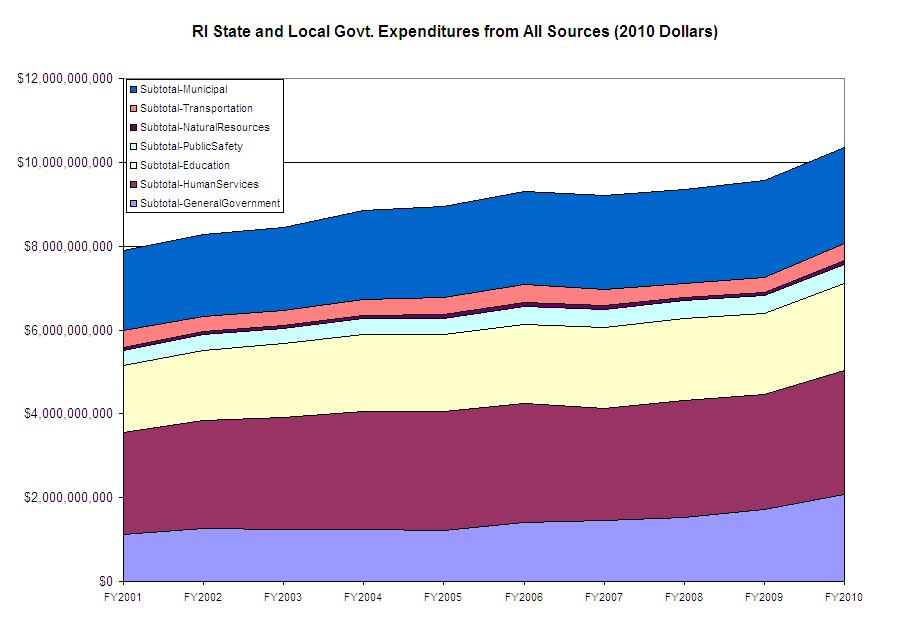
Here was the description of the spending pattern, written at the time: "This pattern is one of government growth on autopilot for most of the decade, whether the national economic climate was good or bad, whether state revenues were increasing or decreasing.
This idea of government expansion that is automatic and inevitable -- with everything outside of government expected to adjust accordingly, of course -- is an important focus of the dissatisfaction being expressed with regards to the direction that our state and nation are headed, as more and more people come to realize that steady increases in the real amount spent by government cannot continue indefinitely".
Does the Chafee administration believe that this trend has to continue forever, in order for government to be effective, or that reducing total spending to the level of say 5 years ago is an impossibility?
For the record, I have twice sent Lincoln Chafee, once as a candidate and once as governor-elect, a set of questions that included the issue of the steady growth in the Rhode Island budget. The question was...
The combined state and municipal budgets for Rhode Island have grown steadily (adjusted for inflation) over the past 10 years, a period of time which includes September 11, 2001 and its immediate aftermath, the end-of-the-financial world as we knew it in 2008, and the relative lull (at least domestically) in between.The answer at that time was...Is it by design or by accident that government has been growing as if on autopilot -- or would you disagree with that characterization entirely? Compared with 10 years ago, are Rhode Islanders getting more in return for their increased spending?
We do not agree with the premise of these questions.
Thinning the Fuel Won't Create Efficiency
My Patch column, this week, defines the target population of Rhode Island's recent and proposed tax changes and offers a brief economics lesson to suggest that the apparent strategy is perhaps not the best:
The consequence, overall, is that Rhode Islanders who've invested in property have seen local taxes climb inexorably. Last year, the real cost of those investments increased courtesy of the income tax change. Meanwhile, the tax bite resulting from their efforts to improve their financial positions broadened, and now they'll be rewarded for modest spending habits with a new sales tax targeting essentials. The harm is exacerbated if they've had the audacity to reproduce, thus creating larger families requiring more of life's basics.In short, with Rhode Island's economic recovery barely detectable, and scarcely felt, the state is turning the screws on home-buying parents who are striving to build their futures. The tendency may satisfy special interests, by protecting government handouts and special deals, and it may comfort politicians, inasmuch as busy families are less able to be politically active, but it is economic suicide.
March 18, 2011
One Bad Tax Plan Shouldn't be Replaced by Another
The ProJo reports that there is a bill in the RI House proposing an alternative to Governor Chafee's 6%/1% "lower and broaden" tax policy. Let's call it "promise to lower and broaden":
The bill, cosponsored by Representatives Brian Newberry, R-North Smithfield, Samuel Azzinaro, D-Westerly, Scott Slater, D-Providence, and Peter Palumbo, D-Cranston, would also add the equivalent of a dorm tax on the rental charges for student and teacher housing at the state’s educational institutions.She's entirely correct. According to the revised text offered in H5740 (PDF):The way the bill is drafted, many of these exemptions would go away as soon as the bill passed, but the sales-tax rate would remain at 7 percent until July 1, 2012, Monica S. Staaf, legal counsel for the Rhode Island Association of Realtors, told the House committee.
provided, further, that for the period commencing July 1, 2012, the tax is six percent (6%); and provided, further, that for the period commencing July 1, 2013, the tax rate is five percent (5%); and provided, further, that for the period commencing July 1, 2014, the tax rate is four percent (4%); and provided, further, that for the period commencing July 1, 2015, the tax rate is three percent (3%).Let's say, come May 2012, it's realized that the tax revenue just isn't coming in and before you know it, the reduction plan is "frozen" until such time as it is decided that the state can "afford" to implement it. Could never happen, right? The basic rule being that promised tax cuts are ephemeral while temporary tax hikes are permanent. Regardless, both ideas result in more taxation, not less, thanks to the "broadening." These aren't so-called revenue neutral plans, after all. They're meant to raise"revenue" instead of shrink government spending.
March 17, 2011
The Governor's Faith That You Don't Matter
Here's an interesting tidbit from Ed Achorn:
I asked Governor Chafee last week whether he, or anyone in his administration, had done an analysis of the number of jobs that his tax hikes would cost the state, since many financially stressed Rhode Islanders would respond by traveling the short distance to neighboring states for goods and services.After three rounds of spin by Mr. Chafee and his aides, I finally got the governor's answer on the fourth try:
"No."
The loss of such private-sector jobs seem to be of little concern.
To take the charitable view, it might just be that Chafee and his administration lack the competence to ask and answer such difficult questions. It's much easier to simply calculate a tax as if it will have no effect on the behavior being taxed. One would think, though, that some effort might have been made to figure out what incentives would be created by the new taxes and what ripples would therefore be likely.
Be that as it may, government budgeting isn't ultimately a matter of predicting revenue and planning expenses on its basis. Rather, it's ultimately a matter of making the books appear balanced to conform with the law and adjusting later when financial reality gives the politicians excuses to act. In the case of the current governor, it seems likely that, when revenue doesn't increase as much as he expects and when his meager and vague cuts and efficiencies don't produce the predicted savings, he'll seek to increase taxation yet again. More of that shared sacrifice... meaning that taxpayers share the sacrifice among themselves to support government.
Fifth Highest State & Local Tax Burden: The Sacrifice isn't Really Shared If One Party Is Already Disproportionately "Sharing"
With difficulty, I'm going to disregard the spectacle of the governor attempting to sell his proposed $176 million sales tax hike as a remake of Rhode Island into a "tax haven" and just focus on one critical data point.
Governor Chafee has balanced his proposed budget with, on the one hand, suggested "cuts" that seem quite ethereal at this point and, on the other, a grimly real revenue stream that would represent "one of the biggest tax increases in state history".
He describes this budget as "shared sacrifice". This characterization contains a fatal premise: that the pre-existing budget burden or level of sacrifice is equal. Nothing could be further from the truth.
Rhode Island has the fifth highest state and local tax burden. Any addition - even one item, never mind the nightmare list proposed by the governor - to the state sales tax rolls would only exacerbate the already high level of sacrifice on one side.
Sacrifice Starting from Unequal Footing
Monique and Matt talked taxes and sacrifice on last night's Matt Allen Show. Stream by clicking here, or download it.
March 16, 2011
Drug Dealer... Not a Stretch for Rhode Island
I've admitted before that I'm more or less ambivalent about the legality of marijuana, but as usual, Rhode Island's method of operations layers in an unseemly and suspicious twist to the process:
All told, that's $3.5 million in new tax revenue over two years. The Health Department is expected to announce on Tuesday the names of operators for up to three dispensaries. They will be chosen from a list of 18 applications. ...The future of the state's caregiver system is unclear. Last month, two bills were introduced in the General Assembly that would require all medicinal marijuana to be grown and sold through dispensaries — a move that would for all intents and purposes end the caregiver program.
To put some totals on this sequence of legislation, the governor is expecting medical marijuana to be a $60 million business in Rhode Island, and the General Assembly may make the law of the land such that all the money filters through three entities hand-picked by the state. That's an instant $20 million business facilitated by the Department of Health. Looks like another instance of corruption by design, in Rhode Island.
If Rhode Island is to shift this slice of the illegal drug industry into the legal category, it should follow either the pharmacy model (if the pretense of medical benefit is to be maintained) or the liquor store model. Making the State House a den of pot kingpins is not the way to go.
(The applications submitted by the three newly selected dispensaries are linked here. There are no names as blatantly indicative of inside dealings as, say, Bill Lynch's, but that's hardly a mitigating factor when the potential for corruption is baked into the legal regime.)
March 15, 2011
The Tax List
Perusing the list of items that Governor Chafee wishes to move from tax-exempt to taxable, I came across this peculiar item, sure to help grow the economy:
Employment agency services
Sure, employment agencies are arguably unnecessary middlemen in employment chain, but they're a halfway step for businesses looking to ease into hiring. And they're now going to have to add 6% to the cost of the transaction or just absorb it.
I also like this item, on the 1% list:
Transfers or sales made to immediate family members
Don't forget to file the appropriate form Ma and Pa! Uncle Linc is watching.
March 14, 2011
The Biggest Tax Increase... and on Whom?
Here's a point worth restating throughout the current session of the General Assembly (emphasis added):
By broadening the general sales tax and levying a new 1 percent tax, Chafee's budget would raise about $165 million in new tax revenue — even after taking into account the drop in the general sales tax rate. That would be one of the biggest tax increases in state history — if not the biggest, according to Gary S. Sasse, former state revenue director and now distinguished professor of public policy at Rhode Island College.
Whether Governor Chafee's manages to improve the state's ranking when it comes to taxation schemes, his solution to balancing the state's budget is to raise taxes on a population that's already heavily taxed. And it's not a neutral increase; there's a shift in burden involved. Consider (emphasis added):
Rep. Thomas Winfield, D-Smithfield, said that when he stopped for coffee at Fast Freddie's, in Greenville, a crowd of angry people objected to applying sales taxes to such a long list of items. When asked how he'd respond to the Fast Freddie's crowd, [Chafee Director of Administration Richard] Licht said that lowering the sales tax rate from 7 percent to 6 percent would save people money on big-ticket items, so they'd "pay a little more for their haircut but they'll save on their car."
Frankly, my family can no longer afford "big-ticket items." Chafee's revenue increase, in other words, leverages my basics to subsidize somebody else's luxuries. Would it be too cynical to discern the policy's hidden objective as making sure that Rhode Islanders have nowhere to hide from the taxman, even during times of economic hardship?
Yea or nay, the effect is once again that Rhode Island would turn the screw even more tightly on those who are struggling to get by and striving to advance.
March 11, 2011
New Taxables
Ted Nesi has put up a list of newly-taxed items being proposed by Governor Chafee. I've copied it after the jump. As a commenter to Ted noted:
...the fact Rhode Island has so many sales tax exemptions is interesting in and of itself. The state has a total of 82 exemptions, 20 of which have been added over just the past 19 years, according to the Chafee administration.Special deals? Naw. Continue reading "New Taxables"
March 8, 2011
Open Thread: Combined Reporting, Good Idea or Not?
Rhode Island Governor Lincoln Chafee has proposed "combined reporting" in his FY2012 budget proposal as a means of raising revenue for Rhode Island. Given this is the most technical of the Governor's major proposed "revenue enhancers", the floor is open for any insights into the details of how and why "combined reporting" is supposed to work.
February 22, 2011
Expanding the Sales Tax: Possibilities
Neil Downing reports that Governor Chafee's proposed new 1% tax on various items would violate a multi-state agreement and could result in the loss of $1.8 million in revenue. However, since the new tax would generate $89 million (or $121 million, depends on who you ask), it's no surprise that the Governor is still going full speed ahead with the idea. Right now, according to this Taxadmin.org (PDF), Illinois is the only state with such a sales tax structure (Illinois has a sales tax of 6.25% and taxes food, prescription and non-prescription drugs at 1%).
Listening to WHJJ's Helen Glover this morning, I heard her speculate that perhaps this would open the door for the "flatten and expand" idea as a compromise (ie; drop the sales tax to 5% and apply it to everything). So, is Rhode Island going to follow the "Illinois model" (which Governor Chafee's plan seems most like)? Or will we end up with the flatten and expand approach> What do other states do ?
Well, we know there's no chance that Rhode Island will join the 5 States (Alaska, Delaware, Montana, New Hampshire and Oregon) that have NO state sales tax. Right now Rhode Island is one of ten states and Washington, D.C. that have a sales tax that excludes food and both prescription and non-prescription drugs. Setting the amount of the rate aside, this is actually a positive.
| Sales Tax | |
|---|---|
| Connecticut | 6 |
| *Florida | 6 |
| Maryland | 6 |
| Minnesota | 6.875 |
| New Jersey | 7 |
| New York | 4 |
| Pennsylvania | 6 |
| Rhode Island | 7 |
| *Texas | 6.25 |
| Vermont | 6 |
| Wash. D.C. | 6 |
*No state income tax
It's worth noting that, even though Rhode Island is currently amongst a "good" group, its higher rate as compared to the rates of all other states is what gives RI such bad publicity when it comes to snapshot analysis that doesn't focus on exemptions, just the overall "big" number.
To continue, several states don't tax food but tax non-prescription drugs at the regular sales tax rate:
| Sales tax | |
|---|---|
| Arizona | 5.6 |
| California | 8.25* |
| Colorado | 2.9 |
| Indiana | 7 |
| Iowa | 6 |
| Maine | 5 |
| Massachusetts | 6.25 |
| Michigan | 6 |
| Nebraska | 5.5 |
| **Nevada | 6.85 |
| New Mexico | 5 |
| North Dakota | 5 |
| Ohio | 5.5 |
| South Carolina | 6 |
| **Washington | 6.5 |
| Wisconsin | 5 |
| **Wyoming | 4 |
*Tax can be adjusted annually depending on various budgetary calculations.
**No state income tax
The following states tax non-prescription drugs at the regular rate and tax food, though at a different rate:
| Sales tax | Food tax | |
|---|---|---|
| Arkansas | 6 | 2 |
| Georgia | 4 | * |
| Louisiana | 4 | * |
| Missouri | 4.225 | 1.225 |
| NC | 5.75 | * |
| **Tennessee | 7 | 5.5 |
| Utah | 4.7 | 1.75* |
| Virginia | 5 | 2.5~ |
| West Va. | 6 | 3 |
*local taxes on food
~includes statewide 1% local tax
**No state income tax
Finally, the following states tax everything (except prescription drugs) at the same rate. These might be the models for a potential flatten and expand by Rhode Island:
| Sales Tax | |
|---|---|
| Alabama | 4 |
| *Hawaii | 4 |
| *Idaho | 6 |
| *Kansas | 5.3 |
| Kentucky | 6 |
| Mississippi | 7 |
| *Oklahoma | 4.5 |
| *~South Dakota | 4 |
*State has rebates or tax credits to compensate poor households.
~No state income tax
As was noted, Illinois is the only state that taxes prescription drugs at 1% along with food and non-prescription drugs. This is the model that Governor Chafee's proposal most seems to mimic. However, my guess is that the states in the last table offer a model that would be very attractive to many in the General Assembly and to the various advocates who walk the halls.
February 17, 2011
Making Sure the Minimum Business Tax Change You Want is the One You Get
Legislators and concerned citizens, be aware: taxophilic previous generations of Rhode Island lawmakers have written the minimum tax imposed on businesses into two separate places in the law. State law contains separate provisions for a "franchise tax" and a "minimum corporate income tax" and for many if not most Rhode Island corporations, both sections would need be modified in order for them to see a change in their minimum tax liability.
Section 44-11-2(e) of RI law specifies the minimum corporate income tax...
The tax imposed upon any corporation under this section shall not be less than five hundred dollars ($500).However, most of section 44-11 does not apply to certain corporations in Rhode Island, as spelled out in section 44-11-2(d)...
A small business corporation having an election in effect under subchapter S, 26 U.S.C. section 1361 et seq., shall not be subject to the Rhode Island income tax on corporations, except that the corporation shall be subject to the provisions of subsection (a), to the extent of the income that is subjected to federal tax under subchapter S.Which means, I believe, that S-corporations are exempt from corporate income taxes, including the minimum, while C-corporations and limited-liability corporations (LLCs) have to pay them. (At least, that is what state tax-forms seem to indicate, where S-corps are referred to in a different section from the C-corps and the LLCs).
The franchise tax is defined in the next chapter of the law, in section 44-12-1(a), with no blanket exception for S-corps...
Every corporation, joint-stock company, or association incorporated in this state or qualified to do business in this state, whether or not doing business for profit, all referred to in this section under the term "corporation", except those enumerated in section 44-12-11, shall pay an annual franchise tax to the state upon its authorized capital stock of two dollars fifty cents ($2.50) for each ten thousand dollars ($10,000) of such stock or fractional part, or the sum of five hundred dollars ($500), whichever is greater, thereof.Corporations however are prevented by section 44-12-1(b) from paying a double minimum tax...
In the case of corporations liable to a tax under chapter 11 of this title, only the amount by which the franchise tax exceeds the tax payable under that chapter shall be assessed.In other words, in cases of C-corps and LLCs that have an income tax liability greater than or equal to their calculated franchise tax liability, their income tax counts as their franchise tax too.
Both sections of corporate tax law must be considered when determining how a proposed change to minimum taxes will impact liabilities, even when a proposed change is only being applied to one tax or the other. And, as currently written, several of the minimum business tax bills that have been introduced to the legislature, if adopted in isolation, appear not to change the tax liabilities of Rhode Island businesses at all.
Representatives Stephen Ucci (D-Johnston/Cranston), Peter Petrarca (D-Johnston/Lincoln/Smithfield), Joy Hearn (D-Barrington/East Providence), Robert Phillips (D-Woonsocket), and Peter Martin (D-Newport) have introduced a bill (H5153) that reduces the minimum corporate income tax specified in 44-11-2(e) to $50. If no other change to the law is made in conjunction with H5153, the tax-liability of corporations covered by the franchise tax (i.e., most RI corporations) will remain unchanged. The franchise tax will still exist, meaning that a corporation would continue to owe the same $500 under the new law that it owed under the old law, now in the form of a $50 corporate minimum income tax, plus the $450 difference between the franchise tax and the income tax. (And an S-Corp that didn't owe the income tax would still owe the $500, all as franchise tax).
Representatives Gregory Schadone (D-North Providence), Jan Malik (D-Warren/Barrington), and Arthur Corvese (D-North Providence) have introduced a bill (H5167) with an identical structure to H5153, differing only in that it changes the minimum income tax to $250. Again, this bill by itself would not reduce the tax-liabilities of corporations that owe the minimum franchise tax.
A bill (H5060) introduced by Representatives Donna Walsh (D-Charlestown/New Shoreham/South Kingstown/Westerly), Patricia Serpa (D-West Warwick/Warwick/Coventry), Frank Ferri (D-Warwick), Larry Valencia (D-Exeter/Charlestown/Richmond), and Deborah Ruggiero (D-Jamestown/Middletown) modifies the minimum corporate income tax by introducing a graduated scale. At the low end, corporations to which it applies (i.e. C-Corps and LLCs) that in a given year record less than $250,000 in gross receipts would have no income tax liability -- but again, if no additional change to the law is made, the amount of taxes owed would not change because the C-corps and the LLCs would still owe the state the difference between $500 franchise tax and the $0 corporate minimum income tax.
Representatives Doreen Costa (R-North Kingstown/Exeter), Larry Ehrhardt (R-North Kingstown), Mike Chippendale (R-Foster/Coventry/Glocester), and Dan Gordon (R-Portsmouth/Tiverton/Little Compton) have been working the problem from the other end, introducing a bill (H5100) that would repeal the franchise tax in its entirety . This is a little better than the previous measures, as the S-Corps exempted from 44-11 would no longer have to pay a minimum tax or a franchise tax. However C-corps and LLCs would still have to pay the $500 minimum income tax specified in 44-11-1 even in the absence of the franchise tax. (Also, there could also be impacts from this law as you move up the scale away from the minimum, depending on whether a particular company currently has a greater liability computed from the franchise tax or the income tax).
Finally, State Senators Nick Kettle (R-Coventry/Foster/Scituate), Christopher Ottiano (R-Bristol/Portsmouth), David Bates (R-Barrington/Bristol), Dawson Hodgson (R-East Greenwich/Warwick/North Kingstown), and Glen Shibley (R-Coventry/Warwick/West Warwick/East Greenwich) have introduced a Senate bill which repeals both the minimum franchise tax and the minimum corporate income tax (S0103). This piece of legislation, where both the franchise tax and the corporate minimum income tax are changed at the same time, is the model that should be used in order to really effect a change in the current system.
February 16, 2011
Health Care "Reform" = IRS Expansion
U.S. News tells us that the IRS is ramping up because of the new health care reform plan (we're all so surprised!):
The Internal Revenue Service says it will need an battalion of 1,054 new auditors and staffers and new facilities at a cost to taxpayers of more than $359 million in fiscal 2012 just to watch over the initial implementation of President Obama's healthcare reforms.'Ware the Tanning Taxers!!!
Among the new corps will be 81 workers assigned to make sure tanning salons pay a new 10 percent excise tax. Their cost: $11.5 million....[They] will be tasked just to handle the tax reporting of 25,000 tanning salons. They face a new 10 percent excise tax on indoor tanning services. Another 76 will be assigned to make sure businesses engaged in making and import[ing] drugs pay their new fee which is expected to deliver $2.8 billion to the Treasury in 2012 and 2013. The new healthcare corps will also require new facilities and computers.Phew, glad this is making things all so much easier. Just kidding (obviously)....But don't forget, according to the ProJo, this complication is all because of conservatives playing with the tax code.

Terry Gorman: The Burning Truth About the Cost of Illegal Immigration
I feel compelled to clarify some of the misstatements made by reporter Gene Emery in a PolitiFact hit piece which gave me a rating of "Pants On Fire".
First off, when I first spoke with Mr. Emery, he stated that he became interested in the cost of illegal immigration after seeing a RIILE sign at our new Governor's inauguration that announced that illegal aliens cost RI taxpayers $400 million per year. If that were the case, then why did he begin his article with the statement that Mr. Gorman stated that fact on the Helen Glover Show of January 6, 2011? Why bring someone else into the story if the story is meant to criticize me? Is there an agenda? He then went on to state that reliable data on this subject is difficult to find. His facts seem to bear this out.
Next, he disputes 8,740 as the number of illegal alien children and the US born children of illegal aliens in RI in 2004. I provided him the source for my information to no avail. The same source estimates that number to be 10,770 in 2010. It appears that Mr. Emery conveniently uses the numbers that seem to make his assertions work. The cost estimates for education were completely misrepresented by this reporter. In our conversations and emails, I emphatically stated that I believed the costs associated with my estimates were to educate illegal alien children AND the US born children of illegal aliens - the latter number he seems to have left out. I also stated in our telephone interviews and e-mails that I applied the RIDE statistic of 20.1% of the total student population enrolled in Special Education in RI to my 8,740 estimate to arrive at my total education cost. These figures are easily accessible on the RI Department of Elementary and Secondary Education website, RIDE, under the heading In$ite. The reporter references data from the Pew Hispanic Center reports that seem to verify his numbers but he neglects to avail himself of ALL the data, some of which would substantiate my numbers. Another agenda in the making?
The RIDE study I mentioned estimates the cost to educate English Language Learners, ELL students, in Providence alone to be in excess of $25 million. Jessica Vaughn, Director of Policy Studies at the well respected, non-partisan group Center for Immigration Studies submitted a Letter to the Editor on February 7, 2011 rebutting Mr. Emery's assertions. But it was only posted on projo.com and not printed in the Providence Journal. Why? In that letter, Ms. Vaughn gave the reporter her own rating of "Pants on Fire ".
Mr. Emery also mistakenly asserts that, in my estimates, I use Medicaid figures. Medicaid was never mentioned in any of our conversations or emails. I referenced solely RIte Care figures. Although now he has informed all of us that we currently have 350 illegal alien pregnant women receiving social services in our state, he claims that cost to be only $600,000 dollars. Does it not cost on average $10,000 per delivery at hospitals in RI? He also asserts that the state of RI does not keep track of these babies once they are born. These babies are automatically US citizens by virtue of their birth on US soil. They are also entitled to welfare, food stamps, housing and medical care. Does he expect us to believe that our state does not keep track of these costs?
He also asserts that one of my sources for costs was an Interpeter at a local hospitaI. I specifically stated to him that the interpeter informed me that she was required by her hospital administration to record, on a daily basis, any services provided to patients who did not have a Social Security, Green card number, passport etc. According to Mr. Emery, hospitals in RI do not keep track of the uncompensated care costs for services rendered to illegal aliens. If that is the case, how do they justify their requests for reimbursement from the state for those costs each year?
Here is another questionable statement. A spokesman for the Hospital Association of Rhode Island claims that hospitals in RI do not require patients to provide their Social Security numbers or their Green Card number if they have them. If that is the case, how do hospitals pursue them if they default on their payments?
All in all, I find Mr. Emery's PolitiFact assertions to be classified as "Pants on Fire ". Maybe this post will force the State of Rhode Island to finally reveal the enormous cost of illegal immigration to the taxpayers. When they do, I'm sure I know whose "Pants On Fire" will be extinguished. MINE.
Terry Gorman is the Executive Director of Rhode Islanders for Immigration Law Enforcement.
February 15, 2011
In-State Tuition is Not Free!
Sen. Pichardo and Rep. Diaz have proposed to extend in-state college tuition rates to illegal immigrants.
Let's be clear. Regardless of cost, offering in-state tuition rates to illegal aliens is a complete non-starter on principle. It would become yet another enticement for individuals to come here illegally - in the process, endangering themselves and breaching our sovereignty. We need to reduce, not amplify, such factors.
Hoever, it is instructive as to the legislative mindset to take a look at the more prosaic matter of cost. The in-state tuition rate does not cover the expense of that student's education at the college or university. The balance must be picked up by others - others like out-of-state students, state tax payers and/or the institution's privately funded endowment.
Unfortunately, the honorable solons who have submitted this bill seem not to be aware of this tuition differential and the considerable fiscal burden that it confers. Rep Diaz's lack of awareness on this point appears especially acute.
“All children should be included in the Race to the Top,” Diaz said. “At a time of state cuts, this bill is a boon for CCRI and our state universities.”
Actually, no. Broadening the qualification for in-state tuition is not at all like increasing the number of new customers to a commercial business. On the contrary, far from being a "boon", every additional in-state tuition payer represents an operating shortfall that the institution must attempt to cover from some other source.
Stated more bluntly, every in-state tuition rate honored is a financial drain on that institution. Naturally, the affected colleges and universities would be well within their right to look to us to pick up the losses arising from this proposed law. But the state is facing a deficit in the hundreds of millions so that doesn't seem real feasible.
Accordingly, the question that poses itself about this bill is: how? How could a legislator propose a bill without fully understanding its financial ramifications to all affected parties, including his or her own constituency?
January 28, 2011
"Surplus" Just Means They Haven't Spent It, Yet
Gary Trott tries to apply too much common sense to public-sector budgeting:
What should a Rhode Island city or town do if it suddenly finds itself with a surplus of unspent funds amounting to nearly $6 million? You'd think that it would do the responsible thing and not spend those funds in order to ease up a little bit on the taxpayer.Well, that's not what the School Committee in Warwick did during the final days of December when it voted unanimously to take the $6 million surplus from the previous year and spend it by giving raises to teachers and also by cutting the 20 percent contribution that the teachers were to pay toward their health care benefits (ProJo 7 to 7 News Blog, Dec. 29).
The problem is that this isn't just spending for spending's sake, as Trott takes it. Rather, all of the incentives push government bodies in the direction of spending everything and, in particular, spending as much as possible on raises and benefits for employees.
Obviously, the electoral threat implicit in public-sector unionization is one incentive. So is the likelihood that unspent dollars won't just be considered a windfall to be kept, but will be targeted (rightly, in my view) both for a direct return to taxpayers and for a reduction in subsequent years' budgets. When the money isn't given freely as an economic exchange, but is taken under threat of law as taxation, the emphasis shifts from claiming as much money as a consumer can be convinced that the service is worth to providing cover for the claim that so much, and more, is needed, or even required by law. The process becomes one of budget tricks.
In Tiverton, for example, the school department claims that the town is required to make up for any difference in the amount of state aid that is estimated at the financial town meeting. (Naturally, extra aid is never reduced from the local appropriation.) So, say the local appropriation is $20 million and the FTM estimates that the schools will get $5 million in state/fed aid. If the aid comes in at $4 million, then the schools take another $1 million from the town's property tax pool.
Here's the best part: for the purposes of calculating the state-imposed cap on how much additional money it can request, the school department considers the $21 million to be part of its new baseline. It then begins the performance of declarations about what it will have to cut, close, and eliminate if the town doesn't bust the cap.
The process doesn't begin, in short, with the question of what the payer will bear, but with what the payee can take. The only way to change the incentives and the outcome would be to organize enough voters to place better candidates on the boards, councils, and committees and counterbalance the corrupt symbiosis between elected officials and labor.
January 26, 2011
Drunk on Taxation
Speaking of statism, the Providence Journal editorial page betrayed its inclination in that direction, recently, on the topic of alcohol tax:
Congratulations. By beating each other's alcohol tax down to zero, neither New Hampshire nor Massachusetts is collecting revenues that it could.And where does this new era of tax-free booze to the north leave Rhode Island merchants with their 7 percent liquor sales tax? In a tough competitive place. ...
This region must start thinking of itself more as a confederation and less as a collection of six feudal rivalries. The six New England states should agree to a region-wide liquor tax. They could all end up richer.
"They," obviously, means the state governments, not the people of New England, who could, by the editors' advice be more extensively taxed if they were more effectively trapped by cooperating governments. Lost in the analysis — not even mentioned — is the benefit of this interstate competition to consumers, who are not, especially with alcohol, necessarily of the leisure class.
Yes, yes, we can all agree that alcohol is, in a technical sense, unnecessary, and sometimes, it turns wicked. But one's perspective on taxation and the relationship between the state and the people is much more broadly applicable.
Watching the exchange of dollars for alcohol and lottery tickets while in line at the liquor store, one is tempted to wonder what percentage of the taxes and gambling profit the government siphons off before handing the money back in the form of inefficient services. No doubt, the editors would defend their position suggesting that sin taxes force residents to support important government activities (such as infrastructure and education) that they'd otherwise let slip, if left to their own choices. That only returns to the statist point: it comes down to one group of citizens taking from another to support their own priorities, which they assume to be more important and which, in many cases, winds up benefiting them financially.
January 19, 2011
Up and Out, or Just Out?
Yesterday, I presented two facts:
- Every year, from 2003 to 2008, thousands of people who had filed tax returns from Rhode Island filed them from somewhere else. Subtracting those who moved in the opposite direction, during that five-year span, the state lost 17,221 taxpayers.
- Because those leaving have typically had higher average incomes, the state has lost hundreds of millions of dollars, on a net basis, in taxable incomes — $915,863,000 to be exact, from 2003 to 2008.
Nonetheless, on Monday, I showed that, for most of that time span, wealthier taxpayers increased at a healthy rate. So who is leaving the state? The following charts show trends by income bracket, using IRS and American Community Survey data.

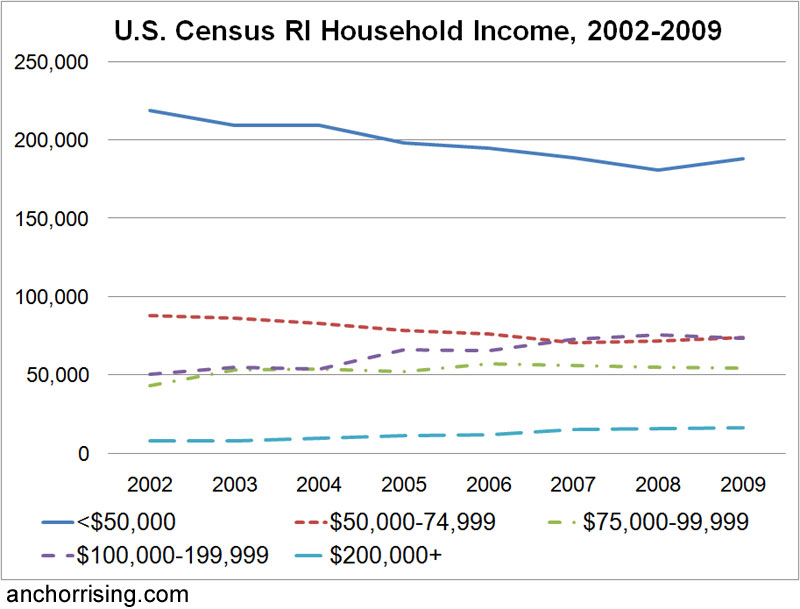
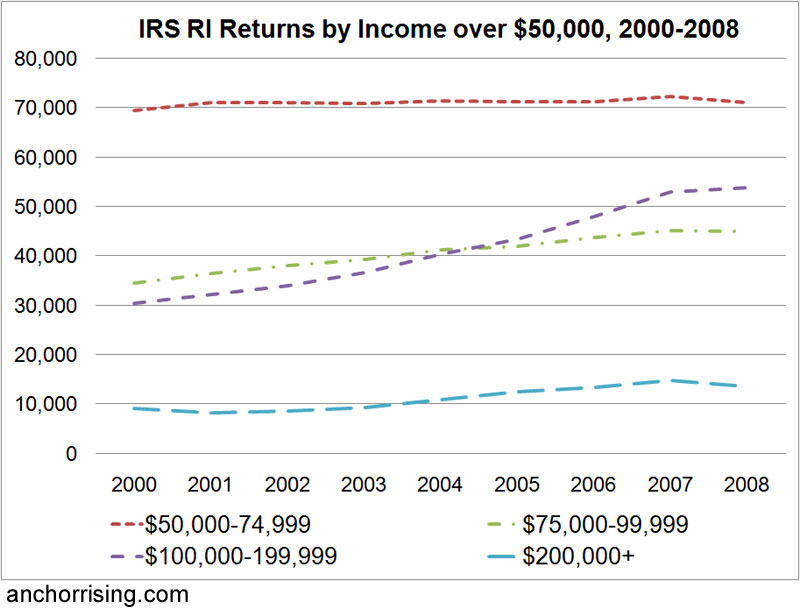

Sticking to the years for which I have data from both sources, the number of households earning below $50,000 decreased by 38,335 from 2002 to 2008, while the number of tax returns decreased by 19,353. For the range of $50,000-74,999, the corresponding numbers were 15,740 and 6. Noting that my migration data is shy a year, with 17,221 tax returns directly attributable to out migration from 2003 to 2008, it 's tempting to suggest a direct flow of this group out of the state.
However, those losses correspond with a 44,910 increase in households earning above $75,000, accounting for all but 9,165. For tax returns, the numbers are a 31,841 increase above $75,000, for an overall increase of 12,482. Considering that those leaving the state have had a higher income than those arriving, it can't be the case that Rhode Island is importing wealthier residents.
And anybody who's been living in Rhode Island will find a dramatic shift toward wealth to be a surprise. Indeed, Phoenix Marketing data of millionaire households shows the increase in millionaires to be relatively small. My suspicion is that, given the housing boom, the shift has more to do with the sale of houses — with people in the upper-working to lower-middle class range selling their homes, often leaving thereafter. The phasing out of the capital gains tax would have created incentive both to sell (because able to keep more of the profit) and to buy (because property in Rhode Island would be taxed at a lower rate, perhaps 0%, when sold).
Call it an "up and out" trend. Each year, until the end of the decade, the number of one-year-only "rich" people amounted to more than those who returned to prior income levels or left the state.
One puzzle in the numbers arises from the difference between Census household data and IRS return data. Why did the number of households between $50,000 and $74,999 (what I'm calling "lower middle class") decrease while the number of tax returns remained pretty much the same? One possibility is that people joined their incomes for the household results but filed separate returns. A look at just joint returns suggests that as a factor:
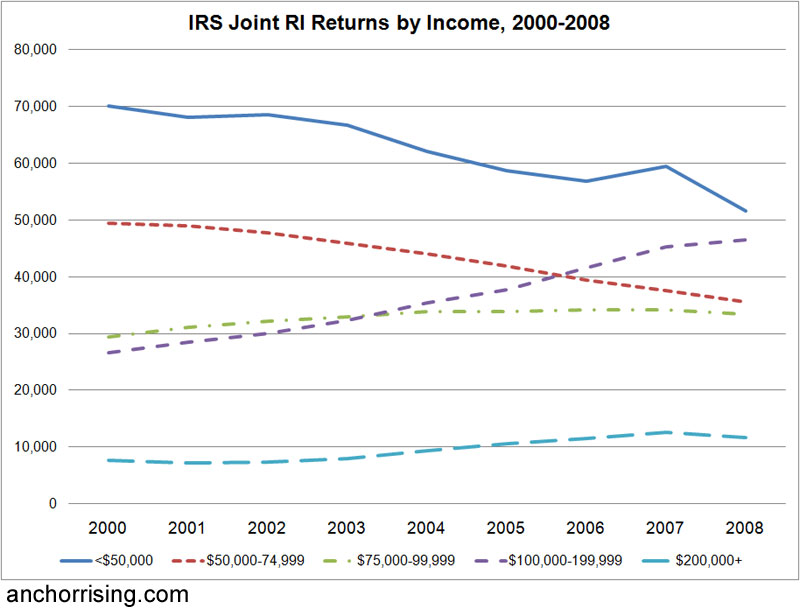
Turning to the Census data, households earning between $100,000 and $199,999, for example, increased by 25,274 (2002-2008), with 16,426 of those directly attributable to an increase in joint returns. That leaves 8,848 households, which would account for 17,696 tax returns if they all paired up.
Unfortunately, I've run out of time, this morning, so I'll have to draw the threads together later.
(The next post in this series is here.)
January 18, 2011
Giving Away the Store, or Maintaining a Base?
Yesterday, I showed that the number of high-income tax returns increased every year in Rhode Island from 2002 to 2007. In fact, the rate of growth among taxpayers in every income category above $50,000 was greater in Rhode Island than in its neighboring states through 2004, when things began to change.
During the decade, Governor Carcieri and the General Assembly enacted various tax reforms, agreeing to phase out the capital gains tax in 2002 and beginning a stepped reduction of an alternative flat tax in 2006. Of course, during this same period, especially the latter part of the decade, the state government faced massive budget deficits year after year and used one budget gimmick and one-time fix after another to muddle through.
The question arises, therefore, whether the tax reforms needlessly gave away money that the state could have used (although it never came close to equaling the deficits) or the tax reforms were a positive influence despite larger problems. I'm not sure that it's possible to collect enough data to declare the question answered, but today, I'll add some charts to the mix that I believe continue to point in the direction of my thesis: that tax policy helped Rhode Island to maintain and increase its base of wealth, which could have been a spark of capital for entrepreneurs and other producers, but heavy regulations, mandates, and taxes stifled growth and motivation among "the productive class," which therefore didn't act as kindling to get Rhode Island's economic fire going.
The following charts, drawn from this data, show the amount of state income taxes claimed on IRS tax returns for those filing in Rhode Island, Massachusetts, and Connecticut, respectively:
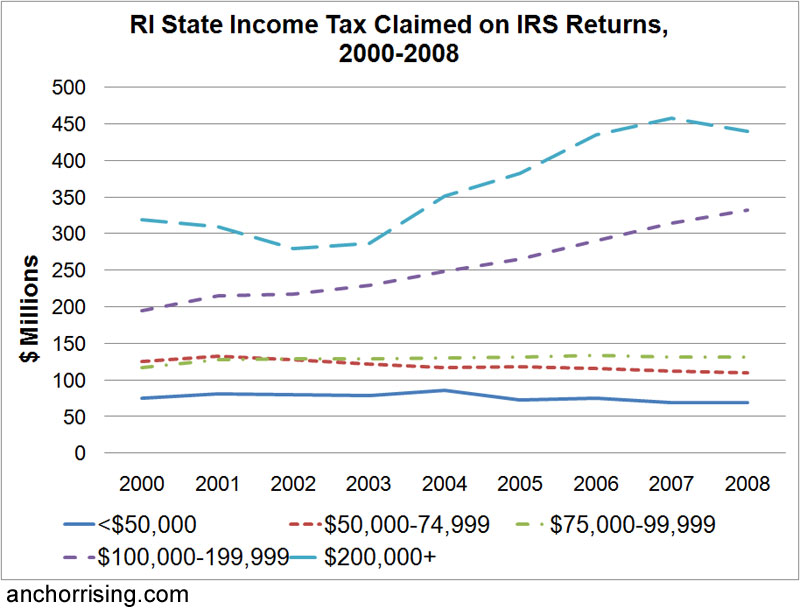
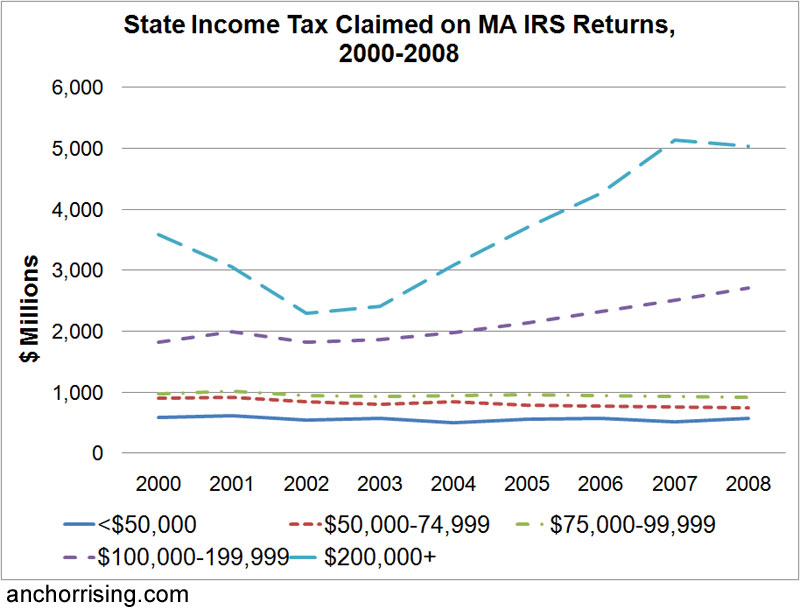
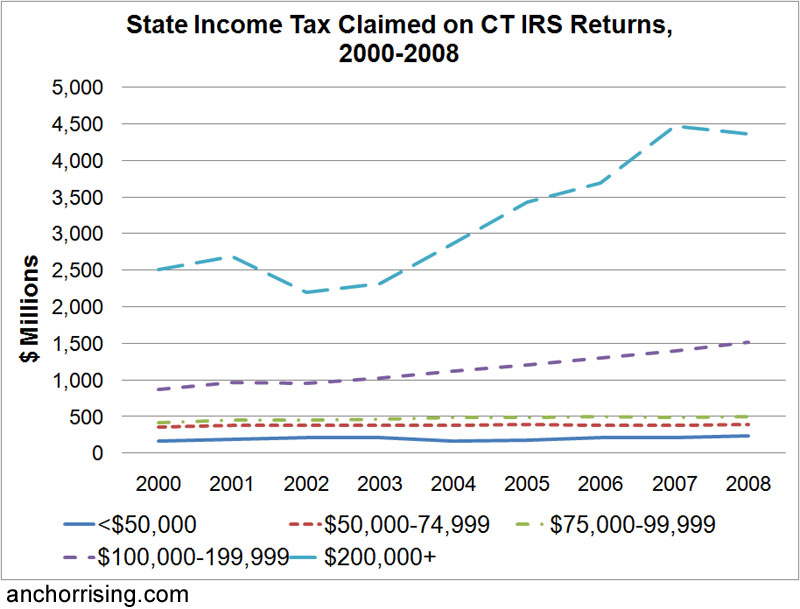
Once again, it appears that the dot-com bust that began the millenium did not affect Rhode Island as deeply as it did Massachusetts. From that footing, with the implementation of the capital gains tax phaseout and a reduction of the state's nation-leading top tax bracket on the horizon, Rhode Island led the three states in the rate at which it increased the revenue drawn from the upper brackets. The numbers throughout the decade are as follows:
| RI | MA | CT | |
|---|---|---|---|
| % increase in $100,000-200,000 taxpayers 2002-2004 | 19.2 | 10.4 | 12.2 |
| % increase in $200,000+ taxpayers 2002-2004 | 27.0 | 19.3 | 17.2 | % increase in $100,000-200,000 state taxes 2002-2004 | 14.0 | 9.1 | 17.9 |
| % increase in $200,000+ state taxes 2002-2004 | 26.0 | 34.5 | 30.9 |
| % increase in $100,000-200,000 taxpayers 2002-2007 | 56.4 | 43.2 | 43.0 |
| % increase in $200,000+ taxpayers 2002-2007 | 73.4 | 73.1 | 60.9 | % increase in $100,000-200,000 state taxes 2002-2007 | 44.1 | 38.2 | 47.0 |
| % increase in $200,000+ state taxes 2002-2007 | 64.2 | 124.4 | 104.0 |
| % increase in $100,000-200,000 taxpayers 2007-2008 | 1.5 | 2.9 | 2.0 |
| % increase in $200,000+ taxpayers 2007-2008 | -8.6 | -5.1 | -4.0 | % increase in $100,000-200,000 state taxes 2007-2008 | 5.8 | 8.0 | 8.6 |
| % increase in $200,000+ state taxes 2007-2008 | -4.0 | -2.1 | -2.4 |
During the early part of the decade, Rhode Island led in the rate of increase of wealthy taxpayers, although that healthy development for the state overall did reduce the rate of growth in revenue that the government drew from them. Tax policy, however, wasn't to blame for Rhode Island's slowed growth during the latter part of the decade. Something else was, and I'd argue that the improving attitude of the government toward taxation prevented Rhode Island from doing worse, comparatively... until that attitude started to change in a vocal way during and after the debate over the flat tax.
The IRS also provides taxpayer migration data, which compares the location from which every American files his or her return to his or her location the year before. The years shown for migration are those in which the returns were filed, which means that the taxpayer moved during or just after the tax year (which is what the years used thus far in these posts have referred to).
Not that it matters; Rhode Island's loss of taxpayers has been consistently between 2,000 and 4,500 for the entire decade:

The bars at the top of the chart show the migration of actual people, and the line at the bottom shows the net loss of taxable adjusted gross income. That is, from 2003 to 2008, after subtracting the incomes of people who came to Rhode Island, former Rhode Islanders took with them almost $1 billion in income. With the exception of the two years that the revenue loss moderated, the average adjusted gross income of those leaving was greater than those arriving:
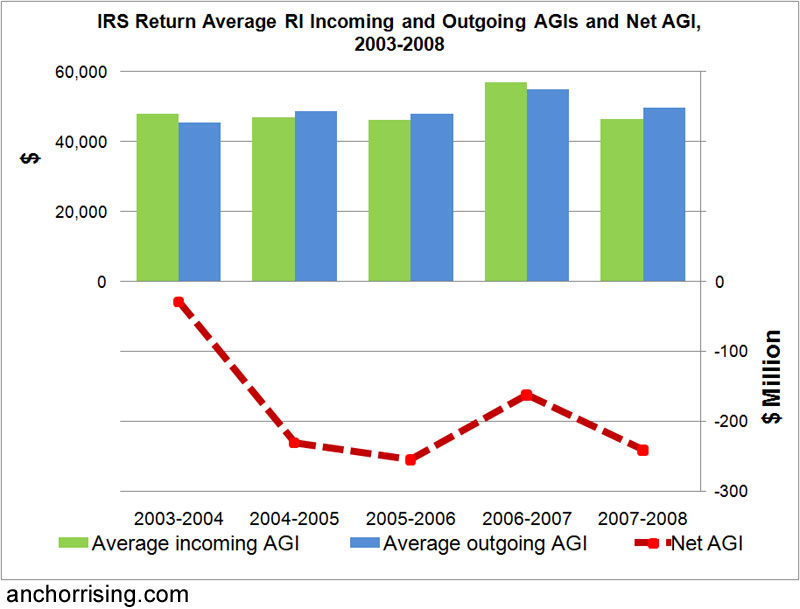
In the past, I've looked at the data of migration to counties abutting Rhode Island on the theory that such people aren't leaving the region but, rather, wanted to stay within work-and-play reach of Rhode Island:
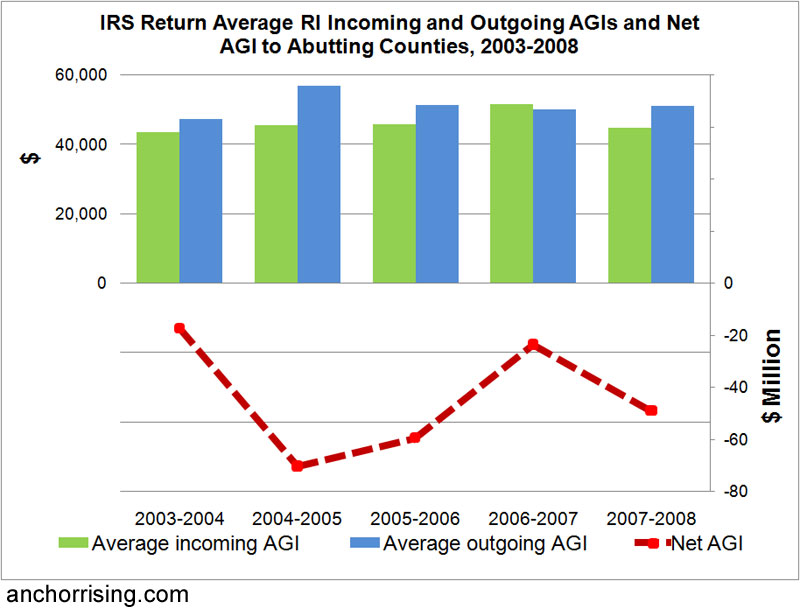
The image that emerges is a pull of wealth away from Rhode Island. The fact that the wealthy were increasing in number, within the state, suggests that they continued to find Rhode Island to offer a friendly environment. Some other income range must account for those thousands of lost taxpayers, and I'll take a closer look in that direction tomorrow.
(The next post in this series is here.)
January 17, 2011
Trends of the Decade
Three critical considerations tend to get lost in debates about population and the ways in which it flows and changes over time. The first is that large trends trump. A tax break isn't going to prevent a global economic hurricane from rearing its head in one state while devastating the next one over; there will surely be differences in how the states weather the storm, but the storm will appear in statistical results for both.
The second is the complexity of the numbers. As the income brackets shift within a state, the reasons for each individual change will span so many categories of information that a thorough picture becomes impossible to paint. Marriage rates, tax policy, welfare policy, different markets, employment, and on and on will affect the results. When multiple states are on the table, the number of policies and trends is that much greater. As far as I know, nobody has undertaken a study to break regional changes down to the percentage effect of every demographic shift, and even then assumptions would have to be made which individuals move to which categories.
The third factor that tends to get lost is that the effects of public policies don't just splash into the society on the day that they are signed into law. The debate leading up to passage of a law will affect people's behavior, as will the perceived likelihood that a particular policy will survive the political winds. Taxpayers (to limit the field) will respond to changes in the law, but they'll also respond to a general sense of a state's direction. Meanwhile, laws can either betoken additional reforms in the same direction, or they can make it to the governor's desk with the impression of having barely little chance of resisting repeal or efforts to undermine them.
In any event, what those with a specific interest in the health of a particular state must do is to assess the condition of the state and determine what effect policies have had, or will have, from the baseline of what would happen in their absence. If the widget industry is in decline, tax breaks for widget manufacturers will preserve their jobs to some extent, even if they cannot prevent the trendline from drifting down.
Such are the thoughts that came to mind upon viewing the following set of charts, which will probably take me multiple days to roll out, and which update previous posts here, here, and here.
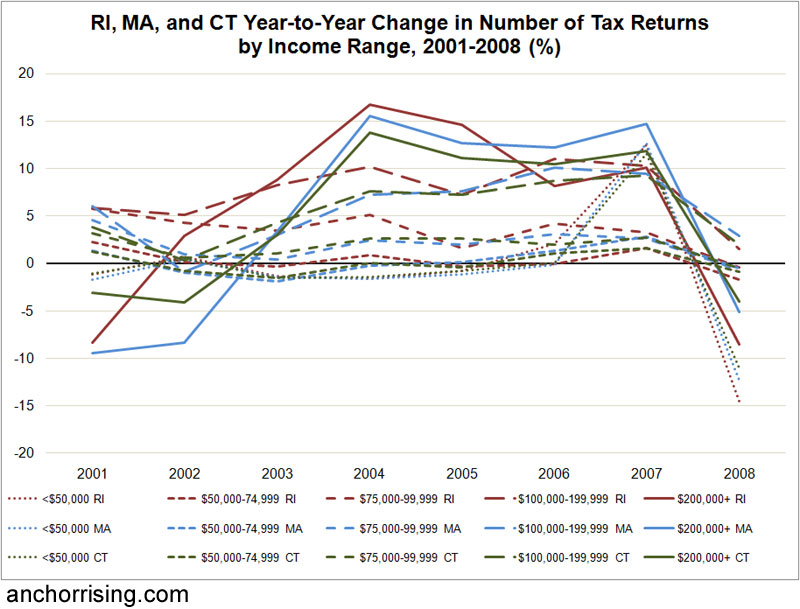
<$50,000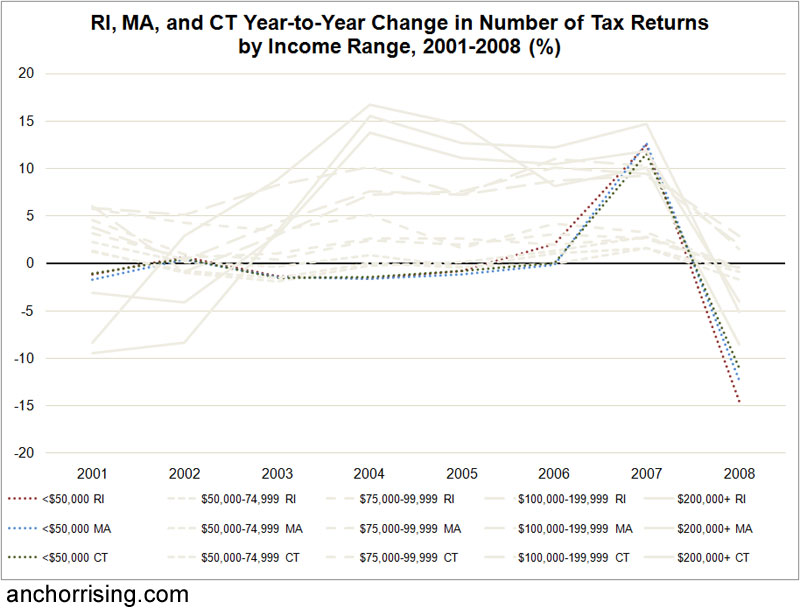 - $50,000-74,000
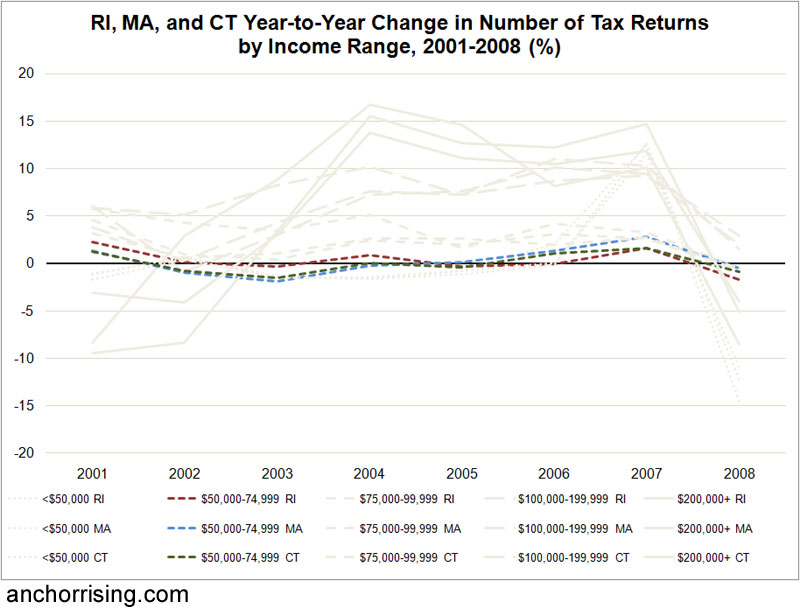 - $75,000-99,999
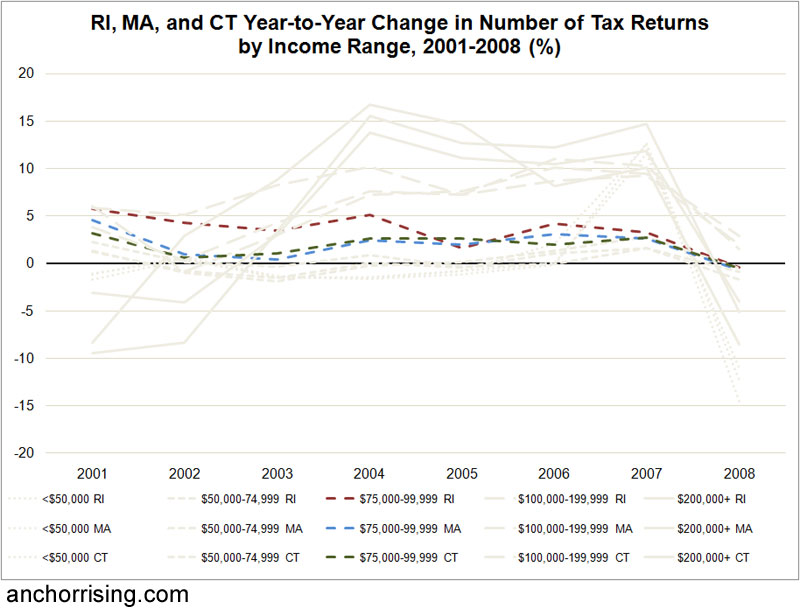 - $100,000-199,999
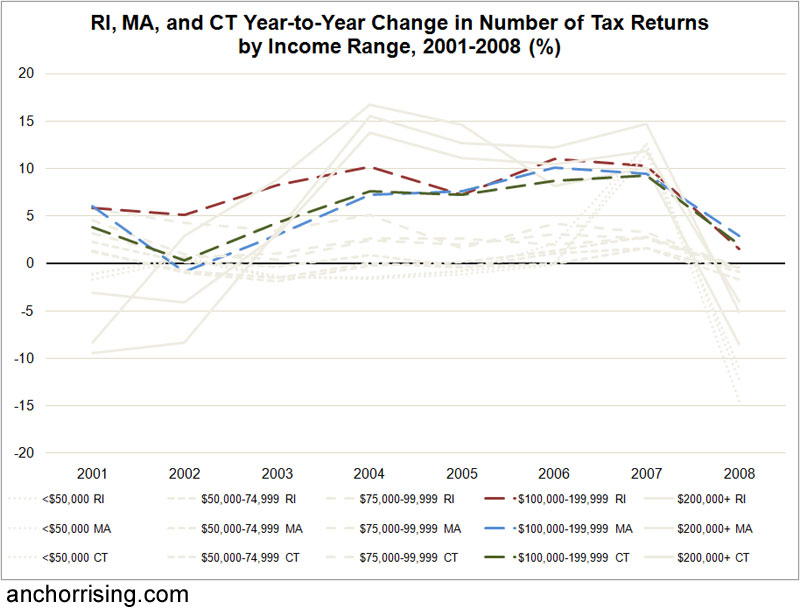 - $200,000+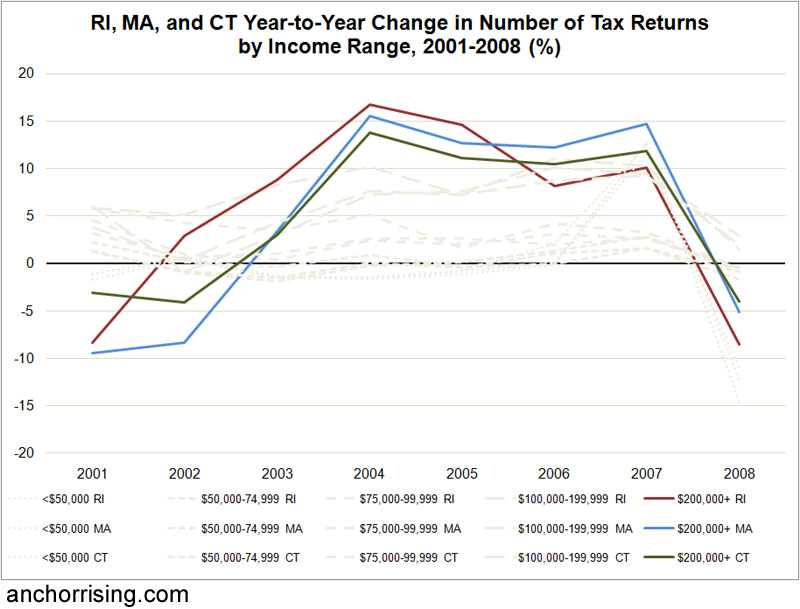
(Click and hold an tax bracket to highlight its corresponding lines.)
Each data point in this chart (based on this data) represents the percentage change in the number of IRS tax returns claiming an income range from the previous year. Thus, in 2004, the number of tax returns showing $200,000 or more in adjusted gross income increased by 16.7% from 2003; from 2004 to 2005, the change was 14.6% — still a large increase, but because the rate of change slowed, the graph shifts down. The red lines show tax returns filed from Rhode Island, blue from Massachusetts, and green from Connecticut. The smaller the dash marks of a line, the lower the income bracket.
Because the highest bracket is the most controversial, because it is most affected by Rhode Island's constantly churning tax policy of the last decade, and because it results in about 40% of all income taxes to the state, the solid lines are of greatest interest. And as is clear, all three states began the decade with losses of such taxpayers (likely because of both migration away from the region and a loss of wealth associated with the dot-com bust). In 2002, the year that Rhode Island began to phase its capital gains tax toward zero percent, we were the first of the three states to show an increase in wealthy households, and we led the three states until 2005.
At that point, our state was in the midst of a series of budget-deficit years to which our elected officials responded with one one-time fix after another. The General Assembly enacted the flat tax phase-out in 2006, but whereas the capital gains change promised to make investments made in and from Rhode Island more valuable (because less taxed) over time, the flat tax phased out gradually and required calculation against the benefits of itemizing and capital gains income. In 2006, the flat tax offered an 8% rate (as opposed to the regular 9.9%) and decreased 0.5% each year.
In any event, as the final years of the decade wore on and brought economic crisis, it became increasingly clear that lawmakers would backtrack on tax reform, and by 2008 Rhode Island led the region in loss of wealthy taxpayers. The capital gains tax phaseout disappeared in 2009, and the flat-tax alternative was frozen by the larger income tax overhaul last year.
An alternative narrative would be that Rhode Island recovered more quickly from the dot-com bust at the beginning of the decade because it had benefited less from the corresponding boom. Then, with so much waterfront property, the state experienced the ups and downs of the real estate bubble more profoundly than its neighboring states.
As this post began by noting, this type of data is subject to interpretation, and given data related to taxpayer migration as well as trends indicated by tax returns and Census data, I'd argue that my long-running explanation still stands: Favorable changes in income tax policy have helped Rhode Island to maintain and grow its base of wealthy residents. Unfortunately, though, heavy regulations, mandates, and taxes overall have not allowed the economy to capitalize on that available economic spark. The "productive class" — my term for the upwardly mobile upper-working to lower-middle class range — has not effectively acted as the kindling to turn that available money into economic growth.
Thus, Rhode Island has been more vulnerable to the mobility of the wealthiest Americans and has not fostered an environment of long-term advancement for the motivated workers and entrepreneurs who will willingly add hours of labor to the economy. Inasmuch as my own quest for upward mobility has not yet borne the fruit that would allow me to continue with this topic, today, I'll have to take up the specifics of taxpayer migration data tomorrow morning.
(The next post in this series is here.)
January 7, 2011
The IRS Goes to Jail
This is the agency that will be central to ensuring that healthcare is universal:
The number of prisoners who file false tax returns with the Internal Revenue Service has more than doubled in the last five years, according to a new Treasury Department report, and the amount of money the IRS has mistakenly refunded to those prisoners has nearly tripled. Meanwhile, the report, from the Department's Inspector General for Tax Administration, accuses the IRS of failing to enforce a law passed by Congress in 2008 to crack down on false returns coming from the nation's prisons.According to the study, in 2009, prisoners filed 44,944 false tax returns, attempting to claim $295.1 million in refunds. The report says IRS officials caught the fraud in many cases and stopped $256 million of that from being refunded -- but the IRS did mistakenly pay $39.1 million in refunds to prisoners filing fraudulent returns. The report also notes that there is some evidence that fraud is even more widespread than these figures suggest.
The solution is a simpler tax code and a lighter tax burden. If the government didn't take so much money out of the economy, it would be easier to track, and if it didn't insist on withholding tax-free loans for itself from Americans' paychecks, it wouldn't be sending back so much money (without interest, naturally) at the end of the tax year.
January 4, 2011
Letting the Scam's Legislative Architect Run the Budget
Here's a worrying tidbit about a frontrunner for the open House Finance Committee chairmanship in the General Assembly:
[Rep. Helio Melo (D, East Providence)] is the current deputy Finance Committee chairman, and House leaders signaled their confidence in him by letting him take the lead on last year's big end-of-session, income-tax overhaul.
I suppose that the experience ushering into law a reform that took Rhode Island's tax policy in the wrong direction while making it appear to do the opposite will be a valuable point of reference when making the state's budget appear to be balanced when there is no way it could be.
January 3, 2011
Almost Like Another Ponzi Scheme
This doesn't appear to be a sustainable system:
Consider an average-wage, two-earner couple together earning $89,000 a year. Upon retiring in 2011, they would have paid $114,000 in Medicare payroll taxes during their careers.But they can expect to receive medical services - from prescriptions to hospital care - worth $355,000, or about three times what they put in.
As each generation shrinks in size from the previous, the number of payers decreases, and as medical science and individual longevity advance, the pay outs increase. That's why folks my age don't really expect to see a penny of such "entitlements."
The New Tax Scam
Yesterday, Marc highlighted the peculiarity of a tax reform that purports to lower most Rhode Islanders' taxes while increasing withholdings:
The point is to give workers "a little cushion so that when they get to the end of the year, they [won't] be in a situation where they'd owe money on their personal income tax," said state Tax Administrator David M. Sullivan.
As Marc points out, the effect of that "cushion" is to give the government a tax-free loan throughout the year courtesy Rhode Island's working population. Commenters to his post even go so far as to suggest the "cushion" might actually be to protect the state from the possibility that it won't be able to afford refunds when the tax year's over.
Such a prediction is a bit aggressive, for me, but the red flags of this scam are enough without them. For starters, consider this discordant note:
The changes make the state tax system easier to understand and calculate, said Michael F. Canole, the Rhode Island Division of Taxation's chief of examinations. "We've simplified our personal income tax," he said.
If the system is simpler, why is it necessary for the state to raise withholdings by so much? Typically, each exemption has taken $3,650 of income out of the withholding calculation; this year it will be $1,000. Seems to me that a simpler code would be easier to predict.
That leads to the obvious questions of for whom the tax code is easier and whom it will harm and help:
A report prepared by the Division of Taxation in September said that, as a result of the changes, 81 percent of Rhode Islanders "will either pay the same or less in personal income taxes going forward."
We know that the objective of the tax reform was to be "revenue neutral," meaning that it would create winners and losers. We've also read that the wealthiest will not be among the losers (although I can't find the link to that story, just now). And we know that the central change, beyond freezing the flat tax as the new highest bracket, is to eliminate itemized deductions.
So, the answer to my questions is that the loser 19% are going to be middle-income Rhode Islanders who, by their actions, have high deductions — people who've bought property with loans, who invest in businesses, and who have unreimbursed medical expenses for a few. Productive, advancing people. The sorts of people who have been leaving Rhode Island, but whom the state desperately needs if it is going to manage to pull out of its nosedive.
A look at the Dept. of Taxation's FAQ regarding the revised tax rates shows the standard deduction to which all "married filing jointly" taxpayers will be limited as $15,000. That's half of my itemizations, last year, meaning that my taxable income is going to more than double.
Frankly, although it feels odd to imagine such scheming, I can't help but wonder whether the just-in-case over-withholding — despite the simpler tax code — is actually meant to distract the losers until the tax year is over. After all, if the message is that "most Rhode Islanders" will actually pay lower taxes, but that everybody is going to have higher withholdings, then the average taxpayer won't figure out that he or she is in the negative 19 until it's too late.
(By the way, I don't have time to find the reports and dig into them, right now, but I can't help but wonder whether that 19% is measured by tax returns or actual taxpayers. If the former, then the number of losers is twice as high... and even that doesn't include their children.)
January 2, 2011
Only in RI can Taxes go down but the amount withheld go up!
Lower taxes? Sounds good:
Rhode Island begins to put in place provisions of state tax legislation that...make the state tax system easier to understand and calculate, said Michael F. Canole, the Rhode Island Division of Taxation’s chief of examinations. “We’ve simplified our personal income tax,” he said.But then again...The changes will also ultimately reduce overall state tax liability for many taxpayers. A report prepared by the Division of Taxation in September said that, as a result of the changes, 81 percent of Rhode Islanders “will either pay the same or less in personal income taxes going forward.”
To implement those changes, state tax officials designed the withholding system for 2011 so that, for many workers, more state tax is withheld each pay period, not less.File under "Thanks Big Bro'!" Solution: Claim more exemptions than usual (if you still can, that is) and keep your money in your pocket to begin with. Thanks but no thanks, I prefer paying at the end instead of giving the State of RI a no interest loan for the year.The point is to give workers “a little cushion so that when they get to the end of the year, they [won’t] be in a situation where they’d owe money on their personal income tax,” said state Tax Administrator David M. Sullivan.
December 23, 2010
Policy Stasis as Economic Boost
I think John Kostrzewa overstates the ability of the recent tax-cut preservation legislation to boost the economy:
... I give [President Obama] credit for crafting the compromise with the Republicans because the major pieces of the bill will create an economic stimulus that will stir job creation. It is not the same type of $800-billion stimulus approved last year that funneled taxpayers’ money into the hands of government bureaucrats who spent it inefficiently.Rather, most of the money this time will go directly to taxpayers who will spend it on basic needs to run their households. Because two-thirds of economic activity in the U.S. economy is based on consumer spending, the money people will get to keep, rather than pay in taxes, will boost their confidence and spur growth.
The tax-cut legislation didn't really add anything to economic policy; it just prevented a massive shift in an unhealthy direction. That it's been passed will surely steady the markets' anxiety, but that just brings the needle back to zero from the red side of the dial, where it hovered only because the president and Democrats were threatening negative change.
The most significant addition to policy, that I've seen, is the Social Security payroll tax cut, which I'll certainly welcome in the short-term, but which only decreases my expectation of ever benefiting from the program in years to come. Of course, that skepticism is also the status quo; Americans of my generation and younger more accurately see Social Security and MediCare as taxes than as investments.
December 21, 2010
Local Budgets and Generosity at Christmas
A local controversy with statewide implications is the subject of my Patch.com column, this week. In short, the Tiverton school department spent $367,165 in local funds to make up for estimated state funds that didn't materialize, and now the municipal government is taking it back.
Of course, given the season, I couldn't treat the topic without working in a moral:
The largest portion of my workdays, over the last decade, has been spent remodeling houses in neighborhoods of Newport that appear zoned to require airy names rather than street numbers. Tourists who venture away from the Breakers, Chateau-sur-Mer, and the rest of the Bellevue arcade of opulence may spot plaques and embossed stones labeling the homes of families still in the flesh and still in the money. My sense of humor being what it is, I've dubbed my North Tiverton cottage Piddlinghouse and await only the free time and resources to whittle a name-post at the end of my driveway.The title would be apt, given the Dickensian feel of this Christmas season. Most of the presents under our tree will be a testament to the generosity of my children's extended family - as well as the generosity of Mr. and Mrs. Claus. The legendary couple made an appearance at a recent family gathering, and the next day, the person who arranged the visit swung by Piddlinghouse with a box of like-new used clothes that the jolly Mrs. had thought we might put to good use.
Does Santa Claus exist? I'll offer an unequivocal "yes."
December 16, 2010
Tabulating Rhode Island's FY2011 Federal Earmarks
For those interested, HERE is a working list of all of the earmarks contained in the lame duck FY2011 budget. I assume it will be continually updated as required (hence, the "working"). I've also broken out the RI earmarks from messr's Reed, Whitehouse, Langevin and Kennedy and you can download it HERE.
All told, according to the latest info, RI's Congressional delegation has requested $53,625,000, broken down as follows:
* Approximately $41.4 million tabbed for Department of Defense projects
* $2.65 million is tabbed for EPA--particularly wastewater improvement projects--and Parks Service projects
* $2.5 million for economic development projects (broadly defined) with money going to the John H. Chafee Center for International Business, Rhode Island School of Design and URI
* Approximately $7.12 million is going to various projects under the Dep't of Labor, HHS, & Education.
December 15, 2010
Speaking of Being Rich...
Did you happen to see this profile of the $250,000 family, in the Washington Post, no less?
Just how flush is a family of four with a $250,000 income? ...The bottom line: Living in high-tax areas on either coast can leave our $250,000-a-year-family with little margin. Even with an additional $3,000 in investment income, they end up in the red - after taxes, saving for retirement and their children's education and a middle-of-the-road cost of living - in seven of the eight communities in the analysis.
Taxes already take a huge chunk from such households (as from all households on the independent side of the line between beneficiaries and payers), and I'm naturally inclined to rail against that fact. Still, we should be clear about the import of these findings.
The first thing to note is that some percentage of the above-$250,000 group are actually small business owners who process their companies' finances through their own tax filings. They aren't actually living on that amount of money.
Beyond that group, though, rich families live relatively well. They've less stress about paying for education; they've larger homes; they've services to help maintain those homes; they'll actually get to retire; and so on. In short, they're "in the red" only in the sense that they aren't amassing an unused sum of money.
The point, with respect to increased taxes in this income bracket, is that they won't jar loose unproductive resources. Rather, they will require such families to transfer money away from other expenses. Investments in long-term projects (materials, employees, and equipment, for business owners) will be one of the first things to go. Charity will likely lead the list. Consumer goods — the purchase of which creates a long line of jobs — will likely take a larger hit than retirement investment and college saving. Perhaps they'll downgrade their homes and cars, decreasing not only their spending, but also the amount of taxes that governments of various tiers are able to collect.
Nobody should pretend that the richest 2% are living lives of like toil to those of use closer to the median income, but in certain regions of the country, most of them aren't sitting on untapped mounds of cash.
December 14, 2010
Whose Taxes Will Change How
This Neil Downing article points to an egregious error in the waning year of Governor Carcieri's time in office (emphasis added):
... the amount of Rhode Island income tax withheld from your pay will change because of massive changes to the state income tax law enacted in June. Employers will have to withhold more in tax for some workers, less in tax for others. ...... the new law lowers the top tax rate to 5.99 percent from 9.9 percent, increases the standard deduction amounts for most taxpayers and eliminates the option to itemize deductions.
As I've explained, before, the central act of the new law was to freeze the flat tax where it already was. Folks who pay attention only a little bit may be lured by the elimination of that 9.9% red mark, but those who take the time to understand the upshot (especially those affected by the change) should realize that what was actually eliminated was a pending decrease in their tax burden.
The second act of the law was to transfer wealth from folks who do those economically active things that create deductions — such as buying local property and spending money on careers and businesses. Downing reports that the changes in paycheck withholding will be "slight," but what's "slight" on an individual basis is massive in aggregate.
Downing also explains the coming increase in TDI taxes and federal withholding amounts. Layer in there the tax increase if U.S. House Democrats foil the tax-cut extensions. Our state and nation could wake up in January 2011 with one pounding hangover.
December 3, 2010
"Body of Proof" Flips Paiva-Weed on tax credits
The upcoming, filmed in Rhode Island, ABC show Body of Proof (starring Dana Delaney and Jeri Ryan) was feted at the State House today. Both Delaney and Ryan extolled the virtues of the Ocean State while executive producer Matt Gross explained that it was the tax credits that brought the production to Rhode Island:
"Having produced ten feature films and 200 hours of television all over the United States and out of the country, I can tell you this has been my best experience to date," said executive producer Matt Gross. "The state supports the needs of production like no other I have ever been to."According to the ProJo report, "The tax breaks cost the state nearly $10.1 million in fiscal year 2009, for example, according to the state Budget Office." Of course, that's "cost the state" insofar as you accept the faulty premise that the production would have come to RI without the tax incentive in the first place! In reality, the filming has generated both revenue and a convert:Gross credited the film and television production tax incentive -- which provides a 25 percent transferable credit for all related spending in Rhode Island -- with drawing the project to Rhode Island.
The production has generated more than $30 million of revenue in Rhode Island and has led to the creation of about 170 (temporary) full-time jobs, said State senate president Teresa Paiva Weed...."I was one of the skeptics when the film tax credits came out ... but have come ... to be a real believer because we now know that it works," said Paiva Weed. "A recent study showed that the film tax credit generates $8 for every $1 of investment from our state. And I don't think there's a better investment that also builds on our tourism industry."Hm. I guess the proof was in the "Body." (Sorry, couldn't resist). Too bad our political readers can't extrapolate from here and realize what would happen if you made broad-based, business friendly tax incentives instead of just ones that appeal to this or that niche.
November 29, 2010
Chafee's Aimin' to Give It
What's the famous H.L. Menken quotation? "Democracy is the theory that the common people know what they want, and deserve to get it good and hard." I suspect that's going to be the unofficial slogan of the Linc Chafee years in Rhode Island. It came to mind when the Department of Revenue found that Chafee's plan to tax everything that moves in Rhode Island would actually increase the taxes that we pay by $121 million, rather than the $89.4 million that he'd been claiming:
The list of 93 items that are exempt from the existing 7-percent state sales tax, in addition to food, clothing and medicine, is made up of items that state lawmakers deliberately chose not to tax, among them: school meals, prosthetic devices and sales to charitable, educational and religious organizations. Also included: equipment purchased for manufacturing purposes and adaptive equipment that helps amputee veterans drive their cars. [Don't forget heating fuel.]When asked last week whether Chafee favors taxing such items, his spokesman, Michael Trainor, said the former U.S. senator "never wavered" during the campaign from his plan to establish a 1-percent tax on exempt items, and is not wavering now.
"Certainly, in the early days of his administration, there needs to be additional revenue," Trainor said. "He views this as a temporary extension to the exempt items that would be retired as soon as the budget situation is under control."
And what happens when "the budget system" (along with spending) becomes more out of control? Well, the difference between items currently taxed at 7% and those to be taxed at 1% is minimal, wouldn't you say?
The quotation came to mind, again, when Chafee dug in on his pledge to wipe away E-Verify at the state level, doubled down with an intention to bring this campaign across state borders, and offered this non sequitur, which raises serious questions about the governor-elect's capacity for reason:
"We have a disaster of an economy. Unemployment is one of the worst in the country. We're way worse than our neighbors, who all have the same labor laws as us," except for the immigration order, he said. "Obviously it's not working."
Blaming the state's economic woes on the fact that the state government has at least minimal controls against the hiring of illegal immigrants is nonsense on its face. Can the man who is soon to be the chief executive of our state think no more clearly than that? Even the Providence Journal editors think Chafee's way off, on this one:
The governor-elect argued that E-Verify "simply doesn’t work" and "has proved ineffective."That would surprise people with much greater expertise on the subject, including Janet Napolitano, the secretary of homeland security for President Obama, whom Mr. Chafee strongly supports.
"E-Verify is a smart, simple and effective tool that helps employers and businesses throughout the nation maintain a legal workforce," Ms. Napolitano said this month, in announcing that the program is being expanded at the federal level to include U.S. passports and passport cards for employment verification. Thirteen states now mandate E-Verify and the number will grow. (See "Chafee understates use of E-Verify system," news, Nov. 19.)
And even you don't agree with Chris Plante and the National Organization of Marriage, perhaps you'll hear echoes of Menken in the Chafee camp's handling of Plante's effort at least to be heard on the issue in the governor's office:
[Dhavee spokesman Michael Trainor] also denied ever telling Plante "that the governor-elect would sit down with him." In fact, Trainor said, his letter reflected his belief that a meeting would probably "not be productive" in light of Chafee's "long-established position" on the issue.But Trainor said Chafee is, in fact, open to talking with Plante one-on-one about the issue. Explaining why his own letter to Plante did not raise this possibility, Trainor said it was sent without the governor-elect's knowledge, amid "literally hundreds of requests for meetings."
"But now that Mr. Plante has decided to make a public issue of this, Lincoln Chafee is more than willing to have him in and to have a conversation."
It's just basic politics to make some effort to allow the opposition to feel as if it has had input, thereby defusing some of the bitterness from the debate. Governor Carcieri, for one, met with advocates for same-sex marriage even though his stand was at least as strong in the opposite direction as Chafee's.
The frightening theme that recurs with every article concerning the soon-to-be governor of Rhode Island is that the people of the state are going to have to look to the General Assembly for balance and reason while Chafee's in the executive seat. Those who believe that the healthiest outcome for Rhode Island would be a hastening of its demise (and therefore, its recovery) may soon get their wish.
November 27, 2010
Proposed Poster Boards for Gov-Elect Chafee's Upcoming Budget Summit
We learn of the budget summit - neither date nor location firm at this point - from Ted Nesi over at WPRI 12.
Gov.-elect Lincoln Chafee will hold a daylong budget summit next month to kick-start discussions of how to close Rhode Island’s $300 million projected deficit for the fiscal year that starts July 1, WPRI.com has confirmed.The tax-and-spending conference is tentatively scheduled for Friday, Dec. 17, but that date isn’t official yet, Chafee spokesman Mike Trainor told me on Tuesday. The presenters and participants will be “an interdisciplinary group” that will include legislative leaders and fiscal experts, he said. The event may be held at URI’s rustic W. Alton Jones campus in West Greenwich.
My first reaction was to ask whether tax payers would be invited to the summit. Then it occurred to me that we might be just as well represented by some of the following facts in 72 point font at the front of the room for participants to keep in mind - or eliminate - as they contemplate solutions. (Did I leave any out?)
RI's sales tax 19th highest: "Race to the Top" of Education Excellence, Not National Sales Tax RankingTenth Highest (Combined Local and State Tax Burden) is High Enough
"Minimum" Manning (and Other Unfunded Mandates) Means Maximum Property Taxes: Give Cities and Towns the Tools They Need to Control Their Budgets.
Grow the Pie: 42nd is No Climate to Do Business In
November 23, 2010
Why Old Trucks Are Worth More
Although typically a fan of liberal policies and government-driven solutions Bob Kerr has decided that he doesn't like the outcome of car taxes on old vehicles:
"It's obvious that small towns need to raise money," [David Shepherd] says.Still, he finds the tax bill he received in September a mysterious piece of work. It seems to create something out of nothing.
The tax bill on his truck from the Town of Hopkinton is $96. It is not a bill that will mean major cutbacks on Dutch Hill Road. But it is a bill strangely out of sync with previous bills.
Last year, the tax bill on his old truck was zero, nothing, nada.
"Where does that value come from?" he asks.
Ah, there's the question. A truck gets a year older, a little more settled on its front end, and yet its official value goes up.
There are two culprits, here. The first is the cessation of the state's reimbursement of towns for the taxes that they would otherwise charge on the first $6,000 of a vehicle's value. The remedy for that problem, it seems to me, is for the David Shepherds of Rhode Island to involve themselves with local government and rearrange the circumstances that lead the town to require the money. Pushing those tax dollars through the State House only obscures the financial pictures.
The second is the increased value of used cars. Kerr quotes a woman from the Hopkinton tax assessors office opining that "a lot of people aren't buying new cars, so the second-hand ones become more valuable." What this misses is that Kerr-idol President Obama and the Congressional Democrats created a program that gave people incentive to bring in older vehicles and buy newer ones and that required those older vehicles to be destroyed. That reduced the supply of old vehicles (for parts as well as in whole), and increased the value of those that had not been traded in.
Perhaps Bob should send a copy of his column to the White House.
How Tax Cuts Increase Employment
Perhaps with the "Bush tax cuts for the rich" in mind, a recent Providence Journal editorial takes on the "belief" that cutting "companies' or individual proprietors' taxes" will lead to job growth:
The incentive to hire more people comes when demand for a company's goods and/or services increases. Then, with the expectation that higher revenues will mean higher profits for owners, big bonuses for senior managers and so on, more people get hired to meet demand.With declining inflation-adjusted salaries, vast consumer debt, globalization (which drives down U.S. wages) and more and more use of technology to reduce staffing, it's difficult to see where demand-spawned hiring will come from. A better educated and healthier populace, and better national physical and educational infrastructure, would make America more globally competitive, thus helping to create wealth — and so boosting demand. But many Americans, apparently, would prefer more tax cuts rather than pay to address what's above (let alone deal with the deficit) — although 30 years of income-tax cuts don't seem to have improved middle-class standards of living; they have fallen.
There's an interesting conceptual double standard to the editors' argument. On the one hand, the only job growth that they'll apparently tally for jobs attributable to tax cuts is that which comes directly from the benefiting company using its additional funds to hire more people. On the other, expending public revenue on general environment-setting things such as education and infrastructure is thought to be a better approach. Personally, I think both should be done: taxes should be cut, and a greater percentage of government dollars should go to the basics. But on the narrower question, the essay seems to me to miss some important considerations.
First of all, job growth isn't entirely a reactive response to increasing demand. Dynamic companies have to innovate and expand, taking risks on new lines of businesses or additional products. That takes an investment in personnel who aren't serving a consumer base that's already in the store.
Second of all, and more importantly, easing taxes helps to clear the route — and increases the financial incentive — for those who don't already own and run companies to break off and do so, competing for the same customers or offering offshoot goods and services. When they do so, they not only open up the jobs that they'd previously held, but they begin to require new employees to populate their ventures.
Lastly, it's curious that the editors don't appear to see the effect of taxation on "salaries, vast consumer debt, [and] globalization." Lower taxes allow people to keep more of their salaries, some of which they can use to pay off their debt, or avoid getting into debt in the first place. Watching the taxes that float away in my paycheck, bump up my mortgage payment, and increase the cost of goods and services that I buy, I'm acutely aware that they come to more than the delta between what I make and what I need to make to begin moving from borrower to saver. With respect to globalization, the greater the taxes associated with each American employee (payroll and income), the more expensive the workforce becomes, and the more incentive the business has to look for alternatives.
I know, I know. The Projo editors are only talking about the taxes of Americans who aren't in my financial straits. But their position bespeaks an entire mentality that, like taxation, tends to apply across the economic spectrum.
November 22, 2010
Creating Pants on Fire Out of Truth
Sunday's PolitiFact correctly rates as "true" RI Democrat Senator Sheldon Whitehouse's statement that "the law... permits companies that close down American factories... to take a tax deduction for the costs associated with moving the jobs to China or India or wherever." But in its headline, in its presentation, and in an expanded quotation from Whitehouse, the article restates the argument in such a way as to drift into "pants on fire" territory.
The headline in the print edition of the Providence Journal is "Businesses do get tax incentive for 'offshoring.'" Reporter Eugene Emery rephrases the question as whether "the U.S. tax code actually offer[s] an incentive for firms to engage in such 'offshoring.'" And an expanded quotation shows Whitehouse stating that "loopholes in the tax code... reward American companies for moving American jobs overseas."
One needn't enter the debate about whether and what the United States should do about the loss of jobs to lower-cost workers in other countries to note that the rephrasing of the question is significantly deceptive. As the initial quotation states, businesses can deduct "for the costs associated with moving," but:
Robert E. Scott, senior international economist with the Economic Policy Institute, a liberal-leaning think tank that deals with issues of concern to low- and middle-income workers, confirmed that relocation expenses are deductible and that existing tax law makes no distinction between whether a company moves part of its operations to another state or to another country.
In other words, the code doesn't create an incentive to move, it just doesn't create a disincentive to do so. That's a very different dynamic. Were the U.S. government actively encouraging companies to leave our shores, the public reaction would rightly be greater than if tax law merely allows the usual adjustment for revenue spent on business-related activities.
The incentive to offshore is actually that labor is much less expensive overseas, and that merits a different response than pursuing a species of protectionist policy. I'd suggest endeavoring to increase the rights and expectations of those foreign workers and encouraging Americans toward more profitable careers.
November 17, 2010
Dog Bites Man, Low-tax states attracting more people
Americans for Tax Reform (H/t) report:
A study by Americans for Tax Reform compared states gaining and losing Congressional seats in the decennial reapportionment process and found that states gaining seats had significantly lower taxes, less government spending, and were more likely to have “Right to Work” laws in place. Because reapportionment is based on population migration, this is further proof that fiscally conservative public policy spurs economic growth, creates jobs, and attracts population growth.That means more political power for those states, too....The average top personal income tax rate among gainers is 116 percent lower than among losers. The total state and local tax burden is nearly one-third lower, as is per capita government spending. In eight of ten losers, workers can be forced to join a union as a condition of employment. In 7 of the 8 gainers, workers are given a choice whether to join or contribute financially to a union.
What Chafee Means by "Harmful"
I've received reader email expressing cynicism at the Providence Journal PolitiFact's release, post-election, of its finding that Governor-elect Lincoln Chafee's statement was "barely true" that "experts say the property tax 'is the most harmful to economic growth and ... the sales tax is least harmful." Indeed, Eugene Emery's article notes:
[Tax Foundation economist Kail] Padgitt referred us to a study by the Paris-based Organisation for Economic Co-operation and Development, an international agency founded to help its 33 member countries find the best economic policies.The OECD's 2008 study of tax structures and economic growth says that when taxation is necessary, a stronger reliance on property taxes is the best method for encouraging an economy to grow, followed by consumption taxes, such as sales taxes. High corporate taxes, it concluded, were the worst when it came to increasing the gross domestic product (GDP).
The only rational conclusion to which one can come, on the question, is that it depends. Blanket statements of which tax is preferable are fatally flawed in that there are limitless number of ways in which a regional government can hinder or help its local economy, and the particular mix at any given time will have a huge effect on what tax increases are more or less damaging.
Inasmuch as Rhode Island's underlying problem is an inability to attract and retain economically productive people — to start and populate businesses — increasing property taxes should be a nonstarter. On the other hand, given the size of the state, with cross-border shopping opportunities mere minutes away for most residents (and the Internet readily accessible), increasing the sales tax will likely drive our consumer economy increasingly away. That's good for neither near-term economic growth nor the initiation or immigration of businesses to the state.
But it's nothing new to suggest that Rhode Island cannot afford to increase any taxes (or fees, for that matter). What's interesting about Chafee's statement is what I think underlies it. Local progressives, among whom Chafee clearly numbers, often declare that the property tax is "the most regressive." That's obviously questionable in comparison with a proposal to tax necessities that are currently exempt from taxation, under the law. But I'd wager that Chafee is extrapolating from that cliché that regressiveness in the tax structure is inherently harmful to the economy.
November 16, 2010
Balance Is Unexpected for a Reason
Much is being made of Rhode Island's unexpected budget balancing. Here's Kathryn Gregg in the Providence Journal:
After meeting on and off over several days, the top financial advisors to the House, the Senate and the governor, determined that revenues are running about $16.7 million ahead of expectations when the General Assembly signed off on this year's state budget last June which, when coupled with an end-of-year surplus from last year, gives the state some welcome elbow-room this year.
And Ted Nesi has more:
[House spokesman Larry] Berman credited the balancing act to higher tax revenue, lower spending, and a surplus left over at the end of last year. "It is also good sign that revenues are running slightly ahead of projections, showing that the economy is turning around slowly," he said.
Of course, the largest factor in this "good news" is the windfall of federal dollars that has helped our state government avoid the really tough decisions that it's going to have to make when that money dries up. (You know, that "stimulus" money that has arguably contributed to the continuing economic malaise.) Another factor has been the state's willingness to push expenses down to cities and towns without easing its requirements (via mandates and regulations) to spend money.
That said, this is a prime example of an issue that frustrates me with regard to my tight schedule. My gut's telling me that there must be more — perhaps having to do with tax code changes that effectively raised taxes on productive and economically active Rhode Islanders. An article that Projo reporter Neil Downing published today supports that conclusion:
For example, the total amount of personal income tax withheld — mainly from paychecks — increased by 7 percent for the first four months of the fiscal year, and by 9 percent in October alone, said state Tax Administrator David M. Sullivan. Those figures indicate that more people are working, he said. (The state's unemployment rate, while still high, has been gradually dropping in recent months.)But some other figures suggest economic softness in some spots.
For example, cumulative personal income-tax collections came to $322.6 million, up 4.8 percent compared with the same period a year ago. But that was largely on the strength of increases in the first three months of this fiscal year. In October, personal income-tax collections slipped 4.8 percent compared with the same month a year ago.
The parenthetical note about the slowly decreasing unemployment rate misses the point that fewer people are actually working. Folks are just giving up their job searches, driving down the rate of people who are trying to be employed, but aren't. The summer boost in income tax withholding could have indicated a real jump in summer tourism income, or something similar, but it also could have included a boost in withholding based on changes in tax credits and deductions that the General Assembly had recently passed.
News consumers are used to getting the tailored pronouncements of government officials, perhaps mixed by journalists (working with limited space) with a couple of broadly stated opinions from opposing factions. What we need is to see the numbers dollar-by-dollar and aligned with specific policies and decisions.
November 15, 2010
A Sign of Things to Come
Rhode Islanders should expect more of this:
It may be a sign of a bad economy, but some businesses are balking at a plan to charge fees for placing business logos on the blue highway signs at exits for food, gas and lodging. ...The $1,200 per-sign fee, which went into effect on Nov.4, applies to any business posting a logo on a highway sign; state transportation officials have since proposed a reduced rate of $300 a year per sign for the 72 businesses that already have permits to post their logos on the highway signs, according to Rocchio.
The businesses paid to install the signs, and now the Dept. of Transportation wants them to pay fees (1) just in case they are knocked down and (2) to hire enforcement bureaucrats to catch any such businesses that aren't complying with regulations having to do with handicap access and public availability of bathrooms and phones. In short, it's another way for the government of Rhode Island to squeeze benefits.
DOT Managing Engineer Robert Rocchio magnanimously points out that "no state or federal regulation requires" the signs to exist (in the Projo paraphrase), and the new fee matches that charged in Massachusetts. Rocchio misses the point: Each state must figure out its mixture of charges and benefits, and the relevant question at any given point is which direction it's heading. This is a new imposition on productive Rhode Islanders who need to lure every through-state driver they can to boost our local economy.
As I began by saying, we should expect more policies like this. Rhode Island's "leaders" have no new ideas, and Rhode Islanders keep electing them to office.
November 8, 2010
Smokers for Fiscal Health
The ProJo reports that the percentage of smokers in Rhode Island has gone from 22.4% of the population in 1999 to 15.1% in 2009. They identify this downward trend as coincidental to the indoor smoking ban and ever-increasing cigarette taxes. Imagine: increased taxes can act as a disincentive. Of course, if Rhode Islanders truly had the best interest of their state in mind, they would continue to smoke as much and recruit other smokers to the cause. We need the revenue to pay for programs!
But there is some hope in the ProJo piece: apparently there hasn't been as much of a decrease in smoking amongst lower educated, lower income earners, the unemployed and the uninsured. With the current state of the state and with today's economy, the number of people in those demographic cohorts should increase and the tax revenue along with it! So don't be a quitter: smoke for our state's sake!
October 30, 2010
Lincoln Chafee Promises that the General Assembly Will Pass His Tax Increase. But Do Current General Assembly Members Agree That He Can Speak on Their Behalf?
I also had the opportunity to ask a sitting General Assembly member running for re-election, State Senator Frank Maher (R-Charlestown/Exeter/Hopkinton/Richmond/West Greenwich), what he thought of independent gubernatorial candidate Lincoln Chafee speaking for the General Assembly by saying...
"If the governor is leading the way on the tax increase, the General Assembly is going to go along," Chafee said. "That's the governor's leadership. They're going to go along."...with regards to a proposed expansion of the sales tax.
Senator Maher responded that...
I find it interesting that Senator Chafee feels confident enough to speak so positively about the General Assembly supporting his proposed tax increase when he has no idea what the outcome of the elections are going to be.Hopefully I will have the opportunity and the pleasure to be re-elected on Tuesday. Should I have the pleasure of returning to the State House, I can think of no reason why I would support any tax increase of any kind to resolve our current fiscal difficulties.
Thank you for the opportunity to answer this question. I wonder if my union financed and endorsed opponent would answer the same way.
October 28, 2010

Welfare queens and their pimps: Why the November 2 election matters
They come in all shapes and sizes.
Don't like any of them. Yes, indeed, not then and not now (and now).
The labels or times may change but not the fundamental issue that any government big enough to give you all you want is big enough to take it all away. More on bizarre incentives created by campaign finance reform, where the focus is on the symptoms but not the root cause, and crony capitalism, where the big and powerful feed at the enlarged government trough at the expense of those who lack comparable resources to buy favors.
If we truly treasure liberty in America, then next Tuesday's vote is the first major step toward reclaiming it. Our freedom is never safe, especially when there is a bloated government filled with politicians and bureaucrats who don't recognize and honor the core principles of our Constitution.
ADDENDUM #1:
How about some "old-time" reflections that are actually substantive and suggest a different view of America and public policies?
A Call to Action: Responding to Government Being Neither Well-Meaning Nor Focused on the Public Interest; be sure to follow the links
"Who You Gonna Call?" The Little Platoons
Lawrence Reed on Seven Principles of Sound Public Policy
Challenging the increasing momentum toward a nanny state
Summing it up -
Roger Pilon from a 2002 Cato Institute publication, as quoted in the American Exceptionalism link:
We are all created equal, as defined by our natural rights; thus, no one has rights superior to those of anyone else. Moreover, we are born with those rights, we do not get them from government - indeed, whatever rights or powers government has come from us, from "the Consent of the Governed." And our rights to life, liberty, and the pursuit of happiness imply the right to live our lives as we wish...to pursue happiness as we think best, by our own lights...provided only that we respect the equal rights of others to do the same. Drawing by implication upon the common law tradition of liberty, property, and contract...its principles rooted in "right reason"...the Founders thus outlined the moral foundations of a free society…In the end, however, no constitution can be self-enforcing. Government officials must respect their oaths to uphold the Constitution; and we the people must be vigilant in seeing that they do. The Founders drafted an extraordinarily thoughtful plan of government, but it is up to us, to each generation, to preserve and protect it for ourselves and for future generations. For the Constitution will live only if it is alive in the hearts and minds of the American people. That, perhaps, is the most enduring lesson of our experiment in ordered liberty.
ADDENDUM #2:
The bottom line from 2006:
I hope the Republicans lose control of the House of Representatives in tomorrow's election....My disgust with the Republican Congress is intense...
...it is a time to focus on the big picture:
The current Republican party needs some time in the wilderness in order to rediscover its currently lost connections to beliefs in limited government, to the defense of freedom and ordered liberty. Hopefully, they can find some new leaders with principles in time for the crucial 2008 elections.
And what could be better for the American people than to see the House be led for two years by a bunch of left-wing lunatics, to experience a sampling for 2 years before 2008 of what little the Democrats can offer during a time when our country is engaged in a world war with Islamic fascists dedicated to destroying America.
The overriding problem here is we have two political parties who stand for nothing but either the retention or gaining of political power for the sake of power itself...
Well, the Democrats under Obama have indeed stood for something, an overbearing statism largely disconnected from principles of liberty and the rule of law. So we have belatedly tried the left-wing lunatic model for the last 2 years. Let's now send those statists packing on November 2 and hope the Republicans learned something during their time in the wilderness.
The bottom line in 2010 is that until enough people get serious about dismantling much of the engorged government and returning rights to the people, none of this will amount to more than rearranging chairs on the USS Titanic.
But that doesn't have to be our future, if we have the will and courage as a nation to chart a new course.
ADDENDUM #3:
...This isn't a wave, it's a tidal shift—and we've seen it coming for a long time. Remarkably, there have been plenty of warning signs over the past two years, but Democratic leaders ignored them. At least the captain of the Titanic tried to miss the iceberg. Congressional Democrats aimed right for it...But none of this means that Republicans are winning. The reality is that voters in 2010 are doing the same thing they did in 2006 and 2008: They are voting against the party in power.
This is the continuation of a trend that began nearly 20 years ago. In 1992, Bill Clinton was elected president and his party had control of Congress. Before he left office, his party lost control. Then, in 2000, George W. Bush came to power, and his party controlled Congress. But like Mr. Clinton before him, Mr. Bush saw his party lose control.
That's never happened before in back-to-back administrations. The Obama administration appears poised to make it three in a row. This reflects a fundamental rejection of both political parties.
More precisely, it is a rejection of a bipartisan political elite that's lost touch with the people they are supposed to serve. Based on our polling, 51% now see Democrats as the party of big government and nearly as many see Republicans as the party of big business. That leaves no party left to represent the American people.
Voters today want hope and change every bit as much as in 2008. But most have come to recognize that if we have to rely on politicians for the change, there is no hope. At the same time, Americans instinctively understand that if we can unleash the collective wisdom and entrepreneurial spirit of the American people, there are no limits to what we can accomplish...
Elected politicians also should leave their ideological baggage behind because voters don't want to be governed from the left, the right, or even the center. They want someone in Washington who understands that the American people want to govern themselves.
Angelo Codevilla on America's ruling class - and the perils of revolution.
From two liberal Democrats comes these critical words about Obama:
... In a Univision interview on Monday, the president, who campaigned in 2008 by referring not to a "Red America" or a "Blue America" but a United States of America, urged Hispanic listeners to vote in this spirit: "We're gonna punish our enemies and we're gonna reward our friends who stand with us on issues that are important to us."Recently, Obama suggested that if Republicans gain control of the House and/or Senate as forecast, he expects not reconciliation and unity but "hand-to-hand combat" on Capitol Hill.
What a change two years can bring.
We can think of only one other recent president who would display such indifference to the majesty of his office: Richard Nixon.
We write in sadness as traditional liberal Democrats who believe in inclusion...
Indeed, Obama is conducting himself in a way alarmingly reminiscent of Nixon's role in the disastrous 1970 midterm campaign. No president has been so persistently personal in his attacks as Obama throughout the fall. He has regularly attacked his predecessor, the House minority leader and - directly from the stump - candidates running for offices below his own. He has criticized the American people suggesting that they are "reacting just to fear" and faulted his own base for "sitting on their hands complaining."...
We are also disturbed that the office of the president is mounting attacks on private individuals, such as the founders of the group Americans for Prosperity. Having been forged politically during Watergate - one of us was the youngest member of Nixon's enemies list - we are chilled by the prospect of any U.S. president willing to marshal the power of his office against a private citizen.
The president is the leader of our society. That office is supposed to be a unifying force. When a president opts for polarization, it is not only bad politics, but it also diminishes the prestige of his office and damages our social consensus...
Or, as Charles Krauthammer wrote:
...In a radio interview that aired Monday on Univision, President Obama chided Latinos who "sit out the election instead of saying, 'We're gonna punish our enemies and we're gonna reward our friends who stand with us on issues that are important to us.' " Quite a uniter, urging Hispanics to go to the polls to exact political revenge on their enemies - presumably, for example, the near-60 percent of Americans who support the new Arizona immigration law.This from a president who won't even use "enemies" to describe an Iranian regime that is helping kill U.S. soldiers in Afghanistan. This from a man who rose to prominence thunderously declaring that we were not blue states or red states, not black America or white America or Latino America - but the United States of America.
This is how the great post-partisan, post-racial, New Politics presidency ends - not with a bang, not with a whimper, but with a desperate election-eve plea for ethnic retribution...
David Harsanyi points out how Obama has a lack of faith to trust the American people and is implementing processes that only magnify the power of the nanny state.
Arthur Brooks and Paul Ryan offer an alternative view:
As we move into this election season, Americans are being asked to choose between candidates and political parties. But the true decision we will be making—now and in the years to come—is this: Do we still want our traditional American free enterprise system, or do we prefer a European-style social democracy? This is a choice between free markets and managed capitalism; between limited government and an ever-expanding state; between rewarding entrepreneurs and equalizing economic rewards.We must decide. Or must we?
In response to what each of us has written in the preceding months, we have heard again and again that the choice we pose is too stark. New York Times columnist David Brooks (no relation) finds our approach too Manichaean, and the Schumpeter columnist in The Economist objected that, "You can have a big state with a well-functioning free market."
Data support the proposition that Americans like generous government programs and don't want to lose them. So while 70% of Americans told pollsters at the Pew Research Center in 2009 they agreed that "people are better off in a free market economy, even though there may be severe ups and downs from time to time," large majorities favor keeping our social insurance programs intact. This leads conventional thinkers to claim that a welfare state is what we truly want, regardless of whether or not we mouth platitudes about "freedom" and "entrepreneurship."
But these claims miss the point. What we must choose is our aspiration, not whether we want to zero out the state. Nobody wants to privatize the Army or take away Grandma's Social Security check. Even Friedrich Hayek in his famous book, "The Road to Serfdom," reminded us that the state has legitimate—and critical—functions, from rectifying market failures to securing some minimum standard of living.
However, finding the right level of government for Americans is simply impossible unless we decide which ideal we prefer: a free enterprise society with a solid but limited safety net, or a cradle-to-grave, redistributive welfare state...
More and more Americans are catching on to the scam. Every day, more see that the road to serfdom in America does not involve a knock in the night or a jack-booted thug. It starts with smooth-talking politicians offering seemingly innocuous compromises, and an opportunistic leadership that chooses not to stand up for America's enduring principles of freedom and entrepreneurship.
As this reality dawns, and the implications become clear to millions of Americans, we believe we can see the brightest future in decades. But we must choose it.
October 23, 2010
Google on Taxes: Do as I Contribute, Not as I Do
[O/T preamble: though I made a petty point of changing my computer's home page to Bing following upon Google's dalliance with the Chinese government - no evil there - I have to admit that, maddeningly, Google still has the best search engine.]
A July analysis in US News and World Report indicates that, of all computer and internet companies, Google funneled the highest percent (75%) of its 2010 campaign contributions to democrat candidates.
Yet Bloomberg this week reported that at 2.4%, Google has achieved the lowest overseas tax rate in the tech sector. This is especially eye-opening juxtaposed with the US corporate income tax rate of 35%.
The problem is not that $3.1 billion over the last three years was "diverted" to private investors (i.e., retained by Google) from the US and other governments due to Google's savvy application of tax codes. On the contrary; I'll be the last to argue that the unhealthy revenue addiction of any government should be treated with ever more taxes. It's that Google is so obviously two-faced: on the one hand, energetically maneuvering to reduce its own tax bill while, on the other, deploying resources so as to inflict tax-happy elected officials on everyone else.
Pick a corporate philosophy on taxes and stick to it: either (shudder) pay a 35% corporate income tax and contribute to dems or exploit tax loopholes and find something else to do with those contributions. The mix-n-match, hooray-for-me-too-bad-for-you approach isn't cutting it.
October 15, 2010
Welcome to Rhode Island, Now What Are You Doing Here?
Anywhere but Rhode Island, this would be unbelievable. Rhode Island taxpayers who filed for the six month extension to pay their taxes may have to pay up to 25% of their owed amount in additional fees plus 18% interest on the overdue amount (in comparison to the 5% interest that the federal government charges):
The error stems from the original extension granted because of the severe spring flooding. Rhode Island taxpayers were permitted to pay their taxes and file their returns on May 11 instead of April 15. Those who sought a six-month extension were inadvertently given six months from May 11 instead of April 15.[URI economist] Lardaro says it's another case of the state not being business friendly. "It not only is an indication of that but also sends a signal that 'We're not business friendly and proud of it,'" Lardaro said.
This response is just too typical of the Rhode Island mindset:
But Ed Mazze, a professor of business administration at the University of Rhode Island, disagreed, saying the state should not be blamed for the situation. He says accountants and their clients should have known better. “If they’re not smart enough to call the state and ask if there is an extension, then shame on them,” Mazze told GoLocalProv.
Hey, maybe you're not smart enough to live in our state. Why on Earth would you think that a six month extension would add six months to the date on which you actually were supposed to pay your taxes?
Of course, I'll grant that we've allowed our government to operate as it does raises the question of whether we deserve what we get. But still: we've got people on the public payroll whose job it is to find recipients of public assistance funds. Welfare programs have been known to advertise. Would it have been too difficult, given the unique circumstances of a catastrophic flood during tax season, to send out a notice ensuring that those who filed for extensions understood the dates involved?
September 19, 2010
Helping Small Businesses by Making Their Lives Harder
It's as if, even when they're claiming to be legislating on behalf of small businesses, Obama and the Democrats can't resist binding small businesses:
But under a little-publicized provision in the bill, mom-and-pop owners of triple-deckers, duplexes, condos and other such rental real estate will have to obtain the names, addresses and federal tax identification numbers of many of their snowplow operators, electricians, painters and other such service providers.If the landlord pays such a contractor a total of at least $600 for the year, the landlord will generally have to issue that contractor a special tax form, called a Form 1099 (or "ten ninety-nine" by tax professionals). The landlord will have to list on the form the amount the contractor was paid for the year, and send a copy of that form to the IRS.
When hiring workers, in this way, businesses are acting as consumers, not as contractors; it's not as if they charge renters a markup on top of handyman bills. But to clueless Democrats (and not a few establishment Republicans, I'm sure), anybody who profits from any activity is a target for taxes or assistance in collecting taxes. It will now be that much more difficult for Americans to start business operations involving rental properties and to hire tradesmen and workers to maintain them.
On the margins, the decision of whether to hire somebody or to do repairs one's self will tip toward the latter. There will also be increased incentive to hire off-the-books tradesmen rather than small operations that are striving to follow the rules. Finally, although the news report explains that the government hopes to recoup $2.5 billion in taxes over the next decade, by this move, it seems not to be questioned what the real cost to affected businesses will be.
The only rational justification for this move, that I can see, is that the government is trying to fund its incompetent stimulus programs by squeezing the private sector so that it doesn't have to shave its own programs. The problem is that even tax-cheating small businesses contribute to the economy, while government is all absorption.
September 18, 2010
Democrat PR as Editorial
Perhaps it shouldn't seem odd, but it's still discouraging to see the editorial board of the state's major daily paper offer up partisan spin as an unsigned editorial. Consider:
The GOP argues that extending the tax cuts for the affluent is good for small business, which creates most new jobs. The Democrats, pointing to dismal wage and job-creation data since the first of the big Bush tax cuts went into effect, in 2001, say that boosting the economy by expanding middle-class purchasing power would be the best approach. It would, they assert, help small firms by bringing in more customers.
Read that again. The argument is that:
- The tax cuts have not worked since 2001, but that keeping some of them will work now.
- Keeping taxes exactly the same as current levels is "expanding... middle-class purchasing power
Whoever penned that paragraph should be embarrassed and angry at the rest of the editorial board for not pointing out that only one who is completely submerged in Demorat Kool-Aid could fail to see its illogic. Or try this:
Perhaps Mr. Boehner fears that the Democrats might force him into a corner as favoring the well off in the election campaign over the next few weeks. The Ohioan complains that the Democrats are conducting "class warfare" on this matter.
Except that Republicans appear to be winning on the issue:
Sen. Ben Nelson, D-Neb, made clear last week that he supports extending all of the Bush tax cuts, particularly in a bad economy, but on Monday he went further. Nelson told reporters he would be willing to join Republicans in crafting a bipartisan bill that does just that and even left open the possibility of supporting a GOP-led filibuster of any measure that stops short of a full extension.Nelson said he does not expect to have to filibuster anything, however, as he does not expect his leadership to bring foward a bill that leaves out the well-to-do.
Meanwhile, Independent Democrat Joe Lieberman, who has said he supports extending all of the tax cuts, as well, told reporters he is not prepared to join Republicans in opposing a bill that only extends tax cuts for the middle class. ...
Several other Democrats in the chamber have come out publicly in opposition to letting tax cuts for the wealthy expire, and a number of others are known to be in that camp, as well.
And one more from the Projo editorial:
Consider that investment income, not earned income, is a major source of money for many better-off people. They pay a 15 percent capital-gains tax on their investments while people working for them might be paying an income-tax rate twice that on their wages.
Considering that the percentage of Americans paying no income tax at all is nearing 50%, including household incomes up to $51,000 per year, complaints against a 15% rate have a little less bite. For some perspective, 15% of $250,000 is $37,500, which begins to near the threshold at which those of us at the lower end begin paying taxes at all. I'm not supporting the rich over the working class with this point, just encouraging fair rhetoric and clear thinking.
To the current crop of Democrats (on and off the editorial board), not raising taxes is actually a cut, and taxation can never be high enough on disfavored groups of Americans.
September 10, 2010
Even During Painful Time, the Urge to Redistribute
To be fair, Kenneth Rogoff does maintain some balance:
While tax cuts enhance long-term productivity, expanding the government sector is hardly a recipe for economic vitality. There are surely many useful activities for the government to undertake in a market economy, but a frenzied orgy of stimulus spending is not conducive to rational discussion of what they should be. And of course, there again is the matter of the soaring national debt.
The problem comes with the reasons that Rogoff dislikes the tax-cutting solution. First, he argues against increasing public debt, which should only require that tax cuts be coupled with reductions in government spending.
A second problem with tax cuts is that they might well have only a limited impact on demand in the short run, with the private sector hoarding a significant share of the funds to repair badly over-leveraged balance sheets.
Here, Rogoff merely chooses to ignore human nature. Private sector entities with "over-leveraged balance sheets" will "hoard" until they feel secure, whether tax cuts help them to do so or not. They will also continue to be reluctant to hire and expand businesses, and by continuing to confiscate their resources through taxation, the government will only prolong this healing process. Moreover, Rogoff's central theme is that economic recovery is going to take "many years."
So, given the long-term recovery, why not go with a long-term solution? That's Rogoff's third and most mystifying reason for disliking tax cuts:
By some measures, nearly half of all Americans do not pay any income tax already, so cutting taxes skews an already very unequal income distribution. Deferred maintenance on income equality is one of many imbalances that built up in the U.S. economy during the pre-crisis boom. If allowed to fester, the political consequences could be severe, including trade protectionism and perhaps even social unrest.
Continued high unemployment and economic uncertainty won't cause social unrest? Rogoff should look around. Easing government confiscation from the half of the population that actually pays for it is unfair because the others contribute not at all? That's a truly remarkable sentiment; apparently it is the role of government to take from productive Americans merely for the sake of taking. And what's this about "maintenance of income equality"? I'd prefer maintenance of a bustling economy with plenty of opportunity for those willing to seek it. A moment's thought should lead any reasonable person to the conclusion that it's better to advance though others profit more than to wallow in stagnation.
Because he takes off the table tax cuts that would allow the private sector to repair itself at a more rapid pace, Rogoff winds up suggesting that the Federal Reserve should buy up government bonds and private debt. That means "printing money," which means inflation. I'm not a Harvard economist, by any means, but my understanding is that inflation would make it more difficult to pay off debt, generally. Thus, those who benefit from government handouts and who manage to sell their debt to the Fed would benefit at the expense of those — most likely throughout the broad economic middle — who must continue to pay off the same amount of debt with dollars that are individually less valuable.
Somehow, the question seems to come back to this: Is the redistribution of wealth worth continued all around hardship for everybody who isn't politically connected? It would seem to be one uberclass or another.
September 5, 2010
Barely "Factual"
The Providence Journal's still-new PolitiFact feature, with the market-hook Truth-o-Meter has generally been worth a perusal and sometimes a thorough read, although I've thought the journalists behind it could shoot for bigger targets much of the time. For today's review of a statement by state rep. and congressional candidate John Loughlin (R., Tiverton), though, they seem to have drifted a bit — claiming that a statement on the economic benefits of tax cuts was "barely true." Here's the statement that PolitiFact fact checked:
After Ronald Reagan cut taxes in 1981 the U.S. enjoyed "exponential growth."
Before looking at the substance of the claim, we need to adjust PolitiFact's parameters:
Taken literally, "exponential" refers to growth at an ever-increasing rate, as when something doubles, then triples, then quadruples. The economy during the Reagan years did no such thing.
Actually, it would be more accurate to suggest that the literal meaning of "exponentially" is not so much a reference to continual, unceasing growth, but to growth that is so large that it is best expressed in terms of exponents (x-squared and such). The growth of the economy in 1982 was actually recessionary, but in 1983, according to PolitiFact, it was 4.5%, and in 1984, it was 7.2%. Especially considering that nobody actually means "exponential growth" literally in public discourse, it isn't unreasonable to suggest that such growth fits the bill.
But the more important question is whether the statement is accurate by non-literal standards. PolitiFact offers two arguments in the negative. First, journalist Eugene Emery notes that growth thereafter "returned to a fairly typical 3 percent and 4 percent, which (while healthy) isn't exponential by any standards. Second, he points out that Reagan's 1981 tax cut was followed by tax increases, of various forms, in 1982, 1983, 1984, 1986, and 1987. He then asks Loughlin why "he mentioned only Reagan's tax cut and not the subsequent increases."
Perhaps if he hadn't been in a gotcha frame of mind, the journalist would have looked at the prima facie nature of his own question, particularly after he'd heard the following from a professional economist:
We asked Edinaldo Tebaldi, an assistant professor of economics at Bryant University, about the timing. He said it takes one to three years "to fully see the benefits of tax cuts."
In summary, Reagan (in concert, of course, with the rest of the federal government) cut taxes in 1981, and two and three years out, the economy grew. He then allowed taxes to increase, and after the same lag, the growth moderated. By the terms of the Projo's own fact-checking team, the evidence would indeed support the statement that tax cuts offer a very significant boost to the economy.
August 30, 2010
How Central Falls's Property Tax Rate Nearly Doubled Year Over Year
There's been some question, in the comments sections, about differing tax rates reported for property in Central Falls. John Hill explains what happened:
Last year, the total value of residential, commercial and industrial real estate in the city was just under $685 million. The new valuation, based on sales figures from the past year, was $411.6 million, a loss of $273 million, or 40 percent.The drop in the value of taxable real estate meant the city had to increase the 2010-2011 tax rate just to generate the same amount of revenue as last year. Last year, the property-tax rate was $10.78 per thousand of assessed value; this year it went to $19.22 per thousand.
State receiver Mark A. Pfeiffer, who oversees the city's municipal finances, announced last week a 10-percent increase on top of that, to $21.14.
This is one of those ambiguities of taxation that comes up from time to time. Is the amount that you are taxed, for your property, better thought of in context of the rate or of the amount? Most RI towns treat your property essentially as a share in the government's cost and tax you according to your share more than directly according to the value of the asset that they're taxing. Personally, I think that slyly saddles homeowners with all of the risk for local property values, insulating municipal governments from the effects that their own policies can have thereon. But given all of the other things wrong with the way government operates in this state, it's not really worthy of a crusade.
August 12, 2010
A Slash with a Fake Sword
I think it's pretty clear, from Ed Fitzpatrick's Tuesday column that the Deepwater deal has put Republican general treasurer candidate Kerry King in an awkward position, but a tangential parenthetical from Fitzpatrick offers unfortunate indication that the tax-change scheme has succeeded in accomplishing one thing while saying another:
King, a retired life-insurance executive, began an Aug. 6 news release by saying, "I am not a fan of the government loaning money to businesses for any reason. We have banks to do that." But, he said, we wouldn't need to guarantee loans if we elected "pro-business candidates" who did things like lower taxes. (He didn't mention that state leaders just slashed the top personal income tax rate from 9.9 percent to 5.99 percent.)
What Fitzpatrick doesn't mention is that the 9.9% rate was a paper-only kind of a thing, in light of the now-evaporated flat tax (on top, recall, of the elimination of the favorable capital gains tax reform). What the General Assembly did, essentially, was to freeze the flat tax at its previous rate (although it was scheduled to drop to 5.5%) and effectively increase taxes on upper-working and middle class Rhode Islanders.
It's very disheartening to see such a maneuver succeed so spectacularly within the mainstream media common knowledge.
August 5, 2010
Taxed to Prosperity
Arthur Laffer asks a good question: "Whoever heard of a country taxing itself into prosperity?"
When President Kennedy cut the highest income tax rate to 70% from 91%, revenues also rose. Income tax receipts from the top 1% of income earners rose to 1.9% of GDP in 1968 from 1.3% in 1960. Even when Presidents Harding and Coolidge cut tax rates in the 1920s, tax receipts from the rich rose. Between 1921 and 1928 the highest marginal personal income tax rate was lowered to 25% from 73% and tax receipts from the top 1% of income earners went to 1.1% of GDP from 0.6% of GDP.Or perhaps you'd like to see how the rich paid less in taxes under the bipartisan tax rate increases of Presidents Johnson, Nixon, Ford and Carter? Between 1968 and 1981 the top 1% of income earners reduced their total income tax payments to 1.5% of GDP from 1.9% of GDP.
Given the inevitable relationship between taxes and the economy, it's difficult to tease out the effects of taxes as compared with the overall expansion and contraction of the economy, but as Laffer points out, even Sen. John Kerry's boat proves that the wealthy have great incentive to change their behavior in response to the incentives of taxation — even if that change only involves paying an accountant to place a particular dollar amount in one column as opposed to another.
To save the economy — and the government — elected leaders at all levels should cut taxes (adjusting spending as preparation) and encourage economic growth. The economy should come before the government. It's that simple.
July 28, 2010
Of Rates and Levies
This intra-conservative debate in East Providence points to one of those issues that tends to slide under residents' awareness:
[Mayor Joseph] Larisa is now trying to solidify tax limits by putting language into the city's Home Rule Charter. Charter amendments have to be approved by voters in a referendum, while ordinances are approved — and can be repealed — by a council majority. ...But Bill Murphy, spokesman for the East Providence Taxpayers Association, said the charter language isn't identical to the ordinance and the changes, although "subtle," are a "step in the wrong direction."
Larisa has changed the limit from one on the total tax "levy" to one on the tax rate.
I've noted before that, in Tiverton, those who set policy treat the tax rate as entirely incidental to the levy, while in Providence, the change in tax rate has been a major fight. On one hand, focusing on the rate more closely aligns with the meaning of the tax; you're paying based on what your property is worth, and if you property values decrease you have less wealth and should therefore pay less. On the other hand, focusing on the levy insulates the town from downturns in the market, but it also prevents the town from taking upturns in the market as well as the fruits of economic development as an excuse to grow — which could become a huge problem when the market contracts or the tax base decreases.
For the record, I'm with Murphy, on this one.
July 27, 2010
Taxman as Enforcer
Randy Barnett has been following litigation in response to the individual mandate of the healthcare legislation that the Democrats rammed through Congress. Noting that the Obama administration's reliance on a claim of Congress's taxation power proves that arguments against the legislation's claims of Commerce Clause authority were never "frivolous," Barnett explains that the law, itself, relies on the now-challenged self justification. In other words, for the Supreme Court to uphold the mandate, it would have to "look behind that characterization during litigation to ask if it could have been justified as a tax."
Even so, Barnett doesn't think the tax power argument will fly with the current Supreme Court (emphasis added):
Now, of course, the Supreme Court can always adopt these two additional doctrines. It could decide that any measure passed and justified expressly as a regulation of commerce is constitutional if it could have been enacted as a tax. But if it upholds this act, it would also have to say that Congress can assert any power it wills over individuals so long as it delegates enforcement of the penalty to the IRS. Put another way since every "fine" collects money, the Tax Power gives Congress unlimited power to fine any activity or, as here, inactivity it wishes! (Do you doubt this will be a major line of questioning in oral argument?)But it gets still worse. For calling this a tax does not change the nature of the "requirement" or mandate that is enforced by the "penalty." ALL previous cases of taxes upheld (when they may have exceeded the commerce power) involved "taxes" on conduct or activity. None involved taxes on the refusal to engage in conduct. In short, none of these tax cases involved using the Tax Power to impose a mandate.
Of course, some not-insignificant portion of ObamaCare supporters ultimately believe that Congress does have unlimited power over individuals. It's encouraging to know, therefore, that there are folks with the interest and resources to fight on our behalf.
July 26, 2010
The Illusion of an Improving Tax Structure
A while back, I pointed out (see the addendum) that what looked, at first, to be an economic improvement — the increased percentage of wealthy people in Rhode Island — turned out to be evidence of the contrary. The percentage improved because the non-wealthy left the state in such great numbers while the decreasing flat tax and capital gains tax maintained our population at the high end.
It seems likely to me that such less-encouraging factors explain the tax-related findings of the Rhode Island Public Expenditures Council (PDF), which Marc mentioned here. From the Providence Journal summary:
From 1998 to 2008, individual income tax collections, as a share of personal income, declined by about 7 percent, sales tax collections increased by less than 1 percent, and property tax collections increased by almost 4 percent.Simmons says the increasing reliance on the property tax in recent years can be attributed, in part, to the state’s decision to cut state local aid for education during the economic recession.That forced communities to make up revenue losses through a combination of trimming expenses and raising the property tax — its only other major funding source besides state aid.
The silver lining is that Rhode Island's property tax grew at a slower rate than the national average of about 8 percent.
Because these calculations are made based on total income and population, in the state, and since our local economy has been struggling, while population has decreased, and since the General Assembly hasn't actually cut the tax, the sales tax revenue result is likely attributable to declining consumer confidence and increasing incentive to shop out of state, where sales tax is lower. On the income tax front, those who pay in the mid-range brackets have been leaving and out of work, while the tax on the upper range has been decreasing. That Rhode Island entered the recession ahead of the rest of the nation probably facilitated our "improvement" by this measure even more.
This puts a different light on the property tax question. Sure, the immediate cause was the cut in state aid, but the decrease in revenue from state-level taxes has surely been a prior cause (along with excessive spending and an unwillingness to cut state budgets to the necessary degree). That the growth in property taxes was slower than the national average need indicate only that Rhode Island was already closer to the threshold that residents could bear, and since the decrease in tax revenue for the state hasn't corresponded an increase, but rather followed from a decrease, in discretionary income for residents that threshold has, at best, remained stagnant.
July 23, 2010
Rhode Island, "Haven....for tax-skirting luxury yacht owners" Like John Kerry
As first reported by the Boston Herald:
Sen. John Kerry, who has repeatedly voted to raise taxes while in Congress, dodged a whopping six-figure state tax bill on his new multimillion-dollar yacht by mooring her in Newport, R.I.Sure. Hey, I don't have a problem with RI being a tax haven for something, but this just shows the "good enough for me, but not for thee" mentality of our self-dubbed betters.Isabel - Kerry’s luxe, 76-foot New Zealand-built Friendship sloop with an Edwardian-style, glossy varnished teak interior, two VIP main cabins and a pilothouse fitted with a wet bar and cold wine storage - was designed by Rhode Island boat designer Ted Fontaine.
But instead of berthing the vessel in Nantucket, where the senator summers with the missus, Teresa Heinz, Isabel’s hailing port is listed as “Newport” on her stern.
Could the reason be that the Ocean State repealed its Boat Sales and Use Tax back in 1993, making the tiny state to the south a haven - like the Cayman Islands, Bermuda and Nassau - for tax-skirting luxury yacht owners?
Cash-strapped Massachusetts still collects a 6.25 percent sales tax and an annual excise tax on yachts. Sources say Isabel sold for something in the neighborhood of $7 million, meaning Kerry saved approximately $437,500 in sales tax and an annual excise tax of about $70,000.
The senior senator’s chief of staff David Wade denied the old salt was berthing his boat out of state to avoid ponying up to the commonwealth.
“The boat was designed by and purchased from a company in Rhode Island, and it’s based in Newport at the Newport Shipyard for long-term maintenance, upkeep and charter purposes, not tax reasons,” Wade told the Track.
July 21, 2010
Considering Unemployment
Having followed the work of Providence Journal reporter Neil Downing for years, now, I'm confident that it was not a deliberate omission, but I can't help but wonder why a particular factor contributing to economic malaise didn't make it into his recent article about unemployment:
In the current recession — which began in late 2007, and is now in its fourth calendar year — people are often out of work for 6 to 12 months — "if they're lucky to find a job," [URI Professor Edward] Mazze said; many are out of work for more than a year — or longer, he said.The main reason, Mazze said, is that "no jobs are really being created." Partly because of high rates of foreclosures and consumer debt amid this recession, "businesses are afraid to spend because consumers are not spending," Mazze said.
Businesses and consumers both are facing uncertainty not only because of the depth of the recession but because we've got a "transformative" regime running the country. Massive public debt. Looming changes to healthcare requirements. Environmental regulations appearing inevitable, whether Congressionally enacted or administratively implemented. And the list goes on.
In such an environment, planning for as-yet prospective demand is even riskier than usual.
July 20, 2010
The Tax Burden Shell Game
The New York Times is the latest to bring attention to the "maverick" independent campaign for governor being run by Lincoln Chafee, specifically highlighting his call for an increase--and broadening--of the state sales tax.
[Chafee] would seek to eliminate a series of exemptions to the state’s sales tax, effectively raising the cost of food, clothing and other items by 1 percent — a proposal he says would raise $100 million more.In short, according to the Times, Democrats are boxed in because they don't want to risk their political lives on playing to "tax hike" type while Republicans have built an ideology (and many careers) on a hard-line stance against any tax increases.This would not seem like an especially radical idea, since it follows years of income and corporate tax reductions that would remain in place, and it means that $200 in school clothes would cost an extra two bucks....Whether or not more sales taxes make sense for Rhode Island (it would, after all, close only a quarter of the projected budget gap while adding to the burden of low-income families), the rarity of Mr. Chafee’s argument — and the fact that is comes from an independent — tells us something about the boxes in which both parties find themselves at the moment.
With that in mind, and with the news that RI taxpayers will be asked to foot even more of the state pension bill, we have the seemingly positive recent data published by RIPEC that explains that, over a 3 year period, Rhode Island has gone from 10th to 15th to 17th in the nation as far as overall tax-burden.
That reduction is thanks to income tax reform that has been implemented over the last few years--particularly the now defunct flat-tax option--such that Rhode Islanders now pay about the national average. Additionally, according to RIPEC, we also pay a lower than average percentage sales tax (79% per capita), which is presumably why it caught the eye of Sen. Chafee. The idea of broadening the sales tax to generate "more revenue" may seem like a small sacrifice--even a measly 1% as the Times suggests--and, as a consumption tax, it is arguably more fair. Further, it may even seem reasonable to take steps to bring the state sales tax in line with the national average.
Unfortunately, that's not the whole Rhode Island tax picture. RIPEC also reports that Rhode Islanders pay approximately 144% (per capita) the national average in property tax and 123% the national average in "intergovernmental revenues" (federal taxes that come back to the state). These last two explain the reason that conservatives take such a hard line on tax increases. Rare is the politician who will ask for a tax increase in one area while asking for a tax reduction in another. Sen. Chafee is no different. While he says property taxes are bad, he doesn't offer a plan for reducing them concomitant to his sales tax increase plan, other than the catch-all "economic development." (Well, no kidding--and how do high taxes help with that?).
Unlike Chafee, some of the gubernatorial candidates--Caprio, Robitaille, Moffit--are proposing cuts to the state budget. Of course the problem is, no matter who is the Governor, the real budgetary power at the state level lay in the hands of the General Assembly. The same General Assembly that has done barely enough to get by and are responsible for passing along some of the excess property tax burden onto the municipalities in the first place.
Further, unfunded state mandates aside, the municipalities are the ultimate arbiters of the property tax burden. Across the state, they've made cuts in fits and starts--nibbling at the edges with small, short-term concessions made in a few renegotiated contracts--while also relying on car tax revenue to fill gaps.
None of these entities have yet to truly address the structural economic problems we face, all of which are centered around the fact that we spend too much money on government at all levels. Remunerations--for government employees and government dependents--need to be reduced; expectations regarding the level of government services have to be lowered (and fewer required!); consolidation at the top. Don't fall for this bizarre shell game that shifts our tax burden from one category to another. Unless real reduction and reform is implemented--not the aforementioned nibbling or the one-time fixes so beloved by the General Assembly--we'll continue to bear the too-heavy tax burden we do, no matter what shell it's under.
July 18, 2010
Winning the Sales-Tax-Cutting Race
We keep hearing about the horrible prospect that Massachusetts is going to steal Rhode Island's gambling revenue if we don't win the race to build our own full-scale casinos, but what do you suppose would be the consequence, for RI, were the voters of MA to implement this?
The initiative would reduce the sales tax rate from 6.25 to 3 percent, a move that would cost the state up to $2.4 billion in annual revenue beginning Jan. 1.
Economy-wise, I'd wager that this is a far greater threat to Rhode Island than the casino competition. Of course, proponents of gambling and opponents of tax cuts are less concerned about the health of the economy than the health of state government. Indeed, the debate over the Massachusetts cut runs right along contemporary debates about just that division:
Millions of dollars were spent during the 2008 campaign by public employee unions and other opponent groups to defeat the initiative. ...Opponents of rolling back the state's sales tax to 3 percent argue that such a large cut would put tremendous pressure on state lawmakers to reduce spending leading to widespread layoffs and cutbacks in services on which millions of people depend.
Note well that last word, "depend." The objective of big government is to make as many residents dependent as possible so that we'll all be afraid that our own dependency will hit the chopping block when the ruling class doesn't get its way.
"It will have a drastic impact on a whole range of services that the public expects from state and local government in Massachusetts -- local schools, public safety, human services, health care," said Michael Widmer, president of the Massachusetts Taxpayers Foundation. "The problem is this will take full effect in fiscal 2010 on top of a structural deficit in fiscal 2012 that could already be more than $2 billion. You're talking about a $5 billion hole in the 2012 budget."
For fiscal year 2009, Massachusetts's budget was $28 billion. Even if we assume that the tax decrease would lead to zero increase in transactions (thus mitigating the loss to state government), that number represents about 8.5% of the budget. There is surely that much fluff. And it's absurd to think that the actual decrease in revenue would not be much less.
Carla Howell, who is leading the charge is absolutely correct that "the only way to force lawmakers on Beacon Hill to eliminate wasteful spending is to take away their revenue streams." The problem is that the waste is more important to them than the services by which they hook residents, so they'll line up residents' dependencies — addictions — for cuts first. One can see this dramatically during local budget battles, and the principle holds at the state and federal levels, as well.
July 8, 2010
Expiring Tax Cuts=Tax Increases
Unless Congress and President Obama take action, the so-called Bush tax cuts will expire at the end of the year. Despite the rhetoric, it ain't just "the rich" who will be affected, folks. Here are a couple of the expiring cuts that will affect us "working class" people.
1) The tax brackets will go up from 10%, 15%, 25%, 28%, 33% and 35%, respectively, to 15%, 28%, 31%, 36% and 39.6%. Even if the bracket definitions are changed, that's still an increase for most of the workin' people.
2) People in the lowest two brackets (10% and 15%) pay 0% tax on investment profits. That will go up to 10% on long-term gains and 15% and 28% on dividends.
3) Married couples get twice the deduction of singles. Next year, this will fall to 167%. The marriage penalty is back.
July 6, 2010
The "Stimulus" in Miniature... or Hatchback
It appears that many residents' car tax bills will offer an early illustration of the consequence of the big-spending stimulus pursued by Congress and the White House:
A number of cars, which normally lose value each passing year, have increased in value this year as a result of several economic forces hitting the used car market. ..."There are less used vehicles out there for people to buy," said [state Vehicle Value Commission Chairwoman Linda] Cwiek, who also is the tax assessor in North Kingstown. She placed blame for the short supply of used cars on the federal "Cash-for-Clunkers" program.
To stimulate a sagging automotive economy and to aid the environment, the federal program offered financial incentives to turn in older vehicles in favor of buying more fuel-efficient models. In all, the program removed 677,842 vehicles from the road and sent them to the shredder. That prevented them from entering the used-car market.
Not only does the government have to take money out of the economy to put money into it (even if it takes from the future), but distortions of the marketplace will ripple. In this case, the effect was exacerbated by the environmentalist lunacy of destroying the cars. Many of us observed at the time that the government was essentially paying out money to ensure that used cars would be more expensive.
On a broader scale, big government-initiated spending only works as a stimulus if the economy is already headed for a breakthrough. Softening the interim with public debt is a gamble that's best hedged, and Obama and the Democrats went all in, mostly in order to prevent government entities from having to contract.
ADDENDUM:
By the way, it looks as if I wasn't so unreasonable to question the General Assembly's change of law allowing vehicle assessments to go up for the purposes of taxation.
June 25, 2010
In Defense of Realistic Taxation
In defense of the Tea Party — in the broad movement sense — Fred Deusch of North Providence sums up the problematic thinking of those who advocate for progressive taxation:
Rhode Island has about 1 million people, but only 12,000 pay 41 percent of the state's taxes, according to Treasurer Frank Caprio. How much does Mr. Platt want from those 12,000? In a May 9 Commentary piece, Michael McMahon, former head of the Rhode Island Economic Development Corporation, wrote: "Montgomery County, Md., similar in size and population to Rhode Island, tried to balance its budget by increasing taxes on the top wage earners from 4.75 percent to 6.35 percent. This was supposed to generate $106 million of additional revenue. But many of the wealthy, who are very mobile, left town. Revenue actually fell by $257 million as the number of millionaire taxpayers declined from 7,989 to 5,529."When the wealthy leave for greener pastures, whether from Maryland or in Rhode Island, who does Mr. Platt think makes up the for the loss in tax revenues? Answer: We all do.
As I've pointed out multiple times, for much of the last decade, Rhode Island's tax policies — the flat tax and the capital gains tax — appeared to be maintaining our base of wealthy residents, while high property taxes (to fund unrealistic contracts for public-sector unions) and the general hostility of our political culture to economic growth continued to drive out the working-to-middle class folks who wish only to build on that base of wealth in order to improve their own circumstances.
Now, the capital gains tax is back with a vengeance, and the flat tax has been eliminated through a clever "overhaul" that appears to make the income tax more progressive, in its real effects, not less. And nothing has been done to improve the lot of those who've been fleeing all along. As Mr. Deusch suggests, we're all going to pay the consequences... all of us, that is, who stay.
June 16, 2010
Can the New Fiscal Stabilization Act Be Used to Exceed the Rhode Island Property Tax Cap?
Monique asks a question about the state's new "fiscal stabilization" procedures...
In view of the fact that receivership involves entities that are bankrupt, i.e., that lack sufficient money to operate and/or pay their debts, did lawmakers identify the source that would fund these inexplicably inviolable contracts?Actually, in the new law, there are two-steps that precede the receivership stage. In the first stage, a fiscal overseer is appointed by the state. A mayor and/or city or town council retain most of their authority, but the state's Director of Revenue gets a final (non-overrideable) veto over the municipal budget...
The division of municipal finance shall ascertain whether the budget for that fiscal year contains reasonable revenues from taxation and other sources to meet the appropriations and other amounts required by law to be raised, and the division of municipal finance shall report its conclusion to the director of revenue. If the director of revenue determines that the municipal budget as presented does not contain reasonable revenues from taxation and other sources to meet appropriations and other amounts required by law to be raised, the director of revenue shall certify this determination in writing...and notify the city or town that its tax levy has not been approved and that the city or town is not authorized to mail or otherwise transmit tax bills to city or town taxpayers. If the director of revenue has made the foregoing determination, the city or town shall prepare a revised budget for review and approval by the director of revenue.Note the bias in the phrasing of the law -- the potential problem is a lack of tax revenue to pay for mandated spending, never too much spending to be paid for by appropriated tax revenue.
More importantly however, the act also contains a declaration of its supremacy over all of the other laws of Rhode Island...
45-9-15. Inconsistent provisions. -- Insofar as the provisions of this chapter are inconsistent with the provisions of any charter or other laws or ordinances, general, special, or local, or of any rule or regulation of the state or any municipality, the provisions of this chapter are controlling.So if this law supersedes all others, and if the Director of Revenue decides on a "reasonable revenue" amount that exceeds what can be raised under Rhode Island's property tax cap, does that then mean that the property tax cap becomes null and void? After all, it's not like the law is a contract or something.
June 15, 2010
Tax Changes as Blatant Gimmick
John Kostrzewa is much more positive about Rhode Island's revamp of its income tax structure. I tend to see "revamp" in terms of a cosmetic makeover for a vampire. Kostrzewa apparently believes that's better than nothing:
... the origins of the plan to simplify the tax code and send a message outside the state that Rhode Island is serious about changing its reputation as tax hell stretch back to summer 2008.That's when the Tax Policy Workgroup, the group of 21 accountants, lawyers, economists and other tax specialists appointed by Carcieri, began sweating out the details of a long-term strategic tax plan.
I'm sure many of the same points were made when the capital gains tax phase-out — now reversed — became law, or when the flat tax option was implemented. But as I've argued, this "revamp" appears to be little more than a means of stopping the flat tax in its tracks. But at least the cap-gains and flat tax efforts were an effort to introduce new cards, not to reshuffle the marked and sticky ones already on the table. When the governor's workgroup began with the principle of being "revenue neutral" the inevitability of scheming was built into the process.
June 12, 2010
Strange Agreement on Income Tax Changes
So, the revised income tax scheme is now law, and we'll soon enough find out whether it's actually beneficial or just shuffles some numbers around. I continue to be suspicious that it's just a roundabout way of freezing the flat tax with a positive spin. I'm also concerned that it further favors those who are less productive and less economically active, which puts me in an uncomfortable agreement with left-winger Peter Asen, of Ocean State Action:
Peter Asen of Ocean State Action, a coalition of community organizations and unions criticized the law, saying it does not do enough to help taxpayers. He said that some of the credits being eliminated, such as the mortgage-interest deduction, may hurt middle-class families.
As I've said, the flat tax and phasing-out capital gains tax had been maintaining Rhode Island's wealthy population, but the productive class (including, essentially, the middle and upwardly mobile working classes) has been fleeing the state. On top of which, Rhode Island's welfare system and tax code have actually being attracting those who would be an overall drain on our economy. This legislation appears to worsen the situation for productive working/middle class families (by eliminating itemization) and to worsen the expected situation for upper-income residents.
Consider this, from the folks at the Tax Foundation blog, which generally likes the new law (albeit tempering its praise with a list of other things the state should look at):
I should note that at the last minute, the proposal was made revenue-neutral by phasing out the standard deduction for high-income earners, a tactic also used in Utah and Maine recently. This results in a higher marginal effective tax rate than the statutory rate...
June 8, 2010
Tax Hikes and V Number 2
Not to kick off a beautiful Tuesday with gloom, but it seems inescapable. Environmental catastrophes, lingering war, emboldened terrorist states, and shifting demographics in the West that give those terrorist states reason for optimism about the future would each be bad enough, but the economy is what brings the world's problems to the front doors of every American. And on that topic, there appears to be an expanding feeling that recovery is not pending.
Indeed, Arthur Laffer foresees a likely scenario in which 2011 brings a second dip to the Great Recession:
Now, if people know tax rates will be higher next year than they are this year, what will those people do this year? They will shift production and income out of next year into this year to the extent possible. As a result, income this year has already been inflated above where it otherwise should be and next year, 2011, income will be lower than it otherwise should be.Also, the prospect of rising prices, higher interest rates and more regulations next year will further entice demand and supply to be shifted from 2011 into 2010. In my view, this shift of income and demand is a major reason that the economy in 2010 has appeared as strong as it has. When we pass the tax boundary of Jan. 1, 2011, my best guess is that the train goes off the tracks and we get our worst nightmare of a severe "double dip" recession.
I hope he's wrong. Given everything else going on in the world, an economically depressed, socially dispirited United States will be an ineffective beacon during the dark days ahead.
June 7, 2010
Should We Be Willingly Fooled by the Tax Overhaul?
I'll tell you the honest truth: I really desire to play along and cheer the proclaimed income tax revision just passed by the General Assembly, but that "revenue neutral" thing gives the whole endeavor the feeling of a scam. Consider:
An analysis of the plan by Paul L. Dion, chief of the state Office of Revenue Analysis, showed the following:
- About 60 percent of resident taxpayers — 297,489 — will see a tax decrease, averaging $226 apiece.
- About 21 percent — 103,434 — will see no change.
- About 19 percent — 96,461 — will see a tax increase, averaging $654 apiece.
In the past decade, Rhode Island's flat tax reduction and (since-abandoned) capital gains tax phase-out have helped to maintain our base of wealthy taxpayers, but we've been bleeding what I've called "the productive class": motivated, upwardly mobile folks in the working and middle class range. So, the question of how many people will gain or lose according to the new policy is less important than the matter of which people will gain and lose. I lack the time for an analysis of my own, but the General Assembly's press release provides some clues:
The legislation would lower tax rates, simplify the system by reducing the number of tax brackets, exemptions and credits, eliminate itemizing and increase the size of standard deductions. It would go into effect Jan. 1, 2011, and it is estimated that it would save taxpayers whose adjusted gross income is less than $175,000 a total of about $4 million in 2011.It would eliminate the flat-tax option for the highest earners, instead reducing the top marginal income tax rate from 9.9 percent to 5.99 percent. That amount would still make Rhode Island more competitive with neighboring states in terms of attracting high-earning taxpayers and help shake the state’s reputation as being unfriendly to high earners, but would not give the highest earners as low a rate as the flat tax would have eventually become if it were to continue being reduced, as it would under current law.
Notwithstanding the proclamations of folks (like Gary Sasse) whom one expects to be on the right side of such issues, it looks like the state government has mainly orchestrated a freeze of the flat tax with a positive spin. In other words, they've made the tax code more progressive.
And it may be somewhat worse than that. I'd be in favor of a flat, percentage-based tax that everybody pays and can figure out in minutes with a calculator, but disfavoring those who itemize, in favor of a standard deduction, would seem to turn against economic activity. At least to my experience, the years that I've itemized have all, first, been years during which I carried a mortgage (i.e., invested in the state by buying a house) and, second, made significant investments in the work that I do (i.e., buying tools for carpentry and equipment for writing).
The basic problem with focusing on the visible tax rates — as this legislation does as its central premise and objective — is that the families that can help to pull Rhode Island out of its death spiral will also be disproportionately likely to look past the headlines. To the extent that taxation makes a difference (and it isn't all-determining, to be sure), those who are wealthy and those who are most motivated to build wealth will take a moment to figure out whether they're among the 19% whose taxes are going up.
June 5, 2010
UPDATED: Every Which Way They Can Stick It to You Slyly
So, yeah, the General Assembly has managed to keep its hands pretty clean when it comes to raising taxes, but Rhode Islanders shouldn't expect to have more money in their pockets — at least not unless they get involved in local government right now. As we've seen, in Tiverton, the state bureaucracy is willing to be complicit in complete flouting of the law and regulations when it comes to local officials' desire to tax residents more.
Now, as Marc mentioned, yesterday, the General Assembly has removed almost all of the exemption that prevents towns from taxing the first $6,000 of your car's value, enabling town governments to increase taxes almost passively. In Tiverton, that means another $105.27 per year on cars valued over that amount.
But here's an interesting edit of the legislation, on the General Assembly's part:
The excise tax rates and ratios of assessment shall be maintained at a level identical to the level in effect for fiscal year 1998 for each city, town, and fire district; provided, in the town of Johnston the excise tax rate and ratios of assessment shall be maintained at a level identical to the level in effect for fiscal year 1999 levelsand in no event shall the final taxable value of a vehicle be higher than assessed in the prior fiscal year, and the levy of a city, town, or fire district shall be limited to the lesser of the maximum taxable value or net assessed value for purposes of collecting the tax in any given year.
Inasmuch as there's no language restricting increased assessments to classics, it would appear that a town now has the ability to decide that your car is worth more than it was last year. Presumably if the mileage goes down or you remodel its kitchen.
ADDENDUM:
In the comments, John offers the explanation:
The language was changed because the taxable value of most cars will necessarily increase due to the lowering of the exemption. My $15,000 car would have a $9,000 taxable value with a $6,000 exemption. When the exemption drops to $500, the taxable value is increased to $14,500. Therefore, if the locals are to tax the vehicle at the higher "taxable value", the law needed to be amended.
June 2, 2010
The Underlying Assumption of the Leftist Taxers
In a review of some of the tax consequences of Obamacare, Grafton Willey conveys this bit of policy that one suspects underlies many of the assumptions of those who advance policies in the mold of nationalized healthcare:
Imposing a 3.8 percent "unearned-income Medicare contributions" tax on higher-income taxpayers. The 3.8 percent unearned-income Medicare contributions tax is imposed on the lesser of net investment income or the excess of modified adjusted gross income (AGI) over the threshold amount ($200,000 for single individuals or heads of households; $250,000 for married couples filing a joint return and surviving spouses; and $125,000 for married couples filing separate returns).Neither the $200,000 nor $250,000 amounts are indexed for inflation. Modified AGI is adjusted gross income increased by the amount excluded from income as foreign earned income less deductions attributable to such income.
Net investment income includes interest, dividends, royalties, rents, gain from disposing of property from a passive activity and income earned from a trade or business that is a passive activity. In determining net investment income, investment income is reduced by deductions properly allowed to that income.
Net investment income does not include distributions from qualified retirement plans, including pensions and certain retirement accounts. For example, income from individual retirement accounts (IRAs), 401(a) money purchase plans, 403(b) and 457(b) plans would be exempt.
Some of the hardest work that I've ever done was the back-room labor involved in selling fish from a truck, and there were times, while hauling crates in the snow or cleaning putrid wooden boxes in the beating sun, that I marveled that it should be so difficult to earn $7 per hour and wondered what one could possibly do to "earn" the salaries of the wealthy. (For clarity: I look back on those days very fondly and came around to appreciating them even while they were in process.)
I don't offer that anecdote as a means of transforming economic ignorance into a populist cry. To the contrary: the notion of "earned income" is hopelessly subjective and, therefore, merely a dash of political rhetoric to justify confiscatory taxation. Consider the amount of money that President Obama has earned as an author. Personally, I love writing and undertake it as a compulsion and balm. But in the course of lugging a table saw up the narrow steps to the third floor of a Newport mansion, I might be inclined to challenge the assertion that Mr. Obama "earned" that money in the sense implied by the Medicare tax.
June 1, 2010
While Your Eye Is on the Tax Cutting Hand
Something just isn't adding up with the news out of the General Assembly about this supposed "tax overhaul." According to some details explained by Neil Downing, it looks like all taxpayers would make out pretty well under the Senate's version, although the rich and the single appear to get the best deal, relatively speaking. Those on the lower end of the scale would appear to do pretty well, also, with only middle-income families facing a question mark. The one possible trick toward which Downing points is that the flat tax would disappear, and although the new top bracket would equal the current flat tax, those expecting it to drop to 5.5% for next year would be disappointed.
The peculiarity — as distinct from the vague sense that something isn't right — emerges with a subsequent article:
But the plan cannot be approved as it stands because it would result in lower state tax revenue, forcing the state's budget out of balance, a top negotiator said. ...But the plan would also implement other provisions to reduce taxes. As a consequence, overall, 61 percent of taxpayers would see a tax decrease, 18 percent a tax increase and 21 percent no change, according to Senate fiscal office figures.
But the plan would also reduce state tax revenues by about $11.5 million for the fiscal year that ends June 30, 2011 (and more in later years), Senate fiscal office figures show.
The key question is who the 18% seeing a tax increase would be, especially in light of the fact that they'd be taking the burden of 61%. The curious question is why such a big deal is being made of an $11.5 million shortfall. Personally, I'd like to see government revenue decreased by many times that amount, but if the goal is to pass something revenue neutral right away, it shouldn't be difficult to make that up.
Perhaps my RI-skepticism is too finely tuned, but if we see another General Assembly session come and go, in the next few weeks, without fruits from all of this hype, I'll be inclined to wonder what they were actually trying to distract us from. (Apart, of course, from the mountain collapsing beneath our feet.)
May 21, 2010
Ushering in Further Decline with Cutsie Tax Changes
Legislative leaders are poised to unveil a sweeping plan as soon as next week that would bring fundamental changes to the state's personal income tax system.
This may be one of the few times that I agree with a statement related to taxation coming out of the Poverty Institute, whose fiscal policy analyst, Russell Dannecker, advised legislators to "try to look for the unintended consequences."
With respect to the tax code, the problem begins right at the General Assembly's first statement of objectives. Requiring revenue to remain largely neutral means that necessary tax cuts in some areas have to be made up with tax increases elsewhere. Looking at the 9.9% top tax rate as the main culprit for detrimental perception of our tax climate focuses on a bullet point rather than the comprehensive list of ill-conceived policies.
As came up in recent conversation comparing Massachusetts and Rhode Island, the very progressivity of Rhode Island's tax system is central to its revenue and demographic problems, attracting those with low incomes and repelling those with middle-to-high. I'm not suggesting that Rhode Island should shift its tax burden suddenly onto its poorest residents. What the state government should do is cut taxes at the top and middle brackets and then cut spending as necessary.
I can't be alone in doubting the ability of the people who got us into our current budgetary mess to discern a careful path out of it.
ADDENDUM:
As pointed out by a commenter, I had misread part of the article. (It's been a very, very rough week.) I deleted the section related thereto.
May 19, 2010
When Taxation's Involved, Everything's a Sin
One of my classes in high school did a unit of debating, and among the topics was the legitimacy of sin taxes. Something peculiar is in play when a government entity takes more of your money for your own good, and not surprisingly, the scope of taxable sins is apt to expand:
One week after a White House task force suggested that raising taxes on sugary drinks might help combat childhood obesity, Rhode Island's House Finance Committee will hold a hearing on a bill that would levy a new tax on soda.The measure would make Rhode Island consumers pay a 5-cent tax on every soft drink they buy and 10 cents on each such beverage larger than 20 ounces.
Far be it from me to suspect the motives of our good legislators, but given the flow of this tax money, I can't help but recall that the state has been trying to cut its aid to cities and towns:
It is not clear how much money the proposed tax would raise, but the bill would funnel all such revenue to the city or town where the drink was sold. The resulting funds could be used to establish or maintain local recreational facilities, jogging paths and the like, [State Rep. Edith] Ajello [D, Providence] said.
May 18, 2010
Greener Taxation Grass Across the Border
An interesting conversation took place in the comments section of my "Nothing to See Here" post, and this offering from Patrick is worth highlighting:
Let's look at facts now:Using the numbers here, on the state's department of revenue web site:
https://dlsgateway.dor.state.ma.us/gateway/Public/WebForms/TaxRate/ReportTRApprovalPublic.aspxAnd here at Riliving.com for RI's:
http://www.riliving.com/aboutrhodeisland/taxrates/index.aspxEast Providence: 15.43
Seekonk: 9.64
Rehoboth: 8.90Woonsocket: 22.36
Wrentham: 12.22
Blackstone: 12.52Pawtucket: 17.78
Attleboro: 10.09
N. Attleboro: 9.82Tiverton: 14.35
Fall River: 8.06
Westport: 5.54Those are all bordering towns. Why the difference? Rather than spewing your normal nonsense, I've provided you with facts and sources. Now explain it?
One commenter objected that Massachusetts has higher income tax, and that the state money is spread to municipalities, lower the need for property taxes. The analysis is complicated by the fact that Massachusetts' income tax rate is 5.3% of adjusted income, while Rhode Island breaks its rates up into progressive tiers: 3.75% to $32,550, 7% to 78,850, 7.75% to $164,550, 9% to $357,700, and 9.9% over that. And of course, there's RI's flat tax option, at 6.5%. In other words, Rhode Island's tax rate is only lower for folks at the bottom of the spectrum.
Another way to look at the comparison is through the prism of tax collections, and this chart (granted, from 2002) does show that Massachusetts collected $31.75 per $1,000 to Rhode Island's $25.83. This moves us away from the topic of comparative property tax rates, but it appears to be the case that Massachusetts collects more in income tax because it takes more from people at lower ends of the income spectrum.
Put differently, if you'd like to own a home and work hard to increase your income, you're better off in Massachusetts. If you're content to rent or to live in subsidized housing and earn a small salary, you're better off in Rhode Island. That may, we can suppose, have something to do with Rhode Island's dire economic condition.
May 15, 2010
So Future, Potential Tax Revenue (i.e., Private Income) Is and Has Been the Property of Public Labor?
Eight public labor unions filed suit Wednesday to stop the implementation of minor changes made last year to public pension eligibility guidelines. The basis cited for the claim is revealing.
Calling the changes a “taking of property without justification,” the unions are asking that the changes be declared unconstitutional, that lost benefits be restored and that the state pay for the unions’ legal costs.
The pension system consists of past and future contributions by employers and past and future contributions by employees, together to be amplified (hopefully) by investment instruments. However, as has been noted here and elsewhere, employer contributions have not been made as required; accordingly, the pension system is not sitting fully funded in a lock box. And even if it were, defining it as the property of current and future retirees still seems far from the mark.
The only way that the current Rhode Island pension system can play out as envisioned by the politicians who promised these pensions and then failed to properly fund them is via the appropriation, over many years, of a seriously non-feasible amount of taxpayer money. The only way that these eight labor unions can make the far-fetched case that public pensions are their "property", then, is if they are laying claim to the private sector funds that may or may not materialize over the next couple of decades in the pockets of taxpayers who may or may not even be here to surrender those funds.
May 14, 2010
Why the Federal Health Insurance Mandate Cannot Be Made Constitutional By Calling it Tax
Article I, sections 8 and 9 of the United States Constitution originally defined the taxing authority of the Federal Government...
(s8) The Congress shall have Power To lay and collect Taxes, Duties, Imposts and Excises, to pay the Debts and provide for the common Defence and general Welfare of the United States; but all Duties, Imposts and Excises shall be uniform throughout the United States...(s9) No Capitation, or other direct, Tax shall be laid, unless in Proportion to the Census or Enumeration herein before directed to be taken.This creates two classes of taxes 1) "direct" taxes, which must be apportioned according to the census and 2) "indirect" taxes, e.g. taxes on commercial activity, transactions, etc. The Sixteenth Amendment to the Constitution extended the Federal taxing power to allow unapportioned taxes on income...
The Congress shall have power to lay and collect taxes on incomes, from whatever source derived, without apportionment among the several States, and without regard to any census or enumeration.Income has been defined broadly by the United States Supreme Court, in the case of Commissioner v. Glenshaw Glass, as "instances of undeniable accessions to wealth, clearly realized, and over which the taxpayers have complete dominion".
Not purchasing insurance is not income under the Court's definition of income because the non-purchase of insurance is not "an undeniable accession to wealth" and therefore cannot be taxed under the Sixteenth Amendment's grant of authority. Nor can the non-purchase of something meet the criteria of being subject to a directly apportioned or indirect tax, meaning that nothing in the Constitution allows the Federal government to tax an individual's non-purchase of health insurance.
But the dubious constitutionality of the Federal health insurance mandate doesn't end with this significant problem.
Congress and the President could have, in a clearly Constitutional manner, used its taxation power to influence the purchase of health insurance by creating a tax-deduction associated with the purchase of health insurance. This idea was, in fact, proposed by officials like President George W. Bush and United States Senator Ron Wyden. However, Congress chose not to go this route.
Given the current Federal tax code, such a deduction would extend an advantage already enjoyed by corporate purchasers of health insurance to individual purchasers of the same products. But in choosing not to create an individual deduction, and opting for a tax on non-behavior instead, Congress chose a mechanism of dubious Constitutionality specifically for the purpose of preserving an advantage that some purchasers of health insurance, i.e. the corporate ones, have over others.
One of the most fundamental purposes of a Constitution is to prevent a government from taking arbitrary actions that would favor some over others. When Congress stretches beyond its clearly enumerated powers, with the specific intent of preserving government created-advantages for some over others, it doubly violates the Constitution's reason for being.
May 7, 2010
Get Those Taxes in Early, or The Refund May Be Late
Here's a telling turn of events:
The state has delayed the payment of thousands of Rhode Island income-tax refunds because of cash-flow problems.The delays involve more than 65,000 individual income-tax refunds, as well as some refunds of the state business-corporations tax, that were processed and ready to be issued in April.
State officials decided to hold back those refunds, totaling about $39 million, and release them over time.
The delays were disclosed on the fourth page of a six-page state revenue report issued Thursday.
The justification for the move is at least understandable: The state delayed the filing deadline because of the flooding calamity, and since people who are getting money back file early, while people who owe money file late, the cash flow is out of balance.
The adjustment does highlight the central fact of Rhode Island governance, though: the state is run so poorly that we're not in a position to absorb unexpected difficulties without disrupting basic operations, like returning tax money to people from whom the state took too much in its interest-free loan from workers' paychecks.
April 16, 2010
Dog Bites Man, Reed & Whitehouse Support More Taxation
There have been rumblings that President Obama was looking at pushing for a VAT (value added tax) to help pay for the growing government under his watch. While many people, including conservatives, have theorized about (and even supported) the institution of a VAT, they have done so with the idea that it would replace the current income tax system, not be a supplement to it.
To forestall the bubbling movement, Sen. John McCain submitted the following amendment (SA 3724):
It is the sense of the Senate that the Value Added Tax increase will cripple families on fixed income and only further push back America’s economic recovery.The measure passed 85-13 (2 no-votes).
Among the 13 who voted against this simple declaration were Reed and Whitehouse. So, on the same day that citizens rallied across the country--and even in their own home state--RI Senators Reed and Whitehouse affirmed their support for taxing all Americans even more. Blind ideology knows no discretion, I suppose.
April 15, 2010
April 13, 2010
The Nanny State Will Tax Your Skin
Fellow blogger and Providence Firefighter/EMT Michael Morse and his wife sent an op-ed to the Providence Journal objecting to an Obamacare tax on tanning salons:
A small group will be the first to pay for national health-care reform, the first to put their hard-earned dollars into the system. Starting July 1, they will pay 10 percent more for a service that helps them feel better and look better and promotes healthy living.You can’t tax sunshine, right? Think again. The indoor-tanning industry, mostly small-business owners, the majority of them women, has been singled out to provide funds for a program that claims to be equitable for all.
As they note, other skin-related professions avoided proposed taxes because of the size of their lobbies and the urge to protect people from themselves that has begun to creep from smoking to tanning (let alone eating fast food). For their part, the Morses dispute the ill effects of artificial tanning on health.
Personally, I think that's besides the point. It isn't the role of government to impose a healthy lifestyle on individuals, especially with matters of such long-term repercussions as exposure to light. We'd best get used to it, though. With the government intimately involved in our healthcare system — even more than was already the case — your every behavior is now a matter of interstate commerce.
March 31, 2010
Compounding Rhode Island's Pre-Existing Condition: Impact of Health Care Reform on the State Budget
So here's the deal. When "reform" kicks in, best estimates are that 50,000 people will be added to Rhode Island's Medicaid rolls. Amy Kempe at the Governor's office advises that, after federal matching funds go away, this will cost Rhode Island taxpayers $100-$150 million. Further, Ms. Kempe goes on to point out that
We also know that Medicaid is the 2nd largest budgetary expense, and the new law does little to control healthcare costs, so the Medicaid inflation rate could continue as it has.
So for planning purposes, we should pencil in the higher figure.
The budget deficit for 2011 is over $400 million. Four hundred million ($400,000,000) dollars in current state spending will have to be eliminated just to get to a break even budget. But, as difficult as that will be, our task will not be done at that point. If health care "reform" is not overturned, in four years, we'll need to find an additional $150 million annually.
Every member of Rhode Island's Congressional delegation voted for the health care reform bill. Voted for this additional substantial budget deficit. Voted to expand the second largest spending item in the state budget. Can we look to them for suggestions as to where to find this additional $150 million?
March 30, 2010
RISC's Open Eye Catches More Economy-Killing Taxes
The Rhode Island Statewide Coalition has been making a concerted effort to peruse all of the legislation making its way through the General Assembly and recently unearthed this gem from Senator Charles Levesque (D., Bristol, Portsmouth), creating a Highway Maintenance and Public Transit Trust Fund, financed as follows:
... There is imposed a surcharge of forty dollars ($40.00) per passenger car and light truck to be paid by each car and light truck owner in order to register that owner’s vehicle and receive license plates. ...... There is imposed on each company that is engaged in the refining or distribution, or both, of petroleum products and that distributes such products in this state a tax at the rate of three percent (3%) of its gross receipts derived from the first sale of petroleum products within this state ...
... There is an imposed on each company that imports or causes to be imported, other than by a company subject to and having paid the tax on those imported petroleum products that have generated gross receipts taxable under subdivision (b)(2) of this section, petroleum products for use or consumption by it within the state a tax at the rate of three percent (3%) of the consideration given or contracted to be given for such petroleum products if the consideration given or contracted to be given for such deliveries made during a quarterly period exceeds three thousand dollars ($3,000)
There really is no surprise in the fact that Rhode Island is wallowing at the bottom of the nation's economy. As I've said many times, public infrastructure is a legitimate function of government, and it ought to be the first thing funded by taxes that we already pay.
Big Business v. Big Government on Healthcare
Big Business learns that Big Government giveth and taketh away:
On Capitol Hill and in the White House on Monday, Democrats were fuming over a series of announcements that started Friday from Fortune 500 firms saying their bottom lines will take huge negative hits because of changes in tax law mandated by Obamacare. That hit in turn means lower profit projections. Caterpillar estimates, for example, that Obamacare will cost it $100 million; John Deere faces expenses of $150 million; 3M, $90 million; AK Steel, $31 million; Valero, $20 million. And then there's AT&T, which is marking its balance sheet down by a whopping $1 billion. All in all, the Wall Street Journal estimated a $14 billion haircut for these corporations.Under post-Enron accounting rules, the corporations were required to revise their projections to account for the effect of Obamacare on their bottom lines. The effect is negative because Democrats, in their zeal to raise revenues and improve Obamacare's claimed effect on the federal deficit outlook, took away a tax break these companies needed in order to supply prescription drugs to their retirees. The tax subsidy, itself a government accounting ruse crafted in 2003 by the Republican Bush administration to dissuade corporations from dumping their retiree drug benefit programs on the then-new Medicare Part D, becomes taxable under Obamacare. Corporations are now being reminded of the harsh truth: What Big Government giveth, Big Government taketh away, too.
March 25, 2010
Feeding the Beast: General Assembly Looks to Take a Bite Out of Non-Profits
"Desperate times call for desperate measures", right? So now we learn that the RI General Assembly is looking at taxing non-profits to earn more "revenue." The method will be via suspension of the tax-exempt status by removing the sales tax waiver that non-profits receive (the GA isn't considering property taxes or taxing donations...yet). According to the Steve Peoples' story in the ProJo, this will effect 6,600 nonprofit organizations, including churches, hospitals, private schools, youth sports leagues, PTO's/PTA's and the YMCA among others.
It's obvious that the General Assembly has done a poor job of managing state revenue and has made poor choices in what it prioritizes for spending. I'm also sure there are those who will argue that hospitals and private schools and the larger non-profits that proliferate in this state can afford to be taxed. But what about the Parent-Teacher groups and sports leagues and any number of smaller non-profits? Many of these groups help fill the gaps caused by budgetary oversights and misplaced priorities that have trickled down from the General Assembly into our cities and towns.
For instance, with more education dollars going towards personnel costs, it is up to the Parent-teacher groups to pay for programs--field trips, assemblies, etc.--that once were funded by the school districts. In Warwick, youth sports leagues help keep Jr. High age kids on fields because Warwick schools don't offer organized sports. Levying the sales tax will leave less money to spend on an event at a school or available for financial aid to help a kid from a poor family play ball with his friends.
Then there are animal shelters and soup kitchens and hundreds of other small groups of people giving of their free time to do what they can to help the community. They didn't expect the government to help pay for things, but asked instead to be left alone and given a tax break in recognition of the good works they perform. These groups certainly didn't expect to be taxed for giving a helping hand. This really is shameful.
March 23, 2010
The Consequences of Fairness?
I've been intending to look into arguments for a "Fair Tax," but they seem so unnecessarily complicated that I've continued to demur. In his usual manner of breaking such things down to the basics, Ramesh Ponnuru suggests that it sounds too good to be true because it is:
It is not at all clear that this 30 percent sales tax would raise enough revenue to eliminate income and payroll taxes. Brookings Institution economist William Gale has estimated that to replace current federal tax revenues, the tax rate would have to be 44 percent (or 31 percent the way the FairTaxers calculate rates: A $100 product would cost $144 after tax). Gale’s calculation assumed that nobody would evade the sales tax and that Congress would not narrow the tax base by, for example, exempting medical services from the tax. Relaxing those assumptions increases the rate required even further. ...The middle class would also pay higher taxes. Under the FairTax plan, the federal government would give all legal residents of the U.S. a "prebate" to cover sales taxes on all purchases up to the poverty line. That would protect the poor (except for illegal immigrants; higher prices are supposed to induce immigrants to come legally so they can get their prebate). And the rich would pay less than they do now, since returns to investment typically are a large share of their income, and these would go untaxed. So if revenues are to stay the same, the middle class will have to pay more. If the change in tax policy increases economic growth, this effect will be mitigated — but it will take a very long time for it to disappear under any plausible assumptions. Governor Huckabee's claim that voters in all income groups would come out ahead while the federal government would raise the same amount of revenue as before is of course unsupportable.
As ever, problems arise whenever government seeks to determine fairness. In the intricacies by which politicians seek to persuade constituencies that they won't be harmed by changes that must ultimately have some effect on somebody, plenty of limited interests manage to insert advantages. It therefore strikes me as necessary to shrink government before manipulating taxation, rather than using taxation to (maybe) shrink government. Anything short of a frankly simple flat tax (or similarly straightforward approach) will quickly deteriorate in the current system of government.
March 14, 2010
Itchin' for Some Taxin'
If you put your ear to the exterior walls of the State House, you might actually be able to hear the antiquated gears of the General Assembly's brains whirring a little harder to come up with a strategy for getting away with tax increases:
The plan was broadly outlined by Grafton H. Willey IV, co-chairman of the Rhode Island chapter of the Smaller Business Association of New England, an advocacy group for small businesses, and John C. Simmons, executive director of the Rhode Island Public Expenditure Council, a business-backed group that monitors the state’s finances.Asked about the plan during a break at Tuesday's conference, DaPonte said that General Assembly leaders are "absolutely" talking about the possibility of revising the personal income tax.
With a variety of tax credits and other provisions, "Rhode Island [has] a very complicated tax code," he said. DaPonte said he is concerned not only about the system's complexity, but also about the personal income tax's top tax rate of 9.9 percent.
I don't know that I've ever read an article so thoroughly built around hints and insinuations, without any real indication of what "the plan" might look like. Of course, one doesn't need more than hints and insinuations to be concerned:
If the regular system's top rate were reduced, a flat tax "may not be necessary," DaPonte said. Costantino made similar comments last month.
This year the flat tax is 6%. One needn't be a professional political cynic to suspect that the likes of DaPonte will think that number is "not necessary" if the regular rate were, say, 8.5%.
March 11, 2010
Wanting More, Taxation Gets Less
The Tax Foundation has looked at Amazon taxes and found the following:
Contrary to the claims of supporters, Amazon taxes do not provide easy revenue. In fact, the nation's first few Amazon taxes have not produced any revenue at all, and there is some evidence of lost revenue. For instance, Rhode Island has seen no additional sales tax revenue from its Amazon tax, and because Amazon reacted by discontinuing its affiliate program, Rhode Islanders are earning less income and paying less income tax.Amazon taxes also do not "level the playing field" between brick-and-mortar and online businesses; the laws actually mandate disparate burdens on online businesses. Litigation over the constitutionality of Amazon taxes is ongoing, with scholars on the left and right disputing their wisdom and legality.
The report cites General Treasurer Frank Caprio's statement that the tax should be repealed "immediately" and provides a map showing Rhode Island as one of only four states with such a law. Once again, whatever the fairness of the policy, Rhode Island must stop being on the cutting edge of economic experiments that bleed our local economy.
March 9, 2010
Any Way to Tax the Productive
A letter by Middletown Republican Town Committee Chairman Antone Viveiros in the Newport Daily News directs attention to H7563, submitted by Rep. Amy Rice (D., Portsmouth). The legislation would add the following language to Rhode Island tax law:
Opting out of the domestic production deduction. — All corporations doing business in the State of Rhode Island shall add back into their taxable income any amount deducted under the federal "domestic production deduction" also known as section 199 of the federal Internal Revenue Code. State tax forms shall be changed if needed in order to comply with this statute.
For the likes of Rice, it appears, ideology trumps economic wisdom. Even were it a principled correction to remove national tax reductions from the Rhode Island calculation, sucking money out of the productive segment of the state is plain lunacy in the current economy and in our current condition of civic deterioration. As Viveiros asks in closing:
Is this the way to create jobs?
Why won't the General Assembly majority cut spending, as we have? Do they have to, to get reelected? I'll leave those answers to you.
February 25, 2010
From the Garden to the Ocean
One must suspect that Ed Achorn is link-seeking when his column addresses both state-government dependents and the state of my youth, New Jersey:
Ultimately, while the public-employee unions and other government-fed special interests keep fattening up, the middle class suffers from a loss of jobs and opportunity, and the poor suffer from a loss of charitable dollars. The quality of life goes down, as money to pay for vital government services disappears, leaving a state with poor roads and bridges, aging school textbooks, leaking roofs and canceled sports programs, while the politically connected demand the same plush benefits they have long received.
In the comments to my Sakonnet Times letter, a teacher is claiming that he can't possibly survive with a 5% cut. The disconnect from what the rest of us have been experiencing is palpable. There's just not much more my family can cut from its budget, and nothing more we can trim and still justify living in a state that won't recover from its economic slump for years to come.
We have to turn things around quickly, in Rhode Island, because the downward spiral is self-propelling; the faster it goes, the faster people will leave, and the faster it will go. It isn't a matter of whether public-sector employees can afford a cut. If current trends continue, the cities and towns and the state will find it more difficult to pay them every year.
February 23, 2010
The General Assembly as RI's All-Purpose Charity
It's a small thing, perhaps, but then they're all small things, from a certain perspective. This is just too perfect an emblem of the government under which we're living:
All the funds raised for those three [charitable] purposes, listed on the "Rhode Island Checkoff Contributions" portion of the tax return, go directly into the state's general fund.And they have since 1995.
The state uses the money however it wants, from plowing roads to paying the salaries of members of the General Assembly, which voted in 1995 to divert the money without telling taxpayers that it was no longer going toward the stated purpose.
Give this greedy beast nothing more than it can take by force. Apart from its catastrophic incompetence, the government of Rhode Island simply cannot be trusted.
February 11, 2010
Not One Dime But Many? President Obama Loses His Religion on the $250,000 Line of Demarcation
Remember this explicit statement that President Obama made almost a year ago?
if your family earns less than $250,000 a year, you will not see your taxes increased a single dime. I repeat: not one single dime.
Oops.
- President Obama says he is now "agnostic" about raising taxes on households making under $250,000 a year to help cut budget deficits, signaling a possible retreat from a campaign pledge.In an interview with Bloomberg BusinessWeek on newsstands tomorrow, Obama said a presidential budget commission needs to look at all options for deficit reduction - including tax increases and cuts in spending on such programs as Social Security and Medicare.
"The whole point of it is to make sure that all ideas are on the table," Obama said. "So what I want to do is to be completely agnostic, in terms of solutions."
("Agnostic"? Is that a new euphemism for wavering on an iron clad promise?)
Let's see, he wants to give us lots of stuff, like universal healthcare and stimulus money and bailouts and unemployment benefits. But then, he's going to have to take more and more money from us to pay for all of this stuff. Wouldn't it be more straight forward to just not give us stuff and then allow us to keep more of our money?
Howie Carr made a good point this afternoon: will the press pounce on President Obama the way they pounced on President George "Read my lips" Bush?
In the meantime, on the subject of dimes, one of Howie's callers reminded him of this scene from "Blazing Saddles". [Warning: language.] Indeed, it looks like some of us are going to have to "go back and get a s******d of dimes".
February 3, 2010
RE: Phony Incentives and Real Disincentives
Justin correctly questions the actual effectiveness of the hoop-jumping job creation incentives recently laid out by the Governor. (As commenter Roland writes under Justin's post, apparently it is a way to use stimulus money for short term gain). This morning, I heard Helen Glover reading from this American Thinker piece about the problem with this whole approach of trying to micro-manage small business from the top down.
Suppose you are a business that has held on to valuable employees for the last year at a great financial cost. You are now supposed to compete with a startup that has preferential tax treatment because he is hiring new employees. Or perhaps you must now compete with an existing competitor that was less financially sound and thus had to lay off workers. He may now get a tax break to hire them back. You must then compete with more expensive workers than your competition. Instead of creating an incentive to hire you may have created an incentive to lay off workers.The solution is, of course, simplicity. Cut taxes for all businesses, reduce government. I know the Governor also has proposed that, so perhaps this is, indeed, short-term window dressing. As always, back to you General Assembly...Because the president decided to float this idea in his supposed "State of the Union" with an audience of 48 million viewers, employers who may be considering hiring back workers may elect to delay this as long as possible in order to get the tax credit mentioned, which may be far from being enacted. This would likely delay any employment rebound.
And why should such a benefit only be allowed for ‘small' business? With such high unemployment don't we want to encourage hiring from large businesses as well? If a small business gets preferential treatment for a new hire is he not discouraged from growing beyond the magical and arbitrary tipping point and losing that tax break? Will the job ‘created' by the small business come at the expense of another job in a larger company, negating any benefit?
A Phony Incentive for Hiring
Does anybody believe this will work?
The deal would give employers a $2,000 tax credit for each new full-time worker hired between July 1, 2010, and Dec. 31, 2011. The tax credit would apply for the year the hiring takes place. ...There are controls on the tax credit. The newly hired workers must have collected unemployment, received welfare benefits, or graduated from college in the previous 24 months.
The employee must work 30 hours a week or more and earn at least 250 percent of the state’s minimum wage. Doing the math, that’s about $18.50 an hour, or close to $40,000 a year for a 40-hour-a-week worker. He or she must also be granted access to group health-insurance benefits, if interested.
A small one-time tax credit in exchange for a median-cost permanent employee? About the only businesses that are apt to take advantage of the credit are those that already planned to hire, it seems to me. In other words, they'll hire when the numbers make sense, and the numbers are well beyond the reach of such a credit.
Companies aren't going to take on additional burdens or additional risks for $2,000. What they need is a reason to believe the state to be worthy of investment and the local economy to be primed for explosion. Under those circumstances, the extra two grand might spur them to get ahead of the hiring curve (although not likely). As it is, this is like offering a free after-dinner mint to get passengers to make dinner reservations on a sinking ship.
February 2, 2010
Obama's Inaction = Tax Increases for Middle Class
UPDATE: Reuters has pulled the original story that this post was based on. MMM.....egg. Alan Viard of the American Enterprise Institute explains.
January 29, 2010
Senate Dems to Pres Obama: No Freeze on Spending
The applause had barely ended on the President's State of the Union Address before the Senate had put the kibosh on one of the initiatives therein. From the AP yesterday:
Just days after President Barack Obama endorsed a partial freeze on domestic spending, his Democratic allies in the Senate have rejected a plan attempting to do pretty much the same thing.Old-school Democrats were the driving force in killing the bipartisan legislation, sponsored by Alabama Republican Jeff Sessions and Missouri Democrat Claire McCaskill. Their plan was slightly modified version of Obama's that would have permitted domestic agencies an increase of just about 1 percent, with slightly higher boosts for the Pentagon.
I'm not sure what's more astonishing: the incomprehensible level of spending that this Congress and this administration have achieved (let us anticipate a popular criticism that often crops up at this point by noting that it was no better when George Bush was over-spending) or that there are actually people who couldn't limit themselves to incomprehensible plus 1%.
The AP also noted that
A 56-strong majority of senators supported the plan but it failed because 60 votes were required. The vote came the morning after Obama threatened to veto spending bills that would exceed a domestic spending freeze.
Roll call here. H/T the Fred Thompson Show.
Spreading Your Wealth Around
Marc already offered the only commentary necessary on the idea of taxing workers during a recession to pay the unemployed, but there's a tangential point to be teased from this:
Under one scenario, the maximum amount of the new tax on a worker could be about $58 a year.
Doesn't look like much, does it? We all chip in and help those who are down on their luck, just now. How could one object?
Well, $58 per year is a small amount. But so is an increase in the municipal water bill. So is another $100 or so for a local pay-as-you-throw garbage program. So is the incremental increase in taxes to pay teachers' step increases. So is the annual increase in RIte Care. So is the per capita cost of the stimulus program. This list could go on and on.
Before you know it, that little bit of money to help out struggling families is creating disincentive to spend cash and thereby finance businesses. It's raising the cost of hiring new employees. In short, it's generating more struggling families.
January 26, 2010
Tax Workers? Yeah, That's Brilliant
A state advisory board is considering a new tax on workers to help bail out the beleaguered state trust fund that pays benefits to the unemployed....[It] could take the form of an addition to the tax that employees already pay into the state’s Temporary Disability Insurance (TDI) program. Revenue so raised would be diverted to the state unemployment insurance trust fund.Predictable.The TDI tax rate for 2010 is 1.2 percent of the first $57,900 of a worker’s wages. Raising the TDI tax rate to 1.3 percent for 2011 would yield an extra $13 million or so, according to state labor agency calculations. (The increase could amount to a tax of $57.90 a year for higher-income workers, less for lower-income workers.)
January 23, 2010
Flight of the Golden Geese
For those disinclined to understand, here's a video parable about a goose that lays golden eggs (via TaxProf):
As we're learning, in Rhode Island, the video doesn't tell the whole story. The same mentality that plagues the fictional farm affects not only the golden-egg-laying geese, but also the industrious animals that find ways to produce new things (or old things more efficiently). And not only does the farmer take more of the fruits of their labor, but he also places restrictions on their operations, while expanding the burden that must be "shared."
January 22, 2010
RIPEC's Analysis of Firefighter Pay/Contracts
My post concerning the Warwick Beacon's look into Warwick firefighter pay/contracts has generated some commentary regarding the RIPEC report (mentioned in Russell Moore's story) that found:
On average, [a RIPEC] report showed that Rhode Islanders spend about $6.24 on fire services for every $1,000 of personal income, or just under double the national average of $3.21 per $1,000 of income.Those who doubt these numbers seem to have these questions (cribbed directly from actual comments):
1) EMS services are included for Rhode Island but not the other states. By including EMS, you couldn't even compare Providence to Worcester- two very similar sized cities, but Worcester's EMS is provided by UMass Hospital, and Providence's by the Fire Department.
2) The cost represents the total cost of fire protection in RI, meaning sprinkler systems, alarms and other additions, not just the actual fire department budgets.
3) Belief that pension costs are included in the RI costs but not in those for other states.
All the RIPEC report says about it's methodology is:
Fire Protection comprises expenditures for the prevention, avoidance and suppression of fires and for the provision of ambulance, medical, rescue or auxiliary services when provided by fire protection agencies.To be clear, I'd like more particulars myself. RIPEC appears to have used data taken directly from U.S. Dept. of Commerce, Bureau of the Census, Government Finances, the Bureau of Economic Analysis (for personal income data) as well as their own calculations. Based on the Census Bureau's explanation of their methodology, the data is provided by the states. (Right now, I don't have the time to weave through the tables myself--and the links I provided are my best guess). All that being said, here are my thoughts on the 3 main contentions.
1) Whether cities and towns pay for EMS or not is not as relevant as some think. Having tax dollars pay for EMS is still a governmental (taxpayer/resident) choice. Just because some don't cover EMS via taxes doesn't mean it should be excluded from a comparison of tax dollars spent on fire/safety services. Those are real dollars no matter what column on the spreadsheet you want to put them in. Don't let the inconsistent accounting methodology obscure the fact that other cities and towns in other states appear able to provide EMS services through private companies or hospitals and not through taxpayer supported fire departments.
2) It is probably true, given the brief explanation by RIPEC, that they include expenditures for fire suppression (sprinkler systems, etc.) the state paid to have installed in government buildings (for instance). There can't really be any doubt that much of that expenditure is a direct result of government over-reaction to the Station Night Club fire. We all know that small businesses have screamed that they can't afford to pay for the new requirements. Unsurprisingly, local governments didn't because, well, they had the money, right? (Ours....)
3) There is no way of knowing whether pension costs were included or not without the raw data.
I'm sure this won't satisfy RIPEC's critics, though I wonder if they have similar reservations about the rest of RIPEC's analysis regarding other areas of government expenditures?
January 20, 2010
Banks as Tax Collectors
Here's the ruse (emphasis added):
President Obama expressed confidence Saturday that lawmakers would approve his proposed tax on banks to recover bailout money, despite opposition from Republicans and the financial industry.
And here's the reality (emphasis added):
The proposed 0.15 percent tax would last at least 10 years and generate about $90 billion over the decade, according to administration estimates. It would apply to about 50 of the biggest banks, those with more than $50 billion in assets, and include many institutions that accepted no money from the $700 financial industry bailout.
And here's the president's faulty premise:
Obama challenged those who say banks can't afford the tax without passing the costs on to shareholders and customers."That's hard to believe when there are reports that Wall Street is going to hand out more money in bonuses and compensation just this year than the cost of this fee over the next 10 years," he said. "If the big financial firms can afford massive bonuses, they can afford to pay back the American people."
The financial firms could afford to do lots of things with their profits, but what they do typically rewards those in charge, especially those responsible for the strategies that generated their revenue in the first place. Taxing all banks in order to pay for handouts to a few of them doesn't change the industry dynamics around competition for top talent. That is to say that the banks will look for other areas to make up for losses from taxation rather than the pay scales of those whom they credit for their success, largely by passing them on to customers.
The bigger point, though, is that this plan will suck $90 billion directly out of the global economy, with the focal point of the United States. For example, consider some number crunching from the Providence Business News:
Citizens Financial Group Inc.'s parent company, Royal Bank of Scotland Group Plc, may owe $625 million a year if Congress passes a new tax on financial institutions proposed by President Barack Obama.
From where does Mr. Obama believe that money is going to come? Out of the bonuses of executives? If one believes the narrative of the left, bank executives are immorally greedy connivers. From a rightward perspective, the bonuses are the price that the market has placed on their talent (hugely distorted upward through the meddling of government, to be sure). In neither case are financial leaders likely to simply accept an indirect tax on their income.
As I've said before, if one wishes to curb outrageous pay and bonuses, the best method would focus on increasing competition, making excess unsustainable. Taxation favors incumbency, exacerbating the underlying problem.
January 16, 2010
If We're Going to Be Setting Tax Rates Based on Your Membership in a Group, Why Stop With a Health Insurance Tax?
What could possibly say Saturday in Rhode Island more than a blog post written in a form of an homage to a Bill Reynolds "For What It's Worth" column...
There's no truth to the rumor that independent RI Gubernatorial Candidate Lincoln Chafee will be combining his revenue raising ideas with the the recently proposed Democratic health insurance tax structure to develop a new plan for a two-tier sales tax, where union members pay one rate and non-union members pay a higher rate.
Or that non-membership in a union will now translate into a lower standard deduction on your Federal income tax form.
January 11, 2010
Bait & Switch? Shovel Ready Stimulus Dollars Not Evident in "Shovel" Related Employment Figures
Rush pointed out today that while the hype was about stimulus dollars going to shovel ready jobs, much of the money went instead to budget deficits of states and municipalities, as evidenced in part by an unemployment rate in the construction industry of 22.7%.
Never to be outdone in Rhode Island, we went them one better: we used the money to plug some budget holes AND we jacked overall spending by 12%, very little of which went to "shovel" projects.
There would be little justification, stimulus or fiscal, for most of the stimulus spending anyway. That it was advertised as targeted to one thing and ended up elsewhere adds an unnecessary level of dishonesty and mistrust.
January 8, 2010
A Mainstreet Scam
A commenter to yesterday's post on unemployment insurance appears to believe that I misunderstand the way the system works. He or she is wrong.
The point is that the system is not able to address times of economic hardship. Since the federal government won't allow the state to hold off repayment of the relevant loans when it meanders into a good economy at some undefinable point in the future, the missing resources can come from one of only three places: 1) cutting the benefits to the unemployed, 2) increasing the tax on businesses, or 3) looking elsewhere in state government for the money.
Something similar to number three is done as a matter of course across government. Consider the telephone tax/fee in Rhode Island:
The money raised by the phone surcharge is used to provide and upgrade Internet access at 460 public schools and libraries across the state, but revenues have dropped by 35 percent since 2004, forcing the state to contribute out of the general fund, said Carolyn Dias, chief of operations at the state Department of Education.
So here's a program in which a tax was sold to the people of Rhode Island as a relatively painless way to finance school technology (rather than using the money that we've already provided for such things by way of our regular taxes). The model turns out not to work, so the government takes the money from something else.
Of course the phone surcharge is in the news because Governor Carcieri has a plan to decrease it as a trade-off for creating a similar surcharge on cell phones:
The cell phone proposal would add a 16-cent monthly surcharge to all cellular phones (or numbers), while reducing the existing surcharge on landlines to 16 cents from 26 cents.With the number of cell phones rising and landline accounts dropping, the measure could boost revenues by $300,000 in the current budget year and $600,000 during fiscal 2011, according to the governor’s budget office.
Given the ubiquity of cell phones, one is tempted to argue that this is merely another broad-based tax disguised as a user fee, but it's actually worse than that. It's a tax on the productive and fruitful, benefiting those who are neither. The only people who would actually benefit by the shift toward cell phones are people who don't have them, probably the elderly, most prominently. Young families and businesses often have more than two. And:
... speakers from Verizon and T-Mobile opposed the new surcharge, saying Rhode Island already has among the highest cell-phone fees in the country.
The sentence before that, in the report, points toward another indication of the scam that is big government: "The state receives two federal dollars for every dollar it contributes to the program." In other words, the federal government uses taxpayer dollars to create incentive for states to take taxpayer dollars in order to fund some preferred program.
If a program is worth funding, officials should be honest and straightforward and pay for it from the general tax base. Carcieri should be ashamed to perpetuate this government card trick, which disproportionately harms the demographics that the state should favor... if it wants to survive.
January 6, 2010
RE: Budget Misery - Moderate Solutions
Over at the FrumForum (a moderate Republican blog run by David Frum) Eli Lehrer explains:
Many of the biggest budget items for states—Medicaid, bond payments, pension obligations to retirees—are virtually impossible to reduce. Big , broad-based tax increases, although difficult to avoid under many states’ balanced budget laws, will simply discourage investment and growth. Without indulging into liberal (“tax the evil corporations”), moderate (“run government like a business”), and conservative (“cut taxes to increase revenue”/”privatize all education”) fantasies, states looking to balance their budgets aren’t totally out of luck.He offers six suggestions for balancing budgets, two of which address some familiar problems here in Rhode Island: pension reform and eliminating "special tax abatements and business 'relocation/retention' grants." As to the latter, Lehrer explains:
In efforts to attract new enterprises, revitalize decrepit areas, boost politically favored types of business, nearly all states run massive corporate welfare programs including “enterprise zones,” “TIF (tax increment financing) districts,” “job retention tax credits,” state “HUB (historically underutilized business) zones.” Although a few states simply give grants to private businesses, most of these programs involve issuing bonds, building infrastructure, or granting tax credits that benefit only a particular business or development. The practice produces headlines for politicians but largely serves to let political leaders decide on the location of development that would happen anyway. These business subsidies tend to feed on themselves: cities like Chicago and Syracuse, New York have made such widespread use of them that almost all new development requires some sort of tax abatement or other assistance since unabated tax rates are so high as a result. Although it appears almost certain to cause some short-term pain, many states would almost certainly increase revenue while cutting base tax rates if they simply quit the abatement drug cold turkey. Certain areas, many of them in need of help, probably would lose out. But, in the end, the free market would make better decisions about business locations than central government planners ever could.As we've argued before, the goal should be to make the state more business friendly in general by lowering taxes and regulatory barriers across the board. This can be accomplished by simplifying and streamlining, not creating a web of loopholes and "incentives" that result in one-off deals benefiting a particular business instead of all.
Budget Misery and the Government Payroll Economy
Rhode Island is not alone in facing budget deficits as many other states (if not most) are in the same predicament. As a recent study by the Cato Institute shows, a lot of the deficit problems stem from generous public employee compensation packages.
State and local governments face large budget deficits as revenues have stagnated and spending has remained at high levels. To reduce deficits, large savings can be found in the generous compensation packages of the nation’s 20 million state and local workers. In 2008, wages and benefits of $1.1 trillion accounted for half of total state and local government spending.Cato's charts speak for themselves.
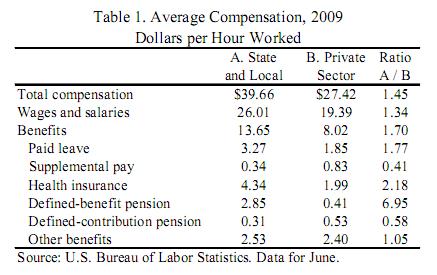
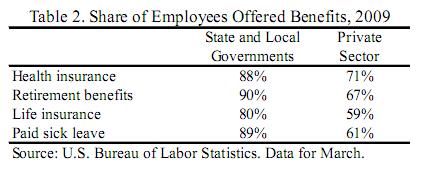
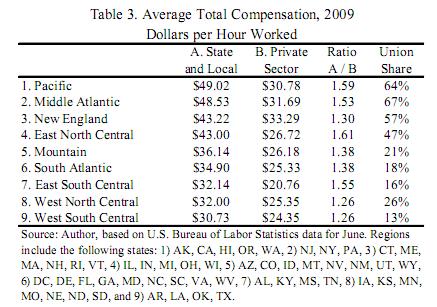

As John Carney and Kamelia Angelova (who produced the above chart) explain:
We've gone from providing jobs in profit-making private industry to providing jobs in profit-eating government work. Toward the end of 2007, the total number of government jobs exceeded the total number of goods producing jobs. Welcome to the government payroll economy.Yup.
December 20, 2009
What State Aid Does
It's difficult to care — in the midst of a major recession, with unemployment at its current level and the state government in perpetual deficit — about political sniping about who told whom what when, but a statement in such an article begs for correction (emphasis added):
RHODE ISLAND GOVERNMENT funnels one-third of its $3-billion "general revenue" budget to municipalities and school districts.The vast majority goes to schools.
The state budget Carcieri signed in June designates $187 million for municipal governments, a figure that includes "restricted accounts," such as money that must go to local library construction. And local school districts were set to receive $890 million, including funding for charter schools and the state-managed Central Falls school system.
The funding stream helps keep local taxes at bay.
No. What the funding stream does is to help keep local spending — especially on labor — up. The evidence is in the items that Governor Carcieri is suggesting as compensation for cuts to aid, most of which entail lightening the contractual burden on municipalities. In the long term, less aid from the state would not mean commensurately higher property taxes; it would mean commensurately lower giveaways to unions.
December 18, 2009
Leadership and Rhetoric
Monique and Matt covered budgets and leadership on Wednesday night's Matt Allen Show. Stream by clicking here, or download it.
December 17, 2009
And Then the Other Side
From AP writer Ray Henry's ">report, it looks like RI Senate Majority Leader Daniel Connors drew the short straw:
"I think we need to look at all of our taxes and determine, you know, those that could be changed to provide sufficient revenue for the state to provide its services," Connors said during a Statehouse interview.
You know, we'll just find a way to take "sufficient revenue" from the people of the state. That's all. Easy.
Of course, Senate President Teresa Paiva-Weed stands right with Connors and is apparently in need of a civics lesson from the people's perspective:
"Essentially, the proposal the governor is making is we're going to cut taxes with the left hand ..., income taxes, and we're going to increase property taxes," Paiva-Weed said.
Note that Paiva-Weed makes no distinction between the scope of her tier of government and more local tiers. The Democrats are trying to protect their public-sector union pals at the municipal level by shifting the narrative to insist that municipal leaders have no choice. They do, and so do their local constituencies.
December 14, 2009
When Taxes Aren't an Issue
Mark Perry observes (with charts) a progressive trend in American taxation:
The Tax Foundation reported last week that more than 143 million individual income tax returns were filed in 2007, and 46.6 million of those returns had a zero or negative tax liability, setting a new record for the number of "non-payers." This group represented almost one out of every three tax returns filed in 2007 (32.6 percent, see chart above), and reflects tax filers whose exemptions, deductions, and credits wiped out any federal income taxes that would have been due. According to the Tax Foundation, every dollar withheld from the paychecks of the "non-payers" during the year was refunded, and in about half of the cases, substantial additional money was refunded to the tax filer. There were an additional 15 million people in 2007 who did not earn enough income to file a tax return, bringing the total number of Americans who paid no federal income taxes to more than 61 million, or 39 percent of the tax-eligible population (158 million including filers plus non-filers).
As Perry notes in the words of American Enterprise Institute Economist Alan Viard, increases in government spending likely mean less to people who don't think they pay for it. This one item is not a complete explanation, but we appear to be witnessing the realization of a risk that has been foreseen with democracy all along: the majority can simply vote itself money from the minority, disregarding or ignorant of the self-destructive nature of that practice.
December 7, 2009
Don't Scheme on Taxes, Simplify
URI Economic Professor Edward Mazze's tax-cutting suggestions sound reasonable enough, but one can't help but be suspicious of the urge to control:
Murphy said of Mazze's plan, "I want to be open to it." Murphy said he was particularly interested in Mazze's proposal geared toward revitalizing local downtown business districts.Murphy said he remembers a vibrant Main Street in West Warwick when he was a boy. "I know in the last 40 years, our Main Street in West Warwick has not come back to where it was," he said.
An article in the latest Sakonnet Times (not online) describes the Tiverton Town Council's approval of a suite of zoning changes for commercial districts, and the accompanying pictures present a similar longing for the downtown-style main street. But there are reasons other than zoning and the lack of targeted tax breaks that Main Streets have been disappearing. Some of them are cultural; some of them are economic; the point is that attempting to counteract these forces will come at an economic cost and may fail to produce viable businesses, anyway.
In other words, if pulling the Rhode Island economy back up the cliff is the objective, we shouldn't be layering all sorts of aesthetic preferences on pro-growth policies. We also should focus on simplicity. All of Mazze's proposals will benefit people savvy enough to know about the breaks, to take the proper steps, and fill out the proper forms, but big-government corruption and waste illustrate very well that the skill set for jumping through hoops is not necessarily an indicator of a successful business. "Targeted" tax cuts, in that sense, become targets for which people looking for breaks will shoot. We need to encourage people who are interested in running businesses.
As Roland Benjamin says:
"If [Rhode Island's] tax structure was reasonable in the first place, you wouldn't need [targeted tax breaks]."
And if Rhode Island's political and academic leaders were competent to manipulate an economic recovery, we wouldn't be in the mess that we're in.
December 2, 2009
A Corporate Tax by Any Other Name
So, Governor Carcieri and his Director of the Department of Revenue, Gary Sasse, have switched from a "gross receipts tax," which would essentially be an expanded and hidden sales tax, to a "net receipts tax," which Providence Journal reporter Neil Downing describes as follows:
Under a net receipts tax, a corporation generally would pay tax on its revenue after claiming only a limited number of deductions (the number and nature of which have not been set). Thus, more of a business's income would be subject to Rhode Island tax. But a lower tax rate would apply, Sasse said. ...Sasse also said that any such plan would not harm the many small businesses that are organized as "pass-through" entities, such as limited liability companies and subchapter S corporations.
Sounds a bit like an expanded corporate income tax, no? Downing reports that the plan would be to "eliminat[e] at least one other tax, such as the state's corporate income tax, the sales tax or the personal income tax"; if it's not the first that goes, then Rhode Island would be killing its economy, not helping it. If it is the first that goes, it would essentially be a name change with the promise of future increases. Once the deductions are eliminated through the trick of changing what we call the tax, the General Assembly will find it a relatively simple matter to ratchet the rate up.
Suppose that the income tax is what's eliminated. Corporate entities will have an irresistible incentive to organize as pass-through entities, which will limit their ability to expand and ultimately undermine estimates of the revenue that the state receives from the "net receipts tax," because more income will flow to the untaxed channel. (Except for the restraint on expansion, that's not an unattractive outcome, but it will ensure the continuation of continual budgetary shortfalls.)
And if it's the sales tax, we're left with a gimmick that increases prices and shifts the tax burden to businesses from out-of-state consumers.
The faster Rhode Island's leaders come to the realization that there is no easy way out of this mess, the better off we'll all be. Taxes have to be cut, not reconfigured. Regulations have to be relaxed. And mandates have to be rescinded. Start selling that message now, because it's going to be a long, hard fight. Tossing out a new taxation buzz-phrase every few months merely delays decisiveness and confuses the public.
November 21, 2009
Preemptive Rebuttal on Property Taxes
Yes, the common advice is simply to ignore NEA-RI Assistant Executive Director Pat Crowley, and for psychological purposes, that is certainly an attractive approach. Its problem is that it's in Crowley's nature to rush to expose more broadly forming strategies and flaws in thinking of the local left. So, when he devotes so much of his time as a professional agitator to proving that Rhode Island's property taxes really aren't that bad — here and here — we can be assured that we'll see such nonsense begin to spread as a self-justifying common knowledge among the segment of Rhode Island society whose selfish or vain interests are dragging the state down.
There's a bit of irony to this tack. After all, when progressives have brought up property taxes, it's typically been to decry the fact that they're regressive, as Tom Sgouros explains:
Property tax is regressive because the value of the house or apartment you live in doesn't scale with your income. If you earn $50k, you probably live in a house or unit worth $300k (give or take). If you earn $500k, you probably don't live in a house worth $3 million. Instead, your house is likely worth $800k or a million. So ten times the income goes to three times the taxes.
With reference to Sgouros, there's also some conflict with Crowley's latest spin in that the former has tended to ignore property taxes as a percentage of home value in order to stress the fact that the rates are lower where the values are higher, while the latter wishes to use high property values in order to explain why the government ought to be able take more money. The two leftists illustrate nicely why regular citizens are wise to be suspicious of statistics, because they can be twisted in multiple directions per the rhetorical needs of the propagandist.
So, take a moment to absorb all of the multiple rankings provided in Crowley's Tax Foundation source, limited to Rhode Island and the abutting counties of Massachusetts and Connecticut (Bristol County, RI, not included because of small population, not low rank). Rhode Island counties are shaded red, Massachusetts, blue, and Connecticut, green.
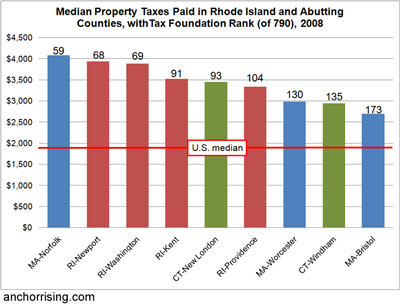
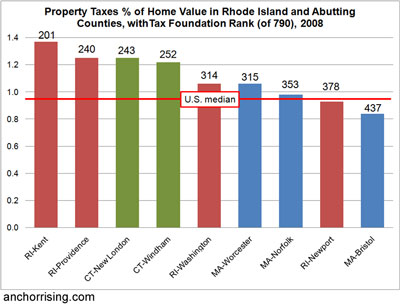
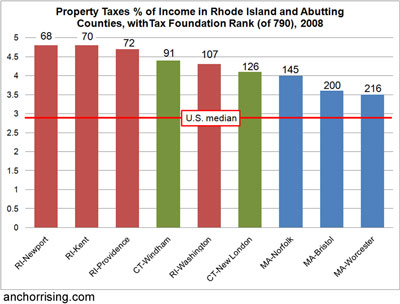
And for good measure, here's a similar chart for median incomes:
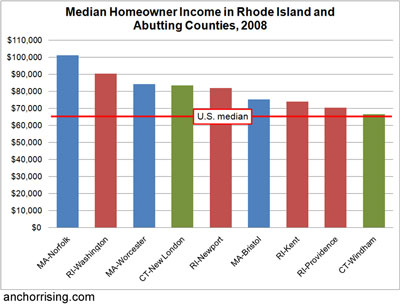
For the state-by-state comparison, Crowley likes the measurement by percentage of value for obvious reasons, even though progressives typically prefer to measure all taxes against income (to show that the rich don't pay enough). In fairness, my usual argument with respect to different taxes is that, if it's justified for the government to tax a particular transaction (sales or income) or property, then it should set rates according to the value of the thing being taxed, without adjusting for some external consideration. If we've decided that a town should receive its revenue from property taxes, then it ought to set a rate for all property, and those who possess a greater portion rightly pay proportionally more. That's fair. Otherwise every tax becomes a form of income tax.
For the purpose of deciding whether a particular state's property taxes are comparatively high, though, the percentage of home value isn't but so useful. For one thing, there's dollar value and there's the value to the user; taxes for a two-bedroom hovel might cost $4,000 per year in Rhode Island, but $1,000 in some other state. For another thing, the cost of government doesn't go up but so much based on residential property values. That is, it doesn't cost much more to send firefighters to a $200,000 hovel than a $75,000 hovel or to educate the children living in them.
If the question is whether the state of Rhode Island and its municipalities extract a large tax burden from their residents, the income comparison is more appropriate. As the above figures illustrate, even though Rhode Islanders have higher income than the median for the country, we pay an even larger percentage of that income in property taxes, and even though our counties' median incomes are dispersed among those of abutting counties, they cluster at the top for percentage of income absorbed in property taxes.
November 10, 2009
A Sales Tax by Another Name
Senators Frank Maher and Leonidas Raptakis were on Matt Allen's Violent Roundtable last Friday night, and the trio spent a bit of time discussing the potential gross receipts tax. As I wrote a few weeks ago, at bottom, this scheme merely shifts the tax burden to businesses, probably to the benefit of the wealthy. Be the gimmicks what they may — even if the state eliminates the sales tax or income tax — I just don't see how shifting the tax burden thus can be a positive development for the state's business environment.
Perhaps I'm looking at it too plainly.
The senators mentioned that the plan that they've heard would exempt businesses up to $600,000, but inasmuch as "gross receipts" means total revenue before expenses, it really doesn't take much to reach that total. They also suggested that the tax would apply more broadly than the sales tax does — including to service providers of all kinds — which makes me wonder whether that isn't the underlying purpose, for some.
The truth is that I simply don't trust the General Assembly to talk about a tax increase, even with a promise of a decrease elsewhere, because I don't believe that the powers who be won't work it out in such a way as to simply take more.
November 6, 2009
Binding Arbitration & Tuesday's Special Election Candidates
I have tended to avoid the written-questionnaire format for interviews of political candidates and officeholders, because the ratio of informative-answers-from-the-candidate-himself-or-herself to canned-answers-written-by-committee can often be less than optimal. Or it could be that I'm just bad at writing questionnaires, as RIFuture's Brian Hull has been able to get substantive answers to some very good questions that he put via questionnaire to the candidates in the General Assembly District 10 (Providence) special election to be held this Tuesday.
In particular, Republican candidate Maurice Green gave as unambiguous an answer as you'll ever hear -- in a political context or elsewhere -- on the subject of binding arbitration…
Question: With persistent negotiations between cities and towns and teachers unions often failing to reach agreements, do you support or oppose binding arbitration legislation?In contrast, Democrat Scott Slater expressed his support for stripping local government officials of final decision making authority over a large portion of their municipal budgets, as long as an arbitrator is working through a "fair" process…Maurice Green: I have been employed with the Providence Police Department for over 20 years, which makes me an active union member with the Fraternal Order of Police. And as such, I have personally benefited from binding arbitration on many occasions. However, I vehemently disagree with binding arbitration, because of the adverse effects it has on our citizens. Property taxes increase when cities lose binding arbitration decisions. Clearly, my personal gain is short lived if the state is in the tank, and the community's property taxes are driven out of control.
Scott Slater: I acknowledge that the current system we have in place is dysfunctional and I believe that a binding arbitration model is needed. I think that binding arbitration could provide an effective solution to labor and management contract disputes. As of now, progress has been made on a legislative proposal to provide resolution to failed negotiations. As a state representative, I will work to have a fair piece of legislation to protect our children’s education,…and Independent Wilbur Jennings opposed binding arbitration because teachers might not like it (begging the question of whether he'll change his position, if he finds out that both of Rhode Island's teachers' unions are in favor of it)…
Wilbur Jennings: I am not in favor of binding arbitration, because you cannot make the teachers sign a contract they deem unfair. If you force a contract on these professional, you will have an unhappy workforce and that will not be good for the teachers, students, or taxpayers.This is an important issue, not just for District 10, but for all of Rhode Island's upcoming elections, Governor's race included. Which candidates running in 2010 will be supporting the legislature's attempts to impose non-democratic budgeting on all of Rhode Island's cities and towns, and which will be supporting having accountable officials make final decisions for their communities?
And who will be able to meet the Green standard, in terms of making their position on this matter clear?
The rest of the RI Future questionnaire is available here.
November 5, 2009
Drowning in Desire for Other People's Money
The state of Rhode Island's revenue take is like a chest of treasure sinking to the bottom of the ocean, and some folks are intent on having us all chase it to the bottom:
"We've already been cutting, cutting, cutting," said one of the few people watching Wednesday's discussion, Russell Dannecker, fiscal policy analyst for the Poverty Institute at Rhode Island College. He cited a study by State Policy Reports that reports 29 states have proposed tax increases for the coming fiscal year.
Frankly, Rhode Island has to stop "cutting, cutting, cutting" around the edges and give some serious thought to wholesale excisions of programs. Information from the first link above illustrates why that is the necessary direction:
Among the highlights of Wednesday's presentation:
- Collections from the state's business-corporation tax plunged to $4.5 million from $14.8 million in the same period a year earlier, a $10.3-million drop.
- Sales-tax collections fell by $19.77 million, or 6.6 percent, to about $278.6 million.
- Net receipts from the personal-income tax (after refunds and other adjustments) fell by $14.3 million, or 4.5 percent, to $307.8 million.
The number 1 job of the state government must be to do whatever it can to help Rhode Islanders make money. The quick first step should be to cut taxes, and the larger step, still expedited, must be to slash regulations and mandates. We cannot afford to govern ourselves as we've been doing.
October 31, 2009
Consolidation as Another Means of Redistribution
If you should attempt to discuss state-to-state migration trends related to taxation, Tom Sgouros will proclaim the whole thing far too complicated, with insufficient data available, to make broad statements. When it comes to people moving from town to town within the state related to taxes and services, well, he's not so reserved:
When a family moves from Cranston to Exeter, Cranston loses a little of its tax money, and Exeter sees an increase in the demand for its services. For most services, Cranston can't cut expenses as fast as they lose dollars. This isn't because of unions, but simply because of arithmetic. A hundred fourth-graders in a school make four classrooms. But ninety-nine students also make four classrooms. Just because you've cut the students doesn't mean you can cut the payroll, and the same effect is apparent with police, fire protection, sewers and more.On the flip side, many studies have shown that the new residents of a town like Exeter seldom pay enough in taxes to cover the services they demand. This is especially true since most services cost more to provide way out in the burbs, where people are far apart from each other. It's why towns invented developer impact fees.
But what this means is that when people move from one town to another, the town they move from feels pressure on their tax collections and the town they move to feels pressure on their services. The result is that taxes can go up in both towns.
At best, you can say that this assessment is true under a certain, extremely limited, range of household types, and even then, the scenario by which taxes always go up everywhere whenever anybody moves requires a slew of assumptions. For example, if the property left behind in Cranston is reoccupied by somebody else, there is no loss of taxes. The same is true in the opposite direction in Exeter, unless the house was newly built. If the family has no children, there is no change in the schooling requirements for either town. And in the same way that removing a child from a class doesn't necessarily reduce the need for teachers, adding a child to a class doesn't necessarily increase that need.
In order for cities and towns even to come close to functioning, they must have somewhat of a balance between taxes and services, which means it simply can't be the case that every resident uses more in services than he or she provides in public revenue. And were that the case, to the extent that some other source of municipal income supplements the budget, loss of a taxpaying resident must represent a net gain.
Sgouros wants you to believe that towns aren't able to raise taxes quickly enough to cover new residents and that cities aren't able to cut services quickly enough to make up for lost revenue, but what he's claiming to be true doesn't make any sense:
The paradox of Rhode Island town finance is that today, the places with low taxes are the suburbs where the services are most expensive to provide, while the places with the highest taxes are the cities, where services are cheapest. It's the movement of people, and what it does to the tax rolls in towns, that bring us to this peculiar, and probably not stable, spot.
The problem is that the paradox only exists if one blacks out half of the relevant information. Consider some various data for the two towns that Sgouros uses as a hypothetical resident movement — from Cranston to Exeter:
| Cranston | Exeter | |
|---|---|---|
| Residential tax rate (per $1,000) | $15.34 | $12.33 |
| Municipal residential tax levy | $101,633,398 | $9,516,802 |
| State aid | $16,361,405 | $1,053,443 |
| Population | 79,269 | 6,045 |
| Occupied housing units (OHUs) | 30,954 | 2,085 |
| State aid per capita | $206.40 | $174.27 |
| State aid + tax levy per capita | $1,488.54 | $1,748.59 |
| State aid + tax levy per OHU | $3,811.94 | $5,069.66 |
Even though the tax rate is lower in Exeter, and even though it receives less per person in state aid, the actual amount of money that it collects per person is higher. Services may cost more to provide in the suburbs, but there's no paradox, because the towns are paying more for those services. And it isn't just that families are larger in Cranston, because Exeter pays even more on a per-household basis.
When one digs through all of the rhetoric and odd mathematical assertions, the disparity between urban and suburban areas derives from the fact that property is worth more outside of the city while city dwellers tend toward the end of the spectrum that uses more public services. (We're leaving political waste and corruption out of the picture, to allow clearer thinking.) What Sgouros actually sees in consolidation, therefore, is another means of redistributing money.
Like me, he's skeptical that consolidation will save appreciable money through economies of scale, but at the end of the article, and the end of the day, he's not concerned with saving money, but "reduc[ing] pressure." He wants to "insulate" town finances "from the effects of people moving." That is, to the greatest extent possible, he wants to trap Rhode Islanders into paying for expensive government programs that urbanites demand and government functionaries are only too happy to provide.
As some of us have begun to suspect, "consolidation" and "regionalization" are merely newly en vogue terms for big government and a decrease in citizen influence.
October 27, 2009
Michael Morse: Mutual Aid: A Simple Start to Regionalization
We are taught at an early age to call 911 in case of an emergency. People’s perception of what an emergency is may differ, but one fact does not; we expect our calls to be answered expediently. Fire departments handle most 911 calls in our area. Those departments pride themselves on a speedy response to calls from the community. When the bell tips at a fire station, everything stops, personnel drop whatever they are doing and hit the apparatus floor. Meals go cold, showers stopped half taken, cleaning and maintenance jobs are not finished. Those things can wait. Nothing matters but the call. Within thirty seconds, the trucks hit the street. People know that help is on the way. They assume the closest units are answering their calls, and they are correct in that assumption. What they may not be aware of is how far the closest unit actually is.
Providence Mayor David Cicilline recently proposed legislation aimed at clearing potential hurdles in the way toward regionalization of city departments. In a carefully worded statement, he cites the need to maintain services and cut costs in difficult economic conditions. Planning for regionalization would not begin in earnest until legislation is passed, the Mayor stated.
North Providence’s Mayor Lombardi notes that the closest responders are not always the ones that are sent, due to jurisdictional complications. Our elected leaders have begun the process of considering consolidation of our emergency response departments. Consider how many years the consideration will take before any progress is made.
A good place to begin consolidating emergency service organizations in and around the Capitol City is to expand existing mutual aid agreements. An automatic dispatch of the closest unit makes sense. The logistics of doing so will be a difficult, but far from impossible task. All considering could be done quickly, and a plan could be put in place within months, not years.
On any given day the cities of Providence, Pawtucket, Cranston, East Providence, North Providence, Johnston and Central Falls provide mutual aid to each other, mostly in the emergency medical services departments. As the system currently works, a municipality must drain all of it’s resources before another town can be called for help. People who live on or near town lines are particularly at risk. If a life threatening emergency occurs, they could, and often do wait for an advanced life support vehicle to arrive from the other end of the town or city while a rescue from the next town sits in the bay, in service, a few blocks away waiting for a call from inside the borders of their own city.
Because of the population’s increased use of 911 for routine medical problems, urban municipalities cannot keep up with the demand for emergency services. It is an ebb and flow system, one on the brink of collapse on a daily basis. Meeting the needs of every caller would bankrupt most municipal budgets.
Presently, each city or town is responsible for providing coverage inside it’s own border. Some stations were built “close to the line,” prior to the construction of major highways. It was a different world when these places were built, the planners of those long gone days had different problems to consider, different political alliances to placate and a completely different landscape.
Without scrapping the current system and implementing better policy regarding the dispatch of emergency resources, cities and town departments must rely on each other. An ultimate goal of consolidating these departments is desirable, but in reality is decades away. Consolidation based on need already happens on the street level, and with few exceptions runs smoothly.
An automatic mutual aid system and agreement will greatly increase the effectiveness of our public safety departments. Mayors and town managers will be forced to work together to make a system badly in need of repair more efficient. The opportunity for grandstanding will be taken away, political gain would be nil, and simple, good governance shown to be an effective tool in bettering the lives of the citizens by providing quicker emergency response to whatever needs may arise. It is the response times that need improvement, and automatic mutual aid will help save lives.
Michael Morse is a Providence EMT and firefighter and writes a blog, "Rescuing Providence".
The Method Is the Message, in RI Recovery
Reviewing a recent RIPEC study (PDF), Brian Hull pulls back from the most relevant question:
When we look at the 2007 Per Capita Personal Income for RI, MA and CT we find the following: Rhode Island is $39,829, far less than Massachusetts ($48,995) and Connecticut ($54,981). The per capita personal income of MA is a little more than 23% than that of RI. Likewise, the PCPI of CT is 38% more than RI. With these numbers, it's easy to see why general expenditures per $1,000 of PI is higher in RI than in MA and CT. There are fewer "$1,000s of personal income" here to support the government's expenditures.Does this make the expenditures more expensive, or even less necessary? No. It just means that, as a society, we earn less money than our neighbors to fund these services. All things being equal, if we raised the per capita personal income in the state, then the spending per $1,000 of personal income would decrease. We should aim for that!
An interesting tidbit of information that I learned from Tom Sgouros, in his book "Ten Things You Don't Know about Rhode Island," is that blue-collar, working-class jobs in the state pay much less than comparable jobs in MA and CT. This is in contrast to the relative equivalent salaries earned by professional, white-collar jobs (even though RI still earns a little less). And this helps explain why RI earns less, but that's a discussion for another day.
His heavy reliance on Tom Sgouros notwithstanding, Hull presumably does not buy into the idea that our problems require the reduction of spending through consolidation and the like. After all, consolidation, of itself, will not prime the job-creation machine, and it will not bring Rhode Island salaries up to the levels of our neighboring state. It is not, in other words, the reason that Rhode Island fares so much more poorly than the states by which we're engulfed. Since the problem is too few $1,000s — not who holds them — the answer cannot be that our tax structure doesn't take enough from the rich (which is nonsense, anyway).
If he asks the right questions, Hull may be dangerously close to agreement with we who believe that Rhode Island's government must get out of the way of its economy. Schemes that allow for continued regulations and mandates and wealth redistribution will fail. Have failed. We cannot mandate that people have more money. We have to allow them to make it.
October 23, 2009
Taxes Aren't Mysterious; the Question Is Merely Who Pays
Could be I'm missing something:
Governor Carcieri's administration director, Gary Sasse, gave a roomful of state senators a list of "two to three things" to do over the next few months as the state tries to climb out of its financial abyss. ...The third was a variation on a key piece of an ambitious proposal to solve deficit-wracked California's budget crisis: lower the tax burden on the wealthy, repeal sales taxes and replace the corporate profits tax with a new levy pegged to business revenues. ...
According to information compiled by the Rhode Island Public Expenditure Council, a business-backed research group, most states, including Rhode Island, have corporate income taxes that are levied against profits, defined as gross receipts minus expenses. Gross receipts taxes apply to all business revenues with few or no deductions. All transactions are taxed, including business-to-business purchases of supplies, raw materials and equipment.
Rhode Island has already taken a very small step by taxing public utilities (telecommunications, electric, gas) on their gross earnings; insurance companies on their gross premiums; and certain health-care providers on their gross revenues.
We all know that Rhode Island's business environment is the state's core problem (to which other central problems contribute, of course). Even if we assume that the untrustworthy state government of Rhode Island follows through with step 2 and eliminates other taxes, rather than just keeping the additional revenue, the gross receipts tax would essentially shift the tax burden to businesses.
Perhaps there would be a modest bump in perceptions of the state, but it would be founded on a gimmicky trick: Two of the ways in which businesses would adjust to the new tax would be to pass it on to consumers and decrease the salaries that it pays. With the principle that state government revenue must remain flat, all these changes can do is to transfer the burden, and in this case, it appears likely to take less from wealthy families and more from everybody else — especially the working and middle class families who are already hollowing out our society by emigrating.
Why waste waning political equity on this? As I said, I may be missing something, but as it stands there's a taint of benefiting upper class Rhode Islanders as an a priori consideration in the name of economic development.
October 16, 2009
Binding Arbitration as Viewed by One of RI's Public Labor Unions
The following e-mail was distributed today to members of NEARI.
A message from NEARI President Larry Purtill:URGENT!!!! The RI House Labor Committee will hear legislation on binding arbitration for teachers Wednesday, October 21, 2 PM at the State House, and the full General Assembly is scheduled to reconvene October 28-29.
After over two decades of lobbying for binding arbitration, our time has come. It is imperative that NEARI members call, email, or write their representatives and senators urging their support for binding arbitration. Our opponents have been contacting members of the legislature – now it is time they hear from us. Binding arbitration will provide a closure mechanism to the collective bargaining process that we have needed for a long time. We cannot allow another East Providence situation to occur in Rhode Island !
You can find contact information for your legislators here. Below are talking points to help you craft your message.
Continue reading "Binding Arbitration as Viewed by One of RI's Public Labor Unions"
September 25, 2009
It Depends at What Period of Capital Flow One Looks
What an improvement is the reemergence of sincere argumentation on RI Future. I may find its new owner, Brian Hull, to be wrong about the implications of taxation, but I trust that he's attempting to express his opinion to persuade rather than to mislead. Thus, not only may exchanges be fruitful, but the actual assumptions of each side may be addressed:
... any reduction in an individual's state tax liability does not necessarily lead to investment. The tax savings could be saved, or spent on luxury items (which may or may not be purchased in the state). Lastly, and most importantly, if an investment does actually occur, that investment can occur anywhere in the country or in the world. Wealth flows after opportunities to make money off that wealth, regardless of where the opportunities arise. A potential investor will seek the highest return on his investment, and not necessarily care about investing in his community or state. This shouldn't come as any surprise to you, so I'm wondering why you're so glib in correlating tax cuts to economic growth. ...Do you honestly think that a $6,000 tax cut going to an individual making over $419,000 a year will generate job growth in Rhode Island? Do you think all those wealthy Rhode Islanders who got their $6,000 tax cut will join together and invest their tax savings in creating new businesses in the state? I suppose it's possible, just like it's possible that I’ll be struck by lightning, or win the lottery (you can't win if you don’t play), but we both know your claim is specious and the cost to the state necessitated its elimination.
That Brian is addressing capital gains taxes, specifically, is helpful, because it clarifies that the activity being taxed is in one way or another an investment in the state. If one treats a tax cut as no different than a direct handout from the government, like those rebate checks most of us received under misguided Bush policy, as Brian apparently does, then, no, $6,000 to each person in the limited group of really rich people won't generate much economic activity. But especially in the case of capital gains, that $6,000 is not the investment that the state is seeking with its low-tax policies — the investment that generated the revenue that was taxed at a savings of $6,000 is.
Brian's mistake is to treat revenue to the state as if it is the only, or at least most important, measure for the Rhode Island community. As a 2008 Poverty Institute fact sheet arguing for the elimination of the capital gains tax cut illustrates (PDF), the tax "savings" to the wealthy investor (in this case claimed to be $4,974) comes from an actual capital gain of $193,113, which itself is only a portion of the investment.
Although Brian is correct that the tax savings may be spent on anything, anywhere, for the tax to be levied in the first place, the investment must have been associated with Rhode Island in some way, whether by benefiting an actual Rhode Islander or by representing an investment in our state by a resident of some other state or nation. A low capital gains tax gives a state's businesses an advantage in their ability to offer stock options as remuneration as well as to attract investment from elsewhere. It also creates incentive to make money by investing, which one is often begin doing close to home — as with local real estate or nearby companies.
Of course, such cuts and business ventures are operating in a hostile tax and regulatory environment, but in isolation, the effects of a given policy are relative, meaning that it's better to have a lower tax even if it won't be a trump card.
ADDENDUM:
Brian also presents a table purporting to illustrate that Rhode Island's tax burden isn't particularly heavy. His direct source isn't obvious, and I don't have the time, right now, to dig into the numbers for myself, but it appears to measure the actual dollar amount of different taxes — income, sales, property, corporate — as a percentage of actual personal income. The problem with this is that it lumps all Rhode Islanders together and doesn't really provide much useful information about tax policies effect on taxpayers.
The fact that Rhode Island's corporate income tax claims 0.4% of personal income (ranking us 26th highest in the country) could mean only that not a lot of Rhode Islanders operate businesses that make money. This possible interpretation is emphasized by the fact that New Hampshire ranks fourth, at 1.1%. Similarly, the fact that Rhode Island ranks 32nd in percent of personal income going to sales and gross receipts taxes could indicate that folks don't do as much shopping in our state.
September 20, 2009
Tax-friendly Places to Retire: You'll Never Guess Which State is Not So Friendly
Mary Beth Franklin of Kiplinger's Personal Finance has an article in today's Washington Post entitled "Tax-Friendly Places for Retirement".
Because tax treatment of different retirement income sources, as well as real property, varies widely by state, the fifty states were not ranked best to worst. For those contemplating a move upon retirement, Kiplingers has this handy-dandy map of the US, which not only enumerates the positives and negatives of each state in various retirement-related tax categories - pension taxes, taxes on Social Security benefits, sales tax, property tax, income tax - but includes lists of the best and worst five states in these categories.
If you'd like to start your search for a retirement destination by at least determining which states to steer away from, look for the ones that are bad in several such categories. This is where we find Little Rhody.
Three states are particularly tough on retirees. Not only do they fully tax most pensions and other retirement income, they also have high top tax brackets: California (9.55 percent on income less than $1 million), Rhode Island (9.9 percent) and Vermont (9.5 percent). Connecticut and Nebraska also fully tax retirement income.
Additionally, we are one of the top five worst states for property taxes and we are one of around fifteen states which assess an estate tax.
But we're all working stiffs. Why should we care how the state treats retirees tax-wise?
First and most selfishly, a couple of those taxes - property and income - apply to us as well.
Secondly ... okay, this one is pretty selfish, too - for the same reason we need to care about our corporate taxes and, more generally, the business climate: more taxpayers in the state means a broader tax base so that everyone pays less in taxes.
Finally, a note with regard to Kiplinger's citation of Rhode Island's top income tax bracket as 9.9%: their data may be slightly outdated as the Gov and the General Assembly have been slowly ratcheting back that rate. This only highlights the urgency, however, of undertaking the difficult but necessary task of making all of our tax rates at least middle of the road - so that Rhode Island no longer actively repulses taxpayers of all varieties by cropping up on the wrong end of lists such as this.
September 17, 2009
How Regressive is Rhode Island's Current Property Tax Structure, Revisitied
Pawtucket Mayor James Doyle's op-ed from Tuesday's Projo provides a good occasion for revisiting the topic of the supposed regressiveness of Rhode Island's property tax structure. Mayor Doyle would like to see more state aid and less "reliance" on the property tax for funding education in Rhode Island…
The state has also shunned its responsibility to properly fund education. Rhode Island is the only state without a fair and predictable education formula, and ranks among the nation’s highest for relying on local property taxes to pay for education.Keep the idea that it's "reliance", and not "use of", that the Mayor would like to see reduced.
The table displayed below is an updated version of the table presented originally in July, where the amount of property tax that Rhode Island cities and towns collect from their residents as a percentage of income was estimated. In response to the original result, commenter "John" pointed out that Rhode Island' classifies apartment buildings as "commercial" properties, meaning they are not included in the "residential" levy figures and therefore that official "residential" levy figures do not include the total amount of property tax collected from a municipality's residents. For some communities, the additional amount can be significant.
To correct for this concern, I used 2007 municipality-by-municipality valuation data provided by the Rhode Island Office of Municipal Affairs, which includes the total valuation in each property classification category used by the state of Rhode Island; by multiplying the valuations in the "apartment" and "combination" (i.e. mixed residential and commercial) categories by a municipality's commercial tax rate, and adding the result to the official residential levies, better estimates of the total amount of property tax levied on residents by municipal governments can be obtained.
The inclusion of the "apartment" and "combination" categories in a "residential" levy does pull a number of communities near the bottom of the original list towards the middle...
| Municipality | Total Community Income (2007 ACS) | "Residential" Tax Levy (2007 Muni Afrs.) | Est. "Apartment" & "Combined" Tax Levy | Res + Apart + Comb Levy as % of Income |
| Westerly | $736,318,944 | $49,194,534 | $1,003,130 | 6.8% |
| South Kingstown | $902,219,848 | $52,242,106 | $1,547,292 | 6.0% |
| Chariho(R) | $753,927,104 | $43,614,470 | $755,162 | 5.9% |
| Newport | $743,149,136 | $40,355,194 | $2,962,691 | 5.8% |
| Johnston | $793,255,802 | $41,208,491 | $1,799,035 | 5.4% |
| Cranston | $2,143,969,940 | $101,633,398 | $7,922,334 | 5.1% |
| North Kingstown | $1,066,793,770 | $50,529,940 | $1,544,002 | 4.9% |
| West Warwick | $780,349,600 | $33,119,054 | $3,698,454 | 4.7% |
| Coventry | $1,045,810,920 | $46,659,667 | $1,570,195 | 4.6% |
| Bristol/Warren(R) | $979,570,240 | $43,443,793 | $1,491,611 | 4.6% |
| Providence | $3,419,209,140 | $126,320,027 | $27,489,420 | 4.5% |
| Warwick | $2,563,100,925 | $105,379,974 | $9,610,825 | 4.5% |
| Smithfield | $627,377,590 | $27,295,469 | $583,537 | 4.4% |
| North Providence | $932,747,152 | $34,525,710 | $4,767,002 | 4.2% |
| East Providence | $1,240,282,560 | $44,567,063 | $4,929,768 | 4.0% |
| Cumberland | $1,062,425,700 | $40,650,687 | $1,399,975 | 4.0% |
| Lincoln | $750,233,679 | $26,341,821 | $1,532,767 | 3.7% |
| Pawtucket | $1,508,546,425 | $47,200,154 | $7,871,267 | 3.7% |
| Woonsocket | $918,048,573 | $23,083,073 | $6,554,922 | 3.2% |
Pawtucket remains in the next-to-last slot (now tied with Lincoln). Pawtucket is also a big state education aid recipient, one of 4 communities in Rhode Island (counting Central Falls, which is funded almost entirely by the state) receiving over $6,000 per-pupil from state government.
So, unless Mayor Doyle would, for example, advocate cutting his own city's already low-as-a-percentage-of-community-income property tax in response to receiving additional state aid, i.e. use the additional aid to replace revenue instead of to improve education, how can his call to "reduce reliance" on the property tax lead to anything other than a system where state taxes are raised without local property taxes being cut?
The date for the calculation of the apartment/combined use levy is below the fold.
Continue reading "How Regressive is Rhode Island's Current Property Tax Structure, Revisitied"
A Burning Ring of Revenue Fire
One thing to remember: Every time you read about state tax revenue lagging expectations, the expectations have likely already been downgraded since the last time analysts were disappointed:
Two reports issued Tuesday afternoon by the state Revenue Analysis Office showed total state revenue in July and August was down 4.2 percent from the same two months last year, after adjusting for money collected in one year that is accounted for in the previous year.Besides trailing last year, the revenues for July and August also trailed what state budgeters projected would come in. The shortfall is $12.8 million or 3.3 percent.
I don't know if we can afford to wait until the next election to replace the legislators who've brought us to this impasse. Here's a fantastic, small-scale example of the incompetence at work:
The cigarette tax collection is trickier to figure out.The amount of money taken in during July and August is ahead of last year, $23.5 million compared with $20.5 million. But that is far less than what lawmakers budgeted: $26.3 million.
They looked for the increase because the state raised the cigarette tax by a dollar — to $3.46 a pack — in April, toward the end of the last budget year.
Simmons said that budget makers may have underestimated how much the tax hike would decrease consumption of cigarettes that are taxed in Rhode Island.
So, the legislators increased this tax 40% in the hopes of increasing revenue 28%, and thus far they've realized 15%. During the summer, when smoking tourists are trapped and aren't likely to waste their valuable vacation time searching for deals across the border (or quit altogether).
The governor's staff proposed this particular tax hike, and one hopes they're duly embarrassed. Ultimately, however, the budget was reconfigured in the General Assembly's name.
Whoever's to blame, anybody looking for an economic turnaround in Rhode Island shouldn't put their chips on the table until well after just about every other state in America has already been humming along for quite some time.
September 11, 2009
Ocean State Policy Research Institute Hosts Grover Norquist
Ocean State Policy Research Institue was good enough to invite me to its fundraising event at the Providence Marriott featuring famed tax hawk Grover Norquist. Some of Norquist's speech was familiar from his last appearance in Rhode Island, but considering all that has happened — with the election, tea parties, legislative assaults, healthcare — there were many new topics to address. And Grover gives an entertaining, informative speech.
Video in the extended entry.
Continue reading "Ocean State Policy Research Institute Hosts Grover Norquist"September 7, 2009
Setting Up Continuing Deficits
Don't let this tidbit slip past our awareness:
Emerging from a tough competition, four Rhode Island police forces have won money from the federal economic stimulus program to hire police officers, the White House has announced.The largest single sum, $3,529,812, goes to Providence, to hire 13 officers. The other beneficiaries are Pawtucket, to hire or retain 8 officers; Woonsocket, 4; Central Falls, 2; and the Narragansett Indian Tribe, 1. ...
The award covers the cost of hiring officers at entry-level pay and benefits for three years. But there is a "catch," as some critics of the stimulus program call it. When the aid dries up at the end of the period, the employer is required to keep the new personnel on the payroll at local expense for at least another year.
We can expect that the "stimulus" regime is full of such ramps into an uncertain future — with the government borrowing money from the future in order to obligate itself to maintain expenditures that it may or may not be able to afford a few years down the road. It's government by economic fantasy, with elected representatives and bureaucrats proving that college students aren't alone in unwise reliance on debt.
September 1, 2009
The Thing About Taxation
Oswald Krell is at it, again — proving, this time, that beating a strawman for long enough begins to resemble a pillow fight against one's self:
Low tax states are more violent, have higher rates of teen pregnancy, somewhat higher poverty rates, and lower median incomes.Do low taxes cause these problems? No. Correlation is not causation.
Rather, to me, what is emerging is the description of an attitude. Low-tax proponents favor "Stand on your own" rhetoric, which is really a coded term for letting the rich shirk their civic obligations. The result is that the bulk of the population is noticibly worse off in low-tax states: more violence, more teen pregnancy, more poverty, lower incomes.
Now, explain to me: why this is an attractive paradigm?
I repeat: The argument for taxes in Rhode Island isn't that low rates are the decisive factor in a given region's economy, and adding social data doesn't change the fact that people and businesses do take the cost of government into consideration.when they plot their financial lives. The question that Rhode Island's progressives are so studiously striving to ignore is that taxation must be judged based on a given state's circumstances, and Rhode Island is overburdened with them, as with other manifestations of big government like mandates and regulations. "We will let you operate your business as you see fit and to keep more of what you earn" need not be innuendo for gun violence and teen pregnancy.
Lower taxes and lightened regulations would encourage economic activity and improve the earning potential of all residents, which I'm reasonably certain would correlate positively with improved social markers in the state, as well. (Krell doesn't provide his sources, so I'll simply offer the hypothesis that Rhode Island fares poorly, by such measures, compared with similar states.)
That's a suggestion that RIFuture-owner Brian Hull should consider, as well:
The recession effect is having a profound impact on the state's economy, but the long-term financing of the state would be better served if the General Assembly would make the "tough choices" and restructure the tax code, shifting the burden away from the vast majority of Rhode Islanders who have seen their incomes shrink and are struggling to make ends meet.
For perspective, don't lose sight of the fact that, in the name of improving the economy, Hull wants both to raise taxes and to shift them toward a particular group. Apart from being manifestly unjust, such a strategy would be economically devastating. What, pray tell, would Hull like to change about this picture:
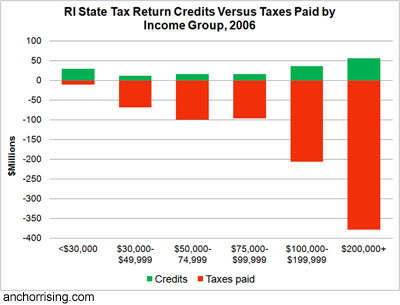
Me, I'd like to see less red across the board.
August 31, 2009
A Warm Anchor Rising Critique Welcome to Brian Hull
We'd like to welcome, of course, Brian Hull to the RI blogscene in his new role as proprietor of RIFuture. I, for one, am hopeful for a return to the collegiality of the Matt Jerzyk years and am determined not to be the cause should that prove unworkable.
That said, what better method of offering a cyber handshake and slap on the back could there be than highlighting our fundamental differences? And they must be fundamental, because this argument seems flatly erroneous to me:
There is a real big problem with the [state government] shutdown days, over and above the forced pay cut of 4.6% that the employees will have to absorb. We already have a weak economy, and to essentially take another $17.3 million out of it won't make things any better. Consumer spending makes up the bulk of GDP, nationally and in the state. Add the multiplier effect and every dollar spent generates a dollar plus in economic activity. By stripping out $17.3 million from the local economy of Rhode Island, we're going to depress the economy by much more than $17.3 million. This is not a good thing.
Yet:
We're in a recession, and while the recession might be getting better, there is no indication that employment will bounce back anytime soon. This will mean a suppressed economic situation in RI potentially for years to come. The unfortunate reality is that we need to raise revenues. And that means higher taxes.
We could certainly dip into the argument over whether state workers or taxpayers would use money in a more economically productive fashion. Even if we ignore the fact that it costs the government money to collect taxes, but nothing not to collect them, and even if we accept that new taxes would skew toward the higher end of the economic spectrum (which I assume would be Brian's preference), I'd argue that the business owners and wealthy residents thus implicated would be apt to spend additional money in a way that maximizes the multiplier effect.
The more direct point, though, is that Brian's appeal to the need to leave money in the economy ought to suggest a different form of government cut than to the labor force. Instead, he merely argues for redistribution.
He doesn't even advocate for easing restrictions, regulations, and mandates on businesses and productive individuals as a way of increasing economic activity and, thus, government revenue. One gets the impression, from his post, that "taxpayer dollars" exist in some sort of pool outside of the economy that folks won't "be happy about paying" to the government, but that they otherwise won't use.
August 21, 2009
Stimulus Jobs: Finagling the Definition of "Retained"
In a scene presumably also unfolding in other municipalities, the Woonsocket Education Department has applied for $2.4m of federal stimulus dollars so as to retain forty positions in the school system; more specifically, to prevent the closing of the [correction provided by MikeinRI] Davies technical school Woonsocket Area Career and Technical Center.
The goal of stimulus spending was stretched from the get-go with the clever addition of the qualifier "saved", as in "3.5 million jobs created or saved". I understand and sympathize that Woonsocket has serious budget problems. At the same time, isn't it now stretching the goal of stimulus dollars beyond recognition to utilize them to address budget issues on the local level, especially in view of the state's upside down teacher pay to student achievement ratio?
Woonsocket school officials would contend - in fact, do so in the application - that they are applying for these funds in part to address academic shortcomings identified in the district. But is this not a matter that would have been more appropriately and effectively addressed during the course of contract negotiations over the course of the last fifteen years?
Now, if we multiply Woonsocket's request to spend stimulus dollars for this reason by school districts around Rhode Island and the United States, we are faced with the questions of utility, efficacy and possibly even honesty. Does the expenditure of stimulus funds - which are, we should remind ourselves, not free money but tax dollars - on public sector contracts of questionable feasibility truly benefit the economy?
August 14, 2009
The Toll Plan Continues Apace
This progression was in plain view when Rhode Island began sidling toward transponder-based tolls:
The authority has also begun planning what could lead to reinstituting tolls on the Mount Hope Bridge, which is now free, and eventually impose tolls on the new Sakonnet River Bridge, which is under construction. The authority has commissioned a study that Chairman David A. Darlington said will look at tolls on all three bridges and various combinations of the three.The board said it expects to raise tolls regularly, perhaps every three years, depending on its repair and maintenance expenses. The increases would be based on the Consumer Price Index, on an index of construction costs, or other inflation indicators.
With each new toll booth, more Rhode Islanders will bite the bullet and include a toll-paying device as another cost of daily life. With each new transponder, and with each Rhode Islander thus moved one step further from actually handing a piece of currency over for the ability to use a particular piece of public infrastructure, each new toll will be easier to implement and each increase politically easier to accomplish. (And let's not forget that residents' movement will become that much easier to track.)
In my view, this is nothing other than an incremental duplication of taxes that we already pay.
August 11, 2009
The State's Spending Practices
Former state representative Carol Mumford deserves a hear, hear for her op-ed in yesterday's Providence Journal:
Those who believe that Rhode Island is a poor state would be surprised to know that during most of my 10 years in office, the state's revenue increased at the approximate rate of 3.5 percent a year. While our revenue increased at this modest but steady rate, our expenditures increased approximately 7 percent to 11 percent a year. That says it all, doesn't it? No matter what the income, those people or entities that live beyond their means find themselves in the situation Rhode Island faces today. ...On another note, those who believe our state population figures are static at about one million should look closely at the composition change. The Rhode Island Economic Development Corporation testified before House Finance that in the last decade those who are considered affluent in Massachusetts have doubled in number. The number of people who are considered affluent in Rhode Island has decreased by 50 percent. The affluent did not lose their assets; they fled. An examination of the latest "Kids Count" figures shows that the number of poor children in Rhode Island has mushroomed. The population numbers remain static, but many who used to pay the bills are elsewhere.
But how can that be? An opposition analyst assures us rich taxpayer interests have won battle after battle at the State House, and welfare benefits are difficult to procure.
August 10, 2009
Taxes, Wealth, and Recovery
With the reminder that Rhode Island is at the top of the list when it comes to stimulus spending per capita, I thought of a table that I'd seen predicting the years during which each state's economy would recover to pre-recession employment levels. Curious what it would look like, I added the recovery information to the table that I used while assessing whether there might be a correlation between tax burden and the proportion of wealthy residents.
The result is below. The colors still correspond with tax burden (red being the highest), and the middle column still ranks states according to the number of IRS tax returns showing income over $200,000 (highest at the top). The patterns in the new column are meant to group the states by the year in which they'll recover, with those at the top matching previous employment levels by 2011 and those at the bottom doing the same some time after 2015.
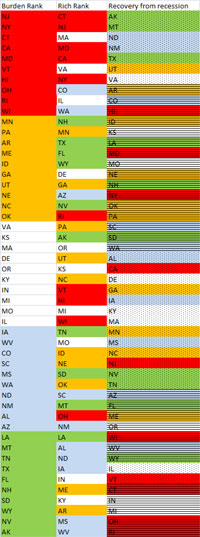
Nothing decisive, but interesting.
August 8, 2009
Self-Reflective Disproof on the Left
As fun as it may be to roll rhetorical balls down the lane and topple simple propaganda and otherwise erroneous talking points on the Rhode Island left, the state would profit from a more credulous and balanced discourse. Plainly put, Oswald Krell's supposed proof that "there is no negative correlation" between "high taxes and percentage of high-end earners" is incorrect on every level of analysis.
On the first level, Krell is wrong about the argument that he's professing to disprove. Inasmuch as he cites me specifically, I can attest his error without qualification. The argument is not that taxes are the end-all-be-all of people's decisions about where to live. Krell and friends wish to attack a simplistic strawman because the actual observations of the other side (our side) are unarguable. The argument is that taxes are a factor, and changing them amidst the other factors that people are already considering will have a predictable outcome. If all else remains constant, raising taxes within a state will decrease the population that pays those taxes. Consider an automobile: increasing or decreasing the amount of gas that flows through the engine will affect its speed, even though the results will vary based on other factors, such as the vehicle's prior speed, the size and type of the engine, the weight of the car, and the terrain that it's currently traversing.
On the second level, Krell is wrong about the necessary disproof even of his strawman. He ranks the states according to their tax burden and then according to the percentage of tax returns showing income above $200,000. He takes as the hypothesis for disproof that the lowest taxes would instantly equate to the highest percentage of rich residents, but failure to obtain those results hardly disproves correlation. To even get close to so dramatic a demand, he'd have to be much more specific in his rankings. The question wouldn't be tax burden, but tax burden on those making over $200,000 per year; if a state taxes those households less, but the majority of its citizens, whose income is much lower, more, then its tax burden could be high while its wealthy remain in place. (I've long been arguing that this has been happening in Rhode Island, although the tragic solution of the General Assembly and, even more, the state's progressives is to increase taxes on the wealthy rather than lower taxes on the majority.)
Even more egregious, though, is that Krell takes the extremes of tax burden (the ten highest and the ten lowest), ranks them with respect to rich folks in isolation from the other thirty states, and then raises his arms with a giant "See!" that there's no correlation. To the contrary, by this foolish methodology, if there's any intermixing of the states at all, there is correlation. It appears that the only outcome that Krell would accept as evidence of his opposition's position is if the tax burden ranking and the rich percentage ranking were perfectly inverted. But there are degrees; it's only a question of the strength of the correlation.
 Which brings us to the third level, on which Krell's assessment of his own data is just wrong. At least in his first attempt at this analysis, he made some attempt to keep all categories limited to quintiles. Simply putting the top and bottom quintiles of states from one ranking in their relative order for another ranking is useless. Consider the table at left, for which I ranked all 50 states using Krell's sources. (Although, I had different results with three states; given that all the rest are the same and my double-checking of the data for those states, I suspect he miskeyed a couple of numbers on his spreadsheet.) The left column is the ranking by tax burden, with highest at the top; the right column is the ranking by percentage of $200,000 tax returns, again with the highest at the top.
Clearly — and as nobody is denying — wealthy people find the states between Washington, DC, and Boston to be desirable places to live. It makes sense that the state governments whose territory is desirable for reasons that don't relate directly to taxation (geography, resources, proximity to industrial and financial centers, etc.) can get away with higher taxes. The tax burden becomes a premium that residents are willing to pay. The question that the people of each state must answer for themselves is whether their level of taxation exceeds the theoretical premium that productive people are willing to bear given other attractions of the locality. In Rhode Island's case, high taxes, combined with poor public services and crumbling infrastructure, constitute a severe restraint on the economy and, therefore, our well-being.
Returning to the table, though, a few interesting observations work very well with the broad theory that I've been proposing. The Northeast and California (which amounts, essentially, to our entire region on the West Coast) hold up pretty well in the wealthy column, but high-tax states outside of our region drop precipitously. It fits the general hypothesis to suggest that taxation matters more in the mass of states that have less to distinguish themselves from each other, which describes (e.g.) Ohio and Wisconsin.
The states with no shading, which make up the middle quintile on the tax burden side, distribute with remarkable evenness across the the rich ranking. The orange states appear to have tax burdens well out of proportion to their attractiveness, and they fall away into the bottom three quintiles.. The green states, by contrast, appear to benefit significantly from their low tax burdens, and the light-blue states more or less stand in place while the green states surpass them in percentage of wealthy residents, with three rocketing up the chart.
As I always disclaim, making grand assertions from this data would require much more extensive research and analysis. But for the purposes of online discussion of local policies, it makes for another interesting consideration among the mound of evidence concerning the direction in which Rhode Island should head. And for the purposes of disproving Oswald Krell's disproof, I'd say that it's decisive.
August 6, 2009
The Other Side's Frightening Arbitration Numbers and Blindspot on Taxing the Rich
Oh happy day! Patrick Crowley has endeavored to bend numbers to his purpose, once again, and as usual, he seems incognizant of the degree to which his data actually illustrates the problem that he hopes to dismiss as a paranoid fantasy. The fact that he doesn't provide his source simplifies matters, because we needn't be distracted by the complexities that municipal negotiations can entail.
So we note, from his Figure 3, that the ratio of arbitrated contracts to negotiated contracts during the decade beginning in 1995 is typically somewhere around 6 arbitrated to 50 negotiated. Clearly, in Connecticut (which appears to be the data pool), arbitration is the final resort for the hardest cases, where the town and the union each put up the greatest fight.
In that light, turning to Figure 1, it's stunning how well unions do in arbitration. On average, arbitrators awarded 95% of the salary increases that negotiations procured during a given year. That includes two years during which the raises granted in arbitrated contracts were 33% and 10% higher than those in negotiated contracts. If we leave those two years out, we find only a 13% penalty in arbitration (e.g., a 3.06% raise instead of a 3.48% raise); again, that percentage describes the raises that the contracts granted, and none of the cited contracts called for flat or negative salary growth (and probably doesn't account for step increases and longevity). It's also worth considering the possibility that the perks, compensation, and rights that the arbitrators gave to the unions with the other hand far exceeded the salary "compromise" in value.
On a different topic (while I'm absorbing the appearance of actual numbers on RIFuture), one of my biggest fans, Oswald Krell, declares that "the level of taxation is completely irrelevant to where rich people live." Huh. (Clarification, here.)
The necessary disclaimer is that my argument about taxpayer flight has focused on the working and middle classes. That said, here's the list that strikes Krell as nakedly random; the states are listed according to the percentage of population with income over $200,000 (highest percentage on top), and the number following the state's name is the Tax Foundation's ranking for tax burden (#1 being the heaviest burden and #50 being the lightest):
- Connecticut: #8
- New Jersey: #10
- Massachusetts: #28
- New York: #3
- Texas: #43
- Wyoming: #42
- Delaware: #47
- Rhode Island: #4
- Alaska: #50
- New Hampshire: #49
Personally, I'd be reluctant to make grand claims based on such rankings, because the factors that come into play are endlessly complex — especially when one is generalizing about the intersection of multiple criteria. But is there really nothing observable about these top 10 rich-folk states? Nothing that distinguishes those with high tax burdens from those with low tax burdens?
The high-tax-burden states are all coastal abutters of New York City. Massachusetts is right there, as well, and has the added benefit of a lower tax burden (or had that benefit). They're also pretty small, so the geographic variation isn't as pronounced as in, say, California. The five low-tax-burden states are literally scattered across the country.
If the project is to see whether there are observations to be gleaned from the combination of these two rankings, it would be eminently reasonable to hypothesize that rich people like to live near New York City and in states with low tax burdens. Obviously, a multitude of factors come into play, but it takes a nigh upon willful blindness to proclaim the complete irrelevance of taxation.
August 1, 2009
Pushing It as Only Rhode Island Can
The latest news on the business sales tax front — which isn't online, because Projo.com is still down — is that Liberty Elm diner has come up with the $5,000 needed to prevent closure, while the Carcieri administration will begin notifying local police about which businesses to keep closed sometime next week. As I suggested yesterday, discussion of this matter must begin with the acknowledgment that businesses collected the sales tax money and then, apparently, spent it. That said, this is more than a bit heavy-handed:
For the Liberty Elm, the reprieve will be short. The diner must pay another $5,000 by the end of August before the state will allow it to establish a monthly payment plan.
Granted that the state has a right to that money, but the impression begins to be of an extortionist with his thumb on a "client," especially in light of anecdotes such as the following email that I received this morning:
One of your points need a little clarification: "businesses find it necessary to help themselves to free loans from the state." Its worth pointing out that the state charges a hefty 18 percent interest rate and late fee on delinquent payments. Hardly giving them an advantage over other businesses that pay on time. In fact the debt that piles up on late payments is in many ways more holes in a leaky boat. I was in the same situation with my business in November. (You have to be paid in full by December for license renewal and again by July for your sales tax permit.) Business started to fall off. I went through my savings and then maxed out my credit cards to try and keep things going. I managed to come up with the tax money that was owed but was short on the interest and penalty. The business was employing people, making money, and I would have been able to have everything paid in about 3 months. The state refused a payment plan. I was looking at being unemployed, broke, and seeing a business that I gave 11 years to go away. I had to bring them to court and get a court order for a payment plan. Got that news 3 days before the deadline. So I one-hundred-percent agree with you that the state should make payment plans with these businesses. In an ideal world maybe even lower the interest rates.The way the system works now, a business that employs people, pays vendors, and does not leech off the welfare system could be closed for hitting a rough patch. But I can't complain; after all, the state pays all their bills exactly when they are due.
It certainly fits the image of this state to squeeze those who are trying to be productive while coddling those who demand handouts.
July 31, 2009
RI Government Not Alone (for what it's worth...)
From Reason:
Unlike the federal government, states can't simply run deficits indefinitely. For that reason, they have a powerful duty to pile up surpluses during fat years, which would allow them to make up the revenue that goes missing during lean years. But for many lawmakers, the future extends only to the next election. So any money they have, they feel an insatiable need to lavish on someone.For instance:Politicians are happy to blame the recession for depriving citizens of programs they have come to expect. The recession didn't create the gap between state government commitments and state government resources. It only exposed it.
In state after state, the government's take has ballooned. Overall, the average person's state tax burden has risen by 42 percent since 1999—nearly 50 percent beyond what the state would have needed just to keep spending constant, with allowances for inflation.We know that's true around here. Heck, we even managed to have a budget 12% higher this year! Party-on.Even low-tax states like Texas and Nevada have followed the same course. No one has been inclined to say, "Taxpayers don't need to send us more money. We've got plenty."
All that growth should have been enough to pay for essential programs and furnish ample reserves, allowing state governments to weather a downturn without major adjustments. But the states put a priority on burning through all the cash they could get. Last year, they spent about 77 percent more than they did 10 years before.
There's an Obvious Solution to the Sales Tax Problem, You Know
Today, we get the advocacy profile — a standard newspaper fare by which readers are made unequivocally aware of the "objective" reporter's opinion:
Inside the Liberty Elm Diner Thursday, the lemonade was cold and the bacon was hot.But the mood hung heavy with a sense of foreboding.
Customers who devoured BLTs and pancakes wondered if that would be their last meal at the diner car that’s become a local favorite.
A day earlier, the Elmwood restaurant was one of 1,200 businesses statewide that received notice that it must close up shop unless it pays its overdue sales taxes immediately.
The timing was especially painful, coming just hours after television crews from The Food Network had visited the cozy diner for a segment on its hit show Diners, Drive-Ins and Dives, which promises to give the eatery national exposure.
Owner Carol DeFeciani is forthright about her predicament. She owes thousands — $25,000 to be exact — and that the police could shut her down at any moment. But like so many small business owners, she’s not sure how her debts mounted.
Gary Sasse again makes a surprise appearance as The Villain:
Department of Revenue Director Gary Sasse said it is important to distinguish sales tax payments from other kinds of taxes. If a business is up and running, it is presumably collecting sales taxes on behalf of the state, which should be set aside and passed along to the Division of Taxation. So long as that process is carefully followed, businesses shouldn’t fall behind as they might in other areas.
In an era of hundreds of billions of dollars of stimulus giveaways, it seems to me that the state could come up with some way to give these small businesses a chance to keep running despite tax lapses. At the very least, the bureaucrats could give the owners a reprieve until a few weeks after the General Assembly reconvenes.
The reason for that schedule is the operative datum from the article to which Marc linked yesterday:
[Tax Administrator David] Sullivan said the number of business owners in this category is up this year, though not significantly despite the recession.
In other words, this isn't a special circumstance due to the economy. (Although a disclaimer ought to be made that Rhode Island was already into the recession last year, so it would be helpful to know the data going back a few years.) Every year, this number of businesses finds it necessary to help themselves to free loans from the state by using money that they have collected in the state's name for something else. We can argue adjustments and exceptions, but that's the bottom line.
And as such it points us right back to the drumbeat epiphany that Rhode Island is not an easy place to do business. Cynthia Needham might have added to her advocacy article about the little diner that couldn't, for example, that the General Assembly added another 1% to the sales tax for businesses that sell meals and beverages back in 2003. As I recall, that was yet another gimmick whereby the state made it appear to be keeping up its promises (in this case, to municipalities) while actually taking the pound of flesh from somebody else.
It's illogical to push for constant growth of government and the consequent increases in taxation and then to treat the difficulties of hardworking entrepreneurs as another circumstance in which parties need a helping hand from the government (e.g., flexible payment plans for back taxes). These are the fruits of your political philosophy, Rhode Island. Live with them, or change your policies.
July 30, 2009
Rhody Going After "the Little Guy"
This ProJo story about RI government going after small businesses for uncollected sales tax caught the attention of the Drudge Report. Great. Li'l Rhody comes shining thru again.....
State tax officials have put more than 1,200 businesses across the state on notice this week that they are out of business unless they pay their overdue sales taxes immediately.It's easy to have a knee-jerk anti-tax reaction and the commentary on the story is widely against the state tax collectors. No surprise: who likes taxes? And we shouldn't be surprised that bureaucrats show little or no empathy or compassion to those conscripted to do the government's dirty work.For most, that action came in the form of a personal visit from the state Division of Taxation, ordering business owners to lock their doors at once.
By Wednesday, a line of people had queued up inside the Department of Administration building on Smith Hill, waiting their turn to plead their case to a state revenue agent. Some were angry. Others frustrated.
“I understand the state needs money, but to put pressure on the small guy or the moderate guy that’s struggling, it’s not going to do any good,” said Mike Suriani, who owns an electrical supply company in South Providence.
In Suriani’s case, it may have been a bookkeeping error that landed him in the three-hour line. Suriani says he paid his taxes in full — albeit a little late –– and had copies of the cancelled checks from the state showing he had indeed turned over the sales taxes he collected.
But that didn’t keep taxation officials from appearing at his door Tuesday demanding that he close up shop.
“Yes, the rules state that we have a responsibility to pay our bills every quarter. But when your customers come in and they don’t pay you for a month, and then another month, and another month, businesses have no choice [in] the eyes of the state but to close up and get out,” Suriani said.
However, you have to think that some of these small businesses collected sales tax on behalf of the state and they actually haven't passed that back as required. Like it or not--and I don't--government dictates that business has to do the tax collecting (sales and income) for them. Easy enough to think it stinks and make comments about how RI stinks (presumably along with the other states who collect sales tax?). But it'll take major political change to alter the current tax system (like making people pay income taxes on their own).
So maybe this can be an opportunity to make a change. A tax revolt? Perhaps. More likely, it could be a key issue for electing reform-minded politicians in 2010. We'll see. But if nothing is done, then all we'll have is a little righteous indignation and the status quo.
July 29, 2009
Funding Formula Fallacies, or How Regressive is Rhode Island's Current Property Tax Structure?
Providence City Councilman Terrence Hassett, quoted in a Philip Marcelo Projo article from a week ago Sunday, explained the purpose of an education "funding formula" more directly than most…
“There is an ocean of money available for some communities that is not there for poorer urban communities,” says Providence City Councilman Terrence M. Hassett, a Smith Hill Democrat.In other words, there's money for the taking all over Rhode Island, and Councilman Hassett wants it for Providence!
Of course, it’s not just about Providence. The Projo’s almost-always excellent Julia Steiny, who alas has gone over to the darkside on the issue of the “funding formula”, was a little more precise this past Sunday, explaining its purpose as transferring money away from "property-rich" districts…
One big problem with [current funding formula proposals] is that they commit the state to pay 25 percent of every district’s funding, at a minimum. Whoa. This effectively means shifting money from the low-income districts, which get more state help, to the property-rich ones, that currently get as little as 3, 4, 6 percent from the state. This is certainly not in the spirit of equity for the low-income kids. So strip out this and any other provision blocking the way to an equitable target formula.However, for the great majority of Rhode Islanders, tax-payments don’t come out of property wealth; they come out of income, the more meaningful baseline for analyzing government taxation and expenditure policies.
For every Rhode Island school district of 20,000 residents or more, a 2007 estimate of community income is available from the United States Census Bureau's American Community Survey. The Rhode Island Department of Administration’s Municipal Affairs Office compiles data on residential tax-levies collected by each city and town in the state (presented in an earlier post here). Combining these sources, residential tax-levies as a percentage of community income for the year 2007 can be calculated, for RI school districts with 20,000 or more people…
| Municipality | Population (2007 ACS) | Per-Capita Income (2007 ACS) | Aggregate Income | Res. Tax Levy (2007 RI Muni Afrs) | Res. Levy As % of Income |
| Westerly | 23,033 | $31,968 | $736,318,944 | $49,194,534 | 6.7% |
| South Kingstown | 29,149 | $30,952 | $902,219,848 | $52,242,106 | 5.8% |
| Chariho (R) | 24,214 | $31,136 | $753,927,104 | $43,614,470 | 5.8% |
| Newport | 23,368 | $31,802 | $743,149,136 | $40,355,194 | 5.4% |
| Johnston | 28,786 | $27,557 | $793,255,802 | $41,208,491 | 5.2% |
| Cranston | 82,397 | $26,020 | $2,143,969,940 | $101,633,398 | 4.7% |
| North Kingstown | 28,030 | $38,059 | $1,066,793,770 | $50,529,940 | 4.7% |
| Coventry | 35,420 | $29,526 | $1,045,810,920 | $46,659,667 | 4.5% |
| Bristol/Warren (R) | 33,616 | $29,140 | $979,570,240 | $43,443,793 | 4.4% |
| Smithfield | 21,314 | $29,435 | $627,377,590 | $27,295,469 | 4.4% |
| West Warwick | 30,560 | $25,535 | $780,349,600 | $33,119,054 | 4.2% |
| Warwick | 84,975 | $30,163 | $2,563,100,925 | $105,379,974 | 4.1% |
| Cumberland | 35,238 | $30,150 | $1,062,425,700 | $40,650,687 | 3.8% |
| North Providence | 34,022 | $27,416 | $932,747,152 | $34,525,710 | 3.7% |
| Providence | 170,220 | $20,087 | $3,419,209,140 | $126,320,027 | 3.7% |
| East Providence | 47,168 | $26,295 | $1,240,282,560 | $44,567,063 | 3.6% |
| Lincoln | 22,377 | $33,527 | $750,233,679 | $26,341,821 | 3.5% |
| Pawtucket | 72,335 | $20,855 | $1,508,546,425 | $47,200,154 | 3.1% |
| Woonsocket | 45,009 | $20,397 | $918,048,573 | $23,083,073 | 2.5% |
The supposed "regressiveness" of the property tax doesn't appear in the community-level data. Rhode Island's lower-income communities, the communities that are taxed-to-the-max according to the conventional wisdom, actually pay some of the smallest percentages of income in residential property taxes. (And these figures don't include the separate fire-district levies that are present in some communities).
Woonsocket and Pawtucket, in particular, combine large per-pupil state education aid totals with small residential tax levies into the smallest amount of per-pupil spending in Rhode Island, suggesting that they have been using state education aid money not as a supplements to local revenue sources for building stronger education systems, but as replacements for local revenue. For example, if Woonsocket’s residential tax-levy per dollar of community income was at the level of Pawtucket's, i.e. second lowest on the list above, instead of the lowest, about $5.5 million additional dollars each year would be available to the Woonsocket school system.
Now, communities have every right to make decisions about the taxing and spending levels they would like to set. What they don’t have is a right to raise taxes on the rest of the state to pay for the choices they've made, when their fiscal policies hit a wall.
To truly make education work, Rhode Island needs a "funding formula" that guarantees that money intended for education actually goes to improving education and not to clutching and grabbing politicians who may be more interested in replacing revenue over improving the quality of services. Instead of shifting money between district-level bureaucracies, where it likely to vanish into Rhode Island's arcane budgeting processes, a “funding formula” should be based on the idea of money following the student to the school chosen by the student and his or her family, through open districting, charters, and/or vouchers, so there's a greater likelihood of it being applied towards its intended purpose of improving education.
And Rhode Island cannot afford – in a very literal sense -- to give its elected leaders any excuse through a "funding formula" to say: sorry, high-taxes are written into law whether the revenue is used to improve student performance or not, and there's nothing we can do about it.
Commenter "John" raises an important point regarding Rhode Island's tax classification system…
Urban communities have a significantly higher number of apartment developments (both rent subsidized and not) that are privately owned, yet classified and taxed as "commercial" property. The folks who live in these apartments are having their income counted in your analysis, but the levy on their "residence" isn't being counted.However, I will point out that Woonsocket's entire commercial/industrial levy for 2007 was $11,098,260; if apartments accounted for half of that levy in Woonsocket (about $5.5 million), and no part of the levies anywhere else, it would still only move Woonsocket up one spot on the list.The disproportionate amount of such residential high density living creates an appearance of low taxation where it may not truly exist.
Adding to the problem in doing such an analysis, the various special laws regarding classification may have the break for classification as residential or commercial at different points. Generally, state law forces classification of every building with six or more apartments as commercial property. In Woonsocket, that threshold is for ten units or more…
John raises a second important point…
Please let's continue the discussion.
July 28, 2009
A More Direct Route to Welfare
Here's an eye-popper:
Josefina Lorenzi, 47, who has been imprisoned since her Dec. 11 arrest last year, was sentenced by Judge William E. Smith in U.S. District Court, according to acting U.S. Attorney Luis M. Matos.Lorenzi pleaded guilty in connection with the scheme that used other names but her home address [to file false tax returns]. Lorenzi must surrender for deportation while on supervised release. She is an illegal immigrant, according to Thomas Connell, spokesman for the U.S. Attorney’s office in Rhode Island. ...
Using a search warrant, agents said they found eight more refund checks totaling $22,526, payable to other people at Lorenzi’s Indiana Avenue home. Agents later found 27 more false returns.
The additional refund requests and prepared checks found in her home and the total money fraudulently sought came to $150,360.
The article doesn't explain whose names Lorenzi used (and a quick online search reveals no further information), but one thing that's obvious is that her scheme wouldn't even have been a possibility were the income tax a simple flat rate without the intricacies of prior withholding. Or, in this case, if the government expended a little bit of effort ensuring that the people with whom it deals are actually citizens.
July 25, 2009
An Objection to the Notion of "Lost Revenue"
An endorsement of the "Amazon tax" by the left-wing Center on Budget and Policy Priorities has brought the topic back into the news, and while it's predictable that such a group prioritizes expansion of revenue uber alles, it's disappointing to see the same principle so thoroughly permeating our government:
[Rep. Steven] Costantino [D-Providence] has said that the law is intended to help level the playing field for local retailers who collect the tax and are at a competitive disadvantage with online retailers who do not.Gary S. Sasse, director of the state Department of Revenue, said that how state sales tax applies to online purchases has "become an issue that all of the states need to face."
It could be resolved by Congress, but "unfortunately, Congress has punted" on the issue, he said.
"Short of Congress exercising the necessary leadership on this issue, you'll have states responding to this issue . . . [by passing] this type of legislation," Sasse said in an interview at his office on Friday.
Frankly, I find the "competitive disadvantage" argument to be a ruse. Anecdotal evidence suggests that the lack of sales tax essentially adjusts for shipping costs in consumers' minds or, in the event of free shipping, for the delayed gratification. Given their differing model, some online retailers do have lower prices for particular items, but those differences are independent of taxes and shipping.
The larger point is the distasteful practice of government's chasing revenue wherever it may exist. A market has developed for untaxed online goods, and reformulating the law in order to siphon some money to state governments that have driven their polities into the ground becomes a matter of Congressional "leadership"?
Congress should leave the law as it is. If other states follow Rhode Island's lead and attempt to tax all online sales based on the existence of affiliate programs (that offer fees for referrals and the like), I suspect online retailers will continue to end the programs, rather than give up their counterbalance to shipping costs. In the meantime, state-level officials should concentrate on proving their competence at doing something other than grabbing dollars from the private sector.
July 24, 2009
Rhode Island Diverting 911 Fees into the Operating Budget
The Associated Press is reporting that Rhode Island is one of several states that's been using money from fees on cell-phones, nominally intended to support 911 service, to plug holes in its yearly operating budget...
Oregon, Arizona, Delaware, Hawaii, Wisconsin and Tennessee are among the states that have dipped into their 911 money recently. New York and Rhode Island have been diverting their funds for at least five years. States started collecting the funds in the 1990s.In the fiscal year that ended in June 2008, Rhode Island collected $19.4 million in 911 fees and used $5.8 million for 911. The rest went to the state's general fund.
July 21, 2009
Who Woulda Thought It: Defined-Benefit Pensions Don't Do Well in a Market Crash!
Given the numbers reported in this Los Angeles Times story from today…
California's two huge government pension funds reported whopping annual losses today of about one-quarter of their portfolios.…would anyone like to volunteer to walk Anchor Rising's readers through the explanation, heard from some quarters, of how the financial meltdown has "proven" that 401(k)s and individual Social Security accounts are unworkable, while not proving the same thing about defined-benefit pension plans?The California Public Employees' Retirement System, the largest in the nation, today posted a preliminary drop of $56.2 billion for the fiscal year ended June 30. The second-ranked fund, the State Teachers' Retirement System, reported a preliminary loss of $43.4 billion.
July 19, 2009
Question for Our Congressional Delegation: What is the Revenue Source for All of this Spending?
On Thursday, our delegation unanimously applauded the legislative progress being made on the nationalization ...er, the reform of our healthcare system.
In the last eight months, two Congresses and two Presidents have spent the following sums.
TARP (bank bailout): $700 billion pledged; $200 billion distributed of which $66 billion has been repaid.Bailout of AIG: $182 billion
Bailout of Fannie and Freddie: $290 billion
The mortgage bailouts: billions spent or pledged
Bailout of auto companies: $83 billion & rising
The 2010 budget: $3.6 t-trillion
The general stimulus package: $789 billion
(Quick question on this one: as most of the money has not been spent, can we just return it to the Treasury? I'm reluctant to suggest returning it to the taxpayers as someone might injure himself laughing. Back in the Treasury to fund more legitimate programs would be fine. Thanks.)
To a greater or lesser degree, all of these spending programs have been of questionable value and/or questionable as to the efficacy of their ostensible purpose. Each is either indefensibly riddled with pork or conceptually comprised of pure pork.
Honorable Solons representing Rhode Island. To this already incomprehensible level of spending, you propose to add one hundred billion dollars annually for health care "reform" that fails to reduce health care costs as originally advertised as well as an unknown amount on a carbon cap and trade program whose sole effects will be the further depletion of American wallets and the driving away of ever more manufacturing companies. (Sidebar: can we perhaps learn from the experience of others and decline to implement this highly questionable scheme?)
It is only natural that we would ask not only the proposed funding source for all of this spending but whether it is wise. As for the former, the senior senator gets one point for honesty.
Reed was non-committal on the question of how to raise money for the health-care overhaul. “Let’s see what develops in the Finance Committee,” he said, referring to the Senate panel still embroiled in drafting its portion of the health care plan — the provisions dealing with taxes, Medicare and Medicaid.
But does it not demonstrate serious irresponsibility to contemplate, much less advance, gargantuan spending programs without identifying the means to pay for them and, more importantly, demonstrating that they will do less harm, short or long term, to our country than simply doing nothing? We respectfully request answers, Messrs. Reed, Kennedy, Langevin and Whitehouse, or we request that you cease and desist your efforts in these matters.
July 12, 2009
Knowing What They Want to Do on Energy
The letter that Walter Schmidt, of North Scituate, sent in to the Providence Journal deserves a hear hear:
A July 2 letter ("Bill's passage a fine day for the environment") thanked U.S. Reps. Patrick Kennedy and James Langevin for voting for the "cap and trade" bill.The author, however failed to mention the cost of this bill. While not a direct tax on the public, it is a stealth tax. The bill would tax energy producers by forcing them to purchase carbon credits. This tax will be passed on to consumers and will raise the cost of electricity, heating oil, natural gas and gasoline. Estimated increases range from $1,400 to $3,000 per household per year depending on usage.
Manufacturers and farmers will also pass their increased energy and transportation costs on to the consumer, raising the price of virtually everything.
Raising taxes on companies that produce and deliver energy will also cost jobs as they downsize to reduce expenses. With unemployment approaching 10 percent nationally, this should be unthinkable. The "green" jobs this bill would create would compensate for some of these losses but we need more jobs, not a transfer of jobs.
This bill has other negatives. New homes would be required to conform to the energy standards of California, the state that's issuing IOUs to state workers. Before you could sell an existing home it might have to pass an energy audit and be brought up to code at your expense. This will not help the housing market.
We are in the grip of the worst recession since the Great Depression. Passing any legislation that increases taxes, the cost of living and unemployment is insanity.
On the bright side, the letter gave me an excuse to watch the cap-and-trade song again:
July 9, 2009
Warwick Payrolls
Over the weekend I was at a neighborhood July 4th get-together. The group was a mixed one. If I had to guess, most were either a-political or run-of-the-mill Rhode Island Democrats. The topic turned to the recent closing of a local Warwick elementary school and how property taxes just got a big bump (believe me, they did). There was anger over the tax hikes and the school closure. One parent questioned why a school would close when money could have been saved elsewhere, mentioning the fact that the teachers make a lot of money and that you could find it all out at the "Ocean State Policy" website.
The parent then listed off some of the salaries of teachers from the local elementary school. There were a few surprised faces amongst those who heard the numbers, to which the parent then said, "Yeah, I know...I thought they made like $45-$50,000 or something, not that much!"
In an attempt to shed some more light on the situation, I decided to take a ride on the Transparency Train to analyze the actual school payroll numbers for Warwick. It's more time consuming but also more illustrative of the actual situation than the teacher contract.
I looked at the 2007-08 salaries of full-time teachers in a variety of categories. The below table, based on the 2007-2008 Payroll, summarizes my findings. It shows the number of teachers in each category, the total amount of money dedicated to their salaries and then average salary, average low and high salaries (the average high salary at the Jr. High and High School level reflects the pay received by department heads), and the average median salaries.

If you compare these numbers to the salary schedules in the teacher contract (page 109 in this PDF), you'll find that that, for the most part, the median Elementary and High School teacher salary in Warwick is the equivalent of a Step 10 (or more) with some longevity and probably some advanced education bonuses thrown in. Overall, elementary teacher salaries are the highest, followed by High School and then Junior High.
Given that most people think teachers make about as much as the average Rhode Islander, around $50,000 - $54,000 a year (in 2007), it's understandable their surprise when learning about these numbers. While it is true that new teachers enter the work force at the average income level, that doesn't last for long. It is apparent that the majority of teachers are compensated at a level at the top or above the traditionally negotiated step scheme. While the teacher salaries are arguably commensurate with other professionals of similar background and training, the benefits they earn--in addition to the shorter work-year--are something those in the private sector don't enjoy. In addition to their salaries, teachers also receive $10.5-$12,000 in pension contributions from the district in addition to $15,000 in medical/dental benefits.
But these numbers also help explain some other things, too. In general, teachers at the Junior High level are paid less than their Elementary or High School colleagues. This is unsurprising given the additional challenges faced when teaching this age group. In short, once they get they're time in, a lot of teachers go to Elementary or High School, where the kids are generally more receptive or, in the case of High School, you know what you're dealing with. In Jr. High, every day is a mystery with a cohort that is feeling their oats. Unfortunately, that they are so challenging is the very reason to keep the best, most experienced teachers at the Jr. High level. If only they had incentive.
It can also be inferred that, because Warwick has closed a few elementary schools in the past two years, the job openings are in the secondary education area (Jr. High and High School). This means that the elementary schools are "top heavy", with the result that the median income is higher at the elementary level. It would take some additional analysis of other school districts that haven't experienced so many school closings to determine if this is indeed a factor.
As I was looking at the teacher payroll, I thought a comparison with the payroll of the other big ticket items--Fire and Police--would help add some context. The data available was for 2008-09-- a year later than the teacher info I used-- so the data isn't contemporaneous. (The actual low, high and median salaries for each position are given, not an average as with most of the teacher data).
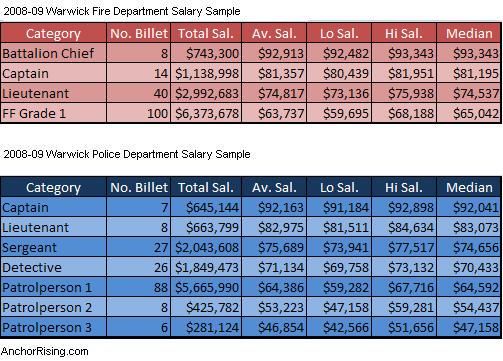
I don't have much analysis to offer for these last examples. They are what they are. Additionally, a quick survey of the municipal payroll reveals a lot of salaries that fall within the "average Rhode Islander" pay range or below, with a few high-salary, supervisor positions, as well. (For further comparison, this site purports to supply salaries for a range of private sector jobs in Warwick). I'll conclude with this: taxpayers should be aware of these numbers so that they can determine whether they think these are legitimate wages to pay for the jobs being done or not.
July 3, 2009
Don't Bogart that Revenue Stream, My Friend
The Rhode Island Senate has ordered a study of the legalization of marijuana. Would that the goal was merely to adjust our illicit drug use ranking by reclassifying one of the drugs. Alas, they specifically voted
to explore how much Rhode Island might collect in revenue if it were to make all sales of marijuana legal and impose a “sin tax” of $35 per ounce.
The main problem, of course, is big picture. Rather than looking for extreme sources of revenue, the General Assembly needs to continue focusing on the reduction of expenditures on the state and local levels. Two areas most urgently, though not exclusively, requiring attention are mandates for cities and towns and public pensions. (Pension reform measures included in the 2010 budget were a good step but by no means the end of the journey.)
Secondly, however, think of the proposed revenue source itself. More specifically, consider the health risks associated with it.
Shouldn't it raise a red flag about our budgeting and mandate policies that we are now looking to expand revenue opportunities in the area of behavior that is physically harmful to human beings?
July 1, 2009
All-Around Revenue-Per-Resident for Rhode Island Cities and Towns
By adding in a few other sources to the figures for residential, commercial and industrial tax levies from the previous post, it's possible to come up with a meaningful estimate of total local revenue-per-resident available to each Rhode Island city and town.
The set of sources included in the table below are...
- Residential Property Tax Levy
- Commercial and Industrial Property Tax Levy
- State Education Aid (with money for regional districts apportioned by population)
- State "Payments in lieu of taxes" (which are different from General Revenue Sharing)
- Fire district levies for the towns that have them (derived from Municipal Affairs data available here and here).
One again, the floor is open to those who would like to offer local insight into how well they think their community is or is not doing. Where are the problems with revenue, and where are they with spending...
| Municipality | Residential Levy | Commercial/ Industrial Levy | Education Aid | PILOT | Fire District Levies | Total | Total per Resident |
| New Shoreham | $6,231,198 | $604,721 | $106,345 | $0 | $0 | $6,942,264 | $6,819.51 |
| East Greenwich | $31,382,267 | $5,296,400 | $1,949,761 | $7,940 | $4,116,926 | $42,753,294 | $3,208.74 |
| Jamestown | $16,406,255 | $546,534 | $531,908 | $0 | $0 | $17,484,697 | $3,174.42 |
| Barrington | $44,075,086 | $1,498,396 | $2,599,526 | $53,865 | $0 | $48,226,873 | $2,940.84 |
| Newport | $40,355,194 | $15,540,882 | $11,871,080 | $658,326 | $0 | $68,425,482 | $2,880.83 |
| Middletown | $26,495,287 | $9,678,806 | $10,497,116 | $0 | $0 | $46,671,209 | $2,874.20 |
| West Greenwich | $9,188,519 | $4,877,639 | $3,893,345 | $0 | $0 | $17,959,503 | $2,814.09 |
| Westerly | $49,194,534 | $6,074,013 | $6,843,077 | $132,288 | $3,033,734 | $65,277,646 | $2,797.41 |
| Central Falls | $6,499,901 | $2,441,721 | $43,494,684 | $0 | $0 | $52,436,306 | $2,795.56 |
| Charlestown | $18,411,735 | $628,185 | $2,138,842 | $0 | $1,161,562 | $22,340,324 | $2,760.11 |
| Hopkinton | $13,421,164 | $1,184,823 | $6,375,407 | $0 | $922,163 | $21,903,557 | $2,745.49 |
| Foster | $8,073,902 | $865,586 | $3,134,313 | $270 | $0 | $12,074,071 | $2,686.11 |
| Portsmouth | $34,990,389 | $3,378,376 | $6,700,042 | $0 | $469,642 | $45,538,449 | $2,677.79 |
| Little Compton | $8,816,111 | $233,479 | $368,810 | $0 | $0 | $9,418,400 | $2,668.10 |
| North Kingstown | $50,529,940 | $7,563,806 | $11,986,005 | $6,836 | $0 | $70,086,587 | $2,632.56 |
| Providence | $126,320,027 | $109,849,157 | $194,109,756 | $20,124,158 | $0 | $450,403,098 | $2,620.31 |
| Richmond | $11,781,571 | $1,125,047 | $6,316,890 | $627 | $487,037 | $19,711,172 | $2,582.02 |
| Glocester | $16,559,354 | $1,260,807 | $7,225,858 | $0 | $1,172,352 | $26,218,371 | $2,497.46 |
| Exeter | $9,516,802 | $964,257 | $3,767,674 | $0 | $1,002,655 | $15,251,388 | $2,469.46 |
| Narragansett | $35,239,211 | $3,075,835 | $1,897,159 | $0 | $245,877 | $40,458,082 | $2,458.26 |
| Warwick | $105,379,974 | $64,148,344 | $37,626,000 | $862,977 | $0 | $208,017,295 | $2,449.11 |
| South Kingstown | $52,242,106 | $6,459,733 | $10,548,698 | $121,138 | $2,111,876 | $71,483,551 | $2,448.32 |
| Tiverton | $27,393,724 | $2,181,018 | $5,932,058 | $0 | $771,052 | $36,277,852 | $2,409.05 |
| Lincoln | $26,341,821 | $14,305,179 | $7,403,268 | $0 | $4,176,962 | $52,227,230 | $2,371.16 |
| Coventry | $46,659,667 | $7,909,545 | $20,075,081 | $0 | $6,995,106 | $81,639,399 | $2,370.14 |
| Scituate | $14,630,732 | $6,446,351 | $3,407,183 | $0 | $0 | $24,484,266 | $2,260.57 |
| Warren | $15,154,909 | $2,927,764 | $6,752,877 | $0 | $0 | $24,835,550 | $2,247.56 |
| North Smithfield | $16,445,109 | $3,544,559 | $4,834,237 | $38,817 | $0 | $24,862,722 | $2,209.23 |
| West Warwick | $33,119,054 | $10,884,478 | $20,440,547 | $0 | $0 | $64,444,079 | $2,204.42 |
| Johnston | $41,208,491 | $10,126,741 | $10,915,364 | $0 | $0 | $62,250,596 | $2,178.19 |
| Cranston | $101,633,398 | $33,630,811 | $35,580,911 | $3,583,905 | $0 | $174,429,025 | $2,175.17 |
| Burrillville | $16,914,506 | $1,262,835 | $13,854,743 | $78,891 | $2,386,221 | $34,497,196 | $2,097.48 |
| Bristol | $28,288,884 | $3,202,795 | $13,745,313 | $560,835 | $0 | $45,797,827 | $2,036.18 |
| Smithfield | $27,295,469 | $8,661,278 | $5,743,568 | $437,602 | $0 | $42,137,917 | $1,986.42 |
| East Providence | $44,567,063 | $22,748,792 | $26,888,254 | $61,629 | $0 | $94,265,738 | $1,939.46 |
| Pawtucket | $47,200,154 | $21,647,143 | $67,023,559 | $330,377 | $0 | $136,201,233 | $1,889.45 |
| Woonsocket | $23,083,073 | $11,098,260 | $47,661,613 | $173,199 | $43,438 | $82,059,583 | $1,889.12 |
| Cumberland | $40,650,687 | $4,447,466 | $13,257,009 | $139 | $5,841,193 | $64,196,494 | $1,877.58 |
| North Providence | $34,525,710 | $10,288,392 | $13,382,872 | $533,146 | $0 | $58,730,120 | $1,792.19 |
Commercial Property Tax Revenue By City and Town (And an Inquiry into Providence's Complaints About Tax-Exempt Properties)
Nothing says it's the new fiscal year quite like the presentation of new fiscal data, to help provide context for the major local decisions on taxing and spending being made all across Rhode Island.
This compilation actually began as an analysis of Providence city government's claim that it is handicapped in its ability to raise sufficient revenues by the large amount of tax-exempt property within its borders -- a claim that, at least according to two basic initial indicators, doesn't seem to be particularly strong.
On an annual basis, the Municipal Affairs office within the state government’s Department of Administration compiles data on the property tax levies, broken down by residential versus commercial/industrial classifications, for each Rhode Island municipality. The latest results available from valuations done at the end of 2007 show that, despite its quantity of tax-exempt property, Providence still receives the 5th-highest amount of commercial and industrial property tax revenue per-resident of any city in Rhode Island. Here's the entire list...
| Municipality | Commercial/Industrial Property Tax Levy | Population | C/I Rev. Per Resident |
| West Greenwich | $4,877,639 | 6,382 | $764.28 |
| Warwick | $64,148,344 | 84,936 | $755.26 |
| Newport | $15,540,882 | 23,752 | $654.30 |
| Lincoln | $14,305,179 | 22,026 | $649.47 |
| Providence | $109,849,157 | 171,889 | $639.07 |
| Middletown | $9,678,806 | 16,238 | $596.06 |
| Scituate | $6,446,351 | 10,831 | $595.18 |
| New Shoreham | $604,721 | 1,018 | $594.03 |
| East Providence | $22,748,792 | 48,604 | $468.04 |
| Cranston | $33,630,811 | 80,191 | $419.38 |
| Smithfield | $8,661,278 | 21,213 | $408.30 |
| East Greenwich | $5,296,400 | 13,324 | $397.51 |
| West Warwick | $10,884,478 | 29,234 | $372.32 |
| Johnston | $10,126,741 | 28,579 | $354.34 |
| North Smithfield | $3,544,559 | 11,254 | $314.96 |
| North Providence | $10,288,392 | 32,770 | $313.96 |
| Pawtucket | $21,647,143 | 72,085 | $300.30 |
| North Kingstown | $7,563,806 | 26,623 | $284.11 |
| Warren | $2,927,764 | 11,050 | $264.96 |
| Westerly | $6,074,013 | 23,335 | $260.30 |
| Woonsocket | $11,098,260 | 43,438 | $255.50 |
| Coventry | $7,909,545 | 34,445 | $229.63 |
| South Kingstown | $6,459,733 | 29,197 | $221.25 |
| Portsmouth | $3,378,376 | 17,006 | $198.66 |
| Foster | $865,586 | 4,495 | $192.57 |
| Narragansett | $3,075,835 | 16,458 | $186.89 |
| Exeter | $964,257 | 6,176 | $156.13 |
| Hopkinton | $1,184,823 | 7,978 | $148.51 |
| Richmond | $1,125,047 | 7,634 | $147.37 |
| Tiverton | $2,181,018 | 15,059 | $144.83 |
| Bristol | $3,202,795 | 22,492 | $142.40 |
| Central Falls | $2,441,721 | 18,757 | $130.18 |
| Cumberland | $4,447,466 | 34,191 | $130.08 |
| Glocester | $1,260,807 | 10,498 | $120.10 |
| Jamestown | $546,534 | 5,508 | $99.23 |
| Barrington | $1,498,396 | 16,399 | $91.37 |
| Charlestown | $628,185 | 8,094 | $77.61 |
| Burrillville | $1,262,835 | 16,447 | $76.78 |
| Little Compton | $233,479 | 3,530 | $66.14 |
And in terms of the ratio of commercial/industrial collections versus residential taxes collected, it's not even close who the biggest beneficiary of commercial property taxes is...
| Municipality | Commercial/Industrial Property Tax Levy | Residential Property Tax Levy | C/I as % of Res. |
| Providence | $109,849,157 | $126,320,027 | 87.0% |
| Warwick | $64,148,344 | $105,379,974 | 60.9% |
| Lincoln | $14,305,179 | $26,341,821 | 54.3% |
| West Greenwich | $4,877,639 | $9,188,519 | 53.1% |
| East Providence | $22,748,792 | $44,567,063 | 51.0% |
| Woonsocket | $11,098,260 | $23,083,073 | 48.1% |
| Pawtucket | $21,647,143 | $47,200,154 | 45.9% |
| Scituate | $6,446,351 | $14,630,732 | 44.1% |
| Newport | $15,540,882 | $40,355,194 | 38.5% |
| Central Falls | $2,441,721 | $6,499,901 | 37.6% |
| Middletown | $9,678,806 | $26,495,287 | 36.5% |
| Cranston | $33,630,811 | $101,633,398 | 33.1% |
| West Warwick | $10,884,478 | $33,119,054 | 32.9% |
| Smithfield | $8,661,278 | $27,295,469 | 31.7% |
| North Providence | $10,288,392 | $34,525,710 | 29.8% |
| Johnston | $10,126,741 | $41,208,491 | 24.6% |
| North Smithfield | $3,544,559 | $16,445,109 | 21.6% |
| Warren | $2,927,764 | $15,154,909 | 19.3% |
| Coventry | $7,909,545 | $46,659,667 | 17.0% |
| East Greenwich | $5,296,400 | $31,382,267 | 16.9% |
| North Kingstown | $7,563,806 | $50,529,940 | 15.0% |
| South Kingstown | $6,459,733 | $52,242,106 | 12.4% |
| Westerly | $6,074,013 | $49,194,534 | 12.3% |
| Bristol | $3,202,795 | $28,288,884 | 11.3% |
| Cumberland | $4,447,466 | $40,650,687 | 10.9% |
| Foster | $865,586 | $8,073,902 | 10.7% |
| Exeter | $964,257 | $9,516,802 | 10.1% |
| New Shoreham | $604,721 | $6,231,198 | 9.7% |
| Portsmouth | $3,378,376 | $34,990,389 | 9.7% |
| Richmond | $1,125,047 | $11,781,571 | 9.5% |
| Hopkinton | $1,184,823 | $13,421,164 | 8.8% |
| Narragansett | $3,075,835 | $35,239,211 | 8.7% |
| Tiverton | $2,181,018 | $27,393,724 | 8.0% |
| Glocester | $1,260,807 | $16,559,354 | 7.6% |
| Burrillville | $1,262,835 | $16,914,506 | 7.5% |
| Charlestown | $628,185 | $18,411,735 | 3.4% |
| Barrington | $1,498,396 | $44,075,086 | 3.4% |
| Jamestown | $546,534 | $16,406,255 | 3.3% |
| Little Compton | $233,479 | $8,816,111 | 2.6% |
(The population data is from Census Bureau estimates, via the state's department of labor and training).
Taken together, these two rankings make it very difficult to sustain a claim that Providence is somehow being shorted in property taxes -- especially when Providence is doing so much better in commercial and industrial property tax revenue than Rhode Island's other densely populated urban areas like Pawtucket and Woonsocket -- if Providence's problems are rooted in too much property not on the tax rolls, then shouldn't it actually be doing noticably worse in commercial tax collections than Rhode Island's other cities?
Now, the point here is not to pick on the people Providence. It's to pick on their city government. At some point when a city government's major explanations for its financial problems are that 1) people inside the city aren't giving the government enough money and 2) people outside of the city aren't giving the government enough money, it's time to consider that the problem might not be with the people, but with the government. Clutching and grabbing for every dollar that can be taken from everyone associated with a city is not a winning formula for cultivating the balance of activities needed to make an urban area vibrant.
One final point about the overall list: I suspect that the success of Middletown and Warwick at rasing commercial and industrial revenue is going to give the smart-growth folks of Rhode Island fits, as when it's combined with a bit of knowledge of local commercial geography, it sure looks like a strip-mall dominated retail sector is a great way to raise property tax revenue in a municipality.
The floor is now open, for who have insight into the meaning of these figures in different communities...
June 26, 2009
The Cap and Trade Scam
OK, what's this "cap and trade" thing all about? Well, first its a bid to massively change some fundamentals of our economy all for the sake of reducing global warming (by a few tenths of a degree Celsius in a few decades). Although the powerless House GOP has offered arguments against its passage, Democratic leaders have had more problems with their own rank-and-file (especially blue dog and farm-state Dems) and have been forced to make deals in hopes of pushing the Waxman-Markey bill through today (though no one will have a chance to read it--kinda sounds like RI).
The reason for the resistance is simple: no matter how you slice it, American's are going to pay more for everything for the sake of "feeling better" about "doing our part" to help reduce global warming. Or something. Its a redistributive tax increase, plain and simple, and it affects that 95% of the people President Obama claims to want to leave alone.
The Congressional Budget Office review of the bill explains the basics:
H.R. 2454 would establish two cap-and-trade programs, one for six GHGsThe CBO also determined that:
(mostly CO2) {GHG= "green house gas"--ed.} and one for a seventh GHG, hydrofluorocarbons (HFCs). The first program, the focus of this analysis, is generally referred to as the GHG cap-and-trade program. H.R. 2454 would set limits on GHG emissions for each year. Regulated entities could comply with the policy in some combination of three ways:■ By reducing their emissions,
■ By holding an allowance for each ton of GHGs that they emitted, or
■ By acquiring an “offset credit” for their emissions.Offset credits would be generated by firms that were not covered by the cap but that reduced their emissions or took actions to store emissions in trees and soil, using methods that would be approved by the Environmental Protection Agency. The bill would allow firms to use a significant quantity of offset credits—generated in the United States and overseas, with a maximum quantity for each specified in the legislation—toward compliance with the cap. Most of those offset credits would be generated by changes in agricultural and forestry practices. To the extent that acquiring offset credits was cheaper than undertaking more emission reductions, allowing firms to comply with offset credits would lower compliance costs overall.
Congressional Budget Office (CBO) estimates that the net annual economywide cost of the cap-and-trade program in 2020 would be $22 billion—or about $175 per household. That figure includes the cost of restructuring the production and use of energy and of payments made to foreign entities under the program, but it does not include the economic benefits and other benefits of the reduction in GHG emissions and the associated slowing of climate change. CBO could not determine the incidence of certain pieces (including both costs and benefits) that represent, on net, about 8 percent of the total. For the remaining portion of the net cost, households in the lowest income quintile would see an average net benefit of about $40 in 2020, while households in the highest income quintile would see a net cost of $245. Added costs for households in the second lowest quintile would be about $40 that year; in the middle quintile, about $235; and in the fourth quintile, about $340. Overall net costs would average 0.2 percent of households’ after-tax income.However, the Wall Street Journal explains the CBO was too narrow in its projections:
For starters, the CBO estimate is a one-year snapshot of taxes that will extend to infinity. Under a cap-and-trade system, government sets a cap on the total amount of carbon that can be emitted nationally; companies then buy or sell permits to emit CO2. The cap gets cranked down over time to reduce total carbon emissions....Kind of a big caveat, there. The WSJ also mentions the analysis of Waxman-Markey conducted by the Heritage Foundation, and summarizes the findings:The biggest doozy in the CBO analysis was its extraordinary decision to look only at the day-to-day costs of operating a trading program, rather than the wider consequences energy restriction would have on the economy. The CBO acknowledges this in a footnote: "The resource cost does not indicate the potential decrease in gross domestic product (GDP) that could result from the cap."
Under this more comprehensive scenario, [Heritage] found Waxman-Markey would cost the economy $161 billion in 2020, which is $1,870 for a family of four. As the bill's restrictions kick in, that number rises to $6,800 for a family of four by 2035.But, at least we'll have less global warming. Maybe. In truth, as the WSJ explained back in March:
Cap and trade, in other words, is a scheme to redistribute income and wealth -- but in a very curious way. It takes from the working class and gives to the affluent; takes from Miami, Ohio, and gives to Miami, Florida; and takes from an industrial America that is already struggling and gives to rich Silicon Valley and Wall Street "green tech" investors who know how to leverage the political class.Taking from blue-collars and giving to Bobos, how "progressive."
June 24, 2009
Flat Tax Good, but Not Enough
As you may have heard, the gradually decreasing flat tax in Rhode Island has survived attempts to freeze or repeal it (so far). I'd note, though, an excellent point that Matt Allen made during the six o'clock hour: It's foolish to think that the flat tax decrease is sufficient. For two things: Rhode Island's tax advantage for capital gains is evaporating with this budget, and new savings for businesses have been left on the cutting room floor.
The tendency of disputants to break the big questions into their constituent parts goes a long way toward explaining the condition of our state. It's all patchwork policy, with no overarching principle. We trade this tax break for that union concession and that welfare adjustment, with the result being incoherence and inadequate counterbalance to the special interests that have infested the State House and town halls. Any potential reform candidates loitering about the edges of public consciousness should come up with a holistic plan and insist that it only works as an irreducible machine — as I've been suggesting that the governor do by disowning the budget if the General Assembly made any substantial changes.
We need responses to such statements as the following example, from Matt Jerzyk, of why I'm nostalgic for the previous iteration of RI Future:
What should be more important in a recession in Rhode Island? Just think about it.If you are recently unemployed in Rhode Island or facing tough times at work, can you afford a jump in your property tax bills?
Alternatively, would a Rhode Island millionaire even know if their accountant paid a little more on their tax returns.
Even a few hundred dollars of increase or decrease in a given tax bill is not what unemployed Rhode Islanders need. They need jobs. They need businesses that find their state to be an attractive place to open up shop and expand — without special deals or credits, merely because that's the way the state is structured. They need the sorts of people who have money to burn no matter the overall economy renovating homes, buying goods, dining out... being present and living their lives among us.
As for the millionaires and their accountants, the premise that we can slip tax increases by them is (I'll euphemize) poorly considered. Even so, an accountant will inform his clients if a move — often an on-paper affair, when it comes down to it — to Rhode Island would cost them thousands or millions over a certain period of time or from Rhode Island would save them the same.
Dirigo, Indeed
From the Wall Street Journal
At last, there's a place in America where tax cutting to promote growth and attract jobs is back in fashion. Who would have thought it would be Maine?Dirigo? We can only Hope.This month the Democratic legislature and Governor John Baldacci broke with Obamanomics and enacted a sweeping tax reform that is almost, but not quite, a flat tax. The new law junks the state's graduated income tax structure with a top rate of 8.5% and replaces it with a simple 6.5% flat rate tax on almost everyone. Those with earnings above $250,000 will pay a surtax rate of 0.35%, for a 6.85% rate. Maine's tax rate will fall to 20th from seventh highest among the states. To offset the lower rates and a larger family deduction, the plan cuts the state budget by some $300 million to $5.8 billion, closes tax loopholes and expands the 5% state sales tax to services that have been exempt, such as ski lift tickets.
(snip)
One question is how Democrats in Augusta were able to withstand the cries by interest groups of "tax cuts for the rich?" Mr. Baldacci's snappy reply: "Without employers, you don't have employees." He adds: "The best social services program is a job." Wise and timely advice for both Democrats and Republicans as the recession rolls on and budgets get squeezed.
A Simplistic Reaction to the Flat Tax Will Hurt the State and Cities and Towns
Everybody wants to nix the flat tax in Rhode Island:
The dispute has drawn the interest of a host of powerful players — labor unions, mayors, and a coalition of elected officials — who hope to repeal the high-profile tax break that benefits 2,267 Rhode Island taxpayers. Supporters want to funnel the savings to the cash-strapped cities and towns, which are slated to lose more than $55 million in state aid for the budget year that begins in seven days.
Municipalities think it's an easy way to get a few million more dollars. Union members think it's a way to ensure that the local and state governments that employ them will be able to make payroll. Elected officials think they'll pick up a good talking point about looking after the majority against the narrow interests of a wealthy minority. I'd suggest that all of these groups would do well to be wary of short-term thinking.
As I've followed long-term trends from both Census and IRS data, the conclusion has emerged that one area in which Rhode Island has seen positive developments is among wealthier residents. Indeed, the state income that taxpayers with incomes over $200,000 per year are claiming on their federal tax returns was up more than 50% from 2002 to 2006 — the period during which our state's tax reforms began to kick into effect. That is why Steve Peoples and Cynthia Needham's characterization is woefully incomplete:
The state will forgo an estimated $34.7 million in tax revenue next year because of the flat-tax option, according to an analysis by the State Budget Office.In tax year 2009, the rate is scheduled to drop from 7 to 6.5 percent. If frozen at the current rate, the state could recover $12.2 million in tax revenue for the coming fiscal year, according to the governor’s budget office.
One cannot calculate the "cost" of the flat tax by recalculating returns as if it did not exist, because some percentage of returns would not exist if it were not for the flat tax option. With residents with household incomes over $200,000 contributing about $400 million in income and alternative minimum taxes every year, we're talking a huge amount of money.
Unfortunately, the relevant data from the state ranges only from 2005 to 2007, and the presentation of resident and non-resident taxes is not uniform. Nonetheless, looking at the resident returns (which are parallel to federal data addressing Rhode Islanders), one can observe that, over that period, the total income and alternative minimum tax collected by the state was up more than $5.12 million from those earning over $200,000 and up a total of $40.33 million from those earning over $100,000. The actual number of state tax returns filed by those earning between $100,000 and $200,000 increased 20.8%, and those showing income over $200,000 increased 14.2%.
This is where advocates for repealing the flat tax will point out that, while actual taxes paid by the $100,000-199,999 group increased $13.5 million (5.5%) from 2006 to 2007, those earning over $200,000 — who benefit most from the flat tax option — contributed $37.4 million (8.6%) less. Given the close proximity of the dollar amounts, one might presume that the flat tax simply gave that money away (as Rep. Scott J. Guthrie, D-Coventry, would put it). That would be incorrect.
Of that year-to-year loss, the capital gains tax accounted for $30.1 million. In other words, non-capital gains income taxes among the wealthiest group decreased only $6.5 million (1.9%) in 2007 from 2006. More importantly, the average adjusted gross income per return fell 4.3%. (I'm not sure whether that includes capital gains.) Although there were more of them, the rich, that is, earned less money to tax.
All such aggregate analyses are tricky, of course, because so many factors and considerations come into play. Advocates making the journey from their municipalities to the State House to demand those dollars that the flat tax "gives away" should recall that these are residents. They are paying property taxes on homes and vehicles. They are paying fees for everything from dog registrations to construction permits. If they leave, they take not only the income tax dollars that the state may (or may not) filter down to the local level, but also all of the revenue that cities and towns currently procure directly. Moreover, they take the money that they pay to other residents as part of the private-sector economy.
For some general and rough perspective, consider this: The number of tax returns showing income over $200,000 increased 14% from 2005 to 2007. It will only have to decrease by about 7% for repeal of the flat tax to be a revenue wash for state income tax alone. If we broaden the group to those over $100,000, the increase from 2005 to 2007 was 19%, and only a 3% loss of the current number would cancel out the estimated tax revenue gain.
Rhode Island is already turning away from the path toward a vibrant economy in a vain attempt to ease short-term pain — which is to say that it is continuing on its path to collapse. Let's not expedite the process.
June 22, 2009
It's Almost as if There's Only a Real Interest in the Problems of One Community…
Over at RI Future, Pat Crowley doesn't seem quite up to speed on the public budgeting process occurring in most Rhode Island cities and towns. Mr. Crowley assumes that last week's announcement that there will be no general revenue sharing in FY2009-2010 means that city and town governments will have to "re-raise" taxes.…
If the State does not repeal the flat tax and continues the elimination of general revenue sharing, this is how much towns would have to re-raise their property taxes to make up the difference.But if "re-raising" taxes means municipal governments asking for more than they've already asked for, he's wrong. North Providence, for example, built an assumption of zero state aid into its budget for FY2010 (see page 5). In fact, according to Philip Marcelo's report in Sunday's Projo, most Rhode Island cities and towns have already accounted for the cut in general revenue sharing...For example...take a look at North Providence....
Mayor David N. Cicilline says his administration will need to resubmit his plan for the fiscal year beginning July 1 if the General Assembly votes to end the $55-million general revenue-sharing program that Providence and other Rhode Island communities have enjoyed for two decades….Providence appears to have taken a gamble that few other communities were willing to make in assuming it would get anything at all from the state from the program.I know Cranston has zeroed out its general revenue sharing figure for FY2010 (see page 4). Warwick too (see page 105). So did the town of Lincoln (see the bright yellow column, hidden on page 1). Mr. Crowley is active in party politics in Lincoln, so you might of thought he'd have a sense of what's going on there, but I guess not, as he claims that Lincoln will either have a 1.65% or a 3.46% "re-raising" of property taxes, depending on which of his RI Future posts you believe.
Actually, the 3.46% for Lincoln is obviously the result of a second layer of faulty analysis, where Mr. Crowley tries to calculate the percentage tax-increase that replacing general revenue sharing would require, but presents inflated figures as the result of considering only the municipal side of the local spending, neglecting the fact that property taxes also are used to pay for schools. (Is this error maybe corrected between the two posts?) That error notwithstanding, however, any "re-raising" of taxes in most municipalities, as a result of the official announcement on general revenue sharing, will amount to 0%, because most city and town governments budgeted responsibly and assumed that no aid was coming.
The major exception, of course, is Providence, where the administration of Mayor David Cicilline assumed that the city would receive 6 million dollars in state aid, and now has to re-budget assuming the loss. The total lesson from all of this, as always, is that progressives and public finance don't mix.
June 8, 2009
Gauging Effectiveness of Tax Policy
In any kind of system--computers, manufacturing, planned maintenance, what have you--the importance of a "feedback loop" is recognized. Basically, you have a process or method in place and you want input as to how well it is working. "Good" feedback often necessitates a change in operating process or, possibly, system design. In yesterday's ProJo, John Kostrzewa essentially asks that our corporate tax policy--specifically targeted tax credits for certain businesses--be put in a feedback loop. The question: are we getting the benefits we hoped for (more jobs) when we let companies pay the state less in corporate taxes?
This is the way economic development gets done across the country. A corporation has jobs. The government has giveaways or tax breaks. They woo each other, get married and everybody lives happily ever after.As Kostrzewa explains, current head of the Department of Revenue Gary Sasse advocated for just such a review process when he was running the Rhode Island Public Expenditure Council (RIPEC):Except nobody checks back to see if the incentives really accomplished what they set out to achieve.
But now, Rhode Island has started to take a peek.
When he ran the Rhode Island Public Expenditure Council, he advocated tax breaks that are accountable, transparent and targeted toward specific types of jobs. As head of the state Department of Revenue, he pushed forward the collection of data. He also headed the tax reform panel created by Governor Carcieri that advocated a study of job-creation tax credit and questioned why they shouldn’t be reserved for higher-paying jobs with benefits.Sasse says that such a study would be "complex." Well, that's too bad, such a study should be done to see if it's actually working. And if targeted tax cuts don't work, maybe the solution lay in broad based tax incentives, huh?But now, in his additional role as head of the Department of Administration, he seems less aggressive.
May 29, 2009
Legislators Making Up Taxes as They Go
One must laugh out loud, if only to keep from crying. Here go Rhode Island legislators toying with making tax code more complicated and less beneficial to taxpaying corporations, with a tinge of state tinkering with the shape of the economy (i.e., what sorts of businesses it rewards):
Current law generally allows the tax break only if a business creates jobs that pay at least $11 an hour or so (about $22,900 or so a year, based on a 40-hour workweek).The proposed legislation would allow the break only if a business creates jobs that pay at least $18.50 an hour or so (about $38,500 a year).
State Rep. Steven M. Costantino, D-Providence, chairman of the powerful House Finance Committee, and chief sponsor of the bill (H 6164), said, "I think we all want [more] jobs. But in order to get a credit, I think you have to have a higher threshold."
Businesses would continue to be free to create jobs at various pay levels, Costantino stressed.
But in order to claim the tax break, they would have to create jobs that pay more money than the law currently requires — and also carry health insurance and retirement benefits, according to the bill.
And yet:
The state thus far has not studied in detail the benefits that the job-creation or other such tax breaks provide to the state, cities and towns, such as tax payments made by the job holders or other economic benefits.
As far as I can tell, there's not even any sort of governing philosophy behind vague expectations about what the actual results of such legislation will be. That is, legislators don't even appear to consider whether, in broad terms, more companies will benefit, fewer will benefit, more will create jobs, or fewer will create the jobs that apply to their business models (because they don't qualify for incentives).
Of course, the whole issue is colored by the fact that this tax break is largely enjoyed by a single company — CVS. That being the case, the General Assembly should just make things simpler and boost business activity period by lowering the taxes and trimming the fees, regulations, and mandates on people and organizations that contribute to Rhode Island's economy.
May 27, 2009
Using the Same Story Everywhere to Push for Budgets
There's a familiar sound to status-quo argumentation that Matt Welch's highlights among those who lament that "petulant voters failed to heed the weary wisdom of their betters" in California:
Calfornia lawmakers, and the unions who put them into office, will do everything in their power to cut services first, employees last. That is indeed a crucial reason why we got here in the first place. Any analysis that doesn't explore how a higher-than-inflation-plus-immigration budget has failed to deliver on any increase in services, is not an analysis worth taking more seriously than common propaganda.
When special interests are done soaking up new money, the not-so-paradoxical result seems to be even less money for such basic government functions as infrastructure. And whether the government in question is local or state, the repeated talking points hardly stand up to a moment's display of reality:
California companies would then find it harder to attract high-value employees who might be dubious about moving to a state with sub-par schools. Here is the fundamental point behind every California budget story: The state has increased spending on K-12 education by 40 percent under Schwarzenegger (it has to; by dumb law, 40 cents on every state dollar has to go to education). The main drain on the California economy is that these massive increases in spending are producing ZERO noticeable improvements. Because the union-run school districts are infamous laboratories for inefficiency, job protection, and corruption, the state spends and spends, with nothing to show for it. Teachers unions are literally running out of other people's money, and now they warn us about "sub-par schools"? That par got done subbed a long time ago. If politicians, journalists, and other "experts" want to defend the status quo (of constant spending increases), then they need to explain why Californians need to keep throwing more and more good money after bad on a K-12 system that is showing no results.
(via Instapundut)
May 23, 2009
Telling Reasons to Object to Tax Cuts
I've got my reservations about Governor Carcieri's tax proposals on the grounds that they don't go far enough, especially in extending their effects to middle and working class residents. But some of the objections from the other side should inadvertently direct Rhode Islanders' attention to the underlying problems of the state:
Karen Malcolm, executive director of Ocean State Action, a coalition of labor unions and advocacy groups, said previous state tax cuts have not worked. "The policies we've been following have not brought the promised jobs," she said.Instead of phasing out the corporate income tax, for example, Rhode Island should instead seek changes to local property taxes, which represent the single greatest tax burden for business, she said.
Of course, local property taxes are so high in part because the unions — especially the teachers' unions — have been more successful at pumping up their members' remuneration packages from that stream. Witness:
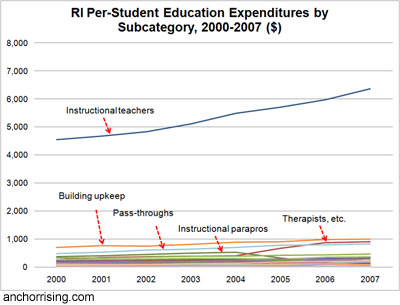
Malcolm goes on:
And to improve Rhode Island’s overall business climate, the state should focus on other areas, such as fixing crumbling roads and bridges, she said.
Of course, infrastructure repairs are more expensive than they would be absent union rule and the related regulations. (It's quite a thing to drive by a roadwork site and witness the two flag-bearing women standing next to each other, flags down, chatting while the mandatory police officer chats on his cell phone, back to the scene.) Moreover, the fact that the state typically allocates 0.0% of its General Revenue to transportation suggests that Malcolm is seeking to raise additional taxes to direct toward labor.
Then there's the other side of the problem:
Rick Harris, executive director of the Rhode Island chapter of the National Association of Social Workers, said Carcieri's proposals would drain away tax revenue at a time when it is most needed for education, health care and other programs. "If you're taking more money out of the system, how are we going to meet this need?" he said.
Directing the wealth of productive, working Rhode Islanders to those who are otherwise — even if the intention is to make them more productive — is part of what created our current hole. If we're to have any hope of turning things around, we must reverse our focus and increase activities that create revenue, rather than expend it.
Turning Up the Heat on Smokers
Laws should be enforced (or stricken or modified if they will not be), but there's something unseemly — extortionate — about this:
The state in April increased the excise tax on cigarettes by $1, to $3.46 a pack, the highest in the country. The move has obvious health benefits, but it also aims to generate millions more dollars for the financially strapped state.Now, state taxation and law-enforcement officials are poised to do their part. They are cracking down on the illegal sale of out-of-state cigarettes to make sure that the state collects as much money as possible from smokers who now plunk down some $8.35 for a pack. ...
Under state law, Rhode Island residents can have up to a carton of out-of-state cigarettes in their possession. Anything more and they are subject to arrest.
Violators face up to three years in prison and a $5,000 fine.
For reasons unrelated to money, I quit smoking about a decade ago, and it's increasingly difficult to comprehend what drives people to continue with the practice, but reading today's article, I found myself surprised to recall that it's about a legal product. The state government is facing tough financial times, so it has arbitrarily decided to collect more money from a population of residents who have a chemical and psychological dependency on a particular item.
Here's a clue that something isn't right with the current government attitude: Resident smokers' doing the right thing by their health would do more harm to the state revenue than does the illicit behavior on which the state police are so focused. If only for that reason alone, Rhode Island's smokers should kick the habit.
Do what they will, however, I'll still predict that revenue from this tax is going to go down, even if the number of smokers stays exactly the same. Unfortunately, Rhode Island businesses are likely to take a hit, as well, and not only on sales of cigarettes, but also on sales of such goods as smokers will pick up when they're out of state shopping.
May 21, 2009
Migratory Food for Thought
Tom Golisano puts high local taxation in perspective — the individual's perspective, that is:
Last week I spent 90 minutes doing a couple of simple things -- registering to vote, changing my driver's license, filling out a domicile certificate and signing a homestead certificate -- in Florida. Combined with spending 184 days a year outside New York, these simple procedures will save me over $5 million in New York taxes annually.By moving to Florida, I can spend that $5 million on worthy causes, like better hospitals, improving education or the Clinton Global Initiative. Or maybe I'll continue to invest it in fighting the status quo in Albany. One thing's certain: That money won't continue to fund Albany's bloated bureaucracy, corrupt politicians and regular special-interest handouts.
Have I mentioned, recently, that the state and local taxes that wealthy folks are paying in Rhode Island has been going up even as their rates go down?
(via Michelle Malkin)
May 19, 2009
A New Proposed Income Tax Structure for Rhode Island
Here are the details of the new income tax brackets contained in the state budget that Governor Carcieri submitted to the General Assembly (Article 38)...
| RI Taxable Income Over | But not over: | Pay | + % | on excess Amount over: |
| $0 | $55,000 | $0 | +3.5% | $ 0 |
| $55,000 | $110,000 | $1,925 | +4.0% | $55,000 |
| $110,000 | $175,000 | $4,125 | +4.5% | $110,000 |
| $175,000 | $7,050 | +5.5% | $175,000 |
However, there are also proposed changes in allowed deductions, which a staff report from the Projo summarizes as...
- Treating capital gains as ordinary income. (In general, the state’s maximum capital-gains tax rate now is 1.67 percent, or 0.83 percent in some circumstances.)
- Ending the option to claim a variety of “itemized” deductions, such as those for mortgage interest, local property taxes and charitable contributions. Instead, all taxpayers would claim a standard deduction, the amount of which would be expanded.
- Eliminating most of the state’s tax credits and keeping four: the statewide property-tax relief credit; an expanded earned-income credit (essentially a tax break for the working poor); a credit for lead paint abatement; and a credit for income taxes paid to other states.
May 15, 2009
I'm Sorry, You Don't Get to Create a Problem
... and then sternly point to it like you're an uninvolved third party.
President Barack Obama, calling current deficit spending “unsustainable,” warned of skyrocketing interest rates for consumers if the U.S. continues to finance government by borrowing from other countries.“We can’t keep on just borrowing from China,” Obama said at a town-hall meeting in Rio Rancho, New Mexico, outside Albuquerque. “We have to pay interest on that debt, and that means we are mortgaging our children’s future with more and more debt.”
Holders of U.S. debt will eventually “get tired” of buying it, causing interest rates on everything from auto loans to home mortgages to increase, Obama said. “It will have a dampening effect on our economy.”
May 14, 2009
Their Errors, Our Freedoms... and Taxes
So when the president's budget errs in its estimation to the tune $58 billion, why is a more invasive pursuit of taxes the obvious answer?
The Obama administration on Monday proposed $58 billion in additional taxes to offset budgeting errors that overstated revenues in the president's plan to finance health care reform.The tax measures target a host of activities, including people who for tax purposes aggressively reduce the value of property received as gifts or in estates. To reduce fraud, other provisions would require investors, contractors and taxpayers to provide more information about certain transactions to the Internal Revenue Service.
The largest budgeting error overstated the amount of money that would be raised by limiting charitable and other deductions for high-income taxpayers. The limits would generate $267 billion over the next 10 years — $51 billion less than the administration projected in February.
It seems that, no matter what happens — even an incident of miscalculation on the administration's part — the government gets a little bit more power and control.
May 12, 2009
The Budget Hole Rhode Island's In
Sympathy is in order for the state's lawmakers, although not of the exculpatory kind. It must seem to them that, no matter what they do, the economic dirt keeps falling in on them in the economic hole that they've dug:
Rhode Island government's budget deficits have grown by $200 million over the last six months, a massive jump that exacerbates an already-staggering budget hole and intensifies pressure on the General Assembly to raise taxes or slash state spending across a host of popular programs.Elected officials have less than two months to close combined budget holes totaling roughly $661 million, according to projections finalized Monday by the state's top budget officials on the final day of the semiannual Revenue and Caseload Estimating Conference. The shortfall includes an unanticipated current-year gap of $70 million and a $590-million deficit for the fiscal year that begins July 1. ...
Next year's hole amounts to approximately 19 percent of Rhode Island's current state budget, excluding federal dollars.
If you add in what's become a typical mid-year deficit in the hundreds of millions, the shortfall for fiscal 2010 hovers near a billion dollars. Upwards of a fifth of the working budget is money we don't have. But hey, it's not as if nobody's seen this coming. In fact, in considering an interviewer's question about the impetus behind Anchor Rising's founding back in 2004, I recalled that our prognostications for the state made action a civic imperative.
The state is reaping what it's sown, and those who've liked the policies that got us here just fine have but one scapegoat before they must begin battling each other for the trickle of satiating largess for their unhealthy dependency:
"We are paying the price not only for national and international economic factors, but also for years of misguided decisions by our policymakers that have cut taxes for those who need cuts the least, while increasing the pressure on the rest of us," Peter Asen, spokesman for the labor-backed advocacy group Ocean State Action, said in a statement.
As satisfying as some may find the class warfare angle, the reality is that income tax revenue from "those who need cuts the least" has gone up dramatically, with $228 million more paid by those with incomes over $100,000 in 2006 than in 2002, with $156 million more coming from those with incomes over $200,000.
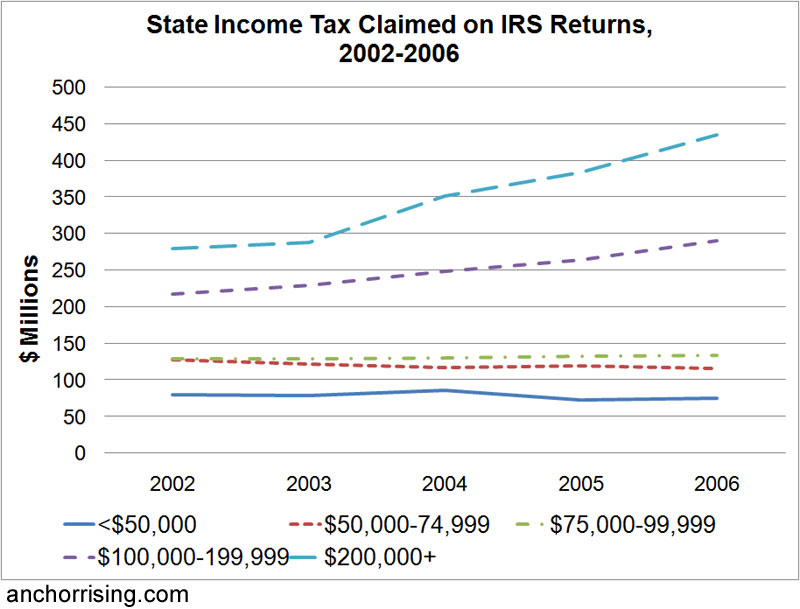
Rhode Island must push the likes of Ocean State Action aside and do what so clearly must be done.
Cut taxes. Trim mandates. Lighten regulations. And quick.
May 10, 2009
Big Brother Is Only Logical
Does anybody else pick up a willful naivete in Gerald Bastarache's advocacy for a mileage tax?
To measure these miles, the commission calls for "in-vehicle or after market Global Positioning System (GPS) devices" that would track the way we drive. The per-mile charge would depend on whether the driving is on crowded urban freeways during rush hour (higher charge) or lightly traveled rural roads (lower charge).The goal of the mileage tax is still to collect the funds we need for good highways through user fees, but in a more logical way than we do now.
The report says the amount charged for cars could range from 0.9 cents per mile to match current trust fund revenues, or go up to 2.3 cents per mile to "maintain and improve" the annual investment level.
The levels of taxation require careful calibration to ensure fairness. But compared with the current system, fairness should be relatively easy to achieve. ...
Privacy is sometimes cited as a concern, but privacy is protected when the data is kept within the vehicle. The many tracking devices already in today’s vehicles, such as OnStar, E-ZPass and LoJack, are effective without compromising privacy.
"Careful calibration" in a system of taxation that varies by location and maintenance needs? Chilling.
Moreover, consumers can have some trust in private companies, because if they violate that trust, car owners can cancel their services and even rip the units right out of the cars. If the violation is sufficiently egregious, the entire business model could tank. Taxpayers, by contrast, would not be permitted to "cancel" the service, except via indirect application of the political process, even when bureaucrats and government officials find the excuses to violate trust far too compelling to ignore.
May 9, 2009
UPDATED: Correction on Property Taxes
Based on conversation here and here, it appears that I was wrong to state that "a new methodology will skew taxes toward waterfront properties." Several people who are typically more specifically knowledgeable about town financial matters made statements that I apparently took too literally.
That said, Tiverton Tax Assessor David Robert has strangely refused to answer, here, direct questions about the process, a decision that I attribute more to my local reputation than to his having anything to hide. (I suspect that, in certain circles, I'm taken to be much more of a conniver than I actually am.)
What I'm trying to determine is whether a decreasing pool of sales from which to determine trends has resulted in differing bases for different neighborhoods. I'd welcome feedback from folks familiar with the controversy in Barrington, especially if it might pertain to the varying results in Tiverton.
ADDENDUM 05/09/09 2:14 p.m.:
After conversation with Tax Assessor David Robert after today's financial town meeting, I'm persuaded that nothing different was done that unfairly skewed the revaluation results... at least any more than is always the case.
In essence, all sales forming the basis for the revaluation were in town. In cases in which a subsection of houses had insufficient sales to make reassessments valid, the assessor calculated based on overall sales and the typical ratio of that neighborhood to the overall. (I'm summarizing the effect, here, and may not be to-the-letter accurate about the procedure as implemented.)
I'd argue that this methodology is inherently unfair, inasmuch as a neighborhood with too few sales can't even be said to have kept up with the values of the rest of the town. If a dozen houses sell in my working class neighborhood at a 10% decrease from previous assessments, but no houses sell down the hill from me, closer to the water, one cannot infer that they would have sold at that 10% decrease. Indeed, they might well have sold only if offered at a 50% decrease, which means that their value is unfairly assessed to have held.
That said, it would be difficult (mathematically or politically) to come up with a number that adjusts for sales that didn't happen. The town could investigate the prices that the houses weren't getting, but that would only give one a maximum and, as a matter of principle, bases taxes on prima facie unrealistic home values.
Whatever the case, I was unequivocally wrong to assert a change in methodology.
May 7, 2009
Rob Coulter: Property Revaluation and Subjectivity
I had a very helpful conversation with a gentleman from the property revaluation vendor for Tiverton last night, and I learned quite a bit about the process. By the way, he was very patient and cordial, and I was very impressed with him, even if we may arrive a different conclusions. I agree with Justin that this should be an exploratory dialogue, and I do not pretend to have all the answers either.
The truth is somewhat in the middle of what I'm reading from comments here. As far as I can tell, they are using a multivariable regression computer model. It is susceptible to error because the sample sizes are not statistically robust enough for so many variables. When this happens, judgment calls have to necessarily be made. In a sense, the "methodology" has not changed, but there are still many, many variables calling for subjectivity on the appraiser's part.. I don't want to go so far as to call these judgment calls arbitrary, but there is definitely enough play between the joints for the appraiser to "skew" (if that's the right word) a result based on assumptions being made.
Although it sounds fancy and complicated, the idea of using multivariable regression is to let the computer try to find the impact of one variable while holding all others constant. It's like algebra on acid. This can't be done by hand when there are dozens and dozens of variables, as there are, here, so we let a computer do it.
I do not believe that it is incorrect to use this type of modeling, but there are two very important qualifiers:
- The model only works if there are enough samples for each variable. I'm not sure there are here.
- More importantly, this model and all models have assumptions built into them. These assumptions are necessary for any model but are at the end of the day subjective and subject to dispute. For example, I learned last night that (roughly speaking) all taxpayers are taxed at nearly one acre of land no matter how much less they have, and owners with additional acres are only taxed at a very low cost per acre. So if you own one-third of an acre or one full acre, you pay about the same tax on land. Do you think that's fair? Maybe yes, maybe no, but these are some of the assumptions that lurk behind the "methodology."
There are myriad assumptions and they have a major impact. They do not involve only objective things such as acreage and square footage, but multiplying factors applied based on the style of the house. These are very subject to debate. For example, I argued that a solar panel on a roof should add value to a house based on fuel costs. The vendor suggested that it might detract because of decreased curb appeal. I replied that a new buyer could simply remove the panel. And so on. You can see how very quickly a lot of error and assumptions can creep into a system that otherwise sounds so impressive.
Again, I want to stress that I don't think anyone is trying any funny business here. I was very impressed with the vendor, and I also very much respect David Robert, Tiverton's tax assessor. But I do have experience with multivariable regression, and if that is the model behind this, I can tell you that we can't trust it wholesale. I don't think the "methodology" has changed, but there are many assumptions under this methodology that can be adjusted and are essentially subjective.
Rob Coulter is a member of the Tiverton Budget Committee as well as Tiverton Citizens for Change.
May 5, 2009
Taxes and Incentives
Most Rhode Islanders are likely ambivalent about their state's status as background scenery for Hollywood movies. Yeah, it's neat to see familiar places on the big screen, as well as to spot famous people around town, but it remains a novelty, not a matter of economic import or civic identity. Still, this strikes me as a fitting allegory:
A year after lawmakers voted to cap the controversial movie and TV tax-credit program, Rhode Island Film & Television Office Director Steven Feinberg acknowledges it has been "a challenge" to continue to attract movies and other productions to the state.Forget the historic charm and seaside vistas: without the tax breaks, Rhode Island loses a little of its luster.
One suspects that a similar dynamic exists with that much lauded "quality of life" by which certain players attempt to distract from the fact that scenery is of mere mild comfort when one can't pay the bills.
May 4, 2009
Property Tax Illusion
Because it works differently than most other taxes with which we're familiar, it surprised me when first I learned how property taxes are calculated, at least in Tiverton. In short, the rate is almost an irrelevant statistic. Confusion over that fact has led local Budget Committee and TCC member Tom Parker to pen the following explanation
2009 property revaluations have been mailed out in Tiverton, and if you listen carefully you can hear a collective sigh of relief across the town: "My property value has gone down, my taxes must be going down. Life is good, and I'm safe, at least for the time being, from the insatiable tax demands of the Tiverton government. For once, I can relax...right?" Actually, no. Unfortunately, things are not what they seem. There are two good reasons why you need to pay careful attention.First, the letter we taxpayers got in the mail was our property revaluation, and, indeed, for many of us it is significantly lower than the previous assessment (my own decreased about $120,000). The tax RATE is the other key component in the final calculation of YOUR property tax bill. The FY2009 tax rate proposed by the Budget Committee is $14.73/1000. This is a $3.47/1000 increase (31%) over the current tax rate of $11.26/1000. So even if your assessment has gone down, your taxes could substantially increase. In my case, even though my assessment decreased $120,000 (14%), I estimate my tax bill will increase by over $1,100 (12%).
The town doesn't apply the rate to the property values to figure out how much money it has to work with. Rather, it figures out how much money it wants and then divvies the total up among all of the property in town. When property values go down, it doesn't figure out how to function with less revenue; it simply adjusts the rate to ensure the same revenue as a matter of course, with no votes or political risks necessary.
So the key question, when it comes to revaluations and taxes isn't whether your house is worth more or less; it's how it changed compared with all of the other properties in town. If they all decrease by the same percentage, everybody's taxes stay the same.
It's true that, in Tiverton, a new methodology will skew taxes toward waterfront properties, this year, which means that recalculations will hurt those homeowners more. But as Tom describes, the huge leap in the rate likely means increase for anybody whose house's value dropped less than 31%. And that's before tax-revenue beneficiaries have their whack at the budget during the upcoming financial town meeting this Saturday.
ADDENDUM 05/09/09 5:10 p.m.
The deleted sentence is incorrect. See here for explanation. Apologies for the error.
May 2, 2009
A Tax by Any Other Name
Maintaining infrastructure is one of the basic tasks appropriate to government, but for that very reason — its clear importance — politicians in the state of Rhode Island tend to seek money for it independently, as a sort of deliberate afterthought. Rhode Islanders' ultimately don't want any bridges to collapse, and if they don't get incensed over the fact that the money wasn't already apportioned from taxes, they'll accept toll hikes even though they are, in effect, taxes for programs and giveaways that they wouldn't approve given the option:
The state Turnpike and Bridge Authority needs to raise tolls to pay for $50 million worth of repairs to the Pell and Mount Hope Bridges, Chairman David Darlington told a legislative committee Thursday.Darlington asked the House Finance Committee to approve borrowing the $50 million through a bond issue for the work, which would include repairing rusted steel and doing painting on both bridges. He said that a toll increase would be needed to cover the bond issue, but that the authority wants to avoid raising tolls for Rhode Island residents.
Darlington said it would be the first toll hike in the history of the Pell Bridge, which opened in 1969. And if tolls are reinstituted on the Mount Hope Bridge, it would be for the first time since they were eliminated in 1998. Maintenance on the Mount Hope Bridge is now paid for with tolls paid by drivers crossing the Pell Bridge.
Of course, even the bond and toll gimmicks are beginning to raise hairs, so the plan is at least to double EZPass charges on the Newport Bridge for out-of-state drivers only. Of course, those paying cash — the majority, at least the last time I went back and forth over the bridge, last Saturday — would not be distinguished by their license plates and would pay the out-of-state fee. (It'd be interesting to see the data related to cash and EZPass payments; it's not inconceivable that doubling the toll will spur more Rhode Islanders to get EZPass, thus decreasing revenue.)
Perhaps the most important point to absorb from the linked article is the ultimate cost of this $50 million bond:
According to the legislation before the committee, the bond issue could actually cost as much as $132 million when the cost of 8-percent interest is added in, assuming a 30-year maturity for the bonds.
I'll reach across the aisle, here, and note that even Tom Sgouros has raised an eyebrow over the fact that Rhode Island currently pays $100 million in interest on Department of Transportation borrowing every year. This game can't go on; our government is going to have to find ways to keep the roads and bridges in good repair with money already in its budgets.
April 30, 2009
Taxes and a Possible Taxer
Andrew briefed the audience of the Matt Allen show last night on the nature of Rhode Island taxes and fees, along with some notes on the bungling beginning of Lincoln Chafee's gubernatorial run. Stream by clicking here, or download it.
April 29, 2009
Taxes Plus Fees In Rhode Island
This past Monday, the Projo's Neil Downing concluded his story on the Rhode Island Public Expenditure Council's analysis of the state budget with this note…
RIPEC also urged that the state review the range of fees it charges. The group said that, when compared with other states, Rhode Island ranks near the bottom regarding income from charges and miscellaneous revenues.Here's the opening step of the suggested review: using 2005-2006 state and local revenue data from the Census bureau (the latest year for which data available is online) and 2006 income data from the Bureau of Economic Analysis, Rhode Island's ranking per $1,000 of income in the fee and miscellaneous charge categories tracked by the Federal Government can be determined…The state should review fees and other such charges “to [ensure] the adequacy of charges for services, the need for the charges and whether the state can seek additional non-tax income,” the RIPEC report said.
| Fee/Charge | RI Rank |
| Housing and community development | 4 |
| Other general revenue | 13 |
| Air transportation (airports) | 17 |
| Highways | 28 |
| Sea and inland port facilities | 29 |
| Other charges | 29 |
| Institutions of higher education | 32 |
| School lunch sales (gross) | 34 |
| Natural resources | 34 |
| Parks and recreation | 41 |
| Parking facilities | 42 |
| Sewerage | 42 |
| Solid waste management | 44 |
| Hospitals | 49 |
However, ranking alone doesn't tell the entire story. For example, for a category like "Natural Resources, RI's lower-half ranking doesn't impact total revenue collected very much because no state collects very much in that category relative to its total budget. One way to evaluate the revenue impact from a state's policy in a particular fee area is add fees to the the total taxes collected, for each fee category in each state, then re-rank the totals and see how the results shift.
When only state and local taxes are considered, Rhode Island begins in the 2005-2006 Federal data from a rank of 8th from the top per $1,000 of income. The table below lists how inclusion of each individual fee category would change that rank...
| Fee/Charge | Rank Chg. |
| Hospitals | -16 |
| Institutions of higher education | -5 |
| Other charges | -4 |
| Highways | -3 |
| Sewerage | -2 |
| Other general revenue | -2 |
| Sea and inland port facilities | -1 |
| Parks and recreation | -1 |
| Solid waste management | -1 |
| School lunch sales (gross) | 0 |
| Air transportation (airports) | 0 |
| Parking facilities | 0 |
| Natural resources | 0 |
| Housing and community development | 0 |
In other words, Rhode Island's 8th place ranking in taxes drops to 24th when the sum of taxes plus hospital fees are considered, to 13th when the sum of taxes plus higher ed fees are considered, etc.
Obviously, whatever it is that makes hospitals in Rhode Island different from hospitals in most of the rest of the country (except maybe Vermont, who holds down the number 50 spot on the "hospitals" list) has to be determined, before anyone can advance a serious claim that our state's fees are too low.
Boats All Around
Or vacations. Or home remodeling. Or a down payment. Whatever a second home mortgage will buy.
Today's Washington Post reports that taxpayers will be picking up part of the cost of these goodies for distressed (second) mortgagors.
The Obama administration unveiled an expansion of its $75 billion foreclosure prevention plan yesterday, providing new subsidies to mortgage lenders and investors.* * *
The administration's housing plan pays lenders to help borrowers stay in their homes by modifying their mortgages to an affordable level. But, the plan as first announced in February applied only to primary mortgages. Now, lenders will be eligible for payments when they modify the terms of a second mortgage, including a home-equity line.
About 50 percent of at-risk borrowers have a second mortgage, which can make it difficult for them to afford their homes even after payments are cut on their primary mortgages. Second mortgages were popular during the housing boom for buyers who could not afford big down payments.
Under the new plan, lenders would receive $500 for modifying the second mortgage, plus $250 a year for three years if the loan remains current. The borrower would be eligible for $250 a year for five years to lower their principal balance. The borrower could have the interest rate lowered to 1 percent, depending on the type of loan, with the government sharing the cost of the rate reduction.
How will this expansion of an already bad program be funded, you ask? That part's okay.
The program ... will be paid for through bailout funds already allocated to the program, officials said.
See, if the money has already been allocated, it really doesn't count as public spending.
The point of this post is, what about undistressed mortgagors? This Congress, the Obama administration and many of their supporters are big on "fair". But not everyone who owns their home was stupid smart enough to take out a second mortgage and buy that big ticket item. Wouldn't it only be fair if all of those people got to do so now? Then they can jump into this program, too. (Eventually, of course, we have to figure out how to get us apartment rats in on the action. Why should we get left out of "fair" just because we don't own our homes?)
April 24, 2009
More Kids, Now
David Goldman (aka "Spengler") writes in First Things:
After a $15 trillion reduction in asset values, Americans are now saving as much as they can. Of course, if everyone saves and no one spends, the economy shuts down, which is precisely what is happening. The trouble is not that aging baby boomers need to save. The problem is that the families with children who need to spend never were formed in sufficient numbers to sustain growth.Continue reading "More Kids, Now"In emphasizing the demographics, I do not mean to give Wall Street a free pass for prolonging the bubble. Without financial engineering, the crisis would have come sooner and in a milder form. But we would have been just as poor in consequence. The origin of the crisis is demographic, and its solution can only be demographic.
Random Conversation at a Local Business
Conversation at a local gas station/convenience mart. {Sound of multiple police sirens in back ground}
Store Attendant: "Go get 'em, guys. Make some revenue!"
Customer:"They have to get it somehow."
Attendant:"Yup, they do. Wait 'til the road gets repaved. People will be going 90 mph down the road. They'll be stopping them then. They get them for going 1 mph over now. $75."
Customer:"Sheesh."
Attendant:"You read the paper?"
Customer:"Yup."
Attendant:"Did you see how they want to tax businesses because the unemployment fund is outta money?"
Customer:"I think I heard that on the radio."
Attendant:"That's a great move. Tax businesses more and drive 'em out. No wonder we can't grow this economy."
Customer:"No kidding. That's the kind of shortsightedness that's in this state."
Attendant:"Yeah. Never gets better. What are people thinking?"
Customer:"Just keep voting the same people in."
Attendant:"Ha ha ha. Yup. OK, take it easy."
Customer:"Have a good one."
April 22, 2009
Woonsocket Vote Proves Point of Tea Parties
In case you missed it, a Tea Party broke out in Woonsocket the other day (h/t).

As reported by WPRI:
Woonsocket's City Council has voted against a supplemental tax bill that would have raised property taxes by eight percent.Why did it go from "expected to pass" to not passing? From the Woonsocket Call:Councilors took the vote late Monday night, following testimony from dozens of residents. Council members said arguments against the bill changed their minds; it was originally expected to pass.
The bill was meant to close the school department's $3.7 million deficit. Councilors plan to meet Wednesday to decide on their next course of action, which could include a lawsuit against the state for more funding.
After some five hours of discussion, at just about midnight, the council...vot[ed] 4-3 against the measure. In the end, it was Councilwoman Suzanne Vadenais who tipped the balance. Early in the evening, she indicated a reluctant willingness to support supplemental taxes, but by the end of the night she had changed her mind.So, were Woonsocket residents inspired by the "Tea Party Movement" to take a more active role in local government? The signs seem to indicate that was the case. What is for sure is that something has happened to finally push average, apathetic taxpayers into having their voices heard.“It was a very difficult decision,” she said. “After listening to all the people who spoke tonight, I can't vote for this.”
Vadenais joined Councilors Stella Brien, Christopher Beauchamp and Roger G. Jalette Jr. in opposing the measure. Council President Leo T. Fontaine, William Schneck and John Ward were in favor of it.
April 21, 2009
Tea Parties and Public Choice Theory
Put your wonk hat on. Economists Brian Wesbury and Robert Stein write:
While the theory of public choice can be broadly applied, it is the ideas of "special interests" and "rational ignorance" that are useful in understanding last week's tea parties.It also explains why we Rhode Islanders seem so apathetic when it comes to giving Joey Downthestreet a little more cake. Not for nothin', but it ain't really a big deal. At least for a while. Oh, and incidentally:Here's an example of public choice at work. Let's say teachers could benefit by $2,000 each per year (in higher pay or benefits, smaller classes, etc.) from a piece of legislation currently under debate. But the cost per taxpayer averages just $15 per year.
The "special interests" (teachers and politicians) have substantial personal incentive to see that the bill is passed. Teachers, who benefit directly, will use time and money to lobby for the bill. And lawmakers will expect campaign contributions, votes or both, in exchange for their support.
But the taxpayer will remain "rationally ignorant" of the whole process. Why spend time even thinking about an issue when the cost is only $15 per year?
....This is why government will tend to grow in excess of what a true democracy really wants. At least, it will grow until those $15 hits accumulate to such a level that people have finally had enough, and in a seemingly spontaneous eruption, the average voter finds the energy to fight back.
Apparently, this is what happened last week.
Here is an interesting set of facts. If the government increased the top tax rate from the current rate of 35% to 100% (yes, that's right 100%), it would only collect an extra $400 billion this year. In other words, confiscating all the income that is currently taxed at 35% would not raise enough revenue to cover any of the annual deficits projected in the next 10 years. There is no way that tax hikes on the rich alone can pay for proposed spending in the current budget.
April 16, 2009
Total Bailouts to Date: Quantifying Why We "Threw Tea Overboard"
Further to Justin's post "Don't Let Them Convince You ..." and in the spirit of non-partisanship, a quick review of the original impetus for the Tea Parties is in order:
Two administrations. Two Congresses. An incomprehensible level of spending.
The U.S. government and the Federal Reserve have spent, lent or committed $12.8 trillion, an amount that approaches the value of everything produced in the country last year, to stem the longest recession since the 1930s.New pledges from the Fed, the Treasury Department and the Federal Deposit Insurance Corp. include $1 trillion for the Public-Private Investment Program, designed to help investors buy distressed loans and other assets from U.S. banks. The money works out to $42,105 for every man, woman and child in the U.S. and 14 times the $899.8 billion of currency in circulation. The nation’s gross domestic product was $14.2 trillion in 2008.
Bloomberg, March 31, 2009.
April 15, 2009
Two Tax Day Protests
From the Providence Business News:
From 10 a.m. to 8 p.m., a group of activists plan to greet tax filers at the Corliss Street post office to protest the cost of the war in Iraq and the defense budget. The groups that will be represented include the American Friends Service Committee, Ocean State Action, Declaration of Peace Campaign Rhode Island, and the Rhode Island Mobilization Committee to End War and Occupation.While each group is focusing on cutting spending on different areas of government, the broad sentiment is the same. (Yes, the devil is in the details...). It's too bad that local progressive insiders couldn't put away their rank partisanship for an afternoon and lend their voice to a broad-based clarion call.“Rhode Islanders have spent billions of dollars on the war in Iraq and continue to do so,” Martha Yager of the Friends Service Committee said in a statement. “The military budget, bloated with funding outdated weapons systems and 300 percent cost overruns that would be completely unacceptable in any other part of government, continues to suck up over half of our nation’s discretionary spending.”
“With that money, we could have avoided the state’s deficit, funded Head Start, health care and education, and have been ready to help families hit hard by the state’s recession,” she added.
Fiscal conservatives plan to hold their own “Tax Day Tea Party” protest in front of the Statehouse in Providence from 3 to 6 p.m. The event will coincide with hundreds of other rallies that will be held today in as many as 2,000 cities nationwide, organizers said.
The event, which was organized by Pawtucket resident Colleen Conley and will be hosted by WHJJ-AM radio host Helen Glover, will feature more than a dozen speakers. They are scheduled to include the radio host John DePetro; Justin Katz, who writes the Anchor Rising blog; James Beale, president of the Rhode Island Statewide Coalition; and Robert Healey Jr., who ran for lieutenant governor in 2006.
The Tea Party protesters will call on politicians to reduce government spending and cut taxes. “On the part of both state and federal elected leaders, I think they need to take a hard look at what they’re spending our money on, and re-prioritize,” Conley told Providence Business News. “There’s a lot of wasteful spending out there.”
It's really not that nefarious or difficult to understand: the Tea Parties are an opportunity for people to advocate for reduced government spending and to rail against the professionalization of politics; all in an effort to exhort our government to spend our tax dollars more wisely.They're fed up with a political class that is increasingly out of touch with regular American tax payers.
For progressives, this was an opportunity to actually lend their support to a non-partisan, grass-roots movement aimed at doing what they claim they desire: democratizing the political system by "waking up" politicians to the needs of the common man. The truth is, these self-proclaimed progressive political insiders aren't really keen on changing the system. Instead, they devoted all their time trying to denigrate the effort and looking for George Soros-like conservative funders (I guess you assume what you know, eh?). Ah well, as the kids say, whatev.
April 13, 2009
Fiji, the Tax Man and Joe's Estate
Under "Fiji: Undemocracy in Action", commenter Joe B reminds us that Fiji is a tax haven for many, including the family of the senior senator from Massachusetts.
The Obama administration and some members of Congress would like to begin cracking down on tax havens by giving
... U.S. regulators the authority to take special measures against foreign jurisdictions and financial institutions that impede U.S. tax enforcement.
When certain members of Congress decided to jack up the red herring of bonuses issued to some AIG staff members, they saw no problem with and vociferously advocated for an ex post facto law that would have retroactively taxed those bonuses at a rate of 90%+.
With that "precedent" in mind, if the tax status of Fiji is redefined under law, will Congress then pass an ex post facto law that would recover the many millions in estate taxes lost to trusts, including that of Joseph Kennedy, Sr., domiciled in Fiji rather than the United States?
April 3, 2009
Can We Afford to Do Everything?
Under Justin's post "Because They're Better than You" about the Chief Justice's nifty office renovation, commenter EMT points out that
... part of the cost was due to the historic status of the building.
Respectfully, regretfully, is it possible that we can't afford to keep or maintain historic buildings?
The renovation of Justice Williams' office highlights an unfortunate tendency when someone else's dollars are being spent. In the public sphere, when tax dollars are involved, the expenditure of certain budget dollars somehow doesn't count.
- It's a historic building so we had to overspend.- We opened that new school/police station/fire station. That's why our budget went up that million dollars year over year. (Hello, Cranston.)
And the reaction too often is, "OOOH, okay." It's a one time expenditure that didn't go to salaries, benefits or supplies. The money to pay for it will come off the One Time Expenditure Money Tree.
Except, of course, that it doesn't. This is not to question the necessity of projects such as schools and public safety buildings. But in actuality, there is no money tree. However necessary the expenditure, additional tax dollars must be collected to cover this expenditure, whether it be up front or as a bond. (Bonds count as spending, too!)
The way it works in real life is that if an extraordinary expenditure comes up, either another item of an equal amount is cut from the budget or the extraordinary expenditure is not made. In the public sphere, there's a third option: hand the bill to someone else.
Case in point. The state has issued an RFP for the restoration of the exterior of the Statehouse Dome. All surfaces to be washed with a trisodium phosphate solution. Three coats of paint on some surfaces. Marble to be repointed, grouted and waterproofed. All seals checked and repaired. Et cetera. By the way, bidding contractor, the historic people will be looking over your shoulder.
We have the most beautiful capitol in the world. Design, construction, materials -- seriously, it's breath-taking. But how much is this restoration project going to cost? What will be cut from the state budget to fund it? Alternately, what has the state been spending money on that should have been set aside for this project or, even more expensively, to pay for the bond?
Some would say that it would have been wrong to save for such a project; the expenditures made were correct and should, indeed, come ahead of a historic renovation, which might be viewed as a luxury. Good, bring on the debate about priorities. The point is that there are a finite number of hard earned dollars in the kitty. And every reach-in counts.
March 29, 2009
Gotta Take a Dollar to Give a Dollar
Tom Sgouros has penned another missive explaining why Rhode Island's fiscal conservatism has spelled its doom, and why more progressive spending and a bigger state government is the solution. I know. I know. Such are the indications that, though we all breathe the same air, we live in the different realities of our preconceptions.
One side's obvious conclusions are the other side's insidious illusions. My first reaction is to see in Tom's rhetoric and in his sources a deliberate deception founded in financial and ideological motivation. His sympathizers will see in my response a desperate attempt to spin away the incontrovertible at the behest of the puppet masters who control my financial well-being (and at whose suggestion I suffer through those staged photo shoots on construction sites).
I'll give Tom this: He bases his argument on a persuasive table, which Economy.com's Mark Zandi has gone so far as to present to Congress (PDF):
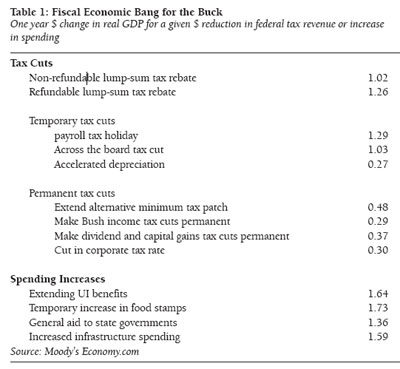
My understanding of this data — although specifics aren't easily available — is that it derives from a macroeconomic model into which Zandi plugged the various instances of government spending. If that's correct, then the exercise is fatally skewed based on the simple fact that the government must take a dollar in order to give a dollar.
Actually, the government must take more than a dollar in order to give a dollar. In 2004, for example, the Food Stamp Program spent about $0.20 for every dollar that it gave away (PDF). That's not the whole story, of course, because there were expenses associated with collecting, allocating, and processing the program's budget. According to Charity Navigator, 9 out of 10 charities spend no more than $0.54 per dollar given away on administrative costs, and 7 out of 10 spend no more than $0.33. For the sake of consideration, then, let's assume that it costs the federal government no more than another five cents per dollar handed out to get that money from the taxpayer to the Food Stamp Program, so the total cost per food stamp dollar would be $0.25.
That means that, for every food stamp dollar given, the government must take $1.25 out of the economy at some other point. According to Zandi, an across-the-board tax cut would add $1.03 to the next year's GDP, so it follows that taking a dollar costs $1.03. Based on an across-the-board increase in taxation, the cost of every food stamp dollar is therefore $1.29, making the actual amount that the whole process adds to the next year's GDP only $0.44. Inasmuch as it does not cost any money not to take a dollar from somebody, a broad tax cut would actually add $0.59 more to GDP than would the food stamp.
The intuitive sense, here, is that it doesn't make any difference, economically, whether I spend a cash dollar on groceries or a welfare recipient spends a food stamp dollar on the same items. If the government largess is extracted from everybody, then the working poor and middle class don't have those dollars to spend. In fact, it appears that funding food stamps by taking a dollar from a family that must therefore reduce its grocery bill in response winds up costing the GDP $0.43.
The appeal of Sgouros's argument comes in the fact that those who don't have to spend will tend to save; those who take in more than they could possibly spend will save even more. Indeed, looking at the numbers on the table, it's tempting to observe that a one-dollar increase in the corporate tax rate would appear to cost the GDP only $0.30, so reprocessing that dollar into food stamps would provide a net GDP gain of $1.43. That possibility is an illusion for two reasons. The first is that the $0.70 difference must come from some theoretical savings account (or untapped credit); thought through in reverse, the reason a dollar of corporate tax cuts only results in a GDP gain of $0.30 is that the rest goes somewhere unproductive. If that tax rate becomes confiscatory in order to alleviate the tax burden on the poor and middle class, corporations and the proverbial rich will not for long watch their reserves being depleted without reacting.
The second reason is that, when heavily taxing the rich, a marker of single dollars no longer applies. Wealthy entities (whether families or organizations) work in different amounts than do the the rest of us. It's true that a rich man may be less productive with a free dollar than would a poor man, but take from him ten million dollars, and he won't invest in a company, donate to charity, build a house, and so on, and those activities all filter down to folks who'll spend their money in the same fashion as welfare recipients, but without the government processing fee. If a few percent of the society is going to pay most of the cost of government, the taxation dollar amounts are exponential.
To be sure, Sgouros whistles an enticing tune when he writes:
People routinely misunderstand the important points of policy that stem from Keynes's findings. Government spending and progressive taxation aren't good things because they support government workers or "punish" rich people. They are good things because they are how a government can help the economy grow. (Up to a point, of course, a detail Keynes made clear.) Government workers with money to spend will spend it, and that drives the economy. Progressive taxation keeps more money in the hands of the poor and people in the middle, both of whom are more likely to spend their income than rich people are.
But he loses the thread of his earlier wisdom. Private-sector workers funded via mutual agreement will also spend their money, but they have more reason to earn it efficiently than public-sector workers funded via compulsory taxation. They also can't hide their wealth as thoroughly. Tom notes that a "dollar saved is not a dollar invested" and that "people have different preferences for how they hold their money," but he doesn't acknowledge that unionized government workers save their money in the form of perks, accumulating benefits, and defined-benefit pensions. There must be some form of savings — actual or theoretical against future taxation and revenue — in order for somebody in his '40s or '50s to retire for the rest of his life. A person who lives for thirty years on an annual pension of $35,000 had stored away over a million dollars in some nook of the system.
For its larger projects and continued growth, a society needs people with financial reserves, but those reserves have to be accessible for spending. A society also needs people motivated to create, and capable of creating, wealth, and those (as I've argued here, here, and here) are the families that Rhode Island has been chasing out. Sgouros and Co. can flash all the statistical pictures they want, but what Rhode Island must do is to maintain the number of wealthy taxpayers while relieving the burden of (and thereby attracting) the productive class.
Ultimately, that leaves only one broad category to which to turn to balance the state's budget: Those who represent a net cost to the government.
March 21, 2009
RISC Winter Meeting: Gary Sasse Talks Taxes
Giving the first speech at the Rhode Island Statewide Coalition's Winter Meeting, Gary Sasse, Governor Carcieri's Director of the Department of Administration, spoke about tax policy (stream entire speech):
- RISC Chairman Harry Staley's introduction: stream, download
- Sasse's opening remarks — we compete for capital and labor, and tax policy affects our success: stream, download
- The reason for a Tax Policy Workgroup was our lack of competitiveness — we were "taking money out of the private sector and putting it in the public sector in a very uncompetitive way": stream, download
- The need for reform to prepare for the end of the recession: stream, download
- The tax reform in the governor's current budget — increase exemption of estate tax, phase out and eliminate the corporate tax ("That is the perception change we need. That is a bold step."), decrease personal income taxes ("Every income group, up to a half million dollars, pays lower average income taxes under the proposed system."): stream, download
- Closing remarks: stream, download
Governor Patrick's Trivialities
Amidst a billion dollar state deficit, a flagging economy, a state hiring freeze and a raging debate about whether to raise tolls or jack up the gas tax (with the smart money on a compromise - "what the heck, let's do both"), Massachusetts Governor Deval Patrick has been focusing on the important things.
- Appointment of a senator to a long-dormant $175,000 job;
- Hiring of a heavy campaign contributor to the newly created post of director of real estate services; annual salary: $120,000. (Did I mention the state's hiring freeze?)
- Hefty raises for a couple of sheriffs.
Add to that his Turnpike Authority which has implemented his campaign promise to lay off toll takers by hiring two staffers at a nifty $100,000 per annum.
I said these items are important, didn't I? My mistake. They are not important.
A dismissive Gov. Deval Patrick yesterday belittled as “trivial” recent exposes detailing plum jobs and fat raises to the politically connected under his watch, saying the controversies won’t distract him from “meaningful” issues.“One of the challenges in life is concentrating on the meaningful and letting the trivial take a back seat,” Patrick said in the Senate reading room, after a reporter asked him whether patronage-packed Beacon Hill still has credibility with the public.
“I sometimes feel like I’m in a profession now where that is completely upside-down,” he added.
Funny, we feel that way, too, Governor. It might have been better to have skipped the trivialities altogether.
March 20, 2009
Good Night, Sweet Tiverton
I hadn't planned to attend the Tiverton Budget Committee meeting on Wednesday night, so when my eyelids became heavy around 9:30, and with the meeting looking as if it had settled into a series of unanimous votes on heavily debated dollar amounts, it was easy to talk myself into heading home. I wish I'd stayed:
All but one voting member of Tiverton's Budget Committee supported a proposal to move the town's financial town meeting to a later date, when more concrete state aid figures are available.The vote came at the end of a long budget meeting Wednesday night, and just days before the Town Council is scheduled to meet and discuss whether to ask the General Assembly for the ability to postpone the meeting, which the town charter states is to take place the second Saturday of May. ...
Budget Committee Chairman Jeff Caron did not vote on the motion, and Vice Chairman Robert Coulter voted against it. The chairman usually votes only as a tiebreaker. ...
Sanford Mantell, a newly elected member of the Budget Committee, said he didn't have a problem with a request by Town Council President Donald Bollin for "unified" support from the Budget Committee to move the financial town meeting to a later date.
Some committee members made it clear that they would not want the meeting to open on May 9 only to be recessed to a later date. That would disenfranchise voters and cost the town additional money, they said.
Caron said the committee will continue to work on its budget recommendations and have a docket ready for May 9 if the meeting does end up convening on that date.
I very much hope I'm wrong about this, but it appears to me that the powers of Tiverton are in the midst of another scheme. Facing unexpected push-back from the budget committee, the town council and school committee squeezed their budgets as hard as they could even pretend to be doing. (Recall statements from the town side that the draft budget that they approved is "too low," even presenting a danger to residents.) Between that, some likely fudging of probable contract terms, and a very deep dip into reserve funds, the town brought the expected tax increase below the state cap.
That will depressurize some of the incentive for citizen activism, and a postponement of the financial town meeting will push actual decisions into the lazy summer, perhaps after municipal and school contracts are a done deal. No doubt, town officials are still hoping for the magic Obama money to save the day, but I suspect they're already planning methods of peeling the facades from the budgets and coming on strong with the message that "we must raise taxes" because we're awash in "obligations."
Business as usual may be in the middle of a hiccup, but it remains the paradigm, and when our eyes clear, we'll see whether the town's gamble that the world will go back to the way it was has paid off. Me, I think Tiverton's future gets a little bit darker every week.
As I said, I hope I'm wrong.
March 19, 2009
Talking About Bonuses
On last night's Matt Allen show, Monique and Matt shared disbelief at the disbelief that Congress (particularly one marble-mouthed representative) has expressed regarding AIG's bonus handouts. Stream by clicking here, or download it.
March 18, 2009
Latest on the Bonus Sideshow
The BBC reported last night that the US Treasury Department will hold back the amount of the bonuses from the next round of bailout money to AIG.
Ailing insurer AIG will pay back the hugely controversial bonuses it awarded after taking public bail-out money, the US treasury secretary says.In a letter to congressmen, Timothy Geithner also said $165m (£116m) would be taken from $30bn the firm is due to get as part of its government bail-out.
While it will hopefully quell foolish suggestions to create highly targeted (and therefore highly illegal) income tax brackets of 100%, this resolution has not derailed today's AIG hearing before Congress, where relieved outrage has not abated
The remarks did not assuage the anger expressed by both Democrats and Republicans in response to the bonus payments to workers at AIG's financial products unit. Frank called the payouts "wholly unjustified," while other lawmakers took aim at the firm's management
and clever new names for the firm were presented.
"AIG now stands for arrogance, incompetence and greed," Rep. Paul Hodes, D- N.H., said.
Congressman, you've made it awfully tempting to fill in the acronym CONGRESS.
The real outrage, of course, is Congress placing AIG (and other private corporations) in a position to hand out tax dollars to begin with as part of a very expensive and highly quizzical effort to stop or shorten the fiscal slide created in 1995 by Congress itself, along with the Executive Branch. Every indignant word spoken at that hearing today to the hapless Mr. Liddy should be reserved instead by that congressperson for a quiet session with a mirror.
UPDATE
Question for Congressman Frank: in view of the death threats received by AIG management and employees, is it altogether prudent to be requesting the names of those who received bonuses?
UPDATE 2
And a follow up, sir. Will you also be requesting the names of those employees at Fannie and Freddie due to receive bonuses? [H/T Drudge.]
March 16, 2009
Who Is Outraged?
So let's understand this.
The government precipitates a fiscal crisis by
1.) Authorizing/encouraging banks to make bad real estate loans: President Clinton with the help of both Repubs and Dems in Congress;
2.) Repealing Glass Steagall: President Clinton, egged on by Senator Phil Gramm and with the help of both Repubs and Dems in Congress;
3.) Fending off all oversight and regulation of taxpayer-backed Fannie and Freddie: Congressman Barney Frank, all by his little self.
[Other/overlooked failures cheerfully appended.]
The government - one Republican president, one Democrat president and lots of Repubs and Dems in Congresss - then tries to fix the problem it created by shoveling massive amounts of our tax dollars out the door, much of it without strings or conditions (by the way, why didn't regulation-adoring Democrats scream bloody murder about this at the time? but this is intended to be a bi-partisan/anti-partisan post), in an effort to correct market and other forces that need to work themselves out "naturally". Side note: painful as that would be, it would be much less painful in the long run than dismantling what remained of a capitalist economy and converting to ... something else, whatever that would be.
Yet for the last couple of days, Congressman Frank, the junior Senator from Rhode Island and other federal officials have been very indignantly directing outrage at the private corporations involved for distributing bonuses that they (our elected officials) facilitated?
Getting out the calculator here ... Hang on ... Yup, trillions of dollars wasted on bailouts and stimuli is a larger amount than $165 million wasted on unearned bonuses.
I agree it is outrageous that hard earned (and not yet earned) tax dollars have been distributed in this and other irresponsible fashions. But with their high dudgeon pronouncements, aren't our elected officials really saying,
Pay no attention to the trillions we've spent like sailors on shore leave. Look! Look at those millions being spent over there!
In short, how can this dramatic reaction by our elected officials be viewed as anything other than a vigorous attempt to distract us and deflect blame from themselves?
Business Tax via Sales Tax
An article in last week's Sakonnet Times (not online) informs the reader that my representative in the State House, Jay Edwards, has submitted legislation reducing the sales tax:
"This legislation would stem the tide of consumers who leave Rhode Island to shop in Massachusetts just to save on the sales tax," said Rep. Edwards. "We must start thinking of ways to make our state more competitive instead of accepting the status quo and allowing Massachusetts and Connecticut to reap the additional sales."
The bill does not spread the tax to everything — as previous efforts have seemed to attempt — but there is some curious broadening, considering that the name of the game is competition. Taxes on computer software and floral business equipment are one thing, but adding a tax on the necessary supplies of the jewelry industry and greatly expanding the net that would catch commercial fishing boats in the sales-tax Web from 5-ton vessels to 50-ton vessels seems a bit like circling around ailing bison.
Why can't we just cut the sales tax, period? Maybe when our state economy has rocketed to the forefront of the nation we could think about broadening it, but desperate times call for bolder measures.
March 12, 2009
Twenty Percent of Massachusetts Stimulus Dollars Directed to Honor One Family
Who would that be? You guessed it.
H/T Howie Carr. From the American Thinker:
According to an AP article , Massachusetts is receiving 126 million stimulus dollars; of that amount more than 1 out of 5 of those dollars "is going to help preserve the legacy of the Kennedys."1) $5.8 million to plan and design the new Senator Edward M. Kennnedy (D-MA) Institute for the Senate plus, perhaps, an endowment for said institute. (Quietly insert your own free Senator Edward Kennedy Senatorial Institute joke here.)
2) $22 million for expanding the John F. Kennedy Presidential Library and Museum.
3) $5 million for a downtown Boston park; a new gateway to Boston Harbor Island on the Rose Kennedy Greenway.
A caller to Howie correctly pointed out that the honorable thing for the Kennedy family to do would be to decline these projects and suggest that the funds be directed to more urgent and practical projects.
March 9, 2009
Governor's Tax Policy Workgroup Report
Governor Carcieri's Tax Policy Strategy Workgroup has released it's report (short version; long version). The ProJo has a story on the report and another on the impact that tax cuts will have on the budget deficit. They even have a poll asking, "Can Rhode Island afford to cut taxes now?" Funny, I don't recall any polls over the last decade or so asking, "Can Rhode Island afford to continually increase spending and grow government?" Anyway, here are the highlights of the committee's recommendations.
March 5, 2009
Tweaking the Pork Position: Aged is Fine, Fresh is Bad
As Congress successfully fends off attempts to reduce the considerable pork in an omnibus spending bill, President Obama has indicated that he will not veto the bill. Defending an apparent flip-flop on a campaign promise,
The White House says this bill is just last year's unfinished business -- and next time, it will be different."We'll change the rules going forward," White House Press Secretary Robert Gibbs said Wednesday when asked about the legislation.
For the record, Senator John McCain lists... make that, tweets the "Top 10 Porkiest Projects" in the bill.
And Conn Carroll over at the Foundry points out that the costly aspect of pork is not so much its own price tag but what it buys.
The problem with earmarks is not $16 million for water-taxis and manure management. All 9,287 earmarks in the omnibus bill come to a total of $12.8 billion, or 3% of the total package. The problem with earmarks is the other spending that 3% buys. As data from the Office of Management and Budget shows, the rise in the number of earmarks tracks closely with the rise in overall spending by the federal government. Sen. Jim DeMint explained the link to Politico last year: “I talked to colleagues who would say, ‘DeMint, I gotta vote for this bill because it has my project in it,’ even though the bill was way over budget.” The evil of earmarks goes far beyond their nominal price tag. The real damage they do to our country is the votes they buy for ever higher levels of spending.
Flipping that around, every serving of pork, earmarked as much for a reelection campaign as for a specific district, comes with a three thousand percent surcharge. On the bright side, it all ends next year ...
Taxing the Rich and Hurting the Poor
Apparently we are all well aware that the rich can afford to pay more taxes--"their fair share." But can the poor afford it?
The administration’s recently released budget will limit tax deductions on gifts made to charities by those earning over $250,000 a year, raising (we are told) almost $180 billion over the next ten years. It’s an extraordinary grab for money — money given to private charities by private citizens as private donations. These donations directly fund programs that (among other things) feed, clothe, and house the poor, deliver after-school programs to disadvantaged children, build new facilities for colleges and other schools, and generally enrich everyone’s lives through education and the arts.The study did find that overall giving doesn't dip as bad when the focus is broadened and that charitable giving rates track closely with the stock market:The way this will work in practice goes like this: Assume someone in the top tax bracket wants to make a $1,000 donation to a local homeless shelter. Currently they would be eligible for a deduction at the top 35 percent rate, so the donation costs them only $650. This proposal would allow deductions at only the 28 percent rate, meaning the donation will now cost $720, an increase of over 11 percent. In other words, $70 that could have gone to the homeless shelter will now go to the government. In the aggregate, then, charities can expect to lose about 7 percent of their contributions from givers in the higher tax brackets. The new top tax rate of 39.6 percent in 2011 makes the math even more punitive, making the cost of donations 19 percent higher.
A study released Friday by the Center on Philanthropy at Indiana University shows that if the provision had been in place in 2006, charities would have lost almost $4 billion in donations in the intervening period. With the incomes of the so-called wealthy dropping, at the same time that their taxes are going up, it’s hard to see how limiting the deduction will not have a significant impact on charitable giving. The dollars taken away from private donations and directed into government coffers are not going to be magically replaced.
The drop in giving is less stark when looked at in the context of how it would affect all Americans who itemize on their tax forms and claim charitable deductions. Total giving by people who itemize would have dropped just 2.1 percent if the Obama plan had been in effect in 2006, the center estimated. Itemized charitable contributions totaled nearly $187-billion that year.Remind me: how has the stock market performed in reaction to the Obama economic "plan"? Finally:But the center cautioned that giving is far more likely to be affected by the condition of the stock market than by President Obama’s tax proposals. It noted that every time the stock market declines by 100 points, giving declines by $1.85-billion. Charitable donations rise by that same amount when the stock market increases.
Patrick M. Rooney, interim director of the Indiana center, said he worried about the effect of the tax change at a time when the downturn in the economy has put a squeeze on many donors and the charities they support.But there may be hope yet.“Tax incentives do stimulate more giving,” Mr. Rooney said, “and the challenges facing the nonprofit sector in 2009 suggest that this might be a good time to provide additional incentives, rather than reduce the value of the tax deduction for high-income households, so that the donors with the greatest capacity to give have more reasons to do so.”
March 3, 2009
Obama Versus Tax Dodgers
President Obama is going to go after international tax dodgers (h/t):
President Barack Obama's Treasury secretary says the administration will unveil a series of rules and measures in the coming months to limit the ability of international companies to avoid U.S. taxes.Unless of course they are nominated for a Cabinet position.Treasury Secretary Timothy Geithner told the House Ways and Means Committee on Tuesday that Obama will propose legislation to limit U.S. companies' ability to shelter foreign earnings from taxation in the U.S. He also said the administration will try to limit wealthy Americans' ability to use tax havens to avoid taxation.
February 27, 2009
Ka-Boom! Tiverton Residents Sue for Refund of Illegal Tax Increase
Things are going to get even a leetle more interesting in our sleepy corner of the state:
Danielle Coulter, a chiropractor and Tiverton School Committee member just elected to office last November, has filed a lawsuit against the Tiverton’s tax assessor.She claims that last year’s property tax levy in excess of the tax cap was excessive and unlawful, and she asks the court for relief from paying the taxes on property at 34 Lawton Avenue which she and her husband Robert D. Coulter are listed as owners.
Their property is assessed for tax purposes at $395,700 and they pay, according to tax assessor records, $4,455 in taxes.
Mr. Coulter is a lawyer with a Providence law firm and was elected last November to the town Budget Committee, on which he serves as vice-chairman.
Explaining the process that "has brought about this suit," Ms. Coulter said "I am simply appealing my tax bill, everyone has that right."
"The suit is not about money," she said. "The overall amount in question is $193. If returned to us it will be donated to the Tiverton Land Trust. The Financial Town Meeting process is in question. This is about fairness and following the law. It is my belief that the town was lied to in the initial FTM, regarding the timing needed to reconvene the next FTM." ...
Ms. Coulter made other allegations in her complaint about last year's town meeting that she said was "fraught with irregularities ... (that) amounted to a deprivation of due process."
I can't promise to give my refund to charity, but I might donate some of it to a joint Coulter reelection fund.
High Taxes Coming
From ABC News:
President Obama's budget proposes $989 billion in new taxes over the course of the next 10 years, starting fiscal year 2011, most of which are tax increases on individuals.So the idea is to stimulate the economy within a couple years...and then raise taxes? We'll see how that works out. Bob Krumm offers this wry analysis:1) On people making more than $250,000.
$338 billion - Bush tax cuts expire
$179 billlion - eliminate itemized deduction
$118 billion - capital gains tax hikeTotal: $636 billion/10 years
2) Businesses:
$17 billion - Reinstate Superfund taxes
$24 billion - tax carried-interest as income
$5 billion - codify "economic substance doctrine"
$61 billion - repeal LIFO
$210 billion - international enforcement, reform deferral, other tax reform
$4 billion - information reporting for rental payments
$5.3 billion - excise tax on Gulf of Mexico oil and gas
$3.4 billion - repeal expensing of tangible drilling costs
$62 million - repeal deduction for tertiary injectants
$49 million - repeal passive loss exception for working interests in oil and natural gas properties
$13 billion - repeal manufacturing tax deduction for oil and natural gas companies
$1 billion - increase to 7 years geological and geophysical amortization period for independent producers
$882 million - eliminate advanced earned income tax creditTotal: $353 billion/10 years
If the government took 100% of earnings from those making more than a half-million dollars a year, it would add only $1.3 trilion to federal tax receipts. Even the most ardent demand-side economists who usually scoff at the Laffer Curve, will have to admit a 100% tax rate is going to yield significantly smaller receipts.Links to more analysis can be found at the TaxProf blog.Barack Obama’s plans to hyper-inflate the government bubble while he taxes the rich at confiscatory levels, is so certain to collapse the economy that I can only conclude that he is a brilliant Rovian plant whose purpose is to finally drive a stake into the heart of the era of big government.
February 24, 2009
Hammering the Tax-Cut = Pay-Increase Principle
Those seeking some reason for optimism may find it (in small measure) in Neil Downing's language:
More than 400,000 Rhode Island workers will soon receive what amounts to a pay raise.Employers by April 1 must begin withholding less federal income tax from paychecks.
Thus, workers will soon be taking home more than they are now — about $10 more a week for someone who is single, about $15 more a week for someone who is married.
If taxpayers begin to think in those terms, maybe they'll start to wake up. The federal, state, and municipal governments could all give us raises — which would be more substantial than a few cents per hour — in these hard times by cutting spending.
February 22, 2009
Another RI Newcomer Speaks Truth to Insanity
Gary Smith, of Newport, has come to a conclusion that will be familiar to Anchor Rising readers:
So I asked myself: What is keeping companies away, especially those for whom shipping is not an issue? The answer is and has long been obvious — taxes. CEOs won't relocate to places where their high incomes get hit hard. Companies won't relocate to a state where corporate taxes exceed those of neighboring states. So it would appear that the recommendations of the governor's panel are right on target — and the key part of the panel's findings is that the changes, if enacted, will be revenue-neutral.It's time for our legislature to wake up and move forward expeditiously and get this state on the move again; it has much to offer. Maybe it takes an outsider to see it. With competitive taxes I think Rhode Island is an easy sell.
Welcome to the battle, Gary. I regret to inform you, however, that the project is much more daunting than you realize.
February 13, 2009
Exercise your Constituent "Franking" Right
Can't find any web reports but I heard a news report that the House has just passed the non-economic stimulus bill and the Senate was expected to act on it later today.
Do you support or oppose this bill? Let your voice be heard. Senatorial contact information below.
Senator Jack Reed: (202)224-4642. Website.
Senator Sheldon Whitehouse: (202)224-2921. Website.
February 12, 2009
No More Political Cover
This is an instructive episode:
A House vote to raise the state's cigarette tax by $1 a pack — to what would be the highest level in the nation — was aborted at the last minute yesterday after Republican Governor Carcieri yanked his support from his own tax-raising proposal.Carcieri's eleventh-hour move was announced by a visibly annoyed House Finance Committee Chairman Steven Costantino on the House floor, the unexpected development punctuated by this uncharacteristic utterance by House Speaker William J. Murphy: "Get it out of here!"
Earlier in the day, Murphy had said raising the cigarette tax "doesn't bother me" because people choose to smoke.
It appears that the General Assembly Democrats would very much like to raise taxes as a way out of their personal-special-interest-debt conundrum... but not without cover. I say that the governor should finally learn this lesson: Go for the conservative gold and declare that anything less is the full property of the legislature. Make them wear it. Make them fight for every ounce of political cover that he's willing to give as part of negotiations.
Meanwhile, remind them that the clock is ticking and that the bomb is on their desk.
February 6, 2009
Increasing the Cigarette Tax: Will the GA Put Our Money Where Their Mouth is?
The extra financial burden of smoking to the health care system and, more specifically, the state has been put forward as one of the justifications for the proposed one dollar increase to the state cigarette tax being contemplated by the General Assembly even as we speak.
It was interesting and a little nauseating to read in today's ProJo that tobacco is a significant driver of customer traffic for certain stores and that making cigarettes sold in Rhode Island the highest taxed in the country might impact the overall business of those stores.
It also failed to take into account the impact on lawmakers of a hearing-room packed with convenience store owners begging them not to choke off a rich vein of business for them. Their warning: Fewer people will be able to afford cigarettes and those who can will look to the Internet and low-cost states such as New Hampshire for cheaper deals.The feared result: Rhode Island’s sales will plummet and they’ll lose much-needed business. Manish Modi, who owns a small convenience store in West Warwick, told lawmakers at a recent hearing that he’s barely surviving as it is. “I cannot afford to lose any more business,” he said. “This tax increase is going to drive more and more people to close their stores and drive me almost to bankruptcy.”
Setting that concern aside for a moment and projecting that revenue to the state does increase, in view of one of the asserted reasons for this tax increase, will revenue derived by the state from this tax increase be segregated and directed not into the General Fund but towards the state's tobacco related health care expenses?
February 5, 2009
A Hidden Tax in the Middle of the Road
Rhode Islanders are beginning to catch on, I think, to the game whereby the state government spends our tax dollars on labor costs, entitlements, and other non-essential or excessive line items and then returns to the taxpayers requesting the passage of bonds for infrastructural basics, like roads. As has come up on Anchor Rising, before, the scheme contains a hidden tax, as well:
Gaping potholes have opened up in town and are snagging cars left and right.All on Feb. 2, police received reports of eight incidents where drivers struck a pot hole and seriously damaged their vehicles — and many more strikes went unreported. All of these incidents occurred on state roads, and those with damage to a vehicle resulting may be able to recoup up to $300 from the state. ...
A Portsmouth man said he was at the Cumberland Farms on East Main Road, between Pine Tree Road and Schoolhouse Lane, when he noticed four drivers in the parking lot with "blown out tires." Twenty minutes later, he got a call from his daughter who needed help changing a tire that was popped by the pothole near Pine Tree Road.
When he arrived to help his daughter, he said "another six cars were changing their tires at that time."
"This is outrageous," the man wrote in the report he filed with police. "Because it is a state road, police cannot do anything. Shame on the R.I.D.O.T."
Police checked out the pothole on East Main Road near Pine Tree Road and measured it at one foot wide.
Department of Transportation Public Affairs Officer Dana Nolfe said on Tuesday that DOT's dispatch received six calls that day about potholes on state roads in Portsmouth. Now that DOT is aware of them, she said, workers will go out and patch the holes as soon as the weather permits.
Yes, in the extreme, direct circumstances, the motorist can recoup some or all of the repair expense, but note the declining number: One eyewitness observed a total of thirteen cars, while police received reports of eight, and the DOT heard from four people (who weren't necessarily among those experiencing damage).
One also must remember that the $300 doesn't cover the lost time, productivity, and peace of mind on the day of the incident or of the repair. More broadly, it doesn't cover the gradual accelerated wear on the vehicles of everybody who drives over the miles of rough roads every day nor the time and aggravation of those who face the roads' effects on traffic. The right-hand southbound lane of West Main in Portsmouth is a painful ride — just about undrivable in a work van — so drivers tend to stay in the left, congesting flow.
To avoid such outcomes is why we pay taxes in the first place.
January 31, 2009
More Tax Aversion from the Tax-and-Spend Left
I'm sure Tom Daschle had every intention of filing three years of amended tax returns (one for every year since he was bumped from public office, I believe) whether or not he'd been presented with the opportunity of joining the Obama administration:
Thomas A. Daschle recently filed amended tax returns for 2005, 2006 and 2007 reporting $128,203 in additional tax and $11,964 in interest. The adjustments resulted from additional income for consulting services and the use of a car service, and reductions in charitable contribution deductions. Senator Daschle filed the amended returns voluntarily after Barack Obama announced his intention to nominate the senator to be the Secretary of Health and Human Services. The Presidential Transition Team identified the charitable contribution issue and Senator Daschle self-identified the income adjustments.
If not, citizens of the United States of America — even those who support the current president — might have reason to question whether Mr. Daschle possesses the ethical fortitude to hold appointed office.
January 28, 2009
Discouraging Behavior
This quotation from the Providence Journal's latest story on Gov. Carcieri's tax panel pretty well highlights the philosophical differences at play:
... under proposals involving the personal income tax, lower-income and many higher-income taxpayers would generally pay less, but middle-income taxpayers — and the state’s highest-income taxpayers — would generally pay more.This is partly because the proposals would eliminate most tax credits; end the favorable tax treatment of profit on the sale of stock and other such assets; and prohibit a taxpayer from deducting, for state tax purposes, such items as charitable contributions, mortgage interest and local property taxes.
So the disfavored demographic in this proposed tax rearrangement would be charitably inclined homeowners investing in the state. Somehow I have a difficult time believing that this particular panel is trying to edge the state even closer to socialism, but at some point effect must subsume intention.
January 25, 2009
Et Tu, Cusack?
Damien Baldino beat me to the punch, but the same thing jumped out at us both from this article about Massachusetts Governor Deval Patrick's consideration of toll booths at the border:
Robert Cusack, a member of the panel and an East Providence councilman, said that the Massachusetts governor has the right idea. As much as his own constituents would dislike paying fees and tolls, he said, he thinks they would rather pay a toll than live with a disruption to a state highway system in disrepair."We are the lowest state in the Union when it comes to our percentage of contribution to highway repairs. On average, states contribute 60 percent of the cost of repairing their highway infrastructure. We contribute somewhere between 20 to 30 percent, and have been relying on the federal government to pay the rest."
Cusack said people may complain about tolls, but New Hampshire has had tolls for a long time and no one complains. "New Hampshire has more severe weather, but their roads are in first-class condition because they have tolls to finance it."
Of course, tolls in New Hampshire are more of a use fee in lieu of taxes. Our taxes are already high — ostensibly with the roads included therein. Administrators and legislators throughout our state must get it into their heads that there is no viable long-term solution that involves squeezing more money out of Rhode Islanders.
January 23, 2009
Those Who Face Reality, Those Who Do Not
AR commenters and contributors have observed for some time that the source of the budget problem now facing the state and locals is not a lack, demonstrated by our high property and other taxes, of revenue but rather, many years of imprudent spending.
In Providence, Local 1033 of the Laborers’ International Union of North America representing 1,900 city workers has offered concessions, including an 18 month pay freeze.
In Cranston, Local 153 of the National Association of Government Employees representing one hundred school custodians and maintenance workers have agreed to forego raises for two years and to contribute more towards health coverage.
Both sides called the contract a compromise, one that saves money and puts people back to work.“A job is a job,” said John F. Carbone, president of Local 153 of the National Association of Government Employees. “In layman’s terms, we were able to save five jobs.”
Tuesday night, East Providence City Councilors instructed legal counsel to research and report back on the option of municipal bankruptcy. By making such a request, it is clear that they are serious about their promise not to try to stick their taxpayers with a substantial budget shortfall. Quite simply, there is no more revenue to be had. Local 1033, Local 153 and the City of East Providence appear to be coming to grips with that fact.
As for "Those Who Do Not":
For Immediate ReleaseJanuary 22, 2009
Statement from National Education Association Rhode Island (NEARI) President Larry Purtill in response to Judge Pfeiffer’s decision regarding East Providence:
We are disappointed in Judge Pfeiffer’s decision to deny the restraining order that would have stopped the East Providence School Committee from unilaterally rolling back teacher salaries and implementing a 20% co-share for health care. Teachers are being harmed by the loss of pay but we have confidence that the union has a good argument before the Rhode Island State Labor Board, who has initial jurisdiction in the case. At the moment, NEARI and East Providence teachers are considering all their options, based on the judge’s decision, including an appeal to the Rhode Island Supreme Court.East Providence teachers, despite doing their job each day in teaching the students in their classrooms, are losing money and that will continue until we reach a resolution. With the anticipated increased revenue for education from President Obama’s Economic Recovery Package, the School Committee could put an end to this contract dispute by accepting the arbitrator’s award and or sitting down with the teachers in serious negotiations.
January 22, 2009
Why Don't They See This?
In a press release announcing his nomination for Director of the Department of Administration, Governor Carcieri says of Gary Sasse that he has "more than 30 years of experience in crafting and analyzing sound fiscal policies and sustainability for government programs," but I'll risk exposing my ignorance to scratch my head at the proposal taking shape in Sasse's tax panel:
The changes, if adopted, would have far-reaching effects on thousands of taxpayers.Middle-income taxpayers would generally pay more, while lower-income taxpayers and some higher-income taxpayers would generally pay less. ...
Broadly speaking, people with $30,000 or less in AGI would wind up paying less in tax than they do under the current system.
People with between $30,000 and $110,000 in AGI would end up paying more.
Most people with AGI above $110,000 would end up paying less. But those with the very highest incomes, above $5 million each in AGI, would pay more.
That "middle-income taxpayer" group describes pretty precisely the range of households from which Rhode Island is losing population every year, and such folks are crucial to economic recovery and growth. The rich have money to invest, yes, but they're not the ones who'll put in 80-hour workweeks to keep industries developing. What Rhode Island needs is to match the investment-ready dollars with people who can use them — people in the middle-income group who need reassurance that their efforts will bring them closer to six-figure salaries.
That makes these suggestions downright pernicious:
... taxpayers would no longer be able to obtain a state tax benefit by making a separate list of their deductions, a process known as itemizing. ...Under the plan, favorable treatment would be eliminated and capital gains would be treated as ordinary income, the same as wages, for example.
As far as tax rate is concerned, the thousands of dollars that I've invested in tools each of the last four years are of little concern. In terms of both investments and income, the big-nose/big-toes tax regime draining the middle for the benefit of the edges would pound yet another nail in Rhode Island's chance for innovation and accelerated growth.
How is it that such apparently qualified panelists can miss this perspective?
January 21, 2009
Sitting Down with the Treasurer
RI General Treasurer Frank Caprio invited Anchor Rising for a sit-down chat in his office last night, centering on pension issues, but touching on various other matters.
In general, I think the four of us in attendance were reasonably impressed with the treasurer's explanations for economic policies and his knowledge of political history in Rhode Island. In specific, some of the more detailed material is going to take time for us to digest prior to comment, but a few clips might be of interest to readers right off the digital recorder:
- On complete financial transparency in his office, to be unrolled in a few weeks: stream, download
- In opposition to the use of state-owned vehicles: stream, download
- I got a chuckle out of the notion of fear among those in his office promoted beyond the union's bounds to become (scary music) at-will employees: stream, download
- Caprio's got a merit-based promotion system in place with his workers' union, and he thinks the practice is transferrable across government: stream, download
- Apparently, Rhode Island "only" pays 7% of its revenue toward debt service. I wasn't wholly satisfied with the Caprio's description of the comparative appearance of that statistic against a typical business and wonder whether it's fair to compare the government to a mortgage-paying household: stream, download
- On the possibility of municipal bankruptcy (or entry into "a process"): stream, download
- On his pension-plan thinking. Apparently, much of the cost of switching to 401k would come from accounting rules, but with the possible loophole of diminishing, rather than "closing" the defined benefit program: stream, download
- The reason that Rhode Island actually ranks pretty well when it comes to retiree healthcare costs: stream, download
- On abortion and same-sex marriage, neither of which would be his center of focus for any campaigns or offices: stream, download
- Running for governor?: stream, download
- Wherein I continue to strive for an answer on the social issues: stream, download
- On eVerify and immigration: stream, download
- On branding the state otherwise than with corruption and mob films: stream, download
- With regard to a port project and other initiatives, the treasurer agrees with me that a broadly attractive economic environment (tax cuts included) ought to be the focus of policies: stream, download
- An interesting response to my question about his thoughts on Republicans running as Democrats ("Why not the reverse?") and a discussion of the RIGOP: stream, download
January 13, 2009
The Intangibles of Rhode Island
With taxpayers — especially business taxpayers — beginning to get uppity, one often hears the invocation of Rhode Island's Political Knot. Nothing objectionable is anybody's fault; it's all a natural construct that can't be changed... at least by the person to whom one would turn for relief.
Take the "tangible tax." I know of at least one local business owner who complained that the "tangible property tax" collected by the town was doing palpable harm to his business and whom the Tiverton Tax Assessor informed that the town has no choice: State law compels him to assess and collect the tax. Presumably, he's referring to Rhode Island General Law 44-3-1:
Real and personal property subject to taxation. – All real property in the state, and all personal property belonging to the inhabitants of the state, whether individuals, partnerships or corporations, and all tangible personal property located in the state belonging to nonresidents, are liable to taxation unless otherwise specially provided.
The rest of Chapter 44-3 is essentially a list of exemptions, but I see no provision requiring "specially provided" to be an action of the General Assembly. Indeed, turning to 44-3-3.1:
Exemption of office equipment used for manufacturing or commercial purposes. – (a) The city or town council of any municipality may by ordinance wholly or partially exempt from taxation for a period of up to twenty-five (25) years any items of office equipment, which include, but are not limited to, computers, telephone equipment, and any other items of personal property used in an office and/or any leasehold improvements which are not exempt and are used for manufacturing or commercial purposes and may by ordinance establish the procedures for taxpayers to avail themselves of the benefit of any exemption permitted under this section.
In other words, the town could opt to gut the tangible property tax on business if it chose to do so. Note, also, that the law places no requirements or limits on the rate. My understanding is that a town or city could set its tangible property tax rate to 0%, effectively eliminating it.
Now that we've cleared up the confusion, town councils across Rhode Island can feel free embark on business-saving changes to local tax codes.
ADDENDUM:
According John, in the comments, RI law prevents a town from charging a greater than 50% higher rate for any class of tax than any other, so zeroing one rate would require zeroing them all.
That factor does not appear to affect the possibility of exempting businesses from tangible property taxes for a period of 25 years.
January 12, 2009
Dams Versus Waterslides
On Thursday, Glenn Beck took a skeptical look at some of the projects that would constitute the proposed economic stimulus plan of President-Elect Obama and the 111th Congress, contrasting them to the projects targeted by the last major federal spending spree intended to jump-start the economy. (Guess which state's polar bear exhibit made his list ...?)
" ... how much money are you spending and how exactly are you going to make it back?" "Well, just the way we did in World War II. We spent all that money in World War II. 11% of our GDP. That's more than we're spending now in relation to our GDP, so -- and look at what happened." "Okay, all right. Well, let's just compare a few things. Didn't we in World War II develop the jet engine?" "Well, yes, of course we did." "Didn't we also do something, I don't remember what -- oh, yeah, the Manhattan Project?" "Well, it was -- yeah, sure." "Didn't we also build dams?" "Well, yeah, of course we did." "Didn't we also build the first highway system?" "Of course we did." "Okay. What are you doing with the $1.2 trillion?"* * *
... there's a BMX and dirt bike trail at Virginia Key Park. And then they are going to build a Miami Rowing Club building and then there will be the Virginia Key Beach museum. In Trenton, New Jersey they have got 34 requests. They are going to do the Trenton Club renovation project, the Port of Trenton, that is my favorite, people come from all over the world to see the Port of Trenton museum. Then, of course, there's the Eagle Tavern development. I mean, you gotta drink. Then the mayor of Providence, Rhode Island is going to be there. He's going to talk about the Roger Williams Park Zoo. Roger Williams, didn't he sell more albums than Elvis and Boxcar Willie combined? He's going to be in from Providence and he's going to talk about the new polar bear exhibit that they want to build and soccer field improvements. Then the mayor from Philadelphia, Michael Nutter, is talking about the Philadelphia zoo. They are going to -- oh... oh, I didn't know this! They're doing the Big Cat Falls? Yeah! Finally they are going to build a nice waterfall. Well, now I want to go to the Philadelphia zoo and so does everyone from planet Earth. So when I look at the water slide, the BMX dirt trails and the Big Cat Falls and I compare them to the invention of the jet engine and the Manhattan Project and cheap plentiful energy from falling water, hmmm.
The Economic Principle of Self Interest
URI economics professor Len Lardaro had a very disappointing piece in the Providence Journal on Saturday, advising a tax increase in order — curiously enough — to benefit schools and universities. Professor Lardaro states that "investment-related activities... by their nature entail sacrifice" and suggests the following:
I propose raising the state's sales-tax rate to 8 percent from 7 percent, not broadening its coverage to services (to help contain regressivity), and earmarking all of the resulting tax proceeds to K-12 public education and public higher education. Should the legislature try to move any of the resulting revenues to the General Fund (the God of current consumption), I expect Governor Carcieri to veto this measure and take his case to the people.
We should certainly devote resources to "investment-related activities," but layering on funds for education could prove to benefit other states if Rhode Island doesn't make its first goal attraction of businesses. (That's for higher education; when it comes to elementary and secondary education, the bulk of any increased "investment" in schools would simply be absorbed by the unions.) We can spend our last nickel educating young adults, but if we have no jobs to offer them upon graduation, we'll be lucky to get a thank you card from wherever they move.
I'd also mark it as a question whether we'd actually see any long-term increase from a raised sales tax. Lardaro — like Governor Carcieri — should recall that cigarette taxes offered one of the few increases in tax collections, which "the state's chief revenue analyst Paul Dion attributes to a hike this past summer in neighboring Massachusetts." In other words, ratcheting up our overall sales tax could prove to be a boon for neighboring states.
That means that Lardaro's suggested benefit of "contain[ing] property taxes" could very well be fanciful. Even if it were not, though, his rat-a-tat-tat of qualifiers hardly instills confidence. Observe (emphasis added):
Such property-tax containment can also be expected to benefit small business. Caps on property-tax rate hikes can be enforced in this type of environment, and the state might also consider imposing limits on allowable growth rates for local pay packages.
Lardaro has the emphasis precisely backwards. The state ought to begin where he drifts off into a series of maybes: contrive benefits for small businesses, enforce property caps, and impose limits on public sector remuneration. Such measures will protect Lardaro's employer more surely than will the deceptive balm of tax increases.
ADDENDUM:
Professor Lardaro claims that it was a joke to get people angry enough to become involved.
January 9, 2009
School Regionalization Does Not Save Money
The Ocean State Policy Research Institute has shot holes - on the basis of sound figures from the US Dept of Ed - in the well repeated and well intentioned suggestion to merge most of Rhode Island's thirty six school districts.
This from an OSPRI press release of today. [Emphasis added.]
As more towns and schools scramble for cost savings, the call for "regionalization" seems to be gaining momentum. However, new research by the Ocean State Policy Research Institute (OSPRI) shows that, at least with education, it would probably increase costs."It's a very easy pitch to say 36 school districts with 36 superintendents are more expensive than five regionalized districts with five superintendents. Unfortunately, it's not true," said OSPRI President William Felkner. "I bought it too, until I saw the data."
The U.S. Department of Education's National Center for Education Statistics' (NCES) latest published data (The 2007 Digest of Education Statistics that reports extensively on the 03-04 school year) show that Rhode Island school districts on average spend 7.9% of their current expenditure budgets on administration and supplies, the 2nd lowest of any state.
Administration and the "economies of scale" derived from combined purchasing are the two items touted to deliver savings from regionalization and Rhode Island already appears relatively lithe in these departments. Even on a per pupil basis, RI spending in these areas is lower than most of the nation and in the top 20 when looking only at "general administration" which are the costs for school district management including the superintendent's office.
"Using a business model, consolidation of services makes sense," Felkner said. "But when government mandates such actions and higher levels of governance are created, accountability suffers and costs rise."
Rhode Island has experience with regionalization and it has ballooned both administrative costs and per pupil costs. Taxpayers of regional districts have not seen savings nor has the state.When comparing fully regionalized districts to similar size town districts we find that regionalized districts have the highest per pupil costs. One example is the Chariho Regional School District which was put together from three towns to make a school district whose student body is the same size as neighboring Westerly. But, the supposed economies of scale are nowhere on display in Chariho where administration costs per pupil are $825, forty percent more than the $589 spent in Westerly.
Indeed, when it comes to administration costs, the supposed venue for obvious savings, they are well above the median in ALL the regionalized districts.
"When it comes to schools, the solution is not 'streamlining, streamlining, streamlining,' it's 'salaries, salaries, salaries,' and the way to reform salary and benefits is through transparency. Give taxpayers a window on exactly how their money is spent, before, rather than after committing to the spending - as reflected in the East Providence School Committee's proposal for negotiating contracts in public."
The same NCES data source shows that 58.8 % of RI school budgets are devoted to teacher salaries and benefits, the nation's 6th highest. An evaluation of per pupil salary and benefit spending jumps that rank up to the 2nd highest in the nation. And if one wonders what methods might be effective at holding the line on teacher salaries, transparency or regionalizaton, just look at what teachers' unions say. They object to the former and embrace the latter.
Joe Trillo (and Amy Rice?) For Lowering the Corporate Income Tax Rate
A bill has already been introduced in the Rhode Island House (H5034) to lower the state's corporate income tax rate from 9.0% to 7.4%. As far as I can tell, there are no gimmicks in this particular bill, no lowering-but-broadening schemes or anything like that, just a permanent lowering of the corporate tax rate starting in 2010. State Representative Joseph Trillo (R-Warwick) is one of the bill's sponsors, further lending credence to the idea that it's for real.
What surprised me a bit is that Representative Amy Rice (D-Portsmouth/Middletown/Newport) is also a sponsor, along with Raymond Gallison (D-Bristol/Portsmouth) and Jack Savage (R-East Providence). Is it naive for me to think that this particular lineup could be the result of democracy actually working at the participatory level, and the East Bay reps listening to the concerns of the various taxpayer groups that have been active in that part of the state?
January 8, 2009
Governor Battles "Soak the Rich" on Newsmakers
Governor Carcieri's appearance on this weekend's Newsmakers is already online. He certainly makes me a lot less self-conscious about talking with my hands on television. Performances aside, Ian Donnis was responsible for an interesting exchange:
Ian Donnis: Governor, wealthy Rhode Islanders have received tax cuts over the last ten years, so how do you respond to those critics who say that it's unfair that middle class Rhode Islanders are paying a bigger share of the tax burden?Governor Carcieri: They're not. Middle class Rhode Islanders actually are relatively low taxed. I mean, I'm not in favor of taxes, and I would like to reduce them for everybody, but if you compare the taxes that our citizens pay in the middle income with nearby Massachusetts, they're lower — income taxes.
Ian: But if the affluent residents are paying less, doesn't that raise the burden on other Rhode Islanders?
Carcieri: We've been actually bringing the costs down. We've been reducing the cost of government, if you will. That's my point. We've taken eighteen hundred people out of the workforce. The annualized savings, when you take benefits and that, it's almost $200 million a year, Ian. You can't tax people. What do they do? They leave. That's our basic problem — what I said at the beginning. We're driving away businesses; we're driving away people that have been successful. That's not smart economic policy. We ought to be welcoming them here and figuring out ways.
For some perspective from the House Revenues Tax Facts report (PDF), here's the change in tax liability — the amount of money from 2005 to 2006 to which the state government laid claim — for each income group:
| 2005 ($) | 2006 ($) | % change | |
|---|---|---|---|
| Total | 965,459,393 | 1,025,126,595 | 6.18 |
| <$30,000 | 42,701,426 | 40,475,498 | -5.21 |
| $30,000-$50,000 | 81,347,929 | 79,845,718 | -1.85 |
| $50,000-$74,999 | 116,752,274 | 115,514,348 | -1.06 |
| $75,000-$99,999 | 110,669,935 | 112,622,052 | 1.76 |
| $100,000-$199,999 | 221,305,821 | 241,709,256 | 9,22 |
| $200,000+ | 392,682,009 | 434,959,724 | 10.77 |
Clearly, by this measure, "tax cuts for the rich" have not shifted any burden toward the middle class. Of course, as I pointed out the other day, tax credits actually shift ultimate tax payments into negative growth. But who benefits? Well, here's the same table with each group's % of the total income tax burden:
| 2005 (%) | 2006 (%) | % change | |
|---|---|---|---|
| Total | 100 | 100 | 0 |
| <$30,000 | 3.84 | 1.28 | -66.55 |
| $30,000-$50,000 | 8.52 | 7.93 | -6.84 |
| $50,000-$74,999 | 12.31 | 11.57 | -6.07 |
| $75,000-$99,999 | 11.67 | 11.24 | -3.69 |
| $100,000-$199,999 | 23.32 | 23.96 | 2.72 |
| $200,000+ | 40.34 | 44.02 | 9.12 |
So, contrary to Ian's logical progression, taxing the rich less has not raised the burden on other residents. In fact, excluding the credits — which are given, in a sense, for spending money on things on which the government would like people to spend money — the actual tax value of the top tier went up. The reason is clear: The over $200,000 group saw an increase of overall adjusted gross income (AGI) of 14.38%, but the average AGI of such households increased by only 5.63%, which means that the number of households in this category, paying at the upper tax rate, increased — 8.29% by the numbers.
January 7, 2009
Night Is Still Night
Pat Crowley's been working diligently to prove that, when it comes to taxation in Rhode Island, night is day. Yesterday, he stated his starting point thus:
Maybe, just maybe, we are loosing population because we have a cash and carry tax structure that benefits the elite at the expense of the poor, not the other way around as Eddie wants us to believe.
That's kinda tough to square with the fact, gleaned from the RI House's Revenues Facts document (PDF), that the tax share of the lowest group (income under $30,000) decreased from 3.8% to 1.3% from tax year 2005 to tax year 2006, while the tax share of the highest group (income over $200,000) increased from 40.3% to 44.0% over the same period. Crowley notes part of the reason for the shift on the low end:
According to real numbers supplied by the State revenue department, the between 2005 and 2006, the latest number available, the only group to lose population was people earning less than $30,000 a year:
- Under 30k – (2356)
- 30k – 50k – 387
- 50k-75k – 157
- 75k-100k – 1700
- 100k – 200k – 4666
- 200k+ - 987
Of course, it's important to correct impressions by highlighting the fact that these numbers reflect state tax returns, not "population," so a decrease in the lowest group is just as apt to reflect a decrease in the number of households required to file returns as an increase in out-migration. That's especially true during a tax year that saw a 6,976 increase in the number of federal returns showing income under $50,000.
Crowley recently used this state return data to suggest that "before anyone goes crazy thinking our tax structure is what is driving folks out, based on the numbers, not just projections, folks, or at least tax payers, are moving in." IRS migration data, however, tracking taxpayers by Social Security Number, finds definitively a net 3,733 having left the state between filing their '05 to '06 taxes.
To play along, though, if we analyze RI tax returns as closely to adult people as possible (i.e., double-counting joint returns), we find the following:
- Under 30k – (4160)
- 30k – 50k – (1402)
- 50k-75k – (2313)
- 75k-100k – 2052
- 100k – 200k – 8502
- 200k+ - 1860
As I keep saying, the people who are actually leaving are from the upper-working to lower-middle classes. But let's stick with Crowley's collection of claims as he attempts to extrapolate a more specific lesson:
In 2006 there were 491,750 tax returns filed, an increase of 5,541 over the previous year. And even though our collective taxable income rose by $1,044,615,287, we collected $80,281,003 less in income taxes. More filers, more taxable income, less revenue? How is that possible? Well, maybe because of how we structured our taxes?
Neglecting to consider the decrease in low-end tax returns that he mentions elsewhere, Crowley proceeds to shuffle around some numbers that really don't address his own question: How is it possible to gain returns, showing an increase in taxable income, but still collect less in taxes? Well, the answer emerges if we observe that overall tax liability actually increased by $59,667,202. What accounts for the difference is tax credits, which benefited every income category, with increases across the board, growing from $23,255,997 to $163,204,202 from 2005 to 2006. (Albeit, the increases were less in the middle range of income groups.)
Now check this out:
One can say a lot of things about RI's tax structure. Probably not among them is the assertion that taxes are driving out people whose income group receives significantly more in tax credits than it pays pack to the state.
January 3, 2009
Re: Gas Tax Increases Are Coming Down the Road
I think what I find most distressing about the reports of potential transportation-related tax increases that Marc mentioned this afternoon is that nobody is even hinting at the possibility of increasing money for such a basic government function as transportation infrastructure by taking it from less fundamental government functions. (Pick your favorites.. or rather, your least favorites.)
Of course, I don't intend the above to detract from the plethora of other distressing factors. Take, for instance, the fact that a strategy of increasing taxes to compensate for revenue lost because of conservation shifts the burden directly to those who cannot conserve — namely, folks who must use gasoline directly or indirectly in support of their jobs. If a lowly carpenter like me must bear more of the burden of fixing our roads because I have no choice but to drive my van full of tools for at least an hour-and-a-half per day, then prices will go up across the economy, and competition will go down.
Then, of course, there's this:
According to a draft of the financing commission's recommendations, the nation needs to move to a new system that taxes motorists according to how much they use roads. While details have not been worked out, such a system would mean equipping every car and truck with a device that uses global positioning satellites and transponders to record how many miles the vehicle has been driven, and perhaps the type of roads and time of day.
That such a notion would make it beyond a mere thought spoken out loud during a meeting indicates the dangers that our freedoms face in the future. Just as there will always be an excuse not to shift government expenditures from extras back to essentials, there will always be a reason that our liberty — notably our liberty of movement — can be circumscribed just a little bit more tightly.
Gas Tax Increases are Coming Down the Road
Proving yet again that unintended consequences occur from government policies, we're hearing noise about increasing the gas tax at both the state and federal level. The reason? We're driving less, conserving fuel and helping the environment as we've been urged to do. But now we're not buying enough fuel to generate the "revenue" to pay for highways and the like. The innovative solution being carted out is more taxes. First, nationally:
The 15-member National Commission on Surface Transportation Infrastructure Financing is the second group in a year to call for increasing the current 18.4 cents-a-gallon federal tax on gasoline and the 24.4 cents-a-gallon tax on diesel. State fuel taxes vary.Well, Rhode Island is ready to follow suit:In a report expected later this month, members of the infrastructure financing commission say they will urge Congress to raise the gas tax by 10 cents a gallon and the diesel tax by up to 15 cents a gallon. At the same time, the commission will recommend tying the fuel tax rates to inflation.
The commission will also recommend that states raise their fuel taxes and make greater use of toll roads and fees for rush-hour driving.
The proposals include increasing the gasoline tax, now 30 cents, by up to 15 cents per gallon by 2016, which would raise an estimated $64 million per year. They also include a new “petroleum products gross earning tax,” beginning with the equivalent of 10 cents per gallon of gasoline in 2010 and adding another 5 cents in 2014. That would affect all petroleum products, from gasoline and aviation fuel to those made from petroleum derivatives, such as plastics, paint and fertilizer. It would eventually raise about $66 million per year, the draft report says.At the state level, the gas taxes haven't actually gone toward what they were supposed to--roads and infrastructure. Instead, they've been lumped into the general fund and all highway renovation has been bonded. (We've gone over this a million times). Given this track record, how can Rhode Islanders be assured that "this time is different"?
December 30, 2008
Taxes Even a Right Winger Could Love
Kathy Santos, of Riverside, proposes some new taxes to which I find it difficult to object:
Perhaps there are some new taxes that should be considered, though, ones that would not be such a burden to businesses and citizens:Incumbent politician tax
Legislative grant tax
Union dues tax
Legislative slush fund fee
Campaign donation fee
Legislative leadership top-of-the-line vehicle tax
"Massage" parlor, prostitution, adult-entertainment tax
Gambling tax
Shady lobbyist fee
Corruption tax
Legislative license-plate tax
Kickback tax
Windfall tax on buybacks for vacation and sick time
Health insurance buyback fee
Perhaps we could add a "strategic public retirement tax" to cover those who retire because they want to get out before their unsustainable deals are modified. The list could go on (and on), I'm sure.
December 20, 2008
Beware Tax Tinkering
Efforts to "update," or otherwise change, Rhode Island's taxation regime give the unmistakable impression of tinkering. That impression is solidified under one insidious phrase, which I've italicized in the following paragraph:
"It may be in the '10 [fiscal year budget], not in the supplemental," Carcieri said [of a plan to broaden the sales tax]. "I think we need to bring the nominal rate down. And I would be supportive of that. It's a matter of how you do it so it's revenue neutral."
That misguided phrase, reformers will note, is much less often applied in the form of expenditure neutral, when spending programs are broadened. Moreover, the reality is that there's no such thing as "neutrality" when it comes to adjusting tax code. Consider:
The tax-policy workgroup found the state could generate more than $200 million by taxing goods and services that are currently exempt. They include non-prescription drugs, car washes, spectator sports, theater, dry cleaning, business-support services and travel arrangements.The net impact of the sales tax expansion and rate reduction, according to the tax-policy workgroup, would be a $4.3-million increase in sales tax revenue for the state’s coffers. ...
Indeed, the tax policy workgroup determined that a sales-tax expansion could create a new burden for some taxpayers, but the vast majority of households would actually pay less sales tax over the course of the year because of the across-the-board reduction to 5 percent.
In other words, taxes would increase by $200 million, by these estimates, but decrease by $195.7 million. The question is who — excluded from "the vast majority of households" — would be contributing to that first number? If Greater Providence Chamber of Commerce President Laurie White intends to make the state "more tax competitive," even as total revenue remains statistically the same, for which taxpayers' inclusion are we competing, and to which are we going to hand the bill?
A look at the partial list of new sales/service taxes begins to create a picture. The various "repair" items are indicative of ownership. The self-improvement and leisure activities bespeak those who are progressing beyond subsistence and beginning to have financial room to focus on quality of life. And amazingly, such services as tax-return preparation, classified ads, and employment-agency fees will affect those seeking to generate economic activity (but without internal departments to handle such things). That is, precisely the critical group between the working and upper-middle classes that has been fleeing from the state for several years, now, will disproportionately bear the burden of this "neutrality."
One can expect many service providers to follow them across state lines.
December 18, 2008
Coming to a State Near You?
Could be that New York Governor David Paterson is offering a taste of things to come in Rhode Island:
Gov. Paterson's proposed $121 billion budget hits New Yorkers in their iPods - and nickels-and-dimes them in lots of other places, too.Trying to close a $15.4 billion budget gap, Paterson called for 88 new fees and a host of other taxes, including an "iPod tax" that taxes the sale of downloaded music and other "digitally delivered entertainment services."
Two significant differences are that New York is a much bigger state than Rhode Island, making it more difficult for residents to skip state lines to make purchases and receive services, and that New York does not have the nation's highest unemployment, meaning that there's less incentive to stay in Rhode Island.
As a state, we can't afford mere attempts to weather this storm. We have to turn things around completely, and that's not going to happen unless the government pulls back. If, instead, Rhode Island officials attempt to get their hands into more pockets (or more deeply into the same pockets), they'll only exacerbate the problem.
December 9, 2008
Conclusion First, Analysis Second
It appears that Kate Brewster is fully back from hiatus, offering the Rhode Island College Poverty Institute response to every new suggestion for changing the state's oppressive and ill-considered tax structure. Her conclusions all translate into the principle of "take more from them, and give it to my preferred group":
The Poverty Institute, a think tank at the Rhode Island College School of Social Work, last week called for the [death] tax to be preserved.Kate Brewster, executive director of institute, said in a statement that the tax "is the most fair tax that we have and must be preserved to maintain a balanced tax structure that requires those with the greatest ability to contribute their share towards public services and infrastructure."
A report issued last week by the Washington, D.C.-based liberal Citizens for Tax Justice, showed that comparatively few Rhode Islanders wind up paying the tax. The figures do not take into account those who escape the state's tax by using planning techniques or by moving to other states.
It's nice of Brewster to make it so nakedly clear that, in the progressive lexicon, "fairness" means little more than taking money from wealthy people — regardless of the event being taxed. Not so nice is the habitual refusal to consider how our government might be creating incentive for taxpayers to leave.
It's difficult to maintain civic optimism when the parasites of public funds offer reminders that they'll keep on sucking out that blood, even as the organism of state becomes anemic and dies.
December 8, 2008
Beware Advocates Looking to Take Advantage of Economic Doldrums
As Justin points out, The Poverty Institute's Kate Brewster seems to be basing much of her "more taxes, increase spending" argument on the work of Peter Orszag and Joseph Stiglitz. Brewster states that they've determined that "tax increases on high earners are less harmful than spending cuts." True enough and plausible, but that isn't exactly the whole story. Orszag and Stiglitz were talking short-term.
The conclusion is that, if anything, tax increases on higher-income families are the least damaging mechanism for closing state fiscal deficits in the short run. Reductions in government spending on goods and services, or reductions in transfer payments to lower-income families, are likely to be more damaging to the economy in the short run than tax increases focused on higher-income families. {Emphasis mine}.However, in the long-run, tax rates most certainly affect spending. For example, Christina Romer, President-elect Obama's appointed Chair of the President’s Council of Economic Advisors, has written extensively on tax cuts and revenue and shown that tax increases do influence behavior.
Our baseline specification implies that an exogenous tax increase of 1% of GDP lowers real GDP by almost 3%. Our many robustness checks for the most part point to a slightly smaller decline, but one that is still typically over 2.5%. We also find that the output effects of tax changes are much more closely tied to the actual changes in taxes than to news about future changes, and that investment falls sharply in response to exogenous tax increases.Here in Rhode Island, we're still operating under the "temporary" sales tax increase of the early '90s. So while Brewster et al may be trying to tell us its better for the short term to raise taxes on the wealthy, we know that their actual goal is, and has been, to keep taxes higher, permanently and to increase--not reduce, not maintain--current levels of entitlement spending. This latest op-ed is nothing more than another example of one of the usual suspects attempting to take advantage of an economic downturn to re-institute failed policies of the past.
The Voice of Continued Decline
True to form, the Poverty Institute's Kate Brewster notes that "two-thirds of the [state budget] gap is due to declining corporate, income- and sales-tax collections, as well as shrinking lottery revenues," but her proposed response is not to find ways to increase the economic activity that drives such revenue. Rather, she'd simply like to jack up the rates (or broaden the shadow, in the case of the sales tax)
One needn't dig too deeply around the foundations of her conclusions to begin to see the crack:
According to leading economists, it is better to raise taxes on high earners than to cut spending during economic downturns. The Center on Budget and Policy Priorities cites two well-respected economists — Nobel Prize winner Joseph Stiglitz, of Columbia University, and Peter Orzag, the recently announced director of the Office of Management and Budget — who during the last recession asserted that tax increases on high earners are less harmful than spending cuts. Raising taxes may result in money not saved, but cutting programs for low-income families will result in money not spent which has a more dramatic impact on the economy.
One would hope that economists making such general statements would append a long list of circumstances that must be present in order for their conclusions to obtain. If they did so, in this case, then Brewster's printer must have run out of paper before it got to the caveats.
In a system as oppressive as Rhode Island's, money not taxed is not merely "money saved." It's money spent more productively. It's money spent creating jobs, investing in education, and improving property.
Rhode Island must prepare itself for the reality that its policies for surviving as a state will tend to drive out one group or another. What the leadership must do — now that the voters have abrogated the responsibility to make the call — is to decide whether it wants to tell the needy to seek services elsewhere or to tell the productive that they'll have to turn their eyes to other states for opportunity. If the latter, the likes of Brewster best begin developing their excuses and spin for the continued shrinkage of state revenue.
Reshuffling the Tax Deck
Neil Downing explored the governor's taxation panel, and beyond my complaint that it strove to remain essentially revenue neutral (rather than decreasin taxes), if we strip away the specifics, none of the proposals are very attractive in their predicted effects:
- The first solution would transfer the income tax burden from the top and the bottom to the middle and increase tax revenue by less than a million dollars.
- The second solution would also transfer the income tax burden from the top and the bottom to the middle, but it would decrease tax revenue by $3.4 million.
- The third solution would decrease income tax across the board, but the sales tax rate would remain the same and apply to more goods and services, bringing in an extra $38 million in revenue.
The direction of the shift in income tax for the two solutions that are effectively revenue neutral suggests that the tax panel didn't look closely at the demographics concerning the sorts of people who have been leaving the state. Middle-income families — the key for productivity and growth — have been fleeing the state for years, so increasing their share of the burden would likely prove counterproductive.
Broadening the sales tax will also be counterproductive. More people will simply move their shopping over the state border, and the more aggressively the state cracks down on that, the more contentiousness will exist between citizens and their government, and the more likely they'll be to throw in the towel and move.
Bottom line: there is no way out of this mess that doesn't require huge cuts to government spending.
December 6, 2008
Real Stimulus
I suspect that this idea from Congressman Louie Gohmert (R-TX) would have broad support among the Republican Assembly members and sympathizers with whom I'm spending time this evening:
Where the Pelosi-Paulson plan takes the taxpayers' money and puts it under the government's thumb so that predatory politicians and micromanaging bureaucrats have more and more control over the American economy, Congressman Gohmert's plan puts the money back into the pockets of the American people and allows them to choose. ...For the $350 billion second bailout installment Treasury Secretary Henry Paulson is going to request, every American taxpayer could have a two-month tax holiday from both income tax and the Social Security-Medicare (FICA) tax.
That means that for all of January and all of February you would pay no federal income tax and no FICA tax, which—for most Americans—amounts to about 33 percent of your gross income.
Furthermore, House Speaker Nancy Pelosi has proposed an additional $700 billion as a stimulus package.
That would pay for an additional four months of a tax holiday.
Thus, if you combined the Pelosi and Paulson proposals, you could create a tax holiday through June.
That would mean no working American would pay a penny in income tax or a penny in FICA tax for the first six months of the year.
And that would mean no business would pay a penny in matching FICA tax for the first six months of the year.
As a pro-small business, pro-jobs creation, pro-market stimulation measure, imagine the power of that much extra money in the hands of the American workers and the American entrepreneur.
If the unalloyed objective of the political class were to effect economic recovery and set the nation on a course of greater opportunity, it would be talking more about such approaches. Cynic though it may mark me, I can't help but infer the strategy of using difficult times to advance ulterior goals — such as expanding and centralizing government influence. Sure it'll extend and deepen the hardships of average Americans, but the powers will make it up to us one day, when they've got this whole economy problem licked.
December 5, 2008
The Wrong Starting Point
Well, the governor's tax panel appears to be a bit more in line with the state's needs than his transportation panel, but we really have to turn this starting point around:
Overall, "The goal is to develop . . . alternatives that would be revenue neutral . . . but would present options that would increase tax competitiveness" compared with other states, said [Edward] Cooney, who also chairs the Greater Providence Chamber of Commerce.
Why "revenue neutral"? At least at the beginning of an actual recovery, our policies are going to have to be revenue negative.
Rhode Island to Hard-Working Taxpayers: You're Not Wanted
So I took a 14% reduction in my hourly pay rate this week. My other option was to quit and look for another job (without the benefit of a few months of unemployment insurance). Desperate times are here.
Meanwhile, the Sakonnet Times did run Richard Joslin's diatribe against the Tiverton taxpayers group with which I'm involved. The Providence Journal has also given Tom Sgouros's "Quit yer moanin'" rhetorical dreidle a bigger spin through the population, with Opinion Page Editor Bob Whitcomb offering Sgouros kudos for his "fact-filled and very thoughtful commentaries" (in general).
Then comes the broad list of possible new tax-the-people solutions for avoiding the necessity of paying for Rhode Island's transportation infrastructure out of the revenue pool that really ought to supply it. I'll tell you right now that just about any one of these options — except the higher gasoline tax, which won't affect me, except indirectly via higher costs passed on to customers — may be the final straw for my family.
It's possible they'll hit me with to-and-fro tolls just to get to work each day, and noises are that we're not talking the 35¢ that has been unchanged on New Jersey's Garden State Parkway for as long as I can remember. My wife could conceivably encounter four tolls, as she drops off the children at her mother's house three miles away and then heads to work in a part of Rhode Island more readily accessible via 195. Families in Portsmouth and Middletown could end up hitting six tolls on an evening trip to Providence. And then there are the other taxes and per-mile fees, no matter where one drives.
Of the half-dozen or so jobs that Monster.com emails to me each day that somewhat match my criteria (although rarely sufficiently), not a single one has been in Rhode Island for quite some time. And if I were to find another job in the state, chances are slim that I wouldn't have to deduct heavy transportation costs from my earnings. The question, therefore, is this: Do the state's leaders really intend to further weigh the "get out of here" side of the decision scale for the slice of the population that has been streaming out of the state in the thousands every year?
A Mileage Tax in Rhode Island?
A new mileage fee. The $150-million plan would not include it, but the $300-million plan would impose a half-cent-per-mile fee, raising an estimated $50 million per year. But officials said yesterday that they expect to eliminate the transfer of some sales tax revenue to the transportation system, proposed elsewhere in the report. Raising the mileage fee to 1 cent per mile would make up the difference.How much revenue will this really generate considering that most Rhode Islanders think a trip from Providence to South County (or vice versa) requires an overnight bag?At a half-cent per mile, driving 10,000 miles per year would cost $50 per vehicle. One cent would cost $100.
Also referred to as a VMT fee (for vehicle miles traveled), the mileage fee would be based on odometer readings reported by vehicle owners when they renew their registrations. The mileage could be verified during mandatory auto inspections, the study says. Robert A. Shawver, the DOT’s assistant director, said that although one state, Oregon, is pilot-testing a similar fee, Rhode Island’s would be the first of its kind in the country.
Seriously though, what about the miles traveled outside of the state? Why does Rhode Island have a right to tax people for miles not put on roads within RI borders--just because the car is registered in Rhode Island? Plus they'll be getting you as you come and go (via the tolls also mentioned in the article). What if Massachusetts wants to tax their drivers? Are we going to have cross-border "VMT" pissing matches? GPS tracking devices are next.
I understand these are tough times and can see the point in toll booths on bridges, etc. (though I'm not sure how much money will be raised vs. cost, especially initially) to help defray transportation infrastructure expenses. And I assume (heh) that the new tax revenue will be specifically designated for transportation and not General Revenue. But this VMT thing isn't the sort of "innovation" the state needs.
December 1, 2008
Embrace Your Inner Underfunded Pension!
According to RI Future contributor Pat Crowley, if your pension plan is underfunded don't think of it as a bug, think of it as a feature…
An unfunded liability may in fact enhance the security of the plan because it requires more caution, therefore, more long term thinking.I wonder if progressives will apply this line of reasoning to universal health care too -- sure there's no way we can pay for our proposals, but that's a good thing, because it means the government will plan them better! (The version of this kind of thinking often joked about amongst salespeople is "we lose a bit on every sale, but we make it up in volume.")
Anyway, back in the reality-based community, understanding why pension underfunding is a bad thing is straightforward. A pension plan is underfunded if, according to reasonable actuarial and design assumptions, it will run out of money before all obligations owed can be paid out. This situation should be avoided not only in pension plans but anywhere else in life. Claims from defined-benefit advocates that the current underfunding of Rhode Island's public pension system does not present a serious problem severely undercut the notion that defined benefit plans can be as cost-effective as defined contribution plans, if decades of total annual contributions equal to at least 25% of employee payroll are considered par-for-the-course for keeping a defined benefit system afloat.
In terms of present specifics, the underfunding of Rhode Island's state employee pension plan means that the state is required to contribute over 20% of employee payroll next year, to help get the pension plan to point where it will be self-sustaining by 2027, while still meeting all obligations until then. If the pension plan had been fully-funded (and never raided), the required state contribution would be much smaller, probably somewhere in the vicinity of 3% to 4% of total payroll per year. Given the current size of the state workforce, the difference between 4% and 20% of payroll is about $120 million, meaning that, if the state employee pension plan had been funded in accordance with its obligations assumed, $120 million more would be available to pay for existing programs or to reduce the deficit next year.
Finally, the pension study cited in Mr. Crowley's post takes a curious approach to the concept of "moral hazard". Here is the study's explanation of the concept…
If [pension plans’] investment decisions are being distorted by moral hazard, then we would expect to see less well-funded plans adopting more risky asset allocations.But this formulation is incomplete. Moral hazard could also manifest itself in pension managers who don't believe they need to pursue a high-return (and associated high-risk) strategy because, hey, no matter how poor the investment returns are, as much money as is needed can be taken from future taxpayers – or should I say from current taxpayers, at a future time.
November 27, 2008
"Everything is On the Table"
And not just because it's Thanksgiving.
In light of Speaker Murphy's comment in front of the Greater Providence Chamber of Commerce, a quick review of Rhode Island's current standing in certain tax categories is in order. [Data courtesy the Tax Foundation.]
> Business Tax Climate: 50th (worst)
> Cigarette Tax: 2nd highest nationally
> Corporate Income Taxes: 7th highest
> Property (local & state combined) Taxes: 5th highest
> Sales Tax: 2nd highest
Unless the Speaker intends to put forward only a token tax increase so as to provide political cover for implementing badly needed structural changes to the expenditure side of the budget, it is difficult to see any room for increase to this maxed out section of the budget.
November 26, 2008
Does anyone in Washington, D.C. believe in liberty?
Continuing the earlier discussion about the Detroit bailouts, there is a broader debate taking shape:
Obama Chief of Staff Hopes to Exploit the Economic Crisis to Expand the Growth of Government: In earlier posts I have emphasized the risk that the combination of economic crisis and unified Democratic control of Congress and the White House would lead to a vast expansion of government. It looks like key Obama advisers and congressional Democrats are thinking along the same lines. As Obama Chief of Staff Rahm Emanuel puts it, the crisis is "an opportunity to do things you could not do before...You never want a serious crisis to go to waste." The WSJ article from which the quote comes makes clear that the "things" Emanuel has in mind are government policies that "pick winners" by subsidizing particular industries on a massive scale - as Congress is already doing with the finance industry, auto industry and othersGiven the serious flaws in this kind of central planning, it is highly unlikely that even a well-intentioned federal government could do a better job than the market in choosing which industries to fund. On this point, F.A. Hayek's critique of government planning is still relevant - even more so than I thought when I defended Hayek's continuing relevance earlier this year. In the real world, of course, it is highly unlikely that government planning decisions will be determined by experts whose only concern is the public good. Rather, politically powerful industries will use their influence to lobby for bailouts and other government assistance that will probably be denied to the politically weak - irrespective of the true merits of helping the industries in question.
Interest group pressure has already played a key role in the congressional vote on the finance industry bailout, and it is likely to be equally important in structuring the massive future bailouts to come. Once Obama takes office, we are likely to see some $500 billion to 1 trillion in additional bailout spending - and that may be just for starters. Interest groups will play a major role in allocating this money, and they are already ramping up their lobbying efforts.
The end result will probably be an enormous transfer of resources from taxpayers and wealth-producing industries to interest groups with political leverage. That is likely to serve the interests of those groups and of the political leaders in charge of doling out the government largesse. But it will also impede economic growth by transferring resources away from productive firms to those that are failing.
Go to the article itself and follow the links.
Here are excerpts from one of them:
Jesse Larner has an interesting and much talked-about article on F.A. Hayek in the left-liberal journal Dissent...Larner gives Hayek credit for his pathbreaking critique of socialist central planning. But he argues that Hayek's thought is largely irrelevant today.To very briefly summarize Hayek's two most important ideas, he argued that socialism can't work as an effective system for producing and distributing goods because it has no way of aggregating the necessary information about people's wants and needs. By contrast, the price system of the market is a very effective method for collecting and using information about people's preferences and the relative value of different goods. Hayek's 1945 article "The Use of Knowledge in Society" is the best short statement of this argument. Hayek also argued that government control of the economy under socialism necessarily leads to the destruction of democracy and personal freedom. The central planners' control of the economy enables them to crush potential opposition and strangle civil society. This, of course, was the main argument of Hayek's most famous book, The Road to Serfdom (1944).
Larner concedes the validity of both of these Hayekian claims. But he suggests that they are largely irrelevant today because the modern left has mostly abandoned central planning and because Hayek failed to recognize that "collectivism" could be a "spontaneous, nongovernmental, egalitarian phenomenon," not just a totalitarian order imposed by the state. He also suggests that "Hayek doesn’t seem to grasp that human beings can exist both as individuals and as members of a society, without necessarily subordinating them to the needs of an imposed social plan (although he acknowledges that the state can legitimately serve social needs, he contradictorily views collective benefits as incompatible with individual freedom)."
Larner makes some defensible points. For example, he is right to imply that Hayek's arguments are more compelling as a critique of full-blown central planning than of more modest forms of government intervention. It is also true that full-blown economic central planning has a lot less support among left-wing intellectuals today than fifty or sixty years ago. Nonetheless, Hayek's ideas are far more relevant to our time than Larner thinks.
I. The Persistence of Central Planning in Left-Wing Thought.
Although the modern mainstream left no longer favors central planning of the entire economy, many left-wingers do favor government control of large parts of the economic system. Most European leftists and a good many American ones favor government control of the health care industry, which constitutes some 10-15% of the economy in advanced industrialized society. Some forms of government planning are favored not only by left-wingers but also by many moderates and conservatives. For example, government owns and operates some 90% of the schools in Western Europe and the United States. However much we take public education for granted, it still represents the socialization of a vast swathe of the economy.
In addition, many mainstream liberals such as Cass Sunstein and Supreme Court Justice Stephen Breyer (as well as some conservatives and moderates) favor giving broad regulatory authority to "expert" government bureaucrats. This is not quite the same thing as government ownership of large enterprises. But it has important ideological affinities with it, to the extent that both policies rely on central planning by expert government bureaucrats. Hayek's arguments in "The Use of Knowledge in Society" are certainly relevant as potential critiques of these various forms of planning - both those that involve government ownership of large enterprises in health care and education and those that rely on regulations administered by expert bureaucrats. If Hayek is right, all these planners and experts don't know as much as they think they do, and certainly can't aggregate knowledge as effectively as the free market can.
Finally, it's worth noting that even full-blown socialism isn't as completely dead as Larner assumes. For details, see my September 2007 post on "Why the Debate Over Socialism Isn't Over."
Fundamentally, most liberals and leftists still look to the state to plan large portions of the economy and other aspects of our lives. So too do many conservatives and moderates, as witness the rise of "big government conservatism" under George W. Bush. Today's advocates of government planning are more modest in their ambitions than the mid-twentieth century socialists whom Hayek criticized. But they are not modest enough to make his arguments irrelevant.
II. Hayek and "Voluntary" Collectivism.
Larner also criticizes Hayek for ignoring the possibility that "collectivism" could be voluntary rather than imposed by the state. He suggests that Hayek was wrong to ignore the thought of socialist anarchists such as Proudhon and Kropotkin, who favored communal enterprise without state control.
Much depends on what is meant here by "collectivism." To the extent that it simply means voluntary cooperation between individuals and groups in civil society, Hayek not only didn't ignore it, he was a great advocate of it. Throughout nearly all his major works, Hayek stressed the importance of voluntary social cooperation and repeatedly emphasized that individuals can't progress or even survive for long without civil society institutions and traditions that are the product of cooperation. Hayek's famous theory of "spontaneous order" was of course based on the idea that society progresses through the development of social norms and customs produced by voluntary cooperation in civil society. Hayek favored free markets and strict limits on government power in large part because he thought that they fostered such voluntary cooperation better than government planning does. Far from denying that "human beings can exist both as individuals and as members of a society, without necessarily subordinating them to the needs of an imposed social plan," Hayek wrote that:
[T]rue individualism affirms the value of the family and all the common efforts of the small community and group . . . [and] believes in local autonomy and voluntary associations . . [I]ndeed, its case rest largely on the contention that much for which the coercive action of the state is usually invoked can be done better by voluntary collaboration.
Some relevant earlier writings can be found here:
"Who You Gonna Call?" The Little Platoons
Sometimes What is New is Old: Misguided Incentives Drive Public Sector Taxation
Thoughts on the Law & Social Order
On the meaning of social justice
Moving Beyond Loyalty to the Rule of Law Mixes Law & Politics
The Radically Different Visions of Tax-Eaters Versus Taxpayers
ADDENDUM
Obama's rewriting of history continues. It is smart politics and the media will comply with repeating the mantra, likely leading to myths becoming viewed as historical facts.
November 18, 2008
One Rhode Island Problem in Color
Joseph Henchman of The Tax Foundation "combine[d] state sales tax rates with the weighted average of local sales taxes" to produce the below map (h/t):

As Henchman notes, "Being purple surrounded by brown and white is probably good for your state; being brown surrounded by purple and white not so much." Rhode Island, the "not so much" state.
November 15, 2008
The Big Idea That Nobody's Having
Hey, Rhode Islanders: That deferred tax increase known as "transportation bonds" (and claiming all those wonderful federal tax dollars) to which you just assented? Not enough:
A special state panel yesterday discussed several ideas to raise money to fix the state's roads and bridges, from tolls on Route 95 and the Sakonnet River bridge to increases in the gas tax and higher traffic fines.But none of the suggestions would come close to raising the $300 million a year the state Department of Transportation says it needs to catch up from years of neglect.
On a separate front, Jerome F. Williams, the governor's director of administration, offered the administration's first plan for covering the budget deficit that threatens to force major cutbacks in bus service or even a shutdown of the Rhode Island Public Transit Authority. ...
During the first year, the plan would impose a new wholesale tax on fuel for motor vehicles, raising $43 million per year. It would also increase vehicle registration fees by $10 per year,raising $22.9 million, and increase the penalties for traffic violations by 20 percent, raising $1.8 million per year. The difference would come from smaller increases in other fees. ...
In later years, Williams would add toll boothson Route 95 near the Connecticut border , raising another $40 million.
While reading the article, I saw a brief glimmer of hope that officials at least had brought some of the correct answers into the conversation — even if only to dismiss them:
Williams' plan avoids a number of politically difficult possibilities which the panel has talked about ....
But then I read on:
... such as imposing tolls on the planned new Sakonnet River Bridge and on the Mt. Hope Bridge, and raising the state sales tax.
Yes, the fatal thinking continues, including such bad old habits as setting government goals to merely "try and get through this year" and promising that tax increases would only be "for a short period of time."
How about this: Given the central importance of infrastructure and public transportation and the utter economic insanity of increasing Rhode Island's taxes and fees, let's redirect funds that are currently allocated for purposes that may help a few but are proving to harm us all over the long run. (I refer, of course, to the state's welfare and union sieves.) Hey, we can even promise that the cuts will only be "for a short period of time" — namely, until the state can actually afford to pay for the programs and benefits.
November 13, 2008
Real world consequences of Obama's taxation policies
Jennifer Rubin points out how this trend is not being covered by the MSM:
No President-elect in the postwar era has been greeted with a more audible hiss from Wall Street. The Dow has lost 1,342 points, or about 14%, since the election, with the S&P 500 and Nasdaq hitting similar skids. The Dow fell another 4.7% yesterday. Much of this is due to hedge fund deleveraging, as well as dreadful corporate earnings reports and pessimism that the recession will be deeper than many had hoped. We also don’t want to read too much into short-term market moves. But there’s little doubt that uncertainty, and some fear, over Barack Obama’s economic agenda is also contributing to the downdraft.
ADDENDUM
Some commentators to this post are in denial that Obama's stated taxation policies could have any correlation with the market's downward trend since his election. To which I respond:
The country elects a president who promises to raise tax rates on capital gains, dividends, and income taxes as well as take off the $102,000 earnings cap on social security taxes...and you think there will be no adverse consequences in the financial markets?To argue otherwise is to believe that explicit wealth-reducing financial disincentives or, at a minimum, the uncertainty about such [prospective] disincentives has no impact on human behavior.
TomW's comment raises the additional adverse impact of "Employee Free Choice Act," where the prospect of greater unionization and forced mediation can only make companies less competitive in a global marketplace. Anybody compared lately the unprofitable performance of unionized car companies in Detroit with their profitable, non-unionized competitors elsewhere in America?
It is a long-time habit of the Left to ignore how incentives drive human behavior and changes in incentives modify existing human behavior. Which is why they think politicians and bureaucrats in far-away Washington, D.C. - most of whom, like Obama, have never had to manage anything or meet a payroll - can be better economic policy-makers than the entrepreneurial small business owners who run much of America's businesses. And why they perpetually ignore the intended and unintended consequences of the incentives created by their governmental actions.
To put it another way, who has the greater incentive to make better decisions for a business: The small business owner, who lives and breathes the business issues on a daily basis and whose personal wealth is directly invested in the business, or remote politicians and bureaucrats, who have nothing at risk and never have to live with the consequences of their actions?
November 1, 2008
A Question of How
In a comment to Marc's post mocking Obama's campaign wealth, Erik cites some data related to wealth and stock ownership and states the following:
Considering the USA has the widest gap between rich and poor in the entire industrialized world, the idea of "spreading the wealth" seems pretty realistic at this time. ...Is it really fair or just that 80% of all stocks are owned by just 10% of Americans, and 60% of all Americans barely own any stock at all, especially considering that corporations have to harness the labor of huge numbers of workers, many of whom never get to equitably share in the fruits of their labors?
Let's stipulate that wealth disparity of massive proportions is unjust. Having spent many days toiling in the frigid ocean-side wind under the verbal equivalent of a whip for the benefit of clientele whose occupation seems mainly to be the extraction of every comfort and pleasure from life, I certainly believe it to be. The question — which many on the left find far too easy to answer — is how we go about salvaging justice from such a scenario. There are basically three options.
The first is to take wealth from the rich by disorganized force. In other words, those who want simply take. Where police authority to stop and to punish such activity has been subverted, inequity leans toward those of physical or martial strength. The stronger one is — however strength may be measured — the more one gets to keep, and the end result is likely to be that the public buys its way out of the bloody chaos by giving unprecedented power to whoever can restore order.
The second is to take wealth from the rich by organized force — that is, through the government. In order to avoid the pitfall of option 1, the government seeks to take via taxation, to filter the money through its bureaucracy, and to redistribute it more justly. But the government is, by definition, a playground of influence, and the wealthy are disproportionately influential. The innovation of such socialism is to create another layer of power for redistributionists in which interested individuals will vie for positions, the price of which will be the protection of those who already hold power. As Shannon Love puts it:
The ugly truth is that the really wealthy can manipulate the political system to their own ends better than ordinary people. They can lobby for specific tax breaks that only they can take advantage of. They can get government trade protection for their companies. They can get bailouts. If all else fails, the truly wealthy can simply relocate their wealth into whatever area the government policies du jour make the most profitable.In the extremes, they can simple sit on their wealth and wait for the political winds to change.
The third option is to find ways to get the rich to give up their money voluntarily, whether through charity or commerce. The former requires the application of cultural pressure, and the latter requires freedom of trade with careful, principled regulation, such that those with disproportionate influence cannot rig the system — via the aforementioned government bureaucrats — to decrease the price to them.
Glenn Reynolds periodically posts a great quotation from science fiction writer Robert Heinlein:
Throughout history, poverty is the normal condition of man. Advances which permit this norm to be exceeded — here and there, now and then — are the work of an extremely small minority, frequently despised, often condemned, and almost always opposed by all right-thinking people. Whenever this tiny minority is kept from creating, or (as sometimes happens) is driven out of a society, the people then slip back into abject poverty.This is known as "bad luck."
The answer to the slippery "how" of economic justice is to allow the system to expand to the degree that very few at the low end have lives of true poverty, no matter the effect on the dollar amounts at the high end. Attempting to exert godlike power on what is essentially a natural system (rooted in human nature) will disproportionately harm those at the bottom, because they are so much closer to mere subsistence and because the ultra rich live upon a massive cushion from which they have a strategic high view of the playing field.
October 31, 2008
Any bids for $75,000?
You gotta love these pillaging Dems:
For the second time in a week, a prominent Democrat has downgraded Barack Obama's definition of the middle class -- leading Republicans to question whether he'll stick to his promise not to raise taxes on anyone making under $250,000.The latest hiccup in the campaign message came Friday morning on KOA-AM, when New Mexico Gov. Bill Richardson pegged the middle class as those making $120,000 and under...
"What Obama wants to do is he is basically looking at $120,000 and under among those that are in the middle class, and there is a tax cut for those," Richardson said in the interview, according to a clip posted on YouTube.
Joe Biden caused headaches for the campaign Monday when he told a Scranton, Pa., TV station that Obama's tax break "should go to middle class people -- people making under $150,000 a year."...
Geez, these fools can't even keep their stories straight. And we haven't even gotten to the topic of whether the numbers work in the first place, something even AP is reporting as a problem. LOL.
ADDENDUM
Oh, for those of you who have the audacity to resist the One's call to let the government forcibly take more of your hard-earned monies because He thinks politicians and bureaucrats in government know how to spend it better than you and your family do, He has now scolded you:
"...The point is, though, that -- and it’s not just charity, it’s not just that I want to help the middle class and working people who are trying to get in the middle class -- it’s that when we actually make sure that everybody’s got a shot – when young people can all go to college, when everybody’s got decent health care, when everybody’s got a little more money at the end of the month – then guess what? Everybody starts spending that money, they decide maybe I can afford a new car, maybe I can afford a computer for my child. They can buy the products and services that businesses are selling and everybody is better off. All boats rise. That’s what happened in the 1990s, that’s what we need to restore. And that’s what I’m gonna do as president of the United States of America.""John McCain and Sarah Palin they call this socialistic," Obama continued. "You know I don’t know when, when they decided they wanted to make a virtue out of selfishness."
Yep, you fools who don't willingly pony up are both unpatriotic and selfish. So there! Guess this is how things work on the corrupt streets of Chicago: Keeping your hard-earned monies is selfish.
Remember that the next time you think that liberty in America means having the freedom to work hard and build wealth by keeping what you earn.
Some related thoughts:
Misguided Incentives Drive Public Sector Taxation
"Who You Gonna Call?" The Little Platoons
The Radically Different Visions of Tax-Eaters Versus Taxpayers
ADDENDUM #2
A very telling story from John Hood:
Speaking in front of a huge audience at downtown Raleigh rally yesterday, Barack Obama threw off a humorous line about John McCain's accusation that the Obama tax plan is redistributionist:McCain has "called me a socialist for wanting to roll back the Bush tax cuts for the wealthiest Americans so we can finally give tax relief to the middle class," Obama said. "I don’t know what’s next. By the end of the week he'll be accusing me of being a secret communist because I shared my toys in kindergarten."Ha ha. [Well, actually, He was the first one to raise how He hung with Commies.]
Only, in this passage Obama revealed precisely why he is vulnerable to such charges: he can't seem to tell the difference between a gift and a theft. There is nothing remotely socialistic or communistic about sharing. If you have a toy that someone else wants, you have three choices in a free society. You can offer to trade it for something you value that is owned by the other. You can give the toy freely, as a sign of friendship or compassion. Or you can choose to do neither.
Collectivism in all its forms is about taking away your choice. Whether you wish to or not, the government compels you to surrender the toy, which it then redistributes to someone that government officials deem to be a more worthy owner. It won't even be someone you could ever know, in most cases. That's what makes the political philosophy unjust (by stripping you of control over yourself and the fruits of your labor) as well as counterproductive (by failing to give the recipient sufficient incentive to learn and work hard so he can earn his own toys in the future).
Government is not charity. It is not persuasion, or cooperation, or sharing. Government is a fist, a shove, a gun. Obama either doesn't understand this, or doesn't want voters to understand it.
Based on His and Biden's charitable giving history, He doesn't seem to understand charity either.
All of which is why Mona Charen offers this perspective:
Barack Obama is rallying his supporters with the words "One week until we change America." I find that creepy. Other politicians have talked of changing Washington, or hoping to "get this country moving again" or even promising to "come home America." Voters who think they're just being asked to change the party affiliation of one administration should take his words to heart.
And this man thinks He is qualified to lead the FREE world? I think not.
October 30, 2008
Admitting What Must Be Done
Even just a hint that Governor Carcieri likes the notion of eliminating the income tax, almost as a philosophical matter, is enough to induce the fury of Johnathan Berard (emphasis added):
As a taxpayer, I'm mad because the state decided to go more than $33 million dollars over budget, but as a student, I'm absolutely furious that the solution to make up some of that loss is to take funding from state schools, necessitating tuition increases. This makes some of us losers on both ends! Part of the reason students like me go to schools like URI, RIC, and CCRI is because of the affordability of the education provided. Now, because of these rate hikes, current students and their families, who have already received their financial aid award packets for the year, are forced to come up with even more money to fund their educations. This is especially tough on families on already restrictive budgets who now have to somehow cough up hundreds or thousands of extra dollars to continue their or their loved one's education. Unfortunately, unlike the executive branch of their state government, when Rhode Island families go over their budgets, they have no one to take funding away from in order to make up for the shortfall.
Following Berard's reasoning in principle ought to lead one to small-government conclusions. Take his thought another step: When citizens face a shortage of income, because they lack jobs, they can't just turn to wealthier neighbors and take the money from them. Instead, they tighten their belts and focus on improving their circumstances for the future.
There are two explanations on the table for the current state of our state's budget. The first, presumably Berard's, is that Rhode Island has been allowing its wealthier citizens to keep too much of their money. The second, the correct option, is that the government is spending money on things that it oughtn't be spending money on — from extravagant worker benefits to an imbalanced welfare industry. Reluctance to admit the second conclusion leads Berard to miss his rhetorical mark in two significant ways.
The first relates to his mistaken inference that the governor would intend to make up the full loss of revenue from the eliminated income tax through sales tax, "assuming that taxpayers will just spend their extra money on retail purchases":
Rhode Island is in a recession, has the highest unemployment rate in the country, and we rank 18th in home foreclosures. Besides that, a great majority of residents' retirement savings are in question due to the volatility on Wall Street and the instability of financial markets. What makes the Governor think that we'd choose to spend that extra income on a new car, iPod, or plasma TV, rather than paying our mortgages, purchasing groceries for our families, or saving for our retirements? Or paying our tuitions?
Note the implication that Rhode Islanders can't pay for mortgages, groceries, retirements, or tuitions as things stand. How then is it moral to take money from their paychecks? No, a shift in the state's method of taxation wouldn't likely be a wash as a matter of revenue, but more of its citizens would have more money in their pockets in order to support their families, save, and invest, whether by investing we mean purchasing stocks, investing in real estate (i.e., a home), or investing in their own educations. If, financially, they need to avoid taxes, they can do so by eliminating consumption.
The second assumes that the working and middle classes won't act out of self interest (ironically, because it is clearly in Berard's self interest to push this line):
What if, instead of gambling that business will take root in Rhode Island by abolishing taxes, Rhode Island instead decides to provide initiatives for and incentives to the students in its higher education system who aspire to help grow the statewide economy? What if, instead of allowing the lower and middle classes to bear a larger percentage of the tax burden, Rhode Island instead provided a way for those same people to increase their level of education, which induces economic growth? Instead of helping to better the lives of Rhode Islanders, though, the actions of the Carcieri administration have simply served as hindrance to our advancement, both financially and educationally.
So, it is a gamble to attract businesses by allowing them (and their employees) to keep more of the money that they make here in Rhode Island, but it is somehow not a gamble to hand cash to students in the hopes that they'll leap from the graduation stage to slay the state's economic demons with their diplomas. That's worse than a gamble; it's unrealistic. Newly credentialed citizens generally lack the resources, the experience, and the tolerance for risk to build businesses from the ground up. Graduates will go where the jobs are, and the jobs are currently more likely to be found anywhere in the United States other than Rhode Island. Any coins that the government plunks into the educational slots, in other words, just fall out the back of the machines.
The difficult reality that many of those who've read Berard's commentary on RI Future are ideologically disposed to deny is that a state so desperately in need of economic expansion must shave off all expenditures that do not serve that single-minded objective. That means paying less to keep the government operating. That means paying less for the education that its towns provide. That means regretfully admitting that those in need of assistance have to look elsewhere.
Because their constituencies rely on it, those on the left emphasize the health of the politcal entity, of the government. At this moment in history, Rhode Island needs to focus on the well-being of its people.
October 29, 2008
But Tax Policies Have no Impact on Behavior in the Real World
From the Orlando Sentinel.
Dolphins owner H. Wayne Huizenga said Sunday no date has been set for selling up to 45 percent more of the team to Stephen Ross, but the presidential election is among the issues weighing on his decision.That's because a Barack Obama administration is expected to mean higher capital-gains taxes.
"He wants to double the capital gains tax, or almost double it," Huizenga said.
Ross purchased 50 percent of the team and Dolphin Stadium for $550 million earlier this year with the intention he would eventually become majority owner. NFL owners approved the eventual transfer this month, meaning it can take place anytime.
"If you do it this year or you do it next year, the difference is humongous because of the taxes," Huizenga said.
Let the Shrieking Commence...
From the Associated Press, via the Projo...
Governor Carcieri said today he supports abolishing the state income tax, which could drastically reduce tax revenue just as Rhode Island's state government faces large budget deficits.Carcieri said this morning during an appearance on WPRO-AM that he would "love" to find a way to eliminate Rhode Island's income tax, which provides about a third of state revenue. He said the state should tax people on what they spend, not on what they earn.
October 18, 2008
To Democrats, "Cutting" Taxes Means Not Raising Them
Surprisingly, here's a point I haven't heard made:
One thing: the 95% number is fundamentally dishonest because I'm pretty sure it measures against the CBO baseline — which assumes all of the '01 and '03 tax cuts expire in 2010. Politically, that's nonsense. But it allows Obama to count extending the politically popular Bush tax laws as an "Obama tax cut."
October 16, 2008
Redistributing Your Own Earnings Back to You
Last night, Barack Obama stated:
I think Exxon Mobil, which made $12 billion, record profits over the last several quarters, they can afford to pay a little more so that ordinary families who are hurting out there, they are trying to figure out how they are going to afford food, how they are going to save for their kids' college education, they need a break.Pretty much liberal boilerplate and it's so unsurprising that one is inclined to just let it pass. But it does deserve a closer examination.
Obama thinks businesses--and note how he uses a mega-corporation instead of a more typical small business as an example--"can afford" to pay higher taxes. But ExxonMobil isn't some benign entity that will fork over the money on it's own. It is owned by someone, many people in fact, and it is they who will be paying higher taxes to support Obama's plan. So who are the mysterious owners of oil companies, like ExxonMobil? Probably you.

Looking specifically at education, many of us are saving for college by putting money into a 529 savings plan, which is essentially a mutual fund designed to grow for the purpose of paying college tuition in the future. The same sort of mutual fund that has a stake in ExxonMobil, for instance.
So what's the effect of Obama's plan? He'll raise taxes on public companies, which will reduce their earnings, thereby reducing the amount that average people as individual investors can accumulate on their own as they try to save for college. Further, Obama's plan will then pass a portion of that corporate tax money--with all the efficiency of government--back to some of these same families as well as others who are not saving for college in this manner.
The net effect: people saving for college via a 529 will also be saving to put other people's kids through college. Same with those of you saving for retirement via a 401(k) or a pension fund. And here you thought only the rich were going to pay their fair share. Ain't redistribution grand?
October 14, 2008
Expanding Laffer
Close readers will have noted that I did not propose to prove the accuracy of the Laffer curve; rather, my stated intention was to dispute Tom Sgouros's argument that it can't be accurate.
To be honest, I find argumentation over Laffer to be somewhat of a distraction. Clearly, I'm ideologically predisposed to a preference for shrinking government revenue, not enlarging it, although economic growth is the best way in which to do the latter. Our larger concern ought to be the point at which government becomes a detriment to the society in question, and I'd argue that Rhode Island has far surpassed that point.
If cutting taxes only serves to increase the number of employment opportunities and generally raise the financial well-being of Rhode Islanders, then I'm inclined to take the result as good enough. It seems, unfortunately, that many on the progressive side fall into the trap of using government revenue as a gauge for the health of the society.
October 13, 2008
On Obama's economic and tax policies
From TaxProfBlog, with H/T to Instapundit:
Hundreds of economists (including Nobel Prize winners Gary Becker, James Buchanan, Robert Mundell, Edward Prescott, and Vernon Smith) have signed letters opposing Barack Obama's economic and tax plans (here, here, and here):We are equally concerned with his proposals to increase tax rates on labor income and investment. His dividend and capital gains tax increases would reduce investment and cut into the savings of millions of Americans. His proposals to increase income and payroll tax rates would discourage the formation and expansion of small businesses and reduce employment and take-home pay, as would his mandates on firms to provide expensive health insurance.After hearing such economic criticism of his proposals, Barack Obama has apparently suggested to some people that he might postpone his tax increases, perhaps to 2010. But it is a mistake to think that postponing such tax increases would prevent their harmful effect on the economy today. The prospect of such tax rate increases in 2010 is already a drag on the economy. Businesses considering whether to hire workers today and expand their operations have time horizons longer than a year or two, so the prospect of higher taxes starting in 2009 or 2010 reduces hiring and investment in 2008.
Seems like Obama needs to discover Economics 101. From an earlier series I did in 2006, excerpting thoughts from other leading economists:
Part I: What is Economics?
Part II: Myths About Markets
Part III: Why Policy Goals are Trumped by Incentives They Create & the Role of Knowledge in Economics
Part IV: The Abuse of Reason, Fallacies & Dangers of Centralized Planning, Prices & Knowledge, and Understanding Limitations
Part V: The Relationship Between Economic Freedom and Political Freedom
Part VI: More on the Relationship Between Economic Freedom and Political Freedom
Part VII: The Role of Government in a Free Society
Part VIII: The Unspoken, But Very Real, Incentives That Drive Governmental Actions
Part IX: More on the Coercive Role of Government
Part X: The Power of the Market
Part XI: Prices
Part XII: I, Pencil - A Story about the Free Market at Work
Part XIII: It is Individuals - Not the Society, Government or Market - Who Think & Act
Part XIV: On Equality
Part XV: Consequences of Price Controls
Part XVI: The Ethics of Redistribution
Part XVII: What Does "Social Justice" Mean?
ADDENDUM
The Wall Street Journal's editorial entitled Obama's 95% Illusion: It depends on what the meaning of a 'tax cut' is:
One of Barack Obama's most potent campaign claims is that he'll cut taxes for no less than 95% of "working families." He's even promising to cut taxes enough that the government's tax share of GDP will be no more than 18.2% -- which is lower than it is today. It's a clever pitch, because it lets him pose as a middle-class tax cutter while disguising that he's also proposing one of the largest tax increases ever on the other 5%. But how does he conjure this miracle, especially since more than a third of all Americans already pay no income taxes at all? There are several sleights of hand, but the most creative is to redefine the meaning of "tax cut."For the Obama Democrats, a tax cut is no longer letting you keep more of what you earn. In their lexicon, a tax cut includes tens of billions of dollars in government handouts that are disguised by the phrase "tax credit." Mr. Obama is proposing to create or expand no fewer than seven such credits for individuals...
Here's the political catch. All but the clean car credit would be "refundable," which is Washington-speak for the fact that you can receive these checks even if you have no income-tax liability. In other words, they are an income transfer -- a federal check -- from taxpayers to nontaxpayers. Once upon a time we called this "welfare"...
There's another catch: Because Mr. Obama's tax credits are phased out as incomes rise, they impose a huge "marginal" tax rate increase on low-income workers...the marginal rate for millions of low- and middle-income workers would spike as they earn more income.
Some families with an income of $40,000 could lose up to 40 cents in vanishing credits for every additional dollar earned from working overtime or taking a new job. As public policy, this is contradictory. The tax credits are sold in the name of "making work pay," but in practice they can be a disincentive to working harder, especially if you're a lower-income couple getting raises of $1,000 or $2,000 a year. One mystery -- among many -- of the McCain campaign is why it has allowed Mr. Obama's 95% illusion to go unanswered.
From The Corner:
The Democrats want another round of tax-rebate checks, in addition to the $100 billion in tax-rebate checks that went out last spring. Democrats are essentially conceding that tax cuts are good for the economy, but they are opposed to the kind of long-term tax relief workers and businesses can count on. They'd rather confiscate your money first, so they can take credit for giving it back. Viewed in this light, it is appropriate that so much of Obama's tax plan consists of "tax credits."Ed Morrissey writes, "Put it this way: does it cost more to take money from taxpayers and then pay bureaucrats to filter it back to us, or just leave it in our pockets in the first place?"
This is economic amateur hour, all at the expense of small businesses and American families.
ADDENDUM #2
Listen to this. It's called socialism.
More on Obama's exchange with the plumber here.
ADDENDUM #3
More on Obama's "spread the wealth" statement and a history of taxation in America, including who pays how much right now.
ADDENDUM #4
Philip Klein writes about Searching for Obama's 95%:
...It's a claim that the Wall Street Journal editorial board dubbed "Obama's 95% Illusion," noting that more than a third of Americans don't pay any income taxes, and that what Obama's plan does do is offer a raft of subsidies and government payments to individuals and families that he redefines as "tax cuts." His proposal looks more like a redistribution scheme than an honest effort to reduce taxes -- as he revealed on Monday when he told a now famous Ohio plumber that his plan aimed to "spread the wealth around."So when Plouffe reiterated the 95 percent claim, I asked him a simple question aimed at clarifying whether Obama's tax plan was about cutting rates, or merely handing out government checks. "What rates would actually go down"? I asked.
"Middle class people are going to see, systemically, their taxes reduced, and small businesses," Plouffe responded.
"But what rate would go down for lower-income Americans?" I persisted, seeking more information.
"We'll have to get you the exact details on that," Obama's campaign manager told me.
I followed up, recapping the claim he had just made moments ago: "Well, you said that there's going to be a tax cut on 95 percent, so what rate would go down?"
He replied, "I'll have to get you the exact rate differential."
Given that he wasn't clear on the actual rate changes involved, I asked, "but which type of tax would go down?"
He insisted that under Obama's plan, income taxes would be lower, as well as capital gains taxes on start up businesses and small entrepreneurs (though the capital gains tax would otherwise increase)...
In fairness, politicians long ago began to use the tax code as a tool for crafting social policy rather than merely as a way to raise revenue. Republicans and Democrats alike have abused terms such as "tax credit" and "tax rebate" to make their policy goals more palatable. But Obama is getting away with defining tax cuts so broadly, that future candidates will simply claim any form of increased government spending as a tax cut...
If Barack Obama can effectively claim that his plan cuts taxes on 95 percent of Americans, then the term "tax cut" has no meaning.
October 12, 2008
Looking Too Closely to See the Reality
On one level, Tom Sgouros's attempted proof that the Laffer Curve can't be accurate is rhetorically ludicrous:
Let's go to the numbers. The corporate tax is 9% of income and is paid by about 2,500 corporations. Not counting the companies who pay the $500 minimum (44,000 of them!), this tax raised $134 million in 2007. Were we to trim it to 8%, we'd need to raise $14 million in new revenues to make the cut pay for itself. Counting income and corporate taxes, that's the equivalent of 130 new companies with income of around half a million each, and with an average payroll of more than $2 million. Do you think this is a likely outcome of a small cut in one tax?What about the income tax? Rhode Islanders earn around $40 billion a year these days. Out of that, we pay about $1 billion in income tax each year. In order for a 5% cut in the income tax to pay for itself, it would have to cause a 5% rise in personal income, roughly equivalent to the growth rate in 2003 and 2004. But ask yourself: what effect would a 5% cut in your state income tax have on you?
If you're part of a family earning around $75,000, a 5% cut in your income tax will be worth around $100. That's going to net a lot of economic stimulus, isn't it? Maybe you expect more rich people to move in, or put your hopes on the merchants and tradespeople they pay to re-spend the money they receive (the "multiplier")? Well, if we were actually an island, if nobody put their tax cut in the bank, if everyone spent it all as fast as they could on local businesses and if five hundred really rich people moved in because of the cut, then there'd be a fighting chance of making it pay for itself. Maybe. A larger cut would require a larger effect. Applied to the real world of Rhode Island's taxes, the whole proposition is completely absurd, but it so often comes masked in economic gobbledy-gook that people are routinely taken in.
Regarding the first paragraph, on what experiential basis does Sgouros expect his readers to answer his question? Will a 1% lower tax rate generate specifically $14 million dollars? I don't know, but I'd remind Sgouros that not every source of additional revenue has to be "new companies"; that percentage decrease in taxation (although clearly too small, in my estimation) might be the determining factor for some multimillion-dollar businesses to shift or add operations in the state.
Regarding the second paragraph, note the inconsistency in Sgouros's handling: With the corporate tax, he wants us to consider the hugeness of aggregate amounts; with the income tax, he wants us to consider the smallness of effects on the individual family. Nice trick, but his mocking the amount of economic stimulus would seem less credible if stated in the context of a new $50 million in disposable income pumped into the state's economy.
On a related note, the fact that Sgouros ignores the sales tax points to the larger issue at hand — namely, the state's business and commerce environment:
According to the 2008 U.S. Economic Freedom Index from the Pacific Research Institute, which measures how friendly or unfriendly state government policies are toward free enterprise and consumer choice, the northeast region of the country continues to lag behind the rest of the United States. New York stood out as the most economically oppressive state for the third time in a row.Rhode Island, New Jersey, Pennsylvania and Vermont all ranked in the bottom 10. Massachusetts, Maine and Connecticut came out slightly ahead, ranking 33, 35 and 39, respectively.
The lesson of the Laffer Curve is that taxation is an active force in the economy, not some disconnected stream, and when taxation discourages economic transactions, as it does in Rhode Island, it has counter-intuitive results
October 3, 2008
Effects of the Obama Tax Plan
From my liveblog of last night's Vice-Presidential debate…
[9:15] I don't believe the "no one under $250,000 will see a tax-increase" claim. Isn't the Obama tax plan based on a child tax-credit?The exact statement by Joe Biden I was referring to was…
No one making less than $250,000 under Barack Obama's plan will see one single penny of their tax raised, whether it's their capital gains tax, their income tax, investment tax, any tax.The source of my skepticism is the Tax Policy Center of the Urban Institute and the Brookings Institution. According to their "Analysis of the 2008 Presidential Candidates’ Tax Plans", because Obama's plan is based on various credits and deductions, rather than a direct change in rates, taxes will go up for some households making less than $250,000, if they don't qualify for the full package of adjustments…
Senator Obama's Tax Proposals of August 14, 2008: Economic Advisers' Version (No Payroll Surtax)
Distribution of Federal Tax Change by Cash Income Percentile, 2009
| Cash Income Percentile | Percent of Units With Tax Cut | Percent of Units With Tax Increase |
| Lowest Quintile | 67.8 | 7.7 |
| Second Quintile | 86.1 | 8.4 |
| Middle Quintile | 93.3 | 5.7 |
| Fourth Quintile | 86.4 | 12.1 |
| Top Quintile | 76.6 | 22.3 |
| 80-90 | 83.3 | 14.8 |
| 90-95 | 85.6 | 13.9 |
…The breaks are (in 2008 dollars): 20% $18,981, 40% $37,595, 60% $66,354, 80% $111,645, 90% $160,972, 95% $226,918...
Note the the entries in the column at the far-right are not all zeros, as Joe Biden and Barack Obama claim they should be except for the "top quintile" entry.
So should the claim of "no one under $250,000" be considered an exaggeration within the usual bounds of politics -- or should the standard that progressive bloggers have been applying to the McCain campaign be applied here also, and the statement that Barack Obama won't raise taxes on anyone making less than $250,000 be considered an outright lie?
September 29, 2008
A Coalition of One
On what grounds are the first two groups included on this list:
Health care workers, small-business owners and unions are especially concerned about that prospect. A new group, the Coalition for Our Communities, has raised $1.3 million, about $1 million of that from national teachers' unions, and plans television advertisements and direct mail campaigns against the repeal.Karen White, director of campaigns and elections for the National Education Association, which has given $750,000, said the "reckless proposal" would have "dire consequences that will put education at risk, health care at risk, public safety at risk."
She added: "We're prepared to commit more money if we need to. We're going to do what we need to do to make sure that we win this one."
Coughing up a million bucks (77% of the financing for the "coalition") is certainly evidence of especial concern, but what have health care workers and small-business owners done? Particularly for the latter group, I imagine the explanation would require that one consider a subset of "small-business owners" to be decisive.
The whole thing does make me wonder, though, whether a coordinated state-by-state effort to end state income taxes mightn't bankrupt the teachers' unions as they attempted to protect their heard of cash cows.
September 22, 2008
Needlessly Amplifying the Price Tag of the Bailout
In the last hour of his show today, WPRO's Matt Allen discussed the shopping list [sorry, no link] of additional spending which Congressman Patrick Kennedy announced today that he wishes to attach to the seven hundred billion dollar bailout, a sentiment presumably shared by many other congresspersons.
Is the congressman's shopping list dwarfed by the size of the bailout? Undoubtedly, though it starts to add up to "real" money when up to five hundred and thirty four other shopping lists are thrown in. More troubling is the mindset revealed.
One is an obliviousness that the federal budget is - or ought to be! - finite. Vast though the budget has grown, seven hundred billion is still a lot of money. And while there is optimism that the federal government may break even or possibly profit many years down the road, the only certainty is that taxpayers would be on the hook for quite a large sum of money with no guarantee that it would all work out in the end, especially if the bailout began to experience mission creep.
Secondly, in view of the finite nature of the budget, individual congresspersons and Congress as a whole should be giving thought to "what are we cutting out of the budget going forward so we can write this gargantuan check" and even, "this is not our money so let's make the check as small as possible". The "what spending can I add to this gargantuan check that will get my vote and get me votes" approach taken early on by the congressman from Rhode Island's first district is entirely the wrong attitude when signing a sizeable check to be drawn on someone else's account.
September 18, 2008
Economics and Taxes
Last night, Andrew took up the topics of economics and taxation with Matt Allen on 630AM/99.7FM WPRO. Stream by clicking here, or download it.
ADDENDUM:
The audio links weren't working when I first posted this in the a.m. They're fixed.
Poverty Rate Versus Continuous Tax Burden
I've received several e-mails about possible distortions that can arise from plotting a true continuous variable (the relative poverty rate) versus an ordinal rank, and if it's possible to re-plot the data against the data used to create the ranks. Of concern is that ranks can have different meanings at different points on a scale; the difference between slots 1 and 2 might be much larger and much more significant, for instance, than the difference between slots 20 and 30.
Fortunately, with the data available on the Tax Foundation website, I can express the yearly tax-burden of Rhode Island residents using the same method applied to the poverty rate, in terms of a percentage of the national average. The correlation is as strong as in the continuous-versus-rank plot…
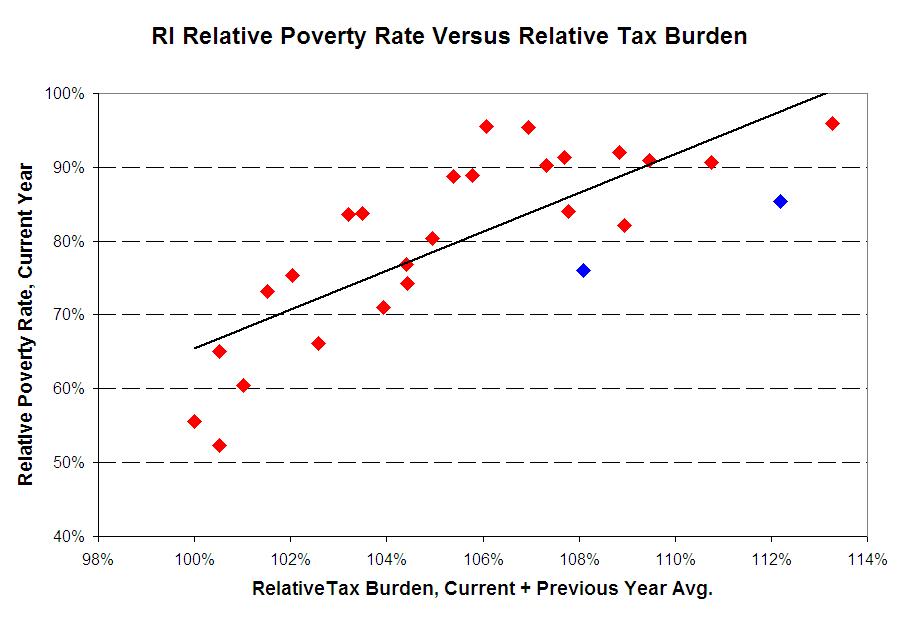
Continue reading "Poverty Rate Versus Continuous Tax Burden"
September 17, 2008
A Declining Poverty Rate Versus a Declining Tax Burden
With all indicators showing the Rhode Island economy tanking at the state level, as well as national and international-level factors like the banking crisis and energy prices squeezing Rhode Island families, it comes as something of a surprise to learn that the Federal Government says that the overall poverty situation in Rhode Island improved during the years 2006 and 2007.
According to the Annual Social and Economic Statistical Supplement put out by the U.S. Census Bureau and the Bureau of Labor Statistics, the poverty rate in Rhode Island in 2007 was 9.5%, its lowest absolute level since 1990. The figure of 9.5% was 76% of the national poverty rate, the lowest relative poverty rate seen in RI since 1994, and the period 2006-2007 was the first time that Rhode Island's relative poverty rate remained below 90% for two consecutive years since 1995-1996 -- probably not coincidentally, around the same time that RI's social services programs were redesigned in response to the Clinton administration's welfare reform initiative.
The new data lets us add two more points to the graph first presented by Anchor Rising last year of relative poverty rate versus Tax Foundation state tax-burden ranking. This graph also incorporates the changes that the Tax Foundation has made to its ranking methodology since last year (which seems to have reduced some of the year-to-year swings in the RI rankings). Here is the scatterplot of current year's relative poverty rate versus previous year's tax burden using the new numbers; the points in blue represent the two most recent years…
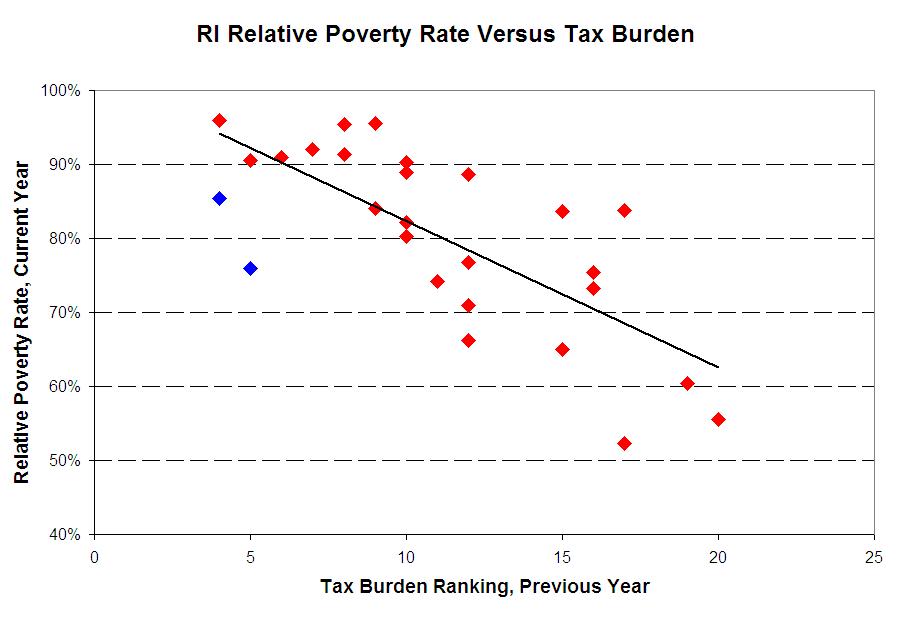
Fans of the Tax Foundation rankings may be interested to know that Rhode Island has fallen out of the top 5 in terms of the taxes paid by its residents. RI "dropped" to 9th place in 2007 and, according to the Tax Foundation's preliminary estimate, to 10th in 2008. It's too early to add a 2007 tax rank versus 2008 poverty rate point to the graph, as 2008 poverty data won't be released by the government until August 2009, but for a possible look ahead, the tax rank of current and previous years can be averaged together and compared to the current year's poverty rate -- for this data set at least, the averaging method produces a tighter fit to the data than by using the previous year's rank alone…
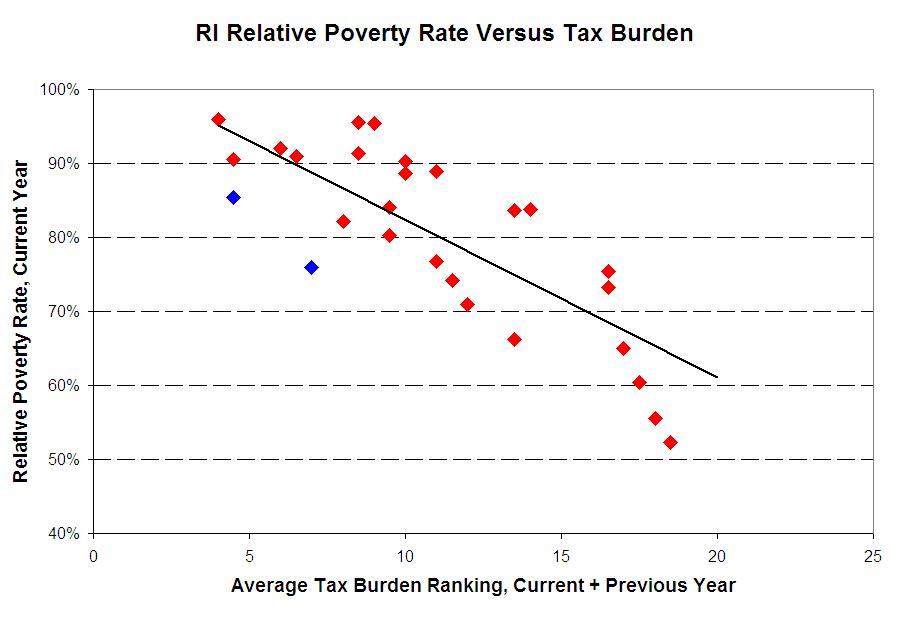
Obviously, there is more than one cause in play creating a result like this, but it is pretty clear from the most recent 25 years of Rhode Island history that creating of a high-tax state is not a great method for attacking the problem of poverty.
Continue reading "A Declining Poverty Rate Versus a Declining Tax Burden"
September 7, 2008
Ignoring Human Nature Once Again
Tom Sgouros's message must be mellifluous to public-sector ears. Everything's cause and effect (no poor decisions on officials' part), and vaguely unseemly of the citizens who initiated the latter.
The story, in summary, is that all was demographically golden in the world back in the '50s, until people started moving from Rhode Island's cities to join the "rubes" in the "sticks." Property values decreased in the cities, while it increased in the suburbs, and the latter expanded to accommodate the "demands" of citizens for city-quality public services. Urban governments are unfairly maligned for their deficit budgets, and suburban governments are unduly proud of their surpluses (or, presumably, were until recently). The next application of pain, however, will come as "high gasoline prices" send folks back to the city, and the trend will reverse.
What makes the piece worth some pondering, though, is the hint of Sgouros's solution to all this unfairness:
In the meantime, let's come up with a tax system that doesn't penalize us when people move.
That Sgouros leaves this dangling is suggestive of an invitation to speculate, but it would be a mistake to slide past a key question: Why shouldn't municipalities be "penalized" — so to speak — for the exodus of their residents? Isn't the discomfort a valuable impetus for change in a better direction? Take, for example, some facts that Sgouros cites from Providence:
Providence has only two-thirds the number of people it had in 1950, and a much smaller fraction of the property value, but it has the same number of blocks to police, about the same number of houses to burn, and more students in its schools.
In other words, Providence has been attracting poorer people who have more children. To the extent that its finances are insulated from its actual population, the city has less motivation to change the character of its citizenry. Or approach the matter from the other side:
The other big problem comes when suburban residents start demanding (and/or needing) the same level of services as the cities provide. When people move to the sticks and then demand fire response times comparable to what they'd have in Providence, you have a recipe for very high costs. When crime rates creeping upward make suburban residents demand policing like they'd get in Pawtucket, that's a problem.
If a suburb faces no consequences for too-rapid expansion, then it has less incentive to preserve its character or to ensure that those moving within its borders can afford to do so. Conversely, if it faces no penalty for driving citizens (or businesses) away, it can indulge in stagnationary policies that lock development and particular classes of people out. The non-penalizing tax system will ensure that the roads stay well kept and well patrolled whether there are fifty or five households per square mile.
Lurking behind these assessments is the dark political reality of human nature: If the leaders of a city, town, or region do not have to consider demographics' effects on their budgets, then they will be inclined to institute policies that attract residents who most benefit them — which is to say people who will justify requesting more dollars from whomever it is that doles them out and who will vote for candidates who promise to go after those dollars. As the taxing and policing body of government becomes more centralized, and the Gimme Vote more unified within particular districts, the dynamic will become such that those who receive will vote themselves an arm with which to reach into the pockets of those who provide.
Once that game is proven to be the order of things, those on the losing end of the tax-and-spend formula will find a way to extricate themselves.
August 17, 2008
Shopping Curiosity
Just wondering: how much money have people seen flowing out of Rhode Island, today, to take advantage of Massachusetts's tax-free weekend? I know of a flat-screen TV and a computer and have received witness accounts of both such items flying out the door of the Dartmouth BJ's. (Sadly, my budget remains much too tight to take advantage of the opportunity, although my list of like-to-haves continues to grow.)
August 14, 2008
An Invitation to Left-Right Harmony
Presumably such rhetoric is the result of having stopped somewhat short of full consideration of circumstances, so pointing out additional considerations should bring us at least to the point of admitting that we individually lack sufficient information to justify either vitriol or broad policy changes. Here's the basis for the hasty jibe:
Unlike the rest of us, most U.S. corporations and foreign companies doing business in the United States pay no federal income tax, according to a new report from Congress.The study by the Government Accountability Office released Tuesday said two-thirds of U.S. corporations paid no federal income taxes between 1998 and 2005, and about 68 percent of foreign companies doing business in the U.S. avoided corporate taxes over the same period.
Oddly, the very same article offers the major reasons for adjustment of such statements:
An outside tax expert, Chris Edwards of the libertarian Cato Institute in Washington, said increasing numbers of limited liability corporations and so-called "S" corporations pay taxes under individual tax codes."Half of all business income in the United States now ends up going through the individual tax code," Edwards said.
The GAO study did not investigate why corporations weren't paying federal income taxes or corporate taxes and it did not identify any corporations by name. It said companies may escape paying such taxes due to operating losses or because of tax credits.
In other words, one-third of corporations do pay corporate income tax, around 50% are structured such that their profits are taxed through the individual tax system, not the corporate, and some percentage of the remaining 17% had no profits. That's not even getting to the argument about whether tax credits are justified.
August 3, 2008
Who's Got Our Back with Taxes
An interesting response from rasputinkhlyst to my rejoinder to Crowley:
Folks in those states have higher wage and benefit base due to less attacks on workers from right wing nut jobs. Therefore their workers can afford to live there. Salaries for their state workers are higher and the benefits are better in these states. Having a livable wage means discretionary income and therefore the multiplier effect works for these state. RI with a very corporate mentality is a leader in the race to the bottom via Dumb Dumb Disaster Don and the GA enablers. These RI misfits keep thinking that RI is their personal candy store where only they deserve the sweetness. The outcome of this kind of simplistic thinking is obvious. RI was better off when workers were better off. It is a strong middle class that makes the economy work best. Less greed means more for all in the long run.
Most interesting about this is the revelation that the lefty perspective treats the public labor force as the basic determining factor of a state's health. That's a broad topic, though, branching from psychology to socialist theory, so I'll leave it to the reader to speculate.
For my purposes, it's enough to point out that, according to IRS data, Rhode Island relies more heavily on its middle class, and less on its wealthy citizens, than do Massachusetts and Connecticut:
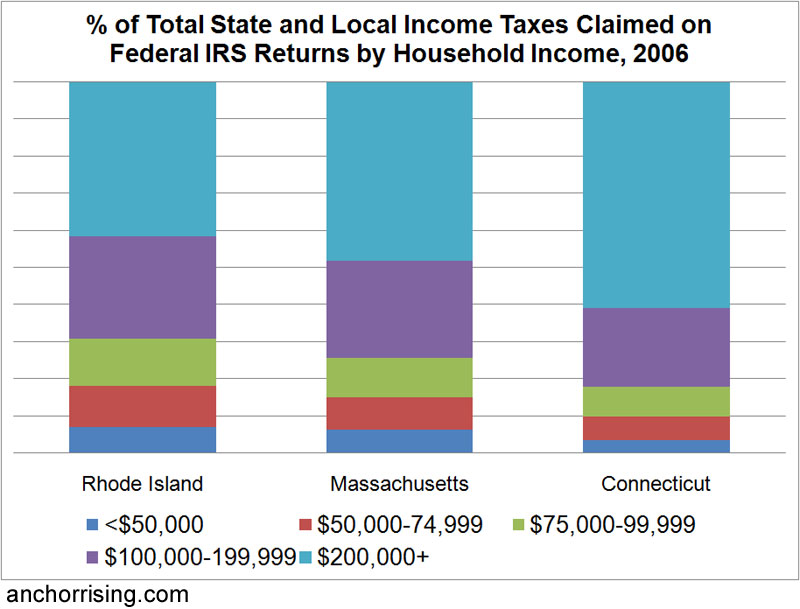
Now, progressives are free to decry this state of affairs in Rhode Island, but they can't have it both ways. They can't cite a healthy middle class as the reason that Massachusetts and Connecticut citizens paid more in income taxes per $1,000 of aggregate income even though both states have lower tax rates on "the rich" while lamenting that Rhode Island's middle class pays a larger percentage of the state's income tax revenue.
The plain summary is that Massachusetts and Connecticut both tax wealthier citizens less, yet wind up collecting a greater amount of the population's total income, largely from the upper brackets. What a mystery!
Lower Taxes and Higher per $1,000 Revenue... Go Figure
Although I'm loath to feed his attention addiction, via his recital of standard lefty rhetoric, Pat Crowley raises a point worth addressing:
... with the report basing its analysis on taxes as a percentage of personal income per $1000, it totally glosses over the point, which the quoted section above confirms, that our tax burden is regressive to the point of absurdity. See, by lumping in everyone, and then calculating the burden, the report assumes that we all pay the same rate on our taxes and that we all pay taxes on the same things. No, by relying more heavily on things like property tax, the distribution of the taxes is weighted more heavily on the bottom.
The report is from the RI Department of Revenue, and the following is that paragraph that he'd just cited:
Regarding state and local individual income tax burdens, Rhode Island ranked 24th nationally in FY 2006 with Rhode Islanders paying $26.10 per $1,000 of personal income. Both Connecticut and Massachusetts ranked higher than Rhode Island with each state ranking in the top 15 nationally in state and local individual income tax burden. For Connecticut, which ranked 11th nationally in FY 2006, taxpayers paid $33.42 per $1,000 of state personal income while for Massachusetts, which ranked 7th nationally, taxpayers paid $36.17 per $1,000 of state personal income.
It takes but a smidgen of intellectual curiosity to discern why Crowley's closer to an accurate statement when he complains of the report's "lumping in everyone, and then calculating the burden," and why the point for which that consideration argues is actually the opposite of what he intends. As Anchor Rising readers are aware, the progressives' argument is that the state has been giving away all of its revenue in the form of tax cuts for the rich, thus starving state labor and public services of funds. The bleedingly simple solution, of course, is to jack those taxes back up for the cruelly wealthy.
But here's the thing: With regard to income tax, Connecticut and Massachusetts may have collected more per $1,000 of their populations' aggregate income, but both states have lower taxes "on the rich." Any guesses as to how that apparent contradiction occurs, Mr. Crowley?
The answer, obviously, is that Massachusetts and Connecticut have greater percentages of their populations inhabiting higher tax brackets. In 2005 (the latest year for which I've gotten around to aggregating the relevant information for all three states), Rhode Island's average adjusted gross income was $50,790, compared with Massachusetts's $62,855 and Connecticut's $73,073. That year, 10.23% of Rhode Islanders' federal tax returns were on income greater than $100,000, while the percentages were 13.84% for Massachusetts and 15.54% for Connecticut.
The same considerations come into play with other forms of taxes — whereby our gauges might be deceptive. If Rhode Island were to cut its sales tax, for example, it might actually see its "sales tax burden" go up, yet the result would be more commerce, and more income, for Rhode Islanders.
August 2, 2008
A Talking Point in Need of Revision
Lefty Rhode Island wonk Tom Sgouros apparently hasn't had a chance to review the latest data available from the IRS, because he's still insisting — as if it's obvious — that recent upper-income tax cuts are the cause of our current financial woes:
Today, though, our fiscal crisis is the result of events very much under our control, the result of a tax cut overdose administered long before the economy tanked. The Governor and Assembly leaders knew this crisis was coming -- and have known for years -- because they caused it. The Assembly leadership is more responsible than the Governor for most of the tax cuts, but it's not as if he's objected to them.The union leadership is in a hard spot here. For years, they have played the inside game at the state house, cultivating and protecting personal relationships with Assembly leaders and members. But over the last many years, those relationships have won them very few victories. Last year they won a provision to make it harder for the Governor to privatize state services, but they've also lost big time in the pension "reform," the casino, health care options and more. Given the circumstances of 1991, it's easy to see why a compromise happened. Given the circumstances of today, it is going to be hard for union leaders to explain to their members why they should compromise with this Governor. This year, we're in year three of a five-year cut to the taxes of the wealthiest individuals in our state. Are they telling their members to take less pay in order to preserve those tax cuts?
To the contrary, as I pointed out last week, state taxes paid by those in the upper brackets are up dramatically from the time before the tax cuts were passed:
While preparing to cite that data again, I noticed an error in the following from my prior post, but it's one that actually enhances the point:
In summary, from tax year 2005 to tax year 2006, Rhode Island imported 6,976 "households" with income under $50,000, lost 32 with $50,000-74,999, and gained 1,757 with $75,000-99,999, 4,794 with $100,000-199,999, and 1,011 with $200,000+. Among those totals are 24,817 returns filed with the federal government from new hometowns outside of Rhode Island. It could be that the increase in the upper bounds came from middle-classers who'd sold their houses and moved out of state, but the fact that the average income of incomers was higher suggests that something different occurred.
The error is in my assessment that the state-level IRS data allocates returns according to their residences during the tax-year in question, when actually they are sorted by the address that the taxpayer lists on the form when paying his or her taxes the following year. What confused me was that the IRS migration data — which literally tracks individual taxpayers by their Social Security numbers — showed a net loss of taxpayers from tax year 2005 to tax year 2006 of 3,733. If emigrants aren't included in the above chart, how does one account for the fact that Rhode Islanders filed 14,506 more tax returns in 2006?
After some time away from the computer, it occurred to me that the 2006 tax year — filed in 2007 — brought a substantial giveaway from the federal government to taxpayers with children. No doubt, many residents whose income negates the need to file tax returns annually did so for the purpose of claiming that prize. That would explain why the amount of state taxes claimed on federal returns of lower-income filers flat-lined even as the number of such returns jumped up. It's also in keeping with the turnabout by which those moving to Rhode Island had a higher average income than those leaving.
If we may presume that those in the "the rich" brackets file income tax returns as a matter of course every year, then increases of them in 2006 would have to indicate advancement of households from the lower brackets or immigration from other regions. Since the numbers of taxpayers in lower categories also increased or stayed pretty stable it seems likely that some significant number of them left (to account for the net loss of taxpayers). To get to the point: the number of high-income taxpayers increased even more than the charts indicate on their face.
To decry the revenue "lost" to the tax cuts, I believe that Sgouros takes the taxes received and recalculates it as if the rate had been higher. Clearly, when migration is a factor, it is inappropriate to assume that the increasing numbers — and the increasing revenue — that we've been seeing would have materialized if Rhode Island's tax structure had been more punitive.
July 25, 2008
Governor Carcieri: "There will be no resumption of negotiations with Council 94"
The Governor's office released this statement about an hour ago.
"There will be no resumption of negotiations with Council 94," said Governor Carcieri. "My administration spent six months and hundreds of hours negotiating the terms of this agreement with representatives of Council 94. Those representatives agreed to the terms that were finally negotiated. There were numerous concessions from the state, including not going forward with the layoff of hundreds of employees and guaranteed wage increases of 8.5% over the four year contract.""The results of this vote can lead me to only one or two conclusions. Either the representatives of Council 94 who were part of this agreement have not been negotiating in good faith, or that there is an internal power struggle between the union heads within Council 94 that undercut the vote. In either case, there is no basis for further discussions. Two-thirds of the other state employee unions have ratified the agreement, including the United Nurses and Allied Professionals Local 5019, which voted to ratify the agreement last night. They do appreciate the severe financial pressure the state faces, and have chosen to be a part of the solution."
"The state's financial status is not improving. In fact, there are signs that the national economic slow down, with high energy prices, may prolong the weak economy in Rhode Island. As Governor, I am obligated by law to balance our state's budget and will do so."
"I am carefully reviewing our options with my legal and administrative staff. I intend to announce a course of action next week that will be in the best interest of our state and all its citizens."
ADDENDUM
Today's Providence Journal has more details, including how many other public employee unions have and have not signed on to this contract.
Council 94 rejected the same deal that went to 13 smaller unions that make up the other two-thirds of the state’s work force. At least seven of the independent unions have voted to accept the four-year contract, while three have voted it down. The rest will vote in the coming days.
One puzzling item (not referenced in the article) is the assertion yesterday by Council 94 leadership that no negotiations took place between the state and the union prior to their bringing this contract to their members. If that's the case, what exactly took place in the thirty meetings between Council 94 leadership and the administration?
July 22, 2008
RE: Taxing Thoughts
Along with the chart that Andrew mentioned, the related WSJ piece included some observations worth mentioning. But first, earlier this month, Stephen Moore previewed the same IRS data used for the chart:
New data from the IRS will be out in a few weeks on who pays how much in taxes. My contacts at the Treasury Department tell me that for the first time in decades, and perhaps ever, the richest 1% of tax filers will have paid more than 40% of the income tax burden. The top 50% will account for 97% of all federal income taxes, while the bottom 50% will have paid just 3%.And that richest 1% isn't comprised of a bunch of old money, Hamptons-dwelling WASPs. As today's WSJ piece explains, millionaires aren't just born, they are also self-made:
We also know from income mobility data that a very large percentage in the top 1% are "new rich," not inheritors of fortunes. There is rapid turnover in the ranks of the highest income earners, so much so that people who started in the top 1% of income in the 1980s and 1990s suffered the largest declines in earnings of any income group over the subsequent decade, according to Treasury Department studies of actual tax returns. It's hard to stay king of the hill in America for long.And, with more millionaires....The most amazing part of this story is the leap in the number of Americans who declared adjusted gross income of more than $1 million from 2003 to 2006. The ranks of U.S. millionaires nearly doubled to 354,000 from 181,000 in a mere three years after the tax cuts.
Taxes paid by millionaire households more than doubled to $274 billion in 2006 from $136 billion in 2003. No President has ever plied more money from the rich than George W. Bush did with his 2003 tax cuts.Moore explained that we shouldn't be surprised by this:
Economist Glenn Hubbard of Columbia University has shown that in 1970, when the highest tax rate was 70%, the top 1% shouldered 16.7% of the income tax burden. Today the top tax rate is 35% and the same class of taxpayers pays a whopping 39% of the burden. The worst way to "soak the rich," Mr. Hubbard finds, is to raise tax rates.
Taxing Thoughts
The Wall Street Journal published a chart yesterday breaking down IRS data from 2006 on federal-income taxes collected as a function of income level…
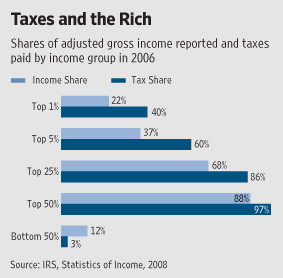
Given that 50% of the people are paying the taxes that support the other 50%, it's hard not to believe that there's something to science-fiction author and blogger Jerry Pournelle's recently expressed view of the nature of modern government…
The purpose of modern government is to take money from the folks who save and pay their bills and live within their means, and use that to hire government workers; and to keep their power by using the money to buy votes from those who do not save and pay their bills and live within their means. And of course the money comes from those who work and save and pay their bills and live within their means -- who else will have any money for the government to take?
July 1, 2008
It's Time to Hold the Line, Down the Line
As some of Justin's "adventures in town government" have revealed, the town of Tiverton has decided they simply "have to" break the 5% cap on annual property-tax increases because they can't cut anything. They are not alone, according to Susan Baird at the Providence Business News:
Nine cities and towns so far have requested permission for property-tax increases exceeding this year’s state cap of 5.0 percent, according to data released today by Gary S. Sasse, director of the new R.I. Department of Revenue. But 28 are seeking tax increases “at or below” this year’s statutory cap of 5.0 percent, he said.PBN also has this handy chart:***
The largest planned increases were in rural West Greenwich (14.05 percent), North Smithfield (13.19 percent), Foster (12.48 percent) and Tiverton (12.20 percent). Also seeking tax-levy increases that would exceed the state cap were Glocester (8.59 percent), Exeter (8.33 percent), Richmond (8.06 percent), Bristol (5.40 percent) and Westerly (5.15 percent).
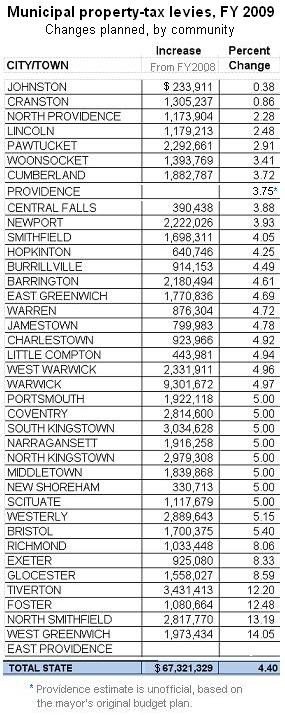
In addition to the 9 towns who "went over," there are 8 more who went right to the 5% cap and 11 more who upped their rates at least 4%. So that's 28 towns jacking up rates over 4%, which I suppose we we could consider to be (a bit generously) the cost-of-living increase. To try to be optimistic, I figured that more towns would spend to the 5% cap. Regardless, I'm sure the towns are feeling the pinch this year. And so are the taxpayers, yet again.
To be fair, some of the cuts made by the General Assembly are being manifested at the city and town level, so property tax increases aren't a surprise. That doesn't mean that local governments can't spend more wisely and make cuts in city "services." If taxpayers are upset by these increases, then it's up to them to send the right message to local town and city politicians at the ballot box in November. If they don't, they can expect more of the same. And they'll only have themselves to blame.
ADDENDUM: Good points made by "John" and "Tom W" in the comments. Basically, as John noticed, some of the communities that didn't go to the 5% cap are also those who are labeled as "distressed" and receive lots of state aid. And he asks the question, "Should they be commended or is the state giving extra where it isn't really needed?:
Tom explained how "state aid to education" is a vehicle of redistribution from rural and suburban communities to the "urban core."
The suburban people pay income taxes (while many if not most urban dwellers do not), and those taxes go into the general fund. From there the "education aid" money is disproportionately directed toward the urban systems.So those in the suburbs are then hit with disproportionate property taxes to make up the difference. In effect, they're paying for two school systems at once - their local one through property taxes, and urban ones through their "progressive" income taxes.
June 13, 2008
Gambling Revenue Counteroffer?
Robert Walsh's controversial proposal to permanently dedicate a portion of Rhode Island's gambling system to the state pension fund makes the lede of the Katherine Gregg/Paul Grimaldi article in today's Projo even more eye-catching than it would normally be…
The owners of Twin River are offering the state upward of $500 million up front in return for slicing by more than half the percentage of money the state gets from the slot parlor.But based on the raw numbers presented in the article, it's difficult to see the Twin River proposal as a good deal for the state…The offer is part of Twin River’s plan to solve its own “dire” financial crisis. Twin River has missed loan payments to its bank and is in danger of falling into bankruptcy. “The situation is dire. We are standing on the edge of a precipice,” Twin River spokeswoman Patti Doyle said yesterday.
Meeting with House Speaker William J. Murphy earlier this week, the Twin River delegation offered the $500 million if the state would reduce its cut of the slot revenue from 61.45 percent to 25 percent....Let's see, 25 is roughly 40% of 61-and-change. That means the state would collect, again in rough terms, about $104 million per year under the new rate, approximately $155-$160 million less than it collects now, meaning that after just 3 1/4 years (500-divided-by-155) the state ends up with less money than it otherwise would have taken in.The state anticipates $261.4 million from Twin River alone in the fiscal year beginning July 1, and that does not include any of the additional money that newly approved 24-hour gambling on weekends and holidays is expected to generate.
Trading a reduction in revenue in-perpetuity for a short-term boost that evaporates after three years doesn't seem like sound fiscal policy to me, unless you believe for some reason that gambling is on the verge of dying here in Rhode Island, which I don't think anyone is forecasting.
Later on in the article, Gregg and Grimaldi ask the first question that I know occurred to me -- and I suspect occurred to others -- immediately upon viewing the headline…
Asked how Twin River’s owners could afford to offer the state a $500-million upfront payment when they can’t afford to pay off their outstanding loans, Doyle said: “If we are able to reduce our tax rate overall, the lending community will look more favorably on our relationship with the state” and presumably be “willing to advance the upfront payment.”Do you buy this answer? Or do you perhaps take a more cynical view, that this is an attempt to head-off the recent proposal made by Mr. Walsh and protect the full value of a lucrative revenue stream?
If you don't take the cynical view, does the Walsh proposal still make sense, if Twin Rivers is going bankrupt? Or do you take a doubly-cynical view that this is a ploy by Twin Rivers to make them seem less fiscally sound than they may actually be, reducing any potential enthusiasm on Smith Hill for the Walsh plan? Or is that just too many layers of cynicism heaped upon one another?
UPDATE:
If commenter "ChuckR" doesn't mind, I'm going to mark him down in the "cynical but accurate" column...
If it was a good deal for the state, it wouldn't have been offered.
June 10, 2008
Very Unintended Consequences of Michigan's Tax Hikes
Ed Achorn points out today that the tax hikes on income and gross business receipts passed by Michigan's Governor and legislature have backfired in a couple of ways.
In a state already battered by the decline of the auto industry, the tax hike left Michigan with an unemployment rate of 6.9 percent, high above the national average of 5 percent. (Rhode Island’s rate is 6.1 percent.) Meanwhile, large numbers of those who can afford to flee are leaving, and the state’s housing prices are declining at the fourth-fastest rate in America. Locals call it “the Detroitification of Michigan.”Furious taxpayers have gathered enough petition signatures to force a recall election on House Speaker Andy Dillon, one of the chief advocates of the tax hike.
That does not seem a very promising model for Rhode Island to copy.
Achorn correctly points out the step - the first of many needed - that RI House Speaker William Murphy had orchestrated away from Michigan's model and the absurd reaction that it evoked.
He pushed through a reform that would bring Rhode Island’s income taxes on a slow glide path toward parity with the Bay State’s. He won national attention with the move, which helped advertise the Ocean State as trying to get its house in order.This — an attempt to gradually become competitive with Massachusetts, never mind the country or the world — is what the public-employee unions are denouncing as an outrageous giveaway to the rich.
[Reference/Reminder: Justin's post and handy graphic.]
As we await release of the House Finance Committee's budget tomorrow, Achorn reminds us of the pitfalls of backsliding towards Michigan.
It would be comforting to subscribe to the childlike faith that taxing “the rich” would take care of everything. But, in the real world — as Michigan and Rhode Island have amply demonstrated — it does not work. People will invest their money in other states. They have access to these things called moving vans. They can pack up and leave.
June 7, 2008
Capitalizing The Lot
Under Marc's post "Lima Gives some budget hints", commenter Ken says:
there appears to be a proposal made by NEA Walsh to GA to sell RI Lottery gaming futures netting a supposed ESTIMATED $4-4.4 billion
This idea is a complete non-starter.
First and principally, it is the end of the line when an entity, government or otherwise, begins selling fixed assets to pay for recurring operating expenses - in this case, pension contributions. Whether or not such pensions were too generous to begin with is a separate issue. In point of fact, the elected officials who promised these pensions needed to properly fund them over the last decades. They failed to do so.
Secondly, to address such a failure by selling fixed assets is completely unacceptable - simply as a principle as outlined above - and because if such a practice is intiated, there will be no end. Elected officials lacking the will to properly structure a budget or, as appears now to be necessary, to restructure existing contracts, will capitalize and then sell the entire state out from under us in a matter of years.
Think I'm exaggerating? How long did it take the General Assembly to capitalize and then blow through the tobacco settlement?
Capitalization, especially of assets which do not belong to you, is so easy and convenient. It is also a very bad method indeed of addressing a gap in an operating budget.
June 4, 2008
Group Asks Fox to Raise Our Taxes
Dr. David Savitski, a child psychiatrist, was part of a group of East Siders that met with House Majority Leader Gordon Fox to ask that he raise "their" (that would be "our") taxes so that state services to "our most vulnerable citizens" aren't cut. John DePetro--taking a cue from Bob Kerr's column--had Savitski on the air this morning.
The doctor explained that the group was against short-sighted cutting because, they believe, such cuts will result in higher costs in the long-run. He explained that there were other ways to save money, citing inefficiencies in the structure and administration of state government that should be tackled instead of cutting services to people who can't complain. And he agreed with DePetro that groups that have gotten a "good deal from the state" should pony something up.
According to Savitski, Fox related that he couldn't get other State Representatives to go along with substantive structural change and while Savitski also said that we need to look at changing the tax structure--and we rely on the property tax too much--the final impression is unmistakable: Dr. Savitski and his fellow East Siders think the answer is in higher taxes, not cutting in other areas.
No word on whether the group was willing to voluntarily contribute more taxes on their own.
May 29, 2008
The Actual Upshot
The Newport Daily News has the most thorough explanation of the outcome of Tiverton's Financial Town Meeting that I've seen:
More than 800 voters packed Tiverton’s reconvened financial town meeting Wednesday night and approved a slightly amended budget of $41.7 million for fiscal 2009.Voters also approved a tax-levy override of $1.6 million, which will necessitate an increase of 99 cents to the tax rate, making it $11.25 per $1,000 of property value.
The tax rate is 10 cents less and the excess tax levy is $250,000 less than the $1.9 million override proposal presented to voters at the start of the May 21 meeting. That proposal was defeated by a majority of the 465 voters in attendance. Town officials initially proposed a $42.1 million budget for fiscal 2009, which begins July 1. ...
The amended budget that was approved includes a $100,000 cut to the school budget, a $100,000 reduction in the amount for uncollected taxes and a $50,000 reduction in the police pension fund.
The $100,000 from "uncollected taxes" will, presuming a revenue shortfall, have to be made up somehow in the future. The $50,000 not put into the police pension fund is even more of a mere postponement; if the pension is of the defined benefit sort (which I haven't been able to confirm with a quick search, but which is likely presumable), then the money not put in is of no immediate concern to the participants. That leaves the $100,000 school budget cut, which a Caruolo Act lawsuit could erase.
In other words, the "compromise budget" is very Rhode Island.
May 28, 2008
The Tiverton Powers That Be Try Again
Well, my first financial town meeting is about to begin. As if knowingly, the woman at the rapidly moving G-L registration line stamped my admittance arrow to the right. (Or perhaps it was a sly political statement from her perspective.)
If you're coming, wear your walking shoes:
Of course, you get to go right by the school if you drive one of these:

Here's the audience as of the meeting's beginning:
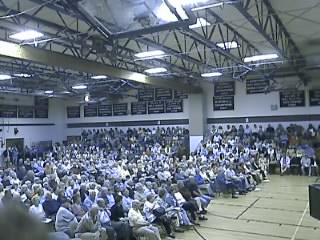
7:41pm
The Budget Committee proposed another budget that raises the budget by $250,000 less than the previous budget proposal. A citizen appealed, and now we're debating whether the new proposal is appropriate given last week's occurances.
7:47pm
The woman who appealed the decision to allow another proposal just pointed out that doing so would disenfranchise those who voted previously and would be equivalent to allowing the losing side a week to gather the troops and try again.
I gotta say, by the way, that the joining of legal actions with a public gathering makes for some confusing discussion.
7:54pm
The official count of those in attendance, by the way, is around 750 (747), I think, but I was trying to pay attention to other things when it was stated.
The updated count: 775 786
8:01pm
A vote in which the appeal failed (with the effect that the new budget would be considered) will be retaken, because of confusion about the number of people voting and in the room (more people voted than appeared to be present).
They'll now be closing the doors during votes.
(It seemed clear to me that the "yes" votes were clearly more numerous, but I can't see the whole room.)
8:09pm
Current count: 789.
8:13pm
Appeal denied. Proposal goes forward for consideration.
Now an appeal to recess 30 days to allow more budget restructuring.
8:18pm
The appeal debate continues: The vote count exceeds the attendance count by 3, with the "no" (to the appeal) having won by 14.
8:27pm
Some controversy because the vote to recess was done by voice, not by count. I'm not sure what determines the method of voting. The "no" to the recess certainly was louder, but a few male voices were clearly prominent.
8:38pm
I'm really confused. The budget committee chairman (Mr. Cotta) suggested a slightly reduced budget excess over the cap than last year, and a couple of women amended that, I think, to be more, perhaps restoring last week's number (?).
Much more discussion on a proposal to reduce it than the two to increase it.
(The increase was, I believe, to the previous number.)
8:45pm
Note on voting method: the voice votes strike me as fundamentally biased, because many who can be presumed to want a larger budget (police officers, firemen, and teachers) are selected by their careers to have practice projecting their voices.
9:23pm
The first of three amendments to the budget committee's new number (currently the lowest number has failed). Of course, that's now four amendments that have to fail before the tax increase cap can stand.
9:37pm
Having just voted down an increase over the tax levy of $1,860,000, we just voted down $1,850,000. (Now 688 people in the room.)
10:09pm
Low battery.
The Budget Committee's motion to exceed the cap by $1,659,505 ($250,000 less than last week) passed 376 to 319 (with a body count of 689).
A large number of people got up and walked out, despite urging to stay for further votes. A motion was made and seconded to close the doors to keep them in. I shouted that they ought to just shoot them and inquired whether they constitute a quorum if they're dead. School Committee President DeMedeiros laughed.
Now they're recounting to see if we've maintained a quorum. (Now 442 remain.)
11:14pm (from my now more-expensive home)
Odd things happened after the walkout. Budget Guy Cotta proposed another motion that I didn't fully understand, but it apparently had something to do with resolution 7, which apparently passed last week:
RESOLVE, that the voters of the Financial Town Meeting approve setting aside a reserve sum of $474, 213.00 as a restricted expense for the purpose of accounting for annual abatements and uncollected taxes which amount to 1.5% of levied taxes on Real and Tangible Properties. Historically the Town of Tiverton allocated a reasonable percentage of abatements and uncollected taxes as a method of ensuring the town could operate as budgeted without requiring 100 percent tax collections. Because the town has received permission to levy taxes beyond the permitted tax cap, and there are presently insufficient unreserved general funds available to offset taxes, fiscal prudence requires the town to account for potential abatements and uncollected taxes.
An objection was made that the resolution passed with attendance of 437, and undoing that seemed imprudent. Meanwhile people were storming out. A request was made for another room count, and the two police officers keeping track conferred. The folks on the stage worked quickly to move to a vote in the meantime, and in short succession the police officers announced that 16 people had left (bringing the number to 426), and the motion passed. Objections followed that there was no longer a number exceeding 437, and the moderator (who didn't seem very unbiased, given some sarcastic remarks to certain audience members) asserted that the number had been in the room when the vote was called (or something along those lines).
The net result, at the end of the day (although numbers were flying, and the town clerk had to correct the motion several times, so I might have confused things a little), is that Tiverton will raise property and vehicle excise taxes to an amount not less than $31,097,228, and not more than $31, 297,228.
I've got to sort some things out, but it looks like the net effect could be to raise property taxes from $10.26 to $11.78, or 14.8%.
Welcome to democracy, Rhode Island style.
(Note, see here for a summary. It may be, by the way that the tax increase no a per $1,000 basis is actually 9.6%, although it's still an 11% increase from last year's collections on a total basis.)
Tiverton and Beyond - Quick 'N Dirty Background
WPRO's Matt Allen, in the last hour of his show yesterday, reported that at the Tiverton financial town meeting last week, a woman stood up to urge that the budget cuts be reconsidered, thereby at least tacitly (and perhaps overtly) expressing support for the 11% tax increase proposed by Tiverton's solons. Her suggestion was not well received by many citizens in attendance. [Public Service Announcement: the Tiverton financial town meeting continues tonight.]
It occurred to me that the woman may either be new to the state or only recently involved in government so may not be aware of some background - background common to most cities and towns as well as the state itself; background, by the way, that often seems missing from Providence Journal reporting (though not editorializing) on such matters, as evidenced in the article from which Justin's quotes.
To the woman who spoke in support of the 11% tax increase: you are to be applauded for getting involved. In preparation for the continuance tonight of the Tiverton financial town meeting, you might be interested to know:
> Rhode Island is eighth highest in education expenditures yet its schools are performing on the other end of the scale.
> Rhode Islanders pay the fourth highest taxes - much of which goes to fund our schools - yet must contend with all of the disadvantages of the second worst business climate in the country.
> Because of the misguided actions of many of Rhode Island's elected officials on the state and local level, good teachers are paid the same as mediocre and bad teachers and there is no mechanism for the removal of poorly performing teachers except in extreme cases . (Ed Achorn points out that Representative Nick Gorham is trying to change that.)
You can perhaps see, ma'am, why there is less than universal support for an 11% tax increase in your town.
CBO's Data on the Distribution of Federal Taxes and Household Income
The Congressional Budget Office has released a new report, "Data on the Distribution of Federal Taxes and Household Income," which covers 1979-2005. Here's the "money graph":

Here's an explanation, including:
CBO’s analysis of effective tax rates assumes that households bear the burden of the taxes that they pay directly, such as individual income taxes (including taxes on interest, dividends and capital gains) and employees’ share of payroll taxes. The analysis assumes—as do most economists—that employers’ share of payroll taxes is passed on to employees in the form of lower wages than would otherwise be paid. Therefore, the amount of those taxes is included in employees’ income, and the taxes are counted as part of employees’ tax burden. CBO estimates payroll taxes and individual income taxes, including refundable tax credits, with a tax “calculator” that applies the tax law for the relevant year to the tax return data from the SOI.I emphasized what I did to remind all of our redistributionist friends out there of an economic truism: whatever extras you think you can extract from businesses will be passed along to employers and consumers. There is also this interesting graph:Excise taxes are assumed to fall on households according to their consumption of taxed goods (such as tobacco and alcohol). Excise taxes that affect intermediate goods, which are paid by businesses, are attributed to households in proportion to their overall consumption. CBO assumes that each household spends the same on taxed goods as similar household with comparable income in the Consumer Expenditure Survey.
Far less consensus exists about how to attribute corporate income taxes (and taxes on capital income generally). In this analysis, CBO assumes that corporate income taxes are borne by owners of capital in proportion to their income from interest, dividends, capital gains, and rents....Over the long term, however, some models suggest that at least part of the burden falls on labor income. (emphasis added~ed.)

Notice how consistent the "Social Insurance Taxes" (entitlements) are? Many more graphs to slice and dice here.
May 23, 2008
Building the Cleansing Fire in Tiverton
Life kept me away from Tiverton's Financial Town Meeting, Wednesday night, although to be honest, I suspected that I would have been one of the few not falling into line in response to town official arguments such as the following:
... since Mr. Cotta and other officials said that legally the school budget cannot be cut below what it was for this year, that shifts much of the burden to the municipal side. ...In addition to the town's obligation to pay the bond debt, Mr. Cotta said the town has employee contracts that must be honored. Other legal requirements were mentioned, such as public safety minimum staffing requirements in the police and fire departments, which will have to be dealt with.
As it turns out, however, the voice of the majority is such as would warm the hearts of most Anchor Rising readers:
"Let's make a stand and tell the state we can't take it anymore," said Joe Sousa."How about cutting some services," added Tom Morse. "I don't care, I would suggest you start talking about cutting." ...
And Roger Bennis, who supported the cuts, said, he cares less about where the cuts are made than that it happen. "I don't have any specific recommendations. I am looking to send a message."
And:
Shouting "no," the voters signaled that they would not approve the final $2 million of the Budget Committee's proposed $30 million tax levy. ...Joe Sousa asked fellow voters to “send a message upstate” that the town’s taxpayers reject unfunded state mandates, particularly those related to the schools, like the education of special-needs students.
“We can’t afford it any more,” Sousa said.
“The prices we’re paying to send these children to school are outrageous,” he said.
And from this week's Sakonnet Times Web Words:
Who should be surprised with the pay and benefits they give out. Who else in this world gets to retire at 45, like cops and fire, or 55 like teachers and get almost full pay for life — and we pay and pay. The benefits we throw around are crazy.
And a letter from Tiverton resident Chris Hart:
In regards to Tiverton's exhorbitant proposed tax hike, all I can say is NO,NO,NO!Perhaps it is time that we take a good accounting of all our town services, with no exceptions. The police, fire, and water departments are all equiped with new vehicles, which I frequently see being used for personal uses (unless the Moose Cafe, Barcellos, Subway, Dunkin' Donuts, etc. are having water trouble, high crime rates, or fires on a daily basis? )
With the ever increasing fuel prices, a crackdown on all this running around to pick up lunches, coffee, and the like is in order. Hopefully, with all the taxes we are already paying there is someone under contract to keep track of all these expenditures.
Returning to the first link, above, one finds the spreading of a necessary crack in Rhode Island's corrupt veneer:
That prospect [that the money will reductions largely come from the municipal side of the budget] upset Bob Martin, a town maintenance worker and head of the town employees union."What we're talking about is the gross waste in the schools," he said.
It looks, however, as if sympathetic townies may not have the luxury of continuing to remain in the shadows, because the local government will probably try again:
When the town meeting does reconvene, Mr. Cotta said Thursday, the budget committee could recommend more than one budget, for example the original one recommended at last night's meeting and another reflecting $2 million in cuts. Parliamentary requirements would have to be met, he said."We can present more than one budget as long as we have the same or more than the number in attendance when we do as were present when the original vote was taken," he said. The quorum present at the time (approximately 9 p.m.) the vote was taken last night is thought to be close to what it was (437 voters) when the meeting was called to order at 7:20 p.m. The total vote on the motion was 406 voting, with 151 yeas and 255 nays. Mr. Cotta said people he knows of who voted on the prevailing side could move to reconsider, and thus bring the recommended measure back again that was rejected last night.
One can only hope that the peremptory and condescending tone of officials won't go unnoticed:
"What we saw were people angry at the oil companies; people who were angry at oil heating costs," [Town Council President Louise] Durfee said.With the price of gasoline approaching $4 a gallon, they were saying, "this is not something that we can control. Let's take it out on the powers that be," Durfee said.
But voters did not think through the consequences, Durfee said. ..
[School Committee Chairwoman Denise] DeMedeiros said yesterday, "I do take offense" at the notion "that this was some kind of underhanded thing that we got that bond," deMedeiros said.
"It's disturbing to me that they're telling us we didn't do due diligence," she said. ...
"People just don't like the tax," she said. "Maybe some people weren't paying attention." ...
... when extra money trickled in, it went to the general fund, helping to replenish monies used to offset taxes, [Budget Committee chairman Christopher Cotta] said.
But there has been no such cushion in the last two years, when the town exceeded the state limit on tax increases, Cotta said, and the general fund has dwindled to about $1,266,000.
That amount is barely enough to meet a requirement of the Town Charter that the town maintain reserves equivalent to 3 percent of its operating budget.
Cotta said, "you got the benefit of the $900,000 (from the general fund) in your taxes this year. Now you want to cry about it."
Two observations:
- Odd that our elected officials are responding to the night's democratically expressed voice as a personal rebuke rather than a direct instruction from the people who are ultimately in charge.
- Curious — as much as the lower economic waters may have brought the rapids' rocks into sharper relief — that our elected officials remark upon the tide, but not the stones. Surely Cotta ought to include, in his "supercollision of everything wrong happening at the same time," work-to-ruling teachers, a contentious departure of the town administrator, repeated blocking of development efforts, and higher property tax assessments, even as property values decline.
Good morning Rhode Island politicians. Grab a cup of coffee and join us around the fire or we'll drag your sleeping bag into the river.
May 15, 2008
Ahem, look what they are trying to do next door in Massachusetts
While RI politicians continue to avoid dealing constructively and aggressively with the structural problems underlying the state's financial crisis, some of our neighbors in Massachusetts are heading in the completely opposite direction.
Yes, in the state formerly known as Taxachusetts, a band of activist citizens are pushing for a statewide vote to eliminate the state income tax:
A group of antitax activists launched a campaign over the weekend to abolish the state income tax, setting the stage for a contentious public battle if the measure is added to the ballot this fall.After pushing a similar initiative that almost passed six years ago, a group called the Committee for Small Government is back for another round, asking voters to end the income tax and save the average taxpayer $3,600 a year. The group, led by libertarian Carla Howell, is almost certain to gather the 11,000 signatures needed to put a question on the November ballot.
To say that state officials are worried about the prospect would be an understatement.
Community, political, and business officials are grasping for words such as "chaos," "devastating," and "catastrophe" to describe the scenario that would unfold if the measure passes.
Six years ago, Beacon Hill didn't pay much attention to what seemed to be a pie-in-the-sky campaign. Confident that voters would reject the plan as folly, no one even organized a campaign to fight it.
But it almost passed, gaining the support of 45 percent of voters...
A fledgling coalition of city and town officials and union officials hired former Blue Cross Blue Shield executive and civic leader Peter Meade to head a battle against the income tax cut, and is interviewing high-powered public relations firms. Their Coalition for Our Communities plans a fund-raising and public educational campaign to combat the allure of the tax-cutting measure, which would cost the state roughly $12.7 billion - about 40 percent of the budget.
Some political observers are expecting a public tax battle the likes of which has not been seen since Governor Michael S. Dukakis was in office...
These are the kind of engaged, activist people I had in mind when I wrote earlier this week about the crisis in RI and how important it was for RI to have a coalition of citizens committed to change. Why do we almost NEVER hear of similar groups of people in RI?
On a concluding note, I got a chuckle out of Andy Roth's words about the Massachusetts' initiative:
I don't know what I like more about this article. The fact that Massachusetts citizens are pushing for a repeal of the income tax, or the fact that bureaucrats are going bonkers with the prospect that they might succeed.
And how would raising taxes even higher in RI not incentivize further flight from the state by more residents?
ADDENDUM
In the comments section, Ken is kind to pass along the link to the American Legislative Exchange Council (ALEC) report entitled Rich States/Poor States: ALEC-Laffer State Economic Competitiveness Index. Key sections include the executive summary here and the section "America's Economic Black Hole: The Northeast" on pages 15-18 of the report. The Rhode Island summary can be found here, where they describe the economic outlook as 48th out of the 50 states.
There is no "moderate" solution option left anymore; the entrenched special interests and politicians have made sure of that. The state is headed for collapse under the status quo. So we might as well throw the state into bankruptcy and restructure it with some logic.
May 13, 2008
What's Not in the Numbers
A few important considerations are missing from Tom Sgouros's comment of his "review" of state tax revenue statistics:
I was reviewing some statistics about state tax revenues last week, and looked at business taxes. Along with the income tax and sales tax, business taxes were once the third important leg of funding state operations, but no longer. Between 1996 and 2006, income tax collections rose by 76%, sales tax collections by 97% and business taxes by -- wait for it -- 14%, far less than inflation over that decade.Why have business tax revenue declined so much? The economy has suffered recently, but not for all of that decade. The biggest reason for the decline is a nearly endless stream of special tax breaks. We offer businesses several different investment tax credits, an R&D credit, a credit for wages paid in an Enterprise Zone, a jobs development credit, a job training credit, a biotechnology tax credit, an "innovation and growth" tax credit, and much more. Some of these are worth millions of dollars. For others, we simply don't know what the effect is on the state budget. But the result is that 94% of the businesses in our state pay the minimum corporate tax of $500.
For one thing, it's difficult to measure the significance of percentage change without knowing the dollar amount for each category. More to the point, however, Sgouros's analysis requires that one ignore economic realities: It may be, for example, that the same policies that kept business taxes down enabled or encouraged increases in salaries and sales, thus increasing those taxes. One ought also to remember that offshore outsourcing has also expanded during the period in question, peeling off business revenue and making it advisable for the state to decrease the cost of doing business here.
Rhode Island clearly doesn't do economic development well, but presenting percentage change statistics isolated from context and lamenting pro-business tax policies bespeak precisely the approach that will bury Rhode Island, if permitted to affect our tax structure.
May 11, 2008
Non-Public Employees in New York's Public Pension System
From an interesting blog called Pension Risk Matters:
Attorney General Andrew Cuomo is investigating "alleged abuses of the state pension fund" at school district, town and village levels. External contractors may be costing Empire State taxpayers a bundle in the form of "undeserved" retirement benefits. (See "Cuomo expanding pension probe," April 14, 2008.)
The TimesUnion blog, that second link, elaborates.
Attorney General Andrew Cuomo on Tuesday is expected to announce that he is further broadening his probe into alleged abuses of the state pension fund to include not just school districts, but towns and villages as well.Cuomo was already looking into the practice by some school districts of putting outside contractors, particularly lawyers, into the state retirement system. The practice has allowed some attorneys to rack up huge amounts of retirement credits — possibly illegally, Cuomo says, because they didn’t qualify as employees.
The attorney general is now turning his attention to a similar practice in local governments, especially the smaller ones, which also don’t always have staff attorneys but hire them under contract.
One of the lawyers who benefited from that system, James Roemer, accrued a taxpayer-funded pension worth more than $80,000 a year working for various cities, towns, counties and villages, in addition to being in private practice. Roemer, according to a person familiar with Cuomo’s investigation, has been subpoenaed in the probe.
By gum, Rhode Island may have the second highest unfunded public pension liability in the country. But we don't have non-public workers in any of our public pension systems.
(... Do we?)
Taking from the Not So Rich
So proud of this little snippet from a Providence Business News piece is Patrick Crowley that he's mentioned it multiple times:
But what about the rest of us? After all, nearly 50% (48.7%) of the returns filed were for incomes BELOW $30,000 a year. And while this group pays 4% of the state’s income tax they actually earn only 3% of the income in the market. The $100,000-$200,000 group earns 24% of the wages but only pay 23% of the income taxes, and the $75,000-$100,000 group earns earn 14% of the wages but only pay 12% of the income taxes. This takes the “progressiveness” out of the “progressive” income tax. And because the other taxes people pay are “regressive” (property tax, sales taxes, etc) the picture becomes more clear – people at the bottom end of the income scale, not the top, are paying more than their fair share.
That's all one needs in order to conclude that it isn't worth the time or effort to pay for the article or the periodical in which it appears. It might be enough, for some, to observe that Crowley is not satisfied that just over half of all taxpaying households are paying 96% of the taxes, but so thick are the deceptions (or incomprehensions) embedded in his little paragraph that one can hardly stop there.
Although the numbers don't correspond precisely with the latest version online (2006, PDF), he appears to be working from the Rhode Island Division of Taxation's Statistics of Income Report on resident income taxes. If that's the case, then he's already skewed the data considerably for the claims that he's making, because he appears to be using the "RI taxable income" data for his percentages — the problem being that much of the progressivity for which he pines has already been figured into the numbers by that point. The picture changes considerably if one looks at AGI:
| Under $30,000 | $30,000 Under $50,000 | $50,000 Under $75,000 | $75,000 Under $100,000 | $100,000 Under $200,000 | $200,000 or More | |
|---|---|---|---|---|---|---|
| % of total RI taxable income | 2.4 | 11.2 | 15.0 | 13.7 | 24.6 | 33.3 |
| % of total AGI | 10.6 | 12.5 | 15.3 | 13.3 | 22.4 | 26.0 |
| % of total RI income tax | 4.0 | 7.9 | 11.4 | 11.1 | 23.7 | 42.1 |
The difference between the two are modifications, deductions, and exemptions — in short, those considerations by which the government addresses matters outside of raw income statistics that ought to affect the taxes that they pay. This manipulation becomes all the more notable when one considers the numbers on a per-tax-return basis and adds tax data:
| Under $30,000 | $30,000 Under $50,000 | $50,000 Under $75,000 | $75,000 Under $100,000 | $100,000 Under $200,000 | $200,000 or More | |
|---|---|---|---|---|---|---|
| RI taxable income per return | 1,860 | 23,401 | 40,185 | 59,433 | 96,854 | 472,615 |
| AGI per return | 12,393 | 39,127 | 61,609 | 86,450 | 131,809 | 551,011 |
| Income tax per return | 172 | 913 | 1,691 | 2,670 | 5,165 | 33,088 |
| Tax % of RI taxable income | 9.27 | 3.9 | 4.21 | 4.49 | 5.33 | 7.00 |
| Tax % of AGI | 1.39 | 2.33 | 2.75 | 3.09 | 3.92 | 6.00 |
The probability is that the likes of Crowley would look at the numbers and still decry the inequity across classes, and with that protestation we slip into more philosophical realms... except, of course, for a final adjustment of the picture to account for the distribution of those tax returns that were filed jointly by couples:
| Under $30,000 | $30,000 Under $50,000 | $50,000 Under $75,000 | $75,000 Under $100,000 | $100,000 Under $200,000 | $200,000 or More | |
|---|---|---|---|---|---|---|
| % of returns jointly filed | 11.5 | 28.8 | 55.5 | 78.5 | 86.8 | 85.7 |
| RI taxable income per person | 1,669 | 18,173 | 25,838 | 33,296 | 51,837 | 254,529 |
| AGI per person | 11,115 | 30,386 | 39,614 | 48,431 | 70,551 | 296,750 |
| Tax per person | 155 | 709 | 1,088 | 1,496 | 2,764 | 17,820 |
In short, when one accounts for different rates of joint returns, the average AGI in the lowest group decreases 10%, while the vilified $75,000-$100,000 and $100,000-$200,000 groups show decreases of 44% and 46%, respectively. Crowley distorts his data, that is, to the detriment most especially of working and middle class families. It would be fair to ponder for whose benefit he labors.
Little wonder socialists can't make the world work the way they want it to.
ADDENDUM:
Rushing to post this earlier, in order to get to my husbandly duties in the yard, I had a persistent feeling that there was one final "and so" that I wasn't noting. Fresh air and dirty hands having cleared my head, I realize that it was the ratios of each group in each category — holding individuals in the Under $30,000 group to 1 and seeing how individuals in each other group compare by that measure:
| Under $30,000 | $30,000 Under $50,000 | $50,000 Under $75,000 | $75,000 Under $100,000 | $100,000 Under $200,000 | $200,000 or More | |
|---|---|---|---|---|---|---|
| Individual RI taxable income ratio to lowest | 1 | 10.9 | 15.5 | 20.0 | 31.1 | 152.5 |
| Individual AGI ratio to lowest group | 1 | 2.7 | 3.6 | 4.4 | 6.3 | 26.7 |
| Individual tax ratio to lowest group | 1 | 4.6 | 7.0 | 9.7 | 17.9 | 115.2 |
And so... taking into account jointly filed returns (the appropriate methodology for which is certainly up for discussion), and sticking with AGI numbers, there simply can be no doubt that our tax structure is disgracefully progressive, in the way in which Crowley desires.
May 10, 2008
The Color of Irony Is Crimson
In a leave-no-stone-unturned search for more revenue, the Massachusetts legislature has ordered a study of the implementation of a 2.5% "annual assessment" on college and university endowments which exceed $1 billion. Nine Massachusetts institutions of higher learning would be affected by what would be a first of its kind assessment.
Glenn Beck points out the fabulous reaction of an official of one of the institutions that would fall into that category. Harvard's Associate Vice-President for Government, Community and Public Affairs, Kevin Casey:
You'd be taxing success here.* * *
Over time this would put us at a real competitive disadvantage which would drastically hurt the Commonwealth.
[Can we get him to address the Rhode Island General Assembly?]
Beck breaks it down.
No, you're kidding me. It's like you're taxing success by taxing people who are making money and who happen to be richer than others? You're taxing success? Boy, Kevin, I never looked at it that way. You might be onto something there. "Over time this would put us at a real competitive disadvantage." No, it would put Harvard at a disadvantage against those who didn't get taxed? No. Who might pay a lower tax? It might put that company at a disadvantage? No, no, Kevin, you're looking at it wrong.* * *
In the final insult to injury he goes on to say, "And it would hurt the commonwealth. It would hurt the state." How? How? Are you saying because Harvard wouldn't be able to have so much money so they couldn't grow? So they couldn't hire more people? They couldn't bring more people into the state? I never thought of that when I was thinking about taxes and companies. I just thought, oh, they're screwing the state; the bigger they get, the more people they hire, the more people that live here. It's crazy. It's almost like you're talking about the philosophy of, oh, I don't know, Texas. It's almost like you're describing the philosophy of, oh, I don't know, a conservative. It's like you're taxing success. No, Kevin, you're wrong. It's not like we're taxing success. We would be taxing success.
May 8, 2008
Excuses Over the Border For Raising Taxes
For almost thirty years, lucky Massachusetts has had Proposition Two and a Half.
But it can be overridden by voters on the local level. On Sunday, Boston Herald columnist Howie Carr highlighted some justifications offered to elicit "yes" votes in advance of Brookline's override ballot two days ago.
A snooty editorial writer for a local newspaper instructed the great unwashed as to how little money the Brookline hacks want to extract from workingmen:“That difference of $110 a year is less than the cost of a Starbucks coffee per week.”
* * *
Barbara Anderson of Citizens for Limited Taxation, the best source for information about these votes, notes a new trend this year: raising the ominous specter of teen crime waves if, say, the high school chess club is eliminated.
“The kids may get lost and turn to destructive behavior,” wrote a woman from Ashland. “The crime threat to all citizens will increase.”
And my favorite, a euphemistic update of an oldie but a goodie:
The hacks used to say they needed to pick your pockets “for the children.” That’s become a cliche, although in Beverly they’ve tried to work around it. The override is no longer for the children, it’s for “our youngest citizens.”
While Brookline's override passed, Chip Faulkner, Associate Director of Citizens for Limited Taxation indicated this afternoon that most Prop Two and a Half override ballots have failed. He cited as the cause voter anger over ever increasing taxes and over the generosity of public sector benefits.
The beauty of Prop Two and a Half is that permission for a property tax increase over 2.5% must be obtained from those responsible for the bill. Contrast with Rhode Island, where the increase threshold is higher and, worse, authority to cross it does not vest with taxpayers.
May 2, 2008
Are There Any Limits to What State Government Can Tax?
Saul Hansell of the New York Times reports on a challenge to the state of New York's attempt to extend its tax reach that is likely to have a big impact on the future of the Internet...
Before the ink on the bill has even dried, Amazon.com has filed a suit challenging New York State’s new law that forces online retailers to collect sales taxes on shipments to state residents.On Friday, Amazon filed a complaint in New York Supreme Court in New York City, objecting to the law. The provision is meant to contribute about $50 million to the $122 billion budget that was passed by the state legislature April 9 and signed by Gov. David A. Paterson last week.
The issue isn’t whether people should pay taxes when they buy goods from out-of state sellers like Amazon, which is based in Seattle. For decades, New York and other states have required their residents to pay use tax — equivalent to sales tax — on out-of-state purchases for which sales tax wasn’t collected.
The question is whether the vendors must collect those taxes on behalf of the state. Generally, only those companies that have a physical presence, such as an office or store, in the state of the purchase are required to collect the taxes.
The new law is based on a novel definition of what constitutes a presence in the state: It includes any Web site based in the state that earns a referral fee for sending customers to an online retailer. Amazon has hundreds of thousands of affiliates—from big publishers to tiny blogs—that feature links to its products. It says thousands of those have given an address in New York State, although it does not verify the addresses.
April 16, 2008
Senator Alves' Latest Corporate Tax Proposal
Senator Stephen Alves (D - West Warwick) has proposed a graduated tax on gross corporate revenue.
Moving swiftly (because, obviously, Senator Alves did also) past Rhode Island's already repellent corporate tax climate and the fact that the budget crisis will not be solved by raising taxes of any sort, by the senator's own numbers, a full 17% of corporations in Rhode Island which do not presently make a profit in this higher bracket would get entangled in his net.
A couple of months ago, when he proposed, to a chorus of bronx cheers, that the minimal corporate tax be doubled, the senator stated that 94% of corporations in Rhode Island pay "only" the minimum - $500 - corporate tax. What this means is that 94% of Rhode Island corporations either do not make a profit at all or only make a profit that equates to a maximum of $500 in corporate taxes - $5,555.
Yet the senator stated that under his proposed new tax structure, 77% of Rhode Island corporations would continue to pay "only" the $500; the rest would pay more. We established that presently, 6% of Rhode Island corporations make a profit above the $500 tax mark. 94 - 77 = 17. Therefore, 17% of Rhode Island corporations would be bumped into a higher tax bracket, not because they made any more money but simply because Senator Alves wants more money from them.
The Senator indicated on the Dan Yorke Show today that one of the reasons he is proposing this revision is because some corporations are cheating (my word) on their taxes. If this is so, the solution is audits and an enforcement of existing law. It is not to commit the legislative equivalent of hiring a plane to sky-write:
Attention, domestic and out of state corporations. Our tax structure used to be really bad. Now it's really REALLY bad. (You still want to be here, though, right?)
April 9, 2008
The Iraq War and the State Budget?
At the Taubman Center panel on the Rhode Island budget crisis I attended at Brown University a few weeks ago, several members of the audience attempted to attribute at least part of the state deficit to Federal cut-backs in domestic spending forced by the costs of fighting in the Iraqi theater in the War on Terror. (And much to my disappointment, Paul Choquette, supposedly one of the voices of fiscal sanity on the panel, didn't disagree). However, the notion of a drastic -- or any -- reduction in domestic spending by the Federal government since 2001 or 2003 isn't supported by the numbers.
The Heritage Foundation's Brian Riedl has calculated that Federal spending, adjusted for inflation, has grown by about 30% overall since the year 2001. Riedl doesn't break out an Iraq-war figure specifically, but he does separate out the defense-related portion of the Federal budget. According to his numbers, 63% of the amount of the Federal spending increase has gone to entitlements and other non-defense related areas, while 34.5% has gone to defense. Non-defense related spending, in fact, has risen in the vicinity of 3% to 4% above the rate of inflation, on an annual basis, since the year 2001.
So, with Federal spending per household already near its highest levels ever (over $23,000, according to the Heritage Foundation), are advocates for bigger-and-bigger government really willing to attach themselves to the position that non-defense related government spending should always be climbing by more than twice the rate of inflation, no matter how much of the nation's GDP is ultimately consumed?
April 1, 2008
Don't Go Changing, to Try and Please... Special Interests
The Rhode Island Public Expenditure Council (RIPEC) makes a point that ought to be raised every time the progressives put forward data purporting to illustrate the lack of effect of recent tax cuts:
Estimating that taxpayers already are kicking in an average of 12.3 percent of their income to finance state and local government, the Rhode Island Public Expenditure Council urges that Governor Carcieri and the legislature be wary of making any sudden changes in the tax structure as a quick fix for the looming budget crisis."Before any changes to the tax structure are made, they ought to be analyzed in a fair amount of detail," said John C. Simmons, executive director of the business-backed organization that studies public fiscal matters.
"We're saying you have to do this in a thoughtful way," especially, he said, because the legislature has made changes to the tax code in recent years and it will take some time to gauge their effects.
One change is the flat tax option passed by the General Assembly in 2006. Another reduced the capital gains tax on assets held more than five years.
"Those changes are just starting to hit," Simmons said.
RIPEC puts our tax burden at 7th highest in the nation, with special emphasis on taxes that are particularly harmful to the business environment (general business and sales).
March 31, 2008
A Reason to Look Fondly on the '70s
I've been meaning to note — for its sheer shock power — a chart of Rhode Island's state budget since 1950.
Stunning. I'd say there's room to trim, don't you think?
March 29, 2008
How Is Art Handy Like a Diaper?
It was one thing when Representative Art Handy (D, Cranston) decried the injustice of the little known diaper-service tax shelter during his testimony supporting his Economic Death and Dismemberment Act. We could at least give him the benefit of the doubt that he was speaking extemporaneously. But he apparently liked the image so much that he's used it in a Providence Journal op-ed:
The act would also bring our sales tax into the 21st Century by expanding it to include certain services. Just think about a mom who buys diapers at the local market. On a $10 bag of diapers, she'll pay 70 cents in sales tax. But a mother who can afford the luxury of a service that picks up her dirty diapers, launders them, and delivers them back to her door pays no tax at all.
As a basic factual matter, Handy is wrong. Diapers are non-taxable in Rhode Island. (Perhaps he ought to take that up with his local market.)
As a conceptual matter, he's wrong again. The money paid for a person's time spent laundering cloth diapers is taxable as income. The delivery vehicle's gas is also taxed, and any number of things — from property to supplies — are taxed, as well. The service provider doesn't just eat those costs.
As an economic matter, he's short-sighted. As the previous paragraph implies (and as I've said before), the wealthy person who hires a diaper cleaning service creates a job. That's why it's a service: because somebody has to do it, and more likely than not, that somebody falls in the income range that Handy claims a desire to protect.
March 27, 2008
Fairness in Analysis
The essential argument behind that dreadful tax legislation (whose name we dare not speak) is, as Tom Sgouros put it in testimony last night: The state takes "too much money from people who can't afford to give it, and not much money from those who can." Or, as those who are less worried about the appearance of truth might say:
Our Tax System is Out of Balance!
- Lowest income pay 13% of their income in state and local taxes,
- Highest income pay just 6%!
That claim derives from the following table, from a report (PDF) in which Sgouros apparently had a heavy hand:
| Percentage of Income Paid in State and Local Taxes for a Rhode Island Family of Four | |||||||
|---|---|---|---|---|---|---|---|
| Income quintile | Lowest 20% | Second 20% | Middle 20% | Fourth 20% | Next 15% | Next 4% | Top 1% |
| Average income | <$8,400 | $21,500 | $36,000 | $57,900 | $96,100 | $189,000 | $787,000 |
| Personal income tax | 0.5% | 1.5% | 2.2% | 2.6% | 3.4% | 4.2% | 5.8% |
| Corporate income tax | 0.0% | 0.0% | 0.0% | 0.0% | 0.0% | 0.1% | 0.1% |
| Property taxes | 4.4% | 3.5% | 4.1% | 4.4% | 4.3% | 3.2% | 2.0% |
| Sales tax | 3.2% | 2.6% | 2.1% | 1.7% | 1.4% | 0.9% | 0.4% |
| Excise taxes | 4.9% | 3.2% | 2.4% | 1.7% | 1.2% | 0.8% | 0.3% |
| Total taxes | 13.0% | 10.8% | 10.7% | 10.4% | 10.2% | 9.0% | 8.6% |
| Federal deduction offset | – | -0.1% | -0.4% | -1.0% | -1.6% | -1.8% | -2.6% |
| Total after offset | 13.0% | 10.7% | 10.3% | 9.5% | 8.7% | 7.3% | 6.0% |
Putting aside questions of whether it's legitimate to treat every tax as if it were an income tax, a few corrections and tweaks to the data paint quite a different picture. First must be corrections to a couple of outright errors: A subsequent table on property taxes shows both housing taxes and "other property taxes" but failed to combine the two in the "total property taxes" row all quintiles except the lowest, and the total row was transported to the summary table. For the top 1%, that means the 6% grand total is fully 0.7% too low. To be fair, we have to adjust the other way (much less significantly) because the summary table double-counts corporate taxes.
The larger change that ought to be made is to remove the "federal deduction offset" line. Inasmuch as the table is billed as incorporating "state and local taxes," the fact that the federal government discounts its own take is an arbitrary snatch of data from another set. It would be relevant to an investigation of total tax burden in Rhode Island but is misleading if federal taxes are excluded. Alternately, we could calculate the percentage of household income that returns to Rhode Island via the feds, which (as Sgouros himself has pointed out) is a substantial component of our budget, including those aspects that are already redistributive.
Alas, I lack the time for such research and analysis, so I'll leave the federal government out of the equation, which leaves us here:
| Percentage of Income Paid in State and Local Taxes for a Rhode Island Family of Four (adjusted) | |||||||
|---|---|---|---|---|---|---|---|
| Income quintile | Lowest 20% | Second 20% | Middle 20% | Fourth 20% | Next 15% | Next 4% | Top 1% |
| Average income | <$8,400 | $21,500 | $36,000 | $57,900 | $96,100 | $189,000 | $787,000 |
| Personal income tax | 0.5% | 1.5% | 2.2% | 2.6% | 3.4% | 4.2% | 5.8% |
| Property taxes | 4.4% | 3.7% | 4.2% | 4.6% | 4.6% | 3.6% | 2.7% |
| Sales tax | 3.2% | 2.6% | 2.1% | 1.7% | 1.4% | 0.9% | 0.4% |
| Excise taxes | 4.9% | 3.2% | 2.4% | 1.7% | 1.2% | 0.8% | 0.3% |
| Total taxes | 13.0% | 11.0% | 10.9% | 10.6% | 10.6% | 9.5% | 9.2% |
Clearly, if an imbalance exists, we could more than rectify it by eliminating excise taxes (cigarettes, alcohol, gas, etc.). What Sgouros et alia intend by "correcting" our tax whack (in the "out of" sense) is an increase in taxes overall. As we see upon converting the percentages in the table to dollar amounts, it's a very tricky thing to mask redistribution with "fairness."
| Percentage of Income Paid in State and Local Taxes for a Rhode Island Family of Four (dollar amount) | |||||||
|---|---|---|---|---|---|---|---|
| Income quintile | Lowest 20% | Second 20% | Middle 20% | Fourth 20% | Next 15% | Next 4% | Top 1% |
| Average income | <$8,400 | $21,500 | $36,000 | $57,900 | $96,100 | $189,000 | $787,000 |
| Personal income tax | $42.00 | $322.50 | $792.00 | $1,505.40 | $3,267.40 | $7,938.00 | $45,646 |
| Property taxes | $369.60 | $795.50 | $1,512.00 | $2,663.40 | $4,420.60 | $6,804.00 | $21,249.00 |
| Sales tax | $268.80 | $559.00 | $756.00 | $984.30 | $1,345.40 | $1,701.00 | $3,148.00 |
| Excise taxes | $411.60 | $688.00 | $864.00 | $984.30 | $1,153.20 | $1,512.00 | $2,361.00 |
| Total taxes | $1,092.00 | $2,365.00 | $3,924.00 | $6,137.40 | $10,186.60 | $17,955.00 | $72,404.00 |
Apparently, even though the excise tax category is "the most regressive," removing it would benefit the average wealthy family by an order of three. All of these measures of regression are, in reality, on the negative side of the ledger. In other words, excise taxes aren't the "most regressive"; they're the least non-regressive (or, the least progressive) component of a tax burden that is sixty-six times as heavy for a family of four in the top 1% than a similar family in the bottom 20%.
Perhaps progressive meddlers would do better to market smoking and drinking to the rich... or, you know, just encourage business and wealth growth by rethinking their erroneous worldviews and agitating for different tax policies altogether.
March 26, 2008
How Much Is Not Enough?
Tom Sgouros (who is apparently more involved in this bill than I'd thought) just said:
The state is getting too much of its money from people who can't afford to give it, and not much money from those who can.
But this is different in kind from what he's been arguing thus far, which has been the percentage of income that the individual pays. If he wants to argue how much money the state is getting from whom, he'd have to look at the 80% of taxes paid by the top quintile. (That's "ish"; I can't recall where the 80% cut-off is, exactly.)
Ugh, Life
The Big Government folks have themselves a win-win situation with punitive taxation: interested citizens are kept unnaturally busy just making ends meet, so their ability to become involved is diminished.
Well, it's going to take me a while, but I hope to get down to the statehouse tonight, assuming the hearing continues.
March 25, 2008
A Not So Handy Bill
House Bill H7950, sponsored by Representative Arthur Handy (D-Cranston) and quizzically entitled "Economic Growth and Fairness Act", will be heard tomorrow at the rise of the House. There is a rumor also of a rally against the bill at 4:00 in the Capitol Rotunda.
Rep. Handy issued a press release (h/t Dan Yorke) today detailing the substance and merits of his bill. Below are two statements from it.
It will give tax relief to 90 percent of Rhode Islanders* * *
Under the plan, the state would net an estimated $161.2 million to $185.2 million in new revenue
With apologies to the representative, these two assertions simply are not credible. Regardless of all the nice-sounding statements in the press release, even if they had gone on for twenty pages instead of two, what matters is the juxtaposition of these two suppositions about the same bill. It is a prima facie non-starter that 90% of Rhode Islanders will have a lower overall tax bill while $161,000,000 in new revenue is created.
In addition to a credibility problem, the macro approach of the bill is wrong. Rhode Island's ranking as the fourth highest taxed has still left the state with an annual deficit of around $400,000,000. Clearly, revenue is not the problem. Nor was the deficit itself an unforeseen bolt from the blue. Rather, it was deliberately created through an over-emphasis on the spending side of the budget. And that solely is where it must be addressed. Broad-based, yes - spending cuts, not tax targets.
So sayth also the House Republicans, who issued this letter today:
Dear Speaker Murphy and Chair Costantino:On Wednesday, March 26th the House Finance Committee has scheduled a hearing for 2008-H 7950, a bill that would raise taxes and fees to extricate the state from the projected $350 million budget deficit. We do not believe that the solution to Rhode Island’s budget deficit lies in increasing taxes. Rather, we must focus on reducing the amount of money spent.
We see no utility in beginning a dialogue on increasing taxes or fees in Rhode Island. It is well known that Rhode Island is already among one of the highest taxed states in the nation that harbors the most hostile business climate in the United States.
We are opposed to 2008-H 7950, or any other legislation, which would raise taxes or fees in our state.
Why Pat Crowley Thinks High Taxes Are a Good Thing In and Of Themselves
A few weeks ago, I pointed out that a basic assumption guiding liberal/progressive thinking about taxation is that…
Government is entitled to a fixed amount of revenue, no matter what services it provides.There was some spirited objection to my analysis, questioning whether anyone sane really believed this.
Well, today, over at RI Future and in the Providence Business News, in almost so many words, Pat Crowley affirms that the belief that government is entitled to its revenue, no matter what services it provides is a core of principle of progressive thought…
What is the point of income taxes? Are they a mechanism to pay for services from the state? No.That's a direct quote. This, plain and simple, is why progressives have no credibility on issues of government reform, because high taxes in conjunction with mediocre services provided to the general public are acceptable under their stated ideology.
Remember this during the upcoming budget battle. Progessives like Crowley want your taxes to go higher, but not because it will help pay for government services. He has said it himself.
March 24, 2008
Stopping the Tides
When it so happens that the powers that be seem intent on acting in opposition to crystal clear reality, citizens are compelled to act. In Rhode Island, there's hope — or, in any case, we've hope — that plain information will serve to stop the tides, because it is in the universal self-interest to do so.
You've heard the argument: Our state's regime of taxation, regulation, and spending is driving away the range of citizens who are most likely to be productive, both as workers and as entrepreneurs, while attracting those most apt to partake of our too-generous services. As the taxation policies installed to compensate for the lack of further windfalls inspire the outward flow to continue, the government's shortfall with each budget will expand, rather than contract. How far down the path of economic stagnation do we want to go?
Under the principle that the impossibility of taking strides does not grant us permission to stand still, we've put together a flyer of sorts that seeks to convey one component of the vast body of evidence. We encourage you to print out copies to do with as you deem productive. Put them on public bulletin boards. Hand them out. Send them to media types and legislators. And if the effort meets any success, we'll proceed down the list of points until we've persuaded enough people to make it possible for Rhode Island to avoid utter (and utterly unnecessary) calamity.
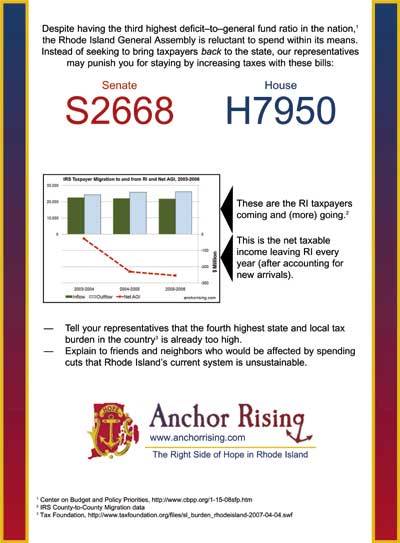
March 19, 2008
Expanding the Sales Tax
With a hat tip to Dan Yorke, below are some of the new things that will now fall under the expanded sales tax being proposed by the tax-and-spenders in our Legislature, under the, ahem, "ECONOMIC GROWTH AND FAIRNESS ACT OF 2008". Oh sure, there is this.....
Commencing on January 1, 2010, the rate shall be six and one half percent (6.5%). Commencing on January 1, 2011, the tax rate shall be six percent (6%). Commencing on January 1, 2012 and thereafter the tax rate shall be five and one half percent (5.5%).Until we decide that we "can't afford" that reduction.
And then there is the fact that the Income Tax is going to INCREASE, anyway:
For the period January 1, 2002, and thereafter through July 1, 2008 the rate shall be twenty-five percent (25%) of the taxpayer's federal income tax liability. For the period January 1, 2008, and thereafter, the rate shall be twenty-seven and one-half percent (27.5%) of that taxpayer's federal income tax liability, as defined in subsection 44-30-2(b).And the flat tax option will be terminated (p.37) and capital gains taxes are going back up (p.39-40, 47). Yup, why cut government when we can tax more?
Continue reading "Expanding the Sales Tax"
March 16, 2008
Rhode Island Constitution 101 - Control of the Budget
Both the Providence Journal and A.R. commenter Ken have erroneously amplified the amount of power the Executive Branch possesses over the state budget - more specifically, its control of the amount of local aid that will be disbursed from state coffers.
This week in an article about current events in Woonsocket, the Providence Journal asserted:
For the current fiscal year, the city faces a proposed loss of $700,000 from the governor, who is trying to balance a multimillion-dollar state deficit by cutting money to cities and towns.
And under Justin's post, "More Taxing Than Expected", commenter Ken stated:
Why such a surprise? The governor has been publicly telling everyone he was going to spread the state structural budget deficit pain across all 39 cities and towns.
Would that the Governor had more control over the state budget. In point of fact, if he proposed the reverse, an increase in education aid to cities and towns, but the General Assembly did not concur, it simply would not happen. We know because this is how FY 2008 wrapped up.
Some conceptual points suggest themselves out of the observations by Ken and the ProJo.
"Budget deficit pain" is not a completely unexpected, uncontrollable bolt of lightening from the gods. It is self inflicted by our elected officials who do not always make such decisions on the basis of the best interest of the state or even the individual recipients of such funds.
Secondly, contrary to the implication in both those statements, the Governor has proposed to spread budget cuts across the board. He is correct to do so. Our current fiscal problems did not arise out of one budget category so they cannot be resolved by focusing on only one category.
More importantly, however, the Governor this year and the General Assembly last year are correct in finally putting an end to increases in local/education aid. Too often, elected officials on the local level have negotiated and executed local contracts that had no bearing on either the quality of the service provided or the ability of taxpayers to fund them and do not conform to the terms of "contracts" under which most of the private sector (i.e., the taxpayer) operates. Witness our ranking as fourth highest taxed state, which calculation includes the level of property taxes, juxtaposed by the recent NECAP results.
In short, it should not become the burden of the state when local officials have implemented budgets and contracts in an irresponsible fashion.
March 14, 2008
More Taxing than Expected
A Sakonnet Times story that does not appear to be online confirms my suspicions: Tiverton's going to raise my taxes even more than the previously suggested maximum. Apparently, "the big jump is in the debt service on school bonds" (a 45% increase), followed by an estimated 3.2% increase for the school district. Of course, Rhode Island law encourages increased debt, because it is exempt from legislated increase limits.
Also notable is the passivity with which article conveys tax increase information:
That budget figure factors out to a new tax rate of $11.59 per every $1,000 of assessed valuation for Tiverton property owners, [interim Town Administrator James Goncalo] told the council. The current tax rate is $10,26 per $1,000, while the year before ('06–'07) it was $9.62 per $1,000.
Nobody raises the taxes, they just "factor out."
The rest of the council's budget discussion will be carried out behind closed doors because "further budget reductions might affect staffing and/or labor contracts." The party's over; expect a fight.
March 12, 2008
Every Tax an Income Tax
The problems with it are manifold (some enunciated in the comments section), but Tom Sgouros's analysis of property taxes brings to light an interesting conceptual matter:
However, consider the question, "how much property tax do the richest 11,900 people in Rhode Island pay?" With the data I have, I can't say for sure, but I can put a maximum figure on it. The maximum would be where the top 2.5% of income earners paid the top 2.5% of property tax bills. And here's what I find: the top 2.5% of residential property tax bills is a hair under 9.9% of all the residential property taxes collected in the state. This is about $150 million.Again, the top 2.5% of households earn 31% of all the income, and pay 40% of the income taxes. But when you add property taxes in (those are the two biggest sources for supporting state and local government) you'll see that with 31% of the income, they pay a bit more than 20% of the taxes -- at a maximum. Like the property tax, the other taxes we levy are also regressive, so if someone feels like adding in the effect of sales and excise taxes, this 20% number will go down.
What Sgouros makes eminently clear, here, is that, to the progressive, every tax should be a form of income tax. The top 2.5% of households pay 29% more as their share of income taxes than their percentage of income. The top 2.5% of property-tax payers fork over 296% their per capita share of that tax base. In other words, to Sgouros, a "fair" property tax wouldn't be based on the property, but on the person who owns it and his or her income.
Seen from the perspective of a go-getting Rhode Islander, this approach would require that they pay more for the very same house as they strive to improve their situations. Consider: What would you do if advances in your career bumped up your property taxes? What if the growth of your company resulted in a compounding of the tax on your place of business?
March 1, 2008
Stomping Out the Carpet
It was a minor thing, but I opted for a detour, on my way through Newport after work, yesterday, to avoid some movie filming off Bellevue, and it seemed parking in the neighborhood was somewhat more tight than usual. I can well imagine, that is to say, how the Hollywoodsters could disrupt a town for a while. Still, if municipalities are to be compensated for that, legislation put forward by Senator Paul Jabour (D, Providence) is unnecessarily complicated and (to my knowledge) invests the Rhode Island Council on the Arts with a new, not necessarily appropriate, responsibility:
The legislation would impose a 1-percent tax on the gross revenue of films produced in the state. Revenue from the tax on each film would be divided among the Rhode Island cities and towns in which the movie was filmed, allocated in proportion to the amount of money the production company spent in that municipality. The Rhode Island Council on the Arts would be in charge of distributing the funds collected through the tax.
Many Anchor Rising readers are nonplussed, no doubt, by state leaders' concentration on movie-making as a desirable industry to attract to Rhode Island (although there is something mildly neat about its presence). Still, Jabour's bill seems practically designed for maximal dampening of the trend. Why can't cities and towns simply charge an up-front fee to cover police and general disruption?
February 12, 2008
"Pain, Captain?"
Further to the remarks (the gift that keeps on giving) of Senator Stephen Alves at the Greater Providence Chamber of Commerce’s legislative lunch last week - specifically:
“I think we have been fair to the business community,” Alves, D-West Warwick, said. “The pain should be shared equally.”
Gosh, that sounds good in theory. The hitch is that, to date, distribution of the pain has been quite uneven, as the numbers starkly reveal.
Rhode Island taxpayers are the fourth highest taxed. Rhode Island corporations literally could not be in a worse position, tax-wise and, further, probably would like evidence of the fairness purportedly shown to them.
On the flip side, Rhode Island spending on social service programs is in the top third nationally. Rhode Island teacher pay (the ultimate destination of much of the Education Aid to Cities and Towns) ranks eighth highest nationally. And benefits for Rhode Island state employees constitute an additional 88% of salary versus 29% in the private sector.
In light of these numbers, it is understandable that the reaction of Rhode Island corporations to Senator Alves' statement would be, "Thanks, Senator, but we've been 'sharing' the pain for a while. Is it someone else's turn yet?"
February 11, 2008
Rhode Island's Corporate Tax is an Income Tax
Effectively, for nine out of ten corporations. Source: Senator Steve Alves.
Let's remember that the corporate tax (already $500 per year) is assessed regardless of profit generated by that corporation. If the corporation lost money, this tax must still be paid. So if, as Senator Alves asserts, 94% of corporations in Rhode Island are paying the minimum corporate tax, it's a good bet that most if not all are losing money or at best, breaking even. That means that the owners of over 90% of Rhode Island's corporations are reaching into their own pockets to pay this tax.
Reviewing once again Senator Alves' comments at the Greater Providence Chamber of Commerce's legislative luncheon:
Of the 45,840 corporations registered in Rhode Island, 94 percent pay only $500 in annual corporate income taxes to the state
The modifier "only" is inaccurate from the jump. Most Rhode Island corporations are not Coca Cola. So $500 is a lot of money. More importantly, it is grotesque for a legislator to imply that corporations are not paying their fair share when the basis of his accusation is a mandatory minimum tax payable regardless of profits. Essentially, Senator Alves is saying, "Look, they're paying $500 (that we're forcing them to pay). That must mean they can afford to pay more."
Senator Alves has confused the tax gun with affordability. Just because someone is forced to pay doesn't mean that they can afford to pay. Or that another waggle of the tax gun ("cough up more dough") is the correct course of action for a state which does not lack for revenue and already ranks dead last for business tax climate.
February 6, 2008
A Correction to the Letter
Just a quick correction to letter to the Providence Journal refuting Crowley's refutation of me:
[Crowley] notes that cash handouts claim a small percentage of total state spending. This is among the Poverty Institute’s favorite talking points. He notes that such handouts are also a small percentage of our welfare system.
That last sentence shouldn't say "He notes that"; it should just start with "Such handouts."
February 4, 2008
Whatever Happened With the Big Audit?
Though not always asked in the friendliest of tones, this is a good question.
And the answer is: quite a bit. Renamed "Fiscal Fitness" (not to be confused with the Governor's anti-donut "Healthy Weight in 2008" initiative), $279,000,000 was found and saved and the program has not closed up shop.
Some highlights of the 279 mill:
> $25,000,000 over three years in the state employee health insurance contract.
> $750,000/year in record storage expenses.
> On-line renewal of eight trade license categories covering 28,000 professionals.
> $15,000,000 over five years by opening the vehicle Emissions and Safety Testing program to competitive bidding. (This and the record storage. We really ought to check into this open bidding thing more often ...)
February 3, 2008
Now Here's a Tax Bill That Ought to Pass
With the growing stack of tax-raising bills, it's good to know that the General Assembly will at least have to address a different approach (emphasis added)
In an effort to bring some much needed tax relief to Rhode Islanders, while generating revenue in this era of hundred million dollar budget deficits, Representative Victor Moffitt (R-Dist. 28, Coventry) has introduced a bill that would lower the state sales tax to 5% from the current rate of 7%."By lowering the sales tax, individuals would be more inclined to buy products and companies would be more inclined to do business in Rhode Island, which would create jobs, and that would generate more income for the state than the current tax structure does at its present rate," said Representative Moffitt. "Let me be clear, this is not a move to lower and broaden the sales tax structure. There is no broadening of the sales tax in my proposal."
Recently, the Tax Foundation ranked Rhode Island 50th in the Unites States in Business Tax Climate Index. That ranking, taken in context with our current and projected budget crises, lends credence to the idea that the solution to Rhode Island's fiscal problems is lowering taxes, as opposed to raising them.
"The current sales tax rate of 7% was established back in the 1990's during the banking crisis, and at the time was said to be temporary," said Representative Moffitt. "Given our high tax burden, and our stagnating economy, it is time that the tax rate be lowered to so that we can be more competitive with our neighboring states."
February 1, 2008
Re: Well, Maybe if the Doctor's Office Was in the Mall....
A small but annoying point. This is a link to a Rhode Island craigslist posting which reads:
I wonder how many people go and get the free monthly bus passes with their medical assistance card and turn around and sell them???? In the past few days I've noticed people selling them on here....kinda makes you wonder.
He or she is correct. While browsing through craigslist postings under the "General" category a couple of weeks ago, I was a little surprised to come across someone who had posted a "January bus pass" for sale.
And here is a posting for four February bus passes. The location is Providence, RI. It is not clear if the $25 price is each or takes all four.
Do bus passes have pictures of the pass holder? If not, perhaps it is time. Selling tax payer funded bus passes is in the same category as selling food stamps. These services are available for people who really need them. They are not intended as a round-about way to provide casual spending money.
And if they are, we can just dispense with a good deal of effort and harrumph, cut out the middle man - the Division of Taxation - and leave those dollars in the pockets of tax payers to casually spend.
January 25, 2008
Rhode Island: Fourth Highest Taxed
"Our People are Taxed Too Highly."
So said Governor Donald Carcieri during his post State of the State media rounds. And - drum roll, please - the Tax Foundation concurs. For the third year in a row, they ranked Rhode Island fourth highest taxed, state and local combined.
Data source of the Tax Foundation's analysis: Bureau of Economic Analysis, US Department of Commerce.
ADDENDUM
In addition to compiling state by state tax rankings, the Tax Foundation is also the organization which calculates Tax Freedom Day. Will Ricci over at Ocean State Republican advises that there is a refutation rebuttal lame counter analysis of Tax Freedom Day which involves quibbling about the definition of the words "income" and "tax" (shall we add "is"?) and an inexplicable desire to exclude four fifths of tax payers from the calculation.
The Tax Foundation easily exposes the weaknesses of this criticism.
January 14, 2008
Leaders, You Do Have a Choice
Not to darken your day, but the latest bit of bad news brought to Rhode Islanders by Providence Journal business writer John Kostrzewa comes with a very important point:
When cities and towns do revaluations required under state law, they will find the total value of their residential property has probably declined. With a lower total valuation, municipal officials will have a choice — cut spending to match the new lower level of tax revenues, or raise the tax rate to collect enough money to meet the budget.
Yes, local officials, you do have a choice. The fact that my assets are worth less in now way necessitates that you tax them at a higher rate. What it does necessitate, if you ask me, is that you turn your focus to spending within the town's means and to finding ways to make my geographically based assets worth more.
January 1, 2008
State Budget - Where to Cut
To close the half billion dollar operating deficit and back Rhode Island down from its ranking as the seventh highest taxed state, the focus must be on state spending which is funded by General Revenues - state income tax, lottery proceeds, business tax, gas tax, sales tax. Out of the 2007 state budget of $7,000,000,000, approximately $3,200,000,000 is funded from General Revenue. [The rest of the revenue - federal, etc - is free, right ...?]
Below is the breakdown for 2007 General Revenue spending. These are the areas in which cuts need to be made. For contrast, I added General Revenue spending for 2000, which totaled around $2,200,000,000.
It should be noted that while Rhode Island's General Revenue spending increased by $1,000,000,000 and total spending increased by $2,400,000,000 from 2000 to 2007, Rhode Island's population increased by only .009, from 1,048,319 to 1,057,832.
ADDENDUM
Commenter John correctly points out that this post, expensive (my characterization) as it is, does not include all General Revenue spending because it
obscures (within different line items) the other driver of spending increases -- increased costs for pensions and, especially, pay as you go costs for retiree health care. Those are broken out separately in a different set of analytical tables in the budget.
The question then arises, of all the categories, what is mandatory and what is discretionary spending? As the General Assembly has made costly promises throughout the budget that the state cannot keep, it becomes clear that the entire expenditure side of the budget has been rendered discretionary, even including the two sacred cows which John reminds us of.
| FY 2000 Revised | FY 2007 Revised | |
General Government |
||
| Administration | $301,398,448 | $451,453,511 |
| Business Regulation | 7,897,375 | 10,812,564 |
| Labor & Training | 6,745,759 | 6,997,013 |
| Revenue | 0 | 35,773,913 |
| Legislature * | 30,784,769 | 33,472,897 |
| Lieutenant Governor | 687,999 | 896,416 |
| Secretary of State | 4,470,547 | 6,106,546 |
| General Treasurer | 4,808,862 | 2,662,801 |
| Boards for Design Professionals | 315,350 | 380,240 |
| Board of Elections | 2,098,265 | 3,684,992 |
| R.I. Ethics Commission | 814,502 | 1,273,231 |
| Governor's Office | 3,729,907 | 4,681,601 |
| Public Utilities Commission | 740,530 | 737,811 |
| R.I. Commission on Women | 123,003 | 99,023 |
Subtotal: General Government |
$364,615,316 |
$559,032,559 |
Human Services |
||
| Office of Health & Human Services | 0 | 310,738 |
| Children, Youth & Families | 116,736,956 | 181,378,754 |
| Elderly Affairs | 19,715,333 | 19,364,571 |
| Health | 29,098,110 | 34,417,579 |
| Human Services | 465,187,755 | 716,426,058 |
| Mental Health, Retardation & Hospitals | 198,122,982 | 238,057,998 |
| Office of the Child Advocate | 412,965 | 558,674 |
| Commission on Deaf & Hard of Hearing | 239,627 | 342,524 |
| Governor's Commission on Disabilities | 254,780 | 552,672 |
| Commission for Human Rights | 693,927 | 989,630 |
| Office of Mental Health Advocate | 239,067 | 403,413 |
Subtotal: Human Services |
$830,701,502 |
$1,192,788,891 |
Education |
||
| Elementary & Secondary | 616,104,140 | 884,303,258 |
| Higher Education-Board of Governors | 152,122,518 | 189,491,502 |
| R.I. Council on the Arts | 973,776 | 2,764,965 |
| Atomic Energy Commission | 593,929 | 810,531 |
| Higher Education Assistance Authority | 7,760,445 | 6,708,495 |
| Historic Preservation & Heritage Commission | 1,760,967 | 1,667,924 |
| Public Telecommunications Authority | 1,028,823 | 1,317,786 |
Subtotal: Education |
$780,344,598 |
$1,087,074,461 |
Public Safety |
||
| Attorney General | 13,438,974 | 20,313,531 |
| Corrections | 123,680,587 | 156,781,330 |
| Judicial | 51,469,015 | 80,842,834 |
| Military Staff | 2,272,265 | 2,826,113 |
| E-911 Emergency Telephone System | 0 | 4,098,361 |
| Fire Safety Code Board of Appeal & Review | 169,627 | 297,368 |
| State Fire Marshal | 1,271,547 | 2,596,825 |
| Commission on Judicial Tenure & Discipline | 121,209 | 111,216 |
| R.I. Justice Commission | 186,699 | 154,303 |
| Municipal Police Training Academy | 578,560 | 404,620 |
| R.I. State Police | 32,446,830 | 54,070,136 |
| Office of Public Defender | 5,031,835 | 8,882,554 |
| Sheriff of Several Counties | 8,361,750 | 0 |
Subtotal: Public Safety |
$239,028,898 |
$331,379,191 |
Natural Resources |
||
| Environmental Management | 31,939,123 | 36,632,436 |
| Coastal Resources Management Council | 963,746 | 2,130,724 |
| Water Resources Board | 912,123 | 1,825,672 |
Subtotal: Natural Resources |
$33,814,992 |
$40,588,832 |
Total General Revenue Spending |
$2,248,505,306 |
$3,210,863,934 |
* LEGISLATURE - While such an increase may seem moderate, keep in mind that the General Assembly had downsized itself from 150 to 113 members between 2000 and 2007.
December 22, 2007
RI Senate President Is Not Satisfied with Seventh Place
While Rhode Island has been distracted by gridlock snow storms, triple dipping public employees and Presidential primaries, Senate President Joseph Montalbano has been sneaking around giving an interview to the Editorial Boards of the Pawtucket Times and the Woonsocket Call.
As reported by the Pawtucket Times' estimable Jim Baron on Tuesday, the state budget was the dominant subject of the sit-down. And though Rhode Islanders are already the seventh highest taxed in the country, it appears that the only tax off the table for the Senate President is the state income tax.
Whether it is the Historic Structures Tax Credit, the Film and Television Tax Credit, the flat tax option for the state’s highest earners, or the capital gains tax which was being phased out but was frozen in the current year when it was scheduled for oblivion, “the revenue side has to be examined,” Montalbano told editors of the Pawtucket Times and Woonsocket Call on Monday. Montalbano recognizes that cities such as Pawtucket, Woonsocket, Central Falls and Providence have benefited from the historic tax credits by getting some of their previously vacant buildings back on the tax rolls and that it is “good for business and good for the construction industry. ”But every time a developer takes advantage of the tax credits “it is a direct hit on the state budget.” So while Montalbano admits he is an original sponsor of the historic tax credit program – as he was with the film and television tax credit -- and has supported it over the years, he says the time may have come to “freeze it or in some way modify it.”* * * *
The sales tax, too, could be up for some tinkering, the Senate President said, not a hike in the 7 percent rate, but perhaps broadening in the types of economic activity covered by the tax. “You are going to see proposals to expand the sales tax,” he said, “perhaps adding luxury items such as clothing that costs over a certain amount of money, or professional services such as legal services or accounting, things like that.“That in effect is raising taxes, I’m not denying that is a raising of taxes,” Montalbano conceded.
It is a little disturbing that the Senate President placed so much emphasis on the revenue side of the budget throughout the interview, though he did indicate expenditure categories that would be looked at.
It is not all going to be solvable on the backs of the state workers but there are definitely going to have to be cuts made and union contract concessions made and any time that is the case you have to have the unions there. You can’t just dictate contract changes, they are certainly not going to be legislated.
And when cities and towns begin their budget planning, the Senate President's advises them not expect an increase in state funding this year.
”That same dynamic will also extend down to cities and towns, which will almost surely see a second straight year of frozen school aid and other funds from the state, Montalbano said
In fact, the Senate President was downright critical of the budgeting practices of cities and towns.
It’s going to be tough medicine for everybody,” he said. “The days of four-year contract extensions with 3 percent raises and no co-pay in insurance and not comparison between Blue Cross and United are over. The locals are negotiation contracts they can’t afford.
Interestingly, the Senate President did not mention social programs, though Rhode Island is one of the most generous states in that spending category.
Rhode Island is facing an annual operating deficit north of $450,000,000. Closing any portion of that deficit by advancing Rhode Island's position as seventh highest taxed instead of enacting difficult but necessary spending cuts will only accelerate the flight of real revenue producers from the state and thereby boomerang to the state budget.
December 16, 2007
Plans to Plan to Favor
Charles Bakst has been peddling his curmudgeonly wares 'round these parts for much longer than I have, but at the risk of later being proven wrong, it seems to me that he's either not very observant or is in on the game:
The governor expressed the fear that legislators will backtrack on tax changes in recent years that critics say benefit the rich but which he prefers to characterize as encouraging decision-makers to do business here."We need to continue to position ourselves competitively from a tax standpoint with our neighbors," he said.
I asked what makes him worry that the Assembly actually will raise taxes.
"I hear rumblings," he said.
From whom?
"The walls."
I don't know where the walls get their information. For example, this past Wednesday, two top House Democrats, Majority Leader Gordon Fox and Finance Chairman Steve Costantino, inveighed against any broad-based tax increase that would hurt job development.
Mr. Bakst is, well, selectively credulous. At the very least, an observant columnist ought to have noticed the specificity of language, including such words as "plan," "favor," "broad-based," and even "tax increase." In a Moneyline column from the thirteenth that is for some reason not online, Neil Downing quotes House Finance Committee head Steven Costantino explaining not intentions, but a conundrum: "If we raise taxes, we risk putting further drag on our economy; if we keep cutting jobs and services, then the people who need them most suffer. Either way, Rhode Island loses." Downing moves on to House Majority Leader Gordon Fox: "We are not favoring any increases in broad-based taxes at this point." From whence the columnists' confidence with respect to taxes?
Downing was sufficiently curious, at least, to pursue some specificity:
- Income tax: Do Democratic leaders favor increases in the state personal income tax? No.
- Capital-gains tax: No changes planned. Fox acknowledged that "there is some discussion" about the state's capital-gains tax. In other words, it's on the table. But he said his preference would be to keep the capital gains tax rates at their current levels.
- Sales tax: No increases planned here, either, although neither Fox nor Costantino would rule out entertaining proposals to change the sales-tax structure — maybe by increasing the sorts of things that are subject to the tax, while lowering the overall sales-tax rate. ...
- Corporate income tax: No increases planned for either the state corporate income tax or the state's franchise tax, Fox and Costantino said. On a recent visit to General Dynamics, Costantino said he got the impression that business wants "predictability" when it comes to taxation, an idea he favors. However, Costantino said that there are some "theoretical things" that legislators are looking at. One plan being kicked around could lower the top corporate income-tax rate while eliminating a number of corporate income-tax credits. Such a proposal would be intended as revenue-neutral, he said. But Costantino stressed that it's only an idea, only in the discussion stages.
- Death tax: Neither Fox nor Costantino plan any changes to the Rhode Island estate tax, also known as the death tax.
That's quite a bit of talk about what legislators "favor" and "plan," but I (for one) can't shake the feeling that they've some unacknowledged plans to plan to favor tax increases — defined generally as measures designed to take more money out of our bank accounts and filter it through the state government. Contributing to that unshakable impression has been coverage of the race to replace the late Rep. Paul Crowley of Newport. Responding (generally) to Republican candidate Stephen Coaty's remark that we "need a top-to-bottom review of all state spending," Democrat J. Clement Cicilline quipped, "It's both a spending problem and a revenue problem. If you cut $450 million from the state budget, I don't know if you'd be able to have the state open on Tuesdays and Thursdays."
Cicilline sings a familiar refrain:
"It's not just a spending problem, it's a revenue problem, too," he says. "I agree you have to look at spending."He thinks every state department should be mandated to develop a strategic plan to measure its success and better determine its funding needs. He also favors multi-year budgeting instead of year-to-year spending plans.
"I think we have to look at where we've given away the store and where we need to reel things in," he says.
BUT NEW REVENUES must also be explored, he says. He wants to study expanding the sales tax to items that are now tax-free, including expensive clothing and country club dues.
"I'm of the mind that if someone can pay $400 for a pair of shoes, they can afford a tax," he says. "I'm trying to find ways [to address the deficit]. I'm trying to be honest and forthright about it and not just say slash and burn." ...
"We probably have different ideas about what's important in terms of services and government," he says. "We start hammering and ... we're going to cut some of these services that are available to individuals with disabilities. You end up undermining the quality of life for these individuals.
"You have to think about where you are going with this knife," he said. "It really could significantly hurt people. And you could hurt [the state] financially. He doesn't know the consequences of what he is saying. He makes statements without knowing the depth and breadth of the consequences."
Rather than weakly retreating to an acknowledgment that "maybe we can't find $450 million to cut" and a stylistic critique that "we don't start (the process) by saying we've got to raise taxes," Mr. Coaty should ask about the quality of life of family's like mine, which is barely getting by with some amenities and rapidly approaching the day when the money will run out. To the extent that Rhode Island's problem is one of "revenue" (I prefer "spoils"), the solution is to attract more payers (by making this a more attractive place to pay to live and work), rather than continuing to attract takers and seeking innovative new ways to shake down those productive citizens who've been too slow (or poor) to flee.
But to anybody who listens, the latter approach appears to be what the Democrats who run the state plan to plan to take. Stumping for Cicilline in a letter to the Newport Daily News, Senate Majority Leader Teresa Paiva Weed writes:
The state is facing a challenging budget, and Newport deserves a representative who is experienced and with a record of proven commitment to our community. ... [Cicilline] has demonstrated his effective representation of Newport by working toward additional revenue for Newport, including the cruise ship tax and additional PILOT funds, which helped even the burden of property taxes.
By "helped even the burden of property taxes," Paiva-Weed means that the Payment in Lieu of Taxes (PILOT) program shifts some state tax revenue to municipalities in which nonprofit organizations such as hospitals and universities are using space that would otherwise generate property taxes. In that respect, "Bud" Cicilline — who is president and CEO of the nonprofit Newport Community Mental Health Center — is nicely representative of the fundamental source of inertia in Rhode Island: Too many citizens are either insiders, on the teat (whether as public union members or as recipients of state benefits), or just too plain ol' rich feel the pinch.
Too many others (with some local columnists coming to mind) are simply too wedded to partisan ideology to fight for anybody but approved groups... or to notice when the state's aristocrats are laying groundwork for a declaration that they "have no choice" but to step a little harder on the heads of residents who are already drowning in the byproduct other groups' malfeasance and greed.
December 10, 2007
Re, re: The New "One Finger" Math
One hesitates to take Pat "The Finger" Crowley's comments on taxation too seriously. His branch of mathematics, after all, takes progressivism to be a fundamental principle and unionism to be the standard of comparison.
That said, anybody who finds merit in his question marks should consider, first, that he highlights two components of taxation, with no argument as to why the others ought to be ignored. Second, readers should note that the report (PDF) measures according to government revenue — that is, how much the government actually takes in. If, for the sake of argument, Rhode Island's high sales tax is driving customers out of state, then it wouldn't be surprising that the state ranks low for revenue from that source.
A similar consideration ought to be made with respect to the income tax:
State or local individual income taxes are levied in 42 states. Based upon FY 2005 data reported by the Bureau of the Census, Rhode Island ranks 21st highest on individual income tax revenues per $1,000 of state personal income and 16th highest per capita.
Note that Rhode Island's standing slips when the measure is number of people rather than amount of income. One can infer that a significant number of lower income citizens (relative to the country) don't pay very much in taxes. Distributing the total revenue by income yields a small number; distributing the number by population yields a higher number; therefore, some portion of the population's income is not counted. And indeed, the data bears that out:
| % of Total Income | % of Total Tax Paid | |
|---|---|---|
| Under $30,000 | 12% | 4% |
| $30,001 to $50,000 | 13% | 9% |
| $50,001 to $75,000 | 16% | 12% |
| $75,001 to $100,000 | 14% | 12% |
| $100,001 to $200,000 | 21% | 23% |
| Over $200,000 | 24% | 40% |
Considering that many of Rhode Island's other taxes affect mainly those citizens who are most productive for the economy (and, therefore, wealthier than the average), such as business people. The relevant concern is that Rhode Island's tax regime will drive out (or beat down) precisely the folks who keep the state afloat. And indeed, I've shown that this is happening.
As Mike commented to Andrew's post, those whose relationship with the state provides them a net gain "are facing a future of 'heads you win, tails we lose.'" In other words, the Pat Crowleys of the state had best learn to work within the boundaries of our right-wing math, because it tends to jibe with financial realities.
RE: The New Tax Math
Just to amplify Andrew's point, from the 2007 Revenue Facts report:
State and/or local property taxes are levied in all 50 states. Rhode Island ranks very high in the percentage of state and local revenues generated from property taxes. It has traditionally relied more on local property taxes than most states. FY 2005 census data showed that it ranks seventh in state and local property taxes per $1,000 of personal income and sixth in state and local property taxes per capita.
The New Tax Math -- Don't Add What Doesn't Make You Feel Good
Remember last week when I told you that there are some people who believe that "as long as there exists any metric showing Rhode Islanders not near the top in what they are required to pay to the government, taxes need to be raised"?
For some reason, the person in question decides not to count Rhode Island's property taxes in Rhode Island's tax burden, apparently unaware that a dollar in property tax costs a taxpayer just as much as a dollar in sales or income tax. Then he has the gall to say it's right-wingers who can't do math.
The New Tax Math -- Don't Add What Doesn't Make You Feel Good
Remember last week when I told you that there are some people who believe that "as long as there exists any metric showing Rhode Islanders not near the top in what they are required to pay to the government, taxes need to be raised"?
For some reason, the person in question decides not to count Rhode Island's property taxes in Rhode Island's tax burden, apparently unaware that a dollar in property tax costs a taxpayer just as much as a dollar in sales or income tax. Then he has the gall to say it's right-wingers who can't do math.
December 8, 2007
It Will be Either a Cold Day in Hades or a Warm Day in Minnesota When Governments Start Making Rational Spending Decisions
Liberals and progressives and those further out on the left assure me that government spending is what it is because of hard economic and social realities, certainly not because the machinery of government has self-serving incentives to spend everything given to it, then demand more! more! more!
If that's true, somebody explain to me how this shortfall occurred in a set of local Minnesota municipalities in just one year (h/t James Lileks via Instapundit)…
Lundgren said the trouble began in August when a clerk went into Mattson's file to change the designation of the property, at 233 Lake St. E., from homestead to non-homestead to reflect its change in status after its sale.The clerk filled in the $18,900 proposed valuation, but then mistakenly hit the key to exit the program. The computer added four zeros to fill out the nine numerical spaces required by the software, thus indicating the value was $189,000,000….
The story has been creating quite a few chuckles since it began swirling around Waconia this week.
But no one is laughing at the assessor's office, where the problem started. Neither is anyone at the Carver County Board, the city of Waconia or the Waconia School District.
Those three entities -- which were counting on the $2.5 million in increased property tax collections -- now face the daunting task of raising taxes or cutting budgets to make up for the shortfall.
December 4, 2007
Breaking Down In Detail Rhode Island's Tax and Fee and Charge Ranking
Assessing monies collected by state and local governments, the Rhode Island Public Expenditures Council ranks Rhode Island 7th in the United States in "state and local taxes collected per $1,000 of personal income", but 26th in "state and local tax collections, charges and miscellaneous general revenues per $1,000 of personal income".
To some, the meaning of the difference between the two metrics is clear -- as long as there exists any metric showing Rhode Islanders not near the top in what they are required to pay to the government, taxes need to be raised! Others don't believe that the goal of tax policy should be to max out on every possible measurement of how much Rhode Islanders are paying and would like to figure out an explanation for the difference. Count me amongst the second group.
RIPEC used revenue data compiled by the Census Bureau for 2005 and income data compiled by the Bureau of Economic Analysis for 2004 in their 2007 report. Using figures available online (here and here), I was able to produce results for taxes paid per $1,000 of income within a few cents of RIPEC's state-by-state analysis and reproduce RIPEC's rankings to within a place or two; the data available to me showed Rhode Island ranking 8th instead of 7th in taxes collected (see the table below the fold for the complete 50 state results and some brief speculation on the sources of the discrepancies).
Now, the census data breaks down "charges and miscellaneous general revenues" into a number of specific categories, providing dollar figures for each by state. Just like states can be ranked in terms of their total tax collections, they can also be ranked in terms of how much they collect in each "miscellaneous" sub-category. Here are Rhode Island's rankings, per $1,000 of personal income, in each miscellaneous category used by the Census Bureau…
| Miscellaneous Revenue Category | Amount Collected | RI Rank |
| Housing and community development | $34,116,000 | 4 |
| Air transportation (airports) | $60,009,000 | 14 |
| Other general revenue | $466,844,000 | 16 |
| Other charges | $158,840,000 | 26 |
| Highways | $12,870,000 | 30 |
| Sea and inland port facilities | $456,000 | 33 |
| Education (including higher education) | $347,022,000 | 34 |
| Natural resources | $3,801,000 | 38 |
| Parks and recreation | $19,545,000 | 41 |
| Sewerage | $81,992,000 | 41 |
| Parking facilities | $1,031,000 | 45 |
| Solid waste management | $18,530,000 | 45 |
| Hospitals | $4,267,000 | 49 |
Rhode Island's 49th place ranking in "hospital" fees/miscellaneous charges is the most significant figure in this table, because by itself, it appears to account for much of the difference in Rhode Island's taxes-only versus taxes-plus-charges rankings. In terms of taxes plus "hospital" charges collected, the results for the 50 states (with absolute collections reported in terms of thousands-of-dollars) are…
| Rank | State | Taxes Collected | Revenue From Hospitals | Aggregate Income | Taxes + Hosp. Rev. per $1K of Income |
| 1 | Wyoming | $2,671,853 | $612,601 | $17,759,572 | $184.94 |
| 2 | New York | $111,107,619 | $5,309,562 | $739,795,482 | $157.36 |
| 3 | Hawaii | $5,523,747 | $343,398 | $41,074,817 | $142.84 |
| 4 | Louisiana | $14,301,995 | $2,404,463 | $122,294,458 | $136.61 |
| 5 | Alaska | $2,947,034 | $85,083 | $22,459,220 | $135.01 |
| 6 | Maine | $5,219,708 | $71,413 | $39,510,387 | $133.92 |
| 7 | Mississippi | $7,490,681 | $1,852,745 | $69,778,380 | $133.90 |
| 8 | South Carolina | $11,800,640 | $3,355,730 | $113,347,985 | $133.72 |
| 9 | New Mexico | $6,069,328 | $434,536 | $49,798,607 | $130.60 |
| 10 | Vermont | $2,574,761 | $0 | $19,749,931 | $130.37 |
| 11 | Wisconsin | $21,403,526 | $893,667 | $174,740,109 | $127.60 |
| 12 | West Virginia | $5,550,746 | $263,029 | $45,731,471 | $127.13 |
| 13 | Utah | $7,303,964 | $782,270 | $63,613,266 | $127.12 |
| 14 | Nebraska | $6,586,238 | $444,248 | $55,486,270 | $126.71 |
| 15 | Indiana | $21,337,077 | $2,233,930 | $186,222,441 | $126.57 |
| 16 | California | $146,616,887 | $12,671,974 | $1,265,657,107 | $125.85 |
| 17 | Arkansas | $8,053,926 | $838,198 | $70,706,380 | $125.76 |
| 18 | Ohio | $41,714,754 | $2,498,092 | $351,630,721 | $125.74 |
| 19 | Iowa | $9,704,861 | $1,635,484 | $90,515,010 | $125.29 |
| 20 | Idaho | $4,182,546 | $560,393 | $38,122,727 | $124.41 |
| 21 | North Carolina | $27,307,108 | $3,447,778 | $251,284,628 | $122.39 |
| 22 | Rhode Island | $4,499,624 | $4,267 | $36,814,199 | $122.34 |
| 23 | Connecticut | $18,896,812 | $373,913 | $159,255,636 | $121.00 |
| 24 | Minnesota | $20,956,639 | $1,157,323 | $183,794,728 | $120.32 |
| 25 | New Jersey | $42,557,354 | $790,677 | $361,678,619 | $119.85 |
| 26 | Alabama | $11,686,675 | $3,421,130 | $126,282,975 | $119.63 |
| 27 | Kentucky | $12,261,812 | $1,084,068 | $111,675,996 | $119.51 |
| 28 | Nevada | $9,043,570 | $519,296 | $80,311,322 | $119.07 |
| 29 | Michigan | $35,295,158 | $2,634,009 | $318,762,176 | $118.99 |
| 30 | Kansas | $9,385,496 | $547,526 | $84,619,970 | $117.38 |
| 31 | Georgia | $27,486,109 | $3,104,011 | $264,635,496 | $115.59 |
| 32 | Pennsylvania | $46,019,258 | $1,777,028 | $413,900,836 | $115.48 |
| 33 | Washington | $22,974,042 | $2,058,441 | $218,366,056 | $114.64 |
| 34 | Arizona | $18,331,117 | $466,830 | $164,941,395 | $113.97 |
| 35 | North Dakota | $2,121,388 | $2,962 | $18,674,433 | $113.76 |
| 36 | Florida | $59,863,884 | $4,195,951 | $565,211,107 | $113.34 |
| 37 | Illinois | $49,138,495 | $1,201,295 | $445,269,246 | $113.05 |
| 38 | Delaware | $3,277,387 | $14,633 | $29,269,007 | $112.47 |
| 39 | Virginia | $27,659,186 | $2,107,533 | $267,784,599 | $111.16 |
| 40 | Massachusetts | $28,756,962 | $449,515 | $266,818,043 | $109.46 |
| 41 | Maryland | $23,899,055 | $134,644 | $219,937,707 | $109.28 |
| 42 | Oregon | $11,106,991 | $879,686 | $109,807,900 | $109.16 |
| 43 | Oklahoma | $10,073,102 | $790,853 | $100,077,751 | $108.56 |
| 44 | Missouri | $17,374,264 | $1,497,277 | $173,968,028 | $108.48 |
| 45 | Texas | $69,133,862 | $6,042,974 | $695,503,614 | $108.09 |
| 46 | Montana | $2,722,702 | $49,063 | $25,813,892 | $107.37 |
| 47 | Tennessee | $15,993,136 | $2,137,373 | $174,740,992 | $103.76 |
| 48 | Colorado | $15,680,821 | $1,146,051 | $163,805,332 | $102.72 |
| 49 | New Hampshire | $4,319,777 | $6,005 | $47,170,059 | $91.71 |
| 50 | South Dakota | $2,103,820 | $36,158 | $23,881,413 | $89.61 |
Just this single category, where other states collect ample revenues, but Rhode Island doesn't, drops Rhode Island 14 spots in revenue ranking, from 8th to 22nd place.
This result raises an obvious question for anyone arguing that Rhode Island's middle-of-the-pack ranking in taxes plus "miscellaneous" charges justifies a tax increase: why should broad-based taxes be used to compensate for a lack of revenue from specific areas that most other states target directly? Are hospitals an area where Rhode Island has fewer expenses than other states (hard to believe, as the figures would then imply that RI had only 1/3 the hospital capacity of Delaware, or less than 1/10th that of Maine), is this an area being mightily subsidized compared to other states, or is there some other explanation?
Continue reading "Breaking Down In Detail Rhode Island's Tax and Fee and Charge Ranking"
November 25, 2007
I, Mindless Taxpayer
There's that learning curve again. Amidst all of the things that I've had to learn as a homeowner (not including carpentry, plumbing, electrical, and so on), it took me until today to realize an important part of my town's tax structure: In addition to my annual property tax bill for the Town of Tiverton, I pay property taxes to the North Tiverton Fire District. Part of what confused me about the bills is that the NTFD also charges me for my water usage (leading me recently to question why my water bill was so much higher than it ought to have been, because I confused the taxes for the water charge). What's worse is that the fire district taxes have nothing to do with, you know, the fire department.
According to a 2006 report on Rhode Island Fire Districts (PDF), Tiverton and Portsmouth are the only towns in the state with fire districts that provide "water supply only." Yet until this year, the North Tiverton rate was just at the average for the state, even as its per-usage water rate (PDF) is well above the average — third highest in the state.
It's also interesting to note the intramunicipality comparison. North Tiverton is the working-class side of town, but for some reason, its rates are higher all around than those of the Stone Bridge Fire District. Our taxes are $0.62 per $1,000 of property value to their $0.30, and our water costs $5.32 per 1,000 gallons to their $3.90. It may be the case that it is just extremely difficult to get water to residents of North Tiverton, in which case it might be unfair to jack up the prices for the rest of the town, but one would have to break down all town expenditures by fire district in order to see whether it's fair to break out this particular cost.
Whatever the case, both the additional tax and the cross-town differences bear further research. They also don't cool my ire about the truly terrible water pressure in my neighborhood.
November 14, 2007
"But What Can We Do?": Mainstream Media Edition
A few weeks back, Justin observed that the single biggest factor retarding fiscal and economic reform in Rhode Island may be the "but what can we do?" attitude of learned helplessness prevalent in Rhode Island's legislature and municipal councils. Members of the But-What-Can-We-Do Caucus profess that they are powerless to do anything but raise taxes to maintain the state's current (and mediocre) level of services, because impersonal macroeconomic forces beyond anyone's control dictate that paying more to receive less is the inevitable reality of modern life.
Today, Steve Peoples of the Projo opened up the mainstream media chapter of the But-What-Can-We-Do club…
The state’s largest revenue streams — income tax and sales tax — are not keeping pace with projected expenditures, in part because of a weak national economy that may be headed toward a recession.I see. The state's structural deficits are the result of a sluggish national economy, not poor choices made at the various levels of Rhode Island government.
Except, as URI Economics Professor Professor Leonard Lardaro just noted, while Rhode Island's economy has been contracting, the national gross domestic product has been growing by 4%.
Except, as the National Governors' Association noted in June, Rhode Island was one of only three states that couldn't cover its beginning-of-the-year projected spending for fiscal year 2007 -- if Rhode Island's fiscal problems are rooted primarily in a national slowdown, then why are 47 other states able to stay within their projected budgets when Rhode Island can't?
Except, as the Rhode Island Public Expenditures Council noted in their analysis of Rhode Island's current operating budget, spending from general revenues in fiscal year 2008 increased by 5.7% over the previous year. How exactly is it reasonable to assume that it will take something as dramatic as a recession to prevent revenues from automatically "keeping pace" (Peoples' phrase) with 5.7% expenditure growth?
Despite the desire of many of Rhode Island's leaders and activists to shift blame to some other place, Rhode Island's perennial fiscal crisis is occurring in spite of, not because of, the national economic situation. And in the event of a national slowdown, there will be new fiscal and governance problems piled on in addition to the set of existing problems the state has already created for itself.
November 8, 2007
Guess Who's One of Only Six States To Fully Tax Military Pensions
In discussing an Ohio proposal to exempt military pensions from the state income tax, the Toledo Blade names Rhode Island as one of only five states imposing an income tax on military pensions…
With one of its members now on military duty and another about to return to Iraq, [the Ohio House] suddenly fast-tracked a proposal - just in time for Veteran's Day - affecting nearly 39,000 military retirees that has languished in the chamber for months.…but I don't think the Blade story has it quite right.Ohio is one of just five states imposing income taxes on pensions earned from military service. The bill now heads to the Senate….
Only Ohio, California, Vermont, Rhode Island, and Nebraska still tax at least some portion of military pensions.
According to the National Conference of State Legislatures, Rhode Island is one of six states (the five listed above, plus Minnesota) allowing no exemption at all for income received in the form of a military pension. There are 12 states that fully exempt military pensions from their income taxes, another 21 that exempt at least some portion of military pensions, 2 that have some form of general income exemption for retirees, and 9 states that have no income tax to be exempted from.
In some way, shape or form, Rhode Island should get with the 33 states exempting at least some portion of military pensions from the state income tax. It would be the very least we could do as a community to help take care of the soldiers and sailors who've volunteered to help protect our country.
November 1, 2007
CRIPs are out for More Tax Blood
Ian Donnis points to the Campaign for Rhode Island’s Priorities, who are going to "call on the Governor to bring close scrutiny to Rhode Island’s hidden budget of expensive tax expenditures!" More on that in a minute, but first a quick aside: Ian doesn't think we at AR pay enough attention to "corporate welfare." Well, maybe not as much as we should, but we aren't exactly the champions of corporate welfare that Ian implies, either:
Nothing is more unjust to the working families and retirees of America than to over-pay for under-performance. In other words, not to get fair value for our hard-earned monies.The post above specifically dealt with our tax dollars going towards sugar subsidies. And we're no fan of ethanol subsidies, either. Anyway, point taken, Ian.It is in that context where this blogsite has been appropriately critical of both public sector unions and private sector unions....No less of a problem in our society are the corporate welfare queens who exist like parasites living off their manipulation of a bloated federal government, thereby reducing many Americans' standard of living through hidden and completely unnecessary taxes.
But back to the CRIPs. Good for them! It's always nice when another group calls attention to how our tax dollars are being spent on over-generous programs and....er....oh wait:
Rhode Island’s structural deficit is costing jobs, public services and essential state programs that hard-working Rhode Islanders need to work, learn and stay well. The Governor’s solution is to cut even more — laying off hundreds of public servants and slashing already starved public programs. There is a more equitable solution to the state’s fiscal challenge.Ohhhh. By "hidden tax expenditures" they mean money the State can't spend because it isn't getting it in the first place. OK, gotcha. So they don't like tax incentives or subsidies going to private companies that employ people...who happen to pay taxes. Well, they do point out some questionable tax breaks, for sure.A first step? Rhode Islanders need to know the real costs of the state’s hidden tax expenditure budget. Tax expenditures are credits and preferential treatment given some individuals and corporations that cost the state unknown millions in forgone tax revenue. The RI Department of Taxation was unable to estimate lost revenues from 60% of these special treatments. Rhode Islanders need to know: What are the real costs of the state’s tax expenditures and are we getting back the jobs, housing and other benefits promised?
Truth is, I agree with the general thrust of their effort here. The RI government probably lays out some targeted tax incentives that need to be revisited to determine if they are still worthwhile. So the CRIPs are onto something, but lets not kid ourselves. Their ultimate goal is to raise taxes to produce more revenue, er, reduce hidden expenditures (Is that right in the newspeak we're using here?).RI has an income tax exemption for employees in software companies when they sell stock in their company. No other New England state has a similar exemption.
The sale of compressed air is exempt from the sales tax – even though no other New England state has a similar exemption.
Horse food is exempt from the sales tax.
Anyway, let's say that everything they want done is accomplished, then we probably would see more short term revenue gains,er, fewer tax expenditures (now, that just doesn't make any sense, does it? OK, I'll stop)--until companies started running for the hills. Because removing these deals will have a price.
If a company's sweetheart deal goes away, how long before the company goes away and leaves the state? Then we can wave "bye bye" to that tax revenue. That's the way it works in a competitive marketplace, so you have to do something to keep the company around. They aren't going to stay here in RI, "just because."
The CRIP's plan has the whiff of good government about it. Their desire to improve the State's ability to forecast revenue changes resulting from tax subsidies is a good one. But the CRIPs are only dealing with part of the equation, which illustrates the sort of flawed base-line thinking endemic in their public policy world. Apparently, they don't take into account how removing the incentives can also result in lost revenue (via subsequent corporate flight). Or how incentives can entice a company to come to the RI in the first place and thus employ people who will pay taxes.
Even if they were to take a dynamic view, though, they'd still not be addressing the core problem. As I've written before, RI's cut-and-paste economic development plan--which includes tax subsidies--needs to be changed.
Crafting specific, sweetheart deals seem to only work so long as they are in place. Once they expire, off go those who took advantage of them. Instead, we need to follow a holistic plan. The entire business climate needs to change to first attract, and then maintain, new employers. Targeted business tax credits aren't enough. What needs to be done is to lower the tax burden across the board and reduce the red-tape and regulatory roadblocks.Who thinks the CRIPs are looking to lower tax burdens in conjunction with the removal of tax subsidies? Me neither.
I've shown in the past that we don't have a tax revenue problem, we have a spending problem. Basically, tax revenue from all sources hasn't gone down from 2001 to 2008, it has increased by about 26%. Unfortunately, tax revenue increases have been outpaced by increases in government expenditures, which have gone up 45% over the same period. Anyone feel like they haven't been taxed enough?
The CRIPs are playing a shell game. Yes, there are some problems, but their solutions--which they aren't playing up this time around--include a whole slew of tax increases or reversions to higher tax rates (here or here). While it looks like they're engaged in a good government endeavor, they really just want to get more-more-more when most of us recognize that the answer is to spend less.
October 25, 2007
Make over $150K? Rangel's Gunning for You
Rep. Charles Rangel (D, NY), Chairman of the House Ways and Means Committee is looking to overhaul the current tax system. He's got all sorts of ideas, summarized in this story (or this PDF summary), but I just want to point out to one portion:
Middle and upper-middle income families would benefit under the plan by a repeal of the alternative minimum tax starting Jan. 1, 2008.If this surtax came to pass, I can hear the conversations now? "Hey boss, I'm thinking that I'd be happy making $149,999 this year, how's that sound?" I guess another solution would be for everyone looking to make $150K could shoot for $156.5K to roughly offset the new "surtax." Then again, we all know that people don't modify their financial decisions based on tax policy, so I'm sure that the numbers will all work out based on static economic models (ahem).Upper-income families, however, would pay for that repeal with a 4% surtax on incomes above $150,000 for a single earner or incomes above $200,000 for a married couple. That surtax would grow to 4.6% for incomes above $500,000.
The surtax will also make possible an expansion of the earned income tax credit, an increase in the standard deduction, and an increase in the value of the child tax credit for those earning too little to owe federal income taxes.
UPDATE: Andrew makes a great point in the comments:
I just did a couple of back-of-the-envelope calculations...1. Statistics show that the average married couple in America involves 2 people. I think that's why they're called "couples".
2. $150,000 times 2 equals $300,000So a married couple has to pay the surtax on $200,000 of total income, while an unmarried couple doesn't have to start paying the tax unitl $300,000.
Doesn't this take the marriage penalty to new heights, and beg the question of why the government is so hostile to married people?
October 24, 2007
Brewster: Raise Taxes, Don't Cut the Budget
Poverty Institute Executive Director Kate Brewster says the solution to the budget crunch is higher taxes, not cutting the budget:
• Restore the tax on long-term capital gains and freeze the “alternative flat tax,” both of which primarily benefit a handful of very wealthy taxpayers, many of whom are not even Rhode Island residents. There is no evidence that either of these provisions have grown jobs or revenues in our state. These two measures together could recapture close to $50 million.Well, she's been consistent. The first two items can be placed squarely in the "class warfare" pile. You know, the rich don't pay enough, etc. Heard that one before.• Conduct a careful review of the costly tax breaks, exemptions and credits that have been granted over the years and apply the “prove it or lose it” test to determine if they have achieved their purpose, are cost effective and/or affordable. Eliminate those tax expenditures that fail this test.
• Expand the sales tax to keep pace as the economy shifts from goods-based to service-based.
But the last one will hit all Rhode Islanders, not just "the rich." The expansion of the sales tax Brewster is talking about could mean taxing services--doctor visits, legal services, tree cutters, landscapers, etc. That's what she means by "keeping pace" with a "service-based" economy. Oh, I'm sure there will be some promises that "essential" services won't be taxed....for now. But once the toe is in the door, and the budget continues to crunch, we can be sure that somebody will look for more "innovative" ways to raise, ahem, "revenue."
October 16, 2007
We Don't Have a Tax Revenue Problem
The usual suspects are out complaining about Governor Carcieri's proposed budget cuts:
Even without details, Kate Brewster, executive director of Rhode Island College’s Poverty Institute, said the outcome is predictable and “slashing public services while not addressing the tens of millions of dollars that are being lost to some of the recently enacted tax cuts and tax credit programs is really not fair to the average Rhode Island taxpayer … Capital gains tax cuts, personal income tax cuts, movie picture tax-cuts. We have to ask ourselves whether these are affordable.”Ah yes, the money that is "lost" to tax cuts. That means we're not getting as much tax revenue as before, right? Well, let's see.
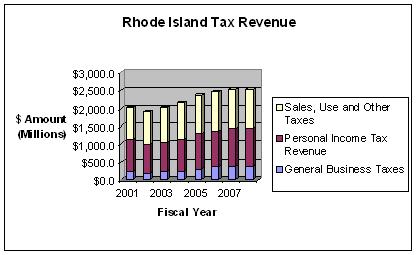
For clarity, I'll break them out by category. First, let's see how much less Rhode Island businesses are paying in taxes:
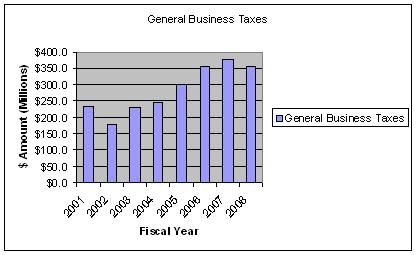
Business tax revenue dipped in 2002 (after 9/11) but had rebounded by 2003/2004. However, it is predicted to dip in 2008, from $376.4 million to $354.9 million. I guess it is around $20 million less...but that certainly bucks the trend that has resulted in about a 50% increase in business tax revenue from 2001 to 2008.
Well, how about Rhode Island taxpayers?
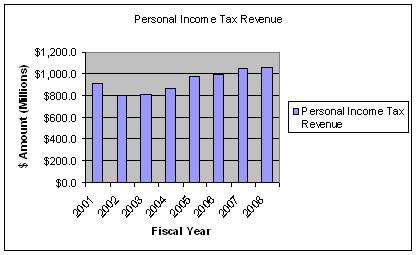
Same sort of trend as the Business tax revenue, though there is no projected "dip" in 2008.
Income tax revenue has continued to climb, increasing by about 30% since 2001. The same trend and percent increase is also true for "other" tax revenue, which climbed from 2001-2005 but have leveled off since then (and that's fine by me!).
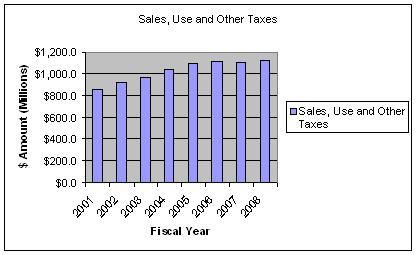
Basically, tax revenue from all sources hasn't gone down (though it will remain essentially the same in both 2007 and 2008). Between 2001 and 2008, it has increased from $2,011.9 to $2,543.6 million (about 26%), but increases in government expenditures have easily outpaced these revenue increases.
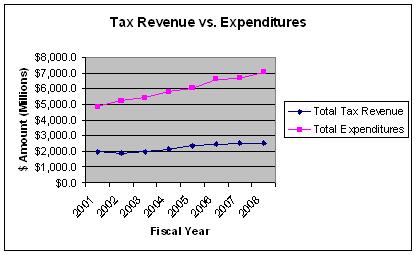
In short, expenditures have gone from $4,839.2 to $7,017 million (about 45%) over the same period.
The horse has been flayed and it's bones turned into meal....but for the millionth time: it's spending, not revenue that is the problem.
All data obtained from the RI State Budget Office web site. Figures for 2001-2005 are actual/audited, for 2006 are revised, for 2007 as enacted in FY budget and 2008 as proposed or projected.
October 15, 2007
Sharing the Tax Burden
Chris Edwards at CATO illustrates how Americans currently share the tax burden (h/t). First, the shiny graph:

Then Edwards' analysis:
1990 was before the Clinton tax increases of 1993. 2000 was after the modest tax cuts of 1997, but before the Bush tax cuts of 2001. 2005 was with the Bush tax cuts in place.Then we hear from James Pethokoukis that Wall Street (Goldman Sachs, to be precise) is predicting tax increases when (not if) a Democrat is elected President. Some of what they say, as reported by Pethokoukis:
***
Folks at the top pay about 25% of their income in federal income taxes, which compares to less than 5% for half of the population at the bottom end.
***
The Bush tax cuts substantially reduced tax rates for people in every income group. Indeed, those at the bottom had the largest relative reductions in their tax rates.
***
Those at the bottom have paid little, and now they pay even less, due to legislation under both Clinton and Bush. Indeed, these data do not include the tens of billions of dollars sent to lower-income families as a result of the earned income tax credit, and thus it overstates taxes paid by the bottom group.
I'd guess that the Democrats will try to pin the tax rates of the highest 10-25% of wage earners back to 2000 levels. And they'll still excoriate these highly taxed, high-earners for not paying their "fair share." The class-warfare game plan seems to work, after all.Marginal tax rates on high-income earners are likely to increase...through a combination of allowing the 33 percent and 35 percent brackets to revert back to 36 percent and 39.6 percent respectively, and increasing the rate paid under the alternative minimum tax for higher income earners, which is currently set at 28 percent. The tax rate on dividends is likely to rise. The capital gains rate will rise as well, but may be lower than the dividend rate once again. The long term capital gains rate looks likely to rise from its current level of 15 percent. ... An increase past 20 percent is possible but less likely. If it were to increase further, the next natural stop would be 28 percent, which was the rate that applied to long term capital gains before President Clinton and Congress agreed to lower it in 1997. Tax changes could become effective in 2009, but are more likely in 2010 or 2011. Although it seems fairly clear that an all-Democratic government is likely to let some of the expiring tax rates expire, it is much less clear that they will proactively raise tax rates before they are scheduled to reset at the end of 2010. ... A tax hike in 2010 is more likely, but could also present political problems.
Then again, maybe "over paid executives" will welcome higher taxes.
October 10, 2007
Move along, nothin' to see here: R.I. has nation’s worst business tax climate
The sun rose and somewhere a dog bit a man. And the Tax Foundation has new numbers {PDF} that paint the usual grim picture for Rhode Island. Here are some bullet points taken from the ProJo story on the matter (all are quotes from the piece):
The Tax Foundation based its rankings on five taxes: corporate, individual income, sales, unemployment and property. Rhode Island ranked 50th, meaning that its taxes overall are higher than any other state in the country. Rhode Island also ranks 50th nationally in job creation from 2003 to 2006...42nd in production growth, and 48th in income growth. Rhode Island has consistently ranked at the bottom of the pack since the study was first conducted in 2003. (Rhode Island used to rank 49th until 2004, before dropping to 50th.) Of the five taxes measured, the worst individual score for Rhode Island was given to the state unemployment insurance tax and its property tax. Rhode Island’s unemployment insurance tax ranked 50th in the country in terms of business friendliness, while property taxes ranked 48th, according to the report. The unemployment tax, however, is given the least weight of all the taxes in the index. The least onerous ranking was given to Rhode Island’s sales tax, which ranked 33rd in the nation. (The state’s individual income tax ranked 47th and its corporate tax ranked 34th.)
October 9, 2007
The Tax Foundation and Neil Downing on Income Tax Progressivity
I'll add the most recent Tax Foundation analysis (released October 5) to the discussion about incomes and tax rates being batted around in the comments section…
This year's numbers show that both the income share earned by the top 1 percent and the tax share paid by the top 1 percent have reached all-time highs. In 2005, the top 1 percent of tax returns paid 39.4 percent of all federal individual income taxes and earned 21.2 percent of adjusted gross income, both of which are significantly higher than 2004 when the top 1 percent earned 19 percent of AGI and paid 36.9 percent of federal individual income taxes.I'll also add this: if the high-tax ideologues out there believe that the primary purpose of the income tax is to level incomes, rather than to pay for government services, then they're going need to advocate a very draconian system to reach their goal, since the already progressive system we have doesn't seem to be doing the job they want.The IRS data also shows increases in individual incomes across all income groups (see Table 3). Just as the highest earners lost the biggest percentage of their incomes during the recession of 2001, so they have prospered the most as the economy has continued to rebound. For example, from 2000 to 2002, the adjusted gross income (AGI) of the top 1 percent of tax returns fell by over 26 percent. In that same period, the AGI of the bottom 50 percent of tax returns actually increased by 4.3 percent. However, since 2002, as the recession has ended, AGI has risen by 61 percent for the top 1 percent and 10.7 percent for the bottom 50 percent.
Also, in today's Projo, business columnist Neil Downing notes that income-to-tax ratios in Rhode Island's state income tax data are similar to the national figures…
For 2005, the latest period for which figures are available, the overall Rhode Island income tax totaled about $961 million. Of that, $392 million was attributable to those with incomes of $200,000 or more.Finally, I came upon the original Tax Foundation item via Instapundit, who adds these thoughts worth considering…In other words, the state’s highest-income taxpayers are responsible for about 41 percent of Rhode Island’s overall income-tax burden — even though they represent only about 2 percent of all income-tax returns filed.
You can quibble with those numbers if you like. For example, the report I looked at doesn’t make clear whether the income-tax figures I’ve listed above are before or after taking credits into account.
But look beyond those numbers, because they’re limited in scope. They focus only on income tax.
They don’t reflect what higher-income people pay in local property taxes, or what they wind up paying — one way or another — as a result of Rhode Island’s death tax (also known as the Rhode Island estate tax).
So no matter how you slice the numbers, the overriding point is indisputable — although higher-income Rhode Islanders represent only a tiny portion of all taxpayers, they carry a huge chunk of the state’s overall tax burden.
I think that everyone should pay at least some tax, and it should vary each year with how much the government spends, and should be enough to give people an incentive to care....A reader emails: "The optimal tax code for the political class is one where more than 51% of the voters pay no taxes at all and where the politicians and their friends receive exemptions from most of the taxes. Explain how this differs from the current system."
October 3, 2007
Roland Benjamin: "It is time for a bold solution that eliminates the corporate income tax in Rhode Island"
Massachusetts Governor Deval Patrick visited Rhode Island last evening to discuss his state's triple-casino proposal, but Roland Benjamin thinks there are better ways for Rhode Island to compete with Massachusetts than by expanding gambling here…
Quite a stir regarding the “not quite dead yet” Casino discussion. The debate reopens in response to rumblings from Massachusetts discussed in the Projo here:
Murphy said gambling revenue critical to the state budget, which is projected to run a deficit for the next few years, will drain away to Massachusetts without action to protect Rhode Island’s slot parlors.It’s doubtful that the primary intent of the Speaker is to “protect” the slot parlors. It is more plausible that the revenue streams to the General Fund are more coveted. After all, that’s what they are looking for in Massachusetts.
Patrick estimates the casinos would create 20,000 permanent jobs and raise $400 million in new annual revenues for Massachusetts.So the competing power brokers in the two states are looking to tap into a stream flowing largely into Connecticut, with some residual to Lincoln and Newport. The arguments always reference jobs and economic impact. But it is important and non-trivial to note that these casinos thrive off of wealth generated in other segments of the economy. They create no new wealth for anyone save a handful and end up effectively taxing the entire gaming population.
Instead of taking the Me-Too approach, Rhode Island could view this as an opportunity to take an aggressive competitive stance with neighboring New England states. Why not go after an economic sector that creates wealth instead of one that consumes it? This would be a tremendous challenge given the current business climate of the state and the country for that matter.
According to this KPMG study, the United States compares somewhat horribly to other countries with respect to corporate income tax rates. Of the 60 countries represented, the U.S. has a marginally lower rate than only 5 countries before adding in any state income taxes. Taken in conjunction with this study from the Tax Foundation, Rhode Island ranks worst among states in business tax climate. Add our own corporate income tax rate to the federal rate and the Rhode Island business tax climate is the worst on the planet.
It is time for a bold solution that eliminates the corporate income tax in Rhode Island. After all, corporate income taxes are nothing more than an indirect tax on the employees working for the affected corporation or its owners. Dollars flowing to stakeholders (employees, shareholders, customers, etc.) will be taxed anyway, and dollars staying in the organization will be invested to generate more wealth for more people. Since corporations are far more able to move operations and capital to tax friendly regions, the brunt of this impact is felt by the actual workforce according to this CBO analysis.
Given those values, when capital is perfectly mobile and the tax does not affect the world prices of traded goods, domestic labor bears slightly more than 70 percent of the long run burden of the corporate income tax.Because we do not have a competitive climate when compared to neighboring states, the effect on the workforce is even greater as many find employment in Massachusetts or Connecticut. But if Rhode Island were to slash the corporate income tax rate to zero, we would compete across ALL economic sectors, not just gaming. We would eat their proverbial lunch in attracting wealth creating business to our state. We would not have to worry about negotiating revenues from slot machines. Until we do something bold, every business that starts up or expands in Massachusetts is a missed opportunity here in Rhode island.
August 13, 2007
When the Good Times Aren't So Good, What Will the Bad Times Be Like?
Elizabeth Gudrais has an article in today's Projo on the National Conference of State Legislatures’ annual state budget survey ($$ required to view the original). This year's study ranks Rhode Island #1 in the country in terms of tax increases between this year and last. The Projo article contains none-too-surprising reactions from the usual suspects; House Finance Chariman Steven Costantino says the NCSL methodology is flawed, Gary Sasse of the Rhode Island Public Expenditures Council says that Rhode Island’s poor fiscal condition is because other areas of the budget are being starved to pay for entitlement spending, and Ellen Frank of the Rhode Island Poverty institute says the message from these kinds of reports is that Rhode Island needs to find new ways to raise taxes.
However, in terms of planning for the future, the most important feature of the NCSL study may be its warning that we've been living through good times that are about to come to an end…
Of the 45 states that have already reported, 23 ended fiscal 2007 with surpluses equaling 10 percent or more of state general-revenue spending, due in many cases to higher-than-expected revenue receipts. Many states were able to increase their reserve funds — Tennessee, for example, by more than $200 million…[but] for other states, the boom times appear to be coming to an end. The NCSL report fingers fiscal 2006 as “the peak for state fiscal health this decade.” On average, the report says, the growth in state surpluses and higher-than-budgeted tax collections are slowing down.If the forecast is accurate, fixing the structural problems in Rhode Island budget is not something that can put off for much longer.
July 11, 2007
Why Pensions Don’t Work: Isn’t it the Demography, Stupid?
While we’re on the subject of pensions, the reason that many people believe that the public sector needs to move away from defined-benefit pension plans to defined contribution type retirement plans (and that the government has to move away from a defined benefit Social Security system) goes beyond the rationale that “it’s the way the private sector does it”. Rather, the argument is basic demography.
In 1955, during the golden age for corporate pensions, the fertility rate in the United States was about 3.6 children per woman. By 1980, the fertility rate had dropped to 1.8 children per woman, and it has hovered around a rate of 2.0 since then. That’s a devastating change if you’re trying to structure a rational, sustainable defined benefit pension plan.
Defined benefit plans have to be supported by succeeding generations, but in 1955, this wasn’t a big problem. In 1955 each couple “contributed” 3.6 new people, on average, to the next generation. Jump forward 25 years, and each of those new couples added 1.8 people to the generation after that. That means, over two generations, there were 6.8 younger people per older citizen (3.6 in the first generation, plus 1.8 times 1.8 in the second generation, [i.e. the fertility rate of 1.8 in 1980 times half of 3.6, because it takes two to make a couple]) available to support a pension system.
However, starting with women of childbearing age in 1980, there were only 1.8 new people per couple in the next generation. There’ll be only 2.0 young’uns in the generation after that. The result is only 3.6 younger people per older citizen (1.8 in the first generation, plus 0.9 times 2.0) available to support defined benefit pension plans for the current generation entering/nearing retirement.
That means -- even before accounting for increased life-expectancy -- you have to whack people currently in the workforce twice as hard now as you did 25 years ago to pay for public sector pensions, because there are only about half as many people relative to the retiree population. And if the United States follows demographic trends in the developed countries of Europe, this problem will only get worse.
July 10, 2007
The Rhode Island Auditor General's List of Municipal Pensions at Risk
I know it's not the most exciting topic, but the Rhode Island Auditor General's just-released report on municipal pensions most at risk may help explain some of the tax bills and the consequences of certain decisions made in various communities around the state.
Category 1: Plans significantly underfunded with annual contributions significantly less than annual required amounts.
| Pension Plan | Funded Ratio | % of Required Contribution made in FY2006 | Unfunded Actuarial Accrued Liability |
| Central Falls Police and Fire (post 7/1/72) | 34.6% | 8% | $20,599,620 |
| Coventry Police | 8.0% | 28% | $45,165,871 |
| Coventry Municipal Employees | 18.0% | 13% | $11,343,042 |
| Coventry School Employees | 46.6% | n/a | $9,368,668 |
| Narragansett Police (pre 7/1/78) | 5.1% | 0% | $901,264 |
| Pawtucket Police and Fire (post 1974) | 42.5% | 54% | $84,049,166 |
| West Warwick | 48.0% | 47% | $ 43,750,220 |
Category 2: Plans significantly underfunded with annual contributions are at or near 100% of annual required amounts.
| Pension Plan | Funded Ratio | % of Required Contribution made in FY 2006 | Unfunded Actuarial Accrued Liability |
| Central Falls Police and Fire (pre 7/1/72) | 7.3% | 127% | $14,591,702 |
| Cranston Police and Fire (pre 7/1/95) | 15.5% | 98% | $217,543,602 |
| Johnston Fire (pre 7/1/99) | 30.7% | 93% | $30,529,696 |
| Johnston Police | 30.8% | 100% | $25,711,683 |
| Newport Firemen’s Pension Plan | 39.9% | 100% | $41,257,640 |
| Providence | 37.4% | 96% | $659,036,000 |
| Scituate Police Pension Plan | 37.0% | 101% | $4,268,707 |
| Smithfield Police (prior to 7/1/99) | 36.0% | 153% | $12,529,685 |
| Warwick Police Pension I and Fire | 27.0% | 100% | $194,841,382 |
| Westerly Police | 43.4% | 96% | $23,777,351 |
Category 3: Plans with annual contributions significantly less than required and generally declining over a multi-year period.
| Pension Plan | Funded Ratio | % of Required Contribution made in FY 2006 | Unfunded Actuarial Accrued Liability |
| Bristol Police (prior to 3/22/98) | 67.0% | 53% | $5,608,883 |
| East Providence Fire and Police | 70.0% | 24% | $ 31,720,000 |
| Narragansett Town Plan | 79.0% | 47% | $10,957,669 |
| Smithfield Fire | 86.0% | 72% | $1,989,143 |
Re: RI Has 7th Highest Taxes in U.S.
Here are a few more details from the Rhode Island Public Expenditure Council’s annual 50-state tax-revenue comparison. Rhode Island is a top-10 state in terms of income and sales taxes collected whether you measure per-capita or as a percentage of personal income. The full set of New England numbers for this year are…
- (“All State and Local Tax Collections Per $1,000 of Personal Income”, Fiscal Year 2005)
- (4) Maine $133.04
- (6) Vermont $131.91
- (7) Rhode Island $122.68
- (11) Connecticut $119.17
- (34) Massachusetts $107.31
- (49) New Hampshire $91.43
- ("All State and Local Tax Collections Per Capita", Fiscal Year 2005)
- (2) Connecticut $5,398
- (5) Massachusetts $4,470
- (9) Rhode Island $4,191
- (10) Vermont $4,137
- (13) Maine $3,960
- (29) New Hampshire $3,306
- (“All State and Local Tax Collections, Charges and Misc. General Revenues Per $1,000 of Personal Income”, Fiscal Year 2005)
- (9) Maine 183.69
- (12) Vermont $179.90
- (26) Rhode Island $164.70
- (43) Massachusetts $149.01
- (46) Connecticut $146.12
- (50) New Hampshire $128.87
RI Has 7th Highest Taxes in U.S.
By now, this is low-hanging fruit. But duty impels us to prescribe the ProJo's Neil Downing report on a new RIPEC report- "How Rhode Island Compares":
Rhode Island has one of the nation's highest tax burdens - and a big reason for that is local property taxes, a new study shows.Surprised?Based on the overall state-and-local tax burden, Rhode Island ranks seventh highest nationwide, the study says.
When it comes to property taxes, Rhode Island's comparative tax burden is even higher, ranking the state sixth nationwide, the study shows.
The findings are part of a study to be formally issued todaycq by the Rhode Island Public Expenditure Council (RIPEC), a business-backed public policy group which monitors the state's finances.
The annual report - "How Rhode Island Compares" - shows that Rhode Island's overall state-and-local tax burden has increased in the last 10 years, while that of its two neighboring states - Connecticut and Massachusetts - has improved, said Gary S. Sasse, RIPEC's executive director. For example:
In 1995, Rhode Island had the 14th highest tax burden; now it has the 7th highest.
In 1995, Massachusetts ranked 23rd; now it's ranked 34th.
In 1995, Connecticut ranked 7th; now it ranks 11th.
In other words, Rhode Island's state-and-local tax burden has grown in the past decade, while the tax burden in Connecticut and Massachusetts has declined.
"Rhode Island is going in the opposite direction'' compared with its two neighboring states, Sasse said. "Our neighbors are doing better in making their state more tax-competitive,'' he said.
For every $1,000 of personal income, state and local governments in Rhode Island collect about $123 in taxes, while Connecticut collects about $119, and Massachusetts about $107, the study shows.
July 6, 2007
Taxing the Vices of the Poor (and the rest of us)
Gambling, Alcohol and Tobacco are all subject to "sin" taxes. We may as well add gasoline to the mix, too. According to the The National Center for Policy Analysis, all of 'em hit the poor hardest (h/t). Here's a distillation of the Executive Summary of their report.
"The dollar amount spent on the lottery by the lowest-income individuals (earning less than $10,000 annually) is twice as much as the highest earners (earning more than $100,000 annually)."
"One-third of lower-income adults smoke versus one-fifth of middle- and high-income earners, according to the Centers for Disease Control and Prevention"
"...major tobacco companies...pay the states $200 billion over 25 years to compensate for state health care costs attributed to smoking. More than 90 percent of the settlement costs are passed on to consumers. In fact, the settlement raised the price of cigarettes about 45 cents per pack."
"The portion of income spent on alcoholic beverages by the lowest fifth of earners is double that of middle earners and more than three times that of the highest earners, on the average."
"Some advocates claim taxes on harmful behaviors...are justified to recoup the costs those activities impose on others, such as secondhand smoke and drunk driving. Although the evidence is mixed, it appears that taxes on tobacco already more than compensate for the social costs of smoking. "
"Advocates also claim these taxes encourage people to change their behaviors in socially desirable ways....the evidence indicates that these taxes are designed to raise revenue, rather than discourage unhealthy behavior."
"Poorer taxpayers are also disproportionately burdened by excise taxes imposed on 'necessities,' such as gasoline, utilities and telephone services. Since lower-income households spend more of their incomes on these items, they pay a greater share of these taxes."
"The lowest fifth of income earners spend nearly one-third of their income on alcohol, tobacco, utilities and gasoline, on the average. By contrast, the highest earners spend just 6 percent of their income on these items. Thus taxes on these products are especially burdensome to the poor."
These statistics confirm a couple things. First, many people are opposed to a consumption-tax as a possible replacement to an income tax because it will hit those on the bottom of the income ladder hardest (I agree). They also help expose the underlying cynicism of our national and state governments who pay lip service to discouraging these vices while at the same time relying on them for their lifeblood. In the case of gambling (lottery or "casinos") they outright encourage vice. But the answer isn't a more "progressive" income tax (tax the rich more!). Instead, it is to reduce the amount of government spending. (Realistically, that means reigning in the rate of growth of spending). Until then, the message will continue to be "Smoke, drink and be merry so we can fund programs to help you...maybe."
June 18, 2007
The Always Exciting Topic of Capital Gains Taxes
Projo business columnist Neil Downing points out that Rhode Island’s capital gains tax debate tends to get over-simplified to the point of inaccuracy. The oft-discussed phaseout (that the House has voted to delay this year) applies only to long-term capital gains, i.e. profits made from selling assets held for five or more years. Tax rates on the sales of assets held for periods shorter than 5 years are not changing at all. Downing summarizes the rules…
Short-Term: If you’ve held the asset for 12 months or less, the gain is generally treated as ordinary income, such as salary or wages. So it generally gets taxed at the usual Rhode Island income-tax rates, as high as 9.9 percent....A 2001 report from the Rhode Island Economic Policy Council offered this rationale for eliminating the long-term capital gains tax...Medium-Term: If you’ve held the asset for more than 12 months, but less than five years, you generally pay a maximum Rhode Island tax of 5 percent if you’re an upper-income taxpayer, 2.5 percent if you’re a lower-income taxpayer....
Long-Term: If you’ve held the asset for more than five years, you currently pay tax at a maximum rate of 1.67 percent if you’re an upper-income taxpayer, 0.83 percent if you’re a lower-income taxpayer.
Under current law, these long-term rates will drop to zero starting in January, said Peter L. Chatellier, president-elect of the Rhode Island Society of Certified Public Accountants.
But the other capital-gains tax rates won’t change, said Chatellier, partner in Braver P.C., a regional accounting firm with an office in Providence.
Capital gains tax relief is the single most important tax reform initiative before the General Assembly during this session – critical to the development of clusters of new economy industries, many of which rely on stock options to create competitive compensation packages. Phase-out of the tax would help the state begin to build a critical mass of the entrepreneurs and investors who serve as magnets for new economy business development, and increase our competitiveness within the Boston Metro – while benefiting a wide spectrum of Rhode Islanders across industries and income levels as the demographics of investment continue to expand....and, according to the 2006 Business Incentives Report from the Rhode Island Economic Development Corporation, Rhode Island already offers a complete capital gains exemption for stock options in specific industries...
Rhode Island grants complete personal income tax exemption for capital gains or ordinary income that result from the sale, transfer, or exercise of qualified or non-qualified stock or options for employees in software industries (defined by SIC codes 7371, 7372, 7373).If it works for one industry, why shouldn't it work for others? Why not extend the captial gains exclusion to all industries (by eliminating the tax on long-term captial gains) and make RI a more attractive place for any small company that wants to locate here and stay awhile?
May 30, 2007
Today, the Sky is Blue. And the Rhode Island Poverty Institute Wants to Raise Taxes
Surprise! Kay Brewster, executive director of the Rhode Island Poverty Institute, calls for higher taxes in today’s Projo…
State revenues -- taxes, fees and other income -- are the collective investments we make to create a quality of life in Rhode Island that we all enjoy and expect. These investments are essential to keeping our shorelines and beaches clean, protecting our communities with police and emergency workers, educating our current and future workforce, and keeping our neighbors from going hungry or homeless.Nowhere in the op-ed does Ms. Brewster mention that Rhode Island already has the fourth highest state/local tax burden in the nation. In fact, making the claim that it’s “time to shift focus…to enhancing Rhode Island’s revenue system” requires a large dose of historical amnesia. Government in Rhode Island has been “enhancing” its revenues for over a decade. In 1995, Rhode Island had the 12th highest state/local tax-burden. By 1998, Rhode Island had moved up to 8th and, by 2000, to 5th. Since 2005, Rhode Island has had the 4th highest state/local tax-burden in the nation.For years, Rhode Island has struggled with a revenue system that is not adequate to meet the demands of a modern state. It is time to shift focus from cutting services to enhancing Rhode Island’s revenue system, so that we have the funds needed to maintain the public structures we all rely upon.
Isn’t this steady growth in tax revenues relevant to an honest discussion on tax policy? Or do our state’s poverty advocates believe that given infinite resources, government will do infinite good, and therefore tax increases are always justified?
May 25, 2007
The Return of the Progressives Against Science Education
Actually, it’s doubtful that they ever left. Jim Baron of the Pawtucket Times notes that the members of the Campaign for Rhode Island’s Priorities, as they did last year, want to cut Governor Donald Carcieri’s science education initiatives out of the state budget in order to fund non-educational social service spending…
A coalition of social action groups, the Campaign for Rhode Island's Priorities, wants lawmakers to roll back a number of tax breaks for corporations and the wealthy, increase some other taxes and reduce or eliminate funding for charter school spending, science and technology education and information technology improvements. At the same time, it wants to see spending hiked for several human services programs and to preserve others now on the chopping block.Specifically, the CRIPs want to save $3,000,000 by “postponing” implementation of the Governor’s Inspiring Excellence in Science, Technology, Engineering, and Mathematics program. But because the CRIP package does not address the structural nature of Rhode Island’s shortfalls, adopting its philosophy would likely require a "postponement" of the program that never ends in order to balance future budgets.
Here’s the description of exactly what the CRIPs would like to eliminate, as described in the Governor's budget proposal…
To support more efficiencies and better training in the educational system, the Governor’s plan includes previously approved funding of $15.0 million for technology over five years which would focus on “Inspiring Excellence in Science, Technology, Engineering, and Mathematics (STEM)”. The Governor recommends funding for innovative technology to upgrade teacher training programs to better prepare teachers to inspire their students to excel in science, technology, engineering and mathematics. Projects that qualify may include, but are not limited to, the Rhode Island Department of Education’s Comprehensive Education Information System and its rollout to school districts as well as specific funding to support teacher professional development in the use of innovative technologies or techniques, including our state’s teacher preparation programs. The “SMART” Classrooms Program will significantly upgrade teacher preparation facilities at Rhode Island College and the University of Rhode Island by infusing technology into our teacher training programs, creating a Center for Excellence in Mathematics, Science and Technology Education, and upgrading mathematics and science classrooms and laboratories.According to their press release, CRIP membership includes the National Education Association of Rhode Island and the Rhode Island Federation of Teachers and Health Professionals, which would seem to put Rhode Island’s teachers unions on the side of science education cuts. Is it indeed the position of the unions that science education is the first area of the state budget where spending should be reduced in a time of fiscal crisis?
Finally, in the Pawtucket Times article, Ocean State Action director Karen Malcom calls the CRIP package “common sense”. Apparently, to Ms. Malcom, it is common sense that welfare spending takes priority over education. That explains why the members of CRIP are willing to increase taxes to spend on social services, but not to improve education.
May 18, 2007
"Stealth" Tax Increase?
Dan Yorke has called attention to this piece of legislation--Brought to you by Reps. Slater, Naughton, Diaz, Almeida, and Lima--which amends the current RI Sales tax code to read:
A tax is imposed upon sales at retail in this state including charges for rentals of living quarters in hotels, rooming houses, tourist camps, all services with the exception of medical and legal services, and all food and all clothing over one hundred fifty dollars ($150) at the rate of four and one half (4.5%) percent of the gross receipts of the retailer from the sales or rental charges; provided, that the tax imposed on charges for the rentals applies only to the first period of not exceeding thirty (30) consecutive calendar days of each rental.For "clarification", the explanation is:
This act would reduce the state sales tax rate from the current 7% to 4.5%, and would include medical and legal services, as well as food and clothing items sold for more than $150, as taxable services and items.So, the apparent idea is to broaden the scope of the sales tax while sweetening the proposal with a reduction in the actual rate. Talk about moving the deck chairs on the Titanic....
The language of the bill is a little confusing, but Yorke points out that legal and medical services are actually exempted. Rep. Joseph Trillo (R, Warwick) called Yorke and confirmed this and said the only reason medical services are exempted was to provide cover for the 26 lawyers in the House who've thoughtfully exempted themselves from the expanded taxation.
Yorke and Trillo said they will be looking into organizing people to protest the bill by showing up at the House Finance Committee hearing on Tuesday, May 22 at 1:00 PM. Stay tuned.
ADDENDUM: I do know that two Senators--Warwick Democrats McCaffrey and Walaska--have proposed reducing the sales tax to 6% and have also proposed that the EXEMPTIONS be expanded and NOT the tax, as their colleagues in the House would have. Here's another piece of Senate legislation seeking to do the same thing. I assume (hope?) they'll be reconciled in Committee. Wonder which tax philosophy--House or Senate--will prevail?
UPDATE: (5/21/2007) Dan Yorke has reported that the state sales tax "reform" discussed above is dead on arrival according to his sources.
Representative Jack Savage on Education Aid & Tax Increases
At last night's East Providence GOP event, I had the opportunity to talk with State Representative and House Finance Committee member Jack Savage (R-East Providence) and turn Anchor Rising’s attempt to read the tea leaves with regards to the state budget deficit into a few concrete questions…
Anchor Rising: Some recent comments made by public officials seem to indicate that eliminating the Governor’s proposed 3% increase in education aid is a part of the plan for closing the state budget deficit? Is that the legislature’s plan?
Representative Jack Savage: I would say that, although certainly we want to maintain strength and integrity of our social and educational programs, everything is on the table.
With education, it is very possible that it will be level funded at last year’s level. We may not have the funds to do the 3% increase, which would be approximately 20 million dollars. That’s certainly an area which we are looking at to further reduce our deficit.
AR: No one who’s follows Rhode Island politics believes that tax-increases are ever completely off of the table. Is there any talk at the state house about specific types of tax increases?
JS: I think that’s a general type of conversation. I really don’t think that’s going to happen. Everyone is well aware of the fact that we are already so highly taxed, in all areas.
There may be increases in fees and licensing, those types of increases, but I really don’t think, though I could be wrong, that there will be an increase in sales tax or income tax. At least I’m hoping not. I hope we can find other ways to close the gap.
Hide Your Wallets, D.C. Dems are Coming....
Republican Senator Mitch McConnell writes:
While most of the media were busy covering the latest developments on the Iraq funding bill or the bipartisan immigration proposal, congressional Democrats on Thursday quietly passed a budget creating the framework for the largest tax increases in American history...Heritage also has some analysis on the Senate Budget--most of the tax increases are because the Senate is going to simply let the Bush tax cuts expire--and more here:Everyone takes a hit. Forty-five million working families with two children will see their taxes increase by nearly $3,000 annually. They’d see the current child tax credit cut in half — from $1,000 to $500. The standard deduction for married couples is also cut in half, from the current $3,400 to $1,700. The overall effect on married couples with children is obvious: Far from shifting the burden onto the wealthy, the Democratic budget drives up taxes on the average American family by more than 130 percent.
Seniors get hit hard too. Democrats like to crow that only the richest one percent of Americans benefit from the stimulative tax cuts Republicans passed in 2001 and 2003. What they rarely mention is how much seniors benefited from those cuts in the form of increased income as a result of lower taxes on dividends and capital gains. More than half of all seniors today claim income from these two sources, and the Democratic budget would lower the income of every one of them by reversing every one of those cuts.
With federal spending surging above $24,000 per household per year, the incoming Democratic majority of Congress promised to restore fiscal responsibility in Washington. Instead of paring back the growth of government, however, Congress came to agreement in conference on a budget resolution that:President Bush has vowed to veto the Democratic budget.* Raises taxes by $721 billion over five years, and a projected $2.7 trillion over 10 years, or more than $2,000 per household;
* Includes 23 reserve funds that could be used to raise taxes by hundreds of billions more;
* Increases discretionary spending by nearly 9 percent in FY 2008 and does not terminate a single wasteful program;
* Completely ignores the impending explosion of Social Security, Medicare, and Medicaid costs; and
* Creates rules that bias the budget toward tax increases.
...Congress’s budget resolution is consistent with the Democratic majority’s budget agenda so far. In just a few months in Washington, the Democratic Congress has tacked $21 billion in unrelated deficit spending onto the Iraq war emergency bill; passed a $7 billion farm bailout—without any offsets—that violates the majority’s own pay-as-you-go (PAYGO) rules by adding new mandatory spending;[1] and waived its own PAYGO rules in order to add new mandatory spending as part of a bill to expand the House of Representatives.[2] Coming on the heels of these initiatives, Congress’s irresponsible budget resolution is hardly a surprise.
May 17, 2007
There's more than one way to raise a tax.
This letter to the Projo, which links to righttax.org, makes a point worth hearing:
In Rhode Island public schools are funded by a combination of state-supplied money and funding generated by cities and towns via property taxes. Unfortunately, in Rhode Island we rely too heavily on the property tax to fund our schools.The second problem with Rhode Island's property-tax laws is their impact on existing homeowners. In 2006 the General Assembly enacted a new limit on property-tax levies, limiting levy growth from the present 5.25 percent to 4 percent by 2013. Unfortunately, this law does nothing to limit individual property assessments. So even if a city does not increase its property-tax rate, your property taxes will go up every time your property is "re-evaluated."
May 16, 2007
Bi-Partisan Call to Raise Inheritance Tax Threshold
Kudos to State Rep's Carol Mumford (R, Scituate/Cranston) and Peter Kilmartin (D, Pawtucket) for today's op-ed in the ProJo in which they propose raising the Rhode Island inheritance tax threshold from $675,000 to $1 million.
Protection of assets acquired over a lifetime, coupled with a desire to leave the next generation a small inheritance, now preoccupies the middle class. Once the purview of the rich seeking to preserve their inheritances, tax planning is now causing middle-class people to vote with their feet...They also make a good point about how the children of farmers are faced with paying an "exorbitant amount" of taxes to keep the farm or sell to developers. Additionally, to add a bit of irony, Mumford and Kilmartin point out that:Small-business owners and farmers, who are bound to Rhode Island, do not enjoy the luxury of this choice. Most businesses in this state are small operations employing fewer than 10 workers. Many are family-owned. When the owners die, their children who inherit are faced with financial dilemma. They must either sell the business to pay the inheritance tax or borrow an exorbitant amount of money to keep the business family-owned. These are the choices that hamper small Rhode Island businesses from growing one generation to the next.
[A] strange dance occurs with groups wishing to preserve open space. These groups, financed with state and local tax dollars, move to purchase the development rights, so that crucial open space can be preserved and inheritance taxes can be paid.The same burden is imposed upon those who inherit long-held family cottages on the coast. And they continue:Wouldn’t it be better to allow the families to continue farming from one generation to the next? It is shortsighted to collect inheritance taxes with one hand, and with the other to pass out state dollars to purchase development rights.
In the best of all worlds, Rhode Island would eliminate the inheritance tax altogether.I'd think that if the House Whips for both parties are on the same page, legislation has a good chance of passing.If the tax were eliminated, median family income in Rhode Island would certainly rise. Small-business owners would be able to make long-term decisions knowing the next generation would profit. Small business could grow into a Rhode Island big business, employing far more than the current number of fewer than 10. The frugal members of the middle class who have amassed a small estate through hard work and a growing real-estate market would not be chased away. Family farms could remain family farms.
Would these problems completely disappear if the inheritance tax threshold were raised to $1 million? No, probably not, but it is a good beginning!
May 15, 2007
New House Budget Means Higher Taxes
The Heritage Foundation has done an analysis of the new House Budget crafted by the Democratic majority in Washington and concluded that it means higher taxes across the board. Their reasoning:
The House leadership has proposed to increase spending over the next five years. Given the leadership's avowed commitment to paying for spending increases, tax revenues will have to rise. Which taxes will have to rise is unclear, as budget resolutions are notoriously short on details. However, the failure of House leaders to include any language addressing the expiring Bush tax cuts of 2001 through 2004 indicates that they could intend to end these tax cuts.[1] This, in turn, means that the House leadership could be allowing American taxpayers to assume a large and expensive tax increase upon the expiration of these tax cuts.Here's how--according to their calculations--Rhode Islanders would be affected:The House budget resolution has the potential to cost the average American taxpayer an additional $3,026 in taxes. In addition to the increased tax burden, Americans could also see their personal income decrease by an average of $502 dollars due to a weaker economy. Moreover, the budget resolution could damage employment growth, causing about one million fewer jobs to be created, and has the potential to damage economic output by over $100 billion nationally. The average cost of the House budget resolution to each congressional district amounts to the potential loss of 2,284 jobs that would have otherwise been created and a loss in economic output by an average $240 million.
The culprit for these negative impacts is higher taxes. Many economists believe that higher taxes, particularly on capital, cause the level of private investment to fall, thereby slowing productivity improvements and weakening the earning capacity of households. Wages and business earnings, which are closely tied to productivity, would fall as well.
Again, the budget resolution does not contain a detailed tax plan. However, the resolution also is silent on the most important tax policy change since 2001: the expiration of the tax law changes from 2001 through 2004 over the next four years. This paper presents estimates of the potential impact that allowing the Bush tax cuts to expire would have on Americans.[2]
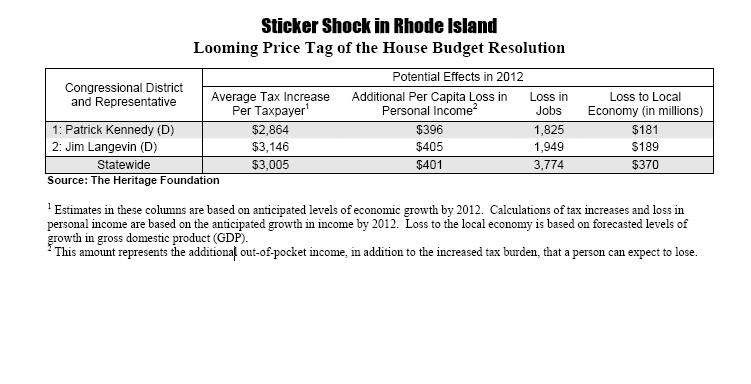
May 2, 2007
The Cicilline Budget Address
For those who missed Providence Mayor David Cicilline’s annual budget address last night, here’s the abbreviated version: We need to raise taxes on the rest of Rhode Island to provide more money for Providence. The Mayor essentially touted a plan to reduce property taxes while raising income taxes that has long been popular in progressive circles.
Mayor Cicilline attempts to use the flatness of the property tax to justify the proposed tax-shift…
A senior couple with a retirement income of 35,000 dollars a year who own a home valued at $250,000 pay about $300 a month -- that’s over 10% of their income in property taxes.But if the Mayor really sees his city's property tax system as the problem, there are in-community solutions that can be explored. Some Rhode Island communities freeze the property tax amounts that senior citizens are required to pay. Some states determine the tax liability of properties based on their assessed values at the time of purchase, protecting long-time, fixed-income residents from constant tax increases. Another possibilty would be exempting a certain amount of property value, say the first $50,000 of the value of a residential home, when determining tax liability. None of these solutions are perfect. But Mayor Cicilline isn’t interested in investigating their pros and cons anyway; his interest lies solely in finding a way to grab money from the rest of Rhode Island that can be spent on Providence, an option that will require either a statewide tax increase or service cuts in other Rhode Island cities and towns.On the other hand, a wealthy working couple making $200,000 a year and who own a $500,000 home pay about $700 a month, which is just 4% of their income.
Simple mathematics dictate that…
- A revenue neutral plan (where overall income tax collection is raised by the amount exactly matching a property tax cut) cannot deliver to Providence a bigger share of state aid than the city receives now unless other communities have their revenues reduced and are forced to cut services.
- An income tax hike bigger than a property tax cut (making Rhode Island’s fourth highest tax-burden in the nation even worse) is needed to increase Providence's share of state aid without forcing service cuts elsewhere.
I don’t think we’re yet at the point where shutting down the rest of Rhode Island in order to increase funding to the urban core is getting serious legislative consideration. Rhode Island State Senate Majority Leader Teresa Paiva-Weed, for instance, has recently stated that she sees the goal of a new state education aid funding formula as providing more aid to “second-tier” urban and suburban communities. But if we do reach the point where plans to increase Providence's already generous share of state aid begin to take shape, a fundamental issue of governance comes into play.
The Providence school system already receives about 2/3 of its funding from state sources. Already, everyone in Rhode Island is paying for Providence, but only the government of Providence – and its appointed school committee – decides how the money is spent. If the state of Rhode Island is going to be paying for 70% to 80% or more of the Providence school budget, an oversight authority with a substantive role in budget matters representing the interests of the broad base of Rhode Island taxpayers who will be paying for Providence’s schools will need to be created.
The government of Providence doesn’t have the right to tell the people of Rhode Island that their place is to just pay and go away.
April 28, 2007
Re: Poverty Rate Versus Tax Burden
It's worth noting, as an addendum to Andrew's post, that the two metrics aren't merely correlative. A substantial portion of the tax revenue goes toward those sorts of programs that attract poor people to the state (see, e.g., here, here, and here). In other words, the option is more likely to be "all of the above," as more tax dollars go toward handouts, draining funds both from general public services (such as road upkeep) and from taxpayers' wallets, driving them out of state or into poverty.
April 27, 2007
Poverty Rate Versus Tax Burden
The Providence Phoenix’s Brian C. Jones puts the idea that high taxes are driving people away from Rhode Island into the category of just-a-theory…
There has been a growing conviction that high taxes drive people away from Rhode Island and deplete the lifeblood of the private economy. Whether the world really works that way is debatable. What is not in dispute is that many economists and policymakers believe it to be the case, including Republican Carcieri, and legislative Democrats.The theory is actually a bit more complex, that the combination of high taxes and poor-to-average public services in return drives the middle class away, because they can get more bang for their buck by moving elsewhere.
That point aside, data sources exist allowing the history of tax impact on demographics to be examined in some detail. Let’s begin with the U.S. Census Bureau’s yearly data on the poverty rate in each state. According to that data, the poverty rate in Rhode Island has been over 90% of the national rate for four years in a row, the first time the relative rate has been that high for that long since the data series began in 1980. That means in those four years…
- Poor people have come to the state, or
- Middle-class people have left the state, or
- Middle class people have been driven into poverty, or
- Any or all of the above.
Well, the Tax Foundation has compiled data on each state’s tax-burden ranking since 1970 (Rhode Island is currently ranked 4th). By combining the Tax Foundation data with the Census Bureau data, we can see if there is a correlation between tax-policy and poverty rates. The plot below compares Rhode Island’s relative poverty rate between 1980 and 2005 to its tax-burden ranking from the previous year. The trend is unmistakable…
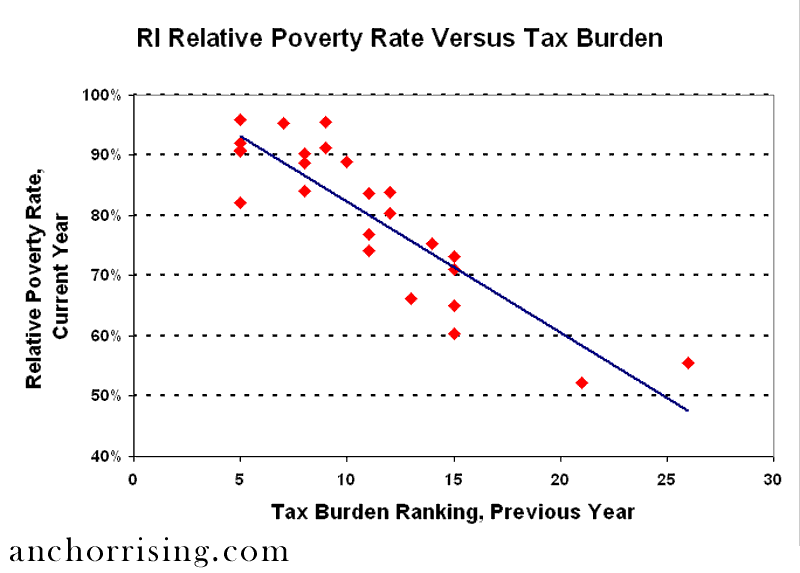
The high poverty period in the upper left-hand corner of the graph isn’t unique to the here-and-now, it also involves the years 1982-1984, the only other period since 1980 prior to the stretch beginning in 2002 where the RI relative poverty rate was over 88% for three years in a row. You can make the plot in other ways, tax-burden this year versus poverty rate, tax burden over the past two years averaged together, etc. and you’ll see basically the same trend.
Jones’ article includes this bit of analysis from University of Rhode Island Political Science Professor Maureen Moakley…
“Up until the 1980s, we were in the bottom of per-capita income,” Moakley says. “We really were a poor state, and that kind of body politic was very sympathetic with the social-welfare programs, because, ‘we need them.’ We now are a very prosperous state. We have more people doing better and [being] less concerned; there’s less of a critical mass that demands social services.”From the graph above, if the goal is to generate more political support for poverty programs by creating more poor people, then raising taxes seems to be the way to go! Continue reading "Poverty Rate Versus Tax Burden"
March 8, 2007
Democrat Senator Introduces Tax Cut Legislation
Warwick Sen. Michael McCaffrey has introduced (S 0159) legislation to lower the state sales tax from 7% to 6%. As McCaffrey points out, the 7% rate was originally put into place to help the state bailout from the credit union crisis in the 1990's. Now that it has served its purpose--all of the money has been paid back--it's time to go back to 6%. The legislation will also "reduce the excise tax paid annually by the owners of motor vehicles, boats, airplanes and trailers (excluding mobile homes), from 7 to 6 percent." Here's more:
"The 7-percent sales tax was not meant to be a permanent change. The 1-percent increase in the early 1990s was necessary to pay back the depositors affected by the credit union crisis. Now those debts have been paid, so the reason no longer exists. It's unfortunate enough Rhode Island taxpayers got stuck with the bill for the credit union bailout, but it's wrong to continue charging taxpayers for it after those debts are long gone," said Senator McCaffrey....Kudos, Senator.He said the high tax rate can hurt businesses in Rhode Island, particularly since the state is so small that it is not very difficult for shoppers to take their business to other states. Massachusetts' sales tax is 5 percent, while Connecticut charges 6 percent. New Hampshire has no sales tax at all.
Senator McCaffrey acknowledged the state's current budget deficit, but said it doesn't help the state's fiscal health to continue putting Rhode Island's environment for businesses and shoppers at a disadvantage by setting the sales tax at a rate higher than that of neighboring states.
"Besides, the state made a promise to taxpayers, and you can't expect to build trust in government if that government breaks its promises," said Senator McCaffrey, who serves as chairman of the Senate Judiciary Committee.
March 6, 2007
Starve the Budget Beast
To no one's surprise, the various "advocates" who have taken up permanent residence at the State House pleaded with lawmakers to accept their solution to the budget shortfall: either raise taxes or stop any scheduled tax cuts:
Freeze the so-called “tax-cut-for-the- rich” in its tracks before state government loses tens of millions of dollars.Ahhh yes, nothing like pulling the good ol' class warfare card. Unfortunately, it seems like--this time at least--the House rules have changed and that trump card has been devalued:Halt the phaseout of the capital gains tax before the state loses millions more.
And then extend the state’s sales tax to “luxury items,” such as airplanes; boat moorings; fitness, golf and country-club memberships; medical and legal services and any single article of food or clothing that costs more than $150. And slap a new tax on land speculators who make big money buying and quickly reselling real estate at inflated prices.
But the notion of raising taxes to plug a projected $354-million revenue-spending gap this year and next drew a cool reception from key Democratic lawmakers interviewed after yesterday’s news conference — and outright opposition from Republican Carcieri.The "advocates" are all about short-term thinking. They want "their" money--including an already-spent annual increase, of course--and they want it now, to heck with the long-term repercussions. For their part, it appears as if some State House Democrats are finally looking beyond meeting the short-term needs of one of their valuable constituencies. For his part, the Governor would not budge:House Majority Leader Gordon D. Fox was non-committal, saying: “I recognize the need for long-term planning regarding budgetary matters. However, I will refrain from commenting on the specific proposals that were raised today because they all have to be viewed in the context of the overall state budget.”
House Finance Chairman Steven M. Costantino said he would consider proposals for reining in the state’s expensive historic tax-credit program, but would not look favorably on any proposal to halt the long-promised capital gains tax phase-out or revoke the new opportunity lawmakers gave the state’s wealthiest taxpayers last year to reduce their income taxes by paying an alternative flat tax...
The tax cut was not linked — as its predecessors had been — to the creation of a specific number of new jobs. But it was pitched to lawmakers — and enthusiastically embraced by House Democratic leaders — as a way to both keep and bring “major decision-makers” to Rhode Island who would produce jobs.
Given how concerned the legislature remains about jobs, Costantino, D-Providence, said he would be “afraid to touch that right now.”
A statement issued late yesterday by [the Governor's] office said: “Fundamentally, Governor Carcieri believes we must cut spending so we can cut taxes. By contrast, this group’s only answer is to increase Rhode Island taxes so we can also continue to increase state spending. Unfortunately, the ‘Coalition to Raise Your Taxes’ continues to cling to the mistaken belief that we can tax and spend our way to good fiscal health.”According to the story, written by the ProJo's Katherine Gregg, the coalition "also proposed lifting the newly lowered cap on how much the cities and towns can raise their own taxes each year." But, as Gregg pointed out, "That too promised to be a hard sell." Indeed:“Like every Rhode Island family,” spokesman Jeff Neal said, “state government must begin to live within its means. A family cannot increase its spending by 8 or 9 percent each year if their household income is only going up by 4 or 5 percent. Similarly, state government cannot continue to increase spending by 8 or 9 percent a year if our underlying revenues are only growing by 4 or 5 percent a year.”
The state is firmly committed to enforcing the new 5.25-percent tax levy cap, but also acknowledges that some details have not been worked out. Senate Majority Leader M. Teresa Paiva Weed, one of the key sponsors of the tax cap, which passed last summer, called the tax relief act a work in progress and stressed that the state is committed to helping municipalities work through all their questions.Perhaps the General Assembly has finally realized that they have to rein in the spending. One way to do this is by implementing laws that force they and others to do so. The property tax ceiling will be felt on the municipal level, for sure, and there seem to be some valid concerns regarding the acute issue of education spending. But, that aside, the limit on how much property taxes can increase will help limit the growth of local government. But it will take more than just starving these budgetary bear cubs. Rhode Island needs to starve the she-bear, too. Hopefully, the legislature agrees: it's time to starve the Beast. To do so, they need to follow the advice of McGee-Cienki and get "to the root of why taxes have continued to go up." Here's a hint: payroll.Despite that assurance, many local officials were left shaking their heads yesterday. They cited the burden of the new levy cap and said they think it was implemented too quickly and without addressing state aid to education and other key factors that affect municipal spending.
“Were my questions answered? No,” said Suzanne McGee-Cienki, chairwoman of the East Greenwich School Committee. “I applaud the state effort to try to control property taxes, which have increased so significantly, but I question as to whether they’ve really gotten to the root of why taxes have continued to go up, and I also don’t think that they studied all the implications the cap will have on school departments and communities.”
February 13, 2007
Unions Would Have Stopped September 11!?
Look, we all have bad days as bloggers. Some are worse than others. Matt Jerzyk of RI Future clearly steps over the line today…
Today at 500pm there will be a big union rally sponsored by Council 94 AFSCME at Central Falls High School to oppose the privatization of school bus drivers expected to take place at the 600pm school board meeting....I am starkly reminded of the privatized and low-wage airport screeners who allowed hijackers onto the planes with knives and box cutters that they used to stab airline attendants and seize the planes. Put simply, you get what you pay for.The last sentence of the post is perverse. Is Mr. Jerzyk seriously arguing that September 11 would not have happened, if only airport security had been conducted by the kind of people willing to strand elementary school children on freezing cold days as a bargaining tactic? Or, if not willing to admit that abandoning the children is a bargaining tactic, then by people that are just plain incompetent? Either way, where’s the (positive) correlation between the unionization of the Central Falls bus drivers and any sort of drive to do their jobs well? There are non-union people who take pride in their work too, you know.
Really, the problem is that because of short-sighted and self-interested leadership, you often don’t get what you pay for, once a union becomes involved.
If, on the other hand, we could get Al-Qaida to organize itself under union rules, that might be a step forward. “My CBA says I only kill Jews and Christians. Now you want me to kill Shi’ites too? Take it up with my union rep…”
February 6, 2007
Who Pays More Taxes?
Every once in a while--usually somewhere within a long screed extolling the virtues of a more socialistic America--the rhetorical point has been brought up that politically Democratic states pay more taxes than politically Republican states (who, by extension, benefit by getting more tax dallars). Well, the Tax Foundation has done some deep digging and has broken down the taxes paid on the Congressional District level. They provide detailed findings and promise even more soon. In the meantime, here is their summar (via Barone):
Overall, Republican districts have an average effective rate of 11.1%, and districts represented by Democratic members also have an average effective rate of 11.1%. Overall, Democrats tend to represent disproportionately the very low-taxpaying districts, as well as a large share of the very high-taxpaying districts. For example, Democrats represent 29 of the top 50 taxpaying districts, while they also represent 43 of the bottom 50 taxpaying districts.
January 30, 2007
Talkin’ Tax Cuts at the NRI Summit
Mona Charen was the first of several speakers over the course of the NRI Summit to offer up this important point: The United States is now at the point where about 50% of the population pays no income tax. Therefore, tax-cuts can no longer be the centerpiece of an effective national Republican platform, because half of the population has no taxes to cut. (Unless cuts in payroll taxes are put on the table).
This has some very practical implications for state politics in a place like Rhode Island. For instance, when Rhode Island Democrats talk about property tax-reform, are they really talking about reform, or is the real goal to shift even more of a tax burden to the upper 50% of the population, so that just half of the population is paying for all Federal and state services, and through education-aid and municipal aid funding formulas, for most local services too?
I should also note that, despite the concern about taxpayer demographics, there seemed to be very little enthusiasm for “big” ideas like replacing the income tax with a national sales tax. I’m not sure if that is because of concerns about politics or policy.
January 27, 2007
Joe Klein Does Not Want to Take Away Your 401(k)
WASHINGTON D.C -- I am attending the National Review Institute's Conservative Summit this weekend, and will post some of the interesting views I am hearing at the beginning of next week.
However, I want to mention one item right away. In between panel sessions, I ran into Time Magazine columnist Joe Klein and had the chance to ask him if he meant to imply that 401(k)'s should be abolished or scaled back when he wrote in a Swampland blog-post from January 22 that "all benefits received from employers should be included in salary totals". Mr. Klein answered that he was not suggesting that 401(k)'s should be scaled back, but that there were other benefits that should be included as taxable salary to make the tax-code more progressive.
January 23, 2007
Does Joe Klein Want to Abolish Your 401(k)?
In a blog-post mostly about health care reform that includes some brief commentary on what President Bush will propose during tonight’s State of the Union address, Time magazine columnist Joe Klein drops this major bomb…
[President Bush’s] plan opens the door for a real negotiation on changing the current tax code in a more progressive way, which is to say: all benefits received from employers should be included in salary totals.Of course, a common benefit provided by employers not presently counted towards an individual’s taxable salary total is contributions made to a 401(k) retirement account. Has Joe Klein just telegraphed that eliminating the tax-free status of 401(k)'s has become part of the left’s agenda to make the tax code more “progressive”? If not, then what else of significance could he be talking about?
October 24, 2006
Still Tax Hell Rhode Island
"Rhode Island has the worst unemployment tax system, the worst property tax system, and the third worst individual income tax system." So says the Tax Foundation's latest "State Business Tax Climate Index" report (full report -> PDF). Also, Rhode Island ranks 48th in the Foundation's Individual Income Tax Index and 35th in both the Corporate and Sales Tax Indices. Put it all together, and RI ranks dead last, or first (depending on how you look at it). I guess we should be proud. We may be the smallest state, but we've got the largest overall tax burden! Yippee!
September 5, 2006
"Tax Cuts for the Rich"
The Providence Phoenix's Ian Donnis doesn't quite call the Bush tax cuts "tax cuts for the rich", but comes awfully close...
[Steve Laffey] ultimately revealed his core conservatism when he lauded President George W. Bush’s $1.5 trillion in tax cuts, the vast majority of which have benefited the rich.In our society's current political debate, three separate items are thrown together when trying to determine who benefits from a tax cut…
- Who pays less after a tax cut and by how much?
- Do tax cuts stimulate economic growth?
- Who gets the benefits of tax-cut stimulated economic growth?
The non-partisan Factcheck.org website provides a chart compiled by the Tax Policy Center that evaluates the effect of the Bush 2001 and 2003 tax cuts for different income levels and family sizes (full table below the fold). The TPC data makes a pretty convincing case that the Bush tax cuts leave a meaningful chunk of change in both rich and middle class pockets. (The Laffey campaign frequently cites the TPC figure of $1,897 less in taxes for a family of four making $35,000 as evidence that Bush's tax cuts have provided meaningful middle-class relief.)
It is true that when evaluated in terms of percentage of income, the tax cut amounts are skewed towards the highest incomes. But evaluating a change to an already progressive system by looking purely at the percentages of incomes ipresents a picture that is incomplete. Here's a simple example of why. According to the IRS (using 2003 data available from the National Taxpayers Union), the top 50% of the taxpaying households in the US pay 95% of all income taxes collected. This means that any tax cut can be spun as providing little benefit to the bottom 50% of households in the US and be called a "tax cut for the rich". (To see an example of a group that employs this kind of propagandistic analysis, check out the Center for Budget and Policy Priorities evaluation of the President's health savings account plan).
The phenomenon scales progressively. Again, according to the IRS via the NTU, the top 1% of American households pay about 34% of all income tax and the average household in that top 1% pays more than 60 times the tax paid by an average household in the $25,000-$50,000 income range. That means to keep the system exactly as progressive as before, the $1,897 tax cut for the familiy of four making $35,000 would have to be matched by average tax cut of over $100,000 for a top 1% family of four. The top 1% starts at about $300,000 in income per year (according to the IRS) yet a household with $1,000,000 in income hasn't come close to getting a $100,000 tax cut (according to the TPC). The numbers cast serious doubt on the idea that the Bush tax cuts have made the system substantially less progressive.
So, we have tax cuts 1) that continue to exempt the bottom 50% of households from having to pay anything at all and 2) that leave an already progressive system about as progressive as it was before. I think this implies that the Bush tax cuts are "tax cuts for the rich" only if you define everyone with enough income to pay taxes as "the rich".
September 2, 2006

The International & Domestic Impact of Reaganomics 25 Years Later
An August 12 Wall Street Journal editorial entitled Reaganomics at 25 (available for a fee) highlights the enduring positive international effect of President Reagan's supply-side economic policies:
Twenty-five years ago this weekend, Ronald Reagan signed the Economic Recovery Tax Act. The bill cut personal income tax rates by 25% across the board, indexed tax brackets for inflation and reduced the corporate income tax rate. The anniversary is worth commemorating as a seminal moment that continues to influence policy for the better in the U.S., and around the globe.The achievement of Reaganomics can only be fully understood by recalling the miserable state of affairs a quarter-century ago. Newsweek summarized the national mood when it wrote in 1981 that Reagan "inherits the most dangerous economic crisis since Franklin Roosevelt took office 48 years ago."
That was no exaggeration. The economy was enduring a cycle of rising inflation with growing levels of unemployment. Remember 20% mortgage interest rates? Terms like "stagflation" and "misery index" entered the popular vocabulary, and declinists of various kinds were in the saddle. The perception of American economic weakness encouraged the Soviet empire to ever bolder adventures...
The reigning Keynesian policy consensus had no answer for this predicament, and so a new group of economic ideas came to the fore. Actually, they were old, classical economic ideas that were rediscovered via the likes of Milton Friedman and the Chicago School, Arthur Laffer, Robert Mundell, and such policy activists in Washington as Norman Ture and Jack Kemp...
For every policy goal, you need a policy lever...Monetary restraint was needed to break inflation, while cuts in marginal tax rates would restore the incentives to save and invest. With Paul Volcker at the Federal Reserve and Reagan at the White House, those two levers became the essence of the "supply-side" policy mix.
The results have been better than even some of its supporters hoped. The Dow Jones Industrial Average first broke 1,000 in 1972, but a decade later it was barely above 800 -- one of the worst and most enduring bear markets in history. In the 25 years since Reaganomics, however, the Dow has climbed to about 11,000, accounting for an increase in national wealth on the order of $25 trillion...American living standards have risen steadily, and U.S. businesses have created entire industries that didn't exist a generation ago.
Obviously, the economic policy path from 1981 to the present day has not been a straight line. The biggest detour occurred from 1990 through 1994, when George H. W. Bush and Bill Clinton forgot the Gipper's lesson and raised marginal income-tax rates; they suffered for it in the elections of 1992 and 1994. The arrival of the Gingrich Republicans in Congress stopped this slow-motion repeal of Reaganomics, however, and even helped to extend it at the margin with a cut in the capital-gains tax rate to 20% in 1997.
Adherents of Rubinomics -- after Clinton Treasury Secretary Robert Rubin -- are still not converts, arguing that tax increases are virtuous if they reduce the deficit...But even the Rubinites haven't dared to repeal indexing for inflation (which pushed taxpayers via "bracket creep" into ever-higher tax rates), and even the most ardent liberals don't propose to return to the top pre-Reagan income tax rate of 70%. They also now understand that, at some point along the Laffer Curve, high rates begin to yield less tax revenue. The bipartisan consensus in favor of sound money has also held.
Thus today, the top marginal personal and corporate tax rates are 35%, compared with 70% and 48% in 1981. In the late 1970s the tax on dividends was 70% and the capital gains rate was 50%; now they're both 15%. These reductions have increased the rate of return on capital, and hence some $3 trillion more was invested by foreigners in the U.S. between 1981 and 2005 than was invested by Americans abroad. One result: 40 million new jobs, more than the rest of the industrialized world combined.
The rest of the world, meanwhile, has followed the Gipper down the tax-cut curve. Daniel Mitchell of the Heritage Foundation finds that the average personal income tax rate in the industrialized world is now 43%, versus 67% in 1980. The average top corporate tax rate has fallen to 29% from 48%. This decline in global tax rates has been the economic counterpart to the fall of the Berlin Wall. Most of Eastern Europe has adopted flat tax rates of 25% or lower, and the Russians now have a flat income tax of 13%. In Old Europe, Ireland's corporate and personal income tax rate cuts have helped generate the swiftest economic growth in the EU.
...In his 1989 farewell address, Reagan said that "People say that I was a great communicator. It would be more accurate to say that I communicated great ideas." He was right, and a remarkable global prosperity has followed in his wake. The challenge for current and future political leaders is not to forget it.
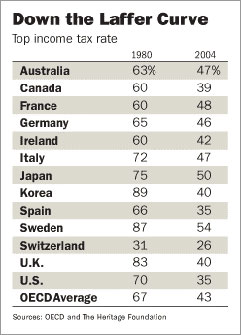
What about the enduring effect of these supply-side economic policies on domestic policies? That question is answered by Christopher DeMuth, President of the American Enterprise Institute, in Reaganomics: How’s It Going?: Two wins, a draw, and two losses (also available for a fee) published in the September 11 issue of National Review:
When Ronald Reagan came to Washington, he brought with him a conservative school of economics. This school emphasized, much more thoroughly and systematically than those associated with previous presidents of either party, the advantages of private markets, the disadvantages of government spending and regulation, and the role of private economic incentives in advancing or undermining government policies. As we pass the 25th anniversary of the August 1981 tax cuts, it is appropriate to assess Reagan’s economic record. My scorecard shows two wins, one draw, and two losses.Continue reading "The International & Domestic Impact of Reaganomics 25 Years Later"
June 21, 2006
Senate Passes Property Tax Reform Bill
With a vote of 36-0, the State Senate passed a bill that would slow down and then limit the amount that a community could raise property taxes in any given year.
The bill would lower the maximum annual increase to a community's tax levy from the current 5.5 percent to 4 percent gradually, starting in fiscal 2008 and reaching 4 percent in 2013.There were quite a few changes made from the original proposal, including:Rather than imposing a 4-percent cap immediately, [Senate Majority Leader M. Teresa] Paiva Weed said she chose the gradual cap to give cities and towns time to adjust. When Massachusetts capped local tax increases at 2.5 percent, she said, "a dramatic decrease overnight did have a negative impact on municipal services."
...a provision instructing judges to consider the caps in deciding whether to allow school committees to seek a higher appropriation than they receive from a city or town council.The Governor supports the measure, but it's still up in the air as to whether or not the House will take it up. I'm betting against that happening. Nonetheless, kudos to Sen. Paiva Weed and the Senate for making the attempt.The bill would apply the same percentage caps to school-spending increases as it would to tax levy increases....
Another amendment would excuse school committees from including state and federal aid in computing compliance with the cap....
The bill contains an exemption from the cap in four cases:
if a city or town experiences a loss in revenues other than property taxes, such as state aid or gambling revenues,
if a city's or town's health-insurance costs, retirement contributions or utility expenditures rise at a rate more than three times the cap specified for that year,
if a city or town experiences debt-service costs that exceed the prior year's costs by a percentage greater than the cap specified for that year,
if a city or town "experiences substantial growth in its tax base as the result of major new construction which necessitates either significant infrastructure or school housing expenditures . . . or a significant increase in the need for essential municipal services."
The original bill would have required a special election, paid for by the state, to override the cap in those circumstances. The bill, as passed, instead requires a supermajority vote -- four fifths of the full membership -- of the city or town council.
June 17, 2006
Property Tax Cap Sticking Points
Lowering the acceptable rate of annual property tax increases is a good idea. (I wonder why our Democrat dominated general assembly is tackling this now...Oh yeah, it's an election year). Senator Teresa Paiva Weed (D-Newport) is leading the charge in the effort.
Currently, communities are prohibited from raising their tax levy by more than 5.5 percent in any given year. Paiva Weed's bill would start lowering that rate to 5.25 percent in fiscal year 2008 and dropping another quarter percentage point each year until the cap hits 4 percent in 2013...The bill would also limit school committees from proposing budgets to their city and town councils that exceed the same caps.The story notes that there are ways to circumvent the cap such as in the case of a population boom and the resulting need for more government infrastructure. Now for the concerns.
One of the largest is due to the fact that School Committees operate independently of most city and town governments and--under the Caruolo Act--they can go to court to get the appropriation dollars they want, even if the money isn't in the city budget. One solution offered would be to increase state aid to education. That could make sense, but that would probably have to be part of a different piece of legislation that would deal with consolidating education administration at the state level.
Finally, the NEA's Robert Walsh offered a good, pragmatic "what if," saying that "theoretically, communities might raise taxes by the maximum allowed each year just to 'maintain their flexibility in years that are aberrations.'"
June 16, 2006
Another Example of Government Failure
Some news events do not require commentary. This is one such news event.
Paul Caron, the Charles Hartsock Professor of Law at the University of Cincinnati College of Law writes about how the IRS to Refund $15 Billion of Telephone Taxes to Consumers:
The Treasury Department and IRS announced this morning that after losing in five circuit courts of appeals, the Government is throwing in the towel and will no longer seek to enforce the 3% excise tax on long-distance telephone calls enacted during the Spanish-American War of 1898 as a "luxury" tax on wealthy Americans who owned telephones. The IRS will will issue $15 billion in refunds to consumers for long-distance telephone service taxes paid over the past three years:No immediate action is required by taxpayers.Refunds will be a part of 2006 tax returns filed in 2007.
Refund claims will cover all excise tax paid on long-distance service over the last three years (time allowed given statute of limitations).
Interest will be paid on refunds.
The IRS is working on a simplified method for individuals to use to claim a refund on their 2006 tax returns.
Refunds will not include tax paid on local telephone service, which was not involved in the litigation.
Makes you just shake your head, doesn't it?
June 14, 2006
Pay No Attention to that Shrinking Deficit Behind the Curtain!
Unless your top budgetary priority is high tax rates, there’s good short-term news regarding the Federal budget deficit being reported in the Investor’s Business Daily (h/t Instapundit). The Federal deficit may be cut in half this year…
Aided by surging tax receipts, President Bush may make good on his pledge to cut the deficit in half in 2006 -- three years early.However, the long term trend is not so rosy. Larger deficits are likely in the future, unless there is reform in automatic entitlement growth…The 2006 deficit through May was $227 billion, down from $273 billion at this time last year. Spending is up $130 billion, or 7.9%…
With the economy topping $13 trillion this year, a $270 billion deficit would equal less than 2.1% of GDP, easily beating the president's 2.25% goal. Bush made his vow when the White House had a dour 2004 deficit forecast of 4.5% of GDP, or $521 billion. The actual '04 deficit came in at $412 billion, or 3.5% of GDP, before falling to $318 billion, or 2.6% of GDP, in 2005.
A CBO analysis last week noted that withheld individual income and payroll taxes are up 7.6% from a year ago, with the gains picking up in recent months…
Corporate income taxes are up about 30% from last year's pace.
Long-term growth in Social Security, Medicare and Medicaid "threaten to force either European-style tax increases, unprecedented spending cuts or unprecedented debt," said Heritage Foundation budget expert Brian Riedl. "There's no growing out of the long-term budget problems."Heritage sees an $800 billion deficit in 2016, assuming tax cuts are extended and spending stays on its present course. If the economy and tax receipts continue to outperform, the deficit would still be at least $600 billion, Riedl said.
He noted Congress has been more disciplined about discretionary spending lately. But that saves a mere $10 billion a year, he said.
May 11, 2006
Creeping Socialism: ACORN & the Living Wage
I have never understood the logic of the "living wage" argument, where certain organizations - like ACORN - seek to have government agencies mandate new and higher wage rates. Such people believe that higher wages must be realized and that they can only be achieved by government fiat, not by the ability of the market to efficiently incorporate wage information into the best possible outcomes over time.
More specifically, if they really believe it is possible for government to unilaterally set higher wages without any adverse economic consequences to private sector businesses or public sector operations, they sure do not think very expansively. Instead of mandating wages of $10-12/hour, why not simply legislate that everyone will earn $100,000/year? Or $150,000/year? Yet nobody does that. Could it be that they really do know there are adverse economic consequences to higher wages?
If only the living wage debate was so straightforward. But, more on that shortly.
ACORN stands for the Association of Community Organizations for Reform Now and they are a key player in the tax-eater world. In their words, "the mission of ACORN is clear, the vision remains: power through organization and direct action." A close reading of their website will quickly clarify their socialistic politics and alignment with the more politically radical labor unions.
Steven Malanga, in his book The New New Left: How American Politics Works Today (reviewed here), has this to say about the living wage movement:
...The living wage poses a big threat to [cities] economic health because the costs and restrictions it imposes on the private sector will destroy jobs - especially low-wage jobs - and send businesses fleeing to other locales. Worse still, the living-wage movement's agenda doesn't end with forcing private employers to increase wages. It includes opposing privatization schemes, strong-arming companies into unionizing...Continue reading "Creeping Socialism: ACORN & the Living Wage"The living-wage movement got its start in mid-1990's Baltimore...
As it spread beyond Baltimore, the living-wage movement at first purposely kept its aims narrow...
Soon, though, living-wage supporters began to win ever broader laws, covering ever more workers and businesses. Detroit's 1998 living wage applied to any business or non-profit with a city contract or to any firm that had received $50,000 or more in economic development assistance - ranging from the Salvation Army to small manufacturers located in the city's economic development zones. San Francisco's law went beyond city contractors to cover workers at the city airport, on the grounds that businesses there leased land from the city; airlines, newsstands, fast-food restaurants - none was exempt...Today forty-three states have at least one municipality with living-wage legislation on the books, or proposed laws.
The movement owes much of its success to the model campaign - exportable anywhere, anytime, fast - that its proponents, above all ACORN's national living-wage center, have created...The prospective living-wage activist can find everything he needs to know in a step-by-step manual, concocted by ACORN director of living-wage campaigns Jed Kern and Wayne State University labor economist David Reynolds.
The manual echoes the organizational theories of legendary radical Saul Alinsky. Coalition building is key. Alinsky's modus operandi was to get diverse constituencies to support his various causes by emphasizing their shared interests...
To pull off such coalition building in practice, you need more than a manual, of course; you need money - and the movement has lots of it, thanks to the backing of leftist foundations. The Tides Foundation has given hundreds of thousands of dollars...The Ford Foundation has been another big contributor.
The coalitions the movement has assembled have included hundreds of religious groups, allowing organizers to present their economic agenda as deeply moral...Labor groups have signed on too...
Living-wage campaigns have repeatedly outflanked the business community by practicing what ACORN calls "legislative outmaneuver." Local groups work behind the scenes for months before going public. They draft partisan economics to release timely studies on the prospective benefits of the living wage before opponents can come up with any countering data, and they try to keep any actual legislation off the table until the very last minute, so that there's no fixed target for opponents to get a bead on...
Providing the intellectual muscle (such as it is) for the living-wage movement is a small group of Marxoid economists led by University of Massachusetts-Amherst professor Robert Pollin, a longtime board member of the Union of Radical Political Economists, founded in the 1960's to bring Marxist economics to American universities...in 1998 he co-authored...the book that has become the movement's bible, The Living Wage: Building a Fair Economy.
In The Living Wage, the class war rages on - and on. Businesses, assert Pollin and Luce, have grown increasingly hostile toward workers in recent years. Their sole evidence for this claim - that the unionization rate has plummeted over the last three decades - ignores the conventional explanations for union decline in the United States: more intense global competition, the shift to a service-oriented, knowledge-based economy, and more generous benefits at nonunionized companies. But never mind: to keep ravenous capitalists under control, they argue, government clearly needs to impose a national living wage on the private sector. And that's just the beginning. Caps on profits, mandated benefits, rules to make unionization easier, massive taxation - government will manage the economy from top to bottom in The Living Wage's warmed-over socialism...
The complete rejection of a free-market economy by these living-wage gurus...is too much even for many liberal economists. One of the most telling critiques of The Living Wage came from self-professed liberal economist and New York Times columnist Paul Krugman. In an article archived on the "cranks" section of his website, Krugman observes that "what the living wage is really about is not living standards, or even economics, but morality. Its advocates are basically opposed to the idea that wages are a market price - determined by supply and demand."
April 15, 2006
How We Phrase the Taxation
I have to admit that Froma Harrop's rhetoric, in the following single instance, does resonate a bit for me:
The centerpiece is the lowered tax on investment income, which Republicans are trying to keep at 15 percent. As a result, the idle rich living off their stock portfolios are taxed at 15 percent, while the working husband and wife, each earning $40,000, pay a marginal tax rate of 25 percent. Even Ronald Reagan was content to have dividends and capital gains treated like "sweat" income.
Of course, she fails to leaven her attack with another perspective: Harrop would have that working husband and wife (hardly sweating their bills with a household income of $80,000 a year), as they seek to get ahead and to plan for increasingly investment-based retirements, taxed to earn the money and then taxed again to grow it. The fair rates for either round of taxation are certainly arguable, but the Harrops of the world too often gloss over the reality that life's inequities are more fundamental than the tax code.
Those who do not work for a living (a group in which some might be tempted to include professional opinionists) will find themselves in better circumstances no matter the socio-economic scheme under which they live. What progressives too often fail to see — beyond their narrow-eyed focus on "progress" — is that the rich will overstep new obstacles with ease, while those attempting to emulate their strategies, in a small way, will stumble and fall.
April 11, 2006
Revisiting Why Current Lobbyist Reforms Will Fail
David Boaz, the Executive Vice President of the Cato Institute, recently wrote these words about why lobbyist reform initiatives will fail:
When you spread food out on a picnic table, you can expect ants. When you put $3 trillion on the table, you can expect special interests, lobbyists and pork-barrel politicians.That's the real lesson of the Abramoff scandal.
Jack Abramoff may have been the sleaziest of the Washington lobbyists but he's not unique. As the federal government accumulates more money and more power, it draws more lobbyists like honey draws flies.
People invest money to make money. In a free economy they invest in building homes and factories, inventing new products, finding oil, and other economic activities. That kind of investment benefits us all -- it's a positive-sum game, as economists say. People get rich by producing what other people want.
But you can also invest in Washington. You can organize an interest group, or hire a lobbyist, and try to get some taxpayers' money routed to you. That's what the farm lobbies, AARP, industry associations, and teachers unions do. And that kind of investment is zero-sum -- money is taken from some people and given to others, but no new wealth is created…
The number of companies with registered lobbyists is up 58 percent in six years. The amount of money lobbyists report spending has risen from $1.5 billion to $2.1 billion in that time…
And why not? After all, federal spending is up 39 percent in the same period. That means another $640 billion a year for interest groups to get their hands on.
With federal spending approaching $3 trillion a year -- and even more money moved around by regulations and the details of tax law -- getting a piece of that money can be worth a great deal of effort and expense…
Nobel laureate F.A. Hayek explained the process 60 years ago in his prophetic book The Road to Serfdom: "As the coercive power of the state will alone decide who is to have what, the only power worth having will be a share in the exercise of this directing power."
The United States is not Russia or Nigeria, states where government power really is the only thing worth having. But when the government has more money and power, then more of society's resources will tend to be directed toward influencing government…
Abramoff specialized in manipulating regulations, especially the licensing of casinos. If gambling wasn't so tightly licensed and regulated, then it wouldn't produce extraordinary profits and lavish lobbying…But his efforts were small potatoes compared with the hugely expensive and complex programs of the federal government and the lobbying generated by all that spending and regulation.
During the 1970s, when Congress created massive new government regulations, businesses had to invest more heavily in lobbying. Some of it was defensive -- to try to minimize the cost and burden of regulation.
But of course some of the lobbying was more cynical, to ensure that costs fell more heavily on competitors. One study in 1980 showed that 65 percent of the CEOs of Fortune 500 companies came to Washington at least every two weeks. That was up sharply from 1971, when only 15 percent of CEOs visited Washington even once a month…
Meanwhile, the taxpayers have little voice in the halls of Congress. The National Taxpayers Union spent less than $175,000 on lobbying in 2004. And the NTU is one of the very few organizations whose lobbying is aimed at decreasing the size and overall reach of government.
As long as the federal government has so much money and power to hand out, we'll never get rid of the Abramoffs. Restrictions on lobbying deal with symptoms, not causes.
Boaz' thoughts build on the thoughts of Walter Williams and Frederich Hayek, as highlighted in this posting. Follow the link in that posting to another posting with multiple examples of how both political parties are guilty of increasing the size of government at the expense of working families and retirees all across America.
The issue is the engorged size of government, which only benefits the powerful - be they corporations, unions or any other significant special interest.
Why do we tolerate this?
April 9, 2006
The Radically Different Visions of Tax-Eaters Versus Taxpayers
In an earlier posting, I introduced a book entitled The New New Left: How American Politics Works Today by Steven Malanga and a review of the book in the Claremont Review of Books. The core theme of the book was described by one reviewer as "American politics is not about [political] parties, it is about special interest group against special interest group."
Expanding on that comment, here are some excerpts from the Introduction: Tax Eaters versus Taxpayers, where the author writes:
...A new political dynamic has slowly been emerging over the past forty years, a face-off between those who benefit from an expanding government and those who must pay for it - the tax-eaters versus the taxpayers...coalitions of public employees, staffers at publicy funded social-services programs, and the recipients of government aid have emerged as effective new political forces...This increasingly powerful public-sector movement results from the joining together of two originally distinct forces. First are the government-employee unions...
For years, government employees had no right to organize, on the grounds that there was no competition in the delivery of government services and that therefore public unions could hold cities and states hostage by going on strike and denying essential services to the public...that began to change in the mid-1950's...
...In 1960 the American Federation of Teachers mapped out a controversial strategy to win collective bargaining rights for teachers around the country, using...labor-friendly New York City as a test case...
...most of the warnings voiced about public-employee unions in those tumultuous years have proven accurate. Political leaders and labor experts predicted that government-employee unions would use their power over public services to win contracts with work rules far more generous and undemanding than in the private sector; and that without the restraints on salaries and benefits that the free marketplace imposes on private firms, unions would win increasingly meaty compensation packages that would be impossible to restrain or to roll back...
But what critics did not anticipate was how far public-employee unions would move beyond collective bargaining to inject themselves into the electoral and legislative processes...
Reinforcing the public-employee unions in the powerful new coalition of tax-eaters are the social-services groups created by the War on Poverty. Nominally private, they are sustained by and organized around public funding...This flood of money transformed many formerly private welfare organizations into government contractors, and their employees into quasi-public workers. It also spurred the creation of vast new networks of such organizations...
This social-services funding vastly expanded the publicly supported workforce almost overnight...
Almost from the War on Poverty's inception, these social-services employees and their clients began to show themselves as a powerful political force...
The gradual government takeover...has transformed...institutions, executives, and workers into unremitting lobbyists for ever greater public monies and expanding programs, and tireless foes of efforts to restrain costs...
The electoral activism of this New New Left coalition of tax eaters - public-employee unions, hospitals and healthcare -worker unions, and social-services agencies - has reshaped the politics of many cities. As the country's national political scene has edged rightward, thwarting their ambitions in Washington, these groups have turned their attention to urban America, where they still have the power to influence public policy...
Increasingly in cities around the country, the road to electoral success passes through the public-employee/health/social-services sector...
One reason why these politicians have succeeded electorally is that those who work in the tax-eater sector clearly have different voting priorities from private-sector workers or business owners...
....public-sector workers, who realize they are going to the polls to elect their bosses, make sure to remember to vote...
With so much of their economic future at stake in elections, the tax eaters have emerged as the new infantry of political campaigns, replacing the ward captains and district leaders of old-time political clubs...
Although it started out as a romantic but wrongheaded idea, the War on Poverty was the child of idealists who really believed that a benevolent, paternalistic government could offer solutions that America's private economy couldn't provide for the poor. But the most cherished ideals and programs of the movement have turned out to demonstrably wrong...
By the mid-1990's, Americans were eager for reform, and they got it...
In the face of such results, the new urban left has emerged as an increasingly cynical coalition, ever more focused on goals that benefit its members and their allies, even thought it retains the jargon of "social justice."...
Regardless of how transparent its aims now seem, this new coalition will remain formidable because the tax-eater sector is now so large in many cities and states that it can easily thwart reforms aimed at undermining its programs. With much of the legislative agenda merely concerned with expanding programs and enacting laws that add to its own numbers, the New New Left may be in the ascendancy for a long time to come.
A recent editorial in the Wall Street Journal entitled GM, France and Albany: What the declines of all three have in common (available for a fee) states:
At first glance, they seem to have little in common. But the riots in France over labor reform, the slow-motion suicide of General Motors, and the continuing decline of the New York economy all share one defining trait: entrenched and unchangeable union power.These columns have always favored the right to collectively bargain...we should [not] fail to appreciate the consequences when unions become entrenched inside any organization...unions do not provide individual job or income security. On the contrary, they undermine security by contributing to broader business and economic decline.
At the national level, the French example is clear enough. While the French private sector is less unionized than America's, it must cope with mandated work rules that make it all but impossible to fire someone; so naturally companies are also reluctant to hire. The jobless rate is double America's, while youth unemployment is 23%. More significant is that the political clout of public-sector unions has blocked all but minor changes in these rules. Public-sector workers account for more than a quarter of the entire French work force (6.4 million of out 24.6 million), and their salaries and pensions made up 45% of the entire state budget as recently as 2003.
The current French protests are in response to a modest change that would allow employers to fire people under age 26 more easily. So entrenched has the politics of union entitlement become in France that even at the onset of their careers these young protesters are demanding security over opportunity. In the global economy, this means they will end up with less of both.
France remains a wealthy country, and its economic decline can be masked for a time as it lives off accumulated capital. But already the promises that its unions have extracted from the government seem unlikely to be kept. A growth rate of between 1% and 2% a year won't be enough to finance the pensions and health care of an aging nation. And facing up to those facts will require an increasingly painful political reckoning.
Here in the U.S., the same burden is slowly crippling New York...Power in the state capital of Albany is shared by Republicans and Democrats. But both parties bow before the public-sector unions, especially the teachers, and the health-care workers...
...New York's Medicaid costs are higher than those of Texas and Florida combined; a health-care insurance premium for a young family of four is roughly six times what it is across the border in Connecticut; and high-deductible health-savings accounts that can help the self-employed afford insurance can't even be offered in the state...
Another union-driven business cost is workers' compensation, and in New York the average cost per claim is second highest in the nation (after Louisiana) and 72% higher than the national average...
...upstate [New York] is a different story, with jobs and young people fleeing to better business climes. New York manufacturing employment fell by 41% between 1990 and 2005, or double the national rate.
Even Eliot Spitzer recently referred to upstate New York as "Appalachia." Alas, the Attorney General shows no sign of understanding that the heart of the problem lies in Albany...
As for GM, its management mistakes are legion and its weak product line well-known. But the root of its problem is that it long ago became a corporate version of the welfare state, with the same entrenched union interests...the size of its market dominance going back to its heyday 40 years ago allowed its managers to avoid confronting its uncompetitive wages, benefits and work rules even as they saw Toyota and Honda gaining in the rearview mirror.
In retrospect, GM management should have provoked a union showdown. Yet only a very brave CEO would have been willing to risk a potentially catastrophic strike on his watch for the sake of making the company more competitive after he retired. In any case, would the United Auto Workers really have budged? In 1998, young executive and future CEO Rick Wagoner endured a 54-day UAW wildcat strike at two plants in Flint, Michigan, after GM had tried to change some production rules. The strike shut down most GM production in North America and cost the company some $2 billion. In the end GM caved and the UAW escaped, having made virtually no concessions.
Even now at auto-parts maker Delphi--which is already in Chapter 11--the UAW is declaring it will take a strike that could destroy both Delphi and GM rather than agree to Delphi's proposed job cuts and work changes. As in France and New York, these union leaders would rather sink the company than make concessions that would reduce their own power.
This pattern has repeated itself again and again--in the steel and textile industries attacked by foreign competition, or the unionized grocery chains routed by Wal-Mart. The union answer has rarely been to work with a company to allow more job flexibility to become more competitive. The answer has typically been to seek a ruinous strike or lobby for political intervention that might stave off disaster for at best a few more years.
We recount all this because, even amid GM's decline and France's economic turmoil, most of America's liberal elites refuse to draw the right lesson. They cling to the belief that if only the Democrats can retake Congress, or the union movement can once again organize more of the American labor force, the old economy of union-backed job security and egalite will return. Or, worse, they propose seceding from global competition via protectionism. It is all a delusion. Down that road lies France--a nice place to vacation, but you wouldn't want to work there.
This is the central problem the liberal wing of the Democratic Party faces as it plots what to do if it does regain power this year, or in 2008...to govern for the long haul they need better ideas than trade barriers, a tax hike to increase the size of government, or the defense of the entitlement status quo.
They need to champion reforms to help individual workers better secure their own futures in a competitive global economy, rather than relying on the false hope of restoring the age of Walter Reuther. They need to promote portable pensions, cheaper health insurance and education choice. So far all we see is Jacques Chirac in American drag.
The Radically Different Visions of Tax-Eaters Versus Taxpayers
In an earlier posting, I introduced a book entitled The New New Left: How American Politics Works Today by Steven Malanga and a review of the book in the Claremont Review of Books. The core theme of the book was described by one reviewer as "American politics is not about [political] parties, it is about special interest group against special interest group."
Expanding on that comment, here are some excerpts from the Introduction: Tax Eaters versus Taxpayers, where the author writes:
...A new political dynamic has slowly been emerging over the past forty years, a face-off between those who benefit from an expanding government and those who must pay for it - the tax-eaters versus the taxpayers...coalitions of public employees, staffers at publicy funded social-services programs, and the recipients of government aid have emerged as effective new political forces...This increasingly powerful public-sector movement results from the joining together of two originally distinct forces. First are the government-employee unions...
For years, government employees had no right to organize, on the grounds that there was no competition in the delivery of government services and that therefore public unions could hold cities and states hostage by going on strike and denying essential services to the public...that began to change in the mid-1950's...
...In 1960 the American Federation of Teachers mapped out a controversial strategy to win collective bargaining rights for teachers around the country, using...labor-friendly New York City as a test case...
...most of the warnings voiced about public-employee unions in those tumultuous years have proven accurate. Political leaders and labor experts predicted that government-employee unions would use their power over public services to win contracts with work rules far more generous and undemanding than in the private sector; and that without the restraints on salaries and benefits that the free marketplace imposes on private firms, unions would win increasingly meaty compensation packages that would be impossible to restrain or to roll back...
But what critics did not anticipate was how far public-employee unions would move beyond collective bargaining to inject themselves into the electoral and legislative processes...
Reinforcing the public-employee unions in the powerful new coalition of tax-eaters are the social-services groups created by the War on Poverty. Nominally private, they are sustained by and organized around public funding...This flood of money transformed many formerly private welfare organizations into government contractors, and their employees into quasi-public workers. It also spurred the creation of vast new networks of such organizations...
This social-services funding vastly expanded the publicly supported workforce almost overnight...
Almost from the War on Poverty's inception, these social-services employees and their clients began to show themselves as a powerful political force...
The gradual government takeover...has transformed...institutions, executives, and workers into unremitting lobbyists for ever greater public monies and expanding programs, and tireless foes of efforts to restrain costs...
The electoral activism of this New New Left coalition of tax eaters - public-employee unions, hospitals and healthcare -worker unions, and social-services agencies - has reshaped the politics of many cities. As the country's national political scene has edged rightward, thwarting their ambitions in Washington, these groups have turned their attention to urban America, where they still have the power to influence public policy...
Increasingly in cities around the country, the road to electoral success passes through the public-employee/health/social-services sector...
One reason why these politicians have succeeded electorally is that those who work in the tax-eater sector clearly have different voting priorities from private-sector workers or business owners...
....public-sector workers, who realize they are going to the polls to elect their bosses, make sure to remember to vote...
With so much of their economic future at stake in elections, the tax eaters have emerged as the new infantry of political campaigns, replacing the ward captains and district leaders of old-time political clubs...
Although it started out as a romantic but wrongheaded idea, the War on Poverty was the child of idealists who really believed that a benevolent, paternalistic government could offer solutions that America's private economy couldn't provide for the poor. But the most cherished ideals and programs of the movement have turned out to demonstrably wrong...
By the mid-1990's, Americans were eager for reform, and they got it...
In the face of such results, the new urban left has emerged as an increasingly cynical coalition, ever more focused on goals that benefit its members and their allies, even thought it retains the jargon of "social justice."...
Regardless of how transparent its aims now seem, this new coalition will remain formidable because the tax-eater sector is now so large in many cities and states that it can easily thwart reforms aimed at undermining its programs. With much of the legislative agenda merely concerned with expanding programs and enacting laws that add to its own numbers, the New New Left may be in the ascendancy for a long time to come.
A recent editorial in the Wall Street Journal entitled GM, France and Albany: What the declines of all three have in common (available for a fee) states:
At first glance, they seem to have little in common. But the riots in France over labor reform, the slow-motion suicide of General Motors, and the continuing decline of the New York economy all share one defining trait: entrenched and unchangeable union power.These columns have always favored the right to collectively bargain…we should [not] fail to appreciate the consequences when unions become entrenched inside any organization…unions do not provide individual job or income security. On the contrary, they undermine security by contributing to broader business and economic decline.
At the national level, the French example is clear enough. While the French private sector is less unionized than America's, it must cope with mandated work rules that make it all but impossible to fire someone; so naturally companies are also reluctant to hire. The jobless rate is double America's, while youth unemployment is 23%. More significant is that the political clout of public-sector unions has blocked all but minor changes in these rules. Public-sector workers account for more than a quarter of the entire French work force (6.4 million of out 24.6 million), and their salaries and pensions made up 45% of the entire state budget as recently as 2003.
The current French protests are in response to a modest change that would allow employers to fire people under age 26 more easily. So entrenched has the politics of union entitlement become in France that even at the onset of their careers these young protesters are demanding security over opportunity. In the global economy, this means they will end up with less of both.
France remains a wealthy country, and its economic decline can be masked for a time as it lives off accumulated capital. But already the promises that its unions have extracted from the government seem unlikely to be kept. A growth rate of between 1% and 2% a year won't be enough to finance the pensions and health care of an aging nation. And facing up to those facts will require an increasingly painful political reckoning.
Here in the U.S., the same burden is slowly crippling New York…Power in the state capital of Albany is shared by Republicans and Democrats. But both parties bow before the public-sector unions, especially the teachers, and the health-care workers…
…New York's Medicaid costs are higher than those of Texas and Florida combined; a health-care insurance premium for a young family of four is roughly six times what it is across the border in Connecticut; and high-deductible health-savings accounts that can help the self-employed afford insurance can't even be offered in the state…
Another union-driven business cost is workers' compensation, and in New York the average cost per claim is second highest in the nation (after Louisiana) and 72% higher than the national average…
…upstate [New York] is a different story, with jobs and young people fleeing to better business climes. New York manufacturing employment fell by 41% between 1990 and 2005, or double the national rate.
Even Eliot Spitzer recently referred to upstate New York as "Appalachia." Alas, the Attorney General shows no sign of understanding that the heart of the problem lies in Albany…
As for GM, its management mistakes are legion and its weak product line well-known. But the root of its problem is that it long ago became a corporate version of the welfare state, with the same entrenched union interests…the size of its market dominance going back to its heyday 40 years ago allowed its managers to avoid confronting its uncompetitive wages, benefits and work rules even as they saw Toyota and Honda gaining in the rearview mirror.
In retrospect, GM management should have provoked a union showdown. Yet only a very brave CEO would have been willing to risk a potentially catastrophic strike on his watch for the sake of making the company more competitive after he retired. In any case, would the United Auto Workers really have budged? In 1998, young executive and future CEO Rick Wagoner endured a 54-day UAW wildcat strike at two plants in Flint, Michigan, after GM had tried to change some production rules. The strike shut down most GM production in North America and cost the company some $2 billion. In the end GM caved and the UAW escaped, having made virtually no concessions.
Even now at auto-parts maker Delphi--which is already in Chapter 11--the UAW is declaring it will take a strike that could destroy both Delphi and GM rather than agree to Delphi's proposed job cuts and work changes. As in France and New York, these union leaders would rather sink the company than make concessions that would reduce their own power.
This pattern has repeated itself again and again--in the steel and textile industries attacked by foreign competition, or the unionized grocery chains routed by Wal-Mart. The union answer has rarely been to work with a company to allow more job flexibility to become more competitive. The answer has typically been to seek a ruinous strike or lobby for political intervention that might stave off disaster for at best a few more years.
We recount all this because, even amid GM's decline and France's economic turmoil, most of America's liberal elites refuse to draw the right lesson. They cling to the belief that if only the Democrats can retake Congress, or the union movement can once again organize more of the American labor force, the old economy of union-backed job security and egalité will return. Or, worse, they propose seceding from global competition via protectionism. It is all a delusion. Down that road lies France--a nice place to vacation, but you wouldn't want to work there.
This is the central problem the liberal wing of the Democratic Party faces as it plots what to do if it does regain power this year, or in 2008…to govern for the long haul they need better ideas than trade barriers, a tax hike to increase the size of government, or the defense of the entitlement status quo.
They need to champion reforms to help individual workers better secure their own futures in a competitive global economy, rather than relying on the false hope of restoring the age of Walter Reuther. They need to promote portable pensions, cheaper health insurance and education choice. So far all we see is Jacques Chirac in American drag.
March 29, 2006
Taxpayers' Bill of Rights, Revisited
I have previously expressed my reservations about whether the Voter Initiative (VI) will truly fix the status quo problem of an engorged public sector. In that posting, I expressed a preference for a Taxpayers' Bill of Rights (TABOR) constitutional amendment and presented numerous links to TABOR information sources. Mark has challenged some of my thinking about the VI here.
In a subsequent conversation with Andrew, he articulated one of my concerns about the VI which I had been unable to state as well:
...I think that voter initiative supporters sometimes put too much emphasis on the purely procedural stuff and not enough emphasis on the things that need changing. The Voter Initiative Alliance should have presented the text of a bunch of laws that they would like to see passed along with their petition and then said to the legislature "prove we don't need VI by giving these a fair hearing." Then they would have either gotten some of the changes they wanted or have gotten definite issues to run on in the Fall...
Such procedural talk makes VI sound less threatening but it also does not stir any passionate commitment or convince anyone of its significance. While a bit of an overstatement, it sounds like we are going through the procedure of re-arranging the chairs on the Titanic instead of changing the direction of the ship before it hits an iceberg. And that is part of what magnifies my worries that the entrenched powers will simply develop new ways to manipulate the modified system for their benefit.
Successful political movements articulate a vision during campaigns so they can legitimately claim a clear mandate after winning. So what is the mandate VI proponents are seeking from voters? Is it to modify a process or is it to change specific policies?
I think the VI movement would be ignited if they declared that the first thing they were going to do after VI passes would be to submit a TABOR to the voters. Put a constitutional cap on government spending increases. Empower state and local officials to turn down outrageous union contracts that nobody can afford.
That kind of positioning would have immediate relevance. E.g., property tax increases are driving seniors in East Greenwich to demand a tax freeze for themselves. I think it is a bad policy decision to grant the freeze but it is merely one more example of how the high taxes in RI are making people mad enough to demand change now.
Last week's edition of the Providence Business News contains an article entitled Coalition calls for constitutional spending cap, available online to subscribers only, which notes:
Comparing their actions to the Boston Tea Party, Gov. Donald L. Carcieri, the Rhode Island Public Expenditure Council, and several business leaders last week proposed a constitutional amendment to restrict future state and local expenditure growth.The measure, inspired by Colorado’s Taxpayer’s Bill of Rights (TABOR), Massachusetts’ Proposition 21/2, and other mandatory tax expenditure limits across the United States, would do two main things:
Limit the allowable growth in state spending each year to the inflation rate (as reflected in the U.S. Consumer Price Index) plus 1.5 percent.Limit annual increases in each town’s property tax levy to 4 percent, and bar the total levy from exceeding 2.5 percent of the full market value (a level that no town has reached yet, though Providence comes close).
Rhode Island currently has no cap on annual state spending growth. But it does require, per a 1992 law, that expenditures not exceed 98 percent of projected revenues. On the local side, property tax rate hikes of more than 5 percent require state approval.
I know from experience on the East Greenwich School Committee that getting a waiver on the 5% increase has become a procedural certainty, not something that leads to any challenging of the proposed increases. We need real limits.
The article continues:
Under those current rules, state spending from general revenue will have grown by about 18.9 percent from fiscal 2002 to fiscal 2007 (as budgeted by the governor), just above the cumulative growth of the Consumer Price Index for Northeast urban areas.Local property tax collections, on the other hand, have grown by an average of 4.2 percent annually for the last 10 fiscal years, according to RIPEC.
With projected deficits averaging $135 million for each year through the remainder of the decade, however, and a history of double-digit state spending hikes as recently as 2000 and 2001, RIPEC Executive Director Gary Sasse believes tight controls are sorely needed. Rhode Island’s recent history shows that "the only thing that controls the growth of spending is the amount of money available," Sasse said in an interview – and that means the state gets used to splurging during good times, and doesn’t save enough for tough times.
At a news conference at the Old State House, on Benefit Street in Providence, Carcieri said high taxes are overwhelming Rhode Islanders, leading the wealthy to move away and leaving the middle class to pay the bills. State revenue is lagging, but expenditures keep going up.
The article then describes the TABOR supporters:
A growing number of business and citizens groups seem to agree. With strong support from the Northern Rhode Island Chamber of Commerce, RIPEC and the governor have assembled a new alliance called the "Affordable Rhode Island Coalition," which so far includes, among others, the R.I. Association of Realtors, the R.I. Manufacturers Association, Operation Clean Government, the Voter Initiative Alliance, and several chambers of commerce...The measure also has the support of some Democrats, most notably former Senate Finance Committee Chairman J. Michael Lenihan, of East Greenwich...
Senator Lenihan has often been one of the few thoughtful Democrats in the state legislature and I am pleased to see him supporting this.
The article then notes the usual opponents:
...House Finance Chairman Steven M. Costantino, D-Providence, said he hadn’t examined the details, but what he knows about Colorado’s TABOR – which was recently amended by voters because it had devastated higher education, road maintenance and other key services – makes him think such measures are "extremely dangerous."In a written statement, Senate President Joseph A. Montalbano, D-North Providence, also cited Colorado’s "failed experiment," and he added that while "efficient government is a worthy goal," elected leaders "also recognize that citizens demand a government with the flexibility to repair roads, educate children and provide a health care safety net for the most vulnerable. These factors all contribute to strong economic development."
Once again, Senator Montalbano doesn't get it. We are not looking just for efficient government - even as some of us would argue that such a concept is an oxymoron given the incentives that exist in the public sector. Rather, we are looking for limited government, just like our Founders envisioned.
Here is a feature of the Rhode Island TABOR that deserves further vetting:
Lenihan and others argue that the Rhode Island proposal is better than Colorado’s TABOR because it includes an "escape clause" – it can be overridden with a two-thirds vote in both legislative chambers – and it doesn’t mandate a full refund to taxpayers of state revenue collected above the proposed cap, but rather requires that excess go into a "rainy-day fund" of up to 5 percent of the budget.
Finally, another predictable opponent has these comments:
But Ellen Frank, an economist at the Poverty Institute at Rhode Island College, noted that the escape clause is to be used only in "emergencies."The local limit also doesn’t make allowances for actual growth, Frank added. (The town with the biggest average tax levy increase between 1996 and 2006, for example, was West Greenwich, because of high levels of development.) And "most disturbing," she said, because the only exception to the local limit is if state aid drops, "what this would undoubtedly mean would be that cutting state aid would be the one cut that legislators could do, knowing that the cuts could be made up at the local level."
Frank also took exception to the notion that forced limits would encourage political leaders to make smart, creative spending decisions.
"I don’t think a tax expenditure limit in any state has been shown to lead to a kind of thoughtful long-term planning," Frank said. "It leads instead to a constant crisis mentality, in which the state jumps from one fiscal crisis to the next, and cuts are made at the last minute based on who is the weakest lobby."
Like we have anything close to "thoughtful long-term planning" today! Or don't live in a "constant crisis mentality" today when hefty annual spending increases result in large and perpetual budget deficits! Sometimes you just have to wonder if these people have any connection to the the real world of living within our economic means.
The really big point is one of economic fairness. As I wrote in a ProJo editorial last year:
...Even so, this debate is about more than current taxation levels and today's family budgets. It is about freedom and opportunity for all -- and family budgets in the future. The greatness of our country is that people can live the American dream through the power of education and hard work.High taxation and mediocre public education create a disincentive for new-business formation in Rhode Island. That means fewer new jobs, and less of a chance for working people to realize the American dream. It also means people have an economic incentive to leave the state -- and the ones who can afford to do so will continue to leave.
Unfortunately, the ones who cannot afford to leave are the people who can least afford the crushing blow of high taxation and mediocre education. The status quo dooms these families to an ongoing decline in their standard of living. That is unjust...
Tom Coyne has some pithy comments worth reading in his March 14 posting.
You can also read more about the Affordable Rhode Island Coalition and related issues in articles here, here, here.
March 18, 2006
What is a Fair Tax?
An unsigned editorial in today's Projo explains how high-tax advocacy is often driven more by ideology than by considerations of what makes good policy...
Some folks say that taxes should always go up and/or stay up to pay for new or expanded public programs. After all, human needs and/or wants are infinite. And many people consider the very existence of rich people a moral and aesthetic affront, and would like to do away with them -- to make everything perfectly "fair," at least economically. Better to have everyone poor. That was tried in communist states. The effect, besides the deaths of millions, was economic paralysis, which wasn't very fair even to poor people, and the creation of the new sole class of rich and privileged people: the ones running the government.One group that states their ideological approach to taxation is the Institute for Taxation and Economic Policy, cited yesterday in the Projo by the Rhode Island Poverty Institute's Ellen Frank in a letter to the editor arguing that high taxes are not stopping people from settling in Rhode Island. The ITEP's introduction to "Tax Fairness Fundamentals" declares that fair taxation is based on one simple principle...
A fair tax system asks citizens to contribute to the cost of government services based on their ability to pay.Is ITEP saying that the ideal government operates on the principle of "From each according to their ability, to each according to their need"? I won't go there just yet, but I will point out that, under the ITEP definition, the following system would be considered "fair"...
Everyone gets to keep $1,000 of their own income to spend.Do the supporters of strongly progressive taxation agree that this system meets the definition of fair? Or would they like to offer a few qualifiers and concede that "fair" taxation cannot be defined without also taking into consideration the size and scope of government, and what it is exactly that tax-money is being used to paid for?Citizens making $20,000 per annum must pay $19,000 to the government each year.
And citizens making $200,000 per annum must pay $199,000 to the government each year.
March 14, 2006
An Accuracy Deficit Won't Help Close Rhode Island's Fiscal Deficit
The Emergency Campaign for Rhode Island’s Priorities wants to blame George W. Bush for the state budget deficit…
In fact, a significant state deficit is due to slashed spending by the Bush Administration in order to fund deep tax breaks for millionaires.Yet most other states aren’t facing defecits, they are running surpluses. If the problem is Federal level tax-cuts, then why is Rhode Island one of the only states affected?
There are further problems with the ECRIP position. It's not really accurate to say that tax breaks that are being "funded" by the Federal Government at the expense of other programs. First, the actual amount of revenue collected by the Feds has gone up since the 2003 tax cuts. Even more directly, the Bush administration has presided over major increases in social spending. Here are the statistics from USA Today…
A sweeping expansion of social programs since 2000 has sparked a record increase in the number of Americans receiving federal government benefits such as college aid, food stamps and health care.If ECRIP wants to address the budget problem in an honest way, they need to explain why Rhode Island has been unable to take advantage of the current economic and policy climates to meet its needs in the way that most other states have.A USA TODAY analysis of 25 major government programs found that enrollment increased an average of 17% in the programs from 2000 to 2005. The nation's population grew 5% during that time…
It was the largest five-year expansion of the federal safety net since the Great Society created programs such as Medicare and Medicaid in the 1960s.
Spending on these social programs was $1.3 trillion in 2005, up an inflation-adjusted 22% since 2000 and accounting for more than half of federal spending. Enrollment growth was responsible for three-fourths of the spending increase, according to USA TODAY's analysis of federal enrollment and spending data. Higher benefits accounted for the rest.
March 13, 2006
Senator Chafee's PAYGO Proposal & Automatic Tax Increases
Senator Lincoln Chafee is once again trying to pass off his preference for high tax rates as "fiscal responsibility". This is from a recent press release on the Senator's campaign website...
Leading deficit hawk, U.S. Senator Lincoln Chafee today joined with Senator Bill Frist and Senator John McCain to co-sponsor legislation that will help get federal spending under control by establishing a Presidential Line Item Veto. Like Senator Chafee's proposed Pay-As-You-Go approach to the federal budget, this will help return fiscal responsibility to the federal government and ensure that our legacy to our children is not billions and billions of dollars of debt.We'll take up the line-item veto a little later. For now, let's discuss the "pay-as-you go" proposal, also known as PAYGO.
The problem with Senator Chafee's most recent version of PAYGO was that it placed no limit on the overall increase in Federal spending. It only limited spending on the creation of new programs. PAYGO 2005 didn't apply to already existing entitlements -- or their automatic increases. (According to statistics quoted by Isabel Sawhill of the Brookings Institution, entitlements now account for 53% of the budget, a total that grows each year.)
To meet the requirements of PAYGO, the automatic growth of established entitlements like Medicare and Medicaid (Social Security is defined as "off-budget" and not considered for the purposes of PAYGO) would have to be offset by either yearly tax-increases or yearly cuts in existing programs -- real cuts, not just reductions in the rate of growth or limits on new spending.
Brian Riedl of the Heritage Foundation explains why a PAYGO program that ignores entitlement spending would almost certainly force automatic tax increases...
While PAYGO allows current entitlement programs to grow on autopilot, it would likely lead to the expiration of the current tax cuts. Merely retaining the tax relief that Americans now enjoy would, under PAYGO, require 60 votes in the Senate and a waiver in the House. To avoid this supermajority requirement, lawmakers seeking to prevent tax increases would have to either: A) raise other taxes; or B) reduce mandatory spending by a larger amount than has ever been enacted. Option A is still a net tax increase (raising one tax to avoid raising another), and Option B is probably politically unrealistic.
February 12, 2006
Rhode Island Welfare Statistics
An evening version of a Scott Mayerowitz story on Governor Donald Carcieri’s proposed 2007 budget from last week's Projo contained this interesting passage…
Carcieri plans to start counting time spent on welfare in other states against a lifetime limit here. There is no national database of who has been on welfare in what state. Rhode Island officials plan on asking welfare applicants for more information about where they have been and what public assistance they received. They also hope to verify some of this information with other states. The bulk of Rhode Island’s welfare recipients come from Massachusetts, Puerto Rico, New York, Florida, Connecticut, and New Jersey.Three questions…
1. Exactly how much, in terms of number of people and amount spent, constitutes “the bulk”? (And exactly how many of them are from Florida? And are the people from Florida moving up here for the weather?)
2. How long do you have to have lived in Rhode Island before you are no longer considered as being from another state?
3. In how many other states, is it common for “the bulk” of welfare recipients to come from a state other than the state where they are receiving their benefits?
UPDATE:
The fabulously named AuH20Republican suggests that the article might mean that…
The majority of welfare recipients who moved to RI from other states came from those 6 states.To eliminate any ambiguity, I contacted Scott Mayerowitz, who indicated that the AuH20Republican interpretation was the proper one.
I'll see if I can nail down some specific numbers in the near future.
February 7, 2006
Guess What? Supply-Side Economic Policies Work...Again
Lawrence Kudlow writes about the latest positive economic news in The Silence of the Good News: An explosive jobs report and Bush says nothing? What’s up?:
Economic pessimists have had a field day ever since GDP was reported a week ago at only 1.1 percent for the fourth quarter. But the latest jobs report released on Friday blew them out of the water. Including revisions, January employment is a huge 317,000 above the initial December level. In fact, over the past three months, non-farm payrolls have increased an average 229,000 per month. That’s explosive. We’re on pace for another 2 million jobs in 2006, following gains of 2 million in 2004 and 2005. Wages are also picking up steam, and with gasoline prices falling, consumer purchasing power and retail sales are climbing.So the question for the Bush Administration is this: What are you waiting for?
As soon as the breakout employment news was released, Salesman-in-Chief George W. Bush should have been in the Rose Garden giving it air time. He should have declared that jobs have continued to grow big time while the unemployment rate has fallen — all the way down to 4.7 percent. He then could have used this optimistic data to build his already strong case for extending the tax cuts on dividends and capital gains. These 2003 tax cuts, along with lower income taxes, are a good reason why jobs numbers are strong and the economy is prosperous.
What are they waiting for?
In his State of the Union message, Bush noted that recent tax relief has left $880 billion in the hands of American workers, investors, small businesses, and families — money that has been used to help produce more than four years of uninterrupted economic growth. People will spend their money more wisely than government will.
Bush ought to keep this drumbeat up. On Friday, the drums were deafeningly silent.
The latest numbers from the Congressional Budget Office show a clear supply-side effect where lower tax rates and higher after-tax rewards for work and investment have expanded the economy and created a huge surge of tax collections. Dan Clifton of the American Shareholders Association first reported that actual revenues from the lower capital-gains tax rate came in $46 billion higher over the last three fiscal years and $62 billion higher over the last three calendar years than congressional estimates. The Laffer curve is alive and well...
Good news is all over this still very new year. The "January effect" — the traditional January stock market rally that follows the traditional December sell-off — was the best since 1999. Same-store retail sales in January beat all projections with a 5.2 percent yearly gain. Car sales have had a nice comeback. And consumer confidence has now increased for three straight months.
Even wages are coming online. According to the Bureau of Labor Statistics, average weekly earnings are up 3.6 percent year-on-year. That’s the best since 2000. Then there’s the personal-income proxy derived from hours worked multiplied by wages. This measure registered a 6 percent gain in the year ending January, way up from 4.5 percent last October. With retail gasoline prices coming down 23 percent last fall, from $3.07 to $2.36, real wages are on the rise.
Pessimists can obsess about a mild housing slowdown, but expanding businesses and jobs are throwing off plenty of income. If only the president would jump on all this positive economic data, the pessimists would be exposed as data-deprived, hyperbolic, and just plain wrong. More, by truly seizing the economic moment, he would strengthen his case for tax-cut extensions. Right now, he doesn’t yet have the votes in the Senate. The battle must be joined...
If there is no turnaround, overspending and headline deficits will politically crowd out the vital tax-cut extensions that are so necessary to investor, business, and consumer confidence.
The supply-side economic growth plan is working. But the governing GOP coalition must close the circle on budget restraint. Economic growth and Republican political longevity depend on it. The president must do his part by turning up the volume on the good-news economic data.
A Wall Street Journal editorial entitled Tastes Great, More Filling (available for a fee) talks about further good news resulting from supply-side economic policies:
...As part of President Bush's 2003 investment tax cut package, the capital gains tax rate was reduced to 15% from 20%. Opponents predicted, as ever, that this would reduce tax revenue.Not even close. Here's what actually happened. This 25% reduction in the tax penalty on stock and other asset sales triggered a doubling of capital gains realizations, to $539 billion in 2005 from $269 billion in 2002. One influence was the increase in stock values over that time, thanks in part to the higher after-tax return on capital induced by the tax cuts.
But another cause for the windfall was almost certainly the "unlocking" effect from investors selling their existing asset holdings in order to realize some of their profits and pay taxes at the lower rate. They could then turn around and buy new assets, hoping for higher rates of return. This "unlocking" promotes the efficiency of capital markets by redirecting investment into new and higher value-added companies.
It also yields a windfall for the Treasury. In 2002, the year before the tax cut, capital gains tax liabilities were $49 billion at the 20% rate. They rose slightly to $51 billion in 2003, then surged to $71 billion in 2004, and were estimated by CBO to have reached $80 billion last year -- all paid at the lower 15% rate. In short, the lower rate yielded more revenue.
The CBO also found that total tax collections from all "non-withheld tax receipts" -- typically, non-salaried income -- surged by 32%. Dividend tax payments are undoubtedly a big part of that jackpot. Since 2003 when Congress cut the tax rate on dividends paid out to shareholders to 15% from 39.6% (the top income tax rate that was also reduced to 35%), dividend payouts by American companies have roughly tripled. The government gets 15% of those larger payouts, which sure beats 35% of nothing.
None of this is good news for the Rubinomics crowd, who predicted deficit doom from the tax cuts...
All of which means that Senate Republicans would be wise for their own revenue sake to vote quickly to extend the 15% dividend and capital gains rates through 2010 from 2008, as the House has already done. Letting the rates increase would cause tax receipts to decline. Even better, Republicans should vote to make the rates permanent...
Another Wall Street Journal editorial, Look Who's Working (available also for a fee), comments further on the favorable economic news and how the mainstream media won't tell the full story to the American people:
...The economy seems to have begun 2006 with a roar.Ford's announcement last week that it will lay off 30,000 workers was seized upon by the media as evidence that America is caught in a spiral of industrial decline. We'll be surprised if the news of a 4.7% unemployment rate, the lowest in 4 1/2 years, gets half the attention that the auto layoffs did. In any case, since the Bush investment tax cuts took hold in May of 2003, just under five million jobs have materialized...
Yesterday's report also confirms that America is creating more than 30,000 new jobs, mostly in new-age industries, every week. Real wages are higher now than at the peak of the 1990s boom. This is no burger-flipper economy. You also won't hear much about the fact that the black unemployment rate in America has tumbled in the past three years to 8.9% from 11.5%. Hispanics have seen their jobless rate dip to 5.8% -- nearly their lowest rate ever. Many Latino immigrants are filling employment demand at a record pace, suggesting that these newcomers are assimilating into the labor force fluidly and filling vital economic niches.
And so the American jobs machine rolls on. Will the critics now concede that the 2003 tax cuts were not just "giveaways to the rich?"
You can read more about supply-side economics in these two postings:
Economics 101: Never Underestimate the Incentive Power of Marginal Tax Cuts
Celebrating Reaganomics, 25 years later
February 3, 2006

What's in a Tax Reform?
RI House Leaders unwrapped a slew of tax reforms entitled the "Taxpayer Relief Act of 2006." Here are the bullet points of the nine-point proposal:
- Personal Income Tax Reduction: Instead of the current rate of 9.9% of their federal taxable income, which is then subject to adjustments, deductions, and tax credits, taxpayers could elect to pay 7.5% of their Adjusted Gross Income (AGI), but without any of the reductions. Over the course of five years, the flat rate would be gradually reduced to 5.5% to make it closer to the rate that taxpayers would owe if they lived in Massachusetts.
- Sales Tax Holiday: This proposal would institute a sales tax holiday weekend on August 12 and 13, 2006.
- Comprehensive Sales Tax Review: A new study commission would aggressively investigate the state sales tax and whether some changes to it are necessary.
- Increase Earned Income Tax Credit: The refund that low- and moderate-income taxpayers could get as a result of the earned income credit on their state income tax returns would go up.
- Energy Star Tax Break: This proposal would institute a weeklong sales tax holiday in March 2007 for any item under $2,500 that carries the federally designated "Energy Star" label for energy efficiency.
- Car Tax Phase-out Acceleration: The phase-out of the auto excise tax would continue, but with changes that would get more relief to taxpayers sooner.
- Property Tax Relief: The refundable income tax credit that elderly, disabled, and qualified low-income residents receive under the property tax "circuit breaker" law would increase.
- Transparent Income Tax: The Tax Administrator would be required to submit recommendations for a Rhode Island Personal Income Tax Code that would include tax rates, income brackets, and personal exemptions.
- Create New Department of Revenue: A new Department of Revenue's sole purpose would be to collect taxes and tax data. House leaders believe this department is necessary to provide the state with a continuous review of the tax structure so lawmakers can stay on top of trends and changes and keep Rhode Island's tax laws competitive with those of other states. Rhode Island is the only state in New England without such a department.
With this type of tax reform, how do house leaders propose to pay ever-increasing social service programs or state pensions? I'm all for reducing income and sales taxes, and especially making the overly burdensome car tax moribund at a more rapid pace. However, tax reform cannot come without review of various state programs/expenditures.
Lastly, has House Speaker Murphy been attending conservative economic theory classes? I ask because he says:
The ultimate goal is to put more money directly into people's pockets both by giving relief to those who need it and by making Rhode Island a more attractive place for businesses that will provide high-paying jobs for more Rhode Islanders.
January 27, 2006
Laffey Endorses Shadegg in House Leadership Race
OK, I was wrong. Rhode Island Republicans do have a voice in the upcoming Republican leadership election in the House of Representatives. In today's National Review Online, Republican Senatorial Candidate Steve Laffey has endorsed Congressman John Shadegg of Arizona in the race for House Majority Leader ...
All three contestants have issued numerous promises to fight the special interests, but promises are not enough. John Shadegg has the clearest record of standing up to the corrupt practices and the outrageous pork spending that has become so prevalent in recent years. For example, Representative Shadegg cosponsored a bill to reform the earmark process last spring, long before it became the "in" thing to do, and he was one of only eight Representatives to vote against the pork-heavy Transportation bill.Laffey then plugs his own campaign, and offers some criticism of his challenger...
John Shadegg and I have something in common: We are both appalled by the spending gluttony in Washington, and we have dedicated our careers to saving taxpayers’ money. That is why I am running for the United States Senate in Rhode Island. The incumbent Republican senator, Lincoln Chafee, has not demonstrated the desire or the ability to stand up to the Washington political bosses and fight for the Republican values of fiscal responsibility and restraint. His career has been marked by timidity and an affinity for the status quo, and that is not good enough.
January 26, 2006
True Tax-Lien Reform: Ending the Government's Claim that it Owns Your Home
Rhode Island’s current tax-lien sale system is based on the idea that the government owns all property and that individuals can never move beyond renting from the government. What Rhode Island calls “property taxes” are really rents paid to a government landlord. How else is it possible to interpret a system that holds, no matter how much money you have invested in the purchase of home, even if you have fully paid off your mortgage, you can still be evicted without compensation if you stop paying your rent?
Like anyone else, the government should have to pay fair market value when it wants to take control of a home. Here’s what this should mean for a tax-lien sale. Suppose a house is valued at $100,000 and that the owner has fully paid off the mortgage but is delinquent on $500 worth of taxes. If the government really needs that $500, it should be required to buy out the owner for $99,500 ($100,000 value of the home, minus the $500 in back taxes). It can then flip the home for the full $100,000, netting the $500 owed.
In addition to being more fair, ending the assumption of universal government ownership creates the proper economic incentives. The incentives of the current system are perverse. The most attractive targets of tax-lien predators are those who owe the smallest amounts. A real deadbeat, on the other hand, someone who owes tens-of-thousands of dollars of back taxes is not an attractive target because the return on the lien-purchaser's investment is significantly reduced by the large up-front amount needed to pay off the lien.
When there is true citizen ownership of property, the incentives are reversed. Delinquent owners owing the most taxes become the top priority in tax-lien machinations. For example, if someone owes $80,000 in back taxes on a $100,000 home, then the government would only have to cough up $20,000 to buy out the owner and get its $80,000. This, obviously, would be a higher priority to the government (one would hope) than spending $99,500 to get $500.
I’m not yet sure what Governor Carcieri’s full package of tax-lien reforms will look like, but whatever it is, it should include a strong rejection of the idea that the government owns your home and you just live there.
January 23, 2006
Senator Montalbano Shouldn't be Offended Because People are Paying Attention to the Legislature
According to a Mark Arsenault article in today’s Projo, Senate President Joseph Montalbano is looking out for your best interests when he protects the government’s authority to seize your home in a tax-lien sale…
Senate President Joseph A. Montalbano says he would support a proposed overhaul of the way liens are sold for delinquent property taxes if he could be sure the legislation would not hurt the tax collection rates of Rhode Island municipalities….I am not sure what exactly Senate President Montalbano finds offensive. There is no doubt that last year’s tax-lien reform bill was “watered down”. Provisions giving the Rhode Island Housing and Mortgage Finance Corporation the right of first refusal in tax-lien sales, tightening up procedures relating to the notification of delinquent owners, and involving the Department of Elderly Affairs in cases involving elderly citizens were all present in the tax-lien reform package introduced in the legislature last year. All had vanished by the time the final bill was voted on. Is Senator Montalbano offended because he wants us to know that it was the House, and not the Senate, that initiated their removal? (Incidentally, all three provisions have already been reintroduced to the legislature this year.)Some supporters of the legislation have grumbled about a similar bill that was filed last year, blaming the Senate for taking out a provision to allow Rhode Island Housing to buy liens in bulk. Montalbano, a lawyer who has conducted tax sales for several cities and towns, said he takes offense at the suggestion that the Senate "watered down" last year's bill.
Attention may be focusing on the Senate, in part, because of campaign contributions made from people actively involved in tax-lien sales to Senator Montalbano. John E. Shekarchi, a direct participant in the purchase of Madeline Walker’s house out from under her because of an unpaid sewer bill, gave $200 to Montalbano last year. Patrick T. Conley, described by the Projo's Katherine Gregg as one of the most prolific tax-lien purchasers in Rhode Island,
Conley has also figured -- and is likely to figure again this year -- in State House efforts to rewrite the state's ever-controversial tax-sale laws....gave $1,000 to Montalbano.One of the busiest players in this field, Conley recently estimated having bought titles to 8,000 pieces of tax-delinquent property in Providence since 1979. About 5,700 were redeemed by their owners.
By his own estimates, he took ownership of the remaining 2,300 when the owners didn't pay their debt,
Both Mr. Shekarchi and Mr. Conley gave their contributions in March 2005, after the tax-lien bill was introduced to the Rhode Island Senate (February 2005), but before it was voted on by the full Senate (June 2005).
January 21, 2006
Celebrating Reaganomics, 25 years later
Yesterday, the Wall Street Journal carried an editorial entitled Still Morning in America: Reaganomics, 25 years later:
Twenty-five years ago today, Ronald Reagan was inaugurated as the 40th President of the United States promising less intrusive government, lower tax rates and victory over communism…If the story of history is one long and arduous march toward freedom, this was a momentous day well worth commemorating.All the more so because over this 25-year period prosperity has been the rule, not the exception, for America--in stark contrast to the stagflationary 1970s. Perhaps the greatest tribute to the success of Reaganomics is that, over the course of the past 276 months, the U.S. economy has been in recession for only 15. That is to say, 94% of the time the U.S. economy has been creating jobs (43 million in all) and wealth ($30 trillion). More wealth has been created in the U.S. in the last quarter-century than in the previous 200 years. The policy lessons of this supply-side prosperity need to be constantly relearned, lest we return to the errors that produced the 1970s.
The heart and soul of Reagan's economic agenda were sound money (making the dollar "as good as gold," as Reagan used to put it) and lower tax rates. On monetary policy, Reagan has won a resounding victory. Today, nearly all economists agree with Reagan's then-controversial belief that the sole purpose of monetary policy should be to keep prices stable…
On tax policy, Reaganomics has also carried the day, if somewhat less completely. Tax rates in the U.S. are on average half as high now as they were in the 1970s, and almost every nation has followed the Reagan model of lower tax rates…
Nonetheless, tax cuts still stand in disrepute among most of the media, academics and Democrats in Congress, albeit for shifting reasons. When Reagan proposed his 30% across-the-board tax-rate cut, his critics howled that this would cause demand to rise and lead to hyper-inflation. In fact, supply rose faster than demand, and inflation fell to 4% from 13% and has fallen even lower since…the moment the final leg of the tax cut took effect, in January of 1983, the economy roared to life with an expansion that lasted more than seven years.
When the budget deficit rose in the mid-1980s, the liberals warned that if Reagan would not raise taxes interest rates would skyrocket. He didn't and rates didn't…
The Gipper's critics have written an economic history of the 1990s that they portray as a repudiation of Reaganomics. In this telling--known as Rubinomics--the Clinton tax hikes of 1993 ended the budget deficit, which caused interest rates to fall, which produced the boom of the mid- to late-1990s. In fact, the budget deficit hardly fell at all in the immediate aftermath of the tax hike, and while long-term interest rates fell in 1993, they shot back up again in 1994 almost precisely through Election Day…
On that day, voters…gave Republicans control of Capitol Hill to govern on the Reaganite agenda of lowering taxes and shrinking runaway government. Both the stock and bond markets turned upward precisely on Election Day in 1994, beginning a whirlwind six-year rally. By 1998, growth and fiscal restraint delivered a budget surplus for the first time in nearly 30 years. In 1997 President Clinton signed a further reduction in the capital gains tax, which propelled investment and the stock market to even greater heights.
The latest chapter of this story is the 2003 income and investment tax cuts enacted by the current President Bush…in the two and a half years since those tax cuts passed, the economy and tax revenues have both surged.
Where Republicans have most strayed from the Reagan vision has been on controlling federal spending…They should all recall the Gipper's words in his inauguration speech 25 years ago: "It is no coincidence that our present troubles parallel and are proportionate to the intervention and intrusion in our lives that result from unnecessary and excessive growth of government."
For more economic/taxation history, check out the posting entitled Economics 101: Never Underestimate the Incentive Power of Marginal Tax Cuts.
January 19, 2006
Five-Year Retirement Bill Introduced in Rhode Island Legislature
State Representatives Joseph Faria (D-Central Falls) and David Laroche (D-Woonsocket) have introduced a bill in the Rhode Island House that will, according to its official description, “reduce the number of years needed to vest in the state retirement system from ten to five” (House bill 6860).
The bill has been referred to the House Finance Committee. Given that the state is facing a budget shortfall (now estimated at $77,000,000), does the Finance Committee intend to produce an estimate of how much additional taxation and/or how much in spending cuts will be required to pay for this bill?
Walter Williams: Attacking Lobbyists is Wrong Battle
Walter Williams, once again, cuts through all the political posturing about the rationale for lobbying reforms in his latest editorial:
...Whatever actions Congress might take in the matter of lobbying are going to be just as disappointing in ending influence-peddling as their Bipartisan Campaign Reform Act of 2002, known as the McCain-Feingold bill. Before we allow ourselves to be bamboozled by our political leaders, we might do our own analysis to determine whether the problem is money in politics or something more fundamental.Let's start this analysis with a question. Why do corporations, unions and other interest groups fork over millions of dollars to the campaign coffers of politicians? Is it because these groups are extraordinarily civic-minded Americans who have a deep interest in congressmen doing their jobs of upholding and defending the U.S. Constitution?...Anyone answering in the affirmative...probably also believes that storks deliver babies and there really is an Easter Bunny and Santa Claus.
A much better explanation for the millions going to the campaign coffers of Washington politicians lies in the awesome growth of government control over business, property, employment and other areas of our lives. Having such power, Washington politicians are in the position to grant favors. The greater their power to grant favors, the greater the value of being able to influence Congress, and there's no better influence than money.
The generic favor sought is to get Congress, under one ruse or another, to grant a privilege or right to one group of Americans that will be denied another group of Americans. A variant of this privilege is to get Congress to do something that would be criminal if done privately.
Here's just one among possibly thousands of examples. If Archer Daniels Midland (ADM) used goons and violence to stop people from buying sugar from Caribbean producers so that sugar prices would rise, making it easier for ADM to sell more of its corn syrup sweetener, they'd wind up in jail. If they line the coffers of congressmen, they can buy the same result without risking imprisonment. Congress simply does the dirty work for them by enacting sugar import quotas and tariffs...
...A tweak here and a tweak there in the tax code can mean millions of dollars.
...Campaign finance and lobby reform will only change the method of influence-peddling. If Congress did only what's specifically enumerated in our Constitution, influence-peddling would be a non-issue simply because the Constitution contains no authority for Congress to grant favors and special privileges. Nearly two decades ago, during dinner with the late Nobel Laureate Friedrich Hayek, I asked him if he had the power to write one law that would get government out of our lives, what would that law be? Professor Hayek replied he'd write a law that read: Whatever Congress does for one American it must do for all Americans. He elaborated: If Congress makes payments to one American for not raising pigs, every American not raising pigs should also receive payments. Obviously, were there to be such a law, there would be reduced capacity for privilege-granting by Congress and less influence-peddling.
Whatever Congress does for one American it must do for all Americans: A simple, but powerful, policy spoken by one of the greatest economists. Now ponder how that would change Washington's game of pork.
January 18, 2006
The Race for Republican Majority Leader
There is an important, upcoming political decision where Rhode Islanders will have no voice. It is the election of a new Majority Leader in the House of Representatives. The outcome of the this election will significantly impact Republican prospects for maintaining their national governing majority. If the new leader cannot convince the public that Republicans are serious about bringing spending under control, Republicans may lose control of Congress to the Democrats within the next two or three election cycles.
Two of the three leading contenders for the Majority Leader position published op-eds on the OpininonJournal.com website this week. Both sounded at least one common theme – the Republican party must reduce pork spending if it is to stay true to its principles and maintain the credibility it needs to govern effectively. (By the way, is anyone still arguing that reducing pork-spending is not a viable political issue?)
Congressman John Boehner of Ohio, considered one of the two frontrunners for Majority Leader, devoted an extensive part of his op-ed to discussing specific pork-spending reforms…
To rebuild trust in the [House of Representatives] and our commitment to governing, we need to recognize that most of the current ethical problems arise from one basic fact: Government is too big and controls too much money. If you want to dismantle the culture that produced an Abramoff or a Scanlon, you need to reform how Congress exerts power.Congressman John Shadegg of Arizona, considered a dark-horse candidate, approves of Boehner’s proposals. As proof of his committment, he points out that he has already sponsored legislation that would have implemented them…We must start by addressing the growing practice of unauthorized earmarks--language in spending bills that directs federal dollars to private entities for projects that are not tied to an existing federal program or purpose. The public knows the practice better by a different name--pork-barreling. Unauthorized earmarks squander taxpayer dollars and lack transparency. They feed public cynicism. They've been a driving force in the ongoing growth of our already gargantuan federal government, and a major factor in government's increasing detachment from the priorities of individual Americans….
Many pork-barrel provisions are inserted into legislation at the last minute to ensure passage, and relatively few members get a chance to see them before actually voting. My Republican colleague, Jeff Flake of Arizona, has bold ideas to solve this problem. He proposes that the earmarking process be transparent: All earmarks should be included in the actual text of legislation, so members can see them before they vote….
We need to establish some clear standards by which worthy projects can be distinguished from worthless pork, so that pork projects can be halted in their tracks as soon as they are identified. For example, earmarks should meet the specific purpose of the authorizing statute. They should not give a private entity a competitive edge unless it is in the immediate national security interest of the country. They should not be a substitute for state and local fiscal responsibility. They should be used sparingly, and ideally, they should be a one-time appropriation for a specific national need.
Yesterday John Boehner wrote on this page about a proposal to reform the earmark process offered by Rep. Jeff Flake. While Mr. Boehner is suddenly talking about this idea, I was one of the first co-sponsors when it was introduced last spring.We need sunshine in the earmark process, and an end to secret, backroom deals. According to Citizens Against Government Waste, the total number of earmarks in 2005 was nearly 14,000--compared with only 1,439 in 1995. Earmarked money is often spent without the oversight and consideration in the regular appropriations process, so waste, abuse or even fraud is more likely. Congress should base decisions on what is good for America, not what is good for the lobbyist friends of a few.
Every year Congress adopts a budget, and every year we exceed it. Cheats and dodges--supplemental spending without offsets, "off budget" spending--hide this expenditure, but it is added to our national debt, a legacy of irresponsibility to burden future generations. We are still using a budget process that dates from 1974, when Democrats ruled the House and the government was a fraction of its current size. We need reforms in our budget rules to force Congress to stay within the budget it adopts.
Alas, as Rhode Island has no Republican Representatives in Congress, Rhode Island will have no vote in this matter. However, the mood for reform does provide a more-interesting-than-usual opening for Republican candidates interested in running in Rhode Island’s 2006 Congressional elections. There is an opportunity for an up-and-coming Republican politician to discuss his-or-her party’s principled stand on a popular and relevant issue and attach him-or-herself to the national party in a positive way. Anybody in the party interested in keeping our incumbent Representatives honest and building some statewide name recognition, all while doing the right thing?
UPDATE: (January 19, 2006)
As Marc points out in the comments, Congressman Roy Blunt of Missouri, the current Majority Whip and the other frontrunner in the election, makes his case for becomming Majority Leader at OpinionJournal.com today. It includes a section on pork-reform...
We must also reform the earmark and federal grant-making processes. Specifically, earmarks should be identified with the member who is requesting them, and accompanied by a justification for how the expenditure serves a public purpose. Grants made by federal agencies should be open to more scrutiny with the creation of a public database of all those receiving grants, along with a justification for how the grant serves the public interest.
January 10, 2006
Tax Reform and the Minimum Wage III
Secretary of State candidate Guillaume de Ramel helps advance a point I began making at the end of last week (h/t RI Future)...
I write today to strongly support legislation (2006 H 6718) that will incrementally increase the minimum wage in Rhode Island from $6.75 to $7.40 by January 1, 2007.I submit that this response was entirely predictable. Whenever any fiscally reasonable politician (like Governor Carcieri) discusses some aspect of fiscal and economic policy as a standalone issue, he loses, unless there is a major crisis looming. No matter how much is proposed, Dems argue that even more on the one issue -- be it more regulation, higher taxes, or greater redistribution of wealth -- is necessary to fix the problems that are there. Or, to paraphrase Mr. de Ramel, "You want to raise the minimum wage? Well, you should want to raise it more!"Your committee members and House and Senate leaders showed real leadership when you passed legislation last year that would have increased the minimum wage, affording hardworking Rhode Islanders the opportunity to earn more critically-needed dollars in each paycheck. Unfortunately, as we are both aware, Governor Carcieri turned his back on Rhode Island's workers and vetoed that measure. Now he is offering the General Assembly and these same hardworking Rhode Islanders a half-hearted compromise of increasing the minimum wage to $7.10 an hour.
Governor Carcieri's hollow election year compromise is not enough. All working Rhode Islanders should be able to afford life's basic necessities without compromise -- especially in this time of extraordinary home heating and utility costs. A $7.40 minimum wage is critical to that goal.
The result, as this case illustrates, is that the Governor gets limited political benefit from something like a minimum wage increase presented in isolation from the rest of his economic policies. His opponents join together to say the increase was not enough, that it would have been more had they been in office, and who cares about what other effects it might have.
The way for the Governor to overcome this dynamic is to clearly link taxation and regulation in his policymaking. Had Governor Carcieri established the connection between business taxation and the minimum wage as soon as the proposed wage increase was announced, he would have had a response ready for his detractors...
We can raise the minimum wage as high as you want, as long as additional costs being imposed on small and medium size businesses can be offset with a set of appropriate tax-cuts. Aren't you willing to cut back the money that the state takes in to help give more money to the people -- in terms of both an increased minimum wage and a smaller tax burden?
Walter Williams: Attacking Lobbyists is Wrong Battle
Walter Williams, once again, cuts through all the political posturing about the rationale for lobbying reforms in his latest editorial:
...Whatever actions Congress might take in the matter of lobbying are going to be just as disappointing in ending influence-peddling as their Bipartisan Campaign Reform Act of 2002, known as the McCain-Feingold bill. Before we allow ourselves to be bamboozled by our political leaders, we might do our own analysis to determine whether the problem is money in politics or something more fundamental.Let's start this analysis with a question. Why do corporations, unions and other interest groups fork over millions of dollars to the campaign coffers of politicians? Is it because these groups are extraordinarily civic-minded Americans who have a deep interest in congressmen doing their jobs of upholding and defending the U.S. Constitution?...Anyone answering in the affirmative...probably also believes that storks deliver babies and there really is an Easter Bunny and Santa Claus.
A much better explanation for the millions going to the campaign coffers of Washington politicians lies in the awesome growth of government control over business, property, employment and other areas of our lives. Having such power, Washington politicians are in the position to grant favors. The greater their power to grant favors, the greater the value of being able to influence Congress, and there's no better influence than money.
The generic favor sought is to get Congress, under one ruse or another, to grant a privilege or right to one group of Americans that will be denied another group of Americans. A variant of this privilege is to get Congress to do something that would be criminal if done privately.
Here's just one among possibly thousands of examples. If Archer Daniels Midland (ADM) used goons and violence to stop people from buying sugar from Caribbean producers so that sugar prices would rise, making it easier for ADM to sell more of its corn syrup sweetener, they'd wind up in jail. If they line the coffers of congressmen, they can buy the same result without risking imprisonment. Congress simply does the dirty work for them by enacting sugar import quotas and tariffs...
...A tweak here and a tweak there in the tax code can mean millions of dollars.
...Campaign finance and lobby reform will only change the method of influence-peddling. If Congress did only what's specifically enumerated in our Constitution, influence-peddling would be a non-issue simply because the Constitution contains no authority for Congress to grant favors and special privileges. Nearly two decades ago, during dinner with the late Nobel Laureate Friedrich Hayek, I asked him if he had the power to write one law that would get government out of our lives, what would that law be? Professor Hayek replied he'd write a law that read: Whatever Congress does for one American it must do for all Americans. He elaborated: If Congress makes payments to one American for not raising pigs, every American not raising pigs should also receive payments. Obviously, were there to be such a law, there would be reduced capacity for privilege-granting by Congress and less influence-peddling.
Whatever Congress does for one American it must do for all Americans: A simple, but powerful, policy spoken by one of the greatest economists. Now ponder how that would change Washington's game of pork.
January 9, 2006
Eminent Domain Reform Introduced to the Rhode Island House
State Representative Matthew McHugh (D-Charlestown/New Shoreham/South Kingstown/Westerly) has introduced a strong version of eminent domain reform to the Rhode Island House (House Bill 6725)…
Notwithstanding any other provision of the general or public laws to the contrary, no city or town, nor any political subdivision thereof shall exercise their power of eminent domain to acquire private residential property and then transfer it to a private developer for the purpose of improving tax revenue, expanding the tax base or for the sole purpose of promoting economic development.Rep. McHugh’s eminent domain reform proposal is much clearer than the eminent domain proposal introduced last session which carved out significant loopholes and left plenty of room for Kelo-style land seizures.
Representative McHugh’s bill is based on an ordinance passed on August 9, 2005 by the Charlestown Town Council. The Charlestown ordinance is, in turn, based on the eminent domain reform language created by Cranston Mayor Steve Laffey in response to the Supreme Court's Kelo decision.
January 5, 2006
Tax-Lien Reform Reintroduced in the House
The bill making it more difficult for the government to sell a house out from under its owner without the owner knowing it was re-introduced to the RI House yesterday. Representatives Joseph Almeida (D-Providence), Grace Diaz (D-Providence) and Thomas Slater (D-Providence) introduced House Bill 6704 which, if passed, would make 3 major changes to the process of tax-lien sales.
1. The bill would give the Rhode Island Housing and Mortgage Finance Corporation the right of first refusal in tax-lien sales involving residential properties of up to 4 units and asks RIHMFC to develop regulations that give delinquent owners an opportunity to buy back their homes...
Where the property subject to tax sale is residential and contains four (4) or less units, the Rhode Island Housing and Mortgage Finance Corporation shall have a right of first refusal to acquire the tax lien, and may assist the owner to discharge the lien or take title and acquire the property in its own name pursuant to regulations to be developed by the corporation, consistent with its purposes.2. The bill would require at least two rounds of notification of the owner, one by registered mail and one by certified mail, before a tax lien sale...
Whether or not the person or general partnership to whom the estate is taxed as of December 31st prior to the tax sale is a resident of this state, the collector shall, in addition to the foregoing, notify the taxpayer of the time and place of sale first by registered mail not less than sixty (60) days before the date of sale or any adjournment of the sale, and again by certified mail not less than forty (40) days before the date of sale or any adjournment of the sale...3. The bill would require notification of the Department of Elderly Affairs in cases involving owners who had received tax abatements due to their age. Failure to notify Elderly Affairs in these cases would nullify a tax-sale...
In the event the person to whom the estate is taxed is listed in the records of the assessor and/or collector as having applied for and been granted a property tax abatement based wholly or partially on the age of the taxpayer, then the collector shall also notify the department of elderly affairs by registered and certified mail as described herein. Failure to notify the department of elderly affairs shall nullify any tax sale.
The bill has been referred to the House Finance Committee. All of these provisions were included in a similar version of the bill last year, but were removed sometime in the committee process. We'll see if they survive this year's session.
January 3, 2006
Projo Editorial Board to Most of America: We Are Better than You Are
The Projo welcomes Rhode Islanders back to the first work-day of the new year with a bit of regional jingoism that is equal parts inaccurate and ugly. The gist of a Tuesday unsigned editorial is that New England and the Pacific Northwest are so superior to the rest of the country, they need not care what the rest of the country thinks...
If you think of the United States as the upper half of a human body, New England and the Pacific Northwest are its shoulders. And in an economic sense, they are....Now, if you're going to insult most of the country that you live in, you should have a few facts to back up the points you make, but this editorial doesn't present the supporting facts -- because they don't exist.Politicians in the South and the heartland often forget this. They sometimes denigrate the northern East and West coasts as cul-de-sacs: picturesque places of little import. They are so wrong.
America's two shoulders need not worry about what others think of them. New England and the Pacific Northwest have the best social indicators [and] the country's upper corners are where much of the money is made.
The unsigned editorial asserts that...
[New England and the Pacific Northwest] both maintain socially liberal traditions of helping the less-well-off, while staying out of people's bedrooms,but there is no credible consensus that New England is a special place when it comes to helping the "less-well-off". The Boston Foundation recently conducted a study of state-by-state charitable giving adjusted for local cost-of-living and tax burdens. (In large measure, the study is a response to the Generosity Index, published by the Catalogue for Philanthropy, which consistently ranks New England states near the bottom in charitable giving). Though the Boston Foundation resists the concept of "ranking" states, a few state-level and regional-level conclusions are obvious.
Connecticut is the only New England state to make the Boston Foundation's top group of charitable givers in the most recent data (from 2002). Massachusetts also does well in the study, but not quite as well as the Southern states of Georgia, North Carolina, and South Carolina. Vermont and New Hampshire rate near the bottom of the study. It's pretty clear that a superior New England tradition of "helping the less well off" with charitable giving does not exist.
The Boston Foundation's charitable giving metric places Rhode Island in the middle of the pack. States most similar to Rhode Island are Alabama, Alaska, Florida, Mississippi, Louisiana, Arizona and Montana. When it comes to charity, RI has a lot more in common with the Deep South than it does with the rest of southern New England.
The editorial makes a second important assertion of questionable basis in reality...
The Northeast and the Northwest are both economic powerhouses, burdened with paying for much of the country's spending.Again, there are basic facts available which counter this assertion. According to statistics compiled by the Tax Foundation, 3 of the 6 New England states -- Massachusetts, Connecticut, and New Hampshire -- are "donor" states that pay out more in Federal income taxes than they receive. The other 3 -- Maine, Vermont, and, yes, Rhode Island -- are "beneficiary" states that receive more in Federal taxes than they pay. There is no pattern of New England superiority in matters of fiscal responsibility, and Rhode Islanders, in particular, are not paying for Sun Belt spending. Rhode Island gets all of its Federal taxes back, and then some.
Having twice taken a sloppy approach towards the facts, the editorial then delves into the realm of sloppy philosophizing...
[T]ax cuts engineered by the Sunbelt politicians will, ironically, leave more money up north for local use. After all, the country's upper corners are where much of the money is made.There is nothing "ironic" about the fact that Federal tax cuts allow people to keep their money closer to home. The core of the argument for reducing both the Federal tax burden and Federal spending is that money is spent most effectively when it is spent by the people closest to problems and not by remote bureaucrats. Now that the liberal bloc of Projo editorial writers bloc has come to realize this, will they be consistent and advocate that Federal spending be cut so that more money can stay closer to home?
December 20, 2005
Yet Another Madeline Walker Coincidence
According to Providence Probate Court Judge John Martinelli, cases similar to the case of Madeline Walker, the 81 year old Providence woman evicted from her home for failing to pay a sewer bill, are more common than they should be...
At a Providence Probate Court hearing yesterday, Judge John Martinelli looked out into the packed courtroom of lawyers, reporters, and community activist groups and noted that while the crowd was unusual, such a case was not.The report comes from Amanda Milkovits in the Projo, who also provides a quick summary of the inintial tax-lien sale of Ms. Walker's home..."I'm happy everyone's on board now, but I must tell you, there are numerous cases like this," Martinelli said. "I'm disappointed this case has gone this far without any activity by this court."
The lien was sold for [$836.39] in November 2003 to Cobble Hill Development LLP, whose managing member is John E. Shekarchi.At the start of last year, several Rhode Island legislators proposed adding at least one additional step to this procedure. In mid-February (Senate)/early March (House), a bill was introduced that would have, among other things, made notification of the Departement of Elderly Affairs a binding requirement in certain tax-lien sales involving senior citizens. However, sometime between the bill's introduction and its passage through committee, (late June in the Senate, early July in the House), the binding notification requirement was removed.Private companies or individuals can buy the tax liens on properties. They pay the lien and seek to recoup their expenses, plus interest, from the homeowner. If the homeowner doesn't repay the buyer within a year and a day, the buyer can charge legal fees as well and file a court petition for ownership of the property.
Something else happened in that time period, perhaps just a coincidence. On March 31, 2005 -- during the interval of time when the strong protections in the tax-lien bill morphed into weaker ones -- the aforementioned John E. Shekarchi gave a $200 campaign contribution to Rhode Island Senate President Joseph Montalbano. In other words, an active tax-lien speculator gave a campaign contribution to the Rhode Island Senate President at the same time the Rhode Island Senate was considering imposing tougher rules on tax-lien speculators. Do you think that Senate President Montalbano will be touting Mr. Shekarchi's support in his upcoming election?
Other recipients of Mr. Shekarchi's campaign cash include Rhode Island Attorney General Patrick Lynch, the State Democratic Leadership Committee, and Warwick Mayor Scott Avedisian.
December 19, 2005
A Madeline Walker Irony -- or Coincidence -- or Something Worse
Madeline Walker is the elderly Providence resident who lost her home for failing to pay a $500 sewer bill. A law proposed in the legislature earlier this year would have given Ms. Walker and others in similar situations a better chance to learn that their houses were being sold out from under them. House bill H6020 and its companion, Senate bill S478, would have required mandatory notification of the Department of Elderly Affairs during tax-lien sales involving residents with elderly abatements and explicitly invalidated tax-lien sales if Elderly Affairs was not notified.
Here's the irony, or coincidence, or maybe something worse. In the Senate, the first Representative listed as a sponsor on the mandatory notification bill was State Senator Harold Metts. Senator Metts represents District 6 -- the Senate district where Madeline Walker lived (122 Chester Ave, Providence).
In the House, the first sponsor listed on the mandatory notification bill was State Representative Joseph Almeida. Representative Almeida represents House District 12 which is, yes, that's right, the House district where Madeline Walker lived.
This is quite a coincidence. Apparently, Senator Metts and Representative Almeida had reason to believe that their elderly constituents needed some extra protection from tax-lien sales. And, it turns out, they were right.
So, what was it exactly that motivated Senator Metts and Representative Almeida to press for changes in tax-lien sale procedure at the start of last year? And who in the legislature convinced them to water down their changes, making taking advantage of an elderly citizen like Madeline Walker much easier than it should be?
December 15, 2005
How the Rhode Island Legislature Failed Madeline Walker
Madeline Walker is the Providence woman evicted from her home for failing to pay a sewer bill totaling about $500. According to a report from WJAR, lawyers for the evictors are saying that proper procedures have been followed...
The law firm that handled the eviction told NBC 10 everything was done by the book and that after the eviction notice was sent in September, there was no response whatsoever from Walker or her family.The "book", however, has a non-binding provision I have yet to see mentioned; according to section 44.9.10(d) of Rhode Island law, under appropriate circumstances, “the collector” is supposed to notify the state Department of Elderly Affairs in the event of a tax lien sale…
In the event the person to whom the estate is taxed is listed in the records of the assessor and/or collector as having applied for and been granted a property tax abatement based wholly or partially on the age of the taxpayer, then the collector shall also notify the department of elderly affairs by registered or certified mail postage prepaid not less than twenty (20) days before the date of the sale. Failure to notify the department of elderly affairs shall not affect the validity of a tax sale.According to a WJAR report from yesterday, Ms. Walker did have an elderly abatement on her taxes…
The city of Providence told NBC 10 that Walker was given an elderly exemption on her property taxes for at least five years. The Narragansett Bay Commission said it had no record of that, and said its title search turned up no indication of Walker's age when it sold her lien.…so notification appears to have been appropriate. Was the Department of Elderly Affairs notified by the tax collector?
Here's what may be the worst part. Legislation introduced into the Rhode Island legislature last session would have changed courtesy notification of Elderly Affairs into a binding requirement. Original versions House bill H6020 and Senate bill S478 would have changed section 44.9.10(d) to read…
In the event the person to whom the estate is taxed is listed in the records of the assessor and/or collector as having applied for and been granted a property tax abatement based wholly or partially on the age of the taxpayer, then the collector shall also notify the department of elderly affairs by registered and certified mail as described herein. Failure to notify the department of elderly affairs shall nullify any tax sale.From the information available online, sometime between introduction and approval at the committee level, this legislation was amended to remove the mandatory notification provision. In the final version of the tax-lien bill passed by the legislature and signed by the governor, section 44.9.10(d) was left untouched.
The House Committee involved was Finance. The Senate committee involved was Judiciary. Shall we put it upon the Committee Chairmen -- Steven Costantino in the House and Michael McCaffrey in the Senate -- to explain why they thought removing the mandatory notification provision was a good idea? Or would another legislator like to come forward and take the blame?
December 8, 2005
Everything You Need to Know about Tax Policy in Two Sentences
I realize tax-policy discussion can get dull. Fortunately, today’s Washington Post explains the entire issue in just two sentences. Read carefully and ponder…
Although the federal tax revenue has grown since the passage of the 2003 tax cuts -- from $1.9 trillion in 2004 to $2.1 trillion in 2005 -- the tax revenue measured against the size of the economy remains below the 2002 level and well below the level of 2001, when the first of Bush's five tax cuts was passed. "The argument that tax cuts will grow the economy and pay for themselves is very attractive, but it's just not true," [Maya] MacGuineas said.Maya MacGuineas is president of the Committee for a Responsible Federal Budget.
Now consider the sequence of events and the response that brought about the publication of these two sentences…
- The federal government cuts tax rates.
- After the tax-rate cuts, the government collects $200,000,000,000 more in revenue.
- But high-tax advocates are unhappy because, even though the government is getting more money, the government is getting a smaller percentage of the total economy.
- But increased economic activity does not involve an proportional increase in government activity. So even though the government provides pretty much the same range and scale of services before and after the economic growth spurt, the government takes in more money after the economic growth spurt.
December 2, 2005
Projo Editorial Page: Deficit Reduction is Tax Relief
Today’s Projo editorial page weighs in on whether deficit reduction automatically qualifies as tax relief…
Rhode Island distributes money for tax relief to municipalities that meet the criteria for "distressed communities”….Will they, and other supporters of this view, accept its logical inverse: increased government spending automatically counts as a tax increase?This year, North Providence qualified for $509,000 under the program, so Mayor Mollis has proposed that the money go to paying off last year's deficit.
This is defensible. Interest on a debt of this size is considerable, and the proposal is tax relief -- of a prospective kind.
November 29, 2005
Tax Relief, Deficits, Tax Increases, and Spending
North Providence Mayor and Secretary of State candidate Ralph Mollis unwittingly jumps into a debate we’re having here at Anchor Rising. Mollis considers spending money on defecit reduction to be tax relief. According to Mark Reynolds in the Projo…
Mayor A. Ralph Mollis was clear about his intentions for using a new stream of state economic aid earlier this year.Earlier this week, Anchor Rising commentor Tom W. expressed what could be considered a similar idea in reverse…He said the town would use the money -- given to North Providence and other "distressed communities" -- for "property tax relief."
Months later, Mollis is saying the aid might help the town payoff a deficit created by unplanned spending at the tail end of the fiscal year that ended June 30. And employing the aid, in this case a sum of $509,000, in such a way would still be using it for "tax relief," he says.
ULTIMATELY, ANY INCREASE IN THE FEDERAL BUDGET IS AN INCREASE IN TAXES - the only variables being whether the increase is in "real terms" (i.e., above the rate of inflation) and whether the budget is balanced (i.e., whether some or all of the current budget will be paid for with current and/or future tax streams).What do the fiscal hawks out there think? Does using existing revenues to pay down a deficit qualify as tax relief?
Rhode Island's Retrograde Fiscal Culture
Rhode Island has a $60,000,000 budget shortfall. And the news gets worse. Rhode Island’s revenues have gone bust at a time when tax revenues in most other states are booming. According to a recent USA Today article…
Soaring state tax collections have created momentum for tax cuts in 2006, when most governors and legislators will face voters.The problem is not that conditions in Southern New England are somehow different from conditions in the rest of the country. The Boston Globe reports that Massachusetts is ahead in its revenue collection for the current fiscal year…State and local revenue rose 7.2% in the first nine months of this year, the biggest jump since 1990, according to the U.S. Bureau of Economic Analysis.
Because of the improved economy, tax revenues from personal income taxes, corporations, and other levies are running 7.9 percent ahead of projections for the current fiscal year, putting the state $232 million ahead of what it expected to have by the end of October.(Most of the Globe story is about how Massachusetts is, in fact, very much like Rhode Island; with revenues running ahead, the Democratic controlled state legislature is preparing to spend! spend! spend!)
The State Comptroller of Connecticut projects that Connecticut will also end the year with a significant surplus…
State Comptroller Nancy Wyman today projected the state will end the 2006 fiscal year with a $135.4 million budget surplus.The fact that our neighbors doing well shows that the Rhode Island budget shortfall is not a problem created by implacable macroeconomic forces spiraling out of control; economic conditions in Rhode Island are similar to economic conditions in Massachusetts and Connecticut.The estimated surplus has risen by about $106 million in the last month, mainly due to strong collection of income taxes related to taxpayers' investments in financial markets.
Rhode Island's problems are rooted in poor fiscal management and irrational spending policies. They cannot be be solved by giving even more money to the government that created this mess in the first place.
November 28, 2005
Senator Chafee’s $700-per-Household Tax Burden
A direct mail message from the National Republican Senatorial Committee is announcing that “Steve Laffey and higher taxes go hand-in-hand”. Sourcing a Projo article dated January 29, 2003, the mailing states that...
Laffey’s tax increase amounted to $490 more in property taxes for a home valued at $150,000.The strategy is that of a pre-emptive strike; 2003 just happens to be the year that Senator Lincoln Chafee helped impose a tax burden on the American people of $700 more per taxpaying household than was proposed by the President.
At the start of 2003, President Bush proposed a $726,000,000,000 tax cut to occur over 10 years. To win the support of enough liberal and moderate Republicans to become law, the tax cut had to be rolled back to $330,000,000,000. Here’s the description of the original proposal and the bill that passed from a (unfortunately not-online) May 23, 2003 Associated Press story written by Alan Fram…
Congress gave its final approval Friday to $330 billion in new tax cuts for families, investors and businesses, handing President Bush a victory despite sharply curtailing his plan for lifting the economy from its knees….Had Chafee and a few other Republicans gone along with the President’s original proposal, taxes would have been reduced by an additional $396,000,000,000.Though less than half the $726 billion in tax reductions through 2013 Bush initially proposed, approval marked a significant personal victory for the president.
The US Census Bureau estimates that there are approximately 112,000,000 households in the United States. However, not all households in the US pay federal income tax. The National Taxpayers Union reports about 50% of taxpayers pay 96.5% of federal income tax. For this analysis, we’ll assume that the income tax burden and therefore tax increases and tax cuts are spread out over 50% of (56,000,000) American households.
The $396,000,000,000 difference between the President’s proposal and the approved tax cut comes out to approximately $7,000 in additional taxes per taxpaying household. Spread out over 10 years, that comes out to $700 per household per year.
Is the issue really this simple? Probably not. But if the NRSC and the Chafee campaign want to confine the debate to who has favored higher taxes without discussing why tax increases are necessary or what additional revenues paid for, then the number to keep in mind when reading NRSC direct mail is that Senator Chafee was a key player in imposing an additional tax burden of $700 per taxpaying household in 2003.
UPDATE:
Commentor RI Fan suggests that the figure of $700 per taxable household doesn’t account for wide possible variations in income levels & taxes paid.
Assuming that it is distributed similarly to the existing tax rates reported by the National Taxpayers Union, this is how the $396,000,000,000 in taxation imposed by Senator Chafee and the Republican liberals will break down across different income scales…
| Income of $295,000 or more | $12,000 per household in additional tax |
| Income between $130,000-$295,000 | $1,800 per household in additional tax |
| Income between $95,000-$130,000 | $810 per household in additional tax |
| Income between $57,000-$95,000 | $420 per household in additional tax |
| Income between $29,000-$57,000 | $180 per household in additional tax |
| Income $29,000 or less | $24 per household in additional tax |
Continue reading "Senator Chafee’s $700-per-Household Tax Burden"
November 16, 2005
Can We Get this Deal in Rhode Island?
The good news is that Alaska’s bridge to nowhere is going to be defunded (h/t Instapundit). The bad news is that the consensus seems to be that Alaska now gets to spend the money that would have gone to the bridge anyway it wants. That’s right, Alaksa -- a state with no sales tax and no income tax -- is getting a $223,000,000 subsidy from the federal government.
Can we get that deal here in Rhode Island? Check out this list of federal money earmarked for Rhode Island. Now consider Rhode Island’s $60,000,000 fiscal year 2006 shortfall.
Yesterday, I read quotes from State Representative Steven Constantino, Ocean State Action Director Marti Rosenberg, and Rhode Island Poverty Institute Director Kate Brewster saying that the state’s human services programs should not be cut. Today, we’ve found a source for the money! Will Constantino or Rosenberg or Brewster call on our federal representatives to redirect funding from bike paths and the purchase of conservation land so that the “poorest kids and families” don’t have “to bear the brunt of any cuts” because of the budget shortfall?
November 10, 2005
Oil Prices, Heating and Taxes II
At yesterday’s Senate energy hearings, one oil company executive gave the stiff, corporate managerialist answer when asked about the possibility of oil companies directly funding a winter heating assistance program…
The chairman and chief executive of ConocoPhillips, James J. Mulva, said he opposed a provision that would require oil companies to finance winter fuel assistance because it would create "a bad precedent" of a private company paying for a government program.If a private company paying for a government program is bad, then aren’t government payments to private companies equally as bad? According to Clay Risen, writing in the New Republic, the oil industry receives $7,400,000,000 in tax-breaks and subsidies each year. As Matt Yglesias points out…
How much sense does it make to take a heavily-subsidized industry and then slap a special excess profits tax on it? Wouldn't it be better to just eliminate the subsidies?Jonah Goldberg concurs…
I agree with Matt Yglesias, though I'm surely more hostile to a windfall profits tax, I think he's absolutely right that a better policy would be to simply cut government subsidies to the oil industry.The fact that the idea of a straightforward spending cut never crossed the mind of our elected officials provides a key insight into what is wrong with the whole big-government concept. Congress didn’t fund home heating assistance by cutting subsidies because achieving the immediate policy outcome -- making sure households have enough money for heat over the winter -- would have come at the expense of reducing the influence bought by oil subsidies. Congress was unwilling to take direct, effective action that would have reduced its long-term influence in the private sector.
Oil Prices, Heating and Taxes I
Oil-company executives were called to give testimony before the Senate yesterday on the subject of high fuel prices and profits. Though the hearings themselves were largely grandstanding, they did bring attention to a number of energy policy options currently under consideration: should a “windfall-profits” tax be imposed on oil companies, what kinds of tax exemptions should be offered for money reinvested in development of alternative fuel sources, and how should proceeds from a windfall-profits tax be used.
Senator Jack Reed wants to spend the money from a windfall-profits tax on increased heating assistance to low income households. This certainly sounds like the compassionate thing to do and a political winner. But there is a problem. As the past year has more than amply demonstrated, the Federal government consistently mismanages large sums of money under its control – bike paths instead of dam repairs, federal building improvements over aids drugs, bridges to nowhere over hurricane relief, etc. A low-income heating assistance program would be no different.
First problem: Senator Reed claims that an additional $2,900,000,000 is needed to fully fund the low-income heating assistance program, yet was unwilling to propose redirecting $3,000,000,000 spent just last week on a government subsidy of digital-to-analog television converters towards something more worthwhile. The Democrats' slogan is don’t force people choose between heating or eating. Senator Reed had a choice between helping people heat or helping them watch TV, and he chose in favor of TV.
Second problem: Senator Reed’s state-by-state list of where heating assistance money will go is evidence of yet more irrational government spending.
In the proposed heating assistance budget, the top five states in terms of heating assistance-per-household are Louisiana (#1), Texas (#3), and Florida (#5). Those aren’t cold-weather states. The average amount budgeted per household in Lousiana is $1,547, while the average amount budgeted per household in West Virginia is $264. There are more cold days in WV than there are in LA, WV’s coldest days are colder than LA’s coldest days, and you can’t explain the funding differences by citing West Virginia’s affluence. The state with the second most households receiving assistance would be North Carolina, a warm weather state that has more than twice as many households slated to receive assistance than does the colder state of New Jersey. Almost as many households in Hawaii are budgeted for heating assistance as are households in Alaska (though at much less per household).
Until the Federal government introduces increased transparency and rationality into its spending, the public is right to be suspicious of “Tax big to spend big!” as an actual solution to any problem.
November 3, 2005
Senator Reed's $3,000,000,000 Choice
According to Jim Baron in the Pawtucket Times, Senator Jack Reed thinks that the budget bill presently before the Senate is "a recipe for disaster”. Here are the programs of greatest concern to the Senator…
The Senate bill, Reed said, would lop $5.7 billion from Medicare and $4.2 billion in Medicaid, while the House bill would chop $14.3 billion in student loans, $4.9 billion in child support and $844 million in Food Stamps.Let me offer a way for Senator Reed to protect part of that funding. In section 3005 of the budget reconciliation bill that Senator Reed is referring to, Congress allocates $3,000,000,000 to buy people digital-to-analog converters that cost about $50 apiece…
(c) PAYMENTS AUTHORIZED- The Secretary of Commerce or the Secretary's designee shall make payments from the Fund in the following amounts, for the following programs, and in the following order:If Senator Reed really believes that the programs he mentions in the Times article are in dire straits, then he should introduce an amendment to spend the $3,000,000,000 being spent on converter boxes more wisely.(1) $3,000,000,000 for a program to assist consumers in the purchase of converter boxes that convert a digital television signal to an analog television signal, and any amounts unexpended or unobligated at the conclusion of the program shall be used for the program described in paragraph (3)….
Senator Reed has a choice. He can choose to…
1) Spend $3,000,000,000 to increase funding to Medicare, Medicaid, student loans, child support or food stamps,
2) Spend $3,000,000,000 to reduce the deficit, or
3) Spend $3,000,000,000 to subsidize the purchase of digital-to-analog television converters.
Senator Reed shouldn’t talk about raising taxes if he chooses to throw $3,000,000,000 of taxpayer money away on choice 3.
October 28, 2005
More on the Injustice of Pork
According to the North Kingstown Standard Times, the Yorker Mill Dam in Exeter is another of Rhode Island’s dams in need of immediate attention…
If the Yorker Mill pond dam on Dorset Mill Road were to rupture, it would result in the loss of life and substantial property damage, according to state officials….The information in the Standard Times story helps fill out another dimension of Rhode Island’s dam problem. Many of Rhode Island’s dams are privately owned. And in the case of the Yorker Mill Dam, the homeowner association responsible for funding dam maintenance hasn’t stepped up as fully as it should…[David Chopy, supervising engineer in the Rhode Island Department of Environmental Management] explained that there were three major components of a dam: the embankment that holds the water back (Yorker Mill's dam is earthen), the spillway which usually is a concrete opening that allows the water to pass through the dam without overtopping and a structure, usually a gate, that allows the water to drain out of the pond.
A gate is needed to be able to lower the pond so it can be inspected and if a storm were coming there would be additional capacity.
The Yorker Mill dam does not have a gate mechanism and its spillway is leaking. "The leaking spillway is why we consider it unsafe," said Chopy.
Chief Scott Kettelle, of Exeter Volunteer Fire Company No. One, said that the town was notified of the dam's condition six month ago, but on the morning of Oct. 15, the DEM realized work hadn't been done on it….
Bill Bivona, owns the dam and Dorset Mill, with his wife, Alice, as well as Tom Daven and Mary Kesler.However, the people living around the Yorker Mill Dam are light-years ahead of the recipients of the $223,000,000 bridge to nowhere in terms of civic consciousness. The bridge to nowhere is being built in Alaska -- a state that levies neither a sales tax nor an income tax on its residents.Bivona said that the engineering was complete and a permit was in place to begin reconstruction of the dam.
"That work should commence sometime in the next two or three weeks," he said. "Getting everything in order is a time-consuming process. The thing to note is we have been having a lot of difficulty getting an agreement from all the neighbors to fulfill their obligations to support this financially."
According to Bivona, it was in the deeds of all people with pond frontage to contribute equally for the repair and maintenance of the dam.
There were roughly 15 parties involved but only about a third of the people have made a contribution.
Bivona estimated the cost of the project at tens of thousands of dollars.
When our Congressional repsresentatives vote for Alaskan pork, they are voting for projects that the Alaskan government is unwilling to pay for with local money, while leaving people like their constituents in Exeter -- who pay their fair share to the state of Rhode Island in the form of income and sales taxes -- on their own for dam repairs.
AIDS Drugs or a Japanese Garden: Which would You Choose?
Senator Lincoln Chafee took an anti-pork stand on a Senate floor vote on Thursday. According to Mark Tapscott of the Heritage Foundation,
President Bush had previously asked Congress to appropriate $30 million for construction upgrades at the Center for Disease Control facilities in Atlanta, including the Japanese gardens. There was already $240 million in previously authorized but not yet spent funds for the construction program.The amendment to transfer funds fromThe House approved the $30 million sought by Bush but when the bill came to the Senate, Coburn noted that it had increased the appropriation to $225 million, which meant there would be half a billion dollars available if the Senate version of the bill became law.
Coburn, who is a physician, offered the amendment to move $60 million from the CDC construction program to the AIDS effort. Doing so would mean "we will have enough funding to make sure everybody with HIV in this country has the medicine they need to stay alive," Coburn told the Senate, according to the Congressional Record for Oct. 26, 2005.
Coburn also told the Senate that the transfer was needed because "while people are dying from HIV, they cannot get medicines under the ADAP program because we cannot fund it significantly. We have multiple states with people on waiting lists. We have multiple states that cap the available benefits. It is a death sentence to those people with HIV today."
Senator Chafee was one of the 14 Senators who voted to provide AIDS drugs. Senator Jack Reed was one of the 85 Senators who voted to build the Japanese garden upgrade CDC headquarters instead. I would like to hear Sheldon Whitehouse's and Matt Brown’s position on this vote. So far, their Senate campaigns have been marked by unwavering adherence to national Democratic party positions. Would it be party discipline over doing the right and sensible thing on this issue too?
Finally, last week I posed the question of whether Senators and Congressmen are aware of what they are voting for when they pass these giant, pork-ladern approrpriations bills. Tapscott’s account of the Japanese garden amendment provides evidence that the answer is a thundering “No”…
Coburn then noted that "the CDC has just completed a $62 million visitors center. I am asking for $60 million for people who have HIV, who are never going to get to the visitors center. I do not how we spent $62 million on a visitors center for the CDC but I believe that priority is wrong when people are dying from HIV and do not have the available medicines."Sen. Specter then responded to Coburn by first claiming there was not Japanese garden spending at the CDC facility in Atlanta, but then upon being corrected by a staffer, acknowledging that "maybe there could be a less expensive exotic garden than a Japanese garden."
UPDATE:
In an update to his original post, Tapscott wishes to clarify any confusion about the amounts involved...
Please note that the Japanese garden is part of a $60 million package of construction upgrades. The garden is NOT a $60 million garden. My apologies for the awkward wording when this post initially appeared earlier today. Being an editor, I should have caught that earlier.
October 25, 2005
Charles Bakst on the Subject of Pork
Charles Bakst misses an important part of the anti-pork argument in today’s Projo.
One could argue that tax cuts stimulate the economy, and better that you keep your money than the government waste it. My point is: Tax cuts, like pork-barrel politics, are an important issue, or could be, if the candidates want to have a meaningful dialogue about these things and if voters will pay attention.The argument against pork is not just that “you get to keep your money”, it is that money spent by local government tends to be more rationally and efficiently spent than money spent by a remote Federal government. When the Feds control spending, you end up with things like $11,000,000 allocated for bike paths in Coventry, while nothing is allocated for the repairing the Tiogue Dam in Coventry, which would cost “just” $600,000 to fix. Here’s another example, from Amanda Milkovits in the Projo…
The Slack Reservoir in Smithfield and Johnston, where the 19th-century earthen dam was used to help control the river for the mills has been deteriorating. About a million gallons of water leak from the dam each day.Maybe a small fraction of the $5,000,000 being spent on the greenway from Johnston to Providence would be better spent on dam repair.If the dam breaks, the water would cascade through the village of Greenville, across Route 44, through more than 50 homes and businesses, said Mark Barnes, president of the Slack Reservoir Association.
"It would be quite the mess," Barnes said.
Faced with $400,000 in repairs, the association members have appealed at meetings in Johnston and Smithfield, and among their neighbors to raise money.
So far, they've raised half the money, from Johnston, their members, and the state, thanks to the aid of Sen. John J. Tassoni Jr., D-Smithfield, Barnes said.
They drew up their own emergency action plan to notify and evacuate people downstream, and gave the plan to the local emergency management director. They've had guidance from the DEM, which has trained the association members how to monitor the dam, Barnes said. They check it every day, he said.
Bakst speculates that...
Myself, I'm not the largest believer in pork. But if there's any to be had, have some here, no? I imagine most voters see it that way...I think it's a huge leap to assume the most people would have warm and fuzzy feelings about pork if they knew exactly what their money was being spent on. Do the residents of Coventry or the members of the Slack Reservoir Association really want to be highly taxed so they can pay for bikpeaths, bridges to nowhere in Alaska, or rainforests in Iowa, while their basic infrastructure needs are ignored?
Let people keep their money locally, so they can have more control over spending it. Give the citizens of this country federal tax relief, so people like the members of the Slack Reservoir Association can have the resources they need to repair their dam.
September 22, 2005
Senator Reed’s Vote Against Fiscal Transparency
Senator Jack Reed has voted against an amendment making government spending procedures more transparent.
Yesterday, the United States Senate approved a Congressional rules change. Presently, in an appropriations bill, only one house of Congress is required to specify the purpose and dollar amount of an “earmarked” project; the other House need only approve a total amount budgeted for all earmarks. If a similar rules change passes in the House, both houses of Congress will have to approve all specific earmarks.
You might think that a Senator who consistently favors high taxes (Senator Reed scores 17 out of 100 from the National Taxpayers Union, 10 out of 100 from Americans for Tax Reform) would also favor procedures that give close scrutiny to how that money is spent. Apparently, Senator Reed thinks differently.
Senator Lincoln Chafee voted in favor of the transparency amendment.
September 18, 2005
Senator Chafee: Is This How You Define Fiscal Conservatism?
Andrew has done a tremendous service by publishing the actual highway bill "benefits" to Rhode Island: $150 million of projects spread around the state.
Senator Chafee voted for the highway bill. Since one of his key campaign positions is fiscal conservatism, I thought it might be useful to do some math on the true cost of those state projects to Rhode Islanders.
The true cost of the highway bill projects is the hidden cost effect of the highway bill that our elected officials will never talk about: Rhode Island residents are paying a pro rata cost for every single project across the entire United States as the price for getting their highway bill projects.
Let's make some simplifying assumptions that have the effect of changing the precise numbers without changing the conclusion. Assume the number of taxpayers as a percentage of the total population is roughly the same across the fifty states. This allows us to simplify the analysis by using the population of the USA and of Rhode Island. Assume there are 1 million residents in Rhode Island. The highway bill was for $286 billion. Since there are just under 300 million Americans, the highway bill spends about $1,000 per American.
Therefore, the tax burden for Rhode Islanders from the highway bill equals roughly $1 billion ($1,000 per resident x 1 million state residents).
That $1 billion bought us $150 million of special projects. I am sure there are some hidden nuances in that pork-laden bill that will accrue to the benefit of Rhode Islanders. But, even if there are, remember there would have to be $850 million of nuances (a multiple of 5.67) just to get to tax payment breakeven for Rhode Island residents.
So, during the upcoming campaign, when Senator Chafee takes a photo opportunity with one of the highway bill projects and touts how he brought home the bacon for us, remember that Rhode Island residents will be paying as much as $6.67 per person in extra taxes for every $1 of projects proudly boasted about by Chafee.
Senator Chafee, is this how you define fiscal conservatism?
Since my family has five members, we are paying roughly $33 in extra taxes for that $1 of benefit. I can assure you that is not our definition of fiscal conservatism.
[You can read more about the highway bill here:
The Highway Bill: Another Example of Unacceptable Government Spending
The Highway Bill: "Egregious and Remarkable"
Tapscott: Has the GOP Lost Its Soul?
Has the GOP Lost Its Soul? Part II.]
September 14, 2005
Drinking the Kool-Aid
Tom DeLay declares there is no fat left in the federal budget:
House Majority Leader Tom DeLay said yesterday that Republicans have done so well in cutting spending that he declared an "ongoing victory," and said there is simply no fat left to cut in the federal budget. Mr. DeLay was defending Republicans' choice to borrow money and add to this year's expected $331 billion deficit to pay for Hurricane Katrina relief. Some Republicans have said Congress should make cuts in other areas, but Mr. DeLay said that doesn't seem possible."My answer to those that want to offset the spending is sure, bring me the offsets, I'll be glad to do it. But nobody has been able to come up with any yet," the Texas Republican told reporters at his weekly briefing.
Asked if that meant the government was running at peak efficiency, Mr. DeLay said, "Yes, after 11 years of Republican majority we've pared it down pretty good."
Congress has passed two hurricane relief bills totaling $62.3 billion, all of which will be added to the deficit...
Some Republicans wanted to offer an amendment, including cuts, to pay for hurricane spending but were denied the chance under procedural rules.
"This is hardly a well-oiled machine," said Rep. Jeff Flake, Arizona Republican. "There's a lot of fat to trim. ... I wonder if we've been serving in the same Congress."
American Conservative Union Chairman David A. Keene said federal spending already was "spiraling out of control" before Katrina, and conservatives are "increasingly losing faith in the president and the Republican leadership in Congress."
"Excluding military and homeland security, American taxpayers have witnessed the largest spending increase under any preceding president and Congress since the Great Depression," he said...
DeLay and his gang are drinking some serious Kool-Aid that only gets served up to people who spend too much time in Washington, D.C. and, thereby, lose touch with economic reality.
This posting extends the arguments made here and here.
How can these people talk and keep a straight face?
September 12, 2005
Has the GOP Lost Its Soul? Part II
John Fund has written a powerful editorial entitled Hey, Big Spender: FDR and Truman made cuts when crises demanded it. Why won't Bush?. Here are some highlights:
With almost no debate and with precious few provisions for oversight, Congress has passed President Bush's mammoth $62 billion request for emergency Katrina relief. House Speaker Denny Hastert says the final total will "probably [be] under the cost of the highway bill" that Congress passed last month with a pricetag of $286.4 billion.Despite such sums, there are few calls for offsetting cuts in other programs, apart from antiwar opportunists who see in Katrina a chance to undermine the Iraq effort. Last week Sen. Tom Coburn of Oklahoma asked White House Budget Director Josh Bolten if he planned to continue to pursue budget reductions the administration had already proposed in its January budget. Mr. Bolten said he "didn't have time" to worry about that.
All this leaves Mr. Coburn and other budget hawks wondering what has happened to what might be called "the Republican wing of the Republican Party." "The president could exercise leadership by insisting that we set priorities and offset the cost of Katrina relief by making changes elsewhere," says Mr. Coburn. "Sadly, we don't have that leadership."...
Families hit by any disaster realize they have to reassess their situation and change their circumstances. There was a time when the nation acted the same way. After Pearl Harbor, the country sprang into action to win the war against Japan and Germany. But it realized that the old way of doing things wouldn't do. Dramatic changes in government policy resulted.
After Pearl Harbor, it's generally known that Franklin D. Roosevelt dramatically expanded the bite of the federal income tax so that, in the words of one tax professor, it "spread from the country club...down to the railroad tracks and then over to the other side of the tracks."
Less well known is FDR's decision to slash nondefense spending by over 20% between 1942 and 1944. Among the programs that were eliminated entirely were FDR's own prized creations. By 1944, such pillars of the New Deal as the Civilian Conservation Corps, the National Youth Administration and the Work Projects Administration had been abolished. In 1939 those three programs had represented one-eighth of the federal budget. Roosevelt and the Congress of his day knew what to do in an emergency.
Indeed, FDR chose to begin the reordering of budget priorities long before Pearl Harbor. In October 1939, one month after Hitler invaded Poland, Roosevelt wrote Harold Smith, his budget director, ordering him to hold budgets for all government programs "at the present level and below, if possible." The next month he told Smith that "the administration will not undertake any new activities, even if laudable ones." He told reporters the next year that his policy would be to cut nonmilitary programs to the bone. He kept his word. Between 1939 and 1942, spending for nondefense programs was cut by 22%. Everyone realized that no matter how popular or politically entrenched a program, the nation's priorities had to change.
Harry S. Truman acted with equal decisiveness after the Korean War began in 1950. In just one year, Truman and a Democratic Congress cut nonmilitary spending by 28%.
But the attitude of the nation's political leaders changed after the beginning of the Great Society in the 1960s. Lyndon B. Johnson told advisers he could deliver "both guns and butter" and proceeded to avoid any hard choices between his favored domestic programs and the Vietnam War. Between 1965 and 1974, the fighting in Vietnam led to a 57% hike in defense spending. During the same period of time, nondefense spending also surged, nearly tripling over the same period.
Mitch Daniels, Mr. Bush's former budget director and now the governor of Indiana, says, "We rightly remember the dismal consequences, both economic and fiscal, of the refusal to make hard choices back then." They included inflation, which led to by foolhardy wage-and-price controls. The 1970s became a decade of economic stagnation under both Republican and Democratic presidents.
Mr. Daniels proposed the country make hard choices after the 9/11 attacks, urging spending restraint. In a speech in 2001, he noted that "to the average citizen, shifting resources when priorities change makes simple common sense. When the new priority is the survival of Americans, the cause is even more obvious, a straightforward matter of battle stations vs. business-as-usual." But Mr. Daniels was thwarted by both a White House and Congress who paid lip service to spending restraint but never practiced it. Total federal spending is now up 20% in real terms since 2001...
...I fear that the White House and Congress have decided instead to throw money at the ravaged Gulf Coast and ignore the example of FDR and Truman...
This posting builds on an earlier posting entitled Has the GOP Lost Its Soul? with its many links to other postings.
August 22, 2005
Tapscott: Has the GOP Lost Its Soul?
Mark Tapscott has written a powerful editorial asking Has the GOP Lost Its Soul?
...Their differences [between President Reagan and Alaskan GOP Rep. Young] are nowhere more evident than on limiting government and reducing federal spending. Reagan said in his first inaugural speech that "government is not the solution to our problem, government is the problem." Today, Young crows about the $286.4 billion transportation bill to The New York Times, saying he "stuffed it like a turkey."These differences didn’t start with Young, though. Republicans took over Congress in 1994 promising in the "Contract with America" to cut taxes, reduce federal spending and eliminate unneeded bureaucracy. They’ve used the same message to retain majorities in both chambers for all but a couple of the succeeding years.
Despite the GOP majority and its promises, federal spending – including wasteful pork barrel projects – has skyrocketed to record levels, especially as President Bush won the White House in 2000, the GOP kept the House and regained the Senate in 2002 and Bush gained re-election in 2004.
Federal outlays are going up so fast that in 2004 for the first time since World War II Washington spent more than $21,000 per household but collected only about $18,000 in revenue, causing budget deficits to explode. The rate of increase in spending was faster only during the "guns and butter" era of the Vietnam War and LBJ’s Great Society programs, according to figures compiled by the U.S. Office of Management and Budget.
Simply put, the GOP majority has been spending federal tax dollars like drunken sailors since 2001, increasing outlays by an average of 7.25 percent annually. Inflation increased by a mere 2.0 percent average in those same years.
Bush has basically stepped aside, not once exercising his veto, compared to 78 vetoes by Reagan, who had to deal with powerful Democrat majorities in the House throughout his White House years.
Having a president who won't veto unleashes the big spenders. That transportation bill that Bush accepted and Young stuffed contained more than 6,500 "earmarks" – i.e. pork barrel projects. Reagan vetoed a 1987 transportation bill with a mere 152 projects.
The same stuffing pattern is seen in other legislation like the recently enacted energy bill that is "chock-full of corporate subsidies, targeted tax breaks, and other special interest handouts," according to Citizens Against Government Waste. Since 2003, the overall earmarks total has zoomed from 8,341 to nearly 14,000, the group recently told The Washington Post.
As for limiting government, the federal establishment is as complicated, duplicative and inefficient as ever, despite more than a decade of GOP majorities in Congress and several years of GOP control of both the White House and Congress....
Most worrisome about this GOP addiction to pork is that it undermines the party’s credibility as the entitlements crisis caused by the retirement of the Baby Boomers draws ever closer.
Medicare has nearly $30 trillion in unfounded mandates. Social Security faces annual deficits in excess of $100 billion beginning sometime around 2018. Add government employee pension obligations and those assumed from Fortune 500 corporations by the Pension Benefit Guaranty Commission and there will be no alternative to steeply higher taxes and major benefit cuts. Social, economic and financial chaos will follow, just as Reagan predicted in 1981.
Reagan expressed the GOP’s soul when he said "it is my intention to curb the size and influence of the federal establishment and to demand recognition of the distinction between the powers granted to the federal government and those reserved to the states or to the people." Progress was slow and sometimes reversed, but Reagan kept up the pressure.
Reagan’s GOP heirs are wasting his legacy.
This behavior by President Bush and the entire GOP Congress is scandalous. It is irresponsible and has adverse long-term consequences. It represents a complete breakdown in leadership.
These problems are not new to Anchor Rising. Here are some past postings on the general topic:
Favors for Everyone Except the Taxpaying Masses
Corporate Welfare Queens: Destructive Parasites Which Deserve to Die
The Highway Bill: "Egregious and Remarkable"
The Highway Bill: Another Example of Unacceptable Government Spending
Pigs at the Public Trough
More on the Misguided Incentives in the Public Sector
Pigs at the Public Trough, Revisited
A brief look at why these problems develop in the first place can be found in a posting entitled Misguided Incentives Drive Public Sector Taxation.
A more comprehensive look at why these problems develop in the first place can be found in a posting entitled A Call to Action: Responding to Government Being Neither Well-Meaning Nor Focused on the Public Interest.
Tapscott: Has GOP Lost Its Soul?
Mark Tapscott has written a powerful editorial asking Has the GOP Lost Its Soul?
...Their differences [between President Reagan and Alaskan GOP Rep. Young] are nowhere more evident than on limiting government and reducing federal spending. Reagan said in his first inaugural speech that "government is not the solution to our problem, government is the problem." Today, Young crows about the $286.4 billion transportation bill to The New York Times, saying he "stuffed it like a turkey."These differences didn't start with Young, though. Republicans took over Congress in 1994 promising in the "Contract with America" to cut taxes, reduce federal spending and eliminate unneeded bureaucracy. They've used the same message to retain majorities in both chambers for all but a couple of the succeeding years.
Despite the GOP majority and its promises, federal spending - including wasteful pork barrel projects - has skyrocketed to record levels, especially as President Bush won the White House in 2000, the GOP kept the House and regained the Senate in 2002 and Bush gained re-election in 2004.
Federal outlays are going up so fast that in 2004 for the first time since World War II Washington spent more than $21,000 per household but collected only about $18,000 in revenue, causing budget deficits to explode. The rate of increase in spending was faster only during the "guns and butter" era of the Vietnam War and LBJ's Great Society programs, according to figures compiled by the U.S. Office of Management and Budget.
Simply put, the GOP majority has been spending federal tax dollars like drunken sailors since 2001, increasing outlays by an average of 7.25 percent annually. Inflation increased by a mere 2.0 percent average in those same years.
Bush has basically stepped aside, not once exercising his veto, compared to 78 vetoes by Reagan, who had to deal with powerful Democrat majorities in the House throughout his White House years.
Having a president who won't veto unleashes the big spenders. That transportation bill that Bush accepted and Young stuffed contained more than 6,500 "earmarks" - i.e. pork barrel projects. Reagan vetoed a 1987 transportation bill with a mere 152 projects.
The same stuffing pattern is seen in other legislation like the recently enacted energy bill that is "chock-full of corporate subsidies, targeted tax breaks, and other special interest handouts," according to Citizens Against Government Waste. Since 2003, the overall earmarks total has zoomed from 8,341 to nearly 14,000, the group recently told The Washington Post.
As for limiting government, the federal establishment is as complicated, duplicative and inefficient as ever, despite more than a decade of GOP majorities in Congress and several years of GOP control of both the White House and Congress....
Most worrisome about this GOP addiction to pork is that it undermines the party's credibility as the entitlements crisis caused by the retirement of the Baby Boomers draws ever closer.
Medicare has nearly $30 trillion in unfounded mandates. Social Security faces annual deficits in excess of $100 billion beginning sometime around 2018. Add government employee pension obligations and those assumed from Fortune 500 corporations by the Pension Benefit Guaranty Commission and there will be no alternative to steeply higher taxes and major benefit cuts. Social, economic and financial chaos will follow, just as Reagan predicted in 1981.
Reagan expressed the GOP's soul when he said "it is my intention to curb the size and influence of the federal establishment and to demand recognition of the distinction between the powers granted to the federal government and those reserved to the states or to the people." Progress was slow and sometimes reversed, but Reagan kept up the pressure.
Reagan's GOP heirs are wasting his legacy.
This behavior by President Bush and the entire GOP Congress is scandalous. It is irresponsible and has adverse long-term consequences. It represents a complete breakdown in leadership.
These problems are not new to Anchor Rising. Here are some past postings on the general topic:
Favors for Everyone Except the Taxpaying Masses
Corporate Welfare Queens: Destructive Parasites Which Deserve to Die
The Highway Bill: "Egregious and Remarkable"
The Highway Bill: Another Example of Unacceptable Government Spending
Pigs at the Public Trough
More on the Misguided Incentives in the Public Sector
Pigs at the Public Trough, Revisited
A brief look at why these problems develop in the first place can be found in a posting entitled Misguided Incentives Drive Public Sector Taxation.
A more comprehensive look at why these problems develop in the first place can be found in a posting entitled A Call to Action: Responding to Government Being Neither Well-Meaning Nor Focused on the Public Interest.
July 4, 2005
Economics 101: Never Underestimate the Incentive Power of Marginal Tax Cuts
In the June 13 edition of the Wall Street Journal, Stephen Moore wrote an editorial entitled Real Tax Cuts Have Curves (available for a fee):
...The Laffer Curve helped launch the Reaganomics Revolution here at home and a frenzy of tax rate cutting around the globe that continues to this day.The theory is really one of the simplest concepts in economics. Yet its logic continues to elude the class-warfare lobby whose disbelief is unburdened by the multiple real-life examples which validate its conclusions. The idea is that lowering the tax rate on production, work, investment, and risk-taking will spur more of these activities and thereby will often lead to more tax revenue collections for the government rather than less.
In the 1980s, President Ronald Reagan chopped the highest personal income tax rate from the confiscatory 70% rate that he inherited when he entered office to 28% when he left office and the resulting economic burst caused federal tax receipts to almost precisely double: from $517 billion to $1,032 billion. [Remember these numbers the next time someone tries to tell you the deficits under Reaganomics were a revenue problem and not a spending a problem!]
Now we have overpowering confirming evidence from the Bush tax cuts of May 2003. The jewel of the Bush economic plan was the reduction in tax rates on dividends from 39.6% to 15% and on capital gains from 20% to 15%. These sharp cuts in the double tax on capital investment were intended to reverse the 2000-01 stock market crash, which had liquidated some $6 trillion in American household wealth, and to inspire a revival in business capital investment, which had also collapsed during the recession. The tax cuts were narrowly enacted despite the usual indignant primal screams from the greed and envy lobby about "tax cuts for the super rich."
Last week the Congressional Budget Office released its latest report on tax revenue collections. The numbers are an eye-popping vindication of the Laffer Curve and the Bush tax cut's real economic value. Federal tax revenues have surged in the first eight months of this fiscal year by $187 billion. This represents a 15.4% rise in federal tax receipts over 2004. Individual and corporate income tax receipts have exploded like a cap let off a geyser, up 30% in the two years since the tax cut. Once again, tax rate cuts have created a virtuous chain reaction of higher economic growth, more jobs, higher corporate profits, and finally more tax receipts.
This Laffer Curve effect has also created a revenue windfall for states and cities. As the economic expansion has plowed forward, and in some regions of the country accelerated, state tax receipts have climbed 7.5% this year already...Many of President Bush's critics foolishly predicted that states and localities would be victims of the Bush tax cut gamble.
Alas, all of the fiscal news is not celebratory. The CBO also reports that federal expenditures are up $110 billion, or 7.2%, so far this year as the congressional Republican spending spree rolls on. Nonetheless, it now appears that the budget deficit will be at least $60 billion lower than last year and states and cities, led by California, which a few years ago were awash in debt themselves, will enjoy net surpluses of at least $50 billion. This means that total government borrowing will come in at below 2.5% of national output, which is hardly a crisis level of debt...
On the private-sector side of the ledger, what we are now witnessing is a broad-based investment boom. The lower capital gains and dividends taxes have been capitalized into higher stock values, and that in part explains why the Dow is up 24% since May of 2003 while the Nasdaq has risen 39%. Dan Clifton of the American Shareholder Association estimates that this rise in stock values has translated into roughly $3 trillion in added wealth holdings of American households. The severe slump in business capital spending in 2001 and 2002 has now taken the shape of a U-turn, with spending on capital purchases up an enormous 22% since 2003. Because higher wages and new job creation are highly dependent on business capital investment, the mislabeled "Bush tax cut for the rich" has in reality enormously benefited middle-income workers.
...Thanks to inane budget rules in Congress the capital gains and dividend tax cuts are currently set to expire in 2008. (When was the last time a spending program in Washington expired?) One thing would seem certain: Raising the tax rates on capital gains and dividends would be a formula for choking off the expansion and reversing the stock market climb. Until now, the Democrats in Congress have in unison sanctimoniously charged that the government can't afford the price tag of making the tax cut permanent. But, of course, all this new fiscal evidence points to precisely the opposite conclusion: that we can't afford not to make the tax cuts permanent.
Whether Mr. Bush's critics' ideological blinders make them capable of being persuaded by facts and evidence is an altogether different issue.
If you want even more empirical data, read this excellent article by Arthur Laffer, in which he presents historical data on the effects of marginal tax cuts from the Harding-Coolidge (1920's), Kennedy (1960's) and Reagan (1980's) eras - which also turn out to be the three times of greatest economic growth in the last 100 years. In the article, Laffer explains the drivers which provide the underlying logic for the Curve:
The Laffer Curve illustrates the basic idea that changes in tax rates have two effects on tax revenues: the arithmetic effect and the economic effect. The arithmetic effect is simply that if tax rates are lowered, tax revenues (per dollar of tax base) will be lowered by the amount of the decrease in the rate. The reverse is true for an increase in tax rates. The economic effect, however, recognizes the positive impact that lower tax rates have on work, output, and employment--and thereby the tax base--by providing incentives to increase these activities. Raising tax rates has the opposite economic effect by penalizing participation in the taxed activities. The arithmetic effect always works in the opposite direction from the economic effect. Therefore, when the economic and the arithmetic effects of tax-rate changes are combined, the consequences of the change in tax rates on total tax revenues are no longer quite so obvious.
It is important to note that, in evaluating the effects of tax cuts, many opponents of such cuts (including the "pay as you go" budget deficit hawks as well as the methodology used by the Congressional Budget Office) only present a calculation of the arithmetic effect - called a "static analysis" - thereby assigning a zero value to the economic effect. Yet the empirical data from the three eras of tax cuts clearly show the error of that approach. That is why it is crucial that a "dynamic scoring" methodology be used, incorporating both arithmetic and economic effects. It is no less important to note that cash refunds from government, which do not change marginal tax rates, will have no lasting economic effect because they create no incentive to change human behavior and create new economic value.
Never underestimate the incentive power of marginal tax cuts. It's Economics 101, after all.
May 24, 2005
The Alternative Minimum Tax
The Tax Foundation has just come out with a study on the alternative minimum tax. The report begins:
The AMT is a tax system that is parallel to the regular income tax. It was originally designed to capture a small number of wealthy taxpayers who were avoiding income taxes, but the AMT’s reach has ballooned in recent years.Until recently, the AMT affected less than 1 percent of taxpayers. Since 2000 the AMT has steadily grown, hitting roughly 3 percent of taxpayers in 2005. If left unchanged, the AMT will penalize nearly 20 percent of taxpayers by 2010—some 30 million Americans in total...
I would encourage you to read the entire piece and learn more about the looming threat to middle Americans from the AMT.
May 21, 2005
Why Truly Free Markets & Timely, Transparent Information Are Needed to Protect the Freedom of American Citizens
Crises often happen when individuals and organizations refuse to face reality. It is a common human problem.
These behavioral tendencies not to face reality are only magnified by the misguided incentives that pervade the public sector (here, here, here, here, here) and the portion of the private sector which uses power and influence to shelter itself from truly competitive market forces.
The underfunding of pension obligations (here, here, here) and healthcare benefit obligations committed to by both the public and private sector, including Social Security, represent prime examples of such foolish behavior.
Stanley Kurtz observes that we have a series of looming problems with pension liabilities that will put taxpayers all across America at serious financial risk:
Four years before the massive wave of boomer retirements begins, we’re beginning to see cracks in our pension system. The retirement of the boomers is a crisis in waiting. And the problem goes way beyond Social Security......our private pension system in danger of collapse, Social Security is even more important. But that’s all the more reason to put Social Security on safe fiscal footing. The private pension crisis Stone describes is quite like the one that confronts Social Security. Corporate pension funds are failing because, when times were good, companies raided their retirement trust funds and diverted the money to other expenses. Sound familiar? That’s exactly what we do with the Social Security trust fund...
Once bad economic times hit the airline industry, companies burdened with huge pension debts went bust. That’s what could happen to the United States itself if we pass through an economic rough patch while also being burdened with huge entitlement debt. Should that happen, there won’t be anyone to bail America out...
...pressure from boomer retirements-and from crises like the private pension fund meltdown we’re seeing now-could spook investors and send the economy south. The way to stop the ripple effect is to send out a signal that we’re putting our economic house in order. That’s why we’ve got to reform Social Security now...
So how do we get to the point of having what Kurtz calls "a crisis in waiting?"
One way was by creating mythical structures, like trust funds in government which have no connection to economic reality. For example, read this article on the underfunded highway trust fund. Then recall Al Gore's emphatic discussion of the Social Security trust fund - another mythical structure with only federal government IOU's but no cash - because all of that "money" has also been spent elsewhere.
Another way was by tolerating dishonest or misleading public debates which are enabled by a lack of timely, transparent information.
Continue reading "Why Truly Free Markets & Timely, Transparent Information Are Needed to Protect the Freedom of American Citizens"May 19, 2005
The Highway Bill: Another Example of Unacceptable Government Spending
If you want another example of how misguided incentives in the public sector lead to bad outcomes, here is another pathetic example (available from the WSJ for a fee):
...What's meaningful about the [highway] bill the Senate passed yesterday...is just how quickly and utterly some Republicans have abandoned all spending principle.The 89-11 Senate vote for a $295 billion highway bill exceeds the $284 billion limit that President Bush has said is acceptable. But more than that, it also defies the budget resolution that Congress adopted only last month...The resolution isn't binding (which is the way Democrats designed it in 1974), but it is intended to provide some parameters for a Republican Congress that's supposedly serious about changing its free-spending ways. Or so they keep telling us.
It's bad enough that only nine Members voted against the House version of the highway bill in March, which makes us wonder if there's any political constituency for spending restraint....But at least the House measure, at $284 billion, stayed within the overly generous spending limits set by the White House.
President Bush has threatened to veto any highway bill in excess of that amount, but apparently Senate Republicans don't take his threat seriously. Senate Finance Chairman Chuck Grassley is claiming the extra $11 billion is "paid for" and won't add to the deficit. But Senator Judd Gregg told reporters last week that the higher figure is "quite simply, unequivocally, unquestionably, a budget buster." He was being kind...
The highway trust fund, supported by federal gas taxes, is the main source of money for highway projects. To claim deficit "neutrality," the Senate bill mainly diverts general revenue funds into the highway trust, or shifts highway trust fund liabilities into some other fund. But either way, it constitutes deficit spending...
It's also worth noting that the $284 billion ceiling set by the President is a record high level of funding and $73 billion, or 35%, more than the last six-year bill enacted in 1998. Which is to say that the White House strictures are far from unreasonable. It's too bad that only nine GOP Senators -- Sam Brownback, John Cornyn, Kay Bailey Hutchison, Jim DeMint, Lindsey Graham, Jon Kyl, John McCain, Judd Gregg and John Sununu -- saw fit to vote against the bill. They were joined by the two Wisconsin Democrats, Herb Kohl and Russ Feingold, who opposed the measure because they said it shortchanged their state.
The transit bill is already 20 months late, and since there's little in there to promote the types of infrastructure reforms -- toll roads, public-private partnerships -- the country could really use...
...a veto is in order. Make that imperative. Mr. Bush has been preaching spending restraint since his re-election, and to let Congress get away with busting the first big spending bill of his second term is to guarantee that he won't be taken seriously again. Senators are daring Mr. Bush on this bill because they simply don't believe he'll use his veto...
Plain and simple, this is nothing but revolting behavior by the Congress.
For more on the broader problem that afflicts public sector incentives, go here, here, here, and here. Then go read Lawrence Reed's speech entitled Seven Principles of Sound Public Policy.
May 16, 2005
Bankrupt Public Pensions: A Time Bomb That Will Explode
Two previous postings here and here discussed the perverse incentives that drive public sector behaviors. A more recent posting addressed further pension woes in the private sector. Marc has brought even more information forward about pension woes in his recent posting.
Misguided public sector incentives are particularly obvious when reviewing the status of public sector pensions across America, where public sector unions make outrageous demands and spineless politicians and bureaucrats cave into those demands – leaving working family and retiree taxpayers holding the bag.
On May 31, 2004, Fortune Magazine published an article entitled "The $366 Billion Outrage: All across America, state and city workers are retiring early with unthinkably rich pay packages. Guess who's paying for them? You are". Arguably one of the best writeups I have seen on this issue, here are some of its major points:
...the public pension morass is bigger, more wide ranging, and ultimately more costly than anything you've seen in the corporate world......public pensions are constitutionally guaranteed or protected in [41]...states...
...the result is a hole...that can only be filled...with either steep cuts in city services or [large] property tax increases or both…
The third option is to cut those lavish benefits. But that's easier said than done…
What’s happening...is just the beginning of a cascading problem. Pension plans covering the nation’s 16 million state and local government employees – about 12% of the entire workforce – are gobbling up increasingly large shares of budgets, setting the stage for bitterly fought battles among politicians, unions, and taxpayers. Collectively, the plans owe an incredible more in pension benefits to current and future retirees than the money stashed away to pay for them…
How on earth did it get to this point? You may have heard about the "perfect storm" – a lethal combination of a crashing stock market and record-low interest rates – that has hammered the pension plans (and share prices) of many of America’s largest corporations. Those same factors also wrecked havoc on the finances of state and local pension plans.
But when it comes to the government plans, you can add a few more poisonous elements to the mix: elected officials who were more than happy to dole out lush benefits to their heavily unionized employees during – and even after – the stock market bubble; a system that lets politicians push the costs for those increased benefits off on future generations of taxpayers; and a general public that simply wasn’t looking. "The public employee, no matter who you compare him to, has become the dominant sector of the labor force that is well pensioned and well benefited," says Dallas Salisbury, president of the Employee Benefit Research Institute. "And the real question is, At what point, vis-à-vis tax burden, does the nonpensioned public start to pay attention to that as voters?"...
Making the cash crunch even more severe is that in most cities and states, public pension costs are growing more rapidly than the tax base...
[Under defined-benefit pension plans,] the employer puts up all or most of the money...Unlike defined contribution plans, such as 401(k)'s, the nest eggs accumulated under a defined-benefit plan can't be demolished by a cratering stock market...
There's another crucial difference between the public and private sector plans: A corporation, under federal law, typically must start pumping money into its pension plan once the value of the plan's assets sinks below 80% of its liabilities. But there is no such law governing state and local plans - the decision to pump additional money into a pension plan lies with the individual discretion of state and local governments.
Thanks to this discretionary funding system, shortsighted politicians can simultaneously dole out rich pensions to their heavily unionized workforces (thereby presumably currying favor with a powerful group of voters and avoiding nasty strikes) and keep the rest of their constituents at bay by shoving the liability for those increased benefits onto future taxpayers...
There is another big trend at play here: the ever-widening divergence between the proportion of public and private sector workers who participate in a traditional pension plan. For private sector workers, the number has progressively slipped, from almost 40% at the beginning of 1980 to about 17% now...
The story is very different in the public sector, where traditional pension plans continued to flourish. Ninety percent of all state and local workers are currently covered by a defined-benefit plan, unchanged from a decade ago...
Only 9% of all private sector workers are now represented by a union, less than half the percentage of two decades ago. Meanwhile, the proportion of state and local workers with union representation has held steady over the same time, at about 43%...
...government pensions are generally much richer than those offered by corporations. The average public sector employee now collects an annual pension benefit of 60% after 30 years on the job or 75% if he is one of the one-fifth or so of workers who are not eligible to collect Social Security benefits. Of the corporate employers that still offer traditional pensions, the average benefit is equal to 45% of salary after 30 years...
Just as important, about 80% of government retirees receive pensions that are increased each year to keep pace with the cost of living, a feature which protects pensions against the effects of inflation and that can increase the value of a typical pension by hundreds of thousands of dollars over a person's retirement. But such inflation protection is nonexistent in corporate plans...
...then there are plans, like those in Houston and San Diego, that allow workers to draw both their salaries and pensions simultaneously...
Union officials say those greater benefits are part of a long-honored compact between governments and their workers. "Historically people deferred wages and traded them for retirement benefits," says Ferlauto [a union official]. "That's been the public service quid pro quo." But whether they are actually trading off wages anymore is anything but certain...
The stock market did, of course collapse, leaving public sector employee pension plans without nearly enough money to pay for promised benefit increases. Even more troubling is that many governments continued to sweeten pension plans long after the stock market bubble burst in 2000...
Thanks to the widespread constitutional and legal guarantees, politicans even attempting to reduce benefits can almost surely expect protracted court challenges...
So what's the answer to the pension morass? While changing benefits for existing employees is difficult, if not legally impossible, a handful of politicians have been attempting to at least reduce the amount of cash the plans siphon out of government budgets in the future...Governments will probably continue to offset rising pension costs by slashing services and, in the process, laying off workers...
Another alternative is for employees to contribute more to their pension plans. About 80% of all state and local plans require employees to make at least some contribution to their defined-benefit plan; the average payroll deduction is 5% of salary...But increasing that amount is a tough sell...Don't count on a booming stock market to come to the rescue...
…it’s looking as if the main responsibility for the public pension mess is going to rest squarely with taxpayers for the foreseeable future. [One union official] acknowledges that the situation might be creating some anger among workers in the private sector. "As more people are concentrated in positions that have no pension system at all, they look at some of these things with resentment," he says. "Hopefully some day they’ll all join unions, and they can negotiate better benefits for themselves."
Oh, that's a really intelligent comment there at the end of the article. Such a stunning grasp of basic economics.
And you wonder why it has never crossed the minds of public sector union officials to ask one simple question working families and retirees answer every day: Where is the money going to come from to pay for all of these outrageous contractual demands by public sector unions?
February 16, 2005
"Don't Worry, We'll Find a Way to Tax You..."
Within my recent post on gambling is the observation, which is by no means an original thought, that government makes much revenue off of vice. The ironic flip side is that as government tries to "legislate morality" in the sense that they attempt to modify behavior (I'm thinking cigarettes here) by raising the cost, they also succeed in driving down demand. Thus, while initial revenue via a tax (such as the cigarette tax) will grow, the government will be forced to raise the tax to maintain the revenue stream as demand drops. In the case of the cigarette tax, more activist policies, such as making bars and restaurants smoke-free, futher exacerbates the problem of a tax-on-vice revenue shortfall by adding even more restrictions and dampening demand further. In short, government policy succeeds in demonizing, and taxing, a revenue stream out of existence.
A similar situation may be occurring with the gas tax. I first heard this story on Rush Limbaugh's show while driving around yesterday. I wish I could say I was surprised.
College student Jayson Just commutes an odometer-spinning 2,000 miles a month. . .his monthly gas bill once topped his car payment. . .What's the message here? Buy fuel efficient cars and see tax/mile policies instituted....or don't buy fuel efficient cars because tax/mile policies are going to be instituted. My guess? Few people will buy those cars anyway, the gas tax will stay and tax/mile policies will be instituted. For some reason, I just don't trust government. Do you?So Just bought a fuel efficient hybrid and said goodbye to his gas-guzzling BMW. . .And that saves him almost $300 a month in gas. It's great for Just but bad for the roads he's driving on, because he also pays a lot less in gasoline taxes which fund highway projects and road repairs. As more and more hybrids hit the road, cash-strapped states are warning of rough roads ahead.
Officials in car-clogged California are so worried they may be considering a replacement for the gas tax altogether, replacing it with something called "tax by the mile."
Seeing tax dollars dwindling, neighboring Oregon has already started road testing the idea.
"Drivers will get charged for how many miles they use the roads, and it's as simple as that," says engineer David Kim.
Kim and his team at Oregon State University equipped a test car with a global positioning device to keep track of its mileage. Eventually, every car would need one.
"So, if you drive 10 miles you will pay a certain fee which will be, let's say, one tenth of what someone pays if they drive 100 miles," says Kim.
The new tax would be charged each time you fill up. A computer inside the gas pump would communicate with your car's odometer to calculate how much you owe.
The system could also track how often you drive during rush hour and charge higher fees to discourage peak use. That's an idea that could break the bottleneck on California's freeways.
"We're getting a lot of interest from other states," says Jim Whitty of the Oregon Department of Transportation. "They're watching what we're doing.
"Transportation officials across the country are concerned about what's going to happen with the gas tax revenues."
Privacy advocates say it's more like big brother riding on your bumper, not to mention a disincentive to buy fuel-efficient cars.
"It's not fair for people like me who have to commute, and we don't have any choice but take the freeways," says Just. "We shouldn't have to be taxed."
But tax-by-mile advocates say it may be the only way to ensure that fuel efficiency doesn't prevent smooth sailing down the road. [emphasis mine]
December 6, 2004
Misguided Incentives Drive Public Sector Taxation
Talking about a pro-tax ballot initiative defeated in Oregon during 2002, a Wall Street Journal editorial stated:
When the budget issue is framed in terms of higher taxes, voters don't understand why government should be exempt from the same spending discipline the rest of us live by. "I am a normal person and when I don't have enough money I have to change my habits," 26-year-old Heather Bryan told the AP, explaining her vote against the measure. "Government should be the same way."
But it isn't and that begs the question of why?
Terry Moe offers this opinion of why government behavior is problematic (PDF):
Public agencies usually have no competition and are not threatened by the loss of business if their costs go up, while workers and unions know they are not putting their agencies or jobs at risk by pressuring for all they can get. Governmental decisions are not driven by efficiency concerns, as they are in the private sector, but by political considerations, and thus by [political] power.
In comparison, when faced with competition in the private sector, irresponsible management action eventually results in loss of market share, lower profits, and loss of jobs. In other words there are direct and dire consequences to bad behavior.
Or, as Wendell Cox wrote last year in a National Review Online article:
How different government is to the real world of the private sector. When [corporations get] into financial trouble, they cut costs and get concessions from their unions, while doing everything they [can] to maintain service levels. When government gets into trouble, it threatens deep service cuts, all too often cuts aimed at the programs that cause the greatest public consternation, in a calculated strategy to obtain the additional funding necessary to maintain the status quo.
The bottom line consequences for working families and retirees are clear: When taxes increase, your standard of living declines.
Practically speaking, the decline in your family's standard of living results in some combination of the three following outcomes: (i) you incur new debt; (ii) you use some of your savings; and/or (iii) you reduce your current spending for items such as food, clothes, heating oil, medical care, car repairs as well as savings for college and retirement. All three outcomes are direct and tangible costs incurred by every family - you have less of your hard-earned income to spend on your family's needs.
It is worth noting that politicians, bureaucrats, and public sector unions suffer no similar consequences when they act irresponsibly. This creates a curious lack of incentive for them to change their behavior.
It was what led Calvin Coolidge to say:
Nothing is easier than spending the public money. It does not appear to belong to anybody. The temptation is overwhelming to bestow it on somebody.
Or, as Lawrence Reed said in his October 2001 speech to the Economic Club of Detroit:
When you spend other people's money to buy something for someone else, the connection between the earner, the spender and the recipient is most remote - and the potential for mischief is the greatest.
That mischief is obvious when you read about the ridiculous spending approved by lawmakers from both parties. See Citizens Against Government Waste's Pig Book.
The mischief is clear when you see powerful interest groups (including both corporations and unions) manipulate the system for their advantage, all to the detriment of individual families who lose more of their freedom through ever-increasing tax burdens.
So, what can we do about this problem? Any solution requires a vigilant citizenry that makes the mischief transparent to the voting public. And then it comes down to engaged citizens gathering enough political power to bring about change.
Misguided Incentives Drive Public Sector Taxation
Talking about a pro-tax ballot initiative defeated in Oregon during 2002, a Wall Street Journal editorial stated:
When the budget issue is framed in terms of higher taxes, voters don't understand why government should be exempt from the same spending discipline the rest of us live by. "I am a normal person and when I don't have enough money I have to change my habits," 26-year-old Heather Bryan told the AP, explaining her vote against the measure. "Government should be the same way."
But it isn't and that begs the question of why?
Terry Moe offers this opinion of why government behavior is problematic (PDF):
Public agencies usually have no competition and are not threatened by the loss of business if their costs go up, while workers and unions know they are not putting their agencies or jobs at risk by pressuring for all they can get. Governmental decisions are not driven by efficiency concerns, as they are in the private sector, but by political considerations, and thus by [political] power.
In comparison, when faced with competition in the private sector, irresponsible management action eventually results in loss of market share, lower profits, and loss of jobs. In other words there are direct and dire consequences to bad behavior.
Or, as Wendell Cox wrote last year in a National Review Online article:
How different government is to the real world of the private sector. When [corporations get] into financial trouble, they cut costs and get concessions from their unions, while doing everything they [can] to maintain service levels. When government gets into trouble, it threatens deep service cuts, all too often cuts aimed at the programs that cause the greatest public consternation, in a calculated strategy to obtain the additional funding necessary to maintain the status quo.
The bottom line consequences for working families and retirees are clear: When taxes increase, your standard of living declines.
Practically speaking, the decline in your family's standard of living results in some combination of the three following outcomes: (i) you incur new debt; (ii) you use some of your savings; and/or (iii) you reduce your current spending for items such as food, clothes, heating oil, medical care, car repairs as well as savings for college and retirement. All three outcomes are direct and tangible costs incurred by every family - you have less of your hard-earned income to spend on your family's needs.
It is worth noting that politicians, bureaucrats, and public sector unions suffer no similar consequences when they act irresponsibly. This creates a curious lack of incentive for them to change their behavior.
It was what led Calvin Coolidge to say:
Nothing is easier than spending the public money. It does not appear to belong to anybody. The temptation is overwhelming to bestow it on somebody.
Or, as Lawrence Reed said in his October 2001 speech to the Economic Club of Detroit:
When you spend other people's money to buy something for someone else, the connection between the earner, the spender and the recipient is most remote - and the potential for mischief is the greatest.
That mischief is obvious when you read about the ridiculous spending approved by lawmakers from both parties. See Citizens Against Government Waste's Pig Book.
The mischief is clear when you see powerful interest groups (including both corporations and unions) manipulate the system for their advantage, all to the detriment of individual families who lose more of their freedom through ever-increasing tax burdens.
So, what can we do about this problem? Any solution requires a vigilant citizenry that makes the mischief transparent to the voting public. And then it comes down to engaged citizens gathering enough political power to bring about change.
Taxation Without Representation... or Even Personhood
Robert Whitcomb's writing, as much as conservatives might find to disagree with, is refreshing for the simple fact that he obviously thinks things through and is willing to take an unpopular position when his thinking demands it:
Corporate-income taxes -- local, state or federal -- are absurd, and should be abolished. I say that as we come out of a political season in which some politicians said that they wanted "corporations to finally pay their fair share" of government expenses, and that it's outrageous that corporations are "getting away with murder," by paying a smaller percentage than "hard-working Americans."But the "corporate-income" tax is actually paid by plenty of "hard-working people": the employees of the taxed company; the company's customers, to whom the costs of the tax are passed on, in the price of goods and services; and, of course, the investors who help start and expand companies.
His view of what we need tax dollars for, and from whom we ought to take them leaves room for argument. But in our nation's current state of affairs, anybody who agrees that taxes should be instituted "as simply and honestly as possible" is a welcome ally.

 About Community Crier