Click here for the new Anchor Rising & Ocean State Current page

BREAKING: One Bombing Suspect Dead, Another Possibly Surrounded in Watertown MA, by Carroll Andrew Morse
War on Terror
5:24 AM, 04/19/13
Notebook Entry: "[National Security Letter] court decision", by Carroll Andrew Morse
War on Terror
10:15 AM, 04/ 5/13
Rand Paul's Concerns are Valid -- But His Position Should Let Him Do More than Just Filibuster About Them, by Carroll Andrew Morse
War on Terror
11:45 PM, 03/ 7/13
The Benghazi Coverup, by Marc Comtois
War on Terror
1:30 PM, 10/26/12
Lara Logan on Al Qaeda in Afghanistan, by Marc Comtois
War on Terror
9:00 AM, 10/11/12
Things We Read Today, 9, by Justin Katz
President '12
7:33 PM, 09/12/12
Forgetting, by Marc Comtois
War on Terror
10:00 AM, 09/11/12
Note Delivered Ten Years Later, by Patrick Laverty
War on Terror
8:00 AM, 09/11/12
Remember, by Carroll Andrew Morse
War on Terror
7:30 AM, 09/11/12
Things We Read Today, 3, by Justin Katz
National Politics
4:11 PM, 09/ 5/12
April 19, 2013

BREAKING: One Bombing Suspect Dead, Another Possibly Surrounded in Watertown MA
A press release from the Middlesex County (MA) District Attorney, via Reuters, has information on everything that's been confirmed as of 5AM, related to last night's murder of an MIT police officer and shootout in Watertown, very likely related to the Boston Marathon bombing...
Police are investigating a fatal shooting of MIT campus police officer by two men who then committed an armed carjacking in Cambridge, Middlesex Acting District Attorney Michael Pelgro, Cambridge Police Commissioner Robert Haas, and MIT Police Chief John DiFava announced this evening.There are multiple media reports that the dead carjacker is the "black hat" guy wanted by the FBI in connection with the Boston Marathon bombing, and the carjacker still at large is the "white hat" guy.At approximately 10:20 p.m. April 18, police received reports of shots fired on the MIT campus. At 10:30 p.m., an MIT campus police officer was found shot in his vehicle in the area of Vassar and Main streets. According to authorities, the officer was found evidencing multiple gunshot wounds. He was transported to Massachusetts General Hospital and pronounced deceased.
Authorities launched an immediate investigation into the circumstances of the shooting. The investigation determined that two males were involved in this shooting.
A short time later, police received reports of an armed carjacking by two males in the area of Third Street in Cambridge. The victim was carjacked at gunpoint by two males and was kept in the car with the suspects for approximately a half hour. The victim was released at a gas station on Memorial Drive in Cambridge. He was not injured.
Police immediately began a search for the vehicle and were in pursuit of the vehicle into Watertown. At that time, explosive devices were reportedly thrown from car by the suspects. The suspects and police also exchanged gunfire in the area of Dexter and Laurel streets. During this pursuit, an MBTA Police officer was seriously injured and transported to the hospital.
During the pursuit, one suspect was critically injured and transported to the hospital where he was pronounced deceased. An extensive manhunt is ongoing in the Watertown area for the second suspect, who is believed to be armed and dangerous.
The case is being investigated by local, state and federal authorities working in cooperation. The Massachusetts State Police Bomb Squad is assessing and removing any potentially explosive devices that may have been thrown on the street in Watertown by the suspects.
The investigation remains active and ongoing.
Overnight, there was lots of speculation in social media that White hat guy was Sunil Tripathi, who disappeared from Brown University in mid-March. There hasn't been any official confirmation of this, and Pete Williams et. al. from NBC News, who have been pretty small-c conservative and accurate with details this week, are reporting that this is not the case, as the suspected terrorists are "foreigners with military training", which wouldn't describe Tripathi.
UPDATE:
The MIT police officer who was killed has been identified as Sean Collier. From the Associated Press...
Cambridge police and the Middlesex District Attorney's office says the officer was responding to a report of a disturbance when he was shot multiple times. He later died at a hospital.The suspect still at large has been identified as Dzhokhar Tsarnaev. The suspect who was killed has been identifed as Tamerlan Tsarnaev. From USA Today...
The brothers had been living together on Norfolk Street in Cambridge. An uncle, Ruslan Tsarni of Montgomery Village, Md., told The Associated Press that the men lived together near Boston and have been in the United States for about a decade. They came from the Russian region near Chechnya, which has been plagued by an Islamic insurgency stemming from separatist wars....In the photo essay, Tamerlan says: "I don't have a single American friend, I don't understand them."
April 5, 2013
Notebook Entry: "[National Security Letter] court decision"
NSL court decision -- In mid-March, a Federal district court judge in California ruled the use of "national security letters" to be unconstitutional (Wall Street Journal story here). NSL's are letters issued by the FBI, without prior judicial approval, that require telecommunications companies to provide data to the government. There are two major issues with the use of NSL's. One is that a "gag order" is frequently part of an NSL, i.e. a telecom that receives an NSL is legally barred from telling anyone about it. The second issue is that NSL's can be issued solely on the grounds that a telecom may have information related to a national security investigation; unlike many of the other post-September 11 electronic intelligence gathering measures that have garnered public scrutiny, there is no requirement that the communications covered by an NSL be reasonably believed to be outside of the borders of the United States (more on NSL's from the ABA Journal here). The lower standard is often defended on the basis of NSL's not allowing access to the content of communications (see page CRS-10 here), but only to information about who's talking to whom, which arguably belongs as much to the 3rd-party network as it does to its users.
The district court judge based her ruling on the first issue alone; she found the gag order provision to be unconstitutional and therefore the entire NSL process to be unconstitutional, without specifically ruling on any of its other aspects. The government is expected to appeal the ruling to the Ninth Circuit Court of Appeals.
March 7, 2013
Rand Paul's Concerns are Valid -- But His Position Should Let Him Do More than Just Filibuster About Them
1. The idea of the executive branch of the United States government creating a kill list, or a capture or kill list, is not a question of whether the President can order the Armed Forces to respond to organized threats that cross into the United States. Targeting a foreign facility or foreign forces operationally engaged in violent conflict against the US where an American citizen may be may be working with enemy belligerents is a different problem from deciding to put individual names on a list of people to be killed, wherever the opportunity presents itself. It is the blurring of this distinction that makes reasonable Senator Paul's questions about the Obama administration's drone policy.
2. The kill or capture list further blurs a second distinction, the distinction between war and covert operations. They differ in significant ways. Anyone engaged in military operations against the people of the United States is subject to having hell rained down upon them. But once they surrender, individual identities don't matter, whether generals or privates are involved. Once they give up, names aren't checked against a list to determine who is to be summarily executed on the orders of the Commander-in-Chief. What the Obama administration has done by focusing on the killing of specific individuals is more like a covert operation than a military operation.
3. Covert operations present their own unique set of ethical challenges -- which is why they are supposed to follow at least one hard and fast rule; they are not to be carried out within the borders of the United States. Again, Senator Paul is reasonable in asking if the Obama administration believes, in effect, that the 2001 Authorization to Use Military Force allows the extension of covert operations to non-imminent threats within the United States.
4. Even outside of the borders of the United States, justifying putting an American citizen's name onto a kill list is challenging. Americans plotting to kill other Americans in collaboration with a foreign enemy (whether inside or outside of US borders) are guilty of treason. Treason is a serious charge, which is why it is the one crime defined at the Constitutional level in the US (Article III, section 3)...
Treason against the United States, shall consist only in levying War against them, or in adhering to their Enemies, giving them Aid and Comfort. No Person shall be convicted of Treason unless on the Testimony of two Witnesses to the same overt Act, or on Confession in open Court.The intention of defining a particular crime at the Constitutional level was to make it very difficult for anyone in government to change or bend the rules for dealing with that crime. Skipping past the part about obtaining testimony by two witness to the same overt act in open court and moving right to placing an American citizen's name on a kill list definitely bends the rules for dealing with treason.
5. As a national body politic, we have to give some thought to what it means when our government appears to be more comfortable with killing American citizens by executive order than it is with actually prosecuting treason. Somehow, we've found ourselves with a political elite less worried about the ramifications, substantive and symbolic, of killing its own citizens without due process, than they are about having to make an argument that American citizenship means something -- and that its betrayal should carry a high price. (This is a long term problem not unique to the Obama administration; consider that such traitors as Aldrich Ames and Robert Hanssen weren't charged with treason either).
6. However, it's not quite kosher for Senator Paul, or any other member of Congress to blame the current state of affairs on an uncheckable assertion of Presidential authority. The President is acting according to a Congressional mandate, the 2001 Authorization to Use Military Force...
(a) IN GENERAL.—That the President is authorized to use all necessary and appropriate force against those nations, organizations, or persons he determines planned, authorized, committed, or aided the terrorist attacks that occurred on September 11, 2001, or harbored such organizations or persons, in order to prevent any future acts of international terrorism against the United States by such nations, organizations or persons.It is Congress that gave the President a very open-ended grant of power to use military force against "persons" who aided the September 11 attacks, including a mandate "to prevent any future acts of international terrorism against the United States" without any territorial restrictions. If Congress doesn't like how the President is executing this mandate, they should commence the process of amending it. Andrew McCarthy, who is about as hawkish as you can get on this subject, has several ideas for a more narrowly-tailored AUMF...
[A]fter a dozen years, the AUMF’s definition of the enemy needs overhaul. So, similarly, does its explanation of what force Congress is authorizing. Again, lawmakers need not address all the hypothetical situations in which it might be proper to target American citizens. But nothing prevents Congress from amending the AUMF to provide explicit protections for Americans suspected of colluding with this unique enemy. Congress could, for example, instruct that in the absence of an attack or a truly imminent threat, the president is not authorized to use lethal force in the United States against Americans suspected of being enemy combatants. Congress could also define what it means by “imminent” so it is clear that lawmakers do not endorse the Obama administration’s preposterous interpretation of that term.Ultimately, the question that must be answered is whether we are going to live with an anti-terrorist AUMF forever, or whether it should be repealed at some time in the foreseeable future.
7. Finally, representative government has its origins in people assembling for an airing of grievances against the executive authority. Senator Paul's filibuster fits perfectly into this tradition, and he did get an answer from Attorney General Eric Holder on the question of drone strikes within the United States...
"It has come to my attention that you have now asked an additional question: 'Does the President have the authority to use a weaponized drone to kill an American not engaged in combat on American soil?' The answer to that question is no."Senators John McCain and Lindsay Graham, on the other hand, in their particular criticisms of the filibuster, have chosen different a role for themselves, one that bears more resemblance to noblemen who see their station as closer to the executive than it does to representatives of the people who elected them.
October 26, 2012

The Benghazi Coverup
It's been the cover-up story "relegated" to Fox News and the internet. But perhaps it will change now that we know the Obama Administration refused the CIA military support 3 times during the Benghazi Consulate attack.
[A]n urgent request from the CIA annex for military back-up during the attack on the U.S. consulate and subsequent attack several hours later was denied by U.S. officials -- who also told the CIA operators twice to "stand down" rather than help the ambassador's team when shots were heard at approximately 9:40 p.m. in Benghazi on Sept. 11.And we also now know that an AC-130 Gunship was actually on station and ready to go.Former Navy SEAL Tyrone Woods was part of a small team who was at the CIA annex about a mile from the U.S. consulate where Ambassador Chris Stevens and his team came under attack. When he and others heard the shots fired, they informed their higher-ups at the annex to tell them what they were hearing and requested permission to go to the consulate and help out. They were told to "stand down," according to sources familiar with the exchange. Soon after, they were again told to "stand down."
Woods and at least two others ignored those orders and made their way to the consulate which at that point was on fire. Shots were exchanged. The rescue team from the CIA annex evacuated those who remained at the consulate and Sean Smith, who had been killed in the initial attack. They could not find the ambassador and returned to the CIA annex at about midnight.
At that point, they called again for military support and help because they were taking fire at the CIA safe house, or annex. The request was denied.
The security officer had a laser on the target that was firing and repeatedly requested back-up support from a Specter gunship, which is commonly used by U.S. Special Operations forces to provide support to Special Operations teams on the ground involved in intense firefights. The fighting at the CIA annex went on for more than four hours — enough time for any planes based in Sigonella Air base, just 480 miles away, to arrive. Fox News has also learned that two separate Tier One Special operations forces were told to wait, among them Delta Force operators.And we were told it was a YouTube video? No, the only video involved was the live feed from an on-station Drone that was being watched by the incompetent as our citizens were murdered. A grieving father and a nation wants answers. Hopefully the rest of the media will get more vociferous in their questioning.
October 11, 2012
Lara Logan on Al Qaeda in Afghanistan
I know it's the economy and we're all war weary, but we can't ignore foreign policy. Benghazi has shown that. So does the current state of Afghanistan. The reason we got into Afghanistan--the support provided to Al Qaeda by the Taliban--still exists. CBS News correspondent Lara Logan did a report for "60 Minutes" a couple weeks ago on the current state of affairs, particularly the insider attacks that are killing our troops. Included in the story was her interview with a Taliban commander, who explained that he is getting key support and instruction from Al Qaeda members. She also delved into the persistent problem of Pakistan as a sanctuary for Al Qaeda and Taliban fighters.
More recently, she put that report in context and explained the details of the investigation (and provided some insight into good journalism) in a speech she made before the Better Government Association.
On understanding who we're fighting:
If you fail to identify the ideological component of this fight, if you fail to identify what your enemy is really fighting for, if you lie about who they really are, I don't see how you can possibly have the right strategy.On Benghazi:
When I look at what's happening in Libya, and there's a big song and dance about whether this was a terrorist attack or a protest. And you just want to scream, 'For God's sake, are you kidding me?' The last time we were attacked like this was the USS Cole, which was a prelude to the 1998 Embassy bombings, which was a prelude to 9/11. And you're sending in the FBI to investigate? I hope to God that you're sending in your best analysts and warriors who are going to exact revenge and let the world know that the United States will not be attacked on its own soil, that its ambassadors will not be murdered and the United States will not stand by and do nothing about it.More excerpts after the jump, but spend the 20 minutes to watch the whole thing. Continue reading "Lara Logan on Al Qaeda in Afghanistan"
September 12, 2012

Things We Read Today, 9
No deep theme, today, but bad British commentary, union priorities, stimulus as wishlist, the fame of Dinesh, and a response to Dan Yorke's Congressional District 1 analysis.
September 11, 2012
Forgetting
When it happened, I was sitting at work, much as I will be today. I had a wife, a 2 year old and a 1 year old. As it would turn out, I wasn't personally--directly--affected by the tragic events on 9/11. That puts me in the majority. Yet, like everyone, my life and that of my wife and young daughters was forever changed. Our innocence and naivete was lost. At least that's what we thought at that time. Yet, 11 years later, I think we are forgetting.
This election year I've heard the Bush Administration referred to derisively as one that brought us "two wars". Lumping Afghanistan, which not so long ago was considered "the good war", with Iraq, the supposed "bad war". In Afghanistan we directly responded to those who had attacked our nation by killing innocents in cold blood. When did it become a bad war, one that was lumped in with the supposedly really "bad war"? Probably when politicians thought they could score some partisan points by tapping into America's war fatigue. Americans aren't a patient people. Many think we've lost our way in Afghanistan. We beat the Taliban and Bin Laden is dead. Isn't it time to come home? Except the Taliban is back and who knows what they'll do when we leave. There's no easy answer and it's ugly. We don't like ugly, so we ignore it. Unless it's a convenient talking point. But we're still there and our men and women are fighting and dying. There doesn't seem to be a clear end game anymore. We owe our warriors that much, at the very least.
While we sent our fighting men and women off to war, we vowed to buckle down on the home front. We made sacrifices to be more secure. To be sure, not everyone was keen on such sacrifice: we were reminded that the loss of freedom for the sake of security wasn't worth it. It probably isn't, but many--perhaps most--Americans will take security over freedom. Now? Now we have a government security force inhabiting our airports that seems more like a jobs retention program bent on enforcing politically correct searches rather than actually protecting us from those who would do us harm. They put on a good show of keeping us safer. But is the cost of admission worth it?
And what about Ground Zero? It seems like if it had all happened in the 1940's or '50's, we'd have had something bigger and bolder built there by now. Instead the project is stalled mid-construction. All after a years-long debate over what to do with the site. Nike's "Just Do It" motto used to seem like one appropriate to America in general. Now it's more like "Can We Do It? Or Will it Offend Someone?"
My kids know of 9/11, but there's no way their generation will ever be able to conceptualize the tragedy. It will be a piece of history, like Vietnam was for us Gen Xers, and it will end up being a heavily politicized piece of history, at that. Again, like Vietnam. Nuance will be lost, the role of contingency in well-meaning, if flawed, intentions instituted through policy will be glossed over as we assign black hats and white hats to our American politicians. We could very well lose sight of the fact that there actually was an evil that brought this to our shores. They made the choice to kill innocents. We didn't "bring this on ourselves", they brought it to us. And we gave it back the best we could.
What have we learned from all of this? That when roused we will kick your ass if you screw with us. But we'll also turn to, or allow, government--often with good intentions--to impose more barriers and inconveniences on us for the sake of security. We've learned that the public has little stomach for drawn out conflicts. That is probably a good thing as it raises the bar higher before we again enter into war. But it also is worrisome that, after we are committed, too many people may conclude that the reality show called "war" had a good run, but now it's time for it to be cancelled whether the plot lines had been tied up or not.
Maybe forgetting is a good thing. Maybe, as 9/11 becomes lumped in with Pearl Harbor or even "Remember the Maine", our nation will revert to a more innocent time. Perhaps even a more prosperous time. But hopefully not a more naive time. Danger is always out there. We have to be on the lookout. That, I hope, is at least the one lesson we never forget.

Note Delivered Ten Years Later
We saw bumper stickers and signs that proclaimed "Never Forget", but of course as time goes on, people do. Those that were too young to remember any part of it will just look back at it like the moon landing for me. It's just something they hear the older people talk about and what they seen in video. Some towns even choose to not particularly do anything special for this day, today September 11. But I hope to do what I can to keep people aware of the horrible events that happened eleven years ago today.
One example is this article about a note that was delivered to a family ten years after the tragedy occurred.
Randy Scott was working in the South Tower of the World Trade Center on September 11, 2001 on the 84th floor. That floor was in the impact zone of the second plane and for years, his family had assumed he was killed instantly and never suffered.
Then in August of last year, his family received word of a note that was traced back with DNA analysis of a blood spot on the note. The note read:
"84th floorWe've seen the impact on video, we've seen the burning buildings. I think we all assumed that those on the floors that were hit died instantly. Not all of them did. Many suffered needlessly. It's those innocent people included in the 2,977 who died that we need to remember and honor on this day.West Office
12 people trapped"
Remember
Eleven years ago this morning, the weather was very similar to today's.
"Governor Lincoln Chafee has called for a statewide moment of silence at 8:46 a.m. on Tuesday, the 11th anniversary of the attacks. He has also ordered flags to be flown at half staff" -- 9:03 a.m. -- 9:43 a.m. -- At 9:57 a.m., eleven years ago, Islamist terrorists lose the initiative in the war they started -- 10:03 a.m.
September 5, 2012
Things We Read Today, 3
Today's short takes address misleading labeling at the DNC, misleading fact-checking, fading national competitiveness, and the September 10 mentality.
March 22, 2012
The Issue is Not the NDAA, it's the AUMF
A group of Rhode Island State Representatives (Dan Gordon, R-Portsmouth/Tiverton/Little Compton; Jack Savage R-East Providence; Raymond Hull, D-Providence; John Carnevale, D-Providence/Johnston and Donald Lally, D-Narragansett/North Kingstown/South Kingstown) has introduced a resolution into the RI House (H7916) condemning the section of the Federal Government’s 2012 National Defense Authorization Act (NDAA) pertaining to the detention of persons operationally connected to "al-Qaeda, the Taliban, or associated forces that are engaged in hostilities against the United States or its coalition partners" by the Armed Forces of the United States.
The primary focus of the proposed House resolution is NDAA section 1021 which "affirms" that Presidential authority under the 2001 Authorization to Use Military Force (AUMF) "includes the authority for the Armed Forces of the United States to detain covered persons (as defined in subsection (b)) pending disposition under the law of war". The 2001 AUMF was passed for the purpose of allowing sustained military action in response to the September 11 attacks of that year.
The “covered persons” of subsection 1021(b), according to the text of the NDAA, are...
(1) A person who planned, authorized, committed, or aided the terrorist attacks that occurred on September 11, 2001, or harbored those responsible for those attacks.…though subsection 1021(e) adds this qualifier...(2) A person who was a part of or substantially supported al-Qaeda, the Taliban, or associated forces that are engaged in hostilities against the United States or its coalition partners, including any person who has committed a belligerent act or has directly supported such hostilities in aid of such enemy forces.
(e) AUTHORITIES.—Nothing in this section shall be construed to affect existing law or authorities relating to the detention of United States citizens, lawful resident aliens of the United States, or any other persons who are captured or arrested in the United States.This is clearly less than a complete prohibition on the President or the Armed Forces which he commands using their war-powers to detain someone within the borders of the US.
The proposed resolution in the RI House contrasts the language of section 1021 with that of the next section (1022), which addresses persons "captured in the course of hostilities authorized by the Authorization for Use of Military Force". Subsections (b)(1) and (b)(2) of section 1022 exclude US citizens and lawful residents from its jurisdiction in no uncertain terms...
(1) CITIZENS.—The requirement to detain a person in military custody under this section does not extend to citizens of the United States.The RI House resolution takes exception to the difference between the strong language of 1022(b) versus the weaker qualification embodied 1021(e), averring that it implies an intent to give the executive branch the power to deal with section 1021's "covered persons" who are also US citizens, at home, outside of normal civilian policing rules and court procedures. I can agree that this is probably true.(2) LAWFUL RESIDENT ALIENS.—The requirement to detain a person in military custody under this section does not extend to a lawful resident alien of the United States on the basis of conduct taking place within the United States, except to the extent permitted by the Constitution of the United States.
Thinking through this issue takes us into a yuck-area of government and the law that people living in a peaceful society don't like to contemplate, but that does need to be considered and prepared for. What is or isn't allowed, during a shooting war, if an American citizen decides to collaborate with the enemy, be it inside or outside of the borders of the United States?
In the case of a full-on declared war, in the way that declared wars were thought about up until at least World War II, there was a straightforward principle that could be applied: Whatever response would be allowed against enemy soldiers who crossed the border would also be justified against a citizen pursuing the same goals as that enemy. There would not be one set of rules for a non-citizens organized to violently impose their will on the people of the United States, but a lighter set of rules for US citizens who joined in their efforts. And in at least one case from World War II, this principle was directly applied, when a US citizen (Hans Haupt) who had trained with German saboteurs was deployed into the United States, then captured, tried by a military tribunal and executed. The use of a military tribunal to impose a death sentence in Haupt's circumstance was upheld by the United States Supreme Court in its ruling in Ex Parte Quirin.
But reasonably erasing the boundary between a hostile foreign army and its domestic collaborators necessitates taking another boundary very seriously, the one between war and peace. The idea of giving the American President increased powers during wars has always assumed an unambiguous line between peace and a declared state of war, and a declared wars are not supposed to be permanent states of affairs; they are supposed to be the exceptions, with beginnings and endings that can easily be identified. Staying with the World War II example, when war was declared against Japan and Germany, it was implicitly understood that at some time in the future, something would happen to bring the state of war to an end, something that was more than just a paper declaration. Either leaders from one side who possessed real authority to command the forces doing the fighting would say "we surrender" and issue orders, that would be followed, for their troops to lay down their arms, or parties on both sides would agree to some form of truce. At that point (maybe with an assist from the ratification of a peace treaty or a similar formality), extra powers granted to the executive branch associated with a declaration of war would vanish.
In the case of the present AUMF, what the events are that will signal to everyone that a state of war has ended is far from clear. In part, that is because of how the enemy is defined in the AUMF...
(a) IN GENERAL- That the President is authorized to use all necessary and appropriate force against those nations, organizations, or persons he determines planned, authorized, committed, or aided the terrorist attacks that occurred on September 11, 2001, or harbored such organizations or persons, in order to prevent any future acts of international terrorism against the United States by such nations, organizations or persons.With potential future attacks from "organizations" or even individuals part of the justification for the AUMF, an act from a leader or a group of leaders (for example, Osama Bin Laden catching a hailstorm of bullets with his head) that would make it clear that the conditions necessitating the AUMF have passed is difficult to define. Indeed, it is not even certain whether some of the "organizations" associated with Islamist terrorism have a command and control structure that would allow for any set of leaders to offer an efficacious surrender.
For people concerned about how aggressively pursuing enemies foreign potentially increases Presidential power at the expense of domestic liberty, in the end, the issue of importance isn’t what the 2012 NDAA affirms, building on the grant of authority in the AUMF. The issue is the AUMF itself. The NDAA’s reaffirmation of the AUMF doesn't impact much of anything, and a legislative victory that changed the NDAA but ignored the AUMF wouldn't diminish the increased war-powers that have been granted to the President by Congress. At some point, Congress is going to have to grapple with the issue of whether conditions that justify the AUMF remaining in force still exist, or whether it needs to be repealed or superseded by new legislation.
December 15, 2011
Iraq War Formally Over
It's been winding down for months now and today it became official: the War in Iraq is officially over. The Washington Post, perhaps, summarized it most accurately:
The American war in Iraq came to an unspectacular end Thursday at a simple ceremony held on the edge of Baghdad’s international airport, not far from the highway along which U.S. troops first fought their way into the capital more than eight years ago.Jennifer Griffin asked Defense Secretary Leon Panetta if it was worth it:There were speeches paying tribute to the fallen, promises that the United States would not abandon Iraq, vague declarations of “success” and warnings of challenges ahead. A brass band played, and the flag that had flown over the headquarters of the U.S. mission here was lowered for the last time and folded away.
And that was it. No pronouncements of victory, no cheers or jubilation — only a profound sense that the war’s real reckoning is yet to come, even as the American part in it draws to a close.
"I think I will remember this moment for the rest of my life," he said.Most people probably have mixed emotions about the Iraq War, but we can't ever forget the men and women who sacrificed their lives when called upon. We owe them our deepest thanks."You know, it's funny, we came into this war probably divided as a nation but I think we're going out of it united," Panetta continued. "I really think that most Americans really feel that regardless of why we got into this we're leaving with our chins held high, that we have really given this country an opportunity to be able to not only govern itself, but to enjoy the hope of democracy. ... I think all of us have to feel good about what's happened."
September 11, 2011
Emotional Ground Zero
Like Andrew, I remember all the particulars of that day. I was editing part time from home, and the Providence school system hadn't called in my wife, five months pregnant with our first child, as a substitute teacher, so we were both home. I had just begun my morning workout on the machine in my office when she called from the living room that the World Trade Center was on fire.
"That can't be an accident," I told her when I glimpsed the plane's outline through the smoke. I grew up almost literally in the shadow of the Twin Towers — they were visible from the New Jersey apartment in which I grew up — so I knew they'd be impossible not to see, especially with the hit center mass, like a bullet hole in a shooting victim's heart. But there was no real news, yet, so I returned to the office, just for a few minutes... when the voice of shock came through the doorway.
"Another plane just hit."
"What?"
"A plane hit the other tower."
You saw it? Yes. What kind? An airliner. Just flew right into it? Yes.
And that's when the word crystallized in my mind: "terrorists." I started calling and emailing family and friends. For twenty-two minutes after the Pentagon strike, it was still possible to imagine a return to normal. Then the South Tower fell, and for twenty-nine more minutes it was possible to imagine how odd the North Tower would look, standing alone until its reflection had been rebuilt. Then a massive pillar of smoke drifted down the height of the tower and blew away, and there was nothing there. An unhealable hole.
For me, the Pentagon increased the scope of the attack, but it didn't really change anything. It was hard to imagine being hit any closer to home than the Trade Center, and unless the attacks made the transition to WMD, the war had already moved on, hitting my countrymen closer to their homes.
As the most visible spires of New York City, the Twin Towers had been a constant reminder, during my childhood, of just how close The Economy and The World were. I could see them from my porch. 9/11 made that symbol manifest.
My brother-in-law, Mark, captains a tug boat, and being on assignment in the area, helped in the effort to ferry evacuees across the Hudson River to New Jersey. Among those crowds were Chris and Doug, two of my closest friends, who worked not far from the WTC. Doug had been an usher at my wedding, and when I talked to him after the attack, he told me about the officials calling out to those whom the boats dropped off, trying to gather information from anybody who'd been within a certain radius of the attack. The word "quarantine" had been in the air.
Childhood friend Brian had certainly been within that radius. He had run from collapsing debris and relived the moment in nightmares for years thereafter.
If two other graduates from my high school, Todd Ouida and Scott Rohner, saw the South Tower fall, they were never fortunate enough to have nightmares about it. Both worked two floors above the hole that Flight 11 had made in the North. One of Scott's older brothers had been in my graduating class, and Todd and I shared a birthday, although he was a year younger.
At the very moment that alumni of my high school ran or watched a familiar symbol of advanced civilization return to dust, an alumnus of my childhood judo dojo, Jeremy Glick, was fighting for his own life and hundreds of others' as one of the heroes of Flight 93.
The World and world events are never far.
Frankly, the extensive coverage of 9/11's ten-year anniversary in which just about every media organization has engaged for a week or more has had an aftertaste of the gratuitous. Does the United States still feel the presence of that unhealable hole? Does "where were you" remain any more than a parlor game? Did the quick growing up of multiple generations of Americans take hold as a permanent maturation?
For many of us, the answer is undeniable, "yes." Whether we are enough for the purposes of history, only time will tell.
Remember

At work, a co-worker had bought a television and set it up in the break room, so that everyone could follow the news of the attacks. All of the networks were into continuous coverage by now. I remember stopping by the break room at one point and watching a crawl go across the bottom of the television screen carrying an unconfirmed report of a plane crash in rural Pennsylvania. In the fog of war, sometimes big news will initially be reported in a small way.
Let history remember that the terrorists who seized Flight 93, despite their excess of brutality and fanaticism, failed to complete their mission. Let history remember that their failure was the direct result of a counterattack launched by the passengers and crew of Flight 93. And let history remember that the first victory in the war against the terrorists, though at a terrible cost, was at the battle of Flight 93.
May we show the courage of the passengers and crew of Flight 93, and of those at the World Trade Center and at the Pentagon who fought insurmountable odds to protect innocent life as others sought to destroy it, every day into our future.
Remember -- What Wasn't Seen...
...ten years ago, to the minute, when Islamist terrorists lost the initiative in the war they started.
From 9:57, the cockpit recorder picks up the sounds of fighting in an aircraft losing control at 30,000 feet - the crash of trolleys, dishes being hurled and smashed. The terrorists scream at each other to hold the door against what is obviously a siege from the cabin. A passenger cries: 'Let's get them!' and there is more screaming, then an apparent breach. 'Give it to me!' shouts a passenger, apparently about to seize the controls.
Remember

As someone who was not touched directly by the killing on September 11, it was American Flight 77 crashing into the Pentagon that led, on a personal level, to my most fearful moments of the day. On the radio, John Dennis relayed an unconfirmed report that smoke was rising from the Pentagon. If the report was true and the Pentagon was burning (as turned out to be the case), there could be no doubt that there was coordinated attack against the whole United States. Now I worried about how many places in the country were about to come under attack, and where the closest attack to me might come from, and what did I need to do to prevent being killed before I knew what hit me.
Fortunately, outside of my mind, and as the people at the Pentagon and at the World Trade Center were dealing with the killing and attempted killing around them, a real counter-attack was about to get underway...
Remember
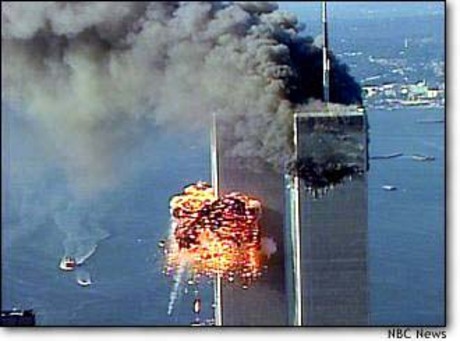
For most of the world including myself, it was United Flight 175 hitting the South Tower that made it clear that what was happening was not a "mere" accident. Two planes hitting the World Trade Center could not be a coincidence. From the hour that followed the second crash, I will always remember Gerry Callahan reporting, in a clear and restrained voice, that the South Tower had completely collapsed. If any doubts had lingered in the immediate aftermath of the second crash, there were now none that something irreversible was happening.
The first people to be irreversibly impacted, of course, had been the passengers and crew on American Flight 11 and the people immediately killed in the North Tower, then those forced to jump to their deaths by the resulting fire. With the second crash and the eventual collapse of both towers, the killing would expand to the passengers and crew of United Flight 175 and the immediate and near-immediate South Tower victims, then to the people trapped in both towers, most of them above the crash-sites unable to get down before the collapses, and to the police and fire personnel from New York City who went into the towers to rescue anyone who was in there. I think I remember some very early reports that gave estimates of as many as 20,000 potential deaths in New York City alone.
Miraculously, the numbers did not reach that high. 2,753 people were killed in the attack on New York, 184 were killed in the attack on the Pentagon, and 40 people were killed on United Flight 93 on September 11, 2001.
Remember

In 2001, I was working at a company that had a very liberal flex-time policy, so by the time I woke up on September 11, John Dennis and Gerry Callahan of WEEI radio were already reporting on a plane that had crashed into the upper floors of the World Trade Center. For a few more minutes, for me at least, the world remained the same, as the news being reported focused on filling in the details of what was probably an accident.
The people killed on American Flight 11 and in the North Tower would never have any idea about why they were killed. Neither would the people involved in the South Tower and the Pentagon attacks that would occur a few minutes later. And even the passengers and crew on United Flight 175 and American Flight 77, who knew at this point they were personally under siege, didn't know they had been drawn into a multi-pronged attack on the United States.
September 6, 2011
Mainstream Finally Catching Up with the Terrorists
There's something peculiar about this new focus on lone wolf terrorists:
After 9/11, it was the men who went to radicalized mosques or terror boot camps who were seen as the biggest terror threat. Today, that picture's changed: Authorities are increasingly focusing on the lone wolf living next door, radicalized on the Internet - and plotting strikes in a vacuum. ...And President Barack Obama said in a CNN interview on Aug. 16 that a "lone wolf" terror attack in the U.S. is more likely than a major coordinated effort like the Sept. 11 attacks.
Anybody remember John Allen Muhammed and John Lee Malvo, the Beltway snipers, back in 2002? Or how about the El Al Airlines shooter, also that year?
As I recall, it was a subject of some debate whether such acts ought to be counted on the tally of radical Islamic terrorists. The tendency was to resist the conclusion that the real root cause of terrorism was the ideology that drove its adherents to kill, even when their own deaths were necessarily part of the method.
On a tangential note: reading the article, one can't help but worry that the reality of these lone wolves is going to be used as justification for the intimate, deep monitoring that might actually catch terrorists by the content of the video clips that they watch online. Of course, historical practice suggests that the government won't find itself able to limit its intrusions on those who fit a very narrow profile, but will insist on monitoring everybody, everywhere (you know, so as not to show prejudice).
If that's the direction that we're headed, the American people ought to choose endurance of small-scale terrorist attacks, rather than of Big Brother.
May 18, 2011
A Change of Tune on Radicalization
The opening sentence of an article about events in Libya makes deafening the dog that isn't barking:
Mourners vowed revenge and rattled off heavy gunfire in a Tripoli cemetery on Saturday as they buried nine men they said were Muslim clerics and medics killed in a NATO airstrike in mostly rebel-held eastern Libya.
Remember when an army of folks, like Senator Barack Obama, would take to the airwaves to mouth wisdom about how American intervention in Muslim countries would only radicalize the region and breed more terrorists. We haven't heard quite so much from them, and one suspects that the reason isn't just that Libya is sufficiently disconnected from U.S. national interests to make our motives seem pure.
The article goes on make the case that the increasing the risk to civilians is a ploy by dictator Moammar Gadhafi to make focus aggression on the West, rather than himself, but that's nothing new. What's new is that the mainstream media and Democrat operatives have different political motives, these days.
May 5, 2011
Andrew All Over the Radio
Andrew talked bin Laden and RIGOP House leadership on last night's Matt Allen Show. Stream by clicking here, or download it.
Andrew will also be on WRNI's Political Roundtable tomorrow, airing somewhere around 6:30 and 7:30 a.m. and streamable online thereafter.
May 4, 2011
Preference for a More Confident Nation
There's been some conversation in the comment sections suggesting that there's something contrary to American culture in street celebrations over Osama bin Laden's death, particularly to the extent that they involved effigies and burning pictures. Acknowledgement that a milestone has been reached and justice meted in an individual case is certainly appropriate, but the attitude that ought to underlie it, to my mind, is of steely resolve tinged with regret that the world has come to this. The death of bin Laden will not bring back those lost on September 11 and after, in the war on terror. And it's unlikely that, of itself, it will prove all that significant to the defeat of global terrorism perpetrated by radical Muslims.
This sentence, from an analysis by Liz Sidoti concerning the crass political repercussions of the killing, is downright chilling:
Now, in the early days of his re-election campaign, Obama is in a clear position of political strength as Americans finally are able to savor the death of the man responsible for the Sept. 11 attacks.
My understanding of America's approach to war was that it was consciously devoid of blood lust. Whether our intention is to pursue dire national interests or help to resolve atrocities (and whether or not one believes the latter justifies our involvement in wars), we view combat operations functionally, as dirty work that must be done.
I think back to the iconic images of ticker tape parades and dancing in the street at the end of World War II, and two key aspects jump out. First, the hardship and austerity of the war were decisively over from that moment, and the troops would be coming home. Neither really applies, in this case.
Second, the emphasis of such celebrations appears through the lens of history to have been "we've won," not "they've lost." Burning images and savoring death are of the latter attitude, and it would be a very sinister development for it to dominate, not the least because it bespeaks a cultural insecurity. A confident nation doesn't need revenge and isn't so haunted by individuals who've done it harm that its people must dispel their ghosts with public rituals.
May 2, 2011
Various Thoughts on bin Laden
1. I've heard from several people the suggestion that the death of Osama bin Laden will boost troop morale. That may be the case, but I can't help but see that as a bit of a shame. Over the past decade, our military has toppled governments, routed terrorist networks out of foreign cities, helped oppressed people rebuild, push a hostile region toward democracy, and (most importantly) kept the fight on distant shores, preventing further large-scale attacks on the United States.
Whether or not one agrees with the policies that spurred those actions, their achievement is nothing short of awe inspiring. Marc likened bin Laden to the Wicked Witch, but that's inaccurate in a very important way: the Wicked Witch instilled fear because she individually had frightening powers; kill and scatter her army and she would still be a formidable enemy. Osama bin Laden was a lanky, sick, and aging rich kid with a network and a lot of hate. It's good that he's dead, but in terms of satisfaction for our nation and its men and women in uniform, he's a bit of an after-dinner mint.
2. And this is where he shivered in fear as his doom approached.
3. It seems an excessive, even reckless, bit of political correctness to invite continuing conspiracy theories and legend making by dumping the body out of reach in the sea.
4. Meanwhile, the World Trade Center has still not been rebuilt.
Open Forum: Osama Bin Laden is Dead
Osama bin Laden has been killed. The coward died a coward's death, hiding behind a woman. Thanks to the dogged determination of our men and women in the armed services and intelligence agencies--in places from the mountains of Afghanistan and Pakistan to Guantanamo--and thanks to our political leaders who continued the hunt no matter the political pressure facing them, this embodiment of evil has met his end. It is a symbolic but important milestone. The big Kahuna-head-of-the-crime-family-Wicked-Witch is DEAD. Ding f-n' dong! This doesn't mean the War on Terror is over, by any means. But it let's terrorists know that we won't quit.
May 1, 2011
A Message Full of Coincidence
So, as Donald Trump's Celebrity Apprentice headed toward the climactic "you're fired" of tonight's episode, NBC periodically killed the sound to play a jingle and run ticker text about a pending important message from President Obama. The actual interruption came right as the show built up to a crest.
Apparently, Osama bin Laden has been confirmed as dead. I'm not sure if just happened or at some point today, yesterday, last week, but it sure is curious that this big announcement would have to be made on a Sunday night with only an intense twelve minutes remaining on a show produced by a political competitor of the president's.
I wouldn't take this so far as to imply political motives, but it's also very helpful to Mr. Obama, considering unrest about gas and grocery prices and growing dissatisfaction with his military activities.
10:59 p.m.
The President hasn't come on, yet, but the commentators on NBC are making bin Laden's death out to be much more than it really is. He was a symbol, but whether he's been alive or dead has been largely irrelevant for the past six years. The real success of the decade-long war effort is the lack of additional large-scale terror attacks on U.S. soil.
From the commentary, thus far, the administration has been gathering details all day and has the terror master's body.
April 5, 2011

Change of Trial Venue for 911 Plotters: Kudos, Mr. President
From the Wall Street Journal.
Attorney General Eric Holder on Monday announced that he had transferred to the Defense Department for military trial the cases against Khalid Sheikh Mohammed, Walid Bin Attash, Ramzi Binalshibh, Ali Abdul Aziz Ali, and Mustafa al Hawsawi, accused of key roles in planning the Sept. 11 attacks. The decision reversed Mr. Holder’s earlier plan to try the men in civilian court in New York City, a change the attorney general blamed on politics and congressional restrictions that banned moving prisoners to the U.S. for any purpose.
Rush Limbaugh was correct yesterday to point out that this announcement came on the same day that the President announced his re-election bid. Not altogether clear, though, is what conclusion should be drawn from this coincident timing: whether the former was intended to bolster the latter by garnering some votes or the latter to provide a little cover for a decision that would almost certainly disappoint some of the president's supporters.
In any case, thank you, Mr. President, for doing the right thing and changing the venue of these trials. The fact is that these are not common criminals but enemy combatants without uniforms who facilitated an attack on the United States and the values of Western Civilization. Michael Graham:
As foreign fighters waging illegitimate war against America, they aren’t entitled to the same protections as American citizens who commit crimes.
March 7, 2011
Steyn Back in Action
It appears that Mark Steyn has returned to his seat in the battleship National Review:
A decade on, Kosovo is a sorta sovereign state, and in Frankfurt a young airport employee is so grateful for what America did for his people that he guns down U.S. servicemen while yelling "Allahu akbar!" The strange shrunken spectator who serves as president of the United States, offering what he called "a few words about the tragic event that took place," announced that he was "saddened," and expressed his "gratitude for the service of those who were lost" and would "spare no effort" to "work with the German authorities" but it was a "stark reminder" of the "extraordinary sacrifices that our men and women in uniform are making . . . "The passivity of these remarks is very telling. Men and women "in uniform" (which it's not clear these airmen were even wearing) understand they may be called upon to make "extraordinary sacrifices" in battle. They do not expect to be "lost" on the shuttle bus at the hands of a civilian employee at a passenger air terminal in an allied nation. But then I don't suppose their comrades expected to be "lost" at the hands of an army major at Fort Hood, to cite the last "tragic event" that "took place" — which seems to be the president's preferred euphemism for a guy opening fire while screaming "Allahu akbar!" But relax, this fellow in Frankfurt was most likely a "lone wolf" (as Sen. Chuck Schumer described the Times Square bomber) or an "isolated extremist" (as the president described the Christmas Day Pantybomber). There are so many of these "lone wolves" and "isolated extremists" you may occasionally wonder whether they've all gotten together and joined Local 473 of the Amalgamated Union of Lone Wolves and Isolated Extremists, but don't worry about it: As any Homeland Security official can tell you, "Allahu akbar" is Arabic for "Nothing to see here."
January 8, 2011
Blaming the Right Targets
Although National Review has made the onerous decision to stop providing free access to an online edition of the print magazine to subscribers who receive the print magazine, an essay in the December 20 issue by former assistant secretary for policy at the Department of Homeland Security Stewart Baker expresses a perspective worth considering. Describing his experience with airport security as professional and efficient, Baker writes:
It's not that the measures are popular. Nobody likes going through the new scanners or the new pat-downs. But attacking them without offering a plausible alternative is foolish, especially after Dec. 25, 2009, when al-Qaeda nearly succeeded in bringing down a plane with an underwear bomb.The U.S. has long had an air-security system that puts far more effort into looking for weapons than into looking for terrorists. It is also committed to giving all passengers more or less the same screening. With such a system, there's only one way to find weapons hidden in underwear, and that is to check all the passengers' underwear. The privacy campaigners tried to blame the TSA for these facts of life. The rest of us may have disliked the procedures, but instead of the TSA, we blamed, well, the terrorists.
Of course, Baker's very first suggestion for improving the system — looking for terrorists rather than weapons — shows his allocation of blame to be more rhetorical and political. Yes, as long as there are people who make airport security a necessity, the policies intended to provide that security should ultimately be blamed on them; that much goes without saying. But it isn't unreasonable to blame the people who insist on politically correct walls around the policies that we're permitted to implement.
I've written in many contexts that, were there specific, credible threats being made by a subculture of blond, blue-eyed white guys, I'd submit to the necessary screenings and blame my co-complexionists. Under such circumstances, it would be entirely appropriate for black women to blame a bureaucracy that treated them in like fashion to me.
December 16, 2010
Equivalence Beheaded
Whenever I express concerns about the odd and threatening behavior of such regimes as that currently ruling Iran, our comment sections become host to statements of blame-America relativism. No doubt, the same will prove true upon my posting this bit of news from the benighted region:
A Christan pastor in Iran has been sentenced to death for allegedly renouncing his Muslim religion and another faces a possible indictment on the same charge of apostasy, according to a prominent activist group working for human rights in Iran.Youcef Nadarkhani, a 32-year-old member of the Church of Iran ministry and pastor of an approximately 400-person congregation in the northern city of Rasht, faces death, according to the International Campaign for Human Rights in Iran.
Elsewhere in Iran, Christian pastor Behrouz Sadegh-Khanjani is up on charges of apostasy. In other Muslim nations, Christians are feeling the heat, as well.
Nadarkhani cleverly asserts that he's not an apostate because he rejected all religions until the age of 19. I'd wager that he shares my concerns about the sanity of those who implemented and enforce the laws that he's supposedly transgressed, and who are widely acknowledged to be working toward nuclear empowerment.
November 23, 2010
More on Assassination
Andrew McCarthy has responded to Kevin Williamson's argument against President Obama's approval of assassinating al Qaeda figure and American citizen Anwar al-Awlaki, which I mentioned here. As he typically does, McCarthy makes a strong argument, but I think the sides in the dispute might be circling around the ground that might lead to accord.
One point that McCarthy makes is that the President is constrained by political balances:
Could a president abuse his powers? Of course. All power can be abused — including legislative and judicial power. But the basic check against that possibility is political, not legal. Mr. Williamson implausibly argues that "political limits" are inadequate against the president and must be supplemented by "legal limits." Courts, however, have no power to enforce their injunctions — for that, they must rely on the executive branch, and an executive branch that maintains a list of citizens it plans to assassinate will be unlikely to enforce injunctions against itself. By contrast, a president who really did the horrific things Mr. Williamson imagines President Obama doing would find his war authorization rescinded, his military and intelligence services defunded, and himself impeached. A president guilty of less heinous excesses might not be impeached, but he would find his popular support dramatically eroded. As Mr. Obama is finding, that has political consequences — among them electoral ones — that curtail the presidential capacity for malfeasance. This is the genius of the system.
Put aside the question of how explicitly and repeatedly a president would have to assassinate American citizens before the picture had become sufficiently clear for Congress to defund an entire military operation. McCarthy elides, in this paragraph, the relevant point: The degree to which American citizens insist that the executive branch treat assassination (especially of citizens) as a special case — requiring judicial oversight and Congressional input — factors into the political calculation that the President makes. That is, if a judge declines to bless a particular assassination order, the President may not have to listen, ultimately, but the political cost of doing so would add an exponent to the backlash against the order in the first place.
Politics also play in a tangential point of McCarthy's:
That's all the assassination authorization for Awlaki is: legal cover if circumstances arise under which killing him is the best military option. And here we arrive at the central absurdity in Mr. Williamson's argument. Though minimizing him, Mr. Williamson concedes Awlaki is a bad actor and has no objection to his being killed on the battlefield. Since Mr. Williamson doesn't see that as problematic, he can't fathom why our armed forces would want insurance — though it is they, not he, who would be hauled into court by Awlaki's family. But the authorization to assassinate Awlaki does not mean the administration would have him killed if it encountered him coming off a plane in Chicago, à la José Padilla — a U.S. citizen captured, not killed, by the Bush administration. Nor does it mean our forces would kill Awlaki if they could apprehend him in a foreign country under circumstances in which detention was the more practical option, à la U.S. citizen Yaser Hamdi and al-Qaeda bigwig Khalid Sheikh Mohammed.
As I've already suggested, assassinating U.S. citizens ought to be such a sticky matter that those who undertake it should have to think it so important as to risk legal repercussions. If a particular target justifies the decision's being made at the highest levels, then let the President seek the cover of Congressional or judicial approval.
Ultimately, the Williamson-McCarthy dispute comes down to what process must be followed to determine that an assassination is legitimate. One side believes there must be maximum oversight, and perhaps understanding that the process of gaining specific oversight would make the result politically untenable, the other side is content with the general oversight of politics writ large.
November 12, 2010
Non-War Off the Battlefield
We've waded into the contentious waters of government assassination before, and Kevin Williamson articulates the case against it more thoroughly than I have:
The Awlaki case has led many conservatives into dangerous error, as has the War on Terror more generally. That conservatives are for the most part either offering mute consent or cheering as the Obama administration draws up a list of U.S. citizens to be assassinated suggests not only that have we gone awry in our thinking about national security, limitations on state power, and the role of the president in our republic, but also that we still do not understand all of the implications of our country's confrontation with Islamic radicalism. The trauma of 9/11 has deposited far too much emotional residue upon our thinking, and the Awlaki case provides occasion for a necessary scouring.Contra present conservative dogma, the Constitution has relatively little to say about the role of the president in matters of what we now call national security, which is not synonymous with combat operations. What the Constitution says is this: "The President shall be Commander in Chief of the Army and Navy of the United States, and of the Militia of the several States, when called into the actual Service of the United States." That is all. Upon this sandy foundation, conservative security and legal thinkers have constructed a fortress of a presidency that is nearly unlimited or actually unlimited in its power to define and pursue national-security objectives. But a commander-in-chief is not a freelance warlord, and his titular powers do not extend over everything that touches upon national security. The FBI's counterterrorism work, for example, is critical to national security, but its management does not fall under the duties of a commander-in-chief; it is police work, like many of the needful things undertaken in the War on Terror. The law-enforcement approach to counterterrorism is much maligned in conservative circles where martial rhetoric is preferred, but the work of the DOJ, FBI, NYPD, etc., is critical. It is not, however, warfare.
A powerful argument for the other side — which I've made in other contexts — is that the emergence of Islamic radicalism and the related global terrorism means that the battlefield is not necessarily a demarkable location, and acts of war are no longer so readily identifiable as such. But a bomb in Times Square is a weapon and its use against its targets as a means of harming our government is clearly war. That it arrives by way of zealot rather than missile means mainly that the zealot need not enjoy the protections of the Geneva Convention, and those who launched him, so to speak, are rightly targets of retaliatory action.
Assassination, however, is something different even during explicit warfare. The president and the armed forces within his command are within their boundaries if they bomb a bunker; where they enlist shadowy means to take out an individual wherever he may be found, the calculation changes. Moreover, citizens of other nations would likely — or should — enjoy the political protection of their own governments if they enter the crosshairs. Where should American citizens turn when their president targets them? The question takes on exponentially more urgency when that president is acting outside of legislative and judicial approval or even review.
The path of justifying assassination clearly has a downward slope. As Williamson poses the matter, "If some of us who have historically been skeptical of the state and its pretenses are so quickly seduced by the outside observation of absolute power, how much more alluring must the prospect prove to the men who actually employ that power?"
If we wish to grant the president powers that acknowledge terrorist networks as a new and unique military and police challenge then, as with the Patriot Act, we must have that discussion. Let the administration make the case for assassinating citizen masterminds, and let Congress layer on protections of review for discrete components of the policy. One suspects that an open discussion about allowing assassination would raise ire around the globe, but that, in itself, should tell us something about the project.
In the meantime, those tasked with our protection should consider that morality and justice do not overlap perfectly with the law. Some acts that accord with the former but not the latter are of such import that they might only be adequately balanced — to guard against tyranny — by the knowledge that those who undertake them might be vilified and prosecuted for transgression. That is to say that assassination is such a dangerous precedent that those who believe it so critical as to order it or carry it out should have to weigh the rightness of their cause against the probability that they will be making criminals out of themselves, and then the rest of us must judge whether clemency is justified.
September 30, 2010
Europe Hanging America Out to Dry (By the Heat of Terrorist Attacks)
One wonders whether the days of international comity are coming to an end:
The European Commission has announced that it will negotiate deals to prevent countries like Pakistan from providing travel data to the United States — except when the US already suspects a particular traveler or is otherwise investigating a particular case. In other words, the European Commission wants to bar the kind of wholesale data exchange that's needed to spot at the border terrorists who have successfully disguised themselves as tourists. And it plans to withhold all European travel reservation data from Pakistan unless the Pakistanis agree to join a data boycott of the United States. ...... The first salvo set forth the principles the Commission will insist upon in negotiations with the United States and other countries that gather travel data. These new negotiating principles include a demand that third countries supply data to the US and other third countries "only on a case-by-case basis." This would seem to prevent exactly the kind of sharing of information that the Caribbean countries have relied upon successfully for years. It would also prevent Pakistan from giving the US information about Europeans who traveled to that country for long stays.
Interestingly, the principles wouldn't prevent Pakistan from giving the same information to European countries. Quite the contrary. The EU's new principles for negotiation will require such sharing: "Information about terrorism and serious transnational crime resulting from the analysis of PNR data by third countries should be shared with EUROPOL, EUROJUST and EU Member States."
As Stewart Baker notes, this sort of attack on the United States by Europe has been a recurring theme in international intelligence cooperation, but wasn't that all supposed to end when the internationally respected, unifying, diplomatic figure of Barack Obama became president?
September 11, 2010
Keeping Hold of the Butter Knife from Breakfast
Tim commented, to Andrew's final memorial post, this morning, that he didn't personally know anybody killed on 9/11/01. I suspect that the majority of us with roots in the Northeast are in some way personally connected to the list of the dead, although perhaps without knowing so.
Fortunately, my closest contact is with the living — friends who ran from the debris (and spent years dealing with the experience), and a brother-in-law who helped to ferry people across the Hudson on his tug boat. It doesn't take much reach, however, to touch others who did not survive to share the experience of my friends. Here's a September 2002 piece that I wrote for a now-defunct online column:
The Heart Is Always More
Todd Ouida was born on my first birthday. I didn't know him then. I went to a different elementary school, so I didn't know him when he was forced to stop attending as a regular student to grapple with panic attacks for three years. I didn't even really know him when he returned and our two elementary schools fed us both into the River Dell Regional junior and senior high schools, where he became a 5'6" starting defensive back on the varsity football team. I knew of him, of course, because we shared a birthday and it was a small school.
Even our small school has had a number of brushes with history. As I recall, there was a plaque by the auditorium with the names and portraits of alumni who had died in Vietnam. I think there were three. The usual understanding of that war being what it has been throughout my entire life, such memorials have always seemed to ask, "See what they did to our community in order to fight their war?" I think it was one of my high school history teachers who related to me that every town lost some of its children.
Of course, memorials ought to be kept as tributes, and I don't mean to dishonor those young men when I suggest that the motivation for etching their names in metal and stone seems to be to make a statement about unnecessary loss rather than about accomplishment. They were heroes all, but the Vietnam War Memorial's emphasis on names rather than representations confirms that, in the words of the National Park Service's official Web site, "The purpose of this memorial is to separate the issue of the sacrifices of the veterans from the U.S. policy in the war."
Sacrifices. It seems that the quickness with which we commemorate the deaths of our citizens corresponds to the degree to which they were sacrifices — victims. The memorial for the victims of the Oklahoma City bombing has already been completed, each name etched in its own symbolic chair. The Vietnam Wall predated the Korean War Veterans Memorial, and both came before the World War II Memorial, which isn't slated to be dedicated until 2004, about sixty years after that war ended.
If this trend continues, the September 11 memorial might be finished long before time has granted its designers much historical perspective. Hopefully, it will nonetheless capture the mood of our times. Just as the Vietnam War era marked a tremendous shift in citizens' conception of the United States of America, the Vietnam Memorial's lack of iconography makes quite a different statement than the statues and proclamations of grandeur and confidence that had come before. I think the September 11 memorial ought to make a statement of internal, national reconciliation. Sacrifice and confidence. Compassion and strength. Personal loss and triumph.
I envision a field of stone pillars recalling the World Trade Center towers in a pentagon formation, each about ten feet in height and bearing the names and portraits of those who died. Interspersed, for the visitor to come across while walking among these pillars, would be statues of the various heroes of that day — firemen, policemen, emergency and medical workers, and regular citizens — all in poses corresponding to their activities, helping others. At the center of the field would be a statue of the three firemen raising the U.S. flag, above which a giant sculpture of an eagle would hang, wings spread, from some type of supporting structure.
As for my high school, I don't recall any plaques devoted to alumni casualties of other wars that occurred before I walked the halls, and as far as I know, alumnus Marie Rossi, who died in a post-ceasefire accident in the Gulf War, has gone without such a tribute. But I think Todd Ouida and Scott Rohner, class of '97, ought to have one. They both worked on the 105th floor of One World Trade Center, which American Airlines Flight 11 hit between the 95th and 103rd floors.
Todd and Scott's memorial ought not be placed with the Vietnam one by the "official" entrance, near the auditorium and administrative offices, but by the common entrance, near the gym and the cafeteria. The two ought to be a reminder that the world is not separate from our lives. Every student at River Dell High School will play a part in history. It is unavoidable. They don't have to go in search of it; they don't even have to be drafted into it. History will come to them, and the implication should be that they ought to live their daily lives heroically and triumphantly, no matter how profound or mundane the sacrifices that they are called upon to make.
(For more information about Todd Ouida, visit The Todd Joseph Ouida Memorial Children's Fund at www.mybuddytodd.org.)
Then there's the 9/11 connection that I discovered in 2004:
I turned to Google to see if I could confirm that Celita Schultz's televised dojo had been mine and to see whether she'd bought it from my sensei or something. Ms. Schultz's featured spot on the front page of the Kokushi Dojo's Web site quickly confirmed that my memory had been accurate, and I took a moment to smile at the discovery that the sensei's younger daughter, Liliko, has also been to the Olympics (in 1996). But then stories of being flipped by girls and flying from bicycles lost their profundity.In the upper left-hand corner of the Web page is a picture of a boy with an afro and a trophy. The caption: "Kokushi Student Hero: September 11th Hijacked Jet." Jeremy Glick. You may recall the name as that of one of the passengers who defeated whatever plan the hijackers of Flight 93 had. In the series of headshots of the men to whom Todd Beamer said "let's roll," Glick is the one kissing a baby. His daughter.
I'd thought it neat randomly to spot on TV a room in which I'd spent many memorable hours. Small world. Small indeed, and not so much neat as awe-inspiring when one realizes the subsequent heroism of somebody with whom I very likely shared that room at one point or another.
Callings will come when they come; we may not know the hour or the form. In the meantime, we can only attend to life and do our best to choose wisely, to love well, and to remember those who've shown us what it means to fulfill a purpose for which we didn't even know we were preparing.
Jeremy's call from the flight to his wife, Lyz, is worthy of our meditation, these nine years later:
"Honey, it’s bad news.""There are some very bad men on the plane. The men have a bomb and they have a knife. They are Arabic-looking men. They are wearing red headbands and there are three of them."
"We've had no contact with the pilots, but the men have taken over the plane and have moved everyone to the back of the plane and left us here."
"Lyz I need to know something. One of the other passengers has talked to their spouse, and he said that they were crashing other planes into the World Trade Center. Is that true."
[His wife pauses, not knowing what to say, but finally tells him it is true. There is a pause of a few minutes after hearing this.]
"I love Emmy, take care of her. Whatever decisions you make in your life, I need you to be happy, and I will respect any decisions that you make. Now, I need some advice - what to do? Should we, you know, we’re talking about attacking these men, what should I do?"
[His wife pauses for a long while, but finally tells him she thinks he needs to do it, after which there is another puase for a couple of minutes.]
“OK, The others and myself have voted to attack the terrorists. I have my butter knife from breakfast.. You know, I’m going to leave the phone here. Stay on the line, I’ll be back."
[The father in law takes the phone as Jeremy's wife could not bear to listen. There was a few seconds of silence folowed by a scream. More silence followed by another scream ... then ... nothing. Jeremy never came back to the phone.]
Remember: What Wasn't Seen...
...nine years ago, to the minute, when Islamist terrorists lost the initiative in the war they started.
From 9:57, the cockpit recorder picks up the sounds of fighting in an aircraft losing control at 30,000 feet - the crash of trolleys, dishes being hurled and smashed. The terrorists scream at each other to hold the door against what is obviously a siege from the cabin. A passenger cries: 'Let's get them!' and there is more screaming, then an apparent breach. 'Give it to me!' shouts a passenger, apparently about to seize the controls.
A Note of Credit
The structure and content of the postings above was designed and compiled last year by Marc.
September 9, 2010
We Won't Long Be Weak... We Hope
Bing West takes a look at counterinsurgency in the era of Obama the Weak. Here's the critical part:
Our battalions are spending too much time on nation building: Every battalion gives a briefing that shows security as only one of its four Lines of Operation, or LOOs. Security, they say, is no more important than governance, economics, or the rule of law. That military catechism is a fantasy, because the tribal response to all these well-meant priorities has not been commensurate with our efforts.Nation building by LOOs was also part of our military doctrine in Iraq, but it does not explain our success in that insurgency. True, the Sunnis did eventually rebel against al-Qaeda and the Islamist extremists, but they did not come over because of improved governance; in fact, they loathed the American-installed Shiite regime in Baghdad.
Instead, they decided to join the Americans because we were the strongest tribe. I asked Abu Risha, who led the Sunni tribal rebellion, why it took three years of blood and fighting before the Sunnis came over. He said, "You Americans could not convince us; we had to convince ourselves." When they joined up, it was on the premise that the Americans would be staying. But that is not the case in Afghanistan. The Taliban repeat President Obama's pledge that we are leaving soon, so the people stand aside.
One smells the arrogant odor of the university and its rigged system of rewards for the dominant ideology in such strategies as declaring our certain intention to leave a battlefield by a certain date. More broadly, such an approach to international affairs could only be conceived by a ruling class for whom "failure" means moving from one lightweight job to another. Or, when things go really badly, departing to spend more time with the family.
If 9/11 wrenched us back from our "vacation from history," one can only hope that enough Americans recognize that we're currently operating in accordance with a pure fantasy in order to prevent an even worse wake-up call.
August 24, 2010
Where's the Terrorists' Margin?
Among the many comment's to Andrew's post on the Ground Zero mosque, commenter mangeek made the following statement, and it's been rattling around in my head during the intervening days:
Terrorism is the weapon of choice for the marginalized; the cure is tolerance and civil discourse, tempered by strong secular laws that protect us from the criminally deranged.
"The weapon of the marginalized" sounds good, with a buy-the-world-a-Coke insinuation that the West can cure the problem by unmarginalizing the enemy. Mangeek suggests "tolerance and civil discourse." Part of the rationale for President Bush's approach to the War on Terror was to bring the Middle East into the democratic fold, creating the circumstances in which its inhabitants would defuse their aggression with the wet handshake of international processes.
But I'm not so sure that terrorism really is the weapon of the marginalized. Does anybody doubt that al Qaeda would attack the West using conventional weapons if it, one, had them and, two, thought it could win? Moreover, do the people backing terrorist organizations really feel marginalized? It's difficult to believe that Saudi princes walk around gnashing their teeth over their hardship, or that Iranian dictator mullahs feel powerless. I don't recall an action-drama style speech from Osama bin Laden lamenting his exclusion from a diplomatic dinner party.
To some extent, of course, a statement like mangeek's implies two groups: the backers of organized terrorism and those who carry out their commands. In that light, it's clearly in the interest of unmarginalized power brokers, like the late Yasser Arafat, to keep their human arsenal in a state of unrest and for radicals the world over to hammer the drum of disaffection until it's rattled their followers' brains to mush.
Allowing that much, however, only proves mangeek's conclusion faulty, because those with whom we wind up negotiating in civil discourse have reason to maintain the hardships and sense of marginalization of those whom they ostensibly represent. At least Bush's democracy project had the objective of replacing that system with real representation and broader civic engagement.
If we step back from the objective assessment of motivations and organizational charts — and put aside any wishful pap that eschews such analysis — a moral response emerges from the murk: The terror masters should be marginalized. One cannot discourse with an ideology with pretenses to global rule. (This cuts multiple ways, I should note.) We should not tolerate those who force women to live in walking body bags and put them to death when they're raped. We should not invite to the table those who speak casually of exterminating the Jews.
The disconcerting realization is that, as a society, we actually get this. Consider the reaction whenever an American subculture comes into public view with women dressed in the style of Little House on the Prairie. Consider that white supremacists are a universally accepted villain for any storyline.
All of our talk about tolerance of the exotic and different, of civil discourse with the marginalized, begins to look like mere cover when we take the resort to terrorism, itself, as evidence of the marginalization. It begins to appear that we are tolerating the intolerable because of the terrorism. Because we're paralyzed by politically correct bromides and lack the confidence for the only other solutions that remain.
The argument over the Ground Zero mosque lies along this very fault line. There would be no substantial public backlash against a thirteen-story Islamic center in that location were it already in the shadow of a hundred-story testament to the resilience of Western Civilization as expressed by the United States of America. We see the hole that remains in lower Manhattan, and as average as the mosque might be, it towers above inaction.
August 23, 2010
National Budget Deficit Trends
Randell Hoven (h/t) uses CBO figures and a simple chart to put the lie to the now familiar claims that the Iraq and Afghanistan wars and Bush tax cuts caused a $3 Trillion budget deficit.
The CBO breaks that cost down over the eight calendar years of 2003-2010. Below is a picture of federal deficits over those years with and without Iraq War spending.As Hoven points out, the deficits actually were shrinking until 2007, then started back up in 2008. What happened in between? Democrats took over Congress. Hoven adds some context (we all love context!):

The sum of all the deficits from 2003 through 2010 is $4.73 trillion. Subtract the entire Iraq War cost and you still have a sum of $4.02 trillion.Depends on who did what, right?No one will say that $709 billion is not a lot of money. But first, that was spread over eight years. Secondly, let's put that in some perspective. Below are some figures for those eight years, 2003 through 2010.
* Total federal outlays: $22,296 billion.
* Cumulative deficit: $4,731 billion.
* Medicare spending: $2,932 billion.
* Iraq War spending: $709 billion.
* The Obama stimulus: $572 billion.There is an important note to go along with that Obama stimulus number: the stimulus did not even start until 2009. By 2019, the CBO estimates the stimulus will have cost $814 billion.
If we look only at the Iraq War years in which Bush was President (2003-2008), spending on the war was $554B. Federal spending on education over that same time period was $574B....
So spending $572B in two years stimulates an economy, but spending $554B over six years ruins one?
August 15, 2010
The Inevitable Victory Line Is Ringing Hollow
I've got to agree with David Pryce-Jones:
... [President Obama] admits we are in a fight and the reason we'll win "is not simply the strength of our arms — it is the strength of our values. The democracy we uphold." This in the week he's just been rejoicing about imminently in Cairo removing the strength of arms from Iraq, with Afghanistan to follow as soon as possible. Al-Qaeda, the Taliban, the Iranians going nuclear — and we are to meet them with approval for a mosque at Ground Zero and babbling about upholding democracy? This speech sent a shiver of fear down my spine.
I fear our nation has been so long without an existential threat that we've ceased to believe in them.
July 14, 2010
The Seamless Burka of Sharia
In the context of addressing the prior activities and positions of Supreme Court nominee Elena Kagan, Andrew McCarthy takes up the distinction between radical Islam and moderate Islam:
To hear progressives tell it, we can do nice, clean, friendly sharia, just like we do nice, clean, friendly Islam. "Lapidations," [or stonings,] they will tell you, are no different from jihadist suicide bombings: outmoded vestiges of a long-forgotten time. Except they're not. They are undeniably rooted in Islamic scripture, and they are happening today, with frequency, wherever sharia reigns. That is because the "moderate Islam" progressives like to banter about is a mirage in search of a cogent set of principles. There is no moderate Islam that can compete with the mainstream, sharia Islam. Thus the crimes and punishments, in all their ghoulishness, endure. ...Stonings are common in Saudi Arabia, where, as in Iran, sharia is the only law of the land. Beheadings are common, too. A vice patrol, the mutaween, monitors the population, especially the women, to ensure compliance with sharia standards of dress, prayer observance, and segregation of the sexes. Sanctions are draconian, as a 19-year-old woman learned in 2007, when she was sentenced to 200 lashes with a rattan cane after being gang-raped. Saudi Arabia's crown jewels, Mecca and Medina, are closed to non-Muslims; forget about building a church or synagogue in those cities — non-Muslims are deemed unfit to set foot on the ground. The slave trade was still officially carried on in the kingdom until 1961 and has been indulged unofficially ever since. Slavery, after all, is expressly endorsed by the Koran (see, e.g., Sura 47:4, 23:5-6, and 4:24) and was practiced by Mohammed himself. The Koran and the prophet’s legends are the prime sources of sharia.
It would go too far to say that moderate Islam does not exist. Inasmuch as there are moderate people who adjust the religion to their underlying beliefs, it must. But moderate Islam will have difficulty winning the day for much the same reason that churches that adhere to Christianity Lite are fading: Over the centuries, religions come up with extensive answers to people's common doubts and questions (a spiritual FAQ, if you will). But if those answers drift too far from scriptures and traditions, the religion loses its claim of authority. In countries that incorporate sharia into their laws (let alone outright theocracies), it isn't a real option to simply stop believing (at least to the degree of letting disbelief change behavior).
McCarthy goes on to describe the creeping sharia of sharia-compliant finance (SCF). The likes of Kagan (for whom SCF was an issue during her time at Harvard) choose to disassociate this sort of sharia from the beheading-and-stoning-women-for-the-crime-of-being-raped sort But the link cannot be severed, because not only are the guiding principles of one the same as of the other, but Islamic clerics are necessarily intimately involved. And while they, individually, may be moderate, there is no mechanism for keeping out those who are not.
July 13, 2010
Responding to Our Signals
In response to folks who insist on seeing Iran's leadership as rational actors, Mark Steyn makes the somewhat obvious point that even a rational response to the pressures — the "stimulus," if you will — that the United States is bringing to bear for Iran leads to a very dangerous place:
But let's flip Dr Brzezinski's point around: An American might conclude that Iran isn't suicidal. But can the Iranians make the same confident claim about America? After all, we've just let them go nuclear — not under cover of darkness, as Pakistan did, but in slow motion and in open contempt of the US and its European negotiators. Why would you do that? Iran doesn't observe even the minimal courtesies of mutually hostile states: It seizes foreign embassies at home, and blows them up on the other side of the world; it kidnaps the sailors of permanent members of the UN Security Council in international waters; it seeds terrorist proxies in Gaza and Lebanon, and backs terrorist attacks all over the world. And it pays no price for any of this. If you can't rouse yourself to prevent a rogue state with a thirty-year consistent pattern of behavior getting nukes, what else won't you rouse yourself for?
July 9, 2010
The Slow Theocratic Revolution
Andrew McCarthy takes the radicalization of Turkey as an opportunity to trace Islamists' strategy for cultural hegemony (subscription required). That Turkey has been a partner to the West, he notes, was a result of efforts by Mustafa Kemal Pasha (Ataturk) to keep Islam out of government, an intention that appears now to have been circumvented. In opposition to Ataturk, McCarthy places Hassan al-Banna, the Egyptian founder of the Muslim Brotherhood, in 1928:
Banna was neither a dreamer nor an ivory-tower scholar. He was a thoughtful, patient, practical man of affairs. He meticulously schemed his revolution as a ground-up, self-consciously civilizational mass movement. It started with the Muslim individual and built outward to the family, the community, the town, the city, and finally the Muslim state. In each phase, the aim was to instill, install, and spread sharia. This is the divine mandate known as jihad.
Given the building blocks — individual, family, community, and so on — the strategy sounds like a dark inverse of the United States' increasingly abandoned method of instilling its citizens with individual initiative and a thirst for freedom. Of course, freedom can be a messy thing, not easily handled from the top down. People are not perfect, so any governing system that places people's rights at its center will sometimes face long, arduous corrections of course. Consequently, the West has become insecure about its imperfections while at the same time accepting other cultures' flaws, assuming the same intention to correct them and ignoring that other guiding lights, notably sharia, not individualism, are at their center.
McCarthy goes on to argue that Turkish Prime Minister Recep Tayyip Erdogan has leveraged this Western quality to install a gradually more radical government in his country:
It has worked like a charm. Echoing European sentiment, successive American administrations, seduced by the mirage of an evolving Islam with a Westernized Turkey at the fore, crowned Erdogan a leading "moderate." They even seemed unembarrassed when the prime minister ridiculed the very suggestion that there is such a thing as "moderate Islam": Such a term, he admonishes, is "very ugly, it is offensive and an insult to our religion. There is no moderate or immoderate Islam. Islam is Islam and that's it." With the West’s imprimatur and no emergent secular opposition, the AKP increased its electoral share to nearly 50 percent in 2007. ...In a 1991 memorandum, the Muslim Brotherhood's American leadership described the movement's work as "a kind of grand jihad in eliminating and destroying the Western civilization from within" by "sabotage." Islam's Western apologists — many of the same people who hailed Erdogan as a moderate — dismiss such assertions as farfetched chest-beating. Look at it, though, from the Islamist perspective. The Soviet Union, humiliated by the Afghan mujahideen, is no more. The Twin Towers, iconic symbols of Western economic might, have been reduced to a haunting crater. At the U.N., an organization easily bullied by the Organization of the Islamic Conference, an American administration joins in a resolution condemning Israel for defending itself against jihadists pledged to its annihilation. And now, after an 80-year struggle, Turkey — whose defection spawned the modern Islamist movement — is back in the umma and helping lead the civilizational jihad.
The current question of history is whether the great experiments of the Enlightenment and the United States, which in their essence, strive to force all social structures — from government to religion — to work through the individual human being, can stand against ideologies that self-consciously operate in an organized way to achieve regional and global domination.
April 11, 2010
Crossing Protective Lines
During President George W. Bush's time in office, Mark Shea was perhaps the blogosphere's leading politically conservative Roman Catholic speaking out against enhanced interrogation and other practices. Frankly, I ceased my daily visits to his site because he drew a stark line across which he saw questionable intentions and evil rhetoric, and even a desire to discuss whether the disagreement was more a matter of degree and interpretation quickly led to a commenter's association with some of the worst regimes in the world's history. In religious, military, and civic terms, there's a great deal of intellectual meat to be found in the torture debates, and it's difficult to get at it when even its pursuit is purported to reveal a desire to torture for fun.
That assessment is why I'm not as enthusiastic as I might otherwise have been now that Mark has turned the same weapons on the Obama administration, in reaction to its authorization of the CIA to kill Anwar al-Awlaki, an American citizen:
The King of Kings and Lord of Lords of these United States no longer requires things like trials, sentences, the rule of law or all that other crap that slows things down with stuff like "arrests" and "gathering evidence" and "actually knowing whether the intended victim is guilty of something". If the President thinks you are guilty or wills you to be guilty of somehow being a threat to the US in the Great and Unending War on Terror, that's all it takes: you, an American citizen, can now be murdered in cold blood by the state. Of course, the Lord Most High Who Dwelleth in DC naturally assures us that this power to... what's the word? murder... will only be used against The Really Bad Guys and you can take that to the bank. I mean, since *when* has a man with unchecked and unquestioned power to kill anybody he likes without trial or appeal and with the full cooperation of a supine media *ever* misused such power? And surely, no future President will ever allow such power to be corrupted as a tool for terrorizing his enemies and accruing despotic power for himself. Just as Bush's accrual of power for the Executive is not being misused by Obama, so no future President will misuse the brand new Presidential Power to Murder People He's Pretty Sure are Guilty of Threats Against National Security. All is well.
Judging by their public statements, just about all supporters of enhanced interrogation not only saw distinctions for American citizens, but also kept techniques that caused permanent physical damage well beyond the unapproachable line of illegal and immoral torture. Clearly assassination represents a shift not just of degree, but of kind, inasmuch as death must be treated as pretty decisively permanent physical damage for the purposes of a secular government.
March 2, 2010
Movie Briefs
While it has it's inaccuracies, The Hurt Locker is a movie I'd heartily recommend. The most impressive parts of the film for me were those depicting the stressful situations the soldiers were in while doing their job, ie; everyday life for a U.S. combatant in Iraq circa 2004.
On a completely different note, I also liked The Fantastic Mr. Fox, a movie based on the book by Roald Dahl. It wasn't a kiddie film by any means. As Ross Douthat put it in his review for National Review (NR subscription req'd).
In Dahl’s book, the foxes and badgers are delighted to live permanently underground, feeding off the farmer’s storehouses, while their enemies wait in vain for them to emerge. In the movie, things are more ambiguous. “I’m a wild animal,” Mr. Fox tells Mrs. Fox (Meryl Streep), explaining why he can’t stop taking risks, and there’s a sense throughout the film that this wildness is imperiled — that the farmers may be defeated, but that the animals will be forced to domesticate themselves in order to survive, living more as parasites on civilization than as the hunters they were meant to be.And the animation style is compelling.
Finally, I haven't seen Avatar yet. (If you haven't guessed, I tend to be a little late in my movie viewing habits!) But I did finally see Pocahontas. Ehhhh....sorta-typical Disney pc fare--only mild de-programming of the children required, post-film. But if, as they say, the former is merely the latter with more flash and bang, perhaps I'll pass.
February 16, 2010
So AG Holder is Backing Away from Civilian Trials for Terrorists?
Seven paragraphs into this New York Times article about US Attorney General Eric Holder once again finding his political voice (and, as someone who very much wants a change of administration in three years, I say, let the man speak) comes this.
“I have to do a better job in explaining the decisions that I have made,” Mr. Holder also said, adding, “I have to be more forceful in advocating for why I believe these are trials that should be held on the civilian side.”But now Mr. Holder is in the awkward position of pushing for an approach that he acknowledges he would accept defeat on. The administration hopes to announce a new venue for the Sept. 11 trial within three weeks, he said last Tuesday. But Congress could pass legislation requiring that Mr. Mohammed be tried by a military commission, or Mr. Obama himself could change direction.
“You always have to be flexible,” Mr. Holder said, allowing that justice could be served in a commission trial, too, and praising generals who “adapt their game plans” as the situation changes.
True, justice could be served in a military commission, as well. It's just that this is quite a volte face in only three months, Mr. Attorney General.
Interesting, by the way, that this dramatic shift is mentioned as a minor, unrelated aside well into an article about political tactics. Doesn't this revelation merit its own story and properly descriptive headline?
January 28, 2010
Obama Avoids the "V" Work in Iraq
I don't have too much to say about the State of the Union Address, except for one question: has there ever been a military victory that has been so diminished in our nation's history?
As we take the fight to al Qaeda, we are responsibly leaving Iraq to its people. As a candidate, I promised that I would end this war, and that is what I am doing as President. We will have all of our combat troops out of Iraq by the end of this August. We will support the Iraqi government -- we will support the Iraqi government as they hold elections, and we will continue to partner with the Iraqi people to promote regional peace and prosperity. But make no mistake: This war is ending, and all of our troops are coming home.That's all that victory in Iraq warrants in President Obama's SOTU. Well, like most Americans, I'm glad it's ending. But why is it ending? Could we call it a "victory"? Is that too much to ask? I know the President is familiar with the term--he used the word elsewhere in his speech (albeit, only twice).
But when the Union was turned back at Bull Run, and the Allies first landed at Omaha Beach, victory was very much in doubt.Apparently, victory is something that used to happen or that can happen in politics. Just not when it comes to Iraq. Yes, the President expressed our thanks to the troops:I didn't choose to tackle this issue to get some legislative victory under my belt.
Tonight, all of our men and women in uniform -- in Iraq, in Afghanistan, and around the world -- they have to know that we -- that they have our respect, our gratitude, our full support. And just as they must have the resources they need in war, we all have a responsibility to support them when they come home.But how about commending them for victory? Despite the stumbles and bumbles, which then-candidate Obama used to his political advantage during his Presidential campaign, our soldiers and sailors and marines and airmen saw it through to victory. They'd appreciate hearing that from their President, I'm sure. But I fear our President is wary of pronouncing a victory in Iraq because that could imply that he was wrong. And we can't have that, can we?
December 30, 2009
The Man Behind the Tendrils
Andrew McCarthy's takedown of Attorney General Eric Holder is relevant for a number of topical reasons — the war on terror, generally, the strategy of treating the war like a criminal action, the decision to give terrorist masterminds access to the American civil courts, even as an international police organizations are freed from accountability. On a political level, though, this part ties in with something that I've found to be increasingly applicable across layers of government:
We have been at war with Islamist terrorists for over eight years now--about half as long as they have been at war with us. In that time, they have committed all manner of atrocities. But of the thousands of jihadists who have been killed, captured, or detained since 2001, the 9/11 plotters stand out. To submit them to the civilian justice system makes a mockery of the war, betrays its victims, and turns the American courts into a weapon by which the enemy can gather intelligence and broadcast propaganda. It is inconceivable that civilian trials would have been permitted in any previous American war. In those conflicts, war was understood as the military and diplomatic resolution of a geopolitical dispute, not the judicial disposition of a legal controversy.But the Obama administration views the war as a legal matter. And its maneuvering to insulate the president from this unpopular ideological decision has been comically transparent: The president was, conveniently, en route to the Far East when Holder announced the civilian-court transfer; the White House maintains that the decision was a call for Holder alone to make (in fact, the attorney general has no authority to order war prisoners out of military custody--that's a presidential call); and Holder purports not to have consulted the commander-in-chief on this momentous matter, instead seeking the counsel of his wife and his brother.
To further the myth of a fully detached Obama, the administration projects a fully engaged Holder, hitting the books, agonizing for long hours over the most difficult decision of his career. But at the hearing, Sen. Lindsey Graham (R., S.C.) exploded the myth by asking the most elementary legal question: What is the precedent? "Can you give me a case in United States history," he asked, "where an enemy combatant caught on a battlefield was tried in civilian court?" After several seconds of excruciating silence, Holder stammered, "I don't know, I'd have to look at that." What, pray tell, has he been looking at, if not that? Senator Graham, an experienced Air Force lawyer, informed the nation's top law-enforcement official that there has been no such case.
Whether it be national administrative "czars" or state-level boards and commissions, this transfer of authority — at least as far as the public is led to believe — is an insidious thing. I find the elevation of a man like Holder to his current position disconcerting, but not as worrisome as the fact that he's clearly not an administrative rogue.
ADDENDUM:
But while I'm quoting from the piece, here's part that's directly related to the decision about easing domestic restrictions on the International Criminal Police Organization:
Why invite all this when the 9/11 plotters were ready to plead guilty? On the campaign trail, Holder promised the Left a "reckoning." The new administration would hold the Bush administration to account for its purported crimes. Understanding the legal emptiness and political explosiveness of such a promise, however, Holder has been reluctant to do more than "investigate." Thus the restless international Left--which includes Obama's core of support--has exhorted the United Nations and foreign tribunals to invoke "universal jurisdiction" to bring war-crimes charges against Bush officials. In Europe this spring, Holder expressed his willingness to cooperate with such investigations, including one ongoing in Spain.A civilian trial for KSM & Co. will be an unparalleled coup for these efforts--more so even than the mounds of classified memos Holder has already made public over the strenuous objections of current and former CIA directors. The Left's shock troops at the Center for Constitutional Rights, who worked on our enemies' behalf with many lawyers now staffing Holder's Justice Department, will exploit any new revelations to intensify calls for foreign prosecutions. The Obama administration will get credit for delivering on its promised reckoning but will avoid the political damage that would result if DOJ were to bring the case itself.
As I titled an earlier post: the noose tightens.
December 2, 2009
Not the Way to Win in Afghanistan
The American military commander in Afghanistan had already tempered his request for troops:
Gen. Stanley McChrystal wanted to ask President Obama for 50,000 more troops for Afghanistan on top of the 68,000 already stationed there, but he was convinced to lower the request to 40,000, reports CBS News White House correspondent Chip Reid.Sources tell Reid that McChrystal, the top U.S. commander in Afghanistan, considers the lower number to be a firm bottom line McChrystal believes anything short of 40,000 increases the risk of failure, Reid reports.
His commander in chief reduced the number by 25%:
Declaring "our security is at stake," President Barack Obama ordered an additional 30,000 U.S. troops into the long war in Afghanistan Tuesday night, nearly tripling the force he inherited as commander in chief. He promised an impatient public he would begin bringing units home in 18 months.
Put aside the fact that AP reporters Darlene Superville and Steven Hurst offer no evidence of or explanation for the public's impatience, unless one includes their subsequent admission that the president "made no direct reference to public opinion." The most significant opinion, in the equation, is that of the man with authority to add or subtract the number of American warriors in the region, and he clearly does not have the will to win.
President Obama took months to decide that he was going to barter General McChrystal down on the troop request and offer an explicit time line for withdrawal. The message to our enemies has been broadcast: hang tight.
God help the members of the armed services whom this man commands. And God watch over us all as we enter the second decade of this millennium, which appears likely to include a nuclear-powered Iran and a resurgent Taliban in Afghanistan.
November 28, 2009
The Confused Post Hoc Rationalizations of Robert Wright
Robert Wright's recent op-ed in the New York Times has the feel of a post hoc argument and is, simply put, confused.
The American right and left reacted to 9/11 differently. Their respective responses were, to oversimplify a bit: "kill the terrorists" and "kill the terrorism meme."Conservatives backed war in Iraq, and they’re now backing an escalation of the war in Afghanistan. Liberals (at least, dovish liberals) have warned in both cases that killing terrorists is counterproductive if in the process you create even more terrorists; the object of the game isn't to wipe out every last Islamist radical but rather to contain the virus of Islamist radicalism.
Wright never gets around to explaining the positive steps that the left would employ; perhaps he means the general "be nicer" approach that would "contain the virus of Islamist radicalism" in a pink, sticker-covered envelope of love. His argument is constructed entirely in a negative light, explaining what he sees as the shortcomings of the approach of the right, as described succinctly in the second paragraph of the above quotation. Of course, Wright also wants to leave room for this morsel:
Concerns about homegrown terrorism may sound like wild extrapolation from limited data. After all, in the eight years since 9/11, none of America's several million Muslims had committed violence on this scale.That's a reminder that, contrary to right-wing stereotype, Islam isn't an intrinsically belligerent religion. Still, this sort of stereotyping won't go away, and it's among the factors that could make homegrown terrorism a slowly growing epidemic. The more Americans denigrate Islam and view Muslims in the workplace with suspicion, the more likely the virus is to spread — and each appearance of the virus in turn tempts more people to denigrate Islam and view Muslims with suspicion. Whenever you have a positive feedback system like this, an isolated incident can put you on a slippery slope.
And the Fort Hood shooting wasn't the only recent step along that slope. Six months ago a 24-year-old American named Abdulhakim Mujahid Muhammad — Carlos Bledsoe before his teenage conversion to Islam — fatally shot a soldier outside a recruiting station in Little Rock, Ark. ...
Both the Afghanistan and Iraq wars were supposed to reduce the number of anti-American terrorists abroad. It's hardly clear that they've succeeded, and they may have had the opposite effect. Meanwhile, on the other side of the ledger, they've inspired homegrown terrorism — a small-scale incident in June, a larger-scale incident this month. That's only two data points, but I don't like the slope of the line connecting them.
So conducting large-scale wars against terrorists and their allies in foreign lands will result in a backlash of lone gunmen, and yet, it's also the case that Muslims aren't inclined toward violence. To square this circle, Wright must mean to indicate that Americans have been accelerating both their wars and their workplace distrust over the last decade, thus pushing the peaceful Muslims to the brink. Personally, I see zero evidence of such developments. The wars have remained limited to the range that President Bush first articulated in his Axis of Evil speech, and the news is hardly peppered with reports of anti-Muslim violence or bias.
And again: What could "containing the virus of Islamist radicalism" possibly mean if we insist that it has nothing to do with Islam?
It's odd that Wright limits himself to two incidents of isolated Muslim shooters. If we include the Washington sniper and that guy who shot up an Israeli airline ticket counter at a Los Angeles airport, both in 2002, there's less of a slope than a periodic blip. Contrast that with the clear and gradual progression of Islamofascist terrorism against American interests in the decade leading up to 9/11, which the War on Terror plainly arrested.
At best, Wright could claim that a strong military response to terrorism has as one of its costs occasional small-scale incidents of domestic violence. The case for the leftists' (undescribed) alternative approach is hollow, inasmuch as there's no reason to believe that the information flow that brings enemy propaganda to the home front works in reverse. For one thing, suppressing the "Islamic" in "Islamic radicalism" has demonstrably hindered law-enforcement-type efforts to end and prevent the lone shooters. In the case of the Washington sniper, the entire East Coast wasted precious days looking for white men in a white van; in the case of the Fort Hood shooter, he did everything but swing by his commanding officer's building with a statement of intent prior to the attack. Applying this same approach to efforts to restrain coordinated attacks would be devastating.
For another thing, not everybody has access to free information, and the percentage goes down among populations most likely to be targeted by radicals. There are folks in the West who can absorb international media with the ease of flicking a switch. There are folks in the more advanced Muslim societies with access to a limited range of information controlled by local governments. And there are folks in the less advanced societies with access to almost no outside information. Moreover, while mere interest can bring people in the first group to the evil propaganda of militant radicals, there's no assurance that folks in the second two categories would have any interest in the gooey propaganda of the pacifist left, even were it available.
So, the American right's response to 9/11 requires some effort managing a handful of isolated incidents that could be better controlled were it not for the insanity of political correctness. The American left's response would require an extensive feel-good campaign of historic (imaginary) proportions. For some sense of the impossibility of such a campaign, look to a recent riot in Egypt:
Hundreds of Muslim protesters on Saturday burnt Christian-owned shops in southern Egypt and attacked a police station where they believed a Christian accused of raping a Muslim girl was being held, a police official said.
On a global scale, billions of dollars in good will offerings and messaging efforts — as well as the intolerable risks entailed in proving our desire for openness and fraternity — could be undone on pretense. Any misstep in the minefield of egg shells by any Western individual or group might spark violence among a militant cohort that has identified our willingness to absorb hits and strategy of self flagellation as signs of weakness. Indeed, the forces behind Islamofascism would immediately proceed to lay egg shells at the periphery of their field, thus expanding the geographic and ideological territory on which Westerners dared not to tread.
In short, the progressive response to terrorism would accomplish nothing but making American leftists feel morally superior between large- and small-scale attacks.
Why are We Trying Them if We're Going to Detain Them Regardless of the Verdict?
Under "John Loughlin on the Civil Trial of Terrorists", Joe Bernstein observes,
Nor can you explain how it is that Holder admits before a Senate committee that he doesn't know the consequences of an acquittal after these people are brought into this country under color of law to stand trial.
Quoting Attorney General Eric Holder in front of the Senate Judiciary Committee:
And so that if - if there were the possibility that a trial was not successful that would not mean that that person would be released into our country.
Does that mean that they might be released in another country? Or that they would not be released at all?
Senator Jack Reed got more specific a couple of weekends ago on FOX News Sunday with Chris Wallace:
WALLACE: We've got about 30 seconds left. What if one of these guys gets off?REED: Well, if — that is highly unlikely. The evidence is compelling.
WALLACE: But there are no guarantees in a trial.
REED: There are no guarantees, but under basic principles of international law, as long as these individuals pose a threat, they can be detained, and they will.
WALLACE: But — and very briefly — if someone is acquitted and then he's picked up again...
REED: I...
WALLACE: ... what's the message that that would send to the rest of the world?
REED: I do not believe they will be released, because under the principle of preventive detention, which is recognized during hostilities, we held...
So Attorney General Holder has implied and Senator Reed has stated outright that if the five terrorists are acquitted, we would simply detain them again.
Let's understand this scenario. If these five are found guilty, we would "detain" them by sentencing them to long jail terms. And if they are acquitted, we would also detain them, just under a different rationale; i.e., that they pose a threat to the United States?
If we detain them after acquittal, wouldn't that completely negate the principle - a demonstration of American justice and due process - for which the Obama administration has chosen a civilian rather than a military judicial venue? After all, one of the big payoffs of our - and any truly just - judicial system is that the defendant walks free if acquitted of the charge, he is not escorted back into jail.
Secondly, if they are so much of a threat as to warrant detention after a trial, are they not just as much a threat now? And does that not obviate the necessity to try them? Stated more simply, how will their threat status have changed - increased - after a trial? In the event of acquittal, will it not, in fact, have considerably diminished because a court will have declared them "not guilty" of plotting or committing violence against the United States?
Contrary to the Attorney General's assertion when he announced this decision, the risk of acquittal is higher in a civilian trial as opposed to a military tribunal. Now, there would be two substantially different consequences to an acquittal. The first would be an abrogation of justice. The second would be damage to political careers. The former is obviously far more important. Yet the politicians making and supporting this decision as to judicial venue seem more concerned about the latter given that they appear willing to telescope the execution, and therefore, the principle, of the former in the event of an unpalatable outcome.
November 20, 2009
Terrorist Defendants and (No) Miranda Rights
It appears that no Guantanamo detainees, including those who will be tried in a New York civilian court, were given their Miranda rights, nor were their "normal Fourth Amendment rights" observed. This is a sincere request: can someone provide a legal scenario in which all five of these cases are not thrown out on that basis alone in the first ten minutes of the trial?
Even as this potentially fatal flaw in the case against five men accused of carrying out acts of terror against the United States is highlighted with urgency and consternation, both Attorney General Eric Holder and Speaker Nancy Pelosi declined to uphold the Miranda rights of Osama bin Laden.
Well, let’s see, how many years has it been? Nine, eight years. Let’s worry about capturing Bin Laden and not worry about your, your question.
Again I'm not -- that all depends. I mean, the notion that we --
Let's look at this.
Is there any doubt that AG Holder and Speaker Pelosi would wish to try Osama bin Laden in a civilian court? So why would they not acknowledge one of the fundamental rights of a defendant in that venue? Is it that such defendants are entitled to a civilian trial but not all of the attendant rights? But then, wouldn't that be a show trial instead of a showcase of the American justice system?
Or does this arise out of a more base and self-protective concern; namely, that they fear being hooted out of the room at the mere suggestion of proffering Miranda and Fourth Amendment rights to the self-avowed mastermind of the 911 attacks?
Lindsey Graham, not my favorite senator, had it right yesterday.
The only point I’m making (is) that if we’re going to use federal court as a disposition for terrorists, you take everything that comes with being in federal court.
Including the substantive procedural flaws that inevitably attend the transition of a detainee from a war zone, in a larger or stricter sense, to a civilian courtroom. It is not at all clear that the Obama Justice Department took a careful accounting of these flaws and their implications to justice before undertaking this transition.
November 14, 2009
Anyone Else Got a Sinking Feeling?
And the latest Friday news drop arrives:
In a move both politically and legally risky, the Obama administration plans to put on trial the professed mastermind of the Sept. 11 terror attacks and four alleged accomplices in a lower Manhattan courthouse.The venue for the biggest trial in the age of terrorism means prosecutors must balance difficult issues such as rough treatment of detainees and sensitive intelligence-gathering with the Justice Department's desire to prove that the federal courts are able to handle terrorism cases.
Attorney General Eric Holder announced the decision Friday to bring Khalid Sheikh Mohammed and four others detained at Guantanamo Bay, Cuba, to trial in a courtroom barely a thousand yards from the site of the World Trade Center's twin towers they are accused of destroying.
It'd be a comfort even to believe that the Obama administration at least has a sense of the fire with which they're playing. Folks, the inmates are running the asylum.
Michelle Malkin's got details of what to expect, including this summary from Andy McCarthy:
So: We are now going to have a trial that never had to happen for defendants who have no defense. And when defendants have no defense for their own actions, there is only one thing for their lawyers to do: put the government on trial in hopes of getting the jury (and the media) spun up over government errors, abuses and incompetence. That is what is going to happen in the trial of KSM et al. It will be a soapbox for al-Qaeda's case against America. Since that will be their "defense," the defendants will demand every bit of information they can get about interrogations, renditions, secret prisons, undercover operations targeting Muslims and mosques, etc., and — depending on what judge catches the case — they are likely to be given a lot of it. The administration will be able to claim that the judge, not the administration, is responsible for the exposure of our defense secrets. And the circus will be played out for all to see — in the middle of the war. It will provide endless fodder for the transnational Left to press its case that actions taken in America's defense are violations of international law that must be addressed by foreign courts. And the intelligence bounty will make our enemies more efficient at killing us.
The question comes to mind whether this stunt will have a higher American death toll than the insanity of continued fealty to the suicidal mandates of vielfalt uber alles. (That's meant to be "diversity above all," in case I'm abusing the Internet translator.)
November 9, 2009
Fort Hood and Intolerance
On Friday, representatives from the Rhode Island State Council of Churches, the Diocese of Providence, and the Jewish Federation of Rhode Island publicly responded to the massacre at Fort Hood. As the Projo's Maria Armental reported on Saturday…
The Rev. Donald Anderson, executive minister of the Rhode Island State Council of Churches, said he called the news conference to “tell the Muslim community that they are not standing alone.”The article provided no explanation of why the religious leaders feel that Muslims without a connection to Fort Hood shooter Nidal Malik Hasan other then their religious faith might feel that they are standing alone, as a result of Hasan's actions. Asked immediately after the press conference by WPRO (630AM) radio's Dan Yorke why the Muslim community was the focus of the interfaith coalition's public announcement, Rev. Anderson cited several examples of religious intolerance that have occurred in Rhode Island -- none against Muslims -- but some definitely disturbing cases of vandalism involving images of swastikas and upside-down crosses.“We are together as one,” Anderson said, flanked by religious leaders of the state’s Jewish, Muslim and Christian communities, “and we want to speak together with one voice.”
The religious leaders extended their prayers to the victims and their families.
“We know the actions of one individual did not represent the actions of one faith,” said Marty Cooper, community relations director of the Jewish Federation of Rhode Island.
But if the interfaith coalition's concern is general religious intolerance and the ugly ways in which it can mix with other human weaknesses and lead to violence against the innocent, what absolutely cannot be overlooked is the evidence coming to light that Hasan himself was associated with people who traffic in an intolerance at least as virulent as any of Rev. Anderson's examples.
On Sunday, the London Telegraph reported on Hasan's connections to radical Islamist cleric Anwar al-Awlaki…
Hasan, the sole suspect in the massacre of 13 fellow US soldiers in Texas, attended the controversial Dar al-Hijrah mosque in Great Falls, Virginia, in 2001 at the same time as two of the September 11 terrorists, The Sunday Telegraph has learnt....The preacher at the time was Anwar al-Awlaki, an American-born Yemeni scholar...Awlaki's teachings include such beliefs as Christians and Jews living in Muslim majority countries should be banned from holding public office and be required to pay extra taxes, that infiltration is "the way of the Jews and the hypocrites" (I see a bit of a contradiction here, but I digress) and that....
Hasan's eyes "lit up" when he mentioned his deep respect for al-Awlaki's teachings, according to a fellow Muslim officer at the Fort Hood base in Texas, the scene of Thursday's horrific shooting spree....[The officer] had previously argued with Hasan when he said that he felt the "war on terror" was really a war against Islam, expressed anti-Jewish sentiments and defended suicide bombings.
Our position is that we will implement the rule of Allah on earth by the tip of the sword whether the masses like it or not.Even if Hasan was a mentally disturbed individual, there is a strong possibility that his association with a particular brand of Islamist ideology that encourages violence for religious aims helped push him to murder. And according to the Cybercast News Service, Anwar al-Awlaki is continuing to encourage religiously motivated violence in the wake of the Fort Hood; he has said that he would like to see more Nidal Malik Hasans…
In a posting on his Web site Monday, Awlaki praised Hasan, calling him "a man of conscience who could not bear living the contradiction of being a Muslim and serving in an army that is fighting against his own people"…What message does that send to other "disturbed" individuals who might be on the edge of doing something similar?"Nidal opened fire on soldiers who were on their way to be deployed to Iraq and Afghanistan," Awlaki said. "How can there be any dispute about the virtue of what he has done?"
"In fact the only way a Muslim could Islamically justify serving as a soldier in the U.S. army is if his intention is to follow the footsteps of men like Nidal."
Ultimately, if the members of the interfaith coalition are hypothesizing that the Fort Hood massacre could cause a "backlash" of attitudes of intolerance that might lead to violent acts , and that stopping the spread of misplaced rage and its potential consequences depends upon good people taking a stand in public against such attitudes, then they must also be willing to take as strong a stand against attitudes of intolerance connected to murderous acts that already have happened -- especially when the purveyors of intolerance are calling for the violence to be repeated. Different rules for different forms of religious intolerance are not acceptable, and our local clerics need to consider using their public presence to reassure peaceful people of all faiths that they do not stand alone when targeted by other clerics who encourage murder. Stopping with a dismissal of Nidal Malik Hasan's actions as definitively nothing more than the work of one deranged man, unconnected to anything else going on in the world, does not accomplish this.
November 7, 2009
Espionage and Esquires
The whole Abu Omar affair stinks. By way of summary, Abu Omar, or Nassan Mustafa Osama Nasr, is a Muslim cleric suspected of close connections to terrorist organizations and the funding thereof, was abducted by the CIA in Milan and taken to Egypt, where he was imprisoned and, he claims, tortured. At one point, given reprieve by the Egyptian judiciary, Nasr phoned home and made the torture claim, which precipitated prosecution of American and Italian agents.
Earlier this year, the Italian judiciary threw out evidence, with the effect that Italian agents involved in the controversy were removed from the line of fire. Now, 23 Americans have been found guilty, in absentia, of kidnapping.
From the outside, it appears that the abduction should never have happened, not only because of the political cudgel that such practices have given to America's enemies (internal and external), but even for the practical advantage of spying on Nasr. Any subsequent torture is on the hands of the U.S. government. It is exceedingly suspicious that evidence implicating Italians should have been swept from the table. It sets dangerous precedent to have teams of lawyers spying on anti-terrorist spies. And now it appears that the political exit strategy may be to leave two dozen U.S. citizens effectively confined to their own nation (which I write with no insinuation of hardship).
As I said, the whole thing stinks from start to end... and hopefully this is the end of it.
November 5, 2009
Attacked at Home
I'll be continuing to post from the East Providence GOP event, but this demands immediate mention:
Twelve people have been killed and 31 wounded in a shooting spree at a Texas military base in a murderous rampage that officials believe was carried out by an Army psychiatrist.The suspected gunman was identified by ABC News as Major Nadal Malik Hasan. Sen. Kay Bailey Hutchinson, R-Texas, told Fox News that military sources informed her that the gunman was about to be deployed to Iraq.
With WPRO running commercials when I got in the car, I first heard the news on Christian rock station K:-OVE (91.1FM out of New Bedford), and there was something comforting about hearing extended prayers offered shortly after the news. Mine go out to the dead, wounded, and their families.
Now we can only wait for background information.
October 24, 2009
No Easy and Safe Options
Former U.S. Ambassador to the United Nations John Bolton's assessment of the options available to the United States in dealing with Iran's drive for nuclear weapons ought to be absorbed and addressed by those on any side of the debate:
Sad to say, Obama's Iran policy is not much different from that of George W. Bush in his second term. Relying on multilateral negotiations (the Perm Five-plus-one mechanism), resorting to sanctions (three Security Council resolutions), and shying away from the use of force are all attributes inherited directly from Bush. Bush's policy failed to rein in Iran's nuclear ambitions, and Obama's will fail no less, leading to an Iran with nuclear weapons.The issue now, however, is not this bipartisan history of failure, but what to do next. The Qom disclosure only highlights just how limited, risky, and unattractive are the four basic options: allow Iran to become a nuclear power; use diplomacy and sanctions to try to avert that outcome; remove the regime in Tehran and install one that renounces nuclear weapons; or use preemptive military force to break Iran's nuclear program.
In practical terms, the options boil down to two: tolerate a nuclear Iran or pursue regime change. In brief, I favor a military strike — a NATO-type venture in an ideal, although fantasy, world; a green-lighted Israeli effort in all likelihood — to provide time for the West to encourage internally motivated regime change, in part leveraging the apparent progress of Iraq.
October 20, 2009
Messages to the Enemy
It looks like the Obama administration is casting about for some excuse to do the wrong thing in Afghanistan:
Before President Obama commits additional troops to Afghanistan, the United States needs assurances that Afghan leaders preside over a stable government that is seen as legitimate in the eyes of its citizens, top Democratic officials said in TV appearances on Sunday.White House Chief of Staff Rahm Emanuel, appearing on CNN's State of the Union, said the overriding question facing the Obama administration is whether it has "a credible Afghan partner for this process that can provide the security and the type of services that the Afghan people need."
Stabilizing the region is not a prerequisite for our mission in Afghanistan; it is the mission. Our own military decisions should not be contingent upon the emergence of a strong and uncontested government, there; it should be seen as a temporary base on which such a thing can be built. The United States has now signaled to its enemies that increasing efforts toward destabilization — or even just giving the impression thereof — will be rewarded.
And should this be evidence of the administration's intention to extricate from a difficult problem, no amount of Obamanian rhetoric is going to change the conclusion that actions will have proven: That the American president is not willing to make the difficult calls that are necessary during war. The fact that this particular rhetoric apparently entered the public sphere without the knowledge of key military and security strategists suggests that President Barack has little concept of the lives that such slips can cost.
October 10, 2009
Wasn't John Adams Against Treason and Sedition?
I'm a little slow to this one, but inasmuch as it hasn't gotten much coverage, it's worth a little catch-up:
The Justice Department is investigating a group of lawyers working for the American Civil Liberties Union (ACLU) for taking pictures of covert CIA agents at Guantanamo Bay and handing them over to known al Qaida operatives. The lawyers, representing several detainees charged with organizing the September 11, 2001, attacks, have been accused of participating in an elaborate scheme to "out" as many as forty covert CIA agents, by tracking them to their homes and photographing them.The ACLU lawyers are accused of conspiring in what is being called the "John Adams Project," along with the National Association of Criminal Defense Lawyers (NACDL), and using lists and data from "human rights groups," European researchers and news organizations that were involved in tracking international CIA-chartered flights and monitoring hotel phone records. The John Adams Project allegedly developed a list of 45 CIA employees, which the ACLU team tailed and photographed surreptitiously; often as they were leaving their homes.
The ACLU proclaims confidence "that no laws or regulations have been broken." The rest of us can increase our confidence that such advocates for "civil liberties" incline toward one side of a larger cultural struggle, with a decidedly wrong-for-you, right-for-us tilt.
October 7, 2009

Collection of interesting links
Jennifer Rubin on Selling Our Souls
Andy McCarthy on If you don't get Islamic ideology, you don't get the problem in Afghanistan; follow the links, too
Richard Cohen on Does Obama Have the Backbone?
Steven Hayward on Reagan's Unfinished Agenda: A potent brew for the Tea Parties?
Anthony Gregory on Jobs Government Creates, and Destroys
Veronique de Rugy on Where is the Fat in the Federal Budget?; follow the link
October 6, 2009
Aggressive Disinfecting
Mark Bowden characterizes recent counterinsurgency methods not as "nation building" so much as a strategy in war:
Counter-insurgency doctrine is as warm and fuzzy as war can get. It embraces distinctly liberal, humanistic values like protecting civilians, cultural sensitivity and rigid adherence to ethical standards and the law. It is geared toward partnership, not dominance, and always seeks to minimize violence. In Iraq it rapidly (in months) isolated the murderous extremists who were trying to provoke civil war. The new effort set up a sharp contrast between their methods and goals and those of America. As one Marine officer, Col. Julian Dale Alford, said at a conference in Washington last week, “"e gave the people of Iraq a better choice."
The one dispute I have with Bowden is his choice of image, in this case:
It turns out that an insurgency can only be killed by poisoning the sea in which it swims.
It is an error, I'd say, to characterize the insurgents as a healthy organism to be killed by something unhealthy to everybody. Rather, what is needed is to kill the insurgency by disinfecting the water — cleaning it so that true healthier organisms can thrive.
October 2, 2009
Headline: "Iran talks ease tensions"
Well isn't that what always happens? Tension. Ease. Tension. Ease. And always Iran moves a little closer to nuclear capability. With consequences such as this looming over the country's head, I'm sure Iran understands how serious the United States is:
Tehran "must grant unfettered access" to international inspectors within two weeks, he said, warning that if Iran fails to follow through, "then the United States will not continue to negotiate indefinitely and we are prepared to move towards increased pressure."
Two questions: Why is the word "negotiate" appearing in this context? And why is this supposed to be comforting:
Western officials at the session said the Islamic republic had also agreed to allow Russia to take some of its enriched uranium and enrich it to higher levels for its research reactor in Tehran, a potentially significant move that would show greater flexibility by both sides.
September 11, 2009
The Moment Change Happened
By coincidence, each of the past two days brought a question from somebody about my political beginnings. The answer to the when is 9/11. Practical philosophy had always been appealing to me, but it had previously followed a literary and cultural context, rather than a political one. That changed on a September morning. It wouldn't be to presumptuous to state that a majority of Americans chose a different psychological path through reality, that day, as well.
The "Let's Roll" moment may have been the first evidence of this broad, pervasive change, but it actually occurred at precisely 9:03 a.m., when the second plane hit the second tower. During the final moments of American innocence, between planes, we were all thinking that the first was some bizarre accident, maybe an expression of individual lunacy, or at most a fluke success of a small group of foreign crazies. At 9:03, we all realized that, to put it clinically, this would have to be addressed.
One could make the case that our current politics essentially reflect ripples of that moment. It's permeated and incorporated all else in the political theater, but the need to fix... that something... is the central fact. On the right, the something is ultimately the West's belief that it can construct a fantasy in which to live according to social rules that an author of children's books might contrive. It has a military and foreign affairs component, obviously, and that directly relates to immigration and cultural assimilation. Less directly, a conservative's vision of facing reality means a return to tradition and morality — at the extremity, seeing our weakness and apathy as punishment from God.
On the left, the fact to be fixed is American arrogance and greed. Behind all of the "root cause" references is a sense that an unmatched lust for power has made the United States the unprecedented superpower against which no other nation can compete. In a secular form of divine retribution, terrorism (indeed, Islamofascism as an ideology) is the fruit of American manipulation of global political and economic systems for its own benefit. A nicer, more compassionate, more deliberately just and humble society would negate hostile response.
For seven years, those leaning toward the latter camp watched President Bush do just about everything wrong, and where he did something they might otherwise see as right, they took him to be draining the visceral strength from their patented plea to their fellow men. The election of Barack Obama to the presidency wasn't a desperate attempt to return to the reality of 9/10; Clinton, or any other known quantity, would have sufficed for that. Rather, his promise of "change" was a pledge to move forward toward the cultural and governmental repair that circumstances (and cunning deceit) had prevented for the purpose of preserving the machinations of an economic elite intent on exploiting the world.
Meanwhile, President Obama's being wrong on the importance of a strong, resolved demeanor in the international realm has freed those leaning toward the rightward camp from the inadvisable and arguably calamitous prudence that W. had just about exhausted. In this presentation, the tea parties and town halls are a declaration that the millions of Americans awoken to the necessity of action by the attack eight years ago will not go back to polite submission. They see energy taxes, corporate takeovers, heavier regulations, and socialized healthcare as (probably deliberate) attempts to humble their country, and they foresee the world's aggressors vying to be the first to knock over the docile giant, place one foot upon its neck, and declare itself to be an even greater being.
Flung into motion by the one-two confirmation that something would have to be done, this back and forth will continue until some event, perhaps in the nearer than farther future, affirms the beliefs of one side or obviates the question. In the meantime, we must mourn, and our mourning must take the form of vigilance and, despite it all, unity.

9/11: Never forgetting means never forgetting
With H/T to Instapundit, never forgetting means never forgetting about the true significance of 9/11.
Jennifer Rubin has more on the growing and deliberate amnesia.
We are at war and Obama is in denial. More here, here, and here, too.
In addition, Obama's parallel tendency to undermine our historical allies is driving changed behaviors by those allies.
ADDENDUM:
Ralph Peters: Betraying our dead - Forgetting the vows we made
John McWhorter: What 9/11 taught me about human nature
Charles Krauthammer: Van Jones - 9/11 Truther
Fouad Ajami: 9/11 and the 'Good War' - It was the furies of the Arab world, not Afghanistan, that struck America eight years ago today
Victor Davis Hanson: Our National 9/11 Schizophrenia - The great debate over 9/11 and the American response — is it coming to an end?
Michael Ledeen: Not You, Ahmadinejad, Obama Doesn't Love You Any More
ADDENDUM #2:
Judith Miller: The Week of 9/11 - Three reminders of terrorism’s enduring threat
July 25, 2009
Shhh: America Victorious!
I've been meaning to note Clifford May's brief history of the end of the war in Iraq:
The news is not that American combat troops withdrew from Iraqi cities. The news is that American combat troops withdrew from Iraqi cities in victory - rather than in defeat.Two years ago at this time, few in the foreign-policy establishment considered that outcome possible. Some did not even see it as desirable. There were those who believed that the conflict in Iraq was "unwinnable," that America had met its match on the hot and dusty streets of 21st-century Mesopotamia. Others thought Americans needed a Vietnam-like refresher course about the futility of the use of U.S. military force anywhere in the world.
Interesting how this war from which we just had to retreat — right up until the outcome of the latest presidential election — has quietly faded into the annals of American victories. Unless the culture, and especially the media culture, changes in the coming decades, it's easy to imagine the whole thing's being presented as little more than a minor military excursion, not at all like that War in Vietnam, which (being a war) we lost.
July 1, 2009
You Go, Girls
"Girls With Guns Get It" (H/T):
In both Iraq and Afghanistan, the U.S. Army and Marines found it useful to send a female soldier along on raids, as it was less disruptive to have a woman search the female civilians. There was no shortage of volunteers for this duty. The marines, as is their custom, saw more opportunities in this. Thus the marines began sending...all-female teams (3-5 women) [called] Lionesses.Source
The marines also noticed that the female troops were better at picking up useful information in general. This is something Western police forces noted, in the last few decades, as women were allowed to work in all areas of police work, including detectives and crime scene investigators. Iraqi men were also intimidated by female soldiers and marines. In the macho Arab world, an assertive female with an assault rifle is sort of a man's worst nightmare. So many otherwise reticent Iraqi men, opened up to the female troops, and provided information. Women also had an easier time detecting a lie (something husbands often learn the hard way.)
Source
The lioness teams proved capable in combat, as sometimes these peacekeeping missions ran into firefights or ambushes. But the main advantage of having a team of women along was the greater amount of intelligence collected. In addition, the female marines also made it easier to establish friendly relationships in neighborhoods and villages. This provided a more long term source of information.
June 30, 2009
Handing Over Iraq
As Ralph Peters writes, "Our effort in Iraq passed a major milestone today: Our troops are leaving the cities." For whatever reason (um, dare I say victory?), interest in Iraq has waned since it collapsed as a viable anti-you-know-who talking point. But progress has been made and now we can safely return Iraq's cities to Iraqi's. Peters:
Looking back over six years of good intentions, tragic errors, generosity, arrogance, partisan vituperation, painful deaths and ultimate vindication, two things strike me: the ever-resisted lesson that human affairs are more complex than academic theories claim, and the simple truth that most human beings prefer a measure of freedom to immeasurable repression.And Pete Hegseth, Iraq veteran:Now the symbolism of our troops withdrawing from Iraq's cities is richer than Washington grasps. Mesopotamia created urban culture: Ur, Babylon, Nineveh and countless lesser-known sites are where humans first worked out ways to live together in close quarters in large numbers. The coming wave of terror will strike cities that make Baghdad seem a youngster.
The "cradle of civilization" is rising from the grave again.
Yes, sectarianism, old grievances and the greed for power may deliver future crises -- even an eventual civil war. An unnatural state with grossly flawed borders, Iraq has more obstacles to overcome than any of its neighbors except Lebanon.
But our achievement remains profound: We gave one key Arab state a chance at freedom and democracy. We deposed a monstrous dictator who butchered his own people and invaded two foreign countries. And we didn't quit, despite the scorn of the global intelligentsia.
The historic events of June 30, 2009 didn’t come about because politicians passed resolutions or regional allies capitulated. With the help of President who showed resolve and a General who changed strategy, this day was made possible by over 4,300 American warriors who gave their lives (and over 31,000 wounded) so that others—Iraqis they barely knew—could live free.This enduring truth is the legacy of this day. May we take pause and remember that nothing good comes without a cost, and that at the end of the day—the only thing standing between the sectarian abyss of 2006 and the triumphant transfer of 2009—were stalwart American troops, their brave Iraqi counterparts, and an Iraqi population that rejected the violent ideology of Al Qaeda.
And it wasn't just the surge. It was the troops who tore down Saddam's statue for the world to see, the Soldiers and Marines who crushed insurgents in Fallujah, Ramadi, Mosul, and elsewhere, the Special Operators who hunted and killed Zarqawi, and the thousands of young men who, every day, patrolled endless miles of Iraqi roads, deserts, and cities. Every action played a role, large or small.
We may forget all this, but only at our peril.
June 11, 2009
Left Moves Right Past Truth to Slander
Somehow the Washington Post, via the mouth of U.S. News and World Report's Alex Kingsbury manages to pull pro-lifers and free-marketers under the same umbrella as Islamic radicals as a means of retroactively absolving Homeland Security Secretary Janet Napolitano of the need for embarrassment over her department's politically motivated report warning of pending right-wing terrorism:
In the past two weeks, the country has seen the bombing of a Starbucks coffee shop in New York City, the arrest of four men for allegedly plotting to blow up synagogues and shoot down planes, the shooting of two soldiers at an Army recruitment center in Arkansas, the assassination of a doctor inside a Kansas church, and the shooting at the Holocaust Museum.... Although these are not all cases of right-wing extremism, each is an example of domestic terrorism.
That's right. A report that warned that newly returned veterans might be a stalking ground for recruitment by conservative villains is said to be vindicated in part by the murder of a military recruiter by a jihadi. Could a notion be more worthy of scorn?
Andy McCarthy does a fine job with the response that is unfortunately necessary in the face of such rhetoric. Paring the list of supposed evidence down to the fifty-something killer of an abortionist and the octogenarian white supremacist who attacked the Holocaust Museum, McCarthy explains:
The DHS report was noxious because it smeared conservatives as bigots and claimed, in the absence of any evidence that "rightwing extremists may be gaining new recruits" — including from returning military veterans — in preparation for a spate of terrorism. (Who's the new recruit? The 88-year-old Nazi?) It insinuated that traditional conservative policy positions (pro-federalism, pro-life, pro-Second Amendment, anti-illegal-immigration) were drivers of extremism. And it contended — in contravention of standard law-enforcement guidelines and federal law — that federal and state agencies should undertake pro-active investigations on the basis of constitutionally protected beliefs and activities.
June 9, 2009
Signifying Nothing, and Missing the Point
Pointy-headed intellectual concepts too often become excuses to float above practical reality. Consider:
There is a technical term for this phenomenon. The GWOT acted as what, in the language of semiotics, is called a "floating signifier," able to be attached at will to a wide range of actions and policies. The Bush administration organized the al-Qaida 9/11 perpetrators and Saddam Hussein into seamless chapters in the same account. The GWOT narrative led directly to the invasions of Afghanistan and Iraq, to justifying torture and to disregard treaty obligations under the laws of war. ...... what is needed is an attack on the central fallacy at the heart of the current narrative, namely that a fantastically complex world can be reduced to a single storyline. The war in Iraq was justified on the basis of a baleful conflation of al-Qaida and Saddam Hussein. Today, a similar mistake threatens in Afghanistan, where - - contrary to the underlying facts -- a tacit conflation of the Taliban and al-Qaida justifies the expansion of the U.S. civil and military presence in the country. Seen through the GWOT lens, this makes sense. By any other measure, it is a gross distortion. Although General Petraeus recently acknowledged that al-Qaida no longer has a presence in Afghanistan, a shadowy presumption that it does, or might, continues to cast the indigenous Afghan insurgent movement as an existential threat to the United States -- thus turning what is in essence a local problem into a global challenge.
While excesses such as torture (or, to widen the historical lens, internment) are a continual danger requiring of vigilance and correction, the fact that an overarching idea has been applied to the global "narrative" does not mean that all conclusions within its fold are manufactured. What Amy Zalman and Jonathan Clarke, who penned the above quotation, have done is to lash the War on Terror with a too-specific target (al-Qaeda) and thereby exclude the setting in which al-Qaeda came to exist and to operate.
The Taliban is the perfect example: Given the structure of terrorist groups, if we are to avoid stomping on the source of motivation (i.e., Islam), we must modify the environment that permits its radicalization. The Taliban and al-Qaeda needn't be conflated in order to acknowledge that the former facilitated the latter. Saddam Hussein and al-Qaeda needn't have been partners with a binding contract in order for the former's behavior to be intolerable.
Given fronts in the campaign to prevent terrorist attacks that could kill Americans by the millions may be justifiable or not, on their merits, but it would be a grave mistake to follow the lead of those who prefer to attack abstract principles. The unique problem of Islamofascism and terrorism on a massive scale is that the orderly rules by which we've striven to interact as nation-states do not apply. What we are dealing with — if a mere blogger might coin a technical term — is an army of "floating zealots" whose activities signify death on a horrifying scale.
June 5, 2009
An Interesting Convergence of Issues
This story confounds categorization:
Eastern District of Michigan judge Lawrence P. Zatkoff handed down the decision, in a case involving an alleged violation of the constitutional separation of church and state. The issue is whether a government-owned company, AIG, can market sharia-compliant insurance products. (To be sharia-compliant, an investment vehicle must be created and structured in ways that do not violate Islamic law.) In a well-reasoned and cogently argued opinion, Judge Zatkoff refused to dismiss the case prior to factual discovery. ...The problem with all of this public largesse is that AIG sponsors, pays for, and aggressively markets sharia-compliant insurance products. The practice of sharia finance has created lucrative advisory positions for often radical imams, who get paid to guarantee the religious "purity" of sharia-compliant products. Such vehicles typically follow the Muslim principle of zakat and donate a slice of their profits to charity. Unfortunately, many of the charities receiving these funds have links to terrorism. Mr. Murray objects to his funds' being used to legitimate and promote sharia law, when that is the same law that calls for jihad. For that matter, sharia allows Saudis, Iranians, Sudanese, Somalis, Afghans, Taliban members, and other adherents to justify the following: the execution of apostates who decide to abandon the faith; the criminalizing of "Islamophobic blasphemy"; the punishment of petty crimes with amputations, floggings and stonings; and the repression of “non-believers” from practicing their respective religions freely and openly.
On one hand, a private business should be able to develop, operate, and market whatever products it likes (provided doing so does not directly support our nation's enemies). On the other hand, AIG is not alone, now, in being a not-so-private company, and the government ought not be in the position of financing the adherence to religious law. It's a precarious balance, and the conceit of mere mortals to maintain it is apt to become hamartia.
Herman Melville functions out of context here:
So, when on one side you hoist in Locke's head, you go over that way; but now, on the other side, hoist in Kant's and you come back again; but in very poor plight. Thus, some minds for ever keep trimming boat. Oh, ye foolish! Throw all these thunder-heads overboard, and then you will float light and right.
Starboard side, we carry the notion that the government should not interfere with freedoms of association and religion. Port side, we've now hung the principle that the government can become a controlling investor in industry. Express no surprise when when find the deck taking on water.
June 3, 2009
Using the Impossible Dream for Political Advantage
Whether voiced by Democrats or Republicans (and both have), this sort of talk has got to be getting nauseating for anybody who's paid even passing attention during the past few decades:
Obama administration officials argue that this unpopularity has hindered the United States' ability to achieve its goals."Our image in the world, particularly in the Muslim world, has, over the course of many years, not been what it needs to be in order to accomplish, for instance, peace in the Middle East," said Robert Gibbs, White House press secretary and a top advisor.
Oh yes. If only we rephrase our position and leverage polls to make ourselves more palatable to the "Muslim street," we'll be able to resolve a perennial conflict in which one side openly expresses a desire for genocide and sends women and children to blow themselves up as human guided missiles. The last guy just said the wrong things is all, so a change of rhetoric will be as a balm on a lesion.
Any politician who expresses the position that Gibbs has articulated is not to be taken seriously. Again: whether they're on the left or the right.
June 1, 2009
Not a Direction in Which We Wish to Head
Growing up in the '80s, with all of the romanticizing of the '60s that was fashionable, then, I thought it pleasantly discordant to hear George Harrison describe his disappointment in the Beatles' visit to Haight-Ashbury, where the big scene consisted of "a bunch of spotty teenagers" (or something close thereto). Less pleasant was learning, some years later (under circumstances that I don't recall), just how tumultuous and violent the era really was.
I hope and pray, therefore, that the back-to-back shootings this week — both with political undertones — are an aberrant coincidence and not a sign of times to come. Details from Monday's atrocity:
Police say the incident occurred around 10:15 a.m. at a U.S. Army Navy Career Center inside the Ashley Square Shopping Center at 9112 North Rodney Parham Road. According to Lt. Terry Hastings with the Little Rock Police Department, two enlisted soldiers standing outside the office were hit when a suspect drove up in a black SUV and began shooting. ...At the Monday-afternoon briefing, Thomas said investigators believe [shooter Abdul Hakim Mujahid] Muhammad acted alone, and likely carried "political and religious motives." Thomas said the gunman targeted the military but was not believed to be part of a broader scheme.
So, for the second day in a row, we must offer prayers for the deceased and his family, the recovery of the injured, the liberation of the killer's soul from evil, and rebalancing of our society lest the descent continues.
May 25, 2009
It's Definite: President Obama Will Not Prosecute Members of Bush Admin for "Torture" Crimes
So reports Newsweek's Michael Isikoff in a fascinating article posted last Thursday. (H/T Newsbusters.) The decision was announced during an off-the-record meeting that President Obama held last Wednesday with some disgruntled supporters.
Administration officials organized the session just a few days [prior], summoning the leaders of groups such as Human Rights Watch, Human Rights First, the Center for Constitutional Rights and the ACLU, as well as several liberal law professors. As a sign of how seriously the White House took the matter, just about all of Obama's senior staff were there, including chief of staff Rahm Emanuel, White House counsel Gregory Craig, senior adviser David Axelrod and [Attorney General Eric] Holder.* * *
It was at that point, toward the end of the meeting, that one attendee raised the idea of criminal prosecution of at least one Bush-era official, if only as a symbolic gesture. Obama dismissed the idea, several of those in attendance said, making it clear that he had no interest in such an investigation. Holder—whose department is supposed to make the call on criminal prosecutions—reportedly said nothing.
The other fascinating aspect if this is the silence by the mainstream media. Where are the headlines, the blaring chyrons, the brisk debates among talking heads about this significant development? NewsBusters P.J. Gladnick theorizes that they are, essentially, covering up for the president.
And Rachel Maddow has provided us with another reason why there has been almost no coverage of this meeting in the MSM. Because it would show Obama's deceptiveness. Saying the matter of prosecutions were up to the Attorney General in public while in private making the decision to cut them off.* * *
So it is fascinating to once again see a story being widely discussed in the Blogosphere while being almost completely ignored in the MSM. Obama saying one thing in public and quite another in private. And that is why the mainstream media is reluctant to report on it.
There is no doubt a reluctance on their part to show the president in a bad light, though I would disagree with P.J.'s characterization of the President's actions; i.e., the negative quality that the press is not anxious to expose. Rather than "deceptiveness", it would be more accurate to say "propensity to make decisions in excess haste and without thinking things through".
His handling of this matter is a good example. He released the four memos about post-911 enhanced interrogations and announced his intention to prosecute almost fliply and as a political reflex. However, after some reflection - upon the participants' motives? upon the implications for national security? upon the potential political blowback to members of his own party? - he has reached a more prudent conclusion. For this, he is to be applauded.
May 24, 2009
Honesty in Torture
Among the many topics that I regret having had insufficient time in my schedule to address appropriately is torture (and I'm not claiming this post to constitute all that I'd like to say about it). Frankly, I've been torn, and I view with suspicion anybody who believes that the debate, as it's been cast, is an obvious call. Torture is wrong, clearly, but the very question at issue is what constitutes torture.
There are extremes about which we can agree. Scourging, torture; refusing to provide arugula (whatever that is), not torture. The line, though, is inherently subjective, and if we're to discuss it, we've got to be honest about the specific act about which we're talking.
For my part, superficial as it may seem, when I think of torture, I think of the scene in Lethal Weapon that begins at 13:20 of this video. The famous quotation sums up the dividing line: "Endo, here, has forgotten more about dispensing pain than you and I will ever know." (I've always thought that to be a dumb way to phrase a threat, by the way. If the measure is what Endo has forgotten, then it's quite possible that he's forgotten enough to be just about harmless.) The idea is that mounting pain will bring the torture to an end, even if that end is a quick, painless death.
On the other side of the line, my subjective take is colored by having been a fraternity pledge. Sleep deprivation. Subjection to disagreeable, repeated, and very loud music. Being made to swallow live goldfish whole. Unless we're to define torture to absurdity, these practices do not suffice. (Indeed, all but the last are as readily applicable to parenthood.)
If we attribute even a minimal sincerity to the sides on this issue, it's clear that waterboarding resides somewhere very near the natural line of torture/non-torture for our society. In contrast to the electroshocks and salt rubbed in wounds in the Lethal Weapon scene, waterboarding as performed by American agents was not a means of inflicting pain, but of triggering a reflex. Implemented as approved, it leveraged discomfort and instinctive fear in a controlled environment.
The topic comes up, now, because the Left is delighted to have video of conservative shock jock Erich "Mancow" Mullen succumbing within seconds to waterboarding and declaring it to have been torture. If we're to be specific, however, it's debatable whether this was the version of waterboarding used during U.S. interrogations; the "interrogator" covered Mancow's nose with a wet cloth and then proceeded to pour water into his open mouth. Large amounts of water, therefore, likely filled his nasal cavity, which resulted in the quick cave.
This video better captures the procedure, as I understand it. Do your best to put aside circumstances; Mancow was in a brightly lit office building surrounded by friends during his popular radio show, while Kaj Larsen subjected himself to the broader experience of hostile interrogation, including the jumpsuit, the dark basement, the masked perpetrators, and the isolation from other people.
Mr. Larsen's experience does look, as he says with a laugh toward the end of the video, as if it "sucked." The wet cloth covered his nose and mouth, for a slower build-up of moisture. A second "interrogator" put pressure on his abdomen, and the scene was performed with a much more hostile, desperate tenor, with banging canteens and such. It's certainly not a pleasant experience, but it probably wasn't only his comparative softness that led Mancow to surrender more quickly. In Larsen's video, one gains better context for the actuality of being waterboarded 183 times, if (as I understand to have been the case) each application of the towel, even if only for a second, counts as one.
So, is this torture? Is it a sin that cries out to God? I can't say that I think it is. It's immoral, surely, at least inasmuch as it objectifies the subject. I would not perform it, and I would not ask that somebody else do it on my behalf. But does this specific procedure surpass the line across which we must forbid it even among those who believe it to be necessary? Those who have the burden of security for millions of their countrymen? I'm not so sure. Does it so clearly cross that line as to justify retroactive prosecution of those who approved it? No.
Let's be honest, too, about the impetus for the continuing outrage, even as the technique — this worst of the batch — has ceased to be used. It's a political cudgel and opportunity to express an unhealthy hostility toward a hated President and loathed cultural class. Consider this comment on RI Future from Matt D, in response to a conservative commenter's offer to be waterboarded:
Hopefully it's either Carcieri, Watson or Trillo all right wing whackjobs. Even DePetro or Yorke would do also, maybe we'll get lucky and whoever it is will drown and we'll have one less of these idiots. Sign me up for front row......
There's a contingent, in this country, for whom it is a far greater affront to hold conflicting political beliefs (well within the republican democratic mold) than to threaten and pursue genocide against their fellow Americans.
May 7, 2009
United States as Helpless Giant
Tony Blankley makes a chilling observation:
News item No. 1 concerns the testimony of Secretary of State Hillary Clinton before the House Foreign Affairs Committee on April 22. She said deteriorating security in nuclear-armed Pakistan "poses a mortal threat to the security and safety of our country and the world."News item No. 2 is this headline on the front page of the May 4 edition of The Washington Post: "U.S. Options in Pakistan Limited."
News item No. 3 is a quote in Jackson Diehl's May 4 column in The Washington Post from a senior Obama administration official: "It's not good when your national security interests are dependent on a country over which you have almost no influence."
In a matter of two weeks, we have gone from witnessing the U.S. secretary of state testify to Congress that a nuclear Pakistan run by Islamist radicals would be a "mortal threat" to America to hearing the administration admit that we have limited options to avoid such a threat.
What are we to make of such a development? I and many others had previously warned of the dangers of a nuclear "Talibanistan" (which have been obvious and talked about for years). Experts I have talked to in the past week do not believe Clinton is overstating the case. Nor do I. She is very careful with her words -- and they fit the danger.
Blankley isn't blaming the Obama administration ("not yet"), but he does want to see a plan for increasing our ability to address military matters around the world (in his view, by increasing troop counts). The American political landscape is not likely to be such that effective plans will be forthcoming for quite some time... hopefully not too late.
May 3, 2009
War criminal claims and our ignorance of history
Instapundit does us another public service by highlighting this Pajamas TV commentary about Jon Stewart claiming Truman was a war criminal:
Jon Stewart, War Criminals & The True Story of the Atomic Bombs.
As one of my friends wrote me after listening to it: "We were moved nearly to tears by this. What has happened to the world we knew?"
Our society is increasingly ignorant of history, which means we have lost touch with our roots and are subject more and more to whims of the moment that can only further endanger our liberty.
May 1, 2009
The Administration to Allow Regression in Iraq
This sort of statement from folks inside the administration certainly will not help the situation in Iraq:
"We are not even talking about" changing the withdrawal plan, an administration official told McClatchy Newspapers. "The situation would have to get a lot worse for that to change."The recent upsurge in violence hasn't triggered a return to wholesale sectarian warfare, said the officials, although they conceded that they don't know whether the U.S.-backed government of Shiite Muslim Prime Minister Nouri al-Maliki and the U.S.-trained Iraqi security forces could prevent large-scale chaos.
I suspect that the uptick in violence is a test of President Obama, to see if he will do what President Bush more likely than not would have done: assert the resolve to stall withdrawal until circumstances improve again.
Meanwhile, the media is already laying the groundwork to absolve the current administration should Iraq backslide into chaos:
Instead of a flourishing democracy at peace with Israel, after six years, 4,278 American and perhaps 100,000 Iraqi deaths and an estimated $2 trillion, the U.S. withdrawal from Iraq appears likely to leave a fractious Iraqi government, renewed internal tensions, uncertain security forces and a local chapter of al-Qaida that, while weakened, can still launch major terrorist attacks on Iraqis.
Seems to me that the general message was quite a bit different a year or so ago, while the American people were trying to decide between a war-time president and a peace-time president.
February 27, 2009
Literary Precedent for a Truth Commission
As Marc said, quite the name and concept for Senator Whitehouse's proposed commission. Can a "Truth Czar" be far behind?
Look, it is certainly possible that stuff went on beyond the borderline silliness intitially reported to have occurred at Abu Graib. And without a doubt, the idea of rendering prisoners to another country for torture should be cursorily examined and then definitively ended, if assurances yesterday by the new head of the CIA, Leon Panetta, are not sufficient.
In short, there may be grounds for inquiry. Why not a Senate hearing? Slightly less dramatic, slightly less over-reaching than Senator Whitehouse's highly ambitious commission, which is a bit too evocative of Winston Smith's ironically named place of employment.
The Ministry of Truth -- Minitrue, in Newspeak -- was startlingly different from any other object in sight. ... [1984, George Orwell]
January 22, 2009
Well, We' ll See
Some of the things on which President Bush stood firm made even folks as far to the right as me wary, particularly when it came to "enhanced interrogation" methods. Not believing the insanely bloodthirsty image that his detractors painted of him (and for which they ought to be even more extremely embarrassed after the smooth transition), however, I accepted that there must surely be reasons that he was so determined to maintain certain programs.
It may yet prove to be the case that Obama's quick changes to such things as terrorist detainment will prove to be political shuffles that change the particulars, but not the practice, but if they prove substantive, well, I guess we'll find out over the next decade or so whether the Bush Administration tolerated all that political heat for no reason.
(One oughtn't discount the possibility, of course, that Bush's good reasons have faded sufficiently, mostly via success, to allow scaling back, and the further possibility that he held on to his policies for longer than he had to.)
January 10, 2009
When Terrorists Smile
Mark Patinkin's reasonable on the Israel-Palestine conflict:
These were not rogue militants acting on their own. Gaza is now controlled by the extremist Hamas government. The missile firings were allowed, even encouraged, from on high.At last, on Dec. 27, Israel launched a counterattack to stop the rockets.
Much of the coverage outside the United States has cast Israel as the belligerent villain responsible for killing innocents. There is little mention by sites like Al-Jazeera of how militants hide in mosques, schools and neighborhoods, firing from behind those shields. When Israel fires back, it is called a war crime.
I've emphasized a key sentence in the above, and a vignette in the New York Times comes to mind:
A car arrived with more patients. One was a 21-year-old man with shrapnel in his left leg who demanded quick treatment. He turned out to be a militant with Islamic Jihad. He was smiling a big smile. ..."Don't you see that these people are hurting?" the militant was asked.
"But I am from the people, too," he said, his smile incandescent. "They lost their loved ones as martyrs. They should be happy. I want to be a martyr, too."
More than likely, this individual is, as Mark Steyn puts it, suffering from "a mental illness masquerading as a nationalist movement," but he might just as well have been smiling about the journalists' capturing the hospital scene. No doubt those above him in the Islamofascist ranks — safely ensconced in bunkers or even in other cities — were smiling because their well-practiced strategy is playing out once again.
Look, the various factions of Islamic fundamentalists have the game of the Middle East conflict down. They poke and provoke Israel until the nation responds; they wait for world opinion to grumble from within its stupor; and they declare that all they've really wanted was some small thing — some incremental step toward their end-Israel objectives.
Eventually it becomes a matter of survival to finally knock the weaselly bully out.
January 6, 2009
The Curse Heard 'Round the World ("Rarely")
Both the remark and the reporter's presentation are worthy of note in this recent New York Times piece on Israel's movement of ground troops into Gaza:
Another woman found only half of the body of her 17-year-old daughter in the Shifa morgue. "May God exterminate Hamas!" she screamed, in a curse rarely heard these days. In this conflict, many Palestinians praise Hamas as resisters, but Israel contends the group has purposely endangered civilians by fighting in and around populated areas.
The version in yesterday's Providence Journal has a slightly different construction that accentuates the tone:
"May God exterminate Hamas!" she screamed, in a curse rarely heard these days during a conflict in which many Palestinians praise Hamas as resisters but which Israel contends has purposely endangered civilian lives by fighting in and around populated areas.
The grammar has some outright errors, so it could be that the Times subsequently edited its online edition for that reason, but the effect of the original, long sentence was to slither away from a stunning quotation and place its speaker in league with the enemy, against the group for which reporter Taghreed El-Khodary seems to think she ought to have more sympathy.
Consider, too, the insinuation that cursing of Hamas may have been less rarely heard in the past, thus diminishing its astonishing nature. If we admit that it has something new and surprising about it, then we must also wonder whether tides of opinion — of culture — are beginning to turn.
There has, after all, been a prominent example of a nation turning against the terrorists who proclaimed to be fighting for it and to begin the process of restructuring its society in such a way as to join the modern world.
January 4, 2009
Reason Corrupted by Evil
I have to believe that the day will come when society at large will share my disgust with such phrasings as Owen M. Sullivan's and be astonished that anybody would commit them to print, much less seek to publish them in major newspapers:
The Israeli attack on the Gaza Ghetto, much like the Nazi attack on the Warsaw Ghetto, is in the words of Israeli leaders "the beginning" and is intended "to send Gaza back decades."So far hundreds have been killed and over 1,000 injured, with many women, children and elderly along with many homes, police stations and civil-society buildings destroyed. According to the Al Mezan Center for human rights, most Gaza Ghetto victims, like Warsaw Ghetto victims, are civilians. And just like the Nazis who tormented those in Warsaw, the Israeli government blames the victims. Enough!
It could be, I suppose, that all of my history books were missing the pages about anti-German terrorism fomented from Jewish neighborhoods (or, actually, mislabeled such stories as Nazi propaganda, rather than accurate reportage), as well as accounts of the German Jews' comparable behavior to this:
The Hamas government has placed dozens of Fatah members under house arrest out of fear that they might exploit the current IDF operation to regain control of the Gaza Strip.The move came amid reports that the Fatah leadership in the West Bank has instructed its followers to be ready to assume power over the Gaza Strip when and if Israel's military operation results in the removal of Hamas rule.
Fatah officials in Ramallah told The Jerusalem Post that Hamas militiamen had been assaulting many Fatah activists since the beginning of the operation last Saturday. They said at least 75 activists were shot in the legs while others had their hands broken.
Wisam Abu Jalhoum, a Fatah activist from the Jabalya refugee camp, was shot in the legs by Hamas militiamen for allegedly expressing joy over the IDF air strikes on Hamas targets. ...
Meanwhile, sources close to Hamas revealed over the weekend that the movement had "executed" more than 35 Palestinians who were suspected of collaborating with Israel and were being held in various Hamas security installations.
What a strange, nasty world the likes of Sullivan must inhabit. Pity them, for they will surely tune out evidence of the corruption that evil has managed in their minds.
January 2, 2009
The Lesson Never Learned
Partisans may attempt to yoke each successive American administration with part of the blame, but it's achingly frustrating to note the repetitive nature of events and rhetoric in the Middle East. Jeff Jacoby enunciates the lesson that the West never wants to learn about terrorism:
The hard truth is that no matter how much Israelis crave peace, they cannot achieve it through concessions and compromises and "road maps" - not when their enemies view such overtures and agreements as signs of weakness, and as proof that terrorism works. For 60 years, Israel has had to contend with the hostility of its neighbors and the heavy costs of war; its yearning for peace is understandable. But there will be no peace without victory, and no victory without fighting for it.For a long time now, Israel's leaders have resisted this fact - "We are tired of fighting," Ehud Olmert infamously declared in 2005. For 15 years, beginning with the sham of the Oslo peace process in 1993, Jerusalem has tried to appease its way to tranquility. It allowed Yasser Arafat and his PLO killers to take control of the West Bank and Gaza. It embraced the goal of Palestinian statehood. It responded to terrorism with ever-deeper concessions. It abandoned Lebanon and Gaza. It reiterated, over and over, the false mantra that "you make peace with your enemies." And from the ongoing captivity of Gilad Shalit to the rockets slamming into Israeli cities to the dysfunction and radicalization of Palestinian society, the results have been disastrous.
Change a key figure here. Choose a slightly different front-group there. And Western diplomats will leap again and again for the golden ring of painless resolution. Time and again, though, they find, when they pause for breath, Islamists stoking hatred and cutting throats.
December 26, 2008
Winning Hearts, Minds and, ahhhhh.....in Afghanistan
Hey, whatever works:
While the CIA has a long history of buying information with cash, the growing Taliban insurgency has prompted the use of novel incentives and creative bargaining to gain support in some of the country's roughest neighborhoods, according to officials directly involved in such operations.For example:In their efforts to win over notoriously fickle warlords and chieftains, the officials say, the agency's operatives have used a variety of personal services. These include pocketknives and tools, medicine or surgeries for ailing family members, toys and school equipment, tooth extractions, travel visas, and, occasionally, pharmaceutical enhancements for aging patriarchs with slumping libidos, the officials said.
"Whatever it takes to make friends and influence people -- whether it's building a school or handing out Viagra," said one longtime agency operative and veteran of several Afghanistan tours.
The Afghan chieftain looked older than his 60-odd years, and his bearded face bore the creases of a man burdened with duties as tribal patriarch and husband to four younger women. His visitor, a CIA officer, saw an opportunity, and reached into his bag for a small gift.Four blue pills. Viagra.
"Take one of these. You'll love it," the officer said. Compliments of Uncle Sam.
The enticement worked. The officer, who described the encounter, returned four days later to an enthusiastic reception. The grinning chief offered up a bonanza of information about Taliban movements and supply routes -- followed by a request for more pills.
December 23, 2008
Looks Like Stabilization
Here's an interesting fact for perspective:
The number of daily attacks in Iraq has fallen almost 95% from levels a year ago. Also of note, the murder rate in Iraq in November was 0.9 per 100,000 people. That is lower than the rate from before Saddam was overthrown. For those keeping score, the 2007 murder rate in the US was 5.9 per 100,000. Can we declare victory yet?
Now we sit back and watch the real-time hagiographers transform Iraq into Obama's military victory.
December 7, 2008
And the Jihadi Clock Ticks On
Mark Steyn gives it good and righteous to the PC media and a Western culture intent on turning a deliberately deaf ear to the beast growling outside the tent:
In a well-planned attack on iconic Bombay landmarks symbolizing great power and wealth, the "militants" nevertheless found time to divert 20 percent of their manpower to torturing and killing a handful of obscure Jews helping the city's poor in a nondescript building. If they were just "teenage gunmen" or "militants" in the cause of Kashmir, engaged in a more or less conventional territorial dispute with India, why kill the only rabbi in Bombay? Dennis Prager got to the absurdity of it when he invited his readers to imagine Basque separatists attacking Madrid: "Would the terrorists take time out to murder all those in the Madrid Chabad House? The idea is ludicrous."And yet we take it for granted that Pakistani "militants" in a long-running border dispute with India would take time out of their hectic schedule to kill Jews. In going to ever more baroque lengths to avoid saying "Islamic" or "Muslim" or "terrorist," we have somehow managed to internalize the pathologies of these men. ...
Last week, a Canadian critic reprimanded me for failing to understand that Muslims feel "vulnerable." Au contraire, they project tremendous cultural confidence, as well they might: They're the world’s fastest-growing population. A prominent British Muslim announced the other day that, when the United Kingdom becomes a Muslim state, non-Muslims will be required to wear insignia identifying them as infidels. If he's feeling "vulnerable," he's doing a terrific job of covering it up.
Mark's picture becomes even darker, of course, when his understanding of Western demographic trends is taken into account:
Britain's future will be more Muslim. The only question is how much more. But, at some point, those fertility rates put a question mark over the social compact. In 20 or 30 years' time, will a young, demographically healthy Muslim working population with vast extended families be willing to pay confiscatory tax rates for the shuffleboard years of an aged, childless, fast shriveling Anglo-Celtic population? All welfare societies presuppose a commonality of interest that in the Britain of 2025 will no longer be there.
Perhaps we'll emerge from the shadow of the Obama years just in time to see what's happening elsewhere and renew our own cultural confidence sufficiently to prevent its happening to us. Or perhaps it's encoded into our cultural DNA that the time is nigh to fling ourselves from the demographic cliff.
November 30, 2008
A Story That Doesn't Make Sense
Of course one should temper incredulity when addressing the opinions of a college professor who's written a book on a related topic, but so wrongheaded does Jonathan Stevenson's assessment of Osama post-Obama seem that it's difficult to conclude otherwise than that he has an investment of some kind in the wrong argument:
ONE OF SEN. John McCain's favorite themes was that Sen. Barack Obama was soft on terrorists, which implied that Osama bin Laden would be tickled if Obama were elected. But the world's terrorist-in-chief has been conspicuously mum on America's choice. The most al-Qaida has been able to muster is a puerile audiotaped statement by Ayman al-Zawahiri, bin Laden's voluble deputy — disseminated over two weeks after the election — that Obama is a "house Negro" destined to fail in Iraq and Afghanistan. This weak response almost certainly reflects their profound disappointment in Obama's victory.
It isn't necessary to nitpick the distinction of terrorist zealots' "puerile" rhetoric from, I suppose, their mature statements in order to question Stevenson's apparent belief that al Qaida's relative silence of late is more a result of a marketing conundrum than the ever-looming possibility of capture and death. Furthermore, the fact that Stevenson makes no distinctions between President Bush's foreign policy before and after the "surge" strategy suggests that he may be straining to fit President-Elect Obama into the patterns of his own book, as described in a handful of synopses. It's not inconceivable that Barack Obama is poised to look a very wise military leader by virtue of advances made before he took office (advances that he, himself, opposed), and it's even less difficult to imagine the ranks of the commentariate taking steps to be similarly positioned.
Writes Stevenson:
... The U.S.-led invasion and occupation of Iraq that Bush engineered has intensified many Muslims' worries about America's global intentions and made them more susceptible to bin Laden's arguments. Bin Laden and al-Zawahiri have been able to cast the Iraq war as confirmation of Washington's wish to dominate the Arab and larger Muslim world politically, economically and militarily; its intention to loot Islam of its natural resources, in particular oil; and its support for Israel's repression of Palestinian Muslims.The Iraq war has stoked jihadist recruitment and fundraising and energized the jihadist movement — especially in Europe, the platform for the Sept. 11, 2001, attacks. The war has also drained vital military resources from Afghanistan, and executive attention from the security of the U.S. homeland. ...
A man so steeped in this area of inquiry shouldn't have found it difficult at all to hand out a taste or two of numerical evidence of al Qaida's supposed recruitment and fundraising boost, and if his argument were sound, he could profitably have spared a word addressing the role that al Qaida's pursuit of violence in Iraq played in pushing the citizens of that nation toward democratic progress. Having addressed those points, perhaps Stevenson would have had cause to question the value of words spent decrying executive distractions from the domestic security of a nation that hasn't experienced anything resembling terrorism in years.
But Jonathan Stevenson displays nothing so much as a state of thrall to Obama's charms:
Obama represents an affirmative and historic hope for a reinvented America that is once again confident, exemplary and admired. Bin Laden now beholds not an Obama presidency that will reprise the weakened, beleaguered America of Jimmy Carter's tenure or perpetuate the embattled America weakened by its own recklessness that a McCain presidency would have augured, but one that revives adroit alliance management and earnest multilateralism, leavens Muslim perceptions of the United States, restores international respect for the United States, and reinvigorates solidarity in the global counterterrorism campaign. Obama's victory has been overwhelmingly applauded in Europe and the Middle East, and should shrink al-Qaida's funding and recruiting base and accelerate the downward trend in its popularity among Muslims.
A man who would make such declarations without so much as a whisper of the potential perils of his daydream if gone awry is a man whose capacity for cold analysis ought to be a matter of doubt. Stevenson goes on to cite the lack of a pre-election press release from Osama bin Laden (whom I still believe to be a corpse) as evidence that the terrorist king was too cowed by Americans' unity behind the "preternatural coolness and vision" of The One.
What the likes of Stevenson will say when their laughable construction of current reality proves itself to be a fairytale is anybody's guess. We can predict confidently, though, that the well-being of our nation will be preserved in inverse proportion to the attention paid to well-credentialed nonsense.
November 29, 2008
Terrorism on the Road
We in Rhode Island, along with most people the world over, are spared the even the passing need to believe that terrorism is a real possibility in our daily lives:
U.S. authorities warned yesterday that recent intelligence indicates that al-Qaida may be plotting a terrorist attack on the subway or other transit systems in New York during the holidays.U.S. officials said that the intelligence, gathered by the FBI, had not been corroborated and that there was no indication that the suspected plot had progressed beyond preliminary discussion among operatives linked to al-Qaida.
The warning comes at a time when New York subways and other public transportation systems are jammed with holiday travelers -- a scenario that counterterrorism officials have long considered an attractive target for al-Qaida.
My family and I sat within nine miles of the Tappan Zee Bridge, which crosses the Hudson River just north of New York City, for about two hours on Wednesday, partially as a result of this announcement. Nothing happened (in the United States, that is), but 'round here, the threat of terrorism isn't even brought home to the extent that we have to make daily decisions on its basis.
November 18, 2008
The Surged Street
Here's a visual indicator of the success of the surge — as well as a reminder of what stands to be lost if the United States chooses poorly in the coming years.
August 29, 2008
Forgetting Bits of the Past
Karl Stephens, of Barrington, recalls what many seem to have forgotten:
In its Aug. 19 editorial about Iraq’s $79 billion budget surplus from oil revenue (“America the sucker”), The Journal fails to mention the most important aspect of that oil-revenue story.Before Operation Iraqi Freedom, oil money was used by Iraq to sponsor terrorism, build Saddam’s military and pay bribes to the French, Russians, and Democratic fundraisers, through the U.N. oil-for-food scandal.
Short and to the point.
July 28, 2008
Spinning Off Pieces of the Surge
Statements such as this suggest that Obama (probably among many Democrats and some Republicans) either doesn't think comprehensively when it comes to strategy or is anxious to diminish America's importance as an agent for change:
... the presumed Democratic presidential nominee, appearing on NBC's "Meet the Press," contended that the decline was brought about not just by the U.S. troop increase, but also by a combination of factors, including Iraqi Sunnis' decision to turn against al-Qaida.
The Sunnis' turn was hardly independent of a confidence that American troops were there in force (and for the duration) for assistance.
July 20, 2008
Misunderstanding Maliki
Via Instapundit comes re-reportage that reports of Iraqi Prime Minister Maliki's support for Obama's withdrawal plan were over-hyped. From CNN:
But a spokesman for al-Maliki said his remarks "were misunderstood, mistranslated and not conveyed accurately."Government spokesman Ali al-Dabbagh said the possibility of troop withdrawal was based on the continuance of security improvements, echoing statements that the White House made Friday after a meeting between al-Maliki and U.S. President Bush.
As with much else in the Obama legend, his supporters are quick to run with reports that just seem too good (from their perspective) to be true.
July 4, 2008
Forgetting the Other Paths of History
Mark Patinkin's column takes a massive military analytical document as a springboard to declare the "incompetence of those" who put our troops in harm's way:
Up to now, that second point has mostly been made by those labeled war critics. But this week, the Army itself came out with a major report essentially saying the critics are right.It didn't use the word "incompetence," but it might as well have. In short, the 700-page report, titled "On Point II: Transition to the New Campaign," said there was a rush to war with almost no planning to secure the peace, and negligent decisions — like disbanding the Iraqi military — that led to the instability and violence that continues there today.
I haven't read the entire book cover to cover, but what I have read and perused left me with a much different impression. For its part, Patinkin's column left me with the impression of a man rolling gleefully in the B.S. of hindsight's perfect vision:
Remember the looting that followed the collapse of Saddam Hussein's regime? I wondered, as does this new report, why Washington let it go on for days. Anyone with a television could see this wasn't just a few folks grabbing things from stores, it was a catastrophic stripping of everything of value. I later talked to a soldier returning from an Iraq tour who said that even window frames were torn out. ...The report says our leadership assumed things would quickly stabilize in Iraq as they did after the war in Bosnia and Kosovo. That's another way of saying there was no planning for what to do after Saddam's fall. ...
Indeed, the new report says the leadership believed post-combat Iraq would need "only a limited commitment by the U.S. military."
It was a false assumption, one of many mentioned in the new report.
Like the dismissal of the Iraqi army. Others have said this was a huge mistake that instantly created tens of thousands of disaffected, armed, resentful Sunnis ripe for recruitment by the insurgency. Apparently, no one on high worried about that, or seemingly worried about much at all.
I remember another early sense of dread when stories came out about ammunition dumps not being secured. The report cites this as a mistake, too, and it's not just Monday morning quarterbacking to say it should have been done. You'd think that would be a major priority — taking control of the very arsenal just used against us.
The line that "no one on high ... seemingly worried about much at all" is viciously uncharitable and suggests that Patinkin is writing his malignant prose based on others' summaries of the document, because On Point II puts the apparent errors in the context of other considerations. Yes, the looting and unsecured ammunition depots were worrisome at the time, but we hadn't yet cleared our minds of the possibility of WMD attacks, and concern still existed that the deposed parties would set about destroying the nation's oil wealth (as we understood to be a possibility from the first Gulf War). If things had turned out differently, Patinkin might be drumming his fingers on his belly in consternation that we wasted time with window frames and mere bullets as the resources necessary for the rebuilding of Iraq burned and biological weapons were unleashed. He might be decrying the lack of thought behind keeping the enemy military armed and in place only to undermine our efforts from within.
Patinkin's facileness extends to his churlish insinuation that those who planned and orchestrated the war failed to consider Iran. To the contrary, that nation's inclusion in President Bush's Axis of Evil proves that Iran has been front and center in our efforts toward the broader War on Terror, and removing the simpler threat next door — procuring staging grounds and hopefully an ally within stone's throwing distance — has surely had an effect. Are there doubts about the future? Of course. But war and foreign affairs are not like writing, in which a pundit hits a deadline and walks away confident that his point's been successfully conveyed. Adjustments must be made, and success is not ensured. Things can turn sour. The stages are strategic, not sequential.
What might Iran have been doing these past several years if we'd shown an unwillingness to dive militarily into the heart of the Middle East? For one thing, it wouldn't have been investing resources in battling us on the conventional battleground. For another, it would certainly have been devoting thought to the policies suggested by the new world of global terrorism and weapons of mass destruction unleashed by proxy. An amorphous network of global terrorists provides a medium for cooperation between otherwise contentious groups and nations against a common enemy: us.
With Patinkin's suggestion that Saddam "had been doing our work keeping al-Qaida from turning Iraq into its new base," he proves that he is no longer conveying the findings of the official document with which he began, but rather is chewing the cud of revisionist history. Indeed, On Point II offers this reminder of the context in which the war in Iraq began:
With the Taliban removed from power and al-Qaeda on the run in Afghanistan, President Bush turned his attention to Iraq. Saddam Hussein's behavior following the 1991 Gulf War had established the dictator's willingness to flout international law. Saddam continued to obstruct the weapons inspectors (who had become known as the UN Monitoring, Verification, and Inspection Commission and returned to Iraq), bragged that he would use WMD on Israel if he possessed them, and maintained contact with Islamic terrorist groups.13 In light of the terrorist attacks of 11 September, the possibility of a nuclear-armed Saddam passing WMD or related technology to terrorists, or actually using WMD, could not be permitted by the United States. The Iraqi dictator's obstructionist tactics and maltreatment of Hans Blix's team of weapons inspectors provided further cause to view him as a serious threat.
The accuracy of our assessments at the time is a matter of legitimate debate (as is the relevance of particular inaccuracies), but recent efforts — toward which human beings are indubitably prone — to cast actions as clearly identifiable along axes of right and wrong, wise and incompetent, and to reposition ourselves within the light of what we now believe to be correct, such efforts open a path for fatal misjudgments in the future. Yes, we all err frequently in both moral and factual terms in the present, and yes, we oughtn't shirk our obligation to assess the errors of the past, but we ought to be clear-eyed as we do so, and clarity requires that we recall that the future viewed from the past contained paths that differ dramatically from the present that we're experiencing.
June 26, 2008
Bob Kerr, Grim Reaper
Bob Kerr tries to make it seem as if he wants more news coverage of the various war efforts in which the United States is currently engaged:
... this week, we learn there is even less effort than before to keep the wars, especially the war in Iraq, in front of the people who pay the bills.A New York Times story, which ran in The Journal Monday, points out that the three major networks have substantially reduced their coverage in Iraq.
Think about how seldom war intrudes into that string of commercials for erectile dysfunction and enlarged prostate treatments that make up so much of a nightly 30-minute newscast. Think about how often Brian or Charlie or Katie signs off at 7 p.m. after giving more time to panda cubs than to Americans fighting wars.
But as one reads his column, the sense emerges that he's mainly interested in a particular storyline's being offered:
War just doesn't draw. We've got two going on right now and both might last longer than the Vietnam War and mess us up in ways we never imagined. And yet we know so little of the daily grind. People who decide such things have apparently decided there's just no return in letting us know the grim details.
It's the "grim details" that Kerr would reap. Such details as those pushed out in the journalistically romantic time of a war in a country with a name, as I recall, beginning with a "V." (We've heard so little about that war, as I've grown up, that it's easy to forget the nation.) Details such as "a Marine setting fire to a thatched roof with his Zippo." Kerr starts by mentioning the mothers of the fallen, but the first thought that comes to his mind — when he considers what images we might not be receiving from the media — is those sons' potential for atrocities.
One can hardly be surprised, by his final words, that Kerr believes we must learn from our wars so that we don't "do the same crazy stuff all over again," without suggesting that we might also be accomplishing things that we should replicate in certain circumstances in the future. It must hardly pierce his worldview that the American people would also benefit from reportage of the mundane, but uplifting, details of foundation building.
May 18, 2008
President Bush's speech in the Israeli Knesset
Moving beyond the world of over-reactions and political drama, has anyone actually read President Bush's speech to the Israeli Knesset?
...We gather to mark a momentous occasion. Sixty years ago in Tel Aviv, David Ben-Gurion proclaimed Israel's independence, founded on the "natural right of the Jewish people to be masters of their own fate." What followed was more than the establishment of a new country. It was the redemption of an ancient promise given to Abraham and Moses and David -- a homeland for the chosen people Eretz Yisrael.Eleven minutes later, on the orders of President Harry Truman, the United States was proud to be the first nation to recognize Israel's independence. And on this landmark anniversary, America is proud to be Israel's closest ally and best friend in the world.
The alliance between our governments is unbreakable, yet the source of our friendship runs deeper than any treaty. It is grounded in the shared spirit of our people, the bonds of the Book, the ties of the soul. When William Bradford stepped off the Mayflower in 1620, he quoted the words of Jeremiah: "Come let us declare in Zion the word of God." The founders of my country saw a new promised land and bestowed upon their towns names like Bethlehem and New Canaan. And in time, many Americans became passionate advocates for a Jewish state.
Centuries of suffering and sacrifice would pass before the dream was fulfilled. The Jewish people endured the agony of the pogroms, the tragedy of the Great War, and the horror of the Holocaust -- what Elie Wiesel called "the kingdom of the night." Soulless men took away lives and broke apart families. Yet they could not take away the spirit of the Jewish people, and they could not break the promise of God. When news of Israel's freedom finally arrived, Golda Meir, a fearless woman raised in Wisconsin, could summon only tears. She later said: "For two thousand years we have waited for our deliverance. Now that it is here it is so great and wonderful that it surpasses human words."
The joy of independence was tempered by the outbreak of battle, a struggle that has continued for six decades. Yet in spite of the violence, in defiance of the threats, Israel has built a thriving democracy in the heart of the Holy Land. You have welcomed immigrants from the four corners of the Earth. You have forged a free and modern society based on the love of liberty, a passion for justice, and a respect for human dignity. You have worked tirelessly for peace. You have fought valiantly for freedom.
My country's admiration for Israel does not end there. When Americans look at Israel, we see a pioneer spirit that worked an agricultural miracle and now leads a high-tech revolution. We see world-class universities and a global leader in business and innovation and the arts. We see a resource more valuable than oil or gold: the talent and determination of a free people who refuse to let any obstacle stand in the way of their destiny.
I have been fortunate to see the character of Israel up close. I have touched the Western Wall, seen the sun reflected in the Sea of Galilee, I have prayed at Yad Vashem. And earlier today, I visited Masada, an inspiring monument to courage and sacrifice. At this historic site, Israeli soldiers swear an oath: "Masada shall never fall again." Citizens of Israel: Masada shall never fall again, and America will be at your side.
This anniversary is a time to reflect on the past. It's also an opportunity to look to the future. As we go forward, our alliance will be guided by clear principles -- shared convictions rooted in moral clarity and unswayed by popularity polls or the shifting opinions of international elites.
We believe in the matchless value of every man, woman, and child. So we insist that the people of Israel have the right to a decent, normal, and peaceful life, just like the citizens of every other nation.
We believe that democracy is the only way to ensure human rights. So we consider it a source of shame that the United Nations routinely passes more human rights resolutions against the freest democracy in the Middle East than any other nation in the world.
We believe that religious liberty is fundamental to a civilized society. So we condemn anti-Semitism in all forms -- whether by those who openly question Israel's right to exist, or by others who quietly excuse them.
We believe that free people should strive and sacrifice for peace. So we applaud the courageous choices Israeli's leaders have made. We also believe that nations have a right to defend themselves and that no nation should ever be forced to negotiate with killers pledged to its destruction.
We believe that targeting innocent lives to achieve political objectives is always and everywhere wrong. So we stand together against terror and extremism, and we will never let down our guard or lose our resolve.
The fight against terror and extremism is the defining challenge of our time. It is more than a clash of arms. It is a clash of visions, a great ideological struggle. On the one side are those who defend the ideals of justice and dignity with the power of reason and truth. On the other side are those who pursue a narrow vision of cruelty and control by committing murder, inciting fear, and spreading lies.
This struggle is waged with the technology of the 21st century, but at its core it is an ancient battle between good and evil. The killers claim the mantle of Islam, but they are not religious men. No one who prays to the God of Abraham could strap a suicide vest to an innocent child, or blow up guiltless guests at a Passover Seder, or fly planes into office buildings filled with unsuspecting workers. In truth, the men who carry out these savage acts serve no higher goal than their own desire for power. They accept no God before themselves. And they reserve a special hatred for the most ardent defenders of liberty, including Americans and Israelis.
And that is why the founding charter of Hamas calls for the "elimination" of Israel. And that is why the followers of Hezbollah chant "Death to Israel, Death to America!" That is why Osama bin Laden teaches that "the killing of Jews and Americans is one of the biggest duties." And that is why the President of Iran dreams of returning the Middle East to the Middle Ages and calls for Israel to be wiped off the map.
There are good and decent people who cannot fathom the darkness in these men and try to explain away their words. It's natural, but it is deadly wrong. As witnesses to evil in the past, we carry a solemn responsibility to take these words seriously. Jews and Americans have seen the consequences of disregarding the words of leaders who espouse hatred. And that is a mistake the world must not repeat in the 21st century.
Some seem to believe that we should negotiate with the terrorists and radicals, as if some ingenious argument will persuade them they have been wrong all along. We have heard this foolish delusion before. As Nazi tanks crossed into Poland in 1939, an American senator declared: "Lord, if I could only have talked to Hitler, all this might have been avoided." We have an obligation to call this what it is -- the false comfort of appeasement, which has been repeatedly discredited by history.
Some people suggest if the United States would just break ties with Israel, all our problems in the Middle East would go away. This is a tired argument that buys into the propaganda of the enemies of peace, and America utterly rejects it. Israel's population may be just over 7 million. But when you confront terror and evil, you are 307 million strong, because the United States of America stands with you.
America stands with you in breaking up terrorist networks and denying the extremists sanctuary. America stands with you in firmly opposing Iran's nuclear weapons ambitions. Permitting the world's leading sponsor of terror to possess the world's deadliest weapons would be an unforgivable betrayal for future generations. For the sake of peace, the world must not allow Iran to have a nuclear weapon.
Ultimately, to prevail in this struggle, we must offer an alternative to the ideology of the extremists by extending our vision of justice and tolerance and freedom and hope. These values are the self-evident right of all people, of all religions, in all the world because they are a gift from the Almighty God. Securing these rights is also the surest way to secure peace. Leaders who are accountable to their people will not pursue endless confrontation and bloodshed. Young people with a place in their society and a voice in their future are less likely to search for meaning in radicalism. Societies where citizens can express their conscience and worship their God will not export violence, they will be partners in peace.
The fundamental insight, that freedom yields peace, is the great lesson of the 20th century. Now our task is to apply it to the 21st. Nowhere is this work more urgent than here in the Middle East. We must stand with the reformers working to break the old patterns of tyranny and despair. We must give voice to millions of ordinary people who dream of a better life in a free society. We must confront the moral relativism that views all forms of government as equally acceptable and thereby consigns whole societies to slavery. Above all, we must have faith in our values and ourselves and confidently pursue the expansion of liberty as the path to a peaceful future.
That future will be a dramatic departure from the Middle East of today. So as we mark 60 years from Israel's founding, let us try to envision the region 60 years from now. This vision is not going to arrive easily or overnight; it will encounter violent resistance. But if we and future Presidents and future Knessets maintain our resolve and have faith in our ideals, here is the Middle East that we can see:
Israel will be celebrating the 120th anniversary as one of the world's great democracies, a secure and flourishing homeland for the Jewish people. The Palestinian people will have the homeland they have long dreamed of and deserved -- a democratic state that is governed by law, and respects human rights, and rejects terror. From Cairo to Riyadh to Baghdad and Beirut, people will live in free and independent societies, where a desire for peace is reinforced by ties of diplomacy and tourism and trade. Iran and Syria will be peaceful nations, with today's oppression a distant memory and where people are free to speak their minds and develop their God-given talents. Al Qaeda and Hezbollah and Hamas will be defeated, as Muslims across the region recognize the emptiness of the terrorists' vision and the injustice of their cause.
Overall, the Middle East will be characterized by a new period of tolerance and integration. And this doesn't mean that Israel and its neighbors will be best of friends. But when leaders across the region answer to their people, they will focus their energies on schools and jobs, not on rocket attacks and suicide bombings. With this change, Israel will open a new hopeful chapter in which its people can live a normal life, and the dream of Herzl and the founders of 1948 can be fully and finally realized.
This is a bold vision, and some will say it can never be achieved. But think about what we have witnessed in our own time. When Europe was destroying itself through total war and genocide, it was difficult to envision a continent that six decades later would be free and at peace. When Japanese pilots were flying suicide missions into American battleships, it seemed impossible that six decades later Japan would be a democracy, a lynchpin of security in Asia, and one of America's closest friends. And when waves of refugees arrived here in the desert with nothing, surrounded by hostile armies, it was almost unimaginable that Israel would grow into one of the freest and most successful nations on the earth.
Yet each one of these transformations took place. And a future of transformation is possible in the Middle East, so long as a new generation of leaders has the courage to defeat the enemies of freedom, to make the hard choices necessary for peace, and stand firm on the solid rock of universal values.
Sixty years ago, on the eve of Israel's independence, the last British soldiers departing Jerusalem stopped at a building in the Jewish quarter of the Old City. An officer knocked on the door and met a senior rabbi. The officer presented him with a short iron bar -- the key to the Zion Gate -- and said it was the first time in 18 centuries that a key to the gates of Jerusalem had belonged to a Jew. His hands trembling, the rabbi offered a prayer of thanksgiving to God, "Who had granted us life and permitted us to reach this day." Then he turned to the officer, and uttered the words Jews had awaited for so long: "I accept this key in the name of my people."
Over the past six decades, the Jewish people have established a state that would make that humble rabbi proud. You have raised a modern society in the Promised Land, a light unto the nations that preserves the legacy of Abraham and Isaac and Jacob. And you have built a mighty democracy that will endure forever and can always count on the United States of America to be at your side. God bless.
Noel Sheppard writes:
...From a speech that lasted over 20 minutes -- interrupted eight times by applause from Israeli Knesset members -- America's media exclusively reported 83 words they felt insulted the candidate for president they have been unashamedly supporting for over a year.Everything else in the President's stirring and emotional address went completely ignored, so much so that the other 2,400 words were totally irrelevant, as was the signficance of the day and the moment...
Or, as Andy McCarthy said:
Can Somebody Explain to Me...how Obama sat in Wright's church for 20 years and managed never to hear anything, but hears 20 seconds of a Bush speech that doesn't mention him and perceives a shameful personal attack?
ADDENDUM
In response to the first comment from Greg in the Comments section, let me highlight my response:
The point of this post was not to be a Bush apologist but to point out the overall nature of Bush's speech and thereby provide a context for showing how Obama looked thin-skinned and defensive by over-reacting to the appeasement comment. And to point out how the media grabbed 83 words of the speech and focused only on them.Separately, it is a blunt truth that Bush has greatly damaged, if not destroyed, the Republican "brand" through the reckless domestic spending which fell under his "compassionate conservatism" label (assisted in no small part by the then-Republican-controlled Congress), through his horrible handling of the illegal immigration issue, through poor execution for several years of the Iraq war, and for his general inarticulateness in defining and advancing a coherent policy agenda on a consistent basis.
It is why I have previously said I hoped the Republicans lost control of the House in 2006 and spent some time in the wilderness and why I have criticized McCain directly in the past on this blog site, saying he wasn't presidential timber. (And that doesn't even touch my problems with his policy preferences on illegal immigration.)
As a result, not only is the party direction-less but a generation of young people, unlike the 1980's, has been brought up with absolutely no reason to be part of the party's efforts.
And some of us older conservatives, who never completely bought into the party stuff anyway, are now adrift. McCain is hardly a viable alternative for some of us and it is far from clear at this time whether some of us will sit on the sidelines in November or not.
The real issue I am trying to highlight here in raising Obama's increasingly clear and worrisome foreign policy views is that those views, which only become more troubling with the passage of time, may drive some of us to hold our nose and vote for McCain when we were originally going to not vote for him.
Underlying the November politics of all this are two very different views of human nature, how the world works, and the scope of the battle against Islamofascism. My broader intent is to highlight the differences between those two vastly different world views because that is both worthy of debate and crucial to scrutinize, even as Obama attempts to declare such conversations as off limits.
April 21, 2008
NY Times Digs and Finds a Hole
Over the weekend, the ProJo ran a NY Times piece that divulged that (gasp) the Pentagon squired around ex-military types--some even with ties to military contractors--in an attempt to get favorable press about the Iraq War. Stunning, no? Both Max Boot and John Podhoretz have a say, with Podhoretz offering up an inside-baseball reason as to why 7800 words were necessary to explain this "gee, whoda thunk" story...
In the end, however, The story reads like a work of investigative journalism that came up entirely dry. Perhaps Barstow was tipped off to something seriously rotten and saw a Pulitzer dangling before him if he could only get chapter and verse. Perhaps someone else at the Times was, and threw the assignment to Barstow. Whatever is the case, there proved to be no there there, and Barstow was left with a huge amount of information with no clear act of wrongdoing.Another Pentagon strategy that's worked so well, right?So he did what is called a “notebook dump,” with the approval and even encouragement of his editors, revealing every single bit of information he uncovered. What began as a possible major scoop ended up as a “thumbsucker,” one of those “this is a cautionary tale about the way the Bush administration tried to spin the public.” Barstow’s endless tale reveals nothing more than that the Pentagon treated former military personnel like VIPs, courted them and served them extremely well, in hopes of getting the kind of coverage that would counteract the nastier stuff written about the Defense Department in the media.
April 18, 2008
Silencing the Iconic
I see that the following news item on the legendary Brigitte Bardot caught Jay Nordlinger's eye, as well:
The headline was arresting: "Brigitte Bardot on trial for Muslim slur." She had incited "racial hatred." Oh my goodness, how? What did she say? I prepared for the worst. BB had said, "I am fed up with being under the thumb of this population, which is destroying us, destroying our country, and imposing its acts." That's it: For that, on trial as a criminal. ...Ladies and gentlemen, when I hear about Brigitte Bardot, or Mark Steyn and Ezra Levant in Canada, I am grateful to live in a free country. For all my complaining about America, I am grateful. And I know you are, too.
The differences between the United States and other Western nations aren't always directly before us, but sometimes we are gifted with reminders.
April 15, 2008
Phony Cost Estimates Don't Help the Anti-War Cause
According to Ian Donnis' Not for Nothing blog, a group of legislators and activists are getting together on this Tax Day to make the claim that just about every major problem Rhode Islanders face today (the state deficit, healthcare, our mediocre education system, the beginnings of a recession, etc.) have today could have been solved, if only the United States hadn't opened the Iraqi front in the War on Terror…
Martha Yager, of American Friends Service Committee states, "Rhode Islanders have spent $4.3 billion on the war in Iraq. With that money, we could have avoided the state's deficit; funded Head Start, health care and education, and have been ready to help families hit hard by the state's recession. Instead, the death-toll in Iraq continues to rise and we face even worsening human cost at home as our human needs programs get slashed."We're left to wonder what it was that was magical about these past five years that would have allowed a little more government spending to finally solve everything, though it hadn't before. Anyway, given that there are about 1 million people in Rhode Island and 300 million in the U.S., Ms. Yager's estimate of the total cost so far of the Iraq war works out to about $1.3 trillion dollars.
That figure is not credible. A few ways to illustrate this are…
- By looking at the overall growth in the defense budget -- Taking the year 2001 as a baseline and summing the (inflation adjusted) total of defense spending above that baseline for each year since then, new spending in all defense areas -- including what's been spent on the Afghanistan campaign -- since 2001 sums to $1.05 trillion dollars, an amount less than what Martha Yager claims has been spent on Iraq alone. (Figures based on Brian Riedl's work at the Heritage Foundation).
- By looking at the analysis of liberal-darling, war opposing Nobel-Prize winners -- According to an item posted on RI Future yesterday, the coolest economist ever is Joseph Stiglitz. Stiglitz estimates that the total cost of the Iraq war will be approximately 3 trillion dollars. That's a figure for the final total, including long-term costs like veterans' care and hardware replacement, not just operational costs so far.
Well, if both Martha Yager and Joseph Stiglitz are right, we've already got the Iraq War almost half-paid off already. Does Joseph Stilglitz agree, or are somebody's numbers way off?
If Martha Yager's premise that human needs programs are being slashed is correct, before blaming everything on the defense budget, she needs to explain why the state of Rhode Island has been unable to convert its share of 2 trillion new Federal non-defense dollars into effective programs.
Being a People to Believe In
This is a point worth making over and over again:
[Iraqis] were willing to help us, but they are not a stupid people. They know that if they commit to the American side and the Americans abandon them as we did in 1991, it means death for them and their families. They know this, and it is real. It is not an abstract idea for them.Most Iraqis don't support Al-Qaida and the militias, but when our commitment to stay in Iraq and finish the job is in doubt — as it was when Sen. Harry Reid went on TV and said, "this war is lost" *#151; Iraqis are going to hedge their bets. They may not support the militias, but when they are betting their lives, most of them are not going to commit to America unless they are assured that America is committed to them.
Perhaps our greatest difficulty in foreign affairs proceeds from the national narrative, established in the romanticized argot of '60s nostalgists, that we are a people so self-reflective that we'll stop ourselves from succeeding, no matter the cost in others' lives. Iraq would be a wholly different place, right now, if the world had thought it a conclusion without disclaimer that we would stick it out until Iraq had taken the reins of the horse that we intended to provide.
Instead, we are inundated with poseurs' attempts to make of themselves self-fulfilled prophets.
April 9, 2008
The Iraq War and the State Budget?
At the Taubman Center panel on the Rhode Island budget crisis I attended at Brown University a few weeks ago, several members of the audience attempted to attribute at least part of the state deficit to Federal cut-backs in domestic spending forced by the costs of fighting in the Iraqi theater in the War on Terror. (And much to my disappointment, Paul Choquette, supposedly one of the voices of fiscal sanity on the panel, didn't disagree). However, the notion of a drastic -- or any -- reduction in domestic spending by the Federal government since 2001 or 2003 isn't supported by the numbers.
The Heritage Foundation's Brian Riedl has calculated that Federal spending, adjusted for inflation, has grown by about 30% overall since the year 2001. Riedl doesn't break out an Iraq-war figure specifically, but he does separate out the defense-related portion of the Federal budget. According to his numbers, 63% of the amount of the Federal spending increase has gone to entitlements and other non-defense related areas, while 34.5% has gone to defense. Non-defense related spending, in fact, has risen in the vicinity of 3% to 4% above the rate of inflation, on an annual basis, since the year 2001.
So, with Federal spending per household already near its highest levels ever (over $23,000, according to the Heritage Foundation), are advocates for bigger-and-bigger government really willing to attach themselves to the position that non-defense related government spending should always be climbing by more than twice the rate of inflation, no matter how much of the nation's GDP is ultimately consumed?
March 24, 2008
Another Winter of Discontent
Perchance I wasn't alone among readers of Saturday's Projo opinion pages in recalling Mac's piece on NRO back in 2004:
In fact, the entire Winter Soldiers Investigation was a lie. It was inspired by Mark Lane's 1970 book entitled Conversations with Americans, which claimed to recount atrocity stories by Vietnam veterans. This book was panned by James Reston Jr. and Neil Sheehan, not exactly known as supporters of the Vietnam War. Sheehan in particular demonstrated that many of Lane's "eye witnesses" either had never served in Vietnam or had not done so in the capacity they claimed.Nonetheless, Sen. Mark Hatfield inserted the transcript of the Winter Soldier testimonies into the Congressional Record and asked the Commandant of the Marine Corps to investigate the war crimes allegedly committed by Marines. When the Naval Investigative Service attempted to interview the so-called witnesses, most refused to cooperate, even after assurances that they would not be questioned about atrocities they may have committed personally. Those that did cooperate never provided details of actual crimes to investigators. The NIS also discovered that some of the most grisly testimony was given by fake witnesses who had appropriated the names of real Vietnam veterans. Guenter Lewy tells the entire study in his book, America in Vietnam.
What brought that to mind, of course, was an op-ed by a couple of Brown professors:
LAST WEEKEND, we joined hundreds of young veterans of the wars in Iraq and Afghanistan gathered near Washington, D.C., for the Winter Soldier Hearings: Iraq and Afghanistan. In a packed conference auditorium, under the glare of lights and the cameras of the BBC and other international and national media, former and active-duty troops brought the day-to-day reality of the war home to hundreds of people attending this historic event. They gave eyewitness accounts of what they saw and did with their units during the invasion and war whose fifth anniversary is upon us, as well as in the now six-year-old occupation of Afghanistan.
After decades of pining, the American Left is now full-boar reviving the '60s era, although they haven't gone quite so far as accusing our boys in the military of regular gang rapes of civilians. Still, those offering testimony do provide a veritable banquet for anybody drooling to undermine America's efforts overseas:
The veterans told of:• U.S. troops raiding home after home after home in which no insurgent activity or evidence was found, terrorizing the families inside.
• U.S. troops kicking, butt stroking and clothes-lining Iraqi prisoners of war, whom they were told to always call “detainees” so that Geneva Conventions did not apply.
• U.S. troops spraying machine-gun fire into homes after hearing a single shot from somewhere in a village.
• U.S. troops throwing urine-filled bottles and feces-packed food at people walking along the side of the road.
• U.S. troops shooting farmers working in their fields at night (to take advantage of the erratic electricity to run their irrigation systems) simply because they were out after a U.S.-mandated curfew.
• U.S. troops commanded not to stop for pedestrians, and instead to run over anyone or anything in the road as their convoys roar down highways;
• U.S. troops commanded to destroy boxes containing entire archives of birth certificates of the people of Fallujah, after a U.S. scorched-earth campaign in that city in 2004.
... they emphatically declared in their testimony that crimes against the people of Iraq at the hands of the U.S. armed forces were not isolated incidents of pent-up resentment or a matter of a few bad apples spoiling an otherwise healthy barrel.
The acts were habitual, repeated and officially promoted or condoned.
The authors/anthropology professors, Catherine Lutz and Matthew Gutmann, suggest that we American citizens must "demand more honest media coverage of the war." Odd, then, that they cite Iraqi survey data from 2007, instead of the just-released, and much improved (from American's perspective) 2008 iteration (PDF). Funny that, with the 2007 data apparently before them, they refer generally to an "overwhelming majority of Iraqis [who] want the U.S. to leave the country, and to do so immediately," even though that 47% of respondents were outnumbered by the combined 53% who answered with some form of "remain until..." (a total that is now 63%).
That observation leads to others that bring into question the objectivity of the survey itself, which is annually sponsored by international media organizations. New this year was a question about credit and blame for improvements or lack thereof in security. Those who answered that security had improved were given the following parties on which to lavish credit:
- Iraqi Army (13%)
- Iraqi Police (18%)
- Muqtada Al-Sadr (5%)
- Awakening Councils (8%)
- Iraqi Government (26%)
- Other (30%)
While those who'd stated that things had worsened could allocate blame to the following:
- US forces operations (20%)
- Militias (13%)
- Al Qaeda (9%)
- Neighboring countries (6%)
- Politicians/political groups (11%)
- Iraqi Government (9%)
- Parties and their militias (18%)
- Other (18%)
What a respondent answered if he blamed al Qaeda militias affiliated with political groups and sponsored by neighboring countries is anybody's guess, but clearly only a small minority of the minority (26%) who said that the security situation had become worse blame the United States.
And on and on the thread of tweaks goes, leaving one in little doubt as to how a neo cultural revolution can be built upon air... and some fond memories.
March 15, 2008
Anatomy of a Bifurcation
Some folks see a headline screaming "no link" and run with the statement, claiming vindication and calling for investigations into the president's supposed war crimes. Other folks look more closely at the report (PDF) and notice such things as the abstract:
Captured Iraqi documents have uncovered evidence that links the regime of Saddam Hussein to regional and global terrorism, including a variety of revolutionary, liberation, nationalist and Islamic terrorist organizations. While these documents do not reveal direct coordination and assistance between the Saddam regime and the al Qaeda network, they do indicate that Saddam was willing to use, albeit cautiously, operatives affiliated with al Qaeda as long as Saddam could have these terrorist-operatives monitored closely. Because Saddam's security organizations and Osama bin Laden's terrorist network operated with similar aims (at least in the short term), considerable overlap was inevitable when monitoring, contacting, financing, and training the same outside groups. This created both the appearance of and, in some way, a "de facto" link between the organizations. At times, these organizations would work together in pursuit of shared goals but still maintain their autonomy and independence because of innate caution and mutual distrust. Though the execution of Iraqi terror plots was not always successful, evidence shows that Saddam’s use of terrorist tactics and his support for terrorist groups remained strong up until the collapse of the regime.
Which is pretty much the picture that many of us supporters of the war have been painting for years. Thus does America branch into not only two incompatible ideologies, but also two incompatible understandings of reality.
March 6, 2008
The Terror Master at Home
Reading about Iran Dictator Mahmoud Ahmadinejad's visit to Iraq makes me wonder for whom he's routing in the American election, this year:
In tone and body language, Ahmadinejad's message during his visit was clear. The United States does not belong in Iraq; Iran does. Iran can and will help in the reconstruction of Iraq, a point underscored by the signing of seven memorandums of understanding between the two countries.
Sadly, far too many Westerners will find it difficult to believe (let alone obvious) that the terror master is not only lying, but is doing so for their consumption:
Another [question] was about whether Shi'ite Muslim Iran would cultivate ties with Iraq's Sunni groups as well as with the Shi'ite political parties and Kurdish militias it once sheltered and nurtured to fight Saddam Hussein's regime."Our relations with all the factions in Iraq are good," he said. "This [distinction] may be important for the foreigners. But we view things differently." ...
"Peace and stability will return to the region if the foreigners leave," he told reporters.
February 7, 2008
Early Views of Islamofascism
Anyone who thinks the idea of Islamofascism is a recent invention will be surprised by the series of quotes from early 20th century intellectuals linking Islam with totalitarianism upturned by Providence-area native Andrew Bostom.
Here's a quote from Carl Jung, described by Bostom as the "founder of analytical psychiatry"…
We do not know whether Hitler is going to found a new Islam. He is already on the way; he is like Muhammad. The emotion in Germany is Islamic; warlike and Islamic. They are all drunk with wild god. That can be the historic future.Mathematician and philosopher Bertrand Russell, on the other hand, suggested in the 1920s that Islam's sympathies lied more naturally with Communism…
Among religions, Bolshevism is to be reckoned with Mohammedanism rather than with Christianity and Buddhism. Christianity and Buddhism are primarily personal religions, with mystical doctrines and a love of contemplation. Mohammedanism and Bolshevism are practical, social, unspiritual, concerned to win the empire of this world.These aren't fringe yahoos being quoted -- these were well-respected scholars in their fields (though not necessarily experts on political philosophy). Dr. Bostom pretty well establishes that multiple observers from the early and middle part of this century noted a totalitarian streak in the public expressions of Islam that they were exposed to.
However, I'm not sure that these kinds of quotes advance the central debate surrounding the nature of Islamofascism, whether Islamofascism is a natural outgrowth of the Islamic belief system (which I believe is Dr. Bostom's position), or a modern fascist movement that has adopted the trappings of religion to hide its totalitarian nature and broaden its appeal.
That everyone -- entire religions included -- had to be placed on one side or another by those who lived through the battles between Fascism, Communism and liberal Democracy in the 1920s and 1930s probably tells us more about the state of Western political philosophy at that time than it does about the development of either Islamofascism or Islam.
January 29, 2008
Personal Connection to the State of the Union
One of the people in the First Lady's Box at last night's State of the Union Address was Army Staff Sgt. Craig Charloux, and old high school friend of mine from Maine. He couldn't make our 20th reunion this past summer because he was in Iraq. Here's more about Craig:
After leaving the military, Charloux owned an automobile repair shop in Hermon, [Maine] and later re-enlisted in the Army in 2005. In total to date, he has served nine years in the military.I'm proud to know him.His re-enlistment "was a result of 9-11, and the other reason I came back in the Army was because I was missing the Army," he said Monday.
Once back serving in the U.S. Army, Charloux was assigned to the 1st Calvary Division out of Fort Hood, Texas. He deployed for 14 months to Diyala Province, Iraq, in 2006, where he served as a squad leader in an Armored Reconnaissance Squadron. Charloux’s squad was ambushed during a raid in September 2007, and his arm, face, eyes and leg were injured by two grenade blasts. Despite his wounds, Charloux called for a medical evacuation of his soldiers and the raid collected a large quantity of enemy weapons and explosives and resulted in the deaths of eight al-Qaida operatives.
Charloux has received two National Defense Medals, two Army Commendation Medals, an Army Good Conduct Medal and soon will be awarded a Purple Heart for his service. Although wounded in combat, Charloux did not leave Iraq immediately, and only reunited with his wife, Bobbi Jo, and son, Stephen, 9, at the end of his deployment on Nov. 26, 2007....
When asked to weigh in on troop withdrawals and some of the timelines outlined by campaigning presidential candidates, Charloux responded, "As an NCO [non-commissioned officer] in the U.S. Army I concentrate on the duties of my soldiers and perform the mission given to me."
January 19, 2008
Sen. Reed Suffering from Fonzi Syndrome*
Senator Jack Reed is in Iraq assessing the situation.
While revising his earlier view of the surge strategy — too small and too gradual to work, he said when Mr. Bush proposed it last January — Reed said he stands by his prescription for the path ahead in Iraq: a U.S. declaration of policy that fixes a date to begin reducing U.S. forces in Iraq and shifts their mission from combat to counterterrorism, and the training and support of Iraqi troops.Ahh yes, "revising his earlier view." That's one way of saying "I was wrong."
*Fonzi Syndrome, sometimes called the Fonzi Factor.
January 14, 2008
Iraqi Civilian Deaths
In the October 11, 2006 issue of Lancet Magazine appeared a well publicized study of "excess Iraqi deaths" which occurred after the 2003 invasion. For the period March, 2003 - July, 2006, it placed that total at 654,965, of which 601,027 were attributed to violence. Scepticism was voiced by a few on the face of this figure, as nothing like five hundred deaths per day every day since the invasion had hitherto been seen or claimed.
But scepticism was not the dominant reaction. The figures were seized upon and trumpeted by both anti-invasion activists around the world and anti-American commentators in the Middle East.
Now, however, an article in this week's New England Journal of Medicine confirms the original nagging little doubts about the Lancet study. It places the number of Iraqi deaths by violence over a longer period (January, 2002 - June, 2006) at 151,000, bad in its own right but not close to the figure from the Lancet study.
It has further come to light that the Lancet study was funded in part by anti-war, anti-George Bush activist George Soros. This is actually less problematic for me than flaws pertaining to the study itself detailed in an article by National Journal Magazine ten days ago. These include:
Inadequate sampling
The design for Lancet II committed eight surveyors to visit 50 regional clusters (the number ended up being 47) with each cluster consisting of 40 households. By contrast, in a 2004 survey, the United Nations Development Program used many more questioners to visit 2,200 clusters of 10 houses each. The Lancet II sample is so small that each violent death recorded translated to 2,000 dead Iraqis overall. The question arises whether the chosen clusters were enough to be truly representative of the entire Iraqi population and therefore a valid data set for extrapolating to nationwide totals.
(The New England Journal of Medicine study surveyed 9,345 households.)
The non-release of the study's field data
Still, the authors have declined to provide the surveyors' reports and forms that might bolster confidence in their findings. Customary scientific practice holds that an experiment must be transparent -- and repeatable -- to win credence. Submitting to that scientific method, the authors would make the unvarnished data available for inspection by other researchers. Because they did not do this, citing concerns about the security of the questioners and respondents, critics have raised the most basic question about this research: Was it verifiably undertaken as described in the two Lancet articles?
Timing of publication
The publications of the 2006 article as well as a preliminary 2004 study of the subject were deliberately timed by Lancet to appear shortly before U.S. elections:
In 2004, [co-author Les] Roberts conceded that he opposed the Iraq invasion from the outset, and -- in a much more troubling admission -- said that he had e-mailed the first study to The Lancet on September 30, 2004, "under the condition that it come out before the election." [Co-author Gilbert] Burnham admitted that he set the same condition for Lancet II. "We wanted to get the survey out before the election, if at all possible," he said.
It appears that the strong anti-invasion sentiments of the authors led them to put forward an article that was a little removed from science and a little too close to politics. Shame on Lancet for publishing it.
December 27, 2007
The Proof Is in the Terrorism
There's a faith-based assessment, on the Left, that war cannot but breed more terrorists, as Professor Gene Perry expresses here:
Liberals whom I know are just as concerned to combat terrorism as is Mr. Rowley. The question is how best to do it. Are frontal assaults with tanks and rockets an effective approach to combating global terrorism? It seems to me that George W. Bush’s policies in the Mideast have only created more terrorists by confirming the worst imaginings that Muslims have about Western materialism.
Leaving aside the question of what Western materialism has to do with Western militarism (apart from its perhaps being the main reason the Left believes the West deserves to be attacked by terrorists), Mr. Perry offers no evidence — or even what sort of evidence one should expect — to support his "it seems to me." It seems to me that the measure of an anti-terrorism policy is in the amount and trends of terrorism, and by that measure, previous policies of appeasement and squishiness clearly led to increases in the frequency and audacity of terrorism against the United States.
I can't say for sure, but perhaps it's actually helpful for those who reside in terrorism's fertile ground to watch us topple the leaders who oppress them and then — great-Satan status notwithstanding — not subject them, as if they were rightfully won chattel, to oppression ourselves. It could be that folks such as the professor believe our materialism to be insidiously worse, but time will tell whether people who used to have their fingers chopped off and their children stuffed and fed to them for dinner will agree.
October 25, 2007
Re: Donna M. Hughes: "Women's Rights and Political Islam"
On a side note, it struck me as a little incongruent Tuesday evening to be attending, at the urging of a conservative blog (Anchor Rising), a lecture on women’s rights hosted by a Republican organization (the URI College Republicans). Before then, I had not particularly associated the right side of the political spectrum with an interest in women's rights.
Professor Donna Hughes explained in detail at the beginning of her lecture that the subject - political Islam - was not a religion but a political movement, a political movement spreading into other countries including many in the west, which tightens its grip on power by repressing and inflicting violence on the people it rules. And it is almost always signaled early by the degradation of women's rights, beginning with a requirement of women to cover themselves.
Two of many examples of this encroachment would be London, or "Londonistan", and a proposed but fortunately quashed Islamic court for civil issues in neighboring Canada, which court by definition would have been heavily "patriarchial" (a lovely euphemism for "weighed against the woman") . Without minimizing the danger of this encroachment, I would note from this 2004 FrontPage Magazine article that it has also not gone unchallenged:
... the Netherlands has just put a four-year moratorium on all immigration, including “asylum seekers”, has stopped schooling Muslim children in the home language of their parents/grandparents, and has closed down many of its Muslim community centers. And France is banning the headscarf on school property and is shoveling undesirable imams out of the country at a rate of knots.
Professor Hughes pointed out that too often, when someone from the West hears of the barbaric acts of punishment carried out under Islamic law – whippings, stonings, beatings – the reaction is a tempered rather than an outright condemnation: “that’s terrible … but … that’s their culture”. Such a response arises out of the surprisingly (to me, at least) corrosive effect of multi-culturalism, which often has allowed tolerance to devolve into an aversion of the eyes:
Today, advocacy for multiculturalism has replaced support for universalism. Universalism is based universal principles of human rights, equality, freedom, and democracy ...Today, these visions and commitments to universal equality among people have become secondary to advocacy for multiculturalism. Embedded in multicultural ideology is cultural relativism, the principle that all cultures are equal, must be respected, and cannot be criticized. …
One cannot advocate for relative rights and freedoms without rejecting universal principles of freedom and rights. If you unconditionally accept and respect other cultural and religious practices, the first group that always loses is women.
October 24, 2007
The Meaning of Islamofascism
Islamofascism is a term more controversial than it should be. That's a major part of the reason the University of Rhode Island College Republicans are attempting to make people aware of its meaning through their sponsorship of Islamofascism Awareness Week at URI.
URI Women's Studies Professor Donna Hughes laid out some different options for describing the nexus of fundamentalist Islam and the willingness to use violence to achieve political goals in her Islamofascism Awareness Week lecture delivered last night (and posted immediately below).
Christopher Hitchens explained the commonalities between Islamofascism and the archetypal historical example of fascism, Nazism, in yesterday's Slate Magazine...
Both movements are based on a cult of murderous violence that exalts death and destruction and despises the life of the mind. ("Death to the intellect! Long live death!" as Gen. Francisco Franco's sidekick Gonzalo Queipo de Llano so pithily phrased it.) Both are hostile to modernity (except when it comes to the pursuit of weapons), and both are bitterly nostalgic for past empires and lost glories. Both are obsessed with real and imagined "humiliations" and thirsty for revenge. Both are chronically infected with the toxin of anti-Jewish paranoia (interestingly, also, with its milder cousin, anti-Freemason paranoia). Both are inclined to leader worship and to the exclusive stress on the power of one great book. Both have a strong commitment to sexual repression—especially to the repression of any sexual "deviance"—and to its counterparts the subordination of the female and contempt for the feminine. Both despise art and literature as symptoms of degeneracy and decadence; both burn books and destroy museums and treasures.Stephen Schwartz has also explained why the ideology of modern Islamic terrorists is, in a precise academic sense, appropriately labeled as fascism. Writing in the Daily Standard last year, Schwartz said…
Fascism is distinguished from the broader category of extreme right-wing politics by its willingness to defy public civility and openly violate the law. As such it represents a radical departure from the tradition of ultra-conservatism. The latter aims to preserve established social relations, through enforcement of law and reinforcement of authority. But the fascist organizations of Mussolini and Hitler, in their conquests of power, showed no reluctance to rupture peace and repudiate parliamentary and other institutions; the fascists employed terror against both the existing political structure and society at large. It is a common misconception of political science to believe, in the manner of amateur Marxists, that Italian fascists and Nazis sought maintenance of order, to protect the ruling classes. Both Mussolini and Hitler agitated against "the system" governing their countries. Their willingness to resort to street violence, assassinations, and coups set the Italian and German fascists apart from ordinary defenders of ruling elites, which they sought to replace. This is an important point that should never be forgotten. Fascism is not merely a harsh dictatorship or oppression by privilege.Schwartz would disagree with Wednesday night's URI speaker, Robert Spencer, on where the roots of Islamofascism lie. Spencer believes that Islamofascism is a direct and natural outgrowth of Islamic theology. Schwartz believes that Islamofascism is a modern totalitarian movement that takes on the trappings of Islam, when convenient, to gain a legitimacy and a respectability that openly fascist ideologies can never possess.Islamofascism similarly pursues its aims through the willful, arbitrary, and gratuitous disruption of global society, either by terrorist conspiracies or by violation of peace between states. Al Qaeda has recourse to the former weapon; Hezbollah, in assaulting northern Israel, used the latter. These are not acts of protest, but calculated strategies for political advantage through undiluted violence. Hezbollah showed fascist methods both in its kidnapping of Israeli soldiers and in initiating that action without any consideration for the Lebanese government of which it was a member. Indeed, Lebanese democracy is a greater enemy of Hezbollah than Israel.
Fascism rested, from the economic perspective, on resentful middle classes, frustrated in their aspirations and anxious about loss of their position. The Italian middle class was insecure in its social status; the German middle class was completely devastated by the defeat of the country in the First World War. Both became irrational with rage at their economic difficulties; this passionate and uncontrolled fury was channeled and exploited by the acolytes of Mussolini and Hitler. Al Qaeda is based in sections of the Saudi, Pakistani, and Egyptian middle classes fearful, in the Saudi case, of losing their unstable hold on prosperity--in Pakistan and Egypt, they are angry at the many obstacles, in state and society, to their ambitions. The constituency of Hezbollah is similar: the growing Lebanese Shia middle class, which believes itself to be the victim of discrimination.
But they would both agree that Islamofascism is something real that people should not fear discussing.

Donna M. Hughes: "Women's Rights and Political Islam"
Professor Hughes delivered the following lecture on October 23, 2007, as part of the University of Rhode Island College Republicans' Islamo-Fascism Awareness Week.
Thank you to the URI College Republicans for organizing this week of awareness about a major threat to world peace and freedom. Thank you for inviting me to speak about how this global political movement threatens women's freedom and rights.
Terms
I'll start out by addressing terms. There are a number of terms that are used to refer to the global political movement I want to talk about: Islamic fundamentalism, Islamic extremism, Islamo-fascism, Islamism, and Radical Islam.
I chose the term "political Islam," a more neutral term, for the title of my talk, not because I think one can equivocate about this global threat, but to emphasize that we are talking about a political movement — a political movement based on selective interpretations of the Koran.
I am not talking about all of Islam or all Muslims. Although as with any political movement, it is built on particular traditions, culture, and views; otherwise the movement would have no appeal to the base from which the movement leaders want to draw their support. I am talking about a political movement with an ideology, goals, and methods for achieving their goals.
The term Islamic fundamentalism seems to imply that we are talking about a conservative or traditional practice of Islam. When I use the term, I am referring not to conservative or "fundamentalist" interpretation of Islam. I am referring to a political movement.
The term Islamic fascism clearly links the phenomenon that we are talking about to a political movement — fascism. Although, the goals of radical Islam are not exactly like those of Mussolini's fascist movement, it evokes authoritarian political goal and differentiates the movement from a purely religious one. It does have a more harsh sound to it, and it doesn't roll of the tongue very easily. The term Islamic fascism was coined by moderate Algerian Muslims who were under attack by Muslim extremists who wanted to impose Islamic or sharia law in Algeria. Helie Lucas, the founder of Women Living Under Muslim Laws, explains that Islamo-fascism means the "political forces working under the cover of religion in order to gain political power and to impose a theocracy ... over democracy."
Islamism is the word closest to what the advocates of this political movement use themselves. Islamism is not the same thing as Islam. Islamism, with an "ism" on the end connotes a political belief system, like feminism, communism, Nazism. And a supporter of Islamism is an Islamist, as in feminist or communist. This term is by far the easiest to use, but I am hesitant to use it:
- Because it is easily confused with Islam or someone who observes the Islamic faith, and
- I have Muslim, pro-women's rights, pro-freedom supporters who consider themselves Islamists. They think that Islam is combatable with democracy. They support a type of political Islam that recognizes the rights and freedom of all people, and they are working to create such a state.
I will use all these terms in my talk. The important thing to remember is that I'm talking about a political movement, not a whole religion or all Muslims. I'm talking about a political movement with a set of beliefs and political goals, practices that put those beliefs into action, and methods that impose their rule and belief system on others, whether they are willing or not.
October 18, 2007
The Latest, Not Greatest, Proposed Revisions to Electronic Surveillance Law, Part 2
1. The Democratic leadership pulled its version of surveillance reform off of the House floor yesterday, according to National Public Radio, after the Republicans proposed the following change to the Democrats proposed change to the Section 105A "exception"…
What threw the bill into limbo was a motion by Lamar Smith (R-TX) to send the bill back to committee for an amendment. That amendment would allow any form of surveillance of Osama bin Laden, al-Qaida or other designated terrorist groups. Smith says it revealed a fatal flaw in the Democrat's legislation.If the Republican amendment had passed, the revised law would have allowed American intelligence agencies to authorize electronic surveillance without court system involvement when…
- The party under surveillance was a "non-United States person" outside of the United States, communicating with another "non-United States person" outside of the United States, or
- The party under surveillance was outside of the United States and associated with a known terrorist group.
It was the most recent embarrassment for Democrats in efforts to update laws governing domestic spying by the National Security Agency and other U.S. agencies.
2. Here is a strange and underreported facet of this story: The proceedings of the Foreign Intelligence Surveillance Act court are shrouded in such secrecy, no one, save for a few privleged government officials, has been allowed to read the ruling where the court decreed expanded jurisdiction for itself! Here's Andrew McCarthy of National Review Online on the secret ruling that triggered the need for the temporary legislation we are now operating under...
Imagine if a public official, safe in the shadows of anonymity, penned a directive that radically rewrote American intelligence-collection law — statutes enacted by our democratically elected officials and signed into law by elected presidents (including elected Democrat presidents, hyper-sensitive to privacy concerns).Mr. McCarthy is a former Federal prosecutor who prosecuted the first World Trade Center bombing case, so he is very familiar on this area of the law, but if you are skeptical about taking him at his word, note this otherwise curious qualifier in the Los Angeles Times pro-Democratic position editorial on the proposed new law…Imagine that, rather than having such a critical national security decision made in the light of day, the anonymous public official issued the directive in secret — insulated from any political process in which the people whose lives hang in the balance were free to determine the appropriate line between liberty and security.
Imagine that we were not just barred from learning the name of the official; we were actually foreclosed from reading the directive under which we were now ruled....
Earlier this year — in the middle of an armed conflict against an international terror network which is promising renewed, 9/11-style attacks against the Homeland — an anonymous judge of the secret FISA court issued a classified ruling which radically altered decades-old, bedrock assumptions of foreign-intelligence law. The stealth directive deeply damaged the ability of the United States to investigate and prevent terrorist attacks.
We have not been permitted to learn the name of the judge. We have not been permitted to read the ruling — a ruling that so rocked the political branches that it became the subject of emergency curative legislation this summer. Legislation that is set to expire in about four months … after which we could once again be living not under FISA but under the secret whims of the FISA court.
Specifically, the judge ruled that our intelligence community now needs the permission of a federal judge before it can conduct electronic surveillance on non-Americans outside the United States who are communicating with other non-Americans outside the United States.
Only this year, after the election of a Democratic Congress, did Bush shift ground and agree to allow the program to be supervised by the secret federal court created by FISA.Reportedly?This acceptance of judicial oversight proved to be short-lived. When the court found fault with aspects of the program -- reportedly ruling that FISA required the government to seek a court order for "foreign-to-foreign" communications that are routed through the United States -- Bush pressed Congress to do much more than close what everyone agreed was a loophole created by advances in technology.
Which procedure makes more sense for protecting civil liberties: Having elected representatives debate the procedures for surveillance and set the rules out in the open -- like we're doing right now, in case you haven't noticed -- or letting unelected, unaccountable judges set procedures in secret rulings that the public is not even allowed to read after-the-fact?
October 17, 2007
The Latest, Not Greatest, Proposed Revisions to Electronic Surveillance Law, Part 1
Here's a quick primer on the latest version of electronic surveillance law moving through Congress. Warning: there's some heavy (and not very well written) legalese in the portions of the new law excerpted below.
At the moment, foreign electronic surveillance is being conducted under a reasonably clear rule written into a temporary law (it expires in February) stating that no court-system involvement is required when one party (citizen or non-citizen) is believed to be outside of the United States…
Sec. 105A: Nothing in the definition of electronic surveillance under section 101(f) shall be construed to encompass surveillance directed at a person reasonably believed to be located outside of the United States.Democrats want to limit the "exception" to cases where both parties are non-"United States persons" located outside of the United States...
Sec. 105A (a): Foreign to Foreign Communications -- Notwithstanding any other provision of this Act, a court order is not required for the acquisition of the contents of any communication between persons that are not United States persons and are not located within the United States for the purpose of collecting foreign intelligence information, without respect to whether the communication passes through the United States or the surveillance device is located within the United States....and also make explicit that intelligence agencies need to obtain court orders before conducting electronic surveillance in all cases not covered by section (a)...
Sec. 105A (b): Communications of Non-United States Persons Outside of the United States -- Notwithstanding any other provision of this Act other than subsection (a), electronic surveillance that is directed at the acquisition of the communications of a person that is reasonably believed to be located outside the United States and not a United States person for the purpose of collecting foreign intelligence information (as defined in paragraph (1) or (2)(A) of section 101(e)) by targeting that person shall be conducted pursuant to --Reconciling section (a) with section (b) essentially requires court approval for any continuing foreign intelligence gathering operation. Without a court order in hand, an intelligence agency would have to cease surveillance immediately to comply with the law if a surveillance target unexpectedly contacted the U.S., or even contacted a resident alien outside of the U.S. The problem with this, as Mark Steyn has put it, is that…(1) an order approved in accordance with section 105 or 105B; or
(2) an emergency authorization in accordance with section 105 or 105C.
If the U.S. government intercepts a call from Islamabad to London about a plot to blow up Big Ben, it can alert the Brits. But, if the U.S. government intercepts a call from Islamabad to New York about a plot to blow up the Chrysler Building, that's entirely unconstitutional and all record of it should be erased.Wouldn't a rational surveillance reform seek to avoid creating situations where American intelligence agencies could run afoul of the law, just by diligently doing their jobs?
September 30, 2007
No Way Out but Forward
No doubt there are some who've shoved this story in their "Bush's eyes off the terrorist ball" file folders, but I see it as further evidence that the end game cannot be otherwise than a transformation of the entire region:
A suicide bomber wearing an Afghan military uniform detonated his concealed explosive vest near a bus full of Afghan soldiers on their way to work here in the capital early Saturday, killing at least 30 people, including two civilians, officials said. The bombing was among the deadliest in Afghanistan this year.Later in the day, President Hamid Karzai said that he was willing to travel to the hide-out of the Taliban’s leader, Mullah Muhammad Omar, to conduct peace negotiations, and that he was prepared to allocate the leadership of some ministries to Taliban officials if they renounced further violence.
The comments seemed to reflect a more conciliatory and open posture toward peace negotiations with the Taliban, and they came a day after Mr. Karzai’s return from a trip to the United States that included talks at the United Nations and the White House. Earlier this year he forswore direct negotiations with Mr. Omar and has apparently never publicly said he was prepared to name Taliban fighters as ministers.
And the only way to transform the region is to make it crystal clear that we will not be true to form (as some folks perceive our form) and flee from media savvy insurgencies that leverage the suicide cult mentality of their followers.
They Were the Best of Times, They Were the Worst of Times
I thought of A. Douglas, from Providence, today:
This past summer has been the bloodiest summer of the war for U.S. soldiers; Iraqi deaths from sectarian violence have doubled this year; and there is no political progress in Iraq. This is not a policy that deserves more time.It is way beyond the time to redeploy our troops, time's up for this illegal invasion, and let Iraqis take hold of their own government, without outside interference.
When I read this:
US military losses in Iraq for September stood at 70 on Sunday, the lowest monthly figure since July last year, according to an AFP tally based on Pentagon figures.The figure also marks the fourth consecutive drop in the monthly death toll following a high of 121 in May. June saw 93 deaths, July 82 and August 79. The monthly toll in July 2006 was 53.
Yeah. We're definitely doing something wrong. Let's pull the troops out so the real bloodbath can begin.
Like Sympathizer, Like Oppressor
Iran's parliament voted Saturday to designate the CIA and the U.S. Army as "terrorist organizations," a largely symbolic response to a U.S. Senate resolution seeking a similar designation for Iran's Revolutionary Guards.The parliament said the Army and the CIA were terrorists because of the atomic bombing of Japan; the use of depleted uranium munitions in the Balkans, Afghanistan and Iraq; support of the killings of Palestinians by Israel; the bombing and killing Iraqi civilians and the torture of imprisoned terror suspects.
"The aggressor U.S. Army and the Central Intelligence Agency are terrorists and also nurture terror," said a statement by the 215 lawmakers who signed the resolution at an open session of the 290-member Iranian parliament. The session was broadcast live on state-run radio.
I note, also, that AP writer Ali Akbar Dareini appears to have gotten the same talking points memo from the powers that be in Iran from which Kinane derived his op-ed:
Iran and the U.S. have not had diplomatic ties since Iranian students took American diplomats hostage in Tehran following the 1979 overthrow of U.S.-backed Shah Mohammad Reza Pahlavi.Iranians have a long list of grievances against the United States, including a CIA-backed coup in 1953 that overthrew democratically elected Prime Minister Mohammed Mossadegh and put Pahlavi back on the throne.
From limited research, my understanding of the history is that Pahlavi appointed Mossadegh based on a fit of popular nationalism. Mossadegh proceeded to expand his power and undermine mechanisms for ousting him. But, you know, "democratically elected" is yet another relativist phrase in the hands of the progressive press and their friends in the Middle East.
September 27, 2007
Kennedy and Langevin Vote to Commend Petraeus and Condemn MoveOn
Rhode Island Congressmen Patrick Kennedy and James Langevin both voted yesterday in favor of attaching a resolution to this year's defense appropriations bill commending Iraq War Commanding General David Petraeus and condemning MoveOn.org's paid New York Times advertisement questioning his patriotism…
Congress makes the following findings:The resolution passed the House by a vote of 341-79.(1) General David H. Petraeus was confirmed by a unanimous vote of 8l-0 in the Senate on January 26, 2007, to be the Commander of the Multi-National Forces--Iraq;
(2) General David H. Petraeus assumed command of the Multi-National Forces--Iraq on February 10, 2007;
(3) General David H. Petraeus previously served in Operation Iraqi Freedom as the Commander of the Multi-National Security Transition Command--Iraq, as the Commander of the NATO Training Mission--Iraq, and as Commander of the 101st Airborne Division (Air--Assault) during the first year of combat operations in Iraq;(4) General David H. Petraeus has received numerous awards and distinctions during his career, including the Defense Distinguished Service Medal, two awards of the Distinguished Service Medal, two awards of the Defense Superior Service Medal, four awards of the Legion of Merit, the Bronze Star Medal for valor, the State Department Superior Honor Award, the NATO Meritorious Service Medal, and the Gold Award of the Iraqi Order of the Date Palm; and
(5) The leadership of the majority party in both the House of Representatives and the Senate implored the American people and Members of Congress early in January 2007 to listen to the generals on the ground.
(b) It is the Sense of the Congress that the House of Representatives--
(1) recognizes the service of General David H. Petraeus, as well as all other members of the Armed Forces serving in good standing, in the defense of the United States and the personal sacrifices made by General Petraeus and his family, and other members of the Armed Forces and their families, to serve with distinction and honor;
(2) commits to judge the merits of the sworn testimony of General David H. Petraeus without prejudice or personal bias, including refraining from unwarranted personal attacks;
(3) condemns in the strongest possible terms the personal attacks made by the advocacy group MoveOn.org impugning the integrity and professionalism of General David H.Petraeus;
(4) honors all members of the Armed Forces and civilian personnel serving in harm's way, as well as their families; and
(5) pledges to debate any supplemental funding request or any policy decisions regarding the war in Iraq with the solemn respect and the commitment to intellectual integrity that the sacrifices of these members of the Armed Forces and civilian personnel deserve.
Senators Jack Reed and Sheldon Whitehouse voted against a similar measure in the Senate last week.
September 25, 2007
Providence's Pro-Dictator City Councilman (or Someone Using His Name)
If I were living in Providence's 9th Ward, I'd be seriously concerned that I might be represented by a City Councilman who believes that a government that kills 100,000 of its own people in a time of "peace" is acceptable (kind of worries you about what his ideas for cost-control on health care might be, doesn't it?).
These are direct quotes posted in the comments section of RI Future from "Miguel Luna"(*) …
Let's see Saddam Hussein kill 100,000 people. (Depend what newspaper you are reading). US 700,000 people and 4 million displaced from their home in Iraq.Actually, John Burns of the New York Times has put the casualty figure closer to 200,000, which doesn't include casualty figures from either the Iran-Iraq war, or the invasion of Kuwait.Saddam>Bush, Bush>Saddam, I guess Saddam was a baby devil compare with daddy.
Which is largely the point.
The difference between supporters of American action in Iraq from the quietists who believe the world should ignore atrocities committed by governments like Saddam Husein's is that supporters of intervention do not accept large scale, state-sponsored violence as the normal state of affairs. They view the turmoil occurring in Iraq then and now as a problem that needs to be fixed, as something that must actively be brought to end.
On the other hand, based on his comment, it's fair to say that "Miguel Luna" believes that governments that mass murder their citizens during times of "peace" year after year are acceptable. They should be allowed to continue mass murder indefinitely, as long as it doesn't spill too obviously across their borders and disturb the immediate comfort of people in other parts of the world.
Here's John Burns, same article as previously cited, on Saddam's solution to the problem of prison overcrowding, while Iraq was supposedly at "peace"...
In 1999, a complaint about prison overcrowding led to an instruction from the Iraqi leader for a "prison cleansing" drive. This resulted, according to human rights groups, in hundreds, and possibly thousands, of executions.I dare "Miguel Luna" to say that systematic mass executions like these are going on either in the United States now, or in Iraq under the post Saddam government. And I'd like to know what "Miguel Luna" thinks should be done to stop governments that engage in practices like this. Or does he not think that it matters, as long as it doesn't affect him personally?Using a satanic arithmetic, prison governors worked out how many prisoners would have to be hanged to bring the numbers down to stipulated levels, even taking into account the time remaining in the inmates' sentences. As 20 and 30 prisoners at a time were executed at Abu Ghraib and elsewhere, warders trailed through cities like Baghdad, "selling" exemption from execution to shocked families, according to people in Iraq who said they had spoken to relatives of those involved. Bribes of money, furniture, cars and even property titles brought only temporary stays.
(*) I'm assuming the proprietors at RI Future would not let an anonymous commenter publish remarks using a local public figure's name not his or her own.
September 19, 2007
Totten in Anbar
Michael J. Totten has done incredible work reporting from Iraq. I highly recommend his latest, Anbar Awakens Part II: Hell is Over. There's so much in his story, but I was particularly moved by this passage:
The Iraqis of Anbar Province turned against Al Qaeda and sided with the Americans in large part because Al Qaeda proved to be far more vicious than advertised. But it’s also because sustained contact with the American military – even in an explosively violent combat zone –convinced these Iraqis that Americans are very different people from what they had been led to believe. They finally figured out that the Americans truly want to help and are not there to oppress them or steal from them. And the Americans slowly learned how Iraqi culture works and how to blend in rather than barge in.Is there any doubt that our American military is filled with the best our nation has to offer?“We hand out care packages from the U.S. to Iraqis now that the area has been cleared of terrorists,” one Marine told me. “When we tell them that some of these packages aren’t from the military or the government, that they were donated by average American citizens in places like Kansas, people choke up and sometimes even cry. They just can’t comprehend it. It is so different from the lies they were told about us and how we’re supposed to be evil.”
September 14, 2007
The Propriety of Responding to the President
Feeding into the WPRO ad, "Where do bloggers go....", Dan Yorke brings up an interesting point. Why was there a need for a "Democrat response" to the Presidential speech on the status of the conflict in Iraq? Dan talked to Brown University's Darrell West about it, and they came to the following conclusions:
1) There was never any sort of "opposition party" response to a televised Presidential address until the 1980's (Ronald Reagan). Then, the argument was that the President could offer his side of a story without rebuttal. The networks acquiesced and began allowing a response to State of the Union addresses.
2) Over the years, and despite the removal of the so-called "Fairness Doctrine", the networks continued the practice.
3) Now, it seems they've expanded the practice such that any Presidential address is effectively rebutted by the opposition. Even a speech offering an update on progress made in a war. Anyone ever here about the time Wendell Wilkie aired a rebuttal to one of FDR's fireside chats? Didn't think so.
Yorke's point is that, since the networks are under no obligation to offer the rebuttal, they are being ideological activists by continuing to provide the opportunity. As such, the office of the President--regardless of whether a Democrat or Republican--is diminished. He can't even get 5 minutes of breathing room to offer his case without the other side being able to take partisan political shots. Incidentally, it looked like ABC, CBS and NBC aired the Democratic response, but FOX did not (though FOXNEWS did, I think). That should stoke some fires.
I suppose this is of a piece of the broader trend towards diminishing the office of the President or that how some of us realize there was a time when politics really did stop at the waters edge.
On a side note, the best analysis of Sen. Reed's retort comes from Kimberly Kagan:
Senator Jack Reed gave the Democratic response, and the contrast with Bush’s speech was striking to those who paid careful attention. Bush addressed the situation in Iraq with detail and nuance. He described varying situations on the ground in different, specific regions of the country, spoke of particular movements and individuals, and showed a grasp of the complexity and reality of the struggle. Reed spoke only in generalizations. He did not refer to any specific events, places, or individuals in Iraq. He spoke generally of a “Democratic plan” for withdrawal that sounded remarkably like the Baker-Hamilton plan, originally presented at the end of 2006 in a completely different operational context. The vagueness of his discussion of the situation and of his proposals contrasted starkly with the specificity even of Bush’s speech, to say nothing of the incredible complexity and detail evinced in the testimony of General Petraeus and Ambassador Crocker. That contrast highlights once more what is really the key question of the upcoming political debate over Iraq: Whom do the American people want to run this war, Congress or the people who know something about it?
Final Takeaway from General Petraeus' Report
Despite some disagreement about the specific metrics cited, there really wasn't much disagreement on the basic accuracy General David Petraeus' report to Congress on post-surge conditions in Iraq. The important takeaways were…
- The surge has worked to turn Sunni communities against al-Qaida in Iraq. It is unlikely that the Sunnis by themselves would have had the means or the confidence to made this stand in the absence of direct and intense American support.
- The number of attacks nationwide is down from the peak reached at the beginning of this year, though still not below 2005 levels. The number of attacks in Baghdad, a focus area of the surge, is also down.
- How this all translates into either disarming or integrating Shia militias in the Southern part of Iraq is unclear.
But the idea that a top-down national government, whether led by Nouri al-Maliki or Ahmed Chalabi or Jabar Gaffney or anyone else, was going to become the prime mover for reform in Iraq was flawed from the outset, an expression of a mistaken belief that good governance springs from the ability of correct-thinking elites to tap a reserve of magic powers, beyond the reach of the regular people, that can be used to whip a society into shape. That idea is as wrong for Iraq as it is for any other place. Democratic governments take their powers from the regular people, from trust they invest in the government.
It is true that the current national government of Iraq hasn't done much earn the requisite trust, but especially after the experience of Saddam Husein, the people of Iraq were unlikely at the outset to give the benefit of the doubt to a remote national government. Instead, regular Iraqis, quite rationally, waited to see if the national government would help, hinder or be completely irrelevant to the local structures -- the functioning provincial governments in the Kurdish north, the tribal sheiks in the Sunni provinces, and the clerics and militias in the southern Shi'ite areas -- impacting their lives on a daily basis.
Whether you want to classify Iraq's national government as a hindrance or irrelevant with respect to building-up the local quality of life in Iraq so far, coalition forces are now belatedly creating conditions where regular Iraqis, especially in the Sunni provinces, are ready to take more responsibility than ever before for rebuilding and defending their localities. That emphasis on ground-up reconstruction at the local level should have been the emphasis from the start. To say that local successes don't matter -- that for some reason it is a absolute necessity that the national government must come first in all things -- is to say that the needs of regular people, and the branch of government that touches them most directly, matters less than the needs of the national-level political elite. I understand why the pols in Washington see the world in these terms, but not why most of the American people should accept them.
September 10, 2007
If the Anti-War Movement Wants More Traction, They Should Try Actually Being Anti-War for a Change
The Politico reports on frustration that anti-war types are experiencing over their marginalized role in mainstream politics. Rabbi Michael Lerner, an "anti-war" leader from Berkeley, California, says that…
"The Democrats don’t have – and even the people in the anti-war movement don’t have – a coherent alternative world view from which to base a strategy. That’s why they end up debating everything on the same terms that the Republicans do.”If Rabbi Lerner really wants to understand the limitations of the "anti-war" worldview, he needs to reread his own quote on Speaker of the House Nancy Pelsoi from later in the same article and undertstand the contradictions…
“We’re not that concerned about what’s going on in her heart,” he said. “We’re trying to end the war, and in that, she does not seem to be very much with us, [she] is not willing to take any serious political risk.”The belief that the war in Iraq will "end" -- that's Rabbi Lerner's term -- immediately upon an American withdrawal from Iraq shows that the "anti-war" movement does have a coherent worldview, albeit a discredited one. To believe that an American withdrawal is all that's needed to "end" the war in Iraq requires believing either…
- …that it is purely the presence of America in Iraq that is driving otherwise normal people to go kill one another, or
- …that Iraqi citizens getting slaughtered by foreign or foreign-backed fighters in any numbers doesn't count as war, if American troops are not there, because war is an evil that can only be associated with America, and that in places in the developing world where America is not present, large scale violence just doesn't matter.
General Petraeus' Recommendation
The New York Times' version of General David Petraeus much-anticipated recommendation on how to proceed in Iraq is that 1) the surge has been successful enough, both against the enemy and in giving Iraqis the confidence to fight on our side, to allow a draw-down of troops to pre-surge levels, possibly between December and next August and 2) that the situation on the ground must be re-evaluated in six months to decide where to go from there…
The top American commander in Iraq, Gen. David H. Petraeus, has recommended that decisions on the contentious issue of reducing the main body of the American troops in Iraq be put off for six months, American officials said Sunday.General Petraeus, whose long-awaited testimony before Congress will begin Monday, has informed President Bush that troop cuts may begin in mid-December, with the withdrawal of one of the 20 American combat brigades in Iraq, about 4,000 troops. By August, the American force in Iraq would be down to 15 combat brigades, the force level before Mr. Bush’s troop reinforcement plan....
“He has also argued that recommendations on reductions below the presurge force levels would be premature at this time, and that recommendations on such adjustments should wait until March 2008,” the officer added.
September 4, 2007
War and Warriors - Now and Then
Several interesting reads about Iraq, Vietnam and warriors:
Frederick Kagan: Al Qaeda in Iraq - How to understand it. How to defeat it.
Victor Davis Hanson: The Former-Insurgent Counterinsurgency
Robert Kaplan: Rereading Vietnam (h/t Instapundit)
The Kaplan article is a particularly rich piece and worthy of a close reading. Here is what Villainous Company writes about it:
Glenn Reynolds points to an outstanding article on Bud Day and other unsung Vietnam-era vets.If you read nothing else this week, make time for this. And if you don't have time now, bookmark it and come back to it when you do have a free moment. You owe yourself that much. Last week I remarked that names like Bud Day, Leo Thorseness, and Jeremiah Denton ought to be household words, but aren't.
It's not so much that their courage and devotion to duty has been overlooked that troubles me. The disturbing thing is that a piece of our history - an important piece - has deliberately been airbrushed out of existence. These men's stories carry a vital message for future generations; an inspiring message, a message of hope. The media seem predisposed to portray America as weak; a passive victim of random forces we cannot control. But these stories show that even under the most painful, hopeless, and degrading of conditions the human spirit can soar to undreamed of heights. They show that nobility of spirit can breach the most unbridgeable divide:
"I experienced what I couldn't imagine human nature was capable of," Denton said. "I witnessed what my comrades could rise to. Self-discipline, compassion, a realization there is a God." He also experienced periodic compassion from the North Vietnamese. Sometimes the guards would weep as they tortured him.One experience, he will never forget. Denton kept a cross, fashioned out of broom straws, hidden in a propaganda booklet in his cell. The cross was a gift from another prisoner. When a guard found the cross, he shredded it. Spat on it. Struck Denton in the face. Threw what was left of the cross on the floor and ground his heel into it. "It was the only thing I owned," Denton said.
Later, when Denton returned to his cell, he began to tear up the propaganda booklet. He felt a lump in the book. He opened it. "Inside there was another cross, made infinitely better than the other one my buddy had made," Denton said. When the guard tore up the cross, two Vietnamese workers saw what happened and fashioned him a new cross. "They could have been tortured for what they did," Denton said.
Contrary to the countless media stories of crazed vets returning with PTSD, these men are not broken. They endured horrors vastly worse than the average soldier or Marine in today's conflict. Jeremiah Denton survived nearly eight years in a North Vietnamese prison camp and went on to become a United States Senator for his home state, Alabama. How many people know that?
There is hope. Beliefs matter, but what is more important, standing up for your beliefs matters. The support and respect of your peers matters. But even if you are spat upon when you come home, even if your heroism is never recognized, even if your service is forgotten by a biased press that distorts history, you are not defeated, you are not shamed, you are not broken unless and until you decide to be...
Also from the Kaplan article:
"Character," writes the younger [John] McCain, quoting the 19th century evangelist Dwight Moody, "is what you are in the dark," when nobody's looking and you silently make decisions about how you will act the next day.
September 2, 2007
Anatomy of a Tribal Revolt in Iraq
With a h/t to National Review Online, here is a perspective on the revolt by Iraqi tribes against al Qaeda, with the author - Australian Col. David Kilcullen, who just completed a tour as senior counterinsurgency aide to U.S. commander General David Petraeus - offering this "tentative conclusion:"
As we all know, there is no such thing as a "standard" counterinsurgency. Indeed, the basic definition of counterinsurgency is "the full range of measures that a government and its partners take to defeat an insurgency." In other words, the set of counterinsurgency measures adopted depends on the character of the insurgency: the nature of counterinsurgency is not fixed, but shifting; it evolves in response to changes in the form of insurgency. This means that there is no standard set of metrics, benchmarks or operational techniques that apply to all insurgencies, or remain valid for any single insurgency throughout its life-cycle. And there are no fixed "laws" of counterinsurgency, except for the sole simple but difficult requirement to first understand the environment, then diagnose the problem, in detail and in its own terms, then build a tailored set of situation-specific techniques to deal with it.With that in mind, it is clear that although the requirements for counterinsurgency in a tribal environment may not be written down in the classical-era field manuals, building local allies and forging partnerships and trusted networks with at-risk communities seems to be one of the keys to success – perhaps this is what T.E. Lawrence had in mind when he wrote that the art of guerrilla warfare with Arab tribes rests on "building a ladder of tribes to the objective." Many excellent recent posts and discussions here at the Small Wars Journal have explored these issues. Marine and Army units that have sought to understand tribal behavior in its own terms, to follow norms of proper behavior as expected by tribal communities, and to build their own confederations of local partners, have done extremely well in this fight. But we should remember that this uprising against extremism belongs to the Iraqi people, not to us – it was their idea, they started it, they are leading it, it is happening on their terms and on their timeline, and our job is to support where needed, ensure proper political safeguards and human rights standards are in place, but ultimately to realize that this will play out in ways that may be good or bad, but are fundamentally unpredictable. So far so good, though...
Kilcullen's post is lengthy but worthy of reading in full. Jeff, over at Protein Wisdom, offers further thoughts:
...move the conversation back to the topic we’ve been dealing with the past few days, namely, what role does the media play in how democratic republics, in which electorates rely on a free press for the raw material used to inform their beliefs, come to pressure foreign policy and the political positions adopted by (largely opportunistic or pragmatic) politicians?Here, the ethnic “civil war” theme we’ve seen digested and then re-contextualized for rhetorical use by both opponents and proponents of the Iraq campaign, is — if Col Kilcullen’s analysis is correct — a deliberately deployed strategic construct, a means by which al Qaeda has attempted to pit ethnic groups against one another, and so keep the country divided politically while the resulting violence increases the appearance of chaos.
And our press, having bought into the construct and having pushed it for domestic consumption, has aided in the misunderstanding of the far more important (and real) tribal dynamic, which, according to Col Kilcullen is actually helping bring about political change, and in a manner far more precipitous than is “normal” under conditions of insurgency and counterinsurgency.
All of which raises the question: if the press doesn’t understand the dynamic on the ground, why are they so committed to pushing a particular version, one that happens to favor the propaganda efforts of al Qaeda? Is it mere credulity? An inveterate distrust of our own military and the administration’s foreign policy? Or do they find such an intergral narrative of a burgeoning civil war in Iraq useful to their larger narrative, the most prominent theme of which appears to be a kind of pervasive fatalism, often manifested in a return to the Vietnam paradigm and the specter of a quagmire?
I can’t know, for certain — but what I can say is that there is a substantial danger in pushing a narrative that hasn’t been thoroughly considered, particularly if you recognize that it is the precise narrative being served up by your enemy.
In a war where commitment and will are the deciding factors, a campaign to undermine that will — whether it is intentional or merely the product of shoddy journalism or a poor understanding of conditions on the ground — is one that the press should take great care to avoid, if, as in the present case, they lack the proper means (as Karl so clearly showed yesterday) by which to vet the narrative they are promoting.
After all, it’s not like milbloggers haven’t been offering similar observations to Kilcullen’s since 2003.
August 30, 2007
Rocco DiPippo: "If we let them down, we forever lose the right to call ourselves a moral people."
Rhode Islander Rocco DiPippo, recently returned from Iraq, makes his Pajamas Media debut today...
When detailed pictures of the police stations were dropped on my desk, I looked them over and thought, “How the hell will I get this job get done?”Read the whole thing.After six months of difficult work, all 17 police stations had been completed, on time and within budget. That was accomplished in what has been called one of the most dangerous places on earth.
The main reason the police station project succeeded was that most of the Americans and Iraqis assigned to it learned to trust and respect each other, to cooperate, and to focus on a common goal, seeing it through completion. Without the mutual trust and respect, the project would have failed.
So it is with the effort to stabilize Iraq – without trust and respect between coalition and Iraqi security forces and ordinary Iraqis, no amount of weaponry or diplomacy will succeed in bringing peace there. And nothing can accelerate that process more than a firm commitment from the US that it will stand side-by-side with the Iraqi security forces, and with ordinary Iraqis, until peace and stability is at hand – no matter how long that takes to achieve.
August 24, 2007
The NY Times: All the Bad News That's Fit to Print
On Sunday, the NY Times published and op-ed by 7 soldiers from the 82nd Airborne in which they explained their reservations about the way the War in Iraq is going. An excerpt:
Four years into our occupation, we have failed on every promise, while we have substituted Baath Party tyranny with a tyranny of Islamist, militia and criminal violence. When the primary preoccupation of average Iraqis is when and how they are likely to be killed, we can hardly feel smug as we hand out care packages. As an Iraqi man told us a few days ago with deep resignation, “We need security, not free food.”Their credibility is obvious and their piece has generated much debate (google and ye shall find). Yet, the most credible response in support of the current effort in Iraq may be from 7 other soldiers who also served there.In the end, we need to recognize that our presence may have released Iraqis from the grip of a tyrant, but that it has also robbed them of their self-respect. They will soon realize that the best way to regain dignity is to call us what we are — an army of occupation — and force our withdrawal.
Until that happens, it would be prudent for us to increasingly let Iraqis take center stage in all matters, to come up with a nuanced policy in which we assist them from the margins but let them resolve their differences as they see fit. This suggestion is not meant to be defeatist, but rather to highlight our pursuit of incompatible policies to absurd ends without recognizing the incongruities.
We need not talk about our morale. As committed soldiers, we will see this mission through.
Of the almost 3,000 soldiers from the Army's storied 82nd Airborne Division currently serving in the hottest of Iraqi neighborhoods, seven felt confident enough in their misgivings to sign an opinion piece. They should not be surprised that many of their comrades--including the seven undersigned here--find their work to be misguided.But I call your attention to the last line of the author bio tag: This Op-Ed was originally submitted to the New York Times, which declined to publish it. (h/t)The 2nd Brigade is responsible for two dangerous areas of Baghdad: Adihamiyah and Sadr City. Airborne troopers there have seen the worst al Qaeda and the Mahdi Army can throw at them and the Iraqi people. But the whole story is that the Iraqis and soldiers in their sector have not yet been fully affected by the surge of troops and operations, which have barely been in place two months.
What a fine display of editorial responsibility, huh?
August 23, 2007
Surprise! President Clinton Lied!
According to Newsweek:
In September 2006, during a famous encounter with Fox News anchor Wallace, Clinton erupted in anger and waived his finger when asked about whether his administration had done enough to get bin Laden. “What did I do? What did I do?” Clinton said at one point. “I worked hard to try to kill him. I authorized a finding for the CIA to kill him. We contracted with people to kill him. I got closer to killing him than anybody has gotten since.”Remember, when Bill was President, we were told that having Hillary as First Lady meant we were really getting a Presidential two-fer, right? Keep that in mind...(more here, h/t).Clinton appeared to have been referring to a December 1999 Memorandum of Notification (MON) he signed that authorized the CIA to use lethal force to capture, not kill, bin Laden. But the [CIA] inspector general’s report made it clear that the agency never viewed the order as a license to “kill” bin Laden—one reason it never mounted more effective operations against him. “The restrictions in the authorities given the CIA with respect to bin Laden, while arguably, although ambiguously, relaxed for a period of time in late 1998 and early 1999, limited the range of permissible operations,” the report stated. (Scheuer agreed with the inspector general’s findings on this issue, but said if anything the report was overly diplomatic. “There was never any ambiguity,” he said. “None of those authorities ever allowed us to kill anyone. At least that’s what the CIA lawyers told us.” A spokesman for the former president had no immediate comment.)
August 21, 2007
Shutting Down Freedom of Speech
Duncan Currie writes in The Libel Tourist Strikes Again: How to Kill a Book You Don't Like:
In late July, Cambridge University Press announced it was destroying all its remaining copies of Alms for Jihad, a 2006 book exploring the nexus of Islamic charities and Islamic radicalism. At the same time, Cambridge asked libraries around the world to stop carrying the book on their shelves. The reason? Fear of being sued in a British court by Sheikh Khalid bin Mahfouz, a Saudi billionaire who ranks as one of the world's richest men--and whose suspected links to terrorist financing earned him a mention in Alms for Jihad.Cambridge issued a formal apology to bin Mahfouz, and posted a separate public apology on its website...
Neither [authors] Burr nor Collins joined the apology. Both American writers and U.S. citizens, they stand by their scholarship. "We refused to be a party to the settlement," says Collins, a professor emeritus of history at the University of California-Santa Barbara. "I'm not going to recant on something just from the threat of a billionaire Saudi sheikh." What's more, he adds, "I think I'm a damn good historian."...
According to Ehrenfeld, there are "at least 36 cases" since March 2002 where bin Mahfouz has either sued or threatened to sue (mostly the latter) in England over the documentation of his alleged terror connections. He is the most prominent Saudi "libel tourist," the moniker given to those who exploit British law to silence critics. "It's had a tremendous chilling effect," Ehrenfeld argues, on those seeking to investigate bin Mahfouz and other Saudi bigwigs...
Therein lies the deeper significance of this case. Bin Mahfouz has a habit of using the English tort regime to squelch any unwanted discussion of his record. In America, the burden of proof in a libel suit lies with the plaintiff. In Britain, it lies with the defendant, which can make it terribly difficult and expensive to ward off a defamation charge, even if the balance of evidence supports the defendant...
Many "charities," it seems, have fueled Islamic radicalization across the globe and given tangible assistance to terrorists. As Collins points out, the book is extensively referenced with hundreds of footnotes.
More than two years ago, the London Times warned that "U.S. publishers might have to stop contentious books being sold on the Internet in case they reach the 'claimant-friendly' English courts." So why hasn't this become a cause célèbre for American publishing firms and journalists?
"There's been very little mainstream media coverage" of the Alms for Jihad story, observes Jeffrey Stern, president of the Los Angeles-based Bonus Books (which published Funding Evil). This lack of outrage is "absolutely appalling," Ehrenfeld says. "They are burning books now in England, and we are sitting here doing nothing." As for her own legal struggle, she says, "It's been a very lonely fight. It still is."
A tremendous chilling effect, indeed. And where is the outrage?
August 7, 2007
What the New Wiretap Law Means
An NSA agent listens into a cell phone call between parties in Great Britain and Iran. This is what he hears…
All materials and personnel are in place. We await further orders.Immediately, the party in Great Britain receives a return call…
Begin operations in 2 hours. All primary targets are to be destroyed.Now, the NSA monitor detects a third transmission, originating with the party in Great Britain, to a party in Providence, Rhode Island. The message is…
…but wait, should the NSA keep listening at this point? A number of Democrats in Congress and ACLU-types say not necessarily, arguing that when foreign calls reach the United States, any government agency involved in surveillance has to hang up, unless they have previously obtained a warrant for the party on the American side -- even if they didn’t know the identity of the party on the American side before the call was made.
This is the central issue involved in the changes to the wiretapping law signed by the President on Monday. The new law makes clear that phone calls and other electronic communications that involve one party beyond the borders of the United States are to be treated according to the rules governing foreign intelligence gathering. 181 Democrats in the House and 28 in the Senate voted against this. Mark Steyn has best described the strangeness of the minority position on this issue…
If the U.S. government intercepts a call from Islamabad to London about a plot to blow up Big Ben, it can alert the Brits. But, if the U.S. government intercepts a call from Islamabad to New York about a plot to blow up the Chrysler Building, that's entirely unconstitutional and all record of it should be erased.All four members of Rhode Island’s Congressional delegation; Senators Jack Reed and Sheldon Whitehouse, and Congressmen Patrick Kennedy and James Langevin, voted to require the government to cease surveillance in certain situations where phone or other electronic communication trails originating in foreign countries unexpectedly lead to contacts in the United States.
2. The new statutes not only adapt intelligence law for cases where one party is outside of the United States, but as an OpinionJournal editorial from July 27 pointed out, they also clarify the handling of certain cases where both ends of a call are outside of the United States…
If an al Qaeda operative in Quetta calls a fellow jihadi in Peshawar, that call may well travel through a U.S. network. This ought to be a big U.S. advantage in our "asymmetrical" conflict with terrorists. But it also means that, for the purposes of FISA, a foreign call that is routed through U.S. networks becomes a domestic call. So thanks to the obligation to abide by an outdated FISA statute, U.S. intelligence is now struggling even to tap the communications of foreign-based terrorists.3. The Boston Globe states that the new law allows the executive branch to conduct "oversight-free surveillance", but that’s not true, even at the most basic level. According to the text of the law…
`(h)(1)(A) A person receiving a directive issued pursuant to subsection (e) may challenge the legality of that directive by filing a petition with the pool established under section 103(e)(1). (Note: The “person” referred to above would basically be the employee of a telecom company. The “pool” would be the Foreign Intelligence Surveillance Act (FISA) Court, the special court designated by Congress to hear domestic surveillance cases.)`(B) The presiding judge designated pursuant to section 103(b) shall assign a petition filed under subparagraph (A) to one of the judges serving in the pool established by section 103(e)(1). Not later than 48 hours after the assignment of such petition, the assigned judge shall conduct an initial review of the directive. If the assigned judge determines that the petition is frivolous, the assigned judge shall immediately deny the petition and affirm the directive or any part of the directive that is the subject of the petition. If the assigned judge determines the petition is not frivolous, the assigned judge shall, within 72 hours, consider the petition in accordance with the procedures established under section 103(e)(2) and provide a written statement for the record of the reasons for any determination under this subsection.
August 6, 2007
Rocco DiPippo on Iraq, in His Own Words
Rocco DiPippo was the guest on this weekend’s 10 News Conference on WJAR-TV (NBC 10). Rocco offered his observations about conditions in Iraq and his criticisms of the media's coverage of both the surge and the rebuilding operation. The entire program is available here.
Rocco is also making some of the firsthand videos he took while in Iraq available on his Autonomist website.
August 1, 2007
Obama Prepared to Invade Pakistan?
According to ABC news, Democratic Presidential candidate Barack Obama will announce today that he is prepared to invade Pakistan, a nominal U.S. ally, to advance the War on Terror…
In a strikingly bold speech about terrorism scheduled for this morning, Democratic presidential candidate Illinois Sen. Barack Obama will call not only for a withdrawal of U.S. troops from Iraq, but a redeployment of troops into Afghanistan and even Pakistan — with or without the permission of Pakistan President Pervez Musharraf.Of course, this is the same Barack Obama that told the Associated Press he has absolutely ruled out using U.S. troops to prevent genocide in Sudan (unless the U.N. grants permission, presumably), no matter how bad the situation gets…
Democratic presidential hopeful Barack Obama said Thursday the United States cannot use its military to solve humanitarian problems and that preventing a potential genocide in Iraq isn't a good enough reason to keep U.S. forces there…One way to look at this is that Senator Obama, if he becomes President, is willing to use the U.S military to defend America’s traditional security interests, but not for fundamentally humanitarian missions. (this would be a sharp contrast from the administration of President Bill Clinton, who was criticized for using the military to do “global social work”).''We would be deploying unilaterally and occupying the Sudan, which we haven't done. Those of us who care about Darfur don't think it would be a good idea.''
However, an equally valid interpretation is that Obama has succumbed to the Democratic Party’s usual foreign policy incoherence, and is (unintentionally) telegraphing the message that the best way for others countries to protect themselves from American military action is to proclaim hostility to the United States and/or the basic norms of civilization as loudly as possible, because Democrats have internalized the McGovern/Carter era philosophy that punishing allies does more to bolster America’s standing in the world than attacking enemies does.
July 31, 2007
Good News in Iraq = Bad News for Some
Both Andrew and Mac have pointed to the NY Times piece by Brookings Institute's Michael O’Hanlon and Kenneth Pollack that claims progress is being made in Iraq. As Mac stated, it is important because of who is saying that things are looking up: "two severe critics of the Bush administration’s management of the war." Afraid of a potential sea-change in public opinion (how politically detrimental that would be for the Dems!), opponents of the Iraq War have attempted to counter the emerging meme (to use a favorite wonky term) that highlights the anti-Bush bona fides of the authors, claiming they supported the original invasion of Iraq, support the surge, one of them is friends with General Petraeus, etc. In the same NRO symposium to which Mac contributed, Victor Davis Hanson counters this argument:
What is interesting about the essay is that both scholars were early supporters of the war to remove Saddam Hussein, then constant critics of the acknowledged mistakes of the occupation, and now somewhat confident that Gen. Petraeus can still salvage a victory. In two regards, they reflect somewhat the vast majority of the American people who approved the war, slowly soured on the peace — but now have yet to be won over again by the surge to renew their erstwhile support.Finally, what are the opponents going to do to undermine the credibility of an anti-Iraq-invasion, liberal, Muslim congressman reports that things are looking up? (h/t Capt. Ed)
[Minnesota Democratic Rep. Keith] Ellison , a vocal critic of the Iraq war, said he still believes it was a mistake for the U.S. to invade Iraq.One final, semi-related note. I highly recommend Victory Caucus as a clearinghouse for the good and bad in Iraq."But there are 150,000 American soldiers there now, and I care very deeply about them," said Ellison, one of six members on the all-freshman trip led by Rep. Jerry McNerney, D-Calif. "I also care about the Iraqi people. I don't want to see them suffer."
The group met with Iraqi and U.S. military officials, including Gen. David Petraeus, the top U.S. commander in Iraq.
Ellison said that local leaders in Ramadi told him of how they partnered with U.S. and Iraqi military officials to virtually rid al-Qaeda from the city. Although the lawmakers had to travel in flak vests and helmets, "we did see people walking around the streets of Ramadi, going back and forth to the market."
There have been fewer anti-U.S. sermons as the violence has been reduced, Ellison said, and religious leaders meet regularly with U.S. military officials.
"The success in Ramadi is not just because of bombs and bullets, but because the U.S. and Iraqi military and the Iraqi police are partnering with the tribal leadership and the religious leadership," he said. "So they're not trying to just bomb people into submission. What they're doing is respecting the people, giving the people some control over their own lives."
Ellison said he was particularly impressed watching Maj. Gen. Walter Gaskin, U.S. commander in the Anbar province, greeting people with "as-salama aleikum," meaning peace be upon you.
"And they would respond back with smiles and waves," Ellison said. "I don't want to overplay it. There were no flowers. There was no clapping. There was no parade. But there was a general level of respect and calm that I thought was good."
July 30, 2007

Are Things Getting Better in Iraq? Two Changed Minds
Carroll Andrew Morse has done a nice job of summarizing and analyzing the piece in today's New York Times by Michael O'Hanlon and Kenneth Pollack of the Brookings Insitute. There's not much that I can add. But NRO has asked me to contribute to a symposium on the piece that will appear tomorrow. Here's what I wrote:
What is most interesting about this article is not what it says—I have been making the same points now for some time—but who is saying it. If Bill Kristol or Fred Kagan—or even our own Tom Smith—were to write such an article, the skeptics most assuredly would immediately dismiss it as repeating White House talking points. But the fact that two severe critics of the Bush administration’s management of the war—from a think tank usually described as liberal to boot—have published such a piece in the New York Times of all places might, under normal circumstances, give opponents of the war pause.The security situation in Iraq is clearly improving. The worn-out cliché that an insurgency cannot be defeated by military means alone is true as far as it goes, but security is sine qua non of stability in a counterinsurgency. The fact that the Sunni sheiks have been turning against al Qaeda and the other Salafi groups and the Shia have, to a lesser extent, rejected Sadr’s Mahdi army bodes well for security in the long run.
But does it matter at this point? Time is running out, not in Iraq but in Washington DC where, as more than one commentator has pointed out, the Democratic majority in Congress and the party’s presidential candidates all seem to have opted for defeat. Thanks to these geniuses and the Republican girly-men who enable them, we may be on the verge of snatching defeat from the jaws of victory.
"Viewed from Iraq...the political debate in Washington is surreal"
Brookings Institution scholars Michael O’Hanlon and Kenneth Pollack have published a “read the whole thing” quality op-ed in today’s New York Times on the situation in Iraq. Pollack co-authored a Brookings institute paper titled “Waning Chances for Stability in Iraq” as recently as February, so this author combo cannot be considered cheerleaders for either the Bush administration or the war. This is from their opening paragraph…
The Bush administration has over four years lost essentially all credibility. Yet now the administration’s critics, in part as a result, seem unaware of the significant changes taking place.
Three items worth taking special note of in this article…
1. Much of the recent focus has been on America’s growing success in al-Anbar against al-Qaeda units because of co-operation from local Sunni Sheiks. O’Hanlon and Pollack, however, note that the popular tide is also beginning to turn against the Shi’ite militias that have been destabilizing Southern Iraq…
In war, sometimes it’s important to pick the right adversary, and in Iraq we seem to have done so. A major factor in the sudden change in American fortunes has been the outpouring of popular animus against Al Qaeda and other Salafist groups, as well as (to a lesser extent) against Moktada al-Sadr’s Mahdi Army.2. O’Hanlon and Pollack are yet another source who note the dramatic improvement in the work being done by American Embedded Provincial Reconstruction Teams...
Another surprise was how well the coalition’s new Embedded Provincial Reconstruction Teams are working. Wherever we found a fully staffed team, we also found local Iraqi leaders and businessmen cooperating with it to revive the local economy and build new political structures. Although much more needs to be done to create jobs, a new emphasis on microloans and small-scale projects was having some success where the previous aid programs often built white elephants.…as well as the continuing excellence of American soldiers who step into the breech when PRTs cannot be fully staffed…
In some places where we have failed to provide the civilian manpower to fill out the reconstruction teams, the surge has still allowed the military to fashion its own advisory groups from battalion, brigade and division staffs. We talked to dozens of military officers who before the war had known little about governance or business but were now ably immersing themselves in projects to provide the average Iraqi with a decent life.It’s now beyond obvious that a major mistake in planning for Iraq was not readying PRTs to deploy across the country the moment a region was secured.
3. The creation of professional Iraqi security forces that can defend their own country is the biggest bottleneck to a responsible withdrawal. Progress is being made, but there is still much work to be done…
All across the country, the dependability of Iraqi security forces over the long term remains a major question mark.But for now, things look much better than before. American advisers told us that many of the corrupt and sectarian Iraqi commanders who once infested the force have been removed. The American high command assesses that more than three-quarters of the Iraqi Army battalion commanders in Baghdad are now reliable partners (at least for as long as American forces remain in Iraq).
In addition, far more Iraqi units are well integrated in terms of ethnicity and religion. The Iraqi Army’s highly effective Third Infantry Division started out as overwhelmingly Kurdish in 2005. Today, it is 45 percent Shiite, 28 percent Kurdish, and 27 percent Sunni Arab.
In the past, few Iraqi units could do more than provide a few “jundis” (soldiers) to put a thin Iraqi face on largely American operations. Today, in only a few sectors did we find American commanders complaining that their Iraqi formations were useless — something that was the rule, not the exception, on a previous trip to Iraq in late 2005.
"Viewed from Iraq...the political debate in Washington is surreal"
Brookings Institution scholars Michael O’Hanlon and Kenneth Pollack have published a “read the whole thing” quality op-ed in today’s New York Times on the situation in Iraq. Pollack co-authored a Brookings institute paper titled “Waning Chances for Stability in Iraq” as recently as February, so this author combo cannot be considered cheerleaders for either the Bush administration or the war. This is from their opening paragraph…
The Bush administration has over four years lost essentially all credibility. Yet now the administration’s critics, in part as a result, seem unaware of the significant changes taking place.
Three items worth taking special note of in this article…
1. Much of the recent focus has been on America’s growing success in al-Anbar against al-Qaeda units because of co-operation from local Sunni Sheiks. O’Hanlon and Pollack, however, note that the popular tide is also beginning to turn against the Shi’ite militias that have been destabilizing Southern Iraq…
In war, sometimes it’s important to pick the right adversary, and in Iraq we seem to have done so. A major factor in the sudden change in American fortunes has been the outpouring of popular animus against Al Qaeda and other Salafist groups, as well as (to a lesser extent) against Moktada al-Sadr’s Mahdi Army.2. O’Hanlon and Pollack are yet another source who note the dramatic improvement in the work being done by American Embedded Provincial Reconstruction Teams...
Another surprise was how well the coalition’s new Embedded Provincial Reconstruction Teams are working. Wherever we found a fully staffed team, we also found local Iraqi leaders and businessmen cooperating with it to revive the local economy and build new political structures. Although much more needs to be done to create jobs, a new emphasis on microloans and small-scale projects was having some success where the previous aid programs often built white elephants.…as well as the continuing excellence of American soldiers who step into the breech when PRTs cannot be fully staffed…
In some places where we have failed to provide the civilian manpower to fill out the reconstruction teams, the surge has still allowed the military to fashion its own advisory groups from battalion, brigade and division staffs. We talked to dozens of military officers who before the war had known little about governance or business but were now ably immersing themselves in projects to provide the average Iraqi with a decent life.It’s now beyond obvious that a major mistake in planning for Iraq was not readying PRTs to deploy across the country the moment a region was secured.
3. The creation of professional Iraqi security forces that can defend their own country is the biggest bottleneck to a responsible withdrawal. Progress is being made, but there is still much work to be done…
All across the country, the dependability of Iraqi security forces over the long term remains a major question mark.But for now, things look much better than before. American advisers told us that many of the corrupt and sectarian Iraqi commanders who once infested the force have been removed. The American high command assesses that more than three-quarters of the Iraqi Army battalion commanders in Baghdad are now reliable partners (at least for as long as American forces remain in Iraq).
In addition, far more Iraqi units are well integrated in terms of ethnicity and religion. The Iraqi Army’s highly effective Third Infantry Division started out as overwhelmingly Kurdish in 2005. Today, it is 45 percent Shiite, 28 percent Kurdish, and 27 percent Sunni Arab.
In the past, few Iraqi units could do more than provide a few “jundis” (soldiers) to put a thin Iraqi face on largely American operations. Today, in only a few sectors did we find American commanders complaining that their Iraqi formations were useless — something that was the rule, not the exception, on a previous trip to Iraq in late 2005.
July 25, 2007
People Hearing Without Listening
Contra the dogged rhetoric of the president's domestic nemeses, the Big Lie of the war in Iraq has been the insistent obliviousness to the arguments on which the war was founded. The case for the war consisted of three mutually supportive notions, and all have largely been borne out — with the complications attendant to any war-related endeavor:
- WMDs:
- Saddam had had and used WMDs in the past, he had a proven desire to possess them in greater potency and quantity, and he was defying weapons inspectors. In a post-9/11 world, we simply could not allow Iraq to achieve a substantial WMD capability.
- After the initial rush to Baghdad, we found scrupulously destroyed document libraries, and we suspect that some materials were moved out of the country. Most importantly, however, we learned that Saddam had left his WMD machine primed and ready to move forward at full speed once sanctions ended — and let's not forget that (in part because of oil-for-food bribes) the sanction regimen was coming under increasing international pressure. The long and short of it is that Saddam would have had biological and chemical WMD stockpiles within months of the end of sanctions and nuclear capabilities perhaps within a few years.
- Terrorist links:
- Saddam was more than likely working with terrorists in some capacity, he certainly felt them to be allies in his war against us, and we could not risk his using them to attack us anonymously.
- Because of deliberate obfuscation on the part of anti-war leaders and their media sympathizers (and the inexplicable passivity of the Bush administration), many people appear to have an incorrect understanding of what meaning of "no links" has actually not been disproven. Hussein harbored terrorists; he trained them. He had links to various organizations, particularly among those that focus on attacking Israel, but also with al Qaeda. There are, however, no proven links between Saddam and the 9/11 attack (although I, for one, suspect that there were such links).
- Liberation and the establishment of democracy:
- Apart from the moral call to help a nation of people to escape from tyranny, freeing the Iraqi people and establishing a relatively free country in the heart of the Middle East would likely win us a valuably positioned ally and would hopefully begin a conflagration of freedom that would sweep through one of the world's most oppressed regions.
- Iraqis welcomed us, and the great majority are going about building their lives as free people. The process of establishing a stable democracy is a long and difficult one, but signs are positive that some version is possible in Iraq. As for the conflagration of freedom, I'd suggest that there's a reason that Iran has been increasingly hostile against the West, as well as against its own people. Revolution requires time to simmer.
July 23, 2007
Report from Ramadi
Jim Haldeman forwards a recent e-mail from Colonel John Charlton, commander of the 1st Brigade Combat Team of the 3rd Infantry Division, describing the current situation in Ramadi, Iraq…
Colonel John Charlton: Security here in Ramadi continues to improve as the Iraqi police and army forces work daily to keep the population safe. When we arrived in February, we were averaging 30 – 35 attacks per day in our area of responsibility. Now our average is one attack per day or less. We had an entire week with no attacks in our area and have a total of over 65 days with no attacks. I attribute this success to our close relationship with the Iraqi security forces and the support those forces receive from the civilian population. The Iraqi police and army forces have uncovered hundreds of munitions caches and get intelligence tips from the local population every day.
Our biggest challenge with the Iraqi police is getting them fully equipped, paid, and consolidated in police stations. The support system that begins with the MOI [Ministry of the Interior], and extends through the provincial police chief, is still a work in progress. As a result, the Iraqi police still rely heavily on coalition logistics and support. We expect the equipment issue to improve soon, and we are working hard to get their logistics and command and control systems in place. One thing that is not lacking is the courage and the dedication of the Iraqi police in al Anbar. For them, this fight is personal. They know that al Qaeda is targeting them, their families and their tribes.
Some of our most recent successes have been in the areas of reconstruction and governance. The city government didn’t exist before April of this year, but has grown steadily over the past few months, and is now providing essential services to the population. In areas that were battlefields only a few months ago, city electrical employees are now repairing transformers and power lines. Sanitation workers are fixing sewer leaks caused by hundreds of buried IED’s [improvised explosive devices]. The Iraqis now have repaired the electrical grid in about 80 percent of the city and about 50 percent of the rubble has been removed. We expect to have all rubble removed in the next 90 – 120 days, which will allow for many parts of the city to start rebuilding
We now have our Embedded Provincial Reconstruction Team (EPRT) and they are working hard to help build the municipal government in Ramadi. The EPRT is composed of personnel from the U.S. State Department, USAID, and other experts in various areas of government. We have partnered the EPRT with officials from the municipal government in much the same way that we partner Soldiers and Marines with Iraqi police. The EPRT works every day with the city government helping them with budgeting, planning, and delivering services to the public. The EPRT is a critical capability that we never had before, and I’m confident that it is going to make a big difference in building stability here in Ramadi.
We have been working closely with the chief judge of the province to rebuild the judicial system in Ramadi and throughout al Anbar province. Four months ago, there were no attorneys, judges, or investigators because of the threat from al Qaeda. Now that we have greatly increased security, these legal professionals are coming forward, and we are helping them reestablish the rule of law. Investigative judges are reviewing case files for prisoners in Iraqi jails. They have released many of these prisoners because of lack of evidence, but have also prepared over 100 files for prosecution. We established a detectives course in our police training center to help the Iraqi police do better investigations and evidence collection. We expect to have criminal courts beginning here in Ramadi in August—pretty good progress considering there was no rule of law here four months ago.
We are also making good progress on economic development by focusing on low-level economic stimulation. Once we had completed our large-scale offensive operations in February and March, we realized we needed to provide a massive and quick economic stimulus in order to stabilize the communities within the city. Because of the fighting in the city, the economy was in ruins, and it was clear that it would take some time to get businesses back in operation. We started day labor programs throughout the city to help clear trash and rubble, as well as provide an economic shot-in-the-arm to these devastated communities. These day-labor programs were all planned and executed by company commanders, and their effect was dramatic. We have funneled over $5 million in aid to these programs and have employed over 15,000 Iraqis. All this happened in about three months. This decentralized economic development program only used about 10 percent of my reconstruction funds, but has accounted for over 70 percent of new employment in Ramadi. These programs have cleaned neighborhoods, uncovered caches of munitions, and have restored hope and pride to the citizens of Ramadi.
We have joined efforts with organizations like the Iraqi/American Chamber of Commerce (IACC) to help revitalize small business in Ramadi. Company commanders went through every neighborhood and conducted assessments on all small businesses so we could help jump-start the small business grant program. We collected over 500 assessments, which helped the IACC begin its grant operations. This is the same technique we use with all non-military organizations—we use our presence in the city and access to the population to facilitate their operations. Revitalizing small businesses in Ramadi will lead to more stable communities, which helps us maintain overall security in the area.
We have a great relationship with another non-governmental organization called International Relief and Development (IRD). IRD focuses on programs for community stabilization just like we do, and it provides help in ways the military can’t. For example, IRD helped us fund a city-wide soccer league, providing equipment and uniforms to hundreds of young Iraqis. The organization has also helped us form women’s outreach groups that focus on adult literacy, health, and education issues. Forming relationships with NGOs like IRD is essential in a counterinsurgency campaign, and complements our efforts to improve security.
I’ve mentioned several times our focus on stabilizing communities, and I believe this is a fundamental aspect of a successful counterinsurgency campaign. Counterinsurgencies are fought neighborhood by neighborhood with the focus on protecting the population and improving conditions in the community. After clearing an area of terrorists (we do this by conducting large-scale offensive operations), our focus shifts to establishing a permanent security presence with coalition forces and ISF. That is the purpose of the Joint Security Station (JSS). The JSS helps secure and stabilize a community by proving an overt security presence, which establishes a perception of security in the minds of the population. Once they feel safe, they begin to provide intelligence to the police, and security improves steadily. This also helps insulate the community from terrorist attempts to move back into the neighborhood. We then shift our focus on non-lethal efforts to stabilize the community. This is done through day-labor programs, small business development, engagement with local sheikhs and Imams and information operations focused on the community.
Despite all the progress we have made with the Iraqis here in Ramadi, the area remains very dangerous. We recently received intelligence reports that terrorists were attempting to stage attacks from an area south of the city. We increased our offensive operations in that area and made contact with a large group of al Qaeda terrorists that were attempting to infiltrate into Ramadi. There were about 50 well-equipped and well-trained terrorists who were moving toward the city in two large trucks. They all had new equipment, weapons, and explosive belts. Their targets were the tribal leaders in Ramadi (we know this from propaganda videos taken off the terrorists). We attacked these terrorists using ground forces and attack helicopters, resulting in 40 enemy killed and three captured. If this force had made it into the city, it would have been a tremendous victory for al Qaeda. We successfully defeated their attack, but we know they will try again in the future. We continue to receive truck bomb attacks, but have been successful in keeping them out of the city and other populated areas. Al Qaeda has not given up on their desire to retake Ramadi and al Anbar, so we can’t let up in our efforts to stop them. The good news is that the people of al Anbar and Ramadi are united in their stand against al Qaeda.
Rock of the Marne!
John W. Charlton
COL, Infantry Commanding Camp
Ramadi, Iraq
A few quick follow-ups...
1. Since improving "logistics and command and control systems" seems to be the factor most under our control in helping to establish an effective Iraqi police force, I asked Colonel Haldeman what exactly that means given the context. Colonel Haldeman explained that logistics and command and control means, quite literally, giving Iraqi police commanders basic, reliable, and round-the-clock ability to communicate with their men in the field. He offered this example from his own tour in Fallujah…
We are talking the very, very basics of communication. The main police headquarters was blown up twice, had no computer, and no modes of communication. I was giving the Fallujah Chief of Police, General Salah, money out of my pocket to go to a store and get phone minutes for his cell phone. Citizens were calling me, (I gave out my cell phone number) then I would go through the wire at night, sneak over to Genral Salah's HQ and tell him what was going on in the city. Police recruits were coming from everywhere throughout Iraq to join the force. They were going through the school, graduating, and going to work in the same clothes that they had with them the first day they joined up. No weapons. The ministry of Interior in Baghdad wasn't set up yet to pay them, so the young policemen would stay for a few weeks, get frustrated about no pay and never come back. The turnover was brutal and exhausting for General Salah.2. I also asked Colonel Haldeman about a specific point in the report that caught my eye. Many previous analyses of Iraq have cited too-slow establishment of effective Provincial Reconstruction Teams as a serious hinderance to the rebuilding effort. Given this, I asked Colonel Haldeman if he thought Colonel Charlton's praise for Ramadi's PRTs was significant…
The lack EPRT's was the single most frustrating element of our trying to streamline events in Fallujah. And seeing that there are now PRTs should make your ears perk up very quickly as it did mine when I first read the article. First of all NGOs (Non Governement Officials) and state department reps were not coming over because it was just too dangerous. Period. We had 'ONE'!!!!!! Department of State rep who worked and operated in the al-Aanbar province. Disgusting.... But credit that one for having the cojones to be that one rep. His name is Kael Westin.3. Finally, and maybe most importantly, from this report and others from Iraq, we see unmistakable evidence of the people of al-Anbar trying to build a stable society and a functioning government at the local level, regardless of the political follies at the national level. The worst thing we could do now would be to ignore this and declare that the regular people of Iraq don't matter because the national governing elite can’t get its act together. That would be a betrayal of both the Iraqi people and our own best traditions. It would also be hypocritical.But there's the catch for all the ney sayers who think we are failing over there. They now have NGOs and DOS and EPRTs!!!!!. That tells you that it has become safe enough for non-military people to come to place like Fallujah and Ramadi. BINGO!!!!!
July 22, 2007
When the U.S. Looks Strong
Some fruits of the surge:
The sewage-filled streets of Doura, a Sunni Arab enclave in south Baghdad, provide an ugly setting for what US commanders say is al-Qaeda's last stronghold in the city. The secretive group, however, appears to be losing its grip as a "surge" of US troops in the neighbourhood — part of the latest effort by President Bush to end the chaos in Iraq — has resulted in scores of fighters being killed, captured or forced to flee."Al-Qaeda's days are numbered and right now he is scrambling," said Lieutenant-Colonel Stephen Michael, who commands a battalion of 700 troops in Doura. ...
Progress with making contacts and gathering actionable information is slow because al-Qaeda has persuasive methods of keeping people quiet. This month it beheaded two men in the street and pinned a note on to their corpses giving warning that anyone who cooperated with US troops would meet the same fate.
The increased presence of US forces in Doura, however, is encouraging insiders to overcome their fear and divulge what they know. Convoys of US soldiers are working the rubble-strewn streets day and night, knocking on doors, speaking to locals and following up leads on possible insurgent hideouts.
Here's a thought: why don't we begin withdrawing our troops and post our time line for exit (read "retreat") on every street corner? No doubt that will encourage informants to come forward at an even greater rate. Best we keep declaring that the situation on the ground is "deteriorating."
The Hot Summer of the Hostage Non-Crisis
Mark Steyn's comments on the Iran hostage non-crisis are, as always, worth reading:
How do you feel about the American hostages in Iran?No, not the guys back in the Seventies, the ones being held right now.
What? You haven't heard about them?
Odd that, isn't it? But they're there. For example, for two months now, Haleh Esfandiari has been detained in Evin prison in Tehran. Esfandiari is a U.S. citizen and had traveled to Iran to visit her sick mother. She is the director of the Middle East program at the Woodrow Wilson Center for International Scholars, which is the kind of gig that would impress your fellow guests at a Washington dinner party. Unfortunately, the mullahs say it's an obvious cover for a Bush spy.
Among the other Zionist-neocon agents currently held in Iranian jails are an American journalist, an American sociologist for a George Soros-funded leftie group, and an American peace activist from Irvine, Ali Shakeri, whose capture became known shortly after the United States and Iran held their first direct talks since the original hostage crisis. ...
It would be nice to think the press has ignored these hostages out of concerns that they might inflame the situation. (To date, only National Review, Bill Bennett on his radio show and various doughty Internet wallahs have made any fuss.) Or maybe the media figure that showing American prisoners on TV will only drive Bush's ratings back up from the grave to the rude health of intensive care. Or maybe they just don't care about U.S. hostages, not compared to real news like Senate sleepovers to block unblocking a motion to vote for voting against a cloture motion on the best way to surrender in Iraq.
I can't help but wonder whether these hostages, should they be fortunate enough to survive in a more corporeal fashion than as online snuff videos, will prove to have been "mugged" (in the sense of that old line about liberals and conservatives). But whatever the state of their conversions upon return, it would be awfully nice if the American people were given the opportunity to pray — even to agitate — for that event.
July 21, 2007
In Opposition to the Opposition
Having a respectful and patriotic opposition can be valuable during wartime as much as during peacetime, helping to ensure that ineffective policies are changed and that excesses are not allowed. Still, the constant signals of a willingness to abandon Iraq prematurely — which factions in the United States have been sending around the world for years now — have made victory more difficult, first, by undermining, rather than honing, wartime policies and, second, by giving our enemies a concrete goal that is much easier to achieve than military success and giving our allies a reason not to risk putting all of their wagons in our caravan.
As Undersecretary of Defense Eric Edelman wrote in rebuke to Hillary Clinton:
"Premature and public discussion of the withdrawal of U.S. forces from Iraq reinforces enemy propaganda that the United States will abandon its allies in Iraq, much as we are perceived to have done in Vietnam, Lebanon and Somalia," Edelman wrote.He added that "such talk understandably unnerves the very same Iraqi allies we are asking to assume enormous personal risks."
It is hardly fanciful to see increasing zeal for some sort of forced withdrawal plans beginning in the fall as being related to Iranian President Mahmoud Ahmadinejad's promise of a "hot summer." Perhaps one can give anti-war forces in the government the benefit of the doubt that they are only being cynical, rather than traitorous, in their posturing, as John Podhoretz writes:
Even more cynically, [Harry Reid] was able to stage the all-night session precisely because he knew Republicans wouldn't let the proposal come to a vote. The 120-day proposal isn't a serious effort to end the war: It's just a feel-good, symbolic gesture. Democrats don't have to take any responsibility for it because it will never get beyond the gesture stage.
Podhoretz's thought on responsibility is in some respects an answer Jeff Jacoby's observation that, "for all the clamor to quit Iraq, there is little serious discussion of just what quitting will mean." If political leaders don't believe that their feints will actually be permitted to make contact, they needn't worry about the results of "success" as they manipulate the nostalgic hysteria and romantic ignorance of what Jacoby terms "the surrender lobby":
If US troops leave prematurely, the Iraqi government is likely to collapse, which could trigger violence on a far deadlier scale than Iraq is experiencing now. Iran's malignant influence will intensify, and with it the likelihood of intensified Sunni-Shiite conflict, and even a nuclear arms race, across the Middle East. Anti-American terrorists and fanatics worldwide will be emboldened. Iraq would emerge, in Senator John McCain's words, "as a Wild West for terrorists, similar to Afghanistan before 9/11." Once again -- as in Vietnam, in Lebanon, in Somalia -- the United States would have proven the weaker horse, unwilling to see a fight through to the finish.Yet none of this seems to trouble the surrender lobby, which either doesn't think about the consequences of abandoning Iraq, or is convinced a US departure will actually make things better. "If everyone knows we're leaving, it will put the fear of God into them," Voinovich declares. Sure it will. Nothing scares Al Qaeda like seeing Americans in retreat.
Three decades ago, similar arguments were made in support of abandoning Southeast Asia to the communists. To President Ford's warning in March 1975 that "the horror and the tragedy that we see on television" would only grow worse if the United States cut off aid to the beleaguered government in Cambodia, then-Representative Christopher Dodd of Connecticut retorted: "The greatest gift our country can give to the Cambodian people is peace, not guns. And the best way to accomplish that goal is by ending military aid now." So Washington ended military aid, and Phnom Penh fell to the Khmer Rouge, which proceeded to exterminate nearly 2 million Cambodians in one of the ghastliest genocides of modern times.
When it comes to blame, Podhoretz may prove incorrect if the Democrats have brought their jabs too perilously close to the precipice at which they will plummet, missiles with their own momentum. As the political theater riles its audience, in turn requiring ever greater histrionics on the part of the players, eventually, the violence will spill out into the streets, as it were. The buffoon who goads the mob into action cannot avoid responsibility, because he has no excuse for ignoring those horrific outcomes that are, at the very least, sufficiently plausible to merit consideration.
And as the blogger at Ace of Spades argues, those horrific outcomes will not be limited to a cleansing domestic genocide or two in Iraq:
Who wins in a genocide? Who wins in an all-against-all civil war?Well, who, exactly, has been trying to push the country towards exactly that? Al Qaeda and the Sadrist jihadi militias, and their Iranian backers. Once the country descends into civil war, the entire population will be forced to support the only armies capable of protecting them. Which, absent the US military, is only Al Qaeda (and the Sunni insurgent groups which will be compelled by circumstances to rejoin with them) and the Iranian-backed Sadrist militias. ...
The likely winner in an Al Qaeda vs. Iran/Sadr battle will be both. Not Al Qaeda, not Iran and their toady Sadr. Both. Just like Hitler and Stalin could agree to take half of Poland each, Al Qaeda and Sadr will be more than willing to take over half of Iraq each. It gets them what they want -- power, and a base from which to attack America. There will be a few flare-ups as Sadr ethnically cleanses the Sunnis from Baghdad and other Shiite-controlled areas, but once that easily-achieved ethnic cleansing/genocide is over, the two joint rulers of Iraq can put aside their differences and focus on the real enemy -- America.
If the anti-war movement succeeds in forcing a premature withdrawal, America (and the rest of the West along with it) will certainly face bolder attacks by terrorists, as well as established national entities. Moreover, the United States will have no choice but to conduct future defensive wars in a more vicious fashion in order to convince the enemy of the day that we're serious. The bloodshed will be all around and compounding. Genocide in Iraq. Terrorism in the West. And ultimately, World War II–degree military actions in multiple directions.
As Charles Krauthammer explores in an NRO piece, however, the possibility of sectarian balance can be a component in a script of American victory, as well as defeat:
[Shiite lawmaker and close Maliki adviser Hassan al-Suneid's] coalition would not or could not disarm the militias. So [General] Petraeus has taken on the two extremes: (a) the Shiite militias and their Iranian Revolutionary Guard enablers, and (b) al Qaeda, with the help of local Sunnis.For an interminable 18 months we waited for the 80 percent solution — for Maliki’s Shiite-Kurdish coalition to reach out to the Sunnis. The Petraeus-Crocker plan is the 20 percent solution: peel the Sunnis away from the insurgency by giving them the security and weaponry to fight the new common enemy — al Qaeda in Iraq.
Maliki & Co. are afraid we are arming Sunnis for the civil war to come. On the other hand, we might be creating a rough balance of forces that would act as a deterrent to all-out civil war and encourage a relatively peaceful accommodation.
In either case, that will be Iraq’s problem after we leave. For now, our problem is al Qaeda on the Sunni side and the extremist militias on the Shiite side. And we are making enough headway to worry people like Suneid. The Democrats might listen to him to understand how profoundly the situation is changing on the ground — and think twice before they pull the plug on this complicated, ruthless, hopeful "purely American vision."
Forcing and guiding the creation of such strategy shifts for victory is how political opposition ought to work. It may be, however, that too many Americans (let alone Westerners) are too infatuated with the promise of political and cultural victory against their own domestic enemies to tolerate, much less promote, innovative and persistent attempts to secure a victor's peace.
July 18, 2007
For Those Who Say There's No Good News Coming Out of Iraq
On NBC10, Rocco provides some personal perspective on the good news that nobody's apparently been hearing. For example:
I spent some time in the Green Zone, and when I first got there, three or four times a day, my office would shake, the windows would rattle, and we'd look up at the black clouds from the car bombs, vest bombs. And when I left the Green Zone back in May, once every three or four days we'd hear something.
Senate Rejects Troop Withdrawal Amendment
I think the significance of Senate Majority Leader Harry Reid's latest attempt at high-visibility appeasement in the War on Terror is best summed up by a Dr. Seuss cartoon from 1942. Just replace the word “Nazi” with the word “Islamofascist”…

(Image from the University of California at San Diego’s Catalog of Political Cartoons by Dr. Seuss.)
July 16, 2007
Surviving a Stroll Through the Dunes
I'm thrilled to report that Rocco DiPippo is back on American soil. It would seem that his time in Iraq has done much to mellow his writing:
There is no longer any doubt about it--the Democratic Party is rushing to cause the defeat of the US in Iraq. And why not? Without the complete failure of the Bush Administration's Iraq policy, the Party of miserable quasi-Communists and race hustlers will not fare well in the 2008 elections.The troop "surge" is taking hold, the security stabilization of Iraq is currently within sight and the Democratic Party-Mainstream Media consortium is beginning to panic. Press antiwar hysteria is peaking and the Democratic Party leadership is practically begging for withdrawal before it becomes too late to thwart the Bush Administration's successful stabilization of Iraq.
Look at it this way: Even with the rabidly anti-Bush media's ceaseless attacks on the President, its incessant reporting of negative events in Iraq and its non-reporting of positive events there, its endless, pre- election reporting on the Allen "macaca" incident, its trumping-up of the Foley sex-talk scandal, its downplaying of the misdeeds of corrupt Democrats like William Jefferson, the Democratic Party was only able to eke out a narrow victory in the 2006 congressional election.
Now that Party, including its Mainstream Media wing, has one desperate, dangerous and wholly immoral move left to attempt to finish off the Bush Administration and thrust a disturbed group of 1960's-styled Marxists, quasi-Marxists and radical leftists into power: browbeating the American public into complete despair over Iraq.
I think the Democrats have overplayed that desperate hand. Because they have, electoral disaster awaits them, as surely as genocide awaits Iraq should we abandon it now.
With any luck — or ingenuity and media wisdom — Rocco will have the opportunity to discuss these matters publicly with folks from the other side (a group that I'll leave loosely defined).
July 11, 2007
Iraq: Taking Stock
I'm not a dead-ender on Iraq, but I do think we've got to give the new--albeit too-long in coming--strategy time to work. I suspect readers will just breeze on past this post as many, probably most, already have their minds made up. To them, we are frozen in time: the situation in Iraq will always be as it was in November 2006, just before the election. And that's not a coincidence. The domestic political component of the entire war debate is probably the most troubling to me. Without further (or much) ado--and in addition to Don's related post--here are some reports/opinions that inform my own current views on Iraq.
Continue reading "Iraq: Taking Stock"July 9, 2007
Re: Pure Evil
In response to the horrific story reported in the Pure Evil post, Victor Davis Hanson writes:
...But what is strange about reading Michael Yon's graphic descriptions from Iraq is that al Qaeda (or its kindred) seems almost in a single generation to be outdoing a millennium of savagery present in Greek history and myth. You have to go to Thucydides's Mycalessus to find a parallel of wiping out even the animals of a small village...What is striking about all this savagery—whether with the filmed beheadings of Westerners in Iraq to the recent flaming Johnny Storm human torch at Glasgow, screaming epithets as he sought to engulf bystanders and ignite his canisters — is the absolute silence of the West, either distracted by Paris and i-Phones or suffering from Bush Derangement Syndrome and obsessed with Guantanamo.
It is hard to recall an enemy so savage and yet one so largely ignored by rich affluent and distracted elites as the radical jihadists, as we have to evoke everything from mythology to comic books to find analogies to their extra-human viciousness.
For a self-congratulatory culture issuing moral lectures on everything from global warming to the dangers of smoking, the silence of the West toward the primordial horror from Gaza to Anbar is, well, horrific in its own way as well.
Yes, indeed.
July 7, 2007
Pure Evil
Sometimes you read a story which shakes you to your core.
Michael Ledeen's Why Do The Iraqis Hate the Terrorists? did it for me:
The horror of the terrorist onslaught rarely is brought home to the American public. Indeed, it is sometimes so grisly that not even American troops in the field can even talk about it without swallowing hard. Listen to Michael Yon, in his latest update from Diyala Province. This is really something:Speaking through an American interpreter, Lieutenant David Wallach who is a native Arabic speaker, the Iraqi official related how al Qaeda united these gangs who then became absorbed into "al Qaeda." They recruited boys born during the years 1991, 92 and 93 who were each given weapons, including pistols, a bicycle and a phone (with phone cards paid) and a salary of $100 per month, all courtesy of al Qaeda. These boys were used for kidnapping, torturing and murdering people.At first, he said, they would only target Shia, but over time the new al Qaeda directed attacks against Sunni, and then anyone who thought differently. The official reported that on a couple of occasions in Baqubah, al Qaeda invited to lunch families they wanted to convert to their way of thinking. In each instance, the family had a boy, he said, who was about 11 years old. As LT David Wallach interpreted the man's words, I saw Wallach go blank and silent. He stopped interpreting for a moment. I asked Wallach, "What did he say?" Wallach said that at these luncheons, the families were sat down to eat. And then their boy was brought in with his mouth stuffed. The boy had been baked. Al Qaeda served the boy to his family.
Even as we do battle with such pure evil, some American politicians blissfully state that just walking away from the battle will make the evil go away. Diana West reports that things are no better in Great Britian: "The new British prime minister, Gordon Brown, has directed ministers to omit "Muslim" when discussing (Muslim) terrorism. And forget the generic "war on terror"; even that pathetic phrase is off limits."
But, in spite of the vacuous nature of our politicians and mainstream media (a day later, more here and here), Daniel Henninger explains in It's Not the Economy, Stupid: No matter how low George Bush falls, terror remains the No. 1 issue why he thinks the American people intuitively grasp how the Islamic terrorist problem cannot be wished away:
...our 20 or so presidential diviners and their retinues will continue to belly-flop into towns across America, trying to connect, trying to discover the one thing that will still animate voters when the final bell rings Nov. 4, 2008.How about this issue: cars filled with nails and tanks of propane gas, blown up by people whose goal in life is to murder Western infidels...
This is an unusual election to handicap. Setting aside the trick of a candidate avoiding statements now that would look irretrievably dumb 15 months from now, the campaigns have to contend with an American public fixated on a paradox: About 70% of polled people say the country is on the "wrong track," notwithstanding that the scenery along the track includes some three years of strong-to-moderate economic growth, 4% unemployment and a stock market that's been on an upward march for three years. So what's the problem?
Two weeks ago when Mike Bloomberg was in the news, wisdom had it that the mind of the "independent voter" was the Rosetta Stone for decoding American politics. This past weekend the Washington Post outputted a massive and dense polling analysis of the independent voter. If one assumes as I do that the partisan intensity of our politics has widened the number of voters who feel the parties are "not speaking to them," then the Post's numbers may serve as a useful proxy for their views...
The generalization that emerges from the Post survey's data is that independent voters (this includes Democratic and Republican leaners) have deep concerns about . . . everything. Combining those who say an issue is "extremely important" to them or "very important" puts the totals well above 50% for health care, the economy, terrorism, immigration, taxes, corruption and of course "the situation" in Iraq, with a combined 89% importance ranking, most of it negative.
This is the Worry Wart vote, a condition brought on by spending too much time with politics...
Rethinking political management amid deep partisan division would be a dandy avocation if we lived in normal times, say Sept. 10, 2001. But we don't. Last weekend, the forces of civilization foiled planned barbarian bombings and mass death for innocent civilians in London and Glasgow. One month ago, they foiled a plot to blow up the gasoline fuel pipeline at JFK airport. A month before that they arrested six men, enraptured by jihadist videos, who concluded it was their life's goal to blow up soldiers at Fort Dix, N.J. Before that they foiled a well-advanced plot to demolish U.S.-bound airliners over the Atlantic. This week Spain completed its trial of 28 people charged with the 2004 Madrid train bombing that killed 191.
I haven't conducted a poll, but my guess is this is the real reason many in the U.S. feel the country is on the wrong track. The possibility of mass, mortal risk is the one constant in life today; it's always floating beneath the changing surface of stock prices, gasoline prices or Sen. Obama's blueprints for universal health care...
In a wide-ranging interview with the Journal's editorial board last week at our offices in lower Manhattan, Rudy Giuliani talked a lot about terrorism. It may well be that 9/11 made the Giuliani presidential run possible, but I think the better political comparison isn't New York in September 2001 but New York in 1993, when Mr. Giuliani unseated Mayor David Dinkins. He described it to us:
"I was elected to reduce crime. That was the rationale for my being mayor of New York. They weren't going to elect a Republican prosecutor in New York unless they were desperate. And they were desperate: It was, 'We'll even give him a chance to do it.' "
This was the period of screwing stacks of deadbolt locks onto apartment doors in New York. Amid this, Republican Giuliani defeated Democrat Dinkins by 49% to 46%. This means that a lot of New York liberals, beset by the loss of physical well-being, went into the voting booth, pulled the lever for Giuliani, and walked out to tell their friends, "I voted for Dinkins."
This isn't an endorsement for Rudy Giuliani. It's an explanation for why this candidate, despite the presumed baggage, has polled strongly for months. In his meeting with us, Mr. Giuliani said something else unexpected: "George Bush's speech on September 20, 2001 is still the best road map for what to do about terrorism."
That's right. It's not the economy this time, stupid. It's terrorism. No matter how low George Bush falls in the polls the next 18 months, "what to do about terrorism" is going to be the No. 1 voting issue in November 2008 because the Glasgow/JFK/Fort Dix/Heathrow/Madrid bombers are still going to be at play in November 2008.
This may well be the election decided by the Worry Wart Independents. But don't be surprised if a lot of them walk out of the voting booth that day and say with a straight face, "I voted to solve the health-care crisis." Right. They also voted for Dinkins.
All of us rightfully fault President George W. Bush for many things. But, for the moment, put aside those thoughts and go reread his September 20, 2001 speech. And then contemplate how you would respond to a wickedness which serves a stuffed, baked 11-year-old boy on a platter to his parents.
We may not know exactly what will be the most effective strategy for winning the War on Terror. And it is no doubt true that the strategy will have to adapt to changing circumstances, something the Bush administration has failed miserably at in recent years.
The requirement that we adapt is why we must give the surge effort in Iraq a genuine chance to succeed. No matter how difficult the battle may be, we also need to call the enemy by name, a point made by former Senator Rick Santorum here and here.
Finally, whatever the proper strategy might be, all of us must accept that walking away from pure evil and then expecting to remain safe from danger is not a viable option. It is only a fanciful delusion - which will bring death to our children and our American way of life.
July 6, 2007
Different Journalistic Standards Applied to Violence in Iraq?
Bob Owens of the Confederate Yankee blog would like to know what journalistic reasoning led the Associated Press to publish an unconfirmed report of sectarian violence in Iraq that turned out to be a hoax, while at the same time ignoring a strongly sourced story concerning an actual, verifiable Al-Qaida attack on an Iraqi village…
On Thursday, June 28, The Associated Press—and to a lesser extent, Reuters, and a small independent Iraqi news agency—ran stories claiming that 20 decapitated bodies had been found on or near the banks of the Tigris River in Um al-Abeed, a village near Salman Pak, southeast of Baghdad, with sectarian violence strongly implicated.It’s a fair question. What is it about the Al-Qaida massacre that the AP deems un-newsworthy?There were no named sources from this story from any media outlet, and the two anonymous Iraq police officers cited in the widely-carried AP account were nowhere near the scene of the alleged massacre, with Um al-Abeed being roughly 12 miles from the southeast edges of Baghdad, and Kut being 75 miles away, respectively....
This claimed massacre never happened, and was formally repudiated by the U.S. military on Saturday, June 30, who ascribed the claims to insurgent propaganda. To date, the Associated Press has refused to print a retraction or a correction for this false story, just as it has failed to print a retraction for previous false beheading stories....
At the same time, the Associated Press has refused to run the story of a verified massacre in Iraq discovered on June 29 and supported by named sources, eyewitness statements, and photographic evidence provided by noted independent journalist Michael Yon in his dispatch, Bless the Beasts and Children.
I would like for the Associated Press to formally explain why they are willing to run thinly and falsely sourced insurgent propaganda as unquestioned fact without any independent verification, but refuses to publish a freely offered account by a noted combat corespondent that some consider this generation's Ernie Pyle.
May 22, 2007
The Coming Summer in Iraq
Word is that Iran is getting ready to finance and run a major offensive in Iraq this summer in and effort "to tip a wavering US Congress into voting for full military withdrawal."
Tehran's strategy to discredit the US surge and foment a decisive congressional revolt against Mr Bush is national in scope and not confined to the Shia south, its traditional sphere of influence, the senior official in Baghdad said. It included stepped-up coordination with Shia militias such as Moqtada al-Sadr's Jaish al-Mahdi as well as Syrian-backed Sunni Arab groups and al-Qaida in Mesopotamia, he added. Iran was also expanding contacts across the board with paramilitary forces and political groups, including Kurdish parties such as the PUK, a US ally.Meanwhile, the Iraqis are preparing for just such an eventuality. Perhaps the most important development is political, here at home. Former Democratic Senator Bob Kerrey, Vietnam War veteran and member of the 9/11 Commission, has written an important editorial in today's Wall Street Journal.
American liberals need to face these truths: The demand for self-government was and remains strong in Iraq despite all our mistakes and the violent efforts of al Qaeda, Sunni insurgents and Shiite militias to disrupt it....Much of Iraq's middle class has fled the country in fear.With these facts on the scales, what does your conscience tell you to do? If the answer is nothing, that it is not our responsibility or that this is all about oil, then no wonder today we Democrats are not trusted with the reins of power....The key question for Congress is whether or not Iraq has become the primary battleground against the same radical Islamists who declared war on the U.S. in the 1990s and who have carried out a series of terrorist operations including 9/11. The answer is emphatically "yes."
This does not mean that Saddam Hussein was responsible for 9/11; he was not. Nor does it mean that the war to overthrow him was justified--though I believe it was. It only means that a unilateral withdrawal from Iraq would hand Osama bin Laden a substantial psychological victory.
Those who argue that radical Islamic terrorism has arrived in Iraq because of the U.S.-led invasion are right. But they are right because radical Islam opposes democracy in Iraq....Jim Webb said something during his campaign for the Senate that should be emblazoned on the desks of all 535 members of Congress: You do not have to occupy a country in order to fight the terrorists who are inside it. Upon that truth I believe it is possible to build what doesn't exist today in Washington: a bipartisan strategy to deal with the long-term threat of terrorism.
The American people will need that consensus regardless of when, and under what circumstances, we withdraw U.S. forces from Iraq. We must not allow terrorist sanctuaries to develop any place on earth. Whether these fighters are finding refuge in Syria, Iran, Pakistan or elsewhere, we cannot afford diplomatic or political excuses to prevent us from using military force to eliminate them.
May 8, 2007
Fort Dix Terror Plot
A quick point about the Albanian terrorists who were arrested for plotting to wreak havoc at Fort Dix. They were initially discovered because of the vigilance of a local video store owner:
On or about January 30, 2006, a representative of a retail store informed officials of the Federal Bureau of Investigation ("FBI") that an individual had brought a video to their store to be duplicated into a digital video disk ("DVD"). That DVD depicted conduct--recorded as having occurred on January 3, 2006--that the store representative described as disturbing. FBI agents reviewed the DVD in question. The DVD depicted 10 young men who appeared to be in their early twenties shooting assault weapons at a firing range in a militia-like style while calling for jihad and shouting in Arabic "Allah Akbar" ("God is Great"). The FBI and Joint Terrorism Task Force ("JTTF") immediately commenced an investigation into the activities of the men depicted in the DVD.We need to remember that--whether or not we want to or not--we may one day find ourselves thrust onto the front line of the war on terror. Be ready.
May 3, 2007
Senator Whitehouse: The Biggest Problem in Iraq is the Iraqi Government
To absolutely no one’s surprise, Senator Sheldon Whitehouse has taken on the role of leading advocate for a foreign policy of punishing allies and ignoring enemies. From Charles Bakst in today’s Projo…
Whitehouse told me that unless Iraqi leaders see that the United States is serious about withdrawing troops, “They’re perfectly happy to have us there keeping the police for them, spilling our blood for them, spending millions of dollars … It’s just extremely frustrating to have the president fight with us … rather than go and raise hell with the Iraqis. And I think the strongest way he can raise hell with them is say, ‘Look, guys, this party is over unless you get serious. We’re going in a new direction.’ ”Contra Senator Whitehouse, the real frustration lies in having a Congress that wants the U.S. government to be fighting against the imperfect but legitimate government of Iraq, instead of fighting against terrorists.
May 2, 2007
Iraq: We Win, They Lose
Here is the boilerplate from We Win, They Lose, a coalition of bloggers who seek to impress upon Congress that, no matter what history--revisionist or otherwise--you want to believe about the Iraq War, we need to be in it to win it.
May 1, 2007
Success Amongst the Sunnis
The New York Times calls it a "new dynamic" (h/t Rich Lowry)…
The turnabout began last September, when a federation of tribes in the Ramadi area came together as the Anbar Salvation Council to oppose the fundamentalist militants of Al Qaeda in Mesopotamia....But those who have been paying attention know that the dynamic is not entirely new. The Sheiks didn’t decide, four years after the invasion of Iraq, that they could instantly trust the Americans in their midst. They made their decision only after observing years of dangerous and thankless work done by American soldiers and civilians to improve the lives of oridnary Iraqis. And after close and direct contact with both sides, the Sheiks decided that the future offered by America was better than the one offered by Al-Qaida.For all the sheiks’ hostility toward the Americans, they realized that they had a bigger enemy, or at least one that needed to be fought first, as a matter of survival.
The council sought financial and military support from the Iraqi and American governments. In return the sheiks volunteered hundreds of tribesmen for duty as police officers and agreed to allow the construction of joint American-Iraqi police and military outposts throughout their tribal territories.
A similar dynamic is playing out elsewhere in Anbar, a desert region the size of New York State that stretches west of Baghdad to the Syrian and Jordanian borders. Tribal cooperation with the American and Iraqi commands has led to expanded police forces in the cities of Husayba, Hit, Rutba, Baghdadi and Falluja, officials say.
The surge is working, not just because of extra manpower in Iraq now, but because it builds on the foundation created by those who were gutting it out in Iraq at the same time many at home were declaring that there was no hope at all. And just as it would have been a mistake then, it would be a mistake now for Congress to forsake the civil society of Iraq, to abandon the work that has been done to build it up so far, and to bolster the position of those who would destroy it.
April 24, 2007
Does Harry Reid Believe the War is Lost or Just Not Worth Winning?
The evidence indicates that the “surge” is working, at least in terms of improving the quality of life for the average Iraqi. Here’s a firsthand report from Rocco DiPippo, published in the American Thinker....
Two weeks ago, I took another trip through Baghdad. I then headed south and eventually north to a small town close to Iran's border. In all, I traveled approximately 400 miles. At no time did I feel threatened, either when approaching checkpoints, (all of which were legitimate and well-manned), or upon exiting my car to visit a few reconstruction projects, each in separate towns miles apart.From a more official source, the leader of the Iraqi Red Crescent doesn’t think that withdrawing American troops, or setting a timetable for the withdrawal of American troops, will help the humanitarian situation in Iraq (h/t Instapundit)…There were other stunning differences between that trip, and the one I'd taken in December.
On the December trip I had seen abandoned shops and frightened people. On the latest one I saw many shops opened and people going about their business in what appeared to be a relaxed manner. On the first trip I saw cars and trucks in gas lines that stretched for miles. On the latest trip, though gas lines existed, they were far shorter, and looked about as long as those experienced by Americans at the height of the 1970s oil crisis. On the first trip I saw nothing but ruin: houses and other buildings in derelict condition, most appearing unfit for human habitation. On the latest trip I still saw many houses in poor condition, but I also saw homes being built, and a good number of existing houses and storefronts being repaired.
The president of the Iraqi Red Crescent, the only relief organization operating in Iraq, is calling on the Democratic-led Congress to rethink its troop withdrawal strategy and recognize that Iraq suffers from a worsening humanitarian crisis.So why is it that Democratic leaders insist, contrary to the evidence from the front, that the presence of American troops is not at least temporarily of benefit to the people of Iraq? Do our political leaders really believe that the quality-of-life of average people in other societies is not a part of international relations, world politics, and the harmony of the world in general?His call follows on the heels of Senate Majority Leader Harry Reid’s (D-Nev.) announcement yesterday that Appropriations Committee conferees will set a non-binding goal, as part of the 2007 emergency war supplemental, of withdrawing U.S. troops from Iraq by April 1, 2008.
Congressional leaders find themselves in a continuing stalemate with President Bush, who has vowed to veto any measure that contains a withdrawal timetable. Bush has the support of most Republicans on Capitol Hill.
In Washington for a series of advocacy meetings in Congress, Said Hakki, the president of the Iraqi Red Crescent, expressed concern that by setting a withdrawal timetable, the U.S. would abandon Iraq at the height of a humanitarian crisis.
“It is important that Congress identifies that there is a humanitarian crisis in Iraq,” Hakki said in an interview with The Hill. “If they agree there’s a crisis, let’s not have America be a problem but the solution.”
The Iraqi Red Crescent Society or Organization, as it is often referred to, is an auxiliary arm of the Iraqi government and is a member of the International Federation of Red Cross and Red Crescent Societies and the International Committee of the Red Cross (ICRC).
More likely, what Democratic leaders like Senator Harry Reid, and even more sane ones like Congressman James Langevin, really believe is not that American can’t help the people of Iraq, but that America shouldn’t help the people of Iraq. They believe the cost in blood and treasure of repairing the broken societies of the Middle East is too high. That is a legitimate “realist” and/or “isolationist” position, akin to the position the U.S. Government took with respect to Rwanda in 1994, deciding that preventing the massacre of 850,000 people was not worth deploying the few thousand troops that probably could have stopped it.
What is not legitimate, however, is pretending that the future of Iraqi society and governance from this point onward is set in stone, when it is not. Senator Reid has adopted his war-is-already-lost meme…
"I believe myself that the secretary of state, secretary of defense and -- you have to make your own decisions as to what the president knows -- [know] this war is lost and the surge is not accomplishing anything as indicated by the extreme violence in Iraq yesterday",…because he is trying to avoid responsibility for the course of action he seeks to impose. He wants to pretend that walking away from Iraq is not his choice, but the only choice. He says the war is lost -- even though the reports from the ground consistently say that the increased American troop presence is having a positive impact -- because he wants to hide his actual position, that the U.S. should no longer try to win the war in Iraq, behind rhetoric intended to convince people that the further decline of Iraq is now inevitable, because of forces beyond anyone’s control.
Men who want power but not responsibility for their decisions have no place as leaders in a democracy.
April 10, 2007
Jim Haldeman on the American Commitment to Iraq
In a letter to the editor in the South County Independent, Jim Haldeman, former commander of civil military operations in Fallujah, Iraq, questions the wisdom of basing American foreign policy on the premise that anything difficult to fix is not worth fixing…
[We] are a nation known for our want of instant gratification. We are the NOW generation. The majority of Iraqi citizens are beginning to live in their country as they have never lived before. They have more food, water and electricity than they have ever had in the history of their country. In November 2006, the Coalition Forces gave Fallujah back to the citizens. It’s theirs to govern, and theirs to maintain its security and safety. The new Iraqi government has also done a decent job focusing on their infrastructure and decentralizing their government.Read the whole thing.Of course, there are significant problems. We used the 2005 free elections of their referendum and for their parliament as a thermometer to measure their given freedom, thinking that they would instantly respond to the first taste of freedom. Meaningless, I say! Freedom and democracy must be earned just as we have earned it here in the United States. Democracy and freedom can’t be measured based just on two days of going to a voting booth. They have not come to terms with what is needed to gain momentum and compete in this complex world. However, because their issues are so complex, many will not be corrected without the United States to be their crutch. Consistently, the Iraqi leadership with whom I worked would say to me, “We want you to leave but just not yet”.
Imagine the state of our country, and of our future generations after us, if we were to cut and run from this war. We must look at this war as our ultimate challenge to survival. The elusive posture of the maniacal Islamic radicals is to destroy our western civilization as we know it today. It is their long-term plan and their goal to see us retreat. In pursuit of this goal, they will kick us in the shins until we will eventually bleed to death. They are very patient.
Today’s citizenry may not see it, but there will be a time when, generations from now, their wrath will be felt if we do not continue to hammer home the fact that we will not quit. I applaud the president for his foresight and his vision of what could be. Let us not look at this war short term. Instead, we must accept the fact that we are in this for the long haul, whether it be in Iraq, Afghanistan or elsewhere. We are not just trying to keep a small country afloat to serve as democratic competition in the Middle East, but we are working to ensure the safety and security of our country, and the entire free world, for that matter.
April 5, 2007
Langevin Stuck in November '06
I had a chance to hear a portion of Dan Yorke's interview with Congressman Jim Langevin yesterday afternoon. When asked about Iraq, Rep. Langevin continued to trumpet the line that things are getting worse in Iraq and that the "surge" won't work. They've already made up their minds and this unwillingness to reassess the situation when things may actually be changing is indicative of the quandary the Democratic Congress finds itself in.
They have staked their political fortunes to the popular perception of Iraq--it's bad and getting worse--that they believe got them elected to a majority last November. After years of calling for change in strategy and finally getting their wish with General Petraeus' new plan, they've now moved the goalposts and said, "Sorry, it's too late." Whether it is or isn't too late is still a question, but one that can't be answered by just saying so. The reality is that the recent successes in Baghdad are an example of how there is an inherent problem in trying to manage a war legislatively. The situation "on the ground" can change quickly. Washington bureaucracy: not so much.
The Wall Street Journal's Dan Henninger has a piece that contrasts the military vs. legislative reality (here's his source). A sample:
But the Democrats are locked into a narrative of predetermined failure in Iraq. Henninger recommends a way out:
On Jan. 23 Gen. Petraeus offered the Senate Armed Services Committee an outline of the surge. By Feb. 8, U.S. paratroopers and engineers in Baghdad had quickly put together 10 Joint Security Stations, the new command centers to be operated with Iraq's security forces...On Feb. 10, Gen. Petraeus arrived to take command of these forces in Baghdad. In the second week of February, U.S. troops conducted 20,000 patrols compared to 7,400 the week before.On Feb. 16, the House of Representatives passed a resolution, 246-182, to oppose the mission. Nancy Pelosi: "The stakes in Iraq are too high to recycle proposals that have little prospect for success."
...On March 4, 600 U.S. and 550 Iraqi forces commenced house-to-house searches in Sadr City's Jamil neighborhood. Also in early March, with little fanfare, U.S. and Iraqi forces arrested 16 individuals connected with the Jaysh al-Mahdi cell, suspected of sectarian kidnappings and killings.
On March 23, the House voted 218-212 to remove these U.S. forces by August's end, 2008.
It's not quite three months since the surge began in Iraq, and some early assessments of the operation have emerged. They are positive. Keep in mind that this strategy emerged from military reassessment over the past year, led largely by Gen. Petraeus; this isn't a pick-up team.
If the Iraq surge is succeeding, the Democrats' surge should stand down. If a year from now the Petraeus plan is foundering, the Democrats will have plenty of time to hang it around the GOP's neck by demanding a legitimate withdrawal date--November 2008. But not now.
March 28, 2007
The Kidnapped Brits: RIP to Deterrence and Containment?
The British government’s lack of forceful reaction to the kidnapping of 15 of their sailors is becoming increasingly disheartening. In the first few days, it was possible to believe there were some low-profile, backchannel negotiations being conducted that might have resolved the situation quickly and quietly, but that doesn’t seem to be the case.
This is what passes these days as a forceful reaction to state-sponsored hostage taking, according to CNN…
British Foreign Secretary Margaret Beckett also announced Wednesday that Britain would freeze all bilateral business with Iran until the 15 personnel were released.If the current government of the UK doesn’t react in a more serious way very soon, they will seriously undermine the West's ability to carry out deterrence and containment based strategies against the government of Iran. There’s no deterrent shield when an enemy thinks you won’t fight back, and you can’t contain an enemy who knows that all he has to do is push to make you retreat. Failing to respond to aggression only encourages further aggression."We are now in a new phase of diplomatic activity," Beckett told members of parliament.
(And a question for Congressman James Langevin or any progressives who would care to answer; will they describe the kidnapping of British sailors as Iranian “escalation” of the war in the Middle East, or is escalation something only the United States can be guilty of?)
March 26, 2007
Five Questions for Congressman Langevin
Congressman James Langevin's op-ed in Sunday's Projo explaining his vote in favor of a timetable for withdrawal of troops from Iraq could benefit from a few clarifications. Congressman Langevin says...
Despite calls by the Iraq Study Group for a new approach to the “grave and deteriorating” situation in Iraq, President Bush has proposed escalating military operations…1. Does the Congressman believe that Iraqi insurgents have themselves escalated their war against the U.S, or does he believe that escalation is something that only the United States can be “guilty” of? If he does believe that radical Islamists have escalated the war, why is a counter-escalation not appropriate, unless he believes the only appropriate response to an enemy escalation is always retreat?
Congressman Langevin says...
The Iraqis’ problems no longer require a U.S. military solution. The underlying causes of violence are primarily political and must be addressed as such.2. But committing extra troops to Baghdad has made the city increasingly livable for ordinary Iraqis. Shouldn't improving the living conditions of ordinary Iraqi citizens be recognized as a significant contribution to a political solution, or don't ordinary citizens matter in Congressman Langevin's view of politics? Does the Congressman accept the type of realist thinking that holds that politics is the process of elites making deals amongst themselves, regardless of the consequences for oridnary citizens?
3. A specific example of a political settlement that needs to be achieved in Iraq is an agreement on sharing of oil revenues. According to the BBC, a draft law has been prepared and is supposed to be finalized by May. Does the Congressman's belief that there is no legitimate role for the military in rebuilding Iraq mean that he believes that something like a settlement on oil-revenues would be more easily achieved if the strongest armed groups in Iraq were Iranian-backed Shi'ite militias and Al-Qaida-in-Iraq?
Congressman Langevin says...
Our military now finds itself in the middle of a civil war, and it is time to bring our troops home....The House voted last week on an emergency spending bill that would, for the first time, set a clear deadline to end U.S. combat operations in Iraq. As one who originally voted against giving the president authority to invade Iraq, I proudly supported this Democratic measure as the first real step to end the war.4. When the Congressman says that the war in Iraq a civil war and he says that Congressional action can end the war, is he implying that he sees the U.S presence as the cause of the war, or promising more than he can deliver, or just guilty of sloppy reasoning?
5. Does Congressman Langevin endorse a blanket policy of never using troops in a civil war, meaning that he will not support the use of force in civil wars under any circumstances, including the genocidal civil war in Sudan? If this is the case, then what incentive does the central government in Sudan have to stop their attacks on the people of Darfur?
Five Questions for Congressman Langevin
Congressman James Langevin's op-ed in Sunday's Projo explaining his vote in favor of a timetable for withdrawal of troops from Iraq could benefit from a few clarifications. Congressman Langevin says...
Despite calls by the Iraq Study Group for a new approach to the “grave and deteriorating” situation in Iraq, President Bush has proposed escalating military operations…1. Does the Congressman believe that Iraqi insurgents have themselves escalated their war against the U.S, or does he believe that escalation is something that only the United States can be “guilty” of? If he does believe that radical Islamists have escalated the war, why is a counter-escalation not appropriate, unless he believes the only appropriate response to an enemy escalation is always retreat?
Congressman Langevin says...
The Iraqis’ problems no longer require a U.S. military solution. The underlying causes of violence are primarily political and must be addressed as such.2. But committing extra troops to Baghdad has made the city increasingly livable for ordinary Iraqis. Shouldn't improving the living conditions of ordinary Iraqi citizens be recognized as a significant contribution to a political solution, or don't ordinary citizens matter in Congressman Langevin's view of politics? Does the Congressman accept the type of realist thinking that holds that politics is the process of elites making deals amongst themselves, regardless of the consequences for oridnary citizens?
3. A specific example of a political settlement that needs to be achieved in Iraq is an agreement on sharing of oil revenues. According to the BBC, a draft law has been prepared and is supposed to be finalized by May. Does the Congressman's belief that there is no legitimate role for the military in rebuilding Iraq mean that he believes that something like a settlement on oil-revenues would be more easily achieved if the strongest armed groups in Iraq were Iranian-backed Shi'ite militias and Al-Qaida-in-Iraq?
Congressman Langevin says...
Our military now finds itself in the middle of a civil war, and it is time to bring our troops home....The House voted last week on an emergency spending bill that would, for the first time, set a clear deadline to end U.S. combat operations in Iraq. As one who originally voted against giving the president authority to invade Iraq, I proudly supported this Democratic measure as the first real step to end the war.4. When the Congressman says that the war in Iraq a civil war and he says that Congressional action can end the war, is he implying that he sees the U.S presence as the cause of the war, or promising more than he can deliver, or just guilty of sloppy reasoning?
5. Does Congressman Langevin endorse a blanket policy of never using troops in a civil war, meaning that he will not support the use of force in civil wars under any circumstances, including the genocidal civil war in Sudan? If this is the case, then what incentive does the central government in Sudan have to stop their attacks on the people of Darfur?
March 22, 2007
Zebra-crats: Simply Can't Change Their Stripes
Ed Morrissey commented (via email) to Glenn Reynolds:
Isn't it interesting that the Democrats -- who ran on an anti-corruption, anti-war platform -- now offer us a porked-up supplemental to fund the Iraq war?And, also via Glenn, that noted conservative outlet USA Today joins in:
It's hard to say which is worse: leaders offering peanuts for a vote of this magnitude, or members allowing their votes to be bought for peanuts. These provisions demean a bill that, if enacted, would affect the lives of troops in Iraq and Afghanistan, the balance of power in the Middle East and America's long-term security.That last bit sounds sorta Reaganesque, dontcha think?The provisions also violate the spirit, if not the letter, of the new majority's promise to cut back on "earmarks" — provisions slipped into bills that direct your tax dollars to a specific locale or politically favored project.
Last January, as soon as Democrats took control of Congress, the House passed new rules designed to curb earmarks, which had exploded under years of Republican rule. Yet here they go again...
March 19, 2007
What Defeatist Media?
A reporter named Leila Fadel of McClatchy Newpapers paints a rather grim picture of the attitude of “many” Iraqis towards their new government. She quotes three people in her article, two who’d prefer that Saddam still be in power, and a third who envies “the people who die in one piece”. Based on that small sample, Ms. Fadel presents these conclusions to her readers…
As the fourth anniversary of the U.S.-led invasion of Iraq occurs Monday, many Iraqis, like [Iraqi poet Abbas Chaychan], are yearning for the time more than 1,400 days ago when Hussein's statue stood in Baghdad's Fardos Square....But wait a minute; an opinion survey of about 5,000 Iraqis conducted in February by a London-based polling firm called Opinion Research Business painted a much different picture of hearts and minds in Iraq (h/t Jonah Goldberg). Only about a quarter of 5,019 interviewees responded that they would prefer the return of Saddam Husein…Law and order -- even under a dictator who killed thousands and tortured many others -- was better than this, many said. Even those who are glad to see Hussein dead expressed a longing for more orderly times.
Despite the horrendous personal security problems only 26% of the country preferred life under the previous regime of Saddam Hussein, with 49% preferring life under the current political regime of Noori al-Maliki. As one may expect, it is the Sunnis who are most likely to back the previous regime (51%) with the Shias (66%) preferring the current administration.The numbers suggest that Ms. Fadel's interviewees aren't speaking for a majority or even a plurality of Iraqis. It is more than fair to ask how legitimate journalism is being served when a minority, pro-dictatorial viewpoint is presented as the viewpoint of “many” Iraqis, while other attitudes more prevalent amongst the Iraqi populace are entirely ignored.
What Defeatist Media?
A reporter named Leila Fadel of McClatchy Newpapers paints a rather grim picture of the attitude of “many” Iraqis towards their new government. She quotes three people in her article, two who’d prefer that Saddam still be in power, and a third who envies “the people who die in one piece”. Based on that small sample, Ms. Fadel presents these conclusions to her readers…
As the fourth anniversary of the U.S.-led invasion of Iraq occurs Monday, many Iraqis, like [Iraqi poet Abbas Chaychan], are yearning for the time more than 1,400 days ago when Hussein's statue stood in Baghdad's Fardos Square....But wait a minute; an opinion survey of about 5,000 Iraqis conducted in February by a London-based polling firm called Opinion Research Business painted a much different picture of hearts and minds in Iraq (h/t Jonah Goldberg). Only about a quarter of 5,019 interviewees responded that they would prefer the return of Saddam Husein…Law and order -- even under a dictator who killed thousands and tortured many others -- was better than this, many said. Even those who are glad to see Hussein dead expressed a longing for more orderly times.
Despite the horrendous personal security problems only 26% of the country preferred life under the previous regime of Saddam Hussein, with 49% preferring life under the current political regime of Noori al-Maliki. As one may expect, it is the Sunnis who are most likely to back the previous regime (51%) with the Shias (66%) preferring the current administration.The numbers suggest that Ms. Fadel's interviewees aren't speaking for a majority or even a plurality of Iraqis. It is more than fair to ask how legitimate journalism is being served when a minority, pro-dictatorial viewpoint is presented as the viewpoint of “many” Iraqis, while other attitudes more prevalent amongst the Iraqi populace are entirely ignored.
March 8, 2007
Refocusing on Afghanistan
The situation in Afghanistan is complicated:
In the sixth winter since the US-led ouster of the Taliban government, the radical Islamists are making a comeback. Their bold confidence was apparent last week, when a suicide bomber killed 23 outside an air base during Vice President Richard Cheney’s visit there.Kinda sounds like Iraq, no? Above all else, the average Afghani wants security and they don't care who provides it--Coalition forces, the government, the tribe, or the Taliban. Unfortunately, with some of our Coalition partners refusing to fight the Taliban, more of the burden has fallen on the U.S.There are many factors. But citizens..., the Afghan government and key NATO commanders agree on this: The use of force is sometimes excessive and errant. In Afghanistan’s tribal society, a single death - no matter if NATO labels it “enemy” - can create scores of sworn foes. And NATO, like the Taliban, has killed hundreds...
While troops go after Taliban fighters...that’s not a priority for ordinary Afghans; they are frustrated by insecurity and lawlessness, which they blame on a corrupt and inept government whose police extort, threaten and make them feel less secure.
Some, like Frank Rich (via N4N) , have complained that the Bush Administration has been distracted by Iraq and has lost sight of who our real enemies--those who helped perpetrate 9/11--are: Al Qaeda and the Taliban. The recent rise in Taliban/terrorist activity seems to support Rich's point of view, but there are two reasons for why the situation might look worse--right now.
The first is that weather is a very real factor in planning military strategy. A suicide bomber or small cell can operate nimbly--regardless of weather--and then escape into the snow-covered mountains. Not so a heavy military detachment. In fact, this year is very much like last year: the Taliban and Al Qaeda made noise in the late winter and were gearing up for a spring offensive. Meanwhile, the Coalition also geared up (including a few soldiers that were originally ticketed for Iraq) to face them head on. This included taking preemptive action to undermine Taliban plans and attacking their reinforcements. This week, Coalition forces launched Operation Achilles to counter the Taliban's recent activity. (As the offensive began, Afghan forces caught a Taliban leader who tried to escape by dressing up in a Burqa--I guess women are second class unless you need to hide by dressing up as on).
Thus, the Taliban "military" isn't faring so well. Which brings me to the second reason for why things may look worse to Rich and others--right now. The Taliban, having failed militarily, have switched to a media-centric strategy:
The Taliban are talking less about their field forces, which took a big beating last year, and are off to an equally dismal start this year, and are emphasizing suicide bombers instead. While the Taliban have been using suicide bombers a lot more, they have not changed the military situation. The Taliban are still unable to take back control of anything. What the suicide bombers have done is made more Afghans anti-Taliban. That's because most of the casualties from these attacks are Afghans, often women and children....A new tactic is to use a suicide car bomber against military convoys, and follow it up with gunfire. If you do this in a town, with lots of civilians around, you can claim that the civilians were killed by the panicked gunfire of the foreign soldiers. This sort of thing is popular with local and foreign journalists. It doesn't have to be true, just plausible, and Taliban publicists know how to run with that kind of story. The Taliban may not be able to handle foreign troops, but they are masters when it comes to manipulating foreign journalists....Because of their failures last year, the Taliban are backing off the troop unit angle, and moving back to terror attacks and hustling journalists.As they've learned from Iraq, bombs and bodies are effective propaganda and can undermine the will of many in the West, who simply aren't used to guerrilla warfare and have "grown up" with conflict fought at 15,000 feet. This is true even if while the local population increasingly rejects those who direct the bombings.
That both Afghanistan and Iraq are a different kind of war than America is used to--guerrilla campaigns that require more than just military success--explains why it is hard to explain if or how or why America and its allies are winning. Regardless of whether or not you view Iraq as "Bush's war of choice" and Afghanistan as "the good war," the fact remains that the strategy in both is remarkably similar: Clear / Hold / Ensure Security / Rebuild. That means aggressively killing bad guys and showing the Iraqi and Afghani troops how it's done. It looks like it's working in Iraq (so far) and it has worked in the past in Afghanistan. I think if more big-time media stars, like NBC's Brian Williams, were to go to Iraq or Afghanistan and call attention to the changing situation, then a change in perception would follow.
It's March 2007, not November 2006. Isn't it about time that we update the storyline?
Addendum: Many of the links in this post are to Strategy Page. Here is an index of their 2007 Afghanistan stories. It's very nuts-and-bolts military stuff and is helpful in getting wartime tactical and strategic "metrics" as well as a military--vice a strictly political--view of the situation.
Democrats Settling on an Iraq Plan
According to the Associated Press, House Democrats have decided where they will finally make their stand on the Iraq War…
House Democratic leaders intend to propose legislation requiring the withdrawal of U.S. combat troops from Iraq by the fall of 2008, and even earlier if the Iraqi government fails to meet security and other goals, congressional officials said Wednesday night….The author of the story opines that this is finally the tough stand on Iraq that Democrats have promised…Democrats familiar with the emerging legislation said the bill would require President Bush to certify that the government of Iraqi Prime Minister Nouri al-Maliki was making progress toward providing for his country's security, allocating its oil revenues and creating a fair system for amending its constitution….
The legislation also calls for the Pentagon to adhere to its standards for equipping and training U.S. troops sent overseas and for providing time at home between tours of combat.
At the same time, it permits Bush to issue waivers of these standards. Democrats described the waiver provision as an attempt to embarrass the president, but their effect would be to permit the administration to proceed with plans to deploy five additional combat brigades to the Baghdad area over the next few months.
The legislation is expected on the floor of the House later this month, and would mark the most direct challenge to date the new Democratic-controlled Congress has posed to the president's war policies. As such, it is likely to provoke a fierce response from the administration and its Republican allies in Congress.…but that’s just a bit of rah-rah partisan boosterism that somehow found its way into a news story. Since the President has publicly stated that he expects the Iraqi government to be responsible for security throughout all of Iraq by November of 2007, this legislation will have little impact on the President’s chosen course of action. Still, if some MSM make-believe about how Congressional Democrats have finally gotten tough is what it takes to get the Democratic leadership on board with trying to win the war in Iraq, then that's a net positive for the country.
February 28, 2007
America is Losing Popularity in the Muslim World, Except Where It’s Gaining
Here’s your buried lede of the week (actually of last week). On Februrary 21, the Times of London ran this headline…
Anti-American feelings soar among Muslims, study finds.However, the poll being reported on didn’t justify the headline. Here are the raw numbers presented at the end of the online version of the article…
Percentage with unfavourable view of US in 2005 (all increased since 9/11 except where indicated):So unfavorable views of America are down in two of five countries surveyed – the smaller of which (Iran) has a population greater than the other three combined -- and below 50% in a third, but the headline is that anti-American feelings are “soaring”.
- Saudi Arabia: 79%
- Jordan: 65%
- Morocco: 49%
- Iran 52%: (down from 63 in 2001)
- Pakistan 65%: (down from 69 in 2001)
The Iranian numbers are fascinating. It’s fair to say that America is more popular in Iran than George W. Bush is popular in America. More importantly, America is more popular in Iran now than it was before the invasion of Iraq. Isn’t that a fact worth noting, and something that seriously mitigates the idea that anti-Americanism is soaring?
Finally, the article describes the motivation of the poll as follows..
Researchers set out to examine the truth behind the stock response in the West to the question of when it will know it is winning the war on terror.Isn’t one possible interpretation of this poll that there are a large number of Sunnis currently less interested in the War on Terror than they are in having the U.S. help them (unwittingly or not) in a war against the Shi'ites and that America's attempt to play the role of an honest broker is winning at least some grudging support in Shi'ite-dominated Iran?
February 26, 2007
Baghdad: The View from the Ground
Firsthand reporting on the situation in Baghdad is being made continuously available by Rhode Islander Rocco DiPippo on his Autonomist website. Rocco bleeds red, white and blue, but he’s no Pollyanna. He calls it like he sees it and reports the good with the bad. For example, there was a lot of the bad in his February 12 report…
So much for the peace and quiet in Baghdad. While I was at lunch today, three huge bombs exploded in the heart of Baghdad. The first one was hidden in a plastic bag and targeted a popular falafel restaurant. When it detonated, at least nine people were killed. Falafel restaurants are targeted by Islamic extremists based on the (il)logic that in Mohammed's day, there was no such thing as falafel, so it is therefore un-Islamic to eat it today…Fortunately, the good is more prominent in his more recent reports. First, U.S. forces are definitely on the offensive. Here’s a report with some analysis from February 15…Approximately thirty minutes after the first blast, two car bombs blew up almost simultaneously near the Shorja market district, collapsing a building and wrecking stalls and shops. Approximately fifty people were murdered in those explosions.
During the evening, I went outside and watched our pilots drop signal flares in support of Stryker brigades who were conducting block-by-block, house-to-house searches of Baghdad's neighborhoods. They met little resistance, but confiscated a lot of small arms and ammo. That's mixed news -- what it likely indicates is that the militias and other crazies are laying low until sweep operations end.…and another from just yesterday…
A check of today's headlines earlier today showed only brief mention of the massive bombing raid that took place in a terrorist enclave in the Doura area last night. I'd never heard anything like it. About 9:00pm, while on the phone to the Autonomistress, my apartment was rocked by about 20 distant, but massive, detonations in quick succession. I knew immediately, from both the tone and number of the detonations, that it was US firepower in action. Halfway through the barrage, the electricity in my apartment went down. To my relief, I was able to contact some friends who live closer to where the bombs were being dropped and confirmed they were OK. Then I walked back to my office, climbed a ladder to the roof and scanned the horizon. I could see no fires or smoke, which, believe it or not, is sometimes the case when blast ordinance is used.Most importantly, consistent with other reports becoming available, the U.S. offensive appears to have calmed Baghdad and maybe beyond, at least for the moment. Here are Rocco's observations and analysis from February 17…
There was a dramatic countrywide decrease in violence yesterday. Baghdad experienced an enormous drop in the number of sectarian killings, bombings and shootings. Normally, the number of violent incidents reported in the city averages around 100 per day. Since the start of the recent security sweeps, that number has steadily dropped but on Friday, it plumetted to 38 reported incidents. Since I've been in Baghdad, that's the lowest total yet. May it get even lower.I have no solid explanation why violence has also dropped dramatically in other parts of the country. However, I'll go out on a limb by theorizing that the Baghdad crackdown on militias, coupled with a surprisingly effective performance by the Iraqi Army, has sent a message to the murderers that their activities will no longer be tolerated. Behind the scenes, I think that the Bush Administration has threatened to end support for the corrupt Maliki government, and is successfully pressuring that government to end its implicit support for the Islamist Mehdi Army, Iran's proxy.
February 22, 2007
If Charles Bakst Would Read Anchor Rising’s Coverage of His Columns, He Might Be Less Frustrated
Projo columnist Charles Bakst is unhappy with Rhode Island’s new junior Senator…
Whether you voted for Republican Lincoln Chafee — a perfectly good antiwar senator — or embraced the arguments for a Democratic Senate and went with Sheldon Whitehouse, you must be furious today.Actually, as someone who pays very close attention to politics, Bakst has little excuse to be frustrated with Senator Whitehouse. Candidate Whitehouse dramatically altered his position on Iraq during the course of the 2006 Senate campaign. It was not reasonable to expect that a candidate who couldn’t hold a coherent position would become a Senator who would take direct, meaningful actions.It’s late February and the Democrats — who promised that with Whitehouse’s election and a Senate majority they’d begin to change the world — can’t even pass a meaningless resolution to denounce President Bush’s troop escalation in Iraq.
I told Whitehouse the other day that I’m angry and frustrated. He said I “absolutely” had the right to be.
If Charles Bakst Would Read Anchor Rising’s Coverage of His Columns, He Might Be Less Frustrated
Projo columnist Charles Bakst is unhappy with Rhode Island’s new junior Senator…
Whether you voted for Republican Lincoln Chafee — a perfectly good antiwar senator — or embraced the arguments for a Democratic Senate and went with Sheldon Whitehouse, you must be furious today.Actually, as someone who pays very close attention to politics, Bakst has little excuse to be frustrated with Senator Whitehouse. Candidate Whitehouse dramatically altered his position on Iraq during the course of the 2006 Senate campaign. It was not reasonable to expect that a candidate who couldn’t hold a coherent position would become a Senator who would take direct, meaningful actions.It’s late February and the Democrats — who promised that with Whitehouse’s election and a Senate majority they’d begin to change the world — can’t even pass a meaningless resolution to denounce President Bush’s troop escalation in Iraq.
I told Whitehouse the other day that I’m angry and frustrated. He said I “absolutely” had the right to be.
February 21, 2007
The Baghdad Surge: Increasingly Unpopular With Elite Opinion Makers
In an unsigned editorial about some election that Senator John McCain would like to run in in 2008, the Projo editorial board rather casually throws out this sentence…
[McCain] has backed the “surge” of troops into Baghdad even as most Americans are increasingly skeptical about it.It is unclear how the editorial board knows that the surge is becoming “increasingly” unpopular. According to an Associated Press-Ipsos poll, support for the surge has grown since it was announced by President Bush, though support is still not the majority position…
Sixty-three percent of people surveyed oppose Bush's decision to send more troops, although support for the president's plan has risen in the past few weeks from 26 percent to 35 percent, according to an AP-Ipsos poll.Perhaps if the Projo subscribed to the AP, they would be able to keep their information more up to date. Oh, wait…
Also, we shouldn’t forget to consider the opinion of Baghdad residents when trying to determine the overall popularity of the surge. This is from Mohammed Fadhil, reporting for Pajamas Media (h/t Mickey Kaus)…
Al-Sabah reports that yesterday alone 327 families returned home and that the scene of vans loaded with furniture of refugees leaving Baghdad is no more. There were times when the average was around 20 a day. The 327 figure brought the total to more than 500 families across Baghdad.I suspect the surge is popular with at least the 500 families mentioned above.Al-Hurra TV aired a report on the story and interviewed some of the returning Baghdadis, one man said “those who returned earlier and saw the change in the situation called us and encouraged us to return, and I too will encourage the rest to come back”. The report showed those families asking the army to stay and not abandon their neighborhood, and showed the officer in charge giving his number to the locals so that they can contact him directly in case of emergency.
February 20, 2007
The Members of the "So What" Coalition
Christopher Hitchens has an informative column in today’s Slate Magazine detailing various schisms within Islam. After describing the divisions, Hitchens then chastises “very hard-line right-wingers” for asserting that violence between the different sects is of no interest to the outside world…
I have met a few very hard-line right-wingers who say: So what? If one lot of Islamists wants to slaughter another, who cares? It's very important to repudiate this kind of "thinking." Religious warfare is the worst thing that can happen to any society, and it now has the potential to spread to societies that are not directly involved....We cannot flirt, either morally or politically, with divide and rule.My question: is it fair for Hitchens to assign an attitude of indifference to Muslim-on-Muslim sectarian violence exclusively to “hard-line right-wingers”? Doesn’t “So what” accurately describe the Jack Murtha-Hillary Clinton attitude towards the people of Iraq that is fast becoming the mainstream Democratic position?
February 16, 2007
Biden to Introduce Legislation to Rescind the Authorization to Use Force in Iraq
Senator Joe Biden plans to introduce legislation rescinding the President’s authorization to use military force in Iraq (h/t RI Future)…
Thursday, Senator Joseph R. Biden, a Delaware Democrat who leads the Foreign Relations Committee, said he would work to repeal the 2002 war authorization vote in an effort to close down the war.Whether you agree with the action or not, this is on the Constitutionally strongest path that Congress has for removing our troops from Iraq.
Unanswered questions at this point: As part of his bill, will Senator Biden include instructions to the executive to negotiate a formal surrender, to reduce the likelihood that our troops will come under attack as they withdraw if his bill is enacted? Or does he simply trust terrorists to honor a cease-fire he hopes to unilaterally impose?
UPDATE:
I was able to ask Andrew C. McCarthy, distinguished Federal prosecutor and National Review Online contributor, if Senator Biden’s proposal requires a Presidential signature to take effect. Congress is the sole branch of government charged with the power to declare war. Doesn’t that also imply that Congress has the power to un-declare one too?
Mr. McCarthy believes, because the authorization to use force against Iraq was less than a formal declaration of war, that a rescission of that authority will not assume the force of law unless first signed by the President (or approved by a 2/3-majority override vote) …
I think there is a pretty clear answer in the Iraq resolution context: the resolution is not a declaration of war, however similar the two may be. Resolutions are like other bills, they have to be submitted to the president to sign or veto. In fact, the Iraq resolution did not get the force of law until Bush signed it on October 16, 2002. Biden's proposed rescission resolution would also be like any other bill — in the unlikely event it ever passed both houses of congress, the president would have to sign or veto it.If I may pick an important nit here, Congress has undeclared all of the declared wars in American history, by ratifying the peace treaties that ended hostilities. This fact serves reminder that once a war begins, it doesn't end until both sides agree, one way or another, to end it.This would be an interesting question, though, if congress had formally declared war against Iraq. I believe we have only had five declared wars in American history, and congress has never tried to "un-declare" before. Since the constitution does not address recissions of declarations of war, I assume they would have to be treated like ordinary bills — i.e., they'd have no effect unless the president signed them or congress overrode a veto. But I confess that this is just an assumption — I don't know what would happen.
The current Congress doesn’t seem to grasp this reality. They believe they can unilaterally declare that a shooting war is over, even while the enemy shows no inclination to stop fighting. But does anyone really believe that Islamists would react to passage of something like the Biden proposal by laying down their arms and pursuing their ends by peaceful means?
Ultimately, measures like the Biden proposal, or cutting off funding to troops in the field, or imposing a troop cap -- all which seek to “end the war” by pressuring our own side while ignoring the existence of the enemy -- cannot end a war. They do nothing to make radical Islamists less likely to use violence to get what they want. Such measures can only force America into retreat and allow the enemy to advance.
February 13, 2007
Unions Would Have Stopped September 11!?
Look, we all have bad days as bloggers. Some are worse than others. Matt Jerzyk of RI Future clearly steps over the line today…
Today at 500pm there will be a big union rally sponsored by Council 94 AFSCME at Central Falls High School to oppose the privatization of school bus drivers expected to take place at the 600pm school board meeting....I am starkly reminded of the privatized and low-wage airport screeners who allowed hijackers onto the planes with knives and box cutters that they used to stab airline attendants and seize the planes. Put simply, you get what you pay for.The last sentence of the post is perverse. Is Mr. Jerzyk seriously arguing that September 11 would not have happened, if only airport security had been conducted by the kind of people willing to strand elementary school children on freezing cold days as a bargaining tactic? Or, if not willing to admit that abandoning the children is a bargaining tactic, then by people that are just plain incompetent? Either way, where’s the (positive) correlation between the unionization of the Central Falls bus drivers and any sort of drive to do their jobs well? There are non-union people who take pride in their work too, you know.
Really, the problem is that because of short-sighted and self-interested leadership, you often don’t get what you pay for, once a union becomes involved.
If, on the other hand, we could get Al-Qaida to organize itself under union rules, that might be a step forward. “My CBA says I only kill Jews and Christians. Now you want me to kill Shi’ites too? Take it up with my union rep…”
February 8, 2007
Senate Democrats Continue to Silence Dissenting Opinions on the Iraq War (and Continue to Assert Their Right to Do So)
1. If you read far enough into John E. Mulligan’s column in today’s Projo on the Iraq war resolutions, you will get beyond the sound bytes and into the actual substance…
After a long buildup, the Iraq debate stalled Monday when the Democrats refused to accept a GOP procedural plan for taking up Republican Warner’s resolution of opposition to Mr. Bush’s plan — which was expected to command a strong bipartisan majority. The Democrats balked because the GOP procedure called for a vote on Republican Gregg’s measure to state opposition to cuts in the spending that supports the troops in the war zone.If the Democrats feel that a vote on the Warner resolution is so important, and that it will pass, then why can’t they compromise and allow a vote on Senator Gregg’s proposal too?
2. The most surreal moment in the ongoing debate over the various Iraq resolutions comes courtesy of Rhode Island’s newest U.S Senator…
[Senator Sheldon Whitehouse] responded by devoting his first Senate floor speech to the issue, charging as the debate wound down Tuesday night that the Senate had been “silenced by parliamentary maneuver.”Does it make sense to claim you’ve been “silenced” on a topic, when you’re making a speech on that topic in the legislative chamber of the most powerful country on earth, and that speech gets reported in your home state’s major daily newspaper the very next day? Sadly, Senator Whitehouse's bizarre claim that the Senate has been silenced shows how deeply the Democrats have internalized the idea that their right to criticize the President somewhow also implies that their own positions must never be challenged.
3. Finally, Secretary of Defense Robert Gates is wrong when he says, according to an indirect quote from Mr. Mulligan, “that that argument in Congress is about how best to win the war”. Speaker of the House Nancy Pelosi has publicly stated that victory in Iraq is not her objective…
It's not a question of victory. It is a question of how we bring a solution to what is in Iraq. Victory has become a diminished option under the policies of President Bush and the implementation of those policies.
Senate Democrats Continue to Silence Dissenting Opinions on the Iraq War (and Continue to Assert Their Right to Do So)
1. If you read far enough into John E. Mulligan’s column in today’s Projo on the Iraq war resolutions, you will get beyond the sound bytes and into the actual substance…
After a long buildup, the Iraq debate stalled Monday when the Democrats refused to accept a GOP procedural plan for taking up Republican Warner’s resolution of opposition to Mr. Bush’s plan — which was expected to command a strong bipartisan majority. The Democrats balked because the GOP procedure called for a vote on Republican Gregg’s measure to state opposition to cuts in the spending that supports the troops in the war zone.If the Democrats feel that a vote on the Warner resolution is so important, and that it will pass, then why can’t they compromise and allow a vote on Senator Gregg’s proposal too?
2. The most surreal moment in the ongoing debate over the various Iraq resolutions comes courtesy of Rhode Island’s newest U.S Senator…
[Senator Sheldon Whitehouse] responded by devoting his first Senate floor speech to the issue, charging as the debate wound down Tuesday night that the Senate had been “silenced by parliamentary maneuver.”Does it make sense to claim you’ve been “silenced” on a topic, when you’re making a speech on that topic in the legislative chamber of the most powerful country on earth, and that speech gets reported in your home state’s major daily newspaper the very next day? Sadly, Senator Whitehouse's bizarre claim that the Senate has been silenced shows how deeply the Democrats have internalized the idea that their right to criticize the President somewhow also implies that their own positions must never be challenged.
3. Finally, Secretary of Defense Robert Gates is wrong when he says, according to an indirect quote from Mr. Mulligan, “that that argument in Congress is about how best to win the war”. Speaker of the House Nancy Pelosi has publicly stated that victory in Iraq is not her objective…
It's not a question of victory. It is a question of how we bring a solution to what is in Iraq. Victory has become a diminished option under the policies of President Bush and the implementation of those policies.
February 6, 2007
What Happened to the Non-Binding Iraq Resolution
To fully understand what happened in yesterday’s U.S. Senate non-binding Iraq resolution vote, you need to understand that other Iraq resolutions, in addition to the anti-surge resolution, are awaiting Senate action. Here's the full set, as described in USA Today...
The Democrats want to make the second and third resolutions in the above list disappear without a vote. The Republicans are using a filibuster to refuse to allow a vote on the resolution opposing a troop increase, unless votes are also held on the other two…
- One opposes the president's plan to increase troop numbers in Iraq.
- A second offers qualified support for the increase.
- A third opposes cutting funds for troops.
[Senate Minority Leader Mitch McConnell] said he's willing to allow a vote on [the anti-troop increase] resolution provided he wins two concessions: a requirement that it get 60 votes to pass, and a vote on the resolution opposing cuts in funding for troops. That resolution is sponsored by Sen. Judd Gregg, R-N.H.Apparently, in the Orwellian framing of the Democratic party, open debate can only occur if opinions not approved by the majority party are first suppressed![Senate Majority Leader Harry Reid] objected because McConnell's demands set up the possibility that the Senate would have been on record as opposing cuts in funding for the troops, but not the president's policy.
That would "divert attention" from a Senate vote on the troop buildup, Reid said.
Senator Reid is not yet giving up, according to the Associated Press...
Following a procedural vote Monday that sidetracked a resolution on the war, Democrats said they would eventually find a way to put each senator on record...How about this for a compromise. Allow a vote on all three resolutions. If Democrats are so sure are on the right side of the issue, in any conceivable sense, then why be afraid to let positions they oppose be brought to a vote?
One other point worth considering: Is Senator Reid’s position that public debates must sometimes be suppressed because they might “divert attention” really the attitude you want from the leader of the party that will be confirming the next Supreme Court justice?
What Happened to the Non-Binding Iraq Resolution
To fully understand what happened in yesterday’s U.S. Senate non-binding Iraq resolution vote, you need to understand that other Iraq resolutions, in addition to the anti-surge resolution, are awaiting Senate action. Here's the full set, as described in USA Today...
The Democrats want to make the second and third resolutions in the above list disappear without a vote. The Republicans are using a filibuster to refuse to allow a vote on the resolution opposing a troop increase, unless votes are also held on the other two…
- One opposes the president's plan to increase troop numbers in Iraq.
- A second offers qualified support for the increase.
- A third opposes cutting funds for troops.
[Senate Minority Leader Mitch McConnell] said he's willing to allow a vote on [the anti-troop increase] resolution provided he wins two concessions: a requirement that it get 60 votes to pass, and a vote on the resolution opposing cuts in funding for troops. That resolution is sponsored by Sen. Judd Gregg, R-N.H.Apparently, in the Orwellian framing of the Democratic party, open debate can only occur if opinions not approved by the majority party are first suppressed![Senate Majority Leader Harry Reid] objected because McConnell's demands set up the possibility that the Senate would have been on record as opposing cuts in funding for the troops, but not the president's policy.
That would "divert attention" from a Senate vote on the troop buildup, Reid said.
Senator Reid is not yet giving up, according to the Associated Press...
Following a procedural vote Monday that sidetracked a resolution on the war, Democrats said they would eventually find a way to put each senator on record...How about this for a compromise. Allow a vote on all three resolutions. If Democrats are so sure are on the right side of the issue, in any conceivable sense, then why be afraid to let positions they oppose be brought to a vote?
One other point worth considering: Is Senator Reid’s position that public debates must sometimes be suppressed because they might “divert attention” really the attitude you want from the leader of the party that will be confirming the next Supreme Court justice?
February 1, 2007
The New York Times Says the US Should Ignore Its Enemies and Punish Its Allies. But That’s Nothing New.
To paraphrase Ambassador Jeanne Kirkpatrick, liberals have a distressing tendency to believe that the proper course of American foreign policy should be to punish allies and ignore enemies. Do you think that’s too harsh? Well, here’s the New York Times editorial board arguing for just that concept, explaining how America needs to ignore the actions of Iran while ratcheting up threats against the current government of Iraq in order to make progress in the Middle East (h/t Jonah Goldberg)…
We have no doubt about Iran’s malign intent, just as we have no doubt that Mr. Bush’s serial failures in Iraq have made it far easier for Tehran to sow chaos there and spread its influence in the wider region. But more threats and posturing are unlikely to get Iran to back down....No “threats and posturing” against the Iranians, sayeth the Times. After all, they’re the enemy. Apparently, “forceful” demands with “clear consequences” are only appropriate against an ally!Iran certainly is helping arm and train Shiite militias. But the administration is certainly exaggerating the salutary effect of any cutoff as long as these militias enjoy the protection of Iraq’s prime minister, Nuri Kamal al-Maliki. If Mr. Bush is genuinely worried — and he should be — he needs to be as forceful in demanding that Mr. Maliki cut ties to these groups and clear about the consequences if he refuses.
This is not to say the Maliki government shouldn’t be held accountable for actions (or non-actions) that make the situation faced by ordinary Iraqis and by coalition forces in Iraq more difficult. But shouldn’t a rational American foreign policy be at least as hard on the government that openly says it wants to destroy us as it is on the government that is an ally, at least nominally? If not, then what’s the incentive for anyone to sign on as an American ally?
The New York Times Says the US Should Ignore Its Enemies and Punish Its Allies. But That’s Nothing New.
To paraphrase Ambassador Jeanne Kirkpatrick, liberals have a distressing tendency to believe that the proper course of American foreign policy should be to punish allies and ignore enemies. Do you think that’s too harsh? Well, here’s the New York Times editorial board arguing for just that concept, explaining how America needs to ignore the actions of Iran while ratcheting up threats against the current government of Iraq in order to make progress in the Middle East (h/t Jonah Goldberg)…
We have no doubt about Iran’s malign intent, just as we have no doubt that Mr. Bush’s serial failures in Iraq have made it far easier for Tehran to sow chaos there and spread its influence in the wider region. But more threats and posturing are unlikely to get Iran to back down....No “threats and posturing” against the Iranians, sayeth the Times. After all, they’re the enemy. Apparently, “forceful” demands with “clear consequences” are only appropriate against an ally!Iran certainly is helping arm and train Shiite militias. But the administration is certainly exaggerating the salutary effect of any cutoff as long as these militias enjoy the protection of Iraq’s prime minister, Nuri Kamal al-Maliki. If Mr. Bush is genuinely worried — and he should be — he needs to be as forceful in demanding that Mr. Maliki cut ties to these groups and clear about the consequences if he refuses.
This is not to say the Maliki government shouldn’t be held accountable for actions (or non-actions) that make the situation faced by ordinary Iraqis and by coalition forces in Iraq more difficult. But shouldn’t a rational American foreign policy be at least as hard on the government that openly says it wants to destroy us as it is on the government that is an ally, at least nominally? If not, then what’s the incentive for anyone to sign on as an American ally?
January 30, 2007
Baker and Hamilton Support the Surge…
…and, in fact, their Iraq Study Group document always has, according to this report from the Weekly Standard’s international affairs weblog…
Earlier today, James Baker endorsed President Bush's plan to surge troops into Baghdad, as did Lee Hamilton, who co-chaired the bipartisan Iraq Study Group with Baker. Baker told the Senate Foreign Relation Committee that "the president's plan ought to be given a chance . . . Just give it a chance." Said Hamilton, "If we can put this together there is a chance we can reasonably succeed. But we realize that is a very, very daunting challenge."The Iraq Study Group's final report did recommend "a short-term redeployment or surge of American combat forces to stabilize Baghdad, or to speed up the training and equipping mission, if the U.S. commander in Iraq determines that such steps would be effective."
Newt Gingrich on Conservatism and on Iraq
The first speaker at the NRI Conservative Summit this past weekend was former Speaker of the House Newt Gingrich. The former Speaker offered a challenging take on the state of conservatism…
Former Speaker of the House Newt Gingrich: Always talk personally first, historically second, and politically last. This is the number one problem with the consultant class. The get up every morning and read Hotline, and then they go to Drudge, and then they talk politics all day, and then because they have no idea what the average American thinks or does, they try to write a clever attack commercial because they haven’t got anything positive to say. That is fundamentally wrong.
What people want to know first is what are you going to do for me? This does not mean that you have to be for liberal bureaucracies. Freedom is one of things I am going to do for you. The right to have a work ethic and keep most of what you earn is something I want to do you for. The right to have larger take-home pay is something I want to do for you.
This is a fight over policies. Do you want policies that strengthen bureaucracies, or policies that strengthen entrepaneurs? Do you want policies that strengthen Washington, or policies that strengthen families? Do you want more choices for the cabinet secretary or more choices for the secretary back home? It’s very straightforward. It’s a policy fight.
People want to know, first of all, how are you going to make my life better? And at $3.00 a gallon for gas, they began to go maybe this Republican Congress isn’t working. When health prices rise up unendingly, in most cases faster than take home pay, they go maybe this isn’t working. When they see the Detroit School system graduate 21% of incoming freshmen on time and cheat 4 out of 5 children, they say on a practical level maybe this isn’t working. When they learn that an African-American male who drops out of school has a 73% unemployment in his 20s and a 60% likelihood and going to jail, at a personal level, it’s not working.
We don’t know how to talk that way, because we, frankly, came out of an ideological movement that was then transformed by a Hollywood actor who had been FDR Democrat. And so we sort of loved Ronald Reagan, but we didn’t study him.
This is not about ideology. Ideology is a process of thought designed to produce better results. The question is what are the results. And why aren’t we and the liberal Detroit arguing on the side of parents and their children against the machine that’s destroying them?
Totally different model. So just practice every day. What are you going say that’s personal first, historical second, and political last…
…and was strong and direct on the subject of the Iraq war, and the unacceptability of defeat…
NG: I had said as early as the fall of 2003 we had the wrong policy and had gone off a cliff. That did not mean I thought we should withdraw. It meant I thought we should get the right policy. We are at the edge of maybe getting the right policy with General Petraeus.
But Iraq is a mess. We have to start with that understanding. I never defend the mess in Iraq. What I do say is this. Everybody who believes that defeat is an easy alternative needs to explain the consequences of defeat.
We have tried weakness once before under Jimmy Carter. We had a 444 day hostage crisis in Iran. We had the American embassy burned in Pakistan. We had the American ambassador killed in Afghanistan. We had the Soviets invade Afghanistan and have proxy forces in Cuba, Mozambique, Angola, Grenada, Nicaragua and El Salvador. We had the Soviets financing over a million person demonstration in Europe. People forget how much anti-Americanism there was when Ronald Reagan was defending freedom and defeating the Soviet Union.
So we’ve tried weakness. We’ve tried weakness at home with liberalism. It got us 13% inflation and 22% interest rates. Some of you are old enough to remember when you had to know the last number of your car-tag to know which days you we allowed to sit in line to buy gasoline. Remember how the Carter administration and liberals had totally messed up. It’s perfectly appropriate for [Speaker of the House Nancy] Pelosi to appoint [Congressman Edward] Markey to head an energy committee because he represents precisely the values that destroyed the energy system last time. So we’ve done all this.
The debate has to be over Iraq in context. Tell me about the North Korean bomb. Tell me about Iran’s nuclear weapons program. Tell me about the public statements about defeating America from Chavez and Ahmadinejad. Now, in that context, tell me why you think a policy of weakness and defeat is a clever next step. And that doesn’t mean that we are in an easy place. I think we are in as hard a place as Lincoln was in 1862, I think we are in as hard a place as Franklin Delano Roosevelt was in 1942, and I think we had better figure out how to win, because sooner or later we are going to have to beat these people.
The Baker-Hamilton commission exactly reversed what we need to do. [Prime Minister Yitzhak] Rabin understood that the key to making peace with the Arabs was to be able to stop the Iranians. Baker-Hamilton said why don’t we invite the Iranians in to help us out with the Arabs. That is like saying if only Adolph Hitler had been friendly, Munich wouldn’t have been nearly as bad.
I think this is a serious moment in American history, and I think at some point in time we will run a real risk of losing 2 or 3 cities to nuclear weapons, and I think it’s a lot better to act now, before we lose a city, then to wake up an appoint a new 9/11 commission saying “gee, why didn’t we know”.
And how’s this for a bit of rabble-rousing…
NG: One of the things that would tempt me this fall would be the prospect of 7 or 10 or 12 dialogues next fall, with Hillary, because I don’t believe the left could survive an open, honest dialogue about the difference in values of the two systems.
January 22, 2007
Antiwarriors in Translation
Such letters aren't usually (or now, to be honest with you) worthy of comment, but for some reason, this evening, I can't resist. To quote John Leistritz of Pawtucket:
President Bush’s so-called new strategy for the war in Iraq is actually more of the same — only it commits more U.S. troops to a region being devoured by a civil war. ...I wholeheartedly support the efforts of Democratic leaders to move towards bringing troops home, and giving responsibility to the Iraqi people for their future.
And to translate:
I wholeheartedly support the efforts of Democratic leaders to once again diminish the global and domestic importance of the American military, allowing the Iraqi people to slip into a massively bloody civil war with certain repercussions for Western security. Now where did I pack those bell-bottoms?
January 12, 2007
RE:Should Democrats be Criticized for their No-Plan Iraq Plan?
Of course, as Linda Chavez points out, there was a time when they did have a plan for staying, too:
Democrats were early to recognize the threat of sectarian violence in Iraq and have consistently been skeptical of democracy taking hold in Iraq in an atmosphere of uncontrolled violence. For much of the war, prominent Democrats were in the forefront of arguing we needed more troops in Iraq, and the president was the one resisting, claiming that his generals assured him they had the resources they needed.So now that the President has asked for more troops, these same Democrats are opposed. Why? I think we know, don't we?When he was the Democratic nominee for president in 2004, Sen. John Kerry, D-Mass., told USA Today, "If it requires more troops in order to create the stability that eliminates the chaos . . . that's what we have to do."
Sen. Hillary Clinton, D-N.Y., went even further. "A number of us have been sounding this alarm. We have to face the fact we need a larger active-duty military," she told the Fox News Channel in May 2004.
Sen. Joe Biden, D-Del., began calling for more troops in 2003 -- and he argued that we would need to stay in Iraq for several years. In April 2004, Sen. Biden told Jim Lehrer on PBS, "We don't have enough troops there." And he argued, "It's going to take at least three years to train up an Iraqi police force, it's going to take that long or longer to train an Iraqi army. The truth of the matter is there is no security but U.S. security, a few Brits, a few Spaniards and a few Poles. It is the United States of America."
So why have the Democrats suddenly changed their tune?
Should Democrats be Criticized for their No-Plan Iraq Plan?
Garance Franke-Ruta of the American Prospect’s weblog misunderstands David Brooks’ New York Times column on the Iraq surge. Here's Ms. Franke-Ruta’s criticism of Brooks first…
I had to read this column a couple of times before I could get what exactly David Brooks was trying to say, but as far as I can make out he's mad at the Democrats for not having yet figured out a way to save America from Bush's lies and folly, despite the fact that the president ignores everything they and many members of his own party say. Brooks is also mad at Democrats for not coming up with a strategy for staying in Iraq that's different from the president's strategy for staying in Iraq, when that's not, in fact, what they want to do.But Brooks does not criticize Democrats for not coming up with an alternative plan for staying, he criticizes them for not presenting a convincing plan for withdrawing…
The liberals who favor quick exit never grappled with the consequences of that policy, which the Baker-Hamilton commission terrifyingly described. The centrists who believe in gradual withdrawal never explained why that wouldn't be like pulling a tooth slowly. Sen. Joe Biden, who has the most intellectually serious framework for dealing with Iraq, was busy Wednesday, at the crucial decision-making moment, conducting preliminary fact-finding hearings, complete with forays into Iraqi history.But the case for withdrawal is prima facie convincing, you say? Then why haven’t the Democrats convinced themselves of it yet? If withdrawing from Iraq is what the Democrats want to do, as Ms. Franke-Ruta implies, then why haven’t they re-introduced the Kerry or Reed-Levin amendments or, even more directly, rescinded the authorization to use military force in Iraq, now that they control the Congress?
It is fair to characterize the position of many anti-war Democrats within government as wanting to create conditions that will force the US to surrender in Iraq, but take no responsibility for it, and that is the position that is bothering David Brooks.
January 11, 2007
The President’s Iraq Gambit
1. In case you missed it in the MSM reporting, there is a definite timetable in the President’s Iraq speech…
To establish its authority, the Iraqi government plans to take responsibility for security in all of Iraq's provinces by November.This implies that the President is counting on Iraqi army and national police force training to be completed in a little under a year.
2. To achieve the training goal, the President is ordering an increase in the number of American advisers embedded directly into Iraqi units…
In keeping with the recommendations of the Iraq Study Group, we will increase the embedding of American advisers in Iraqi Army units, and partner a coalition brigade with every Iraqi Army division. We will help the Iraqis build a larger and better-equipped army, and we will accelerate the training of Iraqi forces, which remains the essential U.S. security mission in Iraq.I know of at least one respected military affairs analyst (Barry McCaffrey) who thinks an effective Iraqi army can be built up an in about a year, but that it should be done with fewer but more specialized advisers than we are currently using. I know of another respected military affairs analyst (Eliot Cohen) who thinks that increasing the number of advisers is a necessary step forward in building up effective Iraqi forces. Obviously, President Bush has chosen the path suggested by Cohen.
3. The goal in building up the national Iraqi army, beyond the obvious goal of creating a force that can provide physical security, is to create a powerful, respected and even feared institution within Iraq that possesses a truly national identity…
The Iraqi government will appoint a military commander and two deputy commanders for their capital. The Iraqi government will deploy Iraqi Army and National Police brigades across Baghdad's nine districts. When these forces are fully deployed, there will be 18 Iraqi Army and National Police brigades committed to this effort, along with local police. These Iraqi forces will operate from local police stations -- conducting patrols and setting up checkpoints, and going door-to-door to gain the trust of Baghdad residents.The subtext here is that it's time to give up on the existing local police forces, who have demonstrated that they can’t really be counted on to do anything useful, and probably make the situation worse, and place primary responsibility for local policing in the hands of the national government.
The premise is that stability can only come to Iraq when a national army or national police force capable of instilling a sense of discipline and professionalism and national (versus sectarian) pride into its members becomes the institution that attracts the best, most motivated potential soldiers from the pool of Iraqi males. Right now, that's not happening. Too many young Iraqi men find joining a local militia or working with a foreign terror cell more rewarding than working with the national government. The President is gambling that the beginnings of an Iraqi national army/national police force that commands more respect than Iraq's sectarian militias and attracts more and better recruits than the militias can be created in under a year, despite everything that has gone wrong over the past three years.
Like many others, my impression of the President’s speech is that is was actually pretty good (not great), but would have been even better if delivered two or three years ago.
The Iraq Surge and the Democrats' Non-Solutions
Like Rich Lowry, I think that the President's new Iraq plan ("the Surge") is "better late than never." And that applies to more than just changes in the military operations side of things and includes such "hearts and minds" actions as giving ground commanders more walking around money and the implementation of an Iraq Oil Trust (a Glenn Reynolds favorite). Ralph Peters, a frequent critic of the way that the Iraq war has been waged, is willing to give the new plan a chance. In particular, he points to signs that, finally, Iraq President Maliki may be serious about the bi-partisan militia disarmament (ie; even Shia militias, like that of Maliki's fellow Shia Moqtada Al Sadr, will be told to disarm or else). But Peters warns that there are more obstacles to winning than just the militias, insurgents and terrorists:
And there's going to be another major problem that will require great fortitude on the president's part: Destructive fighting lies ahead in Baghdad, and the international media is going to blame us for every broken window and every Iraqi with photogenic wounds. We'll be accused of atrocities and wanton destruction, and the press corps will trot out the Vietnam-era cliché about "destroying the village in order to save it."Senator Joe Lieberman supports the President's new plan as does Rudy Giulianni. Both called on a scaling back of the partisan bickering that has so characterized the Iraq War, with Giulianni stating, “Success or failure in Iraq is not a matter of partisan politics but a matter of national security. All Americans should be hoping, praying and offering constructive advice for the success of our troops in Iraq and for those Iraqis seeking to create a stable and decent government," and Senator Lieberman writing:Our troops can stand up to any enemy. But I'm not as certain President Bush can withstand the onslaught of an enraged media - and any prospect that we might be turning the situation around will certainly enrage them. Media pressure will work through our allies, too.
I know there are deep differences of opinion about what the President has proposed tonight. In the coming days and weeks, we should undertake respectful debate and deliberation over this new plan. But, let us also remember that excessive partisan division and rancor at home only weakens our will to prevail in this war...At the moment, we and our Iraqi allies are not winning in Iraq and the American people are understandably frustrated by the miscalculations, the lack of progress, and the daily scenes of violence and casualties. But, make no mistake - defeat in Iraq would result in a moral and strategic setback in our global struggle against Islamist extremists who seek to strike our interests and our homeland...Yet, unsurprisingly, Democrats (and some Republicans) plan to oppose the plan, many for mainly partisan reasons. Yes, many Democrats believe it's time to pull out and let Iraq stand on its own. Sounds good, and I wish it were true, but I don't think that anyone really believes that the Iraq military or government is up to the task quite yet. Unfortunately, mostly the Democrats seem to want to "criticize Bush without taking any responsibility" as the Wall Street Journal writes today (via NLT).Tonight, the President did not take the easy path, but he took the correct and courageous course. We are engaged in a world-wide struggle against Islamist extremism, and Iraq is now the central front. It is a dangerous illusion to believe that we can depart Iraq and the inevitable killing fields and terrorist violence will not follow us in retreat - even to our own shores. That is why it is right and imperative that we recommit ourselves to success in Iraq. Weakness only emboldens our enemy, but united resolution will make our nation safer for generations to come.”
So the Democrats want the political mileage of opposing the troop increase rhetorically. What they don’t want is to take responsibility for their own policy choice. Meanwhile, their rhetoric will only serve to reassure the jihadis that sooner or later Democrats will force a U.S. withdrawal.And Victor Davis Hanson adds:
After listening tonight to Wesley Clark, Dick Durbin, Tom Vilsack, Nancy Pelosi, etc. I still can't for the life of me learn what they want to do. Not one will support Ted Kennedy's cut-off of funds. Apparently the party line is that we can't win, but we're afraid to pull out in case we do, and so we will equivocate as we watch the battlefield and make the necessary rhetorical adjustments just in time. Just what we saw in the past Reid/Biden/etc. call for the surge, then huff/puff when they got their wish. Apparently the shame of 1974-5 cut-offs apparently still haunt the entire party.And much of the Democrat (and some Republican) carping may be because so many are trying to position (insulate?) themselves for their 2008 political campaigns (Presidential and other).
But what Mr. Bush didn't refer to in his 2,900-word speech is what the media have been chewing on the past several days: the political implications of this proposal here at home.So I'm left to believe that, for too many politicians, even during war, it's just "politics as usual." The President may have a new plan, but the Democrats are still reading from their Election-winning script--move the goalposts and carp at every move and look for any partisan political edge they can get--and some nervous Republicans are running for political cover instead of supporting the President.First off, polls showed that the wave that washed the congressional Democrats into power was due in large part to the war in Iraq. In response, Democrats will be holding week after week of hearings on the war.
Democrats also been mulling over legislation that would actually have some teeth — from threats to cut funding for more troops to an idea that Massachusetts Sen. Edward Kennedy proposed Tuesday: forcing a congressional vote any time the president wants to increase the number of troops.
That's easier said than done, however. So in the meantime, the newly emboldened Dems are eager to get Republicans on the record on Iraq, not just to have the upper hand now — but for the next election as well.
For instance, Senate Majority Leader Harry Reid indicated he's going to bring a non-binding resolution to the floor next week that says the Senate disagrees with sending more troops to Iraq. If it's non-binding, what's the point?
"If there is a bipartisan resolution saying, 'We don't support this escalation of the war,' then the president's going to have to take note of that," Reid told reporters.
That's one reason. But it will also put the 21 Republican senators who are up for re-election in 2008 on the spot, giving those who vote against it an opening for their opponents next year.
In fact, four of those senators are on the record already saying they're not fans of the troop increase: Sens. Norm Coleman, R-Minn.; Susan Collins, R-Maine; Gordon Smith, R-Ore.; and John Warner, R-Va.
The ripple effect of the president's proposal is also evident in the nascent 2008 presidential race, with the liberal group MoveOn.org going as far as running a TV ad in Iowa and New Hampshire next week against yet-to-announce candidate Sen. John McCain, R-Ariz...Meanwhile, the Democratic candidates and candidates-to-be have been trying to out-sound bite each other with criticism of the Bush plan.
Former Sen. John Edwards has even gone so far to label the president's plan "the McCain Doctrine" — a dig at the presumed Republican front-runner.
Again, I say this because I have yet to see a clear, realistic, alternative plan from the naysayers. The President went out of his way to listen to "all sides," and still it's not enough. But now we have the final surge and the President is staking his legacy on its success. This is a last chance for Maliki and the Iraqi's to put up or shut up. If they fail then Iraq will be a weakened, near-failed state ripe for exploitation by radical jihadists. Failure in Iraq will endanger our own security, whether people want to put their head in the sand and ignore it or not. Hyperbole? No. The situation has happened before. Remember Afghanistan?
Mac Owens on "The Surge"
Via NRO:
The president’s speech was adequate. He said the right things. The question of course is whether or not the plan he outlined can be implemented.
In terms of substance, the president’s plan is not so much a true innovation as an adaptation to the changing circumstances in Iraq. Until February of last year, our operational strategy in Iraq — “clear, hold, build” — seemed to be working, because the main problem in Iraq was the Sunni insurgency centered in al Anbar.
But when Sunni extremists destroyed the Shia mosque in Sammarah, sectarian violence exploded, especially in Baghdad. American and Iraqi troops had to redeploy to confront the new threat, and in doing so, the gains that had been achieved in the war against the Sunni insurgents were lost.
The plan outlined last night is a response to these changing conditions. The main reason for the so-called surge is to provide enough troops to provide security for Baghdad while regaining the initiative against the Sunni in al Anbar.
Will it work? That depends on two factors: the Iraqi government and the Congress. The fact is that most deaths in Iraq today are the result of attacks by Shia militias against Sunnis. But until now, these Shia militias have been off-limits. That has to change, and President Bush put Iraqi Prime Minister Nouri al-Maliki on notice that this is the case.
Congress is another matter. The Democrats, who would rather see Bush lose than the United States win, can be expected to make life miserable for the president and his approach. Hopefully, the Democratic majority will limit itself to rhetorical opposition, since they have no alternative except withdrawal and defeat. The worst case would be for the Democrats to do what a precious Democratic majority did: cut off funding for the war and leave the Iraqi people to the tender mercies of both Sunni and Shia extremists.
We can only hope that they will be deterred by the recognition that our abandonment of South Vietnam remains the single most shameful act in the history of U.S. foreign policy. So success will depend on whether or not shame is a part of the makeup of the new congressional majority.
January 10, 2007
The President, the Congress, and War Powers Under the Constitution
The Congress shall have power…To declare war, grant letters of marque and reprisal, and make rules concerning captures on land and water; To raise and support armies, but no appropriation of money to that use shall be for a longer term than two years; To provide and maintain a navy; To make rules for the government and regulation of the land and naval forces…-- Constitution of the United States of America; Article I, Section 8
The President shall be commander in chief of the Army and Navy of the United States, and of the militia of the several states, when called into the actual service of the United States…In a televised address to the nation tonight, President George W. Bush is expected to call for a "surge" of troops into Iraq. Senator Edward Kennedy of Massachusetts, among others, opposes a surge, and wants Congress to pass legislation forbidding any increase in troop levels in Iraq. Our nation is about to embark on what could become a very contentious debate concerning the degree to which Congress can make tactical military decisions once a shooting war is underway.-- Constitution of the United States of America; Article II, Section 2
1. Let’s dispose of two extreme poles right away. By the letter of the Constitution and by custom, Congress has the power to do more than simply fund the military and declare war. Consider for example, issues like base-closings or weapons-system acquisition. Congress has never in history said to the executive branch, here’s the money for the army, spend it any way you want. But there are limits to how far Congress can use its power “to make rules for the regulation of land and naval forces”. Does anyone think that Congress had a legitimate right to say in 1944, “We don’t think that landing you're planning for Omaha beach this week is a good idea; the weather is too bad, so we’re cutting off funds for any operations except a landing at Utah beach next week”? Commander-in-Chief is more than a ceremonial title.
2. However much latitude the President has to act in his role as Commander-in-Chief during peacetime, he has even more during a declared war. That’s part of what a declaration of war fundamentally is, a broad grant of authority from Congress to the President, instructing him to use all resources available to defeat a foreign enemy, hopefully as quickly and efficiently as possible.
This separation between who declares a war and who carries it out is part of the genius of the American constitutional system. The Founders designed most government processes not to be efficient, but to slow things down. However, the Founders also realized that there would be circumstances -- most notably confronting violent foreign powers -- when decisions would have to be made faster than the deliberative process of Congress would allow. So they created a mechanism (the declaration of war) by which Congress could temporarily increase the power of the executive and made it clear (by designating the President Commander-in-Chief) that the executive was solely responsible for certain decisions until the war was done.
3. Furthermore, the Iraq War Resolution of 2002 explicitly gave the President wide latitude in prosecuting a war in Iraq...
The President is authorized to use the Armed Forces of the United States as he determines to be necessary and Appropriate in order to--4. Trying to limit troops now would seem to be in contravention of the broad grant of power that Congress already gave the President in 2002. Can Congress contradict itself like that? Legalistically, yes. They only need to write one of those “notwithstanding any other legislation” clauses into a future bill that limits troop deployment or funding.
(1) defend the national security of the United States against the continuing threat posed by Iraq; and
(2) enforce all relevant United Nations Security Council resolutions regarding Iraq.
5. More importantly, the Iraq war resolution can be overridden by subsequent legislation because an "authorization to use military force" is something less than a full-out declaration of war. Congress cannot simply undeclare a war after declaring one. Wars can only end when both sides mutually agree to stop fighting, sometimes with one side surrendering to the other. The same is not true of an “authorization to use force”. An authorization to use military force can be rescinded without a surrender occurring or a treaty being signed.
6. This is good news for the anti-war folks. The distinction between a declaration of war and an authorization to use military force gives them the out they are looking for. The anti-war crowd wants to force what is in effect a surrender, but not accept responsibility for it. Because war was never formally declared, at least in a legal sense, that is an option. Without doubt, Congress has the authority to rescind the authorization to use force, without having to deal with the other side in the conflict. That’s why a proposal like the Reed-Levin proposal, which seeks not to place limits on achieving an objective, but to change the objective, has never been controversial on Constitutional grounds
7. But while the authorization to use force against Iraq remains in effect, Congress is on shaky ground, both legally and morally, trying to make tactical decisions about how to prosecute it. Congress’ power to declare war and to regulate land and naval forces was not intended to allow Congress to send troops into combat, then deny them certain options, even if conditions change. For the reasons outlined in point 2, the Constitution specifically places decisions about prosecuting a war outside the reach of Congress, and in the hands of a Commander-in-Chief in the executive branch who can (and is expected to) react more quickly.
Within our American Constitutional system, the legal and moral course for anti-war Democrats in Congress to pursue is ending the war, i.e. rescinding the authorization to use force against Iraq, and not to pursue measures that allow the war continue but might make it unwinnable.
January 1, 2007
Should Old Admonitions Be Forgot
I wish I were confident that we will soon reach a time when sentiments the likes of this, from Mark Steyn, can safely be ignored as repetitive:
Many of us think about the long-term shifts necessary to win this struggle: euthanizing the United Nations and overhauling other malign and anachronistic institutions. Fat chance. Mustaf Jama's express check-out [with the wanted murderer escaping England via a major airport by dressing as a Muslim woman] is the perfect parodic reductio of "security": The state is willing to inflict pointless bureaucratic discomfort and inconvenience on everyone else, but the demographic group with the most links to terrorism gets to go through the fast-track VIP channel.
I'm afraid that it's much more likely that fretting over this well-aged topic will soon seem to be remarkably prescient. In the meantime, at least we can enjoy the dry humor with which our Cassandra serves up his frank truthfulness:
The "international community" has reacted in the usual ways [to Ethopia's military invasion of Somalia]: calls for immediate cease-fires so that an ineffectual U.N. force of peacekeepers can go in and enjoy their customary child sex with the locals while propping up the Islamists.
December 14, 2006
McCaffrey's Three Year Plan for Iraq
Retired General Barry McCaffrey, Adjunct Professor of International Affairs at the United States Military Academy, and who has toured Iraq several times since the overthrow of Saddam Husein, doesn't think any plan centered on reducing U.S Forces in Iraq to a small number of advisors as quickly as 2008, as suggested by the Iraq Study Group, will serve American or Iraqi interests. Here's what General McCaffrey wrote in Wednesday's Washington Post on what he believes that America's last shot in Iraq should consist of...
Our objective should be a large-scale U.S. military withdrawal within the next 36 months, leaving in place an Iraqi government in a stable and mostly peaceful country that does not threaten its six neighboring states and does not intend to possess weapons of mass destruction....I think the suggestion here is that a national Iraqi army, with a true Iraqi national identity, needs to be the strongest armed group in the country, if anything else is going to succeed. General McCaffrey continues...First, we must commit publicly to provide $10 billion a year in economic support to the Iraqis over the next five years. In the military arena, it would be feasible to equip and increase the Iraqi armed forces on a crash basis over the next 24 months (but not the police or the Facilities Protection Service). The goal would be 250,000 troops, provided with the material and training necessary to maintain internal order.
Within the first 12 months we should draw down the U.S. military presence from 15 Brigade Combat Teams (BCTs), of 5,000 troops each, to 10. Within the next 12 months, Centcom forces should further draw down to seven BCTs and withdraw from urban areas to isolated U.S. operating bases -- where we could continue to provide oversight and intervention when required to rescue our embedded U.S. training teams, protect the population from violence or save the legal government.Note that this statement places the well-respected General McCaffrey at odds with the also well-respected Eliot Cohen, who believes that increasing the number of advisors in Iraq is a critical element of success. The General provides a hint as to why he thinks that increasing the number of advisors will not be effective...Finally, we have to design and empower a regional diplomatic peace dialogue in which the Iraqis can take the lead, engaging their regional neighbors as well as their own alienated and fractured internal population....
Let me add a note of caution regarding a deceptive and unwise option that springs from the work of the Iraq Study Group. We must not entertain the shallow, partisan notion of rapidly withdrawing most organized Marine and Army fighting units by early 2008 and substituting for them a much larger number of U.S. advisers -- a 400 percent increase -- as a way to avoid a difficult debate for both parties in the New Hampshire primaries....
We need fewer advisers, not more -- selected from elite, active military units and with at least 90 days of immersion training in Arabic.
Iraqi troops will not fight because of iron discipline enforced by U.S. sergeants and officers. That is a self-serving domestic political concept that would put us at risk of a national military humiliation.Read the whole thing, for the rest of General McCaffrey's thoughts on why he thinks this plan is America's best way forward.
December 12, 2006
Impressions of the Iraq Study Group Report: the Projo vs. Eliot Cohen
Today's Projo includes an unsigned op-ed on the Iraq Study Group report. The op-ed praises consensus, largely for its own sake…
The commission, with no particular political axes to grind, declared that U.S. policy is not working and the situation is grave and deteriorating....However, writing at OpinionJournal, Eliot Cohen, Professor of Strategic Studies at Johns Hopkins’ School of Advanced International Studies, argues that consensus arrived at for its own sake means largely nothing…In any event, we hope that the commission’s rigorous report will act as a catalyst for rapid improvements on the ground in Iraq, and a rough consensus on Iraq policy in Washington.
[The Iraq Study Group] is a group composed, for the most part, of retired eminent public officials, most with limited or no expertise in the waging or study of war. It consists of individuals carefully selected with an eye to diverse partisan and other irrelevant personal characteristics. These worthies, with not one chairman but two (for balance, of course), turned to several score experts known to disagree vehemently with one another about the best course of action to be pursued in Iraq.The are also some interesting substantive contrasts between the two articles...Some of the commission members and their advisers cordially detest the president and his administration and opposed him and his war from the outset; others were equally passionate in their defense of both the man and the conflict. And yet this diverse group [the Iraq Study Group] had an overwhelming mandate, from the beginning, to produce a consensus document...There is something of farce in all this, an invocation of wisdom from a cohesive Washington elite that does not exist, a desperate wish to believe in the gravitas and the statecraft of grave men (and women) who can sort out the mess in which the country finds itself.
Continue reading "Impressions of the Iraq Study Group Report: the Projo vs. Eliot Cohen"
December 9, 2006
Vigilance in Smithfield
Federal terrorism officials and Rhode Island authorities converged this week to arrest an Indian citizen enrolled in a Smithfield tractor-trailer training school who was trying to obtain a commercial driver’s license and permit to haul hazardous materials.Kudos to the people at the Nationwide Tractor Trailer Driving School in Smithfield for their vigilance. They may have averted a tragedy and, at the least, they took a person here illegally off of our highways.The man, Mohammed Yusef Mullawala, of Jamaica, N.Y., is being held in federal custody for overstaying his student visa. State police Maj. Steven O’Donnell said that after two days of truck-driving classes, Mullawala’s behavior was suspicious enough to prompt school officials to contact the Department of Homeland Security late last month.
“His behavior was consistent with terrorist-type activity,” O’Donnell said. “He showed no interest in learning the fine art of driving a tractor-trailer. He had no interest in learning how to back up.”
December 7, 2006
Pearl Harbor, 9/11 and Conspiracy Debunking
For those so inclined, I've put up a longish piece (WARNING: excessive scholarliness may induce drowsiness) over at Spinning Clio that touches on Pearl Harbor, 9/11 and conspiracies about each. (Though it is mostly about debunking the Pearl Harbor conspiracies.)
December 6, 2006
What's Wrong with the Baker Commission Report
I haven't had time to fully digest it yet, but I can already tell you about a basic problem with the Iraq Study Group's report, which is full of statements like this one (page 50)...
The Study Group recognizes that U.S. relationships with Iran and Syria involve difficult issues that must be resolved. Diplomatic talks should be extensive and substantive, and they will require a balancing of interests.Of course, to implement a balancing of interests, you first have to determine what the interests of your adversary are. To get a sense of what the Iranian government views as its long-term interests, we can start with this Agence France-Presse story (via Breitbart) on a speech delivered today by Iranian President Mahmoud Ahmadinejad ...
Iranian President Mahmoud Ahmadinejad has warned Western leaders to follow the path of God or "vanish from the face of the earth".So, in a nutshell, the government of Iran sees its primary national interest as helping to eliminate from the face of the earth any Western nation that has not properly responded to its radical vision of God's call. Now, can someone explain to me exactly how one goes about "balancing" this interest against anything else? Should the US adopt a policy of allowing the Iranian government to annihilate just a few (but not all) Godless Western countries, so long as the US receives some concessions from Iran first. Would that satisfy the balance-of-interest advocates out there?"These oppressive countries are angry with us ... a nation that on the other side of the globe has risen up and proved the shallowness of their power," Ahmadinejad said in a speech in the northern town of Ramsar, the semi-official news agency Mehr reported Wednesday.
"They are angry with our nation. But we tell them 'so be it and die from this anger'. Rest assured that if you do not respond to the divine call, you will die soon and vanish from the face of the earth," he said.
In the end, the Baker commission recommendations are likely to be quicky forgotten because any plan that proposes dealing with ideologically driven expansionist power by seeking "stability" is destined to fail (see Neville Chamberlin). When one side is working for stability, while the other side is looking to expand, the expansionist side will continue to expand, as the stabilizers continue to seek stability. That means that the expansionists win.
New House Intelligence Committee Chairman Presses for More Troops to Iraq
Here's a short news item that can be pondered as readers peruse the much-awaited release of the report from the Iraq Study Group. According to Michael Isikoff and Mark Hosenball of Newsweek, the incoming Democratic Chairman of the House Intelligence Committee favors sending more troops to Iraq...
In an interview with NEWSWEEK on Tuesday, [Congressman Silvestre Reyes] pointedly distanced himself from many of his Democratic colleagues who have called for fixed timetables for the withdrawal of U.S. troops. Coming on the eve of tomorrow’s recommendations from the bipartisan Baker-Hamilton commission, Reyes’s comments were immediately cited by some Iraq war analysts as fresh evidence that the intense debate over U.S. policy may be more fluid than many have expected.Congressman Reyes' position is a direct result of the liberal inability to develop any position on the War on Terror. Without the benefit of a coherent strategy that he and his political allies believe in, the Congressman is left with the stark choice of pretending the War on Terror doesn't exist or pressing ahead from our current position.“We’re not going to have stability in Iraq until we eliminate those militias, those private armies,” Reyes said. “We have to consider the need for additional troops to be in Iraq, to take out the militias and stabilize Iraq … We certainly can’t leave Iraq and run the risk that it becomes [like] Afghanistan” was before the 2001 invasion by the United States.
It's good to see that there are still a few honest Democrats who realize that pretending it doesn't exist is not an option. However, I'm not quite sure that the ISG has come to this realization...
December 2, 2006
The Iraq Study Group: Deserving of Scorn & Contempt
Recent days have brought a series of powerful editorials on the Iraq Study Group. This post presents 5 of them, none of which looks favorably on the Group's report. Be sure to read McCarthy's piece at the end.
John Podhoretz on Witless Wisdom: Baker's Worthless Iraq Advice
Yes, it's been quite a week for the 10 members of the Iraq Study Group, the committee formed last spring to offer recommendations on a path forward in Iraq.Continue reading "The Iraq Study Group: Deserving of Scorn & Contempt"They had a wonderfully invigorating leak session the other day with The New York Times, which was the first recipient of the group's key top-level save-America recommendation. Co-chairmen James...Baker and Lee...Hamilton didn't even bother to pretend to brief the president or key lawmakers first.
The president could wait his turn. After all, this is the Iraq Study Group we're talking about here, buddy. Even the mighty Times was probably kept waiting for its leak, since the only person who could not be kept waiting was Annie Leibovitz, celebrity photographer nonpareil.
As Dana Milbank reports in The Washington Post, on Monday the group's "co-chairmen, James Baker and Lee Hamilton, found time . . . to pose for an Annie Leibovitz photo shoot for Men's Vogue."
The value of Annie Leibovitz's pictorial scoop might have been reduced somewhat when the president scornfully consigned the Iraq Study Group to the ash-heap of history yesterday with a single dismissive sentence during his press conference in Jordan: "This business about 'graceful exit' just simply has no realism to it whatsoever."
Baker, Hamilton and their crew of old Washington hands...are recommending a "gradual pullback" of American troops but without a timetable. That basically translates into a nice, long, slow defeat...
As one of the study group's members told the Times yesterday, "We had to move the national debate from 'whether to stay the course' to 'how do we start down the path out'."
This is the consensus view of the Iraq Study Group, which is very proud that it reached consensus.
Its members also reached a consensus view that Depends is a really fine brand of adult diaper, and that they love reruns of "Murder, She Wrote."
You perhaps note that I am writing with extreme disrespect toward the Iraq Study Group. That's because its report is a scandal and an embarrassment; it's flatly immoral to seek to make or guide policy in this fashion.
Look, if its members believe the war is lost, they should say so. They should bite the bullet and advocate a pullout of American forces sooner rather than later.
If its members could not actually achieve consensus on that point...then it was simple vanity on the part of the Gang of 10 that led to the creation of a "consensus" document that split the difference.
There's no way to split the difference, unless you're hurrying off to have your mug immortalized by Annie Leibovitz and want to bang down the gavel so you can get plenty of time to get hair and makeup done.
America and its allies are either going to win this war or we're going to lose. We will either conclude our military actions in Iraq with terrorists and insurgents dead or fled and an imposition of civil order in the country by its elected government, or we will turn tail and leave the place in chaos and ruins.
What's even more appalling, if true, is the group's other key recommendation - which is that America should try to find answers to its problems through an international conference that would include Syria and Iran.
What do Syria and Iran want more than anything else in the world? To see an American defeat in Iraq. To see an America so crippled that they can work their will in the Middle East without fear of retribution...
...that's Baker for you. Give him a problem and he'll tell you your best hope of solving it can be found in sucking up to an Arab dictator...
...there's not much that even James Baker can demand of Israel that Israel's not already willing to give. Except maybe Jerusalem. Yeah: Israel can give up Jerusalem, and in exchange, Iran and Syria will leave Iraq alone.
Please stop laughing at the doddering old fools now. It's disrespectful.
This is an extremely dire situation. Half-measures will be disastrous, whatever form they take - and that's not true only of the Baker-Hamilton "graceful exit" disaster. Continuing as we're going would also constitute a half-measure with disastrous results as well.
The president treated the Baker half-measures with the contempt they deserved. But he will deserve precisely the same level of contempt if he doesn't champion a plan for victory immediately.
November 24, 2006
Walking the Walk
 I don't want the previous post to remain long untempered by a statement of my substantial admiration for Rocco, particularly now that he's come out as Rhode Island's blogger in Baghdad, D. Alighieri. I do not stand where he stands, nor would I declare myself in possession of the courage that he has shown.
Still, it may be the case that wise advice will come from those not in the kiln of intensity, but with eyes daily on that which can be lost.
November 22, 2006
Iranian Demography and American Grand Strategy
Natalists rejoice! A few weeks ago, I linked to an item describing Iranian President Mahmoud Ahmadinejad’s call for an Iranian baby-boom. Yesterday, in a column about the proliferation of Iranian prostitution, the Asia Times columnist called “Spengler” provided some insight into Ahmadinejad’s probable motivation -- an Iranian birthrate slowdown on a scale more commonly associated with European population trends (h/t Instapundit)…
As the most urbane people of Western Asia, the Persians grasped the hopelessness of circumstances quicker than their Arab neighbors. That is why they have ceased to bear children. Iran's population today is concentrated at military age; by mid-century, today's soldiers will be pensioners, and there will be no one to replace them.There is a difference, of course. Euro depopulation is generally attributed to people being too complacent about their welfare-state existence. Spengler suggest Iran’s problem is rooted in too much despair…That is why it is folly to approach Iran as a prospective negotiating partner, and meaningless to offer the clerical government security guarantees, for the threat to its security arises from within. Once a people has determined to extinguish itself, nothing will prevent it from doing so. There is no doubt as to the demographic data, which come from the demographers of the United Nations.
It is not just poverty, for poor women bear children everywhere. In the case of Iran, deracination and cultural despair impel millions of individual women to eschew motherhood.If the data quoted by Spengler is accurate, Iran is now in full or partial retreat on two grand-strategic fronts. 1) As Spengler discusses in detail, Iran is showing signs of the internal malaise common to totalitarian states and 2) the Iranian economy has likely passed its high-water mark. Unless there is a sudden and steep decline in the price of oil, alternatives to conventional oil are going to become economically viable on a permanent basis. Either scenario, lower prices or more alternatives, means less cash for the Iranian government, meaning more despair and more internal stress. (Totalitarian states are not good at facilitating diversified economies).
The important points here relate to the work of the Iraq Study Group. Does it make sense to offer an enemy state “security guarantees” at the time when the internal structure of its society is crumbling? If the forces that hold Iran together are openly starting to break down, then isn't this the ideal time to put a policy of containment -- a real policy of containment, i.e. pressure aimed at changing the nature of an enemy regime, not the lumpencontainment of Bill Clinton or Colin Powell, which is nothing more than holding the line and hoping for the best -- into place?
November 21, 2006
Brown University: Not a Bastion of Free Speech
Yesterday, I read in the ProJo about how Brown University had rather suspiciously banned an on-campus student evangelical group.
Leaders of the group say they were given different reasons for the action. At first, they were told it was because their local sponsor, Trinity Presbyterian Church, had withdrawn its support, which it hadn’t. Then they were told that it was because the group’s former leader had been two months late in September 2005 when he submitted the group’s application to be recognized as a campus organization. But the third reason is one that group leaders say is most baffling: the Rev. Allen Callahan, Protestant chaplain, asserted they were “possessed of a leadership culture of contempt and dishonesty that has rendered all collegial relations with my office impossible.”The F.I.R.E. organization has taken up the students' cause, but the group has yet to get a concrete explanation as to why it has been barred. Arlene Violette also had one of the students on her show yesterday (I didn't catch his name, but it may have been Wingfield) and he did state that the local chapter of the ACLU was helping the students.Student leaders said they still don’t know what he meant, and wrote a0 long letter to the chaplain’s office seeking elaboration. There’s been no response.
“We were disappointed that the university administration should treat us so lightly that they wouldn’t even acknowledge our letter,” said the fellowship’s president, Ethan Wingfield, a senior philosophy major. “We felt disrespected.”
Now I've discovered (via Instapundit and Judith Weiss) that Brown also cancelled a talk by Nonie Darwish last week. Darwish is an Egyptian who has gotten publicity for her willingness to talk (and she's written a book) about the radical Muslim culture in which she grew up. According to Adam Brodsky of the NY Post:
MUSLIMS are often accused of not speaking out sufficiently against terrorism. Nonie Darwish knows one reason why: Their fellow Muslims won't let them.Is there a pattern here? Brown did an admirable job of justified self-flagellation in their investigation into the role that the University played in slavery (though some dispute portions of it). Perhaps they should start a new investigation into why there is a pattern of silencing those whose views--on the face of it--seem to run counter to the on campus conventional wisdom.Darwish, who comes from Egypt and was born and raised a Muslim, was set to tell students at Brown University about the twisted hatred and radicalism she grew to despise in her own culture. A campus Jewish group, Hillel, had contacted her to speak there Thursday.
But the event was just called off.
Muslim students had complained that Darwish was "too controversial." They insisted she be denied a platform at Brown, and after contentious debate Hillel agreed.
Weird: No one had said boo about such Brown events as a patently anti-Israel "Palestinian Solidarity Week." But Hillel said her "offensive" statements about Islam "alarmed" the Muslim Student Association, and Hillel didn't want to upset its "beautiful relationship" with the Muslim community. Plus, Brown's women's center backed out of co-sponsoring the event, even though it shares Darwish's concerns about the treatment of women. Reportedly, part of the problem was that Darwish had no plans to condemn Israel for shooting Arab women used by terrorists as human shields, or for insufficiently protecting Israeli Arab wives from their husbands.
In plugging their ears to Darwish, Brown's Muslim students proved her very point: Muslims who attempt constructive self-criticism are quickly and soundly squelched - by other Muslims.
November 20, 2006
Kissinger on Victory
Henry Kissinger’s statement from a BBC interview that victory in Iraq is no longer possible is causing a bit of a media stir. Here’s a snippet of CNN’s report on the subject…
A U.S. victory in Iraq is no longer possible under the conditions the Bush administration hopes to achieve, but a quick withdrawal of American troops would have "disastrous consequences," former Secretary of State Henry Kissinger said Sunday....What needs to be remembered in evaluating these remarks is that this is not the first conflict where Dr. Kissinger has declared victory out-of-reach. During his tenure in the Nixon administration, Dr. Kissinger was the leading voice for basing American foreign policy on the idea that a clear victory over the Soviet Union was not a realistic objective."If you mean by clear military victory an Iraqi government that can be established and whose writ runs across the whole country, that gets the civil war under control and sectarian violence under control in a time period that the political processes of the democracies will support, I don't believe that is possible," he said.
November 18, 2006
Ensuring War, and on Worse Terms, Too
In the pages of the Providence Journal, Richmond, RI, resident Rod Driver encourages Rep. Jim Langevin to seal our fate and ensure war — perhaps with a nuclear component — with Iran (at least):
On that date the House voted on an amendment offered by Rep. Peter DeFazio (D.-Ore.) to prohibit the administration from initiating military operations against Iran, Syria, North Korea or other nations without authorization from Congress. This, of course, is exactly what the U.S. Constitution requires.But Rhode Island's representatives, Langevin and Patrick Kennedy, voted with Tom DeLay (R.-Texas) and almost all other Republicans to defeat the amendment. See 2005 Roll Call No. 285.
Unless this vote is reversed, President Bush is likely to regard it as authorization to attack Iran.
It's stunning that some people — who don't give any indication of being drooling morons — can be so un-forward-thinking in their advocacy. To ask a question that Driver doesn't seem to have considered is to answer it: What is likely to be Iran's reaction were the United States to tie its own hands when it comes to war?
I fear we're heading into an unimaginably dangerous era.
November 15, 2006
Undermining All That Follows
Senator Reed's "four-point plan" for resolving the Iraq conflict is reasonable — even if short on practical methodology — but he undermines his entire strategy with his statement of principle:
Now the president needs to take the next step and make it clear to the Iraqis that our military presence is not open-ended and we will begin redeploying our forces from Iraq as quickly as possible. ...If President Bush cannot secure these basic commitments from the Iraqis, then the logic of keeping over 144,000 American troops in Iraq is suspect.
This approach is doomed to failure for two reasons:
- It ensures that the insurgents and terrorists understand that they don't actually have to defeat the combined military force of the United States and the young representative government of Iraq, but merely to make things sufficiently difficult that the United States will abandon the ally that it has created.
- It creates an environment in which the safest strategy for would-be power players in the new government is to hedge their bets. If the United States is threatening to retreat, then Iraqi government officials have to be prepared for the possibility that one of the factions — one of the "militias" — may soon be calling the shots.
I wouldn't presume to offer military strategies, but as a matter of basic approach, it seems to me that the message we want to send to Iraq's insurgents and government alike is that we are not going anywhere and may very well rewrite the rules to suite our own needs. The result of our losing patience has to be a stronger hand, not a weaker backbone.
November 13, 2006
Moving Negotiations with Iran Beyond Appeasement, If That is Even Possible
The world anxiously awaits the report from the "Iraq Study Group" (aka the Baker-Hamilton commission) on what major changes the U.S. should make in conducting the War in Iraq. Most media sources anticipate that a key recommendation from the commission will be opening negotiations with Iran and Syria. Here's some representative speculation from Martin Walker of United Press International...
[T]hese high stakes also involve Iraq's neighbors in the region, who must somehow be brought into the process if Iraq is to be stabilized. This may well mean sitting down to negotiate with unsavory regimes like Syria and Iran, and accepting that they too have regional interests that will have to be dealt with....What precisely are these regional interests, important to our Baker-Hamilton-approved potential negotiating partners in Syria in Iran, that need to be addressed? Well, here's a fresh quote from Iranian President Mahmoud Ahmadinejad, as reported today by Agence France-Presse, that explains pretty clearly the Iranian position on the Israeli-Palestinian conflict...[T]he wise men will make clear, as they have done before in different contexts, their conviction that Israel-Palestine is the key to the stabilization of the Middle East. It is the running sore, the constant focus of Arab anger and resentment, the blood opera of Arab TV screens, as central to modern Arab political culture as the Trojan Wars to ancient Greece, and rather longer lasting.
According to the Iranian media Monday, Iranian President Mahmoud Ahmadinejad declared that Israel was destined to "disappearance and destruction" at a council meeting with Iranian ministers.Repeated calls by Ahmadinejad for the destruction of an American ally are the source of hawkish skepticism that negotiating with Iran serves American interests. It's not that hawks don't believe in negotiating. It's that hawks believe that the different sides in a conflict have to recognize the right of the others to exist before meaningful negotiation becomes possible. Without agreement that mutual coexistence is the starting point, negotiation becomes merely war-by-other-means, a tactical maneuver used by one side to continue a conflict against others.
"The western powers created the Zionist regime in order to expand their control of the area. This regime massacres Palestinians everyday, but since this regime is against nature, we will soon witness its disappearance and destruction," Ahmadinejad said.
Unfortunately, there is little potential for finding a good faith negotiating partner in a radical Islamist government prone to describing other governments as "unnatural". Ahmadinejad's choice of words reflect a central tenant of Islamic radicalism -- that it is "unnatural" to expect harmony on earth where Islamic law (the immutable system, created by God, for governing relations between men) is absent and that any institutions not based on Islamic law must be destroyed, because such institutions stand between man and Islam, the only path that will bring harmony to relations amongst men.
Those optimistic about Iran's potential as a peaceful negotiating partner (like the Iraq Study Group) obviously discount the Iranian government's official fundamentalist rhetoric. Both realists (aka "Republican Marxists") and progressives are comfortable dealing with governments that are based on violent, intolerant ideas, becasue they believe that economic forces ultimately erase all else in foreign affairs. Stanley Kurtz provides a pretty fair rendering of the negotiate-at-any-price position in today's National Review Online...
Those who favor a grand bargain believe that a faction of the leadership in Tehran is more pragmatic than the radicals who support Ahmadinejad. And while the Iranian public is nationalist enough to favor a nuclear program (many Iranians believe the government's line that the program is strictly for peaceful purposes), the public's first concern is the economy.But it can hardly be called "realistic" for the U.S. to ignore the fundamental beliefs of any government that it intends to negotiate with. If negotiations with Iran have any hope of creating a lasting peace, they must include the question of whether the Iranian government believes that governments and social institutions not based on Islamic law -- including Israel -- have a basic right to exist. If the Iranians cannot answer such questions in an unambiguously tolerant, pluralistic manner, then the United States has no obligation to provide Iran with any assistance or security guarantees.So those who favor a grand bargain (Kenneth Pollack, for example) believe that a combination of big economic carrots and big economic sticks might bring Iran's public over to the side of the "pragmatists." In a showdown (provoked by tough economic sanctions) between the pragmatists and Ahmadinejad's radicals, power would shift to Tehran's own "realists." The Iranian economy is in bad shape. Instead of being plowed into investment, Iran's oil revenues are doled out to the regime's core supporters through a web of patronage/corruption. Hold out the possibility of a national financial bonanza on the other side of tough economic sanctions, and Iran's long-suffering public will side with the pragmatists against the radicals.
November 9, 2006
Will Speaker-Elect Pelosi Pursue Victory in the War on Terror?
The op-ed from today's OpinionJournal hopes for bipartisanship between the President and the new Congress in their approach to the War on Terror...
The biggest question mark, and responsibility, for Democrats is on Iraq and the war on terror. They could do themselves and the country much good by working with Mr. Bush on a strategy toward achieving victory in Iraq as well as against al Qaeda.However, contrary to the hopes of the Wall Street Journal, soon-to-be Speaker of the House Nancy Pelosi has already stated that the does not believe that victory should be pursued in Iraq. ABC's Terry Moran asked Speaker-elect Pelosi about this on last night's Nightline...
Terry Moran: So withdrawal [from Iraq] would be a victory?Admittedly, this answer isn't very coherent (what exactly is a "diminished option"?) but what is clear is that Congresswoman Pelosi is signaling the she and her party are resigned to something less than defeating the enemy in Iraq.Representative Nancy Pelsoi: It's not a question of victory. It is a question of how we bring a solution to what is in Iraq. Victory has become a diminished option under the policies of President Bush and the implementation of those policies.
To be fair, Congresswoman Pelosi and like-minded liberals aren't the only ones who think that a meaningful victory in Iraq may now be impossible. However, the Congresswoman's answer to a prior question by Moran suggests the possibility that the Pelosi Democrats may believe that victory is impossible anywhere in the War on Terror...
TM: You say its time to end the war in Iraq. What if the other side, the enemies of the United States don't want it to end? Isn't ending a war when the other side is still fighting it cutting and running?This is the blame-America-first answer that assumes that the United States is always the source of the problem, and the the US most effectively responds to conflict by finding the most violent, most anti-American group involved, figuring out what they want, and giving it to them. What Democrats seem to fail to understand (but Terry Moran, to his credit, does) is that you can never rid yourself of a violent enemy if your only answer is appeasement.NP: No it isn't at all. Our presence in Iraq has been provocative to our enemies. It is viewed as an occupation, and is resisted not only by Iraqis but others in the region, and those troublemakers, few and number but nonetheless a menace would probably leave Iraq when we left Iraq. They're there because we're there.
The question is whether walking away is the Democrats position towards only Iraq, or if it is their total strategy for dealing with violent Islamic radicalism. The fear is that Speaker-elect Pelosi's ideas represent the mainstram Democratic beliefs on dealing with conflict, and that there is nothing to discourage fringe groups anywhere from using violence to get what they want from the United States?
November 8, 2006
Rumsfeld Resigns
From the Associated Press...
Defense Secretary Donald Rumsfeld, architect of an unpopular war in Iraq, intends to resign after six stormy years at the Pentagon, Republican officials said Wednesday.Officials said Robert Gates, former head of the CIA, would replace Rumsfeld.
November 5, 2006
Fixing the Problem Where It Begins: The Root Cause of Our Difficulties in Iraq
Cliff May offers a bit of clear analysis of evidence in Iraq:
I also would argue that the evidence does not suggest that most Iraqis prefer not to be free, that most would rather not choose their leaders, that a majority enjoys a good suicide bombing every day or two.The evidence suggests that a fanatical, determined minority can do vast amounts of damage, can destroy faster than anyone can build, can so terrorize people that they relinquish their hopes in exchange for protection. Why is this surprising? When the Bolsheviks took over Russia, it was not because most Russians were Marxist-Leninists. Most Germans were not Nazis in the early 1930s. When New Jersey store owners pay the Mafia protection money it's not because that's the way they like it.
May then quotes some more-action-oriented analysis by Fred Kagan:
The lessons of the U.S. military program in Iraq are reasonably clear by now. American forces, working with Iraqis, can clear areas dominated by terrorists and insurgents. The efforts to do so lead initially to an upsurge in violence as the insurgents resist, but then to greater calm. In places like Tal Afar, Al Qaim, and other small towns along the Upper Euphrates River valley, Sadr City in 2004, and even Falluja (in the second battle in 2004), clearing operations have succeeded. In many of these cases, however, the U.S. command left inadequate American forces behind to help the Iraqi troops hold the area, with the result that insurgents gradually infiltrated and began to destabilize these regions once again. The lack of any coherent plan to move from one cleared area to another, moreover, often meant that stabilized towns were islands in a tumultuous sea.The failure to hold cleared areas results in part from inadequate U.S. troop levels, but primarily from a strategy mistakenly obsessed with the irritation the American presence causes.
Identification of that key obsession points to the root problem, which is located squarely within American society itself. One shudders to think that undermining the United States' project of making the world more secure and peaceful by transforming the Middle East is a deliberate strategy of a large (and elite) cohort on our own shores. If so, then that cohort is utterly blind to the domestic consequences of doing so — perhaps even to the notion that there could possibly be consequences.
At the very least — in the charitable interpretation — the obsession with conducting the Perfect War, with anything less negating the possibility that legitimate war can exist, grows from a fantasy that we can treat current events as we treat history: with analytical aloofness and an inclination to reinterpret according to ideology. Even among erstwhile supports of the war in Iraq, one hears such constructions as "we now know that the war was a mistake." But such statements are nearly devoid of actual sense.
To be fair, Jonah Goldberg follows his version of my paraphrased quotation by stating that "Congress... was right to vote for the war given what was known — or what was believed to have been known — in 2003." But the clarification invalidates the lead. Unless we are speaking within the context of history, we cannot identify choices as mistakes based on that which could not have been taken into consideration. (Note the etymology: mis-take.)
With history, we've broader perspective of what was misunderstood or simply not known. In contemporary terms, we can only guess at what is not known, and our individual guesses are our individual ideologies. In the present, disclaiming mistakes based on unknowns implies mistakes in values, and in the context of current action, we should seek to identify errors not for judgment, but for improvement.
The urge to judge each other by criteria of what will be known in the future relies on ideological division and disallows cooperative handling of shared circumstances. Those who, on ideological grounds, "opposed the war before it was popular to do so" (as one local congressman is currently stating in radio ads) aren't claiming mystical foresight, but rather that their ideology is more true. Such thinking reduces cooperation to subjugation of one side to the other.
We can (or ought to be able to) read history and identify our predecessors' mistakes without feeling either superiority or shame because we understand that historical analysis does not (or should not) involve value judgments: we analyze subjects and their circumstances, so we can conclude "this turned out to be a mistake." With current affairs, we cannot remain so aloof. This is not an admonition, but a statement of fact: it cannot be done. We will root for a side; if we are not rooting against a shared enemy, we will necessarily be rooting against some faction or other among our ostensible allies, and speaking of mistakes implies inferiority.
This division in the United States is part of what has motivated the insurgents in Iraq. They don't have to defeat the sleeping giant. They merely have to defeat neocons or conservatives or Republicans, all of whom have broader interests than nationalism and are therefore vulnerable to leverage on any given issue and may cave on the war in order to protect their core objectives, whether ideological or political.
Apart from insisting that we conduct our debate about the War on Terror in terms of strategy, rather than recrimination and political gamesmanship, I'm not sure what we can actually do to overcome this fatal chink in our national armor, this weakness of character. At the risk of reducing global matters to local politics, I'll state that I'm quite sure that rewarding the likes of Linc Chafee for straddling the line between his party affiliation and his own ideological prescience, so to speak, is not the way to do it. On the other hand, I'm intrigued by the possibility that swerving the car toward the precipice through a Sheldon Whitehouse vote might scuttle the wrong-headed fantasies and unhealthy obsessions that are leading us toward a calamitous future.
November 1, 2006
Iraq and Domestic Political Considerations
The future of Iraq may now center around the Iraqi government's response to a search for an American soldier in Iraq believed to have been captured last week by a Shi'ite militia. The U.S. military responded to the kidnapping by sealing off and aggressively searching the Sadr City section of Baghdad. On Tuesday, the Iraqi Prime Minister either ordered or convinced American forces to shut down the search. This is from various wire reports compiled by the Hartford Courant...
Prime Minister Nouri al-Maliki flexed his political muscle Tuesday and won agreement by U.S. forces to end their weeklong near-siege of Baghdad's largest Shiite Muslim district.Prime Minister Maliki's order follows an earlier statement that he does not consider disarming Iraq�s Shi�ite militias to be amongst his government's top priorities. The Deputy Speaker of the Iraqi parliament has expressed a similar idea...American troops departed, setting off celebrations among civilians and armed men in Sadr City, the sprawling slum controlled by the Mahdi Army militia loyal to anti-American cleric Muqtada al-Sadr. Small groups of men and children danced in circles chanting slogans praising and declaring victory for al-Sadr, whose political support is crucial to the prime minister's governing coalition....
There were conflicting accounts of whether the decision to lift the barricades was made jointly with Americans. U.S. officials insisted the decision was taken after consulting with them, but an Iraqi official said al-Maliki made the decision, then spoke to Americans.
Khaled al-Attiya, the Shi'ite deputy speaker of parliament, said militias were not the main problem: "All the militias will disband at the end of the day but these are not the main enemy of the Iraqi people," he said.The more conspiracy-minded suggest that this may all be part of a plan to make the Maliki government look tough, allowing it to build the support necessary to eventually confront the militias. Whether that's true, or just wishful thinking, if Prime Minister Maliki will not confront the violence originating with Shi'ite militias, the Bush administration needs to prepare itself for some domestic repercussions of its own."The main enemy are the Baathists and Saddamists who want to destroy the political process and the main principles of the constitution."
Senator Jack Reed has offered a stern reaction to Prime Minister Maliki's order (request?) to stand-down the search (h/t RightRI)...
This is yet another example of Prime Minister Nuri al-Maliki and the Iraqi government yielding to sectarian pressure rather than providing national leadership.Senator Reed's reaction will resonate with the traditions of American hawkishness in a way that standard Democratic statements on the war usually don't. In America, popular support for sending troops into combat comes with at least one non-negotiable condition: that leaders who make the decision to go to war make an absolute commitment to victory. The American public will forgive a leader for making mistakes in pursuit of a noble cause, but they will not forgive -- or follow -- a leader who puts soldiers into harm's way in the absence of a total commitment to winning. (This is all a part of what the historian Walter Russell Mead calls the Jacksonian tradition in American foreign policy.)Our troops surrounded Sadr City, a major hot spot and a place where kidnappers may be holding one of our own soldiers, and Prime Minister Maliki is once again undermining efforts to rein in violence within Baghdad.
His on again-off again approach to disarming the militias is undermining efforts by both the Iraqi security forces and the United States military to provide basic security for the people of Baghdad.
Today, the critical issue in Iraq is whether the Maliki government can muster the political will to confront those who use violence to destabilize Iraq. If the Maliki government won't stand up to them, then military efforts alone will not guarantee success.
If the mission in Iraq changes from pursuit of unqualfied victory over the enemy to just helping a foreign leader improve his domestic positioning, support for keeping our troops in Iraq -- even for perhaps a smaller training-oriented force -- will quickly erode, regardless of the consequences that a rapid American withdrawal from Iraq would bring. If Prime Minister Maliki does not make some kind of commitment to reining in the sectarian militias, whatever support his refusal to take action against them wins amongst Iraqis will come at the cost of undercutting the American support that remains for keeping American soldiers deployed in Iraq.
This is an area where the Bush administration must quickly overcome its famous tin ear (think Harriet Miers or the Dubai Ports Deal) when it comes to listening to its natural base.
October 27, 2006
It's Up to the Government of Iraq Now
A George F. Will thought about Iraq from the winter of 2004 seems increasingly prescient...
A manager says, "Our team is just two players away from being a championship team. Unfortunately, the two players are Babe Ruth and Lou Gehrig." Iraq is just three people away from democratic success. Unfortunately, the three are George Washington, James Madison, and John Marshall.At the moment, current Iraqi Prime Minister Nuri Al-Maliki doesn't seem destined to be remembered by history as the George Washington of Iraq. This is from a Reuters report from this morning...
Al-Maliki told Reuters on Thursday his Shiite-led government could get violence under control in six months if U.S. forces gave them more weapons and responsibility.The militias referred to are the Shi'ite militias operating in Baghdad and the southern part of Iraq.He said police were having to share rifles but, with better American help, could bring respite from dozens of daily killings in half the 12-18 months the U.S. commander in Iraq says is needed before Iraqis can take full control.
Al-Maliki also said his priority was to suppress the insurgency and root out al-Qaida, rather than to disarm the militias.
The combination of wanting more weapons, but not wanting to confront the militias is not promising. Maliki's statement suggests that his highest aspiration for the Iraqi government is building it up to the point where it shares power with Shi'ite militias. If this is the best Maliki has to offer, it will become increasingly difficult to convince America that there is any purpose in staying in Iraq much longer.
Ralph Peters expresses this idea in his New York Post column...
Our soldiers and Marines are dying to protect a government whose members are scrambling to ally themselves with sectarian militias and insurgent factions. President Bush needs to face reality. The Maliki government is a failure.Peters has a specific idea about what getting tough means...There's still a chance, if a slight one, that we can achieve a few of our goals in Iraq - if we let our troops make war, not love. But if our own leaders are unwilling to fight, it's time to leave and let Iraqis fight each other.
The first thing we need to do is to kill Muqtada al-Sadr, who's now a greater threat to our strategic goals than Osama bin Laden.(Muqtada is the head of the Mahdi Army, Iraq's largest Shi'ite militia. Peters continues...)
We should've killed him in 2003, when he first embarked upon his murder campaign. But our leaders were afraid of provoking riots.Another option comes from Max Boot (both Peters and Boot are experts on military affairs) writing in the Los Angeles Times...Back then, the tumult might've lasted a week. Now we'll face a serious uprising. So be it. When you put off paying war's price, you pay compound interest in blood.
We must kill - not capture - Muqtada, then kill every gunman who comes out in the streets to avenge him.
There's another course short of withdrawal: reducing U.S. forces from today's level of 130,000 to under 50,000 and changing their focus from conducting combat operations to assisting Iraqi forces. The money saved from downsizing the U.S. presence could be used to better train and equip more Iraqi units. A smaller U.S. commitment also would be more sustainable over the long term. This is the option favored within the U.S. Special Forces community, in which the dominant view is that most American soldiers in Iraq, with their scant knowledge of the local language and customs, are more of a hindrance than a help to the counterinsurgency effort.Boot's plan would help get Prime Minister Maliki more rifles for his soldiers, but as Peters noted about his own call for an offensive, Boot's lighter, specialized force only works if implemented in conjunction with an Iraqi government determined to make itself into the sole legitimate governing authority in the country, and not just Iraq's biggest militia.Make no mistake: This is a high-risk strategy. The drawdown of U.S. troops could catalyze the Iraqis into getting their own house in order, or it could lead to a more rapid and violent disintegration of the rickety structure that now exists.
We have reached a point where how much of a commitment America continues to make towards Iraq will be largely determined by how much of a commitment the government of Iraq makes towards Iraq -- all of Iraq, not just a few favored sects.
October 14, 2006
To Baghdad Without Virgil
Over on the Autonomist, Rhode Island blogger D. Alighieri is seeing the reality in Iraq for himself. So far, he's put up video of his bounce in Jordan and a first impression of Baghdad:
Yesterday, a car bomb exploded a few miles from here. I watched the black plume boil towards the sky.This place is surreal. And very edgy.
In an exercise in empathy, I'm reminded of a pillar of smoke that I noticed in the distance yesterday morning as I crossed the Newport Bridge on my way to a Jamestown construction site. It is surreal merely to imagine such proximity to war and inspires prayers of safe passage for those who needn't pretend.
September 21, 2006
Translating Ahmadinejad
Iranian President Mahmoud Ahmadinejad's address to the United Nations General Assembly was laced with what might be interpreted as standard progressive rhetoric. Here's an example...
All members of the United Nations are affected by both the bitter and the sweet events and developments in today's world. We can adopt firm and logical decisions, thereby improving the prospects of a better life for current and future generations.OK, I guess the reference to "Almighty God" means that Ahmadinejad's statement couldn't have come from American or European-style progressives. But references to God aren't the part of Ahmadinejad's remarks that people need to be concerned about. The quest for "good, virtue, perfection and beauty", the stuff that might resonate with the post-Christian West's "spiritual but not religious" crowd, should be of more concern.Together we can eradicate the roots of bitter maladies and afflictions and, instead, through the promotion of universal and lasting values, such as ethics, spirituality and justice, allow our nations to taste the sweetness of a better future.
Peoples, driven by their divine nature, intrinsically seek good, virtue, perfection, and beauty. Relying on our peoples, we can take giant steps towards reform and pave the road for human perfection.
Whether we like it or not, justice, peace and virtue will sooner or later prevail in the world, with the will of the almighty God. It is imperative and also desirable that we, too, contribute to the promotion of justice and virtue.
Contemporary Islamist thought is clear that earthly harmony and the universal acceptance of Islamic law are one and the same. Here is Sayyid Qutb, a main influence on modern radical Islamist thought, explaining the concept in Milestones, a tract widely read in the Islamic world today...
Indeed, the Shari'ah of God harmonizes the external behavior of man with his internal nature in an easy way. When a man makes peace with his own nature, peace and cooperation among individuals follow automatically, as they all live together under one system, which is a part of the general system of the universe.When Ahmadinejad talks about ending "oppression" in his address (which he does frequently), if he is true to radical Islamist beliefs, he is not talking about Western-style progressive programs for ending oppression, e.g universal health care or a living wage or giving Africa a veto on the Security Council. Radical Islamists believe that freedom from oppression can be achieved only by destroying every earthly system not based on Islamic law. Here's Qutb again...
Islam, which is a way of life, takes practical steps to organize a movement for freeing man. Other societies do not give it any opportunity to organize its followers according to its own method, and hence it is the duty of Islam to annihilate all such systems, as they are obstacles in the way of universal freedom. Only in this manner can the way of life be wholly dedicated to God, so that neither any human authority nor the question of servitude remains, as is the case in all other systems which are based on man's servitude to man....Jihaad in Islam is simply a name for striving to make this system of life dominant in the world.Ahmadinjead's speech is consistent with Qutb's philosophy. Nothing that he said gives any sign that he or his government believes that Islam and other religions can peacefully co-exist. Instead, he tells us that one single version of justice and virtue -- his version -- is coming, "whether we like it or not".
September 18, 2006
What Was the Pope Trying to Say?
Although the furor over Pope Benedict's University of Regensburg lecture has centered on a perceived insult to the prophet Mohammed, I believe that the remarks were directed at a more recent figure, Sayyid Qutb, an Egyptian writer active in the Muslim Brotherhood in the mid-20th century whose writings are widely read in the Islamic world today. Qutb's works have been a major influence on the modern philosophy of Islamic radicalism, including that of Ayatollah Ruhollah Khomeini of Iran. After Qutb was executed by the Egyptian government in 1966, his brother fled to Saudi Arabia, where he became a teacher of Osama Bin Laden.
It is doubtful that it is mere coincidence that both Pope Benedict's supposedly provocative lecture and many of Sayyid Qutb's writings concern the split between faith and reason embodied in Western philosophy. According to Luke Loboda's invaluable essay on Qutb's work, Qutb believed that Christianity, under the influence of Greek philosophy and Roman tradition, had created a separation between faith and reason that was unnatural, unspiritual, and ungodly. In the Christianized West, maintaining social order became a purely rational process separated from religious faith. The separation left individuals in a state of disharmony with God's creation, forced to deny the truth that faith and reason were inextricably linked.
In Qutb's view, God had provided man with a system for uniting faith and reason in his day-to-day life -- the system of Islamic law. Reason was acceptable when used for interpreting or implementing Islamic law, but not useful for discovering truths outside of its structure. Social orders claiming a rational basis and without relation to Islamic law and were especially unacceptable; Qutb viewed them as restrictions on and distractions from the precise instructions provided by God on how to exist harmoniously within the universe.
At the end of his Regensburg lecture, I believe that the Pope offers an olive branch to those sympathetic to Qutb's idea that reason and faith cannot be healthily separated from one another. The Pope asserts directly that the West has gone too far in separating faith and reason...
In the Western world, it is widely held that only positivistic reason and the forms of philosophy based on it are universally valid. Yet the world's profoundly religious cultures see this exclusion of the divine from the universality of reason as an attack on their most profound convictions....The West has long been endangered by this aversion to the questions which underlie its rationality, and can only suffer great harm thereby. The courage to engage the whole breadth of reason, and not the denial of its grandeur -- this is the program with which a theology grounded in Biblical faith enters into the debates of our time.But then the Pope makes his challenge, taking the position that harmonizing faith and reason does not imply the subordination of reason...
"Not to act reasonably (with logos) is contrary to the nature of God", said Manuel II, according to his Christian understanding of God. It is to this great logos, to this breadth of reason, that we invite our partners in the dialogue of cultures. To rediscover it constantly is the great task of the university.In other words, since God's nature is ultimately loving and reasonable, achieving harmony with God's creation requires humans to be loving and reasonable. Doing unto others as you would have them do unto you is equally as or more important than following any particular system of rules.
Qutb and the modern Islamists under his influence reject this view. They believe relations between individuals should be regulated first through Islamic law. Then they go further. Qutb advocates the destruction of any worldly institutions not based on Islamic law because the very existence of non-Islamic institutions places barriers between men and God. This is the basis of the modern Islamist conception of jihad. Qutb advocates waging offensive wars to destroy non-Islamic institutions until nothing but a social order based on Islamic law remains on the Earth. Quoting directly from Qutb's Jihad in the Cause of God...
Islam is not a "defensive movement" in the narrow sense which today is technically called "defensive war". This narrow meaning is ascribed to it by those who are under the pressure of circumstances and are defeated by the wily attacks of the orientalists who distort the concept of Islamic Jihaad. It was a movement to wipe out tyranny and to introduce true freedom to mankind, using resources according to the human situation, and it had definite stages, for each of which it utilized new methods.Qutb's definition of jihad is the basis upon which Islamists rest their claim that their violent acts are consistent with the Koranic sura that "there is no compulsion in religion". Technically speaking, they do not seek to force anyone to convert to Islam. They seek "only" to obliterate completely all non-Islamic institutions everywhere, thus creating a world where it is easier for people to choose Islam on their own (because there is nothing else to choose).
In the end, Pope Benedict never argues that Islam is inherently flawed or that radical Islam is an inevitable and natural outgrowth of "authentic" Islam. The Pope argues that anyone -- be they Islamic, Christian, Jewish, Hindu or whatever -- who subordinates their reason to comply with a set of rules or the decree of an individual leader risks acting contrary to God's nature. No matter what the letter of the law says, human beings should strive to embody God's loving and reasonable spirit in every action that they take. Though radical Islamists -- the Muslims who get most of the press these days -- find this position unworthy of consideration, Pope Benedict is inviting moderate Muslims to a dialogue on this subject.

 About Community Crier