Click here for the new Anchor Rising & Ocean State Current page

Founding Philosophy on a Friday, by Marc Comtois
Liberty & American Founding
5:00 PM, 09/21/12
Intolerance and Lost Freedom in the U.S.A., by Justin Katz
Liberty & American Founding
7:19 PM, 09/16/12
Things We Read Today, 8, by Justin Katz
Political Thought
7:11 PM, 09/11/12
When DON'T You Have First Amendment Rights?, by Patrick Laverty
Liberty & American Founding
10:00 PM, 09/ 9/12
Credit for Building, Blame for Dividing, by Justin Katz
Political Thought
11:17 AM, 07/19/12
Happy Thanksgiving, by Marc Comtois
Liberty & American Founding
7:31 AM, 11/24/11
Happy Independence Day..., by Carroll Andrew Morse
Liberty & American Founding
2:30 PM, 07/ 4/11
Make Sure One set of Rights doesn't trump Another, by Marc Comtois
Marriage & Family
1:00 PM, 02/13/11
Beware Too-Efficient Government, by Justin Katz
Political Thought
1:47 PM, 12/29/10
The altered terms of the political debate in America, by Donald B. Hawthorne
Liberty & American Founding
10:50 AM, 12/17/10
September 21, 2012

Founding Philosophy on a Friday
From Matthew Continetti's review of The Founders' Key: The Divine and Natural Connection Between the Declaration and the Constitution and What We Risk by Losing It, by Larry P. Arnn:
An observer of contemporary American politics would assume that we have rights to just about everything—not only to those freedoms mentioned specifically in the Declaration, but also to an abortion, to marry a member of the same sex, and to food, housing, health insurance, transportation, and all the other accoutrements of a full and "equal" life. When most Americans talk about rights today, they are following the lead of our 32nd president, who told the Commonwealth Club in September 1932, "The task of statesmanship has always been the redefinition of these rights in terms of a changing and growing social order."For the men who wrote the Declaration and Constitution, however, the rights we possess are antecedent to society. Our right to property begins with our bodily selves. We exist, and therefore have a right to life. We speak, and therefore have a right to speech. We think, and therefore have a right to conscience. We have hands that can work, and therefore have a right to the fruit of that labor.
Government does not redefine rights as history runs its course. The teaching of the Declaration and the Constitution is that human beings institute government to protect the rights they already possess by virtue of being. We do not have rights to goods that exist only in society, such as health insurance, college loans, and pensions, since the provision and redistribution of these material benefits can take place only after government is established, and would require the government to infringe on our natural, pre-social, corporal rights.
September 16, 2012

Intolerance and Lost Freedom in the U.S.A.
On Friday, George Will wrote about a photographer in New Mexico whom the government penalized thousands of dollars for declining to take pictures at a same-sex commitment ceremony. Meanwhile, a public school in Colorado has confiscated two sets of Rosary beads from a student, with disputed insinuations of gang activity and erroneous counts of the number of prayer beads on it.
Normally, I wouldn't mention these incidents for two reasons. First, they've become a bit too common to penetrate a to-write list in turbulent times, especially when each occurred so far away. Second, the culture wars extend beyond the scope of the Ocean State Current, in most of their manifestations.
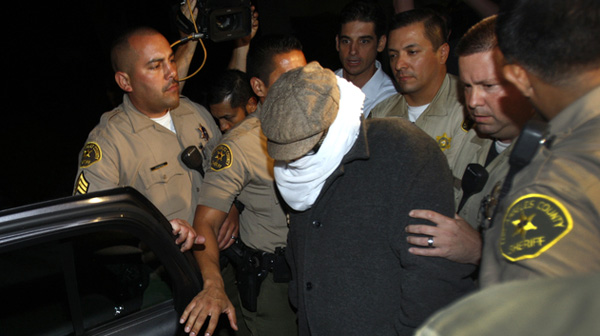
It seems to me, though, that the environment in which such things are commonplace helps to explain why this dramatic photograph hasn't been plastered across news media of all sorts, rightfully becoming a subject of controversy and national soul-searching debate:
September 11, 2012
Things We Read Today, 8
Today: September 11, global change, evolution, economics, 17th amendment, gold standard, and a boughten electorate... all to a purpose.
September 9, 2012

When DON'T You Have First Amendment Rights?
Ok, this one drives me crazy. I see it over and over. It's with the First Amendment to the US Constitution and most people believe it simply means (among other things) that they have free speech to say anything they want. Period. Except that's not really what it says or what it means. Let's quote it:
Congress shall make no law respecting an establishment of religion, or prohibiting the free exercise thereof; or abridging the freedom of speech, or of the press; or the right of the people peaceably to assemble, and to petition the Government for a redress of grievances.Really the part that I'm referring to is the first five words, "Congress shall make no law." That means that the US government may not pass a law that will restrict your free speech. That does not mean that your speech can't be restricted by a non-government entity. That does not mean you could come into my home, start spouting off about something and claim "First Amendment rights" when I tell you to shut up.
I see this all the time, but here's another example in a letter that NFL player Chris Kluwe wrote (warning: much of the language is "adults only") to a local pastor who'd responded to another NFL player's support for same sex marriage.
As I suspect you have not read the Constitution, I would like to remind you that the very first, the VERY FIRST Amendment in this founding document deals with the freedom of speech, particularly the abridgment of said freedom. By using your position as an elected official (when referring to your constituents so as to implicitly threaten the Ravens organization) to state that the Ravens should "inhibit such expressions from your employees," more specifically Brendon Ayanbadejo, not only are you clearly violating the First Amendment, you also come across as a narcissistic fromunda stain. What on earth would possess you to be so mind-boggingly stupid? It baffles me that a man such as yourself, a man who relies on that same First Amendment to pursue your own religious studies without fear of persecution from the state, could somehow justify stifling another person's right to speech.A local pastor is using his position as a pastor and as an elected official to put pressure on a professional sports team to espouse his own views is not a violation of the First Amendment. It's lobbying. It's politics. It may be slimy. But it has nothing to do with the First Amendment.
Similarly, I see this all the time, whether it's on Facebook when someone vents or expresses their opinion on something that someone else disagrees with and I've the the response as "Hey, I have First Amendment rights to say it!" Sorry pal, the First Amendment isn't in play here.
Also similarly, employees might speak out negatively against their employer and when the employer tries to respond, I've seen the employee claim First Amendment rights. Sorry, doesn't apply. Read the first five words.
July 19, 2012
Credit for Building, Blame for Dividing
President Obama's teleprompter style has been the subject of substantial (often mocking) critical commentary, and with some justification, as this nearly parodic 2010 video from a Virginia classroom proves:
Given recent political events, one can sympathize with the desire of public officials to avoid extemporaneous speech. In a world in which one's every public utterance can be recorded, scrutinized, and exploited, one can't rely on an audience's capacity to get your drift and give you the benefit of the doubt. And it's all to easy to blurt out a sentence such as the now infamous, "If you've got a business, you didn't build that."
Predictably, in the realm of commentary, the debate has moved to the meta matter of whether commentators are deliberately misconstruing the President's meaning. On Slate, Dave Weigel charitably infers "a missing sentence or clause" that Obama neglected to utter because he was "rambling." On Reason, Tim Cavanaugh rejoins that "at some point it helps to look at that thing above the subtext, which is generally known as 'the text.'"
November 24, 2011
Happy Thanksgiving
If not for the determination of Sarah Hale, maybe we wouldn't be stuffing ourselves, watching football and, um, actually giving thanks together, as a nation, today. It was she who wrote a letter to Abraham Lincoln urging him to call for a national day of thanksgiving.
From Sarah J. Hale to Abraham Lincoln*, September 28, 1863Private
Philadelphia, Sept. 28th 1863.
Sir.--
Permit me, as Editress of the "Lady's Book", to request a few minutes of your precious time, while laying before you a subject of deep interest to myself and -- as I trust -- even to the President of our Republic, of some importance. This subject is to have the day of our annual Thanksgiving made a National and fixed Union Festival.
You may have observed that, for some years past, there has been an increasing interest felt in our land to have the Thanksgiving held on the same day, in all the States; it now needs National recognition and authoritive fixation, only, to become permanently, an American custom and institution.
Enclosed are three papers (being printed these are easily read) which will make the idea and its progress clear and show also the popularity of the plan.
For the last fifteen years I have set forth this idea in the "Lady's Book", and placed the papers before the Governors of all the States and Territories -- also I have sent these to our Ministers abroad, and our Missionaries to the heathen -- and commanders in the Navy. From the recipients I have received, uniformly the most kind approval. Two of these letters, one from Governor (now General) Banks and one from Governor Morgan** are enclosed; both gentlemen as you will see, have nobly aided to bring about the desired Thanksgiving Union.
But I find there are obstacles not possible to be overcome without legislative aid -- that each State should, by statute, make it obligatory on the Governor to appoint the last Thursday of November, annually, as Thanksgiving Day; -- or, as this way would require years to be realized, it has ocurred to me that a proclamation from the President of the United States would be the best, surest and most fitting method of National appointment.
I have written to my friend, Hon. Wm. H. Seward, and requested him to confer with President Lincoln on this subject As the President of the United States has the power of appointments for the District of Columbia and the Territories; also for the Army and Navy and all American citizens abroad who claim protection from the U. S. Flag -- could he not, with right as well as duty, issue his proclamation for a Day of National Thanksgiving for all the above classes of persons? And would it not be fitting and patriotic for him to appeal to the Governors of all the States, inviting and commending these to unite in issuing proclamations for the last Thursday in November as the Day of Thanksgiving for the people of each State? Thus the great Union Festival of America would be established.
Now the purpose of this letter is to entreat President Lincoln to put forth his Proclamation, appointing the last Thursday in November (which falls this year on the 26th) as the National Thanksgiving for all those classes of people who are under the National Government particularly, and commending this Union Thanksgiving to each State Executive: thus, by the noble example and action of the President of the United States, the permanency and unity of our Great American Festival of Thanksgiving would be forever secured.
An immediate proclamation would be necessary, so as to reach all the States in season for State appointments, also to anticipate the early appointments by Governors.***
Excuse the liberty I have taken
With profound respect
Yrs truly
Sarah Josepha Hale,
Editress of the "Ladys Book"
[Note * ID: Sarah J. Hale, a poet and novelist, became editor of the Ladies' Magazine in 1828. In 1837 the Ladies' Magazine was sold and became known as the Lady's Book. Hale served as editor of the Lady's Book until 1877. During her tenure as editor, Hale made the magazine the most recognized and influential periodical for women. Hale was involved in numerous philanthropic pursuits and used her position as editor to advocate the education of women.]
[Note ** Nathaniel P. Banks and Edwin D. Morgan]
[Note *** On October 3, Lincoln issued a proclamation that urged Americans to observe the last Thursday in November as a day of thanksgiving. See Collected Works, VI, 496-97.]
July 4, 2011

Happy Independence Day...
...remembering too that it is a very serious day.
February 13, 2011
Make Sure One set of Rights doesn't trump Another
We hear a lot of the rights-based arguments being made in favor of same-sex marriage hereabouts, including the call to RI Founder Roger Williams and the "separation of church and state". The arguments for religious liberty have seemed muted in the coverage of the debate. In today's ProJo, Professor Robin Wilson (co-editor of the book Same-Sex Marriage and Religious Liberty: Emerging Conflicts) explains how RI's proposed gay marriage laws do a bad job of ensuring religious liberty, stating, "Every other state law authorizing same-sex marriage provides more protection..." He also explains that, to his mind, religious exemptions would go a long way towards a compromise solution:
Exemptions provide a middle way, respecting both the interests of same-sex couples and religious liberty. By avoiding a winner-takes-all outcome, exemptions turn down the temperature on a contentious issue.He gives examples of such exemptions contained in other same-sex marriage laws:Exemptions also serve the interests of same-sex marriage supporters by taking a powerful argument against same-sex marriage away from opponents.
• a religiously affiliated group that owns a reception hall limit its space to celebrating only traditional marriages when to do otherwise would violate their religious tenets, a basic protection provided by every same-sex marriage statute outside Rhode Island.In addition to such institutional safeguards, Wilson explains that protections for religious individuals--in the spirit of Roger Williams--should also be included:• a religiously affiliated adoption agency place children only with heterosexual married couples so long as they don’t receive government support, as Connecticut did.
• religiously affiliated fraternal organizations, such as the Knights of Columbus, limit insurance coverage to spouses in traditional marriages, as Connecticut and Vermont allow.
• a religiously affiliated organization extend spousal benefits only to individuals in marriages recognized by its faith, as New Hampshire, Connecticut, and Vermont have all done....
Without specific protections, religious organizations that step aside from celebrating same-sex marriages may be subject to private lawsuits under laws prohibiting discrimination on the basis of sexual orientation or marital status. And these organizations may face stiff penalties from the government.
As broad as the exemptions enacted elsewhere are, they leave out much-needed protections for individuals. Judges, justices of the peace, marriage-license clerks, and individuals in ordinary commerce — bakers, photographers, caterers — who prefer for religious reasons to step aside from same-sex marriages should be allowed to do so when no hardship will result to same-sex couples.I don't think that sincere religious opponents to same-sex marriage will be mollified by such pragmatic compromises, however. But politicians might.
December 29, 2010
Beware Too-Efficient Government
Over on the WPRI site, Ted Nesi is running a series of "Dear Mr. Chafee" essays by "five of the state’s smartest citizens." I'll admit that I'm a bit suspicious of his claim — inasmuch as I'm on the list — but Tom Sgouros, who penned the first in the series is surely among the more intelligent on Rhode Island's far left. Of course, he therefore more clearly enunciates the error in progressive thinking:
... lurking under most of these issues is one big issue: the relationship between the state and the cities and towns. Our governments exist to provide a set of services we all need. The strange thing is how we think that having governments constantly at odds with each other is the most efficient way to deliver those services.
In the minds of Sgouros's ilk, the American experiment in government — democracy, checks and balances, and all that — has either been proven a failure or perhaps should never have been attempted. To Sgouros, "governments exist to provide a set of services." To the founders who signed the Declaration of Independence, "Governments are instituted among Men" to secure "certain unalienable Rights." The founders knew that a government empowered to be efficient was empowered to — and would surely find reason to — oppress.
What's astonishing is that Sgouros cites evidence that ought to speak against centralization for just the opposite, using Central Falls as an example:
...would the mayor have made the bad decisions he made without seeing the state as a separate party able to bail him out ...?
The only way increasing the centralized hand would decrease mayors' inclination to pass bucks upward would be if the leaders of local communities weren't elected by their communities, but appointed by the state. That is, if they were accountable to the state for their positions. The American experiment meant to make government accountable to the people, but in the name of efficiency, Sgouros has already discarded such notions. It shows in his terrible understanding of how democracy is structured to function:
... the forms of cooperation have to become part of the government, since a "system" that depends on the good will of this mayor or that governor isn't a system at all.
I shiver to contemplate what "the forms of cooperation" might be, but I also shiver to think that voters actually believe that elected officials' core motivation should be "good will." Many do, of course, and many of them probably share Sgouros's worldview. After all, he's happy to rely on the good will of state legislators and leaders — perhaps a national technocracy — although that's largely because he trusts his allies to control them.
What voters ought to trust in is the desire of leaders to stay in office and their realization that the people are empowered to remove them. The closer those leaders are to the people who can vote them out of a job, the more effective that mechanism will be. That those higher up the chain, at the state and national levels, have made a practice of bailing leaders out when they've failed as miserably as in Central Falls does not in any way suggest that centralized government will be more accountable.
December 17, 2010

The altered terms of the political debate in America
It is the day after the 237th anniversary of the Boston Tea Party. How appropriate.
Over most of our lifetimes, the terms of the political debate were centered around who would give more goodies to the American people. Human nature being what it is, most people gladly took whatever the government gave them. Few thought seriously about the coercive nature of those governmental actions and how they created new behavioral incentives that altered future outcomes, adversely impacting our political and economic liberties. The Democrats regularly won that debate against what I used to call the (former Republican minority leader in the House) Bob Michel Republicans who offered no alternative visions of liberty and the proper role of government in our lives. The Republicans lost in large part because all they stood for was Democrat-lite spending. When you can have the whole thing, why settle for a partial handout?
Then, at points during the last decade, Republicans in the White House and Congress decided to spend like drunks and do some bailouts. From a branding standpoint, the impact was significant because the differences between the two parties on domestic economic issues became largely indistinguishable. At least until Obama, Reid and Pelosi took over.
The Obama administration and Democratic Congress during the last two years made everyone else before look cheap by comparison via their massive governmental spending increases, trillion dollar deficits, unaccountable czars, aggressive regulatory actions, and governmental bailouts or takeovers of various parts of the economy - especially Obamacare.
The impact of the overreach was two-fold:
First, by trying to have the government take over control of many parts of our life via aggressively statist policies, the American people's instinctive love of liberty arose in rebellion.
Second, the trillion dollar deficits for as far as the eye can see - together with the looming bankruptcies of Social Security, Medicare, and certain states and local governments, including their pension programs - merged with the visible consequences of similar spending/debt crises in Europe to raise the specter that there could be ultimate financial consequences to our country's well being in the not-so-distant future that would destroy the America we know and eliminate the American Dream for our children and their children.
The net effect is that the terms of the political debate in America were fundamentally altered in recent times, culminating so far in the 2010 election results, the mandate in Obamacare being declared unconstitutional, and rejection of this week's omnibus bill in the Senate. The debate is no longer about who can hand out more goodies. The debate is now about liberty and financial solvency.
What we don't yet have answers to is exactly how the altered debate will translate into truly different outcomes. Will there be a modified public understanding of the proper role of government in our lives and what new government policies would be required to reflect that modified role? Or is there still enough status quo inertia that we will hurtle off a cliff and be forced to live with financial insolvency and statist public policies that continue to take away our liberty?
It is also not yet clear whether either major political party is capable of adapting to the new terms of the political debate. If they cannot, their role in national politics will be marginalized over time because the status quo is unsustainable. There will likely be much turmoil before it all settles out but I am hopeful that, as part of the oft-messy process of change, there can be a great reawakening of our body politic that helps us rediscover the true meaning of liberty and develop a deepened attachment to the limited and constitutional government principles given to us by our Founders. We all have to admit that there has never been a period during our lifetimes with more public discussion about the US Constitution and its meaning.
As lovers of liberty, our obligation is to contribute regularly to this ongoing civic debate by offering both reasoned philosophical ideas - as we seek to persuade people who are open to such exchanges - and new policies - where we are prepared to do battle in the political trenches, as necessary, to implement the ideas.
Continue reading "The altered terms of the political debate in America"November 10, 2010
Letting People Help Themselves, and Each Other
The line that I've italicized from an article by John Miller that profiled then-Senate-candidate Marco Rubio in an October issue of National Review helps to explain why Rubio won, and why conservatives are so excited about it:
Rubio's favorite subject is American exceptionalism. It's at the heart of virtually everything he says, whether he's addressing a classroom of college students at Southeastern University in Lakeland or trying to summarize his candidacy in the one minute Univision allotted for closing remarks. "America is not just different, America is better," he says. "People didn't vote for a left-of-center, Western European social democracy — and that's not what Obama sold us, either." He warns that if the United States stays on its present course, debt and taxes will sap the entrepreneurial spirit that has defined it from the start. "Big government doesn't hurt the people who have it made," he says. "Big government wipes out the people who are trying to make it."
We've particular reason to take that assertion to heart, in Rhode Island, because the policies that are strangling the state aren't harming the very wealthy (as local progressives like to claim) so much as the young and ambitious who wish to build something for themselves, their families, and their communities. As a consequence, such people have been fleeing the state for years, and there's no hope of recovery unless that trend is reversed.
October 28, 2010
Welfare queens and their pimps: Why the November 2 election matters
They come in all shapes and sizes.
Don't like any of them. Yes, indeed, not then and not now (and now).
The labels or times may change but not the fundamental issue that any government big enough to give you all you want is big enough to take it all away. More on bizarre incentives created by campaign finance reform, where the focus is on the symptoms but not the root cause, and crony capitalism, where the big and powerful feed at the enlarged government trough at the expense of those who lack comparable resources to buy favors.
If we truly treasure liberty in America, then next Tuesday's vote is the first major step toward reclaiming it. Our freedom is never safe, especially when there is a bloated government filled with politicians and bureaucrats who don't recognize and honor the core principles of our Constitution.
ADDENDUM #1:
How about some "old-time" reflections that are actually substantive and suggest a different view of America and public policies?
A Call to Action: Responding to Government Being Neither Well-Meaning Nor Focused on the Public Interest; be sure to follow the links
"Who You Gonna Call?" The Little Platoons
Lawrence Reed on Seven Principles of Sound Public Policy
Challenging the increasing momentum toward a nanny state
Summing it up -
Roger Pilon from a 2002 Cato Institute publication, as quoted in the American Exceptionalism link:
We are all created equal, as defined by our natural rights; thus, no one has rights superior to those of anyone else. Moreover, we are born with those rights, we do not get them from government - indeed, whatever rights or powers government has come from us, from "the Consent of the Governed." And our rights to life, liberty, and the pursuit of happiness imply the right to live our lives as we wish...to pursue happiness as we think best, by our own lights...provided only that we respect the equal rights of others to do the same. Drawing by implication upon the common law tradition of liberty, property, and contract...its principles rooted in "right reason"...the Founders thus outlined the moral foundations of a free society…In the end, however, no constitution can be self-enforcing. Government officials must respect their oaths to uphold the Constitution; and we the people must be vigilant in seeing that they do. The Founders drafted an extraordinarily thoughtful plan of government, but it is up to us, to each generation, to preserve and protect it for ourselves and for future generations. For the Constitution will live only if it is alive in the hearts and minds of the American people. That, perhaps, is the most enduring lesson of our experiment in ordered liberty.
ADDENDUM #2:
The bottom line from 2006:
I hope the Republicans lose control of the House of Representatives in tomorrow's election....My disgust with the Republican Congress is intense...
...it is a time to focus on the big picture:
The current Republican party needs some time in the wilderness in order to rediscover its currently lost connections to beliefs in limited government, to the defense of freedom and ordered liberty. Hopefully, they can find some new leaders with principles in time for the crucial 2008 elections.
And what could be better for the American people than to see the House be led for two years by a bunch of left-wing lunatics, to experience a sampling for 2 years before 2008 of what little the Democrats can offer during a time when our country is engaged in a world war with Islamic fascists dedicated to destroying America.
The overriding problem here is we have two political parties who stand for nothing but either the retention or gaining of political power for the sake of power itself...
Well, the Democrats under Obama have indeed stood for something, an overbearing statism largely disconnected from principles of liberty and the rule of law. So we have belatedly tried the left-wing lunatic model for the last 2 years. Let's now send those statists packing on November 2 and hope the Republicans learned something during their time in the wilderness.
The bottom line in 2010 is that until enough people get serious about dismantling much of the engorged government and returning rights to the people, none of this will amount to more than rearranging chairs on the USS Titanic.
But that doesn't have to be our future, if we have the will and courage as a nation to chart a new course.
ADDENDUM #3:
...This isn't a wave, it's a tidal shift—and we've seen it coming for a long time. Remarkably, there have been plenty of warning signs over the past two years, but Democratic leaders ignored them. At least the captain of the Titanic tried to miss the iceberg. Congressional Democrats aimed right for it...But none of this means that Republicans are winning. The reality is that voters in 2010 are doing the same thing they did in 2006 and 2008: They are voting against the party in power.
This is the continuation of a trend that began nearly 20 years ago. In 1992, Bill Clinton was elected president and his party had control of Congress. Before he left office, his party lost control. Then, in 2000, George W. Bush came to power, and his party controlled Congress. But like Mr. Clinton before him, Mr. Bush saw his party lose control.
That's never happened before in back-to-back administrations. The Obama administration appears poised to make it three in a row. This reflects a fundamental rejection of both political parties.
More precisely, it is a rejection of a bipartisan political elite that's lost touch with the people they are supposed to serve. Based on our polling, 51% now see Democrats as the party of big government and nearly as many see Republicans as the party of big business. That leaves no party left to represent the American people.
Voters today want hope and change every bit as much as in 2008. But most have come to recognize that if we have to rely on politicians for the change, there is no hope. At the same time, Americans instinctively understand that if we can unleash the collective wisdom and entrepreneurial spirit of the American people, there are no limits to what we can accomplish...
Elected politicians also should leave their ideological baggage behind because voters don't want to be governed from the left, the right, or even the center. They want someone in Washington who understands that the American people want to govern themselves.
Angelo Codevilla on America's ruling class - and the perils of revolution.
From two liberal Democrats comes these critical words about Obama:
... In a Univision interview on Monday, the president, who campaigned in 2008 by referring not to a "Red America" or a "Blue America" but a United States of America, urged Hispanic listeners to vote in this spirit: "We're gonna punish our enemies and we're gonna reward our friends who stand with us on issues that are important to us."Recently, Obama suggested that if Republicans gain control of the House and/or Senate as forecast, he expects not reconciliation and unity but "hand-to-hand combat" on Capitol Hill.
What a change two years can bring.
We can think of only one other recent president who would display such indifference to the majesty of his office: Richard Nixon.
We write in sadness as traditional liberal Democrats who believe in inclusion...
Indeed, Obama is conducting himself in a way alarmingly reminiscent of Nixon's role in the disastrous 1970 midterm campaign. No president has been so persistently personal in his attacks as Obama throughout the fall. He has regularly attacked his predecessor, the House minority leader and - directly from the stump - candidates running for offices below his own. He has criticized the American people suggesting that they are "reacting just to fear" and faulted his own base for "sitting on their hands complaining."...
We are also disturbed that the office of the president is mounting attacks on private individuals, such as the founders of the group Americans for Prosperity. Having been forged politically during Watergate - one of us was the youngest member of Nixon's enemies list - we are chilled by the prospect of any U.S. president willing to marshal the power of his office against a private citizen.
The president is the leader of our society. That office is supposed to be a unifying force. When a president opts for polarization, it is not only bad politics, but it also diminishes the prestige of his office and damages our social consensus...
Or, as Charles Krauthammer wrote:
...In a radio interview that aired Monday on Univision, President Obama chided Latinos who "sit out the election instead of saying, 'We're gonna punish our enemies and we're gonna reward our friends who stand with us on issues that are important to us.' " Quite a uniter, urging Hispanics to go to the polls to exact political revenge on their enemies - presumably, for example, the near-60 percent of Americans who support the new Arizona immigration law.This from a president who won't even use "enemies" to describe an Iranian regime that is helping kill U.S. soldiers in Afghanistan. This from a man who rose to prominence thunderously declaring that we were not blue states or red states, not black America or white America or Latino America - but the United States of America.
This is how the great post-partisan, post-racial, New Politics presidency ends - not with a bang, not with a whimper, but with a desperate election-eve plea for ethnic retribution...
David Harsanyi points out how Obama has a lack of faith to trust the American people and is implementing processes that only magnify the power of the nanny state.
Arthur Brooks and Paul Ryan offer an alternative view:
As we move into this election season, Americans are being asked to choose between candidates and political parties. But the true decision we will be making—now and in the years to come—is this: Do we still want our traditional American free enterprise system, or do we prefer a European-style social democracy? This is a choice between free markets and managed capitalism; between limited government and an ever-expanding state; between rewarding entrepreneurs and equalizing economic rewards.We must decide. Or must we?
In response to what each of us has written in the preceding months, we have heard again and again that the choice we pose is too stark. New York Times columnist David Brooks (no relation) finds our approach too Manichaean, and the Schumpeter columnist in The Economist objected that, "You can have a big state with a well-functioning free market."
Data support the proposition that Americans like generous government programs and don't want to lose them. So while 70% of Americans told pollsters at the Pew Research Center in 2009 they agreed that "people are better off in a free market economy, even though there may be severe ups and downs from time to time," large majorities favor keeping our social insurance programs intact. This leads conventional thinkers to claim that a welfare state is what we truly want, regardless of whether or not we mouth platitudes about "freedom" and "entrepreneurship."
But these claims miss the point. What we must choose is our aspiration, not whether we want to zero out the state. Nobody wants to privatize the Army or take away Grandma's Social Security check. Even Friedrich Hayek in his famous book, "The Road to Serfdom," reminded us that the state has legitimate—and critical—functions, from rectifying market failures to securing some minimum standard of living.
However, finding the right level of government for Americans is simply impossible unless we decide which ideal we prefer: a free enterprise society with a solid but limited safety net, or a cradle-to-grave, redistributive welfare state...
More and more Americans are catching on to the scam. Every day, more see that the road to serfdom in America does not involve a knock in the night or a jack-booted thug. It starts with smooth-talking politicians offering seemingly innocuous compromises, and an opportunistic leadership that chooses not to stand up for America's enduring principles of freedom and entrepreneurship.
As this reality dawns, and the implications become clear to millions of Americans, we believe we can see the brightest future in decades. But we must choose it.
October 9, 2010
Where Freedom Must Be Won
I came across this quotation in a brief obituary that National Review printed memorializing Guatemalan freedom and business advocate, and university founder, Manuel Ayau:
I learned that freedom must triumph in people’s minds and hearts before it can make any headway in politics.
Here's an expanded version, from an expanded biography:
Even when we won a battle now and then, we continued to lose the war against statism. I realized that we would make no real progress unless we changed the underlying ideas of the people. We had to take a long-run perspective. I learned that freedom must triumph in people’s minds and hearts before it can make any headway in politics.
Truly, the people of the United States, and Rhode Island especially, would do well to heed these words. One begins to feel, sometimes, as if people do not really believe in freedom — do not trust it, for themselves and even more for others.
We often get heat from the right and left, alike, on Anchor Rising, because we're not so much partisan as ideological. It's always been our objective to change underlying ideas, whatever the more immediate political calculations might appear to require.
July 4, 2010
June 15, 2010

David Potts: Enforcing the Constitution Is Our Responsibility
One of the largest, if not the largest, fault lines dividing American politics today is that between progressives and liberals — and by liberals, I mean conservatives. Since the theme of this post is the need to restore some honesty to philosophical debate, I am starting by attempting to reclaim the word "liberal" from the radicals who hijacked it early in the twentieth century.
How can someone be a conservative and a liberal at the same time? Because the definition of "conservative" varies from society to society, since in each society, those who call themselves conservative are seeking to conserve institutions and traditions that are unique to that society. In the United States, the values that conservatives seek to preserve are classically liberal — individual liberty, limited government, and the rule of law. By contrast, the modern left in America identifies itself with collectivism, pragmatism, and an activist government. These values make up what used to be called "progressivism," a term that many people on the left, including Hillary Clinton are trying to reclaim.
The distinctions between liberals, conservatives, and progressives are interesting, but not nearly as important as developing an honest appraisal of the Constitution and the irrelevance of this document to modern American government. For while there is legitimate debate to be had about the proper role of government, no objective, fair-minded observer can come to any conclusion other than that the federal government long ago exceeded the lawful bounds placed upon it by the Constitution, and almost no public officials give any thought whatsoever to whether or not federal programs being debated come within the Constitutional purview of the federal government. In fact, virtually all persons elected to public office today perjure themselves as their first official act, when they take an oath to uphold the Constitution while having absolutely no intention of actually doing so.
At the close of the Constitutional Convention in 1787, a woman famously approached Benjamin Franklin and asked what form of government the convention had provided for the nation, a republic or a monarchy. Franklin replied "a republic — if you can keep it." I've always been fascinated by that quote, because Franklin was clearly placing the responsibility of preserving constitutional government on the citizenry, not on the judiciary or any other branch of the government. The idea of leaving the interpretation of the Constitution solely to any branch of the federal government is ludicrous on its face. The Constitution is the law that regulates the federal government, and giving the federal government the final say on its application is as ridiculous as allowing British Petroleum to interpret the laws and regulations governing offshore drilling. But this is what we citizens have done. We take the latest pronouncements from the Supreme Court as gospel because we are, in the main, constitutionally illiterate. Even in law schools, future lawyers don't study the Constitution; they study “Constitutional Law,” the collection of court decisions that purport to interpret and flesh out the Constitution but instead bury it under a huge pile of judicial manure. In one particularly egregious case, Wickard v. Filburn, the Supreme Court ruled that a farmer who grew wheat without federal permission to feed his own family and livestock could be prosecuted for a federal crime based on Congress' authority over interstate commerce. Note that there was no commerce involved, and the wheat not only did not cross state lines, it never left the farmer's property. When the Supreme Court calls that interstate commerce, it becomes very hard to take the body seriously.
The position of the Constitution today is very similar to that of the Bible in the Middle Ages. The medieval church considered lay people incompetent to read the Bible for themselves. The Bible had been translated from Hebrew and Greek into Latin and, as far as the Church was concerned, that was the way it would stay. Some of the earliest Protestant martyrs, centuries before Martin Luther, were convicted of heresy for the crime of translating scripture into English, German, or some other language that people actually used. People were not supposed to read the Bible; they were supposed to listen to whatever the clergy told them about the Bible and accept that as holy writ.
Among many people in the United States, today, the Constitution is seen as equally dangerous in the hands of the hoi polloi. Last year, the Rhode Island Tea Party was threatened with expulsion from the Bristol Fourth of July Parade for the crime of passing out booklets that contained the Constitution and the Declaration of Independence. One publisher is currently selling a copy of the Constitution with the philosophical equivalent of the surgeon general's warning on the first page. The disclaimer states, "This book is a product of its time and does not reflect the same values as it would if it were written today. Parents might wish to discuss with their children how views on race, gender, sexuality, ethnicity and interpersonal relations have changed since this book was written before allowing them to read this classic work."
Benjamin Franklin said "a republic — if you can keep it." As with many things, the ultimate responsibility for the performance of government rests with us, the electorate. It is up to us to educate ourselves about our Constitution and to measure the performance of our elected officials against it. I suspect many Americans would just as soon junk the Constitution and continue on our present path, but they should at least consider the consequences and make that decision deliberately. If we pretend that we are currently governing ourselves according to the Constitution, then we are just lying to ourselves. Finally, there is very little point in repeatedly criticizing elected officials if the voters are unwilling to do anything about their actions. Politicians may be a collection of crooks and poltroons, but we hired them.
May 15, 2010
Challenging the increasing momentum toward a nanny state
It seems increasingly relevant so here is a re-run of a February 7, 2009 post, with some updates:
As Obama, Pelosi and Reid accelerate the implementation of statist practices in America - building on what Bush started - it is helpful and necessary to reacquaint ourselves with fundamental economic principles and some specific significant issues animating today's public debate.
FUNDAMENTAL ECONOMIC PRINCIPLES
The 17-blog post series below was originally put together in 2006 and contains excerpts from the writings of Thomas Sowell, Reason magazine, Bruce Caldwell, Friederich Hayek, Milton Friedman, Arthur Seldon, Gordon Tullock, Jane Shaw, Lawrence Reed, The Freeman magazine, Leonard Read, Donald Boudreaux, John Gray, Bertrand de Jouvenel, and Michael Novak, with links to others like Walter Williams, David Boaz, and David Schmidtz:
No matter how emphatically these politicians rant and rave in their effort to re-write history, they cannot re-write the basic laws of economics. As a Reverend once said, those chickens will come home to roost at some point. The only question is when and how big a price we will pay when it happens.
PRIMERS ON ECONOMICS
As some of the above posts note and as further ammunition for the public debate, these books are excellent primers on important economic topics:
- James Gwartney et al - Common Sense Economics: What Everyone Should Know About Wealth and Prosperity
An excellent site for articles, blogging, and podcasts on a broad range of economic issues is Library of Economics and Liberty.
Furthermore, the budding public debate in America touches on these significant issues, highlighted below and drawing on the 17 blog posts:
Continue reading "Challenging the increasing momentum toward a nanny state"April 29, 2010
Who gets to play God?
Now, what we're doing, I want to be clear, we're not trying to push financial reform because we begrudge success that's fairly earned. I mean, I do think at a certain point you've made enough money.
What does "success fairly earned" or "enough money" mean?
Who defines "success fairly earned" or "enough money"?
What if different people define "success fairly earned" or "enough money" differently?
Who defines the consequences of having more than "enough money"?
Who enforces such consequences?
If anyone thinks the definition or consequences of "enough money" is unjust, to whom do they turn for relief?
In other words, who gets to play God?
Any way you cut it, implementing policies consistent with Obama's words will require coercive actions that diminish liberty. There seems to be a certain amnesia about the coercive nature of government. Of course, it might be reasonable to say there is no amnesia for people who never recognize coercion because they have always sought power more than they have loved liberty.
On a more practical level, Nobel Laureate Hayek wrote about the impossibility of efforts to centrally plan such "solutions" in the first place in his seminal 1945 paper entitled The Use of Knowledge in Society. Glenn Reynolds referenced the paper in a recent editorial:
...The United States Code - containing federal statutory law - is more than 50,000 pages long and comprises 40 volumes. The Code of Federal Regulations, which indexes administrative rules, is 161,117 pages long and composes 226 volumes.No one on Earth understands them all, and the potential interaction among all the different rules would choke a supercomputer. This means, of course, that when Congress changes the law, it not only can't be aware of all the real-world complications it's producing, it can't even understand the legal and regulatory implications of what it's doing.
There's good news and bad news in that. The bad news is obvious: We're governed not just by people who do screw up constantly, but by people who can't help but screw up constantly. So long as the government is this large and overweening, no amount of effort at securing smarter people or "better" rules will do any good: Incompetence is built into the system.
The good news is less obvious, but just as important: While we rightly fear a too-powerful government, this regulatory knowledge problem will ensure plenty of public stumbles and embarrassments, helping to remind people that those who seek to rule us really don't know what they're doing.
If that doesn't encourage skepticism toward big government, it's hard to imagine what will.
ADDENDUM #1:
J.P. Freire: Obama made $5m in 2009 and tells us we've made enough?
ADDENDUM #2:
Kyle Wingfield: Exactly who 'makes enough money' in Obama's eyes?
..."I want to be clear, we're not trying to push financial reform because we begrudge success that's fairly earned. I mean, I do think at a certain point you've made enough money. But part of the American way is you can just keep on making it if you're providing a good product or you're providing a good service. We don't want people to stop fulfilling the core responsibilities of the financial system to help grow the economy."The second sentence is the one that defines "fairly earned" for Obama. The man who as a candidate spoke of "spreading the wealth around" has found a matter he considers within his pay grade: other people's pay.
ADDENDUM #3:
Neo-Neocon: Obama and Sowell on who can tell when people have made enough money?
April 16, 2010
Paranoia, it's the American Way
As Rich Lowry explains in his latest column, we Americans are perpetually paranoid about our government, whether it's the liberal paranoia throughout the Bush years (Patriot Act, world hegemony) or the right wing paranoia amongst conservatives in the Clinton years (Waco, domestic anti-terrorist laws post-Oklahoma City). Lowry explains that our paranoid view of government has been in our "DNA" since the Founding (and before).
As Bernard Bailyn demonstrates in his classic, The Ideological Origins of the American Revolution, our forebears prized the thought of the 18th-century “country” opposition in England, which considered the government a clear and present danger to liberty — corrupt, conspiratorial, and insatiable.Lowry's analysis of Bailyn's thesis is spot on and also helps explain why we Americans sometimes tend to buy into conspiracy theories, too. Continue reading "Paranoia, it's the American Way"America’s leaders viewed Revolutionary events through this prism. “They saw about them,” Bailyn writes, “not merely mistaken, or even evil, policies violating the principles upon which freedom rested, but what appeared to be evidence of nothing less than a deliberate assault launched surreptitiously by plotters against liberty, both in England and in America.”
This is the taproot of American paranoia. It’s not in status anxiety, or economic dispossession, or racism: It’s in flat-out distrust of governmental authority. As the Patriot Act shows, in America even the statists can summon a robust fear of government. And would we have it any other way? Would we prefer the natural deference to authority of a Japan, or a political culture as favorable to central government as Russia’s?
March 21, 2010
Will Patrick Lynch be Getting a Phone Call Tonight...
...and do we have a new issue in both the Rhode Island Attorney General's and the Governor's races, based on this facebook post from the Attorney General of Texas (h/t NRO)...
Texas attorney general Greg Abbott Facebooks: "I am organizing a conference call tonight for AGs across the country. We will discuss our litigation strategy about the healthcare bill. I will update you on Facebook after the conference call."
March 17, 2010
Making the United States Exceptional Again
Rich Lowry and Ramesh Ponnuru had an excellent cover piece in the National Review before last on the domestic battle over American exceptionalism, which divides pretty conveniently along the current line of left and right. President Obama is obviously a key figure in the dispute.
Not surprisingly, what strikes me is the gargantuan task facing those of us who'd like to defend and reassert the principles on which our nation was founded:
Corporations, meanwhile, are also becoming more dependent on government handouts. Rivalry between business and political elites has helped to safeguard American liberty. What we are seeing now is the possible emergence of a new political economy in which Big Business, Big Labor, and Big Government all have cozy relations of mutual dependence. The effect would be to suppress both political choice and economic dynamism.The retreat from American exceptionalism has a legal dimension as well. Obama's judicial nominees are likely to attempt to bring our Constitution into line with European norms. Here, again, he is building on the work of prior liberals who used the federal courts as a weapon against aspects of American exceptionalism such as self-government and decentralization. Increasingly, judicial liberals look to putatively enlightened foreign, and particularly European, opinion as a source of law capable of displacing the law made under our Constitution.
Liberal regulators threaten both our dynamism and our self-government. They are increasingly empowered to make far-reaching policy decisions on their own — for instance, the EPA has the power to decide, even in the absence of cap-and-trade legislation passed by Congress, how to regulate carbon emissions. The agency thus has extraordinary sway over the economy, without any meaningful accountability to the electorate. The Troubled Asset Relief Program has turned into a honeypot for the executive branch, which can dip into it for any purpose that suits it. Government is increasingly escaping the control of the people from whom it is supposed to derive its powers.
I'd suggest that the Republicans of the Bush years proved that the temptations for corruption and intermedling are too great at the national level. Even the best intentioned of people will find it difficult to resist the urge to reach in and fix every problem in sight — which is to say that they'll convince themselves not to relinquish the power of their offices. The only possibility, that I can see, is a resurgence of attention to local and state government, forcing freedom and federalism back up the tiers of government and pulling authority back toward the people.
January 23, 2010
On Citizens United v. FEC Supreme Court Decision: Reflections from April 30, 2005 on Correcting the Bizarre Incentives Created by Campaign Finance Reform Laws
A nearly five year old blog post, reposted here in response to this week's Supreme Court decision about free speech:
Andrew has a terrific, focused posting entitled First They Came for the Radio Talk Show Hosts... that gets to the heart of the latest fallout from campaign finance reform here in Rhode Island. Once again, we have an example of how legislation has unintended consequences that, in this case, affect our freedom of speech.Dating back to the post-Watergate reforms in the 1970's, I continue to be amazed at how people think it is possible to construct ways to limit the flow of money into politics. And so we have concepts such as hard money, soft money, donation limits by individuals, donation limits by corporate entities, political action committees, 527's, etc.
Like water flowing downhill, money simply finds new ways to flow into politics after each such "reform." Does any rational person really think all these limitations have reduced the influence of money on politics? Surely not. Have all these limitations changed behavioral incentives for people or organizations with money? Quite clearly, as the 527's showed in the 2004 elections. But all we have done is made the flow of money more convoluted and frequently more difficult to trace. Are we better off for all the changes? Hardly. And, the adverse and unintended consequences will only continue into the future.
What can we do differently? Here is an alternative, and arguably more straightforward, view of the world:
1. Government has become a huge business, which means there is a lot of money for various interest groups - of all political persuasions - to grab, some for legitimate reasons and much in the form of pork. Money flows into politics to buy influence because so much is at stake financially. While no one wants to talk about it openly, the flow of large sums of money into politics is yet another unfortunate price we pay for allowing government to become such a pervasive part of our lives. If we truly had limited government, the pressure to buy influence would be much reduced. It is nothing but foolish ignorance to seek limits on the flow of money without first reducing the structural incentives that currently give people an economic reason to buy influence.
2. Since money is going to flow into politics, one way or another, then we should stop setting up barriers to free speech like Morse notes have come out of the latest campaign finance reform law. Rather, why not take all limits off political contributions in America in exchange for requiring ALL details about such contributions be posted in a standardized report format on the Internet within 24 hours of receipt by either an individual politician or by a political party? Total transparency and accountability, unlike today. If a George Soros or a Richard Scaiffe contributes vast monies, anyone paying attention will see it and the public scrutiny will be immediate. No more PAC's, no more 527's, no more hard versus soft money distinctions, etc. Eliminate the incentives to play fundraising games like the alleged misdeeds by Hillary Clinton's Senate campaign.
Such reform even has the potential to weaken the power of incumbents in both parties and create real competition in our political races. Think about Eugene McCarthy in 1968 and Ronald Reagan's various campaigns where each challenged the status quo and all of which were the result of having committed financial sponsors. Today many candidates have to be wealthy so they can spend their own money. Limiting the pool of candidates does not result in a better pool of candidates.
Total transparency and accountability in politics, with the potential for greater competition. Should not those be the policy objectives underlying our campaign finance laws? And, if successfully implemented, wouldn't that be a novel concept?
Of course, it is sadly ironic that achieving such transparency, accountability and competition will only happen if our incumbent politicians vote for new laws. Yet, given their own self-interest, our politicians have no incentive to support such changes and that lessens our freedom as American citizens. Yet another price we pay for big government.
Numerous links to commentaries about the Supreme Court decision can be found in the Extended Entry. If you do nothing else, listen to the Cato Institute video.
Continue reading "On Citizens United v. FEC Supreme Court Decision: Reflections from April 30, 2005 on Correcting the Bizarre Incentives Created by Campaign Finance Reform Laws"November 22, 2009
Also About Refashioning America
A fair number of people who might be said to lean right — libertarians and moderates and such — would do well to consider a review of the current standing of Catholic charities by Archbishop Charles Chaput, of Denver:
When we look closely at Church-state conflicts in America, we see that they now often center on a group of behaviors—homosexual activity, contraception, abortion, and the like—that the state in recent years has redefined as essential and nonnegotiable rights. Critics rarely dispute the Church's work fighting injustice, helping community development, or serving persons in need. But that's no longer enough. Now they demand that the Church must submit her identity and mission to the state's promotion of these newly alleged rights—despite the constant Catholic teaching that these behaviors are personal moral tragedies that can lead to deep social injustices. ...In squeezing the Church and other mediating institutions out of the public square, government naturally assumes more power over the nation's economic and social life. Civil society becomes subordinated to the state. And the state then increasingly sees itself as the primary shared identity of its citizens. But this is utterly alien to—and in fact, an exact contradiction of—what America's founders intended.
Those who find their sympathies drawn to forced assertions of individual liberty have a tendency to miss the ways in which rules that allow for true plurality — even to the point of allowing individuals and organizations to discriminate in ways that we might not like — safeguard their own preferred freedoms. The reason big-government types like the notion that the government is the nation's "shared identity" is that, on that basis, they see a path toward reworking that identity with a direct application of their influence on the government.
It's a dangerously attractive notion to conceive of America's uniqueness as deriving from its non-ethnic unity. We are a nation of laws, to be sure, but that is only a positive, constructive innovation if the laws are not leveraged to define culture in the way that ethnicity traditionally has.
October 16, 2009
Just like a banana republic
Today the Obama administration's "pay czar" demanded that Ken Lewis, Chairman of the Board of Bank of America, work for free. The "czar," Kenneth Feinberg, pressured Lewis not only to forgo all remaining compensation for 2009, but to repay the $1 million he has already received this year. Lewis acquiesced, saying that "he felt it was not in the best interest of Bank of America for him to get involved in a dispute with the paymaster." I'm sure he was right about that.Response to this outrage has been surprisingly muted. In my view, it is hard to imagine anything more un-American than a "pay czar" empowered to order businessmen to work for free.
The main point here is not sympathy for Mr. Lewis, although I am, in fact, sympathetic to him. He is about to retire and will receive a substantial retirement package--only, perhaps, because the pay czar lacked jurisdiction to negate it. But the idea of empowering the federal government to dictate businessmen's compensation based on political favoritism is absolutely chilling.
This episode illustrates the problem perfectly. Lewis took on the federal government by testifying that Fed chief Ben Bernanke and Henry Paulson, a Democrat who was then Secretary of the Treasury, bullied him into committing what was, in effect, an egregious violation of the securities laws. Bank of America was due to close on its purchase of Merrill Lynch, and Lewis knew that Merrill's value was plummeting. Lewis testified under oath that Paulson and Bernanke threatened to fire the entire management and board of Bank of America, including Lewis, if Lewis backed out of the Merrill deal or communicated to the bank's shareholders what a bad deal the purchase had become.
So, according to Lewis, the federal government forced him to violate his duty to his shareholders in order to advance the government's objectives. The feds were unhappy with Lewis's blowing the whistle on their actions, which I believe would have been criminal if carried out by private citizens. Bernanke, at least, denied Lewis's version of events.
So Lewis took on the feds, and now he's paying the price. The Obama administration has taken away his entire salary for 2009. Political payback, or just a coincidence? In a banana republic, you never know.
Where is the outrage from those who love liberty? In a banana republic, your "freedom" only lasts as long as you are favored by those in power. Some definition of freedom; it is certainly not the historic definition in America.
September 17, 2009
Constitution Day
Remember, today is Constitution Day, so take some time and reacquaint yourself with it. Here's a head start:
PreambleHeck, why not print it out...or you can buy a fancy pocket Constitution (just don't hand it out at the Bristol Parade, ok?).We the People of the United States, in Order to form a more perfect Union, establish Justice, insure domestic Tranquility, provide for the common defence, promote the general Welfare, and secure the Blessings of Liberty to ourselves and our Posterity, do ordain and establish this Constitution for the United States of America.
September 16, 2009
Is limited government still a viable method of governance in America?
Obama has stirred a national debate about liberty and the proper role of government - especially the meaning of limited government.
Lurking unaddressed in that debate is a key point about whether limited government, as enshrined in our Constitution, is still a viable method of governance in America.
William Voegeli raises that point in his NR review (available for a fee) of Steven Hayward's book, The Age of Reagan: The Conservative Counterrevolution, 1980–1989:
...Hayward shares, and deftly explicates, Reagan’s belief that opposing Communism abroad and opposing the welfare and regulatory state at home were, in fact, the same fight, the one to protect inherently tenuous liberty from vastly ambitious and, thus, vastly dangerous government. Reagan, says Hayward, insisted on "tracing a linkage between the corruption of Soviet Communism and the weakness of domestic liberalism." That link, according to the first volume of The Age of Reagan, was "liberalism’s lack of a limiting principle." Its absence has rendered modern American politics a contest between the adherents of limited and of unlimited government. As Hayward explains: "The premise of the administrative state is that our public problems are complicated, with 'no easy answers,' whose remedy requires sophisticated legislation and extensive bureaucratic management. Anyone who says otherwise (like Ronald Reagan) is a 'simpleton.' But the creed of the administrative state makes the idea of citizen self-government seem quaint or obsolete, and it causes our government to be remote and esoteric to average citizens."Last year, Sean Wilentz wrote: "It should be clear that mistakes and overreaching have hampered liberalism’s evolution." That proposition is clear. What’s not clear, confirming the lack of a limiting principle, is what liberalism thinks its overreaching has reached over — what constraints, if any, on the government’s capacity and legitimate authority to diagnose and remedy social problems liberals are prepared to acknowledge and respect.
Voegeli continues:
"Tear down this wall," Reagan said in Berlin in 1987. Two years later, the Communists tore it down. Eliminate the U.S. Department of Education, the Republicans said in their 1980 platform. Two years — and eight years, and 29 years — later, it had only grown larger. "Reagan was more successful in rolling back the Soviet empire than he was in rolling back the domestic government empire," writes Hayward, "chiefly because the latter is a harder problem" (emphasis in the original). It is, twice over, a startling assessment — first, because the Soviet menace seemed, for long decades, like a immutable fact that could never melt away; second, because it is indeed indisputable that the seemingly less audacious goal of curbing the size and influence of the federal establishment proved much tougher...
Actions have consequences and Obama is certainly stirring a vivid national debate on these issues.
Will liberty - expressed in the form of limited government - regain traction as a fundamental principle in America and triumph in this current debate?
September 12, 2009
Succinctly summarizing today's conflict
Mike Pence says it well:
I am Mike Pence. I am from Indiana, and it is an honor to welcome the largest gathering of conservatives in American history to your nation's capitol.There are some politicians who think of you people as astroturf. Un-American. I've got to be honest with you, after nine years of fighting runaway spending here on this hill, you people look like the cavalry to me.
We stand together at a historic moment in the life of the conservative movement and in the life of this great country. The coming weeks and months may well set the course for this nation for a generation. How we as conservatives respond to these challenges, could determine whether America retains her place in the world as a beacon of freedom or whether we slip into the abyss that has swallowed much of Europe in an avalanche of socialism.
While some are prepared to write the obituary on capitalism and the conservative movement, I believe we are on the verge of a great American awakening. And it will begin here and begin now and begin with you.
This Administration and this Congress are getting a badly needed history lesson, starting with just what our founders meant by 'consent of the governed.' If silence is consent, it is now revoked.
We the people, do not consent to runaway federal spending. We the people, do not consent to the notion that we can borrow and spend and bail our way back to a growing America. And we the people, do not consent to government-run insurance that will cause millions of Americans to lose the insurance they have, and that will lead us to a government takeover of health care in this nation.
This week, the president came to this hill and he gave one more speech about the same bad plan. Mr. President, America doesn't want another speech, we want another health care plan that is built on freedom.
And we the people, do not consent to Members of Congress passing thousand-page bills without anybody ever reading them. Members of Congress should be required to read ever major bill that Congress adopts. I've got to be honest with you, I think Members of Congress should read major bills, but I'd be just as happy if some of them read this just a little more often - the Constitution of the United States.
You know, there is a lot of good stuff in there and it reminds us that we are a nation led by the people, and not the elites and the bureaucrats and the politicians. It reminds us that the powers not delegated to the federal government by the Constitution are reserved to the states or to the people.
And nowhere in our Constitution can you find the word 'czar.' It is time Washington, D.C. became a No Czar Zone.
The American people are not happy. But it is not just about dollars and cents. It is about who we are as a nation.
As Ronald Reagan said in 1964, it's about whether 'we abandon the American Revolution and confess that a little intellectual elite in a far-distant capital can plan our lives for us better than we can plan them ourselves.' My money is on the American people. My money is on freedom. My money is on the future.
This great national Capitol is filled with memorials to freedom's heroes. Americans whose faces are carved in bronze, whose names adorn monuments, and just across that river, lie the remains of Americans who paid freedom's price so we could gather here today. In their time, they did freedom's work as citizens and patriots. Now it's our turn.
Let us do as those great Americans we remember in this city have done before: let us stand and fight for freedom. And if we hold the banner of freedom high, I believe with all my heart that the good and great people of this country will rally to our cause, we will take this Congress back in 2010 and we will take this Country back in 2012, so help us God.
July 21, 2009
NEA Leader Compares RI Revolutionary War Hero to My Lai War Criminal
I suppose when you've established a weekly shtick, you gotta keep doing it. Even when the source material is a Revolutionary War hero. So sometimes you overreach. Like comparing Rhode Island's own Revolutionary War hero General Nathanael Greene to Lt. William Calley, the war criminal notorious for his role in the My Lai massacre. It might be even worse if you've made this comparison based on your own ill-informed, uncritical supposition based on an "appeal to authority" (something for which you often criticize others) to a snippet of context-missing history by a well-known partisan historian. Or maybe its worse that you advocate for the state's biggest education entity, the NEA.
Way to set an example!
In his weekly quest to harpoon his very own white whale, NEA's Pat "Ahab" Crowley has decided to deride the topic of Ed Achorn's latest book review/column, war hero Nathanael Greene.
Why not an editorial piece lauding the work of Lt. William Calley? Do you remember Rusty Calley? He led an operation very similar to one that Greene led during the Revolutionary War, though he doesn’t have any schools named after him (at least I hope not.) What was the operation that Calley led? You have probably heard of the My Lai massacre, right?Crowley then quotes from Howard Zinn*:Well, Nate Greene described similar operations in his diary.
{Technically, I believe Greene described the events and the aftermath in a letter to Thomas Jefferson-ed.}
Washington's military commander in the lower South, Nathanael Greene, dealt with disloyalty by a policy of concessions to some, brutality to others. In a letter to Thomas Jefferson he described a raid by his troops on Loyalists. “They made dreadful carnage of them, upwards of one hundred were killed and most of the rest cut to pieces. It has had a very happy effect on those disaffected persons of which there were too many in this country.” Greene told one of his generals “to strike terror into our enemies and give spirit to our friends.” **Based on his reading of Zinn, Crowley wrote:
This wasn’t an attack on soldiers, by the way…..a “raid” on “loyalists” meant an attack on civilians. He cut them to pieces. Greene….Calley…..My Lai…..Wrong. "Loyalists" in this context were male American colonists who enlisted in loyalist militias to fight for the crown. Not women and children. Further, while it is true that Greene noted in his letter to Jefferson that the affect of the "massacre" was beneficial in that it helped to tamp down counter-revolutionary actions, he didn't directly take part in the action, as did Calley at My Lai. In fact, Greene didn't even order the attack!
Zinn isn't the only one to have written about this particular incident. But first, here is some additional context. In late May 1780, before Greene took over command of the Continental forces in the south:
Cornwallis had detached a cavalry force under Lt. Col. Banastre Tarleton, by reputation hard and unsparing, to mop up the last remaining Continentals in that area, some 350 Virginians under Col. Abraham Buford. Tarleton's 270-man force had caught up with Buford's retreating soldiers on May 29 and quickly overwhelmed them. But when the Continentals called for quarter—a plea for mercy by men who had laid down their arms—Tarleton's troops hacked and bayoneted three-quarters of them to death. "The virtue of humanity was totally forgotten," a Loyalist witness, Charles Stedman, would recall in his 1794 account of the incident. From then on, the words "Bloody Tarleton" and "Tarleton's quarter" became a rallying cry among Southern rebels. {These events were dramatized in the movie "The Patriot."-ed.}It was a nasty portion of the war before Greene assumed command in December of 1780. He soon adjusted, which leads to the description given by Zinn, mentioned above. Here's another description of the event.Following Buford's Massacre, as it soon came to be called, guerrilla bands formed under commanders including Thomas Sumter, Francis Marion and Andrew Pickens. Each had fought in South Carolina's brutal Cherokee War 20 years earlier, a campaign that had provided an education in irregular warfare. Soon, these bands were emerging from swamps and forests to harass redcoat supply trains, ambush forage parties and plunder Loyalists. Cornwallis issued orders that the insurgents would be "punished with the greatest vigour."
As Greene headed toward Hillsborough, members of his cavalry, commanded by Col. Henry Lee, surprised an inexperienced band of Tory militiamen under Col. John Pyle, a Loyalist physician. In an action disturbingly similar to Tarleton's Waxhaws massacre, Lee's men slaughtered many of the Loyalists who had laid down their arms. American dragoons killed 90 and wounded most of the remaining Tories. Lee lost not a single man. When he heard the news, Greene, grown hardened by the war, was unrepentant. The victory, he said, "has knocked up Toryism altogether in this part" of North Carolina.Finally, here is another more critical and more contemporary account (from 1822) that also provided some context (this is a very descriptive account and warrants a fuller read):
Many a son, a husband, and a father, met with a most sudden and unexpected fate.In short, Lee stumbled into a group of loyalist militia and a battle ensued in whose aftermath loyalists attempting to surrender or flee were killed. Fighting men get carried away and nasty things happen in war.** And though he condoned the results, Greene had no direct part in the affair. Yet, lest we forget--according to Crowley--Greene is just like Calley. Hardly:The soul sickens at such an instance of unresisted slaughter, and it has called down the severest animadversions upon the conduct of the American party. It is enough to be said of it, that there cannot be found such another instance of military execution inflicted by the American arms in the whole history of the revolution. Far be it from us to stand forth the apologist of unnecessary bloodshed. Yet two things cannot be denied, that the humanity of Pickens was proverbial, and that Colonel Lee was never charged with any other instance of unnecessary severity. Let the extraordinary peculiarity of the circumstances attending the affair be considered, and it will be difficult to point out how such an issue could have been avoided. The first blow would probably be decisive between the parties. Had the enemy been allowed time to deliver their fire, the cavalry would have been prostrated, and that event would have brought destruction upon the whole corps; for Tarleton would soon have been upon the infantry. Nor would the evil have stopped there, the dispersion of this party must have been followed by that of all the detachments on their march to join it. It is appalling to follow up the train of consequences.
Soldiers went berserk, gunning down unarmed men, women, children and babies. Families which huddled together for safety in huts or bunkers were shown no mercy. Those who emerged with hands held high were murdered. ... Elsewhere in the village, other atrocities were in progress. Women were gang raped; Vietnamese who had bowed to greet the Americans were beaten with fists and tortured, clubbed with rifle butts and stabbed with bayonets. Some victims were mutilated with the signature "C Company" carved into the chest. By late morning word had got back to higher authorities and a cease-fire was ordered. My Lai was in a state of carnage. Bodies were strewn through the village.It would be debatable to compare Lee with Calley, nevermind Greene. (Does this mean that everything Crowley does is directly attributable to Bob Walsh?)
All of this context makes Crowley's closing accusation against Achorn all the more laughable.
Your minimalist approach to the history of the founding of our country does it a disservice.This from someone who approaches history as a means to a political end, regardless of the deeper facts and context....which he doesn't care about anyway. For Crowley, history is only valuable as rhetorical ammunition for his ideological shotgun. It doesn't matter if he misses the target, so long as he gets his shot off.
=================================
*Zinn is the favorite historian of many on the left and he is best known for his People's History of the United States of America. He is known for his openly-biased, non-sourced method of doing history. He likes to pull from hither and yon to make his larger ideological points, a method that leaves out important context regarding particular events. Further, because he doesn't include footnotes, he makes it difficult for other historians to check his sources for that context. This is well known in the history field (here, here and here). In other words, Zinn is an important historian (because so many people read him), but one that should be read very carefully: often with another history book for comparison. But hey, he's preaching to a choir member named Crowley who has an Achorn to roast, damn the particulars!
**Crowley left out this part while quoting Zinn: "On the other hand he advised the governor of Georgia 'to open a door for the disaffected of your state to come in...'" I wonder why he left that last sentence out. I guess such nuance would have grayed up Crowley's "Black Hat" caricature of Greene.
***There are several "massacres" recorded and all that I could find involve British troops killing American revolutionaries after they had surrendered (or in their sleep). There was at least one instance of British (and their Native American allies) killing non-combatants (the Cherry Valley or Wyoming Massacre). That doesn't mean there weren't instances of American revolutionaries acting similarly, it's just that a quick survey of sources didn't bring any to light. Though hardly an all-inclusive list, see Cherry Valley, Hancock's Bridge, Fort Griswold (in Groton), and the Baylor Massacre for a fair representation.
July 15, 2009
Not Banned, but Invited?
Well, it appears that the RI Tea Party is not banned from next year's Bristol parade:
[Tea Party treasurer Marina] Peterson said she was given a copy of [Bristol Fourth or July Committee Chairman David] Burns' apology, in which he says:"The Fourth of July Committee regrets and apologizes for any miscommunication to the Rhode Island Tea Party group and assures them that they are not banned from future parades. In addition, it has not been determined that materials were distributed from the Rhode Island Tea Party float," Burns said.
"It is not the policy of the Fourth of July committee to 'ban' floats, marching units or parade participants, the Burns statement said. "The parade units participate in the parade upon invitation only. If a particular organization violates policy the committee would investigate the violation," Burns said.
Funny how explicit statements can become "miscommunications." But note the emphasis on "invitations." On the other hand, note that the chairman was careful to specify that it is of particular relevance whether handouts were made "from the float."
Keep an eye on this one; we may have reason to infiltrate the crowd with Constitutions, yet.
July 14, 2009
The Constitutional Villain Speaks!
Christopher Kairnes, of Warwick, claims — trumpets — responsibility for handing out the pocket Constitutions:
I had nothing to do with the Tea Party float nor did I ride on it. I never talked with the parade committee before the parade nor signed any agreement with it. I am an individual. I report to no one and do not owe anyone an apology for what I have done. If handing out the Declaration of Independence to people who are sitting down on their properties is dangerous, I am guilty of that. ...I walked up and down that parade route with my 11-year-old son twice before the Tea Party float even hit the road, and people were happy to see us. When the float finally did join the parade, I did keep handing out copies of the Pocket Declaration of Independence/U.S. Constitution.
That was when the parade staffer tried to take them out of my hand. I told him I would not let him have them. He tried to grab them again, and at the same time he grabbed my arm. That is when I got loud and told him to back off. He threatened to have the Tea Party float taken off the parade route and have me arrested.
He called a police officer over and I explained to the officer that I was handing out the copies of the Constitution all day and that I was not on the float. He recognized me from earlier and let me go back to it.
With all of the parsing going on about "soliciting" and "entries," Kairnes clarifies that he was soliciting nothing and was associated only in sympathy with the Tea Party float. He also brings us back to the crux reflected in the title of my first post on the topic: A minor civic functionary attempted to confiscate the Constitution.
Apparently, when the back-roads totalitarian was thwarted in this endeavor, he was so incensed that he lashed out at a group that he and his friends (no doubt) didn't like anyway. If that assertion of petty authority isn't corrected, I propose that next year's parade feature several dozen people handing out the books.
July 11, 2009

The Bristol Independence Day Parade, the Leafleters and the Question of Danger
What's confusing is the statement by the parade committee that the handing out of these Constitution leaflets posed a danger.
The leaflets were handed out along the side of the parade, not from the float itself. As I understand, no one was running up to this float to get a leaflet.
In terms of danger, then, what is the difference between this activity and the activity of those who had purchased a vendor's license from the parade committee? Is there some aspect of the leafleters' actions that has not been brought forth?
A Rule Broken and an Opportunity Presented
In the post about the Tea Party ban from the Bristol Independence Day parade, commenter David points to "Float Preparation Requirement" #8 (PDF), which reads as follows:
There will be no distributions or fundraising by any float applicant. No objects of any kind may be thrown, sprayed or otherwise distributed to spectators from any entry (i.e., candy, silly string, snappers, advertisements, etc.) Failure to comply will result in immediate removal from the parade.
I think it's objectively fair to suggest that some ambiguity exists about who counts as an "applicant" and at what distance one ceases to be distributing materials "from any entry" (i.e., float). But let's stipulate that a violation was made. #8 states that removal will be immediate. A subsequent summary states that the organizers may remove inappropriate or dangerous floats from the parade "before or during" the event.
The fact is that Float Committee Chairmain Jim Tavares was clearly aware of the distributions while they were being made. According to the Tea Party group's posting on the parade (see extended entry below), no mention of the problem was made until days later, when Tavares issued the proclamation of a lifetime ban. If those are, indeed, the circumstances, then it appears that Tavares neither followed through with the prescribed punishment nor offered the group a cease and desist warning regarding the booklets, which is curious, given his concern for the public's safety. Considering that the handout was a copy of our nation's founding documents — very relevant to a 4th of July parade, I'd say — a lighter hand would certainly have been justified.
There's a strong odor of political motivation — with a dash of small-town pettiness — to the verdict.
But look at what the various rules appear to suggest: Those associated with a float (apparently indicated by wearing the same t-shirt) cannot hand out literature, even if they walk along the edge of the road. Those who are "soliciting" must apply for licenses at $200 per "runner" or $300 per corner. It seems to me that, if the Bristol Fourth of July Committee does not recant the ban of the Tea Party from placing a float in next year's parade, the group would be perfectly free to stroll the parade route handing out Constitutions, fliers about the controversy, leaflets about the endemic corruption in Rhode Island, and so on.
In fact, I'll propose that we all set loose expectations that we'll help out in the effort in July 2010. (Odds are good that a great many of us will be unemployed, anyway.) Imagine a Tea Party protest–sized group walking alongside every float in the parade, making distributions. Who knows but that somebody among the opposition will plan a counter-protest, and the event can follow the Parade Committee's lead right into a chasm of politically motivated noise.
Continue reading "A Rule Broken and an Opportunity Presented"July 10, 2009
It's OK to be a Yankee Doodle Dandee
I was once part of the band that would be eventually named "George M. Cohan's Own", and I was interested to read about the recent Independence Day weekend unveiling of a new bust of George M. Cohan on Wickenden street. It is a fitting tribute to the man who penned so many patriotic songs.
The Broadway impresario, who provided the American soundtrack for World War I and World War II, is an emblem of a time that can seem impossibly distant for the young and skeptical: a time of unabashed pride in country.I appreciate the work that Fink has done to memorialize Cohan, but I thought that an odd thing to say. We are still free to love America. We always have been. That is, unless we let contemporary politics color our perception, as described in David Scharfenberg's story:He was of an era, said Michael Fink, a Cohan aficionado and professor of English at the Rhode Island School of Design, when freedom meant something other than the opportunity to criticize.
"In my generation," Fink said, "we were free to love America."
Cohan, portrayed by James Cagney in the 1942 biopic Yankee Doodle Dandy, was not the idealized figure of the film. He divorced once. Clashed with the Broadway actors union. He had some warts.Apparently, the "young and liberal-minded" (and I suspect some of the "old") are conflating patriotism with politics, which cheapens the former. America is greater than contemporary political personalities and their policies. We should love America for its ideals--liberty, freedom, opportunity--regardless of whether we think those ideals are being followed or not. Patriotism is love for or devotion to one's country. Not the person who leads it, no matter how magnificent he or she may or may not be.And for the children of the Watergate era, the warts are the thing. Or are they?
The youthful embrace of Barack Obama — still strong seven months into his administration — suggests a longing for a new sort of patriotism. Perhaps not Yankee Doodle Dandy. More critical than that. More reserved.
But something hopeful and proud, nonetheless.
The young and liberal-minded were not free to love America under President Bush. But now, for the hipsters ambling past that bust of George M. Cohan, an opening.
July 9, 2009
Confiscating the Constitution
If nothing else, this illustrates how the celebration of an event can become more about the tradition of celebrating than about the event itself:
In a temper-filled tempest, the Bristol Fourth of July Committee has barred the Rhode Island Tea Party from taking part in the annual Independence Day parade next year — or any other year.Marina Peterson, treasurer of the organization — it opposes government spending and new taxes — said she was told "not to waste the stamp to send in an application" to appear again in the Bristol parade, which the town says dates to 1785 as the oldest continuously observed Fourth of July celebration in the nation.
In the latest march, on Saturday, Tea Party sympathizers handed out copies of the U.S. Constitution as they ran alongside the organization’s first-ever float, a replica of the Beaver, the British ship ransacked by Colonists during the Boston Tea Party, in 1773.
Sounds to me — especially with the RI Tea Party's account in mind — like a local somebody wanted an excuse to exert petty power over a disfavored group — disfavored by those in the staid, corrupt establishment — and took the handouts as an excuse. A more reasonable, civilized approach to dealing with a new participant's inadvertent rule breaking would be a sort of probation at next year's parade. Otherwise one ends up with shocking symbolism like this:
"They endangered public safety," he said. [Float Committee Chairmain Jim] Tavares said he personally confiscated some of the handouts.
Confiscating the Constitution... at the nation's oldest Independence Day parade. Tea Party Treasurer Marina Peterson says that the rules prohibit "solicitation," which does not describe complimentary copies of our founding legal document. Mr. Tavares calls that word games. I expect King George would have agreed; the rules listed online state that "Soliciting along the parade route is illegal unless a license has been obtained from the Fourth of July Committee." Apparently, safety concerns are alleviated through payment of a license tax.
Incidentally, the Bristol Fourth of July Committee's Web site has a wealth of information, such as the general chairman's and parade chairwoman's email addresses.
ADDENDUM:
July 5, 2009
The Grit and Grime of History as Modern Metaphor
The beastliness of tarring and feathering has probably been the most deeply disturbing smack of history as I've worked my way through HBO's John Adams presentation on DVD.
During a childhood vacation, I walked through a wax museum with my parents, and although much of the attraction is lost to my memory, I still remember the figure of a wax dummy hanging from a hook through his molded midriff in a dungeon setting. The associated placard informed visitors that the phrase "off the hook" derived from this particular practice, and I haven't heard or uttered the cliché since without recalling the excruciating sideways arch of the body — as well as the fact that even those who were released before they'd bled to death typically died anyway. Herman Melville's description of the "keel-haul" in White Jacket did me the same service, just barely rescuing the experience of reading the book from status as a lower-magnitude form of torture. Colloquial English — a linguiphile learns over time — is riddled with images that ought not be as lightly uttered as they frequently are.
A reaction to the tarring scene with broader and more subtle application is the constitution of the mob, which drew in even some among our national heroes. One hears of a "mob mentality," but I suspect that it's not quite so monolithic a phenomenon. Some among the group are doubtless bloodthirsty, perhaps relishing the opportunity to taste power as the peasants of Dickens's Paris relished wine — the drip of conviviality — that a broken cask had poured across the filthy cobblestones. Others (the film's Sam Adams) become entranced at the opportunity that the desperate flex of community muscle imports. Still others (John Adams) intuit the danger of testing their own powerlessness and attempt no more than to persuade somebody nearby that the act is barbaric.
It makes us no better, only more fortunate, that such scenes are reduced mainly to metaphors in the modern public square. There was more grit to life, in those days, and the harsher our quotidian experience, perhaps the fewer barriers simple aesthetics can supply against unspeakable displays. Inoculation to us is an inconvenient trip to the pediatrician and a chance of fever. Abigail Adams (in the movie, at least) sat her children down to be sliced across the arm and infected with smallpox puss taken from a dying boy in the doctor's cart outside, with the grim risk for the patients being death. (I'd note, here, the genius of the film's creators in interweaving the emotional threads of the Declaration of Independence with the question of whether all Adams children survive the procedure.) When that is the look of preventative medicine, death by the infection of tar burns mightn't scorch the conscience as deeply.
Still, the grime of plain life through which our forefathers waded does bring into relief some realities of more lasting duration. Throughout most of the four parts that I've watched of the seven, Adams has been away from his family. Upon returning to America well into the late 1880s, he requires his children to introduce themselves from amidst the masses as he stands with an awkward smile on the dock. His history being as yet unwritten, he faced the frustrating drudgery of politics and the fear of failure no less than any who struggle toward some end in the twenty first century. Matters of aptitude and luck certainly contribute to the building up of Great Men and Women, but this portrayal of our nation's founding reminds us that sacrifice and risk, and willingness to accept both, mustn't be disregarded.
In our time of unprecedented leisure and safety from life's fluctuations, the demands of public responsibility aren't offset by the universal difficulty of just living. Mark Steyn sees this dynamic in Sarah Palin's sudden resignation from office:
If you like Wasilla and hunting and snowmachining and moose stew and politics, is the last worth giving up everything else in the hopes that one day David Letterman and Maureen Dowd might decide Trig and Bristol and the rest are sufficiently non-risible to enable you to prosper in their world? And, putting aside the odds, would you really like to be the person you'd have to turn into under that scenario?National office will dwindle down to the unhealthily singleminded (Clinton, Obama), the timeserving emirs of Incumbistan (Biden, McCain) and dynastic heirs (Bush). Our loss.
Whatever the accuracy of Steyn's analysis of this specific story, his theme is worth considering. Public figures who are self-standing in a financial sense and ensconced in a social sphere in the sense of status have a disproportionate advantage when it comes to the personal hazards of office. A rarified clique may liken the snickers of their peers to flogging, but there remains a difference between emotional and physical scars. We can take it as true that the only guillotine public figures need fear is the sharp bite of comedians' monologues, and the modern pillory is a photograph in the ephemeral medium of the tabloids.
For those with the good (and great) fortune of summer manses to which to retreat in shame, the risk may be lightly taken, but to regular folk, the actual modern threats captured in historical metaphors of torture and pain are real enough — apt to be ruinous. For the former, being "off the hook" of public scrutiny means a return to life; for the latter, the wound may yet prove economically fatal.
To whatever extent the difference between the two perspectives is likely to prove unhealthy for our polity, it is exponentially more so for our culture. Though it is now the temper of the cynical to scoff at the notion, Americans once believed of their nation that grit and principle could carry one — rough edges and street creds intact — to the very top. As our civilization advances its technological ability to file down the barbs of life — such that a latter-day John Adams could fly his dear Abigail to the Netherlands for a weekend and stay connected with his children via the Internet — an inequity in the sacrifice that service and striving require may well establish an aristocracy in which the term "representative" joins the list of mere metaphors that once denoted something tangible.
June 8, 2009
After a Difficult Violent Roundtable, Part 3
As I intimated yesterday, conservatives' appropriate fear of populist movements connects with our conviction that the nexus of power and desire ought to be checked. (One can be fearful even of that which is necessary, of course.) During Friday night's all–Anchor Rising Violent Roundtable on the Matt Allen Show, Marc and Matt kicked off a related conversation in which the latter took the position that structures allowing more direct democracy — such as public referenda — ought to proliferate.
The problem with developing a taste for simple majority rule is that the masses know what they want, but not necessarily how to go about getting it or, even less, how to balance competing needs and interests. This isn't to take the line that the dirty common folk lack the intelligence to comprehend cause and effect and the possibility of unintended consequences; the salient factor filters through the mechanics of a movement. However well a given voter comprehends how his own interests might be balanced and what compromises would be tolerable in achieving them, by the time political action builds to critical mass, his interests and negotiable thresholds must be overlaid with thousands of variations.
If a movement is to avoid a fizzle from noise, it must be led. Only in sharp, very specific outrages will large groups of people congeal with minimal guidance to answer a question of public policy. In most cases, a handful of leaders with the time and motivation must sort out the series of binaries by which more subtle decisions are reached — "yes" to this policy, "no" to that one, "yes" to this request, "no" to that demand. When the democracy remains representative, those leaders may be held accountable for the results, even as their daily popularity rises and falls over each answer. When those leaders are as voices in the crowd — shouting out suggestions to which the populist cry returns a "hear, hear" — their accountability dissipates, as does the feasibility of subtlety. It becomes guidance by explosion, not by instruction. A herding of votes.
When it comes to the practical operation of a society, democracy is best enacted in escalating tiers — elections followed by referenda followed by revolution — but always with a philosophical tendency to worry about anarchic expressions of power. A population enthralled with its democratic override is at risk of wielding it too lightly, toward ends that are never adequately articulated until the knots cinch tight.
May 3, 2009
William Allen: George Washington as America's First Progressive
During my undergraduate years, I was fortunate to have Dr. William Allen as an advisor. A truly wonderful man and dear friend.
Here is his talk on his new book entitled George Washington: America's First Progressive. The talk starts at the 6-minute point.
Why is George Washington so important? Allen explains between minutes 11:15-21:00 and what he shares will likely surprise you.
He defines Washington's progressive thought in minutes 21-25.
Between minutes 29:00-30:40, Allen reflects on how the love of liberty is the foundation of the free society and how the love of being one people is the means of preserving it against domestic and foreign assault. He adds that the key to making progressive freedom work is for the American people to understand themselves as one people defined by their love of liberty in order to preserve both liberty and the opportunity for self-government.
The question & answer stage begins at minute 36 and is quite informative as it unfolds. In particular, during minutes 50:00-55:34, he discusses the meaning of liberty, the duties it confers upon us, and the meaning of self-government.
Other books by Dr. Allen:
George Washington: A Collection
The Federalist Papers: A Commentary (Masterworks in the Western Tradition)
The Essential Antifederalist
Works of Fisher Ames
Rethinking Uncle Tom: The Political Thought of Harriet Beecher Stowe
An American patriot talking and writing about our American Founding and heritage.
ADDENDUM
A college classmate just sent me this link to another talk by Dr. Allen on George Washington. The synopsys in the link is also informative, including this excerpt:
George Washington defined progressivism and provided the rationale for its constitutional basis in a vision of self-government: a nation dedicated to and capable of sustaining civil and religious liberty, the intertwined ends of politics as he saw it. For Washington, religious liberty was not a side benefit of independence but rather the objective for which independence was sought.Washington’s political philosophy—radical for his time—was a commitment to the belief that law can never make just what is in its nature unjust. Before the close of the Revolutionary War, he had conceived of a union based on the progressive principle that the American people would qualify for self-government in the sense of free institutions in proportion to their moral capacity to govern themselves by the light of reason. Washington managed the conflicts over the spoils of victory that threatened to fracture the union. Containing this discord "within the walls of the Constitution" may be considered his single greatest achievement...
April 6, 2009
Re: Tea Parties and Federalist 33
From Federalist 33, Andrew pulled this quote:
If the federal government should overpass the just bounds of its authority and make a tyrannical use of its powers ...
It should be emphasized here that the federal government is not justified in doing so even with some noble intent: to revive an economy, to save the planet, to make things more fair ... Indeed, the advancement of good intent, however sincere, is the most insidious reason to exceed or usurp power.
"How can you argue with what we're doing? It's for a good cause." But in the process, what albatross are you saddling someone with? what are you destroying? What damage will you wreak by flexing your power in areas outside of your purview?
Tea Parties and Federalist 33
Here's a little Federalist 33 (scholars believe that Alexander Hamilton was the author) to remind us that, even before the Constitution of the United States of America had been ratified, our Founders were aware that activities like tea parties would be necessary from time to time to keep the government functioning in service of the people…
If the federal government should overpass the just bounds of its authority and make a tyrannical use of its powers, the people, whose creature it is, must appeal to the standard they have formed, and take such measures to redress the injury done to the Constitution as the exigency may suggest and prudence justify.Rhode Island's tax-day tea party is scheduled for April 15, 3:00 - 6:00 pm at the Rhode Island State House.
March 2, 2009
Liberty & the proper role of government in a free society
Obama's budget proposal presents plans which run radically counter to the proper role of government if America is to remain a free society:
...The widespread use of the market reduces the strain on the social fabric by rendering conformity unnecessary with respect to any activities it encompasses. The wider the range of activities covered by the market, the fewer are the issues on which explicitly political decisions are required and hence on which it is necessary to achieve agreement. In turn, the fewer the issues on which agreement is necessary, the greater is the likelihood of getting agreement while maintaining a free society....a good society requires that its members agree on the general conditions that will govern relations among them, on some means of arbitrating different interpretations of these conditions, and on some device for enforcing compliance with the generally accepted rules...most of the general conditions are the unintended outcome of custom, accepted unthinkingly...no set of rules can prevail unless most participants most of the time conform to them without external sanctions...But we cannot rely on custom or on this consensus alone to interpret and to enforce the rules; we need an umpire. These then are the basic roles of government in a free society: to provide a means whereby we can modify rules, to mediate differences among us on the meaning of the rules, and to enforce compliance with the rules on the part of those few who would otherwise not play in the game.
...the organization of economic activity through voluntary exchange presumes that we have provided, through government, for the maintenance of law and order to prevent coercion of one individual by another, the enforcement of contracts voluntarily entered into, the definition of the meaning of property rights, the interpretation and enforcement of such rights, and the provision of a monetary system.
The role of government just considered is to do something that the market cannot do for itself, namely, to determine, arbitrate, and enforce the rules of the game...
Earlier posts here and here discuss what combination of economic freedom and limited government enables liberty for us:
...How can we benefit from the promise of government while avoiding the threat to freedom? Two broad principles embodied in our Constitution give an answer...First, the scope of government must be limited. Its major function must be to protect our freedom both from the enemies outside our gates and from our fellow-citizens: to preserve law and order, to enforce private contracts, to foster competitive markets...By relying primarily on voluntary co-operation and private enterprise, in both economic and other activities, we can insure that the private sector is a check on the powers of the governmental sector...
The second broad principle is that government power must be dispersed...If government is to exercise power, better in the county than in the state, better in the state than in Washington. If I do not like what my local community does...I can move to another local community, and though few may take this step, the mere possibility acts as a check...If I do not like what Washington imposes, I have few alternatives in this world of jealous nations...
...The power to do good is also the power to do harm; those who control the power today may not tomorrow; and, more important, what one man regards as good, another may regard as harm...
The preservation of freedom is the protective reason for limiting and decentralizing governmental power. But there is also a constructive reason. The great advances of civilization...have never come from centralized government...
Government can never duplicate the variety and diversity of individual action...
It is widely believed that politics and economics are separate and largely unconnected; that individual freedom is a political problem and material welfare an economic problem...such a view is a delusion...
Economic arrangements play a dual role in the promotion of a free society. On the one hand, freedom in economic arrangements is itself a component of freedom broadly understood, so economic freedom is an end in itself. In the second place, economic freedom is also an indispensible means toward the achievement of political freedom...
Viewed as a means to the end of political freedom, economic arrangements are important because of their effect on the concentration or dispersion of power...competitive capitalism also promotes political freedom because it separates economic power from political power and in this way enables the one to offset the other...
Because we live in a largely free society, we tend to forget how limited is the span of time and the part of the globe for which there has ever been anything like political freedom: the typical state of mankind is tyranny, servitude, and misery. The nineteenth century and early twentieth century in the Western world stand out as striking exceptions to the general trend of historical development. Political freedom in this instance clearly came along with the free market and the development of capitalist institutions...
History suggests only that capitalism is a necessary condition for political freedom. Clearly it is not a sufficient condition...
The relation between political and economic freedom is complex and by no means unilateral...
As [nineteenth-century, not twentieth-century] liberals, we take freedom of the individual, or perhaps the family, as our ultimate goal in judging social arrangements. Freedom as a value in this sense has to do with the interrelationship between people...in a society freedom has nothing to say about what an individual does with his freedom; it is not an all-embracing ethic...a major aim of the liberal is to leave the ethical problem for the individual to wrestle with. The "really" important ethical problems are those that face an individual in a free society - what he should do with his freedom. There are thus two sets of values that a liberal will emphasize - the values that are relevant to relations among people, which is the context in which he assigns first priority to freedom; and the values that are relevant to the individual in the exercise of his freedom, which is the realm of individual ethics and philosophy.
The liberal conceives of men as imperfect human beings. He regards the problem of social organizations to be as much a negative problem of preventing "bad" people from doing harm as of enabling "good" people to do good...
Fundamentally, there are only two ways of co-ordinating the economic activities of millions. One is central direction involving the use of coercion - the technique of the army and of the modern totalitarian state. The other is voluntary co-operation of individuals - the technique of the market place.
The possibility of co-ordination through voluntary co-operation rests on the elementary - yet frequently denied - proposition that both parties to an economic transaction benefit from it, provided the transaction is bi-laterally voluntary and informed.
Exchange can therefore bring about co-ordination without coercion...
...Political freedom means the absence of coercion of a man by his fellow men. The fundamental threat to freedom is power to coerce...The preservation of freedom requires the elimination of such concentration of power to the fullest extent and the dispersal and distribution of whatever power cannot be eliminated - a system of checks and balances. By removing the organization of economic activity from the control of political authority, the market eliminates this source of coercive power. It enables economic strength to be a check to political power rather than a reinforcement.
Economic power can be widely dispersed...Political power, on the other hand, is more difficult to decentralize...if economic power is joined to political power, concentration seems almost inevitable. On the other hand, if economic power is kept in separate hands from political power, it can serve as a check and a counter to political power...
Obama's budget proposal also runs counter to the philosophical principles underlying the American Founding.
February 7, 2009
Challenging the socialistic onslaught
As Obama, Pelosi and Reid accelerate the implementation of socialistic practices in America - building on what Bush started - it is helpful and necessary to reacquaint ourselves with fundamental economic principles and some specific significant issues animating today's public debate.
FUNDAMENTAL ECONOMIC PRINCIPLES
The 17-blog post series below was originally put together in 2006 and contains excerpts from the writings of Thomas Sowell, Reason magazine, Bruce Caldwell, Friederich Hayek, Milton Friedman, Arthur Seldon, Gordon Tullock, Jane Shaw, Lawrence Reed, The Freeman magazine, Leonard Read, Donald Boudreaux, John Gray, Bertrand de Jouvenel, and Michael Novak, with links to others like Walter Williams, David Boaz, and David Schmidtz:
No matter how emphatically these politicians rant and rave in their effort to re-write history, they cannot re-write the basic laws of economics. As a Reverend once said, those chickens will come home to roost at some point. The only question is when and how big a price we will pay when it happens.
PRIMERS ON ECONOMICS
As some of the above posts note and as further ammunition for the public debate, these books are excellent primers on important economic topics:
- James Gwartney et al - Common Sense Economics: What Everyone Should Know About Wealth and Prosperity
An excellent site for articles, blogging, and podcasts on a broad range of economic issues is Library of Economics and Liberty.
Furthermore, the budding public debate in America touches on 5 significant issues, highlighted below and drawing on the 17 blog posts:
ISSUE #1: UNDERSTANDING THE GREAT DEPRESSION
Since numerous politicians and the media are already trying to re-write the history of the Great Depression so as to justify a significantly larger role for the federal government in our society, we need to arm ourselves for that debate. Here are some good starting points:
Not for the casual reader, here is the book which famously explained how monetary policy was a fundamental cause of the Great Depression:
ISSUE #2: GRASPING THE ACTUAL INCENTIVES WHICH DRIVE GOVERNMENTAL ACTIONS
As part of their argument for a more intrusive government, one of the core arguments of the Left is that interventions by government in the marketplace are somehow more high-minded and of purer intent than private sector actions in the same marketplace.
Part VIII in the above blog series describes public choice theory, which explains the fallacy of that world view. While false, it is nonetheless a pervasive view that holds sway in many minds - even if not articulated explicitly - and has to be tackled directly.
Here are some excerpts from Part VIII about government failure:
...Many economics writers and teachers still present economic systems of exchange between private individuals or firms as "imperfect" and requiring "correction" by government. Most teachers of politics, politicians, and political journalists still present government as well-meaning and able to remove such "imperfections."...In the past many economists have argued that the way to rein in "market failures"...is to introduce government action. But public choice economists point out that there also is such a thing as "government failure."...
...that government is imperfect carries with it two consequences. The first is that imperfections in the market process do not necessarily call for government intervention; the second is a desire to see if we cannot do something about government processes that might conceivably improve their efficiency...
Although public choice economists have focused mostly on analyzing government failure, they also have suggested ways to correct problems. For example, they argue that if government action is required, it should take place at the local level whenever possible. Because there are many local governments, and because people "vote with their feet," there is competition among local governments, as well as some experimentation...
What causes governmental failure?
...One of the chief underpinnings of public choice theory is the lack of incentives for voters to monitor government effectively...the voter is largely ignorant of political issues and that this ignorance is rational. Even though the result of an election may be very important, an individual's vote rarely decides an election.Public choice economists point out that this incentive to be ignorant is rare in the private sector...he or she pays only for the [purchased item] chosen. If the choice is wise, the buyer will benefit; if it is unwise, the buyer will suffer directly. Voting lacks that kind of direct result...
Public choice economists also examine the actions of legislators. Although legislators are expected to pursue the "public interest," they make decisions on how to use other people's resources, not their own. Furthermore, these resources must be provided by taxpayers and by those hurt by regulations whether they want to provide them or not...Efficient decisions, however, will neither save their own money nor give them any proportion of the wealth they save for citizens. There is no direct reward for fighting powerful interest groups in order to confer benefits on a public that is not even aware of the benefits or of who conferred them. Thus, the incentives for good management in the public interest are weak. In contrast, interest groups are organized by people with very strong gains to be made from governmental action. They provide politicians with campaign funds and campaign workers. In return they receive at least the "ear" of the politician and often gain support for their goals.
In other words, because legislators have the power to tax and to extract resources in other coercive ways, and because voters monitor their behavior poorly, legislators behave in ways that are costly to citizens.
...bureaucrats in government...incentives explain why many regulatory agencies appear to be "captured" by special interests...Capture occurs because bureaucrats do not have a profit goal to guide their behavior. Instead, they usually are in government because they have a goal or mission. They rely on Congress for their budgets, and often the people who will benefit from their mission can influence Congress to provide more funds. Thus interest groups...become important to them. Such interrelationships can lead to bureaucrats being captured by interest groups...
Or, as is stated in Part III about any government action:
...One of the recurring themes in our consideration of various policies and institutions...has been the distinction between the goals of these policies and institutions versus the incentives they create...What must be asked about any goal is: What specific things are going to be done in the name of that goal? What does the particular legislation or policy reward and what does it punish? What constraints does it impose? Looking to the future, what are the likely consequences of such incentives and constraints? Looking back at the past, what have been the consequences of similar incentives and constraints in other times and places?...
Now, does any sane person believe that the railroading of a nearly $1 trillion spending spree in about two weeks by Obama, Pelosi and Reid passes the smell test here?
Similarly, the financial crisis of the last year has provided numerous examples of governmental actions and inactions which created incentives for tawdry behaviors in the marketplace. Meanwhile, governmental agencies or individual players have not only suffered no adverse consequences but they are now using these recent events as justification for further governmental involvement in economic activities.
ISSUE #3: THE ROLE OF TACIT KNOWLEDGE IN COORDINATING ACTIONS IN A FREE MARKETPLACE
As Bastiat noted in the 1800's, Paris got fed every day without anyone intentionally planning that outcome. Similarly, Part XII above describes how a pencil is made without one person knowing or doing all the work. Why do those outcomes occur?
Appreciating how these outcomes occur via prices which comunicate the knowledge that enables individuals to coordinate their actions and create economic value is a critical issue usually ignored by public sector players. For example, when they aggressively insert disruptive government actions into the marketplace via a TARP bailout and pork-intensive spending legislation. Contrast that blunt hammer approach with potential legislation which seeks to alter incentives in a way which encourages certain constructive economic behaviors to happen naturally.
Parts III and IV above elaborate further on the role of dispersed knowledge:
...In addition to the role of incentives and constraints, one...other central theme has been the role of knowledge......the role of prices...[is to coordinate]...social action where knowledge is dispersed...
Hayek...zeroed in on the critical assumption of full or perfect information. He said that in the real world, we have millions of individuals who have little bits of knowledge. No one has full knowledge, and yet we see a great deal of social coordination...How does that happen? Hayek's answer is that a market system ends up coordinating individual activity. Millions of people are out there pursuing their own interests, but the net result is a coordination of economic activities. And prices are the things that contain people's knowledge.
Mainstream economists have picked up on this and talk about prices as containing information. Modern information theory certainly nods to Hayek as a precursor. He argued that pricing contains knowledge of specific time and place and the man on the spot. Prices contain knowledge that is tacit, that can't really be expressed by individuals. Individuals make actions in markets, and that's what causes prices to be what they are. People are acting in markets. They are not always explicitly saying why they are acting, but they are acting on their knowledge of local situation, the past, and more...
...Given the decisive advantages of knowledge and insight in a market economy...we can see why market economies have outperformed other economies that depend on ideas originating within a narrow elite of birth or ideology. While market economies are often thought of as money economies, they are still more so knowledge economies, for money can always be found to back new insights, technologies and organizational methods that work...Capital is always available under capitalism, but knowledge and insight are rare and precious under any system.
Knowledge can be bought and sold in a free market, like anything else...
...In all these cases, it was the knowledge that was built up over the years - the human capital - which ultimately attracted the financial capital to make ideas become reality...
Success is only part of the story of a free market economy. Failure is at least as important a part, though few want to talk about it and none want to experience it...Economics is not about "win-win" options, but about often painful choices in the allocation of scarce resources which have alternative uses. Success and failure are not isolated good fortunes and misfortunes, but inseparable parts of the same process.
All economies...are essentially ways of cooperating in the production and distribution of goods and services, whether this is done efficiently or inefficiently, voluntarily or involuntarily...
By portraying cooperative activities as if they were zero-sum contests...those with the power to impose their misconceptions on others through words or laws can create a negative-sum contest, in which all are worse off...
More on prices/knowledge is in Parts X and XI above.
Friedrich Hayek addressed the subject of knowledge in a seminal 1945 article and his 1974 Nobel Prize speech:
ISSUE #4: RELEARNING THE FATAL FLAWS OF SOCIALISM
In a simplistic layman's nutshell, one could say that the failure of socialism rests on its assuming away the real government incentives problem described in Issue #2 while blocking the flow of knowledge required to enable a free marketplace as depicted in Issue #3.
If you want to better understand and counter the world view which drives the socialistic mentality, here are some classics which rigorously address the fatal flaws of various shades of socialism:
Parts XVI and XVII above discuss the ethics of redistributive policies and the meaning of social justice, two themes which run through socialistic thought and require the coercive force of government. Part IX above elaborates further on the coercive nature of government. Part XV above discusses the consequences of price controls.
ISSUE #5: LIBERTY & THE PROPER ROLE OF GOVERNMENT IN A FREE SOCIETY
The impact of the confusion regarding Issue #2 has caused the core American principle of liberty to be missing in action in the current public debate.
This lack of focus on liberty can translate into policies which have a repressive definition of equality measured by outcomes instead of the liberating equality of opportunity; see Part XIV above for further thoughts.
More specifically, this lack of focus on liberty has further highlighted the lack of commonly shared beliefs about the proper role of government if America is to remain a free society - a topic discussed in Part VII above, including these excerpts about the role of government:
...The widespread use of the market reduces the strain on the social fabric by rendering conformity unnecessary with respect to any activities it encompasses. The wider the range of activities covered by the market, the fewer are the issues on which explicitly political decisions are required and hence on which it is necessary to achieve agreement. In turn, the fewer the issues on which agreement is necessary, the greater is the likelihood of getting agreement while maintaining a free society....a good society requires that its members agree on the general conditions that will govern relations among them, on some means of arbitrating different interpretations of these conditions, and on some device for enforcing compliance with the generally accepted rules...most of the general conditions are the unintended outcome of custom, accepted unthinkingly...no set of rules can prevail unless most participants most of the time conform to them without external sanctions...But we cannot rely on custom or on this consensus alone to interpret and to enforce the rules; we need an umpire. These then are the basic roles of government in a free society: to provide a means whereby we can modify rules, to mediate differences among us on the meaning of the rules, and to enforce compliance with the rules on the part of those few who would otherwise not play in the game.
...the organization of economic activity through voluntary exchange presumes that we have provided, through government, for the maintenance of law and order to prevent coercion of one individual by another, the enforcement of contracts voluntarily entered into, the definition of the meaning of property rights, the interpretation and enforcement of such rights, and the provision of a monetary system.
The role of government just considered is to do something that the market cannot do for itself, namely, to determine, arbitrate, and enforce the rules of the game...
Parts V and VI discuss what combination of economic freedom and limited government enables liberty for us:
...How can we benefit from the promise of government while avoiding the threat to freedom? Two broad principles embodied in our Constitution give an answer...First, the scope of government must be limited. Its major function must be to protect our freedom both from the enemies outside our gates and from our fellow-citizens: to preserve law and order, to enforce private contracts, to foster competitive markets...By relying primarily on voluntary co-operation and private enterprise, in both economic and other activities, we can insure that the private sector is a check on the powers of the governmental sector...
The second broad principle is that government power must be dispersed...If government is to exercise power, better in the county than in the state, better in the state than in Washington. If I do not like what my local community does...I can move to another local community, and though few may take this step, the mere possibility acts as a check...If I do not like what Washington imposes, I have few alternatives in this world of jealous nations...
...The power to do good is also the power to do harm; those who control the power today may not tomorrow; and, more important, what one man regards as good, another may regard as harm...
The preservation of freedom is the protective reason for limiting and decentralizing governmental power. But there is also a constructive reason. The great advances of civilization...have never come from centralized government...
Government can never duplicate the variety and diversity of individual action...[see Part XIII above for more on how the individual is the unit of economic action]
It is widely believed that politics and economics are separate and largely unconnected; that individual freedom is a political problem and material welfare an economic problem...such a view is a delusion...
Economic arrangements play a dual role in the promotion of a free society. On the one hand, freedom in economic arrangements is itself a component of freedom broadly understood, so economic freedom is an end in itself. In the second place, economic freedom is also an indispensible means toward the achievement of political freedom...
Viewed as a means to the end of political freedom, economic arrangements are important because of their effect on the concentration or dispersion of power...competitive capitalism also promotes political freedom because it separates economic power from political power and in this way enables the one to offset the other...
Because we live in a largely free society, we tend to forget how limited is the span of time and the part of the globe for which there has ever been anything like political freedom: the typical state of mankind is tyranny, servitude, and misery. The nineteenth century and early twentieth century in the Western world stand out as striking exceptions to the general trend of historical development. Political freedom in this instance clearly came along with the free market and the development of capitalist institutions...
History suggests only that capitalism is a necessary condition for political freedom. Clearly it is not a sufficient condition...
The relation between political and economic freedom is complex and by no means unilateral...
As [nineteenth-century, not twentieth-century] liberals, we take freedom of the individual, or perhaps the family, as our ultimate goal in judging social arrangements. Freedom as a value in this sense has to do with the interrelationship between people...in a society freedom has nothing to say about what an individual does with his freedom; it is not an all-embracing ethic...a major aim of the liberal is to leave the ethical problem for the individual to wrestle with. The "really" important ethical problems are those that face an individual in a free society - what he should do with his freedom. There are thus two sets of values that a liberal will emphasize - the values that are relevant to relations among people, which is the context in which he assigns first priority to freedom; and the values that are relevant to the individual in the exercise of his freedom, which is the realm of individual ethics and philosophy.
The liberal conceives of men as imperfect human beings. He regards the problem of social organizations to be as much a negative problem of preventing "bad" people from doing harm as of enabling "good" people to do good...
Fundamentally, there are only two ways of co-ordinating the economic activities of millions. One is central direction involving the use of coercion - the technique of the army and of the modern totalitarian state. The other is voluntary co-operation of individuals - the technique of the market place.
The possibility of co-ordination through voluntary co-operation rests on the elementary - yet frequently denied - proposition that both parties to an economic transaction benefit from it, provided the transaction is bi-laterally voluntary and informed.
Exchange can therefore bring about co-ordination without coercion...
...Political freedom means the absence of coercion of a man by his fellow men. The fundamental threat to freedom is power to coerce...The preservation of freedom requires the elimination of such concentration of power to the fullest extent and the dispersal and distribution of whatever power cannot be eliminated - a system of checks and balances. By removing the organization of economic activity from the control of political authority, the market eliminates this source of coercive power. It enables economic strength to be a check to political power rather than a reinforcement.
Economic power can be widely dispersed...Political power, on the other hand, is more difficult to decentralize...if economic power is joined to political power, concentration seems almost inevitable. On the other hand, if economic power is kept in separate hands from political power, it can serve as a check and a counter to political power...
CONCLUSION
With the framework provided by the points raised in this post, we can assess and join in the public debate about the policy proposals we will see over the next few years. Along the way as we defend the marketplace, we will have to be careful to distinguish between crony capitalism/corporate welfare and the innovation arising from the more competitive entrepreneurial capitalism as well as ask ourselves if our private sector leaders, public sector leaders and citizens are holding themselves to a high enough set of ethical standards and transparency in their public behaviors. I predict that finding a way to do the latter in a way that promotes liberty and personal accountability without increasing the number of laws and regulations will be critical to neutralizing the self-righteousness and influence of those who promote various forms of coercive socialism today. In that sense, winning the debate will require a modified strategy from what worked in the 20th century.
Finally, as another part of the discussion, we should also not forget to draw strength from the unique principles underlying our American Founding, including equality before God, as we engage in this ideological struggle to retain our liberty.
November 17, 2008
Father Sirico: The Way Forward
With a H/T to Rossputin, here is Father Sirico of the Acton Institute offering his assessment of the current state of economic thinking:
...That when one divorces freedom from faith both freedom and faith suffer. Freedom becomes rudderless (because truth gives freedom its direction). It is left up for grabs to the most adept political thug with the flashiest new policy or program; freedom without a moral orientation has no guiding star. Likewise, without freedom and the ability to make moral, economic and social choices, people of faith have restricted practical impact. Theocracy is the destruction of human freedom in the name of God. Libertinism is the destruction of moral norms in the name of liberty. I say a plague on both their houses.All too many in recent years have at times fallen prey to a consumerist mentality, which is not merely the desire to live better, but the confused idea that only in having more can we be more. Rather than the Cartesian formulation, "cogito ergo sum" we have a new one: "consumo ergo sum."
How common it has become to live outside one’s means, whether it’s the huge flat screen TV we think we can’t do without or the newest automobile or the house larger than our income can afford. The old rallying cry, "Live free or die," has given way to "I’ll die if I can’t have it." Consumerism is wrong not because material things are wrong. No, the Creator pronounced his creation ‘good.’ Consumerism is wrong because it worships what is beneath us.
Then there are the imprudent risks assumed in piling up debt on mortgages with a hubris which assumed that values could only continue to rise at 10% or better per year.
To balance the heresy of consumerism, our culture has invented its opposite, environmentalism-as-holy-order. Here the virtue of thrift—a traditional, indeed, conservative virtue—is reconfigured as a ‘progressive’ or ‘liberal’ political demand. Thrift, that "handmaid of enterprise," was mothered by scarcity, a scarcity that unregulated pricing in a free market has, better than all economic systems in human history, served best to mitigate. What an obscenity, then, that the principle of thrift should be employed in the mouths of those who oppose this system of natural rationing and allocation, preferring instead top down systems of distribution that would bring poverty and misery to any nation that fully embraced them.
And what must be said about the mortgage originator who sold a loan knowing the customer could ill afford it? Who cared only for the bonus that loan would generate, knowing that the loan would be sold off to some other unknowing bank within days?
And then there is Wall Street. How often the greed and avarice of Wall Street has been skewered and denounced by the East Coast cognoscenti literati, creatures who would not recognize a moral principle if it bit them in their Aspen condos. Most often Wall Street, functioning as a surrogate for the free economy, is denounced for all the wrong reasons: for seeking and making a profit, as though running in the red was somehow a moral virtue and every attempt to be productive was greed. No, if we are going to offer a moral critique of Wall Street, let us not do it because free markets allocate and produce capital, without which people’s homes and savings evaporate, or to be more precise, never get created in the first place. Rather, let us offer a moral critique because all these previously private businesses are now waddling up to the governmental trough begging to be nationalized or subsidized and demanding their share of the dole. Isn’t it obvious that once we concede the principle of a bail-out for those "too big to fail," we invite a queue that will wrap around the globe?
But if tonight I appear to be a generous distributor of anathemas, let me now turn my attention to the institution which initiated, enabled, enhanced and will deepen and sustain this economic and moral hazard. I speak of that institution which has been doing this for the last several decades, and that is the Invasive State as opposed to a limited government. Tocqueville taught us long ago the lesson we are about to re-learn, namely that a society where the moral tie is weakened and where no one accepts responsibilities and consequences for their actions will quickly morph into an authoritarian, State-centered society.
The only society worthy of the human person is a society that embraces freedom and responsibility as its two indispensable pillars which is a society that understands that our individual good depends on our common good and vice versa. Let us reflect upon some crucial facts that are too often overlooked.
The institution of government—what many view as the first resort of charity—is the very thing that unleashed and encouraged those vices of greed and avarice and reckless use of money that got us into the current financial imbroglio. It did so by first placing a policy priority on a worthy goal, increased home ownership, but pursued it with a fanaticism that neglected other goods such as prudence, personal responsibility and rational risk assessment.
Moreover, its official banking centers enjoyed subsidies which distorted that most sensitive of price signals—the price of money—to delude both investors and consumers into believing that capital existed to support vast and extravagant consumerism when in fact no such capital and savings existed.
It’s an obvious point but one the mainstream media appears intent on missing: The financial crisis did not occur within a free market, a market permitted to work within its own indigenous mechanism of risk and reward, overseen by a juridical framework marked by clarity, consistency and right judgment. Quite the contrary. The crisis occurred within a market deluged and deluded by interventionism.
Today we find institution after institution "in the tank" for unrestrained government intervention. One is reminded of Italian philosopher Antonio Gramsci’s call for the left to begin a long march through the institutions of Western Civilization. The left, it seems, got the memo. How will we respond to this disheartening situation? Now is no time to retreat in disarray. Now is no time to stumble. There remains a remnant … a potent remnant who has not bowed the knee to big government. My call to you tonight is a transparent one: strengthen the soldiers of that remnant. In particular—strengthen that band of brothers gathered with you tonight, the Acton Institute.
Never in Acton’s nearly 20 year history has our message been more essential than right now. As an institution that cherishes the free and virtuous society, we are living through this thing with all of you, and we need your help to continue. Our history of integrity; the quality of our products and programs; the responsible tone with which we approach the questions at hand, all speak to the fact that this work is worthy of your investment. I humbly ask for it with the promise that we will use it well and prudently.
The fact of the matter is that too many of us have become much too comfortable and yielded to a perennial temptation, the temptation to take our liberty for granted. Those of you who have invested in the work of the Acton Institute over the years know—and especially those of you who have had a chance to see our latest media effort "The Birth of Freedom" know—we believe the time has come for a renewal of those principles that form the very foundation of civilization, the same principles that make prosperity possible and accessible to those on the margins.
Liberty is indeed, as Lord Acton said, "the delicate fruit of a mature civilization." As such it is in need of a nutritious soil in which to flourish. In this sense you and I are tillers of the soil, if you will.
Liberty is a delicate fruit. It is also an uncommon one. When one surveys human history it becomes evident how unusual, how precious is authentic liberty, as is the economic progress that is its result. These past few weeks are a vivid and sad testimony to this fact. As a delicate fruit, human liberty as well as economic stability must be tended to, lest it disintegrate. It requires constant attention, new appreciation and understanding, renewal, moral defense and integration into the whole fabric of society.
In a trenchant analysis of the free society, Friedrich Hayek once offered a sobering speculation:
"It may be that as free a society as we have known it carries in itself the forces of its own destruction, and that once freedom is achieved it is taken for granted and ceases to be valued…" and then he goes on to ask, "Does this mean that freedom is valued only when it is lost, that the world must everywhere go through a dark phase of socialist totalitarianism before the forces of freedom can gather strength anew?"
He answers, "It may be so, but I hope it need not be."
Hayek offers what I consider a partial remedy to this threat. He argues that "if we are to avoid such a development, we must be able to offer a new liberal program which appeals to the imagination. We must make the building of a free society once more an intellectual adventure, a deed of courage." (The Intellectuals and Socialism, F. A. Hayek).
He is right of course, but Hayek left something out: We must make the building of the free society once more a moral adventure – for its construction was morally inspired in the first place. It emerged from a vision of man as a creature with an inherent and transcendent destiny. This vision, this anthropology, inspired the institutions of Western Civilization: Universal human rights; the right to contract and private property; international institutions of charity; the university. All these formed because of the high view of human dignity we inherited from our Judaeo-Christian tradition.
Earlier, I gave you only the dark side of St. Jerome’s story. A brighter side emerged however, when St. Athanasius came on the scene and scattered the errors of Arianism, defeating its arguments and confounding its proponents. The rectitude of Athanasius’ ideas inspired the Christian faithful to rise up and affirm what they knew to be their tradition, their prayer, their birthright and their heritage.
As a priest, part of my calling is to defend that Tradition. As a child of America and the West, I have a second birthright to defend—the free and virtuous society. Please help us in the critical task of demonstrating why it is not merely the technical proficiency of markets that will enable us to surmount the economic crisis we face. Help us to continue our effort to convince people that economic and moral excellence is of a piece.
People will never surrender themselves for an abstract point of utility. But for a moral adventure? For a deed of moral courage on behalf of human liberty? For this, we will be able to summon a vast army.
September 19, 2008
Levelling
Sen. Joseph Biden, September 18, 2008:
“We want to take money and put it back in the pocket of middle class people. Anyone making over $250,000….Is going to pay more. You got it. It’s time to be patriotic, Kate. It’s time to jump in, it’s time to be part of the deal, it’s time to help get America out of the rut.”Alexis de Tocqueville:
The evils that freedom sometimes brings with it are immediate; they are apparent to all, and all are more or less affected by them. The evils that extreme equality may produce are slowly disclosed; they creep gradually into the social frame; they are seen only at intervals; and at the moment at which they become most violent, habit already causes them to be no longer felt.The advantages that freedom brings are shown only by the lapse of time, and it is always easy to mistake the cause in which they originate. The advantages of equality are immediate, and they may always be traced from their source.
Political liberty bestows exalted pleasures from time to time upon a certain number of citizens. Equality every day confers a number of small enjoyments on every man. The charms of equality are every instant felt and are within the reach of all; the noblest hearts are not insensible to them, and the most vulgar souls exult in them. The passion that equality creates must therefore be at once strong and general. Men cannot enjoy political liberty unpurchased by some sacrifices, and they never obtain it without great exertions. But the pleasures of equality are self-proffered; each of the petty incidents of life seems to occasion them, and in order to taste them, nothing is required but to live.
July 4, 2008
Happy Birthday, America!
Once again, in celebration of America's birthday, here are excerpted gems from previous postings about our beloved country - brought together in one posting:
President Calvin Coolidge gave a powerful speech in 1926 on the 150th anniversary of the Declaration of Independence. If you want to rediscover some of the majesty of the principles underlying our Founding, read Coolidge's entire speech. Here are some key excerpts:
There is something beyond the establishment of a new nation, great as that event would be, in the Declaration of Independence which has ever since caused it to be regarded as one of the great charters that not only was to liberate America but was everywhere to ennoble humanity.It was not because it proposed to establish a new nation, but because it was proposed to establish a nation on new principles, that July 4, 1776, has come to be regarded as one of the greatest days in history...
...Three very definite propositions were set out in [the Declaration's] preamble regarding the nature of mankind and therefore of government. These were the doctrine that all men are created equal, that they are endowed with certain inalienable rights, and that therefore the source of the just powers of government must be derived from the consent of the governed...
While these principles were not altogether new in political action, and were very far from new in political speculation, they had never been assembled before and declared in such a combination...
It was the fact that our Declaration of Independence containing these immortal truths was the political action of a duly authorized and constituted representative public body in its sovereign capacity, supported by the force of general opinion and by the armies of Washington already in the field, which makes it the most important civil document in the world...
...when we come to a contemplation of the immediate conception of the principles of human relationship which went into the Declaration of Independence we are not required to extend our search beyond our own shores. They are found in the texts, the sermons, and the writings of the early colonial clergy who were earnestly undertaking to instruct their congregations in the great mystery of how to live...
In its main features the Declaration of Independence is a great spiritual document. It is a declaration not of material but of spiritual conceptions. Equality, liberty, popular sovereignity, the rights of man - these are not elements which we can see and touch. They are ideals. They have their source and their roots in religious convictions...Unless the faith of the American people in these religious convictions is to endure, the principles of our Declaration will perish...
About the Declaration there is a finality that is exceedingly restful. It is often asserted that the world has made a great deal of progress since 1776, that we have had new thoughts and new experiences which have given us a great advance over the people of that day, and that we may therefore very well discard their conclusions for something more modern. But that reasoning can not be applied to this great charter. If all men are created equal, that is final. If they are endowed with inalienable rights, that is final. If governments derive their just powers from the consent of the governed, that is final. No advance, no progress can be made beyond these propositions. If anyone wishes to deny their truth or their soundness, the only direction in which he can proceed historically is not forward, but backward toward the time when there was no equality, no rights of the individual, no rule of the people. Those who wish to proceed in that direction can not lay claim to progress. They are reactionary. Their ideas are not more modern, but more ancient, than those of the Revolutionary fathers.
In all the essentials we have achieved an equality which was never possessed by any other people...The rights of the individual are held sacred and protected by constitutional guarantees, which even the government itself is bound not to violate. If there is any one thing among us that is established beyond question, it is self-government -- the right of the people to rule. If there is any failure in respect to any of these principles, it is because there is a failure on the part of individuals to observe them. We hold that the duly authorized expression of the will of the people has a divine sanction...The ultimate sanction of law rests on the righteous authority of the Almighty...
...We live in an age of science and of abounding accumulation of material things. These did not create our Declaration. Our Declaration created them. The things of the spirit come first. Unless we cling to that, all of our material prosperity, overwhelming though it may appear, will turn to a barren sceptre in our grasp. If we are to maintain the great heritage which has been bequeathed us, we must be like-minded as the fathers who created it...We must cultivate the reverence which they had for the things that are holy. We must follow the spiritual and moral leadership which they showed...
This Power Line posting elaborates further on the uniqueness of the American creed:
Knowledge of American history holds the key to much of the current discussion of political issues, such as the ongoing liberal attack on Christian belief and on arguments premised on belief in God...Absent knowledge of American history, one would never know that the United States is founded on the basis of a creed, rather than on tribal or blood lines, in which God plays a prominent part. Absent knowledge of history generally, one would never know that this fact makes America unique.What is the American creed?...The American creed is expressed with inspired concision in the words of the Declaration of Independence...
But does the Declaration have any legal status such that these words can be truly deemed to state the American creed? It does, although virtually no one seems to know it. In 1878 Congress enacted a revised version of the United States Code that included a new first section entitled "The Organic Laws of the United States."
The Code is Congress's official compilation of federal law; the organic laws of the United States are America's founding laws. First and foremost of the four organic laws of the United States is the Declaration of Independence...
Professor Jaffa [of the Claremont Institute] teaches us that the Declaration contains four distinct references to God: He is the author of the "laws of...God"; the "Creator" who "endowed" us with our inalienable rights; "the Supreme Judge of the world"; and "Divine Providence." Americans declared their independence, "appealing to the Supreme Judge of the world for the rectitude of our intentions."
The Declaration states the American creed, the creed that recognizes the source (Nature and Nature's God) of our rights.
Anchor Rising's own Mac Owens gave a speech entitled Limited Government to Protect Equal Rights, published on this blog site, which elaborates further on the uniqueness of the American Experiment:
Before the American founding, all regimes were based on the principle of interest - the interest of the stronger. That principle was articulated by the Greek historian Thucydides: "Questions of justice arise only between equals. As for the rest, the strong do what they will. The weak suffer what they must."...The United States was founded on different principles - justice and equality...It took the founding of the United States on the principle of equality to undermine the principle of inequality...Thanks to the Founders, the United States was founded on a principle of justice, not the interest of the stronger. And because of Lincoln's uncompromising commitment to equality as America's "central idea," the Union was not only saved, but saved so "as to make, and to keep it, forever worthy of saving..."
"Every nation," said Lincoln, "has a central idea from which all its minor thoughts radiate." For Lincoln, this central idea was the Declaration of Independence and its notion of equality as the basis for republican government - the simple idea that no one has the right by nature to rule over another without the latter's consent...
Indeed, it is the idea of equality in the Declaration, not race and blood, that establishes American nationhood, constituting what Abraham Lincoln called "the mystic chords of memory, stretching from every battle-field, and patriot grave, to every living heart and hearthstone, all over this broad land..."
The United States is a fundamentally decent regime based on the universal principle that all human beings are equal in terms of their natural rights...
...the only purpose of government is to protect the equal natural rights of individual citizens. These rights inhere in individuals, not groups, and are antecedent to the creation of government...
Roger Pilon wrote the following in a 2002 Cato Institute booklet containing the Declaration of Independence and Constitution:
Appealing to all mankind, the Declaration's seminal passage opens with perhaps the most important line in the document: "We hold these Truths to be self-evident." Grounded in reason, "self-evident" truths invoke the long tradition of natural law, which holds that there is a "higher law" of right and wrong from which to derive human law and against which to criticize that law at any time. It is not political will, then, but moral reasoning, accessible to all, that is the foundation of our political system.But if reason is the foundation of the Founders' vision...the method by which we justify our political order...liberty is its aim. Thus, cardinal moral truths are these:
...that all Men are created equal, that they are endowed by their Creator with certain unalienable Rights, that among these are Life, Liberty, and the Pursuit of Happiness...That to secure these Rights, Governments are instituted among Men, deriving their just Powers from the Consent of the Governed.We are all created equal, as defined by our natural rights; thus, no one has rights superior to those of anyone else. Moreover, we are born with those rights, we do not get them from government...indeed, whatever rights or powers government has come from us, from "the Consent of the Governed." And our rights to life, liberty, and the pursuit of happiness imply the right to live our lives as we wish...to pursue happiness as we think best, by our own lights...provided only that we respect the equal rights of others to do the same. Drawing by implication upon the common law tradition of liberty, property, and contract...its principles rooted in "right reason"...the Founders thus outlined the moral foundations of a free society.
Dr. Pilon concluded his essay by writing:
In the end, however, no constitution can be self-enforcing. Government officials must respect their oaths to uphold the Constitution; and we the people must be vigilant in seeing that they do. The Founders drafted an extraordinarily thoughtful plan of government, but it is up to us, to each generation, to preserve and protect it for ourselves and for future generations. For the Constitution will live only if it is alive in the hearts and minds of the American people. That, perhaps, is the most enduring lesson of our experiment in ordered liberty.
The powerful words from and about our Founding appeal to timeless moral principles grounded in both our Declaration of Independence and the great moral traditions that preceded our Founding. It is these principles that make America unique and inspire us to be proud, engaged citizens who are vigilant stewards of freedom and opportunity for all Americans.
Happy Birthday, America!
Continue reading "Happy Birthday, America!"March 19, 2008
Reflections by Bill Buckley and Pope Benedict XVI on our Judeo-Christian/Western Civilization tradition: "...how deep we fall...there is always hope...the one who has hope lives differently..."
William Kristol writes:
...Bill was a complicated man. In him, admirable but disparate qualities coexisted easily. Bill was at once remarkably ecumenical — and knowledgeably discriminating. He had a taste for profound reflection about man and God — and for fierce polemicizing against socialists and appeasers. He had a real joie de vivre — but also, perhaps like any thoughtful person, a streak of melancholy. He appreciated the intellectual arguments for pessimism, but he never yielded to the mortal sin of despair...
Peter Robinson writes:
..."We deem it the central revelation of Western experience," William F. Buckley wrote in 1960, "that man cannot ineradicably stain himself, for the wells of regeneration are infinitely deep....Even out of the depths of despair, we take heart in the knowledge that it cannot matter how deep we fall, for there is always hope."
(And, as an example of hope, read the rest of Robinson's post about Gorbachev.)
A more scholarly discussion of hope and its connection to faith can be found in Pope Benedict XVI's second encyclical, Saved in Hope, which includes these words:
...According to the Christian faith, "redemption" - salvation - is not simply a given. Redemption is offered to us in the sense that we have been given hope, trustworthy hope, by virtue of which we can face our present...The Gospel is not merely a communication of things that can be known - it is one that makes things happen and is life-changing. The dark door of time, of the future, has been thrown open. The one who has hope lives differently; the one who hopes has been granted the gift of a new life...
February 26, 2008
Four Interesting Things Said by Mike Huckabee at his Rally in Warwick
On the connection of the pro-life position to the American founding…
There are many of us across this country not into the pro-life movement because of the politics of it, but into the political world because we believe that being pro-life is one of the most important ways in which we affirm what our Founding Fathers' believed. Listen to what they said when signing the Declaration of Independence in 1776. They made a pretty bold and audacious statement. They said "We hold these truths to be self-evident that all men are created equal and endowed by their creator with certain inalienable rights, among these, life, liberty and the pursuit of happiness"…On how a pro-life culture stands in stark contrast to our Islamofascist enemy (and kudos to Governor Huckabee for his willingness to use the term Islamofascism)…Now, the idea of everyone being equal was dramatically different from what the rest of the world was practicing. It was such a radical idea because, up until then, there were variations in people's perceived worth and value. With the signing of that document, they established a government unlike any other that said that no person was more valuable than another, which meant that no person was less valuable than another. What that still means, after all these years, is that where we live, what job we have, our abilities, or our disabilities do not factor in to who we are in terms of our worth as a person. And at any point in our personhood, our value is equal to that of anybody else...
Contrast this to the Islamofascists. Theirs is a culture in which it is OK to strap a bomb on to your own child, and send that child into a room like this and detonate it in order to make a political point. Ladies and gentleman, I prefer a culture of life.On his basic defense philosophy…
As Commander-In-Chief, I am going to make sure that America has the most prepared, well-equipped, well-trained, well-financed army Army, Navy, Air Force, and Marine Corps, so that nobody on this earth would want to engage us in a battle, because they would know that the outcome would be determined by the quality of the forces we have in place to overcome them.And on the logic of a consumption tax system over an income tax system in a globalized world…
A table built in Rhode Island has a 22% embedded cost from the government, for every unit that is built. If that same table is built in China…it's not taxable when it's being made, and it’s not taxable when it comes to this country. And we wonder why American made things are struggling?
December 6, 2007
Romney Speech: The Public Square Cannot Be Naked
The Corner provides excerpts from Mitt Romney's speech today, which suggest it will focus on the broader strategic question of what role religion should play in the American public square instead of the granularity of Mormon theology:
There are some who may feel that religion is not a matter to be seriously considered in the context of the weighty threats that face us. If so, they are at odds with the nation's founders, for they, when our nation faced its greatest peril, sought the blessings of the Creator. And further, they discovered the essential connection between the survival of a free land and the protection of religious freedom. In John Adam's words: 'We have no government armed with power capable of contending with human passions unbridled by morality and religion... Our constitution was made for a moral and religious people.Freedom requires religion just as religion requires freedom. Freedom opens the windows of the soul so that man can discover his most profound beliefs and commune with God. Freedom and religion endure together, or perish alone…
When I place my hand on the Bible and take the oath of office, that oath becomes my highest promise to God. If I am fortunate to become your president, I will serve no one religion, no one group, no one cause, and no one interest. A President must serve only the common cause of the people of the United States…
There are some who would have a presidential candidate describe and explain his church's distinctive doctrines. To do so would enable the very religious test the founders prohibited in the constitution. No candidate should become the spokesman for his faith. For if he becomes President he will need the prayers of the people of all faiths…
It is important to recognize that while differences in theology exist between the churches in America, we share a common creed of moral convictions. And where the affairs of our nation are concerned, it's usually a sound rule to focus on the latter – on the great moral principles that urge us all on a common course. Whether it was the cause of abolition, or civil rights, or the right to life itself, no movement of conscience can succeed in America that cannot speak to the convictions of religious people.
We separate church and state affairs in this country, and for good reason. No religion should dictate to the state nor should the state interfere with the free practice of religion. But in recent years, the notion of the separation of church and state has been taken by some well beyond its original meaning. They seek to remove from the public domain any acknowledgment of God. Religion is seen as merely a private affair with no place in public life. It is as if they are intent on establishing a new religion in America – the religion of secularism. They are wrong.
The founders proscribed the establishment of a state religion, but they did not countenance the elimination of religion from the public square. We are a nation 'Under God' and in God, we do indeed trust.
We should acknowledge the Creator as did the founders – in ceremony and word. He should remain on our currency, in our pledge, in the teaching of our history, and during the holiday season, nativity scenes and menorahs should be welcome in our public places. Our greatness would not long endure without judges who respect the foundation of faith upon which our constitution rests. I will take care to separate the affairs of government from any religion, but I will not separate us from 'the God who gave us liberty…
These American values, this great moral heritage, is shared and lived in my religion as it is in yours. I was taught in my home to honor God and love my neighbor. I saw my father march with Martin Luther King. I saw my parents provide compassionate care to others, in personal ways to people nearby, and in just as consequential ways in leading national volunteer movements…
My faith is grounded on these truths. You can witness them in Ann and my marriage and in our family. We are a long way from perfect and we have surely stumbled along the way, but our aspirations, our values, are the self -same as those from the other faiths that stand upon this common foundation. And these convictions will indeed inform my presidency...
The diversity of our cultural expression, and the vibrancy of our religious dialogue, has kept America in the forefront of civilized nations even as others regard religious freedom as something to be destroyed.
In such a world, we can be deeply thankful that we live in a land where reason and religion are friends and allies in the cause of liberty, joined against the evils and dangers of the day. And you can be certain of this: Any believer in religious freedom, any person who has knelt in prayer to the Almighty, has a friend and ally in me. And so it is for hundreds of millions of our countrymen: we do not insist on a single strain of religion - rather, we welcome our nation's symphony of faith.
The Mormon tradition has some serious theological differences with Catholic and Protestant traditions. Yet, there are also theological differences which exist between Roman Catholicism and Protestant traditions, Catholicism and the Eastern Orthodox traditions, Pentecostal and main line Protestant traditions, Evangelical and main line Protestant traditions, Christianity and Judaism, as well as Orthodox, Conservative and Reformed traditions of Judaism. We can argue about theological particulars but I haven't found that to be interesting since college days when we debated all sorts of topics. And even then, those debates were often inconclusive or unproductive.
But the issue regarding what is the proper role of religion in the American public square - including how it informs the way we live together as a nation, a community, and a family - is a most important debate. That debate requires a certain moral seriousness, which can exist across differing religious traditions. It further requires us to take a serious look again at the principles of our Founding, which affirm that we are born with our rights which come from the Creator and "the laws of nature of and of nature's God," not the government. And, as the Founders stated, morality cannot be sustained without religious influence.
It is a debate which has not been conducted openly and honestly in recent times, as noted in the earlier Anchor Rising posts highlighted in the Extended Entry below.
If Romney's speech reignites a public debate on what should fill our public square, he has then made an important contribution to our civic discourse.
ADDENDUM:
The text of Romney's speech is here. The video is here.
Here are some of the subsequent commentaries -
Kathryn Jean Lopez
Mona Charen
Byron York
Byron York
Kate O'Beirne
Ramesh Ponnuru
Jonah Goldberg
Mark Levin
Captain's Quarter
South Carolina Republican Party leadership
Power Line
Examiner editorial
Lee Harris
Ed Cone
John Podhoretz
Fox News Special Report with Brit Hume
Evangelical leaders on Hannity & Colmes
Wall Street Journal
Boston Globe
Peggy Noonan
John Dickerson
Michael Gerson
Pat Buchanan
David Kuo
Rich Lowry
Charles Krauthammer
David Kusnet
Kathleen Parker
Jay Cost
E.J. Dionne
David Brooks
Dick Morris
Eleanor Clift
Liz Mair
Jonah Goldberg
Jason Lee Steorts
National Review editors
An NRO symposium
Kathryn Jean Lopez
Bill Bennett
David Frum
The Anchoress
Jimmy Akin
International Herald Tribune
Steve Chapman
Robert Robb
Terry Eastland
Richard John Neuhaus
Along with the American Founders, Romney strongly affirms the role of religion at the creation and through the history of this constitutional order...Continue reading "Romney Speech: The Public Square Cannot Be Naked"...Those familiar with the discussion of these questions might say that the entirety of Romney’s address is an exercise in "civil religion." That is closer to the truth of the matter. Civil religion is not another religion but is a mix of convictions about transcendent truths that are held in common and refracted through the particular religious traditions to which Americans adhere...
...His understanding that the naked public square is not neutral toward religion but is a project of the quasi-religion of secularism is entirely on target. His sharp contrast between America and a secularistic Europe, on the one hand, and jihadist fanaticism, on the other, is well stated.
It is too much to say, as he did, that Americans "share a common creed of moral convictions." It is not a creed, just as America is not a church, but there is an undeniably Judeo-Christian moral ambiance within which we engage and dispute how we ought to order our life together. And, however much we may argue over particulars, Mr. Romney is surely right in saying that "no movement of conscience can succeed in America that cannot speak to the convictions of religious people."...
...He was making a bid for the support of people who find themselves on one side of a culture war that they did not declare. If you wonder who did declare the war, you need go no further than the facing page of the Times on the same day, with its typically strident editorial attacking Mr. Romney and his argument about religion in American public life...
...I believe Mr. Romney has rendered a significant service in advancing the understanding of religion and public life in the American experiment...
December 8, 2006
Ambassador Jeane Kirkpatrick, 1926-2006
A truly great American was lost to us yesterday.
September 17, 2006
George Will on Upholding the Idea of Liberty
George Will recently gave the keynote speech at the dinner for the 2006 Milton Friedman Prize for Advancing Liberty, which was given to former Estonian prime minister Mart Laar. A hard-copy version of the speech was published in the Summer 2006 edition of Cato's Letter; it is available online only via the Cato Institute's Audio Program. Here are some excerpts:
...in the words of M. Stanton Evans, a modern liberal is someone who doesn't care what you do as long as it's compulsory...O'Sullivan's Law -- named after John O'Sullivan, former editor of National Review -- which is that any institution that is not libertarian and classically liberal will, over time, become collectivist and statist, unless it is anchored in the kind of ideology that the Cato Institute vivifies in Washington.The backsliding that we are witnessing today on the part of the party we formerly associated with the defense of liberty is astonishing and disheartening...
What's wrong with this picture is that the liberal and conservative arguments have become radically blurred. Modern conservatism was defined in reaction against the New Deal and renewed in reaction against the Great Society. Conservatives spoke the language of Jefferson. They believed that limited government, government not in the grip of hubris and what Hayek called the fatal conceit of the ability to anticipate and control the future, governs best.
But by the year 2000, we had forgotten that argument. The two candidates that year agreed that the task of the next President would be to strengthen and expand the emblematic achievements of the New Deal, Social Security, Medicare. Something had gone radically wrong, and I think I know what it is.
We, as a country, are now in the grip of five kinds of politics that I want very briefly to discuss, if only to alarm you and depress you. I call them the politics of assuming a ladder, the politics of rent seeking, otherwise known as the war against Wal-Mart; the politics of learned dependency; the politics of speech rationing, and politics of orchid building. [NB: Will's thoughts on these five kinds of politics can be found in the Extended Entry below.]
Here is the good news, and it is profoundly good. First of all, as Mart Laar, our honoree tonight, can tell you, all of us in this room live in a world fundamentally unlike the world in which our parents lived. We live in a world where the American model is the only serious model for running a modern society. Fascism is gone. Communism is gone. Socialism is gone. Al-Qaeda has no rival model of modernity. Al-Qaeda is a howl of rage against modernity.
We had an uncommonly clear social experiment after the Second World War. We divided the city of Berlin, the country of Germany, the continent of Europe, indeed, the whole world, and had a test. On the one side, the collectivist model, a society run by command, by elites with a monopoly on information. On the other side, what deserves to be called the American model. It has the maximum dispersal of decisionmaking based on the maximum dispersal of information, with markets allocating wealth and opportunity. The results are in. They're decisive. We're here. They're gone. The Soviet Union tried to plant Marxism in Europe with bayonets for 70 years. Today there are more Marxists on the Harvard faculty than there are in Eastern Europe...
...Social learning is slow, but it does occur, and it is driven by institutions like Cato.
Furthermore, the American people remain astonishingly sound in their fundamental values. They are not egalitarians beyond their strong belief in equality of opportunity, not result...
Well, so far, so good. We have endured. And we have endured because institutions like Cato and people like Milton Friedman, astonishing force multipliers, take in the basic ideas of the American founding, the basic principles of limited government, and demonstrate their continuing relevance and applicability to the modern world...
The moral of the story is that liberty is an acquired taste. We have acquired it. We can lose it. But we won't lose it as long as we continue to honor people the way we are honoring one tonight and the way the Cato Institute honors our Founders by keeping their ideas vivid.
More on the American Founding here and here. Will's description of the five kinds of politics follows below.
Continue reading "George Will on Upholding the Idea of Liberty"September 11, 2006

Today is my birthday
September 11th has always been a difficult day for me to ignore and for good reason prior to 2001. At 10:30 PM on this day in 1977, I came into the world. Twenty-four years later our country would face one of the most, if not the most, difficult days in her history. The morning of September 11, 2001 was incredibly special to me. I was recently married and had honeymooned in New York City only a month earlier. We had free passes to go atop the World Trade Center but opted to go see other sights. I can still recall sitting at our hotel window, the towers quite visible, laughing about the Towers' height and wondering if we could see Rhode Island from a point so high.
Little did I know, little did we all know, that the towers would come crashing down a short time later.
As it was, I was hopeful my work buddies would get me a cake for my birthday and that I would have the opportunity go bowling with other friends in the evening. How trivial were my thoughts that Tuesday morning?! When I arrived at work things were pretty ho-hum and then someone said a 'bomb' exploded in the World Trade Center. I thought, selfishly, "No, not on my birthday! Come on!" I, along with a dozen others, went to the tv where to our surprise - and it was only surprise then - we viewed a gaping hole in one of the World Trade Center towers. As our surprised turned to shock, we were unable to break away from the television screen. Again, reporters mentioned a bomb, fire, a small missile, and a host of other reasons why and how the burning orifice came to rest within one of the towers, but for most of my co-workers and perhaps the country we thought it was a 'freak accident."
And then the other plane hit. As much as I went through extreme pettiness after the first plane hit, the opposite was true of the second. In the interim between the Flight 11’s assault on the north tower and Flight 175’s upon the south tower, my coworkers went back to work and I was left alone at the tv completely stunned and worried that the north tower might collapse. I went through many calculations in my head and believed that whatever caused the hole in the north tower had done so at a perfect point for it to cause the tower to collapse. But, I couldn’t believe it would really happen…Rather, didn’t want to believe it. Then, seemingly out of no where, I saw the image of a plane ram into the south tower. "Oh my…God" was all I could produce. And then I couldn't stop saying it.
Oh my God.
Oh my God.
Tears and rage welled within me. This was no longer an accident but a planned coordinated attack upon me and my countrymen. I was angry and yet, felt utterly helpless. I rushed to get the others, and those who had previously gone back to their desks quickly scurried to the television greeted with two sizable holes burning within two of our nation's largest buildings. We looked at each other and couldn't find any words to say. We tried. I wanted to say something, do something, but I was frozen. What could I do or say? What could any of us?
The station replayed the second hit again and again and again. One would think it gratuitous if you didn't listen to the anchorman who was more stunned than we were. He could not believe what he was seeing and as America woke up that morning, so too did our consciousness of an enemy whom we had previously feared little. Now, we stand five years later, five years older, and the shock of that day has long since subsided.
However, my soul still tears up at the thought of those dying in those two buildings that morning. And I still burn with rage against those responsible - and I don't mean the government contrary to what Michael Moore would have us believe. Five years later and we're still rebuilding, still trying to sort everything out. I doubt any of us shall ever forget where we were that day, but I hope we never forget our freedom is worth fighting and dying for. One young rookie firefighter on 9/11 summed it up for me saying he could finally see himself fighting for his country and potentially killing an enemy. Before 9/11 he couldn’t. And on my birthday five years ago, I shared his sentiment.
We will never forget.
July 4, 2006

Happy Birthday, America!
In celebration of America's birthday, here are excerpted gems from previous postings about our beloved country - brought together in one posting again on this July 4:
Ronald Reagan noted:
The day of our nation's birth in that little hall in Philadelphia, [was] a day on which debate had raged for hours. The men gathered there were honorable men hard-pressed by a king who had flouted the very laws they were willing to obey. Even so, to sign the Declaration of Independence was such an irretrievable act that the walls resounded with the words 'treason, the gallows, the headsman's axe,' and the issue remained in doubt. [On that day] 56 men, a little band so unique we have never seen their like since, had pledged their lives, their fortunes and their sacred honor. Some gave their lives in the war that followed, most gave their fortunes, and all preserved their sacred honor...In recent years, however, I've come to think of that day as more than just the birthday of a nation. It also commemorates the only true philosophical revolution in all history. Oh, there have been revolutions before and since ours. But those revolutions simply exchanged one set of rules for another. Ours was a revolution that changed the very concept of government. Let the Fourth of July always be a reminder that here in this land, for the first time, it was decided that man is born with certain God-given rights; that government is only a convenience created and managed by the people, with no powers of its own except those voluntarily granted to it by the people. We sometimes forget that great truth, and we never should.
President Calvin Coolidge gave a powerful speech in 1926 on the 150th anniversary of the Declaration of Independence. If you want to rediscover some of the majesty of the principles underlying our Founding, read Coolidge's entire speech. Here are some key excerpts:
There is something beyond the establishment of a new nation, great as that event would be, in the Declaration of Independence which has ever since caused it to be regarded as one of the great charters that not only was to liberate America but was everywhere to ennoble humanity.It was not because it proposed to establish a new nation, but because it was proposed to establish a nation on new principles, that July 4, 1776, has come to be regarded as one of the greatest days in history...
...Three very definite propositions were set out in [the Declaration's] preamble regarding the nature of mankind and therefore of government. These were the doctrine that all men are created equal, that they are endowed with certain inalienable rights, and that therefore the source of the just powers of government must be derived from the consent of the governed...
While these principles were not altogether new in political action, and were very far from new in political speculation, they had never been assembled before and declared in such a combination...
It was the fact that our Declaration of Independence containing these immortal truths was the political action of a duly authorized and constituted representative public body in its sovereign capacity, supported by the force of general opinion and by the armies of Washington already in the field, which makes it the most important civil document in the world...
...when we come to a contemplation of the immediate conception of the principles of human relationship which went into the Declaration of Independence we are not required to extend our search beyond our own shores. They are found in the texts, the sermons, and the writings of the early colonial clergy who were earnestly undertaking to instruct their congregations in the great mystery of how to live...
In its main features the Declaration of Independence is a great spiritual document. It is a declaration not of material but of spiritual conceptions. Equality, liberty, popular sovereignity, the rights of man - these are not elements which we can see and touch. They are ideals. They have their source and their roots in religious convictions...Unless the faith of the American people in these religious convictions is to endure, the principles of our Declaration will perish...
About the Declaration there is a finality that is exceedingly restful. It is often asserted that the world has made a great deal of progress since 1776..that we may therefore very well discard their conclusions for something more modern. But that reasoning can not be applied to this great charter. If all men are created equal, that is final. If they are endowed with inalienable rights, that is final. If governments derive their just powers from the consent of the governed, that is final...If anyone wishes to deny their truth or their soundness, the only direction in which he can proceed historically is not forward, but backward toward the time when there was no equality, no rights of the individual, no rule of the people...
In all the essentials we have achieved an equality which was never possessed by any other people...The rights of the individual are held sacred and protected by constitutional guarantees, which even the government itself is bound not to violate. If there is any one thing among us that is established beyond question, it is self-government -- the right of the people to rule. If there is any failure in respect to any of these principles, it is because there is a failure on the part of individuals to observe them. We hold that the duly authorized expression of the will of the people has a divine sanction...The ultimate sanction of law rests on the righteous authority of the Almighty...
...We live in an age of science and of abounding accumulation of material things. These did not create our Declaration. Our Declaration created them. The things of the spirit come first. Unless we cling to that, all of our material prosperity, overwhelming though it may appear, will turn to a barren sceptre in our grasp. If we are to maintain the great heritage which has been bequeathed us, we must be like-minded as the fathers who created it...We must cultivate the reverence which they had for the things that are holy. We must follow the spiritual and moral leadership which they showed...
This Power Line posting elaborates further on the uniqueness of the American creed:
Knowledge of American history holds the key to much of the current discussion of political issues, such as the ongoing liberal attack on Christian belief and on arguments premised on belief in God...Absent knowledge of American history, one would never know that the United States is founded on the basis of a creed, rather than on tribal or blood lines, in which God plays a prominent part. Absent knowledge of history generally, one would never know that this fact makes America unique.What is the American creed?...The American creed is expressed with inspired concision in the words of the Declaration of Independence...
But does the Declaration have any legal status such that these words can be truly deemed to state the American creed? It does, although virtually no one seems to know it. In 1878 Congress enacted a revised version of the United States Code that included a new first section entitled "The Organic Laws of the United States."
The Code is Congress's official compilation of federal law; the organic laws of the United States are America's founding laws. First and foremost of the four organic laws of the United States is the Declaration of Independence...
Professor Jaffa [of the Claremont Institute] teaches us that the Declaration contains four distinct references to God: He is the author of the "laws of...God"; the "Creator" who "endowed" us with our inalienable rights; "the Supreme Judge of the world"; and "Divine Providence." Americans declared their independence, "appealing to the Supreme Judge of the world for the rectitude of our intentions."
The Declaration states the American creed, the creed that recognizes the source (Nature and Nature's God) of our rights.
Anchor Rising's own Mac Owens gave a speech entitled Limited Government to Protect Equal Rights, published on this blog site, which elaborates further on the uniqueness of the American Experiment:
Before the American founding, all regimes were based on the principle of interest - the interest of the stronger. That principle was articulated by the Greek historian Thucydides: "Questions of justice arise only between equals. As for the rest, the strong do what they will. The weak suffer what they must."...The United States was founded on different principles - justice and equality...It took the founding of the United States on the principle of equality to undermine the principle of inequality...Thanks to the Founders, the United States was founded on a principle of justice, not the interest of the stronger. And because of Lincoln's uncompromising commitment to equality as America's "central idea," the Union was not only saved, but saved so "as to make, and to keep it, forever worthy of saving..."
"Every nation," said Lincoln, "has a central idea from which all its minor thoughts radiate." For Lincoln, this central idea was the Declaration of Independence and its notion of equality as the basis for republican government - the simple idea that no one has the right by nature to rule over another without the latter's consent...
Indeed, it is the idea of equality in the Declaration, not race and blood, that establishes American nationhood, constituting what Abraham Lincoln called "the mystic chords of memory, stretching from every battle-field, and patriot grave, to every living heart and hearthstone, all over this broad land..."
The United States is a fundamentally decent regime based on the universal principle that all human beings are equal in terms of their natural rights...
...the only purpose of government is to protect the equal natural rights of individual citizens. These rights inhere in individuals, not groups, and are antecedent to the creation of government...
Roger Pilon wrote the following in a 2002 Cato Institute booklet containing the Declaration of Independence and Constitution:
Appealing to all mankind, the Declaration's seminal passage opens with perhaps the most important line in the document: "We hold these Truths to be self-evident." Grounded in reason, "self-evident" truths invoke the long tradition of natural law, which holds that there is a "higher law" of right and wrong from which to derive human law and against which to criticize that law at any time. It is not political will, then, but moral reasoning, accessible to all, that is the foundation of our political system.But if reason is the foundation of the Founders' vision – the method by which we justify our political order – liberty is its aim. Thus, cardinal moral truths are these:
…that all Men are created equal, that they are endowed by their Creator with certain unalienable Rights, that among these are Life, Liberty, and the Pursuit of Happiness – That to secure these Rights, Governments are instituted among Men, deriving their just Powers from the Consent of the Governed.We are all created equal, as defined by our natural rights; thus, no one has rights superior to those of anyone else. Moreover, we are born with those rights, we do not get them from government – indeed, whatever rights or powers government has come from us, from "the Consent of the Governed." And our rights to life, liberty, and the pursuit of happiness imply the right to live our lives as we wish – to pursue happiness as we think best, by our own lights – provided only that we respect the equal rights of others to do the same. Drawing by implication upon the common law tradition of liberty, property, and contract – its principles rooted in "right reason" – the Founders thus outlined the moral foundations of a free society.
Dr. Pilon concluded his essay by writing:
In the end, however, no constitution can be self-enforcing. Government officials must respect their oaths to uphold the Constitution; and we the people must be vigilant in seeing that they do. The Founders drafted an extraordinarily thoughtful plan of government, but it is up to us, to each generation, to preserve and protect it for ourselves and for future generations. For the Constitution will live only if it is alive in the hearts and minds of the American people. That, perhaps, is the most enduring lesson of our experiment in ordered liberty.
The powerful words from and about our Founding appeal to timeless moral principles grounded in both our Declaration of Independence and the great moral traditions that preceded our Founding. It is these principles that make America unique and inspire us to be proud, engaged citizens who are vigilant stewards of freedom and opportunity for all Americans.
Happy Birthday, America!
May 25, 2006
Economic Thoughts, Part VII: The Role of Government in a Free Society
This posting is Part VII in a series of postings about economic thoughts.
This posting contains excerpts from Chapter 2 of Nobel Laureate Milton Friedman's 1962 classic book, Capitalism & Freedom in which he discusses the role of government in a free society:
...To the [nineteenth-century] liberal, the appropriate means are free discussion and voluntary co-operation, which implies that any form of coercion is inappropriate. The ideal is unanimity among responsible individuals achieved on the basis of free and full discussion. This is another way of expressing the goal of freedom...From this standpoint, the role of the market...is that it permits unanimity without conformity; that it is a system of effectively proportional representation. On the other hand, the characteristic feature of action through explicitly political channels is that it tends to require or to enforce substantial conformity...the fact that the final outcome generally must be a law applicable to all groups, rather than separate legislative enactments for each "party" represented, means that proportional representation in its political version, far from permitting unanimity without conformity, tends toward ineffectiveness and fragmentation. It thereby operates to destroy any consensus on which unanimity with conformity can rest.
There are clearly some matters with respect to which effective proportional representation is impossible...With respect to such indivisible matters we can discuss, and argue, and vote. But having decided, we must conform. It is precisely the existence of such indivisible matters - protection of the individual and the nation from coercion are clearly the most basic - that prevents exclusive reliance on individual action through the market...
The use of political channels, while inevitable, tends to strain the social cohesion essential for a stable society. The strain is least if agreement for joint action need be reached only on a limited range of issues on which people in any event have common views. Every extension of the range of issues for which explicit agreement is sought strains further the delicate threads that hold society together...Fundamental differences in basic values can seldom if ever be resolved at the ballot box; ultimately they can only be decided, though not resolved, by conflict...
The widespread use of the market reduces the strain on the social fabric by rendering conformity unnecessary with respect to any activities it encompasses. The wider the range of activities covered by the market, the fewer are the issues on which explicitly political decisions are required and hence on which it is necessary to achieve agreement. In turn, the fewer the issues on which agreement is necessary, the greater is the likelihood of getting agreement while maintaining a free society.
Unanimity is, of course, an ideal. In practice, we can afford neither the time nor the effort that would be required to achieve complete unanimity on every issue...We are thus led to accept majority rule in one form or another as an expedient. That majority rule is an expedient rather than itself a basic principle is clearly shown by the fact that our willingness to resort to majority rule, and the size of the majority we require, themselves depend on the seriousness of the issue involved. If the matter is of little moment and the minority has no strong feelings about being overruled, a bare plurality will suffice. On the other hand, if the minority feels strongly about the issue involved, even a bare majority will not do...
...a good society requires that its members agree on the general conditions that will govern relations among them, on some means of arbitrating different interpretations of these conditions, and on some device for enforcing compliance with the generally accepted rules...most of the general conditions are the unintended outcome of custom, accepted unthinkingly...no set of rules can prevail unless most participants most of the time conform to them without external sanctions...But we cannot rely on custom or on this consensus alone to interpret and to enforce the rules; we need an umpire. These then are the basic roles of government in a free society: to provide a means whereby we can modify rules, to mediate differences among us on the meaning of the rules, and to enforce compliance with the rules on the part of those few who would otherwise not play in the game.
The need for government in these respects arises because absolute freedom is impossible. However attractive anarchy may be as a philosophy, it is not feasible in a world of imperfect men...
The major problem in deciding the appropriate activities of government is how to resolve such conflicts among the freedom of different individuals...
...the organization of economic activity through voluntary exchange presumes that we have provided, through government, for the maintenance of law and order to prevent coercion of one individual by another, the enforcement of contracts voluntarily entered into, the definition of the meaning of property rights, the interpretation and enforcement of such rights, and the provision of a monetary system.
The role of government just considered is to do something that the market cannot do for itself, namely, to determine, arbitrate, and enforce the rules of the game...These all reduce to cases in which strictly voluntary exchange is either exceedingly costly or practically impossible. There are two general classes of such cases: monopoly and similar market imperfections, and neighborhood effects.
Exchange is truly voluntary only when nearly equivalent alternatives exist. Monopoly implies the absence of alternatives and thereby inhibits effective freedom of exchange...
When technical conditions make a monopoly the natural outcome of competitive market forces, there are only three alternatives that seem available: private monopoly, public monopoly, or public regulation. All three are bad so we must choose among evils...
In a rapidly changing society, however, the conditions making for technical monopoly frequently change and I suspect that both public regulation and public monopoly are likely to be less responsive to such changes in conditions, to be less readily capable of elimination, than private monopoly...
The choice between the evils of private monopoly, public monopoly, and public regulation cannot, however, be made once and for all, independently of the factual circumstances. If the technical monopoly is of a service or commodity that is regarded as essential and if its monopoly power is sizable, even the short-run effects of private unregulated monopoly may not be tolerable, and either public regulation or ownership may be a lesser evil...
Technical monopoly may on occasion justify a de facto public monopoly. It cannot by itself justify a public monopoly achieved by making it illegal for anyone else to compete...
A second general class of cases in which strictly voluntary exchange is impossible arises when actions of individuals have effects on other individuals for which it is not feasible to charge or recompense them. This is the problem of "neighborhood effects." An obvious example is the pollution of a stream...
A less obvious example is the provision of highways...
Neighborhood effects impede voluntary exchange because it is difficult to identify the effects on third parties and to measure their magnitude; but this difficulty is present in governmental activity as well...when government engages in activities to overcome neighborhood effects, it will in part introduce an additional set of neighborhood effects by failing to charge or compensate individuals properly...Every act of government intervention limits the area of individual freedom directly and threatens the preservation of freedom indirectly...
Freedom is a tenable objective only for responsible individuals. We do not believe in freedom for madmen or children. The necessity of drawing a line between responsible individuals and others is inescapable, yet it means that there is an essential ambiguity in our ultimate objective of freedom. Paternalism is inescapable for those whom we designate as not responsible...
The paternalistic ground for governmental activity is in many ways the most troublesome to a [nineteenth-century] liberal; for it involves the acceptance of a principle - that some shall decide for others - which he finds objectionable in most applications and which he rightly regards as a hallmark of his chief intellectual opponents, the proponents of collectivism...Yet there is no use pretending that problems are simpler than in fact they are. There is no avoiding the need for some measure of paternalism...There is no formula that can tell us where to stop. We must rely on our fallible judgment...We must put our faith, here as elsewhere, in a consensus reached by imperfect and biased men through free discussion and trial and error.
A government which maintained law and order, defined property rights, served as a means whereby we could modify property rights and other rules of the economic game, adjudicated disputes about the interpretation of the rules, enforced contracts, promoted competition, provided a monetary framework, engaged in activities to counter technical monopolies and to overcome neighborhood effects widely regarded as sufficiently important to justify governmental intervention, and which supplemented private charity and the private family in protecting the irresponsible, whether madman or child - such a government would clearly have important functions to perform...
Yet it is also true that such a government would have clearly limited functions and would refrain from a host of activities that are now undertaken by federal and state governments in the United States and their counterparts in other Western countries...
Part VIII to follow...
For previous postings on Economic Thoughts, refer to:
Part I: What is Economics?
Part II: Myths About Markets
Part III: Why Policy Goals are Trumped by Incentives They Create & the Role of Knowledge in Economics
Part IV: The Abuse of Reason, Fallacies & Dangers of Centralized Planning, Prices & Knowledge, and Understanding Limitations
Part V: The Relationship Between Economic Freedom and Political Freedom
Part VI: More on the Relationship Between Economic Freedom and Political Freedom
May 23, 2006
Economic Thoughts, Part V: The Relationship Between Economic Freedom and Political Freedom
This posting is Part V in a series of postings about economic thoughts.
This posting contains excerpts from the Introduction of Nobel Laureate Milton Friedman's 1962 classic book, Capitalism & Freedom in which he begins a discussion about the relationship between economic freedom and political freedom:
...The free man will ask neither what his country can do for him nor what he can do for his country. He will ask rather "What can I and my compatriots do through government" to help us discharge our individual responsibilities, to achieve our several goals and purposes, and, above all, to protect our freedom? And he will accompany this question with another: How can we keep the government we create from becoming a Frankenstein that will destroy the very freedom we establish it to protect?...the greatest threat to freedom is the concentration of power. Government is necessary to preserve our freedom, it is an instrument through which we can exercise our freedom; yet by concentrating power in political hands, it is also a threat to freedom...How can we benefit from the promise of government while avoiding the threat to freedom? Two broad principles embodied in our Constitution give an answer...
First, the scope of government must be limited. Its major function must be to protect our freedom both from the enemies outside our gates and from our fellow-citizens: to preserve law and order, to enforce private contracts, to foster competitive markets...By relying primarily on voluntary co-operation and private enterprise, in both economic and other activities, we can insure that the private sector is a check on the powers of the governmental sector...
The second broad principle is that government power must be dispersed...If government is to exercise power, better in the county than in the state, better in the state than in Washington. If I do not like what my local community does...I can move to another local community, and though few may take this step, the mere possibility acts as a check...If I do not like what Washington imposes, I have few alternatives in this world of jealous nations...
...The power to do good is also the power to do harm; those who control the power today may not tomorrow; and, more important, what one man regards as good, another may regard as harm...
The preservation of freedom is the protective reason for limiting and decentralizing governmental power. But there is also a constructive reason. The great advances of civilization...have never come from centralized government...[Columbus, Newton, Leibnitz, Einstein, Bohr, Shakespeare, Milton, Pasternak, Whitney, McCormick, Edison, Ford, Nightingale, Schweitzer] achievements were the product of individual genius, of strongly held minority views, of a social climate permitting variety and diversity.
Government can never duplicate the variety and diversity of individual action...
This book's...major theme is the role of competitive capitalism - the organization of the bulk of economic activity through private enterprise operating in a free market - as a system of economic freedom and a necessary condition for political freedom...
As it developed in the late eighteenth and early nineteenth centuries, the intellectual movement that went under the name of liberalism emphasized freedom as the ultimate goal and the individual as the ultimate entity in the society. It supported laissez faire at home as a means of reducing the role of the state in economic affairs and thereby enlarging the role of the individual; it supported free trade abroad as a means of linking the nations of the world together peacefully and democratically. In political matters, it supported the development of representative government and of parliamentary institutions, reduction in the arbitrary power of the state, and protection of the civil freedoms of individuals...
...especially after 1930 in the United States, the term liberalism came to be associated with a very different emphasis...The catchwords became welfare and equality rather than freedom. The nineteenth-century liberal regarded an extension of freedom as the most effective way to promote welfare and equality; the twentieth-century liberal regards welfare and equality as either prerequisites of or alternatives to freedom. In the name of welfare and equality, the twentieth-century liberal has come to favor...state intervention and paternalism...
...Jealous of liberty, and hence fearful of centralized power, whether in governmental or private hands, the nineteenth-century liberal favored political decentralization. Committed to action and confident of the beneficence of power as long as it is in the hands of a government ostensibly controlled by the electorate, the twentieth-century liberal favors centralized government. He will resolve any doubt about where power should be located in favor of the state instead of the city, of the federal government instead of the state, and of a world organization instead of a national government...
Part VI to follow...
For previous postings on Economic Thoughts, refer to:
Part I: What is Economics?
Part II: Myths About Markets
Part III: Why Policy Goals are Trumped by Incentives They Create & the Role of Knowledge in Economics
Part IV: The Abuse of Reason, Fallacies & Dangers of Centralized Planning, Prices & Knowledge, and Understanding Limitations
May 7, 2006
Human Equality and Democracy in the Middle East - and in America
Harry Jaffa discusses human equality and democracy in the Middle East and connects the issues there to our own confusion in America about The Central Idea:
According to Abraham Lincoln, public opinion always has a central idea from which all its minor thoughts radiate. The central idea of the American Founding—and indeed of constitutional government and the rule of law—was the equality of mankind. This thought is central to all of Lincoln's speeches and writings, from 1854 until his election as president in 1860. It is immortalized in the Gettysburg Address.The equality of mankind is best understood in light of a two-fold inequality. The first is the inequality of mankind and of the subhuman classes of living beings that comprise the order of nature. Dogs and horses, for example, are naturally subservient to human beings. But no human being is natural subservient to another human being. No human being has a right to rule another without the other's consent. The second is the inequality of man and God. As God's creatures, we owe unconditional obedience to His will. By that very fact however we do not owe such obedience to anyone else. Legitimate political authority—the right of one human being to require obedience of another human being—arises only from consent...The rights that governments exist to secure are not the gift of government. They originate in God.
The great difficulty in forming legitimate governments is in persuading those forming the governments that those who are to be their fellow citizens are equal to them in the rights, which their common government is to protect...
The United States is engaged today in a great mission to spread democracy to the Middle East...Under the tyranny of Saddam Hussein, the minority of Sunnis persecuted the majority Shias. It is understandable that the minority Sunnis are today resisting majority rule, while the majority Shia favor it. The Sunnis clearly believe that majority rule by Shia will be used as a means of retribution and revenge...It is inconceivable to the Sunnis that the rule of the Shia majority will be anything other than tyranny. Indeed, it is inconceivable to them that any political power, whether of a minority or a majority, would be non-tyrannical. The idea of non-tyrannical government is alien to their history and their experience...they see no other form of rule other than that of force. Our government assumes that the people of the Middle East, like people elsewhere, seek freedom for others no less than for themselves. But that is an assumption that has not yet been confirmed by experience.
Our difficulty in pursuing a rational foreign policy in the Middle East—or anywhere else—is compounded by the fact that we ourselves, as a nation, seem to be as confused as the Iraqis concerning the possibility of non-tyrannical majority rule. We continue to enjoy the practical benefits of political institutions founded upon the convictions of our Founding Fathers and Lincoln, but there is little belief in God-given natural rights, which are antecedent to government, and which define and limit the purpose of government...We, in short, engaged in telling others to accept the forms of our own political institutions, without any reference to the principles or convictions that give rise to those institutions.
According to many of our political and intellectual elites, both liberal and conservative, the minority in a democracy enjoys only such rights as the majority chooses to bestow upon them. The Bill of Rights in the American Constitution—and similar bills in state Constitutions—are regarded as gifts from the majority to the minority. But the American Constitution, and the state constitutions subordinate to it have, at one time or another, sanctioned both slavery and Jim Crow, by which the bills of rights applied to white Americans were denied to black Americans. But according to the elites, it is not undemocratic for the minority to lose. From this perspective, both slavery and Jim Crow were exercises of democratic majority rule. This is precisely the view of democracy by the Sunnis in Iraq, and is the reason they are fighting the United States.
Unless we as a political community can by reasoned discourse re-establish in our own minds the authority of the constitutionalism of the Founding Fathers and of Lincoln, of government devoted to securing the God-given equal rights of every individual human being, we will remain ill equipped to bring the fruits of freedom to others.
May 3, 2006
The Declaration Of Independence & What It Means To Be An American Citizen
To lessen the lack of clarity in the immigration debate about what it means to be an American citizen, let's go back to the first principles of the American Founding. The Claremont Institute has developed a web-based overview of the Declaration of Independence which includes these sub-sections:
A Guide to the Declaration of Independence
Issues at the time of the Founding
April 30, 2006
George Weigel on Europe's Two Culture Wars: Is This the Future for America?
As America awaits the big May 1 protest parades, with their likely demands for an unconditional amnesty for illegal immigrants, it is worth noting that many protestors so far reject any requirement for assimilation to historical American principles. This is a non-trivial issue for which the trends in Europe offer a perspective on what the long-term price could be for the failure to educate Americans.
This concern was reinforced this week when my children's school - a fine school that has been a wonderful place for them - sent out a survey asking parents to judge the quality of their efforts at multiculturalism and diversity. There was a section for comments and I wrote these words:
I find the entire subject of multiculturalism to be fraught with definitional problems.I do not know anyone that would suggest learning about world history is anything but an invaluable experience for our children.
But multiculturalism frequently sets a relativistic tone that values feelings and self-esteem over a rigorous differentiation between truly unique cultural traditions. Look at the definition of it in this survey: "bringing together and celebrating of many distinctive cultures..." Are those who promote multiculturalism willing to teach the superiority of some traditions over others and be able to offer reasoned arguments why? My experience is usually not.
As one writer said: "The foremost idea of multiculturism is the equal value of all cultures, or cultural relativism...Inherent in the idea of cultural relativism is the idea that culture, race, ancestry or gender determines our ideas."
Do we believe in reason and the ability to distinguish between right and wrong? Do we believe in and teach the uniqueness of the American tradition?
As [Mac Owens, a contributor to this blog site] said: "Before the American founding, all regimes were based on the principle of interest - the interest of the stronger. That principle was articulated by the Greek historian Thucydides: "Questions of justice arise only between equals. As for the rest, the strong do what they will."...It took the founding of the United States on the principle of equality to undermine the principle of inequality...it is the idea of equality in the Declaration of Independence, not race and blood, that establishes American nationhood."
Are we teaching those principles to our kids? Are we teaching them what Roger Pilon said: "Appealing to all mankind, the Declaration's seminal passage opens with perhaps the most important line in the document: "We hold these truths to be self-evident." Grounded in reason, "self-evident" truths invoke the long tradition of natural law, which holds that there is a "higher law" of right and wrong from which to derive human law...It is not our political will, then, but moral reasoning, accessible to all, that is the foundation of our political system. But if reason is the foundation of the Founders' vision, liberty is its aim...We are all created equal, as defined by our natural rights; thus, no one has rights superior to those of anyone else. Moreover, we are born with those rights, we do not get them from government..."
While we must be willing to acknowledge our failures to live up to the Founding standards, no other country in the history of the world was founded on such bold truths.
Are we teaching our children to be citizens capable of the self-government in the American tradition? Are we teaching them the uniqueness of the American tradition? Or, in the spirit of multiculturalism, do we treat our Founding as equivalent to others which can make no such claims? Are we teaching them about the killing fields in Cambodia, the gulags in the Soviet Union, the mass murders in the millions done by Mao, the gas chambers of Nazi Germany - all situations where a Nietzsche-like focus on power trumping all makes the only relevant issue be: who has the power to control?
And that does not even touch the frequently used but undefined phrase called "social justice." Michael Novak paraphrased Nobel Laureate Friederich Hayek in these words: "...whole books have been written about social justice without ever offering a definition of it..The vagueness seems indispensable. The minute one begins to define social justice, one runs into embarrassing intellectual difficulties. It becomes, most often, a term of art whose operational meaning is, "We need a law against that." In other words, it becomes an instrument of ideological intimidation, for the purpose of gaining the power of legal coercion."
So let us teach our children to be colorblind in the way Martin Luther King, Jr. spoke, where people are judged by the content of their character, not the color of their skin. But let's not let multiculturalism dumb it all down where there are no standards of excellence or truth discoverable by some combination of reason or faith.
What is the significance of these issues? What does it suggest could be our future? In the May 2006 edition of Commentary Magazine, George Weigel offers a view as he writes about Europe's Two Culture Wars.
...Earlier this year, five days short of the second anniversary of the Madrid bombings, the Zapatero government, which had already legalized marriage between and adoption by same-sex partners, and sought to restrict religious education in Spanish schools, announced that the words "father" and "mother" would no longer appear on Spanish birth certificates. Rather, according to the government's official bulletin, "the expression 'father' will be replaced by 'Progenitor A' and 'mother' will be replaced by 'Progenitor B.'"...Continue reading "George Weigel on Europe's Two Culture Wars: Is This the Future for America?"...For the events of the past two years in Spain are a microcosm of the two interrelated culture wars that beset Western Europe today.
The first of these wars...call[ed]..."Culture War A" - is a sharper form of the red state/blue state divide in America: a war between the post-modern forces of moral relativism and the defenders of traditional moral conviction. The second - "Culture War B" - is the struggle to define the nature of civil society, the meaning of tolerance and pluralism, and the limits of multiculturalism in an aging Europe whose below-replacement-level fertility rates have opened the door to rapidly growing and assertive Muslim populations.
The aggressors in Culture War A are radical secularists, motivated by what the legal scholar Joseph Weiler has dubbed "Christophobia." They aim to eliminate vestiges of Europe's Judeo-Christian culture from a post-Christian European Union by demanding same-sex marriage in the name of equality, by restricting free speech in the name of civility, and by abrogating core aspects of religious freedom in the name of tolerance. The aggressors in Culture War B are radical and jihadist Muslims who detest the West, who are determined to impose Islamic taboos on Western societies by violent protest and other forms of coercion if necessary, and who see such operations as the first stage toward the Islamification of Europe...
The question Europe must face, but which much of Europe seems reluctant to face, is whether the aggressors in Culture War A have not made it exceptionally difficult for the forces of true tolerance and authentic civil society to prevail in Culture War B.
Western Europe's descent into the languors of "depoliticization," as some analysts have called it, once seemed a matter of welfare-state politics, socialist economics, and protectionist trade policy, flavored by irritating EU regulations...indeed there has been no let-up in Europe's seeming determination to bind itself ever more tightly in the cords of bureaucratic regulation...
What does all this have to do with Culture War A? The plain fact is that even as Europe's regulatory passions continue to bear deleterious economic consequences, they have also been sharpened to a harder ideological edge, not least where religion is concerned...
...Culture War A represents a determined effort on the part of secularists, using both national and EU regulatory machinery, to marginalize the public presence and impact of Europe's dwindling numbers of practicing Christians...
Culture War A finds expression as well in efforts to coerce and impose behaviors deemed progressive, compassionate, non-judgmental, or politically correct in extreme feminist or multiculturalist terms. In recent years, this has typically taken the form of EU member-states legally regulating, and thus restricting, free speech...
...the most dramatic fact about the continent in the early 21st century: Europe is committing demographic suicide, and has been doing so for some time...
...Not a single EU member has a replacement-level fertility rate, i.e., the 2.1 children per woman needed to maintain a stable population. Moreover, eleven EU countries - including Germany, Austria, Italy, Hungary, and all three Baltic states - display "negative natural increase" (i.e., more annual deaths than births), a clear step down into a demographic death-spiral...
Over the next quarter-century, the number of workers in Europe will decline by 7 percent while the number of over-sixty-fives will increase by 50 percent, trends that will create intolerable fiscal difficulties for the welfare state across the continent. The resulting inter-generational strains will place great pressures on national politics...Demography is destiny, and Europe's demographics of decline - which are unparalleled in human history absent wars, plagues, and natural catastrophes - are creating enormous and unavoidable problems.
Even more ominously, Europe's demographic free-fall is the link between Culture War A and Culture War B.
History abhors vacuums, and the demographic vacuum created by Europe's self-destructive fertility rates has, for several generations now, been filled by a large-scale immigration from throughout the Islamic world...
Far more has changed than the physical appearance of European metropolitan areas, though. There are dozens of "ungovernable" areas in France: Muslim-dominated suburbs, mainly, where the writ of French law does not run and into which French police do not go. Similar extraterritorial enclaves, in which sharia law is enforced by local Muslim clerics, can be found in other European countries. Moreover, as Bruce Bawer details in a new book, While Europe Slept, European authorities pay little or no attention to practices among their Muslim populations that range from the physically cruel (female circumcision) through the morally cruel (arranged and forced marriages) to the socially disruptive (remanding Muslim children back to radical madrasses in the Middle East, North Africa, and Pakistan for their primary and secondary education) and the illegal ("honor" killings in cases of adultery and rape - the rape victim being the one killed)...
Sixty years after the end of World War II, the European instinct for appeasement is alive and well. French public swimming pools have been segregated by sex because of Muslim protests. "Piglet" mugs have disappeared from certain British retailers after Muslim complaints that the A. A. Milne character was offensive to Islamic sensibilities. So have Burger King chocolate ice-cream swirls, which reminded some Muslims of Arabic script from the Koran. Bawer reports that the British Red Cross banished Christmas trees and nativity scenes from its charity stores for fear of offending Muslims. For similar reasons, the Dutch police in the wake of the van Gogh murder destroyed a piece of Amsterdam street art that proclaimed "Thou shalt not kill"; schoolchildren were forbidden to display Dutch flags on their backpacks because immigrants might think them "provocative."...
These patterns of sedition and appeasement finally came to global attention earlier this year in the Danish-cartoon jihad...
The response from Europe, in the main, was to intensify appeasement...the EU's justice minister, Franco Frattini, announced that the EU would establish a "media code" to encourage "prudence" - "prudence" being a synonym for "surrender"...
For all the blindness of the politicians who in the 1930's attempted to appease totalitarian aggression, they at least thought that they were thereby preserving their way of life. Bruce Bawer...suggests that 21-st century Europe's appeasement of Islamists amounts to a self-inflicted dhimmitude: in an attempt to slow the advance of a rising Islamist tide, many of Europe's national and transnational political leaders are surrendering core aspects of sovereignty and turning Europe's native populations into second- and third-class citizens in their own countries.
Bawer blames Europe's appeasement mentality and its consequences on multiculturalist political correctness run amok, and there is surely something to that. For, in a nice piece of intellectual irony, European multiculturalism, based on postmodern theories of the alleged incoherence of knowledge (and thus the relativity of all truth claims), has itself become utterly incoherent, not to say self-contradictory...
[You have to read some of the examples cited throughout the article to fully appreciate how extreme things have become.]
Yet to blame "multi-culti" p.c. for Europe's paralysis is to remain on the surface of things. Culture War A - the attempt to impose multiculturalism and "lifestyle" libertinism in Europe by limiting free speech, defining religious and moral conviction as bigotry, and using state power to enforce "inclusivity" and "sensitivity" - is a war over the very meaning of tolerance itself. What Bruce Bawer rightly deplores as out-of-control political correctness in Europe is rooted in a deeper malady: a rejection of the belief that human beings, however inadequately or incompletely, can grasp the truth of things - a belief that has, for almost two millennia, underwritten the European civilization that grew out of the interaction of Athens, Jerusalem, and Rome.
Postmodern European high culture repudiates that belief. And because it can only conceive of "your truth" and "my truth" while determinedly rejecting any idea of "the truth," it can only conceive of tolerance as indifference to differences - an indifference to be enforced by coercive state power, if necessary. The idea of tolerance as engaging differences within the bond of civility...is itself regarded as, well, intolerant. Those who would defend the true tolerance of orderly public argument about contending truth claims (which include religious and moral convictions) risk being driven, and in many cases are driven, from the European public square by being branded as "bigots."
But the problem is deeper still. For one thing, however loudly European postmodernists may proclaim their devotion to the relativity of all truths, in practice this translates into something very different - namely, the deprecation of traditional Western truths, combined with a studied deference to non- or anti-Western ones. In the relativist mindset, it thus turns out, not all religious and moral conviction is bigotry that must be suppressed; only the Judeo-Christian variety is. In short, the moral relativism of Europe is often mere window-dressing for Western self-hatred...
April 23, 2006
Reflections on the Meaning of Inequality
Among the weighty phrases thrown around in our public discourse, few are as provocative or poorly understood as "social justice" and "inequality." A perspective on social justice was previously offered here.
With a H/T to Cafe Hayek, David Schmidtz's article When Inequality Matters offers a philosophical perspective on the issue of inequality. (Note: His definition of "liberal" is the classical definition going back to prior centuries, not today's definition.) This is not a casual read, but is one worth re-reading several times.
Everyone cares about inequality. Caring about inequality, though, is not enough to make inequality matter. Unless we have the right sorts of reasons to care, equality does not matter, at least not in the way justice matters. So, why care about inequality?If the question has no simple answer, part of the reason is that equality is multi-dimensional...
Of the many dimensions along which people can be unequal, presumably some do not matter. Moreover, not all dimensions can call for amelioration, given that to ameliorate along one dimension is to exacerbate along another. The dimensions that do matter, though, may turn out to matter for the same reason, so even given that inequality is multi-dimensional, the reason to care about it may yet be relatively simple. Here are two possibilities.
1. The dimensions of equality that matter are dimensions where moving in one direction (letting wives have bank accounts, say) is liberating while moving in the other direction is oppressive.
2. The dimensions of equality that matter are dimensions where moving in one direction (toward equality of income, say) fosters prosperity while moving in the other fosters destitution.
My assumption here is that for an inequality to matter, it must make a difference...Simply calling a given inequality 'unjust' (some people paying more than others pay in taxes, say, or having more left after paying) is not a reason...we make good on the promise when we offer reasons why that particular inequality matters enough to warrant being called unjust.
Inequality That Matters: Toward Liberation
...The point of the liberal ideal of political equality is not to stop us from becoming more worthy along dimensions where our worth can be affected by our choices, but to facilitate our becoming more worthy.
Liberal political equality is not premised on the absurd hope that, under ideal conditions, we all turn out to be equally worthy. It presupposes only a traditionally liberal optimism regarding what kind of society results from giving people (all people, so far as we can) a chance to choose worthy ways of life. We do not see people’s various contributions as equally valuable, but that was never the point of equal opportunity, and never could be. Why not? Because we do not see even our own contributions as equally worthy, let alone everyone’s...In everyday life, genuine respect (to some extent) tracks how we distinguish ourselves as we develop our unique potentials in unique ways.
Traditional liberals wanted people—all people—to be as free as possible to pursue their dreams. Accordingly, the equal opportunity of liberal tradition put the emphasis on unleashing human potential, not equalizing it...
...Anderson suggests that when redistribution’s purpose is to make up for bad luck, including the misfortune of being less capable than others, the result in practice is disrespect...
Political equality has no such consequence...
Liberal egalitarianism has a history of being, first and foremost, a concern about status, not stuff. Iris Marion Young calls it a mistake to try to reduce justice to a more specific idea of distributive justice...Young sees two problems with the "distributive paradigm." First, it leads us to focus on allocating material goods. Second, while the paradigm can be "metaphorically extended to nonmaterial social goods" such as power, opportunity, and self-respect, the paradigm represents such goods as though they were static quantities to be allocated rather than evolving properties of ongoing relationships.
...The proper function of our network of evolving relationships is not to keep us in our static place but to empower us to aspire to a better life. Even more fundamentally, the point is to empower us to become as worthy as we can be along dimensions where our worth is affected by the choices we make about what sort of life is worth living...
In a race, equal opportunity matters. In a race, people need to start on an equal footing. Why? Because a race’s purpose is to measure relative performance. Measuring relative performance, though, is not a society’s purpose. We form societies with the Joneses so that we may do well, period, not so that we may do well relative to the Joneses. To do well, period, people need a good footing, not an equal footing. No one needs to win, so no one needs a fair chance to win. No one needs to keep up with the Joneses, so no one needs a fair chance to keep up with the Joneses. No one needs to put the Joneses in their place or to stop them from pulling ahead. The Joneses are neighbors, not competitors.
Inequality That Matters: Toward Prosperity
Here is a truism about the wealth of nations: Zero-sum games do not increase it. Historically, the welfare of the poor always—always—depends on putting people in a position where their best shot at prosperity is to find a way of making other people better off. The key to long-run welfare never has been and never will be a matter of making sure the game’s best players lose. When we insist on creating enough power to beat the best players in zero-sum games, it is just a matter of time before the best players capture the very power we created in the hope of using it against them. We are never so unequal, or so oppressed, as when we give a dictator the power to equalize us. By contrast, the kinds of equality we have reason to care about will be kinds that in some way facilitate society as a positive sum game...
One of the great sources of inequality (more precisely, inequalities of wealth and income) is the division of labor. If we truly were on our own, producing something as mundane as a slice of pizza would be out of the question. Even getting started—acquiring iron ore (with our bare hands) and turning it into an oven in which to bake the dough—would be out of the question. Without division of labor, the Joneses would go nowhere, so keeping up with them would be unavoidable. At the same time, the division of labor makes us many thousands of times more productive than we otherwise would have been. Compared to that, the income inequality that division of labor fosters is inconsequential. In summary, the kind of equality that is liberating is also the kind that historically has been a key to human prosperity—namely, acknowledging people’s right to use their own judgment about how to employ their talents under prevailing circumstances, as free as possible from encumbrances of a race-, sex-, or caste-defined socioeconomic roles.
From the Goodness of Equality to the Rightness of Equalizing
David Miller notices a difference between saying equality is good and saying equality is required by justice...Not everything that matters is a matter of justice.
...In the real world, to take from one person and give to another does not only alter a distribution. It also alters the degree to which products are controlled by their producers. To redistribute under real-world conditions, we must alienate producers from their products. The alienation of producers from their products was identified as a problem by Karl Marx, and rightly so; it should be seen as a problem from any perspective.
...The liberal ideal is free association, not atomic isolation. Further, the actual history of free association is that we do not become hermits but instead freely organize ourselves into "thick" communities. Hutterites, Mennonites, and other groups moved to North America not because liberal society is where they can’t form thick communities but because liberal society is where they can.
...We do not start from scratch. We weave our contribution into an existing tapestry of contributions, and within limits, are seen as owning our contributions, however humble they may be. That is why people contribute, and that in turn is why we have a system of production.
...When we do reflect on the history of any given ongoing enterprise, we feel grateful to Thomas Edison and all those who actually helped to make the enterprise possible. We could of course resist the urge to feel grateful, insisting that a person’s character depends on "fortunate family and social circumstances for which he can claim no credit" and therefore, at least theoretically, there is a form of respect we can have for people even while giving them no credit for the effort and talent they bring to the table. One problem: this sort of respect is not the kind that brings producers to the table. It is not the kind that makes communities work...
...What about inequalities?...Unless an inequality (of talent, say) is ours to arrange, theories about what would be fair are moot. A truly foundational theory about how inequalities ought to be arranged would not start by imagining us coming to a bargaining table with a right to distribute what other people have produced. A truly foundational theory would start by acknowledging that there is a prior moral question about which inequalities are ours to arrange.
April 21, 2006
Becoming Americans
As an alumnus of one of The Claremont Colleges, it is with pride that I highlight the mission of the Claremont Institute:
The mission of the Claremont Institute is to restore the principles of the American Founding to their rightful, preeminent authority in our national life.The Claremont Institute finds the answers to America's problems in the principles on which our nation was founded. These principles are expressed most eloquently in the Declaration of Independence, which proclaims that "all men are created equal and are endowed by their Creator with certain inalienable rights...."
To recover the Founding principles in our political life means recovering a limited and accountable government that respects private property, promotes stable family life and maintains a strong defense...
The Claremont Institute believes that informed citizens can and will make the right choices for America's future...the Institute engages Americans in an informed discussion of the principles and policies necessary to rebuild our civic institutions...
America's Founders endowed our Republic with sound principles and a framework for governing that is unmatched in the history of mankind. The prosperity and freedom of America can only be made secure if they are guided by a return to these basic principles as our country enters the 21st Century.
Toward that end, the Institute is reprinting three classic essays by Claremont scholars on "Becoming Americans" as the nation debates immigration, American culture and principles, and the nature of citizenship. A version of the first essay - Educating Citizens - addresses multiculturalism and originally appeared in Moral Ideas for America, edited by Larry P. Arnn and Douglas A. Jeffrey and published in 1993. Here are some excerpts:
Democracy requires more of its citizens than any other form of government. It depends on the capacity of the citizens to govern themselves. But the habits and dispositions of self government are difficult to acquire and to sustain. They are rooted in moral and political principles in which each new generation must be educated. It is no accident that history provides so few examples of successful and enduring democracies. In the American democracy today, we have largely lost sight of those moral and political principles which provide the common ground of American political community and inform the civic character required of American citizens. There is widespread recognition of the necessity to restore that private morality which is the source of the public good and to strengthen the common bonds of civility among the diverse citizens of America. Educating citizens in the principles, rights, duties, and capacities of citizenship is the primary purpose of public education in America, and our institutions of higher learning play a critical part in making our public schools capable or incapable of fulfilling their purpose. That America is failing miserably in accomplishing this purpose is apparent to all who have eyes to see and ears to hear...Continue reading "Becoming Americans"...To the extent that a single cause may be identified as the primary source of our failure at the task of educating citizens, it can be summed up simply: bad ideas.
Education in America today, at every level, is dominated by doctrines that openly repudiate the principles on which America is founded; indeed, they deny the very capacity of men to distinguish freedom from tyranny, justice from injustice, right from wrong. These doctrines have wholly discredited the perspective of the democratic citizen: they have made self government itself unintelligible as a political phenomenon...The consequence has been a corruption of the political language through which the nation conducts its public deliberations, a citizenry increasingly confused or uncertain about the ground and substance of its rights and duties, and political and educational leaders capable for the most part only of deepening the crisis. These bad ideas are rooted in a profound assault upon human reason and human nature as grounds of human morality, an assault waged over the past two centuries culminating in explicit and assertive nihilism. The popular expressions of these ideas in our time take a wide variety of forms. But as they are professed and practiced in the world of American education today, they converge most faddishly under the banners of "Multiculturalism" and "Diversity."
The multicultural movement and the diversity movement are distinct political and intellectual movements which frequently overlap and reinforce one another. Their stronghold is in the academies of higher learning, whence they have sallied forth into practically every nook and cranny of American life...
The foremost idea of multiculturalism is the equal value of all cultures, or cultural relativism...
This is not just the view of zealots or extremists but of the mainstream, supposedly responsible public officials making policy at the highest levels...
This reigning dogma among professional educators who shape the curriculum of American public schools requires a non-chauvinistic, non-ethnocentric, balanced treatment of Hitler, Stalin, Mao, Pol Pot, and Jefferson or Lincoln. Moral relativism prohibits preferring freedom to despotism or believing that there can be a rational ground for preferring one over the other. With Lincolnian firmness, our civics instruction is dedicated to the proposition that "the concept of freedom can mean different things to different people in different circumstances."...
Inherent in the idea of cultural relativism is the idea that culture, race, or ancestry (feminist multiculturalists throw in gender) determines our ideas. Our minds, that is, are locked inside our skins, and the gulf between races or cultures is unbridgeable. There is no such thing as human reason capable of grasping any part of objective moral truth (which also doesn't exist) which is worthy of imparting to a student...Education itself is thus understood to be merely the imposition of one's own ethnically or culturally determined prejudices on others. The relation between teacher and student can be understood only in terms of power.
Multiculturalists loudly denounce the emphasis in American schools on American history and culture and western civilization. Everyone has read about this. Perpetuating the American heritage in American public schools falls under the heading of "Eurocentrism," one of the worst forms of cultural or ethnic chauvinism. It discriminates against other cultures by denying them an equal "voice" in the classroom or the textbooks. One might think that it would be a rational and non-controversial approach to teach American students about the American Declaration of Independence and the American Constitution. This is naive. And, again, it is not just the "fringe elements" who protest...American taxpayers are thus required to support the inculcation among American citizens of non-American cultural heritages however antipathetic these cultures may be to democracy or to American institutions...
Bilingualism springs from this fount of multiculturalism...In fact, the animating idea of the bilingual movement today is to preserve the sanctity of the students' "native" language and culture against the imperialistic efforts to force the "foreign" tongue of English upon them...
...The more ardent multiculturalists not only denounce the emphasis on Western civilization as bad but denounce Western civilization and its American variety as uniquely evil in themselves. The very ideas of "humanity" and "reason" are seen in this view as Eurocentric (and for the feminists, patriarchal) prejudices contrived to exploit "oppressed" cultures. This is the real driving force of the multicultural movement.
Multiculturalism has no patience for objective academic standards of excellence. These are merely other means by which the "dominant culture" oppresses "minority cultures." Therefore demonstrably objective tests are denounced as racist...
The multiculturalist replaces education with therapy, insisting that supporting the students' "self-esteem" is the governing object of education. Self-esteem is achieved by teaching the students of "oppressed cultures" to be proud of their particular race or ancestry. Some argue that this should be done by revealing the true greatness of these oppressed cultures which has been systematically repressed by a dominant white, male, European culture. But the more candid or incautious multiculturalists admit or even insist that the self worth of the oppressed must be cultivated by myths where facts will not do the trick...
...But truth must not get in the way of therapy...
The teachers who teach our public school children are graduates of American colleges where such doctrines of multiculturalism are rampant...
Social critic Rita Kramer recently spent a year visiting and studying representative schools of education across the country. Her conclusion: "At present, our teacher-training institutions, the schools, colleges, and departments of education on campuses across the country, are producing for the classrooms of America experts in methods of teaching with nothing to apply those methods to. Their technique is abundant, their knowledge practically nonexistent. A mastery of instructional strategies, an emphasis on educational psychology, a familiarity with pedagogical philosophies have gradually taken the place of a knowledge of history, literature, science, and mathematics."...What matters is not to teach any particular subject or skill, not to preserve past accomplishments or stimulate future achievements, but to give to all that stamp of approval that will make them 'feel good about themselves.' Self-esteem has replaced understanding as the goal of education."...
March 25, 2006
Hayek: Helping Us Clarify How A Society Works
We frequently hear phrases like "the government should do something about that." Do any of us really know what that phrase truly means?
Moreover, do any of us really think the government is capable of doing something constructive about the numerous challenges across a society? (If so, why do most government programs fail to meet their original policy objectives and rarely, if ever, stay within original budget projections?)
These latter questions beg a larger, philosophical question about whether the government should act in the first place, in spite of what is a common expectation among many that we should turn first to government for solutions. The larger question arises because many people do not have a clear understanding of how a "society" really works. A number of earlier postings - which address the misguided incentives that result from many government actions - are found at the bottom of this posting. But, while these postings often identify many failure points, we need to understand better what really drives positive outcomes in the world around us.
I recently discovered a wonderful new blog site, Cafe Hayek, run by two economics professors from George Mason University.
One of the site's contributors, Professor Don Boudreaux has published an article entitled Triumph of the Individual at Tech Central Station in which he discusses Nobel Laureate Hayek's contribution to our understanding about how it is individuals - not government or markets - that make things happen in any society:
...Hayek spent most of his career watching the worship of power supplant the love of liberty. Nazism and Stalinism were the two most grotesque forms of this power-worship, but as Hayek warned in his most famous book, The Road to Serfdom (1944), even milder forms are surprisingly dangerous....the source of Hayek's fundamental contributions to our understanding of society comes from the method of doing social theory that he learned from these scholars.
This method is one of rigorous adherence to the tenets of "methodological individualism" -- a fancy name for recognizing that the only units in society who think and act are individual persons. Society doesn't think or act; the market doesn't think or act; the United States government doesn't think or act. Only individuals think and act...
Whatever the topic -- war, economic growth, government regulation -- the only way to achieve genuine understanding of what's going on is to trace all actions back to the individuals who take them. The fact that individuals often act in concert -- say, as voters -- still requires those of us seeking to understand the outcomes of elections to understand the incentives and the constraints that confront the individuals who make up these groups.
Failure to be a consistent methodological individualist leads to misunderstanding. Consider, for example, that politicians and pundits frequently go on about how "we as a nation" did this, or how "we as a nation" must not do that.
"We" who make up the American nation number 300 million people, each with our own preferences, beliefs, and expectations. It's only an illusion that "we" act -- or can act -- as one. It's no less an illusion that "we" act when government acts in our name...
The Hayekian also understands that the individuals who make up government are spending other people's money for yet other people's benefit. So these officials lack both the incentives and the knowledge to spend this money wisely.
...The Hayekian isn't misled by romantic talk of "we as a nation" rebuilding New Orleans (or doing any other task) because the Hayekian never forgets that only individuals choose and act -- and that the market is the only means of harnessing individual knowledge and effort for the greater good.
Boudreaux, in the comments section of his posting, offers this Leonard Read classic, I, Pencil.
Continue reading "Hayek: Helping Us Clarify How A Society Works"
Hayek: Helping Us Clarify How A Society Works
We frequently hear phrases like "the government should do something about that." Do any of us really know what that phrase truly means?
Moreover, do any of us really think the government is capable of doing something constructive about the numerous challenges across a society? (If so, why do most government programs fail to meet their original policy objectives and rarely, if ever, stay within original budget projections?)
These latter questions beg a larger, philosophical question about whether the government should act in the first place, in spite of what is a common expectation among many that we should turn first to government for solutions. The larger question arises because many people do not have a clear understanding of how a "society" really works. A number of earlier postings - which address the misguided incentives that result from many government actions - are found at the bottom of this posting. But, while these postings often identify many failure points, we need to understand better what really drives positive outcomes in the world around us.
I recently discovered a wonderful new blog site, Cafe Hayek, run by two economics professors from George Mason University.
One of the site's contributors, Professor Don Boudreaux has published an article entitled Triumph of the Individual at Tech Central Station in which he discusses Nobel Laureate Hayek's contribution to our understanding about how it is individuals - not government or markets - that make things happen in any society:
…Hayek spent most of his career watching the worship of power supplant the love of liberty. Nazism and Stalinism were the two most grotesque forms of this power-worship, but as Hayek warned in his most famous book, The Road to Serfdom (1944), even milder forms are surprisingly dangerous.…the source of Hayek's fundamental contributions to our understanding of society comes from the method of doing social theory that he learned from these scholars.
This method is one of rigorous adherence to the tenets of "methodological individualism" -- a fancy name for recognizing that the only units in society who think and act are individual persons. Society doesn't think or act; the market doesn't think or act; the United States government doesn't think or act. Only individuals think and act…
Whatever the topic -- war, economic growth, government regulation -- the only way to achieve genuine understanding of what's going on is to trace all actions back to the individuals who take them. The fact that individuals often act in concert -- say, as voters -- still requires those of us seeking to understand the outcomes of elections to understand the incentives and the constraints that confront the individuals who make up these groups.
Failure to be a consistent methodological individualist leads to misunderstanding. Consider, for example, that politicians and pundits frequently go on about how "we as a nation" did this, or how "we as a nation" must not do that.
"We" who make up the American nation number 300 million people, each with our own preferences, beliefs, and expectations. It's only an illusion that "we" act -- or can act -- as one. It's no less an illusion that "we" act when government acts in our name…
The Hayekian also understands that the individuals who make up government are spending other people's money for yet other people's benefit. So these officials lack both the incentives and the knowledge to spend this money wisely.
…The Hayekian isn't misled by romantic talk of "we as a nation" rebuilding New Orleans (or doing any other task) because the Hayekian never forgets that only individuals choose and act -- and that the market is the only means of harnessing individual knowledge and effort for the greater good.
Boudreaux, in the comments section of his posting, offers this Leonard Read classic, I, Pencil.
Continue reading "Hayek: Helping Us Clarify How A Society Works"March 5, 2006
The Role of Government In Our Society, Revisited
Cafe Hayek has a very good posting entitled Government Ain't Us, which says:
The idea is prevalent that little or nothing beneficial happens for people generally unless it is done by government. Things people do individually -- for their own purposes, using their own gumption, own wits, and own resources, neither incited by nor directed by government -- too often are not counted as things that "we" do. The assumption seems to be that unless certain things are done by government, they aren't done -- even if they are done!...I first encountered this comment in this Business Week Online article by Michael Mandel:
I'm not an economist, but it seems to me that one problem with Mandel's argument is that we're not investing in human capital. Government spending on universities has been slashed, leading to huge increases in tuition and much greater burdens on individuals and families. --Rebecca Allen, commenting on delong.typepad.com"We're not investing in human capital" laments Ms. Allen -- who then immediately says that tuition is rising and that "individuals and families" apparently are paying this higher tuition despite the fact that doing so is a great burden. So, individuals and families are investing in human capital. But in Ms. Allen's view, we're not investing.
Why not?
Why reserve the "we" for actions taken by government? As a shorthand, it's perfectly appropriate to say about ourselves as Americans that, for example, "we drive a lot" or "we like NFL football." Not everyone drives, and some Americans can't tell a football from a foosball. Nevertheless, these statements make sense, we (!) know what they mean, and I dare say that they're correct.
No one would reply "Oh no Boudreaux, you're mistaken!" and then explain that, because most driving is done privately and because football fans buy their tickets to NFL games with their own resources, we don't drive a lot or like NFL football.
So why say say that "we're not investing in human capital" simply because (assuming that it's true) "government spending on universities has been slashed"?
It's just not true that government'r'us -- or that us'r'government.
Should government be the driver of these so-called investment ideas? If it were the driver, would the investments be successful?
An earlier posting on this site, entitled A Call to Action: Responding to Government Being Neither Well-Meaning Nor Focused on the Public Interest, brings clarity to the core issue about the proper role of our government, given the frequently misguided incentives that exist within the public sector which are rarely discussed publicly:
...the question arises regarding whether American citizens should continue to assume the actions of government are well-meaning and focused primarily on the public interest. The answer is no.Why this claim? Just think about it. Most American citizens have personal stories about how various public sector players (politicians, bureaucrats, lobbyists, and other parties with an economic stake in government actions like corporations and unions) act in their own self interest and not in the public interest. In fact, the bottom of this posting contains numerous previous postings which provide examples of such behavior.
The balance of this posting will elaborate on public choice theory, which explains why we cannot assume government is either well-meaning or focused primarily on the public interest. The posting then concludes with specific recommendations in a Call to Action.
Read the entire posting for further information.
February 6, 2006
The Coercive Role of Government
D. W. MacKenzie wrote in the October 2002 issue of The Freeman: Ideas on Liberty, the monthly publication of the Foundation for Economic Education, about the coercive role of government:
I am government...Coercion is both my vocation and my avocation; it is in my very nature to compel others to do that which they otherwise would not do. My nature should then be of great concern to you as I impinge on your liberty. My nature affects your life profoundly. Indeed, there is little in your life that escapes my grasp. I am also a mystery to many. Some see me as benevolent, though I murdered 119 million people in the twentieth century. Some see me as omniscient, though I face an insurmountable knowledge problem in trying to comprehend the society I seek to control. Some see me as an absolute necessity, though people have lived in societies without me. But those whom I use seldom recognize any of this. These naive convictions grant me an unwarranted place in society. These misconceptions have imposed great hardships on ordinary people, though they have served an elite of rulers well...
I benefit few at the expense of the many. Small groups organize easily, and large ones do not. Hence if I serve any interests other than those of actual rulers, I serve narrow interests. I grant monopoly privileges to influential industrialists and trade associations. I do this with tariffs and import restrictions that hobble foreign competitors. I do this with regulations that place burdens on new businesses. I do this with licensing laws that restrict access to professions. Of course, these interests pay me to get what they want. Sometimes they pay me simply to leave them alone.
My form is difficult to comprehend as well. I am vast and complex. No one can fathom me in all my complexity. I comprise a gargantuan array of agencies, statutes and regulations, and discretionary policies. No one would have the time or the intellectual capacity to know me fully even if he were to try. There is little point in trying anyway. One person can do nothing to me. No significant election has ever turned on a single vote, so voters have no obvious incentive to learn about me...
I am responsible for all the worst unnatural tragedies and unnecessary burdens that mankind has endured. Yet it seems that no one knows how to stop me. How can this be? My true nature is not easy to discern. When tragedy strikes, I am called into action. If I raise taxes to fund the effort to deal with crises, all can see my costs clearly. If I instead expand my authority to conscript resources, I hide my true costs, thus causing many to overestimate the net benefit of my actions. This instills unduly favorable beliefs about me in many minds.
...There have been successful efforts to restrain me for extended periods of time...In such places, people have prospered. But I have often succeeded in making strong comebacks. Some seek to limit my power with constitutional rules. However, there are strong reasons to doubt the efficacy of these rules. Persons who have power to enforce constitutional rules also have the power to flout them.
Why then do I ever fail?...There must be an answer, because I do sometimes falter...my failures are relatively uncommon. As difficult as the issues here are, they are vitally important to you because the continued success of free societies hinges on them. What is more important to you than that?
And here is why America's Founding was different, even though we have lost our way in recent decades.
January 18, 2006
Spreading Falsehoods in our Children's Education about Martin Luther King, Jr. and the American Founding
Joseph Farah has written an editorial entitled I have a dream, too about how the life of a great American - Martin Luther King, Jr. - is being taught to our children:
I have a dream that America will return to its heritage of freedom.But before that dream is realized, we've got to stop miseducating kids at every turn. What do I mean? Take what your kids are learning today about Martin Luther King and the principles of American freedom.
They learn that "civil rights are the freedoms and rights that a person has as a member of a community, state or nation." That's what Scholastic magazine, distributed through schools all over the country, published six years ago. "In the U.S., these rights are guaranteed to all citizens by the Constitution and acts of Congress."
That is not true. Civil rights, America's founders taught us so well, are God-given, unalienable rights. They don't descend from government. They are not given out through acts of Congress. They cannot be invented by man. They are inherent, universal, permanent.
This is such a foundational point of understanding American civic life, history and government...This is deliberate brainwashing – an example of the dumbing-down process...What these institutions produce are not educated students so much as spare parts for a giant statist-corporate matrix called America.
As if to underline the point, the Scholastic article writer added: "Since the 1960s, many laws have been passed to guarantee civil rights to all Americans. But the struggle continues. Today, not only blacks, but many other groups – including women, Hispanics, Asian-Americans, people with disabilities, homosexuals, the homeless and other minorities – are waging civil-rights campaigns."
If Scholastic is correct about rights simply being extended by legislative decree, then rights can be taken away as easily as they are bestowed. Those are not rights, folks. Those are privileges.
Notice the subtle way the struggle by blacks is equated with agitation by "the homeless" and homosexuals. This is Marxist Indoctrination 101...now it is thoroughly permeating not just academia, but elementary schools and private educational companies that must sell their products to the government educational monopoly...
...Who cares what people think about rights? It doesn't matter. Once again, rights – true rights – descend from God and cannot be given to man by anyone else nor taken away.
We also learn from Scholastic materials that King got his ideas for peaceful resistance from two sources – Mahatma Gandhi and Henry David Thoreau...I don't deny that those folks were influences on King, but to ignore King's inspiration from the Bible is ludicrous...
Ah, but then, of course, you have the old sticky wicket of religion in the classroom. Better to simply ignore reality – the truth that Martin Luther King was a Christian minister. I have a feeling that not many kids in government school will hear this part of Martin Luther King's "I have a dream" speech:
I have a dream today. I have a dream that one day every valley shall be exalted, every hill and mountain shall be made low, the rough places will be made plain, and the crooked places will be made straight, and the glory of the Lord shall be revealed, and all flesh shall see it together.This is our hope. This is the faith with which I return to the South. With this faith we will be able to hew out of the mountain of despair a stone of hope. With this faith we will be able to transform the jangling discords of our nation into a beautiful symphony of brotherhood. With this faith we will be able to work together, to pray together, to struggle together, to go to jail together, to stand up for freedom together, knowing that we will be free one day.
This will be the day when all of God's children will be able to sing with a new meaning, 'My country, 'tis of thee, sweet land of liberty, of thee I sing. Land where my fathers died, land of the pilgrim's pride, from every mountainside, let freedom ring.'
And if America is to be a great nation this must become true. So let freedom ring from the prodigious hilltops of New Hampshire. Let freedom ring from the mighty mountains of New York. Let freedom ring from the heightening Alleghenies of Pennsylvania!
Let freedom ring from the snowcapped Rockies of Colorado!
Let freedom ring from the curvaceous peaks of California!
But not only that; let freedom ring from Stone Mountain of Georgia!
Let freedom ring from Lookout Mountain of Tennessee!
Let freedom ring from every hill and every molehill of Mississippi. From every mountainside, let freedom ring.
When we let freedom ring, when we let it ring from every village and every hamlet, from every state and every city, we will be able to speed up that day when all of God's children, black men and white men, Jews and Gentiles, Protestants and Catholics, will be able to join hands and sing in the words of the old Negro spiritual, "Free at last! free at last! Thank God Almighty, we are free at last!"
Freedom, freedom, freedom, freedom. That was the King message. Martin Luther King talked a lot more about freedom than he did rights. He was clear on where true freedom and rights came from. That distinction has been obliterated in today's teaching about him.
Why? Because freedom cannot be controlled by government. Government would prefer to define the limits of your freedom by arbitrarily creating new "rights" and disabusing us of the notion that rights are God's unalienable gifts to all humanity.
It is startling how misinformed Americans are about the principles underlying the American Founding. And we are raising children who either are ahistorical or know only politically correct falsehoods about America, a point argued by Yale's David Gelernter in We Are Paying Quite a Price for Our Historical Ignorance:
...Our schools teach history ideologically. They teach the message, not the truth...They are propaganda machines. Ignorance of history destroys our judgment...To forget your own history is (literally) to forget your identity. By teaching ideology instead of facts, our schools are erasing the nation's collective memory...
There is an ongoing culture war between Americans who are ashamed of this nation's history and those who acknowledge with sorrow its many sins and are fiercely proud of it anyway. Proud of the 17th century settlers who threw their entire lives overboard and set sail for religious freedom in their rickety little ships. Proud of the new nation that taught democracy to the world. Proud of its ferocious fight to free the slaves, save the Union and drag (lug, shove, sweat, bleed) America a few inches closer to its own sublime ideals. Proud of its victories in two world wars and the Cold War, proud of the fight it is waging this very day for freedom in Iraq and the whole Middle East.
If you are proud of this country and don't want its identity to vanish, you must teach U.S. history to your children. They won't learn it in school. This nation's memory will go blank unless you act.
In an effort to correct those falsehoods, three quotes below elaborate further on the American Founding.
Continue reading "Spreading Falsehoods in our Children's Education about Martin Luther King, Jr. and the American Founding"July 11, 2005
To Nurture Greater Ethical Awareness, Students Need Practice in Moral Discernment
In offering his comments on an article entitled The Corrosion of Ethics in Higher Education, Joseph Knippenberg of No Left Turns quotes one excerpt from the article:
We would argue that, like elementary schools, universities have an obligation to ethically nurture undergraduate and graduate students. Although the earliest years of life are most important for the formation of ethical habits, universities can influence ethics as well. Like the Greek polis, universities become ethical when they become communities of virtue that foster and demonstrate ethical excellence...
Knippenberg then offers his own commentary on the article:
The authors indeed identify some campus practices that may corrupt all members of the community, students, faculty, and staff alike. But there’s more to it than that...either to promote virtue or to avoid its corruption....Students come to us not quite fully formed, but nevertheless pretty far down the moral path they’re going to take...We can do our darndest to undermine the commitments and character our students bring to campus. Or we can strengthen them at the margins...
Let me state this...in both secular and religious ways. The secular way of putting is that, the authors to the contrary notwithstanding, philosophy is indeed necessary, not in order logically to derive moral principles, but rather to defend them against relativist and nihilist doubts. Aristotle himself works within a moral horizon, offering the most systematic possible account of gentlemanly virtue, but not deducing it from non-moral first principles. A latter-day Aristotelian can offer a defense of sound common sense against the inventions of theory.
From a religious point of view, the college and university experience can help students become more articulate and thoughtful defenders of their faith, open to the larger world, but not vulnerable and defenseless in the face of its challenges.
...the two things most needful for ethics in higher education are religion and philosophy, the one not mentioned in the column, the other more or less dismissed. Campus practices can indeed avoid undermining and reinforce the common decency a good number of our students bring with them, but our students do need practice in moral discernment, whether offered in explicitly religious terms or in the language of natural law...
July 4, 2005
Happy Birthday, America!
In celebration of America's birthday, here are excerpted gems from previous postings about our beloved country - brought together in one posting:
President Calvin Coolidge gave a powerful speech in 1926 on the 150th anniversary of the Declaration of Independence. If you want to rediscover some of the majesty of the principles underlying our Founding, read Coolidge's entire speech. Here are some key excerpts:
There is something beyond the establishment of a new nation, great as that event would be, in the Declaration of Independence which has ever since caused it to be regarded as one of the great charters that not only was to liberate America but was everywhere to ennoble humanity.It was not because it proposed to establish a new nation, but because it was proposed to establish a nation on new principles, that July 4, 1776, has come to be regarded as one of the greatest days in history...
...Three very definite propositions were set out in [the Declaration's] preamble regarding the nature of mankind and therefore of government. These were the doctrine that all men are created equal, that they are endowed with certain inalienable rights, and that therefore the source of the just powers of government must be derived from the consent of the governed...
While these principles were not altogether new in political action, and were very far from new in political speculation, they had never been assembled before and declared in such a combination...
It was the fact that our Declaration of Independence containing these immortal truths was the political action of a duly authorized and constituted representative public body in its sovereign capacity, supported by the force of general opinion and by the armies of Washington already in the field, which makes it the most important civil document in the world...
...when we come to a contemplation of the immediate conception of the principles of human relationship which went into the Declaration of Independence we are not required to extend our search beyond our own shores. They are found in the texts, the sermons, and the writings of the early colonial clergy who were earnestly undertaking to instruct their congregations in the great mystery of how to live...
In its main features the Declaration of Independence is a great spiritual document. It is a declaration not of material but of spiritual conceptions. Equality, liberty, popular sovereignity, the rights of man - these are not elements which we can see and touch. They are ideals. They have their source and their roots in religious convictions...Unless the faith of the American people in these religious convictions is to endure, the principles of our Declaration will perish...
About the Declaration there is a finality that is exceedingly restful. It is often asserted that the world has made a great deal of progress since 1776..that we may therefore very well discard their conclusions for something more modern. But that reasoning can not be applied to this great charter. If all men are created equal, that is final. If they are endowed with inalienable rights, that is final. If governments derive their just powers from the consent of the governed, that is final...If anyone wishes to deny their truth or their soundness, the only direction in which he can proceed historically is not forward, but backward toward the time when there was no equality, no rights of the individual, no rule of the people...
In all the essentials we have achieved an equality which was never possessed by any other people...The rights of the individual are held sacred and protected by constitutional guarantees, which even the government itself is bound not to violate. If there is any one thing among us that is established beyond question, it is self-government -- the right of the people to rule. If there is any failure in respect to any of these principles, it is because there is a failure on the part of individuals to observe them. We hold that the duly authorized expression of the will of the people has a divine sanction...The ultimate sanction of law rests on the righteous authority of the Almighty...
...We live in an age of science and of abounding accumulation of material things. These did not create our Declaration. Our Declaration created them. The things of the spirit come first. Unless we cling to that, all of our material prosperity, overwhelming though it may appear, will turn to a barren sceptre in our grasp. If we are to maintain the great heritage which has been bequeathed us, we must be like-minded as the fathers who created it...We must cultivate the reverence which they had for the things that are holy. We must follow the spiritual and moral leadership which they showed...
This Power Line posting elaborates further on the uniqueness of the American creed:
Knowledge of American history holds the key to much of the current discussion of political issues, such as the ongoing liberal attack on Christian belief and on arguments premised on belief in God...Absent knowledge of American history, one would never know that the United States is founded on the basis of a creed, rather than on tribal or blood lines, in which God plays a prominent part. Absent knowledge of history generally, one would never know that this fact makes America unique.What is the American creed?...The American creed is expressed with inspired concision in the words of the Declaration of Independence...
But does the Declaration have any legal status such that these words can be truly deemed to state the American creed? It does, although virtually no one seems to know it. In 1878 Congress enacted a revised version of the United States Code that included a new first section entitled "The Organic Laws of the United States."
The Code is Congress's official compilation of federal law; the organic laws of the United States are America's founding laws. First and foremost of the four organic laws of the United States is the Declaration of Independence...
Professor Jaffa [of the Claremont Institute] teaches us that the Declaration contains four distinct references to God: He is the author of the "laws of...God"; the "Creator" who "endowed" us with our inalienable rights; "the Supreme Judge of the world"; and "Divine Providence." Americans declared their independence, "appealing to the Supreme Judge of the world for the rectitude of our intentions."
The Declaration states the American creed, the creed that recognizes the source (Nature and Nature's God) of our rights.
Anchor Rising's own Mac Owens gave a speech entitled Limited Government to Protect Equal Rights, published on this blog site, which elaborates further on the uniqueness of the American Experiment:
Before the American founding, all regimes were based on the principle of interest - the interest of the stronger. That principle was articulated by the Greek historian Thucydides: "Questions of justice arise only between equals. As for the rest, the strong do what they will. The weak suffer what they must."...The United States was founded on different principles - justice and equality...It took the founding of the United States on the principle of equality to undermine the principle of inequality...Thanks to the Founders, the United States was founded on a principle of justice, not the interest of the stronger. And because of Lincoln's uncompromising commitment to equality as America's "central idea," the Union was not only saved, but saved so "as to make, and to keep it, forever worthy of saving..."
"Every nation," said Lincoln, "has a central idea from which all its minor thoughts radiate." For Lincoln, this central idea was the Declaration of Independence and its notion of equality as the basis for republican government - the simple idea that no one has the right by nature to rule over another without the latter's consent...
Indeed, it is the idea of equality in the Declaration, not race and blood, that establishes American nationhood, constituting what Abraham Lincoln called "the mystic chords of memory, stretching from every battle-field, and patriot grave, to every living heart and hearthstone, all over this broad land..."
The United States is a fundamentally decent regime based on the universal principle that all human beings are equal in terms of their natural rights...
...the only purpose of government is to protect the equal natural rights of individual citizens. These rights inhere in individuals, not groups, and are antecedent to the creation of government...
Roger Pilon wrote the following in a 2002 Cato Institute booklet containing the Declaration of Independence and Constitution:
Appealing to all mankind, the Declaration's seminal passage opens with perhaps the most important line in the document: "We hold these Truths to be self-evident." Grounded in reason, "self-evident" truths invoke the long tradition of natural law, which holds that there is a "higher law" of right and wrong from which to derive human law and against which to criticize that law at any time. It is not political will, then, but moral reasoning, accessible to all, that is the foundation of our political system.But if reason is the foundation of the Founders' vision...the method by which we justify our political order...liberty is its aim. Thus, cardinal moral truths are these:
...that all Men are created equal, that they are endowed by their Creator with certain unalienable Rights, that among these are Life, Liberty, and the Pursuit of Happiness...That to secure these Rights, Governments are instituted among Men, deriving their just Powers from the Consent of the Governed.We are all created equal, as defined by our natural rights; thus, no one has rights superior to those of anyone else. Moreover, we are born with those rights, we do not get them from government - indeed, whatever rights or powers government has come from us, from "the Consent of the Governed." And our rights to life, liberty, and the pursuit of happiness imply the right to live our lives as we wish...to pursue happiness as we think best, by our own lights...provided only that we respect the equal rights of others to do the same. Drawing by implication upon the common law tradition of liberty, property, and contract...its principles rooted in "right reason"...the Founders thus outlined the moral foundations of a free society.
Dr. Pilon concluded his essay by writing:
In the end, however, no constitution can be self-enforcing. Government officials must respect their oaths to uphold the Constitution; and we the people must be vigilant in seeing that they do. The Founders drafted an extraordinarily thoughtful plan of government, but it is up to us, to each generation, to preserve and protect it for ourselves and for future generations. For the Constitution will live only if it is alive in the hearts and minds of the American people. That, perhaps, is the most enduring lesson of our experiment in ordered liberty.
The powerful words from and about our Founding appeal to timeless moral principles grounded in both our Declaration of Independence and the great moral traditions that preceded our Founding. It is these principles that make America unique and inspire us to be proud, engaged citizens who are vigilant stewards of freedom and opportunity for all Americans.
Happy Birthday, America!
July 2, 2005
A Call to Action: Responding to Government Being Neither Well-Meaning Nor Focused on the Public Interest
In the book entitled Government Failure: A Primer in Public Choice, Arthur Seldon writes:
Many economics writers and teachers still present economic systems of exchange between private individuals or firms as "imperfect" and requiring "correction" by government. Most teachers of politics, politicians, and political journalists still present government as well-meaning and able to remove such "imperfections."
In spite of this view of government, Seldon notes:
Economic systems based on exchange between individuals and on selling and buying between firms usually correct themselves in time if they are free to adapt themselves to changing conditions of supply and demand. Government "cures" usually do more harm than good in the long run because of three stubborn and too-long neglected excesses of government: their "cures" are begun too soon, they do too much, and they are continued for too long.
So, the question arises regarding whether American citizens should continue to assume the actions of government are well-meaning and focused primarily on the public interest. The answer is no.
Why this claim? Just think about it. Most American citizens have personal stories about how various public sector players (politicians, bureaucrats, lobbyists, and other parties with an economic stake in government actions like corporations and unions) act in their own self interest and not in the public interest. In fact, the bottom of this posting contains numerous previous postings which provide examples of such behavior.
The balance of this posting will elaborate on public choice theory, which explains why we cannot assume government is either well-meaning or focused primarily on the public interest. The posting then concludes with specific recommendations in a Call to Action.
Gordon Tullock, writing in the same book, explains the evolution of public choice theory:
Public choice is a scientific analysis of government behavior and, in particular, the behavior of individuals with respect to government. Strictly speaking, it has no policy implications...Continue reading "A Call to Action: Responding to Government Being Neither Well-Meaning Nor Focused on the Public Interest"Until the days of Adam Smith, most social discussion was essentially moral...
David Hume was the first to make significant cracks in this monolithic approach. He took the rather obvious view that most people pursued their own interest in their behavior rather than a broadly based public interest...Adam Smith developed modern economics by assuming that individuals were very largely self-interested and by working out the consequences of that assumption in the realm of economics...
From the time of Plato...[t]here was no formal theory of how government works outside such moral and ethical foundations.
Throughout the 19th and well into the 20th century, economists assumed that individuals were primarily concerned with their own interest and worked out the consequences of that assumption. In contrast, during this same period political science largely assumed that political actors are mainly concerned with the public interest. Thus individuals who enter a supermarket and purchase items of their choice are assumed, when they enter the voting booth, to vote not for the politicians and laws that will benefit themselves, but for politicians and laws that will benefit the nation as a whole. People in the supermarket mainly buy the food and other goods that are, granted the price, found to benefit themselves and their families. However, when individuals become politicians, a transformation is assumed to occur so that a broader perspective guides them to make morally correct decisions rather than follow the course of behavior that pleases the interest groups that supported them or the policies that may lead to reelection.
Economists changed this bifurcated view of human behavior by developing the theory of public choice...
This bifurcation of the individual psyche is particularly impressive when it is remembered that the economic system based upon self-interest assumptions can be demonstrated to produce a result not totally out of accord with the classical ideas of the public interest...
We must accept that in government, as in any form of commerce, people will pursue their private interests, and they will achieve goals reasonably closely related to those of company stockholders or of citizens only if it is in their private interest to do so. The primacy of private interest is not inconsistent with the observation that most people, in addition to pursuing their private interests, have some charitable instincts, some tendency to help others and to engage in various morally correct activities.
However, the evidence seems fairly strong that motives other than the pursuit of private interests are not ones on which we can depend for the achievement of long-continued efficient performance...
June 17, 2005
We Are Paying Quite a Price for Our Historical Ignorance
David Gelernter of Yale has written this editorial:
...Our schools teach history ideologically. They teach the message, not the truth...They are propaganda machines.Ignorance of history destroys our judgment. Consider Sen. Dick Durbin (D-Ill), who just compared the Guantanamo Bay detention center to Stalin's gulag and to the death camps of Hitler and Pol Pot — an astonishing, obscene piece of ignorance. Between 15 million and 30 million people died from 1918 through 1956 in the prisons and labor camps of the Soviet gulag. Historian Robert Conquest gives some facts. A prisoner at the Kholodnaya Gora prison had to stuff his ears with bread before sleeping on account of the shrieks of women being interrogated. At the Kolyma in Siberia, inmates labored through 12-hour days in cheap canvas shoes, on almost no food, in temperatures that could go to minus-58. At one camp, 1,300 of 3,000 inmates died in one year.
"Gulag" must not go the way of "Nazi" and become virtually meaningless...
...I have met college students who have never heard of Pol Pot and the Khmer Rouge — the genocidal monsters who treated Cambodia in the 1970s to a Marxist nightmare unequaled in its bestiality since World War II.
And I know college students who have heard of President Kennedy but not of anything he ever did except get assassinated. They have never heard JFK's inaugural promise: that America would "pay any price, bear any burden, meet any hardship, support any friend, oppose any foe to ensure the survival and the success of liberty." But President Bush remembers that speech, and it's lucky he does.
To forget your own history is (literally) to forget your identity. By teaching ideology instead of facts, our schools are erasing the nation's collective memory...
There is an ongoing culture war between Americans who are ashamed of this nation's history and those who acknowledge with sorrow its many sins and are fiercely proud of it anyway. Proud of the 17th century settlers who threw their entire lives overboard and set sail for religious freedom in their rickety little ships. Proud of the new nation that taught democracy to the world. Proud of its ferocious fight to free the slaves, save the Union and drag (lug, shove, sweat, bleed) America a few inches closer to its own sublime ideals. Proud of its victories in two world wars and the Cold War, proud of the fight it is waging this very day for freedom in Iraq and the whole Middle East.
If you are proud of this country and don't want its identity to vanish, you must teach U.S. history to your children. They won't learn it in school. This nation's memory will go blank unless you act.
With those insights in mind, it is astounding that a United States Senator would say what Senator Durbin has said.
Some reactions to Senator Durbin's comments are here and here. Plus these comments from the Chicago Tribune, in his own home state. Hugh Hewitt has more. Power Line also has more here and here. The latter references a Hugh Hewitt article which provides readers with exactly what Senator Durbin said. The editors at National Review add their comments.
Since Durbin's comments relate to the Amnesty International debacle, there are two related links here and here to postings on AI's actions.
Senator Durbin apologizes, well sort of. Here is actual transcript of what he said.

 About Community Crier