Click here for the new Anchor Rising & Ocean State Current page

Notebook Entry: "O'Neill and the Democratic platform", by Carroll Andrew Morse
Democrats on the March
9:45 AM, 04/ 5/13
Never let a tragedy go to waste: URI Professor Calls NRA Terrorists, then Wages Insular Self-promotion Campaign, by Marc Comtois
On the Campus
10:00 AM, 12/18/12
Democrats in U.S. Senate: All Your Emails Has Belonged to US, by Marc Comtois
Democrats on the March
1:30 PM, 11/20/12
California: The Consequences of Magical Thinking, by Marc Comtois
Democrats on the March
12:00 PM, 11/19/12
Mike Napolitano Outlines One Key Element of The RI Dem Congressional Win: Massive, Shameless, Televised Lying, by Monique Chartier
Democrats on the March
8:39 PM, 11/11/12
What is it with Democrats and the Dominican Republic?, by Marc Comtois
Democrats on the March
11:00 AM, 11/ 1/12
Cicilline is Too Busy To Address Unemployment, by Monique Chartier
Democrats on the March
11:30 PM, 10/10/12
Insight into Narrative Building With Polls, by Marc Comtois
Democrats on the March
4:15 PM, 10/ 5/12
"Burying" the Middle Class With Tax
Democrats on the March
10:30 PM, 10/ 2/12
President Obama's Early Inklings of the Dependency Portal, by Justin Katz
Under the Government's Wing
3:40 PM, 09/25/12
April 5, 2013

Notebook Entry: "O'Neill and the Democratic platform"
O'Neill and the Democratic platform -- Rhode Island Republicans get regularly beaten up for not being able to agree on a party platform. On the other hand, when appearing on WPRI's Newsmakers two weekends ago, Representative Patrick O'Neill (D - Pawtucket) had this to say about one of his disappointments with the Democratic leadership in the RI House of Reps: "We go into each session with no platform and each election it seems like I'm playing defense" (see video at 22:38).
Now, Rep. O'Neill isn't strictly speaking about a party-wide platform here; in the letter he wrote last October resigning his post as House Majority Whip (excerpted in a Projo article by Katherine Gregg), he wrote that "we have not yet met as a team to discuss a platform for the future", pretty clearly referring to something that House leadership and not the state party would create, but if the state Democratic party does have a platform, it is not currently available on their website in any easy to find location. I also searched the Projo archives for news stories referring to state Democratic platform content or platform votes and did find a reference to a series of six platform committee meetings held at diverse locations around the state -- in 1988. After that, there was nothing, raising the question of whether having no agreed-upon platform is just a condition of the House leadership, or of the state Democratic party as a whole.
December 18, 2012

Never let a tragedy go to waste: URI Professor Calls NRA Terrorists, then Wages Insular Self-promotion Campaign
in the wake of the Newtown, CT massacre, URI History Professor Erik Loomis is getting national attention (h/t) for his tweets calling the National Rifle Association terrorists and other rational, academic thoughts (your tax dollars at work, Rhode Island!). As reported at Campus Reform:
“[I] want Wayne LaPierre’s head on a stick,” Erik Loomis, a professor at the University of Rhode Island (URI), tweeted.According to his resume, Loomis, who got his PhD from the University of New Mexico in 2008, has research interests in Environmental History, Labor History, Late 19th-Early 20th Century U.S. History and the U.S. West. He has 2 papers pending publication: "Lives Under the Canopy: Spotted Owls and Loggers in Western Forests," to be published in Natural Resources, Law Journal, Summer 2012 and "Preserving Nature to Preserve the Republic: Laurens Bolles, New Mexico's Cold War Conservatonist," to be published in New Mexico Historical Review, 2013." He is also working on a book, "Empire of Timber: Work and Nature in the Pacific Northwest Forests". Based on these articles and his interests, it looks like Loomis would really prefer to be working out West. Wonder why he ended up at URI?It “looks like the National Rifle Association has murdered some more children,” he added.”
Can [we] define NRA membership as dues contributing to a terrorist organization?" he asked in a separate tweet.
Loomis’ comments come on the heels of the massacre at Sandy Hook Elementary School, which left 20 young children and six faculty members dead.
The professor contended Democratic lawmakers should exploit the tragedy to force more restrictive gun control measures into law.
“You are goddamn right we should politicize this tragedy,” Loomis tweeted. “[F]uck the NRA.”
“Dear Republicans, do you know the definition of family values?” he continued. “It’s not having our kids FUCKING SHOT AT SCHOOL! Fuck the NRA.”
The professor could not be reached for comment at the time of publication and URI was did not provide a spokesperson for comment to Campus Reform in time for publication.
According to the school website, all members of the URI community pledge to help foster an “inclusive environment recognizing and respecting diversity.”
Meanwhile, instead of responding directly to the Campus Reform interview request, Loomis has decided to continue to wage his battle in the comfort of the Twittersphere. Oh, and he would really like someone to pay him to write a book for all of the attacks he's enduring because he so bravely spoke out...on Twitter....from a college campus. As a few of his tweets explained:
The right-wing intimidation campaign against me for saying the NRA was a terrorist organization continues. Will not succeed....In fact, I'd like to write up my story of right-wing intimidation for a magazine....I feel a reasonably major publication should be interested in this. Could be wrong, but I don't think so.Rahm Emmanuel was quoted as saying something along the lines of never letting a crisis go to political waste and signs are pointing to that happening. Professor Loomis obviously embraces this mindset. But he's taken it all one, self-interested step further. Professor Loomis craves attention, you see. And wouldn't an article detailing his struggle as a brave, academic tweeter against the forces of the NRA and the right-wing blogosphere just look excellent on his Curriculum Vitae?
UPDATE: Brave, Brave sir Robin ran away. Prof. Loomis has deleted his Twitter account...too bad for him it's been captured for posterity. He was also visited by the RI State Police. Angry man.
UPDATE 2: URI has issued a statement (via their Facebook page):
URI President David Dooley responded today by saying, "The University of Rhode Island does not condone acts or threats of violence. These remarks do not reflect the views of the institution and Erik Loomis does not speak on behalf of the University. The University is committed to fostering a safe, inclusive and equitable culture that aspires to promote positive change."
November 20, 2012
Democrats in U.S. Senate: All Your Emails Has Belonged to US
A Senate proposal touted as protecting Americans' e-mail privacy has been quietly rewritten, giving government agencies more surveillance power than they possess under current law.Here are some of the "highlights":CNET has learned that Patrick Leahy, the influential Democratic chairman of the Senate Judiciary committee, has dramatically reshaped his legislation in response to law enforcement concerns. A vote on his bill, which now authorizes warrantless access to Americans' e-mail, is scheduled for next week.
✭ Grants warrantless access to Americans' electronic correspondence to over 22 federal agencies. Only a subpoena is required, not a search warrant signed by a judge based on probable cause.Hey, you elected 'em America.✭ Permits state and local law enforcement to warrantlessly access Americans' correspondence stored on systems not offered "to the public," including university networks.
✭ Authorizes any law enforcement agency to access accounts without a warrant -- or subsequent court review -- if they claim "emergency" situations exist.
✭ Says providers "shall notify" law enforcement in advance of any plans to tell their customers that they've been the target of a warrant, order, or subpoena.
✭ Delays notification of customers whose accounts have been accessed from 3 days to "10 business days." This notification can be postponed by up to 360 days.
Of course, this won't apply if you work for the EPA. Meanwhile, and relatedly, Democrats are trumpeting their unprecedented voter-data-mining abilities and getting ready to deploy it again in two years. "If you voted this election season, President Obama almost certainly has a file on you." Gives ya the warm and fuzzies, no?
November 19, 2012
California: The Consequences of Magical Thinking
[H]ow is California doing, now that liberals have successfully terminated the state's remaining conservatives?For more on California, Victor Davis Hanson--a native of the state--has been regularly charting the decline (here, for example). The Golden State is but the largest canary in the coal mine of states who've succumbed to unsustainable budgeting thanks to the magical thinking of Democrat-dominated polities. Illinois is another. And Rhode Island.For starters, it's still in debt. Despite Brown's historic tax hike, the California Legislative Analyst's Office announced this week that the state still faces a $2 billion budget deficit just for the next fiscal year. California's liberal electorate has already racked up an additional $370 billion in state and local debt over that last decade. That is more than 20 percent of the state's gross domestic product.
According to the California State Budget Crisis Task Force, that comes to more than $10,000 in debt for every Californian. And because the state's credit rating is so low, California taxpayers must fork over about $2 for every new dollar borrowed. In 2012 alone, the state budget included more than $7.5 billion in debt service -- more than most states' budgets.
Don't think for a second that California's chronic deficits are caused by low taxes. Even before last Tuesday's tax hikes, California had the most progressive income tax system in the nation, with seven brackets, and the second-highest top marginal rate. Now it has the nation's highest top marginal rate and the nation's highest sales tax. And the budget still isn't balanced.
The real cause for California's fiscal crisis is simple: They spend too much money. Between 1996 and 2012, the state's population grew by just 15 percent, but spending more than doubled, from $45.4 billion to $92.5 billion (in 2005 constant dollars).
What are Californians getting for all this government spending? According to a new census report released Friday, almost one-quarter, 23.5 percent, of all Californians are in poverty. One-third of all the nation's welfare recipients live in the state, despite the fact that California has only one-eighth of the country's population. That's four times as many as the next-highest welfare population, which is New York. Meanwhile, California eighth-graders finished ahead of only Mississippi and District of Columbia students on reading and math test scores in 2011.
Middle-class families that want actual jobs, not welfare, are fleeing California in droves. According to IRS data compiled by the Manhattan Institute, since 2000, almost 2 million Americans have left California for other states. Their most popular destination: Texas.
It isn't a tough move to make. Thanks to low taxes and simple regulations, Chief Executive magazine ranked Texas as the best state to do business in for 2012. Guess who ranked dead last? That's right, California. And not only does Texas (6.8 percent) have a far lower unemployment rate than California (10.2 percent), but, according to the Census Bureau, income inequality is worse in California than it is in Texas.
November 11, 2012

Mike Napolitano Outlines One Key Element of The RI Dem Congressional Win: Massive, Shameless, Televised Lying
For good or ill, I don't watch television. So on the day after the election, when I questioned, semi-rhetorically, the outcome of the Rhode Island congressional races to a sympathetic friend, he filled me in on what I had missed: a barrage of television ads by the Dem candidates falsely proclaiming the intentions of their Repub opponents to end Social Security, Medicare and breathing air for anyone over the age of sixty.
Mike Napolitano elaborates on this in a couple of comments, copied below, under a GoLocalProv post. Mike makes some excellent points, especially with regard to the so-called "deduction" for "moving jobs overseas" and the myth about where the $700+ billion cut from Medicare and shifted to ObamaCare will come from.
Aaron, perhaps you weren't watching TV during the last few months when Cicilline, Whitehouse and Langevin informed voters that Republicans wanted to take away their Social Security, Medicare and even Pell Grants. Perhaps you didn't hear these candidates state that over and over in every ad. Perhaps you didn't also hear them say that Republicans wanted to lower taxes for the rich and get tax credit for jobs overseas. These are called lies and scare tactics. When you can't run on your record, you paint your opponent as someone people should run from. ...Aaron, your assumptions on policy and stereotypes are very telling. First of all, in a down economy raising taxes on anyone is not a solution. Perhaps a course on macroeconomics is in order. You argue there is no proof and there is a great deal of it. Federal revenue increased after the JFK tax cuts, after the Reagan tax cuts, after the Clinton tax cuts, and after the Bush tax cuts. The problem has not been taxes. The problem has been runaway spending. Total federal spending has not dropped once in over 40 years. The government acts like a college student with his/her parent’s credit card. No matter how much the limit, it is never enough.
Just because Republicans stand for keeping the Bush tax cuts for everyone, does not necessarily translate into tax breaks for the rich, which is how the Democrats have spun it. The Democrats have also stated over and over that the rich don’t pay the same taxes as people in the middle class, which is also untrue. Perhaps you should look at the IRS tax tables and upon checking them, one can clearly see that the more income one makes, the higher one is taxed. Is this not already built in? Of course, your party has gone out of its way NOT to clarify the difference between capital gains taxes and income taxes and the risks associated with investments versus income. Another fact is that the top 10% pay 70% of the federal income taxes. It seems that point is never brought up, either.
Also, technically, companies can claim a deduction for the costs associated with moving. However, the deduction is not a special loophole afforded only to companies moving work overseas, as Democrats have made it sound. Rather, the deduction is written into the tax code pertaining to any cost companies face in the course of doing business. That means a company can claim the deduction whether it's moving operations to Beijing or Buffalo. By the way, any cost of doing business is deductible. It seems these points are never brought up either.
To continue, you use another tactic in your comments to my response. You attempt to lump me in with the fringe theorists which is yet another tactic I see utilized quite often with Democrats, especially Sheldon Whitehouse. So if you wish to argue facts and use logic rather than attempt to paint anyone who debates you as extremist, please don’t insult me.
Under President’s health care plan $716 billion will be cut from Medicare which is a fact. Those touted Medicare savings are achieved through reduced provider reimbursements and curbed waste, fraud and abuse. If they can cut so much from waste fraud and abuse, why hasn’t it already been done? In addition, when you pay less to doctors who participate in Medicare, less will accept patients with it.
A recent investigation involving ABC news affiliate WTVD with Dr. Joseph Shanahan was up front about the challenges of accepting Medicare patients. Shanahan stated the system doesn't pay enough to cover costs. "The reimbursement is so low for that - in some cases 60, 80 dollars - it costs you more to get a plumber to come to your house than to get a rheumatologist to come to the hospital," said Shanahan. Shanahan says he's one of only a few rheumatologists treating Medicare patients in his area . They make up about 60 percent of his business but pay for a small percentage of the cost to run it. "The less physicians get paid, the poorer care you're going to receive," said Shanahan.
Right now, Shanahan said Medicare pays him between $40 and $190 to see a new patient and $19 to $134 for follow-up visits. If proposed Medicare cuts kick in by the end of the year, the payments will be about 30 percent less. "There's a point, an edge, a cliff, that when we get to it, I'm not going to be able to provide that top quality care. If I can't provide the best care, I'm not going to provide any," he said. And, the Raleigh rheumatologist says he's come to that point, making the difficult decision to stop taking new Medicare patients this year.
The bottom line is that Cicilline, Whitehouse and Langevin were dishonest in their campaign ads. The only skill their campaigns utilized was how far they could go on lying by omission. They brought the term spin-doctoring to a whole new concept! But then again you are also using the same tactic.
November 1, 2012
What is it with Democrats and the Dominican Republic?
First New York Democrat Congressman Charles Rangle wasn't reporting income generated in the Dominican Republic. Then we learn a major vote bundler for Rhode Island's own David Cicilline hailed from the Dominican Republic. Now a few ladies from the Dominican Republic are claiming New Jersey Senator Robert Menendez availed himself of their services, albeit at a non-negotiated discount rate.
Is "the Dominican" the new Vegas? Albeit, without what happens down there, staying down there? Sheesh.
October 10, 2012
Cicilline is Too Busy To Address Unemployment
WPRO reports that Democrats have accused Brendan Doherty of not caring about civil rights because he did not confirm that he would attend a particular forum tomorrow night.
Huh, interesting. Taking a look at the agenda and the press coverage, it appears that David Cicilline did not participate in either of the Publick Occurrences events, sponsored by the ProJo/RIC/ Leadership Rhode Island, on how to reinvent the RI economy.
So, by the standard set by the Democrat party, because he missed these events, clearly, David Cicilline does not care about the Rhode Island economy, advancing economic development in the state or reducing the unemployment rate among Rhode Islanders.
Using this standard, what other matters vital to Rhode Islanders does David Cicilline not care about?
October 5, 2012
Insight into Narrative Building With Polls
I got this release (PDF) about post Presidential debate research from The Winston Group. Included in it is an analysis of a debate focus group put together by left-leaning Democracy Corps.
Democracy Corps conducted a post-debate discussion with 45 swing voters in Denver, which included 16 unmarried women. According to their analysis this group contained twice as many Republican leaning participants as Democratic leading participants. This qualitative study supports many of the findings of the quantitative studies of CBS and CNN. By a 2-1 margin they thought Governor Romney won (42% Romney, 20% Obama, 38% Neither). Additionally, this group showed a significant improvement for Governor Romney in favorables, much larger than the improvement for President Obama, to the point there was a potential for a significant difference between the two. It also showed movement in the ballot test as Governor Romney picked up more support than President Obama - although their analysis says that the movement to Romney came from Republican leaning voters only.I stopped reading here because something seemed pretty clear to me: Democracy Corps had set up this focus group with 2-1 GOP leaning undecided for the express purpose of confirming the narrative they had prepared. That Obama had won the debate and convinced even GOP-leaning women to get on board. Woops.
Instead, as explained in the report, the Democracy Corps was left to spin:
Their conclusion was that “In the end, though, this debate did not emerge as the game-changer the Romney campaign needed.” However, most of the data in the focus group doesn’t support this conclusion and was more in line with the two quantitative studies by CBS and CNN which showed clear movement. Their rationale was that no supporter of President Obama in the focus group moved to Governor Romney. Looking at the numbers it looks like this represented about 14 people (out of 45), a small group to make such a definitive conclusion. This is a quantitative conclusion based on qualitative data from 45 people in Denver preselected to match certain demographic criteria. Focus groups can provide possible theories; they cannot provide quantitative conclusions.
October 2, 2012
"Burying" the Middle Class With Tax Cuts Hikes??? A Joe Biden Two-Fer
Even if six things are going on at work, as they were today, I can usually grab what is being said on the radio, even if only on a tertiary level of attention. But this shorted my brain out with an audible sizzle when I heard it during a news break of the John Gibson Show.
How in the Lord's name can they justify raising their taxes with these tax cuts?
As Twitchy points out, that one was almost lost in the backwash of this other Joe Biden gem, uttered during the same speech.
middle class has been buried for four years
Gosh, we couldn't agree more, Mr. Vice President! Let's see, who's been in the White House for the last four years? By the way, the Romney camp wants to know if you're available to do a little campaign moon-lighting for them ...
Iowahawk tweets an excellent question.
How in God's name will Biden's staff lower his debate expectations?
September 25, 2012

President Obama's Early Inklings of the Dependency Portal
In the battle of hidden video and archived recordings that is sure to characterize political campaigns during the digital age, audio emerged from a 1998 presentation by then-state-senator Barack Obama at Loyola University in Illinois. The statement that made headlines (at least on the center-right side of the media) was now-President Obama's belief in economic "redistribution" through the government.
Those who've been following the development, in the Ocean State, of what the Rhode Island Center for Freedom and Prosperity is calling a "dependency portal" may be more concerned about the context. Throughout the roughly twenty minutes prior to a question-and-answer period, Obama's talk exposes early indications of precisely the model of which the Center has been warning.
[Cough, Cough] Elizabeth Warren Also Represented an Eeeevil Corporation Against Coal Miners
Mass senatorial candidate Elizabeth Warren purports to represent the little guy. Just ask her website.
Washington is rigged to work for those who can hire an army of lobbyists and an army of lawyers to get special deals. It isn't working for small businesses and middle class families. That has to change.
It's turning out, however, that she did not always do so. Hillary Chabot and Joe Battenfeld have the story in today's Boston Herald.
Warren represented LTV Steel in 1995, when she was a Harvard Law professor, aiding the bankrupt company’s bid to overturn a court ruling forcing it to pay its former employees and dependents $140 million in retirement benefits.Warren was one of two LTV lawyers who wrote a petition to the U.S. Supreme Court challenging the appellate court decision siding with the coal miners, documents obtained by the Herald show. The high court never took up the case.
Warren was paid about $10,000 for her work, according to her campaign. The latest disclosure comes after the Herald reported that Warren defended an insurance giant against asbestos victims.
In other Elizabeth Warren news, Professor William Jacobson lays out in considerable detail on Legal Insurrection the potential problems with Elizabeth Warren not possessing a Massachusetts law license.
And Ms. Warren has just launched an ad addressing her own, undocumented claim of one thirty second Native American heritage and
defending herself from attacks suggesting that she claimed to be Native American in order to benefit from racial preferences in the legal profession.
Check out Ms. Warren's opponent here.
September 19, 2012
Things We Read Today (14), Wednesday
Why freedom demands father-daughter dances; the U.S., less free; PolitiFact gets a Half Fair rating for its Doherty correction; and the mainstream media cashes in some of its few remaining credibility chips for the presidential incumbent.
August 25, 2012
Re: The War on Women?
Under Patrick's post questioning the alleged War on Women, commenter Candace McCall remarks
stop pretending you don't know this is about abortion and contraceptive rights.
We'll take them one at a time.
#1, Abortion: there is nothing new this election on the issue. So this is not about abortion.
#2. There is, however, a new twist on contraception: the bizarre assertion that if contraception is not provided FREE, this constitutes a "War on Women".
Sorry, no, it does not. Not at all. Such a posture and a demand is merely an addition to the ever lengthening list of items - post secondary education, healthcare, gourmet (e.g., buying lobster with the EBT card) food, cell phones (incredibly), and just about anything money can buy with the cash part of welfare - that are somehow supposed to be provided for free by government or by eeeeevil insurance companies, both of whom are erroneously perceived to have an endless supply of money from which to pay for such righteous items.
Stop the insanity. Actually, don't just stop it, roll it back. The giving away of free stuff that, in actuality, costs money takes a toll that has been previewed by Greece's current straits. The fact that the United States is giving away different things than they did doesn't change the concept or the price.
August 24, 2012

The War on Women?
We hear all about this "War on Women" that the Democrats like to claim that the Republicans are waging. First, I think these "wars" are silly. It cheapens what the word means. Comparing policy to dropping bombs on a people certainly cheapens the term.
But hey, while we're at it, can we ask why the Democrats are waging their own "War on Women" or more specifically, mothers?
Feminist activist Gloria Steinem and several chapters of the National Organization for Women (NOW) have condemned the Democratic National Committee for “discrimination against mothers with young children” during the Democratic National Convention in Charlotte, N.C.
How exactly is that happening? What is Steinem talking about?
"The DNC requires children and babies to have a credential to enter the Convention, and then denies these credential requests from moms. The DNC credentialing process is being used as a tool to prevent mothers from participating at the Convention and is nothing short of discriminatory," said Lindsey Horvath, president of the Hollywood NOW.Why are Rhode Island's national Democrats like David Cicilline, James Langevin and Sheldon Whitehouse not stepping up and making a big deal about this? Why aren't they fighting for mothers? Do they not care? Will they attend the convention if delegates who are mothers are not able to participate?
So to recap here, the whole "war" talk is silly, but what the Democrats appear to be doing with their convention is embarrassing and insulting.
July 19, 2012
Credit for Building, Blame for Dividing
President Obama's teleprompter style has been the subject of substantial (often mocking) critical commentary, and with some justification, as this nearly parodic 2010 video from a Virginia classroom proves:
Given recent political events, one can sympathize with the desire of public officials to avoid extemporaneous speech. In a world in which one's every public utterance can be recorded, scrutinized, and exploited, one can't rely on an audience's capacity to get your drift and give you the benefit of the doubt. And it's all to easy to blurt out a sentence such as the now infamous, "If you've got a business, you didn't build that."
Predictably, in the realm of commentary, the debate has moved to the meta matter of whether commentators are deliberately misconstruing the President's meaning. On Slate, Dave Weigel charitably infers "a missing sentence or clause" that Obama neglected to utter because he was "rambling." On Reason, Tim Cavanaugh rejoins that "at some point it helps to look at that thing above the subtext, which is generally known as 'the text.'"
June 2, 2012
Taking on a Strawman
Last week, Tom Sgouros at RI Future wrote a piece explaining how President Obama hadn't really grown government that much; that there wasn't a "spending binge." To support his claim, he posted a chart from a piece written by Rex Nutting. The problem was that the Nutting piece has been completely taken apart by the likes of the Heritage Foundation, Investors Business Daily, The Washington Post and the Associated Press and I pointed this out in the comments to Tom's piece.
Well, now Tom has followed up and has set the tone for his rebuttal on the grounds of logical argumentation:
One of the great things about sophistry is that in any argument there is always enough dust around to throw in people’s eyes. Whatever the argument, the dirt at your feet is always at hand.So, according to the Sgouros Rules of Logical Argumentation, it's "intellectually honest" to make arguments with lots of support but it's sophistry when somebody counters your sources with just as many, or more, other sources. The official term for such counter-arguments is "dust." Got it? Good. He continues:One of the great things about intellectual honesty is that you don’t take positions without multiple sources of support. It helps you see through the dust, too.
A week ago I wrote about how spending under Obama has not been nearly as profligate as is widely thought. Marc Comtois, one of the dedicated soldiers of the right who daily lays waste to armies of straw men over at Anchor Rising, thinks he’s found a nut, and complains that an article I used in support of that essay had been amply refuted. (You can find his links in the comments over there.)Here we see that, evidently, Sgouros has taken an Alinsky rule (personalize and demonize, or something like that) and integrated it into his Rules. This is evidenced by his well-intentioned, good-natured introduction of me to his readers.What he doesn’t get is that those refutations are just dust. One can go into the weeds of the refutations to show that they are just as tendentious as the original article they critique, but why bother? Even if you pretend the article I cited was all wet, there is ample other support for the assertion that if you really care about responsible spending, you shouldn’t vote for people who promise cheaper government.
From there, Tom apparently applies his rule of sophistry (well, he did mention dust again), because it seems that, while the Nutting chart was important because it confirmed Tom's beliefs (I believe that is called confirmation bias and we're all guilty of it. But it isn't one of Tom's Rules, apparently), it ceased to be important once it was systematically dismantled by multiple organizations (including mainstream media outlets).
Instead, Tom engages what is apparently his Rule of Moral Equivalency as, suddenly, the multiple arguments used to undermine the single argument he relied upon are "just as tendentious" as the original. Thus, because all are tendentious, all are moot and we can just move along. And that's just what Tom does by changing the topic from the Nutting data to presenting his case that "if you really care about responsible spending, you shouldn’t vote for people who promise cheaper government."
But that wasn't the debate I was having with him. My comment provided multiple sources that refuted the one source he used to support the main point of his previous post: that President Obama didn't go on a spending binge. Because Tom couldn't counter those arguments he just dismissed them, accused me of sophistry, characterized me as a marching "soldier of the right" who takes on "strawmen"....and then changed the subject.
Now, as for his premise about what it means to "care about responsible spending," I will say that Tom provides multiple sources supporting his argument. But, since it's intellectually honest when he provides many sources but sophistry when I do it, I guess I won't bother to debate him. Which I guess means he wins...right?
May 1, 2012
Elizabeth Warren Engaged in "Poached Diversity"
... that's not my characterization, it's Margery Eagan's, not exactly a raving right winger.
To back up a little, last week, the Boston Herald learned that Elizabeth Warren, the Dem opponent of Senator Scott Brown (R-MA; can you believe it?!), had claimed Native American heritage.
Elizabeth Warren’s avowed Native American heritage — which the candidate rarely if ever discusses on the campaign trail — was once touted by embattled Harvard Law School officials who cited her claim as proof of their faculty’s diversity. ...The Ivy League law school prominently touted Warren’s Native American background, however, in an effort to bolster their diversity hiring record in the ’90s as the school came under heavy fire for a faculty that was then predominantly white and male.
My question is, was this a factor in Harvard's hiring of Ms. Warren?
A genealogist has now apparently determined that Ms. Warren is 1/32 Cherokee. However, this will not satisfy the Boston Herald's Margery Eagan.
You’ve grabbed for minority cred without enduring the minority grief. It’s poached diversity. It’s glommed onto, what, five generations removed, assuming there were some facts way, way back when, as your campaign aides claimed last night. ...Here’s the problem for you, Liz: We’re not talking some elaborate, arcane, confusing financial irregularity here that nobody can understand. Everybody gets this. It’s letting everyone think you’re something that you’re not. It’s letting stand the idea that you’re part of an aggrieved class of people. It’s a sin of omission, which is not as bad as a sin of commission — like, you know, the typical political ploy of pumping up resumes with fake claims of combat heroism and purple hearts. But it’s a huge problem nonetheless.
March 15, 2012
Cicilline On Fitch's Downgrade of Prov Bonds: Told Ya So
Fitch's downgrade of Providence's bonds has brought out in a big way David Cicilline's propensity to tell whoppers.
[Cicilline spokesman Richard] Luchette said the three-step downgrade by Fitch “confirms what both [Cicilline] and Mayor Taveras have said is the root cause of Providence’s economic problems
How does this correspond, first of all, to his repeatedly bragging in 2010, when he was running for a political promotion, about the "excellent fiscal condition" of the city?
Secondly. Congressman, how could you have known? You completely stonewalled the city's internal auditor, compelling him, incredibly, to file FOIA requests to obtain information about the city's fiscal condition in order to do his job.
It is very clever of the congressman to try to get on the victim side of Providence's situation. Unfortunately, it does not conform to the quality that seems to so elude the congressman - the truth.
January 5, 2012
"So When Did You Stop Beating Your Wife?"
It's an age-old journalists' "gotcha" question. The mere asking of it assumes that the responder has at one time beat his wife. It's also a tactic that we see being used today in a press release by the RI Democratic party and its chairman, Ed Pacheco.
In the release, Pacheco seems to be grasping at straws in a few different areas, such as claiming Mitt Romney had a poor performance in Iowa in spite of winning the caucus and gaining about the percentage that all polls said he would.
Then Pacheco goes on to ask questions about Congressional candidate Brendan Doherty, and build on those questions as if the previous question was true.
“Is this what we can expect from Doherty as he tries to win a Congressional seat? Does he support Romney’s position on repealing the DREAM Act and denying young immigrants, who are here through no fault of their own and want to serve America, a chance at citizenship? Does he think the middle class should bear the brunt of the economic burden in our country? Should we go back to the days of letting Wall Street write its own rules? Does Doherty believe corporations are people too?” added Pacheco.Chairman Pacheco seems to want to use this as a pulpit for the DREAM Act. Then he just starts riffing on all these different topics, as if he's reading down a list of stances where Doherty and Pacheco disagree.
Can I try this too? Chairman Pacheco, do you support the answers given by Congressman David Cicilline when he was asked about Providence's finances and when he told us the funds were healthy? Do you think the people of Providence should be forced to bear the brunt of Cicilline's mismanagement of the city's finances? Do you think Cicilline has been a good and effective Congressman in Washington when he has gotten very little self-sponsored legislation passed? Is that a good thing to have such an ineffective Congressman in Washington? Do you agree with Congressman Cicilline's claims that he is going to protect Social Security for seniors when Congress has not even had a single bill put forth that would take away Social Security for seniors, so there was nothing for him to "protect" against?
Thank you for helping this exercise, Chairman Pacheco.
November 8, 2011
Cicilline's Comeback or Journalistic Wishful Thinking?
According to David Scharfenberg and his headline writers at the Providence Phoenix, David Cicilline is making a comeback. The same David Cicilline who had a 17% approval rating. The same David Cicilline who said he left Providence in "excellent fiscal condition". The same David Cicilline who first blocked city auditors from the books, then stated the auditors' claims of reserve fund shortfalls was merely "politics" and then later said he was simply using those reserve funds to balance the budget. The same David Cicilline who scared every senior citizen he could find along the campaign trail into believing that Republicans were going to take away their social security, yet haven't touched a thing.
In spite of Cicilline doing nothing to "protect social security" (because there was nothing to protect it against) and his biggest contribution in Congress to date has been
"co-sponsorship of the National Baseball Hall of Fame Commemorative Coin Act"Scharfenberg goes on to write
"But the Congressman, however weak his hand, seems in the midst of a notable — if little-noted — resurgence."
Notable by whom? House Democratic Caucus Chair Steny Hoyer? (Interviewed for the article) Sean Richardson, formerly Patrick Kennedy's Chief of Staff? (Interviewed for the article) Connecticut Representative Rosa DeLauro? (Interviewed for the article) You know who's not interviewed for the article? Any Republicans. So here is Scharfenberg writing, I'll put this politely, a puff piece for David Cicilline and he interviews not only Democrats, but Democrats who are friends of David Cicilline and asks them what kind of job that Cicilline's doing. Gee, I wonder what kind of response they're going to give. No questions for John Loughlin or Brendan Doherty on the job Cicilline's doing? No questions for Ken McKay? Not even any questions for 2010 primary opponents Anthony Gemma or David Segal. It wouldn't fit the narrative, it wouldn't match the headlines.
Should Cicilline be re-elected? For an opinion there, look no further than to the man who replaced him in Providence. This weekend on Newsmakers, WPRI's Ted Nesi pointed out that Taveras is the only notable local Democrat who is not listed as a host for Cicilline fundraisers in Rhode Island. Nesi asked if Taveras supports Cicilline for re-election. Taveras responded similarly to how he did back in March (thanks @IanDon), where he was very non-committal and only vowed to support "the Democratic nominee". Not exactly what you'd call a ringing endorsement, especially when with less than a year to go, no other Democrat has formally announced any intentions to run for the seat. But I guess what can you expect from Taveras when Cicilline left him a "Category 5 hurricane" mess to clean up.
As long as the Republicans control the House, Cicilline isn't going to be able to get much done for Rhode Island, his effectiveness is nil. What this should all come down to is whether David Cicilline is someone you feel you can trust. Do you feel he is telling you the truth or is he just another lying Washington politician that has led to this whole country's system falling apart?
In light of Cicilline's earlier lies about the fiscal health of Providence, many people feel he didn't deserve the promotion to Congress in the first place. Are we going to repeat that mistake, but this time make it even worse because we know a bit more about the type of person that David Cicilline is?
By rejecting Cicilline, we have a chance to tell all politicians that lying to us is not acceptable and will not be tolerated by the voters. Let's put an end to this "resurgence", this "comeback" and instead tell David Cicilline to come back to Rhode Island, but this time, permanently.
November 7, 2011
Claiborne Pell Was a Fiscal Extremist, According to Today's Democrats -- He Supported a Balanced Budget Constitutional Amendment
In September, Rhode Island State Democratic Chairman Edwin Pacheco staked his party to an aggressive stand against adding a balanced budget amendment to the United States Constitution, characterizing such an amendment in an official press release as "extreme economic policy". But support for Federal spending-with-no-ending has not always been the singularly dominant position amongst Rhode Island's Democratic leaders that it is today. At a previous time when the Federal budget deficit had grown to unprecedented levels, at least one prominent RI Democrat gave his unambiguous support to a balanced budget constitutional amendment, in a year when it had a realistic chance of passage. That Democratic leader was United States Senator Claiborne Pell.
In 1982, Senator Pell voted against a balanced-budget amendment that passed the Senate by a vote of 69-31. (The amendment later failed to pass in the House).
By 1986, Senator Pell had changed his position and voted in favor of sending a balanced-budget amendment to the states for ratification. The amendment lost by a single vote, 66-34 (2/3 required for passage). The amendment that Senator Pell voted for -- and that the present chairman of the RI Democratic Party would presumably find "extreme" -- read...
SECTION 1. Total outlays of the United States for any fiscal year shall not exceed total receipts to the United States for that year, unless three-fifths of the whole number of both houses of Congress shall provide for a specific excess of outlays over receipts. The public debt of the United States shall not be increased to fund any excess of outlays over receipts for any fiscal year, unless three-fifths of the whole number of both houses of Congress shall provide, by law, for such an increase.In 1992, Senator Pell reiterated his support for adding a balanced budget amendment to the US Constitution, voting in favor of a non-binding sense-of-the-Senate resolution calling for its passage.SECTION 2. Any bill to increase revenue shall become law only if approved by a majority of the whole number of both Houses of Congress by rollcall vote.
SECTION 3. Prior to each fiscal year, the President shall transmit to the Congress a proposed budget for the United States Government for that fiscal year in which total outlays are not greater than total receipts. The President may also recommend an alternative budget in which total outlays exceed total receipts, which shall be accompanied by a detailed explanation of the need for such excess.
SECTION 4. The Congress may waive the provisions of this article for any fiscal year in which a declaration of war is in effect.
SECTION 5. The Congress shall enforce and implement this article by appropriate legislation.
SECTION 6. This article shall take effect for the fiscal year 1991 or for the second fiscal year beginning after its ratification, whichever is later.
By 1994, Senator Pell had changed positions once again and voted against two separate versions of a balanced budget amendment offered that year. During the floor debate in 1994, the Senator explained how his thinking had evolved over the preceding decade. Here is an excerpt, from the C-SPAN archives...
The intensity of the debate on the balanced budget amendment--and to a degree my own reaction to it--varies in proportion to the magnitude of deficits in the Federal budget over the last 12 years...Today, annual deficits run-up by the Federal government are much larger than the figure of $221 billion cited by Senator Pell in his explanation of his vote in favor of the 1986 balanced budget amendment. 2011 will be the third year in a row where the Federal deficit exceeds $1 trillion dollars, with no return to 1986 levels anticipated (in inflation adjusted dollars) in the next five years projected by the Office of Management and Budget.[In 1986] we were 2 years into the second Reagan administration and deep into a period of institutional deadlock between an executive branch that would not agree to fund programs and a legislative branch that often was not disposed to cut them. The deficit that year had risen to $221 billion.
The Senate that year narrowly failed to approve a balanced budget amendment, notwithstanding the fact that many of us--myself included again--this time felt that the institutional deadlock was approaching such drastic proportions that a constitutional solution might be the only way out of our dilemma...
Then, in 1992, things began to change for the better....As a percentage of gross domestic product, the fiscal year 1995 deficit is projected at 2.5 percent, down from 3.5 percent for fiscal year 1994. And it is expected to stabilize at 2.3 percent for fiscal year 1996-99. This is a significant figure because it shows that the deficit is very small relative to overall economic activity and the economy thus has substantial capacity to absorb the effects of deficit spending, albeit at levels which for other reasons certainly must be reduced.
In 1994, Senator Pell believed that the projected lowering of annual deficits to 2.3% of GDP made a balanced budget amendment unnecessary. Today, deficits are much larger than 2.3% of GDP and are larger as a percentage of GDP than they were when Senator Pell voted to send a balanced budget amendment to the states. 1986 had been the 3rd year out of 4 that the Federal deficit exceeded 5% of GDP (and in the 4th of those years, it was 4.8%). 2012 will be the fourth consecutive year that the deficit exceeds 7% of GDP (though OMB does project that it will be down to 3.3% of GDP by 2016 -- if you believe that the economy is going to grow by 23% while the percentage of revenue collected in Federal taxes jumps from 15% to 19% between 2010 and 2016).
Senator Pell thought that "institutional deadlock" was a problem in government during part of his tenure in office. This, at least, is something in common with current Rhode Island Democrats. In August, Rhode Island First District Congressman David Cicilline sent out a fundraising letter explaining his vote to raise the Federal debt ceiling as a response to "partisan gridlock". The difference, of course, is that Senator Pell believed that institutional deadlock made it necessary to strengthen constraints on Federal spending, while Congressman Cicilline believes that partisan gridlock justifies autopilot spending increases and unrestrained Federal borrowing -- and contemporary Democratic leaders like Edwin Pacheco believe that the kind of serious consideration Claiborne Pell gave to balancing the Federal budget is "extreme".
October 13, 2011
Occupy Providence Releases Mission Statement
As Patrick alluded to, the nascent Occupy Providence movement has released its manifesto mission statement (via WPRO's Bob Plain). Here's the full text:
Dear People of Rhode Island,I've tried not to be cynical about this, really. (Yes, even if I poked a little fun). In fact, I've been impressed at how the Occupy Providence movement as been able to leverage a (purposeful?) vagueness about their ultimate goals into news coverage as everyone asked, "So what's it about?"We the people of the Occupy Providence movement respectfully convey our intent to gather in Burnside Park on Saturday, October 15th at 5:00 pm and remain there for howsoever long it takes to build a society by, for, and of the people. Occupy Providence is a completely non-violent movement that seeks to give voice to the 99% of Rhode Islanders who have been disenfranchised as the economy and governance of our country has been increasingly ceded to powerful corporate interests.
The “occupation” of Burnside Park is an act of free speech which we feel compelled to resort to in order to have our voices heard. Occupy Providence will act with all due respect for the people and the property of the City of Providence and the State of Rhode Island, and we intend to leave Burnside Park in better condition than we found it. Occupy Providence is inclusive for all people and families of all ages: drugs, alcohol, discrimination, harassment, and violent behavior are NOT WELCOME.
We welcome your support in our efforts to come to a consensus on how best to challenge corporate greed, which places profit over people, self-interest over justice, and oppression over equality.
Sincerely,
Occupy Providence
{emphasis added-ed.}
Well, now they're finally telling us (and I've taken the liberty of highlighting what I take to be their core points, above). As many of us have suspected all along, this really seems like nothing more than a new marketing campaign for the same class-warfare, anti-business screed that has been characteristic of the liberal/progressive left since...forever. They're just hoping to tap into the current economic frustration and--by being a little vague about what they're after--maybe catch a few new people up in their nets. That's why some have insisted that the protest is "the thing" more than any goals. It's an actual exercise in frustration. It's all meta, man!
Perhaps they'll come out with a few workable ideas--after they string everyone along for a while anyway--but I'm guessing most of their "new" ideas will involve the old progressive standby's of taxation, redistribution and more regulation. Though it's nice to think that, as both Patrick and Don Roach have suggested, the Occupy and Tea Party movement will find some common ground to join together on--after all, both groups have a distaste for the nexus where Big business and Big government meet--the plain fact is that each group blames an opposite half of the "Big" duo more than the other for our current problems. That fundamental difference is a big hurdle to jump before landing on common ground.
ADDENDUM: Ian Donnis calls attention to the "introductory request" made by Occupy Providence in their press release announcing the above Mission Statement (I got it from WPRO, so I didn't get the actual press release nor was I aware of the request). Here it is:
This is the first version of this document. As a document drafted by consensus, it is obviously less polished than many would like, but as a group we are enthusiastic and proud to have reached this point in our communion together as members of the movement. Please DO NOT quote in part from this document. We ask respectfully that this document either be posted in full, or merely referenced by your media. We humbly ask this out of respect for those who have met for days helping us consolidate our message.Good thing I posted in full or else....anyway, this is interesting and illustrative. It has come from days of meetings whereby they have produced something that "consolidate[s]" their message. If that is the case, it looks like they've turned away from potential "common ground" sharing.
August 5, 2011
The Assumptions Underlying Harrop's Insanity
One would think that members of an editorial staff would offer each other the service of gently warning their coworkers when they near the deep end. Or perhaps Froma Harrop is firmly convinced of the approaching death of newspapers and is effectively auditioning for a part in the far-left blind heat machine.
Granted, her tirade against the Tea Party movement, Republicans, and even President Obama has the incongruent quality of being both inane to the point of offense and unoriginal. It's one thing for a writer with a well-paying publicly visible job to rant like an overly righteous undergrad; it's quite another if she does so with an undergrad's lack of originality, and a column that Jeff Jacoby published in the Boston Globe the same day that Harrop's diatribe ran illustrates that we'd already heard it all. Here's Harrop's version:
Make no mistake: The Tea Party Republicans have engaged in economic terrorism against the U.S. — threatening to blow up the economy if they don't get what they want. And like the al-Qaida bombers, what they want is delusional: the dream of restoring some fantasy caliphate in which no one pays taxes, while the country is magically protected from foreign attack and the elderly get government-paid hip replacements.Americans are not supposed to negotiate with terrorists, but that's what Obama has been doing. Obama should have grabbed the bully pulpit early on, bellowing that everything can be discussed but not America's honor, which requires making good on its debt obligations. Lines about "we're all at fault" and "Republicans should compromise" are beyond pathetic on a subject that should be beyond discussion.
Oh, please, Mr. Obama, follow Harrop's advice! Better yet, Democrats, please do not hesitate to find a candidate who promises her a taste of the red meat that she knows to be just beyond the rabid foam that coats her lips.
For the sake of finding some way of salvaging intellectual discussion from Harrop's ravings, though, pause for a moment to consider what she must believe to be true in order to come to her conclusions:
In the last half century, Congress has raised the debt ceiling 49 times under Republican presidents and 29 times under Democrats. The votes were cast without drama because the idea of this country defaulting on its debts was unthinkable. This last-minute deal notwithstanding, the dangerous precedent whereby America's promise to pay what it owes can be brought into political play has been set. ...Republicans are ultimately going to take the rap over this debt-ceiling outrage. The full faith and credit of the United States is not a matter over which reasonable people may disagree, and the larger public knows that in its heart.
Two assumptions must be met for this to be logically consistent, and I don't think the "larger public" shares those assumptions. They're certainly arguable enough that a rational person would restrain her rhetoric when standing upon them to speak (or snarl, as the case is).
First, she assumes that the debt ceiling ought to be little more than a mile marker on the highway — passed with scarcely a notice and signifying nothing of substantial concern. To the contrary, I suspect the average attention-paying American would think it reasonable for the debt ceiling to be, at the very least, a mechanism for generating real political heat whenever elected representatives pass it. This is a "real success" of the Republicans' debt-ceiling maneuvers (albeit inadequate to current challenges), as Charles Krauthammer states:
... because of the Boehner rule — which he invented on his own out of whole cloth in that speech he gave at the New York Economic Club a few months ago in which he said a dollar of debt ceiling increase has to be matched by a dollar of spending cuts (which, Jay Carney is right, there's no logical connection, but now there is a political indelible connection) — every time the debt ceiling will come up, there's going to be a debate in the country. This is a real success.
Second, Harrop assumes that every expenditure of government is akin to an immutable debt resting on the "full faith and credit of the United States." Real cuts to government spending may be difficult, but they can be accomplished without a financial default. One wonders whether the reason that the Fromarian ilk has rattled off its hinges is that they fear a society inclined to reconsider — and force their elected representatives to reconsider — whether government can in fact do everything.
Put differently, they fear a civic process in which it is no longer adequate to force a policy into law — by legislation, by executive order, by bureaucratic regulation, or by judicial decree — but rather, in which paying for that policy and its enforcement must be justified every year.
April 28, 2011
Scaring Grandma - The Whitehouse Plan
So Senator Whitehouse staked out another senior citizens home for the purpose of discussing proposals that would reform Medicare (specifically Rep. Paul Ryan's plan) and social security. Predictably, the seniors don't like the idea.
Rita Carbon, 80, of Cumberland, a retired high school secretary, said, “We don’t want Social Security to go with Wall Street.” Her husband, Joseph Carbon, 83, a retired office manager, said after the hearing, “We want Social Security to stay as it is.” And Roland Vigeant, 68, of Tiverton, a retired contractor, said, “I think the way Medicare is right now is fine.”We've seen this playbook before. Somehow I doubt it was made clear that the reforms wouldn't affect anyone 55 years old and up. A recent poll shows that a majority of seniors favor Ryan's plan, but there are some who say they want to protect future generations....Judy Moschella, 68, of Greenville, a retired sales representative, to come to Wednesday’s hearing. “I’m concerned they’re making cuts in Social Security and Medicare,” she said.
Whitehouse characterized some of the proposed changes as “potentially devastating,” telling the crowd, “We must continue to demonstrate the critical nature of programs on which American seniors depend . … We will protect our promises to our seniors.”
Audrey Brett, 85, of Middletown, formerly of Manchester, Conn., who said, “I have never had a complaint with Medicare — it is always available to me and always delivers what it is committed to do.” But she said she fears that future beneficiaries may be impoverished if even a portion of Medicare is privatized.I'm pretty sure that no one is going to live in poverty, especially anyone over 55, who will still benefit from the current system. I'm also sure that the mindset evinced by the above seniors isn't going to change. Regardless, the current system isn't going to magically keep going without the future generations--for whom some of these seniors claim to want to vouchsafe these programs--paying more. And even then there's no guarantee.“For all those Americans who worked, paid their taxes, added to the betterment of this country, served in military and civil service — we cannot let them live and die in poverty,” she said.
January 8, 2011
Congresswoman's Shooting, Mass Murder is a Tragedy, Not a Partisan Opportunity
Prayers to Congresswoman Gabrielle Giffords and her family, including my fellow USMMA alumnus Mark Kelly, and to those who lost people in the horrific shooting in Arizona earlier today. Such a tragedy, especially when we may never be able to make sense of the actions of a deranged man.
But boy, don't we try--and unfortunately, not for the right reasons all the time. Among those, is RI Future's Brian Hull [UPDATE: the post has mysteriously disappeared--here's the Google cached version of the original post's heading off of RI Future and here is the version re-posted by RI Feeds--nice try, but the proper action is to apologize and retract, not to make it disappear.], who should be ashamed of himself. I'm surprised at this display of despicable partisanship by Hull and didn't think he would stoop this low. It's clear he's mindlessly parroting the DailyKos line--and a few Democratic Congressmen--who have decided that the shooting of Rep. Gabrielle Giffords and the related mass murder by a deranged individual is a political opportunity to be seized. Hull:
My guess is that the gunman was a right-wing Tea Party zealot who buys into the "Democrats are destroying America" messaging.
I know nothing about the man who shot Gabby, and what was going through his mind when he did this. But I will tell you this -- if he shot Gabby out of hatred, then it wasn't Gabby he was shooting, but rather some cartoon version of her, drawn by her political opposition.William Jacobson reveals some of the hypocrisy going on here. Elizabeth Scalia does, too and reminds us that it's just not the time to do this political crap. It really isn't.
December 27, 2010
More than You Ever Wanted to Know About the Cranston City Council Leadership Dispute (But Also How It Might Tie Into the Big Picture of RI Education Reform)
I sat down last night to write a brief post explaining how the politics of the Cranston City Council is tied to the politics of education reform in RI, discovering in the process that it could not be done briefly.
Here's what should be (and will be) the last paragraph, explaining why readers beyond Cranston may have a stake in this subject...
Expanding the education reforms that have begun to be implemented in Northern Rhode Island via the Mayoral Academies to the West Bay now depends, at least in part, on the politics of the Cranston City Council (and of Cranston in general). But how committed to educational reform can the Democrats in power at the state level be, if they see Anthony Lupino as an ally? Is there a plan to continue advancing the reform measures that have started, in spite of some unexpected political quirks that may be arising, or are statehouse Dems not as concerned about policy outcomes, as much as they are about doling out the rewards and punishments that may be meaningful within the inner circles of political power, but that are not so productive for the surrounding society?If you have further interest in the subject (for instance, on who Anthony Lupino is) read on...
Background of the leadership dispute mentioned in the title: The current Cranston City Council President, Councilman John Lanni, could not seek reelection this year because of term limits, meaning the Council must choose a new President for its term beginning in 2011. Initial reports that came from the post-election Democratic caucus indicated that Democratic Councilors were going to unite behind Ward 2 Democratic Councilman and current Finance Committee Chairman Emilio Navarro. However, it was reported a week ago that city-wide Democratic Councilman Anthony Lupino had actively obtained the votes to become the new Council President, supported by a combination of Democrats and the three new Republicans elected to the City Council this past November (James Donahue and Leslie Ann Luciano, elected city-wide, and Michael Favicchio elected from Ward 6).
To understand the implications of this unexpected leadership kerfuffle, it helps to know a few details about recent Council history...
- After Republican Allan Fung was elected Mayor of Cranston in 2008, Councilman Navarro spearheaded an effort to replicate the RI Statehouse governance model in the Cranston City Council chambers, i.e. the City Council Democratic leadership, backed by the numbers needed to pass or kill any measure on a straight party vote, would be the ones who "really" ran the city. The immediate test was a police union contract negotiated by Mayor Fung. Navarro led opposition to the contract, demanding that the Mayor get additional concessions from the police that would provide better "structural reform" for the city's finances -- despite the Council having approved previous contracts without anything resembling "structural" changes under the administration of the previous Democratic Mayor.
- The initial police contract was rejected by the council 6-3, with Councilman Lupino voting in the majority against the contract along with Councilman Navarro. One of the 3 votes in favor of the contract was Ward 4 Councilman Robert Pelletier -- who, according to MSM reports, is the key Democratic Councilman now supporting Councilman Lupino's leadership bid. (Eventually, a revised version of the police contract was passed 9-0, the political side of the equation being the City Council coming to realize they were going to get the lion's share of the blame for the consequences of not passing one.)
- Over the course of 2009-2010, the City Council considered two resolutions that put members on record on important statewide issues. In 2009, Mayor Fung sponsored a resolution opposing state-mandated binding arbitration for resolving teacher contract negotiations. The City Council voted 7-2 in favor of the resolution, with Councilmen Navarro and Lupino as the only two votes against. In 2010, the Council voted on another resolution, also supported by the Mayor, asking the RI legislature to repeal the "Caruolo Act", the section of Rhode Island law that allows RI school committees to sue their municipalities for more money in the courts. This resolution failed by a vote of 5-4. Once again, Councilmen Navarro and Lupino were united on the same side, voting against asking the legislature to repeal Caruolo, while Councilman Pelletier voted in favor.
- Combining the results of the 3 votes above (police contract take-1, Caruolo and binding arbitration) shows Councilmen Navarro and Lupino voting together on three issues of significance and Councilman Pelletier voting in opposition to them in each case.
- The odd-couple leadership alliance between Councilmen Lupino and Pelletier seems to be related to the rift in the Cranston Democratic Party involving State Representative and Majority Leader Nicholas Mattiello, City Chairman Michael Sepe and State Representative Charlene Lima. This is the rift that made the news several weeks ago, when it reportedly led to a House leadership decision, where Mattiello presumably had some say, to fire Chairman Sepe's son and Ward 5 Councilman Richard Santamaria from full-time legislative staff positions. In accounts of Cranston politics, Councilman Pelletier is mentioned as an ally of Rep. Mattiello; for example, the story linked to earlier in this paragraph says that Rep. Mattiello was unhappy with Chairman Sepe for not supporting Councilman Pelletier for Council President.
- Stepping away from the backroom politics and towards the stuff that happens in public view, Rep. Mattiello has been a part of House Speaker Gordon Fox's group of Democrats that have advanced a set of meaningful education reform measures in recent legislative sessions, including the lifting of the charter school cap and establishing Mayoral Academies.
- And Mayor Fung is part of a group of RI education reformers who would like to bring a Mayoral Academy to the West Bay.
Who then becomes the potential fifth vote on the Cranston City Council for innovative education reform measures, like creating a West Bay Mayoral Academy?
- The fifth vote for ed reform is not going to come from citywide Councilman Anthony Lupino. Whoever his other political allies are, Councilman Lupino isn't going to vote for anything that teachers' unions oppose -- Lupino, for example, was the only vote against a resolution asking the Cranston School Committee to negotiate a freeze in step increases in their next contract -- and in Rhode Island, things that teachers' unions oppose usually include any changes to geographic-monopoly district management of public education.
- I will believe that Ward 2 Councilman Emilio Navarro's decision-making involves some consideration beyond take-down-the-Republican-Mayor, when some evidence of a different motivation shows itself in the public record, e.g. voting for "structural reforms" like repeal of the Caruolo Act or opposing binding arbitration even when Mayor Fung supports these positions too.
- How about Ward 5 Councilman Richard Santamaria? He made the party-discipline "it's Dem-Councilors, and not the Mayor, who run this city" vote against the initial police contract, but also voted against binding arbitration and in favor of repealing Caruolo -- but that was when he was connected more tightly than he is now to the statehouse leadership. How he votes now that the party has changed its position on him is a bit of a question mark.
- Newly-elected Ward 1 Councilman Steven Stycos earned a reputation for giving the issues serious study and a fair hearing while serving as the School Committeeman from Ward 1, but he has already expressed skepticism about supporting a Mayoral Academy, suggesting that, at least initially, he is being guided by the "progressive" policy biases which tend to marginalize any structure for public education other than direct operation of schools by traditional district-level bureaucracies.
- Finally, there is Ward 3 Councilman Paul Archetto. He voted yes on the police contract, yes on opposing binding arbitration, but no on repealing Caruolo. He certainly doesn't seem to be playing the same political game that the other Democrats are playing (for instance, he has proposed himself as a leadership alternative to either Navarro or Lupino), and could be convinced to support ed reform policies on their merits.
September 14, 2010
So That Nobody Hasn't Been Warned
Just in time for election season, I've finally managed to read Travis Rowley's The Rhode Island Republican. For good reason, the largest portion of the forty-page pamphlet addresses unions, specifically public-sector unions, primarily in context of the "Cloward-Piven Strategy":
In 1966, two Columbia University political scientists, Richard Andrew Cloward and Frances Fox Piven, penned an article in the Nation magazine titled, "The Weight of the Poor: A Strategy to End Poverty." The purpose of the article was to inform Marxist radicals of the most prolific method for hastening a socialist revolution. What became known as the Cloward-Piven Strategy instructed anti-capitalists to overload welfare bureaucracies with impossible obligations, thereby causing civil unrest and economic collapse. The political turmoil, it was predicted, would lead to the rejection of capitalism and the embrace of the quick fixes promised by redistributive policies.
That certainly rings familiar during the era of the Obamanation.
For most of us who pay regular attention, Travis's project was to collect examples that have tended to blend together into a sense of "normal" over the years, and we do well to seek reminders of the mentality that we face (and that must be stopped at the ballot box). Here's one telling passage, involving the move in Providence to force businesses to retain employees after a sale or merger:
[Rhode Island Hospitality Association President Dale] Venturini pointed out that "from July 2008 to July 2009, city revenue from the 1 percent hotel tax has dropped nearly 11 percent," and informed the Council that the "city hotel industry has been battered by the drastic reduction in corporate travel for conventions." Executive Director of the Convention Center Authority James McCarvill said that the legislation would "make it harder for the Authority to negotiate new contracts for food vendors at The Dunk and for management of the Convention Center."But it matters little to dictatorial Democrats what business professionals have to say. And when McCarvill questioned the Council's authority to have their hands so deeply involved in business affairs, Councilman Solomon "maintained that the city [was] within its jurisdiction since the hotels and convention center buildings currently recieve, or did receive, public money, including city tax breaks."
Let it be known, once you accept any form of tax leniency from the government, Democrats consider you their property, and grant themselves unlimited license to mingle in your private affairs. Now ask yourself, Have I ever claimed a tax deduction?
It's quite the reasoning. Government will confiscate the wealth of private individuals and businesses not just for the operation of necessary functions, like public safety and infrastructure, but for the purpose of shaping society. And when they don't confiscate that wealth, officials see that not so much as money not taken, but as money given.
Of course, to the Left, morality — as conceived and interpreted by the Left — is its own justification for government action, even when it makes no sense, as this insight from Travis notes:
... Howard Dean will have nothing of the free exercise of charity, which is the danger to his liberal logic. If people already have a sense of community, then why would Dean feel compelled to control it? If "communitarianism" is people's "natural tendency," why would an elected agency be required in order to provide it? Why is the practice of taking-and-giving necessary in a world chock full of good-hearted communitarians [as Dean argued as justification for blending capitalism and socialism]?"
Well, because liberals want charity to go to the people whom they prefer for causes of which they approve. A cause that has the effect of creating dependents and decreasing the disincentive to procreate recklessly? That's for them. A charity that reinforces Christian faith? Not so much.
The one concern that I have with The Rhode Island Republican is that I'm not sure whom Travis considers to be his audience. While the reminders to the likes of Anchor Rising readers are worth the short time to read the booklet and a rallying cry to conservative activists is always worth heeding, the people who really require to be informed are those who haven't already spotted the threads that Travis follows. They are apt to be suspicious of the frequent focus on some narrow figures on the Rhode Island Left, like Patrick Crowley, and pushed toward the apathy that meets partisan squabbles by unnecessary heat and name calling. (For example, Travis declares National Education Association [NEA] Rhode Island Executive Director Bob Walsh to be a "dingbat" early in the text.)
That said, Travis does provide a foundation from which his readers can go on to do the work of persuading their neighbors that their votes, this year, shouldn't be a simple matter of habit, because that approach has proven to be unhealthy to us all.
August 3, 2010
RE: Shifting Packs, Political and Economic
Justin makes a good point: whether Rhode Island can take advantage of the company of other states experiencing Rhode Island-like economic misery will have a lot to do with politics. 70+ years of one party rule haven't done much for us and you'd think that Rhode Islanders would be ready to try something else. Yet, it doesn't look like the citizenry of our fair state are, as a whole, are inclined to change their voting habits given Gallup's recent polling that indicates that Rhode Island is the most liberal state in the country (and one of the most Democratic).
It's likely that the current speculation that the corruption/inside-dealing of Democrats Charlie Rangel or Maxine Waters will hurt the Democratic party nationally are correct. Both Rangel and Waters will have no problem being re-elected in their own Democrate-heavy districts, which will excuse the actions of one of their own (something that corrupt Republicans seem unable to benefit from). I suspect the innate reaction of many Rhode Island Democrats will be to ignore or excuse those and similar stories of inter-Rhode Island Democratic corruption as something that "their guys" ain't doin'. (Of course, if their guy did do that kinda stuff, well, that would be kinda quirky, wouldn't it?). Nope, all is well in the Ocean State...
May 7, 2010
Going Negative on the Public
With Tiverton's financial town meeting tomorrow, I've been incapacitated with activity, over the past couple of days, but there's always time for a chuckle. A couple of National Reviews ago, Rob Long's "The Long View" column imagined a go-negative strategy that the Democrats might attempt against their main opposition, the American people (subscription required):
GENERIC NEGATIVE #1: "What do we really know about . . . ?"FADE IN: Grainy, out-of-focus footage of normal Americans getting in and out of minivans. Maybe some sinister-looking children. We'll shoot some old people from underneath, to highlight their jowly, untrustworthy look.
VOICE OVER: "What do we really know about American voters? Are they racist bigots? Are they dangerous domestic terrorists? When President Obama and the Democrats in Congress tried to create jobs and save the economy, the American voter said NO! When President Obama and the Democrats in Congress offered them historic legislation that provides health care to everyone, the American voter said NO! What do we really know about the typical American voter? Not enough. It's time for us to say NO! to the American voter."
CUT TO: A waving flag (could be American, but could also be a stylized "neutral"-type banner) and a smiling President Obama. (Note: We could just use the flag and drop the Obama cut-in if that's the way the testing goes.)
VOICE OVER: "Paid for by the Committee to Restore the Government."
May 3, 2010
Slipping an Internet Grab in Under Cover of Wall Street Theater
It's quickly becoming the signature move of Obama and the Congressional Democrats: slip an unrelated power grab into law under cover of a larger power grab. Most recently, over the Internet:
Earlier this week, the Washington Post reported on another little Easter egg in a bill cruising through Congress that would normally have followed Nancy Pelosi's policy of discovery ex post facto. Democrats have pushed hard to get the financial-regulation reform bill unstuck in the Senate, mainly playing on class-warfare themes in painting the GOP as the party of eeeeeeevil Wall Street robber barons. However, the House version of the bill contains provisions that would put the Federal Trade Commission in position to start issuing rules on Internet transactions that would not only slow down business growth but also have no relevance at all to the financial collapse that prompted the bill
As Ed Morrissey goes on to state, it's also becoming a signature move to hand off legislative functions to regulatory, administrative offices — as with the EPA's claim of authority to regulate carbon dioxide. In summary, elected officials are granting increasing power to unelected bureaucrats, and they're doing so by sneaking legislation through the process in the shadow of larger topics. Self-governance, we hardly knew ye.
March 11, 2010
Lest We Lose Our Sense of Dark Awe
A little pre-bedtime reading:
The government ran up the largest monthly deficit in history in February, keeping the flood of red ink on track to top last year's record for the full year.The Treasury Department said Wednesday that the February deficit totaled $220.9 billion, 14 percent higher than the previous record set in February of last year.
The deficit through the first five months of this budget year totals $651.6 billion, 10.5 percent higher than a year ago.
The Obama administration is projecting that the deficit for the 2010 budget year will hit an all-time high of $1.56 trillion, surpassing last year's $1.4 trillion total. The administration is forecasting that the deficit will remain above $1 trillion in 2011, giving the country three straight years of $1 trillion-plus deficits.
Government means never having to say you're broke. The rest of us have to go to sleep to dream.
March 9, 2010
Healthcare as Inspiration for Fealty
Further to Monique's post about signs of the wisdom of the Democrats' desired healthcare regime, I thought I'd beat the drum again with Mark Steyn's Saturday column:
... Look at it from the Dems' point of view. You pass Obamacare. You lose the 2010 election, which gives the GOP co-ownership of an awkward couple of years. And you come back in 2012 to find your health-care apparatus is still in place, a fetid behemoth of toxic pustules oozing all over the basement, and, simply through the natural processes of government, already bigger and more expensive and more bureaucratic than it was when you passed it two years earlier. That's a huge prize, and well worth a mid-term timeout.
And well worth some golden-ticket promises to senators and congressmen who may lose their seats over their votes.
February 27, 2010
Town Democrats Just Say Whatever
I've meant to address a letter in the Sakonnet Times (not online) that attacks Tiverton Citizens for Change, not because it's particularly worthy of response, but because it's such a clear illustration of the up-is-down rhetoric that our local opposition has decided to pursue as a political strategy. The letter, expressing concern about an "extreme right-leaning campaign," is by Charlie Moran, arguably the town's most partisan Democrat, and Nick Tsiongas, arguably the town's most prominent left-wing radical:
The Tiverton Democratic Committee believes we need to work together to solve our problems rather than making unfounded accusations and turning residents against each other. Our town council and school committee need our support and input as the make difficult financial decisions, which will include negotiating concessions with all our unions.
The letter itself is an attempt to turn residents against each other, and its substantive claims are based on unfounded accusations. On the latter count, there are two examples:
First, Tsiongas and Moran bring up the controversy, mostly out of public view, around an attempt by some to change state law such that a simple majority at the financial town meeting could vote to exceed the cap on budget increases. That story culminated in a town council meeting at which not only a large number of concerned residents, but also Harry Staley of the Rhode Island Statewide Coalition showed up in opposition. In a curious maneuver that I've seen before, the solicitor raised the issue during his comment period (just about dead last on the agenda) and Councilor Louise Durfee practically jumped out of her seat to pivot the discussion away from where everybody expected it to go and toward an attack on TCC. Had we not been there, the result may have been quite different. (I'll have video of the strange moment up later this week.)
Specifically, Tsiongas and Moran note a press release from TCC President Dave Nelson citing "months of negotiation behind closed doors" and an effort at "keeping the effort under wraps, with the topic quietly inserted into the agenda." They emphasize that the negotiations were part of a lawsuit, and so were kept secret for that reason, but the legality of secrecy does not negate the fact that it is, indeed, out of public view. Moreover, it is entirely true that the issue was slipped onto the agenda in a surreptitious way, appearing on the published agenda just a couple of days before the meeting and, as I said, raised during the solicitor's segment at the tail end of a predictably long meeting.
Second, the Democrat duo raise the school committee meeting at which Dave Nelson and I suggested that freezing or slightly reducing salaries/benefits would be a preferable approach to resolving financial difficulties to cutting pencils, technology, and programs:
... the TCC called on the school committee to unilaterally impose contract terms on our school employees, a strategy that is not only illegal in Rhode Island but also not in the best interests of our community. A similar strategy pursued in a neighboring town has resulted in legal fees in excess of $750,000 and has torn that community apart.
What is tearing communities apart is the ever-increasing tax burden that goes to the benefit of highly paid adults, a majority of whom often live out of the town in question, even as children cannot grasp simple mathematics and science. The citation of East Providence's legal bills is misleading, inasmuch as that town has already blazed the trail. The law is such that each town needn't reinvent the wheel every time. Additionally, as the court battles in East Providence prove, it isn't a statement of fact that its methods (which are currently in effect, saving the town much more money than the litigation costs, I believe) have been "illegal." That is the question that the judiciary is considering.
Most conspicuous of all, however, is Tsiongas and Moran's complaint about Harry Staley's presence at the town council meeting. Shall we expect the Democrats to speak out every time a union fills the school gymnasium with out-of-town hacks who jeer at residents who have the courage to speak up? Are we to believe that they would hesitate to bring in state-level interests when local bodies are considering matters of statewide concern?
No. We need only understand that the letter is mere political calculation that will disappear into the continuing noise of the left-wing and partisan political strategy bent on attacking Tiverton residents with opposing views, tying the hands of grassroots groups that seek to counterbalance entrenched interests, and distorting the issues to the benefit of unions.
February 14, 2010
Lynch Bids for Congress, Depends on Voter Amnesia
As the usual and unusual suspects emerge out of the woodwork, we can be sure that we're going to see and hear some things that should induce a chuckle amongst the politically astute. And there's no better example than now-Former RI Democratic Party chair Bill Lynch:
The partisan politics of Washington are no longer providing solutions for the taxpayers of Rhode Island. I share the sentiments of voters who are angry and upset with the divisive debate that has ground Washington to a halt.He just can't be serious, can he? As the ProJo article reminds, this is the same guy who told 8th graders, ""The Democrats are the good guys and the Republicans are the bad guys and that's all you have to remember.'' Now he says he was just kidding. To quote Noah in Bill Cosby's famous skit, "Riiiiiight...."I want Rhode Island families to know I will not participate in the rhetoric that has left all of us discouraged and disillusioned these past few years...I believe the vast majority of Rhode Islanders want the Republicans and Democrats who represent them to move to the center.
It is time to stop the bitter debate driven by the extreme left and right. We need to come together and govern from the middle in a manner that makes sense for working families here in Rhode Island....I admit to a growing sense of frustration and disappointment with the lack of civility and progress in Washington that has left the American people out in the cold...Washington needs leaders who are dedicated to producing a new way forward and I plan on being a part of that process.
February 10, 2010
Ahh, the Transparency of the Campaign Finance Reform Inspired 527 Schemes
We've heard the caterwauling in reaction to the recent Supreme Court ruling regarding corporate political donations. But, whether you like the idea of big business giving directly to political candidates or not, you have to admit that at least it's a relatively transparent process. A simple check of any number of sources will readily reveal who gave how much to whom. The same cannot be said of other organizations--particularly 527's. Here's a good example of the shenanigan's that go on (emphasis is mine):
Continue reading "Ahh, the Transparency of the Campaign Finance Reform Inspired 527 Schemes"January 17, 2010
The Federal Church of the United States of America
By now, you're likely to have heard Martha Coakley's interpretation of the First Amendment's application to the matter of abortion. In conversation with radio talk host Ken Pittman, the Democrats' candidate for U.S. Senate spoke as follows:
Ken Pittman: Right, if you are a Catholic, and believe what the Pope teaches that any form of birth control is a sin. ah you don't want to do that.Martha Coakley: No we have a separation of church and state Ken, lets be clear.
Ken Pittman: In the emergency room you still have your religious freedom.
Martha Coakley: (...uh, eh...um..) The law says that people are allowed to have that. You can have religious freedom but you probably shouldn't work in the emergency room.
Kathryn Jean Lopez suggests that Coakley's view of more profound relevance:
Coakley betrays a prevalent tendency of the liberal mind: If we go by what she said to Pittman, Coakley believes that religious liberty is not something endowed by our Creator, but something the law allows, something the state can change depending on who is in power, or what's polling well. If she were his student, Richard W. Garnett of Notre Dame's law school has a few questions he would want to ask Coakley: Is religious freedom a concession by the State? Or is religious freedom really about the fact that government is limited in its scope and competence, and that some realms of life stand outside the circumscribed authority that a free people is willing to grant its government?
The problem may even go more deeply than the hypothetical options suggest. If the Party of Death has its way, the freedom to be true to your religion will translate into a right to select from a list of careers in which the government has determined your beliefs will not interfere with worldviews of which it approves. This, simply put, is a religious establishment by the federal government.
December 26, 2009
To Better Deceive the People: Hurry Up and Wait
All revved up for negotiations to reconcile the House and Senate versions of economically destructive health "reform"? Well, you're going to have to wait over a month, until after some soaring rhetoric from the Deceiver in Chief:
The White House privately anticipates health care talks to slip into February — past President Barack Obama's first State of the Union address — and then plans to make a "very hard pivot" to a new jobs bill, according to senior administration officials.Obama has been told that disputes over abortion and the tight schedule are highly likely to delay a final deal, a blow to the president, who had hoped to trumpet a health care victory in his big speech to the nation. But he has also been told that House Democratic leaders seem inclined, at least for now, to largely accept the compromise worked out in the Senate, virtually ensuring he will eventually get a deal.
Internally, White House aides are plunging into a 2010 plan calling for an early focus on creating jobs, especially in the energy sector, along with starting a conversation about deficit reduction measures, the administration officials said.
In other words, the propagandists are going to give the United States a break from the masochistic legislative beating that the Democrats have been inflicting on voters, settle down for a few quiet winter weeks to see if Americans will (per habit) lull themselves back into apathetic slumber. Then, the president will play his preacher-like oratorical cards with a state of the union address once again promising the giveaways and fantasy improvements of healthcare and energy legislation that is, although he'll pretend otherwise, still pending and declaring it to be (guessing) "time to move past the divisiveness of the past and do the work that Americans so desperately need done."
Then, in his usual practice, Obama will make vague promises about jobs legislation... that he'll leave entirely up to legislators to define, so as to keep his hands abstractly clean... and try to paint Republicans as obstructionist when they point out that the Democrats are merely proposing to give more (unborn) taxpayer dollars to their political supporters. The only employment legislation that might have a chance of working would have to move in entirely the opposite direction from that in which the Democrats are marching on every single issue in their agenda.
Whether the political choreography will work is another matter. It would certainly be characteristic of Americans to long for some political hibernation, but media cheer leading notwithstanding, the economy is likely to remain stagnant, or worse, and people in pain are less able to drift into sleep. Moreover, a year's experience watching the centrist uniter and his party turn Washington, D.C., into an even more hyper-partisan, money-grubbing, backroom-dealing swamp of oligarchical vampirism should prove to have inoculated a sizable portion of those who've been fooled by the rhetoric before.
November 25, 2009
Battle for the Catholic Brand
To some extent, I'm probably out of sync with the perceptions of the general public, on this one, but I find this sort of thing astonishing:
In a televised forum that was by turns casual and bitter, the two leading Democrats vying for US Senate were both heavily critical of the Catholic Church during a discussion of their own personal faith.US Representative Michael Capuano and Attorney General Martha Coakley both said Providence Bishop Thomas Tobin’s overreacted in his written request that US Representative Patrick Kennedy not take communion because of the Rhode Island Democrat’s stance on abortion. ...
"I consider myself a Catholic and I disagree with my church on several items," [Capuano said,] listing abortion, gay marriage, and the restrictions on women and married men from serving as priests. ...
"I also disagree with the institution and the role they played in hiding pedophile priests for years," [Coakley] said. "It seems to me a little bit ironic that a church that was willing to overlook the victimization of many, many children over several years is now turning around and saying to people who are good Christians, good Catholics, that, 'You can’t join this.'" ...
City Year co-founder Alan Khazei, who is also Catholic, said he does take communion even though he is pro-choice.
He initially said he would still choose to take communion, even if a bishop told him not to, but later said, "If my priest said I can’t take communion, then I wouldn’t be able to do it."
It's as if some Democrat politicians are choosing to go to political war with the Church over the Catholic brand, which really amounts to an atrocious show of ego and vanity. Look, it's a sad development whenever people leave the faith, but it compounds the disagreement with aggression to reject its teachings while insisting on the justification for keeping its benefits. Indeed, doing so illustrates precisely why accepting the Eucharist while out of communion with the Church layers sin on sin. And as far as relevance of the scandal to bishops' right to shepherd, one expects the Democrats would reject attempts to tar them with any and all evils of their party.
Two things are increasingly clear: The Democrat Party is moving in a direction that Roman Catholics simply cannot follow and remain Roman Catholics. The particular Democrats in the quotation above are not fit to lead the nation.
(via RIFuture)
November 19, 2009
Progressive Warns: "If Conservatives Ran Healthcare"
Maggie Mahar of the Century Foundation warns:
If you’re a progressive like me, and you’re upset by the Stupak amendment, which bars federally subsidized insurance from covering abortions, consider this: What if we had a single-payer health-care system and someone like Jeb Bush or Sarah Palin were running the country?She then lists all sorts of bad things that bogey man Jeb Bush or the whirling dervish Sarah Palin could do if they controlled a theoretical single-payer system. The thing is, I wonder if she feels the same about all of the other liberal "must have" social engineering programs out there? Sounds like spin to me.Many liberals remain angry and disappointed that single-payer legislation never stood a chance in Washington. To them, a government-run health-care system seemed an obvious way to put patients ahead of profits.
But a single-payer system would have put us at the mercy of whomever happened to take control of Washington. I’m very happy to have a public plan as an option. But since I don’t know who will be in the White House in the years to come, I’m glad that government-run health care won’t be the only game in town.
November 6, 2009
Swing and a Miss
This morning, the NEA's Pat Crowley's lamely attempted to use Alinsky's Rules #5 (Ridicule) and #11 (" Pick the target, freeze it, personalize it, polarize it") on Education Commissioner Deborah Gist and put up a post that displayed the sort of empathy and prudence we've all come to expect. In the post, Crowley vaguely alluded to getting the "Gist" (ha...ha...) of what the new Education Commissioner abilities were and then linked to this video with no further explanation. I suppose the reader was to anticipate that some egregious evidence contra the new commish was about to be laid out.
Instead, we saw a video that originally accompanied this story from the Washington Post from February this year (and which was mentioned in this story from the Johnston Sun Rise in October).
A few years ago, Deborah [Gist] said, she was flipping through a copy of the Guinness book and realized she didn't want to grow her toenails to epic lengths and had little chance of running 100 meters in less than 9 seconds. "Then I got to this record and it said 'Most Kisses in a Minute.' I've kind of been known for being affectionate in my kissing, and I thought, 'That's it. That's the one.' "Gist was inspired to raise the money after her uncle died from cancer. I guess Pat thought this all was supposed to cast a negative light upon Gist, though I'm not sure what conclusions were to be drawn.All she needed was 109 people -- you see, the record is for most consecutive kisses by different people.
On Saturday, about 140 people gathered at the house....She withstood the onslaught, and Vince and I clicked 118 kisses, minus six disqualifications, for a total of 112 and a record (pending Guinness's approval).
The event raised $20,000 for the Wellness Community, a cancer-support organization in Bethesda.
Understandably, the commenters to Crowley's post also apparently missed why this was so important to Pat and many praised Commissioner Gist for being light-hearted and caring (and even a community organizer!). I wouldn't have even commented on it...except now the post and the comments it generated have disappeared--"- This diary has been removed "--though reference to the comments can be found by checking some of the user profiles (like here, here or here) and this comment also mentions the disappearance of the post.
Why the post and comments were removed is obvious; it ends up putting Crowley, not Gist, in a poor light. But instead of blank space, maybe an explanation is warranted, guys? Regardless, it would appear the commissioner is winding Pat up so much with talk of teacher evaluations and dropping seniority that its affecting his well-known judgment and tact....ahem...or maybe he's just jealous that he didn't get a chance to kiss the commish himself.
October 23, 2009
Kennedy and Obama vs. Catholic Church and Fox
Something's been gnawing at me since Andrew posted video of Congressman Patrick Kennedy proving once again why we should all hope his handlers keep him well away from any real power, and it took a revistation of Ed Achorn's concern about the Obama administration's jihad against Fox News to jar the pest loose. Here's Achorn:
The White House's declaration of enemy status for Fox seems to reflect a growing disrespect throughout our society for free speech, the wellspring of America's greatness and generous spirit. A president of all Americans, even those who disagree with him, should have the grace and bigness to realize that.Ominously, growing numbers of Americans seem to think that it is illegitimate for anyone to have an opinion at variance with their own. And that those who disagree — or would report facts that challenge their viewpoint — become a fit target for retaliation, punishment, abuse, even the coward's art of slander.
Kennedy's dismissing the Church's easily foreseeable objection to the probability that the Democrats' version of healthcare reform will fund abortions as a "red herring," and his declaration that the bishops are sowing "dissent and discord" is precisely in the line of Achorn's criticism.
October 14, 2009
Party of the Rich
Democratic members of the House of Representatives now represent most of the nation's wealthiest people, a sharp turnaround from the long-standing dominance that Republicans have held over affluent districts.No wonder there are so many Democrats opposed to taxes on the "gold-plated" health care plans!A USA TODAY analysis of new Census data found that Democrats represent a far different constituency today than they did in 2005, when they were the minority in the House, or in 1990, when they were the majority.
The Democratic-controlled House is now an unusual combination of the richest and poorest districts, the best and least educated, and the best and the worst insured. The analysis found that Democrats have attracted educated, affluent whites who had tended previously to vote Republican.
Democrats now represent 57% of the 4.8 million households that had incomes of $200,000 or more in 2008. In 2005, Republicans represented 55% of those affluent households....
"The story is really education," says David Wasserman of the non-partisan Cook Political Report. He says "educated, wine-drinking Democrats" and poorer minority voters are an effective coalition because both groups are increasing in numbers.
October 11, 2009
Godwin's Law in Paragraph Seven
Some columns are best ignored, and Tom Plate's recent op-ed would easily have been one of those were it not for a telling little slip of the old Reductio ad Hitlerum (emphasis added):
Not even the most mature and sophisticated of columnists are immune to the temptation to occasionally hurl a shoe at someone. My own list of current targets starts off with America's top commander in Afghanistan for shooting off his mouth in a recent speech in London. It seems Gen. Stanley A. McChrystal is against an Afghan pullback — wow, what a surprise!Sorry, Herr General: It's Barack Obama who has to make the difficult decision on whether to send more troops to troubled Afghanistan, or bring the boys and girls home over time. Why not let the president make his decision without such public pressure? A soft shoe for him.
Perhaps in a world in which pundits fantasize about throwing shoes as a means of disapproval it is necessary to toss some reality: General McChrystal has requested more troops because he believes it to be necessary in order to succeed in his mission and bring the theater to a condition that doesn't entail a regular trickle of American blood. If a speech can light a fire under his inexperienced lightweight of a commander in chief, then that speech should he should give.
And, for the record, I suspect that — fantasy or reality — Tom Plate would quickly find his shoes in a much darker (less comfortable) spot, should he begin flinging them at American military officers.
October 3, 2009
Re: Socialists to Protest Beck
Desperately trying to avoid several household projects I should be working on, I decided to see if anything interesting would happen associated with the protest of Glenn Beck's book signing at Borders Bookstore in Providence. Here's a quick photosummary.
The world's mellowest angry mob, inside of the store, about a half-hour or so before Glenn Beck's arrival (also before I figured out that I should be using the "incandescent" rather than the "flourescent" setting on my camera phone when inside of the store)...

The protesters outside, also about a half-hour or so before Glenn Beck's arrival...
The crowd inside, a few minutes after Beck's arrival...

The protesters outside, a few minutes after Beck's arrival...

Socialists to Protest Beck
I don't watch or listen to Glenn Beck, but I do know he stirs up those on the left (and some Republicans). He's going to be in Providence late this afternoon and the local branch of the International Socialist Organization is organizing a protest. Talk about playing to type and feeding the beast. (At least one local, prominent NEA operative plans on hanging with his socialist brothers). Glenn's new book is called Arguing with Idiots and I suspect he assumed he'd be able to demonstrate his techniques during his book tour. (Though I do wonder if the ISO protested Beck when he toured promoting his earlier book, America's March to Socialism)?
September 17, 2009
House joins Senate in De-Funding ACORN
The U.S. House of Representatives has joined the Senate in overwhelmingly voting to defund ACORN after recent voter fraud allegations and a grassroots undercover investigation revealed a willingness by ACORN operatives in various states to encourage breaking U.S. law. This follows a decision by the Census Bureau to bar ACORN from assisting in the 2010 Census. Yesterday, ACORN decided to shut down operations across the country to conduct an internal review.
Rhode Island Representatives Patrick Kennedy and Jim Langevin voted FOR the de-funding, joining their Senate colleague Jack Reed in voicing their displeasure with the progressive, grass-roots organization. Senator Sheldon Whitehouse was the only member of the Rhode Island delegation to vote against de-funding ACORN.
August 8, 2009
Sit Down, Community, and Be Organized!
If anything, Mark Steyn's latest lays on the wordplay a bit too thick, but apart from his usual humor, this one's worth reading if only to sow the last four sentences of this block quote into the conservative repartee:
"The right-wing extremist Republican base is back!" warns the Democratic National Committee. These right-wing extremists have been given their marching orders by their masters: They've been directed to show up at "thousands of events," told to "organize," "knock on doors" ...No, wait. My mistake. That's the e-mail I got from Mitch Stewart, Director of "Organizing for America" at BarackObama.com. But that's the good kind of "organizing." Obama's a community organizer. We're the community. He organizes us. What part of that don't you get?
August 7, 2009
The First Murmurs of Political Ugliness
John Loughlin, the presumed Republican candidate for Patrick Kennedy's seat in Congress, has issued a press release stating that "the Congressman has a basic obligation to share his in-depth knowledge" about healthcare legislation at three to five town-hall-style meetings. As a matter of an elected representative's responsibility, Loughlin is absolutely correct, but constituents might have cause to worry that the ordeal of such meetings might send Patrick back into preventive rehab. The "debate" is getting ugly.
After a few instances of citizens' displaying their passion about the Democrats' federal powergrab in a porcine "healthcare reform" costume, party figures have been striving to prove that nobody does divisiveness as well as they do:
Democrats and the White House are claiming that the sometimes rowdy protests that have disrupted Democratic lawmakers' meetings and health care events around the country are largely orchestrated from afar by insurers, lobbyists, Republican Party activists and others.
Jonah Goldberg goes into further detail about the Democrats' attacks on American citizens. Peggy Noonan took up the topic for the must-read piece to which Marc linked earlier. Noonan highlights the looks of shock that have been characteristic of the Democrats who've been experiencing Americans' frustration. "They had no idea how people were feeling," she writes, and she ends on a note of concern that their leaders and allies see more need for forehead-to-forehead response than for the much-invoked empathy:
Absent [President Obama calling for a pause in the debate], and let's assume that won't happen, the health-care protesters have to make sure they don’t get too hot, or get out of hand. They haven’t so far, they’ve been burly and full of debate, with plenty of booing. This is democracy’s great barbaric yawp. But every day the meetings seem just a little angrier, and people who are afraid—who have been made afraid, and left to be afraid—can get swept up. As this column is written, there comes word that John Sweeney of the AFL-CIO has announced he’ll be sending in union members to the meetings to counter health care’s critics.
If, like me, you've come across news of a beating that apparent members of the Service Employees International Union (SEIU) delivered to a grassroots activist in Missouri, and watched the video of the aftermath, Noonan's final chord is chilling.
To be sure, meeting constituent unrest with union thuggery is probably not what White House Deputy Chief of Staff Jim Messina meant when he told Senate Democrats, "If you get hit, we will punch back twice as hard," but the imagery is telling. And dangerous. Citizen ire is going to turn into bloodsport politics, in part because ostensible leaders prefer to battle than to listen.
August 6, 2009
Well-Dressed Grass Roots? Just can't be!
Polls continue to indicate President Obama's and the Democrats' health care reform is in serious trouble. And the Dems are worried...and paranoid. They haven't been able to drum up support with their much-touted netroots apparatus and are instead encountering protests against their proposals. But it couldn't be that their grand plan is wrong...instead, the Democrats are claiming this opposition is nothing more than "astroturf." (Kinda like the Tea Parties, I guess). California Senator Barbara Boxer thinks that well-dressed protesters to Obamacare must be put-ups. Local progressives theorize that the media is conspiring ("which side are you on"?) against President Obama. And, as Michael Barone summarizes:
So now we have the spectacle of the White House trying to demonize the health insurers which it was not so long ago romancing and trying to label as “mobs” and “astroturf” voters who show up at town meetings and voice opposition to Democratic health care proposals—this from a president who during his campaign urged his supporters to respond to those opposing him by “get[ting] in their faces.” These seem like desperation tactics to me. Most Americans are pretty happy with their health insurance because, for one reason, they can choose a different plan every year. It's not irrational for them to fear getting shoved into a government plan which, to save money, will ration care.Barone acknowledges that, usually, there is more enthusiasm by those on the outside looking in, but he thinks there's something more going on, too.
One of the less commented on features of our politics in this decade has been the huge expansion of voter turnout, from 105 million in 2000 to 122 million in 2004 and 131 million in 2008. These increases were generated by campaign organizations (including the brilliantly targeted efforts of the Obama campaign) but were also a spontaneous expression of enthusiasm—both for and against George W. Bush in 2004, for Barack Obama and against Bush in 2008.Democrats/Progressives are projecting their organizational model onto the average citizen. Believe it or not, folks can get upset enough all on their own: we all don't require "community activists" to identify our problems for us. When asked the generic question if health care needs to be reformed, the majority of Americans say "yes" (myself included). But this isn't what we have in mind. Instead, keep it simple by focusing on two words: portability and competition. Then work from there.You don’t do an unnatural thing like going to a congressman’s town hall meeting to express opposition to a health care proposal just because you got a robocall from someone from Cigna or Aetna. They don’t dragoon poor people into buses the way Acorn does. You go because you feel really, really strongly about some issue. There are, after all, organizers on both sides. The organizers favoring the Democratic health care plans aren’t able to generate any significant. The organizers opposing the Democratic health care plans are. And, as in the 2008 Obama campaign, a lot of people are turning out of their own spontaneous accord.
July 29, 2009
Tolerance!
Remind me, again, who the intolerant bigots are?
The police are investigating an assault Tuesday on Bald Hill Road.The weapon of choice: soda, salsa, eggs ...
"Your basic garden variety of food condiments," Capt. Robert Nelson said Wednesday.
It started as the four men stood at the median on Bald Hill Road and East Avenue around 2:40 p.m. protesting against same-sex marriage.
The location, Nelson noted, afforded them a roomy median and prime visibility.
They caught the attention of a group of women in one of the cars.
The women, who apparently objected to their message, flung a soda bottle at the men and vowed to return.
And back they were, about 15 minutes later, hurling at the men a mélange of food ingredients and drinks and a full repertoire of profanities, Nelson said.
One of the women swashed a protester with pepper spray.
No one was hurt and no arrests have been made, Nelson said
Note the jocular tone Maria Armental applies to her reportage and, in the game that is becoming all too frequently appropriate, imagine how the story would be presented if the men had been protesting for same-sex marriage.
July 20, 2009
Ham=Pork
To paraphrase...."I'll gladly pay you $1 Million over the next decade for a ham sandwich today."
Award OverviewTalk about pork-barrel spending! California 34 is represented by Democrat Lucille Roybal-Allard. I guess she likes ham. And we're supposed to believe that government run (er, "single payer") health care will SAVE us money?Agency Name: Department of Agriculture
Project Location: LOS ANGELES
Contract Number: AG3J14120297196
Project Location - State: CA
Funding Amount: $1,191,200
Project Location - Zip Code: 90058-1800
Completion Date: 2009-06-30
Congressional District: CA-34Recipient Information (Award)
Recipient Name: CLOUGHERTY PACKING, LLC
Recipient Address: 3049 E VERNON AVE
Recipient City: LOS ANGELES
Recipient State: CALIFORNIA
Recipient Zip Code: 90058-1800
Congressional District: CALIFORNIA-34
Description of Work/Service performed: 2 POUND FROZEN HAM SLICED
UPDATE: Agriculture Secretary Tom Vilsac clarified that the 2 lbs refers to a 2 Lb packages of ham, at about $1.50/lb. As Drudge reports, Food Lion was cheaper (though the flier has "disappeared").
March 23, 2009
Lack of Introspection, Chapter I've Lost Count
Over at RI future, Pat Crowley argues that General Treasurer Frank Caprio's beliefs must lie outside of the Rhode Island's Democrat party mainstream, because the Treasurer appeared this weekend at an event sponsored by the Rhode Island Statewide Coalition…
It seems strange to me that Caprio, an elected Democrat, would spend any time with an organization that seems intent on attacking core Democratic values and constituencies. Just a quick perusal of the web site shows their antipathy for what even centrist Democrats believe (never mind us on the Democratic wing of the Democratic Party).Later this week, Mr. Crowley (along with East Providence Education Association President Valerie Lawson) will be appearing in a public forum with members of the International Socialist Organization.
I'll leave it to readers decide, using Mr. Crowley's own criteria, what this tells you about where the views of "the Democratic wing of the Democratic party" lie.
February 15, 2009
Welcome to the Era of Dependency
I have a question. Once the dust settles on the big grandchildren's money drop heading the states' way, how is our failed public finance system going to maintain all of this on top of the infrastructure and assets that it currently struggles to keep in one piece?
To Providence Mayor David N. Cicilline, new federal investment in his city means streetcars.Not the RIPTA buses with the fine wood trim that resemble trolleys. But real trolleys running on rails along city streets. He sees crater-pocked Bridgham Street in the city's Elmwood section and dozens of other neglected city streets and sidewalks finally repaved and refinished.
In Warwick, Mayor Scott Avedisian sees a new bridge over Mill Creek on Tidewater Drive, and maybe a boardwalk and a handicap-accessible pier at Gorton Pond, a freshwater pond that is a popular spot for bass fishermen and beachgoers.
In Pawtucket, Mayor James E. Doyle sees something that young city residents have been dreaming about for well over a decade: a skateboard park in the heart of the city, right across from McCoy Stadium, at Joseph Jenks Junior High School.
It's the dawn of a new era of big government, and big government spending. Millions of federal dollars are expected to come to Rhode Island as part of an economic stimulus plan.
The certainty of the windfall has inspired local cities and towns to dust off development plans, some long-held and many that may have just never had the money to begin with, in the hopes that maybe, finally, they’ll see the light of day.
Perhaps the most important whisper to heed comes from our Congressional delegation, which doesn't think the current borrow-and-spend plan is big enough. It's a sort of trap we're in:
- If the stimulus money doesn't boost the economy, the powers who be will insist that the windfall wasn't big enough, and nobody down the money-grubbing line will be inclined to disagree.
- If the stimulus money has a mild effect on the economy, the powers will say the same thing, and states will have all sort of new items and programs for which they have no real prospects of continued funding.
- And if by some miracle throwing borrowed money at the country really does revive the economy, it will be seen as having validated the principle, and the practice will be continued in good times and amplified even more in bad.
Some would argue that this monster will be something worse than ineffective.
Through it all, the spectacle of hearing officials of every layer of government, right down to small-town school committees, place their hopes and dreams in a federal check writer is evidence of that malignant addiction to receiving. Yes, it's the dawn of the Era of Dependency, and not a few paths that lead from here into the future begin the end of the United States of America.
October 25, 2008
Get Thou to the Other Party!
Thomas Schmeling and Pat Crowley have been engaged in an interesting conversation that began when a commenter told Crowley the following:
I'm a democrat and I think the state employees unions are one of the biggest problems with the state at the moment. Public employees paid by tax dollars should not be union (emergency workers and possibly even teachers are an exception, though I have serious issues with the teachers unions).
Crowley's response?
then your not a democrat
there is another party for you, it is called republican. They need your help. Feel free to join them
Schmeling, being a man of great integrity (albeit often applied toward erroneous ends, in my opinion), took exception to that push toward the door, and conversation continued, including this from Crowley's boss at the National Education Association in Rhode Island, Bob Walsh:
There may be room to argue about the various stands and positions for which unions may advocate, but if you are arguing against the very right of unions to exist, public or private, then you are not a Democrat.It is, and should be, a threshold issue - a litmus test - an entrance exam.
To begin with, let's note the sliding measure. Even I support the "right of unions to exist" as a self-standing proposition. I also support people's right to hold any particular job without belonging to a union — that is, I oppose unions' claimed right to maintain monopolies of significant swaths of the employment landscape. Even in the public sector, unions would be tolerable if they had to compete — collectively — with an array of talented and motivated individuals who are more flexible in their demands and more willing to acknowledge the twists and turns of economic reality.
Of course, it's clearly in the financial interest of the NEA's well-remunerated executives to impose such a litmus test. But it's also part of the left/Democrat scheme that has performed such wonders in Rhode Island. Democrat partisans pull together a coalition of interest groups that won't stray from the party even if they disagree on virtually every other aspect of the platform. Indeed, considering unions and the welfare industry, one could say that the party has created interest groups. So, a socially conservative state worker votes for Democrats to preserve his employment package. A recipient of public assistance (and the army of workers who administer it) does likewise. Throw in the blue-at-birth Democrats and the left-wing ideologues.
There's nothing wrong with coalition building, but the strategy is now expanding beyond the point at which various constituencies vote together and then encourage elected officials in their own ways. Consider this tidbit that I came across while developing this post (emphasis added):
Having been out-fundraised by more than 5-to-1 this month in large donations, supporters of a California constitutional marriage amendment are warning they will lose on Election Day unless they receive a heavy influx of donations in the next week.Thanks mostly to money from Hollywood, homosexual activist groups and the California Teachers Union, opponents of Proposition 8 have raised $11.3 million this month, supporters $2.3 million, according to data on the California secretary of state's website. This week alone, from Sunday through Thursday (Oct. 19-23), opponents raised $3 million to supporters' $844,000. The aforementioned state data includes only donations of $1,000 or more.
The union's leadership, in other words, is not merely supporting candidates who uphold its members' interests; it's behaving as an ideological action group. Money siphoned from the public, crouched behind the education of children, is directed toward another group's "litmus test."
I don't know where the anonymous RI Democrat who sparked Crowley's ire stands on any particular issue, but all Rhode Islanders should keep an eye out for evidence of this chain of links, because it's the very thing that's strangling the state. Furthermore, members of the various Democrat constituencies should have no illusion about the cost of being sated. Your union perks also cost the state in welfare and in increasingly liberal public policy. Your liberal predilections empower the unions to create rigid rules preventing the state from salvaging its collapsing education system.
If a particular item is part of the "entrance exam," then your group and party leadership will feel no compunction about assuming that you support it.
October 24, 2008
Academic Theatrics as Indication of the Future
This is shocking:
DeHayes would not provide the exact contents of the messages, which he said were found on a computer in the Memorial Union, the student life building, and at Swan Hall. In an interview yesterday, he would say only that they were a "characterization" of Obama.DeHayes said a student brought the messages to his attention. As the computers are accessible to the public, he pointed out that the messages weren’t necessarily left by a member of the university community.
On campus yesterday, more than a dozen students interviewed said neither they nor their peers knew about the messages. Some, including junior Hadyn Serby, 20, had seen the provost's e-mail and said that was the first they heard of the incident. Others, among them sophomore Bianca Parker and junior Jalesia Terry, both 20, hadn't seen the provost's message, perhaps, they said, because they sometimes overlook the multiple university-wide e-mails they get or those messages automatically go to their e-mail accounts' junk boxes.
So somebody put a stupid message on a couple of computers (I'm picturing an open Word document with the note typed in), and rather than simply deleting them and instructing folks responsible for the computers to keep an eye out for that sort of thing, the "provost and vice president for academic affairs" proceeds to ensure that the messages' existence receives the greatest possible audience.
As a matter of sensible leadership, that's bad enough, but Donald DeHayes when further to the point of involving the police and giving a stunning example of the totalitarian mindset:
In his e-mail, DeHayes wrote, "While each of us is entitled to our own political views, none of us should be allowed to openly and maliciously insult others on the basis of race or religion without consequences."DeHayes said he has asked the campus police to investigate the matter, and they are working to determine where the messages came from. While he said in his e-mail that the messages "may rise to the level of a hate crime," he characterized them as "hate speech" in the interview yesterday afternoon.
There should be consequences, but they should be to wallow in obscurity and be insulted when caught in the act. Instead, this ostensible educator corrupts the minds of young adults by trampling with impunity the presumption of free speech — probably because he has a foggy understanding of the principle, himself.
October 17, 2008
Fighting My Inner Pollyanna
OK, I could be accused of trying to "turn those [conservative] frowns upside down" with the imminent Democratic takeover of our government. Part of it is because I'm trying to take the long view, part of it is because I'm basically an optimistic guy. So, more for myself than perhaps others, here's a little cold water. Should the Democrats get the super-majority, here's what we can expect, courtesy of the Wall Street Journal:

Those would be some significant setbacks. But then, there is hope. (I can't help myself).
August 28, 2008
ZombObamies?
Given the temple like setting of tonight's address by The One, I'm tempted to allude to Acolytes worshiping in hopes of witnessing the Ascension.....
But maybe we should switch metaphors....
More about the movie, "The Ghost Breakers," here (yes, that last line was actually spoken). (h/t)
July 2, 2008
Beware the Pied Piper of Progressive Populism
Local NEA agitator Patrick Crowley recently had a piece in the ProJo in which he piggybacks a call for a popular uprising within a book review (The Uprising by David Sirota). I haven't read the book, but I'm familiar with Sirota's progressive populist leanings and take them for what they are (ie; I don't dig the class-warfare aspects, but I'm sympathetic to workers losing jobs overseas to places like China, which engages in all sorts of unfair trade practices). However, while Sirota's Uprising is a work of non-fiction, I'm not so sure that Crowley's review can be considered entirely the same, particularly when he tries to marry some of the points made in Sirota's book to the current political and economic climate here in Rhode Island.
Continue reading "Beware the Pied Piper of Progressive Populism"June 30, 2008
Whitehouse Support FISA, More Liberal Philosophical Gymnastics To Follow
According to John Mulligan at the ProJo, it looks like Sen. Sheldon Whitehouse will follow the lead of fellow Democrats Jim Langevin, Barack Obama and Jack Reed and vote to approve the FISA bill (Andrew had more details and analysis of the bill here and here).
As a member of the Senate Judiciary Committee, Sen. Sheldon Whitehouse has condemned the Bush administration in the harshest terms because, in his view, it has damaged civil liberties in the name of counterterrorism.Yeah, imagine that, the more you learn the facts and the actual dangers posed, the more inclined you are to support the programs best able to thwart an attack. The local progressi-sphere were all over Rep. Langevin (and still are) for his informed support of the new FISA bill. Meanwhile they continue to give Obama a pass for being politically astute and "moving to the center" and have stayed mum on Reed. Wonder what's in store for Whitehouse? We'll see. One final note: as far as I can tell, Rep. Langevin is pretty much right in line with the rest of the Rhode Island Congressional delegation on issue after issue. Except he's pro-life. Perhaps, in the eyes of many on the left, that's his unforgivable sin?But Whitehouse is now considering backing President Bush on an overhaul of the nation’s intelligence rules that critics say would undercut the constitutional ban on unreasonable searches. Partly because his seat on the Intelligence Committee has shown him the value of warrantless wiretaps on suspected terrorists, Whitehouse says, he has already joined bipartisan majorities behind Mr. Bush on key surveillance questions.
“The more we know about what terrorists are saying to one another overseas, the better positioned we are to anticipate and defend against what they’re planning,” said Whitehouse, echoing the president’s argument that the law “will help our intelligence professionals learn our enemies’ plans for new attacks.”
June 20, 2008
Langevin Takes the Progressive Heat over FISA, will Obama?
Apparently Congressman Langevin has voted in favor of FISA. Local progressives are apoplectic, throwing around the DINO label (what kind of Democrat is pro-life!). It also seems that the fact that Congressman Langevin is Chair of the Homeland Security Subcommittee (Cybersecurity and Emerging Threats) is not so much indicative of his familiarity with the issue but rather leads to the suspicion that he is some sort of sleeper neocon Bushitlerian. Good times. However, I wonder if they are falling victim to partisan shortsightedness. What would the reaction be if it was a President Obama, not Bush, in office? Would the hysteria be quite as palpable...or would it be OK because, well, it would be Obama?
Then again, do they even know that Obama supports the same FISA compromise bill that Congressman Langevin just voted for?
May 29, 2008
Denial on da Banks of Da Pawtuxet
Based on David Scharfenberg's story in today's Projo, I have to conclude that Cranston City Councilwoman and possible Mayoral candidate Paula McFarland hasn't been paying much attention to her party's Presidential primary...
McFarland, who is finishing a fifth term on the council, said it is important for the party to settle on a candidate in the coming weeks and avoid a divisive primary.Scharfenberg is also reporting that State Rep. Peter Palumbo will announce tomorrow that he is not a candidate for Mayor of Cranston.And with three women weighing a run, she said, the party might have an easier time coming to a consensus.
"One of the things that women bring to the table –– we know we can set aside our ego for the benefit of the community," she said.
Denial on da Banks of Da Pawtuxet
Based on David Scharfenberg's story in today's Projo, I have to conclude that Cranston City Councilwoman and possible Mayoral candidate Paula McFarland hasn't been paying much attention to her party's Presidential primary...
McFarland, who is finishing a fifth term on the council, said it is important for the party to settle on a candidate in the coming weeks and avoid a divisive primary.Scharfenberg is also reporting that State Rep. Peter Palumbo will announce tomorrow that he is not a candidate for Mayor of Cranston.And with three women weighing a run, she said, the party might have an easier time coming to a consensus.
"One of the things that women bring to the table –– we know we can set aside our ego for the benefit of the community," she said.
May 14, 2008
Complicating World Views
Ya know, if the current resident of the Oval Office had talked about visiting all 57 States in America or had momentarily slipped up by complaining that we didn't have enough Arabic translators in non-Arabic speaking Afghanistan, I do believe the Daily Show and Colbert Report would have been all over it.
But when He Who Is Change does it? Nahhhhh. I mean, c'mon, he's a good guy and isn't the same kind of inherently evil, yet pathologically numb doofus that currently sits in the White House, right? Besides, you agree with The Prince. If you don't agree with someone, then it goes without saying that a simple difference of opinion ain't enough: they must also be evil and stupid and a poopy-pants. Right?
Some of the media elite have found that Karl Rove in his new role as a commentator is, to their apparent astonishment, a pretty good guy. Rove is now a FOX News contributor and also writes for the Wall Street Journal and Newsweek. The New York Times quotes Newsweek editor Jon Meacham as saying the former Bush political strategist is getting positive reviews from the staff.Imagine that: you can disagree with someone and still think they're an OK person. Or, you can like someone and still call them out when they make mistakes. How very...nuanced.The Times writes, "Mr. Meacham said Mr. Rove had been received surprisingly well in the magazines newsroom, where he has been a reliable colleague who files his articles on time and works diligently with fact checkers.
After one editor dealt with him, Mr. Meacham said, "The editor called me and said, 'This just complicated my world view. I may like Karl Rove.'"
April 29, 2008
Sheldon Whitehouse, Man of the People
Is this a sign that today's tough economic times are affecting even the ultra-rich liberal set?
That For Sale sign on the front lawn of Sen. Sheldon Whitehouse’s Elmgrove Avenue house in Providence is not an optical illusion. The senator and his wife, Sandra, are selling the house and consolidating their family at their house on Carroll Avenue in Newport, which the Whitehouses have long used as a summer place. Daughter Molly Whitehouse is a student at Yale University and son Alexander Whitehouse is attending boarding school, so Sheldon and Sandra Whitehouse will be empty-nesters this fall. The family has not purchased a house in Washington, D.C.; Sheldon Whitehouse is still bunking in with an aunt who owns a house in the District of Columbia when the Senate is in session.Tough times indeed!
March 20, 2008
OK, Stop the "Hate", But when does Free Speech become "Hate" Speech?
His appetite for late night weiners temporarily sated, State Sen. Juan Pichardo was one of those unveiling a "stop hate campaign" today:
Advocacy groups and legislators today announced a campaign against hate and hate speech in Rhode Island that will call on all Rhode Islanders to participate.Hm. On second thought, maybe I should retract the weiner crack...el hermano mayor está mirando.The initiative was prompted by a recent incident involving a Providence storeowner who demanded to see Social Security cards of two Spanish-speaking customers, then threatened to call immigration authorities after they did not.
State Sen. Juan Pichardo, one of the speakers today, said, “All this hate speech -- we need to stop this wave. It is not the America we pursue …”
Miguel Sanchez-Hartwein, executive director of the Center for Hispanic Policy and Advocacy, said the campaign will involve educational forums at universities, schools, businesses and other settings, and a petition that he asked all Rhode Islanders to sign.
Look, all kidding aside, of course we should respect other individuals and not "hate" them. I already said I think the proprietor of RI Refrigeration crossed the line, but being rude doesn't signify "hate." And political differences don't equal hate. Most people who disagree with Barack Obama or Hillary Clinton don't do so because he's an African-American or she's a woman. They disagree with their political philosophy, their ideas, not their color or plumbing.
Yet, a legitimate critique of current immigration policy is hyperbolized as anti-immigrant and racist by some who know better, but seek to gain partisan advantage. Thus does one person's free speech become classified by others as "hate speech" in a veiled attempt to short-circuit debate. I'm not saying all those involved with this campaign have ulterior motives based on a desire for power, political or other. But beware those who do.
February 8, 2008
At What Point...
... do they get tired of their own rhetoric? More importantly, at what point does everybody start to catch on?
I'm referring to the comments of Anne Nolan, president of Crossroads Rhode Island, with which Charles Bakst ended his column, yesterday:
I said Carcieri is well educated and asked Nolan what she thinks his problem is. She said, "I sometimes think that it's an easy target, to target people that don't have much of a voice."
Don't have much of a voice? These people have a megaphone. If they're poor, they attract advocates. If they're immigrants, they attract advocates. If they're Democrats, they attract advocates. If they're progressives, they attract advocates. They've got friends in the academy, in the churches, in the domineering party in our state government, and obviously, in the media.
One need look no farther than the headline just a few inches away from Bakst's photo in the paper:
Youth group seeks an apologyThe Providence Youth Student Movement calls on Sue Carcieri to apologize for comments she made last month.
And where were those comments trumpeted, to start the calls from the "voiceless"? Why, in a Charles Bakst column. And they were in response to accusations of "racism" published in Karen Lee Ziner's coverage of a protest. If these kids are so voiceless, why does the governor's wife appear to be on the defensive?
Don't get me wrong (turning back to the housing issue); I'm thankful that there are people trying to help the poor to find housing and resources. I support them in that cause. But I can't see any other moral course than to oppose them as they — in a coordinated way — seek the easy target of the Rhode Island taxpayers.
September 10, 2007
Do Anything, Say Anything for Political "Victory"
Just weaving together a couple of threads....first:
[T]he Federal Election Commission handed Americans Coming Together the third-largest fine ever levied by the agency. The $775,000 fine against ACT followed an FEC investigation that found the group, which was organized for the 2004 campaign with substantial funding and active encouragement from Soros, spent $70 million of its $137 million budget on “clearly identified federal candidates in a manner that could only be paid for with federal funds.” ACT claimed it spent the money on voter registration drives. The FEC concluded ACT illegally spent the $70 million to support Democratic candidates. A $775,000 fine for a $70 million crime seems a mere pittance, but that’s an issue for another day.And second:In the second verdict, the Association of Community Organizations for Reform Now — better known as ACORN — agreed to pay a $25,000 fine to settle vote fraud charges brought by Washington Secretary of State Sam Reed. ACORN employees were supposed to help eligible voters fill out their registration cards, but instead were submitting cards with false names like that of former boxing champion Leon Spinks. Reed called ACORN’s actions “the largest case of voter registration fraud in the state’s history.” Again, the fine seems paltry given the seriousness of the crime, but at least ACORN, which has received much funding from Soros, was caught and made to pay something.
With its full-page “General Betray Us?” ad in the New York Times, MoveOn.org has once again put itself at the forefront of the antiwar movement. And if past patterns are any guide, a number of Democrats are embarrassed, and even angered, by MoveOn’s actions but are afraid to reveal the true extent of their feelings. MoveOn simply has too much fundraising clout — and a fear-inducing inclination to attack Democrats who stray from the MoveOn line — for many in the party to take it on.And finally:
Democratic Sen. Joe Biden of Delaware on Jan. 18, 2007: “Mr. President, please change course. Listen to your generals. Listen to former generals. Listen to the Iraq Study Group.”Bush changed course. Listened to the generals. Pushed for the Surge.
Biden on Sept. 9, 2007, on Gen. David Petraeus: “I really respect him, and I think he’s dead flat wrong.”
And on Bush: “This president has no plan — how to win and/or how to leave.”
August 9, 2007
Daily Show "Reports" on Cape Wind Opposition
Yeah, Jon Stewart has honed his knives at the expense of many a conservative...but here he takes a stab at some liberal hypocrites.
Via Watthead.
August 8, 2007
Obama Strikes Out on Softball Question about Hardball
I heard about this on the radio this morning, and blogger Extreme Mortman (h/t) also caught it:
Asked whether, if he were president now, he’d honor Barry Bonds in the White House, Obama said:Yes, a simple question that should get a simple answer, no? And now that Bonds has broken the record, what will Sen. Obama say? By now he should have had time to have focus-grouped the question to see what the "right" answer is.“First of all he’s still got to hit one more. .. He hasn’t done it yet, so we’ll answer the question when he does.”Mere hours before Bonds hit his record-setting homerun, Obama hadn’t figured out his thoughts on whether he’s a hero or a villain? What difference would it have made before or after number 756? How would that additional homerun have affected Obama’s thoughts?Baseball may seem trivial next to, say, bombing our allies in Pakistan — but the Barry Bonds story does present fascinating and profound social issues for America. Many Americans have strong opinions on him. Apparently Obama is not among them.
A strike out for the Senator.
May 18, 2007
Hide Your Wallets, D.C. Dems are Coming....
Republican Senator Mitch McConnell writes:
While most of the media were busy covering the latest developments on the Iraq funding bill or the bipartisan immigration proposal, congressional Democrats on Thursday quietly passed a budget creating the framework for the largest tax increases in American history...Heritage also has some analysis on the Senate Budget--most of the tax increases are because the Senate is going to simply let the Bush tax cuts expire--and more here:Everyone takes a hit. Forty-five million working families with two children will see their taxes increase by nearly $3,000 annually. They’d see the current child tax credit cut in half — from $1,000 to $500. The standard deduction for married couples is also cut in half, from the current $3,400 to $1,700. The overall effect on married couples with children is obvious: Far from shifting the burden onto the wealthy, the Democratic budget drives up taxes on the average American family by more than 130 percent.
Seniors get hit hard too. Democrats like to crow that only the richest one percent of Americans benefit from the stimulative tax cuts Republicans passed in 2001 and 2003. What they rarely mention is how much seniors benefited from those cuts in the form of increased income as a result of lower taxes on dividends and capital gains. More than half of all seniors today claim income from these two sources, and the Democratic budget would lower the income of every one of them by reversing every one of those cuts.
With federal spending surging above $24,000 per household per year, the incoming Democratic majority of Congress promised to restore fiscal responsibility in Washington. Instead of paring back the growth of government, however, Congress came to agreement in conference on a budget resolution that:President Bush has vowed to veto the Democratic budget.* Raises taxes by $721 billion over five years, and a projected $2.7 trillion over 10 years, or more than $2,000 per household;
* Includes 23 reserve funds that could be used to raise taxes by hundreds of billions more;
* Increases discretionary spending by nearly 9 percent in FY 2008 and does not terminate a single wasteful program;
* Completely ignores the impending explosion of Social Security, Medicare, and Medicaid costs; and
* Creates rules that bias the budget toward tax increases.
...Congress’s budget resolution is consistent with the Democratic majority’s budget agenda so far. In just a few months in Washington, the Democratic Congress has tacked $21 billion in unrelated deficit spending onto the Iraq war emergency bill; passed a $7 billion farm bailout—without any offsets—that violates the majority’s own pay-as-you-go (PAYGO) rules by adding new mandatory spending;[1] and waived its own PAYGO rules in order to add new mandatory spending as part of a bill to expand the House of Representatives.[2] Coming on the heels of these initiatives, Congress’s irresponsible budget resolution is hardly a surprise.
May 16, 2007
Pelosi Bucks 185 Year Old House Rule, Stifles Debate
Yup, they sure are changing things down there in D.C. Drudge reports:
After losing a string of embarrassing votes on the House floor because of procedural maneuvering, Speaker of the House Nancy Pelosi has decided to change the current House Rules to completely shut down the floor to the minority.House Minority Whip John Boehner's reaction:The Democratic Leadership is threatening to change the current House Rules regarding the Republican right to the Motion to Recommit or the test of germaneness on the motion to recommit. This would be the first change to the germaneness rule since 1822.
In protest, the House Republicans are going to call procedural motions every half hour.
“This is an astonishing attempt by the majority leadership to duck accountability for tax-and-spend policies the American people do not want,” Boehner said. “The majority leadership is gutting House rules that have been in place for 185 years so they can raise taxes and increase government spending without a vote. House Republicans will use every tool available to fight this abuse of power.”Here's more about the Motion to Recommit.Last November, House Democratic leaders promised the most open, ethical Congress in history:
“[W]e promised the American people that we would have the most honest and most open government and we will.” (Nancy Pelosi press stakeout, December 6, 2006)“We intend to have a Rules Committee ... that gives opposition voices and alternative proposals the ability to be heard and considered on the floor of the House.” (Steny Hoyer in CongressDaily PM, December 5, 2006)
The rules House Democrats are seeking to change have not been changed since 1822.
Republicans have already achieved significant legislative successes on the House floor with 11 consecutive “motion-to-recommit” victories that exposed flaws and substantively improved weaknesses in underlying Democrat bills. But rather than living by the same rules which have guided the House of Representatives for 185 years, Democrats are proposing to change the rules in order to game the system and raise taxes and increase spending without a House vote. What are House Democrats afraid of?
May 15, 2007
New House Budget Means Higher Taxes
The Heritage Foundation has done an analysis of the new House Budget crafted by the Democratic majority in Washington and concluded that it means higher taxes across the board. Their reasoning:
The House leadership has proposed to increase spending over the next five years. Given the leadership's avowed commitment to paying for spending increases, tax revenues will have to rise. Which taxes will have to rise is unclear, as budget resolutions are notoriously short on details. However, the failure of House leaders to include any language addressing the expiring Bush tax cuts of 2001 through 2004 indicates that they could intend to end these tax cuts.[1] This, in turn, means that the House leadership could be allowing American taxpayers to assume a large and expensive tax increase upon the expiration of these tax cuts.Here's how--according to their calculations--Rhode Islanders would be affected:The House budget resolution has the potential to cost the average American taxpayer an additional $3,026 in taxes. In addition to the increased tax burden, Americans could also see their personal income decrease by an average of $502 dollars due to a weaker economy. Moreover, the budget resolution could damage employment growth, causing about one million fewer jobs to be created, and has the potential to damage economic output by over $100 billion nationally. The average cost of the House budget resolution to each congressional district amounts to the potential loss of 2,284 jobs that would have otherwise been created and a loss in economic output by an average $240 million.
The culprit for these negative impacts is higher taxes. Many economists believe that higher taxes, particularly on capital, cause the level of private investment to fall, thereby slowing productivity improvements and weakening the earning capacity of households. Wages and business earnings, which are closely tied to productivity, would fall as well.
Again, the budget resolution does not contain a detailed tax plan. However, the resolution also is silent on the most important tax policy change since 2001: the expiration of the tax law changes from 2001 through 2004 over the next four years. This paper presents estimates of the potential impact that allowing the Bush tax cuts to expire would have on Americans.[2]
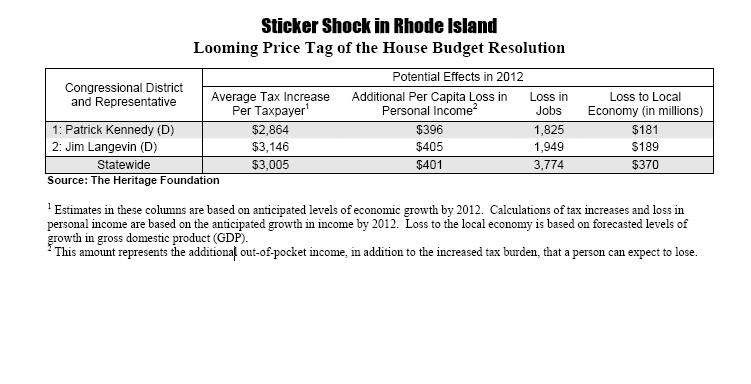
May 10, 2007
Re: RI Future Hyperventilation
I realize that progressives don't want to lose one of their weapons for public assassination, but must we continue pretending that anybody on either side of the aisle actually thinks being gay, of itself, is political poison — especially in Rhode Island? (Not so ironically, one suspects that those politicians who might actually suffer some loss of support for being homosexual — i.e., right wingers — would be somewhat less likely to fall under the protection of liberal outrage.)
I guess we should send out a memo that Rhode Island's leftists believe that every politician must have an official position on whether or not he or she is out. Then perhaps people who must be in the public spotlight for hours each day can at least be blamed for telling on-the-record secrets.
April 10, 2007
Counterintuitive Consequence of the Day
Would passage of a new Equal Rights Amendment mean that Providence College could reinstate its baseball team? Ilya Somin of the Volokh Conspiracy thinks it’s a possibility…
As currently interpreted by courts and federal administrative agencies, [Federal law] essentially requires universities to have equal numbers of male and female sports teams, regardless of the amount of interest that male and female students have in athletics. This is a fairly obvious gender classification and one that probably won't survive strict scrutiny under the ERA.Providence College eliminated baseball in 1999, after the NCAA determined that it had too many programs for male athletes. Here’s Reason Magazine describing the end of baseball at PC…
In the late '90s, Providence found itself in a familiar bind. Women accounted for 59 percent of its students, yet they were only 43 percent of student athletes. The school was facing a peer review by the NCAA, and it needed to show quick "progress" toward gender equity. Providence simply had too many male athletes, and the easiest course of action was to cut some men's programs to bring its numbers into line. In the fall of 1998, the administration announced that the 1999 season would be the last for the school's 78-year-old baseball team. After 2002, Providence would no longer support men's golf or tennis. Not one new women's team would be created, but the male-female ratio would still be greatly improved.
March 27, 2007
Because, after 35 years, we've waited long enough....
...the Democratic Party brings you (drumroll please).....................................
The Equal Rights Amendment!!!
Liberal Democrats in the Senate and House plan to resume "the fight for women's equality" on Tuesday, when they reintroduce the Women's Equality Amendment.Actually, I guess the wait has been since 1923. Congrats to the 'Crats for bringing up this crucial and pressing issue.Sens. Ted Kennedy (Mass.) and Barbara Boxer (Calif.) and Reps. Carolyn Maloney and Jerrold Nadler, both of New York, plan to join Eleanor Smeal, president of the Feminist Majority, in making the Tuesday afternoon announcement...The proposed amendment would affect issues ranging from hiring and wages to restrictions on women serving in military combat units...
"It's been a long, hard fight for women's equality," Maloney said Monday at the Women's Equality Summit hosted by the National Council of Women's Organizations in Washington, D.C.
"We've achieved a lot for women -- even in my lifetime," she said. "But we have not done enough.
"There is still a great deal of discrimination out there," Maloney argued, citing income disparity between men and women, gender-based "discriminatory clubs" and "gender-based hate crimes."
"Discrimination is real; it's out there," Maloney said. "They are constantly trying to roll [women's rights] back.
"It's never going to go away until we pass the women's equality amendment," she said.
March 22, 2007
Zebra-crats: Simply Can't Change Their Stripes
Ed Morrissey commented (via email) to Glenn Reynolds:
Isn't it interesting that the Democrats -- who ran on an anti-corruption, anti-war platform -- now offer us a porked-up supplemental to fund the Iraq war?And, also via Glenn, that noted conservative outlet USA Today joins in:
It's hard to say which is worse: leaders offering peanuts for a vote of this magnitude, or members allowing their votes to be bought for peanuts. These provisions demean a bill that, if enacted, would affect the lives of troops in Iraq and Afghanistan, the balance of power in the Middle East and America's long-term security.That last bit sounds sorta Reaganesque, dontcha think?The provisions also violate the spirit, if not the letter, of the new majority's promise to cut back on "earmarks" — provisions slipped into bills that direct your tax dollars to a specific locale or politically favored project.
Last January, as soon as Democrats took control of Congress, the House passed new rules designed to curb earmarks, which had exploded under years of Republican rule. Yet here they go again...
March 21, 2007
House Democrats: Pork is OK if it's Anti-War
It didn't take too long to renege on that promise now, did it (H/T).
House Democratic leaders are offering billions in federal funds for lawmakers' pet projects large and small to secure enough votes this week to pass an Iraq funding bill that would end the war next year.House Democrats: they were against pork before they were for it? Or is this more likely evidence of the plain fact that, as Jonah Goldberg writes, "Democrats can betray their base too."So far, the projects -- which range from the reconstruction of New Orleans levees to the building of peanut storehouses in Georgia -- have had little impact on the tally. For a funding bill that establishes tough new readiness standards for deploying combat forces and sets an Aug. 31, 2008, deadline to bring the troops home, votes do not come cheap.
But at least a few Republicans and conservative Democrats who otherwise would vote "no" remain undecided, as they ponder whether they can leave on the table millions of dollars for constituents by opposing the $124 billion war funding bill due for a vote on Thursday...
"The war supplemental legislation voted out of the Appropriations Committee last week was an exercise in arrogance that demonstrated the utter contempt the majority has for the American people and their hard-earned tax dollars," fumed Rep. John Shadegg (R-Ariz.). "We are at war with a ruthless global terrorist network, yet the appropriators allocated hundreds of millions in funds to gratuitous pork projects."
Even some Democrats say the issue of Iraq has become far too heated to be conducive to vote-buying.
"The profile and urgency of this Iraq vote really doesn't lend itself to these kinds of side deals," said Rep. Earl Pomeroy (D-N.D.)...
March 17, 2007
Immigration Debate To Heat up Locally
It should make for riveting television when WPRO-AM talk-show host Dan Yorke and blogger-political activist Matt Jerzyk square off on immigration on 10 News Conference at 6:30 AM this Sunday. (A few disclosures: I'm a weekly guest on Yorke's show, and Jerzyk is an occasional Phoenix contributor.)Should be interesting. One point though: I don't think many conservatives are blaming just liberals--President Bush has certainly gotten his fair share of criticism. Any conservative criticism of the actions of the Massachusetts Congressional delegation in the aftermath of the recent New Bedford raid is because they seem more concerned about playing up the plight of exploited illegal immigrants over an entirely legal (if somewhat mishandled) raid. As the ProJo editorializes, the law enforcement officers were simply doing there job--upholding the law. None of this means that conservatives are letting the President off the hook for his predisposition to amnesty.Jerzyk and Yorke have been engaged in a tiff since Jerzyk made a recent post responding to some of Yorke's assertions about the New Bedford immigration bust.
Considering how George W. Bush is in his second term, you have to laugh when conservatives blame liberals for shortcomings in the nation's immigration policy. That said, both immigrant advocates and immigration critics seem united in their belief that the staus quo leaves a lot to be desired. Since immigrants have long made for convenient scapegoats, the hard part is stimulating a dialogue that promotes light, rather than just heat (if not outright misinformation).
March 7, 2007
Who Cares What the RI Legislature Thinks About Iraq?
Perhaps if House Democrats would refrain from debating utterly non-Rhode Island related "legislation" such as H 5340, a House Resolution "RESPECTFULLY REQUESTING THE UNITED STATES CONGRESS TO OPPOSE PRESIDENT BUSH'S PLAN TO INCREASE US TROOPS IN IRAQ," then they wouldn't have to put the pedal to the metal in June. (Of course, that's assuming they don't like shoving all of the legislation down our throats with little chance for review). Besides, does it really matter what the Rhode Island Legislature has to say about Iraq? Well, for those who wake up every day and drink a tall glass of hubris (Reps. Crowley, McNamara, Naughton, Shanley, and Lewiss), I guess it does:
WHEREAS, The initial war plans for Iraq had a preliminary American invasion force of about 130,000 soldiers and Marines, which would drop to 30,000 to 50,000 by the end of 2003; andSetting aside the total lack of perspective with regards to the first "WHEREAS" concerning initial troop estimates vs. reality (apparently, they've read somewhere that pre-conflict troop estimates are always accurate and never change as the situation changes.) And temporarily setting aside the aforementioned fact that it is a total waste of time. (Newsflash: no one gives a darn what the freakin' RI Legislature thinks about foreign affairs. Get over yourselves). The reality in Iraq is quickly bypassing their "RESOLVE"s, but they don't realize it because, like so many politicians, they have already made up their minds on Iraq--facts be damned--and are still sticking to the November 2006 script. What a wonderfully static way to look at the world.WHEREAS, As of mid-November 2006, there were approximately 152,000 United States troops deployed to Iraq; and
WHEREAS, In his State of the Union Address, President Bush affirmed his commitment of more than 20,000 additional American troops to Iraq; and
WHEREAS, This policy of "escalation" is simply the wrong answer to the situation in Iraq at this time; now, therefore be it
RESOLVED, That this House of Representatives of the State of Rhode Island and Providence Plantations hereby urges the United States Congress to oppose President Bush's plan to increase United States troops in Iraq; and be it further
RESOLVED, That this House urges the Congress to support a plan to redeploy American Troops currently serving in Iraq and seek a political resolution to the internal Iraq conflict; and be it further
RESOLVED, That the Secretary of State be and he hereby is authorized and directed to transmit duly certified copies of this resolution to the Rhode Island Congressional delegation.
The Mainstream Media has also been following the same template, which is why NBCs Brian Williams should be given credit for going to Iraq to see things for himself. And he's beginning to realize that the Conventional Wisdom in the U.S. doesn't reflect the reality in Iraq.
Continue reading "Who Cares What the RI Legislature Thinks About Iraq?"March 6, 2007
In Allentown, Not So Crazy About Card Checks
Well we're waiting here in AllentownSo goes a portion of Billy Joel's '80s hit "Allentown", a working man's song about how life was changing in a union town. With the news that the House of Representatives has passed the "Employee Free Choice Act", which really seeks to strip away the right of workers to vote up or down on unionization via secret ballot and requires a so-called "card check," Joel's song came to mind. For the heck of it, I thought that, instead of me rehashing (and here and here) why this was so wrong, it might be worth finding out what the local newspaper of a union town--like Allentown--had to say. The Morning Call of Pennsylvania's Lehigh Valley is the Allentown hometown newspaper. After editorializing that "[i]t was a cynical and misleading vote, one that was more about politics than it was about helping workers," the paper explains:
For the Pennsylvania we never found
For the promises our teachers gave
If we worked hard
If we behavedSo the graduations hang on the wall
But they never really helped us at all
No they never taught us what was real
Iron and coal
Chromium SteelAnd we're waiting here in Allentown
But they've taken all the coal from the ground
And the union people crawled away.
Union leaders say employer intimidation contributes to this decline. They cite statistics that workers who try to organize fellow employees stand a one-in-five chance of losing their jobs. They complain about employers hiring consultants who specialize in pressuring workers into not supporting unions. It happens.The union bosses and their Democratic friends have sought to use legitimate concerns about the shortcomings of the NLRB as an opportunity to strengthen their control over the rank and file--both current and prospective. As the Call's editorial staff wrote, this was indeed "cynical and misleading." And entirely unsurprising.However, the solution this legislation proposes would replace one form of coercion with another. In doing so, it does away with one of democracy's most hallowed tools to preserve freedom of choice — the secret ballot. In its place, it would allow unions to organize workplace simply by getting a majority of employees to sign authorization cards — the so-called card check. In place of a boss leaning on a worker not to vote for the union, it puts face-to-face peer pressure from a labor organizer to unionize. Pressure can work both ways, and without the protection of privacy, workers could subject themselves to harassment, or worse, from just another source. It happens.
This isn't the way to make the workplace fair. The National Labor Relations Act already makes it illegal for employers to bully their workers into not supporting unions. There are legitimate questions about whether the act's enforcement provisions are adequate to protect workers' rights. In fact, the Employee Free Choice Act would give the National Labor Relations Board more power to penalize employers when they fire workers for trying to organize — something that gets to the heart of labor's concern. Paired with a secret ballot, it would allow workers to vote according to who they think made the better case — labor or management.
March 1, 2007
Union Intimidation Tactics: An Extreme Example
So far, I've posted on how the Democrats in the House have attempted to remove the ability of workers to vote via a secret ballot if they want to unionize and how most workers dislike union card checks, which is the "approved alternative" of the House Democrats and their Labor Boss buddies. One area of contention seems to be over just who, exactly, intimidates workers more: unions or companies. As my last post indicated, it seems that most of the company-sponsored intimidation is anecdotal. Additionally, according to the poll I cited, "[o]ver 92 percent of union objections to employer misconduct during organizing elections in 2005 were either withdrawn or, upon investigation by the NLRB, dismissed."
Now, an Anchor Rising reader has emailed me some documents that provide an example of the types of intimidation tactics in which one particular union engaged during an organizing campaign. According to this source:
[T]he attached is quite “interesting” regarding the lengths to which union organizers will go.Here is a PDF detailing the settlement and here is a PDF containing the actual posting. Here's a sample of some of that "unsubtle" intimidation, which was subsequently prohibited in the postings: Continue reading "Union Intimidation Tactics: An Extreme Example"It is an employee bulletin board notice that the National Labor Relations Board ordered posted at the trucking company Overnite Transportation facilities. The Teamsters agreed to this as part of a stipulated agreement (also attached) settling charges against the Teamsters, which at the time were attempting to organize Overnite.
By no means is this Teamster activity representative of union pressure during organizing drives, but “less extreme” union pressure certainly is: from fraud (telling employees that signing the card is only so that the union can mail information to the employee’s house) to nagging (many employees sign the cards simply to get the pro-union employees to stop bothering them) to subtle intimidation (groups showing up at employee’s houses seeking signed cards) to more shall we say “unsubtle” intimidation.
Workers Don't Like Card Checks
In the comments section of my recent post on the so-called "Employee Free Choice Act", MRH contends:
This isn't as black and white an issue as you're making it seem. I'm sympathetic to the argument that, in general, secret ballots are a good thing. However, in practice the kind of secret balloting used to certify a union takes months or years to complete, during which time management has significant time and opportunity to intimidate workers against joining the unions.Commenter Tom W. offers a fine riposte (so read it!), but perhaps this poll (thanks Andrew) will also help MRH make up his mind. Here's the conclusion (follow the link for more detail):Under a card check system, a union can be certified much, much quicker.
From everything I understand, management intimidation is far, far more prevalent than union intimidation, so that's why most labor advocates are in favor of this.
Labor activists argue that card check is needed to protect workers' free choice as to whether to join a union. But workers themselves disagree. Overwhelming majorities of both union and non-union workers oppose the card-check system. Contrary to anecdotal stories of employer abuses, most union members believe the current election system is fair. Workers do not want the government to force them to reveal their choices to anyone and want the right to keep their votes private. Unrepresentative anecdotes from labor activists are not enough to counter the fact that workers choose private-ballot organizing elections, not card check.There's more, and none of it indicates that the majority of union workers want to have the "Free Choice" of publicly proclaiming their personal decisions on union-related issues. Continue reading "Workers Don't Like Card Checks"
February 28, 2007
Democrats and Labor Leaders Quash Workers' Rights
According to GOP Minority Whip John Boehner:
Under the guise of “protecting” workers, a bill by House Democrats would strip American workers of the right to choose -- freely and anonymously -- whether to unionize. The misleadingly titled Employee Free Choice Act offers neither freedom nor choice, and will leave workers open to ugly union harassment, intimidation, and pressure that still persist today. The San Francisco Examiner called it “exquisitely Orwellian… anti-freedom, anti-democracy"...Boehner also offers up this useful analogy:The remarkable thing about the Employee Free Choice Act is the enormous amount of power over the lives of Americans it gives to Big Labor. No other group has the authority to simply draw up a few signatures in order to force others to start paying them money. But that is exactly what Democrats are giving their union buddies. By stripping workers of their right to a private ballot election, Democrats are raiding the wallets of and stripping away fundamental rights from American workers.
[I}magine it is November 2008 and community leaders all across America decide not to hold elections. Instead of heading into a voting booth like you always have, you’re told to show up at town hall and declare publicly -- in front of your neighbors and community leaders -- for whom and what you’re voting.Is this the progressives' idea of protecting workers' rights? They feel comfortable excoriating corporate fat-cats for initimidating workers who want to organize, but shouldn't they and the Democrats they support be intellectually honest enough to recognize that union bosses can be just as intimidating? Not just CEO's pull down six figures, my friends. Or do they just like to pay lip service to worker rights and think that passing "labor" laws are enough maintain their street cred of "fighting for the little guy"?
Sounds crazy, doesn’t it? Well this is exactly what House Democrats are proposing for your workplace. Workers will no longer be able to express their wishes privately; their “votes” will be public for everyone -- union organizers, employers, co-workers -- to see.
Currently, Anchor Rising is running an advertisement for a "virtual" March on Washington sponsored by The U.S. Chamber of Commerce, which "co-chairs the Coalition for a Democratic Workplace, an organization that represents employers, workers, and activists who want to safeguard the protections of the secret ballot in workplaces throughout America."
We strenuously oppose H.R. 800, the “Employee Free Choice Act” and the unions who want Congress to legislate the end of secret ballot union elections and the safeguards they afford to working families.If you think that workers should have the right to a secret ballot, pay them a visit.Congress has begun working on this legislation and may vote on it as soon as the week of February 26.
Join a crowd of thousands without leaving your computer by writing a letter to your members of Congress and designing a “virtual you” to place on the Mall.
February 26, 2007
Do Aldroids Dream of Inconvenient Hypocrisy?
Ya know, do they really have to make it so easy? (via Instapundit):
Last night, Al Gore’s global-warming documentary, An Inconvenient Truth, collected an Oscar for best documentary feature, but the Tennessee Center for Policy Research has found that Gore deserves a gold statue for hypocrisy.Aw, c'mon Drew? Al just has to use all o' that energy in his great, big mansion so he can power the global media campaign that is spreading the Truth to all of us poor, working- and middle- class, ignorant rubes? Dontcha see? And that's why he uses a private jet, too: so he can spread the word to the masses faster than he could by riding a bike! Really! Honest!
Gore’s mansion, located in the posh Belle Meade area of Nashville, consumes more electricity every month than the average American household uses in an entire year, according to the Nashville Electric Service (NES).
In his documentary, the former Vice President calls on Americans to conserve energy by reducing electricity consumption at home.
The average household in America consumes 10,656 kilowatt-hours (kWh) per year, according to the Department of Energy. In 2006, Gore devoured nearly 221,000 kWh—more than 20 times the national average.
Last August alone, Gore burned through 22,619 kWh—guzzling more than twice the electricity in one month than an average American family uses in an entire year. As a result of his energy consumption, Gore’s average monthly electric bill topped $1,359.
Since the release of An Inconvenient Truth, Gore’s energy consumption has increased from an average of 16,200 kWh per month in 2005, to 18,400 kWh per month in 2006.
Gore’s extravagant energy use does not stop at his electric bill. Natural gas bills for Gore’s mansion and guest house averaged $1,080 per month last year.
“As the spokesman of choice for the global warming movement, Al Gore has to be willing to walk the walk, not just talk the talk, when it comes to home energy use,” said Tennessee Center for Policy Research President Drew Johnson.
In total, Gore paid nearly $30,000 in combined electricity and natural gas bills for his Nashville estate in 2006.
(h/t Philip K. Dick)
Continue reading "Do Aldroids Dream of Inconvenient Hypocrisy?"January 25, 2007
Summing Up Differing Approaches to Poverty
Nathan Smith at TCS daily offers this contrast between how President Bush and Sen. Jim Webb view the poverty question:
President Bush has proposed an array of policies that confront different aspects of real deprivation as experienced by the poor here and abroad: bad education, lack of legal status and fear of deportation, lack of health care and disease. Of course, also critical to poverty alleviation is the ongoing success of the US economy, which, as the president mentioned, has created 7.2 million jobs since the beginning of the current expansion. Jobs are both the best way out of poverty and, as presidential aspirant John Edwards has said, a source of "dignity and self-respect." By calling for a balanced budget in five years, without raising taxes, President Bush made a bid to preserve a business climate in which prosperity will continue.In short, it's the rhetoric of class warfare and "envy" (Webb) versus the rhetoric of "altruism" (Bush). Read the whole thing for a further explanation.While the president is interested in dealing with specific aspects of poverty and deprivation, he is not interested in the position of poor people relative to others. Senator Webb is. "When I graduated from college," remarks Senator Webb, "the average corporate CEO made 20 times what the average worker did; today, it¹s nearly 400 times." Or again, "Wages and salaries for our workers are at all-time lows as a percentage of national wealth." In each case, the statistic he cites is a ratio: the average worker's wages compared to those of the CEO; wages and salaries compared to national wealth. That the average worker is much wealthier in absolute terms than he was thirty years ago does not seem to interest Webb much: what matters is that his relative wealth has decreased.
January 18, 2007
About those "Civil Liberties" and the First Amendment
OK, I don't get it. Supposedly the Democrats want to safeguard you and me from violations of our civil liberties perpetrated in the name of the "War on Terror". But now it seems they're more than happy to restrict free speech. Earlier this week, it was revealed that they are pondering a return of the misnamed "Fairness Doctrine";
The Fairness Doctrine did not require broadcasters to present issues in a "fair and honest manner"; it required them to turn their stations into ping-ponging punditry if they allowed opinion to appear on the air at all. It created such a complicated formula that most broadcasters simply refused to air any political programming, as it created a liability for station owners for being held hostage to all manner of complaints about lack of balance.Now we find out that they are actively trying to push through a law requiring the "registration" of bloggers (via Instapundit).Congress and the Reagan administration repealed the Fairness Doctrine in the mid-1980s, and it allowed a market for political opinion to flourish. It also revitalized the AM band...Radio stations could air local and syndicated talk shows without having to worry about metering time between differing viewpoints, allowing the station owners to reflect the market and their own personal preferences for politcal viewpoints.
Why would [Dennis] Kucinich want to reimpose the Fairness Doctrine and kill off the AM band and talk radio? Because his allies have proven less successful than conservatives at building a market for their broadcasts....Democrats aren't wasting much time in rolling back free speech now that they have the majority. Putting Kucinich in charge of domestic policy reform was no mistake on their part. They want to kill talk radio, and if they manage to hold their majority and win the White House in 2008, they just might do it. [More here].
S.1 has been introduced in the Senate as "lobbying reform" -- which in this case means "First Amendment infringements." An amendment has been attached, which requires registration of bloggers with more than 500 readers, and who comment on policy issues. Violation would be a criminal offense.I wonder if the watchdogs on the Left are going to be up in arms over these "quashing of dissent" actions? Or is it OK so long as the Democrats are doing the quashing? What's next? Applying the "Fairness Doctrine" to bloggers? Maybe, just maybe.I looked it up on the Library of Congress webpage (which is essentially unlinkable) and have attached section 220 in extended remarks, below. As the bill is reported, it appears to cover any "paid" grassroots lobbying, that reaches more than 500 people. But a blogger who receives contributions might be classed as a "paid" grassroots type. It looks like Congress wants to keep an eye on annoying people like Porkbusters. It may be significant that S.1 was introduced by Harry Reid, one of the Kings of Pork.
January 12, 2007
Pelosi: Raise the Minimum Wage! (Er, Except if it Affects a Company in my District)
Heh. Something fishy is going on:
House Republicans yesterday declared "something fishy" about the major tuna company in House Speaker Nancy Pelosi's San Francisco district being exempted from the minimum-wage increase that Democrats approved this week.Yes, it's all just one big coincidence!!!"I am shocked," said Rep. Eric Cantor, Virginia Republican and his party's chief deputy whip, noting that Mrs. Pelosi campaigned heavily on promises of honest government. "Now we find out that she is exempting hometown companies from minimum wage. This is exactly the hypocrisy and double talk that we have come to expect from the Democrats."
...The bill also extends for the first time the federal minimum wage to the U.S. territory of the Northern Mariana Islands. However, it exempts American Samoa, another Pacific island territory that would become the only U.S. territory not subject to federal minimum-wage laws.
One of the biggest opponents of the federal minimum wage in Samoa is StarKist Tuna, which owns one of the two packing plants that together employ more than 5,000 Samoans, or nearly 75 percent of the island's work force. StarKist's parent company, Del Monte Corp., has headquarters in San Francisco, which is represented by Mrs. Pelosi. The other plant belongs to California-based Chicken of the Sea.
"There's something fishy going on here," said Rep. Patrick T. McHenry, North Carolina Republican....A spokeswoman for Mrs. Pelosi said Wednesday that the speaker has not been lobbied in any way by StarKist or Del Monte.
And golly gee, I was quite surprised to discover that this was missed by those who were going to be "holding the Dems accountable" and wouldn't just "monitor" (cheerlead) them as new bills went through the House and Senate. (Well, maybe they'll get around to it eventually). To help 'em along, perhaps they should also read this from the Saipan Tribune:
Democrats have long tried to pull the Northern Marianas under the umbrella of U.S. labor law, accusing the island's government and its industry leaders of coddling sweatshops and turning a blind eye to forced abortions and indentured servitude.Faleomavaega understands that it makes economic sense to pay a lower wage and keep all of those jobs on his island instead of forcing a higher wage on employers who may then move the jobs elsewhere. I guess "sweat shops" aren't "sweat shops" when "market forces" are just too strong to impose a higher minimum wage in a Democrat's district.Samoa has escaped such notoriety, and its low-wage canneries have a protector of a different political stripe, Democratic delegate Eni F.H. Faleomavaega, whose campaign coffers have been well stocked by the tuna industry that virtually runs his island's economy.
Faleomavaega has long made it clear he did not believe his island's economy could handle the federal minimum wage, issuing statements of sympathy for a Samoan tuna industry competing with South American and Asian canneries paying workers about 67 cents an hour.The message got through to House Education and Labor Committee Chairman George Miller, D-Calif., the author of the minimum wage bill who included the Marianas but not Samoa, according to committee aides. The aides said the Samoan economy does not have the diversity and vibrance to handle the mainland's minimum wage, nor does the island have anything like the labor rights abuses Miller claims of the Marianas...
...But in American Samoa the tuna industry rules the roost. Canneries employ nearly 5,000 workers on the island, or 40 percent of the work force, paying on average $3.60 an hour, compared to $7.99 an hour for Samoan government employees. Samoan minimum wage rates are set by federal industry committees, which visit the island every two years...
When StarKist lobbied in the past to prevent small minimum wage hikes, Faleomavaega denounced the efforts.
“StarKist is a billion dollar a year company,” he said after a 2003 meeting with StarKist and Del Monte executives. “It is not fair to pay a corporate executive $65 million a year while a cannery work only makes $3.60 per hour.”
But after the same meeting, Faleomavaega said he understood that the Samoan canneries were facing severe wage competition from South American and Asian competitors.
Department of Interior testimony last year before the Senate noted that canneries in Thailand and the Philippines were paying their workers about 67 cents an hour. If the canneries left American Samoa en masse, the impact would be devastating, leaving Samoans wards of the federal welfare state, warned David Cohen, deputy assistant secretary of the interior for insular affairs.{emphasis added)
Yup, this looks exactly like the sort of hypocrisy they claimed they'd be on the lookout for. Can't wait to see 'em in action!
RE: House Dems Like Earmark Reform. Senate Dems? Not so much...
Here are few notes on Marc’s earlier post on Senate Democrats trying to kill the earmark reforms passed by the House of Representatives. Rhode Island Senators Jack Reed and Sheldon Whitehouse both voted against the reform package.
It appears that Senator Whitehouse, as feared, sees himself less as a representative of the views of ordinary Rhode Islanders, and more as a Rhode Islander whose job is to go-along-to-get along with the elite governing culture in Washington D.C.
Senators James Webb and John Tester voted in favor of serious earmark reform, so the vote was not simply a matter of freshmen Senators having to obey the established party leadership. Maybe there really is something to the idea of the new Democrats being more conservative than the old-guard of the party. And if I wasn’t voluntarily embargoing any commentary about the 2008 Presidential election until June, I would note that Barack Obama voted in favor of earmark reform, while Hillary Clinton did not. (New Democrats being more conservative than old-line leadership again?)
UPDATE:
The strong version of earmark reform has been approved, so the paragraph below no longer applies. Details available in Marc's post immediately below.
{Be aware: the new disclosure rules have not passed the Senate yet; the vote taken yesterday was only on whether to table a final vote on the reform or not. Democratic Majority leader Harry Reid is going to try to offer an alternative proposal, which according to Senator Tom Coburn (via the Associated Press), would have required full disclosure on only 534 of the 12,852 earmarks in Senate bills last year.}
House Dems Like Earmark Reform. Senate Dems? Not so much...
Ah yes, see how much has changed! Looks like the House Democrats earmark reform bill is being supported by most Senate Republicans and a few Democrats....but the heartiest opposition is being put up by Sen. Majority Leader Harry Reid (via Glenn Reynolds). TPM Muckraker has one report and Andy Roth at the Club For Growth kept a running commentary on the goings on. Roth also posted a follow-up, which included this bit:
Senator Jim DeMint offered strong reform to the most egregious spending abuses in Congress-a proposal that was sponsored by Speaker Nancy Pelosi and that passed the House just last week. After trying, and failing, to kill the DeMint proposal, Senate Majority Leader Harry Reid, Senator Ted Kennedy and other Democrats used stall tactics to delay a final vote. Ultimately, the Senate was forced to postpone it.I had heard that some local "new media" outlets sympathetic to the Democrats were starting up some countdown or something to track all of the "change" that was going to happen. (Funny, I checked them out and haven't seen anything about this yet. Maybe they'll get around to it. That is, of course, once they work out how to frame it as a positive for "their side.")
Which gives me an opportunity to offer a little advice for those new to the porkbusting/earmark reform movement in particular. You're either "all in" by going after anyone of either party who is a roadblock to said reform or you're not "in" at all. That means that you really, truly have to hold people accountable, even if, you know, you really, really like them, and all. So, yes, you actually have to put the pom-poms down every once in a while and throw a "boo" and "hiss" their way. Or you can just keep being a Party cheerleader.
Then, of course, maybe some Democrats supported earmark reform only because it was the GOP running Congress, right? Nah.....couldn't be that.
UPDATE: Looks like Senator Reid has acquiesced (via CFG quoting a Congressional Quarterly $$ article):
After losing a critical floor vote Thursday and scrambling in vain to reverse the decision, Senate Majority Leader Harry Reid, D-Nev., found the spirit of bipartisan compromise more to his liking Friday morning.Congrats to those on the left, right and center who held Reid's feet to the fire. Maybe next time, when such hypocrisy becomes readily apparent, even more folks from across the political spectrum will chime in!Reid offered an olive branch to Sen. Jim DeMint, R-S.C., agreeing to embrace his amendment to a pending ethics and lobbying overhaul (S 1) with some modifications. DeMint’s amendment, which Democratic leaders tried but failed to kill on Thursday, would expand the definition of member earmarks that would be subject to new disclosure rules.
[...] Reid admitted Friday that he was caught off guard when nine Democrats and independent Joseph I. Lieberman voted against his motion to table, or kill, the DeMint amendment. His effort failed, 46-51.
[...] Friday morning, a chastened Reid said, “Yesterday was a rather difficult day, as some days are. We tend to get in a hurry around here sometimes when we shouldn’t be. Personally, for the majority, we probably could have done a little better job.”
DeMint, who was flabbergasted Thursday by Reid’s maneuvering to change the outcome of the vote, was happy to accept the compromise Friday.
“DeMint has been happy to work to come to a bipartisan compromise that solidifies the reforms done by [Speaker Nancy] Pelosi [D-Calif.] and House Democrats,” said DeMint spokesman Wesley Denton.
January 10, 2007
Democrats 9/11 Commission Bill: Both Less and More Than Advertised
So, the 100 Hours continue and Speaker Pelosi has gotten her 9/11 Commission legislation through. And though some may think that every one of the 9/11 Commission prescriptions were included (the necessity or wisdom of implementing them all is another discussion), apparently, that's really not the case (via The Corner).
Senator Joseph I. Lieberman, independent of Connecticut, who held a hearing Tuesday as the Senate prepared for its version of this bill, noted that one major recommendation — not in the House measure — was strengthening Congressional oversight of intelligence and counterterrorism efforts. “We found it a lot easier to reform the rest of the government than we did to reform ourselves post-9/11,” Mr. Lieberman said. “That’s unfinished work.”The relevant portion of the 9/11 Report to which Lieberman refers begins here (and I've excerpted it in full in the extended entry, below.
Finally, Speaker Pelosi's 9/11 Commission Legislation contains language making it possible for the federal employees of the TSA to unionize.
The 9/11 commission did not address union rights or personnel rules but urged improvements in airport screening operations. AFGE [American Federation of Government Employees] maintains that collective bargaining rights help smooth agency operations because labor-management contracts provide a structure for addressing employee issues, including job performance.The Bush Administration also provided an example:Peter Winch, an organizer with AFGE, said the union had asked Democrats to put bargaining rights for TSA screeners "on the agenda for the first 100 hours." He continued, "It does not make sense to keep these employees from collective bargaining rights when other Department of Homeland Security employees have those rights."
The TSA has said that collective bargaining is not appropriate for airport passenger and baggage screeners because of their national security mission and because the agency requires the ability to make personnel staffing changes rapidly in response to threats. In the law creating the TSA, Congress left it to the Bush administration to determine such issues as union rights for screeners.
As an example, officials pointed to the foiled United Kingdom airline bombing plot in August, when new procedures for screeners were put into place immediately.Then there is this point made by Senator Joseph Lieberman's office:"This flexibility is a key component of how the Department of Homeland Security, through TSA, protects Americans while they travel," the statement said.
"Other security personnel like customs agents and the Border Patrol have the right to collective bargaining, and that has not impaired their ability to protect American security."OK, fine. But isn't this really just an "earmark" by another name? The original legislation that allowed this potential TSA unionization had previously stalled in committee (granted, GOP controlled congress) and NONE of this 100 hour legislation is being debated in--or passed through--committee. Heck, to the victor go the spoils and all that, but for the Democrat led Congress to reward one of their key constituencies--a federal employee union--under the cover of national security smells like business as usual to me. Continue reading "Democrats 9/11 Commission Bill: Both Less and More Than Advertised"
February 1, 2006
Sen. Kerry, Thank You
Sen. Kerry, thank you for keeping such a high profile. Whether it be instigating a doomed-to-fail filibuster of Justice Alito from the slopes of a Swiss ski resort or claiming that "53 percent of our children don't graduate from high school" or "The average American struggles to find time to take care of families, working two or three jobs... " (emphasis mine), you make it easy for us to point out the intellectual bankruptcy of so many on the Left. On the face of it, no one can possibly believe that less than half of our students graduate from high school. Also, as an "average American" who happens to know a lot of other "average Americans," I can tell you that none work "two or three jobs" to make ends meet. But that's OK, such incessant carping reveals your politics-of-demogoguery for what it is. Thanks! (Oh, and please do run for President in 2008.)
March 11, 2005
Democrats and Democratization
The New Republic's Noam Scheiber beleives that President Bush's democracy agenda abroad may help build a Democratic majority at home. Over at TechCentralStation, I explain why I believe Scheiber's argument is flawed.
January 19, 2005
Liberalism: Propagation via Redefinition
Liberals have a practical reason why they won't say what they ultimately want, and a theoretical reason why they can't say it. The practical reason is that any usably clear statement of what the welfare state should be would define not only a goal but a limit. Conceding that an outer limit exists, and stipulating a location for it, strengthens the hand of conservatives—with liberals having admitted, finally, that the welfare state can and should do only so much, the argument now, the conservatives will say, is over just how much that is.As Voegli points out, it is this constant liberal redefinition and bar-raising of what makes a well-developed person, and by extension a "perfect" society, that keeps their political engine running. Remember, as the enlightened elite, they know best what is best for the rest of us, after all. As such, there is no end to what government is "morally" required to do because they constantly re-define the ideals they deem important. One check to this growth, to their ability to use government to "help" us, is the size of the burden that the taxpayers are willing to bear. However, on this point, Voegli worries
Keeping open, permanently, the option for the growth of the welfare state reflects the belief that the roster of human needs and aspirations to which the government should minister is endless. Any attempt to curtail it would be arbitrary and wrong. . .
This gets us to the theoretical reason why liberalism cannot incorporate a limiting principle or embrace an ultimate destination. Given humankind's long history of sorrows, most people would consider securing "abundance and liberty for all," ending poverty and achieving racial justice, a pretty good day's work. For LBJ it was, astoundingly, "just the beginning."
Liberal intellectuals who drew up the blueprint for the Great Society regarded peace, prosperity, and justice as achievements that were not merely modest but troubling. They lived with a strange dread—that if Americans' lives became too comfortable the people would decide that the country had been reformed enough, thank you, even though liberals knew there was still—always—work to be done. In 1943 the National Public Resources Board, which FDR hoped would chart the course for a renewed, enlarged post-war New Deal, advocated the recognition of various welfare rights, including the right to "rest, recreation and adventure." In a speech he gave to the Americans for Democratic Action in 1948, the group's first chairman, Wilson Wyatt, rejected "the view that government's only responsibility is to prevent people from starving or freezing to death. We believe it is the function of government to lift the level of human existence. It is the job of government to widen the chance for development of individual personalities."
The threat goes beyond taxes, spending, borrowing, and regulating that increase without limit. It culminates in a therapeutic nanny state that corrupts both its wardens and its wards. Convinced that they are intervening, constantly and pervasively, to assist the growth of people who would otherwise stagnate, the enlighteners don't need coercion to enfold the people in a soft totalitarianism. The objects of this therapy, meanwhile, may grow accustomed to it, and ultimately prefer being cared for to being free; or conclude that being free has no value apart from being cared for.[emphasis mine]Well, here in Rhode Island, it certainly seemed that the citizenry embraced Johnson's stance when he spoke that day in Providence. Yet, that was the past, and, with leaders like Cranston Mayor Laffey and Governor Carcieri, attitudes are changing.
Lyndon Johnson gave one other memorable speech in 1964. At a campaign rally in Providence he climbed onto his car, grabbed a bullhorn, and summed up his political philosophy: "I just want to tell you this--we're in favor of a lot of things and we're against mighty few." The Democrats' problem is not that they, like Seinfeld, are a show about nothing. It's that they are a show about everything, or anything. (At one point, the Kerry-for-President website referred to 79 separate federal programs he wanted to create or expand.)
November 8, 2004
Goading the Opposition
It has become a commonplace among right-leaning pundits that Democrats' greatest problem is their reluctance to objectively assess the causes of their defeat and, more importantly, to reconsider their positions accordingly. Of course, that the observation is commonplace doesn't make it untrue. Here's Matt Russo, from Exeter, in a letter to the Providence Journal:
The call now is for unification. My own candidate said we must unite. I disagree.I will never be as foolish as to accept the leadership of this president. He does not represent me. Everyone in the media talks as if family values and a moral lifestyle are distinctly Republican. The Northeast is being mocked at as some sort of lost culture.
I protest that notion as adamantly as I possibly can. I come from a Catholic background and I can trace my roots directly back to the founder of my state, Roger Williams. My morals and values, in my opinion, run as deep as my ancestral heritage. ...
It is time for the Democrats to understand their failures. It is not time to bow down to the leadership of a wayward president. The time now is for Democrats to right their own course. The time is now to stand up, get off the mat, and begin to fight back.
Catholic blogger Mark Shea has found the perfect cartoon to illustrate how those on the other side of the aisle feel about this Democrat impulse.

 About Community Crier

 About Engaged Citizen